/


Автор: Niven I. Zuckerman H.S. Montgomery H.L.
Теги: mathematics algebra number theory natural sciences
ISBN: 0-471-62546-9
Год: 1991
Текст
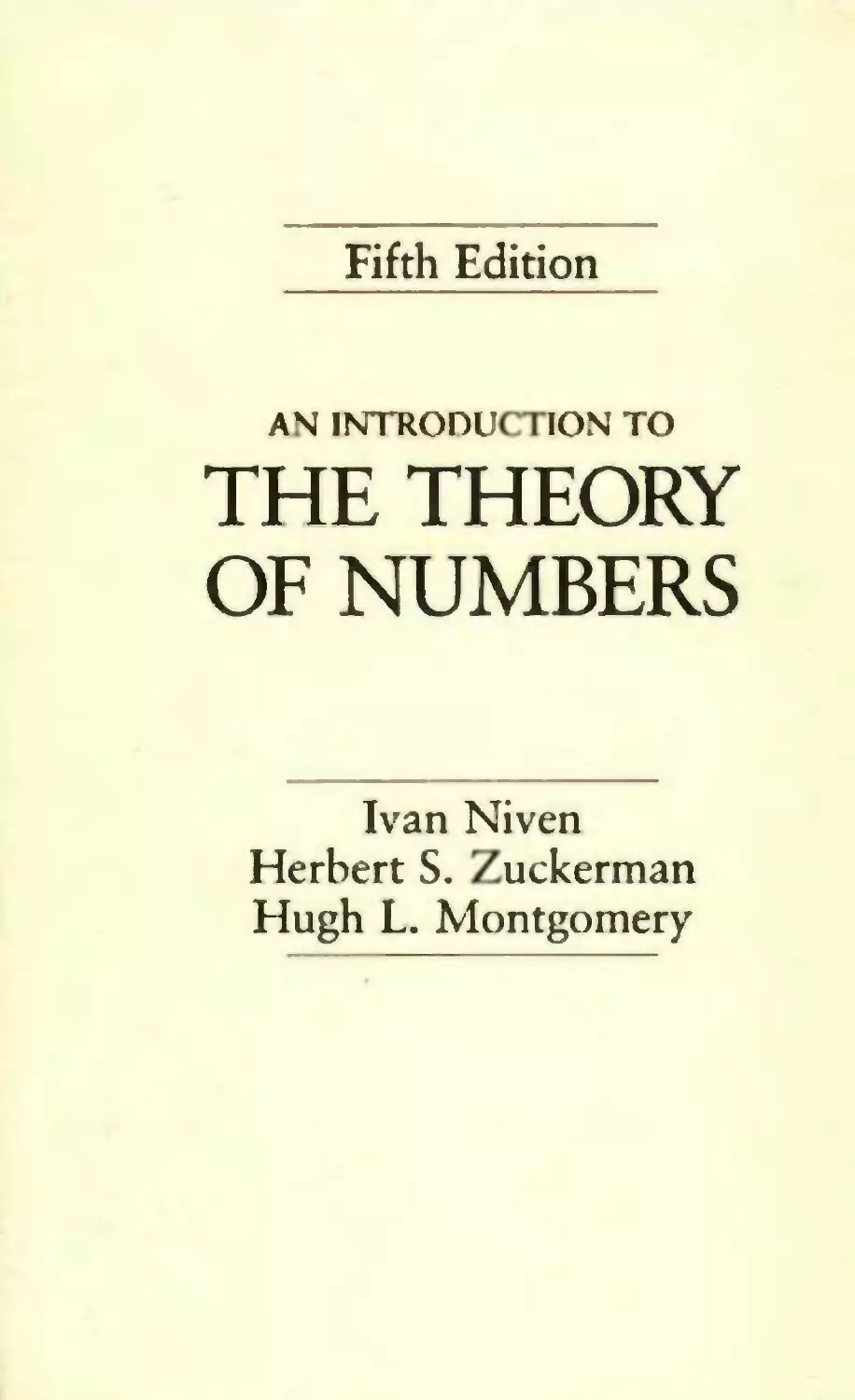
                    Fifth Edition
AN INTRODU ION TO
THE THEORY
OF NUMBERS
Ivan Niven
Herbert S. uckerman
Hugh L. Montgomery

An Introduction to
the Theory of Numbers
FIFTH EDITION
Ivan Niven
University of Oregon
Herbert S. Zuckerman
University of Washington
Hugh L. Montgomery
University of Michigan
John Wiley & Sons, Inc.
New York · Chichester · Brisbane · Toronto · Singapore

Acquisitions Editor: Bob Macek
Designer: Laura Nicholls
Copyediting Supervisor: Gilda Stahl
Production Manager: Katherine Rubin
Production Supervisor: Micheline Frederick
Manufacturing Manager: Denis Clarke
Marketing Manager: Susan Elbe
Recognizing the importance of preserving what has been written, it is a
policy of John Wiley & Sons, Inc. to have books of enduring value published
in the United States printed on acid-free paper, and we exert our best
efforts to that end.
Copyright © 1960, 1966, 1972, 1980, 1991 by John Wiley & Sons, Inc.
All rights reserved. Published simultaneously in Canada.
Reproduction or translation of any part of
this work beyond that permitted by Sections
107 and 108 of the 1976 United States Copyright
Act without the permission of the copyright
owner is unlawful. Requests for permission
or further information should be addressed to
the Permissions Department, John Wiley & Sons.
Library of Congress Cataloging in Publication Data:
Niven, Ivan Morton, 1915-
An introduction to the theory of numbers / Ivan Niven, Herbert S.
Zuckerman, Hugh L. Montgomery.—5th ed.
p. cm.
Includes bibliographical references (p. ).
Includes index.
ISBN 0-471-62546-9
1. Number theory. I. Zuckerman, Herbert S. II. Montgomery, Hugh
L. III. Title.
QA241.N56 1991
512\7—dc20 90-13013
CIP
Printed in the United States of America
10 9876543
Printed and bound by Courier Companiei, Inc.

Preface
This text is intended for use in a first course in number theory, at the
upper undergraduate or beginning graduate level. To make the book
appropriate for a wide audience, we have included large collections of
problems of varying difficulty. Some effort has been devoted to make the
first chapters less demanding. In general, the chapters become gradually
more challenging. Similarly, sections within a given chapter are
progressively more difficult, and the material within a given section likewise. At
each juncture the instructor must decide how deeply to pursue a particular
topic before moving ahead to a new subject. It is assumed that the reader
has a command of material covered in standard courses on linear algebra
and on advanced calculus, although in the early chapters these
prerequisites are only slightly used. A modest course requiring only freshman
mathematics could be constructed by covering Sections 1.1, 1.2, 1.3
(Theorem 1.19 is optional), 1.4 through Theorem 1.21, 2.1, 2.2, 2.3, 2.4 through
Example 9, 2.5, 2.6 through Example 12, 2.7 (the material following
Corollary 2.30 is optional), 2.8 through Corollary 2.38, 4.1, 4.2, 4.3, 5.1, 5.3,
5.4, 6.1, 6.2. In any case the instructor should obtain from the publisher a
copy of the Instructor's Manual, which provides further suggestions
concerning selection of material, as well as solutions to all starred problems.
The Instructor's Manual also describes computational experiments, and
provides information concerning associated software that is available for
use with this book.
New in this edition are accounts of the binomial theorem (Section
1.4), public-key cryptography (Section 2.4), the singular situation in
Hansel's lemma (Section 2.6), simultaneous systems of linear Diophantine
equations (Section 5.2), rational points on curves (Section 5.6), elliptic
curves (Section 5.7), description of Faltings' theorem (Section 5.9), the
geometry of numbers (Section 6.4), Mertens' estimates of prime number
sums (in Section 8.1), Dirichlet series (Section 8.2), and asymptotic
estimates of arithmetic functions (Section 8.3). Many other parts of the books
have also been extensively revised, and many new starred problems have
V

vi
Preface
been introduced. We address a number of calculational issues, most
notably in Section 1.2 (Euclidean algorithm), Section 2.3 (the Chinese
remainder theorem), Section 2.4 (pseudoprime tests and Pollard rho
factorization), Section 2.9 (Shanks' RESSOL algorithm), Section 3.6 (sums
of two squares), Section 4.4 (linear recurrences and Lucas pseudoprimes),
Section 5.8 (Lenstra's elliptic curve method of factorization), and Section
7.9 (the continued fraction of a quadratic irrational). In the Appendixes
we have provided some important material that all too often is lost in the
cracks of the undergraduate curriculum.
Number theory is a broad subject with many strong connections with
other branches of mathematics. Our desire is to present a balanced view of
the area. Each subspecialty possesses a personality uniquely its own, which
we have sought to portray accurately. Although much may be learned by
exploring the extent to which advanced theorems may be proved using
only elementary techniques, we believe that many such arguments fail to
convey the spirit of current research, and thus are of less value to the
beginner who wants to develop a feel for the subject. In an effort to
optimize the instructional value of the text, we sometimes avoid the
shortest known proof of a result in favor of a longer proof that offers
greater insights.
While revising the book we sought advice from many friends and
colleagues, and we would most especially like to thank G. E. Andrews,
A. O. L. Atkin, P. T. Bateman, E. Berkove, P. Blass, A. Bremner, J. D.
Brillhart, J. W. S. Cassels, T. Cochrane, R. K. Guy, H. W. Lenstra Jr.,
D. J. Lewis, D. G. Malm, D. W. Masser, J. E. McLaughlin, A. M. Odlyzko,
С Pomerance, K. A. Ross, L. Schoenfeld, J. L. Selfridge, R. С Vaughan,
S. S. Wagstaff Jr., H. J. Rickert, С Williams, K. S. Williams, and M. С
Wunderlich for their valuable suggestions. We hope that readers will
contact us with further comments and suggestions.
Ivan Niuen
Hugh L. Montgomery

Contents
Notation
1 Divisibility
1.1 Introduction 1
1.2 Divisibility 4
1.3 Primes 20
1.4 The Bionomial Theorem 35
Notes on Chapter 1 44
2 Congruences
2.1 Congruences 47
2.2 Solutions of Congruences 60
2.3 The Chinese Remainder Theorem 64
2.4 Techniques of Numerical Calculation 74
2.5 Public-Key Cryptography 84
2.6 Prime Power Moduli 86
2.7 Prime Modulus 91
2.8 Primitive Roots and Power Residues 97
2.9 Congruences of Degree Two, Prime Modulus 110
2.10 Number Theory from an Algebraic Viewpoint 115
2.11 Groups, Rings, and Fields 121
Notes on Chapter 2 128
3 Quadratic Reciprocity and Quadratic Forms
3.1 Quadratic Residues 131
3.2 Quadratic Reciprocity 137
3.3 The Jacobi Symbol 142
3.4 Binary Quadratic Forms 150

νΐΐΐ
Contents
3.5 Equivalence and Reduction of Binary Quadratic
Forms 155
3.6 Sums of Two Squares 163
3.7 Positive Definite Binary Quadratic Forms 170
Notes on Chapter 3 176
Some Functions of Number Theory 180
4.1 Greatest Integer Function 180
4.2 Arithmetic Functions 188
4.3 The Mobius Inversion Formula 193
4.4 Recurrence Functions 197
4.5 Combinatorial Number Theory 206
Notes on Chapter 4 211
5 Some Diophantine Equations 212
5.1 The Equation ax + by = с 212
5.2 Simultaneous Linear Equations 219
5.3 Pythagorean Triangles 231
5.4 Assorted Examples 234
5.5 Ternary Quadratic Forms 240
5.6 Rational Points on Curves 249
5.7 Elliptic Curves 261
5.8 Factorization Using Elliptic Curves 281
5.9 Curves of Genus Greater Than 1 288
Notes on Chapter 5 289
6 Farey Fractions and Irrational Numbers 297
6.1 Farey Sequences 297
6.2 Rational Approximations 301
6.3 Irrational Numbers 307
6.4 The Geometry of Numbers 312
Notes on Chapter 6 322
7 Simple Continued Fractions 325
7.1 The Euclidean Algorithm 325
7.2 Uniqueness 327
7.3 Infinite Continued Fractions 329
7.4 Irrational Numbers 334
7.5 Approximations to Irrational Numbers 336

IX
7.6 Best Possible Approximations 341
7.7 Periodic Continued Fractions 344
7.8 Pell's Equation 351
7.9 Numerical Computation 358
Notes on Chapter 7 359
8 Primes and Multiplicative Number Theory 360
8.1 Elementary Prime Number Estimates 360
8.2 Dirichlet Series 374
8.3 Estimates of Arithmetic Functions 389
8.4 Primes in Arithmetic Progressions 401
Notes on Chapter 8 406
9 Algebraic Numbers 409
9.1 Polynomials 410
9.2 Algebraic Numbers 414
9.3 Algebraic Number Fields 419
9.4 Algebraic Integers 424
9.5 Quadratic Fields 425
9.6 Units in Quadratic Fields 428
9.7 Primes in Quadratic Fields 429
9.8 Unique Factorization 431
9.9 Primes in Quadratic Fields Having the Unique Factorization
Property 433
9.10 The Equation x3 + y3 = z3 441
Notes on Chapter 9 445
10 The Partition Function 446
10.1 Partitions 446
10.2 Ferrers Graphs 448
10.3 Formal Power Series, Generating Functions, and Euler's
Identity 452
10.4 Euler's Formula; Bounds on p(n) 457
10.5 Jacobi's Formula 463
10.6 A Divisibility Property 467
Notes on Chapter 10 471
11 The Density of Sequences of Integers 472
11.1 Asymptotic Density 473
11.2 Schnirelmann Density and the α β Theorem 476
Notes on Chapter 11 481

χ
Contents
Appendices 482
A.I The Fundamental Theorem of Algebra 482
A.2 Symmetric Functions 484
A.3 A Special Value of the Riemann Zeta Function 490
A.4 Linear Recurrences 493
General References 500
Hints 503
Answers 512
Index 522

Notation
Items are listed in order of appearance.
Ζ The set of integers, 4
О The set of rational numbers, 4
R The set of real numbers, 4
a\b a divides b, 4
a X b a does not divide b, 4
a*lib ak\b but ak + lXb, 4
[x] Integer part, 6, 134, 180
(b, c) The greatest common divisor of b and c, 7
(Alternatively, depending on the context, a
point in the plane, or an open interval)
gcd(b, c) The greatest common divisor of b and c, 7
(i>„ b2,..., bn) The greatest common divisor of the bh 7
[e„ o2,..., o„] The least common multiple of the a,, 16
N(a) Norm of a, 22, 427
тг(дг) Number of primes ρ < χ, 26
/(*) ~ g(x) Asymptotic equivalence, 28
(Alternatively, depending on the context, an
equivalence relation, 128, 157)
Fn Fermat number, 33
(Alternatively, Fibonacci number, 199)
Mp Mersenne prime, 33
srf\@ Subtraction of sets, 34
«e/ η is an element of the set JY, 34
Ι κ I Binomial coefficient, 35
s^ и 3 Union of sets, 41
s/ П @) Intersection of sets, 41
Akf(x) к th forward difference, 42
a = b (mod m) a congruent to b modulo m, 48
α Ψ b (mod m) a not congruent to b modulo m, 48
xi

Notation
Euler's totient function, 50
Congruential inverse of a, 52
Determinant of square matrix A, 59
Number of elements in the set srf, 64
Cartesian product of sets, 68
Set of pairs (x, y) of real numbers, 68
Fractional part, {χ} = χ - [x], 75
Strong pseudoprime base a, 78
Approximately equal, 85
Isomorphic, as with groups, 118
Legendre symbol, 132
Jacobi symbol, 142
Discriminant of a quadratic form, 150
The modular group, 157
Equivalence of quadratic forms, 157
The class number, 161
The number of primitive classes, 163
Number of representations of η as a sum of
two squares, 163
Number of representations of η as a sum of
two relatively prime squares, 163
Restricted representations of η as a sum of
two squares, 163
Number of solutions of x2 =
-1 (mod n), 163
Number of automorphs of a quadratic
form, 173
The identity matrix, 173
Number of representations by a quadratic
form, 174
Number of proper representations of η by a
quadratic form, 174
Generalization of N(n\ 174
General linear group, 177
Special linear group, 177
Number of positive divisors, 188
Sum of the positive divisors, 188
Sum of the fcth powers of the positive
divisors, 188
Number of distinct prime factors, 188
Total number of primes dividing n,
counting multiplicity, 188
Liouville's lambda function, 192

Notation
χΐίί
μ(η) Mobius mu function, 193
Fn Fibonacci number, 199
(Alternatively, depending on the context, a
Fermat number, 33)
Ln Lucas number, 199
Un(a, b), Vn(a, b) Lucas functions, 201
CI, C2, C3 Column operations on matrices, 217
Rl, R2, R3 Row operations on matrices, 221
M' Transpose of a matrix, 229
Tf/R) Curve, 249
AB Point on a curve, determined by the points A
and B, 256
P2(R) Projective plane, 259
E^(R) Group of points on an elliptic curve, 270
ECM Elliptic curve method of factoring, 281
(α0, α„· · ·, «y> Continued fraction, 326
(b0, b!,···, bj, a0, a,,· · ·, an_l) Periodic continued fraction, 345
A(n) von Mangoldt lambda function, 361
ψ(χ) Sum of A(n) over η < χ, 361
ϋ(χ) Sum of log ρ over primes ρ < χ, 361
fix) = O(gix)) f is of the order of g, 365
ζ(ί) Riemann zeta function, 375
γ Euler's constant, 392
Q[x] Set of polynomials in χ with rational
coefficients, 410
Z[x] Set of polynomials in χ with integral
coefficients, 410
0(£) Algebraic number field, 419
modulo G(x) Polynomial congruences, 420
pin) Partition function, 446
Pm(n), p°(n), pd(n), qe(n), q°{n) Restricted partition functions, 446
srf' э Si Same as @) с ssf, Si is a subset of ssf, 472
srf Complement of ssf, 472
δ,(^) Asymptotic density of $/, 473
ЪШ) Natural density of $/, 473
d(s>f) Schnirelmann density of s/, 476
ssf+ & Sum of two sets, 477
σ,, σ2, · · ·, σ„ Elementary symmetric polynomials, 485
D(f) Discriminant of a polynomial /, 487

CHAPTER 1
Divisibility
1.1 INTRODUCTION
The theory of numbers is concerned with properties of the natural
numbers 1,2,3,4,· · ·, also called the positive integers. These numbers, together
with the negative integers and zero, form the set of integers. Properties of
these numbers have been studied from earliest times. For example, an
integer is divisible by 3 if and only if the sum of its digits is divisible by 3,
as in the number 852 with sum of digits 8 + 5 + 2 = 15. The equation
x2 + y2 = z2 has infinitely many solutions in positive integers, such as
32 + 42 = 52, whereas jc3 + y3 = z3 and x4 + y4 = z4 have none. There
are infinitely many prime numbers, where a prime is a natural number
such as 31 that cannot be factored into two smaller natural numbers. Thus,
33 is not a prime, because 33 = 3 · 11.
The fact that the sequence of primes, 2,3,5,7,11,13,17,· · ·, is
endless was known to Euclid, who lived about 350 в.с. Also known to Euclid
was the result that yfl is an irrational number, that is, a number that
cannot be expressed as the quotient a/b of two integers. The numbers
2/7, 13/5, -14/9, and 99/100 are examples of rational numbers. The
integers are themselves rational numbers because, for example, 7 can be
written in the form 7/1. Another example of an irrational number is π,
the ratio of the circumference to the diameter of any circle. The rational
number 22/7 is a good approximation to π, close but not precise. The fact
that -π- is irrational means that there is no fraction a/b that is exactly
equal to π, with a and b integers.
In addition to known results, number theory abounds with unsolved
problems. Some background is needed just to state these problems in
many cases. But there are a few unsolved problems that can be understood
with essentially no prior knowledge. Perhaps the most famous of these is
the conjecture known as Fermat's last theorem, which is not really a
theorem at all because it has not yet been proved. Pierre de Fermat
(1601-1665) stated that he had a truly wondrous proof that the equation
xn + y" = z" has no solutions in positive integers x, y, ζ for any exponent
η > 2. Fermat added that the margin of the book was too small to hold the
1

2
Divisibility
proof. Whether Fermat really had a proof is not known, but it now seems
unlikely, as the question has eluded mathematicians since his time.
Results in number theory often have their sources in empirical
observations. We might notice, for example, that every natural number up to
1000 can be expressed as a sum of four squares of natural numbers, as
illustrated by
1000 = 302 + 102 + 02 + 02, 999 = 302 + 92 + 32 + 32.
We might then feel confident enough to make the conjecture that every
natural number is expressible as a sum of four squares. This turns out to
be correct; it is presented as Theorem 6.2frin Chapter 6. The first proof of
this result was given by J. L. Lagrange (1736-1813). We say that the four
square theorem is best possible, because not every positive integer is
expressible as a sum of three squares of integers, 7 for example.
Of course, a conjecture made on the basis of a few examples may turn
out to be incorrect. For example, the expression n2 - η + 41 is a prime
number for η = 1,2,3,···,40 because it is easy to verify that 41,43,
47,53,· ··, 1601 are indeed prime numbers. But it would be hasty to
conjecture that n2 — η + 41 is a prime for every natural number n,
because for η = 41 the value is 412. We say that the case η = 41 is a
counterexample to the conjecture.
Leonhard Euler (1707-1783) conjectured that no nth power is a sum
of fewer than η nth powers (the Swiss name Euler is pronounced "Oiler").
For η = 3, this would assert that no cube is the sum of two smaller cubes.
This is true; it is proved in Theorem 9.35. However, a counterexample to
Euler's conjecture was provided in 1968 by L. J. Lander and Thomas
Parkin. As the result of a detailed computer search, they found that
1445 = 275 + 845 + HO5 + 1355.
In 1987, N. J. Elkies used the arithmetic of elliptic curves to discover that
206156734 = 26824404 + 153656394 + 187967604,
and a subsequent computer search located the least counterexample to
Euler's conjecture for fourth powers.
The Goldbach conjecture asserts that every even integer greater than 2
is the sum of two primes, as in the examples
4 = 2 + 2, 6 = 3 + 3, 20 = 7 + 13,
50 = 3 + 47, 100 = 29 + 71.
Stated by Christian Goldbach in 1742, verified up to 100,000 at least, this
conjecture has evaded all attempts at proof.

1.1 Introduction
3
Because it is relatively easy to make conjectures in number theory, the
person whose name gets attached to a problem has often made a lesser
contribution than the one who later solves it. For example, John Wilson
(1741-1793) stated that every prime ρ is a divisor of (p - 1)!+ 1, and this
result has henceforth been known as Wilson's theorem, although the first
proof was given by Lagrange.
However, empirical observations are important in the discovery of
general results and in testing conjectures. They are also useful in
understanding theorems. In studying a book on number theory, you are well
advised to construct numerical examples of your own devising, especially if
a concept or a theorem is not well understood at first.
Although our interest centers on integers and rational numbers, not
all proofs are given within this framework. For example, the proof that -тг
is irrational makes use of the system of real numbers. The proof that
x3 + y3 = z3 has no solution in positive integers is carried out in the
setting of complex numbers.
Number theory is not only a systematic mathematical study but also a
popular diversion, especially in its elementary form. It is part of what is
called recreational mathematics, including numerical curiosities and the
solving of puzzles. This aspect of number theory is not emphasized in this
book, unless the questions are related to general propositions.
Nevertheless, a systematic study of the theory is certainly helpful to anyone looking
at problems in recreational mathematics.
The theory of numbers is closely tied to the other areas of
mathematics, most especially to abstract algebra, but also to linear algebra,
combinatorics, analysis, geometry, and even topology. Consequently, proofs in the
theory of numbers rely on many different ideas and methods. Of these,
there are two basic principles to which we draw especial attention. The
first is that any set of positive integers has a smallest element if it contains
any members at all. In other words, if a set ^ of positive integers is not
empty, then it contains an integer s such that for any member a of ^, the
relation s < a holds. The second principle, mathematical induction, is a
logical consequence of the first.1 It can be stated as follows: If a set ^ of
positive integers contains the integer 1, and contains η + 1 whenever it
contains n, then ι/ consists of all the positive integers.
It also may be well to point out that a simple statement which asserts
that there is an integer with some particular property may be easy to
prove, by simply citing an example. For example, it is easy to demonstrate
the proposition, "There is a positive number that is not the sum of three
squares," by noting that 7 is such a number. On the other hand, a
'Compare G. Birkhoff and S. MacLane, A Survey of Modern Algebra, 4th ed., Macmillan
(New York), 1977, 10-13.

4
Divisibility
statement which asserts that all numbers possess a certain property cannot
be proved in this manner. The assertion, "Every prime number of the
form 4n + 1 is a sum of two squares," is substantially more difficult to
establish (see Lemma 2.13 in Section 2.1).
Finally, it is presumed that you are familiar with the usual formulation
of mathematical propositions. In particular, if A and В are two assertions,
the following statements are logically equivalent—they are just different
ways of saying the same thing.
A implies B.
If A is true, then В is true.
In order that A be true it is necessary that В be true.
β is a necessary condition for A.
A is a sufficient condition of B.
If A implies В and В implies A, then one can say that β is a necessary
and sufficient condition for A to hold.
In general, we shall use letters of the roman alphabet, a,b,c,···,
m,n,- ■ ·, x, y, z, to designate integers unless otherwise specified. We let Ζ
denote the set {- 2, - 1,0,1,2, · · ·} of all integers, Q the set of all rational
numbers, U the set of all real numbers, and С the set of all complex
numbers.
1.2 DIVISIBILITY
Divisors, multiples, and prime and composite numbers are concepts that
have been known and studied at least since the time of Euclid, about 350
B.C. The fundamental ideas are developed in this and the next section.
Definition 1.1 An integer b is divisible by an integer a, not zero, if there is
an integer χ such that b = ax, and we write a\b. In case b is not divisible by
a, we write aXb.
Other language for the divisibility property a\b is that a divides b,
that α is a divisor of b, and that b is a multiple of a. If a\b and
0 < a < b, then a is called a proper divisor of b. It is understood that we
never use 0 as the left member of the pair of integers in a \b. On the other
hand, not only may 0 occur as the right member of the pair, but also in
such instances we always have divisibility. Thus a | 0 for every integer a not
zero. The notation aK\\b is sometimes used to indicate that aK\b but
aK+lXb.

1.2 Divisibility
5
Theorem 1.1
(1) a\b implies a\bc for any integer c;
(2) a \b and b\c imply a \c;
(3) a\b and a\c imply a|(fec + cy) for any integers χ and y;
(4) a\b and b\a imply a = ±b;
(5) a\b, a > 0, b > 0, imply a < b;
(6) if m Φ 0, a\b implies and is implied by ma\mb.
Proof The proofs of these results follow at once from the definition of
divisibility. Property 3 admits an obvious extension to any finite set, thus:
a\bl,a\b2,---,a\bn imply α
Σ bjXj for any integers Xj.
Property 2 can be extended similarly.
To give a sample proof, consider item 3. Since a\b and a\c are given,
this implies that there are integers r and s such that b = ar and с = as.
Hence, fee + cy can be written as a(rx + sy), and this proves that α is a
divisor of bx + cy.
The next result is a formal statement of the outcome when any integer
b is divided by any positive integer. For example, if 25 is divided by 7, the
quotient is 3 and the remainder is 4. These numbers are related by the
equality 25 = 7 · 3 + 4. Now we formulate this in the general case.
Theorem 1.2 The division algorithm. Given any integers a and b, with
a > 0, there exist unique integers q and r such that b = qa + r, 0 < r < a.
If aXb, then r satisfies the stronger inequalities 0 < r < a.
Proof Consider the arithmetic progression
•••,b-3a,b-2a,b-a,b,b + a,b + 2a,b + 3a,···
extending indefinitely in both directions. In this sequence, select the
smallest non-negative member and denote it by r. Thus by definition r
satisfies the inequalities of the theorem. But also r, being in the sequence,
is of the form b - qa, and thus q is defined in terms of r.
To prove the uniqueness of q and r, suppose there is another pair qx
and r, satisfying the same conditions. First we prove that r, = r. For if
not, we may presume that r < ri so that 0 < r{ — r < a, and then we see

6
Divisibility
that r, - r = a(q - <?,) and so a |(r, - r), a contradiction to Theorem 1.1,
part 5. Hence r = ru and also q = qx.
We have stated the theorem with the assumption a > 0. However, this
hypothesis is not necessary, and we may formulate the theorem without it:
given any integers a and b, with α Φ 0, there exist integers q and r such
that b = qa + r, 0 < r < \a\.
Theorem 1.2 is called the division algorithm. An algorithm is a
mathematical procedure or method to obtain a result. We have stated Theorem
1.2 in the form "there exist integers q and r," and this wording suggests
that we have a so-called existence theorem rather than an algorithm.
However, it may be observed that the proof does give a method for
obtaining the integers q and r, because the infinite arithmetic progression
■ · · ,b - a,b,b + a, · · ■ need be examined only in part to yield the
smallest positive member r.
In actual practice the quotient q and the remainder r are obtained by
the arithmetic division of a into b.
Remark on Calculation Given integers a and b, the values of q and r can
be obtained in two steps by use of a hand-held calculator. As a simple
example, if b = 963 and a = 248; the calculator gives the answer 2.25 if
428 is divided into 963. From this we know that the quotient q = 2. To get
the remainder, we multiply 428 by 2, and subtract the result from 963 to
obtain r = 107. In case b = 964 and a = 428 the calculator gives 2.2523364
as the answer when 428 is divided into 964. This answer is approximate,
not exact; the exact answer is an infinite decimal. Nevertheless, the value
of q is apparent, because q is the largest integer not exceeding 964/428;
in this case q = 2. In symbols we write q = [964/428]. (In general, if χ is
a real number then [*] denotes the largest integer not exceeding x. That
is, [jc] is the unique integer such that [jc] <* < [jc] + 1. Further
properties of the function [*] are discussed in Section 4.1.) The value of r can
then also be determined, as r = b - qa = 964 - 2 · 428 = 108. Because
the value of q was obtained by rounding down a decimal that the
calculator may not have determined to sufficient precision, there may be a
question as to whether the calculated value of q is correct. Assuming that
the calculator performs integer arithmetic accurately, the proposed value
of q is confirmed by checking that the proposed remainder b - qa = 108
lies in the interval 0 < r < a = 428. In case r alone is of interest, it would
be tempting to note that 428 times 0.2523364 is 107.99997, and then round
to the nearest integer. The method we have described, though longer, is
more reliable, as it depends only on integer arithmetic.

1.2 Divisibility
7
Definition 1.2 The integer a is a common divisor ofb and с in case a \b and
a\c. Since there is only a finite number of divisors of any nonzero integer,
there is only a finite number of common divisors ofb and c, except in the case
b = с = 0. If at least one of b and с is not 0, the greatest among their
common divisors is called the greatest common divisor of b and с and is
denoted by (b,c). Similarly, we denote the greatest common divisor g of the
integers bv Ъг,- ■ ■, bn, not all zero, by (bu Ъг,- ■ ■, bn).
Thus the greatest common divisor (b, c) is defined for every pair of
integers b, с except b = 0, с = 0, and we note that (b, c) > 1.
Theorem 1.3 Ifg is the greatest common divisor ofb and c, then there exist
integers x0 and y0 such that g = (b, c) = bx0 + cy0.
Another way to state this very fundamental result is that the greatest
common divisor (abbreviated g.c.d.) of two integers b and с is expressible
as a linear combination of b and с with integral multipliers jc0 and y0.
This assertion holds not just for two integers but for any finite collection,
as we shall see in Theorem 1.5.
Proof Consider the linear combinations bx + cy, where χ and у range
over all integers. This set of integers {bx + cy) includes positive and
negative values, and also 0 by the choice χ = у = 0. Choose jc0 and y0 so
that bx0 + cy0 is the least positive integer / in the set; thus / = bx0 + cy0.
Next we prove that l\b and l\c. We establish the first of these, and the
second follows by analogy. We give an indirect proof that l\b, that is, we
assume IXb and obtain a contradiction. From IXb it follows that there
exist integers q and r, by Theorem 1.2, such that b = Iq + r with
0 < r < I. Hence we have r = b — Iq = b — q(bx0 + cy0) = bi\ — qx0) +
c(-qy0), and thus r is in the set {bx + cy). This contradicts the fact that /
is the least positive integer in the set {bx + cy}.
Now since g is the greatest common divisor of b and c, we may write
b = gB, с = gC, and / = bx0 + cy0 = g(Bx0 + Cy0). Thus g|/, and so by
part 5 of Theorem 1.1, we conclude that g < /. Now g < I is impossible,
since g is the greatest common divisor, so g = I = bx0 + cy0.
Theorem 1.4 The greatest common divisor g of b and с can be characterized
in the following two ways: (1) It is the least positive value ofbx + cy where χ
and у range over all integers; (2) it is the positive common divisor ofb and с
that is divisible by every common divisor.

8
Divisibility
Proof Part 1 follows from the proof of Theorem 1.3. To prove part 2, we
observe that if d is any common divisor of b and c, then d\g by part 3 of
Theorem 1.1. Moreover, there cannot be two distinct integers with
property 2, because of Theorem 1.1, part 4.
If an integer d is expressible in the form d = bx + cy, then d is not
necessarily the g.c.d. (b, c). However, it does follow from such an equation
that (b, c) is a divisor of d. In particular, if bx + cy = 1 for some integers
χ and y, then (b, c) = 1.
Theorem 1.5 Given any integers bub2,· · ·,bn not all zero, with greatest
common divisor g, there exist integers χι,χ2,···,χη such that
η
g= (bl,b2,---,bn) = Ε V;·
Furthermore, g is the least positive value of the linear form Σ"=1^ν; where
the yj range over all integers; also g is the positive common divisor of
bl,b2,· · ·,bn that is divbible by every common divisor.
Proof This result is a straightforward generalization of the preceding two
theorems, and the proof is analogous without any complications arising in
the passage from two integers to η integers.
Theorem 1.6 For any positive integer m,
(ma, mb) = m(a, b).
Proof By Theorem 1.4 we have
(ma, mb) = least positive value of max + mby
= m · {least positive value of ax + by}
= m(a,b).
Theorem 1.7 If d\a and d\b and d > 0, then
I a b\ 1
If (a, b) = g, then
(ϊ-ϊ)-·

1.2 Divisibility
9
Proof The second assertion is the special case of the first obtained by
using the greatest common divisor g of a and b in the role of d. The first
assertion in turn is a direct consequence of Theorem 1.6 obtained by
replacing m, a, b in that theorem by d, a/d, b/d respectively.
Theorem 1.8 // (a, m) = (b, m) = 1, then (ab, m) = 1.
Proof By Theorem 1.3 there exist integers x0,y0,xl,yl such that 1 =
ax0 + my0 = bxi + myv Thus we may write (oxoXfoc,) = (1 - my0)
(1 - my,) = 1 - my2 where y2 is defined by the equation y2 = y0 + у ι -
туоУ,. From the equation аЬхцХ^ + my2 = 1 we note, by part 3 of
Theorem 1.1, that any common divisor of ab and m is a divisor of 1, and
hence {ab, m) = 1.
Definition 1.3 We say that a and b are relatively prime in case (a, b) = 1,
and that a„ a2,- ■ ·,an are relatively prime in case (au a2,· ■ ·, an) = 1. We
say that α1,α2,···,αη are relatively prime in pairs in case (a;, af) = 1 for
all i = 1,2, · · ·, η and j = 1,2, · · ·, η with i Φ j.
The fact that (a, b) = 1 is sometimes expressed by saying that a and b
are coprime, or by saying that a is prime to b.
Theorem 1.9 For any integer x, (a, b) = (b, a) = (a, - b) = (a, b + ax).
Proof Denote (a, b) by d and (a, b + ax) by g. It is clear that (b, a) =
(a, -b) = d.
By Theorem 1.3, we know that there exist integers jc0 and y0 such
that d = ax0 + by0. Then we can write
d = a(x0 - xy0) + (b + ax)y0.
It follows that the greatest common divisor of a and b + ax is a divisor of
d, that is, g\d. Now we can also prove that d\g by the following argument.
Since d\a and d\b, we see that d\(b + ax) by Theorem 1.1, part 3. And
from Theorem 1.4, part 2, we know that every common divisor of a and
b + ax is a divisor of their g.c.d., that is, a divisor of g. Hence, d\g. From
d\g and g\d, we conclude that d = ±g by Theorem 1.1, part 4. However,
d and g are both positive by definition, so d = g.

10
Divisibility
Theorem 1.10 If c\ab and (b, c) = 1, then c\a.
Proof By Theorem 1.6, (ab,ac) = a(b,c) = a. By hypothesis c\ab and
clearly c\ac, so c\a by Theorem 1.4, part 2.
Given two integers b and c, how can the greatest common divisor g
be found? Definition 1.2 gives no answer to this question. The
investigation of the set of integers {bx + cy] to find a smallest positive element is
not practical for large values of b and c. If b and с are small, values of g,
x0, and y0 such that g = bx0 + cy0, can be found by inspection. For
example, if b = 10 and с = 6, it is obvious that g = 2, and one pair of
values for x0, y0 is 2, - 3. But if b and с are large, inspection is not
adequate except in rather obvious cases such as (963,963) = 963 and
(1000,600) = 200. However, Theorem 1.9 can be used to calculate g
effectively and also to get values of jc0 and y0. (The reason we want values
of jc0 and y0 is to find integral solutions of linear equations. These turn up
in many simple problems in number theory.) We now discuss an example
to show how Theorem 1.9 can be used to calculate the greatest common
divisor.
Consider the case b = 963, с = 657. If we divide с into b, we get a
quotient q = 1, and remainder r = 306. Thus b = cq + r, or r = b - cq,
in particular 306 = 963 - 1 · 657. Now (b, c) = (b — cq, c) by replacing a
and χ by с and —q in Theorem 1.9, so we see that
(963,657) = (963 - 1 · 657,657) = (306,657).
The integer 963 has been replaced by the smaller integer 306, and this
suggests that the procedure be repeated. So we divide 306 into 657 to get a
quotient 2 and a remainder 45, and
(306,657) = (306,657 - 2 · 306) = (306,45).
Next 45 is divided into 306 with quotient 6 and remainder 36, then 36 is
divided into 45 with quotient 1 and remainder 9. We conclude that
(963,657) = (306,657) = (306,45) = (36,45) = (36,9).
Thus (963,657) = 9, and we can express 9 as a linear combination of 963
and 657 by sequentially writing each remainder as a linear combination of

1.2 Divisibility
11
the two original numbers:
306 = 963 - 657;
45 = 657 - 2 · 306 = 657 - 2 · (963 - 657)
= 3 · 657 - 2 · 963;
36 = 306 - 6 · 45 = (963 - 657) - 6 · (3 ■ 657 - 2 · 963)
= 13 · 963 - 19 · 657;
9 = 45 - 36 = 3 · 657 - 2 · 963 - (13 · 963 - 19 · 657)
= 22 · 657 - 15 · 963.
In terms of Theorem 1.3, where g = (b, c) = bx0 + cy0, beginning with
b = 963 and с = 657 we have used a procedure called the Euclidean
algorithm to find g = 9, x0 = -15, y0 = 22. Of course, these values for *0
and y0 are not unique: -15 + 657k and 22 - 963k will do where к is any
integer.
To find the greatest common divisor (b, c) of any two integers b and
c, we now generalize what is done in the special case above. The process
will also give integers jc0 and y0 satisfying the equation bx0 + cy0 = (b, c).
The case с = 0 is special: (b, 0) = \b\. For с Ф 0, we observe that (b, c) =
(b, - c) by Theorem 1.9, and hence, we may presume that с is positive.
Theorem 1.11 The Euclidean algorithm. Given integers b and с > 0, we
make a repeated application of the division algorithm, Theorem 1.2, to obtain
a series of equations
b = cq{ + ri, 0 < rl < c,
c=rlq2 + r2, 0<r2<r,,
ri = r2q3+r3, 0<r3<r2,
r
r
r;-2 = ri-lqi + ri, 0 <r,<r,,
7_, = rA+1.
The greatest common divisor (b, c) of b and с is rj, the last nonzero
remainder in the division process. Values ofx0 and y0 in (b, c) = bx0 + cy0
can be obtained by writing each η as a linear combination ofb and с
Proof The chain of equations is obtained by dividing с into b, r, into c,
r2 into ru- ■ -,г; into ry_,. The process stops when the division is exact,
that is, when the remainder is zero. Thus in our application of Theorem
1.2 we have written the inequalities for the remainder without an equality
sign. Thus, for example, 0 < r, < с in place of 0 < r, < c, because if r.

12
Divisibility
were equal to zero, the chain would stop at the first equation b = cqu in
which case the greatest common divisor of b and с would be c.
We now prove that r- is the greatest common divisor g of b and c. By
Theorem 1.9, we observe that
(b,c) = (b - cqvc) = (r^c) = (ruc - r,^2)
= (rltr2) = (r, -r2q3,r2) = (r3,r2).
Continuing by mathematical induction, we get (b, c) = (r._lf r-) = (r,0)
To see that r- is a linear combination of b and c, we argue by
induction that each r, is a linear combination of b and с Clearly, ri is
such a linear combination, and likewise r2. In general, r, is a linear
combination of ri_l and r,_2. By the inductive hypothesis we may suppose
that these latter two numbers are linear combinations of b and c, and it
follows that r, is also a linear combination of b and c.
Example 1 Find the greatest common divisor of 42823 and 6409.
Solution We apply the Euclidean algorithm, using a calculator. We divide
с into b, where b = 42823 and с = 6409, following the notation of
Theorem 1.11. The quotient qx and remainder r, are qx = 6 and r, = 4369,
with the details of this division as follows. Assuming the use of the
simplest kind of hand-held calculator with only the four basic operations
+ , - , X , -s- , when 6409 is divided into 42823 the calculator gives
6.6816976, or some version of this with perhaps fewer decimal places. So
we know that the quotient is 6. To get the remainder, we multiply 6 by
6409 to get 38454, and we subtract this from 42823 to get the remainder
4369.
Continuing, if we divide 4369 into 6409 we get a quotient q2 = 1 and
remainder r2 = 2040. Dividing 2040 into 4369 gives q3 = 2 and r3 = 289.
Dividing 289 into 2040 gives q4 = 1 and r4 = 17. Since 17 is an exact
divisor of 289, the solution is that the g.c.d. is 17.
This can be put in tabular form as follows:
42823 = 6 ·
6409 = 1 ■
4369 = 2 ·
2040 = 7 ·
289 = 17
6409 + 4369
4369 + 2040
2040 + 289
289 + 17
• 17
(42823,6409)
= (6409,4369)
= (4369,2040)
= (2040,289)
= (289,17) = 17

1.2 Divisibility
13
Example 2 Find integers χ and у to satisfy
42823л: + 6409y = 17.
Solution We find integers X; and y,- such that
42823 л:,- + 6409y, = η.
Here it is natural to consider /' = 1,2,· · ·, but to initiate the process we
also consider /' = 0 and /' = — 1. We put r_l = 42823, and write
42823 · 1 + 6409 · 0 = 42823.
Similarly, we put r0 = 6409, and write
42823 · 0 + 6409 · 1 = 6409.
We multiply the second of these equations by qi = 6, and subtract the
result from the first equation, to obtain
42823 · 1 + 6409 · ( -6) = 4369.
We multiply this equation by q2 = 1, and subtract it from the preceding
equation to find that
42823 · ( -1) + 6409 · 7 = 2040.
We multiply this by q3 = 2, and subtract the result from the preceding
equation to find that
42823 · 3 + 6409 · ( -20) = 289.
Next we multiply this by q4 = 7, and subtract the result from the
preceding equation to find that
42823 ■ ( -22) + 6409 · 147 = 17.
On dividing 17 into 289, we find that q5 = 17 and that 289 = 17 · 17. Thus
r4 is the last positive remainder, so that g = 17, and we may take
χ = -22, у = 147. These values of χ and у are not the only ones possible.
In Section 5.1, an analysis of all solutions of a linear equation is given.

14
Divisibility
Remark on Calculation. We note that jc, is determined from jc,_, and
xi-2 ^y tne same formula that r, is determined from rl_l and r,_2. That is,
'",='',-2 -9//-1»
·*/ = *i'-2 _ Qixi-1>
and similarly
The only distinction between the three sequences r,, jc,, and y,- is that they
start from different initial conditions:
r_i=b, r0 = c,
x-i = 1, *0 = 0,
and
У-1 = 0, y0 = 1-
Just as polynomial division may be effected symbolically, omitting the
powers of the variable, we may generate the <?,·, r,, jc,, y,· in a compact
table. In the numerical example just considered, this would take the
following form:
ι
-1
0
1
2
3
4
5
<7/+i
6
1
2
7
17
42823
6409
4369
2040
289
17
0
xi
1
0
1
-1
3
-22
У;
0
1
-6
7
-20
147
When implemented on a computer, it is unnecessary to record the entire
table. Each row is generated solely from the two preceding rows, so it
suffices to keep only the two latest rows. In the numerical cases we have
considered it has been the case that b > с Although it is natural to start
in this way, it is by no means necessary. If b < c, then <?, = 0 and rl = b,
which has the effect of interchanging b and c.
Example 3 Find g = (b, c) where b = 5033464705 and с = 3137640337,
and determine jc and у such that bx + cy = g.

1.2 Divisibility
15
Solution We calculate:
5033464705 1
1 3137640337 0
1 1895824368 1
1 1241815969 -1
1 654008399 2
1 587807570 -3
8 66200829 5
1 58200938 -43
7 7999891 48
3 2201701 -379
1 1394788 1185
1 806913 -1564
1 587875 2749
2 219038 -4313
1 149799 11375
2 69239 -15688
6 11321 42751
8 1313 -272194
817 2220303
496 -2492497
321 4712800
175 -7205297
146 11918097
5 29 -19123394
29 1 107535067
0
1
-1
2
-3
5
-8
69
-77
608
-1901
2509
-4410
6919
-18248
25167
-68582
436659
-3561854
3998513
-7560367
11558880
-19119247
30678127
-172509882
= -172509882.
Thus g = 1, and we may take χ = 107535067, у
The exact number of iterations j of the Euclidean algorithm required
to calculate (b, c) depends in an intricate manner on b and c, but it is easy
to establish a rough bound for j as follows: If r, is small compared with
/7_i, say r; < rl_l/2, then substantial progress has been made at this step.
Otherwise ri_1/2 < r, < /·,_„ in which case qi+l = 1, and r;+1 = /·,_, -
ri < ri-i/2· Thus we see that r;+1 < r;_1/2 in either case. From this it can
be deduced that j < 3 log с (Here, and throughout this book, we employ
the natural logarithm, to the base e. Some writers denote this function
In *.) With more care we could improve on the constant 3 (see Problem 10
in Section 4.4), but it is nevertheless the case that j is comparable to log с

16
Divisibility
for most pairs b, с Since the logarithm increases very slowly, the practical
consequence is that one can calculate the g.c.d. quickly, even when b and
с are very large.
Definition 1.4 The integers ax,a2,· · ■ ,an, all different from zero, have a
common multiple b if at\b for i = 1,2, · · -, n. {Note that common multiples
do exist; for example the product axa2 ■ · · an is one.) The least of the positive
common multiples is called the least common multiple, and it is denoted by
[ava2,- ·,αη].
Theorem 1.12 If b is any common multiple of αι,α2,··-,αη, then
[aua2,- ■ ·, an]\b. This is the same as saying that if h denotes [ai,a2,··, an],
then 0, ± h, ± 2h, ± ЗА, · ■ · comprise all the common multiples of
aua2,- ■ -,an.
Proof Let m be any common multiple and divide m by A. By Theorem
1.2 there is a quotient q and a remainder r such that m = qh + r,
0 < r < A. We must prove that r = 0. If r Φ 0 we argue as follows. For
each i = 1,2,· - ·, η we know that a;\h and at\m, so that at\r. Thus r is a
positive common multiple of ava2,· ■ ·,αη contrary to the fact that A is
the least of all the positive common multiples.
Theorem 1.13 If m > 0, [ma, mb] = m[a, b]. Also [a, b] ■ (a, b) = \ab\.
Proof Let Η = [ma, mb], and A = [a, b]. Then mh is a multiple of ma
and mb, so that mh > H. Also, Я is a multiple of both ma and mb, so
H/m is a multiple of a and b. Thus, H/m > A, from which it follows that
mh = H, and this establishes the first part of the theorem.
It will suffice to prove the second part for positive integers a and b,
since [a, - b] = [a, b]. We begin with the special case where (a, b) = 1.
Now [a, b] is a multiple of a, say ma. Then b\ma and (a, b) = 1, so by
Theorem 1.10 we conclude that b\m. Hence b < m, ba < ma. But ba,
being a positive common multiple of b and a, cannot be less than the least
common multiple, so ba = ma = [a, b].
Turning to the general case where (a, b) = g > 1, we have
(a/g, b/g) = 1 by Theorem 1.7. Applying the result of the preceding
paragraph, we obtain
a b
s' s
Multiplying by g2 and using Theorem 1.6 as well as the first part of the
present theorem, we get [a, b](a, b) = ab.
a b
g ' g
о b
g g

1.2 Divisibility
17
PROBLEMS
1. By using the Euclidean algorithm, find the greatest common divisor
(g.c.d.) of
(a) 7469 and 2464; (b) 2689 and 4001;
(c) 2947 and 3997; (d) 1109 and 4999.
2. Find the greatest common divisor g of the numbers 1819 and 3587,
and then find integers χ and у to satisfy
1819л: + 3587y = g.
3. Find values of χ and у to satisfy
(a) 423* + 198y = 9;
(b) 71* - 50y = 1;
(c) 43jc + 64y = 1;
(d) 93* - 81 у = 3;
(с) 6х + Юу + 15z = 1.
4. Find the least common multiple (l.c.m.) of (a) 482 and 1687, (b) 60
and 61.
5. How many integers between 100 and 1000 are divisible by 7?
6. Prove that the product of three consecutive integers is divisible by 6;
of four consecutive integers by 24.
7. Exhibit three integers that are relatively prime but not relatively
prime in pairs.
8. Two integers are said to be of the same parity if they are both even
or both odd; if one is even and the other odd, they are said to be of
opposite parity, or of different parity. Given any two integers, prove
that their sum and their difference are of the same parity.
9. Show that if ac\bc then a\b.
10. Given a\b and c\d, prove that ac\bd.
11. Prove that 4Ж(л2 + 2) for any integer n.
12. Given that (a, 4) = 2 and (b, 4) = 2, prove that (a + b,4) = 4.
13. Prove that n2 - л is divisible by 2 for every integer л; that л3 - л is
divisible by 6; that л5 - я is divisible by 30.
14. Prove that if л is odd, л2 - 1 is divisible by 8.
15. Prove that if χ and у are odd, then x2 + y2 is even but not divisible
by 4.
16. Prove that if a and b are positive integers satisfying (a, b) = [a, b]
then a = b.
17. Evaluate (л, л + 1) and [л, л + 1] where л is a positive integer.

18
Divisibility
18. Find the values of (a, b) and [a, b] if a and b are positive integers
such that a\b.
19. Prove that any set of integers that are relatively prime in pairs are
relatively prime.
20. Given integers a and b, a number η is said to be of the form ak + b
if there is an integer к such that ak + b = n. Thus the numbers of
the form ЗА: + 1 are · · · - 8, - 5, - 2,1,4,7,10, · · · . Prove that
every integer is of the form 3k or of the form 3k + 1 or of the form
3k+ 2.
21. Prove that if an integer is of the form 6k + 5, then it is necessarily
of the form 3k - 1, but not conversely.
22. Prove that the square of any integer of the form 5k + 1 is of the
same form.
23. Prove that the square of any integer is of the form 3k or 3k + 1 but
not of the form 3k + 2.
24. Prove that no integers jc, у exist satisfying jc + у = 100 and
(x, y) = 3.
25. Prove that there are infinitely many pairs of integers x, у satisfying
χ + у = 100 and (x, y) = 5.
26. Let j and g > 0 be given integers. Prove that integers χ and у exist
satisfying χ + у = s and (jc, y) = g if and only if g\s.
27. Find positive integers a and b satisfying the equations (a, b) = 10
and [a, b] = 100 simultaneously. Find all solutions.
28. Find all triples of positive integers a, b, с satisfying (a, b, c) = 10
and [a, b, c] = 100 simultaneously.
29. Let g and / be given positive integers. Prove that integers χ and у
exist satisfying (x,y) = g and [jc, y] = / if and only if g|/.
30. Let b and g > 0 be given integers. Prove that the equations
(jc, y) = g and xy = b can be solved simultaneously if and only if
g2\b.
31. Let η > 2 and к be any positive integers. Prove that (л - 1)|
(и* - 1).
32. Let η > 2 and к be any positive integers. Prove that (n - 1)2|
(nk - 1) if and only if (n - l)\k. (H)+
33. Prove that (a, b) = (a, b,a + b), and more generally that (a, b) =
(a, b,ax + by) for all integers jc, y.
34. Prove that (a, a + к)\к for all integers а, к not both zero.
35. Prove that (a, a + 2) = 1 or 2 for every integer a.
^The designation (H) indicates that a Hint is provided at the end of the book.

1.2 Divisibility
19
36. Prove that (a, b, c) = ((a, b), c).
37. Prove that(a„a2,---,an) = ((α„ a2,-■ ·,αη_ι),αη).
38. Extend Theorems 1.6, 1.7, and 1.8 to sets of more than two integers.
39. Suppose that the method used in the proof of Theorem 1.11 is
employed to find χ and у so that bx + cy = g. Thus foe, + cyt = rt.
Show that ( - 1)'jc,- < 0 and ( - l)'y, > 0 for /' = -1,0,1,2, ···,;' + 1.
Deduce that |дс/+1| = |лс,-_ж| + <7i+1U,l and |y, + 1| = ly,·.,! +
<li+i\y;\ for ' = 0,1,···,;'.
40. With the xt and y,- determined as in Problem 39, show that jc,_1v,
- *,-У«-1 = С-1)'' for ϊ = 0,1,2,· ··,;' + 1. Deduce that (jc„ y,) = 1
for / = -1,0,1,···,; + 1. (H)
41. In the foregoing notation, if g = (b, c), show that |дсу+1| = c/g and
|y,+1| =b/g.(U)
42. In the foregoing notation, show that |jty| < c/(2g), with equality if
and only if qj+i = 2 and x;_i = 0. Show similarly that |yy| <
b/(2g).
43. Prove that a\bc if and only if
c.
(a,b)
44. Prove that every positive integer is uniquely expressible in the form
2>o + 2il + 2/2 + ··· +2;™
where m > 0 and 0 < j0 <;', < j2 < ■■■ < jm.
45. Prove that any positive integer a can be uniquely expressed in the
form
а = Зт + Ьт_13"-1+Ьт_23"-2+---+Ь0
where each b; = 0, 1, or -1.
*46. Prove that there are no positive integers a,b, η > 1 such that
(an - bn)\(an + bn\
*47. If a and b > 2 are any positive integers, prove that 2" + 1 is not
divisible by 2b - 1.
*48. The integers 1,3,6,10,· · ·, n(n + l)/2, · · · are called the triangular
numbers because they are the numbers of dots needed to make
successive triangular arrays of dots. For example, the number 10 can
be perceived as the number of acrobats in a human triangle, 4 in a
row at the bottom, 3 at the next level, then 2, then 1 at the top. The
square numbers are 1,4,9, · · ·, n2, ■ · · . The pentagonal numbers,
1,5,12,22, · · ·, (Зл2 - л)/2, · ■ ·, can be seen in a geometric array in
the following way. Start with η equally spaced dots PVP2,- ·,Ρη
on a straight line in a plane, with distance 1 between consecutive
dots. Using PiP2 as a base side, draw a regular pentagon in the

20
Divisibility
plane. Similarly, draw л - 2 additional regular pentagons on the
base sides ΡγΡ^,ΡγΡ^,· ·,ΡιΡη, all pentagons lying on the same
side of the line P1Pn. Mark dots at each vertex and at unit intervals
along the sides of these pentagons. Prove that the total number of
dots in the array is (Зя2 - я)/2. In general, if regular &-gons are
constructed on the sides ΡιΡ2,ΡιΡ3,··,ΡιΡη, with dots marked
again at unit intervals, prove that the total number of dots is
1 + kn(n - l)/2 - (л - l)2. This is the nth agonal number.
*49. Prove that if m > η then a2" + 1 is a divisor of a2" - 1. Show that
if a, m, η are positive with m Φ л, then
t „2m , ι „2η , ι \ / 1 if a is even
v 12 if α is odd.
*50. Show that if (a, b) = 1 then (a + b, a2 - ab + b2) = 1 or 3.
*51. Show that if (a, b) = 1 and ρ is an odd prime, then
/ a" + b"
\a+b> Γ7Γ
\ α + b
*52. Suppose that 2" + 1 = xy, where д: and у are integers > 1 and
л > 0. Show that 2a\(x - 1) if and only if 2a|(y - 1).
*53. Show that (л! + 1,(л + 1)!+ 1) = 1.
**54. Let a and b be positive integers such that (1 + ab)\(a2 + b2). Show
that the integer (a2 + b2)/(l + ab) must be a perfect square.
1.3 PRIMES
Definition 1.5 An integer ρ > 1 is called a prime number, or a prime, in
case there is no divisor d of ρ satisfying 1 < d <p. Ifan integer a > 1 is not
a prime, it is called a composite number.
Thus, for example, 2, 3, 5, and 7 are primes, whereas 4, 6, 8, and 9 are
composite.
Theorem 1.14 Every integer η greater than 1 can be expressed as a product
of primes (with perhaps only one factor).
Proof If the integer л is a prime, then the integer itself stands as a
"product" with a single factor. Otherwise л can be factored into, say,
"Problems marked with a double asterisk are much more difficult.
= 1 or p.

1.3 Primes
21
л1л2> where 1 < я, < я and 1 < n2 < n. If nl is a prime, let it stand;
otherwise it will factor into, say, я3я4 where 1 < n3 < nl and 1 < я4 < я,;
similarly for л2. This process of writing each composite number that arises
as a product of factors must terminate because the factors are smaller
than the composite number itself, and yet each factor is an integer greater
than 1. Thus we can write л as a product of primes, and since the prime
factors are not necessarily distinct, the result can be written in the form
л = ρ^ρψ ■ ■ ■ ρ»-
where pv p2,· · ·, pr are distinct primes and a,, a2,· · ·, ar are positive.
This -representation of л as a product of primes is called the canonical
factoring of η into prime powers. It turns out that the representation is
unique in the sense that, for fixed л, any other representation is merely a
reordering or permutation of the factors. Although it may appear obvious
that the factoring of an integer into a product of primes is unique,
nevertheless, it requires proof. Historically, mathematicians took the
unique factorization theorem for granted, but the great mathematician
Gauss stated the result and proved it in a systematic way. It is proved later
in the chapter as Theorem 1.16. The importance of this result is suggested
by one of the names given to it, the fundamental theorem of arithmetic. This
unique factorization property is needed to establish much of what comes
later in the book. There are mathematical systems, notably in algebraic
number theory, which is discussed in Chapter 9, where unique
factorization fails to hold, and the absence of this property causes considerable
difficulty in a systematic analysis of the subject. To demonstrate that
unique factorization need not hold in a mathematical system, we digress
from the main theme for a moment to present two examples in which
factorization is not unique. The first example is easy; the second is much
harder to follow, so it might well be omitted on a first reading of this book.
First consider the class £ of positive even integers, so that the
elements of £ are 2,4,6,8,10, · · · . Note that £ is a multiplicative system,
the product of any two elements in £ being again in £. Now let us confine
our attention to £ in the sense that the only "numbers" we know are
members of £. Then 8 = 2 ■ 4 is "composite," whereas 10 is a "prime"
since 10 is not the product of two or more "numbers." The "primes" are
2,6,10,14,· · ·, the "composite numbers" are 4,8,12, · · · . Now the
"number" 60 has two factorings into "primes," namely 60 = 2 · 30 = 6 · 10, and
so factorization is not unique.
A somewhat less artificial, but also rather more complicated, example
is obtained by considering the class -g of numbers a + bj- 6 where a
and b range over all integers. We say that this system € is closed under

22
Divisibility
addition and multiplication, meaning that the sum and product of two
elements in -g are elements of -ё. By taking b = 0 we note that the
integers form a subset of the class €.
First we establish that there are primes in -&, and that every number
in € can be factored into primes. For any number a + bj — 6 in -& it will
be convenient to have a norm, N(a + 6V'— 6), defined as
N(a + byf^H) = (a + byf^~6){a - byf^H) = a2 + 6b2.
Thus the norm of a number in -g is the product of the complex number
a + bil— 6 and its conjugate α - 6/- 6. Another way of saying this,
perhaps in more familiar language, is that the norm is the square of the
absolute value. Now the norm of every number in -g is a positive integer
greater than 1, except for the numbers 0,1, - 1 for which we have
ЛЧ0) = 0, NiX) = 1, N(-l) = 1. We say that we have a factoring of a +
fe/-6 if we can write
a +bj^6= (*, +У1/^б")(д:2+у2/^б") (1.1)
where NO, + y^- 6) > 1 and M>2 + Уг^'~ 6) > 1. This restriction on
the norms of the factors is needed to rule out such trivial factorings
as a + b}/zr6 = (iXa+b}/^r6) = (-iX-a-b}/^^). The norm of
a product can be readily calculated to be the product of the norms of
the factors, so that in the factoring (1.1) we have N(a + b\/- 6) =
Λ4*ι + ylf:r6)N^x2 + y2-Jzr6\ It follows that
1 < N(Xl + y,/^) < N(a + fe/^),
1 < N(x2 + y2\fzr6) < N(a + bJ^H)
so any number a + И'— 6 will break up into only a finite number of
factors since the norm of each factor is an integer.
We remarked above that the norm of any number in -ё, apart from 0
and ± 1, is greater than 1. More can be said. Since N(a + b]/~ 6) has the
value a2 + 6b2, we observe that
N(a +b\fzr6)>6 пЬФО, (1.2)
that is, the norm of any nonreal number in -& is not less than 6.
A number of -g having norm > 1, but that cannot be factored in the
sense of (1.1), is called a prime in -g. For example, 5 is a prime in €, for in
the first place, 5 cannot be factored into real numbers in -g. In the second

1.3 Primes
23
place, if we had a factoring 5 = (jc, + y^- 6 X*2 + y2^~ 6) into
complex numbers, we could take norms to get
25 = N(Xl + y,/^6 )w(*2 + y2^),
which contradicts (1.2). Thus, 5 is a prime in -g, and a similar argument
establishes that 2 is a prime.
We are now in a position to show that not all numbers of -& factor
uniquely into primes. Consider the number 10 and its two factorings:
10 = 2 · 5 = (2 + /:r6")(2 - {^b).
The first product 2 · 5 has factors that are prime in -g, as we have seen.
Thus we can conclude that there is not unique factorization of the number
10 in €. Note that this conclusion does not depend on our knowing that
2 + /—6 and 2 - /- 6 are primes; they actually are, but it is
unimportant in our discussion.
This example may also seem artificial, but it is, in fact, taken from an
important topic, algebraic number theory, discussed in Chapter 9.
We now return to the discussion of unique factorization in the
ordinary integers 0, ± 1, + 2, · · · . It will be convenient to have the
following result.
Theorem 1.15 Ifp\ab, ρ being a prime, then p\a orp\b. More generally, if
p\ala2 · · · an, then ρ divides at least one factor at of the product.
Proof If pXa, then (a, p) = 1 and so by Theorem 1.10, p\b. We may
regard this as the first step of a proof of the general statement by
mathematical induction. So we assume that the proposition holds
whenever ρ divides a product with fewer than η factors. Now if p\ala2 · · · an,
that is, p\a^c where с = a2a3 · · · an, then р\а{ or p\c. If p\c we apply
the induction hypothesis to conclude that p\at for some subscript /' from 2
to n.
Theorem 1.16 The fundamental theorem of arithmetic, or the unique
factorization theorem. The factoring of any integer η > 1 into primes is unique apart
from the order of the prime factors.
First Proof Suppose that there is an integer η with two different
factorings. Dividing out any primes common to the two representations, we
would have an equality of the form
P1P2 ·· Pr = QiQi ·· Qs
(1-3)

24
Divisibility
where the factors pt and q- are primes, not necessarily all distinct, but
where no prime on the left side occurs on the right side. But this is
impossible because Pi\q^q2 · · · qs, so by Theorem 1.15, pl is a divisor of
at least one of the qj. That is, p, must be identical with at least one of
the qj.
Second Proof Suppose that the theorem is false and let η be the smallest
positive integer having more than one representation as the product of
primes, say
η = ΡιΡ2 ■· Pr = Q\Qi ·- · Qs· (I·4)
It is clear that r and s are greater than 1. Now the primes pu p2,- · ·, pr
have no members in common with qlt q2,· · -,qs because if, for example,
Pi were a common prime, then we could divide it out of both sides of (1.4)
to get two distinct factorings of n/pv But this would contradict our
assumption that all integers smaller than η are uniquely factorable.
Next, there is no loss of generality in presuming that p, < qu and we
define the positive integer N as
N = (<?, ~Pi)q2q3 ·' · qs = Pi(p2P3 "· Pr ~ Q2Q3 ·" Qs)· O·5)
It is clear that N < n, so that N is uniquely factorable into primes. But
PiMQi ~ PiX so (1-5) gives us two factorings of N, one involving p, and
the other not, and thus we have a contradiction.
In the application of the fundamental theorem we frequently write any
integer α > 1 in the form
a = TlPa(P)
ρ
where a(p) is a non-negative integer, and it is understood that a(p) = 0
for all sufficiently large primes p. If a = 1 then a(p) = 0 for all primes p,
and the product may be considered to be empty. For brevity we sometimes
write a = Tip", with the tacit understanding that the exponents α depend
on ρ and, of course on a. If
a = UP"(P), b = UpKp\ с = l\P*"\ (1.6)
ρ ρ ρ
and ab = с, then a(p) + β(ρ) = γ(ρ) for all p, by the fundamental
theorem. Here a\c, and we note that a(p) < yip) for all p. If, conversely,
a(p) < y(p) for all p, then we may define an integer b = ПрКр) with

1.3 Primes
25
β(ρ) = yip) - a(p)· Then ab = c, which is to say that a\c. Thus we see
that the divisibility relation a\c is equivalent to the family of inequalities
a(p) < yip)· As a consequence, the greatest common divisor and the
least common multiple can be written as
(a,b) = Прга|п("(Л«р)), [a, b] = YlpB**(«P).Kp)\ (1.7)
ρ ρ
For example, if a = 108 and b = 225, then
a = 22335°, b = 2°3252,
(a, b) = 2°325° = 9, [a, b] = 223352 = 2700.
The first part of Theorem 1.13, like many similar identities, follows easily
from the fundamental theorem in conjunction with (1.7). Since min(a, β)
+ max (α, β) = a + β for any real numbers α, β, the relations (1.7) also
provide a means of establishing the second part of Theorem 1.13. On the
other hand, for calculational purposes the identifies (1.7) should only be
used when the factorizations of a and b are already known, as in general
the task of factoring a and b will involve much more computation than is
required if one determines (a, b) by the Euclidean algorithm.
We call a a square (or alternatively a perfect square) if it can be
written in the form n2. By the fundamental theorem we see that α is a
square if and only if all the exponents a(p) in (1.6) are even. We say that
a is square-free if 1 is the largest square dividing a. Thus a is square-free if
and only if the exponents a(p) take only the values 0 and 1. Finally, we
observe that if ρ is prime, then the assertion pk\\a is equivalent to
к = a(p).
Theorem 1.17 Euclid. The number of primes is infinite. That is, there is no
end to the sequence of primes
2,3,5,7,11,13,···.
Proof Suppose that pup2,' ",Pr are the first r primes. Then form the
number
η = 1 +p,p2 ··· pr.
Note that η is not divisible by pl or p2 or · · · or pr. Hence any prime
divisor ρ of л is a prime distinct from pvp2,· · ·,ΡΓ· Since η is either a
prime or has a prime factor p, this implies that there is a prime distinct
from Pi,p2,''',Pr· Thus we see that for any finite r, the number of
primes is not exactly r. Hence the number of primes is infinite.

26
Divisibility
Students often note that the first few of the numbers η here are
primes. However, 1 + 2 · 3 · 5 · 7 · 11 · 13 = 59 · 509.
Theorem 1.18 There are arbitrarily large gaps in the series of primes. Stated
otherwise, given any positive integer k, there exist к consecutive composite
integers.
Proof Consider the integers
(k + l)!+2,(* + 1)1+3,-··,(* + 1)1+k,(k + l)\+k + 1.
Every one of these is composite because j divides (k + 1)! + j if 2 < j <
k + 1.
The primes are spaced rather irregularly, as the last theorem suggests.
If we denote the number of primes that do not exceed χ by vix), we may
ask about the nature of this function. Because of the irregular occurrence
of the primes, we cannot expect a simple formula for 7г(д:), but we may
seek to estimate its rate of growth. The proof of Theorem 1.17 can be used
to derive a lower bound for 7г(д:), but the estimate obtained, 7г(д:) >
с log log x, is very weak. We now derive an inequality that is more
suggestive of the true state of affairs.
Theorem 1.19 For every real number у > 2,
Σ - > log log у - 1.
Here it is understood that the sum is over all primes ρ <y. From this
it follows that the infinite series Σ,Ι/ρ diverges, which provides a second
proof of Theorem 1.17.
Proof Let у be given, у > 2, and let Jf denote the set of all those
positive integers η that are composed entirely of primes ρ not exceeding
y. Since there are only finitely many primes ρ < у, and since the terms of
an absolutely convergent infinite series may be arbitrarily rearranged, we
see that
„/111 \ ^ 1
Π 1 + - + — + — + ··· = Σ -■ (1.8)
p<y\ Ρ Ρ2 Ρ3 ) п^жп

1.3 Primes
27
If л is a positive integer < у then η e «V, and thus the sum above
includes the sum En<yl/n. Let ^denote the largest integer not
exceeding y. By the integral test,
Д 1 rN+idx
Σ~> — = log(N + 1) > logy.
Thus the right side of (1.8) is > log y. On the other hand, the sum on the
left side of (1.8) is a geometric series, whose value is (1 - l/p)~l, so we
see that
-1
nil--) >logy.
We assume for the moment that the inequality
ευ+υ2> (1 - υ)'1 (1.9)
holds for all real numbers υ in the interval 0 < υ < 1/2. Taking υ = \/p,
we deduce that
Π exp - + -τ > log y.
р«у \P Ρ J
Since Π exp (a,) = exp (Σα,·), and since the logarithm function is monoton-
ically increasing, we may take logarithms of both sides and deduce that
Σ - + Σ — > log log у.
p«y Ρ p<y Ρ
By the comparison test we see that the second sum is
£ l
n-2 n
and by the integral test this is
-oo dx
< I — = 1·
This gives the stated inequality, but it remains to prove (1.9). We need to

28
Divisibility
show that f(u) > 1 for 0 < υ < 1/2, where /(t;) = (1 - v)exp(v + t;2).
Since /(0) = 1, it suffices to show that f(v) is increasing for 0 < ν < 1/2.
To this end it is enough to observe that
f'(v) = v(l - 2ν)&φ(ν + υ2) > 0.
Thus we have (1.9), and the proof is complete.
With more work it can be shown that the difference
Σ log log у
is a bounded function of y, for у > 2. Deeper still lies the Prime Number
Theorem, which asserts that
77-Ы
lim , = 1.
л:-.oo */log X
We say that fix) is asymptotic to g(x), or write fix) ~ g(x), if
limx^x f(x)/g(x) = 1. Thus the prime number theorem may be
expressed by writing π(χ) ~ */log x. This is one of the most important
results of analytic number theory. We do not prove it in this book, but in
Section 8.1 we establish a weaker estimate in this direction.
PROBLEMS
1. With a and b as in (1.6) what conditions on the exponents must be
satisfied if (a, b) = 1?
2. What is the largest number of consecutive square-free positive
integers? What is the largest number of consecutive cube-free positive
integers, where a is cube-free if it is divisible by the cube of no
integer greater than 1?
3. In any positive integer, such as 8347, the last digit is called the units
digit, the next the tens digit, the next the hundreds digit, and so forth.
In the example 8347, the units digit is 7, the tens digit is 4, the
hundreds digit is 3, and the thousands digit is 8. Prove that a number
is divisible by 2 if and only if its units digit is divisible by 2; that a
number is divisible by 4 if and only if the integer formed by its tens
digit and its units digit is divisible by 4; that a number is divisible by 8
if and only if the integer formed by its last three digits is divisible
by 8.

1.3 Primes 29
4. Prove that an integer is divisible by 3 if and only if the sum of its
digits is divisible by 3. Prove that an integer is divisible by 9 if and
only if the sum of its digits is divisible by 9.
5. Prove that an integer is divisible by 11 if and only if the difference
between the sum of the digits in the odd places and the sum of the
digits in the even places is divisible by 11.
6. Show that every positive integer я has a unique expression of the
form η = 2rm, r > 0, m a positive odd integer.
7. Show that every positive integer я can be written uniquely in the
form η = ab, where a is square-free and b is a square. Show that b
is then the largest square dividing я.
8. A test for divisibility by 7. Starting with any positive integer я,
subtract double the units digit from the integer obtained from я by
removing the units digit, giving a smaller integer r. For example, if
л = 41283 with units digit 3, we subtract 6 from 4128 to get r = 4122.
The problem is to prove that if either я or r is divisible by 7, so is the
other. This gives a test for divisibility by 7 by repeating the process.
From 41283 we pass to 4122, then to 408 by subtracting 4 from 412,
and then to 24 by subtracting 16 from 40. Since 24 is not divisible by
7, neither is 41283. (H)
9. Prove that any prime of the form 3k + 1 is of the form 6k + I.
10. Prove that any positive integer of the form 3k + 2 has a prime factor
of the same form; similarly for each of the forms 4k + 3 and 6k + 5.
11. If χ and у are odd, prove that x2 + y2 cannot be a perfect square.
12. If χ and у are prime to 3, prove that x2 + y2 cannot be a perfect
square.
13. If (a, b) = p, a prime, what are the possible values of (a2, ft)? Of
(a3, b)? Of (a2, ft3)?
14. Evaluate (ab, p4) and (a + b, p4) given that (a, p2) = ρ and (b, p3)
= p2 where ρ is a prime.
15. If a and b are represented by (1.6), what conditions must be satisfied
by the exponents if a is to be a cube? For a2\b2l
16. Find an integer η such that л/2 is a square, л/3 is a cube, and л/5
is a fifth power.
17. Twin primes are those differing by 2. Show that 5 is the only prime
belonging to two such pairs. Show also that there is a one-to-one
correspondence between twin primes and numbers л such that
л2 - 1 has just four positive divisors.
18. Prove that (a2, b2) = c2 if (a, b) = с

30
Divisibility
19. Let a and b be positive integers such that (a, b) = 1 and ab is a
perfect square. Prove that a and b are perfect squares. Prove that
the result generalizes to &th powers.
20. Given (a, b, c\a, b, c] = abc, prove that (a, b) = (b, c) = (a, c) = 1.
21. Prove that [a, b, c](ab, be, ca) = \abc\.
22. Determine whether the following assertions are true or false. If true,
prove the result, and if false, give a counterexample.
(1) If (a, b) = (a, c) then [a, b] = [a, c].
(2) If (a, b) = (a, c) then (a2, b2) = (a2, c2).
(3) If (a, b) = (a, c) then (a, b) = (a, b, c).
(4) If ρ is a prime and p\a and p\(a2 + b2) then p\b.
(5) If ρ is a prime and p\a7 then p\a.
(6) If a3|c3 then a\c.
(7) If a3\c2 then a\c.
(8) If a2\c3 then a\c.
(9) If ρ is a prime and p\(a2 + b2) and p\(b2 + c2) then
p\(a2-c2).
(10) If ρ is a prime and p\(a2 + b2) and p\(b2 + c2) then
p\(a2 + c2l
(11) If (a, b) = 1 then (a2, aft, ft2) = 1.
(12) [a2,ab,b2] = [a2,b2].
(13) If fe|(a2 + Dthen b\(a4 + 1).
(14) If 61 (a2 - 1) then fe|(a4 - 1).
(15) (а,Ь,с) = ((а,Ь),(а,сУ).
23. Given integers a, b, c, d, m, n, и, и satisfying ad - be = ± 1, и =
am + bn, ν = cm + dn, prove that (m, n) = (и, υ).
24. Prove that if η is composite, it must have a prime factor ρ < Vn^.
(Note that a straightforward implication of this problem is that if we
want to test whether an integer л is a prime, it suffices to check
whether it is divisible by any of the primes < 4n. For example, if
η = 1999, we check divisibility by the primes 2,3,5, - · ·, 43. This is
easy to do with a hand calculator. It turns out that 1999 is divisible by
none of these primes, so it is itself a prime.)
25. Obtain a complete list of the primes between 1 and n, with η = 200
for convenience, by the following method, known as the sieve of
Eratosthenes. By the proper multiples of к we mean all positive
multiples of к except к itself. Write all numbers from 2 to 200. Cross
out all proper multiples of 2, then of 3, then of 5. At each stage the
next larger remaining number is a prime. Thus 7 is now the next
remaining larger than 5. Cross out the proper multiples of 7. The
next remaining number larger than 7 is 11. Continuing, we cross out

1.3 Primes
31
the proper multiples of 11 and then of 13. Now we observe that the
next remaining number greater than 13 exceeds V200, and hence by
the previous problem all the numbers remaining in our list are prime.
26. Prove that there are infinitely many primes of the form 4я + 3; of
the form 6л + 5. (Η)
Remark The last problem can be stated thus: each of the arithmetic
progressions 3,7,11,15,19, · · ·, and 5,11,17,23,29, · · · contains an
infinitude of primes. One of the famous theorems of number theory
(the proof of which lies deeper than the methods of this book), due
to Dirichlet, is that the arithmetic progression a, a + b, a + 2b, a +
3b, ■ ■ ■ contains infinitely many primes if the integers a and b > 0
are relatively prime, that is if (a, b) = 1.
27. Show that л | (л - 1)! for all composite л > 4.
28. Suppose that л > 1. Show that the sum of the positive integers not
exceeding л divides the product of the positive integers not
exceeding л if and only if л + 1 is composite.
29. Suppose that m and л are integers > 1, and that (log m)/(log л) is
rational, say equal to a/b with (a, b) = 1. Show that there must be
an integer с such that m = c", я = cb.
30. Prove that л2 - 81л + 1681 is a prime for л = 1,2,3, · · ·, 80, but not
for л = 81. (Note that this problem shows that a sequence of
propositions can be valid for many beginning cases, and then fail.)
31. Prove that no polynomial fix) of degree > 1 with integral
coefficients can represent a prime for every positive integer χ. (Η)
Remark Let fix) be a nonconstant polynomial with integral
coefficients. If there is an integer d > 1 such that d\f(n) for all integers
л, then there exist at most finitely many integers л such that /(л) is
prime. (For example, if fix) = χ2 + χ + 2, then 2|/(л) for all л, and
fin) is prime only for л = -1,0.) Similarly, if there exist
nonconstant polynomials gix) and hix) with integral coefficients such that
fix) = gix)hix) for all x, then fin) is prime for at most finitely
many integers л, since gin) will be a proper divisor of fin) when |л|
is large. (For example, if fix) = x2 + 8x + 15, then л + 3 is a
proper divisor of fin) except when л = -2, -4, or -6.) It is
conjectured that if neither of these two situations applies to fix),
then there exist infinitely many integers л such that fin) is prime. If
/ is of degree 1, then this is precisely the theorem of Dirichlet
concerning primes in arithmetic progressions, alluded to earlier, but

32
Divisibility
the conjecture has not been proved for any polynomial of degree
greater than 1. In particular, it has not been proved that there exist
infinitely many integers η such that n2 + 1 is prime.
32. Show that n4 + 4 is composite for all η > 1.
33. Show that n4 + n2 + 1 is composite if л > 1.
*34. Show that if m4 + 4" is prime, then m is odd and η is even, except
when m = η = 1.
*35. Show that there exist non-negative integers jc and у such that
jc2-y2 = nif and only if η is odd or is a multiple of 4. Show that
there is exactly one such representation of η if and only if η = 1,4,
an odd prime, or four times a prime.
*36. Consider the set У of integers 1,2,· · ·, n. Let 2* be the integer in
1У that is the highest power of 2. Prove that 2* is not a divisor of any
other integer in У. Hence, prove that Σ"=ι1// is not an integer if
η > 1.
*37. Prove that in any block of consecutive positive integers there is a
unique integer divisible by a higher power of 2 than any of the others.
Then use this, or any other method, to prove that there is no integer
among the 2n + 1 numbers
111 1
+ - + + + · ·· +
~k~k+l~k+2~ ~ к + η
where all possible combinations of plus and minus signs are allowed,
and where η and к are any positive integers. (Note that this result is
a sweeping generalization of the preceding problem.)
*38. Consider the set Τ of integers 1,3,5,· · -,2n - 1. Let У be the
integer in ΣΓ that is the highest power of 3. Prove that У is not a
divisor of any other integer in &~. Hence, prove that Σ"=11/(2; - 1)
is not an integer if η > 1.
*39. Prove that
111 1111 1
~2 + 3~~4++ 1999 ~ 2000 ~ 1001 1002 2000
where the signs are alternating on the left side of the equation but
are all alike on the right side. (This is an example of a problem where
it is easier to prove a general result than a special case.)
*40. Say that a positive integer л is a sum of consecutive integers if there
exist positive integers m and к such that η = m + (m + 1) + · · ·

1.3 Primes 33
+ (m + к). Prove that η is so expressible if and only if it is not a
power of 2.
*41. Prove that an odd integer η > 1 is a prime if and only if it is not
expressible as a sum of three or more consecutive positive integers.
42. If 2" + 1 is an odd prime for some integer n, prove that л is a power
of 2. (H)
43. The numbers Fn = 22" + 1 in the preceding problem are called the
Fermat numbers, after Pierre Fermat who thought they might all be
primes. Show that F5 is composite by verifying that
(29 + 27 + 1)(223 - 221 + 219 - 217 + 214 - 29 - 27 + 1) = 232 + 1.
(It is not hard to show that Fn is prime for η = 0,1,· · ·,4; these are
the only η for which F„ is known to be prime. It is now known that
Fn is composite for η = 5,6, · · ·, 21. It is conjectured that only finitely
many Fermat numbers are prime.)
44. If 2" - 1 is a prime for some integer n, prove that η is itself a prime.
(Numbers of the form 2" - 1, where ρ is a prime, are called the
Mersenne numbers Mp because the Frenchman Father Marin
Mersenne (1588-1648) stated the Mp is a prime for ρ =
2,3,5,7,13,17,19,31,67,127,257, but is composite for all other
primes ρ < 257. It took some 300 years before the details of this
assertion could be checked completely, with the following outcome:
Mp is not a prime for ρ = 67 and ρ = 257, and Mp is a prime for
ρ = 61, ρ = 89, and ρ = 107. Thus, there are 12 primes ρ < 257
such that Mp is a prime. It is now known that Mp is a prime in the
following additional cases, ρ = 521, 607, 1279, 2203, 2281, 3217,
4253, 4423, 9689, 9941, 11213, 19937, 21701, 23209, 44497, 86243,
110503, 132049, 216091. The Mersenne prime M216091 is the largest
specific number that is known to be prime. It is conjectured that
infinitely many of the Mersenne numbers are prime.)
*45. Let positive integers g and / be given with g|/. Prove that the
number of pairs of positive integers x, у satisfying (*, y) = g and
[·*, y] = I is 2k, where к is the number of distinct prime factors of
l/g. (Count xlt y, and x2, y2 as different pairs if jc, Φ χ2 or у, Ф y2.)
*46. Let к > 3 be a fixed integer. Find all sets alt a2,· · ·, ak of positive
integers such that the sum of any triplet is divisible by each member
of the triplet.
*47. Prove that 2 + \/- 6 and 2 - \/- 6 are primes in the class € of
numbers a + b^'— 6.

34
Divisibility
*48. Prove that there are infinitely many primes by considering the
sequence 22' + 1,222 + 1,223 + 1,22* + 1, · · · . (H)
*49. If g is a divisor of each of ab, cd, and ac + bd, prove that it is also a
divisor of ac and fed, where a, b, c, d are integers.
*50. Show that
*51. Show that 24 is the largest integer divisible by all integers less than its
square root. (H)
*52. (For readers familiar with the rudiments of point-set topology.) We
topologize the integers as follows: a set Ж of integers is open if for
every η e Ж there is an arithmetic progression £f such that η e jaf
с Ж. (An arithmetic progression is a set of the form {dk + г: к е Z}
with d Φ 0.) Prove that arbitrary unions of open sets are open, and
that finite intersections of open sets are open, so that these open sets
define a topology in the usual sense. (From a more advanced
perspective, this is known as a profinite topology.) As is usual in
topology, we call a set Ж closed if its complement Ζ \ Ж is open.
Let jaf be an arithmetic progression. Prove that the complement of
jaf is a union of arithmetic progressions. Deduce that <of is both
open and closed. Let ^ denote the union over all prime numbers ρ
of the arithmetic progressions {np: η e Z}, and let У denote the
complement of ^. In symbols, "2c = \JP pi and У= Ζ \ ^. Show
that У= {-1,1}. Show that if there were only finitely many prime
numbers then the set ^ would be closed. From the observation that
У is not an open set, conclude that there exist infinitely many prime
numbers.
*53. Let 7г(д:) denote the number of primes not exceeding x. Show that
_ τγ(χ) rx
Σ l/P = + / тг(и)/и2аи.
Using Theorem 1.19, deduce that
lim sup —
*^=ο x/togx

1.4 The Binomial Theorem
35
1.4 THE BINOMIAL THEOREM
We first define the binomial coefficients and describe them combinatorially.
Definition 1.6 Let a be any real number, and let к be a non-negative
integer. Then the binomial coefficient I , I is given by the formula
(i)
a(a - 1) ··· (a - к + 1)
it!
Suppose that η and к are both integers. From the formula we see that
if 0 < к < η then I , J = — —-, whereas if 0 < η < к, then 1.1= 0.
Here we employ the convention 0! = 1.
Theorem 1.20 Let ./ be a set containing exactly η elements. For any
non-negative integer k, the number of subsets of ./ containing precisely к
elements is I , I.
/4\ 4 " 3
By the definition, ~ = = 6, whereas if ./= {1,2,3,4} then the
subsets containing two elements are {1,2}, {1,3}, {1,4}, {2,3}, {2,4}, {3,4}.
Because of this combinatorial interpretation, the binomial coefficient I , J
is read "я choose k."
Proof Suppose that ^f= {1,2, · - -, n). These numbers may be listed in
various orders, called permutations, here denoted by π. There are л! of
these permutations π, because the first term may be any one of the η
numbers, the second term any one of the η - 1 remaining numbers, and
the third term any one of the still remaining η — 2 numbers, and so on.
We count the permutations in a way that involves the number X of subsets
containing precisely к elements. Let jaf be a specific subset of ^ with к
elements. There are k\ permutations of the elements of £f, each
permutation having к terms. Similarly there are (я - к)\ permutations of the
η - к elements not in <of. If we attach any one of these (л - к)\
permutations to the right end of any one of the k\ previous permutations,
the ordered sequence of л elements thus obtained is one of the
permutations 7Г of У. Thus we can generate k\(n - k)\ of the permutations π in
this way. To get all the permutations π of 1У, we repeat this procedure
with s/ replaced by each of the subsets in question. Let X denote the

36
Divisibility
number of these subsets. Then there are k\(n - k)\X permutations π,
and equating this to л! we find that X = I , J.
л!
We now see that the quotient —— —- is an integer, because it
k\(n — k)\
represents the number of ways of doing something. In this way,
combinatorial interpretations can be useful in number theory. We now use
Theorem 1.20 to derive the following result, which we shall need in Section 2.6.
Theorem 1.21 The product of any к consecutive integers is divisible by №..
Proof Write the product as л(л - 1) · ■ · (л - к + 1). If л > к, then we
write this in the form ( . l/c!, and note that I , ) is an integer, by Theorem
1.20. If 0 < я < к, then one of the factors of our product is 0, so the
product vanishes, and is therefore a multiple of k\ in this case also.
Finally, if л < 0, we note that the product may be written
(-1)*(-/1K-/1 + 1) ·■· (-л + к - 1) = (-1)*( -" \k - l)kl
Note that in this case the upper member - л + к - 1 is at least k, so that
by Theorem 1.20 the binomial coefficient is an integer.
In the formula for the binomial coefficients we note a symmetry:
(*)-(.-*)■ <'■«»
This is also evident from the combinatorial interpretation, since the
subsets of £f containing к elements are in one-to-one correspondence
with the complementary subsets ,/\ s/= {i e ./: / € &f) containing
η — к elements.
Theorem 1.22 The binomial theorem. For any integer л > 1 and any real
numbers χ and y,
(x+y)"= t("k)xkyn-k- (ι·")
Proof We consider first the product
Π (*,+*)■
< = i

1.4 The Binomial Theorem
37
On multiplying this out, we obtain 2" monomial terms of the form
Π *, Π у,
where jaf is any subset of {1,2, ■ ■ ■, n). For each fixed k, 0 < к < η, we
consider the monomial terms obtained from those subsets jaf of {1,2, · · ·, n)
having exactly к elements. We set xt = χ and y; = у for all / and note that
such a monomial has value хкуп~к for the subsets in question. Since there
are I , ) such subsets, we see that the contribution of such subsets is
(*)*V~*, which 8ives (1Л1)·
The binomial theorem can also be proved analytically by appealing to
the following simple result.
л
Lemma 1.23 Let P(z) = Σ α*ζ* be a polynomial with real coefficients.
k = 0
Then ar = P(r)(0)/r! for 0 < r < n, where P(r)(0) is the rth derivative of
P(z) at ζ = 0.
Proof By differentiating repeatedly, we see that
л
P(r)(z) = Σ k(k ~ 1) · · · (k - r + \)akzk-r.
k = r
On setting ζ = 0 we see that P(n(0) = r\ar, as desired.
If we take P(z) = (1 + z)n, then
P(r\z) =n(n-l)---(n-r+ 1)(1 + z)"~r,
so that P(r)(0) = n(n - 1) · · · (n - r + 1), and hence by the Lemma,
ar = n(n - 1) · · · (n - r + l)/r! = (")· That is,
(!+*)"= til)*". (1-12)
This is a form of the binomial theorem. We can recover (1.11) by taking
ζ = x/y, and then multiplying both sides by у". This gives the identity
when у Φ 0. The case у = 0 of (1.11) is obvious. In our first
(combinatorial) proof of this theorem, the binomial coefficients arose in the context
of Theorem 1.20, but in our second (analytic) proof, they occurred in the

38
Divisibility
form described in Definition 1.6. Thus the two proofs of Theorem 1.22
may be combined to provide a second proof of Theorem 1.20.
As a matter of logic, we require only one proof of each theorem, but
additional proofs often provide new insights, and the various proofs may
generalize in different directions. In the present case, the first proof can
be used whenever χ and у are members of a commutative ring, whereas
the second proof can be used to derive a more general form of the
binomial theorem, which asserts that
(!+*)■- L(ak)zk (i.i3)
for \z\ < 1. Here α is an arbitrary real or complex number. This is
consistent with (1.12) if α is a non-negative integer. As a function of a,
the quantity I , I is a polynomial of degree к with rational coefficients. By
Theorem 1.2l we see that this polynomial takes integral values whenever
α is an integer. A polynomial with this property is called integer-valued.
The series (1.13) is the Taylor series of the function on the left. To
demonstrate that it converges to the desired value, one may use the
integral form of the remainder, which states that if /(z) is a function for
which /(А- + 1)(г) is continuous, then
f(z) = Σ —ΓΓ-Ζ + Λ*(ζ)
where
RK(z) = Z-^-f\l-t)KrK+lKtz)dt.
We take /(z) = (1 + z)a, so that
/<*>(z) = a(a - 1) ■ · · (a - к + 1)(1 + z)"-*.
Hence
RK(z) =«[all )zK+l (Ό - 0*(1 + tzy-K~l dt.
From the hypothesis \z\ < 1 it follows that \1 + tz\ > 1 - \tz\ > 1 - t.

1.4 The Binomial Theorem
39
Hence |1 + tz\ K < (1 - t)~K, and we see that
!**(*)!
«(%1)**+I/01K1 + *)e~>-7'*.
say. Here the integral is independent of K, and
(a-a:- \)z
K + 1
as К -> oo. Taking r so that |z| < r < 1, we deduce that TK+l < гГ^ for
all large K, say К ^ L. By induction it follows that TK < Сл·*- for Я >
L, where С = TL/rL. Thus TK -> 0 as # -> oo, and we conclude that
RK(z) -> 0 as К -> oo. Thus (1.13) holds when |z| < 1.
The binomial coefficients arise in many identities, both in analysis and
in combinatorics. One of the simplest of these is the recursion
(lhUli)-(ll\)· <■■">
used in many ways, for example, to construct Pascal's triangle. We define
this triangle below, but first we give three short proofs of identity (1.14).
Since all members vanish if к > η, and since the identity is clear when
к = — 1, we may assume that 0 < к < п. First, we may simply use the
formula of Definition 1.6, and then simplify the expressions. Second, we
can interpret the identity combinatorially. To this end, observe that if jaf
contains к + 1 elements of *f= {1,2,· · ·, η + 1}, then one can consider
two cases: either η + 1 e jaf, or η + 1 € srf. In the first case, srf is
determined by choosing к of the numbers 1,2, · · ■, n; there are 1,1 ways
of doing this. In the second case, si/ is determined by choosing к + 1
numbers from among 1,2, ■ ■ ■, n, which gives , J subsets of this type.
This again gives the identity, by Theorem 1.20. Third, we note that the
right side is the coefficient of zk+1 in (1 + z)" + 1. But this polynomial may
be written
(l+z)(l+z)" = (l+z)n+z(l+z)n= t(nk)zk+ t(nk)zk+l.
In this last expression, the coefficient of zk+i is I , " , J +1 n, J. From
Lemma 1.23 we see that the coefficient of zk+i is uniquely defined. Thus
we again have (1.14).

40
Divisibility
Pascal's triangle is the infinite array of numbers
1
1 1
1 2 1
13 3 1
14 6 4 1
1 5 10 10 5 1
1 6 15 20 15 6 1
where, for example, the last row exhibited gives the binomial coefficients
in the expansion of (jc + y)6. The identity (1.14) can be used to generate as
many further rows as we please. Apart from the l's at the ends of each
row, the numbers can be obtained by adding the two integers on the
preceding row, one just to the left and one just to the right. For example
the next row is 1,1 + 6,6 + 15,15 + 20, and so on, or 1,7,21,35,
35,21,7,1. The nth row has η entries, namely the coefficients in the
binomial expansion of (jc + y)"_1.
PROBLEMS
1. Use the binomial theorem to show that
έ(ϊ)-2«.
Can you give a combinatorial proof of this?
2. Show that if η > 1 then £ (-1)*( ? = 0.
3. (a) By comparing the coefficient of z* in the polynomial identity
m+n
. )zk = (1 +z) = (1 +z) (1 +z)
, \kYk
show that
к
Е(ТИ Ε(ϊ)*'
: = 0V ' /\A; = 0V '
έ(Τ)(*"-,)-Γί")·

1.4 The Binomial Theorem
41
(b) Let % and У be disjoint sets containing m and η elements,
respectively, and put ^= % U У. Show that the number of
subsets srf of *У that contain & elements and that also have the
property that so/ η ^ contains / elements is I . II , _ . J.
Interpret this identity combinatorially.
(c) Show that for η > 0,
AU)'-(y)-
k = Q
4. (a) Suppose that У contains 2л elements, and that У is
partitioned into η disjoint subsets each one containing exactly two
elements of 1У. Show that this can be done in precisely
(2и)!
(2/i - l)(2#i - 3) · · · 5 · 3 · 1 = -^
ways.
(b) Show that (n + lXn + 2) · · · (2л) is divisible by 2", but not by
2n + 1.
5. Show that if a and 6 are positive integers, then a\bb\\(ab)\. (H)
6. Let f(x) and g(x) be л-times differentiable functions. Show that the
nth derivative of f(x)g(x) is
tlnk)fikKx)glH-kKx)·
7. Show that ί ~a~ 1\=(-l)k(a + Μ for к > 0. Deduce that if
Izl < 1 then
(l--0" + 1 *"o
Ё(в^)г*. (1.15)
8. Give three proofs that
Μ
У (m + k\ = (k +M + \\
m=0
(a) With A: fixed, induct on M, using Theorem 1.20.
(b) Let ^= {1,2,· · ·, к + Μ + 1}. Count the number of subsets s>/
of 1У containing A: + 1 elements, with the maximum one being
A: + m + 1.
(c) Compute the coefficient of ζΜ in the identity
(1+Z+Z2 +···)· -r-r = 7—=.
' (l-z)* + 1 (l-z)*+2

42
Divisibility
9. Let f(x) be a function of a real variable, and let Δ/ be the function
Δ/Oc) =f(x + I)-fix). For к > 1, put Δ*/ = ΔίΔ*"1/). The
function Akf(x) is called the kth forward difference of /. Show that
δ*/(*)= Σ (-ΐ)ΊΉΛ*+ *-/).
-Д*-1^
*10. Let ^ be a set of η elements. Count the number of ordered pairs
(jaf, @) of subsets such that 0 с jaf с Jcy. Let c(;', A:) denote
the number of such ordered pairs for which J3f contains У elements
and 3) contains к elements. Show that
{\+y+xy)"= Σ c(j,k)xJyk.
What does this give if χ = у = 1?
*11. Show that I , J is a polynomial in χ of degree к and leading
coefficient 1/&!. Let P(x) be an arbitrary polynomial with real
coefficients and degree at most n. Show that there exist real numbers
ck such that
P(*)= tck(Xk) (1.16)
for all x, and that such ck are uniquely determined.
*12. Show that \ , ) ~\и\= \k - \) w^en ^ 's a positive integer
and χ is a real number. Show that if P(x) is given by (1.16), then
δ/4*)= Σ^(Λ*ι)·
λ=1
Note the similarity to the formula for the derivative of a polynomial.
Show that if P(x) is a polynomial with real coefficients and of degree
n, then AP is a polynomial of degree η - I.
*13. Show that if χ is a real number and & is a non-negative integer, then
Show that if P(x) is a polynomial written in the form (1.16), then
Μ
Σ P(x + m) = Q(x + Μ + 1) - Q(x),
m = 0

1.4 The Binomial Theorem
43
where
Q(x) = j>*Uii)·
Note the similarity to the formula for the integral of a polynomial
and that Q(x) is a polynomial of degree η + 1.
*14. Suppose that P(x) is a polynomial written in the form (1.16). Show
that if the ck are integers, then P(x) is an integer-valued polynomial.
*15. Suppose that P(x) is a polynomial written in the form (1.16). Show
that if P(0), P(l),· · ·,Ρ(η) are integers then the ck are integers and
P(x) is integer-valued.
*16. Show that if fix) is a polynomial of degree я with real coefficients,
which takes integral values on a certain set of я + 1 consecutive
integers, then f(x) is integer-valued.
*17. Show that if fix) is an integer-valued polynomial of degree я, then
n\f(x) is a polynomial with integral coefficients.
*18. Suppose that f(x) is an integer-valued polynomial of degree я and
that g = g.c.d. (ДО),/(1),· ··,/(«)). Show that g\f(k) for all
integers k.
*19. Show that if m and я are non-negative integers then
У (-л\к{™ + lUm + л - АЛ = /lifi = 0,
ΑτΌ ' * /I m ' \oifл >o.
*20. Show that if m and л are integers with 0 < m < n, then
έ <-ι>*(Ζ)(*;;,)-<-1>""
k = m + 1
*21. Show that if л is a positive integer then
(-1)*+1/M - 1
*22. Show that if m and л are integers, 0 < m < n, then
*23. (a) Show that
(6) Show that
Σ^-(ϊ)-Σϊ.
ι are integers, 0 < m < л, tl
Е(-1)^ = (-1)^Л
t[kln)2-k = 2n.
k-o\ k ι

44 Divisibility
*24. Show that
|(-ο*(¥)2-(-ο"(γ)-
*25. Show that
*26. Show that
;?;((ϊ)-(*ίι)Γ-^(γ)·
,έ*(2Λι)-(»-2)2"-
NOTES ON CHAPTER 1
For "most" pairs b, c, the Euclidean algorithm requires approximately
12 log 2
2— 1°8 c steps. A precise formulation of this is given by J. Dixon,
77"
"The number of steps in the Euclidean algorithm," /. Number Theory, 2
(1970), 414-422.
When seeking to write (b, c) as a linear combination of b and c, an
alternative method is obtained by solving up from the bottom. In Example
2 this would be done by writing
17 = 2040 -7-289
= 2040 - 7 · (4369 - 2 · 2040) = (-7) · 4369 + 15 · 2040
= ( -7) · 4369 + 15 · (6409 - 1 · 4369) = 15 · 6409 - 22 · 4369
= 15 ■ 6409 - 22 · (42823 - 6 · 6409) = ( -22) · 42823 + 147 · 6409.
In general, we set sJ+l = 0, i- = 1 and determine the numbers Sj_u
Sj-2>'">so successively by the relation si_l= -<?,*,+j( + 1. Put i, =
*,■+!/■,■_! + j(r;. Since
tt-i = (~<lisi + *< + ι)'"<-ι + Φι + Wi-i) = h
it follows that the value of i, is independent of i. As i, = r, = g.c.d.(b,c),
we conclude that t0 = fa, + cs0 = g.c.d.(b, c). The advantage of this
method is we need construct only the one sequence {*,·}, whereas in our
former method we constructed two sequences, {и,} and {vt). The disadvan-

Notes on Chapter 1
45
tage of this new method is that all the q-t must be saved, as the J, are
computed in reverse order. Thus if memory is limited (as on a
programmable pocket calculator), the former method is preferable, whereas
on larger machines it is faster to follow the method above. However, this
new method is advantageous only in situations in which both the
coefficients of b and of с are desired. In most of the applications that arise later
(e.g., Theorems 2.9, 2.17, 2.18), only the coefficient of b is needed.
It can be noted that the second proof of Theorem 1.16 does not
depend on Theorem 1.15 or indeed on any previous theorem. Thus the
logical arrangement of this chapter could be altered considerably by
putting Theorems 1.14 and 1.16 in an early position, and then using the
formulas for (b,c) and [b,c] in (1.7) to prove such results as Theorems
1.6, 1.7, 1.8, 1.10, and 1.15.
Many special cases of the Dirichlet theorem, that is, that there are
infinitely many primes in the arithmetic progression a, a + b,a + 2b, · · ·
if a and b are relatively prime integers, are given throughout the book.
The cases a = 3, b = 4 and a = 5, b = 6 (or, what is the same thing,
a = 2, b = 3) are given in Problem 26 of Section 1.3; a = 1, b = 4 in
Problem 38 of Section 2.1; a = 1 in Problem 36 in Section 2.8; a = 1,3,5,7,
b = 8 in Problem 20 of Section 3.1; a = 1,2, b = 3 in Problem 13 of
Section 3.2. In Section 8.4 we develop a different method that can be used
to prove the theorem in general. The full details are found in Chapter 7 of
Apostol or Section 4 of Davenport (1980). (Books referred to briefly by the
author's surnames are listed in the General References on page 500.)
The prime number theorem, stated at the end of Section 1.3, was first
proved in 1896, independently by Jacques Hadamard and C. J. de la
Vallee Poussin. They used the theory of functions of a complex variable to
derive the theorem from properties of the Riemann zeta function £(s).
The account in Sections 8 through 18 of Davenport (1980) follows the
original method quite closely. A shorter proof, which still uses the theory
of a complex variable but which requires less information concerning the
zeta function, is given in Chapter 13 of Apostol. In 1949, Atle Selberg gave
an elementary proof of an identity involving prime numbers, which led him
and Pal Erdos to give elementary (though complicated) proofs of the
prime number theorem. A readable account of the elementary proof of
the prime number theorem has been given by N. Levinson, "A motivated
account of an elementary proof of the prime number theorem," Amer.
Math. Monthly, 76 (1969), 225-245.
Because it dates back to antiquity, the most famous result in this
chapter is Euclid's proof in Theorem 1.17 that there are infinitely many
primes. The argument given is essentially the same as that by Euclid in the
third century в.с. Many variations on this argument can be given, such as
the simple observation that for any positive integer n, the number л! + 1

46
Divisibility
must have a prime factor exceeding n. Other proofs of Euclid's
theorem are outlined in Problems 48 and 52 of Section 1.3. Euler argued
that ΣΙ/ρ = °° because Ш - 1/рГ1 = Π(1 + \/p + \/p2 +···) =
ΣΙ/л = <*>. Our proof of Theorem 1.19 presents Euler's reasoning in a
more precise (and rigorous) form.
Except when α is a non-negative integer, the series in (1.13) diverges
when \z\ > 1. We do not address the more subtle question of whether the
identity (1.13) holds when \z\ = 1. Further material concerning binomial
coefficients is found in Chapter 1 §2 of Polya and Szego. The "^-binomial
theorem" of Gauss is introduced in Chapter 1 §5 of the same book.

CHAPTER 2
Congruences
2.1 CONGRUENCES
It is apparent from Chapter 1 that divisibility is a fundamental concept of
number theory, one that sets it apart from many other branches of
mathematics. In this chapter we continue the study of divisibility, but from
a slightly different point of view. A congruence is nothing more than a
statement about divisibility. However, it is more than just a convenient
notation. It often makes it easier to discover proofs, and we shall see that
congruences can suggest new problems that will lead us to new and
interesting topics.
The theory of congruences was introduced by Carl Friedrich Gauss
(1777-1855), one of the greatest mathematicians of all time. Gauss
contributed to the theory of numbers in many outstanding ways, including the
basic ideas of this chapter and the next. Although Pierre de Fermat
(1601-1665) had earlier studied number theory in a somewhat systematic
way, Gauss was the first to develop the subject as a branch of mathematics
rather than just a scattered collection of interesting problems. In his book
Disquisitiones Arithmeticae, written at age 24, Gauss introduced the theory
of congruences, which gained ready acceptance as a fundamental tool for
the study of number theory.
Some fundamental ideas of congruences are included in this first
section. The theorems of Fermat and Euler are especially noteworthy,
providing powerful techniques for analyzing the multiplicative aspects of
congruences. These two pioneers in number theory worked in widely
contrasting ways. Mathematics was an avocation for Fermat, who was a
lawyer by profession. He communicated his mathematical ideas by
correspondence with other mathematicians, giving very few details of the proofs
of his assertions. (One of his claims is known as Fermat's "last theorem,"
although it is not a theorem at all as yet, having never been proved. This
situation is discussed in Section 5.4.) Leonard Euler (1707-1783), on the
other hand, wrote prolifically in almost all the known branches of
mathematics of his time. For example, although Fermat undoubtedly was able to
47

48
Congruences
prove the result attributed to him as Theorem 2.7 below, Euler in 1736
was the first to publish a proof. Years later, in 1760, Euler stated and
proved his generalization of Fermat's result, which is given as Theorem 2.8
here.
Definition 2.1 If an integer m, not zero, divides the difference a — b,we say
that a is congruent to b modulo m and write a = b (mod m). If a — b is not
divisible by m, we say that a is not congruent to b modulo m, and in this
case we write α Φ b (mod m).
Since a — b is divisible by m if and only if a — b is divisible by —m,
we can generally confine our attention to a positive modulus. Indeed, we
shall assume throughout the present chapter that the modulus m is a
positive integer.
Congruences have many properties in common with equalities. Some
properties that follow easily from the definition are listed in the following
theorem.
Theorem 2.1 Let a, b, c, d denote integers. Then:
(1) a = b (mod m), b = a (mod m), and a — b = 0(mod m) are
equivalent statements.
(2) If a = b (mod m) and b = с (mod m), then a = с (mod m).
(3) If a = b (mod m) and с = d (mod m), then a + с = b + d (mod m).
(4) If a =b (mod m) and с = d (mod m), then ac = bd (mod m).
(5) If a = b (mod m) and d\m, d > 0, then a = b (mod d).
(6) If a = b (mod m) then ac = be (mod mc) for с > 0.
Theorem 2.2 Let f denote a polynomial with integral coefficients. If a =
b (mod m) then f(a) = /(6) (mod m).
Proof We can suppose f(x) = cnx" + cn_lx"~i + ■ ■ ■ +c0 where the c,
are integers. Since a =b(modm) we can apply Theorem 2.1, part 4,
repeatedly to find a2 = b2, a3 = b3,· · ·, a" = 6" (mod m), and then
CjaJ = eft' (mod m), and finally cna" + cn_la"~1 + ■ · · +c0 = cnb" +
cn_lb"~i + ■ · · +c0(mod m), by Theorem 2.1 part 3.
You are, of course, well aware of the property of real numbers that if
ax = ay and α Φ 0 then χ = у. More care must be used in dividing a
congruence through by a.

2.1 Congruences
49
Theorem 2.3
m
(1) ax = ay (mod m) if and only if χ = y\ mod
\ ka,m)
(2) If ax = ay (mod m) and (a, m) = 1, then χ = у (mod m).
(3) χ =y (mod m,) for i = 1,2, ■ ■ ■, r if and only if
χ = y(mod[ml,m2,· -.mj).
Proof (1) If ax = ay (mod m) then ay — ax = mz for some integer z.
Hence we have
a m
(У _*) = 7 ^z>
(a,m) (a,m)
and thus
m
(a,m)
a
(y-x)·
(a,m)
But (a/(a, m), m/(a, m)) = 1 by Theorem 1.7 and therefore
{m/(a, m))\(y - x) by Theorem 1.10. That is,
/ m
χ = у mod
(a,m)
Conversely, if χ = у (mod m/(a, m)), we multiply by a to get ax =
ay (mod am/(a, m)) by use of Theorem 2.1, part 6. But (a, m) is a divisor
of a, so we can write ax = ay (mod m) by Theorem 2.1, part 5.
For example, 15* = 15y (mod 10) is equivalent to χ = у (mod 2), which
amounts to saying that χ and у have the same parity.
(2) This is a special case of part 1. It is listed separately because we
shall use it very often.
(3) If χ = у (mod m;) for i = 1,2,-■·,/·, then m;|(y-jc) for / =
1,2,■··,/·. That is, у - χ is a common multiple of ml,m1,· · ·,mr, and
therefore (see Theorem 1.12) [m„ m2,- · ·, wjKy - jc). This implies χ =
у (mod[ml,m2,· · -,mr]).
If χ = у (mod [mu m2, · · ·, mr]) then χ = у (mod mt) by Theorem 2.1
part 5, since тДт^ т2,· · ·, mr].
In dealing with integers modulo m, we are essentially performing the
ordinary operations of arithmetic but are disregarding multiples of m. In a
sense we are not distinguishing between a and a + mx, where χ is any
integer. Given any integer a, let q and r be the quotient and remainder on

50
Congruences
division by m; thus a = qm + r by Theorem 1.2. Now a = r (mod m) and,
since r satisfies the inequalities 0 < r < m, we see that every integer is
congruent modulo m to one of the values 0,1,2,· · ·, m - 1. Also it is clear
that no two of these m integers are congruent modulo m. These m values
constitute a complete residue system modulo m, and we now give a
general definition of this term.
Definition 2.2 If χ = у (mod m) then у is called a residue of χ modulo m.
A set xl,x2,· · · ,xm is called a complete residue system modulo m if for
every integer у there is one and only one Xj such that у = Xj (mod m).
It is obvious that there are infinitely many complete residue systems
modulo m, the set 1,2,- ■ ·, m - 1, m being another example.
A set of m integers forms a complete residue system modulo m if and
only if no two integers in the set are congruent modulo m.
For fixed integers a and m > 0, the set of all integers χ satisfying
χ = a (mod m) is the arithmetic progression
• · · , a — 3m, a — 2m, a — m,a,a + m,a + 2m, a + 3m,
This set is called a residue class, or congruence class, modulo m. There are
m distinct residue classes modulo m, obtained for example by taking
successively a = 1,2,3, · · ·, m.
Theorem 2.4 Ifb = c (mod m), then (b, m) = (c, m).
Proof We have с = b + mx for some integer jc. To see that (b, m) =
(b + mx, m), take a = m in Theorem 1.9.
Definition 2.3 A reduced residue system modulo m is a set of integers r,
such that (r,, m) = 1, r; Φ rj (mod m)ifi Φ j, and such that every χ prime to
m is congruent modulo m to some member ri of the set.
In view of Theorem 2.4 it is clear that a reduced residue system
modulo m can be obtained by deleting from a complete residue system
modulo m those members that are not relatively prime to m.
Furthermore, all reduced residue systems modulo m will contain the same
number of members, a number that is denoted by ф(т). This function is
called Euler's φ-function, sometimes the totient. By applying this definition
of ф(т) to the complete residue system 1,2, · · ■, m mentioned in the
paragraph following Definition 2.2, we can get what amounts to an
alternative definition of ф(т), as given in the following theorem.

2.1 Congruences
51
Theorem 2.5 The number ф(т) is the number of positive integers less than
or equal to m that are relatively prime to m.
Euler's function ф(т) is of considerable interest. We shall consider it
further in Sections 2.3, 4.2, 8.2, and 8.3.
Theorem 2.6 Let (a,m) = 1. Let rx, r2,· · ·, rn be a complete, or a
reduced, residue system modulo m. Then arv ar2,· ",arn is a complete, or a
reduced, residue system, respectively, modulo m.
For example, since 1,2,3,4 is a reduced residue system modulo 5, so
also is 2,4,6,8. Since 1,3,7,9 is a reduced residue system modulo 10, so is
3,9,21,27.
Proof If (η, m) = 1, then (αη, m) = 1 by Theorem 1.8.
There are the same number of arl,ar2,· · ·,arn as of rlt r2,· ■ ·, rn.
Therefore we need only show that art Φ ar-s (mod m) if / Φ j. But
Theorem 2.3, part 2, shows that arl = αη (mod m) implies ri = η (mod m) and
hence / = j.
Theorem 2.7 Fermat's theorem. Let ρ denote a prime. If pXa then
ap~x = 1 (mod p). For every integer a, a" = a (mod p).
We shall postpone the proof of this theorem and shall obtain it as a
corollary to Theorem 2.8.
Theorem 2.8 Euler's generalization of Fermat's theorem. If (a, m) = 1,
then
Proof Let rv r2,- · ',Гф(т) be a reduced residue system modulo m. Then
by Theorem 2.6, arltar2,- ■ -,агф^т) is also a reduced residue system
modulo m. Hence, corresponding to each r, there is one and only one αη
such that r, = αη (mod m). Furthermore, different r, will have different
corresponding αη. This means that the numbers arvar2,· · ·,агф(т) are
just the residues modulo m of rv r2,· · ·, гф(т), but not necessarily in the
same order. Multiplying and using Theorem 2.1, part 4, we obtain
ф(т) ф(т)
Π (αη) = Π r, (mod m),

52
Congruences
and hence
ф(т) ф(т)
e*(m) Цг = YJrj(modm).
J-i J-i
Now (r-, m) = 1, so we can use Theorem 2.3, part 2, to cancel the r; and
we obtain аф(т) = 1 (mod m).
Proof of Theorem 2.7 If pXa, then (a, p) = 1 and а*<*> = 1 (mod p). To
find </>(/>), we refer to Theorem 2.5. All the integers 1,2,■ ■ ·, ρ - I, p with
the exception of ρ are relatively prime to p. Thus we have φ(ρ) = ρ - 1,
and the first part of Fermat's theorem follows. The second part is now
obvious.
Theorem 2.9 // (a, m) = 1 then there is an χ such that ax = 1 (mod m).
Any two such χ are congruent (mod m). If (a, m) > 1 then there is no such x.
Proof If (a,m) = 1, then there exist χ and у such that ax + my = 1.
That is, ax = 1 (mod m). Conversely, if ax = 1 (mod m), then there is a y
such that ax + my = 1, so that (a, m) = 1. Thus if axl = ax2 = 1 (mod m),
then (a, m) = 1, and it follows from part 2 of Theorem 2.3 that jc, =
x2 (mod m).
The relation ax = 1 (mod m) asserts that the residue class χ is the
multiplicative inverse of the residue class a. To avoid confusion with the
rational number a~l = \/a, we denote this residue class by a. The value
of a is quickly found by employing the Euclidean algorithm, as described
in Section 1.2. The existence of a is also evident from Theorem 2.6, for if
(a,m) = 1, then the numbers a, 2 a,..., ma form a complete system of
residues, which is to say that one of them is = 1 (mod m). In addition, the
existence of a can also be inferred from Theorem 2.8, by taking a =
аФ(т)-1
Lemma 2.10 Let ρ be a prime number. Then x2 = 1 (mod p) if and only if
χ = ± 1 (mod p).
In Section 2.7 we establish a more general result (Theorem 2.26) from
which the foregoing is easily derived, but we give a direct proof now, since
this observation has many useful applications.
Proof This quadratic congruence may be expressed as x2 - 1 =
0(modp). That is, (* - IX* + 1) = 0(mod p), which is to say that

2.1 Congruences
53
p\(x - IXjc + 1). By Theorem 1.15 it follows that p\(x - 1) or p\(x + 1).
Equivalently, χ = 1 (mod p) or χ = -1 (mod p). Conversely, if either one
of these latter congruences holds, then x2 = 1 (mod p).
Theorem 2.11 Wilson's theorem. If ρ is a prime, then (p — 1) =
-1 (mod p).
Proof If ρ = 2 or ρ = 3, the congruence is easily verified. Thus we may
assume that ρ > 5. Suppose that 1 < a < ρ - 1. Then (a, p) = 1, so that
by Theorem 2.9 there is a unique integer α such that 1 < α < ρ - 1 and
αα ξ 1 (mod ρ). By a second application of Theorem 2.9 we find that if a
is given then there is exactly one a, 1 < a < ρ - 1, such that αα =
1 (mod p). Thus a and α form a pair whose combined contribution to
(p - 1)! is = 1 (mod p). However, a little care is called for because it may
happen that a = a. This is equivalent to the assertion that a2 = 1 (mod p),
and by Lemma 2.10 we see that this is in turn equivalent to a = 1 or
a = ρ - 1. That is, Ϊ = 1 and ρ - 1 = ρ - 1, but if 2 < α < ρ - 2 then
α Φ a. By pairing these latter residues in this manner we find that
Y\paZl a = 1 (mod p), so that (p - 1)! = 1 ■ (Π^22 α) ■ (ρ - 1) =
-1 (mod ρ).
We give a second proof of Wilson's theorem in our remarks following
Corollary 2.30 in Section 2.7, and a third proof is outlined in Problem 22
of Section 2.8.
Theorem 2.12 Let ρ denote a prime. Then x2 = -1 (mod p) has solutions
if and only if ρ = 2 or ρ = 1 (mod 4).
Proof If ρ = 2 we have the solution χ = 1.
For any odd prime p, we can write Wilson's theorem in the form
(ΐ·2···;····^)(^···(ρ-;)···(ρ-2)(ρ-1))
= -1 (mod p).
The product on the left has been divided into two parts, each with the
same number of factors. Pairing off ; in the first half with ρ - j in the
second half, we can rewrite the congruence in the form
(p - 0/2
Π J(P -J) = -l(modp).

54
Congruences
But j(p - j) = -j2 (mod p), and so the above is
(p-D/2 /(p-D/2 \2
- Π (-Л-(-1)(Р"°/2 П Л (mod ρ).
If ρ = l(mod4) then the first factor on the right is 1, and we see that
(ρ - 1 \
χ = —-— ! is a solution of χ = -1 (mod p).
Suppose, conversely, that there is an χ such that x2 = -l(modp).
We note that for such an x, pXx. We suppose that ρ > 2, and raise both
sides of the congruence to the power (p — l)/2 to see that
(-ΐγ"-ι^^(χψ-ι)/2=χρ-4ιαοάρ).
By Fermat's congruence, the right side here is = 1 (mod p). The left side
is ± 1, and since -1 Φ 1 (mod p), we deduce that
(_l)<*-»/2 = l.
Thus (p - l)/2 is even; that is, ρ = 1 (mod 4).
In case ρ = 1 (mod 4), we have explicitly constructed a solution of the
congruence x2 = — 1 (mod p). However, the amount of calculation re-
(P ~ Μ
quired to evaluate —-— ! (mod p) is no smaller than would be required
by exhaustively testing χ = 2, χ = 3, ■ ■ ■, χ = (ρ - 1)/2. In Section 2.9 we
develop a method by which the desired χ can be quickly determined.
Theorem 2.12 provides the key piece of information needed to
determine which integers can be written as the sum of the squares of two
integers. We begin by showing that a certain class of prime numbers can
be represented in this manner.
Lemma 2.13 If ρ is a prime number and ρ = 1 (mod 4), then there exist
positive integers a and b such that a2 + b2 = p.
This was first stated in 1632 by Albert Girard, on the basis of
numerical evidence. The first proof was given by Fermat in 1654.
Proof Let ρ be a prime number, ρ = l(mod4). By Theorem 2.12 we
know that there exists an integer χ such that x2 = -l(modp). Define
/(и, ν) = и + xv, and К = [-/ρ]. Since Jp is not an integer, it follows that

2.1 Congruences
55
К < yfp < К + 1. We consider pairs (и, и) of integers for which 0 < и < К
and 0 < ν < К. Since и and υ each take on К + 1 values, we have
(K + l)2 pairs. Since К + 1 > y/p\ the number of pairs is > p. If we
consider /(и, t;)(mod p), we have more numbers under consideration than
we have residue classes to put them in, so there must be some residue
class that contains the number /(и, ν) for two different pairs (и, и). (This
is known as the pigeonhole principle, which we discuss in greater detail in
Section 4.5.) Suppose, for example, that (μ,,ι;,) and (u2,v2) are distinct
pairs with coordinates in the interval [0, #], for which /(«,,1;,) =
f(u2, ν2) (mod p). That is, и, + xv{ = u2 + xv2 (mod p), which gives
(и, - u2) = -x(v{ - L>2)(mod p). Take a = и, - u2 and Ъ = vx — u2.
Then a = -xb (mod p), and on squaring both sides we see that a2 =
(-xb)2 =x2b2 = -ft2 (mod p) since x2 = -l(mod p). That is, a2 + b2
= 0(mod p), which is to say that p\(a2 + ft2). Since the ordered pair
(и„ v{) is distinct from the pair (и2, v2), it follows that not both a and b
vanish, so that а2 Л- b2 > 0. On the other hand, и, < К and u2 > 0, so
that a = и, - u2 < K. Similarly, we may show that a > -K, and in the
same manner that -K < b < K. But К < yfp , so this gives \a\ < yfp and
\b\ < yfp . On squaring these inequalities we find that a2 < ρ and b2 < p,
which gives a2 + b2 < 2p. Thus altogether we have shown that 0 < a2 +
b2 < 2p and that p\(a2 + b2). But the only multiple of ρ in the interval
(0,2p) is p, so we conclude that a2 + b2 = p.
We now establish a similar result in the converse direction.
Lemma 2.14 Let q be a prime factor of a2 + b2. If q = 3 (mod 4) then q\a
and q\b.
Proof We prove the contrapositive, that is, that if q does not divide both
a and b then q Ψ 3 (mod 4). By interchanging a and b, if necessary, we
may suppose that (a, q) = 1. Let a be chosen so that da = 1 (mod q). We
multiply both sides of the congruence a2 = -b2 (mod q) by a2 to see that
1 = (aa)2 = - (ba)2 (mod q). Thus if χ = ba then χ is a solution of the
congruence x2 = -l(mod q), and by Theorem 2.12 it follows that q = 2
or q = 1 (mod 4).
Theorem 2.15 Fermat. Write the canonical factorization of η in the form
η = 2" Π Ρβ Π Qy.
ρ = 1(4) ή =3(4)
77ien л can fee expressed as a sum of two squares of integers if and only if all
the exponents у are even.

56
Congruences
Proof We note that the identity
(a2 + b2)(c2 + d2) = (ac - bd)2 + (ac + be)2
holds for any real numbers. In particular, it follows that if m and η are
both sums of two squares then mn is also a sum of two squares. The prime
number 2 = l2 + l2 is a sum of two squares, and every prime number
ρ = 1 (mod 4) is a sum of two squares. If q is a prime number, q =
3 (mod 4), then q2 = q2 + 02 is a sum of two squares. Hence any number
that may be expressed as a product of 2's, p's, and q2's is a sum of two
squares. Conversely, suppose that л is a sum of two squares, say η = a2 +
b2. If q is a prime number, q = 3(mod4), for which у > 0, then q\n, and
by Lemma 2.14 it follows that q\a and q\b, which implies that q2\n. That
is, γ > 2, and we may write n/q2 = (a/q)2 + (b/q)2. By applying this
same argument to n/q2 we discover that if γ > 2 then γ > 4 and that
q2\a and q2\b. Since this process must terminate, we conclude that γ must
be even, and additionally that qy/2\a and qy/2\b.
This theorem of Fermat is the first of many similar such theorems.
The object of constructing a coherent theory of quadratic forms was the
primary influence on research in number theory for several centuries. The
first step in the theory is to generalize Theorem 2.12. This is accomplished
in the law of quadratic reciprocity, which we study in the initial sections of
Chapter 3. With this tool in hand, we develop some of the fundamentals
concerning quadratic forms in the latter part of Chapter 3. In Section 3.6
we apply the general theory to sums of two squares, to give not only a
second proof of Theorem 2.15, but also some further results.
PROBLEMS
1. List all integers χ in the range 1 < χ < 100 that satisfy χ =
7 (mod 17).
2. Exhibit a complete residue system modulo 17 composed entirely of
multiples of 3.
3. Exhibit a reduced residue system for the modulus 12; for 30.
4. If an integer χ is even, observe that it must satisfy the congruence
χ = 0 (mod 2). If an integer у is odd, what congruence does it satisfy?
What congruence does an integer ζ of the form 6k + 1 satisfy?
5. Write a single congruence that is equivalent to the pair of
congruences χ = 1 (mod 4), χ = 2 (mod 3).
6. Prove that if ρ is a prime and a2 = ft2 (mod p), then p\(a + b) or
p\(a-b).

2.1 Congruences
57
7. Show that if f(x) is a polynomial with integral coefficients and if
f(a) = к (mod m), then f(a + tm) = к (mod m) for every integer t.
8. Prove that any number that is a square must have one of the
following for its units digit: 0,1,4,5,6,9.
9. Prove that any fourth power must have one of 0,1,5,6 for its units
digit.
10. Evaluate ф(т) for m = 1,2,3,- ··, 12.
11. Find the least positive integer χ such that 13|(jc2 + 1).
12. Prove that 19 is not a divisor of 4я2 + 4 for any integer я.
13. Exhibit a reduced residue system modulo 7 composed entirely of
powers of 3.
14. Show that 7|(32n + 1 + 2n+2) for all л.
15. Find integers a,,· ■ ·, a5 such that every integer χ satisfies at least one
of the congruences χ = α,(mod 2), χ = a2(mod3), χ = a3(mod4),
χ = a4 (mod 6), χ = a5 (mod 12).
16. Illustrate the proof of Theorem 2.11 for ρ = 11 and ρ = 13 by
actually determining the pairs of associated integers.
17. Show that 61! + 1 = 63! + 1 = 0(mod 71).
18. Show that ii ρ = 3 (mod 4), then —— ! = ± 1 (mod p).
19. Prove that n6 - 1 is divisible by 7 if (л, 7) = 1.
20. Prove that n1 — η is divisible by 42, for any integer n.
21. Prove that л12 - 1 is divisible by 7 if (л, 7) = 1.
22. Prove that n6k - 1 is divisible by 7 if (л, 7) = 1, к being any positive
integer.
23. Prove that л13 - л is divisible by 2, 3, 5, 7 and 13 for any integer л.
24. Prove that л12 - a12 is divisible by 13 if л and a are prime to 13.
25. Prove that л12 - a12 is divisible by 91 if л and a are prime to 91.
26. Show that the product of three consecutive integers is divisible by 504
if the middle one is a cube.
27. Prove that |л5 + \пъ + -^n is an integer for every integer л.
28. What is the last digit in the ordinary decimal representation of 3400?
(H)
29. What is the last digit in the ordinary decimal representation of 2400?
30. What are the last two digits in the ordinary decimal representation of
3400? (H)
31. Show that -(m - l)/2, - (m - 3)/2,- ■ -,(m - 3)/2,(m - l)/2 is
a complete residue system modulo m if m is odd, and that —(m —
2)/2,-(m - 4)/2,· ■ -,(m - 2)/2, m/2 is a complete residue system
modulo m if m is even.

58
Congruences
32. Show that 2,4,6,- ■ -,2m is a complete residue system modulo m if
m is odd.
33. Show that 12,22,· ■ · ,m2 is not a complete residue system modulo m
if m > 2.
34. Show that an integer m > 1 is a prime if and only if m divides
(m - 1)!+ 1.
35. If я is composite, prove that (n - 1)! + 1 is not a power of n.
36. If ρ is a prime, prove that (p - 1)! + 1 is a power of ρ if and only if
ρ = 2, 3, or 5. (H)
37. Show that there exist infinitely many η such that л! + 1 is divisible by
at least two distinct primes.
38. Prove that there are infinitely many primes of the form 4л + 1. (Η)
39. If a and b are real numbers such that a2 = b2, it is well known that
a = b or a = -b. Give an example to show that if a2 = b2 (mod m2)
for integers a, b and m > 2, it does not necessarily follow that
a = b (mod m) or a = —b (mod m).
40. For m odd, prove that the sum of the elements of any complete
residue system modulo m is congruent to zero modulo m; prove the
analogous result for any reduced residue system for m > 2.
41. Find all sets of positive integers a, b, с satisfying all three
congruences a = b (mod c), b = с (mod а), с = a (mod b). (H)
42. Find all triples a, b, с of nonzero integers such that a = b (mod |c|),
b = c(mod \a\), с = a(mod \b\).
43. If ρ is an odd prime, prove that:
l2 · 32 ■ 52 ■ ■ · (p - 2)2 = (-l)(p+1)/2(modp)
and
22.42.62 ... (p- i)2^ (-i)C+1>/2(modp).
*44. Show that if ρ is prime then ( P J = (-1)*(mod p) for 0 < к <
ρ - I.
*45. Show that if ρ is prime then I ) = 0(mod p) for 1 < к < p - 1.
*46. For any prime p, if ap = bp(mod p), prove that a" = bp(mod p2).
47. If rl,r2,- · •,rp_l is any reduced residue system modulo a prime p,
prove that
p-i
Πθ = -l(modp).

2.1 Congruences
59
*48. If rl,r2,· · -,rp and r[,r'2,· · ·,r'p are any two complete residue
systems modulo a prime ρ > 2, prove that the set r{r\,r2r'2,· · ·, rprp
cannot be a complete residue system modulo p.
*49. If ρ is any prime other than 2 or 5, prove that ρ divides infinitely
many of the integers 9,99,999,9999, ■ ■ ■ . If ρ is any prime other
than 2 or 5, prove that ρ divides infinitely many of the integers
1,11,111,1111, ■■■
*50. Given a positive integer n, prove that there is a positive integer m
that to base ten contains only the digits 0 and 1 such that n\m. Prove
that the same holds for digits 0 and 2, or 0 and 3,- ■ ■, or 0 and 9, but
for no other pair of digits.
51. Prove that (p-l)! = p-l (mod 1 + 2 + ■ ■ ■ + (p - 1)) if ρ is a
prime.
*52. Show that if ρ is prime then p\((p - 2)! - 1), but that if ρ > 5 then
(p - 2)! - 1 is not a power of p. (H)
53. Show that there are infinitely many η such that л! - 1 is divisible by
at least two distinct primes.
54. (a) Noting the factoring 341 = 11 ■ 31, verify that 25 = 1 (mod 31)
and hence that 2341 = 2 (mod 341), but that 3341 Ψ 3 (mod 341). (b)
Using the factoring 561 = 3 ■ 11 ■ 17, prove that a561 = a (mod 561)
holds for every integer a.
Remarks A composite integer m such that am~x = 1 (mod m) is
called a pseudoprime to the base a. There are infinitely many pseudo-
primes to the base 2 (see Problem 19 in Section 2.4), 341 and 561
being the smallest two. A composite integer m that is a pseudoprime
to base a whenever (a, m) = 1 is called a Carmichael number, the
smallest being 561. All Carmichael numbers < 1013 are known. It is
not known that there are infinitely many, but it is conjectured that for
any ε > 0 there is an χ0(ε) such that if χ > χ0(ε), then the number
of Carmichael numbers not exceeding jc is > jc1-6.
*55. Let A = [atj] and В = [fe,7] be two η Χ η matrices with integral
entries. Show that if ais = b^imod m) for all i,j, then det(A) =
det(B) (mod m). Show that
det
4771 1452 8404 3275 9163
6573 8056 7312 2265 3639
9712 2574 4612 4321 7196
8154 2701 6007 2147 7465
.2158 7602 5995 2327 8882
Φ 0. (Η)
*56. Let ρ be a prime number, and suppose that χ is an integer such that
x2 = -2 (mod p). By considering the numbers и + xv for various

60
Congruences
pairs (и, и), show that at least one of the equations a2 + 2b2 = p,
a2 + 2b2 = 2p has a solution.
57. Show that (a + b]/- 2\c + dj- 2) = (ac - 2bd) + (be +
adW- 2. Thus or otherwise show that (a2 + 2b2Xc2 + 2d2) = (ac
- 2bd)2 + 2(bc + ad)2.
58. Show that if ρ is an odd prime and a2 + 2b2 = 2p, then a is even
and b is odd. Deduce that (2b)2 + 2a2 = 4p, and hence that b2 +
2(a/2)2 = p.
59. Let ρ be a prime factor of a2 + 2b2. Show that if ρ does not divide
both a and b then the congruence x2 = -2(mod p) has a solution.
60. Combine the results of the foregoing problems to show that a prime
number ρ can be expressed in the form a2 + 2b2 if and only if the
congruence x2 = -2(mod p) is solvable. (In Chapter 3 we show that
this congruence is solvable if and only if ρ = 2 or ρ = 1 or 3 (mod 8).)
2.2 SOLUTIONS OF CONGRUENCES
In analogy with the solution of algebraic equations it is natural to consider
the problem of solving a congruence. In the rest of this chapter we shall let
f(x) denote a polynomial with integral coefficients, and we shall write
fix) = anx" + an_lx"~1 + · ■ ■ +a0. If и is an integer such that /(и) =
0(mod m), then we say that и is a solution of the congruence fix) =
0(modm). Whether or not an integer is a solution of a congruence
depends on the modulus m as well as on the polynomial fix). If the
integer и is a solution of fix) = 0(mod m), and if υ = и (mod m),
Theorem 2.2 shows that υ is also a solution. Because of this we shall say that
jc = «(modm) is a solution of fix) = 0 (mod m), meaning that every
integer congruent to и modulo m satisfies fix) = 0(mod m).
For example, the congruence x2 - χ + 4 = 0(mod 10) has the
solution χ = 3 and also the solution χ = 8. It also has the solutions χ = 13,
χ = 18, and all other numbers obtained from 3 and 8 by adding and
subtracting 10 as often as we wish. In counting the number of solutions of
a congruence, we restrict attention to a complete residue system belonging
to the modulus. In the example x2 — χ + 4 = 0 (mod 10), we say that
there are two solutions because χ = 3 and χ = 8 are the only numbers
among 0,1,2,- ■ ·,9 that are solutions. The two solutions can be written in
equation form, χ = 3 and χ = 8, or in congruence form, χ = 3 (mod 10)
and χ = 8 (mod 10). As a second example, the congruence x2 - Ix + 2 =
0(mod 10) has exactly four solutions x = 3,4,8,9. The reason for counting
the number of solutions in this way is that if fix) = 0 (mod m) has a
solution χ = a, then it follows that all integers χ satisfying χ = a (mod m)

2.2 Solutions of Congruences
61
are automatically solutions, so this entire congruence class is counted as a
single solution.
Definition 2.4 Let rv r2, · · ·, rm denote a complete residue system modulo
m. The number of solutions off(x) = 0(mod m) is the number of the η such
that /(г,-) = 0(mod m).
It is clear from Theorem 2.2 that the number of solutions is
independent of the choice of the complete residue system. Furthermore, the
number of solutions cannot exceed the modulus m. If m is small it is a
simple matter to just compute /(г,-) for each of the r, and thus to
determine the number of solutions. In the foregoing example the
congruence has just two solutions. Some other examples are
x2 + 1 = 0 (mod 7) has no solution,
x2 + 1 = 0(mod5) has two solutions,
x2 - 1 = 0 (mod 8) has four solutions.
Definition 2.5 Let fix) = anxn + an_lx"-1 + ■ ■ ■ + a0. If an ψ
0(mod m) the degree of the congruence f(x) = 0(mod m) is n. If an =
0(mod m), let j be the largest integer such that α; Ψ O(mod m); then the
degree of the congruence is j. If there is no such integer j, that is, if all the
coefficients of f(x) are multiples of m, no degree is assigned to the
congruence.
It should be noted that the degree of the congruence fix) = 0(mod m)
is not the same thing as the degree of the polynomial fix). The degree of
the congruence depends on the modulus; the degree of the polynomial
does not. Thus if gix) = 6x3 + 3x2 + 1, then gix) = 0(mod5) is of
degree 3, and gix) = 0(mod 2) is of degree 2, whereas gix) is of degree 3.
Theorem 2.16 If d\m,d > 0, and if и is a solution of fix) = 0(mod m),
then и is a solution of fix) = 0(mod d).
Proof This follows directly from Theorem 2.1, part 5.
There is a distinction made in the theory of algebraic equations that
has an analogue for congruences. A conditional equation, such as x2 -
5x + 6 = 0, is true for only certain values of x, namely χ = 2 and χ = 3.
An identity or identical equation, such as (jc - 2)2 = x2 - 4x + 4, holds
for all real numbers x, or for all complex numbers for that matter.

62
Congruences
Similarly, we say that f(x) = O(mod m) is an identical congruence if it
holds for all integers x. If fix) is a polynomial all of whose coefficients are
divisible by m, then f(x) = 0(mod m) is an identical congruence. A
different type of identical congruence is illustrated by xp = χ (mod p),
true for all integers χ by Fermat's theorem.
Before considering congruences of higher degree, we first describe the
solutions in the linear case.
Theorem 2.17 Let a, b, and m > 0 be given integers, and put g = (a, m).
The congruence ax = b (mod m) has a solution if and only if g\b. If this
condition is met, then the solutions form an arithmetic progression with
common difference m/g, giving g solutions (mod m).
Proof The question is whether there exist integers χ and у such that
ax + my = b. Since g divides the left side, for such integers to exist we
must have g\b. Suppose that this condition is met, and write a = ga,
b = gβ, m = gμ. Then by the first part of Theorem 2.3, the desired
congruence holds if and only if ax = β (mod μ). Here (α, μ) = 1 by
Theorem 1.7, so by Theorem 2.9 there is a unique number a (mod μ) such
that aa = \ (mod μ). On multiplying through by a, we find that χ =
aax = α β (mod μ). Thus the set of integers χ for which ax = b (mod m)
is precisely the arithmetic progression of numbers of the form αβ + к μ. If
we allow к to take on the values 0,1,..., g - 1, we obtain g values of χ
that are distinct (mod m). All other values of χ are congruent (mod m) to
one of these, so we have precisely g solutions.
Since a can be located by an application of the Euclidean algorithm,
the solutions are easily found.
PROBLEMS
1. If f(x) = 0(modp) has exactly j solutions with ρ a prime, and
g(x) = 0(mod p) has no solution, prove that f(x)g(x) = 0(mod p)
has exactly j solutions.
2. Denoting the number of solutions of f(x) = к (mod m) by N(k),
prove that Σ™=1 N(k) = m.
3. If a polynomial congruence f(x) = 0(mod m) has m solutions, prove
that any integer whatsoever is a solution.
4. The fact that the product of any three consecutive integers is divisible
by 3 leads to the identical congruence x(x + Wx + 2) = 0(mod3).
Generalize this, and write an identical congruence modulo m.

2.2 Solutions of Congruences
63
5. Find all solutions of the congruences
(a) 20* = 4 (mod 30); (e) 64* = 83 (mod 105):
(b) 20* = 30 (mod 4); (/) 589* = 209 (mod 817);
(c) 353* = 254 (mod 400); (g) 49* = 5000 (mod 999).
(d) 57* = 87 (mod 105);
6. How many solutions are there to each of the following congruences:
(a) 15* = 25 (mod 35);
(b) 15* = 24 (mod 35);
(c) 15* = 0 (mod 35)?
7. If a is selected at random from 1,2,3,· ··, 14, and b is selected at
random from 1,2,3,· · ·, 15, what is the probability that ax =
b (mod 15) has at least one solution? Exactly one solution?
8. Show that if ρ is an odd prime then the congruence *2 = 1 (mod pa)
has only the two solutions * = 1, * = -1 (mod pa).
9. Show that the congruence *2 = 1 (mod 2") has one solution when
α = 1, two solutions when α = 2, and precisely the four solutions
1,2е-1 - 1,2е-1 + 1,-1 when α > 3.
10. Show that if ρ is an odd prime then the number of solutions (ordered
pairs) of the congruence *2 - y2 = a (mod p) is ρ - 1 unless a =
0(mod p), in which case the number of solutions is 1p — 1. (H)
11. Suppose (a, m) = 1, and let *, denote a solution of ax = 1 (mod m).
For s = 1,2,- · ·, let xs = \/a - (1/αΧΐ - α*,)*. Prove that xs is an
integer and that it is a solution of ax = 1 (mod ms).
*12. Suppose that (a, m) = 1. If a = ±1, the solution of ax = 1 (mod ms)
is obviously * = a (mod ms). If a = ±2, then m is odd and * =
j(l - mi)ja(modmi) is the solution of ax = 1 (mod mJ). For all
other a use Problem 11 to show that the solution of ax = 1 (mod ms)
is * = к (mod ms) where к is the nearest integer to -(1/αΧΐ - α*,)*.
13. Solve 3* = 1 (mod 125) by Problem 12, taking *, = 2.
*14. Show that ip" | = 0(mod p) for 0 < к < ρ". (Η)
*15. Show that ίp" ~ l \ = ( -1)* (mod p) for 0 < к < pa - 1. (H)
*16. Show that if r is a non-negative integer then all coefficients of the
polynomial (1 + *)r - (1 + *2) are even. Write a positive integer η
in binary, η = Σ 2r. Show that all coefficients of the polynomial
(1 + *)" - Π (1 + *Г) are even. Write к = Σ 2s in binary. Show
that I ^ I is odd if and only if ^/c ^. Conclude that if η is given,

64
Congruences
then ( , I is odd for precisely 2w(n) values of k, where w(n), called
the binary weight of n, is the number of l's in the binary expansion of
n. In symbols, w(n) = card(^).
Note This is a special case of a result of E. Lucas, proved in 1891.
See N. J. Fine, "Binomial coefficients modulo a prime," Amer. Math.
Monthly, 54 (1947), 589-592.
*17. Let the numbers c, be defined by the power series identity
(1 +*+ ··· +χρ~ι)/(1 -x)p~l = 1 + Clx + c2x2 + ··· .
Show that с ι = 0 (mod ρ) for all / > 1.
2.3 THE CHINESE REMAINDER THEOREM
We now consider the important problem of solving simultaneous
congruences. The simplest case of this is to find those χ (if there are any) that
satisfy the simultaneous congruences
χ = α, (mod m,),
χ = a2 (mod m2),
(2.1)
χ = ar (mod mr).
This is the subject of the next result, called the Chinese Remainder
Theorem because the method was known in China in the first century a.d.
Theorem 2.18 The Chinese Remainder Theorem. Let mx, m2,· · ·, mr
denote rpositive integers that are relatively prime in pairs, and let av au· · ·,ar
denote any r integers. Then the congruences (2.1) have common solutions.
If x0 is one such solution, then an integer χ satisfies the congruences (2.1)
if and only if χ is of the form χ = x0 + km for some integer k. Here m =
т{т2 · · · mr.
Using the terminology introduced in the previous section, the last
assertion of the Theorem would be expressed by saying that the solution χ
is unique modulo т{т2 · · · mr.
Proof Writing m = mxm2 · · · mr, we see that m/m} is an integer and
that (m/m}, /n,-) = 1. Hence by Theorem 2.9 for each j there is an integer

2.3 The Chinese Remainder Theorem
65
bj such that (m/m^bj = l(mod m;). Clearly (m/m^bj = O(mod mt) if
i Φ j. Put
x0= Σ —bjaj. (2.2)
j-ι mJ
We consider this number modulo mt, and find that
m
x0 = —biai = at (mod mt).
mi
Thus jc0 is a solution of the system (2.1).
If jc0 and я, are two solutions of the system (2.1), then jc0 =
jt, (mod m,) for i = 1,2,· · ·, r, and hence *0 = *, (mod m) by part 3 of
Theorem 2.3. This completes the proof.
Example 1 Find the least positive integer χ such that χ = 5 (mod 7),
x = 7 (mod 11), and χ = 3(mod 13).
Solution We follow the proof of the theorem, taking ai = 5, a2 = 7,
a3 = 3, m, = 7, m2 = 11, w3 = 13, and m = 7 ■ 11 ■ 13 = 1001. Now
(m2m3,ml)= 1, and indeed by the Euclidean algorithm we find that
(-2) · тгтъ +tyl · ml = 1, so we may take bx = -2. Similarly, we find
that 4 · тхтъ + (-33) · m2 = 1, so we take b2 = 4. By the Euclidean
algorithm a third time we find that (-1) · mxm2 + 6 · m3 = 1, so we
may take b3 = -1. Then by (2.2) we see that 11 · 13 · (-2) · 5 +
7 · 13 · 4 · 7 + 7 · 11 · (-1) · 3 = 887 is a solution. Since this solution is
unique modulo m, this is the only solution among the numbers
1,2,· · ,1001. Thus 887 is the least positive solution.
In the Chinese Remainder Theorem, the hypothesis that the moduli
rrij should be pairwise relatively prime is absolutely essential. When this
hypothesis fails, the existence of a solution χ of the simultaneous system
(2.1) is no longer guaranteed, and when such an χ does exist, we see from
Part 3 of Theorem 2.3 that it is unique modulo [ml,m2,--,mr], not
modulo m. In case there is no solution of (2.1), we call the system
inconsistent. In the following two examples we explore some of the
possibilities that arise when the ntj are allowed to have common factors. An
extension of the Chinese Remainder Theorem to the case of unrestricted
nij is laid out in Problems 19-23.
Example 2 Show that there is no χ for which both χ = 29 (mod 52) and
x= 19 (mod 72).

66
Congruences
Solution Since 52 = 4 · 13, we see by Part 3 of Theorem 2.3 that the first
congruence is equivalent to the simultaneous congruences χ = 29 (mod 4)
and χ s 29 (mod 13), which reduces to χ = 1 (mod 4) and χ = 3(mod 13).
Similarly, 72 = 8 · 9, and the second congruence given is equivalent to the
simultaneous congruences χ = 19 (mod 8) and χ = 19 (mod 9). These
reduce to χ = 3 (mod 8) and χ = 1 (mod 9). By the Chinese Remainder
Theorem we know that the constraints (mod 13) and (mod 9) are
independent of those (mod 8). The given congruences are inconsistent because
there is no χ for which both χ = 1 (mod 4) and χ = 3 (mod 8).
Once an inconsistency has been identified, a brief proof can be
constructed: The first congruence implies that χ = 1 (mod 4) while the
second congruence implies that χ = 3 (mod 4).
Example 3 Determine whether the system χ = 3 (mod 10), χ =
8 (mod 15), χ = 5 (mod 84) has a solution, and find them all, if any exist.
First Solution We factor each modulus into prime powers. By Part 3 of
Theorem 2.3, we see that the first congruence of the system is equivalent
to the two simultaneous congruences χ = 3 (mod 2), χ = 3 (mod 5).
Similarly, the second congruence of the system is equivalent to the two
conditions χ = 8 (mod 3), χ = 8 (mod 5), while the third congruence is
equivalent to the three congruences χ = 5 (mod 4), χ = 5 (mod 3), χ =
5 (mod 7). The new system of seven simultaneous congruences is
equivalent to the ones given, but now all moduli are prime powers. We consider
the powers of 2 first. The two conditions are χ = 3 (mod 2) and χ =
1 (mod 4). These two are consistent, but the second one implies the first,
so that the first one may be dropped. The conditions modulo 3 are
χ = 8 (mod 3) and χ = 5 (mod 3). These are equivalent, and may be
expressed as χ = 2 (mod 3). Third, the conditions modulo 5 are χ s
3 (mod 5), χ = 8 (mod 5). These are equivalent, so we drop the second of
them. Finally, we have the condition χ = 5 (mod 7). Hence our system of
seven congruences is equivalent to the four conditions χ = 1 (mod 4),
χ = 2 (mod 3), χ = 3 (mod 5), and χ = 5 (mod 7). Here the moduli are
relatively prime in pairs, so we may apply the formula (2.2) used in the
proof of the Chinese Remainder Theorem. Proceeding as in the solution
of Example 1, we find that χ satisfies the given congruences if and only if
x= 173 (mod 420).
The procedure we employed here provides useful insights concerning
the way that conditions modulo powers of the same prime must mesh, but
when the numbers involved are large, it requires a large amount of
computation (because the moduli must be factored). A superior method is
provided by the iterative use of Theorem 2.17. This avoids the need to

2.3 The Chinese Remainder Theorem
67
factor the moduli, and requires only r - 1 applications of the Euclidean
algorithm.
Second Solution The χ that satisfy the third of the given congruences are
precisely those χ of the form 5 + 84и where и is an integer. On
substituting this into the second congruence, we see that the requirement is that
5 + 84и = 8 (mod 15). That is, 84и = 3 (mod 15). By the Euclidean
algorithm we find that (84,15) = 3, and indeed we find that 2 · 84 +
(-11) · 15 = 3. By Theorem 2.17 we deduce that и is a solution of the
congruence if and only if и = 2 (mod 5). That is, и is of the form и = 2 +
5v, and hence χ satisfies both the second and the third of the given
congruences if and only if χ is of the form 5 + 84(2 + 5l0 = 173 + 420u.
The first congruence now requires that 173 + 420 ν = 3(mod 10). That is,
420t; = -170 (mod 10). By the Euclidean algorithm we find that (420,10)
= 10. Since 10| 170, we deduce that this congruence holds for all v. That
is, in this example, any χ that satisfies the second and third of the given
congruences also satisfies the first. The set of solutions consists of those χ
of the form 173 + 420t;. That is, χ = 173 (mod 420).
This procedure can be applied to general systems of the sort (2.1). In
case the system is inconsistent, the inconsistency is revealed by a failure of
the condition g\b in Theorem 2.17. Alternatively, if it happens that the
moduli are pairwise relatively prime, then g = 1 in each application of
Theorem 2.17, and we obtain a second (less symmetric) proof of the
Chinese Remainder Theorem.
Returning to Theorem 2.18, we take a fixed set of positive integers
ml,m2,- ■ -,mr, relatively prime in pairs, with product m. But instead of
considering just one set of equations (2.1), we consider all possible systems
of this type. Thus ax may be any integer in a complete residue system
modulo mu a2 any integer in a complete residue system modulo m2, and
so on. To be specific, let us consider ax to be any integer among
1,2,■■■,ml, and a2 any integer among 1,2,· · ■ ,m2,- · ·, and ar any
integer among 1,2,···, mr. The number of such r-tuples (av a2, ■ ■ ■, ar) is
mlm2 · · · mr = m. By the Chinese Remainder Theorem, each r-tuple
determines precisely one residue class χ modulo m. Moreover, distinct
r-tuples determine different residue classes. To see this, suppose that
(а1,а2,--,аг)Ф(а[,а2,--,а'г). Then a^a\ for some i, and we see
that no integer χ satisfies both the congruences χ = α, (mod m;) and
x s a\ (mod m,-).
Thus we have a one-to-one correspondence between the r-tuples
(au a2,- ■ ·, ar) and a complete residue system modulo m, such as the
integers 1,2, · · ·, m. It is perhaps not surprising that two sets, each having

68
Congruences
m elements, can be put into one-to-one correspondence. However, this
correspondence is particularly natural, and we shall draw some important
consequences from it.
For any positive integer η let €(n) denote the complete residue
system ^(n) = {1,2,···, n). The r-tuples we have considered are precisely
the members of the Cartesian product (or direct product) of the sets
^(тД ^(m2),■ ■ -.^ЧтД In symbols, this Cartesian product is denoted
€{mx) X if(m2) X · · · X if(mr). For example, if R denotes the set of
real numbers, then R X R, abbreviated R2, describes the ordinary
Euclidean plane with the usual rectangular coordinates belonging to any
point О, у). In this notation, we may express the one-to-one
correspondence in question by writing
€{m^) X €{m2) X · · · X €{mr) <-* €{m).
Example 4 Exhibit the foregoing one-to-one correspondence explicitly,
when ml = 7, m2 = 9, m = 63.
Solution Consider the following matrix with 7 rows and 9 columns. At the
intersection of the /th row and /th column we place the element cu,
where cu = i(mod7) and cu =/(mod9). According to Theorem 2.18 we
can select the element cu from the complete residue system i?(63) =
{1,2,· · ,63}. Thus the element 40, for example, is at the intersection of
the fifth row and the fourth column, because 40 = 5 (mod 7) and 40 =
4 (mod 9). Note that the element 41 is at the intersection of the sixth row
and fifth column, since 41 = 6 (mod 7) and 41 = 5 (mod 9). Thus the
element с + 1 in the matrix is just southeast from the element c, allowing
for periodicity when с is in the last row or column. For example, 42 is in
the last row, so 43 turns up in the first row, one column later. Similarly, 45
is in the last column, so 46 turns up in the first column, one row lower.
This gives us an easy way to construct the matrix: just write 1 in the cn
position and proceed downward and to the right with 2,3, and so on.
1
37
10
46
19
55
28
29
2
38
11
47
20
56
57
30
3
39
12
48
21
22
58
31
4
40
13
49
50
23
59
32
5
41
14
15
51
24
60
33
6
42
43
16
52
25
61
34
7
8
44
17
53
26
62
35
36
9
45
18
54
27
63
Here the correspondence between the pair (i,;) and the entry cu provides
a solution to the problem.

2.3 The Chinese Remainder Theorem
69
In the matrix, the entry cu is entered in boldface if (c,7,63) = 1. We
note that these entries are precisely those for which i is one of the
numbers {1,2,···, 6}, and ;' is one of the numbers {1,2,4,5,7,8}. That is,
(c,7,63) = 1 if and only if (/, 7) = 1 and 0,9) = 1. Since there are exactly
6 such /, and for each such i there are precisely 6 such j, we deduce that
φ(63) = 36 = φ(7)φ(9). We now show that this holds in general, and we
derive a formula for ф(т) in terms of the prime factorization of m.
Theorem 2.19 Ifml and m2 denote two positive, relatively prime integers,
then ф(т1т2) = ф(т1)ф(т2У Moreover, if m has the canonical
factorization m = ]~[pa, then ф(т) = ]~[(pa - p"'1) = тП(Ь 1/pl
p\m p\m
If m = 1, then the products are empty, and by convention an empty
product has value 1. Thus the formula gives ф(Х) = 1 in this case, which is
correct.
Proof Put m = mlm2, and suppose that (x,m)=l. By reducing χ
modulo ml we see that there is a unique ax e -g(m^) for which χ =
α! (mod τηγ). Here, as before, -ё(т^) is the complete system of residues
€{,m^) = {1,2,· · ·, mj. Similarly, there is a unique a2 e ^(m2) for which
χ = a2(modm2). Since {х,тх) = \, it follows by Theorem 2.4 that
(al,ml) = 1. Similarly (a2,m2) = 1. For any positive integer n, let Жи)
be the system of reduced residues formed of those numbers a e €(n) for
which (a, n) = 1. That is, Щп) = {а е тГ(л): (a, n) = 1}. Thus we see
that any χ e &(m) gives rise to a pair (a„ a2) with ai e ^"(m,) for
i = 1,2. Suppose, conversely, that we start with such a pair. By the
Chinese Remainder Theorem (Theorem 2.18) there exists a unique χ e
if(m) such that jc = a,-(mod/n,·) for i = 1,2. Since (a1,m1)=l and
χ = ax (mod ηχχ), it follows by Theorem 2.4 that (*, mx) = 1. Similarly we
find that (jc, m2) = 1, and hence (*, m) = 1. That is, χ e &(m). In this
way we see that the Chinese Remainder Theorem enables us to establish a
one-to-one correspondence between the reduced residue classes modulo
m and pairs of reduced residue classes modulo ml and m2, provided that
(ml, m2) = 1. Since ax e 9Hjn^) can take any one of ф^т^) values, and
a2 e &(m2) can take any one of ф(т2) values, there are ф(т1)ф(т2)
pairs, so that ф(т) = ф(т1)ф(т2)-
We have now established the first identity of the theorem. If m = Yip"
is the canonical factorization of m, then by repeated use of this identity
we see that ф(т) = Пф(ра). То complete the proof it remains to
determine the value of ф(ра). If a is one of the p" numbers 1,2,· · ·, p", then
(a,pa) = 1 unless a is one of the pa~l numbers p,2p,- ■ -,pa~l p. On
subtracting, we deduce that the number of reduced residue classes modulo
p" is p" - pa~l = pa(l - 1/p). This gives the stated formulae.

70
Congruences
We shall derive further properties of Euler's ψ-function in Sections
4.2, 4.3, and an additional proof of the formula for φ(η) will be given in
Section 4.5, by means of the inclusion-exclusion principle of combinatorial
mathematics.
Let fix) denote a polynomial with integral coefficients, and let N(m)
denote the number of solutions of the congruence fix) = 0(mod m) as
counted in Definition 2.4. We suppose that m = mlm2, where (m„ m2) =
1. By employing the same line of reasoning as in the foregoing proof, we
show that the roots of the congruence fix) = 0(mod m) are in one-to-one
correspondence with pairs (au a2) in which ax runs over all roots of the
congruence f(x) = 0(mod mx) and a2 runs over all roots of the
congruence f(x) = 0(mod m2). In this way we are able to relate N(m) to Nimx)
and N(m2).
Theorem 2.20 Let f(x) be a fixed polynomial with integral coefficients, and
for any positive integer m let N(m) denote the number of solutions of the
congruence f(x) = 0(mod m). If m = mxm2 where imx,m2) = 1, then
N(m) = Nim^Nim^. If m = Tip" is the canonical factorization of m,
thenN(m) = ΠΝ(ρα).
The possibility that one or more of the Nip") may be 0 is not
excluded in this formula. Indeed, from Theorem 2.16 we see that if d\m
and N(d) = 0, then N(m) = 0. One immediate consequence of this is that
the congruence fix) = 0(mod m) has solutions if and only if it has
solutions (mod p") for each prime-power p" exactly dividing m.
Proof Suppose that χ e -£im), where i?(m) is the complete residue
system €{m) = {1,2,· ■ ·,m). If fix) = 0(mod m) and m = mxm2, then
by Theorem 2.16 it follows that fix) = 0(mod тг). Let ax be the unique
member of -&im^) = {1,2,..., mj for which χ = ax(mod mx). By
Theorem 2.2 it follows that fia^) = 0(mod m,). Similarly, there is a unique
a2 e -&im2) such that χ = a2(mod m2), and fia2) = 0(mod m2). Thus
for each solution of the congruence modulo m we construct a pair (av a2)
in which a, is a solution of the congruence modulo mi9 for i = 1,2. Thus
far we have not used the hypothesis that mx and m2 are relatively prime.
It is in the converse direction that this latter hypothesis becomes vital.
Suppose now that m = mlm2, where (m„ m2) = 1, and that for / = 1
and 2, numbers at e 4m,-) are chosen so that /(a,-) = 0(mod m,). By the
Chinese Remainder Theorem (Theorem 2.18), there is a unique χ e ^im)
such that χ = a, (mod m,-) for i = 1,2. By Theorem 2.2 we see that this χ
is a solution of the congruence fix) = 0(mod m,), for i = 1,2. Then by
Part 3 of Theorem 2.3 we conclude that fix) = 0 (mod m). We have now

2.3 The Chinese Remainder Theorem
71
established a one-to-one correspondence between the solutions χ of the
congruence modulo m and pairs (av a2) of solutions modulo mx and m2,
respectively. Since al runs over Nim^ values, and a2 runs over Жт2)
values, there are Nim^NimJ such pairs, and we have the first assertion
of the theorem. The second assertion follows by repeated application of
the first part.
Example 5 Let fix) = χ2 + χ + 7. Find all roots of the congruence
fix) = 0 (mod 15).
Solution Trying the values χ = 0, ± 1, ± 2, we find that fix) = 0(mod 5)
has no solution. Since 5|15, it follows that there is no solution (mod 15).
Example 6 Let fix) be as in Example 5. Find all roots of fix) =
0(mod 189), given that 189 = 33 · 7, that the roots (mod 27) are 4, 13, and
22, and that the roots (mod 7) are 0 and 6.
Solution In a situation of this kind it is more efficient to proceed as we
did in the solution of Example 1, rather than employ the method adopted
in the second solution of Example 3. By the Euclidean algorithm and (2.2),
we find that χ = ax (mod 27) and χ = a2 (mod 7) if and only if χ = 28ax -
27a2(mod 189). We let ax take on the three values 4, 13, and 22, while a2
takes on the values 0 and 6. Thus we obtain the six solutions χ =
13,49,76,112,139,175 (mod 189).
We have now reduced the problem of locating the roots of a
polynomial congruence modulo m to the case in which the modulus is a prime
power. In Section 2.6 we reduce this further, to the case of a prime
modulus, and finally in Section 2.7 we consider some of the special
properties of congruences modulo a prime number p.
PROBLEMS
1. Find the smallest positive integer (except χ = 1) that satisfies the
following congruences simultaneously: χ = 1 (mod 3), χ = 1 (mod 5),
χ = 1 (mod 7).
2. Find all integers that satisfy simultaneously: χ = 2 (mod 3), χ =
3 (mod 5), χ = 5 (mod 2).
3. Solve the set of congruences: χ = 1 (mod 4), χ = 0 (mod 3), χ =
5 (mod 7).

72
Congruences
4. Find all integers that give the remainders 1,2,3 when divided by
3,4,5, respectively.
5. Solve Example 2 using the technique that was applied to Example 4.
6. Solve Example 1 by the method used in the second solution of
Example 3.
7. Determine whether the congruences 5jc = 1 (mod 6), 4x =
13 (mod 15) have a common solution, and find them if they exist.
8. Find the smallest positive integer giving remainders 1, 2, 3, 4, and 5
when divided by 3, 5, 7, 9, and 11, respectively.
9. For what values of η is φ(η) odd?
10. Find the number of positive integers < 3600 that are prime to 3600.
11. Find the number of positive integers < 3600 that have a factor
greater than 1 in common with 3600.
12. Find the number of positive integers < 7200 that are prime to 3600.
13. Find the number of positive integers < 25200 that are prime to 3600.
(Observe that 25200 = 7 X 3600.)
14. Solve the congruences:
jc3 + 2x - 3 = 0(mod9);
jc3 + 2x - 3 = 0(mod5);
jc3 + 2x - 3 = 0 (mod 45).
15. Solve the congruence jc3 + 4x + 8 = 0(mod 15).
16. Solve the congruence x3 - 9x2 + 23χ - 15 = 0 (mod 503) by
observing that 503 is a prime and that the polynomial factors into (jc - 1)
(* - 3X* - 5).
17. Solve the congruence jc3 - 9x2 + 23* - 15 = 0(mod 143).
18. Given any positive integer k, prove that there are к consecutive
integers each divisible by a square > 1.
19. Let mlt m2,- ■ ·, mr be relatively prime in pairs. Assuming that each
of the congruences htx = ai;(mod m,), /'= 1,2,■■·,/·, is solvable,
prove that the congruences have a simultaneous solution.
20. Let mx and m2 be arbitrary positive integers, and let ax and a2 be
arbitrary integers. Show that there is a simultaneous solution of the
congruences χ = a^mod m,), χ = a2(mod m2\ if and only if ax =
a2(mod g), where g = (mv m2). Show that if this condition is met,
then the solution is unique modulo [mlf m2].
*21. Let ρ be a prime number, and suppose that nij = p"> in (2.1), where
1 < £*! < a2 < ■ · · < ar. Show that the system has a simultaneous
solution if and only if a, = ar(mod p"r) for / = 1,2,· · ·, r.

2.3 The Chinese Remainder Theorem
73
*22. Let the m, be as in the preceding problem. Show that the system
(2.1) has a simultaneous solution if and only if a, = a, (mod p"') for
all pairs of indices i, j for which 1 < i < j < r.
*23. Let the my be arbitrary positive integers in (2.1). Show that there is
a simultaneous solution of this system if and only if a, =
α;-(mod (m,., rrij)) for all pairs of the indices i, j for which 1 < i <j
< r.
*24. Suppose that ml,m2,--,mr are pairwise relatively prime positive
integers. For each j, let ^(m,) denote a complete system of residues
modulo rrij. Show that the numbers cx + c2mx + c3mlm2 +
■■■ + crmxm2 ■■■ mr_x, cj-e if(mj), form a complete system of
residues modulo m = mlm2 · ■ ■ mr.
15. If m and к are positive integers, prove that the number of positive
integers < mk that are prime to m is кф(т).
26. Show that ф(пт) = пф(т) if every prime that divides η also
divides m.
27. If Ρ denotes the product of the primes common to m and n, prove
that ф(тп) = Рф(т)ф(п)/ф(Р). Hence if (m, n) > 1, prove
ф(тп) > ф(т)ф(п).
28. If ф(т) = ф(тп) and η > 1, prove that η = 2 and m is odd.
29. Characterize the set of positive integers η satisfying φ(2η) = φ(η).
30. Characterize the set of positive integers satisfying φ(2η) > φ(η).
31. Prove that there are infinitely many integers η so that 3/φ(η).
32. Find all solutions χ of φ(χ) = 24.
33. Find the smallest positive integer η so that φ(χ) = η has no solution;
exactly two solutions; exactly three solutions; exactly four solutions.
(It has been conjectured that there is no integer η such that φ(χ) = η
has exactly one solution, but this is an unsolved problem.)
34. Prove that there is no solution of the equation φ(χ) = 14 and that 14
is the least positive even integer with this property. Apart from 14,
what is the next smallest positive even integer η such that φ(χ) = η
has no solution?
35. If η has к distinct odd prime factors, prove that 2к\ф(п).
36. What are the last two digits, that is, the tens and units digits, of
2iooo? of 3iooo? (H)
*37. Let ax = 3, ai+l = 3"!. Describe this sequence (mod 100).
*38. Let (a, b) = 1 and с > 0. Prove that there is an integer χ such that
(a + fee, c) = 1.
39. Prove that for a fixed integer η the equation φ(χ) = η has only a
finite number of solutions.

74
Congruences
40. Prove that for я > 2 the sum of all positive integers less than я and
prime to я is ηφ(η)/2.
*41. Define /(я) as the sum of the positive integers less than л and prime
to л. Prove that f(m) = /(л) implies that m = n.
*42. Find all positive integers л such that ф(п)\п.
*43. If d\n and 0 < d < я, prove that л - ф(п) > d - φ(ά).
*44. Prove the following generalization of Euler's theorem:
am =am-«(m(K|m)
for any integer a.
*45. Find the number of solutions of x2 =x(modm) for any positive
integer m.
*46. Let ψ(η) denote the number of integers a, 1 < a < я, for which both
(а, л) = 1 and (a + 1, л) = 1. Show that ψ(η) = η]~[(ί - 2/p). For
p\n
what values of л is ψ(η) = 0?
*47. Let fix) be a polynomial with integral coefficients, let N(m) denote
the number of solutions of the congruence f(x) = 0(mod m), and let
ф^т) denote the number of integers a, 1 < a < m, such that
(/(a), m) = 1. Show that if (m, л) = 1 then ф^тп) = φ^пг)фf{n).
Show that if α > 1 then фг(ра) = pa~^f(p). Show that фг(р) =
ρ — N(p). Conclude that for any positive integer л, φ^ή) =
л f~[(l - N(p)/p). Show that for an appropriate choice of f(x\ this
p\n
reduces to Theorem 2.19.
2.4 TECHNIQUES OF NUMERICAL CALCULATION
When investigating properties of integers, it is often instructive to examine
a few examples. The underlying patterns may be more evident if one
extends the numerical data by the use of a programmable calculator or
electronic computer. For example, after considering a long list of those
odd primes ρ for which the congruence x2 = 2 (mod p) has a solution,
one might arrive at the conjecture that it is precisely those primes that are
congruent to ± 1 modulo 8. (This is true, and forms an important part of
quadratic reciprocity, proved in Section 3.2.) By extending the range of the
calculation, one may provide further evidence in favor of a conjecture.
Computers are also useful in constructing proofs. For example, one might
formulate an argument to show that there is a particular number n0 such
that if л > л0, then л is not divisible by all numbers less than v^ (recall
Problem 50 in Section 1.3). Then by direct calculation one might show that
this is also true if л lies in the interval 24 < л < л0, in order to conclude

2.4 Techniques of Numerical Calculation
75
that 24 is the largest number divisible by all numbers less than its square
root. In this example, it is not hard to show that one may take n0 = 210,
and hence one might check the intermediate range by hand, but in other
cases of this kind the n0 may be very large, making a computer essential.
We assume that our calculators and computers perform integer
arithmetic accurately, as long as the integers involved have at most d digits. We
refer to d as the word length. This assumption applies not only to addition,
subtraction, and multiplication, but also to division, provided that the
resulting quotient is also an integer. That is, if a\b, the computer will
accurately find b/a, with no round-off error. We also assume that our
computer has a facility for determining the integral part [jc] of a real
number. Thus in the division algorithm, b = qa + r, the computer will
accurately find q = [b/a]. Use of the fractional part {x) = χ - [χ] should
be avoided, since in general the decimal (or binary) expansion of Μ will
not terminate, with the result that the computer will provide only an
approximation to this function. In particular, as we indicated earlier, the
remainder in the division algorithm should be calculated as r = b —
a[b/a], not as r = a{b/a].
We have noted that the Euclidean algorithm does not require many
steps. Indeed, when it is applied to very large numbers, the main
constraint is the time involved in performing accurate multiple-precision
arithmetic. The Euclidean algorithm provides a very efficient means of
locating the solutions of linear congruences, and also of finding the root in
the Chinese remainder theorem. Since the Euclidean algorithm has so
many applications, it is worth spending some effort to optimize it. One way
of improving the Euclidean algorithm is to form qi+l by rounding to the
nearest integer, rather than rounding down. The resulting r, is generally
smaller, although it may be negative. This modified form of the Euclidean
algorithm requires fewer iterations to determine (b, c), but the order of
magnitude is still usually log с when b > с Example 3 of Section 1.2
required 24 iterations, but with the modified algorithm only 15 would be
needed. (Warning: The integral part function conveniently provided on
most machines rounds toward 0. That is, when asked for the integer part
of a decimal (or binary) number ±akak_l · ■ ■ a0.bxb2 ■ ■ ■ br, the
machine will return ±akak_l ■ ■ ■ a0. This is [jc] when χ is non-negative, but
it is -[-jc] when χ is negative. For example, [-3.14159] = -4, but the
machine will round toward 0, giving an answer -3. To avoid this trap,
ensure that a number is non-negative before asking a machine to give you
the integer part. Alternatively, one could employ a conditional instruction,
"Put у = int(*). If у > χ, then replace у by у - 1." This has the effect
of setting у = [jc].)
In performing congruence arithmetic, we observe that if 0 < a < m
and 0 < b < m then either a + b is already reduced or else m < a + b <

76
Congruences
2m, in which case a + b — m is reduced. To calculate ab (mod m), we
may set с = ab, and then reduce с (mod m). However, с may be as large
as (m - l)2, which means that if we are limited to integers < 10rf then we
can calculate ab (mod m) in this way only for m < 10rf/2, that is, half the
word length. The sensible solution to this problem is to employ multiple-
precision arithmetic, but in the short term one may instead use an
algorithm such as that described in Problem 21 at the end of this section.
Another situation in which we may introduce a modest saving is in the
evaluation of a polynomial f(x) = anx" + an_lx"~1 + ■ ■ ■ +a0. The naive
approach would involve constructing the sequence of powers jc*, and as
one does so, forming the partial sums a0, a0 + αγχ,- ■ ·, until one arrives
at fix). This requires η additions and In — 1 multiplications. A more
efficient process is suggested by observing that
/(·*) = ( ■ ■ ■ ((anx + an_x)x + an_2)x + ■ ■ ■ )x + a0.
Here we still have η additions, but now only η multiplications. This
procedure is known as Horner's method.
A much greater saving can be introduced when computing a power ak,
when к is large. The naive approach would involve к - 1 multiplications.
This is fine if к is small, but for large к one should repeatedly square to
form the sequence of numbers ds = a2'. Writing the binary expansion of к
in the form к = Σ 2', we see that ak = ]~[ dj. Here the number of
multiplications required is of the order of magnitude log k, a great savings
if к is large. This procedure can be made still more efficient if the
machine in use automatically converts numbers to binary, for then the
binary digits of к can be accessed, rather than computed. It might seem at
first that this device is of limited utility. After all, if ak is encountered in
the context of real arithmetic, one would simply compute exp (k log a).
Even if a and к are integers, one is unlikely to examine ak when к is
large, unless one is willing to perform multiple-precision arithmetic.
However, this device is extremely useful when computing ak (mod m).
Example 7 Determine the value of 999179 (mod 1763).
Solution We find that 179 = 1 + 2 + 24 + 25 + 27, that 9992 =
143 (mod 1763), 9994 = 1432 = 1056 (mod 1763), 9998 = 10562 =
920 (mod 1763), 99916 = 9202 = 160 (mod 1763), 99932 = 1602
= 918 (mod 1763), 99904 = 9182 = 10 (mod 1763), so that 999128 = 102 =
100 (mod 1763). Hence 999179 = 999 · 143 ■ 160 ■ 918 ■ 100 = 54 ■ 160 ·
918 · 100 = 1588 ■ 918 ■ 100 = 1546 ■ 100 = 1219 (mod 1763).

2.4 Techniques of Numerical Calculation
77
When implemented, it would be a mistake to first list the binary digits
of k, then form a list of the numbers dj, and finally multiply the
appropriate dj together, as we have done above. Instead, one should
perform these three tasks concurrently, as follows:
1. Set χ = 1. (Here χ is the product being formed.)
2. While к > 0, repeat the following steps:
(a) Set e = к - 2[k/2]. (Thus e = 0 or 1, according as к is even
or odd.)
(b) If e = 1 then replace χ by ax, and reduce this (mod m). (If
e = 0 then χ is not altered.)
(c) Replace α by a2, and reduce this (mod rn).
(d) Replace к by (k - e)/2. (i.e., drop the unit digit in the binary
expansion, and shift the remaining digits one place to the
right.)
When this is completed, we see that χ = ak (mod m).
Our ability to evaluate a* (mod m) quickly can be applied to provide
an easy means of establishing that a given number is composite.
Example 8 Show that 1763 is composite.
Solution By Fermat's congruence, if ρ is an odd prime number then
2p~l = l(modp). In other words, if η is an odd number for which
2"~l ψ l(mod л), then η is composite. We calculate that 21762 =
742 (mod 1763), and deduce that 1763 is composite. Alternatively, we
might search for a divisor of 1763, but the use we have made here of
Fermat's congruence provides a quicker means of establishing composite-
ness when η is large, provided, of course that the test succeeds. Since the
empirical evidence is that the test detects most composite numbers, if
2"_1 = l(modn) then we call η a probable prime to the base 2. A
composite probable prime is called a pseudoprime. That such numbers
exist is seen in the following example.
Example 9 Show that 1387 is composite.
Solution We may calculate that 21386 = 1 (mod 1387). Thus 1387 is a
probable prime to the base 2. To demonstrate that it is composite, we may
try a different base, but a more efficient procedure is provided by applying
Lemma 2.10. We have a number χ = 2693 with the property that x2 =
1 (mod 1387). Since 2693 = 512 Φ ±1 (mod 1387), we conclude that 1387 is
composite.

78
Congruences
When used systematically, this technique yields the strong pseudoprime
test. If we wish to show that an odd number m is composite, we divide
m - 1 by 2 repeatedly, in order to write m — 1 = 2'd, with d odd. We
form ad (mod m\ and by repeatedly squaring and reducing, we construct
the numbers
ad,a2d,a4d,--,a2'd(modm).
If the last number here is Ψ 1 (mod m\ then m is composite. If this last
member is = 1 (mod m), then m is a probable prime to the base a, but if
the entry immediately preceding the first 1 is Ψ -1 (mod m), then we
may still conclude (by Lemma 2.10) that m is composite. When this test is
inconclusive, we call m a strong probable prime. An odd, composite, strong
probable prime is called a strong pseudoprime to the base a, abbreviated
spsp (a). Such numbers exist, but numerical evidence suggests that they
are much rarer than pseudoprimes. In our remarks following Problem 54
in Section 2.1, we noted the existence of numbers m, called Carmichael
numbers, which are pseudoprime to every base a that is relatively prime to
m. Such a phenomenon does not persist with strong pseudoprimes, as it
can be shown that if m is odd and composite then m is a spsp (a) for at
most m/4 values of α (mod m). For most m, the number of such a is
much smaller. Expressed as an algorithm, the strong pseudoprime test for
m takes the following shape:
1. Find ;" and d with d odd, so that m - 1 = 2'd.
2. Compute arf(mod m). If ad = +l(mod m), then m is a strong
probable prime; stop.
3. Square ad to compute a2d (mod m). If a2d = 1 (mod m), then m is
composite; stop. If a2d = -1, then m is a strong probable prime;
stop.
4. Repeat step 3 with a2d replaced by a4d,aSd,- ■ -,a2''ld.
5. If the procedure has not already terminated, then m is composite.
Let X = 25 · 109. Integers in the interval [1, X] have been examined
in detail, and it has been found that the number of prime numbers in this
interval is π(Χ) = 1,091,987,405, that the number of odd pseudoprimes in
this interval is 21,853, and that the number of Carmichael numbers in this
interval is 2163. On the other hand, in this interval there are 4842 numbers
of the class spsp(2), 184 that are both spsp(2) and spsp(3), 13 that are
spsp (a) for a = 2,3,5, only 1 that is spsp (a) for a = 2,3,5,7, and none
that is spsp (a) for a = 2,3,5,7,11.
The strong pseudoprime test provides a very efficient means for
proving that an odd integer m is composite. With further information one

2.4 Techniques of Numerical Calculation
79
can sometimes use it to demonstrate that a number is prime. If m is a
strong probable prime base 2, and if m < 2047, then m is prime. Here
2047 is the least spsp (2). If m is larger, apply the test to the base 3. If m is
again found to be a strong probable prime, then m is prime provided that
m < 1,373,653. This latter number is the least integer that is both spsp (2)
and spsp (3). If m is larger, then apply the test to the base 5. If m is yet
again found to be a strong probable prime, then m is prime provided that
m < 25,326,001. This is the least number that is simultaneously spsp (a)
for a = 2, 3, and 5. If m is still larger, then apply the test to the base 7. If
m is once more found to be a probable prime, then m is prime provided
that m < X = 25 · 109 and that m Φ 3,215,031,751. This last number is
the only number < X that is spsp (a) for a = 2, 3, 5, and 7. It is not known
in general how many applications of the strong test suffice to ensure that a
number m is prime, but it is conjectured that if m is a strong probable
prime for all bases a in the range 1 < a < 2 (log m)2 then m is prime.
Suppose that m is a large composite number. By the strong pseudo-
prime test we may establish that m is composite without exhibiting a
proper divisor of m. In general, finding the factorization of m involves
much more calculation. If ρ denotes the least prime factor of m, then we
locate the proper divisor ρ after ρ trial divisions. Since ρ may be nearly
as large as 4m , this may require up to 4m operations. We now describe a
method which usually locates the smallest prime factor ρ in just a little
more than 4p steps. As in many such factoring algorithms, our estimate
for the running time is not proved, but is instead based on heuristics,
probabilistic models, and experience. For our present purposes, the
relevant probabilistic result is expressed in the following lemma.
Lemma 2.21 Suppose that 1 < к < η, and that the numbers Ы I ) Ы")) ' ' * s til.
are independently chosen from the set {1,2,···, n). Then the probability that
the numbers uk are distinct is
K)NH-^)·
Proof Consider a sequence ul,--,uk in which each и, is one of the
numbers 1,2,· · ·, n. Since each и, is one of η numbers, there are nk such
sequences. From among these, we count those for which the и, are
distinct. We see that ux can be any one of η numbers. If u2 is to be
distinct from ux, then u2 is one of η - 1 numbers. If u3 is to be distinct
from both «! and u2, then u3 is one of η - 2 numbers, and so on. Hence
the total number of such sequences is n(n - 1) ■ ■ · (n - к + 1). We
divide this by nk to obtain the stated probability.

80
Congruences
As an application, we note that if η = 365 and к = 23, then the
probability in question is less than 1/2. That is, if 23 people are chosen at
random, then the probability of two of them having the same birthday is
greater than 1/2. It may seem counterintuitive that such a small number
of people suffices, but it can be shown that the product is approximately
exp(-£2/(2n)). (A derivation of a precise estimate of this sort is outlined
in Problem 22 at the end of this section.) Hence the и, are likely to be
distinct if к is small compared with Jn, but unlikely to be distinct if к is
large compared with Jn .
Suppose that m is a large composite number whose smallest prime
divisor is p. If we choose к integers uuu2,- · ,uk "at random," with к
large compared to -Jp but small compared to 4m , then it is likely that the
ui will be distinct (mod m), but not distinct (mod p). That is, there
probably are integers i,j, with 1 < i <j < к such that 1 < (и, - и;, т) <
т. Each pair (i,;) is easily tested by the Euclidean algorithm, but the task
of inspecting all 1 pairs is painfully long. To shorten our work, we adopt
the following scheme: We generate the и, by a recursion of the form
ui + l = /(«,) where /(и) is a polynomial with integral coefficients. The
precise choice of /(и) is unimportant, except that it should be easy to
compute, and it should give rise to a sequence of numbers that "looks
random." Here some experimentation is called for, but it has been found
that /(и) = и2 + 1 works well. (In general, polynomials of first degree do
not.)
The advantage of generating the и, in this way is that if и, =
и,(mod d\ then ui+l = /(«,) =f(uj) = uj + l(mod d), so the sequence и,
becomes periodic (mod d) with period ;" - i. In other words, if we put
r = j - i, then us = u, (mod d) whenever s = t (mod r), j > i, and t > i-
In particular, if we let j be the least multiple of r that is > i, and we take
t = 2s, then us = u2s(mod d). That is, among the numbers u2s - us we
expect to find one for which 1 < (u2s - us, m) < m, with j of size roughly
comparable to -Jp.
Example 10 Use this method to locate a proper divisor of the number
m = 36,287.
Solution We take u0 = 1, и, + 1 = и] + l(mod m\ 0 < и, + 1 < т. Then
the numbers и„ / = 1,2,..., 14 are 2, 5, 26, 677, 22886, 2439, 33941,
24380, 3341, 22173, 25652, 26685, 29425, 22806. We find that (u2s - us, m)
= 1 for j = 1,2,· · ·,6, but that (и14 - u7,m) = 131. That is, 131 is a
divisor of m. In this example, it turns out that 131 is the smallest prime
divisor of m, because the division of 36,287 by 131 gives the other prime
factor, 277.

2.4 Techniques of Numerical Calculation
81
If we reduce the и, (mod 131), we obtain the numbers 2,5,26,22,
92,81,12,14,66,34,109,92,81,12. Hence ul2 = и5 (mod 131), and the
sequence has period 7 from и5 on. We might diagram this as follows:
y^12-^»
/ \ >
92
^66
22 109^34
/
26
I
5
t
This method was proposed by J. M. Pollard in 1975. Since the pattern
above resembles the Greek letter ρ ("rho"), this approach is known as the
Pollard rho method. It should be applied only to numbers m that are
already known to be composite (e.g., by the strong pseudoprime test), for
if m is prime then the method will run for roughly 4m cycles, without
proving anything. Since the method may be expected to disclose the
smallest prime factor ρ of m in roughly -Jp cycles, this method is faster
than trial division for large composite m. Note that there is no guarantee
that the divisor found will be the smallest prime factor of m. The divisor
located may be some other prime factor, it may be composite, and it may
even be m itself. In the latter eventuality, one may start over with a new
value of и0, or with a new function /(и), say /(и) = и2 + с with some
new value for с (The two values с = 0, с = -2 should be avoided.)
As of this writing, the most efficient factoring strategies are expected
to locate a proper divisor of a composite number m in no more than
exp(c(log m)1/2(log log m)l/2) bit operations. (Here с is some positive
constant.) In Section 5.8 we use elliptic curves to find proper divisors this
quickly. If ε is a given positive number, then the function of m above is
< me for all sufficiently large m. Nevertheless, it remains the case that we
can perform congruence arithmetic, compositeness tests, and so forth for
much larger m than we can factor.

82
Congruences
PROBLEMS
1. Verify that bx + cy = I where b, с, х, у are the numbers given in
Example 3 in Section 1.2. Use no number of more than 10 digits. (H).
2. Show that 245 = 57 (mod 91). Deduce that 91 is composite.
3. (a) Let m = 11111. Show that 2m_1 = 10536 (mod m). Deduce that
m is composite.
(b) Let m = 1111111. Show that 2m~l = 553891 (mod m). Deduce
that m is composite.
(c) Let m = 11111111111. Show that 2m~x = 1496324899(mod m).
Deduce that m is composite.
(d) Let m = 1111111111111. Show that
2m_1 = 1015669396877 (mod m). Deduce that m is composite.
4. Show that the Carmichael number 561 is composite by showing that
it is not a spsp (2).
5. Show that 2047 is a strong probable prime to the base 2.
6. Show that 2047 is composite by applying the strong pseudoprime test
to the base 3.
7. Some earlier authors called a composite number m a pseudoprime to
the base a if am = a (mod m). To distinguish this definition from the
one we adopted (at the end of Section 2.1), call such a number m an
old pseudoprime to base a. Explain why the set of pseudoprimes to
base a lies in the set of old pseudoprimes to base a. Demonstrate
that the two definitions do not coincide by showing that m = 161,038
is an old pseudoprime to base 2, but not a pseudoprime to base 2.
8. Note that if the algorithmic form of the strong pseudoprime test
does not terminate prematurely, then the last number examined is
a2' d = a(m~1)/2. Explain why it is not necessary to consider am_1.
9. Show that if x2 = l(modm) but χ Φ ±l(modm), then 1 <
0c - 1, m) < m, and that 1 < (* + 1, m) < m.
10. Note that 85 = (341 - l)/4. Show that 285 = 32 ψ ±1 (mod 341),
and that 2170 = 1 (mod 341). Deduce that 341 is a pseudoprime base
2, but not a spsp (2). Apply the Euclidean algorithm to calculate
(32 ± 1,341), and thus find numbers d, e, 1 < d < 341, such that
de = 341.
11. Show that if m is a pseudoprime to the base a, but not a spsp (a),
then the strong pseudoprime test in conjunction with the Euclidean
algorithm provides an efficient means of locating a proper divisor d
of m.
12. Let m = 3215031751. Observe that d = (m - l)/2 is odd. Show that
lld = 2129160099 Φ ±l(mod m). Deduce that m is composite.

2.4 Techniques of Numerical Calculation
83
13. Let /(и) be a given function. Suppose that a sequence и, of real
numbers is generated iteratively by putting и, + 1 = /(«,). Suppose
also that ul,u2,- ■ ,ul7 are distinct, but that и18 = uu. What is the
least value of J such that u2s = us?
14. Use the Pollard rho method to locate proper divisors of the following
numbers:
(a) 8,131; (d) 16,019;
(b) 7,913; (e) 10,277;
(c) 7,807; (/) 199,934,971.
15. Show that if (a, m) = 1 and m has a prime factor ρ such that
(p - 1)|β, then (aQ - 1, m) > 1.
16. The Pollard ρ - I method. Let dn = (2"!- 1, m). Explain why dn\dn + l
for η = 1,2, · · · . Show that dn > 1 if m has a prime factor ρ such
that (p - l)\n\. Apply this approach to find a proper divisor of 403.
What is the least η that yields a factor? What is the least η for which
dn = 403?
*17. Find a proper divisor of m = 387058387 by evaluating dl00, in the
notation of the preceding problem.
*18. Apply the Pollard ρ - 1 method to the number 1891. Explain what
difficulties are encountered and how they might be overcome.
*19. Let к be a positive integer such that 2k~l ξξ l(mod&), and put
m = 2k - 1. Observe that d = (m - l)/2 is odd. Show that 2d =
1 (mod m). Show also that if к is composite then m is composite.
Deduce that if A: is a pseudoprime base 2 then m is a spsp(2).
Conclude that there exist infinitely many numbers of the class spsp (2).
*20. Let к be a positive integer such that 6k + 1 = plt Ylk + 1 = p2, and
18& + 1 = p3 are all prime numbers, and put m =PiP2Pv Show
that (p, - l)|(m - 1) for / = 1,2,3. Deduce that if (α,ρ,) = 1 then
am~l = Kmodp,-), i = 1,2,3. Conclude that if (a, m) = 1 then
am_1 = l(modm), that is, that m is a Carmichael number. (It is
conjectured that there are infinitely many к for which the numbers pt
are all prime; the first three are к = 1,6,35.)
*21. Let ЛГ be a large positive integer. Suppose that m < X/2, and that
0<a<m,0<fe<m. Explain why the number с determined by the
following algorithm satisfies 0 < с < m, and с = ab (mod m). Verify
that in executing the algorithm, all numbers encountered lie in the
interval [0, X).
1. Set к = b, с = 0, g = [X/m].
2. As long as a > 0, perform the following operations:
(a) Set r = a - g[a/g].
(b) Choose j so that s = kr (mod m) and 0 < J < m.

84
Congruences
(c) Replace с by с + s.
(d) \i с > т, replace с by с — т.
(с) Replace к by gk - m[gk/m].
(/) Replace a by (a - r)/g.
*22. Show that the product in Lemma 2.21 is smaller than
(к2 к \ I к2 к3 \
~ 2Й + 2Й ' bUt ΐ3Γ86Γ tha" 6XP I ~ 2Й ~ З^1 Г (H)
2.5 PUBLIC-KEY CRYPTOGRAPHY
We now apply our knowledge of congruence arithmetic to construct a
method of encrypting messages. The mathematical principle we use is
formulated in the following lemma.
Lemma 2.22 Suppose that m is a positive integer and that (a, m) = 1. If к
and ~k are positive integers such that kk = 1 (mod ф(т)\ then akk =
a (mod m).
Proof Write kk = 1 + гф(т), where r is a non-negative integer. Then by
Euler's congruence
akk = a . агф(т) = e(e*(m))r = a.\r = a (mod m)_
If (a,m) = 1 and к is a positive integer, then (ak,m) = 1. Thus if
η = ф(т) and rl9 r2, · · ·, rn is a system of reduced residues (mod m\ then
the numbers rk,rk,- --,rk are also reduced residues. These kth powers
may not all be distinct (mod m\ as we see by considering the special case
к = ф(т). On the other hand, from Lemma 2.22 we can deduce that these
kth powers are distinct (mod rn) provided that (к,ф(т)) = 1. For,
suppose that rk = rk (mod m) and (к,ф(т)) = 1. By Theorem 2.9 we may
determine a positive integer к such that kk = 1 (mod ф(т)), and then it
follows from the lemma that
r; s rkk = (r*) = (rk) = rkk s r,- (mod m).
This implies that i = j. (From our further analysis in Section 2.8 it will
become apparent that the converse also holds: the numbers rk,rk,- ■ -,rk
are distinct (mod m) only if (к,ф(т)) = 1.) Suppose that (к,ф(т)) = 1.
Since the numbers rk, rk,- ■ ·, rk are distinct (mod m), they form a system
of reduced residues (mod m). That is, the map a ·-» ak permutes the

2.5 Public-Key Cryptography
85
reduced residues (mod m) if (к, ф(т)) = 1. The significance of the lemma
is that the further map b -» bk is the inverse permutation.
To apply these observations to cryptography, we take two distinct
large primes, pv p2, say each one with about 100 digits, and multiply them
to form a composite modulus m=pxp2 of about 200 digits. Since we
know the prime factorization of m, from Theorem 2.19 we see that
ф(т) = (Pi - lXp2 _ 1)· Here ф(т) is somewhat smaller than m. We
choose a big number, k, from the interval 0 < к < ф(т), and check by the
Euclidean algorithm that (к, ф(т)) = 1. If a proposed к does not have
this property, we try another, until we obtain one for which this holds. We
make the numbers m and к publicly available, but keep pu p2, and ф(т)
secret. Suppose now that some associate of ours wants to send us a
message, say "Gauss was a genius!" The associate first converts the
characters of the message to numbers in some standard way, say by
employing the three digit American Standard Code for Information
Interchange (ASCII) used on many computers. Then "G" becomes 071, "a"
becomes 097,- · ·, and "!" becomes 033. Concatenate these codes to form
a number
a = 071097117115115126119097115126097126103101110105117115033.
Since a has only 56 digits, we see that 0 < a < m. If the message were
longer, it could be divided into a number of blocks. Our associate could
send us the number a, and then we could reconstruct the original
characters, but suppose that the message contains some sensitive material
that would make it desirable to ensure the privacy of the transmission. In
that case, our associate would use the numbers к and m that we have
provided. Being acquainted with the ideas discussed in the preceding
section, our associate quickly finds the unique number b, 0 < b < m, such
that b = ak (mod m), and sends this b to us. We use the Euclidean
algorithm to find a positive number l· such that kk = 1 (mod ф(т)\ and
then we find the unique number с such that 0 < с < т, с = bk (mod m).
From Lemma 2.22 we deduce that a = с In theory it might happen that
(a, m) > 1, in which case the lemma does not apply, but the chances of
this are remote (« 1/p, « Ю-100). (In this unlikely event, one could still
appeal to Problem 4 at the end of this section.) Suppose that some
inquisitive third party gains access to the numbers m, k, and b, and seeks
to recover the number a. In principle, all that need be done is to factor m,
which yields ф(т), and hence k, just as we have done. In practice,
however, the task of locating the factors of m is prohibitively long. Using
the best algorithms known and fastest computers, it would take centuries
to factor our 200 digit modulus m. Of course, we hope that faster factoring
algorithms may yet be discovered, but here one can only speculate.

86
Congruences
PROBLEMS
1. Supposethat b = a67 (mod 91), and that (a, 91) = 1. Find a positive
number к such that bk = a (mod 91). If b = 53, what is a (mod 91)?
2. Suppose that m = pq, and φ = (p — Wq - 1) where ρ and q are
real numbers. Find a formula for ρ and q, in terms of m and φ.
Supposing that m = 39,247,771 is the product of two distinct primes,
deduce the factors of m from the information that ф(т) = 39,233,944.
3. Show that if d\m, then ф(а)\ф(т).
*4. Suppose that m is square-free, and that к and ~k are positive integers
such that kk = 1 (mod ф(т)). Show that akk = a (mod m) for all
integers a. (H)
*5. Suppose that m is a positive integer that is not square-free. Show that
there exist integers ax and a2 such that ax Ψ a2(mod m), but ak =
a2 (mod m) for all integers к > 1.
2.6 PRIME POWER MODULI
The problem of solving a congruence was reduced in Section 2.3 to the
case of a prime-power modulus. To solve a polynomial congruence f(x) =
0(mod pk\ we start with a solution modulo p, then move on to modulo
p2, then to p3, and by iteration to pk. Suppose that χ = a is a solution of
f(x) = 0(mod p1) and we want to use it to get a solution modulo pJ+l.
The idea is to try to get a solution χ = a + tp1, where t is to be
determined, by use of Taylor's expansion
f(a + tpJ) =f(a)+ tpifia) + t2p2>f"{a)/2\+ ■ ■ ■ +*"/>*>/<">( e)//i!
(2.3)
where η is the presumed degree of the polynomial fix). All derivatives
beyond the nth are identically zero.
Now with respect to the modulus pi+l, equation (2.3) gives
f(a + tp') =f(a) + tpJf(a)(modpJ+l) (2.4)
as the following argument shows. What we want to establish is that the
coefficients of t2,t3, ■ ■ ■ t" in equation (2.3) are divisible by pi+1 and so
can be omitted in (2.4). This is almost obvious because the powers of ρ in
those terms are p2J,p3},- ■ ·,ρ"'- But this is not quite immediate because
of the denominators 2!,3!,· ■ ■ ,n\ in these terms. The explanation is that

2.6 Prime Power Moduli
87
f(k\a)/k\ is an integer for each value of k, 2 < к < п. То see this, let cxr
be a representative term from fix). The corresponding term in /(A°(a) is
cr(r - l)(r - 2) · · · (r - к + \)ar-k.
According to Theorem 1.21, the product of к consecutive integers is
divisible by k\, and the argument is complete. Thus, we have proved that
the coefficients of t2, i3, · · · in (2.3) are divisible by pi+l.
The congruence (2.4) reveals how t should be chosen if χ = a + tp1 is
to be a solution of fix) = 0(mod pj+1). We want t to be a solution of
f(a) + tpJf'(a) =0(modp' + 1).
Since f(x) = 0(mod p') is presumed to have the solution x = a, we see
that pj can be removed as a factor to give
f(a)
tf'(a) = -ii-i(modp) (2.5)
p'
which is a linear congruence in t. This congruence may have no solution,
one solution, or ρ solutions. If f'ia) Ψ 0 (mod p), then this congruence
has exactly one solution, and we obtain
Theorem 2.23 Hensel's lemma. Suppose that fix) is a polynomial with
integral coefficients. Iffia) = 0(mod p') and f'ia) ψ 0(mod p), then there
is a unique i(mod p) such that fia + tp') = 0(mod pJ + l).
If fia) = 0(mod pJ), fib) = 0(mod pk), j < k, and a = b (mod pj),
then we say that b lies above a, or a lifts to b. If fia) = 0(mod p'), then
the root a is called nonsingular if f'ia) Ψ 0 (mod p); otherwise it is
singular. By Hensel's lemma we see that a nonsingular root a (mod p) lifts
to a unique root a2imod p2). Since a2 = α (mod p), it follows (by
Theorem 2.2) that f'ia2) = f'ia) Φ O(modp). By a second application of
Hensel's lemma we may lift a2 to form a root a3 of fix) modulo p3, and
so on. In general we find that a nonsingular root a modulo ρ lifts to a
unique root a, modulo p' for / = 2,3, · · · . By (2.5) we see that this
sequence is generated by means of the recursion
"J + l="j -f("j)f(a) (2.6)
where f'{a) is an integer chosen so that f'ia)f'{a)= l(modp). This is

88
Congruences
entirely analogous to Newton's method for locating the root of a differen-
tiable function.
Example 11 Solve x2 + χ + 47 = 0 (mod 73).
Solution First we note that χ = 1 (mod 7) and χ = 5 (mod 7) are the only
solutions of χ2 + χ + 47(mod 7). Since f'(x) = 2x + 1, we see that
/'(1) = 3 Φ 0 (mod 7) and /'(5) = ПФ 0(mod7), so these roots are non-
singular. Taking/'(1) = 5, we see by (2.6) that the root a = \ (mod 7) lifts
to a2 = 1 - 49 · 5. Since a2 is considered (mod72), we may take instead
a2 = 1. Then a3 = 1 - 49 · 5 = 99 (mod 73). Similarly, we take /'(5)= 2,
and see by (2.6) that the root 5 (mod 7) lifts to 5 - 77 · 2 = -149 =
47 (mod 72), and that 47 (mod 72) lifts to 47 - /(47) ■ 2 = 47 - 2303 ■ 2 =
-4559 = 243 (mod 73). Thus we conclude that 99 and 243 are the desired
roots, and that there are no others.
We now turn to the more difficult problem of lifting singular roots.
Suppose that f(a) = 0(mod p') and that f'(a) = 0(mod p). From the
Taylor expansion (2.3) we see that f(a + tp>) = f(a)(mod pJ + 1) for all
integers t. Thus if f(a) = 0(mod pi+1) then f(a + tp') = 0(mod pJ+l),
so that the single root a(mod pJ) lifts to ρ roots (modp; + 1)- But if
f(a) Φ 0(mod p} + l\ then none of the ρ residue classes a + tp' is a
solution (mod pi+1), and then there are no roots (mod pJ + l) lying above
a(mod pJ).
Example 12 Solve χ2 + χ + 7(mod 81).
Solution Starting with x2 + χ + 7(mod 3), we note that χ = 1 is the only
solution. Here /'(1) = 3 = 0(mod3), and /(1) = 0(mod9), so that we
have the roots χ = 1, χ = 4, and χ = 7 (mod 9). Now /(1) Φ 0 (mod 27),
and hence there is no root χ (mod 27) for which χ = 1 (mod 9). As
/(4) s 0(mod 27), we obtain three roots, 4, 13, and 22 (mod 27), which are
= 4 (mod 9). On the other hand, /(7) Φ 0 (mod 27), so there is no root
(mod 27) that is =7 (mod 9). We are now in a position to determine
which, if any, of the roots 4,13,22 (mod 27) can be lifted to roots (mod 81).
We find that /(4) = 21 Φ 0(mod 81), /(13) = 189 = 27 Φ 0(mod 81), and
that /(22) = 513 = 27 Φ 0(mod 81), from which we deduce that the
congruence has no solution (mod 81).
In this example, we see that a singular solution a (mod p) may lift to
some higher powers of p, but not necessarily to arbitrarily high powers of
p. We now show that if the power of ρ dividing /(a) is sufficiently large
compared with the power of ρ in /'(a), then the solution can be lifted
without limit.

2.6 Prime Power Moduli
89
Theorem 2.24 Let f(x) be a polynomial with integral coefficients. Suppose
that f(a) = 0(mod p>\ that pT\\f'(a), and that j > 2т + \. If b =
a (mod p'~T) then f(b) = /(a)(mod p}) and pT\\f'(b). Moreover, there is a
unique t (mod p) such that f{a + tp'~T) = 0(mod pJ + l).
In this situation, a collection of pT solutions (mod pj) give rise to pT
solutions (mod pi+1), while the power of ρ dividing /' remains constant.
Since the hypotheses of the theorem apply with a replaced by a + tp'~T
and (mod p') replaced by (mod pi+l) but with τ unchanged, the lifting
may be repeated and continues indefinitely.
Proof By Taylor's expansion (2.3), we see that
f(b) =f(a + φ'-*) = /(я) + tpJ-J'(a) (mod ρ2'~2τ).
Here the modulus is divisible by pJ+l, since 2/ - 2τ = j + (j - It) >
;' + 1. Hence
f(a + tpj-T) =/(«)+ tp'-Tf'{a) {moapi+l).
Since both terms on the right side are divisible by p', the left side is also.
Moreover, on dividing through by p' we find that
f(a+tp'-T) f(a) f'(a)
7 = —j- + t—— (mod p),
p> p> pT
and the coefficient of t is relatively prime to p, so that there is a unique
t (mod p) for which the right side is divisible by p. This establishes the
final assertion of the theorem. To complete the proof, we note that f'(x) is
a polynomial with integral coefficients, so that
f'(a +tpJ-T) =f'(a) (mod p'-*)
for any integer t. But j — τ>τ + ί, so this congruence holds (mod pT+l).
Since pT exactly divides /'(a) (in symbols, pT\\f'(a)\ we conclude that
pT\\f'(a + tp'~T).
Example 13 Discuss the solutions of χ2 + χ + 223 = 0(mod 3j).
Solution Since 223 = 7 (mod 27), the solutions (mod 27) are the same as
in Example 12. For this new polynomial, we find that /(4) = 0 (mod 81),
and thus we have three solutions 4,31,58 (mod 81). Similarly /(13) =
0 (mod 81), giving three solutions 13,40,67 (mod 81). Moreover, /(22) =

90
Congruences
Table 1 Solutions of χ2 + χ + 223 = 0 (mod 3-0.
4 31 58
729
243
13 40 67
ΨΨΨ
22 49 76 81
27
0(mod 81), yielding the solutions 22,49,76 (mod 81). Thus we find that the
congruence has exactly nine solutions (mod 81). In fact we note that
/(4) = 0(mod35), 32||/'(4), so by Theorem 2.20 the solution 4(mod 243) is
one of nine solutions of the form 4 + 27i (mod 243). We may further verify
that there is precisely one value of t (mod 3), namely t = 2, for which
/(4 + 270 = 0(mod36). This gives nine solutions of the form 58 +
81i(mod36). Similarly, /(22) = 0(mod35), 32||/'(22), so that 22(mod 243)
is one of nine solutions of the form 22 + 27i (mod 243). Moreover, we can
verify that there is precisely one value of t (mod 3), namely t = 0, for
which 22 + 27i is a solution (mod36). That is, we have nine solutions
(mod 36) of the form 22 + 81i. On the other hand, /'(13) = 0(mod 27), so
that /(13 + 270 =/(13)(mod36). As 34||/(13), we find that none of the
three solutions 13 + 27i (mod 81) lifts to a solution (mod 243). In
conclusion, we have found that for each j > 5 there are precisely 18 solutions
(mod 3;), of which 12 do not lift to 3; + 1, while each of the remaining six
lifts to three solutions (mod3; + 0. These results are depicted in Table 1.
Suppose that f(a) = 0(mod p), and that f'(a) = 0(mod p). We wish
to know whether a can be lifted to solutions modulo arbitrarily high
powers of p. The situation is resolved if we can reach a point at which
Theorem 2.24 applies, that is, j > 2τ + 1. However, there is nothing in
our discussion thus far to preclude the possibility that the power of ρ in /'
might steadily increase with that in /, so that Theorem 2.24 might never
take effect. In Appendix A.2 we define the discriminant D(f) of the
polynomial, and show that the critical inequality ;' > 2 τ + 1 holds
whenever ; is larger than the power of ρ in D(f).

2.7 Prime Modulus
91
PROBLEMS
1. Solve the congruence χ2 + χ + 7 = 0(mod 27) by using the method
of completing the square from elementary algebra, thus 4jc2 + 4jc +
28 = (2x + l)2 + 27. Solve this congruence (mod 81) by the same
method.
2. Solve x5 +x4 + 1 = 0(mod34).
3. Solve jc3 + χ + 57 = 0(mod53).
4. Solve x2 + 5x + 24 = 0 (mod 36).
5. Solve jc3 + IOjc2 + χ + 3 = 0(mod33).
6. Solve jc3 + x2 - 4 = 0(mod73).
7. Solve x3 +x2 - 5 = 0(mod 73).
8. Apply the theory of this section to solve IOOOjc = 1 (mod 1013), using
a calculator.
9. Suppose that f(a) = 0(mod pJ) and that f'(a) Φ O(modp). Let
f'(a) be an integer chosen so that f'(a)f'(a)= 1 (mod p2'), and put
b = a - /(a)fRJ. Show that f(b) = 0(mod p2i).
10. Let ρ be an odd prime, and suppose that α Ψ 0 (mod p). Show that
if the congruence x2 = a (mod p') has a solution when j = 1, then it
has a solution for all ;'.
*11. Let /(x) be a polynomial with integral coefficients in the η
variables χι,χ2,···,χη. Suppose that /(a) = 0(mod p) where a =
д
(aua2,--,an), and that —/(a)#0(modp) for at least one i.
Show that the congruence /(x) = 0(mod p1) has a solution for
every ;'.
2.7 PRIME MODULUS
We have now reduced the problem of solving /(jc) = 0(mod m) to its last
stage, congruences with prime moduli. Although we have no general
method for solving such congruences, there are some interesting facts
concerning the solutions. A natural question about polynomial
congruences of the type /(jc) = 0(mod m) is whether there is any analogue to the
well-known theorem in algebra that a polynomial equation of degree η
whose coefficients are complex numbers has exactly η roots or solutions,
allowing for multiple roots. For congruences the situation is more
complicated. In the first place, for any modulus m > 1, there are polynomial
congruences having no solutions. An example of this is given by xp - χ +
1 = 0(mod m), where p is any prime factor of m. This congruence has no
solutions because x" - χ + 1 = 0(mod p) has none, by Fermat's theorem.

92
Congruences
Moreover, we have already seen that a congruence can have more
solutions than its degree, for example, jc2 - 7jc + 2 = 0 (mod 10) with four
solutions χ = 3,4,8,9, and also χ2 + χ + 7 = 0 (mod 27) with three
solutions χ = 4,13,22. But if the modulus is a prime, a congruence cannot
have more solutions than its degree. This is proved in Theorem 2.26 later
in the section. It is important here to note carefully the meaning of
"degree of congruence," given in Definition 2.5 in Section 2.2. Such a
polynomial as 5jc3 + x2 - χ has degree 3, but the congruence 5jc3 + x2 -
χ = 0 (mod 5) has degree 2.
Consider the congruence 5x2 + 10* + 15 = 0(mod5), having five
solutions χ = 0, 1, 2, 3, and 4. At first glance, this might appear to be a
counterexample to Theorem 2.26. However, by Definition 2.5, this
congruence is assigned no degree, so that Theorem 2.26 does not apply.
With this background, we proceed to prove some fundamental results.
As before, we write fix) = anx" + an_lx"~l + ■ · · + a0, and we assume
that ρ is a prime not dividing an, so that the congruence f(x) = 0(mod p)
has degree n. In Theorem 2.25, we divide such a polynomial f(x) of
degree η ^ ρ by xp - χ to get a quotient and a remainder, both
polynomials. This is a limited use of the division algorithm for polynomials, which
is discussed more fully in Theorem 9.1. By "limited use," we mean that the
only idea involved is the division of one polynomial into another, as in
elementary algebra. The uniqueness of the quotient and the remainder are
not needed.
Theorem 2.25 If the degree η of fix) = 0(mod p) is greater than or equal
to p, then either every integer is a solution of fix) = 0(mod p) or there is a
polynomial g(x) having integral coefficients, with leading coefficient 1, such
that g(x) = 0(mod p) is of degree less than ρ and the solutions of g(x) =
0(mod p) are precisely those off(x) = 0(mod p).
Proof Dividing /(jc) by x" - x, we get a quotient q(x) and a remainder
r(x) such that /(jc) = (xp - x)q(x) + r(x). Here q(x) and r(x) are
polynomials with integral coefficients, and r(x) is either zero or a
polynomial of degree less than p. Since every integer is a solution of x" =
χ (mod p) by Fermat's theorem, we see that the solutions of /(jc) =
0(mod p) are the same as those of r(x) = 0(mod p). If r(x) = 0 or if
every coefficient of r(x) is divisible by p, then every integer is a solution of
/0c) = 0(modp).
On the other hand, if at least one coefficient of r{x) is not divisible by
p, then the congruence r(x) = 0(mod p) has a degree, and that degree is
less than p. The polynomial g(x) in the theorem can be obtained from
r(x) by getting leading coefficient 1, as follows. We may discard all terms

2.7 Prime Modulus
93
in r(x) whose coefficients are divisible by p, since the congruence
properties modulo ρ are unaltered. Then let bxm be the term of highest degree
in r(x), with (b, p) = 1. Choose b so that bb = 1 (mod p), and note that
(b, p) = 1 also. Then the congruence br(x) = O(modp) has the same
solutions as r(x) = O(modp), and so has the same solutions jis fix) =
0(mod p). Define g(x) to be br(x) with its leading coefficient bb replaced
by 1, that is,
g(x) =br(x) -(bb- \)xm.
Theorem 2.26 The congruence f(x) = 0(mod p) of degree n has at most n
solutions.
Proof The proof is by induction on the degree of f(x) = 0(mod p). If
η = 0, the polynomial f(x) is just a0 with a0 Ψ 0(mod p), and hence the
congruence has no solution. If η = 1, the congruence has exactly one
solution by Theorem 2.17. Assuming the truth of the theorem for all
congruences of degree < n, suppose that there are more than η solutions
of the congruence f(x) = 0(mod p) of degree n. Let the leading term of
f(x) be anx" and let ul,u2,· ■ ·,Μ„,κη + 1 be solutions of the congruence,
with и, Φ Uj (mod p) for i Φ j. We define g(x) by the equation
g(x) =/(·*) - an(x -Ui)(x- u2) ■••(x-uj,
noting the cancellation of anx" on the right.
Note that g(x) = 0(mod p) has at least n solutions, namely u„
m2,- · ·, и„. We consider two cases, first where every coefficient of g(x) is
divisible by p, and second where at least one coefficient is not divisible by
p. (The first case includes the situation where g(x) is identically zero.) We
show that both cases lead to a contradiction. In the first case, every integer
is a solution of g(x) = 0(mod p), and since f(un + l) = 0(mod p) by
assumption, it follows that χ = un + l is a solution of
an(x - ux)(x - u2) ■ · · (x - un) = 0(mod p).
This contradicts Theorem 1.15.
In the second case, we note that the congruence g(x) = 0(mod p) has
a degree, and that degree is less than n. By the induction hypothesis, this
congruence has fewer than η solutions. This contradicts the earlier
observation that this congruence has at least η solutions. Thus the proof is
complete.
We have already noted, using the example 5x2 + IOjc + 15 =
0(mod5), that the conclusion of Theorem 2.26 need not hold if the

94
Congruences
assumption is just that the polynomial fix) has degree n. The following
corollary describes the situation.
Corollary 2.27 Ifbnx" + bn_lx"~1 + · ■ ■ + b0 = 0(mod p) has more than
η solutions, then all the coefficients bj are divisible by p.
The reason for this is that if some coefficient is not divisible by p, then
the polynomial congruence has a degree, and that degree is at most n.
Theorem 2.26 implies that the congruence has at most η solutions, and
this is a contradiction.
Theorem 2.28 // F(x) is a function that maps residue classes (mod p) to
residue classes (mod p), then there is a polynomial fix) with integral
coefficients and degree at most ρ - 1 such that F(x) = f(x)(mod p) for all
residue classes χ (mod p).
Proof By Fermat's congruence we see that
ι (l(modp) if χ = a (modp),
1 - (jc - ay = {
\ 0 ( mod ρ ) otherwise.
ρ
Hence the polynomial fix) = Σ F0X1 - (jc - i)p~l) has the desired
/ = 1
properties.
Theorem 2.29 The congruence fix) = 0(mod p) of degree n, with leading
coefficient an = 1, has η solutions if and only if fix) is a factor of xp — χ
modulo p, that is, if and only ifx" — χ = fix)qix) + psix), where qix) and
six) have integral coefficients, qix) has degree ρ — η and leading coefficient
1, and where either six) is a polynomial of degree less than η or six) is zero.
Proof First assume that fix) = 0(mod p) has n solutions. Then η =ζ ρ,
by Definition 2.4 of Section 2.2. Dividing xp - χ by fix), we get a
quotient qix) and a remainder r(jc) satisfying xp - χ = fix)qix) + r(jc),
where r(jc) is either identically zero or a polynomial of degree less than n.
This equation implies, by application of Fermat's theorem to xp - jc, that
every solution of fix) = 0(mod p) is a solution of Kjc) = 0(mod p).
Thus, r(jc) = 0(mod p) has at least n solutions, and by Corollary 2.27, it
follows that every coefficient in r(jc) is divisible by p, so r(jc) = psix) as in
the theorem.
Conversely, assume that xp - χ = fix)qix) + psix), as in the
statement of the theorem. By Fermat's theorem, the congruence fix)qix) =

2.7 Prime Modulus
95
O(modp) has ρ solutions. This congruence has leading term xp. The
leading term of fix) is x" by hypothesis, and hence the leading term of
qix) is xp~". By Theorem 2.26, the congruences f(x) = 0(mod p) and
qix) = 0(mod p) have at most η solutions and p — η solutions,
respectively. But every one of the ρ solutions of fix)qix) = O(modp) is a
solution of at least one of the congruences f(x) = 0(mod p) and qix) =
0(mod p). It follows that these two congruences have exactly n solutions
and ρ — η solutions, respectively.
The restriction an = 1 in this theorem is needed so that we may divide
xp - χ by f(x) and obtain a polynomial qix) with integral coefficients^
However, it isjiot much of a restriction. We can always find an integer an
such that anan = 1 (mod p). Put gix) = anf(x) - (anan - l)x". Then
gix) = 0(mod p) has the same solutions as fix) = 0(mod p), and gix)
has leading coefficient 1.
As an example, we see that *5 - 5jc3 + 4x = 0(mod5) has five
solutions, and x5 - χ = ix5 - 5x3 + 4x) + (5jc3 - 5д:). As a second example,
we cite x3 - χ = 0(mod5) with three solutions, and x5 - χ = ix3 - x)
ix2 + 1). Theorem 2.29 has many important applications. We now
consider one that will be crucial to our discussion of primitive roots in Section
2.8.
Corollary 2.30 If d\ip - 1), then xd = 1 (mod p) has d solutions.
Proof Choose e so that de = ρ - 1. Since (y - 1X1 + у + ··· + ye~l)
= ye - 1, on taking у = xd we see that xixd - 1)(1 + xd + ■ · ■
+ x«e-^)=xp -x.
A further application of Theorem 2.29 arises by considering the
polynomial
fix) = ix-\)ix-2)--ix-p + \).
For convenience we assume that ρ > 2. On expanding, we find that
fix) =xp~l - σχχρ-2 + σ2χρ-3 - ■■■ + σρ_ι (2.7)
where σ}- is the sum of all products of ;' distinct members of the set
{1,2,· · ·, ρ - 1}. In the two extreme cases we have σγ = 1 + 2 + · · · +
(p ~ 1) = pip - D/2, and σρ_χ = 1 · 2 ip - 1) = ip - 1)!. The
polynomial fix) has degree ρ - 1 and has the ρ - 1 roots 1,2,···,
ρ - 1 (mod p). Consequently the polynomial xfix) has degree ρ and has
ρ roots. By applying Theorem 2.29 to this latter polynomial, we see that

96
Congruences
there are polynomials q(x) and s(x) such that x" - χ = xf(x)q(x) + ps(x).
Since q(x) has degree ρ - ρ = 0 and leading coefficient 1, we see that
q(x) = 1. That is, x" — χ = xf(x) + ps(x), which is to say that the
coefficients of x" - χ are congruent (mod p) to those of xf(x). On comparing
the coefficients of x, we deduce that σρ_ι =(p- l)\= -l(modp),
which provides a second proof of Wilson's congruence. On comparing the
remaining coefficients, we deduce that σ;· = 0(mod p) for 1 <;' <p - 2.
To these useful observations we may add one further remark: if ρ > 5
then
ap_2 = 0(modp2). (2.8)
This is Wolstenholme's congruence. To prove it, we note that f(p) =
(p - \\p - 2) · ■ · (p - ρ + 1) = (ρ - 1)!. On taking χ = ρ in (2.7), we
have
(ρ- \)\ = ρρ-χ -σιΡ"-2 + ■■■ +σρ_3ρ2 - σρ_2ρ + σρ_ι.
We have already observed that σρ_ι = (ρ - 1)!. On subtracting this
amount from both sides and dividing through by p, we deduce that
ρρ~2 - σιΡρ~3 + ■■■ + σρ_3ρ - σρ_2 = 0.
All terms except the last two contain visible factors of p2. Thus σρ_3ρ =
σρ_2 (mod ρ2). This gives the desired result, since σρ_3 = 0(mod p).
PROBLEMS
1. Reduce the following congruences to equivalent congruences of
degree < 6:
(a) xu +x8 + 5 = 0(mod7);
(b) χ20 + χ13 + χ1 + χ = 2 (mod 7);
(c) *15 -x10 + 4x-3 = 0(mod7).
2. Prove that 2x3 + 5x2 + 6x + 1 = 0(mod7) has three solutions by
use of Theorem 2.29.
3. Prove that x14 + Ylx2 = 0(mod 13) has 13 solutions and so it is an
identical congruence.
4. Prove that if f(x) = 0(mod p) has ;' solutions χ = аъ χ = α2,- ■ ■,
χ = Oj (mod p), there is a polynomial <?(*) such that f(x) = (x - ax)
(x - a2) ■ · · (x - aj)q(x) (mod ρ). (Η)

2.7 Prime Modulus
97
5. With the assumptions and notation of the preceding problem, prove
that if the degree of f(x) is j, then #0) is a constant and can be
taken as the leading coefficient of fix).
6. Let m be composite. Prove that Theorem 2.26 is false if "mod p" is
replaced by "mod m."
7. Show that if the prime number ρ in Theorem 2.28 is replaced by a
composite number m then the statement becomes false.
8. Explain why the proof of Wolstenholme's congruence fails when
p = 3.
9. For ρ = 5, compute the values of the numbers σ„ σ2, σ3, σ4 in (2.7).
10. Write 1/1 + 1/2 + · · · + ί/(ρ - 1) = a/b with (a, b) = 1. Show
that p2\a if ρ > 5.
*11. Let ρ be a prime, ρ > 5, and suppose that the numbers σ;· are as in
(2.7). Show that σρ_2 = ρσρ_3 (mod ρ3).
*12. Show that if ρ > 5 and m is a positive integer then
= 1 (mod p3).
*13. Show that if ρ > 5 then (mp)\ = m\p\m (mod pm+3\
*14. Suppose that ρ is an odd prime, and write 1/1 - 1/2 +
1/3 - ■ ■ · - l/(p - 1) = a/(p - 1)!. Show that a = (2 - 2")/
ρ (mod p).
2.8 PRIMITIVE ROOTS AND POWER RESIDUES
Definition 2.6 Let m denote a positive integer and a any integer such that
(a, m) = 1. Let h be the smallest positive integer such that ah = 1 (mod m).
We say that the order of a modulo m is h, or that a belongs to the exponent h
modulo m.
The terminology "a belongs to the exponent h" is the classical
language of number theory. This language is being replaced more and
more in the current literature by "the order of a is h," a usage that is
standard in group theory. (In Sections 2.10 and 2.11 we shall explore the
relationships between the ideas of number theory and those of group
theory.)
Suppose that a has order A (mod m). If к is a positive multiple of h,
say к = qh, then ak = aqh = (ah)q = V = 1 (mod m). Conversely, if A: is a
positive integer such that ak = 1 (mod m), then we apply the division
algorithm to obtain integers q and r such that к = qh + r, q > 0, and
0 < r < h. Thus 1 = ak = aqh+r = (ah)qar = \qar = ar(mod m). But 0 <
mp
Ρ -

98
Congruences
r <h and h is the least positive power of a that is congruent to 1 modulo
m, so it follows that r = 0. Thus h divides k, and we have proved the
following lemma.
Lemma 2.31 If a has order h (mod m), then the positive integers к such that
ak = 1 (mod m) are precisely those for which h\k.
Corollary 2.32 If (a, m) = 1, then the order of a modulo m divides ф(т).
Proof Each reduced residue class a modulo m has finite order, for by
Euler's congruence аф(т) = 1 (mod m). Moreover, if a has order h then by
taking к = ф(т) in the lemma we deduce that к\ф(т).
Lemma 2.33 // a has order h modulo m, then ak has order h/(h,k)
modulo m.
Since h/(h,k) = 1 if and only if h\k, we see that Lemma 2.33
contains Lemma 2.31 as a special case.
Proof According to Lemma 2.31, (ak)} = l(mod m) if and only if h\kj.
But h\kj if and only if {h/(h, k)}\{k/(h, k)}j. As the divisor is relatively
prime to the first factor of the dividend, this relation holds if and only if
{h/(h,k))\j. Therefore the least positive integer j such that (ak)J =
1 (mod m) is j = h/(h, k).
If a has order h and b has order k, both modulo m, then (ab)hk =
(ah)k(bk)h = 1 (mod m), and from Lemma 2.31 we deduce that the order
of ab is a divisor of hk. If h and к are relatively prime, then we can say
more.
Lemma 2.34 If a has order A (mod m), b has order к (mod m), and if
(h, k) = 1, then ab has order hk (mod m).
Proof Let r denote the order of aft (mod m). We have shown that r\hk.
To complete the proof it suffices to show that hk\r. We note that
brh = (ahYbrh = (ab)rh = l(modm). Thus k\rh by Lemma 2.31. As
(h, k) = 1, it follows that k\r. By a similar argument we see that h\r.
Using again the hypothesis (h,k) = 1, we conclude that hk\r.
We have already seen that the order of a modulo m is a divisor of
ф(т). For certain values of m, there are integers a such that the order of
a is equal to ф(т). These cases are of considerable importance, so a
special label is used.

2.8 Primitive Roots and Power Residues
99
Definition 2.7 If g belongs to the exponent ф(т) modulo m, then g is called
a primitive root modulo m.
(In algebraic language, this definition can be stated: If the order of g
modulo m is ф(т), then the multiplicative group of reduced residues
modulo m is a cyclic group generated by the element g. Readers not too
familiar with group theory can find a more detailed explanation of this in
Section 2.10.)
In view of Lemma 2.31, the number α is a solution of the congruence
xk = 1 (mod m) if and only if the order of a (mod m) divides k. In one
special case, namely the situation of Corollary 2.30, we have determined
the number of solutions of this congruence. That is, if ρ is prime and
k\(p - 1), then there are precisely к residue classes α (mod p) such that
the order of a modulo ρ is a divisor of k. If к happens to be a prime
power, we can then determine the exact number of residues a (mod p) of
order k.
Lemma 2.35 Let ρ and q be primes, and suppose that qa\(p - 1), where
a > 1. Then there are precisely qa — qa~x residue classes α (mod p) of
order q".
Proof The divisors of qa are the numbers qp with β = 0,1, ■ ■ ■, α. Of
these, q" is the only one that is not a divisor of q"~l. There are q"
residues (mod p) of order dividing qa, and among these there are qa~x
residues of order dividing qa~l. On subtracting we see that there are
precisely q" - q"~l residues a of order ^"(mod p).
Theorem 2.36 If ρ is a prime then there exist φ(ρ - 1) primitive roots
modulo p.
Proof We first establish the existence of at least one primitive root. Let
ρ - 1 = p"lp%2 ■ ■ ■ pf> be the canonical factorization of ρ - 1. By Lemma
2.35 we may choose numbers a, (mod p) so that a, has order pf, i =
1,2, · ■ ■,;'. The numbers pp are pairwise relatively prime, so by repeated
use of Lemma 2.34 we see that g = axa2 ■ ■ · a} has order p"'p%2 ■ ■ · pf>
= ρ - 1. That is, g is a primitive root (mod p).
To complete the proof, we determine the exact number of primitive
roots (mod p). Let g be a primitive root (mod p). Then the numbers
£> 82,g3,- ■", g"~l form a system of reduced residues (mod p). By Lemma
2.33 we see that gk has order (p - l)/(k, ρ - 1). Thus gk is a primitive
root if and only if (k, ρ - 1) = 1. By definition of Euler's phi function,
there are exactly φ(ρ - 1) such values of к in the interval !<&</?-!.

100
Congruences
Remark on Calculation Suppose that we wish to show that a has order
A (mod m), where a, h, and m are given. By using the repeated squaring
device discussed in Section 2.4, we may quickly verify that ah = 1 (mod m).
If h is small, then we simply examine a,a2,· · ■,ah~1 (mod m), but if h is
large (e.g., h = ф(т)\ then the amount of calculation here would be
prohibitively long. Instead, we note by Lemma 2.31 that the order of a
must be a divisor of A. If the order of α is a proper divisor of h then the
order of a divides h/p for some prime factor ρ of h. That is, the order of
a (mod m) is h if and only if the following two conditions are satisfied:
(i) ah = 1 (mod m), and (ii) for each prime factor ρ of h, ah/p Ψ
1 (mod m). In case m is prime, we may take h = m - 1 in this criterion to
determine whether α is a primitive root. To locate a primitive root we
simply try a = 2, a = 3, ■ ■ ■, and in general a primitive root is quickly
found. For example, to show that 2 is a primitive root (mod 101), we note
that 2 and 5 are the primes dividing 100. Then we calculate that 250 = -1
Ψ 1 (mod 101), and that 220 = 95 Φ 1 (mod 101).
The techniques discussed in Section 2.4 allow us to prove very quickly
that a given number m is composite, but they are not so useful in
establishing primality. Suppose that a given number ρ is a strong pseudo-
prime to several bases, and is therefore expected to be prime. To show
that ρ is prime it suffices to exhibit a number a of order ρ — 1 (mod p),
for then φ(ρ) > ρ - 1, and hence ρ must be prime. Here the hard part is
to factor ρ - 1. (If the desired primitive root is elusive, then ρ is probably
composite.) This approach is developed further in Problems 38 and 39 at
the end of this Section.
Up to 109 or so one may construct primes by sieving. Larger primes
(such as those used in public-key cryptography) can be constructed as
follows: Multiply several small primes together, add 1 to this product, and
call the result p. This number has no greater chance of being prime than a
randomly chosen number of the same size, and indeed it is likely that a
pseudoprime test will reveal that ρ is composite (in which case we try
again with a new product of small primes). However, if ρ passes several
such tests, then one may proceed as above to show that ρ is prime, since
the factorization of ρ — 1 is known in advance.
Definition 2.8 If (a, p) = 1 and x" = a (mod p) has a solution, then a is
called an nth power residue modulo p.
If (g, m) = 1 then the sequence g, g2, · · ■ (mod m) is periodic. If g is
a primitive root (mod m) then the least period of this sequence is ф(т),
and we see that g, g2, ■ ■ ■, g*(m> form a system of reduced residues
(mod m). Thus g' = g' (mod m) if and only if / = ;'(mod ф(т)). By
expressing numbers as powers of g, we may convert a multiplicative congru-

2.8 Primitive Roots and Power Residues
101
ence (mod m) to an additive congruence (mod ф(т)), just as we apply
logarithms to real numbers. In this way we determine whether a is an nth
power residue (mod p).
Theorem 2.37 If ρ is a prime and (a,p) = 1, then the congruence x" =
a (mod p) has (η, ρ — 1) solutions or no solution according as
a(P -DA", ρ -1) = l(modp)
or not.
Proof Let g be a primitive root (mod p), and choose i so that g' =
α (mod p). If there is an χ such that χ" = α (mod p) then (*, p) = 1, so
that χ = g" (mod p) for some u. Thus the proposed congruence is g"u =
g' (mod p), which is equivalent to nu = i (mod ρ - 1). Put к = (n,p — 1).
By Theorem 2.17, this has к solutions if k\i, and no solution if kXi. If
k\i, then i(p - \)/k = 0(mod p - 1), so that a·""1^ s g'O-D/* =
(gp-iy/* = i(modp). On the other hand, if kXi then i(p - \)/k Φ
0(mod ρ - 1), and hence a(p-1^k = g*"-1)/* ψ l(mod p).
Example 14 Show that the congruence jc5 = 6 (mod 101) has 5 solutions.
Solution It suffices to verify that 620 = 1 (mod 101). This is easily
accomplished using the technique discussed in Section 2.4. Note that we do not
need to find a primitive root g, or to find i such that g' = 6 (mod 101).
The mere fact that 620 = 1 (mod 101) assures us that 5|i. (With more work
one may prove that g = 2 is a primitive root (mod 101), and that 270 =
6 (mod 101). Hence the five solutions are χ = 214+20;(mod 101) where
;' = 0,1,2,3,4. That is, χ = 22,70,85,96,30 (mod 101).)
Corollary 2.38 Euler's criterion. If ρ is an odd prime and (a, p) = 1, then
x2 = a (mod p) has two solutions or no solution according as a(p~l)/2 = 1
or = -1 (mod p).
Proof Put b = a(p-^2. Thus b2 = ap~l = 1 (mod p) by Fermat's
congruence. From Lemma 2.10 it follows that b= ±l(modp). If b =
-l(modp) then the congruence χ2 = α(χαοάρ) has no solution, by
Theorem 2.37. If b = 1 (mod p) then the congruence has exactly two
solutions, by Theorem 2.37.
By taking a = — 1 in Euler's criterion we obtain a second proof of
Theorem 2.12. In the next section we give an algorithm for solving the
congruence x2 = a (mod p). In Sections 3.1 and 3.2 a quite different
approach of Gauss is developed, which offers an alternative to Euler's

102
Congruences
criterion for determining whether a given number α is a quadratic residue
(mod p).
We have seen that primitive roots provide a valuable tool for analyzing
certain congruences (mod p). We now investigate the extent to which this
can be generalized to other moduli.
Theorem 2.39 If ρ is a prime then there exist φ(φ(ρ2)) = (ρ - 1)φ(ρ - 1)
primitive roots modulo p2.
Proof We show that if g is a primitive root (mod p) then g + tp is a
primitive root (mod p2) for exactly ρ — 1 values of t(modp). Let h
denote the order of g + tp (mod p2). (Thus h may depend on i.) Since
(g + tp)h = 1 (mod p2), it follows that (g + tp)h = 1 (mod p), which in
turn implies that gh = 1 (mod p), and hence that (p - l)|/i. On the other
hand, by Corollary 2.32 we know that h\φ(p2) = pip - 1). Thus h = ρ -
1 or h = pip - 1). In the latter case g + tp is a primitive root (mod p2),
and in the former case it is not. We prove that the former case arises for
only one of the ρ possible values of t. Let fix) = xp~l - 1. In the former
case, g + tp is a solution of the congruence fix) = 0(mod p2) lying above
g (mod p). Since fig) = ip - l)gp~2 Φ 0(mod p), we know from
Hensel's lemma (Theorem 2.23) that g (mod p) lifts to a unique solution
g + tp (mod p2). For all other values of t (mod p), the number g + tp is a
primitive root (mod p2).
Since each of the φip — 1) primitive roots (mod p) give rise to exactly
ρ - 1 primitive roots (mod p2), we have now shown that there exist at
least ip - 1)φ(ρ - 1) primitive roots (mod p2). To show that there are no
other primitive roots (mod p2), it suffices to argue as in the preceding
proof. Let g denote a primitive root (mod p2), so that the numbers
8> #V ' > gp(/'_1) form a system of reduced residues (mod p2). By Lemma
2.33, we know that gk is a primitive root if and only if ik, pip - 1)) = 1.
By the definition of Euler's phi function, there are precisely φipip — 1))
such values of к among the numbers 1,2,· ■ -,pip - 1). Since ip, ρ — 1)
= 1, we deduce from Theorem 2.19 that φipip - 1)) = φip)φip - 1) =
ip - 1)φ(ρ - 1).
Theorem 2.40 If ρ is an odd prime and g is a primitive root modulo p2, then
g is a primitive root modulo pa for a = 3,4,5, ■ · ■ .
Proof Suppose that g is a primitive root (mod p2), and that h is the
order of g (mod pa) where a > 2. From the congruence gh = 1 (mod p")
we deduce that gh = l(modp2), and hence that φip2)\h. By Corollary
2.32 we also know that h\φipa). Thus h =ppip - 1) for some β among

2.8 Primitive Roots and Power Residues
103
β = 1,2,- ■ ■, or α - 1. To prove that β = a - 1, it suffices to show that
gP-Чр-Пф i(mod pa). (2.9)
We use induction to show that this holds for all a > 2. By hypothesis, the
order of g (mod p2) is φ(ρ2) = pip - 1). Hence g"~l Φ 1 (mod p2), and
we have (2.9) when a = 2. By Fermat's congruence gp_1 ξ 1 (mod p), so
we may write gp~l = 1 + Ъхр with p/ffep By the binomial theorem,
g*p-D = (i + blPy = l + (* }blP + [P2)b2p2 +■■■.
Since ρ > 2 by hypothesis, I 9 J = p(p - l)/2 ξ 0(mod p), and hence the
above is = 1 + bxp2 (mod p3). This gives (2.9) when α = 3. Thus we may
write gp(p_1) = 1 + fe2p2 with рХЪг. We raise both sides of this to the
pth power and repeat this procedure to find that gp<-p~^ = \ +
b2p3 (mod p4), which gives (2.9) for α = 4. Continuing in this way, we
conclude that (2.9) holds for all α > 2, and the proof is complete.
The prime ρ = 2 must be excluded, for g = 3 is a primitive root
(mod 4), but not (mod 8). Indeed it is easy to verify that a2 = 1 (mod 8) for
any odd number a. As φ(8) = 4, it follows that there is no primitive root
(mod 8). Suppose that a is odd. Since 8|(a2 - 1) and 2\(a2 + 1), it follows
that 16|(a2 - lXa2 + 1) = α4 - 1. That is, a4 = l(mod 16). On repeating
this argument we see that a8 = 1 (mod 32), and in general that a2" =
1 (mod 2") for a > 3. Since φ(2α) = 2a~\ we conclude that if a > 3 then
αΨ(2«)/2Ξ i(mod2") (2.10)
for all odd a, and hence that there is no primitive root (mod 2") for
α = 3,4,5, ··· .
Suppose that ρ is an odd prime and that g is a primitive root
(mod p"). We may suppose that g is odd, for if g is even then we have
only to replace g by g + pa, which is odd. The numbers g, g2,· ■ ·, g«*(p°>
form a reduced residue system (mod pa). Since these numbers are odd,
they also form a reduced residue system (mod 2pa). Thus g is a primitive
root (mod 2pa).
We have established that a primitive root exists modulo m when
m = 1, 2, 4, p", or 2p", (p an odd prime), but that there is no primitive
root (mod 2") for a > 3. Suppose now that m is not a prime power or
twice a prime power. Then m can be expressed as a product, m = mxm2

104
Congruences
with (ml,m2) = 1, m, > 2, m2 > 2. Let с = l.c.m. (ф(тх), ф(т2))· If
(α, m) = 1 then (a, m^ = 1, so that α**"1') ξ 1 (mod m{), and hence ae =
1 (mod аиД Similarly ae = 1 (mod m2), and hence ae = 1 (mod m). Since
2|ф(л) for all η > 2, we see that 2|(ф(т1), ф(т2)Х so that by Theorem
1.13,
(^(/nj.^imz))
Thus there is no primitive root in this case. We have now determined
precisely which m possess primitive roots.
Theorem 2.41 There exists a primitive root modulo m if and only if m =
1, 2, 4, pa, or 2pa, where ρ is an odd prime.
Theorem 2.37 (and its proof) generalizes to any modulus m possessing
a primitive root.
Corollary 2.42 Suppose that m = 1, 2, 4, p", or 2pa, where ρ is an odd
prime. If (a, m) = 1 then the congruence x" = a (mod m) has (n, ф(т))
solutions or no solution, according as
аф(т)/(п,ф(т)) _ j (m()d m) (2 И)
or not.
For the general composite m possessing no primitive root, we factor
m and apply the above to the prime powers dividing m.
Example 15 Determine the number of solutions of the congruence x* =
61 (mod 117).
Solution We note that 117 = 32 · 13. As ф(9)/(4,ф(9)) = 6/(4,6) = 3
and 613 = (-2)3 = l(mod9), we deduce that the congruence x4 =
61 (mod 9) has (4,ф(9)) = 2 solutions. Similarly ф(13)/(4,ф(13)) = 3 and
613 = (-4)3 = 1 (mod 13), so the congruence jc4 = 61 (mod 13) has
(4, φ(13)) = 4 solutions. Thus by Theorem 2.20, the number of solutions
modulo 117 is 2 · 4 = 8.
This method fails in case the modulus is divisible by 8, as Corollary
2.42 does not apply to the higher powers of 2. In order to establish an
analogue of Corollary 2.42 for the higher powers of 2, we first show that 5
is nearly a primitive root (mod 2").

2.8 Primitive Roots and Power Residues
105
Theorem 2.43 Suppose that a > 3. The order of 5 (mod 2") is 2a~2. The
numbers ±5, ± 52, ± 53,· · ·, ± 52° form a system of reduced residues
(mod 2"). If a is odd, then there exist i andj such that a = (—1)'5^ (mod 2").
The values of i andj are uniquely determined (mod 2) and (mod2"~2),
respectively.
Proof We first show that 2"|K52""2 - 1) for a > 2. This is clear for
a = 2. If a = 1 (mod 4) then 2|Ka + 1), and hence the power of 2 dividing
a2 - 1 = (a - lXa + 1) is exactly one more than the power of 2 dividing
a - 1. Taking a = 5, we deduce that 23||(52 - 1). Taking a = 52, we then
deduce that 24||(54 - 1), and so on. Now let h denote the order of
5(mod2"). Since к\ф{2") and φ(2α) = 2a~\ we know that h = 2β for
some β. But the least β for which 52" = 1 (mod 2") is β = a - 2. Thus 5
has order 2"~2 (mod 2"), so that the numbers 5,52,53,· · ·,52" are
mutually incongruent (mod2"). Of the 2"~l integers in a reduced residue
system (mod 2"), half are = 1 (mod 4), and half are = 3 (mod 4). The
numbers 5; are all = 1 (mod 4). Since the powers of 5 lie in 2"-2 distinct
residue classes (mod 2"), and since 2"-2 of the integers (mod 2") are
= 1 (mod 4), for any a = 1 (mod 4) there is a ; such that a = 5J (mod 2").
For any integer a = 3 (mod 4), we observe that - a = 1 (mod 4), and
hence that —a = 5y(mod2") for some ;'.
Corollary 2.44 Suppose that a > 3 and that a is odd. If η is odd, then the
congruence x" = a (mod 2") has exactly one solution. If η is even, then
choose β so that (n, 2a~2) = 2β. The congruence x" = a (mod 2") has 2β + 1
solutions or no solution according as a = 1 (mod 2β+2) or not.
Proof Since a is odd, we may choose i and ;' so that a = ( - l)'5y (mod 2").
As any χ for which x" = a (mod 2") is necessarily odd, we may suppose
that χ = (-l)"5,;(mod2"). The desired congruence then takes the form
(-l)""5nt = (-l)'54mod2"). By Theorem 2.43, this is equivalent to the
pair of congruences nu = /(mod2), nv = j(mod2a~2). If η is odd, then
by Theorem 2.17 there exists exactly one и (mod 2) for which the first
congruence holds, and exactly one t;(mod2"-2) for which the second
congruence holds, and hence there exists precisely one solution χ in this
case.
Suppose now that η is even. We apply Theorem 2.17 two more times.
If ί = 0 (mod 2) then the congruence nu = i (mod 2) has two solutions.
Otherwise it has none. If ;' = 0(mod2^) then the congruence nv =
j(mod2a~2) has exactly 2β solutions. Otherwise it has none. Thus the
congruence x" = a (mod 2") has 2β + 1 solutions or no solution, according
as α = 5;(mod2"), ; = 0(mod2^), or not. From Theorem 2.43 we know

106
Congruences
that 5 has order 2β (mod 2β+2). Thus by Lemma 2.31, 5' = 1 (mod 2β+2) if
and only if 2p\j. Since 2^+2|2", the condition on a is precisely that
a = l(mod2^+2).
PROBLEMS
1. Find a primitive root of the prime 3; the prime 5; the prime 7; the
prime 11; the prime 13.
2. Find a primitive root of 23.
3. How many primitive roots does the prime 13 have?
4. To what exponents do each of 1,2,3,4,5,6 belong modulo 7? To
what exponents do they belong modulo 11?
5. Let ρ be an odd prime. Prove that a belongs to the exponent 2
modulo ρ if and only if a = -1 (mod p).
6. If a belongs to the exponent h modulo m, prove that no two of
a, a2,a3,· · ·, ah are congruent modulo m.
7. If ρ is an odd prime, how many solutions are there to x"~x =
1 (mod p); to x""1 = 2 (mod ρ)Ί
8. Use Theorem 2.37 to determine how many solutions each of the
following congruences has:
(α) χ12 Ξ 16 (mod 17) (b) x4S s 9 (mod 17)
(c) x20 = 13 (mod 17) (d) xu = 9 (mod 17).
9. Show that 38 = -1 (mod 17). Explain why this implies that 3 is a
primitive root of 17.
10. Show that the powers of 3 (mod 17) are 3, 9, 10, 13, 5, 15, 11, 16, 14,
8, 7, 4, 12, 2, 6, 1. Use this information to find the solutions of the
congruences in Problem 8.
11. Using the data in the preceding problem, decide which of the
congruences x2 = 1, x2 = 2, x2 = 3,· · ·, x2 = 16 (mod 17), have
solutions.
12. Prove that if ρ is a prime, (a, p) = 1 and (η, ρ - 1) = 1, then
χ" = a (mod p) has exactly one solution.
13. Show that the numbers 1*,2k,· · -,(p - l)k form a reduced residue
system (mod p) if and only if (k, ρ - 1) = 1.
14. Suppose that a has order h (mod p), and that aa = 1 (mod p). Show
that a also has order h. Suppose that g is a primitive root (mod p),
and that a = g' (mod p), 0 < / < ρ - 1. Show that a =
g"-w(modp).
15. Prove that if a belongs to the exponent h modulo a prime p, and if h
is even, then ah/2 = -1 (mod p).

2.8 Primitive Roots and Power Residues
107
16. Let m and л be positive integers. Show that (2m - 1,2" + 1) = 1 if
m is odd.
17. Show that if ak + 1 is prime and a > 1 then к is a power of 2. Show
that if p\(a2" + 1) then ρ = 2 or ρ = l(mod2n + 1). (H)
18. Show that if g and g' are primitive roots modulo an odd prime p,
then gg' is not a primitive root of p.
19. Show that if ah = 1 (mod p) then aph = 1 (mod p2). Show that if g
is a primitive root (mod p2) then it is a primitive root (mod p).
20. Of the 101 integers in a complete residue system (mod 1012) that are
= 2 (mod 101), which one is not a primitive root (mod 1012)?
21. Let g be a primitive root of the odd prime p. Show that —g is a
primitive root, or not, according as ρ = 1 (mod 4) or ρ = 3 (mod 4).
22. Let g be a primitive root (mod p). Show that (p - 1)1 = g ■ g2
gp~l = gfKp~l)/2(mod p). Use this to give another proof of
Wilson's congruence (Theorem 2.11).
*23. Prove that if a belongs to the exponent 3 modulo a prime p, then
1 + a + a2 = 0(mod p), and 1 + a belongs to the exponent 6.
*24. Let a and я > 1 be any integers such that a"~l = l(modn) but
ad Ψ 1 (mod n) for every proper divisor d of η — 1. Prove that л is a
prime.
*25. Show that the number of reduced residues a (mod m) such that
am-\ = J (mod m) is exactly ]~[(p - l,m - 1).
*26. (Recall that m is a Carmichael number if am~l = l(mod m) for all
reduced residues a (mod m).) Show that m is a Carmichael number if
and only if m is square-free and (p - l)|(m - 1) for all primes ρ
dividing m. Deduce that 2821 = 7 · 13 · 31 is a Carmichael number.
*27. Show that m is a Carmichael number if and only if am = a (mod m)
for all integers a.
*28. Show that the following are equivalent statements concerning the
positive integer n:
(i) η is square-free and (p — l)\n for all primes ρ dividing n;
(ii) If j and к are positive integers such that j = к (mod л), then
a' = ak (mod л) for all integers a.
(The numbers 1,2,6,42,1806 have this property, but there are no
others. See J. Dyer-Bennet, "A theorem on partitions of the set of
positive integers," Amer. Math. Monthly, 47 (1940), 152-154.)
*29. Show that the sequence l1,22,33, ■ ■ ·, considered (mod p) is periodic
with least period p(p — 1).

108
Congruences
*30. Suppose that (10a, q) = 1, and that к is the order of 10 (mod q).
Show that the decimal expansion of the rational number a/q is
periodic with least period k.
*31. Show that the decimal expansion of \/p has period ρ - 1 if and only
if 10 is a primitive root of p. (It is conjectured that if g is not a
square, and if g Φ -1, then there are infinitely many primes of
which g is a primitive root.)
*32. Let rx, r2,- ■ ■, rn be a reduced residue system modulo m (n = ф(т)).
Show that the numbers rf, r\, ■ ■ ■, r* form a reduced residue system
(mod m) if and only if (к, ф(т)) = 1. (Η)
33. Let к and a be positive integers, with a > 2. Show that к\ф(ак - 1).
(Η)
34. Show that if р\ф(т) and pXm then there is at least one prime
factor q of m such that # = 1 (mod p).
35. Let ρ be a given prime number. Prove that there exist infinitely many
prime numbers q = 1 (mod ρ). (Η)
36. Primes = 1 (mod m). For any positive integer m, prove that the
arithmetic progression
1 + m,\ + 2m,1 + 3m, ■ · (2.12)
contains infinitely many primes. An elementary proof of this is
outlined in parts (i) to (vii) below. (The argument follows that of I.
Niven and B. Powell, "Primes in certain arithmetic progressions,"
Amer. Math. Monthly, 83 (1976), 467-469, as simplified by R. W.
Johnson.)
(i) Prove that it suffices to show that for every positive integer m,
the arithmetic progression (2.12) contains at least one prime.
Note also that we may suppose that m > 3.
We now show that for any integer m > 3, the number
mm - 1 has at least one prime divisor = 1 modulo m. We
suppose that m > 3 and that mm — 1 has no prime divisor
= 1 (mod m), and derive a contradiction,
(ii) Let q be any prime divisor of mm - 1, so that q Ψ 1 (mod m).
Let h denote the order of m (mod q), so that mh = 1 (mod q),
and moreover md = l(modm) if and only if h\d, by Lemma
2.31. Verify that h\(q - 1) and h\m. Prove that h < m, so that
m = he with с > 1. Suggestion: From h = m deduce that m\
(q ~ 1).
(iii) Let qr be the highest power of q dividing mm - 1; thus qr\\
(mm - 1). Prove that qr\\(mh - 1), and that qr\\(md - 1) for
every integer d such that h\d and d\m. Suggestion: Verify that it
suffices to prove the property for mh - 1, since each of mh - 1,

2.8 Primitive Roots and Power Residues
109
md - 1, and mm — 1 is a divisor of the next one. Since m = he,
we have mm — 1 = (mh — l)F(m) where
F{m) = mhc-h + mhc-2h + тЛс_зл + · ■ · +mh + 1.
Then F (m) = l + l + l+---+l=c (mod q). Also q \(mm -
1) implies qXm and qXc.
These properties of q hold for any prime divisor of mm — 1.
Of course different prime factors may give different values of h,
c, and r, because these depend on q. To finish the proof we
need one additional concept. Consider the set of integers of the
form m/s, where j is any square-free divisor of m, excluding
j = 1. We partition this set into two disjoint subsets !7~ and У
according as the number of primes dividing j is odd or even. Put
Q = (n(md-i))(U(md--i)Yl.
(iv) Let q be the prime factor of mm - 1 under consideration, and
let md - 1 be a factor that occurs in one of the two products
displayed. Use (ii) to show that q\(md - 1) if and only if s\c.
(v) Let к denote the number of distinct primes dividing c. Show
that the number of d e У for which q\(md - 1) is [k \ + [k \
+ \ A ■■· , and that this sum is 2k~l. Similarly show that the
number of d ε У for which q\(md _ X) is (2) + (4) + " ' '
and that this is 2k~l - 1. Use (iii) to show that qr\\Q for each
prime divisor q of mm - 1. Deduce that Q = mm - 1.
(vi) Show that if b is a positive integer and m > 3 then mb - 1 Φ
±l(modmfc + 1).
(vii) Prove that the equation Q = mm - 1 is impossible, by writing
the equation in the form (mm - l)Tlder(md - 1) = Ude^(md
- 1), and evaluating both sides (mod mb + l) where b is the least
integer of the type d that appears in the definition of Q.
*37. Show that if η > 1 then n/(2" - 1). (H)
*38. Let m be given, suppose that q is a prime number, q"\\(m - 1),α >
0, and that there is a number a such that am~l = 1 (mod m) but
(fl(m-D/e _ i>m) = χ. show that ρ = l(mod qa) for all prime
factors ρ of m.

110
Congruences
*39. Let m be given, and let s be a product of prime powers qa each
having the property described in the preceding problem. Show that if
j > ml/2 then m is prime.
2.9 CONGRUENCES OF DEGREE TWO,
PRIME MODULUS
If f(x) = 0(mod p) is of degree 2, then f(x) = ax2 + bx + c, and a is
relatively prime to p. We shall suppose ρ > 2 since the case ρ = 2 offers
no difficulties. Then ρ is odd, and 4af(x) = (2ax + b)2 + 4ac - b2. Hence
и is a solution of f(x) = 0(mod p) if and only if 2au + b = v (mod p),
where и is a solution of u2 = b2 - 4ac (mod p). Furthermore, since
(2a, p) = 1, for each solution ν there is one, and only one, и modulo ρ
such that 2au + b = ν (mod p). Clearly different ν modulo ρ yield
different и modulo p. Thus the problem of solving the congruence of degree
2 is reduced to that of solving a congruence of the form x2 = a (mod p).
Following some preliminary observations on this congruence, we turn to
an algorithm, called RESSOL, for finding its solutions.
If a = 0(mod p), then this has the sole solution x = 0(mod p). If
α Ψ 0(mod p), then the congruence x2 = a (mod p) may have no solution,
but if χ is a solution then —x is also a solution. Since ρ is odd,
χ Φ —χ (mod p), and thus the congruence has two distinct solutions in this
case. It cannot have more than two, by Corollary 2.27.
If ρ is a small prime then the solutions of the congruence x2 =
a (mod p) may be found by simply trying jc = 0, χ = I,· ■ ■, χ = (ρ — l)/2
until one is found. Since this involves = ρ multiplications, for large ρ it is
desirable to have a more efficient procedure. If ρ = 2 then it suffices to
take χ = a. Thus we may suppose that ρ > 2. By Euler's criterion we may
suppose that a(p~1)/2 = 1 (mod p), for otherwise the congruence has no
solution.
Suppose first that ρ = 3 (mod 4). In this case we can verify that
χ = +a(p + i)/4 are the solutions, for
( ±a<" + 1>/4)2 = ^+"/2 = a ■ a^-D/2 ξ a (mod p).
Note that it is not necessary to verify in advance that aiP~l)/2 = 1 (mod p).
It suffices to calculate χ = a(p + 1)/4(mod p). If χ2 = α (mod p), then the
solutions are ±jc. Otherwise χ2 = -α (mod p), and we can conclude that
α is a quadratic nonresidue. Thus χ = +α(ρ + 1)/4 are the solutions, if the
congruence has a solution. This takes care of roughly half the primes. As

2.9 Congruences of Degree Two, Prime Modulus
111
always with large exponents, the value of a(p + i)/4 (mod p) is determined
using the repeated squaring device discussed in Section 2.4. Hence the
number of congruential multiplications required is only of the order of
magnitude log p.
Suppose now that ρ = 1 (mod 4). We have already considered the
special case x2 = -1 (mod p), and in proving Theorem 2.12 we gave a
formula for the solutions, namely χ = ±((p - l)/2)!. However, this
formula is useless for large p, as it involves = ρ multiplications. On the
other hand, if a quadratic nonresidue ζ is known then we may take
χ = ±z(p_1)/4 (mod p), since then x2 = z(p_1)/2 = -1 (mod p) by Euler's
criterion. Thus in this special case it suffices to find a quadratic non-
residue. We can try small numbers in turn, or use a random number
generator to provide "random" residue classes. In either case, since half
the reduced residues are quadratic nonresidues, we may expect that the
average number of trials is 2. (Here our interest is not in a deterministic
algorithm of proven efficiency, but rather a calculational procedure that is
quick in practice.)
We now develop these ideas to find the roots of the congruence
x2 = a (mod p) for arbitrary a and p. We begin with a few general
observations. Let a and b be relatively prime to m, and suppose that a
and b both have order A (mod m). Then (ab)h = l(mod m), and hence
the order of ab is a divisor of h. In general nothing more can be said. It
may be that b is the inverse of a, so that ab = 1 (mod m), in which case
the order of ab is 1. On the other hand, the order of ab may be as large as
h. (Consider 3(mod 11), 5 (mod 11), and 3 · 5 = 4 (mod 11). All three of
these numbers have order 5.) Nevertheless there is one particular situation
in which a little more can be established.
Theorem 2.45 If a and b are relatively prime to a prime number ρ, and if a
and b both have order 2' (mod p) with j > 0, then ab has order 2r (mod p)
for some j' <j.
Proof Since a has order 2y(mod p), it follows that 2J\(p - 1), and thus
ρ > 2. Put χ = a2'~\ Then χ Φ 1 (mod ρ) but χ2 = a2' = 1 (mod p). Thus
by Lemma 2.10 it follows that χ = -l(modp). Similarly, b2'~l =
-1 (mod p), and it follows that
(ab)2'~l =a2i~[b2i~l = (-1H-1) = l(modp).
From this and Lemma 2.31 we deduce that the order of ab is a divisor of
2;_1, that is, the order of ab is 21' for some / <j.

112
Congruences
Neither Theorem 2.45 nor its proof involves primitive roots, but some
further insight can be obtained by interpreting the situation in terms of
powers of a given primitive root g. Write a = ga (mod p), where 0 < α <
ρ - 1. By Lemma 2.33, the order of ga is (p - l)/(p - 1, a). Write
ρ - 1 = m2k with m odd. The hypothesis that a has order 2' is thus
equivalent to the relation (p - 1, a) = m2k~'. That is, a = alm2k~i with
a, odd. Similarly, b = gp (mod p) with β = j81m2*~y, /3, odd. But then
ab = ga+l3 (mod p), and α + β = (α, + j81)m2*4 Since α, and β, are
both odd, it follows that ax + βι is even. Choose i so that (αχ + βν 2') =
2'. Since ;' > 0 by hypothesis, it follows that /' > 0. Moreover, the order of
ab is 2J~', so we have j' = j - i <j.
With these tools in hand, we describe the algorithm RESSOL (for
RESidue SOLver), which locates χ such that x2 = a (mod p). We begin by
determining the power of 2 in ρ — 1. Thus we find к and m with m odd,
so that ρ - 1 = 2km. We are supposing that ρ > 2, so that к > 0. Set
r ξ a^+D/2 (mo(i p) and n = am (mod p). We note that
r2 ξ ал (mod ρ). (2.13)
If n = l(modp), then it suffices to take χ = ±r(modp). Η η Φ
1 (mod ρ), then we find a quadratic nonresidue z, and put с = zm (mod p).
We note that
c2*=z2*m =zp-l s l(modp).
Thus the order of с is a divisor of 2k. Moreover,
c2*-' = z2*-'m = z(„-i)/2 s _ j (mod p)
since ζ is a quadratic nonresidue. Thus the order of с is exactly 2k.
Similarly,
n2" = a2"m =ap~l = l(modp),
so that the order of η divides 2k. By repeatedly squaring η we determine
the exact order of n, say 2k'. Since
n2*-' = fl2*-'m=a(p-l)/2>
we see that α is a quadratic residue (mod p) if and only if
n2 = 1 (mod p),

2.9 Congruences of Degree Two, Prime Modulus
113
which in turn is equivalent to the inequality к' < к. It is worth checking
that this inequality holds, for otherwise к' = к, a is a quadratic non-
residue and the proposed congruence has no solution. At this point of the
algorithm, we begin a loop. Set b = c2 (mod p). We put r' =
br (mod p), c' = ft2 (mod p), ri = c'n(mod p). By multiplying both sides
of (2.13) by b2 we find that
r'2 = an' (mod p). (2.14)
The point of this construction is that c' has order exactly 2k'. Since
η Φ 1 (mod ρ) in the present case, it follows that k' > 0. Thus by Theorem
2.45, the order of ή = c'n is 2k" where к" < к'. (We determine the value
of k" by repeated squaring.) If k" = 0, then ή = 1 (mod p), and we see
from (2.14) that it suffices to take χ = ±r'(modp). If ή Φ 1 (mod ρ),
then к" > 1, and the situation is the same as when the loop began, except
that the numbers с (of order 2k) and η (of order 2k') with 0 < к' < к have
been replaced by c' (of order 2k') and ή (of order 2k") with 0 < к" < к',
while r has been replaced by r' and (2.13) has been replaced by (2.14).
Since к" < к', some progress has been made. By executing this loop
repeatedly, we eventually arrive at a set of these variables for which
η = l(mod p), and then χ = +r(mod p) is the desired solution.
As a numerical example of this algorithm, suppose we wish to find the
roots of the congruence x2 = 43 (mod 97). Thus ρ = 97, and ρ - 1 =
25 · 3. By using the method described in Section 2.4, we find that r =
43(3 + i)/2 = 6 (mod 97), and that η = 433 = 64 (mod 97). Thus the
congruence (2.13) is 62 = 43 ■ 64 (mod 97). Since η ψ 1 (mod 97), we must find a
quadratic nonresidue. We note that (p - l)/2 = 48, and calculate that
248 = 1 (mod 97). Thus 2 is a quadratic residue, by Euler's criterion.
Similarly 3 is a quadratic residue, but 5 is a quadratic nonresidue. We set
ζ = 5, с = 53 = 28 (mod 97). Thus с has order 25 (mod 97). By repeatedly
squaring, we discover that η has order 23 (mod 97). That is, k' = 3, and we
now begin the loop. Since к - к' - 1 = 1, we set b = c2 = 8 (mod 97),
and c' = b2 = 64 (mod 97). On multiplying both sides of (2.13) by b2 we
obtain the congruence (2.14) with r' = 8 · 6 = 48 (mod 97) and n' = 64 ·
64 = 22 (mod 97). That is, 482 = 43 · 22 (mod 97). By repeated squaring,
we discover that 22 has order 22 (mod 97), so we take k" = 2, and we are
ready to begin the loop over. With the new values of the parameters, we
now have к - к' - 1 = 0, so we set b = с = 64 (mod 97), c' = 642 =
22 (mod 97), and obtain the congruence 652 = (64 · 48)2 = 43 ·
(22 · 22)2 = 43 · 96 (mod 97). That is, r' = 65, ή = 96 (mod 97). Here 96
has order 2, so that k" = 1. Since ή ψ 1 (mod 97), we must execute the
loop a third time. As к - к' - 1 = 0, we set b = с = 22 (mod 97), c' = b2
= 96 (mod 97), and we obtain the congruence 722 = (22 · 65)2 = 43 · (96 ·

114
Congruences
96) = 43 (mod 97). Thus the solutions are χ = ±72 (mod 97). This
example of the algorithm is unusually long because ρ - 1 is divisible by a high
power of 2.
To gain further insight into this algorithm, let g be a primitive root
(mod p). Then ζ = g" (mod p) for some n, and hence с = zm =
gm" (mod p). But η is odd since ζ is a quadratic nonresidue, and thus
(mn, ρ - 1) = т. Consequently by Lemma 2.33 the order of с is 2k. In
general, the order of g' is a power of 2 if and only if m\t. There are
precisely 2k such residue classes, namely gm, g2m, g3m,· · ·, g2 m. On
the other hand, the 2k residue classes c,c2,c3,· ■ -,c2* are distinct, and
each one has order a power of 2, so this latter sequence is simply a
permutation of the former one. Thus the order of a residue class is a
power of 2 if and only if it is a power of c. But η = am (mod p) has order
that is a power of 2, and hence there is a non-negative integer и such that
η = с" (mod ρ). A number c' is a quadratic residue or nonresidue
according as t is even or odd. Hence if α is a quadratic residue, then и is even,
and the solutions sought are x= ±c"/2(modp). Thus it suffices to
determine the value of и (mod 2*). As it stands, the algorithm does not do
this, but it can be slightly modified to yield u. (See Problem 5 below.) If
η Φ l(mod ρ), then и Φ 0(mod2*). Suppose that 0 < и < 2к. If the
order of η is 2k' then 2k~k'\u but 2к~к' + 1Хи. Thus we obtain some
information concerning the binary expansion of u. Repeated iterations of
the loop (suitably modified) determine further coefficients in the binary
expansion of и, and eventually и is determined. Alternatively, the value of
и could be determined by calculating the successive powers of с until η is
encountered, but that might require as many as 2k multiplications. The
algorithm given is much faster, as the loop is executed at most к times.
PROBLEMS
1. Reduce the following congruences to the form χ2 = α (mod p):
(a) 4x2 + 2x + 1 = 0(mod5); (b) 3x2 -x + 5 = 0(mod7);
(c) 2jc2 + Ix - 10 = 0(mod 11); (d) χ2 + χ - 1 = 0(mod 13).
2. Suppose that f(x) = ax2 + bx + c, and that D = b2 - 4ac. Show
that if ρ is an odd prime, pJCa,p\D, then f(x) = 0(modp) has
exactly one solution. Show that if ρ is an odd prime, pXa, pXD, then
the congruence f(x) = 0(mod p) has either 0 or 2 solutions, and that
if л: is a solution then f'(x) Ψ 0(mod p).
*3. Let f(x) = ax2 + bx + c, and let ρ be an odd prime that does not
divide all the coefficients a, b, с Show that the congruence f(x) =
0(mod p2) has either 0, 1, 2, or p solutions.

2.10 Number Theory from an Algebraic Viewpoint
115
4. With the aid of a pocket calculator, use RESSOL to find the solutions
of the following congruences:
(a) x2 = 10(mod 13); (b) x2 = 5 (mod 19);
(c) x2 = 3 (mod 11); id) x2 = 7 (mod 29).
*5. Suppose that ρ is an odd prime, ρ - 1 = m2k with m odd. Let ζ be a
quadratic nonresidue of p, and put с = zm (mod p). Suppose that
я Ψ 1 (mod ρ), and that the order of л is a power of 2, say 2*'. Let и
be chosen, 0 < и < 2k, so that c" = я (mod p). Put л' =
лс2 (mod p) where cc = \ (mod p). Show that the order of л' is 2*"
for some k" < k'. If k" > 0, put л" = n'c2 (mod p). Continue in
this manner. Show that 2k~k' + 2k~k" + · · · is the binary expansion
of u.
6. Suppose that the reduced residue classes a and b (mod p) both have
order У. Here j > 0 and ρ is prime. Show that of the two residue
classes ab and ab2, one of them has order У and the other has order
У for some / < ;'.
7. Suppose that (a,p) = 1 and that ρ is a prime such that ρ = 2 (mod 3).
Show that the congruence x3 = a (mod p) has the unique solution
x = a(2p-i)/3(mod py
*8. Suppose that ρ - 1 = m3* with к > 0 and З^лг. Show that if (л, р)
= 1 then the order of л is a power of 3 if and only if the congruence
xm = η (mod p) has a solution. If m = 2 (mod 3) then put r = aim + l)/3,
η = am (mod p). If m = 1 (mod 3), put r = a(2m + 1)/3, η =
a2m (mod p). Show that in either case, r3 = an (mod p), and that the
order of л is a power of 3, say 3*'. Choose ζ so that z(p~l)/3 Ψ
1 (mod p), and set с = zm (mod p). Show that с has order exactly 3*,
and that there is an integer и, 0 < и < 3*, such that η = c" (mod p).
Show that one of the numbers nc3 ,nc23 has order 3*', and that
the order of the other one is a smaller power of 3, say 3*". Let ή
denote this number with smaller order. Determine r' so that r'3 =
an' (mod p). Continuing in this manner, construct an algorithm for
computing the solutions of the congruence χ3 = α (mod p).
2.10 NUMBER THEORY FROM
AN ALGEBRAIC VIEWPOINT
In this section and the next we consider congruences from the perspective
of modern algebra. The theory of numbers provides a rich source of
examples of the structures of abstract algebra. We shall treat briefly three
of these structures: groups, rings, and fields.

116
Congruences
Before giving the technical definition of a group, let us explain some
of the language used. Operations such as addition and multiplication are
called binary operations because two elements are added, or multiplied, to
produce a third element. The subtraction of pairs of elements, a - b, is
likewise a binary operation. So also is exponentiation, ab, in which the
element a is raised to the bth power. Now, a group consists of a set of
elements together with a binary operation on those elements, such that
certain properties hold. The number theoretic groups with which we deal
will have integers or sets of integers as elements, and the operation will be
either addition or multiplication. However, a general group can have
elements of any sort and any kind of binary operation, just as long as it
satisfies the conditions that we shall impose shortly.
We begin with a general binary operation denoted by Φ, and we
presume that this binary operation is single-valued. This means that for
each pair a, b of elements, a @ b has a unique value or is not defined. A
set of elements is said to be closed with respect to an operation Φ, or
closed under the operation, if α Φ b is defined and is an element of the
set for every pair of elements a, b of the set. For example, the natural
numbers 1,2,3, · · · are closed under addition but are not closed under
subtraction. An element e is said to be an identity element of a set with
respect to the operation Φ if the property
a®e=e®a=a
holds for every element a in the set. In case the elements of the set are
numbers, then e is the zero element, e = 0, if Φ is ordinary addition,
whereas e is the unity element, e = 1, if Φ is ordinary multiplication.
Assuming the existence of an identity element e, an element a is said to
have an inverse, written a-1, if the property
α Φ a~l = a~l Φ a = e
holds. If the elements are numbers and Φ is ordinary addition, we usually
write a + b for α Φ b and - a for the inverse a ~l because the additive
inverse is the negative of the number a. On the other hand, if the
operation Φ is ordinary multiplication, we write a · b for α Φ b. In this
case the notation a ~l is the customary one in elementary algebra for the
multiplicative inverse. Here, and throughout this section, the word
"number" means any sort of number, integral, rational, real, or complex.
Definition 2.9 A group G is a set of elements a,b,c, ·· · together with a
single-valued binary operation Φ such that
(1) the set is closed under the operation;
(2) the associative law holds, namely,
α Φ (b Φ с) = (α Φ b) Φ с for all elements a,b, с in G;

2.10 Number Theory from an Algebraic Viewpoint
117
(3) the set has a unique identity element, e;
(4) each element in G has a unique inverse in G.
A group G is called abelian or commutative ifa®b = b®afor every pair
of elements a, b, in G. A finite group is one with a finite number of elements;
otherwise it is an infinite group. If a group is finite, the number of its elements
is called the order of the group.
Properties 1, 2, 3, and 4 are not the minimum possible postulates for a
group. For example, in postulate 4 we could have required merely that
each element a have a left inverse, that is an inverse a' such that
α' ® a = e, and then we could prove the other half of postulate 4 as a
consequence. However, to avoid too lengthy a discussion of group theory,
we leave such refinements to the books on algebra.
The set of all integers 0, ± 1, ± 2 · · ■ is a group under addition; in
fact it is an abelian group. But the integers are not a group under
multiplication because of the absence of inverses for all elements except
+ 1.
Another example of a group is obtained by considering congruences
modulo m. In case m = 6, to give a concrete example, we are familiar with
such simple congruences as
3 + 4 = l(mod6), 5 + 5 = 4(mod6).
We get "the additive group modulo 6" by taking a complete residue
system, say 0,1,2,3,4,5 and replacing congruence modulo 6 by equality:
3 + 4=1, 5 + 5 = 4.
The complete addition table for this system is:
Θ
0
1
2
3
4
5
0
0
1
2
3
4
5
1
1
2
3
4
5
0
2
2
3
4
5
0
1
3
3
4
5
0
1
2
4
4
5
0
1
2
3
5
5
0
1
2
3
4
Of course, any complete residue system modulo 6 would do just as well;
thus 1,2,3,4,5,6, or 7, - 2,17,30,8,3, could serve as the elements, pro-

118
Congruences
vided we perform additions modulo 6. If we were to use the system
7, - 2,17,30,8,3, the addition table would look quite different. However,
the two groups are essentially the same; we have just renamed the
elements: 0 is now called 30, 1 is 7, and so on. We say that the two groups
are isomorphic, and we do not consider isomorphic groups as being
different. Thus we speak of "the" additive group modulo 6, not "an"
additive group modulo 6.
Definition 2.10 Two groups, G with operation Φ and G' with operation
Θ , are said to be isomorphic if there is a one-to-one correspondence
between the elements of G and those of G', such that if a in G corresponds to
a' in G', and b in G corresponds to b' in G', then α Φ b in G corresponds to
α' Θ b' in G'. In symbols, G = G'.
Another way of thinking of the additive group modulo 6 is in terms of
the so-called residue classes. Put two integers a and b into the same
residue class modulo 6 if a = b (mod 6), and the result is to separate all
integers into six residue classes:
C0:··
C,:··
Сг··
C3:·
Q:·
c5···
•,-18,
•,-17,
•,-16,
•,-15,
•,-14,
•,-13,
-12,
-и,
-io,
-9,
-8,
-7,
-6,0, 6,12,18,···
-5,1, 7,13,19,···
-4,2, 8,14,20,···
-3,3, 9,15,21,···
-2,4,10,16,22,···
-1,5,11,17,23,···
If any element in class C2 is added to any element in class C3, the sum is
an element in class C5, so it is reasonable to write C2 + C3 = C5. Similarly
we observe that C3 + C4 = Cv C5 + C3 = C2, etc., and so we could make
up an addition table for these classes. But the addition table so
constructed would be simply a repetition of the addition table of the elements
0,1,2,3,4,5 modulo 6. Thus the six classes C0,Ci,C2,C3,C4,C5 form a
group under this addition that is isomorphic to the additive group modulo
6. This residue class formulation of the additive group modulo 6 has the
advantage that such a peculiar equation as 5 + 5 = 4 (in which the
symbols have a different meaning than in elementary arithmetic) is
replaced by the more reasonable form C5 + C5 = C4.

2.10 Number Theory from an Algebraic Viewpoint
119
Theorem 2.46 Any complete residue system modulo m forms a group under
addition modulo m. Two complete residue systems modulo m constitute
isomorphic groups under addition, and so we speak of "the" additive group
modulo m.
Proof Let us begin with the complete residue system 0,1,2,· · -,m - 1
modulo m. This system is closed under addition modulo m, and the
associative property of addition is inherited from the corresponding
property for all integers, that is a + (b + c) = (a + b) + с implies a + (b +
c) = (a + b) + с (mod m). The identity element is 0, and it is unique.
Finally, the additive inverse of 0 is 0, and the additive inverse of any other
element a is m — a. These inverses are unique.
Passing from the system 0, \,--,m- 1 to any complete residue
system r0,rl,---,rm_l, we observe that all the above observations hold
with a replaced by ra, a = 0,1,· · ·, m - 1, so that we have essentially the
same group with new notation.
PROBLEMS
1. Which of the following are groups?
(a) the even integers under addition;
(b) the odd integers under addition;
(c) the integers under subtraction;
(d) the even integers under multiplication;
(e) all integers that are multiples of 7, under addition;
(/) all rational numbers under addition (recall that a rational
number is one of the form a /b where a and b are integers, with b Φ 0);
(g) the same set as in (/), but under multiplication;
(A) the set as in (/) with the zero element deleted, under
multiplication;
(/) all rational numbers a/b having b = 1 or b = 2, under addition;
0°) all rational numbers a/b having b = 1, b = 2, or b = 3, under
addition.
2. Let G have as elements the four pairs (1,1),(1, - 1),(-1,1),
(-1, - 1), and let (a, b) Φ (с, d) = (ас, bd). Prove that G is a group.
3. Using the complete residue system 7, - 2,17,30,8,3, write out the
addition table for the additive group modulo 6. Rewrite this table
replacing 7 by 1, 30 by 0, and so on. Verify that this table gives the
same values for α Φ b as the one in the text.

120
Congruences
4. Prove that the set of elements e,a,b,c with the following table for
the binary operation,
Θ
e
a
b
с
e
e
a
b
с
a
a
e
с
b
b
b
с
a
e
с
с
b
e
a
is a group. Prove that this group is isomorphic to the additive group
modulo 4.
5. Prove that the set of elements e,u,v,w, with the following table for
the binary operation,
Θ
e
и
υ
w
e
e
и
υ
w
и
и
e
w
υ
υ
υ
w
e
и
w
w
υ
и
e
is a group. Prove that this group is not isomorphic to the additive
group modulo 4, but that it is isomorphic to the group described in
Problem 2.
6. Prove that the set of elements 1,2,3,4, under the operation of
multiplication modulo 5, is a group that is isomorphic to the group in
Problem 4.
7. Prove that the set of complex numbers +1, - 1, + i, - i, where
i2 = — 1, is a group under multiplication and that it is isomorphic to
the group in Problem 4.
8. Prove that the isomorphism property is transitive, that is, if a group
Gi is isomorphic to G2, and if G2 is isomorphic to G3, then Gl is
isomorphic to G3.
9. Prove that the elements 1,3,5,7 under multiplication modulo 8 form
a group that is isomorphic to the group in Problem 5.
*10. Prove that there are essentially only two groups of order 4, that is
that any group of order 4 is isomorphic to one of the groups in
Problems 4 and 5.

2.11 Groups, Rings, and Fields
121
11. For any positive integer m > 1, separate all integers into classes
C0,Ci,· ■ ,Cm_l, putting integers r and J into the same class if
r = s (mod m), thus
C0: · · · , — 2m, - m,0,m,2m, · · ·
C,: ··· , - 2m + 1, - m + 1,1,m + 1,2m + 1, ·■· etc.
Prove that if any two integers, one from class Ca and one from class
Cb, are added, the sum is always an integer in a unique class, namely,
either Ca+b or Ca+b_m according as a + b <m or a + b > m.
Define the sum Ca + Cb = Ca+b or Ca + Cb = Ca+b_m accordingly,
and prove that these classes form a group under this addition. Prove
that this group is isomorphic to the additive group modulo m.
2.11 GROUPS, RINGS, AND FIELDS
Theorem 2.47 Let m > 1 be a positive integer. Any reduced residue system
modulo m is a group under multiplication modulo m. The group is of order
ф(т). Any two such groups are isomorphic, so we speak of the multiplicative
group modulo m, denoted by Rm.
Proof Let us consider any reduced residue system rl,r2,---,rn where
η = ф(т). This set is closed under multiplication modulo m by Theorem
1.8. The associative property of multiplication is inherited from the
corresponding property for integers, because a(bc) = (ab)c implies that
a(bc) = (ab)c (mod m). The reduced residue system contains one element,
say r}, such that η = 1 (mod m), and this is clearly the unique identity
element of the group. Finally, for each r,, the congruence лг, = η (mod m)
has a solution by Theorem 2.17, and this solution is unique within the
reduced residue system ri,r2,· · ·,/·„. Two different reduced residue
systems modulo m are congruent, element by element, modulo m, and so we
have an isomorphism between the two groups.
Notation We have been using the symbol Φ for the binary operation of
the group, and we have found that in particular groups Φ may represent
addition or multiplication or some other operation. In dealing with general
groups it is convenient to drop the symbol Φ, just as the dot representing
ordinary multiplication is usually omitted in algebra. We will write ab for
α Φ b, abc for α Φ (b Φ с) = (α Φ b) Φ с, a2 for а Ф a, a3 for α Φ (α Φ
a), and so forth. Also, abed can be written for (α Φ b Φ с) Ф d =

122
Congruences
(α Φ b) Φ (с Ф d) and so forth, as can be seen by applying induction to
the associative law. We shall even use the word multiplication for the
operation Φ, but it must be remembered that we do not necessarily mean
the ordinary multiplication of arithmetic. In fact, we are dealing with
general groups so that a need not be a number, just an abstract element of
a group. It is convenient to write a0 for e, a~2 for (a-1)2, a~3 for (a-1)3,
and so on. It is not difficult to show that am ■ a" = am+n and (am)n = amn
are valid under this definition, for all integers m and n.
Theorem 2.48 In any group G, ab = ac implies b = c, and likewise ba = ca
implies b = с If a is any element of a finite group G with identity element e,
then there is a unique smallest positive integer r such that ar = e.
Proof The first part of the theorem is established by multiplying ab = ac
on the left by a~l, thus a~l(ab) = a~l(ac), (a~la)b = (a~la)c, eb = ec,
b = с. То prove the second part, consider the series of elements obtained
by repeated multiplication by a,
2 3 4
e, a, a ,a ,a ,
Since the group is finite, and since the members of this series are
elements of the group, there must occur a repetition of the form as = a'
with, say, s <t. But this equation can be written in the form ase = asa'~s,
whence a'~s = e. Thus there is some positive integer, t - s, such that
a'~s = e and the smallest positive exponent with this property is the value
of r in the theorem.
Definition 2.11 Let G be any group, finite or infinite, and a an element of
G. If as = efor some positive integer s, then a is said to be of finite order. //
a is of finite order, the order of a is the smallest positive integer r such that
ar = e. If there is no positive integer s such that as = e, then a is said to be of
infinite order. A group G is said to be cyclic if it contains an element a such
that the powers of a
— 3 — 2 — 1 0 2 3
■·,α \α ζ,α \ αυ = e, α, αΔ,α\ · ■ ·
comprise the whole group; such an element a is said to generate the group and
is called a generator.
Consider the multiplicative group Rm of reduced residues (mod m) in
Theorem 2.47. For which positive integers m is this a cyclic group? This
question is equivalent to asking for the values of m for which a primitive
root (mod m) exists, because a primitive root (mod m) can serve as a
generator of a cyclic group, and if there is no primitive root, there is no

2.11 Groups, Rings, and Fields
123
generator. Hence by Theorem 2.41 we conclude that Rm is cyclic if and
only if m = 1, 2, 4, p" or 2p", where ρ is an odd prime.
Theorem 2.48 shows that all the elements of a finite group are of finite
order. Every group, finite or infinite, contains at least the single element e
that is of finite order. There are infinite groups consisting entirely of
elements of finite order.
If a cyclic group is finite, and has generator a, then the group consists
of e, a, a2, a3,· ■ -,ar~l, where r is the order of the element a. All other
powers of a are superfluous because they merely repeat these.
Theorem 2.49 The order of an element of a finite group G is a divisor of the
order of the group. If the order of the group is denoted by n, then a" = e for
every element a in the group.
Proof Let the element a have order r. It is readily seen that
e,a,a2,a3,--,ar~l (A)
are r distinct elements of G. If these r elements do not exhaust the group,
there is some other element, say b2. Then we can prove that
b2,b2a,b2a2,b2a3,· · ·,b2ar~l (B)
are r distinct elements, all different from the r elements of A. For in the
first place if b2as = b2a', then as = a' by Theorem 2.48. And on the other
hand, if b2as = a', then b2 = a'~s, so that b2 would be among the powers
of a.
If G is not exhausted by the sets A and B, then there is another
element b3 that gives rise to r new elements
b3,b3a,b3a2, b3a3,· · ·, b3ar~l
all different from the elements in A and B, by a similar argument. This
process of obtaining new elements b2,b3, · ■ · must terminate since G is
finite. So if the last batch of new elements is, say
bk,bka, bka2, bka3,· ■ ■, bkar~l
then the order of the group G is kr, and the first part of the theorem is
proved. To prove the second part, we observe that η = kr and ar = e by
Theorem 2.48, whence a" = e.

124
Congruences
It can be noted that Theorem 2.49 implies the theorems of Fermat
and Euler, where the set of integers relatively prime to the modulus m is
taken as the group. In making this implication, you will see the necessity of
translating the language and notation of group theory into that of number
theory. In the same way we note that the language of Definition 2.7, that
"a belongs to the exponent h modulo m," is translated into group
theoretic language as "the element a of the multiplicative group modulo
m has order A." Also the "primitive root modulo m" of Definition 2.8 is
called a "generator" of the multiplicative group modulo m in group
theory.
Let G and Η be two groups. We may define a multiplication on the
ordered pairs (g, h) by setting (g„ A,) · (g2, A2) = (g^. hih2) where it is
assumed that the g, and A, lie in G and H, respectively. The ordered
pairs, equipped with multiplication in this way, form a group G ® H,
called the direct product of G and H. We may similarly form the direct
product G ® Η ® J of three groups by considering the ordered triples
(g,h,j). It is a general theorem of group theory (which we do not prove
here) that any finite abelian group is isomorphic to a direct product of
cyclic groups. In the case of the multiplicative group Rm of reduced
residues (mod rri), we can explicitly determine this decomposition. Let
m = pVpV ''' P"' be the canonical factorization of m. By the Chinese
Remainder Theorem we see that
Rm = RpV ® Rpp ® ··· ®Rp«r.
After Definition 2.11 we noted that if ρ is an odd prime then Rp« is cyclic.
It is easy to see that two cyclic groups are isomorphic if and only if they
have the same order. Thus we speak of "the" cyclic group of order n, and
denote it by C„. In this notation, we would write Rp« = C^^ for an odd
prime p. For the prime 2 we have R2 = Cv R4 = C2, and by Theorem
2.43 we see that R2« = C2® С2*-г for a > 3. The ideas we used to prove
Theorem 2.41 can be used to show, more generally, that a direct product
Gi ® G2 ® · · · ® Gr of several groups is cyclic if and only if each G{ is
cyclic and the orders of the G, are pairwise relatively prime.
Definition 2.12 A ring is a set of at least two elements with two binary
operations, Φ and Θ, such that it is a commutative group under Φ, is
closed under Θ, and such that Θ is associative and distributive with respect
to Φ. The identity element with respect to Φ is called the zero of the ring. If
all the elements of a ring, other than the zero, form a commutative group
under Θ, then it is called a field.

2.11 Groups, Rings, and Fields
125
It is customary to call Φ addition and Θ multiplication and to write
a + b for α Φ b, ab for a Ob. The conditions on Θ for a ring are then
a(bc) = (ab)c, a(b + c) = ab + ac, (b + c)a = ba + ca. In general, the
elements a,b,c, · · · are not necessarily numbers, and the operations of
addition and multiplication need not be the ordinary ones of arithmetic.
However, the only rings and fields that will be considered here will have
numbers for elements, and the operations will be either ordinary addition
and multiplication or addition and multiplication modulo m.
Theorem 2.50 The set Zm of elements 0,1,2, · · ·, m — 1, with addition and
multiplication defined modulo m, is a ring for any integer m > 1. Such a ring
is a field if and only if m is a prime.
Proof We have already seen in Theorem 2.46 that any complete residue
system modulo m is a group under addition modulo m. This group is
commutative, and the associative and distributive properties of
multiplication modulo m are inherited from the corresponding properties for
ordinary multiplication. Therefore Zm is a ring.
Next, by Theorem 2.47 any reduced residue system modulo m is a
group under multiplication modulo m. If m is a prime p, the reduced
residue system of Zp is 1,2,· · ·,ρ - 1, that is, all the elements of Zp
other than 0. Since 0 is the zero of the ring, Zp is a field. On the other
hand if m is not a prime, then m is of the form ab with 1 < a < b < m.
Then the elements of Zm other than 0 do not form a group under
multiplication modulo m because there is no inverse for the element a, no
solution of ax = 1 (mod m). Thus Zm is not a field.
Some questions can be settled very readily by using the fields Zp. For
example, consider the following problem: prove that for any prime ρ > 3
the sum
111 1
if written as a rational number a/b has the property that ρ \a. In the field
Zp the term \/j2 in the sum is j~2 or x2 where χ is the least positive
integer such that xj = 1 (mod p). Hence in Zp the problem can be put in
the form, prove that the sum l"2 + 2"2 + ·· ■ +(p - l)"2 is the zero
element of the field. But the inverses of 1,2,3,· · ·, ρ - 1 are just the same
elements again in some order, so we can write
l-2 + 2"2+ ··· +(p- 1)"2 = l2 + 22+ ··· +(p- l)2.

126
Congruences
For this final sum there is a well-known formula for the sum of the squares
of the natural numbers giving p(p - 1X2 ρ - l)/6. But this is zero in Zp,
because of the factor p, except in the cases ρ = 2 and ρ = 3 where
division by 6 is meaningless.
PROBLEMS
1. Prove that the multiplicative group modulo 9 is isomorphic to the
additive group modulo 6.
2. Prove that the additive group modulo m is cyclic with 1 as generator.
Prove that any one of ф(т) elements could serve as generator.
3. Prove that any two cyclic groups of order m are isomorphic.
4. Prove that the group of all integers under addition is an infinite cyclic
group.
5. If a is an element of order r of a group G, prove that ak = e if and
only if r\k.
6. What is the smallest positive integer m such that the multiplicative
group modulo m is not cyclic?
7. A subgroup S of a group G is a subset of elements of G that form a
group under the same binary operation. If G is finite, prove that the
order of a subgroup S is a divisor of the order of G.
8. Prove Theorem 2.49, for the case in which the group is commutative,
in a manner analogous to the proof of Theorem 2.8.
9. Prove Theorem 2.8 by the method used in the proof of Theorem 2.49.
10. Let G consist of all possible sequences (alt a2, a3, · · · ) with each
a, = 1 or -1. Let (av a
*11.
2> "3>
• )
(6,, b2, b3,
■■)
(flifei, a2b2, a3b3, · · · ). Show that G is an infinite group all of whose
elements are of finite order.
Let G consist of a, b, c, d, e, f and let Φ be defined by the following
table.
Θ
e
a
b
с
d
f
e
e
a
b
с
d
f
a
a
e
f
d
с
b
b
b
d
e
f
a
с
с
с
f
d
e
b
a
d
d
b
с
a
f
e
f
f
с
a
b
e
d

2.11 Groups, Rings, and Fields
127
Show that G is a noncommutative group.
12. Prove that the multiplicative group modulo ρ is cyclic if ρ is a prime.
13. Exhibit the addition and multiplication tables for the elements of the
field of residues modulo 7.
14. Prove that the set of all integers under ordinary addition and
multiplication is a ring but not a field.
15. Prove that the set of all even integers under ordinary addition and
multiplication is a ring.
16. Prove that the set 0,3,6,9 is a ring under addition and multiplication
modulo 12.
17. Prove that in any field α0 = θα = 0 for every element a.
*18. Let α be a divisor of m, say m = aq with 1 < a < m. Prove that the
set of elements 0, a, 2a,3a,· · -,(q — \)a, with addition and
multiplication modulo m, forms a ring. Under what circumstances is it a
field?
19. Prove that the set of all rational numbers forms a field.
20. An integral domain is a ring with the following additional properties:
(i) there is a unique identity element with respect to multiplication;
(ii) multiplication is commutative; (iii) if ab = ac and α Φ 0, then
b = с Prove that any field is an integral domain. Which of the
following are integral domains?
(a) the set of all integers;
(b) the set Zm of Theorem 2.50.
21. Let m be a positive integer and consider the set of all the divisors of
m. For numbers in this set define two operations Θ and Φ by
α Θ b = (a, b), α Φ b = [a, b], g.c.d. and l.c.m. Prove that Θ and Φ
are associative and commutative. Prove the distributive law α Θ
(b Φ с) = (α Θb) Φ (а Ос) and its dual a@(bOc) = (a@
b)0(a Ф с). Show that aQa = α Φ a = a. Also prove 1 Θ a = 1
and 1 Φ a = a, so that 1 behaves like an ordinary zero, and m Θ a =
a, and m Φ a = m. Define a relation (3) as aQb if a Qb = a.
Prove a@a, that © is transitive, and that a(<)b if and only if
α Φ b = b.
Prove that if m is not divisible by any square other than 1, then
corresponding to each divisor a there is a divisor a' such that
α Θ a' = 1, α Φ a' = m. (These algebras with square-free m are
examples of Boolean algebras.)
22. Prove that for any prime ρ > 2 the sum
1 1 1
l3 23 (p-1)3
if written as a rational number a/b, has the property that p\a. (H)

128
Congruences
*23. Let Vn denote the vector space of dimension я over the field Zp of
integers modulo p. Show that if W is a subspace of Vn of dimension
m, then card(HO = pm. Show that the number of л X л matrices A
with entries considered (mod p) for which ά&ί(Α)Φ O(modp) is
exactly (pn - Dip" - p\pn - p2) ■ ■ ■ (pn - pn~l\ (H)
NOTES ON CHAPTER 2
§2.1 It was noted in this section that (i) a = a (mod m), (ii) a =
b (mod m) if and only if b = a (mod m), and (iii) a = b (mod m) and
b = с (mod rri) imply a = с (mod m). Thus the congruence relation has the
(i) reflexive property, (ii) the symmetric property, and (iii) the transitive
property, and so the congruence relation is a so-called equivalence relation.
Although the classification of integers by the remainder on division by a
fixed modulus goes back at least as far as the ancient Greeks, it was Gauss
who introduced the congruence notation.
§2.3 It is often observed of mathematics that there are far more
theorems than ideas. The idea used in the proof of Theorem 2.18 is found
in many other contexts. For example, Lagrange constructed a polynomial
of degree at most л that passes through the л + 1 points
(jc0, y0), (jcj, у J, · · ·, (xn, y„) by first constructing the polynomials
(*-*o)(*-*i) •••(x-Xj-iKx-Xj+i) •••(*-*n)
; * (xj- x0)(Xj ~ xi) ■ · · (xj~ Xj-i)(xj ~ Xj+i) •••(xj-Xn)'
which have the property that Pjixj) = 1, Pjixi) = 0 for i Φ j. Here we are
assuming that the jc, are distinct. Then
P(x)= LyjPj(x)
j = 0
is a polynomial with the desired properties. (This polynomial P(x) is
unique. To see this, suppose that Q(x) is another such polynomial. Then
the polynomial R(x) = P(x) - Q(x) has degree at most л and vanishes at
the л + 1 points jc ■. But a polynomial that has more zeros than its degree
must vanish identically. Thus P(x) and Q(x) are identical.)
The less symmetric procedure applied in Example 4 is similarly
analogous to the Hermite formula for polynomial interpolation, by which a
polynomial is written in the form
Ρ(χ)= tcjllix-x,)·

Notes on Chapter 2
129
(When j = \ there is no i within the prescribed range, and the resulting
empty product is taken to have value 1.) We see that Р(х^) = cb P(x2) =
c, + c2(x2 - *,), P(x3) = c, + c2(x3 - Χι) + c3(x3 - XiXx3 - x2\ and
so on. Thus we may take cx so that Pix^ has the desired value. Having
chosen clt we may take c2 so that P(x2) has the desired value, and so on.
This may be compared with Problem 24 at the end of the section.
§2.4 Readers interested in the numerical aspects of number theory
may wish to consult the text by Rosen listed in the General References at
the end of this book. Number-theoretic algorithms are discussed by D. H.
Lehmer, "Computer Technology Applied to the Theory of Numbers,"
pages 117-151 in the book edited by LeVeque; in Chapter 4 of Volume 2
of Knuth; and in the book edited by Lenstra and Tijdeman. Many of the
algorithms that we have discussed can be made more efficient in various
ways. For example, when factoring by trial division, one may restrict the
trial divisors to prime values.
Before 1970, trial division was essentially the fastest factoring method
known. Since then, improved algorithms have been invented that allow us
to factor much larger numbers than we could formerly. Some of these
algorithms involve quite sophisticated mathematics, as in the case of the
elliptic curve method of Hendrik Lenstra, which we discuss in Section 5.8.
The fastest general-purpose factoring algorithm known today is the
quadratic sieve, proposed by Carl Pomerance in 1982. Using it, te Riele
factored a 92-digit number in 1988. Using the same amount of time on the
same machine, but with trial division instead of the quadratic sieve, one
would expect to be able to factor numbers only up to 29 digits. Twenty
years earlier, the IBM 360/91 was the fastest computer. If one substituted
this earlier machine for the NEC SX/2 that te Riele used, then in the
same time one might factor a 25 digit number by trial division and a 73
digit number by the quadratic sieve. Thus we see that the new algorithms
have had a much greater impact on factoring than the improvements in
the hardware. Further discussion of factoring techniques may be found in
the lecture notes of Carl Pomerance and in the book by Hans Riesel, both
listed in the General References, and also in the survey article "How to
factor a number," by R. K. Guy, in Proc. Fifth Manitoba Conf. Numer.
Math., Utilitas, Winnipeg (1975), 49-89.
§2.5 The permutation used here is known as a trapdoor function
because of the difficulty of computing the inverse permutation. The
particular method discussed is known as the RSA method, after Rivest,
Shamir, and Adleman, who proposed the method in 1978.
§2.6 In our appeal to Taylor's theorem we have again made a small
use of analysis. A more extensive use of analysis is found in Section 8.2,
where we investigate arithmetic functions by means of Dirichlet series.
Analysis of a somewhat different variety is used in proofs of irrationality or

130
Congruences
transcendence. A simple example of this is found in our proof that π is
irrational, in Section 6.3.
The study of congruences (mod pk) leads naturally to the theory of
p-adic numbers. Solutions of a congruence that lift to arbitrarily high
powers of ρ correspond to the p-adic roots of the equation. The sequence
of solutions of the congruence generated by letting η run to infinity form a
sequence of approximations to the p-adic root in much the same way that
truncations of the decimal expansion of a real number form
approximations to the real number being expanded. An attractive introduction to
p-adic numbers is found in Chapter 1 of the text by Borevich and
Shafarevich.
§2.7 Let f(x) be a fixed polynomial with integral coefficients. The
number N(p) of solutions of the congruence f(x) = 0(mod p) fluctuates
as ρ varies, but it can be shown that if / is irreducible then Σρ<χΝ(ρ) ~
jc/log χ as χ -* oo. This is derived from the prime ideal theorem, which is a
generalization of the prime number theorem to algebraic number fields.
The discussion of the polynomial fix) in (2.7) can be generalized to
composite moduli. This generalization, which is by no means obvious, was
discovered by Bauer in 1902. Accounts of Bauer's congruence are found in
§§8.5-8.8 of the book by Hardy and Wright, and in articles by Gupta and
Wylie, J. London Math. Soc, 14 (1939).
§2.8 In 1769, Lambert stated without proof that every prime number
has a primitive root. Euler introduced the term primitive root, but his
proof of their existence is flawed by gaps and obscurities. Our account,
based on Lagrange's result Corollary 2.29, is similar to the method
proposed by Legendre in 1785.
For further discussion of methods of proving primality, see the article
"Primality testing" in Lenstra and Tijdeman, H. С Williams, "Primality
testing on a computer," Ars Combinatoria 5 (1978), 127-185, or Chapter 4
of Riesel. The original account of Atkin's method of proving primality is
found in the paper of A. O. L. Atkin and F. Morain, "Elliptic curves and
primality proving," Math. Сотр., to appear. The method is briefly
described in A. K. Lenstra and H. W. Lenstra, Jr., "Algorithms in number
theory" in Handbook of Theoretical Computer Science (ed. J. van Leeuwen),
North-Holland, to appear.
§2.9 The algorithm RESSOL was invented and named by Dan
Shanks, "Five number-theoretic algorithms," (Proc. Second Manitoba
Conference on Numerical Mathematics (1972), 51-70). A similar algorithm for
determining и so that η = с" (mod ρ), had been given in 1891 by Tonelli.
D. H. Lehmer ("Computer technology applied to the theory of numbers,"
Studies in Number Theory, (W. J. LeVeque, ed.), Math. Assoc. Amer.
(1969), 117-151) has given a different algorithm for finding solutions of
quadratic congruences.

CHAPTER 3
Quadratic Reciprocity
and Quadratic Forms
The purpose of this chapter is to continue the discussion of congruences
by means of a remarkable result of Gauss known as the quadratic
reciprocity law. In the preceding chapter, the problem of solving such a
congruence as ;c2 = a(modm) was reduced to the case of a prime
modulus p. The question remains as to whether χ2 = α (mod p) does or
does not have a solution. This question can be narrowed to the case
x2 = q(mod p), where q is also a prime. The quadratic reciprocity law
states that if ρ and q are distinct odd primes, the two congruences
χ2 = ρ (mod q) and x2 = q (mod p) are either both solvable or both not
solvable, unless ρ and q are both of the form 4k + 3, in which case one of
the congruences is solvable and the other is not. This result might appear
at first glance to be of very limited use because of the conditional nature
of the statement; it is not crisply decisive. However, the result provides a
reduction process that enables us to determine very quickly whether
x2 = q (mod p) is or is not solvable for any specified primes ρ and q.
As an example of the remarkable power of the quadratic reciprocity
law, consider the question whether x2 = 5 (mod 103) has any solutions.
Since 5 is not of the form 4k + 3, the result asserts that x2 = 5 (mod 103)
and χ2 ξ ЮЗ (mod 5) are both solvable or both not. But x2 = 103 (mod 5)
boils down to Jc2 = 3(mod5), which has no solutions. Hence x2 =
5 (mod 103) has no solutions.
3.1 QUADRATIC RESIDUES
Definition 3.1 For all a such that (a,m) = 1, a is called a quadratic
residue modulo m if the congruence x2 = a (mod m) has a solution. If it has
no solution, then a is called a quadratic nonresidue modulo m.
131

132
Quadratic Reciprocity and Quadratic Forms
Since a + m is a quadratic residue or nonresidue modulo m
according as a is or is not, we consider as distinct residues or nonresidues only
those that are distinct modulo m. The quadratic residues modulo 5 are 1
and 4, whereas 2 and 3 are the nonresidues.
Definition 3.2 If ρ denotes an odd prime, then the Legendre symbol —
is defined to be 1 if a is a quadratic residue, — 1 if a is a quadratic nonresidue
modulo ρ, and 0 ifp\a.
Theorem 3.1 Let ρ be an odd prime. Then
(1) i-Ue<"-i>/2(modp),
»№№
la\ lb
(3) a = b (mod p) implies that — = —
\P) \P
(4) If (a,p) = 1 then — = 1, I— = I-
f5;(^)=1'(vl = (-1)(P"1)/2
Remark From our observations in Section 2.9, we see that if ρ is an odd
prime then for any integer a the number of solutions of the congruence
.a
χ 2 = a (mod p) is 1 + —
Proof If p\a, then Part 1 of the theorem is obvious. If (a,p) = 1 then
Part 1 follows from Euler's criterion (Corollary 2.38). The remaining parts
are all simple consequences of Part 1.
Part 1 can also be proved without appealing to Euler's criterion, as
follows: If I — = 1, then x2 = a (mod p) has a solution, say jc0. Then, by
Fermat's congruence (Theorem 2.7), aiP~1)/2 = x$~l = l = l-\ (mod p).
Ia\ \p'
On the other hand, if — = -1, then χ = a (mod p) has no solution,
,P .
and we proceed as in the proof of Wilson's congruence (Theorem 2.11).

3.1 Quadratic Residues
133
To each j satisfying 1 < j < p, choose j', 1 < / < p, so that jj' =
a (mod p). We pair j with /. We note that j Φ j' (mod p\ since the
congruence x2 = a (mod p) has no solution. The combined contribution of
j and / to (p - 1)! is jj' = a (mod p). Since there are (p - l)/2 pairs
;, /, it follows that a(p~l)/2 = (p - 1)! (mod p), and then Wilson's
congruence gives Part 1.
The last part of the theorem, which follows immediately from the first
part, expresses again the information provided in Theorem 2.12.
Theorem 3.2 Lemma of Gauss. For any odd prime ρ let (a, p) = 1.
Consider the integers a,2a,3a,·· ·,{(ρ ~ 1)/2}α and their least positive
Ρ
residues modulo p. If η denotes the number of these residues that exceed —,
then i-] = (-l)n.
Proof Let rl,r2,---,rn denote the residues that exceed ρ/2, and let
ί!, s2, · · ·, sk denote the remaining residues. The r, and j, are all distinct,
and none is zero. Furthermore, η + к = (ρ - l)/2. Now 0 <p - r,: <
ρ/2, i = 1,2,· · ·, n, and the numbers ρ - r, are distinct. Also no ρ - r, is
an Sj for if ρ - r, = Sj- then r, = pa, Sj = σα (mod p) for some ρ, σ, 1 <
ρ < (ρ - l)/2, 1 < σ < (ρ - 1)/2, and ρ - pa = σα (mod p). Since
(α, ρ) = 1 this implies a(p + σ) = 0, ρ + σ = 0 (mod p), which is
impossible. Thus ρ - rx,p - r2,· · ·, ρ - rn,sl,s2,· ■ · ,sk are all distinct, are all
at least 1 and less than ρ/2, and they are η + к = (ρ - l)/2 in number.
That is, they are just the integers 1,2, · · ·, (p - l)/2 in some order.
Multiplying them together we have
P- 1
(Ρ ~ Ί)( Ρ - r2) ■ ■ ■ (ρ - rn)sls2 ■ ■ ■ sk = 1 · 2 · · · ——
and then
P- 1
( -'lX ~r2) · · · ( -0*1*2 · · · h = 1 · 2 · · · —J- (mod P)>
Ρ ~ 1
(-1) /y2 ··· rnSiS2 ■■■ sk = 1 · 2··· —— (modp),
{-\)"a -2аЪа ■■■ ^~j-a = 1 -2··· ^—-(modp).
We can cancel the factors 2,3,· -,(p - l)/2 to obtain (-l)"a(p~l)/2 =

134
Quadratic Reciprocity and Quadratic Forms
1 (mod p) which gives us (-1)" = aS" 1)/2 = — (mod p) by Theorem
3.1, part 1.
Definition 3.3 For real x, the symbol [x] denotes the greatest integer less
than or equal to x.
This is also called the integral part of x, and χ - [χ] is called the
fractional part. Such an integer as [1000/23] is the quotient when 1000 is
divided by 23 and is also the number of positive multiples of 23 less than
1000. On a hand calculator, its value, 43, is immediately obtained by
dividing 1000 by 23 and taking the integer part of the answer only. Here
are further examples: [15/2] = 7, [-15/2] = -8, [-15] = -15.
Theorem 3.3 If ρ is an odd prime and (a, 2p) = 1, then
(p-l)/2r
I a \ κμ~ι>
- =(-1)' where t= Σ
]a_
Ρ
also |-|=(-1)(
Proof We use the same notation as in the proof of Theorem 3.2. The r,
and j, are just the least positive remainders obtained on dividing the
integers ja by p, j = 1,2,· ··,(/? - l)/2. The quotient in this division is
easily seen to be q = [ja/p]. Then for (a, p) = 1, whether a is odd or
even, we have
(p-D/2
Σ Ja
У=1
(p-D/2 ρ
Σ ρ
У=1
]a_
Ρ
and
(p-l)/2 π Α: η A:
Σ J = Σ ( ρ - η) + Σ si = nP - Σ η + Σ ·*/
/=ι /=ι ι=ι ί=ι ι=ι
and hence by subtraction,
(p-l)/2 l(p-l)/2[
(α -Ι) Σ J=P\ Σ
i=i \ j=i
ja_
Ρ
-n\ +2Ση.
But
(p-D/2 2 _ γ
Σ J-
ι = ι
8

3.1 Quadratic Residues
135
so we have
p2-\ (p-»'2\ja
» j=i [Ρ
ja
- л (mod 2).
(mod 2). If a = 2 it implies
(p-D/2
If α is odd, this implies η = £
j=l L- J
n = (p2- l)/8 (mod 2) since [2;'/p] = 0 for 1 < ; < (p - l)/2. Our the
orem now follows by Theorem 3.2.
Although Theorem 3.2 and the first part of Theorem 3.3 are of
considerable importance in theoretical considerations, they are too
cumbersome to use for calculations unless ρ is very small. However, Theorems
3.1 and the other parts of 3.3 are useful in numerical cases. The second
part of Theorem 3.3 involves ( - l)(p ~1)/8, and this can be easily computed
if ρ is reduced modulo 8. For example, if ρ = 59 then ρ = 3 (mod 8) and
(_!)(p2-i)/8 = (-^-D/s Finany; we point out that the problem of
numerical evaluation of — , apart from the cases a = ±1, ± 2, is
treated in the next section.
PROBLEMS
1. Find [3/2], [-3/2], [π], [-7], and [jc] for 0 < χ < 1.
2. With reference to the notation of Theorem 1.2 prove that q = [b/a].
3. Prove that 3 is a quadratic residue of 13, but a quadratic nonresidue
of 7.
4. Find the values of — in each of the 12 cases, a = -1,2,-2,3
and ρ = 11,13,17.
5. Prove that the quadratic residues of 11 are 1,3,4,5,9, and list all
solutions of each of the ten congruences x2 = a (mod 11) and x2 =
α (mod ll2) where a = 1,3,4,5,9.
6. (a) List the quadratic residues of each of the primes 7,13,17,29,37.
(b) For any positive integer n, define F(n) to be the minimum value
of \n2 - 17*1, where χ runs over all integers. Prove that F(n) is
either 0 or a power of 2.
7. Which of the following congruences have solutions? How many?
(a) x2 = 2(mod 61) (b) x2 = 2(mod 59)
(c) x2= -2(mod61) (d)x2= -2(mod59)

136
Quadratic Reciprocity and Quadratic Forms
(e) x2 = 2 (mod 122) (/) x2 = 2 (mod 118)
(g)x2 = -2(modl22) (h) x2 = -2(modll8).
8. How many solutions are there to each of the congruences?
(a) x2 = -1 (mod 61) (b) x2 = -1 (mod 59)
(c) x2 = -1 (mod 365) (d) x2 = -1 (mod 3599)
(e) x2 = -1 (mod 122) (/) x2 = -1 (mod 244)
9. Let ρ be a prime, and let (a, p) = (b, p) = 1. Prove that if x2 =
a (mod p) and x2 = b (mod p) are not solvable, then x2 = ab (mod p)
is solvable.
10. Prove that if ρ is an odd prime then x2 = 2 (mod p) has solutions if
and only if ρ = 1 or 7 (mod 8).
11. Let g be a primitive root of an odd prime p. Prove that the quadratic
residues modulo ρ are congruent to g2, g4, g6,· · ·, gp~1 and that the
nonresidues are congruent to g,g3,g5,·' ',gp~2- Thus there are
equally many residues and nonresidues for an odd prime.
12. Denote quadratic residues by r, nonresidues by n. Prove that rlr2
and nxn2 are residues and that m is a nonresidue for any odd prime
p. Give a numerical example to show that the product of two
nonresidues is not necessarily a quadratic residue modulo 12.
13. Prove that if r is a quadratic residue modulo m > 2, then r^m)/2 =
1 (mod m). (H)
14. Prove that the quadratic residues modulo ρ are congruent to
l2,22,32,· · ·,{(/? - D/2}2, where ρ is an odd prime. Hence prove
that if ρ > 3, the sum of the quadratic residues is divisible by p. (H)
15. Show that if ρ is a prime of the form 4k + 1 then the sum of the
quadratic residues (mod p) in the interval [1, p) is pip — l)/4.
*16. Show that if α is a quadratic residue modulo m, and ab = 1 (mod m),
then b is also a quadratic residue. Then prove that the product of the
quadratic residues modulo ρ is congruent to +1 or — 1 according as
the prime ρ is of the form 4k + 3 or 4k + 1.
*17. Prove that if ρ is a prime having the form 4k + 3, and if m is the
number of quadratic residues less than p/2, then 1 ■ 3 ■ 5 ■ ■ ■
(p - 2) = (-l)m+*+1(mod p), and 2 ■ 4 ■ 6 ■ ■ ■ (p - 1) =
(-ir+*(modp). (H)
*18. For any prime ρ and any integer a such that (a, p) = 1, say that a is
a cubic residue of ρ if jc3 = a (mod p) has at least one solution. Prove
that if ρ is of the form 3k + 2, then all integers in a reduced residue
system modulo ρ are cubic residues, whereas if ρ is of the form
3k + 1, only one-third of the members of a reduced residue system
are cubic residues.

3.2 Quadratic Reciprocity
137
*19. For all primes ρ prove that jc8 = 16 (mod p) is solvable. (H)
*20. Let ρ be an odd prime. Prove that if there is an integer χ such that
p\(x2 + 1) then ρ = l(mod4);
p\(x2 - 2) then ρ = lor 7 (mod 8);
p\(x2 + 2) then ρ = \ or 3 (mod 8);
p\{x* + 1) then ρ = l(mod8).
Show that there are infinitely many primes of each of the forms
8л + 1,8л + 3,8л + 5,8л + 7. (Η)
*21. Let p be an odd prime. Prove that every primitive root of ρ is
a quadratic nonresidue. Prove that every quadratic nonresidue is a
primitive root if and only if ρ is of the form 22" + 1 where л
is a non-negative integer, that is, if and only if ρ = 3 or ρ is a Fermat
number.
*22. Show that if ρ and q are primes, ρ = 2q + 1, and 0 < m < (p +
1)1/2, then m is a primitive root (mod p) if and only if it is a
quadratic nonresidue (mod p).
*23. Show that if ρ is an odd prime and (a, p) = 1, then x2 = a (mod pa)
has exactly 1 + I — solutions.
*24. Suppose that m is an odd number. Show that if (a, p) = 1 then the
number of solutions of the congruence x2 = a (mod m) is
Π 1 + I ~ ■ Snow that tnis nolds for a11 integers a if m is an odd
P\m\ \P)j
square-free number.
3.2 QUADRATIC RECIPROCITY
Theorem 3.4 The Gaussian reciprocity law. If ρ and q are distinct odd
primes, then
Ж
/·_!-)«/>-l)/2X(?-l)/2>
Another way to state this is: If ρ and q are distinct odd primes of the
form 4k + 3, then one of the congruences x2 =p(modq) and x2 =
q (mod p) is solvable and the other is not; but if at least one of the primes
is of the form 4k + 1, then both congruences are solvable or both are not.

138
Quadratic Reciprocity and Quadratic Forms
Proof Let У be the set of all pairs of integers (jc, y) satisfying 1 < χ <
(ρ - l)/2, 1 < у < (q - l)/2. The set ./ has (p - 1X<? - l)/4
members. Separate this set into two mutually exclusive subsets ^ and У2
according as qx > py or qx < py. Note that there are no pairs (jc, y) in^y"
such that qx = py. The set ^ can be described as the set of all pairs
(jc, y) such that 1 < χ < (ρ - Ό/2, 1 < у < qx/p. The number of pairs in
ι>*Ί is then seen to be Σ^Γι1)/2[β*/ρ]. Similarly ^2 consists of the pairs
(jc, y) such that I <y <(q - l)/2, 1 < jc <py/q, and the number of
pairs in ^2 is E^r/^fpy/^]. Thus we have
(p-l)/2r
;=i
Q]_
Ρ
(«-D/2
+ Σ
Pl_
Q
p-lq-l
and hence
by Theorem 3.3.
Ш
(_!)<(/>-1)/2Н(<?-1)/2}
This theorem, together with Theorem 3.1 and the second part of
Theorem 3.3, makes the computation of j — fairly simple. For example,
we have
/ -42
61
-1
"бТ
6i jUjUjU)'
= (-1)^ = 1,
60/2
2
61
3
61
7
61
= (_l)(612-l)/8 =
61
Τ
61
= -ι,
( _ j\(2/2X60/2) =
C_l)<6/2X60/2) =
1,
(-i)
(4/2X6/2)
(-D
24/8
-1.

3.2 Quadratic Reciprocity
139
/ ~42\
Hence = 1. This computation demonstrates a number of different
sorts of steps; it was chosen for this purpose and is not the shortest
possible. A shorter way is
-42
19
6Ϊ
61
19
'-'й1"1·
One could also obtain the value of
-42
61
by use of Theorem 3.2 or
the first part of Theorem 3.3, but the computation would be considerably
longer.
There is another kind of problem that is of some importance. As an
example, let us find all odd primes ρ such that 3 is a quadratic residue
modulo p. We have
;) = (?)<-'>'"
D/2
= 1 if ρ = 1 (mod 3)
= -1 if ρ = 2(mod3),
and
,ч(р-1)/2
(-i)
if ρ = 1 (mod 4)
if ρ = 3(mod4).
Thus — = 1 if and only if ρ = 1 (mod 3), ρ = 1 (mod 4), or ρ =
2(mod3), ρ = 3(mod4); that is ρ = 1 or 11 (mod 12).
Just as we determined which primes have 3 as a quadratic residue, so
for any odd prime ρ we can analyze which primes have ρ as a quadratic
residue. This is done in effect in the following result.
Theorem 3.5 Let ρ be an odd prime. For any odd prime q > ρ let r be
determined as follows. First if ρ is of the form An + 1, define r as the least
positive remainder when q is divided by p; thus q = kp + r, 0 < r < p. Next
if ρ is of the form An + 3, there is a unique r defined by the relations
q = Акр ± r, 0 < r < Ap, r = 1 (mod 4). Then in both cases I — I = I — I.

140
Quadratic Reciprocity and Quadratic Forms
Proof If ρ = 4я + 1, by Theorems 3.4 and 3.1, part 3, we see that
I — = ~= I ~ ■ In case ρ = 4л + 3, we first prove that r exists to
satisfy the conditions stated. Let r0 be the least positive remainder when q
is divided by 4p, so 0 < r0 < 4p. If r0 = 1 (mod 4), take r = r0; if r0 =
3 (mod 4) take r = 4p - r0. The uniqueness of r is readily established.
If q = 4kp + r, then q = r = \ (mod 4) and again I — = ~= I ~ ■
If q = 4kp - r, then q = -r = 3(mod4) and by Theorems 3.4 and 3.1,
Parts 3 and 4, we have
ί)"β"(τ)"(τ)(ϊ)-(ί
For example, suppose we want to determine all odd primes q that
have 11 as a quadratic residue. A complete set of quadratic residues r of
11 satisfying 0 < r < 44 and r=l(mod4) is 1,5,9,25,37. Hence by
Theorem 3.5 the odd primes q having 11 as a quadratic residue are
precisely those primes of the form 44k ± r where r = 1, 5, 9, 25, or 37.
PROBLEMS
1. Verify that x2 = 10(mod89) is solvable.
2. Prove that if ρ and q are distinct primes of the form 4k + 3, and if
χ2 = ρ (mod q) has no solution, then x2 = <?(mod p) has two
solutions.
3. Prove that if a prime ρ is a quadratic residue of an odd prime q, and
ρ is of the form 4k + 1, then q is a quadratic residue of p.
4. Which of the following congruences are solvable?
(a) x2 = 5 (mod 227) (b) x2 = 5 (mod 229)
(c) x2 = -5 (mod 227) (d) x2 = - 5(mod 229)
(c) x2 = 1 (mod 1009) (/) x2 = - 7 (mod 1009)
(Note that 227, 229, and 1009 are primes.)
5. Find the values of — in the nine cases obtained from all combina-
tions of ρ = 7,11,13 and q = 227,229,1009.
6. Decide whether x2 = 150(mod 1009) is solvable or not.
7. Find all primes ρ such that x2 = 13 (mod p) has a solution.

3.2 Quadratic Reciprocity
141
8. Find all primes ρ such that — = 1.
\ ρ ι
9. Find all primes q such that I - 1 = -1.
10. Of which primes is - 2 a quadratic residue?
11. If α is a quadratic nonresidue of each of the odd primes ρ and q, is
x2 = a (mod pq) solvable?
12. In the proof of Theorem 3.4 consider the pairs (x, y) as points in a
plane. Let О, А, В, С denote the points (0, 0), (p/2, 0),
(p/2,q/2),(0,q/2), respectively, and draw the lines OA, OB, ОС,
AB, and ВС. Repeat the proof of Theorem 3.4 using geometric
language—pairs of points, and so forth.
*13. Prove that there are infinitely many primes of each of the forms
Зл + 1 and Зл - 1. (Η)
14. Let ρ and q be twin primes, that is, primes satisfying q = ρ + 2.
Prove that there is an integer α such that p\(a2 - q) if and only if
there is an integer b such that q\(b2 - p). (There is a famous
unsolved problem to prove that the number of pairs of twin primes is
infinite. What is known is that the sum of the reciprocals of all twin
primes is, if not a finite sum, certainly a convergent series; this result
can be contrasted with Theorem 1.19. A proof of this result can be
found in Chapter 15 of the book by Hans Rademacher, or in Chapter
6 of the 1977 book by W. J. LeVeque listed in the General
References.)
*15. Let q = 4" + 1 where л is a positive integer. Prove that q is a prime
if and only if 3<«-1)/2 = - \ (mod q). (In this way it has been shown
that F14 = 22 + 1 is composite, though no proper divisor of F14 is
known.)
*16. Show that if ρ = 22" + 1 is prime then 3 is a primitive root (mod p)
and that 5 and 7 are primitive roots provided that л > 1.
*17. Show that if 19a2 = 62(mod7) then 19a2 = b2 (mod 72).
*18. Given that 1111111111111 is prime, determine whether 1001 is a
quadratic residue (mod 1111111111111). (H)
*19. Show that ρ is a divisor of numbers of both of the forms m2 + 1,
л2 + 2, if and only if it is a divisor of some number of the form
k4 + 1.
*20. Show that (x2 - 2)/(2y2 + 3) is never an integer when χ and у are
integers.
*21. Show that if χ is not divisible by 3 then 4x2 + 3 has at least one

142
Quadratic Reciprocity and Quadratic Forms
prime factor of the form 12л + 7. Deduce that there are infinitely
many primes of this sort.
*22. Suppose that (ab, p) = 1. Show that the number of solutions (x, y) of
the congruence ax2 + by2 = 1 (mod p) is ρ —
*23. Show that if a and b are positive integers then
[a/2] lb/2]
Σ Ub/a] + Σ [Ja/Ь] = [a/2][b/2] + [(a,b)/2].
*24. Let ρ be a prime number of the form 4k + 1. Show that
Σ [Μ = (p2 - i)/i2.
i = l
*25. We call Jif a one-half set of reduced residues (mod p) if Jif has the
property that h e Jif if and only if -A € ^. Let <%? and ^T be
two complementary one-half sets. Suppose that (a,p) = 1. Let ν be
the number of h e ^ for which α/ι e ^T. Show that ( -1)" = I - .
Show that aJif and аЖ are complementary one-half sets. Show that
/ a \ unlvah/p
\pj Αετ sin2-n-/i/p
*26. Let к > 1 be given, and suppose that ρ is a prime such that
k\(p - 1). Suppose that a has order к in the multiplicative group of
reduced residue classes (mod p). We call У a transversal of the
subgroup (a) = {1, a, a2,· ■·, a*-1} if for each reduced residue class
b (mod p) there is a unique le^ and a unique /, 0 < / < k, such
that b = ta' (mod p). Let ^" be such a transversal, and let 1(b)
denote the number / for which ta' = b (mod p). Show that
Deduce that 6 is a &th power residue (mod p) if and only if
Σ Kbt) = 0(mod к).
3.3 THE JACOBI SYMBOL
Definition 3.4 Let Q be positive and odd, so that Q = qtq2 ''' 4S where
the <?, are odd primes, not necessarily distinct. Then the Jacobi symbol —
-ab

3.3 The Jacobi Symbol
143
is defined by
c)=m
lp\
where — \ is the Legendre symbol.
Ы
If Q is an odd prime, the Jacobi symbol and Legendre symbol are
indistinguishable. However, this can cause no confusion since their values
are the same in this case. If (P, Q) > 1, then I — I = 0, whereas if
(Ρ, β) = 1, then — = ±1. Moreover, if Ρ is a quadratic residue
modulo an odd number Q, then Ρ is a quadratic residue modulo each
prime q, dividing Q, so that — = 1 for each j, and hence I — = 1.
However, 1 — 1=1 does not imply that Ρ is a quadratic residue of Q. For
example, — = 1, but x2 = 2(mod 15) has no solution. If Q is odd then
α is a quadratic residue (mod β) if and only if I — = 1 for every ρ
dividing Q. Let p1; p2,- ■ ·, pr denote the distinct primes dividing an odd
number Q. Then the reduced residue classes modulo Q are partitioned
into 2r subsets of </»(β)/2Γ classes each, according to the values of
a \
— .Of these subsets, the particular one for which
Pr)
a \
— = 1 is the set of quadratic residues (mod Q).
Pr!
Theorem 3.6 Suppose that Q and Q' are odd and positive. Then
I P\l Ρ \ IP
(1)
(2)
-)
Pl)
a)
—
Pi)
\ la\
'•UJ'
ι / a
= —
' \P2
QJ\Q'J \QQ
(3) if (P, Q) = 1, then | ^ J = IL· | = 1,

144 Quadratic Reciprocity and Quadratic Forms
P'P2 \ I P'
(4) if (PP', QQ') = 1, then
Q'Q2 \Q'V
(5) P' = P (mod Q) implies — = —
IP\
Proof Part 1 is obvious from the definition of — I, and part 2 follows
from the definition and Theorem 3.1, part 2. Then part 3 follows from (2)
and (1) and so also does (4). To prove part 5, we write Q = qlq2 ··· qs-
Then Ρ' = Ρ (mod q.) so that — = — by Theorem 3.1, part 3, and
then we have part 5 from Definition 3.4.
Theorem 3.7 If Q is odd and Q > 0, then
(^)=(-D(G-1)/2 and (1) -(-!)«'-»/·
Proof We have
s
If a and b are odd, then
ab - 1 la-1 b-l\ (a - \)(b - 1)
2
and hence
a - 1 b-\ ab- 1
= 0(mod2)
2 2
Applying this repeatedly we obtain
(mod 2).
* q, ~ 1 1 / JL \ β - 1
^■^■гШ^-1)- V(mod2) ^
and thus |—^| = (-l)«2-i)/2.

3.3 The jacobi Symbol
145
Similarly, if a and b are odd, then
a2b2-l I a2-I b2 - 1 \ (a2 - \)(b2 - 1)
8 1 8 8| 8
so we have
a2-I b2-\ a2b2-\
= 0(mod8)
8 8 8
(mod 2),
Σ 2L_-H___ (mod 2)
and hence,
s
/ 2 \ * / 2 \ Σ4?-ι>/8
Theorem 3.8 If Ρ and Q are odd and positive and if (P, Q) = 1, then
(-1)"
p\lQ\ , „ч{(р-1)/2}«е-1)/2}
Q)\P
Proof Writing Ρ = Ylri=iPi as well as Q = Щ=1<^, we have
(^^ά(ί)^ππ(ϊ:)--ππ(f)(-1)----
s г
/n\ ΣΣ«"Π)/2)««,-1)/2)
§)(-ΐ)'-"-'
where we have used Theorem 3.4. But
/=li=l Z Z i = l Z i=l Z
and
' A- - 1 ^ - 1 i, «(-Ι β - 1
E^--^-, E^-^(mod2)
i-l Z Z j-1 Z Z

146
Quadratic Reciprocity and Quadratic Forms
as in (3.1) in the proof of Theorem 3.7. Therefore we have
Q) \P)
which proves the theorem.
The theorem we have just proved shows that the Jacobi symbol obeys
the law of reciprocity. It is worthwhile to consider what has been done. In
this chapter we have been interested in quadratic residues. The definition
of the Legendre symbol is a natural one to make. We then proved the
useful and celebrated law of reciprocity for this symbol. The Jacobi symbol
Ы an extension o, the legendre symboi, denning (£) for composite fl.
iP\
However, at first it might have seemed more natural to define — to be
\Q)
1 for quadratic residues Ρ and -1 for nonresidues modulo Q. Had this
been done, there would have been no reciprocity law (P = 5, Q = 9 is an
example). What we have done is this: We have dropped the connection
with quadratic residues in favor of the law of reciprocity. This does not
mean that the Jacobi symbol cannot be used in computations like those in
Section 3.2. In fact, the Jacobi symbol plays an important role in such
calculations. In Section 3.2 we used the reciprocity law to invert the
symbol I — to I — , but we could do it only if q was a prime. In order to
compute I — we had to factor a and consider a product of Legendre
symbols. Now however, using Jacobi symbols we do not need to factor a if
it is odd and positive. We compute — as a Jacobi symbol and then know
the quadratic character of a modulo ρ if ρ is a prime.
For example,
/ 105 \ _ ι 317 \ /2
\3T7J ~ \Ϊ05 J ~ \Ϊ05
and hence 105 is a quadratic residue modulo the prime number 317.
The amount of calculation required to evaluate the Legendre symbol
(using the Jacobi symbol and reciprocity) is roughly comparable to the
amount required in an application of Euler's criterion (Corollary 2.38).
However, the latter method has the disadvantage that it involves multiply-

3.3 The Jacobi Symbol
147
ing residue classes, a slow process if the modulus is larger than one-half
the word length.
The question of how evenly the quadratic residues are distributed in
the interval [ί,ρ] is a topic of current research interest. Vinogradov's
hypothesis asserts that if ε > 0 is given, then there is a ρ0(ε) such that the
least positive quadratic nonresidue is less than pe provided that ρ > ρ0(ε).
The present status of our knowledge leaves much to be desired, but we
now give a simple proof that the least positive quadratic nonresidue
cannot be too large.
Theorem 3.9 Suppose that ρ is an odd prime. Let η denote the least positive
quadratic nonresidue modulo p. Then η < 1 + yp .
Proof Let m be the least positive number for which mn > p, so that
(m - \)n < p. As η > 2 and ρ is prime, we have (m - \)n < p. Thus
0 < mn — ρ < п. As η is the least positive nonresidue (mod p), it follows
/ mn — p\ I m \
that = 1, and hence that — = — 1. Consequently m > л, so
that (n - l)2 < (n - \)n < (m - \)n < p. Thus η - 1 < Jp, and we
have the stated bound.
In Problem 18 we consider a different kind of question regarding the
distribution of the quadratic residues.
PROBLEMS
1.Е»а,иа,е:(^);(^);(^);(^).
2. Which of the following congruences are solvable?
(a) x2 = 10(mod 127)
0>)jc2 = 73(modl73)
(c) x2 = 137 (mod 401)
3. Which of the following congruences are solvable?
(a) x2= ll(mod61) (b) x2 = 42(mod97)
(c) χ2 = -43(mod 79) (d) x2 - 31 = 0(mod 103)
4. Determine whether x4 = 25 (mod 1013) is solvable, given that 1013 is
a prime.
"~lιj \
5. Prove that Σ \~ = 0, ρ an odd prime.
j-i\P

148
Quadratic Reciprocity and Quadratic Forms
6. For any prime ρ of the form 4k + 3, prove that x2 + (p + l)/4
= 0(mod p) is not solvable.
7. For which primes ρ do there exist integers χ and у with (x,p) = 1,
(y, p) = 1, such that x2 + y2 = 0(mod p)?
8. For which prime powers p" do there exist integers χ and у with
(x, p) = 1, (y, p) = 1, such that x2 + y2 = 0(mod ρα)Ί
9. For which positive integers я do there exist integers χ and у with
(*, n) = 1, (у, л) = 1, such that x2 + y2 = 0(mod л)?
10. Let к be odd. Prove that x2 = к (mod 2) has exactly one solution.
Furthermore, x2 = к (mod 22) is solvable if and only if к = 1 (mod 4),
in which case there are two solutions.
11. Let a be odd, and suppose that α > 3. Prove that x2 = a (mod 2")
has 4 solutions or no solution, according as a = l(mod8) or not.
Show that if jc0 is one solution, then the other three are -x0, x0 ±
2--1. (H)
12. Consider the congruence χ2 = α (mod p") with ρ a prime, α > 1,
a = ppb, (b,p) = 1. Prove that if β > a then the congruence is
solvable, and that if β < a then the congruence is solvable if and
only if β is even and x2 = b (mod ρ"~β) is solvable.
*13. Let the integers 1,2,· ·,ρ- 1 modulo ρ, ρ an odd prime, be
divided into two nonempty sets ^ and ^f2 so that the product of
two elements in the same set is in «yj, whereas the product of an
element of «У| and an element of ^2 is m -^2· Prove that ^
consists of the quadratic residues, ^f2 of the nonresidues, modulo p.
(H)
*14. Suppose that ρ is a prime, ρ = 1 (mod 4), and that a2 + b2 = ρ with
α odd and positive. Show that I — = 1.
/л\ /л + 1 \
*15. Suppose that ρ is a prime, ρ > 7. Show that — = = 1 for
at least one number л in the set {1,2,··, 9}. (H)
*16. Prove that if (a, p) = 1 and ρ is an odd prime, then
ρ lan + b\
£ / л(л +α) \
*17. Let ρ be an odd prime, and put s(a,p) = JL . Show
ρ
that s(0,p)=p-l. Show that £j(a,p) = 0. Show that if
a = l

3.3 The Jacobi Symbol
149
(a, p) = 1 then s(a, p) = s(l, p). Conclude that s(a, p) = -1 if
(a, p) = 1. (H)
*18. Let ρ be an odd prime, and let N++(p) denote the number of n,
1 < η < ρ - 2, such that - = = 1. Show that
N++(p) = (p — I - 4)/4. Similarly define and evaluate
\ Ρ /
tf+_(p), JV_+(p), and N__(p). (H)
Remark From a general theorem (the "Riemann hypothesis for
curves over finite fields") proved by Andre Weil in 1948, it can be
deduced that if ρ is an odd prime and к is a positive integer then
' l(n + l)--(n + k)
„-ι Ρ
2k{p~. (3.2)
The technique used in Problem 18 can then be used to show that
\"±±..±(P) -Ρ/2"\ <3kyfp-.
Thus if к is fixed and ρ is large, the fc-tuple of values
η + 1 \ In + 2\ In + k\\
takes on any prescribed set of
\\ ρ ι \ ρ ι \ ρ ,,
values +1, approximately p/2k times as η runs from 1 to p.
*19. Show that if ρ is an odd prime and h is an integer, 1 < h < p, then
Σ Σ [——)} =h(p-h).
*20. Show that if (a, p) = 1, ρ an odd prime, then £ = -1.
*21. Let m be a positive odd integer, and let ^ denote the set of those
reduced residue classes α (mod m) such that a<m_1)/2 =
— (mod m). Show that ifae^ and b e c^, then afe e c^. Show
also that if ae^ and αά = 1 (mod m), then α e ^. (Thus c^ is a
subgroup of the multiplicative group of reduced residue classes
(mod m).)
22. Find the set <? defined in Problem 21 when m = 21.
*23. Show that if m is an odd composite number then the set ^ defined
in Problem 21 is a proper subset of the collection of reduced residue
classes (mod τη). (Η)
24. Let m be an odd positive integer, and let JV denote the set of
reduced residue classes a (mod m) such that m is a strong probable
prime base a (i.e., if m - 1 = 2kd, d odd, then ad = 1 (mod m) or

150
Quadratic Reciprocity and Quadratic Forms
adv = _ ι for some ;, 0 < ;' < k). Show that if m = 65 then 8eJ
and 18 e J2", but that 8 · 18 = 14 € 3f. (Thus ^ is not a group for
this m.)
*25. Let m be an odd positive integer, and let ^ and Jif be defined as in
Problems 21 and 24. Show that ^c c^.
3.4 BINARY QUADRATIC FORMS
A monomial ах\^х\г ■ ■ ■ x*n in η variables with coefficient α Φ 0 is said
to have degree kx + k2 + · · ■ +&„■ The degree of a polynomial in η
variables is the maximum of the degrees of the monomial terms in the
polynomial. A polynomial in several variables is called a form, or is said to
be homogeneous if all its monomial terms have the same degree. A form of
degree 2 is called a quadratic form. Thus the general quadratic form is a
sum of the shape
л л
Σ Σ"αχίχί-
A form in two variables is called binary. The remainder of this chapter is
devoted to the study of binary quadratic forms
f(x,y) = ax2 + bxy + cy2
with integral coefficients. Such forms have many striking number-theoretic
properties. In Theorem 2.15 we found that the numbers η represented by
the quadratic form x2 + y2 can be characterized in terms of the prime
factors of n. Using quadratic reciprocity, we now investigate the extent to
which Theorem 2.15 can be generalized to other quadratic forms.
The discriminant of a binary quadratic form is the quantity d = b2 -
4ac. If d is a perfect square (possibly 0), then f(x, y) can be expressed as
a product of two linear forms with integral coefficients, as in the cases xy,
or x2 - y2 = (x - yXx + y) or IOjc2 - 27xy + 18y2 = (2x - 3yX5x -
6y), with discriminants 1,4,9, respectively. Conversely, if d is not a
perfect square (or 0) then f(x, y) cannot be written as a product of two
linear forms with integral coefficients, nor even with rational coefficients.
(The proofs of these results are left to the reader in Problems 7-9 at the
end of this section.) As the theory develops, we often find it necessary to
distinguish between square and nonsquare discriminants.
Theorem 3.10 Let f(x, y) = ax2 + bxy + cy2 be a binary quadratic form
with integral coefficients and discriminant d. If d Φ 0 and d is not a perfect

3.4 Binary Quadratic Forms
151
square, then α Φ О, с Φ 0, and the only solution of the equation f(x, у) = О
in integers is given by χ = у = 0.
Proof We may presume that α Φ 0 and с Φ 0, for if a = 0 or с = 0 then
ac = 0 and d = b2 — 4ac = b2, a perfect square. Suppose that jc0 and y0
are integers such that f(x0, y0) = 0. If y0 = 0 then ax\ = 0, and hence
*0 = 0 because α Φ 0. If jc0 = 0, a parallel argument gives y0 = 0.
Consequently we take x0 Φ 0 and y0 Φ 0. By completing the square we see that
4af(x, y) = {lax + by)2 - dy2 (3.3)
and hence (2ax0 + by0)2 = dyl since f(xQ, y0) = 0. But dyl Φ 0, and it
follows by unique factorization that d is a perfect square. The proof is now
complete.
Definition 3.5 A form f(x, y) is called indefinite if it takes on both positive
and negative values. The form is called positive semidefinite (or negative
semidefinite) iff(x, y) > 0 (or f(x, y) < 0) for all integers x, y. A
semidefinite form is called definite if in addition the only integers x, у for which
f(x, y) = 0 are χ = 0, у = 0.
The form f(x, y) = x2 - 2y2 is indefinite, since /(1,0) = 1 and
/(0,1) = -2. The form f(x, y) = x2 - 2xy + y2 = (x - y)2 is positive
semidefinite, but not definite, because /(1,1) = 0. Finally, x2 + y2 is an
example of a positive definite form. We now show that we may determine
whether a quadratic form is definite or indefinite by evaluating its
discriminant.
Theorem 3.11 Let f(x, y) = ax2 + bxy + cy2 be a binary quadratic form
with integral coefficients and discriminant d. If d > 0 then f(x, y) is
indefinite. Ifd = Q thenf(x, y) is semidefinite but not definite. Ifd<0 then a and
с have the same sign andf(x, y) is either positive definite or negative definite
according as a > 0 or a < 0.
Clearly if / is positive definite then -/ is negative definite, and
conversely. Hence we ignore the negative definite forms, as their
properties follow from those of the positive definite forms.
Proof Suppose that d > 0. We note that /(1,0) = a, and that f(b, - 2a)
= -ad. These numbers are of opposite sign unless a = 0. Similarly,
/(0,1) = с and f(-2c,b) = -cd. These numbers are of opposite sign
unless с = 0. It remains to consider the possibility that a = с = 0. Then

152
Quadratic Reciprocity and Quadratic Forms
d = b2 > 0, so that b Φ 0. In this case /(1,1) = b and /(1, - 1) = -b, so
that / takes values of both signs.
Now suppose that d = 0. Consider the possibility that α Φ 0. Then
from (3.3) we see that the nonzero values of / are all of the same sign as
a, so f(x,y) is semidefinite. Moreover, f(b, - 2a) = -ad = 0. Since
α Φ 0 in the case under consideration, it follows that / is not definite.
Suppose now that a = 0. Then d = b2, and hence b = 0 since d = 0.
Thus in this case, fix, y) = cy2. Here the nonzero values all have the same
sign as c, but /(1,0) = 0, so the form is not definite.
Finally, suppose that d < 0. From (3.3) and Theorem 3.10 we see that
4af(x, y) is positive for all pairs of integers x, у except 0,0. Thus / is
definite. Since /(1,0) = a and /(0,1) = c, we deduce in particular that a
and с have the same sign, positive for positive definite forms and negative
for negative definite forms. (An alternative way to see that a and с have
the same sign when d < 0 is provided by noting that 4ac = b2 - d >
-d > 0, so that ac > 0.) This completes the proof.
We now determine which numbers d arise as discriminants of binary
quadratic forms.
Theorem 3.12 Let d be a given integer. There exists at least one binary
quadratic form with integral coefficients and discriminant d, if and only if
d = 0 or 1 (mod 4).
Proof Since b2 = 0 or l(mod4) for any integer b, it follows that the
discriminant d = b2 — 4ac = 0 or 1 (mod 4). For the converse, suppose
first that d = 0(mod4). Then the form x2 - (d/4)y2 has discriminant d.
(d-l\ ,
Similarly, if d = 1 (mod4) then the form x2 + xy -I у has
discriminant d, and the proof is complete.
We say that a quadratic form f(x,y) represents an integer η if there
exist integers jc0 and y0 such that f(x0, y0) = n. Such a representation is
called proper if g.c.d.(;c0, y0) = 1; otherwise it is improper. If f(x0, y0) = η
and g.c.d.(*0, y0) = g, then g2\n, g.c.d.(*0/g, y0/g) = 1, and
f(xo/8, Уо/g) = n/g2. Thus the representations of η by f(x, y) may be
found by determining the proper representations of n/g2 for those
integers g such that g2\n.
Our object in the remainder of this chapter is to describe those
integers η represented, or properly represented, by a particular quadratic
form. This aim is only partly achieved, but we can determine whether η is
represented by some quadratic form of a prescribed discriminant, as
follows.

3.4 Binary Quadratic Forms
153
Theorem 3.13 Let η and d be given integers with η Φ 0. There exists a
binary quadratic form of discriminant d that represents η properly if and only
if the congruence x2 = d (mod 4|n|) has a solution.
Proof Suppose that b is a solution of the congruence, with b2 - d = 4nc,
say. Then the form f(x, y) = nx2 + bxy + cy2 has integral coefficients
and discriminant d. Moreover, /(1,0) = η is a proper representation of n.
Conversely, suppose we have a proper representation f(x0, y0) of η
by a form fix, y) = ax2 + bxy + cy2 = η with discriminant b2 - 4ac = d.
Since g.c.d.(jc0, y0) = 1, we can choose integers mv m2 such that
mxm2 = 4\n\, g.c.dXm^ y0) = 1 and g.c.d.(m2, *0) = 1. For example, take
m, to be the product of those prime-power factors pa of 4л for which
p\x0, and then put m2 = 4\n\/ml. From equation (3.3) we see that
4an = (2ax0 + by0)2 - dy\, and hence (2ax0 + by0)2 = dyl (mod mx). As
(y0, wij) = 1, there is an integer y0 such that y0>O= 1 (mod mx), and we
find that the congruence u2 = d (mod mx) has a solution, namely и = ux
= (2ax0 + by0)y0. We interchange a and c, and also χ and y, to see that
the parallel congruence u2 = d (mod m2) also has a solution, say и = u2.
Then by the Chinese remainder theorem we find an integer w such that
w = ^(mod mx) and w = «2(mod m2). Thus w2 = u\ = d(mod m,), and
similarly w2 = u\ = d(mod m2), from which we get w2 = d(mod m^m^.
But this last modulus is 4\n\, so the theorem is proved.
Corollary 3.14 Suppose that d = 0 or 1 (mod 4). If ρ is an odd prime, then
there is a binary quadratic form of discriminant d that represents p, if and only
Proof Any representation of ρ must be proper. Hence if ρ is
represented, then it is properly represented, and thus (by the theorem) d must
be a square modulo 4p, so that 1 — 1=1. Conversely, if — = 1, then d
is a square modulo p. By hypothesis, d is a square modulo 4. Since ρ is
odd, it follows by the Chinese remainder theorem that d is a square
modulo 4p, and hence (by the theorem) ρ is properly represented by some
form of discriminant d, thus completing the proof.
Let d be given. By quadratic reciprocity we know that the odd primes
ld\
Ρ for which — = 1 are precisely the primes lying in certain residue
classes modulo 4\d\. In this way, quadratic reciprocity plays a role in

154
Quadratic Reciprocity and Quadratic Forms
determining which primes are represented by the quadratic forms of a
prescribed discriminant.
PROBLEMS
1. For each of the following, determine whether the form is positive
definite, negative definite, or indefinite.
(a)x2+y2; (b) -x2-y2; (c) x2 - 2y2;
(d) 10*2 - 9xy + 8y2;(c) x2 - 3xy + y2; (/) \lx2 - 26xy + 10y2.
2. Prove that the quadratic form *2-2;ty+y2 has discriminant 0.
Determine the class of integers represented by this form.
3. If -ё is any class of integers, finite or infinite, let т-ё denote the class
obtained by multiplying each integer of -£ by the integer m. Prove
that if if is the class of integers represented by any form /, then mi?
is the class of integers represented by mf.
4. Use the binomial theorem to give a formula for positive integers xk
and yk such that (3 + 2i/2 )* =xk + yk\/2. Show that (3 - 2i/2 )* =
xk - yk^2. Deduce that x\ - 2y\ = 1 for к = 1,2,3, ■ ■ ■ . Show that
(xk> Ук^ = 1'for each k. Show that xk+l = 3xk + 4yk and yk+l =
2xk + 3yk for к = 1,2,3 ■ · ■ . Show that {xk) and {yk) are strictly
increasing sequences. Conclude that the number 1 has infinitely many
proper representations by the quadratic form x2 - 2y2.
5. (a) Let A and В be real numbers, and put F(</>) = A cos φ + В sin φ.
Using calculus, or otherwise, prove that тах0<ф<27Г Ξ(φ) =
}/Ά2 + В2, and that πώι0<ψ<2ΐ7 Я</>) = - \/Л2 + В2.
(b) Let f(x, у) denote the quadratic form ax2 + bxy + cy2. Convert
to polar coordinates by writing χ = r cos Θ, у = r sin Θ. Show that
/(r cos Θ, r sin в) = г2(а+с + (а-с) cos 2Θ + b sin 20)2. Show that
if r is fixed and θ runs from 0 to 2π, then the maximum and minimum
values of /O cos Θ, r sin Θ) are
r2{a + с ± }/(a +c)2 +d\/2.
(c) Let / be a positive definite quadratic form. Prove that there exist
positive constants Q and C2 (which may depend on the coefficients of
/) such that Cy(x2 + y2) < f(x, y) < C2(x2 + y2) for all real numbers
χ and y.
(d) Conclude that if / is a positive definite quadratic form then an
integer η has at most a finite number of representations by /.
6. Let d be a perfect square, possibly 0. Show that there is a quadratic
form ax2 + bxy + cy2 of discriminant d for which a = 0.

3.5 Equivalence and Reduction of Binary Quadratic Forms 155
. Deduce that if A,, A
2>
7. Let a, b, and с be integers with α Φ 0. Show that if one root of the
equation au2 + bu + с = 0 is rational then the other one is, and that
b2 - 4ac is a perfect square, possibly 0. Show also that if b2 — 4ac is
a perfect square, possibly 0, then the roots of the equation au2 +
bu + с = 0 are rational.
8. Show that the discriminant of the quadratic form (hxx + klyXh2x +
hx h2
k2y) is the square of the determinant
kv and k2 are all integers then the discriminant is a perfect square,
possibly 0.
9. Let f(x, y) = ax2 + bxy + cy2 be a quadratic form with integral
coefficients whose discriminant d is a perfect square, possibly 0. Show
that there are integers hx, h2, kx, and k2 such that fix, y) = (hxx +
kiyXh2x + k2y). (H)
10. Let fix, y) = ax2 + bxy + cy2 be a quadratic form with integral
coefficients. Show that there exist integers x0, y0, not both 0, such that
/(jc0, y0) = 0, if and only if the discriminant d of f(x, y) is a perfect
square, possibly 0.
3.5 EQUIVALENCE AND REDUCTION
OF BINARY QUADRATIC FORMS
Let f(x, y) = x2 + y2 and g(x, y) = x2 + 2xy + 2y2. A quick calculation
gives g(x, y) = f(x + y, y) and fix, y) = g(x - у, у), which implies that
these forms represent exactly the same numbers. More precisely, the first
identity implies that any number represented by g, such as 34 = g(2,3), is
also represented by /, since /(2 + 3,3) = g(2,3) = 34. Conversely, the
second identity implies that any number represented by / is represented
by g. For purposes of determining which numbers are represented, these
forms may therefore be considered to be equivalent. Here we have used
the simple fact that the coordinates of the point (jc, y) are integers if and
only if the coordinates of the point (д: + у, у) are integers. A point whose
coordinates are integers is called a lattice point. We now determine which
linear changes of variable take lattice points to themselves in a one-to-one
manner.
Theorem 3.15 Let Μ =
and put
m,, m
m2l m22
be a 2 X 2 matrix with real entries,
[Uv\=M[y\ (3-4)

156
Quadratic Reciprocity and Quadratic Forms
That is, и = mnx + ml2y, и = m2lx + m22y. Then the following two
assertions are equivalent:
(i) the linear transformation (3.4) defines a permutation of lattice points
(i.e., lattice points are mapped to themselves in a one-to-one and
onto manner);
(ii) the matrix Μ has integral coefficients and det (M) = ±1.
This is analogous to the theorem of linear algebra which asserts that
(3.4) defines a permutation of R2 if and only if det(M) Φ 0.
Proof We first demonstrate that (ii) implies (/"). It is clear that if Μ has
integral coefficients then (и, ν) is a lattice point whenever (jc, y) is a lattice
point. For brevity, put Δ = det (Μ) = mnm22 - ml2m2l. As Δ Φ 0, the
inverse matrix M_1 exists, and
,,_! [ "Ι22/Δ -ml2/L·
M = /A /A ■
-m2l/A mn/A
Thus if (и) holds then M~l also has integral coefficients, and then the
inverse map from lattice points (и, ν) to lattice points (jc, y) is given by
matrix multiplication,
[i]-MSl·
Hence the map is one-to-one and onto (i.e., a permutation).
Suppose now that (i) holds. Taking the lattice point (jc, y) = (1,0), we
find that (3.4) gives (и, ν) = (mn, m2l). Since this must be a lattice point,
it follows that mn and m2l must be integers. Taking (jc, y) = (0,1), we
find similarly that ml2 and m22 are integers. It remains to show that
det(M) = ± 1. To this end, consider the lattice point (и, ν) = (1,0). From
(i) we know that the map (3.4) is onto. Hence there is a lattice point
(*i> У1) such that
1
.0
= Μ
Xl
Ух
Similarly, there is a lattice point (jc2, y2) such that
[!]-й·

3.5 Equivalence and Reduction of Binary Quadratic Forms
157
These two relations may be expressed as a single matrix identity,
= M
Уг
(3.5)
We now recall from linear algebra that if Μ and N are two η Χ η
matrices then
det (MN) = det(M)det(N).
(3.6)
(In the present section we require only the case η = 2, which may be
verified
im2\ni
by checking
+ m22n2lXm
,n
that
+
12
(mi
+ ml2n2l)(m2lnl2 + тггпгт)
ι) = (m,.m
22
m2,m,2Xn,
"22 -
n2lnl2) is a valid algebraic identity.) Applying this to (3.5), we find that
1 = det(MXxly2- x2yl). Here both factors are integers because the
matrices on the right side in (3.5) have integral coefficients. Thus det (M)\ 1,
that is, det(M) = +1, and the proof is complete.
Although Theorem 3.15 allows matrices Μ with det(M) = -1, we
now restrict our attention to matrices with det(M) = +1, as it has been
found to lead to a more fruitful theory. We explain this in greater detail in
the Notes at the end of this chapter.
Suppose that Μ and N are 2 X 2 matrices with integral coefficients.
Then the matrix MN is also 2x2, and has integral coefficients. From
(3.6) we see that if det (M) = det(AO = 1 then det(MAO = 1. Moreover,
M~l has integral coefficients, and det(M_1) = 1. Thus the set of 2 X 2
matrices with integral coefficients and determinant 1 form a group.
Definition 3.6 The group of 2 X 2 matrices with integral elements and
determinant 1 is denoted by Γ, and is called the modular group.
The modular group is noncommutative. For example, if
then
Μ =
MN =
0 1
-1 0
1 1
-1 0.
and Af =
but NM =
1 0
1 1.
0
-1
5
1
1
Definition 3.7 The-quadratic forms f(x, y) = ax2 + bxy + y2 and g(x, y)
= Ax2 + Bxy + Cy2 are equivalent, and we write f ~ g, if there is an
Μ = [гпц] е Г such that g(x, y) = f{mux + ml2y, m2lx + m22y). In this
case we say that Μ takes f to g.

158
Quadratic Reciprocity and Quadratic Forms
In this situation, we may calculate the coefficients of g in terms of
those of / and of M.
A = am2n + bmnm2l + cm\x = f(mu, m2l), (3.7a)
В = 2amnml2 + b(mum22 + "i12m21) + 2cm2lm22, (3.7b)
С = am\2 + bml2m22 + cm\2 = f(ml2,m22). (3.7c)
The effect of this change of variables is made clearer by making systematic
use of matrix multiplication. Let
"
a
1
^b
2
1
2*
С
G =
A
1
~B
2
1
2B
С
Then X'FX = [fix, y)]. Here the matrix on the right is a 1 X 1 matrix,
and X' = [x y] is the transpose of X. Similarly X'GX = [g(x, y)]. Our
definition of g states that we obtain g by evaluating / with X replaced by
MX. That is, (MX)'F(MX) = [g(x, y)]. Since (MX)' = X'M', this may be
written X'(M'FM)X = [g(x, y)]. The coefficient matrix G of the
quadratic form g is uniquely determined by the coefficients of g, so we
may conclude that
M'FM=G. (3.8)
Indeed, if the matrix multiplications on the left are performed, we
discover that this matrix identity is simply a more compact reformulation of
the identities (3.7). We now show that the notion of equivalence in
Definition 3.7 is an equivalence relation in the usual sense that it is
reflexive, symmetric, and transitive.
Theorem 3.16 Let f, g, and h be binary quadratic forms. Then
d)f~f,
(2)iff~g,theng~f,
(V iff ~ 8 and g ~ h, then f ~ h.
Proof We have seen that / ~ g if and only if there is an Μ e Γ such that
(3.8) holds. Take Μ = I, the identity matrix. Since / e Γ and I'FI = F,
we conclude that / ~ /. Suppose that f ~ g. Then we have (3.8) for some
Μ e Γ. By multiplying this on the left by (M~1)', and on the right by M~l,

3.5 Equivalence and Reduction of Binary Quadratic Forms
159
we deduce that F = (M~l)'GM~l. But Γ is a group, so M~l e Γ, and
hence g ~ f. Suppose finally that f ~ g and g ~ h. Then G = M~lFM
and Η = N'^N for some matrices Μ and N in Γ. On substituting the
first of these identities in the second, we find that Η = N~1(M~1FM)N =
(МЛГ)~1ЯЛ/ЛГ). Since MN e Г, we have established that f ~ h.
Since the relation ~ is an equivalence relation, it serves to partition
the set of binary quadratic forms into equivalence classes. We now relate
this concept to the representability of integers.
Theorem 3.17 Let f and g be equivalent binary quadratic forms. For any
given integer n, the representations of η by fare in one-to-one correspondence
with the representations of η by g. Also, the proper representations of η by f
are in one-to-one correspondence with the proper representations of η by g.
Moreover, the discriminants off and g are equal.
Proof The first assertion is immediate from Theorem 3.15 and Definition
3.7. To prove the second assertion, we establish that in this one-to-one
correspondence, g.c.d.(;c, y) = g.c.d.(u, v) whenever X and U are nonzero
lattice points. Let r = g.c.d.(x, y) and s = g.c.d.(u,v). Since —X is a
r
1 /1 \
lattice point, it follows from Theorem 3.15 that —U = M\ —X is a lattice
point. That is, r\s. As it may similarly be shown that s\r, we conclude that
r = s.
Let d and D denote the discriminants of / and g, respectively. We
note that det(f) = -d/4, det(G) = -D/4. Then from (3.8) and (3.6)
we deduce that
-D/4 = det(G) = det (M'FM) = det(M') det(f) det (M)
= det(F) = -d/4.
Alternatively, one could establish that d = D by a direct (but less
transparent) calculation based on the identities (3.7).
As an aid to determining whether two forms are equivalent, we now
identify a special class of forms that we call reduced and show how to find
a reduced form that is equivalent to any given form.
Definition 3.8 Let fbe a binary quadratic form whose discriminant d is not
a perfect square. We call f reduced if
-\a\ <fe< \a\ < |c|

160
Quadratic Reciprocity and Quadratic Forms
or if
0<fe < \a\ = |c|.
If the discriminant of / is a square, possibly 0, then we proceed
differently; see Problems 7 and 12 at the end of this section.
We now describe two simple transformations that may be used to
reduce a given form /. Since the discriminant of / is not a perfect square,
we know from Theorem 3.10 that α Φ 0 and that с Φ 0. If \c\ < \a\, or if
Μ = |c| and - Μ < b < 0, then take Μ = _® l in (3.3). Thus we
see that / is equivalent to the form g(x, y) = ex2 - bxy + ay2. Alterna
tively, if b fails to lie in the interval (- \a\, \a\] then we take Μ =
in (3.8). By (3.7) we see that A = а, В = lam + b, and С = f(m, 1) =
am2 + bm + с We take m to be the unique integer for which - \a\ <
Β < |α|. The resulting form may not be reduced, since it may be that
|C| < \A I. In this case we would apply the first sort of transformation. By
alternating between these two transformations, one is eventually led to a
reduced form. To see that the process cannot continue indefinitely, note
that the absolute value of the coefficient of x2 is a weakly decreasing
sequence, and that this quantity is strictly decreased by the first
transformation, unless \a\ = \c\, in which case the first transformation produces a
reduced form. Thus we have proved the following important result.
Theorem 3.18 Let d be a given integer, which is not a perfect square. Each
equivalence class of binary quadratic forms of discriminant d contains at least
one reduced form.
In Section 3.7 we will show that if d < 0, then the reduced form in a
given equivalence class is unique. For d > 0 this is not generally true, but
the uniqueness may be recovered by adopting a more elaborate definition
of what constitutes a reduced form.
Example 1 Find a reduced form equivalent to the form 133jc2 + 108лу +
22 у2.
Solution By performing the first transformation, we see that the given
form is equivalent to 22jc2 - 108лу + 133y2. By performing the second
transformation with m = 2, we find that this form is equivalent to 22 jc2 -
20лу + 5y2. By performing the first transformation, we see that this form
is equivalent to 5x2 + 20xy + 22у2. By performing the second
transformation with m = -2, we find that this is equivalent to 5x2 + 2y2. By the
first transformation, this is equivalent to 2jc2 + 5y2, which is reduced. One
may verify that all these quadratic forms have discriminant - 40.

3.5 Equivalence and Reduction of Binary Quadratic Forms
161
Theorem 3.19 Let f be a reduced binary quadratic form whose discriminant
d is not a perfect square. If f is indefinite, then 0 < \a\ < -Jd. If f is
positive definite then 0 < a < y' — d/3. In either case, the number of
reduced forms of a given nonsquare discriminant d is finite.
Proof If a and с are of the same sign then d = b2 - 4ac
= b2 - 4\ac\ < a2 - 4\ac\ < a2 - 4a2 < 0. Thus if d > 0 then a and с
have opposite signs, and d = b2 - 4ac = b2 + 4\ac\ > 4\ac\ > 4a2. This
gives the bound for \a\ in this case. If d < 0 then a > 0 and с > 0, and
hence d = b2 - 4ac < a2 - 4ac < a2 - 4a2 = -3a2. This gives the
bound for a in this case. In either case, a and b can take only a finite
number of values. Once a and b are selected, there exists at most one
integer с for which b2 - 4ac = d.
Definition 3.9 // d is not a perfect square then the number of equivalence
classes of binary quadratic forms of discriminant d is called the class number
of d, denoted H(d).
Let / be a binary quadratic form whose discriminant d is not a
perfect square. In case H(d) = 1, we may combine Theorem 3.13 and
Theorem 3.17 to determine quite precisely which numbers are repre-
sentable by /.
Example 2 Show that an odd prime ρ can be written in the form
ρ = x2 - 2y2 if and only if ρ = +1 (mod 8).
Solution We note that the quadratic form f(x, y) = x2 - 2y2 has
discriminant d = 8, which is not a perfect square. We first determine all
reduced forms of this discriminant. From Theorem 3.19 we have \a\ < ^2,
so that a = +1. From Definition 3.8 we deduce that b = 0 or 1. But b
and d always have the same parity, so we must have b = 0. Thus we find
that there are precisely two reduced forms of discriminant 8, namely / and
-/. Let Μ = j ~Jl. We observe that det(M) = 1, so that Μ e Γ.
Taking this Μ in (3.7), we find that / /. Thus Ж8) = 1. By Corollary
3.14 it follows that ρ is represented by / if and only J — = 1, and we
obtain the stated result by quadratic reciprocity.
It is conjectured that there are infinitely many positive (nonsquare)
integers d for which H(d) = 1. It is known that for d < 0 there are only
nine: d = -3, - 4, - 7, - 8, - 11, - 19, - 43, - 67, - 163.

162
Quadratic Reciprocity and Quadratic Forms
PROBLEMS
1. Find a reduced form that is equivalent to the form 7x2 + 25xy +
23y2.
2. Let G be a group. The set С = {с e G: eg = gc for all g e G) is
called the center of G. Prove that С is a subgroup of G. Prove that
the center of the modular group Г consists of the two elements
/, - /. (H)
3. Let χ and у be integers. Show that there exist integers и and ν such
that [^ J]e Γ if and only if (д:, y) = 1.
4. Show that a binary quadratic form / properly represents an integer η
if and only if there is a form equivalent to / in which the coefficient
of x2 is n. Use this and (3.3) to give a second proof of Theorem 3.13.
5. Show that x2 + 5y2 and 2x2 + 2xy + 3y2 are the only reduced
quadratic forms of discriminant -20. Show that the first of these
forms does not represent 2, but that the second one does. Deduce
that these forms are inequivalent, and hence that Hi - 20) = 2. Show
that an odd prime ρ is represented by at least one of these forms if
and only if ρ = 1, 3, 7, or 9 (mod 20).
6. Let fix, y) = ax2 + bxy + cy2 and g(x, y) = f(-x, y)
= ax2 - bxy + cy2. These forms represent precisely the same
numbers, but they are not necessarily equivalent (because the
determinant of the transformation has determinant -1). Show that x2 + xy
+ 2y2 is equivalent to x2 - xy + 2y2, but that 3jc2 + xy + 4y2 and
3jc2 - xy + 4y2 are not equivalent.
7. Let f(x, y) be a quadratic form whose discriminant d is a positive
perfect square. Show that / is equivalent to a form ax2 + bxy + cy2
for which с = 0 and 0 < a < \b\. Deduce that there are only finitely
many equivalence classes of forms of this discriminant. (H)
8. Let fix, у) = 44л:2 - 97лу + 35y2. Show that / is equivalent to the
form gix, y) = xi47x - 57y). Show that η is represented by / if and
only if η can be written in the form η = ab where b = 47a (mod 57).
Find the least positive integer η represented by /.
9. Show that if a number η is represented by a quadratic form / of
discriminant d, then 4an is a square modulo \d\. (H)
10. Use the preceding problem to show that if ρ is represented by the
form x2 + 5y2 then j — I = 1, and that if ρ is a prime represented by
the form 2jc2 + 2xy + 3y2 then I — I = -1. By combining this
information with the result of Problem 4, conclude that an odd prime ρ is
represented by the form x2 + 5y2 if and only if ρ = 1 or 9 (mod 20),
and that an odd prime ρ is represented by the form 2jc2 + 2xy + 3y2
if and only if ρ = 3 or 7 (mod 20).

3.6 Sums of Two Squares
163
11. Suppose that ax2 + bxy + cy2 ~ Ax2 + Bxy + Cy2. Show that
g.c.d.(a, b, c) = g.c.d.(A, В, С).
12. Let fix, y) = ax2 + bxy + cy2 be a positive semidefinite quadratic
form of discriminant 0. Put g = g.c.d.(a, b, c). Show that / is
equivalent to the form gx2.
13. A binary quadratic form ax2 + bxy + cy2 is called primitive if
g.c.d.(a, b, c) = 1. Prove that if ax2 + bxy + cy2 is a form of
discriminant d and r = g.c.d.(a, b, c) then (a/r)x2 + (b/r)xy + (c/r)y2 is
a primitive form of discriminant d/r2. If d is not a perfect square, let
h(d) denote the number of classes of primitive forms with
discriminant d. Prove that H(d) = Σ h(d/r2) where the sum is over all
positive integers r such that r2\d.
*14. Show that if / is a primitive form and к is a nonzero integer, then
there exists an integer я properly represented by / with the property
that (л, к) = 1.
*15. Suppose that d = 0 or 1 (mod 4) and that d is not a perfect square.
Then d is called a fundamental discriminant (or reduced
discriminant) if all binary quadratic forms of discriminant d are primitive.
Show that if d = 1 (mod 4) then d is a fundamental discriminant if
and only if d is square-free. Show that if d = 0 (mod 4) then d is a
fundamental discriminant if and only if d/4 is square-free and
d/4 = 2 or 3 (mod 4).
*16. Let flj, a2, ■ ■ ■ an be given integers. Show that there is an η Χ η
matrix with integral elements and determinant 1 whose first row is
ava2,- ■ -,an, if and only if g.c.d.(a!,a2,· · -,an) = 1.
3.6 SUMS OF TWO SQUARES
In Theorem 2.15 we characterized those integers η that are represented
by the quadratic form x2 + y2. We now apply the general results obtained
in the preceding two sections to give a second proof of this theorem, and
we also determine the number of such representations, counted in various
ways. For convenient reference, we list four functions that appear
repeatedly throughout the section:
R(n): the number of ordered pairs (jc, y) of integers such that x2 + y2
= n;
r(n): the number of ordered pairs (jc, y) of integers such that
g.c.d.(;t, y) = 1 and x2 + y2 = n, that is, the number of proper
representations of n;
P(n): the number of proper representations of η by the form x2 + y2
for which χ > 0 and у > 0;
N(n): the number of solutions of the congruence s2 = -1 (mod л).

164
Quadratic Reciprocity and Quadratic Forms
The form x2 + y2 has discriminant d= -4. Our first task is to
construct a list of all reduced quadratic forms of this discriminant. We
ignore negative definite forms and restrict our attention to positive forms.
As 0 < a < y4/3 by Theorem 3.19, we conclude that a = 1, and hence
from Definition 3.7 that b = 0 or 1. But b = 1 is impossible since
b2 - 4ac = -4, and hence b = 0 and с = 1. Thus x2 + y2 is the only
positive definite reduced form of discriminant -4. Then by Theorem 3.18
we deduce that all positive definite forms of discriminant - 4 are
equivalent, that is, Ж-4) = 1.
From Theorems 3.13 and 3.17 we find that a positive integer я is
properly represented by the form x2 + y2 if and only if -4 is a square
modulo 4л. We observe that - 4 is a square modulo 8, but not modulo 16.
Thus я may be divisible by 2, but not by 4. If ρ is an odd prime of the
form 4k + 1, then by Theorem 2.12 we know that -4 is a square (mod p).
That is, if fix) = x2 + 4, then fix) = 0(mod p) has a solution *0. Since
f'(x0) = 2x0 ψ 0(mod p), we deduce by Hensel's lemma (Theorem 2.23)
that this solution lifts to a unique solution (mod p2), and thence to
(mod p3), and so on. Thus we see that я may be divisible by arbitrary
powers of primes of the form 4k + 1. On the other hand, if ρ is a prime
dividing я of the form 4k + 3, then (by Theorem 2.12) -4 is not a square
(mod p) and hence (by Theorem 2.16) - 4 is not a square (mod 4л). Thus
we have proved the following theorem.
Theorem 3.20 A positive integer я is properly representable as a sum of two
squares if and only if the prime factors of η are all of the form 4k + 1, except
for the prime 2, which may occur to at most the first power.
Having described those numbers that are properly represented as a
sum of two squares, we may deduce which numbers are represented,
properly or otherwise. Suppose that л is positive and that л=д:2 + у218
an arbitrary representation of л as a sum of two squares. Put g =
g.c.d.(;c, y). Then £2|я, and we may write л = g2m. Since (x/g, y/g) = 1,
we see that m = (x/g)2 + (y/g)2 is a proper representation of m. Here
g may have some prime factors of the form 4k + 3, but of course they
divide л to an even power. The power of 2 dividing л may be arbitrary, for
suppose that 2"\\n. If α is even then we take m to be odd, 2a/2\\g, while if
a is odd then we can arrange that 2||m,2("~1)/2||g. Thus we have a second
proof of Theorem 2.15.
Let R(n) denote the number of representations of л as a sum of two
squares. That is, R(n) is the number of ordered pairs (*, y) of integers for
which x2 + y2 = n. Let r(n) be the number of such ordered pairs for
which g.c.d.(jc, y) = 1. That is, r(n) is the number of proper representa-

3.6 Sums of Two Squares
165
tions of л as a sum of two squares. We have determined those я for which
R(n) > 0, and also those for which r(n) > 0. By exercising a little more
care, we determine formulae for these functions.
Theorem 3.21 Suppose that я > 0, and let N(n) denote the number of
solutions of the congruence s2 = -1 (mod n). Then r(n) = 4N(n), and
R(n) = Σ r(n/d2) where the sum is extended over all those positive d for
which d2\n.
Proof Consider any solution of x2 + y2 = n, where η > 0. Of the four
points (jc, у),(-y, jc),(-jc, - y),(y, - x), exactly one of them has positive
first coordinate and non-negative second coordinate. Let P(n) denote the
number of proper representations x2 + y2 = η for which χ > 0 and
у > 0. Then r(n) = 4Р(я), and we now prove that P(n) = N(n). Suppose
that л is a given positive integer. We shall exhibit a one-to-one
correspondence between representations x2 + у2 = л with χ > 0, у > 0,
g.c.d.(jc, у) = 1, and solutions s of the congruence s2 = -1 (mod л). This
is accomplished in three steps. First we define a function from the
appropriate pairs (jc, y) to the appropriate residue classes j(modn).
Second, we show that this function is one-to-one. Third, we prove that the
function is onto. To define the function, suppose that χ and у are integers
such that x2 + y2 = η, χ > 0, у > 0, and that g.c.d.(;c, y) = 1. Then
g.c.d.(jc, л) = 1, so there exists a unique J (mod л) such that xs =
у (mod л). More precisely, if χ is chosen so that xx = 1 (mod л), then
s = xy (mod л). Since x2 = -y2(mod л), on multiplying both sides by x2
we deduce that s2 = -1 (mod л).
We now show that our function from the representations counted by
P(n) to the residue classes counted by Мл) is one-to-one. To this end,
suppose that for / = 1,2 we have η = xf + y,2, xt > 0, y, > 0, gx-dX*,, y,)
= 1, and jc,s, = y,(mod л). We show that if ^ = j2(mod л) then xx = x2
and yx = y2. Suppose that sx = s2 (mod л). As д^Уг·^ — У1У2 =
x2yiS2(mod л), it follows that хгу2 = x2yx (mod л), since g.c.d.(j,, л) = 1.
But 0 < xf < л, so that 0 < jc, < Jn , and similarly 0 < у, < \/л . From
these inequalities we deduce that 0 <·*^2 < ", and similarly that 0 <
хгУ\ < η· As these two numbers are congruent modulo л and both lie in
the interval [0, л), we conclude that Х\У2 = хгУ\- Thus jc1|jc2y1. But
g.c.d.(jc!, уг) = 1, so it follows that jct |д:2. Similarly jc2|jc!. As the jc, are
positive, we deduce that хг = x2, and hence that yx = y2. This completes
the proof that our function is one-to-one.
To complete the proof that P(n) = N(n), we now show that our
function is onto. That is, for each j such that s2 = -1 (mod л), there is a
representation jc2 + у2 = л for which jc > 0, у > 0, (jc, y) = 1, and xs =

166
Quadratic Reciprocity and Quadratic Forms
у (mod я). Suppose that such an s is given. Then there is an integer с such
that (2s)2 - 4nc = -4. Thus g(x, y) = nx2 + 2sxy + cy2 is a positive
definite binary quadratic form of discriminant -4. In proving Theorem
3.20 we showed that all such forms are equivalent. Thus there is a matrix
МеГ that takes the form fix, y) = x2 + y2 to the form g. From (3.7a)
we see that m2n + m\x = n. Moreover, g.c.d.(mn, m2l) = 1 since det(M)
= mnm22 - m2lmn = 1. From (3.7b) we see that s = mnml2 + m2lm22.
Hence
mns = т2гт12 + mnm2lm22
= —m\xmn + mnm2lm22 (mod я) (since m2n = -m^mod я))
= —m\lmn + m2l(l + m2lml2) (since mnm22 — m2lml2 = 1)
= m2l.
If in addition mn > 0 and m2l > 0, then it suffices to take χ = mn,
у = m2l. In case these inequalities do not hold, then we take the point
(x,y) to be one of the points (-m2l,mn),( — mn, - m2l),(m2l,mu).
From the congruences mns = m2l (mod л), s2 = — 1 (mod л) we deduce
that (-m2l)s = mn(mod л). Thus xs = у (mod л) in any of these cases.
This completes the proof that r(n) = 4N(n).
To prove the last assertion of the theorem we note that if x2 + y2 =
л > 0 and d = g.c.d.(jc, y) then (x/d)2 + (y/d)2 = n/d2 is a proper
representation of n/d2. Conversely, if d > 0, d2\n, and u2 + u2 = n/d2
is a proper representation of n/d2, then (du)2 + (dv)2 = л is a
representation of л with g.c.d.(du, dv) = d. Thus the representations x2 + y2 = η
for which g.c.d.(jc, y) = d are in one-to-one correspondence with the
proper representations of n/d2, and we have the stated identity
expressing R(n) as a sum.
We now apply the methods of Chapter 2 to Mn), and thus determine
the precise values of r(n) and R(n).
Theorem 3.22 Let η be a positive integer, and write η = 2a]~[pp]~[qy
ρ ч
where ρ mns over prime divisors of η of the form 4k + 1 in the first product,
and q runs over prime divisors of η of the form 4k + 3 in the second. If
a = 0 or 1 and all the γ are 0, then r(n) = 2'+2 where t is the number of
primes ρ of the form 4& + 1 that divide n. Otherwise r(n) = 0. // all the γ
are even then R(n) = 4 J~[(j8 + 1). Otherwise R(n) = 0.
ρ
Proof By Theorem 2.20 we know that Мл) = Ν(2α)]~[Ν(ρβ)ΥΐΝ(^Ύ).
Clearly N(Z) = 1 and M4) = 0. Thus by Theorem 2.16? N(2a) = 0 for all
a > 2. Similarly, N(q) = 0, and thus N(qy) = 0 whenever γ > 0. On the

3.6 Sums of Two Squares
167
other hand, by Theorem 2.12 and our remarks in Section 2.9 we see that
Nip) = 2. Then by Hensel's lemma (Theorem 2.23) it follows that
Ν(ρβ) = 2 for all β > 0. Thus Мл) = 2' if a = 0 or 1 and all the γ
vanish, and otherwise Ми) = О.
From Theorem 3.21 we know that R(n) = 4ΣΝ(η/ά2) where d runs
over all positive integers for which d2\n. Suppose that η = mxm2 where
(ml,m2) = 1. By the unique factorization theorem it is evident that the
positive d for which d2\n are in one-to-one correspondence with pairs
(dl,d2) of positive numbers for which df\mi. Thus
LN(n/d2)=( Σ N(mi/df))[ Σ N(m2/d2)).
d2\n \df\mi >\dl\m2 I
By using this repeatedly we may break η in to prime powers. Thus
Σ N(n/d2)
d2\n
= ( Σ Μ2-/«*2))π( Σ Ν(ρ*/ά2))η[ Σ Μ«ν*2))-
Vrf2|2« / Ρ \ά2\ρβ Ι 4 \d2|er /
We evaluate the contributions made by the three types of sums on the
right. If a is even, then the only nonzero term in the first factor is
obtained by taking d = 2a/2. If a is odd, then the only nonzero term is
obtained by taking d = 2("~1)/2. Thus the first factor is 1 in any case. If β
is even then Ν(ρβ/ά2) = 2 for d = 1, p,p2,· ■ ·,ρβ/2~\ and N(pp/d2)
= 1 for d = ρβ/2. Thus the sum contributed by the prime ρ is β + 1 in
this case. If β is odd then Ν(ρβ/ά2) = 2 for d = 1, p, p2,· ■ ·, ρ(β~1)/2.
Thus the sum is β + 1 in this case also. If γ is odd then q\qy/d2 for all d
in question, and thus all terms vanish. If у is even then the term arising
from d = qy/2 is 1 and all other terms vanish. Thus the sum contributed
by a prime q is 1 if у is even, and otherwise vanishes.
Corollary 3.23 The number of representations of a positive integer η as a
sum of two squares is 4 times the excess in the number of divisors of η of the
form 4k + 1 over those of the form 4k + 3. That is, R(n) = 4 Σ ( —г >
where d runs over the positive odd divisors of n.
Proof Suppose that η = mxm2 with (m„ m2) = 1. For d\n put dt ■■=
(d, m,). Then rfjm,- and dxd2 = d. Conversely, if dl\ml and d2\m2, then
d = dxd2\n, and di = (d,mt). Thus the divisors of η are in one-to-one

168
Quadratic Reciprocity and Quadratic Forms
correspondence with pairs W1; d2) of divisors of m, and m2. Since
-1\ /-1W-1\
—— —— for any odd divisor d of n, it follows that
«1 A «2 /
!)-№))№
where dt runs over the positive odd divisors of m,- for i = 1,2. By using
this repeatedly we may reduce to the case of prime powers. In case the
prime is 2, the only nonzero term is obtained by taking d = 1. In case of a
prime ρ = 1 (mod 4) each of the β + 1 summands is 1, so the sum is
β + 1. In case of a prime q = 3(mod4), the summands are alternately 1
and -1, so that
ς(—)= έί—)= έ(-ΐ)' = Ρ ifriseven'
ίΤΑ d I У-oUw /-о* } \° ifrisodd.
Thus the original sum has value J~[ (β + 1) if all the γ are even, and 0
ρ
otherwise.
Since r(n) = 4P(n) = 4N(n), it suffices to calculate just r(n) and
R(n) if we want the values of the functions R, r, Ρ, Ν in specific numerical
cases. For example, if η = 1260 we see that Ж1260) = 0 by Theorem 3.20,
because 711260. Hence r(1260) = 0, because R(n) = 0 implies r(n) = 0,
by definition. If for a specific value of η we determine that R(n) > 0 by
Theorem 3.20, we can turn to Theorem 3.22 for formulae that make
calculations easy. For η = 130, Theorem 3.22 gives Ж130) = 16 and
K130) = 16, and then of course Я130) = M130) = 4. The techniques we
have developed may be used to give the representations explicitly.
Example 3 Find integers χ and у such that x2 + y2 = p, where ρ =
398417 is a prime number.
Solution Our first task is to locate a quadratic nonresidue of p. By
quadratic reciprocity (or Euler's criterion) we find that — = 1, but that
I — 1. We let j be the unique integer such that 0 < s < ρ and
j = 3<-p ~ ·)/4 (mod p). By the quick powering method discussed in Section
2.4, we discover that j = 224149. By Euler's criterion we know that
s2 = з(р-!)/2 = -1 (mod p), and by direct calculation we verify that s2 =
kp - 1 where к = 126106. Thus the quadratic form f(x, y) = px2 + 2sxy

3.6 Sums of Two Squares
169
+ ky2 has discriminant -4, and /(1,0) = ρ is a proper representation of
p. We now reduce this form, keeping track of the change in χ and у as we
and Τ = I \ . By taking Μ = S
go. For brevity we let S =
огМ=Г =
0
-1
, as appropriate, we eventually locate a reduced
form equivalent to /. But we know that there is only one reduced form of
discriminant -4, namely x2 + y2, and the desired representation is
achieved.
a b с χ у Operation
398417
126106
126106
6245
6245
1522
1522
1
1
448298
-448298
56126
-56126
-6166
6166
78
-78
0
126106
398417
6245
126106
1522
6245
1
1522
1
1
0
-2
-1
7
2
16
-7
-631
0
1
1
-2
-2
7
7
16
16
s
T2
s
Г4
s
j~2
s
J· 39
The entry in the last column indicates the operation that will be
applied to produce the next row. Thus we conclude that 398417 =
( + 631)2 + (+16)2.
PROBLEMS
1. Find four consecutive positive integers, each with the property that
r(n) = 0.
2. What is the maximum value of R(n) for positive η < 1000?
3. What is the maximum value of r(n) for positive η < 10000?
4. Use the method of Example 3 to find integers χ and у such that
x2 + y2 = 89753, given that this number is prime.
5. Suppose that η is not a perfect square. Show that the number of
ordered pairs (jc, y) of positive integers for which x2 + y2 = η is
R(n)/4. Show that if л is a perfect square then the number of such
representations of η is R(n)/4 - 1.
6. Suppose that η > 1. Show that the number of ordered pairs (x, y) of
relatively prime positive integers for which x2 + y2 = η is r(n)/4.

170
Quadratic Reciprocity and Quadratic Forms
7. Suppose that я is neither a perfect square nor twice a perfect square.
Show that the number of ordered pairs (*, y) of integers for which
0 < χ < у and x2 + y2 = л is R(n)/8.
8. Prove that if a positive integer я can be expressed as a sum of the
squares of two rational numbers then it can be expressed as a sum of
the squares of two integers.
9. Suppose that л is a positive integer that can be expressed as a sum of
two relatively prime squares. Show that every positive divisor of я
must also have this property.
10. Suppose that a matrix Μ with integral elements and determinant -1
takes a form fix, y) = ax2 + bxy + cy2 to x2 + y2. Prove that / and
x2 + y2 are equivalent by showing that there is another matrix M„
with integral elements and determinant +1, that also takes / to
x2 +y2.
11. Show that if л is a sum of three squares then л Ψ 7 (mod 8). Show by
example that there exist positive integers m and л, both of which are
sums of three squares, but whose product mn is not a sum of three
squares.
12. Show that if x2 + y2 + z2 = η and 4|л, then x, y, and ζ are even.
Deduce that if л is of the form 4m(8k + 7) then л is not the sum of
three squares. (Gauss proved that all other positive integers л can be
expressed as sums of three squares.)
3.7 POSITIVE DEFINITE BINARY QUADRATIC FORMS
In the further theory of quadratic forms, many differences of detail arise
between definite and indefinite forms. As indefinite quadratic forms
present greater complications, we now confine our attention to positive
definite quadratic forms fix, y) = ax2 + bxy + cy2. We have shown that
any such form is equivalent to a reduced form, that is, one for which
-a<b<fl<corO<b<fl=c. We now show that this reduced form
is unique. That is, distinct reduced forms are inequivalent, so that the class
number Hid) is precisely the number of reduced forms of discriminant d,
when d < 0. (For d > 0 two reduced forms may be equivalent, as we saw
in Example 2. To develop a corresponding theory for indefinite forms, one
must allow for solutions of the equation x2 — dy2 = ±4. This is a special
case of Pell's equation, which we discuss in Section 7.8 as an application of
continued fractions.)
Lemma 3.24 Let fix, y) = ax2 + bxy + cy2 be a reduced positive definite
form. If for some pair of integers χ and у we have g.c.d.(;c, y) = 1 and
fix, y) < c, then fix, y) = a or c, and the point ix, y) is one of the six

3.7 Positive Definite Binary Quadratic Forms
171
points ±(1,0), ± (0,1), ± (1, - 1). Moreover, the number of proper
representations of a by f is
2 if a < c,
A if 0 *ζ b < a = c, and
6 if a = b = с
Proof Suppose that g.c.d.(;c, y) = 1. If у = 0 then χ = ± 1, and we note
that /(±1,0) = a. Now suppose that у = ±1. If |jc| > 2 then
\2ax + by\ > \2ax\ - \by\ (by the triangle inequality)
>4a - \b\
> 3a (since \b\ < a).
Then by (3.3) we deduce that
4af(x,y) = (2ax + by)2 - dy2
> 9a2 - dy2
= 9a2-d
= 9a2 + Aac - b2
> a2 - b2 + Aac (since a > 0)
> Aac (since \b\ < a).
Thus fix, + 1) > с if |jc| > 2. Now suppose that |y| > 2. Then by (3.3)
we see that
Aaf(x,y) = (2ax + by)2 - dy2
> -dy2
> -Ad
= \6ac - Ab2
> 8ac - Ab2 (since ac > 0)
> 4a2 - 4fe2 + Aac (since 0 < α < с)
> 4ac (since \b\ < a).

172
Quadratic Reciprocity and Quadratic Forms
Thus fix, у) > с if |y| > 2. The only points remaining are +(1,0), ±(0,1),
+ (1, - 1), and ±(1,1). As b > -a, we find that /(1,1) = a + b + с > с,
so that the proper representations of a and of с are obtained by
considering the first three pairs of points.
The last assertion of the lemma now follows on observing that
/(1,0) = a, /(0,1) = c, and /(1, - 1) = a - b + с
Theorem 3.25 Let fix, y) = ax2 + bxy + cy2 and gix, y) = Ax2 + Bxy +
Cy2 be reduced positive definite quadratic forms. If f ~ g then f = g.
Proof Suppose that f ~ g. By Lemma 3.24, the least positive number
properly represented by / is a, and that by g is A. By Theorem 3.17 it
follows that a = A. We consider first the case a < с Then by Lemma 3.24
there are precisely 2 proper representations of a by /. By Theorem 3.17 it
follows that there are precisely 2 proper representations of a by g, and
from Lemma 3.24 we deduce that О a. Thus by Lemma 3.24 we see that
с is the least number greater than a that is properly represented by /, and
С is the least such for g. By Theorem 3.17 it follows that с = С. То show
that b = β, we consider the matrices МеГ that might take / to g. Since
det(M) = mnm22 — m2lmn = h we know that g.c.d.(mn, m2i) = 1. Thus
by (3.7a), fimu , ηι2ι) — a is a proper representation of a. By Lemma 3.24
it follows that the first column of Μ is + . We see
similarly that imn, m22) = 1, so that by (3.7c), fiml2, m22) = с is a
proper representation of c. Hence by Theorem 3.24, the second column of
. Thus we see that the only candidates for Μ are
~ However, in the latter event (3.76) would give
is impossible since b and В must both lie in the
interval i-a,a]. This leaves only ±/, and we see that if Μ = ±1 then
f=8-
We now consider the case a = с From Lemma 3.24 we see that a has
at least 4 proper representations by /. From Theorem 3.17 it follows that
the same is true of g, and then by Lemma 3.24 we deduce that С = a = с
Thus by Definition 3.8, 0^b^a = candO<B^A = C = a. As b2 -
4ac = B2 - 4AC, it follows that b = B, and hence that f = g.
In the case a < с considered, we not only proved that f = g, but also
established that the only matrices МеГ that take / to itself are ±1. We
now extend this.
Μ is +
0
1
+/ and ±
В = -2a +
0 1.
b, which
Definition 3.10 Let f be a positive definite binary quadratic form. A matrix
МеГ is called an automorph of f if Μ takes f to itself, that is, if

3.7 Positive Definite Binary Quadratic Forms
173
f(mux +
тцУ> т2\х "*" т22У^ ~ /(■*> y)· The number of automorphs of f
is denoted by w(f).
For example, the matrix
and of course the identity matrix /
form.
is an automorph of x2 + xy + y2,
is an automorph of every
Theorem 3.26 Let f and g be equivalent positive definite binary quadratic
forms. Then w(f) = w(g), there are exactly w(f) matrices МеГ that takef
to g, and there are exactly w(f) matrices МеГ that take g to f. Moreover,
the only values ofw(f) are 2, 4, and 6. Iffis reduced then
w(f) = 4 if a = candb = 0,
w(f) = 6 if a = b = c, and
w(f) = 2 otherwise.
Proof Let Ax, A2,- ■ ·, Ar be distinct automorphs of /, and let Μ be a
matrix that takes / to g. Then AXM, A2M,· ■ ·, ArM are distinct members
of Γ that take / to g. Conversely, if Mu M2,- ■ ·, Ms are distinct members
of Γ that take / to g, then ΜλΜ^ι,Μ2ΜΪ1,· · · ,MsMxl are distinct
automorphs of /. Hence the automorphs of / are in one-to-one
correspondence with the matrices Μ that take / to g. If Μ takes / to g, then M~l
takes g to /, and these matrices M~l are in one-to-one correspondence
with the automorphs of g. Thus the automorphs of / are in one-to-one
correspondence with those of g, and consequently w(f) = w(g) if either
number is finite. But the number is always finite, because any form is
equivalent to a reduced form, and in the next paragraph we show that any
reduced form has 2, 4, or 6 automorphs.
Suppose that / is reduced. In the course of proving Theorem 3.25, we
showed that w(f) = 2 if a < c, and we saw that f(mu,m2l) = a and
f(ml2, m22) = с are proper representations of a and c. Suppose now that
0 < b < a = с and that Μ leaves / invariant (i.e., Μ takes / to itself).
Then by Lemma 3.24 the columns of Μ lie in the set
Of the 36 such matrices, we need consider
+
1
.0.
,+
0
.1.
, +
1
-1
}■
only those with determinant 1, and thus we have
1 -1
±M2,-
•·,±μ6
0 -1
1 0
where Mx
0 -
M5 =
1
/, м2 =
, and M6
0
1
1
1
any one of the four matrices ±M± is an automorph,
the six pairs ±MU
' Мз = [-1 1
* . We note that if
then all four are.

174
Quadratic Reciprocity and Quadratic Forms
Here Mx is always an automorph. By (3.76) we see that M2 takes f to g
with В = b - Ία Φ b, so that M2 is never an automorph. As M3 = M2X,
we deduce that M3 is likewise never an automorph. As M4 takes / to
ex2 — bxy + ay2, M4 is an automorph if and only if b = 0 and a = с
Since M5 takes / to ex2 + (2c - b)xy + (a - b + c)y2, we see that M5
is an automorph if and only if a = b = с Finally, M6 = M5_1, so that M6
is an automorph if and only if a = b = с This gives the stated result.
We now employ our understanding of automorphs to generalize
Theorem 3.21 (which was concerned with the particular form x2 + y2) to
arbitrary positive definite binary quadratic forms / of discriminant d < 0.
Extending the notation of the preceding section, we let Rf(n) denote the
number of representations of я by /. Similarly, we let rf(n) denote the
number of these representations that are proper. Finally, let Hf(n) denote
the number of integers h, 0 < h < 2л, such that h2 = d (mod 4л), say
h2 = d + 4nk, with the further property that the form nx2 + hxy + ky2 is
equivalent to /.
Theorem 3.27 Let f be a positive definite binary quadratic form with
discriminant d < 0. Then for any positive integer η, rf(n) = w(f)Hf(n), and
Rf(n) = Ет2|пг/(л/т2).
It may be shown that if a nonzero number л is represented by an
indefinite quadratic form whose discriminant is not a perfect square, then
л has infinitely many such representations. To construct an analogous
theory for indefinite forms one must allow for solutions of Pell's equation
x2 -dy2= ±4.
Proof Let cff(n) denote the set of those forms g(x, y) = nx2 + hxy + ky2
that are equivalent to /, and for which 0 < h < In. From Theorem 3.17
we know that such a form must have the same discriminant as /, so that
h2 - Ank = d. Thus there are precisely Hf(n) members of the set ^ff(n).
If g e cff(n), then g is equivalent to /, which is to say that there is a
matrix МеГ that takes / to g. By Theorem 3.26 it follows that there are
precisely w(f) such matrices. Consequently, there are exactly w(f)Hf(n)
matrices МеГ that take / to a member of ^ff(n). We now exhibit a
one-to-one correspondence between these matrices Μ and the proper
representations of л.
Suppose that Μ is of the sort described. Then by (3.7a) we see that
f(mn, m2l) = л. As det (M) = mum22 - "i21m12 = 1, we see that
(«11
, Л121) — 1, and thus the representation is proper. Conversely, suppose
that f(x, у) = л is a proper representation of л. То recover the matrix M,
we take mn = x, тгх = у. It remains to show that ml2 and m2l are

3.7 Positive Definite Binary Quadratic Forms
175
uniquely determined. Let и and υ be chosen so that xv - yu = 1. In order
that det(M) = 1, we must have m2l = и + tx, m22 = ν + ty for some
integer t. For Μ of this form we see by (3.76) that
A = 2ax(u + tx) + bx(v + ty) + by(y + tx) + 2cy(u + ty)
= (2axu + bxv + byu + 2cyv) + 2nt.
Thus there is a unique t for which 0 < A < 2л. This gives a unique matrix
Μ with the desired properties. The first of the asserted identities is thus
established.
To establish the second identity, suppose that χ and у are integers
such that fix, y) = n, and put m = g.c.d.(;c, y). Then m2\n, and indeed
f(x/m, y/m) = n/m2 is a proper representation of n/m2, since
g.c.d.(jc/m, y/m) = 1. Conversely, if m2\n and и and и are relatively
prime integers such that /(и, ν) = n/m2, then f(mu, mu) = η and
g.c.d.(mu, mv) = m.
Continuing our quest to generalize Theorem 3.21, we now let Nd(n)
denote the number of integers h for which h2 = d (mod 4л) and 0 < я <
2л. Since h is a solution of the congruence u2 = d (mod 4л) if and only if
h + 2л is a solution, it follows that Л^(л) is precisely one-half the total
number of solutions of the congruence u2 = d (mod 4л). Assuming that л
is a positive integer, the value of Л^(л) may be determined by applying the
tools of Chapter 2, particularly Theorems 2.20 and 2.23. Let ^"denote the
set of all reduced positive definite binary quadratic forms of discriminant
d. If h2 = d (mod 4л), say h2 = d + 4nk, and 0 < A < 2л, then there is a
unique form / e &~ for which nx2 + hxy + ky2 e ^?f(n). Hence
ZHf(n)=Nd(n).
For many discriminants d it happens that w(f) is the same for all / e JF.
In that case we let w denote the common value. (In this connection, recall
Problem 15 in Section 3.5, and see Problem 6 below.) For such d we may
multiply both sides by w and appeal to Theorem 3.27 to see that
Σ rf{n) =wNd{n).
In this manner we may determine the total number of proper
representations of л by reduced forms of discriminant d, but unfortunately it is not
always so easy to describe the individual numbers rf(n).

176
Quadratic Reciprocity and Quadratic Forms
PROBLEMS
1. Let fix, y) = ax2 + bxy + cy2 be a reduced positive definite form.
Show that all representations of a by / are proper.
2. Let f(x, y) = ax2 + bxy + cy2 be a reduced positive definite form.
Show that improper representations of с may exist. (H)
3. Show that any positive definite binary quadratic form of discriminant
-3 is equivalent to fix, y) = x2 + xy + y2. Show that a positive
integer η is properly represented by / if and only if η is of the form
η = 3αΠρβ, where α = 0 or 1 and all the primes ρ are of the form
3k + 1. Show that for η of this form, rfin) = 6 · 2s, where s is the
number of distinct primes ρ = 1 (mod 3) that divide n.
4. Write the canonical factorization of η in the form η = 3"Y\ppY\qy
where the primes ρ are of the form 3k + 1 and the primes q are of
the form 3k + 2. Show that η is represented by fix, y) = x2 + xy + y2
if and only if all the γ are even. Show that for such n, Rfin) =
6П?()8 + 1).
5. Show that for any given d < 0, the primitive positive definite quadratic
forms of discriminant d all have the same number of automorphs.
6. Show that any positive definite quadratic form of discriminant - 23 is
equivalent to exactly one of the forms f0ix, y) = x2 + xy + 6y2,
fiix, y) = 2x2 + xy + 3y2 or f2ix, y) = 2x2 - xy + 3y2. Show that if
/ ~23\
= -1 then ρ is not represented by any of these forms. Show
/-23\
that if = 1 then ρ has a total of 4 representations by these
forms. Show that in this latter case either ρ has 4 representations by
fl or 2 representations apiece by fl and /2. Determine which of these
cases applies when ρ = 139. (Η)
*7. Let fix, y) = ax2 + bxy + cy2 be a reduced positive definite form.
Suppose that g.c.d.(;c, y) = 1 and that fix, y) < a + \b\ + с Show
that fix,y) must be one of the numbers a,c,a - \b\ + с or a +
\b\ +c.
NOTES ON CHAPTER 3
§3.1, 3.2 Fermat characterized those primes for which 2, - 2, 3, and
- 3 are quadratic residues. His assertions for ± 3 were proved by Euler in
1760, and those for ±2 by Legendre in 1775. The first part of Theorem 3.1
was proved by Euler in 1755. The last part of Theorem 3.1, first proved by
Euler in 1749, is equivalent to Theorem 2.11. We proved Theorem 2.11 by

Notes on Chapter 3
177
the simpler method discovered by Lagrange in 1773. In 1738 Euler
observed that whether the congruence x2 = a (mod p) has a solution or
not is determined by the residue class of ρ (mod 4|a |). In 1783, Euler gave
a faulty proof of an assertion equivalent to the quadratic reciprocity law.
(In retrospect, one can see that even much earlier, Euler was just a short
step away from having a complete proof of quadratic reciprocity.) In 1785,
Legendre introduced his symbol, stated the general case of quadratic
reciprocity without using his symbol, introduced the word "reciprocity,"
and gave an incomplete proof of the law. (In 1859, Kummer noted that the
gap in Legendre's proof is easily filled by appealing to Dirichlet's theorem
of 1837 concerning primes in arithmetic progressions.) In ignorance of the
earlier work of others, Gauss discovered the quadratic reciprocity law just
before his eighteenth birthday. After a year of strenuous effort, Gauss
found the first proof, in 1795, at the age of nineteen. This was published in
1801. Gauss discovered "Gauss's lemma" (Theorem 3.2) in 1808. Our
proof of quadratic reciprocity (Theorem 3.3) follows Gauss's third proof of
the theorem, which is considered to have been Gauss's favorite. Eventually
Gauss gave eight proofs of quadratic reciprocity, in the hope of finding
one that would generalize to give a proof of the quartic reciprocity law
that he had empirically discovered.
For an instructive algebraic interpretation of Gauss's lemma, see
W. С Waterhouse, "A tiny note on Gauss's Lemma," J. Number Theory,
30 (1988), 105-107.
Theorem 3.5 is a variation of a result by P. Hagis, "A note concerning
the law of quadratic reciprocity," Amer. Math. Monthly, 77 (1970), 397.
§3.3 In more advanced work, it is useful to extend the Legendre
symbol beyond the Jacobi symbol, to the Kronecker symbol.
Let n2(p) denote the least positive quadratic nonresidue of p. Using
the inequality (3.2) in a clever way, David Burgess showed that for every
ε>0 there is a ρ0(ε) such that n2(p) < pc+e for ρ > ρ0(ε), where
с = l/(4v/c ) = 0.1516 ■ · ■ .
I az + b\
§3.5 A function Hz) is called a modular function if /1 = Hz)
\cz + a )
for every a , e Г. The study of modular functions, modular forms,
\_c a \
and the more general automorphic functions is an active area of research
in advanced number theory. If F is a field, then the л X л matrices with
entries in F and nonzero determinant form a group, known as the general
linear group of order л over F, and denoted GL(n, F). If Л is a
commutative ring with identity, then the л X л matrices with coefficients in R and
determinant 1 form a group, known as the special linear group of order л
over R, denoted SL(n, R). In this notation, the modular group Г is
SL(2, Z).

178
Quadratic Reciprocity and Quadratic Forms
Two forms ax2 + bxy + cy2 and Ax2 + Bxy + Cy2 of discriminant d
lie in the same genus if aA is a square modulo \d\. This defines a new
equivalence relation on the forms of discriminant d. Using the observation
made in Problem 9, it may be shown that if two forms are equivalent (in
the sense of Definition 3.7) then they lie in the same genus. Thus each
genus is the union of one or more equivalence classes of forms. The
consideration of these genera allows one to refine Corollary 3.14: If ρ is
represented by some form of discriminant d, one may use quadratic
reciprocity to determine in which genus this form must lie. An example of
this is found in Problem 10, which concerns d = -20. In this case it is
found that there is only one equivalence class in each genus, and hence we
are able to specify precisely which primes are represented by which forms.
However, the discriminant d = - 20 is one of only finitely many
discriminants of this sort: If d is large and negative, then each genus contains a
large number of equivalence classes of forms.
The problem of finding all negative discriminants d for which h(d) = 1
has a long and interesting history, which is recounted in the survey article
of D. Goldfeld, "Gauss's class number problem for imaginary quadratic
fields," Bull. Amer. Math. Soc. 13 (1985), 23-37.
§3.6 Following Fermat, much attention was paid to the problem of
giving an explicit formula for the numbers χ and у for which x2 + y2 = p,
when ρ is a prime of the form 4я + 1. This was first achieved in 1808 by
Legendre, using continued fractions. In 1825 Gauss gave a different
construction: Since χ and у are of opposite parity, we may assume that χ
is odd. By replacing χ by —x if necessary, we may suppose that
χ = 1 (mod 4). Then χ is the unique number for which |jc I < ρ/2 and
2x = ( I (mod p) where ρ = 4л + 1. More recently, Jacobsthal
discovered that one may express χ and у as sums involving the Legendre
symbol,
where r denotes any quadratic residue of p, and л is any quadratic
nonresidue of p. The method of Example 3, though it does not yield an
explicit formula for χ and y, nevertheless is computationally much more
efficient. A similar calculational technique, but using continued fractions
instead of the theory of quadratic forms, is found in Problem 6 of Section
7.3.
§3.7 Theorem 3.25 may be proved by considering the action of the
modular group Γ on the upper half-plane Jif= {z e C: Λ (ζ) > 0}. A
nice account of this is found in Chapter 1 of LeVeque's Topics.

Notes on Chapter 3
179
It was noted by Gauss that the theory of quadratic forms may be used
to provide a method of factoring numbers. An elegant account of this
approach has been given by D. H. and E. Lehmer, "A new factorization
technique using quadratic forms," Math. Сотр. 28 (1974), 625-635.
In Chapter 1, our treatment of sums of two squares depended on the
identity
(jc2 + у2)(и2 + ν2) = (xu - yv) + (xv + yu)
which reflects a familiar property of complex numbers, namely that if
ζ = χ + iy and w = и + iv, then \z\ \w\ = \zw\. This is the first instance of
a type of identity known as a composition formula. Such formulae exist for
forms of other discriminants. For example, the reduced quadratic forms of
discriminant -20 are f0(x, y) = x2 + 5y2 and /j(jc, y) = 2*2 + 2xy +
3y2. By Theorems 3.18 and 3.25 it follows that #(-20) = 2. Moreover, it
is easy to verify that
fo(x>y)fo(u>v) =/о(-ш _ 5yv,xv +yu),
fo(x>y)fi(u>v) =fi(xu ~yu- 3yv,xv + 2yu +yv),
fi(x>y)fi(u>v) =fo(2xu +xv +yu - 2yv,xv + yu +yv).
Using these formulae, we see that /0 and fx form a group in which /0 is
the identity. More generally, Gauss proved that if d is not a perfect square
then there exist composition formulae relating the various equivalence
classes of primitive binary quadratic forms of discriminant d. These
formulae cause the equivalence classes of the primitive forms of
discriminant d to form an abelian group. Subsequently it was discovered that this
corresponds to the ideal class structure in a quadratic field of discriminant
d. If in Definition 3.7 we had allowed matrices of determinant -1 then
some of our equivalence classes would have been joined, the composition
formulae would have become muddled, and the group structure destroyed.
For more extensive treatments of the theory of quadratic forms, one
should consult the books of Cassels, Jones, and O'Meara.

CHAPTER 4
Some Functions of
Number Theory
4.1 GREATEST INTEGER FUNCTION
The function [*] was introduced in Section 1.2, and again in Definition 3.3
in Section 3.1. It is defined for all real χ and it assumes integral values
only. Indeed, [jc] is the unique integer such that [*] < л: < [*] + 1. For
brevity it is useful to put {x} = χ - [χ]. This is known as the fractional part
of x. Many of the basic properties of the function [*] are included in the
following theorem.
Theorem 4.1 Let χ and у be real numbers. Then we have
(1) [x] < χ < [x] + 1, χ - 1 < [x] < x, 0 < χ - [x] < 1.
(2) [x] = Ll<i<xlifx>0.
(3) [x + m] = [x] + m if m is an integer.
(4) [x] + [y]<[x + y]<[x] + [y] + 1.
/_> r τ , r , (0 if x is an integer,
(5) [*] + [-*]={ \ ,
I - 1 otherwise.
(6)
m
m
if m is a positive integer.
(7) -[-x] is the least integer > x-
(8) [x + \] is the nearest integer to x. If two integers are equally near
to x, it is the larger of the two.
(9) — [ —x + \] is the nearest integer to x. If two integers are equally
near to x, it is the smaller of the two.
(10) If η and a are positive integers, [n/a] is the number of integers
among 1,2,3,· · ·, η that are divisible by a.
Proof The first part of (1) is just the definition of [jc] in algebraic form.
The two other parts are rearrangements of the first part.
180

4.1 Greatest Integer Function
181
In (2) the sum is vacuous if χ < 1. We adopt the standard convention
that a vacuous sum is zero. Then, for χ > 0, the sum counts the number of
positive integers i that are less than or equal to jc. This number is
evidently just [jc].
Part (3) is obvious from the definition of [jc].
To prove (4) we write χ = η + v, у = m + μ, where η and m are
integers and 0 < ν < 1, 0 < μ < 1. Then
[x] + [у] = η + m *ζ [η + ν + m + μ] = [χ + у]
= η + т + [ν + μ] < η + т + 1 = [jc] + [у] + 1.
Again writing jc = η + ν, we also have -x = n — \ + \ — v, 0 < 1 -
v < 1. Then
[jc] + [-jc] = η + [-n - 1 + 1 - v]
= n-n-l + [l-v] =
0 if ν = 0
-1 if ν > 0
and we have (5).
To prove (6) we write jc = η + ν, η = qm + г, 0 < ν < 1, 0<r<
m — 1, and have
JC
m.
=
' qm + r + ν
m
= q +
r + ν
m
= Q
since 0 < r + ν < m. Then (6) follows because
[x]
m
η ι
m
—
Г Г
q + —
m
= Q-
Replacing jc by -jc in (1) we get —jc — 1 < [-jc] < -jc and hence
χ < -[-jc] < jc + 1, which proves (7).
To prove (8) we let η be the nearest integer to jc, taking the larger one
if two are equally distant. Then n=jc + 0, - \< Θ < \, and [jc + \] =
η + [ - θ + \] = η, since Ο<-0 + 5<1.
The proof of (9) is similar to that of (8).
To prove part (10) we note that if a, 2a, 3a,- ■ ■, ja are all the positive
integers < η that are divisible by a, then we must prove that [n/a] = j.
But we see that (j + \)a exceeds n, so
ja < η < (j + \)a, j < n/a <j + 1, [n/a] =j.

182
Some Functions of Number Theory
Theorem 4.2 de Polignac's formula. Let ρ denote a prime. Then the largest
exponent e such that pe\n\ is
e= Σ
Proof If pl > n, then [n/pl] = 0. Therefore the sum terminates; it is not
really an infinite series. The theorem is easily proved by mathematical
induction. It is true for 1!. Assume it is true for (я - 1)! and let j denote
the largest integer such that p'\n. Since л! = л ■ (л - 1)!, we must prove
that Σ[η/ρ'] - Σ[(η - 1)/р>] = j. But
and hence
л - 1
1 if p'\n
0 if plXn
-Σ
η - 1
= ]■
The preceding proof is short, but it is rather artificial. A different
proof can be based on a simple, but interesting, observation. If
al,a2,--,an are non-negative integers let /(1) denote the number of
them that are greater than or equal to 1, /(2) the number greater than or
equal to 2, and so on. Then
al+a2+ ■■■ +fl„=/(l)+/(2)+/(3) + ■■■
since a, contributes 1 to each of the numbers /(1), /(2), ■ ■ ·, /(α,·)- For
1 </ < л, let as be the largest integer such that pa'\j. Then we see that
e = ax + a2 + ■ · · +an. Also /(1) counts the number of integers < л that
are divisible by p, /(2) the number divisible by p2, and so on. Hence f(k)
counts the integers pk,2pk,3pk,- ■ ■,[n/pk]pk, so that f(k) = [n/pk].
Thus we see that
ax + a2 + " ■" +an
Σ№
00
>.:
= 1
Г л 1
[p' \
Formula (6) of Theorem 4.1 shortens the work of computing e in
Theorem 4.2. For example, if we wish to find the highest power of 7 that

4.1 Greatest Integer Function
183
divides 1000! we compute
[1000/7] = 142, [142/7] = 20, [20/7] = 2, [2/7] = 0.
Adding we find that 7164|1000!, 7165/1000!.
The applications of Theorem 4.2 are not restricted to numerical
problems. As an example, let us prove that
л!
ax\a2\ ' ' ' я,·'
is an integer if at > 0, ax + a2 + · ■ ■ +ar = n. To do this we merely have
to show that every prime divides the numerator to at least as high a power
as it divides the denominator. Using Theorem 4.2 we need only prove
Γ η 1
[p'\
>)\
Г я, 1
[p'\
+ >;
a2
[p'\
+ ■
■ + >.;
\ a, 1
[p'\
But repeated use of Theorem 4.1, part 4, gives us
=
" η
—
[ρΊ
a\
—г
γρ\
+
Γα-.!
[ρ'\
+ ■
■ +
\αΛ
[ρ'\
<
Summing this over i we have our desired result.
An alternative way of proving this is that the fraction claimed to be an
integer is precisely the number of ways of separating a set of η (distinct)
objects into a first set containing ax objects, a second set with a2
objects,· ■ ·, an rth set containing ar objects. Indeed, the reasoning used
to derive Theorem 1.22 can be generalized to yield the multinomial
theorem, in which it is seen that the quotient in question is the coefficient
of x"'д:^2 ■ ■ ■ x"r when Oj + x2 + ■ ■ ■ +xr)" is expanded. Similarly, one
(ab)\
may use Theorem 4.2 to prove that r— is an integer, although it may
(a!) b\
be simpler to invoke the combinatorial interpretation suggested in
Problem 5 in Section 1.4. The advantage offered by Theorem 4.2 is that it
supplies a systematic approach that can be used when a combinatorial
interpretation is not readily available.
The Day of the Week from the Date The problem is to verify a given
formula for calculating the day of the week for any given date. Any date,
such as January 1, 2001, defines four integers Af, M, C, Υ as follows. Let

184
Some Functions of Number Theory
N be the number of the day in the month, so that N = 1 in the example.
Let Μ be the number of the month counting from March, so that Μ = 1
for March, Μ = 2 for April,· · ·, Μ = 10 for December, Μ = 11 for
January, and Μ = 12 for February. (This peculiar convention arises
because the extra leap year day is added at the end of February.) Let С
denote the hundreds in the year and Υ the rest, so that С = 20 and
Υ = 01 for 2001. If d denotes the day of the week, where d = 0 for
Sunday, d = 1 for Monday, · · ·, d = 6 for Saturday, then
d = N + [2.6M - 0.2] + Y+ [Y/4] + [C/4]
-2C- (1 +L)[M/ll](mod7)
where L = 1 for a leap year and L = 0 for a nonleap year. For example,
in the case of January 1, 2001, we have L = 0, so
d = 1 + [28.4] + 1 + [l/4][20/4] - 40 - [11/11] = l(mod7),
and hence the first day of 2001 falls on a Monday.
This formula holds for any date after 1582, following the adoption of
the Gregorian calendar at that time. The leap years are those divisible by
4, except the years divisible by 100, which are leap years only if divisible by
400. For example, 1984, 2000, 2004, 2400 are leap years, but 1900, 1901,
2100, 2401 are not.
Verify the correctness of the formula by establishing (i) that if it is
correct for any date, then it is also correct for the date of the next
succeeding day and also the immediately preceding day, and (ii) that it is
correct for one particular day selected from the current calendar.
PROBLEMS
1. What is the highest power of 2 dividing 533!? The highest power of
3? The highest power of 6? The highest power of 12? The highest
power of 70?
2. If 100! were written out in the ordinary decimal notation without
the factorial sign, how many zeros would there be in a row at the
right end?
3. For what real numbers χ is it true that
(a) [x] + [x] = [2*]?
(b) [x + 3] = 3 + [*]?
(c) [x + 3] = 3+x?

1 Greatest Integer Function
185
(d) [x+\] + [x-\] = [2χ]Ί
(e) [9x] = 9?
4. Given that [x + y] = [x] + [y] and [—x — y] = [-x] + [—y], prove
that χ or у is an integer.
5. Find formulas for the highest exponent e of the prime ρ such that
pe divides (a) the product 2 · 4 ■ 6 ■ ■ · (2л) of the first я even
numbers; (b) the product of the first я odd numbers.
6. For any real number χ prove that [*] + [* + \] = [2x].
7. For any positive real numbers χ and у prove that [jc] · [y] < [xy].
8. For any positive real numbers χ and у prove that
[x-y] < [x] ~ [у] < [x-y] + 1.
*9. Prove that (2я)!/(я!)2 is even if л is a positive integer.
10. Let m be any real number not zero or a positive integer. Prove that
an χ exists so that the equation of Theorem 4.1, part 6, is false.
11. If ρ and q are distinct primes, prove that the divisors of p2q3
coincide with the terms of (1 + ρ + p2W + q + q2 + q3) when the
latter is multiplied out.
12. For any integers a and m > 2, prove that a - m[a/m] is the least
non-negative residue of a modulo m. Write a similar expression for
the least positive residue of a modulo m.
•13. If a and b are positive integers such that (a, b) = 1, and ρ is a real
number such that ap and bp are integers, prove that ρ is an
integer. Hence prove that ρ = nl/(a\b\) is an integer if (a, b) = 1
and a + b = η + 1. Generalize this to prove that
л!
ax\a2\ · · · ar\
is an integer if (au a2,- ■ ·, ar) = 1 and ax + a2 + ■ ■ ■ +ar = л + 1.
[Note that the first part of this problem implies that the binomial
coefficient (™) is divisible by m if (m, a) = 1. This follows by
writing л = m - 1, so that (a, b) = 1 is equivalent to (a, m) = 1.]
•14. Consider an integer л > 1 and the integers i, 1 < / < n. For each
& = 0,1,2, ■ ■ ■ find the number of i's that are divisible by 2k but
not by 2k+l. Thus prove

186
Some Functions of Number Theory
and hence that we get the correct value for the sum я/2 + л/4 +
л/8 + ■ ■ · if we replace each term by its nearest integer, using the
larger one if two exist.
*15. If л is any positive integer and ξ any real number, prove that
1
+ ■ ■ ■ +
[(] +
ξ +
ξ +
η - 1
[ηξ].
16. Prove that [2α] + [2/3] > [α] + [β] + [a + β] holds for every pair
of real numbers, but that [3a] + [3/3] > [a] + [β] + [2a + 2/3] does
not.
*17. For every positive integer л, prove that л!(л - 1)! is a divisor of
(2л - 2)!.
*18. If (m, n) = 1, prove that
(m-l)(/i-l)
n-l
Σ
x = l
mx
*19. If m > 1, prove that [(1 + V3)2m+1] is divisible by 2m+1 but not by
*20. Let θ be real, and 0 < θ < 1. Define
Sn
0 if^0] = [(л - 1)0]
1 otherwise.
Prove that
urn = Θ.
л-*°о Л
*21. Let л be an odd positive integer. If л factors into the product of
two integers, л = иу, with и > υ and и - υ < у64л , prove that the
roots of x2 - 2[Sn + l]x + η = 0 are integers. (H)
*22. Let α be a positive irrational number. Prove that the two sequences,
[1 + a], [2 + 2a],· ■ ,[л + ла],· ■ ·, and
[1 + а"1], [2 + 2а"1],■ "·,["+ na~l], · ■ ■
together contain every positive integer exactly once. Prove that this
is false if α is rational.
*23. Let У be the set of integers given by [αχ] and [βχ] for χ =
1,2, ■ ■ ■ . Prove that У consists of every positive integer, each
appearing exactly once, if and only if α and β are positive irrational
1 1
numbers such that h — = 1.
α jS

4.1 Greatest Integer Function
187
*24. For positive real numbers α, β, γ define /(α, β, γ) as the sum of all
positive terms of the series
' γ — a
β
+
γ - 2a
β
+
γ — За
β
+
γ — 4α
β
(If there are no positive terms, define f(a, β, γ) = 0.) Prove that
/(a,j8,r)=/(j8,a,r).(H)
*25. For any positive integers a, b, n, prove that if л is a divisor of
a" - b", then л is a divisor of (a" - bn)/(a - b). (H)
*26. Let d be the greatest common divisor of the coefficients of (jc + y)"
except the first and last, where л is any positive integer > 1. Prove
that d = ρ if л is a power of a prime p, and that d = 1 otherwise.
*27. Let j and к be positive integers. Prove that
[(; + k)a] + [(/ + k)0\ > [ja] + [jfi] + [ka + kfi]
for all real numbers α and β if and only if ; = k. (This is a
generalization of Problem 16.) (H)
*28. Prove that of the two equations
[i/n + y/n + l] = [i/n + yln + 2 ],
\/л" + vfo + 1 = i/n" + у'л + 2
the first holds for every positive integer л, but the second does not.
*29. Evaluate the integral /o/J/df·* + У + z]dxdydz where the square
brackets denote the greatest integer function. Generalize to
л-dimensions, with an л-fold integral.
30. Show that (2a)\(2b)\/(a\b\(a + b)\) is an integer.
31. Let the positive integer m be written in the base d, so that
m = Σ,α,ύΡ with 0 < at < d for all i. Prove that a, = [m/d'~l] -
dlm/d'].
32. Write л in base p, and let 5(л) denote the sum of the digits in this
representation. Show that pe\\n\ where e = (л - S(n))/(p - 1).
Let the positive integers m and л be written in base d, say
m = Σ,α,ύΡ and л = Σ,δ,ίί'. Show that when m and л are added,
that there is a carry in the /th place (the place corresponding to d')
if and only if {m/di+l} + {n/di+1} > 1.
Let a and b be positive integers with a + b = n. Show that the
power of ρ dividing (д) is exactly the number of carries when a
and b are added base p.
33.
*34,

188
Some Functions of Number Theory
*35. Suppose that a = ap + a0 and that 0 < a0 < p. Show that
a\/(a\pa) = (- l)"a0! (mod p). Suppose also that b = βρ + b0 with
0<b0<p. Show that (fl+fe)=(a + 0)ifl°fl+4(modp).
Deduce that if a = Σ;α,ρ' and b = ЕДр' in base p, then
(■:*)-n^jo-ri-
*36. Show that the least common multiple of the numbers СиЛтЬ'·,
(η) isl.c.m.(l,2,--,n + 1)/(л + 1).
**37. Show that if χ is a real number and л is a positive integer, then
L"k=l[kx]/k <[nx].
4.2 ARITHMETIC FUNCTIONS
Functions such as ф(п) of Theorem 2.5 that are defined for all positive
integers η are called arithmetic functions, or number theoretic functions, or
numerical functions. Specifically, an arithmetic function f is one whose
domain is the positive integers and whose range is a subset of the complex
numbers.
Definition 4.1 For positive integers η we make the following definitions.
d(n) is the number of positive divisors of n.
σ(η) is the sum of the positive divisors of n.
(тк(п) is the sum of the kth powers of the positive divisors ofn.
ω(η) is the number of distinct primes dividing n.
Cl(n) is the number of primes dividing n, counting multiplicity.
For example, d(l2) = 6, σ(12) = 28, σ2(12) = 210, ω(12) = 2, and
Ω(12) = 3. These are all arithmetic functions. The value of к can be any
real number, positive, negative, or zero. Complex values of к are useful in
more advanced investigations. The divisor function d(n) is a special case,
since d(n) = σ0(η). Similarly, σ(η) = σ/л). It is convenient to use the
symbols Erf|„/(uD and Yld^nf(d) for the sum and product of f(d) over all
positive divisors d of л. Thus we write
d(n) = El, σ{η) = Σ>, ak(n) = £rf*,
d\n d\n d\n

4.2 Arithmetic Functions
189
and similarly
ω(η) = £l, П(и) = E«= Σ 1·
pin P°l|n p"\n
In the formulae for П(я), the first sum is extended over all prime powers
p" that exactly divide я, while the second sum is over all prime powers ρβ
dividing я.
Theorem 4.3 For each positive integer n, d(n) = ]~[ (a + 1).
pa\\n
In this notation, α = a(p) depends on the prime being considered,
and on n. Those primes ρ not dividing я may be ignored, since α = 0 for
such primes, and the factor contributed by such ρ is 1. If я = 1 then this
is the case for all p, and we see that this formula gives d(l) = 1.
Proof Let η = Tip" be the canonical factorization of л. A positive
integer d = Πρβ divides я if and only if 0 < β(ρ) < a(p) for all prime
numbers p. Since β(ρ) may take on any one of the values 0,1, · · ·, a(p),
there are a(p) + 1 possible values for β(ρ), and hence the number of
divisors is Пр«цп(а + 1).
From Theorem 4.3 it follows that if (m, n) = 1 then d(mn) =
d(m)d(n).
Definition 4.2 Iff(n) is an arithmetic function not identically zero such that
f(mn) = f(m)f(n) for every pair of positive integers m. η satisfying (m,n) =
1, thenf(n) is said to be multiplicative. Iff(mn) = f(m)f(n) whether m and
η are relatively prime or not, then f(n) is said to be totally multiplicative or
completely multiplicative.
If / is a multiplicative function, /(л) = /(л)/(1) for every positive
integer л, and since there is an л for which /(л) Ф 0, we see that
/(1) = 1.
From the definition of a multiplicative function / it follows by
mathematical induction that if mx, m2,- ■ ·, mr are positive integers are relatively
prime in pairs, then
f(mxm2 ■■ mr) =f(ml)f(m2) ■ ■ ■ f(mr).
In particular, this result would hold if the integers ml,m2,- ,mr are
prime powers of distinct primes. Since every positive integer > 1 can be
factored into a product of prime powers of distinct primes, it follows that

190
Some Functions of Number Theory
if / is a multiplicative function and we know the value of f(pa) for every
prime ρ and every positive integer a, then the value of f(n) for every
positive integer η can be readily determined by multiplication. For
example, /(3600) = /(24)/(32)/(52). Similarly, if g is a totally multiplicative
function and we know the value of g(p) for every prime p, then the value
of g(n) for every positive integer η can be readily determined. For
example g(3600) = g(2)4g(3)2g(5)2.
These basic properties can be stated in another way. First, if / and g
are multiplicative functions such that f(pa) = g(pa) for all primes ρ and
all positive integers a, then f(n) = g(n) for all positive integers n, so that
/ = g. Second, if / and g are totally multiplicative functions such that
f(p) = g(p) for all primes p, then / = g.
Theorem 4.4 Letf(n) be a multiplicative function and let F(n) = Erf|„/(uD.
Then F(n) is multiplicative.
Proof Suppose that m = mxm2 with (тх,т2) = 1. If d\m, then we set
dx = (d, m,) and d2 = (d,m2). Thus d = dxd2, d,|m„ and d2\m2.
Conversely, if a pair dx, d2 of divisors of m, and m2 are given, then d = dxd2
is a divisor of m, and dx = (d, mx), d2 = (d,m2). Thus we have
established a one-to-one correspondence between the positive divisors d of m
and pairs dx, d2 of positive divisors of m, and m2. Hence
F{m) = Zf(d) = Σ Σ fW2)
a\m άγ\ηΐγ d^m^
for any arithmetic function /. Since (dx, d2) = 1, it follows from the
hypothesis that / is multiplicative that the right side is
Σ Σ /Κ)/(«/2) = ( Σ /Κ))( Σ f(d2)\ =F{mi)F{m2).
di\ml d2\m2 ' dl\ml ' ' d2\m2
We could have used this theorem and Definition 4.1 to prove that
d(n) is multiplicative. Since d(n) = Σ^,,Ι is of the form Hd^nf{d), and
since the function f(n) = 1 is multiplicative, Theorem 4.4 applies, and we
see that d(n) is multiplicative. Then Theorem 4.3 would have been easy to
prove. If ρ is a prime, then d(pa) = a + 1, since p" has the α + 1
positive divisors 1, ρ, ρ2,· · ·,ρ" and no more. Then, since d(n) is
multiplicative,
d(UPa)= Ud(pa)= Π (« + !)·
\p°\\n I pa\\n pa\\n

4.2 Arithmetic Functions
191
This exemplifies a useful method for handling certain arithmetic functions.
We shall use it to find a formula for σ(η) in the following theorem.
However, it should be pointed out that σ(η) can also be found quite
simply in the same manner as we first obtained the formula for d(n).
(pa + l-
Theorem 4.5 For every positive integer η, σ(η) = J~[
P"\\n \ Ρ ~ 1
In case η = 1, α = 0 for all primes p, so that each factor in the
product is 1, and the formula gives σ(1) = 1.
Proof By definition σ(η) = Σ^ηά, so we can apply Theorem 4.4 with
/(л) = η, F(n) = σ(η). Thus σ(η) is multiplicative and σ(η) = Πσ(ρα).
But the positive divisors of p" are just 1, p, p2,· ■ ·, pa whose sum is
(pa+1 - l)/(p - 1).
Theorem 4.6 For every positive integer η, Σ Φ(ά) = n.
d\n
Proof Let F(n) denote the sum on the left side of the proposed identity.
From Theorem 2.19 we see that φ(η) is multiplicative. Thus F(n) is
multiplicative, by Theorem 4.4. Since the right side, n, is also a
multiplicative function, to establish that F(n) = η for all η it suffices to prove that
F(p") = p" for all prime powers p". From Theorem 2.15 we see that if
β > 0 then φ(ρ^)=ρβ -р<>-\ Thus
F{P")= ΣΦ{ά)= Σφ(ρβ) = \+ Σρβ-ρβ-ι=Ρα.
d\pa /3 = 0 /3 = 1
Theorem 4.6 can be proved combinatorially, as follows. Let η be
given, and put i/= {1,2,· · ·, n). For each divisor d of n, let ^d be the
subset of those members <:еУ for which (k,n) = d. Clearly each
member of «У lies in exactly one of the subsets ^fd. (In such a situation
we say that the subsets partition the set.) We note that к е ^d if and
only if к is of the form к = jd where (j, n/d) = 1 and 1 </ < n/d. Thus
by Theorem 2.5 we deduce that ^d contains precisely φ(η/ά) numbers.
Since У contains exactly η numbers, it is now evident that η =
Σά\ηφ(η/ά). This is an alternative formulation of the stated identity.
PROBLEMS
1. Find the smallest integer χ for which φ(χ) = 6.
2. Find the smallest integer χ for which d(x) = 6.

192
Some Functions of Number Theory
3. Find the smallest positive integer я so that σ(χ) = я has no
solutions; exactly one solution; exactly two solutions; exactly three
solutions.
4. Find the smallest positive integer m for which there is another
positive integer η Φ m such that a(m) = σ(η).
5. Prove that nrf|n d = nd(n^2.
6. Prove that Σ^η d = Σ^η n/d, and more generally that Σ^η f(d) =
Σφ f(n/d).
7. Prove that a_k(n) = n~kak(n).
8. Find a formula for ak(n).
9. If /(я) and g(n) are multiplicative functions, and g(n) Φ 0 for every
я, show that the functions F(n) =f(n)g(n) and G(n) = f(n)/g(n)
are also multiplicative.
10. Give an example to show that if f(n) is totally multiplicative, F(я)
need not also be totally multiplicative, where F(n) is defined as
11. Prove that the number of positive irreducible fractions < 1 with
denominator < л is φ{\) + φ(2) + φ(3) + · · · + φ(η).
12. Prove that the number of divisors of η is odd if and only if л is a
perfect square. If the integer к > 1, prove that ak(n) is odd if and
only if л is a square or double a square.
13. Given any positive integer л > 1, prove that there are infinitely many
integers χ satisfying d(x) = n.
14. Given any positive integer л, prove that there is only a finite number
of integers χ satisfying σ(χ) = л.
15. Prove that if (a, b) > 1 then ak(ab) < ak(a)ak(b) and d(ab) <
d(a)d(b).
16. We say (following Euclid) that m is a perfect number if σ(ητ) = 2m,
that is, if m is the sum of all its positive divisors other than itself. If
2" — 1 is a prime p, prove that 2"~lp is a perfect number. Use this
result to find three perfect numbers.
17. Prove that an integer q is a prime if and only if a(q) = q + 1.
18. Show that if a(q) = q + к where k\q and к < q, then к = 1.
19. Prove that every even perfect number has the form given in Problem
16. (H)
20. For any positive integer let А(л) = (-1)Ω(η). This is Liouville's
lambda function. Prove that А(л) is totally multiplicative, and that
lHd) - (i
if л is a perfect square
0 otherwise.

4.3 The Mobius Inversion Formula
193
*21. For any positive integer η prove that φ(η) + σ(η) > In, with
equality if and only if η = 1 or η is a prime.
*22. (a) If тф(т) = пф(п) for positive integers m and n, prove that
m = n. (b) Given an example to show that this result does not hold if
φ is replaced by σ. (Η)
*23. Show that the sum of the odd divisors of η is — T.d\„( — \)"/dd, and
that this is σ(η) — 2σ(η/2) where σ(α) is defined to be 0 if α is not
an integer.
*24. Show that Erf|n d(d)3 = (Erf|n d(d))2 for all positive integers n.
*25. Show that for all positive integers n,
η
Σ (α - ί,η) = ά(η)φ(η).
a = l
(я,л)=1
4.3 THE MOBIUS INVERSION FORMULA
Definition 4.3 For positive integers η put μ(η) = (-ΐ)ω("> if n is square
free, and set μ(η) = 0 otherwise. Then μ(η) is the Mobius mu function.
Theorem 4.7 The function μ(η) is multiplicative and
d\n
Proof It is clear from the definition that μ(η) is multiplicative. If
F(n) = Erf|n μ(ά), then F(n) is multiplicative by Theorem 4.4. Clearly
F(l) = μ(1) = 1. If η > 1, then a > 0 for some prime p, and in this case
F(pa) = Σβ=0 μ(ρβ) = 1 + (-1) = 0, and we have the desired result.
An alternative formulation of this proof is obtained by considering
those square-free divisors d of η with exactly к prime factors. There are
\ such divisors, each one contributing μ(ά) = (-1)*. Thus by the
binomial theorem, the sum in question is
\ω(.η)
Σ Ни) (-i)* = (i-i)'
*=o\ к )

194
Some Functions of Number Theory
Theorem 4.8 Mobius inversion formula. If F(n) = Σ^η f(d) for every
positive integer n, then f(n) - Σ^η μ(ά)Ρ(η/ά).
Proof We see that
Σμ(ά)Ρ(η/ά) = £>(£/) Σ /(*)
d\n d\n k\(n/d)
= L^d)f(k)
dk\n
where the last sum is to be taken over all ordered pairs (d, k) such that
dk\n. This last formulation suggests that we can reverse the roles of d and
к to write the sum in the form
Lf(k) Σ μ{ά)
k\n d\(n/k)
and this is /(л) by Theorem 4.7.
Theorem 4.9 If /(я) = Σά\ημ(ά)Ρ(η/ά) for every positive integer n, then
F(n) = Ldlnf(d).
Proof First we write
d\n d\n k\d
As к runs through the divisors of d, so does d/k, and hence this sum can
be written as
Σ Σ Μ<*/*)*"(*)■
d\n k\d
In this double sum, p(k) appears for every possible divisor к of л. For
each fixed divisor к of л, we collect all the terms involving P(k). The
coefficient is the set of all μ(ύί/&), where d/k is a divisor of n/k or, more
simply, the set of all μ(τ), where r is a divisor of n/k. It follows that the
last sum can be rewritten as
Σ Σ n(r)F(k).
k\n r\(n/k)
By Theorem 4.7, we see that the coefficient of F(k) here is zero unless
n/k = 1, so the entire sum reduces to Ил).

4.3 The Mobius Inversion Formula
195
It should be noted that Theorem 4.8 and its converse, Theorem 4.9, do
not require that /(я) or F(я) be multiplicative.
On inserting the identity of Theorem 4.6 in the inversion formula of
Theorem 4.8, we find that
φ(η)=ηΣμ(ά)/ά. (4.1)
d\n
Here the summand is multiplicative, so that by Theory 4.4 we see once
more that φ(η) is multiplicative. Indeed, if л is a prime power, say
я = ρ", then
Σμ(ά)/ά= ЁмИ// = 1-1/р·
d\p° β = 0
This, with (4.1), gives again the formula for φ(η) in Theorem 2.15.
PROBLEMS
1. Find a positive integer я such that μ(η) + μ(η + 1) + μ(η + 2) = 3.
2. Prove that μ(η)μ(η + 1)μ(η + 2)μ(η + 3) = 0 if я is a positive
integer.
3. Evaluate Ц°=1мО'!)·
4. Prove Theorem 4.9 by defining G(n) as Erf!„ f(d), then
applying Theorem 4.8 to write /(л) = Erf|n μ(ά)ϋ(η/ά). Thus
Erf|n μ(ά)ϋ(η/ά) = Ld[n μ(ά)Ρ(η/ά). Use this to show that F(l) =
G(l), Я2) = G(2), F(3) = G(3), and so on.
5. Prove that for every positive integer л. Σ^η\μ(ά)\ = 2ω(η).
6. If Ни) = Erf|„ /(d) for every positive integer л, prove that /(л) =
Erf|n μ(η/ά)Ρ(ά).
7. Prove that for every positive integer л, Erfjn μ(ά)ά(ά) = (-1)ω(η).
Similarly, evaluate Erf|„ μ(ά)σ(ά).
8. If л is any even integer, prove that Erf|n μ(ά)φ(ά) = 0.
9. By use of the algebraic identity (jc + l)2 - x2 = 2x + 1, establish
that (л + l)2 - l2 = E?=1{(jc + l)2 - χ2} = Σ.ηχ=ι(,2χ + 1) and so
derive the result Σ"χ=ιχ = л(л + l)/2.
10. By use of the algebraic identity (* + l)3 - x3 = 3x2 - 3x + 1
establish that (л + l)3 - l3 = E; = 1{(* + l)3 - *3} = Σ;=1(3λ:2 + 3* +
1), and so derive the result Σχ=ιχ2 = л(л + 1Х2л + l)/6. (The
results of this and the preceding problem can be established by other
methods, mathematical induction, for example.)

196
Some Functions of Number Theory
11. Let S(n) denote the sum of the squares of the positive integers < я
and prime to я. Prove that
„2
7=1 d\n ч ' <ί|η
(Η)
12. Combine the results of the two preceding problems to get
Sid) 1/ 1
— 62" + 3 + »
Then apply the Mobius inversion formula to get
S(n) 1 2л </\
——= ΣτμΜ— + 3 + - .
И rf|„ 6 ' d И /
13. Let sin) denote the largest square-free divisor of n. That is, s(n) =
UPlnp. Show that Σ^άμΜ) = (-1)Μ(π)ψ(η)ί(η)/η.
14. In the notation of the two preceding problems, show that S(n) =
п2ф(п)/3 + (-1)ш("У>(лМл)/6 for η > 1. (Η)
*15. Given any positive integer k, prove that there exist infinitely many
integers η such that
μ(η + 1) = μ(η + 2) = μ(η + 3) = · ■ ■ = μ(η + к).
*16. Let /, g, and h be arithmetic functions such that h(n) =
Erf|„ f(d)g(n/d) for all л. Show that if / and g are multiplicative
then h is also multiplicative.
*17. Suppose that F(n) = Erf|n fid) for all л. Show that if Ял) is
multiplicative then /(л) is multiplicative.
18. Show that for any positive integer л, σ^) = Σ^η φ(ά)ά(η/ά).
19. Show that 1/φ(η) = —Σ^η μ(ά)2/φ(ά) for all positive integers л.
20. Let F(x) and G(x) be real-valued functions defined on [1,»). Show
that G(x) = Ln<xF(x/n) for all χ if and only if Fix) =
Ση<χμ(η)ϋ(χ/η) for all jc. Here Ση<χ is a convenient shorthand for
YU)
*-·η = l-
21. Let N be a positive integer, and suppose that / and F are arithmetic
functions. Show that the following assertions are equivalent:
N
(i) Fin) = Σ f(m) for all л.
m = 1
n|m
N
(ii) /(л) = J! pim/n)Fim) for all л.

4.4 Recurrence Functions
197
*22. For each positive integer η let ^(n) denote the set of those positive
integers m such that ф(т) = η. Show that for every positive integer
n, £ M"») = 0-
*23. Suppose that /(n) is an arithmetic function whose values are all
nonzero, and put F(n) = Y\d\nf(d). Show that
f(n)=TldlnF(n/dyid)
for all positive integers n.
η
*24. Show that \\ a = n*iH>nd[n(dl/ddyiH/d\
a = \
(a,n)=l
25. We call a complex number ζ an nth root of unity if ζ" = 1. Show
that ζ is an nth root of unity if and only if ζ is one of the η numbers
e2ma/n ^gj-g a = i2, ■ ■ ·, n. We call ζ a primitive nth root of unity
if η is the least positive integer such that ζ" = 1. Show that among
the nth roots of unity, ζ = e27ria/n is a primitive nth root if and only if
(a,n)= 1.
*26. Let Ф„(д:) denote the polynomial with leading coefficient 1 and
degree ф(п) whose roots are the ф(п) different primitive nth roots of
unity. Prove that П^|„Ф^(д:) = χ" - I for all real or complex numbers
x. Deduce that Ф„(л:) = Ud]n(xd - l)"(n/<i). Show that the
coefficients of Ф„(л:) are integers. This is the cyclotomic polynomial of
order n.
27. Let F(n) = Zna = le27ria^n. Show that ΗΌ = 1, and that F(n) = 0 for
all η > 1. (Η)
П
*28. Show that for each positive integer η, Σ e27ria/n = μ(η).
a = 1
(a,n) = l
*29. Let ρ be prime, and let Φρ_ι(χ) denote the cyclotomic polynomial of
order ρ - 1. Show that g is a solution of the congruence Φρ_ι(χ) =
0(mod p) if and only if g is a primitive root (mod p). Slow also that
the sum of all the primitive roots (mod p) is = μ(ρ — l)(mod p).
4.4 RECURRENCE FUNCTIONS
We say that the arithmetic function f(n) satisfies a linear recurrence (or
recursion) if /(n) = af(n - 1) + bf(n — 2) for η = 2,3, ■ · · . Here a and
6 are fixed numbers, which may be real or even complex. For brevity we
write un for /(n). In this notation the recurrence under consideration is
un = aun_l+bun_2. (4.2)

198
Some Functions of Number Theory
Our investigation follows the method used to analyze solutions of the
differential equation y" = ay' + by with constant coefficients, though the
details are simpler in the present situation.
Let λ be a root of the polynomial Q(z) = z2 - az — b. Here λ may be
complex, even if a and b are real. We note that λ2 = αλ + b, and on
multiplying both sides by λ"-2 we see that λ" = αλ"~ι + b\"~2 for all
integers η > 2. That is, the sequence un = λ" satisfies the recurrence
(4.2). If Q(z) has two distinct roots, say λ and μ, then we obtain two
different solutions λ" and μ" of (4.2).
Suppose that un and vn are two solutions of (4.2), and put wn =
aun + βυη where a and β are fixed real or complex numbers. Then
wn = aun + βυη = a(aun_l + bun_2) + β(ανη_ι + bvn_2)
= a(aun_l + βυη_χ) + b(avn_2 + βυη_2)
= aWn-l +bwn-2
for η > 2, and thus wn is also a solution of (4.2). Hence we see that any
linear combination of solutions of (4.2) is again a solution of (4.2).
(Consequently the set of solutions forms a vector space in the abstract
sense.) In particular, the sequence
υ„ = αλ" + βμη (4.3)
is a solution of (4.2), for any values of the constants a and β.
Next we consider the initial conditions of our sequence un. Suppose
we are given two real or complex numbers jc0 and xv We note that there
is precisely one sequence un such that u0 = x0, ux = xu and which has the
property that (4.2) holds for all integers л > 2. If the numbers α and β in
(4.3) can be chosen so that
a + β =x0
(4.4)
λα + μβ = x1
then the sequence un given in (4.3) satisfies the initial conditions v0 = x0,
Vi = xx, and also (4.2), and hence un = un for all n. The equations (4.4)
constitute two simultaneous linear equations in the two variables a and β.
The determinant of the coefficient matrix is μ — λ Φ 0, and thus the
equations (4.4) have a unique solution, for any given values of jc0 and xv
In the language of linear algebra, our argument thus far can be
expressed succinctly as follows: We observe that the set of solutions of
(4.2) form a vector space. If λ is a root of the polynomial Q(z), then the

4.4 Recurrence Functions
199
sequence λ" is a solution. Since a solution is uniquely determined by the
values of u0 and uv the space of solutions has dimension 2. If λ and μ are
distinct roots of Q(z), then λ" and μ" are linearly independent members
of the space, and hence they form a basis. Whether we use this
terminology or not, we have proved the following theorem.
Theorem 4.10 Let a, b, x0, and xx be given real or complex numbers, with
b Φ 0. Suppose that the polynomial Q(z) = z2 — az — b has two distinct
roots, say λ and μ, and let un be the unique sequence for which u0 = x0,
«! = JCj and for which (4.2) holds for all η > 2. Take a and β so that the
equations (4.4) are satisfied. Then
un = αλ" + βμ" (4.5)
for η =0,1,2, ■■■
Conversely, if we begin with a sequence of the form (4.5), then by
taking a = λ + μ and b = -λμ, we find that λ and μ are roots of the
polynomial Q(z) = z2 - az — b, and hence the sequence (4.5) satisfies
(4.2) for this choice of a and b. That is, any sequence of the form (4.5)
satisfies a linear recurrence. By excluding the case b = 0 we have ensured
that λ Φ 0 and μ Φ 0. Thus there is no difficulty in interpreting (4.5)
when η = 0. If b = 0, then (4.2) defines a geometric progression, and it
may be proved by induction that un = uxan~x for all η > 2.
The theory thus far is entirely analytic, but a contact is made with
number theory when we consider sequences un satisfying a linear
recurrence, with un taking only integer values. For example, the Fibonacci
numbers F0, F 1; · · ■ are defined by the relations F0 = 0, Fr = 1, and
Fn = Ρη_γ + Fn_2 for η > 2. Thus the first few Fibonacci numbers are
0,1,1,2,3,5,8,13,21,34,55,89,144. Taking a = b = 1, we find that Q(z)
has distinct real roots λ = (1 + v^)/2 and μ = (1 - V5~)/2. The
equations (4.4) have the single solution α = \/y[5 , β = -1/^5", so we deduce
that
1 /1 + V5 \" 1 /1 -V5 \"
F'-W[—) -7f(—J (4'6)
for η = 0,1,2, · · · . In this example, -1 < μ < 0, and the term βμ"
tends to 0 rapidly as η tends to infinity. Thus α λ" is very near an integer
for large n. Indeed, Fn is the integer nearest αλ" for all non-negative
integers n, and we see that αλ" is slightly larger than F„ if η is even, and
that αλ" is slightly smaller than Fn if η is odd.
The Lucas numbers Ln are determined by the relations Lx = 1,
L2 = 3, and Ln = Ln_j + Ln_2 for л > 2. (The French name Lucas is

200
Some Functions of Number Theory
pronounced "Lu · kah'".) By Theorem 4.10 we deduce that
t*.-\—T-\ + \-τ—\ (4·7)
for η = 1,2,3, · · · . We note that the Fn and Ln satisfy the same
recurrence, but with different initial conditions.
As another example, we consider the sequence 0,1,3,8,21,· ··, for
which ы0 = 0, «! = 1, α = 3, and b = -1. Then λ = (3 + i/5)/2 and
μ = (3 - V^)/2, and by solving the equations (4.4) we deduce that
1 /3 + V5\" 1 /
3-V5
for η = 0,1,2, · · · . Here 0 < μ < 1 so that 0 < βμ" < 1 for all non-
negative n. Hence in this case we may express un using the greatest
integer notation,
1 /3 + V5 \"
W\ 2
Suppose that a sequence un is generated by the recurrence (4.2). We
have developed a method by which we may find a formula for un, but this
method fails if the polynomial Q(z) = z2 - az — b has a double root λ
instead of two distinct roots λ and μ. In the case of a double root, the
polynomial Q(z) factors as Q(z) = (z - λ)2, and on expanding we find
that a = 2λ and b = -λ2. That is, a2 + 4b = 0 in this case. Conversely, if
a2 + 4b = 0, then by the formula for the roots of a quadratic polynomial
we see that Q(z) has a double root. We now extend our method to deal
with this situation.
Theorem 4.11 Let a, b, x0, and xx be given real or complex numbers, with
a2 + 4b = 0 and b Φ 0. Suppose that λ is a root of the polynomial Q(z) =
z2 — az — b, and let un be the unique sequence for which u0 = x0, ux = xl
and for which (4.2) holds for all л > 2. Take a and β so that
a =x0,
(4.8)
λ.α + λ.β=χι. y '
Then
un = αλ" + βηλ" (4.9)
for η = 0,1,2, · · ·

4.4 Recurrence Functions
201
Proof The hypothesis b Φ 0 ensures that λ Φ 0, and hence the system
(4.8) of linear equations has a unique solution, for any given values of u0
and ul. We know that the sequence λ" satisfies the linear recurrence (4.2).
The hypothesis a2 + 4b = 0 implies that λ = a/2. We multiply both sides
of this by 2λ"_1 to see that 2λ" = αλ"-1. On the otherhand, we know that
λ2 = αλ + b. We multiply both sides of this by (η - 2)λ"~2 and add the
resulting identity to the preceding equation, to find that л λ" = a(n -
1)λ"_1 + b(n - 2)λ""2 for all integers η > 2. That is, the sequence n\" is
also a solution of (4.2). A linear combination of solutions of (4.2) is again a
solution of (4.2), and thus the expression in (4.9) is a solution of (4.2) for
any choice of α and β. To ensure that this expression gives the desired
sequence, it suffices to choose α and β so that u0 = jc0 and и, = xv That
is, we take α and β so that the equations (4.8) hold.
Remark on Calculation Suppose that the numbers a, b, x0, and x^ in
Theorem 4.10 are all integers, and let D = a2 + 4b denote the
discriminant of the quadratic polynomial Q(z). Thus D Φ 0, since the roots λ and
μ are assumed to be distinct. By using (4.2) and mathematical induction,
we see that un is an integer for all non-negative n. In case D is a perfect
square, the value of un may be determined quickly from (4.5), but
otherwise λ and μ are irrational, and (4.5) is not conducive to calculating
exact values. We may use (4.2) instead, but this is slow (involving = η
arithmetic operations) if η is large. We now develop a method by which un
may be quickly determined, using only integer arithmetic.
Let a and b be fixed integers. Among the sequences satisfying (4.2),
two are especially notable. We denote them by Un and Vn. They are
determined by (4.2) and the initial conditions
t/0 = 0,t/, = 1,1^ = 2,1/,= a. (4.10)
By Theorem 4.10 it follows that
t/n = (A"-M")//D,J/ =λ"+μ" (4.11)
for η = 0,1,2, · · · . Alternatively, we could take (4.11) to be the definition
and show that the sequences so defined satisfy (4.2) and (4.10). These are
the Lucas functions, named for the French mathematician who
investigated their properties in the late nineteenth century. We assume that the
values of a and b are fixed, but whenever their values are at issue we write
Un(a, b), Vn(a, b). Note that Fn = t/„(l, 1), and that L„ = 1/(1,1).
From (4.11) it follows that
λ" = (J/ + VjD )/2, μ" = (J/ - VjD )/2. (4.12)

202
Some Functions of Number Theory
Suppose that un is a sequence satisfying (4.2), and that a and β are
chosen so that (4.4) holds. Then by (4.12) we have un = yUn + SVn where
γ = (a - β)/2 and δ = (a + β)/2. Thus to calculate un it suffices to
calculate Un and Vn. (In the language of linear algebra, the two sequences
Un, Vn form a basis for the vector space of all solutions of (4.2). The
numbers у and δ are the coordinates of un with respect to this basis.)
Using (4.11) and the relations λ + μ = α, λμ = —b, we verify by
elementary algebra the duplication formulae
U2n = UnVn, V2n = Vn2-2(-b)n (4.13)
and the sidestep formulae
Un + l = (aUn + Vn)/2, Vn + l = (DUn+aVn). (4.14)
The identities (4.13) and (4.14) provide a quick means of calculating Un
and Vn when η is large. Suppose that η = 187. In binary this is 10111011.
We calculate the triple (Uk, Vk,(~b)k) for the following values of k: 1, 10,
100, 101, 1010, 1011, 10110, 10111, 101110, 1011100, 1011101, 10111010,
10111011 (in binary). Each к in the list is either twice the preceding entry
or one more than the preceding entry; we use (4.13) or (4.14) accordingly.
The number of steps here is the same as in the procedure we discussed in
Section 2.4 to calculate a", but now the work is roughly three times
greater because we have three entries to calculate at each stage.
Nevertheless, the number of steps is = log n. Of course t/lg7 may be quite large,
but this procedure is easily adapted to calculate t/lg7 (mod 187), for
example. A somewhat more efficient system of calculation is described in
Problem 28 at the end of this section.
The Lucas functions have many interesting congruential properties, of
which we give a single example.
Theorem 4.12 Let a and b be integers, and put D = a2 + 4b. If ρ is an odd
(D\
prime such that — = - 1 then p\ Up + l.
Proof From the binomial theorem we know that
and similarly
(^)"-2-έ(ίΚ-(-.,^.

4.4 Recurrence Functions
203
On inserting these expressions in (4.11), we find that
t/„ = 2-"+1 Σ (nky~kDik-
l)/2
λ; odd
Thus we have a formula for Un that involves only integers and that is
amenable to congruential analysis. To simplify matters, we multiply both
sides of the identity by 2""1 and then take η = ρ + 1, so that
2ρί/ρ+1= Σ lP+ 1)a"+l-kD^
o<*<p+i\ к I
l)/2
к odd
Here (P + l \ = (p + l)\/(k\(p + 1 - &)!), by Definition 1.6. If 2 < к <
ρ — 1, then the denominator is relatively prime to ρ while the numerator
is divisible by p. Hence \= 0(mod p) for these k, and it follows
that
2Up + l = (P + l \a" + lP +p l \aD^-1^2 = a{\ + D^-^Hmod p).
The proof is completed by appealing to Euler's criterion.
Theorem 4.12 can be used to construct a primality test. If η is an odd
(D\
positive integer, we choose a and b so that — = -1. This is the Jacobi
symbol, calculated as in Section 3.3. If nXUn + l, then η must be
composite. If n\Un + l, then we call η a Lucas probable prime. A composite Lucas
probable prime is called a Lucas pseudoprime. In conducting Lucas
pseudoprime tests, one should exercise care to avoid those choices of a
and b that cause λ and μ to be roots of unity. For example, if a = 1 and
b = -1 then λ and μ are sixth roots of unity, so that any sequence
satisfying (4.2) has period 6. In this case U3n = 0, and every integer of the
form 6k + 5 is a Lucas probable prime. It may be shown that the pairs
(a, b) to avoid are (±2, - 1), (0, ± 1), (± 1, - 1).
Suppose that a, b, x0, and xx are all integers, and let un be the
sequence determined by the initial conditions u0 = x0, иг = xx and the
recurrence (4.2). By induction we see that un is an integer for all
non-negative integers n. The converse is also true, but lies deeper: If un is
an integer for all non-negative n, then a, b, x0, and xx are all integers.
Among the further known properties of linear recurrences, we mention

204
Some Functions of Number Theory
one sample result. Suppose that a and b are given real or complex
numbers and that the sequence un satisfies (4.2) for all я > 2. If there are
at least five different positive integers я for which un = 0, then there is an
arithmetic progression <of such that un = 0 for all positive integers я e jaf
At a more advanced level, the equation (4.2) is called a linear recurrence of
order 2. In Appendix A.4 we use power series generating functions to
develop the analytic theory of linear recurrences of order k. (The use of
power series in this context is analogous to the use of the Laplace
transform in the study of linear differential equations.)
PROBLEMS
1. Find a formula for un if un = 2un_l — и„_2, и0 = 0> "ι = 1· Also if
и0 = 1 and «! = 1.
2. Prove that any two consecutive terms of the Fibonacci sequence are
relatively prime.
3. Prove that the Fibonacci numbers satisfy the inequalities
l + Vsf"1 /1 + V5\"
2
if η > 1.
4. Prove that for я > 2,
where the sum of the binomial coefficients on the right terminates
with the largest / such that 2j < η + 1. (Η)
5. Prove that /\ + F2 + F3 + ■■■ +Fn = Fn+2 -
Ιό. Prove that Fn+lFn_l - F„2 = (-1)".
7. Prove that Fm+n = Fm_lFn + FmFn + l for any positive integers m
and n. Then prove that Fm\F„ if m\n. (H)
8. By induction on n, prove that Ln = Fn_x + Fn + l for all positive n.
Then use (4.6) to give a second proof of (4.7).
9. Let и0 and ux be given, and for л > 2 put un = (un_l + и„_2)/2.
Show that limn_„ un exists, and that it is a certain weighted average
of u0 and и у
10. If the Euclidean algorithm is applied to the positive integers b and c,
b > c, then η = (b, c) for some ;', and r/+1 = 0. Put E(b, c) = j + 1,
so that E(b, c) is the number of divisions performed in executing the
algorithm. Show that E(Fn+2, Fn + l) = л for all positive integers л.

4.4 Recurrence Functions
205
Prove that η > F2, η_λ > F3, η_2 > F4,- ■ ·, and that b > Fj+3.
More generally, prove that if Fn+2 > b > c, then E(b,c) < л, with
equality if and only if b = Fn+2 and с = Fn+l. Conclude that if b > с
then E(b,c) < (logfe)/log((l + i/5)/2). (This bound was given by
Gabriel Lame in 1845. It was the first occasion in which the worst-case
running time of a mathematical algorithm was precisely determined.)
11. Extend the method used to prove Theorem 4.10 to derive a formula
for и„ if и0 = 1, «! = 2, и2 = 1, and un = un_l + 4и„_2 - 4и„_3
for all integers я > 3.
12. Let г(я) be the number of ways of writing a positive integer я in the
form я = m, + m2 + ··· +аяа where mx,m2,- ■ ■ ,mk and & are
arbitrary positive integers. Show that r(n) = 1 + r(l) + r(2) +
■ ■ ■ +r(n - 1) for л > 2. Deduce that r(n) = 2r(n - 1) for л > 2.
Conclude that r(«) = 2""1 for all positive integers n.
13. Show that the number of ways of writing a positive integer n in the
form n = m, + m2+ ■·■ +mA where & is an arbitrary positive
integer and ml, m2,· ■ ·, mk are arbitrary odd positive integers is Fn.
*14. Consider the sequence 1, 2, 3, 5, 8, · ·■ = F2, F3, F4, F5, F6, ■ ■ ■
Prove that every positive integer has a unique representation as a
sum of one or more distinct terms of this sequence. Here two
representations that differ only in the order of the summands are
considered to be the same.
*15. Let f(n) denote the number of sequences ax, a2,- ■ ·, an that can be
constructed where each as is +1, -1, or 0, subject to the restrictions
that no two consecutive terms can be +1, and no two consecutive
terms can be — 1. Prove that /(л) is the integer nearest to
Kl + V2)n + 1.
*16. Let и0 and ux be integers, and for л > 2 let un be given by (4.2)
where a and b are integers. Let m be a positive integer. Show that
the sequence un (mod m) is eventually periodic, with least period not
exceeding m2 — 1.
17. Show that Un(ar, br2) = Un(a, b)rn~l for л > 1, and that Vn(ar, br2)
= Vn(a, b)rn for л > 0.
*18. Put a' = -2 - a2/b. Show that a(-b)"-lUn(a', - 1) = U2n(a,b),
and that (-Ь)"И„(в', - 1) = К2>, 6).
ID\
*19. Show that if ρ is an odd prime and — = 1, then Up+l = a (mod p).
(D\
*20. Show that if ρ is an odd prime then Up = I — (mod p).
*21. Show that if ρ is odd, — = 1, then bUp_i = 0(mod p).

206
Some Functions of Number Theory
*22. Let ρ be a prime number. Show that Fp = I — I (mod p). Show that
Fp+l = l(mod p) if ρ = ±l(mod5), and that Fp+l = 0(mod p) if
p= ±2(mod5). Show that Fp_x = 0(mod p) if ρ = ±l(mod5),
and that F x = l(mod p) if ρ = ±2(mod 5). Conclude that if ρ ξ
± 1 (mod 5) then ρ - 1 is a period of F„ (mod p). (This is not
necessarily the least period.) Conclude also that if ρ = ±2 (mod 5)
then 2 ρ + 2 is a period of F„ (mod p).
*23. Find the most general sequence of real or complex numbers un such
that for л > 2 (α) и„ = 5и„_! - 6и„_2, or (b) un = 5и„_! - 6и„_2
+ 1, or (с) и„ = 5и„_! - 6и„_2 + л.
*24. Let /(л) be the sum of the first я terms of the sequence
0,1,1,2,2,3,3,4,4, ■ · ■ . Construct a table for /(л). Prove that /(л)
= [л2/4]. For integers jc and у with χ > у, prove that лу = /(jc + y)
_ A* _ y)· Thus the process of multiplication can be replaced by an
addition, a subtraction, looking up two numbers in the table, and
subtracting them.
*25. Show that [(1 + τ/З )2n] + 1 and [(1 + \/3 )2n + 1] are both divisible by
2" + 1. Are they divisible by any higher power of 2?
*26. Show that if ρ is an odd prime then [(2 + \/5 )p] = 2p+l (mod 20p).
*27. Let the sequence un be determined by the relations ux = 0, u2 = 2,
и3 = 3, and и„ + 1 = и„_! + и„_2 for л > 3. Prove that if ρ is prime
then p\up. (The least composite number with this property is 271,441
= 5212.)
*28. Show that V2n + X = FnFn + 1 - a(-b)n. Explain how this formula and
the duplication formula (4.13) can be used to compute the triple
(Vin'Vin + iA-b)2"), if the triple (Vn,Vn + l,(-b)n) is known.
Similarly, explain how the triple (V2n + l,V2n+2,(—b)2n + l) can be
computed in terms of the triple (Vn, Vn + x,(-b)n). Explain how this triple
can be determined for general л by using these two operations. (This
method is not very much more efficient than the method described in
the text, but it involves less work in the special case b = -1. By
constructing congruential analogues of the identities in Problem 18
one may see that for purposes of constructing Lucas pseudoprime
tests this does not involve any loss of generality.)
4.5 COMBINATORIAL NUMBER THEORY
Combinatorial mathematics is the study of the arrangements of objects,
according to prescribed rules, to count the number of possible
arrangements or patterns, to determine whether a pattern of a specified kind
exists, and to find methods of constructing arrangements of a given type.

4.5 Combinatorial Number Theory
207
In this section, we treat a few elementary combinatorial problems of
number theory, especially those that can be solved by the use of two
simple ideas. First, if η sets contain η + 1 or more distinct elements in all,
at least one of the sets contains two or more elements. This is sometimes
familiarly called the pigeonhole principle, the idea being that if one places
η + 1 letters in η slots (called "pigeonholes") then there is a pigeonhole
containing more than one letter. The second idea is the one-to-one
correspondence procedure, used to pair off elements in a finite set or
between two sets to determine the number of elements or to prove the
existence of an element of a specified kind.
Arguments of this sort were already used in the earlier parts of this
book, such as in Theorem 2.6, where it was proved that the map χ -» ax
permits residue classes (mod m) if (a, m) = 1, and in Fermat's theorem
(Lemma 2.13) concerning ρ = a2 + b2. The proofs of these theorems
reveal that while the two basic arguments outlined in the preceding
paragraph are very easy to comprehend, their application to specific
problems is another matter. The difficulty lies in determining the set or
sets to which these basic arguments should be applied to yield fruitful
conclusions. Here are a few illustrations of standard methods.
Example 1 Given any m + 1 integers, prove that two can be selected
whose difference is divisible by m.
Since there are m residue classes modulo m, two of the integers must
be in the same class, and so m is a divisor of their difference.
In this and most other problems in this section, the statement is the
best possible of its kind. In Example 1, we could not replace the opening
phrase by "Given any m integers," because the integers 1,2,3,· · -,m do
not have the property that two can be selected whose difference is divisible
by m.
Example 2 Given any m integers ax, a2,- ■ ■, am, prove that a nonempty
subset of these can be selected whose sum is a multiple of m.
Solution Consider the m + 1 integers
0,al,al + a2,al + a2 + a3,- ■ ■ ,ax + a2 + a3 + ■ · · +am
consisting of zero and the sums of special subsets of the integers. By
Example 1, two of these m + 1 integers have a difference that is a
multiple of m, and the problem is solved.
Example 3 Let / be a set of к integers. If m > 1 and 2k > m + 1,
prove that there are two distinct nonempty subsets of ./, the sums of

208
Some Functions of Number Theory
whose elements are congruent modulo m. Prove that the conclusion is
false if 2k = m + 1.
Solution The set ./, containing к elements, has 2k subsets in all, but
only 2k - 1 nonempty subsets. For each of these nonempty subsets,
consider the sum of the elements, so that there are 2k - 1 of these sums.
Since 2k - 1 > m, two of these sums are in the same residue class modulo
m, and so are congruent (mod m).
In case 2k = m + 1, define ./ as the set {1,2,4,8,· ■■,2k~1}, with к
elements each of a power of 2. It is not difficult to see that the sums of the
nonempty subsets of ./ are precisely the natural numbers 1,2,3, · ■ ·, 2k -
1, each occurring once. One way to see this is to observe that the elements
of ./, when written to base 2, can be expressed in the form
1,10,100,1000,· · ·, 10*-1. The sums of the nonempty subsets are then all
the integers, in base 2,
1,10,11,100,101,111,··-,111 ■••111
where the last integer here contains к digits 1 in a row.
Example 4 If ./ is any set of я + 1 integers selected from 1,2,3, · · ·, 2л,
prove that there are two relatively prime integers in ,/.
Solution The set ./ must contain one of the pairs of consecutive integers
1, 2 or 3, 4 or 5, 6 or · · · or 2л - 1,2л.
Example 5 Find the number of integers in the set ./= {1,2,3, · · ·, 6300}
that are divisible by neither 3 nor 4; also the number divisible by none of
3, 4, or 5.
Solution Of the 6300 integers in ./, exactly 2100 are divisible by 3, and
1575 are divisible by 4. The subtraction 6300 - 2100 - 1575 does not give
the correct answer to the first part of the problem, because the sets
removed by subtraction are not disjoint. Those integers divisible by 12
have been removed twice. There are 525 such integers, so the answer to
the first part of the problem is
6300 - 2100 - 1575 + 525 = 3150.
Turning to the second part of the problem, we begin by removing from
the set ./ those integers divisible by 3, in number 2100, those divisible by
4, in number 1575, and those divisible by 5, in number 1260. So we see
that
6300 - 2100 - 1575 - 1260

4.5 Combinatorial Number Theory
209
is a start toward the answer. However, integers divisible by both 3 and 4
have been removed twice; likewise, those divisible by both 3 and 5 and
those divisible by both 4 and 5. Hence, we add back in 6300/12 or 525 of
the first type, 6300/15 or 420 of the second type, and 6300/20 or 315 of
the third type to give
6300 - 2100 - 1575 - 1260 + 525 + 420 + 315.
This is still not the final answer, because one more adjustment must be
made, for the integers 50,120,180, · · ■ that are divisible by 3, 4, and 5.
Such integers are counted once in each term of the expression above, and
so the net count for each such integer is 1. There are 6300/60 or 105 such
integers, so if we subtract this number we get the correct answer,
6300 - 2100 - 1575 - 1260 + 525 + 420 + 315 - 105 = 2520.
The Inclusion-Exclusion Principle Example 5 illustrates a basic
combinatorial argument as follows: Consider a collection of N objects of which N(a)
have a certain property α, Ν(β) have property β, and Ν(γ) have property
γ. Similarly, let N(a, β) be the number having both properties α and β,
and N(a, β, γ) be the number having properties α, β, and γ. Then the
number of objects in the collection having none of the properties α, β, γ is
N - N(a) - Ν(β) - Ν(γ) + Ν(α,β)
+ Ν(α,γ)+Ν(β,γ)-Ν(α,β,γ) (4.15)
This is the inclusion-exclusion principle in the case of three properties.
The proof of (4.15) can be given along the same lines as in Example 5:
First, that an object having exactly one of the properties, say β, is counted
once by N and once by Ν(β) for a net count of 1 - 1 or 0; that an object
having exactly two of the properties has a net count of 1-1-1 + 1,
again 0; next, that an object with all three properties has a net count of
1-1-1-1 + 1 + 1 + 1-1, again 0. On the other hand, an object
having none of the properties is counted by N once in (4.15), and so a net
count of 1.
The extension of (4.15) to a collection of N objects having (variously)
к properties is very natural. Where (4.15) has three terms of the type
N(a), the general formula has к such terms; where (4.15) has three terms
of the type N(a, β), the general formula has k(k - l)/2 such terms; and
so on.
It may be noted that the inclusion-exclusion principle can be used to
give an entirely different proof of the formula for the evaluation of the
Euler function φ(η), as set forth in Theorem 2.15. Because that result has
been proved in full detail already, we make the argument in the case of an

210
Some Functions of Number Theory
integer η having exactly three distinct prime factors, say p, q, and r. The
problem is to determine the number of integers in the set ./=
{1,2,3, ■ · ■, n) having no prime factor in common with n. Let an integer in
the set ./ have property α if it is divisible by p, property β if it is divisible
by q and property у if it is divisible by r. A direct application of (4.15)
gives
η — n/p — n/q — n/r + n/pq + n/pr + n/qr — n/pqr
=/i(l - l/p)(l - 1/«)(1 - 1/r)
as the number of integers in the set ./ divisible by none of p, q, or r.
PROBLEMS
1. Given any m integers none of which is a multiple of m, prove that
two can be selected whose difference is a multiple of m.
*2. If ./ is any set of η + 1 integers selected from 1,2,3,· · -,2n + 1,
prove that ,/ contains two relatively prime integers. Prove that the
result does not hold if ./ contains only η integers.
*3. For any positive integers к and m > 1, let ./ be a set of к integers
none of which is a multiple of m. If к > m/2, prove that there are
two integers in ./ whose sum or whose difference is divisible by m.
*4. Let the integers 1,2,· ■·, η be placed in any order around the
circumference of a circle. For any к < n, prove that there are к
integers in a consecutive block on the circumference having sum at
least (kn + k)/2.
*5. Given any integers a, b, с and any prime ρ not a divisor of ab, prove
that ax2 + by2 = с (mod p) is solvable.
*6. Let к and η be integers satisfying η > к > 1. Let ./ be any set of к
integers selected from 1,2,3,· ■ ·, n. If 2k > kn, prove that there exist
two distinct nonempty subsets of ./ having equal sums of elements.
*7. Let η and к be positive integers with η > к and (η, к) = 1. Prove
that if & distinct integers are selected at random from 1,2, ■ · ·, n, the
probability that their sum is divisible by η is 1/n.
*8. Say that a set ./ of positive integers has property Μ if no element of
гУ is a multiple of another, (a) Prove that there exists a subset ./ of
{1,2,3,· · ·,2η} containing η elements with property Μ but that no
subset of η + 1 elements has property M. (b) Prove the same results
for subsets ./ of {1,2,3,- · -,2n - 1}. (c) How many elements are
there in the largest subset ./ of {1,3,5,7,- · -,2л - 1} having
property Μ ?

Notes on Chapter 4
211
9. Prove that among any ten consecutive positive integers at least one is
relatively prime to the product of the others. [Remark: if "ten" is
replaced by "я", the result is true for every positive integer η ^ 16,
but false for η > 16. This is not easy to prove; cf. R. J. Evans, "On
blocks of η consecutive integers," Amer. Math. Monthly, 76 (1969),
48.]
*10. Let flj, a2," -,an be any sequence of positive integers. Let к be the
total number of distinct prime factors of the product of the integers.
If η > 2k, prove that there is a consecutive block of integers in the
sequence whose product is a perfect square.
*11. For every positive integer n, construct a minimal set ./ of integers
having the property that every residue class modulo η occurs at least
once among the sums of the elements of the nonempty subsets of ./.
For example, if η = 6, ./= {1,3,5} will do because every residue
class modulo 6 appears among 1,3,5,1 + 3,3 + 5,1 + 5,1 + 3 + 5.
*12. Let η and к be positive integers such that 1 < к < (η2 + n)/2.
Prove that there is a subset of the set {1,2,3, ■ · ■, n) whose sum is k.
*13. For any integer к > 1, prove that there is exactly one power of 2
having exactly к digits with leading digit 1, when written in standard
fashion to base 10. For example 24 = 16, 27 = 128. Prove also that
there is exactly one power of 5 having exactly к digits with leading
digit not equal to 1.
*14. For any positive integer n, prove that 5" has leading digit 1 if and
only if 2" + 1 has leading digit 1. Hence, prove that the "probability"
that a power of 2 has leading digit 1 is log 2/log 10 and that this is
also the "probability" that a power of 5 has leading digit 1. By
"probability," we mean the limit as η tends to infinity of the
probability that an arbitrarily selected integer from 2,22,23,· · -,2"
has leading digit 1, and similarly for powers of 5.
15. Let л be a positive integer having exactly three distinct prime factors
p, q and r. Find a formula for the number of positive integers < л
that are divisible by none of pq, pr, or qr.
NOTES ON CHAPTER 4
§4.4 The book by N. J. A. Sloane listed in the General References is
very useful in trying to identify or classify a given sequence of integers of
an unknown source.
The analytic theory of linear recurrences is developed further in
Appendix A.4.

CHAPTER 5
Some Diophantine
Equations
We often encounter situations in which we wish to find solutions of an
equation with integral values of the variables, or perhaps rational values.
Sometimes we seek solutions in non-negative integers. In any of these
cases we refer to the equation as a Diophantine equation, after the Greek
mathematician Diophantus who studied this topic in the third century a.d.
We restrict our attention to equations involving polynomials in one or
more variables. There is no universal method for determining whether a
Diophantine equation has a solution, or for finding them all if solutions
exist. However, we are quite successful in dealing with polynomials of low
degree, or in a small number of variables. In addition to the material in
this chapter, an introductory discussion of ax + by = с is given in Section
1.2, the equation x2 + y2 = η is discussed in Sections 2.1 and 3.6, the
equation x2 + y2 + z2 + w2 = η is treated in Section 6.4, Pell's equation,
x2 - dy2 = N, is treated in Chapter 7, by means of continued fractions,
and further equations are investigated in Chapter 9, using the arithmetic
of quadratic number fields.
5.1 THE EQUATION ax + by = с
Any linear equation in two variables having integral coefficients can be put
in the form
ax + by = с (5.1)
where a, b, с are given integers. We consider the problem of identifying all
solutions of this equation in which χ and у are integers. If a = b = с = 0,
then every pair (*, y) of integers is a solution of (5.1), whereas if a = b = 0
and с Ф 0, then (5.1) has no solution. Now suppose that at least one of a
212

5.1 The Equation ax + by = с
213
and b is nonzero, and let g = g.c.d.(a, b). If gXс then (5.1) has no
solution, by part (3) of Theorem 1.1. On the other hand, by Theorem 1.3
there exist integers x0, y0 such that ax0 + by0 = g, and hence if g\c then
the pair (cx0/g, cy0/g) is an integral solution of (5.1). We may find jc0 and
y0 by employing the Euclidean algorithm, as discussed in Section 1.2. Once
a single solution is known, say axx + byx = c, others are given by taking
χ = χγ + kb/g, у = yx — ka/g. Here к is an arbitrary integer. Thus (5.1)
has infinitely many integral solutions if it has one. We now show that (5.1)
has no integral solutions beyond the ones we have already found. For
suppose that the pairs (χλ, уД (χ, y) are integral solutions of (5.1). By
subtracting, we find that a(x - xx) + b(y - yx) = 0. We divide through by
g and rearrange, to see that
(«/*)(*-*!) = (ν*)(>Ί-)0·
That is, a/g divides the product (b/gXyl - y). But (a/g, b/g) = 1 by
Theorem 1.7, so by Theorem 1.10 it follows that a/g divides yx - y. That
is, ka/g = уг -у for some integer k. On substituting this in the equation
displayed above, we find that χ - xx = kb/g. Thus we have proved the
following theorem.
Theorem 5.1 Let a, b and с be integers with not both a and b equal to 0,
and let g = g.c.d.(a, b). IfgXc then the equation (5.1) has no solution in
integers. If g\c then this equation has infinitely many solutions. If the pair
(jc1; yx) is one integral solution, then all others are of the form χ = xx +
kb/g, у =У\ — ka/g where к is an integer.
The equation (5.1) under consideration is equivalent to the
congruence ax = с (mod b), whose solutions are described by Theorem 2.17.
Indeed Theorem 5.1 is merely a reformulation of this prior theorem.
Viewed geometrically, the equation (5.1) determines a line in the
Euclidean plane. If we hold a and b fixed, and consider different values of
c, we obtain a family of mutually parallel lines. Each lattice point in the
plane lies on exactly one such line. From Theorem 5.1 we see that the
lattice points on such a line (if there are any) form an arithmetic
progression and that the common difference between one lattice point on the line
and the next is determined by the vector (b/g, - a/g), which is
independent of c. If α and b are positive then the line has negative slope, and if in
addition с is positive then the line has positive intercepts with the axes. In
such a situation, it is interesting to consider the possible existence of
solutions of (5.1) in positive integers. From Theorem 5.1 we see that χ > 0
if and only if к > -gxl/b, and that у > 0 if and only if к < gyx/a. Thus
the solutions of (5.1) in positive integers are given by those integers к in

214
Some Diophantine Equations
the open interval I = (-gxl/b,gyl/a). Using the fact that the point
(*!, >ί) lies on the line (5.1), we find that the length of / is gc/(ab). Thus
if g\c and Ρ denotes the number of solutions of (5.1) in positive integers
then \P — gc/(ab)\ < 1. In particular, it follows that if g\c and с > ab/g
then Ρ > 0. Here the hypothesis can not be weakened, for if с = ab/g
then the solutions of (5.1) are the points ((k + l)b/g, - ka/g), and
we see that there is no integral value of к for which both coordinates are
positive. Similarly, the solutions of (5.1) in non-negative integers
correspond to integers к lying in the closed interval J = [—gx^gyi/a], so that
the total number N of solutions satisfies \N - gc/(ab)\ ^ 1 if g\c.
If it is desired to have exact formulae for the numbers Ρ and N
defined above, instead of mere approximations, we employ the greatest
integer function discussed in Section 4.1. We assume that g\c and that an
integral solution (xb yx) of (5.1) is known. The least value of к for which
*! + kb/g is positive is \—gxx/b\ + 1, while the greatest value of к for
which yx - ka/g is positive is —[—gyl/a] — 1. Thus Ρ = (-[-gyl/a] -
1) - ([-gxi/b] + 1) + 1 = -[-gyja] - [-fftjb] - 1. In terms of the
fractional part function {x} = χ - [χ], we deduce that Ρ = gc/(ab) +
{-«Vi/e} + {-**i/M-l.
The methods of Section 1.2 can be used to find integers jc0 and y0
such that ax0 + by0 = g, and hence an initial solution xv уг of (5.1) may
be constructed, if g\c. In the following numerical examples we tailor those
ideas to the present situation.
Example 1 Find all solutions of 999* - 49y = 5000.
Solution By the division algorithm we observe that 999 = 20 ■ 49 + 19.
This suggests writing the equation in the form 19* - 49(y - 20*) = 5000.
Putting x' = x, / = - 20* + y, we find that the original equation is
expressed by the condition 19*' - 49/ = 5000. This is simpler because
the coefficients are smaller. Since 49 = 2 ■ 19 + 11, we write this equation
as 19(*' - 2/) - 11/ = 5000. That is, 19*" - 11/' = 5000 where x" =
x' - 2/ and y" = y'. Since 19 = 2 · 11 - 3, we write the equation as
-3x" - 11(-2jc" + /') = 5000. That is, -3*(3) - lly(3) = 5000 where
*(3) = *" and y(3) = -2x" + y". As 11 = 4 ■ 3 - 1, we write the equation
as -3(*<3> + 4y(3)) + y(3) = 5000. That is, -3*(4) + /4) = 5000 where
д,(4) = д,(3) + 4y(3) an(j y(4) = y(3) Making the further change of variables
д,(5) = д,(4)^ y(5) = _ 3^(4) + y(4); we see tnat tne original equation is
equivalent to the equation y(5) = 5000. Here the value of y(5) is a fixed integer,
and *(5) is an arbitrary integer. Since pairs of integers (*, y) are in
one-to-one correspondence with pairs of integers (*(5), y(5)), it follows that
the original equation has infinitely many solutions in integers. To express
* and у explicitly in terms of *(5) and y(5\ we first determine * and у in

5.1 The Equation ax + by = с
215
terms of x' and y', then in terms of x" and y", and so on. These
transformations can be developed at the same time that the original
equation is being simplified. We start by writing
999* - 49y = 5000,
χ =x, (5.2)
у =y.
Then we rewrite these equations in the form
19л-49(-20л+у) = 5000,
χ = x,
20л: + (-20л+у)=у.
That is,
We rewrite this as
That is,
We rewrite this as
19л' - 49y' = 5000,
x' =x, (5.3)
20л:' + у' = у.
19(л' - 2у') - Ну' = 5000,
х' - 2/ + 2/ =х,
20(л' - 2у') + 41у' =у.
19л" - Ну" = 5000,
л" + 2у"=л, (5.4)
20л" + 41 у" = у.
- Зл" - 11( -2л" + у") = 5000,
5л" + 2(-2л" +у") =л,
102л" + 41(-2л" +у") =у.

216
Some DiopharMne Equations
That is,
- 3*(3> - lly(3) = 5000,
5*(3> + 2y&=x, (5.5)
102jc(3) + 41y(3) = y.
We rewrite this as
- 3(*(3) + 4y<3)) + y<3) = 5000,
5(^(3) + 4y(3)) _ i8yO)=x,
102(д:(3) + 4y(3)) - 367y(3) = y.
That is,
- 3*(4> + y(4) = 5000,
5л(4) _ isyw = Xt (5.6)
102*(4)- 367y(4) = y.
We rewrite this as
(-3*(4) + y<4)) = 5000,
- 49*(4) - 18( - 3*(4) + y<4)) = x,
- 999*(4) - 367(-3*(4) + y<4)) = y.
That is,
y(5) = 5000,
-49*(5> - 18y(5) = *, (5.7)
_ 999,(5) _ 367>,(5) = y
Inserting this value of y(5), and writing к in place of *(5), we conclude that
the solutions of the proposed equation are given by taking
x= -49k- 90000,
у = -999 A:- 1835000.

5.1 The Equation ax + by = с
217
This parameterization of the solutions is not unique. For example, we
could set к = —1837 - m, in which case the equations above would
become
χ = 49m + 13,
у = 999m + 163.
We note that the coefficients in (5.3) are derived from those in (5.2) by
subtracting 20 times the second column from the first column. Similarly,
the coefficients in (5.4) are obtained from those in (5.3) by adding twice
the first column to the second. In (5.4) we add twice the second column
to the first to obtain (5.5). In (5.5) we add - 4 times the first column to the
second column to obtain (5.6), and in (5.6) we add 3 times the second
column to the first to obtain (5.7). In general, we may add a multiple of
one of the first two columns to the other. In addition we may permute the
first two columns or multiply all elements of one of these columns by - 1.
Thus we may alter the coefficients by means of the following three column
operations:
(CI) Add an integral multiple m of one of the first two columns to the
other;
(C2) Exchange the first two columns;
(C3) Multiply all elements of one of the first two columns by -1.
These are similar to the elementary column operations of linear algebra,
but in linear algebra the multiple in (CI) may be any real number, and in
(C3) one may use any nonzero constant in place of — 1. In numerical
calculations it suffices to manipulate the coefficients according to rules
(CI), (C2), and (C3). When applying operation (CI), we are free to take m
to be any integer we please, but in practice we choose m so as to reduce
the size of a particular coefficient. In particular, we are not confined to the
simplest form of the division algorithm—instead we may round to the
nearest integer, as we did in passing from (5.4) to (5.5), even though it
introduces a negative remainder.
It is not necessary to write out the full set of equations at each stage,
as we did in solving Example 1. We now exhibit the method in this more
concise format.
Example 2 Find all integers χ and у such that 147л: + 258y = 369.

218
Some Diophantine Equations
Solution We write
147
1
0
36
-> 2
-1
258
0
1
3
-7
4
369
369
—»
—»
147
1
0
0
86
-49
111
-1
1
3
-7
4
369
369
—»
36
2
-1
111 369
-1
1
Let the variables that are implicit in this last array be called и and v. Since
3v = 369, we deduce that и = 123, and that the full set of solutions is
given by taking * = 86и - 861, у = - 49и + 492. The variables и and и
were obtained from the original variables * and у by a homogeneous
change of coordinates. We may reduce the size of the constant term in our
answer by introducing an inhomogeneous change of variables. For
example, if we put и = t + 10, then we find that χ = 86ί - 1, у = - 49ί + 2.
PROBLEMS
1. Prove that all solutions of 3* + 5y = 1 can be written in the form
χ = 2 + 5i, у = -1 - 3ί; also in the form χ = 2 - 5ί, у = -1 + 3ί;
also in the form χ = -3 + 5ί, у = 2 - 3ί. Prove that x = a + bt,
у = с + dt, with t arbitrary, is a form of the general solution if and
only if χ = а, у = с is a solution and either b = 5, d = -3 or
6 = -5, d = 3.
2. Find all solutions of 10* - 7y = 17.
3. Using a calculator, find all solutions of
(a) 903* + 731 у = 2107;
(b) 903* + 731y = 1106;
(c) 101* + 99y = 437.
4. Find all solutions in positive integers:
(a) 5* + 3y = 52;
(b) 15* + 7y = 111;
(c) 40* + 63y = 521;
(d) 123* + 57y = 531;
(c) 12* + 50y = 1;
(/) 12* + 510y = 274;
(g) 97* + 98y = 1000.
5. Prove that 101* + 37y = 3819 has a positive solution in integers.
6. Given that (a, b) = 1 and that a and b are of opposite sign, prove
that ax + by = с has infinitely many positive solutions for any value
of c.

5.2 Simultaneous Linear Equations
219
7. Let a, b, с be positive integers. Prove that there is no solution of
ax + by = с in positive integers if α + b > с.
8. If ax + by = с is solvable, prove that it has a solution x0, y0 with
0<*0< \b\.
9. Prove that ax + by = a + с is solvable if and only if ax + by = с is
solvable.
10. Prove that ax + by = с is solvable if and only if (a, b) = (a, b, c).
11. Given that ax + by = с has two solutions, (jc0, y0) and (xu y^ with
xx = 1 + x0, and given that (a, b) = 1, prove that b = +1.
12. A positive integer is called powerful if p2\a whenever p\a. Show that
a is powerful if and only if a can be expressed in the form a = b2c3
where b and с are positive integers.
13. Let a, b,c be positive integers such that g\c, where g = g.c.d.(a, b),
and let N denote the number of solutions of (5.1) in non-negative
integers. Show that ЛГ = [yxg/a] + [xxg/b] + 1 = gc/(ab) + 1 -
{УхЕ/а) - {xyg/b).
14. Let a, b, с be positive integers. Assuming that g\c and that cg/(ab)
is an integer, prove that N = 1 + cg/(ab), and that Ρ = -1 +
cg/(ab).
15. Let a, b, с be positive integers. Assuming that g\c but that cg/(ab) is
not an integer, prove that Ρ = [cg/(ab)] or Ρ = [cg/(ab)] + 1, and
that N = [cg/(ab)] or N = [cg/(ab)] + 1. Assuming further that
a\c, show that N = [cg/(ab)] + 1 and that Ρ = [cg/(ab)]. (H)
*16. Let a and b be positive integers with g.c.d.(a, b) = 1. Let 1У denote
the set of all integers that may be expressed in the form ax + by
where χ and у are non-negative integers. Show that с = ab - a - b
is not a member of ^, but that every integer larger than с is a
member of У.
*17. Find necessary and sufficient conditions that
χ + bxy + cxz = dx, χ + b2y + c2z = d2
have at least one simultaneous solution in integers x, y, z, assuming
that the coefficients are integers with bx Φ b2.
5.2 SIMULTANEOUS LINEAR EQUATIONS
Let al,a2,--,an be integers, not all 0, and suppose we wish to find all
solutions in integers of the equation
a1x1 + a2x2 + ■ ■ ■ +anxn = с

220
Some Diophanttne Equations
As in Theorem 5.1, we may show that such solutions exist if and only if
g.c.d.(al,a2,",,an) divides c. The numerical technique exposed in the
preceding section also extends easily to larger values of n.
Example 3 Find all solutions in integers of 2x + 3y + 4z = 5.
Solution We write
2
1
0
0
3
0
1
0
4
0
0
1
5
2
1
0
0
1
-1
1
0
0
-2
0
1
5
0
3
-2
0
1
-1
1
0
0
-2
0
1
This last array represents simultaneous equations involving three new
variables, say t, u, v. The first line gives the condition и = 5. On
substituting this in the lower lines, we find that every solution of the given equation
in integers may be expressed in the form
χ = 3t -2v - 5
y=-2t + 5
Z = V
where t and ν are integers. From the nature of the changes of variables
made, we know that triples (jc, y, z) of integers satisfying the given
equation are in one-to-one correspondence with triples of integers (i, и, и)
for which и = 5. Hence each solution of the given equation in integers is
given by a unique pair of integers (i, v).
We now consider the problem of treating simultaneous equations.
Suppose we have two equations, say
A =B,
(5.8)
C = D.
By multiplying the first equation by m and adding the result to the second
equation, we may obtain a new pair of equations,
A =B,
(5.9)
С + mA = D + mB.
This pair of equations is equivalent to the original pair (5.8). Here m may
be any real number, but since our interest is in equations with integral

5.2 Simultaneous Linear Equations
221
coefficients, we shall restrict m to be an integer. Similarly, the equation
A = В is equivalent to cA = cB provided that с Ф 0. Again, since our
interest is in equations with integral coefficients, we restrict с to the values
с = +1. Finally, we may rearrange a collection of equations without
altering their significance. Hence we have at our disposal three row
operations which we may apply to a system of equations:
(Rl) Add an integral multiple m of one equation to another;
(R2) Exchange two equations;
(R3) Multiply both sides of an equation by -1.
By applying these operations in conjunction with the column
operations considered in the preceding section, we may determine the integral
solutions of a system of linear equations.
Example 4 Find all solutions in integers of the simultaneous equations
20* + 44y + 50z = 10,
17* + 13y + llz = 19.
Solution Among the coefficients of x, y, and z, the coefficient 11 is
smallest. Using operation (CI) and the division algorithm (rounding to the
nearest integer), reduce the coefficients of χ and у in the second row
(mod 11):
20 44 50 10 -80 -6 50 10
17 13 11 19 -5 2 11 19
10 0 -» 10 0
0 10 0 10
0 0 1 -2-11
The coefficient of least absolute value is now in the second row and
second column. We use operation (CI) to reduce the other coefficients in
the second row (mod 2):
6 80 10
2 1 19
0 0
1 -5
1 6
There are now two coefficients of minimal absolute value. We use the one
in the first column as our pivot and use operation (CI) to reduce the other
-98
1
1
3
-5

222
Some Diophantine Equations
coefficients in the second row:
-98 190 178 10
1 0 0 19
-» 1-2-1
3 -5 -8
-5 9 11
The coefficient of least nonzero absolute value is unchanged, so we switch
to operation (Rl) to reduce the coefficient -98 (mod 1), and then we use
(R2) to interchange the two rows:
0
1
1
3
5
190
0
-2
-5
9
178
0
-1
-8
11
1872
19
—»
1
0
1
3
-5
0
190
-2
-5
9
0
178
-1
-8
11
19
1872
We now ignore the first row and first column. Among the remaining
coefficients, the one of least nonzero absolute value is 178. We use
operation (CI) to reduce 190 (mod 178), obtaining a remainder 12. Then
we use (CI) to reduce 178 (mod 12), obtaining a remainder -2:
1
0
1
3
-5
0
12
-1
3
-2
0
178
-1
-8
11
19
1872
—»
1
0
1
3
-5
0
12
-1
3
-2
0
-2
14
-53
41
19
1872
Next we use (C2) to reduce 12 (mod 2). Then we use (C2) to interchange
the second and third columns, and finally use (C3) to replace - 2 by 2:
1
0
1
3
-5
0
0
83
-315
244
0
-2
14
-53
41
19
1872
—»
1
0
1
3
-5
0
2
-14
53
-41
0
0
83
-315
244
19
1872
Let the variables in our new set of equations be called t, u, and u. The two
original equations have been replaced by the two new equations 1 ■ t = 19
and 2 ■ и = 1872. This fixes the values of t and u. Since 1119 and 211872,
these values are integers: t = 19, и = 936. With these values for t and и,
the bottom three rows above give the equations
χ = t - 14и + 83u = 83t; - 13085,
у = 3ί + 53и - 315и = -315и + 49665,
z= -St- 41и + 244t; = 244t; - 38471.

5.2 Simultaneous Linear Equations
223
By making the further change of variable w = ν — 158 we may adjust the
constant terms, so that
χ = 83w + 29,
у = -315w- 105,
z= 244w + 81.
As integral solutions of the given equations are in one-to-one
correspondence with integral values of w, we have achieved our goal.
To demonstrate that this procedure will succeed in general, we
describe the strategy more precisely. Suppose we wish to parameterize all
integral solutions of a family of m linear equations in я variables,
апх, + al2x2 + ■ ■ ■ +alnxn = bx,
a2lXi +a22x2+ ■■■ +a2nxn = b2,
(51°)
emi*i + атг*г + ■' ■ +amnxn = bm.
We assume that the atj and the bi are integers, with not all au = 0. Our
object is to find an equivalent family of m equations in η equivalent
variables that is diagonal, in the sense that the new coefficients au vanish
whenever i Φ j. Let A = [au] be the m Χ η matrix of given coefficients,
let X = [xj] denote the η Χ 1 matrix (or column vector) of variables, and
let В = [bt] be the m X 1 matrix (or column vector) of given constant
terms. Then the given equations may be expressed as the single matrix
equation AX = B. If we let V = [vu] be the л X л matrix that expresses
our original variables in terms of our new variables Υ = [y;], then VY = X.
Initially, V = I, the identity matrix. We describe a reduction step that
transforms A into a matrix A' = [a'u] with the property that a'n > 0,
a[j = 0 for ;' > 1, and a'n = 0 for i > 1. By repeated use of this reduction
step, A is eventually transformed into a diagonal matrix whose diagonal
entries are non-negative. As we perform row and column operations on A,
we obtain a sequence of coefficient matrices. Let μ denote the minimal
absolute value of non-zero elements of the current coefficient matrix.
Locating an element of absolute value μ, say in position 0'0, ;0), we use
operation (CI) or operation (Rl) to reduce the other coefficients in row i0
or column j0. This gives rise to a new coefficient matrix with a strictly
smaller value of μ, unless all the other coefficients in row /0 and column

224
Some Diophantine Equations
j0 are 0. Since μ can take on only positive integral values, this latter
situation must eventually arise. Then we use operations (R2) and (C2) to
move the coefficient from location (i0,j0) to (1,1). If the coefficient is
negative, we use (C3) to reverse the sign. Whenever we apply a column
operation to the coefficient matrix A, we also apply the same column
operation to V, and whenever we apply a row operation to A, we apply
the same row operation to B. The reduction procedure will terminate
prematurely if in the submatrix that remains to be treated all elements are
0. Thus we obtain a diagonal matrix with positive entries in the first r
rows, and 0's elsewhere. In developing standard linear algebra over R it is
found that the rank of a matrix is invariant under row or column
operations. Since the row and column operations we are using here are a proper
subset of those used in linear algebra over R, the rank is invariant in the
present situation, as well. As the rank of a diagonal matrix is simply equal
to the number of nonzero elements, we see that the number r is the rank
of the matrix A given originally.
Caution At all stages of the reduction process, the column operations
must involve only columns 1 through n. Similarly, the row operations must
involve only rows 1 through m.
In summary, the change of variables VY = X has the property that
л-tuples Χ of integers are in one-to-one correspondence with л-tuples У
of integers. The m conditions (5.10) on the variables Xj are equivalent to
the m conditions
djyj = b; (Kj^r), (5.11)
bj = 0 (r<j^m). (5.12)
Here the ds are the diagonal entries of the new coefficient matrix, and the
bj are the new constant terms. In order that integral solutions should exist,
it is necessary and sufficient that (5.12) holds, and that
dj\bj (1<;<г). (5.13)
If (5.12) holds but (5.13) fails for some / < r, then there exist rational
solutions but no integral solution. If (5.12) fails for some j > r then the
original equations are inconsistent, and then (5.10) has no solution in real
variables. If (5.11) and (5.12) hold and r = n, then the integral solution is
unique (and indeed this is the unique real solution). If (5.12) and (5.13)
hold but r <n then there are infinitely many integral solutions,
parameterized by the free integral variables yr+1, vr+2,· · ", У„-

5.2 Simultaneous Linear Equations
225
As we experienced in Example 4, the coefficients encountered during
the reduction process may be much larger than the coefficients originally
given. (It is not known precisely how much larger, but it is believed that
they may be very much larger. It is interesting to consider how the
reduction process might be modified in order to minimize this
phenomenon.) However, this problem does not arise when the method is
applied to systems of simultaneous congruences (mod q) instead of
simultaneous equations, for then coefficients may be reduced (mod q) during
the reduction process. Here q may be any integer > 1, but it is imperative
that each congruence involves the same modulus q.
Example 5 Find all solutions of the simultaneous congruences
3jc + 3z = 1 (mod 5),
4x - у + ζ = 3(mod5).
Solution We construct an array of coefficients as before. Using operation
(CI), we add the third column to both columns 1 and 2.
3 0 3 1 13 3 1
4-113 0013
1 0 0 -» 1 0 0
0 10 0 10
0 0 1 111
Using (Rl), we multiply the second row by 2 and add the result to the first
row. Then we interchange the first and third columns and the first and
second rows.
13 0 2 10 0 3
0 0 13 0 3 12
-►100 -» 0 0 1
0 10 0 10
111 111
Next we multiply the third column by 2 and add the result to the second
column, and then interchange the second and third columns.
10 0 3 10 0 3
0 0 12 0 10 2
-►021 -» 0 1 2
0 10 0 0 1
13 1 113
Thus we arrive at a new system of congruences, in variables t, u, v, say. We

226
Some Diophantine Equations
see that t = 3(mod5), и = 2 (mod 5), while ν can take any value (mod 5).
Thus the given system has five solutions, given by
χ = и + 2v = 2v + 2(mod5),
у = ν = ν (mod 5),
ζ = t + и + 3v = 3v (mod 5).
In general, the system of simultaneous congruences
auxl + al2x2 + ■ ■ · +alnxn = Ьг (mod q),
α7ίχ, + α7-,χ-, + ■ ■ ■ +a7„x„ = b-, (mod q),
(5.14)
emi*i + атг*г + ■■■ +amnxn = bm (mod q),
has a solution (mod q) if and only if
g.c.d. (dj,q)\bj (l^j^r), (5.15)
bj = 0 (modi) (r<jam). (5.16)
Note that these conditions may hold while (5.12) fails. In such a case
the congruences (5.14) have a simultaneous solution even though the
equations (5.10) have no real solution. On the other hand, if (5.10) has a
real solution then (5.12) holds. If we take q to be a multiple of all of the dj
then the conditions (5.15) are equivalent to (5.13). This gives the following
important result.
Theorem 5.2 If the system of linear equations (5.10) has a real solution,
and if the system of congruences (5.14) has a solution for every modulus q,
then the equations (5.10) have an integral solution.
We have actually proved more, since we can determine a particular q
that suffices. (For a more precise characterization of this q in terms of the
original coefficients, see Problem 11 at the end of this section.) The
converse of the theorem is obvious, for if a system of equations (even
nonlinear equations) has an integral solution then this solution is both a
real solution and also a congruential solution for any q. We speak of the
congruential and real solutions as "local," while an integral solution is
"global." In this parlance, Theorem 5.2 may be expressed by saying that
the equations (5.10) have a global solution if they are everywhere locally
solvable.

5.2 Simultaneous Linear Equations
227
While our main aims in this Section have been achieved, further
insights may be gained by making greater use of linear algebra. Suppose
that a particular row operation, applied to the m Χ η matrix A, gives the
matrix A'. Let R denote the matrix obtained by applying this same row
operation to the m X m identity matrix Im. Then A' = RA. We call such
a matrix R an elementary row matrix. Note that the elementary row
matrices here form a proper subset of the elementary row matrices
defined in standard linear algebra over R, since we have restricted the row
operations that are allowed. Similarly, if a particular column operation
takes A to A" and /n to C, then A" = AC, and we call С an elementary
column matrix. Thus the sequence of row and column operations that we
have performed in our reduction process may be expressed by matrix
multiplication,
RgRg.l ■■■ R2RlAClC2 ■■■ Ch_xCh=D, (5.17)
where D is an m Χ η diagonal matrix. (Note that a diagonal matrix is not
necessarily square.) The matrix V that allows us to express the original
variables X in terms of our new variables Υ is constructed by applying the
same column operations to the identity matrix. That is,
V=CXC2··· Ch_xCh. (5.18)
Similarly, the new constant terms B' obtained at the end of the reduction
process are created by applying the row operations to the original set В of
constant terms, so that
B' =RgRg_l ··■ R2RlB. (5.19)
It is useful to characterize those matrices that may be written as products
of our elementary row or column matrices.
Definition 5.1 A square matrix U with integral elements is called unimodu-
lar ifdet(U)= +1.
Theorem 5.3 Let U be an m X m matrix with integral elements. Then the
following are equivalent:
(i) U is unimodular;
(ii) The inverse matrix U~' exists and has integral elements;
(Hi) U may be expressed as a product of elementary row matrices.
U = RgRg_i ■ · · R2Rl;
(iv) U may be expressed as a product of elementary column matrices,
U=ClC2 ■·· Ch_xCh.

228
Some Diophantine Equations
If U and V are m X m unimodular matrices, then so also is UV, in
view of (3.6). Moreover, t/"1 is unimodular, by (ii) above. Thus the
collection of all m X m unimodular matrices forms a group.
Proof We first show that (i) implies (ii). From the definition of the adjoint
matrix t/adj it is evident that if U has integral elements then so does t/adj.
Since t/"1 = t/adj/det(t/), it follows that t/"1 has integral elements if
det(t/) = ±1. We next show that (ii) implies (i). Since UU'1 = I, it
follows by (3.6) that det(t/)det(t/_1) = det(/) = 1. But det(t/) is an
integer if U has integral elements, so from (ii) we deduce that both
det(t/) and det(t/_1) are integers. That is, det(t/) divides 1. As the only
divisors of 1 are ± 1, it follows that U is unimodular. Next we show that
(iii) implies (i). It is easy to verify that an elementary row matrix is
unimodular. From (3.6) it is evident that the product of two unimodular
matrices is again unimodular. Thus if U = RgRg_l · · ■ R2R\, then U is
unimodular.
To show that (i) implies (iii), we first show that if A is an m Χ η
matrix with integral elements then there exist elementary row matrices
such that
A = RXR2 ■■■ Rg-iRJ (5.20)
where Τ is an upper-triangular m Χ η matrix with integral elements. We
proceed as in Gaussian elimination in elementary linear algebra, except
that we restrict ourselves to the row operations (Rl), (R2), and (R3). We
apply these row operations to A as follows. In the first column containing
nonzero elements, say the first column, we apply the division algorithm
and (Rl) until only one element in this column is nonzero. By means of
(R2) we may place this nonzero entry in the first row. By (R3) we may
arrange that this element is positive. We now repeat this process on the
columns to the right of the one just considered, but we ignore the first row.
Thus the second column operated on may have two nonzero elements, in
the first and second rows. Continuing in this manner, we arrive at an
upper triangular matrix T. That is, Τ = RgRg_l ■ ■ ■ R2RXA for suitable
elementary row matrices Rt. Hence A = R^R^2 ·■· R~liR~lT. Since
the inverse of an elementary row matrix is again an elementary row matrix,
we have now expressed A in the desired form (5.20).
To complete the proof that (i) implies (iii), we take A = U in (5.20).
Applying (3.6), we deduce that det(r) = ±1. But since Τ is
upper-triangular, det(D is the product of its diagonal elements. As these diagonal
elements are non-negative integers, it follows that each diagonal element
is 1. With this established, we may now apply the row operation (Rl) to Τ
to clear all entries above the diagonal, leaving us with the identity matrix

5.2 Simultaneous Linear Equations
229
Im. That is, Τ is the product of elementary row matrices, and hence by
(5.20), so also is U.
The equivalence of (i) and (iv) may be established similarly.
Alternatively, we observe that R is an elementary row matrix if and only if R' is
an elementary column matrix. (Here R' denotes the transpose of R.) If U
is unimodular then U' is unimodular, and by (iii) we deduce that U' =
RgRg_l · ■ ■ R2R\ for suitable elementary row matrices Rt. Hence U =
R\R'2 " ■ ■ R'g-iR'g, a product of column matrices.
We call two m Χ я matrices A and A' equivalent, and write A ~ A', if
there exists an m X m unimodular matrix U and an л X л unimodular
matrix V such that A' = UAV. This is an equivalence relation in the usual
sense. With this machinery in hand, we may express (5.17) more compactly
by saying that any matrix A is equivalent to a diagonal matrix, say
UAV = D. Then A = U~lDV-\ Writing (5.10) in the form AX = B, we
deduce that \J~XDV~XX = B. On putting У = V~lX, UB = B', we are led
immediately to the conclusion that (5.10) is equivalent to DY = B', which
is precisely the content of (5.11) and (5.12).
Owing to ambiguities in our reduction process, the diagonal matrix D
that we have found to be equivalent to A is not uniquely defined.
Moreover, two different diagonal matrices may be equivalent, as we see
from the example
1 11Г2 Olf-1
.-3 -2JL0 3JL 1
-3
2
1 0
о б
However, it is known that among the diagonal matrices equivalent to a
given matrix A there is a unique one whose nonzero elements sv s2, ■ ■ ■, sr
are positive and satisfy the divisibility relations ί1|ί2>ί2ΐί3>"' '> ^-ιΐν
This diagonal matrix S is the Smith normal form of A, named for the
nineteenth-century English mathematician H. J. S. Smith. The numbers j„
1 < i < r, are called the invariant factors of A- A proof that every m X л
matrix A is equivalent to a unique matrix S in Smith normal form is
outlined in Problems 4-9.
PROBLEMS
1. Find all solutions in integers of the system of equations
xi + x2 + 4*з + 2*4 = 5,
- 3*! — X2 - 6*4 = 3,
- xx- x2 + 2*3 - 2*4 = 1.

230
Some Diophantine Equations
For what integers a, b, and с does the system of equations
*! + 2jc2 + Зд:3 + 4*4 = a,
*! + 4*2 + 9*з + 16*4 = Ь,
*! + 8*2 + 27*3 + 64jC4 = C
have a solution in integers? What are the solutions ii a = b = с = I?
Suppose that the system of congruences (5.14) has a solution. Show
that if q is prime then the number of solutions is a power of q.
Let a and b be positive integers, and put g = g.c.d. (a, b), h = l.c.m.
(a, b). Show that
α 0 g 0
0 b\~ [q h.
*5. Using the preceding problem, or otherwise, show that if D is a
diagonal matrix with integral elements then there is a diagonal matrix
S in Smith normal form such that D ~ S. Deduce that every m Χ η
matrix A with integral elements is equivalent to a matrix S in Smith
normal form.
*6. Let A be an m Χ η matrix with integral elements, and let r denote
the rank of A. For 1 < к < г, let dk(A) be the greatest common
divisor of the determinants of all к X к minors of A. The numbers
dk(A) are called the determinantal divisors of A. Let R be an
elementary unimodular row matrix, and put A' = RA. Show that A
and A' have the same determinantal divisors.
*7. Use the preceding problem to show that if A and В are equivalent
matrices then they have the same determinantal divisors.
*8. Let S be a matrix in Smith normal form whose positive diagonal
elements are sv s2,- · ·, sr. Show that dx(S) = sv d2(S) =
5^2,"" ,dr(S) = 5^2 ■ ■ ■ sr. For convenience, put d0(S) = 1.
Deduce that sk = dk(S)/dk_l(S) for 1 < к < г.
*9. Let S and S' be two m Xn matrices in Smith normal form. Using
the preceding problems, show that if S ~ S' then S = S'. Conclude
that the Smith normal form of an m Χ η matrix A is unique.
*10. Show that if two m Χ η matrices A and A' have the same rank and
the same determinantal divisors then A ~ A'.
*11. Suppose that the system of equations (5.10) has real solutions, and
that the system of congruences (5.14) has a solution when q =
dr(A)/dr_x(A). Show that the equations (5.10) have an integral
solution. Show also that this is the least integer q for which this
conclusion may be drawn.
*12. Let A be an η Χ η matrix with integral elements and nonzero
determinant. Then the elements of A~l are rational numbers. Show
that the least common denominator of these elements is
dn( A )/dn _l(A).

5.3 Pythagorean Triangles
231
5.3 PYTHAGOREAN TRIANGLES
We wish to solve the equation x2 + y2 = z2 in positive integers. The two
most familiar solutions are 3,4,5 and 5,12,13. We refer to such a triple of
positive integers as a Pythagorean triple or a Pythagorean triangle, since in
geometric terms χ and у are the legs of a right triangle with hypotenuse z.
In view of the algebraic identity
(r2-s2)2+(2rs)2=(r2 + s2)2, (5.21)
we may obtain an infinity of Pythagorean triangles by taking
2 2
X = Г — S ,
у = 2rs, (5.22)
ζ = r2 + s2
where r and s take integral values with r > s > 0. More remarkably, we
show that all Pythagorean triangles arise in this way.
Since the equation under consideration is homogeneous, if χ, ν, ζ is a
Pythagorean triple then so also is kx, Icy, kz, for any positive integer k. For
example, the Pythagorean triangle 3,4,5 gives 6, 8,10 and also 60,80,100.
Thus any given Pythagorean triangle gives rise to an infinite family of
similar triangles. To initiate our analysis, we identify in this family the
smallest triangle. Suppose that x, y, and ζ are given positive integers for
which x2 + y2 = z2. Let d be a common divisor of χ and y. Then d2\x2
and d2\y2, and hence d2\(x2 + y2), that is, d2\z2. By unique factorization,
it follows that d\z. Indeed, by further arguments of this sort, we discover
that any common factor of two of the numbers x, y, ζ must divide the
third. That is,
(x,y) = (y,z) = (z,x) = (x,y,z).
Let g denote this common value, and put xx =x/g, у ι = y/g, zx = z/g.
Then xl,yl,zl is a Pythagorean triple with (*1,y1) = 1. We call such a
triple primitive, since it is not a multiple of a smaller triple. Thus we see
that all Pythagorean triangles similar to the given triangle x, y, ζ are
multiples of xx,yx, zv
We now consider the problem of finding all primitive Pythagorean
triples. We note that χ and у cannot both be even. They cannot both be
odd either, for if they were we would have x2 = 1 (mod 4), y2 = 1 (mod 4),
and therefore z2 = 2(mod 4), which is impossible. Since χ and у enter the
equation symmetrically, we can now restrict our attention to primitive

232
Some Diophantine Equations
solutions for which у is even, χ and ζ odd. The equation x2 + y2 = z2,
being additive, does not seem to offer a line of attack. However, the
equation may be expressed in multiplicative form, (z - x\z + x) = y2.
Since the canonical factorization of a perfect square is of a special shape
(all the exponents are even), we are now in a position to say something
intelligent concerning the prime factorization of ζ - χ and of ζ + χ. The
key idea here is very simple, but due to its enormous importance in
Diophantine analysis, we give it special prominence in the following
lemma.
Lemma 5.4 If и and ν are relatively prime positive integers whose product uv
is a perfect square, then и and ν are both perfect squares.
Proof Let ρ be a prime that divides u, and let α be the exact power of ρ
in u. (In symbols, p"\\u.) Since и and ν are relatively prime, ρ does not
divide v, and hence p"\\uv. But uv is a perfect square, so α must be even.
Since this holds for all primes ρ dividing u, it follows that и is a perfect
square. Similarly, ν must be a perfect square.
If x, y, ζ is a primitive Pythagorean triple with χ, ζ odd, and у even,
then ζ - χ and ζ + χ are both even. Accordingly, we divide by 4 and
write our equation as
ζ + χ ζ — χ Ι У \2
~2 2 \2) '
Any common divisor of the two factors on the left divides both their sum,
z, and their difference, jc. Since (jc, z) = 1, it follows that the two factors
on the left have no common factor. Then by Lemma 5.4 we deduce that
(z + x)/2 = r2, (z - x)/2 = s2 and у/2 = rs for some positive integers
r, s. We also see that (r, s) = 1, and that r > s. Also, since ζ is odd, r and
j are of opposite parity (one is even, the other odd). On solving for x, y,
and ζ in terms of r and s, we obtain the equations (5.22) already noted.
Thus we have the following result.
Theorem 5.5 The positive primitive solutions of x2 + y2 = z2 with у even
are χ = r2 — s2, у = 2rs, ζ = r2 + s2, where r and s are arbitrary integers of
opposite parity with r > s > 0 and (r, s) = 1.
The method we have devised here provides a model for attacking
many other Diophantine equations. In fact, the approach is so successful
that one may go to great lengths in order to make it applicable. For
example, the equation x2 + 2 = y3 does not factor in the field of rational

5.3 Pythagorean Triangles
233
numbers, but we observe that x2 + 2 = (x + v'- 2Xjc - ^-2). In
Section 9^ we use the arithmetic of the algebraic integers in the field
CKV - 2) to treat this equation. In Section 9.10 a similar method is applied
to the equation x3 + y3 = z3.
PROBLEMS
1. Find all primitive Pythagorean triples for which 0 < ζ < 30.
2. Prove that if x, y, ζ is a Pythagorean triple then at least one of x, у is
divisible by 3, and that at least one of x, y, ζ is divisible by 5.
3. Find all Pythagorean triples whose terms form (a) an arithmetic
progression, (b) a geometric progression.
4. Let и and ν be positive integers whose product uv is a perfect
square, and let g = (u,v). Show that there exist positive integers r, s
such that и = gr2 and ν = gs2.
5. Let и and и be relatively prime positive integers such that 2uv is a
perfect square. Show that either (а) и = 2r2, ν = s2 or (b) и = r2,
ν = 2s2, for suitable positive integers r, s.
6. Describe those relatively prime positive integers и and υ such that
6uv is a perfect square.
7. For which integers η are there solutions to the equation x2 - y2 = n?
8. If η is any integer > 3, show that there is a Pythagorean triple with
η as one of its members.
9. Prove that every integer η can be expressed in the form η = χ2 +
2 2
у - ζ .
10. Prove that x2 + у2 = ζ4 has infinitely many solutions with (jc, y, z)
= 1.
11. Using Theorem 5.5, determine all solutions of the equation x2 + y2
= 2z2. (H)
12. Show that if χ = +(r2 - 5j2), υ = 2rs, ζ = r2 + 5s2 then x2 + 5y2
= z2. This equation has the solution χ = 2, у = 3, ζ = 7. Show that
this solution is not given by any rational values of r, s.
13. Show that all solutions ofjc2 + 2y2 = z2in positive integers with
U, y, z) = 1 are given by χ = \r2 - 2s2\, у = 2rs, ζ = r2 + 2s2
where r and j are arbitrary positive integers such that r is odd and
(r,s)= l.(H)
14. Let x, y, ζ be positive integers such that (x,y) = 1 and x2 + 5y2 =
z2. Show that if χ is odd and у is even then there exist integers r and

234
Some Diophantine Equations
s such that x, y, ζ are given by the equations of Problem 11. Show
that if χ is even and у is odd then there exist integers r and s such
that χ = ±(2r2 + 2rs - 2s2), у = 2rs + s2, ζ = 2r2 + 2rs + 3s2.
(H)
*15. Prove that no Pythagorean triple of integers belongs to an isosceles
right triangle, but that there are infinitely many primitive Pythagorean
triples for which the acute angles of the corresponding triangles are,
for any given positive ε, within ε of π/4.
*16. Find, in the spirit of Theorem 5.5, all primitive triples χ, ν, ζ of
positive integers such that a triangle with sides x, y, ζ has an angle of
60°.
*17. Using the proof of Theorem 5.5 as a model, show that if χ and у are
integers for which x4 — 2y2 = 1, then χ = ±1, у = 0.
5.4 ASSORTED EXAMPLES
In this section it is not our intent to develop a general theory. Instead, we
consider a number of unrelated but instructive examples.
We begin with a very simple remark: If an equation has no solution in
real variables, then it cannot have a solution in integers. Thus, for
example, the equation x2 + y2 = -1 has no solution in integers. In most
cases we would instantly notice if an equation had no solution in real
variables, so this observation is not of much practical value. On the other
hand, we may remark similarly that if an equation has a solution in
integers, then it has a solution as a congruence (mod m) for every positive
integer m. For example, the equation x2 + y2 = 4z + 3 has no solution in
integers, because it has no solution as a congruence (mod 4).
Theorem 5.6 The equation 15*2 - 7y2 = 9 has no solution in integers.
Proof Since the first and third members are divisible by 3, it follows that
3|7y2, and hence 3|y. Thus the second and third members are divisible by
9, so that 9|15jc2, and hence 3|jc. Put xx = x/3, yx = y/3, so that 15jc2 -
ly\ = 1. This has no solution as a congruence (mod 3).
Let P(xv x2,- ■", *„) be a homogeneous polynomial of degree d with
integral coefficients. Then the Diophantine equation
P(Xl,x2,--,xn)=0 (5.23)
has the trivial solution xx = x2 = ■ ■ ■ = xn = 0. If (xl,x2,m ■ ·,*„) is a

5.4 Assorted Examples
235
nontrivial solution, then we may set g = g.c.d. (xvx2,- ■ ш,х„), and divide
the equation by gd to obtain a primitive solution, one for which the
variables are relatively prime. In general we cannot guarantee that such
variables will be pairwise relatively prime. If the homogeneous equation
(5.23) has a nontrivial solution in integers, then it has a nontrivial real
solution. Moreover, a primitive solution of (5.23) is, for any positive
integer m, a solution of the congruence P(xvx2,- ■ -,xn) = 0(mod m)
with the property that g.c.d. (jc1; x2, ■ ■ ■, xn, m) = 1. In view of the Chinese
Remainder Theorem, it is enough to consider congruences (mod p'). Thus
as a prelude to solving a Diophantine equation, we first ask whether the
congruence
P{xux2,---,xn) = Q{moAp') (5.24)
has a solution for every prime-power p>. If Ρ is homogeneous we require
that not all the variables be divisible by p.
Theorem 5.7 The equation x3 + 2y3 + 4z3 = 9w3 has no nontrivial
solution.
Proof We show that the congruence jc3 + 2y3 + 4z3 = 9w3 (mod 27) has
no solution for which g.c.d. (jc, y, z, w, 3) = 1. We note that for any integer
a, a3 = 0 or ±l(mod9). Thus jc3 + 2y3 + 4z3 = 0(mod9) implies that
x = у = ζ = 0(mod3). But then jc3 + 2y3 + 4z3 = 0(mod27), so that
3|w3. Hence 3|w. This contradicts the assumption that g.c.d.(jc, y, z, w,3)
= 1.
As we remarked in Section 5.2, we refer to real solutions and congru-
ential solutions as local, while a solution in integers is called global. In
Section 5.2 we established that a system of linear equations is globally
solvable if it is everywhere locally solvable. From the work of Hasse and
Minkowski it is also known that a single quadratic form, in any number of
variables, has a nontrivial solution in integers provided that it has
nontrivial solutions everywhere locally. An interesting special case of this is the
subject of the next section. Unfortunately, this "Hasse-Minkowski
principle" does not hold in general. A counterexample is provided in Problem
11 at the end of this section. A second counterexample, involving a
quadratic polynomial in two variables, is indicated in Problem 13 of
Section 7.8. In addition, it is known that the equation 3jc3 + 4y3 + 5z3 = 0
has no nontrivial solution in integers, but that it has nontrivial solutions
everywhere locally. We now consider a further equation, which can be
shown to be solvable everywhere locally, which nevertheless can be treated
by congruential considerations.

236
Some Diophantine Equations
Theorem 5.8 The equation y2 = x3 + 7 has no solution in integers.
Proof If χ is even then the equation is impossible as a congruence
(mod 4). Thus in any solution, χ must be odd, and hence у must be even.
It then follows that χ = 1 (mod 4). Since the left side of the equation is
non-negative, we deduce that χ > — 1. We rewrite the equation in the
form
y2 + 1 = (* + 2)(x2 - 2x + 4).
Here the left side is odd, and by Lemma 2.14 we know that every prime
factor of the left side is = 1 (mod 4). Hence every positive divisor of the
left side is = 1 (mod 4). On the other hand, the right side has the positive
divisor χ + 2 = 3 (mod 4). Thus these two expressions cannot be equal.
In the argument just completed, we discover an inconsistency (mod q)
for some prime q = 3 (mod 4), which divides χ + 2. This q is not fixed, but
is instead a function of the hypothetical solution x, y.
Some Diophantine equations can be treated by considering the order
of magnitude of the quantities rather than by congruences. Let /(z) be an
irreducible polynomial of degree d > 2, with integral coefficients, and put
P(x, У) = f(x/y)yd- For example, if f(z) = z3 - 2, then P(x, y) = x3 -
2y3. The coefficients of P(x, y) are the same as those of /(z), but P(x, y)
is homogeneous. We note that
\cx'yk\ = Icl |*|''M*« |c|(max(|;c|,|y|));'+*.
By applying this to the various monomial terms of P(x, y) we deduce that
|Р(^,у)|<Я(Р)(тах(к1,|у|))'< (5.25)
where H(P) is the sum of the absolute values of the coefficients of
P(x, y), called the height of P. For most points (jc, y) in the plane, the
right side is of the same order of magnitude as the left. However, if the
ratio x/y is near a real root of /(z), then \P(x, y)\ is smaller, sometimes
much smaller. However, it is known that the left side cannot be too much
smaller if χ and у are integers.
More precisely, if d > 2 and ε > 0, then there exists a constant С
(depending both on P(x, y) and on ε) such that
|P(*,y)|>(max(W,|y|))'-2-e (5.26)
provided that max (1*1, |y|) > C. Consequently, if g(x, y) is a polynomial

5.4 Assorted Examples
237
of degree < d - 2 then the Diophantine equation
P{x,y) =g{x,y)
has at most finitely many integral solutions, because the left side has much
greater absolute value than the right side, whenever the lattice point (*, y)
is far from the origin. In particular, for any given integer с the equation
jc3 - 2y3 = с has at most finitely many integral solutions. The inequality
(5.26) is quite deep, but we may nevertheless apply elementary inequalities
to certain special types of Diophantine equations.
Theorem 5.9 The Diophantine equation *4+jc3+jc2+jc + 1=v2 has
the integral solutions ( -1,1), (0,1), (3,11), and no others.
Proof Put fix) = 4x4 + 4x3 + 4x2 + 4x + 4. Since fix) = (2л:2 + χ)2
+ 3ix + 2/3)2 + 8/3, it follows that fix) > ilx2 + x)2 for all real x. On
the other hand, fix) = ilx2 + χ + I)2 - ix + IX* - 3). Here the last
term is positive except for those real numbers χ in the interval / = [-1,3].
That is, fix) < ilx2 + χ + l)2 provided that χ £ /. Thus we see that if χ
is an integer, χ € I, then fix) lies between two consecutive perfect
squares, namely (2*2 + x)2 and (2jc2 +jc + l)2. Hence fix) cannot be a
perfect square, except possibly for those integers χ e /, which we examine
individually.
Theorem 5.10 The equation
x4+y4=z2 (5.27)
has no solution in positive integers.
This is one of Fermat's most famous results. From it we see at once
that the equation x4 + y4 = z4 has no solution in positive integers.
Fermat asserted, more generally, that if η is an integer, η > 2, then the
equation
x"+y"=zn (5.28)
has no solution in positive integers. This proposition, though still a
conjecture for many values of n, is known as Fermat's last theorem or
Fermat's big theorem, as contrasted with Fermat's little theorem (Theorem
2.7). In Section 9.10 we treat the case η = 3 using simple ideas in
algebraic number theory.

238
Some Diophantine Equations
Proof The secret is that one should not consider the given equation in
isolation, but rather in tandem with a second equation,
a2 + 4b4 = c4. (5.29)
We show that if the given equation (5.27) has a solution in positive
integers, then so does this second equation, and conversely if (5.29) has a
solution in positive integers then so does (5.27). On closer examination we
discover that if we start with a solution of (5.27), use it to construct a
solution of (5.29), and then use that solution to construct a solution of
(5.27), then we do not obtain the original solution of (5.27) that we started
with. Instead, the new solution is smaller, in the sense that ζ is smaller.
This allows us to derive a contradiction, since we may assume that our
initial solution is minimal. This is Fermat's method of descent.
Let x, y, ζ be arbitrary positive integers that satisfy (5.27). Set g =
g.c.d.(jc, y). Since g4 divides the left side of (5.27), it follows that g2\z.
Putting xx = x/g, yx = y/g, zx = z/g2, we see that xv yx, zx are positive
integers that satisfy (5.27) and that have the further property that xx and
yx are relatively prime. Thus x2,y2,zx is a primitive Pythagorean triple.
By interchanging xx and yx, if necessary, we may arrange that xx is odd
and yx is even. Hence by Theorem 5.5 there exist relatively prime positive
integers r, s such that
x2 = r2 - s2, (5.30)
y\ = 2rs, (5.31)
zx = r2 + s2. (5.32)
Here r and s are of opposite parity, and to determine which one is odd,
we observe from (5.30) that s, xx,r is a primitive Pythagorean triple.
Hence r is odd and J is even. In view of (5.31), we may apply Lemma 5.4
with и = r and υ = 2s. Thus there exist positive integers b and с such
that r = c2, s = 2b2. Taking a = xx, we see from (5.30) that a, b,c is a
solution of (5.29) in positive integers. Moreover, using (5.32) we see that
с <с4 = r2 <r2 + s2 = zx^z. (5.33)
Now suppose that a, b, с are positive integers that satisfy (5.29). Put
h = g.c.d.(fe, c). Then h4\a2, and hence h2\a. Putting ax = a/h2, bx = b/h,
cx = c/h, we find that ax,bx,cx are positive integers satisfying (5.29),
which have the further property that bx and cx are relatively prime. Thus
ax,2b\,c\ constitute a primitive Pythagorean triple. Hence by Theorem

5.4 Assorted Examples
239
5.5 there exist positive relatively prime integers r', s' of opposite parity
such that
αχ = r·2 - s'2, (5.34)
b\ = r's', (5.35)
c\ = r'2 + s'2. (5.36)
Then by (5.35) and Lemma 5.4 we see that there exist positive integers x'
and y' such that r' = x'2, s' = y'2. Setting z' = c1; we conclude by (5.36)
that x', y', z' is a solution of (5.27) in positive integers. Here z' < c, and
hence by (5.33) we see that z' < z. Thus the set of values of ζ arising in
solutions of (5.27) has no least element. Since every nonempty set of
positive integers contains a least element, it follows that the set of such ζ
is empty; that is, equation (5.27) has no solution in positive integers.
PROBLEMS
1. Show that the equation x2 + y2 = 9z + 3 has no integral solution.
2. Show that the equation x2 + 2y2 = 8z + 5 has no integral solution.
3. Show that the equation (x2 + y2)2 - 2(3jc2 - 5y2)2 = z2 has no
integral solution. (H)
4. Show that if χ, ν, ζ are integers such that x2 + y2 + z2 = 2xyz, then
x = у = z = ο. (Η)
5. Show that the equation x2 + y2 = 3(и2 + ν2) has no nontrivial
integral solution.
6. Show that if jc3 + 2y3 + 4z3 = 6xyz(mod7) then χ = у = ζ =
0(mod 7). Deduce that the equation jc3 + 2y3 + 4z3 = 6;tyz has no
nontrivial integral solutions.
7. Let f(x, y, z) = x3 + 2y3 + 4z3 - 6;tyz. Show that the equation
f(r, s, t) + 7/(и, ν, w) + 49f(x, y, z) = 0 has no nontrivial integral
solution.
8. Let /(x) = /(*!, x2, x3) = xt + *2 + xt ~ x\x\ ~ x\x\ ~ x\x\ ~
д:1д:2д:з(д:1 + x2 + x3). Show that /(x) = l(mod4) unless all three
variables are even. Deduce that if /(x) + /(y) + /(z) = 4(/(u) +
/(v) + /(w)) for integral values of the variables, then all 18 variables
are 0.
9. Show that the equation jc3 + 2y3 = 7(и3 + 2v3) has no nontrivial
integral solution.

240
Some Diophantine Equations
10. Find all integral solutions of the equation x4 + 2x3 + 2x2 + 2* + 5
= У2-
11. Let F(x) = (x2 - Шх2 - 19X*2 - 323). Show that for every
integer m, the congruence F(x) = 0(mod m) has a solution. Note that
the equation F(x) = 0 has no integral solution, nor indeed any
rational solution.
12. Show that the equation x2 = y3 + 23 has no solution in integers. (H)
13. Show that Fermat's equation (5.28) has no solution in positive
integers x, y, ζ if η is a positive integer, η = 0(mod 4).
*14. Construct a descent argument that relates the two equations x4 +
4y4 = z2, a4 + b2 = c4. Deduce that neither of these equations has a
solution in positive integers.
15. Show that there exist no positive integers m and η such that m2 + n2
and m2 - n2 are both perfect squares.
*16. Consider a right triangle the lengths of whose sides are integers.
Prove that the area cannot be a perfect square.
17. The preceding problem was asked by Fermat in the following
alternative form: If the lengths of the sides of a right triangle are rational
numbers, then the area of the triangle cannot be the square of a
rational number. Derive this from the former version.
5.5 TERNARY QUADRATIC FORMS
The general ternary quadratic form is a polynomial f(x, y, z) of the sort
f(x,y,z) = ax2 + by2 + cz2 + dxy + eyz + fzx.
In this section we develop a procedure for determining whether the
Diophantine equation f(x, y, z) = 0 has a nontrivial solution. In the next
section we show how all solutions of this equation may be found, once a
single solution has been identified.
A triple (jc, y, z) of numbers for which /О, у, z) = 0 is called a zero
of the form. The solution (0,0,0) is the trivial zero. If we have a solution in
rational numbers, not all zero, then we can construct a primitive solution
in integers by multiplying each coordinate by the least common
denominator of the three. For example, (3/5,4/5,1) is a zero of the form x2 +
y2 - z2, and hence (3,4,5) is a primitive integral solution. Suppose now

5.5 Ternary Quadratic Forms
241
that A = [au] is a 3 X 3 matrix with rational elements, and put
g(x,y,z)
= f(aux + al2y + al3z,a2lx + a22y + a23z,a3lx + a32y + a33z).
Here g(x, y, z) is another ternary quadratic form, whose coefficients are
determined in terms of the atj and the coefficients of fix, y, z). We
assume that the coefficients of fix, y, z) are rational, so it follows that the
coefficients of g(x, y, z) are also rational. If the triple (jc0, y0, z0) is a
nontrivial rational zero of g, then on inserting these values in the equation
we obtain a rational zero of /. To ensure that this zero is nontrivial, we
suppose that A is nonsingular. That is, det(A) Φ 0. Let В = [bu] denote
the inverse of А, В = A~l, so that
f(x,y,z)
= g(bnx + bl2y + bl3z, b2lx + b22y + b23z, b3lx + b32y + b33z).
Thus for our present purposes we may regard g as equivalent to /, since g
has a nontrivial rational zero if and only if / does. This is an equivalence
relation in the usual sense. The linear transformation
x' = anx + al2y + al3z,
y' = a2lx + a22y + a23z, (5.37)
z' = a3lx + a32y + a33z
maps R3 to R3 in a one-to-one and onto manner, with the origin (0,0,0)
mapped to itself. Since the elements of A and A~l are rational, this
transformation takes Q3 to Q3 in the same way. Moreover, if two points
have proportional coordinates, say (jc0, y0, z0) and (ax0, ay0, az0), with
α Φ 0, then their images (jc^, y'0, z'0) and (ax'0, ay^, az'Q) are proportional.
By making linear changes of variables, we may pass from the given
quadratic form / to a new form g of simpler appearance. For example, by
completing the square, we may eliminate the coefficients of xy, of yz, and
of zx, so that our form is diagonal. By multiplying by a nonzero rational
number, if necessary, we may assume that our new coefficients of x2, y2,
and z2 are integers with no common factor. That is, through a sequence of
changes of variables we reach an equation of the form
ax2 + by2 + cz2 = Q (5.38)
with g.c.d.(a, b, c) = 1. If a = 0 then this equation has nontrivial solutions
if and only if —b/c is the square of a rational number. Thus we may

242
Some Diophantine Equations
confine our attention to the case in which a, b, and с are nonzero. We
may write a = a's2 with a' square-free, and thus ax2 = a'(sx)2 = a'x'2,
say. By making transformations of this kind, we may assume that a, b, and
с are square-free. Suppose that p\a and p\b. Since a, b, с are relatively
prime, it follows that pXc, and hence that p\z. Writing ζ = pz', we
discover that ax2 + by2 + cz2 = p((a/p)x2 + (b/p)y2 + pcz'2). Here we
have passed from a set of coefficients a, b, с of which two are divisible by
p, to a new set of coefficients, a/p, b/p, cp, only one of which is divisible
by p. By making further transformations of this sort, we eventually obtain
nonzero square-free coefficients that are pairwise relatively prime. That is,
abc is a square-free integer. This situation is very elegantly addressed by
the following fundamental theorem of Legendre.
Theorem 5.11 Let a,b,c be nonzero integers such that the product abc is
square-free. Necessary and sufficient conditions that ax2 + by2 + cz2 = 0
have a solution in integers x, y, z, not all zero, are that a, b, с do not have
the same sign, and that —be, — ac, — ab are quadratic residues modulo
a, b, c, respectively.
Before giving the proof of this result we establish two lemmas.
Lemma 5.12 Let λ, μ,ν be positive real numbers with product λμν = man
integer. Then any congruence ax + β у + γ ζ = 0 (mod m) has a solution
x, y, z, not all zero, such that \x\ < λ, \y\ < μ, \ζ\ < v.
Proof Let χ range over the values 0,1, ■ ■ ·, [λ], у over 0,1, ■ ■ ·, [μ], and ζ
over 0,1,- ■ ·,[ν]. This gives us (1 + [λ]Χΐ + [μ]Χΐ + [ν]) different triples
χ, у, ζ. Now (1 + [λ]Χΐ + [μ]Χΐ + [ν]) > λμν = m by Theorem 4.1, part
1, and hence there must be some two triples χγ, yv zx and x2, y2, z2 such
that axx + )8>ί + yzx = ax2 + /ЗУг + Ύζ2 (mod m). Then we have
a(xi - x2) + j8(y! - y2) + y(zx - z2) = 0(mod m), \xx - x2\ < [λ] < λ,
bi -у2\ <м, \ζι -22\ < ν.
Lemma 5.13 Suppose that ax2 + by2 + cz2 factors into linear factors
modulo m and ako modulo n; that is
ax2 + by2 + cz2 = (агх + /^y + γιζ)(α2χ + fi2y + y2z) (mod m)
ax2 + by2 + cz2 = (a3x + j83y + γ3ζ)(α4χ + j84y + y4z) (mod n).
If (m, n) = 1 then ax2 + by2 + cz2 factors into linear factors modulo mn.

5.5 Ternary Quadratic Forms
243
Proof Using Theorem 2.18, we can choose α, β, γ, α', β', γ' to satisfy
α = ax, β = βχ, γ = yx, a' = a2, β' = β2, у' = Ύ2 (mod m)
α = α3,β=β3,γ = γ3, α' = α4, β' = β4, γ' = y4(mod η).
Then the congruence
αχ2 + by2 + cz2 = (αχ + βν + γζ)(α'χ + β'γ + γ'ζ)
holds modulo m and modulo n, and hence it holds modulo то.
Proof of Theorem 5.11 If ax2 + by2 + cz2 = 0 has a solution x0, y0, z0
not all zero, then a, b, с are not of the same sign. Dividing x0, y0, z0 by
(jc0, y0, z0) we have a solution jc1; yx, zx with (xv yu ζγ) = 1.
Next we prove that (c, xx) = 1. If this were not so there would be a
prime ρ dividing both с and xv Then pXb since p\c and afec is
square-free. Therefore p\by2 and p/ffe, hence p\y2, p\yv and then
p2|(i«:f + by2) so that p2\cz\. But с is square-free so p\zl. We have
concluded that ρ is a factor of xu yv and zx contrary to (jc^ yx, zx) = 1.
Consequently, we have (c, xx) = 1.
Let и be chosen to satisfy uxx = 1 (mod c). Then the equation ax\ +
by2 + cz2 = 0 implies oxf + feyf = 0(mod c), and multiplying this by u2b
we get u2b2y\ = -aft(mode). Thus we have established that -ab is a
quadratic residue modulo c. A similar proof shows that -be and —ac are
quadratic residues modulo a and 6 respectively.
Conversely, let us assume that - be, - ac, - ab are quadratic residues
modulo a, b, с respectively. Note that this property does not change if
a, b, с are replaced by their negatives. Since a, b, с are not of the same
sign, we can change the signs of all of them, if necessary, in order to have
one positive and two of them negative. Then, perhaps with a change of
notation, we can arrange it so that a is positive and b and с are negative.
Define r as a solution of r2 = -aft (mod c), and ax as a solution of
aax = l(modc). These solutions exist because of our assumptions on
a, b, c. Then we can write
ax2 + by2 = aax(ax2 + by2) = ax(a2x2 + aby2) = ax(a2x2 - r2y2)
= ax(ax - ry)(ax + ry) = (x - alry)(ax + ry) (mod c),
ax2 + by2 + cz2 = (x - alry)(ax + ry) (mod c).
Thus ax2 + by2 + cz2 is the product of two linear factors modulo c, and

244
Some Diophantine Equations
similarly modulo a and modulo b. Applying Lemma 5.13 twice, we
conclude that ax2 + by2 + cz2 can be written as the product of two linear
factors modulo abc. That is, there exist numbers α, β, у, α', β', у' such
that
ax2 + by2 + cz2 = (ax + j8y + yz){a'x + fiy + y'z) (mod abc).
(5.39)
Now we apply Lemma 5.12 to the congruence
ax + j8y + yz = 0 (mod abc) (5.40)
using λ = {be , μ = ]/\ac\ , ν = ^\ab\ . Thus we get a solution хиу1г zx
of the congruence (5.40) with |jct| < {be, \yx\ < /jocf, \zx\ < yl\ab\ .
But abc is square-free, so \[bc is an integer only if it is 1, and similarly for
Viae| and \\ab\ . Therefore we have
I*! | < \[bc , x2 < be with equality possible only if b = с = -1
|>ΊΙ < ]/\ac\ , y2 < -ac with equality possible only if a = 1, с = -1
\zx\ < ]/\ab\ , z2 < -ab with equality possible only if a = 1, b = -1.
Hence, since a is positive and b and с are negative, we have, unless
b = c= -1,
ax2 + by2 + cz2 < ax2 < abc
and
ax2 + by2 + cz2 >by2 + cz2 > b(-ac) + c(-ab) = -2a.be.
Leaving aside the special case when b = с = — 1, we have
-labc < ax2 + by2 + cz2 < abc.
Now xl,yuzl is a solution of (5.40) and so also, because of (5.39), a
solution of
ax2 + by2 + cz2 = 0(mod abc).

5.5 Ternary Quadratic Forms
245
Thus the above inequalities imply that
ax2 + by2 + cz2 = 0 or ax2 + by2 + cz2 = -abc.
In the first case we have our solution of ax2 + by2 + cz2 = 0. In the
second case we readily verify that x2, y2, z2, defined by x2 = -byx + xxzx,
y2 = axx + yxzx, z2 = z\ + ab, form a solution. In case x2 = y2 = z2 = 0
then z\ + ab = 0, z\ = -ab and zx = ±1 because ab, like abc, is
square-free. Then a = 1, b = 1, and χ = 1, у = -1, г = 0 is a solution.
Finally we must dispose of the special case b = с = -1. The
conditions on a, b, с now imply that -1 is a quadratic residue modulo a; in
other words, that N(a) of Theorem 3.21 is positive. By Theorem 3.21 this
implies that r(a) is positive and hence that the equation y2 + z2 = a has a
solution yu zx. Then χ = 1, у = yx, ζ = zx is a solution of ax2 + by2 +
cz2 = 0 since b = с = -1.
Example 6 Determine whether the Diophantine equation
x2 + 3y2 + 5z2 + Ixy + 9yz + llzx = 0
has a nontrivial integral solution.
Solution The given form is
/ 7 11 \2 37 , 101 , 41
[X+2y + YZJ " ТУ " ~TZ - ~AyZ = 8(X'' У'' Z°
7 11
where x' = χ + — у + —ζ, у' = у, ζ' = ζ. Thus
4g(x, у, ζ) = 4x2 - 37y2 - 101z2 - 41 yz
I 41 \2 13267 „
= 4*2-37 y+ —г - -j^-z2 = h(x",y",z").
Here
148А(д:, у, ζ) = 592jc2 - 5476y2 - 13267z2
= 37(4д:)2 - (74y)2 - 13267z2,-
so we apply Theorem 5.11 to the form 37л:2 - у2 - 13267z2. As 37 and
/ 37 \ / -13267 \ / 490879 \
13267 are prime, and [j^)= (—^—J= (^~J= L ™ ^on-
elude that the given equation has a nontrivial solution.

246
Some DiophanHne Equations
Example 7 Determine whether the Diophantine equation x2 - 5y2 -
9lz2 = 0 has a nontrivial integral solution.
Solution We apply Theorem 5.11. The coefficients are not all of one sign,
/ -455 \ /91\ / 5 \
they are square-free, and —-— = — = I — = 1. However, 91 is
not prime, for 91 = 7 ■ 13. In order that 5 be a square (mod 91), it is
necessary (and sufficient) that 5 be a square (mod 7) and (mod 13). As
5\ / 5 \
I = -1, we deduce that the proposed equation has no nontriv-
\ 7 / \ 13
ial solution. Indeed, the equation has no nontrivial solution as a
congruence (mod 7) and (mod 91).
It remains to reconcile Theorem 5.11 with our remarks of the
preceding section, as it is not obvious that the conditions given for the existence
of a nontrivial integral solution guarantee the solvability everywhere
locally. In this direction, we note first that if p\a then the congruence
ax2 + by2 + cz2 ξ 0 (mod p) (5.41)
has the nontrivial solution χ = 1, у = ζ = 0. However, such a solution
does not give rise to a solution of the congruence
ax2 + by2 + cz2 = 0(mod p2),
for if p\y and p\z, then the above implies that p2\ax2. But p2Xa, so it
follows that p\x2, and hence p\x, contrary to the supposition that
g.c.d.(jc, y, z, p) = 1. The hypothesis that —be be a square modulo a
ensures that the congruence (5.41) has a solution for every p\a, with the
further property that pXy, pXz. By Hensel's lemma, the congruence is
then solvable modulo higher powers of such primes, provided that ρ is
odd. Similar remarks apply to the odd prime divisors of b, and of с
Notably absent from the statement of Theorem 5.11 is any condition
modulo primes ρ not dividing abc. The proof of the theorem establishes,
indirectly, that no such condition is needed, but we now demonstrate this
more explicitly.
Theorem 5.14 Let a, b, and с be arbitrary integers. Then the congruence
(5.41) has a nontrivial solution (mod p).

5.5 Ternary Quadratic Forms
247
This simple result will be useful in Section 6.4, in the proof of
Lagrange's theorem concerning representations of л as a sum of four
squares.
Proof If ρ divides one of the coefficients, say p\a, then it suffices to take
χ = 1, у = ζ = 0. Suppose that pXabc. If ρ = 2 then it suffices to take
χ = у = 1, ζ = 0, so we may suppose that ρ > 2. We put χ = 1. Let
i>"= {a + by2: у = 0, 1,- ■ -,(p ~ D/2}, and let ST= {-cz2: ζ =
0,1,- ■ -,(p ~ D/2}· If a + by2 = a + byj(mod p), then by Lemma 2.10
we see that yx = ±y2(mod p). If such yx and y2 are members of the set
0,1,- ■ -,(P ~ D/2, then it follows that yx = y2. Hence the (p + l)/2
members of У lie in distinct residue classes (mod p). Similarly, the
(p + l)/2 members of £Г lie in distinct residue classes (mod p). Since
the total number of residue classes is larger than p, by the pigeonhole
principle it follows that there is a member of -У that is congruent to a
member of У. That is, a + by2 + cz2 = 0(mod p) for some choice of у
and z.
If ρ is odd, pXabc, then a nontrivial solution of (5.41) lifts to higher
powers of p, by Hensel's lemma. Powers of 2 are another matter. Suppose
first that abc is odd. The congruence ax2 + by2 + cz2 = 0(mod 4) has no
solution with g.c.d.(;c, y, z, 2) = 1 if a = b = с (mod 4). In Theorem 5.11
we find conditions under which the equation has a nontrivial integral
solution. These conditions therefore imply that the coefficients do not all
lie in the same residue class (mod 4). To demonstrate this more directly,
/ ~bc\
one may note that the hypotheses imply that I = 1 for all prime
divisors ρ of a, and similarly for the prime divisors of b and of c. On
multiplying these relations together, we deduce that
Π(^)π(^)π(^)-ι.
p\a\ Ρ ) p\b\ Ρ I p\c\ Ρ J
By multiplying all three coefficients by -1, and/or permuting them, we
may suppose that a > 0, b > 0, and с < 0. Then by quadratic reciprocity
the above equation reduces to
b—1 c+l c+1 a—1 a—1 b—1 c+l
/_1\~2 2~ ~2 2~ ~2 2~ 2 _ *
It may be seen that this amounts to the assertion that not all of a, b, с lie
in the same residue class (mod 4). Once one has a nontrivial solution

248
Some Diophantine Equations
(mod 4), the solution may be lifted to higher powers of 2. The case in
which one of the coefficients is even is a little more complicated, as there
are several cases to consider. We omit the details, but remark that the
conditions stated in Theorem 5.11 may be shown in a similar manner to
imply that the sum of the two odd coefficients is not = 4 (mod 8). This is
precisely the condition needed to ensure the existence of a nontrivial
solution of the congruence (mod 8), and then such a solution may be lifted
to higher powers of 2.
PROBLEMS
1. Use Theorem 5.11 to show that the equation 2x2 + 5y2 - 7z2 = 0
has a nontrivial integral solution.
2. What is the least positive square-free integer с such that (c, 105) = 1,
and such that the equation -7x2 + 15y2 + cz2 = 0 has a nontrivial
integral solution?
3. Determine whether the equation
3x2 + 5y2 + lz2 + 9xy + \\yz + 13zc = 0
has a nontrivial integral solution.
4. Determine whether the equation
5jc2 + 7y2 + 9z2 + Илу + 13yz + 15zc = 0
has a nontrivial integral solution.
5. Determine whether the equation
x2 + 3y2 + 5z2 + 2лу + 4yz + 6zx = 0
has a nontrivial integral solution.
6. Show that in the proof of Theorem 5.11 we have established more
than the theorem stated, that the following stronger result is implied.
Let a, b, с be nonzero integers not of the same sign such that the
product abc is square-free. Then the following three conditions are
equivalent.
(a) ax2 + by2 + cz2 = 0 has a solution x, y, ζ not all zero;
(b) ax2 + by2 + cz2 factors into linear factors modulo abc;
(c) - be, - ac, — ab are quadratic residues modulo a, b, c,
respectively.
7. Suppose that a, b, and с are given integers, and let N(p) denote the
number of solutions of the congruence (5.41), including the trivial
solution. Show that if ρ divides all the coefficients then N(p) = p3,
that if it divides exactly two of the coefficients then N(p) = p2, and

5.6 Rational Points on Curves
249
that if it divides exactly one of the coefficients then either N(p) = ρ
or N(p) = 2p2 - p.
8. Suppose that ρ divides none of the numbers a, b, c, and let N(p) be
defined as in the preceding problem. Show that N(p) = ρ2. (Η)
9. In diagonalizing a quadratic form by repeatedly completing the
square, we encounter a problem if a = b = с = 0. Show that a
quadratic form of the shape dxy + eyz + fzx always takes the value 0
nontrivially. Explain what happens if you put χ = и + v, у = и — v.
Similarly, show that any form of the shape ax2 + eyz takes the value
0 nontrivially.
*10. Let Q(x, y, z) = ax2 + by2 + cz2 where a, b, and с are nonzero
integers. Suppose that the Diophantine equation Q(x, y, z) = 0 has a
nontrivial integral solution. Show that for any rational number g,
there exist rational numbers x, y, ζ such that Q(x, y, z) = g.
5.6 RATIONAL POINTS ON CURVES
Let f(x, y) be a polynomial in two variables. The set of points (x,y) in
the plane for which f(x, у) = О constitutes an algebraic curve, which we
denote by €f, or more precisely by -i^-(R), since we are allowing χ and у
to take real values. A point (*, y) is called a rational point if its
coordinates are rational numbers. In this section we address the problem of
finding the rational points on the curve, that is, the points iff(0). We note
that iff(Q) с ^(R). The curve ^(R) may be empty, as in the case
f(x, y) = x2 + y2 + 1. Even if the curve ^(R) is nonempty, it may
contain no rational point. For example, if f(x, y) = x2 + y2 - 3, then iff(R)
is the circle of radius ^3 centered at the origin. The existence of a rational
point on this curve is equivalent to the existence of integers Χ, Υ, Ζ, not
all 0, such that X2 + Y2 = 3Z2. Since this equation has no nontrivial
solution as a congruence (mod 3), we see at once that iff(®) is empty.
The curves we consider all lie in the Euclidean plane R2 and are
consequently called planar. The degree of the curve -gf is simply the
degree of the polynomial /. If / is of degree 1 we call -gf a line, if / is of
degree 2 we call ^ a conic or quadratic. A curve of degree three is cubic,
of degree four quartic, and so on. A conic may be an ellipse, parabola, or
hyperbola, but as defined here a conic may also be empty (f(x, y) = x2 +
y2 + 1), consist of a single point (f(x, y) = x2 + y2), two lines (fix, y) =
(x +y + Ш* - у + 3)) or a double line (f(x, y) = (x + 5y - 2)2).
By considering the intersections of a line with the given curve -&f, we
may hope to generate new rational points on €f from those already
known. This elementary approach succeeds brilliantly when €f is a conic,

250
Some DiophanHne Equations
Figure 5.1. The ellipse x2 + 5y2 = 1. By taking the line through (1,0) with slope
1, we obtain the second rational point (2/3, - 1/3).
and we enjoy some limited success with cubic curves, but curves of degree
4 or larger generally do not surrender to such a simple attack. Before
establishing general results, we demonstrate how the method works in
practice.
Example 8 Find all rational points on the ellipse x2 + 5y2 = 1.
Solution We observe that the point (1,0) is a rational point on this curve.
If (jcp y{) is a second rational point on this curve, then the slope m of the
line joining these two points is a rational number, for m = yl/
(*! - 1). Conversely, suppose that m is a rational number, as in Figure
5.1. The line through (1,0) with slope m has the equation у = mix - 1).
To find the other intersection of this line with the ellipse, we replace у by
m{x - 1) in the formula for the ellipse. This gives us a quadratic in x, with
one known root, χ = 1, so we may factor the quadratic to find the other
root.
0 = *2 + 5y2- 1 =x2 + 5(m(x- l))2- 1
= (5m2 + 1)jc2 - lOm2* + (5m2 - 1)
= (* - l)((5m2 + 1)* - (5m2 - 1)).
Thus the second intersection of the line with the ellipse is at a point whose
^-coordinate is χγ = (5m2 - l)/(5m2 + 1). To find the y-coordinate of
this point, we use the equation of the line y1 = т(д:1 - 1). After
simplifying, we find that yl = -2m/(5m2 + 1). Since m is assumed to be a

5.6 Rational Points on Curves
251
rational number, it follows that both Χγ and y1 are rational. Hence we see
that the equations
^ = (5m2-l)/(5m2 + l),
m=yl/(xl- 1), (5.42)
y1 = -2m/(5m + 1)
determine a one-to-one correspondence between rational numbers m and
rational points (л^, уx) on the ellipse x2 + 5y2 = 1, apart from the point
(1,0) that we started with.
The rational number m may be expressed as the quotient of two
integers, m = r/s, and hence we may write χ ι = (5r2 - s2)/(5r2 + s2),
y1 = -2rs/(5r2 + s2). As a consequence, if a triple (Χ, Υ, Ζ) of integers
is given for which X2 + 5Y2 = Z2, then the point (X/Z,Y/Z) lies on our
ellipse, and hence there exist integers r and s such that the triple
(5r2 - j2, - 2rs,5r2 + s2) is proportional to the triple (Χ, Υ, Ζ). We do
not necessarily obtain all primitive triples in this way. (Recall Problem 12
at the end of Section 5.3.) Our new method is much more flexible than
that used in Section 5.3, but it has the disadvantage of giving less precise
information.
In Example 8, our line intersected the ellipse at two points, except for
the vertical line (m = °°), which is tangent to the ellipse. More generally,
let f(x,y) be a polynomial of degree d with real coefficients, and let
ax + by + c = 0be the equation of a line L. Here not both a and b are
zero. By interchanging χ and y, if necessary, we may assume that b Φ 0
(i.e., the line is not "vertical"). Then by a further change of notation, we
may write the equation determining the line in the form у = mx + r. The
^-coordinates of the points of intersection of L with the curve ^(R) are
the roots of the polynomial
p(x) =f(x,mx + r), (5.43)
which is of degree at most d. By the fundamental theorem of algebra
(discussed in Appendix A.l), we know that the number of complex roots of
a polynomial, counting multiplicity, is exactly the degree of the
polynomial. Thus p(x) can have at most d distinct real roots, unless p(x)
vanishes identically. In the latter case every point of the line is also on the
curve i^(R), and we say that L is a component of ^(R). We can actually
prove a little more, namely that the polynomial у - mx - r is a factor of
the polynomial f(x, y). To see why this is so, let и = у - mx — r, so that
fix, y) = f(x, и + mx + r). By multiplying out powers of и + mx + r, we
see that this new expression is a polynomial in χ and u. Each power of и
is multiplied by a linear combination of powers of *. That is,
f(x, и + mx + r) = f0(x) + /,(д:)и + /2(*)"2 + ''' +fd(x)ud

252
Some Diophantine Equations
where f(x) is a polynomial in χ of degree at most d - i. Reverting to our
original variables, we see that we have shown that any polynomial f(x, y)
may be written in the form
d
f(x,y)= E/i(*)(y -mx-r)'.
1 = 0
From the definition of the polynomial p(x) in (5.43), we see that p(x) =
/0(jc). Thus if p(x) vanishes identically, then f(x, y) = (y — mx —
r)k(x,y), where k(x, y) = Li>0fj(xXy - mx - r)'"1. We note, moreover,
that the coefficients of the f;(x) are determined by m, r, and the
coefficients of fix, y), using only multiplication and addition. Thus, in
particular, if m, r and the coefficients of fix, y) are all real, then the coefficients
of k(x, y) are real, while if m, r and the coefficients of fix, y) are
rational, then the coefficients of k(x, y) are rational. Thus we have proved
the following useful result.
Theorem 5.15 Let f(x, y) be a polynomial with real coefficients and degree
d. Let m and r be real numbers, and let L denote the set of points (jc, y) for
which у = mx + r. If the curve -^-(R) and the line L have strictly more than d
distinct points in common, then L с -^.(R), and there is a polynomial k(x, y)
with real coefficients such that
f(x,y) = (y - mx- r)k{x,y).
Ifm, r, and the coefficients off(x, y) are all rational, then the coefficients of
k(x, y) are ako rational.
This may be refined by considering possible multiple roots of p(x).
Since the argument hinges on proving that p(x) is identically 0, the
conclusion of the theorem may be drawn whenever the total number of
roots of p(x), counting multiplicity, is known to be strictly greater than d.
If O0, y0) lies on the intersection of iff(U) and L, then p(x) has a zero at
χ = x0. The multiplicity of this zero is called the intersection multiplicity of
-iff with L. In general we expect that jc0 is a simple zero of p(x), that is,
the intersection multiplicity is 1, but it is important to understand the
circumstances in which it is larger. In Example 8 it was of critical
importance that the second root of p(x) is distinct from the first, since the
approach fails if p(x) has a double root at *0. To be precise, let us write
f(x>y) = αοο + αιο* + ао1У + α2ο*2 + апхУ + ао2У2 + ' ■ ■ ■
Since /(0,0) = α од, the origin lies on the curve if and only if Доо = 0- The
further coefficients are related to the partial derivatives of /. If we

5.6 Rational Points on Curves
253
differentiate / times with respect to x, j times with respect to y, and then
set χ = у = 0, we find that
h)UUx-y)
= i!;!fl/y.
(0,0)
This is a two-variable analogue of Taylor's coefficient formula. For brevity,
let Δ, y(0,0) denote this partial derivative. In terms of these quantities, we
find that
„_0 "! i = 0W '
Here we have sorted monomial terms x'y! according to their degree and
have put all terms of degree i + j = η in the inner sum. By translating
variables, we may expand f(x, y) in powers of χ - x0 and у - y0, so that
in general
/(*.>)= E-^E("K-<(хо,Уо)(х-*о)Ь-УоУ-"- (5-44)
n = 0 "■ ( = 0
For a given point Ρ = (jc0, y0) in the Euclidean plane R2, let Μ be
the largest integer so that Δ,- y0c0,y0) = 0 whenever i + j < M. Then Μ
is called the multiplicity of the point Ρ on ^(R). Thus ^(R) is precisely
the set of points in the plane for which Μ is positive. A point Ρ of ^(R) is
a simple point if Μ = 1, and we say that the curve is smooth at P. We
recall from calculus that the gradient of the function f(x, y) is the vector
(Δ1ι0, Δ0ι1). This vector points in the direction in which / increases most
rapidly. A tangent to the level curve f(x, y) = 0 is therefore perpendicular
to the gradient. Hence the vector (- Δ0 1; Δ1ι0) is an example of a tangent
vector, provided that at least one of these coordinates is nonzero. Thus the
tangent vector is well-defined at a simple point of the curve, and the
implicit function theorem may be used to show that there is a
neighborhood of Ρ that contains a unique branch of the curve. A point Ρ of the
curve i^(R) for which Μ > 1 is called a singular point. If all points of a
curve are simple, including any points at infinity that may lie on the curve,
then the curve is called nonsingular or smooth. (The idea of points at
infinity is clarified in our remarks on projective coordinates at the end of
this section.) A point of the curve for which Μ = 2 is a double point,
Μ = 3 a triple point, and so on.

254
Some Diophantine Equations
We now relate the multiplicity Μ of a point on a curve to the
intersection multiplicity of a line L passing through a point (*0, y0) of the
curve. Using the formula (5.44), we may express the polynomial p(x) more
explicitly. Substituting у = y0 + m(x - x0), we find that
d 1 " ι \
p(x) = Σ -r(x-xo)" Σ и )ь,1П-.,(хо,Уо)т"~1-
и=0Л! i=0V,/
Here the inner sum is a polynomial in m, say qn(m), of degree at most n.
Hence the above may be written more briefly as
d 1
P(x) = Σ -Jdn(m)(x - Χο)"■
и = 0 П·
From this formula we see that the intersection multiplicity is the least
value of η for which qn(m) Φ 0. In view of the definition of M, if η < Μ
then all coefficients of qn(u) are 0, and hence qn(m) = 0 for all m. On the
other hand, at least one coefficient of qM(u) is nonzero, so that in general
qM(m) Φ 0. Indeed, there can be at most Μ values of m for which
qM(m) = 0. That is, the intersection multiplicity of L with ^f(U) is at least
Μ for any line through the point (jc0, y0), but is greater than Μ for at
most Μ such lines. The case Μ = 1 (i.e., a simple point) is of particular
interest. Since «^(и) = Δ0ли + Δχ 0, we see that q^m) = 0 if and only if
m = -Al0/A0l. But this is the slope of the tangent line to the curve, so
we conclude that a line passing through a simple point of the curve has
intersection multiplicity 1 unless it is the tangent line, in which case the
intersection multiplicity is 2 or greater. Generally it is not greater. If the
tangent line at a simple point (jc0, y0) has intersection multiplicity 3 or
more, then the point is called an inflection point, or flex.
We assume that not all coefficients of the polynomial f(x, y) vanish,
for otherwise ^(R) consists of the entire plane, and the degree of / is
undefined. If d is the degree of /, then at least one coefficient of the
polynomial qd(u) is nonzero, and hence Μ < d at any point of the curve.
An algebraic curve may consist solely of an isolated point of multiplicity d,
as happens with the curve given by fix, y) = x2 + y2. If our curve has one
point (jc0, y0) of multiplicity d, and some other point (jcj, ух) distinct from
the first point, then the line through these two points intersects the curve
at least d times at the first point, and at least once at the second. Since the
sum of the intersection multiplicities is greater than d, the polynomial
p(x) has more roots than its degree, and must therefore vanish identically.
Thus the line in question is a subset of the curve, and by Theorem 5.15,
the linear polynomial defining the line is a factor of f(x,y). Since this

5.6 Rational Points on Curves
255
argument can be applied to any point U^y,) of the curve other than
(x0,y0), we deduce that the curve consists entirely of at most d lines
passing through (*0, y0). In particular, a conic with a double point that is
not isolated is either the union of two distinct lines, f(x,y) = (a^x + b^y
+ clXa2x + b2y + c2), or is a single, doubled line, f(x, y) = (ax + by +
c)2. Similarly, a cubic curve may have a triple point, in which case it
consists of at most three lines through the point. If a cubic has two distinct
singular points, then the line joining them intersects the cubic with
multiplicity at least 2 at each point, and therefore the line lies in the cubic
and the cubic polynomial has a linear factor.
We are now in a position to demonstrate that the method of Example
8 applies to any nonsingular conic. Let f(x, y) be a quadratic polynomial
with rational coefficients, and suppose that the curve -tff(U) contains a
rational point (jc0, y0). Let m0 denote the slope of the tangent line to €f
through (jc0, y0). Thus m0 is a rational number. If m is rational, m Φ m0,
then the line L through (jc0, y0) with slope m has intersection multiplicity
1. With p(x) defined by (5.43), we see that the coefficient of x2 in p(x) is
/(1, m). If /(1, y) vanishes identically, then the line χ = 1 lies in the conic,
which is contrary to our supposition that the conic is nonsingular. Since
/(1, y) is of degree 2 at most, there may exist one or two rational values of
m, say ml and m2, for which /(1, m) = 0. For such m, p(x) is linear, and
χ = x0 is its only root. For all rational m distinct from m0,mx,m2, the
polynomial p(x) has rational coordinates, is of degree 2, and has a simple
root at the rational number jc0. It must therefore have a second rational
root, xv Since y1 = mixy - jc0), the point (jcj, y{) is a new rational point
on the curve, and the method succeeds.
If p(x) = anx" + an_lx"~l + · · · is a polynomial, then the sum of
the roots of this polynomial is -an_i/an. (The reader unfamiliar with this
should consult the Appendixes A.l and A.2.) That is, if r1;- · ·, rn denote
the roots, then
r, +r2+ ■■■ +r„= -a„_i/a„. (5.45)
In general, the roots may be complex, but we see from this identity that if
the coefficients of p(x) are rational, and if all but one of the roots is
rational, then the last root must also be rational. We have already found
this useful when η = 2, but we now apply this principle with η = 3.
Suppose that f(x, y) is a cubic polynomial with rational coefficients,
and suppose that (*0, y0) is a double point of the curve ^(R). It is known
that (*0, y0) must be a rational point. (We do not prove this, but note
Problems 7 and 8 at the end of this section.) Assuming that it is a rational
point, we observe that a line through (jc0, y0) with rational slope m has

256
Some Diophantine Equations
intersection multiplicity 2 with the curve, apart from at most two
exceptional values of m, say ml and m2. Thus p(x) has three roots, two of
which are jc0. The third root must therefore be rational, and we are again
able to parameterize the rational points on the curve by means of rational
values of m.
Example 9 Find all rational points on the curve y2 = x3 - 3x + 2.
Solution Put f(x, y) = y2 - x3 + 3x - 2. To determine whether the
df
curve -&f has any singular points, we note that — = -3x2 + 3, which
vanishes if and only if χ = +1. Similarly, — = 2y, which vanishes if and
dy
only if у = 0. The point (-1,0) does not lie on the curve, but the point
(1,0) is a singular point on the curve. Since —j^'^ = _6, this point is a
double point. Setting p(x) = f(x, mix — 1)), we find by direct calculation
that
p(x) = -x3 + m2x2 + (3 - 2m2)x + m2 - 2.
As jc0 = 1 is a double root of this polynomial, we deduce from (5.45) that
the third root is xx= m2 - 2. Hence yl = m(xx - 1) = m3 - 3m. That is,
the equations
χ = m2 - 2, у
m = ——-
у = m3 — 3m, x — ι
determine a one-to-one correspondence between rational points (jc, y) on
the curve and rational numbers m, as depicted in Figure 5.2.
Most cubic curves do not have a double point. We now consider the
possible existence of rational points on such a nonsingular cubic
We observe that if A = (*0, y0) and В = (jcj, >ί) are rational points on €f
then the line L through these points has rational slope. If L is a
component of -&f then -gf is the union of a line and a conic, in which case
we have no trouble parameterizing the rational points of i^. Thus we
assume that -gf contains no line, so that L intersects €f at a unique third
point of -gf, which we denote AB. In view of (5.45), the point AB is also a
rational point. If Α Φ Β, then the line L is called a chord of the curve,

5.6 Rational Points on Curves
257
Figure 5.2. The cubic curve y2 = x3 - 3x + 2 with double point (1,0). The line
through (1,0) with slope 1 gives the further point (-1, - 2).
whereas if A = B, then L is tangent to the curve. By means of this
chord-and-tangent method we may construct new rational points from a few
known ones. In some cases we obtain only a finite configuration of points,
and indeed such a curve may contain only finitely many rational points. In
other instances we may use this method to construct infinitely many
rational points on the curve, although in general we have no way of
knowing whether we have generated all the rational points. In the next
section we mention some advanced tools by which one may determine
whether a given finite collection of rational points on a nonsingular cubic
curve generates infinitely many other rational points, but in many specific
cases one may resolve the issue by detailed elementary reasoning. We turn
to an example of this type.
Theorem 5.16 The cubic curve x3 + y3 = 9 contains infinitely many
rational points.
Proof We define three sequences Xn, Y„, Z„ of integers by means of the
initial conditions X0 = 2, Y0 = 1, Z0 = 1 and the recurrences
Χη + ι=Χη(ΧΪ + 2Υ3),
Yn + 1= -Yn(2X3 + Y3),
Zn + l = Zn(X3-Y3)

258
Some Diophantine Equations
for η > 0. By induction one may show that X* + Yn3 = 9Z3 for all η > 0.
Here the basis of the induction is easily verified, and the inductive step is
completed by appealing to the recurrences and the inductive hypothesis.
Taken out of context, these formulae might seem quite remarkable, but in
fact (Xn + l/Zn + i,Yn + i/Zn + i) is the third point of intersection of the
tangent to the curve jc3 + y3 = 9 at the point (Xn/Zn,Yn/Zn). Since each
member of the sequence Xn divides the next, it follows that all the Xn are
even. By an easy induction we see that the Y„ and Z„ are all odd. It
follows that Xl + 2Y„3 = 2 (mod 4) for all n. Thus the power of 2 in Xn + l
is precisely one more than the power of 2 in Xn, so that 2n + l\\Xn. We
have not established that the fractions Xn/Zn are in lowest terms, but we
see in any case that no two of these rational numbers may be equal. Hence
we have constructed infinitely many distinct points on the curve.
We conclude this section with a few remarks concerning the
properties of algebraic curves. Let fix, y) have degree d, and g(x, y) have
degree e. If i^-(R) and i^(R) have more than de distinct points in
common, then they have a common component. More generally, Bezout's
theorem asserts that if i^-(C) and ^(C) have no common component then
they have exactly de points in common, provided that multiple
intersections are counted correctly.
If fix, y) and g(x, y) are polynomials, then we say that g divides /,
and write g\f, if there is a polynomial h(x, y) such that we have a
polynomial identity f(x, y) = g(x, y)h(x, y). It is not hard to show that if
such a polynomial exists, then its coefficients lie in the same field as the
field containing the coefficients of / and g. A polynomial with coefficients
in a certain field is called irreducible over that field if it cannot be written
as a product of two polynomials of lower degree, with coefficients in the
same field. This is analogous to the definition of a prime number.
Although we make no use of the fact, it is nevertheless reassuring to know
that the factorization of a polynomial, in any number of variables, and
over any given field, is unique, apart from multiplication by constant
factors. If fix, y) and g(x, y) have real coefficients and g\f, then -t?g(U) с
-^•(R). In Theorem 5.15 we find a converse of this when g is linear, but the
converse is false if the degree of g is larger. For example, if g(x, y) =
(jc - l)2 + y2 and f(x, y)=x + y -1, then €g(U) = {(1,0)} с тГ/R), but
gXf. The explanation here is that the field R of real numbers is not large
enough. (In technical language, the field should be algebraically closed.) In
the larger field С of complex numbers, it is true that ^,(C) с i^-(C) => g\f.
Suppose that f(x, y) is a polynomial with rational coefficients that is
irreducible among such polynomials. It may happen that fix, y) can be
factored using polynomials with complex coefficients, but it is known that

5.6 Rational Points on Curves
259
in such a case the curve -tff(R) contains at most finitely many points, which
may be explicitly determined. We do not prove this in general, but the
special case fix, y) = x2 - 2y2 is suggestive. This polynomial is
irreducible among polynomials with rational coefficients, but may be written
as (jc - -j2yXx + -J2y), using complex numbers. (In this case real
numbers are enough.) The curve i^-(R) is the union of two lines of irrational
slope, and the only rational point on these lines is the point (0,0), at their
intersection. If f(x, y) is irreducible over the field С of complex numbers,
then we call /absolutely irreducible, and we call the curve i^-(C) irreducible.
Thus we see that for purposes of locating rational points on algebraic
curves it is enough to consider absolutely irreducible polynomials.
The curves we have considered are called affine and may have "points
at infinity." Suppose that f(x, y) is a polynomial of degree d. Put
F(X,Y,Z) = f(X/Z,Y/Z)Zd. Then F(X,Y,Z) is a homogeneous
polynomial of degree d. Consequently, F(aX,aY,aZ) = adF(X,Y, Z) for
any values of a, X, Y, Z. In particular, if α Φ 0 then F(Χ, Υ, Ζ) = 0 if
and only if F(aX,aY,aZ) = 0. On R3\ {(0,0,0)} we define an
equivalence relation by saying that two points are equivalent if their coordinates
are proportional. That is, there is a nonzero real number a such that
aXx = X2, aYi = Уг> α^ι = %2· Thus the equivalence classes consist of
lines in R3 passing through the origin, with the origin removed. Such an
equivalence class is a point of the projective plane P2(R). To emphasize
that it is the proportion of the coefficients that is significant, we write
projective coordinates in the form X:Y: Z. Our customary xy affine
coordinates are embedded in the projective plane by the correspondence
0c, y) *-* χ : у : 1, but P2(R) includes points of the form X: Υ: 0, with not
both X = 0 and Υ = 0. These are the "points at infinity." For example,
the familiar hyperbola x2 - y2 = 1 becomes X2 - Y2 = Z2 in the
projective plane. This equation has the solutions 1:1:0 and 1: - 1:0, which do
not correspond to any finite point in affine xy coordinates. One advantage
of projective coordinates is that the linear change of variables (5.37) is very
natural and can be used to put a given equation into a simpler form. The
problem of finding the singularities of a curve is also easier in projective
coordinates. For example, the curve у = χ3 + 1 has no singularity in the
affine Jty-plane, but if we compute partial derivatives of the homogeneous
polynomial YZ2 = X3 + Z3 we discover a double point at 0:1:0. In
affine Jtz-coordinates, this curve is determined by the equation z2 = x3 +
z3, and the double point at (0,0) is apparent. A projective line through the
point 0:1:0 is a line of the form X = mZ. In the original jcy-coordinates,
this is the vertical line χ = т. So once again we have a cubic with a double
point, whose rational points are parameterized by lines through the double
point, though in this case the final result was obvious at the outset.

260
Some Diophantine Equations
PROBLEMS
1. Find a parameterization of the rational points on the hyperbola
x2 - 2y2 = 1, starting from the point (1,0).
2. Find a parameterization of the rational points on the hyperbola
x2 - 2y2 = 1, starting from the point (3,2).
3. Apply the analysis in the text to the hyperbola x2 - y2 = 1 with
(*o> Уо) = (1>0). an(l thus find the slope m0 of the tangent line, and
the slopes mx and m2 that give no second intersection.
4. Let f(x, y) be a polynomial of degree d with real coefficients, and set
pit) =/(2i/(l + i2),(l - t2)/i\ + i2)Xl + t2Y. Show that pit) is a
polynomial of degree at most 2d. Deduce that if i^-(R) has more than
2d distinct points in common with the circle x2 + y2 = 1 then this
circle is a subset of -^.(R).
5. Show that the curve y2 = jc3 + 2*2 has a double point. Find all
rational points on this curve.
6. Show that the curve y2 = x3 - 3x - 2 has an isolated double point.
Use this double point to parameterize all rational points on the
curve.
7. Let pix) = ax3 + bx2 + ex + d where a, b, c, d are real numbers,
not all 0. Show that if the curve y2 = pix) has a double point, then it
must be of the form (r, 0) where r is a double root of pix).
8. Let pix) = ax3 + bx2 + ex + d where a, b, c, d are rational
numbers, not all 0. Show that if r is a double root of pix), then r is
rational.
9. The cubic curve jc3 + y3 = 1 contains the two rational points (0,1)
and (1,0). Explain why the chord-and-tangent method does not yield
any further points on this curve.
10. Show that the cubic curve y2 = 4*3 + x2 — 2x + 1 is nonsingular.
Note that this curve contains the four rational points (0, ± 1), (1, ± 2).
Apply the chord-and-tangent method to these points and note the
results.
11. Let the triple iXn,Yn, Z„) of integers be defined as in the proof of
Theorem 5.16. Show that for η = 1 this is (20, - 17,7), and that for
η = 2 this is (-36520,188479,90391). Show also that X3 is a 21-digit
number and that Хл is an 85-digit number.
12. Let the triple iXn, Y„, Z„) of integers be defined as in the proof of
Theorem 5.16. Show that the power of 7 dividing Z„ tends to infinity
with n.

5.7 Elliptic Curves
261
13. Let the triple (X„, Y„, Z„) of integers be defined as in the proof of
Theorem 5.16, and let Hn = max(\Xn\,\Yn\). Show that Hn + l
> -H*. Deduce that Hn > 104""2 for η > 2.
14. Apply the tangent method to the curve x3 + y3 = 7, and thus
construct a recurrence that gives a new solution of the equation X3 +
Y3 = 1Z3 from a known one. Starting from the triple (2, - 1,1),
show that this generates infinitely many distinct rational points on the
curve x3 + y3 = 7.
*15. Let the triple (Xn, Yn, Z„) of integers be defined as in the proof of
Theorem 5.16. Show that infinitely many of the rational points
iXJZn, Yn/Zn) lie in the first quadrant.
5.7 ELLIPTIC CURVES
If the cubic polynomial fix, y) has rational coefficients, we may use the
chord-and-tangent method to produce new rational points on the curve
-&f(U) from a few known ones. As we saw in the preceding section, this
sometimes, but not always, produces infinitely many rational points on the
curve. We now restrict our attention to those cubic curves such that if A
and В are two points of -&fiU), then the line L through A and В intersects
the curve at a uniquely defined third point, which we call AB. It is
understood that if A = В then the line L is tangent to the curve at this
point. Since one or more of the three points А, В, АВ may lie at infinity, we
consider the curve to be a projective curve in the real projective plane
P2iU). In order to ensure that AB is uniquely defined, two types of cubic
curves must be excluded. In the first place, if there is a line L lying within
#f(U), then AB is not uniquely defined when A and В lie on L. In this
case, by Theorem 5.15 the polynomial fix, y) has a linear factor. In the
second place, if A is a singular point of -^-(R) then any line through A is
tangent to #f(U), and hence AA is not uniquely defined. This prompts the
following definition.
Definition 5.2 Let fix, y) be a cubic polynomial with real coefficients. Then
-tfXU) is an elliptic curve over the field of real numbers if the polynomial
f(x, y) is irreducible over R, and if the curve has no singular point in the real
projective plane P2(R).
We define elliptic curves over other fields similarly. We note that if
fix, y) has rational coefficients and if #f(U) is an elliptic curve over R,

262
Some Diophantine Equations
then i^(0) is an elliptic curve over Q. Similarly, if fix, y) has real
coefficients and i^-(C) is an elliptic curve over C, then -#f(U) is an elliptic
curve over R.
Elliptic curves are precisely those cubic curves for which the binary
operation AB is well-defined for all pairs of points of the curve. In general
the three points А, В, АВ are distinct, but they may coincide, as follows:
1. A = B. In this case L is the tangent to the curve through A. If A is
an inflection point of the curve then AA = A, but otherwise AA Φ A.
2. Α Φ Β but AB = A. This case arises if the line joining A and В is
tangent to the curve at A.
3. Α Φ Β but AB = B. This case arises if the line joining A and В is
tangent to the curve at B.
We note that in any case
AB = BA, (5.46)
and that
A(AB) = B. (5.47)
When verifying that a particular polynomial fix, y) defines an elliptic
curve, the task of showing that / is irreducible may be tedious. By means
of the following result we see that it is enough to demonstrate that i^-(C)
is nonsingular in P2iC).
Theorem 5.17 Let fix, y) be a cubic polynomial with complex coefficients
(which may in fact all be rational or real). If ifAC) is nonsingular then
fix, y) is irreducible over C. If fix, y) is of the special shape fix, y) = y2 -
qix) where qix) is a cubic polynomial, then tffiO is nonsingular if and only
if qix) has no repeated root.
Proof We show that if fix, y) is reducible then i^-(C) has a singular
point. Since / is of degree 3, if / is reducible then it can be written as a
product of a linear polynomial times a quadratic polynomial. By
interchanging χ and y, if necessary, and multiplying through by a suitable
nonzero constant, we find that fix, y) may be written in the form fix, y)
= iy - mx - r)qix, y) where m and r are complex numbers and qix, y)
is a quadratic polynomial with complex coefficients. We pass to projective
coordinates, writing FiX,Y, Z) = fiZ/Z,Y/Z)Z3, LiX,Y,Z) = Y-
mX - rZ, QiX, Υ, Z) = qiX/Z, Y/Z)Z2, so that FiX, Υ, Ζ) =
ЦХ, Y, Z)QiX, Y, Z). Set PiX, Z) = QiX, mX + rZ, Z). Then PiX, Z)
is a quadratic form in two variables. Any such form is either identically 0,

5.7 Elliptic Curves
263
or else factors over С as the product of two linear forms. In either case
there exist complex numbers X0, Z0, not both 0, such that Q(X0, Z0) = 0.
Set Y0 = mX0 + rZ0. Then L(X0,Y0, Z0) = Q(X0,Y0, Z0) = 0. Since
dF dQ dL
— (X,Y,Z) = L(X,Y,Z) — (X,Y,Z) + Q(X,Y,Z) — (X,Y,Z),
о А а А oA
dF
we deduce that —(X0,Y0, Z0) = 0. We argue similarly with the other
BX
partial derivatives and conclude that the point X0 : Y0 : Z0 is a singularity
of the projective curve F(X,Y,Z) = 0. If Z0 Φ 0, then the affine curve
iff(0 has a singularity at (X0/Z0, Y0/Z0); but if Z0 = 0, then i?f(C) has a
singularity at the point at infinity X0:Y0:0.
To prove the second assertion, we use projective coordinates and write
F(X, Y, Z) = Y2Z - aX3 - bX2Z - cXZ2 - dZ3. Then we see that
BF , , dF
— = -3aX2-2bXZ-cZ2, —=2YZ,
a A oi
dF
B~Z
= Y2- bX2 - 2cXZ - 3dZ2.
Suppose that X0:Y0: Z0 is a point of the complex projective plane P2(C)
such that all three of these expressions vanish. First consider the
possibility that Z0 = 0. Then from the first of the above relations we deduce that
-ЗаХц = 0. But <?(*) is a cubic polynomial by hypothesis, and hence
α Φ 0. Thus X0 = 0. Then from the vanishing of the third expression we
deduce that Y0 = 0. But 0:0:0 is not a member of the projective plane, so
we conclude that F has no singularity at a point for which Ζ = 0.
Next consider the case Z0 Φ 0. From the vanishing of the second
expression displayed above, we deduce that Y0 = 0. Then the identities
F(X0, 0, Z0) = —~(X0, 0, Z0) = 0 are equivalent to the identities
aX
q(X0/Z0) = q'(X0/Z0) = 0, which is equivalent to the assertion that <?(*)
has a repeated root at X0/Z0. This completes the proof.
Example 10 Show that the equation 2x(x2 - 1) = y(y2 - 1) defines an
elliptic curve ^(Q).

264
Some Diophantine Equations
Solution We write F(X,Y, Z) = 2X3 - 2XZ2 - Y3 + YZ2, and find
that
dF , dF . dF
— =6X2-2Z2, — = -3Y2 + Z2, — = -4XZ + 2YZ.
dX dY dZ
Suppose that X0:Y0: Z0 is a point of Ρ2(Ό at which these three
expressions vanish. From the first of these relations we deduce that Z0 =
+ -JbX0, and from the second we see that Z0 = + v^Y0, so we deduce
that Y0 = ±X0. Then the third expression is X0Z0(-4 + 2), and we see
that these three expressions vanish simultaneously only when X0 = Y0 =
Z0 = 0. But 0:0:0 is not a member of the projective plane P2(Q, so we
conclude that the curve is nonsingular in P2^). By Theorem 5.17, we
deduce that i^-(C) is an elliptic curve over C. Since the coefficients of /
are rational, we conclude that -^-(O) is an elliptic curve over Q.
In this example, our work was made no greater by allowing for the
possibility that the coordinates of a hypothetical singular point might be
complex, not all real. The curve considered here is depicted in Figure 5.5.
The binary operation AB on an elliptic curve does not define a group
law, because there is no point 0 of the curve with the property that АО = А
for all A on the curve. However, we use the point AB to construct a further
point that we call A + B, and we show that the points on an elliptic curve
iff(R) form a group with respect to this addition. When the addition
A + В is defined appropriately, we find that A + В is a rational point
whenever A and В are rational points, and hence the collection of rational
points i^(O) forms a subgroup of i^-(R) with respect to this addition. By
analyzing the structure of these groups, we are led to deeper insights
concerning the rational points on an elliptic curve.
To define the addition law for points on an elliptic curve we first
choose an arbitrary point of i^-(R), which we call 0. Given A and В on
iff(U), we construct the point AB. Then we construct the line passing
through 0 and AB, and find the third point 0(AB) of intersection of this
line with the curve -^-(R). We define A + В to be this third point. That is,
A + В = 0(AB), as depicted in Figure 5.3. This definition of addition
depends on the choice of the point 0, and we explore later how these
various additions are related. First we show that the group axioms are
satisfied. This is accomplished in several steps.
Lemma 5.18 Let 0 be an arbitrary point of an elliptic curve i^-(R), possibly
a point at infinity. Then A + 0 = A for any point A e -^.(R). For any points
A and В of i?f(U), A + В = В + A. Moreover, for any point A e -t?f(U)
there is a unique point В e -^.(R) such that A + В = 0.

5.7 Elliptic Curves
265
Figure 5.3. Addition of A = (- 3,2)
and В = (-1,4) on the elliptic curve
y2= x3 - Ix + 10, using 0 = (1,2) as
the zero element. Here AB = (5,10)
and A + В = (-2, - 4).
Proof Let L denote the line passing through A and 0, which therefore
contains the third point АО, as in Figure 5.4(a). To find A + 0 we consider
the line passing through АО and 0. This is the same line L. The third point
0(A0) on this line is the original point A, and thus A = A + 0. This
argument may be expressed more compactly by noting that the proposed
identity 0(A0) = 0 follows immediately from the general identities (5.46)
and (5.47).
Using the definition of the sum of two points, the proposed identity
A + В = В + A reads 0(AB) = 0(BA). This is immediate from (5.46).
(b)
Figure 5.4. The curve y2 = Ax3 - 4x + 1, with A = (- 1,1), 0 = (1,1). (a) A0 =
(2, - 5), (КА0) = A. (b) 00 = (1,1), Β = A(00)
= 0(00) = 0.
(0,1), AB = 00, A + В = (KAB)

266
Some Diophantine Equations
To construct a point В such that A + В = 0, let L, denote the tangent
line to iff(U) at 0, as in Figure 5.4(6). The further intersection of this line
with -tffW) is called 00. Let L2 denote the line through A and 00, which
intersects i?f(U) at a third point, A(00). This is the point B. Then AB is the
point 00, and 0(AB) is the point 0, so that A + Β = 0, as desired. In
algebraic terms, we have A + В = 0(AB), by definition. Substituting Β =
A(00), it follows that A + В = 0(A(A(00))), and by (5.47) this is 0(00). By a
second application of (5.47), this is 0. Conversely, if A + В = 0, then
0(AB) = 0, which implies that 00 = ШАВ)) = AB, by (5.47). By (5.47)
once more, we find that A(00) = A(AB) = B. Thus В is unique, and the
proof is complete.
To prove that the addition of points on an elliptic curve is associative,
we first prove the following subsidiary result.
Lemma 5.19 Let fix, y) and g(x, y) be cubic polynomials with real
coefficients, and suppose that P1; P2, ■ · ■, P9 are nine distinct points in the plane R2
that are common to the two curves -^-(R), -i^(R). Suppose further that the
points P1; P2, P3 lie on a line L, but that L is not contained in tff(U). Then
there is a quadratic polynomial q(x, y) such that the six remaining points
P4, P5, · · ■, P9 all lie on the conic i^(R).
To put this in perspective, note that the general quadratic polynomial
q(x, y) in two variables has six coefficients. The condition that q(xu yx) = 0
represents a homogeneous linear constraint on these six coefficients. Thus
if we choose five distinct points in the plane, the five conditions q(xit y,),
1 < i < 5, give five linear equations in the six unknown coefficients. By a
basic theorem of linear algebra, a system of m homogeneous equations in
η variables has a nontrivial solution provided that η > m. Thus there is a
conic passing through any five given points. However, it is known that if six
points in the plane are given "in general position," then there is no conic
that contains them all. Hence Lemma 5.19 asserts that the six points
P4,P5,· ·,Ρ9 are special in some sense.
Proof Since L is not a subset of i^-(R), we see by Theorem 5.15 that L
and i^(R) can have at most three distinct points in common. Since three
common points are given, the line L and the cubic -^-(R) can have no
further common points. In symbols, L П -^.(R) = {Р^Рг^}. Let P0 =
(jc0, y0) be a point on L that is distinct from P1; P2, and P3. Then
f(x0, y0) Φ 0, and we set α = -g(*0, Уо)//(*о> У0)· Let h(*> >) =
af(x, y) + g(x, y). Any point common to i?f(U) and i?g(U) will also lie on
-<fh(U). Hence the nine given points Ρ,,Ρζ,- · ·,Ρ9 all lie on ^,(R).
Moreover, from the choice of α we deduce that P0 lies on t^,(R). Since the

5.7 Elliptic Curves
267
Рз = C
P6 = 0(АВ)
P9 = (0(AB))C
Figure 5.5. The elliptic curve 2x(x2 - 1) = y(y2 - 1), with 0 = (0,0),
A = (-l, - 1), В = (-1,1), С = (1,1).
cubic i?h(U) has the four distinct points P0, P,, P2, P3 in common with L, it
follows by Theorem 5.15 that L с тГл(К). Not only that, but if ax + by +
с = 0 defines the line L, then there is a quadratic polynomial q(x, y) such
that h(x, y) = (ax + by + c)q(x, y). Hence тГл(К) = L U ifq(U). Each of
the six points Ρ4,Ρ5,···,Ρ9 lies on ^A(R), but none of them lie on L.
Hence they all lie on the conic iC/R), and the proof is complete.
Lemma 5.20 Let 0 be an arbitrary point of an elliptic curve -#f(U), possibly
a point at infinity. Then (A + В) + С = A + (B + C) for any three points
А, В, С of iff(R).
Proof Take P, = B, P2 = ВС, P3 = C, P4 = AB, P5 = 0, P6 = 0(AB),
P7 = A, Pg = (XBC), P9 = (0(AB))C. We consider first the case in which
these nine points are distinct, as depicted in Figure 5.5. Our object is to
show that the points P7, Pg, P9 are collinear, that is, that A(0(BC)) =
«XAB))C. From this it follows immediately that 0(A(0(BC))) = 0((0(AB))C),
which is the desired identity.
Let Lx denote the line determined by the two points Px and P7. From
the definition of P4 we see that P4 also lies on Lx. Similarly, let L2 be the
line passing through P2 and P5, and note that Pg lies on L2. Next let L3
denote the line passing through P3 and P6, and note that P9 lies on L3.
For i = 1,2,3 let lt(x,y) = 0 be a linear equation defining the line L,,
and put g(x, y) = l^x, y)l2(x, y)l3(x, y)· We now apply Lemma 5.19 to
these nine points, which lie on the two cubic curves ^(R) and ^(R). We

268
Some Diophantine Equations
note that the line L determined by Px and P3 also passes through P2, so
that Lemma 5.19 applies. Thus the points P4,P5,- · ,P9 all lie on a conic,
say i^(R). Let L' denote the line passing through P4 and P5, and note that
P6 also lies on this line. Since L' has three distinct points in common with
the conic ^(R), it follows by Theorem 5.15 that L' с i^(R), and moreover
that q(x, y) factors into a product of linear functions. That is, ifq(U) is the
union of two lines, L' and L", say. Each of the remaining points P7, Pg, P9
lies on L' и L". Suppose that one of them, say P7, were to lie on L'. Then
the line L' would have the four distinct points P4,P5,P6,P7 in common
with i^-(R), which is contrary to the hypothesis that -^.(R) is an elliptic
curve. Thus none of P7, Pg, P9 lies on L', and hence they must all lie on
L". That is, P7, Pg, and P9 are collinear, which is what we set out to prove.
We have proved that (A + В) + С = A + (B + C) whenever the nine
points P, are distinct. We now argue by continuity that this identity still
holds even if some of the P, coincide. Let О', А', В', С be allowed to vary on
the elliptic curve i^-(R), with 0' near 0, A' near A, and so on. We observe
that A'B' is a continuous function of A' and B'. Hence 0'(A'(0'(B'C'))) and
C(C'(0'(A'B'))) are continuous functions of 0', А', В', C. We note that if B' is
fixed and A' varies, the function A'B' never takes the same value twice.
That is, the function A'B' of A' with B' fixed is a one-to-one function of A'.
We let the P; be as before, but with 0 replaced by 0', A by A, etc. Thus the
P, are functions of the four independent variables 0', А', В', С The original
points P, are recovered by taking 0' = 0, A' = А, В' = В, С = С. We start
with these values, and vary 0' a small amount in such a way that the four
points P, that depend on С (i.e., P5,P6,Pg,P9) are distinct from those
points that do not. If we move 0' far enough from 0 (always along the
curve i^(R)), two points P; which were initially distinct might move
together and become coincident. However, this problem does not arise if
we keep all the variables С, А, В', С sufficiently close to their initial values.
Once we have replaced 0 by an appropriate 0' near 0, we allow A to move
away from A, to a nearby value chosen so that the P, that depend on A'
(i.e., P4,P6,P7, P9) are distinct from the P; that do not depend on A.
Again, by choosing such an A' sufficiently close to A, we ensure that no
new coincidences are introduced among the P;. Continuing in this manner,
we move В to a point B' and С to a point C. Each P; depends on a certain
subset of the variables C,A', B',C, and we note that these subsets are
distinct for distinct i. Thus when we replace 0 by 0', A by А', В by B', and С
by C, the points P; move to nearby locations which are all distinct. Thus
the argument already given applies to the new P(, which allows us to
deduce that 0'(A'(04B'C'))) = 0'(C'(04A'B'))). By continuity, the left side is
as close as we like to A + (B + C), while the right side is as close as we
like to (A + В) + С Since the distance between A + (B + C) and (A + B)
+ С is arbitrarily small, they must be equal, and the proof is complete.

5.7 Elliptic Curves
269
Theorem 5.21 Let -tff(U) be an elliptic curve over the field of real numbers,
and let 0 be a point on this curve. Define the sum of two points A and В of
■#f(U) to be A + В = 0(AB). Then the points of -#f(U) form an abelian group
with 0 as the identity. If the coefficients of fix, y) are rational numbers, then
the subset i^(Q) of rational points on -tff(R) form a subgroup if and only if 0
is a rational point.
Proof That i^(R) satisfies the axioms of an abelian group has been
established in Lemma 5.18 and 5.20. Suppose that the coefficients of
f(x, y) are rational. In order that -#f(0) should be a subgroup, it is
necessary that the zero element 0 should lie in this subset. That is, 0 must
be a rational point. Suppose, conversely, that 0 is a rational point. We
observe that AB is a rational point whenever A and В are rational points
on the curve. Hence A + В = (KAB) and - A = A(00) are rational points if
А, В е i^(O), Since -^-(0) is closed under addition and negation, it
follows that -t?f(0) is a subgroup of iff(U).
We obtain an infinitude of different addition laws on an elliptic curve
i^(R) by making different choices of the zero element 0. This may be
distracting, but in fact these addition laws are all closely related. The
elliptic curve is an example of what is called a homogeneous space. A more
familiar example of such a space is provided by a line L in the plane. We
may add two points A and В on this line, but we need a point of reference
0 on the line, from which to make measurements. Once 0 has been chosen,
we define A + В to be the point on the line that lies to the right (or left) of
A by the same distance that В lies to the right (or left) of 0. If we translate
the configuration of points along the line, we replace 0 by 0', A by A', and
so on, but the situation is not changed in any significant way. We now
show that any two of our addition laws are related by a similar translation.
Theorem 5.22 Let 0 and 0' denote two points on an elliptic curve i^-(R).
For points A and В on this curve, let A + В denote the addition defined
using 0 as the zero element, and let Α Φ Β denote the addition defined using
0'. Then АФВ = А + В — 0' for any two points A and В on the curve.
Proof We show that 0' + (Α Φ В) = A + В. Here Α Φ Β = 0'(AB), and
hence 0' + (Α Φ Β) = <Χθ'(0'(ΑΒ))). By (5.47) this is (KAB) = A + B.
Let G denote the group (i?f(U), +), with 0 as the identity, and let Η
denote the group (-^-(R), Φ ) with 0' as identity. We define a map <p:
G -» Η by the formula <p(A) = A + 0'. We note that <p(A + B) = A + В
+ 0' = (A + 0') + (B + 0') - 0' = <p(A) + <p(B) - 0' = <p(A) Φ <ρ(Β), Thus
φ defines a group homomorphism from G to H. We also note that φ is

270
Some Diophantine Equations
one-to-one and onto. Hence G and Η are isomorphic groups, G = H,
Since the group (^}(R), +) is uniquely determined up to isomorphism, we
let Ef(U) represent the group of points on i^-(R), without regard to any
particular choice of 0. If the coefficients of / are rational, and if ^(Q) is
nonempty, then we may take 0 to be a point of -i^-(O), and thus the set
i^(O) forms a group Ef(Q) that is likewise uniquely determined up to
isomorphism. We note that Ef(Q) is a subgroup of Ef(U).
It is instructive to interpret collinearity of points on an elliptic curve as
an additive relationship.
Theorem 5.23 Let A, B, and С be three distinct points on an elliptic curve
iff(U), Then these three points are collinear if and only if A + В + С = 00.
Proof We note first that by two applications of (5.47), A + (B + AB) =
0(A(0(BC))) = 0(A(0(B(AB)))) = 0(A(0A)) = 00. But if С is collinear with А
and B, then С = AB, and hence A + В + С = 00. Suppose, conversely,
that this identity holds. The point С with this property must be unique,
and since AB is such a point, it follows that С = AB, which implies that С
is collinear with A and B.
We recall that a point A of an elliptic curve ^f(U) is an inflection point
if and only if AA = A. Thus if we choose the point 0 to be an inflection
point, then we can characterize addition by saying that three points are
collinear if and only if they sum to 0. On the other hand, it is also
important to us that ^(Q) be a subgroup of -^-(R), and for this purpose
we require 0 to be a rational point. Unfortunately, there exist elliptic
curves that possess rational points but no rational inflection point (see
Problem 8 at the end of this section for an example), but if the curve has a
rational inflection point it is very convenient to take 0 to be such a point.
We return to the curve jc3 + y3 = 9, which we considered in Theorem
5.16. This curve has inflection points at (0,32/3), (32/3,0), and at the point
at infinity, 1: - 1:0. Since this latter point is a rational point, we take 0 to
be this point at infinity. We note that the curve has a symmetry about the
line χ = y. Let A = (*0, y0) be a point on this curve, and put В = (y0, *0).
The line through these two points has slope -1 and has no further
intersection with the curve in the affine plane. Instead, its third
intersection with the curve is at the point 1: - 1:0 at infinity. Since A, B and 0
are collinear, it follows by Theorem 5.23 that A + B + 0 = 00 = 0. That
is, В = -A. In proving Theorem 5.16 we applied the tangent process to
the point P0 = (2,1), to construct the point P0P0. Now P0 + P0 = 0(P0P0)
is the third point on the curve that passes through P0P0 and 0, and hence
this third intersection is at -P0P0- That is, 2P0 = -P0P0> which is to say
P0P0 = (-2)P0. This is the point P, we constructed. Repeating this, we

5.7 Elliptic Curves
271
constructed the point P2 = (-2)?, = 4P0. In general, Pk = (-2)*P0. In
proving Theorem 5.16 we used only tangents, and we now see that we
generated only a small subset of the rational points generated by P0. If we
construct the chord through P0 and nP0, the third point of intersection of
the chord with the curve is at the point — in + 1)P0. To obtain in + 1)P0
from this point we simply interchange coordinates. For example, the chord
through P0 = (2,1) and 2P0 = (-17/7,20/7) intersects the curve at the
third point (-271/438,919/438), and thus 3P0 = (919/438, - 271/438).
It is easy to construct elliptic curves that contain no rational point. For
example, the equation X3 + 2Y3 = 7Z3 has no nontrivial solution in
integers because the congruence jc3 + 2y3 = 7z3 (mod 49) has no solution
for which g.c.d.(jc, y, z,7) = 1. Hence the elliptic curve jc3 + 2y3 = 7
contains no rational point. We now consider an example in which we can
show that i^(O) consists of precisely four points. The example is carefully
selected to take advantage of Theorem 5.10.
Theorem 5.24 The only rational solutions of the equation y2 = x3 - 4x are
(2,0), (0,0), ( - 2,0), and the point 0:1:0 at infinity.
In this example, the point 0:1:0 at infinity is an inflection point of the
curve, so it is natural to take 0 to be this point. Call the remaining points
А, В, С Then A + В + С = 0. The tangent lines through these three
points are vertical, which is to say that 2A = 2B = 2C = 0. Thus we see
that each of these four points can be written in precisely one way in the
form mA + nB with m = 0 or 1, η = 0 or 1, and the group Ef(Q) is
isomorphic to C2® C2-
Proof We note that the point (0,0) is a point on this curve. If Ρ = (jc0, y0)
is a rational point on this curve, then the slope m of the line from (0,0) to
Ρ has rational slope, m = y0/x0- Suppose, conversely, that we start with a
line L with rational slope m through the point (0,0). This line intersects
the curve at two other points, and we wish to determine those rational
values of m for which these further intersections are at rational points.
The ^-coordinates of the three points of intersection are the roots of a
cubic equation with rational coefficients, but since one of these jc-coordi-
nates is 0, it follows that the other two ^-coordinates are the roots of a
quadratic equation with rational coefficients. In the case at hand, we have
fix, y) = x3 — y2 — 4x, and the ^-coordinates in question are the roots of
the equation fix, mx) = 0. That is, jc3 - m2x2 - 4x = 0. After removing
the factor x, we see that the ^-coordinates of the two remaining points of
intersection are the roots of the quadratic x2 - m2x -4 = 0. But the
roots of a quadratic polynomial with rational coefficients are rational if
and only if the discriminant of the polynomial is the square of a rational

272
Some LHophantine Equations
number. That is, the roots of this equation are either both rational or both
irrational, and they are rational if and only if there is a rational number η
such that m4 + 16 = n2. We rewrite this as (m/2)4 + 1 = (л/4)2. Thus
we wish to determine the rational points on the quartic curve u4 + 1 = ν2.
Equivalently, in projective coordinates we wish to find all solutions of the
equation U4 + W4 = V2W2. Here we may assume that U, V, and W are
relatively prime integers. From Theorem 5.10 we deduce that the solutions
are (0, ± 1,0), (0, + 1, ± 1). Here the first triple represents a point at
infinity, which does not correspond to rational values of и and v. Thus it
follows that the only rational points on the curve u4 + 1 = u2 are (0, + 1).
This gives m = 0, η = ±4 as the only rational solutions of the equation
m4 + 16 = n2, and hence the only line L from (0,0) that intersects the
curve at rational points is the line of slope m = 0. The other two points of
intersection are therefore (- 2,0) and (2,0).
When the foregoing approach is analyzed, a marvelous phenomenon
emerges. Put g(u,v) = u4 + 1 - u2, and let <p(x, y) = (u,v) be a map
from pairs (jc, y) of real numbers to pairs of real numbers (и, υ) given by
the equations
У У2 1
2χ Αχ2 2
Here points of the form (0, у) must be excluded from the domain, in view
of the poles that these rational functions have at χ = 0. Solving for χ and
у in terms of и and v, we find that
χ = 2u2 - 2v, у = 4и3 - 4uv.
These equations define the inverse map #(и, ν) = (χ, у) from pairs of real
numbers (и, ν) to pairs of real numbers (jc, y). By elementary algebra we
may verify that
-4xg{y/(2x), у2/(2x)2 - x/2) = f(x,y),
and that
f(2u2 - 2v,4u3 ~ *uv) = -8(и2 - u)g(u,u).
Thus if (x, y) e i^(R), χ φ 0, then <p(x, у) е тГ/R), and conversely if
(u,v) e -ifg(U) then $(u,v) e iff(U). That is, φ: i?f(U) -> -ifg(U) and #:
i?g(U) -» i^(R). Moreover, these maps, when restricted to these curves,
are inverse to each other, so that the composite map # ° φ is the identity

5.7 Elliptic Curves
273
map on ^(R), and φ ° ϋ is the identity map on ifg(U). This is an instance
of birational equivalence of two curves. Since the rational functions
employed here have rational coefficients, we say, more precisely, that ^(R)
and ifg(M) are Q-birationally equivalent. This equivalence establishes a
one-to-one correspondence between the points of ^(R) and those of
€g(M), apart from those points that must be excluded due to poles of the
rational functions involved. Since the polynomials fix, y) and g(u, v) have
rational coefficients as well, we find that we have also established a
one-to-one correspondence between the rational points ^(Q) and the
rational points i^(Q). By means of this correspondence, we discover that
Theorem 5.10 and Theorem 5.24 are equivalent.
The use of Q-birational equivalence is essential to the further study of
rational points on algebraic curves. It is known that if q(x) is a polynomial
of degree 4 with rational coefficients and distinct roots, then the curve
y2 = q(x) is Q-birationally equivalent to an elliptic curve. Moreover, if
fix, y) has rational coefficients, if the equation fix, у) = О determines an
elliptic curve, and if this elliptic curve -^.(R) contains at least one rational
point, then this elliptic curve is Q-birationally equivalent to an elliptic
curve in Weierstrass normal form:
y2 =x3 -Ax-B. (5.48)
One may determine whether the roots of a polynomial q(x) are distinct by
calculating the discriminant of the polynomial. (This is discussed in
Appendix A.2.) If q(x) is a quadratic polynomial this is simply the familiar
quantity b2 - 4ac, but for polynomials of higher degree the discriminant
is more complicated. However, for a cubic polynomial in the special shape
x3 - Ax - B, the discriminant is the quantity
D = 4A3 - 27B2. (5.49)
Thus by Theorem 5.17 we see that (5.48) defines an elliptic curve if and
only if D Φ 0. If D > 0 then the polynomial x3 - Ax - В has three
distinct real roots, and the elliptic curve ^(R) has two connected
components, one a closed oval and the other extending to the point 0:1:0 at
infinity. An example of this type is depicted in Figure 5.4. If D < 0, then
the polynomial x3 — Ax — В has only one real root, and the elliptic curve
-^•(R) has one connected component, as seen in Figure 5.3.
We now derive explicit formulae for the coefficients of P! + P2 on an
elliptic curve, in terms of the coefficients of Vx and P2 and the defining
equation of the curve. To provide greater flexibility, we do not restrict
ourselves to curves of the form (5.48), but instead consider the more

274
Some Diophantine Equations
general equation
y2=x3 + ax2 + bx + c. (5.50)
In order that this should define an elliptic curve, it is necessary and
sufficient that D Φ 0 where
D = a2b2 - 4a3c - 4b3 + I8abc - 27c2 (5.51)
is the discriminant of the cubic polynomial in x, discussed in Appendix
A.2. Any elliptic curve of the form (5.50) contains the point at infinity
0:1:0, which is a point of inflection of the curve. Thus it is traditional to
take 0 to be this point, so that three points on the curve sum to 0 if and
only if they are collinear. Let Px = (л^, >ί) and P2 = (x2, y2) be two points
on this curve, and put P3 = Px + P2 = (*3, y3). We assume for the
moment that x^ Φ χ2. Let m denote the slope of the line through these
points, m = (y2 - У\)/(хг ~ *i)· This line intersects the curve at the third
point P^ = -P3 = (*3, - y3). Setting у = у, + т(х - jc,) in (5.50), we
find that jcj, x2, and x3 are the roots of the equation
x3 + (a - m2)x + (b + 2mxi - 2у,)д:2 + [с - (тек, - x2)2) = 0.
Hence by (5.45) we see that the sum of the three roots is m2 - a, so that
хъ = m2 - a - xx - x2, and y3 = -y1 - m(x3 - x{). If x{ = x2, then
either y2 = -yv in which case P2 = -Pt and Px + P2 = 0, or else y2 = yv
in which case Px = P2. To find the coordinates of P3 = 2P1; let m denote
the slope of the tangent line to the curve through P1; m = Ox\ + 2a*, +
fe)/(2y1). If yl = 0, then this line is vertical, and 2PX = 0, but otherwise
we obtain a finite value for m. Proceeding as before, we find that
x3 = m2 - a - 2xv y3 = -y1 - m(x3 - x^. In summary, we have shown
that if xl Φ x2, then the coordinates of P! + P2 are
,ΙιΖίλΫ
x3 = I—-— - α -Χι -x2,
x2 xi I
Уз= ~У1~ I x\-x\ K*3~*i).
(5.52)

5.7 Elliptic Curves
275
and that if yl Φ 0, then the coordinates of 2ΡΧ are
Уз = ~У\
(5.53)
Using these formulae, it is a simple matter to calculate the coordinates of
the sum of two points. For example, we find that the first 10 multiples of
the point (1,2) on the curve jc3 - 7x + 10 = y2 depicted in Figure 5.4 are
as follows. We give the coordinates both as decimals and as fractions.
η
1
2
3
4
5
6
7
8
9
10
xn
1.00000
-1.00000
9.00000
2.25000
-3.16000
2.59763
6.42112
-1.52891
1.24409
239.30450
Уп
2.00000
-4.00000
-26.00000
2.37500
-0.75200
-3.05690
15.15917
4.13865
-1.79358
3701.68885
χη
1/1
-i/i
9/1
9/4
-79/25
439/169
4681/729
-8831/5776
364121/292681
13215591/55225
Уп
2/1
-4/1
-26/1
19/8
-94/125
-6716/2197
298378/19683
1816769/438976
-283996102/158340421
48040055236/12977875
In these values we note that the denominator of xn is a perfect
square, say w2, and that the denominator of yn is w3. We now show that
this holds for any rational point on this curve.
Theorem 5.25 Let i^-(R) be an elliptic curve determined by an equation of
the form (5.50) with integral coefficients. Let (xv yx) be a rational point on
this curve, not at infinity. Then there exist integers u, v, w such thatxl = u/w2,
у ι = v/w3, and g.cd.(u,w) = g.c.d.( v,w) = 1.
Proof Let Ζ be the least common denominator of the rational numbers
xvyv so that Xi=X/Z, yx = Y/Z with Ζ > 0, g.c.d.(*, Y, Z) = 1.
Substituting into (5.50), we find that
Y2Z = X3 + aX2Z + bXZ2 + cZ3.
Put w = g.c.d.(A", Z). Then w3 divides the right side, and hence w3\Y2Z.
But g.c.d.(w,Y) = 1, since g.c.d.(*, Y, Z) = 1. Therefore w3\Z, say

276
Some Diophantine Equations
Ζ = tw3, X = uw. We substitute these new variables in the equation
displayed above, and divide both sides by w3, to find that
Y2t = u3 + atu2w2 + bt2uw4 + ct3w6.
Here t occurs in all terms but one, so we conclude that t\u3. But g.c.d.
(X/w, Z/w) = 1, which implies that g.c.d. (и, tw) = 1. Thus t = ±1. But
Ζ > 0 and w > 0, so t > 0, and hence t = 1. Setting υ = Υ, we have
Χι = u/w2, у ι = u/w3 with g.c.d. (u,w) = 1. To see that g.c.d. (v, w) = 1,
we note that
v2 = u3 + au2w2 + buw4 + cw6, (5.54)
so that any common divisor of и and w would also have to divide и3. This
completes the proof.
By manipulating the formulae (5.52) it may be shown that if Рх =
(ul/wj,vl/wl) and P2 = (m2/w|, v2/wl) are two points of the curve
(5.50) with ux/w\ Φ u2/w\ then we may write Ρχ + P2 = P3 in the form
P3 = (m3/w|, v3/wj) where
M3 = (v2wl — Vjwl) — aw\w\{u2w\ — «iw|)
-(ujwj + u2w2)(uiwl - u2w2) ,
v3 = -Viwl(u2w2 - u{wl) - {v2wl - и^1)и3 (5.55)
+ wl(u2w2 - u{wl) u^v^l — Vjwl),
W3 = WjW^U^j — MjVvl).
Similarly, from (5.53) we find that we may write 2PX = (u3/wj, ν3/w\)
with
M3 = (Зи, + lau^wl + bw\) - 4(aw2 + lu^u2,
v3 = -8v4 - (3u2 + labial + bw\){u3 - 4ti1uf) (5.56)
w3 = 2viWi.
In these formulae, the numbers u3, u3,w3 may have common factors, even
if g.c.d.O^w,) = g.c.d.(a2,w2) = 1.

5.7 Elliptic Curves
277
We conclude this section with a description of some further properties
of the group Ef(Q) of rational points on an elliptic curve. First we
introduce some notation taken from the theory of infinite abelian groups.
An abelian group G is said to be finitely generated if there exists a finite
collection gx, g2,- · ·, gk of elements of G such that every element of G
can be written in the form nlgl + n2g2 + ''' +"*£*> where the л, are
integers. If two elements g, g' of infinite order differ by an element of
finite order, say h = g' - g has finite order, then we say that g' is a
twisted copy of g. The elements h of finite order which produce these
twistings form a subgroup H, called the torsion group of G. In symbols,
Η = tors (G). If G is finitely generated, then tors (G) is necessarily a finite
group. Moreover, it can be shown that if G is a finitely generated abelian
group then there exist members gi,g2,',gr °f G sucn that every
element of G is uniquely of the form h + nlgi + n2g2 + ''' +nrgr. The
elements g, are not uniquely determined, but in any such presentation of
the group the number r is the same. This r is called the rank of the group.
All this is relevant because of the following fundamental result.
MordelPs Theorem Suppose that the cubic polynomial f(x, y) has rational
coefficients, and that the equation f(x, y) = 0 defines an elliptic curve -tff(U).
Then the group Ef(Q) of rational points on -tff(U) is finitely generated.
In elementary language, this says that on any elliptic curve that
contains a rational point, there exists a finite collection of rational points
such that all other rational points can be generated by using the chord-
and-tangent method. In Theorem 5.16 we proved that the elliptic curve
x3 + y3 = 9 has positive rank, while in Theorem 5.24 we showed that the
curve y2 = x3 - 4x has rank 0. It is known that the rank of an elliptic
curve can be as large as 14, and it is guessed that it can be arbitrarily large.
While the rank and generators g, are known for many particular elliptic
curves, we lack a procedure for finding these quantities in general. On the
other hand, we have an effective technique for finding all points of finite
order (called torsion points) on an elliptic curve.
The Lutz-Nagell Theorem Let -^(U) be an elliptic curve given by an
equation of the form (5.50) with integral coefficients. If (x0, y0) is a rational
point of finite order on iff(U), then x0 and y0 are integers. Moreover, either
y0 = 0 or y^ divides the discriminant D given in (5.51).
By applying this theorem we can construct a finite list of integral
points on the curve that must include all points of finite order. By
examining the multiples of such points, we quickly discover which have
finite order, and which not. An elliptic curve may contain other integral

278
Some Diophantine Equations
points, for which y% does not divide D, but from a general theorem of
Siegel it follows that the number of such points is at most finite. A precise
description of groups that can occur as torsi-E^O)) is provided by:
Mazur's Theorem Let f(x, y) be a nonsingular cubic polynomial with
rational coefficients. Then the group tors(£f(0)) of points on ^(Q) of finite
order is isomorphic to one of the following groups: Cn with η = 1,2, · · ·, 10,
or η = 12, or Cn Φ C2 with η = 2, 4, 6 or 8.
It is known that each of these groups occurs as the torsion group of
Ef(Q) for some elliptic curve ^(Q) defined over the rational numbers.
From this theorem we see that an elliptic curve can have at most 16
torsion points. Moreover, we see from the foregoing that a rational point Ρ
is a torsion point if and only if at least one of the points 7P, 8P, 9P, 10P, 12P
isO.
PROBLEMS
1. Let f(x, y) =y2 - p(x), where p(x) is a cubic polynomial with no
repeated root. Take the point 0 on i^-(R) to be the point 0:1:0 at
infinity. Show that 2A = 0 if and only if A is of the form A = 0,0),
where r is a root of p(x).
2. Let iff(U) be an elliptic curve for which 0 is an inflection point. Show
that ЗА = 0 if and only if A is an inflection point. Deduce that if A
and В are inflection points then AB is also an inflection point.
3. Show that the general polynomial of degree d in two variables has
I . I coefficients. Deduce that if I I - 1 points in the plane
are given, then there exists a curve of degree d that passes through
them.
4. Show that if I - 1 rational points are given in the plane, then
there exists a polynomial f(x, y) of degree at most d, with integral
coefficients, not all 0, such that the given points all lie on the curve
4(0).
5. For what values of с is the curve cx(x2 - 1) = y(y2 - 1) not an
elliptic curve?
6. Show that the projective curve X3 + Y3 + Z3 = dXYZ is
nonsingular if and only if d3 Φ 27. Show that if d = 3, then this curve is the
union of a line and a conic. Show that if d3 Φ 27, then the points

5.7 Elliptic Curves
279
1.-1:0, 0:1: - 1, -1:0:1 are inflection points, and that the
curve has no other inflection points.
7. Let A and В be distinct points on an elliptic curve i^-(R), and suppose
that the line through A and В is tangent to i^-(R) at B. Show that
A + 2B = 00.
8. Let f(x, y) = x3 + 2y3 - 3. Show that i?f(0) is nonempty. Show also
that i^-(R) has three inflection points (including one at infinity), but
no inflection point with rational coordinates.
9. Use the method employed to prove Theorem 5.24 to relate the
elliptic curve y2 = χ3 + χ to equation (5.29), and thus find all
rational points on this elliptic curve.
10. Find all rational points on the elliptic curve y2 = x3 - χ. (Η)
11. Find all rational points on the elliptic curve y2 = x3 + 4x. (H)
12. Suppose that the elliptic curve -^.(R) is given by (5.50), and that the
coefficients a, b, с are integers. Let Px = (ί^/wf, v^/w3) be a
rational point on this curve, and write 2P = (u3/wj, f3/w3) with
gx.d.ii^, Wi) = 1. Show that if b is odd and их is odd, then и3 is odd,
and the power of 2 in w3 is greater than the power of 2 in wv
Deduce that the points 2*P1 are all distinct, and hence that Px has
infinite order. In particular, show that the point (1,3) on the curve
y2 = x3 + 6x2 + 2x has infinite order.
13. Show that the formula for и3 in (5.56) can be rewritten as и3 = (uj
- bwf)2 - 4с(2и, + aw\)w\. Deduce that if the equation (5.50) has
integral coefficients, and if Ρ is a rational point on i^-(R), then the
^-coordinate of 2P is the square of a rational number if с = 0.
14. Let Px = (*!, >ί) be a point with integral coordinates on the elliptic
curve (5.50), where a, b, с are integers. Show that if 2PX also has
integral coordinates then {2у^)\(Ъх\ + 2axx + b).
15. Show that 27(*3 - Ax + B\x3 - Ax - B) - Ox2 - 4ЛХЗ*2 - А)2
= 4A3 - 27B2. Deduce that if an elliptic curve is given by (5.48),
with A and В integers, and if Px = (jcl5 yt) and 2PX are points with
integral coordinates, 2P, Φ 0, then y2\(4A3 - 27B2),
16. Suppose that the equation y2 = x3 + ax2 + bx determines an elliptic
curve. Suppose also that a and b are integers. Explain why b Φ 0.
Show that if (mx/w\, v^/w\) is a rational point on this curve, with
g.c.d. (u^Wi) = 1, then there exist integers d and j such that d > 0,
d\b, and ux = +ds2. In the particular case of the curve y2 = x3 +
6x2 + 2x, show by congruences (mod 4) that the case их = -s2
yields no solution, and by congruences (mod 8) show that the case
Ui = —2s2 also gives no solution. Deduce that this elliptic curve
contains no rational point (jcl5 y{) with xt < 0.

280
Some Diophantine Equations
*17. Let f(x, y)=y2 -x3 - 6x2 - Ax, g(u, υ) = υ2 - и3 + Ylu2 - 20и,
Let ψ take pairs (jc, y) to pairs (и, и) by means of the formulae
и = y2/x2, ν = у - 4y/x2. Show that if Ρ e -<ff(U) then <p(P) e
-i^(R). Let # take pairs (и, и) to pairs (jc, y) by the formulae
χ = v2/(4u2), у = (1 - 20/u2)v/8. Show that if Q e ifg(U) then
#(Q) e тГ/R). Take Ρ = (-1,1). Show that Ρ e тГ/R), that <p(P) =
(1, - 3) e тГ/R), and that ϋ ° <p(P) = (9/4,57/8) = 2P, Show, more
generally, that if Ρ e -iff(R) then # ° <p(P) = 2P.
18. For what values of the constants a and b does the curve
axy = (x + l)(y + l)(x + у + b) (5.57)
contain a line? This curve has three points at infinity. What are they?
*19. Let b, x0, xl be given real numbers. Generate a sequence of numbers
xn by means of the recursion xn + l = (xn + b)/xn_l for и > 1.
Choose a so that the point (д:0, д^) lies on the curve (5.57). Show that
all further points (xn, *n + 1) lie on the same curve. Show that if
jc0 > 0, *! > 0 and b = 1, then the sequence xn has period 5. Show
that if x0, jcj, and b are positive then the sequence xn is bounded.
*20. Let i^(R) be defined by (5.50) where a, b, с are real numbers, and
suppose that the polynomial on the right side of (5.50) has only one
real root (so that the curve i^(R) lies in one connected component).
Show that if Ρ e i^(R) has infinite order, then the points л Р are
dense on i^(R).
*21. Let i^(R) be defined by (5.50) where a, b, с are real numbers, and
suppose that the polynomial on the right side of (5.50) has three real
roots rl < r2 < r3. Let -^0 be the connected component of points
(*, y) e i^(R) for which χ > r3, including the point at infinity, and
let ifl denote the connected component of points for which rl < χ <
r2. Let Ρ and Q be arbitrary points of -iff(U). Show that Ρ + Q lies on
€0, or -&x, according as Ρ and Q lie on the same, or different,
components. (That is, i^0 is a subgroup of index 2 in i^(R).)
*22. Let i^(R) be defined as in the preceding problem. Show that if Ρ is a
point of infinite order, Ρ e -£0, then the points nP form a dense
subset of i^0. Show that if Ρ is of infinite order, Ρ e -£x, then the
points nP are dense on i^(R).
*23. Suppose that we have an elliptic curve as described in Problem 20.
We construct a function P(i) from R to ^}(R) as follows. The
function Ht) is to have period 1. Put P(0) = 0. Put P(l/2) = P, =
(r, 0) where r is chosen so that (r, 0) e -iff(U). Of the two points Ρ of
-iff(U) for which 2P = P,, let P2 = (x2, y2) be the one for which
y2 < 0. Put P(l/4) = P2. Similarly put P(l/8) = P3 = (jc3, y3) where
y3 < 0 and 2P3 = P2, and so on. For к odd, put Hk/2S) = kPs. Thus

5,8 Factorization Using Elliptic Curves
281
P(i) is defined on a dense subset of R. Extend this to all of R by
continuity. Show that Ρ(ί, + t2) = Ρ(ί,) + Ρ(ί2) for arbitrary real
numbers tx, t2. Show that P(i) has finite order in -^.(R) if and only if
t is a rational number. Show also that if g.c.d.(a, b) = 1 then V(a/b)
has order b. Conclude that i^-(R) is isomorphic to the additive group
R/Z of real numbers modulo 1. (This group is called the circle group,
and is often denoted by T.)
*24. Let i^(R) be an elliptic curve as described in Problem 21. Construct
a function from R to -^0, as in the preceding problem. Show that
iT0 = R/Z, and that i^(R) = R/Z Φ C2.
*25. Let G be a finite subgroup of η points on an elliptic curve i^-(R) as
given by (5.50). (For example, G might be the group tors (Ef(0)).)
Show that if -i^(R) has one connected component then G is cyclic,
and that if iff{U) has two connected components then either G is
cyclic or is isomorphic to Cn/2 Φ C2.
5.8 FACTORIZATION USING ELLIPTIC CURVES
In this section we draw on the ideas of the two preceding sections to
devise a factorization strategy called the Elliptic Curve Method
(abbreviated ECM). When applied to a large composite number, this method can be
expected to locate a factor much more rapidly than the methods we
discussed in Section 2.4.
The ECM is modeled on the Pollard ρ - 1 method, which we
describe first. Let m denote the number we wish to factor. We let rx, r2, ■ ■ ■
be integers greater than 1, and generate a sequence ax, a2, ■ ■ ■ by
choosing a to be an arbitrary integer > 1, and then setting ax = a, an + l = arn".
That is, an = a(r^" '-■>. Put gn = (an - 1, m). Since (an - l)|(e„ + i - 1)
for all n, it follows that g!lg2lg3 ■ ■ ■ . Our object is to find an η such that
1 < gn < m, for then gn is a proper divisor of m. In practice we do not
calculate the exact value of an, but only the residue class in which an falls
modulo m. As ap~l = 1 (mod p) by Fermat's congruence, it follows that if
ρ is a prime factor of m for which (p - l)\rlr2 ■ ■ ■ rn_b then an =
l(mod p), and hence p\gn. The simplest useful choice of the numbers rn
is to take rn = n. A somewhat more efficient choice, but also more
complicated, is obtained as follows. Let qx < q2 < ■ ■ ■ be the sequence of
all positive prime powers, and for each η let rn be the prime of which qn
is a power. Thus the initial <7„'s are 2,3,4,5,7,9,11,13,16,17, and the
corresponding r„'s are 2,3,2,5,7,3,11,13,2,17. With this determination
of the r„'s, we see that the product rxr2 ■ ■ ■ rn is the least common
multiple of the numbers qx, q2,- ■ ·, qn, which in turn is equal to the least
common multiple of all the positive integers not exceeding qn.

282
Some Diophantine Equations
In general, the running time of the Pollard ρ - 1 method is expected
to be comparable to the minimum over p\m of the maximum prime divisor
of ρ - 1. This is faster than the Pollard rho method for a substantial
fraction of m, but on average it is barely faster than trial division. Some
choices of a will lead to a proper divisor faster than others, but the ones
that yield a substantial savings are comparatively rare and are unlikely to
be found by random trials. Thus in practice we simply take a = 2. The
numbers gn are calculated by the Euclidean algorithm, but since the gn
form an increasing sequence, it is not necessary to evaluate gn for every n.
Hence some time may be saved by computing gn for only one η out of
100, say.
The strategy of the Pollard ρ - 1 method is to find the identity in the
multiplicative group of reduced residue classes (mod p) by raising a given
number to a highly composite power. Here ρ is a prime divisor of m, and
as the value of ρ is unknown, the calculation is executed modulo m. The
method is quick if there is a prime p\m such that the order of the group,
ρ - 1, is composed entirely of small primes. We now construct, for each
prime p, a large family of additive groups, in which the group addition is
calculated using congruence arithmetic (mod p). Since the order of any
member g of a finite group G divides the order of the group (recall
Theorem 2.49), it follows that rxr2 ■ ■ ■ rng is the identity of the group if
the order of the group divides rlr2 ■ ■ ■ rn. Working modulo m, we
calculate a highly composite multiple of some initial element, in order to
find the identity in the group. Since this identity is related to the residue
class 0 (mod p), this reveals the value of p, and a proper divisor of m is
located. These groups are of various orders, and we expect that some of
them will yield a factorization of m very quickly. We use the same highly
composite number rlr2 ■ ■ ■ r„ as before, but now we limit the size of n. If
we are unsuccessful with one group, we start afresh with a different group
and continue switching from group to group until a factor is found.
The groups we need are provided by considering elliptic curves
modulo p. If fix, y) is a polynomial with integral coefficients, then the
affine curve ^}(Zp) is the collection of pairs (jc, y) of integers with
0 < χ < p, 0 < у < ρ, for which f(x, y) = 0(mod p). Thus a line (mod p)
is the collection of pairs (*, y) satisfying a congruence ax + by + с =
0(mod p), where p does not divide both a and b. By using Theorem 2.26
we may establish an analogue of Theorem 5.15, and thus show that if a
curve ^}(Zp) of degree d (mod p) has more than d points in common with
a line у = mx + r (mod p), then there exist polynomials k(x, y) and
q(x, y) with integral coefficients such that
f(x,y) = (y - mx -r)k(x,y) + pq(x,y).
Although the set -t?f(Zp) is finite, we may nevertheless define the multiplic-

5.8 Factorization Using Elliptic Curves
283
ity Μ of a point (jc0, y0) on this curve to be the largest integer Μ such that
/(*o.JO) =0(modp)
whenever i + j < M. Continuing in this manner, we may similarly define
the intersection multiplicity at (*0, y0) of a line у = y0 + mix —
jc0)(mod p) with a curve fix, y) = 0(mod p) to be the largest integer /'
such that f(x, y0 + mix - x0)) = ix - x0)'kix) + pqix). Such a line is
tangent if i > 1. As an analogue of (5.45), we note that if pix) = anx" +
an_lx"~1 + ■ ■ ■ is a polynomial with integral coefficients, if pXan, and if
xx, x2,- ■', x„-i are solutions of the congruence pix) = 0(mod p), then
this congruence has an nth solution xn given by the relation
Xl+x2+ ■■■ +xn= -αη_ιαΆπιοάρ) (5.58)
where anan = 1 (mod p). The x}- may be repeated, provided that the factor
(jc - Xj) is correspondingly repeated in the factorization of pix)imod p).
If fix, y) is a polynomial with integral coefficients, of degree 3 (mod p),
if fix, y) is irreducible (mod p), and if the projective curve -tffiZp) has no
singular point, then we call this curve an elliptic curve modulo p. If A and В
are any two points of such a curve, we may construct the unique line
(mod p) passing through A and B, and then by (5.58) find the unique third
point AB of intersection of the line with the curve. If 0 is a further point
on the curve, we may define A + В = 0(AB), as in the preceding section.
The points ^(Zp) form a group under this addition, and as with -tffiU) the
hard part of the proof is to verify the associative law. The first part of the
proof of Lemma 5.20 carries over to the present situation, but some
further work is required to complete the proof. We omit this argument,
and take for granted that the points iffilp) form a group, as our only
object is to construct a calculational procedure by which a computer might
locate a proper divisor of a large composite integer.
Any polynomial of the form y2 - x3 + Ax + В is irreducible (mod p),
and by calculating partial derivatives we see that the curve y2 = x3 - Ax
- В (mod p) is nonsingular provided that the polynomial x3 - Ax - В
has no repeated root (mod p). Suppose that r is a repeated root of this
polynomial. Then by (5.58) the third root is = -2r(mod p). Hence the
coefficients of the polynomial (jc - r)2ix + 2r) are congruent (mod p) to
the coefficients of the given polynomial. Thus A = 3r2, В =
-2r3 (mod p), so that 4A3 - 27B2 = 108r6 - 108r6 = 0(mod p). We
conclude that the curve
y2 = x3 - Ax - В imod p) (5.59)
д
Jx
д
~ду~

284
Some Diophantine Equations
is an elliptic curve (mod p) provided that
AA3 - 27B2 Φ 0(mod p). (5.60)
A projective curve given by (5.59) contains the point 0:1:0 at infinity,
which is an inflection point, and we take this point to be 0. The derivation
of the formulae for adding two points runs as in the preceding section, and
corresponding to (5.55), (5.56), we find that if Px = (л^, y{) and P2 =
(x2, y2) are two points of the curve with x{ ψ x2 (mod p), then P3 =
(*3, y3) = P, + P2 is given by
хъ = (Уг ~ yi)Xx2 ~ xif ~xi -x2(modp),
(5.61)
Уз = -Уι ~ (Уг ~ yi)ix2 ~ χι)(χ3 -JC,)(modp)
where x2 - Χχ is chosen so that (x2 - ΧχΧχ2 - xj = 1 (mod p). If χ ι =
x2 (mod p), then yl = ±y2 (mod p). If y2 = -y1 (mod p), then P2 = -Pl5
and Px + P2 = 0. If y2 = y1 (mod p), then P2 = Pl5 and we find that
2PX = P3 = (*3, y3) is given by the congruences
x3 = (Эх2 - A) (Ty[) - 2.^ (mod p),
_ (5.62)
Уз = -)Ί - {?>x\ ~ А){2У\)(хъ ~ χι) (mod p)
where Ту] is an integer chosen so that ly^Ty]) = 1 (mod p).
Example 11 Find the multiples of the point P, = (3,2) on the curve
y2=x3 - 2x -3 (mod 7).
Solution From (5.62) we find that x3 = (3 · 32 - 2)2(TT2)2 - 2 · 3 =
42 · 22 + 1 = 2 (mod 7), and hence that y3 = -2 - 4 · 2(2 - 3) =
6 (mod 7). One may verify independently that the point P3 = (2,6) lies on
the elliptic curve. We apply (5.61) similarly to see that 3P, = (4,2),
4P, = (0,5), 5P, = (5,0), 6P, = (0,2), 7P, = (4,5), 8P, = (2,1), 9P, =
(x3 - 2x- 3\
(3,5), 10P, = 0. By evaluating the Legendre symbol for
χ = 0,1,2,· -,6, we discover that i^(Z7) consists of precisely these 10
points. Hence in this case Ef(Zp) is a cyclic group of order 10.
For each x, the congruence (5.59) is satisfied by at most two values of
у (mod p). Hence the total number of solutions of (5.59) lies between 0
and 2p. The projective curve τ^(Ζρ) contains precisely one point at

5,8 Factorization Using Elliptic Curves
285
infinity, namely 0:1:0, so that the group Ef(Zp) has order between 1 and
2p + 1. One would expect that the right side of (5.59) is a quadratic
residue (mod p) for roughly half the residues x, so that the order of
Ef(Ip) should be close to p. Indeed, it is known that
||£>(Ζ,)|-(ρ + 1)| <2y£\ (5.63)
We now apply these groups to factor a composite number m. We
calculate multiples of a point P0 that lies on an elliptic curve. More
precisely, we compute P, = г^0,Т2 = r2P,,P3 = r3P2, ,VN = rNVN_^
where the numbers rn are the same as in the Pollard ρ — 1 method, and
JV is a parameter at our disposal. Since the prime divisors of m are
unknown, we use congruences modulo m.
To calculate the multiple of a point we repeatedly double, in the
manner of the repeated squaring technique used in Section 2.4 to
compute powers. For example, to compute 101P, we double 6 times to
compute 2P, 4P, 8P, 16P, 32P, 64P, and then we perform three additions to
compute Ρ + 4P + 32P + 64P = 101P. Since we intend to perform many
such doublings and additions, it is important that these basic
manipulations be performed as quickly as possible. Unfortunately, the formulae
(5.61) and (5.62) involve inverting a residue class. Even by the Euclidean
algorithm, this involves a number of additional manipulations. To avoid
this extra burden, we instead use congruential analogues of the formulae
(5.55) and (5.56), which involve only addition and multiplication of residue
classes.
Example 12 Use the ECM to factor the number m = 1938796243.
As with the methods of Pollard, if we apply the ECM to a prime
number, then calculations are performed for a very long time, with no
definitive outcome. Thus one should only apply these methods to numbers
that are already known to be composite. In the present case it is easy to
verify that 2m_1 = 1334858860 ψ l(mod m), so that m must be
composite. Before trying more sophisticated techniques, one should also use trial
division to remove any small prime factors, say those not exceeding 10000.
In the present case, the trial divisions fail to disclose any factor, so we
know that the composite number m is composed entirely of primes larger
than 10000.
Solution We use the curves у2 = хъ - Ax + A (mod p), A = 1,2,3, · · ·,
and take our initial point to be (1,1). Condition (5.60) fails if 4A =
27 (mod p), but since we have already determined that m has no prime
divisor less than 10000, it follows that g.c.d. (4/1 - 27, m) = 1 for 1 < A <

286
Some Diophantine Equations
2500. For a given value of A, we use (5.55) and (5.56) as congruences
(modm) and compute triples (и„, vn,wn), which determine the points P„,
where P0 is given by the triple (1,1,1) and P„ = rnPn_1. We take JV = 16.
Since ql6 = 29, this amounts to considering those prime powers not
exceeding 30. After the triple (и1б, vl6, w16) determining P16 is calculated,
we evaluate g.c.d.(w16,m). For A = 1,2,···,6 we discover that these
numbers are relatively prime, but when we take A = 7, we find that
g.c.d.(w16, m) = 37409. Hence m = 37409 · 51827. Since we have already
verified that m has no prime divisor less than 10000, it follows that these
two factors are prime numbers.
The desired factorization has been achieved, but a few further
remarks are in order. By calculating multiples of the point P0 = (1,1) on the
curve y2 = x3 - 7x + 7(mod 37409), we may verify that (24 · 33 · 52 ■ 7 ·
11 - 13 - 17 · 19 - 23 · 29)P0 = 0. By calculating various multiples of P0 we
may determine that its order is exactly 2 · 32 · 5 ■ 11 ■ 19. By a more
lengthy calculation based on Problem 6 at the end of this section, we may
also show that \Ef(Zp)\ = 37620 = 22 · 32 · 5 · 11 · 19. Thus the order of
P0 divides the order of the group, as it must by Theorem 2.49.
When using the formulae (5.55) and (5.56) modulo p, we appeal to
(5.55) if uxv\ Ψ M2f2(mod p), and otherwise use (5.56). When using these
formulae to factor a number m, we proceed with congruences modulo m,
and use (5.55) if uxv\ Ψ u2v2(mod m). In the course of such calculations
we may encounter a situation in which uxv\ - u2v2 is divisible by p, but
not by m. In such a case, we use (5.55) whereas the corresponding
calculation (mod p) would use (5.56) instead. Consequently, further
calculations (mod m) no longer correspond to the calculation of multiples of
P0 (mod p). No harm is done, however, for we see from (5.55) that the
resulting number w3 is divisible by p. From the formulae for w3 in (5.55)
and (5.56) we see that all subsequent w's will be divisible by p. Thus the
prime ρ is disclosed when we calculate g.c.d. (wN, m), even though the
triple (uN, vN,wN) may not correspond to the point PN (mod p).
One may experiment with various choices of the parameter N, to
determine which value minimizes the total mount of calculation. Suppose
we wish to find a prime factor ρ of m, and let /(и) be the function
/(и) = exp(^(log«)(loglog и)/2). Heuristic arguments indicate that in
the limit one should construct multiples of P0 corresponding to prime-
powers qn not exceeding f(p), and that the number of different values of
A that will be treated before finding ρ may be expected to be comparable
to f(p), on average. Thus it is expected that the total number of
arithmetic manipulations needed to find ρ by this method is roughly of the
order of magnitude of /(p)2 = exp (^2(log p)(loglog p) ). Since the least
prime factor of a composite number m is < 4m, it follows that one

5,8 Factorization Using Elliptic Curves
287
should be able to factor m by performing not too much more than
exp(Y(log m)(loglog m) ) arithmetic operations. One advantage of this
method is that one may use it to locate the smaller prime factors ρ of a
number m that is much too large to factor completely.
PROBLEMS
1. Show that the number of pairs (A, B) of integers, 0 < /1 < ρ, 0 < β <
ρ, for which 4A3 Φ 2ΊΒ2 is exactly p2 - p. (H)
2. Let -&АЛР) be an elliptic curve modulo ρ given by the congruence
y2 = x3 - Ax - В (mod p). Let r be a number such that (r, p) = 1, put
A' = r4A, B' = r6B, and let i?g(Zp) be the elliptic curve given by
v2 = u3 - A'u - B'(mod p). Show that if (x, у) е -iff(Ip), then
(r2x, r3y) e ^g(Ip), and that this linear map places the points of
-&fQ-p) in one-to-one correspondence with those of ^(Zp). Show that
this linear map takes lines to lines, and thus preserves addition.
Conclude that Ef(Ip) = Eg(Zp). Call two curves that are related in this
way isomorphic. Show that isomorphisms among curves define an
equivalence relation, and that if ρ > 2 then there are (p - l)/2 curves
in each equivalence class, and 2p equivalence classes. (In addition to
these obvious isomorphisms among the groups Ef(Zp), there may be
other, less obvious ones.)
3. Show that the projective plane P2(Zp) contains exactly ρ2 + ρ + 1
points.
4. Let ρ be a prime number, ρ > 2, and suppose that χ and у are
integers such that x2 + y2 = 1 (mod ρ), χ φ 1 (mod ρ). Let и be
determined by the congruence (1 - x)u = у (mod p). Show that u2 + 1 Φ
0(mod p), and that χ = (и2 - l)v, у = 2«t;(mod ρ), where (и2 + \)ν
= 1 (mod p). Show, conversely, that if и is an integer such that u2 + 1
Φ 0 (mod p), and if υ, χ, у are given in terms of и as above, then
x2 + y2 = l(mod p) and χΦ \{χαοά p). Show that the number of
и (mod p) that arise in this way is ρ — 1 — j . Deduce that the
number of solutions (x,y) of the congruence x2 + y2 = 1 (mod p) is
Ht)·
5. Show that if ρ > 3, A A3 + 27B2 = 0(mod p), pXA, then the root r of
the congruence —2Ar = 3B(mod p) is a repeated root (mod p) of the
polynomial x3 — Ax — B.
6. Suppose that the polynomial x3 + ax2 + bx + с has no repeated root
(mod p), and put f(x, y) = y2 - (x3 + ax2 + bx + c). Show that the

288
Some Diophantine Equations
group of points on the elliptic curve ^(Zp) has order
|£,(z,)|-,+ i+£;(M).
5.9 CURVES OF GENUS GREATER THAN 1
Let f(x, y) be a polynomial of degree d whose coefficients may be
rational, real, or complex. We speak of the set i^-(C) as a projective curve,
though topologically it is a closed oriented surface. As such, it has a
topological genus, which is a non-negative integer g. It turns out that this
genus is of fundamental importance in classifying curves. We do not give a
precise definition of the genus of a curve, but we state a few useful rules
by which it may be calculated in elementary terms. We suppose that
fix, y) is irreducible over C, so that -^-(C) is an irreducible curve. If i^-(C)
is nonsingular, then its genus is g = (d - \\d - 2)/2. Thus a conic has
genus 0, and an elliptic curve has genus 1. It may be shown that an
irreducible curve of degree d can have at most (d - \\d - 2)/2 singular
points. A double point (jc0, y0) of i^-(C) is called ordinary if the quadratic
form
d2f df d2f
■$р(*о>Уо)и + 2^^(хо>Уо)и" + ^(хо'Уо)"2
has distinct roots. At such a double point, the curve crosses itself nontan-
gentially. If f(x, y) is irreducible and the only singular points of i?f(C) are
ordinary double points, of which there are N, then g = (d - \\d - 2)/2
-N.
Some care must be exercised in applying these rules to calculate the
genus. For example, the quartic curve y2 = x4 + 1 has no singularity in
affine space, but it has a double point at 0:1:0. Moreover, this double
point is not an ordinary double point. In our discussion following the proof
of Theorem 5.24, we found that this quartic is birationally equivalent to
the elliptic curve y2 = x3 - 4x. It is known that the genus is invariant
under birational transformation, although, as we see in this example, the
degree is not. Hence the curve y2 = x4 + 1 has genus 1. More generally, it
is known that any irreducible planar curve is C-birationally equivalent to a
planar curve whose only singular points are ordinary double points. In
addition, if p(x) is of degree d and has distinct roots, then the curve
y2 = p(x) has genus g = [(d - l)/2].
Suppose now that fix, у) is an irreducible polynomial with rational
coefficients. It is known that if i^(C) has genus 0 and if the curve contains

Notes on Chapter 5
289
at least one rational point (i.e., -tff(Q) is nonempty), then -tff(Q is Q-bira-
tionally equivalent to a line. Our treatment of conies and of singular cubics
are special cases of this. If i^-(C) has genus 1 and if ^(Q) is nonempty,
then the curve is Q-birationally equivalent to an elliptic curve.
In 1923, Mordell conjectured that a curve of genus greater than 1 can
possess at most finitely many rational points. This conjecture, known as
the Mordell Conjecture, was proved in 1983.
Faltings' Theorem Let f(x, y) be a polynomial with rational coefficients
that is irreducible over the field of complex numbers. If the curve tff(C) has
genus g > 1, then the set i^-(O) of rational points on the curve is at most
finite.
To see how this might be applied to Diophantine equations, we note
that integral solutions of the equation x" + y" = z" with ζ Φ 0 and g.c.d.
(jc, y, z) = 1 are in one-to-one correspondence with rational points on the
curve x" + y" = 1, the so-called Fermat curve. Indeed, in projective
coordinates this curve is given by the equation X" + Y" = Z". Taking
partial derivatives with respect to X, Y, and Z, we find that all partials
vanish only at the origin. Since the origin is not a member of projective
space, we conclude that this curve is nonsingular. Hence its genus is
(n - lXn - 2)/2. Thus Faltings' Theorem implies that for each η > 3,
the equation x" + y" = z" has at most finitely many primitive integral
solutions.
Faltings' Theorem does not provide a specific finite upper bound for
the number of rational points on the curve, though efforts are being made
to strengthen Faltings' theorem in this manner. A more distant goal would
be to find an explicit function of the coefficients of fix, y) that provides an
upper bound for the numerators and denominators of the coordinates of
the rational points on the curve. Such a bound would have the effect of
reducing the problem of finding all rational points to a finite calculation,
for any given curve of genus greater than 1.
NOTES ON CHAPTER 5
§5.1 Catalan conjectured that 8 and 9 are the only positive
consecutive perfect powers. That is, the only integral solutions of the equation
xm -yn = 1 with χ > 0, у > 0, m > 1, η > 1 is 32 - 23 = 1. Since m and
η are variables, this provides a natural example of a Diophantine equation
that involves an expression that is not a polynomial. Catalan's conjecture is
not fully resolved, but in 1974 Robert Tijdeman applied deep methods of
the theory of transcendental numbers to show that there is an effectively

290
Some Diophantine Equations
computable constant С such that all consecutive perfect powers are less
than C. Thus Catalan's question is resolved, apart from a certain finite
calculation, which, however, is too long to perform.
§5.2 For further discussion of the equivalence of matrices, additional
properties of the Smith canonical form, invariant factors, and determinan-
tal divisors, and for interesting applications of this material, see Chapter 2
of the book by Newman, or Chapter 14 of the book by Hua.
§5.3 The analysis of Pythagorean triples was formerly attributed to
the Pythagorean school (ca. 500 B.C.), but it now seems that the full details
of Theorem 5.5 were known to the Babylonians as early as 1600 в.с.
§5.4 The Hasse-Minkowski principle for quadratic forms was first
proved by Hasse in 1923. The proof proceeds separately for binary,
ternary, and quaternary forms, the last case being the most difficult. An
easier method gives the result for all quadratic forms in 5 or more
variables. Detailed derivations are provided in Borevich and Shafarevich,
in Serre, and in Cassels (1978). A more difficult generalized version is
found in O'Meara. It seems that the first proof that the Hasse-Minkowski
principle does not hold in general was given in 1942 by H. Reichardt, who
showed that the equation x4 - 17 = 2y2 is everywhere locally solvable
but has no integral solution.
To solve the congruence (5.24), one must first consider the case j = 1.
It is known that if Ρ has integral coefficients and is absolutely irreducible
(i.e., irreducible over the field С of complex numbers), then there is a
function p0(P) of Ρ such that the congruence (5.24) is solvable (mod p)
for all primes ρ > p0(P). Unfortunately, all known proofs of this involve
sophisticated techniques of algebraic geometry, although many interesting
cases (such as the equation in Theorem 5.8) can be treated by
comparatively elementary use of exponential sums. For more details on this, see
Chapter 2 of the book by Borevich and Shafarevich. The primes ρ < p0(P)
must be considered individually. Once solutions of (5.24) have been found
(mod p), one can usually extend the solutions to the moduli p' by
Hensel's lemma, though in some cases one encounters singularities that
make this difficult or impossible. In 1884, A. Meyer proved that any
quadratic form with integral coefficients in 5 or more variables has a
nontrivial zero (mod p') for all ρ and all /. Here the number 5 cannot be
reduced. Indeed, it is not difficult to find a form of degree d m d2
variables that for some suitable ρ has no nontrivial zero (mod pd), the
example in Problem 7 being typical. In the 1930s, E. Artin conjectured
that any form of degree d in at least d2 + 1 variables has a nontrivial zero
(mod pJ) for every ρ and every /. In 1944, R. Brauer proved a weak form
of this, namely that there is a number n0(d) such that every form of
degree d in at least n0(d) variables has a nontrivial zero (mod p') for
every ρ and every /. In 1951, D. J. Lewis proved Artin's conjecture for

Notes on Chapter 5
291
d = 3, but in 1966 Terjanian found a form (see Problem 8) of degree 4 in
18 variables with no nontrivial zero (mod 16). It is now known that n0(d)
grows very rapidly with d. Nevertheless, in 1965 Ax and Kochen used tools
of mathematical logic to show that for every d there is a set &d of primes,
which may be empty but in any case is at most finite, such that if Ρ is
homogeneous of degree d in more than d2 variables, then (5.24) has a
nontrivial solution for all / > 1, if ρ φ. &d. For d > 2 the set &d of
exceptional primes has not been precisely determined.
Many particular Diophantine equations have been treated by means
of special methods. Such techniques are sometimes exceedingly ingenious,
as in the proof of Theorem 5.8, given first by V. A. Lebesgue in 1869. In
sharp contrast to the special methods used in proving Theorem 5.8 and
5.9, we note that the powerful inequality (5.26) enables us to treat a wide
class of Diophantine equations. The first nontrivial estimate in the
direction of (5.26) was established in 1909 by Axel Thue. The estimate was
improved, first by С L. Siegel, then by Freeman Dyson, and finally K. F.
Roth proved (5.26) in 1955. The estimate is best-possible, though the
problem of determining explicitly the dependence of С on ε and Ρ
remains unsolved.
The equation in Theorem 5.8 is a special case of Bachet's equation,
x3 + к = у2. We treat к = -1 and к = -2 in Section 9.9, by means of
the arithmetic of quadratic number fields. In 1917, Thue used his weak
form of (5.26) to show that for any given nonzero integer k, this equation
has at most finitely many solutions. Using deep estimates from the theory
of transcendental numbers, for each к Ф 0 one can give a bound for the
size of χ and y, and hence reduce the problem of finding all solutions to a
finite calculation.
The proof of Theorem 5.10 offers a good example of Fermat's "method
of infinite descent." In this application, the argument raises more
questions than it answers, concerning the nature of the mysterious connection
between the two equations (5.27) and (5.29). One may note that our
method constructs a rational transformation from the curve jc4 + 1 = y2
to the curve x4 - 4 = y2, and a second rational transformation that takes
the second curve back to the first. These curves have genus 1, and descent
is very effective when applied to such curves, but a full explanation of the
reasons for this involves a sophisticated discussion of cohomology and
two-coverings of elliptic curves, as in the paper of J. W. S. Cassels,
"Diophantine equations with special reference to elliptic curves," J.
London Math. Soc., 41 (1966), 193-291. In other situations descent may be
used to generate new solutions from a given one, or to show that all
solutions are generated from some initial solution.
By Theorem 5.10 we see that Fermat's last theorem is settled when
4 |n. This much was done by Fermat. All other η have an odd prime

292
Some Diophantine Equations
divisor, and thus to settle the problem completely it suffices to show that
for each prime ρ > 2, the equation xp + y" = z" has no solution in
positive integers. Euler settled the case ρ = 3 in 1770, and Dirichlet and
Legendre proved the result for ρ = 5 in 1825, but the greatest
contributions were made by Ε. Ε. Kummer in the mid-nineteenth century. To
describe Kummer's approach, suppose that ρ is prime, ρ > 2, and let ζ
denote a primitive pth root of unity, say ζ = e2m/p. Using this complex
number, we see that
x" + y" = (x + y)(x + ζν)···(χ + Ср~1у).
Kummer used this factorization in the same manner as in the argument in
Section 5.3. If these factors have no common divisors, then one would
think that each factor must be a pth power, but unique factorization fails
in this ring when ρ is large. Kummer discovered that the unique
factorization of these numbers is restored if one works in a still larger algebraic
number field obtained by adjoining certain further algebraic numbers.
Kummer called these numbers "ideal elements," but it was later found
that the same effect can be achieved by manipulating certain sets of
numbers within the original algebraic number field. Since these sets
replace Kummer's ideal elements, they were called "ideals." It can be
shown that the ideals in an algebraic number field factor uniquely into
prime ideals, even though the integers in the field may not. Kummer
developed the arithmetic of integers in algebraic number fields and
formulated a criterion, which if satisfied, guarantees that Fermat's equation has
no solution. In this way, Kummer was able to settle the problem for many
exponents p. Kummer's criterion has since been greatly strengthened. In
1954, D. H. Lehmer, E. Lehmer, and H. S. Vandiver, "An application of
high-speed computing to Fermat's last theorem," Proc. Nat. Acad. Sci.
USA, 40, (1954), 25-33, 732-735, gave a powerful criterion involving only
integer arithmetic, which is not known to fail for any prime p, although it
is still not known that the criterion is satisfied for infinitely many primes.
J. Tanner and S. Wagstaff, "New congruences for the Bernoulli numbers,"
Math. Сотр. 48 (1987), 341-350, verified that the criterion holds for all
ρ < 150,000, and thus Fermat's last theorem is settled for these exponents.
Using somewhat different methods, which go back to work of Sophie
Germain in the nineteenth century, together with deep estimates from the
analytic theory of prime numbers, in 1985 Adleman, Heath-Brown, and
Fouvry proved that there are infinitely many primes ρ such that the
equation x" + y" = z" has no solution for which ρ divides none of the
variables. For a detailed account of the history and mathematics
surrounding Fermat's last theorem see the books by Paulo Ribenboim listed in the
General References, as well as his more recent journal article "Recent
results about Fermat's last theorem," Expos. Math., 5 (1987), 75-90. In

Notes on Chapter 5
293
1986, G. Frey proposed that Fermat's last theorem might be approached
by considering the elliptic curve y_2 = x(x - apXx - cp). K. Ribet, "On
modular representations of Gal (Q/Q) arising from modular forms,"
Invent. Math. 100 (1990), 431-476, has confirmed this by showing that if a
and с are nonzero rational numbers such that a" + b" = c" for some
nonzero rational number b, then the curve violates the Weil-Taniyama
conjecture concerning elliptic curves.
§5.5 To diagonalize a quadratic form by linear transformations with
rational coefficients, one may use the Gram-Schmidt process, as discussed
in many texts on linear algebra. The proof of Theorem 5.11 follows an
account devised by L. J. Mordell, "On the equation ax2 + by2 - cz2 = 0,"
Monats. Math., 55 (1951) 323-327. This proof is quite different from that
given by Legendre, but like Legendre's proof, does not use quadratic
reciprocity. Indeed, Legendre deduced some special cases of quadratic
reciprocity from this result. In 1950, L. Holzer showed that if a, b, с are
as described in Theorem 5.11, then not only does a nontrivial
integral solution exist, but there is such a solution for which |jc| < \\bcj,
\y\ < \\ac\ , \z\ < y\ab\ ■ An elementary proof of Holzer's theorem has
been given by L. J. Mordell, "On the magnitude of integer solutions of the
equation ax2 + by2 + cz2 = 0," J. Number Theory, 1 (1969), 1-3.
Theorem 5.14 is a special case of a theorem of Chevalley and Warning
which asserts that if /(x) is a homogeneous polynomial of degree d in η
variables, then the congruence /(x) = 0 (mod p) has a nontrivial solution
provided that η > d. An account of this is found in Section 1.1 of Borevich
and Shafarevich.
§5.6 The use of the tangent line to generate a point on a cubic curve
from a given point is found in Diophantus, and this method was used
extensively by Bachet and Fermat. However, it seems that the use of a
chord to generate a new point from two given points occurs first in a
manuscript of Newton.
§5.7 The definition of the sum of two points on an elliptic curve was
given first by Cauchy in 1835, but the further observation that this defines
a group seems to have been made first by Poincare in 1901. Poincare
tacitly assumed that the group is finitely generated, and it was only in 1921
that this was proved by Mordell. Andre Weil, in his doctoral thesis of
1928, gave not only a new proof of Mordell's theorem, but extended it to
algebraic number fields and generalized it to abelian varieties of higher
dimension.
It is perhaps not immediately evident why the nonsingular cubic curve
is termed "elliptic." To establish the connection, we remark that it is
natural to express the arc length of an ellipse as an integral involving the
square root of a quartic polynomial. By making a rational change of
variables, this may be reduced to an integral involving the square root of a

294
Some Diophantine Equations
cubic polynomial. In general, an integral involving the square root of a
quartic or cubic polynomial is called an elliptic integral. Such integrals were
extensively studied in the eighteenth and nineteenth centuries, and
methods were developed to reduce them to integrals of a few standard forms.
An indefinite elliptic integral is not an elementary function, but it can be
represented by introducing a new transcendental function, the Weierstrass
p-function, which satisfies the differential equation p'2 = p3 — Ap — B.
Consequently, the change of variables χ = p(t) gives
ί\χ3 -Ax- B)~W2dx = p~\b) - p-\a).
a
This is analogous to the observation that sin χ is a solution of the
differential equation y2 + y'2 = 1, so that the change of variables χ = sin t
gives /efc(l - x2)~l/2dx = arcsin b - arcsin a. In the same way that we
parameterize the unit circle as (cos t, sin i), we may parameterize the
elliptic curve -^-(C) as (p(t), p'(t)). Moreover, it may be shown that if
A = (p(t), p'(t)) and В = (p(u), p'(u)), then A + В is given by
(p(t + u),p'(t + и)). Thus the addition of points on i^-(C) corresponds to
the addition of complex numbers. When approached in this manner, it is
immediately evident that this addition of points on an elliptic curve yields
a group. A development of the subject along these lines is given in Koblitz
(1984). The geometric approach we adopted is easily transferred to elliptic
curves over other fields, as arises in Section 5.8. A different proof of
Theorem 5.21, but in the same spirit, is found in Reid. A similar proof,
accompanied by a more detailed development of the properties of
algebraic curves, is found in Husemoller. For a complete account of
intersection theory and Bezout's theorem, see the book of Fulton or of Walker. A
charming introduction to elliptic curves, at a somewhat more advanced
level, is found in Chahal. The graduate text by Silverman is more
demanding.
The description of points of finite order on an elliptic curve was given
independently by Elizabeth Lutz in 1937 and Trygve Nagell in 1935. The
theorem of Siegel, proved in 1929, states that a curve of positive genus
contains at most finitely many integral points. Mazur's theorem was first
conjectured by Andrew Ogg, and then proved by Barry Mazur in 1977.
By combining the results of Problems 12, 16, 21, 22 one obtains an
example of an elliptic curve with two real components, with rational points
dense on one component but absent from the other component. This
example is due to A. Bremner.
§5.8 The ρ - 1 method was proposed by J. M. Pollard, "Theorems
on factorization and primality testing," Proc. Camb. Philos. Soc, 76
(1974), 521-528. A corresponding ρ + 1 method, using Lucas sequences,
has been investigated by H. C. Williams, "A p + 1 method of factoring,"

Notes on Chapter 5
295
Math. Сотр., 39 (1982) 225-234. The elliptic curve method of
factorization was invented by H. W. Lenstra Jr., "Factoring integers with elliptic
curves," Annals of Math., 126 (1987), 649-673. D. V. and G. V. Chud-
novsky, "Sequences of numbers generated by addition in formal groups
and new primality and factorization tests," Advances in Applied Math., 1
(1986), 385-434 have discussed various formulae that may be used to
implement the ECM. Since most machines perform multiplication much
more slowly than addition, a rough measure of the time required to
evaluate a typical expression is obtained by simply counting the number of
multiplications involved. If a point Ρ is given and we use the formulae
(5.55) and (5.56) to calculate rP, on average we require about 27 log r
multiplications. A more efficient system of formulae, requiring only about
16 log r multiplications, has been found by P. L. Montgomery, "Speeding
the Pollard and elliptic curve methods of factorization," Math. Сотр., 48
(1987), 243-264, who also describes a number of ways of enhancing the
method. A further method, the Quadratic Sieve (abbreviated QS) was
invented in 1983 by Carl Pomerance (see his article in the book edited by
Lenstra and Tijdeman in the General References). The Quadratic Sieve is
also subject to a number of refinements and modifications. Although the
description of the QS is more intricate than with ECM, the mathematics
involved is more elementary. The running times of the two methods are
thought to be roughly the same, but the QS seems to hold an advantage
when applied to composite numbers m composed of two large primes,
especially on large machines. Much of the calculation performed in
executing the QS is single-precision, whereas the operations involved in
the ECM are likely to involve multiple-precision arithmetic. In addition,
the QS lends itself to parallel processing, even to the extent that several
machines, connected only by electronic mail, may share in the task. The
disadvantage of the QS is that it is memory-intense, so that it is unsuitable
for use on a pocket calculator. On the other hand, the ECM makes very
little use of memory and runs very well on small machines.
One way to complete the proof of the associativity of addition of
points on an elliptic curve (mod p) involves observing that the field Zp is
contained in its algebraic closure Tp, which is an infinite field. One may
define what it means for two points of an elliptic curve over 7Tp to be
"close," and thus one may complete the proof of associativity by a
continuity argument, as in the proof of Lemma 5.20.
The reduction of an elliptic curve to Weierstrass normal form cannot
always be carried out for elliptic curves (mod p), but one can reduce the
general elliptic curve (mod p) to the shape y2 + axy + by = x3 + ex2 + dx
+ e (mod p). To finish the reduction, one would want to complete the
square, writing the left side as (y + lax + 2b)2 + · · ■ . However, this can
be done only if ρ Φ 2. As for the right side of the congruence, we would

296
Some Diophantine Equations
want to complete the cube, writing О + 3c)3 + · ·· . This can be done,
provided that ρ Φ 3. Thus one can reduce to Weierstrass form for ρ > 3,
but a more general form is required if one is to capture all elliptic curves
modulo 2 or 3.
The inequality (5.58) was proved in 1931 by H. Hasse. In 1948, A. Weil
proved a similar inequality pertaining to irreducible curves (mod p) of
arbitrary degree, and a more complicated generalization to varieties of
higher dimension was established in 1973 by P. Deligne.
§5.9 The application of techniques of algebraic geometry to
Diophantine equations has given rise to a subdiscipline called Diophantine
geometry. This area traces its roots to a time just a century ago when the
properties of Q-birational equivalence were first investigated by Hubert,
Hurwitz, and Poincare.
In a front page story on July 19, 1983, The New York Times announced
that the Mordell Conjecture had been settled by the German
mathematician Gerd Faltings. Within a few weeks, Faltings' theorem was hailed as
"The theorem of the century." Faltings' paper, "Endlichkeitssatze fur
abelsche Varietaten iiber Zahlkorpern," Invent. Math., 73 (1983), 349-366,
is quite technical, but a useful perspective is provided by the account of D.
Harris, "The Mordell conjecture," Notices oftheAMS, 33 (1986), 443-449.
Our formulation of Faltings' theorem is somewhat weakened. In its full
strength, it is not restricted to plane curves, and it applies to points whose
coordinates lie in any fixed algebraic number field.

CHAPTER 6
Farey Fractions and
Irrational Numbers
A rational number is one that is expressible as the quotient of two
integers. Real numbers that are not rational are said to be irrational. In
this chapter the Farey fractions are presented; they give a useful
classification of the rational numbers. Some results on irrational numbers are
given in Section 6.3, and this material can be read independently of the
first two sections. The discussion of irrational numbers is limited to
number theoretic considerations, with no attention given to questions that
belong more properly to analysis or the foundations of mathematics.
A rational number a/b with g.c.d.(a, b) = 1 is said to be in reduced
form, or in lowest terms.
6.1 FAREY SEQUENCES
Let us construct a table in the following way. In the first row we write 0/1
and 1/1. For η = 2,3, · · · we use the rule: Form the nth row by copying
the (я - l)st in order, but insert the fraction (a + a')/(b + b') between
the consecutive fractions a/b and a'/b' of the (л - l)st row if b + b' < л.
Thus, since 1 + 1 < 2 we insert (0 + 1)/(1 + 1) between 0/1 and 1/1
and obtain 0/1, 1/2, 1/1, for the second row. The third row is 0/1, 1/3,
1/2, 2/3, 1/1. To obtain the fourth row we insert (0 + 1)/(1 + 3) and
(2 + l)/(3 + 1) but not (1 + l)/(3 + 2) and (1 + 2)/(2 + 3). The first
297

298 Farey Fractions and Irrational Numbers
five rows of the table are:
0
I
0
I
0
I
0
Τ
0
1
1
5
1
4
1
4
1
I
1
з~
1
3
2
5
1
2
1
2
1
2
1
2
3
5
2
з~
2
з~
2
3
3
4
3
4
4
5
1
Τ
1
Τ
1
Τ
1
Τ
1
1
Up to this row, at least, the table has a number of interesting
properties. All the fractions that appear are in reduced form; all reduced
fractions a/b such that 0 < a/b < 1 and b < η appear in the nth row; if
a/b and a'/b' are consecutive fractions in the nth row, then a'b — ab' = 1
and b + b' > n. We shall prove all these properties for the entire table.
Theorem 6.1 If a/b and a'/b' are consecutive fractions in the nth row, say
with a/b to the left of a'/b', then a'b - ab' = 1.
Proof It is true for η = 1. Suppose it is true for the (n - l)st row. Any
consecutive fractions in the nth row will be either a/b, a'/b' or a/b,
(a + a')/(b + b'), or (a + a')/(b + b'\ a'/b' where a/b and a'/b' are
consecutive fractions in the (n - l)st row. But then we have a'b - ab' = 1,
(a + a') - a(b + b') = a'b - ab' = 1, a'(b + b') - (a + a')b' = a'b - ab'
= 1, and the theorem is proved by mathematical induction.
Corollary 6.2 Every a/b in the table is in reduced form, that is, (a, b) = 1.
Corollary 6.3 The fractions in each row are listed in order of their size.
Theorem 6.4 // a/b and a'/b' are consecutive fractions in any row, then
among all rational fractions with values between these two, (a + a')/(b + b')
is the unique fraction with smallest denominator.
Proof In the first place, the fraction (a + a')/(b + b') will be the first
fraction to be inserted between a/b and a'/b' as we continue to further
rows of the table. It will first appear in the (b + b')th row. Therefore we

6.1 Farey Sequences
299
have
a a + a' a'
l~ < b + b' < ~b'
by Corollary 6.3.
Now consider any fraction x/y between a/b and a'/b' so that
a/b < x/y < a'/b'. Then
a' a la' x\ Ι χ α\
~b'~ b = [v' у J + [y ~ b)
a'y -b'x bx-ay 1 1 b + b'
= Vy + by >bTy+~by~= bb'y ' ^6Л)
and therefore
b+b' a'b - ab' 1
bb'y < bb' = fefe7'
which implies у > b + b'. If у > b + b' then x/y does not have least
denominator among fractions between a/b and a'/b'. If у = b + b', then
the inequality in (6.1) must become equality and we have a'y - b'x = 1
and bx — ay = 1. Solving, we find χ = a + а', у = b + b', and hence
(a + a')/(b + b') is the unique rational fraction lying between a/b and
a'/b' with denominator b + b'.
Theorem 6.5 // 0 < χ < у, {х, у) = 1, then the fraction x/y appears in the
yth and all later rows.
Proof This is obvious if у = 1. Suppose it is true for у = y0 - 1, with
y0 > 1. Then if у = y0, the fraction x/y cannot be in the (y - l)st row by
definition and so it must lie in value between two consecutive fractions
a/b and a'/b' of the (y - l)st row. Thus a/b < x/y < a'/b'. Since
a a + a' a'
Ъ~ < b+b' < ~b'
and a/b, a'/b' are consecutive, the fraction (a + a')/(b + b') is not in the
(y - l)st row and hence b + b' > у - 1 by our induction hypothesis. But
у > b + b' by Theorem 6.4, so we have у = b + b'. Then the uniqueness
part of Theorem 6.4 shows that χ = a + a'. Therefore x/y = (a + a')/
(b + b') enters in the yth row, and it is then in all later rows.

300
Farey Fractions and Irrational Numbers
Corollary 6.6 The nth row consists of all reduced rational fractions a/b
such that 0 < a/b < 1 and 0 < b < n. The fractions are listed in order of
their sue.
Definition 6.1 The sequence of all reduced fractions with denominators not
exceeding n, listed in order of their size, is called the Farey sequence of
order n.
The nth row of our table gives that part of the Farey sequence of
order η that lies between 0 and 1, and so the entire Farey sequence of
order η can be obtained from the nth row by adding and subtracting
integers. For example, the Farey sequence of order 2 is
-3-5-2-3-1-10113253
···-— -γΎ '~Γ'Τ~ '~Γ' Γ Ι* Τ* 2* Τ* 2*Τ*'"
This definition of the Farey sequences seems to be the most
convenient. However, some authors prefer to restrict the fractions to the
interval from 0 to 1; they define the Farey sequences to be just the rows of
our table.
Any reduced fraction with positive denominator < η is a member of
the Farey sequence of order η and can be called a Farey fraction of order
n. Note that consecutive fractions a/b and a'/b' in the Farey sequence of
order η satisfy the equality of Theorem 6.1 and also the inequality
b + b' > n.
PROBLEMS
1. Let a/b and a'/b' be the fractions immediately to the left and the right
of the fraction 1/2 in the Farey sequence of order n. Prove that
b = b' = 1 + 2[(n - l)/2], that is, b is the greatest odd integer < n.
Also prove that a + a' = b.
2. Prove that the number of Farey fractions a/b of order η satisfying the
inequalities 0 < a/b < 1 is 1 + Σ"= хф(]), and that their sum is exactly
half this value.
3. Let a/b, a'/b', a"/b" be any three consecutive fractions in the Farey
sequence of order n. Prove that a'/b' = (a + a")/(b + b").

6.2 Rational Approximations
301
4. Let a/b and a'/b' run through all pairs of adjacent fractions in the
Farey sequence of order η > 1. Prove that
la' a\ 1 la' a\ 1
min[»-b) = -^rrr) and max(F-feJ = ^
5. Consider two rational numbers a/b and c/d such that ad — be = 1,
6 > 0, d > 0. Define л as max(b, d), and prove that a/b and c/d are
adjacent fractions in the Farey sequence of order я.
6. Prove that the two fractions described in the preceding problem are not
necessarily adjacent in the Farey sequence of order η + 1.
7. Consider the fractions from 0/1 to 1/1 inclusive in the Farey sequence
of order n. Reading from left to right, let the denominators of these
fractions be Ъх,Ъг,---,Ък so that bl = l and bk = 1. Prove that
L^}(bjbJ+l)-1 = 1.
8. Show that if л is a positive integer then E(W>')_1 = 1 where the sum is
over all pairs (b, b') of integers for which 1 < b < л, 1 < b' < л, gx.d.
(b, b') = 1, and b + b' >n.
9. For each Farey fraction a/b let -&(a/b) denote the circle in the plane
of radius (2b2)~l and center (a/b,(2b2)~l). These circles, called the
Ford circles, lie in the half-plane у > 0 and are tangent to the *-axis at
the point a/b. Show that the interior of a Ford circle contains no point
of any other Ford circle, and that two Ford circles i?(a/b), if(a'/b')
are tangent if and only if a/b and a'/b' are adjacent Farey fractions of
some order.
6.2 RATIONAL APPROXIMATIONS
Theorem 6.7 If a/b and c/d are Farey fractions of order η such that no
other Farey fraction of order η lies between them, then
a a + с
b b + d
and
с а + с
1 1
d b + d
b(b + d) b(n + 1)
1
d{b + d) d{n + 1)

302
Farey Fractions and Irrational Numbers
Proof We have
a + с
lad - bc\
1
\b b + d\ b(b + d) b{b+d) b{n + \)
by Theorem 6.1 and the fact that b + d > η + I. The second formula is
proved in a similar way.
Theorem 6.8 If η is a positive integer and χ is real, there is a rational
number a/b such that 0 < b < η and
X~b
1
b(n + 1)
Proof Consider the set of all Farey fractions of order η and all the
fractions (a + c)/(b + d) as described in Theorem 6.7. For some Farey
fractions a/b and c/d, the number χ will lie between or on, and so by
interchanging a/b and c/d if necessary, we can say that χ lies in the
closed interval between a/b and (a + c)/(b + d). Then, by Theorem 6.7,
X~b
a + с
b + d
1
b(n + 1)
Theorem 6.9 // ξ is real and irrational, there are infinitely many distinct
rational numbers a/b such that

ξι
Proof For each η = 1,2, · · · we can find an an and a bn by Theorem 6.8
such that 0 < b„ < η and
«-£
1 1
bn(n + 1) < bj·
Many of the ajbn may be equal to each other, but there will be infinitely
many distinct ones. For if there were not infinitely many distinct ones,
there would be only a finite number of distinct values taken by \ξ - an/bn \,
η = 1,2,3, · · · . Then there would be at least one among these values, and
it would be the value of \ξ - an/bn\ for some n, say η = к. We would

6.2 Rational Approximations
303
have \ξ - an/bn\ > \ξ - ak/bk\ for all η = 1,2,3, · · · . But \ξ - ak/bk\
> 0 since ξ is irrational, and we can find an η sufficiently large that
1
η + 1
<
ξ-τ"
This leads to a contradiction since we would now have
ξ-τ^
t-°i
1
bn{n + 1) η + 1
<
ξ~^
The condition that ξ be irrational is necessary in the theorem. For if χ
is any rational number, we can write χ = r/s, s > 0. Then if a/b is any
fraction such that a/b Φ r/s, b > s, we have
\rb -as\ 1 1
>7b>¥-
sb
Hence all fractions a/b, b > 0, satisfying |* - a/b\ < 1/b2 have
denominators b < s, and there can only be a finite number of such fractions.
The result of Theorem 6.9 can be improved, as Theorem 6.11 will
show. Different proofs of Theorems 6.11 and 6.12 are given in Section 7.6.
Lemma 6.10 If χ and у are positive integers then not both of the inequalities
1 1/1 1
— > —fe- ^r Η τ I and
ХУ J5 \x2 У2
1 1/1 1
t(x + y) >lf\xi+ (x+y)2
can hold.
Proof The two inequalities can be written as
fixy >y2 +x2, J5x(x +y) > (x +y)2 +x2.
Adding these inequalities, we get J5(x2 + 2xy) > 3x2 + 2xy + 2y2,
hence 2y2 - 2(^5" - 1)лу + (3 - J5)x2 < 0. Multiplying this by 2 weput
it in the form 4y2 - M.y/5 - l)xy + (5 - 2;/5 + l)x2 < 0, (2y - (v^-
l)*)2 < 0. This is impossible for positive integers χ and у because ^5 is
irrational.

304
Farey Fractions and Irrational Numbers
Theorem 6.11 Hurwitz. Given any irrational number ξ, there exist
infinitely many different rational numbers h/k such that
*~k
1
<
i/5*2'
(6.2)
Proof Let л be a positive integer. There exist two consecutive fractions
a/b and c/d in the Farey sequence of order n, such that a/b < ξ < c/d.
We prove that at least one of the three fractions a/b, c/d, (a + c)/
(b + d) can serve as h/k in (6.2). Suppose this is not so. Either
ξ < (a + c)/(b + d) or ξ > (a + c)/(b + d).
Case Ι. ξ <(a + c)/(b + d). Suppose that
1
a + с
a
^"b^ fcV5 ' b + d
-€>
ι
(b+d)2j5
с 1
Adding inequalities we obtain
с
~d '
ce
a \ 1
b * rfV5 ' fcV5
1 cb — ad
bd bd
and
a + с a 1 1
b + d ~ ~b > (b + d)2y/5 + ~b~45
с a 1/1 1
= d ~ b >W\bi + ~d2~
1 (a +c)b - (b +d)a 111 1 \
b{b + d) = b{b + d) >Ί5\1~Ϊ+ (b + d)2)'
These two inequalities contradict Lemma 6.10. Therefore at least one of
a/b, c/d, (a + c)/(b + d) will serve as h/k in this case.
Case Π. ξ > (a + c)/(b + d). Suppose that
a
1
a + с
ξ~- г>
1
b " fcV5 ' ь b + d " (b + d)2j5 ' d
Adding as before, we obtain
з-£>
ι
1
1
a + с
1
rfV5 '
1
с а
d ~ ~b > d24b + b2fi ' d~ b + d> d2fi + (b + d)2j5

6.2 Rational Approximations
305
hence
1 —11 1[
bd> V5 U2 + б2''
>'[.
d(b + d) " ^5 \(b + d)2 + d2
which also contradicts Lemma 6.10. Again at least one of a/b, c/d,
(a + c)/(b + d) will serve as h/k.
We have shown the existence of some h/k that satisfies (6.2). This
h/k depends on our choice of n. In fact h/k is either a/b, c/d, or
(a + c)/(b + d), where a/b and c/d are consecutive fractions in the
Farey sequence of order n, and a/b < ξ < c/d. Using Theorem 6.7 we
see that
f-
h
- —
к
<
с
— -
d
a
- —
b
=
a + с
1
b +d
1
a + с
b + d
2
d{n + 1) b{n + 1) η + 1
We want to establish that there are infinitely many h/k that satisfy
hl
(6.2). Suppose that we have any hl/kl that satisfies (6.2). Then "
h,
(~T,
IS
positive, and we can choose η > 2/
order η then yields an h/k that satisfies (6.2) and such that
2
. The Farey sequence of
h
η + 1
<
h.
This shows that there exist infinitely many rational numbers h/k that
satisfy (6.2) since, given any rational number, we can find another that is
closer to ξ.
Theorem 6.12 The constant ^5 in Theorem 6.11 is the best possible. In
other words Theorem 6.11 does not hold if ^5 is replaced by any larger value.
Proof We need only exhibit one ξ for which ^5 cannot be replaced by a
larger value. Let us take ξ = (1 + ^5")/2. Then
(x-i)\x-
1-V5
= x2 -x - 1.

306
Farey Fractions and Irrational Numbers
For integers h, к with к > 0, we then have
-ξ+\ί5
k-*\T-
1-V5
h2 h
I2 ~ 1 _1
= —\h2-hk-k2\
к
(6.3)
The expression on the left in (6.3) is not zero because both ξ and
^5 - ξ are irrational. The expression \h2 - hk - k2\ is a non-negative
integer. Therefore \h2 - hk — k2\ > I and we have
--i+,/5
1
Π'
(6.4)
Now suppose we have an infinite sequence of rational numbers hj/k},
kj > 0, and a positive real number m such that
μ-€
<
mk
(6.5)
1
1
Then &,£ — < h: < к,£ Η —, and this implies that there are only a
mkj mkj
finite number of h} corresponding to each value of kj. Therefore we have
kj -» oo as j -» oo. Also, by (6.4), (6.5), and the triangle inequality we have
*?
i-(
-r -ξ + fi
<
mkj 1 mkj
V5
hence
m <
mk]
+ V5
and therefore
m < lim
mk)
+ V5 =V5.

6.3 Irrational Numbers
307
PROBLEMS
1. Prove that for every real number χ there are infinitely many pairs of
integers a, b, with b positive such that \bx — a\ < (^5b)~l.
2. Take ξ = (1 + v^)/2. Let λ > 0 and a > 2 be real numbers. Prove
that there are only finitely many rationale h/k satisfying
1
h
<
\ka
3. Suppose h = а, к = b is a solution of the inequality (6.2) for some
irrational ξ. Prove that only a finite number of pairs h, к in the set
{h = та, к = mb; m = 1,2,3, · · · } satisfy (6.2).
4. Let a > 1 be a real number. Suppose that for some real number β
there are infinitely many rational numbers h/k such that \β - h/k\ <
k~a. Prove that β is irrational.
5. Prove that the following are irrational: EJ=12_3J, EJ=12-;!.
6. If an irrational number θ lies between two consecutive terms a/b and
c/d of the Farey sequence of order n, prove that at least one of the
following inequalities holds:
\θ- a/b\ <l/2b2, |0 -c/d\ < l/2d2.
6.3 IRRATIONAL NUMBERS
That ]/2 is irrational can be concluded at once from the unique
factorization theorem. For if ]/2 could be represented in the form a/b, it would
follow that a2 = 2b2. But this is impossible with integers a and b because
the highest power of 2 that divides a2 is an even power, whereas the
highest power of 2 that divides 2b2 is an odd power, by the unique
factorization theorem. A more general argument for deducing irrationality
is formulated next.
Theorem 6.13 If a polynomial equation with integral coefficients
cnxn + cn_lx"~1 + · ■· c2x2 + cxx + c0 = 0, c„ Φ 0 (6.6)
has a nonzero rational solution a/b where the integers a and b are relatively
prime, then a\c0 and b\cn.
Proof Replacing χ by a/b in (6.6) and multiplying by b"~l, we note that
cna"/b is an integer, and hence b\cn since (a, b) = 1. On the other hand,
replacing χ by a/b in (6.6) and multiplying by b"/a, we observe that
c0b"/a is an integer, so a\c0.

308
Farey Fractions and Irrational Numbers
Corollary 6.14 If a polynomial equation (6.6) with cn = +1 has a nonzero
rational solution, that solution is an integer dividing c0.
Corollary 6.15 For any integers с and η > 0, the only rational solutions, if
any, ofx" = с are integers. Thus x" = с has rational solutions if and only if с
is the nth power of an integer.
It follows at once that such numbers as V2,V3~,V^ are irrational
because there are no integral solutions of x2 = 2, x2 = 3, and jc3 = 5.
Another application of Theorem 6.13 can be made to certain values of
the trigonometric functions, as follows.
Theorem 6.16 Let θ be a rational multiple of π; thus, θ = rv where r is
rational. Then cos 0,sin 0,tan 0 are irrational numbers apart from the cases
where tan 0 is undefined, and the exceptions
cos 0 = 0, + 1/2, + 1; sin 0 = 0, + 1/2, ±1; tan 0 = 0, + 1.
Proof Let η be any positive integer. First we prove by mathematical
induction that there is a polynomial /„(jc) of degree η with integral
coefficients and leading coefficient 1 such that 2 cos ηθ = /„(2 cos 0) holds
for all real numbers 0. We note that fx(x) = x, and f2(x) = x2 - 2
because of the well-known identity 2 cos 20 = (2 cos 0)2 - 2. The identity
2cos(n + 1)0 = (2cos0)(2cosn0) - 2cos(n - 1)0
is easily established by elementary trigonometry, and this reveals that
fn + l(x) = xf„(x) - fn-i(x) which completes the proof by induction.
Next, let the positive integer η be chosen so that nr is also an integer.
With 0 = rv it follows that
/„(2cos 0) = 2cos л0 = 2cos nrw = ±2
where the plus sign holds if nr is even, the minus sign if odd. Thus 2 cos 0
is a solution of /„(*) = ±2. Setting aside the cases where cos 0 = 0, we
apply Corollary 6.14 to conclude that 2 cos 0, if rational, is a nonzero
integer. But -1 < cos 0 < 1, so the only possible values of 2 cos 0, apart
from 0, are +1 and +2. So Theorem 6.16 has been established in the case
of cos 0.
As to sin 0, if 0 is a rational multiple of π so is -тг/2 - 0, and from
the identity sin 0 = cos (-тг/2 - 0) we arrive at the conclusion stated in the
theorem.
Finally, the identity cos 20 = (1 - tan2 0)/(l + tan2 0) reveals that if
tan 0 is rational so is cos 20. In view of what was just proved about the

6.3 Irrational Numbers
309
cosine function, we need look only at the possibilities cos 2 θ = 0,
±1/2, ± 1. When cos 2 θ = 0 it is readily calculated that tan 0 = +1;
when cos 20 = +1, tan 0 = 0; when cos 20= -1, tan 0 is undefined;
when cos 20 = ± 1/2, tan 0 is one of the irrational values + \lb, ± \/ Jb .
This completes the proof of Theorem 6.16.
The logarithm of any positive rational number to a positive rational
base is easily classified as rational or irrational. Consider, for example,
log6 9. If this were a rational number a/b, where a and b are positive
integers, this would imply that 9 = 6a/b or 9b - 6". The unique
factorization theorem can be applied to separate the primes 2 and 3 to give 9b = 3"
and 1 = 2". These equations imply that a = b = 0, and so we conclude
that log6 9 is irrational.
The basic mathematical constants π and e are irrational. A proof of
this for e is sufficiently simple that we leave it to the reader in Problems 7
and 8 at the end of this section. For π the matter is not quite so easy, so
we precede the proof with a lemma.
Lemma 6.17 If η is any positive integer, and gix) any polynomial with
integral coefficients, then x"g(x) and all its derivatives, evaluated at χ = 0,
are integers divisible by n\.
Proof Any term in g(x) is of the form ex' where с and j are integers
with с Φ 0 and j > 0. The corresponding term in x"gix) is cx}+n; if we
prove the lemma for this single term, the entire lemma will follow because
the derivative of a finite sum is the sum of the derivatives.
At χ = 0, it is readily seen that cxi+n and all its derivatives are zero,
with one exception, namely the (j + n)th derivative. The (j + n)th
derivative is c{(j + л)!}, and since j > 0, this is divisible by л!
Theorem 6.18 π is irrational.
Proof Suppose that π = a/b, where a and b are positive integers.
Define the polynomial
/(*) =xn(a - bx)"/n\= bnxn(w - x)"/n\, (6.7)
where the second form of f(x) stems from the first by simple algebra. The
integer л will be specified later. We apply Lemma 6.17 with g(x) in the
form (a - bx)" to conclude that x"(a - bx)" and all its derivatives,
evaluated at χ = 0, are integers divisible by л!. Dividing by л!, we see that
fix) and all its derivatives, evaluated at χ = 0, are integers. Denoting the

310
Farey Fractions and Irrational Numbers
jth derivative of /(jc) by f°\x), and writing /(jc) = /(0)(jc), we can state
that /(;)(0) is an integer for every j = 0,1,2,3, · · · .
By the second part of (6.7) we find that /(π - jc) = f(x), and taking
derivatives we get -/'(ir - jc) = /'(*), /(2)(π - jc) = /(2)(jc), and in
general (-1У/(У)(тг - jc) =fa\x). Letting jc = 0 we obtain the result that
/(;)(тг) is an integer for every j = 0,1,2,3, · · ·
Next the polynomial F(jc) is defined by
F{x) =/(jc) -/«(jc) +/(4>(jc) -/(6>(jc) + ··· +(-1)7<2">(jc).
Now if this equation is differentiated twice the result is
FV\X) =f2\x) -/<4>(jc) +/(6>(jc)
-/<8>(jc) + ··· +(-l)n-1f2">(jc)+0
because /(2"+2)(jc) = 0 since /(jc) is a polynomial of degree In. Adding
these equations we get Hjc) + F(2)(jc) = /(jc). Also, by the preceding
paragraphs we observe that F(0) and F(π) are integers, because they are
sums and differences of integers.
Now by elementary calculus it is seen that
d
—-{/"(jc) sin jc - F(jc) cos jc}
ax
= F"(x) sin jc + F(x) sin jc =/(jc) sin jc.
Thus we are able to integrate /(jc) sin jc, to get
Cf{x) sin jcdtc = [F(jc) sin jc - F(jc) cos jc]q = F(ir) + F(0). (6.8)
■Ό
A contradiction arises from this equation, because whereas F(π) + F(0) is
an integer, we demonstrate that the integer η can be chosen sufficiently
large in the definition of /(jc) in (6.7) that the integral in (6.8) lies strictly
between 0 and 1.
From (6.7) we see that from jc = 0 to jc = 77-,
irna" irna"
f{x) <—— and /(;c)sin;c<——.

6.3 Irrational Numbers
311
Also f(x) sin χ > 0 in the open interval 0 < χ < π, and hence
λ·π· πα
О < / /(·*) sin **fr < —7~ ' ·""
because the interval of integration is of length π. From elementary
calculus it is well known that for any constant such as πα, the limit of
(πα)"/η\ is zero as я tends to infinity. Hence we can choose я sufficiently
large that the integral in (6.8) lies strictly between 0 and 1, and we have
obtained the contradiction stated above. It follows that π is irrational.
PROBLEMS
1. Prove that the irrational numbers are not closed under addition,
subtraction, multiplication, or division.
2. Prove that the sum, difference, product, and quotient of two
numbers, one irrational and the other a nonzero rational, are irrational.
3. Prove that ^2+^3 is a root of x4 - IOjc2 + 1 = 0, and hence
establish that it is irrational.
4. (a) For any positive integer h, note that h2 ends in an even number
of zeros whereas 10/i2 ends in an odd number of zeros in the
ordinary base ten notation. Use this to prove that JlO is irrational,
by assuming JW = h/k so that h2 = 10k2. (b) Extend this argument
to /Ш. (с) Extend the argument to prove that Ул" is irrational, where
л is a positive integer not a perfect square, by taking я as the base of
the number system instead of ten.
5. (i) Verify the details of the following sketch of an argument that V77
is irrational. Suppose that V77 is rational, and among its rational
representations let a/b be that one having the smallest positive
integer denominator b, where a is also an integer. Prove that another
rational representation of V77 is (776 - 8a)/(a - 8b). Prove that
a - 8b is a smaller positive integer than b, which is a contradiction,
(ii) Generalize this argument to prove that Jn is irrational if л is a
positive integer not a perfect square, by assuming η = a/b and then
getting another rational representation of л with denominator a — kb
where к = [-/η], the greatest integer less than Ул". (An interesting
aspect of this problem is that it establishes irrationality by use of the
idea that every nonempty set of positive integers has a least member,
not by use of the unique factorization theorem.)

312
Farey Fractions and Irrational Numbers
6. Let a /b be a positive rational number with a > 0, b > 0, g.c.d.
(a, b) = 1. Generalize Corollary 6.15 by proving that for any integer
η > 1 the equation x" = a/b has a rational solution if and only if
both a and b are nth powers of integers. (H)
7. Prove that a number α is rational if and only if there exists a positive
integer к such that [ka] = ka. Prove that a number α is rational if
and only if there exists a positive integer к such that [(&!)a] = (k\)a.
8. Recalling that the mathematical constant e has value Y^=0\/j\, prove
that
к
\{k\)e\ =k\ El//!<(t!)e
У-о
Hence prove that e is irrational.
9. Prove that cos 1 is irrational, where "1" is in radian measure. (H)
10. Prove that (log 3)/log 2 is irrational.
*11. Prove that no η points with rational coordinates (jc, y) can be chosen
in the Euclidean plane to form the vertices of a regular polygon with
η sides, except in the case η = 4. (Η)
6.4 THE GEOMETRY OF NUMBERS
In this section we consider sets У that lie in real л-dimensional space R"
and find conditions which ensure that У contains a point whose
coordinates are integers, that is, a point of Z". If ν is a point (or "vector") of R"
and с is a real number, then cv denotes the scalar multiple of v. If ν and w
are two points of R", then ν + w is the vector sum of ν and w. Similarly, if
Λ R", then we let сУ denote the set У dilated by the factor c, that is,
c/= {cs e R": s e У). In the same way, we define ν + У to be the set
У translated by v, so that ν + У= {ν + s e R": s e У}. These
definitions apply to arbitrary sets in R", but we restrict our attention to those
sets У for which the volume и(У) is defined by multiple Riemann
integrals.
Theorem 6.19 Blichfeldt's principle. Let У be a set in R" with volume
и(У) > 1. Then there exist two distinct points s' e У and s" e У such that
s' — s" has integral coordinates.
The analogue of this for sets of integers is obvious by the pigeonhole
principle: If У is a set of more than m integers then there exist two
distinct members of У that are congruent modulo m.

6.4 The Geometry of Numbers
313
Proof To simplify notation and also to make geometric visualization
easier, we suppose that л = 2, though the proof is perfectly general. By
considering only those points se/ that lie in the disk |s| < R, with R
suitably large, we may suppose that ./ is bounded. For each point
к = (Лj, k2) with integral coordinates we let ^(k) be the unit square
consisting of those points ν = (vl3 v2) for which kl < vl < kl + 1, k2 < v2
< k2 + 1. That is, [υλ] = kv [v2] = k2. Since each point ν in the plane R2
lies in exactly one such square, these squares form a partitioning of R2.
For each integral point к we let У(к) denote that part of ./ that lies in
^(k). In symbols, ^(k) = Уп Щк). Thus the subsets ^(k) partition
./, and consequently
Σ v{S{k)) = v{^).
keZ2
Put У(к) = - к + ./(к), so that У(к) is a translate of ./(k) and
У(к) с ^(0). Since translation does not disturb the volume of a set, we
have и(У(к)) = и(У(к)). On inserting this in the identity above and
appealing to our hypothesis that u(./) > 1, we deduce that
Σ v{^{k))>\.
keZ2
Here only finitely many of the sets ^"(k) are nonempty, since У is a
bounded set. The sets ^"(k) lie in the unit square ^(0) whose volume is 1.
Since the volumes of these sets sum to more than 1, they cannot all be
disjoint. Thus there exist two distinct integral points, say k' and k" such
that ^"(k') and T(k") have a point ν in common. Put s' = k' + v, s" = k"
+ v. Then s' e ^(k'), s" e ^(k"), so that s' and s" are members of ./,
and s' - s" = к' — к" is a nonzero integral point. This completes the
proof.
If ν and w are points of R", then the line segment joining them
consists of the points iv + (1 - i)w, where 0 < t < 1. A set -g in R" is
said to be convex if for any two points v, w of -g, the line segment joining
them is contained in €. A set <f in R" that has the property that se/
if and only if - s e ,/ is said to be symmetric about 0.
Theorem 6.20 Minkowski's Convex Body Theorem. Let € he a convex
subset of R". // -g is convex, symmetric about 0, and has volume v(if) > 2",
then -g contains a point с whose coordinates are integers, not all of them 0.

314
Farey Fractions and Irrational Numbers
Proof Let ./= \€. Then v(^) = (\Υν(€) > 1. By Blichfeldt's
principle (Theorem 6.19) there must exist points s' and s" of У such that
s' Φ s", s' - s" e Z". We note that 2s' e iT, 2s" e iT. Since € is
symmetric about 0, it follows that - 2s" e -g. Since € is convex, the line segment
joining 2s' to - 2s" lies in -g. In particular, € contains the midpoint of this
segment, namely the point s' - s". This is the point desired, as it has
integral coordinates, not all 0.
Let A be an η Χ η matrix with real elements. Then A is nonsingular
(i.e., the inverse matrix A _1 exists) if and only if det(^) Φ 0. For such A,
the linear transformation у = Ax from R" into itself is both one-to-one
and onto. We now consider how Theorem 6.20 is altered if we apply such
a linear transformation. If ./ is a set in R", then we let A<f denote the
image of «/ under this linear transformation. That is, A<f= {/Is e R":
s e У). In particular, let Л = AZ". If det(/l) φ 0, then we call the set Λ
a lattice. Members of Λ are called lattice points. By taking A to be the
identity matrix /, we see that IT" = Z" is itself a lattice, called the lattice
of integral points. If A is a nonsingular matrix with columns a„a2,' ··,»„,
and if χ is a column vector with real coordinates χι,χ2,··,χη, then
Ax = χγΛγ + х2а2 + ■ ■ ■ +хпап. Here the a; form a basis for R", so that
every point of R" is uniquely of this form. Such a point is a member of Л
if and only if all the jc, are integers. That is, Л is the set of all vectors ν of
the form
ν = кхах + к2а2 + ■·· +knan (6.9)
where the k} are integers. For each such lattice point v, the set of
coordinates ku k2,■ ■ ·, kn is unique, and we say that a„a2,- ■ ■ ,an form a
basis for Λ.
Since a linear transformation takes lines to lines, we see that if € is a
convex set in R", then A-g is also convex. Similarly, if ./ is a set in R"
that is symmetric about 0, then /4У also has this property. Let
e1,e2,--,en denote the columns of /. These elementary unit vectors
determine the edges of the unit cube ^(0), whose volume is 1. Under the
linear transformation у = Ax, the vectors e1,e2,---,en are mapped to
a!,a2,· · -,a„, which determine the edges of the parallelepiped /1^(0) of
volume |det(^)|. This number is called the determinant of Л, and is
denoted d(A). Suppose that У is a set in R" with volume ю(У). То
estimate v(^f) we cut R" into small cubes, and sum the volumes of those
cubes that lie in <f. Under the linear transformation, each such cube is
mapped to a parallelepiped whose volume is the volume of the original
cube multiplied by |det(/l)|. Thus we see that v(A^) = t;(^)|det(/l)|
for any set ^ for which volume is defined. We are now in a position to
extend Theorem 6.20 to arbitrary lattices.

6.4 The Geometry of Numbers
315
Theorem 6.21 Minkowski's Convex Body Theorem for general lattices. Let
A be a nonsingular η Χ η matrix with real elements, and let A = Αι.". If -ё is
a set in W that is convex, symmetric about 0, and if v(-tf) > 2"d(A), then
there exists a lattice point χ e Л such that χ Φ 0 and χ e -ё.
Proof Let -ё' = A ~ x-&. Then €' is convex and symmetric about 0. Since
deU/Г1) = l/det(/l), it follows that v(if') = v(if)/ \det(A)\ =
v(-if)/d(A) > 2". Thus by Theorem 6.19, there exists a point с е -g' such
that с Φ 0, с е Ζ". Put χ = Ac. Then x has the desired properties.
By introducing a limiting argument we now show that the strict
inequality v(if) > 2"d(A) may be replaced by the weak inequality,
provided that we place further restrictions on the set €.
Corollary 6.22 Let Abe a nonsingular η Χ η matrix with real elements, and
let A = AZ". If i* is a set in R" that is closed, bounded, convex, symmetric
about 0, and ifv(if) > 2"d(A), then there exists a lattice point χ e Λ such
that χ Φ 0 and χ e -ё.
Proof For к = 1,2,3, · ■ · let €k = (1 + 1Д)тГ. Then v(i?k) = (1 +
l/k)nv(-<f) > 2"d(A), so that Theorem 6.21 applies to €k. Let \k denote
a nonzero member of Л that lies in €k. Since each point in the sequence
{\k} lies in the bounded set 2-е, there must be a nonzero point x0 of Л
such that \k = x0 for infinitely many k. Since x0 e -gk for infinitely many
k, and since -& is closed, it follows that x0 e -g.
Theorem 6.23 Let A and В be nonsingular η Χ η matrices, and put
Аг = AT", A2 = BZ". Then A2 Q Аг if and only if В is of the form
В = AK, where К has integral elements.
Proof Put К = A~XB, and suppose that К has integral elements. If χ has
integral coordinates then so also does Kx. That is, KZ" с Ζ", and hence
BZ" = (AK)Zn =A(KZ") qAZ".
Suppose, conversely, that Л2сЛ,. Let a1,a2,,,,,an be the columns
of A, and Ь^Ьг,- · -,bn be the columns of B. Choose j, 1 <y < n. Since
by e Л2 and Л2 с Л„ it follows from (6.9) that there exist integers
ku> k2j>'" "> knj Such that b; = киаг + k2ja2 + ■ · · +knJan. Let К = [ku].
Then В = AK, and К has integral elements. This completes the proof.
Corollary 6.24 Let A and В be nonsingular η Χ η matrices, and put
Ax = AZ", A2 = BZ". Then Ax = A2 if and only if there is a unimodular
matrix U such that В = AU.

316
Farey Fractions and Irrational Numbers
Proof Put K = A~lB. Since A2 с Л1; it follows from Theorem 6.23 that
К has integral elements. Similarly, the relation Л,сЛ2 implies that
B~lA = K~l has integral elements. Thus by Theorem 5.3, К is a unimod-
ular matrix.
In the situation of Corollary 6.24, we have a lattice with two different
bases. However, as det(B) = det(AU) = det(A)det(U) = ±det(A), we
see that the determinant d(A) is independent of the choice of the basis.
At the end of Section 5.2 we observed that a matrix К with integral
elements may be written in the form К = UDV, where U and V are
unimodular and D is diagonal with non-negative integral elements. This
has an interesting application to the situation of Theorem 6.23. We
suppose that В = AK, К = UDV, and let F = AU, and G = AUD. Then
by two applications of Corollary 6.24 we see that Л! = FZ", A2 = GZ".
Let the columns of F be fi,f2,- ' >fn> and let the diagonal elements of D
be the integers dl,d2,--,dn. Then the columns of G = FD are
dlfl,d2f2,- ■ -,dnfn. Moreover, since det(.K) Φ 0 it follows that none of
the dj vanish, and hence the dt are positive integers. That is, for any
sublattice A2 of a lattice Au there is a basis fj,f2,-·-,fn of Λ! and
positive integers dud2,--,dn such that dltl,d2t2,' ' '. dnfn is a basis
for A2.
The geometry of numbers has many applications concerning rational
approximations to real numbers (called Diophantine approximations), to
quadratic forms, and to the theory of algebraic numbers. Although we
have established only the first results in an extensive theory, we are
already in a position to make some interesting applications. We begin by
extending Theorem 6.8 to simultaneous approximation.
Theorem 6.25 Let xv x2,- ■ ·, xk be arbitrary real numbers, and let η be a
positive integer. Then there exist integers aua2,- ■ ■ ,ak and an integer b,
0 < b < n, such that |jc,- - ajb\ < l/(bn1/k) fori = 1,2,· · ·, k.
Proof Let € be the parallelepiped in R*+1 that consists of those points
(и0, «!,···, uk) for which
\u0\ < η + 1 (6.10)
and
Ι^ο-ι/,Κη-'/* (6.11)
for 1 < i < к. Thus € is convex and symmetric about 0. To calculate the
volume of € we observe that u0 lies in an interval of length 2(n + 1), and

6.4 The Geometry of Numbers
317
that for each given value of u0, the other variables Uj lie in intervals of
length 2/n1/k. Thus the volume of € is
v{€) = 2(и + \){2/nl'k)k = 2k+1(n + \)/n > 2
k+l
(An alternative method for evaluating this volume is indicated in Problem
10 at the end of this section.) Thus by Theorem 6.20 there exist integers
u0, «!,· · -,uk, not all 0, such that the inequalities (6.10), (6.11) hold. For
such integers we note that u0 Φ 0, for if u0 = 0 then (6.11) gives |и,| <
n~1/k < 1, which implies that и, = Ofor i = 1,2,· · ·,k, and then all the и,
would be 0. If u0 < 0, then we multiply all the и,· by -1. Thus we may
assume that u0 > 0. The desired result now follows by taking b = u0,
a; = и, for 1 < i < к.
Theorem 6.26 Lagrange. Every positive integer η can be expressed as the
sum of four squares, η = x\ + x\ + x\ + x\, where the xt are non-negative
integers.
Fewer than four squares does not suffice, for if η = 7 (mod 8) then the
congruence η = x\ + x\ + x\ (mod 8) has no solution.
Proof In view of the algebraic identity
(x\ + x\ + xl + xl){y\ + yf + yf + y42)
= (xly1 + x2y2 + x3y3 + x4y4)2 + {xxy2 - x2yx + x3y4 - *4Уз)2
+ (ХхУз -Х2У4-Х3У1 +Х4У2)2 + (Х1У4 +Х2У3-Х3У2-Х4У1)2
we see that if m and η are sums of four squares then so also is mn. Thus
it suffices to show that each prime number ρ is a sum of four squares. To
this end let
A =
Ρ
0
0
0
0
Ρ
0
0
г
s
1
0
J
— r
0
1
where r and J are chosen so that r2 + s2 + 1 = 0(mod p). The existence
of such integers is assured by Theorem 5.14. Let Л = АЖ4, and suppose
that χ = /It is a point of Л. Writing t = (i1; t2, t3, t4), χ = {xu x2, x3, x4),

318
Farey Fractions and Irrational Numbers
we see that if χ e Λ then
x\ + x\ + x\ + x\ = (ptx + rt3 + st4)2 + (pt2 + st3 - rt4)2 + t\ + tj
= (1 + Г2 + 52)(i| + t2)
= O(mod p).
We observe that d(A) = p2. Let -g be the ball in R4 consisting of those
points (jtu x2, x3, x4) such that x\ + x\ + x\ + x2 < 2p. Thus € is
convex and symmetric about 0. A ball of radius R in R4 has volume \π2ϋ*.
An unimaginative proof of this may be given by using rectangular
coordinates to express the volume as an iterated integral,
J-R J-yfR^^ J-^R2-x\-xl J-}/*2-*!-*!-*2,
and then evaluating this using standard techniques. An elegant, but less
obvious, method of determining the volumes and surface areas of balls fe
sketched in Problem 23 at the end of this section. Taking R = yjlp', we
see that v(-if) = \π2(2ρ)2 = 2π2ρ2 > 24p2. Thus by Theorem 6.21 there
is a point χ = (л^, x2, x3, x4) such that χ Φ 0 and χ e -g. Then 0 < x\ +
x\ + x\ + x2 < 2p, and x\ + x\ + x\ + x2 = 0(mod p), and hence x\ +
x\ + x\ + x2 = p. This completes the proof.
In Theorem 6.26, some of the squares used to represent a positive
integer η may be 0. In case it is desired to express и as a sum of positive
squares, we have the following result.
Corollary 6.27 There exist infinitely many positive integers that cannot be
written as a sum of four positive perfect squares, but every integer η > 169 is a
sum of five positive perfect squares.
Proof We first note that we may restrict our attention to representations
η = x\ + x\ + x\ + x\ for which
xx> x2> *ъ> x*> 0· (612)
Next we observe that if x\ + x\ + x2 + x\ = 0(mod 8) then all the jc, are
even. Hence if 8n = x\ + x\ + x\ + x\ then 2n = (xx/2)2 + (x2/2)2 +

6.4 The Geometry of Numbers
319
(jc3/2)2 + (jc4/2)2. Conversely, if In = xj + xj + xj + xj, then 8л =
G^)2 + (2jc2)2 + (2jc3)2 + (2*4)2. Thus the representations of 2л and of
8я are in one-to-one correspondence. The only representation of 2 as a
sum of four squares subject to (6.12) is 2 = l2 + l2 + 02 + 02. Hence the
only representation of 8 as a sum of four squares, subject to (6.12), is
8 = 22 + 22 + 02 + 02. Relating the representations of 8 as a sum of four
squares to those of 32, we deduce that the only representation of 32 as a
sum of four squares is 32 = 42 + 42 + 02 + 02. Continuing in this manner,
we find that the only representation of 22r+1 as a sum of four squares,
subject to (6.12), is 22r+1 = (2r)2 + (2r)2 + 02 + 02. Hence 22r+1 cannot
be written as a sum of four positive perfect squares.
Suppose now that л > 169. We write л - 169 as a sum of four
squares, and suppose that (6.12) holds, so that
л = 169 + x\ + x\ + xl + xj.
If the Xj are all positive then we write 169 = 132, and then л is the sum of
five positive perfect squares. If хг ^ x2> x3> 0, x4 = 0 then we write
169 = 52 + 122, so that л = 52 + 122 + x\ + x\ + xj. If xx > x2 > 0 but
x3=x4 = 0, then we write 169 = 122 + 42 + 32, so that л = 122 + 42 +
32 + xl + xj. If *! > 0 but x2 = x3 = x4 = 0 then we write 169 = 102 +
82 + 22 + l2, so that л = 102 + 82 + 22 + l2 + xj. In each of these cases,
л is represented as a sum of five positive perfect squares.
PROBLEMS
1. Construct a set -g in the plane that is convex, symmetric about 0, and
has area 4, but contains no nonzero integral point.
2. Construct a set -g in the plane that is convex and has infinite area,
but contains no integral point.
3. Let Jif be the set of points (xu x2) in the plane such that \xj - 2jc||
< 1. Sketch <Ж'. Show that Jif is symmetric about 0, that Jif has
infinite area, but that Jif contains no nonzero integral point.
4. Let xx and x2 be arbitrary real numbers, and let л be an arbitrary
positive integer. Show that there exist integers ax, a2, b such that
0 < b < л and (*! - ax/b)2 + (x2 - a2/b)2 < 4/(irnb2).
5. Let xx and x2 be arbitrary real numbers, and let л be an arbitrary
positive integer. Show that there exist integers ava2,b such that
\ax\ < л, \a2\ < л, and \alxl + a2x2 + b\ < l/л2, with not both
ax = 0 and a2 = 0.

320
Farey Fractions and Irrational Numbers
6. Show that if α Ψ 0 (mod ρ), ρ prime, and if η is any positive integer,
then there exist integers χ and у such that χ = ay (mod p), 0 < χ <
η, \y\ <p/n.
7. A point χ of a set € in the plane is called an interior point of -& if
there is an r > 0 such that -g contains all points within a distance r
of x. Show that if -& is convex and contains no interior point then -g
is a subset of a line.
8. Show that if € is convex, symmetric about 0, and if € contains an
interior point, then 0 is an interior point of -&.
9. Show that if € is convex, unbounded, and contains an interior point,
then v(i?) = +oo. (Thus the hypothesis in Corollary 6.22 that -g be
bounded is superfluous.)
10. Let -£ be as in the proof of Theorem 6.25. Construct a (k + 1) X
(k + 1) matrix A such that if=Aif' where €' is the cube consisting
of those points (t0,tu· ■ -,tk) of R*+1 for which |i,| < 1. Calculate
v(-tf') and det(A), and thus give a second derivation of the value of
V(if).
11. Let ρ be a prime number, ρ = 1 (mod 4), and choose a so that
a2 = -l(modp). Put Λ = AZ2 where A = P ° Show that if
(*, y) is a point of Λ then x2 + y2 = 0(mod p). Show that Л
contains a nonzero point (*, y) for which x2 + y2 < 2p. Deduce that ρ
can be represented as a sum of two squares. (This provides an
alternative proof of Lemma 2.13.)
12. Let a, b, с be real numbers with a > 0. Put d = b2 - 4ac, and
suppose that d < 0. Show that there exist integers x, y, not both 0,
2
such that \ax2 + bxy + cy2\ < —V- d .
π
13. Show that any lattice Λ in the plane contains a nonzero point (x, y)
4
such that x2 + y2 < — d(A).
π
14. Show that any lattice Λ in the plane contains a nonzero point (*, y)
such that \xy\ < ^d(A). (H)
15. Let ^ be a set in R" with volume v(^). For each χ e ^(0), let
/(x) denote the number of к e Z" for which к + χ e У. Show that
/ f(x)dx = v(^).
16. Let r be a positive integer, and suppose that У is a set in R" for
which ι>(^) > т. Show that there exist r + 1 distinct points
s0, Sp· · ·, sr of ./ such that s, - s; e Z" for 0 < ί < j < r.

6.4 The Geometry of Numbers
321
17. Let с = (cu c2,· · ·, cn) be a row vector with integral coordinates, and
put g = g.c.d. (c„ c2,· · ·, c„). Show that there is a unimodular matrix
U such that ct/ = (g, 0,0, · · ·, 0). (H)
*18. Say that an integer η has the property Pk if η can be expressed as a
sum of к positive squares. For any given m, prove that there exist
infinitely many integers having all the properties Pv P2,· ■ ·, Pm.
*19. Let b = (bl,b2,- ·,£„) be a row vector with integral coordinates,
and g.c.d.(bl,b2,--,bn) = 1. Let A = AZ" where A has integral
elements. Let a1,a2,--,an denote the columns of A, and put
g = g.c.d.ibapba^· · -,ba„). Show that if χ e Л then g|bx, and that
there is an χ e Л such that bx = g. Show that there is a basis
fi,f2,· · -,f„ of Л such that hfx = g, bf, = 0 for i > 1.
*20. Let b = (bl,b2,- ■ -,bn) be a row vector with integral coordinates,
and g.c.d.(bl,b2,- ■ -,bn) = 1. Let Л! = AZ", where /1 has integral
elements. Let a1,a2,--,an denote the columns of A, and put
g = g.c.dXbapbaz,-·-,ban). Let m be a positive integer, and put
A2 = {x e Л^ bx = 0(mod m)}. Show that Л2 is a lattice, and that
d(A2) = diAl)m/(g,m).
*21. Suppose that A2 is a sublattice of Л^ For х.уеЛ, we say that
χ = у (mod Л2) if χ - у е A2. Show that this defines an equivalence
relation that partitions Л! into precisely diA^/diAj equivalence
classes.
*22. Let Л be a set in R" with the following properties: (i) Л is an
additive group; (ii) Л is not contained in any proper subspace of R";
(iii) There is an r > 0 such that χ e Л, |x| < r implies that χ = 0.
Show that Λ is a lattice.
*23. Let mn{r) denote a ball of radius r in R". (a) Show that v(@„(r)) =
vnr" for some constant vn. (b) For a set ^c Z" let \d^\ denote the
surface area of ./ (i.e., the (n - l)-dimensional content of the
boundary). Show that \d@n(r)\ = snrn~l for some constant sn. (c)
Show that — и(ЩгУ) = \d@n(r)\. Deduce that sn = nvn. (d) Show
dr
that
f e-w2dx= f\d@n{r)\e-rldr.
(e) For j > 0 put Γ(ί) = j xs e xdx. (This is Euler's integral for
■Ό
the gamma function.) Show that if a > -1/2 then / rae r dr
= £r(—i—I (/) show that f e-}x}2dx = Γ(1/2)η. (g) Deduce
\ 2 Jw

322
Farey Fractions and Irrational Numbers
that sn = 2Г(1/2)"/Г(л/2). (A) Use integration by parts to show
that if j > 0 then sT(s) = T(s + 1). Show that Г(1) = 1. Use
induction to show that Г(л) = (η - 1)!. (ί) From the known value s2 = 2π,
deduce that Γ(1/2) = -fir, and by induction that
/2m + 1\ γ-
ΓΪ = V^l · 3 (2m - \)/2m
= ^(2m)!/(22mm!).
0) Show that s2m = 2тгт/(т - 1)!, v2m = wm/m\ for m =
1,2,3,··· . (*) Show that s2m + l = 22т + 1тгтт]/(2т)\, v2m + l =
22т + 1тгтт\/(2т + 1)! for m = 1,2,3, · · · .
NOTES ON CHAPTER 6
§6.2 A second proof of Hurwitz's theorem (Theorem 6.11) is given in
the next chapter, using continued fractions (see Theorem 7.17).
§6.3 The proof of Theorem 6.16 follows that of A. E. Maier, "On the
Irrationality of Certain Trigonometrical Numbers," Amer. Math. Monthly
72, (1962), 1012. Further results on the topic of this section can be found
in the book by Niven listed in the General References.
§6.4 The geometry of numbers was initiated and named by Hermann
Minkowski (1864-1909), who published a book on the subject in 1894.
Minkowski's fruitful work was cut short by his untimely death. Theorems
6.20 and 6.21 give two formulations of Minkowski's first theorem
concerning convex bodies. Blichfeldt's principle, which provides an elegant path to
Minkowski's first theorem, was discovered by H. F. Blichfeldt in 1914.
Detailed accounts of the subject are found in the books by Cassels and
also in the book by Gruber and Lekkerkerker listed in the General
References. One may also consult the interesting book of J. Hammer,
Unsolved Problems Concerning Lattice Points, Pitman (London), 1977.
Theorem 6.25 is due to Dirichlet. By this theorem we see that there is
a number b such that each of the numbers fee,- is near an integer. More
generally, for given real numbers a, one may ask whether there is an
integer b such that each of the numbers fee, + a, is near an integer. The
precise conditions that ensure the existence of such b were determined by
Kronecker. For a simple proof of Kronecker's theorem, see Ka-Lam Kueh,
"A note on Kronecker's approximation theorem," Amer. Math. Monthly,
93 (1986), 555-556.
The first known proof of Theorem 6.26 was given in 1770 by Lagrange,
though it had been stated earlier without proof, and Fermat had once
claimed to have a proof by descent. Our exposition follows that of
H. Davenport, "The geometry of numbers," Math. Gazette 31 (1947),

Notes on Chapter 6
323
206-207. In 1828, Jacobi showed that if л is a positive integer then the
number of ordered quadruples (xu x2, x3, x4) of integers for which я =
χι + xl + xl + x4 ls& times the sum of those positive divisors d of я for
which AXd. G. Rousseau, "On a construction for the representation of a
positive integer as a sum of four squares," L'Enseign. Math. 33 (1987),
301-306, has formulated an efficient calculational procedure that provides
an explicit representation of л as a sum of four squares. The method
involves extending the continued fraction process to Gaussian integers.
The observation that if л = 7 (mod 8) then л is not the sum of three
squares can be extended to show that if л is of the form 4"(8k + 7) then л
is not a sum of three squares. In 1798, Legendre outlined a proof that all
other numbers are sums of three squares, and he supported his arguments
with numerical evidence. Legendre later constructed a proof in the
manner he had described, but in the meantime Gauss had proved a much
more precise formula for the number of primitive representations of л as
a sum of three squares, in 1801. From Gauss's formula it is at once evident
that л is a sum of three squares if and only if л is not of the form
4"(8k + 7). A short proof of Gauss's three squares theorem is given in the
book of Serre, and other proofs are found in the book of Grosswald.
Further proofs are discussed by С Small, "Sums of three squares and
levels of quadratic number fields," Amer. Math. Monthly 93 (1986),
276-279. Additional historical details are found in the book of Weil, as
well as an elegant proof discovered in 1912 by L. Aubry that if a positive
integer л is a sum of three rational squares then it is the sum of three
integral squares.
In 1770, Edward Waring asserted without proof that every positive
integer is a sum of nine cubes, is also a sum of 19 fourth powers, and so
on. Thus Waring's problem was first interpreted as the question whether
for each positive integer к there is an integer s(k) such that every natural
number is a sum of at most s(k) positive kth powers. The answer is yes.
This was established first for several special values of k, and in 1909
D. Hubert solved the problem in general, using a family of complicated
algebraic identities.
Once Hubert had shown the existence of s(k), attention then turned
to the problem of estimating s(k) and, if possible, of finding the least
positive value of s(k), traditionally denoted by g(k). (For example,
Theorem 6.26 and the remark following imply that g(2) = 4.) In the 1920s,
G. H. Hardy and J. E. Littlewood developed an analytic method,
sharpened later by I. M. Vinogradov, which gives asymptotic estimates for the
number of representations. A simplified account of Hubert's proof, and an
elementary description of the analytic approach is found in the paper of
W. J. Ellison, "Waring's problem," Amer. Math. Monthly (1971), 78,
10-36; see also С Small, "Waring's problem," Math. Mag. 50 (1977),

324
Farey Fractions and Irrational Numbers
12-16. The asymptotic analysis involves a number of technical problems,
which are fully discussed by R. С Vaughan in The Hardy-Littlewood
Method, Cambridge Tracts 80, Cambridge University Press (Cambridge,
UK), 1981.
Another fundamental number, G(k), is defined to be the least positive
integer such that every sufficiently large natural number is a sum of at
most G(k) positive kth powers. For example, although g(3) = 9, no
integers other than 23 and 239 require as many as 9 cubes in their
representations, and only a finite number of integers require 8 cubes, so
that GO) < 7. Details about the values of, or bounds on, g(k) and G(k)
are given in Ribenboim (1989).

CHAPTER 7
Simple Continued
Fractions
The following example illustrates the power of the theory of this chapter:
the smallest solution of x2 — 61 у 2 = 1 in positive integers, which can be
used to generate all solutions, has a value of χ exceeding 109. This
solution is easily calculated in Problem 10 of Section 7.8. Speaking more
generally, continued fractions provide another representation of real
numbers, offering insights that are not revealed by the decimal representation.
7.1 THE EUCLIDEAN ALGORITHM
Given any rational fraction u0/uv in lowest terms so that (и0, иг) = 1 and
«! > 0, we apply the Euclidean algorithm as formulated in Theorem 1.11
to get
И0 = И^о + U2, 0 < M2 < «!
«j = u2al + и3, 0 < M3 < и2
и2 = u3a2 + и4, 0 < и4 < и3 (7.1)
">-ι = ujaj-i + "y+i> 0 < uj + i < uj
The notation has been altered from that of Theorem 1.11 by the
replacement of b,с by Ид.Ир of rl,r2,---,rj by u2,u3,- · -,uj+l, and of
<7i> Qi''' 'iQj+i by a0, av- · -,aj. The form (7.1) is a little more suitable for
our present purposes. If we write ξι in place of и,/и, + 1 for all values of i
325

326
Simple Continued Fractions
in the range 0 < / < ;, then equations (7.1) become
ξ, = α, + —, 0<ΐ<;-1; ξ, = as. (7.2)
bi+l
If we take the first two of these equations, those for which / = 0 and
i = 1, and eliminate ξχ, we get
и
= α0
+
a\
+
1
Тг
In this result we replace ξ2 by its value from (7.2), and then we continue
with the replacement of ξ3, ξΑ,···, to get
ип 1
■ξο = ao +
и, а, +
1
(7.3)
«,-i +
1
a,·
This is a continued fraction expansion of £0, or of u0/Uj. The integers
a,· are called the partial quotients since they are the quotients in the
repeated application of the division algorithm in equations (7.1). We
presumed that the rational fraction u0/ux had positive denominator uv
but we cannot make a similar assumption about u0. Hence a0 may be
positive, negative, or zero. However, since 0 < u2 < uv we note that the
quotient ax is positive, and similarly the subsequent quotients a2, a3, ■ · ·, as
are positive integers. In case ; > 1, that is if the set (7.1) contains more
than one equation, then as = Uj/u}+l and 0 < uj+l < u-s imply that α;· > 1.
We shall use the notation (a0, au· · ·, a·) to designate the continued
fraction in (7.3). In general, if x0,xl,---,xj are any real numbers, all
positive except perhaps x0, we shall write
1
\*0> ·*!>■ ' ' > xj/ = x0 ^ ~
1

7.2 Uniqueness
327
Such a finite continued fraction is said to be simple if all the jc,- are
integers. The following obvious formulas are often useful:
\*0> ■*!>■"■> xj) ~ X0 +
1
1
•^o»·*■ ι»' * *» ·*"./ — 2» ·*■/ — ι """
x)
The symbol [jc0, jcp· ■ ·, *у] is often used to represent a continued fraction.
We use the notation <*„,*!,···,*,■) to avoid confusion with the least
common multiple and the greatest integer.
PROBLEMS
1. Expand the rational fractions 17/3, 3/17, and 8/1 into finite simple
continued fractions.
2. Prove that the set (7.1) consists of exactly one equation if and only if
«! = 1. Under what circumstances is a0 = 0?
3. Convert into rational numbers: <2,1,4>; < - 3,2,12>; <0,1,1,100>.
4. Given positive integers b,c,d with с > d, prove that {a, c) < (a,d)
but (a, b,c) > (a, b, d) for any integer a.
5. Let flj, a2,- ■ ·, an and с be positive real numbers. Prove that
<fl0,fl1,---,fl„> > <α0,α1,···,αη + c>
holds if η is odd, but is false if η is even.
7.2 UNIQUENESS
In the last section we saw that such a fraction as 51/22 can be expanded
into a simple continued fraction, 51/22 = (2,3,7). It can be verified that
51/22 can also be expressed as <2,3,6,1), but it turns out that these are
the only two representations of 51/22. In general, we note that the simple
continued fraction expansion (7.3) has an alternate form,
— = (a0,al,---,aj_l,aJ) = {aQ,ax,·· · ,a}_2,aJ_l,aj - 1,1>. (7.4)

328
Simph Continued Fractions
The following result establishes that these are the only two simple
continued fraction expansions of a fixed rational number.
Theorem 7.1 // (a0, av- · ·, a;> = (b0, bv- · -,bn) where these finite
continued fractions are simple, and if aj > 1 and bn > 1, then j = η and at = bt
for i = 0,1,· ■ ·, n.
Proof We write y,- for the continued fraction {bh bi+l,- · ·, bn) and
observe that
1 1
Vi = <b„ bi+i,- ■■,bn)= b, + — — = bt + —. (7.5)
(bi+i>bi+2r--,bn) yi+l
Thus we have y,· > 6, and yt > 1 for / = 1,2,· · ·, η - 1, and yn = bn > 1.
Consequently 6, = [y(] for all values of i in the range 0 < / < n. The
hypothesis that the continued fractions are equal can be written in the
form y0 = ξ0, where we are using the notation of equation (7.3). Now the
definition of ξί as ut/ui+l implies that ξί+ι > 1 for all values of / > 0,
and so a, = [£,] for 0 < / < ; by equations (7.2). It follows from y0 = ξ0
that, taking integral parts, b0 = [y0] = [ξ0] = a0. By equations (7.2) and
(7.5) we get
1 1
у = to~ ао=Уо-ьо= —> ίι=)Ί, «ι = [ξι] = [>Ί] = V
This gives us the start of a proof by mathematical induction. We now
establish that ξι = у, and α,· = ft, imply that ξί+ι = yi+l and ai+l = bi+l.
To see this, we again use equations (7.2) and (7.5) to write
1 1
f/+i =yi + i, ai + l = [ξί + ι] = [yi + l] =bl+l.
It must also follow that the continued fractions have the same length,
that is, that ; = n. For suppose that, say, ;' < n. From the preceding
argument we have £; = y;, a, = bj. But ξ} = at by (7.2) and yy > bj by
(7.5), and so we have a contradiction. If we had assumed j > n, a
symmetrical contradiction would have arisen, and thus ; must equal n,
and the theorem is proved.

7.3 Infinite Continued Fractions
329
Theorem 7.2 Any finite simple continued fraction represents a rational
number. Conversely, any rational number can be expressed as a finite simple
continued fraction, and in exactly two ways.
Proof The first assertion can be established by mathematical induction
on the number of terms in the continued fraction, by use of the formula
1
(flo.flp-'-.fl.) = a0 + —.
(al,a2,---,aJ)
The second assertion follows from the development of «0/"i mto a finite
simple continued fraction in Section 7.1, together with equation (7.4) and
Theorem 7.1.
PROBLEM
1. Let α0,αν···,αη and b0, bv· · ·, bn + l be positive integers. State the
conditions for
<e0, «!,···,£!„> < {b0,bx,--,bn + l).
7.3 INFINITE CONTINUED FRACTIONS
Let a0, ax, a2, · ■ · be an infinite sequence of integers, all positive except
perhaps a0. We define two sequences of integers {hn) and {&„} inductively
as follows:
A_2 = 0, A_i = 1,A, = аД-ι + A,-_2 for i > 0
(7.6)
&_2 = \,k_x = ОД, = aiki_l + kt_2 for i > 0.
We note that k0 =1, kx = axk0 > k0, k2 > ku k3 > k2, etc., so that
1 = k0 < kx < k2 < k3 < ■■■ < kn < ■■■ .
Theorem 7.3 For any positive real number x,
xhn-x+hn_2
(a0,al,--,an_l,x) = - — .
XKn-\ ^ Kn-2
Proof If η = 0, the result is to be interpreted as
xh_x + h_2
χ =
xk_x + k_2

330
Simple Continued Fractions
which is true by equations (7.6). If η = 1, the result is
xh0 + /i_!
(a0,x)
XkQ + k_x
which can be verified from (7.6) and the fact that (a0,x) stands for
a0 + l/x. We establish the theorem in general by induction. Assuming
that the result holds for (a0, ax,- · -,an_x, x), we see that
{α0,αχ,···,αη,χ) = I a0, a,,· · ·, an_l,an + -
(an + \/x)hn_, +hn_2
(an + l/x)kn_l +kn_2
x(a„hn-i +hn_2) +/i„_! = xhn + hn_l
Theorem 7.4 If we define rn = (а0,аи· ■ ·,αη) for all integers η > 0, then
rn = h„/k„.
Proof We apply Theorem 7.3 with χ replaced by an and then use
equations (7.6) thus:
rn = <«„,«„···,„„> = — — = —.
anKn-\ ^ Kn-2 Kn
Theorem 7.5 The equations
ΑΛ-ι-Λ,-Λ-ί-Ι)'"' and ri-r.t_x= \ /
hold for i > 1. The identities
(-1)4
hiki-2 ~ hi-2ki = ( - 1)4 and ri - П-2
* 1*1-2
hold for i > 1. The fraction hi/ki is reduced, that is (ht, kt) = 1.
Proof The equations (7.6) imply that h_xk_2- h_2k_x = \. Continuing
the proof by induction, we assume that hi_lki_2 - hi_2ki_l = (-1)'-2.

7.3 Infinite Continued Fractions
331
Again we use equations (7.6) to get hiki_x - hi_lki = (aihl_l + hi_2)
*,_! - hi_l(aiki_i + kt_2) = -(Λ,_Λ_2 - A/-2*,-!) = (-1)'-1. This
proves the first result stated in the theorem. We divide by ki_lki to get
the second result, the formula for r, - rt_x. Furthermore, the fraction
hjki is in lowest terms since any factor of A, and ki is also a factor of
(-1)'-1.
The other formulas can be derived in much the same way from (7.6),
although we do not need induction in this case. First we observe that
h0k_2 - h_2k0 = a0, and that in general A,kt■_ 2 - hi_2ki = (aihi_x + A,_2)
ki-i ~ hi_2{aiki_l + kt_2) = ai(hi_lki_2 - h^k^^ = (-Ι)'α,. The
final identity can be obtained by dividing by &,_2&,.
Theorem 7.6 The values rn defined in Theorem 7.4 satisfy the infinite chain
of inequalities r0 < r2 < r4 < r6 < · · · < r7 < r5 < r3 < rx. Stated in words,
the rn with even subscripts form an increasing sequence, those with odd
subscripts form a decreasing sequence, and every r2n is less than every r2j_x.
Furthermore, limn_00 rn exists, and for every j > 0, r2J < limn_00 rn < r2j+l.
Proof The identities of Theorem 7.5 for r, - г;-1 and r, - r,_2 imply
that r2j < r2J+2, r2j-i > r2j+l, and r2J < r2j_x because the kt are positive
for i > 0 and the ai are positive for / > 1. Thus we have r0 < r2 <
r4 < · · · and rx> r3> r5> · · · . To prove that r2n < r2j_v we put the
previous results together in the form
r2n < r2n + 2j < r2n + 2j-\ < r2j-\-
The sequence r0, r2, r4, · · · is monotonically increasing and is bounded
above by rx, and so has a limit. Analogously, the sequence rx, r3, r5, ■ ■ ■ is
monotonically decreasing and is bounded below by r0, and so has a limit.
These two limits are equal because, by Theorem 7.5, the difference
r, — /■;_! tends to zero as i tends to infinity, since the integers &, are
increasing with i. Another way of looking at this is to observe that
(r0, rx), (r2,r3), (r4,r5), ··■ is a chain of nested intervals defining a real
number, namely limn_00 rn.
These theorems suggest the following definition.
Definition 7.1 An infinite sequence a0, ax, a2, · ■ · of integers, all positive
except perhaps for a0, determines an infinite simple continued fraction
(a0, ax, a2, ■ ■ · >. The value of (a0, ax, a2, ■ · ■ > is defined to be
limn^«> (a0, ax, a2,- · ■, an).
This limit, being the same as limn_00rn, exists by Theorem 7.6.
Another way of writing this limit is limn_00 hn/kn. The rational number

332
Simple Continued Fractions
(a0, Ар- · ·, an) = hn/kn = rn is called the nth convergent to the infinite
continued fraction. We say that the infinite continued fraction converges
to the value limn_00 rn. In the case of a finite simple continued fraction
(a0,al,--,an) we similarly call the number (a0, ax,· · ·, am) the mth
convergent to (a0, av· ■ ·,α„).
Theorem 7.7 The value of any infinite simple continued fraction
(a0, av a2, · · · > is irrational.
Proof Writing θ for (a0, au a2, · ■ · > we observe by Theorem 7.6 that θ
lies between rn and rn + l, so that 0 < |0 - rn\ < \rn + l - rn\. Multiplying
by kn, and making use of the result from Theorem 7.5 that \rn + l — rn\ =
(кпкп + 1У\ we have
0< \k„e-h„\ <- .
Now suppose that θ were rational, say θ = a/b with integers a and b,
b > 0. Then the above inequality would become, upon multiplication by b,
b
0< \kna-hnb\ <- .
The integers kn increase with л, so we could choose η sufficiently large so
that b < kn + l. Then the integer \kna - hnb\ would lie between 0 and 1,
which is impossible.
Suppose we have two different infinite simple continued fractions,
(a0, ax, a2, · · · > and (b0, bx, b2, · · ■ >. Can these converge to the same
value? The answer is no, and we establish this in the next two results.
Lemma 7.8 Let θ = (a0, ax, a2, · · · > be a simple continued fraction. Then
во = [0]· Furthermore if θγ denotes {αγ, a2, a3, · ■ ■ > then θ = a0 + ί/θν
Proof By Theorem 7.6 we see that r0 < θ < rx, that is a0 < θ < a0 +
\/av Now ax > 1, so we have a0 < θ < a0 + 1, and hence a0 = [Θ]. Also
0= lim (α0,αλ,-·-,αη) = lim \a0 + -
n^oo n^oo\ <α1,···,αη>/
1 _ 1
= fl°+ iim<fll,---,fln>=flo+0;·
n-»oo

7.3 Infinite Continued Fractions
333
Theorem 7.9 Two distinct infinite simple continued fractions converge to
different values.
Proof Let us suppose that (a0, av a2, · · · > = (b0, bu b2, · · · > = Θ. Then
by Lemma 7.8, [Θ] = a0 = b0 and
1 1
θ = an + = ba + .
0 <β„β2,···> <6„62,···>
Hence (al,a2, · · · > = (bvb2, ■ ■ · >. Repetition of the argument gives
ax = bu and so by mathematical induction an = bn for all n.
PROBLEMS
1. Evaluate the infinite continued fraction <1,1,1,1, · ■ · >. (H)
2. Evaluate the infinite continued fractions <2,1, 1, 1, 1, · · · > and
<2,3,1,1,1,1,···>·(Η)
3. Evaluate the infinite continued fractions:
(α) <2,2,2,2,···>; (b) <1,2,1,2,1,2, · · · >;
(c) (2,1,2,1,2,1, ···>; (d) <1,3,1,2,1,2,1,2, · · · >.
4. For л > 1, prove that &„/&„_! = (an, an_x,- ··, a2, ax). Find and prove
a similar continued fraction expansion for hn/hn_v assuming a0 > 0.
5. Let «(,/«! be a rational number in lowest terms, and write u0/ux =
(a0, au···, an). Show that if 0 < i < n, then \rt - u0/ux\ <
l/(&(£, + 1), with equality if and only if i = η - 1.
6. Let ρ be a prime number, ρ = 1 (mod 4), and suppose that u2 =
— 1 (mod p). (A quick method for finding such а и is described in
Section 2.9., in the remarks preceding Theorem 2.45.) Write u/p =
(а0,аи---,ап), and let i be the largest integer such that kt < yfp.
Show that \hi/kl - u/p\ < l/ik^), and hence that \htp - ukj\ <
Jp. Put χ = &,, у = htp - ukf. Show that 0 < x2 + y2 < 2p, and that
x2 + y2 = 0(mod p). Deduce that x2 + y2 = p. (This method was given
in 1848 by Ch. Hermite. An even simpler procedure, which depends on
the Euclidean algorithm, is discussed by S. Wagon, "The Euclidean
algorithm strikes again," Amer. Math. Monthly, 97 (1990), 125-129.)

334
Simple Continued Fractions
7.4 IRRATIONAL NUMBERS
We have shown that any infinite simple continued fraction represents an
irrational number. Conversely, if we begin with an irrational number ξ, or
ξ0, we can expand it into an infinite simple continued fraction. To do this
we define a0 = [ξ0], ξι = 1/(ξ0 - a0), and next ax = [ξχ], ξ2 = 1/
(ξχ - ax), and so by an inductive definition
«/=Ш, f/ + i = 7 · (7·7)
f/ ~ ai
The ai are integers by definition, and the ξί are all irrational since the
irrationality of ξι is implied by that of ξ0, that of ξ2 by that of ξλ, and so
on. Furthermore, a, > 1 for i > 1 because ai_l = [ξ^χ] and the fact that
£,_! is irrational implies that
a,_! < £■_, < 1 + β,_„ 0 < £._, - e,_, < 1,
1
6=7 >1. αι=[ξι]>1.
ti-l ~ ai-l
Next we use repeated application of (7.7) in the form ξι = ai, + l/£i+1
to get the chain
1
ξ = ξ0 = "ο + γ = <flo.fi>
= ( a0'fll + 7" ) = <fl0.fll.f2>
fl0'fll.-".flm-2»flm-l + 7~ ) = < °0 > fll>" " - > Um - 1 > fm> ·
This suggests, but does not establish, that ξ is the value of the infinite
continued fraction (а0,аиа2, · · · > determined by the integers at.
To prove this we use Theorem 7.3 to write
f = <β0,βι,···,β„-ι,ί„> = т-7 -τ (7-8)
bn^n-l "'" Κη-2

7.4 Irrational Numbers
335
with the A, and k, defined as in (7.6). By Theorem 7.5 we get
, hn-\ U-l+*»-2 hn-l
S — rn-\ = S — = —
(7.9)
-(^-Λ-2-/»Η-2^-ΐ) ("Ι)
This fraction tends to zero as л tends to infinity because the integers kn
are increasing with n, and ξη is positive. Hence ξ - rn_x tends to zero as
η tends to infinity and then, by Definition 7.1,
ξ= limr„= lim (α0,αχ,-■ ■ ,an) = (a0,ax,a2, ··· >.
We summarize the results of the last two sections in the following
theorem.
Theorem 7.10 Any irrational number ξ is uniquely expressible, by the
procedure that gave equations (7.7), as an infinite simple continued fraction
{a0,ava2, ··')· Conversely, any such continued fraction determined by
integers at that are positive for all i > 0 represents an irrational number, ξ.
The finite simple continued fraction (α0,αι,···,αη) has the rational value
hn/kn = rn, and is called the nth convergent to ξ. Equations (7.6) relate the
A, and ki to the a,. For η = 0,2,4, · · · these convergents form a monotoni-
cally increasing sequence with ξ as a limit. Similarly, for η = 1,3,5, · · · the
convergents form a monotonically decreasing sequence tending to ξ. The
denominators kn of the convergents are an increasing sequence of positive
integers for η > 0. Finally, with £, defined by (7.7), we have (a0,av · · · > =
<α0,αι,···,α„-ιΌ and ξη = (an,an + l,an + 2, · · · >.
Proof Only the last equation is new, and it becomes obvious if we apply
to ξη the process described at the opening of this section.
Example 1 Expand ^5 as an infinite simple continued fraction.
Solution We see that
V5=2 + (V5-2) = 2+ 1/(V5 + 2)
and
V5+2 = 4 + (V5-2) = 4 + 1/(V5 + 2).

336
Simple Continued Fractions
In view of the repetition of l/(\/5^ + 2), it follows that ^5 =
<2,4,4,4, ···>·
PROBLEMS
1. Expand each of the following as infinite simple continued fractions:
i/2,i/2-l, i/2/2, 1/З , 1/ i/3 .
2. Given that two irrational numbers have identical convergents
h0/k0,hl/kl,- · ·, up to hn/kn, prove that their continued fraction
expansions are identical up to an.
3. Let a, β, γ be irrational numbers satisfying a < β < у. If a and γ
have identical convergents h0/k0, hl/kl,· · ·, up to hn/kn, prove that
β also has these same convergents up to hn/kn.
4. Let ξ be an irrational number with continued fraction expansion
(a0, flj, a2> аз> ''' >· Let bx, b2, b3, ■ ■ · be any finite or infinite
sequence of positive integers. Prove that
lim {a0,ax,a2,·· ■ ,an,bl,b2,b3, ■ ■ ■ ) = ξ.
И-»оо
5. In the notation used in the text, prove that
*6. Prove that for η > 1,
Κη
7. Prove that
*J*„-if-*„-il +*„-ιΙΜ-λ„Ι = 1.
7.5 APPROXIMATIONS TO IRRATIONAL NUMBERS
Continuing to use the notation of the preceding sections, we now show
that the convergents hn/kn form a sequence of "best" rational
approximations to the irrational number ξ.
Theorem 7.11 We have for any η > 0,
h
ξ-
k.
1 1
< -j-r and |f*„ - hn\ <
KnKn+l Kn+l

7.5 Approximations to Irrational Numbers
337
Proof The second inequality follows from the first by multiplication by
kn. By (7.9) and (7.7) we see that
«-£
<
KiL + xK+kn-x) *„K + i*„ + *„-i)
Using (7.6), we replace an + lkn + kn_x by kn + l to obtain the first
inequality.
Theorem 7.12 The convergents hn/kn are successively closer to ξ, that is
ξ-
<
ξ-
Κ-ι
In fact the stronger inequality \ξkn — hn\ < ^kn_l — hn_l\ holds.
Proof To see that the second inequality is stronger in that it implies the
first, we use kn_l < kn to write
ξ-
= plf*„-A„| <rlf*„_,-A„-il
*„-i
lf*„_i-*„_,! =
*„-l
Now to prove the stronger inequality we observe that an + 1 > ξη by (7.7),
and so by (7.6),
ξnkn_l + kn_2 < (a, + 1)*„_, + fc„_2
= kn + kn_x < an+1&„ + *„_, = *„ + I.
This inequality and (7.9) imply that

ξι
>
"'n-lVSn^n-l + ^n-l) ^n-l^n + 1
We multiply by Λη-1 and use Theorem 7.11 to get
lf*„-i-A„_il >-— > |fA„-A„|

338
Simple Continued Fractions
The convergent hn/kn is the best approximation to ξ of all the
rational fractions with denominator kn or less. The following theorem
states this in a different way.
Theorem 7.13 // a/b is a rational number with positive denominator such
that \ξ - a/b\ < \ξ — hn/kn\ for some η > 1, then b > kn. In fact if
\ξb — a\ < \ξkn — hn\ for some η > 0, then b > kn + l.
Proof First we show that the second part of the theorem implies the first.
Suppose that the first part is false so that there is an a/b with
a
<
The product of these inequalities gives ^b — a\ < \ξkn — hn\. But the
second part of the theorem says that this implies b > kn + l, so we have a
contradiction, since kn < kn + l for η > 1.
To prove the second part of the theorem we proceed again by indirect
argument, assuming that ^b - a\ < |£&„ - hn\ and b < kn + l. Consider
the linear equations in χ and y,
xkn+ykn + l = b, xhn+yhn + l = a.
The determinant of coefficients is ± 1 by Theorem 7.5, and consequently
these equations have an integral solution x, y. Moreover, neither χ nor у
is zero. For if χ = 0 then b = ykn + l, which implies that у Ф 0, in fact that
у > 0 and b > kn + l, in contradiction to b < kn + l. If у = 0 then a = xhn,
b = xkn, and
\ib -a\ = \€xk„ -xh„\ = Μ \ξΚ - hn\ > \kj - h„\
since |jc| > 1, and again we have a contradiction.
Next we prove that χ and у have opposite signs. First, if у < 0, then
xkn = b - ykn +! shows that χ > 0. Second, if у > 0, then b < kn + l
implies that b < ykn + г and so xkn is negative, whence χ < 0. Now it
follows from Theorem 7.10 that £kn - hn and ξkn + l - hn + l have
opposite signs, and hence *(£&„ - hn) and y(£&„ + 1 - hn + l) have the same
sign. From the equations defining χ and у we get £b - a = x(£kn - hn) +
y(£kn + i ~ hn + l). Since the two terms on the right have the same sign, the

7.5 Approximations to Irrational Numbers
339
absolute value of the whole equals the sum of the separate absolute
values. Thus
№-a\=\xUkn-hn)+yUkH + 1-hn + 1)\
= \χ{ξΚ-κ)\+\γ{ξΚ+ι-Κ+ι)\
>|*(#„-л„)|= \χ\\ξΚ-κ\> \ξΚ-κ\.
This is a contradiction, and so the theorem is established.
Theorem 7.14 Let ξ denote any irrational number. If there is a rational
number a/b with b > 1 such that
1
ξ-
<
2b2
then a/b equals one of the convergents of the simple continued fraction
expansion of ξ.
Proof It suffices to prove the result in the case (a, b) = 1. Let the
convergents of the simple continued fraction expansion of ξ be hj/kj, and
suppose that a/b is not a convergent. The inequalities kn <fe <kn + l
determine an integer n. For this n, the inequality \ξδ — a\ < |£&„ - hn\
is impossible because of Theorem 7.13.
Therefore we have
\tk„-hH\ < \€b-a\ <
1
2b'
'-£
<
2bk.
Using the facts that a/b Φ hn/kn and that bhn - akn is an integer, we
find that
1 ^ \bhn - akn
bk„ < bk.
К
kn
a
b~
<
ξ-
K
к
+
ξ-
a
~b
1 1
< 1 τ,
2bk„ 2b2
This implies b <kn which is a contradiction.
Theorem 7.15 The nth convergent of l/x is the reciprocal of the (n - l)st
convergent of χ if χ is any real number > 1.

340
Simple Continued Fractions
A'o = 0,
k'0=l,
h\ = 1,
*o = l.
k[ = a0,
h'2 = ax,
kx = ax,
k'2 = a0ax
+ 1,
Proof We have jc = (a0, ax, ■ · · > and 1/* = <0, a0, ax, ■ ■ ■ >. If А„Д„
and h'n/k'n are the convergents for χ and l/дс, respectively, then
K=an_xh'n_x+h'n_2
kn_x = an_xk„_2 + kr,_3
К-п = an-l>Cn-l + kn-2
h0 = a0, hx=a0ax + l, hn_x = an_xhn_2 + hn_3.
The theorem now follows by mathematical induction.
PROBLEMS
1. Prove that the first assertion in Theorem 7.13 holds in case η = 0 if
*, > 1.
2. Prove that the first assertion in Theorem 7.13 becomes false if b > kn
is replaced by b > kn + x. (H)
3. Say that a rational number a/b with b > 0 is a "good approximation"
to the irrational number ξ if
^b - a\ = min \ξγ -χ\,
all л
0<y<b
where, as indicated, the minimum on the right is to be taken over all
integers χ and all у satisfying 0 < у < b. Prove that every convergent
to ξ is a "good approximation."
4. Prove that every "good approximation" to ξ is a convergent.
*5. (a) Prove that if r/s lies between a/b and c/d, where the
denominators of these rational fractions are positive, and if ad - be = ± 1, then
s > b and s > d.
(b) Let ξ be an irrational with convergents {hn/kn}. Prove that the
sequence
A„_i hn_x+hn hn_x + 2hn hn_x+an + xhn hn + x
is increasing if η is odd, decreasing if η is even. If a/b and c/d
denote any consecutive pair of this sequence, prove that ad - be =
±1. The terms of this sequence, except the first and last, are called
the secondary convergents; here η runs through all values 1,2, · · · .
(c) Say that a rational number a/b is a "fair approximation" to ξ if
\ξ - a/b\ = min|£ - */y|, the minimum being taken over all integers

7.6 Best Possible Approximations
341
χ and у with 0 < у < b. Prove that every good approximation is a fair
approximation. Prove that every fair approximation is either a
convergent or a secondary convergent to ξ.
(d) Prove that not every secondary convergent is a "fair
approximation". Suggestion: Consider ξ = ^2.
(e) Say that an infinite sequence of rational numbers, rl,r2,r3, ■ ■ ·
with limit ξ is an "approximating sequence" to an irrational number ξ
if \ξ - rJ+l\ < \ξ — r;|, j = 1,2,3,· · ·, and if the positive
denominators of the r- are increasing with j. Prove that the "fair
approximations" to ξ form an "approximating sequence."
(/) Let Sn_! denote the finite sequence of (b) with the first term
deleted, so that Sn_! has an + l terms, the last term being hn + l/kn + l.
Prove that the infinite sequence of rational numbers obtained by first
taking the terms of S0 in order, then the terms of S2, then S4, then
S6,· · ·, is also an "approximating sequence" to ξ. Prove also that this
sequence is maximal in the sense that if any other rational number
< ξ is introduced into the sequence as a new member, we no longer
have an approximating sequence.
(g) Establish analogous properties for the sequence obtained by
taking the terms of S_p Sp S3, S5, · · ·
6. Let ξ be irrational, ξ = (a0, ax, a2, · · ■ >. Verify that
-ξ = < - a0 - 1,1, fli - l,a2,a3, ■ · · > if ax > 1.
and —ξ = < - a0 - 1, a2 + 1, a3, a4, ■ ■ ■ > if ax = 1.
7.6 BEST POSSIBLE APPROXIMATIONS
Theorem 7.11 provides another method of proving Theorem 6.9. For in
the statement of Theorem 7.11 we can replace kn + l by the smaller integer
kn to get the weaker, but still correct, inequality
Moreover the process described in Section 7.4 enables us to determine for
any give irrational ξ as many convergents hn/kn as we please. We can also
use continued fractions to get different proofs of Theorems 6.11 and 6.12.
These results are repeated here because of their considerable importance
in the theory and to reveal more about continued fractions.

342
Simple Continued Fractions
Lemma 7.16 If χ is real, χ > 1, and χ + χ ι < ^5, then χ < ^(^5~ + 1)
andx~l > j(^5 — 1).
Proof For real χ > 1 we note that χ +x~l increases with x, and χ +
x~l = fi ή
KV5 + 1).
Theorem 7.17 Hurwitz. Given any irrational number ξ, there exist infinitely
many rational numbers h/k such that
*-k
1
<
fik:
(7.10)
Proof We will establish that, of every three consecutive convergents of
the simple continued fraction expansion of ξ, at least one satisfies the
inequality.
Let qn denote kn/kn_l. We first prove that
qj + qjl <J5
(7.11)
if (7.10) is false for both h/k = hJ_l/kj_l and h/k = hj/kj. Suppose
(7.10) is false for these two values of h/k. We have
«7-1
+
hJ
4~i
1
" J5kj_
1
1 щ
But ξ lies between hJ_l/kj_l and hj/kj and hence we find, using
Theorem 7.5, that
ξ-
hj

ΚΙ
kj^kj
Combining these results we get
к
' +^<V5.
kj-i kJ
Since the left side is rational we actually have a strict inequality, and (7.11)
follows.
Now suppose (7.10) is false for h/k = hjk^ i = η - 1, η, η + 1. We
then have (7.11) for both j = η and ; = η + 1. By Lemma 7.16 we see that
β,"1 > ?b/5 - 1) and qn + l < \(fi + 1), and, by (7.6) we find qn + l =

7.6 Best Possible Approximations
343
fl„+1 + ?„ '. This gives us
i(V5 + 1) > qn + l = an + l + q~x > an + l + $(i/5 - l)
> 1 + i(^5 - 1) = i(^5 + 1)
and this is a contradiction.
Theorem 7.18 The constant ^5 in the preceding theorem is best possible. In
other words Theorem 7.17 does not hold if\5is replaced by any larger value.
Proof It suffices to exhibit an irrational number ξ for which \[5 is the
largest possible constant. Consider the irrational ξ whose continued
fraction expansion is (1,1,1, · · · >. We see that
Using (7.7) we can prove by induction that £, = (V^ + l)/2 for all / > 0,
for if ξί = (\/5 + l)/2 then
ξί+1 = (6 - Ό"1 = G(^5 + 1) - I)"' = H^5 + 1).
A simple calculation yields h0 = k0 = kx = 1, hx= k2 = 2. Equations
(7.6) become ht = ht_x + ht_2, &, = ki_l + kt_2, and so by mathematical
induction kn = hn_l for η > 1. Hence we have
,. *„-i ,. *„-i 1 V5-1
hm —- = hm = - = —
η-><χ> κη «-»=· «„_] ς £
ь^+х1)-—+ ——*·
If с is any constant exceeding ^5 , then
- - π — ι

344
Simple Continued Fractions
holds for only a finite number of values of n. Thus, by (7.9),

ξι
<
*B2(f„ + i+*„-i/*J ck2n
holds for only a finite number of values of n. Thus there are only a finite
number of rational numbers h/k satisfying \ξ - h/k\ < l/(ck2), because
any such h/k is one of the convergents to ξ by Theorem 7.14.
PROBLEMS
1. Find two rational numbers a/b satisfying
yf2-
1
<
V562
2. Find two rational numbers a/b satisfying
1
7Γ —
<
V5 62'
3. Prove that the following is false for any constant с > 2: Given any
irrational number ξ, there exist infinitely many rational numbers h/k
such that
h
~ ~k
1
*4. Given any constant c, prove that there exists an irrational number ξ
and infinitely many rational numbers h/k such that
h 1
*5. Prove that of every two consecutive convergents hn/kn to ξ with
η > 0, at least one satisfies
*"*
<
1
2k
2 -
7.7 PERIODIC CONTINUED FRACTIONS
An infinite simple continued fraction (a0,al,a2, · · · > is said to be
periodic if there is an integer η such that ar = an+r for all sufficiently large

7.7 Periodic Continued Fractions
345
integers r. Thus a periodic continued fraction can be written in the form
(b0,bl,b2,---,bJ,a0,al,---,an_l,a0,al,---,an_l,···)
= (b0, bl,b2,---,bj,a0, al,---,an_l) (7.12)
where the bar over the α0,αι,···,αη_ι indicates that this block of integers
is repeated indefinitely. For example <2~73~) denotes <2,3,2,3,2,3, · · · )
and its value is easily computed. Writing θ for (2,3) we have
1
0 = 2 + г.
This is a quadratic equation in 0, and we discard the negative root to get
the value 0 = (3 + /ΪΤ)/3. As a second example consider <4,1,2,3).
Calling this ξ, we have ξ = (4,1, 0), with θ as above, and so
_! θ 29 + ;/Ϊ5~
£=4+(l+0~1) =4+ = .
9 v J θ + 1 7
These two examples illustrate the following result.
Theorem 7.19 Any periodic simple continued fraction is a quadratic
irrational number, and conversely.
Proof Let us write ξ for the periodic continued fraction of (7.12) and θ
for its purely periodic part,
θ = (α0,αι,···,αη_ι) = (a0, ax,· ■ ·, an_x, Θ).
Then equation (7.8) gives
o_ ehn_l+hn_2
ekn_x +kn_2
and this is a quadratic equation in Θ. Hence θ is either a quadratic
irrational number or a rational number, but the latter is ruled out by
Theorem 7.7. Now ξ can be written in terms of Θ,
dm + m!

346
Simple Continued Fractions
where m'/q' and m/q are the last two convergents to (b0, bv· · ·, Ь}). But
θ is of the form (a + 4b)/c, and hence ξ is of similar form because, as
with 0, we can rule out the possibility that ξ is rational.
To prove the converse, let us begin with any quadratic irrational ξ, or
ξ0, of the form ξ = ξ0 = (a + Jb)/c, with integers a,b,c,b > 0, с Φ 0.
The integer b is not a perfect square since ξ is irrational. We multiply
numerator and denominator by \c\ to get
according as с is positive or negative. Thus we can write ξ in the form
m0 + 4d
where q0\(d - ml), d, m0, and q0 are integers, q0 Φ 0, d not a perfect
square. By writing ξ0 in this form we can get a simple formulation of its
continued fraction expansion (a0, av a2, · ■ · >· We shall prove that the
equations
«i = [£■, £■ = —
di
d - mf+1
"»,-+i = «,«, - »»«> 9/ + i = (7.13)
9/
define infinite sequences of integers m,, ^,, α,, and irrationals ξ-ι in such a
way that equations (7.7) hold, and hence we will have the continued
fraction expansion of ξ0.
In the first place, we start with ξ0, m0, q0 as determined above, and
we let a0 = [ξ0]. If £„ mn qh at are known, then we take mi+l = aiqi — m,-,
qi + i = (d- mj+l)/q„ ξί + ι = (mi + l + i/d)/qi + l, ai + l = [fj + I]. That is,
(7.13) actually does determine sequences ξ^ /η,-, qt, α, that are at least real.
Now we use mathematical induction to prove that the m, and qt are
integers such that qt Φ 0 and q^id - m]). This holds for i = 0. If it is
true at the /th stage, we observe that mi+l = aiqi - mi is an integer.
Then the equation
d-m2i+l d-m]
Qi+ι = = + 2α,Αη; - afo

7.7 Periodic Continued Fractions
347
establishes that qi+l is an integer. Moreover, qi+l cannot be zero, since if
it were, we would have d = mf+l, whereas d is not a perfect square.
Finally, we have q, = (d - m2+l)/qi+l, so that qi+1\(d - m2+l).
Next we can verify that
-aiqi + nij + 4d 4d — mi+l d — mj+l
<ii 4i 9i{^/d+mi+l)
= g, + 1 = J_
Jd+mi+l ξί+ι
which verifies (7.7) and so we have proved that ξ0 = (a0, av аг,··· >, with
the a, defined by (7.13).
By ξΊ we denote the conjugate of £,, that is, ξ[ = (m, - Jd)/ql. Since
the conjugate of a quotient equals the quotient of the conjugates, we get
the equation
SnKn-l ^ Kn-2
by taking conjugates in (7.8). Solving for ξ'η we have
= *„-2/fl.-*,,-2/*,-2\
As η tends to infinity, both hn_l/kn_l and hn_2/kn_2 tend to ξ0, which
is different from ξ'0, and hence the fraction in parentheses tends to 1.
Thus for sufficiently large n, say η > N where N is fixed, the fraction in
parentheses is positive, and ξ'η is negative. But ξη is positive for л > 1 and
hence ξη - ξ'η > 0 and η > N. Applying (7.13) we see that this gives
2jd /qn > 0 and hence qn > 0 for η > N.
It also follows from (7.13) that
QnQn + ι =d-m2n + l <d, qn^qnqn + l^d
m2n + l<m2n + l+qnqn + l=d, \mn + l\ < 4d
for η > N. Since d is a fixed positive integer we conclude that qn and
mn +! can assume only a fixed number of possible values for η > N. Hence
the ordered pairs (mn, qn) can assume only a fixed number of possible pair
values for η > N, and so there are distinct integers ; and к such that
rrij = mk and q} = qk. We can suppose we have chosen / and к so that

348
Simple Continued Fractions
j < k. By (7.13) this implies that ξ]- = ξΙί and hence that
ξ0= (α0,αχ,- ■ ■,aj_l,aJ,aj + l,---,ak_l).
The proof of Theorem 7.19 is now complete.
Next we determine the subclass of real quadratic irrationals that have
purely periodic continued fraction expansions, that is, expressions of the
form <fl0,fl1,---,fl„>.
Theorem 7.20 The continued fraction expansion of the real quadratic
irrational number ξ is purely periodic if and only if ξ > 1 and -1 < ξ' < 0,
where ξ' denotes the conjugate of ξ.
Proof First we assume that ξ > 1 and -1 < ξ' < 0. As usual we write ξ0
for ξ and take conjugates in (7.7) to obtain
1
£+1
= ξ', - β,-
(7.14)
Now at > 1 for all /, even for i = 0, since ξ0 > 1. Hence if ξ\ < 0, then
l/£+1 < -1, and we have -1 < ξ-+ι < 0. Since - 1 < ξ'0 < 0 we see, by
mathematical induction, that -1 < ξ\ < 0 holds for all i > 0. Then, since
ξ[ = α, + ί/ξ[+ι by (7.14), we have
0< -
fi+i
at< 1,
a, =
1
£+i
Now ξ is a quadratic irrational, so ξι = ξΙ( for some integers ;' and к with
0 <j < k. Then we have ξ] = ξ^ and
1
1
**-!
f/-i = α,-ι + J = α*-ι + Γ = &-»·
Thus fy = ^ implies ^-.j = ^_ι· A /-fold iteration of this implication
gives us ξ0 = ξΙ(_], and we have

7.7 Periodic Continued Fractions
349
To prove the converse, let us assume that ξ is purely periodic, say
ξ = (a0, flj,· · ·, αη_!>, where a0, au· · ·, an_x are positive integers. Then
ξ > a0 > 1. Also, by (7.8) we have
ξ= (α0,αι,---,αη_ι,ξ) = — — .
6κπ-1 "'" Kn-2
Thus £ satisfies the equation
f{x) =x2kn_, +x(kn_2 - A„_,) - A„_2 = 0.
This quadratic equation has two roots, ξ and its conjugate ξ'. Since ξ > 1,
we need only prove that f(x) has a root between -1 and 0 in order to
establish that -1 < ξ' < 0. We shall do this by showing that /(-1) and
/(0) have opposite signs. First we observe that /(0) = -hn_2 < 0 by (7.6)
since a, > 0 for / > 0. Next we see that for η > 1
f(-l)=kn_l-kn_2 + hn_l-hn_2
= (*„-2 + A«-2)K-1 - 1) + *n-3 + Л„-з
>£η_3 + /ί„_3>0.
We now turn to the continued fraction expansion of 4d for a positive
integer d not a perfect square. We get at this by considering the closely
related irrational number 4d + [Jd]. This number satisfies the conditions
of Theorem 7.20, and so its continued fraction is purely periodic,
4d + [v^"] = <α0,αι,···,α,_ι> = {α0,αχ,-■ ·, аг_х,а0). (7.15)
We can suppose that we have chosen r to be the smallest integer for
which 4d + [yd] has an expansion of the form (7.15). Now we note that
ξι = (α(, ai+l, ■ · · > is purely periodic for all values of /, and that ξ0 =
ξΓ = ξ2Γ = · · · . Furthermore, ξλ, ξ2,- ■ ·,ξΓ_χ are all different from ξ0,
since otherwise there would be a shorter period. Thus £, = ξ0 if and only
if i is of the form mr.
Now we can start with ξ0 = 4d + [Jd], q0 = 1, m0 = [Jd] in (7.13)
because l\(d - Ш]2). Then, for all / > 0,
mjr+-y/d m0+ 4d r _,
mjr-qir\4d\=(qjr-\)4d (7.16)

350
Simple Continued Fractions
and hence qjr = 1 since the left side is rational and 4d is irrational.
Moreover qt = 1 for no other values of the subscript i. For qt = 1 implies
ξί = mt + 4d, but ξί has a purely periodic expansion so that, by Theorem
7.20 we have -1 < mt- jd < 0, 4d - 1 <mi< 4d, and hence m, =
\4d\ Thus £; = ξ0 and i is a multiple of r.
We also establish that qt = — 1 does not hold for any i. For <?, = — 1 ·
implies ξι = —mt — 4d by (7.13), and by Theorem 7.20 we would have
-m, - 4d > 1 and -1 < —ml + 4d < 0. But this implies 4d <mt<
— 4d — 1, which is impossible.
Noting that a0 = \4d + [Jd]] = 2[Jd], we can now turn to the case
ξ = 4d . Using (7.15) we have
4d = -\Щ + (y/d + [yfd])
= ~[4d] + (2[VS"],fl1,fl2,-",flr-i,fl0)
= ([y/d],a1,a2,· · ·,αΓ_!,α0)
with a0 = lUd\.
When we apply (7.13) to 4d + [v^], <70 = 1' wo = \.Jd\ we have
a0 = 2[Jd], ml = [jd], qx = d - [Jd]2. But we can also apply (7.13) to 4d
with q0 = 1, m0 = 0, and we find a0 = [Jd], ml = [Jd], ql = d - [Jd]2.
The value of a0 is different, but the values of mx, and of qx, are the same
in both cases. Since ξί = (mi + Jd)/qi we see that further application of
(7.13) yields the same values for the a,, for the mt, and for the qt, in both
cases. In other words, the expansions of 4d + \{d\ and 4d differ only in
the values of a0 and m0. Stating our results explicitly for the case 4d we
have the following theorem.
Theorem 7.21 If the positive integer d is not a perfect square, the simple
continued fraction expansion of 4d has the form
Jd = {a0,ax,a2,- ■ ·,αΓ_χ,2α0)
with a0 = [Jd]. Furthermore with ξ0 = 4d, q0 = 1, m0 = 0, in equations
(7.13), we have qt = 1 if and only ifr\i, and qt= -1 holds for no subscript i.
Here r denotes the length of the shortest period in the expansion of 4d .
Example 2 Find the irrational number having continued fraction
expansion < 8, T7T6>.

7.8 Pell's Equation
351
Solution Write this as 8+jc-1, so that χ = <1,16>. Observing that
χ = <1,16,1,16) = <1,16, jc>, we get the equation χ = 1 + (16 + л:-1)-1,
which is equivalent to the quadratic equation
x'2 + 16ЛГ1 - 16 = 0.
Solving this for jc-1 and discarding the negative solution, we get jc-1 =
-8 + i/80. Hence the answer is ^80.
PROBLEMS
1. For what positive integers с does the quadratic irrational ([Jd] + 4d)/c
have a purely periodic expansion?
2. Find the irrational number having continued fraction expansion
<9,5Л8>.
3. Expand J\5 into an infinite simple continued fraction.
7.8 PELL'S EQUATION
The equation x2 - dy2 = N, with given integers d and N and unknowns χ
and y, is usually called Pell's equation. If d is negative, it can have only a
finite number of solutions. If d is a perfect square, say d = a2, the
equation reduces to (x - ayXx + ay) = N and again there is only a finite
number of solutions. The most interesting case of the equation arises
when d is a positive integer not a perfect square. For this case, simple
continued fractions are very useful.
Although John Pell contributed very little to the analysis of the
equation, it bears his name because of a mistake by Euler. Lagrange was
the first to prove that x2 — dy2 = \ has infinitely many solutions in
integers if d is a fixed positive integer, not a perfect square. As we shall
see in Section 9.6, the solutions of this equation are very significant in the
theory of quadratic fields. Let us now turn to a method of solution.
We expand 4d into a continued fraction as in Theorem 7.21, with
convergents hn/kn, and with qn defined by equations (7.13) with ξ0 = Jd,
q0 = 1, m0 = 0.
Theorem 7.22 If d is a positive integer not a perfect square, then h2n —
dk2 = (- l)"_1<7„ + i for all integers η > -1.

352
Simple Continued Fractions
Proof From equations (7.8) and (7.13), we have
Ja = t ^" + 1^" + hn-i _ (w" + i + V^)/l" + g* + A.-i
° L + iK + kn_l {mn + l + ^)kn + qn + lkn_l'
We simplify this equation and separate it into a rational and a purely
irrational part much as we did in (7.16). Each part must be zero so we get
two equations, and we can eliminate mn + l from them. The final result is
h\ - dk2 = {hnkn_x - hn_xkn)qn+l = (-1)П_1<7п + 1
where we used Theorem 7.5 in the last step.
Corollary 7.23 Taking r as the length of the period of the expansion of 4d,
as in Theorem 7.21, we have for η > 0,
Α^-ι-^-ι = (-1)"4,= (-ΐΓ·
With η even, this gives infinitely many solutions of x2 - dy2 = 1 in
integers, provided d is positive and not a perfect square.
It can be seen that Theorem 7.22 gives us solutions of Pell's equation
for certain values of N. In particular, Corollary 7.23 gives infinitely many
solutions of x2 — dy2 = 1 by the use of even values nr. Of course if r is
even, all values of nr are even. If r is odd, Corollary 7.23 gives infinitely
many solutions of x2 — dy2 = — 1 by the use of odd integers η > 1. The
next theorem shows that every solution of x2 - dy2 = +1 can be obtained
from the continued fraction expansion of 4d. But first we make this
simple observation: Apart from such trivial solutions as Jt= +l,y = 0of
x2 - dy2 = 1, all solutions of x2 - dy2 = N fall into sets of four by all
combinations of signs ±x, ± y. Hence it is sufficient to discuss the positive
solutions χ > 0, у > 0.
Theorem 7.24 Let d be a positive integer not a perfect square, and let the
convergents to the continued fraction expansion of 4d be hn/kn. Let the
integer N satisfy \N\ < 4d. Then any positive solution χ = s, у = t of
x2 - dy2 = N with (s,t) = 1 satisfies s = hn, t = kn for some positive
integer n.
Proof Let Ε and Μ be positive integers such that (E, M) = 1 and
E2 - ρΜ2 = σ, where ]/p is irrational and 0 < σ < yfp. Here ρ and σ

7.8 Pell's Equation
353
are real numbers, not necessarily integers. Then
Ε σ
Μ *P ~ M(E + My^~)
and hence
0 < Д /- < Я _ 1
< Μ ^P < M(E + Myfp~) M2(E/(Myfp~) + l) '
Also 0 < E/M - yfp implies Ε/(Μ·/ρ) > 1, and therefore
1
2M2'
By Theorem 7.14, E/M is a convergent in the continued fraction
expansion of yfp.
If N > 0, we take σ = Ν, ρ = d, Ε = s, Μ = t, and the theorem
holds in this case.
If N < 0, then t2 - (l/d)s2 = -N/d, and we take σ = -N/d,
ρ = \/d, Ε = t, Μ = s. We find that t/s is a convergent in the expansion
of 1/ 4d. Then Theorem 7.15 shows that s/t is a convergent in the
expansion of 4d.
Theorem 7.25 All positive solutions of x2 - dy2 = +1 are to be found
among χ = hn, у = кп, where hn/kn are the convergents of the expansion of
4d . If r is the period of the expansion of' 4d, as in Theorem 7.21, and if r is
even, then x2 - dy2 = -1 has no solution, and all positive solutions of
x2 - dy2 = 1 are given by χ = hnr_x, у = knr_x for η = 1,2,3, · · · . On the
other hand, if r is odd, then χ = hnr_u у = &„,._! give all positive solutions
of x2 — dy2 = -1 by use of η = 1,3,5,· · ·, and all positive solutions of
x2 — dy2 = 1 by use of η = 2,4,6, · · · .
Proof This result is a corollary of Theorems 7.21, 7.22, and 7.24.
The sequences of pairs (h0, k0),(hu kx), ■ ■ ■ will include all positive
solutions of x2 — dy2 = 1. Furthermore, a0 = [Jd] > 0, so the sequence
h0,hl,h2,··· is strictly increasing. If we let xx,yx denote the first
solution that appears, then for every other solution x, у we shall have
χ > xx, and hence у > ух also. Having found this least positive solution by
means of continued fractions, we can find all the remaining positive
solutions by a simpler method, as follows
Ε
~M
Гр

354
Simple Continued Fractions
Theorem 7.26 // xl,yl is the least positive solution of x2 — dy2 = 1, d
being a positive integer not a perfect square, then all positive solutions are
given by xn, yn for η = 1,2,3, · · · where xn and yn are the integers defined
by xn + yjd = (xx + у^У.
The values of xn and yn are determined by expanding the power and
equating the rational parts, and the purely irrational parts. For example,
x3 + y3y/d = (xx + ylyd)3 so that x3 = x3 + 3xxy2d and y3 = 3x2yx +
y\d.
Proof First we establish that xn, y„ is a solution. We have xn - yn\fd =
since the conjugate of a product is the product of the
conjugates. Hence we can write
*» - yld = (χη ~ УпЩ{хп + Уп^а7)
= (Xl - yifi)\Xl + yiyfd)" = (x2 - y2d)" = 1.
Next we show that every positive solution is obtained in this way.
Suppose there is a positive solution s, t that is not in the collection
{xn, yn]. Since both xx + yx\fd and s + t\fd are greater than 1, there must
be some integer m such that (xx + y^yfd)"1 < s + tyfd < (xx + ^V*/)m + 1.
We cannot have (хг + yly/d)m = s + t\fd, for this would imply xm +
ym4d = s + t\[d, and hence s = xm, t = ym. Now
(*! -yx-^d)m = (*! +ylJd) m,
and we can multiply this inequality by (xx - y^yfd)"1 to obtain
1 < (s + t\fd)(xx -yx\fd)m <xx + yx\fd .
Defining integers a and b by a + by/d = (s + tjd)(xl - yxyld)m we have
a2 - b2d = (s2 - t2d){x2 - y2d)m = 1
so a, b is a solution of x2 - dy2 = 1 such that 1 < a + byfd < xx + yxyfd.
But then 0 < (a + by/d)~l, and hence 0 < a - byfd < 1. Now we have
a = \(a + byfd) + \(a - by/d) > \ + 0 > 0,
byfd = \(a + by/d) - \{a - byfd) > \ - \ = 0,

7.8 Pell's Equation
355
so a, b is a positive solution. Therefore a > xvb > yv but this contradicts
a + b4d <xx +yx{d, and hence our supposition was false. All positive
solutions are given by xn, y„, η = 1,2,3, · · · .
It may be noted that the definition of xn, y„ can be extended to zero
and negative n. They then give nonpositive solutions.
In case Ν Φ ±\, certain results can be proved about x2 - dy2 = N,
but they are not as complete as what we have shown to be true in the case
N = I. For example, if xx,yx is the smallest positive solution of x2 -
dy2 = 1, and if r\ - dsl = N, then integers rn,sn can be defined by
rn + sn4d = (r0 + s0Jd)(xl +γγ4ά)η, and it is easy to show that rn, sn are
solutions of x2 - dy2 = N. However, there is no assurance that all positive
solutions can be obtained in this way starting from a fixed r0, s0.
Numerical Examples Although Theorem 7.25 gives an assured procedure
for solving x2 - dy2 = +1, it may be noted that the equation can be
solved by inspection for many small values of d. For example, it is obvious
that the least positive solution of x2 - 82y2 = -1 is χ = 9, у = 1. How
can we get the least positive solution of x2 — 82y2 = 1? Looking ahead to
Problem 1 at the end of this section, we see that it can be found by
equating the rational and irrational parts of
x+yy/82 = (9 + |/82 )2
giving the least positive solution χ = 163, у = 18.
For certain values of d, it is possible to see that x2 - dy2 = -1 has
no solution in integers. In fact, this is established in Problem 3 of this
section for all d = 3(mod4). Thus, for example, x2 -ly2 = -1 has no
solution. The least positive solution of x2 - ly2 = 1 is seen by inspection
to be χ = 8, у = 3. Then, according to Problem 1, all solutions of
x2 - ly2 = 1 in positive integers can be obtained by equating the rational
and irrational parts of
xn + yJl = (8 + 377 )"
for η = 1,2,3, ■ ■ ■
As another example, consider the equation x2 - 30y2 = 1, with the
rather obvious least positive solution χ = И, у = 2. Now by Theorem
7.25, or Problem 1, if there are any solutions of x2 - 30y2 = -1, there
must be a least positive solution satisfying χ < 11, у < 2. But у = 1 gives

356
Simple Continued Fractions
no solution, and hence we conclude that x2 - 30y2 = -1 has no
solutions.
All the preceding examples depend on observing some solution by
inspection. Now we turn to a case where inspection yields nothing, except
perhaps to persons who are very facile with calculations.
Example 3 Find the least positive solution of x2 - 73у2 = -1 (if it
exists) and of x2 - 73y2 = 1, given that /73~= <8,1,1,5,5,1,1,16).
Solution Since the period of this continued fraction expansion is 7, an
odd number, we know from Theorem 7.25 that x2 - 73y2 = -1 has
solutions. Moreover, the least positive solution is χ = h6, у = к6 from the
convergent h6/k6. Using Equations (7.6), we see that the convergents are,
starting with h0/k0,
8/1,9/1,17/2,94/11,487/57,561/68,1068/125.
Hence, χ = 1068, у = 125 gives the least positive solution of x2 — 73y2 =
-1. To get the least positive solution of x2 - 73y2 = 1, we use Problem 1
below and so calculate χ and у у equating the rational and irrational parts
of
χ + yy/73 = (1068 + 125V73")2.
The answer is χ = 2,281,249, у = 267,000.
This easy solution of the problem depends on knowing the continued
fraction expansion of \Z73~. Although this expansion can be calculated by
formula (7.13), we give a variation of this in Section 7.9 that makes the
work easier, using v73~ as an actual example.
PROBLEMS
The symbol d denotes a positive integer, not a perfect square.
*1. Assuming that x2 - dy2 = -1 is solvable, let x^yx be the smallest
positive solution. Prove that x2, y2 defined by x2 = y2Jd = (xl +
yx4d)2 is the smallest positive solution of x2 — dy2 = 1. Also prove
that all solutions of x2 - dy2 = -1 are given by xn,yn, where xn +
yn4d = (*! +yx4dY, with η = 1,3,5,7,■ ■ ·, and that all solutions of
x2 - dy2 = 1 are given by xn, y„ with η = 2,4,6,8, ■ ■ ■
2. Suppose that Af is a nonzero integer. Prove that if x2 - dy2 = N has
one solution, then it has infinitely many. (H)

7.8 Pell's Equation
357
3. Prove that x2 - dy2 = -1 has no solution if d = 3 (mod 4).
4. Let d be a positive integer, not a perfect square. If к is any positive
integer, prove that there are infinitely many solutions in integers of
x2 - dy2 = 1 with k\y.
*5. Prove that the sum of the first η natural numbers is a perfect square
for infinitely many values of n.
6. Prove that n2 + (n + l)2 is a perfect square for infinitely many values
of п. (Н)
7. Observe that x2 - 80y2 = 1 has a solution in positive integers by
inspection. Hence, prove that x2 - 80y2 = -1 has no solution in
integers. Generalize the argument to prove that for any integer k,
x2 - (k2 — l)y2 = -1 has no solutions in integers.
8. Given ]/Ϊ8 = <4,4~75>, find the least positive solution of x2 - 18y2 =
-1 (if any) and of x2 - 18y2 = 1.
9. Calculator problem. Find the least positive solution of x2 - 29y2 = -1
(if any) and of x2 - 29y2 = 1, given ^29 = <5,2,1,1,2,10>.
10. Calculator problem. Find the least positive solution of jc2 - 61y2 = -1
and also of x2 — 61y2 = 1, given
Μ = (7,1,4,3,1,2,2,1,3,4,1,14).
(One value of χ in the answer exceeds 109, so the calculation is
sizable. The procedure in Example 3 for x2 - 73y2 = +1 in the text
can serve as a model. A calculator with an eight-digit display is
adequate, because, for example, to square 1234567 we can use (a +
b)2 = a2 + lab + b2, with a = 1234000 and b = 567.)
11. Show that if d is divisible by a prime number ρ, ρ = 3 (mod 4), then
the equation x2 - dy2 = -1 has no solution in integers.
12. Suppose that ρ = 1 (mod 4). Show that if x2 - py2 = 1 then χ is odd
and у is even. Suppose that x% - py% = 1 with y0 > 0, y0 minimal.
Show that g.c.d.(jc0 + 1, jc0 - 1) = 2. Deduce that one of two cases
arises: Case 1. jc0 - 1 = 2pu2, x0 + 1 = 2v2. Case 2. jc0 - 1 = 2и2,
jc0 + 1 = 2pv2. Show that in Case 1, v2 - pu2 = 1 with |w| <y0, a
contradiction to the minimality of y0. Show that in Case 2,
u2 - pv2 = -1. Conclude that if ρ = l(mod4) then the equation
x2 - py2 = -1 has an integral solution.
13. Show that the solution of x2 - 34y2 = 1 with у > 0, у minimal, is
( + 35,6). By examining у = 1,2,3,4,5, deduce that the equation
x2 - 34y2 = -1 has no integral solution. Observe that this latter
equation has the rational solutions (5/3,1/3), (3/5,1/5). Using the
first of these rational solutions, show that the congruence x2 —
34y 2 = -1 (mod m) has a solution provided that ЪХт. Similarly, use

358
Simple Continued Fractions
the second rational solution to show that the congruence has a
solution if ЬХт. Use the Chinese Remainder Theorem to show that
the congruence has a solution for all positive m.
7.9 NUMERICAL COMPUTATION
The numerical computations involved in finding a simple continued
fraction can be rather lengthy. In general the algorithm (7.7) must be used.
However, if ξ0 is a quadratic irrational the work can be simplified. It is
probably best to use (7.13) in a slightly altered form. From (7.13) we have
d-m2+l d - (a,q, - т^2 d - m2
ql + l = = = afqt + 2a,m,
4, 4, Qi
= 4i-\ ~ ч(а& - mt) + aiml = qt_x + a,(m, - mi + l).
Starting with ξ0 = (m0 + yfd)/q0, q0\(d - ml), we obtain, in turn,
an =
a, =
m(
ml
» +
<7o
+
4\
4άλ
.
W
m\ = ao<7o _ mo>
m2 = a^i — ml,
d — m2.
Qi =
<7o
q2 = q0 + al(ml - m2)
m,
+ 4d
Qi-
rrii =ai_lqi_l
4i = Qi-2 + ai_l(mi_l - m,.), i > 1.
The formula qtqi+l = d — m2+l serves as a good check. Even for large
numbers, this procedure is fairly simple to carry out.
In order to calculate the continued fraction expansion of 4d by this
method, d being a positive integer and not a perfect square, we see that
m0 = 0 and q0 = 1 in such a case. For \/7J for example, we see that the
sequence of calculations begins as follows.
m„
0, q0 = 1, a0 = 8, m, = 8, qx = 9, ax = 1,
m2 = 1, q2 = 8, a2 = 1, m3 = 7, q3 = 3, a4 = 5, ■

Notes on Chapter 7
359
PROBLEM
1. Continue the calculation started above for \/73, and verify the
continued fraction expansion given in Example 3 in the preceding section.
NOTES ON CHAPTER 7
A completely different approach to continued fractions, specifically with
the continued fractions arising naturally out of the approximations rather
than the other way about, can be found (for example) in Chapter 1 of
Cassels (1957), listed in the General References. The reader interested in
statistical questions concerning the usual size of the partial quotients a,
and the expected rate of growth of the denominators kt should consult the
beautiful little book by Khinchin.

CHAPTER 8
Primes and Multiplicative
Number Theory
In this chapter we study the asymptotics connected with the multiplicative
structure of the integers. The estimates we derive concern prime numbers
or the size of multiplicative functions. From such estimates we gain
insights concerning the number and size of the prime factors of a typical
integer.
8.1 ELEMENTARY PRIME NUMBER ESTIMATES
Let π(χ) denote the number of primes not exceeding the real number x.
In our remarks at the end of Section 1.2 we mentioned the Prime Number
Theorem, which asserts that
ir(x) ~ "Г— (8.1)
log χ
as χ -» oo. This was first proved in 1896, independently by J. Hadamard
and Ch. de la Vallee Poussin. We do not prove this, but instead establish a
weaker estimate, namely that there exist positive real numbers a and b
such that
a-^<w(x) <b-^- (8.2)
log χ log χ
for all large x. Estimates of this kind were first proved by P. L. Chebyshev
in 1852, and we follow his method quite closely. Chebyshev observed that
it is fruitful to begin by counting all prime powers pk < x, each with
weight log p, and then derive a corresponding estimate for π(χ) as a
consequence.
360

8.1 Elementary Prime Number Estimates
361
Definition 8.1 The von Mangoldt function Л(л) is the arithmetic function
A(n) = log ρ if η = pk, A(n) = 0 otherwise. We let ψ(χ) = Σι<η<χΑ(η),
ϋ(χ) = Σρ<χ log ρ, and π(χ) = Σρ<χί.
The motivation for considering Л(и) lies in the following observation.
Theorem 8.1 For every positive integer η, Σά\ηΑ(ά) = log n.
Proof Write и as a product of primes in the canonical manner, η = Y[ppa,
where a = a(p, n). Taking logarithms, we find that log η = Σρα log p. But
p"\\n, and hence pk\n if and only if к is one of the numbers 1,2, ■ ■ ·, a.
Thus the sum over ρ is
Σ log ρ = LHd).
P,k d\n
Pk\n
Since the function log η increases very smoothly, we can estimate the
sum of log η quite accurately.
Lemma 8.2 Let T(x) = E1<n<;clog n. Then for every real number χ > 1
there is a real number θ, \θ\ < 1, such that
T(x) = χ log χ - χ + θ log ex.
Proof Let N = [jc]. We first derive a lower bound for T(x). Since the
function log и is increasing, it follows that /„"_! log udu < log n. As
log 1 = 0, we deduce that
Ν Ν „ N
T{x) = Σ l°g" > Σ ( log udu = f log udu
= ι log udu - I log иdu.
h jn
Here the first integral is [и log и - и |* = χ log χ - χ + 1 > x log χ - χ,
and the second integral is < log jc. Hence
T(x) > x log χ - χ - log x.
To derive a similar upper bound for T(x) we observe that /n" + 1 log udu >

362
Primes and Multiplicative Number Theory
log n, so that
N-l N-l j
T(x) = logN + Σ log л < log jc + £ Г+ log udu
/•N rx
= log χ + I log и du < log χ + I log и d« ,
■Ί -Ί
and hence T(x) < jc log χ - χ + 1 + log jc. The stated estimate follows on
combining these two bounds.
By applying the Mobius inversion formula (Theorem 4.8) to the
formula of Theorem 8.1, we see that
Mn) = LM(^)log"/^·
d\n
On summing both sides over η < χ we find that
Ψ(χ)= Σ Z*(d)\ogn/d.
n^x d\n
Writing η = dm, the iterated sum may be expressed as a double sum over
pairs d, m of positive integers for which dm < x. This may be expressed
as an iterated sum, by summing first over d < *, and then over m < x/d.
Thus the sum above is
= ΣμΟΟ Σ log»i= Zn(d)T(x/d).
d^x m<,x/d d<,x
Here we have expressed ψ(χ) in terms of the sum T(y) whose asymptotic
size we know quite accurately, but new problems arise when we insert the
approximation provided by Lemma 8.2 into this relation. Not only do we
not know how to estimate the main terms, which contain sums involving
the Mobius function, but the error term also makes a large contribution.
The large values of d are especially troublesome in this regard. On the
other hand, if we are given a sequence of real numbers v(d) with v(d) = 0
for d > D, then we could use Lemma 8.2 to estimate the sum
Σ v{d)T(x/d). (8.3)
d^D

8.1 Elementary Prime Number Estimates
363
Indeed, by Lemma 8.2 this is
= Jc(log jc - 1)( Σ v(d)/d) -x(Zv(d){\ogd)/d\
+ β( Σ Hd)\)logex (8.4)
for x > D, where θ satisfies |0| < 1. In order to eliminate the first main
term we restrict ourselves to choices of the v(d) for which
Σ v(d)/d = 0. (8.5)
duD
Since T(y) is a sum of log n, which in turn is a sum of Л(г), we may write
the expression (8.3) in the form Er<JtM>, *)Л(г). Our strategy is to
choose the v(d) in such a way that these coefficients N(r, x) are near 1
throughout most of the range, so that this sum is near ψ(χ). It is to be
expected that the numbers v(d) will bear some resemblance to μ(ά). To
find a formula for the N(r, x) we note that the expression (8.3) is
D
= Σ v(d) Σ logn= Σ v(d)logn.
d = \ n<x/d d,n
dn <*
Using Theorem 8.1, we write log и = Σ,|„Λ(γ), and choose к so that
rk = n. Thus the above is
= Σ v(d)EA(r)= Σ v(d)Mr).
d,n r\n d,r,k
dn <* drk <*
We write this triple sum as an iterated sum, summing first over r < x, then
over d < x/r, and finally over к < x/(rd). Thus the above is
= Σ Mr) Σ v(d) Σ ι= Σ Mr) Σ v(d)[x/(rd)\,
/·«* d<,x/r k^x/(rd) r<,x d<,x/r
and hence the expression (8.3) equals Σ^χΑ(γ)Ν(χ/γ) where
N(y) = Σ Hd)[y/d]. (8.6)
To summarize our argument thus far, we have shown that if the numbers

364
Primes and Multiplicative Number Theory
v(d) satisfy (8.5) then
LHr)N(x/r) = -x( Σ v(d)(\ogd)/d) +θ(Σ Hd)\)logex
(8.7)
for χ > D, where N(y) is given by (8.6) and |0| < 1. Writing [y/d] =
y/d - {y/d} in (8.6), and appealing to (8.5), we see that
N(y)= - Σ v(d){y/d).
Since the function {y/d} has period d, it follows that N(y) has period q
where q is the least common multiple of those numbers d for which
v(d) Φ 0. (This number q is not necessarily the least period of N(y).) By
selecting suitable values for the numbers v(d) we can derive upper and
lower bounds for ψ(χ).
Theorem 8.3 Put a0 = j log 2 + \ log 3 = 0.780355 · ■ ■ , b0 = |a0 =
5 log 2 + | log3 = 1.170533 ■ ■ ■ . If a < a0 and b > b0, then there is a
number xQ (depending on a and b) such that ax < ψ(χ) < bx whenever
χ >x0.
Proof We take v(l) = 1, v(2) = -1, v(3) = -2, v(6) = 1, v(d) = 0
otherwise, and verify that (8.5) holds. Moreover, N(y) has period 6, and from
(8.6) we see that N(y) = 0 for 0 < у < 1, N(y) =1 for 1 < у < 3,
N(y) = 0 for 3 < у < 5, N(y) = 1 for 5 < у < 6. Since N(y) < 1 for all
y, it follows that the left side of (8.7) does not exceed ψ(χ). Hence (8.7)
gives the lower bound
φ(χ) ^ a0x - 5logex (8.8)
for χ > 6. Thus ψ(χ) > ax for all sufficiently large χ if a < a0.
To derive an upper bound for ψ(χ) we note that N(y) > 0 for all у
and that N(y) =1 for 1 < у < 3. Hence the left side of (8.7) is >
Ζχ/3<η<χΜη) = ψ(χ) - ф(х/3). That is,
ψ(χ) - φ(χ/3) < a0x + 5 log ex
for χ > 6. By direct calculation we verify that this also holds for 1 < χ < 6.
Let 3K be the largest power of 3 not exceeding x. Replacing χ by x/3k
and summing over к = 0,1, ■ ■ ■, Κ, we see that
К К
φ(χ)= Σ Ф(х/Зк) - Ф(х/Зк+1) < Ε («ο*/3* + 5 log ex).

8.1 Elementary Prime Number Estimates
365
As Eol/3k = (1 - 1/3)-l = 3/2 and Я = [log Jc/log3] < log jc, we
conclude that
ф(х) < b0x + 5(log ex)2 (8.9)
for jc > 1. Thus if b > b0, then ψ(χ) < bx for all sufficiently large x, and
the proof is complete.
Having determined the order of magnitude of ψ(χ), we now relate
ψ(χ) to ϋ(χ), and then ΰ(χ) to -tHjc), to establish (8.2). Thus far we have
kept close track of the constants that arise in the secondary terms. To
focus attention on the salient features of our estimates, and to free
ourselves of the need to calculate all constants, we use the "big-O"
notation. We let 0(g(x)) denote a function /(jc) with the property that
there is an absolute constant С for which |/(jc)| < Cg(x) uniformly in x,
and we say, "fix) is of order g(x)" or, "f(x) is big-oh of g(jc)." For
example, since [x] = χ - {χ} and {jc} is a bounded function, we may write
[jc] = jc + O(l).
Theorem 8.4 For χ > 1, ϋ(χ) = φ(χ) + 0(л:1/2).
Proof From the definitions of ψ(χ) and ΰ(χ) we see that ΰ(χ) < ψ(χ)
for all x. To derive an upper bound for the difference ιΚ*) _ #(·*) we
note that
ψ(χ)= ΣΗη)= Σ iogp=E Σ iogP= LHxl/k)·
Put A: = [log Jc/log2]. If к > К then x^k < 2, and hence Hxl/k) = 0.
Thus we may confine our attention to those к for which к < К.
Subtracting ϋ(χ) from both sides, we see that
ψ(χ)-ϋ(χ)= Σ Hxl/k)< Σ Ф(х1/к)= Σ о(х1'к)
2^кцК 2«λ«Κ 2«λ«Κ
by Theorem 8.3. The implicit constant does not depend on k, and the
terms are decreasing, so the above is
= 0(χ1'2 + Ajc1/3) = θ(χ^2 + x1'3 log jc) = 0(jc!/2).
This gives the stated estimate.

366
Primes and Multiplicative Number Theory
Theorem 8.5 For x>2, π(χ) = + OixAlog x)2).
log χ
From this we see that the Prime Number Theorem (8.1) is equivalent
to the assertion that
$(x)~x (8.10)
as χ -» oo. By Theorem 8.4 this is in turn equivalent to the assertion that
φ(χ)~χ (8.11)
as χ -» ».
Proof We first show that if χ > 2 then
ϋ(χ) rx , ,
tt-(jc) = + / d(u)u-1(logu) 2du. (8.12)
log χ h
To evaluate the integral we write #(«) as a sum over prime numbers and
interchange the order of summation and integration. Thus the integral is
/ Σ logP \u~γ(log u)~2 du = Σ (logp)/ u~l (\og u)~2 du
2 ^ p<u ' pax Ρ
= L0ogp)[-^—--r^-),
which gives (8.12). Since 0 < ΰ(χ) < ψ(χ), it follows from Theorem 8.3
that ϋ(χ) = O(x). Hence the integral in (8.12) is 0(/2*(log u)~2 du). We
consider 2 < и < 4x and \ix < и < χ separately. In the first range the
integrand is uniformly bounded, and thus the first portion contributes an
amount that is 0(Jx). In the second range, the integrand is uniformly
< 4/(log x)2, and hence the integral over the second range is
0(;c/(log jc)2). This completes the proof, but we remark that more precise
estimates of this integral can be derived by integrating by parts.
Corollary 8.6 Let a0 and b0 be as in Theorem 8.3. If a < a0 and b > b0,
then the inequalities (8.2) hold for all large x.

8.1 Elementary Prime Number Estimates
367
Proof We appeal successively to Theorems 8.5, 8.4, and 8.3 to see that
#(*) / ?\ Φ(Χ) I 74
π(χ) = loi7 + °(χ/(Ιοβχ)) = loi7 + °Mlog*))
<b0^+O{x/(logx)2). (8.13)
This gives the upper bound in (8.2) for all large, jc, if b > b0. Similarly,
тг(х) > a0-^~ + 0(x/(log jc)2), (8.14)
log χ
which gives the lower bound of (8.2) for all large jc.
Let с be an absolute constant, с > 1. Then log ex = log χ + 0(1), and
hence 1/log ex = 1/log χ + 0(l/(log jc)2) for x > 2. Thus if we apply
(8.14) with χ replaced by ex, and combine this with (8.13), we find that
χ
тг(сх) -tt(x) > (cao-feo)-j— +0{x/(logx)2).
From Theorem 8.3 we recall that b0/a0 = 3/2. If с < 3/2 then the
inequality above is useless, for then the right side is negative while the left
side is trivially non-negative. On the other hand, if с > 3/2 then the right
side is positive, and we deduce that the interval (*, ex] contains at least
one prime number, provided that χ > x0(c). After determining an
admissible value for x0(c), one may examine smaller χ directly, and thus
determine the least acceptable value of x0(c). We perform this calculation
when с = 2.
Theorem 8.7 Bertrand's Postulate. If χ is a real number, χ > 1, then there
exists at least one prime number in the open interval (x, 2x).
Proof Suppose that the interval (jc, 2jc) contains no prime number. If ρ is
prime then there is at most one value of к for which pk e (jc, 2jc), since
pk+1/pk = ρ > 2. Furthermore, к > 1, since the interval contains no
primes. Hence
ψ(2χ) - φ(χ) = £ log ρ < ψ(\/2χ) + log2jc.

368
Primes and Multiplicative Number Theory
Here the last term on the right is required because 2x may be a prime
number. We use (8.8) to provide a lower bound for ψ(2χ), and use (8.9) to
provide upper bounds for ψ(χ) and φ(·/2χ). Thus we find that
(2a0 - b0)x - 51og2et - 5(log ex)
< b0}/2x + 5(log e\/2*)2 + log2л:. (8.15)
Here the left side is comparable to χ as χ -> », while the right side is
comparable to 4x . Hence the set of χ for which this holds is bounded. In
fact, we show that if (8.15) holds then χ < 1600. That is, if χ > 1600 then
2a0 - b0 > 5(log2er)/jc + 5(log ex) /x
+ 5(log ey/2x)2/x + (log2*)/* + Ь0^2/4х. (8.16)
To this end let f(x) be a function of the form f(x) = (log axb)c/x where
a, b, с are positive real constants. Then log f(x) = с log log axb — log x,
and by differentiating it follows that
f-^ = {bc/{\ogaxb)-\)/x.
Thus if axb > ebc, then f(x) > 0 and the above expression is negative, so
that f'(x) < 0. In other words, fix) is decreasing in the interval [*„,<»)
where jc0 = ec/al/b. Thus in particular the first term on the right side of
(8.16) is decreasing for χ > xx = 1/2, the second is decreasing for χ >
x2 = e, the third is decreasing for χ > x3 = 1/2, and the fourth is
decreasing for χ > x4 = e/2. Since the last term on the right side of (8.16) is
decreasing for all positive values of x, we conclude that the right side is
decreasing for χ > x2 = 2.71828 ■ ■ ■ . By direct calculation we discover
that the right side of (8.16) is less than 3/8 when χ = 1600, while the left
side is > 3/8. Since the right side is decreasing, it follows that (8.16)
holds for all χ > 1600.
We have shown that Bertrand's postulate is true for χ > 1600. To
verify it for 1 < χ < 1600 we note that the following thirteen numbers are
prime: 2, 3, 5, 7, 13, 23, 43, 83, 163, 317, 631, 1259, 2503. As each term of
this sequence is less than twice the preceding member, Bertrand's
postulate is valid for 1 < χ < 2503, and the proof is complete.
We have determined the order of magnitude of π(χ), but not the
stronger asymptotic relation (8.1). We now consider sums involving primes
whose asymptotic size we can determine more precisely.

8.1 Elementary Prime Number Estimates
369
Theorem 8.8 Suppose that χ > 2. Then
(α) Σ Mn)/n = log χ + Oil);
(b) Σ Oog p)/p = log χ + Oil);
pax
(c) Гф(и)/и2аи = log χ + Oil);
■Ί
(d) for a suitable constant b,
Σ l/P = log log x + b + 0(l/log дс);
p<X
(e) for a suitable constant с > 0,
Π (1 - Ι/Ρ) = r^—(1 + 0(l/log дс)).
ρ <χ log x
Let γ denote Euler's constant (i.e., the constant in Lemma 8.27). It
may be shown that the constant с above is e~r. A proof of this is outlined
in Problem 27 at the end of Section 8.3.
Proof (a) Let T(x) be as in Lemma 8.2. Then by Theorem 8.1, T(x) =
Е„<лХ,фЛ(йО. Writing η = md, we see that
T(x)= Σ Md)= ΣΜΊ) Σ 1= LHd)[x/d].
m,d d<,x m^x/d d ^x
mdux
Since [χ] = χ + 0(1), the sum on the right is
χΣ4ά)/ά + θ[Σ4ά)\.
dux ^dsix '
The sum in the error term is ψ(χ), which is 0(jc) by Theorem 8.3. Since
Lemma 8.2 gives T(x) = χ log χ + Ο(χ), the assertion (a) follows by
dividing through by x.
(b) The sum in (b) is smaller than the sum in (a) by the amount
Σ log P/pk < Σ log ρ Σ p~k = Σ
*=2 ρ ρ(ρ- !)'
k>l
This latter series converges, since it is a subseries of the convergent series

370 Primes and Multiplicative Number Theory
log л
Σ™=2—-, г. Thus the difference between the sum (a) and the sum (b)
n(n — 1)
is uniformly bounded, and hence the assertion (b) follows from (a).
(c) By definition, ψ(χ) = Ση<χΑ(η). On inverting the order of
summation and integration, we find that
[ ф(и)/и2du = f £ A(n)u~2du
l l паи
= LMn)fu-2du= £λ(/ι)(---)
η<χ " пах \η χ Ι
= ( Σ Λ(/ι)//ι) - ψ(χ)/χ.
By Theorem 8.3, ψ(χ)/χ = 0(1). Thus the result follows from (a).
(d) Let L(x) denote the sum in (b). Then
L(u) .x log/? 1
2- du.
f 2^U = f Σ 7
h u(\ogu) h p<u ρ u(loguy
On inverting the order of summation and integration, we find that this is
. L^Lf 1 idu= E^(J L).
ρ<ζ Ρ JPu(loguy p^x Ρ [log ρ logx]
This is the sum in question minus L(*)/log x. That is,
Ε 1/P = -; + / ? du.
loe jc Jo u(\nn uY
p<x
log* h u(\ogu)
Now let £(;c) denote the error term in (b), so that (b) takes the form
L(x) = log χ + E(x), where £(*) is uniformly bounded. Then the right
side above is
E(x) .x E(u)
= 1 + log log χ - log log 2 + h / , du.
66 B B log χ h u{\og u)2
We set
roo E(u)
b = \- loglog2 + 1 — -j <fa,
■'г «(log и)

8.1 Elementary Prime Number Estimates
371
so that the sum in question is
E(x) .00 E(u)
log log χ + b + / τ du.
66 log* К «(log и)2
Since E(u) is uniformly bounded, these last two terms are 0(l/log *),
and we have (d).
(e) Let u(8) = log(l - δ) + δ. Then w(5) = 0(δ2) uniformly for
\δ\ < 1/2, so that
Σ iog(i - \/p) = - Σ Wp + Σ"(ι/ρ) - Σ u(i/P).
ρ ^x ρ <x ρ p>x
Here the second sum on the right is absolutely convergent and thus
denotes an absolute constant, say b', while the third sum on the right is
0(Σρ>χΙ/ρ2) = 0(Ση>χί/η2) = 0(1/*). Thus by (d) it follows that the
right side above is = -loglog χ - b + b' + (9(l/log x). On
exponentiating, we find that
Π(1 - 1/P) = -^-exP(0(l/logx))
ρ <χ log x
where с = exp(-b + b') > 0. Since exp(5) = 1 + Ο(δ) uniformly for
|δ| < 2, we obtain (c), and the proof is complete.
π(χ) π(χ)
Corollary 8.9 lim sup — > 1 and lim inf — < 1.
x^„ */log* x^«> */log*
w(*)
From this we see that if has a limit as χ -» », then its value
jc/log χ
must be 1.
Proof We treat the lim sup; the proof for the lim inf is similar. From
Theorems 8.5 and 8.4 it is evident that
t-(jc) $(x) Ф(х)
lim sup— = lim sup = lim sup . (8.17)
X —» 00 X/ lOg Χ χ _> go X X—*OD X
If this last lim sup were less than 1 then there would be an ε > 0 such that
ψ(χ) < (1 - ε)* for all χ > x0, and then it would follow that the integral
in Theorem 8.8(c) is < (1 - ε) log χ + 0(1). Since this contradicts the
estimate of Theorem 8.8(c), it follows that this lim sup is > 1.

372
Primes and Multiplicative Number Theory
In Theorem 1.18 we established that there exist arbitrarily long
intervals containing no prime number. We are now in a position to put this
in the following more quantitative form.
Corollary 8.10 Let p' denote the least prime exceeding p. Then
p' - ρ ρ' - ρ
lim sup > 1 and lim inf < 1.
p^„ log ρ ρ-»- log ρ
Proof Suppose that 0<χλ < x2, and let px denote the least prime
exceeding xx, p2 the least prime exceeding x2. We compare the
telescoping sum
Σ (Ρ'-Ρ)=ρ2-Ρι (8.18)
with the sum
Σ logp = d(jc2)-d(jc,). (8.19)
*! <p<X2
Suppose that с is a number such that p' - ρ < с log ρ for all primes ρ in
the interval (jc^ jc2]. Then
ρ2-ρι<ε(ϋ(χ2)-ϋ(χι)). (8.20)
By Corollary 8.9 and (8.17), there exist arbitrarily large numbers x2 for
which ϋ(χ2) < (1 + ε)χ2. For such x2 the right side of (8.20) is
< c(l + ε)χ2. By Bertrand's postulate px < 2xx, so the left side of (8.20)
is > x2 - 2xv Thus if x2 > χχ/ε, then с > 1 - 3ε. That is, there exist
arbitrarily large primes ρ such that p' - ρ > (1 - 3ε) log p. Since ε is
arbitrarily small, this gives the stated lower bound for the lim sup.
Suppose now that с is a number such that p' — ρ > с log ρ for all
primes ρ in the interval (jc^ x2]. Then
P2-P1>c(Hx2)-Hxl))· (8.21)
By Corollary 8.9 and (8.17), there exist arbitrarily large numbers jc0 for
which ΰ(χ0) > (1 - ε)χ0. For such an *0 let p0 be the largest prime not
exceeding x0, and take x2 = p0 - 1. Then ΰ(χ2) = ΰ(χ0) - log p0 >
(1 - 2ε)*0 > (1 - 2ε)*2. We suppose also that x2 > χχ/ε, so that d(jct)
< 2xx < 2εχ2. Hence the right side of (8.21) is > c(l - 4ε).ϊ2. Since
p2 = x2 + 1, the left side of (8.21) is < x2. It follows that с < (1 - 4ε)"1.
That is, there exist arbitrarily large primes ρ such that p' - ρ <

8.1 Elementary Prime Number Estimates
373
(1 - 4ε) ' log p. Since ε is arbitrarily small, this gives the stated upper
bound for the lim inf.
PROBLEMS
1. Show that Σά<χμ(ά%χ/ά] = 1 for all real numbers χ > 1. Deduce
that \Σά<χμ(ά)/ά\ < 1 for all real χ > 1.
2. Show that Л(л) = -T.d^(d)\og d for every positive integer n.
3. For 1 < d < D let v(d) be real numbers satisfying (8.5), and let q
denote the least common multiple of those d for which v(d) Φ 0.
Show that if у is not an integer then N(y) + N(q - y) =
-Ld<Dv(d) where N(y) is given by (8.6). (H)
4. Show that 2X < fl Ρ < (13/4)* for all sufficiently large χ. (Η)
5. Let dn denote the least common multiple of the integers 1,2, ■ ■ ·, n.
Show that dn = e^n\ Show also that 2" < dn < (13/4)" for all
sufficiently large integers n.
6. Show that if и is a positive integer then T(n) = log и!. Show that
22n/(2n) < (2n")< 22n. Deduce that (21og2)n - log2n < T(2n) -
2T(n) < (2log2)n. (H)
7. Set v(l) = 1, v(2) = -2, v(uD = 0 for d > 2. Show that (8.5) is
satisfied. Show that N(y) defined by (8.6) has period 2, and that
N(y) = 0 for 0 < у < 1, N(y) = 1 for 1 < у < 2. Use de Polignac's
formula (Theorem 4.2) to determine the canonical factorization of
I 2n I into primes. Show that this factorization is equivalent to the
identity T(2n) - 2T(n) = Er<2nA(r)Ar(2n/r). Explain why
ф(2п) - ф(п) < T(2n) - 2T(n) < ф(2п), and derive a weaker form
of Theorem 8.3 with a0 replaced by log 2 = 0.6931 ■■ ■ and b0
replaced by 2 log 2 = 1.3863 ■ ■ ■ .
8. Prove that n\ = mk is impossible in integers к > 1, m > 1, η > 1.
(Η)
9. Let к and r be integers, к > 1, r > 1. Show that there is a prime
number whose representation in base r has exactly к digits.
10. For this problem include 1 as a prime. Prove that every positive
integer can be written as a sum of one or more distinct primes.
11. Show that Ση<χψ(χ/η) = T(x) for χ > 1, where T(x) is defined as
in Lemma 8.2.
12. Let P(x) be a polynomial with integral coefficients and degree not
exceeding n, and put I(P) = j^P{x)dx. Show that I(P)dn + l is an

374
Primes and Multiplicative Number Theory
integer, where dn is defined as in Problem 5. Show that there is such
a polynomial P(x) for which I(P)dn + l = 1.
13. Put Q(x) = x2(l - x)2(2x - 1). Show that max |β(*)Ι = 5~5/2. In
the notation of the preceding problem, show that if P(x) = Q(x)
then 0 < I(P) < 5~5k. Deduce that dl0k+l > 55*, and hence that
<K10A: + 1) > clOA: where с = (log5)/2.
14. Chebyshev took v(l) = 1, v(2) = -1, v(3) = -1, v(5) = -1,
v(30) = 1, v(d) = 0 otherwise. Show that these v(d) satisfy (8.5). Let
N(y) be given by (8.6). Show that N(y) has period 30, that N(y)
takes only the values 0, 1, and that N(y) = 1 for 1 <y < 6. Use this
to derive a version of Theorem 8.3 with a0 replaced by the larger
constant ax = (7/15) log 2 + (3/10) log 3 + (1/6) log5 = 0.9212
and with b0 replaced by the smaller constant Ьг = 6al/5 =
1.1056 ■ ■ ■ . Deduce that the interval (*, ex) contains a prime number
for all large χ provided that с > 6/5.
15. Let с be an absolute constant, с > 1. Show that for χ > 2,
(\ф(си) -ф(и))и~2аи = (с - 1) log*+ 0(1).
h
16. Show that for χ > 2,
ϋ(χ) = 7r(jc)(log jc) - / w(u)/udu.
*17. Show that Ylp<xp < 4X for all real numbers χ > 2.
*18. Suppose that the Prime Number Theorem (8.1) holds. Deduce that if
с > 1 then there is a number x0(c) such that the interval (*, cx)
contains a prime number for all χ > x0(c).
*19. Let pn denote the nth prime. Show that lim sup pn/(n log n) > 1,
П —* oo
and that liminf pn/(n log n) < 1.
П —»oo
*20. Let pn denote the nth prime number. Show that the Prime Number
Theorem (8.1) is equivalent to the assertion that pn ~ η log η as
8.2 DIRICHLET SERIES
A Dirichlet series is any series of the form Е„ = 1а„/п*. Here j is a real
number, so that the series defines a function A(s) of the real variable s,
provided that the series converges. The Riemann zeta function is an

8.2 Dirichlet Series
375
important example of a Dirichlet series. For s > 1 it is defined to be
C(s) = Σ l/"s- (8.22)
n = l
Here the summands are monotonically decreasing, so we may use the
integral test to determine when this series converges. Since /" l/us du < <x>
if and only if s > 1, we see that this series is absolutely convergent for
j > 1, but divergent for s < 1.
In this section we establish the basic analytic properties of Dirichlet
series in a manner analogous to the basic theory of power series. However,
our main object is to discover useful relationships among arithmetic
functions by manipulating the Dirichlet series they generate.
Questions of convergence of Dirichlet series can be subtle, but for our
present purposes it is enough to consider absolutely convergent Dirichlet
series. We have already shown that the Dirichlet series (8.22) is absolutely
convergent if and only if i e (1, oo). This behavior is typical of more
general Dirichlet series. Suppose that α is a real number such that
oo
Σ \αη\η-"<°°. (8.23)
η = 1
Since n~s is a monotonically decreasing function of s, it follows by the
comparison test that the series Σ„ = 1αη«_ί is uniformly and absolutely
convergent for α < J < °°. We let σα denote the infimum of those real
numbers α for which (8.23) holds. This number is called the abscissa of
absolute convergence of the series Σαηη~\ since the series is absolutely
convergent for every s > σα, but not for any s < σα. It may happen that
σα= - «χ», in which case the series is absolutely convergent for all real s, or
it may happen that σα = + «>, which is to say the series is absolutely
convergent for no real number s. Examples of these two extreme cases are
found in Problems 2 and 3 at the end of this section. We have established
the following theorem.
Theorem 8.11 For each Dirichlet series A(s) = TTn = lan/ns there exists a
unique real number σα such that the series A(s) is absolutely convergent for
s > σα, but is not absolutely convergent for s < σα. If с > σα, then the series
A(s) is uniformly convergent for s in the interval [c, +oo).
Corollary 8.12 Let σα be the abscissa of absolute convergence of the
Dirichlet series A(s) = TTn = lan/ns. ThenA(s) is a continuous function on the
open interval (σα, +»).

376
Primes and Multiplicative Number Theory
Proof Each term an/ns is a continuous function of s. Take с > σα. On
the interval [c, + 00) the series A(s) is a uniformly convergent series of
continuous functions, and therefore A(s) is continuous on this interval.
Since с may be arbitrarily close to σα, we conclude that A(s) is continuous
on the open interval (σα, +<»).
We now show that the abscissa of absolute convergence is related to
the average size of the numbers \an\.
Theorem 8.13 Let σα be the abscissa of absolute convergence of the
Dirichlet series A(s) = TTn = lan/ns. If с is a non-negative real number such
that
Σ \an\=0(x<) (8.24)
as χ -> oo, then σα < с. Conversely, if с > max(0, σα) then (8.24) holds as
χ -> oo.
Proof Suppose that (8.24) holds and that ε > 0. Then
Σ \an\n-c-° <ЛГс-е Σ \α„\ = 0(N-C-°(2N)C) = 0(N~e).
N<na2N Ν<ηα2Ν
We take N = 2k and sum over k. Since T.k2~ke < oo, it follows that
Ση\αη\η~°~ε < oo. Since ε may be arbitrarily small, we conclude that
σα <c.
Conversely, if с > 0 then (x/n)c > 1 for all η < χ, and consequently
Σ к,I < Σ \a„\(x/n)e<x<£ 1«>~с-
If in addition с > σα then the series on the right converges, and we have
(8.24).
Let A(s) = Y,am/ms and B(s) = Y,bn/ns be two Dirichlet series.
Here m and η run from 1 to oo. For brevity we sometimes omit the limits
of summation, when they may be inferred from the context. We now
consider the product function A(s)B(s). Ignoring questions of
convergence for the moment, we see that this product is a double series in which
the general term is
ί-Λ.^. (825)
ms ns (mn)s K '

8.2 Dirichlet Series
377
Here the base of the exponential is the product то, so it is natural to
group together those terms for which mn has a given value, say mn = r.
With this in mind, we set
cr = ZaA/d- (8-26)
d\r
This new sequence {cr) is called the Dirichlet convolution of the two
sequences {am} and {bn). We express this in symbols by writing с = a * b.
It is reasonable to expect that A(s)B(s) = C(s), where C(s) is the
Dirichlet series C(s) = Y,cr/rs. We now show that this is indeed the case
if the two given series are absolutely convergent.
Theorem 8.14 Suppose that s is a real number for which the Dirichlet series
Y.am/ms and Y.bn/ns are both absolutely convergent. Let the numbers cr be
defined by (8.26). Then the Dirichlet series C(s) = Hcr/rs is absolutely
convergent, and C(s) = A(s)B(s).
Here we encounter a special case of the general principle that an
absolutely convergent series may be arbitrarily rearranged without
disturbing the absolute convergence or altering the value of the sum. Rather than
appeal to the general principle, we give a self-contained proof that applies
to the present situation.
Proof For positive real numbers R let SC(R) = £l<r<Rcr/rs, and
similarly let Sa(M) and Sb(N) denote partial sums of A(s) and of B(s). We
show first that SC(R) tends to A(s)B(s) as R -» ». In (8.26) we replace d
by m and r/d by n, and thus find that SC(R) may be written in the form
SC(R)= Σ (ат/т')(Ьп/п*). (8.27)
mn <Я
Here the sum is over those pairs m, η of positive integers for which
mn < R. Let 7\ be the sum formed by restricting m and η by the
conditions 1 < m < JR, 1 < η < JR; let T2 be the sum over those m, η
for which l<m<jR<n< x/m; and let T3 be the sum over those m, η
for which 1 <n < JR <m < x/n, so that SC(R) = TX + T2+ T3. We
note that 7\ = SabiR)Sb()fR), which tends to A(s)B(s) as R -» ». On the
other hand,
\T2\ < Σ \"m\»i-s Σ \bn\n~s.
l<,m<^R fii <n<x/m

378
Primes and Multiplicative Number Theory
We drop the condition η < x/m in the inner sum and, having done this,
drop the condition m < /R in the outer sum. Thus we see that
|Γ2Ι<( Σ \am\m-\[ Σ lb>-').
Here the first factor is finite by hypothesis, and the second factor is the tail
of an absolutely convergent series, which therefore tends to 0 as R -» <».
Similarly
|Г31<(Ё lfe>~')( Σ \ajm-),
which tends to 0 as R -» ».
We have shown that the series C(s) is convergent and that CO) =
A(s)B(s). To complete the proof we must establish that the series C(s) is
absolutely convergent. To this end we apply the triangle inequality in
(8.26) to see that
k,l< L\ad\\br/d\.
d\r
Let Cr denote the sum on the right. We now apply the result that we have
already demonstrated, with am replaced by \am\ and bn replaced by \bn\.
This allows us to deduce that the series HCr/rs is convergent. Since
\cr\ < Cr for all r, it follows by the comparison test that the series C(s) is
absolutely convergent. This completes the proof.
In (8.22) we defined £(s) as a sum of positive numbers. Thus it is
obvious that £(j) > 0 for all j > 1. We now express l/£(s) as a Dirichlet
series.
Theorem 8.15 If s > 1 then l/£(s) = 1Гт = ^{т)/т\
Proof We apply Theorem 8.14 with am = μ(ηι) and bn = 1 for all n. To
show that the series A(s) is absolutely convergent, we note that \μ(ηι)\ < 1
for all m, so that by the comparison test
£|м(т)|/т* < £(j) < »
for j > 1. On comparing Theorem 4.7 with (8.26), we deduce that cx = 1,
and that cr = 0 for all r > 1. Thus /1(j)£(j) = Lcr/rs = 1 for all s > 1.

8.2 Dirichlet Series
379
For ease of reference we now state without proof a basic tool from the
theory of series. For most of a century this was known as the Weierstrass
M-test, though today it is more frequently called the principle of dominated
convergence.
Lemma 8.16 Let a be a real number, and for each positive integer η
suppose that Mn(x) is a function defined on the interval [a,°°). Let
Mv Μ2, ■ ■ ■ be non-negative real numbers. If
(i) \Mn(x) | < Mn for all real χ > a and all η = 1,2, ■ ■ ■,
(ii) Нтл._00 Mn(x) exists for each η = 1,2,- ■ ·, and
(Hi) Σ"=1Λ/„ converges,
then lim^ Σ£_,Αί„(*) = Σ£_, Hm,^. Mn(x).
Theorem 8.17 // A(s) = Y.an/ns is a Dirichlet series with abscissa of
absolute convergence σα, σα < <χ>, and ifA(s) = 0 for all large s, then an = 0
for all n.
More generally, if B(s) = Y,bn/ns and C(s) = Y,cn/ns are two
Dirichlet series that are absolutely convergent for all large s, say for s ^ σχ and
for j > σ2, respectively, then the Dirichlet series with coefficients an =
bn — cn is absolutely convergent for j > σ where σ = τηαχ(σι,σ2). Thus
Theorem 8.17 assures us that an expansion of a function as a Dirichlet
series is unique. This is analogous to the corresponding uniqueness
theorem for power series. The existence of a Dirichlet series expansion is quite
a different matter. Here the theory of Dirichlet series departs from that of
power series. While a power series expansion exists for any function of a
wide class known as analytic functions, those functions expressible by
Dirichlet series form a comparatively narrow subclass of analytic functions.
Nevertheless, Dirichlet series are of great value in studying arithmetic
functions.
Proof Suppose that an = 0 for η < Ν, and that с is a real number such
that L\an\n~c < oo. We apply Lemma 8.16 with Mn(s) = an(N/n)s and
Mn = \an\(N/n)c. We note that lim,^ an(N/n)s = aN for η = Ν, and
that this limit is 0 for η > N. Hence by Lemma 8.16,
00 00
lim A(s)Ns= lim Σ a„(N/n)'= Σ lim an(N/n)s = aN.
Since A(s) = 0 for all large J by hypothesis, it follows that the limit on the
left is 0, and hence that aN = 0. Hence an = 0 for all n, and the theorem
is proved.

380
Primes and Multiplicative Number Theory
Suppose that am = 1 for all m and that bn = 1 for all η in (8.26).
Then cr = d(r), A(s) = B(s) = £(s), and by Theorem 8.14 it follows that
Ё d{r)/r° = ζ(*)2 (8.28)
r = 1
for j > 1. Recalling (4.1), we take am = μ(τη) and bn = η in Theorem 8.14
to see that
Д Us ~ 1)
£»(/·)A'" ,, χ (8.29)
r-l b(J)
for j > 2. Similarly, we find that
Σ *(r)/rs = ζ(5 - l)f(i) (8.30)
r = 1
for ^ > 2. On combining these three identities we see that
| LHm)/mM id(n)/n<\ = ^'^ ■ £(s)2
00
= ί(ί-1)ί(ί)= Σσ(Γ)/Γ'. (8.31)
г = 1
By a further application of Theorem 8.14 we see that the product of the
two Dirichlet series on the left may be expressed as a Dirichlet series
C(s) = Hcrrs, which is absolutely convergent for s > 2 and has
coefficients cr = Σά]Γφ(ά)ά(Γ/ά). Then by Theorem 8.17 we deduce that
ΣΦ(ά) d(r/d) = a(r) (8.32)

differ all positive integers r. This identity may be proved by elementary
reasoning, but the analytic approach offers new insights. For example, the
hypothesis in the Mobius inversion formula (Theorem 4.8) amounts to the
identity
f(*) Σf(")/"' = LF(n)/ns, (8.33)
while the conclusion in Theorem 4.8 similarly asserts that
Σ f (")/"' = ^y ΣΠη)/η: (8.34)

8.2 Dirichlet Series
381
In Theorem 4.9 it is shown that the second of these identities implies the
first. Thus we have new proofs of Theorem 4.8 and Theorem 4.9, but only
for functions / and F, which generate Dirichlet series whose abscissae of
absolute convergence are less than infinity. To remove this restriction one
could truncate the series. That is, let N be a large integer, and put
//л) = f(n) for η < Ν, fx(n) = 0 for η > N. If we replace / by fl in
(8.33) then we obtain a new arithemetic function on the right, say Fv
Clearly F^n) = F(n) for all η < N. All three series in (8.33) are absolutely
convergent for s > 1. Thus we have (8.34) with / and F replaced by /t
and Fx, and by comparing the coefficients on the two sides we deduce that
fi(n) = Σά\ημ(ά)Ρι(η/ά) for all positive integers n. This gives the
conclusion in Theorem 4.8 for all η < N. Since N may be taken arbitrarily large,
we now have the conclusion without restriction. This truncation device can
be used similarly to derive Theorem 4.9 analytically, without restriction on
the sizes of the functions / and F. When employed in this way, the
analytic approach not only yields short proofs of elementary identities but
also helps one to discover useful relationships. The analytic method
becomes more profound in more advanced work, as the asymptotic
properties of an arithmetic function are related to the analytic properties of the
associated Dirichlet series. In particular, the Prime Number Theorem may
be derived from the deeper analytic properties of the Riemann zeta
function.
The coefficients of a Dirichlet series need not be multiplicative, but in
case the coefficients are multiplicative we may express the Dirichlet series
as a product.
Theorem 8.18 The Euler product formula. Suppose thatf(n) is a
multiplicative function, and put F(s) = £™=lf(n)/ns. If s is a real number for which
the series F(s) is absolutely convergent, then
F(s) = Π(1 +f(p)/P* +f(p2)/P2s +f(p3)/p3s +■■■)■
ρ
In case f(n) = 1 for all n, this is the Euler product for the Riemann
zeta function,
00
Σ ι/и' = Π (ι + ι/ρ' + ι/ρ2ί + ι/ρ3ί +■■■). ί8·35)
л =1 Ρ
which is valid for j > 1. Ignoring questions of convergence for the
moment, we observe that when the product on the right is expanded we
obtain a sum of terms of the form l/(p" [p%2 · · · p"'Y, where pvp2,' ■ ,Pr
are distinct primes. That is, the right side, when expanded, gives a sum

382
Primes and Multiplicative Number Theory
£r(n)/ns where r(n) is the number of ways of expressing л as a product
of prime powers. Since the Dirichlet series coefficients of a function are
unique, the identity (8.35) asserts that r(n) = 1 for all л. That is, each
positive integer is a product of prime powers in precisely one way. In this
sense the important identity (8.35) constitutes an analytic formulation of
the fundamental theorem of arithmetic.
Proof By the comparison test we see that
I +\f(p)\/ps+\f(p2)\/p2s + ■■■ < Σ I/(")!/"'<» (8-36)
л = 1
for any prime number p. Thus by Theorem 8.14 we find that
(1 + /(2)/2' + /(4)/4' +■■■)(!+ Z(3)/3' + /(9)/9' + ■ ■ ■ )
= Σ /(»)/»'
where «yf = {1,2,3,4,6,8,9,12, ■ ■ ■} is the set of all positive integers of
the form 2"3β. Here we have used the fact that Д2")/(3Э) = Д2"3Э).
More generally, let у be a positive real number, put fy(n) = f(n) if л is
composed entirely of primes ρ < у, and put /у(л) = 0 otherwise. Then by
repeated applications of Theorem 8.14 we deduce that
Yl(i+f(p)/p'+f(p2)/p2s+f(p3)/p3s+ ■)= Lfy(n)/n*.
Here the sum on the right is a subsum of the series F(s), and it
remains to show that this series tends to F(s) as у -» α>. As у increases,
the sum includes more of the terms in the series F(s), so it is to be
expected that the series would tend to F(s). To construct a rigorous proof
that this is the case, we apply the principle of dominated convergence
(Lemma 8.16) with Mn = \f(n)\/ns and Mn(y) = fy(n)/ns. Since
limy_00 fy(n) = f{n) for each fixed л, we see by lemma 8.16 that
00 00
lim Lfy(n)/n*= Σ lim fy(n)/n'=F(s),
and the proof is complete.
Corollary 8.19 Suppose that f(n) is a totally multiplicative function, and
put F(s) = Е„_!/(л)/л*. If s is a real number for which the series F(s) is

8.2 Dirichlet Series
383
absolutely convergent, then
F(s) = n(i-f(p)/psr1·
ρ
In particular,
ί(ί) = Π0-1/Ρ')"' (8-37)
ρ
fors > 1.
Proof Since /(я) is totally multiplicative, the series on the left in (8.36) is
a geometric series, and we deduce from its convergence that \f(p)\ < 1
for all primes p, and that this series converges to 1/(1 - f(p)/ps).
Inserting this in Theorem 8.18, we obtain the stated result.
We have noted that a multiplicative function is determined by its
values on the prime powers. Since the Euler product involves only these
values, this formula provides a quick means of spotting relationships
between various Dirichlet series. For example, we consider the case
f(n) = μ(η). Since μ(ρ) = -1 for all primes ρ and μ(ρα) = 0 whenever
α > 1, we see at once that the product in Theorem 8.18 is Πρ(1 - l/ps)
for j > 1. On comparing this with (8.37), we obtain a second proof of
Theorem 8.15. The identities (8.28), (8.29), and (8.30) can similarly be
derived by comparing Euler products. We consider one more example of
this technique.
Corollary 8.20 For s > 1,
Σ>(ΌΙ/»·=|^. (8.38)
Here the coefficient is 1 if л is square-free, and 0 otherwise.
Proof The function /(л) = \μ(η)\ is multiplicative. Moreover, f(p) = 1
for all ρ and f(pa) = 0 when a > 1. Thus when s > 1, the product in
Theorem 8.18 is Πρ(1 + \/ps). Using the identity 1 + ζ = (1 - ζ2)/
(1 - ζ), we deduce that this product is Πρ(1 - 1/ρ2ί)/(1 - l/ps). By the
Euler product formula (8.37) for the zeta function we see that this product
is f(j)/f(2*).
To enlarge our repertoire of useful Dirichlet series, we show that a
Dirichlet series may be differentiated term-by-term.

384
Primes and Multiplicative Number Theory
Theorem 8.21 Let σα be the abscissa of absolute convergence of the
Dirichlet series A(s) = YTn = lan/ns. Then σα is also the abscissa of absolute
d
convergence of the series B(s) = —T%=,an(logn)/ns, and —A(s) = B(s)
ds
for s > σα.
Proof Let σβ' denote the abscissa of absolute convergence of B(s). Since
log η > 1 for all η > 2, by the comparison test
00 00
Σ \an\n~s< Σ |β„Ι(log и)и-'.
η=3 л =3
Hence A(s) is absolutely convergent whenever B(s) is absolutely
convergent, so that σα < σβ'. To establish an inequality in the reverse direction
we note that if ε > 0 is given then there is a number Ν = Με) such that
log η <ne for all η > N. Thus by the comparison test
Ё |fl„l(log/ι)/ι-'< Ε \"n\n-s+e.
Hence B(s) is absolutely convergent whenever A(s — ε) is absolutely
convergent, so that σβ' < σα + ε. Since ε may be arbitrarily small, it
follows that σβ' < σα. Combining these two inequalities, we conclude that
< = σα·
To prove the second assertion we suppose that j is fixed, s > σα, and
we choose с so that σα < с < s. If \h\ <s - c, then (A(s + h) - A(s))/
h = ITn = lMn(h), where Mn(h) = ann-%n-h - \)/h. We note that
Нтл_0 Mn(h) = -an(log n)n~". Thus to complete the proof we have only
to confirm that
lim ΕΜ„(/ϊ)= Σ Пт Mn(h). (8.39)
To this end we appeal to the principle of dominated convergence (Lemma
8.16) with lim^,, replaced by Итл_0. We take Mn = |a„|(log n)n~c and
note that by the mean value theorem of differential calculus there is a ξ
between h and 0 such that Mn(h) = -an(log n)n~s~K Thus \Mn(h)\ < Mn
uniformly for \h\ <s - с As Σ„Λ/„ < », the principle of dominated
convergence applies, so we have (8.39), and the proof is complete.

8.2 Dirichlet Series
385
Corollary 8.22 The following Dirichlet series have abscissa of absolute
convergence 1, and for s > 1 converge to the indicated values:
00
-C(s) = Σ (log п)п~', (8.40)
n = l
°° Л(л)
logf(*)= Σ Τ^"_ί> (8.41)
«-ι 1ο8"
Γ(ί) "
- J^J = Σ Λ(η)η-°. (8.42)
Proof The first identity follows by applying Theorem 8.21 to (8.22). To
derive the second formula we take logarithms of both sides of the Euler
product identity (8.37). Thus we find that
logf(*)= Σ log(1-/Г')"'·
Using the familiar power series expansion log(l — z) ' = YTk=xzk/k,
which is valid for \z\ < 1, we deduce that the above is
- 1
- Σ Σ kP~kS-
This double series of positive numbers may be rearranged to put the
numbers pk in increasing order, without affecting either convergence or
its value. Thus we see that we have a Dirichlet series whose coefficients
may be written in the form A(n)/log n. Since these coefficients are all
< 1, by comparison with the Dirichlet series (8.22) for the zeta function
we deduce that this series is absolutely convergent for j > 1. On the other
hand, in Theorem 1.19 and again in Theorem 8.8(d) we have seen that the
series Σί/ρ diverges. Thus by the comparison test the series (8.41)
diverges when j = 1. The third identity (8.42) follows immediately from
(8.41) by Theorem 8.21, so the proof is complete.
In view of (8.40) and (8.42), the identity of Theorem 8.1 may be
expressed analytically as r—- ■ £(j) = -£'(·?)■
f(*)
Our main interest in this section has been to show how Dirichlet
series may be used to discover identities among arithmetic functions, and
especially how Euler products may be used to establish identities involving
multiplicative functions. In more advanced work, the analytic properties of

386
Primes and Multiplicative Number Theory
a Dirichlet series Hann~s are used to derive asymptotic estimates for the
coefficient sum Ση<χαη. As a first step in this direction, we establish some
very simple asymptotic estimates.
Theorem 8.23 The estimates
C(s) = τ + 0{\), (8.43)
s - \
£'(*)=--, 772+0(1). (8.44)
(s - 1)
C(s) 1
7TT= 7+0(1) (8-45)
f(i) s - 1
hold uniformly for s > 1.
From the first of these estimates we see that log £0) -» <» as s -» 1+.
Then by using (8.41) one may deduce that Σλ/ρ = °°. In this case we have
already proved more by elementary means, but in general one may use
information concerning the asymptotic size of a Dirichlet series to give
corresponding information regarding its coefficients.
Proof Let j be a positive real number. Then и-* is a decreasing function
of и, so that (n + l)~s < fl? + lu~sdu <n~s for η = 1,2, ■ ■ ■ . On
summing over η we find that £(j) - 1 < /" и~* du < £(j) for j > 1. Here the
integral is l/(s - 1), so it follows that
l/(j - 1) < C(s) < 1 + 1/(5 - 1) (8.46)
uniformly for j > 1. Thus we have (8.43).
If j > 1, then (log и)и~* is a decreasing function of и for и > е, so
that (login + l)Xn + I)-* < /nn + 10og u)u~sdu < (log n)n~s for η =
3,4, ■· ■ . On summing over η we find that
-C(s) - (log 2)2--(log 3)3-
< Γ (log и) и ~sdu < -C(s) - (lpg 2)2"'.
J3
Since /j3 (log u)u~s du = 0(1), we deduce that
-C(s) = Г(1оёи)и-°аи + 0(1)
■Ί

8.2 Dirichlet Series
387
uniformly for j > 1. By integrating by parts we find that this integral is
1/(j - l)2, which gives (8.44).
To derive (8.45) we note that (8.46) implies that (s - \)/s < l/£(s) <
ί - 1 for ί > 1. As 1/i = 1 - (i - 1)/j > 1 - (i - 1) for i > 1, it
follows that 1/£(j) = j - 1 + Oi(s - l)2) for s > 1. By multiplying this
estimate by the estimate of (8.44) we obtain (8.45) for 1 < s < 2. Since
(8.45) is obvious for s > 2, the proof is complete.
In this section we have found that it is fruitful to use Dirichlet series
in the investigation of arithmetic functions, particularly multiplicative
functions. One might try using some other kind of generating function, but
our experience is that Dirichlet series offer the best approach in dealing
with multiplicative questions. The explanation for this seems to lie in the
simple identity (8.25), from which we saw that the coefficient of the
product of two Dirichlet series is formed by collecting those terms for
which the product mn is constant. In contrast, when the product of two
power series is formed, one forms the new coefficients by grouping those
terms for which the sum m + η is constant. Thus power series are used to
investigate additive questions. For example, in 1938, I. M. Vinogradov
proved that there is an n0 such that every odd integer η > n0 can be
written as a sum of three primes. His proof built on earlier work of G. H.
Hardy and J. E. Littlewood that involved an analysis of the asymptotic
properties of the power series P(z) = Σρ ζ". In Chapter 10 we use power
series to investigate the partition function p(n), which is an arithmetic
function arising from an additive problem (see Definition 10.1).
PROBLEMS
1. Show that if /(л) and g(n) are multiplicative functions then the
Dirichlet convolution /* g(n) is also a multiplicative function. If /
and g are totally multiplicative, does it follow that / * g is totally
multiplicative?
2. Show that the Dirichlet series Σ2"/"ί diverges for all s, so that
σα = + «χ» for this series.
3. Show that the Dirichlet series El/(2"ns) converges for all s, so that
σα = - «χ» for this series.
4. Let A(s) = Yl-\)"~l/ns. Prove that for this series σα = 1. Prove
that this series is conditionally convergent for 0 < J < 1, and
divergent for j < 0. Prove that A(s) = (1 - 21_ί)ί(ί) for s > 1. (H)
5. Show that l/£'(s) cannot be expressed as a Dirichlet series. (H)
6. Let к be a given real number, and put ak(n) = Hd]ndk. Show that
Isrk(n)/ns = f(i)f(i - k) for j > max(l, 1 + k).

388
Primes and Multiplicative Number Theory
7. Use Dirichlet series to prove that Σ^ημ(ά) d(n/d) = 1 for all
positive integers я.
8. Use Dirichlet series to prove that Σά]ημ(ά)σ(η/ά) = я for all
positive integers я.
9. Use Dirichlet series to prove that Σά]ησ(ά) = ηΣά]η d(d)/d for all
positive integers я.
10. Use Euler products to give an analytic proof of the identity (4.1) at
the end of Section 4.3.
11. Let А(я) = (- l)n(") be Liouville's lambda function. Use Euler
products to show that Σλ(η)/η* = £(2s)/£(s) for s > 1. Let /(л) =
Σά\η\μ(ά)\λ(η/ά). Use Dirichlet series to show that /(1) = 1 and
that /(л) = 0 for all л > 1.
12. Use Euler products to show that Е2ш(п)/л* = £(s)2/£(2s) for s > 1.
Use Dirichlet series to show that Ld\nb(d)2ain/d) = 1 for all positive
integers я.
13. Let к be a given positive integer. Show that
Σ l/и' = ί(ί)Π(1- l/P') = u{s)I.d^{d)/d'fors > 1.
n = l p\k
(n,k)=l
14. Let к be an integer > 1. We say that a positive integer η is &th
power free if 1 is the largest &th power that divides n. Let /(л) = 1 if
л is &th power free, and put /(я) = 0 otherwise. Prove that
Σ/(η)/η* = f(*)/f(fo) for j > 1.
15. Let dk(n) denote the number of ordered fc-tuples (dv d2,- ■ -,dk) of
positive integers such that dxd2 ■ · · dk = n. Show that d(n) = d2(n).
Show that ΣΖ^ά/,Μη'1 = f(i)* for s > 1 and к = 1,2, · · · .
16. Let «yf be the set of those positive integers η such that 3Xd(n).
Show that Е„еЖл-* = f(j)/(f(2j)f(3*)) for s > 1.
*17. Let «yf denote the set of those positive integers η whose base 10
representation does not contain the digit 9. Find the abscissa of
absolute convergence of the Dirichlet series Ση(Ξ^n~s.
*18. Prove that Σά(η)2/η° = £(s)4/£(2s) for s > 1.
*19. Prove that Σά1ημ(ά)ά(η/ά)2 = Σά]ημ(ά)2 d(n/d) for all positive
integers n.
*20. Show that μ(η)2 * d(n) = μ(η)* d(n)2 for all positive integers n.
*21. Suppose that the Dirichlet series A(s) = Σαη/ηε is convergent when
j = s0. Prove that A(s) is absolutely convergent when j > s0 + 1.
*22. Let /(л) be an arithmetic function such that for any ε > 0 there
exists an л0(в) with the property that n~" < |/(л)| < nE for all

8.3 Estimates of Arithmetic Functions
389
η > η0(ε). (That is, limn_00log |/(n)|/log η = 0.) Show that the two
Dirichlet series T.an/ns and E/(n)a„/V have the same abscissa of
absolute convergence.
*23. Show that if s > 1 then £(s) = s Г[и]и~5-1 du. (H)
*24. Show that if ί > 1 then £(s) = - s / {и}и~*-1 du. Show that
j - 1 -Ί
this latter integral is absolutely convergent for all s > 0. Let £(s) be
defined for 0 < J < 1 by this formula. Show that if 0 < J < 1 then
/■°°
£(j) = -s / {u}u s ' ί/и. Conclude that ^(j) < 0 for 0 < J < 1 if
the zeta function is defined in this way in this interval.
*25. Use Dirichlet series to show that
A(n)logn + £ Λ(ί/)Λ(/i/d) = Zn(d)(logn/d)2
d\n d\n
for all positive integers n.
8.3 ESTIMATES OF ARITHMETIC FUNCTIONS
In this section we investigate the size of some important arithmetic
functions, both on average and in the extreme.
Suppose we wish to determine the asymptotic mean value of the
arithmetic function F(n). By the Mobius inversion formula (Theorems 4.7
and 4.8) we know that there is a unique function /(л) such that
F(n) = Zf(d). (8.47)
d\n
If f(n) is small on average then we can obtain a useful estimate of the
average of F(n) by writing
LF(n) = Σ Lf(d) = Σ f(d) = Lf(d)[x/d].
n^x л<дг d\n d,m d<,x
dm^x
Since [y]=y + 0(1), this is
= xLf(d)/d + o(Z\f(d)\). (8.48)
<ί<ΛΓ ^d<x '
If the first sum is a partial sum of a convergent series and the second sum
is small compared with x, then this simple argument reveals that F(n) has

390
Primes and Multiplicative Number Theory
the asymptotic mean value Σ" f(d)/d. We consider several applications
that fit this description.
Theorem 8.24 For χ > 2,
^ 6
Σφ{η)/η = —x + 0(logx).
пах π
Proof Taking F(n) = φ(η)/η, by (4.1) we see that (8.47) holds with
fid) = μ(ά)/ά. Thus the first sum in (8.48) is l/£(2) - Σά>χμ(ά)/ά2.
This latter sum has absolute value less than
Σ l/d2 < Γ l/u2du = l/(x - 1) = 0(\/x). (8.49)
d>x *-l
When inserted in (8.48), this error term contributes an amount that is
0(1). In Appendix A.3 it is shown that ζ(2) = π2/6, which gives the
constant in the main term. The second sum in (8.48) is 0(Σά^χί/ά) =
0(ffl/udu) = 0(log jc), so the proof is complete.
In our next application of (8.48), we encounter a situation in which
f(d) is usually 0, but occasionally takes large values.
Theorem 8.25 Let Q(x) denote the number of square-free integers not
exceedingx, that is, Q(x) = Ση<χ\μ(η)\. Then Q(x) = —x + O(-Jx).
77"
Proof From Corollary 8.20 we find that |μ(η)| = Σά21ημ(ά). This may be
proved by elementary reasoning by observing that any positive integer η is
uniquely of the form η = rs2 where r is square free. Thus η is square free
if and only if j = 1, and hence |μ(η)| = Σφμ(ά). Since d\s if and only if
d2\n, this gives the stated identity. This identity is of the form (8.47) where
f(d) = μ(&) if d = k2, f(d) = 0 otherwise. Thus (8.48) gives
Q(x)=x Σ μ(^Α2 + θί Σ |μ(*)|)·
ksijx \kiijx ι
By (8.49) the first sum is l/£(2) + 0(1/ Jx), and the second sum is
< 4x. To complete the proof it suffices to quote the value ζ(2) = 7г2/6
from Appendix A.3.
In most applications of (8.48), the functions /(л), F(n) are
multiplicative, though this is not required. For example, in Section 4.2 we defined

8.3 Estimates of Arithmetic Functions
391
ω(η) to be the number of distinct prime factors of η, ω(η) = ΣΡ|„1. This is
of the form (8.47) with fid) = 1 if d is prime, f(d) = 0 otherwise. Here
f(d) is not multiplicative, but (8.48) is still useful.
Theorem 8.26 For χ > 5,
Σ ω(η) = χ log log x + bx + 0(jc/log jc)
where b is the constant in Theorem 8.8(u0.
Since Σ5<η^χ log log η = χ log log χ + 0(jc/log jc), we say that ω(η)
has average value log log n. In particular, it follows that limsupn_00 ω(η)/
loglog η > 1, and that liminfn_00 <u(n)/loglog η < 1.
Proof The estimate (8.48) gives
Σω(/ι)=*Σΐ/ρ + θ(Εΐ).
By Theorem 8.8(d) the first sum on the right is = log log χ + b +
0(l/log jc). The second sum on the right is -tH·*), which is 0(jc/log jc) by
Chebyshev's estimate (Corollary 8.6).
We may also estimate the mean of the divisor function d(n) = Σ^η1
using (8.48). Taking f(d) = 1 for all d, we find that
Σ d(n) =*Σι/«* + ο(Σι)·
n^.x d^x ^d^x '
The first sum on the right may be approximated by an integral, which gives
the approximation
Zl/d = logx + 0(l), (8.50)
d^x
and hence we see that Ση<χά(η) = χ log jc + 0(jc). The leading term
here is the same as in Lemma 8.2, so we say that the average size of d(n)
is log n. In this case the function f(d) is not very small, and the main term
in (8.48) is only slightly larger than the error term.
By exercising greater care we shall establish a more precise estimate
for the sum of the divisor function, but first we must refine the estimate

392
Primes and Multiplicative Number Theory
(8.50). To this end, for л > 2 let
δη = Γ l/udu - 1/л. (8.51)
Λι-1
Since the function l/и is decreasing, the integral is less than 1/(л - 1)
but greater than l/л, so that 0 < δ„ < 1/(л(л - 1)). We note that
Ν \ Ν
E1//1 -iogyv=i- £sn.
Since the 8n are positive, the right side is clearly a decreasing function of
the integral variable N. Moreover, since 8n = 0(l/n2), the right side
converges to a finite limit
n-2
as Ν -> <χ>. This number γ = 0.57721 -is called Euler's constant. (It is
conjectured that γ is irrational, but this has not yet been proved.)
Substituting γ in the former expression, we see that
N oo
Σ 1/л = log W + γ + Σ δ„
л=1 n=N+l
for all positive integers N. Here the sum on the right is
Д 1 " / 1 1 \
< Σ -j; тт= Σ г-- =1/W,
so we conclude that
N
log Ν + γ < Σ 1/и < log Ν + γ + ί/Ν (8.52)
л = 1
for all positive integers N. For our present purposes it is convenient to
replace the upper limit Af of summation by a real number x.
Lemma 8.27 The estimate Ση^χ1/η = log χ + γ + 0(i/x) holds
uniformly for χ > 1.
Proof We apply (8.52) with N = [jc]. Since log N < log χ < log (Ν + 1)
< log N + 1/N, we have the stated estimate.

8.3 Estimates of Arithmetic Functions
393
Theorem 8.28 For χ > 2,
Σ d(n) =*logJC + (2y - 1)jc + θ(\[χ).
n^x
In Problems 29-37 at the end of this section we sketch a method of
I. M. Vinogradov which shows that the above holds with the error term
replaced by 0(jc1/3(log jc)2).
Proof We write d(n) = Erf!nl, and choose к so that dk = n. Thus the left
side above may be written as a double sum
Σ ι.
d,k
dk^x
This counts lattice points under the hyperbola uv = χ in the first quadrant
of the u-v plane. We consider first those pairs d, к for which d < 4x.
Summing first over d and then over k, we see that such terms contribute
an amount
Σ Σ ι = Σ [χ/d].
d</Jt kax/d d*ijx
By symmetry, the terms for which к < yfx contribute the same amount.
The terms for which both d < yfx and к < 4x have been counted twice,
so their contribution, [Jx ]2, must be subtracted. Thus we see that
Zd(n)=2 Σ [x/d]-[^]2.
пцх dn{x
We replace [x/d] by x/d + 0(1) and note that the sum of these error
terms is 0(jx). Similarly [Jx]2 = (Jx + 0(D)2 = x + 0(.Jx\ so the sum
above is
-x + O(v^) + 2x Σ l/<*.
and the stated estimate now follows from Lemma 8.27.
Theorem 8.29 Let q be a positive integer. The number of integers η such that
(n,q)=\ andM+l^n^M + Nis (<j>(q)/q)N + 0(2ω(«>), uniformly
for all integers Μ and all positive integers N.

394
Primes and Multiplicative Number Theory
Proof Let F(n) = 1 if (л, q) = 1, F(n) = 0 otherwise. Then we have
(8.47) with f(d) = μ(ά) for d\q, f(d) = 0 otherwise. Thus the number in
question is
M + N M + N M + N
Σ Ηη)= Σ Σ*(ά)= Σμ(ά) Σ ΐ·
n=M+l n^M+l d\n d\q n=M+l
d\q d\n
The inner sum on the right is [(M + N)/d] - [M/d], which is
(M + N)/d + 0(1) - M/d + 0(1) = N/d + 0(1). Inserting this in the
above, we obtain the main term ΝΣ.ά^μ(ά)/ά = Λ^ψί^)/^, and the error
term 0(Σά^\μ(ά)\). This last sum is the number of square-free divisors of
q, which is 2ω(<?). This gives the stated result.
From Theorem 8.29 we see that any interval longer than с2ш(?)^/</»(^)
must contain a number relatively prime to q. To put this in a more useful
form, we must determine how large 2ω(?) is, in terms of more familiar
functions of q.
Theorem 8.30 For every ε > 0 there is an η0(ε) such that if η > η0(ε) then
ω(η) < (1 + eXlog n)/log log n. This is best possible in the sense that there
exist infinitely many η such that ω(η) > (1 - eXlog n)/loglog n.
At the opposite extreme, we observe that ω(η) > 1 for all η > 1, and
that ω(η) = 1 for infinitely many η (the prime powers).
From the upper bound of Theorem 8.30 we see that
U+e)log2
for all large integers q. Since the exponent on the right tends to 0 as q
tends to infinity, it follows in particular that for every δ > 0 there is a
<70(δ) such that every interval (jc, χ + qs) contains a reduced residue
(mod q), provided that q > q0(d).
Proof We establish the upper bound for ω(η) first. Let ε be given, ε > 0,
and put /(и) = (1 + г%\о%и)/\о%\о%и. By a simple application of
differential calculus we see that /(и) is increasing for и > ee = 15.154
We call an integer r > 16 record-breaking if ω(/0 > ω(η) for all positive
integers η < r. Let & be the set of all such record-breaking numbers r.
We first prove the desired inequality for r e 3$. We note that ω(η) = к if
and only if η is divisible by precisely к different primes. The least such η

8.3 Estimates of Arithmetic Functions
395
is simply the product of the first к primes. That is, a number r is
record-breaking if and only if r is of the form r = Пр^ур for some
suitable real number у > 5. But then log r = #(y) and ω(/0 = тг(у), and
hence by Theorem 8.5 we have
"(r) = -^ + 0(y/(logy)2).
Since ay < #(y) < by, by taking logarithms we find that log у = log #(y)
+ 0(1). That is, log у = log log r + 0(1). Thus the above gives
ω(0 = γ^— + 0((log r)/(loglog r)2). (8.53)
log log r
From this it follows that there is an r0(e) e 3$ such that <u(r) < /(r)
whenever r e ^, r > r0(e). Now suppose that л > r0(e), and let r be the
largest member of 3$ not exceeding я. Then r0(e) < г < я and <о(я) <
ω(/·) < /(г). Since / is increasing, it follows that /(r) < /(л), so that
<о(я) < /(л). Thus we have the stated upper bound.
From (8.53) we see that <u(r) > (1 - eXlog r)/(loglog r) for all
sufficiently large r e &. This suffices to give the lower bound, since the set 3$
is infinite.
Since 2ω(η) is the number of square-free divisors of л, it follows that
2ω(η) does not exceed the total number din) of divisors of n. This
inequality 2™<") < d(n) is also evident from the formula d(n) = Tlp(a + 1)
given in Theorem 4.3. Here α = a(p, л), and л = Пр" is the canonical
factorization of л.
The simplest upper bound for d(n) is obtained by observing that if
d\n then n/d also divides л, and of this pair of divisors at least one is
< \/n, so that d(n) < l4n . We now show that for any given δ > 0 we can
determine the maximum of d(n)/ns. Let fp(a) = (a + \)/pSa, so that
d(n)/ns = Tlpfp(a). We now let a be an integral variable, and for each
prime ρ we find the α for which fp(a) is maximal. We note that
fp(a) > fp(a - 1) if and only if (a + \)/pSa > a/p&(a~l\ which is
equivalent to the inequality 1 + \/a > ps, which in turn is equivalent to α <
ί/(ρδ - 1). Similarly we find that fp(a) > fp(a + 1) if and only if a >
l/(p& - 1) - 1. Thus fp(a) is maximal if and only if α lies in the interval
^= [l/(ps - 1) - 1, l/(ps - 1)]. Take a0(p) = [l/(ps - 1)]. If 1/
(ps - 1) is not an integer then a0(p) is the unique integer in У, and
hence /p(0) </p(l) < · · · <fp(a0) > fp(a0 + 1) > · · · . On the other
hand, if l/(ps - 1) is an integer then fp(0) < fp(l) < ■■■ <fp(a0 - 1)

396
Primes and Multiplicative Number Theory
= fp(a0) > fp(a0 + 1) > · · · . Thus in either case fp(a) takes its
maximum value when α = a0. We also observe that if ρ > 2l/& then a0(p) = 0
and fp(a0) = 1. Thus we have shown that for any δ > 0 the inequality
d(n) < Csns holds for all positive integers n, where
Q= Π /„(«ο)· (8-54)
For example, if δ = 1/2 we find that a0(2) = 2, so that /2(a0) = 3/2,
that a0(3) = 1, so that /3(a0) = 2/ \/3, and that a0(p) = 0 for all ρ > 3.
Hence C1/2 = \/3~, and we deduce that d(n) < -J3n for all positive
integers n, with equality if and only if η = 12. By estimating the size of Cs
when δ is small, we obtain the following more general bound.
Theorem 8.31 For every ε > 0 there is an η0(ε) such that if η > η0(ε) then
d(n) < n(i+*X'°g2)/i°giogn
Since d(n) > 2ω(η) for all n, from Theorem 8.30 we know that for any
ε > 0 there exist infinitely many η for which d(n) > „(i-*xi°g2)/iogiogn
Proof We take δ = (1 + e/2Xlog2)/loglog n, and show that Cs <
n(E/2xiog2)/iogiogn f()r all sufficientiy iarge „. For this purpose it is enough
to construct a crude bound for C8. We note that fp(a) < α + 1. Since
ps > 1 + δ log p, it follows that l/(ps - 1) < 1/(δ log ρ) < 1/(δ log 2).
Thus fp(a0) < 1 + 1/(5 log 2). Since we may assume that δ < 1, we
conclude that /p(a0) < c/δ. Since -ттС1/6) < 21/δ, it follows that Cs <
(e/δ)2 Expressed as a function of n, we note that 21/δ =
(log л)1/(1+Е/2) = (log nXlog n)~E/(2+E). Consequently, Cs < n7' where
T, = (logn)-£/(2+£)log(41oglogn).
Since r;(log log n) tends to 0 as η -» α>, it follows that η <
(e/2Xlog2)/log log η for all large л, and the proof is complete.
From Theorem 8.26 we see that the average size of ω(η) is
asymptotically log log n. We now show that ω(η) is quite near log log η for most n.
Theorem 8.32 For η > 5, Σί<η^χ(ω(η) - log log л)2 = 0(x log log jc).
Proof We shall prove the following three estimates:
Σ <o(n)2<x(loglogx)2 + 0(xloglogx), (8.55)
-2 Σ ft»(/i)(loglog„) = -2*(loglog;c)2 + 0(;cloglog;c), (8.56)
1 <n^x
Σ (loglogn)2=;c(loglog;c)2 + 0(;cloglog;c). (8.57)

8.3 Estimates of Arithmetic Functions
397
The stated result then follows by adding these three quantities. With a
little more work we could show that (8.55) holds with the inequality
replaced by equality (see Problem 23 at the end of this section), but the
weaker estimate (8.55) is sufficient for our purposes.
Letting ρ and q denote primes, we see from the definition of ω(η)
that the left side of (8.55) is
Σ ΣΣι=ΣΣ Σ ι.
n^x ρ\η q\n Ρ q η^χ
p\n,q\n
If ρ = q, then the inner sum on the right is [x/p], while if ρ Φ q, then this
sum is [x/pq]. Thus the above is
Σ [χ/ρ] + Σ [x/pq].
P^x P'tq,pq<1x
Since [и] < и for all real u, we obtain a larger quantity by dropping the
square brackets. We also drop the condition ρ Φ q, and sum over all pairs
p, q of primes for which ρ < χ, q < χ. Thus the above is
< Σ χ/ρ + Σ χ/pq =χ(Σ ι/ρ) + *( Σ i/p) ,
P^x P^x,q<x ^P^x ' *ρίί '
and (8.55) follows by appealing to Theorem 8.26.
To prove (8.56) we write the sum on the left as
\- \- '°8 x
(loglog*) 2- ω(η) - 2J ft>(n)log- .
1<п<л: 1<л<л: lOg И
By Theorem 8.26, the first term above is *(loglog x)2 + 0(x log log jc). To
estimate the second sum we consider separately 1 < η < 4x and 4x < η
< χ. In the first interval the logarithmic factor is 0(log log jc), so by
Theorem 8.26 the first interval contributes an amount that is
0(\/x(loglog jc)2). In the second interval the logarithmic factor is 0(1), so
by Theorem 8.26 the second interval contributes an amount that is
0(x log log jc). On combining these estimates we obtain (8.56).
To prove (8.57) we note that the summand is increasing for η > 3, so
that the sum is = j/Ooglog u)2 du + 0((loglog jc)2). By integrating by
parts, we see that this integral is
, , rx log log и
jc(loglogjc)2 - 3(loglog3)2 -2 , * du.
J3 log и
Since the integrand here is bounded, the integral from 3 to 4x is 0(4x).

398
Primes and Multiplicative Number Theory
For yfx < и < χ the integrand is 0((loglog ;c)/log jc), so the integral over
this second range is 0(;c(loglog ;c)/log jc). On combining these estimates
we obtain (8.57), and the proof is complete.
Corollary 8.33 The inequality
\ω(η) - log log л | < (loglogn)3/4 (8.58)
holds for all n, 1 < η < χ, with the exception of at most 0(jc/(loglog x)l/2)
integers n.
Proof We may ignore the η < 4x, since there are at most 4x such n.
Suppose that 4x < η < χ and that (8.58) fails. Then η contributes at least
(log log n)3/2 to the sum in Theorem 8.32. Since (log log n)3/2 >
|(loglog x)3/2 for yfx <n <x, it follows from Theorem 8.32 that there
can be at most 0(;c/(loglog x)l/2) such n.
By the same method that we used to prove Theorem 8.32 we can also
show that Theorem 8.32 holds with ω(η) replaced by Ω(η) (or see
Problem 24 below). Here Ω(η) denotes the total number of prime factors
of n, counting multiplicity. That is, if η = Yip", then Ω(η) = Σρα. Since
2ω(η) < d(n) < 2Ω(η) for all n, by arguing as in the proof of Theorem 8.33
we find that d(n) lies between (log n)(1_E)log2 and (log n)(1+E)log2 for most
integers n. Since log 2 = 0.693 · · · , the normal size of d(n) is smaller than
the average size, log n, which we estimated in Theorem 8.28. By using
more advanced techniques it may be shown that the larger average reflects
a relatively sparse sequence of η for which d(n) is disproportionately
large. That is, there are roughly ;c/(log Jc)21og2 integers η < χ for which
d(n) is roughly (log n)1+21og2.
PROBLEMS
1. Show that Ση<Νφ(η)[Ν/η] = N(N + l)/2 for all positive integers
N.
2. Show that Ση<χ(2η - Цх/п] = Lmix[x/m]2.
3. Show that Ση^χσ(η)/η = (π2/6)χ + 0(log x) for χ > 2.
4. Show that Ση<χΩ(η) = χ log log χ + O(x) for χ > 5.
5. Let к be a fixed integer, к > 1. Show that the number of kth
power-free numbers η < χ is */£(&) + 0(x1/k).
6. Let δ„ be defined as in (8.50). Show that δη = f^-iM/u2 du. Deduce
that γ = 1 - f?{u}/u2du.
7. Find the least constant C1/3 such that d(n) < С1/Зл1/3 for all
positive integers n. For which η does equality hold?

8.3 Estimates of Arithmetic Functions
399
8. Let q be an integer, q > 1. Put ((и)) = {и} - 1/2. Show that the
number of integers n, 1 < η < χ, for which (n, q) = 1 is x$(q)/q +
£,(*), where £,(*)= -E^WXCe/d)). Show that |£,(дс)| <
2<o(«)-i
9. Adopt the notation of the preceding problem, suppose that every
prime divisor ρ of q is =3 (mod 4), that a)(q) is even, and that q is
squarefree. Show that μ(ά)\ I — = -1/4 for all divisors d of q.
Deduce that Eq(q/4) = 2ω^~2, and that EqOq/4) = -2ω(«)_2.
10. Show that 1 < Ω(η) < (logn)/log2 for every integer η > 1. Show
also that there are infinitely many integers for which Ω(η) = 1, and
infinitely many integers for which Cl(n) = (log n)/log2.
11. Show that (6/π2)η2 < σ(η)φ(η) < η2 for all positive integers n.
Deduce that Ση<χη/φ(η) = O(x), and hence that Ση<χ1/φ(η) =
Odog χ). (Η)
12. Use Euler products to show that η/φ(η) = Σ^ημ(ά)/φ(ά). Deduce
that Ση<χη/φ(η) = ex + 0(log jc) for x > 2, where с =
ζ(2)ζ(3)/ζ(6).
13. Let D(x) = Ση<χά(η). Show that Ση<χά(η)/η = D(x)/x +
tfD(u)/u2 du. Deduce that Ση<χά(η)/η = (l/2Xlog x)2 +
Odog *).
14. Let dk(n) be defined as in Problem 15 of the preceding section. Show
that d3(n) = Erf|n d(d). Deduce that Ση<χ d3(n) = (l/2);c(log x)2 +
0(x log jc).
15. Let & be the set of those positive integers r > 3 such that ф(г)/г <
ф(п)/п for every integer η < r. Show that r e & if and only if r can
be written in the form r = Пр<ур for some real number у > 3.
Show that if r e ^ then ф(г)/г = c(loglog r)'\\ + 0(l/loglog r))
where с is the constant in Theorem 8.8(c). Deduce that φ(η) >
cn(loglog л)_1(1 + 0(l/loglog л)) for all integers η > 3.
16. Let ψ(χ, у) denote the number of integers n, 1 < η < χ, such that all
prime factors of η are < y. Let ρ be a prime number. Show that the
number of integers n, 1 < η < χ, whose largest prime factor is p, is
φ(χ/ρ, ρ). Deduce that ψ(χ, у) = Σρ<γψ(χ/ρ, ρ).
17. Adopt the notation of the preceding problem. Show that if у > χ
then ψ(χ, у) = [χ]. Show that if 4x <y < χ then i/f(;c, y) = [jc] -
Συ<ρ*;Αχ/ρΙ Deduce that φ(χ, x1/u) = (1 - log u)x + 0(jc/log x)
uniformly for 1 < и < 2.
*18. Suppose that F(n) = ηΣ^η/(ά) for all n. Show that Ση<χΡ(η) =
Z.d<xdf(d)[x/d]([x/d] + l)/2. Show that this latter" sum is
(l/2)x^d<xf(d)/d + 0(χΣά<χ\№\).
*19. Show that Ση<χφ(η) = 0/π2)χ2 + 0(x log x) for x > 2.

400
Primes and Multiplicative Number Theory
20. Let Φ(*) denote the sum considered in the preceding problem. Show
that the number of pairs m,n of positive integers for which m < x,
я < χ, g.c.d. (m, n) = 1 is 2ΦΟ) + 1. Deduce that if two integers are
chosen at random from the interval [1, jc] then the probability that
they are relatively prime is approximately б/π2 if χ is large.
*21. Show that Ση<χσ(η) = (tt-2/12)jc2 + 0(x log x) for jc > 2.
*22. Let /(z) be a polynomial with integral coefficients, and let Nf(m)
denote the number of solutions of the congruence fix) = 0(mod m).
Show that the number of integers n, 1 < η < χ, such that f(n) = 0
(mod d) is xNf(d)/d + 0(Nf(d)). Deduce that if q is a given
positive integer then the number of integers n, 1 < η < χ, such that
(fin), «?) = 1 is *Π,|,(1 - Nf(p)/p) + 0(Пр|(?(1 + Nf(p))).
*23. Let f(z) = kz + a. Show that Nf(p) = ρ if p\k and p\a, that
Nf(p) = 0 if p\k, ρ/a, and that NAp) = 1 if pXk. Deduce that
the number of integers η = a (mod k), 1 < η < χ, for which (л, <?) =
1 is (дсД)П,|,,,^(1 - 1/p) + 0(2ω(«>) if g.c.d. (a,k,q) = 1.
*24. Show that the number of ways of writing a positive integer N in the
form N = a + b where a > 0, b > 0, (a, #) = (6, <?) = 1, is
WrU^il - l/p)np|(?,p^(l - 2/p) + 0(3^>).
*25. Let ρ and <? denote prime numbers. Explain why (Σρ< ^l/p)2 <
ΣΜ<χΙ/(ρα) < (Σρ<,1/Ρ)2· Deduce that Σμ<χ1/(μ) =
(log log *)2 + OOoglog *).
*26. Show that Ση<χ(ίΙ(η) - ω(η))2 = Σ„*<χ,*>,(2* - Ъ\х/рк] +
^Pk<x,qUx,k>\,j>\,p^q^x/^PkQ'y\ where ρ and q denote primes.
Deduce that Ση<χ(Ω(η) - ω(η))2 = Ο(χ), and hence that
Ση<χ(Ω(η) - log log л)2 = 0(x log log jc).
*27. Let с be the constant in Theorem 8.8(e). Show that с = e~y where у
is Euler's constant, as follows. First show that
Σ l/(kpk) = 0(l/logx)
P,k
p<x,pk >x
for x > 2. By taking logarithms in Theorem 8.8(e), deduce that
Σ Л(л)/(л log л) = loglog χ - log с + 0(l/log jc) (8.59)
for x > 2, and hence that
Σ A(n)/(nlogn)
= Σ l//i-(y + logc)+0(l/log2*) (8.60)
η < log дг
for x > 1. Write this as 7\ = Γ2 + Γ3 + Γ4, and for 0 < δ < 1/2 put

8.4 Primes in Arithmetic Progressions
401
/,(δ) = df?T;(x)x-l-s dx. Show that 1{δ) = log ζ(ί + δ) = logl/δ
+ 0(δ). Show that /2(δ) = log(l - е-6)-1 = logl/δ + Ο(δ). Show
that /3(δ) = -γ - log с. Show that /4(δ) = 0(δ logl/δ). By
comparing these estimates as δ -» 0+, show that /3(δ) = 0, and thus
derive the proposed identity.
*28. Write the relation Ln<logxl/n = log log χ + γ + 0(l/log x) in the
form Uy = U2 + U3 + UA, and for 0 < δ < 1/2 put J,(S) =
δ/Γί#*)*~Ι_β dx. Show that 72(δ) = logl/δ + {"(log u)e~u du. By
comparing estimates as δ -» 0+, show that /JOog u)e~" du = -γ.
*29. Let ((и)) be defined as in Problem 8. Show that Ση<χί/η = log χ +
Ύ - ((*))/* - /"((и))/и2 du. Show that this integral is 0(l/x2).
*30. Write Ση<χ d(n) = χ log χ + (2 γ - ί)χ + Δ(χ). Show that A(x) =
-2Ση<^((χ/η)) + 0(1).
*31. Show that if (a,q) = 1 and β is real, then Zqn = l((an/q + β)) =
((«#)).
*32. Show that if A > 1, \f'(x)-a/q\^A/q2 for 1 < χ < q and
(a,q) = 1, then Σ« = 1(/(η)) = O(A).
*33. Suppose that Q is an integer, Q > \, that В > 1, and that l/β3 <
±f"(x) < B/Q3 for 0 < χ < Af, where the choice of sign is
independent of x. Show that numbers ar,qr, Nr can be determined, 0 < r < R
for some R, so that (/) (ar,qr) = 1; (и) <?л < Q; (Hi) \f'(x) - ar/qr\
< l/(qrQ) for ty < χ < ty+I; («>) ^o = 0> ty = ty-i + 9,-i for
1 < r < R, N - Q < NR < Μ
*34. Show that under the hypotheses of Problem 33, L"=0((f(n))) =
0(B(R + 1) + Q).
*35. Show that in the situation of Problem 31 that the number of J for
which as/qs = ar/qr is 0(Q2/q2). Suppose that 1 < q < Q. Show
that the number of r for which qr = q is 0((Q2/q2)(BNq/Q3 + 1)).
Deduce that R = 0(BN(log2Q)/Q + Q2).
*36. Suppose that Q is an integer, Q > \, that В > 1, and that l/β3 <
+/"(*) < B/Q3 for 0 < jc < N where the choice of sign is
independent of x. Show that Σ?_„((/(η))) = 0(β2Μ^2β)/β + ββ2).
*37. Show tht if U^y/x then Lv<n<2V((x/n)) = 0(jc1/3 log jc). Let
A(jc) be as in Problem 28. Show that Δ(χ) = 0(jc1/3(log jc)2).
8.4 PRIMES IN ARITHMETIC PROGRESSIONS
In 1839, Dirichlet established that if (a, q) = 1 then there are infinitely
many primes ρ = a (mod q). We have already indicated special arguments
that give this result for certain special pairs of q and q (notably Problem

402
Primes and Multiplicative Number Theory
36 at the end of Section 2.8), but we now describe the original method of
Dirichlet applied to arbitrary pairs of relatively prime integers. To provide
a model for the method, we first show that there are infinitely many
primes by using properties of the zeta function. Then we extend this to
primes in arithmetic progressions modulo 4, and finally we outline the
further ideas that are required to extend the argument to general q.
By combining the formula (8.41) of Corollary 8.22 with the estimate
(8.43) of Theorem 8.23, we find that
- Л(л) 1
Σ -r—t-n-'-log -+0{s-\)
„_, log и 5-1
uniformly for 1 < j < 2. We recall that Л(и) is nonzero only when и is a
prime power, say η = pk. The contribution made by the higher powers of
the primes is
Σ Σ \p-k'< Σ Σ p~ks = Σ/>-2ν(ΐ -ρ-')
ρ к=г κ ρ к=г ρ
<Σ~, ίτ<* (8.61)
ρ Ρ(Ρ-Ι)
uniformly for j > 1. Hence
Ep-' = log - + 0(1) (8.62)
ρ s~l
for j > 1. If there were only finitely many primes then the sum on the left
would tend to a finite limit as s tends to 1 from above. Since the right side
tends to infinity as s tends to 1 from above, we conclude that there are
infinitely many primes.
In order to show that there are infinitely many primes of the forms
4k + 1 and 4k + 3 we introduce two arithmetic functions αό(") and Αί(")
that allow us to distinguish between these two arithmetic progressions. For
even η we set αό(") = λί(") = 0, while if η is odd then we put λό(") = 1
and Xl(n) = (- l)("-D/2 Thus χχ(η) = 1 if η = 1 (mod 4) and χχ(η) = -1
if η = 3 (mod 4). Consequently,
ы»)+*.оо)/2-{1 if"-1(mod4)'
\0 otherwise;
(8.63)
(*ο(»)-*.(»))/2-{1 if; = 3(mod4)'
10 otherwise.

8.4 Primes in Arithmetic Progressions
403
The advantage that these functions offer in picking out arithmetic
progressions is that the functions *,-(«) are totally multiplicative. Let χ(η) denote
either one of these functions. Since 1*0)1 < 1 for all n, the Dirichlet
series
00
L(s,X)= Σχ(η)η~°
л = 1
is absolutely convergent for s > 1. Since χ(η) is totally multiplicative, by
Corollary 8.19 it follows that
L(s,X) = Y\{1-X{P)/P'V1
ρ
for j > 1. Taking logarithms, and arguing as in the proof of Corollary 8.22,
we deduce that
" K(n)
log L(s,x) = Σ 1ГГТ*(и)и *
for j > 1. From the estimate (8.61) it follows that
Σχ(ρ)/ρ' = log L(s, χ) + 0{\) (8.64)
ρ
for j > 1. By the identities (8.63) we conclude that
Σ VP' = 2 log L(s, Xo) + - log L(s, Xl) + 0{\)
ρ = 1 (mod 4)
and
Σ Vps
ρ
p = 3 (mod 4)
for j > 1.
It remains to determine the behavior of log L(s, χ0) and of log L(s, χχ)
as j tends to 1 from above. If we take χ = χ0 in (8.64), we find that the
sum on the left differs from that in (8.62) only in that the prime 2 is
- log L(s, Xo) - - log L(s, Xl) + O(l)

404
Primes and Multiplicative Number Theory
missing. Thus from (8.62) we deduce that
1
logL(i,*0) = log +0(1)
J — 1
for j > 1.
As for L(s, χχ), we note first the Dirichlet series ΣχιΜη-1 is
absolutely convergent only for s > 1. We now show that this series is
conditionally convergent for 0 < s < 1. To this end, observe that the coefficient
sum Σ.η<χΧγ(η) takes only the values 0 and 1, and hence is uniformly
bounded. If s is fixed, s > 0, then the sequence η ~s tends to 0 monotoni-
cally. Hence by Dirichlet's test the series Σχ^η)/!-1 converges. Indeed,
this series is uniformly convergent for s > δ > 0. Since each term is a
continuous function of s, it follows that the sum L(s, хг) = ΣΑΊ(η)η-ί is a
continuous function of ί for i > 0. In particular, L(s, λί) tends to the
finite limit L(l, χΧ) as s tends to 1. Moreover, by the alternating series test
we see that 1 - 1/3 < L(l, χλ) < 1. (With more work one may show that
L(l,*i) = π/4.) Hence L(\,xx) > 0, so that logLis,;^) tends to the
finite limit log L(l, χΧ) as s tends to 1 from above. As log L(s, хг) = 0(1)
uniformly for s > 1, on combining our estimates we find that
Σ i/Ps = -iog—- + o(i)
ρ 2 j - 1
p = \ (mod 4)
and that
Σ i/Ps = -iog—- + o{\)
ρ 2 j - 1
ρ ε 3 (mod 4)
for j > 1. Since the right side tends to infinity as j tends to 1 from above,
it follows that the sums on the left contain infinitely many terms.
In general, a Dirichlet character modulo q is a function %(n) from Ζ to
С with the following properties:
(i) If m = η (mod q) then x(m) = χ(η);
(ii) x(mn) = χ(ηι)χ(η) for all integers m and n;
(Hi) χ(η) = 0 if and only if (л, q) = 1.
If χ is a Dirichlet character (mod q) then from (ii) it follows ^(1) =
χ(\ · 1) = χ(ί)χ(ί), which implies that ^(1) = 0 or 1. In view of (Hi), we
deduce that *(1) = 1- If (n,q) = 1, then «*<«> = l(mod^) by Euler's
congruence, and hence by (i) we see χ(ηφ(4)) = χ(\) = 1. Then by (ii) it
follows that χ(η)φ(4) = 1. That is, if (n, q) = 1 then χ(η) is one of the

8.4 Primes in Arithmetic Progressions
405
<j>(q)th roots of unity. With more work one may show that there are
precisely <f>(q) Dirichlet characters (mod q), and that a linear combination
of them may be formed to pick out any given reduced residue class, as was
done in (8.63) for the modulus 4. Let χ0(η) = 1 when (n, q) = 1, χ0(η) = 0
otherwise. This is the principal character (mod q). The corresponding
Dirichlet series L(s, χ0) is closely related to the Riemann zeta function,
and it is not hard to show that
1
log L(s,x0) = log + O(loglog^)
ί — 1
for j > 1. Let χ(η) be a character (mod q), χ Φ χ0. It may be shown that
Σ„ = ιχ(η) = 0, from which it follows that coefficient sum Ση<χχ(η) is
uniformly bounded. Thus by Dirichlet's test the series L(s, χ) = t.x(n)n~s
defines a continuous function for s > 0, χ Φ χ0. The final step of the
proof, and the most challenging, is to show that L(l, χ) Φ 0 when χ Φ χ0.
PROBLEMS
1. Let χ0(η) denote the principal Dirichlet character (mod3), and put
Xi(n) = 1 for η = l(mod3), χ^η) = —1ΐοτη = 2(mod3), αίΟι) = 0
for η = 0(mod3). Construct an argument similar to that in the text, to
show that there exist infinitely many primes of the form 3k + 1, and of
the form ЗА: + 2.
2. Let Q0(x) denote the number of odd square-free numbers not
exceeding x, and let Q(x) denote the total number of square-free integers not
exceeding x, as in Theorem 8.25. Show that Q0(x) + Q0(x/2) = Q(x).
Deduce that Q0(x) = Q(x) - Q(x/2) + Q(x/4) - Q(x/8) + ■■■ .
Conclude that Q0(x) = (4/π)χ + OiJx).
3. Let αί(") denote the nonprincipal character (mod 4) defined in the text.
Put Six) = Ση<,ΛΊ("Χ and suppose that F(n) = Ldl„f(d). Show that
^n<xXi(n)F(n) = Ld<xXi(d)f(d)S(x/d). Show that this latter sum is
<X±d<x\fid)\l
4. Let χλ(η) denote the nonprincipal character (mod 4) defined in the text.
Show that Ση<χχι(η)\μ(η)\ = 0(Jx). Deduce that the number of
square-free integers of the form 4k + 1 not exceeding χ is (2/π)χ +
0(Jx), and that the same is true with 4k + 1 replaced by 4k + 3.
5. Let χ(η) denote either one of the Dirichlet characters (mod 4) defined
in the text. Show that Σ"=ιχ(η)φ(η)η-5 = L(s - l,x)/L(s,x) for
j > 1, and that ITn = lx(n)d(n)n-s = Us, χ)2 for j > 1.
6. Let λό(") denote the principal Dirichlet character (mod q). Show that
Us, x0) = ζωηρ1ιια -p~s) for j > 1.

406
Primes and Multiplicative Number Theory
NOTES ON CHAPTER 8
§8.1 The first proof of (8.2) was given by Chebyshev in 1852.
Chebyshev used his estimates to prove Bertrand's postulate, which had
been stated by J. L. F. Bertrand in 1845. It is known that for any ε > 0
there is a choice of the v(d) in Chebyshev's method that gives (8.2) with
1 - ε < a and b < 1 + ε. However, the only known proof of this makes
use of the Prime Number Theorem, so this does not provide a method of
proving the Prime Number Theorem (as far as we know). For an account
of this, see H. G. Diamond and P. Erdos, "On sharp elementary prime
number estimates," L'Enseignement math., 26 (1980), 313-321. A more
general survey of elementary techniques in prime number theory has been
given by H. G. Diamond, "Elementary methods in the study of the
distribution of prime numbers," Bull. Amer. Math. Soc. 7 (1982), 553-589.
Theorem 8.8 was proved in 1874 by F. Mertens.
The method of Problem 13 can be improved to obtain a constant
larger than (log5)/2, but E. Aparicio, "Metodos para el calculo aproxi-
mado de la desviacion diofantica uniforme minima a cero en un segmento,"
Rev. Mat. Hisp.-Amer. 38 (1978), 259-270, has shown that one cannot
obtain a constant arbitrarily close to 1 using non-negative polynomials
P(x).
§8.2 At a more advanced level, it is useful to consider Dirichlet
series for complex value of s, not just real s. The deeper analytic
properties of the zeta function are closely related to the asymptotic
distribution of the prime numbers. Indeed, in 1859 G. F. B. Riemann
showed that the error term in the prime number theorem may be
expressed as a sum involving the complex numbers ρ for which ζ(ρ) = 0.
Since the Euler product for £(s) is absolutely convergent when £%e-s > 1,
it follows that £(s) Φ 0 in this half-plane. That is, if ρ = β + ίγ and
ζ(ρ) = 0 then β < 1. From Riemann's analysis it becomes evident that to
prove the Prime Number Theorem one must show further that there are
no zeros for which β = 1. It was in this way that Hadamard and de la
Vallee Poussin proved the Prime Number Theorem in 1896. Riemann
conjectured that much more is true, namely that if ζ(ρ) = 0 and β > 0
then β = 1/2. This is known as the Riemann Hypothesis. Riemann located
the first several complex zeros of the zeta function, and confirmed that
they do lie exactly on the line 3$e-s = 1/2 in the complex plane. Such
calculations have been performed over successively longer ranges, so that
it is now known that the first 1,500,000,000 zeros of the zeta function have
real part 1/2. It is known that the Riemann Hypothesis is equivalent to a
sharp quantitative version of the Prime Number Theorem, namely to the
estimate ψ(χ) = χ + 0(jc1/2(log jc)2).
§8.3 Theorem 8.24 was proved by F. Mertens in 1874. It is known
that the error term is 0((log jc)") with α < 1, and in the opposite

Notes on Chapter 8
407
direction that it is infinitely often as large as с /log log χ. By using a
quantitative form of the prime number theorem it may be shown that the
error term in Theorem 8.25 is 0(jc1/2exp(- ^log x)). In the opposite
direction it is known that the error term is as large as cxl/4 infinitely
often. Assuming the Riemann Hypothesis, the error term is 0(xa) with
a < 1/3. Theorem 8.28 was first established by Dirichlet in 1849. The
error term has been improved many times. The current record is held by
H. Iwaniec and С J. Mozzochi, "On the divisor and circle problems,"
J. Number Theory, 29 (1988), 60-93, who proved that it is 0(x7/22+E). In
the opposite direction it is known that the error term is infinitely often as
large as xl/4. Theorem 8.26 and Corollary 8.33 are weakened forms of
estimates given in 1917 by G. H. Hardy and S. Ramanujan. Theorem 8.32,
which provides a simpler path to Corollary 8.33, was proved in a more
precise form by P. Turan in 1934 and generalized later by J. Kubilius.
In Problem 27 one may proceed directly from (8.59) provided that one
knows that /JOog u)e~u du = -γ. We owe to D. R. Heath-Brown the
observation that this integral may be avoided by considering instead the
relation (8.60).
Although the simple estimate (8.48) may be improved upon in many
particular cases, it is not easy to strengthen this result in general. In
particular, the mere convergence of the series Σ/(η)/η, say to c, does not
imply that lim_t_00 —Ση<χΡ(η) = с The precise relation between these
two assertions involves delicate issues of summability that are discussed in
an appendix of G. H. Hardy, Divergent Series. More recently, H. Delange,
"Sur les fonctions arithmetiques multiplicatives," Ann. Scient. Ec. Sup.,
78 (1961), 273-304, showed that the proposed implication is valid under
the additional assumptions that F(n) is a multiplicative function for which
\F(n)\ < 1 for all n. Multiplicative functions for which the asymptotic
mean с is 0 are more difficult to treat. Although it is not surprising that
lim_t_00 — Ση<χμ(η) = 0, this estimate is essentially equivalent to the
Prime Number Theorem. G. Halasz, "Uber die Mittelwerte multiplika-
tiver zahlentheoretischer Funktionen," Acta Math. Acad. Sci. Hung., 19
(1968), 365-403, has given a useful characterization of those multiplicative
functions F(n) with \F(n)\ < 1 for all η and asymptotic mean value 0.
We say that a set ./ of positive integers has natural density S(uf) if
lim - Σ 1=δ(^).
It is not difficult to show that if ,/p ^2,- · ·, ^K are pairwise disjoint sets
of positive integers that have densities, then δ(υ^) = Σ 8{Ук). Hence it
is tempting to think of natural density as defining a probability measure on
the positive integers. However, Kolmogorov's axioms specify that Ρ(υ^)

408
Primes and Multiplicative Number Theory
= ΣΡ(^) should hold for countably infinite families of pairwise disjoint
sets, not merely finite collections. To see that this fails, take <fk = {k}.
Then 8(^fk) = 0 for each к and the <fk are pairwise disjoint, but
8(u^k) = 8(N) = 1 Φ Z8{yk). Nevertheless, useful insights may be
gained by exploring the extent to which probabilistic predictions reflect
reality. For example, let ^(d) = {n: d\n). Then 8(^(d)) = \/d.
Moreover, ^(dj П УЫ2) = ^(Ыи d2]\ so that if (du d2) = 1 then
Si^idJ П УЫ2)) = 8(^(dx)) 8(^(d2)). We observe that an integer η
is square free if and only if there is no prime ρ such that p2\n. That is, the
set of square-free numbers is precisely ηpuf(p2)c. One might therefore
anticipate that the density of square-free integers is Tlp (1 - 1/p2), which
is precisely what is established in Theorem 8.25. Since the "probability"
that p\n is l/p, we might also anticipate that the "expected" number of
prime divisors of η is approximately Σρ<ηί/ρ. This is borne out in
Theorem 8.26, and Theorem 8.32 is suggested by considering the variance
of a random variable. On the other hand, predictions based on
probabilistic models are not so reliable when applied to sieving questions. For
example, by the sieve of Eratosthenes we know that if q = Πρ ^ i-^p, then
the number of integers η < χ such that (n, q) = 1 is -тНл:) - ir(Jx) + 1.
This suggests that perhaps πΟ) is asymptotic to хПр<^(1 - l/p)-
However, by Theorem 8.8(e) in conjuction with Problem 27 at the end of
Section 8.3 we see that the prediction here is that πΟ) ~ αχ/log χ where
a = 2e~y = 1.1229 · · · , in conflict with the Prime Number Theorem. In
more advanced work, tools of probability theory may be used to provide
information concerning the statistical distribution of arithmetic functions.
For example, it is known that for any number c, 0 < с < 1, the set of
integers η for which φ(η) < en has an asymptotic distribution, say F(c).
Moreover, the function F(c) is continuous, F(0) = 0, F(1) = 1, F(c) is
strictly increasing, and F(c) is singular (i.e., F'(c) = 0 for all с outside a
set of Lebesgue measure 0). The body of knowledge that has developed in
this area over the past 50 years is recounted in P. D. T. A. Elliott,
Probabilistic Number Theory, Springer-Verlag (New York), 1979.
§8.4 The first proof that if (a, q) = 1 then there exist infinitely many
prime numbers ρ = a (mod q) was given by P. G. Lejeune Dirichlet in
1839. The exposition in Davenport (1980) follows the historical
development quite closely. Other expositions are found in the books listed in the
General References by Apostol, Borevich and Shafarevich, Hua, Landau,
LeVeque (1956), and Serre.

CHAPTER 9
Algebraic Numbers
To illustrate one purpose of this chapter, we take a different approach to
the equation x2 + y2 = z2 than in Section 5.3. Factoring x2 + y2 into
О + yiXx - yi), we can write
x2 + y2 = (x + yi)(x - yi) = z2.
If from this we could conclude that χ + yi and χ - yi are both squares of
complex numbers of the same type, we would have
χ + yi = (r + si) , χ — yi = {r — si) .
Equating the real and the nonreal parts here gives
χ = r2 — s2, у = 2rs
and so ζ = r2 + s2. These are precisely the equations in Theorem 5.5.
The steps in this argument are valid but not quite complete, and they
need justification. We shall make the justification and complete the
argument in Section 9.9. A similar factoring of jc3 + y3 into three linear
factors in complex numbers is used in the last section of the chapter to
prove that x3 + y3 = z3 has no solutions in positive integers. This is
another case of Fermat's last theorem, x4 + y4 = z4 having been proved
impossible in positive integers in Section 5.4.
However, the analysis of Diophantine equations is just one purpose of
this chapter. Algebraic integers are a natural extension of the ordinary
integers and are interesting in their own right. The title of this chapter is a
little pretentious, because the algebraic numbers studied here are
primarily only quadratic in nature, satisfying simple algebraic equations of degree
2. The plan is to develop some general theory in the first four sections and
then take up the special case of the quadratic case, where much more can
be said than in the general case.
409

410
Algebraic Numbers
9.1 POLYNOMIALS
Algebraic numbers are the roots of certain types of polynomials, so it is
natural to begin our discussion with this topic. Our plan in this chapter is
to proceed from the most general results about algebraic numbers to
stronger specific results about special classes of algebraic numbers. In this
process of proving more and more about less and less, we have selected
material of a number theoretic aspect as contrasted with the more
"algebraic" parts of the theory. In other words, we are concerned with such
questions as divisibility, uniqueness of factorization, and prime numbers,
rather than questions concerning the algebraic structure of the groups,
rings, and fields arising in the theory.
The polynomials that we shall consider will have rational numbers for
coefficients. Such polynomials are called polynomials over Q, where О
denotes the field of rational numbers. This collection of polynomials in
one variable χ is often denoted by Q[jc], just as all polynomials in χ with
integral coefficients are denoted by Z[x], and the set of all polynomials in
χ with coefficients in any set of numbers F is denoted by F[x]. That the
set of rational numbers forms a field can be verified from the postulates in
Section 2.11. In a polynomial such as
f(x) =a0xn +alX"-1 + ■■■ + an, a0 Φ 0
the nonnegative integer η is called the degree of the polynomial, and a0 is
called the leading coefficient. If a0 = 1, the polynomial is called monk.
Since we assign no degree to the zero polynomial, we can assert without
exception that the degree of the product of two polynomials is the sum of
the degrees of the polynomials.
A polynomial fix) is said to be divisible by a polynomial g(x), not
identically zero, if there exists a polynomial q(x) such that f(x) = g(x)qix)
and we write
*(*)№)·
Also, g(x) is said to be a divisor or factor of fix). The degree of g(x)
here does not exceed that of f(x), unless f(x) is identically zero, written
f(x) = 0. This concept of divisibility is not the same as the divisibility that
we have considered earlier. In fact 317 holds if 3 and 7 are thought of as
polynomials of degree zero, whereas it is not true that the integer 3 divides
the "integer 7.
Theorem 9.1 To any polynomials f(x) and g(x) over Q with g(x) Ψ 0,
there correspond unique polynomials q(x) and r(x) such that f(x) =
g(x)q(x) + r(x), where either r(x) = 0 or r(x) is of lower degree than g(x).

9.1 PolynomiaL·
411
This result is the division algorithm for polynomials with rational
coefficients, analogous to the division algorithm for integers in Theorem
1.2. Most of the theorems in this section have analogues in Chapter 1, and
the methods used earlier can often be adapted to give proofs here.
Although it is stated explicitly in Theorem 9.1 that /(*) and g(x) belong
to Q[jc], as do q(x) and r(x), this assumption will be taken for granted
implicitly in subsequent theorems.
Proof In case fix) = 0 or f(x) has lower degree than g(x), define
q(x) = 0 and r(x) = fix). Otherwise divide g(x) into f(x) to get a
quotient q(x) and a remainder r(x). Clearly q(x) and r(x) are
polynomials over Q, and either r(x) = 0 or the degree of r(x) is less than the
degree of g(x) if the division has been carried to completion. If there were
another pair, q^x) and r/jt), then we would have
/(*) = g(x)qx(x) + гг(х), r{x) - r^x) = g(x){qi(x) - q(x)}.
Thus g(x) would be a divisor of the polynomial r(x) - r^x), which, unless
identically zero, has lower degree than g(x). Hence r(x) - rx(x) = 0, and
it follows that q(x) = q^x).
Theorem 9.2 Any polynomials f(x) and g(x), not both identically zero,
have a common divisor h(x) that is a linear combination of f(x) and g(x).
Thus h(x)\f(x), h(x)\g(x), and
h(x)=f(x)F(x)+g(x)G(x) (9.1)
for some polynomials F(x) and G(x).
Proof From all the polynomials of the form (9.1) that are not identically
zero, choose any one of least degree and designate it by h(x). If h(x) were
not a divisor of fix), Theorem 9.1 would give us f(x) = h(x)q(x) + r(x)
with r(x) Ψ 0 and r(x) of degree lower than h(x). But then r(x) = f(x)
- h(x)q(x) =f(x){l -f(x)q(x)} - g(x){G(x)q(x)}, which is of the form
(9.1) in contradiction with the choice of h(x). Thus А(д:)|/(д:) and similarly
h(x)\g(x).
Theorem 9.3 To any polynomials f(x) and g(x), not both identically zero,
there corresponds a unique monic polynomial d(x) having the properties
(1) d(x)\f(x), d(x)\g(x);
(2) d(x) is a linear combination of f(x) and g(x), as in (9.1);
(3) any common divisor off(x) and g(x) is a divisor ofd(x), and thus
there is no common divisor having higher degree than that ofd(x).

412
Algebraic Numbers
Proof Define d(x) = c~lh(x), where с is the leading coefficient of h(x\
so that d(x) is monic. Properties (1) and (2) are inherited from h(x) by
d(x). Equation (9.1) implies d(x) = c~lf(x)F(x) + c~lg(x)G(x), and this
equation shows that if mix) is a common divisor of f(x) and gix), then
m(x)\d(x). Finally, to prove that d(x) is unique, suppose that dix) and
d^x) both satisfy properties (1), (2), (3). We then have dix)\dxix) and
dl(x)\d(x), hence d^O) = qix)dix) and dix) = qlix)dlix) for some
polynomials qix) and qxix). This implies qix)qlix) = 1, from which we see
that qix) and q^ix) are of degree zero. Since both dix) and dxix) are
monic, we have #0) = 1, dxix) = d(x).
Definition 9.1 The polynomial d(x) is called the greatest common divisor
of f(x) and g(x). We write (f(x), gix)) = d(x).
Definition 9.2 A polynomial fix), not identically zero, is irreducible, or
prime, over Q if there is no factoring, f(x) = g(x)h(x), of f(x) into two
polynomials g(x) and h(x) of positive degrees over Q.
For example x2 - 2 is irreducible over Q. It has the factoring
(* - \i2Xx + v/2) over the field of real numbers, but it has no factoring
over Q.
Theorem 9.4 If an irreducible polynomial p(x) divides a product f(x) g(x),
then p(x) divides at least one of the polynomials f(x) and g(x).
Proof If fix) = 0 or gix) = 0 the result is obvious. If neither is
identically zero, let us assume that pix)Xfix) and prove that pix)\gix). The
assumption that pix)Xfix) implies that ipix), fix)) = 1, and hence by
Theorem 9.3 there exist polynomials Fix) and Gix) such that 1 =
pix)Fix) + fix)Gix). Multiplying by gix) we get
gix) =pix)gix)Fix) +fix)gix)Gix).
Now pix) is a divisor of the right member of this equation because
pix)\fix)gix), and hence pix)\gix).
Theorem 9.5 Any polynomial fix) over О of positive degree can be
factored into a product fix) = cpxix)p2ix) · · · Pki*) where the Pjix) are
irreducible monic polynomials over Q. This factoring is unique apart from
order.
Proof Clearly fix) can be factored repeatedly until it becomes a product
of irreducible polynomials, and the constant с can be adjusted to make all

9.1 Polynomiah
413
the factors monic. We must prove uniqueness. Let us consider another
factoring, f(x) = cql(x)q2(x) · · · qfix), into irreducible monic
polynomials. According to Theorem 9.4, рг(х) divides some <?,(*), and we can
reorder the qm(x) to make p^x)\qx(x). Since p^x) and q^x) are
irreducible and monic, we have p^x) = q^x). A repetition of this argument
yields
Pi(x) =<72(·*). Рз(х) =Я3( ·*),···> &ndk=j.
Definition 9.3 A polynomial f(x) = a0x" + · · · + an with integral
coefficients Oj is said to be primitive if the greatest common divisor of its
coefficients is 1. Obviously, here we mean the greatest common divisor of
integers as defined in Definition 1.2.
Theorem 9.6 The product of two primitive polynomials is primitive.
Proof Let a0x" + ■·· +an and b0xm + ■ · · +bm be primitive
polynomials and denote their product by c0xn+m + · · · +cn+m. Suppose that this
product polynomial is not primitive, so that there is a prime ρ that divides
every coefficient ck. Since a0x" + · · · +an is primitive, at least one of its
coefficients is not divisible by p. Let ai denote the first such coefficient
and let bj denote the first coefficient of b0xm + ■ ■ ■ +bm, not divisible by
p. Then the coefficient of хп+т-'-) ш the product polynomial is
Ct+j = Lakbi+j-k (9.2)
summed over all к such that 0<Λ<η,0</+/ — Λ</η. In this sum,
any term with к < i is a multiple of p. Any term with к > i that appears
in the sum will have the factor bi+j_k with i + j - к <j and will also be a
multiple of p. The term a,fe;, for к = i, appears in the sum, and we have
ci+j = ajbj (mod p). But this is in contradiction with p\ci+J, pXat, pXbs.
Theorem 9.7 Gauss's lemma. If a monic polynomial f(x) with integral
coefficients factors into two monic polynomials with rational coefficients, say
fix) = g(x)h(x), then g(x) and h(x) have integral coefficients.
Proof Let с be the least positive integer such that cg(x) has integral
coefficients; if g(x) has integral coefficients take с = 1. Then cg(x) is a
primitive polynomial, because if ρ is a divisor of its coefficients, then p\c
because с is the leading coefficient, and (c/p)g(x) would have integral
coefficients contrary to the minimal property of c. Similarly let cx be least
positive integer such that cxh(x) has integral coefficients, and hence

414
Algebraic Numbers
c^ix) is also primitive. Then by Theorem 9.6 the product {cg(x)}{c fiix)}
= cclf(x) is primitive. But since fix) has integral coefficients, it follows
that ccx = 1 and с = cx = 1.
PROBLEMS
1. If f(x)\g(x) and g(x)\f(x), prove that there is a rational number с
such that g(x) = cf(x).
2. If f(x)\g(x) and g(x)\h(x), prove that f(x)\h(x).
3. If p(x) is irreducible and g(x)\p(x), prove that either g(x) is a
constant or g(jc) = cp(x) for some rational number c.
4. If /?(*) is irreducible, prove that cp(x) is irreducible for any rational
с Ф0.
*5. If a polynomial /(*) with integral coefficients factors into a product
g(x)h(x) of two polynomials with coefficients in Q, prove that there is
a factoring g^xty^x) with integral coefficients.
6. If f(x) and g(x) are primitive polynomials, and if f(x)\g(x) and
g(x)\f(x), prove that f(x) = ±g(x).
7. Let f(x) and g(x) be polynomials in Z[x], that is, polynomials with
integral coefficients. Suppose that g(m)\f(m) for infinitely many
positive integers m. Prove that g(x)\f(x) in Q[jc], that is, there exists a
quotient polynomial <?(*) with rational coefficients such that f(x) =
g(x)q(x). (Remark: The example g(x) = 2д: + 2, f(x) = x2 - 1 with
m odd shows that <?(*) need not have integral coefficients.) (H)
8. Let f(x) and g(x) be primitive nonconstant polynomials in Z[x] such
that the greatest common divisor (f(m), g(m)) > 1 for infinitely many
positive integers m. Construct an example to show that such
polynomials exist with g.c.d.(/(;c), g(x)) = 1 in the polynomial sense.
9. Given any nonconstant polynomial f(x) with integral coefficients,
prove that there are infinitely many primes ρ such that fix) = 0
(mod/?) is solvable. (H)
9.2 ALGEBRAIC NUMBERS
Definition 9.4 A complex number ξ is called an algebraic number if it
satisfies some polynomial equation f(x) = 0 where f(x) is a polynomial
over Q.
Every rational number r is an algebraic number because fix) can be
taken as χ - r in this case.

9.2 Algebraic Numbers
415
Any complex number that is not algebraic is said to be transcendental.
Perhaps the best known examples of transcendental numbers are the
familiar constants π and e. At the end of this section, we prove the
existence of transcendental numbers by exhibiting one, using a very simple
classical example.
Theorem 9.8 An algebraic number ξ satisfies a unique irreducible monk
polynomial equation g(x) = 0 over Q. Furthermore, every polynomial
equation over О satisfied by ξ is divisible by g(x).
Proof From all polynomial equations over Q satisfied by ξ, choose one of
lowest degree, say G(x) = 0. If the leading coefficient of G(x) is c, define
g(x) = c~lG(x), so that g(£) = 0 and g(x) is monic. The polynomial g(x)
is irreducible, for if g(x) = hl(x)h2(x), then one at least of At(f) = 0 and
/i2(£) = 0 would hold, contrary to the fact that G(x) = 0 and g(x) = 0
are polynomial equations over О of least degree satisfied by ξ.
Next let fix) = 0 be any polynomial equation over О have ξ as a root.
Applying Theorem 9.1, we get f(x) = g(x)q(x) + r(x). The remainder
r(x) must be identically zero, for otherwise the degree of r(x) would be
less than that of g(x), and ξ would be a root of r(x) since /(£) = g(£) = 0.
Hence g(x) is a divisor of fix).
Finally, to prove that g(x) is unique, suppose that g^x) is an
irreducible monic polynomial such that g^f) = 0. Then gix^g^x) by the
argument above, say g^x) = g(x)q(x). But the irreducibility of g^x)
then implies that <?(jc) is a constant, in fact <?(;c) = 1 since g^x) and g(x)
are monic. Thus we have g^x) = g(x).
Definition 9.5 The minimal equation of an algebraic number ξ is the
equation g(x) = 0 described in Theorem 9.8. The minimal polynomial of ξ is
g(x). The degree of an algebraic number is the degree of its minimal
polynomial.
Definition 9.6 An algebraic number ξ is an algebraic integer if it satisfies
some monic polynomial equation
f{x) =xn + blX"-1 + ■■■ +bn = 0 (9.3)
with integral coefficients.
Theorem 9.9 Among the rational numbers, the only ones that are algebraic
integers are the integers 0, + 1, + 2, · · · .
Proof Any integer m is an algebraic integer because f(x) can be taken as
χ - m. On the other hand, if any rational number m/q is an algebraic

416
Algebraic Numbers
integer, then we may suppose (m, q) = 1, and we have
/ml" (m\n~l
m" + bxqmn~x + ■■■ +bnqn = 0.
Thus q\m", so that q = ±1, and m/q is an integer.
The work "integer" in Definition 9.6 is thus simply a generalization of
our previous usage. In algebraic number theory, 0, ± 1, ± 2, · · · are often
referred to as "rational integers" to distinguish them from the other
algebraic integers that are not rational. For example, \ΙΪ is an algebraic
integer but not a rational integer.
Theorem 9.10 The minimal equation of an algebraic integer is monk with
integral coefficients.
Proof The equation is monic by definition, so we need prove only that the
coefficients are integers. Let the algebraic integer ξ satisfy f(x) = 0 as in
(9.3), and let its minimal equation be gix) = 0, monic and irreducible over
Q. By Theorem 9.8, gix) is a divisor of fix), say fix) = gix)hix), and the
quotient hix), like fix) and gix), is monic and has coefficients in Q.
Applying Theorem 9.7, we see that gix) has integral coefficients.
Theorem 9.11 Let η be a positive rational integer and ξ a complex number.
Suppose that the complex numbers 0!,02>-" >^n> not a^ zero, satisfy the
equations
ξθ] = α,-,0, + aJi2e2 + ■■■ +aJtHeH, j = 1,2,· ■ -,n (9.4)
where the n2 coefficients α;; are rational. Then ξ is an algebraic number.
Moreover, if the as; are rational integers, ξ is an algebraic integer.
Proof Equations (9.4) can be thought of as a system of homogeneous
linear equations in вив2,· ·,θη. Since the 0, are not all zero, the
determinant of coefficients must vanish:
-«2,1
~an.l
ξ
-«1,2 ·
-«2,2 "
-««,2 '
• ξ
-«ι,«
-«2,n
-«„,„
Expansion of this determinant gives an equation ξ" + b^n ' + · · · +bn

9.2 Algebraic Numbers
417
= 0, where the bi are polynomials in the at k. Thus the bt are rational,
and they are rational integers if the aJtk are.
Theorem 9.12 If a and β are algebraic numbers, so are a + β and αβ. If
a and β are algebraic integers, so are a + β and αβ.
Proof Suppose that a and β satisfy
am + axam~l + ··· +am = 0
β' + ^β"'1 + ··· +br = Q
with rational coefficients a, and fe-. Let η = mr, and define the complex
numbers 01;· · ·,0„ as the numbers
1, a, a2, ·■·, am-\
β, αβ, α2β, ···, am-%
β'~\ αβ-\ α2β-\ ■■■, ο""1/!'-1
in any order. Thus θι,···,θη are the numbers а*/3' with s = 0,1,- · ·,
m - 1 and t = 0,1, ■ · ·, r - 1. Hence for any 0;,
/ some 6k if ί + 1 < m - 1
αθί = α° + 1β'= \(-aiam-l-a2am-2 am)p if s+\=m
In either case we see that there are rational constants hjtl,· · -,hj n such
that a6j = hjΛθχ + ··■ +hjndn. Similarly there are rational constants
kj,u'' ■» kj,n such that Pei = knei + " ' +kj,nen> and hence (« + β^θι
= (hj_j + fc^^Oj + · · · +(hj n + kj η)θη. These equations are of the form
(9.4), so we conclude that а + j8 is algebraic. Furthermore, if α and β are
algebraic integers, then the ap bs, /i;,, kj ,■ are all rational integers, and
α + β is an algebraic integer.
We also have αβθ} = a(kjidl + ■■■ +к]пвп) = к }1αθ χ
+ · · · +kj ηαθη from which we find αβθ] = Cj ιθι + · ■ · +c; χθη where
cj,i = ^Λΐ^ι,ι + ^,2^2,/ + """ +kj<nhn ;. Again we apply Theorem 9.11 to
conclude that αβ is algebraic, and that it is an algebraic integer if a and β
are.
This theorem states that the set of algebraic numbers is closed under
addition and multiplication, and likewise for the set of algebraic integers.
The following result states a little more.
Theorem 9.13 The set of all algebraic numbers forms a field. The set of all
algebraic integers forms a ring.

418
Algebraic Numbers
then
and
a0x" + axxn~x +
—a and a~l are solutions of
a0x" - axx"~l + a2x"~2
Proof Rings and fields are defined in Definition 2.12. The rational
numbers 0 and 1 serve as the zero and unit for the system. Most of the
postulates are easily seen to be satisfied if we remember that algebraic
numbers are complex numbers, whose properties we are familiar with. The
only place where any difficulty arises is in proving the existence of additive
and multiplicative inverses. If α Φ 0 is a solution of
+a„ = 0
-•■■+(-1)4 = 0
a0 + axx + a2x2 + · ■ · +anx" = 0
respectively. Therefore, if α is an algebraic number, then so are -a and
a~l. If α is an algebraic integer, then so is -a, but not necessarily a~l.
Therefore the algebraic numbers form a field, the algebraic integers a ring.
Example of a Transcendental Number To demonstrate that not all real
numbers are algebraic, we prove that the number
00
β = Σ Ю~;!= 0.110001000···
is trancendental. (This was one of the numbers used by Liouville in 1851 in
the first proof of the existence of transcendental numbers.) Suppose β is
algebraic, so that it satisfies some equation
/00= tcjxj = 0
j-o
with integral coefficients. For any χ satisfying 0 < χ < 1, we have by the
triangle inequality
I/'(*)! =
Ljcjxj-1
> = 1
< L\jcj\ =c,
where the constant C, defined by the last equation, depends only on the
coefficients of fix). Define /3* = Σ^ΙΟ--" so that
β~βί= Σ 10-;!<2·10-(* + 1)!.
j = k + l

9.3 Algebraic Number Fields
419
By the mean value theorem,
I/00-/(/**) I = 10-&1· I/40) |
for some 0 between β and βΙ(. We get a contradiction by proving that the
right side is smaller than the left, if к is chosen sufficiently large. The right
side is smaller than 2C/10(* + 1)!. Since f(x) has only η zeros, we can
choose к sufficiently large so that f{βk) Φ 0. Using /(0) = 0 we see that
l/(0)-/(0*)l=l/(0*)l =
У-0
*!
> Ι/ΙΟ"'*,
because cfi{ is a rational number with denominator 10; *!. Finally we
observe that 1/10"*!> 2C/10(*+1)! if к is sufficiently large.
PROBLEMS
1. Find the minimal polynomial of each of the following algebraic num-
3 3
bers: 7, yjl, (1 + /7~)/2, 1 + ^2 + ^3. Which of these are algebraic
integers?
2. Prove that if α is algebraic of degree n, then —a, a~\ and α - 1 are
also of degree n, assuming α Φ 0 in the case of a-1.
3. Prove that if a is algebraic of degree n, and β is algebraic of degree m,
then α + j8 is of degree < mn. Prove a similar result for αβ.
4. Prove that the set of real algebraic numbers (i.e., algebraic numbers
that are real) forms a field, and the set of all real algebraic integers
forms a ring.
9.3 ALGEBRAIC NUMBER FIELDS
The field discussed in Theorem 9.13 contains the totality of algebraic
numbers. In general, an algebraic number field is any subset of this total
collection that is a field itself. For example, if ξ is an algebraic number,
then it can be readily verified that the collection of all numbers of the
form /(£)//ι(£), /ι(£) Φ 0, / and h polynomials over Q, constitutes a field.
This field is denoted by 0(£), and it is called the extension of О by ξ.
(Some authors prefer a more restrictive definition of algebraic number
field than the one just given. Without going into technical details here,
suffice it to say that, in effect, the restriction imposed puts an upper bound
on the degrees of the algebraic numbers in the field.)

420
Algebraic Numbers
Theorem 9.14 If ξ is an algebraic number of degree n, then every number
in 0(ξ) can be written uniquely in the form
a0 + aj+ ■■■ +αη_ιξ"-1 (9.5)
where the a, are rational numbers.
Proof Consider any number /(£)//i(£) of 0(£). If the minimal
polynomial of ξ is g(x), then g(x)Xh(x) since /ι(£) Φ 0. But g(x) is irreducible,
so the greatest common polynomial divisor of g(x) and h(x) is 1, so by
Theorem 9.3 there exist polynomials G(x) and H(x) such that 1 =
g(x)G(x) + h(x)H(x). Replacing χ by ξ and using the fact that g(£) = 0,
we get 1/Λφ = Η(ξ) and /(f)/A(f) = /(ξ)Η(ξ). Let *(*) = f(x)H(x)
so that ί(ξ)Μξ) = Щ). Dividing k(x) by g(*), we get k(x) = g(x)q(x)
+ r(x), and hence /(£)/A(£) = &(£) = r(£) where r(£) is of the form
(9.5).
To prove that the form (9.5) is unique, suppose /(£) and /·/£) are
expressions of the form (9.15). If r(x) - rx(x) is not identically zero, then
it is a polynomial of degree less than n. Since the minimal polynomial of ξ
has degree n, we have r(£) - r/^) Φ 0, r(£) ^ r/^), unless r(*) and
г/д;) are the same polynomial.
The field Q(f) can be looked at in a different way, by consideration of
congruences modulo the polynomial g(x). That is, in analogy with
Definition 2.1, for any polynomial G(x) of degree at least one we write
/i0eW2(*) (mod <?(*))
if G(x)\(f,(x) -f2(x)l Ultimately, in order to get back to 0(£) we take
the minimal polynomial g(x) of ξ for G(x). However, the theory of
congruences is more general, and we start with the polynomial G(x) over
О irreducible or not. The properties of congruences in Theorem 2.1 can
be extended at once to the polynomial case. For example, part (iii) of the
theorem has the analogue: If /t(jc) = f2(x) (mod G(x)) and hx(x) = h2(x)
(mod G(x)), then f^h^x) = f2(x)h2(x) (mod G(x)).
By the division algorithm Theorem 9.1, any polynomial f(x) over О is
mapped by division by G(x) onto a unique polynomial r(x) modulo G(x);
f{x) =G(x)q(x) +r(x), f{x) =r(*)(modG(*)).
Thus the set of polynomials r(x) consisting of 0 and all polynomials over
О of degree less than η constitute a "complete residue system modulo
G(x)" in the sense of Definition 2.2. Of course the present residue system
has infinitely many members, whereas the residue system modulo m
contained precisely m elements.

9.3 Algebraic Number Fields
421
Theorem 9.15 Let G(x) be a polynomial over Q of degree η > 1. The
totality of polynomials
r(x) = a0 + axx+ ■■■ +an_lx"~l (9.6)
with coefficients in O, and with addition and multiplication modulo G(x),
forms a ring.
Proof This theorem is the analogue of the first part of Theorem 2.33, and
its proof is virtually the same. First we note that the polynomials (9.6) form
a group under addition, with identity element 0, the additive inverse of
r(x) being -r(jc). Next, the polynomials (9.6) are closed under
multiplication modulo G(x), and the associative property of multiplication comes
from the corresponding property for polynomials over О with ordinary
multiplication, that is
{rl(x)r2(x)}r3(x) = rl(x){r2(x)r3(x)}
implies
Ых)г2(х)}г3(х) = ri(x){r2(x)r3(x)} (modG(x)).
Similarly, the distributive property modulo G(x) is inherited from the
distributive property of polynomials over Q.
Before stating the next theorem, we extend Definition 2.10 to the
concept of isomorphism between fields. Two fields F and F' are
isomorphic if there is a one-to-one correspondence between the elements of F
and the elements of F' such that if a and b in F correspond respectively
to a' and b' in F', then a + b and ab in F correspond respectively to
a' + b' and a'b' in F'. A virtually identical definition is used for the
concept of isomorphism between rings. The following result is a direct
analogue of the second part of Theorem 2.33.
Theorem 9.16 The ring of polynomials modulo G(x) described in Theorem
9.15 is a field if and only if G(x) is an irreducible polynomial. If G(x) is the
minimal polynomial of the algebraic number ξ, then this field is isomorphic to
0(ξ).
Proof If the polynomial G(x) is reducible over Q, say G(x) = Gl(x)G2(x)
where G^x) and G2(x) have degrees between 1 and η - 1, then G^x)
and G2(x) are of the form (9.6). But then Gx(x) has no multiplicative

422
Algebraic Numbers
inverse modulo G(x) since Gl(x)f(x) = 1 (mod G(x)) implies
σ(*)|{σ,(*)/(*) - i},<?,(*)!{<?,(*)/(*) - ΐ},σ,(*)ΐι.
Hence the ring of polynomials modulo G(x) is not a field.
On the other hand, if G(x) is irreducible over Q, then every
polynomial r(x) of the form (9.6) has a unique multiplicative inverse rx(x)
modulo G(x), of the form (9.6). To show this we note that the greatest
common divisor of G(x) and r(x) is 1, and so by Theorem 9.3 there exist
polynomials fix) and h(x) such that
\=r{x)f{x) + G{x)h(x). (9.7)
Applying Theorem 9.1 to fix) and G(x) we get f(x) = G(x)q(x) + гг(х)
where rx(x) is of the form (9.6). Thus (9.7) can be written
1 = г(дс)г,(дс) + G(x){h(x) + r(x)q(x)),
r{x)ri{x) = l(modG(jc))
so rx(x) is a multiplicative inverse of r(x) of the form (9.6). This inverse is
unique because if r(x)r2(x) = 1 (mod G(x)) then
r(x)rx(x) = r(x)r2{x) {moaG{x)),G{x)\r(x){ri(x) -r2(x)).
Since G(x)Xr(x) we have GMlir^x) - r2(x)} by Theorem 9.4. But the
polynomial гг(х) - r2(x) is either identically zero or is of degree less than
n, the degree of G(x). Hence rx(x) - r2(x) = 0, rx(x) = r2(x).
Finally, if G(x) is the minimal polynomial g(x) of the algebraic
number ξ, we must show that the field is isomorphic to 0(£). To each r(x)
of the form (9.6) we let correspond the number r(£) of 0(£). Theorem
9.14 shows that this correspondence is one-to-one. If
ri(x)r2(x) = r3(x), гх(х) + r2(x) = r4(x) (mod G(x))
then
ri(x)r2(x) =r3(x) +qi(x)G(x),
rx(x) + r2(x) = r4(x) + q2{x)G(x),
and hence
ri(t)r2tt) = г3Ш, r,(f) + r3(f) = r4(f),

9.3 Algebraic Number Fields
423
since ϋ(ξ) = 0. Therefore the correspondence preserves multiplication
and addition.
The theorem we have just proved is significant in that it makes
possible the development of the theory of algebraic numbers from the
consideration of polynomials without any reference to the roots of the
polynomials. The fundamental theorem of algebra states that every
polynomial of positive degree over Q has a root that is a complex number.
Therefore the algebraic number fields obtained by means of Theorem 9.16
are essentially the same—isomorphic to—the fields 0(ξ) of Theorem
9.14, but one does not need a knowledge of the fundamental theorem of
algebra to use the method of Theorem 9.16.
The fundamental theorem of algebra implies, and is sometimes stated
in the form, that every polynomial fix) of degree η over О has η complex
roots. If fix) is irreducible over Q, then the η roots, say ξν· ■ ·,ξη, are
called conjugate algebraic numbers, and the conjugates of any one of them
are simply all the others. Now Theorem 9.16 does not make any distinction
between conjugates, whereas Theorem 9.14 allows for such a distinction.
For example, let g(x) be the irreducible polynomial jc3 - 2. In Theorem
9.14 we can take ξ to be any one of the three algebraic numbers that are
3 3 3
solutions of jc3 -2 = 0, namely yjl, ω^2, ω2^2 where ω = (-1 + i^3)/2.
Thus there are three fields
O(fc), 0(а>Щ, θ(ω2^) (9.8)
The first of these consists of real numbers, whereas the other two contain
nonreal elements. Therefore, the first is certainly a different field from the
others. It is not so apparent, but can be proved, that the last two differ
from each other. On the other hand, if we apply Theorem 9.16 to the
polynomial x3 - 2, we obtain a single field consisting of all polynomials
a0 + axx + a2x2 over О modulo jc3 - 2. According to Theorem 9.16, this
field is isomorphic to each of the fields (9.8). Since isomorphism is a
transitive property, the fields (9.8) are isomorphic to each other. They
differ in that they contain different elements, but they are essentially the
same except for the names of their elements.
PROBLEMS
1. Prove that the fields of (9.8), although isomorphic, are distinct. (H)
2. Prove that the field 0(0, where i2 = -1, is isomorphic to the field of
all polynomials a + bx with a and b in Q, taken modulo x2 + 1.

424
Aigeforaic Numbers
3. Prove that any algebraic number field contains Q as a subfield.
4. Assuming the fundamental theorem of algebra, prove Theorem 9.10 by
the following procedure. Let the algebraic integer ξ satisfy some monic
polynomial equation fix) = 0 with integral coefficients. Then we can
factor f(x) in the field of complex numbers, say
f(x) = (x- ξ)(χ - ξ2)(χ -&)■··(*- U-
If gix) is the minimal polynomial of ξ, then gix)\fix) by Theorem 9.8,
and so
gix) =(χ-ξ)(χ-β2)···(χ-β,)
where θ2 ■ ■ · 0r is a subset of ξ2,- ■ ·, ξη. Thus ξ, θ2,- ■ ·, 0r are
algebraic integers and by Theorem 9.12 the coefficients of gix) are
algebraic integers. Then apply Theorem 9.9.
9.4 ALGEBRAIC INTEGERS
Any algebraic number field contains the elements 0 and 1, and so, by the
postulates for a field, must contain all the rational numbers. Thus any
algebraic number field contains at least some algebraic integers, the
rational integers 0, +1, ± 2, ■ ■ ■ . The following result shows that, in
general, an algebraic number field also contains other algebraic integers.
Theorem 9.17 If a is any algebraic number, there is a rational integer b
such that b a is an algebraic integer.
Proof Let fix) be a polynomial over О such that fia) = 0. We may
presume that the coefficients of fix) are rational integers, since we can
multiply by the least common multiple of the denominators of the
coefficients. Thus we can take fix) in the form
л
fix) = bx" + a^x"'1 + ■■■ +an= bx" + Σ ajX"4
with rational integers b and α ■. Then ba is a zero of
b"-lfi^-\=xn+ έβ^-ν--'
and hence ba is an algebraic integer.
Theorem 9.18 The integers of any algebraic number field form a ring.

9.5 Quadratic Fields
425
Proof If a and β are integers in such a field F, then a + β and αβ are
in F since F is a field. But by Theorems 9.12 and 9.13, α + β, αβ, and
-α are algebraic integers. Thus the integers of F form a ring with 0 and 1
as the identity elements of addition and multiplication.
Definition 9.7 In any algebraic number field F an integer α Φ 0 is said to be
a divisor of an integer β if there exists an integer γ such that β = ay. In this
case we write α\β. Any divisor of the integer 1 is called a unit of F. Nonzero
integers a and β are called associates if α/β is a unit.
This definition of associates does not appear to be symmetrical in a
and β, but we shall establish that the property really is symmetric.
Theorem 9.19 The reciprocal of a unit is a unit. The units of an algebraic
number field form a multiplicative group.
Proof If εγ is a unit, then there exists an integer ε2 such that εχε2 = 1.
Hence ε 2 is also a unit, and it is the reciprocal of ε^ If, similarly, ε3 is any
unit with reciprocal ε4, then the product εχε3 is a unit because
{εχε3Χε2εΑ) = 1. Hence the units of an algebraic number field form a
multiplicative group where the identity element is 1, and the inverse of ε
is the reciprocal of ε.
If a and β are associates, then α/β is a unit by definition, and by
Theorem 9.19 β/a is also a unit. Hence the definition of associates is
symmetric: if a and β are associates, then so are β and a.
PROBLEMS
1. Prove that the units of the rational number field О are ± 1, and that
integers a and β are associates in this field if and only if a = ±β.
2. For any algebraic number a, define m as the smallest positive rational
integer such that ma is an algebraic integer. Prove that if ba is an
algebraic integer, where b is a rational integer, then m\b.
3. Let a = £*! + a2i be an algebraic number, where αγ and a2 are real.
Does it follow that ax and a2 are algebraic numbers? If a is an
algebraic integer, would αγ and a2 necessarily be algebraic integers?
9.5 QUADRATIC FIELDS
A quadratic field is one of the form 0(£) where ξ is a root of an
irreducible quadratic polynomial over Q. By Theorem 9.14 the elements of
such a field are the totality of numbers of the form a0 + αγξ, where a0

426
Algebraic Numbers
and ax are rational numbers. Since ξ is of the form (a + bjm)/c where
a, b, с, т are integers, we see that
Q(f) = О — = Q(fl + by/m) = ®(Ьт/т) = ®(y/m).
Here we have presumed that с Φ Ο and that m is square-free, m Φ 1. On
the other hand, if m and η are two different square-free rational integers,
neither of which is 1, then Q(Jm) Φ 0(Jn) since 4m is not in
That is, it is impossible to find rational numbers a and b such that
v^ = a + bjn.
Theorem 9.20 Every quadratic field is of the form ®(4m) where m is a
square-free rational integer, positive or negative but not equal to 1. Numbers
of the form a + b{m with rational integers a and b are integers of ®(4m).
These are the only integers of ®(Jm) if m = 2 or 3 (mod 4). If m = 1
(mod 4), the numbers (a + bJm)/2, with odd rational integers a and b, are
also integers of ®(4m), and there are no further integers.
Proof We have already proved the first part of the theorem. All that
remains is to identify the algebraic integers. Any number in Qfcfm) is of
the form a = (a + bjm)/c where a, b, с are rational integers with
с > 0. There is no loss in generality in assuming that (a, b, c) = 1 so that
a is in its lowest terms. If b = 0, then α is rational and, by Theorem 9.9, is
an algebraic integer if and only if it is a rational integer, that is с = 1. If
b Φ 0, then α is not rational, and its minimal equation is quadratic,
/ a+bjm\l a-byfm\ 2a a2 - b2m
[*-—Γ-)(χ-^Γ-)-χ2-τχ+—?—-0·
According to Theorem 9.10, α will then be an algebraic integer if and only
if this equation is monic with integral coefficients. Thus α is an algebraic
integer if and only if
c\2a and c2\(a2-b2m), (9.9)
and this includes the case b = 0, since (a,b,c) = 1. If (a,c) > 1 and
c\2a, then a and с have some common prime factor, say p, and pXb
since (a, b, c) = 1. Then p2\a2 and p2\c2, and if c2\(a2 - b2m), we would
have p2\b2m, p2\m, which is impossible since m is square-free. Therefore
(9.9) can hold only if (a,c) = 1. If c\2a and с > 2 then (a,c) > 1, so that
(9.9) can hold only if с = 1 or с = 2. It is obvious that (9.9) holds for
с = 1. For с = 2 condition (9.9) becomes a2 = b2m (mod 4) and we also

9.5 Quadratic Fields
427
have a odd since (a,c) = 1. Then (9.9) becomes b2m = a2 = 1 (mod 4),
which requires that b be odd, and then reduces to m = b2m = 1 (mod 4).
To sum up: (9.9) is satisfied if and only if either с = 1 or с = 2, a odd, b
odd, m = 1 (mod 4), and this completes the proof.
Definition 9.8 The norm N(a) of a number a = (a + b4m)/c in Q(Jm)
is the product of a and its conjugate, a = (a - bjm)/c,
a + b4m a — bjm a2 — b2m
N(a) = aa = = 5 .
с с с
Note that by Theorem 9.20 the number a is an integer in ®(4m) if
and only if its conjugate a is an integer, and that if α is a rational number
then a = a.
Theorem 9.21 The norm of a product equals the product of the norms,
Ν(αβ) = Ν(αΝ(β). Ν(α) = 0 if and only if a = 0. The norm of an integer
in Q(v^) is a rational integer. If γ is an integer in 0(Jm), then Ν(γ) = +1
if and only if γ is a unit.
Proof For α and β in Q(v^Ht is easy to verify that (αβ) = αβ. Then we
have Ν(αβ) = αβαβ = ααββ = Ν(α)Ν(β). If α = 0, then α = 0 and
Ν(α) = 0. Conversely if N(a) = 0, then aa = 0 so that a = 0 or a = 0;
but a = 0 implies a = 0.
Next, if γ is an algebraic integer in Q(v^), it has degree either 1 or 2.
If it has degree 1, then γ is a rational integer by Theorem 9.9, and
N(y) = ΎΎ = Ύ2 so that My) is a rational integer. If γ is of degree 2,
then the minimal equation of γ, χ2 - (γ + γ)χ + γγ = 0, has rational
integer coefficients, and again Ν(γ) = γγ is a rational integer.
If Ν(γ) = ± 1 and γ is an integer, then γγ = ± 1, γ\ 1, so that γ is a
unit. To prove the converse, let γ be a unit. Then there is an integer ε
such that γε = 1. This implies Ν(γ)Ν(ε) = N(l) = 1, so that Ν(γ) = ± 1
since Ν(γ) and Ν(ε) are rational integers.
Remark The integers of Q(/) are often called Gaussian integers.
PROBLEMS
1. If an integer a in ®(Jm) is neither zero nor a unit, prove that
№a)\ > 1.
2. If m = 1 (mod 4), prove that the integers of Q(v^) are all numbers of
the form
1 + 4m
a + b
2
where a and b are rational integers.

428
Algebraic Numbers
3. If a is any integer, and ε any unit, in СКл/атО, prove that ε\α.
4. If a and β Φ 0 are integers in 0(Jm), and if α\β, prove that α\β and
Ν(α)\Ν(β).
5. If α is an algebraic number in ®(Jm) with m < 0, prove that Μα) > 0.
Show that this is false if m > 0.
6. Prove that the following assertion is false in Q(/): If N(a) is a rational
integer, then α is an algebraic integer.
7. Prove that the assertion of the preceding problem is false in every
quadratic field. (H)
9.6 UNITS IN QUADRATIC FIELDS
A quadratic field ®(Jm) is called imaginary if m < 0, and it is called real
if m > 1. There are striking differences between these two sorts of
quadratic fields. We shall see that an imaginary quadratic field has only a
finite number of units; in fact for most of these fields +1 are the only
units. On the other hand, every real quadratic field has infinitely many
units.
Theorem 9.22 Let m be a negative square-free rational integer. The field
Q(\m) has units + 1, and these are the only units except in the cases
m = -1 and m = -3. The units for Q(i) are ±1 and ±i. The units for
(Xf1^) are ±1, (1 + f1^)/!, and(-l± f1^)/!.
Proof Taking note of Theorem 9.21, we look for all integers a in Q(v^)
such that N(a) = +1. According to Theorem 9.20 we can write α in one
of the two forms χ + yjm and (jc + yJm)/2 where χ and у are rational
integers and where, in the second form, χ and у are odd and m = 1
(mod 4). Then N(a) = x2 - my2 or N(a) = (x2 - my2)/4 respectively.
Since m is negative we have x2 — my2 >0 so there are no a with
N(a) = -1. For m < -1 we have x2 — my2 > —my2 > 2y2 and the only
solutions of x2 - my2 = 1 are у = 0, χ = +1 in this case. For m = -1,
the equation x2 - my2 = 1 has the solutions χ = 0, у = +1, and χ = +1,
у = 0 and no others. For m = 1 (mod 4), m < - 3 there are no solutions
of (jc2 - my2)/4 = 1 with odd χ and у since x2 - my2 > 1 - m > 4.
Finally, for m = -3, we see that the solutions of the equation (x2 +
3y2)/4 = 1 with odd χ and у are just χ = 1, у = +1, and χ = -1,
у = +1. These solutions give exactly the units described in the theorem.
Theorem 9.23 There are infinitely many units in any real quadratic field.

9.7 Primes in Quadratic Fields
429
Proof The numbers a = χ + yjm with integers x, у are integers in
Q(\/m) with norms N(a) = x2 — my2. If x2 - my2 = 1, then α is a unit.
But the equation x2 - my2 = \,m > 1, was treated in Theorems 7.25 and
7.26 where it was proved that it has infinitely many solutions.
PROBLEM
1. Prove that the units of Q(v^) are ±(1 + \/2)n where η ranges over all
integers.
9.7 PRIMES IN QUADRATIC FIELDS
Definition 9.9 An algebraic integer a, not a unit, in a quadratic field
®(Jm) is called a prime if it is divisible only by its associates and the units of
the field.
This definition is almost the same as the definition of primes among
the rational integers. There is this difference, however. In О all primes are
positive, whereas in ®(Jm) no such property is required. Thus if π is a
prime and ε is a unit in ®(Jm), then ε π is an associated prime in Q(Jm).
For example, - π is an associated prime of π.
Theorem 9.24 If the norm of an integer a in ®(Jm) is ±p, where ρ is a
rational prime, then a is a prime.
Proof Suppose that a = βγ where β and γ are integers in ®(Jm). By
Theorem 9.21 we have N(a) = Ν(β)Ν(γ) = ±p. Then since Ν(β) and
Ν(γ) are rational integers, one of them must be +1, so that either β οτ γ
is a unit and the other an associate of a. Thus α is a prime.
Theorem 9.25 Every integer in ®(Jm), not zero or a unit, can be factored
into a product of primes.
Proof If a is not a prime, it can be factored into a product βγ where
neither β nor γ is a unit. Repeating the procedure, we factor β and γ if
they are not primes. The process of factoring must stop since otherwise we
could get α in the form βιβ2 ·· · βη with η arbitrarily large, and no
factor j8;. a unit. But this would imply that
N(a) = \\Ν{βι), \Ν(α)\= f[ |M^)| > 2", и arbitrary
since IMj8;)l is an integer > 1.

430
Algebraic Numbers
Although we have established that there is factorization into primes,
this factorization may not be unique. In fact, we showed in Section 1.3 that
factorization in the field 0(V- 6) is not unique. In the next section we
prove that factorization is unique in the field 0(i). The general question of
the values of m for which ®(Jm) has the unique factorization property is
an unsolved problem. There is, however, a close connection between
unique factorization and the Euclidean algorithm, as we now show.
Just as in the case of the rational field, a unique factorization theorem
will have to disregard the order in which the various prime factors appear.
But now a new ambiguity arises due to the existence of associated primes.
The two factorings
α = πλπ2 ■■■ π, = (ειπι)(ε2π2) ■ ■ ' (ε,π,)
where the ε- are units with product 1, should be considered as being the
same.
Definition 9.10 A quadratic field Q(Jm) is said to have the unique
factorization property if every integer a in ®(Jm), not zero or a unit, can be
factored into primes uniquely, apart from the order of the primes and
ambiguities between associated prunes.
Definition 9.11 A quadratic field ®(Jm) is said to be Euclidean if the
integers of Q(Jm) satisfy a Euclidean algorithm, that is, if a and β are
integers of Q(.Jm) with β Φ 0, there exist integers у and δ of ®(Jm) such
that a = βγ + δ, \Ν(δ)\ < \Ν(β)\.
Theorem 9.26 Every Euclidean quadratic field has the unique factorization
property.
Proof The proof of this theorem is similar to the procedure used in
establishing the fundamental theorem of arithmetic, Theorem 1.16. First
we establish that if α and β are any two integers of ®(Jm) having no
common factors except units, then there exist integers γ0 and μ0 in
Q(V/n") such that αλ0 + βμ0 = 1. Let У denote the set of integers of the
form αλ + βμ where λ and μ range over all integers of Q(v^). The
norm Ν(αλ + βμ) of any integer in У is a rational integer, so we can
choose an integer, αλχ + βμι =ε say, such that \Ν(ε)\ is the least
positive value taken on by \Ν(αλ + βμ)\. Applying the Euclidean
algorithm to α and ε we get
α = εγ + δ, \Ν(δ)\ <\Ν(ε)\.

9.8 Unique Factorization
431
Then we have
δ = a — εγ = a — y(a\l + βμχ) = a{\ — yAj) + β{ — γμχ)
so that δ is an integer in ./. Now this requires IMS)I = 0 by the
definition of ε, and we have δ = 0 by Theorem 9.21. Thus a = εγ and
hence ε\α. Similarly we find ε\β, and therefore ε is a unit. Then ε-1 is
also a unit by Theorem 9.19, and we have,
1 = ε_1ε = ε~ι(αλι + βμγ) = α(ε~1λ1) + β(ε~ιμχ) = αλ0 + βμ0.
Next we prove that if π is a prime in ®(Jm) and if π\αβ, then π\α or
π\β. For if π/a, then π and α have no common factors except units, and
hence there exist integers λ0 and μ0 such that 1 = 7τλ0 + αμ0. Then
β = πβ\0 + αβμ0 and π\β because π\αβ. This can be extended by
mathematical induction to prove that if π\(αλα2 ■ ■ ' αη), then π divides
at least one factor α;· of the product.
From this point on the proof is identical with the first proof of
Theorem 1.16, and there is no need to repeat the details.
PROBLEMS
1. If π is a prime and ε a unit in Q(v^), prove that επ is a prime.
2. Prove that 1 + / is a prime in Q(i').
3. Prove that 11 + 2^6 is a prime in 0(\/б).
4. Prove that 3 is a prime in 0(0, but not a prime in Q(v^).
5. Prove that there are infinitely many primes in any quadratic field
QG/Jn).
9.8 UNIQUE FACTORIZATION
In this section we shall apply Theorem 9.26 to various quadratic fields,
namely 0(0, Qi/^T), Qii^l), CK/^T), Q(i/2), Q(^/3). We shall show
that these fields have the unique factorization property by proving that
they are Euclidean fields. There are other Euclidean quadratic fields, but
we focus our attention on these few for which the Euclidean algorithm is
easily established.
Theorem 9.27 The fields Q(V/n) /or m = -1,-2,-3,- 7,2,3, are
Euclidean and so have the unique factorization property.

432
Algebraic Numbers
Proof Consider any integers a and β of Q(Jm) with β Φ 0. Then
α/β = и + vjm where и and ν are rational numbers, and we choose
rational integers χ and у that are closest to и and v, that is, so that
0<|и-лс|<£, 0<|и-у|<£. (9.10)
If we denote χ + yjm by γ and a — βγ by δ, then γ and δ are integers
in Qb^n ) and Ν(δ) = Μα - βγ) = Ν(β)Ν(α/β - у) = Ν(β)Ν((ιι - χ)
+ (υ- y)JiH) = Ν(β){(ιι - χ)2 - т(и - у)2},
\Ν(δ)\ =\N(fi)\\(u -χ)2 -m{v -yf\. (9.11)
By equations (9.10) we have
m 2 2 1
-— <(k-jc) -m(u-y) <-ifm>0
2 2 1 1
0 < (и -jc) - m(t; -y) < - + τ(-"ΐ) if m < 0
and hence, by (9.11), |Ν(δ)| < \Ν(β)\ if m = 2,3, - 1, - 2. Therefore
Q(Va^) is Euclidean for these values of m.
For the case m = — 3 and m = — 7 we must choose γ in a different
way. With и and t; defined as above, we choose a rational integer s as
close to 2 ν as possible and then choose a rational integer r, such that
r = s (mod 2), as close to 2и as possible. Then we have \2v - s\ < \ and
\2u - r\ < 1, and the number γ = (r + s4m)/2 is an integer of Q(V/n")
by Theorem 9.20, since m = 1 (mod 4) in the cases under discussion. As
before, δ = α - βγ is an integer in Q(Jm) and
N(8) = Ν(β)Ν^ - γ) = ОД)((И - £) - "·(" - ^) }.
|ΛΤ(δ)| <|ОД)|(^ + ^(-m)} <|ОД)|
for m = -3 and m - —1.
PROBLEMS
1. Prove that CKV- 11) has the unique factorization property.
2. Prove that Q(^5") has the unique factorization property.

9.9 Primes in Quadratic Fields Having the Unique Factorization Property 433
3. Prove that in 0(0 the quotient γ and remainder δ obtained in the
proof of Theorem 9.27 are not necessarily unique. That is, prove that
in 0(0 there exist integers α, β, γ, δ, yv δι such that
α=βγ + δ = βΎι+δι, Ν(δ)<Ν(β),
ΛΤ(δ,) <Ν(β), уФуи δΦδν
*4. If α and β are integers of 0(0, not both zero, say that γ is a greatest
common divisor of a and β if My) is greatest among norms of
all common divisors of a and β. Prove that there are exactly four
greatest common divisors of any fixed pair α, β, and that each of the
four is divisible by any common divisor.
9.9 PRIMES IN QUADRATIC FIELDS HAVING THE
UNIQUE FACTORIZATION PROPERTY
If a field Q(Jm) has the unique factorization property, we can say much
more about the primes of the fields than we did in Section 9.7.
Theorem 9.28 Let Q(Jm) have the unique factorization property. Then to
any prime π in Q(Jm) there corresponds one and only one rational prime ρ
such that π\ρ.
Proof The prime π is a divisor of the rational integer Ν(π), and hence
there exist positive rational integers divisible by π. Let η be the least of
these. Then л is a rational prime. For otherwise η = nxn2, and we have,
by the unique factorization property, π\η, тгКи^гХ 1ΓΙηι or π\η2> a
contradiction since 0<я1<я,0<я2<я. Hence л is a rational prime,
call it p. And, if π were a divisor of another rational prime q, we could
find rational integers by Theorem 1.3 such that 1 = px + qy. Since
π\(ρχ + qy) this implies ir|l, which is false, and hence the prime ρ is
unique.
Theorem 9.29 Let 0(\/л7) have the unique factorization property. Then:
(1) Any rational prime ρ is either a prime π of the field or a product
■πχττ2 of two primes, not necessarily distinct, of 0(\/л7).
(2) The totality of primes ΊΓ, 7Tj, 77*2 obtained by applying part 1 to all
rational primes, together with their associates, constitute the set of all
primes of Q(i/m).

434
Algebraic Numbers
(3) An odd rational prime ρ satisfying (p,m) = 1 is a product πχπ2 of
two primes in ®(4m) if and only if — = 1. Furthermore if
ρ = v^2, the product of two primes, then πχ and π2 are not
associates, but πγ and π2 are, and π2 and πι are.
(4) If (2, m) = 1, then 2 is the associate of a square of a prime ifm = 3
(mod 4); 2 is a prime ifm = 5 (mod 8); and 2 is the product of two
distinct primes if m = 1 (mod 8).
(5) Any rational prime ρ that divides m is the associate of the square of
a prime in
Proof (7) If the rational prime ρ is not a prime in ®(4m), then ρ = πβ
for some prime π and some integer β of 0(4m). Then we have
Ν(π)Ν(β) = N(p) = p2. Since Ν(π) Φ ±1, we must have either Ν(β) =
+1 or Ν(β) = + p. If Ν(β) = +1, then β is a unit by Theorem 9.21, and
7Γ is an associate of p, which then must be a prime in QG/m). If
Ν(β) = ± ρ then β is a prime by Theorem 9.24, and so ρ is a product πβ
of two primes in Q(v^).
(2) The statement (2) now follows directly from Theorem 9.28 and
statement (1).
im \
(3) If ρ is an odd rational prime such that (p, m) = 1 and — = 1,
there exists a rational integer χ satisfying
x2 = m (mod p), p\(x2-m), p\(x - ■Jm)(x + ■Jm).
If ρ were a prime of Q(v^), it would divide one of the factors χ — 4m
and χ + 4m , so that one of
χ 4m χ 4m
Ρ Ρ ' Ρ Ρ
would be an integer in Q(v^). But this is impossible by Theorem 9.20,
and hence ρ is not a prime in Q(v^). Therefore, by statement (1),
(m\
ρ = ттхтгг if — = 1.
Now suppose that ρ is an odd rational prime, that (p, m) = 1, and
that ρ is not a prime in ®(4m). Then from the proof of statement (1) we
see that ρ = πβ, Ν(β) = + ρ, and Ν(π) = + p. We can write π =
a + h4m where a and b are rational integers or, if m = 1 (mod 4), halves
of odd rational integers. Then a2 - mb2 = Ν(π) = ± ρ, and we have
(2a)2 - m(2b)2 = + 4p, (2a)2 = m(2b)2 (mod p). Here 2a and 2b are

9.9 Primes in Quadratic Fields Having the Unique Factorization Property 435
rational integers and neither is a multiple of p, for if ρ divided either one
it would divide the other and we would have p2\4a2, p2\4b2, p2\(4a2 -
4mb2), p2\4p. Therefore (2b,p) = 1, and there is a rational integer w
such that 2 bw = 1 (mod p),
2 2 / m \
(law) = m(2bw) = m (mod p), and we have — = 1.
Furthermore, with the notation of the preceding paragraph we prove
that -π- and β are not associates, but π and β are, and π and β are. From
ρ = πβ and Ν(π) = a2 — mb2 = + ρ we have
β = - = -η= = ±(a -b^), ji=±(a+b^)
π a + Mm
so 7Γ and β are associates. On the other hand we note that
7Γ a + bjm~ (2a)2 + m(2b)2 8abjm~
β ~ a - b4m 4p 4p
and this is not an integer, and so not a unit, because ρ does not divide
8ab. Thus 7Γ and β are not associates.
(4) Um = 3 (mod 4), then
m2 — m
m2 - m = 2 = (m + tm){m - tin)
and 2X(m ± Jm), so 2 cannot be a prime of Q(v^). Hence 2 is divisible
by a prime χ + yjm and this prime must have norm +2. Therefore
x2 - my2 = ±2. But this implies that
χ — yjm x2 + my2 — 2xyjm x2 + my2
± !=■ = + j j = xyym
χ + yjm χ - my* 2
and, similarly
χ + yjm x2 + my2
-yjm
± t=- = 1- xyym
and therefore (x-yJmXx + yjm)~l and its inverse are integers of
CKVatO. Hence (jc - yJmXx + yjm)~l is a unit, and χ - yjm and χ +
yjm are associates.

436
Algebraic Numbers
If m = 1 (mod4) and if 2 is not a prime in ®(4m) then 2 is divisible
by a prime ^Oc + y4m) having norm +2. This would mean that there are
rational integers χ and y, both even or both odd such that
^2_my2= ±g (912)
If χ and у are even, say jc = 2x0, у = 2у0, then (9.12) would require
Xq - myl = ±2. But, since m = 1 (mod4), д:^ - myl is either odd or a
multiple of 4. Thus (9.12) can have solutions only with odd χ and y. Then
x2 = y2 = 1 (mod 8), and (9.12) implies
*2 - my2 =l-m=0, m = 1 (mod 8).
It follows that 2 is a prime in ®(4m) if m = 5 (mod 8).
Now if m = 1 (mod 8) we observe that
1-m \ - m 1- \/a^ 1 + 4m
4 = 2 8 = 2 ' 2
and 2^(1 + Jm)/2, so 2 cannot be a prime in ®(4m). Hence (9.12) has
solutions in odd integers χ and y. Now the primes ^(jc + yjm) and
5(* - y-Jm) are not associates in Q(v^) because their quotient is not a
unit. In fact their quotient is
χ + yjm x2 + my2 xy4m
χ - y\fm ~ 8 4
which is not even an integer in Q(v^).
(J) Let ρ be a rational prime divisor of m. If ρ = \m\ then ρ =
+ 4m ■ 4m and hence ρ is the associate of the square of a prime in
Q(v^) by Theorem 9.24. If ρ < \m\, we note that
m — —
m = ρ— = Sm · Уаи . (9.13)
Ρ
But ρ is not a divisor of 4m in Q(v^) by Theorem 9.20 and hence ρ is
not a prime in Q(v^). Therefore ρ is divisible by a prime π, with
Ν(π) = ± p, and hence is not a divisor of m/p. But, by (9.13), π is also a
divisor of \/аи\ тг2 is a divisor of m, and hence π2 is a divisor of p.
The theorem we have just proved provides a method for determining
the primes of a quadratic field having the unique factorization property.
For such ®(4m) we look at all the rational primes p. Those ρ for which

9.9 Primes in Quadratic Fields Having the Unique Factorization Property 437
(p,2m) = 1 and [ — = -1, together with all their associates in Q(V/n"),
are primes in Q(vm ). Those ρ for which (p, 2m) = 1 and — = +1 will
factor into ρ = тгхтгг, a product of two primes of 0(Jm), with Niv^ =
Ν(π2) = + p. Any other factoring of ρ will merely replace πχ and π2 by
associates. The primes ρ for which (p,2m) > 1 will either be primes of
Q(Jm) or products of two primes of 0(Jm).
Suppose that α is an integer in Q(Jm) and that N(a) = ± ρ, ρ a
rational prime. Then α is also an integer in 0(Jm) and aa = N(a) =
+ p, and this necessitates that α be a prime in 0(Jm). If m Ψ 1 (mod4),
we can write a = χ + yjm, N(a) = x2 — my2, with integers χ and y. If
m = 1 (mod4), we can write a = (x + yJm)/2, 4N(a) = x2 - my2, with
χ and у integers, both odd or both even.
Combining these facts we have following. Let Q(v^) have the unique
factorization property, and let ρ be a rational prime such that (p, 2m) = 1,
im \
— = +1. Then if m Φ 1 (mod 4), one at least of the two equations
x2 - my2 = + ρ has a solution. Let χ = а, у = b be such a solution. Then
the numbers a = a + h4m , a = a — b4m , and the associates of α and α
are primes in Q(v^), and these are the only primes in Q(v^) that divide
p. On the other hand, if m = 1 (mod 4), one at least of the two equations
x2 - my2 = ±4p has a solution with χ and у both odd or both even.
Again denoting such a solution by χ = а, у = b, we can say that the
numbers a = (a + b4m)/2, a = (a - b4m)/2, and their associates are
primes in Q(v^), and these are the only primes in Qkfm) that divide p. It
is worth noting that our consideration of algebraic number fields has thus
given us information concerning Diophantine equations.
It must be remembered that these results apply only to those Q(4m)
that have the unique factorization property.
Example 1 m = — 1. Gaussian primes. The field is 0(0 and we have
2m = -2, 12 + 12 = 2, ΓΤ7=1-ί
(m_\ _ t +lifp = 4k + l
\pJ~\-liip = 4k + 3.
For each rational prime ρ of the form 4k + 1 the equation x2 + y2 = ρ
has a solution since x2 + y2 = —p is clearly impossible. For each such ρ
choose a solution χ = a , у = bp.
The primes in Q(i') are 1 + i, all rational primes ρ = 4k + 3, all
ap + ibp, all ap — ibp, together with all their associates. Note that 1 - i
= 1 + i has not been included since 1 — / = -i(l + i), i is a unit of Q(z'),
and hence 1 - i is an associate of 1 + i.

438
Algebraic Numbers
Example 2 m = -3. The field is 0(V- 3) and we have
2m = -6, jc2 + 3y2 = ± 4 ■ 2 has no solution
- ■ · - 3- i^3
32 + 3 · l2 = 4 · 3, =
(7)
m\ _ ( +1 if ρ = 3k + l,(p,6) = 1
ρ) ~ \-liip = 3k + 2,(p,6) = 1.
For each odd ρ = 3k + 1, choose ap, bp such that a2 + 3bp = 4p.
The primes in Q(V- 3) are 2, (3 + y'- 3 )/2, all odd rational primes
ρ = ЗА: + 2, all (ap + bpf^J)/2, all (ap - bpf^3)/2, together with all
their associates. Here, again, we omit (3 - y—3 )/2 because it can be
shown to be an associate of (3 + v'- 3 )/2. We could have included 2
among the ρ = 3k + 2 by just omitting the word "odd."
Example 3 Prove that the field 0(У- 14) does not have the unique
factorization property.
By Theorem 9.29, part 5, the integer 2 factors into two primes if this
field has the unique factorization property. So it suffices to prove that 2 is
a prime. Suppose that 2 is not a prime in the field, so that 2 =
± (a + feV- 14 Χα - bj - 14) for some integers a and b. This gives 2 =
+ (a2 + 1462), which is easily shown to be impossible in integers.
Applications to Diophantine Equations The problem of finding all solutions
ofjc2+y2 = z2in rational integers was settled in Theorem 5.5. In the
introduction to the present chapter, this equation is reexamined by use of
the factoring (* + yi\x — yi) = z2. We now look a little more carefully at
the steps used. It is presumed that (*, y, z) = 1, so that primitive solutions
are sought. We now prove that there is no prime a in 0(0 that divides
both χ + yi and χ — yi. If there were such a prime divisor, it would divide
the sum 2x and the difference 2yi. But (jc, y,z) = \ implies (jc, y) = 1 and
hence α 12. This means that α = 1 + i. It is very easy to prove that 1 + / is
a divisor of χ + yi if and only if χ and у are both even or both odd. But
(jc, y) = 1, so this leads to the conclusion that χ and у are odd, and then
z2=jc2+y2 = 1 + 1 = 2(mod4)
which is impossible because any square is of the form 4k or the form
4k + 1.

9.9 Primes in Quadratic Fields Having the Unique Factorization Property 439
Thus χ + yi and χ - yi have no common prime factor in 0(0, and
since their product is z2, it follows that χ + yi is the product of a unit and
a perfect square,
χ + yi = +{r + si) or χ + yi = ±i(r + si) .
It is easy to finish this analysis by equating the real and nonreal parts here.
The first equation, for example, implies that
x = ±(r2 - s2), у = ±2rs.
We do not pursue the details here, because what emerges is just a
variation on the solutions found in Theorem 5.5.
As a second example, consider the equation
x2 + y2 = 2z2.
Again we seek primitive solutions in rational integers, so that (jc, y, z) = 1.
It follows that (x,y)= 1, and since x2 + y2 is even, we see that χ and у
are odd. From this we conclude, as noted above, that χ + yi is divisible by
1 + i, say χ + yi = (1 + iXu + vi). Equating the real and nonreal parts
gives χ = и - v, у = и + v. The equation χ2 + у2 = 2z2 is thereby
reduced to u2 + v2 = z2. Now we are on familiar ground, because this
equation is analyzed completely in Theorem 5.5. Hence the solutions of
x2 + y2 = 2z2 can be obtained from those of u2 + v2 = z2 by the use of
χ = и - ν, у = и + v. The details are omitted.
For a third example of the application of the theory to Diophantine
equations, we prove that the only solutions of
y2 + 2=x3
in rational integers are χ = 3, у = +5. First we note that χ and у must
be odd, since if у is even, then χ is even, and the equation is impossible
modulo 4. The equation is now studied in the field Q(V - 2), where it can
be written as
(y + f^2)(y- f^2)=x3.
Since χ is odd, it is not divisible by the prime v'- 2, and so v'- 2 is not a
divisor of у + ν'- 2 or у - ν'- 2. Note that here we are using the
unique factorization property of the field Q(V- 2), by Theorem 9.27.
What we want to establish from this equation is that у + ]/— 2 and
у - ν'- 2 are perfect cubes. Since by Theorem 9.20 neither у + ν'- 2

440
Algebraic Numbers
nor у — у—2 is divisible by any rational integer к > 1, it follows that any
prime divisor of у + ν'- 2 is of the form r + sj — 2, where r and s are
nonzero rational integers. Then r — sy—2 is also a prime, not an associ-
ate of r + s\/-2 by part 3 of Theorem 9.29. Although r - sj— 2 is a
divisor of у - ν—2, we prove that r + s\/- 2 is not such a divisor. If it
were, then the product (r + sy—2Xr - s-J— 2 ) would also be a divisor of
у - ν'- 2. But the product is r2 + 2s2, a rational integer > 1, and we
have already seen that such a divisor is not possible.
Now the prime divisor r + sy—2 of у + yj - 2 is also a divisor of x,
and so О + sy'- 2)3 is a divisor of у + ν'- 2. Grouping all the prime
divisors of у + ν—2, we can write
у + /^2" = (α +fevCrT)
for some rational integers a and b, because the units of the field are the
perfect cubes ± 1 by Theorem 9.20. Equating the coefficients of j — 2
here, we get 1 = b(3a2 - 2b2), the only solutions of which are b = 1,
a = ±1, giving χ = 3, у = +5.
The unique factorization property is of central importance in the
argument just given. For example, if an analysis similar to that above is
applied to y2 + 47 = jc3, assuming unique factorization in 0(У- 47), the
procedure does not turn up all solutions in integers. The reason for this is
that 0(У - 47 ) does not have the unique factorization property, as can be
seen by examining 2 as a possible prime in the field, exactly as in the case
of Q(v- 14) in the preceding example.
PROBLEMS
1. In Example 2, where m = -3, we know from the theory that if ρ is
any prime of the form 3k + 1, then there are integers χ and у such
that x2 + 3y2 = 4p. Let χ = 2u — у and establish that any such
prime can be expressed in the form u2 — uy + y2.
2. The rational prime 13 can be factored in two ways in 0(У- 3),
Ί + i^b Ί-i^b t . w . ч
13 = = (1 + 2/^3 )(1 - 2/^3).
Prove that this is not in conflict with the fact that 0(V - 3) has the
unique factorization property.
3. Prove that \/3~ - 1 and \/3~ + 1 are associates in Q(^3~).
4. Prove that the primes of Q(^3~) are \fb - 1, \/3, all rational primes
ρ = ±5 (mod 12), all factors a + bjb of rational primes ρ = ±1
(mod 12), and all associates of these primes.

9.10 The Equation χ3 + у3 = ζ3
441
5. Prove that the primes of 0(V2) are ^2, all rational primes of the form
8k + 3, and all factors a + b^2 of rational primes of the form
8k ± 1, and all associates of these primes.
*6. Prove that if m is square-free, m < — 1, \m\ not a prime, then Q(Jm)
does not have the unique factorization property. (H)
7. Find all solutions ofy2 + l=;c3in rational integers.
9.10 THE EQUATION x3 + y3 = z3
We shall prove that jc3 +y3 =z3 has no solutions in positive rational
integers x, y, z. Even more, it will be established that α3 + β3 + γ3 = 0
has no solutions in nonzero integers in the quadratic field 0(V- 3). Note
that this amounts to proving that a3 + β3 = γ3 has no solutions in
nonzero integers of 0(V- 3), because this equation can be written as
a3 + β3 + (-γ)3 = 0.
For convenience throughout this discussion we denote (-1
+ v—3 )/2 by ω, which satisfies the equations ω2 + ω + 1 = 0 and
ω3 = 1. In this notation the units of Q(V - 3 ) are ± 1, + ω, ± ω2, as given
in Theorem 9.22. Also, in this field the integer v'- 3 is a prime, by
Theorem 9.24. Because this prime plays a central role in the discussion we
denote it by Θ. Multiplying θ by the six units, we observe that the
associates of θ are
±(1-ω), ±(1-ω2), ±(ω-ω2) = +0= +vC73". (9.14)
Lemma 9.30 Every integer in Q(v-3) is congruent to exactly one of 0,
+ 1,-1 modulo Θ.
Proof Consider any integer (a + Ьв)/2 in Q(V - 3), where a and b are
rational integers, both even or both odd. Then (b + αθ)/2 is also an
integer, and so
j(a + be) = j(b + αθ)θ + 2a = 2a (mod Θ).
Now the rational integer 2a is congruent to 0, 1, or -1 modulo 3, and 0|3,
so the lemma is proved.
Lemma 9.31 Let ξ and η be integers of CKV - 3), not divisible by Θ. If
ξ = 1 (mod Θ) then ξ3 = 1 (mod 04). If ξ = -1 (mod Θ) then ξ3 = -1
(mod 04). // ξ3 + η3 = 0 (mod θ) then ξ3 + η3 = 0 (mod θ4). Finally if
ξ* - η3 = 0 (mod θ) then ξ3 - η3 = 0 (mod 04).

442
Algebraic Numbers
Proof From Lemma 9.30 it follows that ξ = ± 1 (mod 0). First if ξ = +1
(mod 0) then ξ = 1 + βθ for some integer β. Then
£3 = (1 + βθ)3 = 1 + 3βθ - 9β2 + β3θ3 з 1 + 3βθ + β3θ3 (mod θ4)
because θ4 = 9. Also we note that
3βθ + β3θ3 = θ3(β3 - β) = θ3(β)(β - \){β + 1).
But θ is a divisor of β(β - ΐΧβ + 1) by Lemma 9.30 and hence ξ3 = 1
(mod 04). Second if ξ = -1 (mod 0) then (-ξ) = 1 (mod θ), (-ξ)3 = 1
(mod 04) and ^3 ξ -1 (mod Θ4).
Now ξ3 = ξ (mod θ) because θ is a divisor of ξ(ξ - ίΧξ + 1), so
f3 + i)3^0 (mod Θ) implies ξ + η = 0 (mod Θ). If £ ξ 1 (mod θ) then
η = -1 (mod θ) and hence £3 + η3 = 1 - 1 = 0 (mod 04). Finally if
ξ3 -η3 = 0 (mod θ) then £3 + (-η)3 = 0 (mod θ) and so £3 + (-η)3 = 0
(mod θ4).
Lemma 9.32 Suppose there are integers α, β, у of CKV- 3) such that
a3 + β3 + у3 = 0. Ifg.c.d. (α, β, γ) = 1 i/ien θ divides one and only one of
α, β, γ.
Proof Suppose that θ divides none of α, β, γ. Then by Lemma 9.31,
0 = a3 + β3 + y3 = ±1 ± 1 ± l(mod04).
Considering all possible combinations of signs, we conclude that 04 is a
divisor of 3, 1, -1, or -3. But 04 = 9, and hence we conclude that θ
divides at least one of α, β, γ.
Furthermore if θ divides any two of them, it must divide the third,
contrary to hypothesis.
Lemma 9.33 Suppose there are nonzero integers α, β, γ of Q(/-3 ), with
θ/αβγ, and units ε,, ε2, and a positive rational integer r such that
a3 + εφ3 + ε2(θΓγ)3 = 0.
Then ε j = ± 1 and r > 2.
Proof Since r > 0 we see that a3 + e!j83 = 0 (mod 03). Using Lemma
9.31 we see that a3 + εχβ3 = ±1 + ε/il) = 0 (mod 03). The unit εχ is
one of ±1, ± ω, ± ω2, so ±1 + ε^+Ι) is one of 2,0, - 2, ± (1 ± ω),
±(1 ± ω2) with all possible combinations of signs. But 03 divides none of
these except 0, because 1 - ω and 1 - ω2 are associates of 0, 1 + ω =

9.10 The Equation χ3 + у3 = ζ3
443
-ω2 and 1 + ω2 = -ω are units, and N(±2) = 4 whereas Ν(θ3) = 27. It
follows that ± 1 + εχ(± 1) = 0, so εχ = ± 1.
By Lemma 9.31, a3 + ефъ = 0 (mod 03) implies a3 + ефъ = О
(mod 04). From this it follows that 04 is a divisor of e2(0ry)3 and r > 2.
Lemma 9.34 77геге ί/o noi erisi nonzero integers α, β, у in CMV - 3 ), α или
ε, and a rational integer r > 2 smc/i ί/ιαί
α3 + j83 + e(0rr)3 = 0. (9.15)
Proof We may presume that g.c.d.(a, β, вгу) = 1, and that BXy.
Furthermore, θ does not divide both α and j8, and so, interchanging α and β
if necessary, we may presume that %Χβ. If there are integers satisfying
(9.15) select a set such that
N(a3j8303V) (9.16)
is a minimum. This can be done because every norm in Q(v-3) is a
nonnegative integer. Note that ε in (9.15) is omitted in (9.16) because
Ν(ε) = +1. We now construct a solution of (9.15) with a smaller norm in
(9.16), and this will establish the lemma.
Since r > 2, we have α3 + β3 = 0 (mod 06). Also
a3 + β3 = (α +β)(α +ωβ)(α + ω2β). (9.17)
We first prove that if any prime π divides any two of α + β, α + ωβ, and
α + ω2β, it must be an associate of 0. First if π\(α + β) and π\(α + ωβ)
then 7г|)8(1 - ω) and π\α(1 - ω). But g.c.d.(a, β) = 1 and 1 - ω is an
associate of 0 by (9.14). Second if π\(α + β) and π\(α + ω2β) then
π\β(1 - ω2) and 7τ|α(1 - ω2). Again we see that 7г|(1 - ω2) and so π\θ
by (9.14). Third if π\(α + ωβ) and π\(α + ω2β) then 7τ|)β(ω - ω2) and
7τ|α(ω - ω2), and again by (9.14) we get π\θ.
Furthermore, because of (9.14) and the fact that θΧβ, we notice that
the differences between a + β, α + ωβ, and α + ω2β are divisible by 0,
but not by 02. The product of these three is divisible by 06, as in (9.17).
Hence if 0", 0fc, 0C are the highest powers of 0 dividing a + β, α + ωβ,
and α + ω2β, respectively, then from this argument and (9.15) we
conclude that a, b, с are 1,1,3r - 2 in some order, and
a + β α + ωβ α + ω2β
θ" ' 01 ' ¥c
are integers with no common prime factor in CKV- 3). And (9.15) can be

444
Algebraic Numbers
written as
a + β a + ωβ α + ω2β
θ" θ" θ°
εγ3 (9.18)
so each of the factors on the left is an associate of the cube of an integer,
say
a + β = εγθαλ\, α + ωβ = е2вь\\, а + ω2β = ε3θ°λ\ (9.19)
where elye2,e3 are units. Also we note that
(a + β) + ω(α + ωβ) + ω2(α + ω2β) = (α + β)(ί + ω + ω2) = 0,
and so
ε^λ3! + е4вь\\ + ε5θ°λ\ = 0 (9.20)
where ε4 = ωε2 and ε5 = ω ε3.
Thus ε4 and ε5 are units, and (9.20) is symmetric in the three terms on
the left side of the equation. Thus we can assign the values 1, 1, 3r — 2 to
a, b, с in any order, say a = 1, b = 1, с = Ъг — 2. Substituting these
values in (9.20) and dividing by εχθ we get
λ3 +ε6λ32 + ε7(0'-1λ3)3 = 0 (9.21)
where ε6 and ε7 are the units ε4/ε! and ε^ερ Since y#0we see that
λ!λ2λ3 Φ 0 from (9.18) and (9.19). Also θ/(λιλ2λ3) so by Lemma 9.33 we
conclude that ε6 = ± 1 and r - 1 > 2. But (9.21) is of the form (9.15)
because ε6λ32 is either λ32 or (-λ2)3. Taking the norm analogous to (9.16)
we have by (9.19), (9.18), and a + b + с = Ъг,
ЛГ(А3А303'-3А3з) = Ν(θ-\α + β)(α + ωβ)(α + ω2β))
= Ν(θ3,-3γ3) < Ν(α3β3θ3Γγ3)
because Ν(θ) = 3 and Ν(α) > 1, Ν(β) > 1.
This complete the proof of Lemma 9.34.
Theorem 9.35 There are no nonzero integers α, β, у in CKV- 3) such that
a3 + β3 + у3 = 0. There are no positive rational integers x, y, ζ such that
x3 + y3 = z3.

Notes on Chapter 9
445
Proof The second assertion follows from the first. To prove the first,
suppose there are nonzero integers α, β, γ such that α3 + β3 + γ3 = 0.
We may presume that g.c.d.(a, β, γ) = 1. Then by Lemma 9.32, θ divides
exactly one of α, β, γ, say θ\γ. Let вг be the highest power of θ dividing
γ, say γ = вгух where 6Xyv Then by Lemma 9.33 we conclude that
r > 2, and
α3 + )83+ (θΓΎι)3 = 0.
But this contradicts Lemma 9.34.
PROBLEMS
1. Suppose there are nonzero integers α, β, γ in 0(У - 3) and units
ει,ε2,ε3 such that ε^3 + ε2β3 + ε3γ3 = 0. Since ε^3 can be written
-ε^-α)3 we may presume that ε! = 1, ω, or ω2. Likewise for ε2 and
ε3. Prove that ε,, ε2, ε3 are 1, ω, ω2 in some order.
2. Prove that there are nonzero integers and units as in Problem 1 such
that ε^3 + ε2β3 + ε3γ3 = 0.
NOTES ON CHAPTER 9
It can be noted that after Sections 9.1 to 9.4 on algebraic numbers in
general, we turned our attention to quadratic fields. Many of our theorems
can be extended to fields of algebraic numbers of higher degree, but of
course it is not possible to obtain results as detailed as those for quadratic
fields. Our brief survey of algebraic numbers has omitted not only these
generalizations but also many other aspects of algebraic number theory
that have been investigated.
§9.2 A complex number is said to be nonalgebraic or transcendental
if it is not algebraic. The basic mathematical constants π and e are
transcendental numbers; proofs are given in the books by Hardy and
Wright, LeVeque, and Niven listed in the General References.
§9.8 The only fields 0(Jm) with m < 0 having unique factorization
are the cases m = -1, - 2, - 3, - 7, - 11, - 19, - 43, - 67, - 163. The
history of the problem of finding all such fields is recounted by
D. Goldfeld, "Gauss' class number problem for imaginary quadratic
fields," Bull. Amer. Math. Soc, 13 (1985), 23-37.
For further readings on the subject of this chapter, see the books
listed in the General References by Borevich and Shafarevich, Hua,
Ireland and Rosen, Pollard and Diamond, Ribenboim, and Robinson.

CHAPTER 10
The Partition Function
10.1 PARTITIONS
Definition 10.1 The partition function p(n) is defined as the number of ways
that the positive integer η can be written as a sum of positive integers, as in
η = ax + a2 + ' ' ■ +ar. The summands α;· are called the parts of the
partition. Although the parts need not be distinct, two partitions are not considered
as different if they differ only in the order of their parts. It is convenient to
define p(0) = 1.
For example 5 = 5=4 + 1=3 + 2 = 3 + 1 + 1 = 2 + 2 + 1 =
2+1 + 1 + 1 = 1 + 1 + 1 + 1 + 1, and p(5) = 7. Similarly, p(l) = 1,
p(2) = 2, p(3) = 3, p(4) = 5.
We shall also discuss some other partition functions in which the parts
must satisfy special restrictions, as follows.
Definition 10.2
pm(n): the number of partitions of η into parts no larger than m.
p°(n): the number of partitions of η into odd parts.
pd(n): the number of partitions of η into distinct parts.
qe(n): the number of partitions of η into an even number of distinct parts.
q°(n): the number of partitions of η into an odd number of distinct parts.
We make the convention pm(0) = p°(0) = pd(0) = qe(0) = 1, q°(0) = 0.
Since 5 = 2 + 2+1 = 2+1 + 1 + 1 = 1 + 1 + 1 + 1 + 1 we have
p2(5) = 3. Also 5 = 5 = 3 + 1 + 1 = 1 + 1 + 1 + 1 + 1, and 5 = 5 =
4 + 1 = 3 + 2, and 5 = 4 + 1 = 3 + 2, and 5 = 5, so that p°(5) = 3,
pd(5) = 3, «745) = 2, q°(5) = 1.
446

10.1 Partitions
447
Theorem 10.1 We have
(1) pm(n) = p(n) if η < m,
(2) pm(n) < p(n) for all л > 0,
(3) pm(n) = pm-x(n) + pm(n -m)ifn^m> 1,
(4) pd(n) = qe(n) + q°(n).
Proof With the possible exception of (3), these are all obvious from the
definitions. To prove (3) we note that each partition of я counted by
pm(n) either has or does not have a summand equal to m. The partitions
of the second sort are counted by pm_^n). The partitions of the first sort
are obtained by adding a summand m to each partition of я — m into
summands less than or equal to m, and hence are pm(n — m) in number.
If я = m, the term pm(n — m) = 1 counts the single partition η = m.
Theorem 10.2 Fornix we have pd(n) = p°(n).
Proof We establish a one-to-one correspondence between the partitions
counted by pd(n) and those counted by p°(n). Let η = ax + a2 + ■ ■■ +ar
be a partition of η into distinct parts. We convert this into a partition of η
with odd parts. For any natural number m define f(m) as the last integer
in the sequence m, m/2, m/4, m/8,- ■ ■, so that m = 2jf(m), where 2J is
the highest power of 2 dividing m. Suppose there are j distinct odd
integers among ДаД f(a2),· ■ -,f(ar). Rearrange the subscripts if
necessary so that f(ai),f(a2),--,f(as) are distinct, and f(as+l),f(as+2)
,·· -,f(ar) are duplicates of these. Collecting terms, we can write η =
E?=1c,/(a,), with positive integer coefficients c,. The final step is to write
each c,/(a,) in the form /(a,) + /(a,) + · · · +/(a,) with c, terms in the
sum. Thus η is expressed as a sum of odd integers, a partition with Ec,
parts.
Conversely, these steps can be reversed as follows. Start with any
partition of η with odd parts, say η = Ьг + b2 + ■ ■ ■ +bt. Among these t
odd integers, suppose there are J distinct ones, say ЪХ,Ъ2,- ■ ·,bs by
rearranging notation if necessary. Collecting like terms in the partition of
n, we get η = ехЪх + е2Ъ2 + · · · +esbs. Write each coefficient c, as a
unique sum of distinct powers of 2, and so write each e;fe, as a sum of
terms of the type 2*6,·. This gives л as a partition with distinct parts. Thus
we have the one-to-one correspondence and the theorem is proved.
PROBLEMS
1. With 1 <;' < л, prove that the number of partitions of л containing
the part 1 at least ;' times is p(n — j).

448
The Partition Function
2. With 1 < j < n, prove that the number of partitions of η containing j
as a part is p(n - j).
*3. For every partition π of a fixed integer n, define F(π) as the number
of occurrences (if any) of 1 as a summand, and define G(w) as the
number of distinct summands in the partition. Prove that ΣίΧ» =
EG(7r), where each sum is taken over all partitions of п. (Н)
4. If p(n, 2) denotes the number of partitions of η with parts > 2, prove
that p(n,2) > p(n - 1,2) for all η > 8, that p(n) = p(n - 1) +
p(n, 2) for all η > 1, and that p(n + 1) + p(n - 1) > 2p(n) for all
η > 7.
10.2 FERRERS GRAPHS
A partition of η can be represented graphically. If η = ax + a2 + · ■ ■ +ar,
we may presume that ax > a2 > ''' > яг· Then the graph of this
partition is the array of points having ax points in the top row, a2 in the next
row, and so on down to ar in the bottom row.
19 =6 + 5 + 5 + 2 + 1.
If we read the graph vertically instead of horizontally, we obtain a
possibly different partition. For example, from 19 = 6 + 5 + 5 + 2 + 1
we get the conjugate partition 19 = 5+4 + 3 + 3 + 3 + 1. The conjugate
of the conjugate partition is the original partition. Given a partition
η = ax + a2 + · · · +ar consisting of r parts with the largest part ax, the
conjugate partition of η has ax parts with largest part r. Since this
correspondence is reversible, we have the following theorem.
Theorem 10.3 The number of partitions of η into m parts is the same as the
number of partitions of η having largest part m. Similarly, the number of
partitions of η into at most m parts is equal to pm(n), the number of partitions
of η into parts less than or equal to m.
The next theorem has a more subtle proof by the graphic method.
Theorem 10.4 lfn>0, then
qe(n)=q°(n) = ((_1)У '/и = (3j2 +D/2 for some j = 0,1,2,···
vO otherwise.

10.2 Ferrers Graphs
449
Proof For η = 0 we have j = 0 and qe(0) - q°(0) = 1. We now suppose
η > 1 and consider a partition η = α1+α2+···+αί. into distinct parts.
In the graph of this partition we let Ax denote the point farthest to the
right in the first row. Since the parts are distinct, there will be no point
directly below Ax. If a2 = ax - 1, there will be a point A2 directly below
the point that is immediately to the left of Ax. If a2 < ax - 1, there will
be no such point A2. If a3 = ax — 2, then a2 = ax — 1 and there will be a
point A3 directly below the point that is immediately to the left of A2. If
a2 = ax — 1 and a3 < a2 - 1, there will be no point A3. We continue this
process as far as possible, thus obtaining a set of points Ax, A2,· · ·, As,
ί > 1, lying on a line through Ax with slope 1. We also label the points of
the bottom row Bx, B2,· · ·, B„ t = ar. Notice that Bt and As may be the
same point.
Ax
A2
A3
Bx B2
Now we wish to change the graph into the graph of another partition
of η into distinct parts. First, we try taking the points Bx, B2,· · ■, Bt and
placing them to the right of Ax, A2,- · ·, At; Bx to the right of AVB2 to
the right of A2, and so on. It is obvious that we cannot do this if t > s or
if t = j and Bt = As. However we can do it if t < s or if t = s and
Β, Φ As, and we obtain a graph of a partition into distinct parts. Second,
we try the reverse process, putting ΑΛ, Α2,· · ·, As underneath
Bx, B2,· · ·, Bs. This will give a proper graph if and only if j < ί - 1 or
s = t - I and В, ФА3.
To refine this description, the transformation just described acts in
one of three different ways on a partition π of the fixed integer n, say
η = εχ + a2 + · · ■ +ar. If the partition π has t < s, or t = s with distinct
points As and Bt, the transformation removes the entire bottom row of
the graph, Bx, B2,· · ·, Bt, and extends the first t rows of the graph by one
point each. If the partition π has s <t - \, or s = t - \, again with
As Φ Bt, the transformation moves the points Ax, A2,· ■ ·, As to form an
additional bottom row in the graph. The third type of partition π has
As = Bt with j = t or j = t - 1; for partitions π of this type, the
transformation leaves π unchanged. The three types account for all possible
partitions of η with distinct parts.
Examples of the three types for η = 22 are 22 = 8 + 7 + 6 + 1,
22 = 9 + 8 + 5, and 22 = 7 + 6 + 5 + 4. The first two partitions π are

450
The Partition Function
changed into π', namely 22 = 9 + 7 + 6 and 22 = 8 + 7 + 5 +2, whereas
the transformation leaves the partition 7 + 6 + 5 + 4 unchanged. The
transformation changes a partition of the first type into one of the second,
and vice versa. Moreover, a second application of the transformation
brings any partition back to its original form.
With the first and second types of partition P, the partition P' also
has distinct parts, but has one fewer or one more part than P. Thus, apart
from partitions of the third type, we have paired off partitions with an odd
number of parts and those with an even number.
Now consider the exceptional partitions of the third type, with As = Bt
and s = ί or ί = f - 1. Since As and Bt are identical points, it follows
that s = r, and al,a2,---,ar are consecutive integers, with ax largest.
Since t = ar in all cases, the partition has the form
η = (t + s - 1) + (i + j - 2) + · · ■ +(i + 1) + t.
If s = t we have η = (3s2 - s)/2, whereas if s = t — I, then η =
(3s2 + s)/2. It is not difficult to verify that positive integers of the form
(3s2 - s)/2 do not overlap those of the form (3s2 + s)/2. Hence if
η = (3s2 ± s)/2 for some natural number s, that is, if η is one of the
numbers 1,2,5,7,12,15,22,26,· · ·, then qe(n) exceeds q°(n) by 1 if ί is
even, but q°(n) is larger by 1 if s is odd. For all other values of n, there
are no partitions of the third type, and qe(n) = q°(n).
PROBLEMS
1. Let 7Γ be the partition η = ax + a2 + · · · +ar, ax > a2> · · · > ar>
0 and let π' be the partition η = Ьг + b2 + · ■ · +bs, bx~it b2^ · · · >
bs > 0. Prove that π' is the conjugate of π if and only if r = bx and
j = flj, and bj is the number of parts in the partition π that are > ; for
; = 1,2,· ■ ·, s. (These conditions are of course equivalent to: r = bx
and j = flj, and bj — bj+l is the number of parts in the partition π that
are equal to ;', for j = 1,2,· · ·, J - 1, and bs is the number of parts
equal to s, that is, equal to av These results give alternative definitions
of the conjugate partition that are independent of the idea of a graph.
If the partition π is given and we want to construct the conjugate π', it
is quicker to use the first result above than to draw a graph, especially if
7Γ has 20 or more parts.)
2. Let F(n) denote the number of partitions of η with every part
appearing at least twice. Let G(n) denote the number of partitions of η into
parts larger than 1 such that no two parts are consecutive integers. Use
conjugate partitions to prove that F(n) = G(n).
3. (Notation as in Problem 1.) Prove that the number of partitions π of η
with ar = 1 and as - aJ+l = 0 or 1 for 1 < j < r - 1 equals pd(n), the
number of partitions of η into distinct parts.

10.2 Ferrers Graphs
451
A partition is said to be self-conjugate if it is identical with its
conjugate, as in the examples 18 = 5 + 4 + 4 + 4 + 1 and 15 = 6 + 3 +
3 + 1 + 1 + 1. Prove that the number of self-conjugate partitions of я
equals the number of partitions of я into distinct odd parts, by using
the idea suggested by the accompanying graph of the self-conjugate
partition 25 = 6 + 6 + 5 + 3 + 3 + 2 and the natural transformation
into 25 = 11 + 9 + 5 taken from the right-angle batches. Prove that
this is the same as the number of partitions of я whose parts (except
for a special case) are all the consecutive integers from 1 to some j,
with all parts appearing an even number of times except j, which
appears an odd number of times; the special case is η = 1 + 1 +
1 + · · · +1 + 1, with я odd. (By the use of Problem 1, it is easy to
decide whether a given partition is self-conjugate, or to create
self-conjugate partitions.)
' n2 + 6
12
-
я
.4.
л + 2'
4
The next two problems outline a proof that
T(n)
where T(n) denotes the number of triangles with integral sides and
perimeter я, with no two triangles congruent. (Curiously enough, T(n)
is not a monotonic increasing function: T(7) = 2, but T(8) = 1, for
example.)
Let P2(n) denote the number of partitions of я into 2 parts, and P3(n)
the number into 3 parts. Verify that P2(n) = [л/2]. Next, by Theorem
10.3 we see that P3(n) equals the number of partitions of л with largest
part 3. That is, P3(n) equals the number of solutions of 3* + 2 у + ζ = л
in integers χ > 0, у > 0, and ζ > 0, since every such solution
corresponds to a partition of л with χ parts equal to 3, у parts equal to 2,
and ζ parts equal to 1. Now the number of solutions of 2 у + ζ = к > 0
in non-negative integers is 1 + [k/2] or [(k + 2)/2]. Hence we can add
the numbers of solutions of 2y + ζ = л - 3, 2y + ζ = л - 6, 2y + ζ =
л - 9, · · · to get
л -7
^з(и) =
1
л
Prove that P3(n)
2
г2 + 6
12
(positive terms only).
by induction from л to л + 6, that is,
prove that [(л + 5)/2] + [(л + 2)/2] = [((л + 6)2 + 6)/12] - [(л2 +
6)/12].

452
The Partition Function
6. To count the number T(n) of triangles with perimeter я and integral
sides, we can start with P3(n), the number of partitions of я into 3
parts, η = a + b + c, a > b > с > 0. But this gives no triangle if
b + с < a, that is, if b + с = 2, or 3, or 4,· · ·, or [л/2]. These
equations have, respectively, P2(2), P2(3),· ■ ·, P2([n/2]) solutions in
positive integers b and с with b > c. By induction or any other
method, prove that P2(2) + P2(3) + ■■■ +P2([n/2]) = [л/4] · [(л +
2)/4] and hence that T(n) = [(л2 + 6)/12] - [л/4] · [(л + 2)/4].
7. Consider л dots in a row, with a separator between adjacent dots, so
л - 1 separators in all. By choosing j — 1 separators to be left in place
while the others are removed, and then counting the number of dots
between adjacent separators prove that the equation
*! + X2 + · · ■ +Xj = Я
has . _ 1 I solutions in positive integers, where two solutions
xv x2,· · ·, Xj and x[, x2,· · ·, x'j are counted as distinct if jc^ Φ x'k for at
least one subscript k. (Note that the order of summands is taken into
account here, so these are not partitions of л.)
8. By taking j = 1,2,3, · · · in the preceding problem, prove that the
number of ways of writing л as a sum of positive integers is 2" ~', where
again the order of summands is taken into account. For example, if
л = 4 the sums being counted are
1 + 1 + 1 + 1,1 + 1 + 2,1 + 2+1,
2 + 1 + 1,1 + 3,3 + 1,2 + 2,4.
10.3 FORMAL POWER SERIES, GENERATING
FUNCTIONS, AND EULER'S IDENTITY
In the first two sections, combinatorial methods have been used, including
arguments with graphs. In this section formal power series and generating
functions are introduced, and in the next and subsequent sections we use
analytic methods.
The power series we use are of the form a0 + axx + a2x2 + a3x3
+ · ■ · where a0 Φ 0. Such a power series is treated formally if no
numerical values are ever substituted for jc. Thus χ is a dummy variable,
and the power series is just a way of writing an infinite sequence of
constants a0, ax, a2, a3, · · · . However, it is very convenient to retain the χ
for easy identification of the general term. Two power series Σα;*; and
Y.bjX' are said to be equal if as = bj for all subscripts ;'. The product of

10.3 Formal Power Series
453
these two power series is defined to be
a0b0 + {а0Ьх + αφ0)χ + (a0b2 + axbx + a2b0)x2 + · · ·
With these definitions of equality and multiplication of formal power
series, the set of all power series with real coefficients with a0 Φ 0 (and
b0 Φ 0) forms an abelian group. The associative property is easy to prove;
in fact it follows from the associative property for polynomials in χ
because the coefficient of x" in any product is determined by the terms up
to x" so that all terms in higher powers of χ can be discarded in all power
series in proving that the coefficients of x" are identical.
The identity element of the group is 1 or 1 + Ojc + Ojc2 + Ojc3 +
The inverse of any power series Σαίχί with a0 Φ 0 is the power series
Eftyjc^ such that
LH(I.H"'
holds. The definition of multiplication of power series gives at once an
infinite sequence of equations
a0b0 = 1, a0bx + ахЬ0 = 0
л
a0b2 + ахЪх + a2b0 = 0,· ■ ·, £ ajh-j = 0, ■ · ·
j-o
that can be solved serially for b0, bx, b2, · ■ · . Thus the inverse power
series exists, is unique, and can be calculated directly. Finally, the group is
abelian because of the symmetry of the definition of multiplication.
The inverse of 1 - x is readily calculated to be 1 + χ + χ2 + χ3 +
As in analysis, this is called the power series expansion of (1 - jc)_1.
Under suitable circumstances an infinite number of power series can
be multiplied. An illustration of this is
00
(1 +jc)(1 +*2)(1 +*3)(1 +*4)··· = Π(1+*")>
n = l
a product that will be used in what follows. The reason that this infinite
product is well defined is that the coefficient of xm for any positive integer

454
The Partition Function
m depends on only a finite number of factors, in fact it depends on
m
(1 +дс)(1 +*2)(1 +*3) ··■ (1 +xm) = Π(1 +·*")
л = 1
In general let Ply P2, P3, · · · be an infinite sequence of power series each
with leading term 1. Then the infinite product PlP2P3 -is well defined
if for every positive integer к the power ** occurs in only a finite number
of the power series. For if this condition is satisfied it is clear that the xm
term in the product is determined by a finite product РХР2РЪ · · · Pr
where r is chosen so that none of the power series Pr+l, Рг+г> Рг+ъ> '''
has any term of degree m or lower, except of course the constant term 1 in
each series.
The function (1 -jc")-1 has the expansion HJ=0xJn. Taking η =
1,2, · · ·, m and multiplying we find
m
П(1 -д:")_1 = (1 +*11+*2·1 +■··)(! + x1'2 + x2'2 + ···)
η — 1
X(l +jc1-3 +x2'3 + ·■■)■■· (1 +jc1-m +jc2'"* + ··· '
= Σ Σ ··· Σ Xh-^ir2+-+i-m
00
j = 0
where c-s is the number of solutions of jx · 1 + j2 ■ 2 + ■ ■ · +jm ■ m = j in
nonnegative integers j\,j2,· · -,jm. That is c; = pjij), and we have
ΣρΜχ"= Π0-*")"1·
n=0 "=1
This can be written as
m oo m
Σ ρ(η)χη + Σ pm(n)xn = Π (i - ^Г1
n = 0 n-m +1 η -1
since pm(k) = p(k) if к < т. Since these equations have only the
restricted meaning in formal power series that coefficients of the same
power of χ are equal, we can let m increase beyond bound to get
Σρ(π)χ"= Πίΐ-*")"1·
n=0 n=1

10.3 Formal Power Series
455
The function Π„ = 1(1 - x")~l is called the generating function for p(n),
and it will be used to derive information about the partition function. The
generating function for pm(n) is П™=1(1 - л:")-1. Similarly the generating
function of p°(n) is found to be
Σρ°(η)χη= πα-*2-1)-1
n = 0 ""I
and the generating function for pd(n) is
£pd(n)x"= П(1+дс").
n = 0 n-=l
Theorem 10.2 is equivalent to П*=1(1 + jc") = П*=1(1 -л:2"-1)-1· This
formula is now proved directly, giving us a proof of Theorem 10.2 by the
use of generating functions. We multiply two factors at a time in the
following infinite product to get
(1 — jc)(1 +jc)(1 +*2)(1 + *4)(1 +*8)(1 + *16) ·■■
= (1 -*2)(1 + *2)(1 + *4)(1 + *8)(1 + *16) ···
= (1 -*4)(1 + *4)(1 + *8)(1 + *16) ···
= (1 -*8)(1 + *8)(1 +*16)··· = ■·· =1.
Similarly we see that
(1 -*3)(1 +*3)(1 + *6)(1+л:12)(1+л:24)··· = 1,
(1 - *5)(1 + *5)(1 + *10)(1 + *20)(1 + *40) · · · = 1,
and so forth, where the first factor runs through all odd powers 1 - jc7,
1 - x9,1 - jc11, ·■· . Multiplying all these we get
Π(ΐ-*2"-Ι)Π(ΐ+*0 = ι
and
fi(i+x')= πα-*2"-1)"1·
j - 1 η = 1

456
The Partition Function
In a similar way we can multiply out Π„ = ι(1 - x") formally to get
00 00
Π 0-*")= Z(Qe(n)-q°{n))xn.
Then Theorem 10.4 implies
Π (1 - x") = 1 + Σ (-1);'(л:(3у2+;')/2 +х&2-»'2).
л = 1 ;=1
This is known as Euler's formula. Whereas here we have proved it only in
the formal sense that the coefficients of the power series are identical, an
analytic proof is given in Theorem 10.9 with convergence indicated for
suitable values of x. Since a variable is never assigned a numerical value in
formal power series, questions of convergence never arise.
Theorem 10.5 Euler's identity. For any positive integer n,
p(n) = p(n - 1) + p(n - 2) - p(n - 5) - p(n - 7)
+ p(n - 12) + p(n - 15) - · ■ ■
= Σ(-ι);+1Η" - i(3;2 +;)) + Σ(-ι);+1ρ(" - Ш2 -J))
J j
where each sum extends over all positive integers j for which the arguments of
the partition functions are non-negative.
Proof From Euler's formula and the fact that Π(1 - jc")-1 is the
generating function for p(n) we can write
(oo \ p(k)
ι + Σ (- i)J[xvj2+Jv2 + X&2-»/2} Σ ** = ι
;=i I k=o
or
{1 - χ - x2 + x5 + x1 - x12 - x15 + ■ ■ ■ } Σ P(k)xk = 1.
k = 0
Equating coefficients of x" on the two sides we get
p(n) - p(n - 1) + p(n - 2) + p(n - 5) + p(n - 7)
- p(n - 12) - p(n - 15) + · · · =0,
and thus the theorem is established.

10.4 Etder's Formula; Bounds on pin)
457
PROBLEMS
1. Show that the infinite product
(1 + xx)(l + jc^HI + xlx2x3) ■ · · = 1 + Σχ"Ιχ22 ■·■ xakk
where a, - ai + l is 0 or 1, and ak = 1. Count the number of terms in
the expansion that are of degree n. Set xx = x2 = x3 = · · · = x to
show that (1 +*Xl + jc2X1 + *3) · · ■ is the generating function for
p'(n) of Problem 1, Section 10.2.
2. Compute a short table of the values of p(n), from η = 1 to η = 20, by
use of Theorem 10.5. (Recall that p(0) =1.)
3. By writing the inverse of 1 - χ as an infinite product (1 + *Xl + x2)
(1 + jc4X1 + *8) · · · and also as an infinite series, use these generating
functions to prove that every positive integer can be expressed uniquely
as a sum of distinct powers of 2 (cf. Problem 44, Section 1.2).
10.4 EULER'S FORMULA; BOUNDS ON p(n)
We open the section by proving Euler's formula as an equality between
two functions, not just in the formal sense. Formal power series arguments
have serious limitations, so it is convenient now to use a few rudimentary
facts concerning infinite series and limits. A reader familiar with the
theory of analytic functions will recognize that our functions are analytic in
|jc| < 1, and will be able to shorten our proofs.
Theorem 10.6 Suppose 0 <* < 1 and let фт(х) = П™=1(1 -jc"). Then
T^=0pm(n)x" converges and
£ 1
ЬРт(п)х" = Τ-7-γ-
n = 0 Φηλχ)
Proof By Theorem 10.3, pm(n) is equal to the number of partitions of η
into at most m summands. This is the same as the number of partitions
into exactly m summands if we allow zero summands. Then each sum-
mand is 0 or 1 or 2 or · · · or n, and we have pm(n) < (n + l)m. The series
Σ^=0(« + l)mjc" converges, by the ratio test, and hence so does
T^=0pm(n)x", by the comparison test.

458
The Partition Function
Now
m ι _xm'.k m л _ ( m\(m'./n)k
л = 1
1 - xn „Vi 1 - x"
m (m\/n)k-\
= Π Σ *Jn = Lchxh
where the last sum is a finite sum and 0 < ch < pm(/i) for all A =
0,1,2,· · ·, and ch = pm(A) if A < m! k. Therefore we have
m\k — l oo
Σ pm(/I)^<(i-^m!A:)m^(^)"1< Σρ„,(Ό*λ.
л=о л=о
As A: -> oo we have
m\k— 1 oo
Σ Pm(h)xh^ ΣρΜχ", (l-^!*)m-l
л=о л=о
and hence
Λ-0
Theorem 10.7 For 0 <jc < 1, Итт_хфт(х) exists and is different from
zero. We let ф(х) = limm_00 фт(х) and define Π*=1(1 - x") to be ф(х).
Proof Since фт(0) = 1 the result is obvious for χ = 0. For jt>0we
apply the mean value theorem to the function log ζ to obtain а у such that
1 - x" < у < 1 and
logl - log(l -*") _ 1
1 - (1 -jc") y'
Therefore
-log(l-*") = —, -log(l-*")<- -<
у ' ov '1-Jtnl-Jt

10.4 Etder's Formula; Bounds on pin)
459
and hence
m
-log<U*)= Σ -log(l-*")
n = l
m χη l-^^ + l 1
This shows that -log фт(х), and hence фт(х)~1, is bounded for χ fixed
as m -> oo.
But
1
<U*)_1 = Πτ—-η
η = 1 1 Λ
increases monotonically for л: fixed as m -> ». Since ^(jc)-1 = 1/(1 - jc)
> 0 this shows that \{тт^аофт(х)~1 exists and is different from zero.
Therefore limm_00 фт(х) exists and is also different from zero.
Theorem 10.8 For 0 < χ < 1 the series Σ%=0ρ(η)χη converges, and
00
Σρ(η)χη = Φ(χΓι.
л = 0
Proof We have, using Theorem 10.6,
mm oo
Σρ(η)χη= ΣρΛ")χ"< Σ pm(n)xn = Фт(х)~1 <Φ(χ)~ι.
л=0 л = 0 л = 0
For χ fixed, Е™=0р(л)д:" increases as m -» ». Therefore Σ^_0ρ(η).ϊ" =
limm_00 E™=0p(n)*" exists and is < ф(х)~\
But now
00 00
Σρ(η)χη> Σρ.(Φ" = ^(*)"'·
л = 0 л=0
Letting m -> oo we have Е^ = 0р(и)д:" > φ(χ)~ι, and hence
Σ^=0ρ(η^η = φ(χ)~ι.
Theorem 10.9 Euler's formula. For 0 < χ < 1, we /iat;e
<K*) = ι + Σ (-!)'(*(3'2+J)/2 +*(3'2"')/2)·

460
The Partition Function
Proof The ratio test shows that Y^_lx<?i ±J)/2 converges; therefore so
does the above series. Let q^(n) be the number of partitions of η into an
even number of distinct summands no greater than m, and let q^ri) be
the number of partitions of η into an odd number of distinct summands
no greater than m. As in Definition 10.2 we will take qem{0) = 1, <7m(0) = 0·
Then
фт(х) = (1 -дс)(1 -x2)(l -*3) ··· (1 -xm)
= L(dem(n)-q°m(n))xn, (10.1)
л
a finite sum. But for η < m we have q^(n) = qe(n), q%,(n) = q°(n), and
we also have qem(n) + q%,(n) < p(n) for all n. Therefore
m
Фт(х)- Σ (le(n) - q°(n))xn
л = 0
00
< Σ \qem(n) - q°m(n)\x" < Σ P(n)xn.
n>m n=m+1
Since L™=m + lp(n)xn -» 0 as m -» », we get ITn=0(qe(n) - q°(n))x" =
φ(χ) by letting m -> ». Using Theorem 10.4, we have the present
theorem.
For convenient reference we now state two needed results on power
series. Proofs of these propositions are given in standard books on
advanced calculus or elementary function theory.
Lemma 10.10 Let E*L0a;JC; and T%=0bkxk be absolutely convergent for
0 < χ < 1. Then T%=0(L>}=0ajbh_J)xh converges and has the value
H°=0ajxJI%==0bkxk for 0 < χ < 1. Moreover, if Ц°=0а;д:; = HJ=0bjXJ for
0 < χ < 1, then aj = bj for all j = 0,1,2, · · · .
The next theorem gives for the sum of divisors functions, σ(η), an
identity similar to that for p(n) in Theorem 10.5.
Theorem 10.11 For η > 1 we have
σ(η) - σ(η - 1) - σ(η - 2) + σ(η - 5) + σ(η - 7)
(-1); + 1η $η = —^-
0 otherwise,
where the sum extends as far as the arguments are positive.

10.4 Etder's Formula; Bounds on pin)
461
Proof Taking the derivative of log фт(х) = logn™=1(l - Jt") we get
/k' ( γ\ m _ ny"-l m oo m oo
<Pm\X) n=l 1 ·* n»lj = l л=1*.1
for 0 < x < 1, where
c = I -n if n\k
n'k \0 otherwise.
There are m series Y%=lcn kxk~l each of which converges absolutely.
They can be added term by term to give
Ф'т(Х) = Σ ( Σ cn,k)xk-1. (Ю.2)
Using (10.1) we have ф'т(х) = Lnn(q^(n) - q^n))xn~l since фт(х) is a
finite sum, a polynomial in x. But we can also write (10.1) in the form of
an infinite series,
00
Фт(х)= Σ Шп) - q°m{n))x"
л = 0
in which all the terms from a certain η on are zero. Then equation (10.2)
can be put in the form
oo oo / m \
Ση(α^η) - q0m(n))x-1 = Σ Шп) - q°m(n))x" Σ Σ cu + 1 \xJ
η л=0 j=0\i=l /
oo / A m \
= Σ Е(С(")-^("))Ес„л_п+1Ьсл
A=0\n-0 i-l /
by the first part of Lemma 10.10. The second part gives us
k— 1 m
*(<£(*) - <£(*)) = Σ Ш») ~ <£(")) Σ cLk-n.
η = 0 i-l
For any given к we can choose m > k. Then qem(k) = qe(k), q^{k) =
q°(k), qem(n) = qe(n), q°m(n) = q°(n), and E^c,-*_„ = - Σ^^ά =
-a(k - η) for η < к — 1. This with Theorem 10.4 gives us
-a{k) + a{k - 1) + a{k - 2) - a(k - 5) - a{k - 7) + · · ·
{-\)'k if* =
,0 oth
and the theorem is proved.
2
0 otherwise,

462
The Partition Function
Theorem 10.12 Bounds on p(n). The inequalities
2>" <p(n) <ec^
with с = 7г^2/3 hold for η > 3 (first inequality) and for л > 1 (second
inequality).
Proof To prove the first inequality, we define к as the unique positive
integer satisfying k2 > η > (к - l)2. Consider the 2k partitions of n,
η = εχ + 2ε2 + 3ε3 + · · · +kek + χ,
where each ε, may be 0 or 1, and the integer χ (which we show to be
positive) is chosen to balance the equation. These are distinct partitions of
η because χ > к by the following argument:
x>n - 1 - 2- 3 - ■·· - к
> (к - Ι)2 - k(k + l)/2 > к if к2 - Ik + 2 > 0.
This holds for к > 6 or η > 36. Thus we have 2k distinct partitions, and
hence for η > 36 we have p(n) > 2k > 2^".
For smaller values of η we argue as follows. We know that p(l2) = 77
(from Problem 2 of the preceding section, for example) and so for
12 < η < 36 we have p(n) > p(\2) = 77 > 26 > 2^. Finally, the
inequality can be verified readily for the cases 4 < η < 11.
To prove the second inequality in the theorem, we need the result
Ц^=11/я2 = π2/6>, which is proved in Appendix A.3. From Theorem 10.8
we have, for 0 < χ < 1,
p(x)= Σρ(η)χη= πα-**)"1.
n=0 *=1
where the first equation defines P(x). Using the power series expansion
Д 1
log(l - w) = V —™m
m = ι
we see that P(x) can be written in the form
(00 1 00 \ / 00 1 ytTl \
We are now in a position to show that for any positive δ
P(e~s) <ехр(тг2/65)

10.5 Jacobi's Formula
463
To see this, note that if χ = e s then
xm 1 11
1 -xm ~ x~m - 1 ~ emS - 1 < ίηδ
where the last step follows from the inequality e" > 1 + и for any positive
real number u. Hence we have
/ " 1 1 \ /1 " 1 \ π2
P(e~s) < exp Σ г = exp - Σ — = exP TF ■
From the definition of P(x), we get
р(п)е~п& <P(e~s) <ехр(тг2/65)
so that p(n) < εχρ(ηδ + π2/6δ). We choose δ = π/ \[бп to minimize
the right side, and thus the theorem is proved.
PROBLEMS
1. Compute a short table of the values of σ(η), from η = 1 to η = 20, by
means of Theorem 10.11. Verify the entries by computing σ(η) = Σ^η d
directly.
2. Verify that the first part of the proof of Theorem 10.12 establishes a
little more than the theorem claims, namely that 2^"<pd(n) for
η > 36.
10.5 JACOBI'S FORMULA
Theorem 10.13 Jacobi's formula. For 0 <jc < 1,
Φ(χΫ= £(-i)'(2; + i)*('2+')/2.
Proof The formula is obvious for χ = 0, so we can suppose 0 < χ < 1.
For 0 < q < 1, 0 < ζ < 1, we define
/„(*) = Π {(1 - 12k-lz2)(l ~ q2k~lz->)} = Σ αμ2ί (Ю.З)

464 The Partition Function
where the as are polynomials in q. Since /n(l/z) = fn(z) we have a_j = a}-,
and it is easy to see that
an = ( - l)V + 3+5+ "' +(2n_1) = ( - 1)V2· (Ю.4)
In order to obtain the other a; we replace ζ by qz in (10.3) and find
/„(«*)= Π{(1-<72*+1ζ2)(1-<72*-3ζ-2)}
= Π(ι-«^2)Π(ι-?^-2)
and hence
^(Ι-β2-^-2)/^^)
= (1-92" + Ιζ2)|Π2(1-92*->ζ2))
Xqz2(l-q-lz-2)U(^-92i-lz-2)
= -(1 - 92" + 1z2) fl (1 - q2k~lz2) fl (1 - ί^-'ζ-2)
= («2" + Iz2-l)/„(z).
If we write the functions /„ in terms of the ap using (10.3), and equate the
coefficients of z2k, we find
aak-i<i2k~2 ~ q2nakq2k = q2n + lak_l - ak
and then
-(l-«72n + 2*)
at.
*_I q2k~\\ - q2n-2k+2)k
This, along with (10.4) allows us to find an_x,an_2,· · ·, in turn. In fact,
for 0 < j < η we find
_ (-ιήι-?4"Χι-?4"-2)···(ι-<?4"-2'+2). lV. (n_,)2
(ΐ-92)(1-94)·-·(ΐ-920 ^ j *

10.5 Jacobi's Formula
465
and hence
a
h=n+k+l ( _Л\к„к2 _ ΦΐηΚΊ ) , л\к _к2
Π (1 - Q2h)
-(-i)V2 = ГУ;', 24(-DV2.
V " * 4w(<72)4>„-*(<72)
(10.5)
This formula is valid for 0 < & < η if we agree to take <f>0(q2) = 1.
Returning to (10.3), we see that /n(z) is a product of 2л factors, one
of which is (1 - qz~2), which has the value 0 at ζ = ql/2. Therefore taking
the derivative and then setting ζ = q1/2 we have
Ш/г) = Π (i - e2*-W Π (ι - ^-VjW3'2
*-i \i-2 j
On the other hand, we also have, from (10.3),
/Лв1/2)= Σ 2;«;V-1/2= Е2;в,<Г1/2(в'-<Г')·
Thus we find
*„(«2)2-(i-β2") Σ/«/(«'-«-')
and hence, by (10.5),
ФпКЯ) = (1 -9 ) Σ (-l)V (β;-<7 ;)"
4>n+,(<72)4>„-;(<72)'
Now
°<rWT?T= Π 0-.») Π 0-^X1,
Φη+AQ )Φπ-Λ4 > h=n+j+l k=n-j+l

466
The Partition Function
and E7=i./V W ~ 4 J\ converges, so we have for η > m
ФпКч) ~ (ι -β ) L(-i)V (ey-9 ;h—гтггт—гт^
Фп+Ая2)ФпЧи2)
< Σ ;<7;Ί<7;'- <г ;Ί < Σ iq'2\q'-q'\-
We keep m fixed but arbitrary and let η -» oo. By Theorem 10.7 we have
™<» Фп+№2)Фпч(<12) ф(я2)2
and limn_(00 <j>n(q2)3 = ф(д2)3 so that we get
\3
< Σ /Л'-<г'1
i=m + 1
<M<?2) - E(-OW-<rO
Now letting m->oowe find
Ф{Я2)Ъ= E(-l)W-9-y)
= £(-i)V2+y+ E(-i)y~V2-'
where we can make the last step because both series converge. Changing j
to j + 1, we write the last series Ц°=0(-1)4; + \)q'2+i and can then add
it to the first series to obtain
*(92)3E(-i)'(2;- + i)e'2+'.
j = 0
This is our theorem with χ replaced by q2.
PROBLEM
1. Replace ζ by q1/6 in (10.3), multiply by фп(я2), and use (10.5) to obtain
a proof of Euler's formula.

10.6 A Divisibility Property
467
10.6 A DIVISIBILITY PROPERTY
Theorem 10.14 If ρ is a prime and 0 < χ < 1, then
where the a}- are integers.
Proof For 0 < и < 1 we have the expansion
(i -uyp = ι Σ (-ι)
У-1
(-p)(-p-l)...(-p-j+l)
J I J J
л
1 " (Р+У-1)! ,. " .
'♦,ζΐΰΤ^ϋΓ"'-,?.*"
say, and therefore
,? "', = (i - иУ - w(i - uyp = Σ ьу - Σ ьу+*
(1-й) i-o ;=o
say. But
(; + 1)(; + 2) ■··(;+ ρ - 1) _ /1 (mod ρ) if ; s 0 (mod p)
ь =
y (P-1)! \0 (modp)if;"#0(modp)
and fe0 < bx < fe2 < "' ■> so that we have c0 = b0 = 1, c; > 0, c; ξ 0
(mod p) for j > 0.
Now, for 0 < χ < 1,

468 The Partition Function
where α^!) = c}- and, by Lemma 10.10,
oo oo oo oo [h/m]
A=0 j=0 k=0 A=0 j=0
By Lemma 10.10 we then have
[h/m]
n(m) = у „(""-1)
"Л Z- cjah-mj
and hence
а<,",>>а(1"'-1>>а<11> = сл>0
4m> = 4m-I>if A <m - 1.
Therefore
m m oo j, f„p\
Ε *ΛΛ)*Λ = Σ «im)x" < Σ 4т)^Л = χΤ^·
А-0 А=0 А=0 «PmV-V
Since the sum on the left increases as m -» oo, We see that T^=0a^l)xh
converges and
Σ ahh)xh <
φ(χ")
ρ ·
A=0 Φ(Χ)
But we also have
oo m oo
E4*>** = Σ4"°** + Σ "hh)xh
A=0 A=0 A-m+1
m °° ώ (Xp)
> Σ *hm)xh + Σ 4m)*A = tt^
A=0 A-m + 1 VmV·*/
Σ <>χ- > jr4
A=0 Φ\χ)

10.6 A Divisibility Property
469
and finally
л=о Ф(х)
Since α(0ο) = с0 = 1 and α^Λ) = ch = Ο (mod p) for h > 1, the theorem is
proved.
Theorem 10.15 For 0 < л: < 1 we /iat;e jc</>(*)4 = ??т=1Ътхт where the bm
are integers and bm = 0 (mod 5)ifm = 0 (mod 5).
/Voo/ We can write Theorem 10.9 in the form
λ = ο 10 otherwise,
and Theorem 10.13 as
Φ(χΫ=ΣΊηχ", ^-/(-1)'(2; + 1) ifn = (;2+;)/2
n = o l0 otherwise,
and then apply Lemma 10.10 to obtain
хф(х) = хф(х)ф(х)
= χΣ\ Lckdh.k\xh= Lbmxm.
Л = 0\А; = 0 / m = l
Then bm = 'Ц?~цСкат_1_к can be written as T£kdn summed over all
к > 0, η > 0, such that к + η = m - 1. But dn is 0 unless η = (j2 + j)/2,
j = 0,1,2,· · ·, in which case it is ( — l)J(2j + 1). Furthermore we can
describe ck by saying that it is 0 unless к = (3i2 + 0/2, /" = 0, ± 1,
±2,· · ·, in which case it is (-1)'. Then we can write
^=Σ(-ΐ)'(-ι);(2;· + ι) = Σ(-ι)'+;(2; + ι) (Ю.6)
summed over all i and j such that j > 0 and (3i2 + 0/2 + (j2 + j)/2 =
m - 1. But
? , / 3i'2 + i j2+j\
2(i + l)2 + (2; + l)2 = 8 1 + ——- + ——- + Ш2 - 5

470
The Partition Function
so that if m = 0 (mod 5), the terms in (10.6) will have to be such that
2(i + l)2 + (2j + l)2 = 0 (mod 5). That is (2; + l)2 = -2(i + l)2
(mod 5). However, - 2 is a quadratic nonresidue modulo 5, so this
condition implies 2j + 1 = 0 (mod 5), and hence bm = 0 (mod 5) if m = 0
(mod 5).
Theorem 10.16 We have p(5m +4)^0 (mod 5).
Proof By Theorems 10.15, 10.14, and 10.8 we have
Σ P(n)x" + 1 = T77V =χφ(χγ^Γ-^ — 5
„_o Φ(χ) Φ(χ)5 Φ(*5)
= Lbmxm[l + 5J:a^) i.p(k)x
where the a; and bm are integers and bm = 0 (mod 5) for m ξ 0 (mod 5).
Using Lemma 10.10 we find that
[л/5]
p(n - 1) = Σ p(k)bn_5k (mod5)
A: = 0
and hence p(5m + 4) = 0 (mod 5) since b5m+5_5k = 0 (mod 5).
This theorem is only one of several divisibility properties of the
partition function. The methods of this section can be used to prove that
p(7n + 5) = 0 (mod 7). With the aid of more extensive analysis, it can be
shown that p(5kn + r) = 0 (mod 5*) if 24r = 1 (mod 5*), к = 2,3,4,· · ·,
and there are still other congruences related to powers of 5. There are
somewhat similar congruences related to powers of 7, but it is an
interesting fact that p(7kn + r) = 0 (mod 7*) if 24r = 1 (mod 7*) is valid for
к = 1,2 but is false for к = 3. There are also divisibility properties related
to the number 11. An identity typical of several connected with the
divisibility properties is
Σ>(5η + 4)*" = 5-9—V, |*|<1.
n=o Ф(х)

Notes on Chapter 10
471
PROBLEMS
1. Write Euler's formula as
Φ(χ)= Σ (-i)V3y2+^2
}- -oo
Use Jacobi's formula as in Theorem 10.13, multiply jc</>(jc)</>(;c)3 out
formally and verify (10.6).
2. Obtain a congruence similar to that in Theorem 10.16 but for the
modulus 35, using Theorem 10.16 and p(7n + 5) = 0 (mod 7).
NOTES ON CHAPTER 10
For a comprehensive survey of the entire subject of partitions, see the
book by Andrews listed in the General References.
The proof given of Theorem 10.4, by F. Franklin, has been called by
George E. Andrews "one of the truly remarkable achievements of
nineteenth-century American mathematics."
Problem 6 of Section 10.3, giving a formula for the number of
incongruent triangles of perimeter n, has been adapted from a short paper
by George E. Andrews, "A note on partitions and triangles with integer
sides," Amer. Math. Monthly 86 (1979), 477-478.
For a fuller discussion of the methods of Section 10.3, including, for
example, a proof avoiding all questions of convergence of the basic
recurrence formula (Theorem 10.11) for the sum of divisors function σ(η),
see Ivan Niven, "Formal power series," Amer. Math. Monthly 76 (1969),
871-889.
Theorem 10.16 is due to S. Ramanujan. For further congruence
properties of partitions, see M. I. Knopp, Modular Functions in Analytic
Number Theory, Markham, Chicago (1970), Chapters 7 & 8.
Consider the question of the number of abelian groups of order q",
where q is a prime and η is positive. The answer is p(n), the number of
partitions of n. For a proof, see Herstein, Topics in Algebra, p. 114.
A clear expository account of identities has been given by Henry L.
Alder, "Partition identities... from Euler to the present," Amer. Math.
Monthly, 76 (1969), 733-746.
Some interesting historical aspects of partition theory are discussed by
G. E. Andrews in an article "J. J. Sylvester, Johns Hopkins and Partitions"
in A Century of Mathematics in America, Part I, P. Duren, editor, Amer.
Math. Society, Providence, R.I. (1988), pp. 21-40. The bibliography in this
paper cites other basic articles on partitions, including several quite
accessible expository papers.

CHAPTER 11
The Density of Sequences
of Integers
In order even to define what is meant by the density of a sequence of
integers, it is necessary to use certain concepts from analysis. In this
chapter, it is assumed that the reader is familiar with the ideas of the limit
inferior of a sequence of real numbers and the greatest lower bound, or
infimum, of a set of real numbers.
Two common types of density are considered in this chapter,
asymptotic density and Schnirelmann density. The first is discussed in Section
11.1 and the second in Section 11.2. Density will be defined for a set jaf of
distinct positive integers. We will think of the elements of jaf as being
arranged in a sequence according to size,
ах<а2<аъ< ■■■ (H.l)
and we will also denote jaf by {a,}. Furthermore we will use both the
terms set and sequence to describe &f. The set jaf may be infinite or
finite. That is, it may contain infinitely many elements or only a finite
number of elements. It may even be empty, in which case it will be
denoted by 0. If an integer m is an element of &f we write m e jaf; if
not, we write m € &?. The set jaf is contained in ^, jaf с ^ or ^ э jaf ,
if every element of jaf is an element of US. We write jaf = US if jaf с 3S
and &S с jaf, that is if jaf and &S have precisely the same elements. The
union jaf и US of two sets jaf and &S is the set of all elements m such that
m e jaf or m e @. The intersection л/п Я of jaf and Я is the set of all
m such that m e jaf and m e @. Thus, for example jaf и jaf = jaf η jaf=
jaf, jaf и 0 = jaf, jaf η 0 = 0. If jaf and 2 have no element in common,
jaf П 3S = 0, jaf and US are said to be disjoint. By the complement £f of
£f we mean the set of all positive integers that are not elements of sf. Thus
jaf П jaf = 0 and 0 is the set of all positive integers.
472

11.1 Asymptotic Density
473
11.1 ASYMPTOTIC DENSITY
The number of positive integers in a set <of that are less than or equal to χ
is denoted by A(x). For example, if <of consists of the even integers
2,4,6,· · ·, then /4(1) = 0, /4(2) = 1, /4(6) = 3, A(7) = 3, АЦ5/2) = 3; in
fact A(x) = [x/2] if jc > 0. On the other hand, for any set jaf = {a,·} we
have A(aj) = j.
Definition 11.1 The asymptotic density of a set si/ is
A(n)
8x{£f) = liminf—-—. (11.2)
П-Ю0 П
In case the sequence A(n)/n has a limit, we say that srf has a natural
density, 5(jaf). Thus
A(n)
8{я?) = δχ(£?) = lim (11.3)
n-»oo П
if A has a natural density.
If jaf is a finite sequence, it is clear that 5(<of) = 0.
Theorem 11.1 If si/ is an infinite sequence, then
η
S^jaf) = liminf — .
n^oo an
If 8(&f) exists, then 5(jaf) = limn_00 n/an.
Proof The sequence k/ak is a subsequence of A(n)/n and hence
A(n) к
liminf < liminf —.
η-*οο η Α-*οο a^
If η is any integer > ax and ak is the smallest integer in <of that exceeds
n, then ak_l < η < ak and
к А(п) к к-\ к к-I 1
ak η ak η η η η
It follows that
к А(п) 1 к А(п)
— < 1—, liminf— < liminf
ak η η k->oo ak л-.** п
and so the theorem is proved.

474
The Density of Sequences of Integers
Although we have proved in Theorem 8.25 that the set of square-free
integers has density б/π2, this information alone does not imply the
following additive property.
Theorem 11.2 Every integer greater than 1 can be written as a sum of two
square-free integers. ч
The proof of this is based on the following preliminary result.
Lemma 11.3 For every positive integer n, if Q(n) denotes the number of
square-free integers among 1,2,· · ·, n, then Q(n) > л/2.
Proof Let srfp „ denote the set of integers к with the properties p2\k
and 1 < к < η, where ρ is any prime. Let @n denote the union over all
primes ρ of the sets &fp „. The elements of &n are precisely the positive
integers < η that are not square-free. It follows that Q(n) + \@in\ = n,
where \ё8п\ is the number of elements in @n. The number of elements in
srfp „ is [n/p2], and hence
l#«l < Σ[η/Ρ2} <ηΣΐ/ρ2 and Q(n) >η-η^\/ρ2.
ρ ρ
We prove that ΣΙ/ρ2 < 1/2, and this gives Q(n) > η - л/2 = л/2.
Since all primes ρ > 2 are odd, the sum in question is < 1/4 +
Σ*=1(2& + I)""2. But (2k + l)2 = 4k2 + 4k + 1 > 4k2 + 4k = 4k(k +
1), so that
* = , (2k + l)2 4 £, k(k + 1) 4 ,f, U k + 1) 4 ·
This gives the stated estimate.
Proof of Theorem 11.2 This is an easy consequence of the lemma, by the
following argument. Let <of denote the set of those integers a, 1 < a <
л - 1, such that a is square-free, and let &?' denote the set of those
integers a', 1 < a' < л - 1, such that л - a' is square-free. Then \s/\ =
W\ = Q(n ~ 1)· Since |ja^| + |jaf'| + 2£(л - 1) > л - 1, it follows that
jaf and jaf' cannot be disjoint. That is, there is an integer a such that a

11.1 Asymptotic Density
475
and я — a are both square-free. Since η = a + (n - a), this is the desired
result.
PROBLEMS
1. Prove that each of the following sets has a natural density, and find
its value:
(a) the set of even positive integers;
(b) the set of odd positive integers;
(c) the positive multiples of 3;
(d) the positive integers of the form 4k + 2;
(c) all positive integers a satisfying a = b (mod m), where b and
m > 1 are fixed;
(/) the set of primes;
(g) the set {arn} with η = 1,2,3, ■ · · and fixed α > 1, fixed r > 1;
(A) the set of all perfect squares;
(/) the set of all positive cubes;
0') the set of all positive powers, that is, all numbers of the form a"
with α > 1, η > 2.
2. If the natural density S(&f) exists, prove that 5(jaf) also exists and
that ЪШ) + ЪШ) = 1.
3. Prove that 5(jaf) exists if and only if δ/jaf) + δ/ла?) = 1.
4. For any set jaf, prove that δ/jaf) + d^srf) < 1.
5. Define srfn as the set of all a such that (2л)! < a < (In + 1)! and let
jaf be the union of all sets szfn, η = 1,2,3, · · · . Prove that δ/jaf) +
δ/jaf) = 0.
6. Let jaf * be the set remaining after a finite number of integers are
deleted from a set jaf. Prove that δ/jaf) = o^jaf *), and that ЬШ)
exists if and only if o(jaf *) exists.
7. If two sets Jaf and ^ are identical beyond a fixed integer л, prove
that ЪХШ) = δ/^).
8. Given any set jaf= {a;·} and any integer b > 0, define ^ = {ft + a;}.
Prove that δ/jaf) = δ^).
9. Let jaf be the set of all even positive integers, @ix the set of all even
positive integers with an even number of digits to base ten, and ^2
the set of all odd positive integers with an odd number of digits.
Define ^=^,U ^2, and prove that 8Ш) and 8Ш) exist, but
that o(jaf U ^) and d(&f Π ^) do not exist.
10. If jaf η m = 0, prove that o^jaf и ^) > δ/jaf) + δ/^).

476
The Density of Sequences of Integers
11. Let ./ denote any finite set of positive integers ax, a2, · · ·, am. Prove
that the set jaf of all positive integers not divisible by any member of
./ has natural density
ι- Σ-+Στ τ
i-iat i<jlai>aj\
-Σ ' (-,Γ
i<]<k [ai,aj,ak\ [aua2,---,am]
Suggestion: Use the inclusion-exclusion principle of Section 4.5.
12. Let jaf be a set of positive integers such that for every integer m, the
equation χ + у = т has at most one solution not counting order,
with χ and у in <of. Prove that <of has density zero. Even more,
prove that A(n) < 2\fn .
13. Define $f= {a^ as follows. With ax = 1, define a*.,.! as the least
positive integer that is different from all the numbers ah + a, - ap
with 1 < h < k, 1 < / < к, 1 <;' < к. prove that <of satisfies the
inequality of the preceding problem, and that A(n) > {n - 1.
*14. Let & be the set of integers {mk} with m = 1,2,3, · · · and & =
2,3,4, · · · . Let &x be the subset with к = 3,4, · · · . Prove that
Л(и)
lim . . = 0.
15. Find the asymptotic density of the set of positive integers having an
odd number of digits in base 10 representation.
16. If J3f = {av a2, a3, · · ·} is an increasing sequence of positive integers
with positive natural density, prove that lim(a„ - αη_χ)/αη = 0 as η
tends to infinity.
11.2 SCHNIRELMANN DENSITY AND THE αβ
THEOREM
Definition 11.2 The Schnirelmann density d(£f)ofa set £f of
non-negative integers is
A(n)
d{Sif) = inf
n> 1 П
where A(n) is the number of positive integers < η in the set sf.
Comparing this with Definition 11.1 we immediately see that 0 <
uf(jaf) < δχ(Α) < 1. Schnirelmann density differs from asymptotic density
in that it is sensitive to the first terms in the sequence. Indeed if 1 € srf

11.2 Schnirelmann Density and the αβ Theorem
477
then d(jaf) = 0, if 2 € srf then d(£f) < \, whereas it is easy to see that
δ/jaf) is unchanged if the numbers 1 or 2 are removed from or adjoined
to jaf. Also, d(&f) = 1 if and only if jaf contains all the positive integers.
Until now we have been considering sets jaf consisting only of positive
integers. However, Definition 11.2 is worded in such a way that jaf can
contain 0, but it should be noted that the number 0 is not counted by
A(n).
Definition 11.3 Assume that 0 e jaf and 0e^. The sum jaf+ 2 of the
sets A and В is the collection of all integers of the form a + b where a e A
and b efi.
Note that jaf с jaf+ 2, 2 с jaf+ 2. As an example let us take ./ to
be the set of squares 0,1,4,9, · · · and У the set of all non-negative
integers. Then by Theorem 6.26 we see that ./+ ./+ ./+ ./= ^.
The sum jaf + &l· has not been defined unless 0 e jaf and 0e^. We
shall assume that 0 is in both jaf and 38 in the rest of this chapter.
However, the sum could be defined for all jaf and 38 as the sum of the
sets obtained from jaf and &} by adjoining the number 0 to each. This is
equivalent to defining the sum as the collection {a, b,a + b) with α e jaf,
be ω.
The result that is proved in the remainder of this section is the αβ
theorem of Η. Β. Mann, which was conjectured about 1931, with proofs
attempted subsequently by many mathematicians. The theorem states that
if jaf and 38 are sets of non-negative integers, each containing 0, and if
α, β, γ are the Schnirelmann densities of jaf, 2, £/+ 38, then γ >
min(l, a + β). In other words γ > a + β unless α + β > 1, in which case
y = l.
Actually we shall prove a somewhat stronger result, Theorem 11.9,
from which we shall deduce the αβ theorem. We start by considering any
positive integer g and two sets £fx and &}x of non-negative integers not
exceeding g. We assume throughout that £/x and 31 x are such sets and
that 0 belongs to both srfx and 3X. Denoting srfx + 3X by €x, we observe
that €x may have elements > g even though &fx and 3>x do not. We also
assume that for some 0, 0 < θ < 1,
Ax(m) + Bx(m) > вт, /η = 1,2,· · ·, g. (11.4)
Our idea is to first replace &fx and 3>x by two new sets, jaf2 and 32,
in such a way that (11.4) holds for jaf2 and 32, that €2 = srf2 + 32 с -ёх,
and that B2(g) < Bx(g).

478
The Density of Sequences of Integers
Lemma 11.4 Let s/x and @x satisfy (11.4). If (%x<t srfx, then there exist
sets srf2 and @2 with i?2 = s*f2 + @2 such that -£2 с тГр B2(g) < Bx(g)
and A2(m) + B2(m) > вт for m = 1,2, · · ·, g.
Proof We merely shift to_jzfx all elements of &ix that are not already in
srf_x. Define 3' = @x η jafl5 srf2 = srf\ и 3', @2 = @x η 3', where by
jafj we mean the complement of £/x, now the set of all non-negative
integers not in srfx. Thus 0 belongs to both &f2 and @2. Then £f2(m) =
&fx(m) + &(m) and B2(m) = Bx(m) - B'(m), so we have A2(m) +
B2(m) = Ax(m) + Bx(m) > вт for m = 1,2,· · ·, g. Now consider any h
e €2. Then h = a + b with α e jaf2 and 6 e ^2. Noting that @2 is
contained in both sa/x and ^ and that jaf2 = ^U ^", we have either
α e jafj or a e й' с ^1# In the first case we can write h = a + b,
a e jafp b e @x\ in the second case h = b + a, b e jaf1; α e ^; hence
in both cases we have h e ^\. Thus we have ^2 c ^Ί· Since it is obvious
that #2(#) < Bx(g), the lemma is proved.
We shall get a similar result for the case &ix с &fx, but it is a little
more complicated. We assume Bx(g) > 0, which implies that there is some
integer b > 0 in @x. Then if a is the largest integer in s/x, the sum a + b
is certainly not in д/х. There may be other pairs a e jafl5 b e ^ such
that α + 6 € jafp We let a0 denote the smallest α e srf\ such that there
is a 6 e ^Ί for which a + b € srfx. Since (Ях с szfx we see that a0 Φ 0.
Before defining jaf2 and ^2 we shall obtain two preliminary results.
Lemma 11.5 Let &?x and @x satisfy 3)x с srfx and Bx(g) > 0. Let a0 be
defined as above. Suppose that there are integers b and ζ such that b e &8X
and z-a0<ft<z<g. Then for each a e s/x such that 1 < a < ζ - b,
we have a + b e s&x, and
Ax(z)>Ax(b) +Ax(z-b) (11.5)
Proof We have a < ζ - b < a0 and a + b < ζ < g, hence α + b e ja^,
because a0 is minimal. Now there are Ax(z - b) positive integers a
belonging to £/x with a < ζ - b, and to each such a the corresponding
α + b also belongs to ja^. Furthermore, each such a + b satisfies b < a +
b < z, and hence Ax(z) - Ax(b) > Ax(z - b), and we have (11.5).
Lemma 11.6 Let srfx and @x satisfy (11.4), Зх с jafl5 and Я/g) > 0.
Define a0 as before. If there is an integer у < g such that Ax(y) < 0y, then
у > a0.

11.2 Schnirelmann Density and the αβ Theorem
479
Proof Let ζ be the least integer such that Ax(z) < θζ. Then у > ζ > 1.
Since Ax(z) + Bx(z) > θζ we have Bx(z) > 0, and hence there is a b e g}x
such that 0 < b < ζ < g. If ζ < α0, we would have z-a0<ft<z<g,
and we could apply Lemma 11.5 to get Ax(z) > Ax(b) + Ax(z - b). Now
b e @x с jaf1; so we have Л/6) = /1/6 - 1) + 1 > 6(b - 1) + 1 since
b - 1 < z. Also, /l^z - ft) > 0(z - 6), and we are led to the
contradiction Ax(z) > в(Ь - 1) + 1 + 0(z - ft) = 0(z - 1) + 1 > 0z. Therefore,
we have ζ > α0, and hence у > α0.
Lemma 11.7 Let srfx and @x satisfy @x с jsfx and Bx(g) > 0. Let 2'
denote the set of all b e @}x such that a0 + b £ &fx, and let si/' denote the
set of all integers a0 + b such that^ b e US' and a0 + b < g. Finally let
stf2 = stfx U &f and J2=J,n W'. Then €2 с €x and &2(g) < Bx(g).
Proof Note that 0 e sz/2 and 0 e ^2> so tnat ^e sum ^2_LS we" defined.
If h e iT2, then h = a + b, a <= &fx U &f', b <= &xn &'. If α e srfx,
then A = α + b e ift since a e jafp 6 e ^. If α e $/', then α = α0 + Ъх
for some &! e ^", and we have A = a0 + ft + bx. Here a0 + b e jafj
since otherwise we would have b e US'. Since ^ е ^1; we again have
h e -gx. Finally B2 (g) < Bx(g), since the definition of a0 ensures that
B'(g) > 0.
Lemma 11.8 For &fx, &SX, &f2, &S2 as in Lemma 11.7, if &fx, 3SX satisfy
(11.4) then
A2(m) + B2(m) > dm for m = l,2,---,g. (11.6)
Proof From the way A', B', A2, B2 were chosen we have
A2(m) =Ax(m) + A'(m)
B2(m) = Bx(m) - B'(m)
A'{m) = B'(m - a0)
A2(m) + B2(m) = Ax(m) + Bx(m) - (B'(m) - B'(m - a0))
for m = 1,2,· · ·, g. Therefore (11.6) holds for all m for which B'(m) =
B'(m - a0). Consider any m < g for which B'(m) > B'(m - a0). Then
Bx(m) - Bx(m - a0) > B'(m) - B'(m - a0) > 0, and we let b0 denote
the smallest element of Bx such that m - a0 < b0 < m. Therefore
A2(m) + B2(m) > Ax(m) + Bx(m) - (Bx(m) - Bx(m - a0))
= Ax(m) + Bx(m - a0)
= Ax(m) +Bx(b0- 1). (11.7)

480
The Density of Sequences of Integers
Now m - a0 < b0 < m < g, so we can apply Lemma 11.5 with b = b0 and
ζ = m to get
Ax(m) > Ax(b0) + Ax(m - b0).
We also have m - b0 < a0 so Lemma 11.6 shows that
Ax(m - b0) > в(т - b0).
Thus we can reduce (11.7) to
A2(m) + B2(m) > Ax(b0) + в(т - b0) + Bx(b0 - 1).
But b0 e ^Ί с jafb so we have Λ^) = Ax(b0 - 1) + 1. Using this and
(11.4) we have,
A2(m) + B2(m) > Ax(b0 - 1) + Bx(bQ - 1) + 1 + e(m - b0)
> в(Ь0 - 1) + 1 + в(т - b0)
> вт.
Theorem 11.9 For any positive integer g let stfx and Ά\ denote fixed sets of
non-negative integers < g. Let 0 belong to both sets &fx and @x, and write
€x for srfx + 31 x. If for some θ such that 0 < θ < 1,
Ax{m) + Bx(m) > dm, m = l,2,---,g
then Cx(g) > eg.
Proof If Bx(g) = 0, then 3X consists of the single integer 0, €x = &fx,
and Cx(g) = Ax(g) = Ax(g) + Bx(g) > Qg. We prove the theorem for
general sets by mathematical induction. Suppose к > 1 and that the theorem
is true for all jaf1; 3JX with Bx(g) < k. If Ax(m) + Bx(m) > θ for m =
1,2,· · ·, g, and if Bx(g) = k, then Lemma 11.4 or Lemmas 11.7 and 11.8
supply us with sets £/2, 3)2 such that B2(g) < k, €2<z -gx, and A2(m) +
B2(m) > вт for m = 1,2,· · ·, g. Therefore, by our induction hypothesis,
we have i?2(g) > 0g, which implies Cx(g) > 6g.
Theorem 11.10 The αβ theorem. Let so/and 3 be any sets of non-negative
integers, each containing 0, and let α, β, у denote the Schnirelmann densities
of jaf, 3, srf+ 3 respectively. Then у > min (1, α + β).
Proof Let srfx and 3X consist of the elements of &f and 3, respectively,
that do not exceed g, an arbitrary positive integer. Then Ax(m) > am and
Bx(m) > βm for m = 1,2, · · ·, g. If we take θ = min (1, a + β), the
conditions of Theorem 11.9 are satisfied and we conclude that Cx(g) > dg.

Notes on Chapter 11
481
Since Cx(g) > 0g for every positive integer g, we have γ > θ =
min(l, α + β).
PROBLEMS
1. What is the Schnirelmann density of the set of positive odd integers?
The set of positive even integers? The set of positive integers = 1
(mod3)? The set of positive integers = 1 (mod m)?
2. Prove that the analogue of Theorem 11.1 for Schnirelmann density,
namely, d(£f) = min/an, is false.
3. Prove that the analogue of Theorem 11.10 for asymptotic density is
false. Suggestion: Take jaf as the set of all positive even integers, and
consider jaf+ jaf.
4. Prove that if d(£f) = a, then A(n) > an for every positive integer n.
Prove that the analogue of this for asymptotic density is false.
5. Establish that Theorem 11.10 does not imply Theorem 11.9 by
considering the sets s/= {0,1, 2,4, 6,8,10, · · · }, 3 = {0,2,4,6, 8,10, · · · }.
Theorem 11.10 asserts that the density of £/+ 3 is > \, whereas
Theorem 11.9 says much more.
6. Exhibit two sets &f and 3 such that аШ) = d(3) = 0, аШ + 3)
= 1.
7. For any two sets &f and 3 of non-negative integers, write α = d(&f),
β = d(3), γ = аШ+ 3). Prove that у > a + β - αβ.
8. Consider a set jaf with positive Schnirelmann density. Prove that for
some positive integer η
nsrf= (n + l)jaf = (n + 2)jaf = ··· = S
where <У is the set of all non-negative integers, and nsi/ = jaf + jaf
+ · · · + jaf with η summands.
NOTES ON CHAPTER 11
For further reading on the subject of this chapter, see the book by
Halberstam and Roth listed in the General References and the following:
E. Artin and P. Scherk, "On the sums of two sets of integers," Ann.
Math. (2) 44 (1943), 138-142.
F. J. Dyson, "A theorem on the densities of sets of integers,"
J. London Math. Soc. 20 (1945), 8-14.
Η. Β. Mann, "A proof of the fundamental theorem on the density of
sums of sets of positive integers," Ann. Math. (2) 43 (1942), 523-527.
Η. Β. Mann, Addition Theorems, Wiley-Interscience (New York),
1965.

Appendices
We present a number of disconnected topics of algebra and analysis which
are useful at various points in the book, and with which the reader might
not be familiar.
АЛ THE FUNDAMENTAL THEOREM OF ALGEBRA
A simple proof of this theorem can be given using the argument principle
in the theory of analytic functions of a complex variable, but we give here
an elementary proof that depends on compactness and on the simplest
algebraic properties and inequalities concerning complex numbers. We
begin with a basic lemma.
Lemma A.1 Let P(z) be a polynomial of degree at least one, whose
coefficients are complex numbers. If P(z0) Φ 0, then the point z0 is not a
local minimum of \P(z)\.
Since the real numbers form a subset of the complex numbers, the
coefficients of P(z) may in fact all be real, or even integers.
Proof Let η be the degree of P(z), and put Q(z) = P(z0 + z)/P(z0).
On expanding the binomials (z0 + z)k, we find that Q(z) is a polynomial
of degree n, say
Q(z) =cnzn + ··· +c0.
We note that c0 = β(0) = 1. We have to show that \Q(z)\ does not have a
local minimum at ζ = 0. Let к be the least positive number for which
482

Al The Fundamental Theorem of Algebra
483
ck Φ 0, and suppose that the real number r is so small that
\cn\r"-k+ ■■■ + \ck+l\r< \ck\/2. (A.l)
This inequality holds for all small r, since the left side tends to 0 with r,
while the right side is a positive constant. If \z\ = r, then by the triangle
inequality
|β(ζ)|< |c„|r"+ ··· + \ck+l\rk+l + \ckzk + \\,
and by (A.1) this is
<-\ck\rk+\ckzk+\\. (A.2)
Now write ck = Ce27rie where C> 0 and 0 < θ < 1. If ζ = Γί>2*·<(-β+ι/2)/*
then c^z* + 1 = -Crk + 1. We assume that r is so small that this
quantity is positive. Then the expression (A.2) is
1 - Crk/2.
Since this is < 1, we conclude that the point ζ = 0 is not a local minimum
of |β(ζ)|, and the proof is complete.
Theorem A.2 Let P(z) be a polynomial of degree at least one, whose
coefficients are complex numbers. Then there is at least one complex number r
for which P(r) = 0.
A complex number r with this property is referred to as a root or zero
of P(z).
By dividing the polynomial ζ — r into P(z), we find that we may write
P(z) = (z - r)Q(z) + s, where s is some complex constant. If P(r) = 0,
then on substituting ζ = r in the above we deduce that s = 0. That is, we
may write P(z) = (z - r)Q(z). This process may be repeated, so that we
may write
P(z) =an(z-rl)(z-r2)---(z-r„)
where an Φ 0 is the leading coefficient of P(z), and η is its degree. This
representation of P(z) is unique, apart from permutations of the roots rt.
Thus we see that a polynomial of degree η > 0 has precisely η roots,
provided that repeated roots are counted according to their multiplicity.

484
Appendices
Proof Suppose that P(z) is of degree n, and write P(z) explicitly as
P(z) =anzn + an_lz"-l+ ■■■ + a0.
If a0 = 0, then P(0) = 0, and we are finished. Henceforth we assume that
a0 Φ 0. Let m denote the greatest lower bound of the real numbers
\P(z)\, where ζ is allowed to take on any complex value. We show that
there is a complex number r for which \P(r)\ = m. It then follows from
the Lemma that m = 0, and hence P(r) = 0.
When \z\ is large, the leading term of P(z) dominates all the other
terms, so that \P(z)\ is large. More precisely, let R be chosen so large that
Kl > k-il/Λ + · · · + \ax\/Rn-1 + 3\a0\/Rn. (А.З)
We may write
P(z) = zn{an + an_x/z + fl„_2/z2 + · · · +a0/zn).
Hence by the triangle inequality,
\P(z)\> \z\n(\an\ - \an_,\/\z\ - \an_2\/\z\2 \a0\/\z\n).
\i\z\ > R, then this is
> \z\"(\an\ - la^l/R lflol/Л"),
which by (A.3) is
> \z\n{2\a0\/R")>2\a0\.
Since m < \P(0)\ = \a0\, we deduce that if \z\ > R then \P(z)\ > m +
\a0\. That is, if \P(z)\ < m + \a0\, then \z\ < R. Consequently, the
greatest lower bound m of all values of \P(z)\ is the same as the greatest lower
bound of those values of \P(z)\ for which \z\ < R. But \P(z)\ is a
continuous function, and the disc \z\ < R is closed and bounded, so that
by the compactness principle \P(z)\ must assume its greatest lower bound
m at some point, say \P(r)\ = m. By the Lemma it follows that m = 0, so
that P(r) = 0.
A.2 SYMMETRIC FUNCTIONS
A polynomial P(rx,- · ·, r„) in the variables rx,- · ·, rn is called symmetric if
all permutations of the variables produce the same polynomial. Among the
symmetric polynomials are the elementary symmetric polynomials

A.2 Symmetric Functions
485
σχ, σ2,- · ·, ση, defined as follows: σχ is the sum of all the r,·, σ2 is the sum
of all products η η with 1 < ix < i2 < n, and in general ak is the sum of
all products r,· r, · · · r,- with 1 < /, < · · · < /t < л. Thus σ,. is a sum of
I , I products, and in particular, ση = rxr2 ■ ■ ■ rn. On forming a monic
polynomial whose roots are the r(, we find that
(z - ri)(z - r2) ■ ■ ■ (z - rn) = z" - σ,ζ"-1 + σ2ζ"-2 -···+(- 1)"σ„.
Indeed, this identity may be used to define the ak. By the fundamental
theorem of algebra (Theorem A.2), the general polynomial
P(z) = anzn + an_xzn-1 + ■ · · +a0
can be written in factored form, and on comparing the two expressions we
see that
σ* = (-1)*β„_*/β„. (Α.4)
We now show that all polynomials symmetric in the r, can be expressed in
terms of the ak.
Theorem A.3 The fundamental theorem of symmetric polynomials. Let
F(rx,· · · ,rn) be a symmetric polynomial in the indeterminates rb · · ■, rn. Then
there is a polynomial P(zx,- · ·, z„) such that F(rx,- · ·, r„) = Ρ(σχ,- · ·, ση).
The coefficients of Ρ can be expressed as linear combinations, with integral
coefficients, of the coefficients of F. The degree of Ρ is equal to the highest
power of rx occurring in F.
The assertion concerning the coefficients of Ρ implies that if the
coefficients of F lie in a certain ring, then those of Ρ will lie in the same
ring. In particular, if the coefficients of F are integers, then the
coefficients of Ρ are also integers. Concerning the degrees of polynomials in
several variables, we note that the degree of a monomial cz™^™2 · · · z™"
is defined to be mx + m2+ ··· +mn, and the degree of a polynomial is
the maximum of the degrees of the monomial terms with nonzero
coefficients. A homogeneous polynomial (also called a form) is a polynomial all
of whose monomial terms are of the same degree. In symbols, the last
phrase of Theorem A.3 would be written deg Ρ = degr F.
Proof We introduce a lexicographic ordering of monomials as follows:
Assuming that α Φ 0 and b Φ 0, we say that
az^z'-i ·■■ zJj > bz^z^2 ■■ ■ z*"

486
Appendices
if the first nonzero term in the sequence jx - kl,j2 - k2,j3 ~ ^з> ''' >
jn - kn is positive. Note that this ordering is independent of the nonzero
coefficients a and b, so that —Ъг\г\г\ > 100 z\z\z\. The leading term of
a polynomial F is the monomial term of F that is largest with respect to
this ordering, and we say that F > G if the leading term of F is greater
than the leading term of G. This does not totally order polynomials, since
two distinct polynomials might have the same leading term, or the same
leading term but with different coefficients. The relation >- has the
property that if F > G and G > H, then F > H. That is, the relation >-
is a partial ordering.
Let flj, a2,- · ·,an be non-negative integers, and consider
σ^σ2"2 · · · <«
as a polynomial in rx,- ··,/■„. The leading term of this polynomial is
_β,+β2+ ··· +a„ a2+ -■ +a„ . . . _e„
'1 '2 'n ·
Suppose that cxr™lr22 ■ ■ · r™n is the leading term of F. Since F is
symmetric, it is clear that mx > m2> · · · > mn. On taking ax = ml -
m2, a2 = m2 — m3,- · ·, an = mn, we see that the leading term of
Ci = /Tml-m2/T"12-m3 ... fT'"n-l-mnfTmn
is r^'r™2 · ■ ■ r™n. Put Fx= F — cxGv Since the leading terms cancel, we
see that F > Fv We note also that the coefficients of Fx are linear
combinations of the coefficients of F. As Fx is also symmetric, we may
repeat this process, obtaining a further symmetric polynomial F2 = F -
cxGx - c2G2 where c2 is the coefficient of the leading term of Fx. The
coefficients of F2 are linear combinations of the coefficients of Fu and
hence are linear combinations of the coefficients of F. Continuing in this
way, we construct a sequence F > Fx>- F2>- ··· . It is necessary to show
that this method terminates, that is, that Fk is identically 0 for some k.
Suppose that c^rf'rf2 · · · r*" is the leading term of Fk. Since Fk is
symmetric, we know that qx> q2> · · · > qn. As F > Fk, we also have
ml > qx. Hence 0 < qk <, mx for all /. But there are only (ml + 1)" such
л-tuples (qx,q2,- · ·,<?„), so the reduction must terminate in at most this
many steps.
From this construction we find that each coefficient of Ρ is a linear
combination of the coefficients of F. In passing from F to Fx, we
introduced a monomial of degree mx in the variables σχ,···,ση. Since
subsequent monomials will have at most this degree, and will not cancel
this first monomial term, we observe that deg Ρ = degr) F.

A.2 Symmetric Functions
487
Example 1 Express F = Σ rfrj m terms of elementary symmetric poly-
nomials.
Solution The leading term of F is r2r2. On taking Fx= F — σισ2, we
find that
Fi = -3 Σ rtrsrk = -3σ3.
i <j < к
That is, F = σχσ2 — 3σ3. Here we are assuming that и > 3. If η = 2, then
F = (τγσ2-
The fundamental theorem of symmetric polynomials (Theorem A.3)
has many important applications. One of them is to provide information
concerning the discriminant of a polynomial.
Definition A.1 Letf(z) be a polynomial of degree η with leading coefficient
an and roots rv- ■ ·, rn. The discriminant offis
D(f)=a2r2 Π (η-η)2.
1 < i <j < η
Clearly D(f) = 0 if and only if / has a repeated root. In the case that
/ is a quadratic polynomial, /(z) = az2 + bz + c, we know how to write
the roots explicitly in terms of a, b, and c, and we find that the expression
above reduces to the familiar quantity b2 — 4ac. For polynomials of
higher degree it is in general not possible to express the roots in such
explicit form in terms of the coefficients. Thus it is useful that the
discriminant can still be calculated.
Theorem A.4 Let
f(z) = anzn + an_xzn'1 + ·■· +a0
be a polynomial of degree n. There is a homogeneous polynomial
F(w0, wx,- ■ ·, wn) of degree In — 2 with integral coefficients such that
D(f)=F(a0,au--,an).
Moreover, iff(z) = (z - r^giz), then D(f) = D^g^rJ2.
Thus we see that if the coefficients of / are integers then £>(/) is also
an integer. By determining this integer we are able to determine whether /
has a repeated root.

488
Appendices
Proof By the fundamental theorem of symmetric polynomials (Theorem
A.3), there is a polynomial Ρ with integral coefficients such that the
product over / and j in Definition A.1 is Piau σ2,· · ·, ση). When the
product over the roots is expanded, the highest power of rl that occurs is
r\n~2. Thus deg Ρ = In - 2. By (A.4) we see that
D(f) = агГгР{-ап_х/ап, an_2/an, - an_3/an,- · ·, ( -l)"a0/an).
Here the right side is a form of degree 2я - 2 in the coefficients a,. The
last clause of the theorem is a direct consequence of the definition of the
discriminant.
Remark on Calculation For polynomials of higher degree it is not an easy
matter to derive the form F explicitly. Even for polynomials of degree
η = 3 it is a challenging exercise to show that
D(f) = -21a\a\ + I8a3a2ala0 - Ьаъа\ - 4a\a0 + a\a\.
For practical purposes it is often easier to appeal to the determinant
formula
£>(/) = (-l)(n-2Xn-1)/2det(A)/nn-2
where Δ = [8(i,j)] is a (2n - 2) X (2л - 2) matrix whose entries are as
follows: if 1 < / < л - 1 and /<;</+ л - 1, then 8(i, j) = (j + 1 -
i)an+i4_x and δ(η - 1 + i,j) = (n + i - j)an+l_j. All other entries are
0. From this formula (whose proof we omit) it is immediate that £>(/) is a
form of degree 2л - 2, but the other properties of the discriminant are
not so evident.
We now apply the properties of the discriminant developed above to
answer a question that arose in Section 2.6 concerning the problem of
lifting a singular solution of a congruence to higher powers of p.
Theorem A.5 Let fix) be a polynomial with integral coefficients and
suppose that ps\\D(f). Iff(a) = 0(mod p>), pT\\f'(a), and j > δ, then j >
2t+ 1.
From this we see in particular that if pXD(f) and /(a) = (mod p)
then f'(a) Ψ 0(mod p). In any case, it follows that if ;' > δ then Theorem
2.24 applies.
Proof Write f(x) = ix - a)gix) + p'r, where gix) is a polynomial with
integral coefficients and r is an integer. Let c0,cl,· ■ -,cn denote the

Α. 2 Symmetric Functions
489
coefficients of fix). Since Dif) is a polynomial in the c, with integral
coefficients, we see that Dif) = D((x - a)g(x))(mod pJ). By Theorem
A.4 we know that D((x - a)g(x)) = Dig)gia)2. As f'(x) = gix) + (x -
a)g'(x), we find that f'(a) = g(a). Hence Dif) = D(g)f'(a)2(mod p>).
The inequality j > δ is equivalent to the assertion that Dif) Ψ 0(mod pJ).
This implies that /'(α)2 Ψ 0(mod p'), which is to say that j > 2 т.
If f(x) has a repeated factor then D(f) = 0 and Theorem A.5 is of no
use. To avoid this difficulty one may first factor fix) and search for roots
(mod p>) of the irreducible factors.
PROBLEMS
1. Suppose that /(ζ) = Σα,ζ' = α„Π(ζ - г,-) is a polynomial of degree η
with integral coefficients, and that giz) is a polynomial of degree m
with integral coefficients. Show that a^Ylgir^ is an integer.
2. Suppose that /(ζ) = α„(ζ - rx) ■ ■ ■ (z - rn). Show that
/'('i) = an{rx - r2)(ri -r3) ■■■ {rx - rn).
Deduce that D(f) = (-1)Х-2/'(г,)/'(г2) ■ · ■ f'(rn).
3. Suppose that / is a polynomial of degree η with real coefficients and
distinct roots, and that η = r + 2s, where r is the number of real roots
of /, and s is the number of pairs of complex conjugate roots. Show
that sgn D(f) = (-1У. Deduce that if η = 3 then D(f) > 0 for those
polynomials / with three distinct real roots, and £>(/) < 0 for those /
with one real root and a pair of complex conjugate roots.
4. Let f(x) = a3x3 + a2x2 + axx + a0. Show that the roots of / lie in
geometric progression if and only if a\aQ = аъа\.
5. Suppose that fix) is of degree n, /(0) Φ 0, and that gix) = xnfi\/x) is
the polynomial obtained by reversing the order of the coefficients of /.
Show that Dif) = Dig).
6. Suppose that / is as in Problem 1, and that gix) = fix + a). Show that
Dig) = Dif). Express D as a polynomial in al,a2,- ■ -,an, and show
that
dD 3D 3D
na— + in- l)an_! + · ■ ■ +al— = 0.
дап_1 дап_2 да0
7. Let polynomials in the variables rx, r2, ■ ■ ■, rn be ordered
lexicographically, as in the proof of the fundamental theorem on symmetric
polynomials. Note that rx >- r2 for all k. Show that, despite this, any nonempty
set of polynomials contains a minimal element. For each polynomial F
in these variables, let PiF) be a proposition. Suppose that PiF) is true

490
Appendices
whenever PiF^ is true for all F^ such that F > f\. Show that P(F) is
true for all F. Let F be given. Show that a decreasing sequence
F > Fx> F2>- " ■" may be arbitrarily long, but not infinitely long.
A.3 A SPECIAL VALUE OF THE RIEMANN
ZETA FUNCTION
" 1 π2
Theorem A.6 У" —τ = —.
„-ιη 6
Proof This formula is an easy consequence of the identity
Д , лтг N(2N - 1)
.?1c"12im--S—^ <A5)
which holds for all positive integers N. We first derive the theorem from
this formula, and then prove (A.5). It is well-known that sin θ < θ < tan θ
for 0 < θ < π/2. Taking reciprocals and squaring, we find that cot2 θ <
Ι/θ2 < cosec20 = 1 + cot2 Θ. We take Θ = ηπ/(2Ν + 1) and observe
that this number lies in the interval (0, π/2) for η = 1,2, · · ·, N. Hence
Л7Г (2N +1) ηπ
cot2 — < т-^— < 1 + cot2
2N + 1 л2тг2 2N+1'
Summing these inequalities of n, and using (A.5), we get
JV(2JV-1) "(2JV + 1)2 JV(2JV-1)
г < Σ ΤΊ— <Ν+ ϊ ■
3 „_, Л27Г2 3
We multiply each of these expressions by π2/(2Ν + l)2, giving
7Γ
2N2-2N £ 1 π2 2N2 + 2N
< Σ —г <
4N2 + 4JV + 1 n_! л2 3 4N2 + 4N + 1 '
7T-2 1
it of the first and last of these expressions is
and hence we have
As JV -» oo, the limit of the first and last of these expressions is
Д ι π2
lim Σ - = -r- (A.6)

A3 A Special Value of the Riemann Zeta Function
491
We complete the proof by establishing the identity (A.5). De Moivre's
Theorem states that (cos 0 + i sin 0)m = cos тв + i sin тв. Since cos 0 +
i sin 0 = sin 0(cot 0 + i), we can write
cos тв + i sin тв = sinm 0(cot Θ + i)m,
and by the binomial theorem we see that this is
= sinme/cotm0 + i(m\cotm'le - C?Mcotm-20 - ■■■ J.
Equating imaginary parts here, and using i3 = —i, i5 = i, and so on, we
get
sinm0 = sinm0[('JI)cotm-10 - i^)cotm-30 + i^)cotm-50 -■■■].
We take m = 2N + 1, with JV as in (A.5), and observe that the expression
in square brackets is a polynomial in cot20, say f(cot20), so that
sin(2JV+ 1)0 = sin2A,+ 10 ■ F(cot2 Θ) (Α.7)
where
F(x) = (2iY l)x»- (2N3+ 1)х^ + (2N5+ l)x»->
-■■■+(-l)N. (A.8)
If 0 is one of the JV numbers 0 = ηπ/(2Ν + 1), η = 1,2,· · ·, Ν, then
sin (27V + 1)0 = 0, but sin 0*0. Thus from (A.7) we see that Hcot2 0) =
0 for each of these TV values of 0. That is, the JV roots of the equation
Fix) = 0 are precisely the JV terms in the sum (A.5). By taking к = 1 in
(A.4) we deduce that
f rnt2 ™ (2N + 1\/(2N+1\ N(2N ~ !>
and the proof is complete.
PROBLEMS
1. Show that for any positive integer η there is a polynomial Gix) of
degree JV - 1 such that sin2JV0 = sin2"0 ■ cot 0 ■ G(cot20). Show

492
Appendices
that the roots of G(x) = 0 are the N - 1 numbers cot2 θ where
θ = ηπ/(2Ν) and η = 1,2,· ■ ·, Ν - 1. Prove that
"-1 , ηπ (Ν-1)(2Ν-1)
Z"*'2N 3 ·
2. Prove that for any positive integer JV,
2ιί^1 , ηπ 2(N-l)(2N-l)
Σ cot2 = .
3. Show that for any positive integer M,
(H)
and that
M~l 2mw (Λ/-1)(Λ/-2)
Ε cot2—- = , (Α.9)
m-l M 3
^ .Аптг Л/2-1
Σ cosec = —.
»-i M 3
w = ι
4. Prove that if JV is a positive integer then
N ηπ .
nitan^TT = ^rTT·
5. Prove that if Μ is a positive integer then
zM -\= Π (z-e2,r''m/M)
m=0
for all real or complex numbers z.
6. Show that if Μ is a positive integer then for any real number θ
M-l
Π sin (θ + πηχ/Μ) = 2ι~ΜύτιΜΘ.
m = 0
(H)
7. Show that if Μ is a positive integer, and θ is a real number for which
Μθ/π is not an integer, then
M-l
Σ cot (θ + πηχ/Μ) = M cot Л/0.
m=0
(Η)
8. Show that if Μ is a positive integer, and θ is a real number for which
Μθ/π is not an integer, then
M-l
Σ cosec2 (θ + πηι/Μ) = Λ/2 cosec2 Λ/0.
m=0
(Η)

Α. 4 Linear Recurrences
493
9. Show that lim^oicosec2χ -χ'2) = 1/3. Use this in the preceding
problem to provide a second solution of Problem 3, and hence a
second proof of the identity (A.5) used to prove Theorem A.6.
10. Show that if Μ is a positive integer then
Π simrm/M = M21_M.
m = l
A.4 LINEAR RECURRENCES
Definition A.2 Let к be a positive integer. We say that the sequence
u0, H[, u2, · · · of real or complex numbers satisfies a linear recurrence of
order к if there exist real or complex numbers bbb2,· · ■ ,bk such that
"„ = Μ„-ι + b2un_2 + ■■■ +bkun_k (A.10)
for all integers η > к.
Linear recurrences of order 2 were discussed in Section 4.4. A
sequence may satisfy a linear recurrence of order к and also other
recurrences of other orders. For example, the sequence un = (-1)"
satisfies the linear recurrence un = —un_loi order 1, but it also satisfies the
linear recurrence un = un_2 of order 2.
Suppose that the sequence u0,ul,u2, ··· satisfies the linear
recurrence (A.10) for all η > k. Let Β = \δλ\ + \b2\ + · · · + \bk\, and for
each non-negative integer η let Mn = тах(|и0|, |mj|,- · ·, |и„|). We see by
the triangle inequality that if η > к then Mn < BMn_l. By induction it
follows that if {«„} satisfies (A.10) then there is a constant A such that
|и„| < AB" for η = 0,1,2, · · · . A sequence satisfying a bound of this
kind is said to have "at most exponential growth." For such a sequence,
the associated power series generating function
f(z) = Σ unz" (A.11)
n-0
has positive radius of convergence. More precisely, if \z\ < r < \/B, then
the above series is absolutely convergent by comparison with the
convergent geometric series E„_0/15"r".

494
Appendices
Theorem A.7 Let {«„} be a sequence of real or complex numbers. The
following two assertions are equivalent:
(i) un satisfies a linear recurrence of order k;
(ii) the power series (A. 11) has positive radius of convergence andf(z) is
a rational function, say f(z) = P(z)/Q(z) where P(z) and Q(z)
are polynomials with real or complex coefficients, deg(P) < k, and
deg(Q) < k.
Proof Suppose that (/) holds. More specifically, we suppose that (A. 10)
holds for all η > k. We have already shown that the power series (A. 11)
has positive radius of convergence. Let
Q(z) = 1 -blz-b2z2- ■■■ -bkzk. (A.12)
By grouping terms appropriately, we may write Q(z)f(z) as a power
series,
Q(z)f(z) = Σ cnz". (A.13)
n = 0
This new power series has positive radius of convergence because f(z)
does. By direct calculation we find that c0 = u0, cx= ux- bxu0, and
c2 = u2 - bxux - b2u2. The number of terms required to write cn
continues to increase with η until η = к. For η > к we find that the number of
terms is constant, and that
cn = "„ - M,-i - fe2"„-2 - · · · - bkun_k. (A.14)
From (A.10) we deduce that c„ = 0 for all η > к. That is, the power series
in (A.13) turns out to be only a polynomial, say P(z), whose degree is
strictly less than k. Then f(z) = P(z)/Q(z), and we have (n), since
deg(g) < k.
We now suppose that (ii) holds, and derive (/). We write f(z) =
P(z)/Q(z). If P(0) = 0 and β(0) = 0, then we may divide both Ρ and Q
by an appropriate power of ζ so that at least one of P(0) and β(0) is
nonzero. If it were the case that P(0) Φ 0 and Q(Q) = 0 then \f(z)\ would
tend to oo as ζ -> 0, contrary to our hypothesis that the power series (A.11)
has positive radius of convergence. Thus we see that f(z) may be
expressed as the quotient of two polynomials, f(z) = P(z)/Q(z), with
β(0) Φ 0. By dividing P(z) and Q(z) by the nonzero constant β(0), we
deduce that f(z) may be written as such a quotient with β(0) = 1. These
two polynomials may not be the ones we started with, but their degrees

Α. 4 Linear Recurrences
495
are no larger than they were originally, so that deg(P) < к and deg(Q) <
k. Hence Q(z) may be expressed in the form (A.12). Then (A.13) and
(A.14) follow as before. Since Q(z)f(z) = P(z) is a polynomial of degree
less than к, it follows that c„ = 0 for all η > к. Then (A.14) gives (/) and
the proof is complete.
In the examples considered in Section 4.4, the solution un of a linear
recurrence was written as a linear combination of exponential functions.
To do this in general, we express the rational function /(z) in terms of
partial fractions.
Lemma A.8 Let к be a positive integer, and suppose thatf(z) = P(z)/Q(z)
is a rational function with deg(P) < к and deg(2) = к, and that when
Q(z) is factored it takes the form
Q(z)=cf[(z-r})mi (A.15)
where с Φ 0, the r, are distinct real or complex numbers, and Ey^m, = k.
Then there exist real or complex numbers, atJ such that
1 m' a··
/ω=ΣΣ-^ττ· (A.i6)
y_w_i (ζ-η)
Proof We proceed by induction on k. Suppose first that к = 1. If P(z) is
identically 0 then the representation is obtained by taking all the α,·; to be
0. Otherwise deg(P) = 0, which is to say that P(z) is a nonzero constant,
say p. Since Q(z) = c(z - гД we observe that if au = р/с then
P(z) an
Q(z) z-r,'
which is (A. 16) in this case.
Now suppose that к > 1, and that the representation (A.16) can be
found for polynomials of degree к — I. Let r be a root of Q(z) and let m
denote its multiplicity, so that Q(z) = (z - r)T(z) with T(r) Φ 0. Put
α = P(r)/T(r). Then
P(z) « P(z)-aT(z)
Q(z) (z-r)m+ Q(z) ■ (A1?j
In the second term on the right, the numerator vanishes when ζ = r, and
thus it has the factor ζ — r. That is, the numerator may be written as

496
Appendices
(ζ - r)Px(z), say. Put Qx(z) = T(zXz - r)m-\ so that Q(z) = Qx(z)
(z - r). Then the second term on the right is Px(z)/Qx(z\ where degiP,)
< к - 1 and degiQj) = к - 1. By the inductive hypothesis, the expansion
(A.16) is already known for Px(z)/Qx(z). This with (A.17) gives (A.16) for
P(z)/Q(z), and the proof is complete.
All the roots of the polynomial Q(z) in (A. 12) are nonzero, since
β(0) = 1. Suppose that bk Φ 0, so that deg(£)) = k. We may write Q(z)
in the form
β(*) = Π(ι-ν)·
In this notation, the roots of Q(z) are the numbers ί/λλ, 1/λ2,· · ·, \/kk.
These roots are not necessarily distinct, but in case they are, the partial
fraction expansion of f(z) = P(z)/Q(z) may be written more simply as
f(z) = 7^r= Ly—-- (A.18)
Theorem A.9 Suppose that the sequence u0, ux, ■ ■ ■ satisfies the linear
recurrence (A.10), and that the polynomial Q(z) in (A.12) has к distinct
roots, so that there exist real or complex numbers β] and λ; for which (A.18)
holds. Then
к
un= ΣβΜ (Α.19)
for all non-negative integers n.
Proof If \z\ < 1/ |λ| then
-= Σλ"ζ". (Α.20)
ί - λζ η=0
Thus if \z\ < 1/ |λ,| for ; = 1,2,- · -,k then
к a. oc ι к \
J-l 1 V n-o\/-l /
Since the power series expansion (A. 11) is unique, the stated formula
(A.19) follows for all sufficiently large n.
We now consider the general case, in which the polynomial Q(z) may
have repeated roots.

Α. 4 Linear Recurrences
497
Theorem АЛО Suppose that the sequence u0, u„ ■ ■ ■ satisfies the linear
recurrence (A.10), and that the polynomial Q(z) in (A.12) has the
factorization
Q(z)= Π(1-λ,ζΓ (Α.21)
where the numbers λ1,λ2,···,λ/ are distinct and nonzero. Then there exist
polynomials Bj(x) with deg(By) < m}- such that
un = Σ Bj(n)X} (A.22)
У=1
for all non-negative integers n. Conversely, any sequence of the form (A.22)
with deg(Bj) < m}- satisfies the linear recurrence (A.10).
The possibility that one or more of the polynomials B}- may vanish
identically is not excluded.
Proof From Theorem A.7 and Lemma A.8 we see that if \z | is sufficiently
near 0 then
00 P(z) J m> θ··
„=o UK2) y-i «-ι (1 - XjZ)
By taking λ = 1 in (A.20), and then repeatedly differentiating both sides,
we find that
(1-z)' „to I /-1 )
for \z\ < 1. Alternatively, this follows from the binomial theorem in the
form of identity (1.13). Thus we see that
n=o\y=i /
when \z | is sufficiently small, where
Bs{x)= E^f't^1) (A.23)
is a polynomial in χ of degree < m;. Then (A.22) follows by the
uniqueness of the power series expansion.

498
Appendices
Suppose, conversely, that un is given by the formula (A.22), where
deg(Bj) < rrij for j = 1,2,· · ·, J. Then there exist numbers j8,-; for which
(A.23) holds, and hence
00 J rtlj β
Σ unz- =ΣΣ u
и = о j=i ( = i (1 - λ;·ζ)
We suppose that Q(z) is defined by (A.21) and deduce that the right side
above may be written in the form P(z)/Q(z), with deg(P) < k. Then the
stated result follows by Theorem A.7.
One may note that our use of power series to analyze linear
recurrences is analogous to the use of Laplace transforms in the study of
solutions of linear differential equations with constant coefficients.
PROBLEMS
1. Show that there is an integer n0 such that the sequence un satisfies
the linear recurrence (A.10) for all integers η > n0, if and only if the
power series (A.11) is a rational function.
2. Let У be a finite set of real or complex numbers. Suppose that
un e ,/ for each n, and that un satisfies the linear recurrence (A.10)
for all η > n0. Show that un is eventually periodic. That is, there is a
positive integer q such that un+q = un for all η > nv
3. Suppose that for each n, un = 0 or un = 1. Let f(z) be the power
series (A.11). Show that /(z) is a rational function if and only if
/(1/2) is a rational number.
1
4. Prove that if \z\ < (τ/5 - l)/2 then —-——-^ = Σ Fnz", where
1 - ζ - ζ „=ο
F„ is the nth Fibonacci number, as defined in Section 4.4.
5. Let B(z) and C(z) be polynomials with real or complex coefficients
that have no common root. Show that there exist polynomials X(z)
and Y(z) such that B(z)X(z) + C(z)Y(z) = 1, deg X < deg C, and
deg У < deg B.
6. Use the result of the preceding problem to give a proof of Lemma
A.8.
*7. Show that if u0, uu · · ■ is a sequence of real or complex numbers for
1 *
which и_ = — Σ un-k f°r a" n > <7> trien lim,,^ un exists, and is a
certain weighted average of u0, uu- · ·, uq_v

A.4 Linear Recurrences
499
*8. Let \u λ2,···,λ be non-negative real numbers whose sum is 1.
Suppose that u0, ux, ··■ is a sequence of real numbers for which
un = Σ ^kun-k when n> q. Show that Нтп_00ип exists, and has
A: = l
the value
λ^ο + (λ! + λ.2)Η\ + (λ! + λ2 + А3)И2 + · · · +И?_!
q\l + (<? - 1)λ2 + (q - 2)λ3 + · · · +λ?
9. Let r1( r2,· · ·, rn be given real or complex numbers, and for non-
negative integers к let sk be the symmetric function sk = rk +
r2 + · · · +r* of the r(. Show that if \z\ is sufficiently small, then
11 1 £
+ + · · · + = Σ skzk. (A.24)
1 - r,z 1 - r2z 1 - r„z Α%
*10. Let ru r2,· · ·, rn be given real or complex numbers, as in the
preceding problem. Put P(z) = (1 - r^Xl - r2z) ■ ■ ■ (1 - r„z). Show that
P(z) = 1 - σ^ζ + σ2ζ2 - · · · +(-l)V„z", where the ak are the
elementary symmetric polynomials of the r,-. Show also that
r.f(z) г2Р(г) г„/>(г)
-/"(z) = + + · ■· + .
1 - rxz 1 - r2z 1 - rnz
Conclude that the left side of (A.24) is η - zP'(z)/P(z).
*11. Using the two preceding problems, or otherwise, establish the
Newton-Girard identities: If 1 < к < η, then
4 = ( - 1)*σ* - Σ ( - 1)Ч**-У
/ = i
л
while if A: > n, then Sj. = - Σ (- 1)J'°}S*-;·
/=i
*12. Let & be a fixed positive integer. Show that the elementary
symmetric function ak of the integers 1,2, ■··,« is a polynomial in л of
degree 2k, and with leading coefficient l/(&!2*).

General References
G. E. Andrews, The Theory of Partitions, Addison-Wesley (Reading), 1976.
T. M. Apostol, Introduction to Analytic Number Theory, Springer-Verlag
(New York), 1976.
A. Baker, Transcendental Number Theory, Cambridge University Press
(London), 1975.
Z. I. Borevich and I. R. Shafarevich, Number Theory, Academic Press
(New York), 1966.
J. W. S. Cassels, An Introduction to Diophantine Approximation, Cambridge
Tract 45, Cambridge University Press (Cambridge), 1957.
J. W. S. Cassels, An Introduction to the Geometry of Numbers, Springer-
Verlag (Berlin), 1971.
J. W. S. Cassels, Rational Quadratic Forms, Academic Press (London),
1978.
J. S. Chahal, Topics in Number Theory, Plenum (New York), 1988.
H. Davenport, The Higher Arithmetic, 5th ed., Cambridge University Press
(Cambridge), 1982.
H. Davenport, Multiplicative Number Theory, 2nd ed., Springer-Verlag
(New York), 1980.
L. E. Dickson, History of the Theory of Numbers, Carnegie Institution of
Washington (Washington), 1919; reprinted, New York, Chelsea (New
York), 1950.
W. Fulton, Algebraic Curves: An Introduction to Algebraic Geometry,
Addison-Wesley (Reading), 1989.
C. F. Gauss, Disquisitiones Arithmeticae (Discourses on Arithmetic), English
ed., Yale University Press (New Haven), 1966.
E. Grosswald, Representations of Integers as Sums of Squares, Springer-
Verlag (New York), 1985.
500

General References
501
P. M. Gruber and С G. Lekkerkerker, Geometry of Numbers, North-
Holland (Amsterdam), 1987.
H. Halberstam and K. F. Roth, Sequences, Clarendon Press (Oxford),
1966.
G. H. Hardy and Ε. Μ. Wright, An Introduction to the Theory of Numbers,
5th ed., Clarendon Press (Oxford), 1979.
I. N. Herstein, Topics in Algebra, 2nd ed., Xerox (Lexington), 1975.
L. K. Hua, Introduction to Number Theory, Springer-Verlag (Berlin), 1982.
D. Husemoller, Elliptic Curves, Springer-Verlag (New York), 1987.
K. F. Ireland and M. Rosen, A Classical Introduction to Modern Number
Theory, Springer-Verlag (New York), 1982.
B. W. Jones, The Arithmetic Theory of Quadratic Forms, Carus Monograph
10, Wiley (New York), 1950.
A. Y. Khinchin, Continued Fractions, University of Chicago Press (Chicago),
1964.
D. E. Knuth, The Art of Computer Programming, Vol. 2: Seminumerical
Algorithms, Addison-Wesley (Reading), 1969.
N. Koblitz, A Course in Number Theory and Cryptography, Springer-Verlag
(New York), 1987.
N. Koblitz, Introduction to Elliptic Curves and Modular Forms, Springer-
Verlag (New York), 1984.
L. Kuipers and H. Niederreiter, Uniform Distribution of Sequences, Wiley
(New York), 1974.
E. Landau, Elementary Number Theory, Chelsea (New York), 1958.
D. H. Lehmer, Guide to Tables in the Theory of Numbers, Bulletin, National
Research Council (Washington), No. 105, 1941.
H. W. Lenstra, Jr. and R. Tijdeman (ed.), Computational Methods in
Number Theory, Parts I, II, Math. Centre Tracts 154, 155, Amsterdam,
1982.
W. J. LeVeque, Fundamentals of Number Theory, Addison-Wesley
(Reading), 1977.
W. J. LeVeque, ed., Reviews in Number Theory, Vols. 1-6, Amer. Math.
Society (Providence), 1974.
W. J. LeVeque, ed., Studies in Number Theory, Math. Assoc, of America
(Washington), 1969.
W. J. LeVeque, Topics in Number Theory, Vol. II, Addison-Wesley
(Reading), 1956.
L. J. Mordell, Diophantine Equations, Academic Press (New York), 1969.
T. Nagell, Introduction to Number Theory, Chelsea (New York), 1981.

502
General References
Μ. Newman, Integral Matrices, Academic Press (New York), 1972.
I. Niven, Irrational Numbers, Carus Monograph 11, Wiley (New York),
1956.
О. Т. O'Meara, Introduction to Quadratic Forms, Springer-Verlag (Berlin),
1973.
O. Ore, Number Theory and Its History, McGraw-Hill (New York), 1949.
H. Pollard and H. Diamond, The Theory of Algebraic Numbers, Carus
Monograph 9, Math. Assoc, of America (Washington), 1975.
G. Polya and G. Szego, Problems and Theorems in Analysis, Vol. I,
Springer-Verlag (New York), 1972.
G. Polya and G. Szego, Problems and Theorems in Analysis, Vol. II,
Springer-Verlag (New York), 1976.
C. Pomerance, Lecture Notes on Primality Testing and Factoring, MAA
Notes 4, Math. Assoc, of America (Washington), 1984.
H. Rademacher, Lectures in Elementary Number Theory, Blaisdell (New
York), 1964.
M. Reid, Undergraduate Algebraic Geometry, Cambridge University Press
(Cambridge), 1988.
P. Ribenboim, Algebraic Numbers, Wiley (New York), 1972.
P. Ribenboim, The Book of Prime Number Records, 2nd ed., Springer-Verlag
(New York), 1989.
P. Ribenboim, 13 Lectures on Fermat's Last Theorem, Springer-Verlag
(New York), 1979.
H. Riesel, Prime Numbers and Computer Methods for Factorization,
Birkhauser (Boston), 1985.
A. Robinson, Numbers and Ideals, Holden-Day (San Francisco), 1965.
Κ. Η. Rosen, Elementary Number Theory and Its Applications, Addison-
Wesley (Reading), 1984.
J. P. Serre, A Course In Arithmetic, Springer-Verlag (New York), 1973.
D. Shanks, Solved and Unsolved Problems in Number Theory, Spartan
(Washington), 1962.
J. H. Silverman, The Arithmetic of Elliptic Curves, Springer-Verlag (New
York), 1986.
T. Skolem, Diophantische Gleichungen, Chelsea (New York), 1950.
N. J. A. Sloane, Handbook of Integer Sequences, Academic Press (New
York), 1974.
R. J. Walker, Algebraic Curves, Dover (New York), 1962.
A. Weil, Number Theory, An Approach Through History, Birkhauser
(Boston), 1984.

Hints
SECTION 1.2
32. nk = ((n - 1) + 1)*.
40. Use induction.
41. Use Theorem 1.10. Deal separately with the case in which one of b
and с is 0.
SECTION 1.3
8. If the units digit of η is j, then η has the form Wk + j, and we see that
r = к - 2j. So the problem is to prove that if either 10k + j or к - 2j is
divisible by 7, so is the other one.
26. Use a variation of the proof of Theorem 1.17 and recall Problem 10.
31. If /0') = p, then /(/ + kp) - f(j) is a multiple of ρ for every k, so
/(;' + kp) has the same property.
42. If к is odd, xk + 1 has a factor χ + 1.
48. Use Problem 46 of Section 1.2.
51. Consider the highest power of 2, of 3, of 5, of 7 less than the square
root.
SECTION 1.4
5. Consider the number of ways of partitioning a set of ab elements into b
disjoint subsets each containing a elements.
503

504
Hints
SECTION 2.1
28. 34 = 1 (mod 5) by Fermat's theorem, and this with 34 = 1 (mod 2)
implies that 34 = 1 (mod 10). Hence 34n = 1 (mod 10) for any η > 1.
30. Use Theorem 2.8 to establish that 320 = 1 (mod 25). In addition,
32 = 1 (mod 4), whence 320 = 1 (mod 100).
36. If ρ > 5, (ρ - 1)! has factors 2, ρ - 1 and (p - l)/2, and so (p - 1)!
is divisible by (p - l)2. Then recall Problem 32 in Section 1.2.
38. If there are only finitely many such primes, let Ρ be their product, and
consider any prime factor of 4P2 + 1 in the light of Lemma 2.14.
41. If a, b, с is such a set, so also is ka, kb, kc for any positive integer k.
Hence it suffices to determine all "primitive" sets with the property
(a, b, c) = 1. Also there is no loss in generality in assuming that a < b < c.
52. Consider congruences (mod ρ — 1).
55. Find a small modulus m for which the given determinant is Ψ
0(mod m).
SECTION 2.2
10. In case α Ψ 0(mod p), show that if с Ψ 0(mod p) is given, then there
is a unique solution (*, y) for which χ — у = с (mod ρ).
14. Use the identity (^) = (^ )£.
15. Use the identity (^" X)= β") -(^j/)·
SECTION 2.3
36. Use Theorem 2.8 with m = 4 and m = 25.
SECTION 2.4
1. Verify that bx + cy = l(mod pt\ i = 1,2,· · ·,5, where the pt are 5
distinct five digit primes. Then use Part 3 of Theorem 2.3.
22. Show that 1 - ν «S e~v for all real numbers v. Derive a corresponding
lower bound from inequality (1.9) in Section 1.3.

Hints
505
SECTION 2.5
4. Let m, = (a,m), m2 = m/mv then apply the preceding problem to
show that акЪ = a (mod m(), i = 1,2.
SECTION 2.7
4. Begin by showing that there is а «^(л:) such that f(x) = (x —
a, )<?,(*) (mod p) and that qt(x) = 0(mod p) has solutions χ = a2, χ =
a3,· · ·, χ = a;(mod p). Then use induction.
SECTION 2.8
17. Show that if ρ > 2 then a belongs to the exponent 2"+l (mod p).
32. Recall Lemma 2.22.
33. Show that к is the order of a modulo m where m = ak - 1.
35. Let qv q2,· · ·, qr be a collection of such primes. Take a = pqxq2 · · ·
qr, к = ρ in Problem 33, and then apply Problem 34.
37. Note that if ρ is the least prime divisor of η then (p - 1, n) = 1.
SECTION 2.11
22. Interpret the sum in Zp, and use the result l3 + 23 + · · · + n3 =
n2(n + l)2/4.
23. After the first к columns of A have been determined, choose the
(k + l)st column so that it lies outside the column space of the first к
columns.
SECTION 3.1
13. Use the fact that there is some integer a such that r = a2 (mod m).
14. The sum of the squares of the first η natural numbers is n(n + 1)
■(2n + l)/6.
17. Denoting the first given product by P, and (2k + 1)! by Q, prove that
Ρ = (-l)*2(mod p) by using 2j = -(p - 2;)(mod p). Similarly, relate
Q to the product of the quadratic residues modulo ρ by replacing any
nonresidue и in β by the quadratic residue —n, and use the preceding
problem.

506
Hints
19. Use Theorem 2.37.
20. Use Theorem 2.37 for the case p\(x4 + 1).
SECTION 3.2
13. First determine the primes ρ such that | = 1.
18. Note that 1001 = 7 · 11 · 13.
-3
SECTION 3.3
11. Use Corollary 2.44.
13. Use a primitive root modulo p.
15. Consider cases according to the values of — and —
\p) \p,
17. Show that if (a, p) = 1 then s(a, p) is unchanged if η is replaced
by an.
18. Show first that N++(p)= - Σ (l + (ЧН1 + (" ))■ Then
use the results of Problems 5 and 17.
23. Show that ifaeG then am~l = 1 (mod m), and recall Problem 26 in
Section 2.8.
SECTION 3.4
9. Suppose that α Φ 0. Show that there are rational numbers r, and r2
such that f(x, y) = a(x - г,уХд: - r2y). Argue that artr2 e Z, and hence
that there exist integers A, and h2 such that /i,/i2 = a, A,r, e Z, h2r2 e Z.
Treat the case a = 0 separately.
SECTION 3.5
2. First find all Μ e Γ that commute with
7. Recall Problem 3 in this section and Problem 9 of Section 3.4.
9. Use (3.3).

Hints
507
SECTION 3.7
2. Consider the form x2 + xy + 4y2.
6. Find h such that h2 = - 23 (mod 4 · 139), and then reduce the form
139л:2 + hxy + ky2.
SECTION 4.1
21. Use the identity {(и + v)/2)2 - {(и - v)/2)2 = uv to get bounds on
the integer (и + v)/2.
24. /(α, β, γ) is related to the number of solutions of ax + j8y < γ in
positive integer pairs x, y.
25. Denote a — b by c. For any prime ρ dividing both с and n, if pk is
the highest power of ρ dividing n, prove that pk divides every term in the
expansion of {(b + c)" - b"}/c.
27. It suffices to take 0 < a < 1, 0 < β < 1, and g.c.d. (;', k) = 1.
SECTION 4.2
19. Assume that 2"~lq is a perfect number, where η > 1 and <? is odd.
Write a(q) = q + к and so deduce from a(2"~lq) = 2"q that q =
k(2n - 1). Thus k\q and к < q.
22. For part (a) prove that the largest prime divisor of m is a divisor of и
to the same power.
SECTION 4.3
11. Separate the integers < η into classes, so that all integers к such that
(k, n) = d are in the same class.
14. Use (4.1).
27. F(n) is the sum of the roots of the polynomial x" — 1. Thus one may
appeal to the case к = 1 of the identity (A.4) in Appendix A.3.
SECTION 4.4
4. Recall (1.15).
7. Let η = mq, and induct on q.

508
Hints
SECTION 5.1
14. For the first part, use Theorem 4.1. For the second part, note that one
may take *, = с /а, y, = 0.
SECTION 5.3
11. Write the equation in the form (x + y)2 + (x - y)2 = (2z)2.
13. Any solution has у even, because у odd implies z2 - x2 = 2 (mod 8),
which is impossible. Hence χ and ζ are odd, and the proof of Theorem 5.5
may be used as a model.
14. After replacing χ by -x, if necessary, argue as in the proof of Lemma
5.4 that there exist odd integers s and t such that ζ — χ = 5s2, ζ + χ = t2.
Then choose r so that t = s + 2r.
SECTION 5.4
3. Remove powers of 2 common to χ and y, then argue (mod 16).
4. Consider powers of 2.
12. Write the equation as x2 + 4 = (y + 3Xy2 - 3y + 9).
SECTION 5.5
8. Recall Problem 17 at the end of Section 3.3.
SECTION 5.7
10. Recall Problem 14 at the end of Section 5.4, and argue as in the proof
of Theorem 5.24.
11. See the preceding hint.
SECTION 5.8
1. Treat ρ = 2, ρ = 3 by separate arguments.

Hints
509
SECTION 6.3
6. H(a/b)1/n is rational, so is b(a/b)l/n, which is a root of the equation
x" = abn-\
9. Use the infinite series of cos χ and adapt the ideas of the two preceding
problems.
11. If η = 3, the area of such a triangle can be shown to be rational by the
use of one standard elementary formula, but irrational by another. For
values of η other then 3, 4, or 6, a similar contradiction can be obtained by
applying the law of cosines to a triangle formed by two adjacent vertices
and the center of the polygon.
SECTION 6.4
14. If |jc| + |y| ^ c, then \xy\ ^ c2/4.
17. Recall the method developed in Section 5.2.
SECTION 7.3
1. By Lemma 7.8, we see that 0 = 1 + 1/0 in this case. This gives a
quadratic equation, only one of whose roots is positive.
2. Use the result of the preceding problem along with Lemma 7.8.
SECTION 7.5
2. Use ξ = π~λ and η = 1.
SECTION 7.8
2. Use the identity О J - dy\\x\ - dy\) = (jc,jc2 _ dyly2)2 - а(хху2 -
x2yt)2-
6. Use Theorem 5.1 and Corollary 7.23.
SECTION 8.1
3. Recall Theorem 4.1(3), (5).
4. The product is e*(x\
6. Expand (1 + l)2" using the binomial theorem.
8. Use Bertrand's postulate.

510
Hints
SECTION 8.2
4. For the conditional convergence use the alternating series test.
5. Consider the limit as s -» +».
23. The integral is a sum of terms of the form nj£ + lu~s~l du.
SECTION 8.3
11. For the last assertion, note that
Σ 1/Φ(η) = o({\/U) Σ η/φ(η)) = 0{\).
Then put U = x/2k and sum over k.
SECTION 9.1
7. After applying Theorem 9.1 to get polynomials #0) and r(x) in Q[jc],
multiply by a suitable positive integer к so that kq(x) and kr(x) have
integral coefficients, and use the fact that g(m) > kr(m) for sufficiently
large integers m.
9. If there were only finitely many such primes p, let Ρ be their product,
define *0 = Pnf(0), and examine f(x0) with n large.
SECTION 9.3
1. To prove that 0(ω2 %2) is different from 0(ω^2 ), assume that ω2 Vl is
an element of the latter field, that is, assume that there are rational
numbers a, b, с such that ω2 Jl = a + Ъы42 + c(wj2)2. Prove that no
such numbers exist.
SECTION 9.5
7. Define a = (x - 2-Jm)/y, so that N(a) is certainly an integer if χ and
у satisfy x2 — y2 = 4m. Choose x = m +I, y = m — I so that α is not an
integer if \m - 1| > 4. The cases \m - 1| < 4 can be treated specially.
SECTION 9.9
6. Use part (5) of Theorem 9.29.

Hints
511
SECTION 10.1
3. Use Problems 1 and 2 to show that the common value is Σ"=, ρ(η - j).
APPENDIX A.3
2. Recall that cot θ = -cot(π - θ), and that cot π/2 = 0.
4. Consider the product of the roots of the polynomial F(jc) in (A. 8).
6. Recall that sin φ = (е'ф - β~ίφ)/(2ΐ), and use the identity of the
preceding problem.
7. Take the derivative of the logarithm of the absolute value of both sides
of the identity in the preceding problem.
d
8. Recall that —- cot и = -cosec u.
du

Answers
Section 1.2, p. 17
1. (a) 77, (b) 1, (c) 7, («/) 1.
2. g = 17; jc = 71, у = -36.
3. (α) χ = 9, у = -11, (b) χ = 31, у = 44, (с) х = 3, у 2,
W) л: = 7, у = 8, (e) л: = 1, у = 1, ζ = -1.
4. (α) 3374, (b) 3360.
5. 128.
7. 6, 10, 15.
17. 1, η(η + 1).
18. a, b.
25. л: = 100n + 5, у = 95 - 100η, η = 1,2,3,· ■ ·, will do.
27. a = 10, b = 100 is a solution in positive integers. All solutions are given by
a = ±10, b = ±100; a = ±20, b = ±50; a = ±50, fe = ±20; a = ±100,
fe = ±10, with all arrangements of signs. There are 16 solutions in all.
28. a = 10, b = 100, с = 10, 20, 50, or 100; a = 20, b = 50, с = 10, 20, 50, or 100;
and all permutations of these, 36 answers in all.
Section 1.3, p. 28
1. For every prime p, at least one of a(p\ β(ρ) is 0.
2. 3; 7.
13. p, p2; p, p2, p3; p2, p3.
14. p3, p.
15. 3\a(p) for all p; a(p) < β(ρ) for all p.
16. 2153,056.
22. Counterexamples for false statements are
(1) a = 1, b = 2, с = 3.
(8) α = 8, с = 4.
(10) ρ = 5, a = 2, b = l, с = 3.
(13) α = 2, fe = 5.
Section 2.1, p. 56
1. 7, 24, 41, 58, 75, 92.
2. 0, 3, 6, 9, 12, 15, 18, 21, 24, 27, 30, 33, 36, 39, 42, 45, 48.
3. 1, 5, 7, 11 (mod 12); 1, 7, 11, 13, 17, 19, 23, 29 (mod 30).
4. у = 1 (mod 2); ζ = 1 (mod 6).
512

Answers
513
5. χ = 5 (mod 12).
10. m = 1, 2, 3, 4, 5, 6, 7, 8, 9, 10, 11, 12.
ф(т) = 1, 1, 2, 2, 4, 2, 6, 4, 6, 4, 10, 4.
11. л: = 5.
13. 1, 3, 9, 27, 81, 243.
15. 0, 0, 1, 1, 11.
28. 1.
29. 6.
30. 01.
39. One example is a = 17, ft = 8, m = 15.
41. Primitive solutions with a < ft < с are a = b = 1, с any positive integer.
42. Solutions such that (a, b, c) = 1, с > \b\ > |a| are
a = -b = ± 1, с = 1 or 2;
α = -1, b = 2, с = 3;
a = b = ±1 with any с > 0;
β = 1, ί> = 1 — с with any с > 2;
α = 2, fe = -2η + l,c = 2η + 1 with any n > 1.
Section 2.2, p. 62
4. x(x + lXx + 2) ■ ■ · (x + m - 1) = 0(mod m).
5. (a) No solution; (b) No solution; (c) χ = 318 (mod 400); (rf) χ ξ 31, 66,
101 (mod 105); (e) χ = 62 (mod 105); (/) χ = 17 + 43f (mod 817) with 0 <
t < 18; (g) χ = 836(mod 999).
6. (a) 5; (ft) 0; (c) 5.
7. 73/105; 4/7.
13. χ = 42 (mod 125).
Section 2.3, p. 71
1. χ = 106.
2. 23 + 30;.
3. χ = 33 (mod 84).
4. - 2 + 60;.
7. No solution.
8. 1732.
9. 1, 2.
10. 960.
11. 2640.
12. 1920.
13. 6720.
14. χ = 1, 2, 6(mod9); χ = 1, 3(mod5); χ = 1, 6, 11, 28, 33, 38(mod45).
15. No solution.
16. χ = 1,3, 5 (mod 503).
17. χ = 1, 3, 5, 14, 16, 27, 122, 133, 135 (mod 143).
29. η odd.

514
Answers
30. η even.
31. η = 5k, к = 1,2, ■■■ will do.
32. 35, 39, 45, 52, 56, 70, 72, 78, 84, 90.
33. 3, 1, 2, 4.
36. 76; 01.
42. η = 1, 2' or 2^3* with ; and к positive.
45. 2C where с is the number of distinct primes dividing m.
Section 2.4, p. 82
4. 2'40 = 67 (mod 561) but 2280 = 1 (mod 561).
5. 2'023 = 1 (mod 2047).
6. 3'023 = 1565 (mod 2047).
10. (33, 341) = 11; (31, 341) = 31.
13. 14.
14. (a) 173; (b) 41; (c) 37; (d) 83; (e) Method fails. Taking u0 = 3 gives the divisor
43; (/) 16193.
16. 4; 5.
17. 461333.
Section 2.5, p. 86
1. к = 43; a = 53.
2. m = 3989 · 9839.
Section 2.6, p. 91
1. χ = 1, 4, 7 (mod 27); no solution (mod 81).
2. No solution.
3. jc = 4(mod53).
4. 7, 15, 16, 24 (mod 36).
5. 15 (mod 33).
6. No solution.
7. 23 (mod 73).
8. 308060 (mod 1013).
Section 2.7, p. 96
1. (a) x5 + x2 + 5 = 0(mod7); (b) x2 + 3x - 2 s 0(mod7);
(c) jc4 - jc3 - 4x + 3 = 0(mod7).
9. 10, 35, 50, 24.
Section 2.8, p. 106
1. 2, 2, 3, 2, 2.
2. 5.
3. 4.
4. Modulo 7: 1, 3, 6, 3, 6, 2. Modulo 11: 1, 10, 5, 5, 5, 10.

Answers
515
7. ρ - 1. 0.
8. (α) 4; (ft) 0; (с) 4; (</) 1.
10. (α) 9, 15, 8, 2; (с) 3, 5, 14, 12; (d) 15.
11. χ2 = l,x2 = 2, χ2 = 4,χ2 = 8, jc2 = 9, χ2 = 13, χ2 = 15, χ2 = 16(mod 17).
20. 2 + 1<Ш is a primitive root (mod 1012) if and only if t Ψ 83 (mod 101).
Section 2.9, p. 114
1. (a) (x - l)2 = 2 (mod 5); (ft) (x + l)2 = 4 (mod 7); (c) (x - l)2 s 6 (mod 11);
(d) (2x +1)2 = 5 (mod 13).
4. (a) x = ±6 (mod 13); (ft) χ = ±5 (mod 19); (c) χ = ±5 (mod 11);
(d) χ = ±6 (mod 29).
Section 2.10, p. 119
1. (a), (e), (/), (Λ), (i).
1
4
5
0
2
3
1
2
5
0
1
3
4
4
5
2
3
4
0
1
5
0
3
4
5
1
2
0
1
4
5
0
2
3
2
3
0
1
2
4
5
3
4
1
2
3
5
0
7
-2
17
30
8
3
7
8
17
30
7
3
-2
-2
17
8
3
-2
30
7
17
30
3
-2
17
7
8
30
7
-2
17
30
8
3
8
3
30
7
8
-2
17
3
-2
7
8
3
17
30
Section 2.11, p. 126
6. 8.
Θ
0
1
2
3
4
5
6
0
0
0
0
0
0
0
0
1
0
1
2
3
4
5
6
2
0
2
4
6
1
3
5
3
0
3
6
2
5
1
4
4
0
4
1
5
2
6
3
5
0
5
3
1
6
4
2
6
0
6
5
4
3
2
1
Θ
0
1
2
3
4
5
6
0
0
1
2
3
4
5
6
1
1
2
3
4
5
6
0
2
2
3
4
5
6
0
1
3
3
4
5
6
0
1
2
4
4
5
6
0
1
2
3
5
5
6
0
1
2
3
4
6
6
0
1
2
3
4
5
20. (a) is an integral domain; (ft) is an integral domain if and only if m is a prime.

516
Answers
Section 3.1, p. 135
1. 1, -2,3, -7,0.
(τγ)--,·(^)-+4^)-+1·
(тг)-+Ч^)--,'(^)-+1·
5. χ = ±1, χ = ±5, χ = ±2, χ = ±4, χ = ±3(mod 11).
χ = ±1, χ = ±27, χ = ±2, χ = ±48, χ = ±3(modll2).
6. (α)1, 2, 4(mod7), ±1, ±2, ±3(modl3), ±1, ±2, ±4, ±8(modl7),
±1, ±4, ±5, ±6, ±7, ±9, ±13(mod29), ±1, ±3, ±4, ±7, ±9, ±10,
±11, ±12, ±16 (mod 37).
7. (d) 2, (h) 2.
8. (a) 2, (b) 0, (c) 4, (d) 0, (e) 2, (/) 0.
Section 3.2, p. 140
4. (b), (c), (d), (e), (/).
\2Л)= _1' (229/ _1'(T009")= "L
6. Yes.
7. ρ = 2, ρ = 13, and ρ = 1, 3, 4, 9, 10, 12 (mod 13).
8. ρ = ±1, ±3, ±9, ±13(mod40).
9. Odd primes q = ± 2 (mod 5).
10. ρ = 1, 3 (mod 8).
11. No.
Section 3.3, p. 147
1. -1, -1, +1, +1.
2. (b).
3. (c).
4. No solution.
7. ρ = 2 and ρ = 1 (mod 4).
8. 2 and p" for ρ = 1 (mod 4) and a = 1,2,3, · · ■
9. η = 2αΠρβ where α = 0 or 1, the primes ρ in the product are all = 1 (mod 4),
and β = β(ρ) = 0,1,2, ■·■
22. α ξ 1 (mod 21).

Answers
517
Section 3.4, p. 154
1. (a) Positive definite, (b) Negative definite, (c) Indefinite,
(d) Positive definite, (e) Indefinite, (/) Positive definite.
2. The perfect squares, including 0.
Section 3.5, p. 162
1. x2 + xy + 5y2.
Section 3.6, p. 169
1. 6, 7, 8, 9.
2. 24.
3. 32.
4. 2922 + 672 = 89753.
Section 3.7, p. 176
6. Two representations by each of /, and /2.
Section 4.1, p. 184
1. 529, 263, 263, 263, 87.
2. 24.
3. (a) All χ such that {x} < 1/2. (b) All x. (c) All integers.
Ы) All χ such that {x} > 1/2. (e) All χ such that 1 < χ < 10/9.
5. (α) e = LJ>l[n/pj] if ρ is odd, e = η + Lj>l[n/2J] for ρ = 2.
(b) e = Lj>l([2n/pJ] - [n/pJ]) if ρ is odd, e = 0 for ρ = 2.
12. α - w[(a - l)/w].
29. 1. (n - l)/2.
Section 4.2, p. 191
1. 7.
2. 12.
3. 2, 1, 12, 24.
4. 6.
8. ak(n) = Πρ 1 — where η = Πρρ".
10. If fin) = 1 for all n, then f(n) is totally multiplicative, but then F(n) = d(n)
is not.
13. Take χ = p"~' where ρ is any prime.
16. 6, 28, 496.
22. m = 12, η = 14.
Section 4.3, p. 195
1. η = 33 will do.
3. 1.
7. Ld^(d)a(d) = (-irwYlP-

518
Answers
Section 4.4, p. 204
1. un = n,un = 1.
11. u„ = 1 + 2"-2-(-2)n-2.
23. u„ = «2" + /83", (ft) u„ = «2" + /83" + 1/2, (c) u„ = «2" + /83" + \n
+ 7/4.
Section 4.5, p. 210
15. η - n/(pq) - n/(qr) - n/(rp) + 2n/(pqr).
Section 5.1, p. 218
2. (1 + 7/, -1 + 10/) for integral /.
3. (a) (8 + 17/, -7 - 21i), (ft) no solution; (c) (-29 + 99/, 34 - 101/).
4. (a) (2, 14), (5, 9), (8, 4); (ft) (6, 3); (c) (2, 7); (</) (2, 5);
(e) no solution; (/) no solution; (g) no solution.
5. (14, 65).
Section 5.2, p. 229
1. (-2- 2/, 3, 1, /) will do.
2. All a, ft, с such that both α = ft = с (mod 2) and α = с (mod 3).
(1 - 4/, 6/, -4/, /) will do.
Section 5.3, p. 233
1. (3, 4, 5), (4, 3, 5), (5, 12, 13), (12, 5, 13), (15, 8, 17),
(8, 15, 17), (21, 20, 29), (20, 21, 29).
3. (a) Ok, 4k, 5k), (4k, 3k, 5k). (ft) None.
6. и = dr2, υ = es2 where d and e are positive integers such that de = 6.
7. η Ψ 2 (mod 4).
Section 5.5, p. 248
2. 13.
3. It has a nontrivial solution.
4. No solution.
5. It has a nontrivial solution.
Section 5.6, p. 260
12m2 + 1 2m \
' [ 2m2 - 1' 2w2 - 1 )'
/6w2-8w + 3 -4w2+6w-2\
2" ( 2m2- 1 ' 2m2- 1 J"
3. m0 = ±oo, m, = 1, m2 = -1.
5. (m2 - 2, m3 - 2m).
6. (m2 + 2, m3 + 3m).

Answers
519
10. Tangent through (1,2) intersects the curve at (0, - 1). Tangent through (0,1)
intersects the curve a third time at (0,1), that is, (0,1) is an inflection point.
The chord through (0,1) and (1,2) intersects the curve at (- 1,0). The chord
joining (0,1) and (0, - 1) intersects the curve at infinity. Likewise for the chord
joining (1,2) and (1, - 2).
14. Xn + l = Xn(X3 + 2УД Yn + l = -Yn{2X3n + Yn3\ Zn + l = Zn(X3 - У„3).
Section 5.7, p. 278
5. с = 0, с = ± 1.
8. (1, 1) ε iff(Q).
9. (0, 0).
10. (0,0), (±1,0).
11. (0,0), (2, ±4).
18. a = 0, b = a + 1.
Section 6.1, p. 300
6. a=b = d=l, c = 0 will do.
Section 7.1, p. 327
1. 17/3 = <5, 1, 2>, 3/17 = <0, 5, 1, 2>, 8/1 = <8>.
3. (2, 1, 4> = 14/5, < - 3, 2, 12) = -63/25, <0, 1, 1, 100) = 101/201.
Section 7.2, p. 329
1. The following conditions are necessary and sufficient. In case aj = bs for
0 <j < n, then η must be even. Otherwise define r as the least value of ;' such
that aj Φ bj. In case r < η - 1, then for r even we require ar < br, but for r
odd, ar > br. In case r = n, then for η even we require an < bn, but for η odd
we require an > 1 + bn, or an = 1 + bn with bn + l > 1.
Section 7.3, p. 333
1. (1 + i/5 )/2.
2. (3 + i/5 )/2, (25 - i/5 )/10.
3. (a) 1 + v/2, (b) (1 + ι/З )/2, (c) 1 + i/J, (d) 3 - Уз .
, , = /<β„.βη-ι.·■■.«()> ifa0^°.
4- *„/*„-. \ <«„,«„_„... >fl2> if a0 - 0.
Section 7.4, p. 336
1. J2 = (1,2,2,2, ■■■>. У2 - 1 = (0,2,2,2, ■·■>,
,/2/2= (0,1,2,2,2, ■■■>. УЗ = (1,1,2,1,2,1,2, ■■■>.
l/i/3 = (0,1,1,2,1,2,1,2, ■·■>■
Section 7.6, p. 344
1. 1/1, 3/2 will do.
2. 3/1, 22/7 will do.

520
Answers
Section 7.7, p. 351
1. c- 1,2,- --^Ш].
2. Μ.
3. <з,Т73>.
Section 7.8, p. 356
8. No solution for x2 - lSy2 1; χ = 17, у = 4.
9. л: = 70, у = 13; χ = 9801, у = 1820.
10. χ = 29718, у = 3805; л: = 1766319049, у = 226153980.
Section 8.2, p. 387
1. No. If f(n) = gin) = 1 for all n, then /* g(n) = d(n), which is not totally
multiplicative.
17. (Iog9)/(logl0).
Section 9.2, p. 419
1. χ - 7, x3 - Ъх2/2 + Ъх/\ - 1, χ4 - 4x3 - 4x2 + 16л: - 8.
7, У7, 1 + \ll + Уз~ are algebraic integers.
Section 9.4, p. 425
3. Yes; no, for example a = (1 + i'v/3~)/2.
Section 9.5, p. 427
6. α = (1 + 70/5 will do.
7. The Hint also works in case m = - 2. The other special cases can be
handled by such numbers as (1 + 4^- 3 )/7, (9 + 4i/2~)/7,
(27 + i/3 )/ll, (4 + 10i/5 )/H.
Section 9.9, p. 440
7. у = 0, χ = 1.
Section 10.3, p. 457
2. и = 1, 2, 3, 4, 5, 6, 7, 8, 9,10,11,12.
p(n)= 1, 2, 3, 5, 7, 11, 15, 22,30,42,56,77.
η = 13, 14, 15, 16, 17, 18, 19, 20.
pin) = 101,135,176,231,297,385,490,627.
Section 10.4, p. 463
1. η = 1, 2, 3, 4, 5, 6, 7, 8, 9,10,11,12.
σ(η) = 1, 3, 4, 7, 6,12, 8,15,13,18,12,28.
η = 13,14,15,16,17,18,19,20.
σ(η) = 14,24,24,31,18,39, 20,42.

Answers
521
Section 10.6, p. 471
2. p(35w + 19) = 0 (mod 35).
Section 11.1, p. 475
1. (a) 1/2, (b) 1/2, (c) 1/3, (d) 1/4, (e) 1/w, (/) 0, (g) 0, (h) 0,
(0 0, (;) 0.
15. 1/11.
Section 11.2, p. 481
1. 1/2, 0, 1/3, 1/w.

Index
Apparicio, Ε., 406
Approximations by rationale, 304, 336
best possible, 305, 343
Arithmetic functions, 188
estimates of, 389
Artin,E.,481
Artin's conjecture, 290
Associates of integers, 425
Associative law, 116
Asymptotic density, 408,473
Asymptotic equivalence, 28
Atkin,A.O. L., 130
Atkin's method, 130
Aubry, L., 323
Authors' phone numbers, 14
Automorphof a form, 172
Ax, J., 291
Bachet, C, 293
Bachet's equation, 291
Baker, Α., 500
Bauer, M, 130
Belonging to an exponent, 97, 124
Bertrand, J. L. F., 406
Bertrand's postulate, 367
Bezout's theorem, 258, 294
Big-O notation, 365
Binary operation, 116
Binary quadratic form, 150
Binomial coefficients, 35
Binomial theorem, 35
Birational equivalence, 273
Birkhoff, G., 3
Blichfeldt, H. F., 322
Blichfeldt's principle, 312
Boolean algebra, 127
Borevich, Z. I., 130, 290, 293,408, 500
Bounds on partitions, 462
Brauer, R., 290
Bremner, Α., 294
Burgess, D., 177
Calculation, remarks on, 6,14,44, 66, 74,
80, 100, 112, 168, 201, 214, 281, 355,
358,488
Calendar problem, 183
Canonical factoring, 21
Carmichael number, 59, 78, 83, 107
Cartesian product of sets, 68
Cassels, J. W. S., 179, 290,291,322,359,500
Catalan's conjecture, 289
Cauchy.AL., 293
Center of a group, 162
Chahal, J. S., 294, 500
Chebyshev, P. L, 406
Chebyshev's theorem, 360, 366
Chevalley, C, 293
Chinese remainder theorem, 64
Chord-and-tangent method, 257
Chord on a curve, 256
Chudnovsky, D. V. and G. V., 295
Class number, 161
Closed under an operation, 21, 116
Combinatorial number theory, 206
Common divisor, 6
Common multiple, 16
Commutative group, 117
Complement of a set, 472
Completely multiplicative function, 189
Complete residue system, 50
Component of a curve, 251
Composite number, 20
Composition formula, 179
Computation, see Calculation
Congruence class, 50
Congruence property of partitions, 470
522

Index
523
Congruences, 47
degree of, 61
of higher degree, 70
identical, 62
inconsistent, 65
lifting solutions of, 88
linear, 62
number of solutions of, 61,93,94
with prime modulus, 91
with prime power moduli, 86
systems of, 64
ax = 1 (mod m), 52
{p-\)\= 1 (modp), 53
x2 = -1 (modp), 53, 132, 163
ax = b (mod m), 62
Дл:) ξ 0 (mod/), 86
xd= 1 (modp), 95
x2 = a(modp), 101, 134
x" = a (modp), 101
x" = a (mod m), 104
x" = a (mod 2), 105
x3 = a (modp), 115
x2 = 2 (modp), 134
χ2 = ρ (mod q), 137
ax2 + by2 + cz2 = 0 (mod p2), 246
Conjugate algebraic numbers, 423
Conjugate partitions, 448
Column matrix, 227
Column operations on equations, 217
Continued fractions, 325
convergent of, 332
finite, 327
infinite, 329, 331
partial quotients, 326
periodic, 344
purely periodic, 348
secondary convergents of, 340
simple, 327
uniqueness of, 329, 335
Convergents of a continued fraction, 332
Convex set, 313
Coprime, 9
Cryptography, 84
Cubic residue, 136
Curves, general, 249
Curves of genus > 1,288
Cyclic group, 122
Cyclotomic polynomial, 197
Davenport, H., 45,322,408, 500
Day of the week, 183
Definite form, 151
Degree of a congruence, 61
of a polynomial, 410
Delange, H., 407
de la Vallee Poussin, С J., 45,360,406
Deligne, P., 296
Density of sequences of integers, 472
asymptotic, 408,473
natural, 408,473
Schnirelman, 476
de Polignac's formula, 182
Determinant, 59
of a lattice, 314
Determinantal divisor of a matrix, 230
Diamond, H. G., 406, 502
Dickson, L. E., 500
Difference notation, 42
Digits, 28
Diophantine equations, 212
linear systems of, 220
x" +y" = z", 1,237,292
ax + by = c, 13, 213
x2 + y2 = p, 54
x2 + y2 = n, 55
fljx, + - + a„x„ - c, 219
x2 + >>2 = z2 231,409,438
15*2-7>>2 = 9,234
x3 + 2y3 + 4z3 = 9w3, 235
y2=x3 + k,236,291,439,441
χ* + χ3 + χ2 + χ + 1 = y\ 237
x4 + / = z4,x4 + / = z2,237
ax2 + by2 cz2 = 0, 242
y2 =jc3 - 4x, 271
y2 = x3 - Ax - B, 273
y2 = x3 + ax2 + bx + c, 274
xm _уП = ! 289
x4 - 17 = 2y2,290
xp -yf = zf, 292
x2 + y2 + z2 + w2 = n,317
x2 - dy2 = N, 351
x2 + y2 = 2z2,439
x3 + y3 = z3,441
Diophantine geometry, 296
Diophantus, 293
Direct product, 68, 124
Dirichlet, P. G. L., 31,45, 292, 322,407,408
Dirichlet characters, 404
convolution, 377
series, 374
theorem, 177
Discriminant of a form, 150
of a polynomial, 487
Disquisitiones Arithmeticae, 47

524
Divisibility, 4
of algebraic integers, 425
of polynomials, 410
tests for, 29
Division algorithm, 5
for polynomials, 411
Divisor function, 188
Divisors, 4
number of, 188
Dixon, J., 44
Dominated convergence, principle of, 379
Double point, 253
Duren, P., 471
Dyer-Bennet, J., 107
Dyson, F. J., 291,481
Elementary column matrix, 227
row matrix, 227
Elementary symmetric polynomials, 484
fundamental theorem of, 485
Elkies, N. J., 2
Elliott, P. D. T. Α., 408
Elliptic curve, 261
method of factoring (ECM), 281, 295
modulo p, 283
Elliptic integral, 294
Ellison, W. J., 323
Empty set, 472
Equivalence relation, 128, 158
Equivalent forms, 157
matrices, 229
Eratosthenes, sieve of, 30,408
Erdos, P., 45,406
Estimates of arithmetic functions, 389
Euclid, 4,25,45,46
Euclidean algorithm, 11,44
Euler, L., 3,47, 130, 176, 177, 292
Euler's conjecture on η th powers, 2
constant, 392
criterion, 101
φ-function, 50,69
generalization of Fermat's theorem, 51
partition formulae, 456,459
product formula, 381
Evans, R. J., 211
Factorials, the factoring of, 182
Factorization, canonical, 21
methods compared, 295
not unique, 22
of polynomials, 411
Index
in quadratic fields, 430
unique, 23
using elliptic curves, 281
Fairings, G., 2%
Fairings' theorem, 289
Farey sequence, 297
of order η, 300
Fermat, P., 47, 54, 176, 178, 293,322
Fermat numbers, 33
Fermat's last theorem, 1, 237, 291
"little" theorem, 51
Ferrers graphs, 448
Fibonacci numbers, 199
Field, 124
Fine, N. J., 64
Finite continued fractions, 327
Finite group, 117
Finitely generated group, 277
Flex, 254
Form, 150
binary, 150
definite, 151
indefinite, 151
linear, 8
of the, 18
primitive, 163
quadratic, 150
reduced,159
semidefinite, 151
ternary quadratic, 240
zero of, 240
Formal power series, 452
Fouvry, E., 292
Fractional part of a number, 75, 134,
180
Franklin, F., 471
Frey, G., 293
Fulton, W., 294, 500
Functions, 6, 50, 188, 193,446
Fundamental discriminant, 163
Fundamental theorem:
of algebra, 423,483
of arithmetic, 17, 20
of symmetric polynomials, 485
Gauss, С F., 46,47, 128, 177, 179,323,
500
Gaussian integers, 427
Gaussian reciprocity law, 137
Gauss's lemmas, 133, 177,413
General linear group, 177

Index
525
Generating function, 455
Generator of a group, 122
Genus: of a curve, 288
of a form, 178
Geometry of numbers, 312
Germain, S., 292
Girard, Α., 54
Global solution, 226, 235
Goldbach conjecture, 2
Goldfeld, D., 178,445
Graph of a partition, 448
Greatest common divisor, 7, 11
Greatest integer function, 6, 134, 180
Grosswald, E., 323, 500
Group, 116
abelian, 117
additive, 118
commutative, 117
cyclic, 122
finite, 117
generator of, 122
isomorphic, 118
modular, 157
multiplicative, 121
of points on a curve, 264, 269, 270
order of, 117
order of an element, 122
Gruber, P. M., 322, 501
Gupta, H., 130
Guy,R.K., 129
Hadamard, J., 45, 360,406
Hagis, P., 177
Halasz, G., 407
Halberstam, H.,481,501
Hammer, J., 322
Hardy, G. H., 130,387,407, 501
Hardy-Littlewood method, 323
Harris, D., 2%
Hasse, H., 2%
Hasse-Minkowski principle, 290
Heath-Brown, D. R., 292,407
Hensel's lemma, 87
Hermite, C, 333
Hermite interpolation formula, 128
Herstein,I.N.,471,501
Hubert, D., 2%, 323
Holzer, L., 293
Homogeneous polynomial, 150
Homogeneous space, 269
Horner's method, 76
Hua,L.K.,290,408,501
Hurwitz, Α., 2%, 342
Hurwitz theorem, 304, 342
Husemoller, D., 294, 501
Identical congruence, 62
Identity element, 116
Identity matrix, 173
Improper representation, 152
Inclusion-exclusion principle, 209
Inconsistent congruences, 65
Induction, 3
Infinite descent, method of, 291
Inflection point, 254
Integer, 1
algebraic, 415
canonical factoring of, 21
Gaussian, 427
parity of, 17,232
powerful, 219
rational, 416
sequences of, 472
square-free, 25, 390,408, 473
sum of squares of reciprocals, 490
Integer part, 6, 134, 180
Integral domain, 127
Intersection multiplicity, 252
Intersection of sets, 41,472
Invariant factors, 229
Inverse element, 116
Inversion formula, 194
Ireland, K., 445, 501
Irrationality of π, 309
Irrational number, 1,307
Irreducible curve, 259
Irreducible polynomial, 258,412
Isomorphic, 118, 287,421
Iwaniec, H., 407
Jacobi, С G. J., 177,322
Jacobi's partition formula, 463
Jacobi symbol, 142
Jacobsthal, E., 178
Johnson, R. W., 108
Jones, B.W., 179,501
Khinchin, A. Y., 359, 501
Knopp, M. I., 471
Knuth, D. E., 129,501
Koblitz, N., 294, 501
Kochen, S., 291

526
Kolmogorov's axioms for probability,
407
Kronecker's theorem, 322
Kronecker symbol, 177
Kubilius, J., 407
Kueh, K.-L., 322
Kuipers, L., 501
Kummer, Ε. E, 177
Rummer's approach \oxp+yp=zp, 292
Lagrange, J. L., 2,4, 130, 177, 322
foursquares theorem, 317
interpolation formula, 128
Lambert, J. H., 130
Lame, G., 205
Landau, E., 408,501
Lander, J. L., 2
Lattice point, 155, 314
Least common multiple, 16
Lebesgue, V. Α., 291
Legendre, A. M., 130, 176, 177, 292, 293,
323
Legendre symbol, 132, 178
Lehmer, D. H., 129, 130, 179, 292, 501
Lehmer, E., 292
Lekkerkerker, С G., 322, 501
Lenstra, A. K., 130
Lenstra, H. W. Jr., 129, 130, 295, 501
LeVeque, W. J., 129, 130, 178,408, 501
Levinson, N., 45
Lewis, D. J., 290
Lifting solutions, 88
Linear combination, 7
Linear congruence, 62
Linear Diophantine equations, 213
Linear form, 8
Linear groups, 177
Linear recurrences of order two, 197
of order k, 493
Linear transformation, 156
Liouville's lambda function, 192
Littlewood, J. E., 387
Local solutions, 226, 235
Lucas, E., 64
Lucas functions, 201
numbers, 199
probable prime, 203
pseudoprime, 203
Lutz, E., 294
Lutz-Nagell theorem, 277
Mac Lane, S., 3
Maier, A. E., 322
Mann, H. В., 481
Mathematical induction, 3
Matrices, equivalent, 229
Matrix, unimodular, 227
Mazur's theorem, 278, 294
Mersenne prime, 33
Mertens, F., 406
Meyer, A, 290
Minkowski, H., 322
convex body theorem, 313, 315
MObius function μ (л), 193
MObius inversion formula, 194
Modular function, 177
Modular group, 157
Modulus, 48
Monic polynomial, 410
Montgomery, P. L., 295
Morain, F., 130
Mordell, L. J., 293, 501
conjecture, 289
theorem on elliptic curves, 277
Mozzochi, С J., 407
Multinomial theorem, 183
Multiple, 4
Multiplicative function, 189
Multiplicative group modulo m, I
Multiplicity of a point, 253
Nagell, Т., 294, 501
Natural density, 473
of square-free integers, 390,408
Natural number, 1
Nearest integer, 180
Newman, M., 290, 502
Newton, L, 293
Newton-Girard identities, 499
Niederreiter, H., 501
Niven, I., 108,322,471,502
Nonresidue, quadratic, 131
Non-singular curve, 253
Non-singular root, 87
Norm of a quadratic number, 22,
427
Number, algebraic, 414
composite, 20
conjugate algebraic, 423
Fermat, 33
Fibonacci, 199
irrational, 1
Lucas, 199

Index
527
natural, 1
norm of, 22,427
pentagonal, 19
perfect, 192
powerful, 219
prime, 20
rational, 1
square, 25, 232
square-free, 25
transcendental, 415,418
triangular, 19
Number theoretic functions, 188
Numerical functions, 188
Ogg, A, 294
Old pseudoprime, 82
O'Meara, О. Т., 179, 290, 502
Order of a group, 117
of an element, 122
of an element (mod m), 97
of magnitude of a function, 365
Ore, O., 502
Parity, 17,232
Parkin, Т., 2
Partial quotients, 326
Partition, 446
conjugate, 448
graph of, 448
parts of, 446
self-conjugate, 451
Partition function, 446
bounds on, 462
congruence property, 470
Euler's identities, 456, 459
generating function, 455
Jacobi's formula, 463
restricted, 446
Pascal's triangle, 40
Pell's equation, 351
Pentagonal numbers, 19
Perfect number, 192
Perfect square, 25, 232
Periodic continued fraction, 344
Pigeonhole principle, 207
Poincare, H., 293, 2%
Points А, В, АВ on an elliptic curve, 261,
264
Points at infinity, 259
Pollard, H., 445, 502
Pollard, J. M.,81,294
Pollardp-1 method, 83, 281
Pollard rho method, 81
Polya, G., 46, 502
Polynomials, 410
absolutely irreducible, 259
approximating, 128
congruences, 420
degree of, 410
discriminant, 484
factoring of, 411
g.c.d. of, 412
integer-valued, 38
irreducible, 412
monic, 410
primitive, 413
symmetric, 484
Pomerance, C, 129, 295, 502
Positive definite forms, 170
Positive divisors of n, 188
Powell, В., 108
Powerful integer, 219
Power residue, 100
Prime number theorem, 28,45, 360, 366
Prime power moduli, 86
Primes, 20
in an arithmetic progression, 31,45, 108,
401
associated functions, 361
divergence of sum of reciprocals, 26
gaps in the sequence, 26,372
infinitely many, 25,34,46
Mersenne, 33
order of magnitude, 374
in quadratic fields, 429
related sums, 369
theory of, 360
Primitive form, 163
polynomial, 413
Pythagorean triangles, 233
root, 99, 102
roots of unity, 197
solution, 231
Probabilistic number theory, 408
Probable prime, 77
Projective plane, 259
Proper divisor, 4
Proper representation, 152
Pseudoprime, 59, 77
Public-key cryptography, 84
Pythagorean triples, 231,409,
438

528
Index
Quadratic field, 425
units in, 428
primes in, 429
Quadratic forms, 150
Quadratic irrational number, 345,350
Quadratic nonresidue, 131
Quadratic reciprocity law, 132, 145
Quadratic residue, 131
Quadratic sieve, 129, 295
RSA method, 129
Scherk, P., 481
Schnirelmann density, 476
Selberg,A.,45
Self-conjugate partition, 451
Semidefinite form, 151
Serre, J. P., 290, 323,408, 502
Shafarevich, I. R., 130, 290, 293,408, 500
Shamir, A, 129
Shanks, D., 81, 130,338, 502
Siegel,C.L.,291,294
Sieve of Eratosthenes, 30, 408
Silverman, J. H., 294, 502
Simple continued fraction, 327
Simple point on a curve, 253
Simultaneous linear equations, 219, 226
Singular point on a curve, 253
Singular root, 87
Skolem, Т., 502
Sloane,N.J.A.,211,502
Small, C, 323
Smith normal form, 229
Smooth curve, 253
Special linear group, 177
Square-free integers, 25, 390,408,473
Strong probable prime, 78
Strong pseudoprime test, 78
Subgroup, 126
Subtraction of sets, 34
Sum of divisors function, 188, 191
of five squares, 318
of four squares, 2, 317
of l/n2,490
of positive divisors of η, 188
of sequences of integers, 477
of three squares, 170
of two squares, 55, 163
Symmetric polynomials, 484
Symmetric property, 128
Symmetric set in R".313
Systems of linear equations, 219, 226
Szego, G., 502
Tanner, J., 46, 292
te Riele, H. J. J., 129
Terjanian, G., 291
Ternary quadratic form, 240
Thue,A., 291
Tijdeman, R., 129, 130, 289, 295, 501
Tonelli,A., 130
Rademacher, H., 502
Ramanujan, S., 407,471
Rank of a group, 277
Rational number, 1
Rational points on curves, 249
Reciprocals of squares, sum of, 490
Reciprocity law, 137, 145
Recreational mathematics, 3
Recurrence relation of order two, 197
of order fc, 493
Recursion, 39
Reduced forms, 159
Reduced residue system, 50
Reflexive property. 128
Reichardt, H., 290
Reid, M., 294, 502
Relatively prime integers, 9
Remarks on calculation, 6, 14,44,66,74, 80,
100, 112, 168, 201,214, 281, 355, 358,488
Representation by a form, 152. See also
Diophantine equations
Residue, 50
class, 50
quadratic, 131
RESSOL, 110, 112, 130
Ribenboim, P., 292, 324,445, 502
Ribet, K., 293
Riemann, G. F. В., 406
Riemann hypothesis, 406
Riemann zeta function, 374,386,490
Riesel, H., 129, 130,502
Ring, 124
RivestR., 129
Robinson, Α., 445, 502
Roots of unity, 197
Rosen, К. Н., 129, 502
Rosen, M, 445, 501
Roth, K.F., 291,481, 501
Rousseau, G., 323
Row matrix, 227
Row operations on equations, 221

Index
Torsion group, 277
Totally multiplicative function, 189
Totient function, 50
Transcendental number, 415,418
Transitive property, 120, 128
Transpose of a matrix, 229
Trap door function, 129
Triangular numbers, 19
Triple point, 253
Turan, P., 407
Twin primes, 29
Union of sets, 41,472
Unique factorization, 21, 23
example of failure, 22
in quadratic fields, 430
of polynomials, 412
Units in algebraic number fields,
425
in quadratic fields, 428
Vandiver, H. S., 292
van Leeuwen, J., 130
Vaughan, R. C, 324
Vinogradov, I. M, 323, 387
Vinogradov's hypothesis, 147
von Mangoldt function, 361
Wagon, S., 333
Wagstaff, S., 292
Walker, R. J., 294, 502
Wiring's problem, 323
Warning, E., 293
Waterhouse, W. C, 177
Weierstrass M-test, 379
normal form, 273
Ρ -function, 294
Weil, Α., 149, 293, 296,502
Weil-Taniyama conjecture, 293
Williams, H. C, 130,294
Wilson's theorem, 3, 53
Word length, 75
Wostenholme's congruence, 96
Wright, Ε. Μ., 130,501
Wylie, S., 130
Zeta function, 374,490
estimates of, 386