/


Теги: magazine magazine identity
Год: 2022




Текст
ARCHITECTURE, DESIGN, INTERIORS + PROPERTY
identity
ISSUE 218 / MARCH 2022
DHS 25.00 OR 2.70 BD 2.60
SR 25.00 KD 2.10
A MOTIVATE PUBLICATION
identity.ae
The Art Issue
®
contents
Features
16
Desert monuments
Desert X AlUla invites discovery of works
exploring the concepts of mirage and oasis
32
Community living
Hive Coliv’s first Dubai property fills the
gap for contemporary community living
36
Expressions of Jeddah
A new contemporary art centre in the Saudi
port city supports emerging creatives
40
Symbol of a city
Istanbul’s Atatürk Cultural Center reflects a
century of political and cultural development
46
Island flair
Mango House Seychelles pays homage to
legendary photographer Gian Paolo Barbieri
58
Reinventing tradition
A villa in Jeddah offers the opportunity to
redefine a traditional lifestyle
64
16
Alicja Kwade, ‘In Blur’, installation view, Desert X
AlUla 2022, courtesy the artist and Desert X AlUla
2022. Photography by Lance Gerber
An artful refuge
Monica Fried has transformed an historic
NYC apartment into a perfect sanctuary
Regulars
52
22
52
Design Focus
70
Products
72
Library
74
#idmostwanted
contents
identity
®
Editor-in-Chief
Obaid Humaid Al Tayer
Managing Partner and Group Editor
Ian Fairservice
Group Director
Andrew Wingrove
Editor
Aidan Imanova
Designer
Hannah Perez
Sub-editor
Max Tuttle
Chief Commercial Officer
Anthony Milne
Group Sales Manager
Manish Chopra
Sales Manager
Jules Acciarresi
Sales Representative - Italy
Daniela Prestinoni
General Manager - Production
Sunil Kumar
Assistant Production Manager
Binu Purandaran
Production Supervisor
Venita Pinto
Contributors
Abdulla Albedwawi
Alice Finney
Jumana Abdel-Razzaq
Karine Monie
Rima Alsammarae
Pavan Premaney
Member of:
Head Office: Media One Tower, PO Box
2331, Dubai, UAE; Tel: +971 4 427 3000,
Fax: +971 4 428 2260; E-mail: motivate@
motivate.ae
Dubai Media City: SD 2-94, 2nd Floor,
Building 2, Dubai, UAE
Tel: +971 4 390 3550 Fax: +971 4 390 4845
Abu Dhabi: PO Box 43072, UAE, Tel:
+971 2 677 2005; Fax: +971 2 677 0124;
E-mail: motivate-adh@motivate.ae
London: Acre House, 11/15 William
Road, London NW1 3ER, UK; E-mail:
motivateuk@motivate.ae
64
Photography by Nicole Franzen
/4'$)"
4
/%
- Ȃ
Contributors
(From left)
Abdullah Albedwawi is an Emirati
filmmaker and photographer who has been
working in the field for over a decade. He
began his career as a freelance photographer
at the age of 18, and has since taken up roles as
a director, hyper-lapse cinematographer and
editor, producing films, documentaries and
commercial videos alongside photographic
works. For this month’s issue, Albedwawi
captures the highly anticipated Museum of the
Future in Dubai, which opened to the public
last month.
Alice Finney is a London-based writer who
specialises in art and design. She graduated
from the Central School of Ballet and holds
a bachelor’s degree in English Literature
from Sussex University. She has written
for international titles including British Journal
of Photography, iGNANT, Mixmag, gal-dem and
SLEEK, and is currently a design reporter
at Dezeen. This month, she writes about Art
Dubai’s new digital art exhibition and explores
digital art’s future as a collectible medium.
Rima Alsammarae is an architecture and
culture journalist based in Barcelona, Spain.
She is the co-founder of online publication
Round City, as well as an MSc student in
urban resilience, and has become a regular
contributor to identity. This month, she writes
about Hayy Jameel, a new arts complex in
Jeddah, as well as the reconstruction of the
Atatürk Cultural Center in Istanbul – led
by Tabanlòoàlu Architects – which was
formerly transformed in the 1960s by Hayati
Tabanlòoàlu, the late father of the firm’s lead
architect, Murat Tabanlòoàlu.
Jumana Abdul-Razzaq is a Dubai-based
journalist who has worked across several global
and local publications including Architectural
Digest, Harper’s Bazaar Arabia and Vogue
Arabia. She covers a range of topics including
architecture, interior design, art and culture,
and has led the content management and
digital content strategies at some of the largest
media companies in the Middle East. For this
month’s issue, she writes about the opening of
Dubai’s Museum of the Future and highlights
some of the latest designs within contemporary
surfaces, from upholstery to wallpapers.
Karine Monié graduated with a master’s
degree from La Sorbonne University and
is a trilingual content creator and editorial
consultant currently based in California. She
has contributed to international design,
architecture and fashion publications including
Architectural Digest and Interior Design, among
many others. Now also a regular contributor
for identity, in this issue she writes about the
Desert X exhibition in Saudi Arabia’s AlUla as
well as a new residential villa in its capital of
Riyadh, among others.
Choose from our
extensive range of authentic
Thesiger photographs.
PERFECT DECORATIONS
FOR HOTELS, OFFICES
AND HOMES.
Available exclusively from
The Arabian Gallery in any size
- framed or unframed
Editor’s Note
Photo by Young Habibti
March is probably my favourite month to be in Dubai: the vibrant energy in the city is
infectious with the kick-off of the art season, many galleries unveiling their latest exhibitions,
regional and international designers flocking to showcase new works and, of course, the return
of Art Dubai where we look forward to discovering new artists and galleries the world over. So
naturally, every March issue of identity is dedicated to our love for art, which seeps through the
pages of the magazine.
In preparation for the March issue, I traveled to two extremely interesting destinations
to discover the arts and design scenes that are flourishing there. Discovering Hilton LXR’s
newest island retreat Mango House Seychelles was of course a treat on its own, but what was
even more interesting was the evident relationship between the property and the island’s
artists. Any discerning hotel can understand the importance of curating the right kind of
artworks for its spaces – but when art becomes a tool for storytelling, the impact is twice as
strong. While exploring the many galleries on the main island of Mahé, a healthy network for
the arts became evident, fuelled by pride in the culture and heritage of the island but also by a
strong community fabric formed by artists and patrons.
Closer to home, the launch of an exhibition titled ‘OUTLOUD’ by carpet marker KAHHAL
1871 drew us to heart of the Egyptian capital, which is currently experiencing a cultural
revival of its own, honing young talents and broadening its creative prowess. The excitement
for a hopeful and innovative future is surging through the cultural sector, which we are very
grateful to have been a part of. You can read more about the exhibition in the following pages
of the issue.
This month we also celebrate the openings of a number of cultural buildings across the
region, such as the long-anticipated Museum of the Future in Dubai, Saudi’s Hayy Jameel by
wai wai and the Atatürk Cultural Center in Istanbul, all of which are driving the strength of
their respective cultural sectors even further forward.
It is an exciting time to be in the region and we are looking forward to many more positive
occasions to come.
Aidan Imanova
Editor
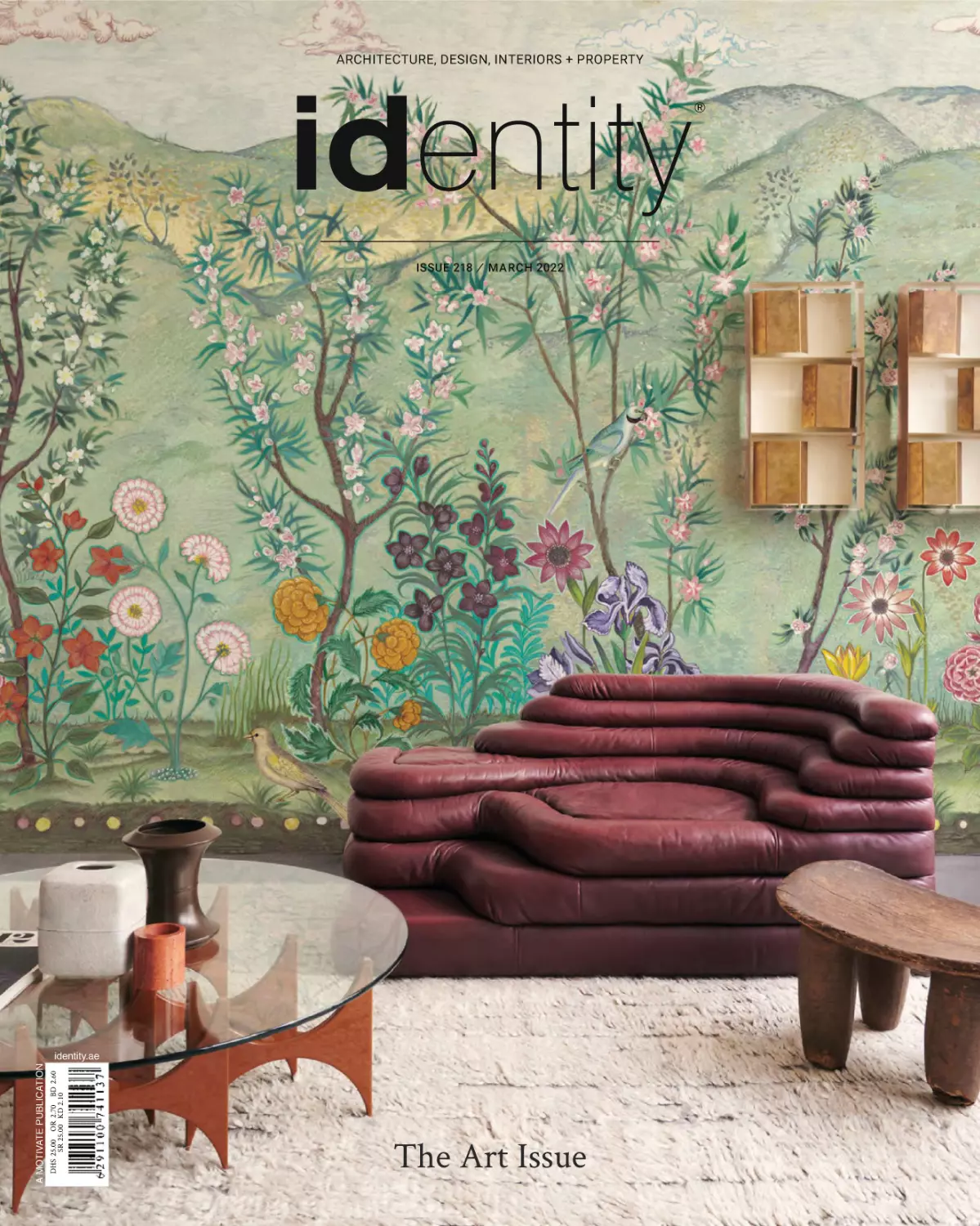
On the cover:
Naïf wallpaper by Eva Germani for
Wall&decò
House in Tulum, designed by CO-LAB
Photography by César Béjar
identity.ae
The latest architecture, design + interiors news, now online
@identityae
architecture
12
architecture
Future focused
Marking a pivotal moment for the city’s expanding urban landscape, the
Museum of the Future opens in Dubai to reveal more than just architectural
prowess and innovation
WORDS BY JUMANA ABDEL-RAZZAQ
PHOTOGRAPHY BY ABDULLAH ALBEDWAWI
N
ine years in the making, the
Museum of the Future has
opened its doors in Dubai
to unveil one of the most striking
architectural landmarks in the world,
casting a glimpse into what the next
50 years could look like for the UAE
and beyond.
Set in the heart of the city, the
23.5-metre modern structure –
designed by Dubai-based architecture
firm Killa Design – boasts an intricate
façade adorned in Arabic calligraphy
that displays, in arresting form, three
quotes from poems written by His
Highness Sheikh Mohammed bin
Rashid Al Maktoum, the Ruler of
Dubai. Inside, the expansive space
reveals a series of interactive exhibitions exploring technologies and trends
that will shape the future of humanity.
“The museum’s exhibitions will
fuel the passion of present and future
generations, and spark their intellectual curiosity for science, technology
and the knowledge that will help
humanity to thrive and prosper in the
decades ahead,” says His Excellency Mohammad
bin Abdullah Al Gergawi, the UAE’s Minister of
Cabinet Affairs and Chairman of the Museum of
the Future.
Spanning an area of 30,000 square metres,
the pillar-less structure reveals an avant-garde
façade made of stainless steel and glass, consisting of 1,024 separate panels, each specially
created using robots and algorithms. The Arabic
script windows cast light into the interior by
day and illuminate the city’s iconic skyline by
night through 14 kilometres of energy-saving,
resource-efficient LED lights.
“The Arabic calligraphy is an art that links our
history with our future,” says Mattar Bin Lahej,
the Emirati artist behind the calligraphy that
weaves across the museum’s rolling
façade. “It is a message of hope, optimism and positivity for a better future
for humanity.”
As the first museum of its kind, the
Museum of the Future also presents a
novel global centre for intellectuality,
or a ‘living’ laboratory, designed with
the aim of fostering a spirit of collaborative innovation among the Arab
world’s leading scientists, inspiring
new out-of-the-box solutions for
challenges to come while spurring a
new era of scientific discovery, both
regionally and globally.
“The museum will create a global
platform for pioneers, innovators and
critical thinkers to exchange ideas,
concepts and visions to accelerate sustainable socio-economic development
and shape a fair future that works for
everyone,” Al Gergawi says.
Visitors can explore a myriad of
experiences through different sections dotted across the building’s vast
interior, from wandering galactic
encounters as part of an exhibit that
explores the future of humanity in outer space
and the wonders of ecology, to a dedicated section designed to encourage children to interact
and forge the building blocks of their own future.
“It is a great honour to be a part of this architectural miracle, which will constitute a beacon
to explore new horizons for humanity in the
coming years and decades,” Bin Lahej says.
THE ART ISSUE
13
interiors
Elegantly
eclectic
The Arts Club
Dubai’s newest
floor features a
1970s-inspired
lounge and an
intimate rooftop
terrace
WORDS BY PAVAN PREMANEY
T
he opening of The Arts
Club Dubai last year was a
widely anticipated event, it
being the first international outpost
of the historic private members-only club from London. Designed by
Milanese design duo Dimorestudio,
the interiors are characteristic of the studio’s signature design language, featuring
an eclectic assortment of materials, hues
and furniture pieces.
The Arts Club Dubai has now opened
its fifth floor, offering a 2,100-square
metre rooftop terrace, a 1970s-inspired
late-night lounge bar and a cigar lounge.
The eclectic design from the rest of the
club lends its style to the rooftop area,
which is designed as an extension of the
club and features a vivid colour palette,
plush seating and lush greenery.
14
Oscuro – the new cigar lounge from
London – has also been readapted for The
Arts Club Dubai. The large indoor lounge
boasts a humidor and a range of fine
cigars chosen by the Arts Club’s Master of
Habanos, Alberto Lucchelli.
The newly opened fifth floor also houses
Vega, a late-night music lounge. Taking
its inspiration and cultural cues from the
1970s, Vega is styled with plush fabrics,
wooden flooring, polished brass and strong
geometric patterns. Here, the texture,
colours and lighting have been carefully
curated to combine a high-low mix of retro glamour and modern design. It has also
been retro-engineered to provide a highly
sonic soundscape experience, allowing the
space to open up for the showcasing of
regional and international talent.
This new space is the final glorious piece
of our Club opening, “says CEO of The
Arts Club, Ajaz Sheikh. “A destination in its
own right, the fifth floor offers yet another layer of experience for our members,
complementing the plethora of lounges,
restaurants and terraces we already have.”
partner content
Collection Bambou Lalique Crystal, Royal Suite, Four Seasons Hotel Jumeirah
Crystal
clear
THG Paris’ 20-year
collaboration with
Lalique brings elegant
luminescence into
every space
F
rench manufacturer of bathroom fittings
and accessories THG Paris is not new to
collaboration. In fact, the French maison
has long-established creative partnerships with
like-minded brands to conceive collections that
place creativity, luxury and elegance at the forefront. This year, THG is celebrating 20 years of
partnership with the famous French crystal maker Lalique, which has given rise to some of the
maison’s most delicate collections throughout its
60-year history.
Since 1921 the Lalique factory in Alsace, a
French region with a glassmaking tradition,
has been perpetuating a genuine craftsmanship.
Inspired by femininity and nature, the Lalique
style is nourished by strong Art Nouveau and Art
Deco influences.
Lalique pieces are created through the gentle
gestures of sketching, later transformed into reality through the hands of its artisans. Thus, through
these artistic gestures, the raw material is metamorphosed into unique objects that often claim
masterpiece status. Comparable to sculpting, the
modelling of crystal blends excellence with poetry.
And it is exactly this that makes this partnership so fruitful and long-standing. The distinct
collections born out of this collaboration – such
as Métropolis, Ange, Naïade, Venice and Océania –
all beautifully combine metal and crystal through
a fresh approach while remaining respectful of
both brands’ ethos and craft. The crystal can be
clear, black or amber depending on the series,
and can incorporate LED lights inside the cross
handles of certain collections to provide a sense
of luminesce.
Crystal, by virtue of its clearness and brightness, allows the light to pass through. In this
instance, its purity is emphasised by the subtle
LED lighting inside the cross handles, comparable to a candle flame. This is how the magic of
the THG Paris x Lalique partnership works: the
subtle light that emerges from the crystal taps
gives contrast and intensity to the room and the
materials. Needless to say, the union of Lalique
and THG Paris is one that brings originality,
light and elegance to every bathroom space.
THE ART ISSUE
15
art
Desert
monuments
Desert X AlUla invites visitors to discover the works of 15
Saudi and international artists who explore the concepts of
mirage and oasis
WORDS BY KARINE MONIÉ
PHOTOGRAPHY BY LANCE GERBER
A
fter its first edition in California’s
Coachella Valley in 2017, Desert X
became a phenomenon. The recurring
exhibition is back this year, until 30 March, and
this time is taking place in none other than AlUla.
Located 1,100 kilometres from Riyadh, in northwest Saudi Arabia, this place of extraordinary
natural and human heritage is particularly well
known for Hegra, Saudi Arabia’s first UNESCO
World Heritage Site.
“AlUla has always been at the crossroads of
trade and culture,” says Neville Wakefield, one
of the three curators of Desert X AlUla. “Its
landscape and history have and continue to draw
people from across the globe. In captivating the
imagination of artists and travellers alike, AlUla
presents itself as the perfect site for an exhibition
that explores the idea of the desert as a place of
cultural interaction, dialogue and exchange.”
A collaboration between not-for-profit
charitable organisation Desert X (founded in
California) and the Royal Commission for AlUla
(RCU), and established to advance new cultural
dialogue through art, Desert X AlUla is the first
site-responsive exhibition of its kind in Saudi
Arabia. The theme for this year’s edition, ‘Sarab’,
offers the opportunity to explore ideas of mirage
and oasis through pieces of monumental scale
that exist in dialogue with nature.
16
art
Zeinab Alashemi, ‘Camoulflage
2.0’, installation view, Desert X
AlUla 2022, courtesy the artist
and Desert X AlUla 2022
THE SLOW LIVING ISSUE
17
art
Claudia Comte, ‘Dark Suns, Bright
Waves’, installation view, Desert X
AlUla 2022, courtesy the artist and
Desert X AlUla 2022
“[These] desert concepts […] have long been
tied to ideas of survival, perseverance, desire and
wealth,” says co-curator Reem Fadda. “The oasis
pertains to ideas of finding prosperity or heaven,
while the mirage is a universal symbol of the mysteries of imagination and reality. They also connote the incomprehensible beauty and abundance
of nature in its most bereft state – the desert – and
humans’ obsessive desire to capture and control it.”
Among the 15 participants from different
parts of the world are: Serge Attukwei Clottey
from Ghana; Claudia Comte from Switzerland;
Shezad Dawood from the UK; Jim Denevan from
the US; Stephanie Deumer from Canada; Alicja
Kwade and Monika Sosnowska from Poland;
Khalil Rabah from Palestine; and Shaikha Al
Mazrou and Zeinab Alhashemi from the UAE.
18
Five of the artists are originally from Saudi
Arabia: Shadia Alem adapted the art of origami to
create an installation that refers to the Arabian’s
desert’s literature, mathematics and mythology;
Dana Awartani shaped a concave geometric
sculpture that mimics the surrounding landscape;
Sultan bin Fahad imagined a mud structure that
looks like a desert kite; Abdullah AlOthman
chose to evoke theories of light refraction rooting back to the early days of desert civilisation
and culture; while Ayman Zedani brought a
fascinating soundscape installation to life.
“As a form of self-expression, art has the power
to transform societies, cities and perspectives,”
notes co-curator Raneem Farsi. “Everyone is
hungry for the best in contemporary art – and
Desert X AlUla is feeding that appetite in an
unprecedented way. […] Desert X AlUla plays
a very important part in a vast wave of art and
culture initiatives shaping the ecosystem for creativity in Saudi Arabia.”
Even if this unique exhibition is worth a visit
in itself, it is part of a bigger picture. Firstly, it
takes place as a highlight of AlUla Arts Festival,
which also includes the show ‘What Lies Within:
Works from the Basma AlSulaiman Collection’ (11
February – 20 March) with pieces by contemporary Saudi artists, curated by Lulwah AlHomoud,
at Maraya. Secondly, it is a prelude of a master
plan that will comprise 15 new landmark destinations for culture, heritage and creativity,
including five districts and five key heritage sites,
in AlUla by 2035. Needless to say, the future in
the Arabian desert looks bright.
id
art
Dana Awartani, ‘Where The
Dwellers Lay’, installation view,
Desert X AlUla 2022, courtesy the
artist and Desert X AlUla 2022
THE SLOW LIVING ISSUE
19
art
A homecoming
Efie Gallery carves out a new home in
Dubai to spotlight African artists
WORDS BY AIDAN IMANOVA
20
art
T
here is an African proverb that states: “The wise
traveller leaves his heart at home.” For Efie Gallery,
the concept of home is vital to its position in the art
world, where it hopes to shed light on a wide spectrum of
African artists from the continent and its diaspora, collating
works by the region’s most prominent figures alongside
up-and-coming contemporary voices. In fact, the word ‘Efie’
means ‘home’ in Akan, the native language of the Akan people of Ghana, where the founders’ heritage lies.
Co-founded by Valentina Mintah, a Ghanaian-British
technology executive who sits on the executive board of
the International Chamber of Commerce, and her two sons,
photographer and filmmaker Kobi Mintah and art collector
and university student Kwame Mintah, Efie Gallery is set
to open its permanent space in Al Khayat Art Avenue in
Dubai’s Al Quoz Creative Zone on 8 March, following a temporary exhibition last year as part of the All Africa Festival
programme. The exhibition space, which was designed
by Ghanaian architect Alice Asafu-Adjaye and co-curated
by Afia Owusu-Afriyie, showcased works by Africa’s most
celebrated artists such as Ghanaian artist El Anatsui and
photographer James Barnor, together with contemporary
artists such as Yaw Owusu, Isshaq Ismail and Kojo Dwimoh.
In the same spirit, and now with a permanent gallery,
Efie hopes to hold space for African voices within the arts,
fostering dialogue and exchange between the continent and
the Middle East, and to broaden the notions of African art
in the region. While galleries such as Mesteria Gallery and
The Mojo Gallery have showcased works by African artists
in the past, there has not, however, been a dedicated space
to interact with African art in the city. Efie Gallery aims to
change that.
“Today, we see Efie Gallery as being the bridge between
high-value African art – that is inclusive of its diaspora –
and the Middle East, seeking to create a unique platform
for collaboration and exchange between the two regions,”
co-founders Kwame and Kobi state. “Selecting Dubai as
the first location of Efie Gallery is in recognition of the
burgeoning contemporary art scene, which
offers the perfect terrain for further expansion and an added opportunity of innovation,” they add.
The gallery’s opening will also mark contemporary artist El Anatsui’s first solo show
in Dubai, titled ‘Shard Song’, which is curated by Mae-ling Lokko and creatively directed by Aïda Muluneh. Born in Ghana and
based between his two studios in Ghana and
Nigeria, Anatsui is globally regarded for his
metal works made of used aluminium bottle
caps, tin cans and other metallic objects that
are connected with copper wire, although
his original works were, in fact, made using
wood. The artist challenged the traditional views of the material, transforming it
through a poetic fluidity that is signature to
his vision of creation that sits outside of conventions and rules. Anatsui’s art has always come from his
immediate environment and spoke of his African heritage.
His show at Efie Gallery will revisit the origins of his oeuvre.
The exhibition will present a series of new wooden sculptures that recalls his earlier practice in the medium and its
continued evolution, complemented by a range of signature
bottle cap works. “Lokko refers to this exhibition as a ‘reunion’,” the co-founders explain, “insofar that following almost
24 years of global reverence for El Anatsui’s metallic hanging sculptures, this exhibition will be an ode to the original
work that was at the forefront of the Anatsuian catalogue:
the woodworks.”
THE ART ISSUE
21
design
Creating
with
clay
Born in Bulgaria, raised
in Turkey and currently
based in France, Mesut
Öztürk creates sculptural
ceramics that reflect his
architectural background
and personal experiences
WORDS BY KARINE MONIÉ
IMAGES COURTESY OF MESUT ÖZTÜRK
Arch stools
22
design
“W
e were living in
a small town in
Turkey when I was
a kid,” remembers Mesut Öztürk.
“My parents were very socially
active, and I was getting bored
when we were visiting their friends.
As an introverted kid, I was always
asking them for some papers and
paints to silently draw cartoon figures. I totally forgot what I drew but
they were my very first artworks.”
As a young adult, Öztürk decided
to study architecture in Istanbul. The
discipline had (and still has) a big
impact on him, especially when it
comes to his references. Among them
are Ettore Sottsass, Isamu Noguchi,
Constantin Br£ncuği, Ricardo Bofill,
Aldo Rossi, Bauhaus, Tadao Ando
and Peter Zumthor. “I am inspired
by their ability to make poetic forms
composed of simple geometric elements,” he says.
Halka vases
At some point, Öztürk started to
feel unsatisfied with his career as
an architect and began looking for
something to fulfil his desire to create
individually. “I found ceramic as the
true medium with[in] my skills and
needs,” he explains. “It’s one of the
oldest materials but it still has room
to [be] explored, and one thing that I
love is experimenting and [pushing]
the limits of a material.”
Having been based in Paris since
2021, Öztürk has taken to expressing himself as a self-taught artist in
recent years. Launched in 2019, his
playful first collection, ‘Halka Vases’,
reimagines traditional Anatolian
and Mediterranean artifacts in a
colourful and contemporary way
through 150 original pieces featuring different shapes. Launched two
years later, the line ‘Revak’ features
arch-like structures honouring
the beauty of Byzantine churches
Mesut Öztürk
and Ottoman mosques, while the
derived collectable design series
‘Arch Stools’ explores similar themes
with handmade pieces that can be
used as stools, side tables or pedestals. ‘Sticks’ demonstrates another
experimentation with architectural
forms through ceramics, while the
‘Splash’ collection of tables focuses
on the idea of contradictions.
Last year, Öztürk created 54
ceramic sculptures for a collection
called ‘Deformed’, while his next
installation, ‘Monument of the
Unknown Cappadocian’, will be
presented in Turkey and will honour poetic natural formations of the
landscape.
For every project, Öztürk has
a different creative process: “It
depends on a lot of factors,” he says.
“Sometimes I feel manic, and I work
in my studio for hours until my
body can’t do anything. Sometimes I
feel a deep melancholy, and forcing
myself to produce something doesn’t
work. When I’m on the bright side,
the ideas just flow to creations
through my hands.”
While on a quest for inspiration,
Öztürk seeks ways to enlarge his
perspective, “like visiting a city for
the first time, having a deep conversation with someone or reading a
novel,” for example.
“My dream is making a huge land
art project in a poetic place in [a]
rural [area],” he shares. “It should be
in harmony with its environment,
but it should surprise the visitors.
It can be in the mountains or on a
small island.” Before transforming
this ambition into reality, Öztürk is
continuing to bring sculptural pieces
to life that visually capture the artist’s past and experiences with a fresh
eye. In June 2022, his work will be
showcased at the Liste Art Fair in
Basel by the Istanbul-based Öktem
Aykut art gallery.
THE ART ISSUE
23
art
Through the looking glass
Lebanese photographer Dia Mrad finds hidden beauty in Beirut’s
architectural heritage with his first solo exhibition at Art Dubai
WORDS BY JUMANA ABDEL-RAZZAQ
24
art
T
hree years ago, Lebanese architect and photographer Dia Mrad
embarked on an ambitious
project to explore the hidden treasures
and complexities of Beirut through the
lens of his camera, documenting its built
heritage as a way of conserving the many
intricacies of the city.
A trip to Europe in 2019 directed
Mrad’s attention towards architectural
projects that were being preserved in various cities across the continent, stirring
his interest in personally understanding
his own city of Beirut through its urban
landscape. Following the blast on 4
August 2020, Mrad began to take a deeper
approach to his work.
“When I initially started my documentation project, I was invested in showing
Beirut to the outside world. But quickly,
my target became to show its residents
instead, who had no idea they were living
in a treasure,” he explains. “The urgency
to save Beirut’s heritage was always there
for me, but with the destruction that
happened after the explosion in 2020,
things changed, as the fear of losing this
architecture became a reality.”
Now presenting his own retrospective
and first solo exhibition in Dubai with
Zawyeh Gallery at Art Dubai, being
staged between 11-13 March, Mrad
is set to showcase a series of photographs titled ‘Reframing Beirut’,
which celebrates and documents the
physical history of the city by looking back at abandoned landmarks
and neglected structures that once
shaped its culture.
Divided into two parts, the project
is celebratory, focusing on the multi-layered history of the city latent in
architecture, while also reflecting on
the devastation and negligence that
has threatened it. Mrad, who comes
from an architectural background,
celebrates the city’s architecture from
the Ottoman and French Mandate
eras to modern times, referencing a
boom in the 1950s and 1970s and on to
the cusp of the civil war. He also documents the city’s historical buildings and
the multi-layered cultural fabric, reflecting his understanding that architecture is
a physical tool for transmitting cultural
identity from one generation to the next.
“I felt the best method to understand the
city and make sense of its composition
and densities was through photography, as it provided a way to observe its
design in detail, and over a
longer period,” Mrad says.
“The architecture of Beirut,
and especially its traditional,
heritage architecture, can be
completely symmetric – floor
plans, façades and even sections often showcase perfect
symmetry in dimensions
and also interior functions.
This type of architecture has
been a big influence on my
framing.”
His series of works studies
some of the architectural
styles produced in Beirut
under the French Mandate
and beyond. On the one
hand, this stood as a social
phenomenon attached to the expansion
of the bourgeoisie in the colonial era,
while on the other, it was a quest for a
national style in architecture by the newly developing state.
“The images reveal the complexity and
the rich intricate urban fabric that’s been
formed over centuries in this old city,”
Mrad adds. “They reveal our personal
attachment to it and identify the elements
that make it so impactful to its residents.”
THE ART ISSUE
25
art
Art in the
meta age
The launch of a new gallery section on digital art at Art Dubai this
year is a chance to explore how art is moving from the metaverse to
the gallery
WORDS BY ALICE FINNEY
T
hough the COVID-19 pandemic may
have had few silver linings, the growing
digital art movement is undeniably one
that can’t be ignored. Multiple national lockdowns meant that many artists were challenged
with reaching audiences who were stuck behind
screens. At the same time, many traditional
art fairs, including Art Dubai, were postponed
or completely cancelled due to coronavirus
restrictions.
This proved to be fertile ground for exploring
new digital art technologies, and played a pivotal
role in the sharp rise of the metaverse – a digital version of our real world. It was also in this
climate that demand for non-fungible Tokens
(NFTs) really went mainstream, with artists such
as Damien Hirst selling digital artworks for large
sums of money. As Chris Fussner, digital curator
at Art Dubai explains, “We have been watching
NFTs for a long time, but in 2020 we noticed
a shift, and a small subset of digital collectors
from the crypto spaces started purchasing NFTs.”
Curious about how the industry is changing
for those on the inside, we spoke to two artists
exhibiting at this year’s Art Dubai who work
within the digital universe.
“For me, digital art – in the augmented reality
and virtual reality formats in particular – offers
new opportunities for self-expression by complementing artworks with an interactive experience,” says Russian figurative artist and painter
Marina Fedorova. ‘Digital art’ is a term used to
26
describe art that is created or presented using
digital technology. “It is a sphere that fascinates
me, and I always want to create something new
that reinvents traditional art forms,” she adds.
In the newly launched digital section at the
upcoming Art Dubai, Fedorova will present an
interactive installation called ‘Cosmodreams’ in
which she believes “the line between real life
and augmented reality will virtually disappear,
allowing everyone to step into a fascinating
new realm.” Visitors will experience a blend of
traditional painting and sculpting techniques
combined with virtual reality (VR) technologies
and film.
According to Fussner, 2022 is the right time
to launch such a section and exhibit this kind of
work. “As we navigate our way out of the pandemic, and as the world starts to move again, it’s
the perfect moment to dedicate an entire section
to this topic,” he says. “Artists are always pushing
the boundaries of what is possible and exploring
the latest technologies: new mediums bring with
them new generations of art enthusiasts and collectors, and this is incredibly exciting.”
Filipino-American light and media artist
James Clar is similarly excited by the potential
of digital technologies to disrupt traditional
modes of art. His video installation ‘Cloud
Seed’, commissioned by private Swiss banking
group Julius Baer, investigates the relationship
between people, nature and technology, and is
part of a growing number of works employing
design
Clockwise from top:
Sunset, Cosmodreams,
Marina Fedorova;
CarpETHereum, Mazyar
Kamkar & Reza Vojdani,
NFT animation, 2021 /
image courtesy Emergeast;
Cloud Seed, still frame /
image courtesy James Clar
and Silverlens;
Striple B.R.O, Ruba
Salamah / image courtesy
MORROW collective
cutting-edge technology to better understand
humanity’s eternal questions.
“I’m interested in art that speaks about the
human experience and human perception,” Clar
explains. “I see nature and digital technology as
two separate systems – the natural or analogue
world and the digital world – but their overlap
and influence of each other is constantly increasing,” he continues. The installation will immerse
visitors in a large-scale real-time simulation of
raindrops and fog, using custom technology to
create a slowly morphing visual that reflects how
we control the environment.
This year, as more art fairs and galleries make
room for digital-only exhibitions, and the sale
of art as NFTs continues to rise, a paradigmatic
shift is taking place in the way we consume and
circulate contemporary art. Fussner predicts that
such change will only gather pace as time moves
on. “This way of consuming art will continue to
attract a new, younger, tech-savvy generation,
which is exciting, and I’m interested to see how
that plays out,” he concludes.
THE ART ISSUE
27
Cultural revival
design
Mohammed Kahhal, managing director at KAHHAL 1871
Egyptian rug maker KAHHAL 1871 has commissioned 14 designers to shape its
future-forward vision. The result is a show of the country’s diverse talents
WORDS BY AIDAN IMANOVA
IMAGES COURTESY OF SCOOP EMPIRE
28
design
I
n the heart of Egypt’s capital, Cairo – a city once
revered for its thriving cultural sector, from the musical arts to cinema and literature – a new bourgeoning
arts and design scene is brewing. Following a period of
profound political, economic and societal change, propelled by the Egyptian Revolution in 2011, it appears that
the country is finally ready to move into a new future –
and the growing appetite for cultural initiatives in Cairo
is suggestive of just that.
Enter Egyptian rug company KAHHAL 1871, led by its
fifth-generation managing director, Mohammed Kahhal,
whose very aim is to support the age-old carpet-making
industry in the country and reinforce the value of locally
made luxury carpets, while also remaining sensitive to the
changes brought by technology, globalisation, growing
regional and international competition and shifts in client
demographics. For Kahhal, the challenge now is to uphold
the heritage of the brand while simultaneously grooming
it for the future.
Finding himself at the crossroads of legacy and innovation, Kahhal launched ‘OUTLOUD’ – a collaborative
event that merges contemporary design with ancient
craft. First launched in 2021 under the title ‘Designers
Edition’, the second iteration of the event took place
last month in Downtown Cairo, where 14 designers
were invited to create a series of rugs that push the
boundaries of design and the craft itself, resulting in
a truly diverse collection of hand-knotted rugs and
kilims. What remained vital to the initiative was
breathing innovative solutions for the sustainability
of the trade while respecting the legacy of the artisanal process.
“[We are in an] era of collaboration and nobody gets
to the place they want to get to alone,” begins Kahhal,
who in 2015, having completed his finance degree in
the United States, returned to Egypt to take the helm
of the family business.
While last year saw four of the country’s most revered
designers create collections for the show, Kahhal’s newest vision was slightly different – and more inclusive.
The most recent ‘OUTLOUD’ event saw myriad creatives – from interior designers to product and fashion
designers, ranging from those who have set the benchmark for design in Egypt to young up-and-coming
talents – each bring a new perspective to the potential of
the craft and its design language.
The designers involved in the project included:
architect Ahmed Fayyad; architect and designer Cherif
Morsi; founders of fashion brand Okhtein, Mounaz and
Aya Abdel Raouf; founder and creative director of Form
Design, Engi Jaouda; managing partners at Design Avenue,
Karen Fadel and Mohamed Talaia; architect and founder of
Alchemy Design firm, Karim Mekhtigian; Parson’s graduate and Maram Paris fashion label founder, Maram Aboul
Enein; architect and chief designer at Alchemy Design,
Mohamed Fares; founder of Mahally, Mona Hussein; Design
Point co-founders Nehal Leheta and Karim El Hayawan;
and interior designer and founder of her eponymous firm,
Yasmina Makram.
“I left the brief very open for the designers. I told them
‘Just express yourself’ [in] using the rug, which is a completely difficult task because each designer wanted to do
something crazier than the other, and that is why we called
the exhibition ‘OUTLOUD’ – because when I first got the
initial designs I thought ‘oh my God, this is going to be hell’,”
Kahhal laughs.
Pop Art rug by Mohammed Fares,
architect and chief designer at
Alchemy Design, aims to break
perceptions of what a typical rug is
THE ART ISSUE
29
design
From top, clockwise: Ahmad Fayyad with
his NOT rug collection inspired by nature;
fashion designer Maram Aboul Enein's
three rugs titled Pray for Humanity,
Sundance and Moonrise are inspired by
her latest ready-to-wear collection;
Karim Mekhtigian’s Requiem of a Lost
City is inspired by Cairo and its
multi-layered culture; Engie Jouda's
Reform collection features a
-
*)"ݦ0-
/$*)*!*-"
)$
!*-(.
30
“We shortlisted 30 designers and we followed them
and observed their work until we chose the ones we
felt most connected to and ones we resonated with.
Each designer had something in them that I thought,
‘yes, I really want to work with this person’. This is not
only from a design point of view, but from a purely
human aspect as well. I felt truly comfortable working
with them. They would come and visit the factory and
were all very involved in pushing the process, which I
really appreciated,” Kahhal says.
This is not to say that the project did not come
without challenges. Kahhal explains how he came
face to face with a lot of resistance from the weavers
who are all fourth- or fifth-generation artisans within the company.
“What I am trying to do is revive the handicraft
industry in Egypt, and in doing that we had to come
up with new designs that push the limits of the craft
itself, so for the weavers it was extremely difficult
because they have this 28-year-old guy coming up to
them and saying: ‘these are the designs that you have
to make’, and that we need to do this to move forward. These are people who have been in the industry
for more than 60 years. Naturally in the beginning
there was a lot of pushing and a lot of resistance. But
when they finally accomplished the tasks, they were
extremely proud of the pieces. And for me to see them
happy with the pieces, made me even happier.”
Most recently, Kahhal’s vision and leadership
extended to a seminal partnership with President
Abdel Fattah el-Sisi’s development initiative ‘Spun in
Silk’, reviving the centuries-old craft with KAHHAL’s
modern strategy, pivoting to millennial customers
with sartorial flair and a keen appreciation for design.
“As a whole, I see us hopefully being able to revive
the carpet industry and help educate the general population about the craft. I also want to be able to hire
more weavers because the more weavers we employ,
the more people have jobs and the more people we
can feed and make sure their children go to schools.
The more sustainable our business is as a whole, the
more our country can prosper – it is a joint effort,”
Kahhal concludes.
id
design
Shoghi collection by Design
Avenue features playful patterns
and a contrast of colours and
shapes based on the elements of
a checkboard
THE ART ISSUE
31
property
32
property
Community
living
Hive Coliv opens its first property in Dubai, filling a gap in the
market for contemporary community living
WORDS BY AIDAN IMANOVA
PHOTOGRAPHY BY NATELEE COCKS
“T
he concept for Hive Coliv was born
out of a personal frustration with
the lack of contemporary housing
options available for younger generations in
Dubai,” begins Bass Ackermann, the real estate
entrepreneur behind the city’s new urban
living concept that aims to remove the typical
stresses of setting up a space in a new city.
Having personally experienced a gap in the
market for professionals seeking a flexible and
community-driven home, Ackermann set out
to develop a different kind of model “specifically tailored towards modern consumers who
desire a more flexible, convenient and socially
connected way of living”.
Focused on the development and management of ‘co-living’ communities, Hive Coliv
teamed up with private multi-sector investment
firm A.R.M Holding, who backed Ackermann’s
ambitions which fall in line with its own aim of
supporting pioneering projects both locally and
regionally as well as globally. The UAE-born
investment firm is also equally committed to
supporting a community-led residential sector
in the country. “The birth of Hive Coliv is an
exciting step toward the next era of residential
living for the myriad of young professionals
who call the UAE home,” says Mohammad Al
Shehhi, CEO of A.R.M Holding.
The first property to open under Hive
Coliv is Hive JVC, located in Jumeirah Village
Circle, and designed in its entirety – from the
architecture and interior design to furniture
and custom solutions – by Lebanese designer
Fadi Sarieddine. “The entire project, in its
architecture, interior and furniture, played a
balanced role to respond to the brief which we
had formulated with Hive Coliv; which was to
create a place that is elegant yet simple, rich yet
unintimidating,” Sarieddine comments.
THE ART ISSUE
33
property
Following extensive research on the targeted
tenants and their behaviours, and the exploration of existing co-living properties across
the UK and The Netherlands, Hive JVC was
designed through a human-centric design process, mapping the behaviours of a number of
typical ‘personas’ that represent the potential
Hive Coliv tenants.
“These maps generated the communal facilities
and their inter-relationships,” Sarieddine continues. “The aim was to provide a place where the
community will be able to use the spaces smoothly
and enjoy its functions in a natural manner, where
the different clusters become symbiotic with their
end-users. The private spaces on the other hand
play a similar role on a smaller scale: the furnished
residential units are perfectly sized and designed
to be elegant and timeless, while allowing room
34
for personalisation. The building, with its balance
between the private and the public, achieves the
goal of inviting the residents to interact and mingle, thus creating a communal bond.”
The building’s façade is made using wood-textured fairfaced concrete that contributes to the
range of “honest materials” used across the property, adding a sense of rich tactility. In contrast,
the various communal functions and indoor
volumes use colourful elements to allow for a
brighter spatial and visual experience.
Two floors of the building are dedicated to
communal facilities, while a naturally lit openplan ‘third space’ features a lounge, library and
shared working facility. Other facilities include
a gamers’ room, a 15-seat outdoor cinema, a
tree-lined rooftop terrace with a 20-metre pool
and DJ area, and a courtyard space complete
with barbequing stations and a basketball court.
For residents with creative careers or simply
a passion for creative expression, a fabrication
lab offers dedicated workstations equipped with
tools and equipment. Networking and collaborative events can be organised and attended just
a few metres from home in the outdoor amphitheatre. Hive JVC is also sustainability-conscious,
and is a green-accredited building, providing
dedicated recycling facilities and electric vehicle
chargers, and is the region’s first residence to
incorporate an on-site composting facility in
partnership with The Waste Lab.
“At the heart of Hive Coliv lies the notion of
creating a living solution which is more connected and collaborative,” says Ackermann. “A place
for like-minds to connect, network, inspire and
grow.”
id
property
THE ART ISSUE
35
architecture
Expressions
of Jeddah
A new contemporary art centre in the
Saudi port city lends a supportive hand to
emerging creatives
WORDS BY RIMA ALSAMMARAE
36
architecture
“W
#*/*"-
+#4
4
0-$
)#$)$ƌ*$0
hat is a contemporary art centre today?”
asks Wael Al Awar, half of the dynamic
duo that runs waiwai, a multidisciplinary
design studio based in Dubai and Tokyo. “A contemporary
art centre can no longer be defined by a fixed programme –
we know what it needs to be right now, but we don’t know
what it will need to be three or four years down the line.
Therefore, the building must be flexible in order to react
to fast-paced changes.”
Awar and partner Kazuma Yamao recently completed
Hayy Jameel, a mixed-use art centre in Jeddah. Spanning
nearly 17,000 square metres of built-up area, the three-storey building contains gallery spaces, offices, artist studios,
a cinema and theatre, a restaurant and more, including
a spacious courtyard landscaped with local vegetation.
Offering a variety of areas that can cater to different forms
of art and performance (including Jeddah’s long-standing
comedy club), as well as room for production and commercial activities, Hayy Jameel is the extended version of
its predecessor in Dubai, Jameel Arts Centre. And while
differences between the two buildings abound, so do similarities, which include a strong visual resemblance marked
by a pearlescent steel structure, fragmented sectioning and
barren concrete interiors ideal for displaying artwork.
“The Jameel Arts Centre in Dubai is an exhibition space,
not a space for production,” says Awar. “Hayy Jameel,
though, has spaces where artists can create and people
can work. So, its architecture could not be so refined and
delicate because you don’t want to limit the capabilities of
those using it. That’s why we approached it as a kind of
factory space.”
However, due to the project’s location, creating a factory-like space took some sensitive manoeuvring. Located
in Jeddah’s northern residential area, Al Mohammadiyyah,
Hayy Jameel is surrounded by villa complexes, as well as
three empty sites that are earmarked for further residential
development. In response to brief requirements and a local
culture that treasures privacy, waiwai opted for an ‘inward
looking building’ that features no openings towards the
streets and surrounding areas, but instead opens towards a
large central courtyard.
THE ART ISSUE
37
architecture
Nasser Almulhim and Tamara Kalo,
‘Contours on Collective
Consciousness’, 2021-22, Hayy
Jameel
38 Façade Commission
architecture
#*/*"-
+#4
4
0-$
)#$)$ƌ*$0
Oriented towards the south, the courtyard is perhaps the project’s
most standout element – it enjoys direct sunlight in the morning
and shade in the afternoon and evening, allowing users to be comfortable for the majority of day. Featuring a timber platform that
stretches across the centre of the space, and decorated with local
vegetation that requires little irrigation, Hayy Jameel’s courtyard
draws inspiration from the ancient Greek agora, which is reflected
in the stepped access points.
“For us, architecture is about creating environments for humans
to inhabit and for activity to flourish. So, what would be better than
a semi-outdoor space protected from the harsh environment?” asks
Awar. “We thought about having three or four courtyards, but then
that could lead to segregating the arts, and contemporary architecture
is about flexibility and inclusivity rather than clear zoning. So, in
the end, we designed one courtyard and made it three-dimensional,
meaning that it appears upward.”
Surrounding the courtyard are shaded terraces that extend outward
from each level, allowing onlookers to observe from different points.
Its placement also lets sunlight flood each storey, keeping the inaugural
art exhibitions brightly lit. According to Awar, once the matter of the
courtyard was settled, the form of the rest of the building quickly took
shape. Appearing fragmented, the centre makes use of ready-made
steel sections, sustainably sourced from the Saudi market, that could
be reassembled or recycled to respond to changing demands.
waiwai was not particular with the programming of each space,
says Awar. Although certain spaces needed to be anchored, such as
the cinema, which was placed on the ground floor in order to contain
large audiences, the other spaces – like the studios and exhibition
areas – more or less flow into one another.
Throughout, the idea of supporting artists and creatives is evident.
waiwai’s intention of creating a space that aids creation itself is intrinsic to the overall project, starting with the façade, which is open to
artists as part of the Hayy Jameel Façade Commission, an annual programme that offers creatives the opportunity to develop public work.
At the moment, a colourful piece by Saudi artist Nasser Almulhim, in
collaboration with Tamara Kalo, stretches across the 25-metre surface,
but in the future, artwork will be selected through open calls.
“Jeddah, and Saudi Arabia in general, just opened up,” says Awar. “So
there’s this hunger for platforms where people can go and experiment,
be that through music, art or cooking. Hayy Jameel is that platform
where people of different backgrounds can come and express themselves, and that’s made possible through the sensibility of the design.
Rather than imposing a certain form on the activities, we let the activities themselves take their own shapes.”
id
THE ART ISSUE
39
architecture
40
architecture
Symbol of a city
In Istanbul, a building’s design and construction reflects nearly a century of
political and cultural development
WORDS BY RIMA ALSAMMARAE
PHOTOGRAPHY BY EMRE DORTER
A
lthough recently reconstructed, the Ataturk Cultural Center
in Istanbul has a long history that dates back to the late 1930s,
when French urban planner and architect Henri Prost proposed a masterplan for the Turkish capital. In addition to suggesting
the transformation of the city’s military barracks and surrounding
cemetery into a park, the plan proposed the construction of an
opera house in the historic Taksim Square. Prost also recommended
Auguste Perret, the famous French architect behind Paris’ ChampsElysees Theatre, to design it.
However, as World War II ravaged the continent, Perret was unable to finish the opera house, and his colleague Rükneddin Güney was
commissioned to complete the project. Güney, along with partner
Feridun Kip, laid the building foundation on 29 May 1946, during the
reign of Istanbul governor and mayor Lütfi Kòrdar. Yet, once again,
the construction of the opera house was halted, and the project was
handed over to the Ministry of Finance in July 1953, after which
German architect Paul Bonatz took over and prepared sketches for the
main stage and front façade.
With its reinforced colonnade using existing column axes, and
its plinth with entrance steps in the middle, Bonatz’s design for the
front-facing façade had a classical monumental expression, comparable to Perret’s Art Deco architecture. However, despite the updated
architectural designs, the building remained unbuilt for decades, even
as Istanbul witnessed periods of rapid construction.
By the late 1950s, though, Turkish architect Hayati Tabanlòoàlu
returned from his studies in Hanover, Germany, and was appointed
to oversee the development and construction of the opera house by
the Ministry of Public Works. The building was reidentified as a
cultural centre, and benefited from the cooperation of installation
systems, stage techniques and acoustic experts. Hayati also applied
the language and materials of modern architecture, including steel,
concrete and glass. And though the construction of the building was
again delayed due to lack of funds and a coup in 1960, it was finally
completed in 1969, serving as one of the largest buildings of its kind
in Turkey.
Inaugurated as the ‘Istanbul Cultural Palace’, the reinforced
concrete structure featured a large foyer with a grand staircase, a
main performance hall, and a large glass façade that faced the street.
Throughout its first year, multiple artists took to the stage, such as
French pianist Jean Fonda, British violinist Manoug Parikian and
Turkish pianist Hülya Saydam, and the building quickly became an
integral part of Istanbul life.
But in November 1970, during the performance of The Crucible, a
devastating fire broke out due to a faulty projector. The fire damaged the entire stage as well as large sections of the auditorium.
Reconstruction took seven years, and the building reopened in 1977 as
the ‘Ataturk Cultural Center’.
Throughout its years, the Ataturk Cultural Center served as a
symbol of Istanbul’s social, cultural and technological development. It
reflected the city’s history in its narrative, construction and ultimate
architectural language. It was a space for the Turkish people to enjoy
the progressive expressions of their society, as well as observe Western
artistic productions.
However, over the course of more than 50 years, the Ataturk
Cultural Center slowly aged and weakened. And come the early 2000s,
the building was handed over to award-winning Turkish architecture
firm Tabanlòoàlu Architects, run by Hayati’s son Murat, and Melkan
Tabanlòoàlu. The office was asked to consider restoration, as preserving the original structure was the favoured strategy. However, after
conducting several studies, the office determined that the existing
structure didn’t have the infrastructure required to meet the present-day demands of a modern opera house and cultural centre.
THE ART ISSUE
41
architecture
42
architecture
THE ART ISSUE
43
architecture
44
architecture
According to Melkan, the project needed
to be reconstructed so it could integrate the
complex stage systems and interspace relations
required to ensure seamless acoustics and comfortable viewing angles, as well as to respond
to the requirements of the newly added spaces.
Simultaneously, the architects updated the ventilation, circulation and air conditioning systems
of the building, as well as the lighting, electromechanics and auditorium layout.
Today, the Ataturk Cultural Center features
an opera house (contained within a large red
sphere in the centre of the main hall), a gallery,
music platform, library, children’s art centre, a
multipurpose hall, cinema, restaurants and much
more. And although many spaces have been
added, throughout, the architecture draws a lot
of inspiration from its former life, which is most
evident in the façade, foyer and spiral staircase at
the entrance.
According to Melkan, the design of the original
glass façade, with its aluminium grid skin, was
recreated for the new centre, as was the architectural form and mass of the building. The new
structure also retains the transparent character
of the old, which allows the outside and inside to
blend together. Just beyond the entrance, too, a
large, open and layered foyer welcomes visitors
and allows panning views of the red dome in the
centre, as well as of the large wooden stairway.
Both the dome and the staircase bear references
to Hayati’s design via materiality – the dome
through the use of red ceramic tiles and the stairs
through the use of wooden balustrades.
Elsewhere, a contemporary architectural
language was applied, such as in the auditorium,
offices and commercial spaces, where curved
surfaces mix with clean lines and minimal ornamentation. By maintaining the familiarity of the
original building while integrating a modern
interpretation of the space, the Ataturk Cultural
Center continues to serve as a legacy of the city’s
creative, social and political development.
“The most important thing for us when creating
this new centre – while using references to what
was there before – was to design a contemporary
continuation of Hayati’s work,” says Melkan.
“We needed a balance. The building had to reflect
today’s architectural approach while providing
the same feeling to those visiting.”
id
THE ART ISSUE
45
travel
46
travel
Island flair
The recently opened Mango House Seychelles pays homage
to legendary Italian fashion photographer Gian Paolo Barbieri
WORDS BY AIDAN IMANOVA
THE ART ISSUE
47
travel
“I
n Seychelles, you cannot build a structure
taller than a coconut tree,” says Seychellois
artist Nigel Henri as he leisurely drives
across the curving two-lane roads of Mahé, the
main island in Seychelles – an archipelago of 115
islands in the Indian Ocean, just off East Africa.
Low-rise colonial mansions and Creole architecture (characterised by large double doors and
windows, high-pitched roofs for natural light
and ventilation, and large verandas with wooden balustrades) dominate the island – and both
are being rehabilitated by the State to become
civic buildings, restaurants, luxury stores and
boutique hotels.
Mango House Seychelles, on the other hand,
is a different story. Located on the south-west
of Mahé, the newest island retreat by LXR
Hotels & Resorts – Hilton’s collection of independent luxury properties – is an intimate and
exclusive resort built on the site of the former
home of renowned fashion photographer
48
Gian Paolo Barbieri, who throughout his
illustrious career worked with celebrities
like Sophia Loren and Audrey Hepburn and
fashion houses such as Versace, Yves Saint
Laurent and Armani.
The original Mango House was built as a
family dwelling; and its name is inspired by the
150-year-old white mango tree that bore fruit in
Barbieri’s kitchen’s garden, one of the oldest on
the island. The tree was preserved and remains a
prominent feature of the hotel, set at the centre
of the property which opens out onto the blue
sea of the Anse aux Poules Bleues.
Celebrating Seychellois style and culture is
at the heart of the property, from the interiors to its culinary and wellness offerings. All
41 guest rooms, suites and villas of Mango
House also provide serene ocean views bound
by lush greenery, and are adorned with
natural décor echoing the rugged beauty of
Seychelles – which became the main source of
inspiration for the hotel’s architectural design.
The structure of the resort was constructed to
mirror the curvature of the coast, whereby the
distribution of rooms, suites and villas along the
bay’s edge offers each residence an expansive
view of the ocean.
From the initial stages of the design, JT+
Partners – who were commissioned to design
the property – set a goal to preserve the existing
nature by building around it.
Despite efforts to preserve the original home
of the artist – “a beautiful orange house with
no windows and only a few openings and a
shower that opened up the sky” – the architects
quicky realised that the existing structure was,
in fact, damaged by rising sea levels, which led
to its eventual demolition. In its place is what
the hotel dubs the ‘main house’ – a newly built
structure facing the bay which recreates many of
the elements and experiences that existed in the
original building.
travel
THE ART ISSUE
49
travel
“In Seychelles, if you have an existing structure
on your plot which is very old, you have the right
to demolish it, and build on top of it,” explains
founder and lead architect, Joe Tabet. For this
reason, the hotel’s main building is positioned
in precisely the same location as the former residence, situated directly on the edge of a cliff.
“The owner of the house used to have a specific
view from his window, and we managed to keep
the same experience in the lobby,” Tabet continues. “Sometimes you are not able to keep the same
structure, but what is more important is what will
remain forever – the experience of the place.”
In addition to the local granite which has been
locally sourced, other materials from the island
include Nalau wood used for structural elements,
the off-white stucco wall texture finish on the
façade and the grano wash used for the pathways,
all highlighting local textures commonly found
across the island.
Prized furniture pieces dating from the original
resort, which are visible in some of the archive
50
photographs of the original interior, have been
interspersed within the public areas of the hotel
such as the drawing room and Muse restaurant.
The front doors of the original house have also
been preserved and transformed into sculptural
artwork reminiscent of the island’s rich heritage and culture. The artwork throughout the
property also tells the story of Mango House, a
natural showcase of Barbieri’s creative spirit and
the scenic surroundings of the property.
The interiors, designed by dsgnTM, have been
conceptualised to provide guests a sense of home
and use tactile, natural and earthy materials such
as light-coloured timber and beige parquet flooring in the guest rooms, and lightly hued stone
from Lebanon in the bathrooms. In the arrival
pavilion, guests can look up to find Bwason natural wood sticks that recreate the ceilings of the
original house. Preserved handmade furniture
with sleek wooden finishing is coupled with
muted beige tones, creating a contemporary
but comfortable feel that is deeply connected
to the local culture and colours of Seychelles.
“One of the things we’re passionate about
at Mango House is supporting local artisans,
especially those who make sustainability a priority,” says Andre Borg, area general manager,
Seychelles at Hilton.
Collaborations with local artists are part of the
hotel’s branding experience, seeping into the stylish uniforms of the staff and making appearances
in the smallest of details such as the silkscreens
on the bathroom robes and scarves that are tied
around the chic wicker hats offered to guests.
These were designed by Seychelles-born artist
Alyssa Adams in her signature watercolours.
“[At Mango House], culture, art and nature
mirror the location and traditions of the Southern
lifestyle [of Seychelles] and [its] folklore stories,
paying homage to its rich history,” Borg shares.
“We are adamant about working with artists who
have grown up on the island, who are passionate
about its culture and traditions, and who can emulate it in all forms of their artistic expression.”
id
travel
THE ART ISSUE
51
design focus
On the
surface
Browse identity’s edit of the
latest surfaces in design,
from innovative textiles
and geometric upholstery
to handcrafted flooring and
contemporary wallpapers
WORDS BY JUMANA ABDEL-RAZZAQ
Timeless geometry
Italian textile manufacturer Dedar has released a collection of furnishing fabric, which combines graphic
art and textiles. The Geometric patterns collection
features abstract lines and colourful symmetrical
shapes on fabrics that is suitable for upholstery and
curtains, showcasing a range of products that includes
an assortment of vibrant textiles. These include the
double-faced Andirivieni, which uses contrasting
colours to create an abstract representation of
maps, as well as Erbaluce, a fabric poised between
camouflage and artisanal flare; and Regimential, which
has a striped pattern that references British school
uniforms. The Zai Saman fabric features linear forms
embroidered on linen and is available in a range of
desert-coloured tones. Characterised by rich colour
palettes and unexpected patterns, Dedar’s fabrics
combine precious yarns with research into fibre
technology to offer various curtains, upholstery and
wall coverings of timeless elegance.
52
walls, f loors, and surfaces
Living colour
Three new inspirational moodboards have been
introduced as part of Wall&decò’s Contemporary
Wallpaper Collection 2022, adding 72 new graphics to
the company’s rich portfolio of designers, and creating
a distinct geography of styles and colours. With Deep
Nature, organic forms combine with surfaces and
construction materials, creating authentic settings of
calm and balance. Red Heart, defined by a colour rather
than a stylistic feature, forms a tribute to red, with subtle
leitmotifs of design over the decades reinterpreted to
create sophisticated settings. Heritage brings a stratification of materials, geometries and humanity, a skilful mix
of past and present, to accentuate the collection’s artful
and vibrant aesthetic.
THE ART ISSUE
53
design focus
Ethereal glow
Cosentino has unveiled its second Silestone series of hybrid
mineral surfaces with the Ethereal Collection, a chic, marble-inspired
concept consisting of four colours, each offering a deep, fine
veining inspired by one of the most sought-after natural stones in
the world. Each colour within the collection has been designed to
recreate the dream-like beauty of the sky: Ethereal Dusk showcases
an urban look in bluish tones through its veining to bring a
54
modern and avant-garde touch to any space, while Ethereal Haze
includes a dynamic range of grey tones for a sophisticated feel.
Ethereal Glow features golden and grey veining which merges
with a tinged white foundation, a nod to the igneous colours of
the sunset. In contrast, the tones of Ethereal Noctis are inspired by
darkness after daylight, combining short grey and black veins to
provide depth and simplicity for a modern appeal.
surfaces
Natural selection
Rubelli is putting nature at the centre of its 2022 collection with the introduction of wovens, prints and embroideries that interpret the flower in
its most organic form. Highlighting woven textures that are suitable for upholstering furniture or – in larger widths – for dressing windows, the
products in Rubelli’s latest collection reference the natural world both aesthetically and as part of the manufacturing process, putting significant
emphasis on environmentally friendly practices. Depth is achieved through the use of linen, fantasy yarns and special weaves, referencing whimsical flowers in fabrics such as Eliodoro, Tea Cat, Derbyshire Spring and Camilla that are accentuated through palettes of rock, ivory, ice and wood,
each expressing a style where nature is at the core.
THE ART ISSUE
55
design focus
Art forms
Inspired by organic forms in nature, as well as shadows and spectral visions, Sahco’s 2022 collection looks to murals by Jean Cocteau, the sculptures
of Constantin Br£ncuği and abstract art to bring a truly distinct collection of upholstery and draperies that is layered and artisanal, with characteristics that explore light and volume. The Evoke collection has a creative tension derived from perceived imperfections and seemingly incongruous yet
harmonious combinations of colour and texture. Aligned with Sahco’s heritage, Evoke is rich with classic references, presenting seven drapery and
four upholstery fabrics to demonstrate high levels of craftsmanship as a result of applying new techniques to create lively tactile surfaces, powdery
dry or glossy chintz finishes, and artistic printed or embroidered abstracted outlines. The overall colour palette is elevated by adding fresh hues
like lemon grass, pistachio green and Sakura pink with earthy base notes such as golden olive, moss green and rust red to bring a sophisticated yet
traditional touch.
56
surfaces
Organic touch
Italian brand Ceramiche Refin has introduced Cortina, a nature-inspired collection of decorative surfaces exquisitely reworked by skilled craftsmen
to produce an exclusive product with an organic feel. Defined by its quality of stoneware, Cortina includes a raw colour palette of almond, honey and
tobacco, among others, inspired by the natural power of wood recovered from traditional mountain huts. The refined balance of the collection means it
is able to adapt to the most varied environments, even those subject to heavy wear-and-tear or foot traffic. Working closely with the craftsmen of one
of the most prestigious carpentries in the Belluno area, Ceramiche Refin aims to tell a story of the stages of ageing through exciting colour combinations and a variety of shades, creating unprecedented visual and tactile emotions, and giving rise to a cathartic experience with an ancient flavour.
id
THE ART ISSUE
57
architecture
58
architecture
Reinventing
tradition
MESURA designs a villa
in Jeddah that offers the
opportunity to redefine a
traditional lifestyle
WORDS BY KARINE MONIÉ
PHOTOGRAPHY BY MARINA DENISOVA
THE SLOW LIVING ISSUE
59
interiors
B
arcelona-based architecture and design studio “Its character is rooted in the past, while [its vision] is set
MESURA doesn’t follow the rules – and neither can towards the future.”
This spirit of balance dictated the whole project from the
the studio’s work be confined to a particular style.
Instead, what these passionate creative minds aim to do is start. While Jeddah today epitomises the modernisation of
“design for the unknown.” So, it comes as no surprise that, Saudi Arabia, it is also where vernacular architecture has its
despite the distance and the different culture, the team didn’t roots – with the desert and the sea at the heart of the local
hesitate to take on a new project in Jeddah, dubbed Villa AM. culture, lifestyle and surroundings.
“To design [with]in Jeddah’s complexity, it’s vital to underWhile following their usual process – which involves
listening to people, communities and environments – the stand its traditions, values and beliefs,” the architects explain.
members of MESURA worked closely and had ongoing “Traditionally, the Arabian home functions both as a private
conversations with their client for five years leading up to sanctuary and a social, semi-public space, which constitutes
bringing this unique family home to life. “Giving shape to an interesting paradox still defining most of the local architoday’s Jeddah is a complex endeavour,” the architects say. tecture today.”
60
architecture
THE SLOW LIVING ISSUE
61
architecture
Villa AM honours this concept by offering privacy thanks to the placement and sizes of doors,
windows and openings, as well as the building
heights and balconies, which all help to protect
the inhabitants from the exterior world. At the
same time, the L-shaped layout – different from
the traditional U-shaped form – allows a better
connection between family and guests through
the garden. “The house thus becomes a fluid entity – an initial step toward a new kind of domestic
architecture in Jeddah,” the MESURA team says.
In every corner, the architecture plays with
light and shadow, creating different moods
depending on the time of day. The colour palette
changes between sunrise and dusk, helping to
evoke a variety of experiences. “The house is a
continuous ‘game’ of walls setting shade on the
right space at the right time,” the architects say.
“Windows face all four directions, allowing the
interiors to receive multiple types of lighting
during the day, while exterior passageways are
determined by high walls that create shadowed
paths, enabling convenient use of these spaces
even in the heat.”
Taking into account the specific climate of
Jeddah (characterised by hot temperatures and
wind) for the design was also central to the
project. In traditional buildings across the Arab
world, the exterior areas of a house not only
have a social function but are also tools for passive architecture, and Villa AM is no exception.
“Since its foundation, the vernacular architecture
in Jeddah has used its materials, courtyards and
openings in a [sustainable way], creating cool
and comfortable indoor home environments,”
notes the MESURA team, who has additionally
shaped an outside passageway downstairs and a
second patio on Villa AM’s upper floor. “Taking
local culture and climate as a tool to seek new
spatial relationships, the house aims to answer
the will of a changing today,” they add.
Poetic yet liveable, this home embodies a
synthesis of knowledge from several eras, dating
from ancient times to the contemporary period,
offering a vision of how the architecture in the
region is evolving.
Inspired by Mies van der Rohe, the architects
of MESURA pay tribute to his words with this
project: “Architecture is the will of an epoch
translated into space; living, changing, new. Not
yesterday, not tomorrow, only today can be given form.”
id
interiors
THE SLOW LIVING ISSUE
63
interiors
An
artful
refuge
Based in Miami, Michelle
and Jason Rubell trusted
interior designer Monica
Fried to transform this
historic apartment into
their perfect sanctuary in
New York City
WORDS BY KARINE MONIÉ
PHOTOGRAPHY BY NICOLE FRANZEN
STYLING BY KATJA GREEFF
64
interiors
0./*(($ ѣ
)/0-4./4' /0ȅ
sofas sit on a Stark wool custom
rug. The artwork above the
ݦ- +'
$.
40-1$.*0)"ю
THE ART ISSUE
65
interiors
M
ichelle and Jason Rubell – from
the family who owned the Rubell
Museum in Miami – are used to life
surrounded by art, and their New York City piedà-terre is no exception.
The couple, who live in a contemporary home
in Miami, fell in love with a building that dates
back to 1927 and is situated on the Upper East
Side, ideally located only a few steps from Central
Park and the Frick Collection. For several months,
the apartment was renovated by Edward Dew
Architect while interior designer Monica Fried –
at the helm of Monica Fried Design – took care
of the typical large and free-flowing pre-war
interior spaces, making them the ideal backdrop
for the owners’ impressive art collection.
Blue artwork by Sayre Gomez
combines with a vintage Jens
Risom bench and an Eric Schmitt
pendant light in the entry
66
“Our aesthetic was really in sync,” remembers
Fried, who worked on preserving the charm and
old character of the home but also introduced
contemporary touches and a relaxed atmosphere
to the spaces.
“Our inspiration was Parisian chic – those
French apartments that look effortlessly modern
and classic at the same time,” says Fried. After
stripping and refinishing the core of the space, the
original oak parquet was preserved and brought
back to life, now with a lighter tone. Most of the
walls were painted in Benjamin Moore Chantilly
Lace – a bright white that gives the feeling of
being in a gallery – in order to highlight the
artworks in every room. Still featuring a pre-war
feel, the bathrooms were completely gutted and
modernised, and the kitchen – adorned with an
Apparatus pendant light and a Thomas Struth
photograph, and furnished with Brazilian cane
chairs and Thomas Hayes stools in mustard
leather from Holland & Sherry – was opened up
to connect with the rest of the spaces.
From the entrance, colourful pieces by Rudolf
Stingel, Rashid Johnson and Sayre Gomez stand
out and combine with Eric Schmitt pendant lights
and a Jens Risom vintage bench. In the dining
room, the Kai Kristiansen dining chairs upholstered in Maharam pumpkin wool, the Lindsey
Adelman chandelier, India Mahdavi stools, curtains with Pierre Frey fabric and artworks by Kim
Dingle and Martin Bodilsen Kaldahl create both a
sophisticated and casual ambience.
interiors
The teal blue lacquer desk is
from The Invisible Collection and
the colorful artwork is by
Richard Hawkins
THE ART ISSUE
67
interiors
The powder room features plaster paint from
Ressource Paints. The sconces and mirror are
vintage and the Cipollino Fantastico marble is
from BAS Stone
68
interiors
This spirit also pervades the living room, where
the fireplace was remodelled. The mid-century
sofas and the Saarinen chair and ottoman covered
in charcoal mohair from Romo are placed on a
Stark rug, while the teal blue lacquer desk from
The Invisible Collection and the Richard Hawkins
painting above it add more visual contrast. For
her bedroom, the couple’s daughter wanted a decoration based on London’s pink Sketch restaurant
designed by India Mahdavi, which then became
the starting point for Fried.
“Each room has a base of neutrals with pops of
bold ’70s-like mustard, citrus green and pumpkin,”
The result doesn’t disappoint. According to
describes Fried, who used materials such as brass
for the doors, plaster for the walls and wood for Fried, “It is clean and classic, but also edgy and cool.”
For Michelle and Jason Rubell, their pied-à-terre
the floors. The cosy and refined aesthetic is also
reflected throughout the curated selection of fur- in the Big Apple has all the ingredients they wanted,
including a timeless allure that will age gracefully.
nishing from different eras.
“Since my clients don’t live in New York City
“The apartment has a great mix of vintage pieces
from Scandinavian and other European designers full-time, they wanted a home base that was
mixed with modern American pieces. The inter- comfortable and inviting,” concludes Fried. “The
esting thing about this project is that we started look is elevated and relaxed. Not every piece is
with the furniture, and after the installation, the precious but there are some gems in each room.
clients pulled pieces from their collection to curate This home is chic but not stuffy – the perfect base
for a cool, contemporary art collection.”
the space.”
Above: In the dining room, vintage Kai
Kristiansen dining chairs upholstered
in Maharam pumpkin wool surround a
custom lacquer and bronze table
adorned with a yellow artwork by
Martin Bodilsen Kaldahl titled 'Spatial
Drawing #53'. The chandelier is by
Lindsey Adelman and the painting on
the wall is by Kim Dingle
id
THE ART ISSUE
69
products
Avantgarde
moments
As we enter the arts season, why
not use this time to upgrade your
home with a pop of colour or
funky side table?
Como
&Tradition
Available at superstudio.me
70
products
1
2
3
4
5
6
1. Murano tumblers by Stevie Michaels. Available at steviemichaels.com 2. Crossover by Massimo Castagna for Tonelli Design. Available at tonellidesign.com 3. Arch
/0ȅ -0"
4 -( $1$)"юAvailable at amara.com 4. Dot coupes by Maison Balzac. Available at comingsoonnewyork.com 5.$''
-
) '
4 юAvailable at
thebowerycompany.com 6.
-*)я .$")
4$*
) $/**.*!*-
'(
юAvailable at superstudio.me
THE ART ISSUE
71
library
Lessons from
the past
By celebrating Dubai’s historical architecture,
Windtower also offers the opportunity to
explore solutions to climate change
WORDS BY KARINE MONIÉ
PHOTOGRAPHY COURTESY OF PETER
JACKSON & ANNE COLES
“T
he project began during
my looking after [the]
John R. Harris Architects
office in Dubai in February 1974, and
visiting the house of Mohammad Sharif
Bukhash, to measure and draw a windtower for the newly established Dubai
Museum,” remembers architect Peter
Jackson. “This was at the request of Dr
Anne Coles, a social geographer, who
knew the house from her time in Dubai
[between] 1968 and ‘71, and who had
been involved with setting up a local
women’s society,” he says.
Jackson and Coles then joined forces
to write a book that explores Dubai’s
storied past and heritage. Celebrating
the 50th anniversary of the formation
of the United Arab Emirates, the new
and extended edition of Windtower comprises exclusive archival photography,
custom maps and original architectural
plans and diagrams.
“Windtower begins with a historical
study of Dubai in its context as a trading
centre, and with the immigration of
merchants from the Iranian towns of
Bastak and Lingeh a century and more
ago,” Jackson describes. Examining the
history and daily life of some key trading
families and their central role in Dubai’s
early growth and pre-oil economy and
social life, the book compares the vernacular architecture of seven houses, delving
72
into how they were constructed
and used.
It also includes an extensive
chapter on the windtowers and, as
Jackson describes, studies “the old
quarter within the larger context of Al
Fahidi district and the Creek over the
past 40 years, its restoration as a cultural
focus in the city, and the lessons it might
offer for contemporary architecture and
urban design”. Along with Coles, he
hopes that Windtower might provide a
holistic understanding of daily life, and
the values and mores of a traditional
Islamic community
prior to the impact
of the modern era
and globalisation,
and how these were
subtly reflected in
its very distinctive
architecture.
While this book
offers a unique
insight into lessons
to be learned from
the past, it is also –
and above all – an
invitation to look
to the future and
find ways to address
current challenges.
“[We would like the
readers] to discover
how functional and effective traditional
windtowers actually were, in order
to better consider and appreciate the
benefits of passive cooling in a world
facing potentially deadly climate change,”
Jackson says, reminding us that some
solutions to age-old problems already
exist, if we know where to look.
library
Opposite page: Windtower
house drawing. This page,
clockwise from top: The
windtower or barjeel in Arabic is
an architectural element used
for cross ventilation. The
exterior of the windtower
feature wooden elements. Boys
playing football in Al Fahidi
Historical District in Dubai
THE ART ISSUE
73
id most wanted
Intersecting speaker design theory and scent to evoke the meditative effects of ritualistic practice while enhancing a
listening space, Byredo’s Olfactive Stéréophonique is a limited-edition piece designed by Devon Turnbull, founder of OJAS,
and Ben Gorham, Byredo’s founder and creative director. Drawing inspiration from incense used in Hindu and Buddhist
temples and the evocative smell of ancient wooden structures, the device seamlessly integrates smell and a sound system.
Olfactive Stéréophonique by Devon Turnbull for Byredo
74
Follow us on instagram.com/emirateswoman