/


Автор: Spalding E.
Теги: history military history cold war history of the usa president of the usa history of the world
Год: 1966


Текст
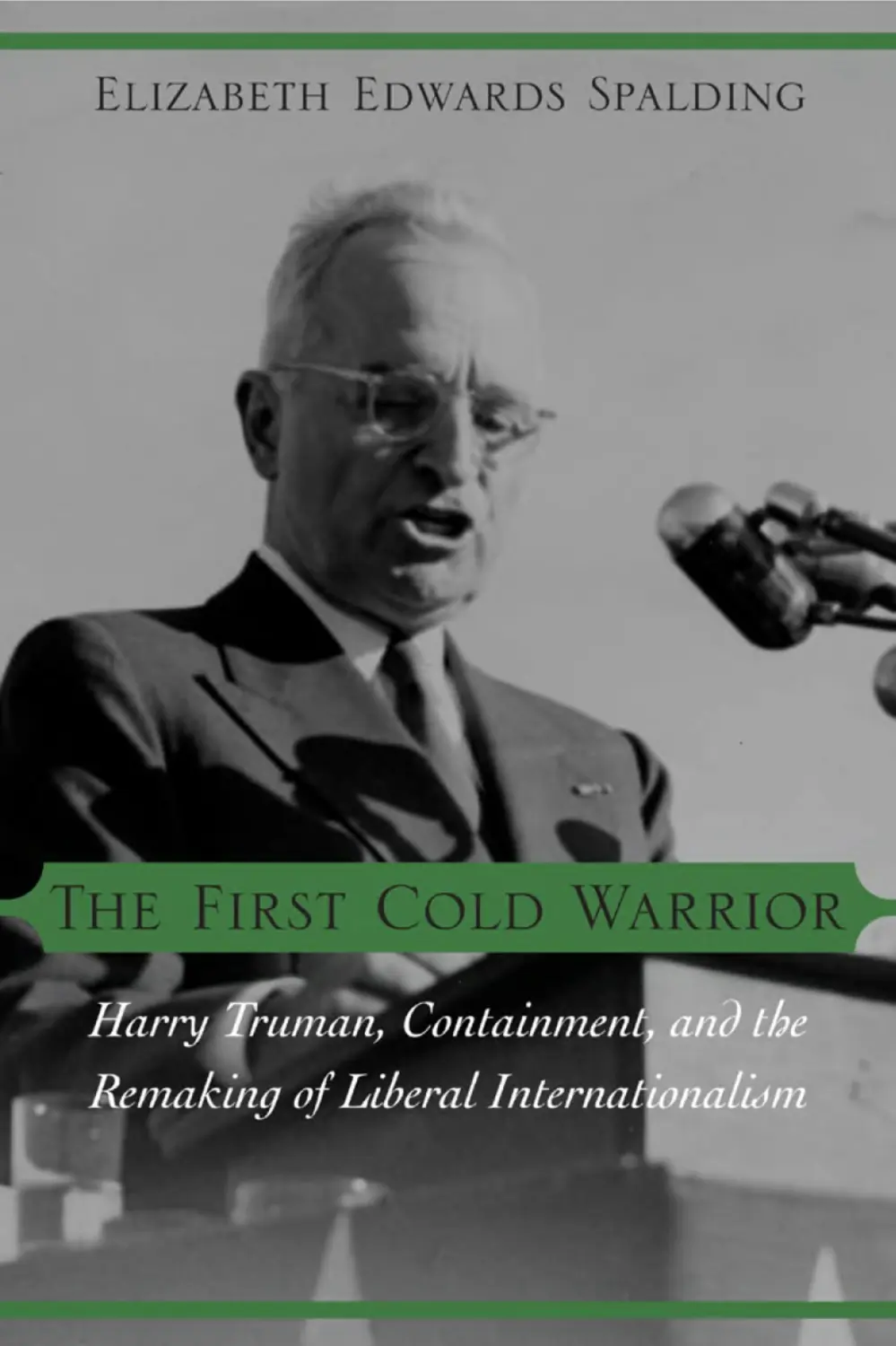
                    The First Cold Warrior

This page intentionally left blank

THE FIRST COLD WARRIOR
Harry Truman, Containment, and the
Remaking of Liberal Internationalism

ELIZABETH EDWARDS SPALDING

The University Press of Kentucky

Publication of this volume was made possible in part by a grant
from the National Endowment for the Humanities.
Copyright © 2006 by The University Press of Kentucky
Scholarly publisher for the Commonwealth,
serving Bellarmine University, Berea College, Centre
College of Kentucky, Eastern Kentucky University,
The Filson Historical Society, Georgetown College,
Kentucky Historical Society, Kentucky State University,
Morehead State University, Murray State University,
Northern Kentucky University, Transylvania University,
University of Kentucky, University of Louisville,
and Western Kentucky University.
All rights reserved.
Editorial and Sales Offices: The University Press of Kentucky
663 South Limestone Street, Lexington, Kentucky 40508-4008
www.kentuckypress.com
06 07 08 09 10

5 4 3 2 1

Library of Congress Cataloging-in-Publication Data
Spalding, Elizabeth Edwards, 1966–
The first cold warrior : Harry Truman, containment, and the remaking of
liberal internationalism / Elizabeth Edwards Spalding.
p. cm.
Includes bibliographical references and index.
ISBN-13: 978-0-8131-2392-9 (hardcover : alk. paper)
ISBN-10: 0-8131-2392-5 (hardcover : alk. paper)
1. Truman, Harry S., 1884–1972. 2. United States—Foreign relations—1945–1953.
3. Internationalism—History—20th century. 4. Liberalism—United States—
History—20th century. 5. Cold War. I. Title.
E814.S63 2006
973.918092—dc22
2006002564
This book is printed on acid-free recycled paper meeting
the requirements of the American National Standard
for Permanence in Paper for Printed Library Materials.
Manufactured in the United States of America.
Member of the Association of
American University Presses

To Whittle Johnston

This page intentionally left blank

Contents
Acknowledgments
Introduction

ix

1

1. “I’m tired babying the Soviets”
The Beginnings of Truman’s Internationalism

9

2. “The two giant marauders, war and tyranny”
Framing Containment 37
3. “A growing feeling of certainty in the rightness of our step”
The Truman Doctrine 61
4. “A noble page in world annals”
The Politics of the Marshall Plan

81

5. “Bonds far greater than those of mere ideology”
Kennan’s Sources of Soviet Conduct 103
6. “The great principles of human freedom and justice”
The Beginning of the Atlantic Alliance 129
7. “Peace with freedom and justice cannot be bought cheaply”
The Purpose and Structure of National Security 153
8. “To assure the integrity and vitality of our free society”
The Culmination of Truman’s Containment 177
9. “We must put on the armor of God”
History, Faith, and Peace in Truman’s Thought
Conclusion
Notes

233

Bibliography
Index

223

311

299

199

This page intentionally left blank

Acknowledgments
I would like to express my appreciation to those who have helped me
with this project. Among those who read all or part of the manuscript, I
am especially grateful to Patrick Garrity, Robert Kaufman, and Michael
Warner. Pat, in particular, challenged me to clarify general themes and
specific points, and the book is better for his suggestions. I am indebted
to the Earhart Foundation for providing me with a generous grant, which
enabled me to travel to and research at several libraries and archives. And
so I thank the staffs of the Harry S. Truman, Seeley G. Mudd, George C.
Marshall, and Clemson University libraries and of the Library of Congress
for their assistance while I was researching in their manuscript collections.
Anyone writing on the Cold War also owes gratitude to the Cold War
International History Project of the Woodrow Wilson Center. For publication, I have been fortunate to work with Steve Wrinn—always interested, thorough, and efficient—and his excellent staff at the University
Press of Kentucky.
My family has been indispensable. My parents, Lee and Anne Edwards,
introduced me to the study of the Cold War, and I first did archival research for one of my father’s writing projects when I was in high school.
With skill and good humor, my mother helped me research at the libraries
in Lexington, Virginia, and Princeton, New Jersey. Joseph and Catherine
created temporary office space next to their mother’s while pretending to
write their own books, and they delighted in manning the printer. Above
all, my husband Matthew has been loving and supportive and has never grown bored listening to comments about Harry Truman, George F.
Kennan, and the centrality of the Cold War to both U.S. foreign policy
and the remaking of liberal internationalism in the modern era.

ix

This page intentionally left blank

Introduction

“I

suppose that history will remember my term in office as the years
when the ‘cold war’ began to overshadow our lives,” Harry S. Truman
speculated in his presidential farewell address of January 1953. “I have had
hardly a day in office that has not been dominated by this all-embracing
struggle—this conflict between those who love freedom and those who
would lead the world back into slavery and darkness. And always in the
background there has been the atomic bomb.”
From the moment he became president of the United States in April
1945, Truman made hard decisions under acutely trying circumstances,
steering the United States between what he saw as the shoals and reefs of
military conflict with the Soviet Union, on the one hand, and acquiescence to Communist ideology, on the other. “But when history says that
my term of office saw the beginning of the cold war, it will also say that
in those eight years we have set the course that can win it,” Truman continued. “We have succeeded in carving out a new set of policies to attain
peace—positive policies, policies of world leadership, policies that express
faith in other free people. We have averted World War III up to now, and
we may already have succeeded in establishing conditions which can keep
that war from happening as far ahead as man can see.”1 These policies—
notably, the Truman Doctrine, the Marshall Plan, and the North Atlantic
Treaty Organization—and the geopolitical conditions they created made
up what is called the strategy of containment.
It is often said that George F. Kennan—author of the Long Telegram
in 1946 and “The Sources of Soviet Conduct,” better known as the X
article that appeared anonymously in Foreign Affairs in 1947—was the
father of containment. “In these circumstances it is clear,” he wrote in
the latter work, “that the main element of any United States policy toward the Soviet Union must be that of a long-term, patient but firm and
vigilant containment of Russian expansive tendencies.”2 Yet while Kennan
was a key intellectual figure of the post–World War II era, and contributed significantly to U.S. foreign policy in the 1940s, it was, in the end,
1

2

The First Cold Warrior

President Truman who conceived, enunciated, and directed the strategy
of containment. In crucial ways—ways that would form and determine
American policy—Truman’s and Kennan’s ideas differed. Containment,
as implemented by the United States, was Truman’s containment; the alternative, what we may term Kennan’s containment, was never policy in
the Truman years.
Truman’s beliefs, assumptions, judgment, and policies not only gave
rise to and defined containment’s content but also shaped America’s understanding of the Cold War. Because of his fundamental role, it is right
to say that Harry Truman was the first cold warrior.
Truman’s containment strategy also provided the grounds for a new liberal internationalism, which departed from that of both Woodrow Wilson
and Franklin D. Roosevelt and became the core of a postwar bipartisan
consensus on U.S. foreign policy maintained by almost every president
since the end of World War II. There is a scholarly as well as journalistic tendency to lump together Wilson, FDR, and Truman with respect to
liberal internationalism, especially since they were all Democrats. A more
nuanced argument suggests that Truman either amended or fused aspects
of Wilsonian idealism and Rooseveltian realism.3 But Truman ultimately
went beyond these interpretations in forging a new view in the context of
the Cold War. For Wilson, international meant universal. He wanted the
international organization of the League of Nations to become a permanent, universal institution. For Roosevelt, international meant the United
Nations (UN) would legitimate decisions made by the great powers in an
increasingly interdependent postwar world. He expected the UN to appear
as a universal, Wilsonian institution and to serve as cover for the realist policies of the most important countries in terms of power, influence, and hegemony. For Truman, by contrast, international meant that American leadership was central and that many, though not necessarily all, nations were
concerned, whether working together (loosely or in alliances) or through
the United Nations. Free peoples and free governments were always more
essential to him than any specific international organization, although he
never hid his hope that free men and open regimes could build a future
world community of lasting depth. Truman regarded the United Nations
and Bretton Woods entities as international organizations—not universal
institutions—in which the countries of the world would make good-faith
efforts to prevent or stop conflict and to promote free markets. As well,
he gave equal weight in the Cold War to the Atlantic Alliance, a regional

Introduction

3

organization based on collective defense, in opposition to Wilson’s League
of Nations and its dependence on collective security. In these theoretical
and practical ways, all of the major post–World War II international and
regional organizations were precisely neither Wilsonian nor Rooseveltian.
Truman’s liberal internationalism also differed from Wilson’s progressive internationalism and partly from FDR’s version of liberal internationalism in terms of educating and moving both congressional and public
opinion. To keep his League of Nations pure, Wilson determined that he
had to be in charge of all debate about the international organization during and after the First World War. He not only fought his main Republican
Party opponents—famously, Senator Henry Cabot Lodge, regarding reservations to the Versailles Treaty—but he also alienated potential GOP
allies, especially former president William Howard Taft. At the same time,
Wilson lost many of his progressive Democratic Party supporters, who
were excluded from his inner circle and found the League of Nations
insufficiently idealistic and the peace treaty too punitive. Avoiding such
mistakes during the Second World War, Roosevelt made use of private
organizations such as the Council on Foreign Relations and the United
Nations Association to help mobilize public opinion. FDR did not permit
any resolution for a postwar international organization into Congress until 1943, at which point the language was kept deliberately vague in order
to win votes; when the terms had to be made more concrete, he bypassed
issues that would cause opposition, even though this resulted in ambiguity in terms of U.S. commitments.4 Truman did not follow this lead,
but—in private meetings and in public statements, and with the help of
well-chosen people in his administration—he obtained a broad bipartisan consensus for his containment policies. (His previous career in the
Senate also aided him in executive-legislative relations.) While he did not
place Republicans in his cabinet as Roosevelt strategically had, Truman
was effective in appointing public servants, such as General George C.
Marshall, Averell Harriman, and Robert Lovett, who were acceptable to
or had close friendships with GOP leaders. Much as FDR had relied on
Wendell Willkie to deliver Republican backing for liberal internationalism, Truman would depend on Senator Arthur Vandenberg to foster GOP
support for his new internationalism. Like Roosevelt with respect to the
United Nations, Truman never forgot about forming public support for
the strategy of containment that animated his liberal internationalism.
Truman rooted his policies in common-sense assumptions regarding

4

The First Cold Warrior

man, the state, freedom, and tyranny—and therefore about the United
States and the Soviet Union. He believed that what he sometimes called
the “war of nerves” was dominated by tyranny’s ideological assault on human freedom, and that the nature of the East-West conflict transcended
both partisanship and domestic political opinions.5 His ideas and policies
stemmed from a multifaceted definition of peace, composed of freedom,
justice, and order. Yet for all his clarity and directness, there seemed to be
a contradiction in his thinking: Truman longed for a permanent peace and
held that the United Nations was the best vehicle by which to attain this
goal; at the same time, he realized that the components of peace and the
practical requirements of American foreign policy were more profound
and immediate. In the end, his moral convictions and religious beliefs
helped him resolve the tension in his political thought.
Many of Truman’s contemporaries attacked his articulation and implementation of containment. One segment of opinion at the time blamed
the president for being too soft on communism; this view reached its
height after the fall of China in 1949 and during the morass of the Korean
War. Nonetheless, those who criticized Truman in the 1940s and early
1950s for being easy on the Communists largely endorsed the president’s
policies of containment; they may have wanted more on particular issues
and particular points, but they approved his strategy of pursuing peace
through the demonstration and application of strength and the defense
and promotion of freedom. The best-remembered, most-analyzed foils to
Truman are not those who censured him for being weak but those—such
as George Kennan, Henry Wallace, and Walter Lippmann—who found
him to be blinded by anticommunism. On the whole, these contemporary
opponents faulted the president for being too hard on the Communists,
for construing the conflict as a clear-cut ideological struggle rather than
as a complicated balancing relationship, and for missing opportunities to
ameliorate or better manage U.S.-Soviet relations. It is no coincidence
that these critics presaged the modern academic schools of thought that
continue to analyze and, usually, denounce Truman’s containment.
Today, four views dominate the academic study of the Cold War: realism, revisionism, postrevisionism, and corporatism. Rejecting what is perceived as the idealism of the interwar period and critical of Truman’s “universalism” replacing professional diplomacy and carefully calibrated policy
statements, realism depicts a power struggle between two great nationstates that acted alike in global politics, starting with the inevitable move

Introduction

5

to fill the vacuum caused by the end of World War II.6 Revisionism—an
outgrowth of Marxist and neo-Marxist thought of the New Left movement in American protest politics and the academy of the late 1950s and
1960s—holds that the East-West clash was caused by democratic capitalism and leaders who were motivated by economic imperialism when they
should have been more accommodating to the Soviet Union.7 Established
in the 1970s and 1980s, postrevisionism accepts the essence of realist
power politics but contends that mutual misunderstandings and mirrorimaging by the United States and the Soviet Union both generated and
sustained the Cold War.8 Gaining strength in the late 1980s and 1990s,
corporatism combines the struggle for power with economic determinism
to characterize the U.S.-Soviet conflict.9
While not the focus of this book, it must be noted that these schools
of thought, despite having roots in political theory and having become
mostly academic abstractions, grow out of practical politics, in particular, the contemporary debate over the Truman administration’s policies
concerning the Soviet Union and the Cold War. Kennan—primarily and
with help from Lippmann—and Wallace, secondarily, laid the groundwork for each of these modern paradigms. Diplomat and high-level State
Department official Kennan was the central figure, since he not only contributed to the development of containment but also provided one of the
first commentaries on Truman’s Cold War approach. His critique rose out
of and defined a realist outlook on the subject, although revisionists and
corporatists, as well as realists, came to appreciate his views on nuclear
disarmament and what he termed the egotism of American moralism.
Former vice president Wallace, the leading progressive political leader of
the 1940s, was also an important participant in the public debate about
the Cold War’s meaning and America’s role in the conflict; as such, he was
the first revisionist on the subject. His contention that the United States
was forsaking its status as a revolutionary power in its Cold War foreign
policy and his call for multilateral UN action in place of U.S. unilateralism have been crucial to revisionists and, lately in policy circles, to progressives. A longtime observer of the American political scene, journalist
and essayist Lippmann (who popularized the term Cold War) exhibited
in his appraisal mostly realist tendencies with a residue of Wilsonianism,
due to his government service under President Wilson and a past commitment to progressivism. Lippmann offered a version of realism with early
revisionist undertones and was a consistent antagonist of Truman.10 His

6

The First Cold Warrior

indictment of what he regarded as the ideological and military excesses of
Truman’s containment, along with his endorsement of General Marshall’s
position on China and equilibrium with the USSR in Europe, resonated
with both realists and postrevisionists. While some have relied heavily on
Kennan (such as postrevisionist historian John Lewis Gaddis) and others
have drawn much from Wallace (such as revisionist historians William
Appleman Williams and, more recently, Arnold Offner), most academic
writers on the Cold War and containment are the intellectual heirs of
Kennan, Lippmann, and Wallace rather than Harry Truman.
Here, by contrast, I examine the political thought and action of
Truman’s approach to the war of nerves and how, ultimately, that approach both infused and was subsumed in a new postwar liberal internationalism. The argument and structure in this book illuminate the fundamental differences between Truman’s and Kennan’s views through an
explication of each man’s thought about the Cold War and U.S. foreign
policy in the East-West conflict. The first chapter traces the beginnings of
Truman’s internationalism and containment strategy, including biographical background, his first months as president in 1945, and the effect of
Kennan’s Long Telegram early the following year. Along with events in
Europe and the Near East, Winston Churchill’s 1946 Fulton address, and
Henry Wallace’s disputations, the development of Truman’s containment
is followed through the 1946 Clifford memorandum in the second chapter. That development is then elaborated from the 1947 Truman Doctrine
in the third chapter through the Marshall Plan (announced in 1947 and
passed in 1948) in the fourth chapter, all against the backdrop of ongoing challenges in world and, where pertinent, domestic politics. George
Kennan and his conflicting presentation of containment from 1946 into
1948 receive thorough attention in the fifth chapter, as does journalist
Walter Lippmann’s critique of aspects of Truman’s and Kennan’s containments. Truman’s commitment to the North Atlantic Treaty, starting in
1948 and 1949, and to Western Europe is juxtaposed in the sixth chapter
with Kennan’s objections to NATO and his suggestions for the settlement
of the German question. In the seventh chapter, the new postwar notion of
national security is examined, as are the creation of the National Security
Council (NSC) in 1947 and the institutionalization of Truman’s containment in early NSC papers. The culmination of Truman’s containment in
NSC 68 of 1950 and the conclusion of Kennan’s alternative containment
are analyzed in the eighth chapter. In the ninth chapter, Truman’s study

Introduction

7

of history and his religious beliefs are related to his understanding of the
Cold War and the duties of American leadership in meeting the conflict.
A brief conclusion assesses the lasting significance of Truman’s approach
to the Cold War.
For this work I rely first on primary documents, especially Truman’s
writings, letters, words, and speeches,11 and, second, on other primary
sources found in archives, manuscript collections, and official government
documents. Secondary sources are used in light of the primary documents;
in this way, I do not subscribe to a particular methodology, and the book
is not a piece of formal Cold War historiography. Nor is it a biography
or a complete assessment of Truman’s intellectual and political thought.
I do not address Truman’s domestic policies, except as they intersect with
his foreign policy. As I am largely concerned with the period from 1945
through the first part of 1950, the themes in the text precede the Korean
War. And since the practical focus is on U.S.-Soviet relations, I do not
deal with the conflict in China. Instead, this work is a study of the primary American actor in the early postwar period of the Cold War, and I
seek to understand the man as he understood not only himself but also
the individuals, events, and arguments around him concerning the central
political question of his day.
How Truman approached the central political question of his day can
help us think about the central political question of our day. It is standard
for historians and political scientists to point out the perils of conflating
the past and present. But many scholars would also be the first to say that
we must not forget history’s lessons. The most appropriate parallel we have
to the war on terrorism, to this point, is the early part of the Cold War.
There are important differences between then and now, to be sure: no surprise attack on the United States occurred in 1945, and so Truman could
take a short but valuable time to devise his strategy; the Communists of
the mid-1940s were either located in or swore allegiance to a particular regime, the Union of Soviet Socialist Republics (USSR), not a supranational
extremist movement based on a perverted interpretation of a major world
religion; and it is unclear at this point if the war on terrorism will be of the
magnitude and duration of the Cold War. But the similarities are striking.
In both cases, the United States has faced an ideological enemy implacably
opposed to liberal democracy generally and America specifically. In both
cases, the war was unexpected by most people. Truman had expressed his
distaste for both Nazi and Soviet tyranny in the years before he became

8

The First Cold Warrior

president, but he had not supposed he would regard the USSR as an enemy
while the Grand Alliance was still fighting the Second World War. In both
cases, the presidents at the time had to define the meaning of the war for
their fellow citizens. As well, the Cold War and the war on terrorism each
became worldwide in scope with local hot battles: Korea under the Truman
administration and Afghanistan and Iraq on George W. Bush’s watch.
Notable similarities also exist at the levels of politics and foreign policy. In both instances, the presidents followed popular predecessors who were
inspiring communicators respected for their displays of wide-ranging intelligence. Before their presidencies, neither Truman nor Bush was known
for his foreign policy acumen; before and during their respective terms in
office, neither was praised for his eloquence, a quality that is prized in politics, especially during times of crisis. Both men came to be associated with
their blunt statements about the main conflicts of their day. Conceiving
and directing a new U.S. foreign policy, too, is a noteworthy point of
comparison between the time periods: from creating new government
institutions—such as the National Security Council, the Department of
Defense, and the Central Intelligence Agency—to putting his belief in
freedom and democracy, as well as his religious faith, at the center of his
foreign policy, Truman has much to teach in relation to the presidency of
George W. Bush.
Here our purpose is to understand what Truman said and did: how
well he expressed his principles and applied them, how quickly and deeply he came to grasp the challenges of the war of nerves, how securely
he constructed new institutions and policies in order to fight the EastWest conflict, and how effectively he left a legacy to his successors in the
Oval Office—perhaps, as we see now, even after the end of the Cold War.
Many have argued that, even with or because of the war on terrorism, the
Wilsonian project has more currency these days. When reading his second
inaugural address and other speeches, it has become popular to refer to
the “Wilsonianism” of George W. Bush. But the promotion of democratic
principles was neither the original nor the sole province of Wilson. The
Truman era provides a better model: through the correct blend of political, moral, military, and economic strength, the United States should
articulate and promote the principles of the liberal democratic regime;
discourage the spread of despotism (which, in today’s world, would mean
opposing terrorists as well as tyrants); and encourage the establishment
and maintenance of healthy, democratic, constitutional states.

1
“I’m tired babying the Soviets”

The Beginnings of
Truman’s Internationalism

W

hen Harry Truman became president in April 1945, liberal internationalism was little more than an intellectual concept and by no
means a common expression. For the first part of the twentieth century,
politicians spoke in terms of being nationalists or internationalists, but
they tended not to add modifiers such as liberal, conservative, or progressive. As World War II came to a close, the two great presidential expositors
of internationalism—Woodrow Wilson and Franklin Roosevelt—were
gone, but their presence still dominated American politics. Facing a global conflict with the Soviet Union, an ally during the Second World War,
Truman could have taken up the mantle of either one of these leaders;
he could have pursued a fusion of their approaches, much as Secretary
of State James Byrnes advocated in 1945 and 1946. But Truman, while
admiring his predecessors, chose neither Wilson nor FDR nor a combination of their international theories as his model. Instead, he fashioned a unique postwar liberal internationalism that applied broadly
held domestic principles to the nation’s foreign policy. It was inclusive,
bipartisan, and informed by the ideals of the United States rather than
a particular philosophy of international relations or the agenda of a political party. Built on a foundation of strength and an understanding of
freedom, this liberal internationalism first found voice in Truman’s policies and statements toward the Soviet Union on such topics as Trieste,
Iran, and Berlin.
9

10

The First Cold Warrior

Making the World Safe for Democracy
When he was twenty-eight years old, Harry Truman followed with interest the 1912 Democratic Party convention, which took many days and
ballots to determine a presidential nominee. Although initially for native Missourian and representative Champ Clark, Truman and his father
came to favor New Jersey governor Woodrow Wilson. It was renowned
Populist William Jennings Bryan’s endorsement of Wilson that changed
the Truman men’s minds.1 In his early thirties, Truman answered President
Wilson’s call to fight in World War I—finagling his way out of several eye
exams in order to be accepted by the military—not only because of his
patriotism but also to test himself under the rigors and deprivations of
war. From the beginning and, eventually, through his command of a field
artillery battery, he excelled at both his self-imposed trial of character and
the combat-tested challenge of leadership. In addition to the discipline
and habits of the military life, he learned how to direct people of different minds and diverse backgrounds, by both decision and example.2
Captain Truman served as an officer in the army reserves for over thirty
years, retiring in 1945 as a full colonel when he became the nation’s commander in chief. His men respected and admired him during the war and
after, actively supporting him as captain, judge, senator, and president; for
his part, Truman always remained close to his battery through correspondence and in person.
Truman carried away from the Great War and its immediate aftermath
a deeper understanding of world politics. He liked to say that America
owed it to the Marquis de Lafayette, who had crossed the Atlantic to
serve under General George Washington in the Revolutionary War, to
help the French fight the Germans. Although he perceived that European
politics and wars derived from beliefs and customs other than those of the
American experience, Truman held that the United States could not retreat
from the world arena. In his estimation, World War I had been America’s
initiation into world leadership. In explaining the First World War and
the interwar period, he eschewed isolationism, which, he believed, contributed to the Second World War. During his senatorial and presidential
years, he repeatedly exhorted the American people and the U.S. Congress
to exercise the global leadership they had refused to assume in 1919.
Truman did not refer much to Wilson in his World War I letters to his
future wife, Bess, noting in 1919 that he—and “every A.E.F. [American

The Beginnings of Truman’s Internationalism

11

Expeditionary Force] man feels the same way”—wanted to come home
after helping to beat the Germans and did not “give a whoop” about either the League of Nations or the situation in Russia.3 In time and with
distance from his fighting days, he wrote in 1954 that he “became one
of [Wilson’s] great admirers” after the 1912 nomination and was pleased
with his reelection in 1916; in 1953, Truman placed Wilson in company with Buddha, Jesus, Cincinnatus, George Washington, and Abraham
Lincoln as makers of history; after seventy-five historians ranked American
presidents in a 1962 poll in Time magazine, Truman reordered the first
five from Lincoln, Washington, FDR, Wilson, and Thomas Jefferson to
Washington, Jefferson, Wilson, Lincoln, and Roosevelt.4 Despite such
laudatory comparisons, Truman’s internationalism differed significantly
from that of Woodrow Wilson.
Wilson’s worldview stressed the primacy of peace as the fulfillment
of progressive history. In 1916, the same year that he campaigned for
reelection on the theme that he kept the United States out of war, Wilson
focused on the world after the Great War and urged that “we must move
forward to the thought of the modern world, the thought of which peace
is the very atmosphere.” After adding that “[o]ur interest is only in peace
and its future guarantees,” he expressed “the confidence I feel that the
world is even now upon the eve of a great consummation,” which would
result not only in some sort of international security organization but also
in coercion being put only “to the service of a common order, a common
justice, and a common peace.” Wilson based these comments on the proposition that “[t]he interests of all nations are our own also.” In making all
states’ interests interchangeable, he acknowledged the rights of individual
peoples and nations and of small states, but emphasized that the world
had an overarching right, specifically to be free from “every disturbance
of its peace that has its origin in aggression and disregard of the rights of
peoples and nations.”5
To secure the primacy of peace, Wilson called for “peace without victory” in 1917, several months before the United States entered World
War I. To him, this memorable phrase meant that only a postwar “peace
between equals” would “win the approval of mankind” and last. While
arguing that the United States and the other peoples of the New World
would have a special role in guaranteeing peace and justice, Wilson contended that the “organized major force of mankind,” seemingly in the
form of a global policeman and an all-encompassing concert of power, was

12

The First Cold Warrior

the key to an enduring peace. Rejecting the mechanisms of realpolitik,
he proposed new procedures in another one of his most famous phrases:
“There must be, not a balance of power, but a community of power; not
organized rivalries, but an organized common peace.” In fact, Wilson took
the opportunity to repudiate the main elements of international relations
before the Great War, such as entangling alliances and hegemony, and
to advance instead self-determination, freedom of the seas, and military
power used only as a tool to maintain order. Although he stressed that
his new procedures and processes of peace were essential, he believed that
“[t]he right state of mind, the right feeling between nations, is as necessary for a lasting peace.” Wilson knew that he was advocating a different
way of engaging in world politics, but submitted its principles were both
American and “forward looking,” “modern,” and “enlightened.”6
“We are at the beginning of an age,” Wilson said in presenting the
declaration of war against Germany in April 1917, “in which it will be insisted that the same standards of conduct and of responsibility for wrong
done shall be observed among nations and their governments that are
observed among the individual citizens of civilized states.” Equating progress with his view of civilization (and arguing that civilization hung in the
balance in the war), he planted the seeds for a League of Nations by emphasizing that a “steadfast concert for peace” could only be maintained by
a partnership of democratic nations. “The world,” he proclaimed, “must
be made safe for democracy.”7
In the Fourteen Points speech of January 1918, Wilson set forth the
“processes of peace” by which all peoples and nations, Germany included,
would take their place in “the new world in which we now live.” Once
more, he spurned what he saw as old ways, such as conquest, aggrandizement, and secret covenants, and praised the acceptance of new methods
“now clear to the view of every public man whose thoughts do not still linger in an age that is dead and gone, which makes it possible for every nation whose purposes are consistent with justice and the peace of the world
to avow now or at any other time the objects it has in view.”8 Following
these themes in the presentation of the Covenant of the League of Nations
in February 1919, Wilson termed the covenant a “belated document” and
remarked that “the conscience of the world has long been prepared to express
itself in some such way.” In the end, “the moral force of the public opinion
of the world”—with armed force in the background as a last resort—would
secure and sustain peace.9 Wilson viewed himself as specially equipped, if

The Beginnings of Truman’s Internationalism

13

not chosen, to help others see that politics could now operate according
to an open and democratic process and that the power politics of realism
had given way to the inevitable forces of history.10
Woodrow Wilson pursued what many have termed liberal internationalism, but what should more accurately be termed progressive internationalism.11 By the end of World War I, he viewed democracy and freedom ultimately as tools to obtain an organized peace through the vehicle
of the League of Nations. Wilson’s progressive internationalism inhered in
his Presbyterianism, the childhood impression the Civil War left on him,
his belief in democracy, his conviction that the United States had a special
role in world politics, and his aspirations to create a new world order. The
last was inspired, in part, by Wilson’s correspondence and interaction with
the progressive leaders of his day, who renounced militarism, imperialism,
and balance of power politics. In foreign policy and international relations, Wilson wanted a community of power and nations.
Truman did not speak in such language, although he too rejected militarism, imperialism, and balance of power politics as unethical and outdated. In his political thought, free peoples and a community of free nations were the goals. In place of Wilson’s expectations for collective security through a single international organization, Truman placed his trust in
collective defense, most notably in the North Atlantic Treaty Organization
(NATO), an arrangement that would have been impossible and illegal in
Wilson’s world under the League of Nations. He concluded that international organizations could achieve good global effects, but, unlike Wilson,
he did not predict universal results. Truman’s liberal internationalism relied on the combined strength of the free nations of the world—led by
the United States—to defend and further freedom, promote justice and
order, and result in peace of a durable sort. Wilson’s progressive internationalism assumed that peace was inevitable and the world community of
nations would practice moderation, seek peace and justice, and be able
to thwart the actions of potential aggressor states through the strength of
their moral power and, only as a last resort, their military power. Truman
was attracted to Wilson’s affirmation of the need for the United States to
be involved in world politics and his belief in international organization.
Any other Wilsonian influence on Truman was deflected to a large extent
by the realities of the Cold War.12
Where Truman might be the most indebted to Wilson is in the latter’s
view of the executive power in foreign affairs, even though it is unclear

14

The First Cold Warrior

whether Truman (like other modern presidents) fully grasped this legacy.
In his 1911 Constitutional Government in the United States, Wilson argued
for the president’s “control, which is very absolute, of the foreign relations
of the nations,” and added that the “initiative in foreign affairs, which
the President possesses without any restriction whatever, is virtually the
power to control them absolutely.” And although Americans (including
most earlier presidents) were only beginning to regard the presidency in
this light, it would increasingly be the case that the office and its inhabitant would be viewed, for all intents and purposes, as absolute in foreign
policy. Because “it has risen to the first rank in power and resources,”
wrote Wilson, the United States “can never hide our President again as
a mere domestic officer.”13 While also believing in a strong presidency
and acting with dispatch and boldness in the Korean War, Truman never
echoed Wilson’s general comments about the virtual absolute primacy of
the president in international relations, and he chose as a matter of course
to involve Congress in foreign policymaking such as the Truman Doctrine,
the Marshall Plan, and NATO.

To the Presidency
Once he was elected in 1934 to represent Missouri in the U.S. Senate,
Truman consistently articulated his belief that tyranny must be defeated in
world politics and that a real peace required strength, freedom, and international commitment. As early as the latter part of 1937, he was dissatisfied with the policies of neutrality, and, in 1939, he wanted American legislation revised in order to permit arms and munitions aid to Great Britain;
in 1941, he was one of the few Democrats who joined Republicans in an
effort to repeal all neutrality provisions. In his September 1939 letters to
Bess, Truman expressed his concern that, if not stopped, the Soviet Union
and Nazi Germany would take over Europe, defeat France and England,
and then “we’ll have a Nazi, or nasty, world.”14 He explained to a Missouri
audience in October that the current neutrality policy penalized American
allies because “we should not help the thugs among nations by refusing to
sell arms to our friends.”15 While he hoped that the United States might
be able to escape entry into the Second World War, he believed that the
country could not sit by idly and permit a worldwide catastrophe.
Truman did not suffer tyrants gladly. In October 1939, he said that the
“three dictators, Russian, German, and Italian,” had returned to “a code

The Beginnings of Truman’s Internationalism

15

little short of cave-man savagery,” and that he saw their exploitation of
“this magnificent machine age of ours” as an effort to destroy civilization.
Without a moral reawakening, he thought another dark age was possible.16
His most controversial public remark on the subject of despotic aggression
came after the Nazi invasion of the Soviet Union in June 1941: “If we see
that Germany is winning we ought to help Russia and if Russia is winning
we ought to help Germany and that way let them kill as many as possible,
although I don’t want to see Hitler victorious under any circumstances.
Neither of them think anything of their pledged word.”17 Truman’s immediate criticism of the two powers stemmed from his understanding of
the 1939 Molotov-Ribbentrop pact, the nonaggression treaty between the
USSR and Germany. While recognizing that the United States had to accept the Soviet Union as an ally against Hitler, Truman did not think that
the Kremlin could be trusted as a friend.
In aiming to change matters and prepare the United States for war,
Senator Truman was practical. Having been reelected in 1940 without FDR’s endorsement (and having supported favorite-son candidate
Missouri Senator Bennett Clark for the Democratic presidential nomination), Truman returned to the Senate with a reputation as an anti-Roosevelt
Democrat.18 In summer 1940, he had noticed that the American defense
buildup was handicapped by wasteful expenditures and the failure to
award more competitive contracts. After briefing Roosevelt in February
1941 on his preliminary findings (in which FDR showed no interest),
Truman introduced a Senate resolution creating the Special Committee
to Investigate the National Defense Program, which he then headed until
August 1944. Popularly known as the Truman Committee, it uncovered
evidence of extensive economic improprieties, carelessness, and corruption in defense spending, which, once corrected, saved the nation both
money and the lives of American soldiers.19 The committee, which the
administration had tried to suspend, proved Truman’s independence
and willingness to stand up against the FDR loyalists. Assessing the
committee’s importance in its first years, Time described the Truman
Committee in 1943 as a “billion dollar watchdog” and “the closest thing
yet to a domestic high command,” and reported the assessment of one
Washington insider: “There’s only one thing that worries me more than
the present state of the war effort. That’s to think what it would be like
by now without TRUMAN.”20
Truman was also an acknowledged driving force behind the drafting

16

The First Cold Warrior

of the congressional resolution for the establishment of a postwar international organization. In summer 1943, he traveled the Midwest as part
of a bipartisan congressional team to explain why internationalism and
the United Nations would be essential after World War II.21 Although he
had high expectations for these postwar plans, Truman maintained that
the United States would first have to prosecute the current war and secure
peace terms. In a spring 1942 letter to Bess, he conveyed his concern
about a return to isolationism because of the Nazi peace initiatives: “That
German peace offensive worries me. If Britain were to run out on us, or if
China should suddenly collapse, we’d have all that old isolation fever again
and another war in twenty years. We must take this one to its conclusion
and dictate peace terms from Berlin and Tokyo. Then we’ll have Russia
and China to settle afterwards.”22 It was this sort of man, with this sort of
opinions and background in foreign policy, who became the Democratic
vice presidential candidate in 1944.
Many accounts depict Harry Truman as a nonentity in foreign policy
before April 12, 1945. He was best known and chosen to be vice president for his reliable New Deal voting and his Missouri political connections, not to mention the desire of the moderate and anti–New Deal
Democrats to prevent Henry A. Wallace from succeeding the now ailing President Roosevelt. As vice president, he was only twice alone with
Franklin Roosevelt before the latter’s death, and they discussed little of
international significance. In terms of the most important technological
development of the day, Truman was not fully informed about the near
completion of the atomic bomb until he became president.23 Yet he was
a man of clearly formed convictions, had deep experience as a legislator
and as an administrator, and was an astute student of world history.24
From his earliest writings about global affairs, Truman voiced a desire for a
world that was characterized by peace—the teaching of the Sermon on the
Mount was his touchstone—while admitting the difficulty of achieving it.
No fuzzy idealist, he advocated the use of strength if required to achieve
or sustain world peace. And as long as fallible men ran the world, strength
was needed to defend the cause of freedom.
When he became president, Truman was thrust into harsh global circumstances, in which many key decisions—or, at minimum, the parameters for those decisions—had been made for him. Given his commitment
to the use of firmness and strength when necessary, his disagreement with
British Prime Minister Winston Churchill regarding troop disposition in

The Beginnings of Truman’s Internationalism

17

Europe in spring 1945—one of his earliest command decisions—must
have made him uneasy. Indeed, the president soon regretted the decision,
writing several years after the fact: “We were about 150 miles east of the
border of the occupation zone line agreed to at Yalta. I felt that agreements
made in the war to keep Russia fighting should be kept and I kept them
to the letter. Perhaps they should not have been adhered to so quickly.”25
Churchill had been concerned about Kremlin intentions and actions in
Europe since the Soviet victory at Stalingrad; by the end of March 1945,
troubled by Soviet violations of the Yalta agreements, he entreated the
Anglo-American military leadership to take Berlin, in order to have a
stronger bargaining position vis-à-vis the Kremlin. With Roosevelt’s approval, however, Generals George C. Marshall and Dwight D. Eisenhower
had defined the “single objective” as “quick and complete victory.” In pursuance of this “single objective,” Eisenhower made the decision to stop at
the Elbe River just as FDR died. When implored by Churchill to advance
on April 17, Truman stood by the Roosevelt-Marshall agreement—and,
by default, supported Eisenhower’s tactical decision—that strategy should
be determined according to the occupation agreements reached by the
European Advisory Commission in 1944.26
It is a partial explanation to say that Truman was hampered by American
public opinion, for it would have been almost impossible to order troops
to oppose an ally that had been critical in the fight against Nazi Germany.27
During the crucial month of April 1945, moreover, Truman was influenced by Generals Marshall (whom he greatly esteemed) and Eisenhower.
They urged the president not to confuse political, postwar matters with the
agreed-upon military objective of winning the war against the Nazis.
Throughout the rest of April and May, Truman cabled back and forth
between Stalin and Churchill in an attempt to stave off the USSR from
taking more territory.28 In late May, he thought that presidential advisor
Harry Hopkins had conveyed American displeasure with Soviet actions,
especially in Poland, in a Moscow meeting with Stalin.29 Yet Truman abided by the American military command when Pilsen and Karlsbad, rather
than Prague, were chosen as the goals for U.S. troops in Czechoslovakia.
When the time came in June 1945 to make a decision about American
troop removal from the Soviet zone in Germany, he told Churchill that he
was “unable to delay the withdrawal of American troops from the Soviet
zone in order to use pressure in the settlement of other problems” because
“it would be highly disadvantageous to our relations with the Soviet to

18

The First Cold Warrior

postpone action in this matter until our meeting in July.” But when the
president sent Stalin his message about the withdrawal, he incorporated all
of the prime minister’s suggested language about a strong Anglo-American
stance on Austria.30 In fact, less than a week later, Truman stressed that
he intended to take more of an initiative at subsequent meetings in San
Francisco and at Potsdam.31
Churchill wanted the democratic allies to change course immediately,
but Truman believed that he could not be more assertive at the time.32
In early June 1945, it was unclear if the American economy would remain robust as a result of the war, but it was clear that American soldiers
were war-weary and would be reluctant to fight another conflict. Besides,
the war in the Pacific continued and was in need of additional American
troops. Further, the president thought—in his contradictory wish for
peace and simultaneous grasp of the political realities—that the Soviet
Union would honor its commitments at Yalta.33 Although he maintained
that the Soviets had an edge that would be hard to counter in disputed
territories, he hoped that the Kremlin would reciprocate American acts of
good faith.34
Truman was not passive, however, concerning America’s role in the
emerging postwar world. His experience at Potsdam disabused him of
the notion of Stalin’s goodwill.35 Thus Truman made several comments
as early as 1945 about the need to rehabilitate Europe, showing that his
attention was focused on the postwar picture and the part that economic
well-being would play in reinvigorating the region’s peoples and politics.
In October 1945, at a moment when many others wanted to retreat and
American opinion overwhelmingly favored releasing men from the armed
services, he advocated universal military training.36 The president stressed
that only strength would deter future aggressors from threatening peace or
liberty and that the United States must quickly rebuild its strength before
further postwar erosion. In this sense, Truman understood that victory in
World War II would not end grave, global threats, as many had anticipated after World War I.

In the Shadow of FDR
It is commonplace to observe that Truman walked in the shadow cast by
Franklin Delano Roosevelt.37 Shortly after becoming president, Truman
himself wrote toward the end of a letter to Eleanor Roosevelt that “I never

The Beginnings of Truman’s Internationalism

19

think of anyone as the President but Mr. Roosevelt.”38 In October 1946,
Truman drafted a speech (that was never delivered) about various postwar conversion issues, in which he reprimanded his opponents for having
“forgotten the ideals for which we fought under Franklin Roosevelt” and
having vision dimmed “by greed, by selfishness, by a thirst for power.”39
Truman had known FDR personally in a way he had not Wilson, and
the relationship contributed to his perception of Roosevelt’s character
and ideas. Yet he was never overwhelmed (personally or politically) by
Roosevelt’s aura and charm. In reference to the Truman Committee in
1941, Senator Truman wrote Bess that he would tell FDR “to go to hell”
if the president failed to meet with him, and added, “He’s so damn afraid
that he won’t have all the power and glory that he won’t let his friends
help as it should be done.”40 Nor was vice presidential candidate Truman
impressed by Roosevelt’s flattery in 1944 on one of their rare meetings.41
And criticizing FDR in 1946 on grounds that would be echoed by some
scholars in later years, he told Bess: “It seems the late President had a positive genius for picking inefficient administrators. His Court appointments
are somewhat disgraceful too. I’ve about come to the conclusion that he
wanted to do everything himself and get all the acclaim for successful accomplishment and then have a dumb cluck to take the blame for what
failed.”42
Truman’s praise and criticism of Roosevelt remained consistent after
he left the presidency: he described FDR as a “great, great president” who
brought the United States out of the Depression and was a “first-rate executive,” but whose “principal defect” was “that growing ego of his” and
who “wasn’t a good administrator because he just wasn’t able to delegate
authority to anybody else.”43 In Truman’s opinion, Roosevelt “wanted
to be in a position where he could say yes or no to everything without
anyone’s ever arguing with him or questioning him, and of course you
can’t do that in our system of checks and balances.” Every president ought
to have restraints, wrote Truman, and “I sometimes argued with [FDR]
myself when he wanted to go too far or when he set out to do something
strictly on his own and without the argument or help of others.”44 Truman
benefited from and partially used Wilson’s institutional expansion of the
presidency, at the same time that he explicitly rejected what he saw as
Roosevelt’s unwarranted personal expansion of presidential powers.
The question remains, though, as to whether Truman followed FDR’s
version of liberal internationalism, which borrowed from and amended

20

The First Cold Warrior

Wilson’s progressive internationalism. Roosevelt believed that an association of the great powers would be necessary after World War II to prevent
future world wars and was willing to include as many nations as possible
to obtain the core arrangement. As a result, Roosevelt planned to reconstruct the global balance of power while describing it in Wilsonian language as a community of power and nations; and he aimed to achieve this
end by embracing and compromising with potentially troublesome great
powers—such as the Soviet Union—in order to make them part of the
postwar order, restraining them only as a last resort. In September 1944,
FDR wrote to Churchill that the USSR would have to be a “fully accepted
and equal member” of any international organization intended to prevent
world war, and that “[i]t should be possible to accomplish this by adjusting our differences through compromise by all the parties concerned and
this ought to tide things over for a few years until the child learns how to
toddle.”45 Like Wilson, Roosevelt thought that the basis of procedures and
collective security would be personal diplomacy and control, especially
by the United States and with him as president (although he perhaps exceeded Wilson in the trust he placed in personal diplomacy).
Wilson and Roosevelt were both more intellectual and elitist than
Truman. But FDR was more pragmatic and practical, and less philosophical, than Wilson—prompting some to call Roosevelt an instrumental
Wilsonian. This assessment is helpful: FDR was not empty of idealism,
but in him realism came to the forefront; and he wanted to be perceived as
Wilson’s heir in a theoretical sense, but succeed where Wilson had failed in
the creation of a postwar world order.46 In Roosevelt’s view, progressive internationalism, the engine of Wilsonian universalism, had resonated with
the American people before the Great Depression, and he aimed to resurrect its rhetoric and ideals in order to depress what he saw as isolationist
tendencies in the 1930s and 1940s. FDR’s commitment to the United
Nations stemmed less from a confidence in Wilsonian collective security
and more from a belief that an international organization was needed to
reflect the reality of global interdependence in the twentieth century.47
For the postwar era, he thought that the United Nations would serve four
additional ends: regulating the control of geographic spheres around the
world by the great powers; drawing the Soviet Union into extended cooperation with the West; involving the United States permanently in world
politics; and satisfying American idealism by cloaking the realpolitik that
would actually characterize international relations.48

The Beginnings of Truman’s Internationalism

21

It is difficult to discern Roosevelt’s final thoughts about the shape of
the postwar order, let alone the Cold War, because he did not make public
pronouncements or inform his vice president and top advisors of his intentions in his dying days. But in the years leading up to his well-known,
brief, last message of April 11, 1945, to British Prime Minister Winston
Churchill, we can see the outline and substance of Roosevelt’s framework
for an enduring postwar peace. “In the future days, which we seek to make
secure,” FDR said in January 1941, “we look forward to a world founded
upon four essential human freedoms.” And so began his articulation of
what came to be called the Four Freedoms: freedom of speech and expression; freedom of worship; freedom from want; and freedom from fear,
which later he also referred to as freedom from terror. If the first two freedoms were not ambitious enough to achieve “everywhere in the world,”
the third freedom promised “economic understandings which will secure
to every nation a healthy peacetime life for its inhabitants—everywhere
in the world,” and the fourth freedom meant “a world-wide reduction of
armaments to such a point and in such a thorough fashion that no nation will be in a position to commit an act of physical aggression against
any neighbor—anywhere in the world.” Roosevelt believed that the Four
Freedoms were “no vision of a distant millennium” but “a definite basis for a kind of world attainable in our time and generation.”49 Before
the United States had even entered World War II, FDR committed the
United States to a new world order that, in certain respects, had first been
limned by Wilson.
Also before the United States entered the Second World War, Roosevelt
and Churchill jointly issued the Atlantic Charter in August 1941, “to make
known certain common principles in the national policies of their respective countries on which they base their hopes for a better future for the
world.” Some of the principles were straightforward, such as the United
States and Great Britain stating that they sought no territorial or other aggrandizement, promoting self-government and freely made choices about
territory and government by the concerned peoples, and furthering equal
access to trade and raw materials for all states after the war. Other points
seemed to bear FDR’s imprint more than Churchill’s and to be perhaps intentionally beholden to Woodrow Wilson. The charter’s fifth point called
for improved labor standards and economic advancement, as had Wilson’s
Fourteen Points and the Covenant of the League of Nations, to which was
added the New Deal promise of “social security.” Although the first of the

22

The First Cold Warrior

Four Freedoms was partially absent and the second completely missing
from the Atlantic Charter, the charter’s sixth point specifically described a
postwar peace guaranteeing “that all the men in all the lands may live out
their lives in freedom from fear and want.” The Atlantic Charter’s seventh
point, like Wilson’s Fourteen Points, stated that the postwar peace “should
enable all men to traverse the high seas and oceans without hindrance.”
The eighth and final principle of the Atlantic Charter started with Wilson
but went beyond the Fourteen Points and the Covenant of the League of
Nations, holding “that all nations of the world, for realistic as well as spiritual reasons must come to the abandonment of the use of force.”50
But Roosevelt was both Wilsonian and realist. Acknowledging in late
1943 the possibility that the use of force would be necessary to preserve
world peace after World War II, he said that “international force” should
then be applied. To make effective the use of international force, FDR set
forth his concept of what came to be known as the Four Policemen. After
the Teheran and Cairo conferences, he reported to the American people
that he “got along fine” with Stalin, whom he saw as “truly representative of the heart and soul of Russia,” and that he believed “we are going
to get along very well with him and the Russian people.” Then Roosevelt
promoted the role of the great powers by stressing that Great Britain,
Russia, China, and the United States and their allies represented more
than three-quarters of the global population. If these “four Nations with
great military power stick together in determination to keep the peace,”
he said, “there will be no possibility of an aggressor Nation arising to start
another world war.” Although he mentioned the freedom-loving peoples
of Europe, Asia, Africa, and the Americas, as well as the need to guard the
rights of all nations, his accent was on the primacy of the great powers in
international relations.51 While advancing what amounted rhetorically to
a Wilsonian edifice for the United Nations, FDR built in a realist foundation of power politics and spheres of influence.
After his final wartime conference at Yalta in 1945, Roosevelt once
more spoke about his plans and hopes for the postwar world. Contrasting
the founding of the United Nations to that of the League of Nations, he
said that this time the “machinery of peace” was being set up during the
war and that the April 1945 UN conference in San Francisco would result
in a “definite charter of organization under which the peace of the world
will be preserved and the forces of aggression permanently outlawed.” But
while the “structure of world peace” would rest on the cooperative effort

The Beginnings of Truman’s Internationalism

23

of the whole world, the settlement in liberated Nazi territory would be
the province of Russia, Great Britain, and the United States; Roosevelt
thought the Yalta agreements would bring a “more stable political Europe
than ever before.” He asserted the advantages of “planning,” as opposed
to the “tragic mistakes” that had been made before and during the Great
Depression “by reason of lack of planning,” and predicted that the domestic improvements accomplished by such planning would now be “true in
relations between Nations.”52 What Wilson had failed to achieve in world
affairs, FDR claimed could now be done through better planning and a
combination of great power cooperation and Wilsonian ideals.
In the closing passages of his congressional address concerning Yalta,
Roosevelt used Wilsonian language to depict the “permanent structure of
peace upon which we can begin to build, under God, that better world
in which our children and grandchildren—yours and mine, the children
and grandchildren of the whole world—must live, and can live.” FDR
stated that the Crimea Conference “ought to spell the end of the system of unilateral action, the exclusive alliances, the spheres of influence,
the balances of power, and all the other expedients that have been tried
for centuries—and have always failed.” In their place, he proposed “a universal organization in which all peace-loving Nations will finally have a
chance to join.”53 Wilson had made much the same plea after World War
I, and Roosevelt updated his ideas for the post–World War II era. But in
blending realism and Wilsonianism, FDR altered the latter; he believed
that this mixture would pacify the Soviet Union through deals of power
politics (in his personal diplomacy he used expedients such as spheres of
influence and the balance of power) and satisfy Americans and other freedom-loving peoples with Wilsonian goals of peace and justice. From the
vantage of 1919, Wilson did not realize what radical ideology would do
in the twentieth century and thought that global politics after World War
I would make war obsolete and all men into pluralist peacemakers; in
1945, after experience with Nazi tyranny and in light of Soviet actions
since 1939, Roosevelt believed that his politics of planning along with
compromise (first) and containment (last) would prevent war and allow
for reasonable accommodation. Both presidents presumed moderation
on the part of their adversaries, which proved to be a costly error and
one that Truman would avoid.
Truman strongly endorsed a theme of one of FDR’s most famous fireside chats during World War II: “The present great struggle has taught us

24

The First Cold Warrior

increasingly that freedom of person and security of property anywhere in
the world depend upon the security of the rights and obligations of liberty and justice everywhere in the world.”54 To Truman, Roosevelt’s words
were evidence of the primacy of freedom and the necessity of protecting freedom wherever possible; in addition, they showed the connection
between political and economic freedom. Truman also applauded FDR’s
promises in spring 1945 to press Stalin on honoring the Yalta Conference
agreements with respect to Poland. But within two weeks of becoming
president, he departed from what Roosevelt on his deathbed conveyed to
Churchill, “I would minimize the general Soviet problem as much as possible because these problems, in one form or another, seem to arise every
day and most of them straighten out as in the case of the Bern meeting.”
Instead, Truman expanded FDR’s final line of the message: “We must be
firm, however, and our course thus far is correct.” Roosevelt apparently
meant that firmness to be limited to the position that Churchill and he
had taken with Stalin on Poland, but Truman would use firmness as part
of the foundation of his Cold War strategy of containment.55
There was a small part of Harry Truman in 1945 that was convinced
he should carry on with FDR’s policies since he was serving out his predecessor’s term. There was another, larger part of Truman that was convinced
that he should maintain and extend the New Deal because he believed in
its substance and goals. In foreign policy, Truman continued Roosevelt’s
wartime policies—from tactical decisions on troop dispositions to maintaining the Grand Alliance in order to defeat the Nazis and the Japanese—
but he had little idea what FDR had intended for American foreign policy
beyond the United Nations. Some FDR advisors, like Harry Hopkins,
stressed to Truman that Roosevelt had meant to carry over a friendly relationship with the USSR into the postwar era. But even if Truman briefly
toyed with such an idea, he quickly formed his own opinion of the Soviet
Union, its intentions, and its actions, and he rejected what FDR insiders
told him Roosevelt had wanted.

Truman Sets His Own Course
In neither his private nor public positions did Truman replicate FDR’s
policies in his early months in office. Through his personal diplomacy,
Roosevelt had expected postwar liberal internationalism—and, by extension, world peace—to be characterized by spheres of influence and a bal-

The Beginnings of Truman’s Internationalism

25

ance of power maintained by the Four Policemen: the United States, Great
Britain, the Soviet Union, and China. In FDR’s mind, the USSR would feel
secure in such an arrangement and act like a traditional great power. From
the beginning, Truman rejected this interpretation of world politics and
the Soviet Union. Records of Soviet foreign minister Vyacheslav Molotov’s
visit in April 1945 reveal a president already committed to a policy of firmness with respect to the Kremlin. Long before the expression “patience and
firmness” was associated with future secretary of state James Byrnes, U.S.
Ambassador to the Soviet Union Averell Harriman recommended “standing
firm” on issues of importance to the United States. Truman’s own resolve to
be firm with the USSR emerged as the theme of an April 20 conversation
among the president, Secretary of State Edward Stettinius, and Harriman.
As State Department official Charles Bohlen recorded in the official notes of
the conversation, “The President again repeated that he intended to be firm
with the Russians and make no concessions from American principles or
traditions for the fact of winning their favor.” Truman underscored that he
would tell Molotov “in words of one syllable” that the Polish question must
be settled in order to fulfill the Yalta agreements.56
In conversations with Molotov, Truman made clear that the Soviets
must uphold their wartime agreements. In particular, he stated that “the
Polish question had become for our people the symbol of the future development of our international relations.” Told of Molotov’s repeated
attempts to gain the advantage by applying the Yugoslavian “model” to
Poland, thus essentially acquiring another sphere of influence, Truman said
that the agreements with the USSR so far had been a “one way street” and
that if the Soviets did not want to commit properly to the United Nations
“they could go to hell.” Face to face with Molotov, the president spoke
sharply of his displeasure with the Soviet failure to honor its agreements.57
The president’s private writings at the time reveal a man who was growing in his new position. Although not a daily diarist, Truman frequently
wrote longhand notes in order to clarify his thoughts—and, sometimes, to
blow off steam. In spring and summer 1945, he went back and forth in his
notes about Europe’s future and America’s relations with its wartime allies.
At times, the president’s views on communism were a reaction to his good
or bad opinion of the person who was speaking to him. As a result, scholars debate if and when in 1945 and 1946 Truman believed the Soviets
were truly a threat. But what emerges is that although he did not want to
alienate the USSR in negotiations, the president was worried about the

26

The First Cold Warrior

Kremlin and its movements. By avoiding what he termed the appearance
that the United States and Great Britain were “ganging up” on the Soviet
Union, he hoped that Stalin would be less belligerent. Nevertheless, a substantive, overriding theme developed in the president’s longhand notes:
clarity about the nature and goals of the regime that Stalin controlled,
and the fact that communism and democracy were in fundamental opposition. “I’ve no faith in any Totalitarian State be it Russian, German,
Spanish, Argentinian, Dago, or Japanese,” he wrote, adding that these
states “all start with a wrong premise—that lies are justified and that the
old disproven Jesuit formula—the end justifies the means is right and
necessary to maintain the power of government.”58
Truman’s public declarations reflected in more polished tones what he
said privately and further separated him from Roosevelt’s policies. They
marked the beginning of his efforts as president to educate the American
people about the realities of the postwar world. Often overlooked in this
sense is Truman’s first major foreign policy statement, his September 1945
radio speech on the surrender of Japan. He told the American people that
the victory in World War II was of more than arms alone; it was a triumph
of liberty over tyranny—the main theme of Truman’s end-of-the-war assessment. “It was the spirit of liberty which gave us our armed strength
and which made our men invincible in battle,” he said. “We now know
that that spirit of liberty, the freedom of the individual, and the personal
dignity of man, are the strongest and toughest and most enduring forces
in all the world.” The president also maintained that the same liberty that
had sustained the nation in battle would provide the bedrock for peacetime and, through democratic constitutionalism, meet the challenges of
everyday living: “Liberty does not make all men perfect nor all society
secure. But it has provided more solid progress and happiness and decency
for more people than any other philosophy of government in history. And
this day has shown again that it provides the greatest strength and the
greatest power which man has ever reached.”59
More significant was Truman’s Navy Day speech of October 1945,
which is often seen as an affirmation of FDR’s policy by a new and insecure president who chose to maintain the status quo. In the context of
the September statement, however, the Navy Day remarks embodied his
intention to sustain American internationalism. Since Truman made few
statements about world affairs in 1945, both the September radio message and the October Navy Day address provide insights into the presi-

The Beginnings of Truman’s Internationalism

27

dent’s thinking prior to 1946 and 1947, and how he came to believe that
American foreign policy had to oppose world communism.
Although the Navy Day address retained some fidelity to President
Roosevelt, it tellingly revealed the beginnings of Truman’s distinctive strategy of containment. In setting forth twelve points of foreign policy, the
president was, at times, rhetorically faithful to Woodrow Wilson, as well
as FDR. But he brought to liberal internationalism the convictions of his
religious faith, stating that, although the Ten Commandments had not
been embraced universally, “we struggle constantly to achieve them, and
in many ways we come closer to them each year.” In a theme that permeated his private writings and public statements, he aimed no less than to
convince others that the golden rule should direct international affairs.
The United States must operate in an imperfect world, but Truman would
not give “approval to any compromise with evil.”60
Truman had been considering some of the particulars that he wanted
to include in the Navy Day address since Potsdam, four months earlier.61
Although the president named the Soviet Union among America’s allies,
he emphasized that the victorious powers must adhere with “forbearance
and firmness” to the “high principles which we have enunciated” and
show “a willingness to find a common ground as to the methods of applying those principles.” Negotiations, according to Truman, should not
violate principles but reflect policies that were appropriate for each set of
circumstances. In extension of his support of universal military training,
he repeated that the nation’s armed forces must be fortified even in a world
of atomic weaponry. Truman expressed the aim of this postwar foreign
policy succinctly: “We seek to use our military strength solely to preserve
the peace of the world. For we now know that this is the only sure way to
make our own freedom secure. That is the basis of the foreign policy of
the United States.” The defense of freedom emerged as the imperative of
American policy.62
Churchill, in particular, saw the Navy Day speech as a renewed dedication to American internationalism. In a November 7 speech to the House
of Commons that anticipated several important themes of the Fulton address of March 1946, Churchill described Truman’s speech as a “momentous declaration to the world”; it was “the dominant factor in the present
world situation” and of “transcendant importance.” He summarized the
president’s points as maintenance of U.S. military strength, an American
determination to join with like-minded nations in opposing aggression,

28

The First Cold Warrior

a pledge that tyrannies would not receive recognition from the United
States, and an assurance that the United States must abandon “oldfashioned isolation” and join with other well-disposed nations to carry out
these high purposes.63
Similar to Truman, Churchill praised the Soviet contribution in World
War II, hoped the USSR would be part of the postwar peace, and expressed the gravity of atomic developments for international affairs.
Churchill’s remarks contained a strong dose of his inimitable hyperbole,
but the main message was clear: endorsement of and encouragement for
a relatively new president making an independent statement in a new
postwar world.64

Truman Defines the Strength of Containment
Any residue of the Grand Alliance had evaporated by December 1945
at the Foreign Ministers’ Conference in Moscow. Unlike Henry Wallace
(FDR’s vice president from 1941 through 1944), who was still urging
Big Three unity, Truman was aware of the deterioration in relations and
adjusted his expectations. He directed James Byrnes, his new secretary of
state, to do his best in negotiations at the Council of Foreign Ministers
meetings to thwart Soviet ambitions while sustaining peace. Like Truman,
Byrnes did not place much trust in State Department subordinates. But
Byrnes did not put much stock in the president, either, and soon developed the habit of reporting late or failing to report at all to Truman.
In large part, the secretary of state believed he should have been president, having thought he had been promised the vice presidency in 1944
by Roosevelt; at the least, he assumed that he should be the architect of
American foreign policy.65
But ego and stubbornness aside, the disagreement between Truman
and Byrnes was most profound with respect to their views of America’s
role in the world and the Cold War. Byrnes aimed to continue a form of
liberal internationalism that Truman had moved away from since becoming president. Truman believed in the goal of liberal internationalism, but
he did not agree with the established approaches of Wilson and FDR. In
what late 1930s U.S. ambassador to the Soviet Union Joseph Davies once
referred to as Byrnes’s “practical idealism,” the secretary of state joined the
Roosevelt policy of maintaining the status quo of the great powers through
negotiations to Wilson’s view of international organization. Byrnes praised

The Beginnings of Truman’s Internationalism

29

Roosevelt for concluding that there was no easy formula for dealing with
the Soviets, implying that Truman’s approach of strength was simplistic.
He thought that Russian history was a better explanation of Kremlin actions than ideology.66 In a combination of Wilsonianism and realist diplomacy, he was inclined to call for negotiations in the face of hostile
Kremlin actions. Yet, like Truman, Byrnes hailed the UN Charter and
its potential for enlarging the sphere of world peace and diminishing the
chance of war. Meanwhile, however, and apart from the United Nations,
the president was developing a view about the concrete, unilateral need
for American strength for its own comprehensive and, in the context of
Communist gains, its allies’ defense.
Regardless of Soviet aggression, the American longing for peace had
not waned. In his State of the Union address of 1946, Truman recognized
this paradox and placed civilization’s future in the United Nations. His desire for a “just and enduring peace” through the international organization
and his reiteration of the twelve points of foreign policy from the October
1945 Navy Day speech once more suggested fidelity to much of interwar
foreign relations and to Roosevelt’s Four Freedoms. Philosophically, he
agreed with FDR that primary freedoms stood as protection from concrete and perceived fears rather than as self-standing rights with inherent
responsibilities. He never abandoned the belief that the wartime conferences had been the best political option and were rightly negotiated by the
Americans.67 Still, only months after the Second World War had ended,
he hoped that the United Nations would develop the muscle to sustain
peace. Truman frequently likened the UN to the founding and development of the United States—he was wont to say that it took eighty years,
until the end of the Civil War, for America to implement correctly its
Constitution. In part, he used this analogy to ask for patience with respect
to the United Nations. But ideally, he wanted the UN to promote a federation for the peoples of the world, which would lead to a lasting peace.
Although Truman sounded like and was similar in some ways to
Roosevelt in this speech, he accented a primary American position and did
not mention the Soviet Union as a member of the peace-loving world or
of a great power consortium. With regard to the origins of containment in
1946, Truman pursued what in effect was a more substantive peace based
on the principled use of ideas and power. In so doing, he transformed the
liberal internationalism of the twentieth century that had been crafted by
Wilson and Roosevelt. Truman expressed a continual concern about pre-

30

The First Cold Warrior

venting another world war and rejected inaction, insisting that the United
States must have a pivotal international role because of its character and
strength. The president invoked the use of joint force when necessary to
ensure the peace and praised nations that advanced freedom and justice.68
Practically, he saw the UN as a forum in which the peoples of the world
would communicate with each other and diminish the likelihood of war.
Although there was no mention of the Soviet Union in Truman’s
State of the Union address of January 1946, a forceful memo written by
Truman to Byrnes earlier that month revealed the president’s conception
of the East-West conflict and some of his earliest thought on containment.69 Truman expressed anger over Soviet actions before, during, and
after Potsdam, as well as current Kremlin designs on the Baltic states, and
urged all possible vigor against the “Russian program” in Iran, where “now
Russia stirs up rebellion and keeps troops on the soil of her friend and
ally, Iran.” Connecting Soviet conduct in Iran to larger ambitions in the
Middle East, the president had not “a doubt in my mind that Russia intends an invasion of Turkey and the seizure of the Black Sea Straits to the
Mediterranean. Unless Russia is faced with an iron fist and strong language
another war is in the making. Only one language do they understand—
‘How many divisions have you?’” Based on his understanding of Kremlin
actions, geography, and U.S. policy to date, Truman concluded: “I do not
think we should play compromise any longer. We should refuse to recognize Rumania and Bulgaria until they comply with our requirements; we
should let our position on Iran be known and we should continue to insist
on the internationalization of the Kiel Canal, the Rhine-Danube waterway and the Black Sea Straits and we should maintain complete control
of Japan and the Pacific. We should rehabilitate China and create a strong
central government there. We should do the same for Korea. Then we
should insist on the return of our ships from Russia and force a settlement
of the Lend-Lease Debt of Russia. I’m tired babying the Soviets.”70
The political thought of containment began with Truman’s recognition—
first intimated in April 1945, implied elsewhere during the rest of the year
and in his 1946 State of the Union address, and explicitly written in the
January 1946 memo—that the Soviets could not be indulged. Ultimately,
he subordinated his wish for world peace to his resolve that the Soviet
Union must not be allowed to define that peace. The result was a permanent tension between the president’s wish to put peace first and his commitment to meet the Soviet threat head-on. Likewise, there was a tension

The Beginnings of Truman’s Internationalism

31

between his desire to trust in the United Nations and his determination
to embark on a U.S.-led coalition to defend the free world. Above all,
though, Truman believed that freedom, independence, and peace must
be defended and that the Communists presented the primary threat to
these objects. This two-part conclusion provided the practical core of the
strategy of containment.
The January memo was foundational for Truman. February 1946 was
a critical month, one in which the president saw the lengths, including
mistreatment of American citizens, to which the Soviet Union would go
to assert itself. By this time, eighty-four claimants to U.S. citizenship in
Poland had been imprisoned, almost all of them for the alleged crime of
being members of the underground army that fought the Nazis.71 In addition, Truman knew about the insults to U.S. officials in Yugoslavia and
Bulgaria by the Soviet-dominated governments of those countries, as well
as news that American correspondents had been held incommunicado by
Soviet military officials in the Manchurian city of Mukden. Faced with
a State Department apparatus that largely favored accommodation and
compromise with the Soviets, Truman was increasingly displeased with his
secretary of state’s quid pro quo approach, which he perceived—despite
his long association with Byrnes—as more evidence of what he termed
“shenanigans” from the diplomats in striped pants. Admiral William
Leahy recorded that the president sharply disapproved “the recent attitude
of appeasement toward the Soviet and said he is convinced of the necessity
of our taking a strong attitude without delay.” The next day, Truman told
Averell Harriman that the United States had to adopt a “strong diplomatic
opposition to the Soviet program of expansion.”72 This opinion did not
stem from petulance with the State Department, however, but his growing discernment (before the arrival of George Kennan’s Long Telegram in
Washington) of the dangers of the Cold War.73
The Soviet Union, meanwhile, continued to solidify its hold on countries that it had occupied during World War II. Much of what was called
free Europe remained devastated and beset by starvation and disrepair,
which increased its vulnerability to Communist penetration. Stalin’s election address of February 9, 1946, was seen as another blow and part of a
broader anti-Western campaign. To justify Kremlin actions in the Second
World War, Stalin contended that the conflict “arose in reality as the inevitable result of the development of the world economic and political forces
on the basis of monopoly capitalism.” Indeed, he attributed all war in the

32

The First Cold Warrior

current stage of world development to the split of the capitalist world into
two hostile camps. Capitalism failed to avert war, said Stalin, because it
was against the redistribution of wealth. Presenting the next three fiveyear plans for the USSR, he ordered the Soviet military establishment
to be ready to “deal with any eventuality,” particularly from capitalism,
its primary enemy. One week after Stalin’s speech, news of Soviet atomic
espionage became public for the first time. The situation in Iran and elsewhere in the Middle East continued to worsen during February and early
March. And, over and beyond further entrenchment in Europe and the
Middle East, the USSR was meddling in Manchuria, helping the Chinese
Communists undercut General George Marshall’s first mission to China,
which had begun in December 1945.74
State Department official Charles Bohlen, who later would stand
theoretically between future Policy Planning Staff (PPS) directors George
Kennan and Paul Nitze, supported Truman’s understanding of the Soviet
threat in 1946. For the Communists, he explained, the existence of capitalism assured the continuing threat of world war. Bohlen treated Stalin’s
address as the capstone of Cold War origins, which were embedded in the
wartime conferences. The speech showed that the Soviets still believed
in the infallibility and correctness of Marxism-Leninism and had only
muted their views during World War II.75 Attached to the U.S. Strategic
Bombing Survey at the time, Nitze concluded that Stalin’s message could
be interpreted as a delayed declaration of war against the United States,
implying that such a war started before the declaration. He noted that
Secretary of the Navy James Forrestal was concerned that no one else in
Washington held the same opinion.76 These observations—which analyzed
Soviet ideology, statements, and actions as elements of a whole—echoed
the president’s point of view. Nitze’s account also indicates the resistance
that Truman encountered from many of his subordinates. More than
Truman himself, Nitze and Bohlen at this point saw that the Kremlin had
been engaged in the Cold War prior to the end of the Second World War,
although they did not criticize America for failing to identify and respond
to Soviet aggression after the battle of Stalingrad.

A Long Telegram
Stalin’s election address and subsequent disdain of the World Bank and
the International Monetary Fund prompted the State Department to ask

The Beginnings of Truman’s Internationalism

33

George F. Kennan, acting as the charge d’affaires in Moscow, for an evaluation of Soviet ideology and intentions, resulting in what later was famously called the Long Telegram.77 While the Long Telegram of February
1946 crystallized the need for a coherent foreign policy with respect to the
USSR, it did not—ten months into the Truman presidency—originate
the political thought of containment. Kennan left unaddressed, for example, Soviet capabilities, one of containment’s central concerns. Forrestal,
notably, was already aware of many of the issues that were outlined by
Kennan and had requested a report gauging Communist philosophy and
goals in late 1945. After reading the resulting report by Professor Edward F.
Willett in early January 1946, Forrestal concluded that American power
was needed to respond to dialectical materialism. He agreed with Nitze
that Stalin’s election address was a belated declaration of war against liberal democracy, and he recorded that even Supreme Court Justice William
O. Douglas had interpreted Stalin’s statement as “The Declaration of
World War III.”78 Kennan’s conclusions, by contrast, emphasized sustaining
America’s “methods and conceptions” rather than its political vitality.79
Since Forrestal had begun to circulate the Willett report inside and outside
the government, Kennan’s cable, in light of this report, received exceptional notice.80 As Kennan later ruefully pointed out, the Long Telegram
arrived in Washington at just the right time to galvanize action.81
Kennan’s description of the features of the postwar Kremlin outlook
was an incisive presentation of Soviet doctrine and bolstered some of the
conclusions that Truman and his most trusted advisors were already making. Dean Acheson, undersecretary of state in 1946, recalled that Kennan’s
recommendations “were of no help” and “his historical analysis might or
might not have been sound, but his predictions and warnings could not
have been better.”82 Kennan elucidated the idea of capitalist encirclement
expressed by Stalin earlier in the month. And he wrote of Soviet efforts
to enhance their strength while reducing that of the capitalist powers,
to exploit conflicts between capitalist powers, and to battle against socialism and social democracy. Although he considered these efforts to be
projections only of insecurity and fear, he granted that they could damage the West. Later in the telegram, Kennan gave a keen evaluation of
the policies that the Soviet Union might pursue on official and unofficial
levels. He drew further attention to the strategic significance of Iran and
Turkey, possible Soviet manipulation of the UN, and Kremlin aspirations
in the developing world. His account of underground tactics through

34

The First Cold Warrior

Communist parties and national associations in all countries revealed that
infiltration by other than military might was probable. As evidenced by
Truman’s ensuing words and actions, Kennan’s analysis of these two levels
of operations and of the Communist stance contributed significantly to
the political thought of containment.
But Kennan depicted Soviet doctrine, intentions, and policy as springing from a background of traditional and instinctive Russian insecurity.
He ascribed a neurotic view of world affairs to the Kremlin, arguing that
Moscow stressed its dogma to avoid being seen as the latest in a long succession of cruel Russian rulers. “This is why Soviet purposes must always
be solemnly clothed in trappings of Marxism,” wrote Kennan, “and why
no one should underrate importance of dogma in Soviet affairs.”83 Yet after
alluding to the weight of doctrine in Soviet affairs, he sought to downplay
its effects and never accepted it as driving Kremlin foreign policy. Kennan
separated a traditional expansionistic nationalism from Communist ideology in the case of the Soviet Union and contended that the USSR acted
only under the guise of Marxism. As a result, he spoke of Russia and the
Soviet Union in interchangeable terms, blurring any substantive distinction between them. In following this line, he espoused a view that was the
opposite of that which increasingly motivated Truman.
While he incorporated Russian history into his analysis, Truman emphasized that Communist ideology motivated Soviet aggression. Russian
history was part of the Soviet reality, but the Bolshevik Revolution, by
incorporating Marxist-Leninist ideology into the regime, had wrought a
new national identity. In this particular, Forrestal was in agreement with
Truman. Recording a conversation with Churchill shortly after the Fulton
address, Forrestal said that the former prime minister “agreed with my
analysis that we are dealing not only with Russia as a national entity but
with the expanding power of Russia under Peter the Great plus the additional missionary force of a religion.”84 Likewise, Truman, backed by
Forrestal, looked upon communism as a secular, millennial religion that
informed the Kremlin worldview and caused the Soviet Union to threaten
liberty and world peace.85
Where President Truman spoke of ungrounded Soviet suspicions that
must be met with strength, Kennan laid the groundwork for interpreting Kremlin actions as based on insecurities that ought to be assuaged.
The Soviet Union, he believed, could be moderated without substantive
change in its form of government. Kennan implied that the Soviets pos-

The Beginnings of Truman’s Internationalism

35

sessed a reactive, although aggressive, policy that could best be cured by
diplomacy. In effect, he acceded to the Marxist-Leninist and, eventually,
revisionist contention that the capitalist states were encircling the USSR
for imperial purposes.
Although Kennan’s summary of Soviet theoretical designs was mostly
accurate, his conclusion did not approach Truman’s comprehensive view
of their political importance. Kennan noted in the Long Telegram that “we
have here a political force committed fanatically to the belief that with US
there can be no permanent modus vivendi, that it is desirable and necessary
that the internal harmony of our society be disrupted, our traditional way
of life be destroyed, the international authority of our state be broken.”86
Elsewhere in the telegram, Kennan attributed Soviet intentions to an existential quality he saw pervading life in general. As a result, he believed that
intervention of any type in what he designated as Moscow’s sphere was
futile and should be avoided.87 While he favored educating and enhancing
American society, Kennan hinted that the United States could live off its
existing military capacity. Restricting his comments to Stalin’s rule, he did
not consider how the ideological nature of the Communist state might
drive the USSR to seek worldwide dominance. In contrast to Truman, he
did not see that the Soviet Union could be imperial and Communist at the
same time. As a keen observer of the Soviet scene, Kennan would coin the
term containment in 1947, but the debt that many in the academy believe
Truman owed to Kennan existed at the practical, not the principled, level.
When it came to the political thought of containment, George Kennan
was not its sole, and by no means its fundamental, architect.

This page intentionally left blank

2
“The two giant marauders, war and tyranny”

Framing Containment

H

arry Truman had much to learn about foreign policy when he became president of the United States, and he spent the second part of
1945 and early 1946 thinking about the new conditions of world politics.
In 1946, with no appropriate institutional structure and some difficulties with top advisors—in particular, Secretary of State James Byrnes and
Secretary of Commerce Henry Wallace—Truman articulated the meaning
of the Cold War and America’s role in the conflict. This was remarkably
challenging, since Byrnes represented an opposing fusion of Wilson’s progressive internationalism and FDR’s liberal internationalism, which appealed to much of the country and Congress at the time, while Wallace
voiced a progressive critique that married aspects of Wilsonianism with
the claim that convergence with communism was positive and inevitable.
Battered in 1945 and 1946 by intraparty warfare and domestic problems,
especially in labor disputes as the U.S. economy was making the transition to peacetime, the president suggested that another struggle was
upon the country. Winston Churchill, the indefatigable British wartime
leader, most famously helped Truman explain the significance of the
war of nerves, on terms consonant with the president’s remaking of liberal internationalism. Once the stage had been readied for the implementation of containment, and after having made the case for strength
and internationalism as the way to freedom and peace, Truman began
to take action, standing firm where challenged—in Venezia Guilia and
Trieste, Iran, the Turkish Straits, waterway rights to the Danube, and
Germany—pursuing universal military training, and ordering the reor37

38

The First Cold Warrior

ganization of the military. Before Byrnes spoke of the need for “patience
and firmness,” well before George Kennan’s Long Telegram arrived in
Washington, and months before the Clifford memorandum offered indepth analysis and policy advice, Truman was already in the process of
formulating and establishing perhaps the most important foreign policy
of the country’s history.

The Sinews of Peace
If the words of a statesman are less significant when he is out of office,
the exception to this rule is Winston Churchill’s speech of March 1946.
The historical context for the speech indicates its importance. Against the
backdrop of crises in Iran, Manchuria, and Europe, Churchill came to
speak at Westminster College in Truman’s home state of Missouri. “Hope
you can do it. I’ll introduce you,” Truman handwrote on the October
1945 invitation.1 Even though he had lost the office of prime minister,
the eminent British statesman was greeted by the eight-thousand-person
population of Fulton, Missouri, and another twenty thousand people who
came from all over the state to see and hear him. In his introduction,
Truman described Churchill as one of the outstanding men of all time
and said, “I know he will have something constructive to say.”2 Although
many overlooked the central message of his speech—entitled “The Sinews
of Peace”—Churchill’s words were immediate news.3
At Fulton, Churchill spoke of the developing global reach of the Cold
War into Asia, as well as Europe, and the menace to Western civilization
posed by the Soviet Union. Like Truman, he thought that the United
States stood at the pinnacle of power and must fulfill its responsibility to
lead and defend the West. And like Truman, he called for a component
of military strength in the United Nations, alluding to the UN as a potential “Temple of Peace” that must be built on rock rather than on shifting sands. He also emphasized that the international organization did not
preclude other special relationships from striving for freedom and peace.
As explicitly as Truman, but more grippingly, he raised the call to defend
freedom and the rights of individuals. Churchill designated war and tyranny as the twin dangers threatening these principles. The Allies had won
the Second World War and defeated fascism and Japanese militarism, but
now the Soviets were the totalitarian tyrants of the world. While others
avoided publicly calling the Soviet Union a tyranny, Churchill specified

Framing Containment

39

the regime, its aims, and its actions as the fundamental impediment to
building as well as sustaining the sinews of peace.
The Soviets, Churchill argued, desired the fruits of war and the indefinite expansion of their power and doctrine, without recourse necessarily
to war. Before it was too late, the only counter to that assault was the “permanent prevention of war and the establishment of conditions of freedom
and democracy as rapidly as possible in all countries.” This conclusion—the
establishment of the conditions of freedom and democracy—could be supported only by political and military strength. Churchill also reasoned
that the United States, because of its principles and its position as the
political and industrial leader of the New World, was obliged to fight this
new tyranny. He hoped that Great Britain’s “moral and material forces and
convictions” would be joined to similar American beliefs in a “fraternal
association” of the English-speaking peoples, in order to secure the victory
of freedom and peace over tyranny and anarchy.4
Although often seen as a preeminent representative of the Old World
and a practitioner of power politics, Churchill observed that previous
policies of equilibrium could not counter the Communist threat, which
neither recognized nor practiced moderation. In a passage that is rarely
quoted today, he rejected a balance of power policy: “From what I have
seen of our Russian friends and allies during the war, I am convinced that
there is nothing they admire so much as strength, and there is nothing for
which they have less respect than for weakness, especially military weakness. For that reason the old doctrine of a balance of power is unsound.
We cannot afford, if we can help it, to work on narrow margins, offering temptations to a trial of strength.”5 Churchill conveyed that the Cold
War, while a continuation of the permanent struggle between liberty and
tyranny, manifested new political dimensions. Prior to Truman’s strategy
of containment, he focused on the combined threat of ideology and imperialism that attempted to reshape human nature and humanity in its image and warned that, if this threat prevailed, there could be no real peace
because freedom would be abolished. George Kennan has been called a
postwar Paul Revere; in terms of rhetoric, politics, and message, Churchill
better deserves the appellation.6
Churchill had labored over the address and arrived early in Florida in
January 1946 to use his time in America before Fulton to edit and polish the speech.7 Even though American union strikes kept Truman from
meeting with Churchill in Florida as planned, Churchill came to see the

40

The First Cold Warrior

president in Washington on February 10. While no transcript exists of
the conversation between Truman and Churchill, Admiral William Leahy
provided an account of their hour-and-a-half meeting at the White House,
“principally in regard to an address that Churchill will make on 6 [sic]
March at Westminster College in Missouri.”8 The rest of Leahy’s account
disclosed that Churchill explained to Truman that he would counsel full
military collaboration between Great Britain and the United States, in
order to preserve peace in the world until the United Nations had the
capacity to do so sometime in the “distant future.”
Prior to that meeting in Washington, when they still thought they
would be meeting on the presidential yacht off the coast of Florida,
Truman had received from Churchill a letter expressing why the Fulton
address was needed: “I have a Message to deliver to your country and to
the world and I think it very likely that we shall be in full agreement about
it. Under your auspices anything I say will command some attention and
there is an opportunity for doing some good to this bewildered, baffled
and breathless world.”9 Truman took his sponsorship seriously, having
written Westminster College’s president in December 1945 that “[t]his
invitation was endorsed by the President of the United States who will
himself introduce Mr. Churchill to the members of the College.”10 While
he did not read the outline or drafts of the speech in February, Truman
was briefed by Byrnes after the secretary of state and Bernard Baruch went
in the president’s stead to visit Churchill in Florida. In addition, Churchill
showed a final copy of the speech to Truman when they traveled together
by train to Fulton. Churchill wrote to Prime Minister Clement Attlee and
British Foreign Minister Ernest Bevin that Truman “told me he thought
it was admirable and would do nothing but good, though it would make
a stir.”11
There is and will continue to be a gap in knowledge about Truman’s
immediate response to Churchill’s Fulton speech. The president’s longhand notes do not record his first impression. The typical view argues that
Truman embraced Churchill’s words only after American public opinion
hardened against the Soviets. Yet the president already believed much of
what Churchill would say, even before he saw the speech. He was on a
parallel, though at times slower, track to Churchill’s in 1945. At the beginning of 1946, before any contact with Churchill about the Fulton message’s content, Truman had intensified his criticisms of the Soviet Union,
as evidenced by the January memo to Byrnes and his discussions with top

Framing Containment

41

advisors. Beyond Truman’s letter to his daughter in which he distanced
himself from the Fulton address for the time being, there is no evidence
that the president disagreed with Churchill’s analysis or proposals—other
than reservations about a “fraternal association” with the British empire;
if anything, there is confirmation of his support.12 He wanted to keep
the lines of communication open with Moscow, but so did Churchill. As
Churchill wrote in his March 7 letter to Attlee and Bevin, he had concluded from extended contact and conversations on the train that Truman
and the rest of the “Executive forces” did not intend to abide by Soviet
“treaty breaches in Persia or encroachments in Manchuria and Korea,
or pressure for the Russian expansion at the expense of Turkey or in the
Mediterranean.” Churchill offered his belief that the “prevailing opinion
in the United States” would soon support a show of strength and power
as “necessary to a good settlement with Russia.”13 By settlement, however,
neither Churchill nor Truman meant acceptance of the iron curtain and
approval of its extension.
Although some scholars maintain that Truman separated himself from
Churchill’s speech in a White House press conference on March 8, 1946, it
must be noted what Truman said and what he did not say.14 What Truman
did say was to deny that he knew the content of the speech in advance: “I
didn’t know what would be in Mr. Churchill’s speech. This is a country of
free speech. Mr. Churchill had a perfect right to say what he pleased.” This
was untrue, of course, since the president had read the text. Truman added
that he was on the stage in Fulton as Churchill’s host in Missouri. When
asked to speak directly on the content of the speech, however, Truman
said that he had no comment. He also was asked if he disavowed an AngloAmerican alliance. Rather than repudiating such a premise, Truman answered, “No. I just have no comment.” He remarked that Churchill was a
guest in America and repeated that he had a “perfect right” to make such an
address.15 In the end, Truman said little, and none of it was a rejection of
Churchill’s words. The president’s responses were neutral, which, under the
circumstances, can be seen as a prudent course.
While on the return trip to Washington by train and air, Truman received the first reactions to the Fulton address. Churchill’s words caused
many to reconsider current Soviet actions and American responses. On
March 6 and 7, American public opinion, including that of Congress, quietly accepted Churchill’s analysis of the iron curtain but spurned the idea of
a formal alliance between Great Britain and the United States. Although a

42

The First Cold Warrior

small but vocal group of Democratic politicians—such as Senator Claude
Pepper—attacked Churchill for destroying Big Three unity and imperiling the United Nations, most agreed with the Churchillian assessment
of the Cold War.16 The controversy of note in the domestic press and in
Congress was not the general thesis but the idea of an Anglo-American
alliance. Normally liberal, internationalist newspapers lambasted the
concept: the Chicago Daily News editorialized that “all straight-thinking
Americans” should reject Churchill’s proposal “to safeguard and protect
the British Empire”; the Detroit News contended that an Anglo-American
alliance “would assure an armaments competition with the Russians far
more likely to lead to war than to anything else”; and the St. Louis PostDispatch questioned whether Churchill’s plan would not “aggravate the
admittedly serious situation.”17 If Truman was waiting to see the reaction
of the public, which had slowly been moving to a firm anti-Soviet position, before proceeding, then his hesitation was vindicated.
Another reason for Truman’s reticence was that Churchill was no longer prime minister of Great Britain, and the president had an obligation to
work with America’s ally, England. Press evaluation in London was mixed.
While praising the address with some reservations, the Times reprimanded
Churchill for presenting “western democracy” and “communism” as irreconcilable opposites. Instead, the Times contended that each system had
much to learn from the other. Referring to Moscow’s “enigmatic actions,”
the Daily Telegraph deemed it premature to give Anglo-American ties “the
precision which Mr. Churchill seems to desire.” Since he was in the opposition, Churchill received immediate criticism and limited defense in the
House of Commons. John McGovern, an Independent Labor Party member, accused Churchill of intending “to put Russia on the spot,” while
acting Conservative leader Anthony Eden maintained that Churchill had
a sincere desire for good relations with the Soviet Union.18 But formal reaction from Prime Minister Attlee did not come until March 11, when he told
Parliament that “Her Majesty’s Government had no previous knowledge of
the speech” and that the British ambassador to the United States “was not
called upon to approve or disapprove the speech beforehand.”19 The British
government’s response focused more on whether, how much, and when
they knew the content of the Fulton address, rather than a clear commitment to or repudiation of its message. There was no firm answer one way or
the other, and Truman did not press the British government’s position.
A final reason for Truman’s reserve stemmed from his domestic, parti-

Framing Containment

43

san concerns. Most Americans still mourned the loss of Franklin Roosevelt;
over time and with Churchill’s help on foreign policy, the new president
could deal with the death of an icon by establishing himself as an insightful and vigorous leader. But the party issue for Truman presented a more
complicated and immediate challenge. As Byrnes recounted in the fall of
1945, Truman had to placate the liberal wing of the Democratic Party in
order to keep the party united: “[T]here were two persons he had to have
on his side, Wallace he said, first of all, because he was strong with organized labor; and second, Mrs. Roosevelt because of her influence with the
negro voters.”20 In March 1946, Truman faced the fact that Senator Pepper,
Secretary of Commerce Henry Wallace, and other Democrats spurned the
Fulton address. Eleanor Roosevelt was worried about a detrimental effect
on the United Nations. In addition to thinking that Churchill’s approach
would destroy the UN, Wallace emphasized that the United States should
“serve as an intermediary between Britain and Russia and not as a defender of England.”21 Truman carefully and, ultimately, successfully crafted a
position that neither alienated the liberal segment of his party nor rejected
Churchill’s Cold War analysis.
Arthur Krock of the New York Times referred to the Fulton address as
a “trial balloon.”22 In a sense it was, although Truman had more in mind.
The president was looking for help in articulating to America and the
world both the meaning and the challenge of the Cold War. Because of
his preeminent status, Churchill, and perhaps Churchill alone, was able to
delineate the scope and meaning of the East-West conflict.23 As a result, by
mid-March, in a turnaround of public opinion, from a 30 percent disapproval rating in late 1945, 71 percent of the American public now disapproved of Soviet foreign policy and only 7 percent expressed approval; 60
percent thought that the United States was “too soft” on the Soviet Union,
while only 3 percent believed that America was being “too tough.”24 The
Fulton address, then, did not declare the Cold War but diagnosed its nature and recommended a necessary course of action. Given its reaction to
Soviet aggression in Iran, Manchuria, and Europe, the American public
was already moving steadily toward the speech’s main conclusions.

Fulton Aftermath
The importance of the Fulton speech should not be underrated with respect to world politics or its impact on Joseph Stalin. But nor should the

44

The First Cold Warrior

speech’s importance be overrated with respect to Truman’s own thinking.
It deepened the president’s understanding on some points, and he did
incorporate its central themes into the strategy of containment, but it did
not originate his reasoning. Prior to and immediately after Churchill’s
address, for instance, Truman moved to exert strength against the Soviet
Union with respect to Iran and the rest of the Middle East. The Iranians
had been subjected to Soviet pressures for a year and a half. In January
1946, Iran had protested to the United Nations that the Soviet army was
occupying the northern part of its country, installing a Communist government in Azerbaijan in December 1945, and refusing to withdraw its
troops. The UN answered by imposing a March 2 deadline for Soviet
departure that was in keeping with the Teheran Declaration of 1943, but
it also referred the matter to direct negotiations between the USSR and
Iran. The Soviet Union, however, engaged in heavy troop movements in
Iran past the March 2 deadline, augmented its numbers, and moved toward the capital of Teheran and toward Turkey.25 Truman had reports that
Moscow was using starvation, among other tactics, as a political weapon
to subdue Iran.26 Iran protested to the Soviet Union on March 3, to Great
Britain on March 4, and to the United States on March 6. The United
States made a formal protest to the United Nations on that day.
Within Iran, the Communist Tudeh Party aided the USSR by staging
riots and preventing regular meetings of the Majlis, the Iranian parliament.27 The United States made another public inquiry about Soviet troop
movements on March 12. The Kremlin denounced the Fulton address at
the same time that it denied its troop movements in Iran. As Truman
recalled, the Soviets shifted tactics in order to divert attention from their
actions in Iran, “hammering away at Winston Churchill for his Fulton,
Missouri, speech and at me for sponsoring the speech.”28 In a dual expression of testing and trusting the United Nations, the president waited
to see how the new international organization would react. In addition,
other demonstrations of American strength were considered, and stiff diplomatic protests were registered in Moscow and at the United Nations.29
On March 18, the Iranian matter was scheduled again for deliberation in the UN Security Council. But before the issue was resolved there,
the USSR announced in April an agreement with Iran that Soviet troops
would leave in early May. In return, and after the UN had dismissed the
problem officially, Iran agreed to negotiate with the Communist-imposed
government in Azerbaijan and to ratify various Soviet-Iranian oil con-

Framing Containment

45

tracts.30 American and English pressure helped force Soviet withdrawal. On February 21, Bevin defended Iran’s sovereignty in the House of
Commons. In addition to public support for Iran in the United Nations,
on America’s part Byrnes made a nationwide radio address on February
28 calling for Soviet troop removal, which was interpreted by many as an
ultimatum. After discussion with the president, U.S. Ambassador to the
Soviet Union Walter Bedell Smith was apparently instrumental in persuading the USSR to reverse course.31 The president and his advisors were
displeased that the new Iranian prime minister, Ahmad Qavam, had bargained with the Kremlin, but they knew that America must collaborate
with non-Soviet leaders.32 By the end of March, Soviet troops began to
withdraw; by the end of May, they were gone.
Truman saw Soviet aggression in Iran as part of a pattern of Communist
behavior. In contrast to previous actions by the secretary of state, Byrnes’s
important radio address of late February was read and approved in advance by Truman, who may have seen this address as the necessary prelude
to a successful speech by Churchill. Byrnes’s reading copy contained the
president’s marginal comments and underlinings, which the secretary then
emphasized. Each of these phrases or sentences echoed Truman’s view, as,
for example, on the prospects for peace: “[A] just and lasting peace is
not the inevitable result of victory. Rather, victory has given us the opportunity to build such a peace. And our lives depend upon whether we
make the most of this opportunity.” Other highlighted passages pertained
to the president’s conviction that Soviet intransigence must be met with
“plain speaking”; that “we do intend to act” to prevent aggression; that
the United States must “have some form of universal training”; and that,
in line with the UN Charter, “we cannot allow aggression to be accomplished by coercion or pressure or subterfuges such as political infiltration.” Finally, Truman liked the notion that “[w]e must not conduct wars
of nerves to achieve strategic ends,” so much that on occasion he would
refer to the Cold War as a war of nerves.33
Truman also accepted and, then, welcomed the Republican backing
of Senator Arthur Vandenberg of Michigan and soon looked to the legislator for bipartisan support of his foreign policy. As evidence of his commitment at a pivotal time in world affairs, the senator would spend 213
days in 1946, an election year for his seat, at conference tables in London,
Paris, and New York. One day before Byrnes’s radio address, Vandenberg
indicted the USSR from the Senate floor after his return from London,

46

The First Cold Warrior

where he had attended the first session of the United Nations General
Assembly, and asserted that the Soviets were the impediment to the UN’s
mission. Often seen as a criticism of the president but, more fundamentally, directed at Byrnes, the senator’s speech called for an end to American
vacillation.34 Following Vandenberg, Byrnes’s radio address was popularly termed the Second Vandenberg Concerto. Byrnes’s speech focused
on Soviet intransigence in Iran, whereas Vandenberg’s remarks criticized
Kremlin activity around the world; but despite their differences, both believed in the United Nations and that UN Security Council action against
the USSR was the best response.
On the day of the Fulton address, the State Department sent notes
to the Kremlin requesting explanations for its actions in Manchuria and
Eastern Europe as well as Iran. On March 7, the president again said that
Trieste required attention. He discussed at length with War Department
officials “the possibility of our making some preparations to meet a possible attack in Europe by communists.”35
Iran emerged as the test case for the Middle East. As sketched in his
January 5, 1946, memorandum and fleshed out in his memoirs, Truman
concluded that there were three reasons for Moscow’s belligerence in Iran:
influence over Turkey if it were flanked by the Soviet Union or a Soviet
puppet state; control of Iran’s oil reserves; and callous disregard of wartime
conference promises and of the rights of an independent nation.36 He
determined that a show of strength in defense of the overall region was
necessary. On the train to Fulton, after discussion with Leahy, Truman
ordered that the U.S.S. Missouri, carrying the body of the Turkish ambassador to the United States home, be accompanied by a naval task force.
(The Missouri had been in the Mediterranean Sea earlier in the year as an
example to the USSR of American strength.) The president decided that
this contingent would remain in the Sea of Marmara for an indefinite
period in order to show the Soviets the importance America attached to
the region; the Missouri arrived in the Bosporus Strait on April 5 and
stayed several weeks.37 Operational requirements, however, prevented the
task force from being assembled until August; at that time, with the new
aircraft carrier Franklin D. Roosevelt at its center, the task force was sent to
the eastern Mediterranean to help defuse the crisis in the Turkish Straits
and to establish an enduring American presence in the area.38
Some have argued that Truman could have done more in March 1946.
His actions were confined somewhat by the fact that Great Britain re-

Framing Containment

47

mained the major defender of open governments in the Middle East. The
president’s judgments and decisions on the region occurred almost a year
before the British officially told the United States on February 21, 1947,
that they no longer could guarantee the security of Greece and Turkey.
Truman was also hampered by the fact that rapid postwar demobilization
meant the United States lacked the military resources to fight another
war, if necessary, and he did not want to resort to atomic weapons over
an altercation in Iran. New circumstances called for a new structure: he
believed a reorganization of the military, universal training, and an extension of the Selective Service Act were required. But until 1947 and the establishment of the Department of Defense along with the reorganization
of the military, despite his best efforts, he faced disarray and infighting
within and among the branches of the armed services; until 1951 and the
implementation of NSC 68, he had a deficiency of conventional means
and hardware to meet Cold War circumstances.39 Truman’s intention was
clear, however, and he did what he thought possible at the time, given the
resources at hand.
The common interpretation that this period between the second half
of 1945 and early 1946 was one of American vacillation, then, is not borne
out by the facts. If this interpretation is correct, the Fulton address—following Stalin’s election address, the Long Telegram, and Vandenberg’s and
Byrnes’s speeches—shifted the United States from a non-policy of uncertainty to a policy of “patience and firmness.” Instead, Churchill’s iron curtain
message gave full voice to the move of American policy toward firmness and
away from patience, and Truman—rather than those who served him—led
this move almost from the moment he entered office. In February 1946,
Kennan galvanized those around Truman, while Vandenberg and Byrnes
stirred congressional, press, and public opinion. Churchill’s words were the
deciding factor; they both underscored and deepened the president’s developing strategy. But it was Truman, with a world war ended only months before, who assessed the circumstances, initiated the strategy of containment,
and began to educate and mobilize his country.

Henry Wallace and Opposition to Containment
In every way that mattered, Truman had already made up his mind to
continue on the theoretical and practical path of containment. In summer
1946, he fully accepted the reality of the threat and conflict as articulated

48

The First Cold Warrior

by Churchill rather than Kennan.40 He sensed that freedom and American
leadership must precede meaningful peace and UN wishes. In early July,
he assigned Clark Clifford, his special counsel, to prepare an appraisal of
American relations with the Soviet Union. Although the report would not
be finalized until a later date, he asked for as much information as possible before the Paris conference in late July 1946. By early September, he
concluded that Germany was a critical element in the war of nerves; he
actively approved Byrnes’s Stuttgart address of September 6, which called
for a free, democratic, and united Germany. By the end of September, a
U.S. naval task force was assigned permanently to the Mediterranean. To
contain further the Kremlin’s offensive purpose and policies, the United
States increasingly explored the need for strength and involvement in
world affairs. America could not as yet act more broadly, because it had
first to restructure and mobilize an integrated military. In the meantime,
Truman awaited the special report.
As he deepened his perspective and developed containment, Truman
again had to contend with domestic difficulties. Many scholars assert
that the president, showing hesitation and indecision, waited almost two
years—from April 1945 to March 1947—to move against the Soviets.41
But they do not account sufficiently for the depleted military resources
and public opinion’s gradual shift from the sense of victory in World War
II to concern about the dangers of the Cold War. In addition, party affairs
had been intensifying since spring 1946, precisely at a time when Truman’s
foreign policy was coalescing. The duties of presidential statesman outweighed those of Democratic leader, but Truman was still a partisan.
Truman’s immediate concern in 1946, moreover, came from within
his party rather than from the Republicans. Although there was a sizable
Democratic majority in both houses of Congress, the president did not
enjoy corresponding support of his opinions or policies.42 Domestically,
he was responsible for keeping together an unstable Democratic political
coalition, even as he had to build consensus and bipartisanship in foreign affairs. Fault lines in the Democratic Party divided North and South,
town and country, labor and agriculture, minorities and WASPs, liberals
and conservatives.43 The GOP, meanwhile, gained in popularity throughout the year, in part benefiting from organized labor’s ability to manipulate and fracture large, urban portions of the Democratic Party. Within
his own party, from the beginning of his presidency, Truman faced deep,
intellectual divisions, especially from the Left. He was perceived by FDR

Framing Containment

49

stalwarts and other liberals and progressives as not much more than a competent former senator. Those on the left of the spectrum, who went on to
create the Americans for Democratic Action and the Progressive Citizens
for America in early 1947, believed Truman had diluted the Roosevelt
domestic agenda, failed to utilize the UN properly, and exaggerated the
Communist threat. Within the administration, such criticisms were embodied in Secretary of Commerce Henry Wallace.44
Henry Wallace, FDR’s former vice president, was a progressive and a
New Dealer. Truman kept him in the administration for a variety of reasons, not least because he agreed with Wallace, a fellow midwesterner, on
many domestic and populist issues. Wallace also delivered a segment of liberal support to Truman, in particular those who did not view the president
as a faithful adherent to Franklin Roosevelt’s policies (notably, Eleanor
Roosevelt, who had supported Wallace over Truman for vice president in
1944). In his fledgling administration in 1945 and with labor clashes and
a congressional election year in 1946, Truman could not underestimate
the importance of Wallace in his cabinet. For his part, perhaps because he
had been the vice president before Truman, Wallace did not show Truman
proper respect. When he criticized the president or made suggestions, he
often forgot the office that Truman occupied and charted his own policies. He also went beyond the scope of economic issues, disagreeing with
Truman privately and publicly about foreign affairs.
Like the rest of America, Wallace forcefully opposed fascism. His most
famous statement on this subject was made in May 1942, in a speech
entitled “The Price of Free World Victory.” In that address, Wallace swore
vengeance against Nazi Germany and promoted the creation of a new
order based on Roosevelt’s Four Freedoms of 1941. But he also departed
from common liberal American opinion of the time, foreshadowing the
revisionist view of U.S. foreign policy. Wallace disputed the idea of an
American century and said that the era after World War II must be the
century of the common man, devoid of privileged peoples. “International
cartels that serve American greed and the German will to power must go,”
he said, and were to be replaced by international control, global redistribution, and “adequate control by the respective home governments.”
Beyond World War II and Nazi Germany, though, the stumbling block
to Wallace’s vision was the economic structure of the United States: “We
ourselves in the United States are no more a master race than the Nazis.
And we cannot perpetuate economic warfare without planting the seeds

50

The First Cold Warrior

of military warfare.”45 Viewing capitalism necessarily as economic warfare, and urging the sacrifice of the lesser interest of individuals and nations to the greater interest of the general welfare of the “people’s century,”
he called on his fellow Americans to defeat not only the Nazis but also
American commercial capitalism.46
At the end of 1945, Wallace agreed with the president about the importance of the United Nations, including the preparation of the Bretton
Woods agreement to create a postwar liberal economic order, as the linchpin to peace. The secretary of commerce stressed that the welfare of all
mankind should be promoted by international organizations through
trade, economic development, and cultural cooperation. Unlike Truman,
he believed that the Soviet Union would participate willingly in this arrangement. In language that he suggested Truman include in the 1946
State of the Union address, he failed to see that the Big Three alliance already
had crumbled: “Differences of language, tradition, political institutions,
and social customs tend perhaps to make this task [of unity] more difficult
as between the Russians and ourselves; but, on the other hand, similarities
of social objectives and the complete absence of direct conflicts in national
interest make it easier.”47 Truman did not use any of Wallace’s suggestions.
Since relations with the Soviet Union were strained, the president remained
quiet on the subject of collaboration with the Kremlin and instead stressed
positive accomplishments in Europe, including a loan to Great Britain.
Wallace reacted, increasingly and repeatedly, by viewing Truman’s
policies as the obstruction to world peace and an abandonment of both
Roosevelt and the UN Charter. In February 1946, he “was impressed by
the vigor with which [Stalin in his election address] was taking up the various challenges which we have been making all the way from the President
on down.” The next month he added that America and the USSR were in
a race to serve best the interests of mankind and that Stalin’s speech was
good for “such a race in furnishing the needs of the common people without war or business crisis.” Of Kremlin aggression in northern Iran, he
said that the Iranians in Azerbaijan wanted to join with the Soviet Union
because it would raise their standard of living, and he accused the British
of economic exploitation. Continuing in this vein, he depicted Churchill’s
Fulton address as warlike and concluded that “what Russia feared was encirclement by the United States and England.”48 Such arguments all made
their way into academic revisionism; at the time, Wallace was seen by the
Kremlin as its ally in Truman’s cabinet.49

Framing Containment

51

As was the case with the differences between Truman and Byrnes, the
dispute between Truman and Wallace must be seen in the context of the
development of the president’s views of the Cold War and America’s purpose in foreign relations. Before his famous speech of September 12 in
Madison Square Garden, Wallace limned its outlines in a letter to Truman
on July 23, 1946. Drew Pearson, the noted syndicated columnist, obtained
a copy of the letter in September and planned to publish it. The president
viewed Wallace’s twelve-page missive as a “memorandum for my use” and
a “confidential document,” and he asked the secretary of commerce not
to release it; he added that if Pearson printed the letter on his own, its authenticity, like the columnist’s reputation, would be doubted. Democratic
and Republican leaders united in taking exception to Pearson’s threatened
action.50 Wallace, however—in what must have been calculated timing—
decided to release the letter to the press on September 17, less than a week
after his Madison Square Garden speech. He hoped that the letter would
reinforce his address and turn public opinion away from a growing commitment to Truman’s policies of containment.
Wallace argued in the letter that the Soviet Union had a legitimate
defensive purpose, and he offered one of the first American justifications
for “peaceful coexistence” as a replacement for containment. “We should
ascertain from a fresh point of view what Russia believes to be essential
to her own security as a prerequisite to the writing of the peace and to
cooperation in the construction of a world order,” he wrote. “We should
be prepared to judge her requirements against the background of what we
ourselves and the British have insisted upon as essential to our respective
security. We should be prepared, even at the expense of risking epithets of
appeasement, to agree to reasonable Russian guarantees of security.”51 He
decried those who engaged in the propaganda of engendering “irrational
fear” of the Soviet Union and asserting that the two forms of government
could not exist in the same world. On the one hand, he chastised the
United States for not appreciating that it was the only nation that came
out of World War II stronger than before and sympathizing with those less
fortunate; on the other hand, he praised the USSR for its effort to prevent
the war through collective security. In a revisionist as well as realist vein,
Wallace then recommended that America adjust its postwar actions to the
lessons of Allied cooperation learned during the war and to the facts of
the atomic age.
The Madison Square Garden speech, which criticized the “get tough

52

The First Cold Warrior

with Russia” policy as an obstruction to world peace, extended the argument in Wallace’s private letter to Truman. Wallace believed that a danger
of war stemmed from British or American imperialism, or renewed fascism, rather than from communism. The core of his address concerned
the inevitability, indeed desirability, of convergence in which “the Russian
world and the American world will gradually become more alike.” Much
as was the case with the critical reaction to the Fulton address, Wallace
believed that the Soviets would be forced to grant more personal freedoms while America “shall become more and more absorbed with the
problems of social-economic justice.”52 Until this revisionist convergence
was achieved, Wallace’s solution was realist: the Soviets should retain their
sphere of influence in Eastern Europe, leaving the United States to operate its sphere in Latin America and, for all intents and purposes, Western
Europe. Wallace saw no end to the efforts of the great powers to bring
their spheres into accord with their own ideology, but he trusted that a
political, equitable settlement could be achieved through diplomacy.
When considering the Madison Square Garden speech, scholars focus
on whether Truman approved of the address rather than on its actual content. It is true that Truman and Wallace met before he gave the address,
Wallace maintaining that he went over the speech “page by page” with
the president.53 It is also true that the president, in response to a question
at a news conference only hours before Wallace gave the address, said he
approved the whole speech. But Truman was led into answering the question and qualified his answer on September 14 by saying he had approved
only of Wallace’s right to give the speech.54 In his longhand notes, the
president explained that he and Wallace were near the end of a fifteenminute meeting on a typically busy day when the secretary of commerce
pulled out the speech. Rather than reading it carefully, Truman skimmed
and, looking for a passage to praise, noted a paragraph that pleased him.
It was Wallace’s statement that the United States sought a world of peace
and, endorsing neither empire nor totalitarianism, had no special friendship with either Great Britain or the USSR.55 Truman expected cabinet
members to endorse his policies when speaking publicly and thus assumed
that the rest of the text was similar.56
Aside from the single passage about world affairs that appealed to
him, Truman focused on the opening paragraphs of the speech, in which
Wallace lambasted the Republicans and called for Democratic victory in
New York in the November 1946 elections. He hoped that the speech

Framing Containment

53

would have a good political effect in New York, and he probably let domestic politics cloud his hurried reading of the rest of the text.57 It should
also not be overlooked that the original text was amended by Wallace during delivery: facing a crowd reportedly filled with many Communists and
Communist sympathizers, Wallace dropped several sentences that criticized the Soviets and added language arguing that the danger of war was
much less from communism than it was from imperialism, “whether it be
of the United States or England,” and fascism.58
When later the press covering Wallace’s delivered speech described
the radical audience in Madison Square Garden, it jumped on Truman’s
alleged endorsement. The president realized what was happening—that
one of his secretaries was trying to derail his foreign policy—and quickly
disavowed the speech’s content, telling the secretary of commerce that he
had overstepped the bounds of his position. Wallace, believing that he
should be able to promulgate an independent foreign policy at odds with
his president, said he would be quiet about foreign affairs until after the
conclusion of the Council of Foreign Ministers’ meeting in Paris but did
not promise to restrain himself afterward. Despite midterm elections less
than two months away, and aware that he would be antagonizing organized labor, Truman asked for the secretary of commerce’s resignation and
received it on September 20.59

The Clifford Memorandum
One of the first substantial formulations of President Truman’s position
was articulated in a report prepared and written about the same time entitled “American Relations with the Soviet Union,” better known as the
Clifford memorandum. Often overlooked or dismissed as overzealous
anticommunism, the almost 100,000-word memorandum of September
1946 served as the theoretical basis of containment. Its thesis threaded
through Truman’s own words, to the administration’s actions from 1947
through 1949, to presidentially approved National Security Council documents, including NSC 68.
The Long Telegram had reached the White House through the State
Department, but Truman made no recorded comment about its arrival.
By contrast, the president specifically asked Special Counsel Clark Clifford
for a thorough assessment of the Soviet Union and for a requisite American
response, giving direction to what would become the Clifford memoran-

54

The First Cold Warrior

dum. In a July 12 meeting, Truman told Clifford and White House aide
George Elsey his reasons for requesting the report: (1) now was the time
to take a stand on Russia; (2) America was tired of being pushed around;
(3) the Soviets were chiseling away at the free world, little by little; (4) the
Paris conference would likely “bust up,” because the Kremlin would want
too much and America would not back down; and (5) given the probability of diplomatic failure, a thorough analysis of Soviet violations of
international agreements and its aggressive actions toward the world was
needed.60 On September 24, 1946, Clifford, with much assistance from
Elsey, submitted a memorandum synthesizing opinions from Secretary
of State James Byrnes, Secretary of the Navy Forrestal, Admiral William
Leahy and the Joint Chiefs of Staff, the Central Intelligence Group, and
others such as George Kennan, who was on a speaking tour for the State
Department during the summer months and would then take up residence at the National War College.
The Clifford report opened by stating that relations with the USSR
were the gravest problem facing the United States. The document went
on to say explicitly that the Soviet Union was running a course of aggrandizement leading to “world domination.” Like Kennan, Clifford and
Elsey argued that both the goal and the policies of the USSR opposed
American ideals. But the emphasis on the Soviets’ chief goal of domination was new and was reflected in references to Communist philosophy
and Communist faith. Unlike the Long Telegram, this report set forth
Communist doctrine and considered it in an examination of Soviet intentions. Kennan later accented the need to evaluate intentions, but at
the time he thought that Kremlin behavior mostly stemmed from the
usual ambitions of power politics, which could be contained or negotiated
through ordinary means. The Clifford memorandum, however, asserted
that there was an intimate connection between Soviet doctrine and intentions, resulting in a departure from mere power politics and the creation
of a qualitatively different challenge. This challenge had to be met by extraordinary measures.61
Clifford and Elsey quoted extensively from the Long Telegram, but
they diverged from it when it came to Soviet ideology. Although Clifford
recalled that Elsey and he incorporated “almost every one” of Kennan’s
suggestions from a six-page, single-spaced commentary on their report,
Clifford’s memorandum differed greatly from Kennan’s analysis. While
Kennan maintained that the Soviets engaged in traditional power poli-

Framing Containment

55

tics under the guise of Marxism, Clifford and Elsey presented the Soviet
Union in 1946 as distinct from Russia and its history and argued that the
Kremlin was “blinded by its adherence to Marxist doctrine.”62 This theoretical departure from Kennan reflected Elsey’s input. In addition, Elsey’s
1946 handwritten notes show that, while some of Kennan’s points were
incorporated into the memorandum, Kennan made no editorial alterations to the text itself. Instead, Kennan wrote his six-page response, which,
according to Elsey, did not have much impact on the final report.63
The major difference between Kennan and Clifford was George Elsey,
and it was significant. Kennan’s limited observations were used to develop
a deeper understanding of Soviet foreign policy, but the United States
now scrutinized Soviet actions in terms of the USSR’s ideological intentions and capabilities. According to Clifford and Elsey’s report, the Soviets
were striving for greater control: “The key to an understanding of current
Soviet foreign policy, in summary, is the realization that Soviet leaders
adhere to the Marxian theory of ultimate destruction of capitalist states by
communist states, while at the same time they strive to postpone the inevitable conflict in order to strengthen and prepare the Soviet Union for its
clash with the western democracies.”64 In other words, the analysis studied Communist ideology and presented Soviet imperialism as evidenced
in the Kremlin’s words and actions. And it took the meaning of Stalin’s
election address seriously, incorporated Churchill’s observation that the
Soviets wanted the fruits of war without war itself, and recognized that
the USSR believed in the inevitability of war between democracy and
communism.
Clifford and Elsey amassed considerable evidence for this report to
the president. To show that the Kremlin enslaved peoples for economic
exploitation, they highlighted the fact that the USSR was retaining large
numbers of Germans and Japanese to work in Soviet industry. In order
to bolster the need for an American policy of strength, the report juxtaposed the plight of Hungary, where Soviet troops and administration
dominated, and Austria, which the Kremlin would have taken had it not
been for Western opposition. The report pointed out the maturing tactics
of Marxism-Leninism, such as the way the Soviets were working for a
unified Germany on their terms and encouraging the French and Italian
Communist parties in order to weaken their non-Communist adversaries. Reaching beyond the Western bloc, Clifford and Elsey noted that the
Soviets were also interfering in the Near East and the Middle East. In

56

The First Cold Warrior

Asia, they argued, Moscow aimed to keep China, Korea, and Japan internally divided and weak “until such time as the U.S.S.R. is in a position
to exert greater influence there than any other country.” Clifford’s report
interchanged the terms “control” and “influence” as aspects of the Soviet
Union’s overall imperialist goal: Moscow sometimes settled for influence,
but it always aimed for control.65
Elsey deliberately inserted these theoretical and political sections of
the report (which made up the introduction and first chapter) as preamble
to a consideration of Soviet violations of international agreements. As he
recorded at the time, Clifford was not convinced at first of the need to
consider Soviet ideology but then agreed for the sake of context. “I consider the violation of agreements to be only a symptom of the malady,” wrote
Elsey. “Our concern is why the Soviet Union violates her agreements, not
how. This leads us into a consideration of Soviet policy, and the nature and
characteristics of Soviet leadership.”66 Although Clifford’s name remained
in the byline on the memorandum, Elsey provided the theoretical understanding. The final Clifford report imparted a clear picture of the nature of
the regimes and political actors locked in the Cold War, and Elsey should
be credited with helping the president to construct the political thought
of containment in a way that Kennan, who did not make such regime
distinctions, cannot.
After sketching Soviet-American agreements from 1942 to fall 1946
in the second chapter, the memorandum catalogued Soviet violations of
those accords in the third chapter. The acts of Kremlin aggression pertained to all the countries affected in Europe and Asia and to issues such
as elections, mutual aid, and repatriation. With respect to Germany and
the 1945 declaration regarding its defeat, for instance, “the Soviet government has not taken adequate steps to demilitarize industrial plants in the
Soviet zone. On the contrary, some of them are still engaged in producing
war materials.” That the Soviets continued to prepare for war on the land
of a power defeated in a world war led Clifford and Elsey to conclude
that the Kremlin was less interested in the recovery of Europe than in its
own expansion. The document’s description of the German situation contributed to containment’s political thought: it was in 1946 that Truman
resolved the western half of Germany would not meet the same end as had
the eastern half.67
Clifford and Elsey also cited Soviet intransigence in Iran. Although
the Soviet ambassador in Teheran told the Iranian government on May 24,

Framing Containment

57

1946, that its withdrawal from Iran was completed on May 9, the Soviet
Union continued to support separatist movements. Highlighting these
two cases—Germany and Iran—from a litany of other examples, the authors argued that the Soviets pursued their goal by breaking diplomatic
agreements they previously, and formally, had accepted. And the Kremlin
used international agreements and organizations like the United Nations
as diplomatic tools for achieving strategic advantage. For this reason,
Clifford and Elsey maintained, and Truman agreed, honest bargaining by
the West, and the reasonable accommodation it usually sought, was not
an option. On this point, the memorandum reinforced the president’s
growing conviction that friendly compromise was not the solution (and
could only lead to greater problems) and that America must rely on its
strength to enforce agreements and counter Communist actions.68
After a short section upholding the U.S. position on reparations and
the refusal to finance Kremlin aggression, the fifth chapter considered
Soviet activities affecting American security. In a main tenet of containment, the memorandum recognized that the Kremlin’s foreign and defense policy was designed to prepare for war with the leading capitalist
nations of the world. Clifford and Elsey noted that the Soviets’ primary
“enemy” had shifted from Great Britain to America. Radio Moscow and
the Soviet press asserted that the United States was “the principal architect
of the ‘capitalist encirclement’ which now ‘menaces the liberty and welfare
of the great Soviet masses.’” At a previous time, the Communist ideology and its attendant propaganda attacks on liberal democracy might not
have posed a major threat, but in 1946 and for the foreseeable future, the
Soviet Union was developing the ability to wage offensive war against the
United States, as well as against other countries of importance to its national security. Clifford and Elsey further noted that the Kremlin engaged
in subversion in America and around the world, including the attempt to
appropriate the international labor movement. The combination of these
elements—all offensive by nature—presented the free world with a formidable ideological threat that could not be ignored.69
The final chapter of the memorandum recommended a new and concrete U.S. policy toward the Soviet Union, concluding not only that Soviet
“aggressive militaristic imperialism” jeopardized the rest of the world but
also that America’s primary objective was to convince the Kremlin leaders
that it was in their interest to participate in a system of global cooperation.70 A statement such as this one might seem a paradox, if containment

58

The First Cold Warrior

is interpreted as a strategy to preserve a status quo through some measure
of convergence. But Truman’s approach to containment was different.
While the free world lacked the ability to deny the previous gains of the
USSR, it would refuse to allow additional aggression. Far from seeking
some negotiated status quo arrangement, the United States would challenge Soviet imperialism in both principle and practice.
In the end, Clifford and Elsey advised the United States to join with
Britain and other Western countries to counter the Kremlin. Strong economic support from America would bolster other nations’ resistance to
communism and provide for military assistance in case of attack. As a
result, the ideas of recovery and alliance—already intimated by Truman
in 1945 and 1946—became integral to containment in action, particularly in the Truman Doctrine, the Marshall Plan, and the North Atlantic
Alliance. In anticipation of Radio Free Europe, the expansion of Voice of
America, and other public information programs, the Clifford memorandum also proposed the dissemination of books, magazines, papers, movies, and radio broadcasts among the peoples in the Soviet Union. But
such economic and political policies required fortification.71 As long as
the Kremlin pursued its present foreign policy, the United States had to
assume that the Soviet Union pursued the twofold objective of expansion
while weakening potential capitalist opponents. “The language of military
power is the only language which disciples of power politics understand,”
noted Clifford and Elsey, as if they had read Truman’s January 1946 letter
to Byrnes. But this did not mean that the Soviet Union played traditional
power politics. Given the ideological nature of the Soviet regime, traditional diplomacy and negotiation were naive. Truman concluded that the
United States was the only nation with the will and the means to respond
to the USSR and become the main deterrent in the West to Soviet gains.
The president believed that America was the best regime to advance freedom in a struggle against totalitarianism.72
The Clifford memorandum crystallized much of the thought in the
administration about U.S.-Soviet relations.73 Truman had requested a
comprehensive assessment of American relations with the Soviet Union,
and the result was as seminal as the subject it evaluated was revolutionary. Just as Truman was on the cusp of subordinating his hopes for the
UN’s original intentions to his realization that the United States had
to take the lead in world affairs, the memorandum suggested that the
United Nations was a bust in current world circumstances. The Clifford

Framing Containment

59

memorandum confirmed for Truman that he had said the right things
in his public statements and that he had done the right things in Trieste,
Iran, the Turkish Straits, and elsewhere. Like Truman, the authors of the
document expressed the desire for world peace, but not on the Kremlin’s
terms: “So long as these men adhere to these beliefs,” they wrote, “it is
highly dangerous to conclude that hope of international peace lies only
in ‘accord,’ ‘mutual understanding,’ or ‘solidarity’ with the Soviet Union.”
Most important, the Clifford memorandum agreed with the president’s
opinions about the ideological component of the growing controversy.
When they added that the United States’ difficulties with the USSR were
due primarily to the doctrine and actions of a small ruling clique, Clifford
and Elsey rooted problems with the Soviet Union in Communist ideology and deeds. The current Cold War might be of indefinite duration; for
fundamental change to occur, the Soviet leaders would have to reject their
beliefs. Clifford and Elsey stressed that since Soviet ideology and politics
were global in scope, America’s purpose and course must also be international. Thus, in addition to vigor in diplomacy and economics, the United
States needed to strengthen its military capabilities to form the main deterrent to Soviet attack and intimidation. In a practical sense, there was a
need for a cross-governmental advisory council to the president on foreign
affairs—such as that implemented through the National Security Act of
1947.74 The 1946 Clifford memorandum preceded Truman’s reorganization of the military in the following year and was a prototype for the most
exhaustive Cold War report to the president, NSC 68.
Journalist Arthur Krock, who had followed Truman and his career
closely since 1935, later observed that the document “charted the postwar prospect with startling prescience in which the shape and thrust of
Truman’s subsequent great programs—the Greek-Turk aid legislation, the
Marshall Plan, the North Atlantic Alliance (including NATO), and what
later became known as the ‘Truman Doctrine’—were outlined.”75 While
Truman clearly incorporated the Clifford memorandum’s message into
his political thought of containment, he chose not to publicize the report
and collected all of its copies prior to circulation. “I read your report with
care last night,” he told Clifford, after receiving his copy. “It is valuable to
me—but if it leaked it would blow the roof off the White House, it would
blow the roof off the Kremlin. We’d have the most serious situation on our
hands that has yet occurred in my Administration.”76 The report not only
was dangerous politically—as it could have provided fodder for Truman’s

60

The First Cold Warrior

opposition in the 1946 midterm elections—but, more important, the
public controversy generated by the memorandum would not have been
conducive to the carefully chosen arguments and actions necessary for laying the groundwork for the full implementation of containment.

3
“A growing feeling of certainty in the rightness of our step”

The Truman Doctrine

S

cholars have long debated to what extent communism animated Soviet
behavior during the Cold War. While controversy continues, extensive materials have been released from former Eastern bloc archives supporting the conclusion that Communist ideology typically motivated the
Kremlin.1 Truman neither benefited from the academic debate nor was he
privy to these materials. Instead, he drew on what he experienced and observed, and what information and analysis he received from his advisors.
Some State Department officials interpreted the Soviet Union as a typical
great power seeking hegemony, while others at State and within the armed
service and intelligence sectors asserted the prominence of Communist
ideology in Kremlin actions. As it became clear that the postwar world
would be dominated by the East-West conflict rather than the United
Nations, it became more common to refer to Soviet goals of territorial aggression and influence as being inspired by Communist Party totalitarianism. In 1946 and 1947, Truman received significant input—from the wellknown Clifford memorandum to weekly ORE reports—to inform and support his views about the USSR.2 In forging a new liberal internationalism to
buttress his Cold War foreign policy, Truman practiced executive-legislative
cooperation in a way that had been notably rejected by Woodrow Wilson
in the debate over the League of Nations and employed differently by FDR
to gain backing for the fledgling United Nations. It was at this point in his
presidency that Truman’s understanding of the war of nerves—as a total
political battle with ideological, strategic, and economic elements—found
its fullest expression in the Truman Doctrine of March 1947.
61

62

The First Cold Warrior

Summer 1946
Europe’s economies remained shattered in 1946, and its peoples were defenseless against a conventional military attack. George Kennan and other
specialists reported that Moscow viewed global capitalism as being in a
period of crisis before its inevitable demise. To escalate that expected dissolution, the Soviets aimed to expand their reach in Germany, Trieste, and
France. Red Army movements in eastern Germany in June prompted an
immediate and major White House review. The USSR sought not only to
speed the West’s decline but also to move against nations supposedly not
in the capitalist camp, such as Iran, Turkey, Japan, and Korea. The Kremlin
acted both on its own and through its new satellite states. In August at
the Paris Peace Conference, Bulgaria demanded part of northern Greece,
and the Soviet Union suggested a Kremlin trusteeship over either Libya
or Eritrea. At the Montreux Convention, also in August 1946, the Soviets
tried to renegotiate control of the Turkish Straits to include Soviet air and
naval bases, a month after they proposed excluding all nations except for
the Black Sea powers from the Dardanelles. More directly, Communists
sponsored labor strikes in Iran and Iraq in July. The next month Yugoslavia
made claims on Trieste and shot down two American transport aircraft on
their regular routes from Austria to Italy. And twenty-five Red Army divisions, many of them motorized, massed on the southern border of the
Caucasus, geared to exert pressure on Turkey and Iran. Throughout 1946,
the Communists exploited unrest in Greece. Toward the year’s end, the
Soviet Union tried to obtain naval bases in Norway and Iceland and succeeded in establishing one in Finland.3
August 1946 marked a turning point and was seen as such at the time.
In addition to crises in Europe, matters came to a head in the Middle
East and Central Asia, areas that Truman had studied since his youth.
The Soviets issued an August 7 note on the Turkish Straits, demanding
a “new regime” governing the straits by “Black Sea powers” under the
joint control of the USSR and Turkey. In effect, the Soviet note picked
up where the Kremlin had left off in claiming the Turkish Straits through
the Molotov-Ribbentrop pact. Since fall 1945, Truman had resolved that
the Soviets could not be allowed to use postwar circumstances to take the
straits and dominate the region.4 In 1946, he and his advisors believed
that the Kremlin sought to coopt Turkey through this “new regime,” especially since it intended to establish air and naval bases, and then seek con-

The Truman Doctrine

63

trol over Greece and the rest of the Near and Middle East. If the Soviets
succeeded, they would outflank the West in the Mediterranean, as well as
control the oil of the Middle East. Edwin C. Wilson, the U.S. ambassador
in Ankara, warned that the fall of Turkey would open the door for Soviet
expansion into the Persian Gulf and Suez area.5
When Truman, his various secretaries, and the Joint Chiefs met on
August 15 to discuss Turkey, the president said that the straits must not
fall to the Kremlin. After Army Chief of Staff Dwight D. Eisenhower
questioned Truman’s understanding of the consequences of his decision
and the possibility of war, the president pulled from his desk a well-worn
map of the eastern Mediterranean, the Middle East, and Central and
South Asia and spoke for ten to fifteen minutes on the historical and strategic significance of the area. According to Secretary of the Navy James
Forrestal, the president stated at the meeting that America must take a
firm position and find out now, rather than five or ten years later, whether
the Soviet Union was bent on world conquest. Truman implied that waiting a decade would be too late. In a note to Moscow, he said that Soviet
aggression in the Turkish Straits would threaten international security and
would be referred for action to the UN Security Council. Maintaining
his faith in the international organization, he favored a United Nations
reply over a U.S.-led response. But the president also thought that the
United States must act independently and from a position of strength in
order to prevent Soviet gains. He ordered a naval task force, which he had
first requested in March for the region and which was now ready, to the
Mediterranean. With respect to the conflict between U.S. leadership and
UN primacy, Truman believed that he had struck a reasonable balance.6

Preparations for the Truman Doctrine
On February 21, 1947, Great Britain officially informed the United States
that it no longer could fulfill its traditional responsibilities in Greece and
Turkey. Truman had known that this time would come and, in September
1946, had initiated research into military aid to the two countries. He had
received information about the region since becoming president and observed that the British increasingly had trouble defending the Near East,
especially Greece. Through his understanding of history, he appreciated
the significance of the area, in contrast to some of his advisors who singled
out Europe as the chief priority. As early as April 1945, around the time

64

The First Cold Warrior

of his meeting with Molotov, Truman stressed that Turkey must retain its
independence in the face of Soviet demands.7 In summer and fall 1945,
the president had resolved that the Turkish Straits must not be ceded to
the USSR.8 During late 1945 and the first months of 1946, he showed his
resolution with respect to Iran. During summer 1946, he again stood firm
against Soviet designs in the Turkish crisis. But because the British were
responsible for Greece’s defense during and immediately after World War
II, Truman had not had occasion to articulate and implement a policy
regarding that country.
Yet Truman had come to think of Greece, Turkey, and Iran as parts of
a whole, with the importance of one linked inextricably to the importance
of the others. He grasped their collective historical role as the dividing line
between East and West, more crucial than ever in the Cold War.9 Iran was
more settled by 1947, but the British were now withdrawing their troops
from Greece, leaving it vulnerable to the Soviet Union. Meanwhile, the
Kremlin continued its war of nerves on all levels against Turkey. Drawing
on history and geostrategy, Truman would explain, “If Greece was lost,
Turkey would become an untenable outpost in a sea of communism.
Similarly, if Turkey yielded to Soviet demands, the position of Greece
would be extremely endangered.” The president discerned two configurations endangering Turkey and Greece that stemmed from the same source
of communism: while Turkey’s quandary was due to Moscow’s postwar
hostility, the problem for Greece began with Communist agitation dressed
as nationalism during the Axis’s World War II occupation of the country.10
To counteract the Communist threat, Truman led a vigorous discussion
among his top advisors about the situation in the Near East, to be followed by a speech explaining these facts to Congress and the American
people and articulating an appropriate response.
Central to the creation of the Truman Doctrine in 1947 were the
president’s session with congressional leaders on February 27 and the cabinet meeting of March 7. The former senator realized that, constitutionally
and institutionally, he needed both to involve and persuade the legislative
branch. At the first meeting, Truman announced his new policy, asked
Secretary of State George Marshall to summarize the recommendations
for Greek-Turkish aid, and received a mixed response from the congressional leaders. After Undersecretary of State Dean Acheson then presented
a more impassioned case, Senator Arthur Vandenberg responded, “Mr.
President, if you will say that to the Congress and the country, I will sup-

The Truman Doctrine

65

port you and I believe that most of its members will do the same.”11 When
Truman invited comments from the others, no one voiced opposition
or questioned the importance of the issue.12 With congressional backing
promised, if not secured, Truman held the March 7 cabinet meeting at
which he conveyed “that he was faced with a decision more serious than
had ever confronted any President.”13 He did not exaggerate. Previous
American presidents might have made the same decision and commitment as Truman if they had been in his place, but never before had such a
choice been of such global magnitude.
Asked by Truman to outline the situation, Acheson said that the
Soviets were moving to encircle Turkey and Germany through satellite
nations and that Greece was key to the Communist encirclement movements in France, Italy, Hungary, and Turkey. Without U.S. intervention,
collapse was imminent in Greece and Turkey, which would also affect Iran
and Europe. The president recognized that the Middle East and Europe
were connected, and he argued that the United States would have to be involved in European politics in peacetime, a departure from past American
policy. The extraordinary circumstances of the Cold War warranted such
an involvement, in Truman’s mind, overriding the expected resistance
from those who were still weary from World War II and focused on postwar readjustments and economic expansion at home. Politically assessing
the challenge, he added that it would require “the greatest selling job ever
facing a president.” He emphasized that his advisors must help to win support for the policy and to deter any revival of isolationism.14
Truman never let up on either his efforts to gain public support or
his resolve to make the most compelling case for the Truman Doctrine.
Working under the direction of acting secretary of state Acheson, State
Department speechwriter Joseph Jones prepared the initial drafts of a
speech to Congress on the situation in Greece. Jones, in turn, was significantly influenced by a subcommittee report of SWNCC (State-War-Navy
Coordinating Committee) that was organized to draft themes relating to
the new policy.15 A third draft in this process was approved by George
Marshall (then in Europe) and sent to Clark Clifford on March 7. At that
point, the White House took over the editing process, and Clifford, at the
direct request of Truman and with the assistance of George Elsey, generated several more drafts, each of which made the speech tougher and more
forceful. Elsey thought there was not sufficient time to produce such a significant speech and that the situation in Greece was “relatively abstract.”

66

The First Cold Warrior

He was concerned about using the opportunity “to educate and inform
the public” so that the speech would have the desired effect.16 Clifford and
Elsey’s major revised draft—drawing further on their memorandum from
six months earlier—was prepared on March 9, and Truman was directly
involved in the drafting on March 10.17
Truman’s calendar was cleared of planned appointments on March 11
and 12, 1947, until the time of the address, and he met frequently with
Acheson.18 At a delicate meeting with congressional leaders on March 10,
the president forged ahead with a defense of his political thought about
the Cold War, despite resistance on several sides from his former Hill colleagues. As Admiral Leahy recorded at the time, “He was very frank in
pointing out the danger to free governments in Europe and in the world
that is threatened by Communist penetration everywhere, and he said that
he will be equally frank in his proposed formal address to the Congress
and to the people.”19 In light of Truman’s earlier statement about a “selling
job,” some have maintained that he exaggerated the situation in Greece
and Turkey and put forth universal principles in order to persuade or scare
Congress and the public into approval. But Truman was not one to say
what he did not believe, and, as borne out by his attention and additions
to the draft of the speech, he firmly believed in the case for the Truman
Doctrine. Moreover, the Truman Doctrine address codified what the president had been learning and articulating since April 1945.20 By March
1947, he had concluded not only that the circumstances demanded the
doctrine but also that the American people were finally prepared to welcome the implementation of containment.
George Kennan, then lecturing as a foreign service officer at the National
War College, expressed his dissatisfaction about American analysis of the
Middle East situation while participating in State Department discussions
in late February and early March. On March 6, he was shown a draft
of the Truman Doctrine speech, to which he strenuously objected, not
just because of its content but especially its tone.21 Later, in his memoirs, he painted the Soviet threat as political in a narrow sense and implied that Truman blurred the differences between Greece and Turkey.
Incorporating his stenographic records of National War College lectures
on March 14 and March 28 into his other recollections, Kennan admitted
that Greece would succumb to communism and that the United States
might act in a limited way to take over the British role. But he added
that the Communists, in Moscow and Eastern Europe, were ill equipped

The Truman Doctrine

67

to govern Greece. The West, he argued, could then exploit Communist
difficulties, even though he thought Communist rule in Greece would
be successful in the long run. Regarding Turkey, Kennan made his nowfamous argument that the country suffered no serious Communist penetration. As a result, he maintained that American aid should go only to
Greece, which, by proximity, would bolster Turkey’s stability.22 He seemed
even to diminish the strategic significance that he had accorded Turkey
in the Long Telegram. Given that Kennan had joined in the dialogue at
State leading up to the Truman Doctrine address on March 12, 1947,
the subsequent March lectures take on a serious air. Although apprised
of all American information about the situations in Greece and Turkey,
and knowing that he would return to duty at the State Department in
May 1947, Kennan continued his official criticism of the president and
his policies.
By contrast, the president thought that the internal circumstances of
Greece and Turkey, while distinct, were both subject to Communist coercion. He probably had not heard Kennan’s particular realist critique, but
he had contended with those in his administration and on Capitol Hill
who, wittingly or unwittingly, echoed Kennan. Truman believed that free
and just governments suited to the peoples of Greece and Turkey would
not develop or succeed if tyranny prevailed in either or both of those
countries. Concluding that the totalitarian pattern had to be broken, he
stressed the wider implications of Communist pressure for the region and
the world. For Kennan, no such pattern existed at the beginning of 1947,
and he viewed Europe and the Middle East as discrete sectors.
In early 1947, the pace of Soviet consolidation in Eastern Europe
depended on the local conditions in each country, the strength that the
Communist-led wartime resistance movements retained, and the degree of
direct Soviet intervention. Under the Paris peace treaties, for example, the
Kremlin had promised but failed to remove its troops by February 15 from
Bulgaria, Romania, and Hungary. Instead, the Communists were in control and had forced the Socialists to join them. Moscow also had engineered
the January 19 elections in Poland to eliminate Stanislaw Mikolajczyk
and his Polish Peasant Party. The UB, the Polish security police modeled
on the NKVD, reportedly had over 100,000 agents by February 1947.23
Because the Red Army did not occupy Greece and Turkey, Truman saw an
opportunity to preserve and encourage liberty there by improving domestic conditions and preventing direct Soviet intervention to help the local

68

The First Cold Warrior

Communists. “Greece and Turkey were still free countries being challenged
by Communist threats from within and without,” he wrote. “These free
peoples were now engaged in a valiant struggle to preserve their liberties
and their independence.”24 Truman invoked strength to protect freedom
and a fragile, partial world peace. In Europe, America had tried in vain
to persuade the Soviets to permit freedom in Poland, Romania, and the
other satellite nations. In 1945, it seemed to Truman, the United States
could do nothing more for these countries without waging war at a time
when a new war was inconceivable; by the time of the Truman Doctrine,
Yalta diplomacy had collapsed. Acutely aware of the growing evidence of
sustained Communist aggression, and continuing the thought of his previous statements and the Clifford memorandum, the president put his full
weight behind the emerging American strategy.

The Truman Doctrine
The strategic policy of Greek-Turkish aid is better known as the Truman
Doctrine. It signified the first formal presidential doctrine since the Monroe
Doctrine of 1823 and was judged of comparable magnitude within days of
Truman’s March 1947 speech. For his part, the president, departing from
those in the State Department who desired a narrow message, intended
the speech to be a significant presidential statement. “I am fully aware of
the broad implications involved if the United States extends assistance
to Greece and Turkey,” Truman explained in the speech, “and I shall discuss these implications with you at this time.” He then succinctly defined
the circumstances in Greece and Turkey and the types of actions needed.
Although he did not name the Soviet Union as the main adversary—a
wise diplomatic move, particularly since Marshall was going to Moscow
for another meeting of the Council of Foreign Ministers—he said that
totalitarianism was hindering peace and encroaching on other peoples’
territories and lives. Truman saw the essence of the current world conflict
as the assault of tyranny on the liberty and independence of free peoples
and called for an unprecedented American involvement in foreign affairs
in peacetime. For President Truman, these circumstances demanded, and
his policy represented, a new dimension in American foreign policy.25
Truman recognized the newness but, like many at the time, misjudged the ground beneath the grand strategy. He perceived the Truman
Doctrine as a break from previous U.S. foreign policy, including the ori-

The Truman Doctrine

69

gins of American foreign relations. Indeed, the Truman Doctrine was announced in the face of radically new circumstances in comparison with
both the eighteenth and nineteenth centuries. But the president conflated
new circumstances and policy with permanent principles. On this point
and the connected matter of “isolationism,” he exaggerated the extent to
which America was isolationist in its earliest days and during the interwar
period. With respect to the years between the world wars, he detected that
some Americans invoked George Washington or Henry Clay in order to
advocate noninvolvement in the world, but he did not consider the aspects
of Washington or James Monroe that transcended the isolationist-interventionist debate. He remained confused, for example, about the import of
Washington’s Farewell Address, even while comprehending its central intent
to secure the Union and consistently rating Washington as America’s best
president. In misinterpreting the most important document of the founding era that established the nexus between the principles of domestic and
foreign policy, the president shared a flaw with many of his contemporaries,
who equated the Farewell Address with isolationism and weakness.
In the congressional address, Truman stated his awareness of a new
international position for the United States. In the absence of an effective United Nations, America was the one nation capable of establishing
and maintaining peace. Truman’s preference for a UN peace was again
offset by his realization that such a peace might be a chimera. Instead, he
asserted, “This is no more than a frank recognition that totalitarian regimes imposed upon free peoples, by direct or indirect aggression, undermine the foundations of international peace and hence the security of the
United States.” Because of Communist violations of the Yalta Conference
and recent Soviet consolidation in Germany, he depicted the worldwide
situation as being at a critical juncture. If America failed to aid Greece and
Turkey, the gateway between the East and the West, “in this fateful hour,”
the effect would take on global proportions.26
Although some approaches (such as those advocated by Kennan, journalist Walter Lippmann, and Henry Wallace) papered over the opposing
ideas and institutions of the superpowers and neglected the totalitarian
tactics of communism, Truman underscored that virtually every nation
was being forced to choose between alternative ways of life stemming
from a fundamental difference in regimes. “One way of life is based upon
the will of the majority, and is distinguished by free institutions, representative government, free elections, guarantees of individual liberty, free-

70

The First Cold Warrior

dom of speech and religion, and freedom from political oppression,” he
said. “The second way of life is based upon the will of a minority forcibly
imposed upon the majority. It relies upon terror and oppression, a controlled press and radio, fixed elections, and the suppression of personal
freedoms.” For the president, the United States must labor to make sure
the choice between these two ways of life—a choice reaching its clearest
and deepest manifestation in the twentieth century—was made without
coercion. The choice itself was to be made, according to Truman, in light
of a universal conception of human freedom and the regime distinction
between liberal democracy, which protected the rights of its citizens, and
Soviet communism, which ruled by way of terror.27
Some critics conclude that containment was negative inherently, and
others impugn Truman for standing by regimes in Greece and Turkey
that were not democratic. But Truman put forth containment in order to
thwart Communist tyranny and to stimulate free and just governments
that protected fundamental human rights. The particular actions required
to meet these goals differed according to the circumstances; the aim might
be achieved by stopping or preventing Communist aggression, as in Iran,
or through a combination of encouraging a regime friendly to democracy
and repelling communism, as, for example, in Greece. Or prudence might
dictate warding off a Communist threat and defending an already democratic regime, as the United States soon did in Western Europe. Truman’s
particular policies must be seen in light of his overarching purpose and understanding of the ends sought. While he did not believe that Wilsonian
self-determination was an end in itself, and the United States would not
and could not guarantee liberal democracy to each country in the world,
America always defended the principles of liberty and upheld human
rights. Truman forthrightly addressed the issue of the current forms of
government in Greece and Turkey. “No government is perfect,” he said.
“One of the chief virtues of a democracy, however, is that its defects are
always visible and under democratic processes can be pointed out and
corrected.” He thought that Greece and Turkey, respectively, were moving
and could move in the direction of democracy but would have no chance
if under Communist control.28 The Truman Doctrine—and containment
generally—could promote democracy by defending the conditions necessary for freedom.
In theory and practice, the president cast the Truman Doctrine as
an approach combining political, economic, and strategic elements. “The

The Truman Doctrine

71

seeds of totalitarian regimes are nurtured by misery and want,” he noted
(a point repeated frequently in Truman speeches), adding that the primary
free nation of the world must fuel the hopes of all peoples for a better life.
Truman saw an expansionistic drive in Soviet imperialism, and he believed
that the Soviet Union had exploited the devastation wrought by World
War II and aimed to inflict a totalitarian way of life on its ruins. So while
political and economic means were preferred, a military facet had to be
included; a component of strength was necessary to foster political and
economic viability. With regard to its preeminent position in the world,
Truman maintained that America had to accept its duty as leader, and
he explained that all free peoples looked to the United States for support
in maintaining their freedoms. As he later wrote, “I wanted no hedging
in this speech. This was America’s answer to the surge of expansion of
Communist tyranny. It had to be clear of hesitation or double talk.”29 If
the United States faltered in world leadership, he stressed, it endangered
world peace and American welfare.
A doctrine in and of itself about the nature of American foreign policy
in the Cold War, the Truman Doctrine also was a primary building block
of containment and postwar liberal internationalism. Truman emphasized
points that endured as themes in containment under his and successive
administrations, and he defined the role of national security as part of
American foreign policy in terms of both political freedom and military
power. A primary objective of U.S. foreign policy, he asserted, was to create conditions in which the United States and other nations worked out
“a way of life free from coercion.”30
Truman also went beyond a Wilsonian approach to define a central
theme of American leadership in its approach to the Cold War: the United
States must support free peoples who were resisting attempted subjugation by armed minorities or by outside pressures, in order for these free
peoples “to work out their own destinies in their own way.”31 Rather than
seeking uniformity, Truman set forth in his liberal internationalism what
he viewed as the indivisibility of freedom that thrived within a diversity
of cultures. While the political action of the Truman Doctrine strived to
strengthen the non-Soviet world by encouraging political liberty and economic prosperity, its thought challenged tyranny and concurrently promoted freedom and its many blessings. In this way, Truman made freedom
the centerpiece of the most concrete step yet in the founding of postwar
American foreign policy.

72

The First Cold Warrior

Debating and Defending Containment
On a practical level, Truman knew that the economic aspect of containment would have to be expanded; he had said as much in the March
12 address and had made general arguments for global economic rehabilitation since he became president, including a major speech on foreign economic policy less than one week before announcing the Truman
Doctrine.32 At the same time, he continued to grapple conceptually with
the meaning of world peace with respect to containment and liberal internationalism. In his Jefferson Day dinner speech in April 1947, Truman
once more revealed the tension within his own political thought about
how to define and achieve peace. He began the speech by arguing that the
United States bore a greater responsibility in the mid-twentieth century
than in Thomas Jefferson’s time because the threats to man’s freedom existed in a much different world from that of the late eighteenth century,
a world made smaller and more dangerous by the existence of atomic
weapons.33 As a result, Truman continued to place his longterm trust and
expectations in the United Nations as a vehicle for “permanent peace” and
emphasized that “the United Nations is man’s hope of putting out, and
keeping out, the fires of war for all time.” For part of the speech, America
was subordinated to the UN in a manner that, if followed, would have
eroded American independence. On the one hand, the president desired a
globalized peace that would override individual countries and peoples; on
the other, he maintained that the United States, for itself and others, must
be strong, united, free, and independent.34
Truman, nonetheless, proceeded to hone his conception of freedom by
couching it within the context of universal human rights. He spoke of the
longing for an “inalienable right” of freedom voiced by oppressed peoples
and those who had lost their liberty. Stating that Americans would defend
their freedom, if necessary with their lives, he also stressed that his fellow
citizens recognized the right of other men and nations to share in that
liberty. In short, his liberal internationalism made an argument for human
rights that was true universally and autonomous of all regimes but had
best been realized in a liberal democratic regime. Truman explained that
in his containment there was room for freedom for all peoples. Echoing
Jefferson at the time of the Monroe Doctrine and continuing the Truman
Doctrine, he said, “We must make that protest [against violations of the
rights of nations] effective by aiding those peoples whose freedoms are

The Truman Doctrine

73

endangered by foreign pressures.” In light of this commitment, Truman
reiterated America’s willingness to assume the burden of responsibility and
leadership in the face of current world events.35
As Truman deepened the foundations of containment, contemporary
critics of the president lambasted the Truman Doctrine. Henry Wallace
immediately sent a telegram to Truman: “The mode of presentation of
todays [sic] speech was tantamount to a declaration of war. We dont [sic]
want war. Does the USA presume to be bigger than the UNO? We people
throughout the world want that the UNO shall be given the right to
give us peace.”36 By proclaiming a global conflict between East and West,
Wallace said the next day on NBC radio, Truman told the Soviets that the
United States was preparing for war. Wallace criticized the president for
supporting undemocratic governments in Greece and Turkey and for supplying predominantly military aid. Instead of the Truman Doctrine, he
urged America to reclaim its revolutionary status and “give the common
man all over the world something better than communism.” For Wallace,
economic planning—“based on service instead of the outworn ideas of
imperialism and power politics”—through the World Bank and backed by
the United Nations was the only policy to pursue.37 Yet he wanted no kind
of loan to either Turkey or Greece until their governments were representative and could guarantee that the funds would be used for the welfare
of the people. Wallace pressed his attack on the Truman Doctrine in the
pages of the New Republic, of which he was now editor, and on a spring
speaking tour in Europe. In both places, he expressed what would later be
called the revisionist interpretation of the Cold War, viewing the USSR either as a wartime ally or a fellow great power, rather than a hostile enemy,
and the United States as an instrument of militarism and global empire.
While Wallace voiced the progressive opposition, renowned journalist Walter Lippmann weighed in with a realist critique of the Truman
Doctrine. On at least one point, the realist Lippmann and the revisionist
Wallace were of the same mind. Lippmann thought that Truman’s approach
“would take us to the destruction of the U.N.” Like Wallace, Lippmann
believed that the Truman Doctrine entangled the United Nations in the
U.S.-Soviet conflict at a time when the international organization needed
the protection of its members, especially the great powers. He blamed
the United States for creating problems for the UN, indeed the world,
before the World War II peace treaties had been settled; and he disagreed
with Truman that the impediment to those treaties was the USSR. Rather

74

The First Cold Warrior

than seeing the beginnings of a countercoalition of allies against communism, he reprimanded America for imposing a plan on Greece and Turkey.
“The Truman Doctrine,” wrote Lippmann, “treats those who are supposed
to benefit by it as dependencies of the United States, as instruments of
the American policy for ‘containing’ Russia.”38 As a realist he favored aid
to Greece and Turkey, differing from revisionism and from Kennan on
Turkey, but he deplored the globalism of the “so-called Truman Doctrine”
and said it promised more than it could deliver. He also echoed Kennan in
maintaining that particularist policies should replace universalist doctrine.
As later political scientists and historians would emphasize, Lippmann
argued for a national interest that focused on what he deemed to be of
vital importance.39
Some historians, such as biographer David McCullough, do not view
Truman as universalistic or imperialistic—the interpretations of realism
and revisionism, respectively—but as cautious almost to an extreme.40 It
is more accurate to argue that the president exercised prudence as opposed
to universalistic impulsiveness or near passivity until pushed into action.
The Truman Doctrine was a rapid (within three weeks) and comprehensive response to the message from the British and to the requests from
Greece and Turkey, yet it was grounded in the president’s long-established
understanding of the region’s history and present circumstances. And it
was during preparation of the congressional address in recognition of the
Truman Doctrine’s requirements that the White House sent the National
Security Act to Congress. At times, Truman’s judgment was overshadowed
by his optimistic wish for world peace, but this was not the case when it
came to preparing and implementing the Truman Doctrine.
Truman built on the political thought of containment and simultaneously exhibited his desire for an unattainable peace in his news conferences
of April 17 and May 13, 1947. Instead of focusing on universalism or particularism, realism or Wilsonianism, action or passivity, and issues of
American empire, Truman again displayed a division in his thought:
he longed for peace under the auspices of a world organization yet, at
the same time, sensed that the United States alone possessed the character, regime, and capacity to lead the free-world countercoalition
against Communist aggression. Meeting with the American Society of
Newspaper Editors on April 17, the president explained that the Truman
Doctrine had developed over a period of time following his talk with
Molotov in April 1945. He also pointed out that he thought the United

The Truman Doctrine

75

States had dealt fairly with the USSR, but that the Kremlin did not
honor its commitments.41
The tension in Truman’s thought was even more evident in his May
1947 meeting with the Association of Radio News Analysts. In this news
conference, the president voiced perhaps his strongest statement of intent
to make the United Nations a “going concern,” a phrase used frequently
by UN supporters from both political parties. “All I am interested in,” he
said, “is the doctrine of the Republic of the United States of America to restore free government in the world, to make the United Nations work—in
the same manner in which the Colonies made the Federal Government
work.” He championed the UN and ardently suggested he would accept,
at least theoretically, a global distribution of resources in order to effectuate peace. Yet in this same May news conference, he again indicted the
police state that characterized all totalitarianism.42
In April 1947, Eleanor Roosevelt (who was a member of the U.S.
delegation to the United Nations at Truman’s request and urging) wrote
to the president, objecting to the Truman Doctrine on the grounds that
it took over “Mr. Churchill’s policies in the Near East.” Truman’s letter of
response demonstrated that, while he held onto his hopes for the United
Nations, he recognized that an “economically, ideologically and politically
sound” peace in 1947 would come more from the United States than
the UN. To Mrs. Roosevelt’s charge that Greece and Turkey should not
be helped because they were not fully democratic, he argued that “if the
Greek-Turkish land bridge between the continents is one point at which
our democratic forces can stop the advance of Communism that has
flowed steadily through the Baltic countries, Poland, Yugoslavia, Rumania,
Bulgaria, to some extent Hungary, then this is the place to do it, regardless of whether or not the terrain is good.” In this regard, Truman noted
the “strategic point” of sending emergency aid of $300 million to Greece
and $100 million to Turkey. He told Mrs. Roosevelt that he had thought
carefully before proposing the Truman Doctrine and that, “as the issues
have developed here and abroad,” he had “a growing feeling of certainty
in the rightness of our step.” To her concerns that he was forsaking liberalism in both domestic and foreign policy, the president answered that
“as much as the world needs a progressive America, the American way of
life cannot survive unless other peoples who want to adopt that pattern
of life throughout the world can do so without fear and in the hope of
success.”43

76

The First Cold Warrior

Truman and Postwar America
Faced with a war unlike any previous one, Harry Truman laid the groundwork for peace through strength and liberal internationalism in his first
months in office and throughout 1946. During 1946, against the backdrop of postwar, domestic readjustments, he also had to educate the
American people and continue to persuade congressional leaders—who,
especially among his fellow Democrats, focused on postwar economics at
home and UN primacy abroad—that U.S. engagement in the new world
struggle was a necessity. In 1945, mail to the president overwhelmingly
favored treating the USSR as an ally. In 1946, while fewer writers viewed
the Soviet Union as cooperative in building a postwar order, the majority
did not agree that the United States must lead an internationalist foreign
policy against the Kremlin. Like the members of Congress who represented them, those who wrote the president favored UN rather than U.S.
initiatives. Letting his assistants handle the bulk of the responses, Truman
personally answered congressmen, public figures, and others he knew, attempting to persuade them and not apologizing for his deepening position
in favor of strength. In summer 1946, for instance, he replied to author
Pearl Buck’s claim of Soviet friendship with a request for evidence of their
kindly behavior and a defense of his firmness against Kremlin aggression.
Still, his letters during this period generally expressed a hope that peace
would prevail. What was becoming obvious to Truman in early 1947 was
that the world peace he desired was unattainable under Cold War circumstances. Stemming from his initial understanding that the USSR was
expansionist and hostile, he moved to act under circumstances in which
the Kremlin was the primary impediment to peace and security at the
global and national levels. By 1947, the letters to Truman had changed,
with most writers voicing concerns about the dangers posed by the Soviet
Union.44
Truman did not abandon the goal of peace, however, and continued to identify its prospects with an international organization. Like most
Americans and members of Congress, he hoped that one day the United
Nations would achieve its intended function. In implementing containment, though, he subordinated a wish for peace to the components of a
substantive peace: particularly, freedom and the ability to defend freedom
against aggression. Long before others made the connection in this context, the president understood not only that domestic and international

The Truman Doctrine

77

politics were related but also that the combined effect of domestic regimes
and their policies was the key to what happened at the international level.
Consequently, the combination of freedom and security throughout the
world—established on the basis of free peoples and free nations—was the
only way to construct and maintain a framework of peace.
Between 1946 and 1950, Truman reached three important conclusions that further corrected the dominating notion of liberal internationalism that had been associated with Woodrow Wilson, as well as Franklin
Roosevelt. First, Truman saw that freedom must precede order so that
freedom provided the first and deepest roots for peace. Although not familiar with the theoretical debates in the State Department (and later the
academy), he rejected the realist preference for order above all and the
Wilsonian confidence in peace through a single universal organization.
Second, Truman understood that the regime of a people was decisive in
both domestic and international politics; he did not echo Wilson’s call
for self-determination with an ancillary concern for governing principles.
Here, Truman expressed his understanding of justice as a reflection of
the principles of the specific regime. He always maintained that the principles that were held and practiced by liberal democracy, unlike those of
Communist totalitarianism, grew from and toward concerns of justice.45
Third, he associated security with strength, rather than FDR’s negative
freedom from want and fear. Truman’s well-rounded definition of strength
included military muscle and political order, which meant a government
and people first embracing and then maintaining their liberty and justice.
These realizations led to Truman’s understanding of the American role
in the postwar world. And because the United States, as a particular regime and as a people, upheld principles of freedom, justice, and strength,
Truman believed it was capable of and obligated to thwarting communism’s assault on political liberty, territorial independence, and economic
prosperity.
In an undated essay that, by context, was written in early 1947, the
president elaborated that peace and prosperity are best based in free governments and equal justice. He recounted the positions that he had put
forth—and to which the Soviets had agreed—at Potsdam. He then pointed out the many Kremlin violations and acts of aggression: “[T]hey’d unlawfully attached part of East Prussia and Germany as far west as the Oder
to Poland, and had themselves annexed Latvia, Estonia, Lithuania, and a
part of East Prussia to Russia, as well as a large area in eastern Poland.”

78

The First Cold Warrior

By the beginning of 1947, Truman saw the USSR as “more amenable to
reason now than a year ago,” but he did not mean that the Soviets had
lowered their ambitions. The cause of the Soviet change was America’s
increasing commitment to strength in order to promote as well as sustain
freedom and justice: “I told Mr. Byrnes just one year ago that we’d stand
for justice and would not be bulldozed. We’ve pursued that policy and
they’ve caved in just as Lewis did in the coal strike. Because they are the
same sort of cattle—bullies and nothing else. We only want justice and
a just peace. That we’ll have and that we’ll get. There is no difference
in totalitarian states, call them Nazi, fascist or communist—they are all
the same.”46 But the president did not believe that the challenge from
communism was finished. He mildly chastised columnists, radio commentators, and what he termed the “smart boys” for failing to grasp that
the American response, rather than Soviet goodwill, had improved stilltense circumstances. Unlike his critics, he thought that bullies, until they
changed their attitude and reformed their behavior, had to be met with
strength and certitude.
In the spring of 1947, even though he was not well liked or respected by many who were considered experts on world politics, Truman
was uniquely suited to the task of articulating and implementing containment.47 Philosophically and practically, on matters of foreign policy,
Truman disagreed with his greatest Democratic models, Wilson and
Roosevelt. He may have believed that he continued their general efforts
in world politics, but he forged a new way of pursuing peace by promoting freedom, justice, and order at the regime and international levels; he
shaped a new American liberal internationalism. Unlike FDR, his immediate predecessor, the self-taught Truman remained close to the pulse
of the people and could interpret their aspirations for a peaceful world
mingled with their concerns about a growing conflict with international
communism. He had the utmost faith that the American people could
handle the responsibilities of leading the free world, seeking peace but
willing to defend freedom.
Truman’s congressional experiences helped prepare him for this moment. Since he had been well liked in Congress during his Senate tenure,
he could speak comfortably with his former colleagues of both parties
and thus work to construct a bipartisan policy of containment and liberal
internationalism. In an odd sense, he benefited from the new Republican
majority in Congress and the prominence of and commitment from

The Truman Doctrine

79

Vandenberg. If the Democrats had controlled the Eightieth Congress, they
might have responded to Truman as they had in the previous Congress: the
United Nations—either in a Wilsonian sense or through a Rooseveltian
great power approach—should be the mechanism by which to settle EastWest differences. But they were not united at this time, and most still
believed that Truman was a pale imitation of FDR. With a Republican
Congress, the president had to rely on those who were generally as committed to the UN as the Democrats but who were first and foremost antiCommunist. Republicans such as Vandenberg in the Senate and Charles
Eaton of New Jersey and Walter Judd of Minnesota in the House early
on had realized, as Truman had, that the Soviet Union was the primary
problem in world affairs. These political figures supported the creation
of the United Nations and wanted it to work, but they believed, with
Truman, that the United States was the country that had to lead the fight
in the Cold War. And the president had learned the art of political timing: although he could not have convinced the country or Congress of his
view in 1945 or 1946, he knew that the continued pattern of Communist
aggression, his own educational efforts, and the slow but decisive turn of
American opinion made containment not only a possible but also a timely
strategy in 1947.48

This page intentionally left blank

4
“A noble page in world annals”

The Politics of the Marshall Plan

D

uring World War II, Harry Truman had foreseen the need to rehabilitate a war-racked Europe, an opinion generally shared by the man
who became his secretary of state, George Marshall. Attuned to domestic
political difficulties, including the unprecedented commitment demanded by a large-scale program to rebuild Europe, the president delegated to
Marshall—respected, nearly worshiped, by Congress and the American
people—the announcement of the European Recovery Program (ERP)
in June 1947. His use of Marshall, in this regard, reflected Truman’s understanding not only of the primacy of the president in foreign policymaking
but also of political tactics about the necessary role played by Congress,
especially when it came to approval of and funding appropriations for the
ERP. Although the secretary of state tended to view the ERP as a limited
program with a limited, although important, purpose, Truman considered
what came to be called the Marshall Plan to be the next development in the
strategy of containment and postwar liberal internationalism. In the context of world events in 1947 and 1948—from Communist Party challenges
throughout Europe to the Czechoslovak coup to the issue of displaced persons and Palestine—the president understood a political, economic, and
strategic nexus between the Truman Doctrine and the Marshall Plan.

Truman Picks the “Wise Men”
Truman knew the importance of trusted and tried counselors, not only
for the sake of executing his decisions but also to give expertise and stabil81

82

The First Cold Warrior

ity to his presidency. When he became president in spring 1945, he was
surrounded by Roosevelt’s advisors; by the end of 1946, he had selected
everyone in the cabinet. Truman was careful in his gradual replacement
of cabinet advisors, in order to guarantee proper transitions and accustom
the American people to him as president. Politically astute in determining when to install new people, he was able to manage the resignation
of Secretary of Commerce Henry Wallace and secure George Marshall’s
promise to be secretary of state before encouraging James Byrnes to leave the
administration.1 How Truman formed and worked with his own team of
advisors was a significant component of the development of containment.
It was no coincidence that Truman chose James Forrestal as the sole
holdover from the Roosevelt administration. In 1946, Truman was impressed by Secretary of the Navy Forrestal and former director of the
Army-Navy Munitions Board Ferdinand Eberstadt’s proposals for reorganization of the War Department—resulting the next year in the creation of the Department of Defense and the National Security Council
(NSC)—and the unification of the service branches. He specifically retained Forrestal and selected him as the first secretary of defense in July
1947.2 Forrestal helped to lay important groundwork for European recovery, and he provided timely assistance in promoting the victory of the
Christian Democrats over the Communists and their leftist allies in Italy.
While he challenged the president over issues such as civilian control of
atomic weapons, defense budgets, and the establishment of the state of
Israel, Forrestal consistently agreed with Truman’s assessment of the Cold
War when it came to theory and grand strategy. Although he increasingly
disagreed with him on technical questions, Truman retained Forrestal
until it became clear to him that the secretary of defense was declining
in mental health. Even when Truman asked for Forrestal’s resignation in
March 1949, he was hesitant, perhaps because he did not want to hurt
Forrestal, but more likely because he did not yet have a satisfactory replacement in mind.3
In only one major foreign policy initiative—the Marshall Plan—did
the president delegate to his advisors the announcement of a new policy.
He did so for three main reasons. First, unlike at the time of the Truman
Doctrine, only three months earlier, the secretary of state now believed
that the USSR presented a global threat, and so Truman had someone in
accord with his own strategic assessment. Second, the president thought
that the policy’s approval by Congress required an advocate who was per-

The Politics of the Marshall Plan

83

ceived as immune to charges of partisanship and was friends with, among
others, the prominent Republican senator Arthur Vandenberg; money for
economic and political rather than strategic and political reasons, he knew,
would be harder for him to extract from a reluctant Congress. Finally,
Truman did so because the men in question were George Marshall and
Dean Acheson. Truman thought Marshall was the “great one of the age.”
Acheson had demonstrated his loyalty on several memorable occasions, including his solitary presence at the train station to welcome Truman back
to Washington after the loss of Congress to the GOP in the 1946 election.
Although Truman retained an autonomous view of America’s role in the
world, containment, and the meaning of the Cold War, their influence on
him concerning particular policies was often significant.
Neither Marshall nor Acheson fully saw the Soviets as a global threat
until 1947. Indeed, until spring 1947, Marshall was willing to grant leniency to Stalin and thought that the Communists would respond to
negotiation; he remained convinced that the Nationalists in China were
little different from the Communists and made no clear anti-Communist
argument for that country’s future. A military man and student of history, Marshall seemed not to recognize the unique role of ideology in
the Cold War.4 As for Acheson, he maintained a largely realist attitude
toward the developing East-West conflict. In late 1945, he agreed with
retiring secretary of war Henry Stimson’s proposal to break the AngloAmerican monopoly on the atomic bomb and include the Soviets in future developments.5 When Paul Nitze interpreted Stalin’s February 1946
election address as a delayed declaration of war against the United States,
Acheson told him, “Paul, you see hobgoblins under the bed. They aren’t
there. Forget it!”6 The following month he thought that the American
government should distance itself from Churchill’s message in the Fulton
address. It was Greece and Turkey—particularly, Kremlin pressure on the
Turkish Straits and the possibility that the Soviets would penetrate three
continents—rather than earlier events in Eastern Europe, that convinced
Acheson that the USSR had to be countered by the Truman Doctrine.7
Privately, he preferred a narrow, realist reading of containment and the
Cold War, although publicly he was in strong support of and sought congressional and public backing of the president’s policies.8
Truman consistently relied on Marshall and Acheson in 1947 and
1948, but he made them align their tactics and policy proposals with his
understanding of the Cold War as a political struggle against a Communist

84

The First Cold Warrior

imperial power. In this sense, it mattered who was president: if FDR had
been president after World War II, Marshall and Acheson would have
had more success in pushing realist policies—Marshall by temperament
and instinct, and Acheson by conviction and choice. The years 1945 and
1946 witnessed the early development of the strategy of containment,
and 1947 through 1949 saw containment mature under Truman, but this
strategy would likely have differed fundamentally—with spheres of influence, more Soviet advances, and conciliatory negotiations on Europe’s
future—under Roosevelt.
Many have commented on the unlikely attachment between the unpolished Truman from the Midwest and the sophisticated Acheson of the
East Coast. During the pivotal two weeks before the Truman Doctrine
address, Acheson proved himself indispensable to the president, articulating the issues passionately and persuasively to members of Congress and
helping Truman prepare for the speech.9 Acheson himself remembered
some of his work in promoting the Truman Doctrine as an exaggeration
of threats.10 But in 1947 and in 1948, when others thought that the president would lose the election, Acheson supported and followed Truman’s
interpretation of the Cold War. And in April 1945, he had believed in
the president’s potential and abilities when many doubted that Truman
could replace Roosevelt and be an effective leader. Truman prized loyalty in his subordinates, and he believed that, with Acheson, he was getting someone who was loyal to the presidency and to him in that office.
Truman knew that he wanted to elevate Acheson to secretary of state in
1949 upon Marshall’s retirement; when Acheson came under severe attack in late 1949 and in 1950 for losing China to communism, the president defended his man even at the cost of contradicting his own political
thought of containment.11
George Marshall, in contrast, was viewed by Truman in heroic proportions. The president, like many other Americans, had long admired the
general: as senator (even while FDR was president), Truman often called
Marshall the “greatest living American.” Various reminiscences relate how
the senator offered to be reactivated as a colonel in World War II in order to help “America’s greatest soldier,” although Marshall thought that
Truman could do more good as head of the Senate Special Committee to
Investigate the National Defense Program.12 Truman’s esteem for Marshall
grew during the rest of the war, and they corresponded on military issues.
Once president, Truman asked the general to lead a mission to China in

The Politics of the Marshall Plan

85

December 1945 to mediate a peace settlement and governmental cooperation between the Nationalist and Communist factions. After his experience with Byrnes—a former colleague who thought that he was equal to
or better than his president—Truman may have been expected to pick
a weak secretary of state. The president, however, knew that the State
Department needed someone who not only understood peace and war
but also had the administrative expertise to rebuild an agency to meet
Cold War circumstances. Displaying his own confidence, Truman sought
a person who would be respected by members of both major political
parties and by critics of the administration. In February 1947, the president handwrote in his appointment notes after a half-hour meeting with
Marshall: “The more I see and talke [sic] to him the more certain I am
he’s the great one of the age. I am surely lucky to have his friendship and
support.”13
In Marshall, Truman got someone who maintained nonpartisanship—which the general sometimes and others often translated as bipartisanship—as his watchword and philosophy. Shortly after becoming
secretary in January 1947, for example, Marshall refused to attend the annual Jefferson Day dinner in April.14 In a private meeting after Marshall’s
swearing in as secretary, Truman expounded his foreign policy views to
the general, who, in turn, emphasized his determination not to accept any
“political office.”15
To say that Truman nearly worshiped Marshall and saw him above the
political fray does not mean that he subordinated himself to the secretary
of state. In January 1947, Marshall did not view the Soviets as an immediate, overwhelming threat and continued to argue for postwar cooperation.
But when Marshall had realist doubts about the Truman Doctrine and
did not endorse the speech until March 11, the president acted on his
own. Truman differed from a vocal Marshall and almost everyone else in
his administration, for instance, when he championed the recognition of
Israel in 1948. With respect to the Cold War, the secretary of state soon
changed his mind as a consequence of the Moscow conference in spring
1947, where he experienced Stalin’s obstructiveness and Molotov’s deceit,
and his close relations with Vandenberg and Forrestal probably fortified
the development in his opinions. Marshall’s memoranda to the president
from Moscow in March and April 1947 reveal a man who aimed to discharge Truman’s command to stand firm against the USSR, although the
secretary of state was frustrated when the White House radioed him to

86

The First Cold Warrior

“give the Russians hell.” As he remembered, “At that time, my facilities
for giving them hell—and I am a soldier and know something about the
ability to give hell—was 1-1/3 divisions over the entire United States.
This is quite a proposition when you deal with somebody with over 260
[divisions] and you have 1-1/3.”16 What Marshall brought back to the
president was a firsthand observation about Soviet ideology, policy, and
intransigence. “General Marshall felt that Stalin was obviously waiting
for Europe, harassed and torn by the war and in virtual ruins, to collapse
and fall into the Communist orbit,” recorded State Department Soviet
expert Charles Bohlen, conveying Marshall’s conviction that recovery was
needed for Europe to stand against Moscow.17
The Moscow conference, and what he learned on his trip to the Soviet
Union, reshaped the context of Marshall’s contribution to the plan that
would bear his name. The secretary of state returned from Moscow with
handwritten notes of what he wanted to say to the American people. The
radio address that developed out of those notes—which was endorsed by
Truman—was a pivotal moment for Marshall. Perhaps the most famous
line from the speech expressed his concern about the need for a quicker
economic recovery of Europe: “The patient is sinking while the doctors
deliberate. So I believe that action cannot await compromise through exhaustion.” The chief impediment to any agreement concerning Europe’s
recovery, he said, was the Soviet positions regarding Germany and Austria:
for the former, the USSR wanted not only centralized control of the government and its economy but also excessive reparations from its production output; for the latter, the Kremlin demanded “such a large portion”
of the Austrian economy that its survival “as an independent self-supporting
state would be dubious.” In advancing such criticisms, Marshall reprimanded the Soviet Union for violating the Potsdam agreements, rewriting
the Yalta accords, and prompting an economic decline that would lead to
the “inevitable emergence of dictatorship and strife.” While he stated that
the United States must try to understand the point of view of those with
whom it differed, he also rejected “compromise on great principles in order to achieve agreement for agreement’s sake.” He then praised the assistance of Republican Senator Arthur Vandenberg and Democratic Senator
Tom Connally in helping to formulate a “unity of purpose” in American
foreign policy and the Truman Doctrine.18 The change in Marshall’s position (and the difference between him and Byrnes) was clear. Although he
believed that economic conditions and problems preceded and undergird-

The Politics of the Marshall Plan

87

ed governmental arrangements—and his chief worry remained more economic than political or military—the secretary of state was now a strong
public supporter of the Truman Doctrine.

The Marshall Plan
In the weeks preceding the announcement of the Marshall Plan, the tensions in Truman’s general theory of international politics—especially between American independent action and UN leadership—were ever present. In a special conference with the Association of Radio News Analysts
on May 13, 1947, he said that repeated Soviet violations of agreements
proved that the Kremlin understood only the language of strength. (Truman
also noted that he spoke that language and would speak it to the Soviets.)
At the same time, he wanted peace more than anything in the world so
that all could work together for a “proper distribution of the things that we
need today.”19 At the signing of Congress’s passage of Greek and Turkish
aid on May 22, 1947, the president persisted in equating American and
UN goals, saying, “the United States is helping to further aims and purposes identical with those of the United Nations.” He pledged American
support of the UN as a part of the Truman Doctrine.20 By June 5, however, when the secretary of state gave his address at Harvard announcing the European Recovery Program, Truman termed the Greek-Turkish
aid program a twofold effort to restore the two countries’ economies and
“to help those nations which want to preserve their freedoms and to set
up a bulwark against totalitarian aggression.”21 At least implicitly, if not
outright, the president increasingly set aside the United Nations as the
primary vehicle for freedom and peace and presented the United States as
the fulcrum of a countercoalition against Communist tyranny.
Events in Europe provided the context for the American response and
stiffened its resolve. While Europe suffered another harsh winter and further economic despair, the Communist parties in France and Italy were
making new advances. Indeed, throughout 1947 and into 1948, it was
unclear if France and Italy could prevent Communist takeovers; although
ejected from the two countries’ cabinets in May 1947, Communists did
not concede defeat. In France, for example, under the guise of a purge
of alleged wartime collaborators, anti-Communists were removed from
the armed forces, administrative system, courts, schools, and universities.
Infiltrated by Communists, various political parties, coalition govern-

88

The First Cold Warrior

ments, and mass media in both countries sabotaged political, economic,
and military recovery. Between 1945 and 1951, when special courts under
Communist influence ceased operating in France and Italy, a minimum
of 320,000 Frenchmen were killed or purged, or otherwise disappeared.
Of the estimated 112,000 killed in that number, many were subject to
summary executions. At least 360,000, meanwhile, were killed in Italy,
where similar infiltration occurred. In Eastern Europe, the Soviet coup
in Hungary on May 30, 1947, which ousted Premier Ferenc Nagy, indicated the worsening situation not only there but throughout Europe.22
American aid to Hungary, which had been intended to encourage resistance to communism and foster economic recovery, was terminated.
The Marshall Plan denoted the second major step in containment’s
political thought and implementation. Some have argued that it grew
out of Undersecretary of State Dean Acheson’s Delta Council speech in
Cleveland, Mississippi, on May 8, 1947.23 What Acheson said, however,
reinforced containment as the president had formally promulgated it on
March 12 and specifically extended the president’s official remarks on foreign economic policy delivered at Baylor University on March 6, 1947.
The Baylor address was billed in advance as a major new statement and
was covered as such by the press. In describing the indivisible connection between politics and economics, Truman argued that in a world of
doubt and flux “the decisive factor will be the type of leadership that the
United States gives the world,” adding, “We are the giant of the economic
world. Whether we like it or not, the future pattern of economic relations depends upon us.”24 In his memoir, the president paired this address
with his Truman Doctrine speech less than a week later as the twin bases
for American Cold War policy. As he explained at Baylor, political freedom and economic freedom are related, but political freedom precedes
economic freedom. Apart from revealing Truman’s general understanding
of the relationship between politics and economics, this address shows
that Truman was thinking and speaking about what would become the
ERP. The president was probably not more explicit at the time of the
Baylor University remarks because he did not want to deflect attention
from his upcoming message to Congress and the specific crises in Greece
and Turkey.25
Acheson could be more explicit in the Delta speech two months later.
The president had been invited to speak but was unable to attend and sent
the undersecretary as his substitute. They had talked over the content of

The Politics of the Marshall Plan

89

the speech, and Truman approved its final contents.26 It is not surprising,
then, that Acheson presented the tentative plan for European recovery as
an extension of Truman’s policy announcement of March. Most of the
speech pertained to economic specifics, appropriate to the topic of his
remarks and to his position as undersecretary. But even in a somewhat dry
economic talk, Acheson was building on the president’s emerging containment, stressing that free peoples “seeking to preserve their independence
and democratic institutions and human freedoms against totalitarian pressures, either internal or external” would receive top priority in American
aid. Then he quoted from the Truman Doctrine speech regarding the nature of totalitarian regimes and their undermining of peace and, thus,
U.S. security.27
Marshall’s June 5, 1947, commencement address at Harvard University—
also approved by Truman—followed within a month. Billions of dollars,
much more than the millions of the Truman Doctrine, were involved in
the program. Because the president and the secretary of state were concerned that the scope of the program would divide members of Congress,
wanted no advance debate to mar the chances of its passage, and sought
an early European commitment to the ERP without adverse publicity,
secrecy surrounded the announcement of the Marshall Plan.28 It is clear
from the speech that Marshall now grasped the strategic challenge confronting the United States, and he championed Truman’s emphasis on the
interplay of politics and economics in free and healthy governments.29 For
almost a year, Marshall, as a tireless tactician, would supplement the president’s efforts to obtain congressional approval of the European Recovery
Program: he not only worked intensively with Vandenberg to secure the
votes of representatives and senators but also lobbied trade-related interest
groups.30
Despite his contributions to the Harvard speech, George Kennan
rejected Truman’s sense of the Marshall Plan. Within days of Marshall’s
address, he contended that the Communists in France and Italy did not
threaten those countries; rather, he said, in what quickly became a realist refrain, the real source of the problem was the lack of food and raw
materials and the need for economic rehabilitation.31 From a utilitarian
perspective, Kennan argued later in 1947 that stability in international
relations must rest on a “natural balance of national and regional forces”
and that the “chief beauty” of the Marshall Plan was removing “some of
the burden of ‘bi-polarity’” from American shoulders.32 By the end of

90

The First Cold Warrior

the year, he was pessimistic about the ERP’s future and angry at both the
Europeans and Congress—the former for clutching at American dollars
rather than accepting responsibility for their own economic recovery, and
the latter for dissipating the psychological benefit of the Marshall Plan in
Europe through their months of debate. Kennan defined politics in terms
of efficiency, as well as the balance of power. He recanted any support he
might have given containment, on the grounds that the U.S. government
lacked “the ability to ‘operate’ politically at all, in the foreign field” and
that, “even if Congress passes the aid bill, its administration will be cumbersome, inflexible and unpolitical.”33
In the coming months, despite having called for massive aid for
Western Europe, Walter Lippmann also would doubt the Marshall Plan’s
possibilities. His criticism echoed that of Kennan, because he thought
that the State Department—including Marshall, Undersecretary of State
Robert Lovett, Bohlen, and Kennan—was suffering from “a real case of
schizophrenia”: “When they study the realities they come to one set of
conclusions; when they construct their political ideas they come to an opposite set.” According to Lippmann, a paranoid view of the USSR most
likely would prevail in framing the Marshall Plan, which would defeat
what he saw as the necessarily narrow economic rehabilitation of Europe
apart from a Cold War setting. He believed that the Soviets had been
put on the defensive in 1947 by American military power in the eastern Mediterranean, rather than by the announcement of the Marshall
Plan. His solution was for both the United States and the USSR to leave
Europe.34
Like Lippmann, but for more progressive reasons, Henry Wallace favored the European Recovery Program if it were removed from the Cold
War conflict. In a campaign manifesto of 1948, Wallace argued that
“unused American capital” should underwrite well-planned relief programs. He said that he had supported the humanitarian aspects of the
Marshall Plan, and the plan itself, “until it became apparent that it was to
be administered altogether outside the U.N., in the spirit of the Truman
Doctrine.” Wallace thus rejected the Marshall Plan for being an “instrument of cold war against Russia,” and called for the program to be brought
under UN control as quickly as possible. And he thought that the ERP
should be exclusively economic. Sensitive to charges that he was aiding the
Communists, he maintained that his position was “not necessarily” either
Communist or pro-Russian.35

The Politics of the Marshall Plan

91

While mostly commending the Marshall Plan in a June 1947 letter
to Secretary Marshall, former secretary of state James Byrnes fused the
Lippmann and Wallace criticisms of the Truman Doctrine. Like Wallace
and Lippmann, as well as Kennan, Byrnes thought that the Truman
Doctrine and attendant American foreign policy were “only leading us
to World War III.” He misconstrued Marshall’s speech as a plan for the
economic federation of Europe, and he proposed a political federation of
Europe followed by a “democratic federation” of the whole world, preferably with Russia included. Similar to other critics of Truman, Byrnes
divorced the Marshall Plan from the Truman Doctrine; he viewed the
Marshall Plan as a corrective to the Truman Doctrine and as a step toward
what he called “democratic Federal World Government.”36
The Marshall Plan must be understood as it was presented, however, in
light of the Truman Doctrine. To be sure, the ERP addressed the economic
devastation that defined the early postwar period of the Cold War. But as
Truman later explained, “the world now realizes that without the Marshall
Plan it would have been difficult for western Europe to remain free from
the tyranny of communism.”37 Marshall connected the idea of recovery
to containment. At Harvard, he said of the plan precisely what critics
overlook: “Its purpose should be the revival of a working economy in the
world so as to permit the emergence of political and social conditions in
which free institutions can exist. . . . Furthermore, governments, political parties, or groups which seek to perpetuate human misery in order to
profit therefrom politically or otherwise will encounter the opposition of
the United States.”38 According to the Truman Doctrine, as elaborated
here by Marshall, free nations require a concomitant infrastructure of free
institutions in order to prosper.
Some have argued that the Marshall Plan constituted a New Deal
for Western Europe. In terms of being a massive national response to
an immediate and continuing economic crisis, this is correct. But in the
Marshall Plan, the American government was not only investing outside
its borders in an economically devastated Western Europe but also acting within the extraordinary—and ongoing—circumstances of the Cold
War. There were always clear objectives, in terms of goals and time, to the
program. Priming the pump through the ERP meant using every possible
opportunity for aid, but concentrating it at points where it would cause
immediate recovery, with the final aim of establishing a self-sufficient
European economy. And as Truman had stressed at Baylor University, the

92

The First Cold Warrior

European Recovery Program would not be simply a series of government
programs: “Freedom has flourished where power has been dispersed. It
has languished where power has been too highly centralized.”39 If government had to be involved in emergency circumstances, he also expected
the private sector to participate in recovery and growth for the political as
well as economic health of Europe and the world. The Truman Doctrine
granted political, economic, and military assistance for sustenance; now
the Marshall Plan offered economic and political aid for recovery. Both
intended to deter the advance of totalitarianism, as well as to promote liberal democracy and economic growth. Although they differed in practice
according to the particular conditions they addressed, they were united in
the political thought of containment.

Aftermath and Developments in Europe
The United States offered the Marshall Plan to all of Europe. After Poland,
Hungary, and Czechoslovakia expressed interest in June 1947, Stalin rejected the ERP and prevented his satellite countries from participating
in the program. Indeed, the Soviets saw the Marshall Plan as “directed
toward the establishment of a West European bloc as an instrument of
American policy.”40 Stalin personally ordered the Czechoslovak delegation to withdraw “immediately” from the first Marshall Plan talks held in
Paris in July.41 The Kremlin also intensified its hold on Eastern Europe by
exploiting the conditions in each country. The Red Army controlled the
countries it still occupied, as well as the political trials during the second
half of 1947 that were particularly ruthless in the former allies of Nazi
Germany, notably Hungary, Romania, and Bulgaria. The communization process in Hungary, which began at least as early as November 1945,
when the Communists chipped away at the coalition government elected
at that time, built on Soviet occupation of the country and the ouster of
Nagy. In rigged elections held in August 1947, the Communists claimed
22 percent nationally, purged left-wing anti-Communists, and eventually
took over the government, much as they did in Bulgaria and Romania.
In the case of Romania, Iuliu Maniu and other opposition leaders against
communism were arrested in July, and the National Peasant Party was dissolved by the Communist-dominated national assembly. (Later Maniu was
tried, convicted, and sentenced to life in prison, where he died in 1952.)
The Agrarian Union Party in Bulgaria was eliminated similarly, and its

The Politics of the Marshall Plan

93

leader, Nikola Petkov, was arrested in June for planning a coup against the
Communists; in September, Petkov was hanged in Sofia. Violent purges
by the Communists continued until December, when a Communist government was secured and Soviet troops were able to leave Bulgaria.42
In fall 1947, the Kremlin also formally set up the Communist Information
Bureau—better known as the Cominform—with the stated purpose of
expanding international communism according to the conditions in each
country. Many scholars have argued that this enterprise was defensive and
short-lived on the part of the Soviets, created in reaction to the Marshall
Plan. Archival evidence from Hungary, however, shows that the Kremlin
had set Cominform plans in motion as early as March 1946, but delayed
implementation until late 1947 so as to maintain Communist popularity during the 1946 elections in France, Czechoslovakia, and Romania,
as well as Moscow’s “neutral position” in the European peace settlement
talks.43 And the British government recently revealed that it intercepted
Moscow’s instructions to the European Communist parties from mid1943 through 1945, during which the Department of International
Information (OMI)—the successor organization to the Communist
International (often called the Comintern)—pursued a highly developed
national-front strategy for the liberated countries throughout Europe.44
Further, the Cominform included the French and Italian Communist parties as part of its manifesto, and both parties were seen as likely advancing
the cause of communization in the forthcoming 1948 elections. Although
the Kremlin had technically disbanded the Comintern in 1943 and publicly sworn off world revolution, the Cominform sought to validate the
ideological and physical expansionism of Soviet foreign policy.45 It spearheaded a Moscow peace movement against the West that took shape and
intensified over the next few years.46
The Cominform reflected the renewed emphasis on ideology and
Soviet patriotism embodied in Zhdanovschina—a policy named after
Politburo member Andrei Zhdanov—which exterminated and otherwise
removed Communists at odds with Stalin’s policies. Zhdanov asserted that
Marxism-Leninism had a messianic destiny and the right to teach others
the new human morality of communism by any means. He highlighted
the Communist conception of the two-camp theory of the world, an imperialist and “antidemocratic” one dominated by the United States and a
“democratic” one of peace and socialism led by the USSR. Zhdanovschina,
theoretically, and the Cominform, institutionally, became integral to the

94

The First Cold Warrior

Soviet propaganda effort that strived to undermine Europe. In addition,
they targeted the strongest link within the free-world countercoalition,
the U.S.-British relationship, by depicting the Marshall Plan as a direct
threat to British independence.47
Knowledgeable contemporary critics minimized the danger to Europe
from the Soviets in summer and fall 1947. Lippmann, for one, argued in
November 1947 that the Soviets already had lost the Cold War to superior
American power, although, “of course, like the Germans and the Japanese
after they knew they were beaten, they continued to fight on.”48 By contrast, Truman saw a direct and indirect threat. In September, he explained
that the French and Italians were in dire straits, worse than in 1946, because of their shortage of food and fuel, and that the Communists sought
to exploit this predicament. Focusing on the “exceedingly grave” situation in Italy, he told a group of editors of business and trade papers in
September 1947, “Should anything happen that Italy would go and the
Jugoslavs should move in, France would go, and we have the Iron Curtain
at the Atlantic Ocean. There would be nothing for us to do then but move
out completely and prepare for war. That we don’t want to do.”49 As he had
said the previous day to congressional leaders, given the losses in Eastern
Europe, it was imperative that France and Italy survive the critical winter
of 1947–48 as free and independent nations.
Truman formally affixed the Marshall Plan to containment in a
December 1947 message to Congress, and he publicly conveyed the magnitude of the program in his November speech before Congress’s special
session to consider passage of interim aid (especially to Austria, France, Italy,
and China) and the ERP. He emphasized that the economic strength of the
United States, which was able to help other countries in their recovery
from World War II, came from America’s free institutions. Truman also
stressed the significance of unalienable rights and of liberal democracy,
and he argued that they must be protected for the nation to remain strong.
“Our moral strength, resulting from our faith in human rights,” he noted,
“is the inspiration of free men everywhere.” American strength, he continued, was not due to chance but to the “wise decisions and bold actions
taken by free and courageous men” throughout its history. And although
he spoke of that strength “with humility,” adding that the American people were still learning that great responsibility came with great power, he
argued that the United States had a responsibility to build a world community of free, strong, and independent nations.50 When Congress ap-

The Politics of the Marshall Plan

95

proved the European Recovery Program, Truman concluded, it “will have
written a noble page in world annals.”51
After Congress passed the interim aid act and as it debated the ERP in
December, Truman urged that America complete its duty toward Europe’s
recovery from the devastation of World War II.52 He carefully distinguished
real recovery from a relief program that, to him, would be insufficient and
improper in the long term. And again Truman united the Marshall Plan
with the overarching thought of containment: “It will also determine in
large part whether the free nations of the world can look forward to a
peaceful and prosperous future as independent states, or whether they
must live in poverty and fear of selfish totalitarian aggression.” European
recovery, he asserted, was essential to maintaining the civilization at the
root of the American way of life, the civilization that Communist imperialism sought to destroy. He spoke of the necessity of shoring up the
nations of Europe internally and externally against totalitarian pressures,
and, praising all the free and democratic nations of Europe, he termed
them a bulwark for the principles of freedom, justice, and the dignity of
the individual. Within the parameters of the UN’s principles yet relying
on American leadership, and reflecting his desire for world peace, he said
the Marshall Plan was called for out of both wisdom and necessity.53

Palestine
The Truman Doctrine and the Marshall Plan can, of course, be seen in
a humanitarian light. What we now call human rights, the president
placed in the context of his political and, even, theological understanding of world events and liberal internationalism. Truman, often depicted
as unsentimental, felt keenly the displacement, enslavement, and death
of various peoples by tyranny, whether Nazi or Communist. From the
early postwar period into 1948 when the problem was at its worst, he
frequently commented in private meetings about the starvation of people
throughout Europe and sometimes saw the Soviets aggravating the grim
food situation. And he deplored the displacement of hundreds of thousands of Europeans in the wake of World War II and communism’s spread.
Truman was more successful in promoting larger immigration numbers
to the United States, especially of Jews and Asians, later in his presidency;
nevertheless, he tried to liberalize immigration in 1945 through 1947
(in the face of much congressional hostility), particularly as a way of ad-

96

The First Cold Warrior

dressing the problem of displaced persons. He wanted the same for those
who sought to stay in their native countries or, when that was not possible,
make homes in new countries. Apart from the ERP’s stated intentions, the
president hoped that the program directly and indirectly would ameliorate
a postwar problem that he viewed as a calamity.
In this regard, a homeland for the Jews, who made up 20 percent of the
displaced persons, was vital to Truman. Much has been speculated—ranging
from domestic politics to preemption of Soviet influence in the Middle
East—about his motivations for promoting a Jewish homeland and, in
May 1948, recognizing the new state of Israel. To be sure, the president
aimed to prevent a Kremlin foothold in the region, as evidenced by the
Truman Doctrine. And it was hoped that the new Jewish state would
introduce democracy to the Middle East. On the home front, Truman
never forgot that Jews were a core constituency in the Democratic Party
and could deliver New York State in a presidential election. But beyond
Cold War strategic concerns and various domestic interests, Truman had
long been sympathetic to the plight of the Jewish people. His study of
history and the Bible informed his opinions of the Jews and the region
of the Middle East, while his lifelong friendship with businessman Eddie
Jacobson—which, apart from their army service in World War I and owning a store together from 1919 into 1922, included many poker games
with other Jewish friends—and his working relationships with advisors
Max Lowenthal, David Niles, and others during his senatorial and presidential years reinforced his religious tolerance.54 He believed firmly in the
Balfour Declaration of 1917, in which the British had promised support
to the Jews for a national homeland in Palestine. In the 1930s, he handled many requests to facilitate Jewish emigration from Germany and,
in 1939, charged that a shift in British policy toward Palestine undermined Balfour’s promise to the Jews and added “to the long list of surrender to the axis powers.”55 Along with many other members of Congress
in March 1942, Senator Truman signed a declaration of support for the
Balfour Declaration on the occasion of its twenty-fifth anniversary and, in
April 1943, openly recognized that the Nazis sought to slaughter the Jews,
which was another reason to support a Jewish homeland: “Today—not
tomorrow—we must do all that is humanly possible to provide a haven
and place of safety for all those who can be grasped from the hands of the
Nazi butchers. Free lands must be opened to them.”56
Although the Holocaust had caused the displacement as well as deaths of

The Politics of the Marshall Plan

97

millions of Jews, Truman identified a legitimate Jewish right to Palestine
that preceded the horrors of the Second World War and the Balfour
Declaration. He would cite, among other biblical passages, 1 Deuteronomy
8 as his evidence—“Behold, I have given up the land before you; go in
and take possession of the land which the Lord hath sworn unto your
fathers, to Abraham, to Isaac, and to Jacob”—and believed that historical, moral, and religious rights met in their defense of a Jewish state.57
Special Counsel Clark Clifford stressed that Truman was a student of the
Old Testament, especially its commitment to a homeland for the Jewish
people, and would make references to Isaiah and other prophets to make
his case. Truman’s reading of the Bible and ancient history led him to take
up Palestine as the proper homeland, “even when others who were sympathetic to the plight of the Jews were talking of sending them to places
like Brazil.”58 It is striking that one of Truman’s favorite psalms was 137:
“By the rivers of Babylon, there we sat down, yea, we wept, when we remembered Zion.”59
The aims of immigration to Palestine and recognition of a new Jewish
state became intertwined for Truman. He dealt with the compound issue from almost the beginning of his presidency, including after the debate of partition versus trusteeship for Palestine became a thorny test for
the fledgling United Nations. Building on the foundation of the Balfour
Declaration, President Truman first backed partition of Palestine and
then, on May 14, 1948, within minutes of its declaration of independence, had the United States confer de facto recognition on the state of
Israel. Within a week of Israel’s first elections in late January 1949 to establish its government and having been informed officially of the results,
the United States extended de jure recognition.60 Before, during, and after
these developments, Truman advocated a home, as well as general, liberalized international immigration, for the Jews, and did so in the face of
significant opposition from the Arab world.
In this way, he advanced a strategy in which immigration to Palestine—
morally important in and of itself—became the wedge to achieve the end
goal of a Jewish state; and he acted, at the time without expectation that
Israel could be established as early as May 1948. Truman was at odds with
many of his advisors and the leadership of the British government, who
thought that the president’s Palestine policy was ill conceived, had deteriorated to the point of failure in summer 1946, and should be handed over
to the State Department and the UN. But Truman refused. His October

98

The First Cold Warrior

1946 Yom Kippur statement—issued on the eve of the holiest Jewish holiday—
was disapprovingly viewed as a two-step endorsement of immediately increased immigration followed by the “creation of a viable Jewish state.”
His polite but firm message later that month to the king of Saudi Arabia
reiterated his belief that at least 100,000 Jewish survivors of the Holocaust
should receive immediate entry to Palestine—to find shelter and to “contribute their talents and energies to the upbuilding of the Jewish National
Home”—and that the U.S. government remained committed to a Jewish
state in Palestine.61
Truman persevered in spite of resistance from most of the State Department,
the secretary of defense, and other top advisors in his administration.
With respect to the State Department, Truman had thought that Marshall
would “set them right but he has had too much to do and the 3rd & 4th
levels over there are the same striped pants conspirators.” He blamed them
in March 1948 for having “balled up the Palestine situation” by promoting trusteeship rather than partition for Palestine.62 In this context, the
president came the closest he ever did to criticizing Marshall. On the same
day that he expressed his frustration with lower-level State Department
personnel, he also wrote, “I spend the day trying to right what has happened. No luck. Marshall makes a statement. Doesn’t help me a mite.”63
No help was forthcoming. Two days before the president’s recognition of
the state of Israel in May 1948, the secretary of state intensified his objections to Truman in a tense Oval Office meeting. Marshall went as far as to
say that, if he voted in the next election, he would vote against the president if Truman recognized the Jewish state.64 Clifford was the only key
advisor who consistently advocated the president’s position on Palestine.
Truman relied on him to manage the opposition from Marshall, Forrestal,
and others, so that he could concentrate on the larger international picture. Between them, Clifford and Undersecretary of State Robert Lovett
(who sided with Marshall) placated the secretary of state, and Truman
conferred recognition of the state of Israel without causing a public breach
with Marshall.
Truman was under intense pressure domestically and internationally. At home, he refused to take sides with not only pro-Arab and other
leery State Department professionals but also with Zionist interest groups;
abroad, he withstood the Arabs, British, and Zionists. He believed that
Jews deserved equality, not preferential treatment, in setting up their state
and government.65 “I surely wish God Almighty would give the Children

The Politics of the Marshall Plan

99

of Israel an Isaiah, the Christians a St. Paul, and the Sons of Ishmael a peep
at the Golden Rule,” he told Niles, an FDR holdover and long-time White
House liaison to northeastern Jewish liberals, in May 1947.66 Late in February
1948, he explained his disappointment with the fighting among the parties
involved to his friend, Jacobson: “The Jews are so emotional, and the Arabs
are so difficult to talk with that it is almost impossible to get anything done.
The British, of course, have been exceedingly noncooperative in arriving at
a conclusion. The Zionists, of course, have expected a big stick approach on
our part, and naturally have been disappointed when we can’t do that.”67
Still, a visit from Jacobson in mid-March prompted Truman to meet secretly
with Zionist leader Chaim Weizmann five days later and promise recognition of a new Jewish state even if the United Nations abandoned partition
for a trusteeship. Although Truman voiced doubt at the time about the possibility of a desirable outcome, he vowed to continue his support for the
partition of Palestine and recognition of a homeland for the Jews. In doing
so, he acted independently, avoided the extremes, and steadily pursued what
he saw as his moral commitment to the Jewish people. Two months later
the new state was born, and Truman met openly with Weizmann, the first
president of Israel, at the White House in late May.

The Czechoslovak Coup and American Strength
While drawn, as always, by his desire for perpetual peace, Truman consistently reaffirmed the thought and action of containment. His words and
deeds were propelled, in large part, by mounting evidence of Communist
aggression. In the spring of 1948, this evidence crystallized in a Communist
coup in Czechoslovakia.68 The Soviets had begun the communization of
Czechoslovakia in 1944 through Red Army occupation. After the May
1946 elections, they had followed up by infiltrating the government and
eliminating political opposition. These moves gained them a parliamentary majority and control of the cabinet and, therefore, the key ministries. The Communist minister of the interior transformed the police into
an arm of the party. But by November 1947, the anti-Communists in
Czechoslovakia had rejuvenated themselves, giving the United States and
the rest of Europe hope that this country might shake off Communist
domination. Despite Czechoslovak President Eduard Benes’s forced cooperation with the Soviets (and the Nazis before them), Czechoslovakia
previously had closer ties with the West than any other central European

100

The First Cold Warrior

nation. Before the elections scheduled for spring 1948, the Democrats and
Socialists resigned from the government with the belief that they could
force the issue their way. After the deputy foreign minister of the USSR,
Valerian Zorin, appeared in Prague, however, the physically and politically
weakened Benes agreed that a Communist should head the next government. After the Communists staged street demonstrations, searched the
headquarters of non-Communist parties, arrested hostile politicians, and
organized Soviet “action committees” to take over the ministries, factories,
newspapers, radio stations, and combat organizations, the Social Democrats
once again offered to collaborate with the Communists rather than join
the anti-Communist elements.69 Under pressure from the Czechoslovak
Communist leader, Benes swore in a new cabinet of Communists on
February 27. Zorin only then returned to Moscow.70
From the beginning, Truman thought that the collapse of Czechoslovakia
fortified Communists in Finland, Greece, and Italy and could provide
a springboard for Communist infiltration of other parts of Europe. The
president’s sense of urgency after the coup was not merely rhetorical. For
at least six months, despite objections from members of his cabinet, he had
maintained that political and economic strength needed more military
backing.71 The democracies of Western Europe gradually had come to the
same conclusion. Believing that inaction invited defeat, Truman endorsed
the Brussels pact, ordered the buildup of American military strength and
training, and planted the theoretical seeds for NATO. It was in light of
the Czechoslovak coup that Congress not only approved the president’s
request to fund the Marshall Plan but also dramatically increased military
appropriations and reinstated the Selective Service program.72 Some critics (dismissing Zorin’s presence in Czechoslovakia during the coup, for
instance) downplayed the importance of events in Czechoslovakia and
referred to the American response to the coup as commencing the March
“war scare.” Kennan disparaged the whole year as such and claimed that
Western hysteria was “a sublimated fear—fear of our own inadequacy.”73
Wallace, for his part, argued that Greek and Turkish aid and the ERP forced
the Kremlin to react defensively, if not inevitably, in Czechoslovakia. The
president, however, saw Soviet aggression and concluded that the Cold
War was worsening.
In a special message to Congress on March 17, 1948, Truman listed
instances of Soviet belligerency, stressing that the USSR and its agents
had destroyed the independence and democratic character of much of

The Politics of the Marshall Plan

101

Eastern and Central Europe, and he traced Communist attempts to undermine the recovery program they had been invited to join. He argued
that “measures for economic rehabilitation alone are not enough. The free
nations of Europe realize that economic recovery, if it is to succeed, must
be afforded some measure of protection against internal and external aggression.” Since Poland had been lost during the Second World War and
Czechoslovakia was now gone, he continued, Germany had become the
pivotal battleground. Because of this development, and in order to protect
the free nations of Europe, he reiterated that Western forces would remain
in Germany until a real peace was secured in Europe. He explained his
actions as a strengthening of the forces for freedom, justice, and peace,
as represented by the United Nations and the free world. Even though
Truman referred to the UN, he went on to recognize that all “the free men
and women of the world” must face the Communist threat to their liberty.
While never abandoning his hope for peace of a permanent nature under
the United Nations, he now realized that “free peoples”—those peoples
that collectively came to be called the “Western alliance”—superseded the
international organization, a conclusion that informed all of his liberal
internationalism along with containment. Within the context of the Cold
War, the president advanced a practical approach that relied on American
initiative: “We have learned that we must earn the peace we seek just as we
earned victory in the war, not by wishful thinking but by realistic effort.”
Although he welcomed genuine cooperation from the Soviets, Truman
stated that America should not confuse such cooperation with the evident
fact of totalitarianism’s threat to the free world. This threat, he said, was
of global proportions not only because of the reach of the Soviet army
but also because of the Kremlin’s form of diplomacy and tactics of subversion. Unlike his contemporary critics, Truman also condemned the Soviet
Union’s totalitarian ideology, which, through force, terror, or subversion,
coopted and radicalized power. This ideological component set the USSR
fundamentally apart from and against democratic civilization. Under these
circumstances, the United States had a responsibility to exercise its power
to defend democracy and freedom in the world. Rather than seeking a
mere balance of power, America aimed to strengthen and expand freedom
as a good in and of itself and as a lever against totalitarianism.74
On the same day, March 17, 1948, in a St. Patrick’s Day address in
New York City, Truman imparted one of his most profound intellectualizations of the Cold War. Defining the great issue confronting the world

102

The First Cold Warrior

as that of tyranny’s challenge to freedom, he described communism as
just the latest manifestation of tyranny under a new disguise—that of
totalitarian ideology. Because this new ideology broke all the old rules
of hegemony, Truman declared that Communist tyranny was a threat to
the deepest underpinnings of the West. “Communism masquerades as
a doctrine of progress. It is nothing of the kind. It is, on the contrary, a
movement of reaction. It denies that man is master of his fate, and consequently denies man’s right to govern himself,” he said. “And even worse,
communism denies the very existence of God. Religion is persecuted because it stands for freedom under God. This threat to our liberty and to
our faith must be faced by each one of us.” Complementing his Jefferson
Day speech of 1947, which emphasized freedom as an unalienable right,
the president in this address presented communism as the negation of
freedom. Where freedom liberated man and celebrated his rational faculty of thought, tyranny bound man to his material being and subjugated
him to so-called inevitable forces of history, which were determined by a
despot. Truman looked on communism’s assault on democracy as nothing
less than a modern version of the timeless struggle between tyrannical and
free government.75
With such principles at stake, Truman would not tolerate conciliation. (Indeed, he consistently expressed distaste with the lower levels at
the State Department who advocated a soft position.)76 To carry out its
duty as the principal protector of the free world, the United States had to
maintain its military, economic, and moral strength. But even this first
and most important step, according to Truman, was insufficient by itself
for the task at hand. In anticipation of a fuller alliance with other democracies, he argued for coupling American strength with the strength of all
free men “who believe as we do in liberty and justice and the dignity of
man.”77 He sketched the worldwide imperative for democracies to work
together using economic and military power to defend peace through
strength, all within the context of freedom. In the end, he realized that the
United Nations could not ensure this kind of peace and, reluctantly, that
this hard-won peace came with no guarantee of permanence. At times in
late 1947 and more steadily in 1948, he shifted in his liberal internationalism from a call for an idealistic “permanent peace” to enforcing a plan that
might achieve a lasting peace. With the West’s growing confrontation with
Soviet communism, Truman concluded that his containment strategy was
the only way to achieve a durable and acceptable peace.

5
“Bonds far greater than those of mere ideology”

Kennan’s Sources
of Soviet Conduct

I

t is no coincidence that scholars have written more about George F.
Kennan—and his version of containment—than about any other advisor in the Truman administration. Adept in foreign languages, Kennan
was respected for his intellect and prose throughout his career. A foreign
service officer of the State Department who had postings in Geneva,
Hamburg, Tallinin, Riga, Prague, Berlin, Lisbon, London, and Moscow,
he worked his way up through the ranks from vice consul in 1927 (when
he was twenty-three years old) to acting as charge d’affaires between two
U.S. ambassadors to the Soviet Union in 1946. During those nearly two
decades abroad, he spent only one year stationed in Washington, D.C. In
mid-1946, in part because of the impact of the Long Telegram written
that February, he was assigned to lecture at the National War College in
Washington and returned to the United States. At the request of Secretary
of State George Marshall, Kennan became the first director of the Policy
Planning Staff (PPS) of the State Department in April 1947. At odds with
most of Truman’s containment—even as he indisputably contributed to
America’s Cold War foreign policy—and clashing increasingly with new
secretary of state Dean Acheson, Kennan left the PPS position at the end
of 1949 and was briefly a counselor at the State Department in 1950.
Later that year, at the invitation of famed physicist Robert Oppenheimer,
he joined the Institute for Advanced Study at Princeton University. His
association with Princeton lasted for the rest of his career, except for brief
103

104

The First Cold Warrior

stints as U.S. ambassador to the USSR for part of 1952 and to Yugoslavia for
two years under President Kennedy. In the prominent way that he straddled
the governmental and academic realms, Kennan is a unique figure.
While there exists some debate over his precise meaning, there is an
academic consensus that Kennan expounded the theoretical approach of
realism and largely crafted the policy of containment. Although he often said that Reinhold Niebuhr was “the father of us all” among realists,
Kennan shaped the realist perspective of the Cold War. He considered
diplomacy the most important tool, if not the end, of Cold War politics,
and he endorsed the concept of spheres of influence in order to achieve a
stable balance of power in world affairs. He rejected the notions of internationalism as defined by both Wilson and Truman and found Franklin
Roosevelt to offer only a slight improvement over either of them. If his realist approach prevailed, he thought, war would not be inevitable between
the two superpowers. As with other realists and revisionists, Kennan’s concern for world security grew to be dominated by the atomic, and then
the nuclear, threat. By late 1949, he was troubled that the world would
destroy itself by the weapons of mass destruction it had produced, and,
more and more, he objected to what he viewed as perversions of his theory
of containment.1

Diplomacy, History, and Hegemony
Kennan’s disagreement with Truman’s containment in the contemporaneous period of 1946 to 1951 was rooted in his definition of diplomacy and its supremacy over politics. “The stuff of diplomacy is the entire
fabric of our foreign relations with other countries,” said Kennan in fall
1945, “and it embraces every phrase of national power and every phase
of national dealing so I think you have to include these other things in
it.” “These other things” referred to psychological, economic, and political elements, which he ranked in that order. He also allotted a necessary
but subordinate role to grand strategy, which he said was composed of
political, economic, and moral strength and was separate from “military
strength alone.”2 Kennan described diplomacy in 1948 as “the methodology by which the other weapons [of foreign policy] are used” and which
could make a “great difference in the end result.” He regretted that few
appreciated the centrality of diplomacy; in a theme that he would develop
throughout his writings, he noted the dilemma that “[t]he diplomacy of

Kennan’s Sources of Soviet Conduct

105

a democracy can never be as effective as that of an authoritarian state”
and that, as a seeming consequence, the quality of current foreign service
personnel in the United States was poor.3 Indeed, because of democratic
politics’ dependence on popular opinion, Kennan often criticized it as an
impediment to professional diplomacy and the establishment and maintenance of a global balance of power.
Of course, Kennan did see difficulties with communism and, broadly,
totalitarianism. As a diplomat, he, along with the rest of the American
embassy staff, was detained incommunicado by the Nazis for five months
in wartime Berlin, and he was declared persona non grata by the Soviets—
ending his brief tenure as U.S. ambassador to the USSR in 1952—for
comparing living in Moscow to being interned under the Nazis. In 1940,
he wrote that war against the Nazis was worthwhile, as long as the mistakes of Versailles were not repeated.4 He criticized Roosevelt, as well as
the president’s civilian and military advisors, for siding too much with
the Soviet Union at the expense of other World War II allies, arguing that
they misread Stalin’s personality and misjudged his willingness to cooperate in a postwar world order. Kennan was skeptical of the USSR during
the Second World War and in the early postwar period, and he rejected
“the more hypocritical aspects of left-wing thought on Russian relations”
in 1946.5 But realist moral equivalence and a corresponding professional
rigor prevented him from making regime distinctions and, as a result,
from seeing the fundamental essence of the Cold War as Truman understood it. While he warned America and the West in 1944 against expecting postwar collaboration from the Soviet Union, he misunderstood the
grounds on which the Kremlin would think and act: “People at home
would find Soviet words and actions easier to understand if they would
bear in mind the character of Russian aims in Eastern and Central Europe.
Russian efforts in this area are directed to only one goal: power. The form
this power takes, the methods by which it is achieved: these are secondary
questions. It is a matter of indifference to Moscow whether a given area
is ‘communistic’ or not. All things being equal, Moscow might prefer to
see it communized, although even that is debatable. But the main thing
is that it should be amenable to Moscow influence, and if possible to
Moscow authority.” Because he viewed politics primarily in terms of power, Kennan minimized the role of ideology in the East-West conflict. He
carried his 1944 analysis—which he described in his memoir as “broader,
more balanced, and more specific than the so-called X-Article”—into his

106

The First Cold Warrior

post–World War II writings about the Soviet Union and recommendations for an American response.6
Kennan wrote that his experience with the Nazis between 1939 and
1941 and his study of historian Edward Gibbon gave him the “feeling
that one must not be too frightened of those who aspire to world domination,” especially since no one people were great enough to establish global
hegemony.7 In the immediate background for the X article of July 1947,
Kennan grappled with the role of ideology in elucidating Soviet intentions
after World War II. He depicted the Soviet leaders as “first and foremost
international Marxists of the sternest Leninist school” in October 1946
but, at the same time, rendered ideology as “the figleaf of Soviet respectability.”8 This suggestion—the instrumental use of ideology—was fleshed
out by Kennan in January 1947 on at least two occasions and became a
consistent theme of his work. In a Council on Foreign Relations discussion that foreshadowed the X article, he maintained that “ideology” (his
deliberate quotes), Russian traditions and national habits of thought, and
the internal circumstances of Soviet power underlay the Soviet Union’s
behavior. According to Kennan, although the Kremlin used MarxistLeninist doctrine, Communist theory did “not provide the mainspring of
Soviet action. That mainspring is something deeper,” which appeared to
be the deep-seated habits of thought and method of looking at the world,
“which is anchored in the experience of centuries.”9 As he elaborated in
late January in remarks to the American Press Institute, ideology played a
definite part in “Soviet psychology,” but it was characteristic of Soviet psychology to seek full political control first and to envisage the introduction
of socialism as a consequence, rather than the primary goal, of the establishment of a form of political power that was acceptable to Communist
minds.10
Since world hegemony was impossible in Kennan’s interpretation of
history, so, too, was Communist hegemony after World War II. As a result, he called for a measured American foreign policy that avoided the
extremes of “the hysterical sort of anti-communism which, it seems to
me, is gaining currency in our country” and Henry Wallace’s personal
approach, which relied on a “glad hand and a winning smile.” In positing
these conflicting extreme positions, Kennan laid the foundation for his
later presentation of containment. He argued in January 1947 that the
Kremlin had never been a menace to the United States, “except as we have
been a menace to ourselves,” and that, instead of a “get-tough policy,” he

Kennan’s Sources of Soviet Conduct

107

preferred that “we should take a dignified and self-assured position in the
world. As long as we show that our purposes are decent and that we have
the courage to follow them through, the Russians will never challenge
us.”11 Also in early 1947, he employed a simile to explain his nascent form
of containment: “The shape of Soviet power is like that of a tree which has
been bent in its infancy and twisted into a certain pattern. It can be caused
to grow back into another form; but not by any sudden or violent application of force.” He concluded that the desired effect could be produced
“only by the exertion of steady pressure over a period of years in the right
direction.” But “another form” in the “right direction” did not mean the
collapse or democratic transformation of the Soviet Union. In fact, he implied that this “steady pressure over a period of years” could provide time
for the international Communist movement to “bite back” the USSR and
for the United States to accept “certain elements [found in the theory of
Soviet communism] which I think are probably really the ideas of the
future.”12 Thus, although he rejected Wallace’s diplomatic style, Kennan
accepted the historical inevitability of progressive social doctrine. A realist
and a fatalist, he previewed his theory of limited containment as a means
to ride out and check, if possible, active expressions of Soviet power, while
awaiting the future convergence of socialism and democracy.

Containment, Kennan, and the X Article
While there is a debate as to the beginning of the Cold War in the postwar
era, most scholars point to the July 1947 publication of “The Sources of
Soviet Conduct” in Foreign Affairs as the first, if not definitive, articulation of the American strategy of containment. Its publication came four
months after the Truman Doctrine address calling for Greek-Turkish aid
and one month after Marshall’s Harvard speech announcing the idea of
the European Recovery Program. Since the article was a classified government paper that then became public—and since “X,” its author, turned
out to be George Kennan—it has long been considered a statement of
Truman administration policy.13 As a result and because he was an expert
on Russia and the Soviet Union and left a wide, long paper trail in government, Kennan has been recognized as a major figure in the development
of postwar American foreign policy. Walter Lippmann stands out as the
first and, in some senses, most important writer in a lengthy line of realists
and revisionists who have criticized the article as the intellectual justifica-

108

The First Cold Warrior

tion for what they termed the policies of exaggeration being pursued by
Truman. The result is that the X article has been considered the blueprint
for containment. As such, it must be analyzed and placed in the overall
context of the Truman administration’s Cold War strategy.
Paul Nitze, Clark Clifford, George Elsey, and other presidential advisors commented that there was nothing in the article that was new to the
Truman administration and that it left more of an impression with the
public than within the executive branch. (In particular, the article probably
had the most effect not on the public at large but on the academic establishment and other professional policymakers who read Foreign Affairs.)14
The X article combined Kennan’s political theory with a practical analysis
of the Cold War, and most in the administration could agree with the
latter. With proposals for counterforce measures and vigilance against
Soviet expansionism, as well as the conclusions of the article regarding
the God-given responsibility of the United States to meet the Kremlin’s
challenge, the article struck many officials as familiar and harmonious
with the president’s developing strategy.15 Yet these points, however widely
accepted, were not central to the primary argument of the article. Kennan
later abandoned practical positions on the use of counterforce and pressuring a breakup of the USSR, for instance, causing some to refer to an
early Kennan and a late Kennan. But in terms of the ideas informing those
positions, he did not change: the X article presented Kennan’s articulation
of the nature of the Soviet regime and of the Cold War and represented
his version of containment.16
As in all his writings, Kennan emphasized the psychological over the
political realm in the X article. Despite the title “The Sources of Soviet
Conduct,” he depreciated the most basic source of Soviet conduct: communism.17 He started with the “political personality of Soviet power” as the
product of ideology and circumstances. At first, Kennan seemed to have
recognized ideology as a calculus for Soviet thought and action; but he
immediately specified that one must measure the interaction of ideology
and circumstances through “psychological analysis” and assign the relative
weight appropriate to each of them. According to Kennan, circumstances,
rather than ideology, determined Kremlin behavior. Although he conceded that the Russian revolutionaries sincerely adopted Marxist theory, he
did not think that they believed in or were motivated by communism.18
To the psychological explanation he deemed preeminent, he added the
realist conception of power and its manifestation in human nature as

Kennan’s Sources of Soviet Conduct

109

“these revolutionaries found in Marxist theory a highly convenient rationalization for their own instinctive desires. It afforded pseudo-scientific
justification for their impatience, for their categoric denial of all value in
the Tsarist system, for their yearning for power and revenge and for their
inclination to cut corners in their pursuit of it.”19 Lenin, Kennan believed,
impatiently followed his instinctive desire for power and used Marxism to
gain that power. As he had only intimated in the Long Telegram, Kennan
now explicitly wrote that the Soviets employed ideology as a justification
for their behavior.
Kennan argued that the Communists established a dictatorship out
of necessity, due to their minority status, the foreign intervention after
World War I, and the ongoing Russian civil war through 1919. He attributed their behavior to insecurity arising out of Russian culture and
nationality. While he thought that Lenin kept this insecurity in check,
Kennan said that Stalin and his successors could not be as successful
because “[t]heir sense of insecurity was too great” and their “particular
brand of fanaticism, unmodified by any of the Anglo-Saxon traditions of
compromise, was too fierce and too jealous to envisage any permanent
sharing of power.”20 In the end, Kennan interpreted all governing as the
exercise of power; dictatorship simply signified that fewer persons held
the power. He explored neither the nature of tyranny and liberty nor
whether Communist behavior, apart from factors of history and culture,
stemmed from its ideology.
Nevertheless, Kennan maintained that the Kremlin used “the word” of
the Communist Party and dogma to create an external enemy. After capitalism had been eradicated within the Russian empire, the Soviets were
forced to “justify the retention of the dictatorship by stressing the menace
of capitalism abroad.” He viewed this phenomenon as one of necessity,
not of deliberate choice, and for Kennan, beliefs that did not accord with
necessity were psychological. There was a parallel between “the word” of
the Soviet leaders and their ideology, but it came from a psychological
disposition to fanaticism that was embedded in the oriental mind.21 Here
Kennan interchanged totalitarian ideology with terms associated with religious faith, not to distinguish between ideology and religion but seemingly to suggest that the two were similar, if not identical, figments of
rationalization: “But we have seen that the Kremlin is under no ideological compulsion to accomplish its purposes in a hurry. Like the Church,
it is dealing in ideological concepts which are of long-term validity, and

110

The First Cold Warrior

it can afford to be patient.” Through another melding of psychology and
ephemeral religion, the psyche became so important to Kennan that the
idea of an implacable, hostile foe was “canonized in Soviet philosophy”
and “anchored in the Soviet structure of thought by bonds far greater
than those of mere ideology.”22 The USSR saw an enemy in the West, yet
Kennan depicted this not as a result of communism but as derivative from
political necessity, an irrational psyche, and national characteristics.
Kennan’s interpretation of the Soviet Union as psychologically disturbed but nonimperialistic became characteristic of postwar realpolitik.23
By this reasoning, diplomacy treated the Soviet Union as a patient to be
cured. Kennan maintained that the Soviets knew the rules of power and
could engage in international politics like any other state, but he wanted
to handle them as an insecure state instead of as a global imperial power.
Insecurity could be assuaged and the personality problem tempered by
patience and discipline, if only professionals such as Kennan were allowed
to prescribe the correct medicine. His method is ironic, given that he construed the United Nations and most other American efforts as idealistic
placebos that would not effect change.
In the X article and most of his other works, Kennan maintained
that power was the Soviets’ goal. He initially presented this power as relative, however, rather than absolute. He argued, for example, that part of
the despotism of the Kremlin flowed from the fact that Stalin had not
consolidated his power. He then briefly offered a rationalization for totalitarianism and once again elevated psychological speculation over political
reality. Thus, it seemed plausible, according to Kennan, to alter the “political personality of Soviet power” by waiting out the consolidation of the
Kremlin’s power and appealing to Soviet prestige. In clear form, he laid
out his contention that Russian behavior should determine the American
response, instead of America weighing the sum of Communist ideology
and action. Kennan painted the Kremlin leaders as consummate realists
with their main concern “to make sure that [the USSR] has filled every
nook and cranny available to it in the basin of world power.”24 While they
will not cede their aim, he added, they will be patient; he even complimented the Soviet Union for accepting philosophically the barriers put up
by the West.
Within this context, Kennan put forth the concept that prompted
almost everyone to associate the X article with America’s Cold War strategy: a “long-term, patient but firm and vigilant containment of Russian

Kennan’s Sources of Soviet Conduct

111

expansive tendencies.”25 But aside from the word “containment,” nothing
was new in the phrasing. U.S. Ambassador to the Soviet Union Averell
Harriman had talked about the necessity of firmness with the Soviet Union
in late 1944 and in 1945; in April 1945, Truman picked up this language
and used it as the base for an incipient containment. And after Harriman
and Truman had invoked firmness, Secretary of State James Byrnes was
given the credit for the policy of patience and firmness in 1946. In 1947,
at the time of the X article, Truman’s policy could already be seen as one
of firmness more than patience.26 Kennan used familiar words in order to
call on the American leadership to prove that it did not cling to the false
religions of insecurity and sentimentality.27 Indeed, Kennan presented the
United States as the adversary in the Cold War and as becoming the more
unstable actor in international relations, if his advice were not heeded.
Although he sketched the moderation he thought would evolve in communism, he also suggested that order and control were required to improve liberal democracy.28
For Kennan, the Russians were a national expression of the irrational
passions found in all human nature. “The fact of the matter is,” he said in
March 1947 at the National War College, “that there is a little bit of the
totalitarian buried somewhere, way down deep, in each and every one of
us. It is only the cheerful light of confidence and security which keeps this
evil genius down at the usual helpless and invisible depth.”29 The Soviets
lacked confidence and security, according to Kennan, but Americans
could exercise reason, moderation, and patience in their foreign affairs.
And this was not because of cultural or political institutions particular
to American liberal democracy but the extent to which trained experts
were able to guide U.S. foreign policy. Indeed, this advice was the central
message of the X article: a patient, professional policy on the part of the
United States, maintained Kennan, would permit time—perhaps ten to
fifteen years, according to the X article—for the impatient and insecure
leaders of the USSR to mellow and loosen their grip on the Russian
people. On the one hand, he thought that this change was feasible and
might result in the breakup of the Soviet Union; on the other hand,
Russian impatience was encouraged by the fanaticism in the “Russian
or oriental mind” and rooted in human nature. Only fortune and circumstance—and the careful administration of foreign policy managers—
would prevent the United States from stimulating the immoderation of
the oriental mind.

112

The First Cold Warrior

Lippmann’s Criticism and Kennan’s Reaction
Walter Lippmann’s famous analysis of the X article is a realist criticism
of aspects of Truman’s containment, just as it is a criticism of Kennan.
Like Nitze, Clifford, Elsey, and other Truman administration advisors,
Lippmann did not delve beneath a superficial reading of Kennan’s article.
Nevertheless, the well-known journalist believed that Kennan was repeating the mistakes of Wilsonianism, and in the process committing the
United States to an unbounded, unnecessary expansion of its foreign policy. In a series of articles that was republished in a 1947 book, The Cold War
(which popularized the phrase), Lippmann urged Kennan and the Truman
administration to curtail their exuberance and eschew the role of ideology
in constructing foreign policy toward the USSR.30 Lippmann analyzed the
X article and found it wanting in light of the excesses he perceived in the
Truman Doctrine and its applications in American policies toward Europe
and the Near East; he contrasted the Truman Doctrine with what he saw
as the pragmatic Marshall line prevailing in China, which refused to align
the United States with a particular faction and avoided unnecessary entanglements. He maintained that the X article and the president flirted
with a risky diplomatic policy—containment—which invited war when
the United States should be dealing with geostrategic realities. As a result, he urged the Truman administration to return to balance of power
politics in order to achieve an equilibrium with the Soviet Union. And
in doing so, Lippmann provided the first serious critique of Truman’s
containment, one that most realists, including Kennan himself, largely
have accepted.31
Equating the X article with official Truman administration policy,
Lippmann linked Kennan’s words with key sources of American foreign policy in the early postwar era. Overall, he deplored what he saw as
containment’s inefficiency and unpredictable outcome. He deemed the
Truman Doctrine and the X article’s presentation of containment to be
both expansive and reactive in nature. Consequently, he found fault with
Kennan’s hypothesis that the containment described in the X article would
induce the mellowing of the Soviet Union in ten to fifteen years. According
to Lippmann, this policy would cede the strategic initiative both politically and geographically to the Kremlin, and the United States and its
allies would be forced to react at the points of the Soviets’ choosing and
timing. He viewed this aspect of the X article and the Truman Doctrine

Kennan’s Sources of Soviet Conduct

113

to be passively expansive: passive, because Moscow “would define the issues, would make the challenges, would select the ground where conflict
was to be waged, and would choose the weapons”; and expansive, because
America would apply such public statements to the whole world.32
Lippmann provided a realist counterweight to the X article and, by
association, the Truman Doctrine. First, he argued (as did Kennan) that
ideology did not drive the Cold War conflict. He did not see a threat
from the West European Communist parties’ allegiance to Moscow, and
he thought that the threat from the Kremlin stemmed from the power of
the Red Army rather than the ideology of Marx. There was no connection
between the objective of the latter and the force of the former. Second,
Lippmann elevated the Marshall Plan and separated it from its growth
out of the Truman Doctrine. He believed that, in reality, there was no
Marshall Plan for Europe, since “the essence of [Marshall’s] proposal was
that only a European plan for Europe could save Europe, or provide a
basis on which the American people could prudently and fairly be asked
to help Europe save itself.” He added that the application of the Marshall
line, in partnership with the United Nations, would encourage self-reliance
rather than dependence on the United States and settle troublesome situations from Germany to China.33
The longterm solution, argued Lippmann, was to return to balance
of power politics. He lambasted America for getting involved in what
he viewed as peripheral disagreements in China, Iran, Turkey, Greece,
and Eastern Europe. Contradicting Truman’s foreign policy, Lippmann
warned that the United States “must not deceive ourselves by supposing
that we stand at the head of a worldwide coalition of democratic states in
our conflict with the USSR.” He stressed that America had weakened its
standing with its natural allies of the Atlantic community, leading them to
believe that they were a geographic battlefield between the Soviet Union
and the United States. Instead, he proposed a realist approach focused on
the geography of the matter: “The aim of the leading democratic states of
Europe and probably also of the Americas is at best to hold the balance of
power between Russia and America, and thus to become mediators of
the conflict.” Lippmann wanted to encourage European independence
and discourage the vulnerabilities of neutrality, but he thought that development precluded American leadership and West European strength.
The United States, for its part, would be served best by using its military
power to bring about a settlement with the Soviets and redressing the

114

The First Cold Warrior

balance of power that was upset by World War II. In the end, Lippmann
speculated that the containment described in the X article, especially its
diplomatic measures, would frustrate the Americans long before it affected the Russians.34
In April 1948, while in the hospital, Kennan wrote a ten-page personal letter to Lippmann responding to The Cold War. Kennan agreed
with Lippmann that a reasonable goal would be to come to a settlement
and hold the Soviets to what they already had obtained by dint of their
military advance in World War II. But since he thought that the Soviets
would negotiate only when it was to their advantage, he disagreed with
Lippmann and argued that such a settlement depended on a carrot being
offered to the Kremlin. To that end, in a realist way similar to Lippmann’s,
Kennan argued that the United States should not interfere with the Soviet
regime. But he departed from Lippmann in maintaining that Soviet violence derived from an internal structural problem rather than an external
military force. If the Kremlin ceased to threaten the United States, he said,
the Soviets should be allowed to develop their tradition according to their
wishes. As an incentive, the United States should even help the USSR in
its economic development. Although he reached it by different means,
Kennan’s foremost concern, like Lippmann’s, was stabilization of relations
between the two great powers.35
In The Cold War, Lippmann had contended that the current American
disposition of troops and involvement in Europe prevented both a balance of power and a peace treaty. Kennan, while accepting credit for the
containment policy that he thought had been followed for well over a
year, strenuously objected to the focus on its military content. He said
that there were only “isolated spots” in Japan, Germany, Austria, Trieste,
and possibly Italy “where the accent of containment rested on the military
element.” Kennan then told Lippmann that the existence of troops in
Europe and Japan “was the result of previous commitments which originally had nothing to do with the containment policy.” In short, Kennan
by 1948 was already distancing himself from the military component of
containment, saying it was the result of troop dispositions at the end of
World War II. Instead, he emphasized to Lippmann that he too believed
containment should be aligned with the Marshall Plan rather than with
the Truman Doctrine.36 Kennan’s larger concern, however, differed from
Lippmann’s interpretation. While Lippmann stressed geostrategy and
saw the Red Army (with the attendant brewing conflict between Soviet

Kennan’s Sources of Soviet Conduct

115

and American troops) as the chief threat to Europe, Kennan thought that
the Soviets’ main goal was a political attack with local Communists as
their spearhead. The challenge was to remove the “shadow” cast by Soviet
armed strength, as well as by American forces, “for in Europe today what
things seem is more important than what things are, and the Europeans are
obsessed with the fear of invasion.” Kennan thought that Lippmann was
confusing a shadow with reality, yet he agreed that perceptions were most
important. Overall, then, he concurred with Lippmann about the centrality of the Marshall Plan, because he thought the problems of Europe were
primarily political and economic.37
As Kennan explained in his memoirs, the X article originally was a
response to a request from Secretary of the Navy James Forrestal for commentary on a report by a third party.38 Citing the character of the paper
to defend himself from some of Lippmann’s criticisms, Kennan said that
he must have omitted Eastern Europe and other points about Russian
history because Forrestal had not asked for that information. According
to Kennan, the article had not set out to present a complete strategy, and
he largely agreed with Lippmann.39 He later noted that the article only
seemed to advocate counterforce at each point of Soviet encroachment; in
actuality, it proposed an asymmetrical response.40
Although he popularized the term “containment” in his 1947 Foreign
Affairs article, Kennan did not conceive containment as formulated by
the Truman administration. In retrospect, at least, he maintained that he
wanted to dispel the thought that war with the Kremlin was inevitable;
in the process, he underestimated the depth of the covert side of the Cold
War by the Soviets and the possibility of a hot war within the Cold War.
Kennan himself stressed that he did not author the idea of containment as it developed under Truman, but he accepted praise for what he
regarded as a different and superior containment based on diplomacy,
economic rehabilitation of Western Europe, and negotiation with the
Soviets. This message is the core of Kennan’s government, public, and
private writings from 1946 through 1951, as well as the central teaching
of postwar realism; he maintained and honed this position in his memoirs and later writings.
Compared with other chapters in his memoir, the one on the X article
is filled with the most rationalizations. Kennan did not write the chapter
in 1947, and it is where he most distanced himself from actual containment policy. Realist and postrevisionist scholars present Kennan as the

116

The First Cold Warrior

original author of containment who was shunted aside by the Truman
administration, but Kennan proved himself more radical than his academic students on this point. Kennan again described himself as the victim, misunderstood and ignored by the president, parties, and public. He
redefined the X article, arguing that one of its primary intentions was
to convince the “despairing liberals” and the “hotheaded right-wingers”
that war was neither inevitable nor the suitable answer; it aimed to create
a middle ground of political resistance, which, if followed, would have
left America in better shape than the containment pursued by Truman
and his followers. “This was simply to cease at that point making fatuous
unilateral concessions to the Kremlin,” he wrote, “to do what we could to
inspire and support resistance elsewhere to its efforts to expand the area of
its dominant political influence, and to wait for the internal weaknesses of
Soviet power, combined with the frustration in the external field, to moderate Soviet ambitions and behavior.”41 Both then and later, Kennan offered his containment—and not Truman’s—as the pure form. He believed
that the X article was wrongly attached to the combination of the Truman
Doctrine and the Marshall Plan and lamented that the essay helped to
create an “indestructible” myth and a confusing history about the origins
of containment.42
As such, Kennan said, containment did not fail; only its follow-up did
not occur. Looking back, he applied his realist analysis to the situation in
1947, but without the context of the founding and development of the
Soviet regime. “When I used the term ‘Soviet power’ in the X-Article,” he
explained, “I had in view, of course, the system of power organized, demonstrated, and inspired by Joseph Stalin.”43 For all that he viewed Russian
history as the determinant of Kremlin action, Kennan only noted general
circumstances and did not address the implications of the most significant
event in modern Russian history: the Bolshevik Revolution. All he needed
to explain Soviet behavior in 1947 was the power drive that animated
Stalin. But even this drive was not as important to Kennan as the forces of
the historical process itself. In this view, it did not matter what a person
thought or a regime did, because, in the end, history would not only settle
the course of events but would also pass judgment. Kennan’s supposed
clarification of the X article would not have resonated with Truman or
Nitze, Clifford, and Elsey: many of the functional aspects of containment
outlined in Foreign Affairs were already under way.

Kennan’s Sources of Soviet Conduct

117

Kennan as Architect?
Truman’s containment, according to many accounts, was the perversion
of Kennan’s theoretical line of containment—rather than the other way
around. The Truman Doctrine moved away from Kennan’s established
position, whereas the Marshall Plan rectified this deviation. Truman and
the United States tried to stray again in the North Atlantic Treaty but
were stayed until the formation of NATO. It was in 1948 and 1949
that Kennan openly rejected Truman’s containment as it was shaping
the North Atlantic pact, and he left the Policy Planning Staff at the
end of 1949 (initially as a sabbatical leave, which became permanent).44
He soon condemned what he viewed as the misguided militarization of
NATO before and during the Korean War. Kennan’s famous, oft-repeated
passage from his memoirs—that he intended only the political containment of a political threat—was not a retroactive rationalization but an
admission that his view of containment was never the containment of
President Truman.45
At the end of his first memoir, Kennan quoted himself in August
1950: “Only the diplomatic historian, working from the leisure and detachment of a later day, will be able to unravel this incredible tangle and
to reveal the true aspect of the various factors and issues involved.”46 He
added in 1955, in describing the successes of the PPS under Marshall,
“[W]e were permitted to operate as we were supposed to operate; and
there has remained from this, in the Dept’s deepest files, a literary legacy
which I hope will some day be published.”47 In the summer of 1950,
Kennan charged that neither the president nor Congress, the press, or the
public understood U.S. foreign policy. Someone of his position, he said,
could contribute little more unless he first became a historian and then
educated the public. Except for his brief stints as ambassador to the USSR
and to Yugoslavia, Kennan followed his own counsel.
In 1978, two scholars took Kennan’s words about diplomatic historians to heart and compiled Containment: Documents on American Policy
and Strategy, 1945–1950, a volume of PPS and other papers, many
of which were written by Kennan and previously were unpublished.
Historians John Lewis Gaddis and Thomas Etzold present the documents,
which they see as the underpinnings to containment, largely as a defense
of the development of Kennan’s position. This argument was spelled out

118

The First Cold Warrior

by Gaddis four years later in Strategies of Containment, a narrative political history that incorporated passages from government documents
to support Kennan’s view of containment.48 Containment emerges as a
companion volume of documents to Kennan’s first memoir and a documentary predecessor to Strategies of Containment. The central argument
of Containment is that Kennan conceived containment, that the Truman
administration never understood it properly, and that Truman’s containment departed from Kennan’s original intentions. Not only does Kennan’s
containment argument become clear in these pages, but so does the union
between Kennan’s political thought and that of postrevisionism. And all
this despite that Kennan’s Policy Planning Staff writings—as is the case
with such papers—were never signed and probably were rarely, if ever,
seen by the president.49
In May 1947, under the directorship of Kennan, the Policy Planning
Staff presented its first paper, PPS 1, entitled “Policy with Respect to
American Aid to Western Europe.” Largely authored by Kennan, PPS 1
declared as discrete the Communist threat and the economic despair facing Europe at that time.50 In a separation that he maintained throughout
his career, Kennan wrote, “The Policy Planning Staff does not see communist activities as the root of the difficulties of western Europe. It believes
that the present crisis results in large part from the disruptive effect of the
war on the economic, political, and social structure of Europe and from
a profound exhaustion of physical plant and of spiritual vigor. This situation has been aggravated and rendered far more difficult of remedy by the
division of the continent into east and west.” He added that the American
effort should aim “to combat not communism, but the economic maladjustment which makes European society vulnerable to exploitation by any
and all totalitarian movements and which Russian communism is now
exploiting.” While Kennan identified correctly the need for economic rehabilitation, he did not consider Communist advances a possible cause of
Europe’s problems. In his memoirs, for example, Kennan noted delightedly
that a passage from PPS 1 appeared almost verbatim in Marshall’s Harvard
University speech and showed that the PPS paper exerted much influence
in drafting the Marshall Plan.51 The passage in question pertained to the
necessity of the Europeans first requesting assistance and then helping to
organize their recovery, a point that was not new to Marshall or others,
such as Chip Bohlen and Will Clayton. Kennan did provide some words
for the Harvard address, but he departed from the thought behind the

Kennan’s Sources of Soviet Conduct

119

Marshall Plan and from Truman’s containment when he argued that economic recovery alone would deter the Soviet Union.
In PPS 1, Kennan put on paper his criticism of the Truman Doctrine.
Continuing to accent psychological over political factors, he defined the
future Economic Recovery Program as psychological and then economic
aid, but nowhere did he place the idea of the Marshall Plan in a complete
political context. He concluded, instead, that the Truman Doctrine left
two damaging impressions. Once more revealing his preference for limited involvement even in the extraordinary circumstances of the Cold War,
he said that the Truman Doctrine demonstrated that the U.S. approach
to world problems was to react suspiciously to Communist pressure, and
reiterated his complaint that the American economic concern for other
countries was a byproduct of that touchy reaction. Then he criticized the
Truman Doctrine as a “blank check” of economic and military aid to any
area in the world where the Communists showed signs of being successful.52 Anyone as steeped in history as Kennan knew what he implied by
the term “blank check”—a suggestion that the onus for future instability
or war would lie more with the Americans than with the Soviets. With his
penchant for economic, sociological, and psychological factors, Kennan
disagreed fundamentally with Truman’s understanding of the primary political and ideological characteristics of the Cold War.
Gaddis and Etzold present PPS 1 as the enunciation of the containment originally pursued by the Truman administration. For them, PPS 1
established three principles that guided subsequent U.S. foreign policy: a
psychological malaise stemming from the dislocations of war and reconstruction, not the danger of Soviet military attack or international communism, constituted the chief threat to the European balance of power;
America could solve this problem most effectively through economic,
not military, assistance; and such aid could be provided most efficiently
through a program run largely by the Europeans themselves.53
The third point was characteristic of the ERP, but the first two came
from Kennan rather than Truman. In his speeches from the end of the
war and into 1947, Truman articulated the devastation, cruel winters, and
hunger afflicting Europe, but he did not perceive these harsh realities as
psychological malaise. Additionally, aside from Acheson, no top official
invoked the balance of power in the realist sense that Kennan did. In
1946, and culminating in the March 1947 address to Congress, Truman
pointed to communism as the foremost hazard to Europe and the Middle

120

The First Cold Warrior

East, if not the world. Through the Greek-Turkish aid program, he conveyed that American aid, including military assistance, would take whatever form was most suited to particular circumstances.54

Kennan and Europe
PPS 4 of July 23, 1947, can be considered another step in the articulation
of Kennan’s containment. According to Gaddis and Etzold, the morethan-forty-page document gave as “complete an expression as exists from
the period of why Washington officials considered European stability a
vital national interest.”55 In fact, PPS 4 was a preliminary report from
Kennan and not a definitive statement or even a complete expression of
American foreign policy toward Europe. Although the paper was dated
a month after Marshall’s Harvard address and therefore considered how
the plan might work, PPS 4 emphasized the limitations of American resources and insisted that the ERP should not be viewed as a precedent
for U.S. policy in other parts of the world. Entitled “Certain Aspects of
the European Recovery Program from the United States Standpoint,” the
report offered Kennan’s notions on economic containment and stability,
rather than Truman’s thought on political containment of tyranny and
on peace based on freedom, independence, and strength. The paper was
never published in the Foreign Relations of the United States—the official
compilation of government documents—and did not go beyond the introductory stage.56
The first section of PPS 4 looked for the source of American interest
in Europe. While Kennan asserted that U.S. interest lay in the cultural
European heritage of civil liberties and governmental restraint in exercising power, he did not begin with this point.57 He rightly spent time elaborating the current situation that inhibited European recovery, but he misconstrued the circumstances. Starting with the dismal picture in Europe,
Kennan focused almost exclusively on psychological despair. He paired
the “physical and psychic” exhaustion of the European people and emphasized the feelings of disillusionment, insecurity, and apathy occasioned
by postwar hostilities, particularly “the tendency toward the division of
the continent between east and west.” In opposition to Churchill’s iron
curtain speech of the prior year, to all of Truman’s addresses in 1947, and
even to aspects of his own Long Telegram, Kennan rooted the beginning
of the Cold War in psychological depression and insecurity. He referred

Kennan’s Sources of Soviet Conduct

121

to a tendency toward division but did not believe that the Kremlin strived
to divide and conquer Europe; he never pointed to the USSR as having
caused the division of Europe.58
PPS 4 catalogued six problems facing Europe after the Second World
War, including the destruction and depreciation of physical plant and
equipment, the depletion of financial reserves, social and economic dislocation worsened by the breakdown of prewar institutional patterns, and a
prolonged delay in adjusting the German economy to peacetime purposes. Writing two years after the war’s end, Kennan constructed an internal,
self-caused crisis in Europe. Making his nascent argument about the key
industrial and population centers of the world, he alluded to “other lesser”
factors faced by the principal centers on the continent—one of the “lesser” factors in 1947 being the Kremlin. Kennan noted, for instance, that
the “common apprehensions over the possibility of ‘communist control’”
would be of little concern if the principles of law, justice, and restraint in
the exercise of political power were lost in the meantime. During the expanding Cold War, he believed that these principles were threatened more
by psychological despair than by Communist aggression.59
PPS 4 also demonstrated Kennan’s limited definition of the principles
that help to compose a civil society. Truman worried about the integrity of society and the dignity of the individual, but he was also concerned about the American regime and the principles on which it was
based. For him, the Kremlin’s ideology and the tyrants who sought to
overpower Europe—both the ones of World War II and those of the Cold
War—threatened liberal democracy. After what had happened to Europe,
and in the midst of what was occurring at the time, Truman recognized
that the Europeans had not brought all their problems upon themselves.
For Kennan, by contrast, the Europeans were their own undoing, and he
feared the possibility of the renunciation by the Europeans of the “values
of individual responsibility and political restraint which has become traditional to their continent.” Kennan saw man as a creature motivated more
by passion than reason, and, without considering a deeper context, his
concern fixed on the negative freedom associated with the modern rule
of law. As a result, he believed that commonly held traditions—instead of
fundamental principles of right, justice, and virtue—were the source of
individual responsibility and political restraint. And the loss of tradition
was a matter of internal decline rather than external threat. Truman understood the importance of tradition but was convinced that, ultimately, the

122

The First Cold Warrior

Cold War was a battle of ideas that went beyond common traditions. The
problem was less that European traditions were weakening and more that
the principles behind the traditions were being challenged by a philosophy
inimical to freedom. Kennan, for his part, did not think that the Soviet
Union, through ideology or advantageous circumstances, pressured the
Europeans or was trying to impose its ideological worldview—and thus
its traditions—on the West. For him, the difficulty had less to do with
ideas than with the rupture caused by the Second World War, which had
given European man the opportunity to revert to his natural, less civilized state. European man jumped at the chance, according to Kennan,
and the result was the moral decline of Europe and the danger of its total
implosion.60
In the end, Kennan offered a variation on realpolitik, with the two
great powers, the United States and the Soviet Union, as counterweights.61
He therefore predicated the success of Europe on a two-fold belief that the
insecure Kremlin, on the one hand, did not want more territory or influence and would settle for a buffer zone of security and that, on the other
hand, a self-sufficient United States would not involve itself greatly in
Europe—which is to say that both the Soviet Union and the United States
would moderate their ways. Kennan recognized that if this premise were
invalidated, America and the rest of the world “would suffer a cultural and
spiritual loss incalculable in its long-term effects.” PPS 4 concluded by
invoking the primary importance of restoring hope in Europe—the “sort
of Europe now in jeopardy”—in order to revive confidence and security
in the world at large.62
In his memoirs, Kennan presented PPS 4 as a careful and more detailed study of the problem he had written about hastily two months earlier in PPS 2. He described PPS 4 as an “official rationale” for those at the
operational and at the highest levels of government, and he explained that
PPS 4 was helpful in the formulation of the European Recovery Program.
But he believed that what he saw as the paper’s lesson of regionalism would
be forgotten. According to Kennan, “The congenital American aversion to
regional approaches, and the yearning for universal ones, were too strong
to be entirely overcome even by the success of the Marshall Plan—on the
contrary, they were only stimulated by it.”63 In Kennan’s containment, the
Marshall Plan proved the superiority of particularism over universalism;
it was a regional recovery program and an exception to Truman’s transregional containment. As Kennan understood it, the ERP was the essence of

Kennan’s Sources of Soviet Conduct

123

limited, nonideological containment that he had posited against Truman’s
containment. As he confided in his memoirs, “It is my hope that [PPS 4]
may some day be published in full, because I think it gives the most succinct and yet comprehensive picture of the official rationale of what our
government attempted to do in this connection.”64 But Kennan’s more
thoughtful paper, despite his later comments (and the efforts of Gaddis
and Etzold), departed from Truman’s containment—and thus the official
policy of the U.S. government.

Kennan Looks at the World
Kennan commented in his memoir that the X article did not put forth his
comprehensive view and suggested that PPS 13 of November 1947 was
a clearer explanation of his view of containment.65 It was in PPS 13, entitled “Resume of World Situation,” that Kennan argued that the Soviet
Union was a defensive power (as in its “purely defensive move” during
the Czechoslovak coup), which the United States incorrectly viewed
as offensive. He saw the American interpretation of Soviet behavior in
Czechoslovakia as lamentably leading to NATO and the militarization of
the Cold War and recalled that “this development [in Czechoslovakia] represented a defensive reaction—and one foreseen by ourselves—to the success of the Marshall Plan initiative. This, however, was understood neither
by American opinion nor by people throughout our governmental bureaucracy. The result was that the Communist crackdown in Czechoslovakia,
when it came, was received generally as a new Communist success—the
evidence, in fact, of the inadequacy of the methods of containment employed up to that time.”66 Since Kennan believed that the Soviets behaved
defensively (and understandably), he wanted his narrow interpretation of
the Marshall Plan to prevail. But this view did not correspond to either
the threat assessments or policy intentions of the Truman administration.
Kennan, by contrast, indicated that the United States, rather than the
Soviet Union and its Communist ideology, caused the militarization of
the Cold War.
At the beginning of PPS 13, Kennan summarized world trends, especially from the Soviet perspective. He argued that the Kremlin did not
want war with the West in the foreseeable future, but he did not consider—
to use Churchill’s phrase—whether the Soviets still worked for the fruits
of war. Conflating “Soviet” and “Russian” (as in the Long Telegram, the

124

The First Cold Warrior

X article, and elsewhere), Kennan did not evaluate the tactical flexibility of Communist ideology, but spoke narrowly of the temporary halt of
Russian expansion in Western Europe largely because of American aid and
the temporary presence of American troops in territories of former enemies. He accented the economic character of the Marshall Plan and again
stated that economic aid alone would thwart the political aspirations of
communism. Submitting his view that the Soviet Union was acting in
the historical context of the Russian effort to extend domination over all,
or as much as possible, of the Eurasian land mass, he deduced that the
USSR was merely taking advantage of the power vacuums in Europe and
Asia after the defeats of Germany and Japan. Although he identified the
expansionism of the Kremlin and accepted the Soviets’ natural inclination
to fill the power vacuums, he did not perceive a totalitarian goal behind
the actions.67
In PPS 13, Kennan attributed Soviet behavior to what he labeled a
wave of radicalism that must follow any great military-political upheaval,
which, in turn, would be succeeded by a receding wave of antiextremism.
In a realist sense, Kennan agreed with the progressive idea that it was the
diplomat’s duty to help America effectively ride the inevitable waves of
the forces of fate and history—a perspective that illuminates his focus
on psychology and appearances. Because of these unavoidable and powerful waves, Kennan championed exploiting the Western psychological
advantage of confidence over Russian insecurity. In an isolationist fashion
later refined by academic revisionism, Kennan sketched a future Europe
in which a Soviet sphere and a West European sphere independent of the
United States balanced each other. His version of the ERP went beyond
an economic policy and became the incubator for a revamped balance of
power in Europe.68
Kennan admitted that, for a time, the Kremlin permitted Czechoslovakia
the appearances of freedom in order to serve as bait for other nations.
But he misconstrued the intentions of the Kremlin—the standard that
he wanted to make preeminent—as “purely defensive.” He focused on
Moscow’s fear that a crackdown in Czechoslovakia might inspire more underground anticommunism in the Soviet satellite region. In other words,
although he recommended bolstering the local forces of resistance opposing communism in Western Europe, especially in France and Italy, he
accepted the Soviet bloc as a sphere of influence due a great power. “All in
all,” he wrote, “our policy must be directed toward restoring a balance of

Kennan’s Sources of Soviet Conduct

125

power in Europe and Asia.” Kennan did believe that the East Europeans
would rebel one day from the Russians. But he suggested that their longing for a “higher cultural level”—rather than a more practical desire to be
free from Communist threats and repression—would lead them to challenge their Soviet masters.69
In brief sections on Germany, the Middle East, and the Far East, PPS 13
advocated realist stability through a balance of powers and order, especially in the latter two chaotic regions. For Germany, the most critical
state in the European arena of the Cold War, Kennan argued that, while
the Russians would consider a genuinely democratic nation as a breeding
ground for anti-Communist resistance, they would accede to a united
and neutral state. Although Kennan advanced a united neutral Germany,
he knew that this outcome (as with a united democratic Germany) was
unlikely, and he maintained that the American solution should be “to
make the best of a divided Germany” and convince the West Europeans
to do their part so the United States would not have to “continue to bear
the lion’s share of the responsibility for handling it.” This would involve
enlightening the French, Belgians, Dutch, Danish, and others to the “necessities of the German situation.” In addition to the curious omission of
Great Britain and his own further effort to create continental and Soviet
spheres independent of Britain, Kennan prescribed a rather imprudent
solution: not only were the countries enumerated by him still digging
out from Nazism and the economic and political disarray caused by the
world war, but they also were trying to withstand the threats and pressure
from the Soviets. In this context, the carrots of concession associated with
realpolitik, not to mention the notion of Kennanesque “enlightenment”
of the West Europeans, were maladroit, if not dangerous.70
All of this fed into Kennan’s conclusions that the current American
anxiety about the USSR rested on an incorrect appraisal of Soviet intentions. Because he thought that the most grievous threat stemmed from
the possibility of a hot war, particularly between the two superpowers, he
omitted in PPS 13 and his other writings the possibility that the Kremlin
was waging a global cold war.71 As John Lewis Gaddis later summarized,
containment for Kennan involved no indiscriminate projection of commitments around the world; it was a means-based policy “precise in its
identification of American interests, specific in its assessment of threats
to those interests, frugal in its calculation of means required to ward off
those threats, vague only in its public presentation.”72 Gaddis emphasized

126

The First Cold Warrior

that the Truman administration’s vagueness corrupted the original intent
of the policy over time and sacrificed containment to idealistic rhetoric.
And he persisted in maintaining that Kennan’s containment had been the
accepted approach of the administration, notably reflected in the Marshall
Plan.73
Kennan kept his outlook on behavior and psychology as measures of
the Cold War but refined the presentation of his containment in 1948.
Faced with the successful beginnings of Truman’s containment, Kennan
lambasted the universalism and idealism he detected in the principles of
the president and the American public. In PPS 23, “Review of Current
Trends: U.S. Foreign Policy,” of February 24, 1948, he rendered his next
examination of the world situation and promulgated his concept of particularism versus universalism; central to this sketch, he perceived and
criticized the universalistic tradition in America, which he associated with
legalism and moralism in later writings. With a scrutiny of events and
attitudes in Great Britain, Germany, and the rest of Western Europe; the
Soviet Union and Eastern Europe; the Middle East, the Far East, and
the Mediterranean, PPS 23 undergirds all of Kennan’s general thought
on international politics, including his political thought of containment.
Gaddis and Etzold, as well, viewed the paper as pivotal; they introduced
this paper as Kennan’s organizing principle, and thus faulted Truman
for deviating from Kennan’s containment as expressed by PPS 23.74 For
Gaddis and other scholars of postrevisionism, PPS 23 built on PPS 13 by
elucidating a particularized or realist foreign policy, which pinpoints only
vital interests and abides by limited resources, that should guide America
in foreign affairs.75
In the first and most theoretical extract from PPS 23, Kennan coined
new terms for idealism and realism: universalism and particularism. Because
he believed in no invariable qualities except for power and order, he began in a way that ruled out thinking and acting according to universal
principles of freedom and justice. Instead, Kennan identified a confused
duality of universalism and particularism in American foreign policy, especially evident in 1948. Leaving the president and Congress out of the
equation, he rooted this duality—and the dual practice in the workings
of American engagement in the world—in the U.S. government and the
State Department, terms he interchanged. The idealist or universalist, according to Kennan, solved international problems through a universalistic
pattern of rules and procedures applicable to all countries—or at least to all

Kennan’s Sources of Soviet Conduct

127

countries prepared to join the world plan—in an identical way. Although
experts at State were torn between the two practices, Kennan believed that
the American public, and Truman by association, favored universalism.
He argued that, in order to simplify the complexities of different peoples,
U.S. citizens embraced the legalism, moralism, and vagaries of international organizations.76
Kennan displayed a degree of impatience, if not scorn, for the American
people (and for liberal democracy) by saying that many of them found
the “national peculiarities and diverging political philosophies” to be
“confusing and irritating.” He also worried that this universalistic mentality eliminated what he regarded as political solutions achieved through
diplomatic professionalism. He offered this analysis because he thought
that ordinary people were incapable of understanding “the world as it is.”
Accusing Americans of a “strong vein of escapism,” he showed a preference for a return to traditional diplomacy able to handle “involved political choices” that Americans considered sordid. The best possibility, given
his low view of man, was for professional diplomats to organize power to
bring order.77
Outlining his particularized approach in PPS 23, Kennan praised
skepticism of “any scheme for compressing international affairs into legalistic concepts.” In accord with the realist school of thought, he declared
that people’s “thirst for power” could be assuaged or controlled only by
counterforce. Alliances could be helpful, insofar as they based themselves
in a community of interests and outlook, “which is to be found only
among limited groups of governments, and not upon the abstract formalism of universal international law or international organization.” Kennan
felt more comfortable with the old tradition and endurance of European
governments.78 After decimating the abstraction of “peace,” Kennan depicted men and their polities as capable of acting merely according to
their base interests—that is, the urge toward power. For these reasons,
he dismissed the theory of national sovereignty, which he said had abetted foreign aggression, under the guise of autonomy, in other nations.
Although he perceived the danger that universal undertakings through an
international organization could circumscribe American action at critical
times, he did not put this problem in terms of the United States’ continued ability to defend its own sovereign independence.79
Ultimately, in PPS 23, Kennan wanted American measures only on
behalf of the country’s “own defense and for the defense of concepts of

128

The First Cold Warrior

international relations which might be of vital importance to world stability as a whole.” Big powers, more than small states, should have sway in
world affairs, because they possessed more power. But for Kennan, such
a result did not raise questions of justice; instead, he focused on the stability of “the world as it is,” even if it were made up of stable tyrannies
and well-ordered despotisms. Attempting to pilot the dual policy of the
U.S. government toward seemingly permanent realism, he reiterated his
support for the regional or particularized approach over the functional or
universalistic concept. Kennan desired a morally neutral statesman, who
made no distinctions among regimes, to practice diplomacy in bringing
about an orderly world that enlightened people would deem truly at peace.
And again he advocated an elite corps who would make the policies and
justify them to the public. Indeed, Kennan recommended keeping from
Americans the knowledge that the State Department had turned from the
universalistic to the particularized policy, because many people could not
deal with any abrupt changes assailing the “symbol of our belief in the
possibility of a peaceful world.”80
Hoping to avoid the pitfalls of world government, Kennan propounded a network of regional arrangements that would lead outward in everwidening circles to an organized global order. To correct the tendency
toward universalism, he relied on custom and tradition, guided by the
wisdom of expert diplomats. “For a truly stable world order can proceed,
within our lifetime, only from the older, mellower and more advanced nations of the world—nations for which the concept of order, as opposed to
power, has value and meaning,” Kennan argued. “If these nations do not
have the strength to seize and hold real leadership in world affairs today,
through that combination of political greatness and wise restraint which
goes only with a ripe and settled civilization, then, as Plato once remarked:
‘ . . . cities will never have rest from their evils,—no, nor the human race,
as I believe.’”81 International order demanded the coincidence of diplomacy and power, just as the city formulated in the Republic required the
coincidence of philosophy and power.82 But the end was not the ordered
harmony of soul that Socrates propounded; rather, the realist strived for
an imposed, artificial international order. As a diplomatist-king, Kennan
implied that unless diplomats ruled, or those that ruled turned to diplomats, there would be no peace in the world. Plato understood the impossibility of philosopher-kings; Kennan’s world was equally unlikely.83

6
“The great principles of human freedom and justice”

The Beginning of
the Atlantic Alliance

S

ome would say that the United States in 1947 and 1948 had done as
much as (or more than) it should have in the Truman Doctrine and
the Marshall Plan, but Harry Truman did not think so. He believed that
primarily political and economic aid were insufficient under the unprecedented circumstances of the Cold War; a strategic military component,
he reasoned, was needed as part of containment. So Truman endorsed
what he saw as an unprecedented yet proportionate response: the Atlantic
Alliance, a collective defense arrangement that protected its member states
from attack without the sacrifice of national sovereignty. This original
contribution to postwar liberal internationalism rejected the primacy of
both collective security and the international organization as required, for
different reasons, by Woodrow Wilson’s progressive internationalism and
Franklin Roosevelt’s version of liberal internationalism. The president supported programs, notably the Brussels Treaty in March 1948, that demonstrated the West Europeans’ resolve to deter Soviet aggression. Only
in such a context, and after publicly promoting the idea and securing
congressional approval in the Vandenberg Resolution of June 1948, did
he commit the United States to the North Atlantic Treaty in 1948 and
1949. With continued Communist pressure on Western Europe in the
mid- to late 1940s, especially the Czechoslovak coup in February 1948,
Truman saw a world made dangerous by the Soviet Union. He hoped that
the Atlantic Alliance would defend its members against Soviet belligerence
129

130

The First Cold Warrior

and possible invasion. For NATO’s contribution to containment overall,
he had greater hopes.1 The combination of political, economic, and strategic elements, he said, should eventually enable the free world “to carry
the ideological war to the Soviet sphere itself.”2

“At the Water’s Edge”
Events in Europe and the Middle East in the spring of 1948 seemed to
confirm Truman’s political thought. On April 3, the president signed
the Marshall Plan—enacted by Congress as the Foreign Assistance Act
of 1948—in time to influence elections later that month in Italy. It was
clear to him, though, that political and economic support required the
addition of a coherent military program. Truman had already learned, for
instance, that the Communist guerrilla assault on the people of Greece
necessitated more military aid and, consequently, in November 1947, had
proposed transferring funds from the economic to the military program in
Greece.3 But he also knew that if such programs were implemented haphazardly, measures would be only makeshift. There was no policy in place,
for example, to help Norway, which was concerned that the Soviets would
demand a treaty similar to the one with Czechoslovakia. The president
repeatedly illuminated his point by contrasting relief and recovery. Some
of his domestic programs veered toward short-term relief. The foreign
policy programs associated with containment, however, were intended to
bring about a more complete recovery; relief implied a temporary respite,
whereas recovery meant a thorough rebuilding. In the context of postwar
Europe, recovery meant not only healing the devastations of war but also
restoring human rights, stimulating democratic institutions, and defending freedom. Just as Truman’s overall foreign policy stemmed from axioms
of independence and freedom, rather than self-determination or stability,
so did his containment policies.
The situation in Germany again marked the tensions of the war of
nerves in spring 1948. While a half dozen American, British, and French
divisions remained in the western half of Germany, estimates of 175 to
200 Soviet divisions or their satellites occupied the eastern side of the
country. As well, reports circulated that a “people’s police” was training
some fifty thousand Germans in the East, recruited from cadres of the
former “free” German committee, the Communist party, and graduates of
the antifascist schools. At the same time, large numbers of refugees from

The Beginning of the Atlantic Alliance

131

eastern Germany and Czechoslovakia were permitted to push into the
western zones of Germany. (Members of the “free” German committee
and other Communist-trained prisoners of war also returned to western
Germany to try to infiltrate industry and government.) Although it did
not succeed, economic pressure was applied to eject the Allies from Berlin
and the rest of the western zones of Germany.4
The Czechoslovak coup, Soviet demands on Finland, continued Communist
problems in Greece, and new Soviet constraints on western portions of
Berlin and Germany prompted five West European nations to sign the
Brussels Treaty in March 1948. This treaty gave some political teeth to the
essentially powerless Western Union of Great Britain, France, Holland,
Belgium, and Luxembourg. Despite its structure as a regional mutual defense pact, the Brussels Treaty lacked military muscle, and the countries
involved, especially Britain, had been asking the Truman administration
for an assurance of American strength. Truman and his top advisors had
supported the initiative since before its March inception, precisely because it committed the West Europeans to their own defense prior to the
United States helping them militarily in what probably would be a longterm formal arrangement. Knowing that Senate approval was required for
America to join an alliance (which the country, historically, had avoided),
that some might interpret the terms of the new treaty as an infringement
on the congressional power to declare war, and that future congressional
funding would be needed, the president turned to Republican Senator
Arthur Vandenberg of Michigan, the majority party leader on foreign
policy, for help.5
By a vote of sixty-four to six, the Vandenberg Resolution passed the
Senate on June 11, 1948, to enable the United States to pursue what
became the North Atlantic Alliance. Vandenberg and other Republicans
who favored American involvement in foreign affairs merged with
Truman and many of his fellow Democrats to support the idea of peace
through strength. As a result, the political thought and action of containment reflected a strong sense of bipartisanship, rather than a distinctively
Democratic or Republican theme.
While they conveyed their partisan differences in speeches, letters, and
memoirs, Truman and Vandenberg respected and worked with each other
when it came to America’s policies in the Cold War. Although Truman
would have preferred a Democratically controlled Eightieth Congress and
Vandenberg would have liked a Republican as president, each searched

132

The First Cold Warrior

for the highest common ground in foreign affairs so that bipartisan unity
would begin “at the water’s edge”—in the senator’s memorable phrasing.6
In doing so, they found what was permanent and rejected a mere consensus or synthesis of diverging opinions. As Vandenberg wrote Churchill
in 1949, “Our job is not finished until we have stabilized a free world of free
men.”7 The men who framed containment agreed about a threat to universal
liberty and justice from an ideologically expansive USSR. They believed that
the United States was the only people and government with the philosophy,
means, and will to lead a countercoalition against Soviet totalitarianism.

The Election of 1948
If it were not enough to deal with Czechoslovakia, Germany, and a
Republican Senate, 1948 was also an election year. In April, Truman wrote
in longhand of the grave situations around the world, including Greece,
Turkey, Palestine, and another “half dozen with Russia which no one knew
anything about—and which could not be broadcast.” He pointed out that
“[n]ever in our history have we been faced with such conditions—and a
presidential campaign year. The campaign must go on, but remember the
safety of the world and ourselves are inextricably tied together.” We might
think that his tactics would resemble his bipartisan foreign policy. On
the campaign trail, he said as much: “It has been the policy of the United
States under this administration to keep foreign policy out of politics; that
is, politics within the United States. It is necessary for us as a nation to
go to the water’s edge with a solid front.” At various times, he remarked
that, since there was great accord between Democrats and Republicans
in foreign policy, he would not have to talk much about the subject during his whistlestop trip across America. His comments echoed Vandenberg’s
formulation that bipartisan collaboration would result in a nonpartisan, foreign policy unity “at the water’s edge.” But as he privately noted, to honor
his God-given responsibility in world politics, “we must have complete cooperation from the waters [sic] edge—at home it is not so important.”8 In a
short passage, he alluded to what became a masterful, and sometimes meanspirited, political campaign. Although reference to foreign policy was infrequent in comparison with domestic concerns, it was tactically deployed.
While Special Counsel Clifford, as is widely recognized, was important to
Truman’s winning strategy, the president himself was the key to it.
Truman waged a deliberate strategy in which he aimed to distinguish

The Beginning of the Atlantic Alliance

133

himself from his main opponents: the Republicans and the Progressives.
In so doing, he worked to appear as a liberal acceptable to a plurality (as
it turned out) or majority (he hoped) of his fellow citizens. The easier and
smaller of the two targets was Henry Wallace and his Progressive Party.
While the president did not want to alienate Democrats who supported Wallace, he knew that there was a percentage of apathetic Democrats
whom he needed to ignite in his favor. His challenge was to add to the
firm core of support for the Democrats—which Truman sensed was there,
even though polls only hinted at it—by drawing from both otherwise
stay-at-home voters and Progressives.9 He first argued against the concept
of a third party, attempting to eliminate the Progressive Party as an option
for undecided and unexcited Democrats; then he honed his points to woo
the Democrats who thought that the Progressives represented true liberalism. Not only did he bluntly state that the Communists were guiding the
third party, which meant that Wallace and his supporters undercut liberal ideals, but he also said that voting for the Progressives would weaken
the Democratic Party, strengthen the “Republican forces of reaction” and
their party, and injure American liberalism.10
Before and during his courtship of Progressives and torpid Democrats,
Truman launched his dominant assault on Republican candidate Thomas
Dewey and his party. On numerous occasions, he hit this larger and harder target with charges that the Republicans were rapacious, self-indulgent,
responsible for the Great Depression, and “dominated by the forces of
reaction.” He would praise the unity of bipartisan foreign policy based
on shared, basic principles in one section of a speech and argue that the
“Republican Party either corrupts its liberals or it expels them” in another part of the same address.11 Truman inverted his argument against
the Progressives and applied it to the Republicans, but to the same end:
Dewey and his party would destroy liberalism and lead the country in
the wrong direction. By conceding harmony with the Republican Party
on what most voters supported, especially containment and the nobility
of the United Nations, the president was free to accuse Republicans of illiberalism on the home front. He did so knowing that Americans, if they
thought much about such terms in 1948, would call themselves forwardlooking—a stock Truman phrase—or liberal rather than reactionary and,
wittingly or unwittingly, helpful to Communists. On the whistlestop tour,
he reiterated, for example, that the Communist Party achieved its maximum strength in the United States in 1932 under Herbert Hoover, thrived

134

The First Cold Warrior

on misery, and supported the Progressives in order to assure a Republican
victory. “Communists count on a reactionary Republican administration to make all the mistakes that ignorance and greed can inspire,” said
Truman, in a typical statement. “And they expect that a Republican administration will reduce the American people to another Hoover depression that will undermine the Marshall plan and pave the way for world
revolution. That’s what they want. That’s what the Communists want.”12
Reaching a crescendo in late October, he argued that a Democratic vote
was a vote to fight communism and that U.S. foreign policy would be
safer in the Democrats’ hands.
Despite Truman’s partisanship and his often fierce tactics, his 1948
campaign should not be viewed as an abandonment of his political beliefs.
It is commonly argued that Harry Truman ran left in the 1948 election in
order to steal votes from Wallace. On domestic issues, however, the president did not have to try to sound more progressive, because his political
opinions and legislative agenda proved his liberalism. He never changed
his foreign policy or domestic positions in order to beat his Progressive
and Dixiecrat opponents. With respect to foreign policy, he articulated his
principles toward the Cold War and containment similarly to his noncampaign—or “nonpolitical,” in his words—speeches and writings. Although
his domestic campaign attacks on the GOP became increasingly strident,
his understanding of foreign policy remained focused on the need for the
United States to stand firm, be strong, and remain vigilant. On many
matters, however, he became distracted by the 1948 election and was as
partisan as any American politician has been on any campaign trail. This
partisanship sometimes became excessive and immoderate, including his
comparisons of Dewey to Hitler and his implications toward the end of
the campaign that the Republicans abetted the Communists because the
GOP aimed to defeat him.13 If he had used the same restrained yet uplifting tone in his final radio remarks on election eve throughout the campaign, we can only speculate as to the effect on the outcome.14 Clearly,
however, Truman thought that making U.S. security—supposedly a moot
area of agreement with regard to the Republicans—into the critical issue
of distinction between the two major parties would provide him with a
wedge. His rhetoric and his tactics were one and succeeded in terms of
winning the election, but he temporarily sacrificed the unity of American
purpose that was vital to his Cold War strategy of containment and his
liberal internationalism.

The Beginning of the Atlantic Alliance

135

As part of his whistlestops, Truman was making public arguments to
lay the foundation for the Atlantic Alliance and setting forth a three-part
program in foreign policy: making the United Nations the vehicle for
international law and world order; ensuring the political and economic
imperatives for the ERP; and asserting the need for peace through military strength, beginning in the United States. Stumping on June 11, he
made his “I like old Joe” comment, which stands as a Truman irregularity
that some historians and political scientists dwell on disproportionately
to explain the dichotomy within his thought.15 Looking at his remarks on
June 11 and 12 overall, however, especially in a commencement address
at Berkeley, Truman continued to contrast Communist tyranny and peace
with freedom and justice.
Clark Clifford noted that Truman rarely used the term “cold war.” In
the Berkeley speech, the president explained that the United States was
not waging a “cold war” but found itself in a “twilight period, between
war so dearly won and a peace that still eludes our grasp.” Truman did
not want the United States and the free world to be seen as equivalent
in any way to the Soviet Union, an aggressive and subversive regime. As
such, he hoped to make “cold war,” a relatively new term, illegitimate.
“The cleavage that exists is not between the Soviet Union and the United
States,” he stated with regard to communism and the Cold War. “It is between the Soviet Union and the rest of the world.” Truman thought that
the goal of the Kremlin—through indirect aggression in Eastern Europe,
extreme pressure in the Middle East, and intervention in the internal
affairs of other nations by means of Communist parties directed from
Moscow—was to expand the realm of Communist tyranny. The United
States sought to provide for the recovery of Europe and, in general, the
defense of free peoples, but Truman knew that there was nothing to negotiate “when one nation habitually uses coercion and open aggression
in international affairs.”16
In his campaign against Truman for president in 1948, Henry Wallace
returned to Madison Square Garden to promote a progressive American
foreign policy that would exclude the Atlantic Alliance. On May 11, Radio
Moscow made public an exchange from the week before between U.S.
Ambassador to the Soviet Union Walter Bedell Smith and Soviet Foreign
Minister Vyacheslav Molotov. Smith had stated that Wallace’s opinion in
foreign policy would never be the Truman administration’s position and
ended with rather routine diplomatic language: “As far as the United States

136

The First Cold Warrior

is concerned, the door is always open for a full discussion and the composing of our differences”; Radio Moscow reported that the Kremlin was willing to meet with the U.S. government for “a discussion and settlement of
the differences existing between them.”17 President Truman immediately
issued a press release that the “statement by Ambassador Smith represented
no new departure in American policy. It was a reiteration of the American
position as it has been repeatedly expressed both publicly and privately.”18 Wallace, who had been working on an open letter to Stalin since
April (after dropping the notion of a visit to Moscow), decided to read
his message publicly that evening at a rally already scheduled for Madison
Square Garden. His reading of the letter was aired nationwide on radio,
and the complete text was published in the New York Times. “I present
my thoughts on the steps necessary to achieve the Century of Peace,” said
Wallace. Neither country should maintain foreign bases or “terrorize the
citizens of member states of the UN by massing land forces, establishing
air bases, or making naval demonstrations,” he continued. “Neither the
USA nor the USSR should use financial pressure, economic pressure or
the pressure of secret agents to obtain political results in other countries.”19
What he said was a criticism of Soviet actions, but also of existing Truman
policies. Stalin—probably to undermine the Brussels Treaty and influence
debate about the Vandenberg Resolution in the Senate Foreign Relations
Committee—said on May 17 that “Mr. Wallace’s program could serve as
a good and fruitful basis” for an agreement between the United States and
the USSR. The episode came to a close with a statement from Secretary of
State George Marshall, although in speeches Wallace continued to offer to
meet with Stalin if it would “advance the cause of peace.”20
As a rule and in his campaign, Wallace held his own country accountable for the problems between East and West. He faulted the United States,
generally, and Truman, implicitly, for failing to get along with the USSR
and for appealing to American “Russia-haters,” rather than understanding the Soviet Union’s problems and helping the Soviets to understand
American problems. Wallace blamed U.S. policy for causing the Kremlin
to protect its borders with “friendly” governments, and he argued that
Soviet methods were carried over from the absolutism of Czarist Russia
and in response to the United States’ and Western Europe’s practice of
similar methods. Because he thought that the West had wrought the Cold
War, Wallace believed that U.S. conciliation and East-West convergence
would resolve the conflict. “American capitalism must become progres-

The Beginning of the Atlantic Alliance

137

sive,” he argued, and the “Communists must attain a sufficient feeling
of security in Russia so that they are willing to grant democratic civil
liberties.” Wallace foresaw these changes happening at a slow pace, but he
thought that without them there would be a perpetuation of two worlds
and of war.21

The Berlin Airlift
If Truman needed verification that NATO was the appropriate measure
to fortify political and economic growth, he got it with the Berlin blockade, which began officially on June 24, 1948, but had been brewing since
March, when the Soviet Union imposed restrictions on highway and rail
traffic into West Berlin.22 Scholars typically offer several reasons for the
Soviet action in western Berlin, including the Vandenberg Resolution itself, U.S. support for an expanded Western Union as a prelude to the
North Atlantic Alliance, and American circulation of the new deutsche
mark in western Berlin and western Germany. In terms of the intersection
between profound and proximate causes, though, the blockade followed
from the Kremlin’s late 1947 realization that the ongoing presence of the
Western Allies in Berlin prevented the consolidation of eastern Germany
as a Communist state and hinted at the creation of a democratic state in
western Germany.23 Significantly, Truman saw Berlin as the heart of the
struggle over Germany and, in a larger sense, over Europe, and he understood that “Berlin had become a symbol of America’s—and the West’s—
dedication to the cause of freedom.” He described the blockade as part
of a Soviet plan to test the will and capacity of the West to resist; he did
not want to start a war, but he refused to abandon the city.24 Although he
differentiated their tactics, Truman likened the latest Kremlin maneuver
to its earlier probing in Greece and Turkey and considered both moves to
have originated from the same Communist ideology.
At first, Truman was almost alone in thinking that an airlift would
work as an effective response to the Soviets and as a mechanism to convey
food, fuel, and medicine to the besieged in West Berlin. The majority of
his advisors concluded that the West should give up its position. Four
days into the crisis, however, when the topic was raised at a White House
meeting, Truman interrupted to say that there was “no discussion on that
point, we were going to stay period.” When more opposition was aired,
he added “that we were in Berlin by terms of an agreement and that the

138

The First Cold Warrior

Russians had no right to get us out by either direct or indirect pressure.”25
The president also had to push for support of the airlift—even after it had
begun—and was frustrated with the defeatist attitude of those around
him, especially his military advisors. In July, he privately wrote that he
had “to listen to a rehash of what I know already and reiterate my ‘Stay in
Berlin’ decision. I don’t pass the buck, nor do I alibi out of any decision I
make.”26 Even General Lucius Clay, who had initiated the airlift, doubted
that it would work and wanted more direct military action.27 Nevertheless,
Truman pursued the policy that, in hindsight, seems the prudent course:
he avoided withdrawal from Berlin (which would have translated into capitulation to the Soviets), on the one hand, and he avoided either sending
a convoy of tanks and trucks into the western sector or directly striking
the Communists, on the other (either of which would have risked starting
a hot war). While it was not superior in terms of land strength and most
likely could not have sustained a military convoy if blocked or attacked,
the United States could and did outperform the USSR technologically and
tactically in the air during the Berlin crisis. The Soviets lifted the blockade
on May 12, 1949, although the airlift continued until September 30 to
build up stocks in order to deter further threats. In the end, the airlift delivered 2,325,809 tons of supplies in 277,804 flights. Truman had selected
the appropriate display of strength, which demonstrated to the Kremlin
the West’s resolve over time to stand by West Berlin and, by extension,
West Germany and Western Europe.28
During and after the Berlin crisis, Truman saw the necessity of the
Atlantic Alliance, but he also knew that American strength must precede
the rebuilding of a free Europe; he had already asked for a buildup of
U.S. ground capabilities and again for the enactment of universal military
training (UMT) in spring 1948. The question remains, however, as to
why the president did not spend more on defense if he had pledged himself to containment. Even a sympathetic biographer like Alonzo Hamby
takes Truman to task in 1948 for locking “himself into a rigid and dangerous budgetary formula that tolerated a growing disparity between escalating commitments and military capabilities.”29 Part of the answer lies,
as Hamby and others indicate, in Truman’s belief in balanced budgets
and in his judgment that he could not get more defense spending out
of Congress. When the Second World War ended unexpectedly in the
Pacific, demobilization followed rapidly. Truman thought that he could
not stop the process, given public and congressional opinion. For fiscal

The Beginning of the Atlantic Alliance

139

year 1948, the House of Representatives trimmed his military budget proposal, and it took Senator Vandenberg to persuade the Senate to keep
cuts to a minimum. Perhaps as important to Truman was that financing the war debt and solving the job shortage for returning soldiers had
given rise to inflation, which had been a problem since the end of World
War II. Although lower in 1948 than in previous years, inflation had not
been tamed, and it dominated domestic economic questions posed to the
president at news conferences. As a fiscal conservative in certain respects,
Truman aimed to avoid deficit-fed inflation and had to be convinced that
any government expenditure was necessary.30 When satisfied, he gave his
unqualified support. He targeted billions of dollars for the Marshall Plan
beginning in 1948, for example, and lobbied Congress for approval of the
funding. Because he believed that unrestrained military spending would
result in lasting budget deficits, the president—perhaps thinking back
to his time as chairman of the Truman Committee—looked for ways to
spend his defense dollars effectively. In 1948, he again called for a draft
and UMT. Truman reasoned that more manpower would help the United
States be prepared for and fight the Cold War, especially in the wake of
the Czechoslovak coup and growing tensions in Germany, but he refused
to spend the United States into a situation that the Soviets could exploit.31
Intelligence reports, meanwhile, stressed the Soviet Union’s economic
weaknesses and unreliable allies and projected that mid-1950 would be
the earliest time by which the Kremlin would develop an atomic bomb.
Given America’s current atomic monopoly, the Truman Doctrine, the
ERP, and the promise of the North Atlantic pact, Truman thought that
the 1948 defensive capabilities were adequate.
In the years 1947 through 1949, around $13 billion was spent each
year on national security, excluding veterans’ benefits. While this amount
was a significant reduction from World War II levels, it accounted for
about one-third of the government’s annual expenditures. In each of these
years it was the largest single item in the budget, and Truman did not
want it to rise above a third of all spending. Although he consistently
asked for UMT and was denied it, he took some satisfaction in the fact
that the armed forces were four times larger in the postwar era, despite
demobilization, than they had been before the war.32 Besides, in his evaluation of current and future defense spending, he had discovered that the
military establishment was inflating its needs out of interservice rivalry.
His disdain for waste and dishonesty was as strong as when he headed the

140

The First Cold Warrior

Truman Committee. He was somewhat justified in this view, because
Forrestal had to submit combined and coordinated military budgets under the National Security Act but was unable to control the vying service
secretaries.33
Truman searched for ways to use defense dollars most efficiently. Part
of his attraction to NATO seems to have been fiscal, although American
economic commitments to it quickly disabused him of that idea. By late
1949, with further developments in the Eastern bloc and in China and
with amendments to the National Security Act that strengthened the hand
of the secretary of defense, he reevaluated his view of military spending. It
is speculative to say what global difference larger defense budgets would
have made in 1947 through mid-1949.34 More military strength on the
part of the United States in this critical period might have slowed the
Communist solidification of Eastern Europe and more quickly impeded
the Kremlin’s efforts in Western Europe and the Middle East. But since
the Soviets had acquired early and wide intelligence about atomic weaponry through espionage, they likely would not have stopped their pursuit
of the bomb if faced with larger American capabilities.
In this context usually comes the charge that Truman contemplated a
“peace mission” to Moscow in October 1948 by Chief Justice Fred Vinson
in order to prove his progressive credentials to disgruntled Democrats who
had left their party and sided with Wallace. For a briefly considered notion on the part of the president, the Vinson mission receives significant
attention from scholars. Yet, like the “I like old Joe” comment, it was an
anomaly. While Truman understood that the settlement of Germany’s future was critical to all of Europe, indeed the world, he knew that a divided
Germany would fundamentally alter Europe. He believed that NATO
was imperative, but that it would change, perhaps forever, both Europe
and America. When Truman evaluated the proposals for an independent
democratic West Germany and NATO, he perceived them as necessary
but unprecedented. These exceptional steps responded to Soviet ideology and actions. Unconventional times, reasoned Truman, called for
unconventional measures. Only in light of these circumstances was the
president willing to think of sending Vinson to Moscow or even calling
Stalin himself. But upon reflection and after speaking with Marshall,
who objected strenuously, Truman thought better of it and rejected the
idea.35

The Beginning of the Atlantic Alliance

141

The North Atlantic Treaty Becomes a Reality
The gestation of the North Atlantic Treaty ran from July 1948 to the
signing ceremony by the foreign ministers of the member countries in
Washington, D.C., on April 4, 1949.36 Senate ratification, and Truman’s
signature on the treaty ratification, followed in late July. In explaining the
passage of months, some scholars argue that action could not be justified
quickly because the Soviets were relatively quiet in winter 1948–1949, in
comparison to 1945 through 1948. Others contend that the U.S. election
delayed progress on NATO. But the most salient reasons were logistical: the
State Department team of Secretary George Marshall and Undersecretary
Robert Lovett was replaced by Dean Acheson and James Webb in January
1949, and there was a different majority in Congress from that which
passed the Truman Doctrine and the Marshall Plan. Acheson, who had
been so essential in 1947 while working with Marshall, had been in private life for over a year and was unaware of the negotiation nuances of
1948. As secretary of state, he displayed a sharp, sometimes sardonic, personality, which exerted a sometimes detrimental influence, different from
when he had been undersecretary. His undersecretary, Webb, immersed
himself in detail work and provided little help on broad policy matters.
On the Senate side, Democrat Tom Connally had replaced Vandenberg as
chairman of the Foreign Relations Committee, although the latter was an
important minority figure. Connally defended the Atlantic Alliance but,
not surprisingly, insisted on a revision that guaranteed Congress’s primacy
in committing the United States to war. Acheson had mostly civil working
relationships with the two senators, but Lovett had gotten on well with
Vandenberg.37 Despite Truman’s leadership, the process to convince the
Senate to ratify a unique treaty—which pledged the United States to the
defense of other nations for the foreseeable future—was lengthened by the
personnel and personalities involved.
During the 1948 campaign, Truman had talked about the United
Nations and the goal of “permanent peace.” In his January 1949 State of
the Union and inaugural addresses, he returned, significantly, to speaking
of an “enduring” rather than a “permanent” peace. While the State of the
Union speech pertained more to proposed domestic policies of the Fair
Deal than to foreign policy, the inaugural address once again set forth the
principles of containment, calling for freedom and eventual peace through

142

The First Cold Warrior

strength. The president placed freedom first as an idea and indisputable
right, followed by greater liberty for all in practice, and resulting in justice, harmony, and peace. He also spoke of the new period in world affairs in which the United States found itself standing against the “current
human oppressors” and called for the equality and liberty of all peoples
under God and law. In a litany that expounded the unbridgeable differences between Communist tyranny and democratic liberty, he labeled
communism a false philosophy that denied both human rights and free
government: “Communism is based on the belief that man is so weak and
inadequate that he is unable to govern himself, and therefore requires the
rule of strong masters. Democracy is based on the conviction that man has
the moral and intellectual capacity, as well as the inalienable right, to govern himself with reason and justice,” said Truman. “Communism subjects
the individual to arrest without lawful cause, punishment without trial,
and forced labor as the chattel of the state. It decrees what information he
shall receive, what art he shall produce, what leaders he shall follow, and
what thoughts he shall think. Democracy maintains that government is
established for the benefit of the individual, and is charged with the responsibility of protecting the rights of the individual and his freedom in
the exercise of those abilities of his.”38 Truman reiterated the importance
of accruing strength at home and in the North Atlantic Treaty in order to
protect and further freedom and peace abroad. He also pointed out that
peace meant nothing—or, conversely, could be construed as anything—if
it could not be grounded in man’s natural right to freedom and upheld by
regimes dedicated to human liberty.
While not discounting its psychological boost to Western Europe
and the free world, President Truman regarded the North Atlantic Treaty
primarily as one more step in the evolution of American foreign policy,
assisting the UN charter, the Truman Doctrine, and the Marshall Plan
in containing Soviet imperialism and Communist tyranny.39 Because he
knew the problems of Europe were more than economic, he sought to
create an integrated defense mechanism that would mitigate the fears of
the people and prevent the gains of aggression and worked to include all
nations that were essential to Atlantic security. In harmony with this understanding, the preamble of the North Atlantic Treaty defended freedom
in a positive sense. Its participants “determined to safeguard the freedom,
common heritage, and civilization of their peoples, founded on the principles of democracy, individual liberty, and the rule of law.” As a practical

The Beginning of the Atlantic Alliance

143

political document, it not only contracted to maintain collective defense
and preserve peace and security, but it also promised to strengthen free
institutions and enhance understanding of those institutions. Its members
sought effective self-help and mutual aid in order to sustain the capacity,
individually and collectively, to defy armed attack.40
At the signing ceremony of the Atlantic Alliance charter in April 1949,
Truman made three distinctions, each of which underlined his understanding of liberal internationalism. First, he contrasted the compulsive
sameness of tyranny and the heterogeneity of freedom. Second, in light
of his direct experience in two world wars, Truman constructed a spectrum with freedom as the mean and tyranny and anarchy as the excesses,
making freedom the virtue between the two contrasting vices. Third, he
contrasted war and peace, coupling the former with slavery and the latter with freedom and rejecting dialectical materialism, while upholding
the ability of man to determine his fate. (Invoking the Truman Doctrine,
he returned to this theme of the chasm between slavery and freedom in
his speeches throughout 1949.) The date of the pact’s signing, April 4,
1949, exemplified these differences, for on the same day the Communists
purged three hundred of their own in Bulgaria. One month later, in May,
the North Atlantic Treaty became tied with the birth of an independent
Federal Republic of Germany at the same time that the Berlin airlift convinced the Soviets to lift the blockade on the western part of that city. The
police state method preferred by the Kremlin imposed uniform beliefs
and the rule of force, while, as Truman put it, “We believe it is possible
for nations to achieve unity on the great principles of human freedom
and justice, and at the same time to permit, in other respects, the greatest
diversity of which the human mind is capable.”41
As candid as he was in public, Truman was more so in a confidential
discussion with the NATO foreign ministers on April 3, 1949. He made
it clear that, in his mind, the North Atlantic Treaty embodied the West’s
resolve to fight Communist ideology in a strategic organization, without
any intention of military dominance. Because “our best estimate is that
we have several years in which we can count on a breathing spell” with
respect to Soviet acquisition of atomic weapons, the president thought
that the Atlantic Alliance could safely rely for the time on conventional
forces for its defense. But NATO, by itself, was insufficient. Once more,
he showed the political, economic, and military pieces of containment
as interdependent and the overall strategy as anything but passive. Only

144

The First Cold Warrior

through democratic economic development, which would prevent communism from taking hold in the West and undermine it the East, could
the Cold War be won. Foreshadowing both NSC 68’s message and the
birth of Radio Free Europe in 1950, as well as the ongoing efforts of Voice
of America, he told the NATO foreign ministers, “We should appreciate
that Soviet nationalism is dynamic; it must expand, and the only way to
defeat it eventually is not merely to contain it but to carry the ideological
war to the Soviet sphere itself.”42
The president articulated another essential aspect of his political
thought in July 1949, at the same time as the Senate ratified the North
Atlantic Treaty and shortly before the alliance became operative in August.
While still hewing to his expectations for an international organization,
he presented an almost Tocquevillian argument for a voluntary and loose
agreement among democratic nations on international matters. Truman
not only repudiated the idea of making human beings “pawns in the game
of power politics” but also expressed his great optimism for the cause
of freedom. In the battle for men’s minds, he said, the democratic faith
would always be more appealing, more dynamic, and stronger than any
totalitarianism. As the idea of freedom had prevailed against the absolute
monarchies of old, so, too, Truman believed, would it succeed against “the
new and more terrible dictatorships of the 20th century.” After Senate
ratification of the North Atlantic Treaty, the president immediately took
the step of asking Congress for approval of a $1.4 billion military assistance program for, among others, the NATO countries, Greece, Turkey,
and the Philippines.43
As a statesman, Truman had concluded—and wanted others to understand—that the war of communism against democracy could not be
settled by wishing for peace, in large part because Kremlin imperialism
pursued its goals through an ideological strategy and amoral tactics. This
belief did not diminish Truman’s hope for peace, but it did lead him to put
freedom first. As he told reporters in October 1949:
Someone was in to see me just recently, and he asked why we didn’t
go ahead and make peace. “Why don’t you get to the Russians and fix
this thing up?” he said. I said, “All right, we will give them Berlin, we
will give them Germany, we will give them Korea, we will give them
Japan, we will give them East Asia. Then they will settle. Is that what
you want?” “Oh no, that isn’t what we want at all,” he said. “That’s
what they want.”44

The Beginning of the Atlantic Alliance

145

Truman summarized at the end of the year, “Much as we prize peace and
friendship, we prize freedom more.” For Truman, freedom required the security of free men and free governments, not just a stability that acquiesced
to the permanent division of Europe or a status quo that validated tyranny.
The president’s understanding of “the great principles of human freedom
and justice”—with freedom as the virtue between tyranny and anarchy,
and the polar opposite of slavery—was the backbone of his American liberal internationalism.45 Practically, Truman considered the North Atlantic
pact both a political and a military instrument to ensure that free peoples
would determine their own future. Together in containment, the Truman
Doctrine, the Marshall Plan, and NATO aimed to overcome tyranny and
further the cause of human freedom.

The Critics Reject NATO
Contemporary critics of Truman and NATO argued that political psychology and a neutral balance of power—instead of considerations of Soviet
intent and power—obviated the need for the alliance and worried that
NATO would provoke the Soviet Union. In early 1949, Kennan wrote
that there was no military threat to Western Europe and that the North
Atlantic pact addressed the wrong problem. Extending his interpretation
of 1948 as a yearlong needless war scare, he perceived a “sublimated fear”
in Western Europe, which stemmed from a fear of inadequacy, and he
held that NATO should be considered “pure psychological warfare” rather
than a military alliance. In terms of balancing, he described as “embarrassing” the tendency “to jam [the alliance], so to speak, as close as possible
to the Soviet borders.”46 Some modern scholars contend that by 1949
containment had largely achieved its primary objective, the restoration of
a stable balance of power in Europe, and, following Kennan, criticize the
“militarization” of NATO in 1950 as a threat to this status quo.47
By the end of 1949, Kennan had developed this analysis into a sophisticated critique. Concerning the military level of the Cold War, he
commented, “I would rather wait thirty years for a defeat of the Kremlin
brought about by the tortuous and exasperatingly slow devices of diplomacy than to see us submit to the test of arms a difference so little susceptible to any clear and happy settlement by those means.” A military mindset masked a deeper problem: he thought that the rejection of his position
would lead to the West internalizing the worst of the Soviet method of

146

The First Cold Warrior

operation and becoming inured to its own weaknesses. In the end, according to Kennan, method was more important than principle: “I am saying
that the real distinction between a liberal democracy and a totalitarian
dictatorship lies only in the matter of method, not in the matter of aim,
and that if the communists can induce us to make their methods our own,
then we have lost, whether or not they have won; for that distinction of
method is really all that we have to fight for.” NATO, to Kennan, was
symptomatic of the American tendency to regard the Cold War as an end
in itself. He believed that the United States had perhaps already ignored
the “internal enemy who is all around us and within us.”48
Like future revisionists, Wallace meanwhile denounced the United
States in March 1949 for replacing the United Nations with NATO and
for pushing a “war alliance” in response to what he viewed as Stalin’s willingness to discuss areas of disagreement. Since the pact gave “the United
States Army military bases up to the very borders of the Soviet Union,” he
said, could anyone believe that, “as [the Soviets] stare across their borders
at our jet bombers and our cannon, calm visions of peace will be born in
their minds?”49 Before the Senate Foreign Relations Committee later that
spring, Wallace branded the North Atlantic pact the product of an alliance
between “certain elements in the Catholic Church,” “British imperial interests,” and “our own big-business interests”; and in May 1949, he again
attacked the formation of the Atlantic Alliance and said that he had been
vindicated in his prediction that the Truman Doctrine “would cause us to
bleed from every pore.”50
In a somewhat fusionist manner, Lippmann agreed with Kennan and
Wallace that the scope of the pact violated the balance of power, geographically and psychologically. He preferred a “little NATO,” if any, which
was limited “to nations not in immediate contact with the Soviet orbit.”
Objecting strenuously to any notion of the eventual inclusion of West
Germany, he believed that the Atlantic Alliance would not only exhaust
Western Europe and strain the United States but also “probably throw
western Europe into political convulsions.” Along with realism and anticipating revisionism, Lippmann thought that, since the Soviets did not
appear to have the will to engage in a general war, local defenses against
them were largely unnecessary; he maintained that the overall power of
the United States could be increased within a reasonably short time after
the outbreak of a war.51
George Kennan’s formal criticism of NATO, however, demands elab-

The Beginning of the Atlantic Alliance

147

oration, for when he disavowed the Atlantic Alliance in PPS 37 of August
1948—only two months after congressional passage of the Vandenberg
Resolution—it marked the first time that Kennan’s Policy Planning Staff
disagreed with the rest of the State Department. And this despite that, at
the end of the paper, Kennan called PPS 37 his “personal view.”52 All parties involved understood that the settlement of Germany was crucial to
the future of Europe. For Truman, the disposition of Germany turned on
the need to defend Europe from Soviet aggression. By this time, Kennan
was convinced that the USSR would not use its military strength against
the West, that economic measures were sufficient for recovery, and that
the creation of a German state as part of a Western political and strategic
alliance was unjustified, aggressive, and militaristic. Because of the intimate relationship between Germany and the defense of Europe, Kennan’s
advocacy of a unified, independent Germany required his opposition to a
Western military alliance.53
Kennan began his analysis in PPS 37 with the premise that one day
all American and Soviet forces would have to leave central Europe. The
division that existed in Germany (and thus in Europe) was caused by the
zonal boundaries started by the United States and imitated by the Soviet
Union. As a solution, Kennan sought a great power compromise among
the four occupying powers, and he proposed the withdrawal of occupying forces from the “major portion” of Germany, with some Allied forces
retained on the periphery in a garrison status. He expected that such a
military periphery, perhaps in the Rhineland and Silesia, would not interfere with the management of civil affairs in Germany. Since he saw no
theoretical justification for any “treaty of peace” between the Germans
and the Allies and felt “that it complicate[d] unnecessarily the real issues
of German settlement,” he left it up to the four powers, as the custodians
of German sovereignty, to decide how much sovereignty Germany should
receive, and when.54
As he had distanced himself from the Vandenberg Resolution, so
Kennan also impugned the Western Union, which, already fortified by
the Brussels pact, was in the process of being superseded by the Atlantic
Alliance and London Conference developments (among the United States,
Great Britain, France, and the Benelux countries to debate creation of a
democratic West Germany) from March to June 1948. He did not believe
that the Kremlin hardened the line of division in Europe through its aggression and infiltration—he ignored the recent imposition of the Berlin

148

The First Cold Warrior

blockade by the Soviets, for example—and maintained that the West’s
decisions closed the door on the withdrawal of Soviet troops.55 Kennan
thought the division of Europe could be avoided (despite that it already
had occurred) and the Berlin situation solved through the withdrawal of
American and Soviet troops. (He concluded that the United States should
withdraw its military forces in 1948.) For the United States, he put this
move in terms of appearances “without loss of prestige.” There was no
way, of course, that he could ensure that the eastern half of Germany
would become free or that the western half would remain free. The
greatest advantage, he said, would be the savings in size, expense, and
scope of American responsibilities in Germany and Europe. In broaching a compromise—a federated Western Europe that embraced a partitioned Germany—he omitted the cost, perhaps irredeemable, in leaving
Western Europe undefended and the Soviet control of Eastern Europe
unchallenged.56
Kennan finessed the disadvantages of his own plan for settlement,
which he condensed into a concern about a viable German state. Pointing
out that the “Germans, from all accounts, [were] confused, embittered,
self-pitying and unregenerate,” he admitted the possibility that a new
Germany might cooperate with Moscow or succumb to the Communists
and remarked that his settlement would work if Germany were the only
great state in central Europe. Withal, he accented the psychological insecurities of the Soviets and French (who feared such a German state). In
short, Kennan wanted to bypass the circumstances of the Cold War and
build a new Germany in a political vacuum. He was willing to take chances on the “political evolution” of the German people, without recognizing
that the Kremlin would challenge the establishment of a free, democratic,
and strong nation in the heart of Europe. In truth, he did not expect them
to evolve by themselves, and he looked on the unification of Europe as a
check on resurgent German aggression.57
Kennan understood the central interests of both America and Europe
in vastly different terms from Truman. Kennan rightly saw that “the development of life in Europe cannot await the composure of east-west differences” and that the circumstances of Germany needed special attention.
But while he prided himself on his ability to decipher vital from peripheral
interests in PPS 37, he did not consider that countering the Communist
threat was a vital interest, because he did not believe, as did Truman, that
communism strived to prevent (as it already had prohibited in Eastern

The Beginning of the Atlantic Alliance

149

Europe) that very “development of life.” Kennan, in effect, did not view
the Cold War as the primary conflict of the international politics of his
day and, instead, referred to the tragic differences between East and West.
As a result, he criticized what he viewed as the incipient militarization of
the London Program—which proposed the creation of a West German
state that would be clearly a part of the West and, by implication, a potential member of any Western strategic alliance—because it provided no
basis for negotiations with the Russians.58 As he recollected in his memoirs, “Once, again, as is so often the case in American diplomacy, what was
conceived as an instrument became, little by little, an end in itself. What
was supposed to have been the servant of policy became its determinant
instead.”59 Kennan did not aim for a containment, as Truman did, that encompassed political, economic, and strategic elements over time. Nor did
he consider the freedom of as much of Germany as possible crucial to that
containment. Instead, Kennan preferred the combination of economic
and diplomatic policies, under the expertise of professionals like himself,
that assigned little weight to military strength and, in its place, sought a
nonideological, negotiated compromise with the USSR.
At the conclusion of two months of the Washington Security Talks
in September 1948, the United States affirmed the rationale for a North
Atlantic security pact and moved to include West Germany in the reach of
such an organization. Representatives from the United Kingdom, Canada,
Belgium, Luxembourg, France, and the Netherlands also signed on to a
collective defense association and abjured the possibility of “peaceful coexistence” with the Kremlin. With his “Plan A,” which was a form of PPS
37, rejected, Kennan issued PPS 43 and, in a slightly less contentious
manner than in PPS 37, again repudiated the Atlantic Alliance in late
November 1948.60 Entitled “Considerations Affecting the Conclusion of
a North Atlantic Security Pact,” PPS 43 further reflected Kennan’s growing divergence from American foreign policy.61 (Gaddis and Etzold described PPS 43 as part of Kennan’s containment—like PPS 37 and other
Kennan papers, PPS 43 was neither read nor signed for approval by the
president—and chided the acceptance of the “Washington paper” by the
administration and the North Atlantic defense community, “[d]espite the
misgivings of Kennan and the Policy Planning Staff.”)62
In PPS 43, Kennan focused on the psychological factors involved in
European politics, conceding that the Atlantic Alliance would confer a
“general sense of security” on the area and could deter outside aggressive

150

The First Cold Warrior

forces, but downplaying its significance because it would “not appreciably
modify the nature or danger of Soviet policies.” Instead of responding
to Kremlin actions with military strength, the West, Kennan proposed,
should respond on the level that he deemed adequate and legitimate: diplomacy. Although he noted that the “prestige engagement of the Russians
and the western powers” in Berlin could lead to military danger (without
mentioning an existing military threat), he sought to prevent a containment reinforced by a united and collective defense. The Cold War for the
Soviets, according to Kennan, was at the level of prestige and influence.
He chastised the West for failing to grasp that the basic Russian intent
was the psychological conquest of Europe by political means and that, as
in Berlin, “military force play[ed] a major role only as means of intimidation.” Or as he had asserted in the past on the same topic, “I personally
believe that armed force is a poor weapon with which to meet a political
assault.”63 Kennan believed that it was not only wrong but also dangerous
for the West to introduce a military element into its (meaning Truman’s)
containment. He therefore planted the seeds for the later realist contention that the USSR aimed only for a share of influence commensurate
with the other superpower’s rather than for military dominance.
Kennan argued that the heightened sense of Western security engendered unpredictability, inviting, as it did, a West European and an
American preoccupation with military affairs. Nevertheless, he went on
to speculate that such a preoccupation might need to be encouraged as an
imaginary cure-all to stiffen the self-confidence of the masses in the face of
Soviet pressures. Here, Kennan spoke to fellow policy professionals: “We
have to deal with [that preoccupation] as a reality; and to a certain extent
we have to indulge it, for to neglect it would be to encourage panic and
uncertainty in western Europe and to play into the hands of the communists. But in doing so, we should have clearly in mind that the need for
military alliances and rearmament on the part of the western Europeans
is primarily a subjective one, arising in their own minds as a result of their
failure to understand correctly their own position.” Ultimately, Kennan
believed that military strength was not required to augment containment,
but that a psychosis on the part of the West—a psychosis of fear and insecurity—required its maintenance by foreign policy elites.64
If the Atlantic Alliance had to exist, Kennan maintained, it should
be limited, literally, to include only those nations “whose homeland or
insular territories are washed by the waters of the North Atlantic, or which

The Beginning of the Atlantic Alliance

151

form part of a close union of states which meets this description.”65 He did
not want all of the Marshall Plan countries to join, because he thought
that would harden the line of division in Europe. (Later, Kennan made
a formalistic argument to exclude Italy from NATO because it was not
in the Brussels pact.) Nor did he see any reason to involve Greece and
Turkey, two of the first postwar battlegrounds of the Cold War. He failed
to consider that his roster of and main criterion for membership left large
areas of the ERP unprotected.
For Kennan, the danger in the North Atlantic pact, in addition to
its militaristic tendencies, was its bent toward universalism. Although
the Soviets already had globalized the Cold War, he envisaged a North
Atlantic Alliance with a psychologically strengthened sense of security but
unable either to defend itself or to broaden its scope and reach to meet the
world threat perceived by Truman.66 In his memoir, Kennan remembered
PPS 43 as a personal paper for Marshall, intended to voice his view of the
“entire NATO project.” After paraphrasing portions of the paper in order
to bolster his contention that the United States had become preoccupied
with military affairs, he pointed out that, looking back, the thought behind it was “the desirability of avoiding anything that could appear to
the Soviet leaders as an aggressive encirclement of their country.”67 (In a
similar vein, Gaddis commended PPS 43 for warning of a system of antiRussian alliances that would encircle the globe and alienate the Soviets
from negotiations.)68
In the end, Kennan said that the United States never should have
talked about the North Atlantic Alliance in the first place; once it had, it
should have confined it to a guarantee of the Brussels Treaty and a military
assistance program designed to give its members “whatever was necessary to bolster their internal morale (which was, after all, the heart of
the matter).”69 The result was, at best, a narrowly confined security pact
among a few nations based on certain geographical criteria, set apart from
both the Truman Doctrine and the Marshall Plan. Kennan never understood NATO to be—indeed sought to prevent it from becoming—what
President Truman intended, namely, a crucial element of a political, economic, and strategic view of containment.

This page intentionally left blank

7
“Peace with freedom and justice cannot be bought cheaply”

The Purpose and Structure of
National Security

I

n the mid-1940s, the dominant method for gathering and interpreting
data, as well as developing policy, was the age-old memorandum process, often based on months of research that culminated in one lengthy
report. From a process angle, let alone that of national security, it was
inadequate. Harry Truman knew that U.S. national security, a constant
imperative, needed an institutional framework with built-in continuity
and stability to address new Cold War circumstances. In 1947, Truman’s
establishment of the National Security Council (NSC) marked the start
of America’s national security arrangements after the Second World War.
In subsequent years, the NSC corroborated the political thought of containment and suggested policy implementation, most famously in NSC
68 of 1950. While incorporating input from the Long Telegram and
George Kennan’s other observations in Policy Planning Staff (PPS) papers and NSC drafts, the final NSC reports extended the meaning of the
Clifford memorandum and hewed to the president’s position, supporting
the nucleus of Truman’s political thought and action about both containment and liberal internationalism in 1946, the Truman Doctrine and the
Marshall Plan in 1947, and, eventually, NATO.
Thus, one of Truman’s early lessons in developing the strategic thought
of containment was that the United States could not fight the Cold War
indefinitely through ad hoc policies. By 1947, the president knew that he
needed more than the Truman Doctrine or the Marshall Plan: he needed a
153

154

The First Cold Warrior

governmental network to support his decisionmaking and then to implement and sustain the resulting policies. In order to combat the Communist
threat and to defend the free world, Truman not only had to craft the
strategy but also to create the institutions of containment. NATO became
an institution (as later would Radio Free Europe [RFE] and Radio Liberty
[RL], for example), as much as it was the embodiment of policy ideas.
Truman’s management skills and administrative acumen, then, were also a
part of his Cold War statesmanship.1 And in a way that could never have
been the case under either Woodrow Wilson or Franklin Roosevelt, the
institutionalization of national security became a new, unique component
of Truman’s liberal internationalism.

The Meaning of National Security
The institutions that gave the president the best and most coordinated military, intelligence, and diplomatic input were created under the National
Security Act (NSA) of 1947. Truman described the need for the Central
Intelligence Agency (CIA) in a comment that as easily could have been
applied to the National Security Council: “Only two people around the
White House really knew what was going on in the military affairs department [in April 1945], and they were Admial [sic] Leahy and Admiral
Brown. I would talk to them every morning and try to get all the information I could.” Recalling that it took a disproportionate amount of his time
to read all the reports from various sources, Truman said, “And finally one
morning I had a conversation with Admiral Leahy, and suggested to him
that there should be a Central Intelligence Agency, for the benefit of the
whole government as well as for the benefit of the President, so he could
be informed.” For Truman, such institutions became essential to making
prudent decisions.2 In the American context, they were radically new.
In the president’s view, the security of the United States and the free
world was at stake in the Cold War. This security had political, military,
economic, and diplomatic facets. Truman defined security in a comprehensive way and looked for institutions and policies that would guarantee
the freedom of America and its allies. His critics, especially modern Cold
War analysts, have merged his definition of security with his administrative
style of government, arguing that the president overreacted and erected an
unbounded national security state in order to meet an exaggerated threat.
They make more sophisticated Henry Wallace’s 1948 condemnation of

The Purpose and Structure of National Security

155

the National Security Act as a “completely authoritarian setup.”3 Truman,
however, philosophically and temperamentally, resisted any entity that
would override the prerogative of elected representatives and undermine
executive responsibility. While he believed that the NSC, CIA, and other
new bodies were Cold War necessities, he also perceived them as legitimate under the authority of the executive branch and within the context
of the American constitutional structure. As president, Truman welcomed
recommendations about policy formulation regarding containment, but
he was the one who determined that path of containment; he issued broad
directions and aims and did not attempt to author every procedure for
each set of circumstances. He knew—indeed, expected—that his advisors would often disagree with each other and hash out policy options.
In short, he let others focus on the trees while he focused on the forest:
the overarching plans and the main components involved in fighting the
Cold War. This approach enabled him to gather useful details and advice
from his subordinates while he prudently judged what was necessary to
implement his strategy of containment. Truman viewed the various advisory councils, the highest of which was the NSC, as important, but as the
famous sign read on the president’s desk: “The buck stops here.”
The National Security Act of 1947 derived from the broad concept
of national security that Truman put forth in his idea of containment. It
recognized the need for as comprehensive as possible protection of the
United States, a point that is underappreciated or absent in later academic
Cold War analyses. Because they are driven by the balance of power and
scarce economic means in policy, realists and postrevisionists contract
American defense. Although they accept a defensive national security for
communism, revisionists and corporatists rule out a complete American
defense. By contrast, the NSC was to advise the president “with respect
to the integration of domestic, foreign, and military policies relating to
the national security so as to enable the military services and the other
departments and agencies of the government to cooperate more effectively
in matters involving national security.” When pertaining specifically to
military matters, it was intended to “assess and appraise the objectives,
commitments, and risks of the United States in relation to our actual and
potential military power, for the purpose of making recommendations to
the President in connection therewith.”4
Far from the militarily dominated structure identified by Kennan after
he left government, the National Security Council gave to the president

156

The First Cold Warrior

evaluations and policy proposals that were narrow or general, according
to the circumstances, and that combined domestic, foreign, and military
concerns. In fact, the popular realist and revisionist criticism of the NSC
pertains to what never was: the council could have ended up emphasizing
the military, but language to this effect in the legislation was changed by
Congress. The president decided the worth of the NSC and its papers; the
military served without determining the objectives of national security.
Even after Paul Nitze replaced Kennan as director of the Policy Planning
Staff, the State Department was intrinsic to the council’s process, at least
in part because Secretary George Marshall had set up the PPS several
months before the NSA’s passage and, effectively, weighted State’s presence in the NSC.

Truman and His Council
At first, Truman did not attend the NSC group meetings. Not knowing
how the National Security Council would evolve, the president deliberately remained detached from it in its early months because he wanted to
emphasize its advisory status and to see how effectively it and the rest of
the new defense arrangements worked—the NSC was, after all, the latest
untested weapon in the Cold War.5 While conscious that he was setting
precedents on several levels, Truman was also aware that some had favored
the council because they did not think he was equipped to be president.
Others wanted to push the executive branch in the direction of the British
cabinet government model. In a confidential memorandum in February
1947, Marshall baldly stated that the NSC “by statute would dissipate the
constitutional responsibility of the President for the conduct of foreign affairs” and that “the Secretary of State would become the automaton of the
Council.”6 Even after changes in the legislation removed the NSC’s proposed statutory powers and responsibilities, Truman refused to be seen as
a lackey. As the president put it in fall 1947, the NSC was “his council and
. . . he expected everyone to work harmoniously without any manifestations of prima-donna qualities.”7 Despite new and needed institutions, he
believed that the primary foreign policy relationship would remain that of
the president and his secretary of state. When Truman did begin to attend
some of the NSC meetings, he used the council as a sounding board about
possible courses of action. He wanted the council to be seen in its proper
perspective: process would support, not drive, substance.

The Purpose and Structure of National Security

157

Historians and political scientists who dwell on Truman’s initial absence from the NSC overlook his heavy presidential schedule. It should
not be forgotten that while administration and congressional debate was
taking place over the National Security Act, the president was pressing for
the Truman Doctrine. And when the NSA was enacted, Truman was busy
promoting congressional approval of the Marshall Plan. In June 1948, he
made his decision that the United States would stay in Berlin; he then presided over NSC meetings from July to September 1948 to organize specifics of the airlift. Then, after deciding that America would defend South
Korea in 1950, he regularly attended NSC meetings for recommendations
about coordinating military, diplomatic, and intelligence policies. In April
1949, Truman said that NSC and CIA reports had “proved to be one of
the best means available to the President for obtaining coordinated advice
as a basis of reaching decisions.”8 The president considered the new national security institutions to be an effective tool in his Cold War arsenal,
enabling him to reach the best policies based on the most information and
with input from the keenest minds across his administration.
Originally, the members of the National Security Council were the
president; the secretaries of state, defense, army, navy, and air force; and
the chairman of the National Security Resources Board. (Amendments to
the National Security Act in 1949 eliminated the three service secretaries
and added the vice president.) The first NSC executive secretary, Admiral
Sidney Souers, was careful to make sure that Truman endorsed the coverage of a question or issue by the council before a paper became an official
part of the NSC process. Aside from his stated duties, Souers developed
close relationships with Truman, Clark Clifford, James Forrestal, and others, which helped him assist the president by smoothing occasional testiness among advisors. “You can depend on this guy,” Truman wrote of
Souers in 1954. “He was one of my greatest assets.”9 The formal channel at
the National Security Council passed memos and draft papers, especially
from the PPS and the secretary of defense, to the full council for discussion and amendment. Then Souers submitted two copies of a particular
paper to the president for his consideration. After signing his approval or
disapproval, Truman would keep one copy and return the other to Souers,
who would then inform the NSC of the president’s decision.
Merely because a paper was written in the NSC process did not mean
it became national security policy. The president neither saw nor endorsed
many papers that flowed from various sources within the NSC, and many

158

The First Cold Warrior

papers he did see had changed considerably before they reached his desk.
Likewise, Truman received informal policy advice, which we sometimes
do not know to what degree he accepted or rejected, and for which we
rarely have a paper chain. In the end, Truman’s signature shows what NSC
material he formally endorsed.10
The president infused the NSC with his political thought about foreign
affairs, especially regarding containment. His definition of national security as a combination of domestic strength (through democracy, prosperity,
and defense) and international peace (through strength and freedom)—
which was prefigured in 1946 and advanced in 1947 and 1948—came to
the fore in 1949. After identifying the need for strength to support moral
leadership, Truman said in mid-1947, about a month before he approved
the National Security Act, “Weakness on our part would stir fear among
the small or weakened nations that we were giving up our world leadership. It would seem to them that we lacked the will to fulfill our pledge
to aid free and independent nations to maintain their freedoms, or our
commitments to aid in restoring war-torn economies. In such an atmosphere of uncertainty, these nations might not be able to resist the encroachments of totalitarian pressures. We must not let friendly nations go
by default.”11 Because the United States was the leader of the free world,
Truman believed, American strength must come first. With diligence over
several years, he educated the people and Congress about the need for
this strength. Then he worked to build up the strength of America’s allies
and forge the Western countercoalition against Communist tyranny. By
1949, he explained to his fellow citizens and the world, “Peace with freedom and justice cannot be bought cheaply.” Jettisoning the “false security”
of isolationism and positing the inseparability of a defendable peace that
springs from freedom, Truman added, “We have learned that the defense
of the United States and the defense of other freedom-loving nations are
indivisible. We have learned that we can serve our country best by joining in the common defense of the rights of all mankind.”12 From today’s
vantage and in its chief respects, the NSC was, at the same time, a precursor to and an outgrowth of the thought behind NATO. In the context of
Truman’s liberal internationalism, the council was a logical move in 1947
and beyond to undergird the political thought and action of containment,
for the security of the United States and for the continuing independence
of other free nations.
The NSC encouraged, if not obliged, the president to define more

The Purpose and Structure of National Security

159

fully his conception of peace for America and the world. The documents
that he approved spelled out the peace-through-strength theme behind his
containment. From the latter part of 1947 through the fall of 1950, NSC
papers that attracted Truman’s attention depicted global peace, if it could
occur, as a composite of free individuals and peoples who lived in liberty according to justice and a concomitant order. The National Security
Council documents signed by the president also extended, as they reinforced, Truman’s words and deeds in the building blocks of containment.
In his broader political theory regarding man and the world, Truman did
not abandon his expressed wishes for a parliament of man or a kind of
universal brotherhood.13 But in the political thought and action of containment that was supported in a strategic direction by the NSC, he endeavored to bolster independent regimes that acknowledged and defended, or
had the potential of securing, the equality and freedom of citizens.
Truman believed that man lived best in a liberal democracy but that
this system of government had to be chosen freely. This choice would not
be wholly free or not be made at all, unless the regime under which the
individual lived both protected private rights and permitted political freedoms. Under the best circumstances, he thought, a good regime would
nourish the rights and institutions inherent in liberal democracy; under
promising circumstances, he expected, an improving regime would encourage similar rights and institutions. But he knew that the peoples within states controlled by tyranny would not be able to choose freedom for
themselves. At its strategic summit, Truman believed that peace through
strength should be grounded in liberty and inform national security. In
the context of the Cold War, the strength within national security was applied to maintain the best circumstances in the liberal democracies, boost
the promising circumstances elsewhere in the non-Soviet world, and alter
the worst depredations within Communist countries.

The “War Scare”
While 1946 and 1947 were fraught with Communist aggression and
postwar readjustments, 1948 shaped up as the most challenging year yet.
According to most contemporary and later critics of Truman, 1948 was a
year of exaggerated threats and a “war scare,” either created or exacerbated
by the president in particular and the United States in general. Kennan
and Wallace are perhaps the most famous among those who charged that

160

The First Cold Warrior

America fabricated a war scare. Truman was not without an opinion on the
chance of war. Everyone had one. Along with continuous Soviet pressures
on Western Europe and specific constraints on Germany, the Czechoslovak
coup and the final consolidation of Communist power in Hungary gave
additional verification of Kremlin designs. Concerns about war reached
their height in March and April, in the aftermath of the Czechoslovak
coup, during the actions in Berlin that led to the blockade, and before the
results of elections in Western Europe, especially in Italy.14 Pelted by evidence of the accelerating Cold War, Truman thought that a hot war would
be probable if the United States failed to maintain and act from a position
of strength and permitted the Soviet Union to exploit weaknesses. As he
wrote in an April 1948 draft of a speech, “We are a peaceful nation. But
we must be prepared for trouble if it comes. Twice in a generation brave
allies have kept the barbarian from our borders. It can’t happen that way
again.” This comment typified the president’s Cold War reasoning: there
might be occasions, such as the early months in 1948, when America
seemed closer to war than at other times, but the threat would be present
as long as the East-West conflict endured.15
It is fair to say, in light of ongoing events, that the president perceived
an extra urgency in March 1948. Responding to Eleanor Roosevelt’s worry
that the Soviets and Americans were headed toward a third world war and
her recommendation that they should sit down to negotiate, he agreed
that “[i]t is the most serious situation we have faced since 1939. I shall face
it with everything I have.” In conveying this resolve, Truman did not talk
about war’s inevitability or appeasement but wrote that “[o]ur European
Recovery Program and the proper strengthening of our Military setup is
the only hope we now have for peace in the World.” Such measures were
necessary, he told her, because “Russia has not kept faith with us.”16 Earlier,
in March 1948, he wrote his daughter that the United States might have
to fight for peace and previewed his remark to Eleanor Roosevelt—that
the United States was facing a situation similar to that of Great Britain
and France in 1938 and 1939. While repeating his long-held opinion that
totalitarian states were alike (whether they were ruled by Stalin, Hitler,
Franco, Louis XIV, Napoleon, Charles I, or Cromwell—Truman’s usual
list of tyrants), he distinguished the Soviet Union as being “a Frankenstein
dictatorship worse than any of the others, Hitler included.”17
Despite these private sentiments, Truman did not agitate publicly for
war—or even its possibility—but, instead, did everything in his power

The Purpose and Structure of National Security

161

to minimize the chances of a hot war. At the end of March, for example,
in response to the Soviets with respect to Germany, he “decided against
calling in congressional leaders because (1) it would become immediately
known, and (2) it would add unnecessarily to the creation of a war hysteria.”18 It had become clear to him that the war of nerves would last a
long time. By managing the East-West conflict well and thoroughly, the
president thought he was diminishing the chances of a third world war.
For Truman believed that if he maintained a consistent strategy of peace
through strength and freedom, he would check Communist tyranny in
the short term and defeat it in the long term. He also had faith and was
optimistic about the future of man and democracy. In handwritten notes
for a May 1948 speech to honor the founder of Girard College, Truman
made three points: he wished he were eighteen again, a great age lay ahead,
and students should not listen to pessimists.19
The Yugoslav split with the Kremlin in June 1948 further validated
Truman’s thought and American action, especially with respect to the
Berlin blockade. Marshal Josef Tito’s parting with the Soviet bloc did not
signal the rise of independent nationalism but a distinction without a real
difference. Milovan Djilas, who knew both parties well, saw the breach
as a split in personalities between two Communists, Stalin and Tito.20
Even more deeply, though, the personality difference revealed a disagreement about the application of Communist tactics. Stalin wanted communism to be centrally directed from Moscow, while Tito was throwing his
military weight around in Albania and attempting to form a Communist
Balkan federation with Albania and Bulgaria. Apart from Tito’s ambitions,
Stalin thought that if Yugoslav troops entered Albania “the reactionaries in England and America would be able to use it and step forward as
defenders of Albanian independence.”21 The split reflected a breakdown
of Soviet, not Communist, control that could be exploited by the West.
If Yugoslavia had not conformed to communism, Stalin would not have
permitted the country’s isolation.22 Around this time, Moscow began to
develop bilateral arrangements, under its command, with each of the satellites, depending on the situation in each country.
The fact that the Titoists were Communist and possessed an army on
the continent second in strength only to the USSR’s helped them establish
a degree of Communist autonomy within the East bloc. The Red Army
had not occupied Yugoslavia in the way it had other East European countries during and after World War II, leaving Tito more maneuverability

162

The First Cold Warrior

than any other satellite.23 Moscow ejected Yugoslavia from the Cominform
on June 28, although Tito gave the Soviets active support in the Belgrade
conference and elsewhere. In fact, the split enabled Yugoslavia to pose as
a primary leader of the nonaligned and neutralist bloc, which typically
sided with communism, over the next several decades.24
The American response showed again President Truman’s independence of mind. Initially, he may have looked with some skepticism upon
the split, given the recent memory of Tito’s aggression in Trieste and the
shooting down of two U.S. army transport planes by the Yugoslav air force
in August 1946. In late September 1947, Truman wrote Bess about tense
political and economic conditions in Western Europe: “Yesterday was one
of the most hectic of days, as I told you. I’m not sure what has been
my worst day. But here is a situation fraught with terrible consequences.
Suppose, for instance, that Italy should fold up and that Tito then would
march into the Po Valley. All the Mediterranean coast of France then is
open to Russian occupation and the iron curtain comes to Bordeaux,
Calais, Antwerp, and The Hague. We withdraw from Greece and Turkey
and prepare for war. It just must not happen.” After confiding in her his
frustrations about obtaining sufficient Marshall Plan and emergency aid
for Western Europe, he added, “I shouldn’t write you this stuff but you
should know what I’ve been facing since Potsdam.”25 For Truman, the
Soviets had been the problem since the beginning of his presidency, and
Tito had been loyal to the Communist agenda. Truman seems to have
concluded that if Yugoslavia had been able to rival the Soviet Union’s military strength, Tito would have emulated Stalin in other ways and perhaps
attempted to take the leadership of international communism. Whatever
his opinion about Titoism, however, he knew that the Kremlin remained
the primary threat. “We are in the midst of grave and trying times,” he
wrote Churchill in July 1948, shortly after the split and in the midst of
the Berlin crisis. “‘Communism’—so-called, is our next great problem [after Nazism and fascism]. I hope we solve it without the ‘blood and tears’
the other two cost.”26 The president authorized limited economic relations between the United States and Yugoslavia in February 1949, in NSC
18/2, not because he thought that Tito had been reborn as a nationalist
in the conventional sense but in order to put pressure on Soviet control of
Eastern Europe.
Whereas Truman interpreted Titoism as the effort of a Communist
leader to break away from Moscow’s control, not its ideology, realists com-

The Purpose and Structure of National Security

163

bined this interpretation with that of nationalism. Eventually, realists and
postrevisionists weighed nationalism more heavily than communism in
analyzing the phenomenon of Titoism. In December 1949, the president
approved NSC 58/2, which outlined U.S. policy toward the Soviet satellite states in Eastern Europe. This document supported the elimination of
Soviet power from the satellite states, even if this goal meant temporary
cooperation with “schismatic communist regimes.” (NSC 58/2 originated
as NSC 58, a Policy Planning Staff draft, with some modifications in its
conclusions. According to Gaddis, NSC 58 and NSC 58/2 aimed to bring
about fragmentation within international communism and were part of
Kennan’s containment strategy.)27 Policies in 1949—ranging from Voice of
America broadcasts and human rights campaigns in the United Nations to
covert action and economic pressures—preceded NSC 58/2.28 The president apparently saw NSC 58/2 as a logical extension of such measures, all
of which aimed to eradicate Soviet power from Eastern Europe.
After Soviet efforts to oust Tito in late 1948 failed, Stalin’s response
to Titoism was to prevent its spread: during 1949, he purged party leaders, especially in Poland, Hungary, and Bulgaria, who were suspected
of Titoism, nationalism, or other insubordination to Moscow.29 While
Kennan thought that encouraging Titoism—along with restoring a balance of power in Europe and Asia and trying to alter the Soviet concept of
international relations over time—was the key to containment, Truman
believed that promoting Titoism was a peripheral element of a larger strategy that recognized the deficiencies of realpolitik in the modern age, as
well as its inherent incompatibility with democracy. Although he supported immediate corrections in Soviet behavior, Truman’s larger objective
was the fortification and expansion of the free world, and this required the
eventual defeat of Soviet communism.

The NSC 20 Series
The longest-standing and most famous NSC analysis of containment and
the Cold War is NSC 68, yet the document did not generate spontaneously in spring 1950. Many scholars have attempted to explain NSC 68’s
development as a lineal descendant of the Long Telegram and of another
NSC report also authored by Kennan. For the revisionists, Daniel Yergin
has depicted NSC 68’s debt to the Long Telegram by way of NSC 20,
lumping together the papers of the NSC 20 series to show that Kennan’s

164

The First Cold Warrior

political thought undergirded the 1950 document. Yergin summarizes
NSC 68 as a government paper meant to rationalize the need for the
hydrogen bomb and an expanded military establishment. (Given that
Truman resolved to proceed with the H-bomb because of emerging Soviet
capabilities in atomic weaponry, Yergin’s portrayal is misleading; the president asked for a draft of a general study on the nature and future of U.S.Soviet relations directly after the hydrogen bomb decision.) He condemns
the document for concluding that a necessary connection exists between
a domestic government and its foreign affairs.30 John Lewis Gaddis, too,
has made this argument, for postrevisionists. In Containment: Documents
on American Policy and Strategy, 1945–1950, Gaddis and his coeditor,
Thomas Etzold, reprint NSC 20/1 of August 18, 1948, and NSC 20/4 of
November 23, 1948, the initial and final papers of the series that became
NSC 20 as approved by Truman. As a result, Gaddis and Etzold correctly
present NSC 20 (NSC 20/4 as approved by Truman) as the definitive
statement of American policy toward the USSR prior to NSC 68, but
assert that NSC 20/4 reached in modified form the conclusions of NSC
20/1 “without elaborating much of the reasoning which went into that
predecessor document.”31 The effect is to connect the two NSC 20 documents and blur the dissimilarities between them, thus preserving the intent of Kennan’s original “document” and thereby stamping NSC 68 as
the ultimate break with Kennanesque containment.32
But in actuality, the reasoning and judgments of NSC 20/1 and NSC
20/4 differed—and therefore tell a different story about the development
of NSC 68 and containment policy. While useful to parse as an example
of Kennan’s theory, NSC 20/1 served as a Policy Planning Staff first draft
that was fundamentally changed and rewritten. NSC 20/4—a new document in political thought and, to a significant extent, in political action—
was the final product shown to the president and signed by him.
Kennan’s draft text of NSC 20/1 outlined his conception of containment.33
Notably, it separated the Soviet Union’s conduct from international communism, and it emphasized that the Titoist form of nationalism might
be a source of behavior modification for the USSR. As he had elsewhere,
Kennan propounded nationalism as a splintering force within Soviet totalitarianism, rather than considering whether Tito’s Yugoslavia was an autonomous pocket of communism in one country. He also did not consider
substantively the nationalities of other peoples except in their fragmentizing tendencies. Although NSC 20/1 sought a retraction of Soviet power, it

The Purpose and Structure of National Security

165

concentrated on Kremlin intentions rather than, as Truman’s containment
did, on a fusion of ideology and capabilities.
NSC 20/2—entitled “Factors Affecting the Nature of the U.S. Defense
Arrangements in the Light of Soviet Policies”—originated as PPS 33, a paper that Kennan thought would help answer Forrestal’s original request to
the National Security Council.34 Although Kennan asked Admiral Souers
to submit PPS 33 to the council for consideration in August, he objected
strongly when the NSC staff combined NSC 20/1 and NSC 20/2 into
one statement. “If it is really desired that a paper be written which would
attempt to set forth the bases of U.S. foreign policy from the standpoint of
national security,” said Kennan, “I should prefer to sit down . . . and draft
another paper on the subject.”35 But the two papers were combined, and
various offices from the State Department, including the Bureau of Near
Eastern Affairs and the Office of European Affairs, as well as Paul Nitze,
then working at the Treasury Department, all commented positively on
the NSC 20 draft paper. Members of the Policy Planning Staff, however,
expressed concern to Kennan in October that the draft did not “bring out
clearly your idea that the basic Soviet objective and the most dangerous
threat is political rather than military domination” and overstated Soviet
potential capabilities.36 Kennan, for his part, was already tussling with the
NSC staff over their proposed revisions.37
In terms of containment’s theoretical and policy formulation in the
Truman administration, NSC 20/4 erected a bridge between the Clifford
memorandum (not NSC 20/1) and NSC 68.38 NSC 20/4 drew some of
its points from the shortened version of NSC 20/1 (published in Foreign
Relations of the United States as a brief catalogue of general objectives, peacetime aims, and wartime aims with respect to Russia), but, unlike either form
of NSC 20/1, NSC 20/4 differentiated “Russian” from “Soviet,” as evinced
by apposing the titles of the two papers: “U.S. Objectives with Respect to
Russia” and “U.S. Objectives with Respect to the USSR to Counter Soviet
Threats to U.S. Security.” Upon inspection of the two documents, it becomes clear that the NSC comprehension of the Soviet threat and of a requisite action had changed since the NSC 20/1 draft written by Kennan.39
Communist ideology and Soviet behavior, according to NSC 20/4,
demonstrated that the ultimate objective of the Kremlin leaders was
world domination. Similar to the Clifford report, NSC 20/4 identified
the gravest threat to U.S. security as stemming from the hostile designs
and formidable power of the USSR and from the nature of the Soviet

166

The First Cold Warrior

system. Endorsing the previous actions of containment, NSC 20/4 commented that without vigorous American measures to stiffen the resistance
of Western Europe and Mediterranean countries to Communist pressures
from 1946 to the present, “most of western Europe would today have
been politically captured by the communist movement.” While reiterating
concerns about Communist infiltration and subversion advanced not only
by Kennan but also by others in government, NSC 20/4 did not assume
that future Soviet subversion and aggression, given its ideological source,
would decrease voluntarily. And, although the document expressed hope
that the United Nations could provide an enduring political framework
for world affairs, it put forth many of the ideas associated with peace
through strength, NATO, and the rest of Truman’s containment.40
Also in contrast to Kennan and NSC 20/1, NSC 20/4 made plain
that the USSR would not be satisfied until it had accomplished its immediate goal—the political conquest of Western Europe—and its long-range
aim of spreading communism around the world. Rather than using the
realist terminology of the Soviet “sphere of influence” in Europe, NSC
20/4 identified the Soviet “orbit” without granting the Kremlin a natural
area of domination. It discussed the increase of Soviet capabilities under
present and future circumstances, including a possible hot war. Leaving
ambiguous the question of whether the United States would act only during such a war, the document proposed: “If the United States were to
exploit the potentialities of psychological warfare and subversive activity
within the Soviet orbit, the USSR would be faced with increased disaffection, discontent, and underground opposition within the area under
Soviet control.” In additional rejections of realism and of isolationism,
NSC 20/4 warned against Soviet political warfare exploiting American
vacillation, appeasement, or isolation in foreign policy. It stood firmly by
the suggestion that in a post-Soviet world, the regime or regimes existing
on Russian territory could not possess sufficient military power to wage an
aggressive war and could not impose any arrangement resembling the current iron curtain.41 On this last point, it concurred with Kennan’s policy
position of NSC 20/1 but rejected his political theory.
As a forerunner of NSC 68, the document discussed the ways in which
the United States and the free world could offset and set back Soviet capabilities and gains. Like the Clifford memorandum before it and what
would follow in 1950, NSC 20/4 departed from Kennan’s accent on intentions and evaluated Kremlin capabilities in light of Marxist-Leninist

The Purpose and Structure of National Security

167

ideology. Although it repeated the NSC 20/1 objective of moderating
Soviet behavior, NSC 20/4 began by formulating a guide to measures
that would counter the Kremlin threat and ended by calling for the actual
reduction of Soviet power and influence under current circumstances or
in a hot war started by the Kremlin. In addition, with respect to the modification of Soviet behavior, NSC 20/4 intended to achieve this change by
working among the Russian peoples to revive “the national life of groups
evidencing the ability and determination to achieve and maintain national
independence.” This understanding of behavior modification would accord with the Voice of America and Radio Free Europe–Radio Liberty
under Truman’s containment. In NSC 20/1, Kennan described behavior
modification of the Kremlin leaders in a top-down approach and advised
waiting for such an evolution while negotiating a political settlement with
those in power at the time. NSC 20/4 encouraged active resistance by and
sought independence for all those held under Communist rule.42
In the realm of policy, Truman’s containment endeavored to reduce
the USSR’s power and influence to the point at which it did not constitute
a threat to peace, at minimum achieving a relinquishment of its external
empire in Eastern Europe. Viewing Soviet power and influence as discrete
factors united in the service of communism, NSC 20/4 deepened the understanding of the Clifford memorandum and reflected Truman’s growing
convictions. As with prior reports approved by the president, NSC 20/4
proposed disseminating information among the peoples within the Soviet
Union and helping the world comprehend “the true nature of the USSR
and the Soviet-directed world communist party.” In support of containment,
its summary of U.S. objectives mixed domestic and global enterprises:
building military preparedness, protecting internal security, maximizing economic potential, strengthening non-Soviet nations, straining the
Soviet power structure and Moscow’s relationships with the satellite countries, and supplying full information to the American public.43
Approximately half of NSC 20/4 articulated an understanding about
U.S. foreign policy, the Cold War, and the nature of the Cold War opponents’ regimes, which was absent from Kennan’s NSC 20/1 and which was
carried over from NSC 20/3 (the draft of the combined NSC 20/1 and
NSC 20/2 after being significantly reworked by the NSC staff). Although
many of the recommendations of the two documents corresponded, NSC
20/4 went over theoretical ground that had been missing or misconstrued
in NSC 20/1. Critically, NSC 20/4 did not accept the degree of continuity

168

The First Cold Warrior

between czarism and communism that Kennan had deduced but, rather,
agreed with Truman’s fundamental distinction between the American and
Soviet regimes. Whereas the Kennan paper was dominated by the aims
and methods of the Russians, NSC 20/4 emphasized the ideology and behavior of the Soviets that imperiled the whole of American security: “The
gravest threat to the security of the United States within the foreseeable
future stems from the hostile designs and formidable power of the USSR,
and from the nature of the Soviet system.”44 This statement augmented
the Clifford memorandum, deepened Forrestal’s NSC 20, departed from
NSC 20/1, and, from the perspective of hindsight, adumbrated NSC 68.
As for November 23, 1948, the date of submission for NSC 20/4, it
indicates an additional measure of the document’s distance from Kennan.
Nitze remembered Kennan as the mastermind of NSC 20/4, but the facts
do not bear out this recollection.45 At the time of the later document and
during the writing process of its antecedent, NSC 20/3, Kennan was immersed in two other papers. On the same day on which NSC 20/4 was
passed to Truman, Kennan submitted to his superiors PPS 39/1, “United
States Policy toward China,” and PPS 43, “Considerations Affecting the
Conclusion of a North Atlantic Security pact.”46 The paper on China was
not intended as an official expression of the State Department position
regarding China, but Kennan felt that it was worth his time to preserve in
writing his displeasure with the DOD reaction to an earlier NSC draft he
had sent them on the same subject.47 His commitment to PPS 43 shows
how he separated himself from NSC 20/4. While NSC 20/4 implied an
endorsement of the North Atlantic pact, Kennan’s PPS 43 grudgingly
accepted the concept of NATO as a psychological and economic effort
to dispel the “subjective” West European fears about a Soviet attack.48 A
full three months after the North Atlantic Treaty had become operative,
Kennan still fought it. In terms of timing and political thought, Kennan
did not affiliate himself with NSC 20/4, which President Truman signed
on November 24, 1948.

NSC 7 and NSC 10/2
Aside from the Clifford memorandum and the president’s own words and
actions, NSC 20/4 grew out of NSC 7 of March 1948.49 Its title—“The
Position of the United States with Respect to Soviet-Directed World
Communism”—suggests a kinship to NSC 20/4, not NSC 20/1. Indeed,

The Purpose and Structure of National Security

169

NSC 7 helps to track the thread from the Clifford memorandum to
Truman’s developing containment (NCS 7 echoes the political understanding of Truman’s two speeches of March 17, 1948), to NSC 20/4, to
NSC 68.50 Although NSC 7 was never finalized as a document, its central
political evaluations were folded into the presidentially approved NSC
20/4, and it contributed to the strategic line of Truman’s containment
more substantively than did NSC 20/1.51 As such, it is an initial study that
requires examination.
NSC 7 was prepared by the National Security Council staff, in consultation with representatives from the army, navy, air force, State Department,
National Security Resources Board, and CIA. (In this respect, NSC 7 was
written in a way similar to NSC 68 in 1950.)52 In keeping with Truman’s
containment, NSC 7 stated that the ultimate objective of Soviet-directed world communism was the “domination of the world.” It proffered
a more sophisticated analysis of the power vacuum after World War II
than Kennan had, one that comprehended a Trumanesque juxtaposition
of two opposing regimes: “The Soviet Union is the source of power from
which international communism chiefly derives its capability to threaten the existence of free nations. The United States is the only source of
power capable of mobilizing successful opposition to the communist
goal of world conquest.” Like Truman, NSC 7 did not deny but differentiated power, attaching its exercise to the character and precepts
of the regime responsible for the action. NSC 7 cogently expressed the
circumstances of the Cold War, a term used explicitly in the paper. And
because the national security of the United States was at stake, American
withdrawal from the struggle would be the equivalent of “eventual national suicide.”53
NSC 7 supported Truman’s containment by arguing that Soviet-directed
world communism presented the non-Soviet world “with something new
in history.” It identified a worldwide fifth column with an organized, total, and subversive technique of Communist strategy. Emphasizing this
subversive stratum of communism (including legal and illegal political
and economic measures), NSC 7 extended not only a point raised by
Churchill in the Fulton speech but also an important aspect of the Clifford
memorandum: the USSR—guided by Communist dogma—rejected coexistence and amity in the long run and might resort to war to gain its
ends; but the Soviet Union preferred the fruits of war and had avoided
major conflict so far, “since time is required to build up its strength

170

The First Cold Warrior

and concurrently to weaken and divide its opponents.” Consequently,
the advantage of time was on the Kremlin’s side as long as the USSR “can
continue to increase its relative power by the present process of indirect
aggression and internal subversion.”54 On this issue, NSC 7’s writers dissented from the popular argument voiced by Kennan, Walter Lippmann,
and others, which contended that time—even without comprehensive action by the West—was more of a boon for the United States than for the
Soviet Union.
For the first time in more than an inchoate way, NSC 7 expounded
the view that the United States should understand and present itself as
the leader of an international countercoalition against the Communist
tyranny of the USSR. In its words, the document urged the “organization
of a world-wide counter-offensive against Soviet-directed world communism.” First, as Truman had said, this task required the strengthening
of American military potential. Second, as articulated by the president
in the same order of priorities, this undertaking necessitated the mobilization and strengthening of the potential of the non-Soviet world. Not
only was this two-step strategy viewed as pivotal to gaining the initiative
against the Soviets and shoring up the will of anti-Communists globally,
it also would be the most effective in deterring Kremlin aggression and
proving the U.S. determination “to thwart the communist design of
world conquest.”55
NSC 7 should be viewed against the backdrop of the NSC 4 series
of late 1947 and as contributing to the debate that led to NSC 10/2 of
June 1948. “Special operations” to help organize and assist resistance
movements in Europe and “morale operations” for propaganda purposes
had been successful secret intelligence activities of the Office of Strategic
Services—the predecessor to the CIA—during World War II. In 1946,
government officials saw a growing need to prepare during peacetime for
the “psychological warfare” measures that would be needed in wartime or
warlike situations; in 1947, Director of Central Intelligence Rear Admiral
Roscoe Hillenkoetter, Forrestal, Souers, presidential advisor Averell
Harriman, and others urged that the United States focus on peacetime
“psychological operations,” including overt and covert propaganda, as well
as domestic and international information programs. The heads of the
military services concluded at a War Council meeting in November 1947
that peacetime psychological warfare should be carried out only in the foreign field and under State Department responsibility, and that a “black”

The Purpose and Structure of National Security

171

covert program should also be operated by the State Department, with
advice from and in consultation with the director of Central Intelligence
and a military representative. The National Security Council considered
these proposals (with Secretary of State Marshall distancing himself from
the proposed program) and separated overt foreign information activities
from “psychological warfare” and covert action: the former became NSC 4
(which led to NSC 43, establishing State Department responsibility for
foreign information programs), and the latter was designated NSC 4-A
and later became NSC 10/2, dealing with covert action.56
NSC 7 stated outright that the defeat of the forces of Soviet-directed
world communism was vital to American security. (In a concurring report, the Joint Chiefs of Staff endorsed this point.) Certainly, Truman’s
containment as a whole implied this objective, but not so candidly. In
addition, NSC 7 included among its conclusions the need to “[d]evelop,
and at the appropriate time carry out, a coordinated program to support
underground resistance movements in countries behind the iron curtain,
including the USSR,” and to elevate the importance of the “present anticommunist foreign information program,” including the intensification
of Voice of America and future plans for RFE–RL.57 NSC 4-A (later NSC
10/2) was part of the effort to achieve the first goal, while NSC 43 was
central to the second goal.
In December 1947, the National Security Council (in NSC 4-A), “taking cognizance of the vicious psychological efforts of the USSR,” instructed the director of Central Intelligence (DCI) to “initiate and conduct . . .
covert psychological operations designed to counteract Soviet and Sovietinspired activities which constitute a threat to world peace and security or
are designed to discredit and defeat the United States.”58 Soon thereafter,
the State Department, which asserted no new program was needed but
worried about pressures from the armed services and the Joint Chiefs (in
light of NSC 7) to begin such operations, proposed a program of its own
(designed by George Kennan and the PPS) that would have complete
authority for covert operations and would be under the State Department
rather than the CIA.59 Therein occurred an intense jurisdictional battle
between the State Department and the CIA over control of such activities
that was settled (for the immediate period) by NCS 10/2.
Approved by Truman on June 18, 1948, NSC 10/2 set up the Office
of Special Projects, soon called the Office of Policy Coordination (OPC),
which served as the center for American psychological warfare and covert

172

The First Cold Warrior

activities for the next six years. The OPC was created within the CIA “to
plan and conduct covert operations,” yet it operated “independently of
other components of the Central Intelligence Agency” and reported directly to the DCI with a chief “nominated by the Secretary of State, acceptable to the Director of Central Intelligence and approved by the National
Security Council.” The DCI was also responsible for ensuring, through
designated representatives of the secretaries of state and defense, that covert operations were “planned and conducted in manner consistent with
US foreign and military policies and with overt activities.” Disagreements
between the director of Central Intelligence and the state and defense representatives would be referred to the NSC “for decision.”60
In endorsing covert political action in May 1948, the Policy Planning
Staff recommended liberation committees (led by political refugees from
Eastern Europe), support of indigenous anti-Communist elements in
threatened countries of the “Free World,” and preventive direct action
in free countries.61 These ideas were integral to the future activities of the
OPC—some of which were successful, especially the National Committee
for Free Europe (which sponsored Radio Free Europe)—but were not
unique to Kennan and the PPS. Declassified documents suggest an intense interest in and knowledge of these activities beginning in fall 1947.62
The revisions to NSC 10, when it was still in the draft process, incorporated the PPS view to the extent that the operations advisory committee
consisted of representatives of the secretaries of state and defense and that
the NSC would resolve disagreements between the DCI and the state and
defense representatives. But Kennan did not prevail on the bureaucratic
control issue and grew irritated during 1948 and 1949 with the military
mind-set he encountered at Defense and on the NSC staff.63 He even
urged withdrawing his proposal and abandoning the idea of political warfare when it became obvious that the program would not be controlled by
the State Department, but then accepted the proposal as “the best arrangement we can get at this time.”64 As he put it in 1975 testimony about NSC
10/2 and the OPC, “It ended up with the establishment within CIA of a
branch, an office for activities of this nature, and one which employed a
great many people. It did not work out at all the way I had conceived it or
others of my associates in the Department of State. We had thought that
this would be a facility which could be used when and if an occasion arose
when it might be needed. There might be years when we wouldn’t have to
do anything like this.”65

The Purpose and Structure of National Security

173

National Security as Domestic Security
More and more frequently in 1948, but throughout his presidency,
Truman was accused of being soft on communism. This charge was aimed
at him on several levels, particularly in 1948, in the context of domestic
security. This reproach is somewhat ironic, in that he wrote in June 1945
of the trouble posed by the “Crazy American Communist. There is only
one in a million of our population but they are loyal to Stalin and not to
the American President.” His opinion was clear: “I’d like to send them to
Russia. Uncle Joe would promptly send them to Siberia or a concentration
camp I’m sure. But I can’t do that and wouldn’t if I could.”66
In late 1945, Truman was apprised of the Igor Gouzenko case, which
brought proof that the Soviets had infiltrated the Manhattan Project
through a spy ring in Canada. While he did not know the extent of the
damage, he understood that the U.S. atomic monopoly in the Cold War
would be vital but temporary. In 1945 and 1946, he, Attorney General
Tom Clark, and others were deluged by memoranda from Federal Bureau
of Investigation Director J. Edgar Hoover detailing allegations by Elizabeth
Bentley, a former courier for Communist agents, of widespread Soviet
espionage in the United States. At the time, there was no corroboration
for her claims, and the government did not pursue them officially.67 By
September 1946, the Clifford memorandum suggested that the United
States needed to protect itself from Communist espionage. Truman recognized the problem but thought in March 1947 that by issuing Executive
Order 9835, which established the Federal Employee Loyalty Program,
and relying on the combined efforts of the FBI and the Civil Service
Commission to enforce it, he had settled the matter. In so doing, he was
torn between wanting to stop domestic communism, to preserve civil liberties, and to prevent Hoover (with whom Truman shared a mutual dislike) from overstepping his duties of internal security. “Let’s be sure that
we hold the FBI down,” he said to Clark Clifford in May 1947. “If we
leave them to their own devices and give them what they want, they will
become an American Gestapo.”68 Since the balance of funding between the
FBI and the Civil Service Commission to administer the loyalty program
had shifted in the former’s favor, against Truman’s proposal to Congress
(and after intense lobbying from Hoover), the president was disquieted
about the enactment of his executive order.
The resulting loyalty program may have been tainted in Truman’s eyes,

174

The First Cold Warrior

but he publicly defended it and the FBI as effective tools to find and root
out Communist infiltration. Privately, he continued to conclude that the
loyalty program, as implemented, violated individual civil liberties. The
largest public test of the Communist infiltration of government came with
the Alger Hiss affair. By the end of the two trials, Truman was convinced
of Hiss’s guilt, but he disapproved of what he saw as the political stratagem that accompanied the legal proceedings. In retrospect, he stated that
the general approach of the Communists, Senator Joseph McCarthy, and
the House Committee on Un-American Activities (HUAC) “cannot be
squared with the Bill of Rights” and argued, if “the government cannot
produce witnesses in court, then it cannot prosecute. And if a man cannot
be prosecuted in the courts, then he should not be persecuted by a Senate
or House committee.”69 Apart from his disgust at a politicized process,
he may not have been vocal about Hiss (especially after the conviction)
out of loyalty to Secretary of State Acheson, who left himself politically
vulnerable when he made his famous January 1950 statement: “I should
like to make it clear to you that whatever the outcome of any appeal which
Mr. Hiss or his lawyers may take in this case I do not intend to turn my
back on Alger Hiss.”70 Although Acheson described Truman’s support of
him concerning Hiss, we do not have the president’s final word on the
subject, and there is no mention of Hiss in Truman’s memoirs. (He also
did not address Communist infiltration under Franklin Roosevelt, which
was deep, broad, and at high levels, or consider what it might have meant
for his own presidency in its early months.) He may have wanted to forget
the Hiss case and not dwell on its implications, particularly for the negotiating atmosphere of the Yalta Conference (where Hiss was a personal
advisor to Roosevelt), the birth and infancy of the United Nations (where
Hiss presided as secretary-general over the United Nations Conference on
International Organization in San Francisco, which resulted in the UN
Charter), and his executive responsibility for government security.71 Yalta
was a legacy from FDR that could not be disavowed publicly, but Truman
had trusted in the UN as a vehicle for democratic peace and could not accept that America’s national security had been compromised.
On three occasions between August 5 and September 2, 1948, about
two years before the advent of what came to be termed McCarthyism,
the president used the phrase “red herring” to describe the search for
Communist agents in the federal government. His words should be seen
in the context of late summer 1948, before Hiss’s legal future had been

The Purpose and Structure of National Security

175

resolved. Truman’s statements have been distorted by most political scientists and historians to mean that he assumed the charges against Hiss were
fabricated. In fact, the president thought that the House Committee on
Un-American Activities hearings served “no useful purpose,” as no information had been revealed that was not already known by the FBI and presented to a federal grand jury. He believed that the HUAC hearings were a
“red herring,” in that they enabled Truman’s opponents to divert attention
from themselves and “from doing what they ought to do” in Congress.72
But he defended the success of the loyalty program and attendant legal
process in August 1948: “All the things that have been presented to these
[congressional] committees have been FBI files and have been presented
to the grand jury long before that. And the only two people who were
in the Government employ who have been accused of disloyalty—which
hasn’t been proven on them by any means—have been placed on indefinite leave, before the committee ever started any hearings.”73 In short, he
deplored what he saw as HUAC’s partisanship in examining the serious,
though in his view small, problem of Communist espionage in the federal government at the time. Later, he maintained that of the 378 people
who were dismissed or denied employment through mid-1952 under the
workings of the loyalty program boards, not one was a top advisor.74
Not only did Truman detest HUAC’s political maneuvers in 1948,
but he also believed that the committee made it more difficult than it
should have been to prosecute Communist spies. In a memorandum to
his attorney general, on the same day that Hiss was indicted by a grand
jury for perjury, the president accused the committee of having “dried up
sources of information which would have been accessible in the prosecution of spies and communists” and asked for FBI confirmation of this
charge. He offered perhaps the definitive meaning of “red herring,” arguing that HUAC’s “meddling efforts were in fact a ‘red herring’ to detract
attention not only from the shortcomings of the 80th Congress but also
contributed to the escape of certain communists who should have been
indicted.”75
In 1996, the publication of the Venona files revealed the extent of
Soviet espionage—including that of Hiss—in the United States. Because
of a flaw that was common in their encipherment, these files were decrypted and deciphered from portions of more than twenty-nine hundred
Soviet telegrams intercepted between 1940 and 1948. American and allied
services then deciphered the original texts and puzzled over their meanings

176

The First Cold Warrior

for almost four decades. In the 1940s and 1950s, the full data that had
been processed at the time were kept from prosecutors in internal-security
cases by the army and the FBI, in an attempt to prevent Moscow from
learning that its codes had been broken. Not known immediately to the
United States, it seems that Communist agents William W. Weisband and
Kim Philby conveyed the flaw in the Soviet encipherment system to the
Kremlin in the late 1940s.76 In terms of protecting intelligence sources,
the army’s and FBI’s tactical decisions were understandable, yet they undercut the effectiveness of the government’s prosecution of spies.
In a 1998 book on secrecy in government, the late senator Daniel
Patrick Moynihan concluded that Truman was “never told” about the
Venona files. Likewise, the Commission on Protecting and Reducing
Government Secrecy, of which Moynihan was chairman, found that
“[w]hat seems increasingly clear is that the entire VENONA project was
kept secret from Harry S [sic] Truman and his Attorney General, Tom
Clark.”77 While it appears that the president never saw the raw Venona
data (which would not have been unusual), General Omar Bradley—who
became the first chairman of the Joint Chiefs of Staff in August 1949
and who had an open, respectful relationship with Truman—took “the
responsibility of advising the President or anyone else in authority if the
contents of any of this material so demanded.”78 We do not know, then,
what Venona evidence that had been processed fully was given to Truman
in 1948; but we may presume that, in late 1949 and after, Bradley probably conveyed pertinent available details from the Venona record to the
president. If Truman knew little or nothing in 1948 about the contents
of the Venona files, his skepticism about what he viewed as yet-unproved
charges of espionage and his reliance on the American legal system make
sense. Without the information that is now available on Soviet espionage
in the United States, Truman’s instinctive anticommunism is that much
more striking.

8
“To assure the integrity and vitality of our free society”

The Culmination of
Truman’s Containment

O

n January 31, 1950, Harry Truman decided that the United States
had to pursue the development of the hydrogen bomb. That same
day, independent of the H-bomb decision, the president also requested a
broad-based report on the continuing world crisis. Drafted in February
and March 1950 by new director of the Policy Planning Staff Paul Nitze
(who had replaced George Kennan) and a nine-member team of State and
Defense Department officials, NSC 68 was submitted to the president
in April. It cited and quoted NSC 20/4, not NSC 20/1, as its institutional touchstone. Long dismissed as a crude propaganda effort—scholars
have typically quoted Acheson’s comments that NSC 68’s purpose “was
to so bludgeon the mass mind of ‘top government’ that not only could
the President make a decision but that the decision could be carried out”
and that “[i]f we made our points clearer than truth, we did not differ
from most other educators and could hardly do otherwise”—NSC 68 was
a sophisticated analysis of the situation.1 Truman’s political thought and
action of containment, as well as his understanding of internationalism,
resonated in the document. In some places, Nitze and his cowriters carried
the president’s thought to a natural conclusion beyond his actions. More
than a justification for the buildup of conventional and nuclear forces,
NSC 68 was a permanent record of containment’s political thought (especially its defense of freedom) and a justification for Truman’s liberal
internationalism (especially the centrality of the democratic regime).
177

178

The First Cold Warrior

The Hydrogen Bomb Decision
In January 1949, the Kremlin organized the Council of Mutual Economic
Assistance (Comecon), which would help tighten its hold on Eastern
Europe throughout the year. On October 7, 1949, the USSR created
the German Democratic Republic. At the beginning of October, Mao
Zedong had proclaimed the establishment of the People’s Republic of
China (PRC), the “New China,” although outside of Beijing much of the
rest of the country was still gripped by war. Coupled with the Soviet move
back into Manchuria, Mao’s announcement was considered at the time
to be evidence of totalitarian collaboration and an advance of worldwide
communism; the Kremlin immediately recognized the PRC, and the new
Soviet ambassador presented his credentials and met twice formally with
Mao in the second half of October. By the end of the year, the Communists
declared formal victory in China and the Nationalists fled to Formosa. Mao
left Beijing for a nine-week trip to the Soviet Union, which included the celebration of Stalin’s seventieth birthday; he had promised back in April that
China would side with the Soviet Union in the event of a third world war.2
While China was falling to the Communists, the Soviets successfully
exploded an atom bomb in September 1949. The Truman administration had not expected such a development until mid-1950 at the earliest.
Based on intelligence estimates, President Truman had hoped that Soviet
acquisition of the A-bomb would be several more years in the future. On
February 3, 1950, Klaus Fuchs confessed the extent of his espionage during his involvement with the Manhattan Project, publicly revealing to
the free world the extent of the atomic threat from the USSR. Within
two weeks, on February 14, 1950, the Soviet Union signed its Treaty of
Friendship, Alliance, and Mutual Assistance with the PRC, shortly after
walking out of the UN Security Council in protest over its refusal to grant
a seat to the Chinese Communists. Truman, Nitze, and others reasoned
that the United States now faced a confident and aggressive Communist
tyranny armed with weapons of mass destruction. An atomic capability—
seen in the A-bomb and a future hydrogen bomb—in the hands of the
Soviet Union added an element of terror in its conduct of foreign affairs.
In addition to the levels of Communist diplomacy and the strength of the
Red Army and its satellites, the subversive stratum of Moscow’s foreign
policy now included the nuclear threat, as well as propaganda, indirect
aggression, and infiltration.3

The Culmination of Truman’s Containment

179

That the Soviet detonation of the atom bomb and the consolidation
of Communist rule on the Chinese mainland occurred almost simultaneously had a major effect on the Truman administration, particularly on the
commander in chief. In November 1949, the president created a special
committee of the National Security Council, whose membership included the secretaries of state and defense and Atomic Energy Commission
Chairman David Lilienthal, to debate and then present to him the advantages and disadvantages of building the H-bomb, or Super, as it was
also known. While Secretary of State Dean Acheson favored development of the hydrogen bomb for strategic reasons, Secretary of Defense
Louis Johnson, though he agreed, tried to gain political concessions from
Acheson for his acceptance of the new weapon. Lilienthal, meanwhile,
agonized about the ethics of making such a decision, let alone researching
and developing the H-bomb.
With his mind focused on the Cold War, Truman cut through the
disagreements. At a meeting with the special committee on January 31,
1950, which lasted less than ten minutes, he inquired whether the Soviets
could build a hydrogen bomb. When told that the Soviets probably were
pursuing their own H-bomb, the president ordered that the United States
do the same.4 Truman decided that since America did not know for sure
whether the Kremlin had begun its own pursuit of the hydrogen bomb,
the leader of the free world must expand its program in nuclear weapons
as a defensive measure.5 As he said in May 1950, “But I am here to tell
you that discovery [of the atom bomb] in the long run is going to be more
important for the peace of the world than for its destruction.” Reflecting
his study of world history, Truman pointed out that the worst casualties
ever known had occurred not in the First and Second World Wars but
when the short sword was the main weapon of attack, in ancient times and
in hand-to-hand combat in the Middle Ages.6 The president defined the
two components of U.S. military strength in the Cold War: keeping the
conventional capacity modernized and trained universally and, now, maintaining a similarly updated nuclear edge over the Communists. While the
Truman Doctrine, the Marshall Plan, and the Atlantic Alliance provided the
pillars to containment atop the base of the president’s political thought, the
infrastructure of Truman’s containment required new attention.
The existence of nuclear weapons was part of that infrastructure. But
it did not describe the nature of America’s strength or that of the war of
nerves. In the political thought of containment, the president believed

180

The First Cold Warrior

that the Communists employed three levels in their totalitarian strategy.
Only the middle level, that of soldier and diplomat in war and peace, resembled the foreign policy of a free state. But even this layer was distorted
by the Kremlin’s bottom and overlying tiers. Underneath their demonstrations of diplomacy and military power, the Soviets depended on the
dictates of Communist revolution; superimposed on the other two layers,
they followed a strategy of terror, in which they sought to use the threat
of atomic weapons to force accommodation. As a result, Truman thought
that the postwar concern about nuclear weapons derived from a Cold War
caused by Communist tyranny. Paul Nitze, Truman’s Policy Planning Staff
director as of February 1, 1950, agreed.7 Kennan, by contrast, had tried
during his tenure as PPS director to invert the relationship between totalitarianism and nuclear terror. The East-West conflict, he claimed, was a
derivative of the atomic problem, and thus dealing with the Communists
could be seen only in light of the threat of global destruction. In 1949 and
1950, Kennan’s final government writings developed this position and revealed his paralysis concerning military strength.8 Combined with his PPS
and other papers from 1946 through 1948, these writings make clear that
by 1949 Kennan had separated himself from Truman’s containment.

The Context for NSC 68
Although it was not addressed in NSC 68, China must have been in the
minds of Nitze and his coauthors. Indeed, NSC 68 offered the president a
way to include China in the administration’s commitment to fight world
communism. It is fair to say that Truman was ambivalent about how to
oppose China as a Communist state, given its size and its support by the
USSR. It is also fair to say that his unwillingness or, as he saw it, inability
to do more in late 1949 about China stemmed in part from his lack of
familiarity with and knowledge of Asia and in part from his conviction
that Chiang Kai-shek and the Nationalists were little better than Mao and
his Communists.9 In this sense, the charge that the president, along with
Acheson, “lost” China is true. Yet Truman’s disdain of tyranny was consistent. China was omitted from containment in 1949, but it was not left
out of Truman’s general political thought. Although in November 1945 he
wrote that the United States should not interfere in China’s internal affairs,
in January 1946 he told Byrnes that “[w]e should rehabilitate China and
create a strong central government there.”10 By mid-November 1949, he

The Culmination of Truman’s Containment

181

said that America would settle matters in China, “and not as a Communist
State,” while showing an uncharacteristic patience that was absent in his
attitude toward the USSR: “Of course, it may take a long time. We are in
too big a hurry. All we can do is set the spark that may bring it about.”11
He did not want to legitimate the Chinese regime, however, as he wrote in
1951 to William Douglas, who had suggested recognition of the PRC: “As
long as I am President, if I can prevent it, that cut throat organization will
never be recognized by us as the Government of China and I am sorry that
a Justice of the Supreme Court has been willing to champion the interest of
a bunch of murderers by a public statement.”12 The message of NSC 68 and
the Korean War eliminated any residual uncertainty in Truman’s opinion
about the PRC, but he thought that the best way to change China over time
was first to defeat the primary force of communism, the Soviet Union.
Truman signed NSC 68—which had been delivered to him six months
earlier—on September 30, 1950, but the reasons for his delay did not stem
from his disagreement with the thrust of the document or its conclusions.
He clearly agreed with its political philosophy, since his own speeches
had paved the way for NSC 68’s argument. The president received the
paper on April 7 before it was circulated officially to the National Security
Council, and on April 12, in a letter that ordered the report referred to
the NSC, Truman wrote, “I am particularly anxious that the Council give
me a clear indication of the programs which are envisaged in the report,
including estimates of the probable costs of such programs.”13
Various scholars point to this statement to suggest that the president
was mostly concerned about economics; some historians see this statement as equivocation.14 The more likely explanation is that the president,
having already asked for the NSC 68 report, wanted to figure out how to
implement the policies recommended by the document. Indeed, an ad
hoc committee for the rest of the NSC 68 series was formed by Truman
for this purpose. The documents produced by that committee—NSC
68/1, which became NSC 68/2, and NSC 68/3, which became NSC
68/4—concentrated on the economic and force-structural requirements
to implement the policy framework of NSC 68. Although brief reports,
their research took up most of the rest of the year, augmenting for Truman
the first paper in the series.15 Likewise, the start of the Korean War on June
24 became tied with NSC 68 but was not the direct catalyst for the president’s signature on the document. At an NSC meeting in July, Truman
was more focused on developments in Korea that could tempt the Soviets

182

The First Cold Warrior

to make other moves, possibly in the Persian Gulf or Black Sea Straits, in
order to obtain and protect access to adequate oil reserves for war against
the West.16 Korea, even though a hot war, was one of many strategic concerns in what the president saw as a global Cold War. The original NSC
68 remained the definitive statement of containment’s political thought
and policy goals by reinforcing Truman’s strategy of containment and extending the argument about strength he had been making from almost the
start of his presidency.
Although he did not write any of NSC 68, Dean Acheson argued for
building “situations of strength” in February 1950, and stressed in late
March that “the Soviet Union has one purpose and that is world domination.”17 Even with Acheson’s support throughout the development of the
document, Truman felt keenly the departures of Special Counsel Clark
Clifford from the White House and Executive Secretary Sidney Souers
from the National Security Council, both in early 1950. James Lay, who
replaced Souers as NSC executive secretary, brought a different administrative style and considered himself more a servant of the council than
an assistant to the president.18 At the same time, Acheson and Secretary
of Defense Louis Johnson, who was already at odds with much of the administration’s policies and personnel, were feuding. The president trusted
Acheson and doubted Johnson, especially since the latter had endorsed
NSC 68 only because he could not suppress the report and, in so doing,
had further alienated himself from almost everyone in government. As a
partial solution, Truman announced the appointment of Averell Harriman
on June 15, 1950, as the special assistant to the president.19 Not only did
he expect Harriman to soothe matters between Acheson and Johnson, but
he also relied on him as, in Souers’s words, “the President’s man to follow
up and assure implementation” of the NSC process.20 Truman needed the
evidence from the NSC 68 follow-on papers to prove that the United
States possessed the will and the wherewithal to implement Nitze’s military recommendations. Acheson and Harriman were crucial in helping
the president process the rest of the NSC 68 series and convert the primary document into American policy.

The Analysis of NSC 68
NSC 68 was almost seventy pages long and divided into nine sections and
a conclusion. Often described as narrowly rhetorical or hyperbolic, the

The Culmination of Truman’s Containment

183

first six parts of NSC 68 gave a political, at times philosophical, evaluation of liberal democratic thought and Communist ideology.21 Arguably,
the document rebutted the insecurity thesis first advanced by Kennan in
the Long Telegram and which matured in his other writings.22 In its first
section, NSC 68 described the USSR as a tyranny with an unprecedented
drive: “The Soviet Union, unlike previous aspirants to hegemony, is animated by a new fanatic faith, antithetical to our own, and seeks to impose
its absolute authority over the rest of the world.” As with the Clifford
report, this document accentuated Truman’s definition of the USSR as
a Communist empire. Distinguishing the various tactics employed by
the Kremlin, the authors sketched the violent and nonviolent means at
Moscow’s disposal, as well as the possible use of atomic weapons. Rather
than following a defensive policy grounded in insecurity, they said, the
USSR operated according to a goal—limitless domination. NSC 68 recapitulated Truman’s view that the Soviets acted ideologically and with
unwarranted suspicion at the same time.23
In the second and third parts of the analysis, the authors juxtaposed
the fundamental purpose of the United States with the fundamental
design of the Kremlin. They agreed with Kennan that America and the
Soviet Union had become superpowers, but, unlike Kennan, they did not
view the two regimes as equivalent and, as a consequence, equated neither their natures nor their deeds. When it came to the United States,
the document (as did Truman) went to the primary sources of America’s
principles. Citing the Declaration of Independence, the Constitution,
and the Bill of Rights, NSC 68 argued that the essential purpose of the
United States was “to assure the integrity and vitality of our free society,
which is founded upon the dignity and worth of the individual.” As a
free society, it honored the fundamental rights of life, liberty, and the
pursuit of happiness. Because of this dedication, and by upholding the
ends of a good society, the United States considered itself to be a good
regime. The Kremlin’s design, on the other hand, was to retain and solidify absolute power and extend it to the non-Soviet world. Whereas
liberal democracy upheld the freedom of the individual, according to
NSC 68, Communist tyranny enslaved the individual. Communism
played on fear by creating fear, thus stripping man of his complete being and dignity. In order to achieve total power, the USSR needed to
subvert or destroy the integrity and vitality of the individual and of the
free society, especially the United States, which, as the principal center

184

The First Cold Warrior

of power and chief defender of freedom in the world, was the bulwark of
opposition to Soviet expansion.24
Following Truman, Nitze and his cowriters argued that the principles
of freedom and tyranny were fighting each other in the war of nerves.
Harry Truman believed—and NSC 68 asserted—that the Soviet Union
embodied evil in the world. So the president reasoned that the United
States entered the struggle of the Cold War not to gain power but to
defend the freedom of man and the integrity of free regimes. “We are a
people who not only cherish freedom and defend it, if need be with our
lives,” said Truman, “but we also recognize the right of other men and
other nations to share it.”25 The Kremlin design assailed not only liberal
democracy but also the essence of liberty by denying the truth of inherent equal rights. And NSC 68 concluded that the society imposed by the
Kremlin’s totalitarian dictatorship destroyed man’s freedom to the point
that the individual participated in the degradation of his own dignity.
The overarching theme of the document was that free society must reject
communism as an alternative way of life, because tyranny denied human
dignity, equality, and freedom.26
After presenting the diametrical opposition of the regimes, NSC 68
considered the underlying conflict in the realm of political ideas. Again
reflecting Truman, the fourth section of the document pitted the idea
of freedom under a government of laws against the idea of slavery under the Kremlin’s despotism. While the free society valued the openness
of freedom, democratic freedom rested on the individual exercising his
rights with proper discipline. NSC 68 deemed liberty an absolute right
not because it was rooted in man’s passions but because it was grounded
in man’s natural capacity to reason. A free society welcomed diversity, and
Nitze and his coauthors were confident that free men would choose the
best wares in the marketplace of ideas and then “grow to a fuller and better
realization of their powers in exercising their choice.” While communism
did not allow intellectual free trade in its empire and attempted to delimit
it elsewhere through subversion, NSC 68 heralded freedom as “the most
contagious idea in history, more contagious than the idea of submission
to authority.”27
In explicating the nature of the conflict, the document also stressed
the “polarization of power” in the Cold War. The crisis and accompanying
power struggle did not stem from realpolitik: the idea of freedom is “peculiarly and intolerably subversive of the idea of slavery,” and “[t]he impla-

The Culmination of Truman’s Containment

185

cable purpose of the slave state to eliminate the challenge of freedom has
placed the two great powers at opposite poles.” NSC 68 viewed the Soviet
Union as both expansionist and autarkic, making the Kremlin offensive
by nature, unlike the United States. “The antipathy of slavery to freedom,”
wrote the authors, “explains the iron curtain, the isolation, the autarchy
of the society whose end is absolute power.” Kennan perceived this combination as defensive insecurity, but NSC 68 argued that the blend of
domestic insularity and overall aggression was the product of MarxismLeninism. And given the absolute power of the Communist state, the individual existed only to serve the ends of the system. As a result, according
to the document, freedom was anathema to the Marxist-Leninist society.
The Kremlin design, NSC 68 concluded, aimed to impose a monolith
to extinguish that very freedom and, if possible, bring about a new, false
philosophy of the absolute state.28
Nitze and his coauthors also refused to Europeanize the Cold War, in
contrast to Acheson and others in the administration. With Truman, the
Clifford memorandum, and NSC 20/4, NSC 68 detailed the struggle of
communism against freedom as the gravest problem in American foreign
relations: “The assault on free institutions is world-wide now, and in the
context of the present polarization of power a defeat of free institutions
anywhere is a defeat everywhere.” While most of the academy later dismissed such words as a simplistic zero-sum view of the world, Truman,
with support from NSC 68, posited the totalitarian nature of a Soviet
regime that sought to demolish fundamental rights and the organizational
bases of liberal democracy. The document’s writers explained, for example,
that the material loss of Czechoslovakia was compounded by the elimination of the freedom of its political and social institutions. Because of
the indivisibility of freedom, all free society was thus mortally challenged
by the Soviet system. The polarization of global power existed, with the
forces for both chaos and tyranny pressuring free governments around
the world. With Soviet gains arrayed against the inadequate defenses of
the United States and the free world, NSC 68 used Truman’s spectrum
of anarchy and tyranny to argue for a concerted political, economic, and
military defense of freedom.29
The document next outlined the objectives and means necessary to
meet Communist imperialism, highlighting one long-term objective and
one immediate objective, both of which supported Truman’s approach.
NSC 68’s fixed goal was to maintain a strong free world—politically, mor-

186

The First Cold Warrior

ally, economically, and militarily—and to frustrate the Kremlin design
and effect its internal change. Specifically regarding the USSR, U.S. policy
should aim to affirm the moral and material strength of the free world
and to bring the Soviets to acknowledge this strength. The culmination
of that goal, as NSC 68 stated, must be to “foster a fundamental change
in the nature of the Soviet system, a change toward which the frustration
of the design is the first and perhaps the most important step.” Although
he never achieved it, Truman let this objective stand in the document. In
the short run, American foreign policy should create a situation to induce
the USSR to accommodate itself peaceably to the non-Soviet world. Such
change within the Soviet Union would grant to the “Russian peoples” a
new chance to work out their own destiny. In the event of war (which the
document’s authors considered a real possibility but not an inevitability),
America not only would win but hoped to see the Soviet Union reconstituted according to less-hostile principles.30
By virtue of its character, NSC 68 argued, free society was based on
liberal regime principles and renounced compulsion and unnecessary
force as the means to its end. The society imposed by the Kremlin was
also defined by its regime principles, which thrived on any means—especially force, compulsion, and imposition of will—to gain its end of world
domination. As a result, “the Kremlin is able to select whatever means
are expedient in seeking to carry out its fundamental design.” Following
Truman and formerly approved NSC reports, NSC 68 stated that the
United States must heighten the articulation of its principles and develop
its military and economic strength to defend them. Also in accord with
the president’s thought, the United States had the responsibility for global
leadership. More decisively than Truman, the authors called for justice
and order through means consistent with the principles of freedom and
liberal democracy but detached from international organizations. Key to
it all, though, was NSC 68’s extension of the president’s view: the judgment that the Cold War was a worldwide battle between freedom and
slavery. As Nitze and his coauthors wrote, “The idea of slavery can only be
overcome by the timely and persistent demonstration of the superiority
of the idea of freedom.” Unless the fundamental conflict against communism was vanquished in the realm of principles and ideas, military victory
would be inadequate.31
In the fifth section, NSC 68 dealt with Soviet intentions and capabilities. The Soviet Union was inescapably militant because “it possesses and

The Culmination of Truman’s Containment

187

is possessed by a world-wide revolutionary movement, because it is the inheritor of Russian imperialism and because it is a totalitarian dictatorship.”
Distinct from Kennan’s dilution of ideology as a justification for actions
already taken, NSC 68 posited that Communist doctrine “is not a limiting factor; rather it dictates the employment of violence, subversion and
deceit, and rejects moral considerations.” The USSR’s primary obstacle to
world domination, and thus its target, was the United States. According
to their ideology, the Communists made no distinction between military
aggression and measures short of such belligerence.32 NSC 68 therefore
concluded that the only consideration that limited the Kremlin’s means in
pursuit of its policies—whether infiltration, intimidation, aggression, or
war—was expedience.
Soviet intentions and capabilities were linked fundamentally by Communist
ideology, which informed and motivated the Kremlin’s intentions and was
the goal of its capabilities. In the Long Telegram, Kennan referred to all
Russian actions as garbed in the trappings of Marxism-Leninism.33 But
NSC 68 did not concur that communism was a pretense. Nitze made
this point in February, which would reverberate in NSC 68: “It should
be stressed, however, that Soviet actions make clear that Moscow’s faith in
the inevitable disintegration of capitalism is not a passive faith in automatic
historical evolution. Instead it is a messianic faith that not only spurs the
USSR to assist the transformation of the Marxist blueprint into a reality, but
also gives the Soviet leaders a sense of confidence that in whatever particular
course they follow they are riding the waves of the future.”34 If Soviet aims
had been nebulous before and during World War II, the claims of Stalin’s
election address and the postwar actions of Kremlin aggression demonstrated to Nitze that the USSR believed in world Communist domination.
In his memoirs, Kennan protested that containment should be concerned only with Russian intentions, because the United States could not
withstand Soviet capabilities. The result was that containment was often
debated as intentions versus capabilities.35 But the Truman administration saw intentions and capabilities as interlaced. The president looked at
what the Soviets believed, what they aimed to do as a result of that belief,
and how much of that desire they could achieve. Had he gauged capabilities with no reference to ideology and intentions, Truman would have
given way to the Soviets in Berlin rather than arranging the airlift. Kennan
prized settlements as a constant worthy end, but NSC 68 contested that
the Soviet Union geared its economy toward a war-making capacity to

188

The First Cold Warrior

support its drive for world domination. In this sense, the document was
the first to expound fully that communism was offensive by definition and
that no distinction between totalitarian offense and totalitarian defense
existed.
In evaluating Soviet intentions and capabilities, NSC 68 also explored
the Kremlin’s liabilities. Although the document ranged over economic and
military weaknesses, the primary defect identified by NSC 68 concerned
Soviet political and psychological capabilities. Indeed, the Kremlin’s greatest vulnerability was the basic nature of its relationship with the Soviet
peoples. More deeply than Kennan, NSC 68 maintained that it was the
iron curtain around the East bloc—not to mention the various forces of
suppression within it—that held together the Soviet monolith. Realism
postulated a possible splintering, accenting the ethnic fights that ensue
from nationalism. But NSC 68 saw the strength of particular peoples
stemming from man’s intrinsic inclination for freedom and looked to the
independence of nationalities as a natural, potent, and positive threat to
communism.36 In the internal and external empires of the Soviet Union,
the “Soviet ideas and practices run counter to the best and potentially the
strongest instincts of men, and deny their most fundamental aspirations.”
The implication was that a Communist dictatorship based on power politics and repression was illegitimate and would crumble eventually from
the peoples’ moral pressure from within and from the free world’s combined strength from without.37
In the sixth section, NSC 68 contrasted U.S. intentions and capabilities
with those of the Soviet Union. In order to promote a world environment
in which the American system survived and flourished, the development
of a healthy international community and the containment of the Soviet
system were both required. In Truman’s eyes, a thriving global community,
especially with respect to economic prosperity, was a self-standing goal of
liberal internationalism and a component of containment. If the Soviets
decided to join that community, he said, they must abandon their design.
Nitze and his coauthors gave a basic definition of containment, more limited than Truman’s, but it supported the president’s political thought and
action. Within the Cold War, containment sought to block the further
expansion of Soviet power, expose the falsities of Communist ideology,
induce retraction of the Kremlin’s control and influence, and foster the
seeds of destruction within the Soviet system, with the minimum goal of
making the USSR conform to generally accepted international standards.

The Culmination of Truman’s Containment

189

NSC 68 nevertheless left open the possibility of negotiations with the
Soviet Union. In fact, it noted that the current diplomatic freeze tended
“to inhibit our initiative and deprives us of opportunities for maintaining
a moral ascendency in our struggle with the Soviet system.” For agreements to take place, though, the issues had to be negotiable. NSC 68 emphasized, among other examples, that world communism waged a campaign of propaganda against liberal democracy and capitalism, notably the
United States. Because the Soviets were creating overwhelming military
force to back up their disinformation, infiltration, and intimidation, the
United States—unless it betrayed its ultimate purpose—could negotiate only from strength and with the capabilities necessary to defend its
principles.38
But strength did not translate flatly into military might. The last sections of NSC 68, usually quoted for their military and atomic proposals, suggested what was seen as the best practicable course of action for
America and the free world. Truman’s commitment to peace through
strength was upheld in a program for rapid buildup of the political, economic, and military strength of a free society. In strategic terms, this
buildup constituted a firm policy “to check and to roll back the Kremlin
drive for world domination” and protect America’s fundamental purpose,
while in geopolitical terms it meant that free countries must combine
their political, economic, and military elements to form a coalition of
strength.39 Truman understood this strength as an affirmation of liberal
democracy’s tenets—the ultimate objective, after all, was the preservation
of a free and democratic way of life. Particularly in the seventh section of
the document, NSC 68 shared Truman’s belief—in turn, in keeping with
the tradition of American political thought—that a free people must defend its freedom. As NSC 68’s authors wrote, “No people in history have
preserved their freedom who thought that by not being strong enough to
protect themselves they might prove inoffensive to their enemies.” This
quote carried both political and strategic connotations, comprehending
World War II’s lessons about fighting tyrants. Those lessons were timeless,
now applying to communism. America’s fundamental purpose, according
to NSC 68, was more likely to be defeated from a lack of will than by asserting a robust will against a Communist threat.40
In the end, NSC 68’s authors noted that freedom will not always
and everywhere triumph. But they had concluded from the study of
Communist doctrine and experience that the victory of communism over

190

The First Cold Warrior

freedom meant a total defeat. The risks of the Cold War were “of a new
order of magnitude, commensurate with the total struggle in which we are
engaged,” and must be met accordingly. Just as had the Truman Doctrine,
ERP, and NATO, NSC 68 called for a positive program. At minimum,
its writers wanted to create a situation in the free world to which the
Kremlin would be compelled to adjust. Ultimately, they understood that
“[t]he only sure victory lies in the frustration of the Kremlin design by the
steady development of the moral and material strength of the free world
and its projection into the Soviet world in such a way as to bring about
an internal change in the Soviet system.”41 Rather than coexisting with
the USSR, the free world’s combined strength was intended to change the
Soviet system. The seeds of this argument can be found in Truman’s political thought, and the president also put the moral and material strength
of the West on the line in Korea. NSC 68 went further, holding out the
goal of the abolition of Communist tyranny, which, directed as it was by
Moscow, meant the defeat of the Soviet Union.
Throughout his memoirs, Kennan protested that the instruments of
containment became the simultaneous determinants and ends of Truman’s
policies. The Marshall Plan, which Truman believed would have foundered by itself, was the exception for Kennan. From Truman’s point of
view, however, the various instruments of containment were all pillars of
the same edifice. Before the ERP, the Truman Doctrine provided political, military, and economic aid; as the Marshall Plan tried to take root,
NATO furnished the necessary political and military support. Truman’s
policy of containment reached its fullest and clearest articulation in NSC
68. Its conclusions anchored American foreign policy, and they pointed
to a comprehension of the nature of the Cold War and of the regimes at
battle in that war.42 In large part, the document grew out of the president’s
liberal internationalism and strengthened his political thought and action
by aiming for its fulfillment. In achieving that goal, NSC 68 embodied the
culmination of the founding of American foreign policy after World War II
and was the definitive statement of the United States’ decision to expose
and act against Communist tyranny.

The Culmination of Kennan’s Containment
George Kennan’s American Diplomacy: 1900–1950, based on lectures
given at the University of Chicago in 1951, completes the Kennan of the

The Culmination of Truman’s Containment

191

Truman era. While the argument of NSC 68 remained classified until
the 1970s, Kennan’s book launched his public and ex post facto defense
of his containment. In doing so, it dispelled the now-popular notion of
two distinct Kennans and revealed the Kennan of the 1940s and the mature Kennan as analogous.43 While NSC 68 and American Diplomacy both
went beyond the specifics of containment and delved into general political
thought and an understanding of human nature, the main difference lay
in that the former set forth and fulfilled Truman’s containment, whereas
the latter culminated Kennan’s containment and rejected the president’s
approach.
In his preface, Kennan explained that the bulk of the lectures covered
the period from 1900 through World War II, and so for the book he
added “two articles on Russian-American relations which can be taken as
reflecting the application of that same intellectual approach to problems
of the present day.”44 For Kennan, the situations may have varied from
the turn of the century through 1950, but the application of his approach
remained constant: he indicted moralism and legalism as sentimental and
unrealistic, and he invoked a philosophy and policy of realism in foreign
affairs. The psychological Kennan was present, too. The intellectual approach of Kennan in this volume, then, undergirded his political thought
and suggested a course of action concerning containment.
Kennan began American Diplomacy by compartmentalizing politics
such that the politics of external relations required a separate political theory and foundation from domestic politics. Although Truman separated
foreign and domestic affairs on occasions of excessive partisanship, he believed that constant principles animated all politics. At home and abroad,
Truman always understood himself to be responsible to democratic principles, enshrined in the American constitutional system, which were universally true. Kennan, in contrast, referred to republican governance and
democracy, but worried about the popularization of world affairs and
preferred that professional elites handle foreign policy and international
politics. Rather than evaluating the circumstances of the Cold War and
the battle of two worldviews, as had Truman, Kennan concentrated on
the general concepts, common assumptions, and popular feelings of the
United States in order to illuminate the extent to which American diplomacy was at fault for the Cold War.45
Security was a mental more than concrete substance, according to Kennan,
and American Diplomacy aimed to shape such perceptions. America’s culpa-

192

The First Cold Warrior

bility in the Cold War, he thought, and a central reason for the conflict’s
cause, lay in a misperception of its security. Before 1940, he contended, the
United States overestimated its security; after World War II, it exaggerated its
insecurity. While acknowledging that some of the change in attitude was
“objectively real,” he attributed it more to fear and an excessive sense of
insecurity. For Kennan, appearances either filtered or outweighed reality. Consequently, American concepts, assumptions, and feelings caused
problems in international politics. In the case of the Cold War, Kennan
sketched a generation “surrounded by a world part of which seems to
be actually committed to our destruction and another part to have lost
confidence either in ourselves or in itself, or in both.”46 In Kennan’s containment, extreme insecurity on the part of the Americans caused their
equally extreme response in policy, leaving the USSR, by implication,
no course but to react in kind. To solve the problem, Kennan wanted to
recalibrate the concepts, assumptions, and feelings of the United States,
including its State Department elites, who should hold the most sway
in foreign affairs.47
The theoretical orientation of American Diplomacy was steeped in realism. In an overview, Kennan maintained that the founding generation
of the late 1700s adopted realpolitik and aimed for a balance of power to
protect the national interest. He admonished later generations for believing that American wisdom and virtue restrained the United States from
involvement in the differences of the Old World. (Kennan credited only
the British fleet and English continental diplomacy for American security
before 1898.) Although he appreciated the insights of geostrategists such
as Brooks Adams and A. T. Mahan, he thought realism remedied their deficiencies by introducing the psychology of human nature and applying it
to historical phenomena. He catalogued the psychological and political reactions of fear, ambition, insecurity, jealousy, and boredom as the “prime
movers of events.”48 Expanding the implications of his government writings, he subordinated the faculty of reason rooted in man to such desires
and suggested that reason is but another human passion. Politics belong
in the realm of appetites and reaction, said Kennan, stemming from man’s
natural inclination toward power through pride and avarice. He felt that it
was up to enlightened leaders like him to stimulate the lesser passions and
diminish those of pride and glory, except in a select few.
The structure and thrust of Kennan’s book provided the prototype
for the New Left. In order to arrive at the Cold War, Kennan evaluat-

The Culmination of Truman’s Containment

193

ed American policies from 1898 and the Spanish-American War to the
Open Door in China to overall involvement in the Orient to World War I
and through World War II.49 As revisionists would in the next decade, he
contended that the many arguments for acquisition of the Philippines in
1898 covered up the real motivation: expansionist leaders “simply liked
the smell of empire and felt an urge to range themselves among the colonial powers of the time.”50 Stamping the United States as a colonial power
and praising the opponents of expansion, he indicated the inconsistency
of empire with the social compact of liberal democracy. Unlike the New
Left, however, Kennan thought that America had diverged from its realist
roots and that men of insight could return the country to realpolitik.
Orthodox cold warriors, from Winston Churchill to Robert Conquest,
have traced the roots of the Cold War to the year 1917 and the Bolshevik
Revolution. In American Diplomacy, Kennan also returned to 1917, but for
a different purpose. He posited the beginnings and origins of the Western
diplomatic predicament of the twentieth century in World War I: since the
United States and others failed to preserve the more moderate Germany of
1913, they helped to promote the First World War. Kennan extended this
line to the cause of the next world war, writing that, from 1914 to 1920,
World War II was extensively predetermined by the sickness and impatience of Germany, the weakness of Eastern Europe, and the phenomenon of Bolshevism.51 He believed that America should have supported
pre–World War I Germany and suggested that Bolshevik Russia should
have been accommodated. These U.S. failures, according to Kennan, led
to Nazi Germany and Stalinist Russia. He reprimanded the United States
for making the world wars into moralistic crusades, which, in the case of
the Second World War, incited the Cold War.
During World War II, the Allies needed the Soviet Union in order to
defeat Nazi Germany. Kennan said that America and the West should not
have been surprised when the Kremlin took its spoils after the war, and he
added that the United States should have done more at the time to win
respect and liking from the USSR. In a subtle determinism, he excused
Soviet behavior on the grounds that it was due to “the political personality
of the Bolshevik leadership” and to the animosity found in deep psychological roots of specifically Russian phenomena.52 He did not think that
America could have altered the Soviet “political personality” before 1920,
yet he reproached the West for not realizing that the Kremlin, in the midst
of the Second World War, had evolved to the point of being receptive to

194

The First Cold Warrior

diplomacy. On the one hand, he implied in his government writings and
elsewhere in American Diplomacy that Stalin was a power politician, a
paranoiac, and a great threat to peaceful relations. On the other hand, he
claimed that the Soviet Union supposedly was most pliant to diplomacy
at the height of Stalin’s power.
In the X article, Kennan condemned the false religion of sentimentality. In his 1951 book, he gave it a name: legalism-moralism. American
Diplomacy blamed the United States for the worst diplomatic failures and
violence of the twentieth century, citing its immature historical evolution
and its dependence on public opinion, legalism, and moralism. Kennan
combined these factors in assessing the American response to Communist
aggression at the end of and in the wake of World War II. He disapproved
the Rooseveltian approach to the USSR, and he foresaw a time when the
United States could handle a realist diplomacy of detachment, once men
like Kennan were in charge. Assigning a confusion to the American public
that was fanned by ambitious politicians, he depicted a mistaken understanding that permeated society: “This failure stemmed from our general ignorance of the historical processes of our age and particularly from
our lack of attention to the power realities involved in given situations.”53
He exhorted the United States to discard its blinders and to accept the
“power realities” practiced by all states, whether tyrannical or democratic.
Accenting psychology, he speculated that the use of coercion and force
was most difficult for liberal democracy, because the passions of public
opinion fanned ambivalent feelings about employing force. Kennan, in
American Diplomacy, told his audience that they must be willing to abandon the charade of international law and of reliance on the public’s whims.
Regarding World War I, realism meant early action in 1913 to uphold
Berlin for the overall goal of moderation and stability in world affairs.
With respect to World War II, Kennan translated realism into American
action before the Nazi declaration of war for the same end. If they adopted
a realist attitude, he contended, people would realize that the “stupidity or
bad faith” of others did not cause the Cold War. In the war of nerves, however, the realist did not account for the ideological component of Kremlin
aggression; instead, he attempted to reshape the “mental outlook” of his
country to conform with realpolitik.54
American Diplomacy advanced the particulars of Kennan’s containment by reprinting “The Sources of Soviet Conduct” (the X article of
July 1947) and “America and the Russian Future,” from Foreign Affairs of

The Culmination of Truman’s Containment

195

spring 1951.55 Publicly, Kennan stood by the previously anonymous X article and augmented it with his first postgovernmental writing of note. To
provide the conditions for his containment, though, he examined diplomacy in the modern world and found it wanting. He longed for the days
of the State Department in the 1920s, when he entered the diplomatic
corps. Kennan lauded the old men who, like similar professionals once
found in other countries, had exercised diplomacy in a civilized manner,
with quality and dignity and without regard for nationality or citizenship.
He extolled them—as opposed to later U.S. diplomats—for having come
closest to embodying the national interest and genius of America. This
statement is curious, since Kennan ascribed nothing particularly American
to these diplomats, save the universal and commendable qualities of integrity, moderation, modesty, and generosity. He thought these traits and
others—delicacy of character, loyalty in personal relations, and kindliness toward the weak—were now rare. Because most people had become
universalist, legalistic, and nationalistic, he implied that good diplomatic
officers were representatives of the past.
Although he wanted to resurrect his view of early-twentieth-century
American diplomacy, Kennan deemed that this practice itself was inferior
to the realpolitik of the classical balance of power. He referred to the previous generation of State Department personnel as the intellectual fathers of
his age. They understood their own circumstances, according to Kennan,
but incompletely perceived the larger historical situation. As their heirs,
Kennan thought, he and others formed a new generation able to perceive
not only the gap between “challenge” and “response” that existed in the
1920s but also the wider and more dangerous breach that had developed
by 1950.56 Since the public mind, especially in Congress and the media,
resisted professionalism in foreign policy, he searched elsewhere for his
solution. Adumbrating his memoir position, Kennan called for scholars to
educate others in “the question of concept” and usher in the “principle of
professionalism.”57 He thereby concluded that the intellectual would have
the best opportunity to eradicate the legalistic-moralistic approach and to
inculcate realism in tomorrow’s diplomats, politicians, and students of international relations. As realism’s stamina in the academy attests, Kennan’s
insight was useful in disseminating his school of thought.
Kennan’s political thought of containment, while wrapped up in the
American diplomacy of the twentieth century, grew out of the eighteenth
century. In turn, this diplomacy inhered in the movement of history.

196

The First Cold Warrior

“History has shown that the will and capacity of individual peoples to
contribute to their world environment is constantly changing,” he stated.
“It is only logical that the organizational forms (and what else are such
things as borders and governments?) should change with them.” The insecurity of regimes and territory was a constant for Kennan. He joined
the expected reaction of man’s appetites and reason to the certain evolution—sometimes degeneration—of man’s regime. Given such precariousness, he argued, the United States must employ diplomacy, “in the most
old-fashioned sense of the term,” in order to control the evolution of
regimes.58 He believed that only professionals, like himself, could sustain
a modicum of stability through the balancing of great powers.
Kennan looked forward to the reign of realism in world politics that
would transcend individuals and their governments. He argued that truth
was a poor competitor in the marketplace of ideas, not because it reflected
what was transcendent or because it might exact a demanding and virtuous life, but because truth—“complicated, unsatisfying, full of dilemmas,
always vulnerable to misinterpretation and abuse”—was too difficult for
most to understand.59 He aimed, rather, to educate the few who could apprehend the complicated truth of realism and train the rest to accept their
leadership. Then, these few could determine and pursue the national interest and precipitate an era of order. Gone were the “legalistic” standards
of the regime and the “moralistic” defense of liberty in the face of tyranny;
such principled distinctions would no longer be characteristic of politics.
Statesmanship and prudence, the art of applying principles to politics,
were replaced by diplomacy and professionalism, the skill of implementing realpolitik in history.
Kennan consistently maintained that he authored containment in its
perfect form and that Truman sullied its purity through excess and moralism. He wrote that he did not advocate containment as the military
response to a military threat, “but the political containment of a political
threat,” and that he disliked other definitions: “I am afraid that there has
been a general misinterpretation of the term ‘containment,’ as I first used
it. It was never meant as exclusively, or even primarily, a military concept.
What was meant was simply that there was a large area of maneuvre for
ourselves between the alternatives of ‘war with Russia’ and a despairing
abandonment of the peoples of Europe and Asia, and intelligently addressed, wherever possible, to opposing a further expansion of communist
influence, then there was a reasonable possibility that the immediate post-

The Culmination of Truman’s Containment

197

war period, with all its bitter problems, might be survived without disaster.”60 Kennan stated that his assessment of Soviet intentions in the Long
Telegram pertained only to the period during which Stalin controlled the
Kremlin, and that containment overall “was a doctrine that lost much
of its rationale with the death of Stalin and with the development of the
Soviet-Chinese conflict.”61
Contrary to Kennan’s indictment, however, Truman’s approach was
the political containment of a political threat. It placed the roots of the
global menace of the 1940s in the Bolshevik Revolution of 1917. Since
politics, economics, and strategy were interconnected, the president
sought out a fully political response. As he explained, “Our foreign policy
was mistakenly called by some a policy of containment. This is not true.
Our purpose was much broader. We were working for a united, free, and
prosperous world.”62 In his liberal internationalism, Truman never abandoned his certainty that global peace could prevail. But while he sometimes seemed to desire an unattainable human peace, he recognized that
freedom was both the end and the chief component of the defense against
tyranny. Practically, a totality of strength in the Truman Doctrine, the
Marshall Plan, and NATO would bring peace through the promotion of
freedom. Through his words, actions, and documents like NSC 68, the
president defined this understanding of freedom not only for his presidential successors but for the Western alliance as a whole. Kennan never
accepted the totality of strength argument of containment, nor did he see
its roots in the defense of liberty.
Thus, although he coined the term, George Kennan neither conceived
nor directed containment. Harry Truman, working not from foreign policy textbooks or State Department manuals but from his knowledge, experience, and convictions—and his conclusions about tyranny’s assault
on freedom—did that. Aspects of the Long Telegram and the X article
contributed to but did not steer Truman’s unfolding liberal internationalism and containment strategy. As for other Kennan government writings,
they may have served as important input for ideas and policy, but many
were discarded and never, except perhaps in hindsight, formed an alternative Kennan doctrine.

This page intentionally left blank

9
“We must put on the armor of God”

History, Faith, and Peace
in Truman’s Thought

A

t the beginning of the last year of his presidency, during the height of the
Korean War, Truman summarized his abhorrence of human rights
violations and compared dealing with Communist governments to “an
honest man trying to deal with a numbers racket king or the head of a
dope ring.” He indicted the Soviets for breaking every agreement made at
the three main wartime conferences; castigated them for raping Poland,
Romania, Czechoslovakia, Hungary, and the Baltic states; and chastised
them for sending citizens who believed in self-government to slave labor
camps. He also mourned the some three million prisoners of war who were
“still held at slave labor contrary to cease fire terms” and the thousands
of children who had been kidnapped in every country occupied by the
Soviet Union and never heard from again. He rededicated the free world
to stopping Communist aggression—both Soviet and Chinese—through
all available means.1
Truman’s longhand notes of May 1952—written in the imperative
form to the Communists, which makes them that much more striking—
returned to the same theme. He was particularly troubled by the Soviet
kidnapping and deportation of thousands of young people from Germany,
Greece, and Korea, assuming that they must have been murdered. He
went on to wonder if the one million German prisoners had been killed
by the Soviets, as they had shot the Poles at Katyn—“How many South
Korean and Allied prisoners have you shot without cause. You claim you
199

200

The First Cold Warrior

hold only 12,000 prisoners”—and what had happened to the thousands
of civilians and soldiers who had been taken from South Korea. Again,
Truman accused the Communists of lacking any morals or honor and
threatened them with destruction.2 He did not say how he would destroy
them, although previously he had mentioned “all out war.”
In his longhand notes, Truman often vented his frustrations about
Communist dishonesty and, even more, its destruction and ruination of
innumerable lives. The language was harsh, yet, in his view, the circumstances warranted it. If asked about it, he might well have said that he was
expressing Christian righteous anger. He supported the use of appropriate
force, as he had shown on many occasions during World War II and the
Cold War, but within the context of hoping for a peace that might arise
from the transformation of the Communist world. Truman wanted to
challenge the Communists and make them change their thought, as well as
their behavior: “Read Confucius on morals to them. Read Buddha’s code
to them. Read the Declaration of Independence to them. Read the French
declaration, Liberty & Fraternity. Read the Bill of Rights to them. Read the
5th, 6th & 7th Chapters of St. Matthew to them. Read St. John’s prophecy
on Anti Christ and have your own interpreter do it.” Then he concluded,
“You’ve enough real truth here to last you a month. Be sure the world press
is briefed on every meeting where you follow these instructions.”3
Truman’s primary conclusions about man, politics, and human nature
were drawn from his observations of life, to be sure, but more fundamentally from his comprehension of history and religion. In order to appreciate Truman, his presidency, and how he understood America during
the pivotal moment of U.S. foreign policy in the twentieth century, it is
important to realize how these deeper themes—his historical sense and his
religious faith—shaped the man.

Truman on Man and History
Regarding the low points of World War II, not surprisingly, Truman’s
views about man were pessimistic. Consider this appraisal of the human
race that he offered in describing the devastation of Berlin in July 1945:
“The most sorrowful part of the situation is the deluded Hitlerian populace. Of course the Russians have kidnaped the able bodied and I suppose
have made involuntary workmen of them. They have also looted every
house left standing and have sent the loot to Russia. But Hitler did the

History, Faith, and Peace in Truman’s Thought

201

same thing to them. It is the Golden Rule in reverse—and it is not an
uplifting sight. What a pity that the human animal is not able to put his
moral thinking into practice!” His observations of the many displaced
persons prompted him to think “of Carthage, Baalbek, Jerusalem, Rome,
Atlantis, Peking, Babylon, Nineveh; Scipio, Rameses II, Titus, Herman,
Sherman, Jenghis Khan, Alexander, Darius the Great. But Hitler only destroyed Stalingrad—and Berlin. I hope for some sort of peace—but I fear
that machines are ahead of morals by some centuries and when morals
catch up perhaps there’ll be no reason for any of it. I hope not. But we
are only termites on a planet and maybe when we bore too deeply into
the planet there’ll [be] a reckoning—who knows?”4 Yet in May 1945, he
wrote that “the human animal can’t be trusted for anything good except en
masse” and that “[t]he combined thought and action of the whole people
of any race, creed or nationality will always point in the Right Direction.”5
These interpretations, recorded within a two-month span, seem to contradict each other. What is consistent, though, is Truman’s belief that those,
alone or collectively, who refuse to live by a higher law will invert the
golden rule, err, and bring ruin upon themselves and their country. Doing
unto others as you would have them do unto yourself was understood by
“all moralists,” Truman noted in May 1945. But man, unassisted by some
sense of the transcendent, will always get into trouble.
The impression that machines had outpaced morals was one that
Truman returned to on occasion. He had a bifurcated view of technological progress, which was tied to his perception of human nature. While
he expressed concern that new technology would enable man to wreak
greater havoc, he was also excited at advances that enlarged human opportunity.6 In addressing the development of total war and weapons of
mass destruction, Truman turned to old-fashioned methods to solve the
dilemma: “Man will have to learn how to save himself from destruction,
and one nation by itself cannot abolish wars. Good courageous leaders
and statesmen will be needed more than ever.”7 Man’s flawed nature could
not be overcome or corrected by technological progress, but it could be
moderated by the development of good character.
Over the long term, Truman’s faith in man and his positive attributes
prevailed. From the late 1940s on, even during difficult times in the Cold
War, he repeatedly said that he wished he could be young again and experience fully the great age that he believed was ahead. His expectation
that technology could serve a good end was attached to his hope for world

202

The First Cold Warrior

peace. Truman wrote at the start of the last year of his presidency, “1952
is here and so am I—gloomy as can be. But we must look to the program
of world peace, and keep on looking.” He longed to have the same energy
that he had at the age of seventeen “to learn and to know world history.”8
In the study and application of history’s lessons, he found examples that
could be emulated, which would elevate man and promote the common
good. Truman adduced many bad and good examples in history, but he
believed that it was important to study both with an eye to recognizing
and fighting the former and embracing and living the latter. Applying this
message to the war of nerves, he said that the course of prudence and hope
would enable America and the West to prevail over world communism.9
Truman thought it was most important to know the actors, rather
than what was acted on or the trends, in history and politics. “So study
men, not historians,” he wrote in 1950. “You don’t even have to go that far
to learn that real history consists of the life and actions of great men who
occupied the stage at the time. Historians’ editorializing is in the same
class as the modern irresponsible columnist.”10 This statement contained
not only Truman’s contempt for modern historiography and opinion journalism but also his preference for what is often called the great-man theory
of history—that the most significant movements of history are caused by
the decisions of individual actors on the world scene. He held this view of
history from the first time he was exposed to the subject. Around the time
Truman was ten years old, his mother gave him a series of books, The Lives
of Great Men and Famous Women, edited by Charles Francis Horne. He
read these volumes many times, retained them in his personal library, and
eventually asked that they be housed at the Truman Library.11 With other
books that he read frequently and repeatedly, such as the Bible, Plutarch’s
Lives, Marcus Aurelius’s Meditations, Edward Gibbons’s The Decline and
Fall of the Roman Empire, the works of Shakespeare (especially Hamlet,
Julius Caesar, and Macbeth), Sir Edward Shepherd Creasy’s Fifteen Decisive
Battles of the World, and Abbott’s biographies of famous historical figures—a
popular set of the late nineteenth and early twentieth centuries—he formed
at a young age the conclusion that studying the lives of great men, and imitating the finest in them, was essential, particularly for those who aimed
to be public servants.
In his postpresidential years, in discussing what made a good candidate
for office, Truman said that an honorable man with broad experience in
government was best, but that some level of chance was involved “whether

History, Faith, and Peace in Truman’s Thought

203

you appoint or elect him to high position. Experience shows many make
good and a great many don’t. That’s the difficulty. It’s the human animal
all over again, and you do the best you can in trying to find the right
man.”12 History provided him with success stories and suggestions, as well
as disappointments and choices to reject. Although he did not conclude
that it was easy, he thought that great men could be good men, if they
sought virtue and the common good over glory and ambition.13
In July 1953, Truman wrote a memorandum in which he fleshed out
his reasoning. Providing a litany of “all sorts of men and women who
have made history,” he recommended the study of the lives of “the truly
great men” who “have made sacrifices for the betterment of the world
and their individual countries and communities.” As the recently retired
leader of the free world, he might have been expected to value the role of
statesmen above all others, but he found that “[t]he moralists and philosophers left the world a much greater heritage than did most of the
rulers and conquerors.” The two categories, however, were not mutually
exclusive. According to Truman, the best rulers were also moral, such as
Marcus Aurelius, Antoninus Pius, and Justinian. At some length, he then
considered “three great men in government” that he long had admired:
Cincinnatus, Cato the Younger, and George Washington. Some might
say that such a trio showed a simplistic use of history. To Truman, however, these men were exemplars for all times: they not only ruled well and
honestly but also tempered their ambition and governed for the good of
their people rather than themselves. On the second point, he was struck
especially by the characters of Cincinnatus and Washington, the latter of
whom “could have been king, president for life if he’d been ambitious for
power” but “knew when and how to quit public office and lay down the
immense power he wielded with the people.” Although the first American
president had been a statesman who had “won the war to create this United
States, presided over the Constitutional Convention, and set the country on
the right road to greatness,” Truman esteemed him as much or more because
he “returned to his farm and became a model citizen of his country.”14
Although his interpretation of history might seem outmoded and limited to various historians and political scientists, Truman’s thoughts about
history were both serious and essential to his worldview.15 He frequently
said that there was nothing new in human nature and that history offered
timeless insights; he did not believe that history ran in predictable cycles,
was deterministic, or was necessarily progressive. In February 1939, for

204

The First Cold Warrior

example, while he condemned Hitler, he hoped that the world was not “at
the end of another enlightened age, as the Greeks were in 300 B.C. and as
the Romans were 600 years later.”16 When called on to make decisions as
president, he typically read in the evenings “something in history which
might help me form an opinion as to the course I had to take.”17 Human
nature remained the same, according to Truman, and this meant that,
throughout the course of one’s life, each individual could freely choose to
act well or badly; each person had the capacity for both self-improvement
and self-destruction. As a result, how peoples arranged themselves or were
forced to be arranged was crucial, because the structures of government
either encouraged or discouraged the freedom necessary for individuals
to govern themselves and make choices in accord with what was morally
right. For Truman, the partnership of freedom and justice within a liberal
democracy was the best practicable environment for defending as well
as encouraging good character and conduct at the individual and state
levels.
This view seems incompatible with the Truman, brimming with unbridled optimism, who carried in his wallet a copy of Lord Tennyson’s
“Locksley Hall” and drew inspiration from the lines:
For I dipt into the future, far as human eye could see,
Saw the Vision of the world, and all the wonder that would be
Saw the heavens fill with commerce, argosies of magic sails,
Pilots of the purple twilight, dropping down with costly bales;
Heard the heavens fill with shouting, and there rain’d a ghastly dew
From the nations’ airy navies grappling in the central blue;
Far along the world-wide whisper of the south-wind rushing warm,
With the standards of the peoples plunging thro’ the thunderstorm;
Till the war-drum throbb’d no longer, and the battle-flags were furl’d.
In the Parliament of man, the Federation of the world.
There the common sense of most shall hold a fretful realm in awe,
And the kindly earth shall slumber, lapt in universal law.

The practical president who championed freedom and liberal democracy
appears at odds with the man who hoped for the end of political and
economic strife and a reign of perpetual peace. In his political thought, he
still exhibited the tension between a permanent peace obtained through a
globalized order and a peace composed of strength, freedom, justice, and
order that was voiced by American liberal internationalism and practiced

History, Faith, and Peace in Truman’s Thought

205

by like-minded regimes. To understand Truman, it is still necessary to
evaluate his views of history, human nature, and experience in light of his
religious faith. In so doing, we see how Truman reconciled the seeming
contradiction within himself.

Truman and Religion
Political scientists and historians have generally ignored Harry Truman’s
faith and its influence on his politics, or they have characterized his religion as crude and simplistic.18 Even his best biographers have given faith a
restricted role in Truman’s thought and action. Neither Robert Ferrell nor
David McCullough discusses Truman’s religion at length. Ferrell describes
Truman’s Baptist faith as part of a rural upbringing and credits Truman
with considerable open-mindedness toward other creeds.19 McCullough,
meanwhile, makes a reference to Truman’s emphasis on acting out rather than talking about religion.20 Like Ferrell and McCullough, Alonzo
Hamby states that Truman left the formal practices of religion to his wife.
Hamby is the only major biographer who speaks of a “larger religious
sense” in Truman, but his treatment is nonetheless limited. Although
Hamby refers to Truman’s reliance on the Bible and prayer for guidance,
he considers Truman’s Baptist religion only an aspect of traditional midwestern values and his selection of that denomination in keeping with
his democratic attitude. Hamby does a good job of dissecting Truman’s
liberalism; ultimately, he believes Truman’s religion was part of, and subordinate to, his politics.21 Since biographers who know their subject well
think that religion was incidental to Truman, the conclusion seems to be
that matters of faith are not central to understanding the man.
Yet religion was important to Truman and his worldview. Upon inspection, what emerges is a man of deep, if simple, faith, who depended
only a little on formal religion but prayed daily. And Truman did not
change when he became president. He carried his faith into his approach
to and practice of statecraft, arguing that an ethical code was necessary to
politics properly understood. Reflected in private writings, public speeches, and other official documents, his religious convictions also informed
his Cold War statesmanship.22
Truman chose the Baptist religion in part for the reason given by Hamby:
he was comfortable with the democratic bearing of Baptists. Yet Truman did
not select his religion because of his politics. In fact, his politics seemed

206

The First Cold Warrior

to have derived from his faith perhaps more than from his parents. He
joined the Baptist church at the age of eighteen and was baptized shortly
thereafter, in 1903. Although his family background was mostly Baptist,
he chose that denomination deliberately, after exposure to Presbyterian
Sunday school as a child, interaction with members of the main Christian
and Mormon churches, and many readings of the Bible. He believed that
his Baptist sect gave “the common man the shortest and most direct approach to God.”23 Around the same time, his interest in politics was minimal, even though his father was a partisan Democrat. Through his father’s
friend, he served as a page at the 1900 Democratic national convention in
Kansas City, where he saw and heard William Jennings Bryan from afar.
Truman paid attention to the 1912 thirty-eighth ballot Democratic nomination of Woodrow Wilson, but he did not seem to develop strong ties to
the party until his participation in Missouri state politics in the 1920s.24
Even then, as he appealed to independent Democrats, he at times sided
with Republicans who supported the Pendergast political machine.
Truman biographers are partially correct about Truman’s outlook on
religion. He did not have much use for any religion that he considered
a sensationalized kind. In the early months of their formal courtship,
he explained his view to Bess in a February 1911 letter: “I am by religion like everything else. I think there is more in acting than in talking.”
McCullough quotes only these lines from the letter, but the context of the
two sentences is critical. Truman was describing to Bess a revival meeting
that he had heard about, where the antics of those present (especially the
jumping, dancing woman who had a lizard on her dress rather than “religion” in her heart) amused him; he was also unimpressed by the preacher,
who had “exhorted and ranted and done everything else they usually do
when they try to get something started as they call it.” He went on to tell
Bess that, while religion had its place at regular assemblies and on Sunday,
the preacher’s meeting was “mostly excitement and when the excitement
wears off people are as they always were.”25 This last observation underscores the consistent view of human nature held by Truman. He maintained that mankind could be good and achieve good, particularly when
helped by government, but that individuals made their choices primarily
because of their character rather than their religion. In his opinion, character was created by a moral code (of which Christianity embodied the
best) that was revealed in action.
The letter was written by a man who had reached his late twenties

History, Faith, and Peace in Truman’s Thought

207

and had formed his convictions on the question, and sent to the woman
he knew he wanted to spend his life with (and had known since childhood).26 Truman observed to Bess that a person’s religious enthusiasm in
words could be hypocritical. He described a neighbor “who could pray
louder and talk more fervently in meetin’ than anyone I ever heard.” Yet,
he added, “[w]e finally found that he beat his wife and did everything else
that’s ‘ornery.’” To Truman, then, the fact that he danced and played cards,
against the dictates of his religion, was not significant, as long as he was of
sound character and deeds. He explained that the good (Truman’s emphasis) church members were glad to hear his descriptions of such activities
and that he was “a member but not a strenuous one.”27 The precepts of
his denomination mattered less to Truman than what he viewed as the essential message of Christianity embedded in the golden rule.
About six weeks later, Truman returned to the subject of religion in another letter to Bess, who had changed her denomination from Presbyterian
to Episcopalian. He apologized for perhaps offending Bess’s “religious
principles,” since the couple had enjoyed a musical program during Lent.
He wrote that he liked his first service at an Episcopal church in her company, but that he would remain a “Lightfoot Baptist” for the time being,
and that he would not ask her to dinner again until after Easter Sunday.
There is a self-deprecatory and humorous yet repentant tone to the letter.
But although Truman wanted to be assured that he had not offended Bess,
he reiterated that religious form did not matter to him. As in the previous letter, he characterized himself as “not very strong as a Baptist,” especially when it came to dancing and cards. In the midst of his somewhat
lighthearted explanation to Bess, though, he offered a more fundamental
interpretation of religion: “Anyhow I don’t think any church on earth will
take you to heaven if you’re not real anyway. I believe in people living what
they believe and talking afterwards, don’t you?”28 As he had spurned sensationalism in religion, he gently questioned the need for formal structure
in religion. Even though the woman he was seeking to marry was more
devout, Truman did not reserve his opinion.
Truman’s ideas about religion remained constant to the end of his life.
When they were courting, he told Bess that he eschewed hypocrites; in his
postpresidential years in the 1950s and 1960s, he wrote that all his family
“disliked a hypocrite.” He used the same story once told by his grandfather
to make his point in 1911 to Bess and in the late 1950s and 1960s to a
broad American audience.29 He was, in short, leery of showiness in reli-

208

The First Cold Warrior

gion, in and of itself and because it could be hypocritical. Echoing what
he wrote Bess in 1911, Truman noted privately in the 1940s that “I’ve
always believed that religion is something to live by and not to talk about.”
After speculating that God was not interested in pomp and circumstance,
he added, “Religious stuffed shirts are just as bad or worse than political
ones in my opinion.”30 His religious views, on this point, informed and
correlated with his political outlook: in both cases, excessive form could
lead to or hide hypocrisy and might result in a sensationalism that masked
man’s nature and purpose. In his twenties and in his sixties, he insisted
that people know right from wrong and practice what they preached.31
Harry Truman was ecumenical, and remained so over the course of
his life. While fighting in World War I, he wrote to Bess in 1918 that “all
churches, even the Roman Catholic can do a man a lot of good. I had
a Presbyterian bringing up, a Baptist education, and Episcopal leanings,
so I reckon I ought to get to heaven somehow, don’t you think so?”32
Writing in 1936 to his wife, he summarized his distinction of faith from
religion: “It was a pleasure to hear of Margaret going to the Baptist Sunday
school. She ought to go to one every Sunday—I mean a Sunday school. If
a child is instilled with good morals and taught the value of the precepts
laid down in Exodus 20 and Matthew 5, 6, and 7, there is not much to
worry about in after years. It makes no difference what brand is on the
Sunday school.”33 In longhand notes from 1952, Truman reflected both
his ecumenism as well as his religious personalism: “If Jesus Christ were to
return he’d be on the side of the persecuted all around the world. . . . He’d
no more recognize his teachings in St. Peter’s or Canterbury Cathedrals
than he would in Riverside or Trinity Churches in New York or the First
Baptist or Foundry Methodist Churches in Washington. . . . He taught
that every man is the creation of a merciful God, that men are sinners
and that he had come into the world to teach sinners how to approach
His Father—and the way was not through Caiaphas the High Priest or
Augustus the roman Emperor. The way is direct and straight. Any man
can tell the Almighty and Most Merciful God his troubles and directly ask
for guidance. He will get it.”34
To Truman, all Christians, even every revealed religion, could agree
on the meaning as well as the value of the biblical precepts of the Ten
Commandments and the Sermon on the Mount. In his later years, he recounted what his grandfather had told him: that all Christians “wanted to
arrive at the same place but they had to fight about it to see who had the

History, Faith, and Peace in Truman’s Thought

209

inside track with the Almighty.” His grandfather concluded that “none of
them had any special ‘in’ with God Almighty because He would make His
own decision about who had been good or bad on this planet.” Truman
adopted this opinion and its attendant ecumenism from a man “who belonged to no church, but he supported many of them.”35 Shortly after
becoming president, he wrote in his longhand notes, “A lot of the world’s
troubles have been caused by the interpretation of the Gospels and the
controversies between sects and creeds. It is all so silly and comes of the
prima donna complex again.” God, he wrote, never played favorites.36

Faith, Freedom, and the Cold War
NSC 68 (primarily and theoretically) and Korea (secondarily and practically) confirmed what Truman already believed: in the end, the war of
nerves would be won or lost on moral grounds. But he could not turn to
the United Nations for moral authority, since the Soviet design and actions
had subverted the international organization’s original intent. Instead, the
president endeavored to take the moral high ground in the Cold War by
developing a two-pronged political strategy involving the mass media and
the world’s major religions that also coupled the governmental and private
sectors.
In this project, Truman focused first on the dissemination of public
information. On April 20, 1950—within two to three weeks of reading
NSC 68—he launched in a speech to the American Society of Newspaper
Editors what he called the Campaign of Truth. Central to the undertaking was an expansion of the Voice of America (VOA) beyond what the
president had requested in preceding years. As he stated in announcing
the campaign, the Cold War “is a struggle, above all else, for the minds of
men.” Truman went on to argue that the propaganda used by the “forces
of imperialistic communism” could be overcome by the “plain, simple,
unvarnished truth.” On the home front, he urged the press to enlist in the
campaign by informing the American people “well and completely.” “If
you misinform them,” he said, “their decisions will be bad; our country
will suffer and the world will suffer.” On a global scale, an enlarged VOA
would join with the private efforts of international businessmen, labor
unions, newspapers and magazines, radio, motion pictures, and others
in communicating information in simple form to people of varied backgrounds and cultures. Truman emphasized that the truth must reach peo-

210

The First Cold Warrior

ple around the world or “we will lose the battle for men’s minds by pure
default.”37 Assistant Secretary of State for Public Affairs Edward Barrett,
who came up with the actual “Campaign of Truth” phrase, testified before
an executive session of the Senate Foreign Relations Committee in July
1950 that it derived from the “inevitable conclusion” of NSC 68 “that the
world situation was deteriorating and deteriorating rapidly. On the basis
of that the President, on the advice of numerous people, reached the conclusion that we needed to step up [overseas propaganda] activities.”38 William
Benton, a Democratic senator from Connecticut who had once held Barrett’s
position, sponsored a Senate resolution for “a Marshall Plan in the field of
ideas,” in recognition “that the central issue of our time is intellectual and
spiritual, and that the heart of the present conflict is a struggle for the minds
and loyalties of mankind.”39 After the Korean War began, Truman submitted an appropriation request in July for $89 million to implement the campaign; after the House of Representatives reduced the amount by over $20
million, he pressed in August for his original allocation.40
Truman saw the dangers of what came to be known technically as disinformation and misinformation. He had seen the inroads made by Soviet
propaganda in Western Europe, particularly in 1947 through 1949, and
he believed that American will and policies had defeated the USSR’s efforts to sway elections and upset the Marshall Plan. The Voice of America,
Radio Free Europe, and, in the following year, Radio Liberation (soon
Radio Liberty) became part of the institutional fabric of containment, as
well as integral to the political clash between East and West.41 The president thought that he had learned correctly from recent history, and he
went on to the next step of his strategy in the partnership between the
public and private sectors: the moral suasion and power of faith. As leader
of the strongest power of the free world, he intended to harness and coordinate the world’s religions in an effort to stop the Communists and what
he viewed as their elemental godlessness.
In 1946 and 1947, Truman attempted this component of containment with mixed results. On the day after Churchill’s Fulton address,
he urged Protestants, Roman Catholics, and Jews to spur a “moral and
spiritual awakening” in the aftermath of the Second World War and to
deploy the full power of freedom in meeting the threats of “new conflicts, new terror, and new destruction.”42 In May 1946, he reappointed
Myron Taylor as his personal representative to Pope Pius XII, this time
with the added rank of ambassador, marking the Vatican City’s first full

History, Faith, and Peace in Truman’s Thought

211

diplomatic recognition by the United States. He reasoned that the Roman
Catholic Church was his strongest religious ally in the moral battle against
international communism, but numerous objections, particularly from
Protestants, led the president to retract the proposal of an ambassador to,
and formal recognition of, the Vatican. Nevertheless, Truman sent Taylor
on special missions to the pontiff for the next several years and, in 1947,
involved him in embarking on a global endeavor. “Had Myron Taylor
in too,” he wrote to Bess. “Looks as if he and I may get the morals of
the world on our side. We are talking to the Archbishop of Canterbury,
the bishop at the head of the Lutheran Church, the Metropolitan of the
Greek Church at Istanbul, and the Pope. I may send him to see the top
Buddhist and the Grand Lama of Tibet. If I can mobilize the people who
believe in a moral world against the Bolshevik materialists, who believe as
Henry Wallace does—‘that the end justifies the means’—we can win this
fight.” Truman then added that “[t]reaties, agreements, or a moral code
mean nothing to Communists. So we’ve got to organize the people who
do believe in honor and the Golden Rule to win the world back to peace
and Christianity.”43 The Catholic Church expressed interest, but the other
faiths rejected the idea and, perhaps, the implied ecumenism. Although
the president’s efforts came to naught, he maintained that a world crusade
of religions against communism would be unbeatable over time. He also
continued to argue that recognition of the Vatican was past due, in and of
itself and as part of a Cold War strategy.
Upon the foundations of practical containment, strengthened theoretically by NSC 68, and faced with recent Communist gains, Truman
resurrected the idea of an international religious campaign in 1951. At
minimum, he hoped that the major religions would agree to an international conference; at maximum, he looked for the defeat of communism
through a concerted religious effort, which would place before the peoples of the world the superiority and strength of what he called truth and
freedom. The president laid the groundwork to renew his proposal for a
crusade by the world’s religions during the course of 1950, especially after
reading NSC 68 in April. Joining politics and faith, he set forth his argument for the union of strength and freedom as the precursor to genuine
peace in May 1950 at Gonzaga University in Washington: “In the face of
aggressive tyranny, the economic, political, and military strength of free
men is a necessity. But we are not increasing our strength just for strength’s
sake. We must be strong if we are to expand freedom. We must be strong

212

The First Cold Warrior

if free men are to be able to satisfy their moral obligations. It is the moral
and religious beliefs of mankind which alone give our strength meaning and purpose.”44 Truman considered the speech a significant address
at a critical time to an important audience; because he believed Catholic
participation was crucial to a global campaign against communism, he
deliberately chose to speak at a Catholic school.45 Taylor had resigned as
of January 18, 1950, and Truman wanted to replace him with an ambassador. With this speech, the president hoped to further both goals.
Truman led up to his conclusion at Gonzaga University by establishing a connection between America’s meaning and purpose at home and
abroad. He described how a good society existed when men followed “the
will of the Lord” based on the fundamental belief “that all men are equal
before God.” From this understanding, he said, flowed the securing of
individual rights and equal opportunity for all citizens. Just as this belief in equality had enabled America to build a great nation of liberty,
Truman added, so too could it serve as the foundation of world peace. The
president held that equality before God, recognized in good government,
would undergird a brotherhood of man—much in the sense that Pius
XII sketched in their Christmas 1949 exchange of messages—around the
world.46 Truman believed that peace would follow, not from world government but from the understanding of equality, morality and religion,
strength, and freedom. Not surprisingly, he identified impediments to
such an outcome: “The greatest obstacle to peace is a modern tyranny led
by a small group who have abandoned their faith in God. These tyrants
have forsaken ethical and moral beliefs. They believe that only force makes
right. They are aggressively seeking to expand the area of their domination.” But he did not claim that ridding the world of tyranny would bring
eternal peace. As a Christian, he saw the “barriers of ignorance and poverty” and the “barriers of tyranny”; as a Christian statesman, however, he
concentrated his attention on the worst offender.47
Shortly after the Korean War began, Truman expounded on his belief
that a revival of religion and a rededication of the United States to the
“unchanging truths” of the Christian religion were needed to defeat communism. He contrasted America’s freedom of religion to the suppression
of freedom and a concomitant denial of human rights by communism
behind the “impenetrable iron curtain.” To the president of the Baptist
World Alliance in his home state of Missouri, Truman forthrightly disclosed these views in July 1950: “To succeed in our quest for righteous-

History, Faith, and Peace in Truman’s Thought

213

ness we must, in St. Paul’s luminous phrase, put on the armor of God.”
At the time, various religious leaders and journals of the Truman era—notably, the Christian Century—consistently criticized what they viewed as
the president’s simplistic religious exhortations on complex issues.48 But
Truman believed, as he explained in the letter, that problems—including
the threat from international communism—could be best solved if free
men were to use their intelligence, courage, and faith and to seek solutions in the spirit of the Sermon on the Mount.49 He invoked a consistent
theme of his life and presidency: that all, especially but not only Christians,
could understand, accept, and act on the message of Jesus’ Beatitudes and
golden rule. And by emphasizing the spirit of the Sermon on the Mount,
he left open the possibility that many could join in the fight against communism. Nevertheless, Truman made clear that he judged religious faith
to be the key to a successful battle against communism.
In preparing the American people and the world for what was, essentially, a religious Campaign of Truth in 1951, President Truman closed
1950 with an accent on the theme of comprehensive strength. He placed
the fighting in Korea in the context of “the struggle between freedom and
Communist slavery” in order to remind his audience that, in respect to defense, “we need the combined resources and the common determination
of the free world to meet the military threat of communism.” While not
playing down the military aspect of the Cold War, the president focused
again on the moral and spiritual dangers of the ideology: “Communism
attacks our main basic values, our belief in God, our belief in the dignity
of man and the value of human life, our belief in justice and freedom.
It attacks the institutions that are based on these values. It attacks our
churches, our guarantees of civil liberty, our courts, our democratic form
of government. Communism claims that all these things are merely tools
of self-interest and greed—that they are weapons used by one class to
oppress another.”50 Truman wanted the American people to understand,
as fully and deeply as they could, the whole of the Cold War. He strived
to educate his fellow citizens about the war of nerves, and he urged that
future citizens (he spoke these words at a conference on children) be educated morally and mentally in order to build the character necessary to
continue the struggle in defense of freedom and justice.
It is unclear whether Truman had a specific date in mind for the announcement of a new international religious campaign against communism in 1951, but he worked toward that end during the early part of the

214

The First Cold Warrior

year. In large measure, he did so by bolstering the commitment of religious
believers to faith, freedom, and peace. In February 1951, Truman used
the dedication of a chapel commemorating four chaplains (Protestant,
Catholic, and Jewish) who forfeited their lives on a torpedoed, sinking
ship during World War II so that four other men could survive, to stress
that the unity of the United States, as with these four men, was also unity
under God. “It is a unity in freedom,” he remarked, “for the service of
God is perfect freedom.” Truman repeated his stated 1950 goal for peace
through freedom and brotherhood—quoting the famous passage from
St. John: “Greater love hath no man than this, that a man lay down his
life for his friends.” Using the story of heroism at hand, he argued that
the United States could not lead the forces of freedom from behind. He
compared the chaplains’ sacrifice with that of those who fought in the
American Revolution, and he contrasted both of them with the summer
soldiers and sunshine patriots rebuked by Thomas Paine. While drawing
an additional parallel to the Americans dying in Korea “to save us from the
terrible slaughter and destruction which another world war would surely
bring,” the president upheld the American model of religious diversity and
political unity as an example to the world.51
In April 1951, between the third anniversary of the Marshall Plan’s
enactment and the second anniversary of the signing of the North Atlantic
Treaty, Truman developed further his argument that faith was integral to
any meaningful shift—let alone victory—in the Cold War battle. Speaking
at the New York Avenue Presbyterian Church in Washington, D.C., he reiterated that the American republic was founded on the same principles
of the moral law taught by the great religions. He contended that faith
should set moral standards for both domestic and international conduct
and that “[w]e should judge our achievements, as a nation, in the scales of
right and wrong.” Quick to emphasize that freedom was the most important principle of American civilization, he distinguished freedom—based
on moral principles—from an unmoored freedom, which degenerated
rapidly into selfishness and license in individuals and anarchy in society.
The president then returned to familiar themes of preceding years: he tied
the application of moral standards to American efforts in the world and
the buildup of the country’s defenses; he stressed that international communism was opposed to the tenets, including the right to worship God,
which Americans lived by and cherished; and he concluded that religious
faith gave the United States the ability to answer the false beliefs of com-

History, Faith, and Peace in Truman’s Thought

215

munism.52 This cumulative argument was, for Truman, the basis for the
American understanding of the war of nerves. He saw the United States as
the primary free power of the world and believed that that was a sufficient
justification for world leadership. Yet he thought that the obligation to
lead stemmed from America’s moral underpinnings.
Truman did not presume to say that this moral obligation was easy
to execute or, even, to ascertain; he admitted that the task was full of uncertainties and sacrifices. But he maintained (as he frequently had done
before) that while the United States had shirked its obligations in the past,
“God has created us and brought us to our present position of power and
strength for some great purpose.” This purpose, he believed, related to
cooperating with other nations in helping to create and maintain peace in
the world and to defending “the spiritual values—the moral code—against
the vast forces of evil that seek to destroy them.”53
To the Washington Pilgrimage of American Churchmen in September
1951, Truman made explicit the renewed call for a religious Campaign of
Truth. By this point, he believed that he had done all he could to encourage the cooperation of the world’s major religions in such a movement. It
was time not only to present his case definitively to the public but also
to entreat, perhaps shame, his prospective crusaders. To the domestic
audience, he linked the American founding and the country’s religious
heritage and commented that “at this time of international peril and
uncertainty we should look back to these beginnings and rededicate ourselves to those ideals.” Reminding his listeners of the difficulties faced by
the people of Israel, he urged American believers to live up to their religious and political heritage, since, like the chosen people, they were held
to higher standards and would be judged more harshly if they failed in
their responsibilities. All but calling his fellow Christians hypocritical, he
drew extensively on Jesus’ condemnation of those “who were superficially
and publicly good” yet refused to act on their words. In place of self-interest and noninvolvement, he preached that believers should be guided by
the principle of charity, not in the sense of condoning the actions of one’s
enemies or liking one’s foe but in the biblical sense of loving one’s fellow
man.54
For the international audience, Truman suggested the link between
America’s future and that of the world: “Today, our problem is not just
to preserve our religious heritage in our own lives and our own country.
Our problem is a greater one. It is to preserve a world civilization in which

216

The First Cold Warrior

man’s belief in God can survive. Only in such a world can our own Nation
follow its basic traditions, and realize the promise of a better life for all
our citizens.” The president argued that the “whole human enterprise is
in danger” from Communist expansion, which employed the “weapons of
deceit and subversion as well as military might.” The enemy at the root of
either totalitarian expansionism or nuclear devastation in war was communism, which, in attempting to master life, might eradicate mere life.
Truman hoped that all men of goodwill would realize that acknowledging
God as “the ruler of us all” and asking Him for the strength and wisdom to carry out His will would be the first step in preserving civilization
throughout the world.55
Once again, the president called for a religious campaign—now an
international crusade—against communism. He requested that all men
who believed in God set aside their differences during the current crisis
in human affairs and come together “in a common affirmation of faith.”
Truman insisted, as he often had in the past, that all creeds could agree on
the teachings of the Ten Commandments and the Sermon on the Mount.
And he expected that Christians, at least, would support the affirmation,
testifying “to the strength of our common faith and our confidence in its
ultimate victory over the forces of Satan that oppose it.” He regretted that
“the great religious leaders of the world” were not joined yet in such a declaration of faith, but he was especially distressed that the main Christian
churches would not agree to a statement “of their faith that Christ is their
Master and Redeemer and the source of their strength against the hosts of
irreligion and danger in the world.”56 The president ended his forthright
remarks with a prayer to unite the churches and the free world.
Despite the resistance to a common affirmation of faith, Truman did
not abandon his conviction that spiritual strength must inform and augment political strength and that it would be most effective in an organized
movement. Less than a month after calling for the international religious
crusade, he turned again to the Roman Catholic Church. Secretary of State
Dean Acheson hoped that he had convinced the president to delay indefinitely an appointment of a U.S. ambassador to the Vatican. In Acheson’s
view, recognizing the Vatican would start a religious controversy when the
need for national unity against the USSR was great.57 Truman, however, still
wanted official recognition, for political, diplomatic, and strategic reasons
that he thought he had explained well over the space of several years. He
nominated General Mark Clark as ambassador on October 20, 1951, since,

History, Faith, and Peace in Truman’s Thought

217

aside from recognition being overdue, the Vatican was “vigorously engaged
in the struggle against communism” and “[d]irect diplomatic relations will
assist in coordinating the effort to combat the Communist menace.”58 The
president’s nomination met with fierce objections from Protestants generally and from U.S. senators, especially southern Democrats, who were ostensibly unimpressed by Clark’s World War II record. Substantial amounts
of White House mail, at one point, ran six and a half to one against sending an ambassador to the Vatican.59 Although Truman remained committed to the nomination, Clark asked to have his name withdrawn from
consideration in January 1952. With no support and no nominee, the
president reluctantly abandoned recognition of the Vatican and, effectively, the religious Campaign of Truth.
It frustrated Truman that the world’s religions rejected his reasoning that faith was the most powerful weapon in the Cold War. And he
was irked that Protestant denominations would not grant the Catholic
Church a unique religious and political role in combating communism.
Shortly after Clark’s withdrawal as nominee, the president described privately his conversation with the head bishop of the Episcopal Church,
who was objecting particularly to the idea of a representative to Vatican
City and a papal nuncio from the Vatican in Washington, D.C. Truman
replied that his concern was not protocol but “to organize the moral forces
against the the [sic] immoral forces. I told him that Stalin and his crowd
had no intellectual honesty and no moral code, that they had broken 30
or 40 treaties they’d made with us and the free world and that all I wanted
to do was to organize Exodus XX, Matthew V, VI, & VII to save morals
in the world.” Apparently, the bishop disparaged the Catholic Church as
another version of totalitarianism and a menace to free religion. “What
a travesty,” wrote Truman. “If a Baptist can see what’s toward—why not
a high hat Church of England Bishop?”60 In the president’s containment
strategy, the Catholic Church was always the fulcrum of a global religious
movement for faith and freedom and against communism, but it was also
always the main impediment in Protestant eyes.61
The “great purpose” of the United States, according to Truman, was to
defend “the spiritual values—the moral code—against the vast forces of evil
that seek to destroy them.” 62 While admittedly establishing a broad agenda, the president had fleshed out how to achieve such a purpose through
containment, now including the widespread dissemination of accurate information and the previously untapped reserves of religious faith. Truman

218

The First Cold Warrior

sought to combine moral and religious, political, military, economic, and
rhetorical means in a grand strategy. In order to face the extraordinary
circumstances of the Cold War, he started with what many others refused
to acknowledge: that the war of nerves began and ended with a clash
of moral and political worldviews manifested in opposing regime types.
Harry Truman supplied what was missing from the narrow, negative version of containment that was preferred by his realist critics; in so doing,
he created and implemented a different strategy entirely.

Faith, Freedom, and Peace
Truman always wanted to be remembered as a man of peace, especially
in his efforts as president of the United States. Peace, in fact, remained
his deepest wish and preeminent political goal. Harboring few illusions,
however, about the city of man—when looking at the world around him
or the historical examples he had studied—he put his trust and hope for
peace in the Bible. Consistently, he argued that if man read or heard and
lived by the truths of Exodus, the prophets, and the Gospel of Matthew,
the people of the world would be at peace and truly free. The Prince of
Peace, he maintained, would make peace viable when man chose well and
received His grace. In the end, the president envisioned a supernatural
peace, rather than a temporal permanent peace. He said that peace would
occur if these criteria held, and he believed in the possibility. But he did
not expect such a peace without divine intervention.
From the first day of his presidency, Truman invoked the Almighty
and believed that America had been called to a responsibility, which had
been dodged after World War I, to foster peace in the world. He often explained that this duty now extended from U.S. participation in the United
Nations to combating the onslaught of worldwide communism. Indeed,
the president suggested that many of the problems of the interwar period
that caused the Second World War and the Cold War could have been
averted or diminished by American leadership. In numerous speeches, he
said that God meant for the United States to be a beacon of liberty and
hold out the same right for others. But only in the context of freedom,
he believed, could man exercise the free will necessary to the formation
of peace and happiness. As he concluded in his 1949 inaugural address:
“But I say to all men, what we have achieved in liberty, we will surpass
in greater liberty. Steadfast in our faith in the Almighty, we will advance

History, Faith, and Peace in Truman’s Thought

219

toward a world where man’s freedom is secure. To that end we will devote
our strength, our resources, and our firmness of resolve. With God’s help,
the future of mankind will be assured in a world of justice, harmony, and
peace.”63 The problem was that the free world faced a foe that denied that
“human freedom is born of the belief that man is created equal in the image of God and therefore capable of governing himself.”64 The framework
of freedom in which peace could be established, as well as the tenuousness
of the extant peace in the free world, must be protected.
In a postpresidential collection of reflections and articles, Mr. Citizen,
Truman spelled out the political theory of peace that stemmed from his
faith. Writing to Bess and then as president, he had touched on the same
themes, but, as an elder statesman, he had the public opportunity to speak
at greater length about them. In one week, he addressed twelve hundred
students at a Baptist college, spoke to sixty-five hundred young people at
the annual Catholic Youth Conference, and dedicated a plaque at the Jewish
Chapel at the University of Missouri. Excerpting from his subsequent remarks to a Methodist congregation in Dallas, Truman “preached”—his
word—about the moral code that the Bible conferred.
When he was young, Truman began, he preferred the Bible “as it
should be,” in the King James form rather than the Revised Version.
When sworn in as president, however, he selected the Vulgate or Latin
translation of the Bible. “And as you know,” he wrote, “I had them turn
to the twentieth chapter of Exodus.”65 This chapter in the second book
of the Old Testament provided the cornerstone to Truman’s thought. For
Truman, “the fundamental basis of all government” was found in the Bible,
starting with the laws given to Moses on Mount Sinai. Moses, he noted,
was familiar with the Babylonian lawgiver Hammurabi, who established
the first code for government; in Moses, Truman perceived revelation and
reason joining to assure a peace of justice and harmony. He then added
(Truman noted the specific biblical passages throughout his remarks) the
sixth chapter of Deuteronomy, the fourth book of the Pentateuch.66 The
primary purpose of man, he pointed out, was revealed there: “[A]nd thou
shalt love the Lord thy God with all thine heart, and with all thy soul, and
with all thy might.” Throughout his career in political and private service,
Truman pointed out that Deuteronomy’s fifth chapter was a reiteration of
the Decalogue, leading, significantly, to the statement of the great commandment in the sixth chapter.
Truman then turned to the prophets to illustrate his understanding of

220

The First Cold Warrior

peace. Concentrating on Isaiah, Micah, and Joel, he argued that, major
and minor prophets alike, “[t]hey were all trying to get the people to understand that they were on this earth for a purpose, and that in order to accomplish that purpose they must follow a code of morals.” Of Isaiah, the
great prophet who presaged the Gospel of St. Matthew, Truman quoted
the verse where Isaiah explained that God would judge among the nations
and rebuke many people, and they would beat their swords into plowshares and spears into pruning hooks. But then he quoted the prophet
Joel, who seems to make the opposite point. Truman noted that in Joel
3:10, the prophet proclaimed, “Beat your ploughshares into swords and
your pruning hooks into spears. Let the weak say: I am strong.” Truman
maintained that the passages were not contradictory: “Which one do you
want? It depends on what the condition is.” Joel, Truman explained, was
trying to teach the people that they had to protect their regime if they
“expected ever to have a free government.”67 Different circumstances demanded different actions, and the prudent leader—Isaiah, Joel, or even
Harry Truman—must determine whether the time demands plowshares
or swords.
If the Decalogue laid the cornerstone of peace, the prophets contributed to the structure of the building, and the Sermon on the Mount completed the edifice. Maintaining that they could never be read too much,
Truman turned to chapters five through seven of the Gospel of Matthew.
In presidential speeches and press conferences, he often referred to living
by the golden rule, doing unto others as you would have them do unto
yourself, found in Matthew 7—he believed that the golden rule was the
touchstone for everyone—and often recommended all of Matthew 5–7
for its guidance in life. In one of his earliest foreign policy speeches as
president, Truman argued that the golden rule should direct international
affairs.68 As he wrote in 1952, “Confusius [sic], Buddah [sic], Moses, our
own Jesus Christ, Mohomet [sic], all preached—‘Do as you’d be done by.’
Treat others as you’d be treated. So did all the other great teachers and
philosophers.”69 Now, in his comments to the Methodists, he emphasized
the fifth chapter of Matthew and the Beatitudes and quoted: “Blessed are
the peacemakers, for they shall be called the children of God.” Here, he
believed, was the universal wish of all people of goodwill: “That is exactly
what we all want to be. We want to be peacemakers. Not just individually,
but internationally.”70 Harry Truman thought that he was called to advance
God’s peace, particularly around the world in his presidential foreign pol-

History, Faith, and Peace in Truman’s Thought

221

icy. “I am here this morning to try to get you to understand that I believe
what these things say,” he concluded, “and I try to act like it.”71 To Jews,
he emphasized that the unabridged law was in the Ten Commandments
and the Hebrew Bible; to Christians, he accented that Christ as Messiah
fulfilled the law of the Old Testament. To all of goodwill, he offered a
high common ground touched by the transcendent. “Oh, Almighty and
Everlasting God,” began Truman’s daily prayer, which he said from his
high school days until his death. “Creator of heaven and earth and the
universe: Help me to be, to think, to act what is right, because it is right:
Make me truthful, honest and honorable in all things: Make me intellectually honest for the sake of right and honor and without thought of
reward to me. Give me the ability to be charitable, forgiving and patient
with my fellow men—Help me to understand their motives and their
shortcomings—even as thou understandest mine: Amen.”72
In the end, the peace Truman desired was the peace of the Bible. Not
that he expected this peace to come easily, or any time soon; only God
could effect the peace that Truman longed for. In the meantime, for the
individual, it meant constant humility and the seeking of grace. And for
nations, it required a dedication to justice and the rule of law, based on
a moral code and standards of right and wrong. These things, through
education and habituation, shaped men and citizens by forming their
character. Over the course of history, Truman’s readings had convinced
him, human nature had not changed much. Man still had “to be guided
in the proper direction under a moral code, and then there must be some
machinery to make him live within that moral code. A man cannot have
character unless he lives within a fundamental system of morals that creates character.”73
The Cold War modified, and further moderated, Truman’s optimism
about the possibilities of global peace. On the one hand, he rejected the
idealism of those who ignored reality—he may have preferred plowshares,
but he knew that now was a time to turn those plowshares into swords
and not the other way around. Truman also rejected, on the other hand,
that narrow realism which failed to recognize the moral challenge of communism. The Cold War, for all of its complications and confusions, was
for Truman a battle between the “world of morals” and the “world of no
morals,” and only the combined strength of the West—military, political,
economic, and moral—could defeat the immorality of communism and
bring international peace. 74 In the end, this conflict made the peace he

222

The First Cold Warrior

envisioned all the more distant, and perhaps unattainable. It also made
Truman think hard about what could be achieved, and what had to be
done to achieve it. Freedom, justice, and order emerged in his writings and
speeches as the principles that created the circumstances under which a
real and durable peace might be possible. And of those principles, Truman
reasoned, freedom had to take root first—and had to be defended first.
Peace was the fruit of liberty, he concluded, not its precondition.
The lesson of peace—that it is sometimes necessary to learn and make
war—was difficult for Truman and a generation of Americans who had
fought one war to make the world safe for democracy and another, recently, to rid it of Nazism. They had hoped, and many had believed, that
the second had accomplished what the first had failed to achieve. Instead,
they found themselves in a different kind of war, a war of nerves, which
was even more terrifying and more threatening to liberal democracy and
the cause of free government. In this circumstance, with fortitude and
prudence, Harry Truman reminded his time of the centrality and universality of human freedom and, like the prophet Joel, that peace requires not
only freedom but also the strength and willpower to defend it.

Conclusion

H

arry Truman’s Cold War was a conflict between good and evil, between freedom and tyranny, between liberal democracy and totalitarianism, between capitalism and communism. In his liberal internationalism—which both was informed by and undergirded the strategy of
containment—he was generically American, not specifically Wilsonian, as
he aimed to articulate and project America’s basic principles of freedom
and equality, assist those who also lived under such principles to maintain
and defend them, and aid those under totalitarianism to realize them in
the future.
Truman based his understanding of politics, and hence of liberal internationalism, on regime distinctions. In his Truman Doctrine speech, he
described the war of nerves as a choice between stark alternatives: “One
way of life is based upon the will of the majority, and is distinguished
by free institutions, representative government, free elections, guarantees
of individual liberty, freedom of speech and religion, and freedom from
political oppression.” By contrast, “the second way of life is based upon
the will of a minority forcibly imposed upon the majority” and relies on
terror and oppression and negating free will and choice.1 In grounding his
conception of the universal reality about freedom in the nature of regimes,
Truman rejected the moral equivalence of democratic and Communist
regimes.
Truman did not intend for his strategy to preserve the status quo. But
he did not believe that Wilsonian self-determination was an end in itself,
either. He put forth containment in order to thwart future Soviet gains
and to stimulate free and just governments that protected fundamental
human rights. Truman’s immediate goal was to enable free peoples “to
work out their own destinies in their own way,” and in the long run to
promote democracy by defending and advancing the conditions necessary for freedom.2 To that end, the president included political, economic,
and military elements in his Cold War strategy, while making freedom
the centerpiece of postwar American liberal internationalism. Woodrow
223

224

The First Cold Warrior

Wilson had put justice first in his progressive internationalism, and Franklin
Roosevelt had placed order first in his version of liberal internationalism.
For Truman, justice and order lacked meaning, or could be easily distorted,
unless they were rooted in the principles of ethical and political freedom.
Truman directed a strategy to fight the Cold War at the theoretical and
practical levels. The initial theoretical articulation of this strategy—moral,
political, strategic, and economic—was his own. In Truman’s mind, the
prudent use of strength in order to defend and maintain freedom where it
existed and to enkindle freedom where it was denied would lead to peace.
When he became president in April 1945, Truman talked in a tough manner to Molotov, and the Potsdam conference of summer 1945 strengthened his resolve to impede aggressors from gaining further territory and
erecting obstacles to peace and freedom. “Unless Russia is faced with an
iron fist and strong language another war is in the making,” he was writing
by early January 1946.3 It was the existence of a dangerous and organized
Communist tyranny in the form of the Soviet Union that made the strategy necessary.
The president viewed freedom—which tyranny threatened and aimed
to eliminate—as the necessary precondition for all ethical action. With
freedom, man could be fully a social being and join with others in forming communities and governments based on consent and the rule of law.
Truman’s faith helped him see the political centrality of freedom, the danger from totalitarianism, and the necessity of strength. His religious beliefs
underlay his political understanding that peace (like justice and order) is
meaningless if it is not grounded in freedom—as in free peoples, free institutions, and free countries. The ideas Truman expressed over the course
of his presidency—from his private writings and public statements to the
Clifford memorandum of September 1946 to NSC 68 of 1950—defined
the theoretical underpinnings of containment.
NSC 68 was crucial because it confirmed and elaborated Truman’s interpretation that the Cold War was a clash of two opposing worldviews. It
rejected realism’s endorsement of coexistence and the moral equivalence of
regimes, suggesting that the free minds, democratic institutions, and market capitalism of liberal democracy eventually would prevail over the suppression, totalitarian rule, and command economy of communism. This
victory would only come, however, if the Kremlin design were frustrated
through “the steady development of the moral and material strength of
the free world and its projection into the Soviet world in such a way as to

Conclusion

225

bring about an internal change in the Soviet system.”4 The president consistently advocated that the Cold War strategy of the United States and the
free world be broadly political and combine moral, diplomatic, military,
and economic means.
On the practical level, Truman spent the first year and a half of his
presidency educating and marshaling public opinion, while he observed
Soviet transgressions and aggression and refined his view about the USSR.
He stood firm on Trieste in 1945 through 1947; he invited Winston
Churchill to give the Fulton address of March 1946, relying on him to
articulate and underscore the stakes of the Cold War to the American
public as only Churchill could; and he led the United States and the
United Nations in pressuring the Soviets to withdraw from northern Iran
in 1946. During this same period, the iron curtain extended its reach, enclosing those areas the Red Army had liberated and occupied in the final
months of the Second World War. The president realized that a coherent
strategy was needed in order to prevent additional encroachment by the
Soviets, as well as to continue and build on successful American policy.
Thus, when circumstances permitted in 1947, he embarked on the prudently ambitious program of containment, including—in an institutional
sense—the Truman Doctrine, the Marshall Plan, NATO, the expansion of
Voice of America, the Department of Defense, and the National Security
Council. Theoretical containment reinforced practical containment: despite the final loss of Czechoslovakia in 1948, a Soviet military buildup,
and the Berlin blockade, the United States and the free world appeared to
be holding their own in what was becoming, seemingly, an international
stalemate.
The Soviet explosion of an atomic bomb and the fall of China to
communism in late 1949, followed by the start of the Korean War in
June 1950, challenged the perceived status quo. Meanwhile, the Soviet
anti-American propaganda drive of 1950 was making the Kremlin’s 1948
campaign against the Marshall Plan look mild. The main components of
containment had not stopped the momentum of international communism. Combined with the USSR’s tangible successes in Eastern Europe
and Asia, as well as the formal economic arrangement of the East bloc into
Comecon in 1949, the West justifiably could wonder about the strains on
the Truman Doctrine and the limited parameters of NATO. In the latter
part of 1949 and the first half of 1950, the Soviet Union had seized the
initiative not only from a military and territorial point of view but also in

226

The First Cold Warrior

terms of political propaganda. In response, Truman added the hydrogen
bomb decision, NSC 68, the Campaign for Truth, and, soon, the growth
of Radio Free Europe–Radio Liberty to the strategy of containment.
Not having a Congress controlled by his party in the pivotal years of
1947 and 1948, Truman practiced bipartisanship in order to achieve his
theoretical and practical goals. As FDR had succeeded in building a bipartisan consensus behind plans for the United Nations, so Truman’s inclination was to work across party lines with those who agreed with him about
the nature of the Cold War conflict and the primary role that America
should have in leading the free world. The operational difference between
Truman and Wilson is again apparent, since Wilson rebuffed both bipartisanship and executive-legislative cooperation in his efforts to restrict
public debate over the League of Nations. Since Truman had been a senator himself, he already knew well—and was friends with—those across the
aisle whom he needed to forge a successful foreign policy. A combination
of bipartisanship and executive-legislative cooperation between 1947 and
1950 brought about some of the greatest policies and institutions of containment—the Truman Doctrine, the Marshall Plan, and NATO among
them—and was rooted in the liberal democratic position that the war
of nerves was caused by the ideology and conduct of the Soviet Union,
which had to be fought by the ideas and actions of the United States and
its allies.
Public opinion came to support this understanding of the Cold War
during the mid-1940s. While Americans were still wont to see the Soviets
as allies into 1946, they changed their minds after Joseph Stalin’s election address, Winston Churchill’s iron curtain speech, and Truman’s
show of strength with respect to Kremlin aggression in northern Iran.5
In this respect, there was a great degree of coincidence between presidential statesmanship, executive-legislative cooperation, bipartisanship, and
public opinion. Indeed, when we refer to the golden age of bipartisanship in Cold War foreign policy, we really mean the meeting on common
ground of several key players: president, public, and congressional leaders.
To be sure, there were debates—serious ones—about how and to what
extent America should involve itself in the postwar world, but a majority
thoughtfully and deliberately accepted Truman’s approach that America
had to take the lead, both in terms of leading the free world and combating the Communists on all fronts: politically and diplomatically, strategically and militarily, economically, and morally and spiritually.6

Conclusion

227

Truman’s weak point was, arguably, Asia. While putting in place the
architecture to fight and even win the Cold War, he carried the battle best
to Europe and the Middle East. In the Korean War, Truman accepted
the premise that a victory would be a return to the status quo of the immediate postwar division—itself a major concession to the Communists.
The man who promised that West Berlin would be kept part of the West
did not take advantage of circumstances in Korea that might have turned
the Cold War in Asia to the free world’s favor. When it came to China,
Truman assented to his future secretary of state George Marshall’s assessment that the Nationalists were little different from the Communists. The
man who had perceived the potential for a democratic future in Turkey
and elsewhere did not see a similar potential in China, although he ordered the Seventh Fleet into the Taiwan Strait in June 1950 at the start
of the Korean War. Had he not done so, the Chinese Communists likely
would have seized the island of Taiwan and accomplished their plans for
eliminating any hope of a free China. Truman was less familiar with Asia
on the whole than with either Europe or the Middle East, and perhaps he
was hampered as a result. As well, he believed in the late 1940s and early
1950s that the United States had to concentrate its energies on fighting
the primary threat from the Soviet Union. In doing so, he still applied his
containment policy to Asia, but inconsistently and with uneven results.
Truman left office an unpopular president.7 In addition to the scandals
that had surrounded various members of his administration, he was accused by the Republicans of losing China to communism and miring the
United States in a stagnating war in Korea. Dwight Eisenhower, his successor, was admired as an experienced, capable leader who was right for the
times of the 1950s. His Cold War policies overall were a continuation of
Truman’s containment, since they protected Western Europe and refused
the Communists further gains. But they were not the policies of “rollback”
or liberation that are associated with the rhetoric of Eisenhower’s secretary of state, John Foster Dulles. Indeed, one could argue that there was
more liberation and rollback to Truman’s containment, in the form of the
Truman Doctrine, Marshall Plan, the expansion of the VOA and creation
of the “freedom radios” (RFE-RL), the psychological and spiritual warfare
of the late 1940s and early 1950s, and NSC 68. Truman and Eisenhower
handed down a legacy of generally strong responses to the Soviet Union,
a resolve that the Communists must not take more than what they had
already in terms of peoples and territory, and, on Truman’s part, a strategy

228

The First Cold Warrior

to frustrate and transform the Kremlin’s design in the long run. With
American superiority in nuclear weapons, NATO, and developments in
satellite reconnaissance in the Eisenhower administration, many could
believe that the United States was engaged in a protracted yet winnable
struggle against the USSR. Although the Eisenhower administration laid
the groundwork for a shift in U.S. strategy and an emphasis on summitry,
negotiations, and relative compromise with the Kremlin, Americans had
settled in for a long fight and accepted the conflict as defined by the first
Cold War president, Harry Truman.
Perhaps the greatest statesman of the twentieth century, Winston
Churchill, once told Truman that he had held him in “low regard” when
they met at Potsdam in 1945 and “loathed your taking the place of Franklin
Roosevelt.” When he heard these words in January 1952, Truman was hosting Churchill, four months after his return to the British premiership, on
the presidential yacht Williamsburg. Truman was not happy with such comments, and, according to an eyewitness account, his trademark grin vanished.
“I misjudged you badly,” Churchill continued after a long pause. “Since
that time, you, more than any other man, have saved Western Civilization.
When the British could no longer hold out in Greece, you, and you alone,
sir, made the decision that saved that ancient land from Communists.
You acted in similar fashion with regard to Azerbaijan when the Soviets
tried to take over Iran. Then there was your resolute stand on Trieste,
and your Marshall Plan which rescued Western Europe wallowing in the
shallows and easy prey to Joseph Stalin’s malevolent intentions. Then you
established the North Atlantic Treaty Alliance and collective security for
those nations against the military machinations of the Soviet Union. Then
there was your audacious Berlin Airlift. And, of course, there was Korea.”8
Although the prime minister had played a key part in the birth of containment, he knew that his—and England’s—time had passed. Churchill
considered Truman to be the only person, by dint of both character and
circumstances, who understood the meaning of the Cold War and had
the capacity to lead the free world in opposing the Soviet Union’s design
and actions; and he commended the president for having the foresight to
conceive and the will to implement the strategy of containment. Truman’s
grin returned after hearing Churchill’s judgment, and he must have hoped
that history would agree with Churchill’s settled opinion rather than his
initial impression.9
Mainstream scholarship may be coming around to Churchill’s assess-

Conclusion

229

ment. More information is continually becoming available from Soviet
and other former East bloc archives, along with the publication of such
U.S. intelligence successes as the Venona files (which now show us, for
instance, the extent of Soviet espionage in the United States in the 1940s).
At every turn, Truman’s containment seems more reasonable and less reactionary. John Lewis Gaddis—the preeminent postrevisionist, as well as
dean of Cold War historians—has modified his position to allow for the
weight of ideology in shaping the conflict. His 1997 book, suggestively
entitled We Now Know: Rethinking Cold War History, has been commended for its insights, though it should also be recognized for its hindsight.
Despite his inclusion of ideology in this and other work, Gaddis has continued to define containment as a mechanism “to keep the peace while
preserving the balance of power” and to argue that “its chief instrument
was the Marshall Plan.” Although considering Truman more frequently in
We Now Know compared to his previous books, Gaddis has still portrayed
Kennan as the most important architect of containment. As for the role
of ideas in the war of nerves, it turns out that they animated the Soviets
more than the Americans, and that the Kremlin—while generally authoritarian—was never specifically totalitarian.10
In his beautifully written and well-received Surprise, Security, and
the American Experience of 2004, Gaddis again depicted George Kennan
as the great strategist of containment and elevated him to the status of
Franklin Roosevelt’s heir, able to craft the best policy to pursue once it
was clear that FDR’s hopes for cooperation with the USSR had failed in
1946 and 1947. In this characterization (initially put forth by Kennan,
Walter Lippmann, and others in the 1940s), the excesses of the Truman
Doctrine were repaired by the Marshall Plan, in which “Kennan and the
other architects of the Marshall Plan maneuvered Stalin into building the
wall that contained him in 1947.” Gaddis throughout explores Kennan’s
famous notion of assiduously avoiding “something worse” in policy, warning that the United States in the war on terrorism risks becoming the
“something worse” that the Soviet Union was during the Cold War.11
To his credit, Gaddis has raised the larger, central question about
containment’s transferability, as he puts it, to the strategy to fight the war
on terrorism. Unfortunately, he transposes Kennan’s, not Truman’s, containment to our time, and he persists in presenting Kennan’s version as
the primary, legitimate strategy. Gaddis condenses the main objectives of
containment into “avoiding the extremes of war and appeasement while

230

The First Cold Warrior

waiting for the Soviet Union to change itself.”12 As we have seen, however,
there were indications in the mid- to late 1940s that pressure—both direct and indirect—needed to be placed on the Kremlin, rather than just
waiting for it to change itself, and Truman, like others who had learned
the lessons of the world wars and interwar period, believed that world war
and tyranny, on the one hand, and appeasement, on the other, were the
extremes to be avoided.
Gaddis offers three limitations on the transferability of Kennan’s containment, two of which show the limitations of Kennan’s containment,
and five principles of Kennan’s containment that he finds applicable today, almost all of which are not original to Kennan. Regarding limitations,
Gaddis writes that Kennan’s containment “required that the adversary
to be contained share one’s own sense of risk.” It is true that the radical
Islamic terrorists of today do not share America’s sense of risk. But if the
United States had followed Kennan’s realist containment during the Cold
War, the Soviet Union would have had much latitude to redefine risk and
thus act more expansively. Of limitations, Gaddis also echoes his theme of
Surprise, Security, and the American Experience that the United States has
made its hegemony appear worse than the terrorist alternative through illchosen and clumsy intensification of its unilateralism. Gaddis contends that
if the United States continues this course, “the basis for American power will
indeed have shifted from invitation to imposition, a very different context
from the one in which containment arose during the Cold War.”13
The principles of Kennan’s containment that Gaddis deems transferable to the war on terrorism are generally good advice, but they are not
unique to Kennan. They include the propositions that deadly alternatives should be avoided, enemies should be encouraged to defeat themselves, history is more useful than theory in anticipating what is to come,
and containment must not destroy what it was attempting to defend.14
From the beginning of his presidency, Truman clearly wanted to avoid
choosing direct military conflict with the Soviet Union or acquiescing to
Communist ideology. He thought that part of encouraging the Kremlin
to defeat itself was to put both direct and indirect pressure on the USSR.
He always drew on the lessons of history and was skeptical of theory. And
Truman had faith that the principles and institutions of American democracy would stand against the temptation to abuse power in order to fight
totalitarianism. In fact, it was Kennan whose fatalism and growing fear of
nuclear annihilation led him to consider conciliation to, and convergence

Conclusion

231

with, communism. He was the one who let his realist theory supersede his
impressive knowledge of history. And Kennan was the one who rarely had
faith in American democracy and was convinced that, deep down, we all
have a bit of the totalitarian in us.
But even an improved academic interpretation still finds it hard to
acknowledge the full import of Truman’s understanding of the conflict.
Nor does it comprehend his strategy of containment as he understood it at
the time. Theoretically as well as practically, Truman could have followed
Wilson’s progressive internationalism or embraced Roosevelt’s liberal
pragmatism. If this had been the case, he could have agreed with Kennan’s
definition of the East-West struggle and goals of containment. Or if there
had been no Cold War and the postwar situation had resembled what
Franklin Roosevelt was expecting, Truman very well could have picked
Wilson, FDR, or a fusion of them. He could have used Wilsonian rhetoric
and sought Wilsonian goals, while relying on Rooseveltian spheres of influence to defray the costs of maintaining U.S. power. He would not have
reorganized the government and created new departments related to national security, nor would he have significantly increased defense spending
from prewar levels. He would have endorsed collective security and the
United Nations and never contemplated collective defense and a regional
organization such as NATO. But through his politics, faith, and study of
history—as well as his understanding of the serious and total nature of the
Cold War—Truman grasped the meaning of the war of nerves, and he not
only remade liberal internationalism but also constructed a corresponding
grand strategy of containment.
We are accustomed today to critiquing American actions as either unilateral or multilateral. Much recent debate, especially in the United States
and Europe, has centered on which is superior and, even, more moral; this
debate misses what it means to deliberate at the level of grand strategy.
Truman, however, did not view the tools of unilateralism and multilateralism as part of an either/or proposition. Depending on the circumstances,
the United States under Truman led or acted by itself (unilateral) or acted
in concert with others (multilateral) through bilateral ties, as well as regional and international organizations. Not only did Truman use both
unilateralism and multilateralism, but he also regarded these and other
tools as tactics to further containment through U.S. leadership, rather
than as principles to define either his general approach to liberal internationalism or his grand strategy of containment.

232

The First Cold Warrior

With over five decades of hindsight—after Sputnik, the Cuban Missile
Crisis, Vietnam, the fall of the Berlin Wall, the collapse of the Soviet
Union, and an estimated 100 million deaths at the hands of Communist
dictators since the birth of the USSR in 1917—we now can understand
what Truman perceived at the time to be the truth about communism and
what he called Communist tyranny. That timely perception and his willingness to act on it—all of which might seem obvious in retrospect—was
the essence of Truman’s statesmanship.

Notes
Introduction
1. “The President’s Farewell Address to the American People,” January 15, 1953,
in Harry S. Truman, Public Papers of the Presidents of the United States: Harry S.
Truman—Containing the Public Messages, Speeches, and Statements of the President,
April 12, 1945, to January 20, 1953 (Washington, D.C.: U.S. Government Printing
Office, 1961–1966) (hereafter, Truman, Public Papers), vol. 8, 1197–1202. For
more on the context and implications of Truman’s farewell address, see Richard S.
Kirkendall, ed., Harry’s Farewell: Interpreting and Teaching the Truman Presidency
(Columbia: University of Missouri Press, 2004).
2. [George F. Kennan] X, “The Sources of Soviet Conduct,” Foreign Affairs 25,
no. 4 (July 1947): 575.
3. A useful comparative study of Wilson and Truman that sees Truman amending Wilsonianism is found in Anne R. Pierce, Woodrow Wilson and Harry Truman:
Mission and Power in American Foreign Policy (Westport, Conn.: Praeger, 2003).
4. For more on the differences between Wilson’s and Roosevelt’s operational
styles (and a different conclusion about Truman), see Charles A. Kupchan, The End
of the American Era: U.S. Foreign Policy and the Geopolitics of the Twenty-First Century
(New York: Alfred A. Knopf, 2002), 181–200.
5. Roosevelt, Winston Churchill, and others were known to use the term “war of
nerves” during World War II, especially to condemn the Nazis’ use of ideology, propaganda, and other means in their arsenal of totalitarian weapons. Truman applied
this meaning to the Soviets in the Cold War, in part to capture how the Kremlin was
an unconventional power causing an unconventional war.
6. For a typical portrayal of Truman’s universalism and vagueness, see Norman A.
Graebner, Cold War Diplomacy: American Foreign Policy, 1945–1960 (Princeton, N.J.:
D. Van Nostrand, 1962), 40–43. For a portrayal of the important role of declaratory
policy, see Louis J. Halle, The Cold War as History (New York: Harper Torchbooks,
1975; originally published 1967), and Hans J. Morgenthau, “Essay,” 79–102, in Lloyd
C. Gardner, Arthur Schlesinger Jr., and Hans J. Morgenthau, The Origins of the Cold
War (Waltham, Mass.: Ginn, 1970). Other classic realist analyses of the Truman era
are George F. Kennan, American Diplomacy, 1900–1950 (New York: New American
Library, 1951; Chicago: University of Chicago, 1951); Walter Lippmann, The Cold
War: A Study in U.S. Foreign Policy (New York: Harper and Brothers, 1947); Arthur
M. Schlesinger Jr., “Origins of the Cold War,” Foreign Affairs 46 (October 1967): 22–
52; Arthur M. Schlesinger Jr., The Vital Center: The Politics of Freedom (Cambridge:

233

234

Notes to Page 5

Riverside Press, 1949); and Hans J. Morgenthau, In Defense of the National Interest: A
Critical Examination of American Foreign Policy (New York: Alfred A. Knopf, 1951).
7. On capitalism and economic imperialism, see Robert James Maddox, The
New Left and the Origins of the Cold War (Princeton, N.J.: Princeton University
Press, 1973). For the revisionist view of the Soviet Union, see, for example, Lloyd
C. Gardner, “Essay,” 3–40, in Gardner, Schlesinger, and Morgenthau, The Origins
of the Cold War; for a 1980s explication of this view, including a defense of Wallace,
see Thomas G. Paterson, Meeting the Communist Threat: Truman to Reagan (New
York: Oxford University Press, 1988), xi, 15–17, 53. For classic revisionism on the
Truman era, see William Appleman Williams, The Tragedy of American Diplomacy,
rev. ed. (New York: Delta, 1962); Gar Alperovitz, Atomic Diplomacy: Hiroshima
and Potsdam (New York: Vintage Books, 1967); Thomas G. Paterson, ed., Cold
War Critics: Alternatives to American Foreign Policy in the Truman Years (Chicago:
Quadrangle Books, 1971); Athan G. Theoharis, Seeds of Repression: Harry S. Truman
and the Origins of McCarthyism (Chicago: Quadrangle Books, 1971); and David
Horowitz, The Free World Colossus: A Critique of American Foreign Policy in the Cold
War (New York: Hill and Wang, 1965). For a recent revisionist account using old
sources and newer archival materials, see Arnold A. Offner, Another Such Victory:
President Truman and the Cold War, 1945–1953 (Stanford, Calif.: Stanford University
Press, 2002). For a provocative and often compelling analysis of the staying power
of revisionism, even in light of Soviet archival evidence to the contrary, see John Earl
Haynes and Harvey Klehr, In Denial: Historians, Communism and Espionage (San
Francisco: Encounter Books, 2003).
8. For a summary of these points, see John Lewis Gaddis, The United States
and the Origins of the Cold War, 1941–1947 (New York: Columbia University
Press, 1972), 353–61. Also concerning the Truman period, see John Lewis Gaddis,
Strategies of Containment: A Critical Appraisal of Postwar American National Security
Policy (Oxford: Oxford University Press, 1982); John Lewis Gaddis, Russia, the Soviet
Union, and the United States: An Interpretive History (New York: Alfred A. Knopf, 1978);
and John Lewis Gaddis, “The Emerging Post-Revisionist Synthesis on the Origins of
the Cold War,” Diplomatic History 7 (Summer 1983): 171–90. Other postrevisionists
have focused on the Soviet side of the Cold War or regional aspects of the Cold War.
As examples, see Vojtech Mastny, Russia’s Road to the Cold War: Diplomacy, Warfare, and
the Politics of Communism, 1941–1945 (New York: Columbia University Press, 1979),
and Bruce Robellet Kuniholm, The Origins of the Cold War in the Near East: Great
Power Conflict and Diplomacy in Iran, Turkey, and Greece (Princeton, N.J.: Princeton
University Press, 1994, with epilogue; originally published 1980).
9. For a summary of this approach, see Michael J. Hogan, “Corporatism,” in
Michael J. Hogan and Thomas G. Paterson, eds., Explaining the History of American
Foreign Relations (Cambridge: Cambridge University Press, 1991), 226–36; also see
Thomas J. McCormick, “Drift or Mastery? A Corporatist Synthesis for American
Diplomatic History,” Reviews in American History 10 (December 1982): 318–30.
On the Truman years, Hogan is considered a prominent scholar of corporatism; see
Michael J. Hogan, The Marshall Plan: America, Britain, and the Reconstruction of Western

Notes to Pages 5–11

235

Europe, 1947–1952 (Cambridge: Cambridge University Press, 1987), and Michael J.
Hogan, A Cross of Iron: Harry S. Truman and the Origins of the National Security State,
1945–1954 (Cambridge: Cambridge University Press, 1998). Although Hogan does
not consider Melvyn Leffler to be a fellow corporatist, Leffler is typically presented as
such; see Melvyn P. Leffler, A Preponderance of Power: National Security, the Truman
Administration, and the Cold War (Stanford: Stanford University Press, 1992), and
Melvyn P. Leffler, “The American Conception of National Security and the Beginnings
of the Cold War, 1945–1948,” American Historical Review 89 (April 1984): 346–81.
10. Lippmann did not care for Truman, and the sentiment was mutual. Truman
criticized Lippmann, Arthur Krock, and the Alsop brothers for being “ivory tower”
columnists, and he wrote angry letters that he never sent to Lippmann and Krock. See
Franklin D. Mitchell, Harry S. Truman and the News Media: Contentious Relations,
Belated Respect (Columbia: University of Missouri Press, 1998), 120 and 120 n. 21.
11. It is pertinent to note what Truman wrote of his words and speeches and
placed as the foreword to each volume of his Public Papers: “[T]he importance of
this series lies in the extraordinary character of the President of the United States.”
According to Truman, “A President’s written and spoken words can command national and international attention if he has within him the power to attract and hold
that attention. It is partly through the use of this power that leadership arises, events
are molded, and administrations take their shape,” and “[i]t is this power, quite as
much as powers written into the Constitution, that gives to the papers of Presidents
their peculiar and revealing importance.”

1. The Beginnings of Truman’s Internationalism
1. Truman, “Woodrow Wilson—Too Smart to Be President?” in Harry S.
Truman, Where the Buck Stops: The Personal and Private Writings of Harry S. Truman,
ed. Margaret Truman (New York: Warner Books, 1989), 345. Truman wrote, “Even
my father and I decided that Bryan was right and Wilson was the right man.” Also
see pages 341–42, for Truman’s description of how all Missourians hoped that Clark
would be nominated and elected and how they were stunned when Wilson was
nominated. This book, edited by Margaret Truman, is drawn from a couple of thousand pages left by Truman, either in his hand or dictated to his secretaries, wife,
and daughter. Historian Alonzo Hamby has argued that Harry Truman liked Wilson
from the start; see Alonzo Hamby, Man of the People: A Life of Harry S. Truman (New
York: Oxford University Press, 1995), 40.
2. In a display of courage, Truman said: “I’ve been very badly frightened
several times in my life and the morning of July 11, 1918 when I took over that
Battery was one of those times. I was most anxious to make good in my new rank
of Captain and I was rather doubtful of my ability to handle that obstreperous battery.” See Autobiographical Sketch, Biographical File, Box 298, President’s Secretary’s
Files (hereafter, PSF), Harry S. Truman Papers (hereafter, HSTP), Harry S. Truman
Library (hereafter, HSTL).
3. Truman to Bess, January 21, 1919, in Harry S. Truman, Dear Bess: The Letters

236

Notes to Pages 11–14

from Harry to Bess Truman, 1910–1959, ed. Robert H. Ferrell (New York: W.W. Norton,
1983), 293. Truman and Bess were married later that year, less than two months after
he returned from World War I.
4. Memorandum, July 1954; Memorandum, July 8, 1953; and Truman to
Michael J. Kirwan, August 13, 1962—all in Harry S. Truman, Off the Record: The
Private Papers of Harry S. Truman, ed. Robert H. Ferrell (New York: Harper and Row,
1980), 307, 294, 403–4. On the last, Truman added, “I, in all probability, would
have moved Andrew Jackson into that row and made six of them but I didn’t have
anything to do with making it up.”
5. “Address before the League to Enforce Peace,” First Commitment to the
Idea of a League of Nations, May 27, 1916, in Woodrow Wilson, The Public Papers
of Woodrow Wilson, vol. 2: The New Democracy: Presidential Messages, Addresses, and
Other Papers (1913–1917), ed. Ray Stannard Baker and William E. Dodd, auth. ed.
(New York: Harper and Brothers, 1926), 184–88.
6. “Address to the United States Senate,” Essential Terms of Peace in Europe,
January 22, 1917, in Wilson, Public Papers, vol. 2: New Democracy, 407–14.
7. “Address Delivered at a Joint Session of the Two Houses of Congress,”
Declaration of War against Germany, April 2, 1917, in Woodrow Wilson, The Public
Papers of Woodrow Wilson, vol. 3: War and Peace: Presidential Messages, Addresses, and
Public Papers (1917–1924), ed. Ray Stannard Baker and William E. Dodd, auth. ed.
(New York: Harper and Brothers, 1927), 6–15.
8. “Address Delivered at a Joint Session of the Two Houses of Congress,” the
Fourteen Points Speech, January 8, 1918, in Wilson, Public Papers, vol. 3: War and
Peace, 155–62.
9. “Address before the Third Plenary Session of the Peace Conference,”
Presentation of the Covenant of the League of Nations, February 14, 1919, in
Wilson, Public Papers, vol. 3: War and Peace, 413–29.
10. For more on the two impulses—messianic and cosmopolitan—characterizing
post-1919 progressivism, see Alan Dawley, Changing the World: American Progressives
in War and Revolution (Princeton, N.J.: Princeton University Press, 2003), 335–37.
Wilson clearly exhibited both impulses before the end of World War I.
11. This insight comes from Thomas Knock. For his explanation of Wilson’s progressive internationalism, see especially Thomas J. Knock, To End All Wars: Woodrow
Wilson and the Quest for a New World Order (Princeton, N.J.: Princeton University
Press, 1995; originally published by Oxford University Press, 1992), vii–ix, 48–69.
12. For more on the Cold War’s “chilling” impact on progressivism overall, from
an author who laments that the Cold War marginalized progressivism for decades
and depressed the Socialist and Communist Left in America, see Dawley, Changing
the World, 341–52.
13. Woodrow Wilson, Constitutional Government in the United States (New York:
Columbia University Press, 1911), 77–79.
14. Truman to Bess, September 22, 1939, and September 23, 1939, in Truman,
Dear Bess, 419–20.
15. Address by Hon. Harry S. Truman of Missouri, at Caruthersville, Mo.,

Notes to Pages 15–17

237

October 8, 1939, reprinted in appendix to U.S. Congress, Congressional Record, vol.
85, part 2, 76th Congress, 2nd Session, pp. 202–3. Truman continued: “We virtually
say to aggressor nations, ‘We’ll sell you arms and ammunition in peacetime and help
you get ready to attack those nations who have not put on an armament race, who have
tried to live peaceably with their neighbors, those nations who maintain no bunds or
Silver Shirts or Communist parties to help undermine our institutions; but when war
comes we’ll help you by not letting our friends buy arms and munitions in our markets.’ I think it is to our interest, our very selfish interests, to lift the embargo.”
16. Ibid.
17. Truman quoted in the New York Times, June 24, 1941.
18. Bennett Clark was the son of Champ Clark, whom Truman and his father
had initially preferred over Wilson in 1912.
19. Thomas Fleming, The New Dealers’ War: F.D.R. and the War within World
War II (New York: Basic Books, 2001), 101. For a detailed study of the Truman
Committee, see Donald H. Riddle, The Truman Committee: A Study in Congressional
Responsibility (New Brunswick, N.J.: Rutgers University Press). On page 11, Riddle
points out that the Truman Committee was the only one of the World War II investigation bodies that made “a systematic effort to survey the entire war program on
a continuing basis”; on page 142, Riddle gives information about the committee’s
findings over the course of its lifetime.
20. Emphasis in the original. “Billion Dollar Watchdog,” Time, March 8, 1943,
reprinted in U.S. Congress, Congressional Record, vol. 89, p. 1560, cited in Riddle,
Truman Committee, 154.
21. Wilson D. Miscamble, “The Evolution of an Internationalist: Harry S.
Truman and American Foreign Policy,” Australian Journal of Politics and History
(August 1977): 268–83. Truman paired off with Republican Representative Walter
H. Judd from Minnesota, who also had enlisted in World War I.
22. Truman to Bess, April 30, 1942, in Truman, Dear Bess, 474.
23. Indeed, according to historian Robert Ferrell, Truman was Roosevelt’s running mate in 1944 because of maneuvering by party leaders rather than the president’s own judgment, and “it is clear that [FDR] believed that he would live out his
fourth term or do even better.” Ferrell adds that Roosevelt “hardly knew Truman and
thereafter made little effort to know him. He would never, one must believe, have
passed the presidency to Truman.” For this and Ferrell’s summary of how much FDR
failed to tell Truman after the latter was chosen as the vice presidential candidate, see
Robert H. Ferrell, The Dying President: Franklin D. Roosevelt, 1944–1945 (Columbia:
University of Missouri Press, 1998), 151–52.
24. On the last point, Dean Acheson found Truman to be a remarkable man
because of his education. Acheson explained that Truman was well educated because
he read so much and it became part of him. See “Oral History Interview with Dean
Acheson,” Washington, D.C., June 30, 1971, by Theodore A. Wilson and Richard
D. McKinzie, HSTL, May 1986.
25. David McCullough, Truman (New York: Simon and Schuster, 1992), 399,
with no original citation.

238

Notes to Pages 17–18

26. Chester Wilmot, The Struggle for Europe (New York: Harper and Brothers,
1952), 689–717. Also see Forrest C. Pogue, “The Declaration to Halt at the Elbe,” in
Kent Roberts Greenfield, ed., Command Decisions (Washington, D.C.: Department
of the Army, 1960), 479–92.
27. This despite a minority opinion that was concerned about the Soviets. White
House press research of June 1945, for example, referred to potential “problems”
within the uneducated vote and the Catholic vote because they were anti-Soviet. 220misc., 1945, Official File, Box 824, HSTP, HSTL.
28. For Truman’s discussion of this time period, see Harry S. Truman, Memoirs:
Year of Decisions (Garden City, N.Y.: Doubleday, 1955), 210–19. Truman was probably also influenced by discussion of an April 21, 1945, State Department memorandum that was requested by Admiral William Leahy in response to Churchill’s argument. For a copy of the memorandum, see MS 90, Notebooks, from Yalta to Potsdam,
James F. Byrnes Papers, Clemson University Library (hereafter, CUL). As the memo
stated: “The question of the tactical deployment of American troops in Germany is
largely a military question. In so far as the question has political implications, the
Department believes that General Eisenhower should be given certain latitude and
discretion; that where time permits, he should consult the Combined Chiefs of Staff
before any major withdrawal behind our zone frontiers.” Also: “The views of the US
Chiefs of Staff expressed in connection with CCS 810/17 were discussed informally
with the Department of State and have its concurrence.” In addition, presidential
advisor Harry Hopkins consistently maintained to Truman that America did not
want to be misunderstood by the Soviets through failure to withdraw troops. Bernard
Baruch had also prepared an April 1945 report for FDR, which he gave to Truman
after FDR’s death. While it cannot be known if Truman read the memo, Baruch
argued that the United States could deal with the Soviets by honoring commitments
and expecting the same of the Kremlin. See Folder 632, Byrnes Papers, CUL.
29. May 27, 1945, Hopkins’s communication to Truman, Communications—
Stalin Conference with Harry Hopkins, May 1945, Box 8, Naval Aide Files, HSTP,
HSTL.
30. U.S. Department of State, Foreign Relations of the United States, 1941–1954
(Washington, D.C.: U.S. Government Printing Office, 1958–1996) (hereafter,
FRUS): 1945, vol. 3, 132–36.
31. Truman understood that the Soviets were causing delays on treaty agreements. See Truman to Bess, June 19, 1945, in Truman, Dear Bess, 516. For Potsdam,
see William Leahy, Diary, June 15, 1945, Library of Congress (hereafter, LOC).
32. Churchill was quicker to understand what Stalin once said to Milovan Djilas:
“This war is not as in the past; whoever occupies a territory also imposes on it his own
social system. Everyone imposes his own system as far as his army can reach. It cannot
be otherwise.” See Milovan Djilas, Conversations with Stalin (New York: Harcourt,
Brace and World, 1962), 114.
33. For a brilliant, though at times revisionist, account of the dilemma that Yalta
produced, see Robert L. Messer, The End of an Alliance: James F. Byrnes, Roosevelt,
Truman, and the Origins of the Cold War (Chapel Hill: University of North Carolina

Notes to Pages 18–19

239

Press, 1982). Messer focuses on Byrnes and the selling of Yalta as a panacea to the
American public. Also see FRUS, 1945, vol. 5, 254, where Admiral Leahy summarized
the difficulty for Truman on April 23, before the meeting with Molotov: “Admiral
Leahy said that he had left Yalta with the impression that the Soviet Government had
no intention of permitting a free government to operate in Poland and that he would
have been surprised had the Soviet Government behaved any differently than it had.
In his opinion the Yalta agreement was susceptible to two interpretations. He added
that he felt that it was a serious matter to break with the Russians but that we should
tell them that we stood for a free and independent Poland.”
34. Truman, Year of Decisions, 217.
35. Truman was informed of the Katyn massacre before he left for Potsdam.
While at the conference, he decided that the United States needed the USSR in order
to beat the Japanese, but he determined that the Soviets should not gain control in
Japan as they had in Eastern Europe. Meanwhile, Stalin was as interested in Truman
and as unwilling to trust him. On June 1, 1945, Moscow ordered its New York station chief to find out everything possible about Truman, including the ways in which
Harry Dexter White, Henry Morgenthau, and Henry Wallace might influence him
and “to study Truman himself, his intentions, politics, etc . . . [based] on conversations with high-ranking officials, etc.” See Allen Weinstein and Alexander Vassiliev,
The Haunted Wood: Soviet Espionage in America—The Stalin Era (New York: Random
House, 1999), 167–68.
36. “Address before a Joint Session of the Congress on Universal Military
Training,” October 23, 1945, in Truman, Public Papers, vol. 1, 405. Despite the obstinacy to the idea, Truman doggedly and consistently argued for universal military
training during the coming years. “But above all else, we are strong because of the
courage and vigor and skill of a liberty loving people who are determined that this
nation will remain forever free,” the president said here to a joint session of Congress.
“With our strength comes grave responsibility. With it must also come a continuing
source of leadership in the world for justice and peace.” For evidence of Truman’s
dedication to this position in the months before he gave this address, see George
Elsey’s handwritten notes of August 22 and 24, 1945, and between August 31 and
September 20, 1945, National Defense—UMT (folder 1), Box 89, George M. Elsey
Papers, HSTL.
37. See, most obviously, William E. Leuchtenburg, In the Shadow of FDR: From
Harry Truman to Ronald Reagan, rev. ed. (Ithaca, N.Y.: Cornell University Press,
1985), 1–40.
38. Truman to Eleanor Roosevelt, September 1, 1945, in Truman, Off the Record, 63.
39. Draft Speech (undelivered), October 1946, in Truman, Off the Record,
100–2.
40. Truman to Bess, December 21, 1941, in Truman, Dear Bess, 469–71.
41. Truman to Bess, August 18, 1944, in Truman, Dear Bess, 508–10. Two of the
many retellings of the August 1944 lunch between FDR and Truman are found in
Ferrell, Dying President, 88–90, and Fleming, New Dealers’ War, 450–51.
42. Truman to Bess, June 14, 1946, in Truman, Dear Bess, 526.

240

Notes to Pages 19–24

43. Truman, Where the Buck Stops, 361, 366, 362, 363, 362.
44. Ibid., 362.
45. Roosevelt to Churchill, September 28, 1944, no. 624, in Franklin D.
Roosevelt and Winston Churchill, Roosevelt and Churchill: Their Secret Wartime
Correspondence, ed. Francis L. Loewenheim, Harold D. Langley, and Manfred Jonas
(New York: Saturday Review Press/E. P. Dutton, 1975), 579. For more on the subject
of compromise, see FDR’s concession to Stalin’s wishes on voting procedures in the
UN Security Council as set forth in Roosevelt to Churchill, December 5, 1944, no.
666, in ibid., 615–16.
46. A good example of FDR’s indebtedness to and adaptation of Wilsonianism is
Roosevelt’s “Address before the Woodrow Wilson Foundation—‘From Now on, War
by Governments Shall Be Changed to Peace by Peoples,’” December 28, 1933, in
Franklin D. Roosevelt, The Public Papers and Addresses of Franklin D. Roosevelt, 1928–
1945, vol. 2: The Year of Crisis, 1933 (New York: Random House, 1938), 544–49.
47. Interdependence, what he also called mutual dependence, was an FDR
theme since his first election for president. See “National and International Unity” in
Franklin D. Roosevelt, Looking Forward (New York: John Day, 1933), 250. During
World War II, FDR argued that interdependence was the reason U.S. foreign policy
was determining domestic policy; during the Great Depression, he had said interdependence was the reason that U.S. domestic policy was determining foreign policy.
For FDR’s description of what postwar machinery of international economic relations would be needed, see Roosevelt to Churchill, February 23, 1944, no. 476, in
Roosevelt and Churchill, Secret Wartime Correspondence, 451–52.
48. Historian Robert Dallek has strongly argued these points (while perhaps
overstating the view that the United States would have retreated into isolationism
without the United Nations). See Robert Dallek, Franklin D. Roosevelt and American
Foreign Policy, 1932–1945 (New York: Oxford University Press, 1979), 11–12, 536,
508, 536.
49. “The Annual Message to the Congress,” January 6, 1941, in Roosevelt,
Public Papers and Addresses, vol. 9: War—and Aid to Democracies, 1940 (New York:
Macmillan, 1941), 663–72.
50. Joint Statement by President Roosevelt and Prime Minister Churchill,
August 14, 1941, in FRUS, 1941, vol. 1, 367–69.
51. “‘Keep Us Strong in Our Faith That We Fight for a Better Day for
Humankind’—Christmas Eve Fireside Chat on Teheran and Cairo Conferences,”
December 24, 1943, in Roosevelt, Public Papers and Addresses, vol. 12: The Tide
Turns, 1943 (New York: Harper and Brothers, 1943), 553–63.
52. “‘We Cannot Fail Them Again, and Expect the World to Survive’—Address
to the Congress Reporting on the Yalta Conference,” March 1, 1945, in Roosevelt,
Public Papers and Addresses, vol. 13: Victory and the Threshold of Peace, 1944–45 (New
York: Harper and Brothers, 1950), 570–86.
53. Ibid.
54. “‘We Must Keep on Striking Our Enemies Wherever and Whenever We
Can Meet Them’—Fireside Chat on Progress of the War,” February 23, 1942, in

Notes to Pages 24–28

241

Roosevelt, Public Papers and Addresses, vol. 11: Humanity on the Defensive, 1942
(New York: Harper and Brothers, 1950), 105–17.
55. Roosevelt to Churchill, March 29, 1945, no. 729, 689–90; Roosevelt to
Churchill, April 6, 1945, no. 736, 705; Roosevelt to Churchill, April 8, 1945, no.
737, 706–7; Roosevelt to Churchill, April 10, 1945, no. 739, 707; and Roosevelt
to Churchill, April 11, 1945, no. 742, 709—all in Roosevelt and Churchill, Secret
Wartime Correspondence. The point about FDR on Poland is credited to presidential
advisor Samuel Rosenman; see note on page 709.
56. FRUS, 1945, vol. 5, 232–33. In an August 1947 letter to Joseph Grew,
Bohlen remembered similarly the president’s “stiffened policy.” See Charles E. Bohlen
to Joseph C. Grew, August 2, 1947, Records of Charles E. Bohlen, Record Group
59, Box 1, National Archives Collection, George C. Marshall Library (hereafter,
GCML).
57. Admiral William Leahy, for one, believed that the president’s attitude would
have a “beneficial effect on the Soviet attitude toward the rest of the world.” See
Leahy, Diary, April 23, 1945, LOC. Truman had also been thoroughly briefed by this
point about ongoing Soviet designs in Romania. See Cortlandt V. R. Schuyler, “The
View from Romania,” in Thomas T. Hammond, Witnesses to the Origins of the Cold
War (Seattle: University of Washington Press, 1982), 123–60.
58. Truman, May 23, 1945, Longhand Notes File, 1945–1952, Box 333, PSF,
HSTP, HSTL.
59. “Radio Address to the American People after the Signing of the Terms of
Unconditional Surrender by Japan,” September 1, 1945, in Truman, Public Papers,
vol. 1, 257.
60. “Address on Foreign Policy at the Navy Day Celebration in New York City,”
October 27, 1945, in Truman, Public Papers, vol. 1, 431–38.
61. Truman to Bess, July 25, 1945, in Truman, Dear Bess, 521. He wrote Bess
from Berlin, “There are some things we can’t agree to. Russia and Poland have gobbled up a big hunk of Germany and want Britain and us to agree. I have flatly refused.
We have unalterably opposed the recognition of police governments in the Germany
Axis countries. I told Stalin that until we had free access to those countries and our
nationals had their property rights restored, so far as we were concerned there’d never
be recognition.”
62. “Address on Foreign Policy at the Navy Day Celebration in New York City,”
October 27, 1945, in Truman, Public Papers, vol. 1, 431–38.
63. Winston S. Churchill, “‘Foreign Policy,’ A Speech to the House of Commons,
November 7, 1945,” in Winston S. Churchill, The Sinews of Peace: Post-War Speeches
by Winston S. Churchill, ed. Randolph S. Churchill (Boston: Houghton Mifflin,
1949), 26–36.
64. Ibid. A sample of Churchill’s language: “If such a statement had been made
in the Summer of 1914, the Kaiser would never have launched an aggresive [sic] war
over a Balkan incident.” (Thus began a litany that at every major juncture in the interwar period, a statement such as Truman’s could have averted the next conflict and,
ultimately, prevented World War II.)

242

Notes to Pages 28–30

65. Messer argues that Truman’s complaint about Byrnes was unjustified and
that the president only had to ask for a full report. He counts the documents that
Byrnes did send to the White House. See Messer, End of an Alliance, 149, for example. But Truman was president and should not have had to ask for a report. In
elevating process over statesmanship, Byrnes consistently depicted Truman as the essentially passive supporter of the secretary of state’s foreign policy and active leadership. See James F. Byrnes, Speaking Frankly (New York: Harper and Brothers, 1947).
Truman, while he was able to disconnect himself from being president and accept
criticism, allowed no one to demean the institution of the presidency. He surrounded
himself with advisors whose loyalty he could trust and whose advice was in keeping
with his general opinions. By slighting the presidency, Byrnes cut himself off from
being a trusted counselor. Although the position of secretary of state was increasingly
important, the man who occupied it would soon become a liability.
66. Byrnes, Speaking Frankly, 59, 282–83.
67. The most that Truman seems to have criticized FDR publicly concerning the
wartime conferences was with respect to the Yalta Conference, saying in August 1945,
“The question of Poland was a most difficult one. Certain compromises about Poland
had already been agreed upon at the Crimea conference. They obviously were binding upon us at Berlin.” See “Radio Report to the American People on the Potsdam
Conference,” August 9, 1945, in Truman, Public Papers, vol. 1, 208–9. Indeed, before
his experience at Potsdam, Truman believed that issues such as Poland and the entrenchment of Soviet troops in Eastern Europe were negotiable. The difficult, almost
unacceptable, lesson of Potsdam for Truman was that he could not change the circumstances without engaging in, most likely, a protracted conflict.
68. “Message to the Congress on the State of the Union and on the Budget for
1947,” January 21, 1946, in Truman, Public Papers, vol. 2, 36–37.
69. While debate remains as to whether Truman actually read this memo to
Secretary Byrnes on January 5, 1946 (and most say Truman did not), it is agreed that
he wrote it in early January. For more on similar comments by Truman regarding the
Soviets, see, for example, Eben A. Ayers, diary entry, December 17, 1945, in Truman
in the White House: The Diary of Eben A. Ayers, ed. Robert H. Ferrell (Columbia:
University of Missouri Press, 1991), 104.
70. Truman, Longhand Notes File, 1945–1952, Box 333, PSF, HSTP, HSTL.
Byrnes was supposed to meet with Truman on Saturday, January 5, but the meeting
was postponed until January 7. Given Truman’s handwritten notation of the January
7 meeting in his daily appointment sheets, this probably was the occasion on which
he presented the views of the memorandum. See Presidential Appointments File,
Daily Sheets, 1946 January, Box 83, PSF, HSTP, HSTL.
Some argue that Truman could not have been displeased with the secretary of
state around this time because Byrnes was on the presidential yacht S.S. Williamsburg
for New Year’s Eve and joined in the singing and celebration with the president.
But Byrnes was petulant about not receiving a formal invitation. He also resented
that the president had wanted to vet his radio address of December 30 about his
trip to Moscow. In a private two-hour conference between Byrnes and Truman on

Notes to Pages 31–33

243

December 29 on the yacht, Truman could have taken the opportunity to voice some
of the concerns, especially about the primacy of the president in foreign policy, which
he would set forth in the January 5 memorandum. For details on the yacht trip, see
December 29, 1945, January 1, 2, and 5 in Diary-1945 and Diary-1946, Box 16,
Eben A. Ayers Papers, HSTL.
71. For consideration of such imprisonment, including one of his own staff,
see Arthur Bliss Lane, I Saw Poland Betrayed: An American Ambassador Reports to the
American People (Indianapolis: Bobbs Merrill, 1948), 197. Throughout his account,
Lane gave dates of and conversations with Truman in which he apprised the president
personally of the situation in Poland from June 6, 1945, into 1947.
72. Leahy, Diary, February 20, 1946, and February 21, 1946, LOC. From these
passages, Leahy agreed with the president’s frequent criticism of professional diplomats and what Truman saw as their appeasement tendencies.
73. Along with Winston Churchill’s Fulton address, George Kennan’s Long
Telegram of February 22, 1946, is considered by all scholars—for all intents and
purposes and regardless of their methodologies—to be a seminal document in the
development of the American strategy of containment and a policy of peace through
strength. See, for example, Gaddis, United States and the Origins of the Cold War,
302–4, and, more recently, Hamby, Man of the People, 346.
74. Election Address by Joseph Stalin, February 9, 1946, in Vital Speeches of
the Day, March 1, 1946, vol. 12, no. 10, 300–4. For an examination of Stalin’s
anti-Western campaign—almost a half year before Churchill’s Fulton speech and
almost one year before the official campaign of Zhdanovshchina, see Vladimir O.
Pechatnov, “‘The Allies are pressing on you to break your will . . .’: Foreign Policy
Correspondence between Stalin and Molotov and Other Politburo Members,
September 1945–December 1946,” Working Paper no. 26, Cold War International
History Project, September 1999. For a detailed examination of the Soviet belief in
an “inevitable Anglo-American contradiction,” especially as expressed by prominent
Soviet diplomats Ivan M. Maisky and Maxim Litvinov, see Vladimir O. Pechatnov,
“The Big Three after World War II: New Documents on Soviet Thinking about Post
War Relations with the United States and Great Britain,” Working Paper no. 13,
Cold War International History Project, July 1995.
75. Charles E. Bohlen, The Transformation of American Foreign Policy (New
York: W.W. Norton, 1969), 73–75. This book, analyzing the grand transformation
in American foreign policy after World War II, is closer to Truman’s thought than to
Kennan’s. It preceded Bohlen’s formal memoir by four years. It is interesting to note
that Bohlen was more realist and more like Kennan in the later book. See Charles E.
Bohlen, Witness to History, 1929–1969 (New York: W.W. Norton, 1973).
76. Paul H. Nitze, From Hiroshima to Glasnost: At the Center of Decision; A
Memoir (New York: Grove Weidenfeld, 1989), 78. In Nitze’s account, varying approaches and views within the Truman administration emerge.
77. Kennan’s Moscow Embassy telegram, February 22, 1946, in FRUS, 1946,
vol. 6, 696–709.
78. Diary entry of January 2, 1946, in James V. Forrestal, The Forrestal Diaries,

244

Notes to Pages 33–38

ed. Walter Millis (New York: Viking Press, 1951), 126–128, 134. The report from
Professor E. F. Willett, entitled “Dialectical Materialism,” can be found in Folder 13,
Box 63, Foreign Affairs—Russia, Elsey Papers, HSTL. The outside report seems to
have contributed to the research for the Clifford memorandum. Forrestal also passed
the report and his correspondence with Willett to Clifford. See File 4, Subject File—
Russia, Box 16, Clark M. Clifford Papers, HSTL. In a January 22, 1946, memo to
Forrestal, Willett explained the differences between the Communist and Christian
conceptions of man, including the Communist use of Rousseau. He concluded: “The
Communist therefore lowers the individual dignity of man in that he regards him
as a product of the economic system whereas the Christian dignifies the role of man
by regarding him as the creator of the economic system.” Willett’s understanding of
Marxism-Leninism has been impugned by some scholars, but his report straightforwardly presents Communist doctrine. Interestingly, Willet’s January 1946 report is the
same report that Forrestal conveyed to Kennan in fall 1946, asking him for a response,
which resulted in January 1947 in the memorandum that became the X article.
79. In his later writings, Kennan argued that he had proffered containment simply in its political—in his terms, psychological, diplomatic, and moral—sense. He
disavowed a political purpose that relied on the combination of political, economic, and military strength informed by more than power or behavior. See especially
George F. Kennan, Memoirs, 1925–1950 (Boston: Little, Brown, 1967), 354–67.
80. Forrestal, Forrestal Diaries, 127–28.
81. Kennan, Memoirs, 294–95.
82. Dean Acheson, Present at the Creation: My Years in the State Department
(New York: W.W. Norton, 1969), 151. Acheson argued that the United States responded slowly to Kennan’s predictions and warnings.
83. FRUS, 1946, vol. 6, 700.
84. Diary entry of March 10, 1946, in Forrestal, Forrestal Diaries, 144.
85. In addition to Truman’s speeches and press conferences on U.S.-Soviet relations, see Truman, May 23, 1945, Longhand Notes File, 1945–1952, Box 333, PSF,
HSTP, HSTL.
86. FRUS, 1946, vol. 6, 706.
87. For development of Kennan’s existentialism, which becomes nihilism at some
points, see, for example, the Long Telegram chapter in his Memoirs, 271–97. This existentialist philosophy also seems to underpin Kennan’s attitude toward democracy.

2. Framing Containment
1. Quoted in Martin Gilbert, Winston S. Churchill, vol. 8: Never Despair,
1945–1965 (Boston: Houghton Mifflin, 1988), 159. After receiving Churchill’s acceptance of the invitation to speak at Fulton, Truman responded: “I am most happy
that you have made up your mind to spend some time in Florida, and that you are
willing to deliver a speech on World Affairs at Westminster College in Missouri. I
would be most pleased to introduce you.” See Truman to Churchill, November 16,
1945, General File, Churchill, Winston, 1945–46, Box 115, PSF, HSTP, HSTL.

Notes to Pages 38–41

245

2. New York Times, March 6, 1946, 5.
3. Winston Churchill, “The Sinews of Peace,” March 5, 1946, in Winston S.
Churchill, The Sinews of Peace: Post-War Speeches by Winston S. Churchill, ed. Randolph
S. Churchill (Boston: Houghton Mifflin, 1949), 93–105. Also see “A Speech to the
General Assembly of Virginia,” March 8, 1946, 106–110. Churchill elaborated three
days after Fulton: “But peace will not be preserved without the virtues that make
victory possible in war. Peace will not be preserved by pious sentiments expressed
in terms of platitudes or by official grimaces and diplomatic correctitude, however
desirable this may be from time to time. It will not be preserved by casting aside in
dangerous years the panoply of warlike strength.”
4. “Sinews of Peace,” March 5, 1946, in Churchill, Sinews of Peace, 93–105.
5. Ibid.
6. William Taubman, Stalin’s American Policy: From Entente to Détente to Cold
War (New York: W.W. Norton, 1982), 166.
7. Of his trip to America, Churchill wrote Truman: “If you, as you suggest in
your postscript, would like me to visit your home State and would introduce me, I
should feel it my duty—and it would also be a great pleasure—to deliver an Address
to the Westminster University on the world situation, under your aegis. This might
possibly be advantageous from several points of view. At any rate it is the only publicspeaking engagement which I have in mind and the explanation for it would be my
respect for you and your wishes.” As Churchill noted later in the month, Truman
“proposes himself to be present and introduce me. This will obviously be a public
appearance of considerable importance. . . . This is the only engagement which I
propose to make at the present time.” See November 8, 1945, Churchill letter to
Truman, and November 22, 1945, Churchill telegram message to Colonel Frank
Clarke, both in General File, Churchill, Winston, 1945–46, Box 115, PSF, HSTP,
HSTL.
8. Leahy, Diary, February 10, 1946, LOC.
9. January 29, 1946, Churchill to Truman, General File, Churchill, Winston,
1945–46, Box 115, PSF, HSTP, HSTL.
10. December 10, 1945, Truman to Dr. F. L. McCluer, president of Westminster
College, General File, Churchill, Winston, 1945–46, Box 115, PSF, HSTP, HSTL.
11. Cited in Gilbert, Never Despair, 197.
12. According to Truman’s daughter, the president wrote his mother and sister on March 11: “I’m glad you enjoyed Fulton. So did I. And I think it did some
good, although I am not yet ready to endorse Mr. Churchill’s speech.” See Margaret
Truman, Harry S. Truman (New York: William Morrow, 1973), 312. I have been unable to locate the actual letter at the Truman Library. Even Hamby, who thoroughly
culled the Truman papers, uses Margaret Truman’s account. See Hamby, Man of the
People, 348. Regardless, Truman did not disavow the speech; he said that he was
not yet ready to endorse it. The evidence that runs counter to Margaret Truman’s
interpretation is found in Colonel Frank Clarke’s March 5, 1946, message to Mrs.
Churchill, no. 14, Box 12, Naval Aide Files, HSTP, HSTL, where Clarke wrote:
“We are now on President Truman’s special train returning via Columbus, Ohio.

246

Notes to Pages 41–43

Everything went well today and Winston’s speech was enthusiastically received by
the audience. The President is very pleased and MacKenzie King telephoned from
Ottawa to congratulate Winston. I hope you heard the speech clearly. Winston is very
well and quite happy over the day.” For Truman’s August 30, 1949, recollection of his
opinion about Churchill and the Fulton address, see Jonathan Daniels’s Notes, Part I,
Notes for The Man of Independence, Jonathan Daniels Papers, HSTL, where Truman
said: “I was not upset by what Churchill said at Fulton, Mo—I had not read his
speech but he said what I wanted him to say—glad he said what he did—Churchill
had tried to get me not to withdraw troops from Prague etc., and to go ahead and
take Berlin—I told him we were bound not to do that by our agreements with the
Russians—but if I had known then what I know now, I would have gon [sic] to the
eastern boundaries of Russia.”
13. Cited in Gilbert, Never Despair, 205.
14. See, for example, ibid., 206, and McCullough, Truman, 490.
15. “The President’s News Conference of March 8, 1946,” in Truman, Public
Papers, vol. 2, 144–48.
16. New York Times, March 7, 1946, 1, 5.
17. Editorials in the Chicago Daily News, Detroit News, and St. Louis PostDispatch cited in U.S. Congress, Congressional Record, March 13, 1946, House, 79th
Congress, 2nd Session, pp. A1330–31.
18. New York Times, March 6, 1946, 6.
19. Hansard, Vol. 420, Col. 760, quoted in Henry B. Ryan, “A New Look at
Churchill’s ‘Iron Curtain’ Speech,” Historical Journal, December 1979, 911.
20. Folder 639, Notes and Memos—for book, October 1955, Byrnes Papers,
CUL.
21. Diary entry of March 12, 1946, in Henry A. Wallace, The Price of Vision: The
Diary of Henry A. Wallace, 1942–1946, ed. John Morton Blum (Boston: Houghton
Mifflin, 1973), 556–58; also see March 5, 1946, entry on pages 556–57.
22. New York Times, March 7, 1946, 24.
23. See Fraser J. Harbutt, The Iron Curtain: Churchill, America and the Origins of
the Cold War (New York: Oxford University Press, 1986). Harbutt rightly emphasizes
Truman’s “complicity” with Churchill’s Fulton address but shortchanges Truman’s
own strategic thinking both before and after the speech. Rather than a turn from
accommodation to confrontation, as Harbutt asserts, the Fulton address should be
seen as the first major public (and most dramatic) manifestation of a change in policy
starting before March 1946.
24. American Institute of Public Opinion (AIPO) polls of March 13, 1946,
in Hadley Cantril, ed., and Mildred Strunk, prep., Public Opinion 1935–1946
(Princton, N.J.: Princeton University Press, 1951), 1060, 963. For an evaluation
of how the iron curtain speech encouraged a shift in commercial media—such as
Collier’s, the Saturday Evening Post, and Life—from support to criticism of the Soviet
Union between March and June 1946, see John Fousek, To Lead the Free World:
American Nationalism and the Cultural Roots of the Cold War (Chapel Hill: University
of North Carolina Press, 2000), 116–19.

Notes to Pages 44–46

247

25. The vice consul in Tabriz reported these developments to the secretary of
state. See FRUS, 1946, vol. 7, 340. Also see Kuniholm, Origins of the Cold War in the
Near East, 314–15, 317, 319.
26. Lane, I Saw Poland Betrayed, 220.
27. New York Times, March 7, 1. By March 11, an armed coup by Tudeh and
Soviet agents was expected at any moment in Teheran. See Joseph M. Jones, The
Fifteen Weeks (February 21–June 5, 1947) (New York: Viking Press, 1955), 53; also
see Kuniholm, Origins of the Cold War in the Near East, 319–20.
28. Harry S. Truman, Memoirs: Years of Trial and Hope (Garden City, N.Y.:
Doubleday, 1956), 95. For more on Stalin’s anti-Western strategy during this period,
see Pechatnov, “‘The Allies are pressing on you.’” See page 16 for an example of Stalin
chastising Commissar of Foreign Affairs Vyacheslav Molotov in May 1946: “Byrnes
pushed, and you were on the defensive, while you had all the reasons to attack. . . .
Byrnes told you . . . about the expansionist tendencies of the USSR and that it was
necessary to prove their absence. In response, you must tell Byrnes that he seems to
share the slanderous attitude that Churchill expressed in his anti-Soviet speech in the
United States and that Stalin has thoroughly criticized. Under such circumstances the
Soviet government may have a pretext to let the Soviet media make a series of commentaries against the imperial policy of the US government. Byrnes must be convinced that the Soviet press has no lack of appropriate materials for publication.”
29. Iran was the first test case, as it were, for the United Nations, with the UN
Security Council meeting for the first time in January 1946.
30. For more on this aspect of the crisis, see Natalia I. Yegorova, “The ‘Iran
Crisis’ of 1945–1946: A View from the Soviet Archives,” Working Paper no. 15, Cold
War International History Project, May 1996.
31. Hamby, Man of the People, 349.
32. Qavam was less anti-Communist than his predecessor. In addition, he was
adept at playing both sides against the middle. See Jones, Fifteen Weeks, 52, 56–58.
Also see Melvyn P. Leffler, A Preponderance of Power: National Security, the Truman
Administration, and the Cold War (Stanford, Calif.: Stanford University Press, 1992),
110.
33. Byrnes’s reading copy, Folder 626, Speeches, 1946, Byrnes Papers, CUL.
Truman attached a note to the speech: “Jim:—I’ve read it and like it.” For discussion
of the speech and Byrnes’s emphasis of Truman’s underlinings, see Messer, End of an
Alliance, 188. To Truman, much as Churchill and FDR had said of the Nazis, the
Soviets were pursuing a war of nerves for their own ends. In going over the speech
with Byrnes, Truman also told him “to stiffen up and try for the next three months
not to make any compromises”; see Ayers, diary entry, February 27, 1946, in Ayers,
Truman in the White House, 139.
34. Cited in Arthur Hendrick Vandenberg, The Private Papers of Senator
Vandenberg, ed. Arthur H. Vandenberg Jr. and J. A. Morris (Boston: Houghton
Mifflin, 1952), 246–48. Vandenberg actually uses the phrase “destiny of the United
Nations.” While Vandenberg implored Truman to act in this speech, he saw Byrnes
as the real problem. See page 225 for his 1945 description of Byrnes as the one “who

248

Notes to Pages 46–50

helped surrender at Yalta” and as someone whose “whole life has been a career of
compromise.”
35. Leahy, Diary, March 7, 1946, LOC.
36. Truman, Years of Trial and Hope, 95–96.
37. Jones, Fifteen Weeks, 62. According to Jones, if Byrnes had not prevailed over
Forrestal, the Missouri would also (and again) have patrolled the Mediterranean. It
seems that Truman was uninformed of this debate. Any indecision in this case was
on the part of Byrnes, not Truman. It should be noted that the body of the Turkish
ambassador had been interred at Arlington National Cemetery since late 1944, until
it could be returned to the ambassador’s homeland. See also Clark Clifford with
Richard Holbrooke, Counsel to the President: A Memoir (New York: Anchor Books,
Doubleday, 1992), 101.
38. Hamby, Man of the People, 349.
39. For more on NSC 68, the most important government document on the
Cold War issued by the Truman administration, see chapter 8. For more on the
shortage of manpower and Truman’s efforts to rectify the situation through universal
military training, see Norman Friedman, The Fifty Year War: Conflict and Strategy in
the Cold War (Annapolis, Md.: Naval Institute Press, 2000), 61–62.
40. By this time in his correspondence, Truman was defending his position of
strength to those who criticized him in their letters. For an example, see 220-misc.,
1946, President’s Official Files, Box 824, HSTP, HSTL.
41. See, for example, Robert H. Ferrell, Harry S. Truman: A Life (Columbia:
University of Missouri Press, 1994), 249–51.
42. Rejection of Truman by Congress pertained to domestic as well as foreign
policies. When the president proposed an ambitious twenty-one-point domestic program in 1946, an impasse resulted, with many southern Democrats joining
with Republicans to defeat or delay proposals related to national health insurance,
social security, and full employment, among other issues. On the foreign policy
front, Democrats wanted the UN to take the lead. For example, while Senator Tom
Connally of Texas—who chaired the Foreign Relations Committee from 1941 until
1947—supported Truman on containment policies in 1947 through the Korean War,
he supported Wilsonian internationalism and a UN approach in 1945 and 1946.
43. For discussion of this point, see Alonzo L. Hamby, Liberalism and Its
Challengers: FDR to Reagan (New York: Oxford University Press, 1985), 67–68.
44. Some in the ADA supported Truman’s anti-Communist efforts in 1947 and
1948 but thought he was too quick to abandon the United Nations. For more on
Truman’s relationship with his party, see Sean J. Savage, Truman and the Democratic
Party (Lexington: University Press of Kentucky, 1997).
45. See “The Price of Free World Victory,” May 8, 1942, reprinted in Wallace,
Price of Vision, 635–40.
46. For more on Wallace’s views in the 1930s and 1940s, see Henry A. Wallace,
New Frontiers (New York: Reynal and Hitchcock, 1934), and Henry A. Wallace,
Democracy Reborn, ed. Russell Lord (New York: Reynal and Hitchcock, 1944).
47. Wallace to Truman, December 22, 1945, document with December 27 cov-

Notes to Pages 50–54

249

er letter, Henry A. Wallace Papers, Reel 38, reproduced from Wallace’s papers at the
University of Iowa Library and available at the LOC.
48. Diary entries of February 13, 1946; February 12, 1946; March 15, 1946;
March 1, 1946; and March 6, 1946—all in Wallace, Price of Vision, 550, 547, 563,
554, 556–57. On March 5, 1946, Wallace wrote that Walter Lippmann and his wife
agreed with his assessment of the Fulton address.
49. See the discussion of Wallace’s breakfast meeting with Anatoly Gorsky, the
Soviet Union’s NKGB’s Washington station chief. Gorsky’s report of the meeting—
which eventually reached Foreign Minister Molotov—is one of the Soviet intelligence
dispatches uncovered in Weinstein and Vassiliev, Haunted Wood, 283–84.
50. Truman, September 17, 1946, Longhand Notes File, 1946, Box 333, PSF,
HSTP, HSTL.
51. Wallace to Truman, July 23, 1946, Reel 38, Wallace Papers, LOC.
52. Henry Wallace, “The Way to Peace,” September 12, 1946, reprinted in its
entirety with original and edited passages, in Wallace, Price of Vision, 661–69. For
a revisionist account that is greatly indebted to Wallace, including his views about
atomic diplomacy, see Offner, Another Such Victory.
53. Diary entry of September 12, 1946, in Wallace, Price of Vision, 612.
54. “The President’s News Conference of September 12, 1946,” in Truman,
Public Papers, vol. 2, 426–29.
55. Truman, September 16, 17, and 19, 1946, Longhand Notes File, 1946, Box
333, PSF, HSTP, HSTL.
56. Truman especially expected this behavior from his cabinet members, because
they all knew well by this point the difficulties that he had had with Byrnes.
57. Entry of September 21, 1946, Charles G. Ross Personal Diary, 1946, Subject
File II, Box 21, Charles G. Ross Papers, HSTL.
58. “The Way to Peace,” in Wallace, Price of Vision, 668–69.
59. The public analogue to Truman’s understanding of what constitutes an advisor’s duty to his president—stated privately in the January 1946 memo to Byrnes—was
the president’s statement upon receipt of Wallace’s resignation. See “The President’s
News Conference on Foreign Policy,” September 20, 1946, in Truman, Public Papers,
vol. 2, 431. Byrnes accepted his position as secretary of state and worked to implement the president’s foreign policy. Wallace refused to accept his position as secretary
of commerce, and so Truman had to ask for his resignation. Wallace’s response was
to issue his own statement, in an effort to defend himself, surely, but also to undercut Truman’s foreign policy and presidency; see excerpt in Wallace, Price of Vision,
630–31.
60. Elsey’s handwritten notes of meeting, July 12, 1946, Folder 3, Box 63, Elsey
Papers, HSTL.
61. Clifford memorandum, printed in its entirety as an appendix, in Arthur
Krock, Memoirs: Sixty Years on the Firing Line (New York: Funk and Wagnalls, 1968),
419–82. Here, see 425–26. (A similar approach would be taken later by Paul Nitze—who
analyzed the association between the Soviet design, its intentions, and its capabilities—in
NSC 68, requested by Truman in 1950.) George Elsey helped extensively to prepare

250

Notes to Pages 55–61

the 1946 report, as is evidenced by his own papers at the Truman Library, so much
so that some scholars now refer to the document as the Clifford-Elsey memorandum.
Throughout his memoir, Clifford praises Elsey.
62. Clifford with Holbrooke, Counsel to the President, 116. For quote, see Clifford
memorandum, in Krock, Memoirs, 428.
63. See Elsey’s handwritten notes, Genesis of Report, undated summer 1946,
Box 63, Elsey Papers, HSTL. Elsey wrote that Kennan’s views were expressed on a
Clifford personal copy of the report but not on the copy he was given.
64. Clifford memorandum, in Krock, Memoirs, 431.
65. Ibid., 432–35. As will be explored in later chapters, Truman’s political
thought of containment deepened the Clifford memorandum on this point. By 1950,
Truman and the National Security Council saw the power and influence sought and
exercised by the USSR as separate factors married in service to communism.
66. Handwritten memorandum for Mr. Clifford, undated summer 1946, Box
63, Elsey Papers, HSTL.
67. Clifford memorandum, in Krock, Memoirs, 457.
68. Ibid., 447, 448–62.
69. Ibid., 468, 469–75.
70. Ibid., 476.
71. The State-War-Navy Coordinating Committee was already considering various overt and covert programs in 1946.
72. Clifford memorandum, in Krock, Memoirs, 476, 477.
73. Contrary to some charges, it did not serve as a mouthpiece for Forrestal
and other hard liners. See, for example, Leffler, Preponderance of Power, 131–32,
137–38.
74. Clifford memorandum, in Krock, Memoirs, 476, 480, 482.
75. Krock, Memoirs, 224.
76. Clifford with Holbrooke, Counsel to the President, 123–24. Elsey remembered
Truman’s judgment much the same way: the president thought that it was much too
explosive a document “because it covered so comprehensively, so many issues, and he
told Clifford he did not think it advisable to give copies to members of his Cabinet,
or to have any distribution of it. So, the President retained a limited number.” See
Oral History Interview with George M. Elsey, Washington, D.C., February 10 and
17, 1964; July 10 and 17, 1969; and April 9 and July 7 and 10, 1970, by Charles T.
Morrissey and Jerry N. Hess, HSTL (May 1974).

3. The Truman Doctrine
1. See, especially, the publications of the Cold War International History
Project. For an interesting essay on this subject that is more blunt than his We Now
Know, see John Lewis Gaddis, “On Moral Equivalency and Cold War History,” in Joel
H. Rosenthal, ed., Ethics and International Affairs: A Reader, 2nd ed. (Washington,
D.C.: Georgetown University Press, 1999), 194–217.
2. ORE first stood for the Office of Research and Evaluations (home to the

Notes to Pages 62–66

251

analysts in the Central Intelligence Group), which was a name change for the Central
Reports Staff in July 1946. In October 1946, the name was changed to the Office of
Reports and Estimates, by which it was known until it was abolished in November
1950. ORE is the name typically used for this analytical office for the whole period from 1946 through 1950. For additional details, see Woodrow J. Kuhns, ed.,
Assessing the Soviet Threat: The Early Cold War Years (Washington, D.C.: Center for
the Study of Intelligence, Central Intelligence Agency, 1997), 3.
3. ORE 1, July 23, 1946, “Soviet Foreign and Military Policy,” 56–66, and Weekly
Summary Excerpt, August 23, 1946, “Soviet Military Policy in Eastern Europe,” 74–
76, both in Kuhns, Assessing the Soviet Threat. For development of the situation in the
Near East, see Kuniholm, Origins of the Cold War in the Near East, 303–82.
4. Memorandum for James F. Byrnes from the President, October 20, 1945,
General File, Box 115, PSF, HSTP, HSTL.
5 Howard Jones, “A New Kind of War”: America’s Global Strategy and the Truman
Doctrine in Greece (New York: Oxford University Press, 1989), 8.
6. Forrestal, meeting with the president, August 15, 1946, in Forrestal, Forrestal
Diaries, 192. Also see Jones, Fifteen Weeks, 62–66. For confirmation of Truman’s
understanding of the Middle East in Years of Trial and Hope, 95–101, see especially Jones, 66. The weekly ORE report to Truman backed up his decisions. See
Weekly Summary Excerpt, August 16, 1946, “Soviet Proposal for Revision of Straits
Convention,” in Kuhns, Assessing the Soviet Threat, 70–71.
7. FRUS, 1945, vol. 5, 253; FRUS, Potsdam I, 1041–42.
8. Truman to Byrnes, October 20, 1945, General File, Box 115, PSF, HSTP, HSTL.
9. For elaboration of these two points, see Kuniholm, Origins of the Cold War
in the Near East, 378–82.
10. Truman, Years of Trial and Hope, 100, 98. Truman’s account is akin to his
Truman Doctrine speech, indicating that his memoirs reflect the opinion he held at
the time of events.
11. FRUS, 1947, vol. 5, 96–98, and Acheson, Present at the Creation, 219.
12. Jones, Fifteen Weeks, 142.
13. Diary entry of March 7, 1947, in Forrestal, Forrestal Diaries, 250–51.
14. Cabinet meeting, March 7, 1947, Notes on Cabinet Meetings—PostPresidential File (Set I), January 3–December 17, 1947, Box 1, Matthew J. Connelly
Papers, HSTL.
15. For Jones’s description of the preparation of the Truman Doctrine speech,
see Jones, Fifteen Weeks, 148–70. The State-War-Navy Coordinating Committee
(SWNCC) report included important language, such as the theme of “two ways of
life,” that stayed in the drafts until the final speech. Ibid., 150–53.
16. Letter from George M. Elsey to Mr. Clifford, March 7, 1947, The Truman
Doctrine, Documents, Truman Presidential Museum and Library (hereafter, TPML),
available from http://www.trumanlibrary.org/whistlestop/study_collections/doctrine/
large/index.php.
17. For Clifford’s description of the preparation of the Truman Doctrine speech,
see Clifford with Holbrooke, Counsel to the President, 133–37.

252

Notes to Pages 66–72

18. March 10, 11, and 12, 1947, Presidential Appointments File, Daily Sheets,
1947 March, Box 85, PSF, HSTP, HSTL.
19. Leahy, Diary, March 10, 1947, LOC.
20. Leahy, Diary, March 12, 1947, LOC. As Leahy recalled: “President Truman
was convinced by his experiences at Potsdam that the present Government of Russia
could not be expected to permit other smaller states a free choice of their own forms
of government. Confirmation of this conviction by incidents in the year that has
elapsed brought him to a decision to make clear to the people of the United States the
difference between the philosophy of democracy and Communism.”
21. Jones, Fifteen Days, 155. Clifford says that Kennan “wandered into the drafting process” from his position at the War College and found “a global policy that he
felt was all out of proportion to the situation.” See Clifford with Holbrooke, Counsel
to the President, 134.
22. Kennan, Memoirs, 315–17. Considering that Kennan and most realists dismiss the domino theory when applied to Communist domination, here it seems
ironic that Kennan would accept a domino theory attached to liberal democracy’s
influence. Also see “Comments on the National Security Problem,” 3/28/47, File 28,
Writings and Publications, 1938–1947, Box 16, George F. Kennan Papers (hereafter,
GFKP), Seeley G. Mudd Library (hereafter, SGML), Princeton University (hereafter,
PU). As Kennan said of Turkey: “Turkey’s present position, while indeed an exposed
one, is fundamentally different from that of Greece. Turkey is indeed in the situation of
one who has nothing to fear but fear—for the moment.” If the Turks “keep their nerves
and their confidence,” he added, there would be no serious Soviet penetration.
23. Lane, I Saw Poland Betrayed, 205; Weekly Summary Excerpt, January 3,
1947, “The Polish Election,” 95–96, and Weekly Summary Excerpt, January 17,
1947, “Communist-Instigated Purge in Hungary,” 99–100, both in Kuhns, Assessing
the Soviet Threat.
24. Truman, Years of Trial and Hope, 96–98, 101.
25. “Truman’s Special Message to the Congress on Greece and Turkey,” March
12, 1947, in Truman, Public Papers, vol. 3, 176–80.
26. Ibid.
27. Ibid. Although he again did not appreciate fully the connection, Truman’s
founding of American postwar foreign policy followed consistently from America’s
founding.
28. Ibid.
29. Ibid. Also see Truman, Years of Trial and Hope, 105.
30. “Truman’s Special Message to the Congress on Greece and Turkey.”
31. Ibid.
32. For more on this background, including Truman’s March 6, 1947, speech at
Baylor University, see chapter 4 in this volume.
33. He failed to note that another reason for a smaller and more imperiled earth
lay in the fact that ideological tyranny—such as National Socialism in the 1930s and
during World War II and communism in the twentieth century—reached deeper and
wider than ever before.

Notes to Pages 73–78

253

34. “Truman’s Address at the Jefferson Day Dinner,” April 5, 1947, in Truman,
Public Papers, vol. 3, 192–96.
35. Ibid.
36. March 12, 1947, Wallace telegram to Truman, White House Messages,
Traffic, 1947, Classified File, Box 3, Robert L. Dennison Papers, HSTL.
37. Wallace, NBC radio address of March 13, 1947, reprinted in appendix to
U.S. Congress, Congressional Record, vol. 93, 80th Congress, 1st Session, pp. A1328–
29. Also see Richard J. Walton, Henry Wallace, Harry Truman, and the Cold War (New
York: Viking Press, 1976), 145–48.
38. Lippmann, Cold War, 58, 54.
39. Lippmann to Robert Waldo Ruhl, June 17, 1947, in Walter Lippman, Public
Philosopher: Selected Letters of Walter Lippmann, ed. John Morton Blum (New York:
Ticknor and Fields, 1985), 496.
40. McCullough, Truman, especially 582–83.
41. “Remarks at a Meeting with the American Society of Newspaper Editors,”
April 17, 1947, in Truman, Public Papers, vol. 3, 207–10. In taped interviews in 1959
with his close friend and literary agent, William Hillman, and his old speechwriter,
David Noyes, Truman stressed that the proximate cause of the Cold War was that
the Soviets would not keep their agreements, especially from Yalta. He said what he
learned from Potsdam made him realize that “the only way you can get [the Soviets]
to keep their agreements is to be stronger than they are.” See Harry S. Truman,
Talking with Harry: Candid Conversations with President Harry S. Truman, ed. Ralph E.
Weber (Wilmington, Del.: Scholarly Resources, 2001), 68, 268.
42. “The President’s Special Conference with the Association of Radio News
Analysts,” May 13, 1947, in Truman, Public Papers, vol. 3, 238–41.
43. Eleanor Roosevelt to Truman, April 17, 1947, and Truman to Mrs.
Roosevelt, May 7, 1947, Correspondence between President Truman and Eleanor
Roosevelt, April/May 1947, The Truman Doctrine, Documents, TPML, http://www.
trumanlibrary.org/whistlestop/study_collections/doctrine/large/documents/index.
php?documentdate=0000-00-00&documentid=54&studycollectionid=NATO&page
number=1. For more on Eleanor Roosevelt’s position on the Truman Doctrine and
her relationship with President Truman, see Mary Ann Glendon, A World Made New:
Eleanor Roosevelt and the Universal Declaration of Human Rights (New York: Random
House, 2001), especially 21–25, 54–55, 105–6.
44. From 220-misc, 1945, 1946, and 1947, Official File, Box 824, HSTP,
HSTL. Note that the correspondence with Buck preceded Truman’s reception of the
Clifford-Elsey memo.
45. An important corollary to this point is that Truman maintained a healthy
respect for international law, especially as a tool to be justly applied in world politics, but he recognized that the Soviet Union aimed to subvert international law; in
Wilsonianism, by contrast, international law was a creed, rather than a tool, and
Wilson seemed to claim that international law extrapolated from and applied the
Declaration of Independence to the world community.
46. Undated Campaign Strategy Speech Data, Box 60, PSF, HSTP, HSTL. Like

254

Notes to Pages 78–83

the critics of Truman in the 1940s, corporatists, in particular, emphasize that Truman
saw a moderation in Soviet behavior in 1947 in order to criticize the president for immoderation in the Truman Doctrine and subsequent actions of containment.
47. Lippmann, for example, thought that Truman was neither a sound nor an
articulate thinker, neither an effective leader nor an administrator. See Lippmann,
Public Philosopher, 490–91. Lippmann wrote to John J. McCloy on November 14,
1946: “The situation where Byrnes is away from Washington all the time, being his
own negotiator, is very bad indeed. With Truman what he is, there is simply no one
to take a general view of our interests and our policy. That’s why the policies we have
are made in bits and pieces—now in one department, now in another; now in one
bureau, now in another. Since Truman can’t conduct foreign affairs as Roosevelt did,
or Wilson, Byrnes is the only man who can perform that function, but since he is his
own negotiator for the details, he just can’t perform the function and there is, therefore, a terrible vacuum at the central point where policies must be made.”
48. One can argue that Soviet aggression and Truman’s March 12 speech moved
public opinion. In April 1947, just after the Truman Doctrine speech, 58 percent of
Americans in a NORC survey said the United States should “stop any attempt by
Russia to control the countries near her in Europe and Asia,” up from 51 percent in
October 1946. See Benjamin I. Page and Robert Y. Shapiro, The Rational Public: Fifty
Years of Trends in Americans’ Policy Preferences (Chicago: University of Chicago Press,
1992), 201, 200.

4. The Politics of the Marshall Plan
1. For an insightful treatment of Truman’s abilities, see Gregory A. Fossedal,
Our Finest Hour: Will Clayton, the Marshall Plan, and the Triumph of Democracy
(Stanford, Calif.: Hoover Institution Press, 1993), 291–94.
2. The Department of Defense was created in July 1947 as part of the National
Security Act. Forrestal officially became secretary of defense in September 1947.
3. Townsend Hoopes and Douglas Brinkley, Driven Patriot: The Life and Times
of James Forrestal (New York: Alfred A. Knopf, 1992), 437. Louis Johnson had been
campaigning aggressively to be Forrestal’s replacement, even helping columnist Drew
Pearson discredit the secretary of defense. Truman not only respected Forrestal and
his abilities but also disliked Johnson’s tactics, no matter how qualified he was for the
job. In Walter Isaacson and Evan Thomas, The Wise Men: Six Friends and the World
They Made (New York: Simon and Schuster, 1986), the authors depict a Truman with
less liking and sympathy for Forrestal. On balance, Hoopes and Brinkley’s account
seems more convincing.
4. In an off-the-record interview in March 1947, “Marshall deplored the emotional anti-Russian attitude in the country and kept emphasizing the necessity to talk
and write about Europe in terms of economics instead of ideologies.” See Marshall,
George C.—Interview: Memo by James B. Reston, March 1947, Box 1, Works:
Memoranda, Arthur Krock Papers, SGML, PU.
5. See John Lamberton Harper, American Visions of Europe: Franklin D.

Notes to Pages 83–86

255

Roosevelt, George F. Kennan, and Dean G. Acheson (New York: Cambridge University
Press, 1994), 267–68.
6. Nitze, From Hiroshima to Glasnost, 78.
7. Acheson, Present at the Creation, 219. Biographer David McLellan offers a
useful comparison of the words used by Acheson to describe Soviet behavior between
August 1945 and January 1947 versus those he used between January 1947 and
January 1949. In the latter period, Acheson used much harsher language. See David
S. McLellan, Dean Acheson: The State Department Years (New York: Dodd, Mead,
1976), 144.
8. For elaboration of Acheson’s realpolitik, see James Chace, Acheson: The Secretary
of State Who Created the American World (New York: Simon and Schuster, 1998).
9. Under Byrnes, who was abroad for 350 of his 562 days as secretary of state,
Acheson often served as acting secretary of state. Under Marshall, who became secretary on January 20, 1947, Acheson was put in charge of working with the president
on U.S. policies in the Near East. See Bruce R. Kuniholm, “Loy Henderson, Dean
Acheson, and the Origins of the Truman Doctrine,” in Douglas Brinkley, ed., Dean
Acheson and the Making of U.S. Foreign Policy (New York: St. Martin’s Press, 1993),
73–108.
10. Acheson, Present at the Creation, 219–24. Acheson’s memoir, although magisterial and considered definitive by many, sometimes rewrites events and people’s
roles in those events. Although writing in a seemingly self-effacing manner, Acheson
makes it clear that his intervention was crucial on many occasions. Especially when
he recounts policies and episodes having to do with containment and the Cold War,
he presents a realist rather than a prudential perspective. He suggests that Truman did
not understand the true circumstances, which Acheson sees through a realist lens.
11. For an insightful analysis of the relationship between Truman and Acheson,
see McLellan, Dean Acheson, especially 5, 28, 410–11.
12. Arthur R. Wilson, major general (ret.), to Senator Harley M. Kilgore,
September 16, 1955, copy enclosed in Wilson to Marshall, September 22, 1955,
Folder 1, Box 241, George C. Marshall Papers (hereafter, GCMP), GCML.
13. Presidential Appointments File, Daily Sheets, 1947 February 17–18, HSTP,
HSTL.
14. Marshall was consistent. In March 1948, he declined to attend a lunch with
members of the Democratic National Committee and the cabinet until Truman explained that he wanted the secretary present in order to describe the world situation;
and toward the end of his tenure, Marshall continued to distinguish sharply between State Department duties and what he termed the “political considerations” of
the White House. See March 11, 1948, letter to Katherine Tupper Marshall, Folder
134/23, Marshall, George C., and Katherine Tupper, and August 31, 1948, confidential memo to Robert Lovett, Folder 134/9, Lovett, Robert A., General, Life-Michael,
both in Box 134, Secretary of State, 1947–1949, GCMP, GCML.
15. Leahy, Diary, January 21, 1947, LOC.
16. Robert H. Ferrell, George C. Marshall as Secretary of State, 1947–1949, vol.
15 in American Secretaries of State and Their Diplomacy (New York: Cooper Square,

256

Notes to Pages 86–88

1966), 72–73. Marshall’s recollections are from a November 1950 conversation in
the Pentagon.
17. Bohlen, Transformation of American Foreign Policy, 88. In a more realist manner, Bohlen offers a similar description in Witness to History, 262–63.
18. “Radio Address on Returning from Moscow Conference,” April 28, 1947
(reading copy), Folder 12, Speeches and Statements, Marshall, 1947 January–1948
February, Box 157, Secretary of State, 1947–1949, GCMP, GCML. While Marshall
identified Germany as the crux of the problem, the Soviet pressure on Austria seems
to have been the point at which his full understanding of Soviet ambitions crystallized. In addition to praising Vandenberg and Connally, Marshall also singled out the
help of John Foster Dulles.
19. “The President’s Special Conference with the Association of Radio News
Analysts,” May 13, 1947, in Truman, Public Papers, vol. 3, 238–41.
20. “Statement by the President upon Signing Bill Endorsing the Truman
Doctrine,” May 22, 1947, in Truman, Public Papers, vol. 3, 254–55.
21. “The President’s News Conference of June 5, 1947,” in Truman, Public
Papers, vol. 3, 262–66.
22. Stefan T. Possony, A Century of Conflict: Communist Techniques of World Revolution
(Chicago: Henry Regnery, 1953), 288–89. Weekly Summary Excerpt, May 2, 1947, “Soviet
Strategy in the CFM,” 110; Weekly Summary Excerpt, May 9, 1947, “Indications of
Changed Emphasis in Communist Strategy,” 111–12; and Weekly Summary Excerpt,
June 20, 1947, “Apparent Soviet Plans in Eastern Europe and Further Communist
Moves in Hungary,” 113–14—all in Kuhns, Assessing the Soviet Threat. Additional
information can be found in Karel Bartosek, “Central and Southeastern Europe,”
in Stéphane Courtois, Nicolas Werth, Jean-Louis Panné, Andrzej Paczkowski, Karel
Bartosek, and Jean-Louis Margolin, The Black Book of Communism: Crimes, Terror,
Repression, ed. Mark Kramer, trans. Jonathan Murphy (Cambridge, Mass.: Harvard
University Press, 1999), 399–400. Also see Eduard Mark, “Revolution by Degrees:
Stalin’s National-Front Strategy for Europe, 1941–1947,” Working Paper no. 31,
Cold War International History Project, February 2001.
23. “The Requirements of Reconstruction,” U.S. Department of State, Department
of State Bulletin, vol. 16, no. 411 (May 18, 1947): 991–94. There was a debate later by
State Department figures about the significance of the Delta address and its contribution to the Marshall Plan. In July 1948, Charles Kindleberger, chief of the Division of
German and Austrian Economic Affairs in the State Department, argued: “I have had
a hard time seeing how the Acheson speech at Delta, Mississippi, was the midwife to
the Marshall plan”; he thought that Clayton’s role was more important than Acheson’s
and even Kennan’s. See Memorandum by Mr. Charles P. Kindleberger, Origins of the
Marshall Plan, July 22, 1948, in FRUS, 1947, vol. 3, 241–47.
24. “Address on Foreign Economic Policy, Delivered at Baylor University,”
March 6, 1947, in Truman, Public Papers, vol. 3, 167–72.
25. Truman, Years of Trial and Hope, 111–12. For elaboration of Will Clayton’s role
in the Baylor address, press coverage of the speech, and the connection between the Baylor
speech and the Truman Doctrine address, see Fossedal, Our Finest Hour, 212–14, 319–20.

Notes to Page 89

257

26. As Acheson recalled in a 1958 interview, “because of the death of Bilbo
and the fact Truman didn’t wish to become involved in the politics of Bilbo’s successor, Truman sent me to make this speech. I discussed with him making a speech
to draw attention to the bad fix we were in—that is, the free world, with western
Europe about to go under.” See Dean Acheson interview by Mrs. Ellen Garwood,
Washington, D.C., November 2, 1958, Marshall Plan Project File, Box 1, Ellen
Clayton Garwood Papers, HSTL.
27. “Requirements of Reconstruction,” 991–94.
28. See George C. Marshall, George C. Marshall Interviews and Reminiscences for
Forrest C. Pogue, ed. Larry I. Bland (Lexington, Va.: George C. Marshall Research
Foundation, 1991), 559. As Marshall recalled, “There were only three or four people
that were aware of what I was going to do—I think, two, possible [sic] three in the
State Department and the president. No one else, because I knew if it got out and
got into a debate in Congress beforehand, we would never make the move.” For an
alternative view, which suggests that the Marshall Plan came about after Marshall’s
reaction to Stalin in Moscow in spring 1947 and that Truman was essentially out
of the loop, see Forrest C. Pogue, George C. Marshall: Statesman, 1945–1959 (New
York: Penguin Books, 1989), 210–11. Because of the secrecy, some have argued that
Truman and Marshall did not understand the importance of the Harvard speech.
Bohlen argued that nothing could be further from the truth and that Marshall
thought the entire success of the venture depended on a European commitment to
the Marshall Plan before any adverse publicity in the United States could taint the
intentions of the European Recovery Program. See May 29, 1959, Charles E. Bohlen
letter to Mrs. Ellen Clayton Garwood, Correspondence of W. L. Clayton and Mrs.
Ellen Clayton Garwood, Box 1, Garwood Papers, HSTL.
29. Again, Clayton was a factor here and in sync with Truman’s thought. Much
of his thought went into shaping the Marshall Plan address, even more than Kennan
contributed. Clayton wrote important memoranda; see, especially, one he submitted
after a trip to Europe, May 31, 1947, Clayton memorandum to Marshall and Clayton
January 7, 1950, letter to Ellen Garwood (his daughter), General File, Marshall Plan
Memos, 1947, Box 6, William L. Clayton Papers, HSTL.
30. “European Initiative Essential to Economic Recovery,” June 5, 1947, U.S.
Department of State, Department of State Bulletin, vol. 16, no. 415 (June 15, 1947):
1159–60. Marshall would soon benefit from the help of his new undersecretary of
state, Robert Lovett, who—like Marshall—was a personal friend of Vandenberg.
Lovett described the period of bipartisanship as occurring largely because of Truman’s
“amazing leadership” and the chairmanship of the Senate Foreign Relations by
Vandenberg, “with whom I was always completely frank, under the instructions of
the President. I would stop by Senator Vandenberg’s apartment on the way home
with a sheaf of telegrams in my hand and go over what had happened during the day
with him if it was a thing in which he was interested.” See Oral History Interview
with Robert A. Lovett, New York, N.Y., July 7, 1971, by Theodore A. Wilson and
Richard D. McKinzie, HSTL (September 1981).
31. Kennan, “Current Problems of Soviet-American Relations,” U.S. Naval

258

Notes to Pages 89–92

Academy, Annapolis, Md., May 9, 1947, File 32, Box 16, Writings and Publications,
1938–1947, GFKP, SGML, PU.
32. Kennan to Mr. Lyon, October 13, 1947, PPS files, Box 20042, Box 6, C.
Ben Wright Collection, GCML.
33. Kennan, Notes on the Marshall Plan, December 15, 1947, File 50, Box 23,
Writings and Publications: Official and Semi-official Memoranda, Reports, Notes,
Telegrams, 1934–February 22, 1949, GFKP, SGML, PU.
34. He did not see the deployment of U.S. military power and the Marshall Plan
working in combination. Walter Lippmann to Raymond Gram Swing, November
13, 1947, and Lippmann to Henry R. Luce, November 14, 1947, both in Lippmann,
Public Philosopher, 497–99. In 1948, Lippmann vacillated between preferring an independent Europe and preferring a Europe that was part of a larger Atlantic community. In this instance, he argued for a Europe without either the United States or
the Soviet Union.
35. Henry A. Wallace, Toward World Peace (New York: Reynal and Hitchcock,
1948), 36.
36. June 22, 1947, Byrnes to Marshall, Folder 129/18, Byrnes-Byus, Correspondence,
Box 129, Secretary of State, 1947–1948, Correspondence, GCMP, GCML. Unless
sanitized from the files, there was no response from Marshall, although, by August
1948, he invited Byrnes to be one of four men accompanying him to Paris for the fall
Council of Foreign Ministers’ meeting.
37. Truman, Years of Trial and Hope, 119. In understanding the interrelatedness
of politics and economics, with politics as the primary partner in the relationship,
and in applying that insight to the Truman Doctrine and the Marshall Plan, the
president continued to construct a new liberal internationalism that fundamentally
differed from that of Wilson and FDR. In his Baylor University address, for instance,
he refused to separate the ideal of permanent peace from the reality of freedom and
reiterated that freedom was the ground upon which peace would occur. Rather than
an international organization or multilateralism in the Wilsonian sense, Truman
knew that the European Recovery Program would demand American unilateralism
and European cooperation at the same time.
38. “European Initiative Essential to Economic Recovery,” 1159–60.
39. “Address on Foreign Economic Policy, Delivered at Baylor University,”
March 6, 1947, in Truman, Public Papers, vol. 3, 167–72.
40. This political interpretation is from Soviet Ambassador to the United States
Nikolai V. Novikov’s June 24 telegram to Molotov: “In this context, the main goals
of U.S. foreign policy, the essence of the ‘Truman doctrine,’—to check the process
of democratization in European countries, to stimulate forces hostile to the Soviet
Union and to create conditions for the buttressing of the positions of American capital in Europe and Asia—remain without any substantial changes. A thorough analysis
of the ‘Marshall Plan’ shows that, in the final analysis, it is directed toward the establishment of a West European bloc as an instrument of American policy. . . . Thus, instead of the haphazard actions of the past, which were aimed at economic and political subjugation of European countries to American capital and to the establishment

Notes to Pages 92–93

259

of anti-Soviet groupings, the ‘Marshall Plan’ envisages a wider-scale action, designed
to solve the problem more effectively.” See Scott D. Parrish and Mikhail M. Narinsky,
“New Evidence on the Soviet Rejection of the Marshall Plan, 1947: Two Reports,”
Working Paper no. 9, Cold War International History Project, March 1994, 43. The
same day, June 24, Soviet economist Yevgeny Varga presented a report to Molotov
with the economic take on the Marshall Plan: “The US economic position was of
decisive importance in proposing the Marshall Plan. The Marshall Plan was meant
primarily to be instrumental in resolving the imminent economic crisis, the approach
of which no one in the USA denies. Thus, the USA, in its own interests, must grant
much greater credits than it has done heretofore—just to rid itself of surplus goods at home,
even it if knows in advance that part of those credits will never be repaid. . . . In this
context, the Marshall Plan’s aim was this: If it is necessary for the USA, in its own
interests, to send abroad American goods worth billions of dollars on credit to unreliable donors, then it is necessary to try to squeeze the maximum political advantages
from this.” Ibid., 42–43.
41. Daily Summary Excerpt, July 18, 1947, “USSR: Soviet Reaction to Marshall
Proposals,” in Kuhns, Assessing the Soviet Threat, 122–23.
42. Weekly Summary Excerpt, June 20, 1947, “Apparent Soviet Plans in Eastern
Europe and Further Communist Moves in Hungary,” 113–14; Weekly Summary
Excerpt, July 11, 1947, “Soviet Opposition to the Recovery Program and Effects
of Non-Participation on the Satellites,” 117–21; Weekly Summary Excerpt, July
25, 1947, “Strategy of Soviet Delay in Treaty Ratification,” 124–26—all in Kuhns,
Assessing the Soviet Threat. See also Bartosek, “Central and Southeastern Europe,” in
Courtois et al., Black Book of Communism, 398–402.
43. For translation of the pertinent proceedings from the May 1946 Meeting
of the Central Committee of the Hungarian Communist Party, see Csaba Bekes,
“Soviet Plans to Establish the COMINFORM in Early 1946: New Evidence from
the Hungarian Archives,” in Cold War International History Project Bulletin, no. 10
(March 1998): 135–36. In May and June 1946, Stalin also discussed the Cominform
setup with Tito. For additional treatment of the connection between the Cominform
and the Comintern, see Bartosek, “Central and Southeastern Europe,” in Courtois et
al., Black Book of Communism, 437–38.
44. Mark, “Revolution by Degrees,” 6–7.
45. Special Evaluation no. 21, October 13, 1947, “Implications of the New
Communist Information Bureau,” in Kuhns, Assessing the Soviet Threat, 141–44,
which quoted the Cominform’s long-range objectives “to expand the organization
to cover the European continent and eventually to set up similar organizations in
other areas,” and to do so “by expelling the non-cooperating Socialists and misguided
fellow-travellers from the ‘Democratic’ ranks, to prepare a hard nucleus of ideologically sound Communists, capable of direct action and of reversion to underground
methods if such procedure becomes necessary.”
46. This Moscow peace movement grew out of Stalin’s anti-Western campaign
before and after Churchill’s Fulton address in March 1946, as well as from the
Cominform and Zhdanovschina.

260

Notes to Pages 94–95

47. The Cominform and Zhdanovschina outlived Zhdanov himself. But in
September 1947, Zhdanov referred to “America’s aspirations to world supremacy”
and stated that “the new expansionist and reactionary policy of the United States envisages a struggle against the U.S.S.R., against the labour movement in all countries,
including the United States, and against the emancipationist, anti-imperialist forces
in all countries.” Reinforcing Stalin’s 1946 election address, Zhdanov added, “The
frank expansionist program of the United States is therefore highly reminiscent of
the reckless program, which failed so ignominiously, of the fascist aggressors, who, as
we know, also made a bid for world supremacy.” After asserting America’s “plans for
the enslavement of Europe” and “unbridled expansion of American imperialism,” he
attacked the “aggressive character” of the Truman Doctrine as “American assistance
to all reactionary regimes which actively oppose the democratic peoples,” as well as
the Marshall Plan as “a scheme to create a bloc of states bound by obligations to
the United States, and to grant American credits to European countries as a recompense for their renunciation of economic, and then of political, independence.” See
Andrei Zhdanov, Report on the International Situation at the Founding Conference
of the Communist Information Bureau in Poland, September 1947, excerpted in
Robert V. Daniels, ed., A Documentary History of Communism, vol. 2 (New York:
Vintage Books, 1960), 155–60. For more on Zhdanov, see Parrish and Narinsky,
“New Evidence on the Soviet Rejection,” especially 35–39. For elaboration of the
Cominform’s efforts as they pertained to the European Recovery Program and to
agitation of a third political party in the United States, see Harvey Klehr, John Earl
Haynes, and Kyrill M. Anderson, The Soviet World of American Communism (New
Haven, Conn.: Yale University Press, 1998), 261.
48. Lippmann to Henry R. Luce, November 14, 1947, in Lippmann, Public
Philosopher, 498–99.
49. “The President’s Special Conference with Editors of Business and Trade
Papers,” September 30, 1947, in Truman, Public Papers, vol. 3, 450.
50. Public perception of the Soviet Union had been deteriorating in the United
States throughout 1947, with only 18 percent in a NORC survey in late 1947 saying
that the Kremlin could be counted on to “meet us halfway” in working out problems
together. See Page and Shapiro, Rational Public, 199–200.
51. “Special Message to the Congress on the First Day of the Special Session,”
November 17, 1947, in Truman, Public Papers, vol. 3, 492–98.
52. The Foreign Aid (Interim Aid) Act of 1947 was approved by Congress on
December 17, 1947.
53. “Truman’s Special Message to the Congress on the Marshall Plan,” December
19, 1947, in Truman, Public Papers, vol. 3, 515–29. For further evidence that
Marshall supplemented rather than supplanted or softened Truman’s understanding of the ERP, civilization, political and economic freedom, and individual rights,
see Report by George C. Marshall, Secretary of State, “The London Meeting of the
Council of Foreign Ministers: November 25–December 15, 1947,” U.S. Department
of State, Department of State Bulletin, vol. 17, no. 443 (December 28, 1947): 1244–
47, and “Soviet Disagreement on Fundamental Principles for Germany,” December

Notes to Pages 96–99

261

15, 1947, ibid., 1247–49. Truman referred to and endorsed Marshall’s statement, as
well as the breakup of the London Conference, in a December 18 news conference.
54. In this regard (and also with respect to blacks), Truman was atypical of much
of his generation and much of his elders’ generation of midwesterners. While he abided by Bess’s mother’s wishes until her death about who should and should not enter
her house, he socialized and worked with people of all religions and races. A Catholic
and longtime advisor to Truman—including appointments secretary throughout
the administration—Matthew Connelly said that Truman had no religious bigotry.
See Oral History Interview with Matthew J. Connelly, New York, N.Y., 11/28 and
11/30/67 and 8/21/68 by Jerry N. Hess, HSTL (May 1969).
55. Truman’s quote from the Congressional Record is cited in Michael T. Benson,
Harry S. Truman and the Founding of Israel (Westport, Conn.: Praeger, 1997), 55.
56. Quote is from Truman’s speech to United Rally, Chicago, April 14, 1943,
cited in Hamby, Man of the People, 269 (where Hamby also describes the rest of
Truman’s commitment during his senatorial years).
57. See Clifford with Holbrooke, Counsel to the President, 8.
58. Clifford cited in Benson, Harry S. Truman and the Founding of Israel, 54.
59. Truman identified several of his favorite passages in the Bible for William
Hillman, Mr. President: The First Publication from the Personal Diaries, Private Letters,
Papers and Revealing Interviews of Harry S. Truman (New York: Farrar, Straus and
Young, 1952), 105.
60. When Truman approved the papers for de jure recognition of Israel and
Transjordan, he asked for twenty-four hours’ notice, if possible, of the date and hour proposed for recognition because he was anxious to have a close friend of his from Kansas City
with him when he made the announcement. This friend seems to have been Jewish and
was perhaps Jacobson. See January 27, 1949, Acheson meeting with Truman, Memoranda
of Conversations, January–July 1949, Box 64, Dean Acheson Papers, HSTL.
61. “Statement by the President Following the Adjournment of the Palestine
Conference in London,” October 4, 1946, 442–44, and “Message to the King of
Saudi Arabia Concerning Palestine,” October 28, 1946, in Truman, Public Papers,
vol. 4, 467–69.
62. Truman to Mary Jane Truman, March 21, 1948, Letters to Mrs. John A.
Truman and Sister Mary Jane Truman—January 25, 1946–November 7, 1948, Box
47, Post-Presidential Files, HSTP, HSTL.
63. Truman, longhand notes, March 21, 1948, reprinted in Truman, Off the Record, 127.
64. Clifford with Holbrooke, Counsel to the President, 13–14. For the rest of
Clifford’s retelling of Truman’s commitment to Palestine and to the founding of Israel,
as well as the infighting at home and disputes abroad, see pages 4–15 and 18–25.
65. Truman expressed this opinion as early as June 1945. He was against sectarianism and division and did not believe that God picked favorites among “race, creed
or color.” See Truman, June 1, 1945, Longhand Notes File, 1945–1952, Box 333,
PSF, HSTP, HSTL.
66. Truman quoted his own May 1947 note to Niles in Truman, Years of Trial
and Hope, 157.

262

Notes to Pages 99–100

67. Letter from President Truman to Eddie Jacobson, February 27, 1948, The
Recognition of the State of Israel, Documents, TPML, available from http://www.
trumanlibrary.org/whistlestop/study_collections/israel/large/docs.php
68. The coup should be seen in the context of a long-term Soviet campaign
against America and the Marshall Plan, with such slogans as “Marshall aid means
martial aid,” which was a favorite of Henry Wallace, among others.
69. “Non-Communist” refers to the Democratic, Social Democratic, and Socialist
parties.
70. For these and other details, see U.S. Congress, House Committee on
Foreign Affairs, The Strategy and Tactics of World Communism, Supplement III:
The Coup d’Etat in Prague, 81st Congress, 1st session (Washington, D.C.: U.S.
Government Printing Office, 1949). See also Daily Summary Excerpt, December 23,
1947, “Czechoslovakia: Communist Drive Expected in January,” 162–63; Weekly
Summary Excerpt, January 30, 1948, “Soviet Policy in Eastern Europe,” 168–69;
Daily Summary Excerpt, February 19, 1948: “Communists May Precipitate Crisis,”
171; Daily Summary Excerpt, February 24, 1948, “Czechoslovakia: Estimate of
Political Crisis,” 173; Weekly Summary Excerpt, February 27, 1948, “Communist
Coup in Czechoslovakia,” 174–75—all in Kuhns, Assessing the Soviet Threat. And
see Bartosek, “Central and Southeastern Europe,” in Courtois et al., Black Book of
Communism, 403–7.
71. See March 21, 1948, Truman letter to Mary Jane Truman, Box 47, Letters
to Mrs. John A. Truman and Sister Mary Jane Truman, January 25, 1946–November
7, 1948, Post-Presidential Files, HSTP, HSTL. As Truman wrote: “I had to appear
before the Congress on Wednesday and state the Russian case. I had been thinking
and working on it for six months or more. I had discussed it with all the members of
the Cabinet and many others. As usual, the State Department balked. They tried by
every means at their command to upset my plans.”
72. The American people were in agreement with Truman and perhaps ahead
of Congress. The percentage of the American public who thought that the United
States was being “too soft” on the USSR reached a very high level of 84 percent in a
Gallup poll of March 1948; only 3 percent felt that the United States was being “too
tough.” The response to a NORC question about whether the United States should
“be firmer” or compromise with the Soviet Union reached 68 percent for firmer
policies in April 1948. See Page and Shapiro, Rational Public, 200–201. Many of the
polls broke down participants by their education and income levels. In the mid- to
late 1940s, there was large agreement about the USSR, irrespective of the amount of
education. Having said that, it is interesting to note that highly educated Americans
arrived later at a firmer opinion against the Soviets than less educated Americans did.
See Cantril and Strunk, Public Opinion 1945–1946, and Page and Shapiro, Rational
Public, 201–5.
73. See Kennan, Notes for Seminar at Princeton University (handwritten), January
23–26, 1949, File 20, Box 17, Writing and Publications, Drafts and Reproductions
of Articles, Speeches, and Lectures, Unpublished, 1948–1949, GFKP, SGML, PU.
Although he psychologized Western reaction to communism, Kennan said that the

Notes to Pages 101–104

263

sublimated fear should be recognized as a “real phenomenon.” It is interesting to note
that a modern revisionist account of 1948 accords with Kennan’s realist depiction.
See Frank Kofsky, Harry S. Truman and the War Scare of 1948: A Successful Campaign
to Deceive the Nation (New York: St. Martin’s Press, 1993), 268. The title almost
speaks for itself. Kofsky not only called the whole year of 1948 a “war scare” but
also said Truman’s legacy was to “mire the United States inextricably in a perpetual
arms race and a permanent war economy.” The author concluded that in doing so,
Truman deceived the public and Congress about the intentions of the USSR and the
likelihood of war, rebuffed Soviet efforts to reach accommodation, escalated the arms
race, and rescued a failing aircraft industry under the guise of enhancing the nation’s
defenses. Apart from agreeing with Kennan on this point, Kofsky has mixed revisionism and corporatism, thanking, among others, Melvyn Leffler, Thomas McCormick,
William Pemberton, and Walter LaFeber.
74. “Truman’s Special Message to the Congress on the Threat to the Freedom
of Europe,” March 17, 1948, in Truman, Public Papers, vol. 4, 182–86. Although
this speech did not have a formal name like the Truman Doctrine or the Marshall
Plan, it was perceived as a major and pivotal policy statement by the president’s advisors—much to their displeasure. Two Policy Planning Staff meetings were devoted to
discussion of implementing Truman’s words. At the first meeting, Acheson, in particular, spoke about how the United States “will, by appropriate means, extend to the
free nations the support which the situation requires.” See 144th meeting, March 25,
1948, Box 5, Folder 10, Policy Planning Staff Material, Minutes of Meetings, 1948,
C. Ben Wright Kennan Biography Project, GCML.
75. When asked about the lessons of Plutarch’s Lives, which Truman had read
many times for insights, Truman responded, “But about Plutarch. It was the same
with those old birds in Greece and Rome as it is now. I told you. The only thing new
in the world is the history you don’t know.” See Merle Miller, Plain Speaking: An Oral
Biography of Harry S. Truman (New York: G. P. Putnam’s Sons, 1974), 70. Speech
quotes are taken from “Truman’s St. Patrick’s Day Address in New York City,” March
17, 1948, in Truman, Public Papers, vol. 4, 186–90.
76. See Letters to Mrs. John A. Truman and Sister Mary Jane Truman, January
25, 1946–November 7, 1948, Box 47, Post-Presidential Files, HSTP, HSTL.
77. “Truman’s St. Patrick’s Day Address in New York City,” March 17, 1948, in
Truman, Public Papers, vol. 4, 186–90.

5. Kennan’s Sources of Soviet Conduct
1. Kennan began to voice these concerns in a Policy Planning Staff paper that
he drafted in November and December 1949 and submitted to Acheson on January
29, 1950, as a seventy-nine-page personal paper on the subject of the international
control of atomic energy. See FRUS, 1950, vol. 1, 22–44.
2. “Measures Short of War (Diplomatic),” September 16, 1945, National War
College, File 12, Writings and Publications, 1938–1947, Box 16, GFKP, PU. In the
psychological field, Kennan placed propaganda, radio, magazines, and the psycho-

264

Notes to Pages 105–106

logical effects of anything a modern state does in war; of economics, he said that
it would work over time on a totalitarian state and its satellites; and of the third
category, he described “political” in the sense of “cultivation of solidarity with like
minded nations on every given issue of foreign policy.” (In this last regard, he said,
“I am very much impressed with the usefulness of the United Nations to us and
our principles in the world; the advantages which are to be gained for us in working through it.”)
3. “Comments on the General Trend of U.S. Foreign Policy,” August 20, 1948,
File 54, Writings and Publications: Official and Semi-official Memoranda, Reports,
Notes, Dispatches, Summaries, Drafts, Remarks, Comments, Telegrams, 1934–
February 22, 1949, Box 23, GFKP, PU.
4. Kennan, Memoirs, 119. Here and in the preceding pages, Kennan excerpts at
length from an early 1940 paper that he wrote.
5. The latter is from Kennan’s October 3, 1946, letter to military historian
Edward Mead Earle, in which he wrote of columnist Joseph Alsop: “Allsop [sic] is a
good writer, and has recently dealt some lusty blows at the more hypocritical aspects
of left-wing thought on Russian relations.” He continued, “I have the impression,
however, that he takes somewhat too dramatic and tragic a view of the situation.” See
File 7, Correspondence: With Persons in Alphabetical Order of 1939–1949, Box 28,
GFKP, SGML, PU.
6. Quote is from Kennan, “Russia—Seven Years Later,” September 1944, 521,
reprinted in Kennan, Memoirs, as Appendix A, 504–31. Kennan’s pride in the paper
is from Kennan, Memoirs, 225. As Kennan also explained on page 225, in “Russia—
Seven Years Later,” “I poured forth, as in nothing else I ever wrote, the essence of what
I knew about Russia generally, and Stalin’s Russia in particular, as a phenomenon on
the horizon of American policy makers,” and “it laid out my interpretation of the
evolution of Soviet foreign policy over the years of the Stalin era, assessed the situation in which the Soviet leaders found themselves at the time, and forecast in general
terms the lines of their reaction and behavior in the immediate postwar period.”
7. Kennan, Memoirs, 130. Kennan had a sense of impending tragedy, as well
as an almost passive resistance to the inevitable occurrences of tyranny. See George
F. Kennan, From Prague after Munich: Diplomatic Papers, 1938–1940 (Princeton,
N.J.: Princeton University Press, 1968), 85–86: Kennan recorded that, on the day of
the final Nazi occupation of Prague, five people—two Czech spies who had been in
Germany, two German Social Democrats who were fugitives from the Reich, and a
Jewish acquaintance—came to him at the American legation seeking help. After a day
of skiing and an evening at the opera in March 1939, he was awakened and called to
the legation. “A Jewish acquaintance came,” Kennan wrote. “We told him that he was
welcome to stay around there until he could calm his nerves. He paced wretchedly
up and down in the anteroom, through the long morning hours. In the afternoon,
he decided to face the music and went home.” Kennan then recounted the incident
of another “Jewish acquaintance who had worked for many years for American interests,” who sought refuge in his house. Kennan would not grant him asylum, although
he and his wife allowed the man to stay until the authorities demanded him. When

Notes to Pages 106–108

265

the man said he had not ruled out suicide, Kennan said that he and his wife pleaded
with him “not to choose this way out, not because she or I had any great optimism
with respect to his chances for future happiness but partly on general Anglo-Saxon
principles and partly to preserve our home from this sort of an unpleasantness.”
8. Kennan paper, “‘Trust’ as a Factor in International Relations,” Yale Institute
of International Affairs, October 1, 1946, File 15, Writings and Publications, 1938–
1947, Box 16, GFKP, SGML, PU.
9. Kennan as discussion leader, “The Soviet Way of Thought and Its Effect
on Soviet Foreign Policy,” January 7, 1947, Council on Foreign Relations, File 20,
Writings and Publications, 1938–1947, Box 16, GFKP, SGML, PU. Hamilton Fish
Armstrong, editor of Foreign Affairs, the CFR’s journal, asked if Kennan could work
his remarks from this discussion into an article for publication.
10. Kennan, remarks, January 28, 1947, American Press Institute, Graduate
School of Journalism, Columbia University, File 23, Writings and Publications,
1938–1947, Box 16, GFKP, SGML, PU.
11. Kennan, undated speech to Admiral Hill, Ladies, and Gentlemen (in same
folder as a University of Virginia lecture of February 20, 1947), File 25, and Kennan
as discussion leader, “The Soviet Way of Thought and Its Effect on Soviet Foreign
Policy,” January 7, 1947, File 20, Writings and Publications, 1938–1947, both in
Box 16, GFKP, SGML, PU.
12. Kennan seems to suggest here that Moscow either did not or could not in
the future direct world communism. The full passage on communism and progress,
written in longhand by Kennan, reads: “The failure to distinguish what is indeed
progressive social doctrine from the rivalry of a foreign political machine which has
appropriated and abused the slogans of socialism. I am far from being a communist;
but I recognize in the theory of Soviet communism: in the theory, mark you—not
the practise [sic]—certain elements which I think are probably really the ideas of the
future. I hate to see us here reject the good with the bad—throw out the baby with
the bath, as they say in Europe—and place ourselves in that way on the wrong side
of history.” See undated speech to Admiral Hill, Ladies, and Gentlemen (in same
folder as a University of Virginia lecture of February 20, 1947), File 25, Writings and
Publications, Box 16, 1938–1947, GFKP, SGML, PU.
13. Since Kennan was in government when the X article would appear, and
the article itself was a late January 1947 paper that he had written for Forrestal—
which, in turn, came in part from Kennan’s informal early January 1947 remarks
to the Council on Foreign Relations—he did not want his name on the final piece
in Foreign Affairs. When Kennan asked if anonymity was acceptable, Foreign Affairs
editor Hamilton Fish Armstrong responded that “the interest of the projected article more than outweighs from our point of view the disadvantage of anonymity.” See Armstrong letter to Kennan, March 7, 1947, File, 1947, Correspondence:
With Persons in Alphabetical Order of 1939–1949, Box 28, GFKP, SGML, PU. In
March 1947, Armstrong added that Kennan should go ahead and put his memo (to
Forrestal, it seems) and his talk to the CFR into article form.
14. For substantiation that the X article had more influence on the academic and

266

Notes to Pages 108–111

professional levels of the American public, see Joseph Barber, ed., The Containment of
Soviet Expansion: A Report on the Views of Leading Citizens in Twenty-Four Cities (New
York: Council on Foreign Relations, 1951). Even at this relatively early date of 1951,
Kennan’s version of containment was not accepted in full.
15. At that time, “counterforce” did not carry the nuclear meaning that it did later.
16. Kennan himself saw “no inconsistency between the views I held in 1945
and those that I put forward in later years”; see Kennan to Lukacs, April 28, 1995, in
George F. Kennan and John Lukacs, George F. Kennan and the Origins of Containment,
1944–1946: The Kennan-Lukacs Correspondence (Columbia: University of Missouri
Press, 1997), 72.
17. [Kennan] X, “Sources of Soviet Conduct,” 566–82.
18. At times, Kennan was inconsistent on this point, contributing to the belief of various Truman officials that Kennan was saying what they already thought.
Overall, however, Kennan presented Marxism as a tool to gain power rather than as
an ideology embraced by those who espoused it.
19. [Kennan] X, “Sources of Soviet Conduct,” 567.
20. Ibid., 568.
21. In the same vein, which can be also seen as informing the X article, Kennan
said in September 1946 that the iron curtain was suspended “from the basic backwardness of Russia; from the differentness of Russia; from its close proximity to the
Orient; from its love-hate complex with respect to the West; from its fear that the
West will be superior and will put something over on it; and at the same time from
its basic faith that they in Russia have something way down there, behind all the . . .
poverty and misery, that they could teach us, too; and they don’t want to lose it.” See
Kennan, Memoirs, 303, quoting from his September 17, 1946, stenographic record
for the speeches he delivered around the country that summer.
22. [Kennan] X, “Sources of Soviet Conduct,” 574, 571.
23. Scholars of power politics—from Arthur Schlesinger and Hans Morgenthau
to current realists—have extended this point. See especially Arthur Schlesinger Jr.’s
famous 1967 article (“Origins of the Cold War”) as the example on this point.
24. [Kennan] X, “Sources of Soviet Conduct,” 575.
25. Ibid.
26. See chapters 1 through 4 in this volume for treatment of these themes.
27. Kennan reserved these qualities for the masses and thought that they should
be preserved, if not encouraged, among them. In the case of the Soviet Union, he
argued, such feelings, especially of insecurity, had permeated the highest echelon, but
in the United States they should only affect the people at large. If his containment
prevailed, Kennan felt that the Kremlin would retain its goals of continual expansion
in name alone and that it would moderate its behavior. For all of their insecurity
and fanaticism, he lauded the cleverness of the Soviets. In the X article, he disdained
the “whims of democratic opinion,” which would fail to discern such cleverness and
would act impatiently.
28. Kennan elaborates this point in earlier and later writings. For later, see, for
example, Kennan, American Diplomacy, and George F. Kennan, Realities of American

Notes to Pages 111–116

267

Foreign Policy (Princeton, N.J.: Princeton University Press, 1954). For earlier, see, for
example, Kennan’s draft chapters for a book he wanted to write advocating a form of
authoritarian government for America, which would free the elite from special interest and ethnic groups as well as politicians; see “The Prerequisites: Notes on Problems
of the United States in 1938,” Box 25, GFKP, SGML, PU, cited and described in
Wilson D. Miscamble, George F. Kennan and the Making of American Foreign Policy,
1947–1950 (Princeton, N.J.: Princeton University Press, 1992), 17.
29. Kennan quoting from his March 14 and 28, 1947, stenographic notes for
lectures at the National War College, in Kennan, Memoirs, 319. Kennan was again
consistent. In the 1990s, he referred to the “evil genius” as the “the demonic side
of human nature,” a “little demon companion,” and the “little troublemaker”; see
George F. Kennan, Around the Cragged Hill: A Personal and Political Philosophy (New
York: W.W. Norton, 1993), 28–29.
30. Lippmann did not take credit for coining the phrase. He said he picked it up
from a phrase used in Europe in the 1930s to describe Hitler’s war of nerves against
the French. See Ronald Steel, Walter Lippmann and the American Century (Boston:
Little, Brown), 445.
31. Lippmann, Cold War, 52–54, 55, 56, 57–59. Ironically, Lippmann misconstrued the X article. He accused Kennan of overemphasizing ideology, when, as we
have seen, the role of ideology was less important to Kennan than the influence of
history or the oriental mind-set.
32. Ibid., 29, 16–17, 18–20.
33. Ibid., 40, 50, 56, 54. Realists and postrevisionists find fault in the Truman
Doctrine, but they depict the Marshall Plan as a temperate, logical, and precise response to the problems of Europe stemming from economic devastation rather than
Communist encroachment.
34. Lippmann, Cold War, 20–22, 24–28, 20.
35. George F. Kennan to Walter Lippmann, April 6, 1948, File 7, Writings
and Publications: Drafts and Reproductions of Articles, Speeches, and Lectures,
Unpublished, 1948–1949, Box 17, GFKP, SGML, PU. Curiously, Kennan wanted
Lippmann to read the paper but not retain a copy of it; he also wanted to use the
letter as a basis for a public article rebuttal to Lippmann. Office Memorandum, April
7, 1948, from Kennan to Charles Bohlen, and May 11, 1948, letter from Henry S.
Villard to Kennan, both in File 7, Box 17, GFKP, SGML, PU.
36. Kennan to Lippmann, April 6, 1948.
37. Ibid.
38. This was the Willett report, which had made such an impression on Forrestal
in early 1946. See chapter 1 in this volume for details.
39. Kennan, Memoirs, 354–55, 357–58.
40. Ibid., 359.
41. Ibid., 364.
42. Ibid., 356. For two other revealing reassessments by Kennan of the X article—one
on its twenty-fifth anniversary—see “Interview with George F. Kennan,” Foreign
Policy, 1972, and Eric Sevareid, “Conversation with George Kennan,” 1975, in

268

Notes to Pages 116–119

George F. Kennan, Interviews with George F. Kennan, ed. T. Christopher Jespersen
(Jackson: University Press of Mississippi, 2002), 131–43 and 144–61.
43. Kennan, Memoirs, 365–66.
44. Kennan technically stayed on as counselor to the State Department until
June 1950, by which time he was associated with the Institute for Advanced Study
at Princeton University. His one-year sabbatical was to begin officially in summer
1950, but he was already out of the loop and somewhat piqued about it. As he told
Acheson and Nitze over lunch while visiting Washington in summer 1950, “When I
left the department, it never occurred to me that you two would make foreign policy
without having first consulted me.” See Nitze, From Hiroshima to Glasnost, 86. The
leave of absence ended up essentially being final. After serving briefly as U.S. ambassador to the Soviet Union in 1952, Kennan was released from the Foreign Service in
1953, with the start of the Eisenhower administration and under Secretary of State
John Foster Dulles.
45. Kennan, Memoirs, 358.
46. Ibid., 500. Kennan added that his new post at Princeton University afforded
him “with greater possibilities for creative expression than any I had ever known.”
47. December 5, 1955, Kennan to Ray (no last name), Correspondence, 1955–
1967, Box 31, GFKP, SGML, PU.
48. The work of the first book must have helped Gaddis forge the thesis of the
latter. This fidelity to Kennan is strongest in chapters 2, 3, 4, parts of 5, and the
end of 6, of which Gaddis assumed chief responsibility for chapters 2 and 4 and
Etzold for chapters 3, 5, and 6. See Thomas H. Etzold and John Lewis Gaddis, eds.,
Containment: Documents on American Policy and Strategy, 1945–1950 (New York:
Columbia University Press, 1978), x. Gaddis, Strategies of Containment, is considered
a modern classic and is still regularly assigned in political science and history classes.
49. The only way that Truman would have signed a Policy Planning Staff paper
was if it had become a National Security Council paper. And what he would have
signed often did not resemble the draft paper.
50. Kennan, Memoirs, 335. Kennan says that the ideas inspiring PPS 1 “came
from many sources; the drafting was largely my own.” On page 329, he also says
that the “intellectual background” to the paper came from a speech he gave at the
National War College on May 6 and from Acheson’s speech of May 8, but he suggests
that more of the reasoning came from him than from Acheson. In his own records, he
offers that he retained a copy of his speech but not any records of the PPS discussion
before the final draft of PPS 1.
51. Kennan, Memoirs, 336.
52. For a preview of this argument, see Kennan, “Problems of U.S. Foreign
Policy after Moscow,” May 6, 1947, File 31, Writings and Publications, 1938–1947,
Box 16, GFKP, SGML, PU. In Kennan’s words: “I don’t think we have to go in
with financial support everywhere. If we have given that impression in advancing
the Greek and Turkish program—I say ‘we’ because I am associated with the State
Department; I have had nothing to do with that advancing—I think we have given
the wrong impression. There is a great difference in the danger of Communism in

Notes to Pages 119–123

269

areas which are contiguous to Soviet military power and the danger of Communism
in areas remote from it, as for example, in South America.” He also repeated here that
Turkey should not have gotten aid because it had money of its own; if money had to
go to Turkey, it should be only economic aid and not for the military.
53. Etzold and Gaddis, Containment, 102.
54. Refer to chapter 3 in this volume for consideration of these points.
55. Etzold and Gaddis, Containment, 107.
56. Again, this was a Policy Planning Staff, not a National Security Council, paper. PPS 4, in Etzold and Gaddis, Containment, 107–14. Gaddis and Etzold obtained
the paper from the records of the Policy Planning Staff held in the State Department’s
Foreign Affairs Documentation and Reference Center in Washington, D.C.
57. Most likely, Kennan was the principal author of this study. Three views of
Kennan’s direction of the staff and its writing follow. Ware Adams explained: “And
when the Planning Staff, for its own purposes, needed a paper, if it was in [Kennan’s]
area, he would do the first draft, very often. Most of the writing for, for [sic] the
group was done by George himself. He was a superb draftsman. And I’d say practically all of the final writing of the work of the Planning Staff was done by George
himself. He, we, would our work around about [sic], and then come together in the
conference room to put together all the information we had from our background.”
Charles Burton Marshall recalled: “I think Kennan used the staff more as a try out
audience. He would turn [sic] he would write something out and then would call
us together and we would promise to listen and make suggestions and that sort of
things. But I think there was a good deal more of the business of collaboration with
Nitze.” As Nitze summarized, Kennan would get ideas and papers from the PPS staff
and then retreat to a carrel in the Library of Congress with his secretary, Dorothy
Hessman, to write his paper. Once Kennan had put his ideas on paper, he became
“intellectually locked into” the paper, and his analysis and “style of expression” could
not be changed. Nitze went on to explain that he had a different view when he was
PPS director. See Transcripts—Ware Adams, September 30, 1960, Interview, Folder
9; Transcripts—Charles Burton Marshall, October 1, 1970, Interview, Folder 17;
and Transcripts—Paul H. Nitze, October 2, 1970, Folder 18—all in Box 8, Kennan
Biography Project, GCML.
58. PPS 4, in Etzold and Gaddis, Containment, 107–9.
59. Ibid., 108.
60. Ibid., 108–9.
61. It seems that Gaddis takes his thesis about the “long peace” and the supposed stability of superpower bipolarity from this Kennan point; see John Lewis
Gaddis, The Long Peace: Inquiries into the History of the Cold War (New York: Oxford
University Press, 1987).
62. PPS 4, in Etzold and Gaddis, Containment, 109, 114.
63. Kennan, Memoirs, 352–53.
64. PPS 4, in Etzold and Gaddis, Containment, 107; Kennan, Memoirs, 352.
65. PPS 13, “Resume of World Situation,” November 6, 1947, in FRUS, 1947,
vol. 1, 772–77, reprinted in Etzold and Gaddis, Containment, 90–97. On page 90,

270

Notes to Pages 123–126

Etzold and Gaddis intimate that, since it was submitted to Marshall rather than
to Forrestal, Kennan’s “Resume of World Situation” reflected more coherently what
Kennan conceived and wanted to implement in containment. Gaddis makes the
same point about PPS 13 as a “clearer explanation” in Russia, the Soviet Union, and
the United States, 188.
66. Kennan, Memoirs, 379. See pages 378–79 for discussion of the entire paper.
Kennan largely paraphrases his November 1947 paper, changing the future verb tense
in reference to the Czechoslovak coup to the past tense.
67. PPS 13, in Etzold and Gaddis, Containment, 90, 91.
68. Ibid., 92, 93.
69. Ibid., 93, 91, 93.
70. Ibid., 94.
71. Ibid., 96–97.
72. Gaddis, Russia, the Soviet Union, and the United States, 188.
73. This is somewhat ironic, given that Kennan was one among several who helped
compose Marshall’s Harvard address. See Marshall, Interviews and Reminiscences for
Forrest C. Pogue, 559. As Marshall recalled, “The way the speech was primarily built
was this. I talked it over with George Kennan in the Plans Section [i.e., the Policy
Planning Staff] and Chip Bohlen, and I told them to each start out wholly independent of the other and give me what they thought. Then I got impatient and right
away, and I dictated something that I thought. And when theirs came in, they were
quite apart. It was not a case of one opposing the other. It was almost a totally different approach. And I cut out part of Kennan’s speech and part of Bohlen’s speech
and part of my speech and put the three together, and that was the beginning of the
talk.” In The Fifteen Weeks, page 255, Jones remembered it a bit differently, writing
that Bohlen used primarily the Kennan and Clayton memoranda, as well as Clayton’s
oral descriptions of the European situation, to draft the speech. The draft, he said,
was gone over by Clayton and Acheson and then given to Marshall, who was not satisfied with the part about the European initiative and rewrote it. Whichever account
is more accurate, they both convey that Kennan was an important, but not the most
important, contributor to the Marshall Plan.
The PPS was not involved in the implementation of the Marshall Plan. In addition, William Clayton provided much of the background to and substance for the
Marshall Plan, in the form of March and May 1947 memoranda. See, for example,
Clayton’s May 1947 memo for Marshall, with Clayton’s January 7, 1950, cover letter
to his daughter, Ellen Garwood, General File, Marshall Plan Memos, 1947, Box 6,
Clayton Papers, HSTL. Also see Fossedal, Our Finest Hour, for additional consideration of Clayton’s important role.
74. Unlike any other document in Containment, Gaddis and Etzold present excerpts from PPS 23 in four different sections of the book, intimating that this paper
reinforced and saturated all of containment as it should have transpired.
75. PPS 23, “Review of Current Trends: U.S. Foreign Policy,” February 24,
1948, in FRUS, 1948, vol. 1 (part 2), 510–28, reprinted in Etzold and Gaddis,
Containment, 97–100, 114–25, 161–64, 226–28. Among Kennan’s writings, PPS

Notes to Pages 127–132

271

23 made a considerable impact on Gaddis, who included reference to and discussion
of it in both Strategies of Containment and Russia, the Soviet Union, and the United
States.
76. PPS 23, in Etzold and Gaddis, Containment, 97, 98, 99.
77. Ibid., 98, 100.
78. One wonders if the sentiment expressed here explains some of Kennan’s
reluctance to assist Turkey in the Truman Doctrine or to include that country and
Greece in the North Atlantic Alliance.
79. PPS 23, in Etzold and Gaddis, Containment, 98, 99.
80. Ibid.
81. Ibid., 100.
82. Kennan quoted only part of Plato’s sentence. The full passage from the
Republic, Book V, 473d–e, reads: “‘Unless,’ I said, ‘the philosophers rule as kings or
those now called kings and chiefs genuinely and adequately philosophize, and political power and philosophy coincide in the same place, while the many natures now
making their way to either apart from the other are by necessity excluded, there is no
rest from ills for the cities, my dear Glaucon, nor I think for human kind, nor will
the regime we have now described in speech ever come forth from nature, insofar as
possible, and see the light of the sun.’”
83. See Plato’s Laws, Book IX, 875a–d, and Book IV, 711b–712a, and Aristotle’s
Politics, Book II.

6. The Beginning of the Atlantic Alliance
1. The North Atlantic Treaty did not fully become the North Atlantic Treaty
Organization until 1950. The acronym NATO is used here, however, because that is
how the alliance is best known to most people.
2. Memorandum of Conversation, White House, April 3, 1949, Miscellaneous
White House Documents, HSTL, quoted in Hamby, Man of the People, 517, 524.
3. See “Special Message to the Congress Transmitting Report on Assistance to
Greece and Turkey,” November 10, 1947, in Truman, Public Papers, vol. 3, 486–87.
4. Possony, Century of Conflict, 288. See also Weekly Summary Excerpt,
January 30, 1948, “Soviet Policy in Eastern Europe,” 168–69; Daily Summary
Excerpt, February 13, 1948, “Possible Soviet Plans for Poland,” 170, which refers to
the long-range Kremlin decision “never to let go of eastern Germany”; Intelligence
Memorandum 13, March 16, 1948, “Soviet Pressure on Berlin,” 180–83; and Daily
Summary Excerpt, March 27, 1948, “USSR May Close Eastern Zone Border,”
186—all in Kuhns, Assessing the Soviet Threat.
5. Marshall served as Truman’s liaison with the Europeans in promoting and
expanding the Brussels Treaty, while Undersecretary of State Robert Lovett was delegated to work closely with Vandenberg on drafting and promoting what became the
Vandenberg Resolution.
6. Vandenberg gave a speech in October 1948 that he considered a political
address and a response to some of the president’s campaign remarks, but Truman,

272

Notes to Pages 132–134

speaking privately to the senator in the White House, described it as a “grand speech”
in support of “bipartisan foreign policy.” Vandenberg defined bipartisan foreign
policy in the speech thus: “This common action does not mean that we cease to be
‘Republicans’ or ‘Democrats’ at home. It does not mean that we mute our criticisms
of mistakes. It does not mean a fake ‘unity’ devoid of popular consent. It means that
we strive by consultation to lift foreign policy above partisan issue. It means that we
attempt to hammer out the greatest possible measure of agreement so we can speak
to the world, not as ‘Republicans’ or ‘Democrats’ but as undivided Americans.” See
Vandenberg, Private Papers, 451.
7. One must distinguish Vandenberg’s words from his son’s interpretation.
Vandenberg’s message to Churchill is on page 546 of Vandenberg, Private Papers. The
italics are the senator’s. Vandenberg did not echo Truman on other matters, but for
examples of his support of Truman’s conception of the Truman Doctrine, Marshall
Plan, Berlin, and the North Atlantic pact, see Vandenberg, Private Papers, especially
342, 347, 378, 390–91, 399, 402, 478, 489–91.
8. Truman, April 1948, Longhand Notes File, 1945–1952, Box 333, PSF,
HSTP, HSTL. Campaign quote is from “Rear Platform and Other Informal Remarks
in Nevada and California,” September 22, 1948, in Truman, Public Papers, vol. 4,
535–44. For elaboration of Vandenberg’s phrasing, see Vandenberg, Private Papers,
112–13.
9. For elaboration of this point, see Harold I. Gullan, The Upset That Wasn’t:
Harry S Truman and the Crucial Election of 1948 (Chicago: Ivan R. Dee, 1998), 186.
Gullan cites Samuel Lubell’s observation that “the stay-at-homes . . . had not been
primarily overconfident Republicans; instead they had been apathetic Democrats.”
10. “Address at the Gilmore Stadium in Los Angeles,” September 23, 1948, in
Truman, Public Papers, vol. 4, 555–59. For contemporary analysis of the challenges
facing liberals from the Progressives and Communists, see Schlesinger, Vital Center,
157–70.
11. “Rear Platform and Other Informal Remarks in Pennsylvania and New
Jersey,” October 7, 1948, and “Address in St. Paul at the Municipal Auditorium,”
October 13, 1948, both in Truman, Public Papers, vol. 4, 683–99 and 770–74.
12. “Rear Platform and Other Informal Remarks in Indiana and Ohio,” October
26, 1948, in Truman, Public Papers, vol. 4, 854–63. Truman’s indictment of Herbert
Hoover was somewhat ironic, because he had developed a high opinion of the former
president’s abilities, relied on him to deal with food shortages in Europe between
1945 and 1947, and appointed him to head the Commission on Organization of
the Executive Branch of the Government (popularly, the Hoover Commission) in
1947. But their personal relations were not warm at the time, in large part because
of their partisan differences, perhaps explaining Truman’s tactical, derogatory, and
repeated invocation of Hoover’s name in the 1948 election. For a delineation of their
close professional relationship and eventual personal friendship in the 1950s until
Hoover’s death, see Timothy Walch and Dwight M. Miller, eds., Herbert Hoover and
Harry S. Truman: A Documentary History (Worland, Wyo.: High Plains Publishing
for the Herbert Hoover Presidential Library Association, 1992).

Notes to Pages 134–137

273

13. Franklin Roosevelt had used similar language in the campaign of 1944, when
he accused those who opposed the revival of the New Deal of being fascists.
14. “Radio Remarks in Independence on Election Eve,” November 1, 1948, in
Truman, Public Papers, vol. 4, 939–40.
15. “Rear Platform and Other Informal Remarks in Oregon,” June 11, 1948,
in Truman, Public Papers, vol. 4, 329. This statement was not typical of Truman,
although some scholars have argued otherwise. In his public papers, memoirs, and
postpresidential writings, he criticized the Communist system and all of its rulers,
did not praise Stalin (even where he referred to him as Uncle Joe), and hoped for
freedom for all enslaved peoples. Truman’s entire remark reads: “I went to Potsdam
in 1945 with [peace] in mind, I went there with the kindliest feelings in the world
toward Russia, and we made certain agreements. I got very well acquainted with Joe
Stalin, and I like old Joe! He is a decent fellow. But Joe is a prisoner of the Politburo.
He can’t do what he wants to. He makes agreements, and if he could he would keep
them; but the people who run the government are very specific in saying that he can’t
keep them. Now sometime or other that great country and this great country are
going to understand that their mutual interests mean the welfare and peace of the
world as a whole.”
16. “Commencement Address at the University of California,” June 12, 1948,
in Truman, Public Papers, vol. 4, 336–40. After making his “I like old Joe” remark,
Truman promised to explain U.S. foreign policy in this Berkeley address. Those who
focus on the “old Joe” comment do not concentrate similarly on the commencement
speech.
17. Cited and discussed in Walton, Henry Wallace, Harry Truman, and the Cold
War, 216.
18. “Statement by the President Following an Exchange of Views in Moscow
between the U.S. Ambassador and the Foreign Minister,” May 11, 1948, in Truman,
Public Papers, vol. 4, 252.
19. Quoted in Graham White and John Maze, Henry A. Wallace: His Search for a
New World Order (Chapel Hill: University of North Carolina Press, 1995), 263, and
Walton, Henry Wallace, Harry Truman, and the Cold War, 218.
20. Quoted in Walton, Henry Wallace, Harry Truman, and the Cold War, 219–
220, and White and Maze, Henry A. Wallace, 263.
21. Wallace, Toward World Peace, 112, 47, 17. Also see Schlesinger, Vital Center,
117–20.
22. See Eyes Only, Clay to Chamberlin, included in Leahy, Diary, March 31,
1948, LOC. As General Lucius Clay summarized the Soviet threat in late March:
“Unless we take a strong stand now, our life in Berlin will become impossible. A retreat from Berlin at this moment would, in my opinion, have serious if not disastrous
political consequences in Europe. I do not believe that the Soviets mean war now.
However, if they do, it seems to me that we might as well find out now as later. We
cannot afford to be bluffed.”
23. R. H. Hillenkoetter, Director of Central Intelligence, Memorandum
to the President, December 22, 1947, Naval Aide Files, HSTP, HSTL. Also see

274

Notes to Pages 137–139

Intelligence Memorandum 13, March 16, 1948, Soviet Pressure on Berlin, 180–
83; Daily Summary Excerpt, April 24, 1948, “Reported Soviet Plans for Eastern
German Regime,” 197; ORE 29–48, April 28, 1948, “Possible Program of Future
Soviet Moves in Germany,” 198–200; Weekly Summary Excerpt, April 30, 1948,
“Deadlock over Transport Problems in Berlin,” 201; Daily Summary Excerpt, May
7, 1948, “Germany: Soviet Attempt to Interrupt US Air Traffic,” 202; and Weekly
Summary Excerpt, July 2, 1948, “Berlin Blockade,” 220–21—all in Kuhns, Assessing
the Soviet Threat.
24. Truman, Years of Trial and Hope, 130–31.
25. Diary entry of June 28, 1948, in Forrestal, Forrestal Diaries, 454–55.
26. Entry from July 19, 1948, reprinted in Truman, Off the Record, 145. On July
23, 1948, Truman agreed with Clay that leaving Berlin would mean losing everything for which the United States and the West had fought. See Summary of National
Security Council Discussion, July 23, 1948, Box 220, PSF, HSTP, HSTL.
27. See Oral History Interview with General Lucius D. Clay, New York, July 16,
1974, with Richard D. McKinzie, HSTL. With benefit of hindsight, Clay praised
Truman’s statesmanship. When he made his second trip to Washington regarding the
Berlin airlift, he asked for more DC-4s. He recalled that after the National Security
Council meeting over which Truman presided and during which most rejected additional air support, the president called him and Secretary of the Army Ken Royall
into his office and told Clay, “Don’t worry, you’re going to get your airplanes.” Clay
asked if he could tell reporters, and Truman said yes. Clay assessed: “Truman realized
that the Berlin crisis was a political war, not a physical military war. I am not being
critical of the Joint Chiefs of Staff, because I think they visualized it as a military operation; in that sense of the word they were correct. Truman’s a man of great courage
and he didn’t hesitate to make his own decisions.”
28. Since Truman’s approach worked, we do not know if more strength would
have been needed. As it was, the Berlin airlift wore the Soviets down and showed
to them for about a year the superior capabilities of the West in the air. The United
States outperformed the Communists in terms of commitment and technology. For
an account that is good on the details of the airlift, see Thomas Parrish, Berlin in the
Balance, 1945–1949: The Blockade, the Airlift, the First Major Battle of the Cold War
(Reading, Mass.: Addison-Wesley, 1998).
29. Hamby, Man of the People, 399.
30. For a helpful examination of the concern by both Presidents Truman and
Eisenhower about deficit-fed inflation, see Aaron L. Friedberg, In the Shadow of the
Garrison State: America’s Anti-Statism and Its Cold War Grand Strategy (Princeton,
N.J.: Princeton University Press, 2000), 94–95.
31. According to Aaron Friedberg, Congress chose a return to the draft over
universal military training (UMT) in Truman’s package, especially since education,
labor, and farm leaders in spring 1948 remained strongly opposed to UMT and were
willing to accept the draft as an alternative to universal conscription. Truman, for his
part, was unhappy about the draft because of the inequities involved in its application; see Friedberg, In the Shadow of the Garrison State, 175, 174.

Notes to Pages 139–143

275

32. Truman’s satisfaction was qualified (hence part of his renewed request for
universal military training and a draft) because some armed forces were tied to occupation duties in Germany and Japan.
33. Economic background is drawn from Hamby, Man of the People, 398–99;
Gaddis, Strategies of Containment, 359; and Jack M. Holl and Terrence Fehner,
“Military Spending,” in The Harry S. Truman Encyclopedia, ed. Richard S. Kirkendall
(Boston: G. K. Hall, 1989), 237–39. See Forrestal, Forrestal Diaries, 382–450, for
diary entries that describe his frustration with Truman and the service secretaries.
34. For an alternative representation from a corporatist, see Hogan, A Cross of
Iron, 91–118, 161–84. For an analysis that examines the economic burden of fighting the Cold War, and often deems it too high, see Derek Leebaert, The Fifty-Year
Wound: The True Price of America’s Cold War Victory (Boston: Little, Brown, 2002),
67, 80–83.
35. See Ayers diary entries, October 9 and 12, 1948, Diary-1948, Box 16, Eben A. Ayers
Papers, HSTL. Ayers wrote on October 12 that he and others thought David Noyes,
an old friend of Truman’s, came up with the idea for the mission. Vandenberg believed that Truman already had dropped the idea as of October 5, 1948. Vandenberg,
Senator Tom Connally, and Truman were in private conversation in the White House.
When Truman mentioned the possibility that he might “call Stalin on the phone,”
Vandenberg said that the president “was not announcing his purpose to do so. He was
quite casually exploring the idea.” In reference to the Vinson mission, Vandenberg
said, “Connally and I left at the end of perhaps an hour. The fact that he said nothing
to us about the Vinson Mission leads me to believe that he had totally dismissed the
matter from his mind when he found that Marshall disagreed, and that he had no intention at any time of going ahead with the idea except with Marshall’s approval.” See
Vandenberg, diary entry, October 5, 1948, in Vandenberg, Private Papers, 458. For a
summary of the briefly considered Vinson mission, and its proposal to Truman by two
temporary speechwriters, one of them Noyes, see Hamby, Man of the People, 460–61.
For a somewhat different view, see Ferrell, Harry S. Truman: A Life, 262–64.
36. Initial NATO members were the United States, Canada, Great Britain,
France, Belgium, the Netherlands, Luxembourg, Iceland, Norway, Denmark,
Portugal, and Italy.
37. For elaboration of Acheson’s frustration with and occasional admiration of
Vandenberg especially, see Acheson, Present at the Creation, 64, 72, 224, 309–312,
317–18.
38. See “Annual Message to the Congress on the State of the Union,” January
5, 1949, and “Inaugural Address,” January 20, 1949, both in Truman, Public Papers,
vol. 5, 1–7 and 112–16.
39. Truman, Years of Trial and Hope, 240.
40. The North Atlantic Treaty is fully reprinted in Lawrence S. Kaplan, The
United States and NATO: The Formative Years (Lexington: University Press of
Kentucky, 1984), 227–30.
41. “Address on the Occasion of the Signing of the North Atlantic Treaty,” April
4, 1949, in Truman, Public Papers, vol. 5, 196–98.

276

Notes to Pages 144–148

42. Memorandum of Conversation, White House, April 3, 1949, quoted in and
paraphrased from Hamby, Man of the People, 517, 524.
43. “Address in Chicago before the Imperial Council Session of the Shrine of
North America,” July 19, 1949, in Truman, Public Papers, vol. 5, 385–89. For another typical example, see “Address in Little Rock at the Dedication of the World War
Memorial Park,” June 11, 1949, in ibid., 286–91.
44. “The President’s Special Conference with the Association of Radio News
Analysts,” October 19, 1949, in Truman, Public Papers, vol. 5, 517–21.
45. “Address at the Unveiling of a Memorial Carillon in Arlington National
Cemetery,” December 21, 1949, in Truman, Public Papers, vol. 5, 582–83.
46. Kennan, Notes for Seminar at Princeton University (handwritten), January
23–26, 1949, GFKP, SGML, PU; also see Kennan, Memoirs, 412.
47. Gaddis, for example, makes this argument throughout his writings, especially in
Strategies of Containment. For another example, see Russia, the Soviet Union, and the United
States, 193. Once more, he intertwines this perspective with his defense of Kennan.
48. Kennan, “Where Do We Stand?” December 21, 1949, National War College,
File 30, Box 17, GFKP, SGML, PU.
49. Wallace remarks reprinted in U.S. Congress, Congressional Record, 81st
Congress, 1st Session, March 14–May 19, 1949, p. A1866.
50. U.S. Congress, North Atlantic Treaty: Hearings before the Senate Committee
on Foreign Relations, 81st Congress, 1st session, April 27–May 3, 1949 (Washington,
D.C.: Government Printing Office, 1949), 463 ff, cited in Coral Bell, Negotiation
from Strength: A Study in the Politics of Power (New York: Alfred A. Knopf, 1963), 40.
Wallace’s testimony of May 5, 1949, cited in Walton, Henry Wallace, Harry Truman,
and the Cold War, 345–46.
51. Lippmann to Quincy A. Wright, February 14, 1949; Lippmann to Sumner
Welles, January 28, 1949; and Lippmann to Russell C. Leffingwell, March 1, 1949—
all in Lippmann, Public Philosopher, 531–32, 527, 532–33. Also see Lippmann to
Bernard Berenson, March 1, 1949, in ibid., 533–34, in which he wrote: “[W]e face
the extraordinarily difficult task of developing military power sufficient enough to
deter the Russians from aggression, sufficient to exert pressure which will in the end
cause them to retire from Europe, and yet not of a kind which would provoke a war
of desperation on the part of the Soviet Union.”
52. Etzold and Gaddis, Containment, 135. PPS 37, “Policy Questions Concerning
a Possible German Settlement,” August 12, 1948, in FRUS, 1948, vol. 2, 1288–96,
reprinted in Etzold and Gaddis, Containment, 135–44.
53. PPS 37, in Etzold and Gaddis, Containment, 144.
54. Ibid., 135–37.
55. Later in his memoirs, Kennan argued against the connection with the blockade. In accord with revisionism and corporatism, he recalled the Berlin blockade as
a defensive action on the part of the Soviets to bring the United States, Britain, and
France back to the negotiating table after they had begun the London Conference.
See Kennan, Memoirs, 419. Realism, like the subsequent three schools of thought,
discounts Communist ideology and portrays the Soviets as defensive in much of their

Notes to Pages 148–154

277

behavior. Kennan made the same point about Korea, arguing that the Communists
acted defensively there in response to the Japanese peace settlement.
56. PPS 37, in Etzold and Gaddis, Containment, 138–39.
57. Ibid., 140, 141, 143. In a curious love-hate relationship with Germany and
its people, Kennan admired that the Germans had achieved greatness yet worried
that they again could disrupt the stability of the continent. In his memoir reminiscence on PPS 37, he placed the responsibility for this German duality on American
shoulders, blaming the United States for materialistic exploitation and occupation
of Germany, when it should have given needed spiritual and intellectual guidance to
that country. See Kennan, Memoirs, 428–29. For analysis of how eastern Germany
was already being shaped as a Communist police state, see Norman M. Naimark,
“‘To Know Everything and to Report Everything Worth Knowing’: Building the East
German Police State, 1945–1949,” Working Paper no. 10, Cold War International
History Project, August 1994.
58. PPS 37, in Etzold and Gaddis, Containment, 143–44.
59. Kennan, Memoirs, 428. Gaddis emphasized this same point in Strategies of
Containment, especially 89–126.
60. Kennan’s memoir discussion of PPS 37 segues into a defense of what he
called “Plan A,” his formal alternative to the London Program and the Western allied
plan for Germany. While other contemporary memoirs did not deem this plan as
crucial or even allude to it, Kennan and then Gaddis and Etzold regarded Plan A as
the indispensable link between PPS 37 and PPS 43 in Kennan containment.
61. See Kennan, Memoirs, 418–48; Gaddis, Strategies of Containment, 75; and
Etzold and Gaddis, Containment, 144, 153. See also PPS 43, “Considerations Affecting
the Conclusion of a North Atlantic Security Pact,” November 23, 1948, in FRUS,
1948, vol. 3, 284–88, reprinted in Etzold and Gaddis, Containment, 153–58.
62. Etzold and Gaddis, Containment, 158. Gaddis and Etzold did not talk about
those on the Policy Planning Staff who disagreed with Kennan. Elsewhere, Gaddis attributed sole authorship of PPS 43 to Kennan, directly quoting the paper as Kennan’s
words and opinion. See Gaddis, Strategies of Containment, 73 and 375 n. 51.
63. PPS 43, in Etzold and Gaddis, Containment, 154; Kennan, “What Is Policy?”
December 18, 1947, National War College, File 40, Writings and Publications,
1938–1947, Box 16, GFKP, SGML, PU.
64. PPS 43, in Etzold and Gaddis, Containment, 154.
65. Ibid., 155.
66. Ibid., 156–57.
67. Kennan, Memoirs, 411.
68. Gaddis, Russia, the Soviet Union, and the United States, 197.
69. Kennan, Memoirs, 412.

7. The Purpose and Structure of National Security
1. In describing what he considered Truman’s great administrative ability,
Matthew Connelly said, “He listened and he had judgment, and he wanted to know

278

Notes to Pages 154–157

all the answers before he made a final decision.” See Oral History Interview with
Matthew J. Connelly, New York, N.Y., November 28 and 30, 1967, and August 21,
1968, by Jerry N. Hess, HSTL (May 1969). Elsey praised Truman’s thoroughness
in a related way: “Those of us on the staff were frequently dumbfounded to have a
messenger arriving a moment or two after we did at the office in the morning with
longhand notes from the President that he’d written during the night, asking questions or saying please do this or can you see me on such and such, and most of us
have sizeable collections of these longhand memoranda from the President.” See Oral
History Interview with George M. Elsey by William D. Stilley and Jerald L. Hill,
Washington, D.C., March 17, 1976, HSTL (July 1986).
2. “Remarks of the President to the Final Session of the C.I.A.’s Eighth Training
Orientation Course for Representatives of Various Government Agencies,” November
21, 1952, reprinted in Michael Warner, ed., CIA Cold War Records: The CIA under
Harry Truman (Washington, D.C.: Center for the Study of Intelligence, Central
Intelligence Agency, 1994), 471–73.
3. Although the National Security Council was profiled in the press at its inception and referred to on occasion by Truman in his news conferences, its daily classified papers obviously did not receive coverage. As a result, criticism of Truman and
the NSC comes mostly from modern historians and political scientists, who have had
recent access to papers and archives, and from people such as Kennan, who explained
his view in his later memoir. Wallace’s criticism applied to the National Security Act
overall; see Wallace, Toward World Peace, 85–86.
4. See the National Security Act of July 26, 1947, PL 253, 80th Congress, 61
Stat. (part 1), 495–97.
5. For development of this latter point, see Anna Kasten Nelson’s excellent article, “President Truman and the Evolution of the National Security Council,” Journal
of American History 72 (September 1985): 360–78.
6. Memorandum by the Secretary of State to the President, February 7, 1947, in
“General; The United Nations,” FRUS, 1947, vol. 1, 712–15. Marshall asked Kennan
in late April to head up the Policy Planning Staff; he must have set up the PPS for
a variety of reasons, but the timing suggests that the two most important proximate
reasons were his disillusion with Stalin in spring 1947 (described in chapter 4 in this
volume) and his wish to have a State Department structure established before passage
of the National Security Act.
7. Diary entry of September 26, 1947, in Forrestal, Forrestal Diaries, 320.
8. Nelson, “President Truman and the Evolution of the National Security
Council,” 377. Nelson obtained Truman’s quote from “Minutes of NSC Meeting,
April 2, 1949,” declassified, Freedom of Information Act request, National Security
Council. In July 1949, Truman again emphasized that “he is chairman of the council
and makes the decisions himself ”; see Ayers, diary entry, July 28, 1949, in Ayers,
Truman in the White House, 319.
9. Comment, written in Truman’s hand and initialed by him, on first page of
transcripts of Souers interview, December 15, 1954, PPF Memoirs File (Associates),
Souers, Sidney, Dec. 15–16, 1954, HSTL, cited in Rhodri Jeffreys-Jones, The CIA

Notes to Pages 158–161

279

and American Democracy, 2nd ed. (New Haven, Conn.: Yale University Press, 1998),
35.
10. When Truman signed a document or letter, he meant it to bestow his approval. The president refused to delegate the right to sign his name and would not use
a mechanical pen. See Truman, Autobiography of Harry S. Truman, 104, 136.
11. “Commencement Address at Princeton University,” June 17, 1947, in
Truman, Public Papers, vol. 3, 281–85.
12. “Address in Miami at the Golden Jubilee Convention of the Veterans of
Foreign Wars,” August 22, 1949, in Truman, Public Papers, vol. 5, 431–34.
13. Of this sentiment, Gaddis footnoted: “Truman for years carried in his wallet a
copy of the portion of Tennyson’s poem, ‘Locksley Hall,’ that predicted a ‘Parliament
of Man, the Federation of the world.’ ‘We’re going to have that someday,’ he insisted,
‘I guess that’s what I’ve really been working for ever since I first put that poetry in
my pocket.’ (John Hersey, ‘Mr. President,’ New Yorker, vol. XXVII [April 7, 1951],
49–50.)” For this reference, see Gaddis, Strategies of Containment, 56. For additional
discussion of this exchange, see Hamby, Liberalism and Its Challengers, 72.
14. In addition to discussion and references from the preceding chapter, see
Daily Summary Excerpt, March 16, 1948, “Czechoslovaks Believe USSR Willing to
Risk War,” 179; Daily Summary Excerpt, March 17, 1948, “Turks Fear War May Be
Imminent,” 185; ORE 22–48 Excerpt, April 2, 1948, “Possibility of Direct Soviet
Military Action during 1948,” 187; and Weekly Summary Excerpt, April 23, 1948,
“Prospective Communist Strategy Following the Italian Elections,” 194–96—all in
Kuhns, Assessing the Soviet Threat. On top of these actions, the Soviets pursued a massive military buildup in 1948.
15. April 17(?) 1948, Draft Speech (undelivered), in Truman, Off the Record,
131–33. For representative public statements by Truman in March 1948, see discussion in chapter 4 in this volume of Truman’s “Special Message to the Congress on the
Threat to the Freedom of Europe.”
16. Truman to Eleanor Roosevelt, March 16, 1948, in Truman, Off the Record,
125–26.
17. Truman to Margaret Truman, March 3, 1948, in Margaret Truman, ed.,
Letters from Father: The Truman Family’s Personal Correspondence (New York: Arbor
House, 1981), 103–8.
18. Diary entry of March 31, 1948, in Forrestal, Forrestal Diaries, 408.
19. Truman, handwritten notes, May 17–30, 1948, President’s Appointment
File, Daily Sheets, 1948 April 12–July, Box 89, PSF, HSTP, HSTL. His language
ended up verbatim in “Remarks in Philadelphia in the Girard College Chapel,” May
20, 1948, in Truman, Public Papers, vol. 4, 264–66.
20. Milovan Djilas, The New Class: An Analysis of the Communist System (New
York: Frederick A. Praeger, 1957), especially 53. Also see Michael B. Petrovich, “The
View from Yugoslavia,” in Hammond, Witnesses to the Origins of the Cold War, 34–59.
21. Report of Milovan Djilas about a secret Soviet-Bulgarian-Yugoslav meeting, February 10, 1948, translated by Vladislav Zubok (National Security Archive),
reprinted in Cold War International History Project Bulletin, no. 10 (March 1998):

280

Notes to Pages 161–163

128–34. As the translator points out, Djilas had recounted this meeting in great detail in Conversations with Stalin, without the above cited written report, and “Djilas’
memory retained with remarkable precision some pivotal moments of the conversation.”
22. Elsey believed that Yugoslavia was able to assert its independence to an extent
because Greece and Turkey had not fallen to the Soviets. See Oral History Interview
with George M. Elsey, Washington, D.C., February 10 and 17, 1964; March 9,
1965; July 10 and 17, 1969; April 9 and July 7 and 10, 1970, by Charles T. Morrissey
and Jerry N. Hess, HSTL (May 1974).
23. Nikita Kruschchev, Khrushchev Remembers: The Last Testament, trans. and ed.
Strobe Talbott (Boston: Little, Brown, 1974), 181, where Khrushchev maintained,
“I’m absolutely sure that if the Soviet Union had a common border with Yugoslavia,
Stalin would have intervened militarily. As it was, though, he would have had to go
through Bulgaria, and Stalin knew we weren’t strong enough to get away with that.
He was afraid the American imperialists would have actively supported Yugoslavia—
not out of sympathy with the Yugoslav form of socialism, but in order to split and
demoralize the socialist camp.”
24. The question should not be one of nationalist independence, as realists and
postrevisionists have asserted. This view of nationalism is a theme in Kennan’s Memoirs
and, to a lesser extent, in Bohlen’s Witness to History. Within a defense of Kennan,
Gaddis pressed the point to the utmost in postrevisionism. For an example of Gaddis’s
agreement with realism’s view of nationalism, see Strategies of Containment, 41–49.
This theme is present in most of Gaddis’s writings of the 1970s and 1980s. In The
United States and the End of the Cold War: Implications, Reconsiderations, Provocations
(Oxford: Oxford University Press, 1992), Gaddis addresses nationalism as a force for
destructive fragmentation after the Cold War.
25. Truman to Bess, September 30, 1947, in Truman, Dear Bess, 550–51.
Truman said publicly almost the same thing on the same day. See “The President’s
Special Conference with Editors of Business and Trade Papers,” September 30, 1947,
in Truman, Public Papers, vol. 3, 449–50.
26. Truman to Winston Churchill, July 10, 1948, in M. Truman, Letters from
Father, 110. In quoting Churchill’s famous words and hoping to avoid “blood and
tears,” Truman implied that much toil and sweat—the rest of the famous litany—
would be necessary in facing the Communist challenge.
27. Gaddis, Strategies of Containment, 68, 65.
28. Ibid., 68.
29. Such action was anticipated by ORE 49–48 Excerpt, November 18, 1948,
“The Trend of Soviet-Yugoslav Relations,” 260, and then detailed by the U.S. intelligence in Weekly Summary Excerpt, April 8, 1949, “Communist Deviation in
Bulgaria,” 302; Weekly Summary Excerpt, April 22, 1949, “Satellite Communist
Purges,” 305–6; Weekly Summary Excerpt, June 24, 1949, “Eastern Europe: Purges,”
322–24; Weekly Summary Excerpt, July 29, 1949, “Nationalism in the Satellites,”
328–29; Weekly Summary Excerpt, September 23, 1949, “Eastern Europe:
Communist Deviation and Hungary: Treason Trial,” 332–33; and Intelligence

Notes to Pages 164–165

281

Memorandum 248 Excerpt, November 7, 1949, “Satellite Relations with the USSR
and the West,” 338–40—all in Kuhns, Assessing the Soviet Threat.
30. Daniel Yergin, Shattered Peace: The Origins of the Cold War, rev. ed. (New
York: Penguin Books, 1990), 402, 401. But he also writes that the imperial bent of
the American regime determines its foreign policy. On this occasion, revisionism
espouses the seeming amorality of realism in foreign affairs.
31. Etzold and Gaddis, Containment, 203. For NSC 20/1, see 173–203. For
NSC 20/4, see 203–11. Gaddis’s presentation of NSC documents found in the containment volume is discussed in detail in chapter 5 in this volume. Although Etzold
and Gaddis noted that the series was initiated by Secretary of Defense James Forrestal,
they did not reproduce the original memo from Forrestal to the National Security
Council, which tied any reassessment of U.S. military preparedness to the nature of
the Cold War conflict and Communist aggression and which reminded the council
of its charge to integrate domestic, foreign, and military policies relating to national
security. Gaddis and Etzold also published Kennan’s draft NSC 20/1 rather than, or
in juxtaposition with, the official, shortened version of NSC 20/1 that appeared in
FRUS. In their preface, Gaddis and Etzold expressed satisfaction at unearthing littleknown documents, such as Kennan’s NSC 20/1, and publishing them for the first
time; such Kennan papers, to them, were official government policy. See Etzold and
Gaddis, Containment, ix–x.
32. Gaddis altered his view for the same end in Strategies of Containment, 50, 57,
61. He subtly links NSC 20/4 with NSC 7, in March 1948, giving them as examples
of symmetry and universalism in American policy. NSC 7 is mentioned only in an
endnote. He praises NSC 20/1 over NSC 20/4 in Strategies of Containment, in support of Kennan’s containment.
33. The entire text of NSC 20/1 is not in FRUS but is available from the records
of the National Security Council on deposit in the Modern Military Records Branch
at the National Archives. Also see Kennan’s complete NSC 20/1, “U.S. Objectives
with Respect to Russia,” August 18, 1948, in Etzold and Gaddis, Containment,
173–203. The shortened version of NSC 20/1 which is accessible to all is in FRUS,
1948, vol. 1 (part 2), 609–11. With a few word changes, it presents only Kennan’s
conclusions from the first NSC 20/1 draft, a fifty-two-page paper known as PPS 38,
according to a FRUS footnote on page 609.
34. NSC 20/2, “Factors Affecting the Nature of the U.S. Defense Arrangements
in the Light of Soviet Policies,” in FRUS, 1948, vol. 1 (part 2), 615–24, excerpts of
which are printed in Etzold and Gaddis, Containment, 297–301.
35. Memo, Kennan to Lovett, 10–20–48, in NSC 20 file, Box 54, RG 59,
General Records of the Department of State, Records of the Policy Planning Staff,
1947–1953, National Archives II, quoted in Gregory Mitrovich, Undermining the
Kremlin: America’s Strategy to Subvert the Soviet Bloc, 1947–1956 (Ithaca, N.Y.:
Cornell University Press, 2000), 34.
36. Memo, George Butler to Kennan, 10/11/48, in NSC 20 file, Box 54, RG
59, General Records of the Department of State, Records of the Policy Planning Staff,
1947–1953, National Archives II, quoted in Mitrovich, Undermining the Kremlin, 35.

282

Notes to Pages 165–168

37. Mitrovich, Undermining the Kremlin, 35.
38. NSC 20/4, “U.S. Objectives with Respect to the USSR to Counter Soviet Threats
to U.S. Security,” November 23, 1948, in FRUS, 1948, vol. 1 (part 2), 663–69.
39. Like the long form of NSC 20/1, NSC 20/2, also by Kennan, was part of
the NSC 20 series that was largely discarded. NSC 20/4 accepted only particular
points of NSC 20/2. NSC 20/2 previously was PPS 33 of July 23, 1948, “Factors
Affecting the Nature of the U.S. Defense Arrangements in Light of Soviet Policies.”
See FRUS, 1948, vol. 1 (part 2), 615–24. NSC 20/4 did not view Kremlin policies
through the prism of Soviet intentions and attitudes, as PPS 33–NSC 20/2 did,
although it did use some of Kennan’s practical analysis. As for NSC 20/3, this document was not printed in FRUS but is available at the Truman Library. It is almost
the same document as NSC 20/4. See Minutes of the 27th Meeting of the National
Security Council, November 23, 1948, NSC files-meetings, Box 204, PSF, HSTP,
HSTL. A November 2 draft, NSC 20/3 came to the meeting under this title and
left the meeting as NSC 20/4 to be sent to the president. The NSC meeting note
explained: “Adopted NSC 20/3 subject to an amendment of paragraph 22-d thereof ”
and “NSC 20/3 as amended subsequently circulated as NSC 20/4 and submitted to
the President for consideration.” Paragraph 22-d dealt with ensuring, in the event of
war, that any Communist regime left in part of the Soviet Union “does not control
enough of the military-industrial potential of the Soviet Union to enable it to wage
war on comparable terms with any other regime or regimes which may exist on traditional Russian territory.” The Joint Chiefs of Staff, not the State Department, were
responsible for this amendment, which makes more precise Kennan’s language.
40. NSC 20/4, in FRUS, 1948, vol. 1 (part 2), 663–64.
41. Ibid., 663–66.
42. Ibid., 668. For development of Kennan’s view, see chapter 5 in this volume.
43. NSC 20/4, in FRUS, 1948, vol. 1 (part 2), 668.The quote in this paragraph
differs from NSC 20/1, in which “for what it is” is used rather than “true nature,” and
in which there is no mention of the Soviet-directed world Communist Party.
44. NSC 20/4, in FRUS, 1948, vol. 1 (part 2), 666.
45. Nitze, From Hiroshima to Glasnost, 97. Nitze consistently aimed to give credit where due. Here, he thought Kennan deserved the credit; regarding the Marshall
Plan speech, he disagreed with Kennan’s recollection and bestowed more credit on
Bohlen (see page 53).
46. See chapter 5 in this volume for consideration of PPS 43.
47. See PPS 39/1, “United States Policy toward China,” November 23, 1948,
in Etzold and Gaddis, Containment, 247–51, reprinted from FRUS, 1948, vol. 8,
208–11.
48. See PPS 43, “Considerations Affecting the Conclusion of a North Atlantic
Security Pact,” November 23, 1948, in Etzold and Gaddis, Containment, 153–58,
reprinted from FRUS, 1948, vol. 3, 284–88. Gaddis and Etzold’s view of PPS 43,
regarding Kennan’s begrudging acceptance, is on page 153.
49. NSC 7, “The Position of the United States with Respect to Soviet-Directed
World Communism,” March 30, 1948, in FRUS, 1948, vol. 1 (part 2), 545–50, re-

Notes to Pages 169–170

283

printed in Etzold and Gaddis, Containment, 161–64. Postrevisionism, seeking to validate Kennan’s influence, tends to deprecate or overlook this document; in Strategies
of Containment, for example, Gaddis put NSC 7 in an endnote, seemingly to criticize
the universalism of those who did not listen to Kennan. Yet just because a universal threat was recognized, it did not mean that Truman (or the National Security
Council) was incapable of prudent American actions. Nor did it mean that the president and the council succumbed to uncritical universalism. NSC 7, in fact, warned of
the deficiency of a defensive policy that “by attempting to be strong everywhere runs
the risk of being weak everywhere.” Such a policy, said the document, would cede the
initiative to the Kremlin, enabling it to strike or withdraw at the time and place of its
choosing (see page 547).
50. See chapter 4 in this volume for discussion of these two speeches.
51. Two memoranda in April 1948 reveal that diplomatists and strategists split
on the merits of NSC 7. These memos also show that Truman drew from his top
advisors without being mired in their disagreements. See “Memorandum by the
Acting Director of the Policy Planning Staff (Butler) to the Under Secretary of State
(Lovett),” April 9, 1948, in FRUS, 1948, vol. 1 (part 2), 560–61. Kennan was ill at
the time but obviously attentive to the matter. Butler crafted a memo which omitted by name those on the PPS who supported NSC 7 and mentioned that Bohlen,
Rusk, Henderson, Hickerson, and Butterworth found it too general. Of Kennan, he
wrote, “Mr. Kennan feels very strongly that the Secretary and he should have an opportunity to study and comment on the paper before the National Security Council
members consider it. Mr. Bohlen concurs in this view. The Planning Staff so recommends.” In the margin, Lovett handwrote, “I think the paper is inadequate and will
give a false impression if not revised—as an initial study it may have value.” Then
see “Memorandum by the Secretary of Defense (Forrestal) to the National Security
Council,” April 17, 1948, in FRUS, 1948, vol. 1 (part 2), 561–64. Here, the Joint
Chiefs of Staff concurred in all but one of NSC 7’s conclusions with military implications. In their exception, the Joint Chiefs of Staff were concerned that, if machine
tools were supplied to non-Communist nations, the exportation of tools not interfere
with U.S. needs and that they not fall into Soviet hands.
52. The NSC staff structure bothered Kennan, because it was dominated by
military personnel and was active in preparing papers, and this was part of his disagreement with papers like NSC 7. The NSC staff structure was reorganized in July
1950 so that high-level representatives from all related departments were represented.
But what Kennan had friction with during his tenure as Policy Planning Staff director—and even when he was temporarily acting as PPS director at the outbreak of the
Korean War in June 1950 when Nitze was on vacation—was an NSC staff structure
he disliked intensely and whose influence on policymaking he deplored. For more on
the composition of the National Security Council staff, see Mitrovich, Undermining
the Kremlin, 24 and 24 n. 49.
53. NSC 7, in FRUS, 1948, vol. 1 (part 2), 546.
54. Ibid., 547.
55. Ibid., 547, 548.

284

Notes to Pages 171–172

56. Cited and paraphrased from FRUS, 1945–1950, Emergence of the Intelligence
Establishment (Washington, D.C.: U.S. Government Printing Office, 1996), 616.
57. NSC 7, in FRUS, 1948, vol. 1 (part 2), 549.
58. NSC 4-A, “Memorandum from the Executive Secretary of the National
Security Council (Souers) to Director of Central Intelligence Hillenkoetter,”
December 14, 1947, in FRUS, Intelligence, 650.
59. “Memorandum for the President of Discussion at the 9th Meeting of the
National Security Council,” April 2, 1948, in FRUS, Intelligence, 664; “Memorandum
from the Assistant Secretary of State for Public Affairs (Allen) to Acting Secretary of
State Lovett,” March 31, 1948, in ibid., 661–62; “Memorandum from the Director
of the Office of Information and Educational Exchange (Stone) to Acting Secretary
of State Lovett, April 1, 1948, in ibid., 663; and Policy Planning Staff Memorandum,
May 4, 1948, in ibid., 668–72.
60. Cited and paraphrased from NSC 10/2, “National Security Council Directive
on Office of Special Projects,” June 18, 1948, in FRUS, Intelligence, 713–15.
61. Policy Planning Staff Memorandum, May 4, 1948, in FRUS, Intelligence,
668–72. See also William M. Leary, ed., The Central Intelligence Agency: History and
Documents (Tuscaloosa: University of Alabama Press, 1984), 41.
62. See the series of documents after September 1947 and leading up to and
including the Policy Planning Staff memorandum of May 1948 that are collected
in FRUS, Intelligence, in the chapter entitled “Psychological and Political Warfare,”
622–745.
63. Deputy Chief of CIA History Staff Michael Warner points out that a “recently declassified CIA study of the Office of the Policy Coordination called NS 10/2
a treaty between the Secretaries of State and Defense that gave the office two, competing masters.” See Michael Warner, “The CIA’s Office of Policy Coordination: From
NSC 10/2 to NSC 68,” Intelligence and Counterintelligence, vol. 11, no. 2, 211–19.
The study is by Gerald Miller, “Office of Policy Coordination, 1948–1952,” no date,
and its declassified sections are accessible on the CIA’s Web site.
64. “Memorandum from the Director of the Policy Planning Staff (Kennan)
to the Under Secretary of State (Lovett),” June 8, 1949, in FRUS, Intelligence, 702;
“Memorandum from the Director of the Policy Planning Staff (Kennan) to the Under
Secretary of State (Lovett) and Secretary of State Marshall,” in ibid., 709.
65. Kennan’s October 28, 1975, testimony, cited in Leary, Central Intelligence
Agency, 43. Two recent books—one academic and one popular—have examined
NSC 10/2 and argued that Kennan was the mastermind behind the document and
U.S. covert actions. “When the diplomatic archives were finally unsealed,” writes
Peter Grose, “they revealed the architect and champion of American covert action
against east European communism to be ‘Mr. X’ himself, George F. Kennan.” See
Peter Grose, Operation Rollback: America’s Secret War behind the Iron Curtain (Boston:
Houghton Mifflin, 2000), 6. See also the author’s argument about Kennan’s role on
pages 94–99, in which the author sometimes confuses dates from 1947 and 1948.
Gregory Mitrovich finds Kennan’s contribution to the NSC 20 series to be paramount
(see chapter 6 in this volume) but also details Kennan’s involvement in NSC 10/2. In

Notes to Pages 173–176

285

describing Kennan’s efforts to secure primary authority for the State Department—
not the Defense Department or CIA—in the Office of Special Projects, Mitrovich
is closer to the truth than Grose is. See Mitrovich, Undermining the Kremlin, 19; see
also pages 18, 28–29. Not a recent discovery, NSC 10/2 had been published in 1978;
see Etzold and Gaddis, Containment, 125–128.
66. Truman, June 7, 1945, Longhand Notes File, 1945, Box 333, PSF, HSTP, HSTL.
67. Allen Weinstein, Perjury: The Hiss-Chambers Case (New York: Alfred A.
Knopf, 1978), 4.
68. Clifford with Holbrooke, Counsel to the President, 180–81. For Clifford’s
take on the loyalty program, see pages 175–84, which include a scorching indictment
of Hoover.
69. Truman, Years of Trial and Hope, 270. It should be emphasized that this
memoir opinion was written after the phenomenon of McCarthyism.
70. Acheson, Present at the Creation, 360.
71. For additional information on Hiss, see Sam Tanenhaus, Whittaker Chambers:
A Biography (New York: Random House, 1997), 385–86, 225–26.
72. “The President’s News Conference of August 5, 1948,” in Truman, Public
Papers, vol. 4, 431–35. For consideration of the “red herring” statement in later years,
see Tanenhaus, Whittaker Chambers, 479. As Tanenhaus writes of 1953: “The ‘conspiracy on a scale so immense as to dwarf any previous such venture in the history of
man’—in McCarthy’s words—had indeed been formidable. But the most important
agents had been flushed out years before. Critics still harped on Truman’s ‘red herring’ statement. They ignored the thrust of his remarks. . . . So things had stood in
1948. Five years later the pickings were even slimmer, as almost everyone knew but
was afraid to say, for fear of inciting McCarthy, whose grip had become paralyzing.”
73. “The President’s News Conference of August 19, 1948,” in Truman, Public
Papers, vol. 4, 452–55.
74. Truman did not define Hiss as a top advisor. Again, we do not have Truman’s
opinion of what breaches he inherited from the Roosevelt administration. In Harry
S. Truman, page 301, Ferrell offers a breakdown of the loyalty program’s efforts
through mid-1952: out of the more than 4 million people—actual or prospective
employees—who had gone through the check, 9,077 were charged by loyalty program boards, 2,961 were brought to hearings, and 378 were dismissed or denied
employment. According to Ferrell, none of the discharged cases led to discovery of
espionage.
75. Truman to the Attorney General, December 16, 1948, reproduced as document 22 in Robert Louis Benson and Michael Warner, eds., Venona: Soviet Espionage
and the American Response 1939–1957 (Washington, D.C.: National Security Agency,
Central Intelligence Agency, 1996), 119.
76. Benson and Warner, Venona, vii–xxx. See especially, Cecil James Phillips,
“What Made Venona Possible?” xv. Also see Richard Gid Powers’s introduction to
Daniel Patrick Moynihan, Secrecy: The American Experience (New Haven, Conn.: Yale
University Press, 1998), 54.
77. Moynihan, Secrecy, 71. Also see SECRECY: Report of the Commission on

286

Notes to Pages 176–178

Protecting and Reducing Government Secrecy (Washington, D.C.: U.S. Government
Printing Office, 1997), appendix, pp. A33-A34, cited in Weinstein and Vassiliev,
Haunted Wood, 291.
78. Moynihan, Secrecy, 70–73. Moynihan here reprints an October 18, 1949,
memorandum by FBI agent Howard B. Fletcher, describing a recent conference between General Carter W. Clarke, then chief of the Army Security Agency; Admiral
Earl E. Stone, head of the Armed Forces Security Agency; and Bradley in regard to
the “dissemination of [Venona] material to the Central Intelligence Agency.” From
context, it appears that the Army Security Agency had withheld Venona information
from the CIA and, perhaps, the FBI until this time. For more on this episode, see
John Earl Haynes and Harvey Klehr, Venona: Decoding Soviet Espionage in America
(New Haven, Conn.: Yale University Press, 1999), 14–19.

8. The Culmination of Truman’s Containment
1. Acheson, Present at the Creation, 374–75. For instance, Acheson biographer James Chace builds his chapter on the Truman Doctrine around the “clearer
than truth” phrase. See Chace, Acheson, especially 168. Even in April 1950, Acheson
wanted no action yet on NSC 68 and seems to have found it an exaggeration. See
Memorandum for the President, April 21, 1950, Student Research Files, Folder 10,
Box 1, PSF, HSTP, HSTL. In March 1950, Acheson said that the dynamic American
steps of 1947 through 1949 had “lost their momentum and we seem to have slowed
down to a point where we are on the defensive while the Soviets are apparently
showing more confidence. We could not hold our position defensively, we would
slip backward. It was, therefore, necessary to find some new idea or new step which
would regain the initiative.” Although the timing is right for NSC 68 and Nitze was
present in this conversation, Acheson appears to have been talking about the need
for a bold new public initiative, perhaps the Campaign of Truth of 1950. See March 7,
1950, Memorandum of Conversation, File: March 1950, January–July 1950, Box
66, Acheson Papers, HSTL. Acheson eventually committed to NSC 68 and did everything he could to assure its implementation after Truman approved the document. See, for example, Acheson’s October 10, 1950, conversation with Lovett, File:
October 1950, August–December 1950, Box 67, Acheson Papers, HSTL.
2. For details on the Sino-Soviet relationship, see David Wolff, “‘One Finger’s
Worth of Historical Events’: New Russian and Chinese Evidence on the Sino-Soviet
Alliance and Split, 1948–1959,” Working Paper no. 30, Cold War International
History Project, August 2000, especially 2–10 and Documents 1–7. Document 6,
a December 1, 1949, entry from the diary of USSR Ambassador to the PRC N. V.
Roshchin, describes Soviet and Chinese plans (discussed on November 15, 1949) to
attack Tibet after the “liberation” of Sichuan and Xinjiang and preparations for an
operation on Formosa in 1950.
3. For analysis that was given to Truman of the repercussions of the Soviet acquisition of an atomic capability, see Weekly Summary Excerpt, September 30, 1949,
“Soviet Union: Atomic Explosion,” in Kuhns, Assessing the Soviet Threat, 334–35.

Notes to Pages 178–181

287

4. Nitze, From Hiroshima to Glasnost, 87, 91. Nitze received this account directly from Acheson. As Acheson’s delegate to a working group to advise the special
committee of the National Security Council, Nitze was present at other meetings and
had been advising Acheson along the way on the feasibility of the H-bomb.
5. Nitze later commended Truman for his decision and pointed out that, unknown to the United States at the time, Stalin had approved Soviet pursuit of the
H-bomb around November 1, 1949—a full three months before Truman made his
decision. Since the Soviets used a different technique from the United States, they
succeeded in producing usable thermonuclear weapons much earlier than the United
States did. As Nitze concluded: “There can now be little doubt that had Mr. Truman
not acted when he did, the Soviets would have achieved unchallengeable nuclear superiority by the late 1950s.” See Nitze, From Hiroshima to Glasnost, 91–92.
6. “Remarks at the Armed Forces Dinner,” May 19, 1950, in Truman, Public
Papers, vol. 6, 423–25. Truman had public opinion on his side. In March 1950,
74 percent of people in a NORC survey were for firmer policies against the Soviet
Union; by April 1950, 89 percent of Americans in NORC surveys said they considered “stopping the world spread of communism” to be “very important.” See Page
and Shapiro, Rational Public, 201.
7. NSC 68, April 1950, in FRUS, 1950, vol. 1, 263, where Nitze and his coauthors wrote: “The Kremlin design seeks to impose order among nations by means
which would destroy our free and democratic system. The Kremlin’s possession of
atomic weapons puts new power behind its design, and increases the jeopardy to our
system. It adds new strains to the uneasy equilibrium-without-order which exists in
the world and raises new doubts in men’s minds whether the world will long tolerate
this tension without moving toward some kind of order, on somebody’s terms.”
8. Above all, see Kennan’s personal paper to Acheson, “International Control
of Atomic Energy,” January 20, 1950, in FRUS, 1950, vol. 1, 22–44, also excerpted
in Etzold and Gaddis, Containment, 373–81.Gaddis and Etzold explain that no one
would go along with Kennan when this paper began as a PPS analysis, so Kennan submitted it by himself to Acheson. See Etzold and Gaddis, Containment, 373. Kennan
himself considered this paper to be the most important one he ever wrote.
9. Truman had not liked Chiang from the time he (Truman) became president,
and Marshall’s 1947 opinions, developed during his mission to China (that Chiang
was as bad as Mao in some respects and that no plausible solution was possible for a
non-Communist China through American efforts), reinforced the president’s view.
In this regard, China was written off as early as 1947.
10. See November 1945 memorandum, in Truman, Off the Record, 74, and Truman’s
letter to Byrnes, January 5, 1946, Longhand Notes File, 1945–1952, Box 333, PSF,
HSTP, HSTL. For more on the letter to Byrnes, see chapter 1 in this volume.
11. Harry S. Truman, interview by Jonathan Daniels, November 12, 1949,
Notes for The Man of Independence, Daniels Papers, HSTL.
12. “Dear Bill,” Truman to William O. Douglas, September 13, 1951, in
Truman, Off the Record, 217–18. As Truman concluded his letter, “I am being very
frank with you Bill because fundamentally I am very fond of you but you have missed

288

Notes to Pages 181–182

the boat on three different occasions if you really wanted to get into politics. Since
you are on the highest Court in the land it seems to me that the best thing you can
possibly do would be to give your best effort to that Court and let the President of
the United States run the political end of foreign and domestic affairs.” The “three
different occasions” referred to the fact that Truman had twice asked Douglas to be
secretary of the interior, in 1946 and 1948, and had asked him to join the 1948 ticket
as his vice-presidential candidate.
13. According to Steven Rearden, Truman received a preliminary copy of NSC
68 on March 31, and it was officially submitted to him on April 11. See Steven L.
Rearden, The Evolution of American Strategic Doctrine: Paul H. Nitze and the Soviet
Challenge (Boulder, Colo.: Westview Press, 1984), 83 n. 34. But at the Truman Library,
the NSC files document Truman’s request for NSC 68 on April 7. Whichever date is
correct, the president took the initiative well ahead of the National Security Council’s
meeting as a group. See also letter from Truman to Lay, April 12, 1950, National
Security Council Meeting 55, April 20, 1950, Box 207, PSF, HSTP, HSTL.
14. For more on the latter point, see Isaacson and Thomas, Wise Men, 504.
15. See Minutes to 68th Meeting of the National Security Council, September
29, 1950, National Security Council Meeting 68, Box 209, PSF, HSTP, HSTL. Also
see FRUS, 1950, vol. 1, 400, 466–69.
16. Memo to the President, July 27, 1950, subject: Discussion at 62nd Meeting
NSC, July 27, 1950, RG 273, Records of the NSC, NARA, cited in Samuel R.
Williamson Jr. and Steven L. Rearden, The Origins of U.S. Nuclear Strategy, 1945–
1953 (New York: St. Martin’s Press, 1993), 139.
17. Bell, Negotiation from Strength, 6. Also Steven L. Rearden, “Frustrating the
Kremlin Design,” in Douglas Brinkley, ed., Dean Acheson and the Making of U.S.
Foreign Policy (New York: St. Martin’s Press, 1993), 168.
18. See Nelson, “President Truman and the Evolution of the National Security
Council,” 372. Nelson makes this point persuasively and adds that James Lay “was
either unwilling or unable to assume the tasks of coordinating information and
soothing relationships that were performed by Souers.” In addition, Souers became a
White House counsel and offered his services intermittently to Truman.
19. Truman had never been happy with Johnson as secretary of defense. But
Johnson’s fund-raising efforts had been crucial to Truman’s election in 1948, and
Johnson subsequently demanded the DOD post. Johnson’s behavior about NSC 68
was the final straw in a long list of rudeness and ego. Truman worked behind the
scenes to get a new secretary of defense, too. He wanted George Marshall and got him
to take the job in late September 1950. For examples of Truman’s displeasure with
Johnson, see August 3, 1950, memorandum from Louis Johnson, with handwritten note to Sidney Souers on it, File: Souers—White House Counsel, 1950–1953,
Box 1, Sidney Souers Papers, HSTL; and Truman’s September 11, 1950, longhand
personal memo on Louis Johnson, Longhand Notes File, 1945–1952, Box 333, PSF,
HSTP, HSTL. In the latter, Truman referred to Johnson’s egotism and said that the
secretary of defense suffered from some sort of complex.
20. Souers, memorandum for file, June 8, 1950, Box 1, Souers Papers, HSTL;

Notes to Pages 183–190

289

Oral History Interview: The Truman White House, by Hugh Heclo and Anna K.
Nelson, February 20, 1980, HSTL, 75–77, quoted in Nelson, “President Truman
and the Evolution of the National Security Council,” 376.
21. NSC 68, in FRUS, 1950, vol. 1, 234–92. An original hard copy of the document with the date of April 14 can be found in Meeting 55, April 20, 1950, Box 207,
Records of the National Security Council, HSTL.
22. For more consideration of this point, see chapter 1 in this volume.
23. NSC 68, in FRUS, 1950, vol. 1, 237–38.
24. Ibid., 238.
25. Truman, Years of Trial and Hope, 108. Truman quotes from his own Jefferson
Day speech in this passage.
26. NSC 68, in FRUS, 1950, vol. 1, 238.
27. Ibid., 239.
28. Ibid., 240, 239, 240.
29. Ibid., 240.
30. Ibid., 241–42.
31. Ibid., 243–44. According to the authors, “Practical and ideological considerations therefore both impel us to the conclusion that we have no choice but to
demonstrate the superiority of the idea of freedom by its constructive application,
and to attempt to change the world situation by means short of war in such a way as
to frustrate the Kremlin design and hasten the decay of the Soviet system.”
32. Ibid., 246, 245. The previous two sentences of the paragraph paraphrase from
“Study Prepared by the Director of the Policy Planning Staff (Nitze), February 8, 1950,”
in FRUS, 1950, vol. 1, 145–47. In key respects, Nitze’s study reads as an advance
précis of NSC 68.
33. Gaddis, Strategies of Containment, 34. Gaddis has mostly supported Kennan’s
contention that ideology justified retroactively rather than guided Soviet behavior. In
his latest writings, Gaddis acknowledges more of a role for Communist ideology.
34. “Study Prepared by the Director of the Policy Planning Staff (Nitze),” in
FRUS, 1950, vol. 1, 145–47.
35. Gaddis sustained the emphasis on intentions in Strategies of Containment, in
order to criticize what he termed Truman’s distortion of Kennan.
36. The distinction is critical. While realists saw nationalism as a possible challenge to communism, they accented the downside of nationalism. NSC 68, by contrast, focused on the positive qualities of different peoples’ nationalities. If given the
opportunity, according to NSC 68’s reasoning, free peoples would set up free nations
with free institutions.
37. NSC 68, in FRUS, 1950, vol. 1, 247.
38. Ibid., 252–53.
39. Ibid., 284.
40. Ibid., 264–65.
41. Ibid., 263, 291.
42. Nitze, From Hiroshima to Glasnost, 98, regarding the fact that NSC 68’s conclusions already undergirded American foreign policy. Despite his support of NSC 68

290

Notes to Pages 191–195

at the time (total) and over the following decades (near total), Nitze altered his view
for certain academic audiences. See John Lewis Gaddis, “NSC 68 and the Problem
of Ends and Means,” and Paul Nitze, “The Development of NSC 68,” both in “NSC
68 and the Soviet Threat Reconsidered,” International Security 4, no. 4 (Spring 1980):
164–76. Gaddis accented alleged false perceptions, while Nitze downplayed NSC 68
as a product of its time. But then Nitze somewhat revised his view of NSC 68 for his
memoir, in contrast to the 1980 International Security article.
43. For Kennan’s own explanation of how he has been consistent since the 1940s,
see Kennan to John Lukacs, April 28, 1995, in Kennan and Lukacs, George F. Kennan
and the Origins of Containment, 63–72.
44. George F. Kennan, American Diplomacy, foreword. I deliberately use the
original 1951 edition here, rather than Kennan’s later and expanded version of
American Diplomacy.
45. Ibid.
46. Kennan, American Diplomacy, 9–10.
47. As Kennan said in 1975, “Sometimes I’ve been charged with being an elitist.
Well, of course, I am. What do people expect? God forbid that we should be without
an elite. Is everything to be done by gray mediocrity? After all, our whole system is
based on the selection of people for different functions in our life. When you talk
about selection, you’re talking about an elite.” See Eric Sevareid, “Conversation with
George Kennan,” 1975, in George F. Kennan, Interviews with George F. Kennan, ed.
T. Christopher Jespersen (Jackson: University Press of Mississippi, 2002), 153–54.
48. Kennan, American Diplomacy, 11, 12.
49. The New Left overviews of twentieth-century American diplomacy have used the
same periodization and chronology of events. See the work of William Appleman Williams
(Tragedy of American Diplomacy) and Walter LaFeber (America, Russia, and the Cold War,
1945–1966 [New York: John Wiley and Sons, 1967]) for two standard examples.
50. Kennan, American Diplomacy, 20. The rest of the sentence carries on in the
same vein.
51. Ibid., 51.
52. Ibid., 71.
53. Ibid., 77.
54. Ibid., 77–79.
55. Ibid., 89–106, 106–27. “America and the Russian Future” is reprinted from
George Kennan, same title, in Foreign Affairs 29, no. 3 (April 1951): 351–70. In
this article, Kennan argued that America should never expect Russia to resemble the
United States in its principles or institutions. He awaited a more moderate Russia
and said that totalitarianism was a disease to which all humanity was vulnerable. He
concluded that the Soviet Union could not last forever and that the best course for
America was to set its own house in order and, as Thoreau put it, hold out a taper of
light. Kennan interpreted this taper and its rays as the example of the United States.
He thought it sufficient if America “shed the shackles of disunity, confusion and
doubt” and took a “new lease of hope and determination, and was setting about her
tasks with enthusiasm and clarity of purpose.”

Notes to Pages 195–202

291

56. Kennan was not unkind to his predecessors, but he bestowed a backhanded
compliment; see Kennan, American Diplomacy, 80, 81. Kennan seemed to find the
gap wider because of the existence of atomic weapons and modern technology, rather
than because of a totalitarian possession or use of them. Refer to chapter 5 in this
volume for further discussion of this point.
57. Kennan, American Diplomacy, 82, 81.
58. Ibid., 85.
59. Ibid., 56.
60. Kennan, Memoirs, 358, and November 23, 1950, Kennan letter to
Nathan Leites, author of “The Operational Code of the Politburo,” File 1, 1950,
Correspondence, 1950–1956, Box 29, GFKP, SGML, PU.
61. Kennan, Memoirs, 358, 250–51, 367.
62. Truman, Years of Trial and Hope, 290.

9. History, Faith, and Peace in Truman’s Thought
1. Truman, January 27, 1952, Longhand Notes File, 1945–1952, Box 333,
PSF, HSTP, HSTL.
2. Truman, May 18, 1952, Longhand Notes File, 1945–1952, Box 333, PSF,
HSTP, HSTL.
3. Ibid.
4. Truman, July 16, 1945, from Potsdam, in Truman, Off the Record, 50–53.
5. Truman, May 23, 1945, Longhand Notes File, Box 333, PSF, HSTP,
HSTL.
6. In an October 8, 1939, address in Caruthersville, Missouri, Truman showed
the opposing ways that technology could be used, deploring the three dictators—
Russian, German, and Italian—who have “used this magnificent machine age of ours
to destroy our vaulted civilization” and his unshakable belief, here and in other places,
that America could and should develop advanced capabilities so as to be prepared for
war. See his address, read into the appendix to U.S. Congress, Congressional Record,
October 9, 1939, vol. 85, part 2, 76th Congress, 2nd Session, pp. 202–3. On the
subject of human nature, Truman was definitely concerned about the development
of weapons of mass destruction. In September 1946, he wrote, “The human animal
and his emotions change not much from age to age. He must change now or he faces
absolute and complete destruction and maybe the insect age or an atmosphereless
planet will succeed him.” See Truman, Longhand Notes File, 1946, Box 333, PSF,
HSTP, HSTL.
7. Harry S. Truman, Mr. Citizen (New York: Popular Library, 1961), 160.
8. Truman, January 1 and 2, 1952, Longhand Notes File, 1952, Box 333, PSF,
HSTP, HSTL.
9. Truman, Mr. Citizen, 204.
10. Truman to Edward Harris, July 19, 1950, in Truman, Off the Record, 186–
87.
11. This eight-volume set of books is, formally, Great Men and Famous Women:

292

Notes to Pages 203–205

A Series of Pen and Pencil Sketches of the Lives of More Than 200 of the Most Prominent
Personages in History. The individuals are divided into three categories: soldiers and
sailors, statesmen and sages, and artists and authors. The section on statesmen and
sages—which runs from Moses, King David, and Pericles to Peter the Great, George
Washington, and Abraham Lincoln—begins with this passage from Longfellow:
“Lives of great men all remind us, / We can make our lives sublime, / And departing,
leave behind us / Footprints on the sands of time.” The books were published in 1894
by Selmar Hess Publisher of New York.
12. Truman, Mr. Citizen, 111.
13. It is pertinent to note here that Marcus Aurelius’s Meditations reinforced
Truman’s opinion. Of this work, he said, “Some people think they’re old-fashioned,
but I don’t. What he wrote in his Meditations, he said that the four greatest virtues
are moderation, wisdom, justice, and fortitude, and if a man is able to cultivate
those, that’s all he needs to live a happy and successful life. That’s the way I look
at it anyway.” For a description of the lines Truman underlined in his copy of
the Meditations, see Miller, Plain Speaking, 26–27. For illumination of Truman’s
thought about history and religion, this book is of use when cross-referenced with
other sources.
14. In this context, it is interesting to note that George Washington’s favorite
play was Cato. Memorandum, July 8, 1953, in Truman, Off the Record, 294–95.
Truman used Washington and Cincinnatus as personal models. Beginning in April
1950, he started to write in longhand of why he would not be a candidate for president in 1952, specifically citing Washington and Cincinnatus. See April 16, 1950,
Longhand Note Files, 1950, Box 333, PSF, HSTP, HSTL. Although he was elected
only once to the presidency, it is clear from many of his notes that Truman believed
that by the end of 1952 he would have served nearly the equivalent of the precedent
set by the first president and should not run again. When he started to write notes to
himself about not running, his poll ratings were little different from 1948’s; he seems
to have been moved primarily by Washington’s precedent.
15. For a depiction of Truman’s view of history as old-fashioned and simple, see,
for example, McCullough, Truman, 463–64.
16. Address by Hon. Harry S. Truman before the National Aviation Forum, February
20, 1939, read into the U.S. Congress, Congressional Record, February 21, 1939, vol. 84,
part 11, 76th Congress, 1st Session, Jan. 3–Mar. 28, 1939, pp. 642–43.
17. Truman, Mr. Citizen, 196–97.
18. In this chapter, the terms “faith” and “religion” are used interchangeably.
19. Ferrell, Harry S. Truman: A Life, 49, 134.
20. McCullough, Truman, 83.
21. Hamby, Man of the People, 21, 474.
22. George Elsey, who worked with Truman on many presidential speeches, recalled that Truman believed in the spiritual and moral statements he had made in
his speeches and that “[m]any of these phrases and sentences were added by him
in longhand very near the final draft of a speech.” See Oral History Interview with
George M. Elsey, Washington, D.C., February 10 and 17, 1964; March 9, 1965; July

Notes to Pages 206–210

293

10 and 17, 1969; and July 7 and 10, 1970 by Charles T. Morrissey and Jerry N. Hess,
HSTL (May 1974).
23. Truman, Autobiographical Sketch, Biographical File, Box 298, PSF, HSTP,
HSTL. From the context, it appears that Truman wrote this sketch some time after
January 20, 1945.
24. Ferrell, Harry S. Truman: A Life, 49; Truman, Where the Buck Stops, 341–43.
In 1906, Truman upheld his civic duties of citizenship by serving as a Democratic
election clerk in Jackson County, Missouri.
25. Truman to Bess, February 7, 1911, in Truman, Dear Bess, 22–23.
26. This letter was also most probably the first missive from Truman to Bess in
which he signed his first name rather than his full name.
27. Truman to Bess, February 7, 1911, in Truman, Dear Bess, 22–23.
28. Truman to Bess, March 19, 1911, in Truman, Dear Bess, 24–25.
29. Truman, Mr. Citizen, 95. Truman credited this to his grandfather: “When a
man spends Saturday night and Sunday doing too much howling and praying, you
had better go home and lock your smoke house.”
30. Truman, Autobiographical Sketch, Biographical File, Box 298, PSF, HSTP,
HSTL.
31. This sentiment was one he learned from both of his grandfathers. See
Truman, Mr. Citizen, 95.
32. Truman to Bess, July 31, 1918, in Truman, Dear Bess, 268.
33. Truman to Bess, June 22, 1936, in Truman, Dear Bess, 388.
34. Truman, June 1, 1952, in Truman, Off the Record, 251–52.
35. Truman, Mr. Citizen, 95.
36. Truman, June 1, 1945, Longhand Notes File, 1945–1952, Box 333, PSF,
HSTP, HSTL. Truman maintained that God picked no “priorities,” in the context of
writing that Jews were not picked out for special privilege by God. See also Truman,
Talking with Harry, 289; speaking of religious divisions, Truman said, “There isn’t
any sense in it at all, because when you get right down to brass tacks, they all believe
in honor and the welfare of the individual, and some time or other, we’ll come to
the conclusion where we can sit down side by side and let the other fellow do as he
pleases.”
37. “Address on Foreign Policy at a Luncheon of the American Society of
Newspaper Editors,” April 20, 1950, in Truman, Public Papers, vol. 6, 260–64. The
expansion of Voice of America involved not only additional and improved information and educational services but also new technology to overcome Soviet jamming
of the broadcasts.
38. Edward W. Barrett testimony, “Voice of America,” July 27, 1950, U.S. Senate
Committee on Foreign Relations, Subcommittee on Public Affairs, Executive Session,
SFRC Selected Documents, Box 10, HSTL, cited in Walter L. Hixson, Parting the
Curtain: Propaganda, Culture, and the Cold War, 1945–1961 (New York: St. Martin’s
Griffin, 1998), 14.
39. Quoted in Hixson, Parting the Curtain, 15.
40. See, for example, “Letter to Senator Flanders on the Appropriation for the

294

Notes to Pages 210–213

Campaign of Truth,” August 30, 1950, in Truman, Public Papers, vol. 6, 602–3.
Truman aide Mark Etheridge recalled that Dean Acheson was not enthusiastic about
the overseas program: “He didn’t think information ought to be mixed with policy.”
See Hixson, Parting the Curtain, 241 n. 49.
41. The American Committee for Freedom for the Peoples of the USSR was
started in 1951, and its broadcast station became known as Radio Liberty. For more
on Voice of America during this period, see David F. Krugler, The Voice of America
and the Domestic Propaganda Battles, 1945–1953 (Columbia: University of Missouri
Press, 2000); for more on Radio Free Europe and Radio Liberty, see Arch Puddington,
Broadcasting Freedom: The Cold War Triumph of Radio Free Europe and Radio Liberty
(Lexington: University Press of Kentucky), 2000. When most historians and political scientists evaluate these bodies, they view them primarily in psychological terms.
They assert that a change in the perception of the U.S.-Soviet relationship caused a
sense of weakness in the West and an American unwillingness to approach negotiations with the Kremlin. In this view, Chinese communism and the Soviet atomic
bomb were psychological shocks rather than political realities. See, for example,
Gaddis, Strategies of Containment, 85. Corporatism, too, places emphasis on perceptions over reality.
42. “Address in Columbus at a Conference of the Federal Council of Churches,”
March 6, 1946, in Truman, Public Papers, vol. 2, 141–44. The main thrust of this
speech concerns rebuilding America in the aftermath of World War II, as well as the
new challenge of atomic energy. Secondarily, Truman seems to be referring to the
threat from communism.
43. Truman to Bess, October 2, 1947, in Truman, Dear Bess, 551–52. Particularly
in 1946 and 1947, Truman met constant objections from Protestants, including from
leaders of his own Baptist faith, about Taylor’s ongoing mission in Rome.
44. “Address in Spokane at Gonzaga University,” May 11, 1950, in Truman,
Public Papers, vol. 6, 374–77.
45. Roman Catholics were the largest minority population in the United States
at the time. For the connection between the Catholic Church and larger antiCommunist efforts and this particular speech, see File on Foreign Relations—Mission
to Vatican, Box 65, Elsey Papers, HSTL. Elsey was active in helping Truman with the
Gonzaga University speech.
46. “Exchange of Messages with Pope Pius XII,” December 23, 1949, in Truman,
Public Papers, vol. 5, 587–88.
47. “Address in Spokane at Gonzaga University,” May 11, 1950, in Truman,
Public Papers, vol. 6, 374–77.
48. On this point see Merlin Gustafson, “Harry Truman as a Man of Faith,” Christian
Century 90 (January 17, 1973): 75–77. In the 1970s, Gustafson wrote this and another
article on Truman’s religion; in each, he misread Truman as a Calvinist determinist.
49. Truman to Rev. Johnson, president of the Baptist World Alliance, July 15,
1950, File 220, 1949–53, Box 823, HSTP, HSTL.
50. “Address before the Midcentury White House Conference on Children and
Youth,” December 5, 1950, in Truman, Public Papers, vol. 6, 733–37.

Notes to Pages 214–219

295

51. “Address in Philadelphia at the Dedication of the Chapel of the Four
Chaplains,” February 3, 1951, in Truman, Public Papers, vol. 7, 139–41.
52. “Address at the Cornerstone Laying at the New York Avenue Presbyterian
Church,” April 3, 1951, in Truman, Public Papers, vol. 7, 210–13.
53. Ibid. Truman was wont to say that the United States had rejected its responsibility as a global leader in the aftermath of World War I.
54. “Address to the Washington Pilgrimage of American Churchmen,” September
28, 1951, in Truman, Public Papers, vol. 7, 547–50.
55. Ibid.
56. Ibid.
57. Acheson, Present at the Creation, 574–75. As Acheson recalled, “At one of
our meetings early in October the President observed that I was an even greater practitioner of the delaying tactic than Fabius Maximus Cunctator himself and that, if left
to me, no appropriate time would come.”
58. Footnote explanation in “The President’s News Conference of October 25,
1951,” in Truman, Public Papers, vol. 7, 601.
59. Donald R. McCoy, The Presidency of Harry S. Truman (Lawrence: University
Press of Kansas, 1984), 277. Clark himself was a Protestant, as was Myron Taylor.
60. Truman, February 26, 1952, Longhand Notes File, 1952 (longhand personal
memos, folder 1), PSF, HSTP, HSTL.
61. As Truman recalled in 1959, “I wanted the moral forces of the world to
make a common front against the unmoral forces, and we got pretty well along with
it. It made quite an impression on a great many of the countries and the leaders of
the religious sects in various countries. The people who were most violently opposed
to it were the Protestants right here in the United States.” See Truman, Talking with
Harry, 290.
62. “Address at the Cornerstone Laying at the New York Avenue Presbyterian
Church,” April 3, 1951, in Truman, Public Papers, vol. 7, 210–13.
63. “Inaugural Address,” January 20, 1949, in Truman, Public Papers, vol. 5,
112–16.
64. “Address at the Unveiling of a Memorial Carillon in Arlington National
Cemetery,” December 21, 1949, in Truman, Public Papers, vol. 5, 582–83. The connection between what Truman said here and his consistent request for additional
funding for Voice of America and, eventually, Radio Free Europe and Radio Liberty
seems strong.
65. Truman, Mr. Citizen, 101. Truman described his earliest exposure to the
Bible: “My mother, married in 1881 to my father, had a great big gold-back Bible
with the first part of the Revised Version. One column represented the Bible as it
should be, the other side was the Revised Version. And I got a chance to read them
both. If I wanted to find out anything in either Testament, I didn’t read the Revised
Version. I read the translation that was made under King James of Great Britain. That
was the greatest thing he ever did in his life, and the reason for that, in my opinion,
is the fact that that, along with Shakespeare, established the English language as we
know it.” Truman said of his inauguration: “I was presented with a Vulgate and a copy

296

Notes to Pages 219–226

of the Gutenberg Bible, and I was sworn in on that Latin Book. And as you know, I
had them turn to the twentieth chapter of Exodus.” As was common of those of his
generation, Truman had studied Latin in school. He seemed to be quite proficient,
for he did extra drilling with Bess as a schoolboy since poor vision prevented him
from joining in neighborhood sports. While president, he corrected Chief Justice
Fred Vinson’s Latin. For this last point, see Ferrell, Harry S. Truman: A Life, 19.
66. Truman, Mr. Citizen, 102.
67. Ibid., 103.
68. “Address on Foreign Policy at the Navy Day Celebration in New York City,”
October 27, 1945, in Truman, Public Papers, vol. 1, 431–38. Truman often invoked
the golden rule in speeches and press conferences.
69. Truman, Longhand Notes File, 1952 (longhand personal memos, folder 1),
Box 333, PSF, HSTP, HSTL.
70. Truman, Mr. Citizen, 104. “‘Do you know where the Good Neighbor Policy
of the United State originated?’ Truman continued. ‘It originated in the tenth chapter
of St. Luke. If you will read this tenth chapter of Luke, you will find out exactly what
a good neighbor means. It means treat your neighbor as you yourself would like to be
treated. . . . Luke gives us the best definition of it, and you don’t have to go anywhere
else to find it.’” See Truman, Mr. Citizen, 105.
71. Ibid., 105.
72. Truman, August 15, 1950, Longhand Notes File, 1945–1952, Box 333, PSF,
HSTP, HSTL.
73. Truman, Mr. Citizen, 98.
74. Truman, Longhand Notes File, 1952 (longhand personal memos, folder 1),
Box 333, PSF, HSTP, HSTL. Truman singled out Marx, Lenin, Trotsky, and Stalin as
those who “upset morals and intellectual honesty.”

Conclusion
1. “Truman’s Special Message to the Congress on Greece and Turkey,” March
12, 1947, in Truman, Public Papers, vol. 3, 176–80.
2. Ibid.
3. Truman, Longhand Notes File, 1945–1952, Box 333, PSF, HSTP, HSTL.
4. NSC 68, April 1950, in FRUS, 1950, vol. 1, 234–92.
5. “Truman’s Special Message to the Congress on Greece and Turkey,” March
12, 1947, in Truman, Public Papers, vol. 3, 176–80. In a March 13, 1946, AIPO
(American Institute of Public Opinion) survey, 60 percent of Americans said that the
United States was being “too soft” in its policy toward the USSR. For the same day,
AIPO reported that 71 percent of Americans disapproved of the policy the USSR
was following in world affairs, and the disapproval percentage was the same in July
1946. In a May 15, 1946, AIPO survey, 58 percent said that the Soviet Union was
trying to build itself up to be the “ruling power” of the world, while 29 percent said
the USSR was just building up “protection” against being attacked in another war. In
September 1946, 62 percent of Americans told AIPO they felt “less friendly” toward

Notes to Pages 226–229

297

the Soviet Union than they were a year ago, and in December 1946, 48 percent said
they felt the same toward the USSR as they had six months before. See Cantril and
Strunk, Public Opinion, 963, 1060, and 962.
6. Just after the Truman Doctrine speech, 58 percent of Americans in a NORC
survey said we should “stop any attempt by Russia to control the countries near her
in Europe and Asia,” up from 51 percent in October 1947. Responses to a NORC
question about whether the United States should “be firmer” or compromise with
the USSR were more toward the former than the latter: 68 percent for firmer policies
in April 1948, shortly after the Czechoslovak coup; 60 percent for firmer policies in
June; and 74 percent in March 1950, after the Communist victory in China and the
Soviet detonation of an atomic bomb. By April 1950, 89 percent of Americans said
they considered “stopping the world spread of communism” to be “very important.”
For more on these and other surveys of the period, see Page and Shapiro, Rational
Public, 199–202.
7. In October 1952, a Gallup poll found that 32 percent of Americans approved
and 55 percent disapproved of the way Truman was handling his job as president.
It should be remembered that Truman never enjoyed high approval for long when
he was president. See Jeffrey M. Jones, “In Election Year 2000, Americans Generally
Happy with State of the Nation,” Gallup News Service, November 7, 2000, www.
gallup.com/poll/releases/pr990401.asp.
8. Alfred Steinberg, The Man from Missouri: The Life and Times of Harry S.
Truman (New York: G. P. Putnam’s Sons, 1962), 11–12, gives this account from Roger
Tubby, Truman’s assistant press secretary. Truman biographer David McCullough
wrote that this account was recorded by press secretary Joe Short, who was on board
the Williamsburg, as well as being paraphrased in Tubby’s diary. See McCullough,
Truman, 1050 n. 874. FRUS accounts by Secretary of State Dean Acheson and Joint
Chiefs of Staff Chairman Omar Bradley accented Churchill’s praise of Truman with
respect to Korea; see FRUS, 1952–1954, vol. 6, 730–41. For Acheson’s account, also
see January 6, 1952, Acheson Memorandum of Dinner Meeting on S.S. Williamsburg,
January 5, 1952, between President Truman and Prime Minister Churchill, File:
January 1952, Box 70, January–June 1952, Acheson Papers, HSTL.
9. In less eloquent terms, the president agreed with Churchill. See Truman,
May 15, 1952, Longhand Notes File, 1952 (longhand personal memos, folder 1),
PSF, HSTP, HSTL. “Let us define Trumanism,” wrote Truman. “One, we have found
by hard earned experience that the Soviet [sic] respect only force. So we have built
up our armed forces. We have saved Greece, Turkey, Italy, France from invasion by
Russia.” And he went on, “Four, we prevented Tito from taking Trieste right after the
German foldup, we forced Stalin out of Iran, we saved Greece and Turkey, we stayed
in Berlin, and we knocked the socks off the communists in Korea.”
10. See John Lewis Gaddis, We Now Know: Rethinking Cold War History (Oxford:
Clarendon Press, 1997), 37, 38–39, 20–21, 47. For an earlier take on themes related
to ideology, see John Lewis Gaddis, “The Tragedy of Cold War History,” Diplomatic
History 17 (Winter 1993): 1–16. For his most recent work in the same vein, see John
Lewis Gaddis, The Cold War: A New History (New York: Penguin Press, 2005).

298

Notes to Pages 229–230

11. John Lewis Gaddis, Surprise, Security, and the American Experience
(Cambridge, Mass.: Harvard University Press, 2004), 59–66.
12. John Lewis Gaddis, “After Containment: The Legacy of George Kennan in
the Age of Terrorism,” New Republic, April 25, 2005, 27–31.
13. Ibid.
14. Ibid.

Bibliography
Primary Sources
Manuscript Collections
Clemson University Library (CUL), Clemson, South Carolina

James F. Byrnes Papers
Library of Congress (LOC), Washington, D.C.

W. Averell Harriman Papers
William Leahy Diary
Paul H. Nitze Papers
Henry A. Wallace Papers
George C. Marshall Library (GCML), Lexington, Virginia

George C. Marshall Papers (GCMP)
National Archives Collection
C. Ben Wright Collection
C. Ben Wright Kennan Biography Project
Seeley G. Mudd Library (SGML),
Princeton University (PU), Princeton, New Jersey

James Forrestal Papers
George F. Kennan Papers (GFKP)
Arthur Krock Papers
Harry S. Truman Library (HSTL), Independence, Missouri

Dean Acheson Papers
Eben A. Ayers Papers
William L. Clayton Papers
Clark M. Clifford Papers
Matthew J. Connelly Papers
Jonathan Daniels Papers
Robert L. Dennison Papers

299

300

Bibliography

George M. Elsey Papers
Ellen Clayton Garwood Papers
Oral History Interviews
Dean Acheson
Lucius D. Clay
Matthew J. Connelly
George M. Elsey
Robert A. Lovett
Charles G. Ross Papers
Sidney Souers Papers
Harry S. Truman Papers (HSTP)
Naval Aide Files
Official File
Post-Presidential Files
President’s Official Files
President’s Secretary’s Files (PSF)
Presidential Appointments File
Records of the National Security Council
Project Whistlestop. Truman Presidential Museum and Library (TPML). Available
from http:// www.trumanlibrary.org
Documents
Benson, Robert Louis, and Michael Warner, eds. Venona: Soviet Espionage and the
American Response, 1939–1957. Washington, D.C.: National Security Agency,
Central Intelligence Agency, 1996.
Daniels, Robert V., ed. A Documentary History of Communism. Vol. 2. New York:
Vintage Books, 1960.
Etzold, Thomas H., and John Lewis Gaddis, eds. Containment: Documents on American
Policy and Strategy, 1945–1950. New York: Columbia University Press, 1978.
Kuhns, Woodrow J., ed. Assessing the Soviet Threat: The Early Cold War Years.
Washington, D.C.: Center for the Study of Intelligence, Central Intelligence
Agency, 1997.
Roosevelt, Franklin D. The Public Papers and Addresses of Franklin D. Roosevelt,
1928–1945. 13 vols. Vol. 1: The Genesis of the New Deal, 1928–1932. Vol. 2:
The Year of Crisis, 1933. Vol. 3: The Advance of Recovery and Reform, 1934. Vol.
4: The Court Disapproves, 1935. Vol. 5: The People Approve, 1936. Vol. 6: The
Constitution Prevails, 1937. Vol. 7: The Continuing Struggle for Liberalism, 1938.
Vol. 8: War—and Neutrality, 1939. Vol. 9: War—and Aid to Democracies, 1940.
Vol. 10: The Call to Battle Stations, 1941. Vol. 11: Humanity on the Defensive,
1942. Vol. 12: The Tide Turns, 1943. Vol. 13: Victory and the Threshold of Peace,
1944–45. New York: Random House, 1938–1950 (vols. 6–9, Macmillan imprint; vols. 10–13, Harper and Brothers imprint).
Truman, Harry S. Public Papers of the Presidents of the United States: Harry S. Truman—
Containing the Public Messages, Speeches, and Statements of the President, April 12,

Bibliography

301

1945, to January 20, 1953. 8 vols. Vol. 1: 1945. Vol. 2: 1946. Vol. 3: 1947. Vol.
4: 1948. Vol. 5: 1949. Vol. 6: 1950. Vol. 7: 1951. Vol. 8: 1952–53. Washington,
D.C.: U.S. Government Printing Office, 1961–1966.
U.S. Congress. Congressional Record. Washington, D.C.: U.S. Government Printing
Office, 1939–1949.
U.S. Congress. House Committee on Foreign Affairs. The Strategy and Tactics of
World Communism, Supplement III: The Coup d’Etat in Prague. 81st Congress,
1st Session. Washington, D.C.: U.S. Government Printing Office, 1949.
U.S. Congress. Joint Committee on Printing. Memorial Services in the Congress of
the United States and Tributes in Eulogy of Harry S Truman, Late a President of
the United States. 93rd Congress, 1st Session, House document no. 93–131.
Washington, D.C.: U.S. Government Printing Office, 1973.
U.S. Department of State. Department of State Bulletin. Vols. 16 and 17. Washington,
D.C.: U.S. Government Printing Office, 1947.
U.S. Department of State. Foreign Relations of the United States, 1941–1954.
Washington, D.C.: U.S. Government Printing Office, 1958–1996. (FRUS)
Warner, Michael, ed. CIA Cold War Records: The CIA under Harry Truman.
Washington, D.C.: Center for the Study of Intelligence, Central Intelligence
Agency, 1994.
Wilson, Woodrow. The Public Papers of Woodrow Wilson. Vol. 1: College and State:
Educational, Literary, and Political Papers (1875–1913). Vol. 2: The New
Democracy: Presidential Messages, Addresses, and Other Papers (1913–1917). Vol.
3: War and Peace: Presidential Messages, Addresses, and Public Papers (1917–
1924). Authorized ed. Ed. Ray Stannard Baker and William E. Dodd. New
York: Harper and Brothers, 1925–1927.
Published Memoirs and Papers
Acheson, Dean. Present at the Creation: My Years in the State Department. New York:
W.W. Norton, 1969.
Ayers, Eben A. Truman in the White House: The Diary of Eben A. Ayers. Ed. Robert H.
Ferrell. Columbia: University of Missouri Press, 1991.
Barber, Joseph, ed. The Containment of Soviet Expansion: A Report on the Views of
Leading Citizens in Twenty-Four Cities. New York: Council on Foreign Relations,
1951.
Bohlen, Charles E. The Transformation of American Foreign Policy. New York: W.W.
Norton, 1969.
———. Witness to History, 1929–1969. New York: W.W. Norton, 1973.
Byrnes, James F. Speaking Frankly. New York: Harper and Brothers, 1947.
Churchill, Winston S. The Sinews of Peace: Post-War Speeches by Winston S. Churchill.
Ed. Randolph S. Churchill. Boston: Houghton Mifflin, 1949.
Clifford, Clark, with Richard Holbrooke. Counsel to the President: A Memoir. New
York: Anchor Books, Doubleday, 1992.
Djilas, Milovan. Conversations with Stalin. New York: Harcourt, Brace and World,
1962.

302

Bibliography

Forrestal, James V. The Forrestal Diaries. Ed. Walter Millis. New York: Viking Press,
1951.
Hillman, William. Mr. President: The First Publication from the Personal Diaries,
Private Letters, Papers and Revealing Interviews of Harry S. Truman. New York:
Farrar, Straus and Young, 1952.
Jones, Joseph M. The Fifteen Weeks (February 21–June 5, 1947). New York: Viking
Press, 1955.
Kennan, George F. American Diplomacy: 1900–1950. New York: New American
Library, 1951. Originally published 1951 by University of Chicago Press.
———. Around the Cragged Hill: A Personal and Political Philosophy. New York: W.W.
Norton, 1993.
———. From Prague after Munich: Diplomatic Papers, 1938–1940. Princeton, N.J.:
Princeton University Press, 1968.
———. Interviews with George F. Kennan. Ed. T. Christopher Jespersen. Jackson:
University Press of Mississippi, 2002.
———. Memoirs, 1925–1950. Boston: Little, Brown, 1967.
———. Realities of American Foreign Policy. Princeton, N.J.: Princeton University
Press, 1954.
———. Sketches from a Life. New York: Pantheon Books, 1989.
[George F. Kennan] X, “The Sources of Soviet Conduct,” Foreign Affairs 25, no. 4
(July 1947), 566–82.
Kennan, George F., and John Lukacs. George F. Kennan and the Origins of Containment,
1944–1946: The Kennan-Lukacs Correspondence. Columbia: University of
Missouri Press, 1997.
Khrushchev, Nikita. Khrushchev Remembers: The Last Testament. Trans. and ed. Strobe
Talbott. Boston: Little, Brown, 1974.
Krock, Arthur. Memoirs: Sixty Years on the Firing Line. New York: Funk and Wagnalls, 1968.
Lane, Arthur Bliss. I Saw Poland Betrayed: An American Ambassador Reports to the
American People. Indianapolis: Bobbs Merrill, 1948.
Lippmann, Walter. The Cold War: A Study in U.S. Foreign Policy. New York: Harper
and Brothers, 1947.
———. Public Philosopher: Selected Letters of Walter Lippmann. Ed. John Morton
Blum. New York: Ticknor and Fields, 1985.
Marshall, George C. George C. Marshall Interviews and Reminiscences for Forrest
C. Pogue. Ed. Larry I. Bland. Lexington, Va.: George C. Marshall Research
Foundation, 1991.
Nitze, Paul H. From Hiroshima to Glasnost: At the Center of Decision; A Memoir. New
York: Grove Weidenfeld, 1989.
Roosevelt, Franklin D. Looking Forward. New York: John Day, 1933.
Roosevelt, Franklin D., and Winston Churchill. Roosevelt and Churchill: Their Secret
Wartime Correspondence. Ed. Francis L. Loewenheim, Harold D. Langley, and
Manfred Jonas. New York: Saturday Review Press/E. P. Dutton, 1975.
Stalin, Josef. The Great Patriotic War of the Soviet Union. New York: International
Publishers, 1945.

Bibliography

303

Truman, Harry S. The Autobiography of Harry S. Truman. Ed. Robert H. Ferrell.
Boulder: Colorado Associated University Press, 1980.
———. Dear Bess: The Letters from Harry to Bess Truman, 1910–1959. Ed. Robert H.
Ferrell. New York: W.W. Norton, 1983.
———. Memoirs: Year of Decisions. Garden City, N.Y.: Doubleday, 1955.
———. Memoirs: Years of Trial and Hope. Garden City, N.Y.: Doubleday, 1956.
———. Mr. Citizen. New York: Popular Library, 1961.
———. Off the Record: The Private Papers of Harry S. Truman. Ed. Robert H. Ferrell.
New York: Harper and Row, 1980.
———. Talking with Harry: Candid Conversations with President Harry S. Truman.
Ed. Ralph E. Weber. Wilmington, Del.: Scholarly Resources, 2001.
———. Where the Buck Stops: The Personal and Private Writings of Harry S. Truman.
Ed. Margaret Truman. New York: Warner Books, 1989.
Truman, Margaret, ed. Letters from Father: The Truman Family’s Personal Correspondence.
New York: Arbor House, 1981.
Vandenberg, Arthur Hendrick. The Private Papers of Senator Vandenberg. Ed. Arthur
H. Vandenberg Jr. and J. A. Morris. Boston: Houghton Mifflin, 1952.
Walch, Timothy, and Dwight M. Miller, eds. Herbert Hoover and Harry S. Truman:
A Documentary History. Worland, Wyo.: High Plains Publishing for the Herbert
Hoover Presidential Library Association, 1992.
Wallace, Henry A. Democracy Reborn. Ed. Russell Lord. New York: Reynal and
Hitchcock, 1944.
———. New Frontiers. New York: Reynal and Hitchcock, 1934.
———. The Price of Vision: The Diary of Henry A. Wallace, 1942–1946. Ed. John
Morton Blum. Boston: Houghton Mifflin, 1973.
———. Toward World Peace. New York: Reynal and Hitchcock, 1948.
Wilson, Woodrow. Constitutional Government in the United States. New York:
Columbia University Press, 1911.

Secondary Sources
Alperovitz, Gar. Atomic Diplomacy: Hiroshima and Potsdam. New York: Vintage
Books, 1967.
Bekes, Csaba. “Soviet Plans to Establish the COMINFORM in Early 1946: New
Evidence from the Hungarian Archives.” Cold War International History Project
Bulletin 10 (March 1998): 135–36.
Bell, Coral. Negotiation from Strength: A Study in the Politics of Power. New York:
Alfred A. Knopf, 1963.
Benson, Michael T. Harry S. Truman and the Founding of Israel. Westport, Conn.:
Praeger, 1997.
Bernstein, Barton, ed. Politics and Policies of the Truman Administration. Chicago:
Quadrangle Books, 1970.
Brinkley, Douglas, ed. Dean Acheson and the Making of U.S. Foreign Policy. New York:
St. Martin’s Press, 1993.

304

Bibliography

Cantril, Hadley, ed., and Mildred Strunk, prep. Public Opinion 1935–1946.
Princeton, N.J.: Princeton University Press, 1951.
Chace, James. Acheson: The Secretary of State Who Created the American World. New
York: Simon and Schuster, 1998.
Courtois, Stéphane, Nicolas Werth, Jean-Louis Panné, Andrzej Paczkowski, Karel
Bartosek, and Jean-Louis Margolin. The Black Book of Communism: Crimes,
Terror, Repression. Ed. Mark Kramer. Trans. Jonathan Murphy. Cambridge,
Mass.: Harvard University Press, 1999.
Dallek, Robert. Franklin D. Roosevelt and American Foreign Policy, 1932–1945. New
York: Oxford University Press, 1979.
Dawley, Alan. Changing the World: American Progressives in War and Revolution.
Princeton, N.J.: Princeton University Press, 2003.
Djilas, Milovan. The New Class: An Analysis of the Communist System. New York:
Frederick A. Praeger, 1957.
Ferrell, Robert H. The Dying President: Franklin D. Roosevelt, 1944–1945. Columbia:
University of Missouri Press, 1998.
———. George C. Marshall as Secretary of State, 1947–1949. Vol. 15 in American
Secretaries of State and Their Diplomacy. New York: Cooper Square, 1966.
———. Harry S. Truman: A Life. Columbia: University of Missouri Press, 1994.
Fleming, D. F. The Cold War and Its Origins. Vol. 1: 1917–1950. Garden City, N.Y.:
Doubleday, 1961.
Fleming, Thomas. The New Dealers’ War: F.D.R. and the War within World War II.
New York: Basic Books, 2001.
Fossedal, Gregory A. Our Finest Hour: Will Clayton, the Marshall Plan, and the
Triumph of Democracy. Stanford, Calif.: Hoover Institution Press, 1993.
Fousek, John. To Lead the Free World: American Nationalism and the Cultural Roots of
the Cold War. Chapel Hill: University of North Carolina Press, 2000.
Fowler, Robert Booth. Believing Skeptics: American Political Intellectuals, 1945–1964.
Westport, Conn.: Greenwood Press, 1978.
Friedberg, Aaron L. In the Shadow of the Garrison State: America’s Anti-Statism and Its
Cold War Grand Strategy. Princeton, N.J.: Princeton University Press, 2000.
Friedman, Norman. The Fifty Year War: Conflict and Strategy in the Cold War.
Annapolis, Md.: Naval Institute Press, 2000.
Gaddis, John Lewis. “After Containment: The Legacy of George Kennan in the Age
of Terrorism.” New Republic, April 25, 2005, 27–31.
———. The Cold War: A New History. New York : Penguin Press, 2005.
———. “The Emerging Post-Revisionist Synthesis on the Origins of the Cold War.”
Diplomatic History 7 (Summer 1983): 171–90.
———. The Long Peace: Inquiries into the History of the Cold War. New York: Oxford
University Press, 1987.
———. “NSC 68 and the Problem of Ends and Means” in “NSC 68 and the Soviet
Threat Reconsidered.” International Security 4, no. 4 (Spring 1980): 164–76.
———. Russia, the Soviet Union, and the United States: An Interpretive History. New
York: Alfred A. Knopf, 1978.

Bibliography

305

———. Strategies of Containment: A Critical Appraisal of Postwar American National
Security Policy. Oxford: Oxford University Press, 1982.
———. Surprise, Security, and the American Experience. Cambridge, Mass.: Harvard
University Press, 2004.
———. “The Tragedy of Cold War History.” Diplomatic History 17 (Winter 1993): 1–16.
———. The United States and the End of the Cold War: Implications, Reconsiderations,
Provocations. Oxford: Oxford University Press, 1992.
———. The United States and the Origins of the Cold War, 1941–1947. New York:
Columbia University Press, 1972.
———. We Now Know: Rethinking Cold War History. Oxford: Clarendon Press, 1997.
Gardner, Lloyd C., Arthur Schlesinger Jr., and Hans J. Morgenthau. The Origins of
the Cold War. Waltham, Mass.: Ginn, 1970.
Gilbert, Martin. Winston S. Churchill. Vol. 8: Never Despair, 1945–1965. Boston:
Houghton Mifflin, 1988.
Glendon, Mary Ann. A World Made New: Eleanor Roosevelt and the Universal
Declaration of Human Rights. New York: Random House, 2001.
Graebner, Norman A. Cold War Diplomacy: American Foreign Policy, 1945–1960.
Princeton, N.J.: D. Van Nostrand, 1962.
Greenfield, Kent Roberts, ed. Command Decisions. Washington, D.C.: Department
of the Army, 1960.
Grose, Peter. Operation Rollback: America’s Secret War behind the Iron Curtain. Boston:
Houghton Mifflin, 2000.
Gullan, Harold I. The Upset That Wasn’t: Harry S Truman and the Crucial Election of
1948. Chicago: Ivan R. Dee, 1998.
Gustafson, Merlin. “Harry Truman as a Man of Faith.” Christian Century 90 (January
17, 1973): 75–77.
Halle, Louis J. The Cold War as History. New York: Harper Torchbooks, 1975.
Originally published 1967 by Harper and Row.
Hamby, Alonzo L. Liberalism and Its Challengers: FDR to Reagan. New York: Oxford
University Press, 1985.
———. Man of the People: A Life of Harry S. Truman. New York: Oxford University
Press, 1995.
Hammond, Thomas T., ed. Witnesses to the Origins of the Cold War. Seattle: University
of Washington Press, 1982.
Harbutt, Fraser J. The Iron Curtain: Churchill, America and the Origins of the Cold
War. New York: Oxford University Press, 1986.
Harper, John Lamberton. American Visions of Europe: Franklin D. Roosevelt, George
F. Kennan, and Dean G. Acheson. New York: Cambridge University Press, 1994.
Haynes, John Earl, and Harvey Klehr. In Denial: Historians, Communism and
Espionage. San Francisco: Encounter Books, 2003.
———. Venona: Decoding Soviet Espionage in America. New Haven, Conn.: Yale
University Press, 1999.
Herz, Martin F., ed. Decline of the West? George Kennan and His Critics. Washington,
D.C.: Ethics and Public Policy Center, 1978.

306

Bibliography

Hixson, Walter L. Parting the Curtain: Propaganda, Culture, and the Cold War, 1945–
1961. New York: St. Martin’s Griffin, 1998.
Hogan, Michael J. A Cross of Iron: Harry S. Truman and the Origins of the National
Security State, 1945–1954. Cambridge: Cambridge University Press, 1998.
———. The Marshall Plan: America, Britain, and the Reconstruction of Western Europe,
1947–1952. Cambridge: Cambridge University Press, 1987.
Hogan, Michael J., and Thomas G. Paterson, eds. Explaining the History of American
Foreign Relations. Cambridge: Cambridge University Press, 1991.
Hoopes, Townsend, and Douglas Brinkley. Driven Patriot: The Life and Times of James
Forrestal. New York: Alfred A. Knopf, 1992.
Horowitz, David. The Free World Colossus: A Critique of American Foreign Policy in the
Cold War. New York: Hill and Wang, 1965.
Isaacson, Walter, and Evan Thomas. The Wise Men: Six Friends and the World They
Made. New York: Touchstone, 1988.
Jeffreys-Jones, Rhodri. The CIA and American Democracy. 2nd ed. New Haven,
Conn.: Yale University Press, 1998.
Jones, Howard. “A New Kind of War”: America’s Global Strategy and the Truman
Doctrine in Greece. New York: Oxford University Press, 1989.
Kaplan, Lawrence S. The United States and NATO: The Formative Years. Lexington:
University Press of Kentucky, 1984.
Kirkendall, Richard S., ed. Harry’s Farewell: Interpreting and Teaching the Truman
Presidency. Columbia: University of Missouri Press, 2004.
———, ed. The Harry S. Truman Encyclopedia. Boston: G. K. Hall, 1989.
Klehr, Harvey, John Earl Haynes, and Kyrill M. Anderson. The Soviet World of
American Communism. New Haven, Conn.: Yale University Press, 1998.
Knock, Thomas J. To End All Wars: Woodrow Wilson and the Quest for a New World
Order. Princeton, N.J.: Princeton University Press, 1995.
Kofsky, Frank. Harry S. Truman and the War Scare of 1948: A Successful Campaign to
Deceive the Nation. New York: St. Martin’s Press, 1993.
Krugler, David F. The Voice of America and the Domestic Propaganda Battles, 1945–
1953. Columbia: University of Missouri Press, 2000.
Kuniholm, Bruce Robellet. The Origins of the Cold War in the Near East: Great Power Conflict
and Diplomacy in Iran, Turkey, and Greece. Princeton, N.J.: Princeton University Press,
1994, with epilogue; originally published 1980 by Princeton University Press.
Kupchan, Charles A. The End of the American Era: U.S. Foreign Policy and the
Geopolitics of the Twenty-First Century. New York: Alfred A. Knopf, 2002.
LaFeber, Walter. America, Russia, and the Cold War, 1945–1966. New York: John
Wiley and Sons, 1967.
Leary, William M., ed. The Central Intelligence Agency: History and Documents.
Tuscaloosa: University of Alabama Press, 1984.
Leebaert, Derek. The Fifty-Year Wound: The True Price of America’s Cold War Victory.
Boston: Little, Brown, 2002.
Leffler, Melvyn P. “The American Conception of National Security and the Beginnings of
the Cold War, 1945–48.” American Historical Review 89 (April 1984): 346–81.

Bibliography

307

———. A Preponderance of Power: National Security, the Truman Administration, and
the Cold War. Stanford, Calif.: Stanford University Press, 1992.
Leuchtenburg, William E. In the Shadow of FDR: From Harry Truman to Ronald
Reagan. Rev. ed. Ithaca, N.Y.: Cornell University Press, 1985.
Liebovich, Louis. The Press and the Origins of the Cold War, 1944–1947. New York:
Praeger, 1988.
Maddox, Robert James. The New Left and the Origins of the Cold War. Princeton, N.J.:
Princeton University Press, 1973.
Maier, Charles S. “Revisionism and the Interpretation of Cold War Origins.”
Perspectives in American History 4 (1970): 313–47.
Mark, Eduard. “Revolution by Degrees: Stalin’s National-Front Strategy for Europe,
1941–1947.” Cold War International History Project. Working Paper no. 31
(February 2001).
Mastny, Vojtech. Russia’s Road to the Cold War: Diplomacy, Warfare and the Politics of
Communism, 1941–1945. New York: Columbia University Press, 1979.
McCormick, Thomas J. “Drift or Mastery? A Corporatist Synthesis for American
Diplomatic History.” Reviews in American History 10 (December 1982): 318–30.
McCoy, Donald R. The Presidency of Harry S. Truman. Lawrence: University Press of
Kansas, 1984.
McCullough, David. Truman. New York: Simon and Schuster, 1992.
McLellan, David S. Dean Acheson: The State Department Years. New York: Dodd,
Mead, 1976.
Messer, Robert L. The End of an Alliance: James F. Byrnes, Roosevelt, Truman and the
Origins of the Cold War. Chapel Hill: University of North Carolina Press, 1982.
Miller, Merle. Plain Speaking: An Oral Biography of Harry S. Truman. New York: G.
P. Putnam’s Sons, 1974.
Milward, Alan S. “Was the Marshall Plan Necessary?” Diplomatic History 13 (Spring
1989): 231–53.
Miscamble, Wilson D. “The Evolution of an Internationalist: Harry S. Truman and
American Foreign Policy.” Australian Journal of Politics and History (August
1977): 268–83.
———. George F. Kennan and the Making of American Foreign Policy, 1947–1950.
Princeton, N.J.: Princeton University Press, 1992.
Mitchell, Franklin D. Harry S. Truman and the News Media: Contentious Relations,
Belated Respect. Columbia: University of Missouri Press, 1998.
Mitrovich, Gregory. Undermining the Kremlin: America’s Strategy to Subvert the Soviet
Bloc, 1947–1956. Ithaca, N.Y.: Cornell University Press, 2000.
Morgenthau, Hans J. In Defense of the National Interest: A Critical Examination of
American Foreign Policy. New York: Alfred A. Knopf, 1951.
Moynihan, Daniel Patrick. Secrecy: The American Experience. New Haven, Conn.:
Yale University Press, 1998.
Naimark, Norman M. “‘To Know Everything and to Report Everything Worth
Knowing’: Building the East German Police State, 1945–1949.” Cold War
International History Project. Working Paper no. 10 (August 1994).

308

Bibliography

Nelson, Anna Kasten. “President Truman and the Evolution of the National Security
Council.” Journal of American History 72 (September 1985): 360–78.
Nitze, Paul. “The Development of NSC 68” in “NSC 68 and the Soviet Threat
Reconsidered.” International Security 4, no. 4 (Spring 1980): 164–76.
Offner, Arnold A. Another Such Victory: President Truman and the Cold War, 1945–
1953. Stanford, Calif.: Stanford University Press, 2002.
Page, Benjamin I., and Robert Y. Shapiro. The Rational Public: Fifty Years of Trends in
Americans’ Policy Preferences. Chicago: University of Chicago Press, 1992.
Parrish, Scott D., and Mikhail M. Narinsky. “New Evidence on the Soviet Rejection
of the Marshall Plan, 1947: Two Reports.” Cold War International History
Project. Working Paper no. 9 (March 1994).
Parrish, Thomas. Berlin in the Balance, 1945–1949: The Blockade, the Airlift, the First
Major Battle of the Cold War. Reading, Mass.: Addison-Wesley, 1998.
Paterson, Thomas G., ed. Cold War Critics: Alternatives to American Foreign Policy in
the Truman Years. Chicago: Quadrangle Books, 1971.
———. Meeting the Communist Threat: Truman to Reagan. New York: Oxford
University Press, 1988.
Pechatnov, Vladimir O. “‘The Allies are pressing on you to break your will . . .’:
Foreign Policy Correspondence between Stalin and Molotov and Other Politburo
Members, September 1945–December 1946.” Cold War International History
Project. Working Paper no. 26 (September 1999).
———. “The Big Three after World War II: New Documents on Soviet Thinking
about Post War Relations with the United States and Great Britain.” Cold War
International History Project. Working Paper no. 13 (July 1995).
Pierce, Anne R. Woodrow Wilson and Harry Truman: Mission and Power in American
Foreign Policy. Westport, Conn.: Praeger, 2003.
Pogue, Forrest C. George C. Marshall: Statesman, 1945–1959. New York: Penguin
Books, 1989.
Possony, Stefan T. A Century of Conflict: Communist Techniques of World Revolution.
Chicago: Henry Regnery, 1953.
Puddington, Arch. Broadcasting Freedom: The Cold War Triumph of Radio Free Europe
and Radio Liberty. Lexington: University Press of Kentucky, 2000.
Rearden, Steven L. The Evolution of American Strategic Doctrine: Paul H. Nitze and the
Soviet Challenge. Boulder, Colo.: Westview Press, 1984.
Riddle, Donald H. The Truman Committee: A Study in Congressional Responsibility.
New Brunswick, N.J.: Rutgers University Press.
Rosenthal, Joel H., ed. Ethics and International Affairs: A Reader. 2nd ed. Washington,
D.C.: Georgetown University Press, 1999.
Ryan, Henry B. “A New Look at Churchill’s ‘Iron Curtain’ Speech.” Historical Journal,
December 1979, 911.
Savage, Sean J. Truman and the Democratic Party. Lexington: University Press of
Kentucky, 1997.
Schlesinger Jr., Arthur. “Origins of the Cold War.” Foreign Affairs 46 (October 1967):
23–52.

Bibliography

309

———. The Vital Center: The Politics of Freedom. Cambridge, Mass.: Riverside Press,
1949.
Scott, Andrew M. The Revolution in Statecraft: Informal Penetration. New York:
Random House, 1965.
Smith, Joseph, ed. The Origins of NATO. Exeter, U.K.: University of Exeter Press,
1990.
Steel, Ronald. Walter Lippmann and the American Century. Boston: Little, Brown,
1980.
Steinberg, Alfred. The Man from Missouri: The Life and Times of Harry S. Truman.
New York: G. P. Putnam’s Sons, 1962.
Tanenhaus, Sam. Whittaker Chambers: A Biography. New York: Random House,
1997.
Taubman, William. Stalin’s American Foreign Policy: From Entente to Détente to Cold
War. New York: W.W. Norton, 1982.
Theoharis, Athan G. Seeds of Repression: Harry S. Truman and the Origins of
McCarthyism. Chicago: Quadrangle Books, 1971.
Truman, Margaret. Harry S. Truman. New York: William Morrow, 1973.
Walton, Richard J. Henry Wallace, Harry Truman, and the Cold War. New York:
Viking Press, 1976.
Warner, Michael. “The CIA’s Office of Policy Coordination: From NSC 10/2 to NSC
68.” Intelligence and Counterintelligence 11, no. 2: 211–19.
Weinstein, Allen. Perjury: The Hiss-Chambers Case. New York: Alfred A. Knopf,
1978.
Weinstein, Allen, and Alexander Vassiliev. The Haunted Wood: Soviet Espionage in
America—The Stalin Era. New York: Random House, 1999.
Wellborn, Charles. Twentieth Century Pilgrimage: Walter Lippmann and the Public
Philosophy. Baton Rouge: Louisiana State University Press, 1969.
White, Graham, and John Maze. Henry A. Wallace: His Search for a New World Order.
Chapel Hill: University of North Carolina Press, 1995.
Williams, William Appleman. The Tragedy of American Diplomacy. New York: Delta,
1959; revised 1962.
Williamson Jr., Samuel R., and Steven L. Rearden. The Origins of U.S. Nuclear
Strategy, 1945–1953. New York: St. Martin’s Press, 1993.
Wilmot, Chester. The Struggle for Europe. New York: Harper and Brothers, 1952.
Wolff, David. “‘One Finger’s Worth of Historical Events’: New Russian and Chinese
Evidence on the Sino-Soviet Alliance and Split, 1948–1959.” Cold War
International History Project. Working Paper no. 30 (August 2000).
Woods, Randall B., and Howard Jones. Dawning of the Cold War: The United States’
Quest for World Order. Chicago: Ivan R. Dee, 1994. Originally published 1991
by University of Georgia Press.
Yegorova, Natalia I. “The ‘Iran Crisis’ of 1945–1946: A View from the Soviet Archives.”
Cold War International History Project. Working Paper no. 15 (May 1996).
Yergin, Daniel. Shattered Peace: The Origins of the Cold War. Rev. ed. New York:
Penguin Books, 1990.

This page intentionally left blank

Index
Acheson, Dean, 64, 83, 141, 182,
255n7; as acting secretary of state,
255n9; attacks on, 84, 174; on
Campaign of Truth, 293n40; Delta
address of, 88–89; on European
recovery, 89; on Kennan, 33, 103;
memoir of, 255n10; on NSC 68,
68, 177, 182; on overseas program,
293–94n40; realism of, 83–84,
119; on Truman, 237n24, 255n10;
Truman Doctrine supported by,
64–66, 84; Truman on, 83, 84, 174
address(es). See speech(es)
Afghanistan, 8
Agrarian Union Party (Bulgaria), 92
Alsop, Joseph, 264n5
American Diplomacy: 1900-1950
(Kennan), 190–91
Americans for Democratic Action, 49
Atlantic Alliance, 129–51; Berlin airlift and, 137–40; signing of, 143;
Truman’s creation of, 129
Atlantic Charter, 21; four freedoms of,
21–22
atom bomb: nuclear annihilation and,
230; Soviet explosion of, 178, 225
Attlee, Clement, 40
Aurelius, Marcus, 292n13
Ayers, Eben, 275n35
Balfour Declaration (1917), 96
Barrett, Edward, 210
Baylor address, 88, 92
Benes, Eduard, 99
Bentley, Elizabeth, 173
Benton, William, 210

Berlin: crisis in, 137–40; Soviet pressures on, 131
Berlin airlift, 137–40, 274n28; Atlantic
Alliance and, 137–40
Berlin blockade, 137, 276n55
Bible, 96, 97, 202, 205, 206, 218, 219,
221, 261n59, 295n65
Bill of Rights, 183
Black Sea Straits, 30, 62, 182
Bohlen, Charles, 25, 32, 86, 90, 118
Bolshevik Revolution, 116
Bradley, Omar, 176
Bretton Woods agreement, 2, 50
Brussels pact, 100, 147, 151
Brussels Treaty (1948), 129, 131, 136, 151
Bryan, William Jennings, 10, 206
Buck, Pearl, 76
Bulgaria, 30, 31, 62, 67, 75, 92–93,
143, 161, 163
Bush, George W., 8; Truman’s similarities to, 8
Byrnes, James, 25, 28, 37, 45, 54, 82,
249n59; on Forrestal, 248n37;
practical idealism of, 28–29; resignation from Truman administration by, 82; Stuttgart address of,
48; Truman Doctrine criticized
by, 91; Truman’s disagreement
with, 28–29, 242n65, 242n70,
247n28; Vandenberg’s criticism of,
247–48n34
Campaign of Truth, 209–10, 213, 215,
217
capitalism, 5, 31–32, 50, 62, 109, 136,
187, 189, 223, 224

311

312
Catholic Church, 146; in America,
294n45; against Communism,
210–12, 216–17
Central Intelligence Agency (CIA), 8,
154; director of, 171; OPC in, 172
China, 56, 83; Communist revolution in, 178, 225; Marshall on,
83; Open Door in, 193; Treaty
of Friendship, Alliance, and
Mutual Assistance with USSR,
178; Truman on, 16, 30, 180–81,
287n9
Christianity: Forrestal on, 243n78;
Truman on, 206–7, 211
Churchill, Winston, 16, 21, 37, 193,
228; American response to Fulton
address by, 41–42; British response
to Fulton address by, 42; Fulton
address by, 6, 40, 245–46n12,
246n23; Fulton, Missouri speech
of, 38–43; Navy Day speech responded to by, 27–28; on peace,
245n3; on Soviet Union, 38–39;
Truman praised by, 228; Truman’s
meeting with (1946), 39–40
CIA. See Central Intelligence Agency
Clark, Bennett, 15, 237n16
Clark, Champ, 10, 237n16
Clark, Mark, 216
Clark, Tom, 173
Clay, Henry, 69
Clay, Lucius, 138, 274n27
Clayton, Will, 118, 256n25, 257n29
Clifford, Clark, 48, 108, 132, 135,
182; memorandum of, 53–60; on
Truman and Palestine, 97–98
Clifford memorandum, 6, 38, 53–60;
creation of, 55; Elsey’s involvement
in, 54–56, 249n62; Long Telegram
and, 54–55; new Soviet policy
proposed by, 57–58; reasons for,
54; Soviet violations catalogued by,
56–57; theoretical sections of, 56;
Truman on, 59–60, 250n76

Index
Cold War, 24, 66, 209–18; academic
views of, 4; as battle of ideas, 122;
beginning, 1; golden age of bipartisanship and, 2–3, 9, 78, 131,
226; hot war scare of, 159–63;
Kennan on, 108; military strength
in, 150–51; Nitze on, 185; progressivism, effect on, 236n12;
public opinion of, 41–43, 76,
262n72, 296n5, 297n6; Truman
on cause of, 253n41; Truman’s,
223; Truman’s mastery of, 231; war
on terrorism’s similarities to, 7–8,
229–30. See also Acheson, Dean;
Churchill, Winston; Communism;
containment; Kennan, George
F.; Lippmann, Walter; Marshall,
George C.; Marshall Plan; Truman,
Harry S.; Union of Soviet Socialist
Republics; Wallace, Henry A.
The Cold War (Lippmann), 112
Comecon. See Council of Mutual
Economic Assistance
Cominform, 93, 260n47; Stalin/Tito
discussions of, 259n43
Comintern, 93
Commission on Protecting and
Reducing Government Secrecy. See
Moynihan, Daniel Patrick
communism, 4, 52, 79, 105; Catholic
Church against, 210–11; in China,
178, 225; in Czechoslovakia,
99–100, 124, 130–31; Forrestal
on, 243–44n78; in Greece, 64–65;
hegemony and, 106; NSC 20 series
and, 165–66; Truman on, 4, 101–
2, 142, 213; in Turkey, 64–65. See
also Marxism; Stalin, Josef; Union
of Soviet Socialist Republics
Communist Information Bureau. See
Cominform
Communist International. See
Comintern
conference(s): Crimea, 22–23; London,

Index
147; Paris Peace, 53–54, 62;
Postdam, 18, 27, 30, 77, 162, 224,
252n20. See also Yalta Conference
Connally, Tom, 86, 141, 275n35
Conquest, Robert, 193
Constitution, 183
Constitutional Convention, 203
Constitutional Government in the United
States (Wilson), 14
containment, 2; debating/defending,
72–75; economic aspect of, 72;
FDR on, 23; framing, 37–60;
Kennan on, 107–11, 115, 164,
187, 190–97, 230; Lippmann’s critique of, 112, 114; Marshall Plan
and, 94; opposition to, 47–53;
Truman Doctrine as building
block of, 71; Truman on, 2, 4, 27,
28–32, 37–60, 167, 169; Truman’s
culmination of, 177–97
Containment: Documents on American
Policy and Strategy, 1945-1950
(Etzold & Gaddis), 117, 164
convention(s): Constitutional, 203;
Montreux, 62
corporatism, 5, 155
Council of Foreign Ministers, 53, 62,
68
Council of Mutual Economic Assistance
(Comecon), 178, 225
Covenant of League of Nations (1919),
12
Crimea Conference, 23. See also Yalta
Conference
Cuban Missile Crisis, 232
Czechoslovakia: Communist coup in
(1948), 99–100, 130–31; Soviet
crackdown in, 124
Davies, Joseph, 28
DCI. See director of Central Intelligence
Declaration(s): Balfour (1917), 96;
of Independence (1976), 183;
Teheran (1943), 44

313
Dedication of the Chapel of the Four
Chaplains (1951), 214
Democracy, 7, 8, 26, 70, 77, 94, 102,
142, 158, 159, 161, 204, 222, 223,
230
Democrats: election of 1948, 132–33;
intellectual divides in party of,
48–49; Party Convention (1912)
of, 10
Department of Defense, 8, 82; creation
of, 254n2
Department of International
Information (OMI), 93
diplomacy, 104–7, 195; Kennan on,
195
diplomats: Kennan’s favoring of, 128;
NSC 7 and, 283n51; Truman’s
criticism of, 243n72
director of Central Intelligence (DCI),
171
displaced persons, 96
Djilas, Milovan, 161; memory of,
279n21
domestic security, 173–76
Douglas, William O., 33, 181
Dulles, John Foster, 227
Eastern Europe: Kennan on, 124; Soviet
consolidation of, 67; Soviet control
of, 92
Eaton, Charles, 79
Eberstadt, Ferdinand, 82
Eden, Anthony, 42
Eisenhower, Dwight D., 17, 63, 227
Elsey, George, 54, 55, 108; Clifford
memorandum and, 54–56,
249n62; on Truman Doctrine
speech, 65–66; on Yugoslavia,
280n22
ERP. See European Recovery Program
Etzold, Thomas, 117, 119, 120, 126,
149, 164
Europe: Kennan and, 120–23, 148;
Marshall Plan’s influence on, 92–95;

314
recovery of, 82, 89, 95, 120; rehabilitation needed in, 81. See also
Fulton address; North Atlantic
Treaty Organization; Radio Free
Europe; Radio Liberty; Voice of
America
European Advisory Commission, 17
European Recovery Program (ERP),
81, 87; Congress’ approval of,
95; Kennan’s pessimism on, 90;
Wallace’s favoring of, 90. See also
Europe; Marshall Plan
faith, 205–9, 209–18, 218–22
fascism, 49
FDR. See Roosevelt, Franklin Delano
Federal Employee Loyalty Program, 173
Federal Republic of Germany, 143
Ferrell, Robert, 205
Finland, 131
Foreign Assistance Act (1948). See
European Recovery Program;
Marshall Plan
Foreign Ministers’ Conference in
Moscow (1945), 28
Forrestal, James, 32, 54, 82, 115; Byrnes
and, 248n37; on Communism/
Christianity, 243n78; Johnson as
replacement of, 254n3
Four Policemen, 25
France, 65, 87–89, 94, 162
freedom, 71, 224, 294n41; importance of, 77; NSC 68 on, 189–90;
Truman on, 71–73, 209–22
Fuchs, Klaus, 178
Fulton address, 6, 38–43, 40–42,
245n12, 246n23; aftermath of,
43–47
Gaddis, John Lewis, 6, 117, 119, 120,
126, 149, 164, 229; on Kennan’s
containment, 230
German Democratic Republic, 178
Germany, 101, 238n28; Federal

Index
Republic of, 143; Kennan on, 125,
147–48; Marshall on, 256n18;
postwar tensions in, 130; Soviet
pressure on, 131; Truman on, 101,
238n28, 241n61
Gibbon, Edward, 106
Gouzenko, Igor, 173
Grand Alliance, 24
Great Depression, 20
Greece, 63–64; aid for, 73–75, 87, 144;
Communist pressure on, 64–65;
Kennan on, 66–67; Soviet pressures on, 131; Truman Doctrine
and, 68–71
Hamby, Alonzo, 138, 205
Harriman, Averell, 3, 25, 31, 111, 170
Harvard address, 87, 89, 91, 118,
257n29, 270n73. See also European
Recovery Program; Marshall Plan
H-bomb. See hydrogen bomb
hegemony, 102, 104–7
Hillenkoetter, Roscoe, 170
Hillman, William, 253n41
Hiss, Alger, 174, 285n74
Hitler, Adolf, 15, 134, 201
Holocaust, 96
Hoover, Herbert, 133, 272n12
Hoover, J. Edgar, 173
Hopkins, Harry, 17, 24, 238n28
Horne, Charles Frances, 202
House Committee on Un-American
Activities (HUAC), 174
human rights, 72, 199
Hungary, 55, 65, 67, 75, 92, 160, 163,
199; Soviet coup in, 88
hydrogen bomb (H-bomb), 164,
287n4, 287n5; Truman’s decision
on, 177–80
hypocrisy, 207–8, 215–16
idealism, 28–29
immigration, 95–96
inflation, 139

Index
interdependence, 20, 240n47
international law, 135, 194, 253n45
internationalism, 3–4; liberal, 9–35, 37,
61, 71, 72, 77, 101, 102, 129, 143,
145, 177, 188, 197, 204, 223, 231,
258n37; progressive, 3, 13, 223–24
Iran, 44; labor strikes in, 62; as Middle
East test case, 46; protests by, 44;
Soviet Union and, 44–46
Iraq, 8, 62
“iron curtain” speech. See Churchill,
Winston; Fulton address
Israel, 85, 98, 261n60. See also Palestine
Italy, 62, 65, 82, 87–89, 94, 100, 130,
160, 162
Jackson, Andrew, 236n4
Jacobson, Eddie, 96, 99, 261n60
Jefferson Day dinner speech (1947),
72, 85
Jews, 98; Truman’s support for, 96–97
Johnson, Louis, 179; as Forrestal’s replacement, 254n3; as secretary of
defense, 288n19
Jones, Joseph, 65
Judd, Walter, 79, 237n21
justice, 4, 30, 77, 78, 95, 128, 132,
135, 159, 204, 213, 219, 221,
222–24
Kennan, George F., 1, 4, 5, 31, 32, 54;
Acheson on, 33, 103; on Alsop,
264n5; on appearances, 192; on
Berlin blockade, 276–77n55;
circumstances as influence on
Kremlin behavior, 108–9; on
Cold War, 108; on containment,
107–11, 115, 164, 187, 230;
culmination of containment by,
190–97; delusions of, in regards
to Europe, 148; on differentiated
power, 169; on diplomacy, 195;
diplomacy/history/hegemony
and, 104–7; diplomats favored

315
by, 128; as director of PPS, 103;
on domino theory, 252n21; on
Eastern Europe, 124; as elitist,
290n47; on ERP, 90; Europe and,
120–23, 148; existentialism of,
244n87; false religion condemned
by, 194; on Far East, 125; fear
of “hot war” by, 125; on foreign
aid, 268n52; Gaddis on, 230; on
Germany, 125, 147–48; history of,
103; inaccuracy of perspective of,
197; justice and, 128; Lippmann,
response to, 114; Long Telegram
by, 1, 6, 32–35; on Marshall Plan,
89, 123–24; Marshall’s Harvard
address and, 270n73; on Marxism,
266n18; as mastermind of NSC
10/2, 284–85n65; memoirs of,
115–16; on Middle East, 125; military strength in Cold War opposed
by, 150–51; NATO perceived
dangerous by, 151; on Nazis, 106,
264–65n7; New Left prototype by,
192–93; Nitze’s replacement of,
177; NSC 20 series objections by,
165; on NSC structure, 283n52;
patience advocated by, 170; pessimism on ERP of, 90; PPS 1
by, 118–19, 268n50; PPS 4 by,
120–22; PPS 13 by, 123; PPS 23
by, 126; on propaganda, 263n2; realism of, 5, 104, 115, 122, 126–28,
191–92, 194–96; release from
foreign service of, 268n44; scorn
for American people of, 127; on
security, 191–92; Sources of Soviet
Conduct by, 103–28; Soviet analysis by, 109–10; stability emphasized
by, 128; Titoism encouraged by,
163; Truman Doctrine and, 66,
117; on Turkey/Greece, 66–67; on
USSR, 103–28, 265n12; Wallace
and, 106–7; on war scare, 159–60,
262–63n73; on world, 123–28;

316
on WWII and aftermath, 193; X
article by, 105–11, 115
Khrushchev, Nikita, 280n23
Kindleberger, Charles, 256n23
King, MacKenzie, 245n12
Korean War, 4, 117, 199, 213, 225
Kremlin. See Union of Soviet Socialist
Republics (USSR)
Krock, Arthur, 43, 59
labor strikes, 40
Lay, James, 182, 288n18
League of Nations, 2, 11; Covenant of,
12
Leahy, William, 31, 40, 54, 154
legalism-moralism, 194
liberal internationalism, 2, 3, 6, 9–35,
20, 37, 61, 72, 77, 101, 102, 129,
143, 145, 177, 188, 197, 204,
223, 258n37; Truman Doctrine as
building block of, 71
Lilienthal, David, 179
Lippmann, Walter, 4, 5, 73, 107; containment critiqued by, 74, 94, 112,
114; Kennan’s response to, 114;
on Marshall Plan, 90; on military
buildup, 276n51; NATO criticized
by, 146; patience advocated by,
170; realism of, 5, 146; Truman
disliked by, 235n10, 254n47;
Truman’s foreign policy critiqued
by, 113; on X article, 112–16,
267n31
The Lives of Great Men and Famous
Women (Horne), 202
“Locksley Hall” (Tennyson), 204
Lodge, Henry Cabot, 3
London Conference, 147
London Program, 149
Long Telegram, 197; Clifford memorandum and, 54–55; importance of,
243n73; by Kennan, 1, 6, 32–35
Lovett, Robert, 3, 90, 98, 141
Lowenthal, Max, 96

Index
Madison Square Garden speeches. See
Wallace, Henry A.
Manhattan Project: Soviet infiltration
of, 173
Maniu, Iuliu, 92
Mao Zedong, 178, 180
Marshall, George C., 3, 17, 64; bipartisanship of, 85; on China, 83; consistency of, 255n14; ERP delegated
to, 81; on Germany, 256n18;
Harvard address by, 89, 270n73;
Jewish state opposed by, 98; popularity of, 84–85; Truman and, 17,
82–85, 98; Truman Doctrine
doubted by, 85; Vandenberg’s relationship to, 257n30
Marshall Plan, 1, 14, 58; address for,
257n29; containment and, 94;
Delta Address and, 256n23; doubt
over, 90; Europe influenced by,
92–95; Harvard address and, 89;
Kennan on, 89, 123–24; as New
Deal, 91; Palestine and, 95–99;
politics of, 81–102; secrecy in beginnings of, 257n28; Soviet analysis of, 258n40; Truman on, 88–89;
Truman’s signing of, 130
Marxism, 109, 266n18
McCarthy, Joseph, 174, 285n72
McCarthyism, 174–75
McCullough, David, 74, 205
McGovern, John, 42
Meditations (Aurelius), 292n13
Memoirs: Years of Trial and Hope
(Truman), 247n28
Middle East, 44, 46, 125, 182
Mikolajczyk, Stanislaw, 67
Molotov, Vyacheslav, 25, 85
Monroe Doctrine (1823), 68
Montreux Convention, 62
moral equivalence, 105, 223–24
Morgenthau, Henry, 239n35
Moynihan, Daniel Patrick, 176
Mr. Citizen, 219

Index
Nagy, Ferenc, 88, 92
National Committee for Free Europe.
See Radio Free Europe
National Peasant Party (Romania), 92
National Securities Resources Board,
157, 169
national security: as domestic security,
173–76; purpose and structure of,
153–76
National Security Act (1947), 59, 140;
military intelligence from, 154;
roots of, 155; Selective Service Act,
47; Wallace’s condemnation of,
154–55
National Security Council (NSC), 8,
82; criticism of, 278n3; role of,
155–56; structure of, 283n52;
Truman’s establishment of, 153;
Truman’s initial absence from, 157;
Truman’s political thought in, 158;
20 series of, 163–68. See also NSC
7; NSC 68
NATO. See North Atlantic Treaty
Organization
Navy Day speech, 26–28
Nazis, 49, 105; Kennan on, 106,
264n7; peace initiatives, 16; USSR
invaded by, 15
New Deal, 16; Marshall Plan as, 91
New Left, 5, 192–93
New Republic, 73
Niebuhr, Reinhold, 104
Niles, David, 96, 99
Nitze, Paul, 32, 83, 108, 156, 180;
on Cold War, 185; credit from,
282n45; on NSC 68, 289n42; replacement of Kennan by, 177. See
also NSC 68
North Atlantic Alliance, 58, 137;
Truman and, 143. See also North
Atlantic Treaty Organization
North Atlantic Treaty Organization
(NATO), 1, 13, 14, 117; beginnings of, 271n1; critics rejection

317
of, 145–51; gestation of, 141;
Kennan’s perceived dangers of, 151;
Lippmann’s critique of, 146; realization of, 141–45; senate ratification of, 144; Truman on, 142
Noyes, David, 253n41, 275n35
NSC. See National Security Council
NSC 7, 168–72, 282n49; American
presentation in, 170; diplomats/
strategists split on, 283n51; preparation of, 169; Soviet defeat called
for in, 171
NSC 10/2, 168–72
NSC 20 series, 163–72, 282n39;
Communist ideology and, 165–66;
Kennan’s objections to, 165; predictions on Soviet conquest by, 166
NSC 68, 286n1, 287n7; Acheson on,
68, 177, 182; analysis of, 182–90;
clashing worldviews expressed
by, 186–87; context of, 180–82;
free society defined by, 186; on
freedom, 189–90; importance
of, 224–25; Kremlin liabilities
explored by, 188; Long Telegram’s
difference with, 187; negotiations
possible with USSR, 189; Nitze on,
289n42; positive program called
for by, 190; rejection of realism in,
224; Soviet Union as embodiment
of evil in, 184
nuclear annihilation, 230
Office of Policy Coordination (OPC),
171–72
Office of Research and Evaluation
(ORE), 250–51n2
Office of Strategic Services, 170
Offner, Arnold, 6
OMI. See Department of International
Information
OPC. See Office of Policy Coordination
Open Door in China, 193
Oppenheimer, Robert, 103

318

Index

order, 4, 11, 12, 13, 77, 78, 125, 126,
128, 135, 159, 186, 204–5, 222,
224, 287n7
ORE. See Office of Research and Evaluation

prudence, 41, 138, 154, 155, 196, 220,
224–25
public opinion, 225; on Cold War, 41,
43, 76, 296n5, 297n6

Paine, Thomas, 214
Palestine, 95–99
Paris Peace Conference, 53–54, 62
particularism, 74
peace, 16, 74; Churchill on, 245n3;
global, 159; Moscow and, 140;
Paris, conference, 53–54, 62;
Truman’s desire for, 16, 76–77;
Truman on faith/freedom and,
218–22; Truman on history, faith
and, 199–222; USSR peace movement, 93–94, 210, 225, 259n46;
Wilson’s call for, 11
Pearson, Drew, 51, 254n3
Pepper, Claude, 42, 43
Persian Gulf, 63, 182
Petkov, Nikola, 93
Philby, Kim, 176
Philippines: aid for, 144
Policy Planning Staff (PPS), 32, 103;
PPS 1, 118–19, 268n50; PPS 4,
120–22; PPS 13, 123; PPS 23, 126
Postdam, 18, 27, 30, 77, 162, 224,
252n20
postrevisionism, 5, 6, 115, 155, 163–
64, 229
power, 4–5, 12, 110, 169–70, 183–85
PPS. See Policy Planning Staff
practical idealism, 28–29
Present at the Creation (Acheson),
255n10
Progressive Citizens for America, 49
progressive internationalism, 3, 13,
223–24
Progressive Party, 133–34
progressivism: Cold War’s impact on,
236n12
propaganda, 51, 57, 94, 170, 178,
209–10, 225–26, 263n2

Qavam, Ahmad, 45
Radio Free Europe (RFE), 58, 154, 167,
171, 172, 210, 226
Radio Liberty (RL), 154, 167, 171,
210, 226, 294n41
realism, 2, 4, 13, 20, 74, 276n55; of
Acheson, 83–84, 119; of Kennan,
5, 104, 115, 122, 126–28, 191–92,
194–96; of Lippmann, 5, 146;
NSC 68 and, 224
religion(s), 205–9, 211–14, 221; disagreements among different, 217;
false, 194; unity for, 216
revisionism, 5, 35, 49, 51–52, 73, 104,
107, 146, 155, 156, 163, 238n33
RFE. See Radio Free Europe
RL. See Radio Liberty
Romania, 67, 68, 92, 93, 199
Roosevelt, Eleanor, 18, 43, 49, 75, 160;
on post-WWII, 21
Roosevelt, Franklin Delano (FDR),
2–3, 9, 19, 24, 49, 143, 174, 228;
on containment, 23; interdependence and, 240n46; liberal internationalism of, 19–20, 84, 129, 224;
mourning of, 43; pragmatism of,
20, 22, 231; Truman under shadow
of, 18–24; Truman’s criticism of,
11, 19, 242n67; Truman’s differences with, 26–27, 29–30, 78–79;
Truman’s relationship to, 15, 16,
237n23
Royall, Ken, 274n27
secretary of defense: Johnson as,
288n19. See also Forrestal, James
secretary of state: Acheson as, 255n9.
See also Marshall, George C.

Index
security, 191–92; domestic, 173–76;
Kennan on, 191–92; national,
153–76
Selective Service Act, 47
Sermon on the Mount, 16, 208, 213,
216, 220
slavery: communism compared to, 1,
143, 145, 184–86, 213
Smith, Walter Bedell, 45, 135
Souers, Sidney, 157, 165, 170, 182,
288n18
South Korea, 157, 182
Soviet Union. See Union of Soviet
Socialist Republics
Spanish-American War, 193
Speaking Frankly (Byrnes), 242n65
Special Committee to Investigate the
National Defense Program, 15. See
also Truman Committee
special message to Congress (1948),
100–101
speech(es), 12; Baylor, 88, 92; Fulton,
6, 40–42, 245n12, 246n23;
Fulton, Missouri, 38–43; Harvard,
87, 89, 91, 118, 257n29, 270n73;
Jefferson Day dinner (1947),
72; Madison Square Garden,
51–53, 135–36; for Marshall Plan,
257n29; Navy Day, 26–28, 27–28;
special message to Congress on
threat to Europe (1948), 100–101;
St. Patrick’s Day speech (1948),
101–2; of Stalin, 32–33; State of
the Union (1946), 29–30, 50;
State of the Union (1949), 30,
141–42; Stuttgart, 48; Truman
Doctrine (1947), 65–67, 68–69;
Truman’s address in Philadelphia
at Dedication of the Chapel of
the Four Chaplains (1951), 214;
Truman’s farewell address (1953), 1
Sputnik, 232
St. Patrick’s Day speech (1948), 101–2
Stalin, Josef, 85, 116, 239n35; on

319
Cominform, 259n43; election address of, 32–33; Fulton address
and, 43–44; speeches of, 32–33;
Truman on, 273n15; Wallace’s
open letter to, 136; on Yugoslavia,
280n23
Stalingrad, 201
State of the Union Address (1946),
29–30, 50
statesmanship, 48, 128, 144, 154, 196,
205, 212, 226, 232
Stettinius, Edward, 25
Stimson, Henry, 83
Strategies of Containment (Gaddis), 118
Stuttgart address. See Byrnes, James
Surprise, Security, and the American
Experience (Gaddis), 229
Taft, William Howard, 3
Tawain Strait, 227
Taylor, Myron, 210–11, 212
Teheran Declaration (1943), 44
Tennyson, Alfred Lord, 204
terrorism, 7–8, 229, 230
Tito, Josef, 161, 162; on Cominform,
259n43; Soviet efforts to oust, 163
Titoism, 162
totalitarianism, 58, 67–69, 71, 75, 101,
105; universality of, 111, 160
treaties: Brussels (1948), 129; of
Friendship, Alliance, and Mutual
Assistance, 178; Soviet delay of,
238n31; Versailles, 3
Truman, Bess: marriage of, 235n2; religiosity of, 207
Truman Committee, 15, 19, 139–40,
237n19
Truman Doctrine (1947), 1, 14, 58,
61–79; Acheson’s support of, 84;
as building block of containment,
71; as building block of liberal
internationalism, 71; Byrnes’s criticism of, 91; combining political,
economic, and strategic elements

320
in, 70–71; critics of, 73; GreekTurkish strategy policy of, 68–71;
influence of, 254n48; Kennan and,
66, 117; Marshall’s doubt of, 85;
preparations for, 63–68; public
support sought for, 65–66; speech
of, 65–67, 68–69; summer (1946)
and, 62–63; Turkey and, 68–71
Truman, Harry S., 82, 158; and Acheson,
83, 84, 174; Acheson on, 237n24,
255n10; address in Philadelphia
at Dedication of the Chapel of the
Four Chaplains (1951), 214; administrative ability of, 277–78n1;
adviser picks of, 81–87; anti-tyranny of, 14–15, 26; Asia as weak
point for, 227; Atlantic Alliance
created by, 129; Atlantic Alliance’s
foundation laid by, 135; Baptist
religion of, 205–6; on Berlin, 137–
38; on Bible, 96, 97, 202, 205–6,
218–19, 221, 261n59, 295n65;
Bush’s similarities to, 8; Byrnes’
disagreement with, 28–29, 242–
43n70, 242n65, 247n28; campaign
of (1948), 132–34; Campaign of
Truth by, 209; Catholic Church as
ally to, 210–11; on China, 16, 30,
180–81, 287n9; on Christianity,
206–7, 211; Churchill’s meeting
with (1946), 39–40; Churchill’s
praise of, 228; on Clifford memorandum, 53–60, 250n76; Clifford
on, 59–60, 250n76; on Cold War
cause, 253n41; Cold War mastery of, 231; Cold War through
eyes of, 223; on Communism, 4,
101–2, 142, 213; Congress’ rejection of, 248; on containment,
167, 169; containment defined
by, 28–32; containment framed
by, 37–60; containment strategy
of, 2, 4, 27; council of, 156–59;
culmination of containment by,

Index
177–97; Czechoslovakia coup and,
100–101; on democracy, 7–8, 26,
70, 77, 142, 158–59, 161, 189,
204, 222–23, 230; Democratic
Party Convention (1912) and, 10;
diplomats criticized by, 243n72;
on economics, 139; education
of, 237n24, 238n28; election of
1948 and, 132–37; equality of,
261n54; faith stressed by, 212; on
faith/freedom/Cold War, 209–18;
on faith/freedom/peace, 218–22;
on faith/religion, 205–9; farewell
address of, 1; FDR criticized by,
11, 19, 242n67; FDR differences
with, 26–27, 29–30, 78–79; FDR
relationship with, 15, 16, 237n23;
under FDR’s shadow, 18–24;
Federal Employee Loyalty Program
initiated by, 173; foreign policy
action taken by, 37–38; freedom
and, 71–73; frustration of, with
religious sparring, 217; Fulton address and, 245n12, 246n23; on
Germany, 101, 238n28, 241n61;
on global peace, 159; on Hbomb, 177–80; Herbert Hoover
disliked by, 272n12; on history,
faith, peace, 199–222; human
rights and, 72; hypocrisy hated
by, 207–8, 215–16; immigration
and, 95–96; intellectual divides in
party of, 48–49; on international
law, 253n45; international religious
campaign by, 211–14; internationalism of, 3–4; on Israel’s independence, 85, 261n60; Jefferson Day
dinner speech (1947) of, 72; Jews
supported by, 96–97; Judd and,
237n21; on justice, 4, 30, 77, 78,
95, 132, 135, 159, 204, 213, 219,
221, 222–24; Katyn massacre and,
239n35; Korean War framed by,
213; on leadership, 203; liberal

Index
internationalism of, 9–35, 37, 61,
72, 77, 101–2, 129, 143, 145, 177,
188, 197, 204, 223, 231, 258n37;
Lippmann disliked by, 235n10,
254n47; Lippmann’s critique of,
113; literary preferences of, 202,
292n14; Lucius Clay’s praise of,
274n27; on machines/morals, 201;
on man and history, 200–205;
marriage of, 235n2; Marshall and,
17, 82–85, 98; on Marshall Plan,
88–89; Marshall Plan signed by,
130; on Middle East, 46; military
aid pressed by, 144; military loyalty
of, 10; Missouri senate election
of, 14; on morality, 200, 214–15;
Moscow peace mission contemplated by, 140; Mr. Citizen and,
219; National Security Council
of, 156–59; on NATO, 142; Navy
Day speech of, 26–28; North
Atlantic Alliance and, 143; on
NSC, 153, 157–58; NSC 68 believed in by, 184; NSC and initial
absence by, 157; optimism of, 204;
on Palestine, 97–98; peace desired
by, 16, 76–77; post–World War II
perspective of, 18; Postdam and,
18, 27, 30, 77, 162, 224, 252n20;
postwar America and, 76–79; press
conferences of, 74–75; progressives courted by, 133; public in
agreement with, 262n72; public
opinion marshaled by, 225; on
religion, 221; religiosity of, 207,
293n36; religious unity desired by,
216; Sermon on the Mount and,
16, 208, 213, 216, 220; on South
Korea, 182; Soviet accusations by,
199–200; on Soviet Union, 24,
25; special message to Congress
(1948), 100–101; on speeches/
written word, 235n11; spending
evaluated by, 139–40; St. Patrick’s

321
Day speech (1948) of, 101–2; on
Stalin, 273n15; State of the Union
Address (1946), 29–30, 50; State
of the Union (1949) address of, 30,
141–42; on technology, 291n6; on
UN, 2, 4, 16, 29–31, 44, 59, 63,
69, 72, 75–76, 87, 101–2, 135,
141, 209, 231; universal military
training argued for by, 18, 27,
37, 138–39, 239n36; USSR and
increasing displeasure with, 31;
Wallace’s campaign against, 135;
Wallace’s dispute with, 51, 249n59;
on war scare, 160; on weapons of
mass destruction, 291n6; Wilson
praised by, 11, 235n1; in World
War I, 10, 235n2; on World War
II, 16, 18, 26, 71, 84, 200–201;
Yom Kippur statement of, 98. See
also Acheson, Dean; Churchill,
Winston; containment; freedom;
justice; Kennan, George F.; liberal internationalism; Lippmann,
Walter; Marshall, George C.;
Marshall Plan; National Security
Council; order; peace; Truman
Doctrine; United Nations; Wallace,
Henry A.; World War II
Turkey, 63; aid for, 73–75, 87, 144;
Communist pressure on, 64–65;
Kennan on, 66–67; Truman
Doctrine and, 68–71
tyranny, 4, 7, 14–15, 26, 38–39, 67–
69, 102, 142–43
UN. See United Nations
Union of Soviet Socialist Republics
(USSR), 1, 7, 28, 56–58; aggressions of, 56–57; The American
Committee for Freedom for the
Peoples of the, 294n41; atom
bomb exploded by, 178; Bulgarian
massacre by, 143; Churchill on,
38–39; circumstances and, 108;

322
Cominform of, 93; coups of,
87–88; Czechoslovakia coup by,
99–101; Eastern Europe consolidated by, 67; Eastern Europe
controlled by, 92; expansion of, 41;
Finland pressured by, 131; Greece/
Turkey pressured by, 64–65; Iran
and, 44–46; Kennan’s take on,
103–28, 265n12; Lend-Lease Debt
of, 30; Long Telegram and, 32–35;
Manhattan Project infiltrated by,
173; Marshall Plan analyzed by,
258n40; Marxist theory as rationalization of desires of, 109; Nazi
invasion of, 15; NSC 7’s call for
defeat of, 171; NSC 68’s classification of, 184; NSC 68’s exploration
of liabilities of, 188; peace movement of, 93–94, 210, 225, 259n46;
Postdam aggression of, 77; power
desired by, 110; Tito and efforts
to oust by, 163; treaties delayed
by, 238n31; Treaty of Friendship,
Alliance, and Mutual Assistance
with China, 178; Truman and, 24–
25; unrest exploited by, 62; Wallace’s
support for, 50; Yugoslav split with,
161. See also China; communism;
Eastern Europe; Stalin, Josef
United Nations (UN), 2, 16, 79; charter
of, 29; Iran and, 44–45; Truman
on, 2, 4, 16, 29–31, 44, 59, 63, 69,
72, 75–76, 87, 101–2, 135, 141,
209, 231
United States, 167; Americans for
Democratic Action and, 49; Catholic
Church in, 294n45; Kennan’s scorn
for, 127; postwar, 76–79
universal military training (UMT), 18,
27, 37, 138–39, 239n36
universalism, 74
U.S.S. Missouri, 46, 248n37
USSR. See Union of Soviet Socialist
Republics

Index
Vandenberg, Arthur, 45, 64, 86,
275n35; anti-communism of,
79; Byrnes criticized by, 247n34;
Marshall’s relationship to,
257n30; Vandenberg Concerto,
46. See also Vandenberg
Resolution
Vandenberg Resolution, 129, 137; passing of, 131
Varga, Yevgeny, 258–60n40
Venona files, 229
Versailles Treaty, 3
Vinson, Fred, 140
Voice of America, 58, 144, 163, 167,
171, 209, 210, 225
Wallace, Henry A., 4, 5, 16, 28, 37,
43; containment opposed by,
47–53; ERP favored by, 90; importance of, 49; Kennan and,
106–7; Madison Square Garden
speeches of, 51–53, 135–36;
National Security Act condemned
by, 155; NATO criticism of,
146; open letter to Stalin by,
136; resignation of, 53; revisionism of, 5, 6, 49, 51–52, 73, 146;
Soviet Union supported by, 50;
Truman campaigned against by,
135; Truman Doctrine criticized
by, 73; Truman’s dispute with, 51,
249n59; on war scare, 159–60
war of nerves, 4, 45, 233n5, 247n33
war on terrorism: Cold War’s similarities
to, 7–8
war scare, 159–63, 262n73; Kennan on,
159–60; Wallace on, 159–60
Washington, George, 69
Washington Pilgrimage of American
Churchmen (1951), 215
Washington Security Talks, 149
We Now Know: Rethinking Cold War
History (Gaddis), 229
weapons of mass destruction, 291n6

Index
Webb, James, 141
Weisband, William W., 176
Weizmann, Chaim, 99
White, Harry Dexter, 239n35
Willett, Edward F., 33
Willett report, 33, 267n38
Williams, William Appleman, 6
Wilson, Woodrow, 2, 9, 10, 14, 206,
223–24; call for peace of, 11; 14
points speech of, 12; progressive
internationalism of, 3, 13, 223–24;
Truman’s praise for, 11, 235n1;
World War I and, 11–12
Wilsonianism, 74
World Bank, 32
World War I, 10, 11–12, 235n2
World War II: end of, 26; Kennan on, 193–

323
94; Roosevelt, Eleanor, on, 21; Truman
on, 16, 18, 26, 71, 84, 200–201
X article, 105–6; beginnings of, 115;
content of, 108; importance of,
265n14; by Kennan, 105–11, 116;
Lippmann on, 112–16, 267n31
Yalta Conference, 17, 22–23, 69,
242n67; revision of, 238n33
Yugoslav split, 161–62
Yugoslavia, 31, 62, 175, 280n22; Elsey
on, 280n22; Stalin on, 280n23
Zhdanov, Andrei, 93, 260n47
Zhdanovschina, 93, 260n47
Zorin, Valerian, 100