/

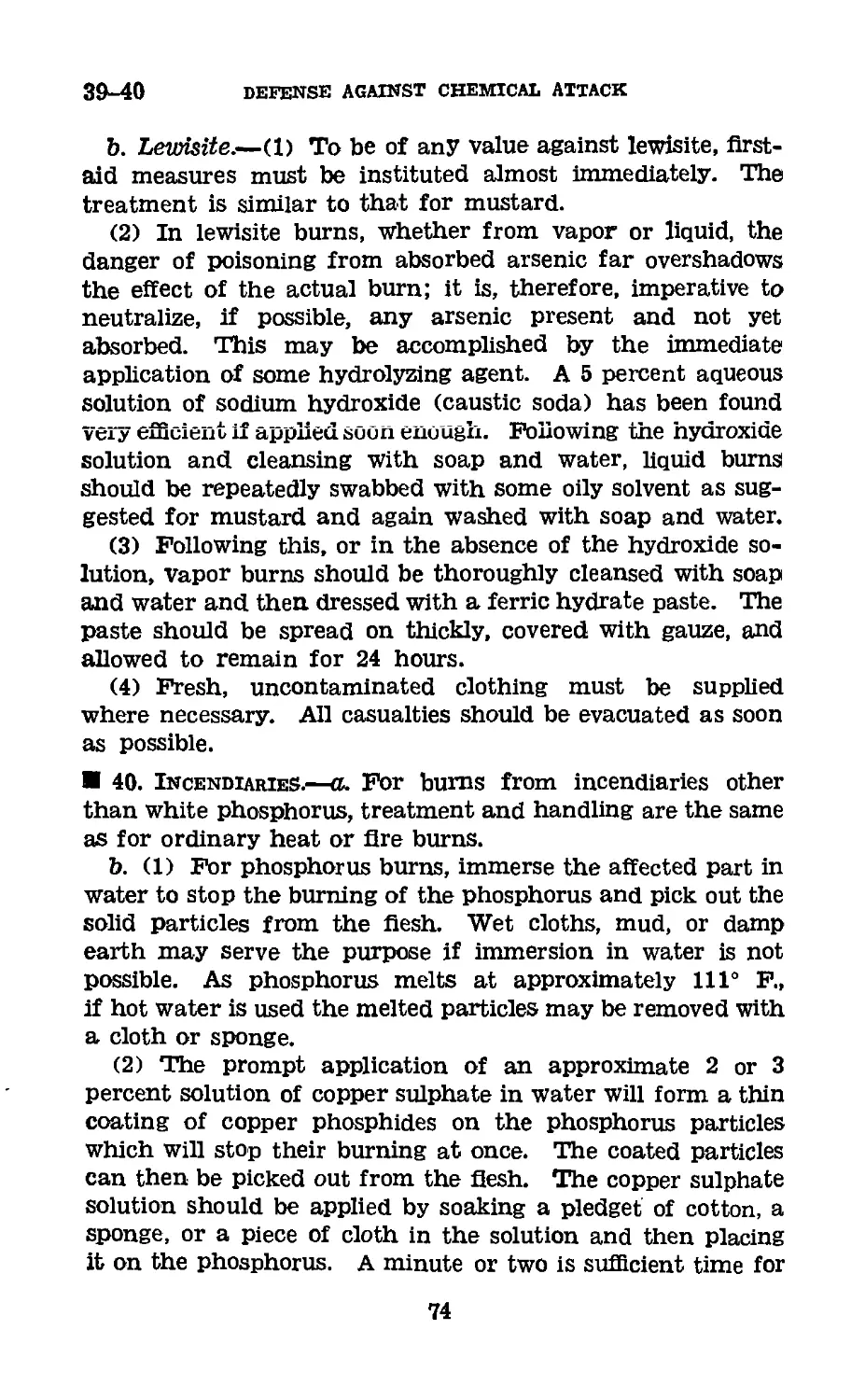
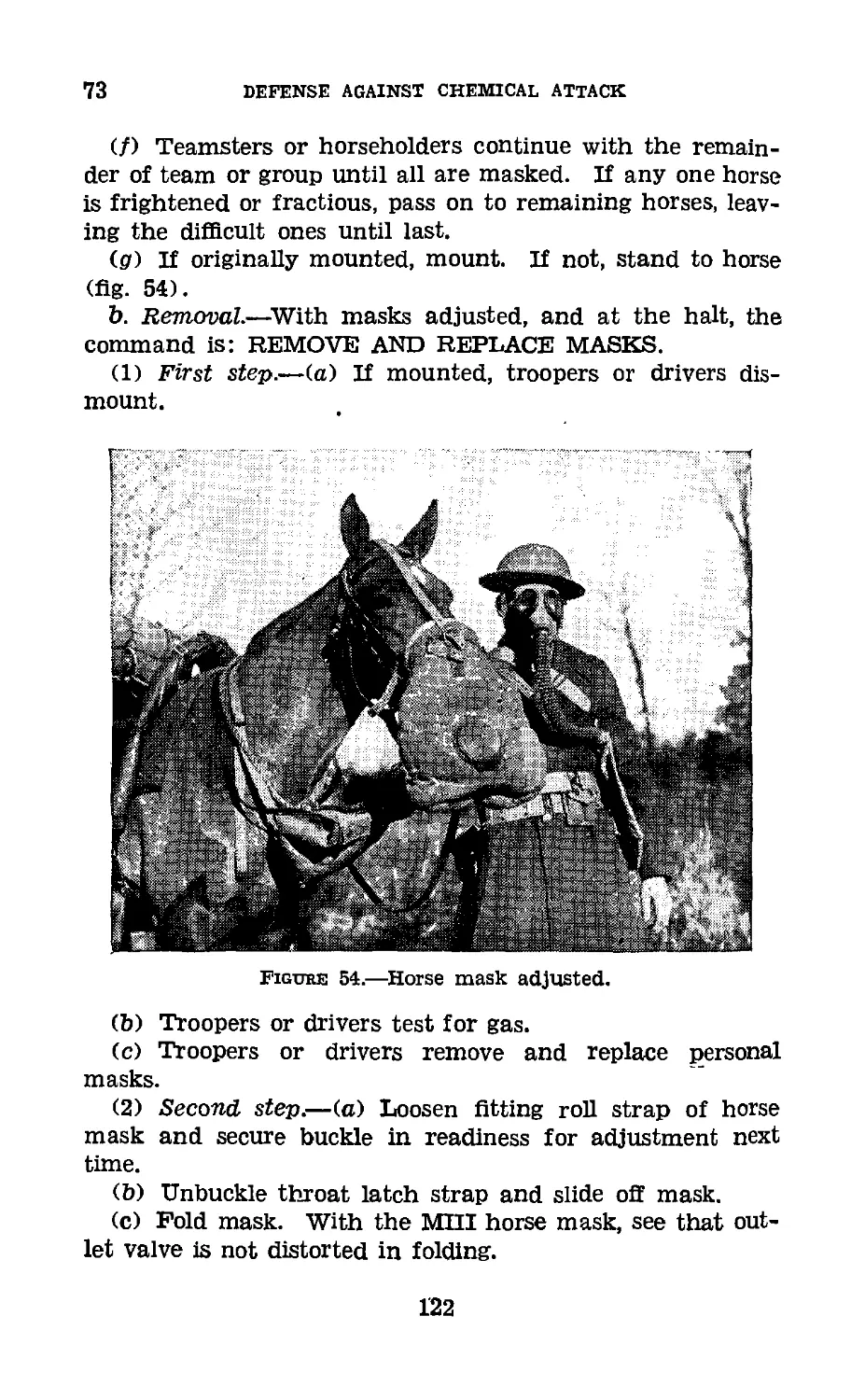

Теги: field manual nuclear weapon weapon
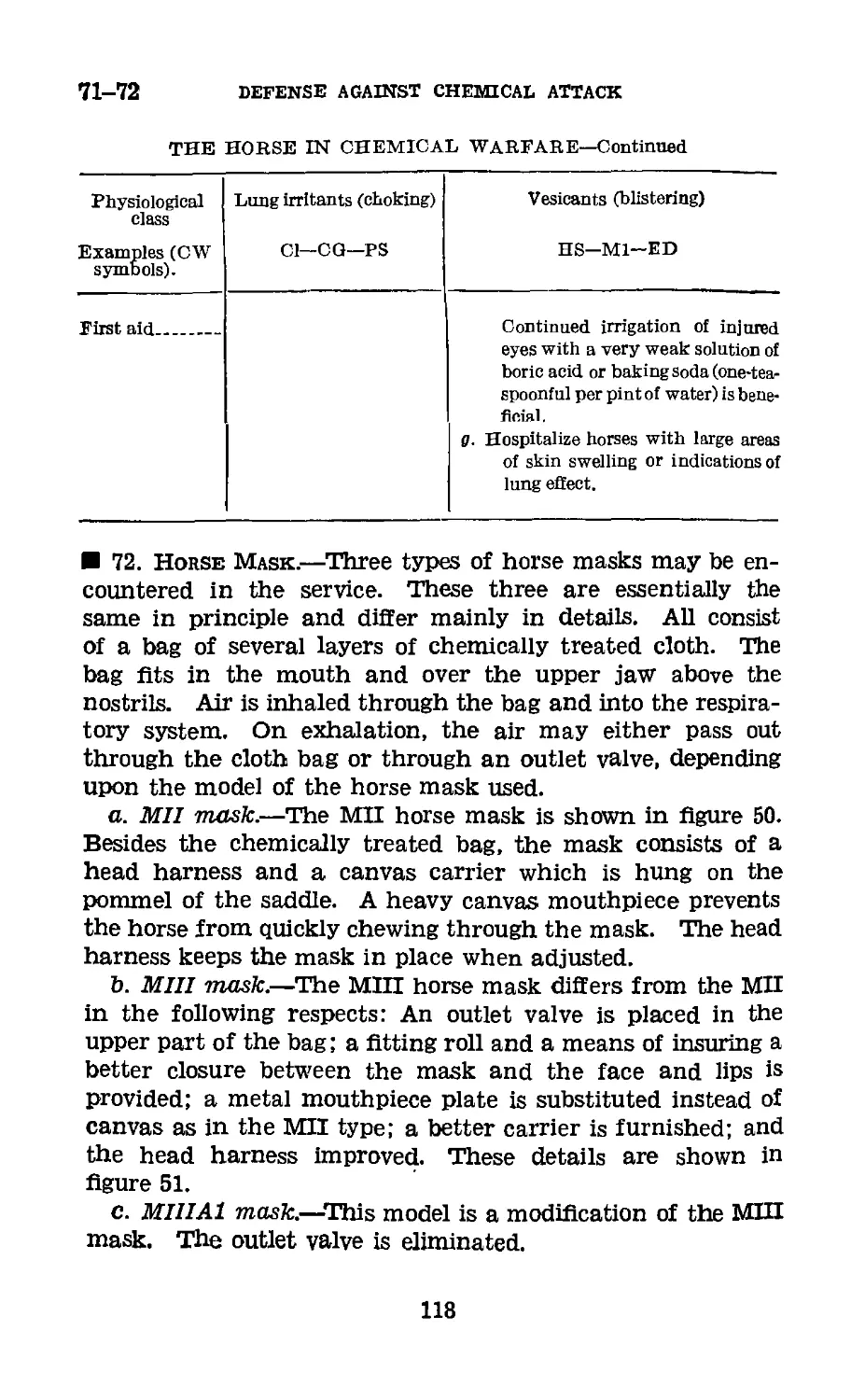
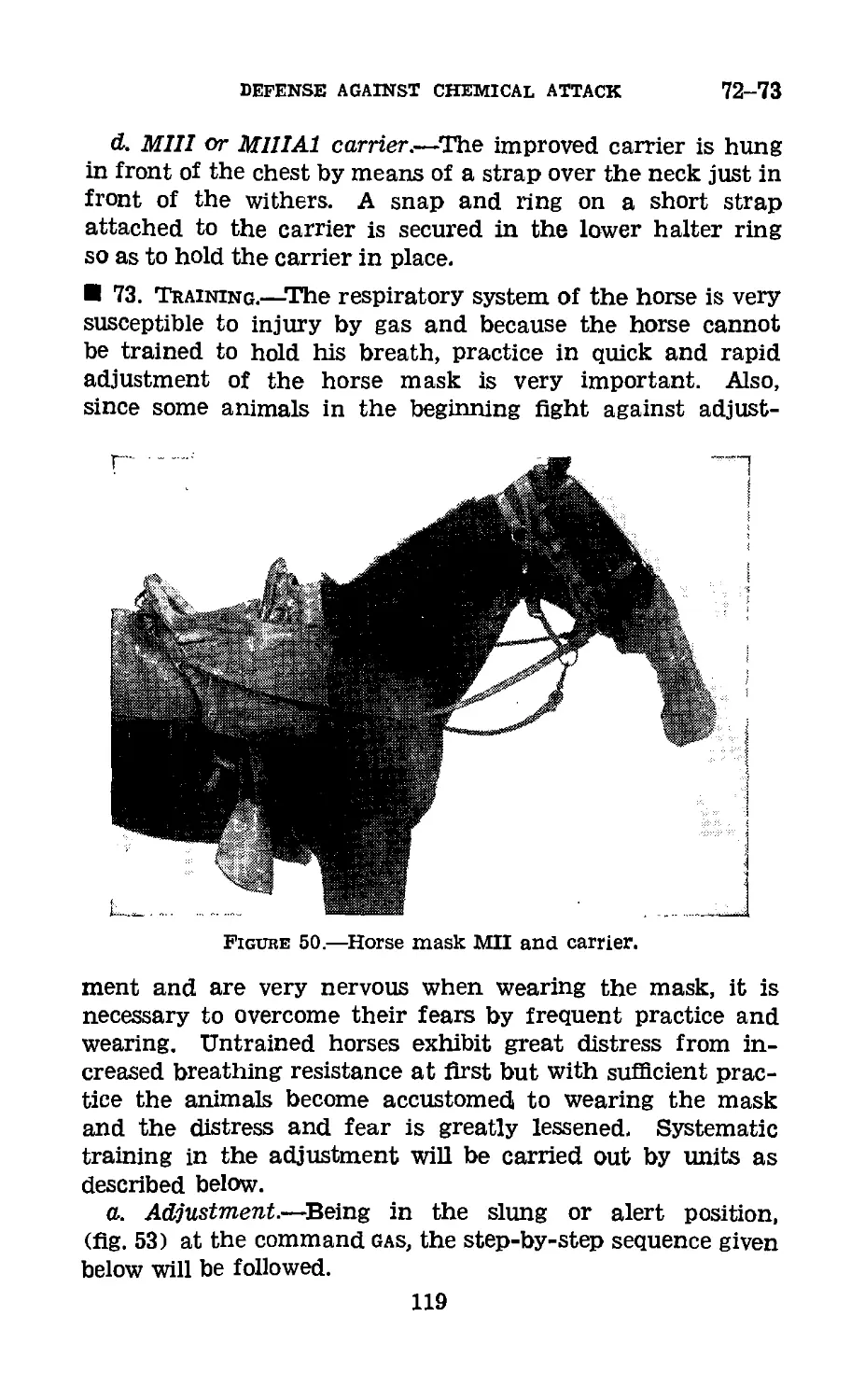
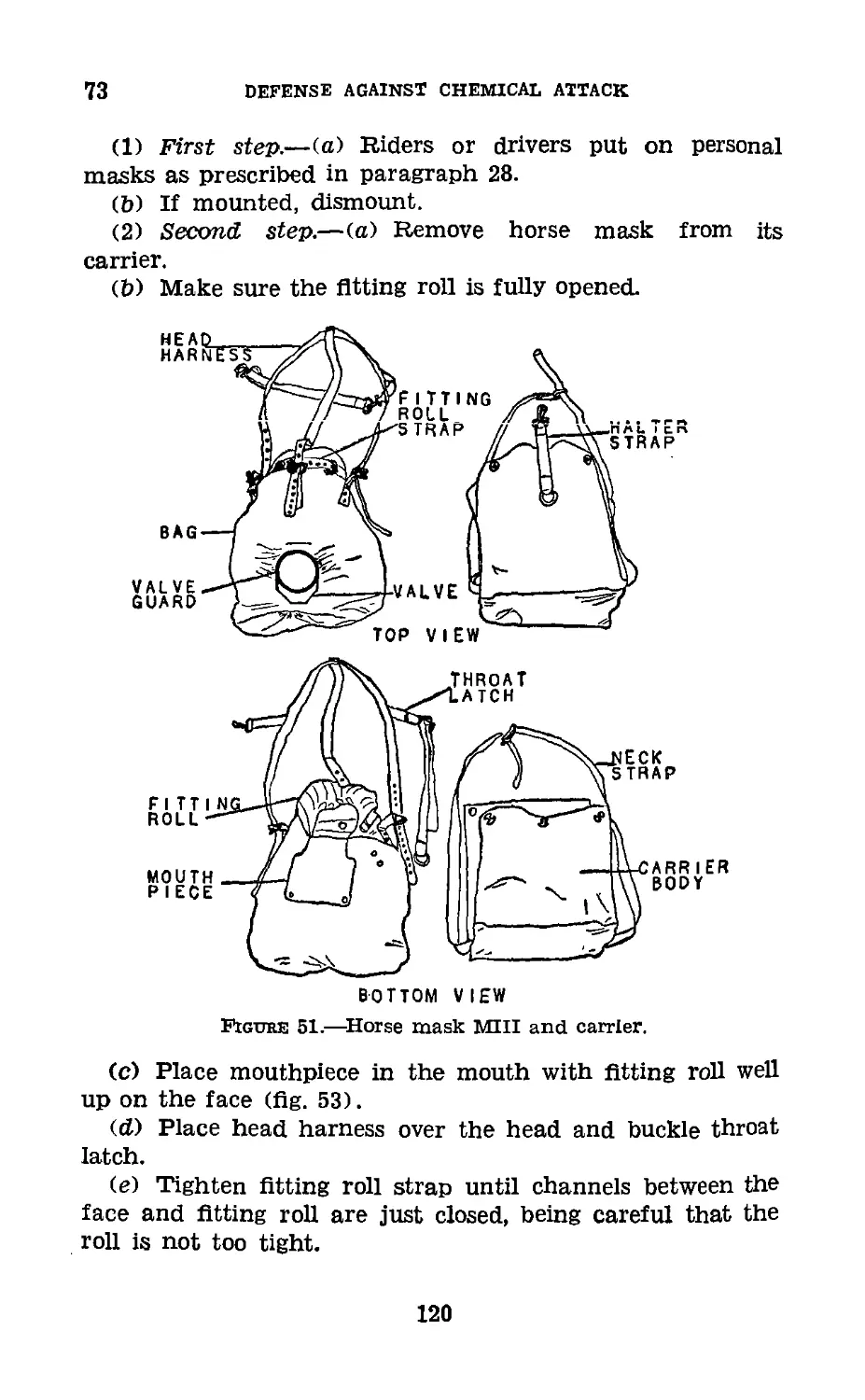
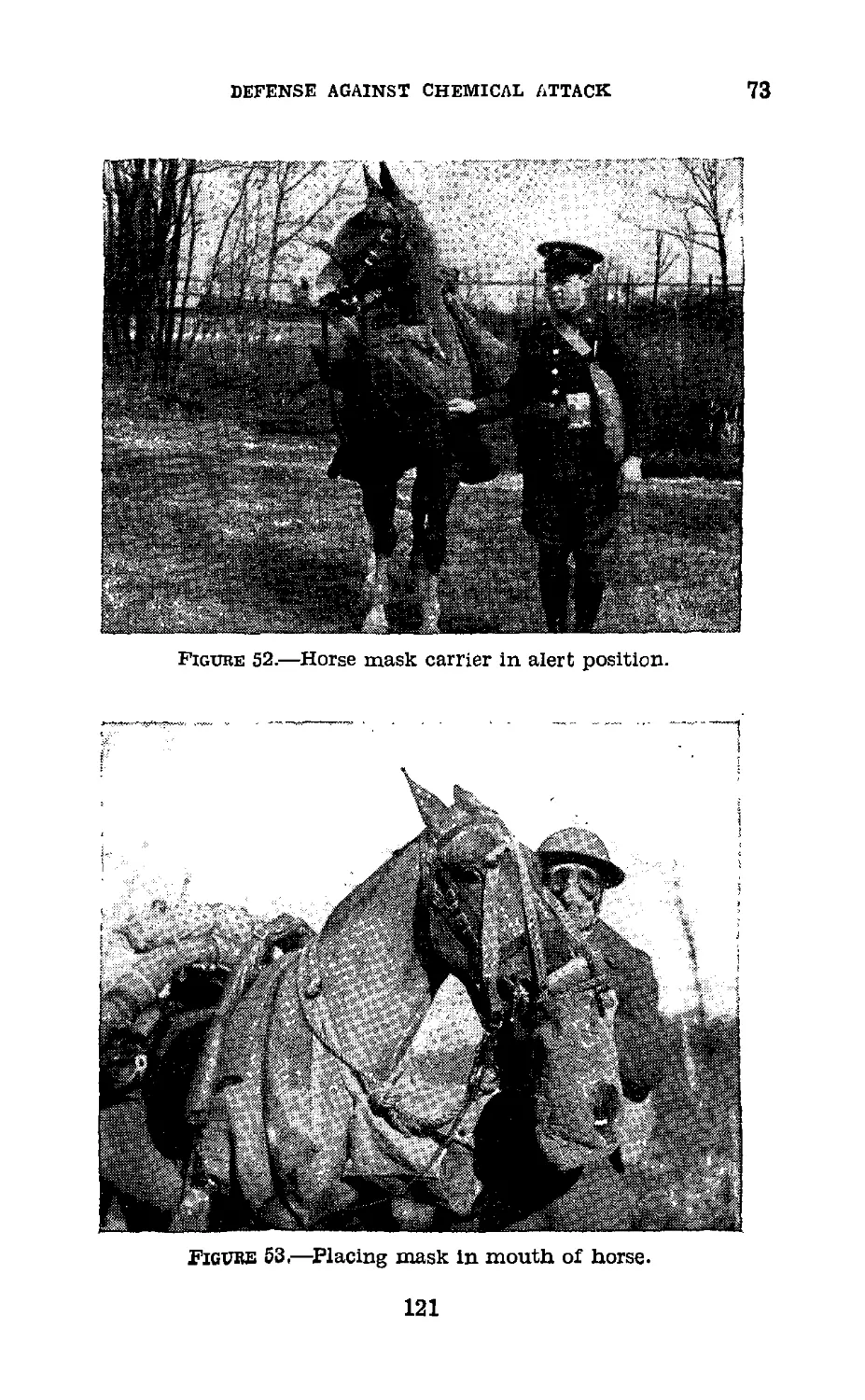
Год: 1940



Текст
                    FM 21-40
WAR DEPARTMENT
BASIC FIELD MANUAL
j»
DEFENSE AGAINST
CHEMICAL ATTACK
FM 21-40
BASIC FIELD MANUAL
DEFENSE AGAINST CHEMICAL
ATTACK
Prepared under direction of the
Chief of the Chemical Warfare Service
UNITED STATES
GOVERNMENT PRINTING OFFICE
WASHINGTON: 1940
For sale by the Superintendent of Documents, Washington» D. C. - Price 20 cents
WAR DEPARTMENT,
Washington, May 1,1940
FM 21-40, Defense Against Chemical Attack, is publish
for the information and guidance of all concerned.
[A.G. 062.11 (2-28-40).]
By Order of the Secretary of War:
G. C. MARSHALL,
Chief of Staff
Official:
E. S. ADAMS,
Major General,
The Adjutant General.
II
TABLE OF CONTENTS
Paragraphs Page
Section I. General_________________________________ 1-3	1
Л. Principal chemical agents_______________ 4r-6	3
Ш. Use of chemical agents In the field____ 7-17	12
IV.	Protection and protective equipment__ 18-27	23
V.	The gas mask__________________________ 28-34	28
VI.	First aid for gas casualties__________ 35-40	72
VII.	Organization and duties of	personnel_ 41-49	75
VIII.	Tactical protection___________________ 50—57	84
IX.	Training in defense against chemical
attack_____________________________________ 58-68	96
X.	Animal protection_____________________ 69—76	113
XI.	Training mask MI______________________ 77-84	124
Appendix. Form for standing orders____________________ 144
Index_________________________________________________ 146
III
FM 21-40
BASIC FIELD MANUAL
DEFENSE AGAINST CHEMICAL ATTACK
(The matter contained herein supersedes chapter 8, Basic Field
Manual, volume I, December 31, 1937 (Including Cl, May 25, 1939).)
Section I
GENERAL
 1. Object of Instruction.—The object of instruction and
training in defense against chemical attack is to—
a.	Minimize casualties from enemy chemical attacks.
b.	Prevent undue interruption to normal military action
during cdmbat.
 2. Scope of Instruction.—The scope of instruction
includes—
a.	A description of chemical agents that may be encoun-
tered in the field, their properties and physiological effects.
b.	Effects of weather and terrain on the use of chemical
agents.
c.	Methods of projecting chemical agents.
d.	Use and care of protective equipment.
e.	Methods of decontaminating areas and equipment.
/. First-aid treatment for gas casualties.
g.	Organization and duties of individuals in defense
against chemical attack.
h.	Duties of gas sentries.
i.	Tactical protective measures against chemical attacks.
fl 3. Standards of Proficiency.—a. The individual.—The in-
dividual soldier will be proficient in the essentials of defense
against chemical attack described in sections I to VII, in-
clusive. In addition, officers and gas noncommissioned
officers will be proficient in their duties as prescribed in sec-
tions Vin and IX. An outline of standards of proficiency in
the protection of the individual is given below:
(1) Chemical agents.—(a) Ability to identify a chemical
agent in the field by odor, color, and physical state.
1
3
DEFENSE AGAINST CHEMICAL ATTACK
(b) Knowledge of—
1.	Persistency of the principal gases.
2.	Effect produced on the body upon contact with the
agent.
3.	Protection required against all classes of agents.
4.	Methods of decontaminating areas and equipment.
(2)	First-aid treatment for gas casualties.—(a) Recog-
nition of the effects of agents.
(b)	Differentiation between seriously and slightly gassed
cases.
(c)	Application of remedial measures pending medical aid.
(3)	Protection.—(a) Gas mask.
1.	Proficiency in gas mask drill.
2.	Knowledge of kind and degree of protection afforded
by the gas mask.
3.	Knowledge of when to use and remove the gas
mask.
4.	Ability to take proper care of the gas mask.
(b)	Protective clothing.
1.	Knowledge of when and how to use protective
clothing.
2.	Knowledge of proper care of protective clothing.
(c)	Gasproof shelters.
1.	Knowledge of requirements to make a shelter gas-
proof; methods of entering and leaving gasproof
shelters; method of clearing gas from shelters.
2.	Ability to determine the presence of gas in a shelter,
(d) Protection of animals.
1.	Knowledge of use of protective equipment for
animals.
2.	Ability to assist the animal in securing protection.
(4) Duties of gas sentries.—(a) Ability to detect agents in
the field by odor, color, and physical state, sounding the gas
alarm only when necessary.
(b) Knowledge of weather and terrain conditions favorable
for enemy attack by chemical agents.
(c) Ability to recognize sounds indicating probable instal-
lation of weapons and projection of chemical agents by the
enemy.
2
DEFENSE AGAINST CHEMICAL ATTACK
3-4
b. The organization.—The proficiency of an organization
in defense against chemical attack depends primarily on the
proficiency of every member thereof as prescribed in a above.
In addition, it requires the availability of the prescribed
quota of gas officers and gas noncommissioned officers, and
the necessary number of trained gas sentries and gas recon-
naissance personnel to meet the probable requirements of
combat. It also includes the maintenance in serviceable
condition of adequate protective clothing, protective equip-
ment, and protective supplies and the training of the unit
as a whole so that it will efficiently take the collective meas-
ures and carry out the tactical procedure prescribed herein.
Section П
PRINCIPAL CHEMICAL AGENTS
 4. Definitions.—a. A chemical agent is a substance useful
in war which, after release and acting directly through its
chemical properties, is capable of producing a toxic effect, a
powerful irritant effect, a screening smoke, or an incendiary
action.
b.	A persistent agent is one which will maintain an effec-
tive vapor concentration in the air at point of release for
more than 10 minutes. An effective concentration is one
which necessitates protection of any kind. Some persistents
last for days and even weeks.
c.	A nonpersistent agent is one whose effectiveness in the
air at point of release is dissipated within 10 minutes.
d.	A casualty agent is a material of such physical and
chemical characteristics that a dangerous or killing concen-
tration can be set up under conditions encountered in the
field. Casualty agents are therefore used directly against
personnel for the primary purpose of producing casualties.
e.	A harassing agent is one used to force masking and
thus slow up enemy operations. Only those agents which
produce this result with the expenditure of small quantities
Of ammunition are considered primarily as harassing agents.
Lacrimators and irritant smokes are the principal agents of
this type.
3
4-5
DEFENSE AGAINST CHEMICAL ATTACK
/. Ah incendiary is a; chemical agent used primarily for
setting fire to materiel. It may produce casualties due to
heat burns.
g.	A lung irritant is a chemical agent which, when
breathed, causes irritation and inflammation of the interior
portion of the bronchial tubes and lungs. Its primary physi-
ological action is limited to the respiratory tract.
h.	A vesicant is a chemical agent which is readily absorbed
or dissolved in both the exterior and interior parts of the
human body, followed by the production of inflammation,
bums, and destruction of tissue.
i.	A lacrimator is a chemical agent which causes a copious
flow of tears and intense, though temporary, eye pains.
j.	An irritant smoke is a chemical agent which can be dis-
seminated as extremely small solid or liquid particles in air,
and when so disseminated, causes intolerable sneezing, cough-
ing, lacrimation, or headache followed by nausea and tem-
porary physical disability when breathed in very low
concentrations.
fc. A sternutator is an irritant smoke.
I. A screening smoke is a chemical agent used to blind hos-
tile observation. With the exception of the burning action
of particles of phosphorus or liquid FS on the skin, smokes
have little or no injurious effect on personnel.
 5. Classification.—a. Physical state.—Chemical agents
may be encountered as gases, liquids, or solids. This classi-
fication is based on their physical condition at ordinary tem-
peratures likely to be encountered in the field.
b.	Physiological effect.—Chemical agents affect particular
parts of the body in several ways. They are classified for
these physiological effects as—
(1)	Lung irritants.
(2)	Vesicants.
(3)	Lacrimators.
(4)	Irritant smokes.
(5)	Incendiaries.
c.	Tactical use.—Chemical agents are classified in ac-
cordance with their principal tactical use as—
(1)	Casualty agents.
(2)	Harassing agents.
4
DEFENSE AGAINST CHEMICAL ATTACK
5-45
(3)	Screening agents.
(4)	Incendiaries.
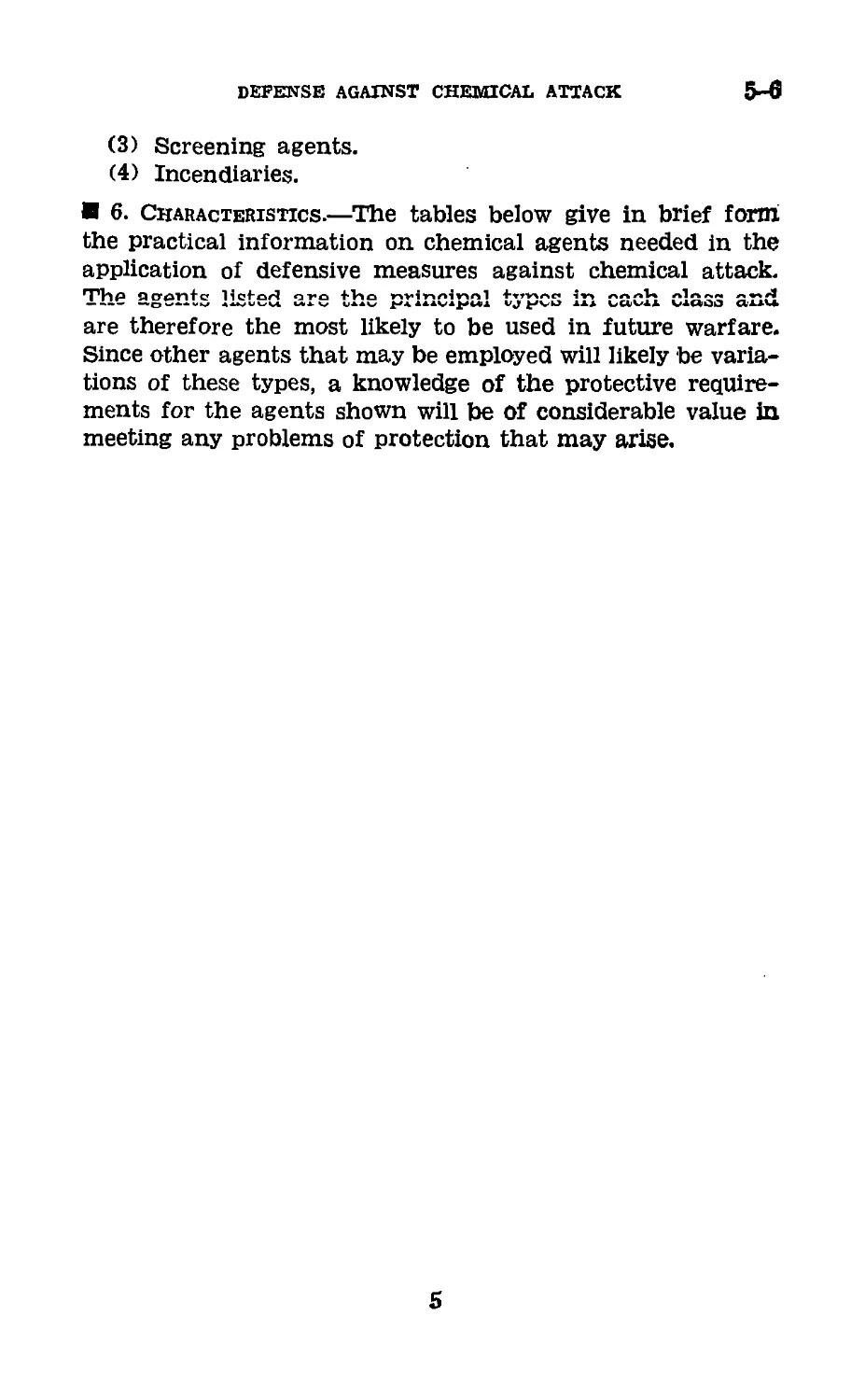
 6. Characteristics.—The tables below give in brief form
the practical information on chemical agents needed in the
application of defensive measures against chemical attack.
The agents listed are the principal types in each class and
are therefore the most likely to be used in future warfare.
Since other agents that may be employed will likely be varia-
tions of these types, a knowledge of the protective require-
ments for the agents shown will be Of considerable value in
meeting any problems of protection that may arise.
5
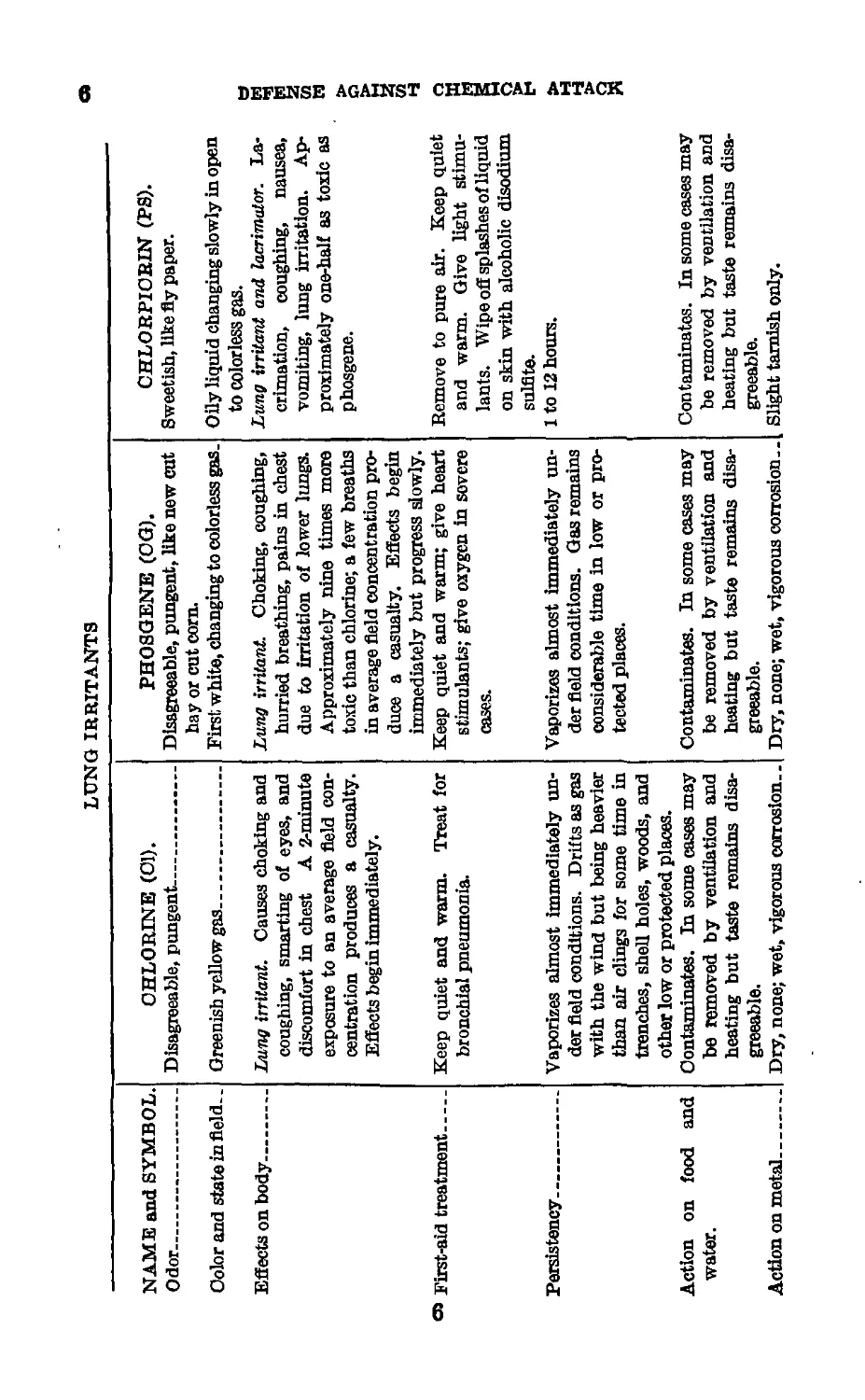
LUNG IRRITANTS	“
NAME and SYMBOL.	CHLORINE (01).	PHOSGENE (OG).	CHLORPIORIN (PS).
Odor			Disagreeable, pungent			Disagreeable, pungent, like new cut hay or cut corn.	Sweetish, like fly paper.
Color and state in field..	Greenish yellow gas				First; white, changing to colorless gas.	Oily liquid changing slowly in open to colorless gas.
Effects on body—		Lung irritant. Causes choking and coughing, smarting of eyes, and discomfort in chest A 2-minute exposure to an average field con- centration produces a casualty. Effects begin immediately.	Lung irritant. Choking, coughing, hurried breathing, pains in chest due to irritation of lower lungs. Approximately nine times more toxic than chlorine; a few breaths in average field concentration pro- duce a casualty. Effects begin immediately but progress slowly.	Lung irritant and lacrimator. La- crimation, coughing, nausea, vomiting, lung irritation. Ap- proximately one-half as toxic as phosgene.
05 First-aid treatment		Keep quiet and warm. Treat for bronchial pneumonia.	Keep quiet and warm; give heart stimulants; give oxygen in severe cases.	Remove to pure air. Keep quiet and warm. Give light stimu- lants. Wipeoffsplashesofliquid on skin with alcoholic disodium sulfite.
Persistency			Vaporizes almost immediately un- der field conditions. Drifts as gas with the wind but being heavier than air dings for some time in trenches, shell holes, woods, and other low or protected places.	Vaporizes almost immediately un- der field conditions. Gas remains considerable time in low or pro- tected places.	1 to 12 hours.
Action on food and	Contaminates. In some cases may	Contaminates. In some cases may	Contaminates. In some cases may
water.	be removed by ventilation and heating but taste ramмns disa- greeable.	be removed by ventilation and heating but taste remains disa- greeable.	be removed by ventilation and heating but taste remains disa- greeable.
Action on metal		Dry, none; wet, vigorous corrosion-.	Dry, none; wet, vigorous corrosion__	Slight tarnish only.
defense against chemical attack
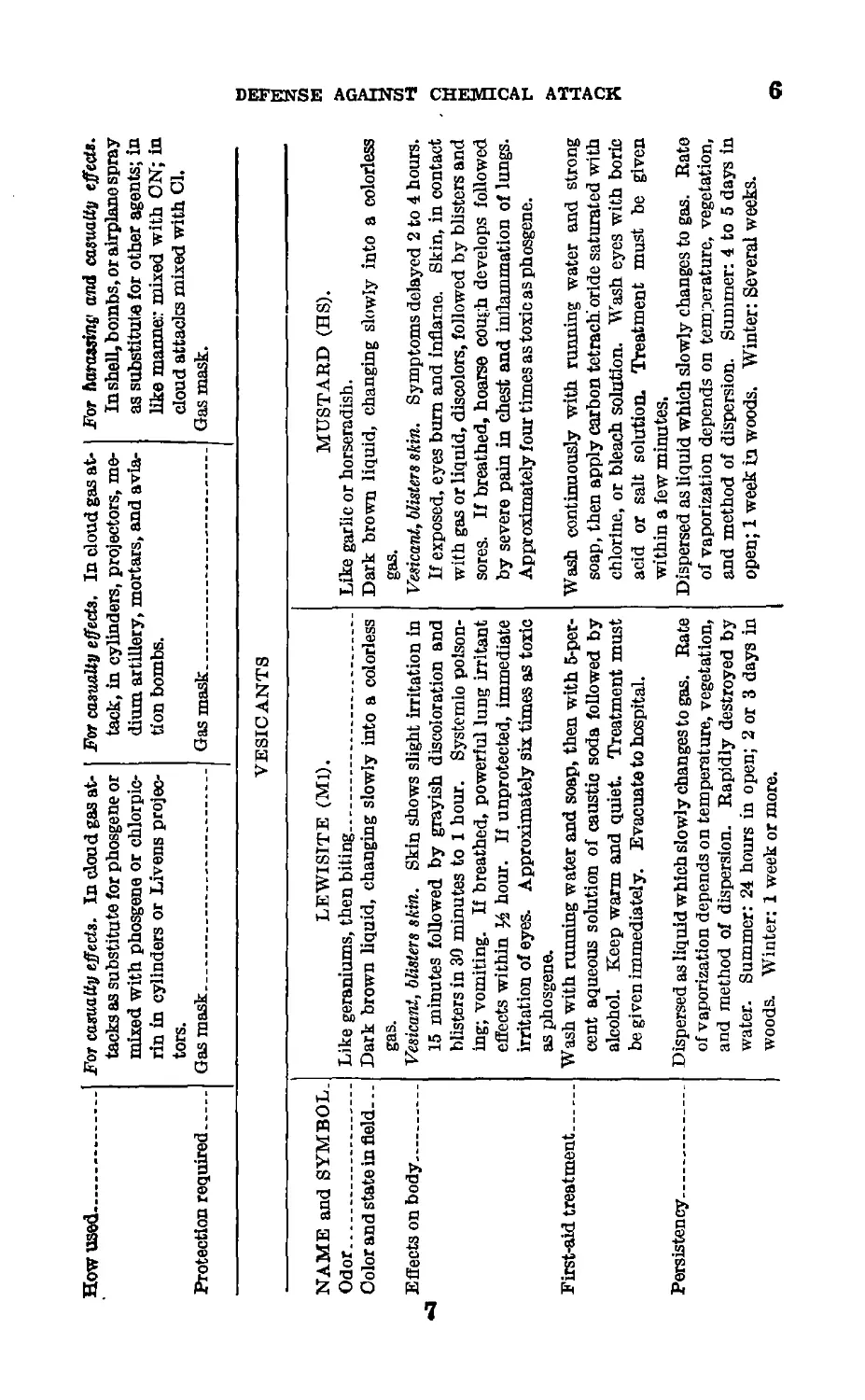
How used		 Protection required		For casualty effects. In cloud gas at- tacks as substitute for phosgene or mixed with phosgene or chlorpic- rin in cylinders or Livens projec- tors. Gas mask___			For casualty effects. In cloud gas at- tack, in cylinders, projectors, me- dium artillery, mortars, and avia- tion bombs. Gas mask			-	.			For harassing and casualty effect*. In shell, bombs, or airplane spray as substitute for other agents; in like manne- mixed with ON; in cloud attaclcs mixed with Cl. Gas mask.
VESICANTS
NAME and SYMBOL.	LEWISITE (Ml).	MUSTARD (HS).
Odor			Like geraniums, then biting.		Like garlic or horseradish. Dark brown liquid, changing slowly into a colorless gas.
Color and state in field-..	Dark brown liquid, changing slowly into a colorless gas.
Effects on body			Vesicant, blisters skin. Skin shows slight irritation in	Veaicanf, blisters skin. Symptoms delayed 2 to 4 hours.
•q	15 minutes followed by grayish discoloration and blisters in 30 minutes to 1 hour. Systemio poison- ing; vomiting. If breathed, powerful lung irritant effects within Из hour. If unprotected, immediate irritation of eyes. Approximately six times as toxic as phosgene.	If exposed, eyes burn and inflarae. Skin, in contact with gas or liquid, discolors, followed by blisters and sores. If breathed, hoarse cough develops followed by severe pain in chest and iniiammation of lungs. Approximately four times as toxic as phosgene.
First-aid treatment		Wash with running water and soap, then with 5-per- cent aqueous solution of caustic soda followed by alcohol. Keep warm and quiet. Treatment must be given immediately. Evacuate to hospital.	Wash continuously with running water and strong soap, then apply carbon tetrachoride saturated with chlorine, or bleach solution. Wash eyes with boric acid or salt solution. Treatment must be given within a few minutes.
Persistency			Dispersed as liquid which slowly changes to gas. Rate of vaporization depends on temperature, vegetation, and method of dispersion. Rapidly destroyed by water. Summer: 24 hours in open; 2 or 3 days in woods. Winter: 1 week or more.	Dispersed as liquid which slowly changes to gas. Rate of vaporization depends on temperature, vegetation, and method of dispersion. Summer: 4 to 5 days in open; 1 week in woods. Winter: Several weeks.
DEFENSE AGAINST CHEMICAL ATTACK
О)
Ci
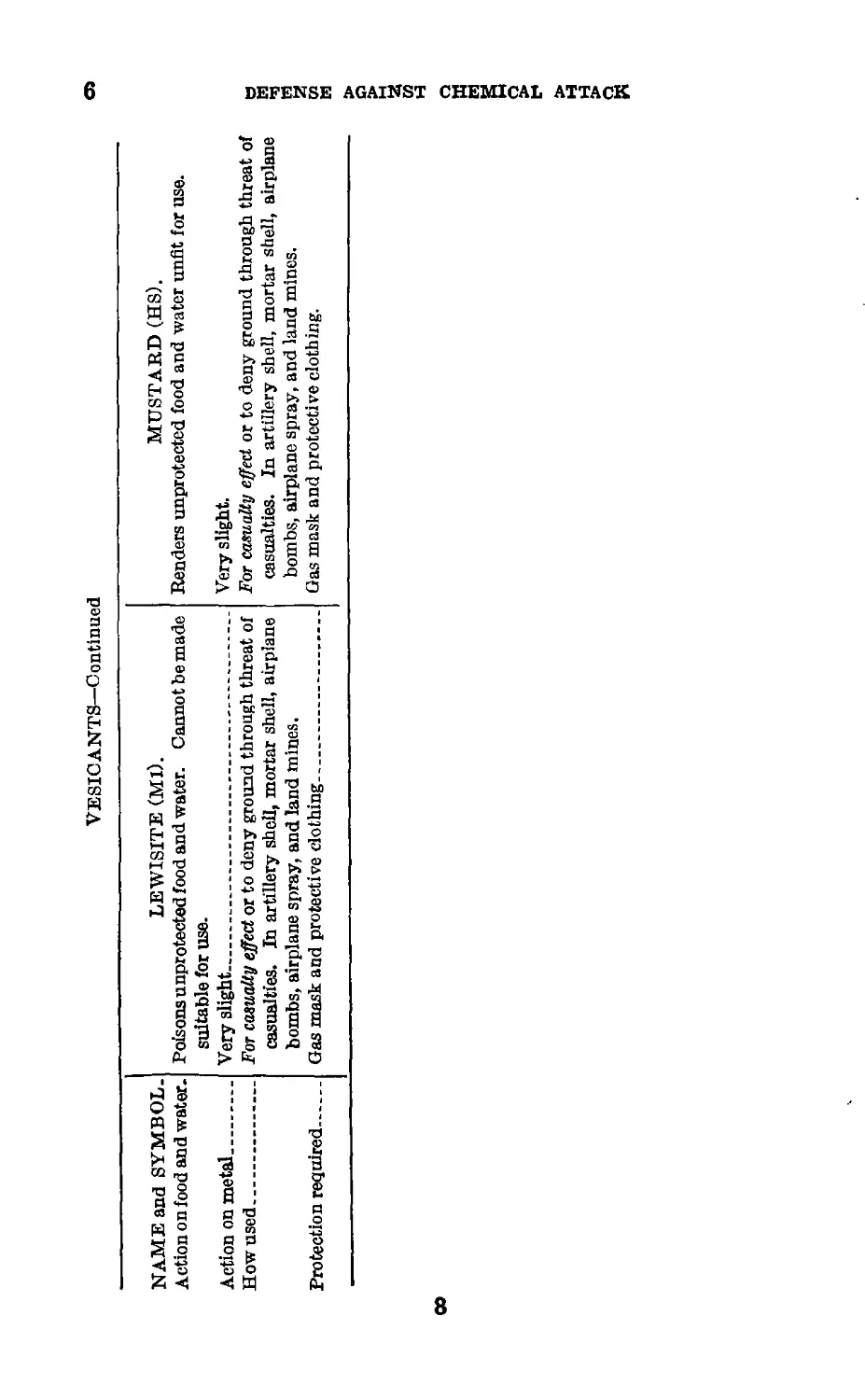
VESICANTS—Continued
NAME and SYMBOL. Action on food and water. Action on metal	 How used		 Protection required			LEWISITE (Ml). Poisons unprotected food and water. Cannot be made suitable for use. Very slight					 For casualty effect or to deny ground through threat of casualties. In artillery shell, mortar shell, airplane bombs, airplane spray, and land mines. Gas mask and protective clothing-			MUSTARD (HS). Renders unprotected food and water unfit for use. Very slight. For casualty effect or to deny ground through threat of casualties. In artillery shell, mortar shell, airplane bombs, airplane spray, and land mines. Gas mask and protective clothing.
CO
DEFENSE AGAINST CHEMICAL ATTACK
defense against chemical attack	6
LACRIMATORS
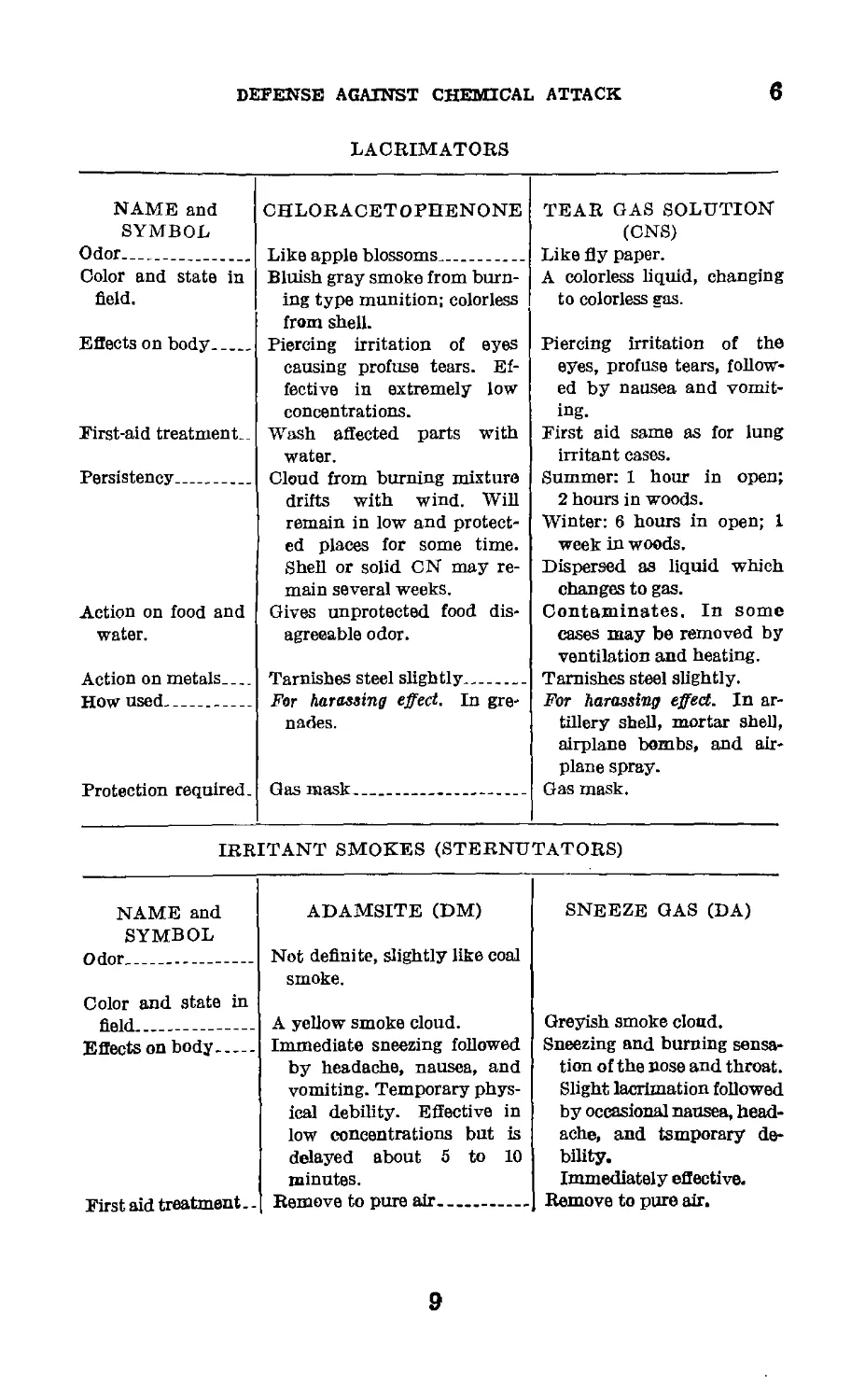
NAME and SYMBOL	CHLORACETOPHENONE	TEAR GAS SOLUTION (CNS)
Odor		Like apple blossoms		Like fly paper.
Color and state in	Bluish gray smoke from burn-	A colorless liquid, changing
field.	ing type munition; colorless from shell.	to colorless gas.
Effects on body		Piercing irritation of eyes causing profuse tears. Ef- fective in extremely low concentrations.	Piercing irritation of the eyes, profuse tears, follow- ed by nausea and vomit- ing.
First-aid treatment..	Wash affected parts with water.	First aid same as for lung irritant cases.
Persistency		Cloud from burning mixture drifts with wind. Will remain in low and protect- ed places for some time. Shell or solid CN may re- main several weeks.	Summer: 1 hour in open; 2 hours in woods. Winter: 6 hours in open; 1 week in woods. Dispersed as liquid which changes to gas.
Action on food and	Gives unprotected food dis-	Contaminates. In some
water.	agreeable odor.	cases may be removed by ventilation and heating.
Action on metals		Tarnishes steel slightly		Tarnishes steel slightly.
How used		For harassing effect. In gre- nades.	For harassing effect. In ar- tillery shell, mortar shell, airplane bombs, and air- plane spray.
Protection required.	Gas mask			Gas mask.
IRRITANT SMOKES (STERNUTATORS)
NAME and SYMBOL	ADAMSITE (DM)	SNEEZE GAS (DA)
Odor	 Color and state in field		Not definite, slightly like coal smoke. A yellow smoke cloud.	Greyish smoke cloud.
Effects on body		Immediate sneezing followed	Sneezing and burning sensa-
First aid treatment..	by headache, nausea, and vomiting. Temporary phys- ical debility. Effective in low concentrations but is delayed about 5 to 10 minutes. Remove to pure air		tion of the nose and throat. Slight lacrimation followed by occasional nausea, head- ache, and tsmporary de- bility. Immediately effective. Remove to pure air.
9
6	DEFENSE AGAINST CHEMICAL ATTACK
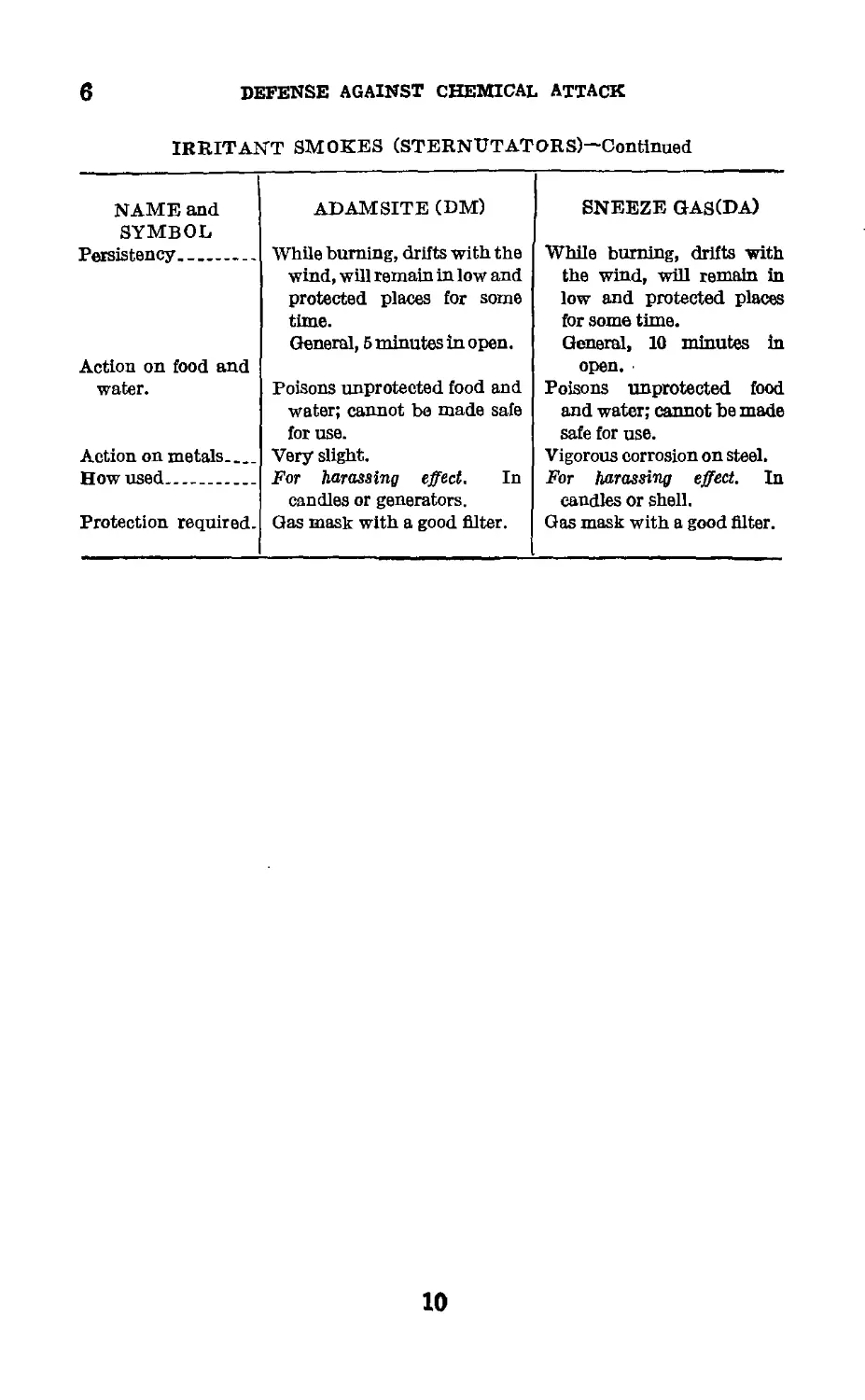
IRRITANT SMOKES (STERNUTATORS)—Continued
NAME and SYMBOL	ADAMSITE (DM)	SNEEZE GAS(DA)
Persistency..		 Action on food and	While burning, drifts with the wind, will remain in low and protected places for some time. General, 5 minutes in open.	While burning, drifts with the wind, will remain in low and protected places for some time. General, 10 minutes in open.
water.	Poisons unprotected food and water; cannot be made safe for use.	Poisons unprotected food and water; cannot be made safe for use.
Action on metals....	Very slight.	Vigorous corrosion on steel.
How used		For harassing effect. In candles or generators.	For harassing effect. In candles or shell.
Protection required.	Gas mask with a good filter.	Gas mask with a good filter.
10
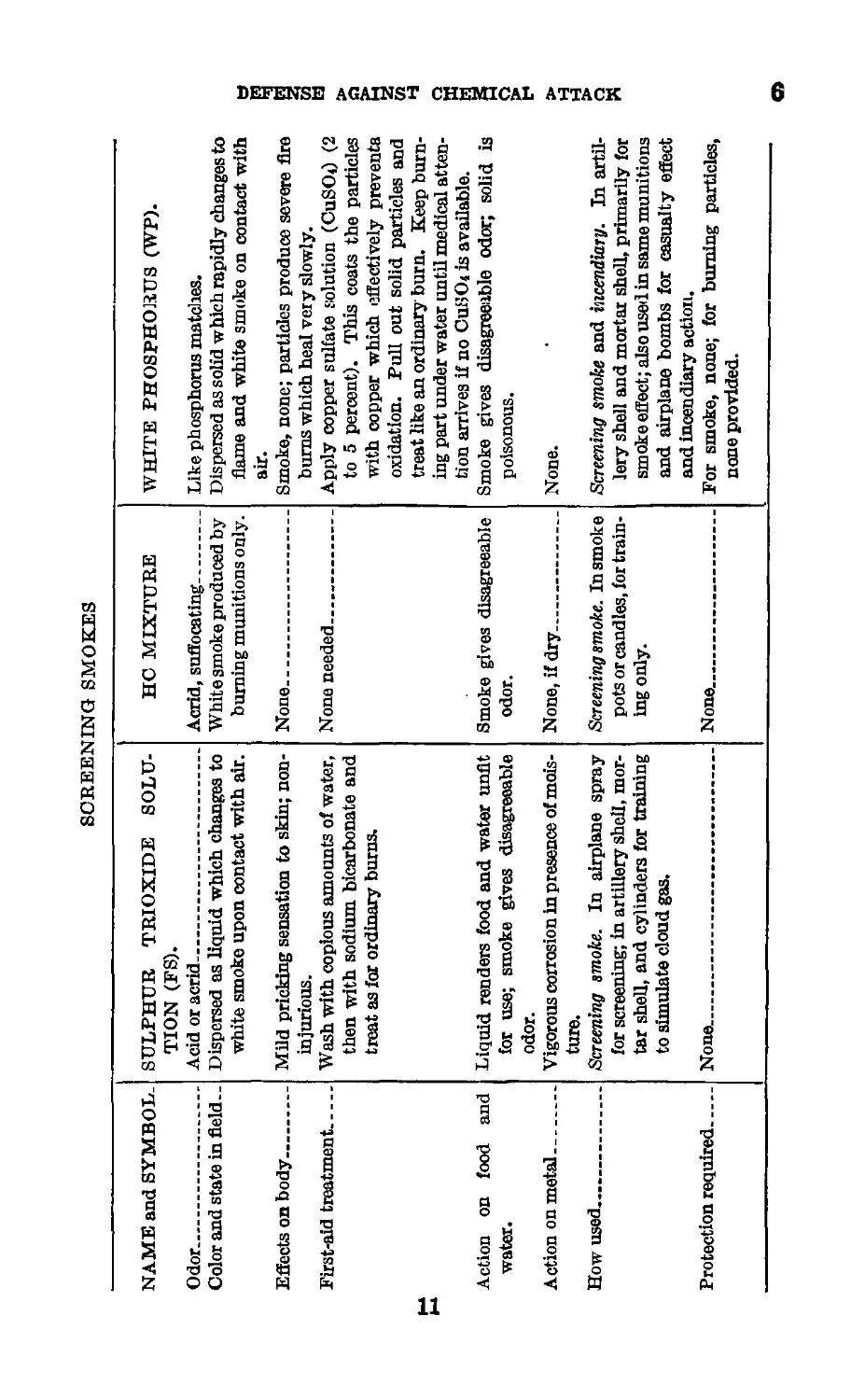
SCREENING SMOKES
NAME and SYMBOL. Odor 			 		SULPHUR TRIOXIDE SOLU- TION (FS). Acid or acrid ...						HC MIXTURE Arridr siiffnretinfr	WHITE PHOSPHORUS (WP). Like phosphorus matches. Dispersed as solid which rapidly changes to flame and white smoke on contact with air. Smoke, none; particles produce severe fire burns which heal very slowly. Apply copper sulfate solution (CuSO<) (2 to 5 percent). This coats the particles with copper which ijffectively prevents oxidation. Pull out solid particles and treat like an ordinary burn. Keep burn- ing part under water until medical atten- tion arrives if no CuSOt is available. Smoke gives disagreeable odor; solid is poisonous. None.
Color and state in field-_ Effects on body..		Dispersed as liquid which changes to white smoke upon contact with air. Mild pricking sensation to skin; non- injurious. Wash with copious amounts of water, then with sodium bicarbonate and treat as for ordinary burns. Liquid renders food and water unfit for use; smoke gives disagreeable odor. Vigorous corrosion in presence of mois-	White smoke produced by burning munitions only. None
First-aid treatment			None needed......
Action on food and water. Action on metal			Smoke gives disagreeable odor. None, if dry ... .
How used.....			ture. Screening smoke. In airplane spray for screening; in artillery shell, mor- tar shell, and cylinders for training to simulate cloud gas. None	................	Screening smoke. In smoke pots or candles, for train- ing only. None	Screening smoke and incendiary. In artil- lery shell and mortar shell, primarily for smoke effect; also used in same munitions and airplane bombs for casualty effect and incendiary action. For smoke, none; for burning particles, none provided.
Protection required. _ _.

IE AGAINST CHEMICAL ATTACK
7-9
defense against chemical attack
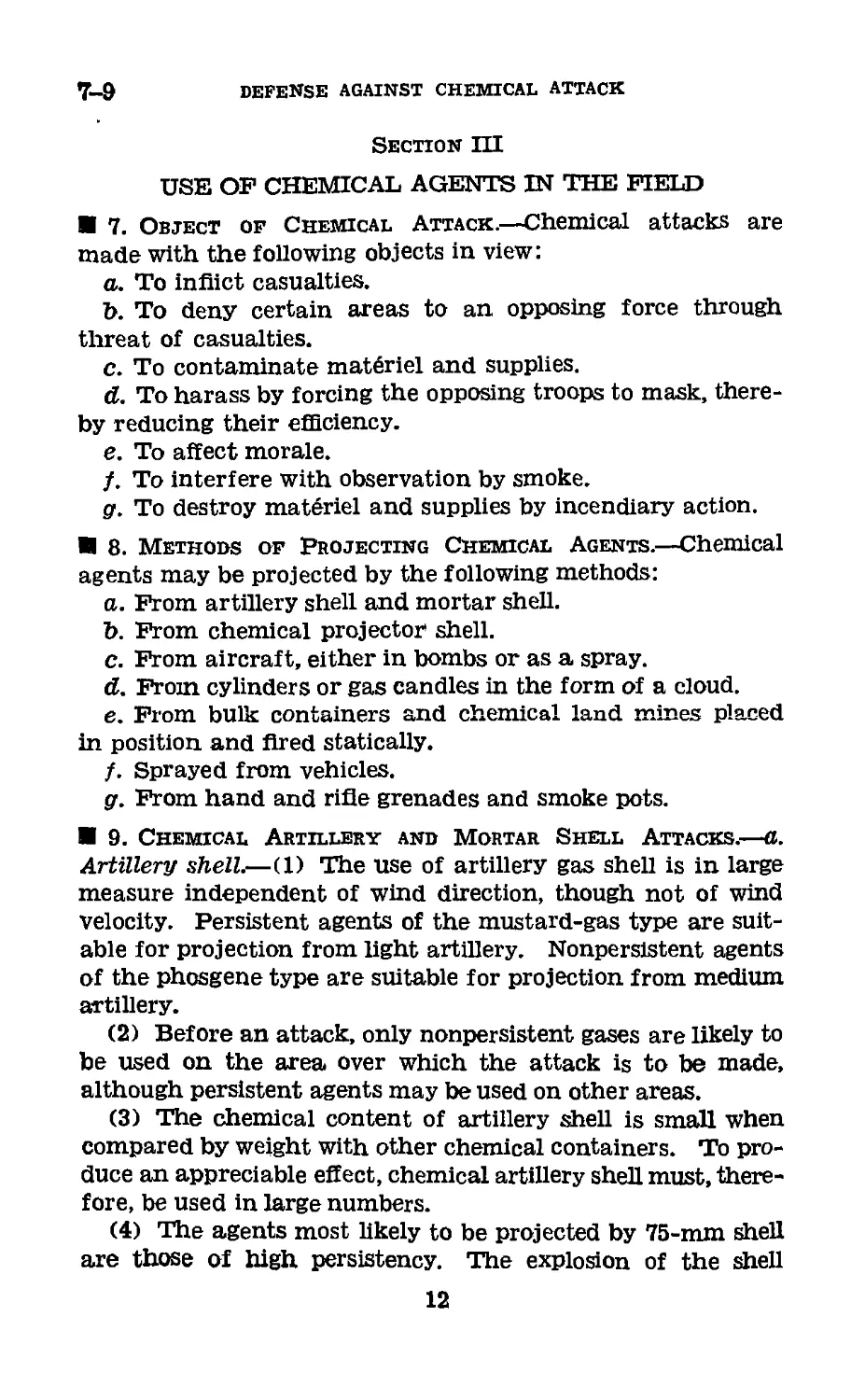
Section III
USE OF CHEMICAL AGENTS IN THE FIELD
 7. Object of Chemical Attack.—Chemical attacks are
made with the following objects in view:
a.	To inflict casualties.
b.	To deny certain areas to an opposing force through
threat of casualties.
c.	To contaminate materiel and supplies.
d.	To harass by forcing the opposing troops to mask, there-
by reducing their efficiency.
e.	To affect morale.
f.	To interfere with observation by smoke.
ff. To destroy materiel and supplies by incendiary action.
 8. Methods of Projecting Chemical Agents.—Chemical
agents may be projected by the following methods:
a.	From artillery shell and mortar shell.
b.	From chemical projector shell.
c.	From aircraft, either in bombs or as a spray.
d.	From cylinders or gas candles in the form of a cloud.
e.	From bulk containers and chemical land mines placed
in position and fired statically.
f.	Sprayed from vehicles.
g.	From hand and rifle grenades and smoke pots.
 9. Chemical Artillery and Mortar Shell Attacks.—a.
Artillery shell.—(1) The use of artillery gas shell is in large
measure independent of wind direction, though not of wind
velocity. Persistent agents of the mustard-gas type are suit-
able for projection from light artillery. Nonpersistent agents
of the phosgene type are suitable for projection from medium
artillery.
(2)	Before an attack, only nonpersistent gases are likely to
be used on the area over which the attack is to be made,
although persistent agents may be used on other areas.
(3)	The chemical content of artillery shell is small when
compared by weight with other chemical containers. To pro-
duce an appreciable effect, chemical artillery shell must, there-
fore, be used in large numbers.
(4)	The agents most likely to be projected by 75-mm shell
are those of high persistency. The explosion of the shell
12
DEFENSE AGAINST CHEMICAL ATTACK
9
upon impact throws the agent over an area approximately 14
yards in diameter. The agents most likely to be projected
by the 155-mm shell are mustard, lewisite, phosgene, and
white phosphorus. Upon explosion of the 155-mm shell, the
agent is thrown over an area approximately 50 yards in di-
ameter. With both the 75-mm and the 155-mm shell, the
area over which, the agent is thrown is not centered on the
point of impact but is generally slightly forward of the point
of impact and slightly elongated in the direction of fire.
b.	Mortar shell.—(1) Up to ranges of 2,400 yards, the chem-
ical mortar can establish and maintain heavy concentrations
of both persistent and nonpersistent gas. It is also suitable
for firing white phosphorus for both smoke and casualty
effects.
(2)	The agents most likely to be used in mortars are mus-
tard, lewisite, phosgene, and white phosphorus. The explo-
sion of the shell of the 4.2-inch chemical mortar upon impact
throws the agent over an area approximately 40 yards in
diameter. (See fig. 1.)
c.	Danger areas.—(1) Any point within the radius of burst
of chemical shell, either artillery or mortar, is a danger area;
and any person within such area may become a casualty
unless proper protective measures are taken immediately.
(2)	There is also a danger area extending downwind from
the area of burst. In the case of nonpersistent agents, upon
the explosion of the shell the liquid almost instantaneously
changes into a gas and is borne downwind at the speed of the
wind. This gas cloud spreads at about the rate of 15 percent
of the distance traveled. It eventually becomes so thinned
out by spread, settling out, and other causes, that the concen-
tration is too weak to cause casualties. The distance down-
wind that the cloud is effective varies from two or three hun-
dred yards for a single large caliber shell to several miles in
the case of heavy concentrations over a wide front.
(3)	In the case of the persistent gases, upon the explosion
of the shell a portion of the liquid changes immediately into
a gas and a portion is so finely atomized that it, too, travels
with the wind. The remainder, in liquid form, is distributed
over the ground and slowly changes into a gas, the rate de-
pending upon the temperature. Thus, there is an extremely
224399°—40
-2
13
Figure 1.—Burst of a white phosphorus filled 4.2-inch chemical mortar shell.
DEFENSE AGAINST CHEMICAL ATTACK	g
dangerous area downwind immediately after the burst of a
mustard-gas shell.
Thereafter, until vaporization is complete, there continues
to be an area downwind where there is a constant flow of
mustard vapor; however, the concentration is much less and
the effective distance downwind much less than that im-
mediately following the burst of the shell.
(4)	The distance downwind that a gas of high persistency
is effective immediately following the burst of shell is con-
siderably less than that of a nonpersistent gas. This dis-
tance for the highly persistent gases like mustard will vary
from 200 yards downwind in the case of a single large capac-
ity shell to 1,000 or more yards in the case of a large con-
centration projected over a wide front.
d.	Types of attacks.—The enemy may employ the follow-
ing types of chemical attacks:
(1)	A short concentration on heavily occupied areas with
nonpersistent gas for the purpose of inflicting casualties by
surprise.
(2)	Harassing Are at a slow rate with shell containing
highly or moderately persistent chemical agents, such as
lacrlmatory or vesicant agents.
(3)	Neutralization with highly persistent gas to render
areas untenable and to inflict casualties upon personnel oc-
cupying them. Mustard gas is the type generally used for
this purpose.
(4)	Smoke screens to blanket observation, prevent aimed
fire, screen troop movements, and inflict casualties.
(5)	With incendiaries to set Are to stores, structures, and
vegetation.
e.	Detection of chemical shell.—A chemical shell contain-
ing a liquid can sometimes be distinguished from other shell
by the peculiar intermittent whirring noise it makes in
flight and usually by its low detonation sound.
f.	Protective measures.—Protective measures will differ
slightly depending upon the physiological type of gas en-
countered.
(1) In the case of a lung irritant gas, like phosgene, the
proper measures are to stop breathing until the gas mask
is correctly adjusted and to continue wearing the mask until
15
9-10
DEFENSE AGAINST CHEMICAL ATTACK
the gas concentration has dissipated. The time of mask
wearing will vary.
Normally the agent from a single shell will last about 10
minutes, but if a bombardment is continued, the danger
time is increased. Weather and terrain conditions at the
defender’s position may also greatly extend the effective
time of this type of agent.
(2) For the vesicant gases, the protective measures in-
clude not only the prompt adjustment of the mask, but
also the proper wearing of protective clothing. It must be
remembered that persistent vesicants such as mustard gas
and lewisite in the vapor state will affect eyes and skin and
will injure lung tissue. In the liquid state, these vesicants
may be absorbed directly on the clothing and thence trans-
ferred to the skin, or may be absorbed by vegetation, wood,
concrete, and metal equipment, from which vapors may be
given off or unnoticeable quantities of liquids transferred
to the hands and thence to other parts of the body. Many
wounds may be caused by this transference. If clothing
and equipment become contaminated, they also include the
prompt removal of such articles, the thorough cleansing of
the body with soap and water, and the decontamination of
the infected articles before they are again used. A portion
of the liquid agent will remain in the area of burst for sev-
eral days and during such time it will be dangerous for any
person to enter this area unless completely protected with
protective clothing.
 10. Chemical Projector Shell Attacks.—a. By means of
chemical projectors, a large amount of gas can suddenly be
set free. The cloud produced is of higher concentration
than can be obtained in the field with any other chemical
projectile.
b.	The projector is a simple mortar designed to fire only
one shot per installation. The projectors are usually in-
stalled in batteries of 25 which are fired simultaneously by
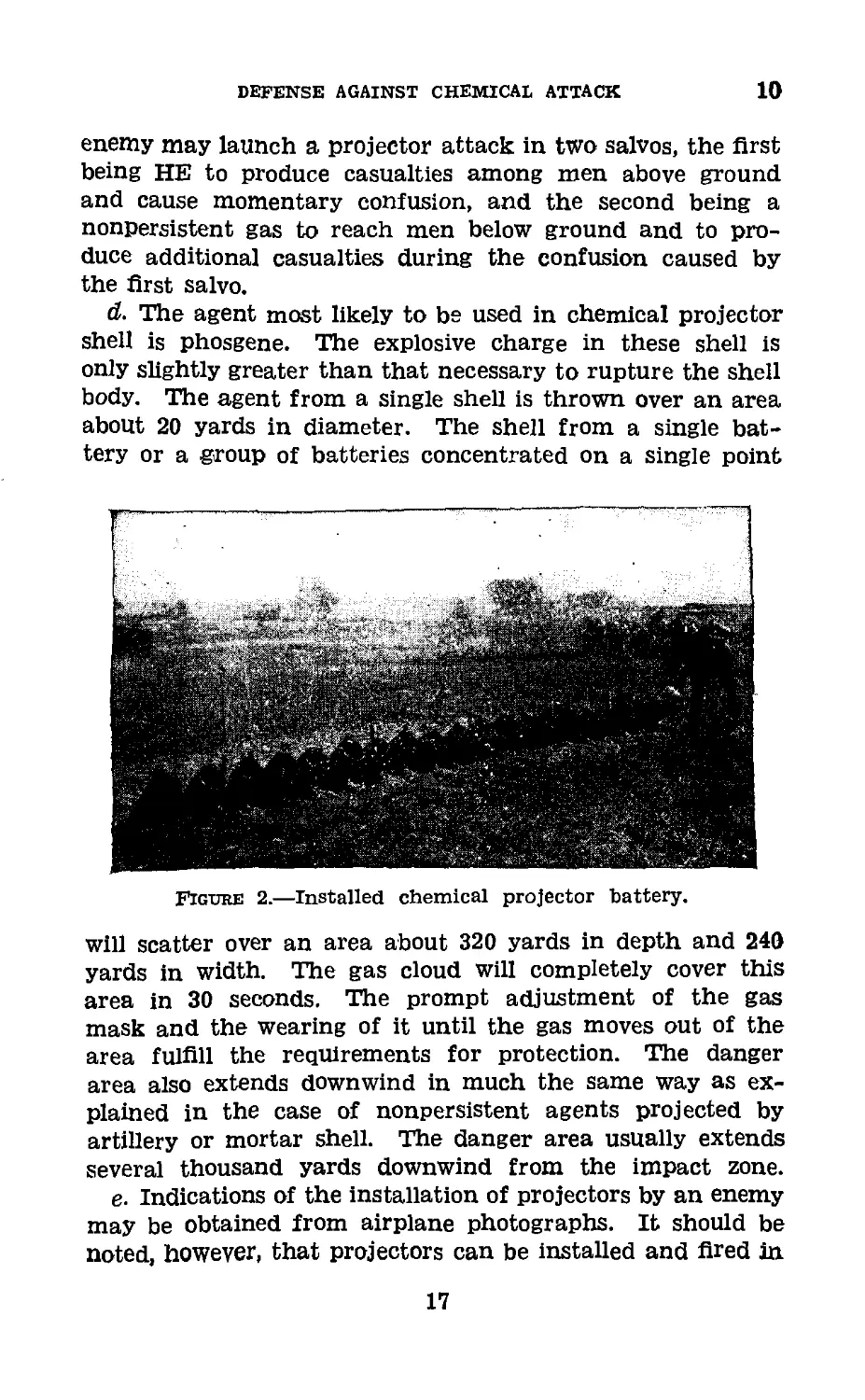
an electric current. (See fig. 2.) Usually, many batteries
are fired at one time against one target.
c.	Nonpersistent casualty agents are usually employed in
these shell. However, highly persistent agents may be pro-
jected, especially when the enemy is on the defensive. An
16
DEFENSE AGAINST CHEMICAL ATTACK
10
enemy may launch a projector attack in two salvos, the first
being HE to produce casualties among men above ground
and cause momentary confusion, and the second being a
nonpersistent gas to reach men below ground and to pro-
duce additional casualties during the confusion caused by
the first salvo.
d.	The agent most likely to be used in chemical projector
shell is phosgene. The explosive charge in these shell is
only slightly greater than that necessary to rupture the shell
body. The agent from a single shell is thrown over an area
about 20 yards in diameter. The shell from a single bat-
tery or a group of batteries concentrated on a single point
Figure 2.—Installed chemical projector battery.
will scatter over an area about 320 yards in depth and 240
yards in width. The gas cloud will completely cover this
area in 30 seconds. The prompt adjustment of the gas
mask and the wearing of it until the gas moves out of the
area fulfill the requirements for protection. The danger
area also extends downwind in much the same way as ex-
plained in the case of nonpersistent agents projected by
artillery or mortar shell. The danger area usually extends
several thousand yards downwind from the impact zone.
e.	Indications of the installation of projectors by an enemy
may be obtained from airplane photographs. It should be
noted, however, that projectors can be installed and fired in
17
10-11
DEFENSE AGAINST CHEMICAL ATTACK
one night. A projector attack can generally be recognized
by a huge flash or a series of flashes immediately followed
by a loud explosion. These shell make a peculiar whirring
sound in flight and a subdued explosion when they burst.
f.	If fired in daylight, chemical projector shell can be seen
in the air. This projectile is usually fitted with a fuze burn-
ing about 20 seconds; if the loud explosion of the propelling
charge is promptly recognized as a chemical projector attack,
there is a period of about one-third of a minute in which to
give the alarm and adjust gas masks before the gas begins
to spread over the target area.-
 11. Attacks From Aircraft.—Aerial bombs may contain
gases of varying persistency as well as smoke and incendiaries.
Agents directly sprayed from aircraft are persistent gas or
smoke. When flying at low altitudes, airplanes have the abil-
ity to launch surprise attacks on unsuspecting personnel.
Smoke-laying airplanes can establish smoke screens permit-
ting other aircraft equipped with bombs or spray apparatus
containing chemical agents to reach their targets unobserved
and protected against hostile Are.
a.	Chemical bombs.—(1) The agents most likely to be pro-
jected by small bombs are mustard and white phosphorus.
The explosion of the 30-pound bomb upon impact throws the
agent over an area approximately 40 yards in diameter. The
danger from chemical bombs of this size approximates that
described in paragraph 9c for chemical shell.
(2)	Aerial bombs of 100 pounds or larger may be used to
discharge either persistent or nonpersistent gases. The action
of agents thus released is similar in principle to the action of
agents discharged from projector shell (par. 10) and necessi-
tates corresponding protective measures.
b.	Spray attacks.—(1) The agents most likely to be used for
spray attacks are mustard, lewisite, and any type of liquid
smoke. Attack aircraft flying between 50 and 1,000 feet can
lay a belt of persistent gas in an effective concentration on
the target. The actual length of the area covered will de-
pend upon the capacity of the tanks used, their number, the
rate of discharge, and the ground speed of the airplane. The
actual width of the area covered will depend on the above
factors, the altitude of the airplane, and the course of the
18
DEFENSE AGAINST CHEMICAL ATTACK
11—12
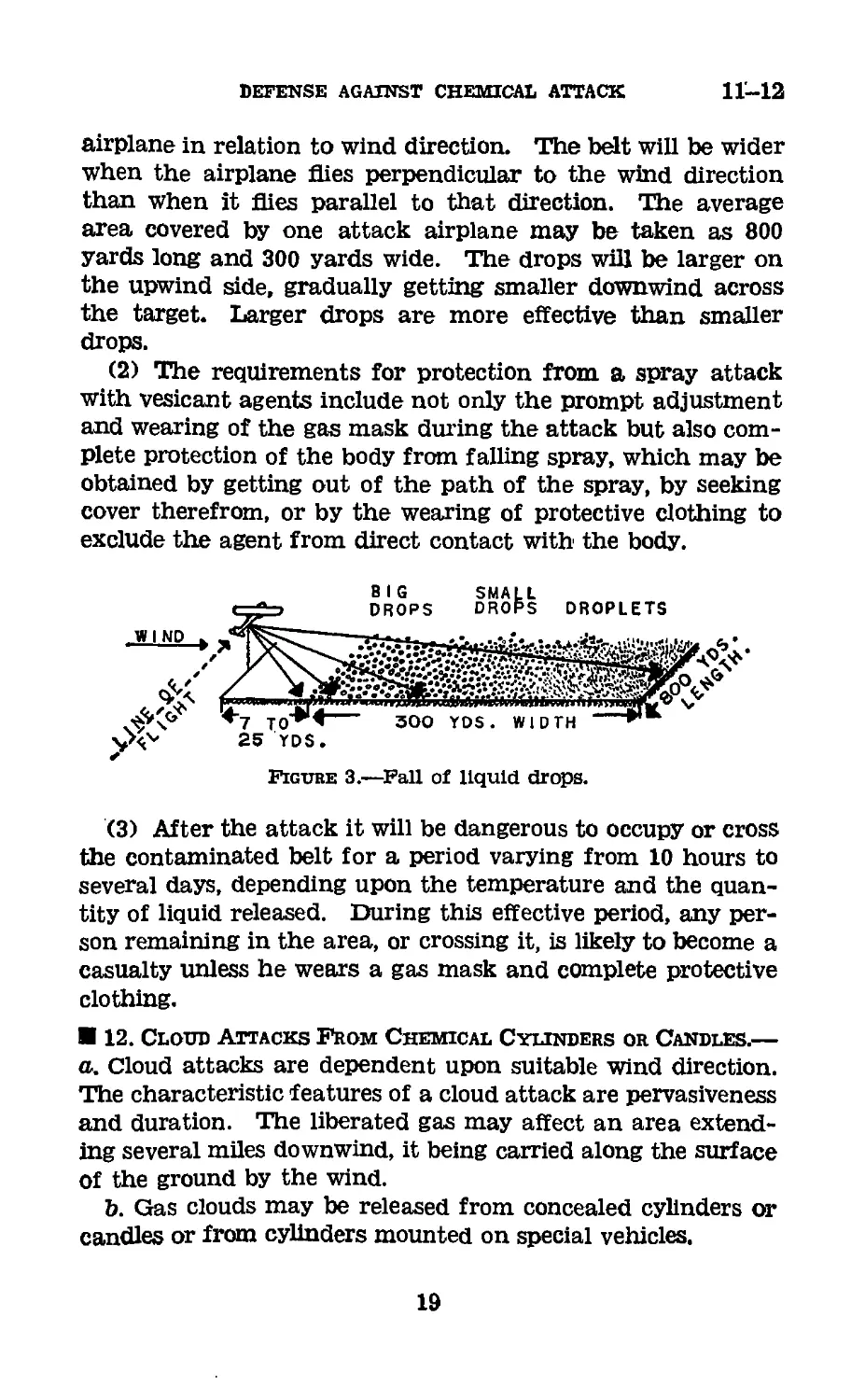
airplane in relation to wind direction. The belt will be wider
when the airplane flies perpendicular to the wind direction
than when it flies parallel to that direction. The average
area covered by one attack airplane may be taken as 800
yards long and 300 yards wide. The drops will be larger on
the upwind side, gradually getting smaller downwind across
the target. Larger drops are more effective than smaller
drops.
(2) The requirements for protection from a spray attack
with vesicant agents include not only the prompt adjustment
and wearing of the gas mask during the attack but also com-
plete protection of the body from falling spray, which may be
obtained by getting out of the path of the spray, by seeking
cover therefrom, or by the wearing of protective clothing to
exclude the agent from direct contact with the body.
Figube 3.—Fall of liquid drops.
(3) After the attack it will be dangerous to occupy or cross
the contaminated belt for a period varying from 10 hours to
several days, depending upon the temperature and the quan-
tity of liquid released. During this effective period, any per-
son remaining in the area, or crossing it, is likely to become a
casualty unless he wears a gas mask and complete protective
clothing.
 12. Cloud Attacks From Chemical Cylinders or Candles.—
a. Cloud attacks are dependent upon suitable wind direction.
The characteristic features of a cloud attack are pervasiveness
and duration. The liberated gas may affect an area extend-
ing several miles downwind, it being carried along the surface
Of the ground by the wind.
b. Gas clouds may be released from concealed cylinders or
candles or from cylinders mounted on special vehicles.
19
12-16
DEFENSE AGAINST CHEMICAL ATTACK
c. The discharge may be made either by day or night. At
the moment of discharge, some warning may be given by
hissing of gas escaping from the cylinders. The cloud is nor-
mally white from condensed water vapor, but the actual loca-
tion and width of the front may be disguised by the liberation
of smoke. Only nonpersistent gas is used in cloud gas attacks,
but this may remain for an hour in thick woods or even
longer in dugouts or shelters. The gas most likely to be
released from this weapon is phosgene.
 13. Bulk Chemical Agents and Chemical Land mines.—a.
Chemical land mines, fired statically, may be effectively em-
ployed by the enemy in withdrawals and retreats for con-
taminating areas around destroyed bridges, fords, roads,
trails, and in front of defensive positions. Persistent gas may
also be liberated from containers carried by tanks or other
vehicles for the purpose of contaminating roads and com-
munication, and thus hindering the advance. Chemical
agents thus employed can be detected only by odor and visible
splashes.
b. The gas most likely to be released from this device is
mustard. Upon explosion of a single mine the agent is
thrown over an area approximately 40 yards in diameter.
Areas contaminated by land mines should be avoided, if
possible, or else passed on the upwind side. If it is necessary
to penetrate the area, it should either be decontaminated as
described in paragraph 25, or lanes cut through as described
in paragraph 54d.
	14. Chemical Grenades.—Hand grenades filled with irri-
tant gases are used to force personnel to evacuate dugouts
and inclosed spaces. Phosphorus is also used in grenades,
particularly as a casualty agent. Hand grenades can be
thrown approximately 35 yards.
	15. Employment of Smoke in Chemical Attacks.—Smoke
is sometimes used along with gas in order to deceive an op-
ponent as to the location and extent of the gas. At times
also, small amounts of tear gas may be released in a smoke
cloud in order to force masking.
И 16. General Effects of Weather and Terrain on Chemical
Attacks.—a. Wind.—(1) The effective use of chemical agents
20
DEFENSE AGAINST CHEMICAL ATTACK
16
is largely dependent on favorable weather conditions. Chem-
ical agents are most effective in light winds; strong winds
will rapidly dissipate them. Nonpersistent chemical agents
are comparatively ineffective in a wind of over 12 miles per
hour. Chemical agents of the highly persistent type are not
affected to the same extent by strong wind.
(2) When the enemy releases a chemical agent for a cloud
attack within his own lines, the wind direction must be from
the enemy to our lines. The enemy may Are chemical shell,-
however, on targets within our lines when the wind is in any
direction. If the wind is blowing toward his own lines, the
quantity of agent used will probably be small and the target
area a considerable distance from his own troops.
(3) When the enemy uses a large amount of mustard gas,
it may be anticipated that the gas will be directed far enough
rearward in the area attacked to prevent any of the vapor
drifting back over his front-line troops. For this reason,
when an enemy attacks, our troops in reserve are more likely
to encounter the mustard type of agent than those in the
forward areas.
b.	Temperature.—(1) On warm sunny days, when the tem-
perature of the earth is higher than that of the air, ascending
air currents carry the gas upward and disperse it. Warm
weather increases the rate of evaporation thereby reducing
the persistency of the agent. Cold weather accompanied by
clouds increases persistency.
(2) Substances like mustard gas may freeze in the soil.
When mustard gas freezes, it is much less effective. How-
ever, the vaporization is still sufficient, except in subfreezing
weather, to produce casualties if personnel are exposed for
a considerable period. It must be kept in mind that solid
particles of frozen mustard gas may become attached to
clothing while passing through undergrowth and these par-
ticles will cause burns if they come in contact with the
body.
c.	Fog and rain.—Foggy and cloudy weather is favorable
for the use of gas. Rainfall tends to wash gas out of the
air and in most cases slowly destroys liquid on the ground.
d.	Night.—The most favorable conditions for the use of
.gases, particularly those of the phosgene type, occur at night
21
16-17
defense against chemical attack
or in the early morning, because strong winds and ascending
currents are then usually absent. Furthermore, there is the
possibility of effecting surprise on sleeping men.
e.	Ground.—(1) Surface.—The most important effects of
the ground on chemical agents in liquid form are as follows:
(a)	Soft dry ground will absorb liquids and so reduce the
danger from direct physical contact. It is difficult to detect
vesicant gas, however, when absorbed in earth.
(b)	On soft wet ground, gas may persist for considerable
periods as free and unabsorbed liquid. Where shell or
bombs burst on soft ground, a large proportion of the liquid
content will be absorbed or buried in the crater, contaminat-
ing earth or mud. When boots or shoes become contam-
inated with liquid mustard gas and are later worn in inclosed
places such as a billet or dugout, dangerous vapor concen-
trations may arise.
(c)	On hard ground, the liquid contents of chemical pro-
jectiles are scattered over a relatively large area. Hard
ground retards penetration of liquid agents released in this
manner; consequently, the agents are exposed in greater
degree to the influence of wind, sun, and rain, thus lessening
their persistency, yet increasing the gas hazard.
(2) Topographical features.—All chemical agents success-
fully used in warfare are heavier than air. Unless set in
motion by wind or air currents, gas clouds tend to flow into
gullies and valleys, leaving the tops of hills comparatively
free.
(3) "Vegetation and obstructions.—Tall grass, bushes, trees,
buildings, and similar obstructions retard the movement of
the air and in like manner the movement of vapors of chem-
ical agents, thereby making them more persistent. Tall
grass and undergrowth increase the danger from vesicants.
 17. Conditions Favorable for Chemical Attacks.—a. Sit-
uations in which an enemy may use nonpersistent gas.—(1)
Between midnight and sunup, when ground temperature is
lower than air temperature and troops are least alert.
(2)	When wind velocities are between 3 and 12 miles ger
hour.
(3)	When wind direction is either from the enemy or par-
allel to the front.
22
defense against chemical attack
17-18
(4)	On troops, particularly large concentrations, located
in low ground or in woods.
(5)	On foggy, overcast days.
b.	Situations in which an, enemy may use persistent gas.—
(1) Against strong points and centers of resistance which
would be very difficult for the enemy to capture by assault
and which he does not expect to occupy or pass through.
(2)	In defiles.
(3)	On terrain surrounding approaches to fords, bridges,
and on beaches.
(4)	On artillery firing positions.
(5)	On distributing points, airdromes, bivouac areas, rail-
heads, marching troops, and supply columns, especially by
spraying from attack aviation.
(6)	On a withdrawal by the enemy, he may be expected
to leave bands of persistent vesicants in front of or within
his former position and on routes that are likely to be used
by pursuing forces.
(7)	On important routes of approach.
c.	Situations in which an enemy may use incendiaries.—
(1) Against villages of largely frame construction.
(2) Against army depots, airdromes, and large supply cen-
ters well to the rear where inflammable supplies, such as
ammunition and forage, are stored in large quantities.
(3) Against position located in dry grain fields or woods,
when the wind direction is from the enemy.
Section IV
PROTECTION AND PROTECTIVE EQUIPMENT
 18. Classification of Protective Measures.—Protection
against gas attacks presents three classes of problems: indi-
vidual, collective, and tactical. The first two involve pro-
tective measures of a generally passive nature; that is,
principally the provision and use of protective equipment
and installations. The third concerns modes of action and
troop leading with a view to avoiding gas casualties in the
conduct of military operations. These three forms of pro-
tection may be briefly outlined as follows:
a.	Individual.—Individual protection includes not only the
proper distribution, use, and care of protective equipment
23
18-20	DEFENSE AGAINST CHEMICAL ATTACK
but also ability to recognize the presence of a particular
chemical agent; and, by knowing its characteristics, to utilize
equipment in such a manner as to avoid becoming a casualty.
b.	Collective.—Collective protection is the utilization of
measures and unit protective equipment for the protection
of personnel, animals, and materiel. It includes the posting
of gas sentries, operation of gasproof shelters, measures to
insure the preservation of animals and equipment, and the
use and decontamination of protective covers.
c.	Tactical.—Tactical protection includes such activities
as chemical reconnaissance, chemical intelligence, selection
of routes of march, camp sites, and battle positions; protec-
tive disposition of troops; schemes of deployment of units;
maneuver to avoid gassed areas; and offensive action to fore-
stall or disrupt the enemy’s chemical operations.
	19. Basis of Issue of Protective Equipment.—Items of
equipment for defense against gas attacks are issued in con-
formity with Tables of Basic Allowances.
	20. Army Gas Mask.—The gas mask protects the soldier’s
eyes and respiratory tract from chemical agents encountered
in the field.
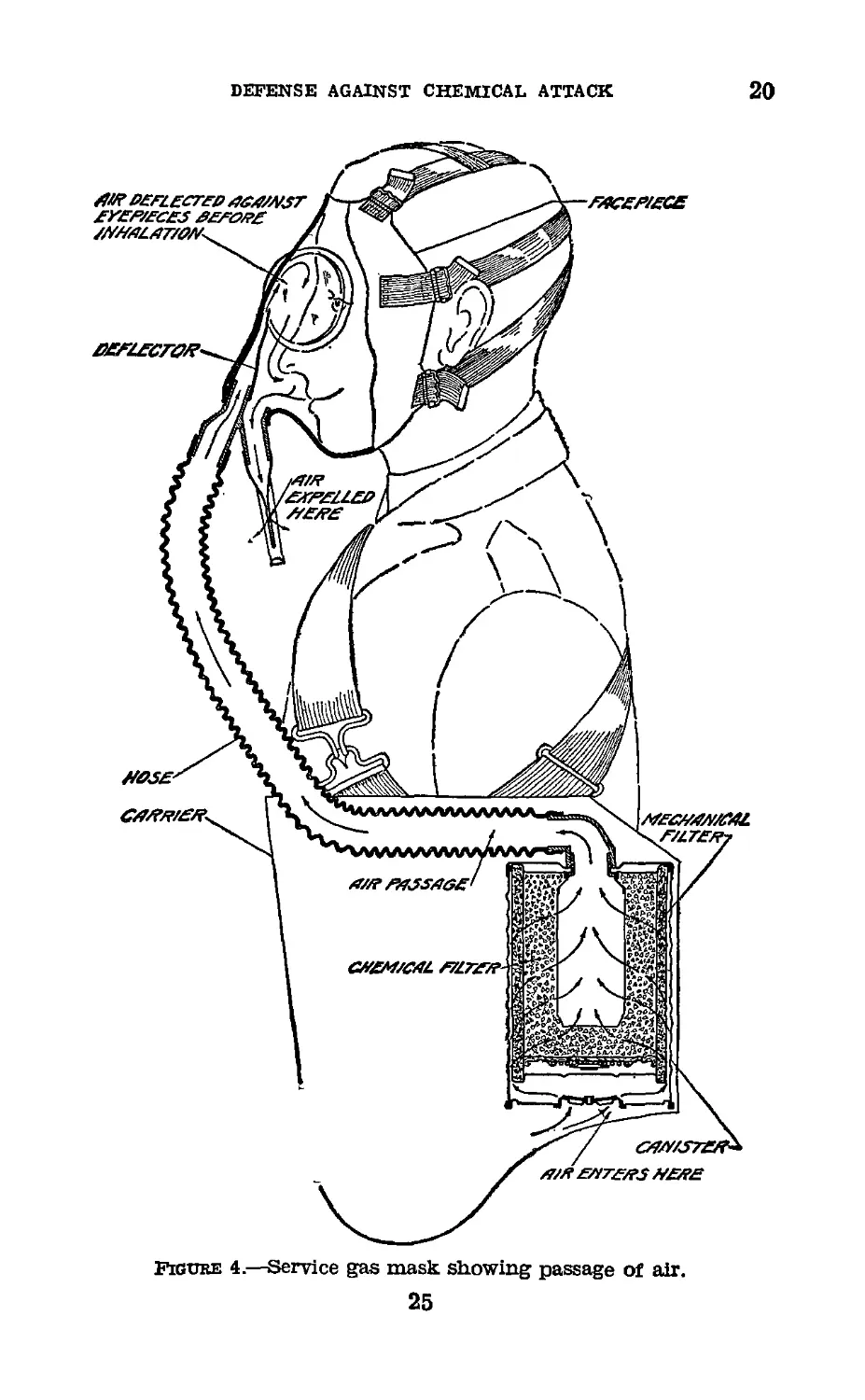
a.	Principle of operation.—The principle of operation of
the gas mask, which is based on air filtration, is illustrated in
figure 4. Air is drawn into the mask when the soldier in-
hales, the mask being so constructed that this air must first
pass through a canister containing a filtration system. This
comprises a mechanical filter to prevent the entrance of
smoke or dust, and a filler of charcoal and soda lime to
adsorb and neutralize toxic and irritating gases and vapors.
This air, after being purified by filtration, is drawn to the
soldier’s face, and, after being inhaled and exhaled, is
expelled from the mask.
b.	Types.—Two types of gas masks are issued, both of which
operate as described in a above.
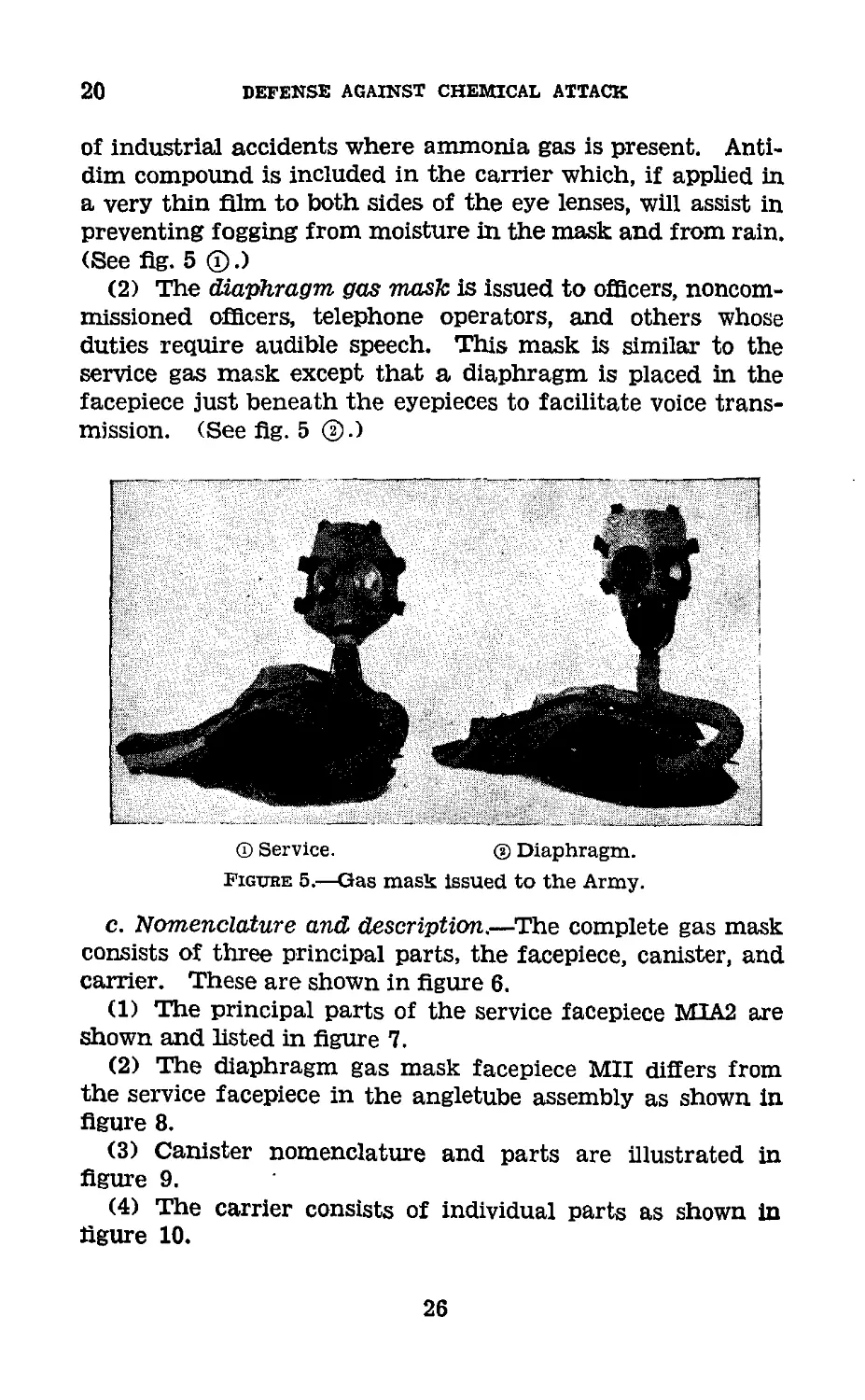
(1) The service gas mask as issued will give full protection
against lung irritants, stemutators, and lacrimators in con-
centrations likely to be encountered in the field. It will not
protect against carbon monoxide or ammonia gas, and is,
therefore, not suitable for a fireman’s mask or for use in case
24
DEFENSE AGAINST CHEMICAL ATTACK
20
20
DEFENSE AGAINST CHEMICAL ATTACK
of industrial accidents where ammonia gas is present. Anti-
dim compound is included in the carrier which, if applied in
a very thin film to both sides of the eye lenses, will assist in
preventing fogging from moisture in the mask and from rain.
(See fig. 5 ®.)
(2) The diaphragm gas mask is issued to officers, noncom-
missioned officers, telephone operators, and others whose
duties require audible speech. This mask is similar to the
service gas mask except that a diaphragm is placed in the
facepiece just beneath the eyepieces to facilitate voice trans-
mission. (See fig. 5®.)
© Service.	® Diaphragm.
Figure 5.—Gas mask issued to the Army.
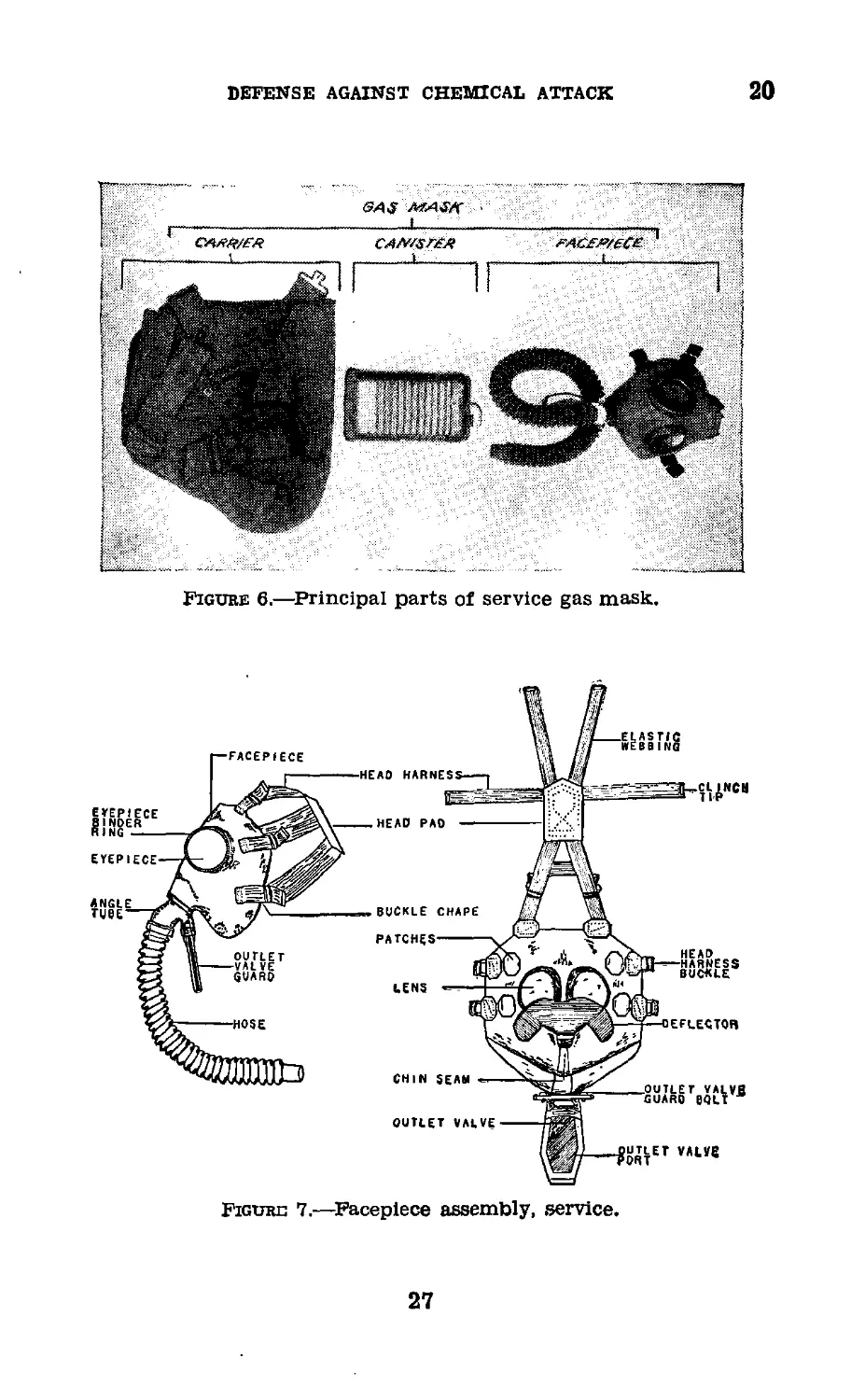
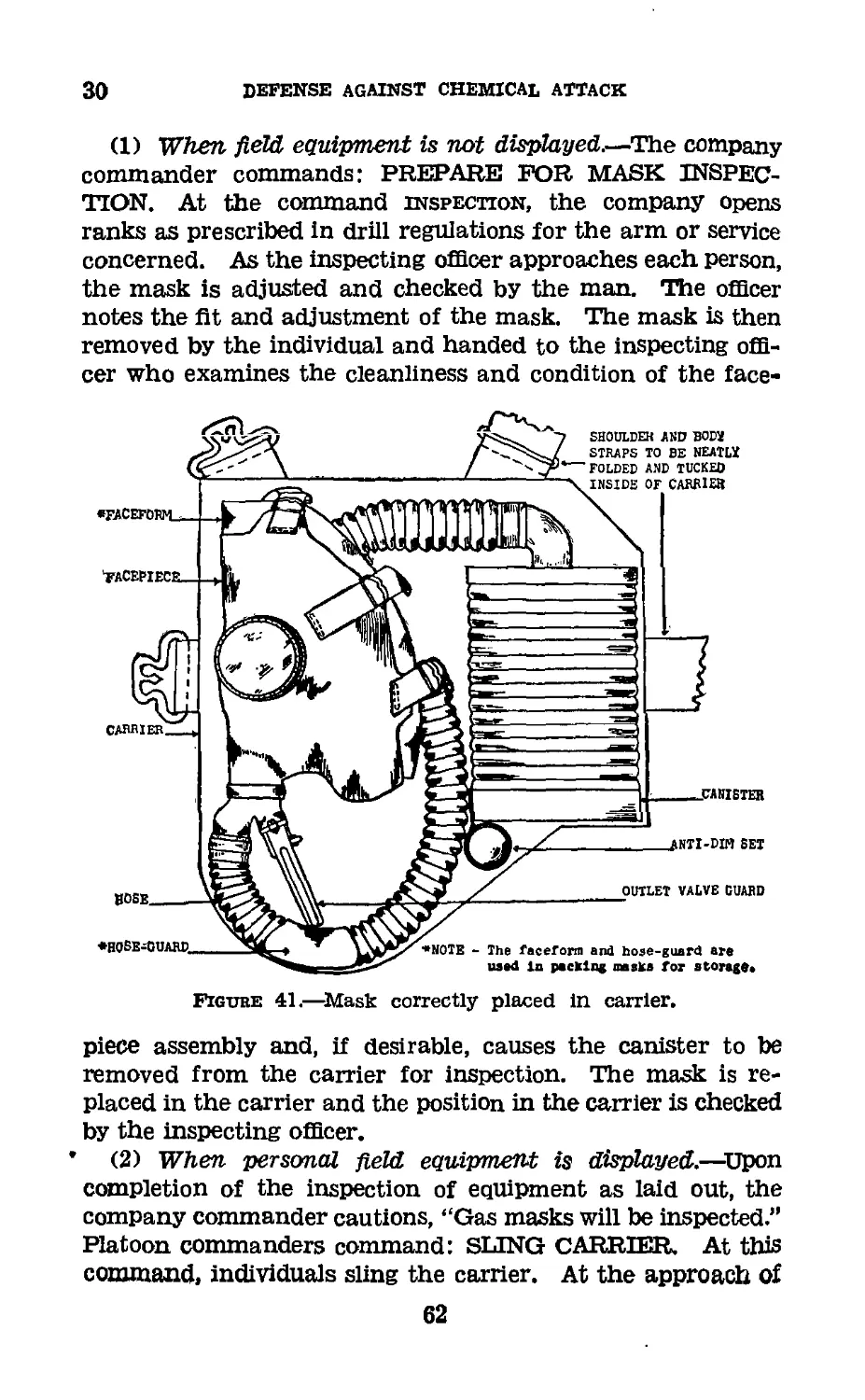
c. Nomenclature and description.—The complete gas mask
consists of three principal parts, the facepiece, canister, and
carrier. These are shown in figure 6.
(1)	The principal parts of the service facepiece MIA2 are
shown and listed in figure 7.
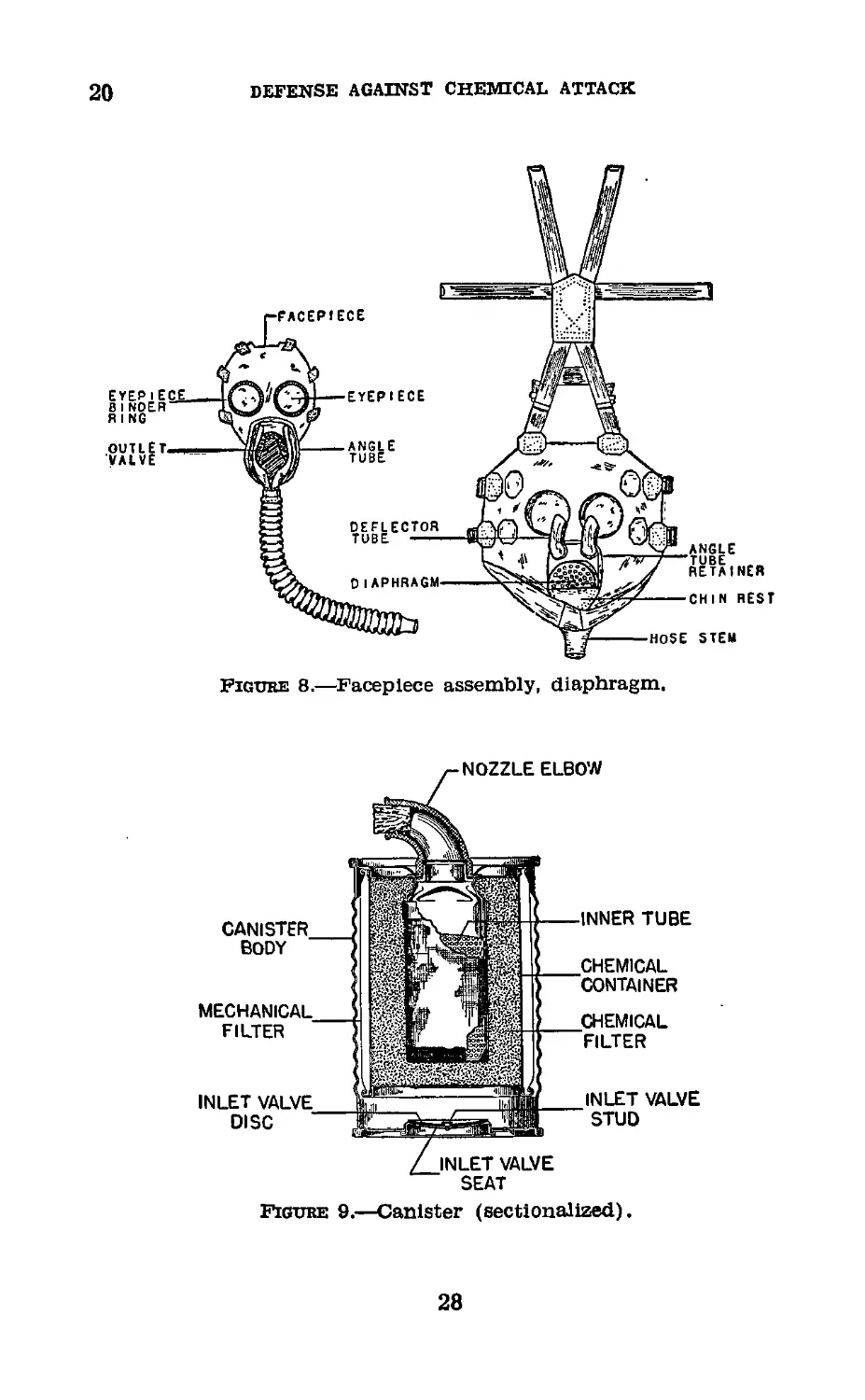
(2)	The diaphragm gas mask facepiece Mil differs from
the service facepiece in the angletube assembly as shown in
figure 8.
(3)	Canister nomenclature and parts are illustrated in
figure 9.
(4)	The carrier consists of individual parts as shown in
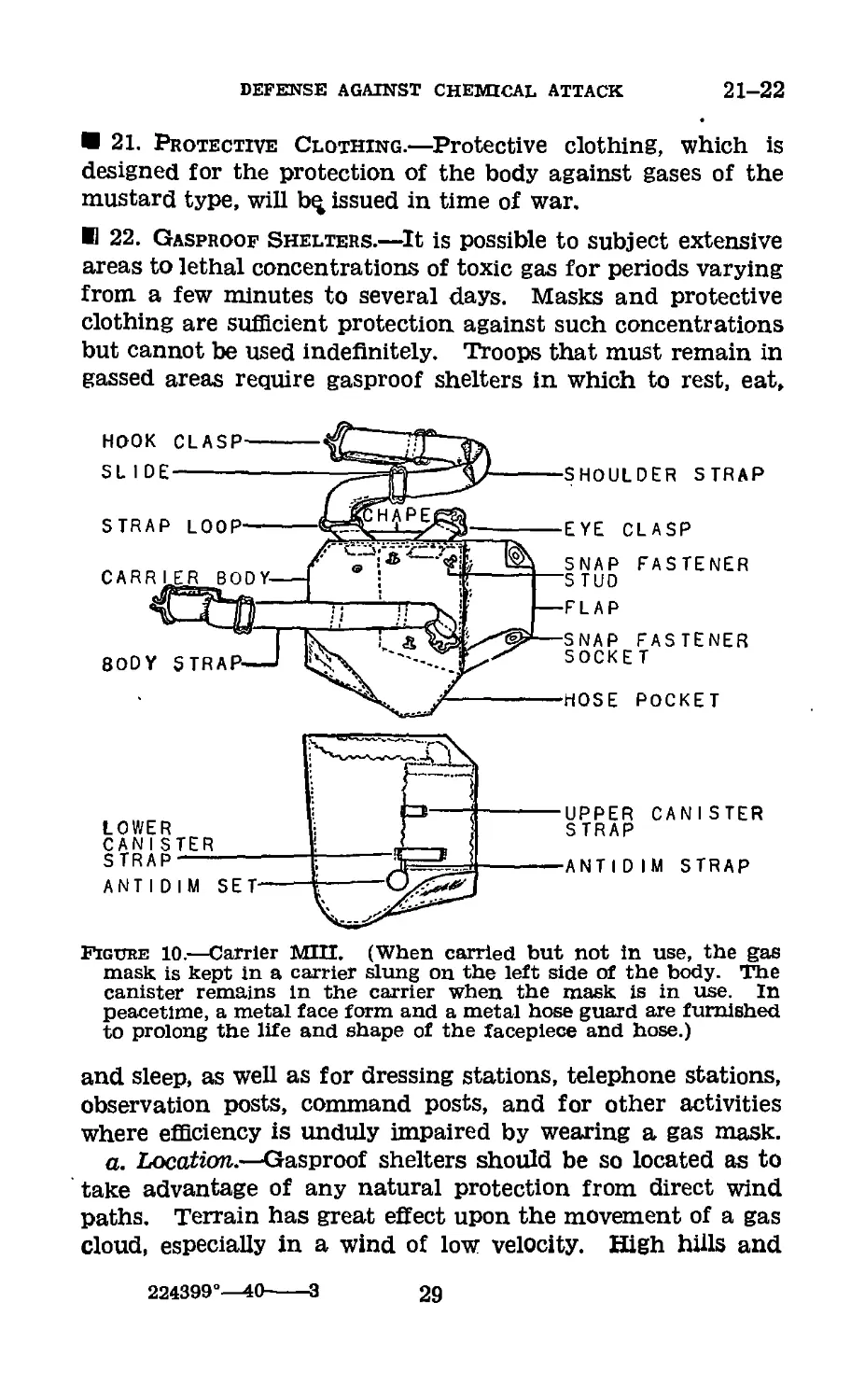
figure 10.
26
DEFENSE AGAINST CHEMICAL ATTACK
20
Figure 6.—Principal parts of service gas mask.
Figure 7.—Facepiece assembly, service.
27
20
DEFENSE AGAINST CHEMICAL ATTACK
Figure 8.—Facepiece assembly, diaphragm.
Figure 9.—Canister (sectionalized).
28
DEFENSE AGAINST CHEMICAL ATTACK
21-22
 21. Protective Clothing.—Protective clothing, which is
designed for the protection of the body against gases of the
mustard type, will issued in time of war.
U 22. Gasproof Shelters.—It is possible to subject extensive
areas to lethal concentrations of toxic gas for periods varying
from a few minutes to several days. Masks and protective
clothing are sufficient protection against such concentrations
but cannot be used indefinitely. Troops that must remain in
gassed areas require gasproof shelters in which to rest, eat,
LOWER
CANISTER
STRAP-------
ANT IDIM SET
UPPER CANISTER
STRAP
ANTIDIM STRAP
Figure 10.—Carrier Mill. (When carried but not in use, the gas
mask is kept in a carrier slung on the left side of the body. The
canister remains in the carrier when the mask is in use. In
peacetime, a metal face form and a metal hose guard are furnished
to prolong the life and shape of the facepiece and hose.)
and sleep, as well as for dressing stations, telephone stations,
observation posts, command posts, and for other activities
where efficiency is unduly impaired by wearing a gas mask.
a.	Location.—Gasproof shelters should be so located as to
take advantage of any natural protection from direct wind
paths. Terrain has great effect upon the movement of a gas
cloud, especially in a wind of low velocity. High hills and
224399°—40---3
29
22
DEFENSE AGAINST CHEMICAL ATTACK
deep valleys deflect gas from the general direction of the
wind. Whenever possible, shelters should be located where
heavy concentrations of gas will not fqpn.
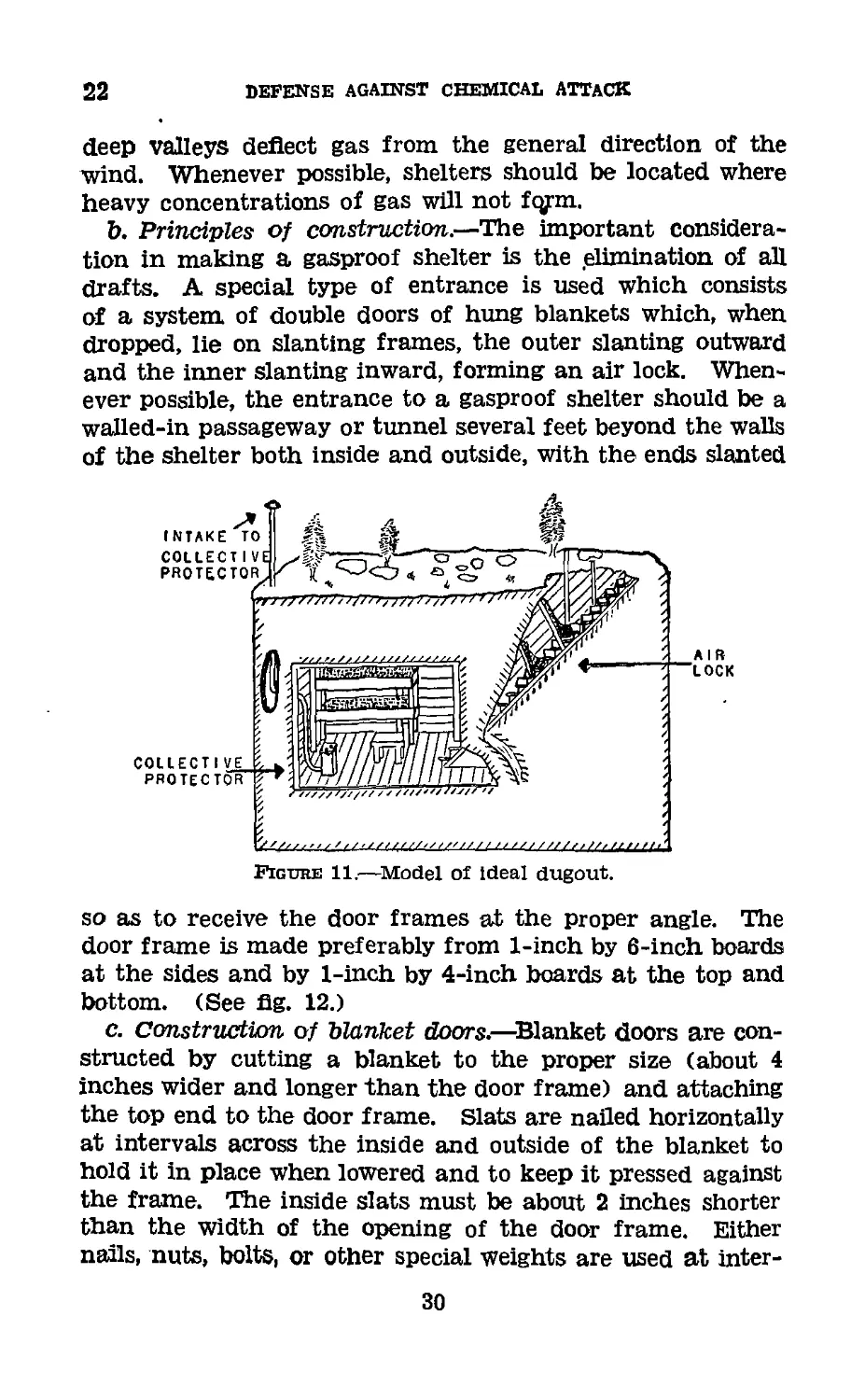
b.	Principles of construction.—The important considera-
tion in making a gasproof shelter is the elimination of all
drafts. A special type of entrance is used which consists
of a system of double doors of hung blankets which, when
dropped, lie on slanting frames, the outer slanting outward
and the inner slanting inward, forming an air lock. When-
ever possible, the entrance to a gasproof shelter should be a
walled-in passageway or tunnel several feet beyond the walls
of the shelter both inside and outside, with the ends slanted
Ftgube 11.—Model of ideal dugout.
so as to receive the door frames at the proper angle. The
door frame is made preferably from 1-inch by 6-inch boards
at the sides and by 1-inch by 4-inch boards at the top and
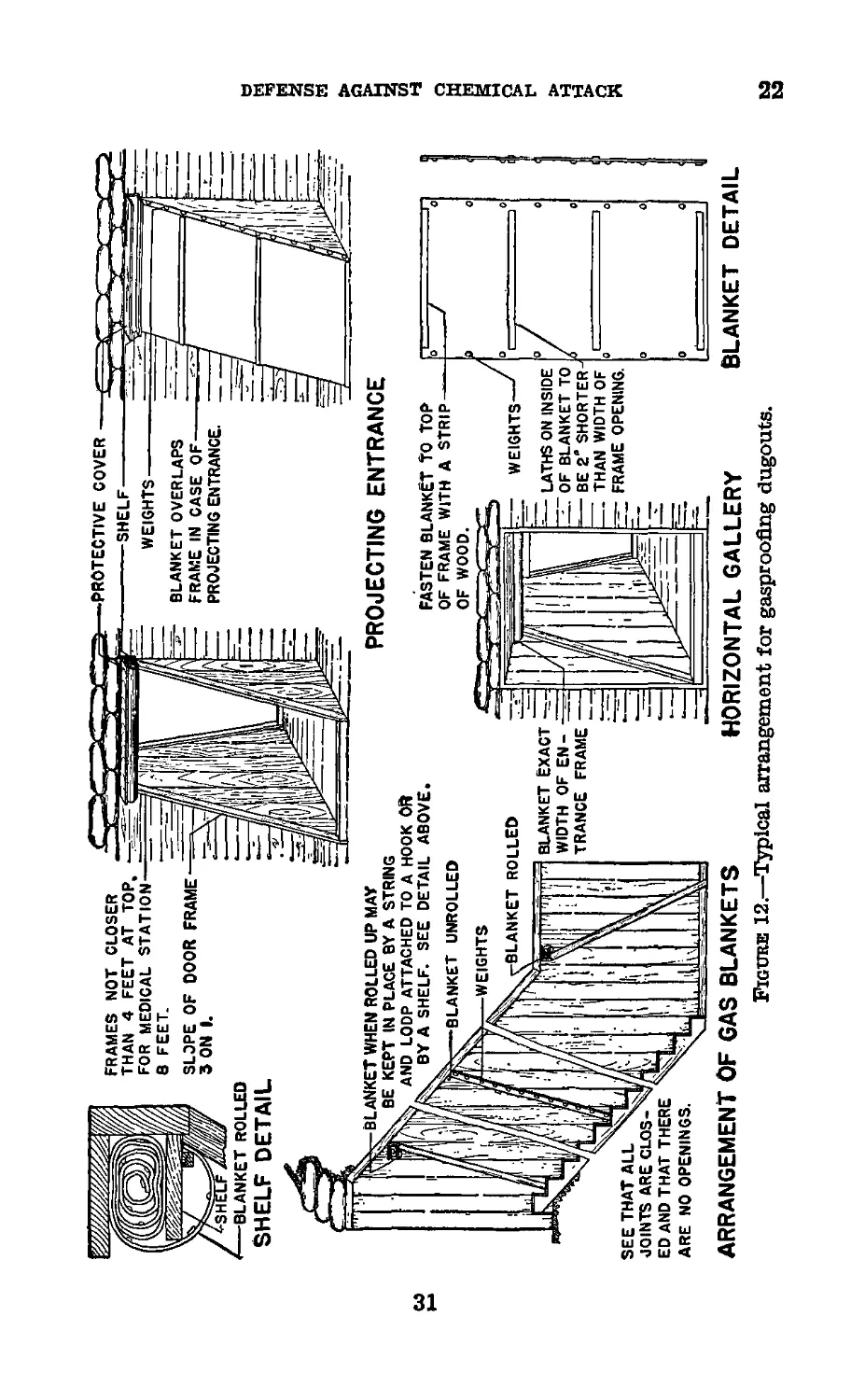
bottom. (See fig. 12.)
c.	Construction of blanket doors.—Blanket doors are con-
structed by cutting a blanket to the proper size (about 4
inches wider and longer than the door frame) and attaching
the top end to the door frame. Slats are nailed horizontally
at intervals across the inside and outside of the blanket to
hold it in place when lowered and to keep it pressed against
the frame. The inside slats must be about 2 inches shorter
than the width of the opening of the door frame. Either
nails, nuts, bolts, or other special weights are used at inter-
30
co
BLANKET ROLLED
SHELF DETAIL
BLANKET UNROLLED
-WEIGHTS
-BLANKET ROLLED
SLOPE OF DOOR FRAME
3 ON I.
FRAMES NOT CLOSER
THAN 4 FEET AT TOP,
FOR MEDICAL STATION-
8 FEET.
BLANKET OVERLAPS
FRAME IN CASE OF—-
PROJECTING ENTRANCE.
PROTECTIVE COVER
------SHELF------
WEIGHTS-----
BLANKET WHEN ROLLED UP MAY
BE KEPT IN PLACE BY A STRING
AND LODP ATTACHED TO A HOOK OR
BY A SHELF. SEE DETAIL ABOVE
PROJECTING ENTRANCE
SEE THAT ALL
JOINTS ARE CLOS-
ED AND THAT THERE
ARE NO OPENINGS.
BLANKET EXACT
WIDTH OF EN-
TRANCE FRAME
LATHS ON INSIDE
OF BLANKET TO
BE 2“SHORTER
THAN WIDTH OF
FRAME OPENING.
WEIGHTS
FASTEN BLANKET TO TOP
OF FRAME WITH A STRIP
OF WOOD.
DEFENSE AGAINST CHEMICAL ATTACK
ARRANGEMENT OF GAS BLANKETS
HORIZONTAL GALLERY BLANKET DETAIL
Figure 12.—Typical arrangement for gasproofing dugouts.
ьэ
ьэ
22
defense against chemical attack
vals from top to bottom close to the edges of the blanket and
outside of that part of the blanket which falls on the door
frames. When the blanket is lowered, the weights hang over
the edge of the frame and pull the edges of the blanket with
them, thus forming a flap which keeps the blanket pressed
against the frame and aids in making the door airtight.
(1)	Shelf for door when left open.—When not in.use, the
blanket door is rolled up and the roll is placed on a shelf
above the top of the frame. If necessary, a metal cover is
nailed over the shelf to protect the blanket from sun and
rain.
(2)	Functioning of double-door system.—When lowered
into place, the two doors make the shelter gasproof by form-
ing an air lock between them. To enter the outer door, one
side of the blanket on the leeward side is pulled away from
the frame just far enough to permit entrance; the person
then enters the air lock and closes the outer door behind
him before opening the inner door. When leaving the shel-
ter, the reverse procedure is followed.
(3)	Proper distance between gasproof doors.—When the
entrance to the shelter is a simple horizontal passage, the
doors are placed at an average distance of 6 to 9 feet apart.
If the entrance is a stairway, one door is placed at the head
of the stairway and the other at the foot where there is a
horizontal passageway for a few feet. If the stairway enters
directly into the room, the two doors are placed at intervals
on the stairway with both slanting outward. In case of a
dressing room, the space between the doors must permit
stretcher bearers to bring in a stretcher without opening
both doors at once.
(4)	Modifications in construction.—Where the entrance is
not a projecting passageway as described in (3) above, modi-
fications in the construction of the blanket doors must be
made. In any case, the same principles should be observed.
(5)	Preparation for use.—Lower both blanket doors, close
all ventilators, and put out all fires. Fires use up the oxygen,
draw in air from outside, and give off that odorless poison
gas, carbon monoxide. See that a supply of chloride of lime
is in the shelter. Spread it around between the doors at the
start of a gas attack. This will neutralize any liquid agent
32
DEFENSE AGAINST CHEMICAL ATTACK
22-24
which might adhere to the shoes of men coming from con-
taminated areas.
d. Ventilation.—Persons entering; a shelter during, a gas
attack will always bring in traces of gas on their shoes and
clothing. This is especially dangerous in the case of mus-
tard, as an effective concentration entirely imperceptible to
the occupants may gradually be built up. In dugouts or
shelters intended to be used for a considerable time, collec-
tive protectors (par. 23) should be obtained from the chemi-
cal officer and installed. After a gas attack, a contaminated
shelter may be cleared of gas by opening the doors and build-
ing a Are within. The length of time that a gasproof shelter
may be occupied without ventilation may be estimated by
applying the rule that a man requires 1 cubic foot of air
per minute; more is desirable.
 23. Collective Protector.—a. This item of equipment is
issued for use at gasproof command posts, plotting rooms, and
aid stations, which are intended to be used for a considerable
time and where air may, in a short time, become foul or de-
ficient in oxygen during a gas attack. It consists of an air
blower mounted on a large canister and several feet of
flexible pipe. The collective protector should only be used
in an Inclosure that has been made reasonably airtight.
When an old building is being used, the windows and large
cracks should be chinked with mud, rags, paper, or any
suitable material available. Large openings such as shell
holes can be closed with gasproof blankets.
b. The latest type collective protector is set up outside the
room or inclosure to be protected and the pipe run inside. The
concentration of gas is invariably greater near the ground
level; consequently, the air intake should be as high as is
practicable to place it.
c. When a gas attack starts, the collective protector is set
in operation. Air from the outside is pumped through the
canister, purified, and blown into the inclosure. A positive
pressure of pure air is thus built up in the protected space
which prevents the entrance of gas.
 24. Gas Alarm Devices.—a. These items of equipment are
issued to organizations. The standard type is the alarm horn
which gives a distinctive sound not easily confused with other
33
24-25
DEFENSE AGAINST CHEMICAL ATTACK
sounds encountered in action. Empty shell cases or sections
of iron rail may be used as improvised alarms when standard
alarm horns are not available.
b. There are two classes of alarms given when an enemy-
gas attack occurs; general and local. General alarms are
given only in the case of cloud gas attacks that are expected
to involve a large area. Local alarms are given in all cases
in which the presence of gas is recognized. A general alarm
is sent out by all normal methods of communication and is
Figure 13.—Typical gas alarm devices.
directed to all localities that may be affected. Local alarms
are usually given with alarm horns.
 '25. Decontamination.—a. Protection of degassing details.—
Men detailed for decontaminating work should wear gas
masks and protective clothing. The entire body must be
protected. The work should be performed under a noncom-
missioned officer. He should be prepared to apply flrst-aid
measures in case of necessity, and should have the necessary
solvents or neutralizing agents close at hand. The men
should be inspected before commencing operations to insure
that they are properly protected. Facilities away from other
34
DEFENSE AGAINST CHEMICAL ATTACK
25
troops should be provided for undressing and bathing after
completion of their work. Men should be taught to assist
each other in removing clothes used in decontaminating
work without touching them to the bare skin or contaminat-
ing the clothing beneath. Facilities for disposal or clean-
ing of contaminated clothing should be provided. As decon-
taminating operations are local in character, their success
will depend largely upon the equipment and facilities
available.
b.	Limitations.—Chemical agents may be destroyed or neu-
tralized by other chemicals. No one chemical, however, is
effective in all cases. Moreover, it is not practicable for an
army to carry either a great variety or quantity of chemi-
cals. Hence, decontaminating operations are necessarily
limited. Whether they are practicable at all will depend
upon the character of the chemical agent involved, extent of
contamination, and importance of the contaminated area or
equipment.
c.	Marking contaminated areas.—When it is not practica-
ble to decontaminate an area thoroughly, it should be marked
with danger signs showing the agent involved and the date
of contamination or its discovery. Generally, sentries should
be posted to warn unauthorized persons against entering
such areas.
d.	When to decontaminate.—Decontamination work should
be commenced immediately after the shelling or as soon
thereafter as possible. It should be understood that when
the shelling takes place at night or at other times when the
temperature is relatively low, little vapor may be given off,
while later, in the warmth of the sun, a high concentration
may result. Areas treated during cool periods of the day
should be inspected after the temperature has risen to de-
termine whether further treatment is required.
e.	Materials.—Decontaminating materials are issued in
time of war to destroy or neutralize highly persistent agents
of the mustard-gas type. Small areas, buildings, and equip-
ment which have become contaminated can, within certain
limits, be decontaminated. The following materials may be
used for decontamination work:
35
25	defense against chemical attack
(1)	Earth.—Earth, sand, ashes, or sawdust may be spread
over a contaminated area to give temporary protection.
The covering layer should be at least 3 inches thick. This
does not destroy the chemical agent but forms a seal pre-
venting for a limited time the escape of toxic vapor. Such
covering will be more effective if wet down with water.
(2)	Water.—(a) Lewisite is readily decomposed by water,
therefore liberal wetting of areas so contaminated is suffi-
cient to destroy this agent. The reaction product of lewisite
and water is a vesicant solid substance; while it gives off a
little vapor, the solid causes severe burns on contact with
the body. Consequently, even long after decontamination
of a lewisite area, it is dangerous to sit or lie down in the
area. After treatment with water, a lewisite area should, if
practicable, be covered with a layer of earth, sand, or ashes.
(b) Mustard gas is very slowly hydrolyzed by water. The
reaction product is nonvesicant. The action of cold water
on mustard is so slow that it is practically negligible for de-
contaminating purposes. Hot water is more effective. How-
ever, where there is sufficient drainage, mustard gas will
be washed away by water. As it is heavier than water, it
will lie at the bottom of pools and puddles, remaining active
for a long period of time, though the water over it Will retard
the escape of mustard vapor.
(3)	Bleaching powder (.chloride of lime).—(a) This mate-
rial is a white powder, not very stable, readily giving up its
chlorine when exposed to the air or moisture. Consequently,
it should be kept in airtight containers and used as soon as
possible after removal therefrom. Bleaching powder reacts
quickly with mustard gas, forming a nonvesicant compound.
In contact with liquid mustard, it reacts violently not only
causing flame but driving off a high concentration of mus-
tard vapor. If the bleaching powder is mixed with sand or
earth, this violent reaction does not occur. The proportion
should be about one part of bleaching powder to three parts
of sand or earth. One pound of bleaching powder is required
per square yard of gassed area.
(b) In the decontamination of equipment, bleaching pow-
der can frequently be more easily and efficiently applied in
liquid form with rags or swabs. When used as a liquid solu-
36
DEFENSE AGAINST CHEMICAL ATTACK
25
tion, the proportion should be about one part of bleaching
powder to one part of water.
(c) For decontamination of skin of animals or human be-
ings, chloride of lime in porportion to one part powder to
two parts of water may be used, but this slurry must be
removed within 5 minutes after application, otherwise it
may cause irritation to the skin.
(4)	Sodium sulphide.—This chemical is used in a 1 per-
cent aqueous solution. It reacts more slowly than bleaching
powder but, since no heat is evolved in the process, mustard
vapor is not driven off. The solution is more effective if
heated before use. It may be used either as a spray or
mixed with sand. In the latter case, one part (by weight)
of the liquid is used with four parts of sand and the mixture
spread with shovels over the gassed area. Six gallons of
sodium sulphide are needed for each square yard of area to
be degassed.
(5)	Green solution.—This solution which has a greenish
color Is prepared by dissolving 1 pound of bicarbonate of
soda (baking soda) in 1 gallon of commercial hypochlorite
solution. This mixture is less efficient for destruction of
mustard gas than bleaching powder but is also less corrosive
to metals, hence is applicable for decontaminating metal
equipment. It should be generously used with sponge or rag
until surface is cleaned.
(6)	Noncorrosive decontaminating agent.—An additional
material known as agent, decontamination, noncorrosive, is
prepared by dissolving 1 pound of solid in 15 pounds of
solvent. This agent is much less corrosive than any of the
others mentioned. It is suitable for use on leather, cotton
fabrics, instruments, and other items that might be damaged
by the corrosive action of bleaching powder or other chem-
ically active decontamination materials.
f. Methods.—(1) Shell holes.—(a) In demustardizing al
shell hole, not only the shell crater but the entire area of
contamination about the point of burst should be treated.
A 75-mm mustard gas artillery shell produces a crater
roughly 2 yards in diameter; however, the diameter of the
area sufficiently contaminated with liquid agent to require
decontamination is approximately 14 yards. With a 155-mm
37
25
DEFENSE AGAINST CHEMICAL ATTACK
shell the area Is approximately 50 yards in diameter, and with
the 4.2-inch chemical mortar shell it is approximately 40
yards in diameter. These areas do not center exactly on
the shell hole but generally extend somewhat into the line
of fire.
(b) Contamination is generally greatest in the shell hole
itself. Pools of liquid mustard gas or large visible splashes
on ground or vegetation are rarely found. In most cases
mustard is only perceptible by its odor. The area outside
the crater is usually much more lightly contaminated. If
this area includes high grass or brush which cannot be de-
contaminated as it stands, it should be cut down so that it
can be treated and disposed of. As a rule, 1 pound of bleach-
ing powder for each square yard of contaminated ground is
the minimum requirement.
(c) Sodium sulphide or green solution may be sprayed over
a contaminated shell hole or first mixed with sand and
spread with a shovel. Bleaching powder, however, is more
effective for this purpose.
(2)	Grassland.—An area covered with high dry grass or
brush may be decontaminated by burning, provided this can
be done without danger to nearby personnel. The heat will
cause a heavy cloud of mustard vapor to be given off down-
wind during the burning. If burning is not feasible, bleach-
ing powder mixed with water may be sprayed on small areas.
(3)	Weapons and metal equipment.—Greasy or oily metal
surfaces contaminated with mustard gas should first be
cleaned with kerosene or gasoline. These solvents do not
destroy mustard, but dissolve it so that most of it may be re-
moved. Rags used for the purpose should be burned in a fire
with a good draft, as they will be grossly contaminated. After
such treatment, a very thin coating of mustard will still re-
main on the surface of the metal so that it will still be danger-
ous to touch. This is difficult to remove and must be treated
with neutralizing chemicals. A solution of bleaching powder
mixed with water, hot sodium sulphide, or green solution, are
suitable materials to use, the latter two being much less cor-
rosive. To avoid serious corrosion in using bleaching powder
mixed with water, the application should not be left on for
more than an hour at most. After such treatment the sur-
38
DEFENSE AGAINST CHEMICAL ATTACK
25
face should then be washed, dried, polished, and oiled. The
noncorrosive decontaminating agent (par. 25e (6)) is the
most satisfactory and effective for use on weapons and metal
equipment.
(4)	Clothing and fabric equipment.—(a) Airing.—Cloth-
ing contaminated by mustard vapor only may be decontami-
nated by hanging up the garments so that they will be exposed
to the sun and wind. In warm bright weather, 2 days’ airing
generally will be sufficient. Care should be taken not to hang
garments close together, especially not on top of each other.
In cool cloudy weather, this method should not be relied upon.
(b) Steaming.—A more positive method of destroying mus-
tard gas in clothing is to subject it to steam. If contaminated
with mustard vapor only, clothing may be decontaminated by
2 hours of steaming. If splashed with liquid mustard, steam-
ing should be continued from 4 to 6 hours. Various kinds of
steam disinfectors can be improvised from materials avail-
able in the field. The simplest is merely a large G. I. can
provided with a false bottom which serves to hold the clothing
about a foot from the true bottom. Six or eight inches of
water is poured into the bottom of the can, the false bottom
inserted, and the garments piled in. The can is then placed
over a fire, the top being covered but not so tightly as to pre-
vent escape of steam. The capacity of such a disinfector
can be increased by hanging additional clothing in an in-
verted canvas bag suspended over the can, the open end of the
bag being tied about the sides of the can.
(5)	Shoes.—Little can be done in the field to decontaminate
shoes permeated with mustard. If only lightly splashed and
before the mustard has soaked into the leather, shoes may be
neutralized by applying bleaching powder or bleaching powder
mixed with water. As a safety precaution, it is well for men
exposed to mustard gas to shuffle their feet from time to time
through a mixture of bleaching powder and dry earth or
sand. Well-worn shoe leather absorbs mustard much quicker
than new leather.
(6)	Leather.—Leather, unless specially treated, absorbs
mustard almost instantly. Hence, equipment such as saddles
and harness should be treated with a hot solution of bleaching
powder and water immediately after being sprayed or splashed
with this agent.
39
25-27
DEFENSE AGAINST CHEMICAL ATTACK
(7)	Buildings.—In. general, if liquid agents have been car-
ried into buildings by shell fire, the buildings should be
abandoned for military use in the field. If a building which
has not been gas proofed has been subjected to vapors from
vesicant agents, the ceilings and walls should be sponged or
washed with a mixture of bleaching powder and hot water
and the wooden floors should receive a thorough scrubbing
with, the same material.
 26. Protection of Food and Water Supplies.—a. Protec-
tive covers.—Tarpaulins and vehicle covers made impervious
to the persistent gases will be issued in time of war to pro-
tect transportation, equipment, and supplies.
Ъ.	Protection at the front.—(1) Rations and forage issued
to troops at the front should insofar as practicable be kept
in airtight containers until required for use.
(2)	In stabilized situations and otherwise as circumstances
may permit, gasproof shelters should be used for storage of
food and water supplies in the field.
(3)	Cooked rations sent to troops should be kept in closely
covered containers until issued. Kitchens should be covered
with paulins for protection against chemical spray. Tent
flies or other overhead covers should invariably be provided
for field kitchens. In case canned goods are sprayed with
chemicals, the cans should be decontaminated by boiling be-
fore they are opened.
(4)	Food and water not protected by containers, which
have been contaminated by chemical agents, are normally
discarded. In case there is a shortage of food, special in-
structions from a medical officer will govern as to its decon-
tamination.
c.	Contaminated water.—(1) Water contaminated with
mustard should be avoided.
(2) Water contaminated by arsenical agents such as lew-
isite and adamsite, or by white phosphorus, cannot be
purified and should be avoided.
 27. Protection of Supplies, Equipment, and Munitions.—
a. Weapons.—(1) Field pieces, machine guns, rifles, and
other steel weapons may actually be rendered useless by long
exposure to the corrosive action of certain chemical agents.
Unpainted working parts are especially vulnerable and as a
40
DEFENSE AGAINST CHEMICAL ATTACK
27
general precaution should be kept well coated with oil or
grease. Weapons should invariably be inspected following
gas attacks and, as soon thereafter as practicable, cleaned
and reoiled. Gasoline will remove the old lubricant; water
and soap, washing soda, or green solution should be used to
clean the affected parts before new lubricant is applied.
(2) If sprayed with mustard gas, weapons must be decon-
taminated before it is safe to handle them. Bleaching pow-
der mixed with water should be used on the wheels, trail,
and outside of barrel of field pieces, but its use on breech
locks, traversing screws, and other working parts of such
weapons should be avoided because of its corrosive effect.
Such parts should be treated as instruments. Alcohol or
gasoline, hot water and soap, or other noncorrosive material
as may be provided, such as referred to in paragraph 25e (6),
should be used to remove the mustard. Wooden gunstocks
contaminated with mustard should be treated repeatedly.
b.	Ammunition.—Since brass shell and cartridge cases are
particularly susceptible to corrosion by gases like phosgene,
ammunition should be kept in sealed containers. If am-
munition becomes badly corroded, it may be necessary to
discard it or to clean it thoroughly before it is used.
c.	Instruments.—Instruments such as those used in fire
control should be kept in their containers except when in
actual use. If exposed to corrosive gases, they should be
cleaned with alcohol (or gasoline, if alcohol is not available)
at the earliest opportunity, after which their moving parts
should be given a thin coating of light machine oil.
d.	Airplanes.—Vesicant spray attacks against airdromes
are likely. Where it is not feasible to place airplanes in
hangars, gasproof covers, at least for cockpits and machine
guns, will be provided for placing over these parts when air-
planes are not in use. Mustard sprayed on wings and fuse-
lage of an airplane may do little if any harm; but if seats,
instrument board, control, and firing apparatus are sprayed,
pilots and observers later using the airplane may become
casualties. Moreover, the decontamination of such parts
will be extremely difficult. If an airplane becomes contami-
nated with a vesicant agent, it should be taken as soon as
practicable to an airdrome where it can be properly decon-
41
27-28
DEFENSE AGAINST CHEMICAL ATTACK
taminated. Bleaching powder, hot water, and soap are used
for this purpose.
e.	Vehicles.—Drivers of vehicles which have been contami-
nated should be careful not to come in contact with con-
taminated parts in getting on or off a wagon or truck. Seat
cushions which have been sprayed should be discarded.
Washing thoroughly with water and using bleaching powder
on badly contaminated spots is all that can be done in the
field in decontaminating vehicles. Contaminated harness
should be carefully cleaned before use.
f.	Inflammable supplies and equipment.—Inflammable sup-
plies and equipment should be piled in small stacks far
enough apart to prevent one stack from catching fire from
another in case the enemy uses incendiary agents.
Section V
THE GAS MASK
 28. Drill.—a. General.—(1) Preliminary drills will be by
the numbers in order to acquire completeness and accuracy in
adjustment of the mask and to habituate the individual in
its correct manipulation. Proficiency in this drill will be
followed by training without the numbers to insure rapidity
of adjustment. These drills are procedures designed to em-
phasize smooth, rapid, and accurate handling of the service
or diaphragm gas mask and are not to be considered as pre-
cision or disciplinary drills. The movements should be exe-
cuted at ease. As a rule, careful adjustment is more essen-
tial than great speed.
(2) Training in holding the breath will also be included.
Holding the breath applies only to drill without the num-
bers. Its importance should be emphasized and men should
be taught to hold their breath immediately upon detecting
gas, or upon hearing the gas alarm or the command gas.
(3) For detailed instruction, the commands described in b
below will, where applicable, be preceded by the preliminary
command by the numbers.
b. Commands.—(1) To sling the mask.—The command is:
1. sling, 2. MASK. At the command mask, the carrier is
held by the left hand near shoulder strap eye clasp, waist
42
DEFENSE AGAINST CHEMICAL ATTACK
28
high, in front of the body with side containing snap fasten-
ers next to the body. The shoulder strap is straightened and
held extended by the right hand (fig. 14).
TWO. Swing right arm to the left with shoulder strap
passing around left elbow (fig. 15). Bring shoulder strap
over right shoulder and couple hook clasp and eye clasp (fig.
16). Also, similarly fasten the body strap.
Note.—To sling carrier with full field equipment, sling the mask.
Sling the pack. Unfasten left front pack suspender strap and pass
it under carrier shoulder strap (fig. 17). Resnap suspender shoul-
der strap to its proper hole and fasten cartridge belt (fig. 18).
When for any reason except for display of equipment, equipment Is
removed, gas masks will be retained on the person. Remove equip-
ment In reverse order.
(2) To uniting the mask.—The command is: 1. unsung.
2. MASK. Unfasten body strap. Grasp shoulder strap chape
with left hand and using both hands, unfasten shoulder
strap. Hold carrier with the left hand, waist high (fig. 19).
(3) To adjust the mask.—The carrier being slung, the
command is: GAS. At the command gas, dispose of arms,
etc. Remove head covering with the right hand and at the
same time open carrier flap with the left hand. Transfer
43
28
DEFENSE AGAINST CHEMICAL ATTACK
Испив 15.—sling mask. TWO. Passing shoulder strap around left
elbow.
Figvre 16.—sling mask. TWO. Fastening hook and eye clasps.
44
defense against chemical ATTACK
28
224399°—40-
Figure 17.—Sling mask with full pack.
Figure 18.—Mask slung with full pack.
4
45
28
DEFENSE AGAINST CHEMICAL ATTACK
Figure 19.—Holding mask when not slung.
Figure 20.—GAS. Disposing of head covering (with chin strap).
46
DEFENSE AGAINST CHEMICAL ATTACK
28
Figure 21.—GAS. Disposing of head covering (without chin strap).
Figure 22,—GAS. Removing facepiece from carrier.
47
28
DEFENSE AGAINST CHEMICAL ATTACK
head covering to the left hand. Grasp facepiece with thumb
and fingers of the right hand just above the angletube (fig.
22). Bring facepiece smartly out of the carrier to a point
in front of the face, chin high. Grasp facepiece with both
hands, thumbs inside and under the lower head harness
straps, fingers extended outside of the facepiece, outer edges
of palms together so as to form a pocket for the chin of the
facepiece. (For details see fig. 23.) Thrust out the chin
(fig. 24). (See notes 1, 2, and 3 below.)
TWO. Seat chin firmly in mask. Sweep head harness
smoothly over the head without twisting elastic webbing
straps (fig. 25), and center head pad well down on back of
head (fig. 26).
THREE. Close outlet valve between thumb and fingers
of the right hand and exhale vigorously so as to clear the
mask (fig. 27). Seat edges of facepiece to the face begin-
ning with palms of both hands at the chin and with an
upward and backward sweeping motion press out all irregu-
larities and channels (fig. 28). Recheck position of head
harness. (See notes 4 and 5 below.)
FOUR. Replace headpiece. Fasten carrier flap over hose.
Resume original position. (See notes 6, 7, and 8 below.)
Notes.—1. Without the numbers, at the command gas. Stop
breathing. Ability to hold the breath for 20 seconds or more
under conditions of excitement should be developed.
2.	Dismounted troops armed with or carrying weapons and
equipment wiU Immediately dispose of equipment and free both
hands without permitting any part of the equipment to touch the
ground. Mounted troops and animal drivers will halt and tem-
porarily free both hands by disposing of the reins in such a
manner as to prevent the mount or team from bolting.
3.	After disposing of weapons during adjustment of the gas
mask, pass head or chin strap of head covering over the left fore-
arm (fig. 20). Soft cloth caps and headpieces without head or
chin straps will be tucked In the waist or cartridge belt or be-
tween the carrier and the body (fig. 21).
4.	To clear diaphragm mask MH, stop outlet valve using fingers
of the right hand to press it flat against diaphragm retainer and
exhale.
5.	For adjustment without the numbers, resume normal breath-
ing as soon as the mask Is cleared and seated.
6.	Headpieces having chin straps which can be unfastened will
be placed under the chin and refastened, otherwise the chin or
headstrap will be adjusted to the back of the head.
7.	Weapons or equipment will be brought to the original
position.
8.	Mounted troops and drivers will dismount and adjust animal
masks (par. 73).
48
DEFENSE AGAINST CHEMICAL ATTACK
28
(4) To check fit of the mask (notes 1 and 2 below).—
The mask being adjusted, the command is: 1. check. 2.
MASK. At the command mask, open carrier flap. Pinch
Figure. 23.—GAS. How to hold the mask before adjustment to
face.
Figure 24.—GAS. Ready to put on the mask.
together with walls of the hose near the canister. Exhale
fully. Inhale. The facepiece should collapse against the
face (flg. 29). (See note 3 below.) The outlet valve should
49
28
DEFENSE AGAINST CHEMICAL ATTACK
Figure 25.—GAS. TWO. Putting on the mask.
Figure 26.—GAS. TWO. Centering headpad.
50
DEFENSE AGAINST CHEMICAL ATTACK
28
Figure 27.—GAS. THREE. Clearing mask.
Figure 28.—GAS. THREE. Seating facepiece.
51
28
defense against chemical attack
permit free escape of air. (See note 4 below.) If the mask
checks, fasten carrier flap and resume normal breathing.
(See note 5 below.)
Notes.—1. The mask should be habitually checked each time
after adjustment.
2.	check mask is performed as a part of inspection in banks.
(See par. 30.)
3.	If the facepiece does not collapse against the face at this
time and leakage of air into the mask is noted, two possible faults
are Indicated:
First.—If the leakage Is noticed between the edges of the face-
piece and the face, erroneous adjustment and fitting Is probable.
Such a fault may be overcome byi pressing the edges of the face-
Ficur.E 29.—1. check, 2. MASK.
piece to the face and by carefully pulling up each of the opposing
pairs of head harness straps a little at a time until the leak Is
stopped. Each of the opposing head harness straps must, be
tightened the same amount so as to keep the head pad centered.
Tightening of the head harness must be carefully done because
if It is adjusted too snugly, headaches and discomfort on prolonged
wearing may result.
Second.—If adjustment of the head harness falls to stop the
leak, it is possible that a hole or rip In the hose, outlet valve, or
facepiece may have developed and a minute visual inspection of
the gas mask as prescribed in paragraph 29 Is necessary.
4.	Outlet valve ports occasionally stick and cause exhaled air to
pass out between the facepiece and the face, especially during
very cold weather or after the mask has been disinfected. In case
of a sticking outlet valve and with the mask adjusted to the face,
52
defense against chemical attack
28
gently massage the valve ports with the thumb and fingers. If
the valve still falls to operate, remove the mask and open the valve
ports with a match stick but be careful that the valve Is not
Injured or torn in so doing. Readjust the mask.
5.	If visual mask Inspection Is to be performed, the carrier is
not fastened.
(5	) To test for gas.—The mask being adjusted, the com-
mand is: TEST FOR GAS. Take a moderately full breath,
Figure 30.—Test for gas.
exhale a portion of the air breathed, and stop breathing.
Stoop so as to bring the face as close to the ground as pos-
sible without touching any part of the person or equipment
other than the feet to the ground. Insert two fingers of the
right hand between face and facepiece near the cheek so as
to permit air to enter at that point. Sniff gently but do not
inhale (fig. 30). Resume the erect position. Clear and re-
53
28
DEFENSE AGAINST CHEMICAL ATTACK
seat the mask as prescribed in the adjustment ((3) above).
Resume normal breathing.
Notes.—1. Personnel will be taught to test for gas habitually
before removing the mask.
2.	If mounted, dismount.
(6)	To remove the mask.—With the mask adjusted, for
detailed instruction to remove the mask, the command is:
1. remove, 2. MASK. (See Notes 1 and 2 below.) Lift the
headpiece with the left hand. Grasp the mask with the
thumb and forefingers around the angletube with the right
Figure 31.—1. remove,
2. MASK. Grasping facepiece In readiness
to remove.
hand (fig. 31). Hold the mask away from the chin and lift
it so as to slide head harness up over the head. Replace
headpiece (fig. 32). (See note 3 below.) Hold facepiece in
the right hand, chest high, with angletubes grasped by the
fingers and thumbs with edges of facepiece to the left.
(7)	To replace the mask.—For detailed instruction with
the mask held as on completing remove mask, at the com-
mand 1. replace, 2. MASK, open flap of carrier with left
hand. Pull slack of hose out of carrier. With left hand,
54
DEFENSE AGAINST CHEMICAL ATTACK
2a
fold head harness inside facepiece. With right hand, bring
facepiece toward carrier. With left hand, loop hose over
outlet valve guard, and through facepiece, holding hose in
this position with thumb and fingers of the right hand just
below the eyepieces (fig. 33). Make sure that the hose is not
kinked or stretched over outlet valve guard. Hold carrier
flap open with left hand.
TWO. Rotate right wrist outward so as to bring the bottom
of facepiece toward carrier. Insert facepiece, loop of hose
first, into carrier (fig. 34), and rotate the wrist inward so as
to bring the hose into circular pocket in bottom of carrier.
Figure 32.—1. remove, 2. MASK. Replacing headpiece.
Check with both hands to see that hose and mask are fitted
in the carrier without distortion or kinking. Refasten
carrier.
(8)	For purposes other than detailed instruction and in-
spection procedures, the commands prescribed under (6) and
(7) above may be combined into a single command, 1. remove
and replace, 2. MASK. The procedure in such a case is con-
tinuous through the two commands with a distinct halt
between.
Notes.—1. Prepare head covering, if chin strap is snapped under
chin or removed.
55
28
DEFENSE AGAINST CHEMICAL ATTACK
Figube 33.—1. replace, 2. MASK. Looping hose.
1
Figube 34.—beplace mask. TWO. Placing facepiece in carrier.
56
DEFENSE AGAINST CHEMICAL ATTACK
28-29
2. Arms and equipment will be placed in the most convenient
way so as to free both hands while removing the mask. If possible,
avoid grounding arms or equipment. On completion of the move-
ment, retake arms and equipment.
3. With head coverings equipped with chin straps having means
of unfastening, hang facepiece over left arm so as to free both
hands while readjusting chin strap.
 29. Visual Mask Inspection.—The check of the mask as
described in paragraph 28b (4), is not conclusive as to the
serviceability of the gas mask. If during the execution of
the command check mask, the facepiece fails to cling to the
face and a leak is indicated, a minute visual inspection must
be made. Visual inspections must also be made upon receipt
Figure 35.—inspect mask. ONE. Examining canister.
of the masks and periodically thereafter for cleanliness and
condition of the several parts of the gas mask. This inspec-
tion is made by the individual wearer. This inspection is not
executed as a precision drill, but will be taught in the follow-
ing manner:
a. Inspect mask.—Being at check mask, the command is:
1. inspect, 2. MASK.
ONE. Remove facepiece from face and hang it over left
shoulder. Unfasten upper canister strap and remove canis-
ter. Examine canister (fig, 35). (See note 1 below.) Ex-
57
29
DEFENSE AGAINST CHEMICAL ATTACK
amine hose. (See note 2 below.) Replace canister in car-
rier, making sure that nozzle elbow points to the front (fig.
36) and that canister is correctly seated in the pocket
formed by lower canister strap. Refasten upper canister
strap.
TWO. Minutely and carefully examine the outlet valve
(fig. 37), angletube assembly, facepiece (fig. 38), and head
harness (fig. 39). (See notes 3, 4, 5, and 6 below.) Persons
Figube 36.—Placing canister in carrier.
with defective or faulty masks report to the instructor; all
others replace masks as prescribed in replace, MASKS.
Notes.—1. Serious defects in the canister are indicated by holes
through the canister body, excessive rust and corrosion, and by
loose or badly rattling contents. Rust or corrosion may be caused
from water in the interior of the canister, this resulting in caked
and damaged chemicals. Such a canister will be exchanged. Minor
defects in the’ canister are faulty inlet valves and loose connections
to the hose. These can be fixed in the organization.
2.	Hose may develop holes, splits, and tears due to accident.
These may be temporarily patched in an organization but should
be replaced. Improper storage and incorrect placement of the hose
in the carrier often causes kinks, undue stretching or tackiness,
and permanent set of the rubber. Such hose should be replaced.
3.	The outlet valve often develops pinholes and splits near the
point of junction to the angletube. To find these, gently distend
the rubber and examine closely for cracks. Outlet valve ports may
become torn. If incorrectly stored, the rubber may become sticky
58
DEFENSE AGAINST CHEMICAL ATTACK
29
Figure 37.—inspect mask. TWO. Examining outlet varve.
Figure 38.—inspect mask. TWO. Examining facepiece.
59
29
DEFENSE AGAINST CHEMICAL ATTACK
or tacky and later hard and cracked with a permanent set. Defec-
tive valves will be replaced.
4.	The chief defects occurring in angletubes are loose or missing
outlet valve guard parts and insecure connections to the hose or
facepiece. Any of these can be easily repaired.
5.	Facepieces are affected by Improper storage ahd careless use.
The rubber may, unless correctly placed in the carrier, take a per-
manent set and form leakage channels around the edges. Head
harness attachments may become torn or loosened. Cracks and
splits sometimes develop near the eyepieces. Eye lenses sometimes
are accidentally broken. Unless the damage is too great, facepieces
usually can be repaired within the organization.
6.	If head harnesses are adjusted too tight or with too great ten-
sion during drills and wearing exercises, the rubber threads of the
Figure 39.—inspect mask. TWO. Examining head harness.
elastic straps may break. Improper storage may cause the rubber
threads to deteriorate and lose elasticity. Badly defective head
harness will be replaced.
Ъ. To inspect carriers.—The mask being unslung (fig. 4)
and held in the left hand as prescribed in (2) above, the
command is: 1. inspect, 2. CARRIER. At the command
carrier, open the flap. Visually examine the carrier outside
to see that the straps, slides, eyeclasps and hook clasps, and
snap fasteners are complete, the carrier body clean and in
serviceable condition (fig. 40). Examine the interior to see
60
DEFENSE AGAINST CHEMICAL ATTACK
29-30
that the antidim is present and that canister straps and snap
fastener are serviceable. Make sure that mask and hose
are correctly placed in the carrier without distortion (fig. 41).
Refasten flap.
Note.—Inspection of the carrier is habitually performed when-
ever the mask is to be laid away and not placed in company
storage racks. The carrier may also be inspected at such other
occasions as deemed necessary.
 30. Inspection in Ranks.—a. General.—The individual is
responsible for the gas mask and must see that it is in work-
Figube 40.—1. inspect, 2. CARRIER. Examining carrier.
ing order and ready at all times. A daily check and exami-
nation by the individual before the gas mask is to be used
will be required. In addition, organization commanders will
periodically inspect gas masks for condition and cleanliness
and at the same time the individual will be required to
demonstrate by test that his gas mask is correctly adjusted
and gastight.
b. Formal inspection procedure.—Company commanders
may inspect gas masks during any formal inspection
ceremony and at such other formations as deemed necessary.
224399°—40-
-5
61
30
DEFENSE AGAINST CHEMICAL ATTACK
(1) When field equipment is not displayed.—The company
commander commands: PREPARE FOR MASK INSPEC-
TION. At the command inspection, the company opens
ranks as prescribed in drill regulations for the arm or service
concerned. As the inspecting officer approaches each person,
the mask is adjusted and checked by the man. The officer
notes the fit and adjustment of the mask. The mask is then
removed by the individual and handed to the inspecting offi-
cer who examines the cleanliness and condition of the face-
Figvbe 41.—Mask correctly placed in carrier.
piece assembly and, if desirable, causes the canister to be
removed from the carrier for inspection. The mask is re-
placed in the carrier and the position in the carrier is checked
by the inspecting officer.
• (2) When personal field equipment is displayed.—Upon
completion of the inspection of equipment as laid out, the
company commander cautions, “Gas masks will be inspected.”
Platoon commanders command: SLING CARRIER. At this
command, individuals sling the carrier. At the approach of
62
DEFENSE AGAINST CHEMICAL ATTACK
30-32
the company commander, platoon leaders proceed as indi-
cated in (1) above.
(3) Inspection of mounted organizations.—Inspection of
mounted organizations will include horse mask inspection in
accordance with the procedure outlined in paragraph 75.
 31. Adjustment and Removal Before, During, and After
a Chemical Attack.—Gas masks will be adjusted upon detect-
ing the presence of gas, at the alarm of gas, or at the com-
mand of an officer or noncommissioned officer. They will be
removed during or after a gas attack only at the command of
an officer or a noncommissioned officer acting in command.
 32. Fitting.—a. Facepiece.—Facepieces which are too large
may permit air to enter without passing through the canister.
They may also cause the lenses to fall too high or too low
with respect to the eyes of the wearer, thus restricting vision.
The lenses should be in such position that the lower third of
the upper half of each is directly over the pupil of the eye.
Facepieces which are too small are uncomfortable and may
also restrict vision. The procedure in fitting facepieces is as
follows:
(1)	Estimation of size.—Estimate size of mask to be worn
by looking at the contour of the man’s face.
(a)	Gas masks may be issued in sizes from Nos. 1 to 5, in-
clusive, No. 1 being the smallest. Experience has shown that
the percentages of different sizes required by average enlisted
men are approximately as follows: Size No. 1, 4 percent;
size No. 2, 50 percent; size No. 3, 35 percent; size No. 4, 10
percent; size No. 5, 1 percent.
(b)	Universal size gas masks may be issued, in which case
they will fit men who normally take sizes Nos. 2, 3, and 4, and
some of the men who normally take size No. 1’. If the uni-
versal size gas mask is issued, the percentages of sizes are
approximately as follows: No. 1, 4 percent; universal size,.
95 percent; No. 5,1 percent.
(2)	Fitting.—(a) When men are adjusting facepieces for
the first time, the straps of the head harness should be
loosened to their full extent. The gas masks are then put on
and the head harness straps adjusted. The straps should be
so adjusted that the head harness pad is well down on the
63
32
DEFENSE AGAINST CHEMICAL ATTACK
back of the head and the eyepieces are directly over the eyes.
The fit of the facepiece to the contour of the face at the
temples, cheeks, forehead, and chin should then be examined.
The facepiece should fit snugly throughout.
(b) If a snug fit is not obtained, either a different size mask
must be used or the head harness straps adjusted. In adjust-
ing the head harness straps, it is important to see that the
head harness straps on opposite sides of the face are adjusted
to the same length. If it is necessary to shorten the head
harness straps considerably, the facepiece is too large and the
next smaller size should be used. On the ouner hand, h txie
facepiece, after the head harness has been properly adjusted,
fits too far forward on the face or there is excessive pressure
at the outer edge, the mask is too small.
(3)	Suction test.—The simplest check on the fit of the
mask is the suction test, which is as described under the
command check mask in paragraph 28b(4). If the face-
piece fits properly, it will cling to the face by vacuum and
the wearer will be unable to get air. If the fit appears to
be satisfactory as a result of this test, it should then be
tested in the gas chamber.
(4)	Testing in gas.—(a) Before any gas mask is used for
protection against a lethal gas or irritant smoke, inspection
of the mask will include a man test in a lacrimatory atmos-
phere to detect any leaks that may have resulted from im-
proper assemblage or that have developed in storage from
age or deterioration of components. A gas chamber is used
for this purpose. The gas chamber consists of a room or
other inclosure into which a chemical agent may be readily
introduced and in which gas masks may be tested on the
wearer. A lacrimator is used in a concentration which will
cause only momentary discomfort if leaks or improper fits
are encountered. The principal purposes which the chamber
serves are as follows: First, it is a means of testing the fit
and adjustment of the mask by exposure to a tear gas; sec-
ond, it proves to the individual the fact that his mask really
does protect him from gases and tends to dispel the fear of
gas.
(b) Any reasonably airtight room or enclosed space of
moderate size will serve as a gas chamber, For training in
64
DEFENSE AGAINST CHEMICAL ATTACK
32
time of emergency, the chamber should have adequate ca-
pacity. As a safety precaution, it should be from 100 to
200 yards away from any other place where personnel will
likely congregate. It is desirable that the room be well
lighted both naturally and artificially. A two-room building
with each room aproximately 25 feet square, of rough tim-
ber, covered with tar paper, and with two doors for each
room, is large enough for a brigade. With nothing better
available, a wall tent may be used. After a tent is used as
a gas chamber, it should be turned wrong side out and left
in the sun for several days before other use is made of it.
Otherwise, subsequent users may be affected by the absorbed
gases. The gas chamber is filled with an intolerable con-
centration of tear gas (chloracetophenone). The contents
of one or two CN capsules or CN crystals (enough to cover
a 25-cent piece) are placed on the top of a tin can, in the
sides of which holes have been punched, and heated by a
lighted candle placed underneath the can until the tear gas
is volatilized. Before entering the gas chamber, the officer
in charge puts the men through the gas mask drill and sat-
isfies himself that all men are protected. Men wearing their
masks are then sent into the chamber in groups of ten or
more. A junior officer or sergeant takes station inside the
chamber. The men stay in the chamber about 5 minutes.
While there they talk and move around but do not tamper
with the mask. On emerging from the gas chamber, the
men move a sufficient distance therefrom to make sure that
on removal of the mask the eyes will not be affected by
fumes leaking from the chamber. They are examined by an
officer in charge before they are allowed to take off the mask.
He examines the fit of the mask, then orders the masks re-
moved one at a time, and examines each wearer for signs
of lacrimation. The man is asked whether the mask is com-
fortable. If the pressure on the man’s face shown by the
red outline is not well distributed or is extreme, the head
harness must be loosened or a larger mask used. When
the man has detected gas in the chamber, either the head
harness must be tightened or a smaller mask used, in which
case the test must be repeated in gas.
65
32-33
DEFENSE AGAINST CHEMICAL ATTACK
b. Adjusting shoulder sling to body.—In adjusting the
shoulder sling to the body, the two shoulder sling slides
should be so equalized that the stitched-in offset in the
center of the shoulder sling will rest on the right shoulder.
c. Adjusting waist strap to body.—In adjusting the waist
strap to the body, the strap can be lengthened or shortened
by adjustment of the waist strap slide to fit the contour of
the body.
 33. Wearing.—a. In training.—(1) Personnel should be
given confidence in the protection offered by wearing the
mask. This may be accomplished by having the individual
properly masked enter a gas chamber in which a strong
concentration of an irritant gas (CN) has been set up.
After remaining in the gas chamber for a few minutes they
are ordered to remove the mask and to remain in the cham-
ber until lacrimation begins. Their confidence in the mask
is thus built up by a practical demonstration of the protec-
tion afforded by it in an actual concentration of gas.
(2)	On emerging from the gas chamber, the men should
be instructed to face into the wind and blink the eyes to
secure quick relief and under no circumstances to rub the
eyes with the hands.
(3)	Wearing the mask for long periods results in a notice-
able reduction in the individual’s efficiency. This loss in
efficiency can be minimized, however, by practice in wearing
the mask during general work. Just as marches fit men and
animals to withstand campaign conditions, the wearing of
the gas mask strengthens men’s diaphragm muscles and
reduces the fatigue of the wearer. The practice should be
made easy at first and then progressively more difficult from
day to day by varying the nature of the work performed as
follows: Extended order exercises, firings at field targets, field
maneuvers, and night marches. The night march over
rough terrain is one of the most difficult things to do while
wearing the mask but its accomplishment is most important
for in actual warfare conditions the individual will often
be required to function at night, either marching or on
fatigue work, while wearing the mask.
(4)	The foregoing applies particularly to dismounted
troops. Mounted troops experience less difficulty in wearing
66
DEFENSE AGAINST CHEMICAL ATTACK
33-34
the mask. They should have practice in wearing the mask
both mounted and dismounted.
(5)	Training in wearing the mask should be conducted,
when equipment is available, for at least 1 hour per week,
and once each month the mask should be worn continuously
for 1 hour. In the event of a mobilization, the troops should
wear the gas mask continuously for at least 1 hour per day
for the last week in the training area.
b. In operations.—(1) Dismounted.—Since dismounted men
are subjected to considerable physical activity either on the
march or in combat and the added breathing resistance of the
gas mask reduces physical efficiency, unit commanders should
require the wearing of the gas mask in combat operations
only in case of necessity.
(2) Mounted.—Mounted organizations caught by gas in
the early stages of the attack with weapons drawn may have
to halt in order to adjust gas masks. The wearing of the
gas mask does not seriously affect the efficiency of the
mounted man; therefore, it may frequently be desirable to
adjust masks prior to mounted action.
(3) Motorized elements and mechanized units.—(a) The
operation of motor vehicles does not require hard physical
exercise by the drivers and, since drivers are accustomed to
wearing goggles, the wearing of the gas mask has very little
effect on their efficiency. Drivers of motor vehicles should
be required to mask whenever they are moving through an
area in which there is a probability of encountering gas.
Mechanized units should mask prior to the attack when
they are likely to encounter gas.
(b) If the situation permits, moving motor vehicles en-
countering gas should be brought to a stop until all person-
nel has masked. No time should be lost in masking as
agents of both the vesicant and lacrimator types affect the
eyes. When the vehicle cannot be stopped, the operator
should require his assistant to mask first and then take over
the control of the vehicle while the driver masks.
 34. Care.—a. Responsibility.—The gas mask is an expen-
sive item of equipment. Its care both as an item for train-
ing purposes and as an article for the protection of the
individual in war is very important. Extreme care will be
67
34
DEFENSE AGAINST CHEMICAL ATTACK
exercised by commanding officers io insure the extension of
its useful life as much as possible. The primary responsi-
bility for the care of the mask rest with the individual to
whom it is issued; however, the unit commanding officer is
responsible for the general supervision of the care exercised
in the use, storage, and repair of all masks within the unit.
b.	Causes of deterioration.—The chief causes of deteriora-
tion of the mask are age, prolonged dampness, heat, improper
storage, rough usage, and neglect of minor repairs. The
rubber parts of the mask gradually deteriorate with age
through oxidation. Oxidation is much more rapid in the
presence of moisture, heat, and sunlight. Prolonged exposure
to moisture also causes the rotting of the stockinette fabric,
the loosening of binding tape, the rusting of exposed metal
parts, and sometimes mildew of the safety glass eyepieces.
Improper storage frequently causes the collapse of the hose
and a permanent set in the facepiece which destroys the fit.
Rough usage may cause a break in the canister, a puncture
of the hose or facepiece, or the breaking of the head harness
and head harness attachments. The life of the mask can
be greatly extended by careful use, by proper storage, and
by frequent inspection and repair,
c.	Inspection.—The visual inspection as specified in para-
graph 29 is designed primarily to instruct the individual in
testing the mechanical functioning and state of repair of
the mask. The inspection by the company commander as
prescribed in paragraph 30 is designed to provide for a
periodic check of the care and condition of the gas mask,
together with the training of the individual in gas mask drill.
In cases where gas masks are held in a unit pool, such in-
spections as are necessary to ascertain the condition of gas
masks will be made by unit gas officers. These inspections
will include condition of storage, state of repair, and care of
the mask exercised in field and training uses.
d.	Repair.—Gas mask repair kits are issued which contain
materials, implements, and instructions for minor repairs.
The repair kit МП is intended for repairs of tom facepieces
while the regimental repair kit MI contains all the materials
and tools necessary for making repairs that are possible out-
side a gas mask factory. A complete description of these
68
DEFENSE AGAINST CHEMICAL ATTACK
34
kits and instructions for repair of gas masks are contained
in IM 3-205 (now published as 1120-35).
e.	Disinfection.—Whenever masks are exchanged or used
by more than one individual for training purposes or other-
wise, they should be disinfected immediately after use. The
disinfection should be carried out as follows:
(1) Materials required.—A 2 percent solution of cresol or
lysol. A supply of small rags.
(2) Directions.—(a) In disinfecting a gas mask, the face-
piece should be kept lower than the canister to prevent the
disinfectant from running into the hose and canister. Hold
the mask in the hand, saturate a small piece of clean rag
with the disinfectant, and sponge the entire surface of the
facepiece, including the outer and inner side of the deflector.
(In this operation the facepiece should not be turned inside
out.) Then apply the disinfectant similarly to the outside
of the outlet valve.
(b) Pour about a teaspoonful of the disinfectant into the
exit passage of the angletube. Press the sides of the outlet
valve with the thumb and finger so as to let the disinfectant
run- out. Do not shake off the excess.
(c) Allow all disinfected parts to remain moist for about
15 minutes and then wipe out the inside of the facepiece with
a clean dry rag. The mask should dry thoroughly in the air
before it is returned to the carrier.
f.	Use of antidim.—(1) Purpose.—Within the gas mask
carrier, held in a loop, is a small can of antidim. The pur-
pose of this compound is to prevent fogging of the eyepieces.
(2)	How to apply.—The eyepieces of the mask having first
been cleaned, remove the stick of antidim from its can and
rub a little of the antidim on both sides of the eyepieces
applying the stick itself; then rub it evenly on the surface
with the fingers. When this is done, polish both sides of the
eyepieces with the cloth which is wrapped about the stick
of antidim until they are free of all foreign substances. If
properly applied, the eyepieces will have a clear, even sur-
face upon which blown breath will have no effect.
g.	Care in training.—The gas mask is sufficiently rugged in
construction to withstand ordinary usage. However, its life
will be considerably shortened by improper care and use, and
69
34
DEFENSE AGAINST CHEMICAL ATTACK
also by using the carrier with gas mask in it for purposes
other than those intended. Proper care in training requires
the observance of the following rules:
(1)	Keep the head harness just as loose as possible without
losing the fit; the tendency is to keep it too tight, thus
breaking the elastic or tearing off buckles and tabs. Keep
the harness extremely loose in the. -first drills for recruits.
(2)	Do not permit undue stretching of the head harness in
putting on the mask. Require trainees to hold firmly to the
facepiece until the face is well into the mask.
(3)	Do not unnecessarily throw the mask around, or use
the carrier as a seat or pillow, or as a receptacle for anything
except components of the gas mask.
(4)	Dry out the mask and carrier immediately after using
and before repacking.
(5)	Make repairs promptly when they become necessary.
h.	Storage.—The following rules should be observed in the
storage of the mask:
(1)	Store in a cool, dry place.
(2)	Do not store in sunlight or adjacent to steam radia-
tors, stoves, or furnaces.
(3)	Do not place in storage when either the mask or car-
rier is wet or damp.
(4)	When the facepiece is in the carrier, keep the hose
well rounded in the bottom of the carrier, thus preventing
pressure on the tube by the outlet valve guard and subse-
quent collapse of the tube.
(5)	Keep the face form in the facepiece, or in the absence
of a face form, stuff the facepiece with newspapers. This
prevents creasing of facepiece.
(6)	Keep the mask where it will not be damaged by a
blow or heavy weight.
(7)	If the rubber in the facepiece becomes sticky in hot
weather, sprinkle with talcum powder.
(8)	If adhesive tape becomes loose, replace promptly before
rust begins on binding wire.
(9)	Repaint the canister whenever necessary to prevent
rusting.
i.	Garrison storage.—Gas masks issued to organizations in
garrison should be placed in storage racks. These racks,
70
defense against chemical attack
34
constructed as shown in figure 42, hold the masks in such
manner that collapse of the hose or creasing of the facepiece
is impossible. Construction plans for these racks may be
found in TM 3-205 (now published as TR 1120-35).
71
35-38
defense against CHEMICAL ATTACK
Section VI
FIRST AID FOR GAS CASUALTIES
 35. General.—a. The importance of first aid for gas cas-
ualties must be strongly emphasized. There are certain
simple rules which all individuals must know. Unit com-
manders particularly must understand which gas casualties
are allowed to walk to the rear.
b. Unit commanders are responsible for instruction in first
aid for gas casualties the same as for casualties from other
CcVuSco.
c. First-aid measures for the principal chemical agents are
summarized in paragraphs 36 to 40, inclusive.
 36. Lacrimators.—Men who are lacrimated do not re-
quire evacuation as casualties. They only need to leave the
contaminated atmosphere and face the wind, allowing it to
blow- into their eyes. They should not rub their- eyes; their
clothing and equipment should be loosened so as to get rid
of entrapped gas. Bathing the eyes in cold water or with a
weak boric acid or sodium bicarbonate solution will aid.
 37. Irritant Smokes (sternutators) .—These agents, such
as DM, are not lethal in field concentrations. They may,
however, cause such disability as to require evacuation.
a.	Remove patient from the contaminated atmosphere,
keep away from heat, and remove outer clothing. Flush the
nose and throat with a weak solution of sodium bicarbonate
(baking soda) or of ordinary salt.
b.	Breathing chlorine in low concentrations tends to alle-
viate the irritation. In lieu of other facilities, this may be
accomplished by breathing from a bottle containing bleach-
ing powder (chloride of lime), or from a mixture of alcohol,
chloroform, and ether. The exposed surface of the body
should be washed with soap and water.
	38. Lung Irritants.—In order to reduce his oxygen require-
ments to the minimum possible, a lung irritant casualty
Should be made to lie down and not allowed to walk to an
aid station even though he insists that he is able to do so.
He should, as soon as possible, be removed from the contami-
nated atmosphere, bis equipment removed, his clothing
72
DEFENSE AGAINST CHEMICAL ATTACK
38-39
loosened, and he should be kept warm. In addition to wrap-
ping him in blankets, nonalcoholic stimulants such as hot
coffee or tea should be given; and he should be evacuated
as soon as possible as an absolute litter case.
	39. Vesicants.—All agents classed as “vesicants” have also
a powerful lung irritant action.
a. Mustard gas.—(1) The casualty should be immediately
taken out of the contaminated atmosphere or area and his
contaminated clothing removed. Should only portions of
the clothing be splashed with liquid mustard, these can be
cut away. If the face has been exposed, wash the eyes and
rinse the nose and throat with a saturated boric acid, weak
sodium bicarbonate, or common salt solution. If the vapor
has been breathed, he should be treated and handled as a
lung irritant casualty. First aid must be prompt for little
can be done later than 20 to 30 minutes after exposure.
(2)	Vapor burns on the skin may be lessened or even pre-
vented by thorough cleansing with soap and water (prefer-
ably hot) immediately after exposure. Cleansing the exposed
parts with gasoline (not containing lead tetraethyl) or kero-
sene prior to the use of soap and water will facilitate the
removal of all traces of the gas.
(3)	Mustard burns or skin areas wet with liquid mustard
should be immediately and repeatedly swabbed with a solvent,
such as kerosene, straight gasoline, any oil, alcohol, or carbon
tetrachloride (pyrene).
(4)	Fresh cloths should be used and the spreading of the
contamination should be avoided. After cleansing with thei
solvent, the affected parts should be thoroughly washed with
soap and hot water. Cloths used in removing the liquid
mustard will be contaminated and should be burned or
buried after use. A weak, freshly prepared solution of
chloride of lime in water may be used in place of the oily
solvent; this solution is itself very irritating to the skin and
must, therefore, be removed by subsequent washing with soap
and water.
(5)	Fresh, uncontaminated clothing must be supplied
where necessary. All casualties should be evacuated as soon
as possible.
73
39-40	DEFENSE AGAINST CHEMICAL ATTACK
b. Lewisite.—(1) To be of any value against lewisite, first-
aid measures must be instituted almost immediately. The
treatment is similar to that for mustard.
(2)	In lewisite burns, whether from vapor or liquid, the
danger of poisoning from absorbed arsenic far overshadows
the effect of the actual burn; it is, therefore, imperative to
neutralize, if possible, any arsenic present and not yet
absorbed. This may be accomplished by the immediate
application of some hydrolyzing agent. A 5 percent aqueous
solution of sodium hydroxide (caustic soda) has been found
very efficient if applied soon enough. Following the hydroxide
solution and cleansing with soap and water, liquid bums
should be repeatedly swabbed with some oily solvent as sug-
gested for mustard and again washed with soap and water.
(3)	Following this, or in the absence of the hydroxide so-
lution, Vapor burns should be thoroughly cleansed with soap
and water and then dressed with a ferric hydrate paste. The
paste should be spread on thickly, covered with gauze, and
allowed to remain for 24 hours.
(4)	Fresh, uncontaminated clothing must be supplied
where necessary. All casualties should be evacuated as soon
as possible.
 40. Incendiaries.—a. For burns from incendiaries other
than white phosphorus, treatment and handling are the same
as for ordinary heat or fire burns.
b. (1) For phosphorus burns, immerse the affected part in
water to stop the burning of the phosphorus and pick out the
solid particles from the flesh. Wet cloths, mud, or damp
earth may serve the purpose if immersion in water is not
possible. As phosphorus melts at approximately 1110 F„
if hot water is used the melted particles may be removed with
a cloth or sponge.
(2) The prompt application of an approximate 2 or 3
percent solution of copper sulphate in water will form a thin
coating of copper phosphides on the phosphorus particles
which will stop their burning at once. The coated particles
can then be picked out from the flesh. The copper sulphate
solution should be applied by soaking a pledget of cotton, a
sponge, or a piece of cloth in the solution and then placing
it on the phosphorus. A minute or two is sufficient time for
74
DEFENSE AGAINST CHEMICAL ATTACK
40-42
the formation of the metallic covering coat. After removal
of the phosphorus, the bums should be dressed. All severe
cases should be evacuated.
Section VII
ORGANIZATION AND DUTIES OF PERSONNEL
 41. Organization for Defense Against Chemical Attack.—
Organization commanders are responsible for the proper
training of their respective commands in defense against
chemical attack and, within the means available to them,
they are responsible for taking proper measures for the care
and maintenance of protective equipment and for the protec-
tion of their troops, equipment, and supplies against gas.
However, they have on their staffs specialists in defense
against chemical warfare who advise them on the proper
protective measures and who actively supervise the execution
of all such measures under the authority of the commander.
(See fig. 43.)
 42. Division Chemical Officer.—a. The division chemical
officer is an officer of the Chemical Warfare Service assigned
to the staff of the division commander. He is the adviser to
the division commander on all matters pertaining to chem-
ical warfare and has three specific functions: chemical war-
fare intelligence, training, and supply. Under direction of
the division commander and in cooperation with the G-2
section of the general staff, he gathers information of enemy
chemical warfare activities either through the brigade gas
officers in “square” divisions or by direct means, transmits it
to higher authority, and recommends to the division com-
mander the issuance of such instructions to subordinate
units as are necessary in each instance. He cooperates with
the G-3 section in matters of chemical warfare training,
recommends such procedure as is necessary in operations to
insure defense against chemical attack, and exercises in the
name of the commander a general supervision over all chem-
ical defensive activities of the division.
b. It is a part of the duty of the division chemical officer
to prepare a standing order for defense against chemical
attack for his division. Such an order should be prepared
75
42
DEFENSE AGAINST CHEMICAL ATTACK
as soon as a newly mobilized division commences to function
as such. These orders apply to all routine measures of indi-
vidual and collective protection which are independent of the
tactical situation. He determines whether or not gassed
areas are fit for occupation; in the event they are not, he
Figure 43.—Organization against chemical attack. (Regimental and
battalion gas noncommissioned officers are In some cases or-
ganically assigned.)
76
DEFENSE AGAINST CHEMICAL ATTACK
42—44
posts them and warns the command of their location. The
division chemical officer is the division supply officer for
chemical warfare items of protective equipment. In this
function, through the division G-4, he requisitions supplies
from the army and issues them to regiments and separate
units within the division.
 43. Brigade Gas Officer.—The brigade gas officer in the
“square” division is an officer of the arm represented and is
detailed by the brigade commander as brigade gas officer in
addition to his other duties. The functions of the brigade
gas officer within the brigade are of the same general nature
as those of the chemical officers of higher units.
 44. Regimental and Battalion Gas Officers.—a. Each
regiment and battalion will have at all times one gas officer
and one gas noncommissioned officer who are qualified in-
structors, and each company will have two gas noncommis-
sioned officers. These officers and noncommissioned officers
are members of the arm or service represented and are de-
tailed by, and unless otherwise directed, submit all reports
to their respective commanders. The work performed by
these gas officers differs from that of the division chemical
officer in that it is mainly limited to protection against
chemical attack. The division of duties between the regi-
mental and battalion gas officers is on the basis of the unit
or command of which the officer is a part. In some situa-
tions, their duties may be so closely related that those per-
formed by the regimental gas officer and the battalion gas
officers will overlap.
b. The regimental gas officer will exercise general super-
vision over the battalions in training for defense against
chemical attack, care and issue of protective supplies, and in
the work of chemical intelligence and protection before,
during, and after a gas attack.
c. The most important of the duties performed by these
officers are as follows:
(1)	Report all gas shelling promptly, giving time, location,
weather, wind; number, size, and kind of shell used; and
casualties. Any mustard-gas shelling in the unit area should
be reported immediately.
(2)	Report promptly all changes in gas personnel.
224399°—40---6	77
44
defense against chemical attack
(3)	Report name, grade, and organization of all personnel
violating standing orders for protection against chemical
attack.
(4)	Report the condition of gas masks in the hands of
troops as indicated by frequent inspections.
(5)	Make sure by frequent inspections and tests that
alarms in the unit area are adequate and in working order.
(6)	Advise lower unit commanders as to the requirements
for gas sentries and report to his commanding officer the
adequacy of sentries posted as determined by inspections.
(7)	Make such inspections as may be required to insure
that gas sentries know where all sleeping men in their area
are located.
(8)	Inspect all gas noncommissioned officers frequently,
reporting those by name, grade, and organization who are
considered incapable.
(9)	Make sure that adequate protective measures are taken
for attached units or personnel.
(10)	Submit a brief report each week covering the work
done during the week as gas officer. This includes the na-
ture of all duties performed and the amount of time required
therefor.
d.	The regimental gas officer assures himself by inspections
that the regiment has a sufficient supply of protective equip-
ment and materiel and that they are in good condtion.
e.	When the division first goes into action, the battalion
gas officer must immediately familiarize himself with the
topography of the area in which the battalion is to operate.
Based on this knowledge, he makes recommendations as to
the safety and suitability, from a chemical warfare point of
view, of the places that are to be occupied by the different
elements of the battalion and in conformity therewith pre-
pares the battalion plan of protection.
f.	He carefully observes the meteorological conditions when
troops are in contact with an enemy and warns troop com-
manders when conditions are favorable for an enemy attack.
g.	During an actual chemical attack, the battalion gas of-
ficer observes and assists in the enforcement of gas discipline.
He advises his commanding officer and subordinate com-
manders of the battalion on proper gas defensive action and
78
DEFENSE AGAINST CHEMICAL ATTACK
44-45
obtains all possible information of the attack that may be
of value in preparing plans of protection for subsequent
attacks.
h.	After the gas attack, he makes appropriate recom-
mendations to his unit commander to correct deficiencies
noted during the attack and prepares such plans as may be
necessary to meet subsequent attacks. At the direction of
the unit commander, he takes appropriate action to remedy
deficiencies in gas defense in subordinate elements of the
battalion.
i.	The general problems of gas defense for unit gas officers
of artillery units are not so difficult as in infantry units due
to greater ease of communication and simplicity in the prob-
lems of evacuation. The artillery troops themselves, however,
have a disadvantage in that they are more likely to be shelled
by large caliber guns containing large amounts of chemical
agents. Also, after a chemical attack, there is the problem
of cleaning, oiling, and caring for the artillery equipment
which has been exposed to the action of gas.
j.	It is the duty of regimental and battalion gas officers to
see that provision is made for the gas defense of any attached
units operating within their organization area.
 45. Company Gas Noncommissioned Officers.—The com-
pany gas noncommissioned officers are appointed by the
company commander. They assist the company commander
in all matters pertaining to defense against chemical attack.
Under direction of the company commander they have three
specific functions: chemical intelligence, instructions and
inspections, and supply and repair. Acting under the direc-
tion of the company commander, they are charged with
identification of enemy chemical agents and the detection
and posting of gassed areas. They assist the battalion gas
officer when in the company area in obtaining specific chemi-
cal information. They assist the company and platoon com-
manders in inspecting the fit and state of repair of masks
and act as assistant instructors in gas mask drill and identi-
fication of agents. They make frequent inspections of gas
sentries and instruct them in their duties; inspect the alarm
system, gasproof shelters, protection of food and water; and
warn the company commander when terrain and weather
45-47
DEFENSE AGAINST CHEMICAL ATTACK
conditions are favorable for enemy gas attacks. They super-
vise the decontamination of small important localities. One
supervises maintenance for chemical warfare items of pro-
tective equipment.
 46. Garrison Organization.—a. An officer of one of the
arms, of rank commensurate with the duties involved, will,
at those posts where an officer of the Chemical Warfare
Service is not on duty, be detailed as post gas officer on the
staff of the commanding officer. This officer will supervise
the training in chemical warfare of all units at his post and
perform the duties prescribed by AR 35-6520 insofar as
chemical warfare supplies and ammunition are concerned.
b. On regimental and battalion posts, the post gas officer
may be the regimental or battalion gas officer. On larger
posts, a senior officer normally is detailed. The post gas
officer, as an assistant to the training officer, in turn co-
ordinates the training schedules of the units in chemical
warfare. He provides for the issue of the pooled gas masks
in conformity therewith and makes recommendations for
the use of the allowances of chemical warfare training
munitions.
 47. Gas Sentries and Their Duties.—a. The duties of a
gas sentry are to—
(1)	Enforce all specific orders of his post for defense
against chemical attack.
(2)	Locate the position of all sleeping men in his area.
(3)	Detect the presence of chemical agents by odor, color,
and state.
(4)	Give the alarm whenever gas is detected.
(5)	Detect sounds indicating the preparation for and
actual enemy projection of chemical agents.
(6)	Protect supplies in his area.
b.	In the event of a gas attack, the gas sentry will adjust
his mask, sound the alarm, and immediately proceed to wake
up every man in his area. The gas sentry will not pass on
alarms arising in other areas but will give the alarm only
when he himself detects the presence of gas. This precau-
tion is necessary in order to prevent the spreading of false
alarms. Standing orders of all units will prescribe the
duties of the gas sentry in cases of general gas alarms, and
80
DEFENSE AGAINST CHEMICAL ATTACK
47
it is the duty of all officers in charge of such sentries to
insure that they understand these instructions.
c.	In addition to their other duties, all sentries will give
the alarm whenever they detect the presence of gas. The
gas sentry, always on the alert to detect the presence of
gas, provides security to the other men of the command and
permits them to gain much-needed sleep and rest. This is
his most important function. Provision must be made for
posting an adequate number of gas sentries over sleeping
troops and working parties in the theater of operations to
Figure 44.—Gas sentry in World War.
insure that every sleeping man shall be wakened and every
man engaged in work warned in time. Each gas sentry
should be equipped with a gas alarm, should have a definite
area to alarm, and should know when to give the alarm.
d.	A gas sentry is always posted at a gasproof shelter and
takes post on the upwind side. In the event Of a gas attack,
he performs the following duties:
(1)	Adjusts his mask and sounds the alarm to warn occu-
pants of the shelter to close inner door or lower blanket.
(2)	Closes outer door or lowers blanket.
81
47-49
DEFENSE AGAINST CHEMICAL ATTACK
(3)	Looks after proper entrance and exit of personnel.
(4)	Assures the airtight adjustment of outer door or
blanket.
(5)	Requires all degassing measures of personnel before
entering.
(6)	Observes that number of entrants does not exceed
prescribed capacity of a nonventilated shelter.
(7)	Directs starting and operation of collective protector
at a ventilated shelter.
(8)	Opens door or raises blanket for litter bearers at an
aid Suasion.
(9)	Tests for gas and advises occupants of a shelter when
it may be opened after a gas attack.
(10)	After a gas attack, directs that air lock, and shelter
if necessary, be cleared of any gas that may have entered.
(11)	Resumes his post promptly.
 48. Special Gas Sentries.—These sentries are usually
posted to guard dangerous gassed areas or supplies at dis-
tributing points. Their duties do not differ from the usual
gas sentry except that they are given special instructions
regarding special duties. Special gas sentries on duty where
supplies are stored should have protective clothing and
masks. Such installations will be chiefly the targets of
enemy attack employing vesicant spraying devices. The
primary duty of these sentries is to protect the supplies.
Since such an air attack develops very fast, the gas sentry
has only a few seconds to pull the protective covers into
position. He should, therefore, be in a state of readiness to
act at an instant’s notice. In case the enemy air attack
includes incendiary bombs, he will give the prescribed Are
alarms.
 49. Standing Orders for Defense Against Chemical At-
tack.—a. Definition.—Standing orders for defense against
chemical attack are general orders issued by each army,
corps, division, or smaller force, if acting independently,
which set forth definite and uniform procedure in the pro-
tection of the command against gas. The contents of these
orders will vary in different commands and in different
82
DEFENSE AGAINST CHEMICAL ATTACK
49
situations. They will usually contain instructions on the
following:
(1)	Designation of zones or areas within which special
precautions against gas attacks will be taken.
(2)	Special precautions that will be taken in the desig-
nated zone; gas reconnaissance; cover, general care, and use
of protective supplies; care of food, water, equipment, etc.
(3)	Directions for inspection of units to determine status
of training in defense against gas and the condition of pro-
tective supplies and equipment.
(4)	Distribution and general instructions for employment
of gas alarms.
(5)	Requirements for gas sentries and general instructions
for their employment.
(6)	Procedure during and after a gas attack, both indi-
vidual and unit; the gas alarm; when to put on and take off
the gas mask; care of supplies and equipment; action of the
unit as a whole.
(7)	Use of gasproof shelters when they are provided.
(8)	General instructions for handling gas casualties.
(9)	Action to be taken by units and individuals to avoid
areas contaminated with persistent gas; marking of such
areas and guards therefor.
(10)	Decontamination operations that will be undertaken
and by whom performed.
(11)	Reports to be made of gas attacks; when, by whom,
to whom, and scope.
(12)	Directions on preparation of plans of protection;
when and by whom submitted.
b. Time of publishing.—When possible, standing orders
are published in sufficient time before entry of a unit into
the theater of operations to permit the command to become
thoroughly familiar with them. Standing orders for de-
fense against chemical attack should be learned thoroughly.
c. Form.—For suggested form for a standing order for
defense against gas see Appendix.
83
50-51
DEFENSE against chemical attack
Section VIII
TACTICAL PROTECTION
 50. Definition and Scope.—a. “Tactical protection” is the
term used to designate disposition of troops in combat and
security measures taken to avoid or greatly reduce the num-
ber and severity of gas casualties and to minimize the
chances of contamination of supplies and equipment.
b. Tactical protection therefore includes such activities as
chemical reconnaissance; chemical intelligence; selection of
routes of march, camp sites, bivouac areas, and battle posi-
tions least favorable to enemy gas attacks; alternate routes,
positions, and areas; maneuver to avoid gassed areas;
schemes of deployment of units to minimize the effects of
gas attacks; and offensive action to forestall or disrupt the
enemy’s chemical warfare operations.
 51. Chemical Reconnaissance and Intelligence. — a.
Chemical reconnaissance.—(1) Distant reconnaissance.—
Distant chemical reconnaissance is conducted by observers
in airplanes and highly mobile ground forces such as horse
or mechanized cavalry.
(a)	Airplanes.—Distant reconnaissance by airplane pro-
vides accurate information of the terrain. Aerial photo-
graphs, both vertical and oblique, show the location of
wooded depressions, stream beds lined with underbrush, deep
defiles, ravines, etc., which, if contaminated by chemicals,
would be serious obstacles to advancing troops. This recon-
naissance may provide specific information such as enemy
activities indicating installation of chemical mines, cylinders,
projectors, etc.
(b)	Mobile ground, forces.—Distant reconnaissance by mo-
bile ground forces should determine the enemy’s immediate
preparedness for chemical operations, both offensive and de-
fensive. It will be ascertained by observation, raids, ques-
tioning of prisoners and inhabitants, and all other means
of obtaining information.
(2)	Close reconnaissance.—Chemical reconnaissance be-
comes more detailed as opposing forces draw closer together,
particular attention being paid to the terrain with a view to
selecting halting points, camp sites, routes of approach, and
84
DEFENSE AGAINST CHEMICAL ATTACK
51
battle positions which are less favorable to enemy gas
attacks. Airplane observation and photographs and ground
reconnaissance by cavalry are of value in this phase in devel-
oping specific chemical information. Each unit of the main
body, however, must reconnoiter on its own front and flanks
with a view to selecting routes of approach and alternate
routes to be used in case gassed areas are encountered.
(a) Reconnoitering gassed areas.—The following informa-
tion is secured by such reconnaissance: Location and extent
of the area; kind of gas and concentration, heavy, medium,
or low; availability of routes for troops and vehicles for avoid-
ing the area by passing it upwind; availability of routes for
passage downwind, determining whether wearing of gas
masks will be necessary; feasibility of preparing a roadway
or using some established road or path through the area.
1.	Low-lying patches of woods, defiles, ravines, and
stream beds covered with high grass or under-
brush are types of areas that are favorable for
gassing with persistent vesicant agents. In situa-
tions where there is any likelihood that the enemy
is using persistent gas, all such areas should be
carefully reconnoitered.
2.	Persistent gas having been detected and its charac-
ter determined, the reconnoitering party, with
gas masks adjusted, determines the extent of the
gassed area. Some members of the party proceed
upwind to determine the upwind edge of the area
and possibilities of passage of the area on that
side. From time to time they halt and test for
gas. They do this as sparingly as possible. In
the case of mustard gas, testing for gas every
minute or two for 20 or 30 minutes would prob-
ably cause severe eye irritation, even though each
exposure were exceedingly brief. Moreover, sen-
sitivity to the odor of mustard gas is deadened by
continued exposure.
3.	Meanwhile, one or more of the reconnaissance de-
tail is making a similar inspection on the down-
wind side.
85
51
DEFENSE AGAINST CHEMICAL ATTACK
4.	After the extent of the area has been determined, it
must be marked with gas danger signs showing
the kind of gas and the date of the contamination
or its discovery. Other units approaching from
the rear should be notified and, if necessary, a
sentry posted at the entrance to the area to give
warning. Whether it will be necessary to pass
through the area in the reconnaissance depends
upon its size and whether routes for passing it to
one side or the other are available.
У 1111 H.J—lll~ Л-—< ГЦ	Л	Л Л. ,1 л	л . 7\Г1 л гя л л	10	_
\«_Z/ I//L/Jl//	V/ ХЛАЛ>у WlhC, /	IO СЛ
tremely difficult for reconnaissance to be made of gassed areas
at night. When practicable, close inspection of the terrain
must be made in the daytime in advance of the march, thus
avoiding the possible surprise encounters of such areas. How-
ever, if a gassed area is encountered unexpectedly by an
advancing unit, it is essential that the reconnaissance be
made quickly and decision made as to passage of the area,
whether around or through it.
(3)	Battle reconnaissance.—Gas reconnaissance in battle
will include the securing and disseminating of information on
the enemy’s actual and potential gas activities. After the
gas attack has been made it will include the location of gas-
free areas for use by troops and the obtaining of information
on which to base recommendations for the evacuation of
areas rendered untenable with persistent gas.
b. Important factors in chemical combat intelligence.—(1)
Chemical intelligence is in general derived through the same
means and as a part of general combat intelligence; that is,
reconnaissance and observation. It deals directly with infor-
mation of chemical activities, intentions, equipment, mu-
nitions, and training of the enemy forces in the field, and is
handled through the regular intelligence agencies in the same
manner as any other information of the enemy.
(2) Information from any source obtained by unit com-
manders is the basis for planning chemical security for the
unit and, with such interpretive comment as they may make,
is turned over to the intelligence officer of the unit to be in-
cluded in his reports to higher headquarters. Thus chemical
86
DEFENSE AGAINST CHEMICAL ATTACK
51-52
combat intelligence is coordinated and becomes of general
information for the entire Army.
(3) The following factors of chemical combat intelligence
are the most important to be considered:
(a)	Observation and consideration of local weather condi-
tions; that is, whether favorable or unfavorable for enemy gas
attacks of any kind.
(b)	Probable intention of the enemy with respect to em-
ployment of chemical agents as indicated by his armament
and activities.
(c)	Location and disposition of the enemy.
(d)	Location of terrain features which are likely to be
traversed or occupied by our own troops and which are good
target areas for gas.
(e)	Location of enemy emplacements or installations for
projection of gas.
(/) Character and amount of enemy chemical weapons and
ammunition with special regard to any new developments.
(p) State of enemy gas discipline, training, and protective
equipment.
(7i) With respect to any particular gas attack, the amount
and kind of chemical agent used; method of attack; number
of projectiles fired; caliber, marking, and distinctive features
of gas projectiles; location of areas affected; date, if con-
taminated with a persistent agent; casualties resulting; and
any other pertinent data.
(i)	Location and extent of contaminated areas.
(?) Interpretation of the enemy’s chemical tactics; that is,
what they may indicate as to his subsequent intentions.
(fc) Information relative to our own use of gas, state of
protective equipment of our own troops including gasproof
shelters, and available protection of equipment, food, water,
and general supplies.
 52. Disposition of Troops to Meet a Chemical Attack.—a.
Effect of weather and terrain on chemical attack.—Conditions
which favor an enemy gas attack and which a unit com-
mander must take into consideration are covered in
paragraph 17.
b. Selection of favorable localities.—(1) Defiles, ravines,
and depressions are very likely to be heavily gassed by the
87
52-53
defense against chemical attack
enemy to hamper and delay the advance of the opposing
force. Occupation of these areas should be avoided and in
no case entered before a gas reconnaissance is made.
Wooded areas or those covered by heavy underbrush should
be thoroughly reconnoitered before entering.
(2)	As a rule, the terrain features which afford the most
cover from rifle fire and shells are those which contribute
most to the effectiveness of gas. The gas problem may
sometimes be the lesser of the two, in which case troops
should hold their position in a contaminated area.
c. Avoiding contaminated areas.—The effect of nonpersist-
ent gases is of short duration, as the gases dissipate within
5 to 30 minutes, depending upon the terrain and weather
conditions. The enemy’s use of highly persistent agents,
such as mustard, which usually contaminates for several
days, offers the most danger to personnel crossing the con-
taminated area, due to the liquid splashes on the ground,
grass, and underbrush. If possible, these areas should be
avoided through proper reconnaissance.
 53. Protection Against Chemical Attack from the Air.—
a. General.—(1) No area can be designated as a safety zone
against chemical attack from the air. Both light bombard-
ment and bombardment aviation are equipped for chemical
attack on targets within their respective flying range. Bom-
bardment aviation is equipped for projection of chemical
bombs; light bombardment aviation is equipped with tanks
for spraying chemical agents in the form of a fine rain or
mist.
(2) Using proper methods of concealment, the extent of
an area which can be gassed in this manner depends upon
the number of planes engaged.
(3) In the forward areas, it is necessary that all chemi-
cal protective equipment be ready for instant use at any
hour of the day or night. All installations within bombing
range should be supplied with chemical protective equip-
ment necessary for the protection of personnel and supplies
against chemical agents released from air bombs or spray
tanks.
b.	Movements by rail.—Entraining and detraining points
are the best targets for gas attacks. It is therefore desirable
88
DEFENSE AGAINST CHEMICAL ATTACK
53
to utilize a number of such points distributed along the rail-
way line in order that a large troop concentration in any one
area may be avoided. Concealment and secrecy of such
operations must be sought. Once entrained in covered cars,
troops provided with gas masks will be fairly safe against
gas attacks.
c.	Motor convoys.—Measures aimed at avoiding gas at-
tacks by aircraft upon motor convoys are the same as those
applicable to other forms of air attack. Until an air attack
is actually launched, it is impossible for the ground forces
to determine whether high explosive bombs or chemical
agents, or a combination of both, are to be employed.
Against high explosive, it is advisable that troops leave their
trucks and deploy; however, such action will usually increase
their vulnerability to chemical spray attack. The judgment
of the commanding officer will govern the action to meet
each situation as it arises.
d.	Marching columns.—(1) In the case of marching col-
umns of troops, whether dismounted or mounted, the possi-
bility of gas being used by attacking aircraft imposes the
same complication in the problems of protective procedure
as in the case of motor convoys; that is, the impossibility
of foretelling the kind of attack, whether with HE or chem-
ical agents, or both, and the fact that protective formations
against bombing attack may be of little or no value against
chemicals.
(2) In order to meet this dual situation, troops marching
in column must have their chemical protective equipment
ready for immediate use at all times. Иапк guards, posted
and moving with the column at strategic points along the
route of march, insure comparatively quick alarm of ap-
proaching planes. Troops can adjust their chemical pro-
tective equipment as they deploy, assuming any new
formation in time to meet an air attack either by HE or
chemical agents.
e.	General security provisions.—Attack by enemy airplanes
equipped for chemical operations can be made upon a
marching column at any point along its route but such at-
tacks are more likely to be made at places where nearby
woods or hills afford some concealment for the planes in
89
53
DEFENSE AGAINST CHEMICAL ATTACK
their approach. Defiles and valleys where wind velocity is
likely to be retarded are more likely to be selected for at-
tack than are open, wind-swept areas. Security provisions
in general against air attack on moving columns may be
briefly outlined as follows:
(1)	Warning of attack.—Distant warning from mobile
radio observation unit and immediate warning from observa-
tion patrols sent out from the column.
(2)	Concealment.—Night movements are the general rule;
varied use of road nets to deceive the enemy as to exact
route, since air attacks are normally planned in advance with
the view to striking a moving force at some certain point
on its probable route.
(3)	Protective formation.—Increased intervals between
Units upon approaching defiles where observation of approach
of aircraft would be very restricted.
(4)	Movement.—As soon as possible after chemical attack
by airplanes upon a column, troops are moved upwind out
of the gassed area, since, aside from contamination of ground
and vegetation, the vapor concentration, in such an attack
is likely to be very high. The upwind edge of the gassed
area will probably be nearby in most cases. Immediate in-
spection is made to determine the results of the attack and
such first-aid and decontamination measures as practicable
are taken forthwith.
f. Use of woods for protection.—While as a general rule
of protection against gas, wooded areas will be avoided, there
are nevertheless some possible exceptions. For marching col-
umns, it will sometimes be the case that secrecy of movement
can be secured by movement through woods thus avoiding air
attack of any kind. Where there is a line of woods in full
leaf parallel to a road and an air attack is expected, it is
advantageous for the column to move off the road along the
edge of the woods. If then attacked by airplanes using
chemicals, troops seek cover in the woods, emerging there-
from as soon as the airplanes have passed. The thick foliage
overhead in such a case will probably afford considerable pro-
tection against liquid chemical spray. If necessary to pass
through high grass or underbrush to reach the woods, it is
preferable to remain in the open.
90
DEFENSE AGAINST CHEMICAL ATTACK
54
 54. Protection During Movements Into Combat.—a.
Camps and bivouacs.—High ground is sought for gas protec-
tion. Heavily wooded patches, especially ravines, are
avoided. Water sources at camp sites are carefully examined
for gas contamination before use. Gas sentries are posted
over sleeping men. Where troops are halted for the night
in positions likely to be attacked with persistent agents, alter-
nate positions for each unit to occupy in case of necessity are
selected.
b. Selection of routes of approach.—(1) Routes of approach
along high ground are preferred. Wooded defiles and ravines
are regarded with suspicion, avoided if possible and, in any
case, reconnoitered for gas before marching into them.
(2)	In addition to the route selected for a movement, one
or more alternate routes for use in case the route first selected
is gassed should be reconnoitered in advance. Selection of
alternate routes is particularly applicable in the case of units
advancing to assembly positions. While the zone of advance
may be clear of gas when it is reconnoitered, it may be gassed
later on. The enemy will seek to lay down gas at a time
calculated to obtain maximum effect and when it is too late
for the advancing force to change plans.
(3)	In situations where it is likely that persistent gas will
be encountered, advance guards or other covering forces will
invariably include a gas reconnaissance party and personnel
equipped for decontaminating operations. Such troops, pro-
vided with protective clothing, necessary tools, and decon-
taminating chemicals, will be able to deal with minor gas
situations encountered on the march, such as contaminated
bridges, road junctions, and obstacles on the road, thus obvi-
ating serious delays of the main body. Decontamination
troops of each combat battalion should be provided with a
truck, carrying tools, protective clothing, decontaminating
materials, and with a squad wearing protective clothing,
ready to move forward promptly when such situations are
encountered.
(4)	Upon encountering an area contaminated with per-
sistent gas, its location will be reported immediately to higher
authority and marked with signs indicating the gas danger
and giving the date on which the gas was discovered. This
91
54
DEFENSE AGAINST CHEMICAL ATTACK
enables other troops approaching the area at some later date
to determine whether it is still likely to be dangerous.
c. Avoiding contaminated, areas.—(1) Areas contaminated
by a vesicant gas should be avoided by passing them upwind.
As to the downwind distance at which an area contaminated
with a vesicant gas may be passed with reasonable safety,
several factors must be considered: the depth and width of
the area, the gas concentration, temperature, wind velocity,
and time required to pass the area in the particular situation
are all factors in the danger involved from gas. Where ex-
posure will be for 10 minutes or less it is possible that masked
troops could pass very close to the area without casualties
resulting, even though the concentrations were very high.
(2) If troops are held up by enemy fire on the downwind
side of a mustardized area, numerous casualties might re-
sult even though the area itself was small and the gas con-
centration low. Assuming no delay, it is probable that in
most cases it will be reasonably safe to pass such an area on
the downwind side at a distance equal to its depth. If the
odor of gas is detected, gas masks will be worn.
d. Passing through, contaminated areas.—Where entirely
impracticable to pass around an area gassed with vesicant
agents and troops must proceed forward, consideration should
be given to all possible means of minimizing the danger of
casualties in passing through the area. Factors to be con-
sidered are the depth of the area; gas concentration; prob-
able length of time troops will be exposed; presence of thick
vegetation; whether the terrain is bare or grass covered, wet
or muddy, or dry and dusty.
(1)	Where there is a hard-paved road through the area, it
is probable that troops may pass through on the road without
great danger of casualties from gas, provided they wear masks
and that they do not remain exposed any appreciable length
of time.
(2)	Where the road through the area is unpaved and
muddy, care should be taken to avoid splashing. On leaving
the area, the muddy feet of men and animals should be
cleaned with water, brushes, grass, etc. Bands of bleaching
powder (chloride of lime) placed at the exit from such areas
will assist greatly in neutralizing any agent picked up on
shoes.
92
DEFENSE AGAINST CHEMICAL ATTACK
54-55
(3)	Where the road or area to be crossed is dry and dusty,
an effort should be made to prevent a thick cloud of contami-
nated dust from being raised.
(4)	Wooded patches, ravines, hollows, and defiles, and
especially lateral stream beds across the zone of advance, may
be prepared for passage by sending forward details to cut
lanes so that the bulk of the force may pass through without
brushing against vegetation. Reconnaissance may result in
the location of openings through the area so that little cut-
ting of bushes, grass, or weeds will be required. Details of
cutting lanes will be provided with protective clothing.
(5)	Long grass and brush contaminated with mustard gas
or similar agents may sometimes be burned to render the
area safe for passage. During such burning, troops will be
kept upwind of the area.
e. Occupation of a position.—In occupying a new position
or In the relief of units at the front, unit areas should be
reconnoitered in advance of the arrival of troops. In case the
area is to be prepared for defense, plans for chemical protec-
tion should be coordinated with field fortification plans.
 55. Protection During Combat.—a. General plan for pro-
tection.—(1) Each division and component unit at the front
has a plan of protection against chemical attack. The guid-
ing principle is to expose as few men as possible without
weakening the plan of operations.
(2)	In an offensive, the plan is limited largely to a prede-
termined scheme for shifting the position of units to avoid
gassed areas and for dealing with such areas encountered in
the zone of advance.
(3)	In defensive situations, the plan should be carefully
coordinated in the general scheme of defense. Among im-
portant considerations are timely withdrawal of troops from
areas which are gassed with a highly persistent agent, pro-
visions for covering such areas with fire or for their reoccu-
pation as may be required, general check upon the protective
installations and gas discipline, and special attention to the
medical arrangements for prevention, handling, and removal
of casualties.
(4)	If possible, in defensive situations, a coordinated and
predetermined plan for removal of units to alternate positions
224399°—40---7	93
55
defense against chemical attack
should be provided, in each division or independent smaller
force. The alternate position to which any subordinate unit
is to move must be such that there is no serious gap in the
line and in general it should be such that the unit can continue
to exert its fire power.
(5)	Normally the occupation of an alternate position is
carried out only on orders from the next higher headquarters.
In no case should withdrawal from an original position be
undertaken until it Is clear that the enemy is using a highly
persistent gas in sufficient quantity to render the area
untenable,
(6)	The battalion plan is made up to cover shifts of po-
sitions of companies or platoons within the battalion area in
case the position of such companies or platoons becomes un-
tenable due to persistent gas. This plan is submitted to the
regimental commander, together with recommendation as to
movement of the battalion in case of an attack rendering the
whole battalion area untenable. The regiment, brigade, and
division each in like manner prepare and submit their respec-
tive plans to the next higher headquarters.
b.	Conduct of troops in, chemical attacks.—Where nonper-
sistent gas is used, troops must prepare to repel an assault.
Other than this, all unnecessary movement should cease until
the gas has dispersed. Nonpersistent gas is generally em-
ployed in situations where the enemy has time and facilities
to bring forward the necessary munitions. Since surprise is
of great importance, such attacks are likely to be made at
night or early in the morning when troops are asleep. After
any gas attack, troops should be prepared for a second attack.
c.	Importance of offensive action.—Artillery can be used
to advantage to forestall gas attacks or prevent the enemy
from exploiting them. Whenever installations or prepara-
tions for the projection of gas are located, they are promptly
bombarded with a view to their destruction.
d.	Occupation of vesicant contaminated areas.—(1) The
length of time that men wearing ordinary clothing can re-
main in an area contaminated with a vesicant before be-
coming casualties will probably not be more than a few
hours. Knowing this to be the case, such troops are un-
likely to be of much value.
94
defense against chemical attack
55-57
(2) When it is deemed imperative to utilize the position,
as few men as are absolutely essential should be left in the
area. They should be provided with all possible means of
protection and they should be relieved after 2 hours, or
sooner if practicable. It will sometimes be feasible to with-
draw initially all men from the area, sending a small number
back into it only when fire from this position is required.
e.	Protection during pursuit.—In pursuit of a retreating
force it is essential that there is no relaxation in gas-pro-
tective vigilance. The enemy is likely to make extensive
use of gas, particularly the vesicant type, in rear-guard
action. Pursuing forces then must be on constant guard
against blundering into contaminated areas. Localities
likely to be gassed to hamper pursuit should be carefully
reconnoitered before troops enter them.
 56. Measures Taken After a Chemical Attack.—a. As
soon after a gas attack as possible, first aid should be given,
to gas casualties and provision made for their evacuation.
Gasproof shelters, if they have been provided, should be
ventilated and prepared for another gas attack. Contam-
inated food and water should be disposed of; contaminated
weapons and equipment should be decontaminated and all
metal parts oiled; and contaminated areas that must be
occupied should be decontaminated. From the attack, it
may have been found that additional protective equipment
is required or that some of the equipment on hand should
be replaced. This equipment should be promptly requisi-
tioned and supplied to the using units and individuals.
b. Report will be made to higher headquarters on the
time, place, and extent of the chemical attack, the agent
used, if known, and the type of weapon used to project it.
As soon as possible, the extent of areas unfit for occupation
because of the presence of a highly persistent agent will be
determined and a report thereof made to higher head-
quarters.
c. Areas heavily contaminated with persistent gas will be
marked and, when necessary, sentries posted around them.
 57. Staff Functions of Chemical Service in Tactical
Protection.—a. Advisory duty of chemical officers to com-
95
57-58
defense against chemical attack
manders.—It is the duty of the army, corps, and division
chemical officers to keep their respective commanders in-
formed at all times of the nature of enemy chemical attacks
and the agents being used. In an advisory capacity, they
formulate plans for tactical protection in the form of stand-
ing orders or as a part of the chemical annex to field orders
or special orders.
b. Methods used to test new chemical agents and protec-
tive measures.—Included in army troops is a chemical field
laboratory which the army chemical officer employs in
determining the nature of new enemy chemical agents and
in testing and improvising such additional protective meas-
ures as may be found necessary. Close liaison is established
between the corps and division chemical officers so that
chemical intelligence may be transmitted to the army chem-
ical officer with the least possible delay.
Section IX
TRAINING IN DEFENSE AGAINST CHEMICAL ATTACK
 58. Gas Discipline.—a Definition.—(1) For the indi-
vidual soldier, good gas discipline means that he has a
proper respect for the efficiency of gas, but no unreasonable
fear of it; that, knowing the value of his protective equip-
ment, he takes care of it; that, upon detection of gas or
sounding the alarm, he promptly adjusts his mask and warns
others. It implies such training in use of the mask that
he is able to wear it for a considerable time and carry on
his duties without undue fatigue and that he does not remove
his mask until properly ordered to do so.
(2) Collectively, good gas discipline implies maintenance of
morale under gas conditions; that there is no panic, but, on
the contrary, orderly and prompt execution of the prescribed
protective procedure.
Ъ. Psychological reaction.—Psychology plays an Important
part in gas discipline. Most men are filled with fear before
they come in contact with a chemical agent. Proper train-
ing in defense against chemical attack will eliminate this. It
should be impressed upon men that the Army gas mask,
properly used, gives 100 percent protection for the eyes and
96
DEFENSE AGAINST CHEMICAL ATTACK
58—6d
lungs, and the protective clothing the same against the
vapors of mustard gas. Men should be trained to look upon
chemical agents as upon any other weapon of war, and should
understand that when they make intelligent use of the pro-
tective equipment given them, they can encounter chemical
attacks with few casualties.
 59. Recruit Training.—a. Before the recruit is turned to
duty he should be given training in the rudiments of indi-
vidual protection. This training should consist of gas mask
drill, care and handling of the gas mask, and the identifica-
tion of chemical agents.
b. When the recruit has become reasonably proficient in
the steps and marching, and begins instructions in the
weapons with which his organization is armed, he should be
issued and required to wear a gas mask. Fifteen or twenty
minutes a day can be devoted to gas mask drill at odd periods
to vary the instruction.
 60. Phases of Training.—Training in defense against
chemical attack is divided into three phases: First phase,
the school phase; second phase, training of the units, with the
assistance of the unit gas officers and noncommissioned of-
ficers, in the mechanics of defense against chemical attack;
third phase, application of defense against chemical attack
to combat by including gas situations in field problems for
battalions, regiments, brigades, and divisions.
a.	First phase.—(1) In peacetime.—This phase consists of
schools during the indoor season to train unit gas officers and
noncommissioned officers and to insure the availability of
competent instructors for the troops. This is usually accom-
plished by conducting a course in defense against chemical
attack at each post, camp, and station. The instructor is
normally the corps area or division chemical officer. How-
ever, graduates of the Chemical Warfare School may per-
form this duty when the necessity for economy in mileage
funds or for any other reason it appears desirable. In some
instances, notably in foreign departments where stations are
not far apart, it is desirable to order the students to a central
point for this course, particularly when extra facilities, such
as a chemical company with its allowance of munitions, is
97
60-61
DEFENSE AGAINST CHEMICAL ATTACK
available at a particular station. After this course, provision
is made in the normal garrison school for the training of
company noncommissioned officers and any company officers
Who may need instruction to enable them to train their units.
(2) In event of mobilization.—In order to acquire the uni-
formity required for operations, the unit gas officers and non-
commissioned officers are normally assembled and trained
under the personal supervision of the division chemical officer.
These trained specialists then in turn will instruct and assist
the troop officers in training their units.
b.	Second phase.—This phase consists of the practical
training of organizations in fitting the gas mask, gas mask
drill, identification of agents, masking animals, accustoming
men and animals to pass through gas and smoke, marching
and drilling in masks, the construction and maintenance of
gasproof shelters, and degassing of areas and equipment. In
peacetime, the gas masks of the division, post, or camp will,
in general, be pooled for this purpose.
c.	Third phase.—This phase consists of introducing into
normal tactical field exercises of the battalions and higher
units, chemical warfare features which will require the unit
gas officers and gas noncommissioned officers to function in
their respective positions; unit commanders will make deci-
sions relative to defensive features; and all ranks will operate
while wearing the gas mask in tear gas and smoke. Care
must be taken to avoid emphasizing unduly the chemical war-
fare features of the exercise to the extent of making the
exercises illogical or tactically unsound. Insofar as practi-
cable, situations involving defense against chemical attack
will be made a part of tactical exercises which are normal to
the field training of units instead of formulating special
problems for the particular purpose of illustrating defense
against chemical attack.
 61. Identification of Chemical Agents.—An important
phase of training in individual protection is the development
of the ability of individuals to recognize the presence of
chemical agents by their odor. To aid in this instruction,
there is available for indoor instruction an identification set
which is called “Set, Gas Identification, Instructional,” and
98
defense against chemical attack
61-62
for outdoor instruction an identification set which is called
“Set, Gas Identification, Detonation.”
 62. Set, Gas Identification, Instructional.—a. Descrip-
tion.—This set consists of seven 4-ounce wide-mouth glass
bottles, including two bottles containing charcoal saturated
with mustard (HS); one each containing charcoal saturated
with chlorpicrin (PS) and lewisite (Ml); one each contain-
ing diphenylamine chlorarsine (DM) and chloracetophenone
(CN) as a solid; and one containing simulated phosgene (CG)
(triphosgene), a solid, which upon contact with the air de-
composes, giving off pure phosgene. Gas will not generate in
a closed bottle of the simulated CG. The charcoal used in
these bottles is standard gas mask type activated charcoal
which has been thoroughly dried. Enough chemical agent is
added to saturate the dry charcoal.
b.	Replacements.—When several sniff bottles have deterio-
rated to the extent that vapors are no longer given off, req-
uisition should be made for the necessary sample replace-
ment sets. These replacement sets consists of units of two
bottles of agents packed in a wooden box. Upon receipt of
the sample replacements, the newly filled bottles should be
removed and placed in the standard set. The empty bottles
should be placed in the sample replacement box for im-
mediate return shipment.
c.	Precautions.—Personnel opening new bottles and con-
tainers, or those which have been closed for some time,
should wear perfectly adjusted gas masks. Occasionally,
pressure builds up within bottles that have not been opened
for long periods which is sufficient to throw charcoal or dust
into the opener’s eyes. It is therefore advisable to have all
bottles opened by masked personnel sometime before instruc-
tion is begun and then recorked, after which no great ac-
cumulation of pressure can be expected for another 24 hours.
Bottles not in use should be kept carefully corked at all
times. Care must be taken to insure that bottles and tubes
are stored where they cannot be tampered with.
d.	Method of testing.—(1) The proper method of smelling
the chemical agents in the bottles is to take a moderately
full breath immediately before opening a sample bottle. On
opening, caution should be used to keep the face away from
99
62-63
DEFENSE AGAINST CHEMICAL ATTACK
the bottle. The bottle should be placed in the left hand and
held about 10 inches in front of the nose and the right hand
used to fan the air across the mouth of the bottle toward
the nose. At the same time, air should be sniffed in and out
of the nose, avoiding deep inhalations. If the odor is not
discovered the first time, the bottle should be brought pro-
gressively closer until a distinct odor is obtained. As soon
as the odor has been detected, replace the stopper in the
bottle.
(2) If the odor does not Correspond to any described in
paragraph 6, the student should note exactly what the agent
smells like to him. There is more variation in odor percep-
tion than in any other faculty; hence, it is to be expected
that different men will describe the same odor in different
terms. All odors become more penetrating and stronger as
the concentration is increased, so that the concentration as
well as the individual variation in odor perception must be
considered when identifying chemical agents from sniff
bottles.
(3) There is no danger in connection with smelling chem-
ical agents prepared in this way. Best results are obtained
if only one or two agents are sniffed per day. The method
of instruction used in sniff bottles is applicable to small
groups only and is exceptionally applicable in the training
of instructors, hence, will usually be limited to use in train-
ing gas officers and gas noncommissioned officers.
 63. Set, Gas Identification., Detonation.—a. Descrip-
tion.—This identification set consists of 48 sealed pyrex glass
tubes, each 1 inch in diameter, 7У2 inches long, and contain-
ing approximately 1 ounce of the agent or a solution thereof.
Twelve tubes each of mustard gas (HS), lewisite (Ml),
phosgene (CG), and chlorpicrin (PS), are provided.
b. Method of shipment.—Multiple tube containers and in-
dividual tube containers cannot be shipped by common car-
rier unless securely packed in the steel shipping container;
consequently, it is necessary to return the complete set in
the shipping container when replacements are required.
c. Method of use.—This set is intended for use outdoors
and will be found valuable in training individuals to identify
chemical agents under field conditions. The individual gas
100
defense against chemical attack
63
tubes containing the agent should be prepared for detonation
by attaching to them one or two No. 8 commercial deto-
nators as shown in figure 45. The gas tubes should be wired
for detonation as shown in figure 46. Printed instructions
for the use of this set, as well as the diagrams in figures 45
and 46, are placed in an individual tube container and
packed in each multiple tube container. The following prac-
GLASS TUBE FOR USE IN FIELD IDENTIFICATION
OF
SET-UP WITH ONE DETONATOR SET-UP WITH TWO OR MORE
DETONATORS
Figure 45.—Glass tube for use in field identification of chemical
agents.
tical details should be observed when using this identifica-
tion set:
(1)	A line of holes about 10 yards apart should be dug at
right angles with the wind direction and one tube of agent
placed in each hole. One tube is sufficient for about 25
men. At a signal, an assistant detonates the agents by
means of an exploder and the instructor causes the students
to sniff the air when the cloud reaches them. In a shifting
wind the students will change position accordingly so as to
be in the path of the agent. As soon as the students have
101
63
DEFENSE AGAINST CHEMICAL ATTACK
obtained the odor of the agent, they move out of the cloud
at right angles to the wind direction.
(2)	The exploder box should be placed about 25 yards
upwind from the firing line. The class, or observers, should
be placed from 30 to 35 yards downwind.
SIDE ELEVATION OF SET-UP
Figtjbe 46.—Diagram of detonation of agent set up for field
identification.
(3)	When persistent agents are used, have a spade or piece
of board handy and take a sample of the earth from the
detonation hole, then have each observer pass by and sniff
the odor of the agent given off by the earth.
102
DEFENSE AGAINST CHEMICAL ATTACK
63-64
(4)	Pieces of glass and liquid spray may be thrown as far
as 15 yards. Be sure no person or animal is within this
danger radius when the gas tubes are detonated.
(5)	Vegetation in the immediate vicinity of the detonation
hole may be contaminated from HS and Ml flring, and the
ground in the detonation hole is always dangerous for some
time. Suitable precautions must be taken to prevent burns.
(6)	After a demonstration, always All up detonation holes
and remove pieces of glass and wire from the detonators.
(7)	Use one No. 8 detonator only on phosgene (CG), chlor-
picrin (PS) and lewisite (Ml) gas tubes; two No. 8 deto-
nators are usually desirable on mustard (HS).
(8)	The detonators should be placed underneath the gas
tubes so that the force of the explosion will throw the
liquid into the air and produce a good cloud of vapor.
 64. Standards of Proficiency for Gas Noncommissioned
Officers.—In addition to proficiency required of the indi-
vidual, the gas noncommissioned officer must be qualified
in the principal duties of training, inspection, and intelli-
gence as unit specialists in defense against chemical attack.
These additional proficiency requirements are as follows:
a.	Chemical agents.—(1) Ability to identify and prescribe
correct protective measures for protection against chemical
agents.
(2)	Knowledge of procedure in decontamination.
(3)	Ability to collect samples of agents during or after a
chemical attack.
(4)	Rendering of prompt intelligence reports.
b.	First-aid treatment for gas casualties.—(1) Knowledge
of first-aid treatment required for prevention of and aid to
gas casualties.
(2)	Ability to instruct in first-aid measures for gas cas-
ualties.
c.	Gas masks.—(1) Knowledge of the methods of disin-
fection and fitting of gas masks.
(2)	Ability to make prompt repairs to the gas mask (field
repairs only).
(3)	Conduct and inspection of gas mask drill.
d.	Protective clothing.—(1) Knowledge of use of protec-
tive clothing during decontamination of mustardized areas
and equipment.
103
64—65
DEFENSE AGAINST CHEMICAL ATTACK
(2)	Ability to fit and inspect personnel equipped with
protective clothing.
e.	Gasproof shelters.—(1) Location.
(2)	Knowledge of methods of ventilation and maintenance.
(3)	Ability to inspect effectiveness.
f.	Duties of gas sentries.—(1) Knowledge of the duties of
gas sentries and their instruction.
(2)	Ability to inspect and maintain gas alarm devices.
g.	Protection of animals.—For those having duties in con-
nection therewith—
(1)	ICnowlod.go of protection required for animals.
(2)	Ability to instruct personnel in animal protection.
h.	Training.—(1) Knowledge of the methods of training
in defense against chemical attack. •
(2)' Ability to train ands instruct individuals in defense-
against chemical' attack.
 65. Training of Unit Gas Officers' and Noncommissioned
Officers.—Unit gas officers should be trained in individual
schools conducted by the division chemical officers. A min-
imum of 30 hours should be devoted to this course. A guide
for the preparation of an instruction course for unit gas
officers and noncommissioned officers follows:
Subject
Practical
exercises
Confer-
ence
hours
Total
hours
AGENTS_________________________________________
Characteristics and identification of chemical
agents_____________________________________
Effect on men and animals. First-aid treat-
ment_______________________________________
PROTECTION_____________________________________
Individual:
The gas mask (including horse mask for
mounted units)________________________
Protective clothing____________________
Gas chamber____________________________
Collective:
Alarm devices__________________________
Protective covers____________________
Gasproof shelters and collective protectors-.
104
DEFENSE AGAINST CHEMICAL ATTACK
65-66
Subject
Practical
exercises
Confer-
ence
hours
Total
hours
Decontamination:
Decontaminating materials...............
Methods of decontamination______________
Materiel:
Care____________________________________________
Repair and maintenance.................  1
Supply..________________________________________
Drill:
Gas mask_________________________________ 2
WEAPONS________________________________________________
Weapons and ammunition using chemical
agents, including grenades, smoke pots, and
irritant candles______________________ 1
TACTICS________________________________________________
Use of lethal and nonlethal gases__________________
Use of smoke________________________________ 1
Chemical intelligence and effect of weather. ......
Procedure, before, during, and after a gas attack__
Field exercise_____________________________________
DUTIES_________________________________________________
Unit gas officer and noncommissioned officers______
Army, corps, and division chemical officers.-.......
PROBLEMS ON PROCEDURE AND RE-
PORTS______________________________________ 2
EXAMINATION............................................
TOTAL HOURS________________
 66. Training of Troops.—a. The following course of in-
struction (15 hours) in the essentials of defense against
chemical attack is furnished as a guide for training of troops,
including recruits:
First lesson
Conference—Purpose of course.	10 minutes.
Procedure: Talk briefly explaining (1) course of instruc-
tion, (2) general problems of protection; and (3) general
methods and measures for obtaining adequate protection.
Conclude with questions on the most important points dis-
cussed.
105
66
DEFENSE AGAINST CHEMICAL ATTACK
Conference—Chemical agents.	20 minutes.
Procedure: Discuss (1) general properties of chemical
agents, their physiological effect and identification, (2) gen-
eral effect of weather and terrain, and (3) difference between
lethal and irritant agents. Conclude with questions on im-
portant points discussed.
Practical exercise—Chemical agents.	20 minutes.
Procedure: Pass a sample agent around the group. Have
various members describe the odor. Compare with the de-
scription given in paragraph 6.
Equipment required: Set, gas identification, instructional.
Second lesson
Conference—Chemical agents.	30 minutes.
Procedure: Discuss (1) characteristics of lung irritants
and sternutators, (2) their physiological effect, (3) persist-
ency, and (4) general tactical use. Explain method of iden-
tification in the field. Conclude with questions on important
points discussed.
Practical exercise—Chemical agents.	20 minutes.
Procedure: Pass samples of above-discussed agents around
the group requiring various members to describe the odor
and identify the agent.
Equipment required: Set, gas identification, instructional.
Third lesson
Conference—Protection.	20 minutes.
Procedure: Discuss (1) individual protection, (2) types of
gas masks and their sizes, and (3) protective clothing. De-
scribe the various parts and functions of the service mask.
Conclude, with questions on important points discussed.
Equipment required: A service gas mask.
Practical exercise—Protection.	20 minutes.
Procedure: Issue service gas mask. Have members sling
and adjust mask. Fit mask and record sizes. Have members
remove and replace mask. Inform members to bring their
106
DEFENSE AGAINST CHEMICAL ATTACK
66
masks to an lessons. The instructor should bring a dia-
phragm gas mask.
Practical exercise—Drill.	10 minutes.
Procedure: Demonstrate gas mask drill by the numbers and
at the command gas.
Fourth lesson
Conference—Chemical agents.	20 minutes.
Procedure: Discuss (1) characteristics of lacrimators, (2)
their physiological effect, (3) persistency, and (4) general
tactical use, particularly in training and riot duty. Explain
method of field identification. Conclude with questions on
important points discussed.
Practical exercise—Chemical agents.	10 minutes.
Procedure: Pass samples of above discussed agents around
the group requiring various members to describe the odor and
identify the agent.
Equipment required: Set, gas identification, instructional.
Practical exercise—Drill.	20 minutes.
Procedure: Conduct gas mask drill by the numbers, (1)
sling carrier, (2) adjust mask, (3) check mask, (4) test for
gas, (5) remove mask, and (6) unsling carrier. Correct all
faults.
Fifth lesson
Conference—Chemical agents.	20 minutes.
Procedure: Discuss (1) characteristics of vesicants, (2)
their physiological effect, (3) persistency, and (4) general
tactical use. Explain method of field identification. Con-
clude with questions on important points discussed.
Practical exercise—Chemical agents.	10 minutes.
Procedure: Pass samples of above discussed agents around
the group requiring various members to describe the odor
and identify the agent.
Equipment required: Set, gas identification, instructional.
107
66
DEFENSE AGAINST CHEMICAL ATTACK
Practical exercise—Drill.	20 minutes.
Procedure: Conduct gas mask drill by the numbers as
in the fourth lesson and add, (1) inspect mask, (2) inspect
carrier. Correct faults.
Sixth lesson
Conference—Chemical agents.	20 minutes.
Procedure: Discuss (1) characteristics of incendiaries, (2)
their physiological effect, (3) persistency, and (4) general
tactical use» H-eview persistence and characteristics of all
chemical agents. Conclude with questions.
Practical exercise—Chemical agents.	15 minutes.
Procedure: Cover from view the name on each sample of
agent and pass them out to individuals or squad leaders if
the group is large. Have the samples of agents identified
preferably by written answers. Exchange samples.
If the group is large and the instruction can be done in
the field, detonate various tubes of agents and have each
agent identified with written answers.
Equipment required: Set, gas identification, instructional;
set, gas identification, detonation.
Practical exercise—Drill.	15 minutes.
Procedure: Conduct gas mask drill without the numbers.
Conduct formal inspection of gas masks when field equip-
ment is not displayed.
Seventh lesson
Conference—Chemical agents.	35 minutes.
Procedure: Discuss and explain effect of various chemical
agents on men and animals, giving first-aid treatment to
apply in prevention of casualties. Conclude with questions.
Practical exercise—Drill.	15 minutes.
Procedure: Conduct gas mask drill without the numbers.
By engaging in an athletic game, exercise, or other drill,
divert attention temporarily from gas mask drill. As a sur-
prise, give the command gas. Repeat several times.
108
DEFENSE AGAINST CHEMICAL ATTACK
66
Eighth lesson
Conference—Protection.	20 minutes.
Procedure: Discuss (1) collective protection for men, ani-
mals, food, equipment, and munitions: (2) use of alarm de-
vices and protective covers: and (3) purpose and proper use
of gas-proof shelters. Conclude with questions.
Practical exercise—Drill.	10 minutes.
Procedure: Review all movements in gas mask drill with-
out the numbers. Explain use of antidim. Explain the
difference between, and purpose of, service and diaphragm
gas mask.
Conference—Protection.	20 minutes.
Procedure: Discuss duties of gas sentries and special gas
sentries. Explain necessity for strict compliance with
“Standing orders for defense against chemical attack.”
Ninth lesson
Conference—Protection.	35 minutes.
Procedure: Discuss procedure (1) in preparing to meet a
chemical attack, (2) during a chemical attack, and (3) fol-
lowing a chemical attack. Discuss protective air measures
in general. Explain the dangers in passing through con-
taminated area; how to avoid such areas and how to pass
through such areas when required. Conclude with questions.
Practical exercise—Drill.	15 minutes.
Procedure: Final review of all movements in gas mask
drill. Conclude with questions on purpose of movements in
drill and inspection. Demonstrate the horse mask to
mounted men. Equipment required: Horse mask for
mounted units.
Tenth lesson
Practical exercise—Protection.	50 minutes.
Procedure: Prepare a gas chamber. Explain the purpose
of the gas chamber. Inspect fit of all masks. Release
prescribed gas in gas chamber. Have men enter gas cham-
ber, following procedure outlined in paragraphs 31 and 32.
224399°—40---8	Ю9
66
DEFENSE AGAINST CHEMICAL ATTACK
Equipment required: Gas chamber or improvised tent and
CN capsules.
Eleventh lesson
Conference—Protection.	20 minutes.
Procedure: Discuss (1) care of protective equipment in
general, (2) method in storage, (3) care in training, and (4)
disinfection of the gas mask. Conclude with questions.
Practical exercise—Protection.	30 minutes.
Procedure! Demonstrate (1) method of making repairs to
protective equipment (gas mask TM 3-205 (now printed as
TR 1120-35)) (2) use of company gas mask repair kit (for
facepieces only), and (3) use of regimental gas mask repair
kit for general repairs to service gas masks. Conclude with
questions.
Equipment required: Kt, repair, gas mask, company; kit,
repair, gas mask, regimental.
Twelfth lesson
Practical exercise—Tactics.	1 hour.
Procedure: During the conduct of regular drill (squad,
platoon, or flring battery), represent a gas attack by sub-
jecting the unit to a nonlethal chemical agent so that men
may become accustomed to wearing the gas mask without
cessation of their normal activities. Tear gas is suitable
for this instruction. The attack should come as a surprise
and be repeated at least once, testing for gas following each
attack.
Equipment required: Tear-gas candles or grenades; gas
masks for all troops.
Thirteenth lesson
Practical exercise—Tactics.	1 hour.
Procedure: During the conduct of regular maneuvers or ex-
ercises (platoon, company, battery, or troop), include the use
of smoke set up by smoke candles or other prescribed
munitions to screen advance or withdrawal of troops. Sit-
uations so selected should be tactically sound.
Equipment required: Smoke pots or candles; gas masks for
all troops.
110
DEFENSE AGAINST CHEMICAL ATTACK
66-68
Fourteenth and fifteenth lessons
Practical exercise—Tactics.	1 hour.
Procedure: During the conduct of regular maneuvers or ex-
ercises (company, battery, troop, or larger unit), include the
use of a nonlethal chemical agent simulating the enemy’s
employment of a highly persistent lethal agent such as the
vesicant mustard. Have the troops take the necessary protec-
tive measures to provide tactical security.
b. For troops well-seasoned and in a high stage of gas dis-
cipline, the above training may include, in addition, (1) laying
of smoke screens and (2) defense against nonlethal gas at-
tacks, if, in the particular situation selected, it is tactically
sound to do so.
Equipment required: Simulated mustard, CN solution, or
substitute materials such as crankcase drainings, lime water,
etc.; chloride of lime or ordinary slaked lime for decontami-
nation work; gas masks for all troops.
 67. Training Equipment.—The following materiel is de-
sirable in conducting courses of instruction:
a.	Chemical warfare materiel.
Gas mask for each individual.
CN capsules (for charging gas chamber).
Set, gas identification, instructional.
Set, gas identification, detonation.
Horse mask.
Smoke pots.
Tear gas pots or candles.1
Kit, gas mask repair, company.
Kit, gas mask repair, regimental.
b.	Ordance materiel.
Smoke and tear gas hand and rifle grenades.1
Smoke and gas shell artillery.1
 68. Rules to be Remembered.—The following rules con-
nected with defense against chemical attack should be im-
pressed upon the individual.
a.	Do not carry anything in your gas mask carrier but the
mask.
Within prescribed allowances.
Ill
68
DEFENSE AGAINST CHEMICAL ATTACK
b.	Do not neglect the gas mask or allow it to receive rough
handling.
c.	Do not throw away your gas mask. You may need it
later on and it will save your life in a gas attack.
d.	Do not give a false gas alarm.
e.	Do not breathe after the gas alarm is given until you
are sure that your mask is well adjusted to your face and
that the facepiece has been cleared of gas by blowing vigor-
ously into the facepiece while holding the outlet valve.
f.	Do not remove your gas mask until permission to re-
move it is given by au officer or a gas noncommissioned
officer.
g.	Do not enter an unprotected dugout immediately after
a chemical attack.
h.	Do not talk or move about unnecessarily during a gas
attack.
i.	Do not become panicky; keep calm and remember your
protective equipment is effective if properly used.
j.	Do not fail to realize that the enemy uses many differ-
ent kinds of gases, sometimes alone, at other times mixed
with other chemical agents, smoke, or high explosive.
k.	Do not forget that clothing contaminated with mustard
gas should be removed as soon as possible.
I.	Do not remove another man’s clothing or handle equip-
ment that is contaminated with liquid mustard gas unless
you are equipped with protective gloves.
m.	Do not forget that mustard gas remains in an area
for days.
я. Do not enter an area contaminated with mustard gas
unless equipped with protective clothing and gas mask.
o.	Do not remain for any length of time in an area con-
taminated with mustard gas, even if equipped with pro-
tective clothing and gas mask, unless required by the tactical
situation.
p.	Do not fail to post a gas sentry over sleeping men.
q.	Do not forget that when the wind is blowing from the
enemy between 3 to 12 miles per hour, a cloud chemical
attack from the enemy may be expected.
r.	Do not forget that during a calm, in foggy or cloudy
weather, and at night, ideal conditions exist for a chemical
attack. Be on the alert.
112
DEFENSE AGAINST CHEMICAL ATTACK
68-70
s.	Do not allow men to drink water or eat food contam-
inated with chemical agents.
t.	Do not forget that all gas cases require, first, rest; sec-
ond, warmth; third, fresh air.
u.	Do not permit men who are casualties from inhaling
gas to walk, talk, or move about.
v.	Do not bandage the eyes of a gas casualty.
Section X
ANIMAL PROTECTION
	69. General.—Animals employed in the military service
for transport, supply, and communication are riding and draft
horses and mules and pigeons. Aside from any humanitarian
impulses, these must be preserved and protected for the suc-
cessful accomplishment of military operations.
	70. Important Body Parts of the Horse or Mule.—For
purposes of chemical defense and for protection of riding
and draft animals, horses and mules are enough alike in
anatomy and body structure to be considered as one animal.
Chemical protection for the horse depends upon a knowledge
of the important parts of his anatomy and body functioning.
The chief parts of the horse as far as protection against
chemicals is concerned, are the respiratory tract consisting of
the lungs, trachea, pharynx, larynx, and nasal passages; skin;
feet; eyes; and digestive tract consisting of the mouth,
pharynx and esophagus, stomach and intestines.
a.	The respiratory system.—An outstanding peculiarity is
found in the horse’s respiratory apparatus. The soft palate
of the horse is a muscular curtain which separates the mouth
cavity from the pharynx and respiratory passages except dur-
ing swallowing, coughing, or neighing, thus preventing him
from breathing through the mouth at his will. For protection
of the lungs and upper respiratory tract, it is only necessary
to see that uncontaminated air is supplied to the nostrils.
The air flow system of the upper respiratory tract is illustrated
in figure 47. In general, the air passages and the lungs are
extremely sensitive to the action of chemical agents of the
casualty producing type.
113
70
DEFENSE AGAINST CHEMICAL ATTACK
b.	The skin.—The entire skin area of the horse is affected
by chemicals of the vesicant type, but the most vulnerable
parts are those where the skin is tender, the hair is very
fine or not present, and where the sweat glands are most
Figure 47.—Upper respiratory system showing air passage.
active. The most vulnerable parts are those shown in figure
48. The eyes of the horse do not appear to be affected by
lacrimators, but are sensitive to vapors of vesicants. Liquid
vesicants in the eyes will cause serious injury and may destroy
the sight of the horse.
Figure 48.—Most vulnerable parts of the skin of a horse.
c.	Feet.—Chemical wounds on the feet of the horse may
Incapacitate him. Injuries to the fetlock, coronet, the white
line, and in the space between the bar and the frog are serious
and may permanently disable the animal. (See fig. 49.)
114
defense against chemical attack
70-71
d.	Digestive tract.—Should the horse eat contaminated for-
age, graze on contaminated pastures, or drink water from
ponds where chemical shell have exploded, he may develop
extensive inflammation of the entire digestive tract with
formation of ulcers in the mouth, stomach, and intestines,
and possible later systemic effects.
 71. Effect, First Aid, and Protection.—The following
table is arranged so as to show the effect of flrst-aid meas-
ures for, and protection against, the lung irritant and vesicant
bottom	s IDE
Figure 49.—Parts of foot vulnerable to vesicants.
Classes of the chemical agents as applied to horses. The
lacrimators and irritant smokes have been omitted since
neither of these appear to affect the horse. The symptoms
and protection of the incendiary type of agents, such as white
phosphorus, are omitted in the following table. First aid for
a white phosphorus burn consists of covering the wound with
water or mud to prevent access of air until wound can be
properly dressed.
115
71
DEFENSE AGAINST CHEMICAL ATTACK
THE HORSE IN CHEMICAL WARFARE
Physiological class Examples (CW symbols),	Lung irritants (choking) Cl—CG—PS	Vesicants (blistering) HS—Ml—ED
Symptoms and effects. Protection		a.	Immediate.—Warning to attendant by typical odor. Coughing of horse when in contact rrith high concen- trations. b.	Delayed.—Several hours after exposure to light concentra- tions animal has ap- pearance of depres- sion, nostrils di- lated, eyes staring, breathing labored. Recovers in about 5 days. In animals exposed to heavy concentrations, breathing is hurried and noisy, nostrils dilated with foam- ing to thick bloody discharge. The ani- mal may die in about 48 hours. a.	Individual.—Adjust horse mask on de- tecting gas. b.	Collective.—For sta- bles, cover windows and doors with	a.	immediate.—Warning to attendants by typical odor. b.	Respiratory effects.—Vapor causes inflammation and destruction of lining of nose and of membranesof respiratory track Pnp.nmnnja often follows. c.	Skin.—(1) Vapor affects fine skin, especially where profuse sweating occurs. (2)	Liquid droplets cause swell- ing in 15 minutes followed by wrinkling and deaden- ing of the affected skin. Later such places develop into ulcers and deep sores. d.	Eyes.—(1) Vapors cause swelling and a discharge from the eyes. (2)	Liquid injures the eyes. Animal will rub eyes and show evidence of pain and itching within a few min- utes. Blindness may re- sult. e.	Feet.—Liquid or liquid contami- nated earth in contact with the vulnerable parts of the foot may result in lameness and permanent injury to the hoof. /. Digestive tract.—Contaminated food, forage, or water may cause inflam- mation and ulcers in the digestive tract followed by loss of appetite, weakness, and bloody diarrhea. If injury is due to Ml or ED, the horse may suffer from systemic arsenical poisoning. a. Individual.—Adjust horse mask for protection of lungs. Hoodwink eyes to protect from vapor and sprays. Also cover body with a blanket in preparation for airplane spray.

116
defense against chemical attack
71
THE HORSE IN CHEMICAL WARFARE—Continued
Physiological class Examples (CW symbols).	Lung irritants (choking Cl—CG—PS	Vesicants (blistering) HS—Ml—ED
Protection 		blankets and stop up other holes and cracks with wet hay, newspapers, or mud. For picket lines and in open, avoid areas likely to be gassed. Adjust mask on horse or ifmask is not available use a nose bag filled with wet hay to cover nose and mouth. Remove animal from gassed area, if possible by ambulance, other- wise with the least pos- sible physical effort to the animal. Keep animal quiet and warm. Place affected animals in care of vet- erinary surgeon.	b. Collective.—For stables, cover doors and windows with blankets and stop up other holes and cracks with wet hay, newspapers, or mud. Avoid locating open shelters and picket lines in gassed areas, or po- sitions likely to be gassed as woods in valleys. Detour around contaminated areas if on the march. Do not permit animals to graze or roll near contaminated shell holes or pastures. Cover forage from airplane spray attacks. Do not water from shell holes or small streams in contaminated areas. a.	Attendants must wear protective gloves and if available, protective clothing when handling cases of animals injured by vesicants. b.	For lung injuries, first aid is thesame as for lung irritant cases. c.	For vapor contact on the skin of ani- mals, wash with soap and water or water within 15 minutes. Con- tinue washing for 30 minutes. d.	For liquid contact on the skin, cover spots or skin areas with bleach paste (two parts water, one part commercial chloride of lime), and- remove within 5 minutes. Wash with running water for 30minutes. If no bleach paste is available, use soap and water or water alone. For best results the treatment must begin early, within 10 to 15 minutes. . e After crossing contaminated ground, the feet should be cleaned and thoroughly washed. f. Horses with eye injuries should be tied short to keep from rubbing and further irritating the wound.
First aid . - - - -

117
71-72
DEFENSE AGAINST CHEMICAL ATTACK
THE HORSE IN CHEMICAL WARFARE—Continued
Physiological
class
Examples (CW
symbols).
Lung irritants (choking)
Cl—CG—PS
Vesicants (blistering)
HS—Ml—ED
First aid......--
Continued irrigation of injured
eyes with a very weak solution of
boric acid or baking soda (one-tea-
spoonful per pint of water) is bene-
ficial .
g. Hospitalize horses with large areas
of skin swelling or indications of
lung effect.
 72. Horse Mask.—Three types of horse masks may be en-
countered in the service. These three are essentially the
same in principle and differ mainly in details. All consist
of a bag of several layers of chemically treated cloth. The
bag fits in the mouth and over the upper jaw above the
nostrils. Air is inhaled through the bag and into the respira-
tory system. On exhalation, the air may either pass out
through the cloth bag or through an outlet valve, depending
upon the model of the horse mask used.
a.	Mil mask.—The MH horse mask is shown in figure 50.
Besides the chemically treated bag, the mask consists of a
head harness and a canvas carrier which is hung on the
pommel of the saddle. A heavy canvas mouthpiece prevents
the horse from quickly chewing through the mask. The head
harness keeps the mask in place when adjusted.
b.	Mill mask.—The Mill horse mask differs from the МП
in the following respects: An outlet valve is placed in the
upper part of the bag; a fitting roll and a means of insuring a
better closure between the mask and the face and lips is
provided; a metal mouthpiece plate is substituted instead of
canvas as in the Mil type; a better carrier is furnished; and
the head harness improved. These details are shown in
figure 51.
c.	MIHAI mask.—This model is a modification of the М1П
mask. The outlet valve is eliminated.
118
DEFENSE AGAINST CHEMICAL ATTACK
72-73
d.	Mill or MIHAI carrier.—The improved carrier is hung
in front of the chest by means of a strap over the neck just in
front of the withers. A snap and ring on a short strap
attached to the carrier is secured in the lower halter ring
so as to hold the carrier in place.
 73. Training.—The respiratory system of the horse is very
susceptible to injury by gas and because the horse cannot
be trained to hold his breath, practice in quick and rapid
adjustment of the horse mask is very important. Also,
since some animals in the beginning fight against adjust-
Figure 50.—Horse mask MH and carrier.
ment and are very nervous when wearing the mask, it is
necessary to overcome their fears by frequent practice and
wearing. Untrained horses exhibit great distress from in-
creased breathing resistance at first but with sufficient prac-
tice the animals become accustomed to wearing the mask
and the distress and fear is greatly lessened. Systematic
training in the adjustment will be carried out by units as
described below.
a. Adjustment.—Being in the slung or alert position,
(fig. 53) at the command gas, the step-by-step sequence given
below will be followed.
119
73
DEFENSE AGAINST CHEMICAL ATTACK
(1) First step.—(a) Riders or drivers put on personal
masks as prescribed in paragraph 28.
(b) If mounted, dismount.
(2) Second step.—(a) Remove horse mask from its
carrier.
(b)	Make sure the Atting roll is fully opened.
(c)	Place mouthpiece in the mouth with Atting roll well
up on the face (Ag. 53).
(d)	Place head harness over the head and buckle throat
latch.
(e)	Tighten Atting roll strap until channels between the
face and Atting roll are just closed, being careful that the
roll is not too tight.
120
DEFENSE AGAINST CHEMICAL ATTACK
73
Figube 52.—Horse mask carrier in alert position.
Figube 53,—Placing mask in mouth of horse.
121
73
DEFENSE AGAINST CHEMICAL ATTACK
(/) Teamsters or horseholders continue with the remain-
der of team or group until all are masked. If any one horse
is frightened or fractious, pass on to remaining horses, leav-
ing the difficult ones until last.
(ff) If originally mounted, mount. If not, stand to horse
(fig. 54).
b. Removal.—With masks adjusted, and at the halt, the
command is: REMOVE AND REPLACE MASKS.
(1) First step.—(a) If mounted, troopers or drivers dis-
mount.
Figttre 54.—Horse mask adjusted.
(b) Troopers or drivers test for gas.
(c) Troopers or drivers remove and replace personal
masks.
(2) Second step.—(a) Loosen fitting roll strap of horse
mask and secure buckle in readiness for adjustment next
time.
(b)	Unbuckle throat latch strap and slide off mask.
(c)	Fold mask. With the MUI horse mask, see that out-
let valve is not distorted in folding.
122
DEFENSE AGAINST CHEMICAL ATTACK
73-75
(d)	Replace mask in carrier, close and buckle flap.
(e)	Teamsters and horseholders continue with the re-
maining animals in charge. If originally mounted, mount.
c. Wearing exercises.—(1) Frequent adjustment and wear-
ing exercises will be performed by units equipped with horse
masks. These exercises are best conducted in connection
with other mounted training and should not be scheduled
as gas mask drills alone.
(2) Because gas attacks generally occur at night or early
morning, it is especially important that stable guards and
sentries over picket lines be required to practice adjusting
the horse mask to the animals under their charge during
darkness.
 74. Care of the Horse Mask.—The fabric of the horse
mask is subject to deterioration unless it is aired and dried
after use. If the fitting roll is closed too tightly when on
the animal, the horse will become restive and try to chew
through the fabric. A masked horse on a picket line or in
a stable must be tied up short or he may step on the horse
mask bag and remove or destroy the mask. Outlet valves
must not be folded or creased in storage as a permanent set
will occur in the rubber which will interfere with the proper
functioning of the valve.
 75. Inspection.—Commanders of mounted organizations
equipped with horse masks will inspect such equipment at
frequent intervals for cleanliness, condition, and serviceabil-
ity. This inspection will also include adjustment of masks
on the animals.
a. Procedure.—(1) In preparation for the inspection,
troop, battery, or company commanders will cause the or-
ganization to take a suitable formation. The commander
then cautions, “Horse masks will be inspected.”
(2) If mounted, troops will dismount and stand to horse.
The organization commander then commands: PREPARE
FOR INSPECTION OF HORSE MASKS. At this command,
troopers or drivers remove the horse masks from the car-
riers and hold in front of the body until the approach of
the organization commander. As the inspecting officer
passes along the line, each soldier exhibits both sides of the
123
75-77
DEFENSE AGAINST CHEMICAL ATTACK
mask by turning it as directed by the inspector who visually
examines both mask and slung carrier.
(3) Upon completion of visual horse mask inspection of
the organization, the commander commands: GAS. Horse
masks are adjusted and the inspector observes each horse
for fit and adjustment of the mask.
b. Ceremonies.—Organization commanders may include
inspection of horse masks at an appropriate time during
mounted inspection ceremonies.
 76. Pigeons.—a. Effect of chemicals.—(1) By inference
from the known effects of the common casualty producing
chemical agents on small animals, pigeons may be expected
to be highly susceptible to respiratory irritation. However,
the pigeon consumes a relatively small amount of air when
caged or in a pigeon loft, and when in the air, nearly always
flies high enough from the ground to escape the gas cloud.
(2) The possibilities of vesicant action on the outside skin
are very small since the feathers should provide much
natural protection.
b. Protection.—Since individual protection for pigeons is
impractical, only group protection is practiced. This re-
solves into two types; first, protection of pigeon lofts and
second, protection of pigeon cages or baskets. In either
case, the principles are much the same.
(1)	The loft is protected by sealing all holes to the com-
partments where the pigeons are kept except ventilation
spaces which are stopped by means of chemically treated
gas proof blankets.
(2)	The pigeon basket is protected by means of a bag of
chemically treated flannelette. Dimensions of the bag are
15 by 15 by 24 inches, and it is designed to fit over the
pigeon cage. A drawstring closes the bag tightly when it is
in use. The pigeon bag is shown in figure 55.
(3)	When for any reason pigeons cannot be protected,
they should be released at once.
Section XI
TRAINING MASK MI
 77. Description.—The training mask has been developed
for the purpose of supplying the Army with a cheap and
124
defense against chemical attack
77
lightweight gas mask for training purposes. It differs from
the service mask in weight, in construction of the facepiece,
shape and size of the canister, and in the shape, weight,
and size of the carrier. The training mask is essentially a
snout type mask and is without hose.
a.	The facepiece of the training mask is a universal size
rubber facepiece fully molded with integrally molded air
supply tubes and deflectors. The eyepieces are shaped to
give the maximum amount of vision and are crimped on.
The head harness attachments and chapes are riveted to the
Figuee 55.—Pigeon bag.
facepiece by countersunk rivets. The facepiece has been
shaped so as to provide the least amount of dead air space
within the mask. Two types of training masks are fur-
nished, differing only in construction of the outlet valve;
one type is known as the mask, training, MI, and is equipped
with outlet valve MTV, which consists of a molded rubber
valve seat and a circular rubber disk attached by means of
a rubber stud. The second type is known as the mask, train-
ing, MIA1, and is assembled with outlet valve MV, which is
a modification of the standard outlet valve for the service
224399“—40-
-9
125
77
DEFENSE AGAINST CHEMICAL ATTACK
mask. It has a metal valve guard. Figure 56 illustrates the
differences in the two masks as well as the principal parts.
b.	The canister for the training mask is cylindrical in
shape, and contains a mechanical filter and chemical filter
similar to the standard service canister. The air enters
MASK,TRAINING Ml
MASK,TRAINING MIAI
Figure 56.—Parts of mask.
through an outlet valve and passes through the canister
stem which is attached directly to the facepiece, thence
through air passages molded into the facepiece and impinges
on the eyepieces, nomenclature is shown in figure 57.
I NLET
VALVE
CANISTER,TRAINING MASK Ml
Figure 57.—Parts of canister.
c.	The carrier is a lightweight cloth bag furnished with
a single adjustable shoulder strap and closed by means of a
snap fastener. A body cord permits tying the carrier to the
waist.
126
DEFENSE AGAINST CHEMICAL ATTACK
78-79
 78. Limitations and Use.—The training mask is intended
for training purposes only. However, the canister will pro-
tect against all standard chemical agents, but it should be
noted that the amount of protection furnished against the
standard casualty type agents is equal to many of the can-
isters used in the World War of 1917-18, and in the case
of irritant smokes, superior. The life of the training canister
is less than that of the latest standard canister. The re-
sistance of the training canister is slightly greater than the
standard canister, but less than the World War types. In
case of emergency, it can be used for protection against a
chemical attack. This gas mask must not be used around
fires, within buildings where exhaust motor gas or carbon
monoxide is to be found, in enclosed spaces where the oxygen
content of the air may be too low to support life, or where
concentrations of toxics are too high. The training mask
will not be used for fumigation work.
 79. Gas Mask Drill.—a. General.—The drills for the
training mask follow the drills as set up for the standard
service mask (par. 28) as closely as possible, considering the
differences in construction. In general, the notes describing
the movements and commands for the standard masks apply
to the movements for the training mask. Where these differ,
supplemental notes will be found in the following drill
procedures. Similarly, general instructions in paragraph
28a apply.
b. Commands.—(1) To sling the mask.—With carrier held
in left hand by shoulder strap (fig. 58), flap of carrier facing
away from the body, the command is: 1. sling, 2. MASK.
With both hands grasp top of shoulder strap. Swing strap
over the head, at the same time passing left elbow through
loop (fig. 59). Place strap at junction of neck and right
shoulder. Straighten out strap.
Notes.—1. Mounted troops tie body cord loosely about waist on
slinging carrier.
2.	When either full field or light pack is worn, the training
mask carrier is slung over equipment. When, for any reason,
packs are removed in the field, the carrier is immediately reslung.
(2)	To unsling the mask.—With carrier slung, the command
is: 1. unsling, 2. MASK. With both hands grasp shoulder
127
79	DEFENSE AGAINST CHEMICAL ATTACK
strap and raise and slide it over the head. Hold shoulder
strap in left hand, flap of carrier away from body (fig. 58).
(3)	To adjust the mask.—Being at the slung position for
detailed analytical instruction, the command is: 1. by the
numbers, 2. GAS. At the command gas, stop breathing, dis-
pose of arms and equipment. Remove head covering. Hold
Note.—Mounted troops untie body cord before unslinging carrier.
bottom of carrier with left hand and with the right open flap
(flg. 60). Grasp top of facepiece with right hand. Bring
face piece smartly out of carrier (flg. 61) to a point in front
of the face, chin high. Grasp facepiece with both hands,
thumbs inside and below lower head harness strap, fingers
extended outside facepiece, outer edges of palms together so
128
DEFENSE AGAINST CHEMICAL ATTACK
79
as to form a pocket for the chin of facepiece (fig. 62). Thrust
chin forward (fig. 63).
TWO. Seat chin firmly in mask. Sweep head harness
smoothly over the head without twisting straps. Center
head pad well down on back of head (fig. 64).
THREE. Place left palm over outlet valve making sure it
is closed (fig. 65) and exhale vigorously to clear inside of
Figttre 61.—GAS. With-
draw mask.
mask of any gas. Resume breathing (in drill without the
numbers). Beginning at the chin and with an upward and
backward sweeping motion of the palms, press edges of
facepiece smoothly on face (fig. 66). Also recheck seating
of head harness.
FOUR. Replace headpiece. Fasten carrier flap. Resume
original position.
129
79
DEFENSE AGAINST CHEMICAL ATTACK
(4)	To check fit of the mask.—With mask adjusted, to
check fit of mask the command is: 1. check, 2. MASK.
At the command mask, exhale. Place palm of right hand
over inlet valve making sure it is closed. Inhale deeply.
The facepiece should collapse and cling to the face (fig. 67).
Reseat mask by pressing edges and drop right hand. Re-
sume breathing.
(5)	To test for gas.—The mask being adjusted, the com-
mand is: TEST FOR GAS. Dismount, if mounted. Take
a moderately full breath. Stoop down so as to bring the
Figure 62.—GAS. Forming facepiece into pocket for chin.
face close to the ground but do not kneel, care being taken
that the rifle or any part of the body except the feet does not
touch the ground. Insert two fingers of right hand under
facepiece at right cheek. Pull facepiece slightly away from
right cheek and sniff gently (fig. 30). If gas is detected,
readjust facepiece and resume the erect position. Close
outlet valve by placing palm of left hand over outlet
valve, making sure it is closed, and blow vigorously to
clear inside of mask of any gas. Next, beginning at the
chin, and with an upward and backward sweeping motion
130
DEFENSE AGAINST CHEMICAL ATTACK
79
of the palms of both hands press edges of facepiece smoothly
on the face. Recheck fit and position of head harness.
Note.—Individuals should be trained to test for gas automatically
and habitually before removing the mask.
(6)	To remove the mask.—The command is: 1. remove, 2.
MASK. At the command mask, prepare chin strap of head-
piece for removal and grasp headpiece with left hand and
remove it. At the same time, with the right hand grasp
facepiece at junction of canister and facepiece and with an
outward and downward motion pull facepiece clear of chin
(flg. 68); pass facepiece up and over the head. Place can-
ister with facepiece up under left armpit (flg. 69). Replace
headpiece. Hold mask at junction of canister and facepiece
131
79
DEFENSE AGAINST CHEMICAL ATTACK
with the right hand and hold chest high at center of body
(flg. 70).
(7)	To replace the mask.—With the mask held in the right
hand as at the end of remove mask, at the command, 1.
replace, 2. MASK, using the left hand, fold head harness
inside of facepiece (fig. 71). Also, with the left hand, open
Figure 65.—GAS. THREE. Figure 66.—GAS. THREE
Closing outlet valve (side	Smoothing facepiece,
view).
and hold open flap of carrier. If carrier is difficult to open,
hold carrier to the side with right hand which is holding
the mask.
TWO. Place canister in top of carrier, outlet valve of mask
to the front and using both hands, slide mask into carrier
without forcing (flg. 72). With both hands close flap of
carrier. Drop hands to side.
132
DEFENSE AGAINST CHEMICAL ATTACK
80
 80. Visual Mask Inspection by Individuals.—a. General.—
The check of the mask as described in paragraph 79b(4) is
not conclusive as to the complete serviceability of the gas
mask. If, during execution of the command check mask, the
facepiece fails to cling to the face and indications are observed
Figure 67.—CHECK MASK. Stopping inlet valve.
that a leak is in the mask other than between the facepiece
edges and the face, a minute visual inspection and test must
be made.
(1)	If no leak is detected, the mask is assumed to fit and
be in working condition.
133
80
DEFENSE AGAINST CHEMICAL ATTACK
Figure 68.—REMOVE MASK.	Figure 69.—REMOVE MASK.
Removing facepiece.	Replacing headpiece
134
DEFENSE AGAINST CHEMICAL ATTACK
80
Figure 70.—REMOVE MASK.	Figure 71.—REPLACE MASK.
In readiness to place mask	Folding head harness.
In carrier.
135
80
DEFENSE AGAINST CHEMICAL ATTACK
(2)	If air leaks in between the face and facepiece, carefully
adjust head harness by pulling up ends of each of opposing
head harness straps nearest the leak, taking in the same
amount of slack in each at the same time so as to keep head
pad centered. Press edges of facepiece smoothly against the
face and test again as in check mask. Tightening of the head
harness should be done carefully and a little at a time until
Figure 72.—REPLACE MASK. TWO. Placing mask In carrier.
the leak is stopped. Headaches may result from head har-
nesses that are adjusted too tightly.
(3)	If air leaks out after resumption of breathing, a stick-
ing outlet valve is indicated. Remove mask and carefully
open valve disk if a MTV valve, or open valve ports if a MV
valve.
(4)	И, after thoroughly checking seating of facepiece as
described above, leakage of air other than around the edges
136
DEFENSE AGAINST CHEMICAL ATTACK
80
of facepiece is detected, the mask will be removed and a
thorough examination made as described in b below.
(5)	This inspection is not executed as a precision drill,
but will be carried out in the manner explained in b below.
For training and purpose of forming the habit for this in-
spection, the soldier will be taught this exercise in the sequence
as shown.
b. Procedure.—(1) For mask.—Being in position of check
mask and for training purposes only, the command is: 1.
inspect, 2. MASK.
Figuee 73.—ONE. Examining canister.
ONE. Remove mask and carefully examine canister (flg.
73).
Note.—The following faults may indicate a slightly defective
canister: Missing inlet valve; edge of inlet valve disk stuck to the
retainer; holes in disk of inlet valve, or permanent set of the rubber;
insecure connections at the canister nozzle. Serious defects are
holes in canister body; rust spots and weaknesses in canister body;
loose or rattling contents. Rust and weaknesses in the canister
body indicate that the chemical filling has been damaged by water
getting inside the canister and that corrosion has set in. This will
cause lowering of the chemical efficiency and marked increase in
breathing resistance. Such a canister will be replaced.
137
so
defense against chemical attack
TWO. Examine outlet valve (flg. 74). Minutely examine
facepiece (flg. 75) and head harness (flg. 76). Men with un-
serviceable masks report to instructor. Others place mask in
carrier.
Notes.—1. Sources of trouble are at the valve ports or edge of
valve disk and connections at the outlet, valve stem, and with
Figure 74.—TWO. Examining outlet valve.
mashed or bent outlet valve guards. Valves with these defects will
be replaced.
2. Occasionally after disinfection, and also during freezing
weather, the valve ports or edges of the valve disk will freeze or
stick, causing very high resistance to exhalation. When this
happens, it is necessary to examine the valve and carefully open
the ports or disks.
3. Sources of trouble are at the connections of the facepiece to
the outlet valve and to the canister nozzle. Also, cracks and splits
near eyepiece binder rings and near the rivets which secure the
head harness chapes. The elastic webbing of the head harness
138
DEFENSE AGAINST CHEMICAL ATTACK
80-82
deteriorates very rapidly and must be Inspected frequently. Holes
and cracks In the facepiece may be patched. Head harness can be
replaced.
(2) For carrier.—To inspect the carrier the command is:
1. inspect, 2. CARRIER. At this command, unsling the
mask, open carrier, and hold by shoulder strap with the left
hand. Examine outside of the carrier for condition, clean-
liness, and completeness. Look inside the carrier to see that
Figure 75.—TWO. Examining facepiece.
the mask is correctly placed within. Button the flap and
resling the mask.
	81. Inspection in Ranks.—For inspection in ranks where
training masks are issued, the procedure provided in para-
graph 30 will be followed.
	82. Storage and Care.—In general, the same rules apply
for care in use and storage of the training mask as for the
139
82
DEFENSE AGAINST CHEMICAL ATTACK
standard service gas mask described in paragraph 34g and h.
a.	Deterioration.—The rubber of the facepiece and valve is
subject to deterioration from heat, sunlight, and continued
distortion. Water or excess moisture in the canister will
destroy the chemicals and cause corrosion of the metal
parts.
Figuke 76.—TWO. Examining head harness.
b.	Storage.—For storage within an organization and when
not in use, the facepiece should be filled out by a crumpled
newspaper form, the mask properly placed in the carrier
without distortion, and hung by the shoulder strap from a
hook in a cool dark closet.
140
defense against chemical attack
82-84
c.	Disinfection.—The mask is intended for personal use of
the soldier and it is expected that he will have it in his
possession or with his equipment. If for any reason the
mask is to be exchanged, turned in, or used by another per-
son, it must be disinfected in accordance with the instruc-
tions in paragraph 34e. During disinfection operation, care
must be taken that the solution does not get into the deflec-
tor ports and thence into the canister. The mask is held
by the canister with the facepiece down, swabbed with the
disinfectant solution and all excess moisture shaken out
before it is returned to an erect position.
	83. Repairs.—Repair procedure and description for the
training mask will be published in TM 3-205 (now published
as TR 1120-35).
	84. Advice to Company Instructors.—a. General train-
ing.—A complete course for the soldier in defense against
chemical attack for the company or similar unit will include
conferences on recognition of and first-aid for chemical
agents, duties of gas sentries, and other special subjects.
These may be taken up during rainy-day periods and on
such other occasions as convenient. Qualified unit gas of-
ficers and gas noncommissioned officers should be made
available for this purpose.
b. Gas mask training.—In addition to general training,
gas mask training under the direct supervision of the unit
commander is mandatory. In gas mask training there are
two objectives: first, instruction and repetitive drills for the
purpose of forming correct habits of adjustment, testing,
and care; and second, physical training while masked to
develop the ability of the individual to perform his usual
duties with the least loss of efficiency.
(1) The following schedule of instruction in gas mask
training, but not including the general training in a above,
is recommended for a company;
224399’—40---10
141
84
DEFENSE AGAINST CHEMICAL ATTACK
A Company Schedule for Instruction
SUBJECT	TIME (HOURS)
Nomenclature, description, and use of the gas mask
(conference)_________________________________________ %
Instruction In drill:	Minutes
SLING AND UNSLING MASK________________________ 5
BY THE NUMBERS, GAS___________________________20
BY THE NUMBERS, CHECK MASK___________________ 10
TEST FOR GAS__________________________________ 5
BY the numbers, REMOVE MASK___________________10
Lost time__________________________________•___10
Total_______________ _________________________________ 1
Review and repetition (three %-hour periods)---------------- 1%
Visual inspection procedure--------------------------------- %
Instruction in formal inspection in ranks------------------- %
Practical examination and test (see note below)------------- 1
Total (Instruction only)_______________________________ 5
Note.—A practical gas mask examination procedure which may-
be carried out within an organization is as follows:
Erect a pyramidal or wall tent on the company drill ground
and see that the tent is reasonably well closed around the bottom,
near the corners, and at the top.
Figure 77.—Improvised tear gas generator.
Make a small generator out of a gallon tin can similar to the
drawing in figure 77.
A concentration of tear gas is set up inside the tent by heating
two issue capsules of CN tear gas over the Improvised generator.
If the concentration thins during the exercise, add another capsule.
The troops are passed through the field gas chamber twice in
squad groups. The first time, masks are adjusted before entering
the tent. The instructor inspects the adjustment before the stu-
dent enters. Each squad remains in the tent 2 or 3 minutes and
then files out. The instructor again inspects each individual to
see if the mask fits and is gas tight. Leaks or faulty adjustments
are Indicated by lacrimation before the mask is removed. Masks
are then aired until all squads have passed through the tent
when the squads are again, in turn, sent into the tent.
At this second time, however, masks are not adjusted until the
individual has entered. After two or three minutes in the con-
142
DEFENSE AGAINST CHEMICAL ATTACK
84
centratlon, the squad again files out. At this time, the instructor
carefully inspects the adjustment of each mask while on the wearer
before permitting removal. Faulty adjustment may be Indicated
by obvious channels and failure to seat the facepiece to the face,
eyepieces not alined with the eyes and headpad not centered in
the rear of the head. Failure of the individual to pass the test is
indicative of Inability to adjust his mask properly under conditions
of stress. In such cases, more preliminary drill should be required.
After the test, tents should be thoroughly aired in the sun and
wind before being put away.
For further description of this test see paragraph 32a(4) (b).
CAUTION: Do not let troops rub eyes after this test. As soon as
possible, have them wash hands and face with soap and water to
relieve the slight discomfort of the tear gas.
(2) Practice and physical training to be carried out in
connection with other forms of training should include a
daily exercise in wearing the gas mask, gradually increasing
the time of wearing from a few minutes to a maximum of
an hour or more. Gas mask wearing can readily be included
in such nonprecision instruction and practice as physical
training; massed games; extended order drills; service of the
piece; transport driving; practice marches; field maneuvers;
wiring and entrenchment training; small arms firing prac-
tice; and any other chosen by the unit commander. In
addition to wearing exercises, periodical inspections by the
unit commander should be required. Habitual daily check
of the mask before each exercise should also be made.
143
Appendix
CHECK LIST FOR THE PREPARATION OF ORDERS FOR DEFENSE
AGAINST CHEMICAL ATTACK
Map ref.: ____
General.
General instructions and to whom applicable.
Responsibilities of commanders for gas training and gas
discipline. Training inspection.
Coordination of gas defense plans.
Gas Danger Zone.
Where, when, and how gas masks will be worn and used.
Gas alarm systems.
Construction and use of gasproof shelters.
Arrangements for relief and rest in prolonged chemical
attacks.
Administration and Personnel.
Appointment and duties of gas officers and gas noncom-
missioned officers.
Reports of gas officers and gas noncommissioned officers.
Appointment of gas sentries.
Instructions to gas sentries and military police concerning
violations of gas discipline.
Chemical Intelligence.
Enemy gas procedure in general.
Reports and records.
Information from prisoners.
Chemical Defense Operations.
Procedure to be followed in case of defensive installations
by friendly troops.
General tactical precautions to be observed in case of
enemy gas attack.
144
Арр.	DEFENSE AGAINST CHEMICAL ATTACK
Procedure for Gassed Areas.
Location and marking.
Animal protection.
Precautions taken on occupation.
Decontamination procedures.
Gas Casualties.
Precautions in handling.
System of evacuation.
Front line first aid.
Records.
Supply.
Special procedures for supply of protective appliances.
Inspection of equipment.
Salvage system in general.
Supply of offense materials.
145

INDEX
Paragraphs Pages
Adjustment of gas mask__________________________ 31, 79	63,127
Aircraft attacks_____________________________________ 11	18
Airing for decontamination___________________25/(4) (a)	39
Airplanes, decontamination of_______________________ 27d	41
Alarm devices, gas___________________________________ 24	33
Animal—
Protection__________________________________ 3,69,76	1,113,124
Training_________________________________________ 73	119
Animals:
Effect of chemical agents on________________71, 76a	115,124
First aid for____________________________________ 71	115
Military______________________________________ 69,76	113,124
Antidlm, use of_____________________________________ 34/	69
Areas, contaminated, occupation of------------------ 55d	94
Artillery shell attacks______________________________ 9a	12
Artillery shell, chemical:
Size of burst____________________________________ 9a	12
Types____________________________________________ 9a	12
Bag, pigeon_________________________________________ 76b	124
Battalion gas officers_______________________________ 44	77
Body parts of horse or mule__________________________ 70	113
Bombs, chemical, attacks from_______________________ Ila	18
Brigade gas officer---------------------------------- 43	77
Buildings, decontamination________________________25/(7)	39
Bulk agents, chemical attacks from___________________ 13	20
Candles, cloud attacks from__________________________ 12	19
Care of gas mask_____________________________ 34,59, 82 67,97,139
Care of horse mask___________________________________ 74	123
Characteristics of chemical agents-------------------- 6	5
Chemical agents:	'
Characteristics___________________________________ 6	5
Classification------------------------------------ 5	4
Definition________________________________________ 4	3
Effect of terrain on---------------------------- 16e	22
Effect of weather on______________________________ 16	20
Effect on animals___________________________71, 76a	115,124
Identification----------------------------------- 61	98
Proficiency in------------------------------------ 3	1
Projection________________________________________ 8	12
Protection against________________________________ 6	5
Chemical attack:
Aircraft________________________________________ 11	18
Artillery shell---------------------------------- 9a	12
Bombs_________________________________________ ll’a	18
Bulk agents______________________________________ 13	20
By chemical projectors------------------------- 10a	16
147
INDEX
Chemical attack—Continued.	Paragraphs
Chemical projectors, HE attacks________________ 10c
Chemical projectors, indications_______________ 10c
Chemical projectors, time of firing------------ 10/
Cloud attacks:
Agents used_______________________________ 12c
Description_______________________________ 12a
Time______________________________________ 12c
Conditions favorable for—	17
Incendiaries______________________________ 17c
Nonpersistent_____________________________ 17a
Persistent________________________________ 17b
Danger areas from______________________________ 9c
Description------------------------------------- 9
Detection of shell in__________________________ Se
Disposition of troops to meet__________________ 52
Drop size_____________________________________ 11b
Effects of weather and terrain	on______________ 16
Grenades_______________________________________ 14
Measures taken after___________________________ 56
Mines, land____________________________________ 13
Mortar shell___________________________________ 9b
Object__________________________________________ 7
Organization for defense against_______________ 41
Projector shell________________________________ 10
Protection against, from the air______________ 53
Protective measures against_________________9/, 18
Smoke__________________________________________ 15
Spray_________________________________________ lib
Standing orders for defense against____________ 49
Types__________________________________________ 9d
Chemical reconnaissance and Intelligence___________ 51
Classification of chemical agents:
Physical state_________________________________ 5a
Physiological effect___________________________ 5b
Tactical use___________________________________ 5c
Clothing:
Decontamination_____________________________25/(4)
Protective_____________________________________ 21
Collective protection,____________________________ 18b
Animal training in_____________________________ 73
Decontamination_______________________________ 25e
First aid for animals__________________________ 71
Collective protector_______________________________ 23
Company gas noncommissioned officer________________ 45
Contaminated areas, occupation____________________ 55d
Cylinders, cloud attacks from______________________ 12
Pages
16
17
18
20
19
20
22
23
22
23
13
12
15
87
18
20
20
95
20
13
12
75
16
88
15,23
20
18
82
15
84
4
4
4
39
29
24
119
35
115
33
79
94
19
Danger areas____________________________________ 9c
Designation____________________________ 49a(l)
Inspection and determination______42b, 44c(l), 45
Decontamination_________________________________ 25
13
83
75,77,79
34
Airing--------------------------------- 25/(4) (a)	39
Airplanes___________________________________ 27d	41
By steaming___________________________25/(4) (b)	39
Food________________________________________ 26b	40
Instruments________________________________  27c	41
148
INDEX
Decontamination—Continued.	Paragraphs Pages
Limitations_________________________________ 25b	35
Marking contaminated areas__________________ 25c	35
Materials:
Bleach___________________________________25e	(3)	36
Earth____________________________________25e	(1)	36
Green solution___________________________25e	(5)	37
Noncorrosive_____________________________25e	(6)	37
Sodium sulphide__________________________25e	(4)	37
Water____________________________________25e	(2)	36
Methods of decontaminating—
Buildings____________________________________25/	(7)	40
Clothing__________________________________25/(4)	39
Fabric__________________________________25/ (4)	39
Grass_____________________________________25/(2)	38
Shell holes_______________________________25/(1)	37
Weapons___________________________________25/(3)	38
Of water____________________________________ 26c	40
Protection of degassing details_________________ 25a	34
Vehicles________________________________________ 27e	42
When to decontaminate__________________________ 25<i	35
Definitions:
Casualty agent___________________________________ 4c	3
Chemical agent____________________________________ 4	3
Harassing agent_________________________________ 4<i	3
Incendiary agent_________________________________ 4e	3
Irritant smoke___________________________________ 4£	4
Lacrimator___________________________------ 4h	4
Lung irritant------------------------------------ 4/	4
Nonpersistent agent______________________________ 4b	3
Persistent agent_________________________________ 4a	3
Screening smoke_________________________________ 4fc	4
Standing orders_________________________________ 49a	82
S ternutator_____________________________________ 4/	4
Vesicant_________________________________________ 4p	4
Detonation, gad identification set___________________ 63	100
Devices, gas alarm___________________________________ 24	33
Discipline, gas______________________________________ 58	96
Disinfection of gas masks_______________________34e, 82c	69,141
Disposition of troops to meet chemical attack___	52	87
Division chemical officer____________________________ 42	75
Drill, gas mask_________________________________ 28, 79	42,127
Duties of gas sentry__________________________________ 3	1
Equipment:
Decontamination_______________________________25/(3)	38
Protection_______________________________________ 27	40
Protective, basis	of	issue___________________ 19	24
Training_________________________________________ 67	111
First aid for gas casualties:
After chemical	attack______________________ 56a	95
Animals__________________________________________ 71	115
General__________________________________________ 35	72
Incendiaries------------------------------------- 40	74
Irritant smokes	(sternutators)___________________ 37	72
Lacrimators______________________________________ 36	72
149
INDEX
First aid for gas casualties—Continued.	Paragraphs Pages
Lung Irritants______________________________ 38	72
Proficiency in------------------------------ 3	1
Vesicants_______________________________________ 39	73
Fitting the gas mask____________________________ 32, 80	63,133
Fitting the horse mask------------------------------ 73	119
Fog, effect on, chemical agents--,----------------- 16o	21
Food supplies:
Decontamination____________________________________ 26b	40
Protection______________________________________ 26	40
Form for standing orders__________________________ App.	144
Garrison organization------------------------------- 46
Garrison storage----------------------------------- 34i
floc alarm. ° VICOS — ____________________________ _	2£
Gas chamber________________________________32a (4), 84
Gas discipline_________________________________ 58
Gas mask:
Adjustment and removal during attack_______ 31, 79
Advice to company instructors______________ 84
Care________________________________ 34, 59, 60c, 82
Description___________________________________ 20c
Deterioration____________________________ 34d, 82a
Disinfection__________________________________ 34e, 82c
Fitting_______________________________________ 32, 80
Inspection_______________________________ 29, 34c, 80
Inspection in ranks.__________________________30,81
Issue pools___________________________________  46b
Limitations and use (training)__________________ 78
Nomenclature___________________________________ 20c
Principle of operation_________________________ 20a
Repair________________________________________ 34d, 83
Sizes_________________________________________32,77
Standards of proficiency_________________________ 3
Standarde of proficiency for gas noncommis-
sioned officers_______________________________ 64c
Storage_______________________________________ 34i, 82b
Test in drill__________________________________ 79
Testing in gas________________________________32,84
Types:
Diaphragm________________________________20b (2)
Service__________________________________ 20b (1)
Training mask Ml_________________________ 77
Use by gas sentry-------------------47d(l), 49a(6)
Use in decontamination, operations___________ 25
Visual inspection____________________________29, 80
Wearing______________________________________ 33, 78
Gas mask drill:
Proficiency in_______________________________ 3
Recruit training____________________ 28, 59, 6oc, 66, 78
Test in_________________________________ 79
Gas noncommissioned officers:
Ability in individual protection________64ft, 65
Company_________________________________ 45
Duties__________________________________ 45
80
70
33
64, 141
96
63, 127
141
67, 97,
98, 105
26
68, 140
69,141
63,133
57, 68, 133
61, 139
80
127
26
24
68, 141
63, 124
1
103
70, 140
127
63, 141
26
24
124
81,83
34
57, 133
66, 127
1
42,97,98,
105, 127
127
104
79
79
150
INDEX
Gas noncommissioned, officers—Continued.	Paragraphs Pages
Standards of proficiency for_______,_________ 64	103
Training__________________________________________ 65	104
Gasproof shelters:
Blanket doors,	construction____________________ 22c	30
Location_________________________________________ 22a	29
Principles of construction_______________________ 22b	30
Proficiency In_____________________________________ 3	1
Ventilation______________________________________ 22d	33
Gas sentries:
Duties________________:______________________ 3,47	1,80
Special___________________________________________ 48	82
Grenades, chemical:
Agents________________________________________________ 14	20
Area of	burst___________________________________ 14	20
Horse:
Body, parts_______________________________________ 70	113
Digestive	tract___________________________ 70c8	115
Feet________________________________________ 700	114
Respiratory	system__________________________ 70a	113
Skin________________________________________ 70Ы	114
First aid for________________________________ 71	, 115
Training_________________________________________ 73	119
Horse mask:
Adjustment___________________________________________ 73a	119
Oaxe	74	123
carrier, Mill 'or lvriiiAiZZZZZZZZZZZZZZLZZZlZ.1 72<i	119
Inspection_______________________________________ 75	123
Removal_________________________________________ 73b	122
Types:
МП______________________________________________ 72a	118
МШ__________________________________________ 72b	118
МП1А1_______________________________________ 72c	119
Wearing exercises_______________________________ 73c	123
Identification of chemical agents_____________________ 61	98
Incendiaries, first aid for___________________________ 40	74
Individual protection:
Ability of gas noncommissioned officers in________64ft, 65	104
Against chemical agents_____________________ 6	5
Definition__________________________________ 18a	23
First aid for_________________________________ 35-40	72
Gas mask for------------------------------------- 20	24
Protective clothing for__________________________ 21	29
Standards of proficiency__________________________ 3	1
Tests for________________________________________ 84	141
Training in------------------------------------- 60c	98
Training in identification----------------------- 61	98
Instruction:
Object____________________________________________ 1	1
Schedule____________________________________ 64, 65, 84	103,104,
141
Scope--------------------------------------------- 2	1
Instructional, gas identification set_________________ 62	99
Intelligence, chemical------------------------------- 51b	84
Irritant smokes (sternutator)-------------------------- 6	5
First aid for------------------------------------ 37	72
151
INDEX
Paragraphs Pages
Lacrimators_______________,_____________________ 6	5
Definition__________________________________ 4Л	4
First aid for_______________________________ 36	72
Land mines, chemical________________________________ 13	20
Lung irritants_______________________________________ 6	5
Definition______________________________________ 4/	4
First aid for----------------------------------- 38	72
Marching columns, protection_______________________ 53d	89
Measures taken after chemical attack________________ 56	95
Methods of decontamination-------.-------------- 25/	37
Military animals----------------------------------   69	113
Mines, land:
Agents used_____________________________________ 13	20
Area burst_____________________________________ 135	20
Mortars:
Description_____________________________________ 9b	13
Size of shell burst_________________________ 9b 13
Motor convoys, protection__________________________ 53c	89
Mules (see Horse)___________________________________ 70	113
Munitions, protection------------------------------- 27	40
Noncommissioned officers, gas:
Appointment_________________________________________ 45	79
Duties__________________________________________ 45	79
Organization________________________________ 41,45	75, 79
Requirements____________________________________ 64	103
Standards of proficiency for____________________ 64	103
Training________________________________________ 65	104
Object of instruction________________________________ 1	1
Occupation of contaminated areas___________________ 55d	94
Occupation of new position_________________________ 54e	93
Organization against chemical attack________________ 41	75
Organization, proficiency in-------------------- 3 b	3
Phases of training__________________________________ 60	97
Pigeon bag_______________________________________   76b	124
Pigeons:
Effect of chemical agents on___________________ 76a	124
Protection____________________________________ 76.b	124
Projection of chemical agents________________________ 8	12
Projectors, chemical:
Area of burst______________________________________ lOd	17
Description____________________________________ 10a	16
Filling for____________________________________ lOd	17
HE attacks_____________________________________ 10c	16
Indications____________________________________ 10c	17
Time of firing_________________________________ 10/	18
Protection:
Against chemical attack from air________________ 53	88
Animal_____________________________________ 3,69,76	1,113,124
Cofiectlve:
Animal training in_________________________ 73	119
Decontamination___________________________ 25e	35
Definition________________________________ 18b	24
First aid for animals___________________71,76b	115,124
152
INDEX
Protection—Continued.	Paragraphs
During combat________________________________ 55
During movements into combat_________________ 54
Individual:
Ability of gas noncommissioned officers
in--------------------------------------5471,65
Against chemical	agents_____________ 6
Clothing for_______________________________ 21
Definition________________________________ 18a
Flr^t aid for____________________________35-40
Gas masks for______________________________ 20
Identification_____________________________ 61
Standards of proficiency for________________ 3
Tests for__________________________________ 84
Training in_______________________________ 60c
Of food________________________________________ 26
Of supplies, equipment,	and munitions________	27
- Of water______________________________________ 26
Proficiency in__________________________________ 3
Tactical:
Decontamination__________________________25e, 25f
Definition_______________________________ 18c, 50
Scope______________________________________ 50
Staff functions in_________________________ 57
Protective clothing________________________________ 21
Protective equipment,	basis	of issue___________ 19
Protective measures,	classification________________ 18
Protector, collective______________________________ 23
Pursuit, protection during________________________ 55e
Pages
93
91
104
5
29
23
72
24
98
1
141
98
40
40
40
1
35
24, 84
84
95
29
24
23
33
95
Racks, storage____________________________________ 34i
Rail movements, protection________________________ 53b
Rain, effect on chemical agents, general________ 16c
Reconnaissance, chemical__________________________ 51a
Recruit training______________________ 28, 59, 60c, 65, 66, 78
Regimental gas officers____________________ 44
Removal of gas mask________________________31, 79
Rules to be remembered_____________________ 68
70
88
21
84
42, 97, 98,
104, 105,
127
77
63, 127
111
Scope of instruction___________________________________ 2	1
Sentries, gas, special________________________________ 48	82
Set, gas identification:
Detonation____________________________________________ 63	100
Instructional____i________________________________ 62	99
Shelters, gasproof:
Blanket doors, construction______________________ 22c	30
Location_______________________________________   22a	29
Principles of construction_______________________ 22b	30
Ventilation-------------------------------------- 22d	33
Smoke:
Employment in chemical attack_________________________ 15	20
First aid for------------------------------------- 37	72
Irritant (sternutator)_____________________________ 6	5
Screening------------------------------------------ 6	5
Spray, chemical, attacks from________________________ lib	18
Staff functions of chemical service___________________ 57	95
153
INDEX
Standards of proficiency:	Paragraphs Pages
For gas noncommissioned officers_______________ 64	103
For individuals________________________________ За	1
For organizations______________________________ 3b	3
Standing orders for defense against chemical at-
tacks_______________________________________________ 49	82
Standing orders, form____________________________ App.	144
Storage racks_____________________________________ 34i	70
Supplies, protection:
Equipment and munitions____________________________ 27	40
Food and water_________________________________ 26	40
Tactical protection:
Decontamination______________________________ 25e, 25/	35, 37
Definition_______________________________ 18c, 50	24,84
Scope________________________________________ 50	84
Staff functions in___________________________ 57	95
Tactical use of chemical agents__________________ 5c	4
Temperature, effect on agents___________________ 16b	21
Terrain_________________________________________ 16e	22
Time of day, effect on chemical agents__________ 16d	21
Training:
Animal_______________________________________ 73	119
Equipment___________________________________  67	111
Mask_______________________________________ App.	144
Noncommissioned officers_____________________ 65	104
Phases_______________________________________ 60	97
Recruit__________________________ 28, 59, 60c, 65, 66, 78 42, 97, 98,
104, 105,
127
Troops____________________________________________ 66	105
Unit gas officers_________________________________ 65	104
Troops, training______________________________________ 66	105
Types of chemical attacks_____________________________ 9d	15
Unit gas officers:
Duties_______________________________________
Organization_________________________________
Training_____________________________________
Vesicants________________________________________
First aid for_______________________________
43,44
41
65
6
39
77
75
104
5
73
Water:
Decontamination___________________________________ 26c	40
Protection_____________________________________ 26	40
Weapons:
Decontamination________________________________ 25/(3)	38
Projector, chemical___________________________ 10b	16
Protection_____________________________________ 27	40
Wearing exercises for horse mask__________________ 73c	123
Wearing the gas mask___________________________ 33,84	66,141
Weather, effect on chemical attacks________________ 16	20
Wind:
Effect on nonpersistent agents________________ 16a	20
Effect on persistent agents___________________ 16a	20
О
154