/






Текст
B*0W9NGWBS0№
KLE ACADEMY OF HIGHER EDUCATION
AND RESEARCH, BELAGAVI, karnataka
(Deemed-to-be-llniversity established u/s 3 & 12B of the UGC Act, 1956)
Accredited with A+ Grade by NAAC (3rt Cycle) I Placed in Category A* by MoE (Gol)
Enrol for skill-based courses
Explore endless possibilities
COURSES OFFERED
MEDICAL
MBBS
@ Belagavi & Hubballi
| DENTAL
@ Belagavi
BDS
| AYURVEDA
BAMS
| homeopathy'
BHMS
• Diploma in Pharmacy (Ayurveda) @ Belagavi
@ Belagavi
PHARMACY • B. Pharm • Pharm. 0 • D. Pharm • M. Pharm
@ Belagavi I Hubballi I Bengaluru
NURSING • B.Sc. Nursing • P.B.B.Sc Nursing • M.Sc Nursing
@ Belagavi
PHYSIOTHERAPY
•	Bachelor in Physiotherapy (BPT) © Belagavi & Hubballi
•	Bachelor in Occupational Therapy (ВОТ) @ Belagavi
•	Bachelor in Prosthetics & Orthotic (BPO) @ Belagavi
•	Master in Physiotherapy (MPT) @ Belagavi
B. Sc./ВАС HE LOR ALLIED HEALTH SCIENCE COURSES
•	Hotel Management
•	B. Public Health
•	B. Hospital Administration
•	Medical Lab Technology
•	Radiography & Imaging Technology
•	Optometry
•	Operation Theatre and
•	Perfusion Technology
•	Cardiac Care Technology
•	Neuro Science Technology
•	Renal Dialysis Technology
•	Biostatistics & Population
Sciences
•	Nutrition & Dietetics
•	Emergency Medicine
Technology
•	Endoscopy Technology
•	Health Information
Management
•	Respiratory Care Technology
•	Radiation Therapy Technology
Anaesthesia Technology
•	Critical Care Technology
M.Sc./MASTERS ALLIED HEALTH SCIENCE COURSES
Scan here
for more info
• Master of Public Health
• Hospital Administration
• Anatomy
• Physiology
• Biochemistry
Microbiology
Perfusion Technology
Echocardiography
Clinical Research
Psychology
•	Biotechnology
•	Population Studies
•	Biostatistics
•	Nutrition & Dietetics
• Admttt'on to the MBBS/ BOS/ BAMS/ BHMS Courses wii be on the b® s of the rink obtained *n the Hat one E дЪ >ty oum Entrance Test (NEET) and оокгвенпд/ allotment of seats by Directorate Genera of Heath Serv oes (DOHS), Now De К
For more information please
contact/Log on to / SCAN QR CODE
© 0831-2444444 © www.kledeemeduniversity.edu.in
MEDICAL | DENTAL | PHARMACY | AYURVEDA | NURSING | PHYSIOTHERAPY I HOMOEOPATHY

ON STANDS NOW
GRAB YOUR COPY TODAY
О @ © О o
@livingetcind
VOL. 42 I NO. 22 I THE WEEK I JUNE 2 I 2024
LfJf
FOR THE WEEK MAY 27 - JUNE 2
PUNJAB
ELECTI0NS2O24»
BATTLEGROUND
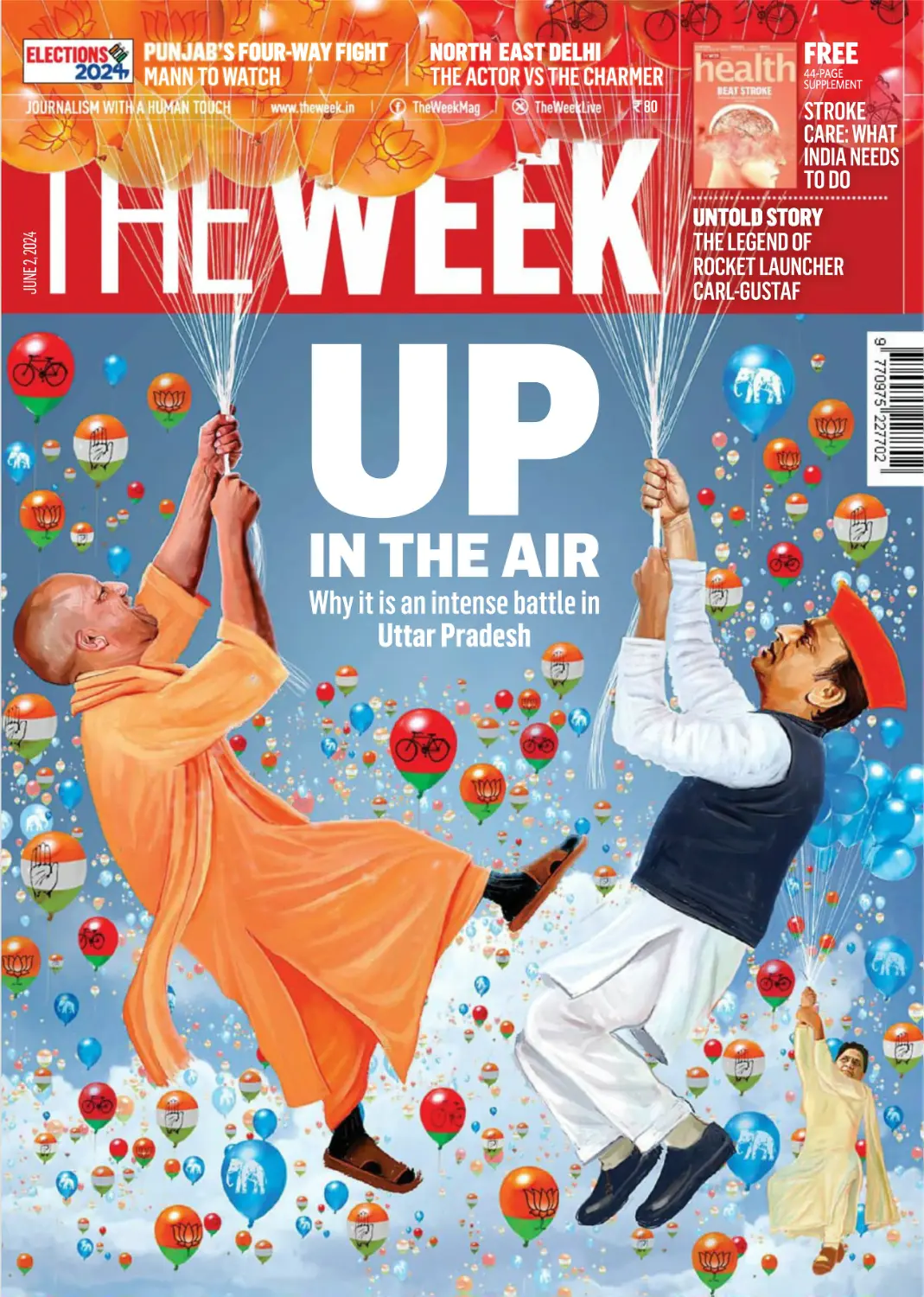
COVER STORY
PT FOR GRAB
Despite its monotony, the Lok
Sabha election in Uttar Pradesh
is interesting in parts. The BJP
is banking on Prime Minister
Narendra Modi’s popularity,
the sanatan stance of Chief
Minister Yogi Adityanath and
an improved law and order
situation. The Samajwadi Party
and the Congress are fighting
together as part of the INDIA
bloc. And, the Bahujan Samaj
Party is locked in a battle for
survival. But this election is of
narrow margins—both in victory
and defeat.
PLUS
♦ When voting, Ayodhya has
always looked at issues beyond
the Ram Mandir
♦ In Varanasi, the youth’s
preference for modernity
over the carefree essence
of the past is likely to
guarantee Modi's win
06
Interviews
♦ Priyanka wants Rahul
to lose: Keshav Prasad
Maurya, deputy chief
minister
♦ Voting has been low
because the opposition has
been unable to enthuse
its voters: Brajesh Pathak,
deputy chief minister
♦ The tally in Uttar Pradesh
may trigger changes that
would impact key leaders in
both the BJP and the INDIA
bloc
Our main strategy
is to keep BJP
from forming
government:
Sandeep Pathak,
AAP
Bhagwant Mann
is mortgaging
Punjab's future for
votes: Sunil Jakhar,
BJP president,
Punjab
We are anticipating
more than eight
seats: Partap
Bajwa, Congress
4 | THE WEEK • JUNE 2, 2024
к
63
untoi d ля
WSTORIES U
Carl-Gustaf, the Indian
infantry’s go-to weapon,
will be made in Haryana
ECONOMY
52
From simplified taxes
to daring reforms, India
Inc's wish list for the new
government is long
DIPLOMACY
60
How a governor of
Andamans influenced the
Barbados programme of
action for Small Island
Developing States in 1994
NORTH EAST DELHI
24
COLUMNS
Kanhaiya is a
challenge for
his own party:
Manoj Tiwari, BJP
candidate
10 POWER DRIVE
R. Prasannan
59 SOUNDBITE
Anita Pratap
70 CHIC MAGNET
Namrata Zakaria
74 LAST WORD
Shashi Tharoor
SCHIZONATION
Being called
antinational is free
publicity: Kanhaiya
Kumar, Congress
candidate
Anuja Chauhan
71
WEST BENGAL
30
Nancy Tyagi is
blowing up big
right now. It's
a Cinderella
story of the
best kind...
except this
young girl is her own fairy
godmother and her own
Prince Charming.
Political fight gets personal
in Bishnupur as former
spouses take on each other
LEISURE
Deepa Mehta’s latest—
I am Sirat— tenderly
tells the story of a
transwoman battling
dual identity
CINEMA
If anyone
can
breach
the chasm
between
chef and
actor, it is
Ranveer
Brar
COVER ILLUSTRATION BINESH SREEDHARAN
Printed at Malayala Manorama Press, Kottayam,
and M P Printers, Noida, and published from
Manorama Buildings, Panampilly Nagar,
Kochi-682 036, by Jacob Mathew, on behalf
of the Malayala Manorama Company Private
Ltd., Kottayam-686 001. Editor Philip Mathew,
Manorama Buildings, Panampilly Nagar,
Kochi-682 036
• Focus/lnfocus features are paid
marketing/PR initiatives
JUNE 2, 2024 • THE WEEK 5
LETTERS
Crucial battle
Your assessment that unimaginable scenarios are
playing out across Maharashtra was absolutely
correct ('Wrest assured,’ May 19). I will go one step
further—the alliance that sweeps Maharashtra will
win Delhi. The rifts and the splits in the NCP and the
Shiv Sena have definitely left the voter dissatisfied,
disgusted and angry. But, I feel all that will surface
in a bigger way in the assembly elections scheduled
for later this year. In the Lok Sabha polls, people will
either vote for the NDA or the INDIA alliance. The
future looks bleak for those factions of the NCP and
the Shiv Sena that will end up on the losing side.
Prashant Asthana,
On email.
Farmer issues have always
dominated the electoral
battle in Maharashtra,
and it will remain so.
Eknath Shinde and Ajit
Pawar will pay a heavy
price for taking their vote
bank for a ride. After a few
months, the BJP will surely
pressure Shinde to quit
the chief minister’s chair,
and Ajit will see political
oblivion. The people
of Maharashtra will
teach these politicians a
lesson.
Vasudha K.,
On email.
Uddhav Thackeray
is to be blamed for
all the confusion in
Maharashtra politics
today. He should have
been wiser in 2019. How
could he even think of
joining hands with the
Congress and the NCP,
only because he wanted
to be the chief minister?
The assembly poll verdict
in Maharashtra was
clearly in favour of the
BJP, and Uddhav should
have accepted the post of
deputy chief minister. He
was over-ambitious and
that spoiled everything.
Uddhav should have
realised that things are
not how they used to be
under Bal Thackeray, and
there was no harm in
playing the second fiddle
to the BJP in the state. We
all move with the times.
Radhesyam Chavan,
On email.
Election outcomes
can be as erratic as a
new blockbuster. Any
candidate can make
a 360-degree turn,
regardless of the political
party they belong to. Like
politicians, the general
public also say one thing
and do just the opposite
when they cast their
vote. Freebies and sweet
talk triumph over loyal
leaders.
Praveen Thimmaiah,
On email.
Rahul could lose
Rahul Gandhi may not
win Rae Bareli; even if
he wins he will win by a
narrow margin ('Shaky
stronghold,’ May 19). Rae
Bareli owed its identity to
the Gandhi family once
upon a time, but that is
no longer the case. The
Gandhi family should get
into a redemptive mode.
They should spend more
time in Amethi and Rae
Bareli. People should
feel connected to them. I
wish Rahul the best. May
democracy win.
Gaurav Malhotra,
On email.
Rahul may have won
from Rae Bareli if he
had not contested
from Wayanad. The
BJP candidate in Rae
Bareli is strong. Rahul
should have opted out of
Wayanad, and focused
only on Rae Bareli.
If Rahul continues to
fight from Wayanad, the
impression in the north
Indian states, which
have more seats, would
be that he lacks the
courage to take on the
HOW TO REACH US
SUBSCRIPTIONS/CUSTOMER CARE	CIRCULATION	Kolkata:	BUREAU
For all subscription related inquiries	Bengaluru:	033-24198171/24198444	Bengaluru:
please write, email or fax to	080-22247735/22247736	Kottayam: 0481-2563646	080-22867345, 22867050
Senior Manager, Circulation,	Bhopal: 0755-2988036	Lucknow: 0522-2341576 Mumbai: 022-62965985	Kolkata: 033-24556995, 24198344, ext.216
Manorama Buildings,	Chandigarh: 0172-2724699		Chennai: 044-66918500
PB No. 4278, Panampilly Nagar,	Chennai: 044-66918530/31	Patna:	Delhi: 011-23354920
Kochi - 682036. Kerala	Coimbatore:	0612-2233809	Hyderabad:
Email: subscribe@theweek.in	0422-2241911/2245470	Jaipur:	040-23314168, 23324692 Mumbai: 022- 22074604,
Toll free no.: 18001035981	Delhi: 011-23739740	0141-2368360/4005808	22004358
	Hyderabad:	Thiruvananthapuram:	Bhopal: 0755-2431001
Cochin: 0484-4447507	040-23314168/23324692	0471-2328198	Lucknow: 0522-2701725
ADMINISTRATIVE OFFICE
Manorama Buildings, P.B. No. 26,
Kottayam 686001, Kerala, India.
Tel: 0481-2563646
REGIONAL
CO-ORDINATING OFFICE
Tej Building, 1st Floor, Bahadur
Shah Zafar Marg,
New Delhi 110 002.
Tel: 011-23354920,23354921,
23359541,23355801,
23356537
Fax: 43541354
EDITORIAL
Manorama Buildings,
P.B. No. 4278,
Panampilly Nagar,
Kochi 682036, Kerala, India.
* editor@theweek.in
ф http://www.theweek.in
04-91 4844447888
01-91 484-2315745
Advertising: +91 98953 95097
Email: magazineads@mm.co.in
(} TheWeekMag ©@TheWeekLive 0 TheWeekMag 9 85 89 99 48 69
6 | THE WEEK • JUNE 2, 2024
Apollo
hospitals
Suffering from
Resistant
Hypertension?
Renal Denervation is here to help.
Hypertension is a very common medical problem
affecting nearly one third of the adult population in
India. Studies over the years have shown that reduc-
ing the BP does reduce the events of heart attack,
stroke and death. Lowering the blood pressure by 5
mmHg is shown to reduce stroke by an estimated
34%, ischemic heart disease by 21% and death by
13%.
The right combination of drugs is important for the
management of hypertension. Sometimes despite the
right combination of drugs and compliance with medi-
cations and lifestyle, blood pressure remains high for
few patients. For these patients who also have ruled
out other secondary causes of hypertension, a newer
treatment modality has emerged called Renal dener-
vation (RDN) and has been proven to reduce blood
pressure in studies.
What is renal denervation and how is it performed?
The renal denervation (RDN) procedure is a minimally
invasive technique that targets nerves near the
kidneys that can become overactive and the main
reason for elevated blood pressure. In this procedure,
a small catheter (wire like device) is inserted through a
tiny puncture into the right groin artery and is taken up
to the kidney artery. The doctor then uses the catheter
to calm the excessive activity of the nerves connected
to the kidney. The tube is removed, leaving no implant
behind. The procedure is very safe and can take up to
1 hour. The patient can be discharged the next day
and can go back to normal life as before.
What are the benefits of renal denervation?
RDN is highly effective in controlling blood pressure
and more importantly the number of antihyperten-
sive medications come down significantly after the
therapy. The results of RDN therapy are long lasting
with continued benefits as long as 10 years post
therapy.
Who is an ideal candidate for RDN?
1. Patients with resistant or uncontrolled blood
pressure despite taking multiple medications.
2. Patients with high blood pressure and are unable
to take medications due to adverse effects of
drugs.
Dr. Refai Showkathali
MRCP (UK), FRCP (Lon), CCT in Cardio (UK),
FACC (USA), FESC (Europe), Fellowship in TAVI (Lon)
Senior Consultant Interventional Cardiologist
Adjunct Professor, Apollo Hospitals Educational &
Research Foundation
Apollo Hospitals, Thousand Lights, Chennai
Apollo Hospitals
21, Greams Lane, Off Greams Road, Thousand Lights, Chennai - 600 006
Ph: 044 4040 1066 I E: infochennai@apollohospitals.com
I Apollochennai @Apollo_Chennai
apollo_chennai
□ Apollo Hospitals Chennai
www.apollohospitals.com/chennal/
— LETTERS
THEWEEK
BJP there. No sensible
Indian politician would
want to have that kind of
perception.
Vismay Kapur,
On email.
CPI and CPI(M)
should merge
These so-called fiery
young candidates of the
CPI(M) cannot revive
the party in West Bengal
('Red shoots rising! May
19). There is an urgent
need for the CPI(M) to
reinvent itself. In Kerala,
the CPI(M) is turning
into a commercial
entity, and it does not
address the concerns
of the marginalised
sections of society. I
feel the CPI and the
CPI(M) should merge
to save the communist
movement in the
country.
Tanushri Nagaraj,
On email.
Don't divide us
I was hurt after reading
'Growing north-south
divide' ('Manifesto,'
March 17).
Mani Shankar Aiyar
said that India would
have become the fifth
largest global economy
if the north had
matched the south's
rates of economic
growth, and that our
per capita income
levels would have been
much higher if the
north controlled its
population growth.
The columnist has left
no stone unturned to
praise the development
and the progress that

the southern states
are showing. It clearly
shows that he has ill
will towards northern
states and the rest of the
country. Lakhs of people
migrate to southern
states for better jobs and
livelihood. But they also
contribute in taxes, work
force, labour, and other
human resources.
The columnist
should remember
that a major part of
wheat comes from
Punjab and Madhya
Pradesh. laggery and
sugar come from Uttar
Pradesh. The columnist
said that the southern
states are severely
discriminated against
in the distribution of tax
revenue.
He said that the
taxpayer in states like
Tamil Nadu and Kerala
average ?20,000 a year
in contributions to the
national tax kitty, but
the average contribution
of the Bihar taxpayer is a
measly ?4,500.
The columnist has
made us feel ashamed
about our identity.
He feels that India
is not a developed
country because of the
incompetency of people
from certain parts of the
country.
If he feels that
there is a bias against
the southern states,
he should start a
movement to stop it,
and not tarnish the
image of the northern
states.
Bhaskar Gangwal,
On email.


Editor
Chief Associate Editor & Director
Editor-in-Charge
Chief News Editor
Senior News Editor
News Editor
Senior Assistant News Editors
Deputy News Editors
Resident Editor, Delhi
Chief of Bureau, Mumbai
Deputy Chief of Bureau, Delhi
Senior Assistant Editors, Delhi
Consultant, Sports
Lifestyle Editor
Chief Subeditors
Senior Subeditor
Subeditor
SENIOR SPECIAL CORRESPONDENTS
Delhi: Sanjib Kr Baruah
Srinagar: Tariq Ahmad Bhat
Lucknow: Puja Awasthi
Chennai: Lakshmi Subramanian
Bengaluru: Prathima Nandakumar
Mumbai: Nachiket Kelkar
SPECIAL CORRESPONDENTS
Kochi: Anjuly Mathai
Hyderabad: Rahul Devulapalli
Delhi: Mohit Sharma
Senior Photo Editor: Sanjoy Ghosh
Photo Editors
Bhanu Prakash Chandra, Salil Bera
Deputy Photo Editor
Sanjay Ahlawat
Chief Photographer
Mumbai: Arney Suhas Mansabdar
Photographer
Delhi: Kritajna Naik K.
Chief Picture Coordinator
Bimal Nath C.
Senior Researcher: Rani G.S.
Photo Researcher: Jomy M. Joseph
THEWEEK.IN
New Media Coordinator
Senior Subeditors
Subeditor
Senior Researcher
Senior Web Designer
Video Editors
Assistant Video Editor
Senior SEO Analyst
Executive Director
Vice President, Marketing,
Advertising Sales
Chief General Manager, Circulation
Chief General Manager, Sales
MUMBAI
Resident Chief General Manager
BENGALURU
Regional Chief General Manager
NEW DELHI
Chief Marketing Officer (North) &
Head, Special Projects
CHENNAI
Regional Head
Philip Mathew
Riyad Mathew
V.S. Jayaschandran
Stanley Thomas
Lukose Mathew
Mathew T. George
Maijo Abraham, Ajish P. Joy
Susamma Joy Kurian, Navin J. Antony
R. Prasannan
Dnyanesh V. Jathar
Namrata Biji Ahuja
Soni Mishra, K. Sunil Thomas,
Pratul Sharma
Ayaz Memon
Namrata Zakaria
Anirudh Madhavan, Anirudha Karindalam
Karthik Ravindranath
Diya Mathew
PRINCIPAL CORRESPONDENTS
Bengaluru: Abhinav Singh
Mumbai: Pooja Biraia Jaiswal
SENIOR CORRESPONDENTS
Delhi: Reya Mehrotra
Thiruvananthapuram: Nirmal Jovial
CORRESPONDENT
Kolkata: Niladry Sarkar
CHIEF REPORTER
UAE: Mintu P. Jacob, Dubai
Art Editor: Jayakrishnan M.T.
Senior Assistant
Art Editor: Binesh Sreedharan
Senior Infographic
Designer: Sreemanikandan S.
Illustrator: B. Bhaskaran
Senior Layout Artist: B. Manojkumar
Designers: Deni Lal, Job P.K., Rajesh A.S.
Graphic Designer: Syam Krishnan
Artists: Sumesh C.N., Sujesh K.,
Ajeesh Kumar M., Jairaj T.G.
Sarath Ramesh Kuniyl
Jose K. George, Vinod V.K.,
Vignesh Vijayakumar, Meera Suresh,
Anuja Susan Varghese, Sachin Jose,
Bechu S.
Anugraha Mariam Sabu
Saju C. Daniel
Rahul J. Mohan
Vishnudas K.S., Ujwal P.P.
Uthara Dinesh
Deepu R.
George Jacob
Varghese Chandy
Cinu Mathews
Hari M. Varrier
Shree Kumar Menon
Ranjit Kurien
R. Rajmohan
John Sudhir Abraham
8 THEWEEK • JUNE 2, 2024
— APERITIF —
POINT BLANK
MILESTONES
I am a newspaper addict. In fact,
I get irritated when I don't get my
newspaper early in the day. I read
four newspapers a day. Books, I
finish two to three of them a week
easily. I read biographies, history,
if it is interesting, crime thrillers
for entertainment, and read
classics. I have a fairly wide range
of interests in books.
Ruskin Bond, author
He has become so greedy for the
post of the chief minister that he is
trying to link his predicament with
me. People of Delhi felt relieved
when Arvind Kejriwal was in jail as
their 'cough' had subsided.
Yogi Adityanath,
on the Delhi chief minister
I am a director's baby, and the first
thing I see is who is the director and
what are they going to do with me,
because they are the people who live,
breathe and eat that vision. And my
fuel is to surrender to that vision, to
be present, and to absorb and to do
work from there.
Aditi Rao Hydari,

FOUR CONSECUTIVE TITLES
Manchester City won a fourth
consecutive Premier League title
after it beat West Ham United 3-1.
This was for the first time in the
league’s history that a club won four
consecutive titles. With the victory,
Manchester City has won six out of
the last seven titles.
[Trinamool Congress MP] Abhishek
Banerjee is intelligent and focused,
and the way he leads the party is
extremely different from how it
used to be done earlier. However, he
should let people touch him Didi
[West Bengal CM Mamata Banerjee]
is approachable, but can be fooled.
DevAdhikari,
Trinamool Congress MP
I would never want to say sorry on
my death bed about some five shots
that I missed. No question about it.
That is one moment where I want to
look up into the eyes of God and I
hope I did well.Not that every-
body likes my work, but they care for
me because of that love for one shot.
Sanjay Leela Bhansali,
filmmaker
WORDPLAY
Dinkwad is the abbreviation for dual income, no kids, with a dog. It is a lifestyle
trend, popular among millennial and Gen Z couples.

GOLD MEDAL
Sumit Antil won the gold medal in
the men’s F64 javelin event at the
World Para Athletic Championships
in Japan. Antil threw 69.50m to
finish at the top. Last year, he had
clinched the gold medal at the
Hangzhou Asian Para Games.
FIRST INDIAN TOURIST IN SPACE
Gopichand Thotakura, an
entrepreneur and pilot from
Vijayawada in Andhra Pradesh,
became the first Indian to travel
to space as a tourist. Thotakura
was part of the select crew of Blue
Origin’s New Shepard-25 mission,
which had six members.
JUNE 2, 2024 • THE WEEK 9
POWERDRIVE
Searching for Surjeet
Ever since the British left us to our fate,
freedom and franchise, many Indians have
yearned for a two-party system like the way
they have it in England—a neat polity where two
parties contest for power, and the loser would shad-
ow the ruler. They forget that we got our freedom
when a third party came to power on its own in the
UK.
A few of us are also fascinated by the American
way, where two parties fight for the top job in a
neatiy choreographed election where everything,
except the winner, is pre-determined—the term
of office, the date of polling, the date of counting,
the date of inauguration, everything. The Ram
Nath Kovind committee
has prescribed something
of that kind for us, boring to
the core, but in a multi-party
order.
Yearning for a two-par-
ty polity is one thing, but
getting it is another. It ought
to evolve. We can't will it into
being or wish it into exist-
ence. Why should we? Ours is
a multi-culture society where
our myriad political wills
and electoral wishes can't
be force-packed into a bland
political binary.
Yet, like it or not, we seem
to be evolving into a two-front polity. West Bengal
and Kerala had in effect been two-front polities
since nearly half a century, though the warriors
on the fronts have changed. Rajasthan, Gujarat,
Madhya Pradesh, Chhattisgarh, Himachal Pradesh
and Uttarakhand have become two-party polities;
Maharashtra has become a two-front polity.
At the federal level, we have been evolving into
a two-front polity since the collapse of the lanata
experiments of the late 1990s. This election has
catalysed the process. Narendra Modi's NDA has re-
mained more or less solid for the last several years;
now the opposition, which fought as disparate ele-
ments in the last two rounds, has consolidated over
the last few months. There still are sulking truants
like Mamata Banerjee, but it looks like the contours
of both the alliances have more or less consolidated.
Would the fronts hold fast after the polls, espe-
cially if neither front makes it to the halfway mark,
as many are predicting? The answer is difficult. It
would all depend on who gathers more of the for-
tune-hunting freebooters, and who can lure more
quislings from the other side.
The early bird will get the worms. The Congress
learnt it the hard way in Goa and Manipur in 2017,
and in Meghalaya in 2018. By the time the final
count was out, the BIP, which won fewer seats, had
more MLAs to take to the governor. The story could
be the same in Delhi this
time, if neither front is sure of
a clear win. The game could
already be afoot. Who makes
the next government will be
decided after the last vote is
cast on lune 1, and the first
vote is counted on lune 4.
Indeed, moves made in
such interregnums can go
wrong. Political lore has it
that, though fighting each
other in Karnataka, H.D.
Deve Gowda had assured
PV. Narasimha Rao of the
support of his lanata Dal in
case Rao fell short of MPs in
1996. But how the table turned! After the polls, Rao
was forced to lend his many Congress MPs as out-
side supporters to Gowda's few MPs who sat on the
treasury benches. That was when Pramod Mahajan
made the famous joke about how he had to tell his
Chinese hosts about the largest party sitting in the
opposition, the second largest party sitting outside
the government, and the smallest of the three in the
government.
That miracle was made possible by a crafty com-
munist, one who spurned kingship for himself or
any of his partymen, but loved making others kings.
His name: Harkishan Singh Surjeet.
Does India or INDIA have one like him now?
IMAGING DENI LAL
prasannan@theweek.in
10 THE WEEK • JUNE 2, 2024
IN FOCUS
Management of
Diabetes during summer
Summer can make it harder to
manage diabetes because of
heat-related health problems.
As the sun shines brighter and
temperatures rise, individuals with
diabetes face unique challenges in
keeping their blood sugar levels stable.
With the right strategies and a little extra
care, you can still enjoy all that summer
has to offer while effectively managing
your diabetes. High temperatures may
affect insulin absorption rates, making
it crucial to adapt dosages accordingly.
Dehydration becomes a significant
concern during the summer months,
as excessive heat can cause fluid loss
through sweating. This poses a risk for
diabetic individuals, as dehydration can
lead to spikes in blood sugar levels and
potential complications. Additionally,
staying cool while also ensuring proper
hydration presents a delicate balance
that requires attention.
The temptation of sugary treats and
indulgent beverages often heightens
in the summer, posing a challenge for
those with diabetes trying to stick
to a balanced diet plan. Resisting
these temptations while still enjoying
seasonal delights can be tricky but
essential for maintaining optimal health
throughout the sunny days ahead.
Tips for managing blood sugar
levels during summer
Managing blood sugar levels during the
summer can be tricky, but with some
simple tips, you can stay on track.
One key tip is to stay hydrated by
drinking plenty of water throughout the
day. Dehydration can affect blood sugar
levels, so it's essential to keep fluids
flowing.
Opt for hydrating foods like
watermelon, cucumbers, and lettuce to
stay cool and maintain proper hydration.
These foods are not only refreshing but
also low in calories and high in water
content. Incorporate fibre-rich options
such as whole grains, legumes, fruits,
and vegetables into your meals to help
with blood sugar control. Fibre slows
down digestion and helps prevent spikes
in glucose levels after eating.
Avoid sugary drinks like soda and
fruit juices which can cause rapid blood
sugar fluctuations. Instead, opt for
unsweetened beverages like water or
herbal teas or buttermilk to stay hydrated
without affecting your blood sugar levels.
By being mindful of what you eat and
drink during the summer months, you
can better manage your diabetes while
enjoying a healthy lifestyle regardless of
the rising temperatures.
Another helpful tip is to check your
blood sugar more frequently than usual
in hot weather. The heat can impact how
your body responds to insulin and food,
so keeping a close eye on your levels is
crucial.
Moreover, staying active during the
summer months is importantfor managing
diabetes. Incorporate regular exercise
into your routine but choose cooler times
of the day to avoid overheating. Staying
active during the summer is crucial for
managing diabetes. When it comes to
exercise, choose activities that you enjoy
and can easily fit into your routine. Opt
for early morning or evening workouts to
avoid the peak heat of the day. Swimming
is a fantastic option as it keeps you cool
while providing a full-body workout.
Walking in shaded areas or indoors is also
beneficial. Remember to wear breathable
fabrics and comfortable shoes to prevent
blisters and discomfort.
Always carry water with you to stay
hydrated during physical activity,
especially in hot weather. Monitor your
blood sugar levels before and after
exercising to ensure they stay within a
healthy range.
Consult your healthcare provider
before starting any new exercise regimen,
especially if you have underlying health
conditions. Listen to your body and take
breaks when needed. Regular physical
activity not only helps manage diabetes
but also boosts overall well-being during
the summer months.
Dr. V. MOHAN, M.D., Ph.D., D.Sc.,
Chairman
Dr. Mohan's Diabetes Specialities Centre,
Madras Diabetes Research Foundation,
Contact: +91 8939110000
Email: contact(a)drmohans.com
Managing medications and insulin
during hot weather is crucial for
individuals with diabetes to maintain
optimal health. The heat can affect
the efficacy of medications, especially
insulin, making it essential to take extra
precautions.
It's important to store insulin
properly, ensuring it remains at a
stable temperature. Keep your insulin
refrigerated at home and when traveling,
use a cool bag or pouch to prevent
exposure to high temperatures.
Be mindful of how the heat may impact
your blood sugar levels and adjust your
medication doses accordingly under the
guidance of your healthcare provider.
Remember that extreme heat can alter
how your body processes medications.
Enjoying a healthy and safe summer
with diabetes is all about being
proactive, informed, and prepared. By
staying on top of your blood sugar levels,
staying hydrated, eating well-balanced
meals, adjusting your insulin as needed,
staying cool in hot weather, recognizing
low blood sugar symptoms, and taking
necessary precautions when traveling
during the summer months - you can
ensure that you have a enjoyable and
worry-free season. Remember to
prioritize your health and well-being
so that you can make the most of the
sunny days ahead while managing your
diabetes effectively. Stay safe and have
a fantastic summer!
JUNE 2, 2024 • THEWEEK | Ц
APERITIF
PARTY SNACKS
AWKWARD
MOMENT
Hie bureaucracy in South Block
and the armed forces have
their moments of unease once
in a while. Arunachal Pradesh
Governor Lieutenant General
K.T. Parnaik (retd) seemed to
have unwittingly triggered such
a moment last week. At a lecture
organised by the Army and the
United Service Institution of
India, a think tank, the governor
said: "The armed forces
gracefully accepted civilian
control since independence....
However, over a period of
time, this has turned into a
bureaucratic control..." It left
many babus as well as officers a
little ill at ease.
WHO IS THE DICTATOR?
After Prime Minister Narendra Modi said that his work would help India for
a 1,000 years to come, opposition parities had found similarities between his
words and those of Adolf Hitler, who said that Nazi Germany would last a 1,000
years. Trinamool MP Mahua Moitra had even shared a post with Modi's words
and the photo of an old The New York Times report about Hitler's prediction. The
BIP's West Bengal president Sukanta Majumdar responded by calling Mamata
Banerjee the biggest dictator in the world. "She does not hesitate to jail a person
for drawing a little cartoon," he said. "On the other hand, when the opposition
mocked Modi ji and made memes, he took it sportingly."
ILLUSTRATIONS JAIRAJ T.G.
12 THE WEEK - JUNE 2, 2024
DIVINE AFFIRMATION
THE GEHLOT TOUCH
CALL TO CASTE
When the going gets tough, some netas invoke
deities and attribute their decision to rebel to
them. K. Raghupathi Bhat, former BJP legislator
from Karnataka's Udupi, was denied a ticket to
contest in the MLC elections on June 3. He is
now preparing to contest as a rebel. He said he
had the blessings of two deities and their positive
response to his decision to contest as a rebel had
given him encouragement and assurance.
The Congress campaign in Amethi had a distinct
Rajasthani flavour, thanks to former Chief Minister Ashok
Gehlot. The party's observer in the high profile seat, where
Gandhi family loyalist K.L. Sharma took on the BJP's
Smriti Irani, Gehlot deputed senior leaders from his state,
including sitting and former MLAs, to coordinate the
campaign. The presence of the Kami Sena, a group that
represents the Rajput community in the constituency, has
also been attributed to Gehlot. The Kami Sena has been
mobilising the Rajputs to vote against the BJP.
Sangam Lal Gupta, sitting MP and the BJP candidate from
Pratapgarh, burst into tears at an election rally. His pain was
triggered at being opposed for his caste (Teli) by the Kshatriyas
who are big players in the constituency. Gupta's pitch was
baffling—that candidates from the Kshatriya caste use Patel as
their surname when asking for votes but lapse into their high ways
once elected. Gupta, who described himself akin to the dust of the
voters' feet, might have earned the ire of the Election Commission
by talking openly about caste.
JUNE 2, 2024 • THE WEEK 13
14 | THE WEEK • JUNE 2, 2024
— APERITIF —
THE BIG PICTURE
FAMILY AFFAIR
Rinchen, 23, leaves
with her father,
Konchok Rabgais,
42, after voting in
Ladakh’s remote
Warshi village on May
20. Warshi, which is
around 170km from
Leh, is home to just
one family with five
eligible voters. Polling
officials travelled
seven hours to reach
the polling station
near Siachen as
part of the Election
Commission’s effort
to ensure maximum
participation.
PHOTO BY REUTERS
JUNE 2, 2024 • THEWEEK | 15
ELECTI0NS2O24»
BATTLE8R0UND
PUNJAB
MANN IN A
16 THE WEEK • JUNE 2, 2024
CORNER
In a four-cornered contest, the
division of votes might work to the
advantage of the Congress. It could
also help the AAP, which is fighting
massive anti-incumbency, save face
BY PROF PRAMOD KUMAR
he parliamentary elections in Punjab are not in sync with
the national political narrative of kamandal (Ram Mandir)
and Mandal (OBC census). There is also not the seriousness
to herald any change in the development paradigm or any
political will to resolve the farmers' grievances. The elections,
instead, have become a theatrical battle royal of false claims and
empty promises.
The electoral outcomes of the 2014 and 2019 parliamentary and
the 2022 assembly elections showed that the voters were no longer
bound by any political party, and in fact, functioned largely as
footloose voters. For instance, in the 2014 elections, the AAP won
a surprise four seats and 24 per cent vote share. But in the 2019
elections, the AAP's vote share decreased to 7 per cent with one seat,
the Congress vote share increased to 41 per cent with eight seats, the
Akali Dal's vote share was 28 per cent with two seats, and the BJP vote
share was 9 per cent with two seats. Whereas, in the 2022 assembly
elections, the AAP resurged with more than 40 per cent vote share and
92 seats. Surprisingly, immediately after this landslide victory, it lost
the Sangrur Parliament byelection on a seat vacated by the sitting chief
minister.
NO EXCLUSIVE VOTE BANKS
Historically, Punjab has had no exclusive vote banks based on religion
or caste, unlike in many other states. The religio-caste categories are
intermeshed. For instance, scheduled castes constitute more than
32 per cent of the population and are segmented into Mazhabis,
Chamars, Ad-dharmis and Bahnikis. They are not represented in poli-
tics by any caste-based party. The long-term implications of the com-
munity finding representation in mainstream Punjab has been that
the Bahujan Samaj Party’s vote share has been continuously declining.
It has come down from 8 per cent in 2004 to 3.5 per cent in 2019.
w	It is relevant to point out that the scheduled castes got representa-
н	tion in all political parties, including the Jat-dominated Akali Dal.
a	This has meant that a majority of the scheduled caste legislators were
JUNE 2, 2024 • THEWEEK 17
ELECTI0NS2O24*
BATTLE9R0UND
elected from parties other than the
BSP and the left parties.
DERAS AND DRUGS-CURRENCIES
TO BUY VOTES
Furthermore, the sub-castes are
intermeshed with the deras, which
are shrines of the saints operating
outside the ritualistic domain of the
institutionalised religions. These
deras have acquired moral superi-
ority by liberating their devotees, by
and large, from vices like drugs and
alcohol, and have efficiently provid-
ed access to health care and sub-
sidised food. Many of the devotees
who belong to the scheduled caste
community are affiliated to compet-
ing deras; for instance, a majority
of the Ravidasias are with the Dera
Ballan, and a section of the Mazhabis
are with the Dera Sacha Sauda. The
blind faith of these devotees is traded
as votes by the self-styled god-men.
Politics over drugs has become
more serious than the problem itself.
Instead of addressing the issue, more
focus is on sending political adver-
saries to jail and fabricating a false
narrative to settle personal scores
and to harvest votes.
LOCALISED CASTE AND
RELIGIOUS FLAVOUR
Punjab has added its own regional
flavour to caste and religious iden-
tities. This can be attributed to the
role of religious reform movements,
particularly Sikhism, Arya Samaj
and Brahmo Samaj. This weakened
the orthodox behavioural aspects of
caste and inter- and intra-religious
practices. The Hindus have dominant
traits of Sikhism, normative behav-
iour influenced by the Arya Samaj
and rituals of sanatan dharma. For
instance, in the 2014 parliamentary
elections, the BJP could not garner
the votes of urban Hindus even when
the hindutva wave was sweeping
other parts of the country.
Punjab's electoral politics has
shown signs of blurred religious and
caste fault-lines. To mobilise the
people as exclusive categories, like
Hindu Banias or scheduled castes,
might not bring the desired electoral
results, unlike in other Indian states.
There is no concept of ideological
puritanism. At the village level, fac-
tions shift their loyalty in opposition
to the other.
MERGERS, ELECTORAL
ALLIANCES AND COALITIONS
Given this background, the elector-
al politics of Punjab has a history
of mergers, electoral alliances and
coalitions with even diametrically
opposed political parties. Even the
Congress and the Akalis merged in
1937,1948 and 1956.
In reorganised Punjab, between
1967 and 1980, four post-election
coalitions were formed between the
BJP/Bharatiya Jana Sangh and the
Akali Dal. And in the post-terrorism
phase, the Akalis and the BJP formed
three pre-election coalitions. The
logical inference can be drawn that
the voters do not see political parties
18 THE WEEK • JUNE 2, 2024
INTERVIEW
as antagonistic. Most people keep
both the blue turban (Akali symbol)
and white turban (Congress symbol)
ready to wear as per the opportunity.
However, the Congress remained
capable of forming a government on
its own, averaging above 30 per cent
of the votes, while the Akalis needed
a coalition partner to be electorally
viable and politically stable.
Similarly, the BJP does not have an
exclusive vote bank to win majority
on its own. In the parliamentary
elections between 2004 and 2019, the
BJP in alliance with the Akalis could
win two or three seats, with around
10 per cent vote share.
The alliance between the BJP
and the Akalis became strained
as the former did not conform to
alliance dharma. For instance, in
the 2017 assembly elections, an
unusual understanding between
the BJP and the state Congress, led
by Captain Amarinder Singh (who
later joined the BJP), to defeat the
AAP changed electoral dynamics. It
was "unusual" as there was a formal
alliance with the Akalis. This can be
easily discerned from the shift in the
urban vote share, which is the BJP's
traditional vote bank. The urban vote
share of the Congress went up from
43.5 per cent in 2012 to 49 per cent
in 2017. And, the urban vote share
of the BJP declined from 28 per cent
in 2012 to 19 per cent in 2017. It can
be safely concluded that the under-
standing between the Congress and
the BJP helped the former.
In the 2019 parliamentary elec-
tions, there was no pact between
the Congress and the BJP. The urban
vote share of the BJP increased from
19 per cent in 2017 to 27 per cent in
2019. And, the Congress's urban vote
share declined from 49 per cent in
2017 to 45 per cent.
Ironically, in the 2022 assem-
bly elections, the BJP entered into
a pre-election alliance with the
breakaway groups—the Punjab
Loktantrik Congress (Amarinder)
PARTAP BAJWA, Congress leader
We are
anticipating
more than
eight seats
BY MOHIT SHARMA
Congress veteran Partap Bajwa is confident
that his party has the edge in the four-
cornered contest in Punjab. "Our party will
bring minimum support price if given a
chance," he said. Excerpts from an interview:
become the national
convener, but
Kejriwal's wife came
to the limelight. They
(the AAP) also realise
that they have made a
bad choice in Mann.
Q/ Which party will benefit most from the
four-cornered contest?
А/ There was a recent survey in Punjab which
had the Congress's chances at 30 per cent, the
Aam Aadmi Party's at 27 per cent, the BJP's at
18 per cent and the Shiromani Akali Dal's at 16
per cent. The Congress clearly has the edge.
Q/ Are you trying to reap the benefit of
farmers' sentiment against the BJP?
А/ We don't want to reap the benefit. We
honestly stand with the farmers.
Q/ The Congress and the AAP are allies in
Delhi and are fighting each other in Punjab.
А/ From the outset I have opposed any kind
of tie-up with the AAP in Punjab. [I told]
the central leadership: the AAP is in the
government; we are the main opposition. If
today we come together, the major beneficiary
would be the AAP. They will take most of our
cadres. Besides, they lack leaders. A lot of their
candidates are former Congressmen.
Now I think the national leadership agrees
that my stand saved the party in Punjab....
I feel the AAP is just an aberration. And
Bhagwant Mann is a bad choice [as Punjab
chief minister]. He is not in [AAP leader]
Arvind Kejriwal's control. When [Kejriwal]
was imprisoned, Mann thought he would
Q/ There is talk that
the Congress lacks
star campaigners.
Does it affect
campaigning?
А/ Am I not a star
campaigner? I am the
senior-most politician
in the state.
Q/ How many seats
are you confident
of winning? Mann
is raising the 13-0
slogan.
А/ Mann will lose
even Sangrur (the
seat he had held
before becoming
CM). He lost Sangrur
in the bypoll three
months after winning
the assembly
elections.
Congress
candidates are
winning the polls
hands down. We are
anticipating more
than eight seats. О
JUNE 2, 2024 • THE WEEK 19
ELECTIONS2024r
BATTLE9R0UND
PUNJAB
and the Shiromani Akali Dal (SAD
Sanyukt)—and not with the Akalis.
The BJP won two seats with around
7 per cent vote share. The Akalis had
not allied with the BJP because of the
farmers' protest. Both parties faced
their worst-ever defeat.
This was mainly because the Sikh
Jat peasantry lost its hegemonic
control on politics, as well as on the
economy. In the agricultural econo-
my, it has moved from the seller's to
the buyer's market. And in politics,
the Jat Sikh peasantry support base
became fragmented between com-
peting political parties and the urban
Hindus and the scheduled castes
aspired for a greater share in power.
Interestingly, between 1997 and
2022, the representation of farmers
in the state legislature reduced from
42 per cent to 18 per cent and in the
state cabinet from 40 per cent to 26
per cent.
These developments have taken
Punjab from a two-party rotational
system to multiparty contests leading
to the crowding of the electoral
space. Its cultural terrain and unique
religio-caste fault lines have made
the urban Hindus and the scheduled
castes the game changers.
FOOTLOOSE VOTERS AND
PARTY-HOPPING LEADERS
Elections have been reduced to a
ritual of democracy and just a matter
of perceptions and popularity ratings
of the leaders, though not of the
political parties. And, the only slogan
audible is badlaav (change). Change
for whom and for what remains
ambiguous.
Having shed their ideological
positions, a culture of personalised
politics is being nurtured and even
institutionalised. For example, for
prominent Congress leader Nav-
jot Singh Sidhu, [Former Pakistan
prime minister] Imran Khan became
'Farishta' (angel) and Rahul Gan-
dhi, 'Captain' In anti-Badalism, he
moved from the BJP to the Congress.
When in the Congress, he talks 2002
(Gujarat riots), and while in the BJP
he remembers 1984 (Delhi anti-Sikh
riots). He is an ideologically free and
politically mobile leader. This is ap-
plicable to many politicians and po-
litical parties that have been reduced
to dharamshalas (resting places).
DEROGATORY LANGUAGE
The electoral discourse as usual
shows that there has been an erosion
of ideological support bases, a deficit
in political leadership and an ab-
sence of a transformational agenda.
Along with this, the use of derog-
atory language has also become a
norm. If we look back at the 2019
parliamentary elections, most of
20 THEWEEK • JUNE 2, 2024
INTERVIEW SUNIL JAKHAR, BJP president in Punjab
the remarks made about the candi-
dates were sexist, misogynistic and
communal. This time, too, there
have been demeaning remarks. For
example, Chief Minister Bhagwant
Mann of the AAP likened Congress
leader Partap Singh Bajwa to a "class
ka nalayak baccha (useless student)!
He also called opposition leaders
opportunist turncoats who shed
crocodile tears. During a discussion
on the Centre not releasing funds,
Mann said Governor Banwarilal
Purohit was “vela baitha (sitting
idle)' and kept sending 'love letters!
Sidhu uploaded an old picture of
Mann touching his feet on stage with
a comment, “Bhai Bhagwant, santra
kitna hi bada ho jaye, rehta tehni ke
niche hi hai (No matter how big an
orange grows, it still hangs under the
branch)."
WHERE ARE THE PUNJAB
ELECTIONS HEADING?
The AAP created a new binary in the
2022 assembly elections—traditional
parties versus 'a party for change!
It claimed all the traditional par-
ties were looters and corrupt, and
created an aura of freshness around
itself. The AAP did not have historical
baggage. But now, after two years in
power, the party appears to have lost
the plot. The multifaceted develop-
ment promise remained visible only
in advertisements, to the dismay of
the electorate, said Ronki Ram, a pro-
fessor of political science at Panjab
University.
Its performance in the elections
would largely depend on its pater-
nalistic welfarism. For instance, how
far would the implementation of free
electricity for all up to 300 units ben-
efit the AAP? Chief Minister Mann
has claimed that his government had
worked for the people by opening
mohalla clinics, schools of eminence
and free teerthyatra (pilgrimage),
and this would help his party sweep
the elections.
However, Manjit Singh, a sociolo-
Mann is
mortgaging
Punjab's future
for votes
BY MOHIT SHARMA
Farmers' anger is impacting the BJP campaign
in Punjab, says state party president Sunil
Jakhar. "There is a need to find a holistic solu-
tion, and exploiting the situation for political
reasons should not be done,” he told THE
WEEK. Excerpts from an interview:
Q/ You are not in alliance with the Shirom-
ani Akali Dal. Has it made things tough for
the BJP?
А/ Of course, it is a challenge. We have been
dependent on the SAD for far too long....
Because of the tie-up with the SAD, there was
no organisational structure for the polls. But
people in Punjab are ideologically aligned
with the BJP. Such people can be found in
every household. We are trying to mobilise
that support.
Q/ Your alliance used to be in national inter-
est and brought two communities together.
Has it left the space open for other parties?
А/ The basis of this alliance was national inter-
est and communal harmony.... Irrespective of
whether we are in alliance or not, I believe that
a strong SAD is essential for peace in Punjab.
Q/ Is farmers' issue impacting the BJP's
chances?
А/ The issue is having an impact; BJP candi-
dates [are] not being allowed to campaign in
some areas.
Q/ Can the Congress's guarantee on mini-
mum support price help it in Punjab?
А/ How does it help the farmers? Which farmer
is ready to give up growing paddy for a guaran-
teed MSP? Nobody answers this question. Pad-
dy is a water-guzzling
crop; not fit for the
climate. Ifjawar gives
you ^100 per acre,
and paddy gives you
?200, which farmer
will give it up? These
issues need to be ad-
dressed holistically.
Q/ The Aam Aadmi
Party is replicating
the Delhi model of
freebies in Punjab.
Can that benefit
them? And how
do you respond
to Chief Minister
Bhagwant Mann's
13-0 slogan?
А/ Nobody takes
Bhagwant Mann
seriously. He comes
from a theatre back-
ground. He was good
at cracking jokes, but
what he is doing in
the government is
a cruel joke. Since
Mann took charge,
he has been raising
debt of Т130 crore
every day, which will
have to be paid by
somebody. A child
born today will grow
under a mountain of
debt. He is mortgag-
ing our future for
votes. О
JUNE 2, 2024 • THE WEEK | 21
ELECTI0NS2O24»
BATTLE9R0UND
PUNJAB
gist and farm activist, said, "The AAP
has lost its sheen both in the urban
and rural areas because of the recent
farmers’ wrath and two years of accu-
mulated anti-incumbency.”
INDIA VERSUS NDA
The alliance between the AAP and
the Congress could not be finalised
as the latter's Punjab unit opposed
it. The state Congress believes it has
a substantial support base and it
would be political suicide to barter
its support base for a short-term
advantage at the national level.
Mann, on the other hand, com-
pared the Congress to an "old model
of a Fiat car" and dared Bajwa on
the floor of the house to tell Sonia
and Rahul Gandhi to break the pre-
poll alliance in Delhi, Gujarat and
Haryana.
Notably, the Congress has suffered
a double disadvantage. First, the AAP
lodged a number of corruption cases
against former Congress ministers.
Second, the alliance talks between
the AAP and the Congress weakened
the position of the Congress as the
main opposition party. The question
is, will the Congress gain from the
anti-incumbency against the AAP?
Arpan Kaur, a student from
Sangrur, said, "There are no jobs.
Our youth have to migrate to other
countries and face challenges. I have
nothing to say about the AAP, but
Rahul Gandhi should be given an
opportunity this time.”
On the other hand, Sonu Verma, a
businessman from Fazilka, said there
was infighting within the Congress,
and that he did not trust either the
Congress or the AAP, as they were in
alliance outside the state.
The only major Punjab-based party
in the fray, the Akali Dal, has lost two
successive assembly elections. The
party, under the dynamic leadership
of Sukhbir Singh Badal, is in revival
mode. It is making efforts to occupy
the regional political space, fighting
for greater autonomy for the states
and asserting a moderate Sikh iden-
tity. It has the historical advantage of
fighting for the cause of Punjab and
having contributed to the develop-
ment of the state by building premier
education and health institutions,
and other infrastructure. It also
helped the state get surplus power
and was known for its citizen-friend-
ly governance. Angrej Singh, a school
The Akali Dal, the only
major Punjab-based
party in the fray, is
fighting for greater
autonomy for the
states and asserting
a moderate Sikh
identity.
clerk in Tarn Taran, said that the
Akalis had done better compared
with the AAP and the Congress. "At
least people received rations as the
local municipal councillor ensured
doorstep delivery," he said.
Verma agreed: "Akalis did good
work it terms of roads and citi-
zen-friendly governance reforms."
The BIP, on the other hand, is
overconfident because of
its religio-corporate mixed
worldview, though the same
has failed to find many takers
in Punjab so far. It does not
have a Punjab-specific agenda,
particularly for the Punjabi
Hindus who do not suffer any
minority persecution. And
merely implanting turbaned
Sikh leaders might not trans-
form it into a Punjab party.
However, it has the advantage
of having Sunil lakhar—a
pro-Punjab, no nonsense
22 THE WEEK • JUNE 2, 2024
INTERVIEW
SANDEEP PATHAK, Aam Aadmi Party leader
leader—as the party’s state president.
He was earlier the state Congress
president.
“The farmer’s protest leaders are
using the youth of Punjab as fodder,"
said Jakhar. “We assure the farmers
of Punjab that if they give us the list
of crops they would like to grow, legal
guarantee shall be given for those
crops."
The political narrative on the eve
of the elections will influence the
results. The AAP is losing its sheen,
the Congress and the Akalis are
struggling to reclaim their electoral
space and the BJP is hoping to be an
accidental beneficiary of this flux.
But, in a four-cornered contest, the
division of votes might work to the
advantage of the Congress. It could
also help the AAP, which is fighting
massive anti-incumbency, save face.
—The writer is chairperson,
Institute for Development and
Communication, Chandigarh.
Our main
strategy is
to keep BJP
from forming
government
BY MOHIT SHARMA
Sandeep Pathak, the Aam Aadmi Party’s
national general secretary in charge of
organisation, was instrumental in leading
his party to victory in Punjab in 2022. "No
one should play politics over issues like
farmers’ protest," he says. Excerpts from an
interview:
Q/ Punjab is an AAP stronghold. What is
your strategy in the state?
А/ Our strategy is very clear. We will talk
about the work that has been done ever
since the Bhagwant Mann government took
over. We will explain how we managed to
give the people free electricity, how their
irrigation system was improved, and schools
and hospitals became better. We will ask
for votes on the basis of the work we have
done. Besides, we will tell people about the
way the Central government is holding back
?8,000 crore that belongs to Punjab.
Q/ You are going it alone in Punjab and
has allied with the Congress in Delhi. Is
there a difference in strategies in both the
states?
А/ The main strategy is to keep the BJP
from forming government. And we will do
whatever it takes to do that. Of course, for
different states we have devised different
strategies.... The BJP’s hatred is not limited
to Arvind Kejriwal, but is spilling over to the
people of Delhi and Punjab.
Q/ Any specific
reason why the
farmers’ protest was
not as impactful
in 2024 as it was in
2021?
А/ Issues like
farmers’ protest
and the Citizenship
(Amendment) Act
are very sensitive.
No party should play
politics over such
issues. The BJP’s
culture has been to
bring such matters to
the forefront during
elections and fight on
their basis. Such issues
should be discussed
threadbare with all
stakeholders, and
decisions should be
taken based on what is
right and wrong. Had
the Union government
handled the issue with
an open mind and
heart, there would
have been a solution.
On both occasions,
the government came
down heavily on
farmers. This is not
acceptable. О
JUNE 2, 2024 • THE WEEK 23
The actor and
the charmer
It is a battle of two Biharis
in North East Delhi, which
highlights the importance of the
Purvanchali vote in Delhi politics
BY SONI MISHRA
Manoj Tiwari, 53, the sitting
MP from North East Delhi,
has been on a relentless
campaign for more than a
month now. It is a high-oc-
tane espousal of issues
such as nationalism and Ram Mandir, and it
is centred on Prime Minister Narendra Modi's
image as a leader who has delivered on his
promises.
AMPLIFYING MODI
BJP’s Manoj Tiwari during his
campaign in Timarpur
As Tiwari's road show enters a
narrow lane in Burari, his entourage
plays the song 'Ram ke the, Ram ke
hain, hum Ram ke rahenge [We were,
are and will be Ram's]’ that he had
sung to commemorate the inaugura-
tion of the Ram Temple in Ayodhya.
The actor-singer turned politician
waves to people gathered on balco-
nies and terraces and appeals for
their vote with folded hands. The
two-time MP also reminds them
about his own track record as their
representative and claims to have
undertaken works to the tune of
?14,600 crore in the constituency.
Religion though dominates
Tiwari's campaign, and his Lord Ram
song is played wherever he goes. His
speeches are replete with references
to the Ram Temple, and he rounds
them off with the slogan of ‘Jai Shri
Ram! The youthful spiritual leader
24 | THE WEEK • JUNE 2, 2024
INTERVIEW
MANOJ TIWARI,
BJP CANDIDATE, NORTH EAST DELHI
KANHAIYA IS A CHALLENGE
FOR HIS OWN PARTY
BY SON I MISHRA
Q/ Is North East Delhi witnessing a
mini Bihar battle?
А/ This is an election of the nation.
How can we limit it to Bihar? And Bi-
har can never identify with a person
against whom a case is going on over
his intent to break the country into
many parts. He [Kanhaiya Kumar]
had contested from Bihar. He did not
even get cadre vote.
Q/ The contest does show the grow-
ing importance of Purvanchalis in
Delhi politics.
А/ If you talk about that region, there
cannot be a bigger honour [than the
fact that] the BJP has given ticket to
Manoj Tiwari for the third time in
a row. But I will still say we do not
see people in terms of caste, state,
language. We believe in sabka saath,
sabka uikas [all together, develop-
ment for all].
Q/ How do you assess the challenge
of Kanhaiya Kumar?
А/ He is a challenge for his own
party. As soon as he came here, the
party broke into pieces. The state unit
president resigned and left. The par-
ty's state unit chief leaves, its former
MLAs leave, then what is left? How
can he be a challenge to us?
Q/ You have spoken about certain
statements he allegedly made. But
he says the court has said he made
no such statements.
А/ If the court gave him a clean chit,
why did he mention in his nomina-
tion that these cases are going on?
The case is going on, and I believe
the law will punish him.
Q/ How do you view the impact
of the Congress-AAP alliance in
Delhi?
А/ The BJP's vote share will go up
because people are disappointed
with both the Congress and the AAP.
Their party workers ask them 'who
is the prime ministerial candidate'
The response they get is 'we are not
contesting elections to make a prime
minister but to remove a prime min-
ister! Nobody will vote for a majboor
[helpless] government.
Q/ Communal riots took place
here in 2020. What have you done
to bridge the divide and provide
relief?
А/ Relief is a state subject. But we
were definitely concerned that the
families who have faced loss of life
and property be given relief. The
mastermind of the riots turned out to
be an AAP councillor, Tahir Hussain.
For votes, they use caste, religion. I
tell people with folded hands they
should not forget who mastermind-
ed the riots. Manoj Tiwari is known
for removing hatred and bridging
divides.
Q/ The BJP has been accused of
polarising the elections.
А/ Did anything I said convey any-
thing like that? I am talking about
removing hatred and bridging
gaps. But the Congress says in its
manifesto that they will distribute
the property of Hindus among poor
Muslims. If we are creating aware-
ness about this, it is not polarisa-
tion. The day the slogan ‘Bharat
tere tukde honge [India, you will be
cut into pieces]' was raised in JNU,
Arvind Kejriwal and Rahul Gandhi
both went to meet Kanhaiya Kumar.
Rahul Gandhi's party supports
antinational forces, and Arvind
Kerjiwal takes funds from antina-
tional forces.
Q/ The BJP swept the Lok Sabha
elections in Delhi, but Assembly
polls were a different story.
А/ We accepted the verdict of the
people. We did not find fault with
the electronic voting machine. We
have faith in the people. Delhi gave
the AAP two terms. When the state
elections take place, the people will
repose their faith in the BJP and give
it a third term.O
JUNE 2, 2024 • THE WEEK 25
ELECTI0NS2O2* nciui
BATTLEBROBND
of Bageshwar Dham of Madhya
Pradesh, Dhirendra Krishna Shastri,
held an event in North East Delhi
bang in the middle of election
season, and Tiwari was on stage,
seeking his blessings.
Up against Tiwari is the wild
card entry, Kanhaiya Kumar, 37, of
the Congress, who has moved fast
from student politics to electoral
politics at the national level. For him
this election could be a stepping-
stone to a bigger role in Delhi
politics. Kanhaiya's padyatras are
accompanied by slogans in praise
of Lord Krishna, his namesake.
Kanhaiya and the local leaders and
workers accompanying him hand
out the party's guarantee cards. He
touches the feet of elders, poses for
selfies with youth and urges people
to vote for change.
At a corner meeting in Braj Puri,
Mustafabad, Kanhaiya engages with
people, telling women that it is not
enough to listen to the speech and
that they have to go back home and
tell their families to vote for the Con-
gress. "I am the poorest candidate in
Delhi. I don't have a helicopter. I am
not even married that my wife can go
and campaign for me. So all of you
have to campaign for me," he tells the
crowd. And then, pointing to a group
of youth who had approached him
for selfies, he says, "Make me win.
I will be here for five years. You can
then click selfies with me five times
a day." His speech is peppered with
potshots at Modi and Home Minister
Amit Shah.
North East Delhi is witnessing a
contest between two Biharis, one a
popular Bhojpuri actor-singer and
the other an upcoming leader known
for his oratory, making it the most
keenly watched electoral battle in
the capital. The constituency has a
large population of migrants from
Purvanchal—parts of eastern Uttar
Pradesh and Bihar—and Jharkhand,
which explains the choice of candi-
date for both the BJP and the Con-
iKiTEDVicu/ KANHAIYA KUMAR,
1ГЧ I EKVItYV CONGRESS CANDIDATE, NORTH EAST DELHI
BEING CALLED
ANTINATIONAL IS
FREE PUBLICITY
BY SONI MISHRA
Q/ How do you view your
chances in North East Delhi?
А/1 am not banking on chances
because I have nothing to lose.
When you look at my opponent,
his entire campaign is based on
abusing me. There is no such at-
tack in my campaign. I am telling
people that 10 years have passed,
and I am standing before them as
an alternative.
Q/ You come from Bihar, and
your opponent is also Bihari.
А/1 am not campaigning on the
basis of identity. But when he
gress as also the growing importance
of the Purvanchali vote in Delhi
politics.
The constituency was carved out
of East Delhi in 2008, and has around
24 lakh voters spread across 10
Assembly constituencies. The Aam
Aadmi Party has eight MLAs here,
and the BJP two. Majority of the un-
authorised colonies in the capital are
situated in this area, which borders
Uttar Pradesh and Haryana. There
are some pockets that might qualify
as middle class or upper middle
class, but most of the people are poor
or lower middle class. The constit-
uency has a large number of slums,
with narrow roads, overflowing
drains and poor garbage disposal.
called me an outsider, I said if I am
an outsider, then what are you? Modi
ji was not born in Banaras. All the
stalwarts were not born where they
contested from—Sushma Swaraj
was not born in Madhya Pradesh,
Lal Krishna Advani was not born in
Gujarat, Atal Bihari Vajpayee was not
born in Lucknow.
Q/ Would you have preferred to
contest from Bihar?
А/ In politics, you cannot do things
based on your personal preference.
You take decisions based on the
situation. Last time when I contest-
ed, I did not live in Begusarai; I was
living in Delhi. I was studying here.
Around 40 per cent of the popu-
lation comprises migrants from the
Purvanchal region. Around 21 per
cent are Muslims and 16 per cent are
scheduled castes, followed by around
12 per cent Brahmins, 8 per cent
Gurjars, 5 per cent Vaishyas and 4 per
cent Punjabis.
Tiwari had won the seat in 2014,
defeating the AAP's Anand Kumar
by 1,44,084 votes. He increased the
victory margin to 3,66,102 votes in
2019, defeating former chief minister
Sheila Dikshit of the Congress. Tiwari
polled a whopping 53.9 per cent of
the vote share, with Dikshit getting
28.85 per cent and the AAP's Dilip
Pandey just 13.06 per cent. The result
here mirrored the overall mood in
26 THEWEEK • JUNE 2, 2024
If you go by preference, then people
will say that I should not have been
in politics at all.
Q/ Your rival says your entry into
the fray has made people like for-
mer Delhi Congress chief Arvin-
der Singh Lovely leave the party.
А/ He had left the party earlier, too.
I was not even in the Congress then.
People are not leaving because of
me. They have their own reasons.
Then people can say that Jyotira-
ditya Scindia left because of me or
the others who have left have done
so because of me. They were in the
Congress when it was in power, and
they left when it wasn't.
Q/ Your opponent talks about
statements you had allegedly
made while in Jawaharlal Nehru
University. Does it hurt when you
are called antinational?
А/ They have been saying this for
eight years. The home minister says
'tukde-tukde gang'. When an RTI
query was made to the ministry,
they said there was no such gang.
When a question was raised in
Parliament, they said there was no
such thing....
Hardik Patel was also called
'tukde-tukde gang'. He joined the
BJP and became an MLA. The wife
of their own MP has said on camera
that Kanhaiya was not there; no
such slogans were raised. And now,
the JNU vice chancellor has also
given a statement that no such thing
happens in our university.
You run a fake video of 10 or 12
seconds, but the people are listening
to the full 10-minute speech. Had
they not made the allegations against
me and put me in jail, do you think
a person like me, the kind of back-
ground I come from—my father was
a daily wage labourer and my mother
an anganwadi worker—would have
twice contested elections? Initially,
I felt bad. Now I don't. I feel it is free
publicity.
Q/ Does your candidature show the
growing importance of Purvancha-
lis in Delhi politics?
А/ My party did not decide my
candidature on that basis. Delhi is
important. It is the national capital. I
have been made a candidate so that
there is a good fight.
[They say] a person from Bihar is
made to contest in Delhi because of
his Bihari identity and that it would
be better to make him contest in
Bihar itself. But our party does not
decide on that basis. О
the capital, with the BJP making a
clean sweep of all seven seats and
getting 56.5 per cent votes. The Con-
gress got 22.5 per cent, while the AAP
secured 18.1 per cent. Congress and
AAP leaders say that the 2019 result
was because of a Modi wave, which is
missing this time, and by allying, the
two parties have prevented a split in
the anti-BJP vote.
The BJP has sought to project
Kanhaiya as an outsider here and
talks about Tiwari’s work in the last
10 years. Tiwari has also been high-
lighting the controversial statements
allegedly made by Kanhaiya when
he was president of the Jawaharlal
Nehru University Students’ Union.
In response, Kanhaiya has pointed
out that Tiwari, like him, comes
from Bihar, and that by raking up
old allegations, he was trying to
divert attention from the issues that
mattered, which included the Modi
government's failures and his own
shortcomings as MP.
The assessment of the Congress
and the AAP is that the alliance has a
chance in Delhi in the wake of Chief
Minister Arvind Kejriwal’s arrest by
the Enforcement Directorate in an
excise policy case. Kejriwal has, upon
his release from jail on interim bail,
campaigned for the alliance candi-
dates, including Kanhaiya.
On ground, public opinion is split.
What works for Tiwari is a general
feeling that Modi is still the best bet
to lead a government at the Centre.
"Modi has enhanced the country's
pride. There is no alternative to him
at present," said Sushil Kumar, a
resident of Milan Vihar.
However, there are many people
who openly say they will vote for a
change this time. What is helping
Kanhaiya is the palpable discontent
against Tiwari, with people saying
he has not been accessible and has
rarely visited the constituency.
"Kanhaiya is talking about the right
issues," said Manjulata Devi, another
Milan Vihar resident. "Price rise is
making it difficult for us to afford
even vegetables and dal. We want
good education and jobs for our
children." О
JUNE 2, 2024 • THE WEEK 27
THEWEEK
When you are touched
by our stories,
so are our writers
ntwra
hile working on the cover story on stroke
care, I realised that inequality in access to
health care is one of the most overlooked
forms of inequality Many lives, especially in rural
NIRMAL JOVIAL
areas, are lost to stroke simply because we lack a
robust system capable of delivering the right care
within the right time. This concern is amplified by the
increasing number of young stroke patients. So much
human potential is wasted owing to a condition whose
Ш-effects can be minimised if treated promptly!
J t was overwhelming to encapsulate the emotional
I journey of the two Mandeeps, unconnected by
I blood but connected by destiny Cancer made
its presence in the lives of both, although in different
ways, and changed the course of their lives. How one
Mandeep saved the other from the brink of death	л	r
.	....	.	. л , ..	POOJA BIRAIA JAISWAL
became my most loved story to work on. And, it gave
me lessons in life I will carry with me forever.
PUJAAWASTHI
 Ilf WHI_
hea
Every
breath
you
take.
he initial idea behind our cover story on air pollution was
to examine if its impacts went beyond the lungs. That
'if' was not just a resounding but an astounding 'yes'.
Though recorded evidence is not aplenty, correlations of air
pollution's ill effects on the entire human body are too alarming
to ignore. From our mental health to our skin, every bit of the
body bears the brunt of the air we breathe, besides a reduction
in the quality and years of life. Through its impact on fertility
and the foetus, this is a generational worry. The time to tackle it
was yesterday, for tomorrow might be too late.
ф
EIECTI0NS2O24?
BATTLEBROUND
WEST BENGAL
Battle
As former spouses
take on each other,
Bishnupur is witnessing
a personal as well as
political fight
BY NILADRY SARKAR/BISHNUPUR
о
n the banks of the
once-untamed Damo-
dar lies the Bishnupur
Lok Sabha constitu-
ency, encompassing
six assembly seats in
Bankura district and one in Purba
of the
exes
gan during the days of the left rule
in West Bengal. Their paths crossed
for the first time in 2010 when Khan
was with the Congress. A year later,
he was elected to the assembly from
Katulpur in Bankura district when
the Trinamool dethroned the left
Bardhaman district.
The constituency, named after the
historic temple town, is rich with
Archaeological Survey of India sites.
Today, however, it is in the news
because of the fascinating electoral
contest between two former spouses,
Saumitra Khan and Sujata Mondal.
The BJP has renominated Khan, the
43-year-old incumbent who has won
twice from this constituency reserved
for scheduled castes. Mondal, 38, is
the Trinamool Congress candidate.
Bishnupur, which goes to the polls
in the sixth phase on May 25, has
emerged as a key constituency for
both parties. Chief Minister Mam-
ata Banerjee and Prime Minister
Narendra Modi visited Bishnupur to
campaign for their own candidates,
recognising the importance of the
constituency.
Khan and Mondal's love story be-
with the help of the Congress. As
the Congress-Trinamool alliance
broke up in 2012, he switched sides
and joined Mamata's party.
In the 2014 Lok Sabha polls,
the Trinamool fielded Khan from
Bishnupur, which was a CPI(M)
stronghold for more than four
decades. Despite the left losing 20
seats across West Bengal in the 2009
Lok Sabha polls, signalling a major
political shift, Bishnupur had re-
mained a red zone. But Khan ended
the CPI(M)'s dominance, winning
the seat by more than a lakh votes.
Despite his meteoric rise in the
Trinamool, Khan felt sidelined in
the party. Alleging favouritism and
corruption, he quit months before
the Lok Sabha elections in 2019
and joined the BJP, which fielded
him from Bishnupur. Soon came
allegations that he had taken bribes,
promising people government jobs.
The Calcutta High Court banned him
from entering Bankura district.
But it did not affect his electoral
prospects as his wife had taken care
of everything. A primary school
teacher, Mondal believed that she
was performing her dharma as a
woman. She went door to door, seek-
ing "justice" as a wife who had been
forced to live apart from her husband.
Bishnupur listened to her pleas, and
Khan won by more than 75,000 votes.
A year and a half later, Mondal up-
set the political dynamics of Bishnu-
pur by joining the Trinamool ahead
of the 2021 assembly polls. Khan filed
for divorce and the couple officially
separated in February 2023.
"He has cheated me and the people
of Bishnupur," Mondal told THE
30 THE WEEK • JUNE 2, 2024

Sujata Mandal
with Mamata
SALIL BERA
WEEK on the sidelines of a roadshow.
"He has not done anything for the
constituency. He never visits Bishnu-
pur and leads a luxurious life in Del-
hi. He is a liar and a womaniser. Get-
ting him elected was the biggest sin I
committed and I believe people will
give me the chance to atone for my
sin by defeating him." She accused
him of lacking in integrity and alleged
that with him as their representative,
the women of Bishnupur did not feel
safe. "He is a characterless MP. I just
want my mothers and sisters to be
safe," she said.
Khan, however, is confident about
his hat-trick win. "Elections are not
contested over trivial and baseless is-
sues, but over developmental issues.
It is not our personal battle," Khan
told THE WEEK in his hotel room in
Bishnupur after a long day of cam-
paigning. But he could not avoid
discussing Mondal. "I was in shock
for a few days [when she joined
the Trinamool]. But the past is past
and I have moved on," he said.
"My life has been full of struggles
and diverse experiences. My [old]
relationship [with Mondal] was also
an experience. I am over it now. I
am newly married and life does not
stop for anyone."
On his campaign trail, Khan's
focus is on attacking the Trinamool
over allegations such as corrup-
tion and the sexual exploitation in
Sandeshkhali. Hindutva is another
significant theme. "We had to leave
our homeland in Bangladesh for
one reason. The same is happen-
ing in Sandeshkhali now. Hindu
Banerjee during
a public meeting
in Bishnupur
sanatanis have to
unite to save the
temple town of
Bishnupur," Khan
said at a small gathering outside
a temple in Khandaghosh, one of
the seven assembly segments in
Bishnupur.
More than outiining his own
work as a two-time MP, Khan
highlights the achievements of the
prime minister. "Modi ji is the god
whom we worship. Like Swami
Vivekananda promoted Hinduism
worldwide, he is promoting India,"
said Khan. "We want him as prime
minister for development and for
ending corruption. See how many
Trinamool leaders he has put in
jail. We have to remove Mamata Ba-
nerjee. She has finished everyone,
JUNE 2, 2024 • THE WEEK | 31
ELECTI0NS2O24v
BATTLEBROUND
WEST BENGAL
s
Ш
CHANGING
COLOURS
BJP candidate
Saumitra Khan
campaigning at
Khandaghosh
in Bishnupur
including Hindus and Muslims. Now
she is destroying the lives of women
in Sandeshkhali."
Khan also highlighted the violence
BJP workers faced in West Bengal in
the aftermath of the 2021 assembly
elections. Of seven assembly seats
in Bishnupur, the BJP won five. In
the two seats which the Trinamool
won, Khan said his supporters were
beaten up and were evicted from
their homes.
"Our motto is chup chap kamal-e
chhap (press the lotus symbol silent-
ly). Since 2021, we have not been able
to identify ourselves as BJP workers.
All our activities have stopped,”
said Snehasis Hajra, a BJP worker in
Khandaghosh.
Mondal, meanwhile, is seeking
votes in the name of her local roots,
Mamata's popularity and the state
government’s welfare schemes,
especially those aimed at women. "I
am the only woman candidate in this
constituency. Didi has fielded me
so that I can be the voice of women
in Parliament for the entire Bankura
district. Every single woman has
benefited from Lakshmir Bhandar,
Kanyashree and other programmes of
didi,” she said.
Both candidates have brushed
local issues under the carpet. Bishnu-
pur has always faced water scarcity.
Poor irrigation facilities have forced
farmers to use submersible pumps,
resulting in further depletion of
groundwater. Khan conceded that
water scarcity was a major issue, but
blamed the state government. "De-
spite receiving funds from the Centre
for supplying piped water to every
household, the state government has
failed. This project has to be done
entirely by the Centre. Otherwise,
there will be pipes, but no water,” said
Khan.
Mondal, however, underplayed the
crisis and said the Trinamool gov-
ernment had almost solved it. "The
Mamata Banerjee administration is
supplying water to the region from
the Damodar. In some pockets there
is a water crisis and we are arranging
for more submersible pumps,” she
said.
But the Damodar itself is facing an
existential crisis. Water pollution and
the growing sand mafia menace have
devastated the river ecosystem. Khan
said the mafia operated under the
Trinamool's patronage. "I plan to un-
dertake at least two projects to build
water storage capacity," he said.
Lack of employment opportunities
is another major concern. Ganesh
Bairagi, who was stuck in a traffic
jam—caused by one of Mondal’s ral-
lies—with his grandson said the child
was likely to follow in the footsteps of
his father, a migrant worker in Noida.
"When the Bishnupur industrial
park was set up in 1987, we thought
there would be jobs. But the truth
is there for everyone to see,” said a
disappointed Bairagi. The industrial
park is in a dilapidated state with only
a handful of factories working. Both
candidates said they would revive the
park.
"I will bring more companies and
rebuild the industrial park,” said
Mondal, while her former husband
said he would see that Bishnupur
became an IT hub like Hyderabad
and Bengaluru. О
32 I THEWEEK • JUNE 2, 2024


к
THEWEEK


1
1
GREAT
DEAL
OFFER

amazonin
"—’GiftCard
luued by Qwikcilvwr
Amazon.in Email Gift Card
SUBSCRIBE


SAVE UP TO 73%
US Polo
Wheeler Bag
TELLMEWHY
Tell Me Why
Magazine for
Children
Wildcraft
Backpack
WORD Word Power
POWER
Mastering English through Vocabulary
Domino's
Email Gift Card
Dr JANCY JAMES
GIFTCARD
THE WEEK
Travel Bag
Scan to subscribe
Yes! I would like to subscribe to THE WEEK.
Term	No. of issues	News-stand Price	You Pay Only*	Mega Savings	Your Free Prize
□ 5 years	260	?20,800/-	? 6,000/-	M 4,800/-	□ Rs 1500 Amazon.in Email Gift Card OR Doct nffar □ US Polo Wheeler Bag	Debl uner
□ 3 years	156	? 12,480/-	? 4,500/-	? 7,980/-	□ Rs 1000 Amazon.in Email Gift Card 9R □ 3 year subscription of Tell Me Why )R C Wildcraft Backpack
□ 1 year	52	? 4,160/-	? 1,600/-	? 2,560/-	□ Word Power THE WEEK Travel Bag 01 □ Rs 500 Domino’s Email Gift Card OR □ Rs 500 Amazon.in Email Gift Card OR □ 1 year subscription of Tell Me Why
 1 year	52	? 4,160/-	? 1,100/-	?3,060/-	No Gift
Name: Mr./Ms.
Date of Birth:
Address:
Post Office
Land Mark.
City/District:
State:
PIN (essential):
Phone: (Mobile)(Res)Email:
STD Code
(Email id and Mobile number will help us to serve you better)
To receive Amazon.in email gift card, email id & mobile number are mandatory.
If prize is not mentioned for 5,3 and 1 year subscriptions, US Polo Wheeler Bag, Wildcraft Backpack and The Week Travel Bag will be sent respectively.
Cheque/DD No.:dated _______________________________________________________for [ ] T6000 [ ] *4500 [ ] T 1600 [ ] T 1100 favouring THE WEEK
Bank Name ______________________________________________________________________________________________________________________________________________________
I agree to inform any changes in the postal address/contact numbers to which the publication is sent, as and when any such changes happen, and also to receive any details regarding the subscription
THE WEEK magazine/Malayala Manorama group of publications may also contact the email-id/contact numbers given by you for informal юо/upgradat ion of THE WEEK magazine/Malayala Manorama group
of publications and offer promotions In case you are not interested to receive any such information please tick the box ^J
For terms and conditions please refer www.theweek.ln ‘On a cover price of Г 80/- This offer Is valid till 30*" June 2024.
website: theweekJn |j facebook.com/theweekmag nigoogle.com/4-TheWeekMag X&theweeklive
ЯП In, «nclOM your payment and send to THE WEEK, Manorama Buildings, P.O.Box No.4278, Panampilly Nagar, Kochi - 682036, Kerala, India. TW/422/GDO/02-06-2024
To subscribe, visit www.theweek.in/subscribe or call 18001035981 (Toll free)

VOTERS
RUN DEEP
THE BJP IS RELYING ON MODI AND YOGI, THE SP IS TRYING TO SHED
ITS OLD IMAGE, THE CONGRESS SEEMS ABSENT ON THE GROUND,
AND THE BSP IS IN A BATTLE FOR SURVIVAL. THE MOST PROMINENT
FEATURE OF THESE ELECTIONS, THOUGH, IS SILENCE
BY PUJA AWASTHI
DOUBLE
ENGINE
Modi with Yogi
Adityanath
during a
roadshow in
Varanasi
loud silence is the most deaf-
ening noise this election has
created in Uttar Pradesh. It is a
puzzling poll; not expected to
flummox, but likely to check-
mate popular perceptions.
The BJP is banking on the pop-
ularity of Prime Minister Narendra Modi,
the unapologetically sanatan stance of
Chief Minister Yogi Adityanath, the vastly
improved law and order situation, and
women's security. The Samajwadi Party
and the Congress are fighting as part of the
INDIA bloc, displaying their pulling power
with joint rallies. The Bahujan Samaj Party
is locked in a solo battle for survival, and it
seems to be frittering away its chance.
But 'seems' is as good as a poll predic-
tion gets in Uttar Pradesh. Every ques-
tion—Why is the BJP fighting so hard if it
is assured of a win? Do crowds at rallies
really translate into votes? How far would
a party go to survive?— holds its own an-
swer, and spawns some more questions.
There is no wave, no rallying slogans.
Phase after phase, the message has
changed. And in every phase, the silent
voter has turned out a tad less than s/he
did in 2019.
Of the state's 80 seats, 62 are with the
BJP. The Congress has one; the SP, five;
and the BSP, 10. The shadow of these
elections will stretch to the state polls that
are three years away.
Badri Narayan, director of the Govind
Ballabh Pant Social Science Institute in
Prayagraj, said this was an election of nar-
row margins—both in victory and defeat.
JUNE 2, 2024 • THE WEEK 35
ELECTIONS^ [0VERST0RV
"There are three broad themes of
the election,” he said. "An under-
current of Modi's popularity, the
crucial role that the BSP will play in
deciding margins, and the staunch
opposition of Muslims that will ben-
efit the Congress-SP."
Modi's popularity is an undercur-
rent because while one might be
unable to say why one likes him, it
is just as challenging to say why one
should dislike him. This election,
despite its monotony, is interesting
in parts.
Take the case of Sultanpur, where
the BJP's Maneka Gandhi is fighting
for her ninth term as MP. The BSP's
Chandra Bhadra Singh 'Sonu' was
her closest rival in 2019, polling
4.4 lakh votes to her 4.5 lakh. Singh
(not a candidate this time) is close
to Adityanath and had not opposed
Maneka openly. But a day before
campaigning was to end, he joined
the SP.
Elsewhere, Anupriya Patel, Union
minister of state and president of
Apna Dal (S), which is an ally of the
BJP, is struggling from her two-time
constituency, Mirzapur. Her rival
is Daulat Singh Patel of the Apna
Dal (K), a party run by her mother,
Krishna, and sister Pallavi. In that
profusion of same surnames, in a
constituency that banks on Kurmi
votes, Anupriya's challenge is her
sister, who has declared in election
rallies that her party does not look
at Muslims as merely a vote bank.
This is a sore point for the BJP.
Tariq Shafique, an Azam-
garh-based social activist, said the
divide between Muslims and the rest
ran deep. "Candidates here have not
even bothered to go to Muslim-dom-
inated villages," he said. "People are
united in their problems, but politics
splits them apart.”
In Azamgarh, Dharmendra
Yadav—the cousin of SP president
Akhilesh Yadav—is challenging the
BJP's incumbent Dinesh Lal Yadav
'NirahuaJ a Bhojpuri actor and
singer. Nirahua, voters said, had not
done anything for the constituency
(among his many promises was
a film city), but is solely banking
on Modi's brand value. As are the
40-odd MPs whom the BJP has
retained to fight this election.
The state's silence has been made
deeper by the absence of the Ram
Mandir from issues that the elec-
torate talks about. It is now a given.
Just as beneficiary schemes are. The
question—what beyond these?—
has no clear answers.
The joint campaign of the Con-
gress and the SP has been marked
by apparent good cheer. The former,
however, works with a weak on-
ground organisation. In constitu-
encies this correspondent visited,
the party's banners were missing
from even its election offices. One
candidate's home-cum-office had a
sticker that read, ‘Mera ghar Rahul
Gandhi ji ka ghar (My home is
Rahul Gandhi's home),' but the con-
testant had no campaign schedule.
Uninterested party workers milled
over lunch.
Chandra Prakash Rai, head of the
state's Congress media committee,
admitted that a certain listlessness
and lack of enthusiasm was to be
expected in a party that had been
out of power in the state for more
than three decades. Yet, the party
36 THE WEEK • JUNE 2, 2024
COMMON
GOAL
(From left)
Priyanka,
Sonia
and Rahul
Gandhi with
Akhilesh
Yadav
There is an absence of the
Ram Mandir from issues
that the electorate talks
about. It is now a given. Just
as beneficiary schemes are.
The question—what beyond
these?—has no clear answers
minister Mulayam Singh Yadav
had called it 'unconstitutional!
The party was also opposed to the
initial calls for women's reserva-
tion in electoral politics. However,
that does not mean the electorate
does not remember the SP govern-
ment's schemes, such as pension
for women. Kiran Saran, who works
as a domestic help in Sitapur, said,
"Akhilesh ka vote bahut padega
(Akhilesh will get a lot of votes)"
She said the BJP had lured people
like her with false promises. "They
said we will get free electricity, but
are now getting bills that run into
thousands of rupees," she said.
"How are we supposed to pay when
everything is so expensive?"
The alliance com-
bine has also made
smart candidate
selections. For the
last three phases (41
seats), for example,
there was just one
Muslim candidate.
Where candidates
are popular—such
as in Unnao where
Annu Tandon, a
former Congress MP,
is fighting (on an SP
ticket) the incum-
bent Sakshi Maharaj
was putting up a good fight, he
insisted. "This constant hammering
of Modi, Muslim and mandir has
bored the voter," he said. "Does this
country have nothing else to talk
about?"
Rai, who been a witness to elec-
toral politics since 1977, likened the
election to post-Emergency, when
people were eager to listen to and
debate issues of national signifi-
cance.
While the mainstream media
might not have given space to the
INDIA bloc (a charge Akhilesh
Yadav made in an earlier interview
with THE WEEK), social media,
YouTubers and influencers have
been talking about the real issues
of the youth, of farmers, of the en-
vironment and the like; and getting
lakhs of views. "They will play a role
in this election," said Rai.
The SP is burdened by its image.
When attendees ran amok at
Akhilesh's recent rally in Azamgarh,
climbing atop poles and bringing
down loudspeakers, it was held
as a precursor to what the party's
strengthening could look like. The
focus of its election manifesto is the
pichda (backward), dalit and adi-
vasi, but the memories of the party
opposing the bill for SC/ST reserva-
tion at the Centre in 2012 have not
been washed away. Former chief
of the BJP—a sprinkling of local
issues in election speak will sway the
floating vote.
Manoj Paswan, the national
general secretary of the SP's student
wing, was formerly with the BJP. The
framed photos of Bhim Rao Ambed-
kar—which Akhilesh and Rahul
Gandhi held up at a joint rally in
Kanpur—were the ones Paswan had
gifted Akhilesh in April.
He said that people joining the
BJP to seek space and social justice
in Indian politics was a 'momen-
tary' event. "The BJP's true face is
opposed to women, dalits and back-
wards," he said. "Akhilesh Yadav's
politics is new after the BJP came
JUNE 2, 2024 • THE WEEK 37
ELECTIONS^ [0VERST0RV
to power. He has made structural
changes in the party to show his
commitment to social justice and
also took a backseat in the party's
earlier alliance with the BSP."
This is borne out by the appoint-
ment of a dalit as the president of
the Lohia Vahini, the party wing
that propagates the socialist ideas
of Ram Manohar Lohia. "This is not
just an election for seats, but also
about protecting cultural distinc-
tiveness and diversity," said Paswan.
The appending of 'Bhagwan'
to the name of tribal leader Birsa
Munda is just one example of how
the BJP appropriates icons as its
own for electoral gains. Unem-
ployment and price rise are two
overriding local issues. But voters
said these were general worries.
More state-specific issues such as
sugarcane prices are brushed away
as ‘not Modi's fault'
One of the most unexpected turn-
abouts of this election was made by
the BSP when Mayawati pulled her
nephew Akash Anand off the cam-
paign. Anand, the party's national
coordinator, had been designated
by Mayawati as her successor in
December 2023. This election was
his most public outing before he
was officially removed from the
campaign on May 7. In a post on X,
Mayawati wrote that this was in the
larger interest of the party and the
movement; and because Anand was
yet to attain "maturity"
This is a crucial election for the
BSP. In 2019, the year of a ma-
hagathbandhan with the SP, it
polled 19.4 per cent of votes and
won 10 seats. In the 2022 assembly
elections, it was limited to just one
seat.
Anand, in his many caustic
speeches, had gone as far as saying
that he felt like hitting the BJP
with chappals and lathis. With his
removal, the most obvious conclu-
sion was that Mayawati was loathe
to take on the BJP—an impression
'Akash Anand's acceptability
by the public has been
tested. Mayawati gave
him the opportunity to
gain experience, but also
shielded him from any taint.’
—Ajay Kumar, assistant professor, Babasaheb
Bhimrao Ambedkar University
she strengthened by saying that
the SP was a bigger enemy of the
dalits. This, however, is not a new
statement. Yadavs are a powerful
land-owning caste whom the land-
less dalits view as their tormentors.
Ajay Kumar, assistant professor in
the department of so-
ciology at Lucknow's
Babasaheb Bhimrao
Ambedkar Universi-
ty, said that Anand's
removal should be
viewed as strategy.
"He was exposed to
the public for a while
but was taken back
so that the BSP's loss
could not be attrib-
uted to him," he said.
"His acceptability by
the public has been
tested. Mayawati
gave him the opportunity to gain
experience, but also shielded him
from any taint."
The BSP cannot be written off just
yet. Prashant Trivedi, social scientist
at the Giri Institute of Development
Studies, said, "The party is fighting
38 THEWEEK • JUNE 2, 2024
FAMILY
MATTERS
(From far left)
Mayawati has
pulled her
nephew Akash
Anand from
the campaign
the BJP after winning the election.
Some days after his wife’s ticket
was cancelled (and her nomination
rejected), he did exactly that. That is
the kind of risk that the party—half
of whose sitting MPs have joined
the BJP—cannot take.
Dharamveer Chaudhary, former
BSP spokesperson who joined the
BJP, said that Mayawati had erred
in not forming an alliance. "Behenji
has forgotten that she became chief
and when Modi filed his papers) it
was after 3pm."
Sundar, better known by his
stage name Rangeela, had his form
rejected for being incomplete. Had
his papers been accepted earlier,
he would have had the opportunity
to make corrections, he said. There
were 38 others whose papers were
not accepted.
Rangeela's comedy career hit a
wall in 2017, when he mimicked
to maintain its space. Mayawati is
still the tallest dalit leader. When
the BSP vote shifts, it will do so as a
bloc. That is unlikely to happen just
yet." When that happens, it would
mark a big change in the state and
in national politics.
The BSP has turned the election
into a three-way fight in over a
dozen constituencies. Where it has
changed candidates, it was accused
of doing so to help the BJP. But there
is perhaps a larger plan to these
flip-flops. In Jaunpur, for instance,
where local strongman Dhananjay
Singh’s wife, Shrikala Reddy, was
the party's initial choice, the BSP
replaced her with Shyam Singh Ya-
dav, banking on the constituency's
more than two and a half lakh caste
votes. On the face of it, this seems
to eat into the SP votes, but locals
minister with support from other
parties," he said.
BSP politicians are notoriously
difficult to speak to on record. One
senior party member said that
Mayawati was getting wrong advice
from those closest to her. The party's
strength was that, lured by its core
Jatav support, other parties asked
for alliance; but in this election, the
party has found it difficult to pick
candidates.
This is also an election which the
BJP is fighting with the force of 10
years of accumulated strength. This
force matters even in safe seats. In
Varanasi, Shyam Sundar, a comic,
tried to file his nomination. "Others
like me were led astray by the BJP,"
he said. "The waiting lines were
made longer by those submitting
their papers [just for the sake of it].
When we were allowed to file our
Modi on a television show. His
content was not political, but just
an acting-out of how Modi or
Rahul would talk at a chaat stall.
His career never recovered, and
he is limited only to social media
as television channels either do
not approach him or stall after in-
itial conversations. "Good or bad,
comics just do not want to talk
about politics," he said. "When I
pranked some of them through
phone calls in the prime minis-
ter’s voice, they insisted I delete
the recordings."
In Uttar Pradesh, putting a seat
tally against party names is a peril-
ous stance. In a silent election, dou-
bly so. But it is safe to hazard that
this election will broadly stick to
the state's current seat distribution
pattern. It is only in the finer details
of that distribution that this election
say that Singh would have joined
nomination on May 14 (the last day
will make sense. О
JUNE 2, 2024 • THE WEEK 39
ELECTIONS'^
2024,
COVER STORY
PAWAN KUMAR
AS LUCKNOW
WOULD HAVE IT
The Uttar Pradesh
tally could trigger
changes in BJP
and INDIA bloc
BY PRATUL SHARMA
UTTAR PRADESH IS a crucial test
for Prime Minister Narendra Modi
and Chief Minister Yogi Adityanath.
It has been 10 years since Modi
became Varanasi's MP. The constit-
uency has elected him twice, and
he has rewarded it with the Kashi
Vishwanath Corridor, besides con-
secrating the Ram Temple in Ayo-
dhya. Modi has not just carved his
place in history, but also cemented
support from his core constituency.
“Modi's entry into Kashi was
marked by enthusiasm among peo-
ple. The second time, it turned into
trust. This time, when Modi went
to Varanasi, there were scenes of
reverence," said a BJP office-bearer.
The BJP’s 'double engine' slogan
is most visible in UP. Yogi has his
stamp on the administration, par-
ticularly law and order. The police
have had a free hand in reining in
crime, and the deployment of bull-
dozers to deliver 'instant justice' has
had other BJP-ruled states replicat-
ing it. The poll outcome would be
a referendum on Yogi's seven-year
rule.
“On one side, we have PM Modi
with his vision, commitment and
strong implementation," said
BJP spokesperson Gopal Krishna
Agarwal. "Yogi has also ushered in
transformation, improved law and
order, created infrastructure and
enhanced spiritual tourism—be
it in Kashi, Ayodhya and now Ma-
thura.... The world needs a strong
leader who could address global
geopolitical challenges. It is Modi,
and UP is electing him again."
Across the state, multiple factors
are at play. Talked-about issues
include inflation, farmer distress,
40 | THE WEEK • JUNE 2, 2024
stray cattle and general fatigue with
a decade-old dispensation. The
concerns are visible, but not the
anger, which the BJP is trying to
overcome with its massive grass-
roots reach. "There are challenges,
given UP's population and size,"
said Agarwal. "We acknowledge
the issue of employment, and are
working to increase opportunities
through various schemes."
With two more phases of polling
to go, Modi has already surpassed
his 2019 tally of 142 poll rallies.
A.K. Verma, director of the Kan-
pur-based Centre for the Study of
Society and Politics, said studies
showed that Modi was getting high-
er approval ratings after each phase
of polling.
"Akhilesh has been changing
alliances every election, so people
are yet to find an alternative model
to Modi's. The BJP is likely to retain
its 2019 tally as Modi has crafted a
constituency of his own that looks
at him beyond the party and even
the RSS," he said.
The Union government's scheme
that provides free 5kg ration to the
poor, which has come to be known
as Modi's scheme, has been a big
soother in times of distress. Riding
on it, along with Ram Temple,
Modi's charisma, Yogi's appeal and
the party's organisational strength,
the BJP hopes to better its 2019 tally
of 62 of 80 seats.
Realising the popularity of free
rations, the Congress has its own
promise. "We will give 10kg rations
free if we come to power," Congress
president Mallikarjun Kharge re-
centiy said in a news conference.
The INDIA bloc is trying its best to
snatch seats away from the BJP. The
bonding between Samajwadi Party
chief Akhilesh Yadav and Congress
leader Rahul Gandhi is visible.
Rahul campaigned for Akhilesh in
Kannauj, and Akhilesh addressed
rallies in favour of the Congress in
Amethi and Rae Bareli. Workers
INDIA bloc leaders have an
ambitious target—40 seats.
Their optimism is based on
the electoral discourse on
livelihood issues and the
"lack" of a pro-Modi wave.
of both the parties are active in
transferring votes to the alliance's
candidates.
The alliance is looking to con-
solidate Muslim and Yadav votes.
The SP has fielded only five Yadav
candidates, all from Akhilesh's fami-
ly. In the rest of the seats, it has tried
social engineering—fielding can-
didates of other castes to expand
its vote share. In Bihar, Rashtriya
Janata Dal leader Tejashwi Yadav is
employing the same strategy—'sac-
rificing' claims of the dominant
Yadav caste to give representation
to others and maximise vote share.
Akhilesh is trying to move beyond
his Muslim-Yadav base by includ-
ing what he terms as ‘Pichda, dalit,
alpasankhyak’ (backward, dalit,
minorites).
INDIA bloc leaders have an
ambitious target—40 seats. Their
optimism is based on the electoral
discourse on livelihood issues and
the "lack” of a perceivable pro-Modi
wave.
In 2019, the SP won five seats
in alliance with the Mayawati-led
Bahujan Samaj Party (10 seats) and
Jayant Chaudhary's Rashtriya Lok
Dal. The Congress contested alone.
This time, the INDIA bloc compris-
es the SP and the Congress. Their
focus is on livelihood issues such as
price rise and unemployment. They
are also emphasising local issues,
such as the stray-cattle problem,
police exam-related
paper leaks and Rajput
anger.
The BSP's subdued
campaign means the
19 per cent votes it
polled in 2019 are up
for grabs. Suspicions
that Mayawati is being
soft towards the BJP
strengthened recendy
when she removed
nephew Akash Anand
as her political heir.
That Anand was
aggressively anti-BJP could send
Muslims to consolidate behind the
SP and send a section of dalits to-
wards the INDIA bloc. Also, contest
is keen in the 28 seats that, in 2019,
had victory margins of less than
one lakh votes. Of these 28 seats, 21
were won by the BJP.
The electioneering in Amethi and
Rae Bareli provides a glimpse of
how keen the contest is. Akhilesh
and Rahul have addressed joint ral-
lies, and Congress general secretary
Priyanka Gandhi has been spear-
heading the campaign, ensuring
equal participation of SP leaders
and workers.
Rae Bareli, especially, has at-
tained such significance that Union
Minister Amit Shah recently said if
the BJP's target of winning 400-plus
seats could, in its essence, be met
with one seat, it would be Rae Bare-
li. Clearly, the number of seats won
by either side in UP would decide
the perceptional value of the overall
mandate. The UP tally may also set
off changes within the two blocs
that would impact its key leaders.
"In the 2017 assembly polls, the
SP-Congress alliance did not work
that well, because workers of the
two parties were not together,"
said R.P. Yadav, SP leader in Rae
Bareli. "This time, there is nothing
to distinguish between us. We are
fighting as one."
—With inputs by Soni Mishra
JUNE 2, 2024 • THE WEEK 41
ELECTIONS'^
20241
COVER STORY
BRAJESH PATHAK,
DEPUTY CHIEF MINISTER, UTTAR PRADESH
WE'RE BUILDING
A NEW BHARAT;
OPPOSITION
CAN’T STOMACH IT
BY PUJA AWASTHI
THE BUSTLING BRAJESH
PATHAK is lauded for being pres-
ent everywhere and for his deep
connections in other parties that
brought in hundreds of their mem-
bers to the BJP in the run up to the
elections. He is the kind of minister
who checks services at a govern-
ment hospital's out-patient depart-
ment one day and gives patients a
lift in his car the next. Excerpts from
an interview:
Q/ Do you think the Congress-Sa-
majwadi Party alliance is a bigger
challenge this time because of
their better coordination?
А/ In the first phase there was not
a single joint rally of the INDI Alli-
ance. In the second phase there was
just a joint press conference. The
public has rejected them. They have
been unable to gather the strength
to face the people. The Congress is
moving towards its demise while
the SP has been derailed. The
alliance has no future; there is no
question of coordination.
Q/ How have issues like electoral
bonds and amendment of the
Constitution impacted the chanc-
es of the BJP?
А/ These issues are only indicative
of the negative mindset of the op-
position. They have no issues left so
their leaders are giving unbalanced
statements. They do not realise that
the public is not interested and that
it has decided to completely wipe
them out.
Q/ What are the issues that are
being talked about by the elec-
torate?
А/ The far-sightedness of our prime
minister, the vow for a developed
Bharat, the unprecedented devel-
opment works of our government,
hundreds of welfare schemes, the
growth of the economy, and the
strict control over law and order.
There is no difference in what we
say and what we do. India is now
highly regarded in the world. We are
building a new Bharat. The opposi-
tion cannot stomach this.
Q/ Do you think that the Ram
Mandir will sway voters?
А/ The mandir was our resolution.
After 500 years of intense penance
we have the darshan of Lord Shri
Ram. It is a matter of our faith. A
leader of the SP (Ram Gopal Yadav)
recently criticised the mandir. Pre-
viously they would label it hypocri-
sy. Ram bhaktswere shot at during
the SP regime. The Congress has re-
jected the existence of Ram. Those
who do not respect sanatan are now
calling themselves sanatani. Shri
Ram is in our hearts and minds.
Q/ Who is your core voter this
time?
А/ The BJP is a party of everyone,
of sarva samaj. Everyone has
abiding faith in our PM. We are
getting everyone's votes, hence our
cry—400 paar (beyond 400). We
will reach this goal because of the
able leadership of our PM.
Q/ Will the multiple paper leaks
not impact your chances in UP?
А/ Question papers used to be
leaked during the SP government.
Without any bias, we give jobs
to the young according to their
talent. Multiple schemes such as
the Pradhan Mantri Rozgar Yojana,
Atmanirbhar Bharat Yojana, PM
Mudra Loan Yojana, and PM Vaani
Yojana have benefited crores of
young people.
Q/ Were you expecting sharper
polarisation of votes?
А/ We fight the election with impar-
tiality and with a positive mindset.
We talk about development and our
work. Voting has been low because
the opposition has been unable to
enthuse its voters. Our voters are
showing up at the polling booths,
but the opposition's are not. The vot-
ers know that ours is a party known
for development and thus are en-
thusiastic about voting for us. О
42 I THE WEEK • JUNE 2, 2024
INTERVIEW
KESHAV PRASAD MAURYA,
DEPUTY CHIEF MINISTER, UTTAR PRADESH
RAHUL AND PRIYANKA
ARE OPPOSED TO
EACH OTHER
BY PUJA AWASTHI
KESHAV PRASAD MAURYA is
in a hurry, but hospitable, as he
sits down for an interview. In his
wood-panelled home-cum-of-
fice at Lucknow's Kalidas Marg,
adorned by the photos of Lord Ba-
laji, Ram lalla and BJP ideologues,
Maurya asks if a spot next to a fish
tank would be best for photos.
This is his second term as deputy
chief minister, and he is very
well liked by the BJP leadership.
Excerpts from the interview:
Q/ The level of the dialogue
and the language used in this
election has been dismal. As
the ruling party, is it not the
BJP's responsibility to maintain
decency?
А/ That is not how it should be
looked at. Understand it through
the hidden agenda of the Con-
gress. Look at history: to appease
Muslims, the Congress got the
country divided; brought Jam-
mu and Kashmir under Article
370; made J&K the entry point
for terrorists; gave Muslims the
first right to the resources of
the country; and kept Ayodhya,
Mathura and Kashi simmering.
This changed Congress is like the
Muslim League. They think Mus-
lims are their vote bank especially
because the OBCs, SCs and STs
have slipped from their hands
and... the general castes are with
the BJP. Exposing this hidden
agenda is my party's duty. We
have to bring to the public their
statements such as Pakistan has
an atom bomb and that we must
be scared of it. If Pakistan has
an atom bomb, do we only have
Diwali pathakas (crackers)? As
for inheritance tax, will the laws
of the US rule the country which
is run as per Baba Saheb's Consti-
tution?
Q/ But nowhere does the Con-
gress manifesto explicitly say it
will give the wealth of others to
Muslims. It does not even talk
of inheritance tax.
А/ The Congress has promised to
do a survey of who has what re-
sources/property in the country.
What is this survey? If Hindus are
a majority in this country and they
work, pay their taxes and con-
tribute to the development of the
country, then it is they who have
property and resources. It is they
who will be surveyed. On the basis
of that survey, they (the Congress)
will give first rights to Muslims.
Q/ Is there any substance to the
fear that the Samajwadi Par-
ty will put a lock on the Ram
Mandir?
А/ The Congress rejected the exist-
ence of Lord Ram in the Supreme
Court. Their leaders said no to
the invitation to the pran prat-
ishtha ceremony. The SP sinned
by ordering firing on unarmed
Ram bhakts. They are filled with
poison. Our former chief minister
Kalyan Singh passed away and his
body was brought to the Vidhan
Sabha. Akhilesh Yadav was sitting
500 metres away, but he did not
come to pay his respects. How-
ever, he travelled 500km to pray
for Mukhtar Ansari. This is done
so that Muslims are not offended.
When the SP was in power, Muslim
girls would get special scholar-
ships, but not Hindus. That is why
we say those who do the politics of
Muslim appeasement and those
who support Babar have the sinful
thought of building a mosque in
Babar's name if they ever come to
power.
Q/ What are your thoughts on
Rahul Gandhi's candidature
from Rae Bareli?
А/ Rahul was scared and ran away
from Amethi. His sister, Priyanka,
wants him to lose because he is
not letting her fight the Lok Sabha
elections. Congress insiders tell
me that Rahul and Priyanka are
opposed to each other. They are
facing deep fissures and infight-
ing.©
JUNE 2, 2024 • THE WEEK 43
ELECTIONS'^
2024.
COVER STORY
LURE OF
FUTURE
In Varanasi, the younger
generation’s preference
for modernity is likely
to guarantee Modi’s
hat-trick win
BY PUJA AWASTHI
MEMORY IS A powerful thing. But
so is identification. In Varanasi, the
two are fused into a heady political
brew.
An aching echo of the nostalgia
of Banarsiyat— the lived, carefree
essence of the city—is battling a
younger generation's aspiration for
modernity. In its clash is stretched a
city, older than memory.
This friction of times is visible
at the Kashi Vishwanath Corridor,
a project that has cleaned up the
surroundings of the abode of Shiva
that mythically rests on the middle
prong of his trident. This abode was
dotted by close-set old houses and
small temples, yielding the devotee
a glimpse of the Kashi Vishwanath
temple only from proximity. Now
it is visible from afar, thanks to the
corridor. The devout count the loss
of smaller but significant temples
and the inexplicable permission
to operate cafes on the corridor
premises as the unforgivable cost of
newness.
Divraj Mishra comes from a
family of pandas (religious guides).
In his 30s, he is squashed between
the generation which clings to
recollections and the one that seeks
the new. He said it was strange that
a party which claimed dedication
to the cause of sanatan was turning
around the tenets of what was an
eternal religion. "Shiva does not
reside alone. But when the corri-
dor was built, his family members,
including Ganesh (Shiva's son),
were disregarded," he said. Mishra
was particularly dismayed at the
attempts to dislodge the tiny temple
of Dundhiraj Ganesh, a deity who
must be visited before paying obei-
sance to Shiva. A campaign to save
the temple has protected it partially.
Prime Minister Narendra Modi,
who is seeking a third term from
Varanasi, had vowed to turn the
city into Kyoto, the cultural capital
of fapan. But residents like Mishra
wonder how destruction will en-
sure that.
Modi’s association with Varanasi
has flipped its tourist numbers. In
the last two years, 13 crore people
have come visiting. The increased
number is in line with how Uttar
Pradesh has performed overall. In
2021, the tourist arrival to the state
was 10.9 crore. It 2023, it went up to
48 crore.
Beneath Varanasi's shiny sheath
is a story of displacement and fear,
said Ajay Rai, the Congress candi-
date. During the pandemic, FIRs
were filed against journalists who
wrote about poverty and want.
Hundreds have been displaced for
just being in the path of showcase
projects like the Namo Ghat. Old
buildings like the Sarva Sewa Sangh
(founded by Jayaprakash Narayan
as a repository of Mahatma Gan-
dhi’s legacy) have been demolished
to make way for a sprawling hotel.
Cruises on the Ganga have scared
away riverine life.
Rai, who is the state Congress
president, said his party had op-
posed all the above. “But when you
are threatened by bulldozers, what
do you do?”
In 2014, Rai got 7.34 per cent of
PERVASIVE
PRESENCE
Narendra
Modi’s
campaign
signs on the
banks of the
Ganga in
Varanasi
The pride of being a
'VIP' constituency is
an overriding factor in
Varanasi. There is much to
show for it, too, especially
in terms of road and rail
connectivity.
the votes, the Samajwadi Party's
Kailash Chaurasiya 4.3 per cent and
Modi 56.37 per cent. In 2019, Modi
polled 63.6 per cent. And while the
Congress and the SP also increased
their tallies to 14.4 per cent and
18.5 per cent, respectively, this
combined strength is not enough to
dislodge Modi.
Asraf Ali, a weaver from the city's
Madanpura area who attended
Modi’s road show on May 13, said,
“The prime minister has given a lot
to Varanasi and is constantly mon-
itoring projects. But a true leader
should bring people together." Mun-
na Pandey is a trader of Varanasi's
GI-tagged Banarasi weaves. He said
he was a staunch supporter of the
BJP despite the fact that he had to
abandon all his 15 looms. This, he
said, was because corporates had
entered the weaving industry. “They
paid the weavers more than what
we were paying. So the weavers pre-
ferred to work with them, but now
that the wages have been brought
down, they have no choice."
A 300-loom Weavershala is
among these corporate initiatives.
Its objective is to modernise tech-
niques and to give steady work to
weavers. "But this takes away the
freedom and choice of the individu-
al weaver. He is reduced to being an
employee. Companies like Tata and
Reliance will slowly have monopoly
over the craft," said Pandey.
In Varanasi, the
pride of being a 'VIP'
constituency is an
overriding factor. There
is much to show for
it, too, especially in
terms of road and rail
connectivity. The dairy
sector is another signif-
icant beneficiary with a
new milk plant that has
a daily capacity of four
lakh litre, the installa-
tion of three lakh bulk
milk coolers and an-
other first-of-its-kind biogas-based
milk plant.
None of this takes away from
Varanasi's knottiest problems,
among them painful traffic jams.
Some 20,000 battery-operated
autos—locally called 'toto'—add to
the crawl. The city's drainage system
is ineffective and a single heavy
shower is enough to clog the roads.
In the low-lying area of the canton-
ment, which houses multiple hotels,
rainwater can knock at the entrance.
Despite the city drawing its water
from the Ganga, supply is erratic.
According to the dashboard of
the Members of Parliament Local
Area Development Scheme (MP-
LADS), Modi had spent more than
the sanctioned funds of ?22 crore
on his constituency, till January
this year. Of 292 recommended
works, 275 were completed. Note
that the MP can only recommend
projects, the implementing au-
thority is at the district. Why would
this matter? Well, consider another
high-profile constituency, Rae
Bareli, represented by Sonia Gan-
dhi. As per the latest update, of 243
recommended products, only 209
were completed. Against Modi’s 94
per cent, this is 86 per cent. Thus,
the might of an MP matters much.
It is this might that powers the
identification Varanasi feels for its
most famous MP. And for now, it
will triumph over memory. О
JUNE 2, 2024 • THE WEEK 45
NOT JUST IN THE
NAME OF RAM
When voting,
Ayodhya has
always looked
at issues beyond
the temple
BY PUJA AWASTHI
FAITH—THAT WAVERING,
amorphous being—is as difficult
to describe as it is to tame. Think
of it as a shape-shifter. In Ayodhya
(Faizabad parliamentary constitu-
ency), a town of big faith and bigger
mysteries, it has changed form
swiftly. And in what might appear
to be equal part disbelief and myth,
Ayodhya does not vote solely in the
name of its most loved son, Ram.
In its narrow lanes—resonating
with the sounds of bells and conch
shells—along the drying Sarayu
and under a cruel summer sun,
the Ram Mandir is not 'the' roaring
electoral issue. The loud excitement
of lanuary 22—the day of the pran
pratishtha (consecration) of the
idol of Ram—has settled into the
monotonous twang of everyday
living. For local residents, there are
the huge crowds to grapple with.
For Lord Ram, there is an unending
stream of devotees, keeping him
awake as he smiles at them beyond
the regular darshan hours. (There
have been repeated appeals to
delay visits till the crowds are more
manageable.)
Ayodhya, which cast its vote on
May 20, has not always favoured the
stalwarts of the Ram Mandir move-
ment. In this nagri (city) of tyaag
(sacrifice), poor losers have been
made out of giant winners. In 1998,
instead of choosing Vinay Katiyar,
founder of the Bajrang Dal, the con-
stituency went with Mitrasen Yadav
46 THE WEEK • JUNE 2, 2024
BUSINESS
AS USUAL
Shops selling
religious flags
in Ayodhya
of the Samajwadi Party. A year later,
Katiyar romped home. In 2004, he
was out, and Yadav, who was then
with the Bahujan Samaj Party, won.
In 2009, the electorate went with
Nirmal Khatri of the Congress. Lallu
Singh, 69, of the BIP won the seat in
the last two elections.
This time, the Congress-Sama-
jwadi Party alliance has ensured a
difficult contest. In 2019, Samajwa-
di's Anand Sen Yadav polled slightly
over 4.63 lakh votes, while Khatri's
vote count was just over 53,000. This
brings it to 5.13 lakh votes, against
the BIP’s 5.29 lakh. It does not help
Lallu Singh that the alliance candi-
date against him is nine-time MLA
Awadhesh Prasad, 78, of the Sama-
jwadi Party. Also, even as the Ram
Mandir was becoming a reality,
Singh's winning margin saw a dip. It
was over 2.8 lakh in 2014, but fell to
just over 65,000 in 2019.
Noor Alam, a furniture shop
owner, said, “Ayodhya is peaceful.
Conflicts belong to the past. We
suffered because of road widening
for a few months, but now things
are better." His vote, he said, would
go to a candidate who ensured the
wellbeing of his community and
development for the local residents,
and not just tourists.
Mahant Nritya Gopal Das, presi-
dent of the Shri Ram Janmbhoomi
Teerth Kshetra, said Ayodhya was
a dham (residence of the divine)
that stood with the truth, not with
power. He cited the example of
Ram's younger brother Bharat, who
eschewed the throne and ruled in
his brother's name for 14 years. “Ay-
odhya will only accept an impartial
candidate," he said. “Social solidari-
ty is a pillar of Ram Rajya."
Lallu Singh has a politician's set
reputation—accessible, but not
necessarily receptive. When he was
approached by the many people
whose shops and homes were being
razed, he made himself scarce.
His home, despite standing on
one of the widened roads, was not
touched. But on the campaign trail,
he endeared himself to women vot-
ers by asking for simple food—thick
rotis and chutney.
Singh, the incumbent MP, said,
“The last man standing has ben-
efited from our welfare schemes.
Ram nagri has become the centre of
tourism for the world."
Many are unsure that Ayodhya's
rising attraction as a tourist spot
is an unvarnished success. Those
living at a distance from the town,
across the five assembly constitu-
encies, are fearful that their lands,
too, will be acquired as the temple
town's growth pans outwards.
At Guptar Ghat, where Ram
entered the Sarayu and was never
seen again, stands the ubiquitous
sign T love Ayodhya! That declara-
tion, where love is symbolised by a
red heart, is what one finds across
countless cities. As elsewhere, it is
a photo/selfie point (of which there
are 13 in Ayodhya), and locals often
complain about the poses being
struck here or the reels being made.
Some distance away is a statue of
Maharana Pratap, atop his horse
Chetak. Not one pujari (priest)
in the temples along the ghat can
deduce the relationship between
the Rajput ruler and Ayodhya. One
pujari wondered why a promised
statue of Lord Ram had yet not ma-
terialised. "Politics is stronger than
bhakti (devotion)," he said.
One oft-heard recollection by Ayo-
dhya's sanyasis is that when the town
was being given a makeover, a del-
egation went to meet Uttar Pradesh
Chief Minister Yogi Adityanath in
Lucknow. Among the concerns was
the razing of iconic landmarks such
as the Hanuman Garhi gate. The
chief minister offered the sanyasis
lunch and sent them packing with
the quip that he was doing their
bidding when it came to the temple,
thus their grouse was unfair.
There has been no construction
yet at the five-acre site offered in
lieu of the Babri Masjid, and in the
din of campaigning, there is specu-
lation that it is because of a wait for
a return to the original plot of land.
Athar Husain, spokesperson of the
Indo-Islamic Cultural Founda-
tion (the body responsible for the
construction), said that the delay
in construction of the complex was
owing to a lack of funds.
"There is consensus among the
clergy, too (on the acceptance of the
Supreme Court verdict)," he said.
“Statements to the effect that a lock
would be put on the mandir are just
politics in a Hindu-majority coun-
try. The mandir has never been an
issue, as many political parties have
been in power since the start of the
movement."
And so it goes in shape-shifting
Ayodhya, which might be defined
by Ram, but is not limited to him. О
JUNE 2, 2024 • THE WEEK 147
UKimi d
w STORIES1*
in the
heartland
After nearly 80 years in service, the Carl-Gustaf weapon
system continues to be in demand globally. Now, the Indian
infantry’s go-to weapon will be made in Haryana
BY SANJIB KrBARUAH >
omewhere in Kashmir,
near the Line of Control,
an officer barked at his
men: "Okay boys, time to
take 'em out. Get the RL
ready? It was the early 1990s and
cross-border firing was frequent. The
"RL” (rocket launcher) was an 84mm
recoilless rifle.
Two soldiers got on the job. One
positioned the weapon on his shoul-
der while another loaded it. A few
seconds later, a boom was followed
by a flash of destruction across the
border. Plumes of smoke rose from
what was a fortified bunker.
Carl-Gustaf, the Swedish-made,
man-portable, recoilless rifle, was
introduced in the Indian Army as an
anti-tank weapon in 1976. It remains
the go-to weapon for the infantry.
Brigadier Rumel Dahiya (retired)
told THE WEEK: "Having used it
so many times in exercises, field
firings and competitions, what is
impressive about the Carl-Gustaf is
its versatility." It can be fired from the
shoulder, the air or a vehicle and can
fire high-explosive anti-tank (HEAT),
illuminating and smoke ammunition
rounds. "It is light and packs quite
a punch," he said. "To my mind, it
is the ideal anti-tank weapon, up to
about 500 metres. We also use the
Russian RPG 7 (rocket-propelled gre-
nade), but nothing to beat the much
sophisticated Carl-Gustaf."
Carl-Gustaf shares its name with
the king of Sweden—Carl XVI Gustaf.
The weapon's name originates from
the factory where its first version
was made. (The factory was based
in Eskilstuna, which received city
privileges during the reign of King
Karl X Gustaf.) It was introduced in
Sweden in 1948. The most common
version in use now—the М2—was
introduced in 1964. The M4, the
latest version (2014), is less than a
metre long and weighs 7kg—the М2
is about 14kg and the М3 (1986)
about 10kg. Every munition for the
Carl-Gustaf has a calibre of 84mm
and is compatible with every version.
Today, the Saab-owned Carl-Gus-
taf is used by 40 countries. The Amer-
icans have designated it M3A1, but
often call it Gustaf (sometimes the
Goose). In Norway, it is RFK (rekylfri
kanon, meaning recoilless cannon),
and in Denmark, it is Dysekanon
(nozzle cannon). While Canadian
soldiers call it Carl G, the Aussies
have dubbed it "Charlie guts ache"
and "Charlie Swede"
In India, the weapon saw extensive
action in Sri Lanka when the Army
was deployed for peace-keeping op-
erations and then in the Kargil War.
But, its widespread use began during
the counterinsurgency operations in
Kashmir and in the northeast.
"Carl-Gustaf was an effective
weapon, especially when it came
to blasting inside concrete build-
48 THE WEEK • JUNE 2, 2024
' THE BIG GUN
A soldier holding
< the Carl-Gustaf
 D
CARL-GUSTAF M4
The Carl-Gustaf recoilless rifle is a man-portable,
multi-role weapon system
h
It was introduced in Sweden in 1948, and
is owned by Saab
It is used by 40 countries
TECHNICAL
SPECIFICATIONS
WEIGHT
~7kg
LENGTH
FCD 558
New fire control device
The Carl-Gustaf’s
back-blast charges out
in the form of a
triangular cone, with
gas, fire and blast
elements expanding as
they exit, to as far as
30 metres. The first 15
metres are considered
a danger zone
FCD 558
MUZZLE VELOCITY
240m/s
Now the primary sight for the M4
Using a toggle, gunner can
choose direct fire or air burst
Gunner can use the toggle to
enter range to target
Has a ballistic computer that
calculates best trajectory to
achieve success
MT
756
HE
441D
Stationery vehicles
and bunkers
500m
SIGHTS
Fire control device,
open, red dot and
telescopic
SUPPORT
HE 448
ILLUM
545C
HEAT
551C
HEAT
655 CS
HEDP
502
ASM
509
SMOKE
469C
HEAT
751
HEAT
551
Moving vehicles,
including tanks
350m-400m
FIRING RANGE
Smoke and high
explosive ammunition
1,000m
GRAPHICS SREEMANIKANDAN S.
SANJIB Kr BARUAH/KARTHIK RAVINDRANATH
REMOTE
CONTROL
OPERATION
ENCRYPTED
WIRED
COMMUNICATION
FIRE
CONTROL
UNIT
AMMUNITION
Every munition for the Carl-Gustaf has a calibre of
84mm and is compatible with legacy versions
ANTI-
ARMOUR
MULTI-ROLE/
ANTI-STRUCTURE
ANTI-
PERSONNEL
RESEARCH
ings and bunkers,” said a colonel,
who requested anonymity. As a
young lieutenant, he led a platoon
of soldiers near the LoC. "It was so
good that there was no need to seek a
replacement with another weapon,”
he said.
So loud is the sound and shock
of the Carl-Gustaf that the soldiers
firing two to four rounds complain
of going deaf for a month! "It had its
disadvantages back then," said the
colonel. "At 12kg, it was heavy
and bulky. The sighting system
was basic and the back-blast
was substantial. The back-
blasts have caused casualties,
too. But the worst was the
booming sound.”
The Carl-Gustaf’s back-blast
charges out in the form of a
triangular cone, with gas, fire
and blast elements expanding
as they exit the launcher to as
far as 30 metres after which
they dissipate. Because of the
nature of the blast, the first
15 metres are considered a
danger zone. The back-blast
also gives away the position of
soldiers firing the Carl-Gustaf.
Brig Dahiya said that the
back-blast is a significant
factor. "One has to take care that
nothing catches fire from the pow-
erful back-blast," he said. "But, if
a projectile has to be fired with so
much of force that it can penetrate a
thick steel frame, it requires a lot of
momentum and thrust. That can only
come if a lot of explosive is used." He
added that the boom was unavoid-
able as you cannot put a silencer on
such a weapon. "Once fired you have
to quickly move away, before the
enemy counteraction," he said. "The
firing position has to be safe from
retaliatory enemy fire.”
While guns have come and gone
for the 13-lakh-strong Army, the
Carl-Gustaf stayed put. That is why
it will now be made in Haryana’s
Jhajjar.
Having got approval for 100 per
cent foreign direct investment, Saab
has begun work on the first fully
foreign-owned defence production
facility in India. For that, a new com-
pany—Saab FFVO India Pvt Ltd—has
been set up.
India will be making the latest M4
with upgraded sighting technology
and advanced carbon fibre winding
with some component sourcing from
local suppliers.
It is a good step to
have this factory at
Jhajjar. The needs
of the Army can be
met more easily
and during times of
need, production
can be ramped up.
—Brigadier Rumel Dahiya (retired)
The colonel, who is now serving
in an operational area, said that the
Carl-Gustaf was, in his opinion, the
best close-quarter battle weapon
because of its destructive nature
and man-portability over all types
of terrain, including mountains,
rocky outcrops and jungles. "During
counterinsurgency operations in
Kashmir, we had intelligence that a
three-storied building was housing
seven militants," he said. "And, there
was no way to flush them out. But,
the Carl-Gustaf’s shock effect pulled
them out."
He said that he had made use of
it extensively in three situations.
"During the Kargil War, we used it for
bunker-busting and for firing on con-
centration of troops," he said. "It was
exceptionally reliable and highly ac-
curate, with great destructive power
because of its high muzzle velocity.
We used it also for unconventional
operations near the LoC and for illu-
minating air bursts at night."
The effective firing range of the
weapon is about 1,000 metres using
the smoke and high explosive am-
munition, 500 metres for stationery
vehicles and bunkers, and 350-400
metres for moving vehicles, includ-
ing tanks, for which HEAT
rounds are used. Its muzzle
velocity—the speed attained
by a projectile when it leaves
the weapon—is 240 metres per
second.
Notably, it is not only the sol-
diers who are trained to use the
weapon. It is part of the young
officers' course at the Infantry
School at Mhow in Madhya
Pradesh. Later, officers also use
it at field firings.
A disadvantage, apart from
the back-blast, is that two men
are needed to operate it—the
gunner and the loader. Usually
one patrol unit carries two sets
of ammunition, with every set
comprising two rockets. In the
1990s, the Carl-Gustaf was not
available in big numbers and it was
one weapon to a platoon (about 30
men). At present, one unit (about 10
soldiers) carries one Carl-Gustaf.
Brig Dahiya said that there were
shortages of the weapon system.
"Not all units have the complete au-
thorisation for this weapon because
of import restrictions," he said. "So,
it is a good step to have this factory
at Jhajjar. The needs of the Army can
be met much more easily and during
times of need, the production capa-
bility can be ramped up. Moreover,
the 100 per cent foreign investment
policy to make military equipment
also gives confidence to others to
come up with their products." In the
process, he added, Make in India gets
a thumbs-up. О
JUNE 2, 2024 • THE WEEK 51
ECONOMY
POLICY
A midsummer
daydream
From simplified taxes to daring
reforms, India Inc's wish list for the new
government is long
BY K. SUNIL THOMAS
Most bureaucrats in the
corridors of power in
Delhi look forward to
the summer. The pace
of work gets a bit languorous and a
good chunk, family in tow, go to their
native places for that much-needed
summer vacation. Many others take
off to cooler climes—the lucky few to
Europe and others to domestic hill
stations and pilgrim centres.
A lazy summer becomes an even
greater attraction in an election year.
With the model code of conduct
limiting the incumbent government
from making any major decisions or
policy changes and with ministers
away campaigning, the pace of gov-
ernment work further slows down. It
is usually a relaxed few weeks spent
speculating on election results and
extended tea breaks before the flurry
of activity hits them in full blast with
a new government.
This summer, though, things have
been a bit different. The outgoing
Narendra Modi government, in a
show of super confidence in its fate
at the hustings, has given them so
much work that the bureaucracy's
hope for a 'chill-out summer' just
melted away. It was set in motion
way back in February. Modi initiated
in a cabinet meeting the planning for
a 100-day agenda that his govern-
ment would take up after coming
back to power. The plan was to be
worked out by senior bureaucrats;
a final list of 50 projects or policies
to be taken up immediately after
the new government's formation,
targeted at the grand vision of' Viksit
Bharat' by 2047.
The result? Senior bureaucrats
have been scampering around
attending many rounds of meetings
and presentations. Officials from
the ministries of finance, corporate
affairs, and micro, medium and small
enterprises have been particularly
busy, with meetings and delibera-
tions on topics ranging from ration-
alisation of tax rates to prioritising
pending reforms. A vision document
for transforming the country into
Viksit Bharat and the launch of a
'Made in India' branding are under
preparation.
But is all the planning in ministeri-
al meeting rooms in tune with what
the industry and markets want?
"I have a straightforward answer,"
said former Reserve Bank governor
D. Subbarao, when asked what the
new government should focus on.
"We must focus on creating jobs."
For all the big numbers that are
being touted around—a blazing pace
The stark reality is that
India’s labour force is
unskilled or, at best,
semi-skilled. This is
when the country has
grandiose visions
of becoming a tech
manufacturing hub.
of growth not less than 6.5 per cent;
soon to be the world's fourth largest
economy—India exhibits a curious
dichotomy on the ground. The 'India
Shining' sentiment does not reflect
ground reality—there aren't enough
jobs for the youth, and the rural India
and the lower middle class are not
yet out of the distress caused by the
Covid pandemic.
It is not that the government has
not tried. Through its Atmanirb-
har Bharat packages and produc-
tion-linked incentive (PLI) schemes,
it had sought to exert emphasis on
improving the state of manufactur-
52 THE WEEK • JUNE 2, 2024
SHUTTERSTOCK
ing in the country. Indian economy
had moved from an agrarian one
to a services-focused one, largely
skipping the manufacturing phase
which many developed nations had
gone through in their transition. The
post-Covid world order demanded
that the country focus on self-re-
liance and its own manufacturing
capabilities, with the neat dividend
of it being a job creator.
But there was a problem. Where do
you get the qualified workers?
"Growing the way we are, we are
not able to get skilled, disciplined
and regular manpower" said Ajinkya
Firodia, managing director of auto-
maker Kinetic Engineering.
While labour laws are one part
of it, the stark reality is that India’s
labour force is unskilled or, at best,
semi-skilled. This is when India has
grandiose visions of becoming a tech
manufacturing hub, making anything
from Tesla's electric cars (Elon Musk
willing) to semiconductors. Those
leaving their farming days behind
and venturing into industrial hubs
eager for labour jobs may not fit the
bill any longer.
R. Dinesh, founder and execu-
tive chairman of TVS Supply Chain
Solutions and the outgoing presi-
dent of the Confederation of Indian
Industry, realises this gap. "We have
formally educated workers ready to
work, but with new technologies and
artificial intelligence coming in, the
process of manufacturing itself has
changed dramatically," he said. "All
of it requires upskilling."
While some corporates and even
industry bodies like the СП have set
up centres for upskilling, it might not
be enough. "One of our asks for the
future is for an employment-linked
incentive plan," said Dinesh. "Espe-
cially in sectors like textiles, logistics,
tourism, hospitality and health care.
And as we keep investing in those
sectors, you will see that a virtuous
cycle will be set in motion, because
people get prepared and they get an
opportunity."
But it would be foolhardy to expect
this mega job creation to happen
through just big multinationals or
the big daddies of India Inc. Therein
pops up the most talked about, but
yet-to-be-weaponised four-letter
acronym in the country—MSME, or
micro, small and medium business-
es. It is still looking for a saviour as
it has not come out of the troubles
that Covid caused. Yet, the category
offers the best possible avenue for
job creation in a nation that desper-
ately needs its GDP growth benefits
to trickle down.
JUNE 2, 2024 • THE WEEK 53
—ECONOMY—
POLICY
"With a new government coming
on board, it is an important point
for us to figure out how to support
MSMEs for their own growth," said
Dinesh. He suggests creating a fund
which allows first 'loss' guarantee
(the government will cover a certain
percentage of losses if the borrower
defaults on a loan), developing a rat-
ing system that understands sector
requirements, and helping MSMEs in
their digital and green transition.
While advocating green transition
is fashionable, India Inc, deep inside,
does palpitate at its implications.
Especially with India in advanced
stage of negotiations for free trade
LEADING
FROM THE
FRONT
Prime Minister
Narendra Modi
with Finance
Minister Nirmala
Sitharaman
agreements with the likes of the UK,
Oman and the EU. It would trigger a
new approach to the environment,
carbon emissions and renewable
energy, which can be an opportunity
or a challenge, depending on how
you approach it.
"Once the FTAs come into exist-
ence, many Indian businesses will
feel that they are put at a competitive
disadvantage as cost of compliance
goes up," said Sunil Kumar Sinha,
principal economist & director
(public finance) at India Ratings
& Research, pointing to the EU's
carbon adjustment mechanism that
might make Indian exports to the
continent more expensive. "India has
committed to energy transition. So
it is a very important focus, irrespec-
tive of whether you are a cement
manufacturer, steel manufacturer
or fertiliser manufacturer. Everyone
would be closely looking forward
to what policies are put in place by
the government in terms of energy
transition and increasing use of
renewable energy as compared with
fossil fuel energy. It will call to form
the very best of the government's
balancing act."
Another challenge is the upswing
in real estate prices, which poses a
question to the government's efforts
to develop affordable houses. "We
need a scheme for really affordable
houses," said G. Hari Babu, president
of the National Real Estate Develop-
ment Council. "Around 10 per cent of
our population controls 63 per cent
of the total wealth in the country. So
it is time we gave some subsidies to
the other 90 per cent."
His suggestion? Plan houses under
T35 lakh, offered with home loans up
to C25 lakh on a lowered interest rate
of 5 per cent for the first five years.
"The Central government should put
in a word to state governments to
lower stamp duty for their registra-
tion process," he said.
In commercial realty, too, there are
expectations of unlocking potential
through relaxing stipulations. For
instance, allowing special economic
zones (SEZs) to use a portion of their
GETTY
land for development "made India
the most preferred location for
Global Capability Centres" said
Sanjay Chatrath, managing part-
ner of Incuspaze, a co-working
space provider. "We expect that
the new government would focus
on initiating progressive initiatives
like the GIFT City in other cities,
too," he said.
The government's economic
direction so far has been in align-
ment with the interests of big busi-
nesses. The massive investment
in infra, ranging from highways to
ports and airports, the Gati Shakti
programme and the digitisation
of logistic networks have directly
helped business growth. "There is
a clear consensus among industry
members that we are on the cusp
of seizing an opportunity to use
this cost competitiveness and digi-
tal differentiation to become more
global," said Dinesh. "Already, it is
happening in certain sectors, but
we see a lot more opportunities."
The new government will also
be expected to push for the three
big-ticket reforms that have vexed
the Modi regime throughout its
tenure—land, labour and agri-
culture reforms. "The pending
reforms in labour and land are
very difficult," said Sinha. "When
it came back to power in 2014, the
NDA government tried to touch
them, and immediately gave up
because of the resistance."
It was worse when it came to ag-
riculture reforms, and these 'holy
trinity' prompts Sinha to believe
that the incoming regime will stay
clear of it. "On the contrary, they
will look at infra development
and improvement in ease of doing
business," he said.
But a businessman can dream,
right? "Land, labour and agri
reforms are possible, in our view,"
said Dinesh. "lust like GST, when
people sit down and discuss, we
can build up consensus." О
INTERVIEW
D. SUBBARAO
FORMER RESERVE BANK GOVERNOR
Richer states
subsidising
poorer ones
cannot go on
forever
BY K. SUNIL THOMAS
From standing up to the Union government to defend the autonomy of
the Reserve Bank of India to criticising the deteriorating quality of the
civil services, Duwuri Subbarao has never shied away from doing the
heavy lifting. As his latest book, Just a Mercenary, hits headlines for his ques-
tioning the Comptroller and Auditor General's interpretation of'presumptive
loss' in the 2G scam, THE WEEK caught up with the former bureaucrat, who
also had served as finance secretary and secretary to the Prime Minister's
Economic Advisory Council. Excerpts from an exclusive interview:
Q/ The most satisfying and most
traumatic part of your career, now
looking back.
А/1 was posted as an officer on
special duty for bottling liquor by
the NT. Rama Rao government in
Andhra Pradesh in the mid-1980s.
NTR was aghast at people drinking
adulterated liquor, and losing lives
and livelihoods. So he decided that
the solution was to set up arrack
bottling plants in every district,
and I was appointed an officer on
special duty for the project.
My first reaction was, why did
they pick me? I had shown no
special expertise for field projects,
particularly for bottling liquor. I
thought I was destined for bigger
things—join the IAS and change
the world. I was angry. I sat at home
for three-four days, but then picked
myself up. I said, 'If I have to do
this, I will do it. If I fail, that's okay.
But at least let me try.' I completed
the project three days ahead of the
deadline. It was a tremendously
satisfying experience.
And I learned many lessons. For
example, that people should not
fear being pushed out of their com-
fort zones. In fact, there are a lot of
lessons to be learned from being
pushed out of your comfort zone.
In leadership training programmes,
they tell you the secret to success in
life is to discover your passion and
follow it. But the lesson I learned
is not so much to discover your
passion and follow it, but to do
whatever you have to do in life with
passion.
Q/ With a lot of fundamental
changes slated to happen, includ-
ing delimitation, what would you
JUNE 2, 2024 • THE WEEK 55
—ECONOMY—
POLICY
say is the ideal way forward
for the Centre-state balance
of power?
А/ The amount that states can
borrow has to be approved
by the Union government. I
believe those are good guide-
lines, although some states are
protesting. States have to learn
to be more self-sufficient and
fall back on their own resourc-
es and see how they can raise
additional taxes, improve
governance, and improve the
investment climate that will
generate jobs and get more
productive.
Q/ States also complain that
with the GST, they don't have
control over revenue. Mean-
while, industry has been de-
manding that state subjects
like excise and fuel also be
included in the GST.
А/1 think the GST has been a
great thing although we have
had some implementation
problems. As late finance min-
ister Arun Jaitley said, it is a
tribute to our fiscal federalism.
The states and the Centre came
together for the common good.
I don’t think the GST should
be seen as a mechanism that
has actually detracted from
the autonomy of states. That is
the wrong way of looking at it. But, of
course, states will complain—have
you ever seen a hostel student who
doesn’t complain about the hostel
food? It is in their very nature to
complain!
Q/ Richer states say they are not
getting their due.
А/ There is some cross-subsidisation.
For every rupee richer states like
Maharashtra and Karnataka contrib-
ute to the central tax pool, they get
back less than a rupee. Poorest states
like Bihar and Jharkhand get more
than a rupee for every rupee they
Just a Mercenary;
Notes From My Life and Career
By Duvvuri Subbarao
Published by Penguin Viking
Price ?799 (hardbound); pages 435
States have to learn to be
more self-sufficient and fall
back on their own resources
and see how they can raise
additional taxes, improve
governance, and improve the
investment climate that will
generate jobs and get more
productive.
contribute. That is necessary, even
desirable, up to a certain extent. It
happens in most other federations. It
is incumbent on the richest states to
cross-subsidise the poorest states.
But there has to be limits to it. And
I get a sense that we are hitting the
limits of that cross-subsidisation.
There has to be some milestone set
for the cross-subsidisation formula. It
cannot go on forever.
Q/ We will have a new government
soon. What are the areas it should
focus on?
А/1 have a straightforward answer to
that: We must focus on creating
jobs.
The economy is growing at
a sizzling pace, eight plus per
cent year before last, 7.6 per
cent last year, 7 per cent this
year, estimated, and probably
6.5 per cent for the next two
to three years. Yet, it is not
creating jobs, because growth
is coming from sectors that
are not job intensive. Several
economists who study these
numbers have said that this
pace of growth of 6.5 to 7 per
cent is incompatible with the
growth in consumption, which
is just 3.5 per cent, which shows
that there is unemployment
and there is growing inequality.
Unemployment and inequality
are the two big problems and
solving them is morally right,
not just politically right. I
believe it is good economics.
We need to solve them because
consumption is the biggest
growth driver in India. We have
about 300 to 500 million people
who are middle class or lower
middle class. If their incomes
improve, they will spend that
money. And when they spend
that money, demand will go up.
If demand goes up, production
will go up, jobs will go up, that
will generate more jobs and
more growth. So, we need to focus
on creating jobs and ensuring that
benefits of growth are widely shared
for our growth to be sustainable. It is
an economic necessity.
We have not focused as much on
job creation as on growth numbers.
In fact, you are not seeing this debate
in the election, it is all about reser-
vations and freebies. How do you
ensure that the benefits of the wealth
creation accrue to the important
segments of the population? Growth
and inequality are two big problems
that the next government must
address.
56 THE WEEK • JUNE 2, 2024
Q/ You said growth is in areas that
are not job-intensive. So which
areas should the new govern-
ment focus on?
А/ Let’s look at agriculture. Agricul-
ture will not create jobs. In fact,
there are about 70 to 80 million
people, perhaps even more, in
the agriculture sector, who are
underemployed. If agriculture
productivity improves as we want
it to, agriculture will throw out
80 million to 100 million people.
Those people will have to look at
jobs outside.
Then there is the services sector.
People think that the services sec-
tor is very job-intensive. But that
view is shaped by the experience
of a Bangalore or a Hyderabad,
the software hubs. But if you
actually dig deeper, you’ll find that
software has created just about 7
million to 8 million jobs in a work-
force of a billion. So the services
sector jobs that have been created
over the last 10 years are low-end
jobs like security guards, cleaners
and janitors. But we want high-
er-end jobs. So if agriculture and
services are not the solution in the
immediate future, we are going to
fall back on manufacturing.
We know that large corporate
investment is not job-intensive.
But if large corporate private
investment comes in, that will
have a multiplier effect down the
line. MSMEs and below MSMEs,
even tiny enterprises. And those
are job-intensive. That's where we
must be focusing on.
But on the supply side, we have
to work on skills and on education.
I told you about the labour that
agriculture would throw out. They
are going to be at best semi-skilled
and they cannot be absorbed in
the manufacturing sector right
away. You have to make them job-
ready. We have to attack the jobs
problem from both the demand
side and the supply side. О
INTERVIEW
BYK. SUNIL THOMAS
KARTHIK MURALIDHARAN
ECONOMIST
India is firing
on just 10 per
cent of the
engines
It is unusual for an economist to make heads turn for his theories and
philosophies rather than his politics or insider revelations. But that is
exactly what Karthik Muralidharan seems to have achieved with his
just-released book Accelerating India's Development. The reviews have
ranged from ’outstanding' to 'essential reading' THE WEEK caught up with
this Tata Chancellor's Professor of economics at the University of California,
San Diego. Excerpts from an interview:
Q/ What is your theory about
development and where India is
going wrong?
А/ The grand debate in development
has been about growth. [Econo-
mists] J.N. Bhagwati and Arvind
Panagariya will say that if you man-
age to get faster economic growth,
everything else will follow. On the
other hand, Amartya Sen and Jean
Dreze will say that the purpose of
development is to improve human
life and therefore things like health
and education should be a priority.
Now my point of departure in
this debate is to say that at some
level they are both correct. Because
more growth helps human devel-
opment, more human development
helps growth. Then it becomes a
fight about what you should focus
on. The growthwallahs will say we
need to do capital expenditure. The
developmentwallahs will say we
need to focus on the social sector.
This is fundamentally a fight for
budget allocation. But if you look at
how inefficient the government is in
the delivery system, then it doesn't
matter what you're spending on,
you're spending it very badly.
Q/ You say our delivery system is
flawed; the government says it has
tided over this situation by using
digital as a means of last-mile
delivery.
А/ The modern welfare state initially
had limited democracy, with voting
rights only to white property-own-
ing men. And that demographic
wanted capital expenditure because
they benefitted from the appreci-
ation of capex. I gave this context
because what makes India unique
in human history is that we are the
only country with universal de-
mocracy from day one. It is a great
moral triumph, because it gives
the marginalised citizens a voice in
governance.
But the problem is that it ex-
JUNE 2, 2024 • THE WEEK 57
ECONOMY
POLICY
pands the demands on the
state before the state has
the capacity to meet those
demands. Because these other
welfare states happened after
they reached middle income
status. The US, for instance,
did food stamps for the poor
at a GDP per capita of $18,000
(adjusted to 2011) while India
did PDS at a GDP per capita of
$1,200.
But what that means is
that given the limited public
finances of the welfare state,
the lack of programmes at
an early stage means that we
have chronically underinvest-
ed in our governance systems.
Because these systems only
pay off in the long term, the political
incentive to invest in governance is
always important but never urgent,
say, compared with a short-term
scheme that appeal to the voters.
The current government has not
expanded any of the major welfare
schemes but has focused more on
tightening and cleaning up delivery.
And I think they have managed to do
that very well in welfare programmes
where you can dis-intermediate these
layers. The unfinished agenda now is
the service delivery that is mediated
through humans. So, if you look at
education, if you look at health, you
can't digitise away the intermediary.
That requires a much deeper, sophis-
ticated thinking on governance.
0/ Whenever we have a very strong
Central government, sentiments
against over-centralisation pop up.
А/We need to not focus too much
on who has control but on what is
good for citizens. There are costs
and benefits of both that we have to
balance. The benefit of centralisation
is that sometimes you get economies
of scale, better national coordination,
better expertise and lower transac-
tion costs. But if you over-centralise,
you have to accommodate more
Accelerating India’s Development: A State-led
Roadmap for Effective Governance
By Karthik Muralidharan
Published by Penguin Viking
Price? 1,299 (hardbound); pages 812
variation across the country with the
same policy. For example, Kerala’s
needs are very different from Bihar's.
Second problem is not about Cen-
tre to state, but state to local. The big-
ger over-centralisation in India is not
from Delhi to state governments, but
from state to local. The reason I am
not sympathetic to chief ministers
who complain about over-central-
ising is that they are the most guilty
of over-centralising. So like [the late
economist] Dr Raja Chelliah famous-
ly said, everybody wants decentral-
isation up to their level, but nobody
wants to let go of power below that.
So the important point is, go back to
first principles of federalism and look
at what is in the citizens' interest.
There are aspects of governance
where we need more centralisation,
but there are other aspects where
we need much less. India is the
most over-centralised country in the
world. One reason was the fear that
local elites will not allow education
of underprivileged groups or gender
rights. So they over-centralised
because of the Ambedkar-Nehruvian
vision of a modernising state that will
overcome the biases and prejudices
of traditional society. They never
trusted local governments. Unfor-
tunately, that has not worked.
If you want effective service
delivery, you have to decen-
tralise more.
But now, the good news after
75 years of independence is
that people are a lot more edu-
cated and a lot more aware that
they are able to resist if there is
too much local elite capture. So
that is why on service delivery
we need a lot more decentral-
isation. But the action needed
is not so much centre to state,
but state to local.
0/ What would be the two
fundamental changes that
India needs to do to speed up
growth?
А/ The single biggest thing holding
India back right now is the weak
delivery of essential services. At one
level, we have a very good system,
macro fundamentals are good,
growth rate is good, but there is very
uneven growth. The top 10 per cent is
driving growth by high incomes and
good jobs. The next 30 to 40 per cent
are migrant workers from rural to ur-
ban areas who are being sustained by
the demand created by the top 10 per
cent. Then you've got the bottom 50
per cent who are completely left out
because rural stagnation is very real.
At one level, this model has
delivered a certain amount, but we
can't accelerate growth to 8,9 or 10
per cent unless you are firing on all
engines. Right now, you are firing on
only 10 per cent of the engines. The
bottom 50 per cent is not participat-
ing actively in the growth process
because they don't have the health,
the education and the skills required
to participate. Services used by the
poor, for the most part, are incred-
ibly weak. The key sectors we need
to focus on are education and skills,
health and nutrition, and police and
public safety. Safety is a fundamental
determinant of female labour force
participation. О
58 I THE WEEK • JUNE 2, 2024
SOUND BITE
ANITA PRATAP
Bearing up in boring Britain
These days in Britain, boring is good. After the
hangover of Boris Johnson's wild escapades,
Liz Truss's wilder financial swings, Brexit's
economic nosedives, and Rishi Sunak's flipflops,
British voters find the unexciting rather appealing.
The turbulent Tory decade has been an era when
entertainment trumped issues, sloganeering out-
gunned policy and drama beat governance. Now
everyone is fed up. Labour Party's staid leader, Keir
Starmer, is likeable precisely because he is a boring
lawyer who shuns Johnson-style gimmicks like
sliding down a zip wire, only to get stuck midair.
Johnson is Tories' best vote-getter, but polls
predict a Labour win in the upcoming elections.
Starmer is offering voters a
porridge of policies—boring,
but healthy for the nation.
In his "pledge card" to the
nation, he makes six promises:
to deliver economic stability,
cut national health service
(NHS) waiting times for treat-
ment, establish a state-owned
energy company, tackle
anti-social behaviour, recruit
more teachers and launch a border security force
to stop illegal migration. Denying that the pledges
were a dilution of his earlier climate and economic
plans, Starmer said these "ready-to-go pledges are
a means to the end, a down-payment on the first
steps to change Britain" The rest to be announced
after election victory, he said.
Underfunding has undermined NHS's ability to
provide adequate health care, provoking public
outrage. NHS doctors saved Covid-afflicted John-
son’s life. He was effusively grateful, but was un-
willing or unable to upgrade NHS, perhaps because
of the Tory obsession with cutting public services.
Starmer, who comes from a working-class back-
ground-father a factory toolmaker, mother an
NHS nurse—is sincerely grateful for the NHS care
and hospitalisation his mother received for lifelong
crippling arthritis. His wife is an NHS nurse. His
commitment to revive NHS is deep and personal.
Unlike Johnson's life of revelry and privilege,
Starmer is the first from his family to go to universi-
ty. As a lawyer, he defended the rights of victims of
domestic, criminal and political violence. He was
knighted for his role as chief prosecutor in 2014.
For the ceremony in Buckingham Palace, he invited
his parents—who brought their family dog along.
Starmer knows tragedy. By 2018, his mother had suc-
cumbed to disease, his father died heart-broken and
the dog perished when their family home burned
down.
In contrast with Johnson's hype and hyperbole,
Starmer is almost dour. But that apparently is the
need of the hour. Labour presents Starmer as mature,
solid, family-oriented. His
seriousness promises "dull
dividends" say experts. The
uncertainties triggered by
Brexit and the chaotic reign of
Johnson and Truss instigated
businesses to withhold invest-
ments, dampening growth.
Now, people and businesses
crave for stability, the markets
yearn for fiscal policies with-
out the fizz and fissures that marked Truss's tenure.
Uncertainty brings bad economic outcomes, but cer-
tainty usually improves employment and industrial
production. A traumatised Britain appears soothed
by Starmer’s 'Boring Bonus'
Helping Britain's transition from populism to
policy is Labour’s research group, "Labour Togeth-
er" which is growing in clout, staff and donations.
They are preparing the policy groundwork for an
"incoming" Labour government and road maps for
its implementation. It is pulling the party to mid-
dle-ground from the leftist positions of previous
Labour leader Jeremy Corbyn. Even as it prepares for
the future, Labour looks back in history to borrow
some winning tactics. Its "pledge card" is a repeat
version of the card it published before its landslide
victory in 1997. But the tone is different. This time the
message is "Steady hands on the wheel" The adults
return. Boring is back.
ILLUSTRATION JOB P.K.
Pratap is an author and journalist.
JUNE 2, 2024 • THE WEEK | 59
— DIPLOMACY —
DOWN MEMORY LANE
A chain
that links
us all
How a governor of Andamans influenced
the Barbados programme of action for Small
Island Developing States in 1994
BY RAMU DAMODARAN
n February, the effortlessly ele-
gant Indian permanent repre-
sentative to the United Nations,
Ruchira Kamboj, presented a
cheque to the ambassador of Antigua
and Barbuda as contribution for
hosting the fourth global conference
for Small Island Developing States
from May 27-30. It was a reaffir-
mation of the support India had
extended to SIDS from the very first
conference 30 years ago, which put
small islands on the map of global
responsibility and saw a pivotal con-
tribution by an individual who might
otherwise have been considered an
unlikely presence on the multilateral
diplomatic stage.
The ministry of external affairs had
proposed that India's delegation to
the 1994 conference, held in Barba-
dos, be led by one of its ministers of
state. Prime minister PV. Narasimha
Rao, in whose office I was working
at the time, was not enthused. "This
is not an expression of altruism," he
remarked. "It is a question of self-in-
terest, of our identity as a nation that
has 1,300 islands within the geog-
raphy of our union. The problems
that are being discussed, and the
solutions that may be attempted, are
.60 I THE WEEK • JUNE 2, 2024
not external affairs."
He paused, reflected a moment,
and instructed: "Let me speak to
Purushothaman." I was used to the
telegraphic quality of Rao's instruc-
tions and understood he wished
to be connected on the phone to
Vakkom Purushothaman (VP), then
lieutenant governor of the Andaman
and Nicobar Islands. (I should say
"largely used to"; there was an occa-
sion in 1992 when he said, "Let me
speak to Narayanan',' meaning K.R.
Narayanan, then member of Parlia-
ment, and I mistakenly connected
him to M.K Narayanan, director of
the Intelligence Bureau, who was
bemused to hear the prime minister
congratulate him on his nomination
as the Congress party nominee for
the vice presidency of India.)
In any event, after a ten-minute
conversation, Rao called me in to
tell me VP had agreed to lead our
delegation to the conference. "Tell
Sreeni to contact him and tie up
details," he added, a reference to T.P
Sreenivasan, our deputy permanent
representative to the UN, who was
leading the officials' segment to the
conference. "Purushothaman wants
to know how best to update him-
KINDRED SPIRITS
Former Andamans governor Vakkom
Purushothaman (above) and former
Barbados prime minister Lloyd Sandiford
self on our foreign policy priorities;
please get him our last three speech-
es in the UN General Assembly
which I have told him are the best
resource."
VP had read the speeches thor-
oughly by the time he reached Delhi
a few days later; he was particularly
moved by a reference in the 1993
speech to the "inviolability of the
individual as one of the profound-
ly humanistic traditions of Indian
civilisation," a truth he felt, and with
which the prime minister agreed,
should be central to our contribution
to the conference, affirming that
change derived from the ideas and
actions of the person and, cumula-
tively, the people.
It was something he himself fer-
vently believed in; on the very day he
left Port Blair for Delhi, April 23, the
panchayat system came into being in
the Andaman and Nicobar Islands,
flowing from the 73rd constitutional
amendment piloted in Parliament
by the Rao government the previ-
ous year. VP brought his pen to the
announcement which noted that
Panchayati Raj "confirms the belief in
the people of the country ...that they
are capable of formulating their own
plans for material prosperity, social
upliftment and economic independ-
ence."
When VP arrived in Barbados, he
found a country whose excitement at
hosting its first global conference was
tempered with the disappointment
and disbelief of the upset loss by the
West Indies cricket team to England
at the Bridgetown Test ten days ear-
lier, a match made legendary by the
two centuries thundered by English
captain Alec Stewart. "He showed us
yet again that the brilliance of a team
depends on the brilliance of each
player," Barbados prime minister
Lloyd Erskine Sandiford remarked
to VP at the opening reception that
evening. VP beamed. He may have
found a kindred spirit.
He recalled Sandiford's remark
"You get so much
from idle talk," VP
said. "Idle talk?"
asked Sandiford.
"What is that?"
“What you and I are
having now," said VP
equably, as he took a
sip of the cheerlessly
chicory-less coffee.
the next morning, when he found
himself, at the coffee break, at a table
with the prime minister and the
conference's precise yet imaginative
coordinator, senior UN official Miles
Stoby. He took the opportunity to
suggest to Sandiford that, in that spir-
it, the conference "outcome" docu-
ment should focus on the potential
unleashed by individuals and in their
collective identity and centrality as
peoples.
"But, Governor, we have affirmed
that in our opening paragraph,"
Sandiford responded. He leafed
through the folder he carried and
found the draft. "Here it is. In fact,
we have taken it in entirety from the
Rio Declaration on Environment and
Development adopted two years ago.
'Human beings are at the centre of
concerns for sustainable develop-
ment. They are entitled to a healthy
and productive life in harmony with
nature.’"
"But that is precisely my point,
Prime Minister," VP responded. "This
portrays human beings as bene-
ficiaries of entitlement, not as the
source and agent of change. I myself
have found the best ideas for what
government and administration can
do comes from conversations with
thinking, reflective individuals."
"How do you have those conversa-
tions, Governor?" Sandiford asked,
as Miles Stoby recalled to me some
months later.
"Walks," VP replied.
"Walks?" Sandiford queried.
"Walks," VP replied. "Every morn-
ing, I walk through the streets of our
capital, Port Blair, and talk to people.
Some have particular problems,
which we try to resolve. But most of
them have ideas and many of those
ideas can be implemented. You get
so much from idle talk."
"Idle talk?" asked Sandiford. "What
is that?"
"What you and I are having now,"
said VP equably, wincing a little
as he took a sip of the cheerlessly
JUNE 2, 2024 • THE WEEK 61
DIPLOMACY"
DOWN MEMORY LANE
chicory-less coffee. "When we speak
without purpose or agenda, often our
best ideas come from that."
"Well, this idle talk has certainly
yielded one," Sandiford replied.
"Miles, we should rework our open-
ing. Governor, we will continue to
draw upon your guidance."
"Mine is a simple approach," VP re-
plied. "We have to focus on environ-
mental dangers, development assis-
tance, lack of freshwater resources...
all these must find mention in our
document. But the people, and the
person, come first."
"We also sometimes forget the
cultural dimension" VP continued,
"but it is the most personal attribute
of the human being and one we must
respect if our islands and their peo-
ples are to flourish but, even more
importantly, simply survive."
The spirit of VP's counsel was
well received by delegations as they
finalised the "Barbados Programme
of Action," although he was careful
not to take public credit for it. And its
eventual opening affirmation could
be seen to derive directly from his
conversation with Sandiford.
It read: "The survival of small
island developing states is firmly
rooted in their human resources and
cultural heritage, which are their
most significant assets; those assets
are under severe stress and all efforts
must be taken to ensure the central
position of people in the process of
sustainable development."
As Sandiford read the plan of
action aloud for unanimous adop-
tion by the conference, Miles Stoby
recalled, his eyes left the script at this
paragraph and seemed to focus on
a distant point in the room. In fact,
they were meeting VP's eyes and an
unobtrusive touch of right hand to
forehead conveyed his gratitude and
appreciation.
Once the conference concluded,
Sandiford came up to VP. "Vakkom,"
he said (they were now on first name
terms, or at least what Sandiford,
unfamiliar with the complexities of
Kerala nomenclatures, considered
a first name), "let me show you our
symbol of the central position of
people."
They got into the prime minister's
car and drove a short distance. "This
is an institution with which you are
familiar, Vakkom," Sandiford said.
"Our parliament's House of Assem-
bly." They were now in the chamber
and Sandiford walked up to the front.
"And this another symbol you know
well: the Speaker's chair."
VP paused before it. "It is magnifi-
SYMBOL OF PEOPLE’S
CENTRALITY
The Speaker’s chair, donated by
India, in the Barbados House of
Assembly
cent," he said.
"It should be," Sandiford said
quietly. "It is made of the finest
Indian teak. It was a gift from your
government to us when we attained
independence in November 1966."
VP knelt before the chair and
placed his forehead on the floor.
Without the least trace of self-con-
sciousness, Sandiford did so, too.
They rose a moment later and left the
chamber quiedy, in companionable
silence.
At VP’s hotel, where Sandiford
dropped him, the two men shook
hands. They both knew it was a good-
bye, but left the word unsaid.
Hilary Beckles, vice chancellor of
the University of West Indies, has
written of Caribbean small islands
as "adamant enough to say to the
mighty ocean that seeks to engulf
and erase them — "if you want to
pass, go around!" VP brought a meas-
ure of adamance to the Andamans,
too; while an assertive adamance, it
was not combative, but a measure
of the confidence its people pos-
sessed as an entity of their own, "a
great chain of being," in Sandiford’s
phrase, a part of the great and vast
country which was their home.
Sandiford and VP passed away less
than a year ago, within weeks of each
other. In the wealth of their lives, the
Barbados conference was just one
punctuation point, but a point whose
imprint was embedded in time and
in heart, with its legacy of a swift
friendship that brought an enduring
transformation in the way nations
regarded their peoples, from benefi-
ciaries to creators of change.
A nonresident senior fellow at the Centre for
Social and Economic Progress, New
Delhi, and former IFS officer, the writer
served at the UN for three decades.
62 | THE WEEK • JUNE 2, 2024

— OLEISURE —
CINEMA
hether it is her
/. I elements trilogy or
11	I	her last film, Funny
/1	/	Boy, Oscar-nom-
l	/ I	f	inated filmmaker
V	Deepa Mehta is
not scared of touching the untouch-
able. The more provocative her sub-
ject, the more compassionate her
treatment. The forbidden love of
two women, the violence of a gang
rape, the devastating consequences
of partition—her stories are of hope
in the midst of suffering, of per-
severance in the face of pain. Her
latest, I am Sirat, is no different. The
story of a trans woman who lives
a dual life, lam Siratcaptures the
conflict in Sirat's mind, while not
letting go of her joy and hunger for
life. While the film premiered at the
Toronto International Film Festival
in 2023, it is being screened in India
for the first time.
Mehta first met Sirat four years
ago, during the filming of an
episode of her drama series Leila,
in which Sirat plays a transman.
"I found her to be very daring and
honest during the workshops," says
Mehta. “She was eager to learn.
We kept in touch. Last year when
we spoke, she called me 'ma' and
asked me to make a film on her."
Mehta says the central battle
in Sirat's life—between duty and
self-determination—is one we are
all, in some form or the other, famil-
iar with. Sirat lives a double life in
the chaotic streets of Delhi's Tilak
Nagar: as her mother's son Aman
when at home, but as the woman
she is at heart while at her govern-
ment job or while partying with her
friends. Belonging to a Sikh family,
she covers her head to hide her long
hair from her mother, who refuses
vianan ddbha
Nagar
Chandnl Chowk<
Chawrl Ватаг
»gar
5agh
Shivaji Stadium
All
Т» Haian
I ’Clvd Lines
Lk ash mere Gated
Shastri
Park Seelamp.
Ashram
Marg
ri
r Pulbangash
Welco
East Asad Nag
Vihar-I
» Mayur V
Sir
lah
.gh
Ma
P
Lakabad Kabndl О
I bar
Lok
Delhi }
Gate i
e
Jhandewalan^
a Com
8IMSIRAT
har
» Aksurdl
J.axm
Yamuna В

Л Bhlkaji
Cama
Place
Kolyan
4arg
New Asl
Noida
rat
.Okhla Vlhar
Jasola Vihar
Shaheen Bagh
Nagar
lam

to accept her identity as Sirat. On
her way to work, she stops at her
one-room rented house where she
transforms into Sirat—padding her
bosom with double bras, letting her
hair loose, applying makeup, and
shooting a quick reel on Insta-
gram-before stepping out.
It is the reels which inspired
Mehta to let go of the film's crea-
tive control. As a result, the entire
documentary is shot using phones,
often through Sirat's own reels,
which Mehta felt, gave Sirat the
freedom to be herself. “The idea to
shoot on cellphones—Sirat shooting
her narrative arc vertically and me
filming her horizontally while she
did so—was based on pure logic,"
Mehta tells THE WEEK. "To have a
whole film crew would have been
invasive of Sirat's privacy and might
have inhibited her."

r.ihjta Nag.
UNABASHEDLY
ME
A poster from
/ am Sirat; (right)
Mehta with Sirat
at the Toronto
International Film
Festival
As the world stifles her with
its strict social mores, Sirat finds
freedom in her rented home, where
she dresses up, dances and sings to
herself. She cries when she receives
her transgender identity card after
running from pillar to post for it.
"I feel like I have been reborn," she
says, proudly displaying it.
Just like how Sirat uses Instagram
reels to express her feelings, Me-
hta uses songs in the film. "Music
through Insta reels plays an integral
role in Sirat's life," she says. "She
uses the lyrics to express the joy,
pain and ambiguity of her life." The
film ends with Sirat, with her eyes
shining with hope, letting her hair
down as she croons Faiz Ahmad
Faiz's 'Hum Dekhengey' In doing
so, she sheds her identity as Aman
and becomes whole as Sirat. "Sirat
had asked me what song, for me,
64 THE WEEK • JUNE 2, 2024
conveyed hope in adverse circum-
stances. I told her it was 'Hum
Dekhenge' She proceeded to learn
and use it," says Mehta.
Like in her other movies, Mehta
brings out the universal through
the specific, commenting on the
sad state of transgender persons in
the country who remain margin-
alised and are forced into begging
and prostitution. "I am attracted
to subjects that make me curious,"
says Mehta. "When I made Fire
(1996), it was not about the LGBTQ
community or of two women falling
in love, but about the emotional arc
becoming physical and who judges
it, where do misogyny and patriar-
chy stand in it? Self-determination
in women is always interpreted as
selfishness. And so, coming back
with Sirat’s story was like complet-
ing a full circle."
When Mehta reunited with Nan-
dita Das (one of the protagonists
of Fire) at the 15th edition of the
Kashish Pride Film Festival recently
in Mumbai, they spoke about the
evolution of LGBTQ+ representa-
tion in cinema. “Fire sparked a
crucial conversation about LGBTQ+
issues at a time when such dialogue
was virtually non-existent," said
Das. "Revisiting this journey was

tiff
TELEFILMS?
tiff
C/)
Ш
о
да

I am attracted to
subjects that make
me curious. When
I made Fire (1996),
it was not about the
LGBTQ community
or of two women
falling in love, but
about the emotional
arc becoming
physical....
—Deepa Mehta
Ш
e
profoundly moving. It reminded me
of the power of cinema in driving
social change and the importance
of continuing this advocacy."
According to Mehta, freedom
of expression is one of the most
vital tools we have as a society.
It is essential for growth. But like
anything worth fighting for, it has its
challenges. Mehta is now working
on a biographical film based on
Forgiveness, a memoir
by Mark Sakamoto,
and will then focus on
Troilokya, about an
Indian woman known
to be a serial killer.
Her film Funny Boy
(2020), a love story
set amidst political
tensions in Sri Lanka,
became a Netflix hit
in other countries,
but not in India. Even
while dealing with
themes like love and
longing, she stands by
what Toni Morrison
once said, that "all
art is political" and
what is political today
may not have been 10
years ago. Even in that,
perhaps, there is hope.
In a world that is fast changing, per-
haps the unacceptable—like a trans
woman finding joy in something the
rest of us take for granted: her iden-
tity-will become accepted. Until
then, there will always be those like
Mehta to tell their stories. О
JUNE 2, 2024 • THE WEEK 65
^LEISURE
CINEMA
Sweet on
cinema
If anyone can breach the
chasm between chef and
actor, it is Ranveer Brar
BY POOJA Bl RAIA JAISWAL
(D
ver a plate of Luckno-
wi nihari (slow cooked
meat in a blend of
spices), yakhni pulao
and quiwami sewai
for dessert, Rajveer, a dishy chef at a
Goan restaurant, woos singer Manzu.
As the aroma of the simmering meat
fills the room, love blossoms between
the two men, ultimately culminating
in a happily-ever-after. The story of
Rajveer and Manzu is one of the six
episodes of Modern Love Mumbai
(2022), directed by Hansal Mehta.
It is easy for Chef Ranveer Brar,
who plays Rajveer, to nail the role;
he has a lifetime of practice in using
food as a medium to convey love, lust
and longing. The kitchen, after all, is
his home turf. This was Brar’s bap-
tism into the world of acting, but in
many ways it is difficult to tell where
Brar the chef ends and Brar the actor
begins, because in real life, too, Brar
cooks as if he is in a rom-com.
When Brar is in his element—
whether it is as the judge of Mas-
terChef India or as the host of his
YouTube channel (which has over
seven million subscribers)—he is
at his most emotive. From smiles
to smirks, sarcasm to satire, his
expressions are on overdrive. When
Mehta was asked why he chose Brar
as his protagonist, the director said
he could see an actor in him. He
referred to the chefs YouTube series
"where you can see there is a certain
romance that is going on between
him and his food"
Brar, as Manzu's lover, was charm-
ingly handsome with his lean, six-
foot frame and a high-voltage smile.
He sailed through the role without
any of the jitters of a first-time actor.
And now he has been bitten by the
acting bug, he is looking forward
to the release of The Buckhingham
Murders, with Kareena Kapoor Khan,
and the Amazon Prime reality show,
Ma Ka Sum, in which a teenage math
genius is on a quest to create an algo-
rithm to find the "perfect match" for
his vivacious single mother.
Not that Modern Love Mumbai was
the first time Brar was offered a role.
He has said that he has been offered
the same role several times—that of
a villain in south Indian films. Now,
he does not want to dabble, but dive
into the world of cinema, even as he
is acutely aware that the journey from
a “chef-who-turned-actor" and "the-
actor-who-was-once-a-chef" is going
to be a long and trying one.
A Punjabi kid hailing from Luc-
know, Brar cooked his way up from
a hotel management graduate to the
youngest executive chef at an Indian
five-star at 25. Soon, he became one
of the most popular travel and food
show hosts, and handled banquets at
the Rashtrapati Bhavan and the prime
minister's residence. He launched his
restaurants in the US, judged Mas-
terChef India, and got rated as the
second-highest earning celebrity chef
on the Forbes India 2019 list. There
have been dead-ends and disap-
pointments, including his Brooklyn
restaurant that failed to perform. But
Brar remains upbeat; life, after all,
cannot always be a cakewalk. His
66 THE WEEK • JUNE 2, 2024
a rom-com.

recently о
Kashkan, became popular when his
video of the dal served there went
viral. The '24-carat gold-infused tadka
dal' is touted to be the most expensive
It is difficult to tell
where Ranveer Brar the
chef ends and Ranveer
Brar the actor begins,
because in real life, too,
Brar cooks as if he is in
WHAT’S
COOKING?
Ranveer Brar at
his kitchen studio;
(right) a still from
Modern Love
Mumbai
dal in the world, reportedly priced at
?l,300 a plate.
Now, it is time to shift courses:
from chef to businessman and actor,
treading the path of others before
him that he looks up to, like Sanjeev
Kapoor and Vikas Khanna. "I have
realised that acting makes me richer,”
says Brar. "Doing this has given me
the confidence that if a character that
I play adds something to my life, then
I should be trying to do more with
this medium."
Brar, in person, takes you by sur-
prise. If anyone has seen him cook
on live TV or on his channel, they
will be charmed by his wit, humour
and that signature smile. In person,
however, he is more subdued and
no-nonsense, a stickler for perfec-
tion. We are in his studio where he
shoots his YouTube videos. The space
is chock-a-block with his kitchen-
ware—cast-iron pots, spatulas, ce-
ramic crockery and chopping boards.
Brar appears to be a pro, as he
suggests camera angles, lighting and
how to frame the photos. As the cam-
era comes on, he is in his element,
and I instantly recall his umpteen
shows that I have watched. I see the
humourist who juggles sarcasm with
self-deprecation, and takes as many
potshots at himself as at anyone else.
Maybe it is this versatility that feeds
the actor inside him.
Not that he is giving up his love
for yakhni pulao. "I'm still a chef at
heart,” he says. "Cooking has gotten
me this far and I will never forget
my roots.” Apart from pan-Indian,
he has dabbled in Afghani, African,
Hawaiian, Moroccan, Oriental, Swiss,
Swedish, Turkish and Vietnamese.
But does he cook at home? "Nope.
My son Ishaan doesn't like my cook-
ing,” he says. "He likes my wife's."
Does he want his son to follow in his
footsteps as a modern celebrity chef,
with that rare amalgam of culinary,
marketing, and business skills, and
now acting talent? "No," he says with
a smile. "Let him find his own jour-
ney." Brar, on his part, might have
found himself in the kitchen, but he
wishes to grow on set. О
JUNE 2, 2024 • THE WEEK 67
HANAN ASSOR
Lessons from music
Matilda The Musical is a total must watch
BY POOJA BIRAIA JAISWAL
Never before has the story of the fight against
injustice—of free-spirited rebellion against
bullying and shaming—been so impactful
and poignant than when told by a young
and spunky six-year-old girl who loves books.
Having read Matilda—the 1988 children's novel
by British author Roald Dahl—at an early age, I was
always fascinated and inspired by Matilda, a smart but
lonely school girl with secret X-Mew-type superpowers,
the clarity of her thought and the gumption to stand
up to authority. So, watching Matilda The Musical, put
together by The Royal Shakespeare Company, was a
moving, nostalgic and a memorable experience.
The play opens with the famously enchanting
number—'My Mummy Says I'm a Miracle'—where
pampered and happy children prance about joyfully at
a birthday party, standing out starkly against the dark
and obnoxious ma and pa of the story's titular and
pint-sized lead, Matilda, who loathe her for being born
GOOD OVER EVIL
A scene from Matilda The Musical
a girl. They cannot fathom her affinity towards
Bronte, Dickens, Dostoevsky, Eyre, all of who she
finds more appealing than television. While that's
the situation at home, her school is no better, run
by the appalling, huge and grim Miss Trunchbull
(James Wolstenholme), a hideous disciplinarian,
who hates children, calls them maggots, grabs
them by their pigtails and whirl them around
their heads. Matilda, played by Donna Craig,
seeks refuge in Miss Honey (Lashana Lynch)—a
gentler and loving teacher at the school—who's
delighted to learn of Matilda's talent and abilities
and nurtures her, in the face of parents who are
uninterested.
The story is a lesson in the victory of good over
evil, of faith over self-doubt, of love over hate,
shown beautifully over the course of two-and-a-
half hours, as Matilda liberates the school from
Trunchbull's tyranny and her ignorant parents
hand her over under Miss Honey's care forever.
The performance pulls one in, especially Matil-
da's own talent for composition and storytelling,
each time she starts inventing a story at the library
which she frequents. Craig has pulled it off bril-
liantly as she essays the lead girl's mannerisms.
This is accentuated further by fantastic sound
and music that surrounds the audience inside the
Nita Mukesh Ambani Cultural Centre's (NMACC)
The Grand Theatre and the stagecraft that is finely
managed across seamlessly changing sets.
One thing I felt could have added to the experi-
ence was to have Trunchbull seem more menacing
than she was in the character played by Emma
Thompson. Every experience was beautifully
captured for the stage. The lights, especially when
they hit the eyes, was a put off, but at other times
they added to the drama. At times I felt the accent
was not clear enough for me to understand what
was being said. Music is all-encompassing and
inspiring with its scores, and a multitude of styles.
My personal favourites were 'Revolting Children!
and 'When I Grow Up,' both hilariously lyrical.
Everything was brilliant and worth gaping at—from
the music to the costumes and set design.
Penned by the inimitable Dennis Kelly with
original music and lyrics by comedian-songsmith
Tim Minchin, Matilda The Musical, which plays till
June 2 at NMACC, is a total must watch. Is it better
than the book? Well, if the book led you to imagine
Matilda's world, the play is the real manifestation
of that imagination. О
68 THE WEEK - JUNE 2, 2024
Lady thistledown s back
The new season of Bridgerton could have been a
reflection of reality, rather than an escape from it
0et your satin
slippers ready,
ladies. For
the ton is
back with the season’s first
dances. The first part of
Bridgerton season 3 is out,
and it is as delectable as
ever, immersing us once
more into the world of stays
and petticoats, feathered
hats and powdered wigs,
tulle and topaz, men with
titles and women setting
their caps at them.
The show has often been
called a floozy fantasy,
popcorn escapism and dis-
traction from the real world,
perhaps not entirely without
reason. After all, who wants
to read about geopolitics or
global warming when you
can instead listen to Lady
Whistledown’s verdict on
BY ANJULY MATHAI
the viscount’s new waist-
coat. Yet Bridgerton, espe-
cially season 3, has such
potential to be more-not to
be a distraction from reality,
but rather a reflection of it.
Because it has at its heart
not a heroine who is picture
perfect.
Penelope Featherington
(played by a brilliant Nicola
Coughlan), on the other
hand, is awkward, clumsy
and overweight. She is the
wallflower who literally stays
near the wall at every ball
or gathering of the ton, the
spinster decidedly ‘on the
shelf’ after two seasons out.
In other words, she is the
embodiment of each of our
deepest fears. Despite our
circumstances-whatever
they might be-there is a
Penelope in each of us. It is
the voice in us that is con-
stantly striving for content-
ment, yet always reaching
; for more.
That is why season 3 of
Bridgerton has such unex-
ploited potential. It could
have gone so much further
than just cotton-candy
romance. Penelope’s pain
could have been harvest-
ed into something purer.
So many themes that we
grapple with today-body
shaming, anxiety, social os-
tracisation, and the pressure
to belong-could have been
explored more thoroughly.
Penelope could have been
a metaphor for our times.
Bridgerton’s bow has been
pulled back just enough
for the arrow to hit a happy
ending. Yet, if it had been
: pulled back just a little fur-
— OLEISURE —
SERIES
ther, the arrow might have
travelled beyond, to some-
where far more fulfilling.
Some might say that Bridg-
erton would not be Bridger-
ton without its snob value. It
is a world where women do
nothing but search for hus-
bands and learn embroidery
(in order to find a husband),
and men do nothing but go
pheasant hunting, gamble,
and discuss their ‘conquests’
over whist and whiskey at the
gentleman's club. But must
all that forced laziness trans-
late into side plots that really
lead nowhere? Like the love
triangle between Francesca
Bridgerton, Lord Samadani
and the Earl of Kilmartin; or
Benedict Bridgerton’s illicit
affair with Lady Tilley Arnold.
Even the sex scenes, like
Kate and Anthony’s bedroom
romp or Colin’s threesome,
are somewhat gratuitous.
Sex for sex’s sake often lacks
sex appeal.
And it is not like there is
no precedent for a more lay-
ered exploration of themes
in Bridgerton. The Bridgerton
prequel Queen Charlotte-
that dealt with King George’s
deteriorating mental
illness-was a masterpiece in
nuanced story-telling. It took
the topic of mental health
and spun it into gold, never
letting the solemness of the
subject take away from its
levity. All Queen Charlotte
lacked was a happily-ever-af-
ter, and Penelope’s story
made leeway for that; if only
it also had space to air out
her pain and her pathos. In
fact, the pain would only
have heightened the joy in
the end. Suffering has a way
of making life-and regency
romances-sweeter. О
JUNE 2, 2024 • THE WEEK 69
CHIC MAGNET_______________
NAMRATA ZAKARIA
Cannes can do
Never mind that India is witnessing a massive
general election, perhaps one of the dirtiest
it has ever witnessed. The month of May
belongs to escapism. May belongs to vacations. And
May certainly belongs to the gorgeous red carpets
of the Met Gala in New York and the Cannes Film
Festival in the south of France.
To be honest, the fashion at Cannes has never
excited me. It is possibly the only film festival that
believes in red-carpet fashion. Its massive rug trails
down to almost half the Croisette avenue of the tiny
seaside town where the festival takes place every
year. Perhaps this is the way of
the chief sponsor, L'Oreal, to en-
sure the focus is on glamour and
glamorous hair-styles. Regard-
less, Cannes is almost always
known for who wore what more
than the films showcased here.
India has almost always had a
lousy showcase on the red car-
pet here. Aishwarya Rai Bach-
chan arrived here first for a Dev-
das promotion wearing a yellow
Neeta Lulla sari that perhaps
should have been reserved for a
friend's engagement ceremony
instead. Neither Vidya Balan
nor Sabyasachi Mukherjee can
live down the actor's attempts
at the red carpet at Cannes; so
unfortunate was her styling. So
many Indian actors feel obliged to wear saris, but it
is time we accept that if we keep it traditional it looks
out of place and too 'exotic' (I despise that word).
Contemporary versions of the sari are such a hit and
miss, either they may be inventive and chic or then
just blah.
The jury, for example, is still out on Alia Bhatt's
Sabyasachi sari with an elongated trail that she wore
at the Met Gala two weeks ago. Pretty, but not clever
enough.
Poor Aishwarya was done dirty by her stylists and
designers. Both her outings were frightful. Her two
Nancy Tyagi at Cannes
gowns were designed by well-known couturiers Fal-
guni & Shane Peacock, whose love for the outland-
ish defy good fashion. Both gowns looked like they
were DIY fancy dress costumes, not a great look for
India's original beauty ambassador abroad.
Ironically, the one who genuinely did do DIY fash-
ion was the show-stopper at Cannes. I hadn’t heard
of Nancy Tyagi before this, but what can I say, I’m a
fan. Tyagi is a young influencer from Delhi and Uttar
Pradesh who has scored over a million subscribers
on YouTube by making her own clothes inspired by
famous fashion designers.
She looked gorgeous the first
time her pictures and interviews
were shared. She spoke in Hindi,
saying she had made her own
gown, a pink fluffy fun-fest, in 30
days using 1,000 metres of fab-
ric. The next day, she bettered
herself. She wore a contempo-
rary sari with a hood, and even
made a video of how she bought
the fabric, cut and stitched it
together.
Never mind the stars, Nancy
Tyagi is such a hero for so many
Indians. A young enterprising
girl who found her fame using
her hands and her inventive-
ness. Nothing about her clothes
spell 'fashion' as we know it.
Nothing is handmade, using
craft or natural fabrics. It is commercial embroi-
dered cloth sold in bales. All of India is filled with
these fabric stores for millions of women who ape
"Bollywood" styles and remake copies.
But Tyagi is that girl who made it among the
Bollywood types and shone. She stands for an India
that thrives and survives with its hustle, with its
own strong and loud voice. There is no opposition,
they say. But India’s people are the opposition. Like
Nancy, the heroine of her own destiny, who came
from the masses and stole the film festival from the
film stars.
PHOTO INSTAGRAM@NANCYTYAGI_
@namratazakaria
70 THE WEEK • JUNE 2, 2024
SCHIZO-NATION
ANUJACHAUHAN
Nancy, how about Kanhaiya?
Ihave been following Nancy Tyagi on Instagram
for over a year. Her video showed up on my feed,
and I was immediately fascinated by the thin
brown girl with the erect stance, striding purpose-
fully through the dust and grime of what looked like
a fabric market in north Delhi, with a tote bag slung
over one delicate shoulder. Sitting in Bengaluru,
I was immediately taken back to the time when a
younger me had braved the heat and dust of a simi-
lar market with minimum budget, maximum hope,
a celebrity outfit in my heart and a hunter's hungry
glint in my eye.
Nancy conferred with a succession of pudgy
shopkeepers, made her selection, hailed a cy-
cle-rickshaw, and came home with bales of red
velvet and satin inside her tote. Using an old-
school hand-operat-
ed sewing machine
very similar to my
mother's, and a brass
tailor's scissors, she
stitched herself an
outfit exactly like the
one Amrita Rao wears
in the classic 'Gori
Gori'dance number
from Main Hoon
Na (2004). As she
modelled the outfit,
(/)
Ш
Э
Ш
Nancy Tyagi and Kanhaiya Kumar

pouting and pirouetting, I was utterly hooked.
Last week, Nancy, her IG following now swollen
to over 10 lakh, graced the red carpet at Cannes
in two stunning self-made ensembles, a dramatic
pouffy, pale pink gown and a diaphanous, glitter-
ing mauve sari and cowl.
Sonam Kapoor, a Cannes veteran and a fash-
ionista in her own right, gushed over Nancy's
second outfit and tweeted to Nancy, "Make me
something, Nancy Tyagi." Sonam may have to get
in line though, as Nancy is blowing up big right
now. It is a Cinderella story of the best kind, with
an impoverished young girl, a gorgeous gown and
a fancy ball at the heart of the plot, except this
young girl is her own fairy godmother and her own
Prince Charming.
In today's uncertain world, with rampant unem-
ployment and crumbling institutions, being one's
own godmother, significant other, and support
system is emerging as the surest (if not sole) way
to success, especially if one is born without a silver
spoon in their mouth—you know, in the sort of
family that eats with their fingers, which is to say,
most of us. This 'Do It Yourself'route of success calls
for an incredible amount of focus, determination,
hard work, homework and stamina. And while I am
fairly certain that Nancy is not actively looking for a
Prince Charming, thank you very much, the inter-
fering Indian auntie and indefatigable romantic in
me cannot help recommending that she check out
the IG page of a remarkably intelligent and charm-
ing young man who seems to be in possession of
all these qualities, and
who (just like her) has
a million plus follow-
ers—one Kanhaiya
Kumar, originally from
Begusarai and JNU,
and currently hoping
to be a member of
Parliament from North
| East Delhi.
e Now I know THE
*
WEEK s pages are not
Karan lohar's couch of
manifestation, but Zerodha's Nikhil Kamath's recent
rant notwithstanding ('I'm not going to ruin 18-20
years of my life babysitting. What if the child says
'scr** you' at 18 and leaves anyway') our country ur-
gentiy needs clean, talented self-made people to get
together ideologically at least, if not romantically.
Of course, romantically would be better (no cou-
ple in India is as popular as Virat-Anushka—stable,
focussed, high achievers who inspire young people
to be the best they can be.)
I feel I am starting to sound dangerously Hit-
leresque with this dream of creating a master-race
of self-made super-achievers, so I will now desist.
Have a great election, Kanhaiya. (And maybe order
a spiffy bespoke kurta from Nancy to wear on
counting day?)
editor@theweek.in
JUNE 2, 2024 • THE WEEK 71
(^LEISURE
KM
A new journey
Actor Yami Gautam and her filmmaker husband
Aditya Dhar, recently announced the birth of their
first child, Vedavid, on May 10. The couple, who
worked together on films like Article 370 and Uri: The
Surgical Strike, got married at a private ceremony
in Himachal Pradesh in 2021. “As we embark on
this beautiful journey of parenthood, we eagerly
anticipate the bright future that awaits our son,”
they shared on Instagram. “With every milestone
he achieves, we are filled with the hope and belief
that he will grow to become a beacon of pride for our
entire family as well as our beloved nation.”


Equine
extravaganza
The makers of the third
instalment of the Welcome
franchise, Welcome to the Jungle,
are doing everything possible
to make a splash in the market.
Apparently, they hired 200
horses for an action sequence
72 I THE WEEK • JUNE 2, 2024
Demi Moore
The
choo’sen
co
LU
0
Ш
0
Jimmy Choo has named
Jaipur’s Princess
Gauravi Kumari as its India
ambassador. “I am honoured to
be joining the Jimmy Choo family
as an ambassador for the house,” the
young fashionista shared on Instagram.
“Jimmy Choo is synonymous with
exceptional craftsmanship and glamour.
I have always loved wearing Jimmy
Choo." This isn’t the princess's first brush
with luxury. Earlier this year, she had
attended the Bulgari Gala dinner in
Mumbai. She has also been sighted
at a few events by Dior and Ralph
Lauren.
cost of
perfection
has done
action, romance and
comedy. And now she is
doing gore. Her latest film,
The Substance, debuted
at Cannes and received
a 13-minute ovation. The
horror film is no easy watch,
though. The Substance is
about a new product that
promises to transform
people into the best
version of themselves.
But an offer like that
always comes at a
price. What’s the price?
You'll have to watch
the film—directed by
French filmmaker
Coralie Fargeat and co-
starring Dennis Quaid
and Margaret Qualley—
to find out.
which was shot over seven days. The film,
starring Akshay Kumar in the lead, boasts
an enviable ensemble cast that includes
Suniel Shetty, Paresh Rawal, Arshad
Warsi, Disha Patani, Raveena Tandon, Lara
Dutta and Jacqueline Fernandez. And it
looks like they had fun 'horsing around’ on
the huge 10-acre set in Mumbai’s Film City.
JUNE 2, 2024* THE WEEK 73
LAST WORD
SHASHI THAROOR
Now some political vocabulary
Since this column is slated to appear ahead of
June 4 when the counting of votes takes place,
and given my wholly inflated reputation as one
excessively fond of obscure words, I thought I would
combine the two and share with readers terms that
might enhance their political vocabulary in the
present climate.
These elections have seen a large number of
empleomaniacs—people with a mania for holding
public office—contesting at the hustings. Anyone
who willingly subjects themselves to the strain of
fund-raising, campaigning in the summer heat for
16 to 18 hours a day and making repetitive speeches
to voters for weeks on end, may well be considered
a maniac anyway. But empleomania (borrowed
from a Spanish word, which is a combination of
empleo (employment or public office) and mania)
is a malady that afflicts only those truly obsessive
about holding political power. (We have quite a few
of those in India, of course).
Several of these politicians are, though they
usually don't know it, throttlebottoms. The term,
which refers to particularly inept and futile persons
in public office, comes from the name Alexander
Throttlebottom, a character invented by George
Kaufman and Morrie Ryskind for the 1931 musical
'Of Thee I Sing' It is more popular in the US than
elsewhere in the English-speaking world, but has a
deliciously apt sound to it.
While throttlebottoms are usually an innocuous
lot of inept politicos, worse still are politicasters,
petty or contemptible politicians who are unstates-
manlike practitioners of politics. As the suffix -aster
indicates, this is even more of an insult; in English
use—aster is added to words to describe people
who are in some way inferior, worthless, or not
genuine, and comes from Latin, in which language
it means 'only having a partial resemblance' (In ad-
dition to politicaster, we find this suffix used to refer
to inferior poets (poetaster), doctors (medicaster),
and philosophers (philosophaster). India has its
own special breed of journalisasters!)
Another American term we could usefully have
borrowed in India is highbinder, meaning a corrupt
or scheming politician who engages in fraudulent
or shady activities. Highbinder was first used in
English at the beginning of the 19th century, as the
name of a particularly unruly gang. By the 1870s the
word was used across the US to refer to members
of Chinese gangs and secret societies. Inevitably,
it soon began to be used to describe unscrupulous
politicians. There is, as we all know, no shortage of
highbinders contesting our present elections!
If elected to high office, many might well prove
guilty of misprision, defined as misconduct or mal-
administration by a public official, in particular the
neglect or wrong performance of official duty. Just
as, in popular folklore, Eskimos (or more correctly,
the Inuit and Yupik-speaking people) are purported
to have hundreds of words for snow (which in fact
they don't), and the English are believed to have
hundreds of words for being drunk (which in fact
they do), one could well argue that Indians should
have a plethora of words for political malfeasance.
Since we don't have as many as we need, we could
make greater use of "misprision"
And finally, one word to describe the misrule of
the last 10 years, which has become all the more
evident in the inflammatory rhetoric we have been
hearing in this campaign? It is kakistocracy, a
form of government in which the least qualified or
most unprincipled individuals are in power. I first
suggested years ago in print that, in recent years,
it has seemed that the world’s largest democracy
has in fact degenerated into a kakistocracy, but the
term didn't quite catch on. Derived from ancient
Greek—the speakers of which were pioneers of
democratic practice and knew a thing or two about
good governance, or the lack thereof—a "kakis-
tocracy" is a government by the worst elements in
society. The word comes from the Greek "kakistos"
the superlative form of the word "kakos" meaning
"bad" It hasn't been used much in India, despite
us undergoing the rule of people who declare they
want to replace Mahatma Gandhi's statues with
Godse’s, and speak dehumanisingly of our Muslim
fellow-citizens. Maybe it is time we began to use the
term!
editor@theweek.in
74 THE WEEK -JUNE 2, 2024
2700’
Entry age:
Threshold
Arogya Pragati Plus
L (TOP-UP REINVENTED)
18 to 65 years.
Children from 91 days to 25 years
Sum Insured and
Threshold Options of Gold and Platinum Plans
Rs. 5 Lakhs to Rs. 15 Lakhs
Rs. 16 Lakhs to Rs. 50 Lakhs
Members
covered:
maximum of 6 members
Sum Insured
available
Rs. 1 Lakh to Rs. 50 Lakhs '
Rs. 5 Lakhs to Rs. 50 Lakhs J
www.newindia.CO.in ©Toll free number-1800-209-1415 © New India Whatsapp number-9833319191
Assurance
of the Leader..
The New India Assurance Co. Ltd
India's Premier Multinational General Insurance Company
Head Office: New India Assurance Building, 87, M.G. Road, Fort, Mumbai - 400001, INDIA
IRDAI REGN No. 190 ON: L6600OMH1919GOIO0 UIN: NIAHUP24122V012324 AcM. No. NlA/24-25/183
-ч
lif RHP*
SCAPES
OF EXTRAVAGANCE
50HK I
IMUM Я
ТОМ J 33335
UN-DOCTORED	BROSCIENCE	MEDTALK
HEALTHY BONES MEANS HAPPY OLD AGE THE NEW-AGE WELLNESS GURUS USING PSYCHIATRY TO PUNISH DISSENTERS
BEAT STROKE
Better public awareness and timely access to affordable
treatment are crucial
Meet your perfect life partner and perfect family on m4marry.com
4marry.com
Where families find each other
Looking for a Life Partner? Call us
24x7 : 7594812340
Give a Missed Call and get a call back : 7859874999
www.m4marry.com | Register for free
COVER STORY
SHUTTERSTOCK
Stroke care,
no scare
Stroke ranks as the second
leading cause of death, globally.
Its burden is more pronounced in
the developing world. According
to a study published in the Indian
Journal of Medical Research, the
cumulative incidence of stroke
ranged from 105 to 152 per one
lakh people per year. Luckily,
stroke care is not rocket science.
All it needs is better public
awareness and access to timely
and affordable treatment
UN-DOCTORED
Essentials about bone health
and why age-related fractures are
like an epidemic, the challenges and
what we can control
INSPIRATION
The 23-year-old who cleared the
UPSC exam while battling cerebral
palsy wants to foster progress for
others with disability
BROSCIENCE
Meet the "science bros", a new breed
of global wellness gurus—from
academics and fitness experts to
geneticists and biohackers
» REGULARS «
4	=	6	=	8	=	42
LETTERS	MEDTALK	QUICK SCAN	YOGA MADE EASY
COVER	Binesh	LAYOUT
DESIGN	Sreedharan	Rajesh A.S., Sujesh K., Job P.K., Ajeesh Kumar M., Deni Lal,
COVER PHOTO	Shutterstock	B. Manojkumar, Syam Krishnan, Sumesh C.N.
The Week Supplement: Printed at Malayala Manorama
Press, Kottayam, and published from Manorama
Buildings, Panampilly Nagar, Kochi-682 036, by Jacob
Mathew, on behalf of the Malayala Manorama Company
Private Ltd., Kottayam-686 001. Editor: Philip Mathew.
Focus/ln focus features are marketing initiatives
THE WEEK • HEALTH • JUNE 2, 2024
3
letters
M DOCтMl»	I MMtCWUTM	I iuiwowuik
»u’ md I mumжонштпя*м I швякгшж)
. ж MANDEEP
MUi it"'
ж
It brought
a smile
I was delighted to go through
the cover story on how
Mandeep Mann saved
Mandeep Singh, an acute
leukaemia patient, by donat-
ing his stem cells. Such things
are never heard of in today’s
world. It brought a smile
on my face (‘Mandeeps & a
miracle’, May 5).
Being nice to others will
help us live a relaxed life sans
worries. How I wish everyone
did what Mann did. We fail
to realise that even a simple
smile can open our heart.
Mann and Singh, I am sure,
will be friends for a lifetime.
If Mann goes through a crisis,
Singh will help him in the
same manner.
DEVENDRA TOKAS,
ON EMAIL
The explanation given by
Patrick Paul, CEO, DKMS-
BMST Foundation India, is
valid. Most young people opt
out from donating their organs if
their family says no. And, there is
definitely some stigma associ-
ated with organ donation.
It is not easy to persuade
a person to become an organ
donor. There are some who
feel that organ donation is a
scam, and stay away from it. We
cannot blame them. The onus
is on each of us to find the root
cause of such problems and find
remedies.
People should understand the
importance of organ donation.
PRADEEP SAXENA,
ON EMAIL.
I read recently about two Army
personnel being part of life-
saving stem cell donation to
some strangers. Hats off to them.
Extending a chance at life to an
unspecified recipient sounds so
exciting and should be emulated.
The world needs your kind-
ness and my kindness in ample
measure.
RAJEEV UPPALA,
ON EMAIL.
Think before you
get angry
Anger should be expressed in
healthier ways (‘Anger ? Just
write down your feelings and
throw the paper away’, May 5).
Even though anger is a natural
response to negative situations,
it can make you do things that
you will regret for a long time.
When we are angry, we set off a
stress response in our body and
thereby damage our heart, diges-
tive system and other precious
organs. So think before you get
angry the next time.
VRINDA SHARMA,
ON EMAIL.
4
THE WEEK • HEALTH • JUNE 2, 2024
Exercise helps
Your Quickscan items are really
interesting. Majority cases of
insomnia are related to lack
of exercise and anxiety, which
can be easily rectified (‘Exercise
regularly to beat insomnia’, May
5). We can improve sleep only
through diet and exercise. In my
case I ensure that I stop eating
about two hours before going
to bed. I also go for an oil bath in
hot water, as that helps me feel
relaxed, and then I nod off fast.
PRANAV BHATIA,
ON EMAIL.
We should always embrace our
flaws, and feel comfortable in
our skin.
TAPESH NAGPAL,
ON EMAIL.
Sugar kills
I see a number of letters in
your magazine on cutting
down on sugar, which is good.
This means more and more
people are aware that excess
sugar kills, and are resorting to
simple ways to fight sugar crav-
ings. I am so happy to know
about it.
RADHIKA GAUTAM,
ON EMAIL.
Set the price
Today, prices of essential drugs
are increasing like never before
(‘Effort vs effect’, May 5). This
is leading to confusion. The
government should set the
price of drugs by evaluating its
impact.
E.K.SAHAD,
ON EMAIL.
Embrace
our flaws
I was surprised to know that
between eight and 10 lakh
cosmetic surgeries happen in
India every year (‘The А, В, C of
cosmetic surgery’, May 5). Like
all surgeries, cosmetic proce-
dures also have risks associated
withit.
Cosmetic surgery could be a
fad, but I do not agree that it can
rejuvenate the face and body.
The desire to look presentable
is welcome, but you should
appreciate the extraordinary
things your body is capable of.
PHOTOS SHUTTERSTOCK
Find humour
Your writeup on adult diapers was interesting (‘A way
to let go of fear’, May 5). More awareness needs to be
created about adult diapers. People, after a particular age,
need to get used to adult diapers. There should not be any
shame attached to it. Ageing gracefully is all about finding
humour in everything around and laughing at oneself.
SURAJ PILLAI,
ON EMAIL.
THE WEEK • HEALTH • JUNE 2, 2024
5
MEDTALK
BY NIRMAL JOVIAL
®®®®®®®®®®®®®®®®®®®®®®®®®
Psychiatry as punishment
Psychiatry has profound potential
to heal human minds. Nonetheless,
history serves as a stark reminder that,
in the wrong hands, it can become a
tool of abuse.
The term ‘punitive psychiatry’ refers to the
abuse of psychiatric practices such as diagnosis,
detention and treatment to violate human rights.
In April, the International Federation for Human
Rights in Mental Health and the Andrei Sakharov
Research Centre for Democratic Development
at Vytautas Magnus University, Lithuania,
released data that showed a surge in psychiatric
abuse against civilians who “exhibit anti-war
behaviours” in Russia. Their study revealed
that, as of March 24, at least 35 individuals
were subjected to involuntary “treatment” in
psychiatric facilities across Russia. Prominent
among them were opposition activist Olga
Nedvetskaya, medical student Alexey Korelin
and teenage protester Yegor Balazeikin.
Another such case is that of Alexander
Gabyshev, who embarked on a cross-country
trip to Moscow’s Red Square to perform a
shamanic ritual that he said would peacefully
oust President Vladimir Putin. Gabyshev, too,
was subjected to punitive psychiatric practices.
Dissidents like him have reportedly undergone
intrusive surveillance, violent threats,
humiliation, compulsory medication, physical
restraint and other measures that infringe on
their rights.
Psychiatric abuses were a prominent tool
of repression in the Soviet Union, particularly
in the 1970s and the 1980s. It is estimated that
approximately one-third of political prisoners
in Russia were confined to psychiatric hospitals,
leading to a significant rift within the World
Psychiatric Association. The Soviets were
compelled to withdraw from the association in
1983, and returned conditionally only in 1989.
According to Robert van Voren, a Dutch
human rights activist who led the study on
punitive psychiatry at the Andrei Sakharov
Centre, most countries that were part of the
Soviet Union have made strides in developing
mental health care services based on ethical
norms. But Russia, under Putin, is backsliding.
Punitive psychiatry has been in practice in
other totalitarian regimes as well. Last year,
a criminal court in Iran ‘diagnosed’ three
prominent actresses—Azadeh Samadi, Leila
Bolukat and Afsaneh Bayegan—as anti-family,
antisocial and mentally ill for not wearing the
hijab. Top Iranian psychologists condemned the
court’s decision, and denounced the misuse of
psychiatry by the judiciary. China, too, has faced
accusations of employing punitive psychiatry
against the Uyghurs.
Even liberal democracies have had instances of
punitive psychiatry. In 2009, Adrian Schoolcraft
of the New York Police Department blew the
whistle on his superiors who manipulated crime
reports. As a response, he was arrested and held
for six days in a psychiatric ward at Jamaica
Hospital Medical Center. Subsequently, he filed
a lawsuit against the police department, alleging
intimidation and retaliation.The case was settled
in 2015, with Schoolcraft receiving $6,00,000 in
compensation.
6
THE WEEK • HEALTH • JUNE 2, 2024
FOCUS
Understanding Stroke: A Leading
Neurologist’s Guide to Prevention,
Recognition and Treatment
Dr. Sonia Lal Gupta, a US-trained and board-certified neurologist
specializing in Headache Medicine and Vascular Neurology, is a
Visiting Professor at New York Medical College. She was awarded the
"Neurologist of the Year" at the India Health and Wellness Summit by
the Union Health Minister & recently recognized in Times of India's
"40 Under 40 Leaders" and LWL's "23 Rising Stars," she continues to
make significant strides in neurology and healthcare management.
Dr Sonia Lal Gupta - Senior Neurologist & Stroke Specialist
Director - Metro Group of Hospitals
Managing Director - Metro College of Health Sciences & Research
Every second, 100 billion neurons in our
brains send 5-50 signals each, creating the
connections that shape our identity and life
story. But when a stroke occurs, that story is
irrevocably altered.
A stroke, also known as a "brain attack," is a
serious condition where blood flow to the
brain is blocked. This cuts off oxygen and
nutrients, causing brain cells to die quickly.
Every second of delay leads to millions of
neurons or "brain cells" dying. If not treated
right away, the damage can be permanent.
In India, over 1.5 million people suffer
from strokes each year. The rising number
of cases is due to factors like high blood
pressure, diabetes, smoking, an aging
population and urbanization.
Types of Stroke:
1.	Ischemic Stroke: About 80% of strokes
are ischemic. It happens when a blood
clot blocks a vessel supplying blood to
the brain.
2.	Hemorrhagic Stroke: This occurs when
a weakened blood vessel bursts and
bleeds into the brain.
3.	Transient Ischemic Attack (TIA):TIAs or
"mini strokes" are brief episodes where
blood flow to the brain is temporarily
blocked and has symptoms similar
to stroke. TIA's usually last for a few
minutes to upto an hour. They could
be a warning sign with 1 in 3 people
eventually developing a stroke within
an year of aTIA.
Symptoms:
Recognizing stroke symptoms quickly
Some of the common risk factors for
stroke include:
•	High blood pressure
•	Diabetes
•	High cholesterol
•	Smoking
•	Obesity
•	Lack of exercise
•	Heavy alcohol use
•	Family history of stroke or heart
disease
•	Urban issues like air pollution and
stress also increase stroke risk
is crucial. Look for sudden weakness
or numbness in the face, arm, or leg
(especially on one side), difficulty speaking
or understanding speech, confusion,
dizziness, severe headache with no clear
cause, and vision problems in one or both
eyes.
The acronym FAST (Face drooping, Arm
weakness, Speech difficulty, Time to call
emergency services) can help remember
these signs.
Treatment and Rehabilitation:
Immediate medical care is vital. A
Computed Tomography (CT) scan helps
determine whether the stroke is ischemic
or hemorrhagic.
For Ischemic strokes, medications given
intravenously can help dissolve the clot and
restore blood flow. Sometimes, a procedure
called mechanical thrombectomy is used
to remove the clot. These treatment
options are only possible if one gets to the
hospital within a couple of hours of onset
of symptoms.
Hemorrhagic strokes might need surgery
to evacuate the blood and stop the
bleeding.
Rehabilitation, including physical,
occupational, and speech therapy, is
essential for recovery for either of the
strokes.
Preventive Strategies:
Many stroke risks can be reduced with
lifestyle changes and practicing following
preventive measure regularly:
•	Eating a healthy diet with fruits,
vegetables and whole grains.
•	Exercising regularly and maintaining a
healthy weight.
•	Limiting alcohol, quitting smoking.
•	Managing conditions like high blood
pressure and diabetes.
Apart from these, increasing awareness of
stroke symptoms and the importance of
quick medical response can also help in
lowering the stroke- related disability and
death rates.
Stroke has been a leading cause of disability
and death worldwide, but with timely
intervention and preventive strategies,
many of its devastating consequences can
be mitigated. By understanding the risk
factors, recognizing the symptoms, and
advocating for better access to stroke care,
we can work towards reducing the impact
of stroke on individuals, families, and
communities, both in India and globally.
THE WEEK • HEALTH • JUNE 2. 2024
7
SHUTTERSTOCK
8
THE WEEK • HEALTH • JUNE 2, 2024
HOW
ANGER
CAN
HURT
YOUR
HEART
Getting angry can constrict blood vessels and
increase a person’s risk of developing heart
disease, according to a US study published
in the Journal of the American Heart Association.
Previous observational studies have already shown that
negative emotions like anger can increase the risk of
heart attacks and strokes. To explore how this happens,
the researchers recruited 280 healthy adults aged 18 to
73 years who were free of cardiovascular disease and
other risk factors such as hypertension, diabetes, and
high cholesterol. All participants were non-smokers
and did not have a history of mood disorders.The
researchers measured blood flow changes in the blood
vessels of each participant’s dominant arm. Then, they
were randomly assigned to four groups: those in the
anger and anxiety groups were asked to talk for eight
minutes about personal experiences that had evoked
those emotions; the sadness group was asked to
read aloud for eight minutes statements that elicited
sadness; and the control group just counted numbers
for eight minutes to induce an emotionally neutral
state.The ability of the blood vessels to dilate was
reduced by more than half among those in the angry
group compared with those in the control group. And
these negative effects lasted up to 40 minutes after the
angry episode. However, being anxious and sad did not
have any impact on blood vessels."If you are a person
who gets angry all the time, you are having chronic
injuries to your blood vessels," said the study leader. "It
is these chronic injuries over time that may eventually
cause irreversible effects on vascular health and
eventually increase your heart disease risk.”Studies
have linked impaired blood vessel dilation to the
development of atherosclerosis, or the buildup of fatty
deposits inside the vessel walls, which in turn can lead
to heart attack and stroke. The study underscores the
importance of anger management to reduce the risk of
heart disease.
THE WEEK • HEALTH • JUNE 2, 2024
9
(quickscan)
A SINGLE LOW DOSE INJECTION
of esketamine given right after
childbirth can reduce the risk of
major postpartum depression by
about three quarters, finds a US
study published in The BMJ. Up to
26 per cent of women suffer from
depression during the perinatal
period which is a strong predictor
of postpartum depression.
Esketamine is made from
a drug called ketamine which
is used as an anaesthetic and
to treat depression. To find out
if a single low dose injection
of esketamine given just
after childbirth might reduce
postpartum depression in
mothers, the researchers enrolled
361 mothers, of an average age
of 32 years, across five Chinese
hospitals. The women did not have
a medical history of depression,
but had mild prenatal depression
as indicated by a depression scale.
Participants were randomly
assigned to receive either
esketamine or placebo
intravenously infused over 40
minutes after childbirth. They
were interviewed 18 to 30 hours
after childbirth and again at
seven and 42 days. None of
them took antidepressants or
received psychotherapy during
the follow-up period. Forty-two
days after giving birth, 6.7 per
cent of mothers given esketamine
experienced a major depressive
10
THE WEEK • HEALTH • JUNE 2, 2024
Did you know?
Teens who set higher
education and career
goals tend to have
better education, and
higher-paying and more
prestigious jobs as
young adults
Journal of Personality and
Social Psychology
LIFT OR STAIRS? ALWAYS
CHOOSE STAIRS
ACCORDING TO A STUDY
PRESENTED AT ESC Preventive
Cardiology 2024, climbing stairs
is associated with a lower risk
of cardiovascular disease and
death. Even though cardiovascular
disease is the leading cause of
death in the world, it is largely
preventable through regular
exercise. However, about one
in four adults do not meet the
recommended Levels of physical
activity. Climbing stairs is an easily
accessible way to incorporate
physical activity into your daily
routine.
To find out if climbing stairs
could reduce the risks of
cardiovascular disease and
premature death, UK researchers
examined nine studies that
included a total of 4,80,479
participants, aged 35 to 84 years,
and 53 per cent women.
The research included
participants who were healthy
as well as those with a previous
history of heart attack or peripheral
arterial disease. Studies were
included regardless of the number
of stairs people climbed or the
speed at which they climbed.
Climbing stairs was associated
with a 24 per cent reduced risk
of dying from any cause and a 39
per cent lower risk of dying from
cardiovascular disease, compared
with not climbing stairs.
Stair climbing was also
linked with a reduced risk of
cardiovascular disease including
heart attack, heart failure and
stroke. “Based on these results,
we would encourage people to
incorporate stair climbing into
their day-to-day lives. Our study
suggested that the more stairs
climbed, the greater the benefits—
but this needs to be confirmed.
So, whether at work, home, or
elsewhere, take the stairs,” the
study author said.
episode compared with 25.4 per
cent of those given a placebo—a
risk reduction of about 75 per cent.
Mothers treated with esketamine
experienced more adverse events
such as dizziness and double
vision, but the symptoms lasted
less than a day and did not
require treatment. “Low dose
esketamine should be considered
in mothers with symptoms of
prenatal depression,” the authors
concluded.
PHOTOS SHUTTERSTOCK
THE WEEK • HEALTH • JUNE 2. 2024
11
(quickscan)
PHOTOS SHUTTERSTOCK
Did you know?
People who take
heartburn drugs may
have a higher risk of
migraine and other
severe headaches
Neurology Clinical
Practice
<____________________>
TREATING GUM DISEASE CAN
HELP PREVENT AFib RECURRENCE
PATIENTS WHO HAD THEIR
GUM DISEASE treated following
treatment for atrial fibrillation
(AFib), or irregular heartbeat, are
significantly less likely to suffer
AFib recurrence, according to
Japanese research published in
the Journal of the American Heart
Association. AFib can increase
the risk of stroke by five-fold.
About 20 to 50 per cent of the
global population suffer from gum
disease.
To examine the potential impact
of gum disease treatment on
AFib, the researchers compared
97 patients who had received
radio-frequency catheter ablation
to correct AFib and received
treatment for gum disease within
three months of correcting the
irregular heart rhythm, with
191 ablation patients who did
not receive treatment for gum
disease.
During an average follow-up
period of between 8.5 months to 2
years after the procedure, 24 per
cent of the patients had an AFib
recurrence. Patients who had
their gum inflammation treated
after catheter ablation were 61
per cent less likely to have a
recurrence of AFib. compared
12
THE WEEK • HEALTH • JUNE 2, 2024
MAMMOGRAM RECOMMENDED FROM AGE 40
THE US PREVENTIVE
SERVICES TASK FORCE
(USPSTF) has issued new
recommendations for all
women to start getting
mammograms every other
year beginning at age 40
and continuing through
age 74. Previously the task
force had recommended
women to start screening
at age 50, and women
between the ages of 40 and
50 could choose to have
breast cancer screening
based on their risk factors
and health history.
“More women in their
40s have been getting
breast cancer, with
rates increasing about two
per cent each year, so this
recommendation will make
a big difference for people,”
the Task Force chair said. “By
starting to screen all women at
age 40, we can save nearly 20
per cent more lives from breast
cancer overall.”
Screening for breast
cancer can help with early
diagnosis and treatment, and
reduce the risk of dying from
breast cancer. This guideline,
however, does not apply to
women who have a BRCA
gene variant, a history of chest
radiation, or a personal history
of breast cancer. These women
should talk to their health care
provider.
But the USPSTF still
differs from other medical
organisations like the
American College of
Radiology that recommends
mammograms every
year starting at age 40.
According to it one in
six breast cancers are
diagnosed in women in
their 40s. About 75 per
cent of women diagnosed
with breast cancer have
no family history of the
disease. And according to
one study mammography
screening can reduce the
risk of dying from breast
cancer by nearly half.
with ablation patients who did get the
dental treatment. Patients who had an
AFib recurrence had more severe gum
disease than those who did not have
recurrences.
Proper management of gum disease
appears to improve the prognosis of
AFib. and many people around the world
could benefit from it,” said the lead
study author.
According to the American Heart
Association, oral health can be an
indicator of overall health. Bacteria from
inflamed gums can travel through the
bloodstream to the rest of the body,
including the heart and brain. Chronic
gum inflammation may be associated
with other health conditions, including
coronary artery disease, stroke, and
Type 2 diabetes.
THE WEEK • HEALTH • JUNE 2. 2024
13
(quickscan I
AT WHAT AGES
DO PEOPLE
FEEL MOST LONELY?
CONTRIBUTOR: SHYLA JOVITHA ABRAHAM

ACCORDING TO A US STUDY PUBLISHED in
the journal Psychological Science, loneliness
follows a U-shaped pattern in adulthood-
people are loneliest during younger and
older adulthood, and least lonely in middle
age. This conclusion was based on a
review of data from nine long-term studies
including 1,28,118 adults of ages 13 to 103
years from over 20 countries. All the studies
showed the U-shaped curve.
Loneliness was more prevalent among
women, and in people who were divorced
or widowed, more isolated, less educated,
had lower income, had more functional
limitations, were smokers or had poorer
cognitive, physical, or mental health. The
researchers think middle-aged adults are
the least lonely because they have more
opportunities for social interactions, like
being married, going to work, and making
friends with the parents of their kids’
friends. Young adulthood can be lonely
because people are often “navigating several
important life transitions (like education,
careers, friend groups, relationship partners
and families)’’.
“What was striking was how consistent
the uptick in loneliness is in older adulthood.
We do have evidence that married people
tend to be less lonely, so for older adults
who are not married, finding ongoing points
of meaningful social contact will likely help
mitigate the risk of persistent loneliness,’’
the study authors said.
SHUTTERSTOCK
14
THE WEEK • HEALTH • JUNE 2, 2024
IN FOCUS
The Secret Suffering of Indian Seniors
Over 5 crore elders in India suffer in silence from urinary incontinence—an often ignored condition.
You are driving back from a
dinner party, with your wife
dozing on the seat next to
you. You miss a speed breaker
and worry that the sudden bump
may wake her up. But something
strange happens—a few drops of
urine leak out. You chalk it to a full
bladder and write it off.
But then it happens again, say,
when you lift your grandchild,
bend to take out your favourite
screwdrivers' set, laugh at your
son's jokes.
Plagued by the fear of another
such accident, you stop going for
walks, stop going out and even
talking to your family. What will they
think?
'Baba wets his pants at this age?'
Urinary incontinence or
the accidental passing of
urine is a common symptom
of ageing, diabetes, prostate
issues, menopause and several
neurological conditions. Ranging
from the leaking of a few drops to
a complete loss of bladder control,
urine leakage can take many forms.
But the shame and disgust it brings
with it is common across almost all
demographics.
Mind Over Matter
Most children are completely
toilet-trained by the age of 3, and
associate bedwetting or peeing
in their pants with 'disgust' or
'shame'. This attitude remains
through their life, thereby
explaining why the inability to
control one's bladder is horrifying
to any adult.
Added to this are cultural notions
of'manhood' and 'purity'. ‘Did
you wet your pants out of fear?'
is a common insult across the
subcontinent. Urine itself is thought
to be impure, or disgusting. To wear
a diaper—a product imagined to be
voluminous, clunky, and worn only
by “old people"—seems like further
insult to injury.
As a result, most sufferers of
incontinence continue to 'adjust'
or 'manage', often taking nearly 18
months to finally begin using adult
diapers. It is a long adoption period
marked by accidents, depression,
and often complete isolation from
friends and family.
Fighting Stigma
In its journey of 24 years, Friends
Adult Diapers has actively worked
to fight this and show how a simple
switch to a 'dry pant' can help
sufferers live full lives without
compromise.
This includes having their team
of 800+ salespersons make pitches
to retailers and customers while
wearing the product themselves;
mandating that every new
employee wear a diaper for at least
6-hours in the first week with the
company; and advertising on local
trains, buses and through regional-
language newspaper inserts to
Friends Adult Diapers makes tape-
style diapers, diaper pants, bed-
protectors and microwaveable wet
wipes. You can buy their products on
friendsdiaper.in
increase product awareness.
On Facebook, Friends maintains
a 1.5 lakh-member community
of 40+ adults, where they drive
conversations on active ageing
through posts on topics such
as—'What colour is healthy poop?
Is urinary incontinence shameful?
What to eat for a healthy sex life
post 50? Thousands of comments
file in. Indian seniors are eager to
talk about living, dying and their
bodies.
Time For More
With the second highest number of
elders (after China), India is on its
way to have 34.7 crore seniors by
2050. Yet, unlike countries such as
Japan, India is far from being elder-
friendly. Forget wheelchair access
or assisted living facilities, India
does not yet have any country-
level research on its elders and the
conditions that ail them.
While brands like Friends shall
continue to spread the word,
the ultimate goal lies not just in
product adoption, but in achieving
a level of ease and normalcy with
incontinence and diapers akin to
wearing spectacles for poor vision;
and in each of us acknowledging
that our bodies consist of flesh,
blood, and yes, urine too.
It is only then that we can move
forward with dignity and respect
towards ageing gracefully.
о—
FRIENDS
CLASSIC 1

THE WEEK • HEALTH • JUNE 2. 2024
15

:UN-DOCTORED:
speak your
language
Puja Awasthi
BONE
SUPREMACY
Taking good care of your bones will take a big load off your old age
Dr Sandeep Kapoor
calls himself
a docpreneur.
The orthopae-
dic surgeon
specialises in trauma and joint
replacement surgery. He did his
MS from King George’s Medi-
cal University, Lucknow, and
is a DNB, and the recipient of
many prestigious fellowships. Dr
Kapoor worked in the not-for-
profit and the corporate sectors
before co-founding the Health
City Hospital in Lucknow, and
is in the process of setting up
another 300-bed hospital. An
avid listener of podcasts, he is
also a golf enthusiast.
Essentials about bone health:
The human body is made up of
the musculoskeletal system. The
skeletal part is the bone, and the
surrounding is the musculature.
Bone health encompasses bones
and muscles; and the point
at which two bones join each
other—joints. For an infant on
mother’s milk, it is a sufficient
diet that provides calcium for the
growth and nutrition of bones.
Adequate diet is important
right from childhood. Drinking
pasteurised milk (without boil-
ing), using iodised salt are some
of the habits we have always
followed. It is also important to
get adequate sunlight. The other
important component is activity.
Body movements with pressure
stimulate growth.
As we grow: Medicines do
not have a large part to play in
bone growth and health, but
habits, nutrition and lifestyle do.
Alcohol will harm you. Red meat
eaters could have high uric acid
levels, which will in turn lead to
j oint pain and further harm the
joints. Wrong posture can lead to
head and neck pain. Till the age
of 40, the calcium we intake and
the calcium in the bones main-
tain a kind of equilibrium, but
post that, calcium from the bones
starts to deplete; and muscles
begin to waste.
The start of trouble: Some people
will be genetically predisposed
to rheumatoid arthritis.This
is a long-lasting auto-immune
condition in which the body’s
defence mechanism attacks
its own tissues leading to pain,
swelling and stiffness. Other
kinds of arthritis might manifest
in certain people without warn-
ing signs and we cannot prevent
them.
Three broad challenges: Calcium
(and vitamin D) deficiency in
children leads to rickets; in adults
to osteomalacia; and when bone
mass begins to fall it leads to
osteoporosis which changes the
strength and structure of bones.
What we can control: Every
particular height and body struc-
ture is made for certain loading.
Excess load will lead to both
joint and bone pain.Thus having
control over one’s weight is very
important.
Calcium supplements: It is a
myth that every fracture needs
calcium. If a fracture is caused
by say an injury, then it does not.
Calcium would be more relevant
for weak bones. Thus, underly-
ing pathological causes need
identification before prescrib-
ing any supplement. Ideally,
one’s diet should be adequate
to provide the body with the
essential vitamins and minerals.
The challenge is to identify the
16
THE WEEK • HEALTH • JUNE 2, 2024
PAWAN KUMAR
deficiency points in one’s diet.
Is lactose intolerance a myth ?
No, it is not, but how many
people have been diagnosed as
such? On the other hand, take up
any (prescribed) diet these days,
it will have no milk because milk
is calorie dense. We see calcium
deficiency more in urban patients
because for the rural population
which has cattle, milk is still an
important part of the diet.
Vitamin D deficiency: This is
definitely not because of the
lack of sunlight but we have not
been able to pin point the reason
behind it. Vitamin D is essential
for absorption of calcium. How
much one requires depends on
age and stage (lactating mother
versus post-menopausal woman,
for instance). When given as a
combination with calcium, it is
for maintenance. In case of defi-
ciency, it is prescribed separately
in pure, heavy quantities accord-
ing to international standards.
But there are various schools of
thought among endocrinolo-
gists, paediatrics and ortho-
physicians about how this is to
be given—in low doses every day,
alternate days or in weekly doses.
Expert advice is essential because
vitamin D toxicity is real.
The role of genetics: If a mother
has osteoarthritis, offspring
will have a predisposition to it,
but this is not proven. There are
certain genetic bone syndromes
that are beyond what we are
discussing here.
The gender differential: Meno-
pausal women are at risk for
osteoporosis and osteoarthri-
tis—two conditions that are
often incorrectly understood.
Osteoarthritis, which I have seen
almost always in women, is age
related arthritis of the weight
bearing j oints. In the west, this
mostly affects the hips; while in
India it is the hands and knees
that bear the brunt. Osteoporosis
is a condition where the bones
are weak and prone to break-
ing and fracturing easily. It is
common in post-menopausal
women because of falling levels
of oestrogen. (According to
some studies, women lose 10
per cent of their bone mass in the
first five years after menopause).
Pregnancy, lactation, meno-
pause all contribute. Recovery
in male patients is much faster
than female patients, probably
THE WEEK • HEALTH • JUNE 2, 2024
17
:UN-DOCTORED:
Where
f W specialists
speak your
language
because their bones are stronger
to start with.
High life expectancy, more frac-
tures: Age-related fractures are
like an epidemic with increasing
life expectancy. This is not just a
health problem but also a socio-
economic one as not everyone in
the growing elderly population
has an insurance. Expensive
implants, keeping these patients
in critical care and monitoring
them while family members are
busy—all of these are challenges.
Understand activity right: What
we do in our daily life as part of
everyday chores or our jobs does
not count as activity as the body
is used to it. There are two parts
to it—activity for the muscoskel-
etal system and for lung health;
or weight training and cardio.
Yoga is very good. For the heart,
45 minutes to an hour of walking
is essential.This helps the heart
to develop more vessels to pump
better. Let us say we get a 40-year-
old patient who has difficulty
climbing the stairs. His cardiolo-
gist and his diabetes doctor have
asked him to walk. Arthritis
patients have no problems in
straight-walking, it is elevation
they find difficult. Thus, activity
should be in tune with orthopae-
dic condition. Activity becomes
a problem when you disregard
your orthopaedic reality. If you
are turning 60 and have never
jumped in your life, and suddenly
decide to do high-jumps, remem-
ber your body is not tuned for it.
On the other hand, one who has
been a marathon runner will be
able to run till the age of 90 and
beyond.
We hear of so many deaths
during/post gym workouts.
That is possibly because people
are pumping huge amounts of
weight but the body is not used to
the sudden increase in the muscu-
lature of the heart. I am also a
strong proponent of activities for
mental fitness for while people
might have healthy bodies, their
minds are not healthy.
Balance is the key: As we age we
tend to lose muscle strength and
put on fat. There are fads such as
intermittent fasting where people
We hear of so
many deaths
during/post
gym workouts.
That is possibly
because people
are pumping
huge amounts of
weight but the
body is not used
to the sudden
increase in the
musculature of
the heart.
are accelerating this muscle loss,
while the focus should be on
losing fat. If you are doing your
mandatory 45-60 minutes of
brisk walking but following it
up with a fat rich breakfast and
partying till late in night, you are
undoing all the good. Excess of
anything is bad. Pain and fatigue
are very important deciding
factors for what our bodies are
meant for.
Pointers other than pain: Fatigue
and lethargy are indicators that
something is wrong. Drop in
alertness, fall in energy, lack of
sleep or too much sleep are also
indications that something is
wrong. Weak neck muscles, for
example, can lead to headaches.
So we ask the patient to build
neck muscles. Similarly if you
were once able to climb steps
easily but not anymore, build
quad muscles with advice from a
trained specialist.
The various stages of problems:
Stage one and two might have
very mild problems such as occa-
sional pain, which you might
notice only if very careful. It will
not show up in X ray findings.
In the first, mild painkillers will
work. In the second these will be
supplemented by physiotherapy.
Knee replacement surgery:
Come stage three and the symp-
toms become obvious—walking
with a waddle or a duck like
gait, having bow legs, knock
knees or other deformities. Such
patients are in constant pain and
might have difficultly even using
the washroom. When lifestyle
modifications, physiotherapy,
medicines, precautions and
external support all fail, patients
require replacement surgery.
Some expensive joint health
supplements (collagen peptides,
glucosamine, C supplement) are
available and might help.
Knee problems are epidemic:
Particularly in females (caused
by all the factors discussed above
and made worse by longer life
spans). Replacement surgery
is a well-accepted procedure
and understood by lay persons.
Its success has also been well
demonstrated.
The use of Al: In medicine, Al
should be used where the human
eye cannot see or cannot see very
clearly—such as cancer of the
18
THE WEEK • HEALTH • JUNE 2, 2024
SHUTTERSTOCK
prostate sitting behind a bone.
For knee and hip there will be
selective indications for use of AL
We have been using everything
from computer navigation to
robots. Al has its limitations in a
country like India where people
are unable to get a knee replace-
ment even in the most conven-
tional form.
Myth that surgery is very expen-
sive: Not really, but big players
have jacked up costs. We need
the government’s support to
bring these down. Government
hospitals are conducting a high
volume of knee replacement
surgeries.There is also a govern-
ment fixed ceiling on the cost of
implants.
Rehabilitation period: Results
and down time depend on timing
of surgery. Hospital stay is gener-
ally between three to five days. If
a patient comes with functional
problems, before the bone on
bone stage, the muscles have
not deteriorated and recovery is
faster. Timing is important. Joint
surgery should happen ideally
just once in a lifetime. Revision
surgery is mutilating and results
are unpredictable.
Quality of life: While it does
come back to normal, you will
not become an athlete. You will
not be running, but you will
easily be able to walk three to
five kilometres a day. Remember,
this is tied in with the age of the
patient.
The next epidemics: Patients
who have had a knee replace-
ment surgery and lived on for
20-25 years will need replace-
ment surgeries. Peri prosthetic
fractures—those that happen
around j oint replacements—will
also come in. There is nothing
patients can do to prevent these.
An ideal patient: One who is in
the 60s. If your quality of life is
extremely compromised, do not
wait till 60. When everything else
has failed, such a patient should
ideally come to you walking and
not in a wheelchair (which indi-
cates poor muscle strength).
Common risks: If a patient has
been not walking for long, there
might be deep vein thrombosis
(DVT) wherein s/he gets blood
clots in the limbs from which
they can go to any other part
of the body and lead to strokes
or cardiac arrest. However,
prophylaxis are given for these
conditions and it rarely comes up
as a challenge in surgery. A bigger
concern are infections. That is
the reason the patient should
find out the number of surgeries
being done in that centre and if
the infrastructure is designed to
minimise infections.
© © ©
THE WEEK • HEALTH • JUNE 2, 2024
19
: INSPIRATION:
Winner in a
wheelchair
Cerebral palsy
could not stop
Sarika from
achieving her dream
of becoming a civil
servant
By Nirmal Jovial
There is an innate confi-
dence on Sarika A.K.'s
face and a warm smile,
too. The 24-year-old from
Kerala—who ranked 922 in the
UPSC exam—not only went
through the rigours of preparing
for the tough exam, as lakhs do,
but she did so while battling cere-
bral palsy. “I prefer the IAS, but I
am not sure whether I will get it.
Whatever service I get into, I will
do everything in my capacity for
the differently abled community,”
she says, sitting on her electric
wheelchair.
Cerebral palsy is a group of
disorders that affects muscle
movement and coordination,
with symptoms varying from
person to person and ranging
from mild to severe. There are
four main types. Spastic cerebral
palsy—which affects 80 per cent
of those with cerebral palsy—
is characterised by increased
muscle tone, which leads to stiff
muscles and awkward move-
ments. Dyskinetic cerebral
palsy affects the limbs and
involves difficulty in controlling
movement, leading to slow or
rapid jerky movements. Ataxic
cerebral palsy impacts balance
and coordination, resulting in
unsteady walking and difficulty
with precise movements. Mixed
cerebral palsy refers to symp-
toms that are a combination of
different types of cerebral palsy.
Diagnosis typically occurs
during the first two years of life,
with tests to evaluate motor
skills and monitor develop-
ment, growth, muscle tone and
more. “In my case, at birth itself,
my legs were in a crossed posi-
tion and doctors performed an
immediate surgery,” says Sarika.
“Six months later, additional
difficulties emerged. I did not
achieve the development mile-
stones, prompting my parents to
consult a doctor who identified
movement and musculoskeletal
issues. Further surgeries were
recommended. At the age of
five, I underwent a hip surgery to
address the height discrepancy
between my legs. Unfortunately,
this procedure was unsuccessful
and exacerbated my condition.
Since then, I have relied on a
“I came across
a book, Collector
Bro, written by
former Kozhikode
collector
Prashant Nair. It
served as a great
inspiration,”
says Sarika A.K.
(in pic)
wheelchair. Doctors suggested
further surgeries, but we were
unsure of their success and
decided not to pursue it.”
Sarika is the daughter of
Sasi, who is a driver in Qatar,
and Ragi, a homemaker. She
also has a younger sister. Her
mother has been Sarika’s biggest
support system. “Even now, I
require assistance in all my daily
routines, and my mother is help-
ing me,” she says. “Throughout
these years, she has taken care of
me. She has dedicated her life to
me.”
While speaking to THE
WEEK, Ragi said that her
daughter had to endure a lot of
pain over the years, including
not being able to be like the other
kids at school. “A major issue
we faced during those growing
years was finding a physiothera-
pist in our locality,” she says.
“Now, we have a physiothera-
pist who visits Sarika thrice
weekly at home to ensure that
her muscles do not get stiff.”
Accessibility also poses a
great challenge for the differ-
ently abled, says Sarika. In
fact, special arrangements
had to be made at the centre
for her UPSC mains exam in
Thiruvananthapuram.
“During my primary school
years, I remained in the same
classroom for four years
because the school had only one
ramp. Although I progressed
academically, my classroom
remained the same,” she recalls
with a smile, noting the invalu-
able support of her friends and
teachers. “She enjoyed going
to school; she never preferred
sitting idle at home,” says Ragi.
Reading became a habit
for Sarika during her upper
primary years, and this habit
eventually steered her towards
the UPSC. “I came across a book,
Collector Bro, written by former
Kozhikode collector Prashant
Nair,” she says. “It served as a
great inspiration.”
One of her teachers then sent
her information about Project
Chitrashalabham (butterfly), a
initiative of Absolute IAS Acad-
emy that offered scholarships for
free civil service coaching for the
differently abled. “I applied and
was selected for online training,”
she says. “I mostly studied during
the night, as it was the most suit-
able time for me. I cannot sit for
long hours, so I took breaks.
Whenever I had back pain, I
would lie in bed for 30 minutes to
an hour.”
During her school years and
into her late teens, Sarika had a
manual wheelchair. Only last
year did she get an automatic one,
which significantly enhanced
her mobility and made her more
independent. It also helps that she
is not currently on any medica-
tion. “However, my physiothera-
pist helps me with stretching and
movement exercises,” she says.
Sarika adds that though
she has grown up to see society
becoming more inclusive, there is
a lot left to be done. “When I was
in school, the concept of acces-
sible toilets or classrooms did not
exist,” she says. “Transportation
posed another significant chal-
lenge; public transport was inac-
cessible for someone like me, so
I had to rely on auto-rickshaws,
which cost a lot.”
Sarika will now get an official
vehicle as a civil servant. But her
ultimate dream is to take along as
many differently abled people as
she can on this j ourney.
® ® ®
THE WEEK  HEALTH  JUNE 2, 2024
21

THE WEEK • HEALTH • JUNE 2, 2024
STROKE
OF
ENlUS?
By Nirmal Jovial
Not really. Stroke care is not rocket
science. All it needs is better public
awareness and access to timely
and affordable treatment
co
cr
Ш
cn
THE WEEK • HEALTH • JUNE 2. 2024
23
j COVER STORY i
On a fateful morning in June 2023, Khairun-
nisa Jalaluddin (name changed), a 55-year-old
homemaker from Gudalur in Tamil Nadu,
woke up with a pounding headache. As she
tried to sit up, a wave of dizziness engulfed
her. “To our horror, we discovered that her
one side was paralysed, and her speech was
slurred,” recalls Shajir,Khairunnisa’s son, who
rushed her to the nearest primary care centre.
“At the hospital, they asked us to get a CT scan,
which was not available locally. So we crossed
the border and travelled approximately 5 0km
from our village to a hospital in Suithan Bath-
ery in Wayanad in Kerala.”There, Khairun-
nisa was diagnosed with stroke and promptly
administered thrombolytic therapy, wherein
clot-busting medications were inj ected directly
into the clot to dissolve it.
In current scientific understanding, an
intravenous medicine that can break up a clot
has to be given within 4.5 hours of the symp-
toms showing up. Typically, an expensive and
strong clot-busting drug like recombinant-
tissue plasminogen activator (r-tPA) is used to
dissolve the clot and open the artery to restore
flow to the brain. In some cases, particularly
when the clot is too big, this drug is not effec-
tive. And if the treatment is given after six hours
of the onset of stroke, then catheters and clot
retrieval devices (stent retriever) are inserted
through a 1mm hole in the artery of the groin
(femoral artery) to reach and open the blocked
segment of the brain artery.
In Khairunnisa’s case, a large, proximal
cerebral artery was blocked, and the Wayanad
hospital referred her to Baby Memorial Hospi-
tal (BHM), a tertiary care centre in Kozhikode
for an advanced procedure called mechanical
thrombectomy. By then, almost 14 hours had
passed since the onset of Khairunnisa’s symp-
toms. Suithan Bathery to Kozhikode is almost
90km, including a 14km-longThamarassery
Ghat, which has nine hairpin bends and is noto-
rious for traffic jams. An ambulance carrying
Khairunnisa started from Wayanad around
8pm and reached BHM close to midnight. A
team, led by renowned neurointerventional
surgeon Dr Shakir Husain, had been waiting.
A pioneer in the neurointerventional arena
in India, Husain removed the blood clot inside
24
THE WEEK • HEALTH • JUNE 2, 2024
SHUTTERSTOCK
KEY INDICATOR
The workhorse for
stroke treatment
initiation is a plain
CT scan
the artery in a 90-minute procedure, utilising
endovascular devices and an advanced image
guidance system. “This was a one-of-a-kind
case,”recalls Husain. “The patient had a stroke
in the morning. Normally, the best candidates
for a mechanical thrombectomy procedure
are those who get it done within three to four
hours of the onset of stroke symptoms. But
this was done almost 18 hours after the stroke
event. We could do it because she had good
collaterals and we could open up the artery
completely.”
Khairunnisa suffered a stroke on the
left side of the brain, leading to right side
paralysis and a loss of speech. Her recovery
process started immediately after the proce-
dure, says Husain. Nearly 10 months post
the stroke, Khairunnisa’s paralysis has been
completely reversed, and she has regained
her speech.
Over the past two decades, Husain has
successfully treated numerous stroke patients
like Khairunnisa. However, he points out that
while a limited number are saved, thousands
of Indians, particularly those from rural areas,
succumb daily owing to the inability to reach
hospitals with adequate facilities or trained
doctors in time. He cites the case of Khairun-
nisa, who had to travel over 140km to access
treatment.
Strokes are broadly classified into two
types: ischemic and haemorrhagic. Ischemic
strokes occur due to a blockage of a blood
vessel, resulting in inadequate blood flow to a
THE WEEK • HEALTH • JUNE 2, 2024
25
i COVER STORY j
part of the brain, and accounts for about 8 0 per
cent of all strokes. Haemorrhagic strokes are
caused by the rupture of a blood vessel in the
brain, leading to bleeding into the brain tissue.
Ischemic stroke is primarily treated with clot-
busting drugs and clot removal procedures,
while haemorrhagic stroke requires treat-
ments to stop the bleeding and control intra-
cranial pressure.
In cases like Khairunnisa’s, who had an
ischemic stroke, timely restoration of cerebral
blood flow using reperfusion therapy is the
most effective treatment for salvaging brain
tissue that is not already dead. But reperfusion
therapy needs to be done within the ‘golden
hours’as its benefits diminish over time.
“However, the biggest impediment we face
is the lack of public awareness,” says Husain,
who insists that the public should be able to
detect a person showing symptoms of stroke
and act immediately. “Sometimes, you may
have a government-run or private hospital
with good infrastructure, but community
participation is lacking. Community partici-
pation entails that the community should
assist a stroke case in reaching the appropri-
ate hospital in time. It is a race against time.
Another critical factor is the internal condition
of the brain’s circulation, known as collateral
circulation. When there is robust protective
collateral circulation, we can still achieve posi-
tive outcomes even if the patient arrives after
10 hours.”But there have been cases where
optimal outcomes could not be achieved
despite the patient reaching the hospital within
30 minutes because the collateral circulation,
which provides alternative routes for blood
flow, was not robust enough, he adds.
Globally, stroke ranks as the second lead-
ing cause of death. The global burden of stroke
is more pronounced in the developing world,
which accounts for 86 per cent of deaths.
However, due to the lack of reliable reporting
mechanisms and other factors such as small
sample sizes in existing epidemiological stud-
ies, accurately estimating the stroke burden in
India and other developing countries poses a
significant challenge.
According to a study published in the
Indian Journal of Medical Research in 2017,
the cumulative incidence of stroke ranged
from 105 to 152 per one lakh people per year,
with the crude prevalence ranging from 44.29
to 559 per one lakh people across different
regions of the country in the past decade.
“As we speak, a stroke occurs somewhere
in the country every 20 seconds, with one
stroke-related death occurring every two
minutes,”says Dr M.V. Padma Srivastava,
former head of neurology and chief of the
Neurosciences Centre at the All India Insti-
tute of Medical Sciences, New Delhi. “These
statistics are comparable to those of road
traffic accidents or heart attacks.’’Moreover,
with just over 3,500 neurosurgeons and 1,300
neurologists in India, there exists a significant
disproportionality in access to stroke care
across different regions.
Pioneers like Husain are actively working
to address this gap by striving to increase the
number of neuro-interventionists through
initiatives such as the Stroke &C Neurointerven-
26
THE WEEK • HEALTH • JUNE 2, 2024
KEEN EYE
Dr Shakir Husain
at work in Baby
Memorial Hospital
in Kozhikode
Sometimes, you may have
a government-run or
private hospital with good
infrastructure, but community
participation is lacking.
Dr Shakir Husain,
neurointerventional surgeon, Baby
Memorial Hospital, Kozhikode
tion Foundation. However, Srivastava empha-
sises that bridging the substantial “health
divide’’exceeds the capacity of any single indi-
vidual or group of doctors.
Srivastava cites a pivotal study published in
The Lancet in 2017, which identified a signifi-
cant shift in disease patterns. Between 1990
and 2016, non-communicable diseases such as
cancer, heart attacks and strokes have emerged
as the leading causes of death, surpassing
communicable diseases like malaria and
tuberculosis. She further observes that while
Covid-19 momentarily diverted attention,
non-communicable diseases have regained
prominence post pandemic. Additionally,
Srivastava highlights a worrying trend: a nota-
ble increase in the number of young stroke
patients in India.
“The percentage of strokes among young
individuals in western countries is 3.3 per cent.
However, in India, published data estimates a
percentage between 20 and 27. This indicates
that one-fourth of all strokes occur in young
people, which is a substantial figure,”she says.
Experts underscore the economic burden
posed by an increasing number of young stroke
patients owing to their longer life expectancy
post stroke, higher lifetime costs per case and
the significant impact on their quality of life
and productivity. This necessitates sustained
health care and support services. Experts like
Husain stress the importance of policymakers
analysing and identifying different cost factors
associated with stroke and implementing
health policies aimed at reducing the disease
burden on India.
“An efficient stroke care system is essential
for stroke management,”says Husain. “India
must be prepared to address this catastrophic
illness, the incidence of which is predicted to
increase significantly in the next 20-30 years.
Since stroke is also the leading cause of perma-
THE WEEK • HEALTH • JUNE 2, 2024
27
i COVER STORY j
nent neurological disability in adults, the
reversal of stroke symptoms through throm-
bolysis and the delivery of organised stroke
care becomes paramount nationwide.”
HUB-SPOKE AND SCOPE
According to Srivastava, the “workhorse
for stroke treatment initiation”is a plain CT
scan. “While significant advances in imag-
ing have occurred, often implemented in
high-end hospitals accessible to a privileged
segment of society, it is essential to recog-
nise that strokes also occur in underserved
areas where access to CT scans may be scarce
or non-existent,” explains the Padma Shri
awardee, who spearheaded initiatives like the
Smart India app, CARE-DAT and the IMPE-
TUS programme during her tenure at AIIMS.
These initiatives aimed to bridge the gap and
make low-cost stroke care accessible in distant
towns and villages of India.
The intention behind these initiatives was
to broaden the scope of stroke care by training
physicians in district hospitals to diagnose and
manage acute stroke using a low-cost model.
“If there is at least a district hospital equipped
with CT scan facilities, it can serve as a base
in the stroke care system,”says Srivastava. “A
plain CT scan can detect any bleeding in the
brain, along with ensuring optimal blood
pressure and sugar levels. We have developed
a user-friendly criterion that can be utilised in
district hospitals to provide tele-stroke care via
platforms like WhatsApp.”
Tele-stroke services are widespread glob-
ally, but they often come with high costs.
Husain highlights successful “hub-and-
spoke’’models existing in countries like
Switzerland. “In Zurich, patients are initially
directed to hospitals in their local areas. Only
cases requiring advanced treatment are trans-
ferred to the University Hospital. This system
conserves and effectively utilises resources,”he
explains.
Srivastava underscores that the effective-
ness of such peripheral centres in managing
primary care during stroke cases determines
the success of such a model. In India, this neces-
sitates a strong partnership between public
and private hospitals.
Himachal Pradesh served as the launch pad
Research has shown that simply
implementing stroke unit
management can increase survival
rates by 40 per cent.
DrM. V. Padma Srivastava,
former head of neurology and chief of the
Neurosciences Centre, AIIMS, New Delhi
for such a model in India in 2014, but the south-
ern states have established it better, according
to Srivastava. However, issues persist in many
other regions, particularly related to public
awareness, which undermines the effective-
ness of the system. “The public needs to know
how to recognise a stroke,”she insists. “With-
out patients seeking help, treatment cannot be
administered. Therefore, part of the outreach
programme aims to increase awareness of
stroke recognition.”
28
THE WEEK • HEALTH • JUNE 2, 2024
SHUTTERSTOCK/AI
“Indians have atendency
to use mobile phones
even while driving
two-wheelers, often tilting
the neckto one side and
supportingthe phone
with one shoulder,” says
Husain. “I have witnessed
cases where a sudden
movement of the neck after
a prolonged phone call
resulted in a stroke.”
Another critical juncture is when a patient
arrives at the nearest district-level hospital.
The AIIMS team developed a set of protocols
or checklists for stroke care at these satellite
hospitals. These checklists include essential
equipment such as thrombolytic drugs, blood
pressure monitoring devices and point-of-care
systems to check blood sugar. “Additionally,
trained personnel are required. Hence, we
introduced the Smart India app, which helps
physicians understand these protocols effi-
ciently. This process involves not just neurolo-
gists but also physicians as the first point of
contact,” explains Srivastava.This mechanism
is currently being implemented nationwide to
involve physicians across the country.
The glamorous aspect of stroke manage-
ment often revolves around procedures like
clot removal, clot dissolution and surgery.
However, the essential steps that can be imple-
mented in all hospitals involve patient position-
ing, timing of blood pressure measurements
and addressing the requirements for sodium,
potassium, fluids, electrolytes and nutrition,
while also focusing on infection prevention
and complication avoidance. “Research has
shown that simply implementing stroke unit
management can increase survival rates by
40 per cent,’’says Srivastava. “This approach
requires dedicated personnel who are knowl-
edgeable about potential complications, can
anticipate and prevent them, and effectively
manage them when they arise.”
The medical field has already witnessed
robotically performed neurointerventional
procedures, encompassing diagnostic
cerebral angiography, carotid artery inter-
vention and the treatment of intracranial
aneurysms. Experts are optimistic about
the future potential of teleoperated robots,
which could revolutionise the treatment of
neurovascular diseases by providing remote
precision and dexterity. These advancements
have the potential to eliminate physiologi-
cal tremors and operator fatigue, ultimately
improving patient outcomes. However,
experts emphasise that immediate action is
imperative to address the current needs of
THE WEEK • HEALTH • JUNE 2, 2024
29
j COVER STORY i
the population, as waiting for future innova-
tions is not an option.
LOOK FOR EARLY SIGNS
A stroke can strike suddenly, seemingly out of
nowhere. However, there are certain types of
ischemic events known as transient ischemic
attacks (TIAs), also known as mild strokes,
that act as warnings. During TIAs, the block-
age of blood flow to the brain is temporary,
resulting in short-lived symptoms that do
not cause permanent brain damage. “During
a TIA, you may experience temporary
vision problems or numbness on one side of
your body, which then resolve on their own.
Because these symptoms come and go, they
can be easily overlooked,”explains Srivastava.
Individuals with unconventional
job patterns, especially those that
disru pt the sleep cycle, also face a
heightened risk of stroke.
“However, if you have risk factors such as high
blood pressure, high blood sugar, or a family
history of strokes or heart attacks, it is crucial
to take these symptoms seriously and seek
medical attention. Don't wait for a maj or event
to occur.”
30
THE WEEK • HEALTH • JUNE 2, 2024


RECOVERY IN
PROGRESS
A patient
undergoing
rehabilitation
at RAHA CFAAR
Ayurveda
Hospital in Kochi
VISHNUDAS K.S.
Sedentary lifestyles, unhealthy habits such
as smoking and excessive drinking, and life-
style diseases like hypertension and diabetes
are often considered the primary culprits
behind many stroke cases. Genetic factors
and advanced age can also increase the risk of
stroke. Additionally, there are unusual cases
where vigorous neck movements, overexten-
sion or incorrect positioning of the neck can
lead to injury to blood vessels and subsequent
stroke.
Terms such as ‘barber chair stroke’or
‘beauty parlour stroke’have been coined to
describe certain unique cases where individu-
als experience strokes after undergoing activi-
ties like hair washing or receiving “customary
neck clicks’’from their barber. In October
2022, one such case gained attention in India
after neurologist Dr Sudhir Kumar from
Hyderabad shared a case in which a woman
developed stroke symptoms, starting with
dizziness, nausea and vomiting while sham-
pooing her hair at a beauty parlour.
There is another concerning scenario
related to neck movements that could lead to a
stroke. “Indians have a tendency to use mobile
phones even while driving two-wheelers, often
tilting the neck to one side and supporting the
phone with one shoulder,” says Husain. “ I have
witnessed cases where a sudden movement of
the neck after a prolonged phone call resulted
in a stroke.”
Srivastava outlines various factors contrib-
uting to the increase in stroke cases, including
pollutants and climate change. She also cites
sleep disturbances and irregular sleep patterns,
particularly prevalent among the younger
population due to excessive use of digital
devices late at night, as a frequently underesti-
mated yet significant factor leading to strokes.
Individuals with unconventional job patterns,
especially those that disrupt the sleep cycle,
also face a heightened risk of stroke.
TIME FOR INTEGRATION
A patient’s rehabilitation journey following a
stroke must commence promptly to maximise
recovery and regain lost functions. Typically,
this process involves a combination of thera-
pies, such as physical, occupational and speech
therapies, tailored to meet the individual’s
unique needs and goals. However, there is a
growing consensus on integrating treatment
modalities from traditional medical systems
like ayurveda into the rehabilitation process to
offer holistic healing.
Individuals who have had a stroke are at a
heightened risk of another. “Not all strokes
are the same,’’says Srivastava. “Some may
involve major blood vessels, such as the
internal carotid artery, while others may
affect smaller branches within the brain,
known as small vessels. Strokes can be
caused by various factors, including blood
clots in the heart (cardioembolic), infec-
tions or vasculitis (inflammation of blood
vessels). Treatment and prevention strate-
gies are customised to the specific cause of
THE WEEK • HEALTH • JUNE 2, 2024
31
i COVER STORY j
the stroke, in addition to employing general
management techniques.”
Dr M.R. Vasudevan Namboothiri, former
director of Ayurveda Medical Education in
Kerala, says that ayurvedic interventions
can effectively disrupt the pathogenesis—
the process by which a cause develops into a
disease or disorder—and significantly reduce
the risk of stroke recurrence.
Experts like Srivastava also advocate for
integrating interventional approaches from
traditional medical systems with physio-
therapy to enhance patient recovery. “We
need to adopt an inclusive approach,” says
Srivastava, who, along with Rama Jayasundar,
who heads the NMR (nuclear magnetic reso-
nance) and MRI department at AIIMS, has
conducted studies on the pathobiology of clas-
sical ayurvedic interventions in post-stroke
recovery using magnetic resonance and other
techniques based on structural, functional and
chemical biomarkers.
Dr Anwar A.M., founder of RAHA CFAAR
Ayurveda Hospital in Kochi, is a staunch advo-
cate and practitioner of integrating different
systems and specialties to enhance the stroke
rehabilitation process. At RAHA, a diverse
team of professionals, including ayurvedic
doctors, physiotherapists, acupuncturists,
neurologists, physiatrists, psychologists,
speech therapists, respiratory therapists, yoga
instructors, naturopathy specialists, masseurs
and other support personnel, ensure a compre-
hensive treatment approach.
“When a person is admitted here, doctors
from various specialties assess them,” says
Anwar. “We review their medical history and
ensure continuity of necessary medications.
For instance, if someone requires insulin, we
ensure they receive it and monitor their blood
values. We maintain a chart for this purpose.
Every morning, doctors conduct rounds, after
which the patient undergoes various therapeu-
tic modalities.”
Ajaz (name changed), 46, a former artist
who previously managed a famous Kochi-
based comedy troupe, is undergoing rehabili-
tation at RAHA. To better support his family,
he had become an Uber driver. “In the last few
years, he had been trying to migrate to the
US and had been working tirelessly to secure
funds and create a safety net for us,” says his
wife Shaheen (name changed). “His sleep was
irregular due to his nighttime driving. Then,
last year, on the evening of April 18, while
taking our younger son for football training,
he suffered a stroke.”
Ajaz had an ischemic stroke on the left side
of the brain, resulting in paralysis on his right
side. “He initially received thrombolysis, but
unfortunately, he later developed a condi-
tion called haemorrhagic transformation of
ischemic stroke,”explains Anwar. Following
thrombolysis, a decompression craniotomy—
a neurosurgical procedure involving the
removal of a part of the skull—was performed
to relieve pressure on his brain. Subsequently,
due to breathing difficulties, a tracheostomy
was performed. To address feeding issues, a
32
THE WEEK • HEALTH • JUNE 2, 2024

ВОТ AID
A patient doing
robot-assisted
arm exercise at
RAHA hospital
VISHNUDAS K.S.
nasogastric tube, followed by a gastrostomy,
was inserted.
The stroke resulted in speech impair-
ment and short-term memory issues in Ajaz.
Psychotherapy was initiated, and by July, he
showed significant recovery in terms of move-
ment. However, he continues to have speech
and memory issues, with stiffness in his right
hand and right leg. During THE WEEK’S
visit to RAHA, Ajaz underwent a treatment
protocol comprising physio-based gait train-
ing, followed by a nerve-stimulating and
pain-relieving acupuncture session, and then
a medicated-oil ayurvedic procedure aimed
at reducing stress and nervous tension. Addi-
tionally, he participated in a robot-assisted
arm exercise designed to provide biofeedback,
a mind-body technique wherein the patient
Experts are optimistic aboutthe
future potential of teleoperated
robots, which could revolutionise
the treatment of neurovascular
diseases by providing remote
precision and dexterity.
<X><XX><><XXX><X>
receives information about their body through
electrical pads.
The development of such robotic solu-
tions and making them affordable for the
Indian population is the major mission for
Centre for Advanced Research and Excel-
lence in Disability & Assistive Technology
(CARE-DAT), which is a Centre of Excellence
created under the aegis of the Indian Council
of Medical Research. Srivastava spearheaded
this initiative when it commenced as a collabo-
ration between IIT Delhi and AIIMS. “While
there have been significant advancements in
assistive devices globally, many of these tech-
nologies are either unavailable or prohibitively
expensive in India,”she says. “Therefore, we
partnered with the biomedical engineering
department of IIT Delhi to develop affordable
robotic and assistive devices.”
Meanwhile, Husain underscores the
significance of lowering the cost of stroke
intervention in the country. He advocates for a
substantial emphasis on research and develop-
ment to decrease the cost of consumable mate-
rials—such as medical supplies, equipment
and materials utilised during stroke interven-
tion—that are currently priced high. “Without
compromising on quality, if we can develop
something that offers cost benefits to patients,
it will be impactful in India,”he says, express-
ing hope that governments and the public will
take crucial steps to support research efforts
toward this goal.
®®®
THE WEEK • HEALTH • JUNE 2, 2024
33
BROSCIENCE
•	9
AGEING
BACKWARDS
THE NEW BREED OF 'WELLNESS' GURUS—FROM FITNESS
EXPERTS TO BIOHACKERS
By Ben Machell
34
THE WEEK • HEALTH • JUNE 2, 2024
Wade Warren works as a
product manager for
a financial technol-
ogy company. He is
28-years-old, bearded,
bespectacled and lives
in a small apartment in Brooklyn, New York.
Every evening he puts on a special pair of goggles
designed to block the short-wavelength, high-
energy blue light that is emitted by his smart-
phone and laptop screens and, in so doing, he
enhances his ability to fall asleep later. He sleeps
on a more than Rs 2 lakh temperature-controlled
mattress, which helps keep his core cool, which
in turn stimulates melatonin, and, thus, ensures
a better night’s rest. When he wakes, he will flick
on the large 800W floodlight he keeps in a corner.
By doing this, Warren suppresses his melatonin
production and signals to his body that it is time
to be awake. It also, he believes, improves his gut
microbiome.
He adheres to a diet that is high in protein,
low in carbohydrates. He also does a lot of other
specific things to improve his “efficiency and
effectiveness ”. But you get the gist.
Warren had not thought to do any of this until
one evening when he stumbled across a podcast
hosted by Dr Andrew Huberman, a neuroscien-
tist and professor at Stanford School of Medi-
cine. He was drawn in by Huberman’s ability
first to present complex scientific or biochemical
concepts in a way that made sense, and then to
provide listeners with advice about how to use
this information, whether to do with fitness,
BROSCIENCE
•	9
mental health or behavioural change.
It was, essentially, self-help with science, and
this pleased Warren. He became a devotee of
Huberman, whose appeal is only enhanced by
his incongruous appearance. With his beard,
broad chest, meaty hands and piercing dark eyes,
the 4 8-year-old Californian appears more like an
Iron Age warlord than a neuroscientist. Today,
the Huberman Lab advertises itself as the world’s
most popular health podcast. He has more than
six million Instagram followers, another five
million on YouTube and several million across
other platforms. Recent allegations made by a
number of former partners that he is guilty of
serial infidelity and controlling behaviour, which
he denies, are unlikely to dent these numbers
much.
Huberman is one of a number of popular
online male personalities who are offering us
the chance to become healthier, more efficient,
better optimised human beings. If one of the
dominant trends of the 2010s was “wellness”—
think Gwyneth Paltrow, Goop, crystals, healing
energies, vague spiritualism and an endless list of
alternative health practices made commodifiable
and Instagrammable—then what we are seeing
now is the emergence of something quite differ-
ent. It is, ostensibly, a rationalist alternative—a
Wellness 2.0—in which “science bros” offer
advice founded, they insist, on research and data.
So there is Dr Cal Newport, a boyish 41-year-
old computer science professor who writes
popular books about focus and productivity
and whose YouTube channel attracts millions
of views via videos with titles such as ‘How to
Reinvent Your Life in 4 Months andThe Produc-
tivity System to Win at Anything’. There is Dr
Mark Hyman, a 64-year-old silver fox who has
developed “peganism” (a hybrid of the paleo
and vegan diets), writes bestselling books called
things like Young Forever: The Secrets to Living
Your Longest, Healthiest Life, and who has three
million Instagram followers. Dr Peter Attia, 51,
who specialises in the medical science of longev-
ity, counts Elon Musk as a fan and hosts his own
podcast, which delves into questions such as the
INSTAGRAMfdBRYANJOHNSON
Bryan Johnson, 46
“Don’t die” is this tech mogul’s
goal. He made headlines around
the world last year when he
said he was trying to reverse his
biological age to 18. He has had
some success—he claims his
heart is 37 years old. Johnson
made his fortune when he sold
his company, Braintree Venmo,
to PayPal in 2013. Since then, he
has spent more than 6 crore a
year on cutting-edge “age-slow-
ing” techniques developed by
his team of doctors. His routine
includes getting up at 4.30am,
taking more than 100 pills, bath-
ing in LED light and sitting on a
high-intensity electromagnetic
device to strengthen his pelvic
floor, before going to bed at
8.30pm. Johnson calls himself
“the world’s most measured
human”.
36
THE WEEK • HEALTH • JUNE 2, 2024
metabolic effects of fruc-
tose or the dangers of poor
sleep. Dr David Sinclair,
a professor of genetics at
Harvard Medical School,
also operates in the field
of longevity. He advo-
cates resveratrol, a natural
supplement with antioxi-
dant properties, and claims
he has “reclaimed” his
20-year-old brain despite
being 54.
These men, and others,
all exist in the same online
ecosystem. They cross-
promote, appearing on
each other’s podcasts
and YouTube channels. If
Wellness 1.0 was funda-
mentally feminine in
tone, then Wellness 2.0
is distinctly masculine. It
co-opts the stern, didac-
tic language of the gym or
boardroom. Science bros
regularly use the word
“protocols” rather than
“routines” or “exercises”
when telling their audi-
ences what to do. Simi-
larly, they will describe
certain mindful practices
as “tools” as if they were
cordless drills or angle
grinders. The name of a
popular online radio show
dedicated to fitness and wellbeing is, simply,
‘Mind Pump’.
Brad Stulberg writes bestselling books about
performance and psychology and has a back-
ground in public health. He could pass for a
science bro—he is trim, shaven-headed and
bespectacled—but instead it was he who coined
the term “broscience” five years ago, and he
regards this world with a thoughtful curiosity as
well as scepticism. “This is the more masculine
version of the Paltrow self-care crystal stuff,” he
says. And there’s no reason why the same psycho-
logical triggers that led wellness to become such
an all-consuming thing for women can’t also
DR DAVID
SINCLAIR (IN PIC),
A PROFESSOR
OF GENETICS AT
HARVARD MEDICAL
SCHOOL, ALSO
OPERATES IN THE
FIELD OF LONGEVITY.
HEADVOCATES
RESVERATROL,
ANATURAL
SUPPLEMENT
WITH ANTIOXIDANT
PROPERTIES, AND
CLAIMS HE HAS
“RECLAIMED” HIS
20-YEAR-OLD BRAIN
DESPITE BEING 54.
apply to men. “We ultimately
have the same human frailties
and insecurities as women.
Perhaps men were just an
untapped market.”
The language of “effi-
ciency” and “performance”
permeates so much science bro
rhetoric, and listening to these
podcasts you’re often left with
the sense that the main advan-
tage of sleeping well and feel-
ing energised, etc, is so that
you can be a better employee.
There is a reason you now
see men posting their impres-
sive daily routines on Linke-
dIn—their gym sessions, their
moments of mindfulness, their
healthy lunch recipes—and it’s
because they believe it shows
them to be better profession-
als.
Like Wade Warren,
Michael Fields is another fan
of Huberman. He is 27 and,
having worked as a technical
recruiter, he made the switch
to become a fitness coach as
well as an online trainer. Fields
says that the vast majority of
his clients are young profes-
sional men and that this simply
reflects the kind of people who
are most drawn to Wellness
2.0.
“ I definitely feel like it’s way
more targeted towards young men,” he says. “I
think it’s because of that constant striving for
status and purpose in life.”
And it is young men stuck in sedentary office
jobs, Fields continues, who most often need the
tools that science bros are selling. Looking at a
screen for hours will make sleeping hard. Sitting
down for hours will drain your vitality. What
makes it worse is that the very fact of having a
career that demands all this of you makes it
all the more difficult to do something about
it. “They have a hard time figuring out how to
incorporate habits into their daily lives while
working in a corporate job.” Fields says that his
THE WEEK • HEALTH • JUNE 2. 2024
37
j BROSCIENCE:
male, corporate clients often
insist on knowing precisely
why they should, say, take
cold showers in the morn-
ing. So being able to tell them
what someone like Huberman
has said on the subject—stuff
about dopamine and boosted
alertness levels, etc,—is help-
ful. “He provides the scientific
backing.”
Many of the men within
this world trade on their scien-
tific or medical qualifications.
Others have achieved their
profile via a willingness to go
to extremes. Dave Asprey is a
multimillionaire who made
his money in Silicon Valley and
as founder of the Bulletproof
coffee and nutrition brand. He
is 50 but has regularly made
the claim that he will live to
180. Today, he says he wishes
to revise that claim. “I think
I’ve been shockingly conserva-
tive,” he says, frowning, before breaking into a
bright white smile. “I think 18 0 is a boring, easily
achievable goal.”
Asprey has built his platform as a podcaster
and self-help author around claims like these.
He believes that with the proper application of
cutting-edge science it should be possible for all
of us to live much, much longer. I’m 42,1 tell him,
and in decent health. How long does he think
I can expect to live? “There is no reason you
shouldn’t be able to live to at least 120 and be
healthy the entire time,” he assures me.
Hang on, I say. How come you get to live to
at least 180 but I only get 120? He smiles again
and says that it’s only because he’s been “actively
managing” his age for the past 25 years.
Asprey identifies as a “biohacker”. Having
spent much of his twenties overweight, arthritic
and struggling with “brain fog”, he has turned
his life around via a slew of different treatments
and protocols, from intermittent fasting to cryo-
therapy and various medical interventions. He
has had more stem cell injections, he believes,
“than anyone out there at this point”. He
recently travelled to Mexico to undergo a form
THESE MEN,
AND OTHERS,
ALL EXIST IN THE
SAME ONLINE
ECOSYSTEM. THEY
CROSS-PROMOTE,
APPEARING ON
EACH OTHER’S
PODCASTS
ANDYOUTUBE
CHANNELS. IF
WELLNESS 1.0 WAS
FUNDAMENTALLY
FEMININE IN TONE,
THEN WELLNESS
2.0 IS DISTINCTLY
MASCULINE.
of gene therapy not permitted
in the US and which “takes
nine years off your measured
age ”. He takes 84 supplements
a day and says he has had his
“immune system taken out,
amplified by thousands of
times, and then reinjected to
give myself a younger immune
system”. He has, he continues,
done a lot of neurofeedback
therapy, which, in conjunc-
tion with taking a smart drug
called modafinil, has provided
him with what he describes as
an “upgraded brain”.
Bryan Johnson is another
tech millionaire. The 46-year-
old is attempting to drive
down his biological age
through “Project Blueprint”,
which, among many other
things not dissimilar to what
Asprey does, involves receiv-
ing blood transfusions from
his teenage son. Johnson sleeps
attached to a machine that measures the number
of nocturnal erections.
Asprey approaches the question of longev-
ity with a Silicon Valley mindset. “I take control
of systems for a living,” he explains in a recent
appearance on the Finding Mastery podcast.
And human beings are, he continues brightly,
simply “meat operating systems ”.
There are, however, people within medicine
who find this approach more than troubling.
Last year, the British cardiologist and video blog-
ger Rohin Francis wrote in the British Medical
Journal about “the problem with Silicon Valley
medicine ”. He points out that the “ move fast and
break things” mindset that underpins so much
of the tech world has the potential to cause much
more harm than good. The human body, he
writes, cannot be compared to a machine, while
the demand for profitability sees claims become
ever more spurious. “Waiting for evidence
gained from clinical trials is often deemed too
slow a process for venture capitalists hoping to
see a return on their investments, so therapies
are endorsed and sold based on theoretical or
mechanistic evidence,” Francis writes. “These
38
THE WEEK  HEALTH  JUNE 2, 2024
‘breakthroughs’ are enthusiastically promoted at events
more similar to the launch of a new Apple product than a
medical innovation.”
Although not everybody wants or can afford to go as
far as Asprey or Johnson, the desire for control drives so
much of the science bros’ present success. “ I think the story
of wanting to live for ever, wanting to control the control-
lables and wanting to ‘science’ our way out of mortality
is as old as time,” Brad Stulberg says. And many of the
podcasts out there today are “preying on people’s desire
for control and certainty in an inherently uncontrollable
and uncertain world”.
What he means is, when you find yourself listening to
a podcast that delves into the minutiae of exposing your
body to cold water, avoiding particular types of cook-
ing oils or the critical importance of tracking your sleep
patterns, it can become easy to convince yourself that these
things are all really important. In fact, you want them to be
important because these are all things you can do and thus
take control of. Thanks to health-tracking smartwatches
and continuous glucose monitors, it is now possible to
collate and crunch huge amounts of data about our bodies.
“But just because something is measurable doesn’t mean
it’s important,” Stulberg says. “Like, how did we get from
‘move your body for 30 minutes a day’ to ‘measure your
erections for longevity’ ? ”
He’s not saying that all science bros are manipulative
or providing misinformation. But the truth is, we already
have a pretty good sense of what people need to do to lead
healthy, happy lives. “We have decades of good epidemi-
ological data,” he says, and it shows that it’s important
to avoid tobacco products, not to drink much alcohol,
to exercise regularly, avoid becoming obese, maintain
healthy social connections and, ideally, find meaningful
work.
Stulberg points out that a lot of the podcasts are spon-
sored by supplement companies, and one YouTube video
I watched, which featured Asprey comparing his deep-
breathing techniques with the host’s, featured ads for
dietary supplements as well as for a “personal analysis
and data-driven wellness guide ”. Also, people will always
want to see content they perceive as comforting. If there
is somebody telling you that if you buy the right medical
treatments you can live to 120, then there’s a good chance
a lot of us are going to click on it.
“I don’t necessarily think there’s always malintent,”
Stulberg says. “Motivated reasoning is a very powerful
drug, and we can convince ourselves of anything. If you
can make a lot of money from a comforting belief and
create a whole business model from it, then you can start
to believe it yourself.” ® ® ®
POWER
LIST
By Georgina Roberts
Prof Valter Longo, 56
He wants to live to 120 and thinks the
secret to longevity lies in a diet that tricks
your body into thinking it’s fasting. Having
spent 30 years researching ageing as profes-
sor of gerontology and biological sciences
and director of the Longevity Institute at
the University of Southern California, he
used this experience to create the Fasting
Mimicking Diet or FMD. It is a low-protein,
plant-based diet that includes periods of
fasting, which he says will make our cells
regenerate and slow down ageing.
Wim Hof, 64
INSTAGRAMOICEMAN HOF
Once tried to scale Everest topless to demon-
strate the health benefits of being extremely
cold. The Dutch extreme athlete known
as the Iceman has also broken records for
climbing Mount Kilimanjaro wearing only
shorts, swimming 66 metres beneath ice and
running a half marathon above the Arctic
Circle. He has built a business empire on his
cold-water method and claims that it stimu-
THE WEEK • HEALTH • JUNE 2, 2024
39
BROSCIENCE
•	9
lates the autonomic nervous and immune systems,
which strengthens physical and mental health.
Prof Andrew Huberman, 48
Fans of this Stanford academic call themselves
“Huberman Husbands” and post videos on
TikTok following the elaborate daily routine he
recommends. #Huberman has 78.9 million views
on the platform. He dishes out this advice on his
hit podcast, Huberman Lab, which often ranks as
the number one health podcast in the world, and
on his Instagram page (6.2 million followers) and
YouTube channel (5.2 million subscribers). He is
associate professor of neurobiology and ophthal-
mology at Stanford University, which is said to have
he shares fitness and motivational tips alongside
shirtless selfies. He has completed more than 70
ultra-distance races and once held the Guinness
World Record for the most pull-ups completed
in under 24 hours (4,030 in 17 hours). In 2020 he
invented the 4x4x48 fitness challenge, where you
run four miles every four hours for 48 hours as if
training for an ultra-marathon.
Ben Greenfield, 43
A former bodybuilder turned “ biohacker”, Green-
field went on to develop an elaborate biohacking
regime to strengthen the pelvic floor, ice baths, fast-
ing, infrared light therapy, LSD microdosing and
a ?34 lakh machine that heals cells, he says. When
NSTAGRAMODAVIDGOGGINS
Tim Ferriss, 46
ISTAGRAMOTIMFERRISS

® Slowly raise your hips and lean back, resting the
base of your neck on top of the wheel.
® Extend your neck backward over the wheel and
stretch your arms to the sides, opening your chest.
® Maintain the posture for around 40 seconds,
breathing slowly and steadily.
® Slowly lower your hips and return to an upright
position.
® Repeat the posture, and relax.
YOGA
MADE EASY
000000000
ByDrS.N. Omkar
yogaomkar@yahoo.com
QQQQQQQQQQQQQ
FIX YOUR NECK AND
SHOULDER
The neck and the shoulder are anatomically
complex and prone to injuries, besides
conditions such as strain, sprain, and nerve
compression. Maintaining a proper posture
and engaging in regular exercise can help
preserve their health and function. Here
is a simple posture that can help alleviate
excessive strain in the neck and the shoulder:
METHOD:
® Sit cross-legged on a mat with an upright
posture.
® Place a yoga wheel, approximately 40cm in
diameter and 15cm in width, behind your
back.
® Sit with knee flexed, and feet about six
inches apart.
® Hold the wheel with your hands and pull it
close to the lower back.
MODEL: YUKTHA RAJGOPAL
42
THE WEEK • HEALTH • JUNE 2, 2024
Y mvn vhe
Mauovanva NcuvXmwVs
776 PAGES • MAGAZINE SIZE
в	an**eV *?
—'“nn sxruv V>
Y ’an*A\5s's
Gewera
Manorama Books
www.manoramabooks.com
MuVvpta *4 Ntawtuttui
I \N\OVR
Price
1550.
PRELIMS
WINNER
UPSC CIVIL SERVICES
PRELIMS SOLVED PAPERS I & II
	Features previous years’ questions (PYQs)
from the past 11 years (2013-2023).
	Aligned with the official answer key of UPSC
and provides detailed explainers for each question.
	Content is categorised by subject and topic.
	Covers the latest developments and
revisions in UPSC exams.
	Also features a trend analysis of previous
years' exams.
ISBN 9789359593807
For door delivery of the book, please call 8281765432
FREE SHIPPING
Scan this QR Code for payment and share the reference number @ 8281765432
Distribution : Manorama agents/unit offices, www.manoramabooks.com, Amazon, flipkart (seach using ISBN)
For more details; contact: Bangalore: 22247735, Chennai: 04466918525, New Delhi: 011 23354920, 23354921, Mumbai: 022 -
24900844, 62965900, Hyderabad: 040-23322970, 23314168, Kolkata: 9656843600, Patna: 0612 2233809, Lucknow: 0522
2341576, Chandigarh: 0172 2724699, Bhopal: 0755 2988036, Jaipur (Rajasthan}: 94616 28972, Coimbatore: 2241911, 2245470,
Pune: 9881477305, Ahmedabad: 9898231881, Kottayam: 2587396, 9495080006, Kozhikode: 9495244614, Kochi: 9495080004,
Thiruvananthapuram: 9446220919, Palakkad: 9495173551, Kannur: 9495375514, Kollam: 9447857627, Thrissur: 9495080002,
Malappuram: 9447857663, Pathanamthltta: 9447857441, Alappuzha:8281559553.
THE WEEK • HEALTH • JUNE 2, 2024
43
§s
Friday May 24th 2024
ff>e QR Code.
Outsmart the
Competition
Presenting Manorama Yearbook 2024.
The complete guide to in-depth knowledge,
insightful topics, current affairs
and more that will help you to
crack any competitive exam with ease.
Available In all leading bookstalls
and with Manorama agents
INDIA'S LARGEST SELLING
GK UPDATE
WSit
iHul ШМм м
MANORAMA
YEARBOOK 2024
India's Own
Space Station

manoramaI
YEARBOOK 2024
________