/






Текст
                    A town gripped by fear. A woman cast out.
Can he save Pale Harbor from itself?
Maine, 1846. Gabriel Stone is desperate to escape the ghosts
that haunt him in Massachusetts after his wife’s death, so he
moves to Maine, taking a position as a minister in the remote
village of Pale Harbor.
But not all is as it seems in the sleepy town. Strange,
unsettling things have been happening, and the townspeople
claim that only one person can be responsible: Sophronia
Carver, a reclusive widow who lives with a spinster maid in
the eerie Castle Carver. Sophronia must be a witch, and she
almost certainly killed her husband.
As the incidents escalate, one thing becomes clear: they are the
work of a twisted person inspired by the wildly popular stories
of Mr. Edgar Allan Poe. And Gabriel must find answers, or
Pale Harbor will suffer a fate worthy of Poe’s darkest tales.

Praise for The Witch of Willow Hall
“The Witch of Willow Hall offers a fascinating location, a great
plot with history and twists, and characters that live and
breathe. I love the novel, and will be looking forward to all
new works by this talented author!”
—Heather Graham, New York Times bestselling author

“Beautifully written, skillfully plotted, and filled with quiet
terror… Perfect for fans of Simone St. James and Kate
Morton.”
—Anna Lee Huber, bestselling author of the Lady Darby mysteries

“The Witch of Willow Hall will cast a spell over every reader.”
—Lisa Hall, author of Tell Me No Lies and Between You and Me

“I was entranced by this intriguing and spellbinding novel… I
hope Hester Fox goes on to write many more such novels—I
for one will be buying them.”
—Kathleen McGurl, author of The Girl from Ballymor

“This compelling story had me gripped from the first page.
The vividly drawn characters cast their spell so convincingly, I
couldn’t stop reading until I discovered what happened to
them. A wonderful debut novel.”
—Linda Finlay, author of The Flower Seller

“Steeped in Gothic eeriness, it’s spine-tingling and very
atmospheric. I love the character of Lydia and the way she
learns and grows into her powers.”
—Nicola Cornick, USA TODAY bestselling author of House of Shadows

“The Witch of Willow Hall is so spookily good I felt haunted
by it. Totally obsessed with Lydia’s story… I absolutely loved
it from start to finish.”
—Sarah Bennett, author of the Lavender Bay series

“A creepy estate, juicy scandal, family secrets, ghosts and a
handsome yet mysterious suitor make this a satisfying and
quietly foreboding tale.”
—BookPage

“Fox spins a satisfying debut yarn that includes witchcraft,
tragedy, and love… The inclusion of gothic elements adds a
visceral feel that fans of historical fiction with a dash of the
supernatural will enjoy.”
—Publishers Weekly

Also by Hester Fox
The Witch of Willow Hall

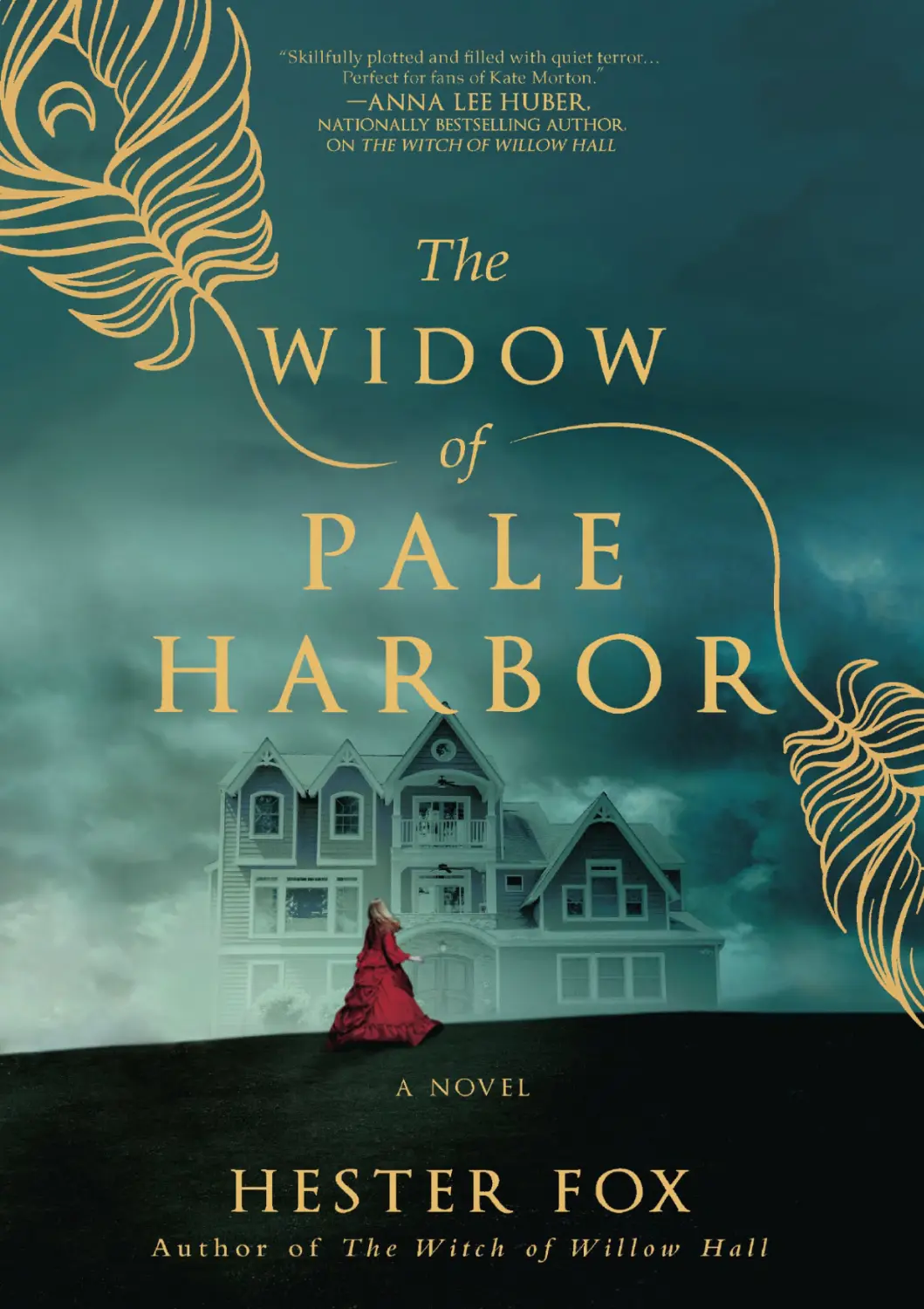
THE
WIDOW
OF
PALE
HARBOR
HESTER FOX

To Mike

Contents
Verse
Chapter 1
Chapter 2
Chapter 3
Chapter 4
Chapter 5
Chapter 6
Chapter 7
Chapter 8
Chapter 9
Chapter 10
Chapter 11
Chapter 12
Chapter 13
Chapter 14
Chapter 15
Chapter 16
Chapter 17
Chapter 18
Chapter 19
Chapter 20
Chapter 21
Chapter 22
Chapter 23
Chapter 24
Chapter 25

Chapter 26
Chapter 27
Chapter 28
Chapter 29
Chapter 30
Chapter 31
Chapter 32
Chapter 33
Chapter 34
Chapter 35
Author Note
Acknowledgments
Excerpt from The Witch of Willow Hall by Hester Fox

“And this was the reason that, long ago,
In this kingdom by the sea,
A wind blew out of a cloud, chilling
My beautiful Annabel Lee;
So that her highborn kinsmen came
And bore her away from me,
To shut her up in a sepulchre
In this kingdom by the sea.”
—Edgar Allan Poe, “Annabel Lee”

1

This was the fourth dead raven to appear on Sophronia
Carver’s front path in as many weeks, and there was no
explaining it away as coincidence this time.
Except that this one wasn’t dead, not quite.
Sophronia had never killed a living creature before, but as
she stared down at the raven and its crooked, twitching wings
on her front path, she got the queasy feeling that the most
humane course of action might be to snap the poor thing’s
neck.
Tugging her shawl tighter against the chill, salty air, she
crouched down to peer at the bird. Its feathers were blue and
black—darker even than her own inky hair—and as iridescent
as the ocean on a moonless night. The bird stared back at her,
unmoving except for the slow blink of its glassy eye. She
wanted very much to reach out a finger and stroke its slick
feathers, but that somehow felt like a breach of confidence,
like telling a secret that did not belong to her.
“Helen?” she called, without tearing her gaze away from the
bird. “Helen, come quickly.”
Slowly rising to her feet, she gazed about the estate grounds
and craned her neck to squint at the roof of the great old
house, silhouetted against the heavy clouds. Perhaps the bird
had fallen from the eaves. Or perhaps Duchess had felled it,
though the old cat could barely bring down a mouse. That at
least would explain how it had come to be lain so carefully
across the center of the front path, as if it were some sort of
pagan offering.

When Sophronia had come across the first dead raven, she
had assumed it had been the victim of some sort of sickness, or
perhaps weakened by storm winds. The next two she had
likewise justified, but with a growing sense of uneasiness.
A prickle of cold blossomed down her spine as she realized
that she could no longer dismiss the dead and injured birds.
Someone—or something—was leaving them for her to find.
She stiffened, with a darting glance about her, as if someone
might be lurking just beyond the broad lawn or out past the
gate, watching her. But there was no one—the only movement
the breeze through the flaming autumn trees, the only sound
the faraway cry of a gull.
The path was supposed to be Safe. The entire grounds of the
estate were supposed to be Safe. It was only out past the
wrought-iron gate and into the town beyond that chaos and
uncertainty reigned. Better to stay inside the grounds, where
she had control. Sophronia had long ago learned to push all the
bad memories and specters out of the house and into the world
beyond, firmly shutting her heart and mind against them. So to
see a creature in distress, so close to death—well, that was not
Safe.
“Helen?” Sophronia called, louder this time, her voice
carrying up the path to where the front door stood open. A
moment later, a pale woman of about forty, her dark hair
pulled severely back from her face, appeared in the doorway.
She frowned at the sight of her mistress standing over the bird.
“Duchess must have caught it,” Sophronia said with a shake
of her head as the woman stepped briskly over to where she
was standing.
Helen gave her a skeptical look, and then leaned down to
examine the bird for herself. “Duchess couldn’t catch her own
tail,” she said, scorn edging her husky voice. “It’s the town
brats making trouble again, I’d wager.”
Sophronia pressed her lips together tightly. They’d certainly
had their share of children from the town coming up to the
house, peeking through the windows and knocking at the door,

all so that they could earn the distinction among their friends
for glimpsing the infamous widow.
Suddenly, it was too unbearable to look at the exposed and
broken bird a moment longer. Sophronia might have called for
Garrett, the groundskeeper, but he was out on the far end of
the property, cutting back the grass. Helen was capable and
strong, though, and had a way with animals. “You’ll try to
save it, won’t you? And if you can’t, you’ll make it…” Her
words trailed off, but her meaning was unmistakable. Quick.
Carefully, Helen positioned her hands under the motionless
bird, holding it slightly away from her as she lifted it. She ran
a practiced hand along its wings, her dark brows furrowing in
a mixture of concern and anger, as if the cruelty of humankind
never ceased to surprise her. “Wings are both broken. And
there’s something wrong with its foot.” But then she caught
Sophronia’s anxious look and softened. “I’ll see what I can do,
Sophy.”
Sophronia gave her a warm smile and watched Helen whisk
the raven off to the carriage house, her movements brisk and
efficient, her posture as neat as a pin. She had taken Helen on
as a servant and companion during her early days as a lonely
young bride, but over the years, the older woman had proved
herself to be a true friend in every sense. Now it was just the
two of them against the world, as Helen was so often wont to
remind her.
The first raindrops were starting to fall when Sophronia
finally allowed herself to stop thinking of the crooked bird and
what it might mean and return indoors. Before the thump of
the raven landing on the path had startled her from her reverie,
Sophronia had been watching the storm roll in upstairs. Her
late husband had always pompously referred to the large room
lined with bay windows as the “upper piazza,” taking the big
old house’s name, Castle Carver, to heart. Sophronia liked to
watch storms approach from there; it was a sort of
entertainment, drawing back the curtains like those in a
theater, the harbor and endless gray sky a stage on which the
rowdy gulls acted their plays.

She wandered through the house, unsettled. There were
submissions to her late husband’s magazine piling up,
submissions for which she was now responsible. Usually she
enjoyed curling up in the parlor, tucked under a warm quilt
with a cup of tea as she read through the stories and essays,
curating which ones she would send along to the board for
publication. But the raven had rattled her, and Sophronia was
too anxious to read.
Instead, she continued back upstairs and threw the windows
open. The rain was picking up now, the clouds building into
something even heavier and more expectant. There was no
moment so promising, so exciting, as the moment before a
storm broke. Living on the Maine harbor, with naught but a
finger of land to separate her home from the gray Atlantic, she
had the opportunity to witness many storms, all from the
safety of her window. On clear days, she could see the old
lighthouse jutting out on the rocky promontory outside of
town, winking back at her from its empty windows, an ally in
her solitude. In the other direction lay a lonesome expanse of
trees, dark and wild. It was a deceptively beautiful landscape,
the sheer scale of woods and ocean promising endless
possibilities, but in reality, it only swallowed up the hopes and
dreams of young brides. At least on stormy days, the mist
softened the harsh realities of the world, cloaked its darkness.
But today’s storm was different; she could feel it
reverberating in her bones. Perhaps the raven had been a
harbinger of things to come, an omen. Or perhaps it was just
as Helen said—children from the town playing their cruel
tricks on her, just like they had for years since her husband had
died so violently and suddenly.
Sophronia sighed, drumming her fingers against the
windowsill. God, she was so weary of it all. Weary of the
solitude, weary of the little town, its people and their narrow
minds, weary of the shell she had become. Tonight, she and
Helen would eat a small supper in silence—they had few
words left to say that weren’t old and stale, used up over the
years—and then they would sit in the parlor, play a game of
cards, and perhaps Sophronia would read a book or
philosophical pamphlet while Helen plucked away at the old

pianoforte. Tomorrow the laundry girl, Fanny, would come,
and hopefully bring some gossip or news with her. They would
chat for a little, and then Fanny would leave, and stillness
would settle back over the house. It would be the same as
every other day, but monotony was the price of safety. If the
grand old house was indeed a castle, then Sophronia was its
ghost, forever trapped, restless and roaming the halls.
She leaned out to close the window, but paused, letting the
wind sweep up around her in an invigorating embrace. The
building energy of the storm electrified her bones and caused
tears to prick her eyes. Yes, there was something different
about this storm. Change was sweeping toward Pale Harbor,
and God knew, she needed it.

2

If Gabriel Stone had known what was inside the dilapidated
old church and what it would lead to, he might have turned
around, climbed back on the boat and returned to Concord
immediately. But the rain was coming down in unforgiving
sheets, and after days of travel, the time for reservations had
long since passed.
Wiping the rain from his eyes, he stepped back, craning his
neck, and turned his face up into the stormy night, taking in
the church that he had trekked halfway up the east coast to
reach. It was made of unassuming white clapboard, and its
steeple barely peeked above the thrashing trees, as if in
humble deference to this wild terrain in which it was an
outsider, a latecomer, just like him.
It had taken him two coaches, a rail and finally a ship to
arrive in Pale Harbor, only to find that no one was awaiting
him at the dock. When it had become obvious that it was too
dark even to locate his new lodgings, Gabriel had decided to
go to the only other place he knew of in the town: his new
church. He had followed the sight of the steeple, slogging
through muddy roads that weren’t much more than old cow
paths, lit only with the occasional lamplight from a lonely
cottage window. But when he’d finally arrived at the church,
the doors were locked. He was a sopping wet, hungry, shorttempered outsider and damn it, churches were supposed to be
a refuge. Putting his shoulder against the old wood door,
Gabriel gave another push, and cursed when it would not
budge.
The wind howled around him. He shrugged the collar of his
coat up in vain, trying to keep the slicing rain from penetrating

any farther down his back. He would get in, spend the night,
and then, in the light of day, find his lodgings and hopefully
the trunks that he had sent ahead.
A glint of shattered glass in the fleeting moonlight caught
his eye. A broken window. Gabriel peeled off his sopping wet
overcoat, balled it around his fist and punched out the rest of
the glass. With all the grace of a wet cat, he shimmied himself
through the opening.
The musty air hit him like the release of a breath held in for
too long, and he landed awkwardly on his ankle. “Goddamn
it,” he muttered, and then, remembering where he was,
grumbled an apology. It was as cool as a mausoleum inside,
the air untouched for who knew how many years. The only
light came from the brief flashes of lightning, and the
occasional gasp of moonlight through the racing clouds. His
wet clothes clung to him, chilling him down to his bones. It
was not an auspicious beginning to his new venture.
“Anyone here?”
His voice echoed off the empty pews and hollow nave.
There was no reason anyone would be in the old church, but
one never knew if a lost soul had seen the steeple and
wandered inside, looking for shelter or religious succor.
Gabriel let his gaze wander over the dark, indistinct shapes
of the crumbling interior. It was not a large church—he could
have reached the altar in less than twenty paces—but the rows
of pews gaping with expectation gave it a sense of restless
hunger, repelling and beckoning him at the same time.
So, this was to be his, then. Good God, what business did he
have leading a congregation? It had always been Anna’s dream
to found a spiritual community, to bring to life the ideals and
values about which she so voraciously read and that had
surrounded them in Concord. But now she was gone, and the
fulfillment of her dreams was left to him. Perhaps he could
make her proud in death where he had so often failed in life,
but he rather doubted it. He had not been the intellectual, the
enlightened thinker that she had so wished of him. This whole
plan was madness; he was counterfeiting a version of himself

that had never existed, all in the hopes of redeeming himself in
the eyes of a woman who was gone. It was pathetic. He was
pathetic.
He shook out his hat and pushed the wet hair out of his
eyes. Cobwebs hung from the exposed rafters and dust grimed
the stained glass, thick and dark. Gabriel cursed again as he
tripped over a loose floorboard, steadying himself on the back
of a dusty pew. The idea that he could make this a welcoming
space was nearly as daunting as the thought of leading a flock
to transcendental enlightenment. “Damn,” he murmured again,
before he could stop himself. If he was going to be an even
half-convincing minister, he was going to have to curb his
vulgar habit of cursing.
Discarding his dripping coat, Gabriel cast his eye around for
something that would make a suitable bed for the night. An
old splintered pew couldn’t be any worse than the coach he
had shared with six other gentlemen on his journey, all of
whom had apparently been ill-acquainted with the concept of
soap. He was just about to lower himself down onto the
sturdiest-looking pew when a sound rose above the howling
wind outside. Gabriel froze.
Someone was trying to get in. The door at the far end of the
aisle was rattling, thumping, as if someone were pushing on it,
just as Gabriel had tried at first. Without thinking, he grabbed
the first thing that might reasonably serve as a weapon—a
tarnished and cobwebbed brass candlestick—and crept to the
door, where the latch was jiggling violently. It might have
been a decrepit old church, and he might have been there only
for a matter of minutes, but it was his decrepit old church, and
by God, he would defend it.
Gabriel reached the door, held his breath and waited. His
heart was beating in his ears, his mouth suddenly as dry as
cotton. He wasn’t scared—he’d long ago lost the capacity for
that when he’d lost everything that he held dear—but he didn’t
particularly relish any more excitement for the day either. All
he wanted was to close his eyes and get as dry as possible.
Just as the door swung open, he raised the candlestick above
his head and lunged at the dark shape silhouetted against the

rainy night.
“Sweet Jesus, don’t hurt me!” The figure dropped to the
ground in a huddling mound. “I—I’m the sexton,” the man
said, his voice muffled and pathetic.
Cursing, Gabriel stopped his swing. The candlestick
dropped from his grasp, clattering to the floor. Of course it was
the sexton. Who else would be interested in this rotting old
church?
“Gabriel Stone,” he said, offering his hand to help the man
up. “The new minister.” The words tasted strange on his
tongue, and he realized it was the first time he had said them
out loud.
The man staggered to his feet, wide-eyed and dripping wet.
He regarded Gabriel with lingering panic. He was slight, with
stooping shoulders and, at about thirty, was only a couple of
years younger than Gabriel.
He knew what the man saw: Gabriel was too tall, too broad,
too much like a lumbering giant. People glanced cautiously at
him out the side of their eyes, as if he were a criminal, a tough.
His voice, low and raspy, didn’t help. He was used to the
reaction, but it never eased the pang of annoyance—and selfconsciousness—that he felt. “I’m not going to hurt you,” he bit
off, unable to keep the irritation from his voice. Then he raised
his hands, palms up, in a gesture of pacification.
The sexton gave a hesitant nod and swallowed, extending
his hand. “Ezekiel Lewis, but folks just call me Lewis. That’s
quite the grip you have,” he said, rubbing his hand and warily
eyeing the discarded candlestick.
Gabriel had corresponded with someone before coming to
Pale Harbor, but as with all things concerning this new
venture, he had been unsure of his footing, of exactly what he
was supposed to say. Now he wasn’t sure if it was Lewis he’d
written to, or someone else in the town when he’d sent ahead
notice that the minister who was supposed to come to Pale
Harbor had died and that Gabriel was his replacement. That
wasn’t strictly true, but it wasn’t a lie, either. When the
brilliant Reverend Joshua Whipple of Concord had died in a

carriage accident, Gabriel had seized on his chance to be the
man that Anna would have wanted. It had all moved so
quickly after he’d set the plan in motion, and then there had
been no going back.
Gabriel regarded the nervous man and decided to take a
gamble.
“I believe you were expecting me?”
Lewis nodded. “I was meant to meet you at the dock, but
my cart got stuck in the mud and delayed me. When I couldn’t
find you, I figured you might have come up to the church. I
don’t suppose you’ll be wanting me to take you to the cottage
now, after all?”
The poor man might have been even more soaked than
himself, and he had only a threadbare coat to protect him from
the elements. “Might as well bide here for a while yet. No use
in going back out into the storm,” Gabriel said.
Lewis nodded his agreement, looking grateful. He had
closed the door behind him and was rubbing his arms to get
warm. “It’s a wonder the ship was even able to make dock in
this weather,” he said, after a particularly harsh clap of
thunder.
It had been a bumpy ride, the dark water endlessly churning
like a witch’s cauldron, and Gabriel had watched more than
one of his fellow passengers be sick over the rail. The two men
lapsed into silence, the pounding storm outside making the
church feel somehow smaller, more intimate. Gabriel, though
never one for small talk, somehow found himself falling into
conversation easily in the dark.
“Have you been the sexton long?” Lewis was decades
younger than Gabriel would have thought someone in his
position would be, and it was hardly a trade for an ambitious
young man.
“No, sir. That is, there isn’t much need for a sexton these
days,” Lewis said, jutting his chin vaguely into the shadowy
church. “I work at the cemetery, digging graves and
groundskeeping and the like. I come around here a couple of

times a month to cut the grass and make sure no one has
broken in.” His look grew sheepish. “Might have been a few
months since I last came inside.”
Gabriel had begun to move away from the door and farther
into the church, inspecting his new domain as much as he
could in the near blackness.
Lewis followed him, swallowing. “I’d wanted it cleaned up
before you saw it…” he said, trailing off, as he dashed a
cobweb away from his face.
“I’ll see to all the cleaning later.” Gabriel squinted into the
darkness. The last of the moon had long since slid behind a
heavy bank of clouds. “You don’t have a match, by chance?”
Lewis fumbled in his pocket, miraculously producing a dry
matchbox, and struck a match. He touched it to a piece of
wood, throwing light onto the empty pews and casting
grotesque shadows from the forgotten saints.
The cross at the altar would have to go, and Mary stared at
him with accusing eyes, as if she knew that her tenure would
be short-lived. The stained glass might stay, but everything
else was the vestige of an outdated religion and had no place
in a home for transcendentalism. Or so he assumed, though he
wasn’t quite sure. Anna would have known; she had been so
smart, so clever. Unitarianism—with its strict interpretation of
monotheism and all things scientific and rational—might have
taken root in Boston, but it was transcendentalism, with its
wild abandon to the spiritual, that had so enamored her in
Concord. Stop thinking about her, he chided himself. Do this
for her, but for God’s sake don’t wallow in self-pity.
A flash of movement snapped Gabriel from his thoughts.
“What was that?” He put his hand out to stop Lewis.
Lewis swung the light back around toward the altar and
took a sharp breath. Something was moving, rustling about in
the debris under the cross.
Without thinking, Gabriel began making his way up the
aisle, pushing aside detritus. There was something at the altar,

a shape blacker than the rest of its dark surroundings. And it
was moving.
His skin prickled and despite his cold, wet clothes, sweat
beaded along Gabriel’s neck. The walls danced with quivering
shadows, the wind howling and gripping the creaking church
tighter. He swallowed. It was not a particularly welcoming
place, but now a sense of wrongness took hold of him, as if he
were not supposed to be here. As if something did not want
him here.
A crash and fluttering broke the stillness. Lewis fell to his
knees, and Gabriel flinched as something disturbed the air
over their heads.
“What the—”
Taking the torch from Lewis, Gabriel held it up, dimly
illuminating the rafters. From the darkness above, a pair of
gleaming black eyes blinked down at him.
“It’s a bird,” he said, feeling foolish that his heart was still
racing, his palms sweating. Lewis, who had lost about three
shades from his already pale face, let out a shaky breath.
“There are holes in the roof. It must have come through one to
get out of the storm.”
The bird—a raven or a crow, something big and black—
cocked its head and blinked down at them with vague interest.
Then it shuffled its wings a few times and settled down to
roost.
Suddenly, Gabriel just wanted to sleep, even if his new
lodgings were cold and empty. He’d had enough of the dank
church and its accusing shadows. He was just about to broach
the idea of plunging out into the storm when he caught a hint
of a strange odor.
The whole church had a musty, unused smell about it, but
this was different. Pungent, sweet. Acrid to the point of
making his eyes water, and only growing stronger. Curiosity
overcame apprehension, and he drew closer to the altar.
He jerked backward. “Oh, God.” Gabriel buried his nose in
his handkerchief, fighting the rising gag in his throat. Beside

him, Lewis made the sign of the cross over his chest.
This must have been what had attracted the carrion bird,
why it had been pecking about the altar. It was a wonder he
hadn’t smelled it right away. Bones and fur lay before them,
strips of rancid flesh. It was such a mess that it was impossible
to tell what the animal might have been in life, or even if it had
been a single animal.
“What the hell is that doing here?”
Maybe some forest creature had found its way into the
church and then perished after it was unable to get out. But
something about its position on the altar sent a chill down
Gabriel’s spine. Why wasn’t it nearer a door, or window, if it
had died trying to get out of the church? How had it come to
lie on the most conspicuous feature of the building?
Lewis shifted uncomfortably. “I can’t say I’ve seen anything
particularly like this, but—”
Just then a loud crack of thunder rang out, swallowing his
words. Lewis jumped back and the light stuttered out, leaving
them in darkness.
Gabriel had had enough. The church was in ruins and
clearly would need to be addressed in the light of day. The
animal remains weren’t going anywhere, and there wasn’t
anything they could do about them in the middle of the night
anyway.
“All right. Let’s leave it for now.”
A hiss of relief came from the darkness behind him. “Very
good, Reverend.”
They gingerly made their way back to the door, and Gabriel
shoved his wet hat back on his head. A pang of melancholy
ran through him at the thought of arriving at an empty house.
He was running away from a painfully empty home in
Concord; had he really done all this only to exchange it for
another, and in an unfamiliar place, no less?
Between the unsettling discovery at the altar and the icy
impassiveness of the church, what little luster his plans had
had now faded to a dull and miserable gray. Gabriel was cold,

weary and utterly alone. And it was only a matter of time
before the town of Pale Harbor discovered him for the fraud he
was.

3

The invitations began almost immediately.
If Gabriel had thought that his arrival would be quiet, that
he could slip into Pale Harbor unnoticed, then he had been
sorely mistaken. It was a small town—Lewis had informed
him that their police force consisted of one constable, and the
nearest schoolhouse was ten miles away, in the next town—
and the arrival of a new transcendentalist minister from
Massachusetts had set everyone talking. If he had been a true
minister, he would have relished the chance to recruit fresh
faces and gather up a flock for his church. But he was not a
true minister, and every time he thought of espousing universal
truths to a church full of trusting, upturned faces, his heart
twisted with guilt. He had thought that doing it for Anna, for
making her dream come true, would have been enough, but he
was quickly learning that it was not. Without her by his side,
his actions were meaningless, his words hollow.
The first invitation came from the Marshalls, who—Lewis
had explained in admiring tones—were the foremost family of
Pale Harbor, having made a small fortune in the shipment of
granite down the east coast. If Gabriel could persuade them to
join his congregation, Lewis had assured him, then the whole
town would follow. Whether Gabriel wanted a robust
congregation was another story, but he would play his part,
and at the very least enjoy a hot meal.
He slogged through the dusky little town, the scent of damp
fallen leaves and wood smoke filling his lungs. Most of the
homes he passed were modest, weather-beaten cottages like
his, but old captains’ mansions with stately pillars punctuated
the main thoroughfare, reminders of the town’s once-thriving

whaling and trading industries. These could have been Anna’s
streets, her soft footsteps evaporating into the yawning gray
sky. She would have delighted in the tall pines creaking in the
wind, the hawks that sat sentry in the spindly boughs far
above. The ever-present roll and crash of the ocean would
have been her nightly lullaby. Gabriel shook his head, trying to
dislodge the painful thoughts.
The road ended abruptly at a steep-gabled house, painted a
lush pink and trimmed with white latticework. Rosebushes,
nearing the end of their season, climbed defiantly up either
side of the porch. Among all the weathered clapboard and
peeling paint of the other homes, the house looked like
something dropped straight out of the pages of a fairy tale.
As Gabriel climbed the front porch steps, a rosy, stout
woman came out and greeted him at the door, beaming at him
from under a frilly cap. His melancholy thoughts evaporated,
replaced by an anxious knot in his stomach that always formed
when mixing with anyone of higher social standing than him.
But Mrs. Marshall put him at ease immediately. “Come in,
you poor darling,” she said, tutting at his coat, which had
never dried properly from the night before. “You must be the
minister. I’m Clara Marshall and I’m so pleased to meet you.”
Gabriel glanced to his side, half-expecting to see a blackfrocked minister to whom Mrs. Marshall had addressed her
greeting. But, of course, she meant him.
“Er, yes,” he said, recovering. “Gabriel Stone.”
“Mr. Stone, then. Come in, come in. Here, give me that
damp coat.”
No sooner had Gabriel stepped into the hall and surrendered
his coat to a maidservant than Mrs. Marshall called out,
“Girls!” and ushered forth two identical, golden-haired little
girls. “Cora and Flora,” she said proudly.
Gabriel dipped his head. “A pleasure.”
“You’re tall,” said Cora, or maybe it was Flora. The other
hid her giggles behind her hand.

“Girls, manners!” Mrs. Marshall shot Gabriel an apologetic
look, and then passed the twins off to a servant with
instructions to have them wash before dinner, and this time
make sure they didn’t just pass their hands under water, but to
really scrub them.
Throughout the harried introductions, a small, wiry man
with graying whiskers was hovering in the hallway, fiddling
with a cigar case. “Mr. Stone,” he said, pocketing the case and
sticking his hand out. “Horace Marshall. A pleasure to meet
you. Come, will you join me for a drink before dinner is
called?”
Before Gabriel had a chance to respond, Mr. Marshall was
thrusting a cigar into his hand and leading him into a dim
parlor, brimming with expensive furniture and fussy
ornaments. It was just the kind of place that made Gabriel
nervous, as if all it would take was one careless movement to
send a priceless figurine crashing over. He held his breath as
he followed Mr. Marshall past a stuffed owl under a glass
dome and a vase quivering with silk flowers and feathers.
“I can’t tell you how good it will be to have that church
cleaned up and full of parishioners,” Mr. Marshall said,
lowering himself into an overstuffed chair. “Not just because
it’s a shame to let that old building rot away, either. Did you
know it used to be a Quaker meeting house back in the last
century? One of the oldest in Maine, if not New England.
More recently, the Irish here were using it as a Catholic
church, but they hadn’t the funds to keep it up.”
Gabriel murmured that he had not known. Perching gingerly
on a precarious-looking settee, he searched for an ashtray in
which to snuff out his cigar. He’d never liked the things, and
the ash was growing long and threatening to spill onto his
sleeve.
Oblivious to his predicament, Mr. Marshall tugged at his
mustache and continued with his line of thought. “Might do
the town good to have more of a godly presence, too.”
Gabriel commandeered a vase and discreetly tapped out his
ash. “Oh?”

When Mr. Marshall didn’t respond immediately, Gabriel
asked, “And why is that?”
“Hmm?” Mr. Marshall looked at him as if coming out of
some deep private thought. “Oh, nothing. It’s only we’ve had
some troublemakers lately, and a bit of fire and brimstone
might be just the thing to keep them in line.”
“I see.” Gabriel frowned. “Well, transcendentalism
generally doesn’t go in for that kind of thing.” That much he
knew, at least. That’s what Anna had loved about the spiritual
movement, “the exquisite freedom” of it, as she had once told
him. There was no good and bad, no heaven and hell, only a
beautiful energy that permeated the universe, connecting each
and every soul. It was a nice way to look at the world, but it
simply wasn’t true. There was good and evil—he had seen so
for himself.
Mr. Marshall looked a little disappointed and cleared his
throat before taking another puff of his cigar. “Well, I suppose
you know what you’re doing. You’re the big city man, but I
think hellfire would go a sight farther around Pale Harbor than
any of this wishy-washy transcendental business.”
Gabriel choked on his cigar smoke but was spared the need
to respond by the maidservant sticking her head into the parlor
and announcing dinner.
He hadn’t realized how hungry he was until the covers were
lifted off the dishes, revealing steaming platters of buttery fish
and fried potatoes, roast beef, succulent green beans and thick
chowder. He shifted in his seat so that his hosts wouldn’t hear
the rolling growl of his stomach.
Mr. Marshall clapped his hands and rubbed them together in
anticipation. “You won’t find food better than this anywhere in
Pale Harbor,” he said. “Tell me, have you employed a cook
yet?”
“Er, no,” Gabriel said as he helped himself to a heap of
potatoes. He’d barely opened his trunks yet, let alone found
domestic help.

The twins, who couldn’t have been more than ten, had
apparently been deemed mature enough to dine with their
parents at the table, and were in the process of trying to
wriggle out of their starched smocks. Their whispers and
giggles were a constant backdrop to the conversation, and
more than once Gabriel glanced up to see them sharing secret
conversations behind their hands while staring at him.
With a careful glance at them, Gabriel swallowed his food.
“Mr. Marshall—” he started, only to be waved off.
“Please, we don’t stand on ceremony here. Horace.”
If the wealthy businessman had known who Gabriel truly
was, would he still have allowed Gabriel to address him so
informally? He shifted a little in his seat. “Horace,” he began
again, “you mentioned something in the parlor.” He chose his
words carefully, mindful of the young girls seated at the table.
“When I first went to look at the church, there was…” He
cleared his throat. “There was some sort of…” How to
describe the pile of remains that had left him so unsettled and
had lurked at the back of his mind since the night before?
“Some sort of…animal at the altar. A dead one.”
Despite his best efforts, Gabriel had attracted the attention
of the twins, who immediately left off their whispers and
regarded him with eyes the size of saucers.
Mr. and Mrs. Marshall shared a look. “I expect you will
have heard something of the troubles that are plaguing the
town?” asked Mr. Marshall cautiously, after a long pause.
“Troubles?”
“Horace!” Mrs. Marshall’s ruddy cheeks pinkened further.
“That is not a conversation for the dinner table.”
Unperturbed, Mr. Marshall gave her a dismissive wave and
settled back into his chair, swirling his wine around in his
glass. “Well, he’s going to hear it sooner or later. He might as
well hear it from us without all the embroidery some of the
other townsfolk will give the story.”
Mrs. Marshall pressed her lips together before snapping at
the twins to cease their giggling.

“Troubles?” Gabriel prompted again.
“Just last week Maggie Duncan found a pile of skinned
squirrels in the woods behind her house,” Mr. Marshall said.
“At first she thought it was the work of a fox, but what fox
eats just the fur and leaves the meat? Then there was some sort
of…of effigy. Crude little doll with all manner of buttons and
strings sewed about it and stuffed into the hollow of the old
elm tree in town.”
Gabriel stiffened in his seat at the descriptions that were
eerily similar to what he had found just the other night. This
must have been why Mr. Marshall had wanted his church to
preach crime and punishment.
A thick silence had settled over the table. Gabriel put down
his glass and looked between Mr. and Mrs. Marshall. “What is
it?”
A meaningful look passed between the husband and wife.
“No one has been apprehended,” Mrs. Marshall said tightly.
“But most people around here know who’s behind it without a
signed confession.”
Gabriel looked at them blankly, waiting for one of them to
elaborate.
“Sophronia Carver,” said Mr. Marshall, as if it cost him
something just to say the name. “Nathaniel Carver’s widow.”
“She killed her husband,” Mrs. Marshall added. “And lives
in…an unsavory manner that I won’t expound upon in front of
the children.”
Gabriel barely had time to ask what constituted an unsavory
manner, when the children in question piped up.
“She’s a witch,” said one of the twins.
“It’s true,” said the other twin, nodding gravely. “Lucy
Warren looked through her window and saw her stirring at a
great pot. And what do you think was sticking out the bottom
of her dress?”
Gabriel opened his mouth to say he was sure he had no idea,
but the twins were too fast.

“A tail!” they exclaimed in joyful unison.
Neither Mr. nor Mrs. Marshall seemed particularly taken
aback by this outburst, Mr. Marshall continuing to saw away at
his beef, and Mrs. Marshall only saying indulgently, “A tail! I
don’t know where you girls get such stories.”
The twins dissolved into giggles again. “And she has the
most horrid scar running down her face.”
“Probably from one of her victims trying to escape!”
“Well, tail or no,” said Mr. Marshall, taking the accusation
against Mrs. Carver in stride, “the woman is queer and you can
lay your last nickel on the fact that she’s behind all this
unpleasant business.”
The dinner was taking on a decidedly peculiar slant and,
unused to drinking so much rich wine, Gabriel’s temple was
starting to throb. The widow in question would have to be a
queer woman indeed to go traipsing about in abandoned
churches, setting out dead, mutilated animals. It seemed more
likely that it was, as the Marshalls had first suggested, the
work of some cruel youngster.
The conversation continued in that vein for a while longer,
but Gabriel was no longer listening. He was tired and on edge
from trying to say the right things, to sit the right way on these
damned uncomfortable chairs. All he wanted was to stand up,
thank the Marshalls for the hospitality, and then go back to his
empty little house and fall into bed. But then the conversation
took an even more horrifying turn.
“Are you married, Gabriel?”
He froze, his fork hovering over his plate. It had been nearly
a year, but the question still made him feel as if the carpet had
been ripped out from under him, the breath stolen straight
from his lungs. He put down his fork, hoping to appear
composed in his answer. “My wife passed away. Childbirth,”
he added, knowing that if he didn’t provide the cause now he
would only be asked later anyway. “The baby died, as well.”
Mrs. Marshall’s face creased and fell. “Oh, dear, I am sorry
to hear that.”

Gabriel waved off her concern, but it took a considerable
amount of effort to keep himself in the present. It seemed that
no matter how far he ran from Concord, Anna would haunt
him, never mind that he had hungered for her ghost to follow
him here.
“Well, I don’t like to impose where it isn’t my business, but
Pale Harbor has any number of good, capable young women
who would make good wives to a minister.”
“Clara!” Mr. Marshall exclaimed.
“Well, it’s true,” she said in an injured tone. “I don’t pretend
to be a matchmaker, but there’s no hurt in him considering his
options.”
Mr. Marshall gave Gabriel an apologetic look as if to say
they both knew how women could be. Gabriel dropped his
gaze to his plate, his appetite gone.
They finished dinner in silence, even the twins apparently
content to be quiet. Afterward, the girls were sent up to bed
while the adults retired to the parlor for dessert. Gabriel drank
the coffee that was offered to him and ate the fruitcake,
nodding politely along at the depthless conversation about the
weather and the new portrait studio in Rockport.
Coming here had been a mistake. Why did he think he could
converse with prominent, wealthy families? Social graces and
etiquette had never been his strong point. What need had a
man like him, from his background, for social graces? He’d
had to learn everything painstakingly from Anna, and even
now he was more suited to enjoying a good story in a tavern
than polite small talk over delicate china cups of coffee.
“I should be going,” Gabriel said, standing abruptly.
Mrs. Marshall’s brows drew quizzically together, but she
pasted on a bright smile. “Of course, I hadn’t realized how late
it was getting. Horace?”
“Mmm? Oh, right, right,” said Mr. Marshall, standing with a
grunt.
“Thank you,” Gabriel said, giving Mrs. Marshall a stiff bow
of his head. “Dinner was delicious.”

Gabriel’s coat had almost completely dried after the benefit
of being on a stove, and the men went out to the porch, where
Mr. Marshall lit another cigar. The storm of the previous night
had rolled off, leaving in its wake a steady drizzle and crisp
breeze.
“You’ll think all it does is rain here,” Mr. Marshall said with
a hint of chagrin. “We seem to be stuck in some sort of
weather pattern, with storms from the sea rolling into the
harbor every few days.”
Gabriel welcomed the rain. Every drop that chilled him to
the bone was a penance, a reminder. He deserved to be wet
and cold for the role he had played in Anna’s death. If he
hadn’t gotten her with child, she would still be here. She had
been too delicate, too fragile, for childbearing, and he hadn’t
protected her. God, he was doing it again. Stop thinking about
her, you dolt.
Mr. Marshall reached for something in his waistcoat pocket,
pulling Gabriel from his thoughts. “I hope you won’t mind the
presumption, but I’ve taken the liberty of drawing up a list of
all the families in town for you.” He handed Gabriel a folded
sheet of paper. “Thought you might want to make the rounds
and introduce yourself.”
Gabriel took the list and scanned the jumble of names,
unable to fathom actually having to put faces to them. “Thank
you. I’m sure this will be very useful.”
But Mr. Marshall wasn’t listening. He was worrying at his
mustache, staring out into the gray dusk. “There is one name I
omitted from that list.” He paused. “You would do well to
steer far and clear of Sophronia Carver.”
“The widow?”
Nodding, Mr. Marshall took a slow puff from his cigar. “My
wife has a flair for the dramatic, but there’s no getting around
the fact that something’s not quite right about what goes on in
that house.”
Gabriel followed Mr. Marshall’s gaze to the tip of a white
cupola that just showed above the treetops in the distance. His

heart grew heavy and his gut churned at the thought of
meeting with anyone on the list, least of all the odd widow
who had so captured their imaginations.

4

Sophronia looked down at the deluge of ink slowly spreading
across her desk and bit back a curse; nothing had gone right
that morning. First, she had taken out her favorite wool shawl
for the winter, only to find that moths had eaten the fringe
clean off. Then the magazine’s board had delivered a stern
missive, warning that subscriptions were down from last year
and that if she couldn’t bring in a higher caliber of
submissions, then the magazine’s future would be in grave
jeopardy. It was all bluster on their part, but it still was never a
good sign when the board was unhappy. The last straw had
been when Duchess had knocked a bottle of ink over a stack of
unread submissions. Now half of them were stained and stuck
together, and would be unreadable. If the next brilliant
submission to save the magazine had been in that pile, she
would never know.
But even on the hard days like this, she relished her role as
owner and editor of the magazine, and wouldn’t give it up for
anything. All the work could be done from her desk in the
parlor, and then Garrett would take her packets of papers and
notes and mail them to the office in Portland. It gave her a
sense of fulfillment, like maybe her solitary life on the hill
wasn’t completely fruitless and without merit.
She had worked hard to achieve success as the magazine’s
owner. There were half a dozen editors and businessmen who
would have been only too happy to see her stripped of her
position. So what if her ownership was the result of a
technicality? Nathaniel had thought that, should anything
happen to him, the magazine would be safest in her name,
somewhere competitors couldn’t get at it. She suppressed a

grim laugh. If he’d had any idea when he would die, and in the
manner he had, no less, he never would have taken the liberty.
“Duchess, you may have cost us the next Shelley or Byron,”
Sophronia muttered as she tried to peel the inky pages apart in
vain. Duchess gave her an unapologetic glare from the
windowsill.
Crouching down, she set all the salvageable pages in front
of the grate to dry, and rocked back on her heels. Her vision
began to swim as she stared down at her hands, and for a
moment they were not stained in black ink, but crimson blood.
So much blood…beneath her nails, crusted into her cuticles,
smeared across her face. Just like on that fateful night.
The smell of damp earth filled her nostrils, and she could
feel the unforgiving wind biting at her cheeks, though the fire
was licking away in the grate. Clean, clean… She had to wash
her hands, scrub them until they were pink and innocent again
before anyone saw and realized what she had done. Heart
racing, she rushed to the kitchen sink, pouring scalding water
out from the kettle and mercilessly scouring the offending
flesh.
The waking nightmare didn’t break until her hands were
raw and burned, the skin singing with pain. She jumped back
from the sink, trembling with how quickly the chimera had
come on. A nervous laugh threatened to erupt, but she held it
in. God, what a foolish creature she could be.
A breath of fresh air would revive her and clear away the
bad memories. She gave her hands one last harsh wipe on a
towel, and then went and fetched her cloak and bonnet and
steeled herself to face the outside world.
She pushed the door open. The first few steps outside the
house were always the hardest, but if she could just get a little
momentum, then by the time she was out the door she could
keep going, at least a little ways.
If it wasn’t for the quiver of movement from the breeze, she
would have completely missed the sliver of black marking the
door. Slowly, she took a step back into the foyer, her gaze
trained on the door and the alien object attached to it.

Below the elaborate brass knocker, a long, black feather
hung from a nail.
With a trembling hand, Sophronia slowly reached out and
touched it, half-hoping that it would be as fleeting and
insubstantial as the delusion that had just gripped her in the
kitchen. But the soft bristles met her fingers with heart-sinking
solidity.
Sophronia’s blood ran cold as she jerked her hand back. It
had been still and quiet in the house all morning. How had
someone managed to hammer in the nail without her hearing
anything?
It was as if whoever had left the ravens had read the doubts
in her mind and wanted to make certain that she understood
none of this was coincidence or an accident. This was as bold
a statement as Martin Luther nailing his theses to the church
door. This was a declaration, but of what?
In a fit of panic, Sophronia tried to pry the nail from the
door. When it wouldn’t budge, she snatched at the feather,
sending torn black filaments floating to the ground. But the
quill would not budge.
“Blast it.” She would have to ask Garrett to pry out the nail
and patch the hole. At least it could be easily fixed, and
Garrett was nothing if not discreet.
But that was little comfort to Sophronia, who felt as if the
world were pressing in around her. Felt as if eyes watched her
every movement, even through the walls of the house. If she
had thought that the change she had felt coming to Pale Harbor
was to be positive, then it seemed she was sorely mistaken.
Now it was a growing sense of dread that hung over her, as if a
predator was circling just beyond her line of sight, slowly
closing in on her.

With a letter in his pocket, Gabriel wandered down toward the
harbor, looking for the post. It was a small town, with most of
the homes and buildings rising up from the edges of the water,
clinging to the salty lifeblood that provided its food and

industry. His walk took him past the same run-down houses he
had seen the previous week, now benevolently gilded in gentle
sunlight. He had been in Pale Harbor for a week now, meeting
with the townspeople, cleaning out the church and generally
gathering his bearings. But it still felt wrong, and he no more
felt that he belonged in Pale Harbor than he had in Concord
without Anna.
Restless and a little homesick, the night before he had
written to the only person in Concord he considered a friend,
Tom Ellroy. Tom, who he had known since they were both
boys running wild through the Massachusetts countryside, had
stuck by him through thick and thin, and there had been plenty
of thin, especially when they’d both joined the navy on a
boyish whim. Gabriel had four older sisters, and Tom was the
brother he’d never had. Tom alone was privy to Gabriel’s
reasons for coming to Pale Harbor and the deception he had
practiced in getting here.
The morning dawned dry and warm, a crystal-clear
September day. Dirt mingled with sand, and every breath
carried with it the faint promise of the great ocean beyond.
Gabriel was small and inconsequential, a drop of salt water
among many in the seaside town, and how liberating it was. In
the light of day, the dark discovery in the church seemed far
away, and his awkward dinner with the Marshalls
insignificant. Maybe he would not be a success as a minister,
but he had come this far, and if nothing else, it would be the
fresh start he so desperately needed.
Despite the fair weather, the waterfront was quiet, subdued.
Only a few small boats bobbed in the placid water, and a
handful of dockworkers leisurely unloaded nets full of fish.
Mr. Marshall had told Gabriel that twenty-five years ago, Pale
Harbor would have been a bustling port, with all sorts of
languages being spoken as ships unloaded their goods from
lands as far away as China. But the war with the British in
1812 and the subsequent closing of trade routes had strangled
the cosmopolitan breath from the town, leaving it choked and
withered.

Gabriel ambled down to the water, watching seagulls
squabble over a dropped fish. Despite his pledge to take all the
rain as a penance, he was enjoying the early autumn sun on his
face.
He found two young men taking a rest from unloading
crates on the dock, their shirts stuck to their backs with
perspiration, their sleeves rolled to the elbows. When he asked
them where he could post a letter, they directed him to the dry
goods store on the other side of town.
He thanked them and was about to turn to leave. He knew
he should introduce himself, tell them about the new church.
That’s what a minister was supposed to do. But the idea of
proselytizing made him shrink into his skin, and despite days
of practicing in front of the mirror, he still tripped over his
words and came across as a fool. They would probably scoff at
him, just as the Marshalls surely had as soon as Gabriel had
left their home, and he couldn’t bear to hear Anna’s dearest
beliefs disparaged.
“Not from around here, are you?”
Stopping in his tracks, Gabriel reluctantly turned back. He
took a fortifying breath. “No, not from around here.”
The man who spoke had light brown skin and a musical
voice with an island lilt. “Thought you might not be local,” he
said. “Not with that accent.”
Gabriel hadn’t bothered trying to disguise the brusqueness
of his lower-class voice; he felt comfortable here on the docks
in a way he hadn’t in the Marshalls’ dining room. But
apparently he had been found out as an outsider anyway.
“Might as well be from Dixie,” rejoined the other man.
“Concord,” Gabriel told them, and then added,
“Massachusetts. My name is Gabriel Stone.”
“Well, Gabriel Stone from Concord, I’m Manuel,” said the
man with the lilting voice. “And this useless lug is Jasper.”
Jasper nodded his introduction. He was young, red-haired
and pale, with a smattering of freckles. “You’re the one taking

over the old church, then?” he asked Gabriel without
preamble.
“That’s right.” Gabriel hoped that his curt response would
be the end of it, but Jasper was giving him an assessing look,
and both of the men’s curiosity seemed to be piqued.
Manuel raised a brow. “What is it you’ll be preaching?”
Damn it. Gabriel had memorized his little speech, which he
had given some dozen or so times in the past week.
Unsurprisingly, it came out mechanical and dry.
“Transcendentalism. It’s the belief that God is in nature, and
that the answers of the universe can be found within man
instead of without. The spirit comes from nature and so knows
more than our minds. It’s, uh…” He paused, trying to
remember all the correct words. “It’s very popular in
Concord,” he finished lamely.
There was painful silence until Manuel finally said,
“Meaning no disrespect, but you don’t do much in the way of
putting a polish on your creed. If Saint Peter had been as hohum in his preaching, then I doubt Jesus would have had a
church to name him the rock of.”
The man was right, of course. Without conviction in his
words, Gabriel came off as a charlatan. “Well, if you change
your minds, you’re always welcome.” He was just about to
turn to leave when Jasper stopped him again.
“Seeing as you’re new here, you wouldn’t happen to be
looking for some help around the house, would you? A cook,
maybe?”
“I might. Why?” Gabriel had imagined that he would keep
his own council, moving about an empty house as a monk
might a cell, reveling in the solitude. But the mundane day-today tasks of keeping a house were proving a drudgery, and the
night crept in so close and thick that he longed for some sound
other than the groaning of the wind. A light footstep around
the house would be welcome, and that was to say nothing of a
hot meal. For the past week, he’d been subsisting entirely on

bread and molasses and the charity of the townsfolk, the latter
of which he was eager to stop using.
“My sister, Fanny, she needs a new position.”
“Does she have references?”
Jasper’s sharp green eyes darkened. “She works up at the
castle for that woman,” he said, barely able to choke out the
last word.
Gabriel looked between the two men, brow raised.
“Woman?”
Manuel gave a jerk of his head toward the hill. “Mrs.
Carver,” he said. “The widow.”
Her name had now made its way to his ears several times
over the course of the past week, usually in conjunction with
the shaking of heads and disdainful grimaces. The people here
spoke as if the devil himself was in their midst, and Gabriel
was growing more and more curious about this almost
mythical figure.
“It’s not a fit place for a young lady of her birth to work,”
Jasper continued, his jaw tight. “Me and my sister might be
fallen on hard times, but we’re of good stock, and it’s beneath
her to be scrubbing away and laundering for the likes of her.”
Mr. Marshall’s warning came back to him. “People here
really believe she killed her husband, then?”
Manuel spat in the dirt and went back to unloading crates
without a word.
“She’s as guilty as sin,” Jasper said, his gaze still trained
somewhere past the hill. “She’s the worst sort of fraud, living
in her grand house like a lady, as if she’s better than the rest of
us. Meanwhile, her hands are stained with blood.”
“I see,” Gabriel said, surprised at the force of the young
man’s words.
“She doesn’t leave her grounds, thinks she’s too good to
mix with the likes of us. But she’s not too good to work Fanny
like a slave.”

Gabriel rubbed at his jaw, considering the proposition.
“Send your sister to the church cottage tomorrow, and I’ll see
what I can do.”
The distant, steely look in Jasper’s eyes softened into
genuine relief and gratitude, and he took Gabriel’s hand,
shaking it heartily. “I will. Thank you, sir.”
Gabriel said goodbye to the men and left them to their work.
But instead of continuing to the post, he looped the long way
around from the docks so Jasper wouldn’t see where he was
going.
He wasn’t sure why he found himself drawn to the house on
the hill, but his feet carried him there as if they knew the
answer. For the first time in months, Gabriel’s mind was
preoccupied with something other than his loss, his restless
heart. He wanted to know why everyone here seemed so very
determined to keep him away from the widow who lived on
the hill. And if the people of Pale Harbor would give him only
fairy stories and gossip about the notorious Mrs. Carver, then
he would get the real story himself.

The trees hid what a grand house it really was, with its twostory facade of glass windows facing the harbor, flanked with
ostentatious turrets in the Gothic style. The confusion of
architectural styles and additions gave it a certain vernacular
charm, but it was far from the secluded, ramshackle estate he
had envisioned. The grounds teemed with activity: a squirrel
chittered nervously in a tree, the grass had been raked free of
fallen leaves, and the garden beds were mulched and fresh.
From somewhere around back came the rhythmic pounding of
an ax. For a house that had created such unease in the town, it
was remarkably benign in all appearances.
A movement flickered above him from the windows, and
Gabriel stopped short, craning his head up. The curtain in the
window stirred, and then fell back into place, but not before
he’d glimpsed the sliver of a face.

If Gabriel had thought the Marshalls wealthy and above
him, their home was nothing compared to the scale of Castle
Carver. What in the hell was he thinking? What would he
possibly say to this woman? But he had come this far, and his
curiosity had reached a peak. Gabriel took the five shallow
brick steps that led up to the front door and knocked.
There was no answer. He stepped back to crane his head up
to the windows again, but it was still, and no one peered back
down at him. Perhaps it was true what they said: not that she
was a witch, of course, but that she was a recluse, a
madwoman.
The sound of the ax splitting wood had stopped, and just as
Gabriel was reluctantly going back down the steps, he ran into
a weathered old man, clutching an ax in his meaty hands.
“Excuse me. I’m looking for—”
“Mrs. Carver don’t take callers,” the man said. “You’re
wasting your time knocking.”
Everything in the man’s posture indicated that he didn’t
want Gabriel to linger for a second longer on the grounds. But
Gabriel wasn’t in a hurry. He crossed his arms and squinted up
into the cloudless sky. “Unnaturally warm weather, isn’t it?”
“Don’t bother me,” the man said with a scowl.
Ignoring the man’s contempt, Gabriel asked, “So you work
for Mrs. Carver, then?”
The man tilted his bristled chin up defiantly. “That’s right.
And she wouldn’t want some busybody skulking ’bout her
property.”
There was something about the imposing house that tugged
at Gabriel, beckoned him. “A bandage,” he said, lifting his
hand and showing off a miniscule scrape on the palm. He had
gotten it while hauling debris from the church and had all but
forgotten about it. “I cut myself and need a bandage.” He was
sure that if he could just get inside that he would see her, that
he could put his curiosity to rest.
The man stared at him with incredulous scorn. “This ain’t a
hospital!”

This was maddening. He was a minister trying to call on an
old widow, not a thief walking up to a jewel vault in broad
daylight. But before Gabriel could let his temper get the better
of him, there was a rattle at the door, and then it opened,
revealing the widow herself.
Now here was a woman who might have been the picture of
widowhood in an illustrated encyclopedia. From her highnecked black dress to the tightly pulled-back hair to the
disapproving pucker in her brow, she radiated severity.
Though at about forty, she was younger than the white-haired
and bent-backed old woman that he had been imagining.
“What do you want?” she snapped, her voice husky and
brittle with irritation.
Clearing his throat, Gabriel stepped forward. “Mrs. Carver,
my name is Gabriel Stone. I’m the new minister and—”
She said something that he couldn’t hear, and Gabriel
stopped. “What?”
The lines around her mouth tightened. “I said, I’m not Mrs.
Carver.”
“I…” Gabriel looked around at the vast, rolling grounds of
the estate, the unmistakable cupola atop the great house. This
was Castle Carver, he was sure of it. If this stern woman in
dark dress wasn’t the infamous widow, who was she?
“Do you know where I might find her?”
“She doesn’t take callers,” the woman said, echoing the
groundskeeper’s pronouncement, and moving to close the
door. “Now be off with you.”
Too stunned to say anything, Gabriel just stood there as the
door started to swing shut. Perhaps everything he had heard
about Mrs. Carver was an exaggeration. She wasn’t a
murderous witch, but was probably old and infirm, cared for
by this brusque nurse. In the absence of regular sightings, the
townspeople must have built up a legend around her.
Coming to Castle Carver had been a distraction, but now it
was over and he would have to go back to his cottage and sit

alone with his memories. Gabriel was just about to leave when
a voice stopped him. It was light and feminine, musical.
“All right, Helen, that’s enough,” the voice said as the door
swung back open. “I’ll not have a man collapse on my front
step for want of a bandage.”

5

“I… Excuse me, but I was looking for a Mrs. Carver?”
The man was huge: tall, with broad shoulders, a gently
squared jaw and a low, gravelly voice. She had only hesitated
a moment before deciding to go to the door; if whoever had
been leaving her the nasty surprises had decided to show up on
her doorstep, they certainly wouldn’t have announced
themselves. Beyond that, only one other kind of person would
call on her, and that was someone who wasn’t from Pale
Harbor. And that had to be the new minister that Helen said
everyone was talking about. But with a dusting of light brown
beard and shadowed eyes, he looked as if he had just lumbered
off the docks, not come from a church. Suppressing her own
surprise at the man who looked more like a sailor than a
minister, Sophronia raised a brow.
“And you have found her,” she said with a gracious smile.
The man opened and closed his mouth a few times, and then
looked behind him, as if checking to make sure that he had
indeed come to the right house.
“I… My name is Gabriel Stone. The new minister.” He
paused, and she let him stew in his confusion for another
moment. “I’m sorry, but I thought that you…” He trailed off.
“Oh, don’t tell me,” she said with a sigh, “that you’ve been
to dine with the Marshalls or the Wigginses already.”
Reddening, he started to explain himself, but she gave an
airy wave. “No, no, you mustn’t apologize. They’re all wellmeaning, but they haven’t the highest opinion of me. I suppose
that goes for most of the town, as well. Please, come in.”

He was rather handsome in a rough sort of way, but when he
passed her in the doorway, she couldn’t help her instinct to
shrink back. He was so tall, so…big. Life with Nathaniel had
taught her that men were dangerous creatures, and here she
was, inviting a giant specimen inside her house. Closing the
door behind him, she took a breath and drew herself up to her
full height. Garrett was chopping wood in the yard, and Helen
was nearby. She had nothing to fear. Besides, he was a man of
the church.
“You’ll have to forgive Garrett and Helen their manners,”
Sophronia said, giving him an apologetic smile. “We don’t do
much entertaining nowadays.”
That was an understatement. They had never done much
entertaining, even when Nathaniel was alive. But ever since
learning that the town was to have a new minister, she had felt
her heart lightening, a flicker of hope growing in her chest.
People left Pale Harbor, but few came, and even fewer of
those were anybody other than a poor fisherman down on his
luck. Here was a man who hailed from Concord, the epicenter
of all the exciting new schools of thought. If anyone could
bring fresh ideas to Pale Harbor and persuade the townspeople
to leave off in their superstitious ways, it would be him.
The minister followed her mutely, obediently. It was a
strange sensation to feel the presence of a body behind her, in
her space. Strange, yet not altogether unpleasant.
She led him to the parlor, her favorite room, with its circular
walls studded with paintings and plush furniture upholstered in
golds and greens. The parlor was also the Safest room in the
house, thanks to the charms Helen insisted on hiding around
the threshold, and the salt she was always sprinkling. It
occupied the ground floor of the turret, so it was cozy and had
only one door leading in and out to the hall. Cozy, beautiful,
Safe.
“Please, have a seat.” She turned to clear some papers she
had been reading off the sofa. When she turned around, the
minister was lowering himself into the large armchair.
Nathaniel’s old chair.

“Oh!” she exclaimed. “Not that one!”
He shot up like a bullet. “Oh… I didn’t… I’m so sorry.”
His cheeks flamed red and he looked genuinely distressed.
What was wrong with her? He couldn’t possibly know the
rules, and here she was proving the townspeople right in their
belief that she was a madwoman. She took a deep breath.
“No, I’m sorry. It’s just…that was my husband’s chair.” She
paused, twining her fingers together. “No one sits there
anymore.”
“Oh.” He flicked his gaze to the chair behind him and then
cleared his throat. “I didn’t realize.”
She forced a tight smile. “Of course not. Here,” she said,
pulling up another chair and patting the back. “This one is
more comfortable.”
Sophronia seated herself on the sofa, compulsively
smoothing out her skirts. It had been so long since anyone
besides Helen or Fanny had sat in the parlor, let alone an
attractive man around her own age. Her pulse fluttered like a
butterfly, but she was determined to be cool and composed. He
might be a great thinker, but she had always been an excellent
conversationalist, given the chance.
But the minister was silent, clasping his hands on his knees
and looking exceedingly uncomfortable. Goodness, she knew
the townspeople would have painted her in an unfavorable
light, but what exactly had they told him to make the poor man
look as if he were about to have a leg amputated?
She would just have to draw him out. “I heard you were
making the rounds through Pale Harbor,” she said. “I
wondered when I would find you at my door.”
He had been looking at her with unmasked curiosity, but at
this he dipped his head and dropped his gaze under the fringe
of his golden-brown hair. “I should have called sooner, but—”
With a wave of the hand she stopped him from having to
make some paper-thin excuse. “No matter. I am very glad to
meet you now.” And then, because she couldn’t help herself,

she gave him a conspiratorial smile. “I’m not what you were
expecting, am I?”
His gaze shot back up to meet hers, his lips parting as if in
surprise at her frankness. He had full, sensual lips. They
softened some of the roughness of his demeanor, and
Sophronia had to force herself not to stare. She rushed on
before he had a chance to respond.
“You’re not what I was expecting either. For whatever you
have heard of me, I confess that when I heard we were to have
a new minister, I envisioned a man of quite advanced years,
with a gray beard down to his watch fob.” She stole a glance at
his work-roughened hands, his broad shoulders. “It seems we
were both mistaken in our preconceptions, for you must have
imagined me quite the specter if the people of this town are to
be believed.”
The minister looked down at his hands, as if it pained him to
admit the truth. “Yes,” he murmured. “Something like that.”
Satisfied, she sat back a little in the sofa. “Well, I assure you
I don’t have a tail.”
At this, the corner of his full lips quirked up ever so slightly,
and an unexpected jolt of warmth ran through her. His face
lost some of its hardness and his hazel eyes shone warmly, his
smile all the more rewarding because of his reserve. To make a
man like this laugh, well, that would be a coup indeed.
Some of the tension from her blunder about the chair lifted,
and she saw him relax in his seat as well, crossing his long
legs at the ankles. He draped his hands on the chair arms, and
she caught a glimpse of the cut on his hand that was so bad
that he had supposedly needed medical attention. She bit the
inside of her lip to keep from smiling…it was tiny, hardly
more than a scratch, and all at once she understood his game.
“Oh! Your cut. I nearly forgot,” she said, moving to the
door. “I’ll ask Helen to bring some linen and hot water.”
“I really don’t need anything. It’s nothing.”
Sophronia blinked at him with big, innocent eyes. “Oh, but I
thought you were injured?”

The tips of his ears pinkened. “It’s not so bad as all that,” he
mumbled.
Just then Helen materialized in the door. “You called?”
“Yes,” Sophronia said, trying not to enjoy herself too much.
“Our guest has quite the injury, and I was wondering if you
would be a dear and fetch us some dressings for his wound?”
Helen’s sharp gaze darted to the minister and she scowled.
But she dipped her head, murmuring, “As you wish.”
She stalked back out into the hallway, and Sophronia felt
her cheeks flushing. Helen’s dislike of the minister was
obvious, and terribly rude. “I apologize. She’s always been
protective of me, but especially lately since—”
The minister’s gaze sharpened and Sophronia clamped her
mouth shut. He didn’t need to know about the ravens, the
feather, the sensation that she was being watched.
Sitting back down, Sophronia finally broached the subject
that had been keeping her awake with excitement for the past
week. “So, tell me about this new church.”
The minister opened his mouth and then closed it again. It
might have been her imagination, but something like panic
momentarily clouded his eyes and she thought he might leap
out of his chair again. But then he cleared his throat and the
look passed. “It’s… It will be transcendentalist. Similar to
Unitarianism, if you are familiar with it?”
Transcendentalist! She had always admired the Unitarian
school of thought, but the churches themselves were rather
somber affairs. Transcendentalism, on the other hand,
incorporated all the most progressive tenets of Unitarianism,
such as the rejection of original sin and predestination, and
then soared even higher with the idea that society and politics
were corrupting forces to the purity of the individual. With
transcendentalism, there was no need for society, and that
suited her just fine.
She waited for him to elaborate, but nothing more came.
She gave him an encouraging smile. “Well, I think it’s
splendid. You must know Emerson, of course. I absolutely

loved his first series of essays, and am anxious to get my
hands on his second series. I devour everything I can from the
leading minds on transcendentalism.”
“Emerson? Oh, yes.” He knotted his fingers together, not
meeting her eye. “He’s very good.”
Sophronia frowned. He had not looked like she was
expecting him to, and now it seemed that he would not
converse easily on the subjects to which she had so looked
forward. She tried again.
“I’d be curious to know what you think of his concept of the
oversoul.” The essay explored the fascinating idea of the
human soul and its relationship to other souls and how every
person, alive and gone before, was connected. It was unlike
anything Sophronia had ever read. “I found the theories
intriguing and very much wanted to believe that Emerson’s
beautiful prose held the truth, but it was difficult to do so when
he gives us only anecdotes and stories. Perhaps, as a spiritual
man, you need no such proof, but surely the purpose of an
essay is to persuade?”
The minister looked like a fish out of water; he opened his
mouth, but no sound came out. Just as Sophronia was about to
repeat herself, Helen appeared with the tea, and whatever he
had been about to say was forgotten.
“Thank you, Helen,” Sophronia said as she set the tray
down. “You’re a treasure.”
“It’s nothing,” Helen said brusquely, but there was a faint
glow of pride in her eyes. “Will there be anything else?”
“That will be all, thank you.”
The minister didn’t say anything as she poured out two cups
of tea, just absently rolled some of the linen that Helen had
brought around the cut on his palm. She hazarded a glance at
him, and wondered what she looked like to him, with her scar,
silver and smooth from time, tracing a path from her temple
down to her jaw. Did he see a poised, well-spoken woman of
means? Or was he able to see beneath her mask, to the scared,
haunted ghost of a woman underneath?

When she looked up, she realized she had not been the only
one studying the other. He had been staring at her hands as she
prepared the tea. He cleared his throat, as if aware he had been
caught, and took the china cup from her. He nodded to the
paintings on the wall behind her. “You’re a collector,” he said.
She craned her head around and followed his gaze. Turning
back, she gave him a shy smile. “Oh, yes. Are you an admirer
of art?”
He nodded. Standing, he moved carefully to the wall.
Sophronia knew her collection was exquisite, rivaling some of
the best in places like the Athenaeum in Boston. But whereas
the walls there were covered in somber portraits and classical
allegories, her collection skewed toward the wild, with lots of
rugged landscapes and people who were no more than tiny
smudges against the grandeur of nature.
He must have been so lost in a world of turbulent waterfalls
and sun-soaked valleys that he hadn’t turned when she stood
to join him. Her sleeve brushed against his wrist as she pointed
to a large watercolor in an elaborate gilt frame. “That’s a
Turner,” she said, unable to keep the pride from her voice.
“It’s…beautiful,” he murmured.
It really was. A tempest of black waves swirled about an
achingly fragile ship, shafts of light fighting to break through
the cocoon of dark clouds. The painting was alive, full of
movement, yet somehow peaceful; the ship was just one
element of the storm, one little drama among the greater
backdrop of nature. It was her favorite piece.
They moved along the wall as she pointed out some of her
finer pieces, transfixed by the animation in his eyes as she
discussed the merits of each.
He stopped in front of a small-framed article, illustrated
with a lithograph, and nodded toward it. “Was your husband a
writer?”
Pressing her lips together, she paused before answering.
Why were men always so quick to attribute accomplishments
to other men? “He owned a magazine,” she said. “That was

Nathaniel’s one great kindness—he left me his magazine when
he died. This was the front page from the first printing I
oversaw as owner and submissions editor.”
He peered closer at the yellowed paper under glass and
looked up at her in surprise. “What, you own Carver’s
Monthly?”
“The one and only.”
He gave a long, low whistle and rocked back on his heels.
“Damn.”
She raised a brow at the unexpected profanity, and he
immediately colored. “Sorry. Only that I used to read it every
week.”
“Then you have exceedingly good taste,” she said with a
broad smile, finding herself unable to take offense. “It’s funny
how for all their distrust of me, as soon as the townspeople
think I can help them with something, they’re more than happy
to put aside their prejudice and knock on my door. Just last
month, Jasper Gibbs came to me with a volume of stories he
had written, asking me to publish them in the magazine.”
“And did you?”
“Goodness, no. They were awful.”
Sun was coming through the windows in a low, hazy slant.
They sat back down as the clock in the corner struck three.
He’d been in her parlor for almost an hour, and though he was
quiet, he was a good listener and she found herself wishing he
would stay for hours more.
But before she knew it, he was rising to his feet and setting
aside the tea, which he had hardly touched. “I’m afraid I’ve
imposed on your hospitality long enough.”
“You did no such thing,” she said, trying not to let her
disappointment show. “As you can imagine, visitors are few
and far between, and I always welcome good conversation.”
Her hand paused on the doorknob before she released him
out into the chill evening. “Do come again, Reverend. I
believe we have much more to discuss.”

6

Gabriel emerged from the house in a haze. Nothing was as it
seemed. Dark, abandoned churches in the middle of a roofshaking thunderstorm didn’t scare him, but the erudite widow
thinking him simple horrified him. Damn, but he had made a
fool of himself when he had sat in her dead husband’s chair.
Of course she wouldn’t want a hulking man like him breaking
a beloved relic. She had seen right through him, he was sure of
it, saw his charade, his roughness, his deficiencies. It was as if
she could read every piece of ugly gossip in the town printed
on his face.
There had been something comforting and cozy about the
room, not to mention the enigmatic woman who had sat across
from him, her silver eyes trained on him as if he were the most
interesting person in the world, her smile as warm and honeymellow as the late-afternoon light. And those hands, those
lovely hands. He could no more imagine them taking the life
of a man than he could them snapping the necks of birds and
building a macabre altar in an abandoned church. He felt a
sudden rush of guilt for even entertaining the idea that she
could have been responsible for such a thing.
The sun was sinking fast, and the cold air roused him from
his reveries. He looked up to find the other woman, Helen,
standing on the front path. She was holding something black
and sleek in her arms. Was that… Was she holding a bird?
As he grew closer, he saw it was a raven. It was large and
sleek, and apparently docile. As carefully as if she was
cradling a newborn, Helen crouched down and let the raven
hop from her hands. There was something wrong with its leg,

and it bobbled uncertainly before gaining its balance and
pecking at the ground.
The crunch of gravel under Gabriel’s shoes gave him away.
Helen stood back up, her expression turning stony as she
watched him approach.
“Helen, was it?” Perhaps she could answer the questions
that Gabriel had been too diffident to ask Mrs. Carver.
She scowled, an expression that he would have thought
permanent on her face, if he had not seen her light up when
Mrs. Carver spoke to her. He kept one eye trained on the
raven; could it be one of those he had seen his first night in the
church?
“You’ll forgive me for asking, but do you know about all
the dead animals, the strange things that people have been
finding around town?” The tack might have been too direct,
but he had nothing to lose by asking her; she already clearly
disliked him.
Helen gave him a measured look, answering him slowly, as
if he were a small child. “I know that folk like to make a fuss
out of nothing.”
“But you work for Mrs. Carver…you don’t share their
opinion of her?”
In an instant, the closed, suspicious look evaporated from
her face, and her dark eyes misted. “Never,” she said. “Sophy
saved me.”
“Saved you?”
“That’s right,” she said, jutting her chin.
“How do you mean?”
Helen heaved a sigh and crossed her arms. “If you must
know, after my husband left, I ended up in the poorhouse.”
She was staring at him with unnerving intensity. “I’m sorry
to hear that,” he said.
Her scowl deepened. “I don’t need your pity. She took me
on as a housemaid, and I haven’t left her side ever since. We

saved each other,” she said, her eyes frighteningly bright.
“Saved each other?”
“You wouldn’t understand,” she snapped at him, apparently
done with her nostalgic reminiscing. “Now, if that will be all?”
She didn’t give him a chance to respond before she was
scooping the raven back up and briskly making her way to the
house.
Gabriel walked slowly back toward the road, Helen’s story
swirling in his mind. He could picture the gentle and elegant
Mrs. Carver, basket on her arm, leaning over women in their
sickbeds in the poorhouse and doling out comforting words.
But good God, what was he missing? How could that same
woman be painted as a witch, a murderer?
When he reached the gate, he stopped and glanced up to the
windows, but again, no face stared back down at him.

Helen stood in the carriage house window, watching the
interfering minister finally turn and leave the grounds. She let
out a breath.
What right did he have to come in here, dredging up painful
memories and upsetting Sophronia? Sophy would never say as
much, of course, but Helen could tell that the visit had taken
its toll on her.
The raven let out a soft squawk in her arms, and she
absently stroked its head. She still remembered the day
Sophronia had come to the poorhouse. She had been like an
angel with her bright blue dress and ready, sympathetic smile.
She’d come armed with charity baskets for the women, God
bless her soul. When she passed by Helen’s bed, she’d asked
her in the kindest, gentlest voice what ailed her. Helen had told
her it was a chest complaint, though in truth it was so much
more than that. It was a broken spirit from being abandoned by
the man who had sworn to protect her, a broken heart for the
children she would never have.

Sophronia had come back the next day with a bottle of
medicine. Helen had taken her hand to thank her, and it was
then that she knew that their destinies were intertwined. She
felt something pass between them, like a flame leaping from
the match to tinder. When she was well enough to leave,
Sopronia had taken her on as a maid, and since then they had
grown as close as sisters, as dependent on each other as
mother and child. But no matter how close they were, Helen
knew from experience that pretty words and promises were not
enough.
She hadn’t been resorting to hyperbole when she’d told the
minister that she and Sophronia had saved each other. When
Sophronia had whisked her away from that wretched
poorhouse, Helen had felt forever in Sophronia’s debt. But
Helen had since returned the favor.
Sophronia would never know how much Helen had done for
her, would never know the lengths to which she had gone to
keep her safe, and Helen would not burden her with that. But a
childhood spent learning herb-craft and spells from the woman
on the farm next to her family’s in Vermont meant that Helen
had the tools to protect Sophronia in a powerful, binding way.
Moving away from the window, she let the raven down onto
its wood perch. She paced about the empty carriage house.
Sophronia hadn’t stepped foot in here since that night four
years ago, and Helen was glad for it. It gave her a private place
where she could come to practice her craft. Sweeping up and
down the dusty room, she recited the words that she had
muttered so many times that they might as well have been
engraved on her heart.
“Love me well and bind the spell,
I cast the charm against those who mean thee harm,
But should another love thee, untethered ye shall be.”
It was a strong charm; once undone it could not be done
again. She could give her mistress protective herbs, sprinkle
salt at the threshold, but it was the spell that bound her. No,
she would not let that minister tempt Sophronia away from

her. For if he did, it was more than just Sophronia’s heart that
would be in jeopardy—it would be her very life.

7

Gabriel ought to have gone to the church and continued in
his work of clearing away the debris and rubbish. He’d long
since undertaken the unpleasant task of disposing of the
animal remains, but there was still dust caking the windows
and splintered pews that needed repairing. If he was going to
have the church up and running anytime soon, he needed to
stop procrastinating and embrace this new life that he had
forged for himself and Anna’s memory.
But instead of going to the church, after he left Castle
Carver, he found himself meandering down the wide, treelined road to the water. He was caught between being
disappointed that Mrs. Carver hadn’t been an old crone or a
witch—because that certainly would have been very
interesting—and uneasy that she was so charming and
gracious. Even more disturbing was that he was able to find a
woman charming at all. After Anna, how could he even think
such things?
When the trees gave way to the broad vista of gray water,
Gabriel stopped, hands in pockets, and breathed in the sharp,
salty air. A little boat loaded with fishnets slid by, the boy in
back raising a hand in greeting to Gabriel as he sailed past.
Though his mind was far away, Gabriel absently returned the
gesture and watched him go.
It was unfathomable that the woman with clear silver eyes
and frank, intelligent gaze could be responsible for such
depravity as murder. But then, he knew better than anyone that
looks could be deceiving, that people were not always what
appearances suggested.

When he finally turned toward home, it was with heavy feet
and a dull sense of apprehension. After the cozy and welldecorated parlor at Castle Carver, his walls looked sad and
barren in comparison. He’d thought that he would do his
penance of living alone with grace and forbearance, but
perhaps his heart wasn’t as dead as he had once thought if he
was capable of such pressing loneliness.
Prying open one of the two trunks into which he’d piled all
his possessions, Gabriel began lifting out the artwork in their
chipped gilded frames and wiping the dust off them with his
sleeve. The art that had hung in their little cottage in Concord
looked lost and out of place on the walls here. Like Mrs.
Carver, Anna had loved art and the collecting of it. She had
been drawn to amateur sketches, small pieces found in dusty
old shops or given to her by friends. It was her imagination
and eye that had imbued the artwork with meaning. But
without their benefactress, they were simply trifles, not
particularly attractive, and without substance. Perhaps he
shouldn’t have stripped them from the only home they had
ever known and taken them to this lonely place.
With a grunt, Gabriel lowered the trunk lid and stood. He
didn’t want to think about Anna and the mementos she had left
behind. He didn’t really want to think about anything. He was
just about to see if either of the crates contained a bottle of
whiskey he thought he remembered packing, when there was a
knock at the door.
For some reason, as he put his hand to the latch, he fancied
that it was Mrs. Carver on the opposite side, come to continue
their conversation. So when his gaze landed not on Mrs.
Carver, but on a girl of a few years younger and with bright
red hair, he couldn’t help his disappointed exhalation. Then he
remembered that someone had told him Mrs. Carver did not
leave her house. Quickly regaining himself, he coughed and
tried to look polite and nonthreatening. “May I help you?”
“Begging your pardon, sir; my name is Fanny Gibbs. My
brother sent me, said you were looking for some house help?”
Gabriel stared at the girl blankly until he remembered his
conversation with the young man named Jasper that very

morning, and the promise that he would send his sister around.
How long ago that already seemed since meeting Mrs. Carver.
“Of course,” he said, holding the door open for her.
With a little sigh of relief, the girl stepped inside. Except for
a rounder face and a brighter, gentler demeanor, she was the
spitting image of her brother, right down to her sharp green
eyes and generous smattering of freckles. She must have
caught his look, because she smiled and said, “We’re twins,
Jasper and me.”
She turned her attention to the modest entryway with wide
eyes, and Gabriel ushered her into the front room.
He offered her a seat on the only piece of furniture—a
threadbare sofa that the previous owners had left—while he
stood, leaning against the door frame. “Jasper tells me you
work for Mrs. Carver. What makes you want to leave?” He
was more than a little curious about what she thought of her
notorious employer. “Are you unhappy with your position
there?”
Fanny Gibbs was small and plump, and Gabriel couldn’t
picture her elbow-deep in laundry, or lugging buckets of water
up and down stairs. He couldn’t even imagine her in Castle
Carver; the house would swallow her up.
At his questions, the girl’s brow puckered in confusion and
she stopped scanning the room to meet Gabriel’s gaze.
“Leave? Oh, no. I’ve no intention of leaving Mrs. Carver.”
“But Jasper said you were looking for a new position.”
Something like anger flickered briefly in the girl’s green
eyes. “I’m sure he did, but I’m more than capable of taking on
more work while keeping my place at Castle Carver.”
Gabriel didn’t have experience with interviews, or anything
to do with domestic help, for that matter. He wasn’t sure what
he ought to ask, or what was a normal amount of work for a
girl like Fanny. “What is it exactly you do for Mrs. Carver?”
“Well, I help around the house with light chores, and I do
the laundry once a week. She needs me,” Fanny added with a
stubborn jut of her chin.

“There aren’t other girls that she could hire?”
Fanny shook her head in exasperation. “I can’t leave Mrs.
Carver, not after everything she’s done for me. She’s my
friend. She knew that Jasper and I needed the money, and she
hired me on to help.”
For a woman who claimed that the whole town was against
her—and by his own accounts, Gabriel had found this to be
true—here was someone who not only didn’t revile Sophronia
Carver, but claimed to be her friend.
“Why did Jasper say you needed a new position then?”
She gave a sigh, fiddling at her worn cuffs. “Because Jasper
hates her,” she said simply. “But she’s been kind to me, very
kind. I know what her reputation is in the town, and I don’t
share their poor opinions of her.”
There was so much more Gabriel wanted to ask her, but he
couldn’t very well endlessly interrogate the girl. “Well,” he
said, “if you’re already employed then I don’t suppose you’ll
want the job.”
“Oh, no,” she said, sitting up straighter, her face becoming
animated and her eyes shining. “I can do both. I only go over
to Castle Carver a few times a week, and aside from laundry
days, I’m only there for a couple of hours. I can do both,” she
repeated, as if trying to convince herself as much as she was
Gabriel.
“Well, I’m not looking for much. I can manage my own
breakfasts, but you would be responsible for preparing
dinners. Maybe some dusting. What do you think?”
“I think that would suit very well,” she said, smiling
eagerly.
A weight that Gabriel hadn’t realized had been pressing on
his shoulders suddenly lifted. He need not be completely alone
in his exile, and Fanny was a good-natured, cheerful girl who
would help keep the melancholy at bay. “Good,” he said. “If
you’re ready, you can start today. But first, maybe something
to eat?”

He’d heard the gurgle of her stomach, seen her slightly
abashed expression and recognized the signs of hunger from
his own youth. He vaguely wondered what Jasper earned on
the docks, and onto what kind of hard times their family had
fallen.
Fanny followed him to the kitchen and sat on one of the
rickety stools while Gabriel scrounged up some leftover bread
and hard cheese. “All I have,” he said apologetically as he laid
it on the tabletop.
But Fanny eagerly broke off a piece of the bread, piled the
cheese on top and chewed contentedly. “It’s perfect.”
They sat in comfortable silence while Fanny devoured the
little meal and Gabriel let his thoughts wander. He’d spent so
long fortifying his mind and his heart, forcing himself not to
think of Anna or the events of the past year, and inevitably
failing miserably. But since meeting Mrs. Carver that
afternoon, his thoughts kept turning to the gentle curve of her
neck, the quickness of her smile, and her generosity and
warmth to the likes of him.
“I know what you’re thinking,” Fanny said, breaking the
silence.
Gabriel realized he’d been staring at her as his thoughts ran
away from him. “I’m sorry?”
She gave him a chastising look, a trace of hurt in her voice.
“You’re wondering what someone like Mrs. Carver would
want with someone like me.”
He hastened to deny it, but he was curious. Mrs. Carver was
the wealthiest person in town, pariah or not. She need not
associate with the likes of poor ministers or serving girls. “I’ve
heard a lot about Mrs. Carver, and I’m curious,” he said,
opting for honesty. “How did you meet her? Your brother
couldn’t have been too happy when you accepted a position
with her.”
Fanny shifted in her seat, her expression suddenly
uncomfortable. “Jasper and me, we needed money. Castle
Carver was the finest house in town, so I took it upon myself

to inquire about a position there. Everyone warned me about
her, but she was nothing but kind to me. Pays me well, and I
go over not just on working days now, but other days too just
to talk and keep her company.”
“All those rumors, though. Weren’t you afraid they might be
true?”
She crossed her arms and looked affronted. “’Course not.”
“And what about the strange happenings around town?”
She surprised Gabriel by smiling, wide and slow. “Oh, I
think it’s wonderful,” she said breathlessly.
“Wonderful?”
“You wouldn’t understand what it’s like, coming from a big
city like you do.”
Gabriel didn’t bother correcting her. Everyone here
conflated Concord with Boston or envisioned it as a bustling
city in its own right, neither of which was even remotely close
to the truth.
“Pale Harbor is so poky and boring,” she continued.
“Nothing ever happens here. Oh, it’s probably just some
troublemaker, but you can’t imagine the thrill it gives us. It’s
like a riddle, but no one understands the meaning. Or hidden
treasure…things seem to be found in the most surprising of
places. Jane Fisher’s sister found the strangest little doll
stuffed into a tree.”
“I see.” Recalling the stories he’d heard from Lewis and the
Marshalls, Gabriel doubted as to whether the rest of the town
shared in Fanny’s enthusiasm. It seemed that everything that
had been found had been hidden, secreted away out of sight:
the remains left in an abandoned church, a doll hidden in a
tree, skinned squirrels in the woods.
He rubbed at the two-day growth on his jaw, not wanting to
speak of such things anymore. “So you knew Mr. Carver?”
If Fanny was caught by surprise by the change in subject,
she didn’t let it show. Indeed, she seemed to be enjoying the
gossip. “No, he died before I came on.”

“She’s so young to be a widow,” he murmured.
Fanny shrugged. “She’s better off without him, if you ask
me. Anyway, when he was alive, they had a cook and a whole
score of help. But when he died, Mrs. Carver sent them all
away.”
“All except for Helen,” he said.
“That’s right. Helen is so kind to her. She takes good care of
Mrs. Carver, even if she is a tough old thing.”
“I’m sure she’s lucky to have you both,” Gabriel said
diplomatically. His curiosity about Mrs. Carver had already
been piqued, but as he spoke with Fanny, it had flared into an
insatiable hunger for answers. He had sat across from the
elegant woman herself, listened to her proclaim her innocence
in her silky-smooth voice. He couldn’t explain why, but he
was desperate to see her again, to peel off the rumors
surrounding her and discover the person underneath.
Fanny gave a little sigh, though whether of contentment or
sorrow he couldn’t tell. “And Pale Harbor is lucky to have
her.”

8

Sophronia rubbed at her throbbing temple, willing the
impending headache to hold off just a little longer. She had
been editing a submission all day, and the author’s penmanship
was particularly atrocious, cramped and hard to read. She had
only a handful more pages to get through, but they seemed to
multiply every time she turned the page, the tight lines of text
stretching on forever. As she closed her eyes to give them a
respite, her thoughts turned to her unlikely visitor the other
day.
The minister had not been what she was expecting, but she
had liked him all the same. She had been prepared for a genial
older man with kind eyes and a white beard. She had been
prepared for polite conversation, tiptoeing around the lies and
suspicions planted by the townspeople. What she had not been
prepared for was the racing heart, the trembling hands and the
sensation that she had known him all her life. And that’s what
made it all the harder to have to look him in the face and refute
all the horrible rumors about herself. What would the reserved
man with the watchful hazel eyes think about her if he knew
the truth?
Yet she could still hardly believe her luck. How she had
prayed, watching that storm roll in, feeling the change that was
coming to Pale Harbor. And here it was, packaged in a young
minister—a little rough around the edges perhaps—but as
fresh as sea-salt air.
Her thoughts were interrupted when Helen came in, bearing
a tray with a steaming pot of tea. Sophronia glanced up over
the top of her desk, watching as Helen set the tray on the table.
Putting her pen down, Sophronia stretched her aching back

and yawned deeply. “Is that for me?” she asked with a hopeful
smile.
After the minister had left, Helen had not been shy about
letting her feelings for him be known. She didn’t trust him,
didn’t like outsiders coming and sniffing around. But she must
have forgotten that she was supposed to be sulking, because
the tray was decadently laden with all Sophronia’s favorite tea
cakes.
Bristling, Helen didn’t look up as she poured out the tea.
“Of course it is. Who else would it be for?” But her bad mood
was clearly already dissipating; a smile tugged at her lips.
Sophronia’s heart lightened in relief and she sprang up,
sending her papers fluttering to the floor. “There’s a dear! I
knew you couldn’t stay angry with me. Now,” she said,
clasping her hands together as she surveyed the tray of cakes,
“which shall we have first?”
Helen took a butter biscuit and sat down. She looked worn
and tired, older than her forty years, and a twinge of guilt ran
through Sophronia that she had been so short with Helen
yesterday. But they settled into an easy conversation as if they
had never had a disagreement. They had lived together too
long, too closely, for such a trivial matter to come between
them. Like two cogs grinding along in the same clock, it
would take far more than a tiny, stray pebble to bring them to a
halt.
“How is our patient doing?” Sophronia asked as she poured
out another cup of sweet, milky tea. She had seen Helen going
in and out of the carriage house with the raven, making splints
and removing the old bandages.
The little lines at the corners of Helen’s eyes softened. “A
real fighter, that one,” she said. “Had him eating grizzle out of
my hand today.”
Helen had the touch when it came to animals, though
Sophronia suspected some of it had to do with the craft she
claimed to practice. Over the years, she had rescued seagulls
that blew in from storms, an orphaned litter of kittens and even

a fox cub that had found itself the worse for wear after a tussle
with a dog.
“You’re a wonder,” Sophronia said indulgently as her gaze
swept over the tempting tray of cakes. She’d been working
without pause since breakfast, and she was famished. Just as
she was selecting a little honey cake with lemon icing, there
was a knock at the door and her hand froze. She caught
Helen’s eye. It couldn’t possibly be the minister again so soon,
could it?
As if reading her mind, Helen’s face darkened. “Probably
that nosy minister come back,” she said, and she stalked out of
the room to answer the door.
Sophronia hastily swept her hair up, tucking it back into its
chignon. Her heart beat a little faster as she followed Helen to
the door.
Helen yanked open the door and hissed, “What do you want
now?”
But there was only darkness there, and nothing more. Helen
stepped back as the door swung the rest of the way open, and
Sophronia heard the sharp intake of her friend’s breath.
“What?” she whispered, afraid that she already knew the
answer.
Helen shot out an arm to keep her from going any farther.
“Go inside, Sophy,” she murmured.
“What? No! Let me see!” Sophronia craned her neck, trying
to see past her to the bottom of the steps.
“I’ll take care of it. Go inside.”
“Helen!” The force of her voice surprised them both, and
with a reluctant sigh, Helen dropped her arm and stood to the
side.
Sophronia blinked into the darkness, trying to make sense of
the dots of light that danced before her.
Candles. Seven white candles stood in the middle of the
path, their flames gently guttering in the night’s thin breeze.

A chill ran down her spine and rooted itself in her gut. They
were laid out so…precisely, so deliberately. Not ten minutes
before, someone had been on her front path, carefully
arranging the candles and setting flame to each one. Just as the
day with the raven, her neck prickled at the thought that
someone might be watching her at that very moment.
Darting her tongue over her dry lips, Sophronia finally
dared to break the taut silence. “Is…is it some sort of
witchcraft?” There was something sinister about the way in
which the candles stood, as if they were a jury, judging her,
damning her to some dark fate. One of the most popular myths
in town was that she was a witch; was this someone’s way of
accusing her?
After sweeping down the steps, Helen began pinching out
the flames with wetted fingertips. Sophronia’s chest tightened
in fear as she watched her friend descend into the darkness,
away from the safety and warmth of the house.
“No, not witchcraft,” Helen called back with authority. Then
she paused, opening her mouth as if she was going to add
something else but had thought better of it.
“What? What is it?”
Carefully, Helen plucked up a little white rectangle from
amid the candles. “It’s addressed to you.” Coming back, she
held the note out to Sophronia, who took it and unfolded the
paper with shaking hands.
The two words were black and stark against the paper and
sent an arrow of cold dread straight into her heart. “I know.”

9

I know. I know. I know.
Sophronia’s footsteps clipped along in time to the words.
They spun through her head, imprinting themselves on the
back of her eyelids. How could anyone know? They could
have their rumors and suspicions all they liked, but the people
of Pale Harbor did not know the truth, or her version of the
truth, at any rate. The note with the candles was meant to scare
her, rattle her. Well, it had succeeded. The question was, why
now? Suspicion had followed her about like a cloud
threatening rain in the four years since Nathaniel had died, so
why send her this now?
After Sophronia had ordered Garrett to dispose of the
candles somewhere out of sight, she had paced about the
house, as restless and on edge as a caged animal. By the time
dawn had broken, some of her fear had faded, replaced by
anger and indignation. How dare somehow violate her Safe
space? How dare they threaten her with their cryptic
messages?
When she couldn’t take the racing thoughts anymore,
Sophronia had told Helen that she needed to go for a walk to
clear her head. Helen had pressed her lips tight as if she
wanted to caution her against it, but ultimately let her go
without a fight.
It had been ages since Sophronia had taken a walk by
herself without Helen insisting on trailing behind her like
some sort of medieval lady-in-waiting. But Sophronia was
only going up to the hill anyway.

The hill—which was really more of a gentle slope—was
Safe because no one else ever went there, and Helen had told
her that she’d designated it as the outer edge of the ring of
protection. It rose up alongside Castle Carver, and while it was
part of the parcel of Carver land, it was so ambling and
expansive that it could hardly be considered private property.
It was the farthest that Sophronia would ever go, and at the top
she would still be able to see Castle Carver, safe and snug,
tucked into the surrounding trees.
The leaves under her boots were satisfyingly crunchy, and it
felt good to let her legs stretch out under her layers of
petticoats. The September breeze was crisp and cool, holding
the promise of colder winds to come. Soon, the candles and
the reason for her walk in the first place faded from her mind.
She walked without a bonnet, relishing the wind in her hair.
Nathaniel had disapproved of her walking, especially without
all the gloves and hats and cloaks that kept her proper. Without
them, she’d be no better than a common housemaid in the eyes
of the townspeople, he’d said, and it was their job as the most
prominent family to set the standard for polite living.
Oh, everyone had loved Nathaniel. He’d been tall and just
aloof enough that people deferred to him, but had penetrating
blue eyes that made one eager to please him, to win one of his
rare smiles. He was distinguished and well dressed, and
everything that a wealthy man should be. Sophronia alone was
privy to the streak of cruelty that had made him a monster to
live with.
Now that she was free of him, she could walk without any
time spent fussing over her appearance. But her world had
shrunk down since his death. The people of Pale Harbor had
worshipped Nathaniel, the wealthy businessman who had
donated generously to charity and had given their little town a
cosmopolitan flare. The first time she had ventured out into
town after his funeral, there had been hissing, spitting and
even whispered threats. The cold looks, the eyes flared with
hatred, had eventually driven her back to the house, where she
took sanctuary. Helen had cossetted her, making spells and
charms that she claimed would keep Sophronia safe. It was all

right, though; she had no need of the world beyond the
grounds of Castle Carver. For all the bad memories that those
walls held, there were a thousand more outside.
But when she got to the top of the hill, Sophronia found that
she was not alone. She stopped in her tracks, her heart freezing
in her chest like a rabbit stumbling across a fox. A man stood
with his back to her, hands in his pockets, staring off across
the misty landscape.
Sweat sprang to her palms and her throat tightened. What if
it was the writer of the note, come to attack her somewhere no
one would hear her scream? She turned to run back the way
she had come, but tripped on a branch, snapping it. The sound
rang out in the hollow air, giving her away. Unable to regain
her balance, she went sprawling face-first and landed hard on
her hands.
The man’s head jerked around at the sound. This was it.
Squeezing her eyes shut, Sophronia braced for an attack.
But nothing came.
When she opened her eyes again, she recognized the tall,
hatless man striding toward her. Her pulse slowed, but only a
little.
“Mrs. Carver,” the minister said, his surprise nearly equal to
her own. His coat had been slung over one arm, but when he
saw her on the ground, he dropped it and offered her his hand.
As he leaned over her, she could see the concern creasing his
brow. “Are you all right?”
She let out a long, unsteady breath, and her fear dissipated
into embarrassment. Now he would think she was a flighty,
clumsy mess of a woman, as well as an eccentric. For all that
she was used to being disliked, for some reason it cut her to
the core that this man might share in those opinions of her.
Her dress was heavy and cumbersome, but she wouldn’t
accept his hand, not when she was so vulnerable. With
considerable effort, she scrambled to her feet, nearly tripping
on her hem.

He stood, hand still out as if he didn’t quite trust her to
manage on her own. She teetered for a moment, swaying into
him before regaining her balance. Before the breeze wound
between them, she caught the faint scent of sandalwood and
whiskey. It had been so long since she had been touched, at all,
by anyone, never mind an astonishingly attractive man. She
found herself wishing she could take his hand. “Quite all
right,” she said briskly when she finally found her voice,
taking a good step back.
He gave her a look of lingering concern but only nodded. “I
didn’t think that you—” He stopped himself, though
Sophronia knew what he was going to say: I didn’t think that
you ever left your house. Clearing his throat, he just said, “The
path up was overgrown, and I didn’t think I’d see another
soul.”
She pretended she didn’t notice. “It’s the highest point in
Pale Harbor. In the summer, the blueberries will be ripe, and in
the winter, when the trees are bare, you can see clear across to
the old lighthouse beyond the harbor.”
“I should like to see that,” he said.
She gave a grim little laugh. “You say that now, but you’ve
yet to experience a winter here. Bleak doesn’t begin to
describe it.”
“And yet you brave it to come up here.”
“Well,” she said, bristling, feeling the need to defend her
home, “there’s a beauty in the bleakness. If there wasn’t, the
endless months of snow and gray would be enough to make
one go mad. Besides, it’s part of my property.”
She wasn’t sure what perversion made her say that, other
than she felt he should know that she did exert some control,
that she was not a completely ridiculous person.
She waited for him to redden and stammer an apology, but
he only leveled a curious look at her. “Is it now?”
“It is.”
He nodded without further comment, squinting out into the
distance. The shadow on his jaw she had noticed the other day

had lengthened into the beginnings of a beard. It became him.
Parlors and manners and polite society didn’t suit him, and his
broad frame looked much more at home here on the rocky hill
than it had folded into a chair in her parlor. Unlike her, he was
not trapped in a cage of his own construction. He came and
went as he pleased, beholden to no one and nothing. An acute
pang of envy ran through her.
The breeze was picking up, the sky darkening, and she
began to wish she had brought a cloak after all. To change the
subject, she asked, “And what brings you here? Gathering
inspiration for a sermon?”
He reached into his pocket and held up a notebook, the
pages blank. “Something like that.” Although he didn’t smile,
there was just a hint of chagrin in his hazel eyes. “I thought a
walk might get the words flowing.”
Should she warn him that he might write the most
illuminating sermon and it would only fall on indifferent ears?
The people of Pale Harbor were not exactly keen for outsiders
to come to try to enlighten them. When Mrs. Whittier had
come from Rochester and tried to start an abolitionist society,
there had been such an uproar that she had been forced to
abandon her plans and had eventually left town. The
townspeople might fill the pews and listen with upturned
faces, but their hearts and minds would not bend from the
prejudices that shaped them. Sophronia hadn’t the heart to
dash the minister’s naive hopes, though, and so she bit her
tongue.
Pocketing the notebook, he gave a shrug, as if the sermon
and the inspiration for it were suddenly unimportant. “And
what brings you out here?”
“I was craving some fresh air,” she said, omitting the reason
for it.
It would be so easy to let her guard down with a man like
this. A man who looked at her with eyes as warm as
cinnamon, a man who did not judge her or ask anything of her.
But neither did he want to offer her anything, as it was
becoming clear. He did not wish to engage with her about his

church, and he certainly did not seem interested in sharing his
thoughts.
“Well, I don’t want to frighten away any inspiration,” she
finally said, turning to leave. She would go and calm her
racing mind, seek her solitude elsewhere, and leave him to the
privacy he so clearly craved.
“Wait.” His hand shot out and he caught her by the elbow.
She froze.
“Please,” he said without removing his hand, “don’t leave
on my account. I trespassed on your property. I should be the
one to go.”
His hand was big and his grip strong, his fingers encircling
her arm like a manacle. Panic sluiced through her, and
suddenly it was Nathaniel clamping his hand around her in his
bruising grip, berating her as if she were a contrary child. She
let out an involuntary gasp, wrenching her arm away from him
as hard as she could.
At her cry, he released her, dropping her arm like a hot coal.
He took a hasty step back. Through her receding panic, she
saw the alarm on his face.
Safe. Safe. You are Safe. Just breathe.
She hadn’t bothered with a corset today, and she was glad of
it as she gulped down the cool, salty air like a tonic. “I…you’ll
have to excuse me,” she said with a shaky laugh. But when she
nervously looked up at him, there was no sign of humor or
understanding in his expression, only intense scrutiny.
“No excuse necessary,” he said, his graveled voice dropping
to a soft murmur. “I shouldn’t have taken the liberty.”
She bit her lip, burning under his level gaze.
“Would…would it be possible, do you think, for us to start
over?” She didn’t want to be the woman whom he’d heard
rumors about, nor the woman who had flown into a panic at an
innocent gesture of goodwill. Most of all, she didn’t want to be
pitied.

For a moment, it seemed like he would not answer. He
dipped his head, rubbing at the back of his neck. When he
looked up again and met her gaze, his face broke into a
dazzling grin. It was glorious, lighting up his whole face and
flooding her stomach with warmth. “God, yes.”
A weight lifted from her shoulders. His smile was
infectious, and she found herself grinning back at him.
He stuck out his hand. “Gabriel Stone,” he said. “And you
must be Mrs. Carver.”
With only a second of hesitation, she put her hand in his and
shook it. This time, she did not shrink back from his touch,
instead letting the warm strength of his grip envelope her. “A
pleasure to make your acquaintance, Mr. Stone.”
It seemed silly to cling to such formal conventions when
they were surrounded only by grass and open skies, but she
couldn’t bring herself to ask him to call her by her given name.
But oh, Lord, what would it look like spoken on those sensual
lips of his?
“When I come up here I like to sit.” She pointed to a little
depression in the ground that acted as a natural windbreak.
“Will you join me?”
He followed her as she lowered herself to the grass,
arranging her skirt and petticoats around her. In a surprisingly
fluid motion, he sat down beside her, stretching out his long
legs in front of him. How much more at home he seemed out
here, what an easy grace he possessed when not confined by
parlor walls and social orders. She envied him his ease. Where
tea and polite conversation might be confining to him, to her
they provided a scaffold of safety, a framework where
expectations were clearly delineated. She knew where she
stood, and she was Safe. But out here there were no rules, no
expectations. It was both intoxicating and terrifying.
Reclining, they rested their heads on the natural pillow the
earth provided and stared out over the choppy harbor. Gulls
wheeled and cried, sending up the alarm for the coming rain.
The familiar tableau was reassuring, but the vastness of it

made room in her mind for all the bad thoughts to bubble up
again.
“Someone left candles burning on my front path,” she
blurted without taking her gaze from the diving gulls.
She heard his head turn on the brittle grass and felt his gaze
on her. “Oh?”
Her cheeks flushed hot. Why was she telling him this? How
did she know she could trust him? She had trouble reconciling
this man as the minister he claimed to be, not when he seemed
so unwilling to discuss his church or his philosophies.
Sophronia did not trust easily, and there was something about
the minister, no matter how ruggedly attractive he was, that
didn’t make sense. Shouldn’t ministers be in the business of
proselytizing? Shouldn’t he at the very least wish to discuss
his views and ideas? He was proving a pleasant companion,
but that did not make him her friend, her confidant.
She feigned casualness. “I suppose it was some mischief by
local children.” She didn’t tell him about the accompanying
note.
He took in a breath, as if he were about to say something
else. But nothing came, and they lapsed back into silence.
She was just about to try asking him about the church again
when he spoke.
“I’ve hired your friend, Fanny Gibbs.”
Sophronia pushed herself upright and looked at him, unable
to keep from smiling. “You did! Oh, I’m so glad to hear that.”
He squinted one eye open and looked up at her. “You aren’t
worried I’ve stolen her away from you?”
“Worried? Goodness, no. The girl is a treasure and I know
she needs the work, though she won’t let me give her a dime
of charity. Has she made you one of her sweet cheese buns
yet?”
His lips curved up in the hint of a smile as he reached into
his pocket. “Fresh from the oven this morning. Shall we?”

She’d left in such a fluster, she’d forgotten that she hadn’t
eaten a bite of the meal Helen had prepared, and her stomach
grumbled an unhappy reminder.
Breaking off a piece, he handed it to her and she inhaled the
warm aroma of yeast and sweet cheese. It melted in her mouth,
and she closed her eyes, savoring it.
When she opened her eyes again, he was regarding her with
naked curiosity. “Yes?”
He hesitated. “It’s nothing.”
She expected that he wanted to ask her something about
Fanny, something innocuous about where she had found such
a treasure of a girl. “Oh, go on,” she said with good humor. “I
can see the question practically tripping off your lips.”
“Not a question,” he said. “Only I think I begin to see why
the town thinks you’re a witch.”
Sophronia’s heart seemed to stop. Wetting her suddenly dry
lips with her tongue, she tried to make her voice come out
light and carefree. “Oh?” Instead, it cracked.
“Mmm. You live in a castle on a hill with an old maid for
company. You’re rarely, if ever, seen. And it seems you pay no
mind to all the stories about you.”
Here she had thought they were sharing a pleasant view and
a lighthearted conversation, and all he could think of was the
petty gossip of the town. He had said he wanted to start over,
yet he still seemed to be fixated on first impressions. Was her
judgment with men still really so poor? When he had sat in her
parlor with her, she had found it so easy to laugh about the
rumors because he had seemed so different from what she had
been expecting.
His graveled voice held a note of amusement, but there was
nothing amusing about the suffocating life she led. Why had
she thought she could share this special place with a stranger?
Why had she thought he was different?
Abruptly, she sat up and brushed the dead grass from her
skirts. “Indeed,” she said, her words clipped. “I do hope I’ve
provided you with more fuel for the gossip mill. If you will

excuse me, I promised to help Helen in the garden this
afternoon and it looks like rain. Good day, Mr. Stone.”

10

Weak light invaded the room through the cracks in the
shutters, and from somewhere down the road came the sound
of voices, mingling with the early-morning cry of a gull.
Gabriel pulled the quilt over his head, not ready to leave the
warmth of his bed.
He’d had lain awake all night, unable to find rest. He’d
known he wasn’t going to be a success as a minister, but for
God’s sake, shouldn’t he at least be able to keep from hurting
defenseless widows? And that wasn’t even the worst of it. As
he lay in bed, unable to settle, his mind had wandered to the
sweet curve of her cheek. The way her dark lashes feathered
downward against the smoothness of her skin before fluttering
up, her flashing silver gaze meeting his. The corresponding
jolt of heat that coursed through his body, gathering in his
chest and loins.
He’d acted badly when he said he understood why she was
such a source of morbid fascination for the town. He’d only
meant that he found her intriguing, but it had come out
sounding as if he agreed with the townspeople.
Did he believe her innocent of the crime of which everyone
accused her? He didn’t know. There was something in the way
she carried herself, the defiant jut of her chin and flinty
determination in her eyes, as if she challenged the world to
accuse her, as if she welcomed it. How had her husband died?
Had it been an accident? He found himself hoping that Mr.
Carver had been old and slovenly, a codger with a strained
waistcoat and rheumy eyes. She never would have loved him;
it would have been a marriage of convenience, a scheme
hatched by poor parents in the hopes of a better future for their

pretty daughter. Had life shackled to a sickly old bore proved
too much for her? One day after a droning lecture at the dinner
table, she might simply have stood up, retrieved a brass
candlestick and given him several good whacks to the back of
his balding head. But it was impossible to reconcile what he
knew of Sophronia Carver with the idea of her committing
murder in cold blood.
The vein of guilt that had spread through his chest since
Anna had died twisted and throbbed. How easily his thoughts
turned to Mrs. Carver, and how easily he forgot all about the
church, the penance he was supposed to be serving. He’d
hardly thought about Anna at all these past few days. Anna’s
spirit had been woven into the fabric of Concord, in the gentle
cottage gardens, lively churches and the tidy shops carrying
the books she so loved. There was nothing of her here in this
damp and foggy wilderness on the edge of the world.
Whatever he carried of her in his heart was fading fast with
time and distance. The church would be an eternal shrine to
her memory; he only had to build it. Yet at every step he
seemed to find some excuse, some reason why he could not
concentrate his energy on it.
The sound of voices outside had grown louder, more
excitable. He lay there another minute, hoping that whatever it
was would die down, but soon it became apparent that it was
more than just the sounds of Pale Harbor waking up and
coming to life. Something was happening on the road, drawing
more and more attention. He reluctantly got up, dressed and
then went outside to investigate.
Down the road toward the town green, a half-dozen men
and women huddled about, backs to him, some kneeling,
others craning their necks to get a better look at some unseen
object in the road. The sun had slid behind a heavy cloud bank
and rain was starting to fall, giving the group the somber
appearance of a funeral party.
“Everything all right?”
At his voice, a couple of the people turned around, and
Gabriel recognized the small, wizened face of Mr. Marshall
peering at him from under a dripping hat rim. “Oh, Reverend,

it’s a good thing you’ve come,” he said, tugging at his
mustache and glancing back nervously over his shoulder at the
road.
Gabriel strained to see past the group. By now the rain was
coming down steadily, sharp and cold. “What happened?”
Mr. Marshall exchanged looks with some men Gabriel
didn’t recognize. “See for yourself.” He gave them a short
nod, and they stepped back, revealing the object of their
scrutiny.
Taking a step closer, Gabriel frowned. He wasn’t sure what
he had been expecting, but it hadn’t been this. It was a cat. Not
a real cat, but some kind of stuffed dummy made to look like
one. It was covered in crudely patched fur and had yellow
buttons for eyes. Or rather, one yellow button. Where a second
button should have been was blank. A cord of rope hung
loosely from its neck.
It wasn’t real, but it was almost more disturbing than if it
had been. There certainly was no shortage of cats in the
seaside town, but Gabriel had noticed that the strays that
populated the docks were granted an almost elevated status
because of their ability to keep the rats away from the daily
catches. In either case, whoever had gone to the trouble to
construct it and left in the center of town had clearly meant it
to be seen. Gabriel was about to stand when he noticed a little
slip of paper, tucked under the rope at its neck. Quickly, before
anyone could see, he picked it up and slipped it into his
pocket.
“Lewis found it hanging from a tree just over the road,” Mr.
Marshall said, nodding toward a sickly elm.
“Who would do such a thing?” asked a woman with a child
bundled on her hip.
“I’ll tell you who would do it,” said a man with windchapped cheeks and small, wary eyes. “A witch. It’s some kind
of familiar, a voodoo doll. It can only be the work of
Sophronia Carver.” A murmur of excitement ran through the
small crowd.

Oh, for Christ’s sake. Mrs. Carver hadn’t been exaggerating
when she said the town was against her, and as she wasn’t
there to defend herself, doing so fell to Gabriel.
“It wasn’t Mrs. Carver,” he said, raising his voice over the
rabble.
The murmurs broke off, and a dozen suspicious gazes slid
over to him. “And how would you know that?” the man asked,
a scowl curling his lip.
Gabriel pushed the wet hair out of his eyes and wrestled to
keep irritation from creeping into his voice. “I’ve spent some
time in her company, and I can assure you, the woman is
harmless.”
Well, not completely harmless. She was wreaking havoc on
his mind, keeping him up nights, making him moon about on
brooding hills like some lovestruck schoolboy. But she
certainly didn’t pose a threat to these people.
An uncomfortable ripple of silence followed, and Gabriel
realized too late that he had only damned Mrs. Carver further
in their eyes. A respectable woman didn’t keep company with
unmarried men, even if the man in question was supposedly a
minister.
Mr. Marshall tugged at his mustache again. “I know it’s in
your purview as minister to see the good, the godly, in
everyone, but with all due respect, you don’t know her as we
do. She’s taken advantage of the trusting nature of your
vocation and twisted the facts in her favor.”
“Mind you don’t let her witch you,” the woman with the
babe advised him. “You wouldn’t be the first love-blind man
to fall prey to her charms. God rest poor Mr. Carver’s soul,”
she added with a solemn sniff.
How could they not see what he saw in Mrs. Carver? How
could these people all think her so far from what she really
was? But the rain was picking up, and apparently deciding that
it wasn’t worth getting any wetter, the onlookers were losing
interest and wandering back to their homes.

Mr. Marshall was the last to leave, but not before extracting
a promise from Gabriel that he would be careful around the
widow and extending another dinner invitation, which Gabriel
had no intention of accepting this time.

Water dripped off Gabriel’s cuffs as he sat in his chilly parlor,
drumming his fingers against the sofa arm and staring vacantly
out the window. The dampness of his clothes was seeping into
the upholstery, and his throat was hoarse and scratchy from the
cold, but he was too paralyzed by what he had seen to light a
fire or fix himself a drink.
If it weren’t for Fanny bringing an armful of wood into the
parlor and humming a tune under her breath, who knew how
long he would have sat there, dripping and drowning in his
thoughts.
“Good afternoon,” she said, breaking off in her humming.
“Would you like a cup of tea?” Her gaze shifted to the water
puddling on the floor. “Maybe after you get dried off and into
something warm?”
God, that sounded perfect. He hadn’t realized what a mess
he had made on the sofa, how bone-cold he actually was. “I’ll
take it in the kitchen with you,” he told her. The house was
still largely undecorated and underfurnished, and the parlor
might as well have been a monastic cell. At least the kitchen
was filled with Fanny’s bright humming and chatter, and the
warm smells of baking bread. Mrs. Carver had been right
about Fanny; the girl really was a treasure.
After he’d sloshed up to his room and changed, Gabriel
pulled up a stool at the kitchen table and wrapped his hands
around the mug of steaming tea. It was good to warm up,
listening to Fanny’s chatter about nothing and everything as
she moved about, preparing supper and cutting thick slices of
fresh baked bread. Gradually, the image of the sinister cat
dummy and the noose faded into the back of his mind.
She put a plate piled high with buttered bread, sausage and
potatoes in front of him. “There we are, a proper meal. You

haven’t been eating enough, Mr. Stone,” she said with a
censorious frown.
He gave her the most of a smile he could muster. “I’m lucky
to have you to take care of me.”
This made her blush and duck her head. “It’s only sausage
and potatoes, the easiest thing in the world to make.” That
might have been the case, but good, home-cooked food that
was made with love, that was made for him, never ceased
being something of a novelty.
She made up a plate for herself and joined him. Reaching
for one of the magazines that Fanny kept in a stack on the
rough wood table, Gabriel began to flick through it as he ate.
It was a copy of a Carver’s Monthly. Fanny had told him
that Mrs. Carver always gave her the old issues to take home
and read. She caught him looking at it and nodded toward the
table of contents. “Mrs. Carver gave me this one because it’s
got a Poe story in it. Have you ever read anything by him? He
writes so beautifully, so full of pain and heartbreak. His stories
are romantic beyond anything.”
“One or two, I think,” he said. They were a little overly
sensational for Gabriel’s taste—he preferred adventure stories
about men conquering mountains, or sketches of life in tiny
tribal villages on the other side of the world—but they were
entertaining and had a particular kind of dark appeal.
“Oh, well, you would like this one,” she said excitedly.
“Mrs. Carver told me that Mr. Carver was proud beyond
anything to get it in his magazine. It’s about a man who has a
black cat and he kills it. First he gouges out the cat’s eye
because it won’t stop staring at him. But then he can’t stand
the guilt he feels and he kills it. Takes a rope and strangles it,
he does. He—”
“Wait, what did you say?”
Frowning, Fanny pushed the paper closer toward him,
tapping her finger at the illustration of a bedraggled, one-eyed
cat. “The cat. The man hangs it from a tree.”

Gabriel stopped chewing, sausage curdling in his mouth.
Reaching for the magazine, he hurriedly scanned the lines of
the story. There it was, the scene he’d witnessed not an hour
before, sketched out neatly in black and white.
When he looked up, he found Fanny studying him, her brow
furrowed in puzzlement. “What is it?”
He hesitated. Should he tell her about what he’d seen that
morning? It wasn’t exactly the kind of thing one shared with
young ladies, even if the young lady in question seemed to be
morbidly fascinated by ghoulish stories. But she would hear
about it eventually, whether he told her or not. Pale Harbor
was small and word traveled fast.
“There was a dummy of a cat found near the center of town
today. Just like this one, with one eye and a rope around its
neck.”
Her green eyes widened as she absorbed the significance of
this. “What, just like in the story?”
“Just like in the story.”
She considered this. Then her face suddenly brightened.
“Do you think any newspapermen will come to write about it?
Just think of it, a Poe story come to life!”
Gabriel frowned. He hadn’t thought of that. “I’m not sure. I
suppose if word gets around they might.”
“Wouldn’t that be something? It could put Pale Harbor on
the map. Why, they might even print our names! Maybe Mrs.
Carver can ask someone from the magazine to come up from
Portland and write a piece on it.”
Gabriel wasn’t sure what was more disturbing: the crudely
constructed cat, its eerie similarity to the story or Fanny’s
excitement at the press it might generate. He certainly didn’t
see Mrs. Carver wanting to have anything to do with it. “I
wouldn’t trouble Mrs. Carver with such an idea,” he said.
But Fanny wasn’t listening. He left her to clean up the
kitchen, a dreamy, faraway look still in her eyes as she
gathered up the plates. Gabriel went upstairs to check the
progress of his drying clothes; he had only the one waistcoat,

and he couldn’t afford to let it get singed. As he plucked it off
the grate, a piece of paper fell from the pocket and fluttered to
the ground. In the commotion, he had completely forgotten
about the note that had been tucked into the noose. It was
damp and clingy, but he peeled it open and read the smudged
words.
He stared at it for several moments, uncomprehending.
Then meaning clicked into place and his blood ran cold.
Grabbing his still-wet waistcoat, he pounded down the stairs,
and, ignoring Fanny’s protests, rushed back out into the rain.

11

No sooner had Sophronia laced her boots and headed to the
back door than a foreboding rumble of thunder sounded, and
the heavens let loose. Standing in the doorway, she watched as
raindrops splattered onto the steps, picking up in intensity until
the bricks were stained black and water ran down the path in
rivulets.
Before the rain had started, she’d been sitting in the parlor,
biting at her lip and warring with indecision. She never walked
to the hill so frequently, and certainly not two days in a row.
But something in her chest tugged her there all the same, like
the needle on a compass swinging toward true north.
She turned around and went back inside, throwing herself
down on the sofa and reaching for a book. Duchess jumped up
and curled into a ball beside her, as if relieved that the silly
human had finally realized it was better to stay warm and dry.
It was no small feat for Sophronia to work up the fortitude
to leave the house, and now she was thwarted not by her own
anxieties, but the weather. Nervous energy thrummed through
her, and she had to force herself to focus on the book, waiting
for her heartbeat to gradually slow. Perhaps it was better not to
go, not to be disappointed. Who knew if he would be there
anyway, and why did she even want to chance seeing him
again after his careless words had proved him to be as small
and bigoted as everyone else?
Arms full of shopping parcels and water dripping from the
brim of her practical bonnet, Helen walked by the parlor door,
but doubled back and paused when she saw Sophronia in her
walking boots and cloak. “It’s raining the devil and pitchforks

out there,” she said. “You can’t possibly be thinking of going
out?”
Sophronia gave a sigh, equal parts irritation and
disappointment. “No, I’m not going anywhere.”
Putting down the parcels and untying her wet cloak, Helen
lowered herself carefully onto the chair across from
Sophronia. “Probably for the best. You shouldn’t be out
walking alone,” she said. “I took the hack from town and
Reuben Reese told me that there’s been another unpleasant
discovery.”
Her curiosity was stronger than her irritation at Helen’s
oppressive sense of vigilance. “Oh? And what did he say?”
“It was a cat this time…some sort of manikin.” Helen
paused, pressing her lips tight before continuing. “It was
hanging from a tree in town.”
Sophronia frowned. “How gruesome.” Yet she couldn’t help
but breathe a small sigh of relief. She had convinced herself
that she was the intended audience for the cruelty that kept
finding its way to her doorstep, but this latest depravity had
happened in the center of town, far away from her.
“We’ll have to keep Duchess in the house. I don’t want her
wandering about outside by herself,” Sophronia mused as she
ran her fingers down the old cat’s silky fur.
“Never mind Duchess,” Helen said with a scornful crease of
her brows, “you shouldn’t even think of venturing outside
anymore, not even to the hill. We both know whoever is doing
this has you in their sights.”
Sophronia opened her mouth to argue, but Helen was only
getting started. “First it was the nasty looks after Mr. Carver’s
funeral. Then it was the brick through the dining room
window.” She was up now, pacing back and forth, ticking off
incidents on her fingers that Sophronia would have rather
forgotten. “Why, we had to turn down all the lamps, cowering
in darkness, so they wouldn’t know we were home.” Pausing
in her pacing, Helen cast a pleading look at her. “So yes, I

don’t for a moment doubt that this renewed harassment is
intended for you.”
It might have been true, but Sophronia had no intention of
going back to those dark days. “I can only sit about inside for
so long,” she said. She didn’t add, with only you for company,
because she knew that underneath Helen’s brittle exterior beat
a very tender, very sentimental heart. But it was true; what had
first felt like an inebriating freedom from Nathaniel had been
growing ever stagnant and oppressive over the years, and
Helen seemed only too happy to languish alongside her.
“I need to get out on occasion, even if it’s only up the hill,”
Sophronia said, standing up and looking out the window
longingly at the mantle of fog. How she would love for her
Safe place to grow, like a stain spreading on linen. How she
would love to have the courage to take a ship and sail out past
the horizon, ocean breeze at her back, escaping to the great
beyond. But it seemed as if her Safe place was destined to
wither and shrink until she could only huddle pitifully in her
bedchamber.
The tension in the air thickened around them, the only
sound the steady patter of rain on the roof, and the faraway
echo of a foghorn. Contrite, Helen came over and stood beside
her. She took up Sophronia’s hand and gave it an awkward
squeeze. “I’m sorry, Sophy,” she said, her husky voice
pitching higher. “Let me curl your hair tonight. I’ve got the
latest Godey’s and you’ve just the right hair to hold the new
sort of ringlets.”
Sophronia wasn’t in the mood for Helen to fuss over her.
What she really needed to do was drown herself in work, read
through submissions until her eyes burned and her sinister
thoughts were held at bay. But Helen was looking at her with
such hopeful expectation that she could no more deny her than
she could an orphan begging for food. She sighed and gave
Helen a tight smile. “That would be nice.”
A knock at the door shattered the moment. Sophronia’s
body tightened and she locked eyes with Helen, a silent
understanding passing between them. It was another raven,
more candles, or something worse. She wanted to run upstairs

to bed, pull the covers up over her eyes and make the rest of
the world outside her door disappear.
Helen reached out and took her by the wrist. “Stay here.”
But Sophronia pulled free, irritated that once again Helen
found the need to play her protector.
A muffled voice rang out from the side of the house. “Mrs.
Carver? Are you there?”
She stopped short at the sound of the familiar voice.
Shooting Helen a warning look, Sophronia rushed to the door.
Opening it, she found a hatless Gabriel Stone standing on her
step, wet hair plastered to his brow and his trousers soaked in
muddy water up to the knees. Her heart gave a little skip.
“Mr. Stone? But you’re drenched!”
One look at his face told her that he hadn’t come to discuss
the church, or for an evening of polite conversation. One look
at the rest of him confirmed it; he had no cape or overcoat, and
his soaked linen shirtsleeves were nearly translucent,
conformed to the generous muscles of his arms and shoulders.
Whatever had brought him to her door was not good. “What
on earth is—”
“Come back to snoop, have you?” Helen said, cutting her
off. She crossed her arms as the minister came in and shook
his dripping hair out like a wet sheepdog. “And if you’ve
come just to tell us about that nasty business with the cat
manikin, then you’ve wasted a trip and gotten wet for
nothing.”
He raked his hair back out of his eyes and as soon as his
piercing gaze settled on Sophronia, a shiver of excitement ran
through her body. To her chagrin, her anger and hurt from his
unkind words the other day melted away, replaced with a light,
fluttering sensation in her chest.
Without turning from her, his words came out taut and low.
“But she doesn’t know about the note.”
Her relief at finding the minister at her door evaporated, and
her stomach dropped in cold anticipation. She looked at Helen
and then back to the minister. “What note?”

But Helen seemed as bewildered as she was, her eyes
narrowing. “What are you talking about?”
The minister’s jaw tightened, but he didn’t say anything
other than, “May I come in?”
What was wrong with her, letting him stand barely inside
the threshold, still sopping wet, with the merciless wind at his
back? “Of course,” she said, shaking the fog free from her
head. She ushered him inside and led him to the parlor, where
it was warm and cozy. “Helen, would you be a love and put
some tea on for us?”
“I’m not going to go to the trouble of boiling water if he’s
going to be turning around and leaving in a moment.”
“Helen.”
Clamping her mouth shut, Helen turned on her heel and
disappeared down the hall in a brisk swish of skirts.
Sophronia went over to the grate and poked at the coals. Her
body felt tight and her mouth dry. Behind her she could sense
the prickling energy of the minister, waiting for her to say
something. When the fire was licking with hot, eager flames,
she turned to find him still standing awkwardly where she had
left him just inside the doorway.
“Please, won’t you sit?”
He looked as if he wanted to say something but made no
move to take a seat. “Don’t worry about getting the furniture
wet. It’s only a bit of rain.”
Then she remembered with an inward groan the last time he
had been in her parlor, and she’d admonished him for sitting in
Nathaniel’s old chair. Now he probably didn’t want to chance
offending her again by possibly sitting in the wrong place.
Well, they would stand then. Putting aside the poker, she
clasped her hands in front of her. “What can I do for you, Mr.
Stone?”
Wordlessly, he produced a folded scrap of paper from his
pocket and handed it to her. It was wrinkled and damp, and
looked as if it had spent some time outside in the rain. He took

a step back and looked away, giving her some measure of
privacy as she squinted to make out the smudged words.
“You hide in your castle, but I know this will find you. What
you took from me, so I shall take from you. All great houses
must fall.”
She frowned. Something familiar echoed in the words, as if
they were lyrics to a song she once knew. The sinister tone
held more than a note of foreboding: it held a promise, a
threat. Forcing herself to push aside the unpleasant
implications, Sophronia pasted a wan smile on her face. “You
say this was found with the cat manikin in the middle of town,
but I confess I’m not sure why you thought to bring it to me.”
The minister’s penetrating hazel gaze bore into her, his
expression at once incredulous, kind and pitying. “I think you
know why,” he said gently. “It was written for you.”
She swallowed, hard. Of course it was for her. No one else
lived in a castle in Pale Harbor, never mind that Castle Carver
wasn’t a castle in the true sense. Anyone in town who read this
would have known it was meant for her. But she didn’t know
what to make of the rest of the lines. What did the writer think
she had taken from them? What did they want to take from
her?
Wordlessly, the minister pulled out two other crumpled
pieces of paper. As he unfolded them, she caught a glimpse of
typeset and an etched illustration of a large, crumbling house.
Sophronia took the first page and ran her gaze over it. It was
one of Mr. Poe’s stories; she’d read it when it had come out,
but it hadn’t made much of an impression on her and she’d
subsequently forgotten all about it. Nathaniel had never liked
Poe; he’d said the man’s stories were too sensationalist and
catered to the excitable nerves of women. But that hadn’t
stopped him from falling all over himself to get one of the
macabre stories published in the magazine when the
submission landed on his desk. The suspenseful installments
kept readers coming back for more, which meant money. And
Nathaniel never turned down money.

As she read, the familiar words from the note fell into place.
She had seen them before. “The Fall of the House of Usher.”
This particular story had something to do with a house…it
collapsed at the end, if she remembered correctly, taking with
it twin siblings who were the last two living members of their
family line. The second paper was an illustration of a one-eyed
cat, another story penned by Mr. Poe.
Her thoughts raced. The birds, the feather nailed to her
door…in an instant it came to her. “‘The Raven,’” she said,
breathless. “There’s a poem by Poe called ‘The Raven.’” Even
she, someone who never left the house, was familiar not just
with the poem, but with how fantastically popular it had
become. Fashionable families held dinner parties and read the
poem aloud around the fire, students recited it in diction
classes, and a number of magazines and newspapers had
already run parodies of the spine-tingling composition.
Mr. Stone nodded gravely. “I’ve read it. You said something
about candles the other day, as well… I wonder…”
He trailed off, but Sophronia was already scrambling to
remember a story or poem by Mr. Poe that included candles.
Nothing came to mind.
“Wait here,” she said, thrusting the pages back at Mr. Stone.
She ran to Nathaniel’s study, pushing aside the unpleasant
memories that it brought, and forced herself to grab bound
copies of the magazines by the armful. When she came back to
the parlor, Mr. Stone was just as she left him, one dark brow
raised in question.
Laying out the magazines on every surface in the room,
Sophronia began to sort through them, separating those that
contained stories or poems by Mr. Poe.
“The answers are in here somewhere,” she said, a ray of
hope breaking through the clouds of despair that had settled
over her in the previous weeks. There was a pattern, a riddle—
she only had to crack it and perhaps she could put an end to
this.
Helen came with the tea, and Sophronia dismissed her
without looking up from the magazines. After Helen had gone

with a grumble, Sophronia began to scribble a list on a blank
piece of paper.
August 29—raven (dead)
September 9—raven (dead)
September 14—raven (dead)
September 20—raven (living)
September 25—Mr. Stone arrives
September 26—feather nailed to door
September 30—seven white candles, note
October 1—hanged cat manikin (in town)
Over her shoulder she could feel Mr. Stone leaning down to
read the paper. She tried to ignore the way his breath warmed
and tickled the back of her neck, and she shifted away slightly.
She had to focus.
“Is there some pattern in the dates?” he asked.
She bit her lip, looking at the incidences that had filled her
with so much terror all laid out in black and white. “I haven’t
the faintest clue.”
“What about this author, Poe? What does he have to do with
anything?” he asked.
“I don’t know,” she said. “I suppose his macabre and
titillating words are inspiration for someone who already holds
a fair bit of malice in their heart. Perhaps they see his stories
as a means to frighten me.”
She took out a fresh leaf of paper, this time listing the
references to Poe stories. The ravens and feather were easy
enough to place, and next to them she wrote “The Raven.”
Then she jotted down the other references next to their
respective events or notes: “The Fall of the House of Usher,”
“The Black Cat.”
Pausing, she tapped her pen next to the candles. “This
one… I still don’t understand what the candles mean.”

She couldn’t think of a single Poe story or poem that
referenced candles in this way. Perhaps they had nothing to do
with Poe and had been an invention of her tormentor. But
something about the seven dancing flames tickled at her mind.
She handed Mr. Stone a stack of magazines. “Here,” she
instructed him. “Look through these and see if you can find
anything to do with candles.”
The room grew warm and stale despite the pelting rain
outside. Her eyes became dry, her mind filled with the most
vivid horrors after reading every ghoulish story in the
magazines.
“Here.”
Sophronia jumped, the masculine voice piercing her
concentration. The minister was frowning over a folded
magazine. Taking it from his hands, she scanned the lines.
“The Pit and the Pendulum.” It was a chilling story of
torture during the Spanish Inquisition, full of the most devious
forms of torment. Sentenced to death, the narrator was
imprisoned in a small room in which seven candles on a table
slowly burn as a razor-sharp pendulum slowly descends
toward him. As the candles dwindled down to nothing, so too
did his hopes of survival.
She looked up at him sharply. “Do you think it could be
from this?”
In the dim lamplight, the pronounced contours of his face
were softened, and for the first time, Sophronia realized she
was not afraid to be alone with this man. They had been
working side by side for what must have been hours, and she’d
hardly given a thought to her safety any more than if he had
been Helen.
He gave a one-shouldered shrug. “It must be.”
Sophronia shivered. It was more than just the mention of the
candles, it was the familiar feeling of terror that it dredged up
in her. Hastily, she pushed the story away. She would not
succumb to the fear that this person was so clearly trying to
instill in her.

“The real question is, who is behind it all?” Mr. Stone had
pushed aside some of the magazines and was sitting on the
sofa, his elbows braced on his knees as his gaze roamed over
the upturned parlor and scattered papers. Then, as if suddenly
remembering something, he sat up and reached into his pocket,
producing a well-worn piece of paper.
Sophronia got up from her seat on the floor and stood over
him as he smoothed it out on his knee. It was a list of names of
everyone in Pale Harbor. Everyone except her.
“Mr. Marshall gave this to me when I first arrived,” he said.
He didn’t need to explain his meaning. Sophronia
immediately set to work, copying the list to a fresh sheet of
paper. Pacing, she rattled off names of everyone she knew it
could not be. It couldn’t be little Jane Fisher, because a
childhood fever had robbed her of her sight. It couldn’t be the
Marshall twins, for as nasty as they could be, they were only
nine and could not have orchestrated such an intricate plot. It
couldn’t be Jonas Peckham, as he was falling-down drunk
most of the time. And so it continued.
When they were finished, they both sat back and looked at
the list of more than fifty names; only a handful were crossed
out. Looking as if he were weighing his words, the minister
scrubbed his hand along the bristled line of his jaw. “It might
be a good idea for you to lie low for a while.”
Her brows shot up, and she had to bite back the bitter laugh
that threatened to erupt. Did he know how little freedom she
already had? How tight Safety wound its protective fingers
about her? If he did, then he surely would not suggest that she
“lie low.” For goodness’ sake, the farthest she ever went was
the hill, and even that was already a rare feat.
Sophronia pressed her fingers against her hammering
temples, aware that the minister was looking at her with a
burning intensity that hadn’t abated since he’d stepped foot
inside her house. What, exactly, did those solemn eyes of his
see in her? He had already said that he understood why the
town condemned her; did he think her guilty, as well?

What was worse was that his nearness did something to her,
and even though their task was a dreary one, she couldn’t help
the thrill that ran through her when his sleeve brushed hers, or
he leaned in close. It was all too much, the alternating waves
of fear and wanting and physical desire broiling within her.
She needed to be alone.
“Thank you, Mr. Stone,” she said, turning abruptly toward
the door. “I appreciate your help in this matter, but it is late
and I don’t think we will find our answers tonight.”
He opened his mouth, but then closed it as if he’d thought
better of whatever he was about to say. “Of course,” he said,
with a clipped nod. “If I can help in any way, or…” He trailed
off as Sophronia shook her head.
“I’m sure that won’t be necessary. Good night.”
The sound of his footsteps receded down the hall, and then
she heard Helen closing the door heavily behind him.
Sophronia stood rooted to the ground, staring out the dark
window unseeing as she bit at her thumbnail. Her mind raced
with images of broken birds, notes written in a crooked hand,
and a man both rough and beautiful who seemed to be able to
see right through her.
“I don’t trust him,” Helen said, sweeping back into the
parlor with a fresh pot of hot water. She sat down and poured
out a cup of tea, handing it to Sophronia.
Accepting the cup with trembling hands, Sophronia sank
down on a chair and closed her eyes, inhaling the comforting
scent. “I know you don’t.” Helen didn’t trust anyone, but she
had to agree—there was something strange about the minister.
He didn’t seem concerned with preaching or recruiting, and
she hadn’t heard much of anything about this new church or
when it was supposed to open. It could be no coincidence that
he had arrived only weeks after the ravens had begun
appearing on her doorstep. Who knew how long he could have
been skulking about town before making his arrival known?
Nathaniel had never been shy in letting her know that he had
all sorts of friends in high places, friends who would relish
making her life miserable should she ever try to escape him.

Was Gabriel Stone one of these friends, finally come to
investigate and avenge Nathaniel’s death? And yet despite all
that, there was something about the man that made Sophronia
want to trust him, made her wish more than anything that she
could. She wanted those fathomless eyes to look on her with
something other than suspicion. Something warm and kind and
yearning.
With a weary sigh, Sophronia opened her eyes. “I don’t
believe I trust him either.”
Here was at least one mystery she could perhaps solve. Her
body ached with fatigue, but she could not rest until she
learned the truth about this man.
Pushing aside the jumble of magazines, Sophronia took out
a fresh leaf of paper, dipped her pen in ink and began writing.
To whom it may concern…

12

It was nearly ten o’clock, and all the pews were mercifully
still empty.
Gabriel held his breath as he leaned against the wood pulpit,
surveying the small nave with growing hope. The previous day
he had posted a notice on a peeling board near the harbor
announcing the first service, hoping that the sign would be
overlooked and no one would come. Now, with the late
autumn sun slanting in through the narrow windows,
illuminating every dustless surface, it looked as if he might
just get his wish.
It hadn’t been easy finally getting the words for a sermon on
paper, and harder still to find the will to sit down and banish
the memory of Mrs. Carver standing in her parlor, her heartshaped face drained of color as she read the thinly veiled threat
against her.
He hadn’t slept a wink all week, unable to think of anything
else besides the bizarre evening he had spent with Mrs. Carver,
trying to parse out some meaning behind all the vague threats
against her. It had almost been a relief to put his mind to the
task of writing a sermon. In the end, he’d scraped together a
few lukewarm lines, borrowing heavily from an old Emerson
pamphlet of Anna’s that he’d found in his trunk. It was
ridiculous, he’d thought, as he copied the words over to fresh
paper, to think that Anna would have been proud of him for
such a blatant act of plagiarism. This church was not a shrine
to her at all, but an insult. He hadn’t even tried to open his
mind, to understand the words he’d hurriedly scrawled across
the page. But what else was there for him to do? A man had to
make a living somehow, and he had come this far.

Just as he began to be optimistic that he might be spared
delivering the sermon, the door swung open, ending his stay of
execution.
Lewis took a hesitant step inside, eyes nervously scanning
the transformed church as if he might be in the wrong place.
When he saw Gabriel, he broke into a sheepish smile. “Almost
didn’t recognize it without all the broken wood and cobwebs.”
He blinked at the empty pews. “I’m not early, am I?”
“Right on time,” Gabriel ground out.
Well, maybe no one else would come, and then he could
send Lewis home with an apology and a tepid promise of a
service next week. But no sooner had Lewis taken a seat in the
center of the front pew than the doors swung open again, and
the Marshalls and a handful of other familiar faces shuffled
inside.
Gabriel clenched his jaw until it ached. He would have to
preach to these people; there was no getting around it. If there
was indeed a God, then He wouldn’t have been remiss in
throwing down a bolt of lightning and sending the whole place
up in flames as punishment for this disgraceful charade. But
for once, the sky was clear and bright.
As Gabriel forced himself to step up into the pulpit, he tried
to picture Anna’s face smiling down on him in pride and
gratitude. He failed. Lingering conversations gradually died
away, throats cleared in polite expectation and bottoms shifted
on the creaking wooden pews.
“Friends,” he started. His voice cracked like an adolescent
boy. Christ. There was a cough from somewhere in the
congregation, but otherwise all had fallen deathly silent.
He tried again. “Friends, welcome.”
The words on his paper swam and shifted before his eyes.
He wet his lips. All he had to do was read them, speak them
aloud. He had no conviction, and even less idea about what
they actually meant, but it didn’t matter. No one here would
know, either. They had almost certainly come out of curiosity
and nothing more.

As he read off the paper, Gabriel could not help but dart his
glance up every few lines and scan the pews for Mrs. Carver.
Knowing that she was keenly interested in philosophy after
their first meeting, it seemed possible that she had decided to
brave the journey into town and come to find enlightenment.
But what need had she for spiritual succor? She was a religion
unto herself, and if she did not leave the grounds of Castle
Carver for social calls or basic errands, he could hardly expect
that she would come to the church. Perhaps it was better that
she was not here to see what a failure he was proving to be. He
could live a little longer in her eyes as a learned man, someone
worthy of her esteem.
They stood to sing the psalm. Did transcendentalists sing
psalms? He didn’t really know, but he had found a pile of
moldering hymnals in the office, and if nothing else, singing
meant less time sweating in the pulpit.
The last echoing note evaporated and everyone stared
expectantly at Gabriel. He cleared his throat compulsively.
“Thank you all for coming. I hope… I hope it was…
edifying.”
When they realized that he was not going to say anything
else, people started to get up to leave, sharing confused
murmurs and glancing over their shoulders at Gabriel as they
filed out.
It was over. His knees felt like they might give out under
him, and he’d never craved a drink so much in his entire life,
but it was over. If nothing else, the service had been so
underwhelming that perhaps he would not have to worry about
anyone ever coming back.
Almost everyone had left when Gabriel looked up to find
Mr. Marshall coming toward him. He gave Gabriel a less than
enthusiastic handshake. “Well, Gabriel, you’ve done it. I can’t
say I understood a word of it, but I suppose that’s the way with
these lofty ideas and philosophies.”
Behind him, the twins rolled their eyes at each other. “What
are you talking about, Papa? It was boring,” one of them said
with a pout.

“More boring than drawing lessons.”
“More boring even than math lessons.”
Mr. Marshall’s cheeks reddened. “All right, that’s enough,
girls.” He gave them a hasty push toward the doors. “Why
don’t you go wait outside with Sarah?”
Mrs. Marshall had come up beside them and was ushering a
young woman by the elbow into the conversation. Good God,
why couldn’t they all just go home and leave him be?
“Mr. Stone! There’s someone I want you to meet,” Mrs.
Marshall said with a knowing smile. “May I introduce my
niece, Miss Harriet Wiggins?”
The young woman gave an unnecessarily deep curtsy. She
was petite, blond and very frilly. Her dress was trimmed with
lace at every juncture, and her hair was curled into tight
ringlets that danced from beneath a ruffled bonnet when she so
much as breathed.
There was something in Mrs. Marshall’s eyes that Gabriel
didn’t like. Something suspiciously like scheming.
“Miss Wiggins.” He gave her a short bow over her proffered
hand. She blushed and fluttered her pale lashes.
“What an enchanting sermon. I’ve heard so much about you
from dear Aunt Clara. I had to practically beg her for an
introduction.”
He stifled a groan. “Is that so.”
Ignoring his terseness, she smiled up at him with saccharine
sweetness. “I’m eagerly awaiting the ball, and hope that you
will save a dance for me?”
He looked from Miss Wiggins’s expectant face to the
Marshalls. “Ball?”
Mr. Marshall tugged at his mustache, looking quite pleased
with himself. “I was talking with Clara, and we thought it was
time that you were formally welcomed to Pale Harbor. We
want to hold a ball with you as guest of honor. Give everyone
the chance to properly meet you.”

“Oh,” Gabriel managed to say. Sweat sprang to his temples
and his mouth was suddenly dry. He wet his lips. “I don’t
know, I…”
He did not dance, and he certainly did not go to balls. Anna
had dragged him to more than one town assembly where there
had been dancing, but he had only gone on her account. He’d
enjoyed watching her dance, standing in the background while
she swirled and sparkled, never wanting for partners. She
could tempt any man away from the safety of the punch bowl,
even Joshua Whipple, the straitlaced minister. She could tempt
any man, and all Gabriel could do was watch her.
“I couldn’t ask you to do that,” he hastily added.
But they wouldn’t have any of it. “It’s all been settled
already,” Mrs. Marshall told him with a breezy wave of her
gloved hand.
Little wonder that Mrs. Carver kept to herself. He had
thought a forgotten town in the middle of nowhere would give
him anonymity and peace and quiet, but instead it seemed the
opposite. He was an insect under glass, and before this was
over, they would see him dissected and his secrets laid bare.

Sophronia perched on the edge of the sofa, dressed in her blue
silk afternoon dress and a smart little bonnet pinned into her
hair. Fine clothes had always been her weakness, and
Nathaniel had been only too happy to indulge her, keeping her
in clothing that befitted her position as wife of a distinguished
man. And though she had long ago shed her widow’s weeds,
with nowhere to go and no one to see her, she dressed simply
and sensibly in demure shades and modest cuts. All her lovely
gowns of silk and taffeta now hung like jewel-toned ghosts in
her wardrobe.
But today was different. Today she had a reason to don her
favorite dress and to wind girlish ribbons through her bonnet.
Today was the first service at Mr. Stone’s church.

Garrett had told her that he’d seen a poster in town
advertising the first service this week, and she’d known right
then that this was the moment she had been waiting for. What
better chance to allay her suspicions about the minister than to
see him preaching the ideas he seemed so reluctant to share
with her? And if nothing else, forcing herself to go would
provide a welcome distraction from the darkness that kept
finding its way to her door.
She was going to go to the church and hear Mr. Stone speak;
all she had to do was stand up, walk out the door, down the hill
and keep going until she got to the church.
It was that simple.
She took a deep breath, stood up and went to open the front
door. Then she was outside, the brisk air nipping at her cheeks
and tugging at the ribbons in her bonnet. Next came the front
path. One foot in front of the other, past the spot where the
ravens had lain, past where she had run in a tangle of muddy
and bloodstained petticoats that fateful night four years ago.
Her heart lifted, and a little flicker of optimism took root in
her chest. She could do this. And why not? She had gone up
the hill, after all, and this was only in the other direction,
toward town. Perhaps she could be her own lucky charm, her
own lantern casting light in a circle about her wherever she
went, keeping her Safe.
By the time she reached the front gate, her heart was beating
hard and fast. Wrapping her fingers around the iron bars, she
leaned her forehead against the cold metal and closed her eyes.
She just needed a moment to collect her strength, and then she
would step through the gates for the first time in over three
years. How the townspeople would gape as she passed by in
her fine silk dress, inclining her head in gracious greeting to
those who thought they had vanquished her to obscurity. She
would walk right past the place where Nathaniel’s blood had
stained the ground, the soles of her boots treading over it as if
it were any other insignificant stretch of road. She took a
shaky breath, wrapping her fingers tighter around the bars.
Push. Just push the gate open.

Her arms turned to stone, her feet equally as stubborn. A
chickadee’s laughing call taunted her from just beyond the
trees. When she thought about it, what was really the point of
going to the church? She could invite the minister over to
dinner any time, and they could talk for hours. Because if she
were being honest with herself, she wasn’t going for the
sermon or to ferret out the truth about the minister. She was
going to see his piercing hazel eyes and to hear the graveled
timbre of his voice, to feel that little shiver of excitement that
ran through her whenever he was near. That was not a good
reason to go. Everyone in town would be only too happy to
draw salacious conclusions about her and a possible
relationship.
And that was to say nothing of the danger that lurked
outside, just waiting for her to let her guard down. What
horrors might she find outside her house? No, there was no
need for her to go out, not today.
She let out a nervous laugh that rang hollow in the cold air.
Relief made her body light, and she uncurled her fingers,
turned around and unpinned the smart little bonnet. Another
day. She would go to the church another day.

13

Pounding at the door shook Gabriel from his sleep. Cracking
one reluctant eye open, he glanced around the dark room. It
took him a moment to remember where he was exactly. Not
the snug and tidy cottage he had shared with Anna in Concord,
nor the cavernous nave of a church that was so often the
setting for his nightmares.
It had to be well past midnight and the room was cold; the
fire needed banking. He gave an incoherent moan and pressed
his pillow over his ear, hoping that whoever was at the door
would go away. But the pounding only came again, harder and
more urgent this time.
Goddamn it. Sleep didn’t come easily, and once he’d finally
slipped into blessed unconsciousness, he didn’t want to
wrench himself out of it again for anything short of an
emergency. Grumbling, he reached for his trousers and
stumbled into them, stubbing his toe against the bedpost in the
process. This had better be an emergency of the highest order.
“Coming, goddamn it!” he growled as he staggered
downstairs amid more urgent banging. It was probably
someone come looking for a minister to do whatever it was
ministers were supposed to do. Read verses over a sickbed?
Assist in the delivery of a baby? Well, they were in for a
disappointment. Gabriel didn’t make house calls; that’s where
he drew the line.
When the door swung open, it revealed a breathless man of
middle years with dark black skin and a broad-brimmed hat
that the wind threatened to carry off. He was wearing an

impeccably fitted tailcoat and an uneasy expression. “Mr.
Stone?”
Cold air slithered inside, wrapping itself around Gabriel’s
exposed chest. “Do I know you?” He was still half-asleep, but
he was fairly certain he’d never seen this man before.
“Reuben Reese,” the man said with a bob of the head. “I run
the local coach out of the Chestnut Tavern.”
Gabriel vaguely remembered seeing leaflets around town
advertising for his service. Then he remembered something
else. “But I didn’t order a hack.”
The man gave him a peevish look. “I know that. You’ve
been sent for.”
“Sent for?” Gabriel rubbed at his bleary eyes, the last of his
drowsiness evaporating in the cold night air. “Look, you had
better tell whoever sent you that they’re mistaken—I’m not the
sort of minister that makes house calls. Sorry you wasted your
time,” he added as he moved to close the door.
But the man shot his arm out, stopping the door with a
splayed hand. “No, you’re the one who is mistaken.” For the
first time since he’d opened the door, Gabriel caught a glint of
something like fear in the man’s dark eyes. “You’ve been sent
for because they found a body.”

As the carriage thundered across town, Gabriel’s mind spun
out all the possible ways the poor soul could have met their
unfortunate end. He didn’t know who “they” were, and Mr.
Reese had declined to elaborate as Gabriel had shrugged on a
coat and grabbed his boots. It was most likely a body washed
ashore, some poor soul lost from a shipwreck. Or perhaps an
old man who had died in his cups at the tavern. But there was
a twinge of unease in Gabriel’s gut, and he couldn’t help but
think of the note that had all but threatened Mrs. Carver’s life.
They stopped at the edge of the woods, and Gabriel jumped
out before Mr. Reese had a chance to come around and open
the door. Unhooking one of the swinging lanterns from the

hack, Mr. Reese gestured over his shoulder for Gabriel to
follow him. “This way.”
Mr. Reese’s lamplight cut through the night, illuminating a
pale swathe of thick woods. The only other light came from
the dim windows of the tavern in the distance. Mr. Reese led
Gabriel down a dirt road right to the edge of the woods, where
two other men were standing, backs to him. One of the men
still clutched a cup of ale, as though he had only stumbled
outside to relieve himself and been waylaid by the gory
discovery.
Gabriel’s mouth went dry at the similarity to the scene that
had greeted him around the cat dummy last week. But this
time when the men stepped away, it wouldn’t be an effigy of a
cat, but a real, human body. He gritted his teeth and sent up a
silent prayer. Please, don’t be Mrs. Carver. Anyone but her. At
their arrival with the lamp, one of the men turned and Gabriel
recognized the pale, freckled face of Fanny’s brother.
“Jasper?”
“Sorry to wake you, Mr. Stone, but Constable Morris is out
on a call for missing cattle and isn’t expected back tonight.
Thought you might be the best person to come, seeing as
you’re a man of the cloth.”
“A priest, eh?” slurred the man with the ale. He looked
Gabriel up and down with dubious, watery eyes. “Heard we
were getting some sort of fancy churchman, but you don’t look
like any priest I’ve ever seen.”
Gabriel didn’t recognize the man, but Mr. Reese took him
by the elbow and pulled him away. “Jonas, if you’ve seen the
inside of a church since your mam had you sprinkled by the
priest fifty years ago, then I’m Saint Peter himself.” He gave
him a push in the other direction. “Why don’t you go back to
the Chestnut and grace them all with your presence there.”
With a grumble, Jonas took another swig from his cup and
stumbled back toward the tavern.
Throughout this exchange, Gabriel had carefully trained his
gaze at the tree branches waving in the wind, the fleeting
sliver of the moon through the clouds, anything other than the

shape on the ground. The body was obscured by shadows, but
he didn’t want to risk seeing a glimpse of it just yet. What
would he do if the pale moonlight revealed Mrs. Carver lying
twisted and lifeless on the dead leaves? But Jasper and Mr.
Reese were looking at him expectantly, so Gabriel gave them a
short nod.
Mr. Reese held the lantern up higher, casting shafts of
flickering light onto the form, revealing a man. A very bloody,
very dead man.
The overwhelming gratitude Gabriel felt to some unknown
power nearly brought him to his knees. It wasn’t Mrs. Carver.
It wasn’t her. He let out a slow breath, closing his eyes.
When he opened them again, he forced himself to take a
long, slow look at the body. Blood and the detritus of the leafy
ground obscured most of the man’s face, yet there was
something familiar about him. Gabriel had seen him before.
As if reading his mind, Mr. Reese spoke up.
“Garrett Hawkins, Mrs. Carver’s groundskeeper.”
Jasper raised a brow at Gabriel through the flickering
lamplight. “Do you believe us now? She murdered him as sure
as she murdered her husband and left him to rot in the street.”
Gabriel didn’t say anything. No matter who the culprit was,
this spelled trouble for Mrs. Carver.
The three men stood gazing down at the corpse, the wind
threatening to pull the last of the lamplight into oblivion. For
the first time since answering the midnight summons, Gabriel
finally felt the cold sink down into his skin, and a shiver rode
through his body.
It must have been closing time at the tavern, because across
the way men were spilling out into the night, the thin strains of
their ribald laughter carrying on the wind. Leading the party of
revelers was the man with the ale, gesturing for them to follow
him.
They should cover up the body, give Mr. Hawkins some
belated measure of respect. But before Gabriel could ask Mr.

Reese to fetch a blanket, the men had arrived, amid a cloud of
ale fumes and profanities.
A man with a robust beard and a well-worn coat gave a low
whistle. “Well, here I thought old Jonas was spinning another
tale when he stumbled into the Chestnut, but looks like the old
bugger was telling the truth for once.”
“He was a good man, was Garrett Hawkins,” another man
said. “Never could hold his ale, but kept to himself and kept
out of trouble.”
“It’s witch work, isn’t it?” someone else added excitedly.
The bearded man shook his head. “That’s a demon’s doing
if I’ve ever seen it. Same thing happened to MacPherson’s dog
two years ago. The demons in the woods came out looking for
a taste of flesh. She can do that, you know—summon
demons.”
Gabriel didn’t have to ask who they were talking about. He
stared at them in disbelief; they sounded like the Marshall
twins with all their talk of witchcraft and sorcery. “Surely you
don’t believe that.”
But the men stood firm in their accusations. “You’re not
from around here,” said the bearded man charitably. “But
witches and demons is the norm here.” The others nodded
their agreement.
With a heavy sigh, Gabriel crouched beside the body and
held the lantern aloft for closer inspection. He could smell the
unmistakable fog of liquor on the man’s clothes. Dark, rapidly
congealing blood matted his hair, and his head rested on a rock
sticky with more blood. Garrett’s leg was bent at an unnatural
angle, and when Gabriel followed its trajectory, he found his
ankle caught in an exposed root. A terrible way to go, but it
was a far cry from foul play or “witch work.”
Gabriel stood up, keeping the lantern trained on Garrett’s
leg so that the small crowd could see. “Looks like he had too
much to drink, tripped and hit his head on that rock.”
Mr. Reese had fetched a large rug from his hack, and he
gave it to Gabriel to lay over the lifeless form.

The men shared a look, and the bearded man shifted
uncomfortably in his shoes, working the rim of his hat
nervously around in his hands.
“Begging your pardon, Mr. Stone,” Jasper piped up, “but
we’ve noticed how you’ve been spending a lot of time in the
company of Mrs. Carver. Might it be possible that she’s
charmed you such that you can’t see her handiwork as it lies
here before you?”
“Oh, for… You can’t be serious.” But one look at their
grave, slightly apprehensive expressions told him that they
were just as serious about this as they were about the demons
in the woods. This was the second time someone had
suggested that he was under some sort of spell from Mrs.
Carver. Gabriel sighed. “I don’t suppose Mr. Hawkins has any
family, or they would have been sent for?”
A murmur went around the little group and shoulders
shrugged, heads shook in unison. If Garrett Hawkins had a
family, no one here knew it.
Mrs. Carver and Helen would have to be notified, if they
didn’t already know. God, that would not be a pleasant
conversation.
“And let me guess. Mr. Hawkins wasn’t a member of the
Baptist church?”
“No, Mr. Stone. Don’t believe he was much of a godly man,
if I were being honest. How could he be, working for Mrs.
Carver?”
Of course his duties as a minister would include funerals,
but Gabriel had never considered that when he made his
decision to come to Pale Harbor in the heat of passion. He had
little enough right to climb up into a pulpit and read off a
pamphlet, let alone act as steward for souls of the dead. But he
was here now, and he had been tasked with doing just that for
old Garrett Hawkins.
When the arrangements had been made to transport the
corpse to the church and enlist Lewis to dig a grave, Mr. Reese
drove Gabriel home.

This time when Gabriel lay down on his bed—fully dressed
—he did not fall asleep.

“Garrett is dead.”
Sophronia had been working at her desk while Fanny did
mending and helped herself to handfuls of sweets from the tea
tray. It was laundry day, which meant that after Fanny had
finished the washing downstairs, she stayed for tea, gossiping
and sharing all the news from town.
At Helen’s bewildering pronouncement, Sophronia put
down her pen and Fanny broke off in her story. She couldn’t
possibly have heard Helen right. “What?”
“Garrett is dead,” Helen repeated, and this time there was
no mistaking her words.
Fanny let out a little cry and crossed herself.
“Oh, God.” Sophronia took a long, dry, swallow. “What…
how did it happen?”
“That…minister—” Helen choked out the words “—was
just coming up the road to call and tell you. I got it out of him,
though, and sent him on his way.”
Sophronia’s heart sped up. “Well? What did he say?”
“Garrett’s body was found last night by some tavern-goers,
out by the edge of the woods.”
“But what happened? Do they know?”
Helen sat down, matter-of-factly folding her hands in her
lap. “They don’t know for certain, but it seems as if he had a
fall coming out of the Chestnut.”
Sophronia closed her eyes; she had been so close to going
out there, to leaving the Safety behind. Could it have been her
if she had found the nerve to go past the gate and into town the
other day?
“He was such a nice man,” Fanny said between watery
sniffles. “He always let me take the roses after he’d pruned

them.”
Sophronia’s mind whirred to make sense of it. Only
yesterday Garrett had been out putting sacking cloth over the
rosebushes in preparation for winter. The man might have
been as rough in speech and appearance as the old burlap
sacks, but he’d had a way with plants, and kept the estate in
impeccable order. More importantly, he hadn’t abandoned her
after Nathaniel died, as so many of the serving staff had. He
had been at Castle Carver since before Sophronia had come,
and she was ashamed to realize she didn’t know the first thing
about his personal life.
“This is just terrible. Does he have any family?”
Helen shook her head. “Not that I know of. I think he
mentioned a niece once, but it was years ago.”
“So much blood,” Sophronia murmured, more to herself
than to Helen and Fanny. “Sometimes it seems this whole
cursed town is steeped in blood.”
Helen shot her an alarmed look and then tilted her head to
Fanny, an almost imperceptible gesture. They never spoke of
Nathaniel’s death, even obliquely. Not alone, and certainly not
when Fanny was present. It was a taboo topic inside the walls
of Castle Carver, and Sophronia had almost come to believe
that if they did not talk about it, then perhaps what had
transpired wasn’t real.
Clearing her throat, Sophronia gave Fanny what she could
muster of a smile. “Fanny, why don’t you go along home.
Don’t worry about the mending. I’ll pay you for the whole
day.”
Fanny sniffled back the rest of her tears and nodded. “All
right. Thank you, Sophy.”
Helen’s lips pressed tight in the disapproving grimace she
got whenever someone else referred to Sophronia by her
nickname. As soon as Fanny was gone, Helen reached for the
tray and slowly poured out another cup of tea.
“They’ll blame you, you know,” she said.

“Oh, come now. Do they think I skulk about at night? Do
they think I could take down a big man like Garrett?” But
Sophronia knew all too well that Helen was right; if some of
the most zealous people of Pale Harbor believed her capable
of murdering Nathaniel, then it would take no great leap to
suspect her of killing her own groundskeeper. They would be
only too gleeful to bring the charges up against her. Taking a
long, slow sip of cool tea, Sophronia tried not to imagine iron
shackles around her wrists and the red-faced constable leering
at her as she stood behind bars.
“They’ll blame you, all right,” Helen repeated, as if
Sophronia hadn’t said anything.
Pushing down the rising sense of panic in her chest, she
forced herself to take another sip of cold tea. “I wonder if there
will be a funeral service.”
Helen looked away, suddenly tight-lipped.
“What is it? Tell me.”
She sighed. “Your Mr. Stone is to give a service tomorrow
at the new church.”
Sophronia flew out of her seat, unable to contain her
surprise and exasperation. “What? Were you going to tell me if
I hadn’t asked?”
“Would it make a difference?” Helen snapped. “We both
know that you won’t go, that you can’t go.”
If Helen had slapped her, she couldn’t have hurt Sophronia
more. Of course, she was speaking no more than the truth, but
like Nathaniel’s death, they did not talk about Sophronia’s
self-imposed captivity. At her stunned expression, Helen
softened. “Don’t worry yourself over it, Sophy. I’ll go and
make an appearance on your behalf. It will all be very proper.”
She couldn’t help it. It all came bubbling up: her sadness at
Garrett’s death, her frustration at her impotence for doing
anything about it, her gut-wrenching fear about what would
come next. Heat rose to her cheeks. “Proper? Proper? Is that
all that matters to you? A man is dead, a man who worked for
me. What need have I for propriety and manners?”

“Oh?” Helen said, raising a brow and remaining
maddeningly cool. “And what do you propose?”
Sophronia clamped her mouth shut. She didn’t know what
she proposed, only that she couldn’t abide to do nothing. How
would it look to the town if she were absent from the funeral
for her own employee? How would it look if she did go?
Sophronia hated that she was reduced to thinking in such
terms, but when she peeled back all the complicated layers of
the matter, she found that she wanted to go, needed to, even.
Though they had never been close, Garrett had served her well
for years, and he had come to an ugly, untimely end. Going to
his funeral service was the least she could do for him now.
She wasn’t Safe. She had never been Safe. A bird in a cage
was no safer than a bird in a bush if someone chose to reach
their hand in and pluck it out. At least the bird in the bush had
the chance to fly away.
The words slipped out before she could stop herself.
“I’ll go.”

14

For the second time in a week, Gabriel climbed the wooden
steps to his pulpit with leaden feet and a sheen of perspiration
on his brow. But this time it was not the prospect of preaching
empty words to a congregation that made his chest tight, but
the fact that he was responsible for easing the anxious minds
of a town on the edge of panic. Never mind that Garrett’s
death had clearly been accidental—the rumor that Sophronia
Carver had had a hand in it had spread quickly and completely,
until it was taken as gospel truth.
Lewis had dug a grave in the small cemetery overlooking
the harbor, and a local fisherman had donated a stained and
tattered sail to use as a shroud. The constable and a physician
from the next town over had briefly examined the corpse and
concluded that the death was indeed the result of a fall.
As he looked over the sea of expectant faces, Gabriel
wondered what he should say to these people. He had already
seen how quick they were to judge Mrs. Carver, how hungry
for scandal they were. What would happen if their wild fancies
about demons and witches were allowed to go unchecked?
They believed that they were in danger, and that Mrs. Carver
was responsible. Well, Gabriel was not a real minister; why
should he give a sermon with all its false comforts and
pompous words?
He cleared his throat. “If you’ve come looking for soothing
words or a grand eulogy, then you’ve come to the wrong
place.”
A collective murmur of confusion rippled through the
congregation.

“I can’t offer you any of that.” It was the truth, and it felt
surprisingly good to admit it. But what could he offer these
people? Did he have a responsibility to offer them anything?
Even if he didn’t, there was one person to whom he felt
accountable, whether she would agree or not. Every time he
thought of Sophronia Carver, the echoing chambers of his
heart quivered and his protective instincts flared. He would do
anything to protect her, he realized in a flash of clarity. After
Anna, when his body had become so listless and empty, there
had at least been a freedom to it. He had been a rudderless ship
adrift in a sea without land in sight. But to feel something—
anything—for Mrs. Carver, well, that alarmed him to his core.
The thought was both liberating and terrifying. So when he
spoke his next words, it was with only one person in mind.
“What I can give you is peace of mind. Sophronia Carver
had nothing to do with this tragedy. She does not leave her
property. How do you propose she brought down a man like
Garrett Hawkins, at the edge of town, no less?”
Grumbles proliferated through the church at this. He could
not assuage them of fears of demons, but in his heart he didn’t
think they really believed such fancies. It was a way for them
to place blame, to make sense of a tragedy. “But we are not
here to speak of Mrs. Carver and her innocence,” he
continued. “We are here to honor Mr. Hawkins’s life.”
If only he knew something of the man, had been able to
speak to Mrs. Carver and learn something of his life. Gabriel
spoke in only the broadest terms, drawing conclusions from
the little he knew of him, such that he was a hard worker, loyal
and had loved his home in Pale Harbor.
It was a few moments before Gabriel realized his words
were falling on unhearing ears. All coughing and seat shifting
had ceased, leaving the small church in thick silence. He
trailed off, and, looking up, saw that all heads were craned
back toward the door.
He followed the congregation’s collective gaze, and that’s
when he saw her: Mrs. Carver, resplendent in full mourning
complete with a trailing veil, hovering like some sort of dark
apparition in the doorway.

Shoulders thrust back, chin held high, her posture itself
challenged the congregation to make her leave. Only Gabriel
caught the moment of hesitation, manifested in the slight
quivering of her veil before she stepped all the way into the
nave. But then she was drawing her head up even higher,
taking a deep breath and sweeping down the aisle, as erect and
graceful as a prima donna gliding across the stage. Behind her
trailed a stony-faced Helen, dressed equally somberly in a
sensible gown of plain black wool.
There were a few hisses, and an oath spit out in barely
concealed undertones. A boy even went so far as to stick his
foot out into the aisle, but Mrs. Carver neatly stepped over the
trap, and continued her way to the front. Helen bared her teeth
at the boy as she passed, sending him shrinking back to his
mother’s side.
Gabriel finally snapped out of his shock and cleared his
throat loudly, drawing attention back to the pulpit.
“Enough,” he said, the command and volume of his voice
echoing off the church walls. The snickers and whispers
immediately died off.
Mrs. Carver, who had dropped gracefully into a seat in the
front pew, gave him the smallest of nods.
All his short-lived confidence and bravado fled as soon as
he knew her quicksilver eyes were watching him from behind
that cursed veil. What else was there to say? He rifled through
the old psalm book, rattling off some prayers for the dead and
a psalm about the eternal promise of heaven.
When the service was over, a few of the men came up to
shake his hand, assuring him that they didn’t put any stock into
the childish fancies of demons and the like. Gabriel murmured
that he was glad to hear it, but his mind was already on Mrs.
Carver, his eyes scanning the diminishing crowd for her.
But it was Harriet Wiggins, the Marshalls’ niece, who found
him. She was dressed in black lace and a matching bonnet
quivering with feathers. During the sermon, she had loudly
and dramatically cried out in great heaving sobs, but now her

eyes were dry and sparkling, her black-gloved hands finding
his arm and gripping it tightly.
“Oh, Mr. Stone,” she said, “what a moving service. You are
a credit to Pale Harbor and the decent people here like Garrett
Hawkins.”
Gabriel was spared having to answer, as he looked up to see
Mrs. Marshall waving to her niece from the doorway. “Harriet!
Won’t you walk back with us? The girls are anxious to get
home before the rain starts and the sky isn’t looking any too
accommodating.”
Miss Wiggins’s lips formed into a pretty pout and she gave
Gabriel an apologetic look. “I’m afraid I have to leave, but I
hope we’ll finish this conversation at the ball next week?”
By the time she was gone, Mrs. Carver was, too.

Sophronia peeled off her satin gloves, unpinned her bonnet
and loosened the lace fichu at the neck of her bodice. She kept
her movements brisk and purposeful under Helen’s
disapproving gaze.
“I told you we shouldn’t have gone. Look at you, you’re
shaking.”
“It’s the cold, that’s all.” Sophronia went to the grate and
poked the dying embers back to life. It was cold, but it was
fear that had penetrated her bones and left her with legs like
jelly.
Helen gave her a lingering look of concern. “I’m making
you some tea.” She swept out of the room without giving
Sophronia a chance to respond, leaving her in blessed silence.
As soon as Helen’s footsteps receded down the hall, Sophronia
slumped down into her chair, a trembling hand at her temple.
Going to the church had been like plunging into a cold lake;
she had steeled herself, and then walked with such purpose
and blind determination that she didn’t have a chance to talk
herself out of it. She had braced herself a hundred times

before, though, and had never been able to make the final
plunge. What had made today different?
Heat prickled at Sophronia’s neck. She could lie to herself
all she wanted, but deep down, a rebellious corner of her heart
sang the truth: You went because of that minister. You wanted
to see him, to have his gaze fall on you and alight with
pleasure. Something pulls you to him, and you can no more
keep away from him than a moth can from the flame.
She sat stock-still, paralyzed by the truths unfolding within
her as the fire gradually died again. She didn’t regret going. It
had been the right thing to do, even if it left her body inside
out and her heart racing. Seeing Mr. Stone standing so tall, so
implacable behind the pulpit had steadied her, given her the
strength to stay. His unflinching gaze had been a rock in the
racing current of an icy river. But as much as she might want
to cling to him, she had to remind herself to be careful. Men
were experts at showing one face to the world, and another
behind closed doors. Whatever his motives were, she must be
on her guard.
With a sigh, she rose from the sofa and wrapped a shawl
around her shoulders. Her stomach was growling, reminding
her that she had been too nervous to eat anything that morning.
Perhaps a mug of tea and a thick slice of cake would be just
what she needed to calm herself before bed.
She was just about to go join Helen in the kitchen when
there was a knock at the front door. She froze. Fanny wasn’t
due until tomorrow, and Helen usually took grocery deliveries
in the back. It was too late in the evening for deliveries in any
case. If it was another threat or a dead bird, then she didn’t
want to know. Not today, not when her nerves had almost
frayed completely. Please don’t answer it, she willed Helen.
But a moment later the door was unlatching, and Helen’s voice
floated up to the parlor.
She tensed as footsteps hurried down the hall. But as soon
as Helen stuck her scowling face through the doorway to the
parlor, she knew who it was. There was only one person who
made Helen look like she’d just sucked on a lemon.

“That minister is outside asking for you,” she said. “I’ll tell
him to go away if you—”
But Sophronia was already rising, tucking her fichu back in
under her collar and smoothing her hair. “Let him in, please,”
she said. “And then why don’t you retire early for the night? I
can bank the fires and turn down the lamps before I go
upstairs.”
Helen’s frown deepened. “But it’s Thursday.” She gave
Sophronia an expectant look, and when Sophronia didn’t say
anything, added, “I always play the pianoforte for you on
Thursday evenings.”
She steeled herself against the edge of hurt in Helen’s voice.
“Tomorrow night, I promise. I’m tired, and after seeing what
Mr. Stone wants, I’m going to bed myself.” Her nerves were in
tatters already, and now a light, fluttery feeling in her chest
was blooming in anticipation of seeing Mr. Stone again.
But Helen didn’t move. “You can’t think of entertaining a
man alone in the parlor, especially at this time of night.”
The absurdity of Helen’s concern almost made her laugh.
Almost. How could her friend think her reputation was
anything other than completely and irrevocably ruined?
“I can, and I will.” She was so tired, but heat rose to her
face. “Who will tell? You? And what would I have to lose if
you did anyway?”
Had they always been at each other’s throats so much? It
seemed that any time the minister came up in conversation,
Helen turned prickly and Sophronia defensive.
Helen blinked at her, unmoving. Sophronia thought she was
going to spar her word for word, but all she said was, “I don’t
want to fight, Sophy. See him if you must, but please, have a
care for yourself.”
Startled that she didn’t have to muster the strength to fight,
Sophronia watched Helen as she disappeared down the hall. A
moment later the minister’s heavy tread sounded, and then he
was in her doorway, filling the room with his imposing form
and silent energy, looking at her with bright, penetrating eyes.

Her heated words with Helen were immediately forgotten.
Under his rough overcoat he wore the same suit he had at the
church, and for the first time she noticed the slightly frayed
cuffs, the worn leather on the toes of his muddy boots. They
were his only clothes, she realized. And yet, he was the finest
man she had ever seen.
“Mr. Stone,” she said. “I wasn’t expecting to see you so
soon after the service.” A knot of dread formed in her
stomach. “Is everything all right? Has something happened?”
“No, nothing,” he assured her. But he was looking at her
queerly, expectantly.
What had brought him here? Perhaps he was angry that she
had disrupted his service. Despite his assurance that nothing
was amiss, what if he had brought another note meant for her?
“Please, sit,” she said, gesturing to a chair. “Would you care
for anything to drink?”
“Only if you’ll join me.”
She rarely drank, but suddenly, a warming glass of brandy
to smooth her jagged nerves was all she wanted.
As if reading her mind, he added, “I think this calls for
brandy,” and before she could respond, he was moving to the
sideboard, his large frame gracefully navigating around the
furniture.
Grateful to be spared preparing drinks with her trembling
hands, she seated herself and watched as he poured out two
generous glasses. He handed one to her and then carefully sat
down across from her. “Thank you,” she said, gripping the
glass. Small sips, she told herself. She wasn’t sure what had
brought him to her parlor, but she must keep her wits about
her.
He had no such reservations about imbibing and finished the
brandy in one long draft. When the glass was empty, he
continued fidgeting with it until he finally put it aside, and,
leaning forward, clasped his hands on his knees. “I’m afraid
today took a toll on you.”

She nearly choked on her brandy. Of all the words she had
imagined crossing his full lips, she had not been expecting
those. Her masquerade must not have been convincing.
Nevertheless, she was determined not to let her fluster show,
and arched a brow. “Funerals are never easy.”
But she clearly wasn’t fooling him. He was looking at her as
if she were as easy to read as a page in one of her magazines.
“Why did you come?” he asked quietly.
“Why? Garrett was a valued worker, a good man. Why
should I not come to pay my respects?”
“No,” he said, an uneasy edge to his gruff voice. His gaze
fell to his hands, which he studied with a frown. “Of course
you must pay your respects,” he murmured without looking
up. “It was good of you to come.”
When he lifted his gaze, the look he gave her was intense,
yet unreadable, and she shifted in her seat despite herself. “It
was good of you to come,” he repeated. Suddenly, he slid
forward on his seat and reached out, placing his hand on hers.
“You don’t leave Castle Carver’s grounds. Yet you came
today.”
Too shocked to pull away, she stared down at her hand in
his, resting on her skirt. It was warm—and strong, despite his
light hold. A pleasant, numbing heat spread up her arm.
What was she doing? What if Helen walked in? Abruptly,
she pulled away. It didn’t matter how lovely it felt to have a
strong hand around her own; it didn’t matter that she couldn’t
remember the last time someone had touched her like that, if
ever. It was wrong, and she couldn’t let her physical desires
cloud her mind.
Flustered, the minister awkwardly withdrew his hand the
rest of the way and sat back down. “Excuse me,” he said
hastily. “I didn’t mean…” He trailed off.
Mean what? To give her comfort? Dare she hope that he
longed to reach out and touch her for the sake of touching, just
as she found herself wishing she could do with him?

He looked as if he wanted to say something else, but after
several moments of silence, Sophronia cleared her throat.
“I would like to pay for the cost of the funeral service, and
any other expenses such as the burial.”
Without giving him a chance to respond, she went to her
writing desk in the corner and unlocked the little drawer. She
came back, check in hand, pen poised. “Well? What was the
cost?”
“Mrs. Carver, you can’t—”
“I won’t brook arguments,” she said firmly. “Would a
hundred cover it sufficiently?” She knew very well that it
would, that it would more than cover the cost of the grave, the
coffin, the headstone and then some.
“Mrs. Carver, I can’t take your money.” He paused,
scrubbing his hand through the bristle on his jaw and looking
suddenly very tired. “You don’t even attend the church.”
“And? Your church is a force of good in this town. Please,
it’s not even up for discussion.”
His lips pulled up in the smallest of smiles, and her heart
kicked in her chest. “I don’t understand,” he said.
She gave a weary sigh and put the check aside. “Question
my motives all you like, but I only want to do one last thing
for a man who served me well over the years.”
“It is most kind of you.”
A hard lump formed in her throat. She was given so few
opportunities to be kind.

In the end, Gabriel had no choice but to accept her money;
how could he not, when she looked so determined, yet so
fragile and hopeful?
She walked him to the door. Helen was nowhere to be seen,
for once, and he wondered how Mrs. Carver had come to find
herself alone this evening. He stepped out into the cold, loathe

to leave behind the warmth of the parlor and the company of
the woman who occupied it.
He had barely opened his mouth to bid her good-night when
her words came out in a rush, cutting him off. “You asked me
why I came to church today. Now I want to know why you
came here tonight to see me.” She paused. “The true reason.”
He wavered on the doorstep. Something in her tone told him
it was not so much a question as it was a challenge. Why had
he come?
It was cold, but the sharp air made him awake, alive.
Jamming his hands in his pockets, he shrugged. “I was worried
about you.”
The words slipped out before he could moderate them,
make them tidy and professional. There was no taking them
back, no mistaking his meaning, so he just watched her face
carefully, trying to gauge her reaction.
But she gave nothing away, her silver eyes glinting like
coins on a scale, weighing his words. She looked so small
standing above him on the threshold of the doorway, hands
clasped in front of the nipped waist of her mourning gown. He
wanted to feel her warm, slender hand in his again. If he were
being honest, he wanted much more than that. He wanted to
lace his arms around her, pulling her firmly into him and
feeling the length of her against his body. He wanted to cup
the shape of her under those voluminous petticoats and taste
the sweetness of her pink lips. He was standing two steps
below her, bringing her just to his eye level. All it would take
to bring his lips to hers was the smallest of steps, the merest of
suggestions. But Gabriel kept his hands in his pockets and
stood his ground.
“I appreciate your concern, Mr. Stone. Thank you for
coming.”
Relief and disappointment coursed through his body. She
was sending him on his way. Giving her a brisk nod, he was
just about to go home and douse himself in cold water, when a
thought struck him and he turned back. “The Marshalls are
hosting a ball next week. I know you don’t usually…that is…”

He cleared his throat and tried again. “You would be most
welcome.”
They both knew that she wouldn’t be welcome, not by the
rest of the town anyway. But he had to let her know that he did
not stand with them.
Her lips parted in surprise, and it took every fiber of his
being not to lean forward and brush them with his own. Before
he could do something that he would regret, he touched his hat
and then bolted down the path, to the safety of his cold bed.

15

When Sophronia closed her eyes that night, she saw a road
endlessly winding out in front of her. No matter how fast she
walked, the road only grew longer, the end just out of sight,
until she was running and breathless. But when she opened her
dry eyes, crooked ravens and Garrett’s bloodied face filled the
dark room until she lit the lamp, chasing away the specters.
Swinging her legs out of bed, she padded across the carpet
to pour herself a glass of water. But being awake was no
easier; all she could think of was the feel of the minister’s
hand on hers, the compelling pull of his eyes.
Despite the nagging of her brain, her heart blindly tugged
her along, wheedling and begging her to trust him. Perhaps she
had the capricious heart of a woman, but it would be easier to
trust him, to believe him when he told her who he was. She did
not have copious experience in the ways of men, but she was
no fool either; Nathaniel had been an education and then some.
Her mind had been the one to agree meekly to his marriage
proposal, though every tender nerve in her body had cried out
at the idea of being bound to him. Their match had been
logical; he had been a prominent newspaperman and would
give her a home, stability, his name and all the cache that
carried with it. In return he would reap her dowry as a muchneeded business investment and have a pretty, young wife to
ornament his home. She had known that there would be no
love between them, that there was something cold and
repellent behind his eyes.
Maybe it was time to stop listening to her brain and start
listening to her heart. But even so, the most confident soldier
did not go into battle without armor.

Full of restless energy the next day, Sophronia threw herself
into all manner of cleaning projects. When was the last time
the windows had been scrubbed? The carpets beaten? By
evening, her back ached and her hands were raw and stiff, but
the exhaustion was satisfying. She felt rejuvenated after her
late-night epiphany about the minister, and a fresh outlook
required a fresh environment. As the sun dipped lower in the
sky, she found herself in the parlor, dusting the last of the
picture frames. Helen would have scolded her for not asking
Fanny to do it, but running the feathers over the smooth
gilding of the frames and watching the dust lift away was
relaxing, and she was in desperate need of relaxation.
She hadn’t seen Helen since she’d sent her away the night
before, and she was feeling badly about the way she had
spoken to her. But there was also a little spark of resentment
that had been kindled within her; why couldn’t Helen let her
make her own decisions? Why did she act as if Sophronia only
had enough time and regard for either her or the minister, and
not both?
The tread of clipped footsteps behind her and the light swish
of skirts told her that Helen had come in. She didn’t turn
around.
“Sophy?”
“Mmm?”
An exasperated sigh. “Put down that duster for a moment
and turn around.”
Sophronia continued with her cleaning. “I know that Fanny
can do it, but really, I just—”
Coming up beside her, Helen gently pried the duster from
her hand. “Please.”
Something in Helen’s voice stopped her, and she put down
the duster, wiping her hands on the old apron she’d thrown
over her dress.
“I have something for you,” Helen said, producing a little
velvet box.

Sophronia stared at it. The spark of resentment sputtered
and dimmed. Here she had been righteously dwelling on their
argument, and all the while Helen sought only reconciliation.
“Go ahead, open it.”
“You didn’t have to do that.” But Sophronia’s eyes sparkled,
and she held out her hand for her present. She loved surprises
and little trinkets, and Helen knew it well.
Carefully, she unclasped the lid, and gasped when she saw
what was inside.
“Helen!” she exclaimed, rolling over the exquisite brooch in
her hand, marveling at the ruby that was as red as a ripe cherry
and as heavy as a diamond. Gold filigree framed the
impressive stone, giving it a delicate, feminine feel. It rivaled
anything Nathaniel had ever given her.
“It’s beautiful! But it’s too expensive. You shouldn’t have.”
Helen didn’t have any money that Sophronia knew of, but she
was thrifty, and perhaps had squirreled something away. She
would hate if Helen had squandered all her savings for the
sake of a gift. Sophronia was the wealthy mistress; she was the
one who should be bestowing gifts on Helen, not the other
way around.
A rare smile tugged at Helen’s lips. “That’s not for you to
worry about.”
Sophronia gave her one last look of misgiving, and then
went about pinning the brooch at her breast. “I love it and you
are too good to me. Come here.” She held out both hands and
pulled Helen into an embrace. But despite the beauty of the
gift and the truce it represented, something about it didn’t feel
right. Why now? They had had more than their share of
disagreements, especially recently, and they had never given
each other gifts. Sophronia pushed aside her pang of unease.
Untying her apron, she gestured to Helen to follow her to the
kitchen. “Come, let’s make some tea.”
She put water on to boil while Helen cut a slice of hard
fruitcake she had made the week before. They chatted, Helen
telling her about her progress with the raven’s rehabilitation—

his wings were almost mended, and the legs weren’t far behind
—and Sophronia listing all the chores she had accomplished
around the house. But her mind was on other matters. Matters
that had hazel eyes and a broad chest she longed to rest her
head upon.
Before she knew why, she was telling Helen about his last
visit. “I tried to pay Mr. Stone for the service, but he was
hesitant to accept any money.” Sophronia didn’t tell her that he
had eventually relented and accepted her offer.
At this, Helen straightened from the cake, her eyes
widening. “I should hope not! Imagine that man coming up
here and taking money from a widow. It would be the mark of
a scoundrel.”
Sophronia smiled faintly at Helen’s attempt at gallantry.
“He’s a minister. I don’t think scoundrels generally go in for
that line of work.”
“No?” Helen dropped the slices of cake onto two plates and
slid one in front of Sophronia. Wiping the crumbs from the
knife, she sighed. “Well, I suppose not. But if one were to
require a guise, they could hardly do better than a minister.”
Sophronia’s own misgivings about Mr. Stone came bubbling
back up. She had yet to receive any response to the letters she
had written to every church in Concord inquiring about him,
and she was anxious to have her doubts put to rest. She had
thought—hoped—that it was only her own wariness making
her take notice of all the small details about him that didn’t
add up, but it seemed Helen had noticed them, as well.
She and Helen drank their tea and ate the cake in silence. It
was nice to be back to normal, some of the tension from the
past weeks forgotten. But there was something that Sophronia
had been putting off telling Helen, and she was not going to
like it. She stole a glance at her friend, wishing she didn’t have
to snap the fragile thread that was holding them together.
“The Marshalls are holding a ball to welcome Mr. Stone
formally to the town.” Before Helen could protest, she added,
“I’m going.”

The moment that the minister had invited her, she had made
up her mind that she would go. Seeing his usually unreadable
eyes fill with hope had stolen her breath. She wanted to see
that again. She wanted any little scrap of him that she could
get her hands on.
But instead of the outburst Sophronia had anticipated, Helen
went completely still, the color draining from her face. She set
down her teacup with a jolt, sending tea sloshing over the side.
Somehow, seeing her so quietly and completely distraught was
worse than a fit of anger.
“Oh?” Helen asked, not looking up from the puddle of tea
that was spreading on the table.
The truth was that Sophronia wasn’t even sure that she
would be able to stage a repeat of her jaunt to town the
previous day. In the warm afterglow of her accomplishment,
she felt invincible, but she was Safe in the kitchen having tea;
who knew if she would be able to find the strength to go to the
Marshalls’ house when the day came? Perhaps she had already
tapped all the courage in her shallow reserve.
Leaning over, she touched a light hand to Helen’s cheek.
“You know that I value our time together and am so grateful
for…for everything you’ve done for me. But I’m tired of being
cooped up in this house.” She didn’t add that it was Helen’s
protection that she found suffocating, or that Gabriel Stone’s
presence had sowed a restlessness deep within her. “Mr. Stone
has brought new ideas into Pale Harbor and I think it’s time
that—”
“New ideas!” Helen let out a huff of irritation. “I was at that
sermon, and I can tell you the only new idea was that a
minister should bury his nose in his notes and mumble through
the psalms.”
Sophronia flinched at Helen’s harsh assessment of the man
she so admired. “Well, I still want to go to the ball. It could be
good, a way for the town to see that I am not their enemy, and
that I won’t be cowed by threats.”
Helen’s mouth twisted into a petulant frown. “You always
laugh at them for their boorish ways and stuffy little parties.

Why should you suddenly care what they think?”
“I don’t care what they think,” Sophronia said. “I can still go
to funerals and functions, and even balls, without doing so for
want of improved public opinion.” She let out a breath and
weighed her next words carefully. “Why don’t you come with
me?”
She didn’t really want Helen to come. She didn’t want
another test of her courage dampened by an escort. She didn’t
want her time with the minister to occur under Helen’s
disapproving stare. But for the sake of extending the olive
branch, she would risk Helen saying yes.
She needn’t have worried. Helen’s brows nearly flew off her
face. “And what would the likes of me do at a ball? Really,
Sophy. Can you imagine me fussed up in a silk gown with a
dance card dangling from my wrist?”
“Don’t be silly.” But Helen was right; Sophronia couldn’t
imagine her dressed up and dancing. She couldn’t imagine her
anywhere besides Castle Carver, doing anything besides
making her charms, tending her herbs and fussing over
Sophronia.
“Well, I guess I’m silly, then,” Helen said, suddenly
scraping back her chair and standing up. “I’m going to the
carriage house to change the raven’s dressings.”
Sophronia watched as she swept out of the room. They had
almost gone a full day without fighting. Granted, they hadn’t
even seen each other most of the day, but now they were right
back to where they had left off. Letting out a long breath, she
rubbed at the tension in her temple. Why couldn’t Helen be
happy for her that she was outgrowing her fear?
Her annoyance at Helen was short-lived, though, as she
slipped into a reverie about what gown she should dust off. All
her dresses were at least five years out-of-date, but Fanny
would help her add some new trim and buttons and do
something clever with her hair.
Putting the remains of their unfinished tea away, Sophronia
went back to the parlor. The stack of submissions on her desk

was in danger of toppling over, but she wasn’t in the mood for
fanciful stories or long-winded essays. Instead, she curled up
on the sofa with Hawthorne’s Twice-Told Tales.
The house was still, the only sounds the fire crackling in the
hearth and the crisp turning of pages. She was just starting to
lose herself in the story when a sound from somewhere
beyond the parlor pulled her from her book. Sitting up
straighter, she paused with her thumb holding her place and
strained her ear. How cavalier she had felt just an hour ago,
sitting snug in the kitchen with Helen, and how easily she had
almost forgotten about the unnerving messages that had
plagued her for months.
Suddenly, Helen seemed very far away in the carriage
house.
With trembling hands, she took up an andiron from the
hearth and made her way through the house on tiptoes. The
noise came again, a raspy, scraping thud, as if someone were
throwing their weight against the door, and then it stopped.
When she reached the front door, she closed her eyes and took
a deep breath. She threw it open and then stepped back, the
andiron raised over her shoulder.
There was nothing except darkness. Sophronia let out a gasp
of relief, her hand slackening around the andiron. Perhaps she
had imagined the noise; perhaps it was a manifestation of
nerves that had been badly tested these past weeks.
But then it came again, louder this time. Upstairs. Maybe
Helen hadn’t gone to the carriage house after all, and was
doing something in one of the bedchambers. Closing the front
door, Sophronia grabbed a lamp in her other hand and made
her way upstairs. The sound was coming from Nathaniel’s
bedchamber. What on earth would Helen be doing in there?
Then another, more chilling, thought: what if it wasn’t Helen
at all, but the perpetrator of the notes, the ravens, the candles?
She forced her heavy feet up the stairs, dreading reaching
the landing. Heart in her throat, she clasped the doorknob to
the bedchamber and turned it.

Nothing. Darkness greeted her. This time the sound came
again, almost right in front of her nose.
And that’s when she saw the open window casement. Dusky
moonlight reflected off the glass as it creaked open and shut in
the wind, the purple curtains rustling and billowing into the
room. The wind—that’s all it had been.
Her body went light with relief. She could have cried, but it
was laughter that bubbled up and spilled out of her. God, what
was happening to her? Had she conquered her fear of leaving
the house only to fall prey to the terror of an old window in the
wind? Laughing until tears streamed down her face, she slid
down the wall and let the andiron fall from her hand.

16

Gabriel stood on the porch of the Marshalls’ house, adjusting
his necktie for the umpteenth time. He didn’t normally wear
the things, but Fanny had balked when he admitted that he was
planning on wearing his usual tweed suit with a vest and
unpolished boots. This had precipitated a flurry of activity
from Fanny that included giving him a good, close shave and
rummaging through his unpacked trunks until she’d found his
only good waistcoat and tails. The last time he’d worn them
was Anna’s funeral, and it was a minor miracle the moths
hadn’t gotten to them first. When he’d looked in the mirror, he
had hardly recognized the face reflected back at him.
It was kind of the Marshalls to throw a ball in his honor, but
as he finally loosened the tie enough to breathe, he wished
they hadn’t. There would be stifling small talk, inquiries about
the church and gossip about Mrs. Carver. The first bored him,
the second unnerved him and the third angered him to his core.
The only thing that kept him from turning around and going
home was the slender chance that Mrs. Carver herself might
come. Then he thought of the scene at the funeral, and his
hopes deflated. She wouldn’t come, not after that. And yet his
blood ran a little hotter at the thought of seeing her again.
Taking a deep breath, Gabriel knocked on the door. It
opened, but there was no one there. He swung his gaze down
and saw the little girl blinking up at him.
“Oh, it’s you,” said one of the twins. “You’re late.”
“Flora!” Mrs. Marshall bustled over. “Mr. Stone, come in,”
she said apologetically, shooing Flora out of the way.

Mr. Marshall intercepted them. “It’s good to see you, and
under better circumstances than last time.”
The faint din of laughter and conversation floated down the
hall. “It was kind of you to arrange this,” Gabriel said, trying
to shore up some sense of gratitude. Without a beard to hide
behind, his discomfort was probably writ large on his face.
But if Mr. Marshall noticed, he didn’t say anything. “Think
nothing of it, the least we could do. Come,” he said, leading
him into the dining room. “Ah, there’s Mr. Cushing. Will you
excuse me? Have some punch, enjoy yourself.”
He left Gabriel alone in the growing crush of people. It
seemed everyone from the dockworkers like Manuel and
Jasper, to business acquaintances of the Marshalls’ from
neighboring towns had been invited. The furniture had been
cleared, and a trio of string musicians were tuning their
instruments. People clustered at the edges of the room, their
chatter competing with the tentative notes. Gabriel turned to
make his way to an empty corner where he could watch the
dancing from a distance, but he was ambushed by Harriet
Wiggins, all dimples and bouncing ringlets.
“Mr. Stone!” She snapped a lace fan and began fanning
herself as if it were the height of summer and not a bleak
October night. “There you are!”
Just his luck. “Miss Wiggins,” he said, “I didn’t realize you
had arrived.”
She gave him a theatrically hurt look. “You naughty man…
I’ve been waiting for you by the refreshments, but you were
brooding so intently in the corner I was half afraid to approach
you!”
“My apologies,” he murmured without looking at her.
Tuned and plucked, the instruments were ready, and the trio
struck out the first notes of a country dance. As Gabriel
listened to Miss Wiggins chatter, he watched the first children
take the floor, giddy at being up so late and twirling each other
in dizzying circles. Soon, adult couples were joining them.
Was it possible that one of them was responsible for the

gruesome events around Pale Harbor? Was one of them Mrs.
Carver’s tormentor?
He was so lost in his thoughts that he didn’t realize that
Miss Wiggins had been asking him a question.
“Excuse me?”
“I asked if you would be dancing tonight?”
“No,” he said shortly.
Her face fell. “That’s too bad. You’re still young, and
minister or no, a man ought to be able to kick up his heels on
occasion. And there are so many nice young ladies in Pale
Harbor who would love to dance, I’m sure.” She cleared her
throat meaningfully, and peeped at him from behind her fan
with expectant eyes.
But Gabriel had stopped listening. All the conversations, the
music and the buzz of excitement fell away until a pin
dropping could have shattered the silence.
She had come.
There in the doorway stood Mrs. Carver, drawn up as tall
and elegant as she had been the day of the funeral. Gone was
the mourning gown, replaced by purple silk that dipped low
across her chest, setting off her slender shoulders and swan’s
neck. She was an early spring crocus in snow, a burst of
brilliant amethyst against the pale shades of the ball.
Miss Wiggins broke off, following his gaze. Her face
darkened. “Oh,” she said with obvious dismay, “I did not
imagine she would come.”
Gabriel’s attention did not waver away from the magnificent
figure in the doorway. “Your uncle said the whole town turned
out to welcome me. Surely you would not exclude Mrs.
Carver?”
“I suppose, but you must have heard the rumors.” Miss
Wiggins watched in petulant silence as Mrs. Carver gracefully
shed her cloak and smiled at the servant who took it from her,
before tugging Gabriel by the arm. “I want to dance,” she said
playfully. “Come dance with me.”

Before he could object, she was latching on to his arm and
pulling him onto the dance floor. It would have been nothing
for him to unpry her fingers and send her on her way, but even
he wasn’t so cruel that he would cause a scene. “I don’t know
the steps,” he protested.
“Nonsense. I’ll show you.”
The music started, and Miss Wiggins tugged and positioned
him until he fell into awkward step with her. Gabriel caught
Mrs. Carver’s eye as Miss Wiggins guided his arm up to her
shoulder. Mrs. Carver gave him a small nod of the head, her
expression one of mild bemusement.
God, she radiated. Her lips didn’t move, but he could hear
her calling out to him, pulling him to her like the moon
beckoned the wave ashore. It was vital that she not think he
had sought Miss Wiggins out, that he was actually enjoying
himself in her company when the only woman he wanted to be
with was across the room.
“I did so enjoy your sermon the other day,” Miss Wiggins
said as they took an awkward spin.
“You did?”
“Oh, yes. You speak very well. So many folks around here
hardly know their letters, let alone high-minded philosophies
and the like.”
He barely heard her. Mrs. Carver was sharing a word with
the driver Reuben Reese, and he longed to know what they
were talking about. She was probably just arranging a time for
Mr. Reese to return with the hack, but Gabriel burned with
jealousy all the same.
Miss Wiggins gave an impatient cough. “Maybe you aren’t
as good a listener as you are a speaker.”
This brought him back to his manners. “I’m not used to
such formal functions. You must forgive me.”
She was quick to accept his apology and did so by making a
show of smiling up at him so that Mrs. Carver would see.
When the music ended, Gabriel gave her a courteous bow, his
heart and mind already across the room.

“Oh, won’t you dance again?” Miss Wiggins asked.
“I wouldn’t deprive the other young men of a chance for
your company.” Though there were few other men close to her
age aside from Jasper and Manuel, who were nursing their
drinks in the corner. “Would you excuse me? I must…”
Gabriel’s words trailed off as he left her on the dance floor, not
waiting for a response.
Once he had broken free of the pouting Miss Wiggins,
getting to Mrs. Carver was easy; everyone stood an arm’s
length from her. Mr. Reese had departed, and she stood alone
with a crystal glass in her hand.
“You came,” he said mildly, his thundering pulse belying his
elation at being so close to her.
“I was watching you dance,” she said, lifting the glass to her
lips. “You seem to have a talent for putting your feet in all the
wrong places.”
There was a flash of amusement in her eyes, and it sent a
corresponding jolt of wanting through him. “And it seems you
have a talent for showing up places where you weren’t
invited.” He gave her a challenging lift of his brow, knowing
that she would rise to his playful provocation.
The spar was worth it. She pressed her lips, trying to hide a
smile, but her eyes were alive with delight. If the journey from
Castle Carver had cost her, it did not show on her face. “Now,
that’s not fair. I received an invitation from the highly
esteemed guest of honor himself.”
“He’s very glad you accepted it.”
“Is he?” She held his gaze, searching his face. After the
funeral, there had been a shift, an expectation that their next
meeting would be different. He had felt it deep within his
bones when she’d lingered on the step above him in the
descending dusk. He’d seen the glimmer of vulnerability in
her eyes, a wall that begged to be torn down. Now as she stood
before him, resplendent in her deep cut gown of amethyst, he
knew he had not been mistaken.
“And where is the lovely Miss Helen tonight?”

She gave him a warning look and he feigned innocence.
“What? Only a guard dog doesn’t usually stray far from its
master’s heels.”
Her face darkened and then she swept her gaze away. “You
mustn’t poke fun at Helen. She may be as pathetic as a lost
puppy, but she is as loyal as one, too.”
He didn’t want to talk about Helen anyway. He didn’t want
to talk about anyone or anything other than the woman before
him. If only they were alone. He wanted every flick of her
gaze, every ounce of her to himself.
“Mrs. Carver, would you do me the honor of dancing with
me?” His voice came out remarkably confident, considering he
felt as if his heart might burst right through his ribs.
She put down her glass and then pressed her hand into his.
“I thought you would never ask.” Her arched brow said he was
forgiven for teasing her about Helen.
“You may regret that I did,” he said. “I don’t know any of
the steps.”
She dipped her head with the hint of a smile. “I’ll consider
myself warned. But this one isn’t difficult. I won’t let you get
lost.”
He didn’t ask how she knew the latest dance steps when she
had only just set foot outside her house for the first time in
years. He was happy enough to give himself over to her, to
follow her lead and smell the sweet scent of rosewater in her
wake.
He could feel the eyes of every single person in the room on
them as if they were needles drilling into his back.
Conversations, which had stopped when he had approached
her, now started again in whispers. But Mrs. Carver glided
onto the dance floor as if she hadn’t a care in the world, and so
he endeavored to do the same, and pretended she was the only
other person in the room. It was easy enough to do with her
silver eyes glittering up at him, a half-quirked smile pulling at
her lips. She had done something different to her hair that he
couldn’t really describe, except that the glossy black locks

were elaborately braided and twined like a crown atop her
heart-shaped face.
They slid easily into the dance, Mrs. Carver gently leading
the way. “Mr. Stone,” she said, “you are a dreadful liar.”
“I am?”
She nodded, eyes sparkling. “You said you could not
dance.”
“I think,” he said, “it has more to do with my partner than
anything else.”
But she just pursed her lips and looked over his shoulder.
When they spun, he saw that she had been looking at Miss
Wiggins, who was seething with a glass of punch in her hands
as she watched them from across the room.
“Poor Harriet,” Mrs. Carver said. “She’s been waiting for an
eligible man to come to this town for years. Just her luck that
the first one to move here is a minister who lacks all social
graces and has two left feet.”
He pinched her waist in retribution, and she let out an
unbridled laugh, musical and warm, which shot straight
through him.
When the music stopped, there was polite applause from the
onlookers, and the couples bowed to each other. He loathed to
let her go, but he stood back and gave her a little bow.
Laughing, she swept a low curtsy. “I can’t remember the last
time I danced, other than with Helen, of course.”
He prickled with jealousy. How quickly territorial feelings
sprang up though he had no claim on her.
Leading her away from the hostile stares and whispers, he
stationed her next to the punch bowl while he ladled them out
a cup each of sparkling pink liquid. They drank in silence until
Mrs. Carver asked, “Have you given any more thought to the
connections between the…incidents…to Mr. Poe? Try as I
might, I cannot understand the correlation.”
It took Gabriel a moment to realize what she was talking
about. He felt a pang of shame that he had actually given very

little thought to the strange connection to Poe they had
uncovered since that night. Things had seemed quieter since
Garrett’s death, with no new threats against Mrs. Carver or
strange occurrences in town. “No, I’m afraid not.”
“But that’s why you’re here, isn’t it? To pry into the matters
of the town?” Her gaze held his, hard, and he had the feeling
that perhaps she knew more about him than he would care for
her to.
“I’m here to minister to Pale Harbor,” he said carefully.
She gave a dismissive shrug, as if she not only didn’t
believe him, but didn’t care what his true motives might be.
The musicians were tuning up again, and soon a waltz
started. Gabriel looked around at the small crowd. There was
no one else he wanted to talk to. He didn’t want to dance with
Harriet Wiggins, or suffer through a lecture from Mr.
Marshall. He stepped in closer to Mrs. Carver, her rosewater
scent intoxicating him more than the strongest punch. “Will
you dance again?”
But she didn’t seem to hear him. She had gone very pale.
“Do you know what song this is?”
Frowning, he listened, trying to pick out the melody. “No,
but I don’t really know any—”
She gave an impatient shake of her head. “It’s ‘The Merry
Widow Waltz.’”
Oh, Christ. His fist clenched at his side. “Wait here. I’ll go
talk to them and—”
“No.” She stopped him with a hand to his sleeve. “I want to
dance it, with you.” Her eyes were serious, searching his face
for affirmation. She was just as anxious as he was. Without
another word, he took her by the hand and led her back out to
the middle of the room.
This time there was no laughing over missed steps, no quick
smiles when they took a particularly daring turn. This dance
was something different entirely. This dance was a question
and an answer. Did she want to feel the weight of his hand on
her waist as badly as he wanted to feel the warmth of her? She

did, she answered by leaning just the smallest bit closer.
Would she be able to sleep tonight? he asked. No, she might
never be able to sleep again, she answered, with parted lips
and a gaze that burned him to his core.
The song ended, another started, and they continued
dancing as if the music hadn’t even stopped. He had never
known how badly he ached for this. Even with Anna he’d
never been allowed to be tender before. She had wanted him to
be a strong oak tree, a canopy that provided her with shelter, a
place against which to rest her back without bending, and he
had felt it his duty to oblige. Now, he could feel years of armor
crumbling off him.
Guests were starting to leave. Flushed and sparkling, Mrs.
Carver finally broke the spell. “I should probably go so that
Helen won’t have to keep the lamps on for me,” she said.
“And you have guests to bid thanks to.”
Gabriel looked about at the emptying room. He should have
been ashamed that this party had been thrown for him, and he
had spent the entire time in the company of one person. He felt
a pang of guilt, but mostly he was only sorry the music had
finally ended. No one had even tried to speak to him after he’d
laid claim to Mrs. Carver’s dances. “You’re right,” he said, but
did not make a move to leave her side.
She gave him a wistful smile. “Here, I’ll make it easier for
you.” She slipped her hand away from his, breaking the link
between them, and dropped a little curtsy. “Mr. Stone, it was a
pleasure. You are most welcome in our town, and I look
forward to attending your church.”
“I hope that I will not have to wait every Sunday to see
you?” He spoke lightly, but he already felt as if he were a man
given water after a long drought and was afraid it would be
snatched away just as quickly.
As an answer, she flashed a disarming smile that lit her soul
from within. But just as she was turning toward the hall, Jasper
Gibbs came shoving past her, hands in his pockets and elbows
out.

Clipped backward, she stumbled into Gabriel. Instinctively
his arms clamped around her, steadying her. He could feel the
pounding of her heart through her bodice.
“Have a care, Mr. Gibbs,” he shouted as Jasper stalked off
into the night. “Goddamn brute,” he added in a mutter. “Are
you all right?”
She forced a smile. “Fine, I’m fine. I’m sure it was an
accident.”
Gabriel was sure it was no such thing. From behind them in
the dining room he could hear hushed titters. Damn them all.
And damn him. He’d asked her to come, willed her to come,
and now he’d opened her up to yet more abuse.
“Mr. Stone?”
He looked down to see Mrs. Carver studying him as if
reading his thoughts. “My hack is here. Thank you for inviting
me.” She gave his hand a gentle squeeze. “I’m glad I came.”

After Sophronia left, Helen stood by the window, knotting her
fingers together and losing herself in her thoughts. Her friend
wasn’t the same anymore. She wandered about with her head
in a fog, smiling to herself, humming—singing, even!—as if
only her body occupied this world, and her spirit was
somewhere else, somewhere secret. Somewhere Helen could
not follow.
Helen should have been angry with Sophronia, with the
minister, but all she felt was a numbing sense of grief. She had
lost her Sophy. It was always supposed to be the two of them
together. Helen had envisioned a life of endless summer days
stretching on as their hair silvered, picking blueberries
together on the hill and laughing over cups of tea in the
evening. All her spells and charms couldn’t make Sophronia
stay.

17

Sophronia walked out into the crisp October air, her righteous
indignation keeping her warmer than her light cloak. Her
fingers curled around the letter she carried at her side, a
response to the query she had sent to the churches in Concord
after she and Mr. Stone had spent the evening piecing together
clues from Mr. Poe’s stories. She had still been a bundle of
confused feelings about the handsome yet rough young man
who claimed to be a minister. Though she was drawn to him,
she had still nursed a deep suspicion that he couldn’t possibly
be a minister, not when he didn’t seem to know the first thing
about the philosophical school of thought he claimed to
preach. Still, she had foolishly hoped that she was wrong.
The walk through town was invigorating, and some of the
novelty of being outside the grounds of Castle Carver
returned. Now that she had broken through the wall of her
fear, the freedom was intoxicating. She wanted to go farther, to
walk until her legs could carry her no more, until her lungs
burst. She wanted to make up for lost time, smell all the
flowers that grew just too far away for her to have ever
smelled before, see the hills that lay just out of sight. Most of
all, she wanted to feel her heart beat faster and her stomach
flip when she laid eyes on the minister. She wanted to feel all
the things that she thought had died in her when she married
Nathaniel. But she couldn’t do any of that until she confronted
Gabriel Stone and learned the truth.
At first, Mr. Stone had been a diversion, a fresh face and
good conversation in a place where she had grown used to
stagnancy. But the more she saw him, the more he had

insinuated himself in her thoughts, making her blood run hot
and her body ache with wanting.
And then they had danced.
Dancing with the minister had been nothing like the childish
fancy in which she and Helen indulged on occasion. His hands
on her, the solid warmth of his body, had been an awakening.
How extraordinary it seemed that she had been sleeping so
long, simply going through the motions, thinking that she was
truly alive. And yet, it was not new. When she looked up into
his eyes, it felt as if she had always known him and had only
been waiting for him to come to her.
And now look where her heart had gotten her. He had made
a fool of her. Her newfound freedom, her confidence, all of it
she owed to him. She could not even have her own
accomplishments; they must be attributed to a man—and a
man who would swindle her, no less.
The church door opened easily. Someone had taken the time
to sand and polish the ancient door and paint it a crisp, bright
red. The churches of her youth in New York had been drafty,
forbidding stone affairs with marble columns designed to
make one feel small and insignificant. But this little church
was warm and welcoming, with flowers pinned to the end of
each pew and a simple, whitewashed altar. With the lateafternoon sun shafting in the narrow stained-glass windows, it
was breathtaking. How could this man—who was not a
minister, as the letter in her pocket told her—accomplish
something so special?
She found him out back, sleeves rolled to his elbows, collar
open despite the chill in the air, as he brought an ax down and
splintered an old wooden beam. When he didn’t turn around,
she gave an impatient clearing of her throat.
He wasn’t a man given to broad smiles, but when he turned
and saw her, his lips twitched ever so slightly at the corners of
his mouth. “Mrs. Carver,” he said, discarding the ax and
wiping his hands on a cloth. “To what do I owe the pleasure?”
She’d had a carefully planned speech all laid out,
demanding answers and listing all the reasons he ought to be

ashamed. But when she saw his hazel eyes light up at the sight
of her, her heart lurched. Damn him. She wanted to be angry
with him and couldn’t be, and that only made her all the more
furious.
“Pleasure? I’m not here on pleasure,” she spat out.
He opened his mouth to say something, but she would not
let him get the upper hand in this.
“Who are you? I wrote to the minister of the First Church in
Concord,” she said, waving the crumpled paper at him. “They
said the name of the minister they were sending to Pale Harbor
was Joshua Whipple, and that he had died. There’s no record
of a Gabriel Stone ever having preached anywhere in Concord
before.”
It was quiet behind the church, the only sound in the cold
stillness the echo of a foghorn from the harbor. The minister
did not move.
“I am who I say I am,” he said evenly. “Gabriel Stone.”
Oh, but he thought he was cool and clever. She had been
ready for him to crumple before her, begging her forgiveness,
but he didn’t look the least bit perturbed or apologetic. Heat
rushed back to her face and she spluttered, “Very well. Who is
Gabriel Stone then, if not a minister? Why has he come to Pale
Harbor under such a ruse, and to what purpose? Because I can
assure you that neither Pale Harbor nor I have need of you.”
She sucked in her breath, stunned at the force of her speech.
In the first few months of her marriage, she had been foolish
enough to defend herself against Nathaniel, contradicting him
when he was in the wrong, and she had paid dearly for it. Why
had she let her outrage get the better of her now? Mr. Stone
was twice the size of Nathaniel. She waited for him to fly in a
rage at her, now that he had been discovered.
But the man named Gabriel Stone just gave a slow nod and
lowered himself down onto the stump where he had been
chopping wood. “All right,” he said. “What do you want to
know?”

Caught off guard at his sudden capitulation, Sophronia
struggled to put her questions in order. “Why did you come
here?”
He leveled a long, unreadable look at her, and then
shrugged. “For the same reason anyone has for moving to a
new place. A fresh start.”
“And your fresh start required you to fabricate a story about
yourself? It required that you found a church based on
principles in which you hold no belief?”
“Sit down, Mrs. Carver.”
Even if she had wanted to, there was nowhere in the
overgrown churchyard to sit, save for the crumbling back
steps, and she was not about to share the stump with Mr.
Stone. “I prefer to stand.”
“Very well. My wife died nearly a year ago,” he said simply.
The sour words Sophronia had been holding in her throat
withered away. “Oh, I’m so—”
He stopped her with a look that said he didn’t want to hear
it. “It was Anna’s dream to be part of the transcendentalist
movement. It was all around us in Concord. She loved going
to the salons of great thinkers and debating the latest essays.
But I, Mrs. Carver, am no great thinker.”
She wasn’t sure if this was true. After all, he had stood in
her parlor discussing the schools of artists on her walls with an
eye that was both refined and sensitive. But then, he had so
clearly been out of his depth when it came to the most basic
tenets of transcendentalism. “No? Then what are you?”
“I’m a nobody. After I left the navy, I became a copyist,
transcribing the words of greater men than me for pennies on
the page. My wife—” he swallowed, and Sophronia realized
that this was not going to be what she had expected “—Anna,
that is, she loved reading the pages I was paid to copy, and she
developed an infatuation with the minister, Joshua Whipple.
They met, and eventually she ran off with him.”
Pausing, he squinted up into the clouds as if looking for an
answer there. Then he absently rubbed his jaw, sighing. “He

was the man I could never be,” he continued. “I convinced her
to come back to me, and she did. But she was not happy, and
she died in childbirth not long after. When I learned Joshua
Whipple had died, too—in a carriage accident—I decided to
come to Pale Harbor in his place. I decided to be the man
Anna had wanted me to be. I came for her.”
He went on to tell her that it had not been enough to have
him simply writing the words; Anna had wanted him to be the
source that produced them, as well. Sophronia could not help
but be touched by pity for him, for his ordeal, yet found
herself angry at Anna Stone. Why would she marry a man she
did not respect, who didn’t represent the things that were so
clearly important to her?
His gaze was apprehensive, but Sophronia could hardly
shepherd her scattered thoughts. Shame, relief and jealousy
shot through her. He wasn’t here to comb through her past, but
he was deceiving people. He wasn’t who he said he was, but
then again, neither was she. Did he still love his wife? He must
have, if he had come here for her. But then what of the dance
that they had shared? Surely she had not been imagining the
possessive touch of his hand on her lower back, the flare of his
pupils when she smiled up at him?
Suddenly, her mouth was very dry. “I thought… That is…”
He stood up, crossing his arms and looking at her with
heartbreaking earnestness. “What did you think, Mrs. Carver?”
The naked desire she had seen in his eyes the night of the
dance—that had not been pretense, then. He’d nothing to gain
by trying to seduce her; there was no information he sought to
glean from her. She took a hesitant step closer.
“Would you have told me, eventually?”
The breeze wound around them, sending gooseflesh
blossoming down the back of her neck.
“Would you have wanted me to?” His gaze burned through
her.
Wordlessly, she nodded. And then, “I want to know
everything about you.”

As if he had been waiting only for some unknowable signal,
he nodded. Then he was moving toward her, his long legs
closing the distance between them in two strides. He stopped
just short of her, so close that he filled her vision, his body
warming the air around her.
She could no more stop herself from reaching out to him
than a drowning man could help reaching for a rope thrown
into a churning sea. With a tentative finger, she touched his
chest, drawing her finger down the rough fabric of his open
linen shirt.
His breath caught, his chest muscles tightening beneath her
fingers. When Sophronia gathered the courage to look up at
him, there was no mistaking the want simmering in his eyes.
His hands slid around her waist, warm and firm, drawing her
closer to him. They stood like two dancers waiting for the first
notes of a song that would never come. Everything else melted
away: the veil of fear that had hung over her for the last
months, the jealousy and shock of learning of his wife, Helen’s
disapproval. There was only him and her, the ocean breeze
binding them together.

18

His kiss was so warm, and so, so good. Her lips gently parted
as she invited him in deeper, his tongue sending shivers of
pleasure through her body. She had never been touched like
this before, never touched anyone else like this before. If her
mind had been hungry for fresh ideas, then her body was
downright ravenous for the thrill of contact. If only she could
give herself fully to him, secrets and all, but there was a part of
her she dared not show.
When she finally had to pull away for want of air, Mr. Stone
was looking down at her with bright eyes, and lips so
deliciously swollen that it took everything in her not to reach
up and kiss him again. He seemed to have grown six inches
taller, his large frame relaxed, his light brown hair adorably
tousled. “You’ve no idea how long I’ve wanted to do that,” he
murmured.
The only reply she could muster was a breathy, “Gabriel.”
At his name, his strong hands tightened around her waist,
and her body thrummed with joy, every beat of her heart a
triumphant cry of Alive! Alive! Alive! She didn’t tell him that
no matter how long he had been waiting, she had been waiting
longer. Lifetimes longer.

The walk home had been cold and gray, the raspy cry of
ravens echoing in the damp air around her. By the time she had
reached the drive, dusk was gathering fast. A lamp was
burning in the upper window of the carriage house; Helen
must have gone to lick her wounds after their spat.

Well, Helen could wait. Sophronia unlocked the front door
and made her way inside the house, humming to herself as she
shook off her wet cloak and unlaced her boots. Lost in the
glowing memories of the kiss that had left her shaking, she
almost missed the note tacked above the mirror in the front
hall. Fanny must have left it for her after she had done the
laundry that afternoon. Removing the tack, she took the note
with her into the parlor, where she unfolded it by the light of
the dying fire.
Her heart stopped in her chest as she took in the sparse
lines. Paralyzed, she read them over again. Then she picked up
her skirts and ran through the house, out the door and to the
carriage house.
“Helen!” she yelled when she was only halfway there.
“Helen, come out here!”
She was barely to the door when Helen appeared, her
temple etched with concern. “Sophy?” Taking Sophronia by
the shoulders, she peered at her in the gathering dark. “What is
it? Are you all right?”
Pulling out of her grasp, Sophronia thrust the note at Helen.
“Did you write this? Is this your idea of a joke?”
“What are you talking about?” She took the note from
Sophronia’s shaking hand. “It’s too dark. I can’t read it.”
With a huff, Sophronia snatched the note back, reciting the
message that had already burned itself into her memory. “‘A
merry widow you may be, but your waltzing days are
numbered.’”
She felt Helen stiffen in the darkness at her words. “I didn’t
write that,” she said roughly.
“No? Then would you care to explain why it was waiting
for me in the house when I returned from my walk? You were
seething with jealousy when I went to the ball, and don’t think
I haven’t noticed the way you look at Mr. Stone like he’s evil
incarnate. Besides, who else could have left it?”
“This…this was inside of the house?”

Sophronia didn’t say anything, but something in Helen’s
voice told her that she really hadn’t known about the note.
“Fanny was here, but she was with me the entire time she
was folding the linens.”
Of course Fanny couldn’t have left it. The girl was too
sweet, too simple. But if it wasn’t her or Helen, then who
could it be, and how did they get inside Castle Carver?
As if she had been following Sophronia’s thoughts, Helen
sucked in her breath. “Whoever left that…they could still be in
the house.” Before Sophronia could let the horror of that
statement sink in, Helen was striding back down the path.
“Wait here,” she called over her shoulder.
Sophronia stood still for barely a heartbeat before she
hurried to catch up. “I’m coming with you.”
Helen stopped and looked like she wanted to say something,
but she just nodded. Sophronia allowed Helen to take her by
the hand, and they made their way to the house together.

Gabriel stood in the prickly dusk long after Mrs. Carver had
gone. Evening settled around him like a heavy mantle,
baptizing him in cold, fresh air. He closed his eyes, savoring
the faraway sound of the waves, remembering the way she had
fit into his arms as if she were made for him.
Then, as if touched by an epiphany, he bolted to the church
office, began pawing through papers and writing in a fever of
inspiration. If he had been struggling to make sense of the
creed he claimed to preach, Sophronia Carver had come and
released the dam within him. Sermons that he had struggled to
scrape together from other men’s ideas suddenly spilled out of
him. Words flowed from his pen as if his hand were being
guided, as if he were merely a conduit for the breathy song of
the universe.
He had never felt anything remotely like this with Anna.
Gabriel might have eased the burden of his soul in divulging
his true identity to Mrs. Carver, but he had not obliterated the

guilt he felt about his wife. Worse still, this was what Anna
had wanted from him, a font of enlightenment of which she
was the wellspring. He had attained it, but at the expense of
her memory.
And what of Mrs. Carver? She knew his secret now, but he
couldn’t help but feel she wasn’t telling him everything of
herself. There had been something guarded in her eyes when
they’d pulled away from each other. Did she not feel what he
felt? Did she not see the same promises in his eyes reflected
back at her?
When he got home, there was a letter waiting for him.
Perhaps it was from Mrs. Carver, dashed off and delivered
after their assignation. Perhaps there were things better
communicated through writing, and she had decided to tell
him after all. Shrugging off his coat, he retrieved a bottle of
wine from the cellar, and settled down in front of the fire to
read it.
It wasn’t from Mrs. Carver, but his good friend Tom, and
the letter was just like Tom himself: teasing, good-humored,
and full of gossip and stories from Concord. He asked about
the church and the mysterious Mrs. Carver—causing Gabriel
to color slightly as he remembered he’d confessed his initial
doubt as to her innocence to his friend.
If it would not intrude too much upon your newfound
country idyll, I would propose a visit at the end of the
month, as business brings me to Manchester, and Pale
Harbor is only the matter of a short jaunt by ship from
there. I should very much like to see this church you
have lovingly built up from ashes and moldering wood,
and the congregation that fills it. And, if pressed, I
suppose I might just want to see my dear friend, too.
It would be good to see Tom again. Gabriel missed him
terribly, and if nothing else, he desperately needed to talk to
someone about the building storm of emotions within him.

There was no one in the house. They had gone room to room,
Sophronia armed with the andiron, and Helen with Nathaniel’s
old hunting rifle. But when they had finally reached the piazza
and found it empty, it became clear that whoever had left the
note had not lingered.
“I’m staying in your dressing room tonight,” Helen
announced as they returned downstairs. “And tomorrow I’m
going to make a new protection charm for you. I have
marjoram, but I will have to get cloves from the grocer.”
Sophronia opened her mouth to protest, but Helen stopped
her. “Sophy, this is more than just the antics of children.
Whoever is behind all this is targeting you for something
sinister.”
She was right, and although Sophronia put little stock into
Helen’s charms, she wouldn’t refuse any form of protection.
After they had said good-night and Helen had made up a bed
for herself in the small dressing room off the bedchamber,
Sophronia closed her eyes. What she wouldn’t give to be back
in the overgrown churchyard with Mr. Stone’s strong arms
around her, his hips pressed against hers. Even with the plush
carpet under her feet, the floor felt cold, and the windows
turned inward on her, watching as she undressed and brushed
her hair. Her house had been invaded, and she had been
violated. Castle Carver was no longer Safe.
If she were going to be at risk, she might as well be on her
own terms.

Following her hadn’t been difficult.
Sophronia had been lost in her thoughts, oblivious to the
world around her as she marched down the hill. At first it had
appeared that she had no intention of going to see that vile Mr.
Stone, for she had gone down by the water and spent a good
while turning over a piece of paper in her hands as she stared
sightlessly out into the harbor. But then she had turned back
toward the main road, and Helen’s stomach had soured as she
realized Sophronia meant to go to the church after all.

After she had disappeared inside, Helen had waited behind
the gnarled old elm tree across from the church. Then, as quiet
as a mouse, she slipped in behind her. Their voices had led her
down the aisle and around the altar to the back door.
Creeping closer to the door, which stood ajar, she pressed
herself flat, then peeked in through the gap between the
hinges. Sophronia’s back was toward her, the vibrant
cornflower blue of her dress shifting subtly in the overcast
afternoon. How bright she looked in the overgrown
churchyard, and how terribly out of place. If she could have,
Helen would have run to her, taken her by the hand and
spirited her away from that common minister and his church,
back home where she belonged.
They were just out of earshot, but they were arguing.
Sophronia’s color was high as she gestured vehemently at him,
but the minister appeared unruffled. When he finally spoke, it
was low and soft. Then something shifted in the air, and there
was no mistaking the hungry look in his eyes as he moved
toward Sophronia.
Would Helen have hated the minister less if he were cold
and boorish to her mistress like so many others in the town?
Shouldn’t she be happy—grateful, even—that Gabriel Stone
recognized Sophronia for the extraordinary woman she was?
Helen’s fingers curled into the quilt. No, nothing would
change the fact that he had no right to her company and good
opinion. Hadn’t Sophronia learned anything? How could she
give herself to a man like that? What had it all been for, if she
was just going to run off and make the same painful mistakes
all over again?
The minister had his arms wrapped around her, as if he had
a right to touch her, to even look at her, and there he was
grasping her and pulling her into his chest. And the thing of it
was, Sophronia had clearly liked it! She gave herself to him
willingly, hungrily, as if she had never wanted anything so
badly in her life before. It made Helen sick.
It had been too much. Stumbling back through the church,
Helen had just barely made it to the tree, where she doubled
over, unable to catch her breath. But should another love thee,

untethered ye shall be. How on earth would she keep
Sophronia safe now?
As she lay on the hard cot in the dressing room, Helen
pushed away the memories of similar nights spent in the
poorhouse, when all she could think about was how hungry
she was and what would become of her. But now, it was not
worry for herself that kept her up into the small hours of the
morning. If the minister broke the spell, then Sophronia would
be in peril. And right now, it looked very much like he was
going to.

19

Sophronia sat at her desk, biting her nails.
There was no use pretending that she was going to look at
the packet of submissions that had arrived from Portland last
week and was collecting dust on her desk. Concentrating
would be an exercise in futility; her night had been sleepless,
alternating between thrilling memories of Mr. Stone’s soft lips
on hers, and terror every time the wind scratched a branch
against the window. But the longer she sat lost in her thoughts,
the closer the walls pushed in around her, and the tighter her
chest squeezed.
Helen was muttering her charms and drifting through the
house in a cloud of sage smoke. “I have to go out,” she said
abruptly, cutting Helen off in the middle of a spell.
“Go out?” The sage dropped to Helen’s side. She looked
aghast at the suggestion. “Sophy, you can’t even think of going
out. I can make the house safe again, but it will take time. As
for a protection charm, I still need clove and—”
Sophronia stopped her with an impatient flutter of her hand.
She was so tired of magic that served no purpose other than
giving Helen a sense of importance. “Someone was in my
home last night,” she said, standing and tucking the wretched
note into her reticule. “I have to let the constable know.”
This was partly true. She had every intention of notifying
the constable, but she also knew that it was unlikely he would
do anything to help her. He certainly hadn’t been concerned
enough to protect her when the town turned against her after
Nathaniel’s death. No, her real reason was much less altruistic;
she wanted to see Mr. Stone again. He had confided in her

about his past, shown himself to be trustworthy, and now it
was her turn to do the same.

Gabriel stood in the damp hall of the old courthouse that
served as both town hall and jailhouse, waiting for the
constable who he had been assured would be back from a late
lunch any moment.
After he’d read Tom’s letter last night, he’d gone into the
sitting room and found another letter waiting for him on the
mantel. This one had been decidedly less friendly than Tom’s.
It hadn’t been signed, but Gabriel didn’t need a signature to
know who it was from.
Eventually, the constable came bustling in the door, his
complexion florid, crumbs from his lunch still dusting his lips.
“Mr. Stone, good to see you again.” He stuck out a clammy
hand that lay limp in Gabriel’s when they shook. “I heard you
were looking for me. How may I be of service?”
Gabriel considered the man who had not seen fit to
investigate anything that had occurred in the town up until this
point. “I’ve received a threatening letter.”
The constable’s brows furrowed as Gabriel handed him the
note. “I see, I see. And when did you receive this?”
“Last night. It was on my mantel when I came home.”
The constable’s lips moved as he read the letter to himself.
Looking up, he gave Gabriel a not very subtle up-and-down
assessment. “You’ll excuse my saying so, Mr. Stone, but
you’re a…sizable man, and I hardly think there is anyone in
Pale Harbor who would be fool enough to cross you. I
shouldn’t give it much thought if I were you.”
Gabriel just stared at him, caught between the old shame of
his ungainly size and wanting to use that size to land a blow
that the constable wouldn’t soon forget. But he was spared the
need to decide when the door pushed open and Mrs. Carver
stepped inside.

She was headed for the constable with single-minded
determination, but when she saw Gabriel she stopped short,
her lips pursing in surprise. “Mr. Stone,” she said, her
expression softening and sending warmth flooding through his
body.
Constable Morris gave her a curt nod of his head. “Mrs.
Carver, to what do I owe the pleasure?” His tone indicated that
he considered her visit anything but. “I don’t suppose you’ve
received a mysterious letter, as well?” He gave Gabriel a wink,
as if it were all part of some joke that they were both in on.
Mrs. Carver looked between him and Gabriel, her face
registering surprise. “Yes,” she said, producing a piece of
paper from her reticule. “That is exactly why I’m here.”
With a weary sigh, the constable took it from her. After he’d
read it, he handed it back to her with a shrug. “Begging your
pardon, ma’am, but I think it’s safe to assume that this is the
work of some young scamp. It’s no secret that some of the
children in town hold a special fascination with you.”
Gabriel felt her stiffen beside him and resisted the urge to
take the little man and shake him by the collar for his
insolence. Anger flared in her eyes, and something told him
that her usual facade of patience and grace was growing thin.
“Thank you, Constable,” he said, swiftly taking her by the
elbow before she could say anything she might regret. “I’ll see
Mrs. Carver home.”
She looked as if she wanted to argue, but he pressed his
fingers into her arm. “Not worth it,” he whispered in her ear as
he guided her to the door.
When they were outside, Mrs. Carver pulled her arm from
his grasp with a peevish look. “What was that about?”
“He’s not going to help us,” Gabriel said. “But you didn’t
really think he would, did you?”
Her shoulders slumped. It was mizzling on the town green,
the ocean breeze snatching at her dark hair and blowing it
across her face. He resisted the urge to reach out and tuck it
behind her ear. “No, I didn’t. I only thought that someone

ought to know.” She bit at her lip before meeting his gaze.
“You got one, too. What does yours say?”
Gabriel handed her the note. He’d already memorized the
nonsense lines. “From nothing I have built my throne in this
kingdom by the sea, and I am death and death becomes me. I
look gigantically down, and see that unworthy are you and
she.”
Grimacing, she handed it back to him. “The rhyming
scheme is atrocious, and it’s not just referencing one of Mr.
Poe’s poems, it’s downright derivative… I’ve read something
almost exactly like this.”
“You recognize it?” He was impressed; after reading and
rereading it last night, he hadn’t been able to make heads nor
tails of it.
“I can’t recall the name of the poem, but I don’t believe it
ends happily. Here,” she said, handing him the note from her
reticule. “This was left in my parlor.”
Gabriel read it, then read it again as tiny raindrops soaked
into the paper, smearing the words. Anger simmered through
him. “This is my fault,” he said shortly.
She looked up at him in surprise. “What are you talking
about?”
“Someone has noticed the time we’ve spent together, Mrs.
Carver,” he said, drawing his hand through his wet hair. “This
is not the idle play of children. This is serious.”
“Helen says the very same thing.”
He couldn’t believe he was saying it. “Helen is right.”
With a huff she turned her face away, and stared off across
the miserable town green. “Constable Morris is an idiot.”
Gabriel couldn’t argue with that. He hated seeing her upset,
hated knowing how impotent she must feel for her charges to
be dismissed out of hand. “Come on,” he said suddenly. “Let’s
get out of here.”
“I don’t want to go home yet,” she protested.

Turning his collar up against the rain, he raised a brow at
her in challenge. “Who said anything about going home?”

By the time they had reached the top of the hill behind Castle
Carver, Mrs. Carver’s half-quirked smile had returned, and she
was in high color. “Truly,” she said, inhaling deeply, “I don’t
think there is any air so fresh and good as this.”
The rain was still hanging in a mist about them, gilding her
wool cloak with a mantle of droplets. But the rain didn’t seem
to bother her, and it would have taken a monsoon for Gabriel
to deny her anything she wanted.
He watched her from the corner of his eye as she lowered
herself down on the natural dip facing the harbor, heedless of
the damp grass. As he sat down beside her, he let his sleeve
just brush the edge of her cloak. How much closer he wanted
to get to her. He couldn’t stop reliving the memory of her
supple lips under his, and he willed her to lean over and draw
her finger down his chest again, making him dizzy with
hunger for her.
Instead, she turned her head toward him on the grass, her
gaze wistful. “What is Concord like?”
She could have asked him absolutely anything in that
moment, and he would have answered her. If she wanted to
know about Concord, he would paint her the most detailed
picture he could muster, never mind the pain that it caused
him.
In his mind’s eye, he was standing on the old footbridge
with Anna pale and drawn by his side, tossing pinecones into
the water and watching them bob away. Then he was thinking
of the animated discussions that took place in the tavern amid
wood smoke and beer and oysters. “It can be a tranquil place,
but there’s an energy to it, too, because it is full of so many
brilliant minds and new ideas. It’s very picturesque, and folks
from Boston will come in the autumn just to rusticate and to
see the leaves change color.”

Giving a satisfied sigh as if this was just what she wanted to
hear, Mrs. Carver closed her eyes. “Sometimes I feel as if I’ve
been there already from reading Thoreau and Hawthorne. Do
you miss it?”
With the harbor shrouded in lavender fog and Mrs. Carver
beside him, it was impossible to wish he were anywhere else.
“I used to. But not anymore.”
“It is no small thing to move to a new place and bring
nothing with you but a dream and a trunk.”
He shifted slightly, so that he was propped on one elbow
and could gaze at her. With her eyes closed and her bonnet
pushed back off her temples, her face was a serene mask. He
wanted to know everything about her, what experiences had
shaped her into the extraordinary woman she was. He wanted
to know how she had gotten the scar running down her cheek,
the laughter that had contributed to the fine lines at the corners
of her eyes.
“You aren’t from Pale Harbor. How did you come to be
here?”
She gave a little laugh, her eyelids fluttering open. “What
gave me away? My accent?”
“Something I heard around town.”
“Whatever stories you’ve heard about me, I assure you, the
truth is much more mundane. I came from New York on my
marriage to Nathaniel.”
New York was a rapidly expanding metropolis, full of opera
houses, literary circles and theaters. It seemed a poor trade to
live there and then come to sleepy Pale Harbor. His surprise
must have registered on his face, because she said, “Is it really
so hard to picture?”
“A little.”
“Nathaniel came to New York looking for investors, and we
met at a dinner my father hosted. Nathaniel was dignified and
handsome, completely different from anything I was expecting
a businessman from a small town in Maine to be. I was
seventeen and tired of living what I saw as a constraining life

—decadent, yes, but always under the thumb of some
nursemaid or governess. I don’t know why I thought marriage
would be different, but when Nathaniel proposed after our
whirlwind courtship and asked me to come back to Pale
Harbor with him, I didn’t hesitate in my answer.”
She gave him a sidelong look. “All the money is mine, did
you know that? Nathaniel’s coffers were empty, which is why
he went to New York in the first place, and in marrying me he
got quite a nice settlement from my father. Despite their hatred
of me, I get the impression that people here think I ought to
marry again—to one of them, I presume—so that the town can
enjoy my wealth.” She paused, the hint of a sad smile playing
on her lips. “Funny how money has the power to erase
everything from prejudice to contempt.”
His chest twisted with jealousy at the idea of her marrying
anyone else, let alone one of the unworthy townspeople.
“Anyhow, I fell in love with Pale Harbor. It’s so different
from New York, which felt like it was choking all the air, the
life out of me. So congested and busy… I could never find
myself within the roads and sewers and coal fires of the city.”
Her silver eyes grew distant. “I am small within nature, but I
fit in there. The breeze on my skin reminds me that I am part
of something larger than myself, something grander and more
beautiful than the dramas of humankind.”
Gabriel was transfixed, unable to take his gaze off her. “You
sound like a transcendentalist.”
Pink touched her damp cheeks and she looked away, as if
she had forgotten that she had an audience. “So, we have both
found a haven here,” was all she said in answer.
“I suppose we have.” He paused. “Will you stay?” The
thought of losing her was excruciating, but the thought of her
being in danger was even more unbearable.
“Where else would I go?”
Away with me. Somewhere far away. But he had no money
to whisk her away, and he couldn’t ask her to finance such a

harebrained scheme. Besides, he had come for Anna. To flee
now would be a betrayal of the highest order.
They lapsed into silence. She was plucking up dead clover
blooms and tossing them to the wind. Then she gave a heavy
sigh. “I had better return soon.”
He could hear the rest of her unsaid words: to Helen. She
was moving to get to her feet but he jumped up first, offering
her his hands. He pulled her up, and before she could step
away he gathered her into his embrace. She caught her breath
as she landed against his chest, and the warmth of her skin
radiated through even her sodden dress, making him burn with
an aching need. “When can I see you again?”
The laugh she gave in answer was small, but there was a
hint of strain in it. “I’ve not even left yet.”
It didn’t matter. Every moment that she wasn’t in his arms
felt wrong, empty. “Sophronia.” He’d never used her Christian
name before, but it slipped from his mouth as smooth and rich
as velvet. Her bonnet had come off, hanging by its ribbon
around her neck, and he breathed in the scent of her hair,
feeling her tremble under his touch.
“I can’t.”
“Why not?” But he already knew the answer.
“Mr. Stone,” she pleaded. “You know that Helen could
discover us.”
“Gabriel,” he corrected. He wanted to hear her say his name
again. “And what does Helen matter? She’s loyal to the bone.
She wouldn’t give us away.”
She pressed her lips and looked away. He took her by the
chin, gently, bringing her gaze back to meet his. Her silver
eyes flashed. “You don’t… Never mind, I can’t explain it.”
With a sigh, Gabriel dropped his hand. “Very well.” There
was something she wasn’t telling him. He wouldn’t push her,
but it cut him to the core.

20

Another note. Cold sweat beaded down Sophronia’s neck as
Helen handed it to her at her desk the next day. Setting aside
her tea, she studied the envelope, knowing that she should
open it, but paralyzed by the thought of what she would find
inside. The penmanship was not that of the recent threats, but
nor did she recognize it as belonging to anyone she knew,
either. Taking a deep breath, she forced herself to quickly tear
it open.
Her fear evaporated as she scanned to the bottom and saw it
was signed G. Stone. A smile tugged at her lips. He wanted to
see her again.
It had cost her everything to pull away from the refuge of
his chest and leave him on the hill the other day. Every fiber in
her body had cried out to stay, to let her lips find his again, but
her mind had won out. Becoming involved with him simply
wasn’t an option, for so many reasons: Helen finding out, the
town turning against Mr. Stone—and then, of course, there
was her past. It seemed that she was forever destined to be
chained to her history, to pay for it over and over.
But she was weak, and she wanted, needed, to see him
again. As she continued reading, her smile faded when she
saw his proposed rendezvous point: the cemetery, in the
Carver plot, no less.
There were a hundred secluded spots in Pale Harbor that
would have been more appropriate for a clandestine meeting,
so why on earth would he choose the cemetery? Perhaps he
wanted to know if she still mourned for her husband the way
he mourned for his wife? Or perhaps he finally would ask her

what had really happened on that fateful night four years ago.
He had been gentle with her thus far, but his patience must
have been wearing thin.
A thought struck her: What if the note was not from Mr.
Stone at all? What if it was her tormentor luring her there for
some nefarious reason? And again, why the cemetery? She sat,
paralyzed, her desire to see Mr. Stone warring with her fear of
the unknown. If it was truly from him, then she would be
granted one more chance to feel the thrill of his touch. If it was
from her tormentor, then perhaps she would be able to finally
face him and put an end to this once and for all.
In the end, the promise was greater than the fear. Armed
with a kitchen knife concealed in her skirt, Sophronia set off
for the cemetery.

Sophronia didn’t seek absolution, or at least that’s what she
told herself when she found her fingers curled around the
wrought-iron gate of the ancient burying ground. She was not
the one who had once held a hot poker to Nathaniel’s arm,
threatening to brand him if he didn’t submit to her perverse
whims. She was not the one, who, in a fog of brandy and
anger, had taken a knife to his cheek, paring him as neatly as a
piece of ripe fruit. She was not the one who had degraded him
in a thousand little ways, day in and day out. Spending time
with Mr. Stone had brought these and a host of other memories
to the surface, memories she had worked hard to keep pushed
down for years.
If Nathaniel had dropped dead of a heart attack or drowned
by accident in the bath after one too many drinks, she would
have done her duty and publicly mourned, all the while
inwardly celebrating. But his death had not been a natural
failing of his body, nor yet an accident. He was dead because
of her.
Did Helen feel the same crushing sense of guilt? Did she
also breathe easier without Nathaniel around, and, at the

realization, catch her breath a hundred times a day as if he
might still materialize from the shadows?
With a resolved sigh, Sophronia pushed open the gate and
slipped into the old burying ground nestled beside the harbor.
Wet leaves clung to her boots as she picked her way through
the weather-beaten stones. The last time she had come here
had been the day they buried Nathaniel. It had been an early
spring afternoon and beautiful, but the colors of the floral
wreaths had been too vivid, the chorus of the birds too
boisterous for such an occasion. She was burying not just the
man who had drained all the joy from her, but the only woman
she could ever remember being. It was as much a funeral for
her as it had been for him, a punctuation mark on an era.
With every step toward the Carver plot, her skin grew
clammier, her heart heavier. Mr. Stone would not have asked
to meet her in this godforsaken place; she was certain of it.
In death, as in life, Nathaniel had insisted on being set apart
from, above, the other citizens of Pale Harbor. The crypt took
advantage of the small, natural hill in the middle of the
cemetery and was enclosed by a wrought-iron gate and
fencing. An obscenely large cenotaph thrust up from the
ground, proclaiming his sense of importance.
She didn’t need to be in front of the stone to know what it
said. The words had branded themselves onto her mind years
ago.
In Memory of
Nathaniel Hubert Carver
1798-1841
Esteemed gentleman &
Beloved husband
“The righteous shall go into Life eternal”
There was plenty of room on the cenotaph for her name, her
dates. When would they be? What would be said about her,
and who would be the one to say it? But it was not the
prospect of death that sent a shiver of dread down her spine,

but the thought of spending an eternity slumbering beside
Nathaniel.
“Mr. Stone? Are you there?”
The only response was the rasping of a crow on a branch far
above her. She hadn’t really expected him to be here, yet the
absoluteness of her vulnerability, her isolation, suddenly
became real. Swallowing, she took a step closer to the
cenotaph, looking around the side.
“I received your note,” she said loudly, unable to keep her
voice from wavering. “What do you want?”
She held her breath, her body tensing. But there was no
answer. This had been a mistake. What had she been thinking
coming here? A fantastic terror filled her as she clutched
handfuls of her skirts and hastily retreated to the gate. She
stumbled, and in the process her foot kicked aside something
yielding and organic.
Her first thought was it was a dead animal, a rat perhaps, or
even another bird. Had her tormentor really lured her here just
to leave another one for her to find? What if it was still alive,
though, like the raven? Crouching, she peered closer at the
indistinct pink shape. It couldn’t possibly be what she thought
it was. She recoiled, waves of nausea overcoming her. Oh,
God, it was.

Gabriel had only just sat down at his desk when there was a
frantic knock at his door. He’d been planning a sermon, a real
one. This wasn’t going to be some tepid plagiarism of other
men’s work; this was going to be a revelation. He would
capture the feeling that enveloped him when he was with Mrs.
Carver, find the right words and illuminate the darkest crevices
of the universe. But every time he meditated on her smile or
the gentle warmth of her touch, his thoughts wandered to
decidedly less holy topics.
Pushing aside his papers, Gabriel looked up to see Fanny
leading the hack driver Reuben Reese into the room. “Mr.

Stone?”
Gabriel was on his feet in an instant. He’d spoken to Mr.
Reese only once before—on the night Garrett Hawkins died—
but he struck Gabriel as a levelheaded and self-possessed man.
So when he saw the knit in Mr. Reese’s brow and the tightness
with which he gripped his hat, Gabriel knew there was cause
for alarm and in his gut he knew what it was about. “Is it Mrs.
Carver…is she all right?”
Mr. Reese gave a tight nod. “She’s safe, but you’d better
come quickly. I’ve already sent the constable on ahead.”
If the constable had dragged himself out from behind his
desk, then it had to be no small matter. Gabriel tamped this
down along with his other swirling thoughts as he sprang into
Mr. Reese’s hack, and they flew through the town.
The wheels had hardly come to a stop when Gabriel hopped
down. They were in front of the cemetery. “She’s in there?”
Mr. Reese didn’t say anything, just led him to the center of
the cemetery where a barren elm tree stood above a shaded
cenotaph and crypt.
He hardly noticed the constable standing beside the
wrought-iron fence as Gabriel rushed to Mrs. Carver.
“Sophronia,” he said as he crouched beside her and took her
face in his hands. “Are you all right?”
She looked up at him with glazed eyes. She was pale, and
her skin was clammy under his touch. “I…I think they meant
to frighten me to death,” she said with a shaky laugh.
“What happened?” There was no evidence of violence on
her, thank God, and the cemetery was quiet except for the
sound of a slight breeze through the branches above them.
“I’ve never seen anything like it,” the constable said before
Mrs. Carver could answer, pushing his thinning brown hair
back and shaking his head. “I’ve lived in Pale Harbor my
whole life, and I’ve never seen the likes of this before.”
Gabriel wanted to shake him by the shoulders and tell him if
he’d bothered to stick his head outside once in a while, he

would have long ago realized that something was afoot in the
town.
Once he’d made sure that Mrs. Carver wasn’t in any danger
of fainting, he stood back up and glanced around the forlorn
gravesite. “And what would that be, exactly?”
The constable didn’t say anything, just peeled back a cloth
Gabriel hadn’t noticed on the ground and then stood back.
Mrs. Carver’s tremulous voice came from behind him. “Is…
is it human?”
The heart was too large to be human—cow, maybe? pig?—
but it was bloody and fresh, a network of ruby-red veins
running through it. Some of the tension that had knotted in
Gabriel’s shoulders softened. Disgusting, yes, and awful, but
the heart belonged to an animal, not a person.
He shook his head. “No, not human.” She let out a long
breath of relief. Little wonder she had been shaken; she’d
thought that someone had left a human heart, and that meant
she’d thought there was a body somewhere.
As he was about to stand up, there was a break in the
clouds, sending a brief shaft of sickly sunlight through the
branches. “Wait, what’s that?”
A glint of something metal shone through the blood, and
when he leaned closer to inspect the heart, a faint ticking
sound met his ears. Mr. Reese and the constable gathered
closer.
“What the devil?” the constable muttered.
Cautiously, Gabriel reached out and slipped his fingers into
the cold, wet muscle until he had purchase on what felt like a
chain. It came away little by little until the chain was free of
the heart, coming out with a nauseating slurp. Behind him, he
heard Mrs. Carver stifle a cry.
“His watch.” Her voice was little more than a tremor.
“That’s Nathaniel’s watch, but it’s missing the fob.”
Gabriel shared a look with the constable, who was holding a
handkerchief up to his suddenly pale face. “Why in God’s

name would someone put your husband’s watch in a heart?”
Her fingers fluttered at her chest and she swallowed hard.
“Not why…how. Nathaniel was buried with that watch.”
As the horrible implication took root, all sets of eyes went
to the crypt. “They must have…” The constable’s words
trailed off, the meaning too terrible to voice.
Sophronia turned a shade paler and murmured something
that Gabriel couldn’t make out. “What was that?” he asked,
lowering his ear closer to her.
“‘The Tell-Tale Heart,’” she murmured, hardly any louder.
“It’s another Poe story. A murderer conceals the heart of his
victim beneath his floorboards, but it still beats, reminding him
of his crime until it drives him mad.” Her frank silver eyes met
Gabriel’s, the resignation in them nearly making him wince.
“Whoever has done this thinks me Nathaniel’s murderer.”
With a sigh, Gabriel dropped the bloody cloth back down
over the heart. “Who in the hell would do such a thing?” he
muttered as he stood up.
She looked up at him, and despite her red eyes, there was a
hint of grim irony in her words. “Do I know who would go to
the trouble of exhuming my husband, winding his watch, and
then leading me to his grave and leaving a bloody heart for me
to find? No, I really haven’t a clue.”
But Gabriel had an idea of who might do such a thing.
There was one man who had not just access to all the crypts,
but the church, as well. A man who was so mild-mannered and
unassuming that Gabriel had all but dismissed him out of hand
as a possible suspect. A man named Lewis.

21

“Well? Where to?”
After he’d seen Mrs. Carver safely home and promised to
return the next day to see how she was recovering, Gabriel had
gone back to the waiting hack, lost in his swirling thoughts
until Mr. Reese’s impatient voice cut through the silence. He
was standing at the door, looking at Gabriel expectantly.
“I’m not sure,” he murmured. Lewis hadn’t been at the
cemetery, and besides the church, Gabriel hadn’t the faintest
clue where to look for him. “Where do you think I might find
Ezekiel Lewis at this time of day?”
“Mr. Stone,” the driver said with no small amount of
irritation. “How would I know the whereabouts of the man any
more than you? You tell me where you want me to take you,
and I take you there. That is my only job. And,” he added,
glancing longingly down the drive, “the missus has a pot of
beans and ham hocks waiting at home, and God have mercy if
I’m late and it gets cold. So, tell me where you want me to
take you or use your God-given legs.”
“Of course,” Gabriel murmured, chastised. “Take me in the
direction of your house, if you please, and I’ll walk back.”
Hopefully, he would run into Lewis somewhere along the way
through town.
As they drove, Gabriel spun out the case for Lewis’s guilt in
his head. The young man’s access to the church and crypts was
damning. Lewis seemed good-natured and unassuming, but
that could easily work in his favor by allaying suspicion. By
the time Gabriel caught a glimpse of Lewis coming down the

road with a satchel on his shoulder, he had all but found him
completely and unconditionally guilty.
Gabriel called out to Mr. Reese and the carriage came to a
stop. When he’d paid and sent Mr. Reese on his way, Gabriel
jammed his hands in his pockets and watched as Lewis
approached.
The road was empty of traffic, and for a moment Gabriel
wondered if confronting him in such a remote area was a wise
course of action.
Lewis had put the satchel down to rest, but straightened
when he caught sight of Gabriel, giving him a wave. Gabriel’s
blood boiled as he caught a snatch of Lewis’s tuneless
whistling, saw the spring in his step. The man walked as if he
hadn’t a care in the world, as if he hadn’t been plotting the
most dastardly ways in which to torment Mrs. Carver.
“Mr. Stone!” he called out. “How are you this afternoon?”
Gabriel gave him a curt nod. “Lewis,” he said.
“I was just on my way back from the blacksmith,” Lewis
said as they drew closer. He opened the satchel to give Gabriel
a peek inside at a jumble of tools. “Had to get my pick
sharpened before it’s needed for the winter.”
Gabriel didn’t say anything, unsure of what Lewis was
talking about, but not liking the look of the sharp and
gleaming objects. He raised a brow in question.
“The earth here turns hard as stone in the winter, and unless
folks want a body sitting in their barn for months till a thaw,
easiest thing to do is break up the ground,” Lewis explained.
Gabriel grimaced; the old tool would also make a
formidable weapon. “You have keys to the crypts, do you
not?”
Lewis looked slightly taken aback by the directness of the
question, but nodded. “That’s right.” Reaching into his coat
pocket, he produced a heavy ring of keys. “That’s most of the
crypts except some of the oldest—no one really needs to get
into those anyway.” He gave Gabriel a curious look. “Did…

did you need something with one of them? I wasn’t planning
to go to the cemetery today, but I can take you if you want.”
Ignoring the question, Gabriel continued. “So, you would be
able to get into the Carver crypt, for example.”
A faint line formed on Lewis’s brow. “Yes,” he said.
“Though I’ve no reason to go in there. Mr. Carver has been
buried these four years, and aside from Mrs. Carver someday,
there’s no one else in Pale Harbor with a claim on that crypt.”
Gabriel fought back the sudden stab of nausea at Lewis’s
glib reference to Mrs. Carver’s mortality. It was becoming
clear that Lewis wasn’t going to make this easy for him. He
would have to take another tack. “I don’t suppose you heard
about what was found in the cemetery today.”
The line on Lewis’s brow deepened. “Can’t say that I did.
What was it?”
“Someone divested the late Mr. Carver of his pocket watch,
which was buried with him, and left it in a cow’s heart for
Mrs. Carver to find.”
Lewis took an unsteady step back. “A…a heart?”
“Where were you this morning around eleven?”
Pure panic flashed across Lewis’s face as he realized where
this line of questioning was going. “You can’t possibly
think…” He trailed off, working his cap nervously in his
hands.
Gabriel didn’t want to think Lewis was guilty. The man had
been nothing but kind and helpful since Gabriel had arrived in
Pale Harbor that first miserable night. What’s more, the man
wasn’t overly bright, and had a nervous constitution; for him
to carry off such disturbing deeds and then act so bewildered
and innocent was deeply unsettling.
“You have access to both the church and the Carver crypt,
so…” Gabriel let his meaning hang heavy in the air between
them.
“I—I would never! On my honor, I would never tamper
with a body or rob a grave.”

“Where were you at eleven o’clock?” Gabriel ground out
again.
Suddenly, Lewis’s face brightened. “I was in Harpersville
all morning.” He lifted the satchel and shook it, as if the
jangling tools could corroborate everything he said. “You can
ask anyone at the shop, or the blacksmith John Boyle.”
A spark of relief kindled in Gabriel’s chest, but just as
quickly it dimmed. Just because Lewis had an alibi for that
morning didn’t mean he hadn’t done it. The heart had been
fresh, but it could have also been left out last night, the cold
preserving it. Or—good God—what if he had an accomplice?
“What about the first of October?” he asked, thinking of the
cat manikin.
“I—I don’t rightly know. That was weeks ago.”
Lewis looked just as terrified of Gabriel as the night that
they’d first met in the church. Good. For once Gabriel was
glad of his size, of his ability to intimidate. “All right,” he
said. “I’ll be looking into your whereabouts. In the meantime,
don’t even think about leaving Pale Harbor.”
After he released Lewis and watched him practically run
back toward town, Gabriel turned his collar up and started
slowly walking back to the cottage.
The late-afternoon sun shafted down through the bare
branches above as the familiar scent of wood smoke and brine
followed him down the road. Gabriel wondered what Pale
Harbor would look like in the spring. Would this nightmare be
over by then? Would he and Mrs. Carver walk down this very
road, arm in arm, and laugh about what had occurred? Or was
there even more sorrow on the horizon?

Sophronia watched from the window as the hack sat in the
drive before Mr. Reese finally climbed up and gave a light
flick of the reins, and the chestnut horse bore them away, out
of sight.

Helen had tried to tempt Sophronia into staying downstairs
with hot tea and all manner of cakes, but the thought of eating
anything turned Sophronia’s stomach. When she had finally
managed to assuage Helen of her immediate fear that she
might faint, she went to her room, took out the list she had
started the night Mr. Stone had brought news of the cat
manikin to her, and carefully added two more items.
October 19—note in the house, Mr. Stone also receives
note
October 21—heart (cemetery)
She had looked up the poem from which Mr. Stone’s latest
note had been derived—“The City in the Sea.” But it told her
nothing new, and it seemed tame and mild when compared to
the bloody cow’s heart. When she thought of someone
breaking into the crypt and extracting Nathaniel’s watch from
his corpse…well, it was beyond the pale. Someone had opened
a sealed casket, rifled through the clothes of a dead man and
stolen his most personal item. All for the purpose of terrifying
her.
Looking over the list in its entirety, Sophronia’s heart sank.
She had no answers, no revelations. What horrors would she
add to the list in the coming days and weeks? When would it
end, and at what cost?

When Gabriel arrived at Castle Carver the next day, he found
Mrs. Carver sitting in the parlor, dressed in a silk day dress of
tender green, her raven hair twined neatly at the nape of her
neck. She might have looked like the gentle first days of
spring were it not for the dark smudges under her eyes, the
haunted pallor to her cheeks.
Mrs. Carver’s smile when she saw him was thin but
genuine, and his heart did a little kick. Helen had grudgingly
admitted him into the house, and was now knitting in the
corner, glaring at Gabriel over her knitting needles.
“I came,” he said stupidly.

“I see that.”
He flicked a glance at Helen and cleared his throat. “You’ll
be glad to hear that your…that Mr. Carver’s pocket watch has
been reunited with him.”
“Oh,” she said faintly. “I am relieved.”
They immediately lapsed into silence, the only sounds the
clacking of Helen’s needles and the ticking of the mantel
clock. Mrs. Carver sat stock-still, her hands clasped in her lap,
the only sign of her discomfort a tightness around her mouth.
Aware that Helen was listening to every word that he said,
Gabriel kept his tone neutral, his voice low. “I spoke with
Lewis yesterday.”
“Lewis? Whatever for?” But even as she spoke, Gabriel
could see understanding dawning in her quick eyes. “What did
he say?”
“He claims that he was in Harpersville at the time of…of
the incident in the cemetery.”
Mrs. Carver gave him a keen look. “But you don’t believe
him.”
“I don’t know what to believe. It would be incredibly
convenient for him to be out of town, but even if he was and
his whereabouts can be corroborated, it doesn’t mean he didn’t
have an accomplice or go about it in some different way.”
The words were barely out of his mouth when Mrs. Carver
was rising, her eyes flinty with determination. “There’s only
one way to know for certain. We go to Harpersville.”

The coach ride to Harpersville had been painfully awkward,
with Helen insisting that she act as chaperone, and alternating
between fussing over Mrs. Carver and chastising her for
undertaking such a scheme at such short notice. The trip was
made further uncomfortable by the fact that every time the
coach went over a rut, Mrs. Carver’s skirts jostled, brushing
against his legs and making him prickle with desire.

The carriage had barely come to a stop when Gabriel threw
open the door and hopped down into the cold, fresh air. Taking
a moment to compose himself, he turned back and helped Mrs.
Carver down. Helen refused his hand with a scowl.
“Goodness,” Mrs. Carver murmured. “I never thought of
Pale Harbor as cosmopolitan, but…” She trailed off, and
Gabriel followed her gaze. Boasting only a handful of cottages
and a church smaller than his, it was barely more than a
village, flanked by muddy grazing fields on one side and a
meandering river on the other.
“Aye, he was here,” the blacksmith told them when they’d
followed the smell of smoke and the clanging of metal. “I
sharpened a pick ax and number of other tools for him. He
comes about once a year as I offer a fair price and my work is
good and clean.”
Relief and disappointment shot through Gabriel. He hadn’t
wanted it to be Lewis, but then again, who did he want it to
be? At least he would have had his man, and they could take
the next step of seeing this matter laid to rest.
“So he was here,” Helen said as they made their way back
to the waiting coach. “There could have been any number of
ways the scoundrel could have still done it.”
Gabriel wasn’t so sure. It was true that Lewis might have an
accomplice, but if that were the case, then Lewis almost
certainly wouldn’t be the mastermind behind the whole plot,
and they would be looking for a second suspect anyway. “Or
perhaps we’re following the wrong trail.”
“Of course we aren’t. The man is a weasel, pretending to be
simple and all the while contriving the most disgusting plots.”
“You seem certain it was Lewis,” Gabriel said, growing
irritated that Helen had so insinuated herself into the matter.
Helen gave him a sharp look. “And you seem quite ready to
take his word as gospel truth.”
“But we’ve just received proof that—”
“Please!”

The word cut through the argument, and Gabriel realized
that he and Helen had been carrying on while Mrs. Carver had
stopped some paces back and was standing in the road.
“Please, stop arguing.” She had a hand to her temple, and
was looking very pale.
“Sophy? Are you all right?”
“It’s just a headache,” she said. “I’m sure it will pass.”
But Helen was at her side in an instant, taking her by the
arm and tutting like a mother hen. “This was a mistake. You
shouldn’t have made such a strenuous journey. Come, let’s get
you back to the carriage.”
Gabriel trailed helplessly behind them, acutely aware that he
could do nothing to help, that it wasn’t his place. Perhaps
Helen was right, and he should have considered Mrs. Carver’s
constitution, unused to travel as she was, when they’d decided
to make this trip.
“Really, it will pass,” Mrs. Carver was saying, but Helen
didn’t heed her weak protests as she ushered her up and into
the carriage.
If the ride to Harpersville had been awkward, the return
home was downright painful. Gabriel watched as Mrs. Carver
tried to close her eyes and rest her head against the squabs,
while Helen ceaselessly worried over her. “Poor dear,” she
crooned. “When we return, I’ll make you some of that tea with
the honey and licorice that you like so much, and I will
prepare a warming pan for your bed. All you must do is
change and slip into bed and then rest.”
As Helen continued in her fussing, and Mrs. Carver
continued insisting that she would be fine, an unwelcome truth
dawned on him: so long as Mrs. Carver was in distress, Helen
was useful. She had a purpose.

At Castle Carver, Mrs. Carver insisted that Gabriel come in
and warm himself in front of the fire before he returned home.

They sat in awkward silence in the parlor, Helen resuming her
knitting and shooting dark looks at Gabriel over her needles.
He couldn’t talk to her like this. He couldn’t say the things
he needed to say, not with Helen sitting there like a slavering
guard dog.
Mercifully, Mrs. Carver seemed to sense the same thing.
“Do you know, I think I would like that tea after all. Helen,
would you be a dear and brew me some?”
Helen all but jumped out of her seat to fetch it. No sooner
was she out the door than Gabriel went to Mrs. Carver.
Kneeling beside her, he took her hand and pressed it to his
lips, relishing the flutter of pulse that ran beneath her warm
skin. Finding himself alone with her made him bold, and he
took her hand, running his fingers over the smooth inside of
her wrist. “Are you all right?”
Her hand lingered in his grasp before she gently withdrew it
and began twining her fingers together in her lap. “I’ve been
better,” she said.
A great chasm threatened to open between them if they
could not speak frankly. He didn’t know how long Helen
would be gone, and as soon as she came back, his chance to
say what he needed to say would be lost. But he was
mesmerized by her tapered fingertips, imagining them running
through his hair at the nape of his neck the way they had when
he and Mrs. Carver had shared their first kiss.
Looking up, he caught her studying his face. “You’d better
just have out with it, whatever it is,” she said.
Rocking back on his heels, Gabriel tented his fingers
together, not meeting her eye. He took a deep breath. What he
was about to say gave him no pleasure, but for her sake it
needed to be said. “I think you need to consider that the person
behind everything is very possibly Helen.”
There was no one else it could be; no one else that had such
intimate knowledge and access to the house. But more
importantly, there was no one else who stood to benefit from
keeping Mrs. Carver frightened, keeping her at home.

No one except Helen.

His words washed over her like a wave. Sophronia stilled her
hands, quashing down her own ugly suspicions that had started
to bloom ever since finding the note in the parlor.
Glancing at the open door, she lowered her voice. “You
can’t possibly think it was Helen,” she hissed. “Why, I love
her dearly, but she simply doesn’t have the imagination for
such a thing. Besides, what on earth would be the point?”
She said the words as much to comfort herself as to
convince Mr. Stone. He frowned, the intensity of his gaze
making her shift a little in her seat. “What do you know about
Helen, about her past?”
Frightfully little. Hazarding a glance at the doorway again,
Sophronia tried to remember what Helen had told her of her
history. She knew that Helen had suffered abuse at the hands
of her husband before he’d left her in the poorhouse. She knew
that Helen had no children and no family. Helen had once
mentioned a farm in Vermont, but Sophronia wasn’t sure how
she had eventually ended up in New York.
She huffed and sat back into the pillows, unwilling to admit
how little she knew. “I don’t think it fair that you throw such
accusations at her. You’re like a child, vying for my attention.”
Mr. Stone didn’t say anything to this, but the slightest flush
of pink crept up from his collar. So he was jealous. She might
have told him that it was a fine thing for him to accuse Helen,
when he himself had lied about his identity and his past. Who
was he to lecture her on misplacing her trust?
They fell into silence, Sophronia running her finger absently
over the smooth surface of her brooch as her thoughts spun
away in a thousand directions at once. When Helen had given
it to her, Sophronia had been so quick to forgive, so eager to
have things go back to the way they had been between them.
Was that what Helen had wanted all along? Would she go to
lengths greater than the gift of an expensive bauble to make
certain that nothing changed, that Sophronia never left? No, it

was ridiculous. Just like the day of their fight, Sophronia was
being too hasty with her judgment.
Mr. Stone’s voice cut into her thoughts, firm but
sympathetic. “I don’t want you staying here with her,
Sophronia. It isn’t safe.”
“Isn’t safe,” she echoed. She could have laughed; if only he
knew. The whole situation was preposterous. It was just a case
of another man trying to assert his authority and ownership
over her. Well, she was a free widow now, and she didn’t have
to put up with it. “Helen would never hurt me.”
He took a long breath. “Perhaps not hurt you, but I don’t
think she wants to see you free, or with me, either.”
Sophronia stared at him, dumbfounded. Then incredulity
turned to anger. How dare he. How dare he sweep into her life,
dazzling her and chipping away her defenses, and then turn
around and point his finger at her dearest friend.
“All this started before you came to town,” she said, aware
that her tone was veering into petulance. “You must hold
yourself in high esteem indeed if you believe Helen would go
to such lengths to keep us apart.”
She expected him to look hurt, angry even. But the look in
his eyes was worse, so much worse. It was resignation, as if
she had just confirmed what he had always suspected.
It couldn’t be helped. How could she bear it if it was Helen?
It wasn’t Mr. Stone’s fault that he had given voice to
suspicions that had been simmering in her own mind for
weeks. She needed him to leave, right now. She needed to
salvage any shred of normalcy and safety.
Sophronia rose and stood stiffly by the window. “If you
don’t mind, I have work to do, and I feel another headache
coming on.”
From the corner of her eye, she saw Mr. Stone open his
mouth as if he were going to say something, but just then
Helen swept in with the tea.
“Mr. Stone was just leaving,” Sophronia said, trying to rein
in the tremble in her voice.

Giving her a curt nod, he rose and pulled his hat brim down
low over his eyes. When he had gone, Sophronia stood
paralyzed by the window, watching as Helen poured out tea
for the two of them. No, Helen didn’t have the imagination,
and Sophronia could only assume she didn’t have the
inclination, either. And thinking her capable of murder, well…
it was simply impossible.
Except that it wasn’t.
But that was different, Sophronia told herself. What had
happened that night four years ago was very, very different.
Between the two of them, Sophronia was the murderess.

22

The woman was a fool, as stubborn as an ox, and Gabriel
could not stop thinking about her.
It was his fault. He cursed himself for the umpteenth time as
he stormed back home. He’d scared her off when he knew how
unreasonably loyal she was to Helen. How could Mrs. Carver
live in the same house as her? How could she be so close to
her, yet so blind to Helen’s true designs? If only she would be
reasonable and… His thoughts hit a wall. And what? Run into
Gabriel’s arms? They had shared a few conversations and a
kiss. He held no sway over her.
His only consolation was that he did not think it likely that
Helen would harm her. Not physically, in any case. Helen had
worked for her for years; if she wished harm upon her
mistress, she certainly could have done it by now. So what was
the purpose of all this? To keep Mrs. Carver scared?
Gabriel had barely climbed his front steps when the sound
of wheels struggling through the mud cut through his churning
thoughts. In all the chaos of recent weeks, he had nearly
forgotten that Tom was due for his long-promised visit.
The carriage came to a lurching stop and the door was flung
open. The familiar rumpled figure of a darkly tanned man
hopped down, neatly landing in the drive.
“Gabe,” Tom said with a grin, striding over and clasping
him by the shoulders. “God, it’s good to see you.”
As he clapped Tom on the back, Gabriel was nearly
overcome by emotion. He swallowed the deep sense of relief.

It was so good to see a familiar face. A face from before all
this mess. “Welcome to Pale Harbor.”
Anxieties fell away as they went inside, Tom filling the
modest cottage with his easy good humor and exuberant
laughter. As usual, he was without hat and coat, and his fair
hair was charmingly tousled, a deadly combination that always
made him popular with ladies. He gave an appreciative whistle
as Gabriel led him into the parlor, which had benefited
enormously from Fanny’s attentions. “Not bad, Gabe. Not bad
at all.”
Fanny, hearing their voices, rushed out from the kitchen,
brushing her hands against her apron. “Should I help with the
trunks?”
Before Gabriel could answer, Tom stopped short. “Gabriel,”
he said with a broad smile, his gaze trained on Fanny, “you
didn’t tell me that you kept a goddess in your employ.” He
gave her a wink, sending her into a blushing rapture.
Gabriel cleared his throat. “Thank you, Fanny, but Tom and
I can manage the trunk. Could you bring us some coffee,
please?”
Nodding eagerly, Fanny dipped an unnecessary curtsy and
then ran back to the kitchen.
“Behave yourself,” Gabriel murmured into his friend’s ear
as he bent to carry the trunk.
It took both of them wrestling with the trunk to get it
upstairs. Tom gave Gabriel a sheepish grin as they paused
midway to collect their breaths. “Sorry, old friend,” he said.
“Wasn’t quite sure what to pack.”
Balancing the trunk on his thigh, Gabriel wiped his
perspiring forehead on the back of his sleeve. “It’s Pale
Harbor,” he said. “I doubt you’ll find occasion to wear even
half of what you’ve brought.” They hefted it up and managed
to get it straight back into the bedroom in one last go.
“Yes, well, having never been to Pale Harbor, I had no idea
what to expect,” Tom said. “From your letters, I gather that it’s
not quite as bucolic as it seems?”

Gabriel gave a snort. “That’s a conversation that calls for a
drink.”
“Well, then?”
They headed downstairs, where Tom threw himself in a
chair with a contented groan. “God, coming up the coast by
water is one thing, but the rail and coach is another entirely.
Feels as if my back is going to snap from all the bumping and
jolting.”
Fanny brought in a tray with cups of hot coffee, little
buttered buns and a garnish of fresh mint, which Gabriel
couldn’t help but notice she had never done for him before.
When she was still lingering after setting it down, Gabriel
cleared his throat. “Thank you, Fanny. Why don’t you take the
rest of the day off?”
She didn’t look as pleased as he had expected. “Are you
sure? I can stay and make another batch of fresh buns for you
and Mr…” She trailed off, looking at Tom with coquettish
expectation.
“Ellroy,” he said with the easy grin that spelled trouble for
young women. “You can call me Tom.”
“Tom,” she said with a dreamy sigh.
Gabriel took quick action, rising from his seat and guiding
her by the elbow to the door. “Thank you, Fanny,” he said
pointedly.
Flushing, she dropped another deep curtsy. When she was
gone, Tom raised a brow.
“She’s a good girl and don’t you dare get any ideas,”
Gabriel said.
Tom held up his palms in submission. “Wouldn’t dream of
it.”
They finished their coffee, and then Gabriel poured out two
whiskeys. They drank in companionable silence until Tom put
his cup down with a gratified sigh. “So, how goes the
proselytizing?”
Gabriel groaned. “You know that’s not what I do.”

“I know very little of what you do, thanks to your
maddeningly short letters,” Tom said. “You’re going to have to
enlighten me, because I can’t for a minute understand to what
end all this playacting is for.”
Gabriel swirled his whiskey side to side before downing it
in one gulp. “I wonder the same thing myself.”
It felt strange to let his guard down for once. With Tom, he
wasn’t Reverend Stone, transcendentalist minister to a small
town. He wasn’t responsible for protecting Mrs. Carver. He
was just Gabe. Lost, bereaved, perpetually hopeless Gabe.
Tom didn’t say anything, just studied him with unnerving
interest. “And how is our mysterious merry widow?”
“Not so mysterious anymore,” Gabriel said. He felt like a
schoolboy, the way his stomach warmed at her mention. But
then it soured when he remembered Helen and the wedge she
was driving between them, the danger she posed.
“But perhaps you don’t like what you’ve found?” Tom
asked, misinterpreting Gabriel’s darkened expression.
Gabriel shook his head. “No, it’s not that.” He plucked at a
loose thread on his cuff. “I…I have feelings for her,” he
blurted out.
Tom blinked at him and then took a long, slow drink.
“We’ve come a fair way from suspecting her of murder, I see.”
“I shouldn’t have written that.” He was ashamed to have
fallen under the sway of gossip. She was no more a murderer
than he was, and she had weathered such accusations with
grace and resolve.
“But?” Tom said, sensing Gabriel’s unspoken hesitation.
Gabriel looked down at the empty glass in his hand. “But I
don’t think there’s a future for us. Besides,” he said, hastily
pushing aside the emotion welling in his throat, “there is still
Anna. I couldn’t possibly think of…” He trailed off. What a
bastard he was.
Tom was silent for a moment. “I’d like to meet her,” he
finally said.

Gabriel looked up sharply. “Why?” he asked, suspicious.
“Why not? Your letters may be short, but her name makes
frequent appearances. I’m curious.”
Would she even want to see Gabriel again after he’d
accused Helen? She’d made it clear that not only did she not
believe him, but that she was angry he could even make such
an accusation. But perhaps this could be his chance to make
things right with her. With Tom there, some of the pressure
would be taken off Gabriel, and if anyone could charm one out
of a dark mood, it was Tom.

The next day an invitation was sent to Castle Carver, and the
answer returned so quickly that there was no time for
reservations or second-guessing himself. Mrs. Carver would
dine with them that night. Gabriel hoped, desperately, that
Mrs. Carver would not assume that Helen had been invited,
too.
Gabriel sent Fanny out with a shopping list and instructions
to go to the Marshalls’ house to see if their cook could be
spared for a few hours that evening. He paced about the small
house, making sure that the dining room was in order, dusting
off ancient bottles of wine from the cellar and shaving himself
so close that he nicked his chin, twice. He would pay good
money to know what Mrs. Carver was thinking; she had so
clearly been angry with him, and yet she had accepted his
invitation straightaway.
Tom watched the preparations unfold with an amused smile
that quickly turned incredulous. “You don’t just have feelings
for her,” he said, “you’re completely smitten. My God, are you
sure you want her to meet me after all?”
Shrugging off the truth in his friend’s words, Gabriel
uncorked a bottle of brandy and took out two glasses. “If you
look at me like that any more, I might start to regret it.”
They sat in the small parlor, throwing back brandies and
swapping stories from their days in the navy. He was happy to

let Tom do most of the talking, and they were laughing loudly
when Tom suddenly stopped midsentence, lowering his glass
and gazing past Gabriel’s shoulder.
Gabriel turned around, and there she was. Fanny must have
let her in before leaving. For someone who rarely left her
house, Mrs. Carver had certainly made an art of making an
entrance.
He opened his mouth, but found his throat suddenly dry, his
breathing ragged. He shot out of his seat. “You came,” he said
in a hoarse whisper.
“Gabe!” his friend exclaimed. “Where are your manners?”
Standing, he gave Mrs. Carver a neat bow. “Please don’t tell
me he’s always like that?”
She smiled indulgently at Gabriel before turning back to
Tom. “I’m afraid so. He’s an absolute beast,” she said, silver
eyes sparkling. “Whenever I go anywhere, rather than
welcoming me, he gawps and acts as if I had just alighted from
the sky!” Holding out her hand, she said, “Sophronia Carver.”
Tom took the proffered hand and imparted a kiss above the
glove. “Tom Ellroy,” he said. “I’ve heard much about you
from Gabriel, but even he did an inadequate job preparing me
for just how beautiful you are.”
Mrs. Carver blushed deeply, and Gabriel cursed himself and
his slow tongue. “Tom is a flatterer,” he said at last, coming
out of his stupor. Then, realizing his blunder, hastened to add,
“But in this case I can’t fault him.” Mrs. Carver smiled at him,
warmly, he thought. Perhaps he had not fallen completely from
her good graces.
They sat down to the meal prepared by the Marshalls’ cook.
In his old waistcoat and rough trousers, Gabriel felt shabby
and underdressed compared to Tom. And, of course, Mrs.
Carver was resplendent in a dress of the deepest turquoise, cut
simply and flattering to her elegant figure. He wondered how
many gowns she had, how she decided which one to wear each
day. He wondered how the frock would look pooled on his
bedroom floor, her naked body emerging from it like Venus

from the clamshell. Shifting in his chair, he clenched his jaw
and willed himself to focus on something else.
Tom sparkled, as he always did when in the company of a
beautiful woman. Gabriel might have been jealous, but he
couldn’t help but be grateful to Tom for keeping the
conversation flowing smoothly, because as usual, Mrs.
Carver’s presence seemed to have stolen all his words away.
“Gabe tells me that Pale Harbor has had some unusual
occurrences lately. Occultists, is it?”
Gabriel stifled a groan. Tom was never one to tiptoe lightly
around taboo subjects.
Mrs. Carver took a long drink from her glass, not meeting
Tom’s eye. “That’s right,” she said.
When she didn’t offer any more information, Tom tried
again. “Gabriel wouldn’t give me any of the details, except to
say that it was all very unusual, and the authorities are
baffled.” He looked to Mrs. Carver and then Gabriel,
expectant.
Gabriel cleared his throat into his napkin. The last thing
Mrs. Carver would want to do would be to recount the horrors
that had been plaguing her. “The details are inconsequential.”
Tom looked disappointed. “You thought it consequential
enough to include in your letters.”
“It’s the fancy of children, bored with the constraints of our
small town and lack of culture,” Mrs. Carver said in a breezy
voice. “I am sure it is the same phenomenon that swept Salem
all those years ago. Girls feeling as if they have no control
over their lives act out, hoping to cause a reaction. I can hardly
blame them… Pale Harbor must be a dreadful place to be a
child.”
Tom put down his fork and looked between them, as if
sensing some unspoken disagreement. “Why does no one
speak with these young people? Why is it allowed to continue
unchecked?”
Mrs. Carver shrugged her shoulders and took a delicate sip
of wine. “I suppose you would have to ask their parents.”

Gabriel held his tongue. He thought of the Marshall twins
and the other children of Pale Harbor. Mrs. Carver was
allowing herself to believe in a delusion if she really thought
such small children could be responsible for all of this.
“Surely there are police here, or some other authority that
could intervene?”
Sighing, Mrs. Carver pushed some chicken around her plate.
“Has Mr. Stone told you about my reputation around town?”
Tom made a show of blustering that he had no idea what she
was talking about, and Mrs. Carver gave him one of her neat,
disarming smiles. “Of course he has.” Then, with a deftness
that spoke to her upbringing in New York high society, Mrs.
Carver turned the conversation away from her troubles toward
the national obsession with the compositions of Franz Liszt.
“The man is a genius with the pianoforte, but I can’t help
being somewhat disturbed by the cult of admirers that has
sprung up around him. Women falling over themselves just for
a scrap of his handkerchief or a broken string from an
instrument he played upon.” She shook her head. “It’s amazing
how people can lose all reason in the worship of an idol.”
“You say you enjoy his music. Does that mean you play
yourself?” Tom asked.
“Only a little, and not very well. Helen is the real
musician.”
“Helen?”
Mrs. Carver colored a little and shifted her gaze down to her
plate. “My house servant.”
Tom raised a brow. “Your servant is a prodigy at the piano!
My word, how lucky you are. It’s all I can do to get my shirts
pressed once a week. I would love to hear her play sometime.”
Tom chattered on, oblivious to the heavy curtain of silence that
had fallen at the mention of Helen.
Gabriel studied Mrs. Carver as she half-heartedly picked at
her meal, the candlelight dancing off the soft planes of her
face. How he wished he could take back his words about
Helen. He would do anything to see Mrs. Carver happy, even

if that meant shielding her from an ugly truth. But more than
that, he would do anything to keep her safe.
Dinner couldn’t end soon enough.

“Did you walk?”
After dinner was finished, Gabriel had excused himself and
left Tom with a sherry by the fire while he accompanied Mrs.
Carver outside.
“I took a hack, but I rather fancy stretching my legs.”
“Will you allow me to walk you back, then?”
She looked like she wanted to say no, so Gabriel hurried on
before she could. “I know you don’t need an escort, but it
would put my mind at ease. Please.” The unspoken words,
There is someone out there who wishes you harm, hung
between them.
She pressed her lips together but nodded her consent.
The crisp evening air wrapped itself around them as Mrs.
Carver glided out into the gloaming, her turquoise gown and
gray cloak blending into the mist. She looked over her
shoulder at him, making sure he was falling into step beside
her, and then began walking at a furious clip.
He should apologize. Shouldn’t he? He’d upset her, accused
her dear friend of the terrible crimes that were plaguing her
and then asked her to dinner, only to have his friend
interrogate her. But then again, he’d spoken nothing more than
the truth. Helen had every motive and opportunity, and Mrs.
Carver was being willfully blind.
He gathered his resolve and jogged to catch up to her. But
just as he was opening his mouth, Mrs. Carver said, “Tom is
lovely. You’re lucky to have such a friend.”
He frowned, thrown off by her sudden enthusiasm. “Yes,”
he said carefully, “I count myself as such.”
She hurried on. “I would love to talk with him again. He
must have so many stories from his time in the navy. Pale

Harbor used to be full of mariners and sea captains, each with
stories and goods from all corners of the world. Of course, that
was before my time, but I’ve heard—”
“Sophronia.” He stopped her with a hand on her arm, and
the rest of her words died away. Her pale face looked up at
him through the dusk. “I feel that—”
She shook her head. “Please, don’t. Let’s not speak of it.
Let’s just go on as we did before.”
But he could not go on as he had before. He could barely go
on now. “Before we kissed? Or before I suggested Helen’s
guilt?” Even in the darkness, he could feel the heat rising to
her cheeks.
They had slowed until they were standing in the middle of
the road, facing each other with naught but the mist between
them. “Oh, Gabriel,” she said on the back of a sigh. “I don’t
know.”
She’d used his name only once before, and longing ran
through him like a current. Unable to stop himself, he reached
out and took her gloved hands in his own. When she didn´t
pull away, he brought her closer to him, until she was only a
hairbreadth away and he could smell her sweet rosewater
scent. “Am I the only one that feels this?” He took her hand
and placed it flush against his chest.
She wouldn’t meet his eye, but she shook her head. “No,
you aren’t the only one,” she whispered.
His heart leaped into his throat. “Then what is it?” he
pressed. He could feel the wall she had built up around herself
starting to quake and sway. How he wanted to see it come
crumbling down, and how he wanted to be the one who caught
her and held her close when it did.

23

A carriage clattered past them, spraying mud and pebbles up
in its wake. It wasn’t safe for them to be walking in the middle
of the road without so much as a lantern, so Gabriel took Mrs.
Carver by the elbow and led her to the sandy path that ran
along the harbor. Her body was shaking under his touch, and
he peered at her closer in the dark to see that her face had gone
as white as the moon.
“What is it?”
She shook her head. “It’s just, that carriage, the way it was
driving reminded me of…” She trailed off, staring at the
receding hack. Then, as if coming back to herself, she gave
him a pathetic smile. “It’s nothing.”
It definitely was not nothing. They sat on an old bench
overlooking the harbor, the cold stone biting through his
trousers. “Will you tell me?” He wasn’t sure if he was asking
about her reaction to the carriage, or her reluctance to speak
her mind about her feelings. It didn’t matter; he would take
whatever she chose to give him.
Mrs. Carver took a long, shuddering sigh, her shoulders
sagging. “You think me free, but I am a prisoner. Helen has
this, this…power…over me.” Her usually clear eyes looked up
at him, wide and flared with fear. How small she looked all of
a sudden, how vulnerable. “She knows things about me that…
that no one can ever find out.”
“Does she threaten you?” Gabriel’s protective instincts
awakened and seethed through him. It was enough to wrench
his heart that Helen could render his strong Sophronia shaking
and so close to tears.

Burying her face in her hands, she gave the smallest shake
of her head. “I’m sorry, Gabriel,” she murmured. “I should
never have kissed you, made you think that we could be
together. It will only lead to trouble.”
His heart twisted, but her words made him only more
determined to fight for her. “You have nothing to be sorry for,”
he reassured her, placing his hand on her arm. Her skin
radiated heat through her cloak, and he longed to take her up
in his embrace and smooth all her misery away. Longed to fill
her with joy. She hadn’t stopped shaking since the carriage had
careened past them, her body seeming to have shrunk in on
itself.
There was something about the carriage, something to do
with all of this. Taking her chin in his hand, he gently tilted her
gaze up to meet his. Her eyes were wide and glassy with
horror. “Sophronia?” he asked. “What happened?”

Nathaniel had been drinking; it always started with drinking.
She had tried to keep her gaze trained on her embroidery, to
avoid his eye and therefore his attention at all costs. “We’re
going to the Crawfords’ for a business dinner in Portland,”
he’d said. “Get dressed and try to make yourself presentable.”
Nodding, she had risen and put away her embroidery. She
didn’t want to sit through a mind-numbingly boring dinner at
the Crawfords’, but going out was safer because it meant that
Nathaniel would be on good behavior. “I’ll need to make sure
Helen has pressed my blue silk. It was in a trunk all winter.”
There must have been something in her tone that he didn’t
like, because he stopped in the doorway, looking back at her
over his shoulder. He had been having crippling headaches for
weeks, and his temper had been shorter than usual. And then it
happened in a flash, as it always did, him coming at her fast—
so fast, how did he move so fast when he was with drink?—
and she on her feet with her arm protectively in front of her
face. It was like trying to shield herself from a tumbling
boulder with a veil of lace.

He always started out small, a punishment for an
indiscretion on her part; a slap across the cheek for looking at
him with her “accusing” eyes, a chokehold when she spoke out
of turn. It was a test to see if she would fight back. She was
quiet, always quiet; she had long since learned that to resist
only made it worse. But that night she cried out. Later, she
wouldn’t remember why she’d cried out when so many times
she had bit her tongue until it bled. When the next blow came,
it knocked her so that she could hardly stay standing, a
blinding pain radiating from her cheek that made her see stars.
As quickly as the storm had blown in, it ceased. Nathaniel
had straightened his cravat and regarded Sophronia with cold
distaste.
Just then Helen brought in a tray with a brandy snifter. She
must have heard the fight. She shot a glance at Sophronia, a
silent understanding passing between the two women. Helen
knew better than to say anything out of place when Nathaniel
was in one of his moods.
“Your brandy, sir.”
Usually the butler brought Nathaniel his drinks, but Larson
must have been busy somewhere else in the house. It didn’t
matter to Nathaniel what nameless face hovered behind the
tray anyway; he snatched the snifter up and drained it in one
gulp.
“I’ve called for the carriage. We leave in half an hour.”

Dinner with the stodgy Crawfords had been uneventful.
Sophronia had powdered her face until she was as bleached as
flour, and the bruise no longer showed. She kept her gaze
trained on her plate, making polite comments or deferring to
Nathaniel when the conversation required it.
It had been the carriage ride back when the tenuous strands
of her life began to snap apart.
Nathaniel had brought a stack of bills and correspondence
with him—he hated wasting time that could be spent on

business—and was methodically opening them with his ivory
letter opener and muttering over the contents. How he could
see anything in the dim light of the carriage was beyond her,
but she was just glad that he was occupied with something
besides her.
Just as the rhythm of the carriage was lulling her to sleep,
Nathaniel let out a sharp cry. Her eyes flew open to find him
clutching his middle, his face going a startling shade of green
as the letter opener clattered to the floor.
Sophronia shrank back into her velvet cloak, wary of his
outburst. “Are you all right?”
“My stomach.” Doubling over, he let out a pungent belch
and groaned. She turned away, wishing it was warm enough to
open the window and get some fresh air.
When she looked back, it was to find her husband studying
her with icy malice. “You.” He spat the single word. A
nervous, dangerous energy radiated from him; he was like a
desperate animal in a cage. She inched farther away from him
on the seat. “What? Nathaniel, what are you—”
But she didn’t have a chance to finish. He lunged at her,
rocking the carriage and coming down on her, hard. It was all
she could do not to fly onto the floor.
His breath was putrid, and with more than just the effects of
an evening of eating fish and drinking strong wine. He was
struggling to get his hands up around her throat, but there was
something wrong with him. His fingers were clumsy, his
movements jerky and unnatural. She groped blindly on the
floor for something, anything. Out of the corner of her eye, she
caught a flash of metal glinting in the passing moonlight.
Nathaniel’s letter opener. Her hand closed around it.
His breathing was raspy and labored. “I’ll…kill…you.”
Fingers scratched and struggled at her throat, his feverish body
pinning her down, his fingers finding purchase around her
neck and tightening.
What had she done to him to incur this sort of wrath? Her
vision was going fuzzy at the edges, her head light. Panic rose

in her throat, and some primal instinct told her that if she
didn’t act then, she would perish. With all the strength she
could muster, she drew the letter opener back and then
plunged it up into Nathaniel’s chest.
The hands around her neck loosened, and Nathaniel jerked
back. Their eyes met, his wide with shock. Slowly, he looked
down at the ivory handle sticking out of his lavishly
embroidered waistcoat.
Had she done that? He opened his mouth as if to speak, but
only an indignant sputter came out. Then his body went slack,
and he slumped against her.
Something wet trickled down her wrist. She stared at her
shaking hands as if they belonged to someone else. Blood. Her
heartbeat thundered in her ears as the carriage continued
rumbling along as if nothing had happened. But something
had happened: she had killed her husband. And soon they
would be home.
Numbness swept through her, and she felt as if she were
looking at herself from afar. She was a murderer. A refrain of
You killed him! You killed him! ran through her head, followed
by a slow, quiet chant of You’re free! You’re free!
But when they arrived at Castle Carver she would be found
out and her freedom from Nathaniel would be short-lived. One
look at her and the coachman would see her guilt writ large
and bloody on her. She had to act, and she had to act fast.
The carriage was traveling at a good clip, and every rut and
bump jostled Nathaniel a little further off her. Gathering all her
strength, she propped Nathaniel’s body upright against the
door, his head lolling to the side like a marionette. How could
this be real? Her neck still smarted from his hands around it,
and now he was limp and lifeless.
Taking a deep breath, she grasped the letter opener with her
slippery hands, and pulled until it dislodged with a great spurt
of blood. Then she reached over her husband’s corpse and
closed her shaking fingers around the door handle. She
pushed. Nathaniel was bigger than her, but he was by no
means a large man. So when he didn’t budge at first, she felt

pure, hot panic. She gave another push, and another, until
finally his arm swung out into the open air, and the rest of his
body followed.
In the end she did not have to feign her shock. Seeing him
hit the ground and roll as if he were no more than a sack of
potatoes was enough to tear a convincing scream from her
throat.
The carriage came to a shuddering halt. This was it; there
was no time to spare. Before the coachman had a chance to
jump down, Sophronia tumbled out of the carriage and raced
down the dark road to where Nathaniel’s body lay. She threw
herself on top of him, sobbing, the blood on her gown
mingling with the fresh blood that flowed onto the dirt. The
fall from the carriage had caused a wound to open on his scalp,
and she hoped desperately that the coachman would not be
able to tell where on Nathaniel’s body the blood was coming
from.
Footsteps pounded toward her, and then the coachman was
towering above her. “Sweet Jesus.” He crossed himself. “Mrs.
Carver? What’s happened?”
Rocking back on her heels, she looked up at the worried
face in the moonlight. “He…he had too much to drink, and…”
Her mouth went dry. Say the words. It’s just a little lie and this
can all go away. “He stood up and stumbled into the door and
it fell open. I couldn’t stop him! I don’t know what came over
him.”
She knew what it looked like. She was covered in blood,
and a dark stain was spreading in the road. But the coachman
must have been in as much shock as her, and his only concern
was getting Nathaniel to Castle Carver.
He somehow managed to heft Nathaniel’s body back into
the carriage and drove them home at breakneck speed. He
must have thought there was hope yet for Nathaniel to live, but
Sophronia had known the moment the letter opener slid out
that he was dead. The letter opener. She groped about on the
dark and bloody seat until her hands met the sticky ivory, and
slipped the letter opener into her reticule.

Helen met them in the drive with a lantern, as if she had
been expecting them. She took control, instructing the
coachman to lay Nathaniel out in his study and to fetch fresh
linens and boiled water.
As soon as the door clicked shut behind him, Sophronia
crumpled onto the floor, great gasping breaths wrenching from
deep within her chest. What was happening to her? How could
the death of a man who had delighted in her torment pull such
raw emotion from her hollow body?
Helen had been remarkably calm throughout everything,
and it was only when she cut away Nathaniel’s waistcoat and
shirt that her face had registered any kind of emotion.
“Good God, Mrs. Carver. What did you do?” Her voice had
been quiet, reverent almost, as she took in the ragged puncture
in Nathaniel’s chest.
But there was no time to explain, to tell her that it had all
been done in defense of her own body. The coachman had
returned with the water, and he was joined in the doorway by
Garrett, and Larson the butler. Helen hastily closed Nathaniel’s
shirt, but not before Larson’s gray brows had shot up at the
sight. “I’m sending for a physician,” he said, turning.
Sophronia’s gaze flew to Helen. All it would take was a
cursory examination to see that Nathaniel had died from a stab
wound and not a fall. The doctor couldn’t come.
Helen was already three steps ahead of her. “There is no
need,” she said in a tone that was both sorrowful and matterof-fact. “Look.” Taking a small mirror from Nathaniel’s desk,
she held it beneath his nose to show that it didn’t fog. “He’s
passed.”
Silence shrouded the room. Sophronia dared not breathe,
lest her breath somehow resurrect him.
Removing his hat, the coachman placed it over his chest in a
sign of respect. “God bless him,” he said gruffly. “I’ll send for
the undertaker in the morning.”
Larson remained stony-faced, but there was something in
his eyes that frightened Sophronia to her core. He suspected

her. He stood, unmoving, for an unnervingly long time, until
Helen spoke. “I’ll sit up with him tonight, and make sure that
he is cleaned and prepared for the morning.”
Because of her unmarried status and austere disposition—
not to mention her knowledge of herbs—Helen was often
called to lay out and prepare bodies in Pale Harbor, so it only
made sense that she would do so now for her own employer.
This seemed to placate Larson, and he gave Helen a stiff nod.
After the servants had left, Helen moved briskly and
efficiently, removing Nathaniel’s boots and clothing.
Sophronia watched with glazed eyes as Helen began washing
the body of the man who could never hurt her again.
“What…what is that?” she asked as Helen produced a small
leather pouch and proceeded to take out what looked like
bundles of dried plants.
Without pausing from her work, Helen began stripping
leaves from one of the bundles and laying them out in neat
piles on Nathaniel’s desk. “Mullein. It helps guide the spirit to
the afterlife.” She paused, looking up at Sophronia. “Not that
the bastard deserves it, but it will ensure that his spirit does not
come back.”
Sophronia watched in stunned silence as her maidservant of
over five years performed what was undeniably witchcraft.
Had Helen been practicing in secret this whole time? Had she
cast other spells, other charms since she had lived at Castle
Carver? The irony was not lost on her that it was only the
second most unbelievable thing that had happened that night.
“May I?”
The question pulled Sophronia out of her daze. She looked
up to find Helen standing beside her with a smoldering piece
of…something in her hand. It looked like a bit of wood, or a
plant stem. “It’s a protection spell.” She must have caught
Sophronia’s hesitation, because she added, “It will help keep
you safe should you fall under suspicion.”
With a stiff nod, she allowed Helen to dot her temple with
the ashes and mutter some words over her she couldn’t quite

catch. Sophronia didn’t believe in charms and potions, but
there was something comforting about the idea of an
intangible shield of protection. Maybe she could leave the
nightmare of this evening behind her. With Nathaniel gone,
maybe she would finally be safe.
When Helen’s words died away, Sophronia opened her eyes.
She didn’t feel any different. “How does it work?”
“That is not for you to worry about.” Then the corners of
Helen’s mouth turned down. “You had better go upstairs and
clean up.” She nodded at her mistress’s blood-soaked dress.
Sophronia knew that while she could change her gown, she
could never wash Nathaniel’s blood from her hands. But she
nodded and rose to leave. The sooner she could get out of the
stuffy room with Nathaniel’s lifeless body lying prostrate and
accusing on the sofa, the better.
But before she had even reached the door, Helen called out
and stopped her. “Sophronia? This is our secret now.” Helen
gestured to the herbs on the table behind her. “All of it.”
It was the first time Helen had ever referred to her by her
Christian name. It was also the first time Sophronia had really
looked at her servant, saw her as more than just an act of
charity. The tables were turned, and Helen had been the one to
save her. Nothing would ever be the same again.

A gust of salt air pulled Sophronia back into the present,
scattering the wretched memories out into the ocean.
“The rumors are true. I did kill him.” Her words turned to
vapor in the cold air. “I killed my husband.”
She watched Gabriel, waiting for him to recoil in disgust.
But all he said was, “Oh, Sophy,” and, lacing his arms around
her, pulled her into his embrace. “There now.” The deep
timbre of his voice vibrated through her. Her instinct was to
pull away, to leave him there on that cold bench in the night
and flee back to the safety of her life with Helen.

But her body knew better, and she pressed her head against
his chest. Why hadn’t she trusted him to understand sooner?
She tucked her head under his chin; they fit together like a key
slotting into a lock. If she could only melt into him, safe and
secure, and never come out.
Finally, she pulled away, placing her hands on his chest and
looking up at him. “But do you see? Helen and I, we are in it
together. We swore to each other that we would never tell
another living soul, and now I’ve broken that promise. I’ve
betrayed the person who gave me a new life.”
He frowned. “It doesn’t seem like much of a life if you’re
shackled to her. Surely she doesn’t expect you to sacrifice your
happiness in the name of gratitude?”
Sophronia worried at her lip, ignoring his question. “You
still think her capable of tormenting me?”
Gabriel did not say anything for a moment as he gazed out
over the misty expanse of water. “No,” he finally admitted.
“What she did for you…” He trailed off before shaking his
head and adding, “I don’t think she would hurt you, but I do
think the hold she has on you is…unhealthy.”
“She needs me,” Sophronia said weakly.
“She needs you,” he echoed. Gabriel stared at her, his
expression a mixture of disbelief and disappointment. “It
seems she’s more than capable of taking care of herself.
Sophronia, I need you.”
She caught her breath at his words, and her stomach
blossomed with warmth. But then just as quickly it turned icecold.
A tidal wave of words built up in her throat, but when she
opened her mouth, they all died away. Why couldn’t she say
anything? How many times had she cursed her cowardice,
wishing that she would find not only happiness, but the
bravery to recognize and embrace it? And now that happiness
was in front of her, declaring itself, she couldn’t bring herself
to let down her defenses.

The moonlight cast his handsome face in profile as he
regarded her with wistful eyes. “I was hoping to hear that you
needed me, too,” he said quietly.
Her heart sped up in her chest. Of course she needed him.
She was driven to distraction thinking about him every day,
her body aching for his touch every night. But she wasn’t
brave like him, and she couldn’t bring herself to admit it. She
was furious at her own impotence. If she could have lashed out
at Nathaniel for making her weak or Helen for making her
scared, she would have. But there was only Gabriel with her
on the lonely bluff, so it was he who bore the brunt of her
anger.
“Do you think that it’s been easy living in selfimprisonment all these years? I want to die of boredom, but at
least I have some measure of freedom as a widow, and won’t
throw it away on the trifling feelings of the first man who
comes along and fancies himself in love.”
She caught a brief flash of something dark in his eyes before
the moon slid behind a cloud and obscured his face. When he
spoke again, his tone was low and chilly, and she immediately
regretted her outburst. “Let me be very clear—my feelings for
you are not trifling.”
His words lanced right through her unworthy heart. It took
everything in her not to surrender to him. How easy it would
be, but it would be later that she would pay the price. “It
wouldn’t be fair. Not to me, not to Helen and not to you. I
can’t give you what you want.”
Gabriel stood up abruptly, and the wind that he had been
blocking wrapped around her with full force. Pushing his
hands through his hair, he let out a tortured curse before
whirling back around to face her. “You build up these walls
yourself! Do you really think that anyone is completely free of
obligations? You cannot claim to love someone and then say
that you aren’t willing to take the risk to act on it.”
Her words slipped out fast and cold before she could stop
herself. “I never said I loved you.”

He stared at her, stunned. What was wrong with her? How
could she say such a terrible thing? As soon as she said it, she
knew she could not deny her feelings. She loved Gabriel with
a ferocity that shook her to her very bones. She loved the
reticent minister who believed more in the beauty of a painting
than the words of the sermons he preached every week. She
loved the man who tried to hide the brilliant passion inside
him that couldn’t help but shine through. And that was exactly
why it was so important that she spared him from the crushing
tedium and desolation of her life. Perhaps Nathaniel had been
right: she was frigid and unlovable.
She swallowed and looked away into the blackness of the
night. “I’m sorry,” she managed to say in a whisper. She could
justify her words all she wanted, saying that they’d had only a
few conversations, a kiss and a dance, but it was an insult to
him and to herself to deny what they both knew simmered
between them.
The night air grew colder, sharper. A fine mist settled
around them, soaking through her cloak and into her skin.
“You’re freezing,” Gabriel said, his voice distant and
hoarser than usual. “I’m taking you home.”
“Gabriel.” Her chest ached with sorrow and want. “Truly,
I’m sorry. It’s just—”
He stopped her with an impatient shake of his head.
“There’s nothing to apologize for. I misread the signs. It would
hardly be the first time,” he added under his breath.
He extended his hand to help her up from the bench, but
directed his unfocused gaze past her shoulder. Her heart sank;
he wouldn’t even look at her. If the night had been cold before,
the air around him now was downright glacial.
She pressed her hand into his, but once she was standing,
she couldn’t bring herself to let him go. His familiar smell of
warm sandalwood and whiskey wrapped around her, making
her dizzy with longing. She wanted to sink into the oblivion of
his warmth, to let him take her under completely and never
surface again. Helen’s disapproving face faded from her mind,
as did her constant reminders that it was the two of them

against the world. Nathaniel’s cold eyes, the stomach-knotting
fear that his footsteps had instilled in her… It all evaporated.
There was only Gabriel, and her body’s desperate plea to
surrender.
Standing on her toes, she hesitantly closed the small
distance between them. Her eyes grew heavy as their lips met,
a drowsy haze descending over her.
“Sophronia.” His voice was tortured as he gently broke the
kiss. “Don’t tease me. I can’t…” He trailed off.
“I’m not,” she whispered. “I would never.”
He searched her face, and whatever he saw there must have
convinced him, because he took her by the shoulders and
returned the kiss. It would have been a rough, possessive
gesture had his fingertips not stolen up to her cheeks, caressing
her as if she were made from the most delicate porcelain. She
arched into him as he cupped her breast with one hand, the
other snaking around her to grasp her from behind. A low
moan caught in his throat, and it was like a switch had been
thrown: what had started as a slow, probing kiss now turned
into something hungry and desperate.
It wasn’t enough. She needed to be closer to him, so much
closer. She needed to let him in completely; there could be no
halfway. As if thinking the same thing, he rucked up her skirt
and petticoats until frigid air hit her bare flesh. She hardly
noticed it. Through the rough fabric of his trousers, she could
feel him straining against her belly.
She let out a whimper, and his hand stilled in its exploration
of her thigh. “Do you want this?” he asked, his voice low and
tentative. “Tell me you want this or I’ll stop.”
“Don’t stop, please,” she managed to gasp. His hand was a
deliciously warm contrast to the cold air pricking at her skin.
“Thank God.” He threw his coat on the ground, plucked her
off her feet and gently laid her down.
Sophronia’s mind was wonderfully tranquil as he lowered
himself between her thighs. When was the last time she had

felt this at peace? The weight of him was exquisite. Liquid
warmth pooled in her stomach as he settled against her.
He hesitated. Why was he hesitating? “Are you sure? You
deserve—”
Reaching up, she took his face in her hands and looked
straight into his eyes. “I need you. Now.”
His pupils flared with desire, and in one glorious moment he
was inside her. She cried out at the delicious sensation of
being stretched, filled completely.
He stilled, and for a terrible moment she thought he was
going to stop, to withdraw and leave her aching and empty.
“Oh, God, did I hurt you?”
Tears pricked her eyes and she couldn’t help but smile.
“No,” she said in a whisper. “It’s just…you’re perfect. Don’t
stop.”
At her words he let out a low moan, and then he was
moving steady and powerfully inside her. No matter how deep
he thrust, she couldn’t get enough of him, and she arched her
hips to meet him. Pebbles and dead grass stabbed at her
through the coat, but she wouldn’t have traded this moment
with Gabriel on the ground for all the feather beds in the
world.
His thrusts came harder and faster until she reached a
dizzying peak of pleasure, and they came crashing down
together.
Languid and spent, they lay entangled on his coat. He
brushed her temple with a kiss. Nuzzling closer into his chest,
she laid her palm over the taut muscle that sheathed his heart.
They were custodians of each other’s fragile hopes now; she
had never been more vulnerable, and yet she had never felt
safer.

24

“You’re back.”
Sophronia nearly shot out of her skin at the disembodied
voice in the shadowed hall. When she saw that it was only
Helen standing at the foot of the spiral staircase, she let out a
gasp of relief.
“What on earth are you doing awake? You scared me half to
death.” She kept her voice even, but her fingers were shaking
as she removed her cloak and hung it up. Her braids were
loose and tangled despite her efforts to pin them back into
their style, and she was grateful for the darkness obscuring the
evidence of her transgression.
Stepping out of the shadows, Helen took up the lamp from
the sideboard. The flickering light threw her face into sharp
relief, deepening the furrow between her brows and the
downturn of her lips. “I was worried when you still weren’t
home by eleven. I went out to find you.”
Sophronia’s heart stopped. Went out to find her? Had Helen
followed her to Gabriel’s? Followed her afterward? Could she
have… Oh, God, could she have seen them? Her throat went
tight at the thought.
“Well, here I am,” Sophronia said, moving to brush past her
and go upstairs. Her legs were still unsteady, her heart racing
in exhilaration at what had transpired on the bluff.
But Helen didn’t budge, and stopped her with a surprisingly
firm hand to her arm. “You told him.”
Heat rushed to Sophronia’s face, and she stumbled at the
bottom step. Helen knew. She knew that Sophronia had

betrayed her secret, knew that Sophronia had lain with the
minister out in the open like some common harlot. And yet,
she couldn’t seem to shore up any regret. “And you followed
me? For shame.”
“You don’t deny it?”
“Oh, so what if I did!” She yanked herself out of Helen’s
grasp. “I can’t carry it around anymore. It’s killing me. What
happened that night has kept my heart in fetters these four
years. I trust Gabriel. He won’t betray me. Us,” she quickly
amended.
Picking up her skirts, she walked quickly up the stairs. In a
moment, the sound of footsteps followed her. “Sophy, wait.”
Something in Helen’s voice stopped her. With a sigh,
Sophronia turned around on the landing. “I’m tired. We can
talk about it tomorrow. You needn’t worry, though, this doesn’t
change anything between us.”
Helen made no move to leave. The air around them was
close and warm, charged with an uneasy energy.
“Oh, but it changes everything.” Helen’s voice came out in a
cool, dangerous hiss that Sophronia hardly recognized. “You
think you carry a heavy burden, but you have no idea the
things I’ve done for you, the lengths I’ve gone to protect you,
both from that monster and from the people of this town.”
“Please, not tonight,” she said, the joy at the time she had
just spent with Gabriel draining from her. She was too tired for
this, and as she turned to go down the hall to bed, she
remembered with chagrin how staunchly she had defended
Helen to Gabriel. She was struck by a sudden, perverse
impulse, though she knew it would only anger Helen. Just as
she was about to the turn the knob to her room, she paused,
looking back at her in the dark hall. “Do you really believe
your herbs and charms count as protection?”
Helen didn’t move, and for a moment Sophronia thought
that she hadn’t heard. But then she was sweeping down the
hall, stopping just short of the door, so close that she could see

Helen’s dark pupils glinting. “And do you really believe that
you were strong enough to bring Nathaniel down yourself?”
Dumbfounded, Sophronia just blinked at her. A memory
flashed through her mind from the night of the carriage ride,
the way Nathaniel had practically fallen onto the letter opener.
She wet her lips. “What…what are you talking about?”
Crossing her arms, Helen surveyed her with a mixture of
pity and exasperation. “He would have killed you, Sophronia.
Anyone could see that he was getting worse, his outbursts
more violent. You were in no position to defend yourself.”
“Helen,” she repeated slowly, “what are you talking about?”
Helen’s look hardened. “I poisoned him, for weeks. Slowly,
and just a little bit at a time. I knew the right herbs that would
make the poison build up in his body. I gave him the fatal dose
the night of the Crawfords’ dinner, and poured the rest into his
flask. You might have plunged the knife into him, but he was
already weak and dying.”
The world spun out from under Sophronia’s feet. She leaned
against the wall for support, her mind reeling. “You…you
poisoned him?”
All these years, Helen had let her believe that she,
Sophronia, was solely responsible for Nathaniel’s death. All
these years, she had made Sophronia feel indebted to her for
her role in covering up Nathaniel’s death. All these years, she
had let Sophronia carry the guilt, the fear of being found out.
But Sophronia hadn’t been responsible, not completely. “How
could you do such a thing?”
“How could I not! You’re too soft, too delicate. I never
thought when you returned that night that he would have been
covered in blood from a stab wound. The poison would have
finished him discreetly, and no one would have ever known
the cause.”
Somehow, beyond her anger and horror at what Helen had
done, Sophronia felt a pang of regret. She could have been rid
of Nathaniel without so much as shedding a drop of blood by

her own hand. She swallowed, pushing the unwelcome
thought away. “I never asked for your help.”
“You didn’t need to. I saw how it was with him, how
frightened you were.”
“Of course I was frightened of him!” The words exploded
out of her. They felt good, cathartic. “He was a horrible man
who traded in fear to get what he wanted.” An awful thought
dawned on her. “But that was never what it was really about,
was it?”
Helen’s expression grew wary. “What do you mean? Of
course it was.”
“Mr. Stone is all the things that Nathaniel was not—good
and kind, gentle. But you still hate him, can’t even bring
yourself to look at him when he calls. Don’t tell me that you
were driven purely by the urge to protect me. Gabriel offers
me no threat and yet you—”
Helen stopped her with a panicked hand to her arm. “Do
you love him? Does he love you?”
The question caught Sophronia off guard. She pulled her
arm away. “I don’t see what business it is of yours.”
Taking her by the shoulders, Helen was peering at her with
frantic eyes. “Just tell me. Yes or no.”
She pushed away. “So what if I do! I love Gabriel, and he
loves me, as well.” The words should have made her heart
light, should have been pure joy to utter, but Helen had pried
them from her with all the force of a rusty shovel.
“Then it is done,” Helen said in a whisper.
“What are you talking about?”
“The spell, the protection spell. It’s broken.”
Not this again. Sophronia let out an exasperated huff. She
just wanted to go to bed, to luxuriate in her night with Gabriel
while the memories were still fresh. “Your spells never
worked,” she said. “I was content to let you believe that the
salt circles, the smudged herbs really worked, and I even let
myself believe it, too. But there is no such thing as magic, and

you no more helped me by pretending otherwise than you did
by poisoning Nathaniel.”
Helen was cradling her temples in her hands, shaking her
head like a little child. “No, no, no,” she said, with a moan of
despair. “You never noticed it because it was working. So long
as you loved me best, you were safe.”
The clock struck the hour, and Sophronia started as twelve
emphatic chimes rang out. Helen, her friend, her only friend,
had cast a spell on her. Never mind that spells weren’t real; she
had sought to keep Sophronia bound to her by some dark
force.
“I can’t… I can’t talk to you right now,” Sophronia said,
pushing past her into her bedchamber. She closed the door
behind her, leaning her head back against the heavy wood and
wishing that she had never visited that godforsaken poorhouse.

Gabriel watched the darkness of the winding drive swallow up
Sophronia’s figure before he finally turned to walk slowly
back home. He had begged her to come back to his cottage, to
spend the night safe in his arms, the town’s gossip be damned.
But she had insisted on returning to Castle Carver, saying that
Helen would be beside herself with worry. It stung that even
after she had entrusted her confession to him, she still wanted
to run to Helen.
Mist turned to rain, cold little needles slicing into his skin.
His body might have been drowsy and satisfied, but his mind
reeled with fresh memories of Sophronia on the bluff, her
body soft and yielding under his. She made him feel as if he
were the only man in the world when she looked up at him,
and God knew she was the only woman in the world for him.
Anna. Her name floated into his mind, and he cursed
himself. He could not forget her; yet what was worse was that
she always came as an afterthought, compounding his guilt
with a deep sense of shame.

Damn. Damn. He’d let desire cloud his mind, and now he’d
all but broken his vow to Anna. Some part of him had been
glad that Sophronia had the good sense to rebuff his advances
at first, and he’d been ready to accept her choice. But when
she had surprised him by kissing him, he’d been powerless to
resist.
Tom would set him right. But then he groaned inwardly;
he’d sworn to Sophronia that he would not tell another living
soul her secret. And what did he think of the truth, now that it
was finally laid before him like a feast for the eating? Her
husband had been despicable, the worst sort of man. The kind
of man who was charming and wealthy and could have had
anything he wanted. The vilest, weakest kind of man who only
wanted a pretty wife, someone to take the brunt of his
frustration and wrath.
Gabriel was just turning down the path when a noise
through the trees stopped him. He turned around, peering into
the darkness. “Who’s there?”
The only answering sound was the wind licking around him,
scattering paper-dry leaves across the path.
It had probably been a fox or some other nocturnal creature,
but it reminded him that the nights were still fraught with
danger here. Shoving his hands in his coat pockets, he picked
up his pace. He should have insisted Sophronia come home
with him, her stubbornness be damned. He had meant what he
said about Helen earlier; if she had kept Sophronia’s secret and
protected her all these years, then it was unlikely she was
responsible for tormenting her mistress. But that meant that
the actual culprit was still somewhere out there, and Gabriel
was no closer to discovering the person’s identity. Sophronia
was still at risk.

“So,” Tom said casually as they strolled to the church the next
morning, “when will we be graced with the lovely Mrs.
Carver’s presence again?”

Gabriel frowned, idly thrashing a stick at dead bushes along
the path. What would happen now? Just because Sophronia
had shared her body with him didn’t mean that she would
deign to be his wife. Would she stay at Castle Carver with
Helen, only venturing out on occasion to rendezvous with
him? Or would she come to her senses and sever him from her
completely? The thought was unbearable.
Tom stopped and took Gabriel by the arm. “Gabe?” he said
with a searching look. “What happened last night?”
A schoolboy impulse made him want to crow a little, but
what had happened between him and Sophronia had been so
much more than the stuff of schoolyard tattle. It had been like
coming home, an affirmation of every feeling that had
smoldered in his chest since he met her. Clearing his throat, he
plowed on ahead. “Nothing. I walked Mrs. Carver home.”
Tom matched his brisk pace. “You were gone for three
hours.”
Scowling, he threw Tom an impatient look. “Something
happened that shouldn’t have happened, and I’m too much of a
rotter to regret it.”
“Is that so?” Tom paused, tipping his hat to two elderly
women passing in the opposite direction. “Seems to me that if
you don’t regret it, there’s no use in blaming yourself. What’s
done is done and you might as well be glad of it.”
Gabriel didn’t say anything, just continued thwapping his
stick and letting his thoughts run around him in circles.
Tom let out a sigh. “You deserve some happiness, Gabe.
Don’t make it harder for yourself than it has to be.”
“If it were up to me, I would marry the woman and take her
far away from here. But it’s not up to me.”
Wasn’t that one of the reasons why he loved Sophronia, that
she was her own woman? How could he demand that she give
up her independence for him? And yet, she wasn’t free. She
had said herself that she felt like a prisoner in her own home.
Perhaps he could talk to Helen, try to reason with her and
convince her that Sophronia needed his protection, but he

knew that Sophronia would be furious if he interfered. He
gave his stick a good thwack against an obliging tree trunk,
cracking it in half.
He didn’t need to look at Tom to feel his incredulous gaze.
“I never thought I’d see the day,” Tom said. “Gabriel Stone in
love again and with a mind to take a new wife. I expect we’ll
see pigs fly next.”
“Oh, don’t get too excited,” Gabriel muttered. “Even if she
would have me, I’m not free to marry.”
Tom raised a brow. “Oh? Have I missed something? Are
you betrothed to someone else, married already, perhaps?”
“You know what I mean, Tom.”
“No indeed, I confess I don’t. But please, enlighten me.”
“Anna,” Gabriel said. “I can’t… I couldn’t do that to her.”
This silenced Tom, and for a time they walked without
speaking. Finally, Tom said, “You don’t really feel that way,
do you?”
“Of course I do,” Gabriel said roughly. “After she came
back to me, I promised her I would be a better man. I can’t
break that promise now that she is dead, and dead because of
me, no less.”
Tom’s look softened. “Women die in childbed all the time,
Gabe. It’s tragic and cruel, but you can’t blame yourself.”
Gabriel shrugged off his words. “I got her with child and
she died. I don’t see how anyone else could be to blame.”
As they walked, he replayed the events of the previous night
in his head. He should have been feeling as light as a feather. It
was a beautiful fall day, crisp and bright, with a sky as sharply
blue as crystal. The same blue as Anna’s eyes. It was a
moment before he realized that Tom had fallen behind as he
plowed ahead.
“My God, man.” Tom jogged to catch up with him and took
him by the arm. “Gabriel, I…”
Gabriel tugged his arm away. “Just leave it.”

Tom was staring intently at him. “Gabe,” he said, clearing
his throat, “There’s something you should know. Something
about Anna that—”
“Wait.” Gabriel came to an abrupt halt. There was
something down off the side of the road, in the brush. A sick
feeling of dread came over him. “Do you see that?”
Squinting, Tom followed his line of sight. He sucked in his
breath. “Is that…?”
The men looked at each other and then broke out into a
sprint, scrambling down to where the body lay.

25

Sophronia had no stomach for work. Every time she sat
down, her thoughts turned to Helen’s revelation and what it
meant. Helen had killed Nathaniel. Well, not quite, but
Sophronia certainly never would have needed to draw the
letter opener on him if it hadn’t been for Helen’s poisoning.
Everything about their friendship had been built on a lie.
And then there was Gabriel. Sophronia drifted about the
house in a languid haze, desperately trying to re-create the
previous night in her mind. Standing in the upstairs window,
she stared out at the misty harbor. It had been only one day,
but already she felt deprived from the lack of Gabriel’s touch,
and the air around her body was strangely empty and cold. He
had somehow become as familiar to her as her own skin. She
had let him in completely—body and soul, secrets and all—
and for the first time in years, she felt an intoxicating sense of
freedom.
Had she truly ever feared the townspeople and what they
would think of her? In the afterglow of what she had shared
with Gabriel, it seemed so silly now. Why had she let her fear
dictate her life for so long? It was as if she had been under a
fairy-tale enchantment these past years, and it had taken a
night of passion to break the spell. Grimly, she thought of
Helen, how she’d claimed that she’d put a spell on Sophronia
for so many years.
Sighing, she pulled her shawl tighter to keep out the
creeping November chill. Work couldn’t be put off forever.
Reluctantly, she went back downstairs, hoping to avoid Helen,
and made herself a cup of tea to take to her desk. A letter from
the Portland office had arrived that morning, full of bland

praise for the batch of stories she had sent them last month. All
very nice, but her publisher, Mr. Wilmot, wondered if she
could send another Poe story. He was keen to point out that
Mr. Carver had been able to secure stories from the
notoriously fickle author. Or, if not Poe, could she find
something equally chilling? She had briefly considered
sending him one of Jasper Gibbs’s dreadful stories, only to
realize that she had thrown most of his submissions out, and
that any others had probably been lost when Duchess had
spilled ink on her desk.
If she had no stomach for work, she certainly had no
stomach for Mr. Poe’s morbid stories, which had seeped into
the fabric of her life. Casting the letter onto her desk,
Sophronia tapped her pen and stared out the window at Helen,
who was walking back and forth outside the carriage house,
the raven perched on her wrist. She could just make out
Helen’s lips moving, as if she were conferring with the bird,
and the raven cocked its head in turn, as if it were listening. In
her black homespun dress and severe, braided bun, Helen
looked every inch the formidable witch.
Duchess jumped up on the desk to join her, watching the
scene from the window. “It seems that I’ve been replaced,”
Sophronia murmured as she absently scratched behind the
cat’s ears. “By a bird, no less.”
She and Helen had avoided each other that morning, and
when they did cross paths it was tense, their words to each
other few and cold. What could they say? Sophronia had kept
their secret all these years, only to tell Gabriel in a fit of
passion, and then find out that the truth was not at all what she
had thought.
Footsteps on the front path drew her out of her melancholy
reverie. She arranged her face into a bland mask, fortifying
herself for another tense encounter with Helen.
Then she caught the sound of male voices accompanying
the footsteps. It wasn’t Helen. Sophronia shot up, disrupting
Duchess and sending her hiding under the sofa. Her heart
leaped to her throat as she hurried to the door, and she felt her
cheeks go hot in guilty anticipation. “Gabriel?”

But then his voice was joined by someone else’s. She
opened the door, finding Gabriel with his fist raised, ready to
knock.
She stepped back, deflated. Gabriel stood flanked by Mr.
Ellroy and Constable Morris. His gaze met hers briefly,
something like an apology flashing in his eyes.
It was the constable who spoke first. “Mrs. Carver,” he said
by way of greeting.
Sophronia stood with her hand on the doorjamb, too
surprised by the unlikely trio to say anything.
The constable cleared his throat. “May we come inside?”
“I…excuse me, but what is this concerning?” Something in
the gravity of the constable’s voice—and the way no one
would meet her eyes—made her uneasy. “Have you found
who was responsible for disturbing my husband’s grave?”
The men shared a glance. “No, ma’am, I’m afraid not,” the
constable said. “This concerns another matter.”
She tried to catch Gabriel’s eye again, but he was looking
past her sightlessly into the hall. Her skin prickled. What had
happened since last night? Why wouldn’t he look at her?
Suddenly, the constable wanting to speak with her was the
least of her worries. But there was no way to speak to Gabriel
alone and quell her fears, so she just nodded.
“Very well,” she said, standing back and admitting them
inside.
When Gabriel stepped in, he paused next to her as if he
would bend and whisper something in her ear. He looked
worried, his shoulders hunched into his too-tight coat, his
usually full lips pressed thin. She couldn’t help her eyes
fluttering closed, his nearness making her restless despite her
misgivings. But he didn’t say anything, and then they were
moving into the parlor.
“Will you take anything to drink?” she asked. The men
shook their heads.

Should she ask them to sit down? It was unbearable, the
way that none of them would look her in the face. “Well,
perhaps you had just better be out with it and tell me why
you’re here,” she said, struggling to keep her voice light and
accommodating.
The constable, whose gaze had been wandering over the
furnishings and paintings on the walls, leaned against the back
of the sofa and locked eyes with her. “There’s been a murder.”
“Oh, no,” Sophronia said faintly. Her mind raced. Why were
they here, telling her? She had no family in town, and Helen
was safe in the carriage house. How could this concern her?
“How terrible. Who?”
“Jonas Peckham.”
She frowned, racking her brain, trying to place the familiar
name. “What, not old Jonas?” She knew of his drunken
misadventures as related to her by Helen, but she’d be hardpressed to say whether she’d ever even met the man. “What
happened?”
“His throat was slit,” Gabriel said, a note of apology in his
voice, as if he would spare her from the gruesome revelation.
“That’s…that’s awful, but I wasn’t acquainted with him,”
she said. “I’m afraid I can’t be of any help to you.”
But the men didn’t budge. The constable was scratching at a
shaving scab on his chin, Mr. Ellroy was pointedly looking out
the window with his hands clasped behind his back and
Gabriel was still maddeningly distant.
“The murder occurred last night.” At the constable’s words,
Gabriel colored, so faintly that she was sure she was the only
one to see it. Last night, while they were surrendering to their
deepest desires on the bluff, a killer had slipped unnoticed
through the town and taken the life of an innocent man. Her
stomach turned over.
“I see, but how does that concern me?” But one look at the
constable’s grim expression confirmed her worst fears.
Her knees went weak and she had to reach out behind her,
gripping the arm of a chair. Nathaniel’s stupid, empty chair.

Gabriel took a step forward as if he might try to steady her, but
he stopped short.
She had an alibi, but to admit that she was with Gabriel in
the middle of the night, alone… Well, that would hardly be
any better in the eyes of the constable.
The spell. Helen’s wretched spell. Could it have been real
after all? Was it coincidence that as soon as Helen said it was
broken that a murder charge would be laid at her doorstep?
Sophronia pushed the ridiculous idea away.
Finally, Gabriel met her gaze and his look hit her like a
blow. He was thinking the same thing she was: that to admit
that they were together would only serve to harm her. But did
he agree? Did he think less of her now that she had lain with
him? Instinctively her fingers went to her scar. Men hurt you,
that’s what they did. It might not be with a knife, but they
would leave their mark one way or the other. At least the scar
was proof that Nathaniel had come and gone, that she had
survived him; what would Gabriel leave her with, other than
more crippling self-doubt?
“Perhaps you could explain this, Mrs. Carver,” the constable
said, producing a scrap of white fabric.
Sophronia looked between the constable’s outstretched hand
and Gabriel. He winced.
Confused, she took the proffered linen. It was stained with
blood, but then she saw why they had brought it and her heart
sank.
She stared in horror at the familiar handkerchief with the
neatly embroidered initials and violets. A little project she had
done years ago to help the endless hours pass. How had it
found its way out of the house? How had it found its way to
Jonas Peckham, for that matter? She couldn’t even remember
the last time she’d seen it.
“Those are your initials, aren’t they, Mrs. Carver?”
S.L.C. Sophronia Lee Carver. Her mouth had gone so dry
that she could only stare at it in dumb disbelief.

“Don’t be ridiculous,” Mr. Ellroy said, clearly impatient. He
had taken off his coat and was pacing restlessly about the
room. “Initials are hardly proof of murder.”
Biting her lip, Sophronia dropped her gaze, wishing that she
could prove Mr. Ellroy right. When she looked up, she found
Gabriel studying her with an unreadable expression.
“Of course it’s not,” he said, finally breaking his silence.
“Mrs. Carver,” he said, his gruff voice softened with concern,
“tell Constable Morris that it doesn’t belong to you, and then
he can leave. This is just a formality.”
Heat flooded her face, and she shook her head, words
choking in her throat.
“Sophronia?” he repeated in a whisper, his hazel eyes filled
with questions.
“It’s mine.”

The clock struck three. Sophronia sank down onto the sofa,
Gabriel at her side. “Where…where was it?”
“On the body,” Gabriel said, hoping to spare her as many of
the grizzly details as possible. There had been no mistaking
the cause of death, and it certainly hadn’t been an accident this
time. They had found Jonas’s throat slit end to end like a
grotesque grin, his face painted red with his own blood.
Gabriel had no doubt that there was some connection to Poe.
“I—I don’t know how it got there,” Sophronia said, looking
up between him and Tom. The earnest supplication in her eyes
was heartbreaking. “I haven’t seen this for months. I’d
assumed it had gone missing in the wash.”
The silence of the parlor pressed in around them. It killed
him not to be able to gather her up in his arms. If he had felt
the urge to whisk her away at the funeral or the ball from the
animosity of the townspeople, it was physically painful to
watch her suffer now. She sat there in her blue silk dress, her
slender neck bowed and vulnerable. She must think him the

worst sort of man for taking her roughly on the ground last
night and now hardly able to meet her eye.
Raking his hand through his hair, he let out a long breath.
God help him for what he was about to say. He would either
damn her further or absolve her, but not without significant
repercussions. “She was with me last night.”
Tom politely cleared his throat and turned away, making a
show of examining one of the paintings on the wall. Color
flamed up the sides of the constable’s neck, as he snapped his
gaze from Gabriel to Sophronia. He was looking at her with
something between contempt and fear, and Gabriel knew that
no matter the damage to her reputation, it was far better to
admit that they were together than for her to be implicated in
this mess.
“I see,” Constable Morris said in clipped tones. “You might
have told me that sooner.”
Gabriel didn’t say anything.
Tom finally turned from the painting and spoke up. “I can
vouch that they were together. Gabriel walked Mrs. Carver
home after a late supper at his house. Left me alone to drink
sherry in the parlor for hours until I realized he wasn’t coming
back.”
Gabriel shot him a sharp look, but all he got was a shrug
and a hint of Tom’s crooked grin in return.
The constable let out a huff. “That still doesn’t explain the
handkerchief, or how it came to be on the body of a dead
man.”
Unable to keep the irritation from creeping into his voice,
Gabriel fisted his hands at his sides, lest he become tempted to
wipe the smug look from the constable’s face. “It’s clear that
someone is trying to malign Mrs. Carver, to scare her. You
can’t think it a coincidence that her husband’s watch was dug
up for her to come upon, and then a handkerchief with her
initials on it would be found on a body. Why would she do
such a thing herself?”

The constable ignored this. “Mrs. Carver, I would
recommend that you not go anywhere for a while until this
matter has been looked into further. I’ll need to consult the
magistrate and possibly send for a detective from Portland.”
To her credit, Sophronia didn’t seem perturbed by the
demand. If anything, there was a hint of weary amusement in
her eyes. “I assure you, Constable, I am not given to sudden
flights.”
“Humph.” He narrowed his eyes, as if suspicious that he
was the butt of some joke he didn’t understand.
A knock at the door saved Gabriel from having to intervene.
The constable looked from Sophronia out to the hall. “Stay
here,” he ordered.
Sophronia wound her hands in her lap, and Gabriel had to
force himself not to reach out and take them in his own. She
was handling herself with her usual easy grace and dignity, but
tight lines around her mouth and the heaviness of her eyes
betrayed the toll it was taking on her.
A moment later, Fanny was cautiously coming into the
parlor with the constable at her back. The girl shot Gabriel a
questioning look.
“Fanny,” Sophronia said with a strained smile. “I’m afraid
you find us quite in disarray. I’ve not had the chance to gather
the linens yet.”
Fanny frowned, her eyes full of questions, but she nodded.
“I can fetch them. It’s no trouble.”
The linens. In a flash, it all made sense how the
handkerchief had gotten out of the house. Could the girl really
have been so careless to lose something she’d been paid to
mend? Gabriel knew that Fanny took her work seriously and
was nothing if not fastidious. But the alternative was that she
had taken it on purpose, even had something to do with this
nasty business.
He saw Sophronia catch her breath as if she had had the
same thought. “Would you mind very much coming back
tomorrow? I have some old frocks that I’d like to go through

first. I’m so sorry you had to come out here for nothing,” she
added.
“Oh,” Fanny said, flicking her glance around to the men.
Gabriel prayed that the constable would not realize what
Sophronia surely had: that Fanny had access to her personal
effects and could have easily taken the handkerchief. The
evidence might absolve Sophronia in the eyes of a just man,
but Gabriel did not trust that Constable Morris was just.
The constable watched with hard eyes as Fanny nodded her
understanding and left.
As if sensing that Gabriel needed to talk to Sophronia alone,
Tom gave an overloud yawn. “You’ll excuse me, but I’m dead
tired. I think I’ll escort Miss Gibbs home and then retire, if
you have no further need of me.”
Gabriel shot him a grateful look and the constable waved
him off. “Go, go. Though I’d ask you also not to leave town
until this business is straightened out.”
After Tom had left, Gabriel turned his attention to Constable
Morris. It had been torture to be so close to Sophronia and not
be able to touch her, to comfort her. Now he wasn’t sure how
much longer he could contain himself. “Constable,” he said.
“If you’ve no more questions for Mrs. Carver—”
Constable Morris interrupted him in a rare display of
decisive authority. “I’ll decide when the questioning is
finished.”
With held breath, they waited for him to continue his
interrogation. But it seemed that he was done anyway. With an
irritated glance at the clock, the constable cleared his throat.
“It’s later than I realized. I should be going.”
Gabriel exhaled.
“Remember,” the constable said, narrowing his eyes at
Sophronia, “no leaving Pale Harbor.”
She nodded. His look lingered on them for a moment
longer. Then he said good evening and touched his hat to
them, finally leaving her and Gabriel alone.

26

The door had barely clicked shut when Gabriel crouched
before Sophronia and took her hands in his. “Are you all
right?” he asked, searching her pale face.
She was trembling. “I…I think so, yes. I wasn’t expecting to
be accused of murder today.”
His heart squeezed. “Sophy, I’m so sorry,” he said, aware
that the words were completely inadequate. “Tom and I came
across the body and sent for the constable. He found the
handkerchief and…well, I was hoping it wasn’t yours. He
would have come regardless, and I thought it better if I were
here when that happened.”
Her hands had stopped trembling, but they were still so
cold. “I’m sure I cannot fault the constable for doing his job,
even if he does seem only lately to have taken an interest in
it.” Her lips curved up in a small smile, but it did not warm her
face. Then she dropped her gaze to her lap. “I…I thought that
you were upset with me. That you regretted what happened
between us last night.”
Her voice was small, like a child’s. She looked at him from
under shy lashes, but he just sat there, stupidly staring at her.
“Angry with you?”
“I know that men… That is, it’s been my experience that
sometimes the act of…” She seemed to be fumbling for the
right words. “…of lovemaking, can change the way in which a
man perceives the lady afterward. Perhaps it is regret, or
contempt. I’m not sure what it is exactly, only that it is never
the same between them again.”

Gabriel didn’t say anything, didn’t move. That such a
spirited, beautiful woman could even think of herself in such a
way made him white-hot with rage. Rage for the man who had
used her so ill, who had taught her that she was anything less
than precious. Taking her face in his hands, he skimmed the
soft skin of her jaw with his thumb. “You’ve done nothing
wrong. Never, never apologize for the love inside of you. Last
night was…” He trailed off. Last night he had felt a connection
with someone that he had never felt before. It was more than
he and Anna had shared, more than her ghost could ever give
him. “It was incredible.”
The clouds passed from her silver eyes, leaving them
sparkling and clear. Her shoulders sagged in relief. “Truly?”
He nodded.
Color touched her cheeks. “I can’t stop thinking about it. I
wish—” She broke off, her gaze darting to the doorway and
then the window. “I wish we could truly be alone.”
The words tripped off her lips, and his loins tightened at just
the suggestion. If he could have taken her then and there, he
would have, and murder be damned. But she was still shaken,
and God knew Helen was probably skulking about
somewhere.
“Let me fetch you a glass of water,” he said, abruptly
standing. It was as much for her as it was for him to gather
himself.
When he returned, she was sitting with her usual regal
posture, but there was still a faint line of worry on her temple.
“Thank you.” She took a sip and put the glass down, shaking
her head. “I simply cannot accept that Fanny has anything to
do with this.”
Gabriel carefully sat across from her and waited for her to
continue. She was lost in thought, her slender fingers
nervously turning the glass around in her hands.
“I’ve known her for years, and she’s sweet through and
through and completely artless.”

Sighing, he pressed the heels of his hands into his eyes until
his vision swam with stars. Christ, what a mess. There was no
rhyme or reason to any of it, and each new clue, each new
horror, only brought more questions. “You didn’t ask the
details of the death,” he finally said.
Sophronia spoke slowly, as if choosing her words with great
care. “I can’t say I wish to know, but I suppose it would be
better if I did. Tell me.”
He hated having to shatter what little innocence she had left,
but she knew more about Poe than he did, and would
recognize if there was some meaning in the blood on Jonas’s
face. “His throat was slit, ear to ear.”
A little noise of shock escaped her lips, but she didn’t say
anything as he continued.
“I’m afraid that’s not all.” He paused, searching for the right
words to describe the gruesome scene that had met him and
Tom in the brush that morning. “His face was covered in
blood, almost as if it had been…as if it had been painted with
it.”
He had expected her to recoil in shock, or that she would
need a few moments to process this, but instead she simply sat
there, her expression growing almost thoughtful. “Painted in
blood?” She frowned. “I take it this means you think the killer
is the same person who has been responsible for the notes and
the other…gifts.” She shook her head and gave him a helpless
look. “I’m afraid it doesn’t sound familiar.”
Gabriel let out a breath. Did it even matter if there was some
significance to the blood on the dead man’s face? All of the
connections to Poe they had discovered had gotten them no
closer to learning the identity of the perpetrator. But suddenly
Sophronia sat up straighter, as if she’d just thought of
something, then sprang out of her seat and rushed to her desk
where she rifled through a pile of magazines.
She flipped through one before holding it up for him to see.
“‘The Masque of the Red Death,’” she said with a note of
pride. “I remember seeing this one when we first went through
all the magazines. No one’s face is painted in blood, per se, but

Death comes to visit a masquerade ball at an abbey where the
rich people of the town have barricaded themselves against the
plague. He moves about the abbey in a red mask, killing all the
wealthy guests.” Sophronia drummed her fingers against the
magazine, thinking. “The killer may have been trying to
emulate that in his own clumsy way.”
They both sat in silence, Sophronia no doubt thinking the
same thing he was: how morbid it was to reduce a man’s life to
nothing more than a clue in a riddle. Up until now the ravens
and the cat manikin and heart had been unsettling, the notes
vaguely threatening. But now a man was dead, and the culprit
had shown himself to have no qualms about taking a human
life.
“We need to find out who is after you, Sophy,” Gabriel said.
“This—” he broke off, gesturing vaguely toward the window
and the town beyond “—is only getting worse, and it could be
anyone.”
She nodded, but the furrow in her brow only deepened.
“Yes,” she said faintly. Her expression was faraway, distracted.
“Yes,” she repeated. “It could be anyone.”

When Gabriel left, he took the little remaining daylight with
him, leaving Sophronia alone with her thoughts. The weight
that had briefly felt as if it had been lifted from her shoulders
came rushing back. Standing to stretch, she went to the
windows and drew the curtains against the descending dusk.
The room was growing cold, and she realized that Helen had
not put coals in the grate as she usually did.
Footsteps clipped along in the hallway and then Helen
appeared, as if summoned by her brooding thoughts. “I saw
the constable was here,” she said without preamble. “What did
he want?”
Sophronia kneeled at the grate, taking her time scooping the
coals. Was Helen frightened that her involvement in
Nathaniel’s death would finally come to light? Would she

sacrifice Sophronia for her own freedom if it came to that?
“There was a murder.”
Rising, she wiped off her sooty hands. “Jonas Peckham,”
she added before Helen could ask who.
“Well?” Helen said, lowering herself carefully into a chair
and folding her hands in her lap. “What is it to us?”
“What is it to us?” Sophronia echoed in amazement. “You
must know that they suspect me. First it was Nathaniel’s
watch, and now this. They think I am some sort of…of
witch…and take unnatural pleasure from tampering with the
citizens of Pale Harbor.”
Helen gave her an impatient scowl, glossing over the
accusation. “And they’re all damned fools. You’re not capable
of killing a fly, let alone a grown man.”
It might have been a compliment or an insult the way she
said it. Either way, the words took on new meaning in the light
of Helen’s gruesome revelation. “They found my handkerchief
on the body,” Sophronia said, studying Helen’s expression
carefully.
Helen’s dark eyes widened almost imperceptibly. “How is
that possible?”
“I thought I lost it weeks ago after it never came back with
the mending. It could have fallen out anywhere along the way
when Fanny took the linens, but I didn’t think anything of it at
the time.” Fanny did the laundry in the big soapstone tub in the
kitchen, but she often took pieces home with her for additional
mending. A little handkerchief could have easily slipped out of
her basket along the way.
Helen gave her an incredulous look. “Fell out and found its
way to a dead Jonas Peckham?”
A knock at the door saved Sophronia from having to
respond. She stood and gave a heavy sigh. “The constable
must have forgotten something.” All she wanted to do was
escape to her bed for an early night. She was beyond
exhausted, and feared that she would not be able to put on a
show of confidence and grace much longer today.

Pausing before she opened the front door, she took a deep
breath, smoothed down her skirts and pasted a bland smile on
her face. “Constable,” she said, opening the door. “I—”
Her hand dropped, and the door swung the rest of the way
open. There was only yawning darkness.
She caught her breath, looking down the misty path. A
white envelope lay neatly on the top step, a small stone on top
of it to keep the wind from gusting it away. It was just like the
night of the candles. Her face grew hot, her neck prickled.
With the light of the hall spilling out into the night, someone
could be hiding only steps away, watching her.
Heart pounding, she grabbed the note, slammed the door
shut and bolted it against the darkness. Helen had come up
behind her, and watched silently as Sophronia slowly unfolded
the note.
Her whole body was tensed, her hands shaking. There was
nothing she wanted less than to know what this letter said. She
forced herself to read it anyway. “You shall know what it is to
be hunted.”

Another sermon, another funeral.
Would facing this congregation be any easier than the first
time? Gabriel wondered as he looked out over the pews
packed with worried faces. These were not the curious people
who had come only weeks before to gawk at the new minister
from Concord; these were frightened, confused people looking
for answers.
Gabriel gripped the wooden pulpit. He had not been able to
sit down the previous evening and craft any sort of appropriate
eulogy. His mind had been too full of Sophronia and her
predicament, too tortured by thoughts of how much he wanted
her. And that was to say nothing of the fact that he didn’t
know the first thing about Mr. Peckham or how to best
remember his life. Any attempt at a eulogy would be hollow,
trite. Now, as he gazed out over his congregation, he realized it
didn’t matter. There were no words that would honor Jonas

Peckham more than promising swift action to find his killer.
He could only wonder if one of the familiar faces that looked
back at him belonged to the murderer.
Before he could think better of it, Gabriel blurted out, “I
vow to find who has done this and bring him to justice.”
Drooping bonnets snapped to attention, and there were
murmurs of surprise. Bolstered by this, he continued.
“Someone in this town thinks to bring us to our knees in fear.
But I am here to say that they will not succeed.” If he could
have gathered up Sophronia into his arms, shielding her from
accusations and proving her innocent, he would have. But this
was the next best option.
Or so he thought. Just then a man in the back piped up.
“Oh? And what if it’s that woman? Will you still be so keen to
see justice done when it’s someone you take a special interest
in? Don’t think we haven’t seen you going up there every
chance you get.”
Jesus Christ, didn’t anyone have anything better to do in this
town than spy and gossip? A growl built deep in the back of
Gabriel’s throat, but he quashed it down and took a deep
breath. “Whoever it is,” he said. “There can only be one truth,
and it will come to light.”

27

Gabriel and Tom sat silently in the cottage parlor, Tom with a
newspaper in his hand, and Gabriel trying to come up with
some scrap of truth to pass off as a sermon that week. Jonas
Peckham’s funeral service had almost been a stay of execution
in having to deliver a true sermon, and he dreaded a return to
the transcendentalism he was supposed to be preaching. What
was the point anymore? Was it still worth continuing with this
charade? Sophronia knew the truth, and the rest of Pale Harbor
could not have cared less if he shut his doors. Nonetheless,
some perverse sense of duty—whether it was to Anna’s
memory or his own refusal to admit defeat—compelled him to
try.
Across the room, it seemed Tom was having an equally hard
time concentrating. He was fidgeting in his chair, snapping the
newspaper open and shut, crossing his legs and uncrossing
them. Gabriel was just about to propose a trip to the tavern
when Tom finally spoke up.
“There’s something you need to know.”
The quiet force in Tom’s voice made Gabriel look up and
set aside his work. He sat back in his chair and crossed his
ankles, waiting for Tom to have out with it.
Pushing his hand through his overlong hair, Tom gave him a
look that was half-sheepish, half-apologetic. “There’s no good
way to say this.”
Gabriel had known Tom for years, and couldn’t remember
the last time he’d seen him so flustered and at a loss for words.
Uneasiness crept over him. “Go on.”

It was a long, stretched out moment before Tom finally
spoke again. His words dropped into the room, heavy and
lethal.
“Anna was not faithful to you.”
Gabriel didn’t move as time ground to a halt completely.
Then, all at once, blood rushed to his head and he felt as if he
were going to pass out. He knew that Anna had been unfaithful
before she came back to him—all of Concord had known—so
why was Tom bringing this up now? Why was he forcing
Gabriel to relive the embarrassment, the hurt, the betrayal?
He curled his fingers around the arms of his chair,
fingernails digging into the wood. “I know that,” he ground
out. “You know that I know that. I took her back and
endeavored to be a better man, one worthy of keeping her.”
“That was not the end of it, Gabe,” Tom said quietly.
His heart began speeding up. Gabriel could hardly force the
word out between his clenched jaws. “What.”
Tom looked as miserable as Gabriel felt. “Anna was going
to come to Pale Harbor with Joshua Whipple.”
Gabriel wet his dry lips with his tongue, staring at his
distorted reflection in the window. It couldn’t be true. And yet,
what reason had she given him to trust her, other than she
knew he was like a dog, loyal even to the hand that struck
him?
“It’s very likely the baby was Whipple’s,” Tom finished, his
voice full of pity.
How could Tom know that? Had Anna confided in him? An
even worse thought scuttled through his mind… Oh, God, had
everyone known? Gabriel stared at the man he had thought
was his closest friend, a fresh wave of betrayal curling around
him.
Gabriel had molded himself into a different man for her. A
man who trekked across New England and came to rest in an
obscure little town. A man who preached words and ideals that
were as empty to him as the supposed love of his wife. And

for what? The memory of a woman who had lied to him,
betrayed him?
It was too much. Gabriel exploded out of his chair, grabbing
fistfuls of Tom’s collar and throwing him up against the wall.
Plaster crumbled in a cloud around them. “Why are you telling
me this? What right have you to drag her name through the
mud! How dare you.”
Tom was lean, but he was strong and capable. He could
have easily unhanded Gabriel, but he did not fight back. It was
only when the haze of anger cleared long enough for Gabriel
to realize what he was doing that he let go. He pulled away
from Tom, more disgusted with himself for his own violent
outburst than he was at his friend’s betrayal.
“How dare I?” Tom looked at him in disbelief, his hair
rumpled and his necktie askew. “Good God, man. How could I
not tell you? You obviously love your Mrs. Carver, but you’re
too paralyzed by guilt to pursue her, and all from some
misguided sense of duty to your dead wife! A wife who, I
might add, found comfort in the arms of another man not once,
but twice, and probably carried his child.”
Gabriel ran the back of his sleeve across his perspiring
temples, the flush of anger gradually receding. Tom was right;
Gabriel knew he was. Yet it didn’t make it any easier to
accept.
“How do you know?” he asked gruffly.
“She didn’t exactly go to great lengths to hide it, Gabe.”
Tom paused, as if waiting for Gabriel to say something. When
he didn’t, he sighed and went on. “She and Whipple…the
night of the town assembly, they were dancing and carrying
on. I saw them slip outside together, and when I followed
them…” He trailed off, then shook his head. Gabriel knew
Tom was trying to spare him the details. “She begged me not
to tell you. Whether it was right or wrong, I promised her that
I wouldn’t. She said that it was a mistake, that it wouldn’t
happen again. When it came down to it, I couldn’t bear the
thought of being the one to break your heart.”

All the air had gone out of the room, the small sounds of the
coal fire and the ticking clock amplified in the stillness. Anna
had been unfaithful to him right under his nose, and Tom had
known all along.
Tom’s voice softened. “What happened to Anna was a
terrible, sad thing. The love you felt for her was real and true,
whether she returned all of it or not. But you cannot live your
life under all this guilt.” He paused. “I see the way you look at
Mrs. Carver. I’ve not been lucky enough to find someone like
that, but what you feel for her gives me hope. You owe
yourself happiness, Gabe.”
It was as if he had been wearing an iron yoke all these
years, and now that it had come free of his shoulders, Gabriel
felt clean and cold and light. He should have been outraged
that Anna had lied to him, but how could he be angry at a
ghost? She had not been happy, and he couldn’t fault her for
seeing a chance at happiness and snatching at it, even if it had
come at the cost of his.
Gabriel sat down hard on the sofa, and Tom perched himself
next to him. “I was a fool.” Holding his pounding temples in
his hands, Gabriel let out a weighty breath.
“Come now,” Tom said, some of his characteristic good
humor returning. “You may be foulmouthed, stubborn and
utterly hopeless when it comes to current fashion, but ‘fool’ is
being rather hard on yourself.”
Gabriel offered him a sardonic look, but his heart was fit to
burst with gratitude for his old friend. “And you’re perceptive
as ever, damn you.”
“Come on, let’s have a drink.”
Pouring out two healthy glasses of whiskey, Tom handed
him one and they settled in for an evening of reminiscing and
old navy stories. Though Gabriel laughed along with Tom and
put in a word at the right times, his mind was far away.
Because the question remained: Gabriel might be free to
love Sophronia, but would she even have him in return?

Sarah Burns was at her wits’ end.
The twins had gotten a new paint set for their birthday—
probably in the vain hope that a genteel hobby would help
them develop into accomplished young ladies—and they had
promptly proceeded to grind up the pigments to smear on each
other’s faces, leaving a huge mess on the carpet in the front
parlor. A huge mess for which Sarah was now responsible.
Had Mrs. Marshall disciplined them? No, of course she had
not; she was no doubt in her bed with one of her “headaches”
that always seemed to coincide with the twins’ mischief.
To make matters worse, Miss Harriett was staying with the
family for the winter holidays. Sarah couldn’t stand the
preening young woman with her airs and pretensions, always
ordering Sarah about as if she was her personal lady-inwaiting.
Rocking back on her heels, Sarah paused in her scrubbing of
the carpet and wiped at her perspiring brow. The fumes from
the vinegar and bleach were making her light-headed, and she
could practically hear Mrs. Marshall complaining about the
smell, never mind that she would have complained a hundred
times more about the stain. With a heavy sigh, Sarah
clambered to her feet and opened the windows, letting in a
rush of cold air.
But if it wasn’t one thing, it was another. The stain was
gone, but by the time the smell had dissipated the room would
be freezing. Taking up the tinderbox, Sarah scratched up a
flame and threw it into the grate.
No sooner had she wiped her sooty hands on her apron than
smoke began backing up and filling the room. Oh, if one of the
twins had closed the flue as a prank again, she was going to
wring her little neck.
It was too smoky to check, but it had been open last night
when the family had gathered for hot drinks and a game of
cards in the parlor. That was odd. And they’d had the chimney
swept only last month; it shouldn’t have been in need of
another cleaning already. With a corner of her apron over her
mouth in one hand and a pair of iron fire tongs in her other,

Sarah knelt and began poking blindly up into the fuming
chimney.
Resistance met the tongs almost immediately. Whatever it
was didn’t feel like the simple accumulation of soot; this
was…large.
“Devil racoons,” she muttered, getting a better angle with
the tongs. The nasty creatures occasionally found their way
inside, and now one had gone and gotten itself stuck and died.
It was a wonder they hadn’t smelled it before.
With one good wrench of the tongs, Sarah was finally able
to get purchase and she felt the blockage come loose.
Swatting away the plume of smoke and sparks, Sarah
coughed and squinted to see what she had dislodged.
Whatever had fallen out of the chimney was bigger than a
racoon. Much, much bigger.
When the smoke had finally cleared, Sarah crept closer, her
apron still over her mouth, and the last thing she saw before
fainting dead away was the upside down, charred visage of her
mistress.

The day after Tom’s revelation, Gabriel found himself walking
to nowhere in particular, trying to clear his head. The farther
he walked in the cold, clean air, the more he saw Anna’s
transgressions cast in a sorrowful light, rather than an
unforgiveable one. Oh, Anna. How could he have been so
blind to her unhappiness? How could he have tried to keep her
when she so obviously yearned to fly free? He could no more
fault her than one would fault a wild creature for trying to
escape its cage.
As Gabriel wandered through the center of town, he found
himself on the road to the Marshalls’. The air hung heavy with
the smell of smoke here. Not the pleasant wood smoke that
usually permeated Pale Harbor, but something acrid that made
Gabriel’s eyes water.

A man ran past him, nearly bowling Gabriel over. “Sorry,
Reverend. Fire at the Marshall place—they need all hands to
form a bucket chain.”
Quickening his step and shaking off his reveries, Gabriel
followed the man until they’d reached the end of the street.
There were no flames, only a thick smoke that threatened to
blot out the sky. Several people were clustered about, and
Gabriel saw Manuel pacing the perimeter of the yard,
scratching his head. “We were going to form a bucket line, but
there doesn’t seem to be any fire,” Manuel said when he
noticed Gabriel had come up.
“Do you know if the family is inside?”
Manuel opened his mouth, but before he could say anything,
there was a commotion at the door and a young woman came
spilling out in a frenzy of blackened skirts and wildly waving
arms. Soot smudged her face and her hair had escaped her cap,
but Gabriel recognized her as the Marshalls’ housemaid.
Before he knew what was happening, she was collapsing in a
hysterical heap into his arms.
“It weren’t a racoon!” she said between great racking sobs.
“Oh, but it were the most horrible thing I ever seen!”
Sensing something more than just a fire was afoot, everyone
gathered around her, craning their heads to get a better look.
Gabriel gestured for them to give her space. “Easy now. Are
you hurt?”
But the girl didn’t seem to hear him. “I saw her myself.
Came crashing out of the chimney in a great dusty heap, she
did.”
Gabriel shot Manuel a startled look. “Go and make sure the
rest of the family is out of the house.”
Manuel nodded and ran up the porch and disappeared into
the smoky doorway.
Taking the girl gently by the shoulders, Gabriel peered into
her red-rimmed eyes. “Who did you see? What are you talking
about?”

She noisily snuffled back her tears. “Oh, Mr. Stone,” she
said in a tremulous voice. “It were Mrs. Marshall, stuffed up
the chimney as if she weren’t nothing more than a sack of
flour!”
“She…what?”
Surely he’d heard her wrong. But just then Manuel ran back
out of the house, his brown skin coated gray with ash. He
shook his head. “No sign of the family,” he said. “But
there’s…that is…it’s Mrs. Marshall.” He took a deep breath
before meeting Gabriel’s eye. “She’s in the hearth. Dead.”
The girl had been telling the truth. Gabriel dropped his
hands from her shoulders and stepped back, absorbing the
sheer horror of this. How did a grown woman end up in a
chimney? Had she been cleaning it and gotten stuck? But Mrs.
Marshall would have hired a chimney sweep; there was no
reason for her to be anywhere near that chimney. Oh, God. Not
unless she was already dead, and someone had hidden her
body there.
It could be no coincidence that Jonas Peckham had been
murdered two days ago, and now Mrs. Marshall was dead as a
result of foul play. Gabriel cursed under his breath. If there
was a connection between a Poe story and her body being
shoved into a chimney, then Gabriel really didn’t give a damn.
The connections told them nothing, shed no light on the
perpetrator; they only served to distract, to frighten. Gabriel
had had enough. Because if the killer had gone after Mrs.
Marshall in her own home, what was to keep him from
pursuing Sophronia next? He thought again of Mr. Marshall’s
name on their list. Surely he would not have killed his own
wife? Sitting at their dinner table, he had found them warm
and solicitous to one another, a well-matched couple. But then
again, how much did he really know about them? How much
did he really know about what went on behind closed doors in
this town?

28

A low, expectant thrum of voices and nervous energy filled
the church that night. Mothers and fathers, afraid to leave their
children at home, clutched their sleepy offspring by the wrists.
Eyes were bloodshot, and lips pressed tight as neighbors
exchanged weary nods of greeting and recognition.
News of Mrs. Marshall’s grizzly death had spread like
wildfire through the small town. Unlike Jonas, who had been
viewed as a harmless drunkard at best and a public nuisance at
worst, Mrs. Marshall had been a well-bred lady from a
prominent family. If Jonas’s killer had decided to go after her,
who might be next? Death had cast its sickly pall over the
town, and nothing was certain anymore.
Gabriel and Tom stood to the side of the pulpit where the
constable was running a hand through his thinning hair, eyeing
the restless townspeople as if they were a pack of hungry
wolves. Gabriel scanned the crowd, but there was no sign of
Sophronia. Good. It was better that she stay out of the public
eye. The last thing he wanted was for her to put herself in
danger if the meeting turned ugly or violent. Still, he had not
seen her since Tom’s revelation, and he was nearly dizzy at the
prospect that the next time he saw her, she could be his.
Throwing a harried look at the unruly crowd, Constable
Morris rapped his fist against the pulpit. “All right, let’s come
to order.” He rapped again louder, and gradually the murmurs
and private conversations fell to a hush.
“I know that everyone is anxious to see justice done, and I
want to assure the good people of Pale Harbor that everything
is under control. We’re not going to stand by while our citizens

are murdered in cold blood. To that end,” he said, flicking a
nervous glance at his audience, “we might consider a townwide curfew.”
As expected, this was met by thunderous grumbling, mostly
by men who liked to frequent the Chestnut of an evening.
The constable lifted his palms in a placating gesture. “It’s
for our own safety. Why deliver ourselves up into his hands?”
“You speak as if the killer is a man,” shouted one
particularly disgruntled gentleman, “when we all know
perfectly well it’s most likely a woman.” He jutted his chin
over his shoulder to the back of the church.
At this, all heads swiveled to the back. Gabriel followed
their gaze to find Sophronia standing against the wall, Helen
stationed beside her. She must have slipped in after the
meeting had started, forgoing her usual dramatic entrances.
Her face paled at the accusation, but she did not flinch.
Gabriel grit his teeth, preparing to step in, should the anger
in the crowd simmer over into something dangerous. But the
constable was already calling for order. “All right, all right,
that’s enough,” he said, uncomfortably clearing his throat.
“While no one can be ruled out at present, I won’t have this
turn into a circus of accusations.”
The murmuring died down, and when Gabriel glanced back
at Sophronia, it was to find that she was already gone. His first
instinct was to chase after her, make certain that she went
home where she would be safe. As if sensing his impulse, Tom
laid a hand on Gabriel’s sleeve, imparting a silent warning for
him to stay. Grudgingly, Gabriel clenched his fists at his sides
and forced himself to wait until the meeting was over.
“Now,” Morris continued, finally finding his footing, “as
darkness falls around six o’clock, a curfew of eight o’clock
should be more than reasonable. We may have to ask Portland
to send a detective or two down to—”
But the rest of his sentence was lost in a roar of outrage.
People were exploding out of their seats, yelling over each

other as if he’d suggested that they cede the town to the Queen
of England.
“I think I speak for everyone here when I say we don’t
want, and we certainly don’t need, some detective from
Lewiston or Portland coming and sticking their noses in our
business!” exclaimed a woman holding a sleeping babe on her
hip. “Clara Marshall—God rest her soul—was killed in her
own home! What good would a curfew have done for her, the
poor soul.”
A murmur of approval for this speech rippled through the
crowd, heads nodding in agreement. Morris opened his mouth,
but bolstered by the support, the woman continued. “What
right do they have to come in and police us, poking about,
asking questions?”
More murmurs and a “Hear, hear.”
After much slamming of his fist on the pulpit, the red-faced
constable was finally able to cut through the rabble. “What if
it’s you next? Or your child? We simply don’t have the
resources to deal with this sort of thing.”
But they weren’t having it. Manuel stood up. “Well,” he
said, hooking his thumbs through his belt loops, “maybe
someone else from Pale Harbor ought to have a go at it if our
own constable lacks the means.”
“Maybe we need a new constable!” someone else piped up.
All the color drained from Constable Morris’s face as the
idea went around the room, gathering steam like an out of
control locomotive.
“All right, that’s enough.” Gabriel’s voice boomed off the
walls. When the worst of the clamor had died down, he
yielded the floor to Constable Morris, who gave him a weary
nod of thanks.
“Then it’s decided,” the constable said in a voice that was
equal parts exasperation and relief. “Curfew starts tonight.
Anyone found out past eight gets to spend the rest of their
night as my guest.”

The meeting broke up, and Gabriel cut a hasty retreat
through the crush of bodies to the door, only to be intercepted
by Harriet Wiggins.
“Mr. Stone,” she said. “Oh, but I’m glad to see you. Uncle is
beside himself with grief, and Sarah is so addle-brained that
she can’t even speak. Cook ran off in hysterics and hasn’t
come back! We are practically starving, and that’s to say
nothing of the state of the house.”
He was not in the mood for Miss Wiggins’s theatrics, but he
watched her carefully for any sign that something more than
just undependable servants might be amiss at the Marshall
household.
But she was the same as always: flighty and coquettish,
even under such circumstances. She wrapped her hands around
his arm and pulled herself close to him, the miasma of her
perfume making him light-headed. “How very brave you are
to see that this criminal is brought to justice.”
“It’s nothing,” he said, not out of some sort of misplaced
humility, but because his mind was already far away from
promises of justice and the clutches of Miss Wiggins. He
craned his head above the tall feathers of her bonnet, trying
desperately to catch a glimpse of Sophronia.
“Oh, come now, it’s not nothing!” Miss Wiggins squeezed
his arm tighter. “Even our constable is not prepared to deal
with anything other than the occasional drunkard. And,” she
said, “you must have noticed that Pale Harbor has a shortage
of young, able-bodied men.”
Extracting his arm, Gabriel put as much space between
them as possible. “I…have to go. Please, give your uncle my
condolences and let him know that I’ll endeavor to visit him
soon.”
Miss Wiggins opened her mouth to object, but Gabriel was
already bolting for the door.

Sophronia was standing under the old elm tree across the road
when he finally broke away from the church. She looked so
small in her fur-lined cloak, the craggy tree branches hovering
menacingly above her. Helen, thank God, was nowhere to be
seen.
Without waiting to see if anyone was watching, Gabriel
crossed to her and folded her into his arms, inhaling her scent,
as sweet and fresh as a spring breeze. “Are you all right?”
“Yes,” came the muffled reply from his chest, but there was
a slight hitch in her voice. He held her out at arm’s length,
surveying her face in the moonlight.
She gave him a weak smile. “Truly, I just needed some air. I
sent Helen home so I could wait for you.”
He bit back a curse. She shouldn’t have come, but now that
she was here he was terribly glad. “I’m sorry you had to hear
that.”
“Everyone is so on edge, so consumed with fear.” She
looked back at the church, where the last people were trailing
off into the night, and shook her head. “It’s even worse than
when Nathaniel died.”
“Hopefully, the curfew will be the end of it.” But Gabriel
himself didn’t have much faith in his words. Something had
gripped the town, and it would take much more than a curfew
and a few policemen from Portland to curb the perpetrator of
that darkness.
Reaching out, she gently smoothed down his wrinkled
waistcoat. Her hand lingered on his chest, her warmth and
scent sending a surge of desire through him. But before he
could lean down and kiss her, she pulled her hand back and
pursed her lips. “I…” She started to say something but broke
off, shaking her head. “Gabriel,” she said, “you were right.”
He raised his brows, not following her line of thought.
“Oh?”
She was biting her lip, looking everywhere but at him.
“Helen…” she began, and then trailed off again.

“What about Helen?”
“Never mind. It’s just that I think that I am very tired.”
Of course she was, and it was no wonder. “Let me walk you
home,” he offered.
She shook her head, impatient. “No, that isn’t what I mean.
I’m tired of playacting and being bright and proper. I’m tired
of denying myself my heart’s dearest desire, and I am tired of
fearing what will happen if I should get it.”
Something in his chest tightened. She’d given herself to
him, but he had not been free to accept her, not completely.
But now something had changed, and with Tom’s revelation
about Anna, well, there was nothing to stand between them.

Her words fell into the cold night air, and Sophronia rushed on
before her nerve abandoned her.
“I thought that my safety, tucked away in my house with
Helen, was happiness. I thought that because I was free from
Nathaniel, that meant that I was free from sorrow. But I am not
free, and I am not happy. I know that you had a wife, and that
you loved her very much…” She paused, swallowing. She was
making a hash of it. “I just wanted to tell you that you were
right the other night when you said that love is meaningless
without taking the risk to act on it. I’m ready to take that risk,
even if it means losing everything I’ve known these past
years.”
Gabriel blinked at her in the dark. Rain was starting to spit
down on them, and she shivered in her cloak. “Please say
something,” she whispered.
But he didn’t utter a word. Instead, he pulled her to him, his
hazel eyes dark and flared with desire. Her body met the
length of him, and she let out a shuddering sigh. How perfectly
they fit together. There was no need for words when she was
ensconced in his solid warmth.
His mouth joined with hers, hard and urgent, then softened
when she parted her lips to him. She could feel his arousal

against her abdomen and the knowledge that he wanted her as
badly as she wanted him was nearly her undoing.
It would be so easy to let herself give way to desire here in
the night again. But there was too much to be done first, too
much at stake. She had to clear herself of the cloud of
accusations, had to make sure the right killer was found and
brought to justice. She pulled back, her legs shaking and her
heart beating in triple time.
“What is it? When can I see you again?”
Meeting his confused gaze, she offered him a rueful smile.
“Soon. There is one thing I must do first.”

That night, after Helen had gone to bed and the house was
still, Sophronia pushed all the furniture out of the center of the
parlor. She changed into her dressing gown, made herself a
cup of tea and then settled in for a long night.
She wanted to be with Gabriel. Oh, how she wanted to be
with him. But she could not go to him frightened and unsure of
her motives or her freedom. If they were to be together, then
she must know that she went freely, and not because she was
driven by danger into his arms. And that meant finding some
answers, once and for all.
Outside, the autumn rain pelted against the windows, the
wind rattling the shutters. Sophronia took out all the
threatening notes she had been carefully keeping in a locked
drawer of her desk, and a stack of blank correspondence paper.
She found the paper on which she and Gabriel had written the
chronology of the notes, and began going through it again,
adding the deaths of Jonas Peckham and Mrs. Marshall. She
omitted Garrett’s death, as it seemed very likely it had indeed
been an unfortunate accident.
Helen had told her of Mrs. Marshall’s gruesome end after
learning about it in town. As soon as she had mentioned where
the body had been found, and in what manner, Sophronia had
recognized the connection to Mr. Poe’s story ‘The Murders in
the Rue Morgue.’ It had been ages since she’d read it, but a

detail such as a body stuffed into a chimney tended to imprint
itself on one’s memory.
But the fact remained: it didn’t tell her anything, or at least,
it didn’t tell her anything she didn’t already know. Undeterred,
she went through the stack of magazines and newspapers,
making a note on her list of when each Poe story had been
published. With a sigh, she studied the list. There was no
pattern, no great moment of clarity. If anything, she was more
confused than ever. The notes had clearly targeted her,
referencing Nathaniel’s death and her past. But now two
people were dead; surely they had not been killed because of
her? She felt sick at the thought. Jonas had been found with
her handkerchief on his body, and the note that she received
the day of his murder implied that the killer had every
intention of making sure that she was blamed for the death.
Was there some message in Mrs. Marshall’s death meant for
her, as well?
Her legs were going fuzzy with pins and needles, the rough
wool of the carpet biting into her palms. Standing, she closed
her eyes and stretched. Perhaps she was going about this all
the wrong way, looking for clues and connections where there
weren’t any. She crumpled up the sheet of paper and took out a
fresh one. Then she began a new list of men, women and
youth in Pale Harbor. The perpetrator had to be physically
strong to have slain Jonas and Mrs. Marshall. They had to be
able to read and write, and what’s more, be familiar with Mr.
Poe’s stories, which were serialized in the papers each week.
They had to hate Sophronia with an intensity that went beyond
common disdain.
Was there anyone in town who had been particularly fond of
Nathaniel? Who would have felt his death more keenly than
everyone else? Everyone certainly admired him in the way one
admires a charismatic, wealthy man, but he had no close
friends, or even family that she knew of. His parents had both
died long before he had married Sophronia, and the only
relative he ever spoke of was an estranged older brother who
had died in the war in 1812.

But all her mind kept coming back to was, why now?
Nathaniel had been dead these past four years. Had someone
been plotting this since his death, waiting to set in motion a
chain of events meant to punish Sophronia? Perhaps this
person’s hatred for her had nothing to do with Nathaniel at all.
But then, what was their motive?
Sophronia looked at her list and began crossing out names,
starting with the most obvious. It could not have been Gabriel
because he was with her the night Jonas was murdered, and he
had not even arrived in Pale Harbor when the ravens had
started coming. It could not have been his friend Tom Ellroy
for the same reason. It could not have been Lewis, as they’d
already established—unless he had an accomplice.
There was one name she could not cross out, though it
broke her heart. The person had access to Castle Carver.
Though not large in stature, the suspect was lean and strong.
And, as Sophronia now knew, she had been lied to by
omission all these years.
She circled the name, and then, in a fit of regret, violently
crossed out the entire paper before crumpling it and throwing
it across the room.
As much as it sickened and saddened her, she had to admit
that Gabriel had been right; there was a very good chance that
it was Helen.
She sat down on the sofa, her head light, her body far away.
There were people in the world like Nathaniel who were evil
and who delighted in showing their true colors. They were
terrifying, but at least one knew what to expect from such a
person, could gird themselves against cruelty. But what of
someone like Helen? Someone who was not only kind, but let
it be known time and again that she would do anything to
protect her friend? Someone who had insinuated herself into
every aspect of one’s life? How could she protect herself from
someone like that?

Sophronia awoke on the sofa with a crick in her neck and a
vague sense of unease. She blinked, jumbled furniture and a
mess of papers before her slowly coming into focus.
“Sophy?” The voice startled her the rest of the way awake.
Looking up, she saw Helen crouched beside her with a
steaming cup of tea in her hand.
“I must have dozed off last night,” she murmured.
“I can see that,” Helen said with a frown. “What were you
doing?”
The fog of sleep cleared and Sophronia remembered her list,
the crossed-out names. Getting up, she hastily swept up her
papers and forced a smile. “I had a fancy that I might do a
little investigating into Mrs. Marshall’s death, but I’m afraid
I’m no closer than I was yesterday and have only a sore neck
to show for it.”
Her heart beat fast and erratic as Helen placed the cup on
the side table and helped her back onto the sofa. “I don’t think
you should take this into your own hands,” Helen said. “You’ll
only upset yourself. The best thing you can do is stay put in
the house.”
She was silent as she watched Helen bustle about the room,
setting the furniture to rights. “Perhaps you’re right,” she
finally forced herself to say, trying to keep her voice steady.
All those years she had shared a roof with Nathaniel,
Sophronia had known what it was to fear a man, to know that
he could kill her if the drink was strong and his mood bitter.
Helen had been Safe, a steady beacon in troubled waters. But
good Lord, she had admitted to poisoning Nathaniel; what else
might she be capable of?
When the last chair was back in place, Helen straightened.
“Oh, I nearly forgot,” she said, reaching into her apron pocket
and producing a little envelope. “This came for you.”
Sophronia opened it and read the scant lines.
To the fair water you must go;
With rocks and ice so cold below.

Hasten there anon, and all shall you know.
If she was understanding the rather poorly constructed poem
correctly, the note’s author wanted her to go to the bluff.
Sophronia hazarded a glance at Helen, who was watching
her with sharp eyes. Her pulse raced, but she made an effort to
appear impassive. Nothing must change between them. Helen
must not know that Sophronia suspected her.
“What does it say?”
Sophronia folded it back up and slipped it under the collar
of her bodice. “It’s an invitation from Mr. Stone for supper this
evening.”
Helen studied her, and Sophronia felt her face grow warm.
Had Helen written the note herself? Was this Helen’s way of
testing her?
“I think I’ll dress and then leave early,” she said. “I’ll be
back well before curfew.”
Helen didn’t say anything, didn’t even make a move to stop
her. She was sitting in her usual chair, hands on the arms,
watching her with unnerving intensity. Sophronia was almost
to the door when Helen spoke. “You’re acting strangely.”
Turning, Sophronia wet her lips and forced a tight smile.
“Am I? I suppose I’m tired. All the upheaval, it’s—” She
broke off. “I daresay some fresh air will clear my head and
wake me up.”
Helen nodded, and Sophronia was aware of her eyes on her
back as she left the room. Her legs shook as she forced herself
to take the stairs, all the while wondering if she was walking
right into some trap. But there was only one way to know for
once and for all if it was Helen or not, and Sophronia intended
to prove it.

Sophronia walked briskly away from Castle Carver, then
picked up her pace, nearly tripping on her hem. Her breath
came out in furious bursts. This was madness. She could very

well be offering herself up to the hands of a killer. She curled
her fingers into her reticule, reassuring herself that the knife
she had smuggled from the kitchen before she left was still
there.
Dark clouds gathered above her, and soon the fine mist
turned to rain. She reached for her hood, before remembering
that she’d forgone it in her haste to leave. Well, it hardly
mattered now.
Her feet carried her as if beyond her control, mud splashing
up the back of her legs, the steady rain soaking her skirts. She
glanced about her, half-expecting to see Helen’s silhouette
passing her behind the trees, racing to reach the bluff before
Sophronia. Did Helen relish the hunt? Did leaving notes and
animals and cryptic messages excite her? Nathaniel had taken
a perverse pleasure in Sophronia’s suffering; was Helen the
same way? After all, she saw the effect of the threats on
Sophronia every day. What had ever happened to it being the
two of them against the world? All these years she had thought
them friends, sisters almost, and all that time, Helen had been
playing a game of cat and mouse. Now, she looked back on the
past as if it were a foggy dream, not knowing what had been
real and what had not.
Soon she found herself on the bluff overlooking the harbor,
the smell of wood smoke and salt air filling her lungs. There
was no one there.
She took a few deep breaths and gradually her heart slowed
its frantic pace. Kicking a pebble off the steep embankment,
she listened to it tinkle down into the water. Then she froze,
hearing the sound of footsteps behind her.
Someone was already here, and she was trapped against the
sheer drop to the water. Suddenly, the knife in her reticule
seemed foolish and useless.
Her heart plummeted, her body stilled. Slowly, she forced
herself to turn around, and her breath caught in her throat.
“Oh,” she said in a choked whisper. “It’s you.”

29

Tom was already at the breakfast table the next morning
when Gabriel staggered in, bleary and ill-rested. Without a
word, he slid into his seat and sat there, too preoccupied to do
anything but stare at his empty plate.
He hadn’t liked the look in Sophronia’s eye the night before.
Whatever it was she thought she had to do, she was
determined, and Gabriel had a sickening feeling he knew what
it was.
Tom put down the newspaper he had been reading. “Good
God, you look like you could use a drink.” He pushed the tin
coffeepot across the table. “Better drink up.”
Grunting, Gabriel poured himself a cup of thick, strong
coffee. If he had only been able to figure out who was behind
all the death, the notes, the strange occurrences, then
Sophronia wouldn’t be taking matters into her own hands.
Why hadn’t he done anything before? Why had he let it reach
a breaking point before taking any kind of meaningful action?
His body ached for her like a hunger that could not be sated, a
thirst that he had no power to slake. If he could only slip his
arms around her, feel the warmth of her small back beneath his
fingertips. And this was why he never accomplished anything;
all it took was one stray thought about her, and all his
concentration fled.
Ignoring Tom’s curious gaze, he drained his coffee dregs
and poured out another mug. “Where’s Fanny?”
“She went to buy eggs for a custard.” Tom leaned back in
his chair, lacing his hands behind his head. “That girl is a

genius in the kitchen. A man could get used to being this well
fed.”
“Wouldn’t have thought her your type,” Gabriel said
carefully, watching his friend from over the rim of his mug. He
felt protective of sweet, capable Fanny, and while he loved
Tom dearly, he knew his friend was anything but steady when
it came to women.
“You’d have thought wrong,” Tom said.
Before Gabriel could address the dangerously dreamy look
in his friend’s eyes, the back door slammed, and then light
footsteps were clipping down the hall.
“That must be her now,” Tom said, quickly pushing back his
hair and affecting a casually languid posture. “What?” he said
innocently when Gabriel rolled his eyes.
A moment later Fanny ran in, red-faced and panting. A
wicker egg basket dangled from her elbow, empty.
Tom put his cup down, his charming smile melting away.
“Fanny? What’s wrong?”
She looked between the two men, and the raw panic that
Gabriel saw in her eyes made his heart lurch. “What is it?”
She opened her mouth, but no sound came out.
“Fanny?” Tom was taking her gently by the shoulders and
guiding her to his chair. “Come, sit down. Can you tell us
what’s happened?”
The girl’s voice was little more than a croak. “It…it’s Mrs.
Carver. She—”
“What?” Gabriel was already up, striding to the door and
grabbing his coat. “Where is she? What’s happened?”
Fanny wrung her hands miserably. “She…she’s dead,” she
said in a choked sob. “Oh, God. They found her down by the
harbor and…”
Fanny might have gone on speaking, but Gabriel couldn’t
hear her. The coat slipped from his fingers, falling to the floor.
His ears were ringing. It was impossible. She couldn’t be

dead; they had spoken last night; he had held her in his arms.
How could he have let her go back to Castle Carver alone?
Had the murderer taken advantage of the two women alone in
the house? Or had it been Helen all along? Bile rose in his
throat.
“What happened, Fanny?” Tom was crouched in front of
her, his expression gentle yet urgent. “How do you know she’s
dead? What have you heard?”
Fanny snuffled back her tears. “I don’t rightly know, only
Mr. Marshall is saying it’s the killer again and…” She trailed
off, looking at Gabriel and then to Tom, unsure if she should
go on. Tom nodded. “A fisherman found her down by the
bluff. She’s still there, I think,” she added with a quiet hiccup.
The color drained from Tom’s face, and he swallowed. “Still
there?”
Before Fanny could say anything else, Gabriel was slinging
his coat on. This couldn’t be happening. He was back in the
tiny kitchen in Concord, downing whiskey while the doctor
explained to him that they couldn’t staunch the flow of blood,
that Anna was never going to rise from the childbed again. He
was helpless, impotent to save the people he loved.
Tom intercepted him by the arm at the doorway. “I don’t
think you should go, Gabe. She might be…that is, you might
not want to see her like this. I’ll go and send word for you
when—”
Violently shrugging off his hand, Gabriel pushed past him.
“They’ve left her lying down there like a piece of garbage,
goddamn them,” he snarled. “I’ll be damned if I let her stay
there a moment longer.”
Tom opened his mouth, but as if thinking better of whatever
he was about to say, closed it again and gave Fanny a tight
nod. “Thank you, Fanny. You’d best stay here.”
But Fanny wiped away the last of her tears and stood up.
“I’m coming with you.”

The rain made the way muddy and slippery, and more than
once Fanny stumbled, Tom stopping to help her back up.
Gabriel hardy noticed them, running as fast as he could until
the trees gave way and ship masts were visible in the harbor.
A group of coated backs greeted them at the edge of the
bluff, collars turned up against the wind and boots muddied.
The faces were vaguely familiar—there were Lewis and
Manuel—but they might have been strangers from another
country for all Gabriel cared.
He pushed past them. He had to see her for himself, or else
he wouldn’t be able to accept that this nightmare was real.
Someone put out an arm to stop him, but he elbowed it aside
and stood teetering on the edge of the steep embankment,
looking down.
There she was, just as Fanny said, on a bed of seaweed and
mud. She looked like a broken doll, her arms flung out and her
purple dress spread about her like a silken tide. The whole way
there he had hoped, prayed, that it was all a mistake, a terrible
joke, even. But there she was, a vulgar testament to the cruelty
of death.
“Oh, God.” Gabriel stumbled down the muddy
embankment, half sliding and nearly losing his balance. When
he reached the bottom, he gathered her up in his arms, pressing
her damp head to his chest.
She was so small, so light and so cold. He took one of her
hands in his own, as if trying to rub life itself back into her.
“Sophy.” His voice cracked. Last night he hadn’t wanted to let
her go, almost as if his body had known what his mind had
not: that he would never hold her alive again.
How could he have ever thought that he had grasped
enlightenment? How could he have even briefly believed that
love was some grand, unifying force? He was a peddler of lies.
There was no light, no undercurrent of good permeating the
universe. Life was random, cruel and bitterly unfair.
“G-Gabriel?”

The word was so soft, so faint that he was sure he’d
imagined it. The wind was whipping off the harbor, carrying
with it the cries of gulls. But there it was again, this time
followed by the slightest touch of a cold finger on his neck.
Slowly, afraid that his mind was playing a terrible trick on
him, he pulled back and looked down at her. A trace of pink as
delicate as the first spring apple blossoms touched her cheeks.
“Tom!” he yelled over his shoulder, shrugging his coat off,
ecstasy ebbing through him. “Come quick!”
Above him, Tom jumped to attention and scrambled down,
while Gabriel wrapped his coat around Sophronia’s cold,
trembling body.
“Gabriel…”
“Don’t try to speak. I’m going to get you out of here.”
She was alive and that was all that mattered, but as he
tucked the coat tighter around her, he could see the extent of
her injuries. Purple marks in the shape of fingers ringed her
neck. He burned with rage at the thought of hands wrapped
around her, choking the life out of her. Even though he was as
gentle as he could be when he began to lift her, she let out a
whimper so pathetic that it cracked his heart in two. “There
now, my love,” he said in soothing tones. “There now, you’re
safe. I have you.”
A moment later Tom was beside him, sharp eyes taking in
Sophronia’s injuries. “Right,” he said with a brisk nod. “Let’s
get her up.”
As carefully as if they were carrying an infant, they got her
off the ground, Gabriel cradling her in his arms while Tom
climbed up ahead, testing footholds in the slippery dirt. The
meandering path from the docks would have been easier
going, but up the embankment was faster, and every moment
she was exposed to the elements put her in greater danger.
At the top Tom cleared away the encroaching circle of
curious onlookers. “Is there a physician where we can take
her?”

“No!” The force of his voice cut through the murmurs.
“She’s coming home with me,” Gabriel said roughly. He was
not about to let her out of his sight.
Tom nodded. “All right then, that’s enough gawking,” he
said to the crowd. “If you want to be of some use, someone
fetch a physician and send him to the minister’s cottage.
Bunch of vultures,” he muttered as he and Fanny fell into brisk
step beside his friend.
As Gabriel wound through the foggy town, his mind was
strangely light and empty. All his fears, all the darkest
directions that his thoughts ever took had come to fruition, and
yet Sophronia’s heart was still beating and, in that moment,
that was enough.
He was so lost in a cloud of his own euphoria and grief, he
was practically on top of Mr. Marshall before he saw him
hurrying through the mist from the other direction.
“Gabriel! I was just at your house looking for you. I—I’m
afraid I bring the most tragic of news. Mrs. Carver has—” His
words trailed off and his face blanched when he saw Gabriel
and who he carried in his arms.
“Afraid what? That she died?” Gabriel snapped. “There’s no
time to waste, out of my way.” He pushed past the dumbstruck
Mr. Marshall, and Sophronia let out a moan at the jostling
movement.
Mr. Marshall’s mustache curved around his open mouth.
“She…she’s alive?”
“Yes, she’s alive, no thanks to you. How quick you were to
leave her for dead.” Remembering the question of Mr.
Marshall’s possible involvement, Gabriel’s suspicions snapped
back to life. “And just what were you doing on the bluff
anyway?”
To his credit, Mr. Marshall looked horrified. “Good God,
man, we never would have left her if we knew. She looked
so…” He trailed off at Gabriel’s stony expression and opened
his mouth to try again. “I was overseeing an incoming

shipment with Manuel and Jasper when we saw her. I told
Jasper to send for the constable while I went to fetch you.”
Gabriel could have cuffed the bastard against the side of his
head. How could he have left her there, dead or not?
“All right, Gabe,” Tom said with a firm hand on his back.
“There will be time for this later.”
Gabriel was about to shrug Tom off and demand that Mr.
Marshall answer for his callous actions, but he thought better
of it. Mr. Marshall may have been hasty in his decision to
leave Sophronia there, but he was also a man in deep
mourning for his wife. Besides, how would an argument help
Sophronia now?
Gabriel gave him a clipped nod and carried Sophronia the
rest of the way back to his house, where she belonged.

Gabriel lay looking up at the unfamiliar ceiling in the spare
bedchamber, his eyes gummy and unable to close. He could
hear the surgeon moving about the next room, giving orders to
Fanny, who, unlike him, had been permitted to stay with
Sophronia.
Before the surgeon had banished him, he’d assured Gabriel
that most of her wounds were superficial. But she had looked
so fragile tucked into his bed, her bruised arms laid outside the
quilt. What if his rejoicing at finding her alive was short-lived,
and she would not recover after all? He couldn’t lose her, not
again.
A sharp knock at the door cut through his tumultuous
thoughts. Springing to his feet, he stumbled to the door and
threw it open. “Yes? Is she all right?”
It was the surgeon, Tom a respectful distance behind him.
There was a smattering of blood on the surgeon’s white
smock. Seeing his expression, the older man hurried to
reassure Gabriel. “I bled her, and that is what you see. It was
imperative to drain the ill humors before they spread. She’s
resting now.”

The surgeon was still talking, but Gabriel couldn’t hear him.
Sophronia would be all right. Pure, dizzying relief filled him.
He slumped his forehead against his arm on the door frame,
suddenly drained of energy.
“I believe that she is through the worst of it. I set her ankle
and dressed her bruises with poultices. The only concern now
is to watch for infection.” He paused, arching a meaningful
brow. “She is very lucky, all things considered.”
The surgeon was still talking, giving directions for some
sort of broth that was to be fed to her twice a day, but it was all
just background noise to Gabriel.
Tom caught his dazed look. “Go on,” he said, squeezing
Gabriel’s shoulder. “I’ll finish up here.”
Too grateful for words, Gabriel barely managed a nod
before bolting to his bedchamber where Sophronia lay.
The fire had been banked up and was crackling away, the
room warm and cozy. He had no sooner set foot inside when a
stirring came from the corner.
“Oh! I didn’t mean to startle you.” It was Fanny, uncurling
herself from a chair next to the bed. “Dr. Jameson said she was
out of danger, but I didn’t want to leave her alone, not even for
a minute.” She yawned and looked around, blinking. “Must
have dozed off.”
He relaxed, but just a little. Whoever had done this to
Sophronia was still out there, and although she was safest with
him, he didn’t for a second trust that she was out of danger.
Glancing at the dark windows, he realized that it was
probably well past curfew, and he couldn’t send Fanny back
home. “Why don’t you sleep here tonight? You can make up a
bed on the sofa.”
She nodded and moved to the door, but he stopped her with
a hand to her arm and gave her a gentle squeeze. “Thank you,
Fanny, for everything today. You were very brave.”
In the firelight, Fanny flushed pink and gave him a bob of
her head before leaving him alone with Sophronia.

Taking up Fanny’s chair, Gabriel clasped the hand that lay
outside the quilt. It was small and warm, and he had never felt
anything so wonderful. “My love,” he murmured. “I’m so
sorry. This is all my fault. I never should have let you go.”
She looked so peaceful, the faint light of the fire flickering
across her features. To think that he might have been gazing at
her in a coffin instead of his bed. He shuddered and held
tighter to her hand. Someone had done this to his beautiful
Sophronia, and someone would pay.

She hadn’t realized she had been in the dark until her heavy
eyelids squinted open, and dim light seeped in. Everything was
far away and indistinct, as if she were on the edge of a very
long, very elaborate dream, and was not quite ready to wake
up. But what had the dream been about?
Her throat was sore, and there was a dull pain that seemed
to pulse in time with her heart, coursing through her entire
body. She winced.
She wasn’t in Castle Carver with her bed’s lavish tester and
purple curtains, and she wasn’t alone. From somewhere just
beyond her vision came a light snore.
Turning her head as much as her stiff neck would allow, her
gaze fell on Gabriel, slumped over in a chair, chin in hand. A
sliver of a memory flashed through her mind, as blinding and
ephemeral as the tail of a comet. They had been kissing,
Gabriel looking down at her with utter adoration. But the face
in front of her now was drawn and ashen, the heavy eyelids
smudged dark. How long had she been here, and what had
happened to transform his boyish face into one so weary and
careworn?
He must have felt her gaze on him, because he opened his
eyes, starting a little to find her awake. A slow smile tugged at
his lips, lighting up his tired face. “Welcome back,” he said,
his smile permeating his husky words. “How do you feel?”
“Awful,” she said, though she couldn’t help the answering
tug of her own lips. If she could only wake up to that smile

every day of her life, she would be the happiest woman in the
world. But there was a heaviness pressing around the edges of
her mind, threatening to dash all her dreams. “Where am I?”
He was stroking back her hair, but at her question he
paused, his smile turning sly. “My bed.”
“Oh!” She darted her glance as much as she could into the
shadowy recesses of the small bedchamber. She had often
wondered about this room, thought about the time that Gabriel
spent here when he was not with her. This was where he slept,
where he returned at night and dreamed or read, or sat staring
out his window. Question after question bubbled up in her
mind, not least of which was how she had come to be here,
feeling like she’d been trampled by a herd of wild horses.
As if reading her thoughts, his expression grew grave and he
swallowed. “You were found by the harbor, at the bottom of
the embankment.” His words came out low and rough, barely
more than a hoarse whisper. “You looked…” He cleared his
throat, as if trying to overcome some great emotion lodged
there. “You were so cold. We thought you were dead.”
“Dead?” Her voice cracked on the word and she felt dizzy.
She didn’t remember being near the harbor. She didn’t
remember how she’d gotten there, or why she would have
been there at all. She certainly didn’t remember anything that
would have resulted in her near death.
“I don’t suppose you remember anything about what
happened?”
Sophronia closed her eyes, trying to grab at any snippet of
memory. She remembered being with Gabriel under the elm
tree after the town assembly. She’d gone home, then spent the
night making lists and spreading papers out all around her.
Fear had hung over her head, but also determination. There
had been a name, and reading it had sent despair spiraling
through her. The next morning she’d told Helen she had to go
somewhere, to meet someone. There had been something
different about Helen, but she couldn’t remember what. Then
she’d left, walking out into the windy, rainy day with
determination in her step and a mission in her mind. But after

that, nothing. Opening her eyes, she shook her head. “I’m
sorry.”
“Don’t be sorry.” Gabriel gave her the ghost of a smile, but
she could see the disappointment in his eyes.
“What did the surgeon say?” Every part of her body ached,
as if the intangible dread in her mind had taken on a physical
form and was coursing through her veins.
Gabriel looked uneasy. “Someone tried to strangle you.
They must have thought they’d succeeded, and then pushed
you over the embankment.” His voice was low, with an edge
of anger that sent a chill through her body, though she knew it
was not directed at her. “When I think how close you were…”
He trailed off, his jaw clenching so tightly that she thought he
might crack a tooth.
Sophronia looked down at her hands, still raw and covered
in scratches, testaments to a fight she didn’t remember.
The silence that lapped back up around them was too
strained, too heavy, for the ordeal they had gone through. They
should have been in each other’s arms; they should have been
reveling in their togetherness and making plans for the future.
Closing her eyes, Sophronia let out a weary breath.
Her eyes flew open. A detail had unfolded in her mind, but
not about the fight.
Gabriel’s gaze went feverishly bright. “What is it?”
She flicked her tongue over her dry lips, trying to put words
to the alarming image she had remembered. “I—I do
remember something, but…but it can’t be right.”
Moving to the edge of his seat, he took her hands. Warmth
ran through her, and suddenly everything else seemed
inconsequential. All she wanted to do was stay in this bed with
him beside her forever. “What is it? Anything could help.” His
voice was gentle and calm, but there was something desperate
in his eyes, his jaw still tight.
She dropped her gaze, afraid that what she was about to tell
him would only act as tinder to the smoldering flame she saw

behind his eyes. “I remember…” She cleared her throat, trying
to dislodge the words. “That is, I was arguing.”
“Arguing?”
“I don’t know what it was about. I just remember being on
the bluff and arguing. Our voices were raised, and they put
their hand on my arm. I pulled away.”
His hands tightened around hers, his breath warm on her
cheek. “With who, Sophy?”
She swallowed, staring at their entwined fingers. Even as
she lay in bed weak and injured, saying the name felt like a
fresh blow. Then she raised her eyes to Gabriel’s, and
whispered, “Helen.”

30

Blood pounded hot and fast in Gabriel’s ears. So it had been
Helen. Every suspicion, every hair-raising instinct had been
correct. Sophronia’s embroidered handkerchief that had been
found at the scene of the murder had been Helen trying to
throw suspicion onto her. Who else would have had access to
it? The note left in the house, the dead birds. She could have
easily hired some boy from the town to deliver them to the
front step on her behalf. And all for what? Trying to scare her
beloved mistress into staying with her? Had she decided that if
she couldn’t have Sophronia, then no one could? Goddamn
him, he should have gotten Sophronia out of that house when
he’d had the chance.
A soft voice broke into his violent thoughts. He looked up
to find Sophronia watching him with a furrowed brow. “Did
you say something?” he asked.
The furrow deepened. “I said, don’t do anything you’ll
regret. Anything I would regret. Please.”
He held her searching gaze, not saying anything. She asked
too much of him; how could he not punish the person who had
tormented her all these months, who had left her for dead? He
looked away, studying the flames licking in the grate. “Of
course,” he murmured.
He could still feel her eyes boring into him, imploring him
not to give into his most primitive desire for vengeance.
Standing, he brushed her warm temple with a kiss. “You
should rest. If you need anything, just call for Fanny.”
Sophronia nodded, but just as he was turning away she
caught his hand. “Please, Gabriel,” she said. “You must

promise me that you won’t do anything rash. I know that
Helen…” She swallowed, a cloud of dark emotion rushing
across her face. “Please, I don’t want to see her hurt.”
Gently removing her hand, he pressed it with a kiss and
gave her a weak smile. “Try to get some sleep, my love.”

Tom had fallen asleep at the kitchen table, his head cradled on
his arms, but he sat up with a groggy yawn when Gabriel came
in. “How is she?”
Without answering, Gabriel set glasses on the table and
poured two fingers of whiskey into each. He tilted his glass
back and drained it in one swallow. “Tired, weak and
confused.” He paused, trying to push the image of her lying at
the bottom of the embankment out of his mind. “But talking.”
“Well, that’s good news, then!” Tom studied him as Gabriel
poured out another drink. “Isn’t it?”
“What? Oh, yes. She’s incredibly lucky. I’m lucky. I…”
Gabriel put down the glass and scrubbed a weary hand over
his face. “She remembers, Tom,” he said quietly. “Not what
happened, exactly, but who it was.”
“Well?”
“Who do you think?” He tossed back the rest of his whiskey
and gave Tom a jaded look. “We’re going to go pay Miss
Helen a visit.”

Gabriel pushed aside the pang of guilt at leaving Sophronia as
he and Tom made their way to Castle Carver. She’d be safe at
his house; he’d given Fanny orders to lock the doors behind
them. He had been careful not to make any promises he
couldn’t keep, but so long as Helen was skulking about,
Sophronia wouldn’t be safe. He had no choice but to see that
she paid for what she had done.

The house loomed above them, silent and dark. Without
Sophronia inside, it was a dreary, sinister place, the turret
making it look more prison than castle.
Gabriel was just about to knock when Tom caught his wrist
and stayed his hand. “Gabe,” he said, forcing Gabriel to meet
his eye. “What’s the plan here?”
Bristling, he yanked away. “Plan? The plan is to confront
that woman and make her pay for what she’s done.”
Tom’s expression told Gabriel just what he thought of this
course of action. “I understand you want to avenge Mrs.
Carver, but she deserves better than vigilante justice. Besides,”
Tom said, brushing a piece of lint from his frock coat with a
frown, “she’s a woman. You can’t very well give her a
thrashing.”
Tom was right, which only irritated him more. “Fine,” he
ground out. “I’ll just talk to her.”
“Good.” Tom gave him a tight smile, then rapped at the
door.
They stood waiting, Gabriel hardly breathing, his muscles
coiled in anticipation. He gave the door another knock. When
there was still no answer, he glanced around the abandoned
yard. “She might be in the carriage house.”
Just as they were about to step off the porch, there was the
muffled fall of footsteps. When the door swung open, Helen’s
hopeful gaze landed on the men before pinching in distaste.
“Oh,” she said. “It’s you. What do you want?”
“To talk.” He had to use every ounce of self-control to
conceal his bubbling malice.
Tom shot him a warning look. “May we come in?”
Helen looked as if she wanted to shut the door in their faces,
but she stepped back to admit them inside.
Without a word or a backward glance, she led them to the
parlor. Her black dress swished primly side to side, her
shoulders straight, back erect. She must have thought herself
so clever to have deceived them for so long. Gabriel’s fingers

twitched at his sides; all it would take was one push to send
her sprawling to the floor, just as she had done to Sophronia.
As if sensing his thoughts, Helen gave him a sharp glance over
her shoulder.
When they reached the parlor, she seated herself on the sofa
as if she were a highborn gentlewoman and they lowly
servants. Had this been her plot all along? Get rid of
Sophronia and install herself as mistress of the house?
Helen gazed up at them with open contempt. “Well?”
“I think you know why we’re here,” said Gabriel, returning
her stare in equal measure.
Helen gave an irritated cluck. “No, I do not. I suppose
you’re sniffing around, looking for Sophronia.” She raised a
brow as if challenging him to deny it. “She’s not here.”
Tom opened his mouth to say something, but Gabriel
stopped him with a swift look. He wasn’t about to let Helen
know exactly how much they knew, yet. “Do you have any
idea where she’s gone?” Inside, his blood was boiling, but two
could play Helen’s game of feigned innocence.
“I thought she was with you. Clearly I was mistaken.”
“Don’t play stupid, Mrs…” He trailed off, realizing he knew
nothing about this woman other than her first name.
She scowled. “Mrs. Douglas. And I assure you, I am not
playing at anything. Sophronia told me that she received a
dinner invitation from you and was going to your house,” she
said.
“I sent her no such invitation,” Gabriel said coldly.
For a moment Helen’s mask slipped, her face registering
surprise. Then she composed herself and the look vanished.
“What are you talking about?”
It was all he could do to not take her by the shoulders and
shake the truth out of her. Tom hastily interceded. “Why don’t
you tell us what happened yesterday.” His voice was silky
smooth, the voice that Gabriel had heard him use many a time
on shore leave with a young lady.

Helen glared at him, but must have decided that answering
his question would be less odious than being subjected to
Gabriel’s angry scrutiny.
She gave a little nod before saying, “Sophronia was acting
strangely. She told me she received a dinner invitation from
Mr. Stone, but I didn’t like the idea of her going out by herself.
I ran to catch up with her and found her on the bluff, just
standing there.” Helen bit at her lip, her gaze dropping to her
lap. “She was acting so strangely,” she said again. “There was
something almost wild in her eyes, and I asked her if she
wouldn’t come back home with me. She refused, but the more
I tried to reason with her the more hysterical she became. I
didn’t want to force her, so I left her there.”
As far as alibis went, it was flimsy in the extreme. She was
admitting to being with Sophronia on the bluff, to arguing.
“You didn’t have a fight?”
Helen swiftly looked away. “No, not a fight. We’ve had
plenty of those. This was more of a…heated disagreement.”
Lies. Helen was playing him for a fool. Unable to contain
himself any longer, Gabriel stormed to the sofa, towering over
her. “You’re lying! The things you did to her… I saw the
marks myself. And after all she has done for you,” he said in
disgust. Oh, how he wanted to see Helen thin and shivering
behind iron bars, or, better yet, shackled to a transport ship
bound somewhere far away where she would live out her days
performing hard labor. Anything to get this deceitful,
dangerous woman away from Sophronia.
“Steady on,” Tom murmured.
Breathing hard, Gabriel came back to himself. Helen was
sitting stock-still, her slightly raised brows the only indication
that she had registered his outburst. Reluctantly, Gabriel
stepped back. His heart was racing, his blood hot. He’d never
felt such blinding anger before.
“You said something about marks.” She flicked a glance
between him and Tom. “Is she all right?”

“Sophronia was attacked, brutally. She’s safe now, and
resting,” Gabriel said in clipped tones. “But you already knew
that, didn’t you?”
The color drained from her face. She looked genuinely
surprised, shocked even. But if he had learned anything by
now, it was that Helen was not as innocent as she appeared.
She whispered something so low that Gabriel couldn’t make
it out, except that it sounded like “the spell.” Then she
slumped back into her seat, staring past them out the window.
“I never should have left her there by herself.”
Tom sat down next to Helen and crossed his legs, reclining
as if they were old friends. “There, now,” he said in his usual
easy way. “Why don’t you tell me what all this is about. We all
care about Mrs. Carver, and only want to do right by her, don’t
we?”
To Gabriel’s surprise, Helen nodded, as meekly as a child,
her severe expression softening into distress. “It wasn’t the
first time I followed her, and she was angry that I wouldn’t
trust her to go out by herself.” At this, the corners of her
mouth twitched downward, her throat working compulsively
as if trying to tamp down some unpleasant emotion. “I
should’ve insisted. I should’ve made her see sense and come
back home with me. Please,” she said, her eyes bright and
searching as she looked between the two men. “What
happened to her? Where is she?”
Tom caught his eye, and Gabriel’s heart sank. Tom believed
her.
“Excuse us for a moment,” he said roughly to Helen,
motioning for Tom to follow him out into the hallway.
“Don’t tell me you’re falling for her act,” Gabriel hissed
once they were out of earshot.
“She’s telling the truth. Did you see her face when you said
that Mrs. Carver had been attacked? She was horrified.”
Rubbing at his dry eyes, Gabriel bit back a curse. He was so
tired. At the very least, he had expected Tom to back him up.
“You don’t know her as I do,” he said stubbornly.

“Are you sure you’re not bringing your history with her to
bear on this? I’ve never met her before in my life, and I can
tell you, that woman is telling the truth.”
Gabriel glanced over his shoulder into the parlor where
Helen was staring out the window, her foot tapping nervously.
He couldn’t believe she was completely innocent, but Tom
clearly did, and if he was going to ferret out the truth, he
would need his friend’s support.

31

Sophronia had been drifting in and out of a light sleep when
the murmur of voices floated up from downstairs. Her entire
body throbbed, but it was her throat that felt as if it were on
fire. She thought about calling for Fanny to bring her a glass of
water, but when she opened her mouth found she was too
parched for more than a whisper to come out.
Her conversation with Gabriel seemed faraway and
dreamlike. None of it could be true, could it? Helen couldn’t
have tried to kill her; she had taken it upon herself to protect
Sophronia all these years, so why would she want her dead?
Maybe her fall had been an accident. They had been arguing
and it could have become heated, Sophronia losing her balance
and tumbling down the steep embankment. But then why
would Helen just leave her there? And what about the finger
marks on her throat?
There were so many questions, so much that didn’t make
sense. But first, she needed something to drink. With no small
effort, she pushed the heavy quilt off and gathered her strength
to stand. She hadn’t paid much attention to the room as she
drifted through her pain and groggy memories, but now, as she
stood on shaking legs, Sophronia took in the details of
Gabriel’s bedchamber. It was small and sparsely furnished, the
only sign of his presence a pair of wool socks drying before
the grate, a stack of papers on the small desk, and a halfburned candle.
Shrugging into a comfortably worn dressing gown that had
been left by the bed, she forced her stiff legs to limp across the
cold wood floor. Her ankle throbbed beneath its bandage, but

she gritted her teeth against the pain as she forced herself to
put one foot in front of the other.
The voices grew louder as she slowly descended into the
parlor. At the sound of the creaking floorboards, Fanny looked
up and jumped out of her seat. “Sophy!” she cried in equal
parts surprise and dismay. “What are you doing out of bed?”
“I was thirsty and thought a walk to get some water might
do me good.”
She must have looked even worse than she felt, because
Fanny darted to her side, lacing her arm about her waist and
helping to maneuver her down onto the sofa. “You should
have called me,” she reprimanded.
Sophronia’s head was pounding. “Yes, perhaps you’re
right,” she murmured as she allowed herself to be fussed over.
“Where is Gabriel?”
“He and Mr. Ellroy went out for a walk.”
Frowning, Sophronia glanced about the small parlor. “I
thought I heard you talking to someone. I must have imagined
it.”
Fanny turned around, revealing Jasper leaning against the
door frame and watching them with shrewd, assessing eyes.
Dressed in oilskin pants and a roughly patched coat, he looked
as if he’d just come from the docks.
“Oh, just Jasper,” Fanny said as she unfolded a quilt across
Sophronia’s lap. “He stopped by for coffee.”
Taking out a watch from his pocket, Jasper glanced at the
time before pushing off from the door frame. “I have to get
back to work,” he said.
“Oh, but you only just came!” Fanny said, her lip in a pout.
“You’ve been so busy lately that I feel I never see you
anymore. At least stay for some supper.”
“I can scrounge something up at home.”
Disappointment was palpable on Fanny’s face, but she
smiled. “All right then, suit yourself.”

Jasper allowed Fanny to stand on her toes and give him a
peck on the cheek before he snapped his watch shut and placed
it back in his pocket. It was a slow, deliberate movement, as if
he were an actor performing on a stage.
Sophronia’s heart stopped in her chest. Suddenly, her sore
throat was a distant burning, the pain in her ankle fading away.
The only thing she could see was the gold watch fob hanging
from Jasper’s grubby shirt pocket. She knew that watch fob.
Before she could tear her gaze away, Jasper caught her
staring, his sharp eyes flaring like a wolf scenting prey. “Mrs.
Carver,” he said with a slow curl of his wide lips, “Fanny tells
me you took a nasty tumble and can’t remember a thing.”

After they’d left Helen with strict orders not to come near
Sophronia, Gabriel and Tom slowly walked back to the
cottage.
“Mrs. Carver was right,” Tom said softly as they made their
way down the quiet road. “Helen isn’t capable of these brutal
acts. She’s frightfully devoted to her mistress, and she’s not a
murderer.”
Gabriel didn’t say anything. He still wasn’t convinced of her
innocence. Even if she hadn’t attacked Sophronia, she might
as well have, arguing with her and then leaving her out there
by herself while a killer prowled.
“I say, that fellow’s in a hurry, isn’t he?”
Gabriel looked up to see Mr. Reese’s hack come careening
toward them at breakneck speed. It was all they could do to
jump back into the brush to avoid being trampled.
The hack flew by in a spray of gravel and mud, thundering
hoofbeats echoing through the still November air. “You would
think we were in Boston with drivers like that,” Tom grumbled
as he brushed dirt from his buff trousers. “With any luck,
Fanny will be able to get the mud out before it stains if we get
home soon.”

Gabriel watched the hack disappear around the turn. The
thought of returning to Sophronia with more questions than
answers made him feel sick.
“Forget about the trousers,” he said suddenly. “Come on.”
Tom looked up, frowning. “Where are we going?”
“To find some goddamn answers.”

As soon as Jasper left, Sophronia told Fanny that she had
made a mistake in coming downstairs and she was going back
to bed to rest. It wasn’t a lie, but it wasn’t the entire truth,
either. She needed time to herself. She needed time to think.
That had been Nathaniel’s watch fob; she knew it without a
shadow of a doubt. As she gingerly climbed back up the stairs
with Fanny hovering at her elbow, her stomach churned with a
growing sense of dread.
Sophronia eased onto the bed, every bone in her body raw
with pain. She closed her eyes and forced her aching head to
focus. Well, there were lots of reasons he could have had it,
weren’t there? Whoever had stolen Nathaniel’s watch and
chain to put in the heart could have discarded the fob or
pawned it. Jasper might have simply come upon it. She hardly
knew anything about him, other than that he worked at the
docks and had no family except Fanny. Yes, he disliked
Sophronia by all accounts, but he was hardly singular in that
regard in Pale Harbor.
Unable to find rest, Sophronia got back up, breathing
heavily and trying not to focus on the pain radiating from her
ankle, and then eased herself down at Gabriel’s small wood
desk. His sermon notes sat in an endearingly jumbled pile, and
something familiar nagged at the back of her mind, something
she had seen in a stack of papers like that.
Stories, horrible stories. Jasper had submitted his, and she
had rejected them roundly. But that hadn’t stopped him from
sending more and more until she finally resorted to throwing
them straight into the fire.

Gooseflesh sprang up along her arms. Jasper. She had not
been able to cross out his name on her list, but nor had he
stood out in any way among the handful of other names. Now
everything was falling into place. How could she not have
seen it sooner?
She should wait for Gabriel to come home, tell him her
suspicions. But Jasper knew she was here, and he knew that
Gabriel was not. Would he come back to finish what he had
started? Surely he wouldn’t try anything so long as his sister
was here? He had wanted her to see that watch fob, she was
sure of it. She gripped the edge of the desk with sweating
hands, her mind racing. She had to get back to Castle Carver,
to tell Gabriel that he was wrong about Helen, that it had been
Jasper all this time. Gabriel had told Fanny he was going for a
walk, but she didn’t for one minute believe he had gone
anywhere but to confront Helen. She had seen the look in his
eye, and it had been nothing short of murderous.
She had to stop him from whatever he thought to do.
Sophronia had unwittingly put Helen in danger. Walking there
in her condition was out of the question, but neither could she
send a note with Fanny. What if the girl read it, warned her
brother?
So moments later, to Fanny’s dismay and disbelief,
Sophronia hobbled back into the parlor and asked her to send
for Mr. Reese.
“You can’t possibly think of leaving! The doctor said you
must rest, and Mr. Stone gave me strict orders that you were
not to be disturbed. I don’t think he’ll like it if you—”
Sophronia stopped her. “Just send for the carriage. Now.”
Fanny must have run the entire way, because she was back
within a quarter of an hour with Mr. Reese’s hack. Sophronia
was ready, the dressing gown cinched tightly around her shift
and petticoats, her boot painstakingly laced over her swollen
ankle. She must have looked like death personified, but she
pulled herself up tall, and in a clipped voice, she ordered
Fanny to stay at the cottage while she was gone.

Fanny’s face fell. “But Sophy, Mr. Stone wouldn’t want you
to go alone. Of course I should come. What’s going on
anyway?”
A terrible thought flitted through Sophronia’s mind as she
watched her young friend plead her case: Was Fanny complicit
in her brother’s crimes? Did she know what he had done, or—
God forbid—had she even helped him? She had access to
Sophronia’s house; she could have taken the handkerchief. The
very thought made her sick.
She chose her words carefully; Fanny must not know that
Sophronia had any suspicions about her and her brother.
“Helen is at home. I’ll be fine. Besides,” she added, “Mr.
Stone and Mr. Ellroy will be returning from their walk soon,
and I’m sure they’d appreciate a nice hot drink.”
Fanny looked like she wanted to argue, but Mr. Reese was
already at the door. Leaning against him, Sophronia let him
help her to the carriage, and then they were flying to Castle
Carver.

Declaring his need for answers was proving to be much easier
than actually finding them. Gabriel and Tom had spoken with
at least a dozen people, and the only consensus they had
reached was that no one had been up on the bluff the previous
day, and no one remembered seeing anything otherwise out of
the ordinary.
After a particularly disheartening conversation with Mr.
Marshall, who was convinced that it had all been an accident
due to muddy conditions, Gabriel was beginning to make
peace with the fact that they were going to return home emptyhanded. They were just standing to leave when Mr. Marshall
stopped them.
“I suppose you’ll want to speak to Harriet?” Mr. Marshall
paused, gazing out into the hall. “She’s been such a help since
Clara…since…” He made a valiant effort at clearing his
throat, but Gabriel could see his eyes swimming with tears.
Sympathy shot through him; whoever had done this to

Sophronia had left her with her life, whether they’d meant to
or not. Clara Marshall had not been so lucky.
The last person Gabriel wanted to see at the moment was
the flirtatious Miss Wiggins, but he would not be able to face
Sophronia if he had left even a single stone unturned.
She was sent for, and as soon as she stepped into the parlor
and saw Gabriel, her face lit up. “Mr. Stone! I was wondering
when you would call.” Her gaze slid to Tom. “And I see
you’ve brought a friend!” She offered Tom her gloved hand,
which he obliged with a chaste kiss.
“I’m afraid we’re not calling on pleasure,” Tom interjected
for Gabriel. “We’ve come to ask you some questions.”
Her smile slipped. “Oh?”
“Mrs. Carver was attacked yesterday, we believe by the
same person responsible for your aunt’s death,” Gabriel said
without preamble. There was no time to waste; every moment
that he was out searching for the perpetrator was a moment
that Sophronia was alone. In his bed. The thought
simultaneously electrified him and made his stomach knot
with worry. “Were you near the harbor yesterday or did you
see anything suspicious?”
“Suspicious?” She gave a little frown, thinking. “Yesterday
I was shopping for fabric for a new gown. The annual
Christmas festival and dance is just around the corner, you
know,” she said with a meaningful look at Gabriel.
Sidestepping her snare, he crossed his arms. Civility was
getting him nowhere. “You’ve never liked Mrs. Carver, have
you?”
Her blue eyes widened, and she looked between the two
men as if they were joking. When she found only grim
expressions in answer, she held an affronted hand to the lace at
her chest. “You think I had something to do with this? I assure
you, if that woman found herself the victim of an attack, then I
can only assume she had it coming to her.”
“Enough!” Gabriel slammed his palms down on a rickety
side table, sending a porcelain statuette of a shepherdess

quivering from the force. “You’ve always been jealous of her.
Perhaps you thought to get rid of her.”
Of course the petite Miss Wiggins never could have done
any real harm to Sophronia, and of course she wouldn’t have
been able to stuff her aunt’s ample body up the chimney, but
he was tired of her simpering and her vicious tongue.
Sophronia had nearly died, and all Miss Wiggins cared about
was spreading slander.
Her mouth dropped open. “I have never been so insulted in
my life. And to think I would have let you court me!”
Gabriel let out a snort of derision. “Court you!”
“Gabe,” Tom said, tugging at his sleeve. “I think it’s time to
go.”
Just then, Mr. Marshall wandered back into the room, pipe
in hand. “What’s going on? I heard shouting. Harriet, are you
all right?”
“Oh, Uncle Horace,” she said in a sob. She ran to him in a
flutter of lace petticoats, throwing her arms around him. “Mr.
Stone is being horrid, accusing me of…of attacking Mrs.
Carver! As if I could ever hurt a fly!”
Mr. Marshall’s gaze snapped to Gabriel, the pipe frozen
halfway to his lips. “Is this true?”
“I’m so sorry for any distress we may have caused,” Tom
said, swiftly taking Gabriel by the arm. “We were just
leaving.”
Gabriel yanked his arm back, nearly sending the
shepherdess flying off the table completely. If he was going
back home without any answers, then he was sure as hell
going to have his say first. “Your niece is just as guilty as the
murderer, spreading rumors and fanning the flames of hatred
in Pale Harbor.”
Mr. Marshall’s whiskered face reddened. “How dare you,
sir! This is a house in mourning! And to think I took you under
my wing, gave you every opportunity to succeed in Pale
Harbor.”

Miss Wiggins was quietly sobbing against her uncle’s chest,
but Gabriel was sure he saw her flash him a sly look at this.
What a waste of time. He could have been with Sophronia,
making sure that she was safe and comfortable, and instead, he
was chasing flimsy hunches and letting Miss Wiggins rile him
up. “Come on,” he bit out at Tom. “Let’s go.”

32

“Helen, are you home?”
Sophronia stood in the front hall, bracing herself against the
banister to collect her breath. She’d sent Mr. Reese away, sure
that she would find Gabriel and Mr. Ellroy inside. But there
was no sign of them. What if she was too late? What if Gabriel
had come and gone, having visited some terrible vengeance on
Helen?
“Helen?” When there was still no answer, she made her way
painstakingly to the parlor, leaning heavily against the wall
and pausing frequently to rest her throbbing ankle.
Her desk was just as she’d left it, stacked with papers and
packages that Garrett had never had the chance to send to
Portland. Nothing was out of place, and there was no sign of
violence or a struggle. She let out a slow, shaky breath.
“Your minister and his friend were just here.”
She jumped at the sound of Helen’s voice. “Oh, you gave
me a fright.”
Though she had no reason to fear her now that she knew the
truth about Jasper, Sophronia couldn’t help the lingering
vestige of mistrust she felt. After all, even if Helen was not
responsible, she had still lied to her all these years, had
poisoned a man and let Sophronia carry the guilt alone.
Sophronia wasn’t just hurt, she was angry, too. Angry that
Helen had made a fool of her, had kept Sophronia in her thrall,
playing the part of her savior.
“They accused me of all sorts of vile things,” Helen said in
cold tones.

Unable to meet her eye, Sophronia began leafing through
the papers on her desk. She couldn’t tell Helen that until just
an hour ago, she had shared Gabriel’s suspicions. When she
didn’t say anything, Helen took a few hesitant steps into the
room, her face drawn with worry. “He said you were
attacked.”
The evidence she needed to condemn Jasper was
somewhere in that stack of papers. She only had to find it, but
Helen was hovering, waiting for her to say something. She
drew in a shaky breath. “Yes, I was. But I’ll be fine. I just need
to find something.”
Coming the rest of the way into the room, Helen blanched
when she saw Sophronia’s neck. “Sophy! Are you sure you
should be out of bed? Come,” she said, moving to take her by
the arm, “we must get you upstairs. I’ll make you a compress
and brew up a tisane.”
But there was no time for Helen’s coddling or hysterics. She
needed to find Jasper’s stories and show them to Gabriel and
the constable. “No!” she said with more force than was strictly
necessary. “No, there’s too much to be done. I need to find
something. It’s important. It’s…” She trailed off.
Drawing back, Helen’s hand flew to her mouth. “You
know,” she said. “You know who it is.”
Sophronia stopped, her fingers on the papers. Should she
tell Helen her suspicions? She had been wrong before and look
where that had gotten her. But, perhaps worse, what if she was
right? Gabriel had gone off without her knowledge or
permission to confront Helen on her behalf; what if Helen took
equal measures upon herself and decided to exact retribution
on Jasper?
Resuming her rifling, she shook her head. “I have my
suspicions.”
Helen didn’t say anything as Sophronia continued her
search. It was growing difficult to concentrate with the pain in
her ankle building, her throat so raw that her eyes were
starting to water.

“For God’s sake,” Helen said roughly. “You’re fit to pitch
over. Sit down and tell me what you’re looking for.”
Sophronia was about to protest, but the promise of sitting
down and closing her eyes was too hard to resist. “Jasper
Gibbs,” she said, sinking gratefully onto the sofa.
If the name shocked Helen, she gave no indication of it. “I
never liked him,” she muttered as she took up the stack where
Sophronia had left off.
A sharp, icy rain was picking up outside, the wind throwing
it in gusts against the windowpanes. It was the kind of day in
which Sophronia used to revel, a day where there was nothing
tempting in the world outside and she was content to curl up
by the fire with a cup of tea and a good book. But now the
tempestuous weather only served to heighten the growing
dread in her gut.
Suddenly, Helen froze. Sophronia watched her as she
sucked in her breath, her eyes hurriedly scanning a thick
packet of pages.
“What is it?”
Wordlessly, Helen handed her the packet. There it was, right
on the first page: Jasper Gibbs. She flipped through it, her
fingers barely able to match the frantic pace of her eyes. She
remembered his first submissions, gruesome stories that
seemed to serve no purpose beyond instilling disgust and
horror in the reader. After she’d gently rejected them, he’d
sent more, and eventually most of them had found their way
into the rubbish or the fire. But not this one. This one had
slipped through the cracks.
It was violent, graphically so. The story followed a young
man, Tucker, who had been wronged by a woman; something
about being jilted at the altar for another man, and ended with
the protagonist exacting revenge not only on the woman, but
on the man she loved by killing him while she was forced to
watch.
Sophronia shoved the paper away from her, wishing she
could banish the words from her mind. Closing her eyes, she

took a deep breath and leaned her head back. It was Jasper. It
had to be Jasper.
“I’ll kill him,” Helen said softly.
Sophronia’s eyes flew open. “You will do no such thing.”
There had been enough violence, enough misplaced revenge.
Helen wasn’t listening. She was staring at the rain out the
window, her knuckles white as she wound her hands together.
“Sophronia, there is something I must tell you, I—”
But before she could finish, a desperate banging came from
the front door.

“She went where?” Gabriel’s words came out in a roar.
Fanny was twisting her hands together over and over in
front of her apron, looking like she wished she could melt into
the floorboards. “She insisted on going! I couldn’t very well
force her to stay. I think she just wanted to go home.”
Good God, how did she even have the strength to walk
downstairs, let alone make the journey to Castle Carver? He
would have been in awe of her fortitude if he weren’t so
damned sick with worry.
“All right, Gabe, no need to shout,” Tom said with a
reassuring smile at Fanny. “She’ll be safe enough at Castle
Carver. Helen won’t harm her.”
Gabriel forced himself to breathe. Tom might have thought
Helen innocent, but he still wasn’t so sure. Scraping his hand
through his hair, he looked around the kitchen, half-expecting
Sophronia to materialize from the walls. How could he fail her
so spectacularly and so often?
“We have to go back.”
Before he had even had a chance to convince Tom to put his
hat back on, there was a knock at the door.
It was a young boy, holding a note out in one hand, the other
open waiting for a coin. Tom paid him and sent him on his
way while Gabriel tore the envelope open.

“There, now,” Tom said, clapping him on the back. “She’s
written you to tell you she’s safe and sound.”
Gabriel didn’t say anything as he unfolded the note and
scanned the brief lines. Blood began thundering in his ears. He
should have been stunned, but somehow, as soon as Fanny told
him that Sophronia had left, he’d known that something was
very, very wrong.
“What? What is it?”
His throat was dry and his voice hoarse. “They have
Sophronia.”

Sophronia made to get up, but Helen stopped her with a stern
look and a hand to her shoulder. “You stay right there.”
Too tired to argue, Sophronia allowed her to answer the
door. With any luck it would be Gabriel, and with a little more
luck he wouldn’t be too angry with her for absconding from
his house.
But when Helen returned, she was alone, a note in her hand.
If she never saw one of those blasted envelopes again, it would
be too soon.
“A messenger boy brought it,” Helen told her. “He ran off
before I could ask him who it was from.” Sophronia nodded,
giving her permission to read it aloud.
“‘So, we are strangers no more. If my company alone
is not enough to entice you, then allow me to sweeten
my proposition. I have Gabriel Stone at the old
lighthouse. Come, and come alone, or your beloved
hack of a minister will be the next to find himself under
my blade.’”
Anger seethed through Sophronia, starting in her fingers and
boiling up to her throbbing temple. She knew it was Jasper,
and the coward knew she knew. And now he had the nerve,
after months of terrorizing her and spilling blood in Pale
Harbor, to demand this of her.

She took the note and crumpled it. She had thought herself
clever the other day when she went with her little knife to face
her tormentor on the bluff, but now all her bravado had fled.
Jasper had Gabriel; he had already killed two people, and
Sophronia didn’t for a minute believe that he would have any
qualms about killing another.
The old, overwhelming paralysis overtook her. She could
stay in the house, and she would be safe there. Gabriel would
not want her to come; she could almost hear his rough voice
chastising her for even thinking about it, could see his intense
hazel eyes narrowing in warning.
Rain was coming down in sheets, the heavens building
walls of water to keep her inside. But the longer she sat there
ruminating on her fear, on Gabriel’s danger, the clearer it
became what she had to do.

33

Mindless of the pelting rain, Gabriel hurtled out of the house
with Tom hot on his heels. This couldn’t be happening. He’d
had her, and now she had slipped through his fingers into
danger again.
The note said that she was at the bluff, but they were barely
to the turn in the road when a young man came sprinting
toward them, his bright red hair a startling flame against the
dead trees. Stopping just short of them, Jasper doubled over to
catch his breath.
“It’s Mrs. Carver,” he said between gasps. “Something
terrible has happened.”
Gabriel’s body went rigid, the cold air in his lungs turning
to ice. He was too late. This time there would be no miracle,
this time the universe would have its final laugh at his
expense.
Tom, thankfully, suffered no such paralysis. “Where is
she?” he asked sharply.
“On the bluff. I think she’s hurt.”
Hurt, but alive then. Gabriel’s breath escaped in a hiss. They
started to follow him, but Jasper turned and shook his head at
Tom. “No, you go tell the constable, and have him bring some
men,” he said. “I’ll take Mr. Stone. I know a route that will
take us there quicker.”
Tom shot Gabriel a questioning look. “You’d better do as he
says,” Gabriel told him. They would need reinforcements, but
he had to get to Sophronia as quickly as possible.

Wind licked at Gabriel’s collar and raindrops rolled down
his cheeks as Jasper, clearly no longer winded, ran ahead and
urged him to keep up.
The path Jasper led him on was narrow and winding,
overgrown with trees so thick they might as well have been in
a tunnel. Gabriel had never been this way before, but he was
sure that it was leading them farther out of town, not to the
bluff. He called to Jasper, but the young man was too far
ahead, and the wind only carried off his words.
When the path widened they emerged not on the bluff, but
past the other side of town. The old lighthouse that Sophronia
had pointed out to him sat stoic in its desuetude above a rocky
beach.
“Just a little farther, up there,” Jasper said, pointing to the
lighthouse when Gabriel finally caught up with him. The old
lighthouse was perched above the violent water on a sheer cliff
of rock and scrub grass. Waves crashed daringly close, and a
veil of mist obscured the top. How many ships had looked to it
as a guiding light, giving them comfort in the dark? There was
nothing comforting about it now, though.
“You said she was at the harbor, at the bluff there.”
Jasper furrowed his brow, pushing wet hair out of his eyes.
“Did I? I meant the rocks.”
Uneasiness curled through him. How had Jasper come
across her here? And how the hell had Sophronia gotten up
there with her injuries, for that matter?
And then a terrible, cold realization sank through his body.
It was Jasper. It had always been Jasper. He looked at the
young man waiting for him, hands on hips, to follow. If Tom
were here, they could have taken Jasper down together, and
then gone to the lighthouse. But Gabriel couldn’t risk
Sophronia being up there, hurt and alone, and so he had no
choice but to follow him.
Skirting the dilapidated keeper’s cottage, Jasper led him to
the peeling red door of the lighthouse. It groaned open, and

Jasper stood back to let Gabriel pass. “She’s up at the top,
hurry,” he said, pointing up the rickety iron steps.
Gabriel rushed in. The door slammed shut behind him as he
raced up the never-ending spiraling stairs. He would kill Jasper
for this. By the time he reached the top, he was nauseous, out
of breath and in a frenzy of worry. He peered through the thick
gray light of the lantern room. “Sophronia?”
A prickling feeling started at the back of his neck, working
its way down his body. She wasn’t here. Deep down, he’d
known as soon as he’d seen the lighthouse that she wouldn’t
be. Just as he was turning to go back down and confront
Jasper, there was a flash of red hair out of the corner of his
vision, and then everything went black.

Sophronia was out of breath and ached from head to toe by the
time they reached the road that led to the old lighthouse. If
she’d had time and had been prepared, she would have taken a
pair of Nathaniel’s old trousers. As it was, she constantly had
to fight with her damp and heavy petticoats, not to mention her
injured ankle, exhausting herself twice over. Plowing ahead in
her sensible wool dress, Helen did not seem the least bit spent.
“A moment,” Sophronia called out. She hadn’t even tried to
dissuade Helen from coming with her, and for once, Helen
hadn’t tried to talk her out of going. “I cannot protect you
without the spell, but at least I can make sure that you are not
alone, that no harm comes to you if I can help it,” she had told
Sophronia. Even with her friend’s betrayal still hanging over
her, she was bone-deep grateful for the support. Given time,
perhaps she could come to forgive Helen for taking
Nathaniel’s death into her own hands, for deceiving her all
these years. Perhaps.
Catching her breath against a tree, she took stock of their
position. Jasper had chosen a clever place for their meeting,
she had to concede that much to him; he would have a nearly
panoramic view from the top, and she was at his mercy, as
only one path led to the lighthouse.

But perhaps she could leverage that to their advantage. He
would be expecting her to come from the road, to walk straight
through the front door, leaving her vulnerable to an ambush.
He would not be expecting her to come from the rocky beach
below the lighthouse. And he certainly would not expect her to
have Helen with her.
The only problem was, the same reason Jasper wouldn’t be
expecting her from the rocks was why it would be nearly
impossible to accomplish: they would have to scale the rocks
farther down the beach, make their way across to the
lighthouse and then climb back up. She was not dressed for it,
and she was still weak from her ordeal, her ankle inflamed and
throbbing, her body aching with fatigue. But there was no
other option. He had Gabriel.
She took one last giant gulp of cold, damp air before
gathering her muddy petticoats and summoning her remaining
resolve. “Come,” she told Helen. “We’re going down.”

The world was spinning.
Gabriel felt as if he were back in the navy on a storm-tossed
ship, listing side to side. Cracking his eyes open, he saw he
was in a small, circular room cast in heavy shadows. His
mouth tasted metallic, and when his vision focused enough, he
saw blood on his chest. He tried to stand, but his hands were
bound and laced around some sort of pole or beam behind
him. Panic rising, he gave a violent twist of his shoulders to
shrug out of the ties, but they held fast, and only gave him
rope-burn for his trouble.
“Good, you’re awake,” came a voice. “I wouldn’t waste
your time trying to slip your bindings. I know how to tie a fast
knot.”
It took Gabriel a moment to bring the speaker’s face into
focus. Red hair and freckles, a wide, downturned mouth.
Jasper leaned casually against the iron stair rail, knife in hand,
watching him with dispassionate eyes. “Everything will go
much more smoothly if you’re awake.”

He opened his mouth to speak, but his throat was as dry as
cotton. “Sophronia,” he managed to ground out. “Where is
she?”
Jasper’s lips twisted into a scowl. “She’s not here. You’re
even stupider than you look.”
Closing his eyes, Gabriel leaned his throbbing head back
against the beam. He was stupid. It had all been a ruse, and
he’d walked right into Jasper’s trap. How had he never
considered that Fanny’s brother could be responsible? He
hated Sophronia, had practically pushed her over at the ball,
and would have been able to steal the handkerchief from
Fanny’s mending basket to frame her.
“Where is she?” he rasped again.
“Oh, she’s coming. And when she gets here, we’ll all have a
nice chat, and then I’ll see the scales tipped even between us.”
Gabriel didn’t know what he was talking about, but it didn’t
matter. He had to think fast, to get out of here before
Sophronia walked into the same trap. If he could only get
Jasper to come close enough, he was confident he could give
him a good knock with his head. “Water,” he said. “I need
water.”
Jasper gave him a long, hard look before stalking to the
corner where a tin water pitcher and cup stood on an upturned
crate. Just how often did he come here? How long had he been
planning this?
But then, standing a good three paces away, Jasper tossed
the water directly into Gabriel’s face.
He was already soaking wet from the rain, so Jasper’s
infantile gesture made little difference to him. It was the fact
that he didn’t get close enough for Gabriel to land a blow that
incensed him. Gabriel spat. “Why Mrs. Carver?” he asked.
“What has she ever done to you? Don’t tell me you believe the
nonsense that she’s a witch who can summon demons from the
woods.”
Jasper scoffed, pitching the tin cup off the wall and
watching it clatter down the spiral steps. “Don’t tell me that

you didn’t know she was responsible for her husband’s death.”
Gabriel didn’t say anything. Like most people in Pale
Harbor, Jasper wasn’t wrong when he said that Sophronia had
killed her husband, but he was far from knowing the whole
truth. Besides, like everyone else, Jasper had only his
suspicions and prejudices. “What do you know about her
husband?” he finally asked.
“What do I know?” Jasper gave him an incredulous look.
“You really are that stupid.”
If he couldn’t incapacitate Jasper, then the next best thing
was to keep him talking, to keep him distracted. With any
luck, Tom would figure out where they’d gone and come with
reinforcements soon, hopefully before Sophronia did. “Why
don’t you enlighten me?”
As if reading his thoughts, a slow, terrible smile spread
across Jasper’s face. “Why don’t we wait for Mrs. Carver? She
will have received my invitation and should be here any
moment.”
If there was one thing of which Gabriel was certain, it was
that Sophronia would have more sense than himself. She
wouldn’t so easily fall into Jasper’s trap. Besides, she was still
weak and recovering; he could only pray her injuries alone
would prevent her from coming.
“She’s injured, she won’t come,” Gabriel said. “But you
already know that, don’t you? You’re the one who pushed her
off the bluff.” He paused, desperately wondering if Jasper had
meant to kill her and failed that day, or if injuring her had been
all part of some greater plan. He dared not ask.
Jasper’s expression turned stormy, and he began to pace.
“Oh, she’ll come. For you.”
Gabriel’s heart sank. He was right. If Sophronia came, it
would be because of him and him alone. Why had he ever
allowed himself to become involved with her? Hadn’t he
learned anything from Anna? The people he loved always
ended up hurt because of him. But it was too late for regrets

now; his only option was to keep Jasper talking and hope that
Sophronia stayed far away.
“Tell me now. I want to know how you managed all this. It
must have taken a long time to write all the notes, to figure out
just what would scare Mrs. Carver the most.”
Jasper gave him a long, assessing look. He was obviously
bursting to crow about his ghastly achievements. Gabriel
decided to give him one more nudge. “All the references to
Poe’s stories were very clever. How did you think of them?”
“I know what you’re trying to do.”
Gabriel played innocent. “Oh? And what’s that?”
“You’re trying to flatter me,” Jasper said with a black look.
“It won’t work.”
Gabriel shrugged as much as his bonds would allow, and
silence fell over them. The lighthouse shuddered and creaked
in the unforgiving wind. Pacing the small turret, Jasper twirled
his knife, catching it neatly. “Nathaniel Carver was our father,”
he said out of nowhere. He cocked his head, watching for
Gabriel’s reaction. “There, you didn’t expect that, did you?”
Gabriel’s mind raced. “Does Sophronia know that you and
Fanny are her husband’s children?”
The look of satisfaction faded, and Jasper scowled. “No,
because she could never be bothered to meet us.”
Nothing about what Jasper was saying made sense.
Sophronia had clearly met both of them, and if her husband
had children, she would have wanted to know. Before Gabriel
could ask what the hell he was talking about, Jasper continued.
“Our mother was a whore,” he said dispassionately. “She
died from a disease of her trade, leaving Fanny and I to fend
for ourselves when we were only twelve years old. But before
she died, she told me who our father was. We were living in
New York, and I scraped together enough money to buy Fanny
and I passage all the way to this pitiful little town. When we
got here, I went straight to Castle Carver. The servant
wouldn’t let me in, but my father came to the door. He told me
that he would gladly take us in, except that his new wife

wouldn’t want sniveling little children of questionable birth in
the house. Then he shut the door in my face.”
Defending Sophronia would only anger Jasper, so he kept
his mouth clamped shut, but he knew in his heart of hearts that
Sophronia never would have turned a young boy away from
her door.
“No, she couldn’t take us in, her husband’s own flesh and
blood, but she took in Helen, a complete stranger and charity
case.”
Jasper’s face had taken on a childlike expression as he told
his story, but now it hardened, his voice becoming rough. “If it
hadn’t been for that bitch, my father would have recognized us
as his children and given us his name. Everything would have
been different. I wouldn’t have to work on the docks
unloading stinking nets of fish, and Fanny would have grown
up a lady, instead of being forced to launder for a stepmother
who refused to accept us.”
“That’s a sad story, Jasper,” Gabriel said evenly. “Does
Fanny know that Nathaniel Carver was your father?”
At Fanny’s name, something warm flickered in Jasper’s
eyes. Then just as quickly, it passed. “No,” he said curtly.
“When we moved, I told Fanny it was because of better
opportunities up north. It only would have served to hurt her if
she knew the truth.”
Fanny wasn’t involved then, thank God; Sophronia would
have been heartbroken. “But you can’t blame Mrs. Carver for
your father’s callousness.”
“No?” Jasper’s expression had turned venomous. “But I can
blame her for ruining my chances at a literary career. She got
her hands on my father’s magazine, that conniving, murderous
bitch. I might have made a living writing if it had been left to
me. I was forced to submit my stories to her as if I were any
other common writer, and she had the nerve to reject them!”
He kicked over the crate on which he’d been sitting, sending it
scraping across the floor. “She works my sister like a slave.
She calls her a friend, but who would make their friend sweat
over a steaming tub of lye for them? If she wanted to help us,

she could have gotten my stories published. God knows why
my father left her the magazine. I wouldn’t be surprised if she
forced him to change his will before she killed him.” He
paused, crossing his arms like a sulky child. “I’m as good as
Poe, you know, better, even. My stories go beyond anything
you’ve ever read before.”
Jasper’s delusions of grandeur were nearly as frightening as
they were laughable. “Is that why you left the ravens, the oneeyed cat dummy? To prove that you could be like him?”
“Everyone loves Poe. Mrs. Carver was so keen to publish
his stories and not mine, I thought she might like to have a
taste of them in real life.”
Pushing aside his revulsion, Gabriel pressed him further.
“What about the bones and animal remains in the church and
around town? The Marshalls said someone found a crude doll
stuffed into the hole of a tree. Was that you, as well? You
knew Mrs. Carver didn’t leave the house and would never see
them, so why go to the trouble?”
Jasper was staring out the window. His breath came out in
an annoyed huff, fogging the glass. “Not everything is meant
for the public. A writer doesn’t share his first draft with the
world. Some of the other things like the doll…” He trailed off,
shrugging. “Thought it might be fun to stir up the town a little.
The animal remains were meant to go in the belfry,” he said.
When Gabriel didn’t say anything in response, Jasper’s tone
turned incredulous. “Don’t tell me you never read ‘The Devil
in the Belfry’?”
“I’m afraid I missed that one.”
Jasper shook his head in disgust. “Poe is an orphan, too, just
like me. At least he had the benefit of an education… Do you
know how I learned to write? I taught myself. I read
everything I could get my hands on. But it took years of
practice. It was the same for punishing Mrs. Carver—I needed
practice. I never killed a man before, but practice makes
perfect, doesn’t it?”
“Is that why you waited until now? Four years after your
father’s death?”

“She kept rejecting my stories and I needed practice, time,”
was all Jasper said.
The young man was disturbed in ways he couldn’t even
fathom. Gabriel’s revulsion must have shown on his face,
because Jasper rounded on him, clutching his knife and
waving it so close to his face that Gabriel could feel the air
quiver.
“What? Do you think you’re better than me?” Jasper trailed
the knife down Gabriel’s cheek, the cold steel making his hair
stand on end. Gabriel refused to give him the satisfaction of
flinching. “You hide behind your fancy tracts and letters,
pretending to be a godly man, an enlightened man, but I see
the animal gleam in your eyes. Sophronia Carver will watch
you die, painfully, slowly, and once you’re gone, there will be
no one left to protect her. She will get what she so long has
avoided—punishment. And I’ll be famous for writing the
entire story.”
Gabriel could only stare at him. Jasper’s anger and hatred
for Sophronia transcended his supposed grief for his own
father. There was only one thing more dangerous than a man
not in control of his anger: a man driven by revenge.

34

The wind whipped her hair and snapped at her numb cheeks.
Sophronia had barely scaled down the first slippery rock and
she was already questioning her plan. Her ankle screamed in
pain with every jarring step. The bandage bunched out of her
boot, leaving her skin raw and exposed, and she had to rely on
Helen to steady her. Below her, angry waves crashed on the
rocks. The tide was coming in.
When was the last time she had been so tested? Had she
ever been? Her fear of Nathaniel had caused her to retreat into
herself, to build up a wall and hide away. But she could not
hide from this, not if she wanted to ever see Gabriel again. She
bitterly thought back to the day she had tried to leave the
grounds of Castle Carver to go to Gabriel’s church, only to be
thwarted by her own doubts and fears. Now she was scaling
down slick, wet rocks with an injured ankle in the middle of a
storm like some sort of heroine from a gothic novel.
Her good foot slipped out from under her, and her stomach
dropped as she quickly shifted weight. Pain lanced up her leg.
Helen shot out her hand and steadied her by the waist. “This
was a bad idea,” she muttered.
The sharp movement sent Helen’s cloak billowing back,
revealing a pistol strapped to her waist.
“Where did you get that?”
Helen glanced down, as if she had completely forgotten
about the firearm. “From his desk.”
Sophronia opened her mouth to ask Helen what she had
been thinking, but then clamped it shut. She hadn’t even

known that Nathaniel had kept a pistol, but now that she saw
the heavy silver and mahogany weapon, she was glad that
Helen had brought it. Whatever awaited them in the
lighthouse, she only prayed they would not need it.

There was a leak in the old lighthouse roof, and the steady
drum of dripping water made time feel stretched out and
unbearably slow. Despite Gabriel’s best efforts at keeping
Jasper talking, he had gone back to sitting on the crate,
anxiously tapping the knife handle against the palm of his
hand. Every now and then he would spring up to look out the
window, and then mutter a curse. For all of Jasper’s scheming
and impatience, Sophronia was still not here. Good girl, he
thought. Stay far away.
“Are you sure she’s coming?” Gabriel couldn’t help asking
in a mocking tone.
Jasper scowled. “She’s coming. I have what she wants.”
A dull thud sounded outside, cutting off the rest of Jasper’s
words and sending him flying to the window. Gabriel’s gut
clenched, but it had come from the rocks, not the road. It was
probably just a gull disoriented from the storm.
When the noise didn’t come again, Jasper reluctantly turned
away. But no sooner had he sat back down than there was
another thud, this one closer. Much closer.

Even with Helen helping her, Sophronia’s palms were raw and
bloody, and her body ached with fatigue by the time they
reached the rocks directly below the lighthouse.
“Look.” Sophronia followed Helen’s finger, which pointed
to where a dangerously rusted handrail and a staircase ran
from the ground all the way to the top. After scaling rocks for
what seemed like hours, it would be a downright luxury to
climb it.

When they reached the top, they found the stairs ended in a
narrow walkway that circled the outside of the lantern room.
Sophronia collapsed on the solid wood in a puddle of aching
muscles and relief, but when she chanced a look down, her
head went light. They were such a very long way up, with
nothing but rocks and waves below.
Helen crouched beneath one of the large windows, peering
over the ledge. “Jasper has a knife. I can only see Mr. Stone’s
legs…he’s behind something.”
Sophronia’s heart dropped into her stomach at the thought
of Gabriel bound and beaten, all because of her. They had
come this far, but she wasn’t sure she had the strength to find
out if he was unharmed, or God forbid, dead. Before terror
could bubble up in her throat, Helen squared her shoulders,
taking control.
“I have the gun,” she said. “I go first.”
Before Sophronia knew what was happening, Helen was
putting her shoulder against the old door and bursting into the
lantern room.
There was a scuffle as Jasper realized what was happening
and scrambled to his feet, lunging at her from across the room.
But it was Helen who was up first, the victor, with her pistol
pointed at him. “Drop the knife, Jasper,” she ordered in a voice
that was so low and deadly that Sophronia couldn’t help but
shiver.
Taking a deep breath, she pushed aside the pain throbbing
through her body, the fear that Gabriel might not be all right.
She mustered all her strength, sent up a silent prayer to the
universe, and then it was her turn to push forward into the
room.

It all happened in a flash. Jasper had been sitting there twirling
his knife and catching it over and over again, and then the door
exploded inward, followed by a cloud of black skirts.

Stunned, Gabriel watched as Jasper jerked back in surprise.
He stumbled close enough to Gabriel that he was able to kick
his leg out, tripping Jasper the rest of the way and sending his
knife clattering to the floor. The black skirts settled, and then
Helen was standing there, training an ancient-looking pistol at
Jasper.
Jasper’s hands shot up, palms open in surrender. “What the
hell are you doing here?”
It was only Helen. Closing his eyes, Gabriel leaned his head
back against the beam as relief rode through his body.
Sophronia was nowhere to be seen.
The knife had landed just short of Gabriel’s feet. If he could
just stretch his legs a little more, he could pull it back toward
him. But before he could try, there was movement at the
platform door.
Oh, no. God, no. Gabriel watched in horror as Sophronia
pushed open the protesting door, swaying on her feet, her face
twisted in pain. She had come after all. Gabriel’s heart
lurched; he had never felt so powerless.
Jasper made a move for the knife, and in response, Helen
cocked the pistol. “Don’t move.”
“Gabriel.” Sophronia was crawling on hands and knees to
him, her face a ghastly shade of gray. “Are you all right?”
“I’m fine,” he said. “You shouldn’t have come.” But he
couldn’t help the gratitude welling inside him; despite
everything that should have stopped her, she had come for
him.
“These ropes say differently,” she said as she grabbed
Jasper’s knife off the floor and began sawing at his bonds.
“I see you received my invitation,” Jasper said, craning his
neck to see past Helen. He spoke as calmly as if he were
hosting a dinner party and not holding people hostage in an
abandoned lighthouse. “Though it wasn’t supposed to include
any guests.”
Sophronia didn’t respond as she continued cutting at the
ropes with shaking hands.

Helen kept her pistol trained on Jasper, who looked
suspiciously unruffled. “Going to have your guard dog kill
me?” he called to Sophronia. “You always were a coward…
Hiding in your house, refusing to face the consequences of
your actions.”
“Be quiet,” Helen growled.
“No,” Sophronia said with quiet force from her seat on the
floor. “Helen will not shoot you, and certainly not at my
direction. You are coming back with us and will answer to the
highest court in Maine for what you have done.”
“Sophronia,” Gabriel murmured in warning. “Don’t say
anything. It’s not worth it.”
This seemed to amuse Jasper, because he raised one brow
and gave a snort. “You still don’t understand, do you?”
“I understand that you are a small man, someone so petty
that he would wreak havoc on this town, murder people, all
because his horrid stories weren’t printed.” She gave a hard
swallow as if the words she were about to say would cost her
dearly. “Does your sister know? How could you do this to
Fanny?”
The amusement faded from Jasper’s face, and his eyes
flashed with anger. “You think that’s all this is?”
She had sawed the ropes just enough for Gabriel to snap
them the rest of the way off. In an instant he was on his feet,
bringing Sophronia with him and spinning her so that his body
blocked her from Helen and Jasper. He would be damned if
that pistol went off anywhere near her.
His legs were numb from sitting so long, his wrists chafed,
but feeling her in his arms and smelling her familiar scent
brought the world back into balance. “The little bastard is your
stepson,” he said, wishing he could spare her the hurt and
confusion that the revelation would cause.
“Don’t use that word,” Jasper ground out.
Gabriel could feel her stiffen.
“I…what? But how can that be?”

“Oh, don’t play stupid,” Jasper spat. “You knew he had
children, and you didn’t want him to take us in.”
“I never knew,” she said. “Nathaniel never even mentioned
that he had been married before.”
Jasper’s face went red, his nostrils flaring. “He wasn’t
married,” he ground out.
“Why didn’t you say anything? Why didn’t you come to
me? Why all of this?”
“I did come, you bitch! I came and was turned away at the
door.”
“And I’m telling you that I never knew!”
Gabriel squeezed her arm. He was relieved down to his
bones that whatever physical toll coming here had taken on
her, her spirit was still high, but the argument was serving no
purpose now but to rile Jasper.
“Leave it,” he said gently. “I’ve already had the full
account, and he’s stark raving mad.” He gave Helen a nod.
“Let’s take him back.” As long as they kept the gun on him,
they could march him right into town and put this whole
bloody mess to rest.
Returning his nod, Helen and Gabriel moved in unison to
take Jasper by the elbows.
But before Gabriel could reach him, Jasper violently pulled
back. “That’s where you’re wrong.”
In the time it took him to blink, Jasper made a grab for the
pistol, catching Helen off guard. In one swift motion he had
seized it and backhanded it across her skull. She fell back with
a sickening crack. A cry choked from Sophronia’s lips as
Helen crumpled to the ground.

This couldn’t be happening.
Helen lay motionless, a thin stream of blood trickling from
her head onto the dusty floor. The only movement in the room

came from the cold air pushing its way in from the window,
tugging at Helen’s dark hair.
Gabriel was sizing up his chances of rushing Jasper; she
could feel it in his coiled muscles, pressed tight against her.
Looking up, she gave him an almost imperceptible shake of
the head. She didn’t need him escalating the situation even
further, riling Jasper up. What if he shot Gabriel?
“Who should go first, I wonder?” Jasper said with a cock of
his head, swinging the pistol between Gabriel and Helen’s
prostrate body on the floor. “Which one do you love more?
Who will be the most painful to watch die?”
“No one needs to die,” Sophronia murmured. “What is this
really about, Jasper? You never knew your father. You can’t
pretend that you had a great love for him. It’s the stories, isn’t
it? You’re angry that I didn’t publish your stories.”
Gabriel’s arms tightened around her in warning.
“You still don’t understand, do you?” Jasper’s green eyes
had gone wild. “You took everything from me. It would have
all been so different for Fanny and me if we’d had Nathaniel
Carver for a father. I would be an acclaimed writer, and Fanny
would never have to do laundry again. She could marry a
gentleman.”
His brotherly concern was almost touching. Almost. Having
read his disturbing stories, though, Sophronia very much
doubted that they would have ever been published,
distinguished father or no. “You would be more like Poe, your
idol?”
“Shut up about Poe!” The force of Jasper’s voice
reverberated off the old walls, warring with the wind whistling
in through the broken window. “He’s a hack! Don’t you see?
Everyone loves him, but his stories aren’t any more original
than mine.” He took a deep breath. “Now,” he said, his voice
eerily calm and level, “I want to know how my father died. I
heard it was a carriage accident, but the old butler from Castle
Carver told me that he had his suspicions. What did you do to
him?”

Sophronia winced. She held no love for Nathaniel, but the
man had been poisoned, stabbed and dumped from a carriage.
She really had no idea which of these had actually stopped his
cold heart from beating. “It was a carriage accident, Jasper.”
He stared at her, silent anger radiating from him like a coal
fire. When he spoke again, his voice was a low, snakelike hiss.
“Even now, you refuse to tell me the truth. You have to
choose.”
She could feel Gabriel’s body tense ever so slightly next to
her. Helen was still on the floor, the gash on her head oozing
blood. She needed help, and soon.
“You know that you won’t escape from this, don’t you?”
Gabriel said. “It doesn’t matter if you kill Helen or me first.
Mrs. Carver will see you brought to justice for what you’ve
done.”
Jasper raised a brow. “Do you really think me so stupid?
There will be no witnesses,” he said with a malicious glimmer
of triumph in his eye as he shifted his gaze to Sophronia. “I
won’t shoot you with a pistol here. No, that was never my
original plan. You will watch your friend and your lover die,
and then I will take my time, carving you up, making sure you
suffer just as surely as my father suffered at your hands.”
But before he could utter another vile word, there was a
flash of black out of the corner of her vision. Helen had
staggered to her feet and lunged at Jasper, her hands at his
neck as the gun clattered to the floor.
And then it happened. Jasper broke free, taking a giant step
backward that nearly threw him off balance before charging
right at Sophronia with his hands outstretched. She shrank into
Gabriel’s chest as he twisted around so that his back would
take the brunt of the impact.
It never came. The last thing she saw before Gabriel pressed
her face into his chest was Helen and Jasper, tangled together
as they hurtled toward the sea-facing window. Jasper let out a
sickening shriek, there was a shattering of glass, and then there
was only the mournful wind and faraway crashing of waves.

35

The flowers she had brought last week were already brown
and bitten with frost. How different the cemetery was from the
spring day when she had buried Nathaniel. What a different
sort of sadness carved out space in Sophronia’s heart now.
Sinking to the grave, she gently laid down a fresh bouquet of
violets.
“I think you truly did care about me, in your own way,” she
whispered to the frozen patch of dirt. When Helen had told her
of the poisoning, the binding spell, all Sophronia had felt was
a doleful sense of betrayal. But for all the lies and bad
feelings, there had been years of cherished memories, too.
Helen had been the mother she’d never known, the sister she’d
never had. They had shared a home, a reputation and all the
hours of their days, and now she was gone, her life given so
that Sophronia might live. Her last, defiant act of protection.
When she was ready to rise, a strong hand gripped her
gently, helping her to her feet. She knew that Gabriel didn’t
like her outside in the cold while she was still recovering, but
she couldn’t be smothered anymore, not even in the name of
affection.
“Do you want to wait for Fanny?” he asked.
She nodded. Glancing across the old cemetery, Sophronia
watched as Tom tucked Fanny under his arm with a tender,
protective kiss to the top of her head. The young woman’s face
was pale and splotchy, but she at least stood without swaying
now. The week before, when Fanny had learned the fate of her
brother, what he had done and who their father had been,
Sophronia had been afraid that the young woman would never

recover. But she had surprised them with her resilience and
shocked them further when she accepted a proposal of
marriage from Tom Ellroy. It seemed that within all the horror
of the past weeks, Sophronia had missed the romance
blossoming right in front of her. “I’m glad they have each
other,” she said.
“Me, too.” Gabriel followed her gaze, shaking his head in
disbelief. “I never thought I would see Tom settled, but he
couldn’t have found someone more suited to him than Fanny.”
The relief that Sophronia had felt when she learned that
Fanny was completely innocent of her brother’s crimes had
been so profound that she’d nearly wept with joy. Her instincts
and her capacity to trust… They were not broken. Nathaniel
and Helen had made her question her judgment of character,
made her wonder if there was something implicitly wrong
about her that made her such easy prey to those who would
deceive her. But they had not broken her completely. Indeed,
they had only made her stronger.
A few moments later, the couple turned from the grave at
the edge of the cemetery and joined them.
“For all his unhappiness, he loved you very much,”
Sophronia said softly, taking Fanny’s hand in her own. “You
were the best part of his life.”
Fanny nodded, sniffing back errant tears. “I know. I just
wish that had been enough for him.”
It made Sophronia’s heart ache to see such sorrow in her
friend’s eyes, to know that whatever chaos Jasper had wreaked
on Sophronia’s life, he had inflicted the same tenfold on his
own sister.
Tom stamped his feet against the cold. “Our ship leaves for
London tomorrow, so I suppose this is goodbye.”
“Only until Rome,” Gabriel said. “We’ll see you there in
April.”
Sophronia kissed Fanny’s wet cheeks and embraced Tom.
“Take good care of her.”
Looking down at Fanny, Tom smiled. “I will.”

After they’d seen Tom and Fanny off in a carriage,
Sophronia and Gabriel turned toward Castle Carver. They had
their own packing to do. They would get married abroad,
travel and see some of the world outside the foggy confines of
Pale Harbor.
As they walked, Sophronia couldn’t help but steal glances at
her beautiful fiancé. There had been no hesitation, no question
in her mind when he’d asked her to marry him. She’d been
sitting wrapped in a quilt before the fire, dutifully recuperating
with a book and a cup of tea and her foot propped up on a
stool. She had barely noticed that Gabriel had stopped
studying the paintings on the wall and was nervously hovering
near her.
“Sophy,” he said.
She looked up from her book, nearly dropping it in surprise.
Balanced on one knee, he looked like a medieval knight
prostrating himself before his lady.
“Mr. Stone,” she said, addressing him formally with the sole
purpose of needling him. “What on earth are you doing down
there?”
He shot her a dangerous look full of warning and heat. “I’m
trying to propose to you, goddamn it.”
She’d known as soon as she’d seen him on one knee, of
course, the question burning in his eyes, but her stomach still
dipped at his words. Putting her book aside, she folded her
hands neatly in her lap. “Oh, well, by all means. Please,
continue.”
“Sophronia.” He swallowed compulsively, gazing up at her
from under thick, dark lashes with such tender earnestness that
she could hardly breathe. “Would you…that is…” Clearing his
throat, he took her hands in his. “Would you do me the great
honor of marrying me?”
As soon as he’d gotten the words out, she was throwing
herself into his arms, mindless of the pain in her ankle and the
upturning of her chair. He caught her up, his strong, safe arms
encircling her.

There was no fear, no invisible bonds that made her say yes,
only the exuberance of her heart, the certainty that she no
more wanted to go through life without him by her side than
she did continue in her Safety: alive but not feeling, loving but
not acting.
Now, as they walked through town, her arm laced through
his and her feet hardly touching the ground, Pale Harbor itself
became a bride in a beautiful wedding gown of fog and mist.
A few people offered them clipped nods of the head as they
passed. Even with Jasper’s death and the subsequent truth
coming to light, she was still greeted with chilly reserve and
lingering suspicion. She sighed. “I suppose I will never be
greatly liked here.”
Guiding her around a patch of ice in the road, Gabriel
glanced down at her. “We don’t need to stay, not if you don’t
want to.”
“No, I belong here. We belong here. Besides,” she said,
“there’s your church.”
“Ah, right. That.” He was quiet as they crunched through
the thin snow. She waited, feeling the tension in the cold air
around him. When he spoke again, it was as if he were
weighing his every word.
“I think it’s time for me to step down as minister. It was
someone else’s dream, and I don’t honor her by lying and
pretending to preach what I myself don’t believe. I’m also
miserable at writing sermons,” he added with a grunt.
She let this sink in. An idea had been germinating in her
mind, and now it unfurled its petals with perfect clarity. “You
know,” she said slowly, “I’ve always had a fancy to write my
own stories. I read so many that I’m sure I could be passing
good at it.” She had never said the words aloud, but as she
spoke them a feeling of rightness came over her. “If I had
someone to read the magazine’s submissions, I might have
time to pen something of my own.”
Writing stories would mean she could banish her demons to
the page, render them harmless in black and white. Once set in
ink, perhaps they could no longer haunt her. Chancing a

sidelong glance at him, she held her breath and waited for his
reaction.
He nodded thoughtfully, and then flashed her a shy but
brilliant grin. “You would be a good writer,” he said, his tone
so confident that she had no choice but to believe him. “I’d
like to read your stories, and if taking on the submissions
would let you do that, then nothing would give me greater
pleasure.”
Some of the coldness that had settled in her chest after the
past week thawed, and she began to feel real hope for the
future. She leaned into him, and they finished the walk in
comfortable silence.
Castle Carver stood waiting for them, a looming outpost of
memories. Inside, the house seemed emptier, as if robbed of
some vital force. Sophronia had always considered it a quiet,
lonely place, but now Helen’s absence made her realize just
how much a part of the house she had been. The pianoforte
was dusty, the kitchen cold and dark. There was no brisk swish
of skirts in the hallway, no tuneless humming as Helen drifted
about the house, tending to the lamps. Perhaps she was seeing
everything through the rosy lens of nostalgia, but would she
still have wished for change if she’d known it would come at
such a high price?
“There’s one thing we must do before we leave,” she said,
taking Gabriel by the hand and leading him out to the carriage
house.

It had been nearly five years since she had been inside it, but
with Gabriel by her side, she opened the door and stepped in
as if it were any other building, as if the carriage that still
resided there was no more than a skeleton, a dull echo of the
terror of that night long ago.
The raven sat on its perch in an old stall that had been
converted to a still room, dried herbs hanging from the rafters
and neat rows of glass bottles lined up on a shelf. It appraised
them with cautious black eyes as Sophronia reached out a

tentative hand. To Gabriel’s surprise, it climbed on as
obediently as if it were a tame dove.
“Helen nursed it back to health after it was left injured on
the steps,” she explained. Running her fingers over the bird’s
feathered head, she looked up at him with a shy, excited smile.
“It’s so much softer than I imagined it would be.”
He followed her as she carefully brought the raven outside.
How he had come to hate the sight of the carrion birds and the
death and terror that seemed to follow in their wake in Pale
Harbor. But now all he saw was a stately creature, gentle and
intelligent, despite its grim appearance.
When the raven began dancing impatiently on her wrist,
Sophronia raised her hand, tossing it up into the sky. For a
moment it bobbed, as if unused to its own weight, but then it
righted itself, its powerful wings propelling it higher until the
fog swallowed it up.
Gabriel’s arm found its way around her waist, and he pulled
her close. “Are you sure you don’t want to move into the
cottage with me?” He would happily live in Castle Carver with
her—he would happily live in a shack with her, for that matter
—but he couldn’t imagine she would want to stay, not after
everything that had transpired there.
Her lips pursed in thought, and then she shook her head. “I
thought I couldn’t be content here, but now I realize I would
only be unhappy if I were alone with the ghosts. I won’t be
alone, and my soul has grown stronger.” She met his gaze with
her frank silver eyes, her small gloved hand tightening around
his. “It is not a cage, but a branch. And every bird needs a
sturdy branch from which to take wing.”
As if in echo to this revelation, from the bleak December
dusk rang the far-off cry of a raven.

AUTHOR NOTE

Thanks to a wealth of revolutionary thinkers, writers, poets
and philosophers, Concord, Massachusetts, was a vibrant
center of transcendentalist thought in the early to midnineteenth century. Gabriel would have been neighbors with
the Alcotts, walked through the woods that inspired Henry
David Thoreau and gone to lectures by Ralph Waldo Emerson.
Today, you can visit many transcendental sites of significance
in Concord, such as the Olde Manse where Nathaniel
Hawthorne and his wife Sophia Peabody lived, the “author’s
ridge” in Sleepy Hollow Cemetery (the final resting place of
authors Louisa May Alcott, Ralph Waldo Emerson, Nathaniel
Hawthorne and Henry David Thoreau), and Walden Pond.
Although Castle Carver and its environs are fictional, I did
draw on aspects of the historic house of Castle Tucker in
Wiscasset, Maine. You can tour Castle Tucker and see the
grand windows overlooking the Sheepscot River, climb the
spiral staircase and experience the sweeping beauty of midcoast Maine.
While his celebrity may not have reached the level of
hysteria surrounding Hungarian composer Liszt (the
“Lisztomania” that Sophronia touches on), Edgar Allan Poe
enjoyed a certain level of fame and notoriety during his
lifetime as an author (largely due to his wildly popular poem
“The Raven”). He was also a literary critic, lecturer, and
campaigned for better wages and reforming the magazine
industry. When he died at the age of forty in 1849, he left
behind an unpublished manuscript simply titled “The LightHouse.” Narrated by the newly arrived lighthouse keeper
through his journal entries, the story chronicles the keeper’s

growing anxiety and dread at his isolation on the island,
eventually becoming paranoid that nothing is safe or as it
seems. The entries are few and brief, until the last entry is left
completely blank, so ending both the story and Edgar Allan
Poe’s brilliant and tumultuous career. Poe died under fittingly
mysterious circumstances: on October 3, 1849, he was found
in Baltimore, stumbling through the streets in a confused and
fevered state, wearing someone else’s clothing. He died a few
days later, on October 7, and the actual cause of his death
remains unknown.

ACKNOWLEDGMENTS

Thank you to Jane at Historic New England for giving me the
opportunity to explore Castle Tucker, and who was so
generous with her time answering my questions. While the
Castle Carver of my story grew into a very different place, I
could not have created it without such a solid historical
foundation.
My critique partners Trish and Jeannie for all their support,
and for reading very early, very messy drafts, and cheering me
on to the end.
My deepest gratitude goes to Graydon House and the team
at Harlequin for giving my dark stories such a wonderful
home. I am incredibly humbled to get to work with a team of
really amazing women. My editor, Brittany Lavery, who
champions my vision and helps me shape my stories into the
books of my dreams. Lisa Wray for her indefatigable
enthusiasm in promoting my work and finding such amazing
opportunities for me. Pam Osti for her brilliant marketing
work. Sarah Goodey for her warmth and enthusiasm, and for
bringing my books to the UK. A big thank-you to the rest of
the HQ team in London and all their efforts on my behalf.
Thanks to my agent, Jane Dystel, for her fierce advocacy
and Miriam Goderich for her reading and feedback. I would
not be where I am today if not for both of them believing in
me.
And finally, my heartfelt thanks to everyone who read,
reviewed, borrowed, bought, recommended, or supported my
first book, The Witch of Willow Hall, in any way, and the
booksellers and librarians who hosted me for events and

signings: you’re the reason I get to keep doing this, and I’m so
humbled and grateful. Special thanks also to the
Bookstagrammers and the book bloggers who featured my
book, and who are so integral to the writing community.
If you loved this book, you’ll definitely want to check out
Hester Fox’s eerie first novel, The Witch of Willow Hall. Keep
reading for a preview!

The Witch of Willow Hall
by Hester Fox

1
1811

It was the Bishop boy who started it all.
He lived one house over, with his snub nose and dusting of
freckles, and had a fondness for pelting stones at passing
carriages. We were the same age and might have been friends,
but he showed no interest in books, exploring the marshy fens
of Boston, or taking paper kites to the Commons— unless of
course it was the rare occasion of a public hanging. Catherine
would sit in the window, watching him flee from angry
coachmen, shaking her head. “That Bishop boy,” she would
say. “It’s a wonder his pa doesn’t put a belt to him, the vicious
little imp.”
I’d follow her gaze from the safety of the drapes, ducking
back if I thought he might catch me looking at him. In my
small, sheltered world the Bishop boy came to symbolize the
murky edge of a larger evil of which I had no understanding.
When Father lamented British aggression toward American
ships, I imagined a fleet of freckled boys with sandy hair,
identical in their blue coats as they drew their swords in
unison. If there was news of a killer in the city, then he took on
a slight frame, a shadowy figure with a snub nose protruding
from his hood. The Bishop boy lurked around every dark
corner, responsible for every terrible thing in the world that
my young mind could not comprehend.
One day, Father—this was before he had made his fortune
and he was still our “Pa”—found a little black cat under the
steps at his office, and brought it home as a pet for Catherine
and me with the stipulation that it wouldn’t come in the house.
Catherine said she was too old to play nursemaid to a kitten,
though sometimes when she thought I wasn’t looking I saw
her sneak out to the stable with a bit of bread soaked in milk.

This was before our little sister, Emeline, came along, so I was
hungry for a companion, as Catherine and our brother,
Charles, were practically joined at the hip. Every morning as
soon as I could be excused from the breakfast table, I would
rush out to the stable with a precariously balanced saucer of
milk and a tattered hair ribbon that I had appropriated as an
amusement for the cat.
It must have been spring, because I remember the heady
scent of wet earth and lilacs as I emerged from the house into
the garden, my heart light and happy to be free. To this day I
can’t smell lilac without a pit hardening in my stomach. And it
must have been a Thursday, because Mrs. Tucker who came
on that day to teach us French was there; I remember later the
way her severe black eyebrows shot upward, her thin lips that
never did anything except press into a tight frown, thrown
open forming a perfect O, emitting that awful scream.
So it was a Thursday in spring. Usually Bartholomew— I
thought myself very clever for this name until Catherine
pointed out that Bartholomew was, in fact, a she—squeaked in
greeting before I even got to the straw-filled crate that Mother
had made for her. The only sounds that greeted me that day
were the gossiping swallows and soft whickering of the
horses. I slowed my step, not wanting to wake Bartholomew if
she was sleeping. I rounded the corner to the empty stall and
peeked over into the crate.
I think I knew what I would find there before I even saw it.
There was something heavy and terrible about the silence, a
disturbance in the air, quivering with secrets. I shouldn’t have
been surprised when I saw the blood-f lecked straw.
Something pure and loving made base, a pile of inert organs
and tufts of black fur.
I don’t know how long I stood there, unable to comprehend
what lay in front of me, and after this it gets hazy.
I found myself outside, storming into the street with
pounding ears and a film of red behind my eyes. It’s funny,
because for all the racing of my heart and the tightness of my
throat, I have the recollection that I was remarkably calm. I

had a sense of purpose, of what needed to be done. But for all
that, I still didn’t know how I was going to do it.
The Bishop boy was there. He blinked when he saw me
coming, the slow, lazy blink of someone who either doesn’t
know what they’ve done, or else doesn’t care. Why, he didn’t
even try to hide the fact that there was fur on his cuffs, that his
brown shoe was damp with splattered blood. He just gave me
that infuriating blink and then turned back to the stash of
pebbles he was collecting.
There must have been at least a dozen people gathered
around on the cobblestones by the time Tommy Bishop lay
whimpering and crying out for his mother. That was when I
came back to myself, when I realized just how many eyes
were on me and what I had done. From somewhere behind the
crowd Mother was calling to be let through, elbowing her way
past a fainted Mrs. Tucker and snatching me up before a mob
could form.
More than anything else I was frightened of what would
happen to me. Would she tell Father? Would I be sent away?
Catherine had told me that bad children were often sent to
Australia, a desert land where they were forced to build their
own prisons out of sunbaked mud bricks. The only food was
rats roasted on spits, and there wasn’t a book on the whole
island.
Mother installed me on a bench in the garden and I drew my
knees up to my chest, willing myself to disappear. A tear
welled up as I thought about the little body in the stable.
Would they at least let me give her a proper burial before
shipping me off to Australia? I hastily wiped the tear away and
braced myself for my sentencing.
But it never came. Mother took my hand in her own, her
soft brown eyes studying my face, the lines around her mouth
tight with worry.
“So,” she said at last, “that answers that.”
I had no idea what the question was, or even what exactly
had been resolved, but something in her tone told me I wasn’t

going to be punished, and in my young mind that was all that
really mattered.
She went on to tell me that I must never speak of what
happened in the street again. If anyone were to ask about it, we
would say only that it was a scuff le. Children get into scrapes
all the time and sometimes they get out of hand.
“And Lydia,” she added before I could dart away back to
the stable, “you must never show the world what it is that you
have inside of you.”
So I carry it like a little locket, tucked deep down beneath
my breast, never taking it out to open, but knowing that it will
always be there should I choose to peep inside. We would
never speak of it again after that day, but Mother made it clear
that should it come bubbling out of me again, that we could
find ourselves turned out of our home, or worse.
No, I never considered that we might be turned out for other
reasons, and certainly not for the rumors that surround us now
—which are just that: rumors.

2

1821

“It might as well be the edge of the world,” Catherine says
with disgust. “As if being banished weren’t humiliation
enough.” She huffs and throws herself back against the padded
carriage seat.
Mother assures us that it is neither banishment, nor the edge
of the world, and that if it hadn’t been for the horse that went
lame outside Concord it would be a three-day journey from
Boston. It might only be a matter of a few days, but as our new
house looms into view, all I can think of is how isolated it is,
how utterly cut adrift we are from everything familiar. No
more rows of neat brick houses, no more cobblestone roads
filled with the traffic of a bustling city, no more safe and
sheltered existence.
“You’ll be real country girls now.” Mother follows my gaze
out the carriage window to the jutting silhouette of our new
home. Ever since that spring day ten years ago, there’s been a
pooling of sadness behind Mother’s dark eyes, a heaviness to
her once pretty face that has only worsened with the events of
the recent months. “There’s a ballroom on the third f loor, and
we’ll hold parties and dinners. You’ll be surrounded by fresh
air and good, simple people.” Desperation tinges her words,
and Emeline stirs in my lap, looking up at me to confirm that
this is something good, something that we sought out rather
than were forced into. I force a thin smile for her sake.
“A ballroom?” Catherine perks up a little, craning her head
to get a better look as the carriage lurches up the drive.

Willow Hall is fine, I will give Father that. Three stories of
pristine white clapboard, and windows f lanked with crisp
green shutters. A carriage house abuts it on one side, a barn on
the other. It stands in defiant contrast to the forested, sloping
hill behind it. I try to imagine the windows glowing yellow in
welcome, a stream of merry visitors jostling and laughing their
way up the winding drive and I fail. It may be a handsome
house, but this place will never be home. Yet at the same time
I want to untether my heart, toss it up into the sky and let it
take wing. There’s a wildness here that, if nothing else, holds
promise, possibility. Who needs society? What has it ever
done for us?
A cloud passes over Catherine’s face and she must be
thinking the same thing, though for different reasons. She
slides the little curtain closed. “There won’t be any parties
though, will there? No one will come. Fifty miles from Boston
is still too close. We could be in Egypt and still it would be too
close. We should have at least gone to London,” she says with
a wistful sigh. “If we were going to run out of town with our
tail between our legs we might have at least gone there.”
Everything is London with her these days, a faraway Mecca
or Xanadu where the world is bright and polished, gleaming
with possibilities.
Mother doesn’t say anything, just wipes at her perspiring
brow and twists the handkerchief through her hands over and
over. Her ideas for painting our situation in a rosy light ended
with the balls, and now she has given up. Poor Mother, who
has sacrificed her prized garden and the house she called home
for near on two decades. Catherine, Emeline and I are young
and adaptable, but she is like an uprooted oak, and I fear she
will wither and fade. And Charles…well, I’m sure Charles is
fine, wherever he is.
It’s nearly dusk when the carriage comes to a stop. Apricot
and coral streak the country sky, and firef lies f lit across the
broad lawn, blinking at us from the surrounding trees. My
neck prickles under the scrutiny of a thousand eyes.
Emeline is the first to alight, throwing the door open before
Joe even has a chance to come around. She’s running ahead,

up to the imposing white house. I follow her, slowly,
stretching my aching back and wiping the sweat from my lip.
We put our feet on the hard ground, take in the night air and
look around as if this whole place has sprung up for us and us
alone. Not just the house, but the ancient trees, the watching
insects, the stars and even the moon. But they have all lived
without us for lifetimes that make our own look like the blink
of the eye. The house, with its strict walls and severe lines, is
shamefully out of place, something modern dropped down
somewhere as soft as feathers, as twisty and spreading as
willow roots. How do the trees and the insects and the stars
and the moon like it, I wonder? How do they like to have to
share their secret lives with us now?
Catherine unfolds herself, complaining of a headache. It
was fatigue earlier in the day, and before that nausea. She calls
out to Emeline to slow down, but Emeline is already running
around the side of the house, free as a colt feeling grass under
its hooves for the first time, her little spaniel Snip chasing at
her heels. I haven’t seen her so happy and carefree for months.
Mother gives directions for the trunks to be unloaded and
brought in, then sweeps up to where Catherine and I are
standing. She catches Catherine’s grimace.
“Our nearest neighbor isn’t for some distance and she won’t
bother anyone.” All the same Mother yells after Emeline to
mind her dress.
Catherine grumbles something, and then picks up her skirts
and stalks off to the front door where Father has finally
emerged. He stands aside as the trunks are loaded in, and gives
Mother a cursory peck on the cheek in greeting. When
Catherine passes he affords her a chilly “Hello,” and then
looks away.
“How lucky for us that your father had this house built as a
summer home,” Mother had said last month when it became
clear that the rumors were not going to abate, that Father was
not going to be able to continue with his business in Boston
anymore.

Luck doesn’t have much to do with our new circumstances,
but it calmed her to speak of it in such terms. Father had come
out to New Oldbury the week before to meet with his new
business partner here and tour the mill in which he was
investing. It was a mercy that he was able to furnish the house
and make it all ready for Mother; I don’t think her nerves
could have taken the prospect of starting over in an empty
house.
Once the trunks are all inside, Father bids us good-night and
disappears back into his study, leaving us to explore our new
home.
“New Oldbury,” Catherine says with a grimace. “Whoever
heard of such a ridiculous name?” She’s inspecting the rooms,
running a gloved finger over the white mantel in the parlor.
The house is more opulent, grander than I ever could have
imagined. There’s even a room for the sole purpose of dining.
It’s papered in a panoramic scene of people enjoying a French
garden, some in boats drifting past marble ruins, others
lounging on grassy banks with parasols and baskets. I imagine
myself slipping into that static glimpse of paradise. Could I
row the little boat out past the horizon? Or would I find that
the world ends where the artist’s brush had painted a thin blue
line?
Everything is the best, the newest. Father has spared no
expense, and yet my heart only drops deeper as I wander
through each room. All the silk drapes and woodblock
wallpaper in the world can’t mask the fact that we’re here as
outcasts. All this wealth, and to what purpose?
I move to the library. A stern ancestor of Mother’s on the
Hale side glowers down at the finery from beneath her
starched white cap. When I was little Catherine told me that
the woman was hanged as a witch in Salem, and tried to
frighten me by saying the eyes of the painting could see
everything I did. I was never scared of the woman herself, but
of her fate. Her face, to me, always held more of a grim
warning than anger. “Do not make the mistakes I made,” she
seemed to say. What those mistakes were, I have no idea. To

this day I can’t pass under her portrait without a shiver running
down my spine.
Mother hardly notices the decorations and furnishings, and
bids us good-night and retreats to find her bedchamber. Dark
rings hang under her eyes and her color is poor. It’s hardly
surprising; the house is stif ling in the July heat. Father hasn’t
aired the rooms and it feels as though the gray, paneled
wallpaper and golden drapes are closing in on me. I’m just
about to step outside for some air when Emeline comes
bounding back in, cheeks f lushed, Snip bouncing at her side.
“There’s a tiny house up the hill behind the house! It doesn’t
have any walls but there are benches and a little steeple. And a
pond! Lydia,” she says, taking my hand in hers, “a pond. Do
you think there’s mermaids in it? Can we go back and look for
them?”
I’ve been reading to her from a book of poems, and one of
them mentioned the mythical creatures. All she can think
about since then is finding a mermaid and then no doubt
exhausting it with a list of questions about life beneath the
water.
“Why don’t we take a look tomorrow in the daylight? It
must be well past your bedtime now. Let’s find your trunk and
get you into bed.”
Catherine has thrown herself down onto one of the plush,
upholstered chairs, her hand resting on her stomach. “Let Ada
do it, that’s what she’s for.”
Emeline is on the f loor playing with Snip, the mermaids
apparently forgotten already. I lower my voice so that she can’t
hear. “Do you have to be so harsh? Everything she ever knew
was in Boston. I can make it easier by tending to her myself.”
Catherine rolls her eyes. “Oh, please. It’s a grand house in
the country, she’ll be fine. Soon she’ll completely forget what
it was like to live in the city anyway.”
A headache is coming on, and perspiration drips down my
neck. All I want to do is get out of my dress and into a bed
with cool, clean sheets, not argue with impossible Catherine.

But I can’t help myself. “So you’ll be happy here then? In
your grand house in the country?”
She bristles. “Boston was becoming tiresome. I—”
“It was tiresome because of the situation you put us in,” I
snap.
There’s a tug at my skirt, Emeline is staring up at me.
Catherine presses her lips and looks away. I sigh. “I’m taking
her to bed. Good night, Catherine.”
Catherine nods, her shoulders slumping forward. She looks
so tired, and for a moment I almost feel sorry for her. But then
I remember why we’re here in the first place, and my
sympathy evaporates.

The eerie stillness of this new place makes falling asleep
almost impossible. I don’t know how long I lay in my new
bed, my body tensed, f linching at every faraway hoot of an
owl that punctuates the night like a gunshot. It feels like hours
later when the owl finally grows weary of its endless
mourning and takes wing. My eyes are just starting to grow
heavy when a terrible sound cuts through the silence.
Sitting bolt upright, I hold my breath as it comes again. It’s
a slow moan, a keening wail. The sound is so wretched that
it’s the culmination of every lost soul and groan of cold wind
that has ever swept the earth.
My blood goes cold despite the stif ling heat. I don’t know
where my parents’ bedchamber is, and although the wail
comes again and sounds as if it were in every plank of wood
and every pane of glass, it must be Mother. She hasn’t cried
like this since Charles left, but the stress of the move must
have taken its toll. I slump back into my pillows, guilty that I
can’t gather the strength to go to Mother and comfort her.
Kicking off the sticky sheets, I lie back down and close my
eyes, trying to block out the awful noise. At last the wail
builds and crescendos, trailing off into nothing more than an
echoing sob.

The first dim light of morning is breaking when I finally
drift off to a fitful sleep, unsure that the cries were anything
more than a dream.
Need to know what happens next?
The Witch of Willow Hall
is available wherever you buy your books!
Copyright © 2018 by Tess Fedore

ISBN-13: 9781488036620
The Widow of Pale Harbor
Copyright © 2019 by Tess Fedore
All rights reserved. By payment of the required fees, you have
been granted the nonexclusive, nontransferable right to access
and read the text of this ebook on-screen. No part of this text
may be reproduced, transmitted, downloaded, decompiled,
reverse engineered, or stored in or introduced into any
information storage and retrieval system, in any form or by
any means, whether electronic or mechanical, now known or
hereafter invented, without the express written permission of
the publisher, Harlequin Enterprises Limited, 22 Adelaide St.
West, 40th Floor, Toronto, Ontario M5H 4E3, Canada.
This is a work of fiction. Names, characters, places and
incidents are either the product of the author’s imagination or
are used fictitiously, and any resemblance to actual persons,
living or dead, business establishments, events or locales is
entirely coincidental. This edition published by arrangement
with Harlequin Books S.A.
® and ™ are trademarks of the publisher. Trademarks
indicated with ® are registered in the United States Patent and
Trademark Office, the Canadian Intellectual Property Office
and in other countries.
www.Harlequin.com