/


Автор: Draper N.R. Smith N.
Теги: applied mathematics probability theory mathematical statistics
ISBN: 0-471-17082-8
Год: 1998



Текст
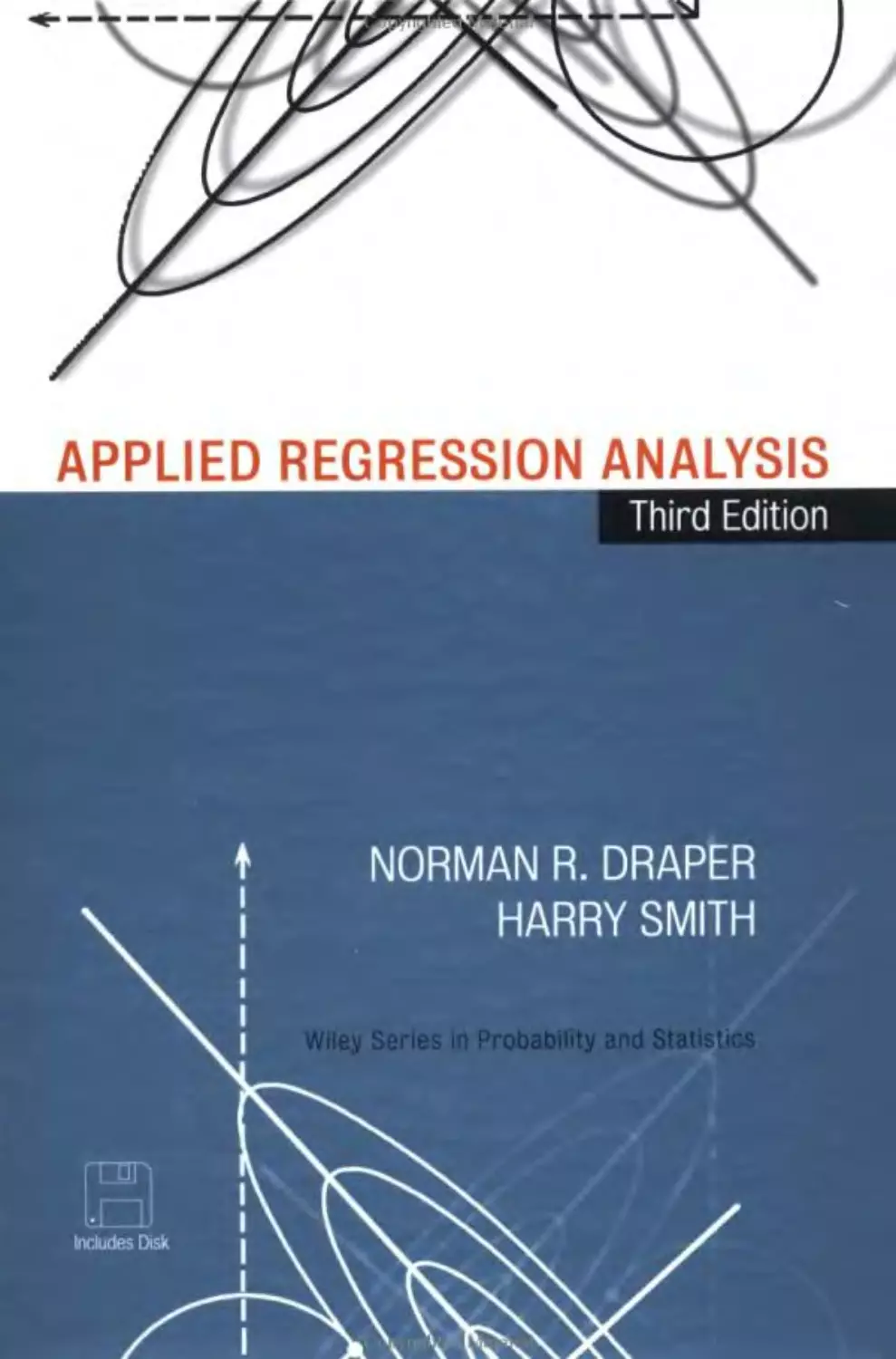
                    APPLIED REGRESSION ANALYSIS
Third Edition
NORMAN R. DRAPER
HARRY SMITH
Wiley Senes in Probability and Statist!
Includes Disk
Copyrighted Material
This book is printed on acid-free paper. ®
Copyright © 1998 by John Wiley & Sons. Inc. All rights reserved
Published simultaneously in Canada
No part of this publication may be reproduced. stored in a retrieval system or transmitted in any form or by any
means, electronic, mechanical, photocopying, recording, scanning or otherwise, except as permitted under Section
107 or 108 of the 1976 United States Copyright Act. without cither the prior written permission of the Publisher,
or authorization through payment ot the appropriate pcr-copy fee to the Copyright Clearance Center, 222 Rosewood
Drive. Danvers. MA 01923. (508) 750-8400. fax (508) 750-4744 Requests to the Publisher for permission should
be addressed to the Permissions Department. John Wiley & Sons. Inc.. 605 Third Avenue. New York. NY 10158-
0012. (212) 850-601). fax (212) 850-6008. E-Mail: PERMRECWWILEY.COM.
Library of Congmt Cataluyinx-in-Publication Data
Draper. Norman Richard.
Applied regression analysis /NR Draper. H. Smith. — 3rd ed.
p. cm — (Wiley senes in probability and statistics. Texts
and reference* section)
"A Wilcy-lnterscicocc publication."
Includes bibliographical reference* (p. - ) and index.
ISBN 0-471-17082-8 (acid free paper) t. Regression analysis. 1 Smith. Harry. 1923 Hi. Scries.	. 11. Title.
QA2782.D7 1998 519.5'36— dc21	97-17969 CTP
Pnnted in the United States of America.
10 9 8 7 6 5 4
Copyrighted Material
Copyrighted Material
Contents
Preface	xiii
About the Software	xvii
0 Basic Prerequisite Knowledge	1
0.1 Distributions: Normal, t, and F. 1
0.2 Confidence Intervals (or Bands) and f-Tests, 4
0.3 Elements of Matrix Algebra, 6
1	Fitting a Straight Line by Least Squares	15
1.0	Introduction: The Need for Statistical Analysis, 15
1.1	Straight Line Relationship Between Two Variables, 18
1.2	Linear Regression: Fitting a Straight Line by Least Squares, 20
1.3	The Analysis of Variance. 28
1.4	Confidence Intervals and Tests for /% and /3,, 34
1.5	F-Tcst for Significance of Regression. 38
1.6	The Correlation Between X and Y. 40
1.7	Summary of the Straight Line Fit Computations. 44
1.8	Historical Remarks, 45
Appendix 1A Steam Plant Data. 46
Exercises are in “Exercises for Chapters 1-3”, 96
2	Checking the Straight Line Fit	47
2.1	Lack of Fit and Pure Error, 47
2.2	Testing Homogeneity of Pure Error. 56
2.3	Examining Residuals: The Basic Plots, 59
2.4	Non-normality Checks on Residuals, 61
2.5	Checks for Time Effects. Nonconstanl Variance. Need for
Transformation, and Curvature. 62
2.6	Other Residuals Plots. 67
v
Copyrighted Material
Copyrighted Material
vi	CONTENTS
2.7	Durbin-Watson Test. 69
2.8	Reference Books for Analysis of Residuals. 70
Appendix 2A Normal Plots. 70
Appendix 2B MINITAB Instructions. 76
Exercises are in "Exercises for Chapters 1-3”. 96
3	Fitting Straight Lines: Special Topics	79
3.0	Summary and Preliminaries. 79
3.1	Standard Error of У. 80
3.2	Inverse Regression (Straight Line Case). 83
3.3	Some Practical Design of Experiment Implications of Regression,
86
3.4	Straight Line Regression When Both Variables Are Subject to Error.
89
Exercises for Chapters 1 -3. 96
4	Regression in Matrix Terms: Straight Line Case	115
4.1	Fitting a Straight Line in Matrix Terms. 115
4.2	Singularity: What Happens in Regression to Make X'X Singular?
An Example, 125
4.3	The Analysis of Variance in Matrix Terms. 127
4.4	The Variances and Covariance of and from the Matrix
Calculation. 128
4.5	Variance of Y Using the Matrix Development. 130
4.6	Summary of Matrix Approach to Fitting a Straight Line
(Nonsingular Case), 130
4.7	The General Regression Situation, 131
Exercises for Chapter 4. 132
5	The General Regression Situation	135
5.1	General Linear Regression. 135
5.2	Least Squares Properties. 137
5.3	Least Squares Properties When e — A(0, Io2). 140
5.4	Confidence Intervals Versus Regions. 142
5.5	More on Confidence Intervals Versus Regions. 143
Appendix 5A Selected Useful Matrix Results. 147
Exercises are in "Exercises for Chapters 5 and 6”, 169
6	Extra Sums of Squares and Tests for Several Parameters
Being Zero	149
6.1	The “Extra Sum of Squares" Principle. 149
6.2	Two Predictor Variables: Example. 154
6.3	Sum of Squares of a Set of Linear Functions of K’s, 162
Copyrighted Material
Copyrighted Material
contents	vil
Appendix 6A Orthogonal Columns in the X Matrix, 165
Appendix 6B Two Predictors. Sequential Sums of Squares. 167
Exercises for Chapters 5 and 6, 169
7	Serial Correlation in the Residuals and the Durbin-Watson Test 179
7.1	Serial Correlation in Residuals, 179
7.2	The Durbin-Watson Test for a Certain Type of Serial
Correlation. 181
7.3	Examining Runs in the Time Sequence Plot of Residuals:
Runs Test. 192
Exercises for Chapter 7, 198
8	More on Checking Fitted Models	205
8.1	The Hat Matrix II and the Various Types of Residuals, 205
8.2	Added Variable Plot and Partial Residuals, 209
8.3	Detection of Influential Observations: Cook's Statistics. 210
8.4	Other Statistics Measuring Influence. 214
8.5	Reference Books for Analysis of Residuals. 214
Exercises for Chapter 8. 215
9	Multiple Regression: Special Topics	217
9.1	Testing a General Linear Hypothesis. 217
9.2	Generalized Least Squares and Weighted Least Squares. 221
9.3	An Example of Weighted Least Squares, 224
9.4	A Numerical Example of Weighted Least Squares. 226
9.5	Restricted Least Squares. 229
9.6	Inverse Regression (Multiple Predictor Case), 229
9.7	Planar Regression When All the Variables Are Subject
to Error, 231
Appendix 9A Lagrange's Undetermined Multipliers. 231
Exercises for Chapter 9, 233
10	Bias in Regression Estimates, and Expected Values of Mean
Squares and Sums of Squares	235
I0.1	Bias in Regression Estimates. 235
10.2	The Effect of Bias on the Least Squares Analysis of Variance. 238
10.3	Finding the Expected Values of Mean Squares. 239
10.4	Expected Value of Extra Sum of Squares. 240
Exercises for Chapter 10. 241
11	On Worthwhile Regressions, Big F's, and R2	243
11.1	Is My Regression a Useful One?, 243
11.2	A Conversation About R}. 245
Copyrighted Material
Copyrighted Material
viii	contsnts
Appendix HA How Significant Should My Regression Be?. 247
Exercises for Chapter II. 250
12	Models Containing Functions of the Predictors, Including
Polynomial Models	251
12.1	More Complicated Model Functions, 251
12.2	Worked Examples of Second-Order Surface Fitting for к - 3 and
к = 2 Predictor Variables. 254
12.3	Retaining Terms in Polynomial Models. 266
Exercises for Chapter 12. 272
13	Transformation of the Response Variable	277
13.1	Introduction and Preliminary Remarks, 277
13.2	Power Family of Transformations on the Response: Box-Cox
Method. 280
13.3	A Second Method for Estimation Л. 286
13.4	Response Transformations: Other Interesting and Sometimes
Useful Plots. 289
13.5	Other Types of Response Transformations. 290
13.6	Response Transformations Chosen to Stabilize Variance. 291
Exercises for Chapter 13. 294
14	"Dummy" Variables	299
14.1	Dummy Variables to Separate Blocks of Data with Different
Intercepts. Same Model. 299
14.2	Interaction Terms Involving Dummy Variables. 307
14.3	Dummy Variables for Segmented Models. 311
Exercises for Chapter 14, 317
15	Selecting the "Best" Regression Equation	327
15.0	Introduction. 327
15.1	All Possible Regressions and “Best Subset" Regression. 329
15.2	Stepwise Regression, 335
15.3	Backward Elimination. 339
15.4	Significance Levels for Selection Procedures, 342
15.5	Variations and Summary. 343
15.6	Selection Procedures Applied to the Steam Data. 345
Appendix 15A Hald Data, Correlation Matrix, and All 15 Possible
Regressions. 348
Exercises for Chapter 15, 355
16	Ill-Conditioning in Regression Data	369
16.1	Introduction, 369
16.2	Centering Regression Data, 371
Copyrighted Material
Copyrighted Material
CONTENTS
ix
16.3	Centering and Scaling Regression Data. 373
16.4	Measuring Multicollinearity. 375
16.5	Belsley's Suggestion for Detecting Multicollinearity, 376
Appendix 16A Transforming X Matrices to Obtain Orthogonal
Columns. 382
Exercises for Chapter 16. 385
17 Ridge Regression
387
17.1	Introduction, 387
17.2	Basic Form of Ridge Regression, 387
17.3	Ridge Regression of the Hald Data, 389
17.4	In What Circumstances Is Ridge Regression Absolutely the
Correct Way to Proceed?, 391
17.5	The Phoney Data Viewpoint, 394
17.6	Concluding Remarks, 395
Appendix 17A
396
/\ppendix 17B
Appendix 17C
Exercises for Chapter 17. 400
Ridge Estimates in Terms of Least Squares Estimates.
Mean Square Error Argument. 396
Canonical Form of Ridge Regression. 397
18 Generalized Linear Models (GLIM)
401
18.1	Introduction. 401
18.2	The Exponential Family of Distributions. 402
18.3	Fitting Generalized Linear Models (GLIM), 404
18.4	Performing the Calculations: An Example. 406
18.5	Further Reading, 408
Exercises for Chapter 18. 408
19 Mixture Ingredients as Predictor Variables	409
19.1	Mixture Experiments: Experimental Spaces. 409
19.2	Models for Mixture Experiments, 412
19.3	Mixture Experiments in Restricted Regions, 416
19.4	Example 1. 418
19.5	Example 2. 419
Appendix 19A Transforming к Mixture Variables to Ar I Working
Variables. 422
Exercises for Chapter 19, 425
20 The Geometry of Least Squares
427
20.1	The Basic Geometry. 427
20.2	Pythagoras and Analysis of Variance. 429
20.3	Analysis of Variance and F-Test for Overall Regression, 432
20.4	The Singular X'X Case: An Example, 433
Copyrighted Material
Copyrighted Material
x	CONTENTS
20.	5 Orthogonalizing in the General Regression Case. 435
20.	6 Range Space and Null Space of a Matrix M, 437
20.	7 The Algebra and Geometry of Pure Error. 439
Appendix 20A Generalized Inverses M', 441
Exercises for Chapter 20. 444
21	More Geometry of Least Squares	447
21.1	The Geometry of a Null Hypothesis: A Simple Example. 447
21.2	General Case Ho: Xfi = c: The Projection Algebra, 448
21.3	Geometric Illustrations, 449
21.4	The F-Test for Ho. Geometrically, 450
21.5	The Geometry of R*. 452
21.6	Change in R: for Models Nested Via АД = 0. Not Involving /%,
452
21.7	Multiple Regression with Two Predictor Variables as a Sequence
of Straight Line Regressions. 454
Exercises for Chapter 21. 459
22	Orthogonal Polynomials and Summary Data	461
22.1	Introduction. 461
22.2	Orthogonal Polynomials. 461
22.3	Regression Analysis of Summary Data, 467
Exercises for Chapter 22, 469
23	Multiple Regression Applied to Analysis of Variance Problems	473
23.1	Introduction. 473
23.2	The One-Way Classification: Standard Analysis and an Example,
474
23.3	Regression Treatment of the One-Way Classification Example.
477
23.4	Regression Treatment of the One-Way Classification Using the
Original Model. 481
23.5	Regression Treatment of the One-Way Classification:
Independent Normal Equations, 486
23.6	The Two-Way Classification with Equal Numbers of
Observations in the Celis: An Example. 488
23.7	Regression Treatment of the Two-Way Classification Example.
489
23.8	The Two-Way Classification with Equal Numbers of
Observations in the Cells. 493
23.9	Regression Treatment of the Two-Way Classification with Equal
Numbers of Observations in the Cells. 494
23.10	Example: The Two-Way Classification, 498
Copyrighted Material
Copyrighted Material
contents	xi
23.11	Recapitulation and Comments. 499
Exercises for Chapter 23. 500
24	An Introduction to Nonlinear Estimation	505
24.1	Least Squares for Nonlinear Models. 505
24.2	Estimating the Parameters of a Nonlinear System, 508
24.3	An Example, 518
24.4	A Note on Reparameterization of the Model, 529
24.5	The Geometry of Linear Least Squares. 530
24.6	The Geometry of Nonlinear Least Squares. 539
24.7	Nonlinear Growth Models, 543
24.8	Nonlinear Models: Other Work, 550
24.9	References. 553
Exercises for Chapter 24. 553
25	Robust Regression	567
25.1	Least Absolute Deviations Regression (L| Regression), 567
25.2	Af-Estimators, 567
25.3	Steel Employment Example, 573
25.4	Trees Example. 575
25.5	Least Median of Squares (LMS) Regression. 577
25.6	Robust Regression with Ranked Residuals (rreg), 577
25.7	Other Methods. 580
25.8	Comments and Opinions. 580
25.9	References. 581
Exercises for Chapter 25, 584
26	Resampling Procedures (Bootstrapping)	585
26.1	Resampling Procedures for Regression Models. 585
26.2	Example: Straight Line Fit, 586
26.3	Example: Planar Fit. Three Predictors, 588
26.4	Reference Books, 588
Appendix 26A Sample MINITAB Programs to Bootstrap Residuals
for a Specific Example. 589
Appendix 26B Sample MINITAB Programs to Bootstrap Pairs for a
Specific Example, 590
Additional Comments, 591
Exercises for Chapter 26. 591
Bibliography	593
True/False Questions	605
Answers to Exercises	609
Copyrighted Material
Copyrighted Material
xll
CONTENTS
Tables
Normal Distribution, 684
Percentage Points of the /-Distribution, 686
Percentage Points of the .^-Distribution. 687
Percentage Points of the F-Distribution, 688
Index of Authors Associated with Exercises
Index
684
695
697
Copyrighted Material
CHAPTER О
Basic Prerequisite Knowledge
Readers need some of the knowledge contained in a basic course in statistics to tackle
regression. We summarize some of the main requirements very briefly in this chapter.
Also useful is a pocket calculator capable of getting sums of squares and sums of
products easily. Excellent calculators of this type cost about $25-50 in the United
States. Buy the most versatile you can afford.
0.1. DISTRIBUTIONS: NORMAL, t, AND F
Normal Distribution
The normal distribution occurs frequently in the natural world, either for data “as
they come” or for transformed data. The heights of a large group of people selected
randomly will look normal in general, for example. The distribution is symmetric
about its mean and has a standard deviation cr, which is such that practically all of
the distribution (99.73%) lies inside the range ц - Зет < x < /х 4- За. The frequency
function is
<r(2>7)ineXp(’L^“
— oo < x — °0.
(0.1.1)
We usually write that x ~ N(/x, a2), read as “x is normally distributed with mean
fx and variance cr2.” Most manipulations are done in terms of the standard normal or
unit normal distribution, A(0,1), for which /х = 0 and a = 1. To move from a general
normal variable x to a standard normal variable z, we set
Z = (x — ix)la.	(0.1.2)
A standard normal distribution is shown in Figure 0.1 along with some properties
useful in certain regression contexts. All the information shown is obtainable from
the normal table in the Tables section. Check that you understand how this is done.
Remember to use the fact that the total area under each curve is 1.
Gamma Function
The gamma function T(g), which occurs in Eqs. (0.1.3) and (0.1.4), is defined as an
integral in general:
Г(<?) = JQ e Xxq 1 dx.
1
2
BASIC PREREQUISITE KNOWLEDGE
Figure 0.1. The standard (or unit) normal distribution 7V(0, 1) and some of its properties.
However, it is easier to think of it as a generalized factorial with the basic property
that, for any q,
Г(д) = (q - 1)Г(<? - 1)
= (q- l)(g - 2)Г(<? - 2),
and so on. Moreover,
Г(|) = 771/2 and Г(1) = 1.
So, for the applications of Eqs. (0.1.3) and (0.1.4), where v, m, and n are integers, the
gamma functions are either simple factorials or simple products ending in я'2.
Example 1
Г(5) = 4 X Г(4) = 4 x 3 x Г(3) = 4 x 3 x 2 X Г(2)
= 4ХЗХ2Х1Х Г(1) = 24.
Example 2
Г(|) = 1 х Г(|) = 1 х | х Гф = Зтг1/2/4.
/-Distribution
There are many /-distributions, because the form of the curve, defined by
r(—)
\	2	/ /	z2\-(*+l)/2
Ш = —Л 1+L	(-00<r<00),	(0.1.3)
I v\ \	V)
0.1. DISTRIBUTIONS: NORMAL, t . AND F
3
v = 00
-10 -8 -6 -4 -2	0	2	4	6	8 10
Figure 0.2. The /-distributions for v = 1, 9, »; /(oo) = ?V(0, 1).
depends on p, the number of degrees of freedom. In general, the t(v) distribution
looks somewhat like a standard (unit) normal but is “heavier in the tails,” and so
lower in the middle, because the total area under the curve is 1. As v increases, the
distribution becomes “more normal.” In fact, /(<») is the 2V(0, 1) distribution, and,
when vexceeds about 30, there is so little difference between t(v) and A(0, 1) that it
has become conventional (but not mandatory) to use the A(0, 1) instead. Figure
0.2 illustrates the situation. A two-tailed table of percentage points is given in the
Tables section.
^Distribution
The F-distribution depends on two separate degrees of freedom m and n, say. Its
curve is defined by
Л.ДЛ =
(1 + mF!n)(m+n}t2
(0.1.4)

U7 —0).
The distribution rises from zero, sometimes quite steeply for certain m and n, and
reaches a peak, falling off very skewed to the right. See Figure 0.3. Percentage points
for the upper tail levels of 10%, 5%, and 1% are in the Tables section.
Figure 0.3. Some selected f(m, n) distributions.
4
BASIC PREREQUISITE KNOWLEDGE
The /-distribution is usually introduced in the context of testing to see whether
two variances are equal, that is, the null hypothesis that Ho: aj/al = 1, versus the
alternative hypothesis that	a2/a2 # 1. The test uses the statistic F = s]/sl,sl and
$2 being statistically independent estimates of a2 and a\, with v, and p? degrees of
freedom (df), respectively, and depends on the fact that, if the two samples that give
rise to 5] and s\ are independent and normal, then (s21 sty I (a21 a?) follows the F(yx, vty
distribution. Thus if a2 = a2, F = s2 / s2 follows F(v}, p2). When given in basic statistics
courses, this is usually described as a two-tailed test, which it usually is. In regression
applications, it is typically a one-tailed, upper-tailed test. This is because regression
tests always involve putting the “52 that could be too big, but cannot be too small”
at the top and the “52 that we think estimates the true cr2 well” at the bottom of the
/•'-statistic. In other words, we are in the situation where we test //0: <r2 = <т2 versus
a2 = a2.
0.2. CONFIDENCE INTERVALS (OR BANDS) AND f-TESTS
Let 0 be a parameter (or “thing”) that we want to estimate. Let 0 be an estimate of
0 (“estimate of thing”). Typically, 0 will follow a normal distribution, either exactly
because of the normality of the observations in 0, or approximately due to the effect
of the Central Limit Theorem. Let а в be the standard deviation of 0 and let se(0) be
the standard error, that is, the estimated standard deviation, of 0 (“standard error of
thing”), based on v degrees of freedom. Typically we get se(0) by substituting an
estimate (based on p degrees of freedom) of an unknown standard deviation into the
formula for a&.
1. A 100(1 - a)% confidence interval (CI) for the parameter 0 is given by
0 ±	1 - a/2)se(0)	(0.2.1)
where L(1 - a/2) is the percentage point of a t-variable with v degrees of freedom
(df) that leaves a probability a/2 in the upper tail, and so 1 - all in the lower tail.
A two-tailed table where these percentage points are listed under the heading of
2(a/2) = a is given in the Tables section. Equation (0.2.1) in words is
Estimate
of thing
A t percentage point ! -
leaving all in the
upper tail, based on
v degrees of freedom .
Standard error
of estimate
of thing
(0.2.2)
2. To test 0 = 0o, where 0o is some specified value of 0 that is presumed to be valid
(often 0o = 0 in tests of regression coefficients) we evaluate the statistic
0-00
se(0)
or, in words,
f Estimate! _ f Postulated or test
[of thing J [value of thing
(Standard error of!
estimate of thing J
(0.2.3)
(0.2.4)
0.2. CONFIDENCE INTERVALS (OR BANDS) AND (-TESTS
5
Figure 0.4. Two cases for a (-test. (a) The observed t is positive (black dot) and the upper tail area is
8. A two-tailed test considers that this value could just as well have been negative (open “phantom” dot)
and quotes “a two-tailed (-probability of 28." (b) The observed t is negative; similar argument, with
tails reversed.
This “observed value of t" (our “dot”) is then placed on a diagram of the t(v)
distribution. [Recall that v is the number of degrees of freedom on which se(0) is
based and that is the number of df in the estimate of <r2 that was used.] The tail
probability beyond the dot is evaluated and doubled for a two-tail test. See Figure
0.4 for the probability 28. It is conventional to ask if the 28 value is “significant” or
not by concluding that, if 28 < 0.05, t is significant and the idea (or hypothesis) that
в = 0o is unlikely and so “rejected,” whereas if 28 > 0.05, t is nonsignificant and we
“do not reject” the hypothesis 0 = 0O. The alternative hypothesis here is 0 # 0O, a
two-sided alternative. Note that the value 0.05 is not handed down in holy writings,
although we sometimes talk as though it is. Using an “alpha level” of a = 0.05 simply
means we are prepared to risk a 1 in 20 chance of making the wrong decision. If we
wish to go to a = 0.10 (1 in 10) or a = 0.01 (1 in 100), that is up to us. Whatever we
decide, we should remain consistent about this level throughout our testing.
However, it is pointless to agonize too much about a. A journal editor who will
publish a paper describing an experiment if 28 = 0.049, but will not publish it if
28 = 0.051 is placing a purely arbitrary standard on the work. (Of course, it is the
editor’s right to do that.) Such an attitude should not necessarily be imposed by
experimenters on themselves, because it is too restrictive a posture in general. Promis-
6
BASIC PREREQUISITE KNOWLEDGE
TABLE 0.1. Example Applications for Formulas (0.2.1)-(0.2.4)
Situation	0	0	se(0)
Straight line fit
Y = (3, + /3, X + e	&		=^(Х,-ХУ A'A'
Predicted response	&	b"	I'ZA',2)12 Л l л Sa a J
Yq =	+ b\ Ap at X = X,	E(Y) at X{}	Y>	fl | (A, - A)2j12 S.n J
ing experimental leads need to be followed up, even if the arbitrary a standard has
not been attained. For example, an a = 0.05 person might be perfectly justified in
following up a 28 = 0.06 experiment by performing more experimental runs to further
elucidate the results attained by the first set of runs. To give up an avenue of investiga-
tion merely because one experiment did not provide a significant result may be a
mistake. The a value should be thought of as a guidepost, not a boundary.
In every application of formulas (0.2.1)—(0.2.4), we have to ask what 0, 0, 6», se(0),
and the t percentage point are. The actual formulas we use are always the same. Table
0.1 contains some examples of в, 0, and se(0) we shall subsequently meet. (The symbol
л replaces the cr of the corresponding standard deviation formulas.)
0.3. ELEMENTS OF MATRIX ALGEBRA
Matrix, Vector, Scalar
A p X q matrix M is a rectangular array of numbers containing p rows and q col-
umns written
mu mn
mXq
m2q
M =
mp} mp2 ... mpq
For example.
4 1	3 7
Д= -1 0	2 2
6 5-21
is a 3 x 4 matrix. The plural of matrix is matrices. A “matrix" with only one row is
called a row vector: a “matrix" with only one column is called a column vector. For
example, if
0.3. ELEMENTS OF MATRIX ALGEBRA
7
a'= [1,6,3,2,1] and b= 0
then a' is a row vector of length five and b is a column vector of length three. A 1 X
1 “vector” is an ordinary number or scalar.
Equality
Two matrices are equal if and only if their dimensions are identical and they have
exactly the same entries in the same positions. Thus a matrix equality implies as many
individual equalities as there are terms in the matrices set equal.
Sum and Difference
The sum (or difference) of two matrices is the matrix each of whose elements is the
sum (or difference) of the corresponding elements of the matrices added (or sub-
tracted). For example,
The matrices must be of exactly the same dimensions for addition or subtraction to
be carried out. Otherwise the operations are not defined.
Transpose
The transpose of a matrix M is a matrix M' whose rows are the columns of M and
whose columns are the rows of M in the same original order. Thus for M and A as
defined above,
лиц w2] ... mpX
M' =
ЛП22
miq ... mpq
"4	-1	6"
1	0	5
3	2-2
7	2	1
Note that the transpose notation enables us to write, for example,
b' = (-1, 0, 1) or alternatively b = (-1, 0, 1)'.
8
BASIC PREREQUISITE KNOWLEDGE
Note: The parentheses around a matrix or vector can be square-ended or curved.
Often, capital letters are used to denote matrices and lowercase letters to denote
vectors. Boldface print is often used, but this is not universal.
Symmetry
A matrix M is said to be symmetric if M' = M.
Multiplication
Suppose we have two matrices, A, which is p X q, and B, which is г X s. They are
conformable for the product C = AB only if q = r. The resulting product is then a
p x s matrix, the multiplication procedure being defined as follows: If
«!</"
bh
bZs
Ьф
p X q	q X ,y
then the product
p X 5
is such that
(1цЬц,
that is, the entry in the zth row and /th column of C is the inner product (the element
by element cross-product) of the /th row of A with the /th column of B. For example.
' 1 2
.-1 3
Г
()_
1 2 3
4 0-1
-2 1	3
3 x 3
’ 1(1) +	2(4) +	l(-2)	1(2)	+ 2(0)	+	1(1)	1(3)	+	2(-l) +	1(3)’
_-l(l) +	3(4) +	0(-2)	-1(2) +	3(0) +	0(1)	-1(3)	+	3(-l) +	0(3).
’ 7	3	4’
JI -2	-6.’
2x3
0.3. ELEMENTS OF MATRIX ALGEBRA
9
We say that, in the product AB, we have premultiplied В by A or we have postmultiplied
A by B. Note that, in general, AB and BA, even if both products are permissible
(conformable), do not lead to the same result. In a matrix multiplication, the order
in which the matrices are arranged is crucially important, whereas the order of the
numbers in a scalar product is irrelevant.
When several matrices and/or vectors are multiplied together, the product should
be carried out in the way that leads to the least work. For example, the product
W Z' у
pXppXnnXl
could be carried out as (WZ')y, or as W(Z'y), where the parenthesized product is
evaluated first. In the first case we would have to carry out pn p-length cross-products
and p «-length cross-products; in the second case p p-length and p «-length, clearly a
saving in effort.
Special Matrices and Vectors
We define
a square « X « matrix with l’s on the diagonal and 0’s elsewhere, as the unit matrix
or identity matrix. This fulfills the same role as the number 1 in ordinary arithmetic.
If the size of In is clear from the context, the subscript « is often omitted. We further
use 0 to denote a vector
0 = (0, 0, ..., 0)'
or a matrix
all of whose values are zeros; the actual size of 0 is usually clear from the context.
We also define
a vector of all l’s; the size of 1 is either specified or is clear in context. Note that
1'1 = the squared length of the vector 1, but that 11' is a square matrix, each entry
of which is 1, with the number of rows and columns each equal to the length of 1.
10
BASIC PREREQUISITE KNOWLEDGE
Orthogonality
A vector a = (aH a2,..., any is said to be orthogonal to a vector b = (bb b2, ..bn)'
if the sum of products of their elements is zero, that is, if
У atbt = a'b = b'a = 0.
Inverse Matrix
The inverse M-1 of a square matrix M is the unique matrix such that
MM = I = MM4.
The columns mb m2, ..., m„ of an n X n matrix are linearly dependent if there exist
constants с,, Ci, ..., cn, not all zero, such that
Ciiiii 4- c2m2 + • • • + cnm„ = 0
and similarly for rows. A square matrix, some of whose rows (or some of whose
columns) are linearly dependent, is said to be singular and does not possess an inverse.
A square matrix that is not singular is said to be nonsingular and can be inverted.
If M is symmetric, so is M"1.
Obtaining an Inverse
The process of matrix inversion is a relatively complicated one and is best appreciated
by considering an example. Suppose we wish to obtain the inverse M 1 of the matrix
Let
3a + b + 7c = 1,
4a 4- 2b + c = 0,
5a + 6b + 9c = 0,
3d 4- e + 7f = 0,
4d + 2e +f= 1,
5d 4- 6e 4- 9f= 0,
3g + h + 7 k = 0,
4g 4- 2h 4- к = 0,
5g 4- 6h 4- 9k = 1
Solving these three sets of three linear simultaneous equations yields
0.3. ELEMENTS OF MATRIX ALGEBRA
11
	" &				12	-31
M-1 =	&	“ife		1 103	33	-8
	—	&		A \J.J	-13	25
14
-13
2
(Note the removal of a common factor, explained below.) In general, for an n X n
matrix there will be n sets of n simultaneous linear equations. Accelerated methods
for inverting matrices adapted specifically for use with electronic computers permit
inverses to be obtained with great speed, even for large matrices. Working out inverse
matrices “by hand” is obsolete, nowadays, except in simple cases (see below).
Determinants
An important quantity associated with a square matrix is its determinant. Determinants
occur naturally in the solution of linear simultaneous equations and in the inversion
of matrices. For a 2 X 2 matrix
b
d
M =
the determinant is defined as
det M =
= ad - be.
For a 3 X 3 matrix
a b c
def
g h к
it is
e
e
h
f d
f	d
4* c
к	g
- b
a
h
к g
= aek — afh — bdk 4- bfg + cdh - ceg.
Note that we expand by the first row, multiplying a by the determinant of the matrix left
when we cross out the row and column containing a, multiplying b by the determinant of
the matrix left when we cross out the row and column containing b, multiplying c by
the determinant of the matrix left when we cross out the row and column containing
c. We also attach alternate signs +, —, 4- to these three terms, counting from the top
left-hand corner element: 4- to a, — to b, 4- to c, and so on, alternately, if there were
more elements in the first row.
In fact, the determinant can be written down as an expansion of any row or column
by the same technique. The signs to be attached are counted 4- - 4- -, and so on,
from the top left corner element alternating either along row or column (but not
diagonally). In other words the signs
12
BASIC PREREQUISITE KNOWLEDGE
are attached and any row or column is used to write down the determinant. For
example, using the second row we have
-d
b
h
c	a
+ e
к	g
b
h
c a
to obtain the same result as before.
The same principle is used to get the determinant of any matrix. Any row or column
is used for the expansion and we multiply each element of the row or column by:
1. Its appropriate sign, counted as above.
2. The determinant of the submatrix obtained by deletion of the row and column in
which the element of the original matrix stands.
Determinants arise in the inversion of matrices as follows. The inverse M_| may
be obtained by first replacing each element тц of the original matrix M by an element
calculated as follows:
1.	Find the determinant of the submatrix obtained by crossing out the row and column
of M in which m4 stands.
2.	Attach a sign from the + - 4— count, as above.
3.	Divide by the determinant of M.
When all elements of M have been replaced, transpose the resulting matrix. The
transpose will be M1.
The reader might like to check these rules by showing that
'« b
_c d_
- d/D -b/D'
_-c/D a/D J’
M"1 =
A = (ek - fh)/Z,
D =-(dk - fg)/Z,
G = (dh - eg)/Z,
В = ~(bk - ch)/Z,
E = (ak - eg)/Z,
H= -(ah- bg)/Z,
C=(bf—ce)/Z,
F= -(af- cd)/Z,
K = (ae- bd)/Z,
and where
Z = aek 4- bfg 4- cdh - afh - bdk - ceg
is the determinant of Q. Note that, if M is symmetric (so that b = c), M_| is also
symmetric. Also, if Q is symmetric (so that b = d, c = g, f = h), then Q~’ is also
symmetric because then В = D, C = G, and F - H.
The determinant is essentially a measure of the volume contained in a parallelepiped
defined by the vectors in the rows (or columns) of the square matrix. See, for example,
Schneider and Barker (1973, pp. 161-169).
If the square matrix is of the form X'X, dimension p X p, say, the equation
0.3. ELEMENTS OF MATRIX ALGEBRA
13
u'X'Xu = constant
defines an ellipsoid in the space of the variables (u}, u2, ..., up) = u' and
det(X'X) = |X'X| is proportional to the volume contained by the ellipse. The exact area
depends on the choice of the constant. This result has application in the construction of
joint confidence regions for regression parameters in Section 5.4.
Common Factors
If every element of a matrix has a common factor, it can be taken outside the matrix.
Conversely, if a matrix is multiplied by a constant c. every element of the matrix is
multiplied by c. For example,
Г4	6	-21	Г2	3	-П
= 2
L8	6 2J	L4	3 1J
Note that, if a matrix is square and of size p X p, and if c is a common factor, then
the determinant of the matrix has a factor cp, not just c. For example,
4
8
6	2
3
3
= 22
= 22(6 - 12) = -24.
6	4
Additional information on matrices is given where needed in the text. Also see Appen-
dix 5A.
CHAPTER 1
Fitting a Straight Line by Least Squares
1.0. INTRODUCTION: THE NEED FOR STATISTICAL ANALYSIS
In today’s industrial processes, there is no shortage of “information.” No matter how
small or how straightforward a process may be, measuring instruments abound. They
tell us such things as input temperature, concentration of reactant, percent catalyst,
steam temperature, consumption rate, pressure, and so on, depending on the character-
istics of the process being studied. Some of these readings are available at regular
intervals, every five minutes perhaps or every half hour; others are observed continu-
ously. Still other readings are available with a little extra time and effort. Samples of the
end product may be taken at intervals and, after analysis, may provide measurements of
such things as purity, percent yield, glossiness, breaking strength, color, or whatever
other properties of the end product are important to the manufacturer or user.
In research laboratories, experiments are being performed daily. These are usually
small, carefully planned studies and result in sets of data of modest size. The objective
is often a quick yet accurate analysis, enabling the experimenter to move on to “better”
experimental conditions, which will produce a product with desirable characteristics.
Additional data can easily be obtained if needed, however, if the decision is ini-
tially unclear.
A Ph.D. researcher may travel into an African jungle for a one-year period of
intensive data-gathering on plants or animals. She will return with the raw material
for her thesis and will put much effort into analyzing the data she has, searching for
the messages that they contain. It will not be easy to obtain more data once her trip
is completed, so she must carefully analyze every aspect of what data she has.
Regression analysis is a technique that can be used in any of these situations. Our
purpose in this book is to explain in some detail something of the technique of
extracting, from data of the types just mentioned, the main features of the relationships
hidden or implied in the tabulated figures. (Nevertheless, the study of regression
analysis techniques will also provide certain insights into how to plan the collection
of data, when the opportunity arises. See, for example, Section 3.3.)
In any system in which variable quantities change, it is of interest to examine the
effects that some variables exert (or appear to exert) on others. There may in fact be
a simple functional relationship between variables; in most physical processes this is
the exception rather than the rule. Often there exists a functional relationship that is
too complicated to grasp or to describe in simple terms. In this case we may wish to
approximate to this functional relationship by some simple mathematical function,
such as a polynomial, which contains the appropriate variables and which graduates
15
16
FITTING A STRAIGHT LINE BY LEAST SQUARES
or approximates to the true function over some limited ranges of the variables involved.
By examining such a graduating function we may be able to learn more about the
underlying true relationship and to appreciate the separate and joint effects produced
by changes in certain important variables.
Even where no sensible physical relationship exists between variables, we may wish
to relate them by some sort of mathematical equation. While the equation might be
physically meaningless, it may nevertheless be extremely valuable for predicting the
values of some variables from knowledge of other variables, perhaps under certain
stated restrictions.
In this book we shall use one particular method of obtaining a mathematical relation-
ship. This involves the initial assumption that a certain type of relationship, linear in
unknown parameters (except in Chapter 24, where nonlinear models are considered),
holds. The unknown parameters are estimated under certain other assumptions with
the help of available data, and a fitted equation is obtained. The value of the fitted
equation can be gauged, and checks can be made on the underlying assumptions to
see if any of these assumptions appears to be erroneous. The simplest example of this
process involves the construction of a fitted straight line when pairs of observations
(Xi, yj, (X2, Y2), ... , (Xn, Yn) are available. We shall deal with this in a simple
algebraic way in Chapters 1-3. To handle problems involving large numbers of vari-
ables, however, matrix methods are essential. These are introduced in the context of
fitting a straight line in Chapter 4. Matrix algebra allows us to discuss concepts in a
larger linear least squares regression context in Chapters 5-16 and 19-23. Some non-
least-squares topics are discussed in Chapters 17 (ridge regression), 18 (generalized
linear models), 24 (nonlinear estimation), 25 (robust regression), and 26 (resam-
pling procedures).
We assume that anyone who uses this book has had a first course in statistics and
understands certain basic ideas. These include the ideas of parameters, estimates,
distributions (especially normal), mean and variance of a random variable, covariance
between two variables, and simple hypothesis testing involving one- and two-sided t-
tests and the F-test. We believe, however, that a reader whose knowledge of these
topics is rusty or incomplete will nevertheless be able to make good progress after a
review of Chapter 0.
We do not intend this as a comprehensive textbook on all aspects of regression
analysis. Our intention is to provide a sound basic course plus material necessary to
the solution of some practical regression problems. We also add some excursions into
related topics.
We now take an early opportunity to introduce the reader to the data in Appendix
1A. Here we see 25 observations taken at intervals from a steam plant at a large
industrial concern. Ten variables, some of them in coded form, were recorded as
follows:
1.	Pounds of steam used monthly, in coded form.
2.	Pounds of real fatty acid in storage per month.
3.	Pounds of crude glycerin made.
4.	Average wind velocity (in mph).
5.	Calendar days per month.
6.	Operating days per month.
7.	Days below 32°F.
8.	Average atmospheric temperature (°F).
1.0. INTRODUCTION: THE NEED FOR STATISTICAL ANALYSIS
17
9.	Average wind velocity squared.
10.	Number of start-ups.
We can distinguish two main types of variable at this stage. We shall usually call
these predictor variables and response variables. (For alternative terms, see below.)
By predictor variables we shall usually mean variables that can either be set to a
desired value (e.g., input temperature or catalyst feed rate) or else take values that
can be observed but not controlled (e.g., the outdoor humidity). As a result of changes
that are deliberately made, or simply take place in the predictor variables, an effect
is transmitted to other variables, the response variables (e.g., the final color or the
purity of a chemical product). In general, we shall be interested in finding out how
changes in the predictor variables affect the values of the response variables. If we
can discover a simple relationship or dependence of a response variable on just one
or a few predictor variables we shall, of course, be pleased. The distinction between
predictor and response variables is not always completely clear-cut and depends some-
times on our objectives. What may be considered a response variable at the midstage
of a process may also be regarded as a predictor variable in relation to (say) the
final color of the product. In practice, however, the roles of variables are usually
easily distinguished.
Other names frequently seen are the following:
Predictor variables = input variables = inputs
= Jf-variables = regressors
= independent variables.
(We shall try to avoid using the last of these names, because it is often misleading.
In a particular body of data, two or more “independent” variables may vary together
in some definite way due, perhaps, to the method in which an experiment is conducted.
This is not usually desirable—for one thing it restricts the information on the separate
roles of the variables—but it may often be unavoidable.)
Response variables = output variables = outputs
= У-variables
= dependent variables.
Returning to the data in Appendix 1A, which we shall refer to as the steam data,
we examine the 25 sets of observations on the variables, one set for each of 25 different
months. Our primary interest here is in the monthly amount of steam produced and
how it changes due to variations in the other variables. Thus we shall regard variable
Xi as a dependent or response variable, У, in what follows, and the others as predictor
variables, X2, X3, ... , XlQ.
We shall see how the method of analysis called the method of least squares can
be used to examine data and to draw meaningful conclusions about dependency
relationships that may exist. This method of analysis is often called regression analysis.
(For historical remarks, see Section 1.8.)
Throughout this book we shall be most often concerned with relationships of
the form
Response variable = Model function 4- Random error.
The model function will usually be “known” and of specified form and will involve
18
FITTING A STRAIGHT LINE BY LEAST SQUARES
the predictor variables as well as parameters to be estimated from data. The distribution
of the random errors is often assumed to be a normal distribution with mean zero,
and errors are usually assumed to be independent. All assumptions are usually checked
after the model has been fitted and many of these checks will be described.
(Note: Many engineers and others call the parameters constants and the predictors
parameters. Watch out for this possible difficulty in cross-discipline conversations!)
We shall present the least squares method in the context of the simplest application,
fitting the “best” straight line to given data in order to relate two variables X and У,
and will discuss how it can be extended to cases where more variables are involved.
1.1. STRAIGHT LINE RELATIONSHIP BETWEEN TWO VARIABLES
In much experimental work we wish to investigate how the changes in one variable
affect another variable. Sometimes two variables are linked by an exact straight line
relationship. For example, if the resistance R of a simple circuit is kept constant, the
current I varies directly with the voltage V applied, for, by Ohm’s law, I = V/R. If
we were not aware of Ohm’s law, we might obtain this relationship empirically by
making changes in V and observing 7, while keeping R fixed and then observing that
the plot of I against V more or less gave a straight line through the origin. We say
“more or less” because, although the relationship actually is exact, our measurements
may be subject to slight errors and thus the plotted points would probably not fall
exactly on the line but would vary randomly about it. For purposes of predicting I
for a particular V (with R fixed), however, we should use the straight line through
the origin. Sometimes a straight line relationship is not exact (even apart from error)
yet can be meaningful nevertheless. For example, suppose we consider the height and
weight of adult males for some given population. If we plot the pair (Уь У2) =
(height, weight), a diagram something like Figure 1.1 will result. (Such a presentation
is conventionally called a scatter diagram.)
Note that for any given height there is a range of observed weights, and vice versa.
This variation will be partially due to measurement errors but primarily due to variation
between individuals. Thus no unique relationship between actual height and weight
65 66 67 68 69 70 71 72 73 74 75 76
Height (У,)
Figure 1.1. Heights and weights of 30 American males.
1.1. STRAIGHT LINE RELATIONSHIP BETWEEN TWO VARIABLES
19
can be expected. But we can note that the average observed weight for a given observed
height increases as height increases. This locus of average observed weight for given
observed height (as height varies) is called the regression curve of weight on height.
Let us denote it by У2 = /(У1)- There also exists a regression curve of height on
weight, similarly defined, which we can denote by Yx = g(y2). Let us assume that
these two “curves” are both straight lines (which in general they may not be). In
general, these two curves are not the same, as indicated by the two lines in the figure.
Suppose we now found we had recorded an individual’s height but not his weight
and we wished to estimate this weight. What could we do? From the regression line
of weight on height we could find an average observed weight of individuals of the
given height and use this as an estimate of the weight that we did not record.
A pair of random variables such as (height, weight) follows some sort of bivariate
probability distribution. When we are concerned with the dependence of a random
variable У on a quantity X that is variable but not randomly variable, an equation
that relates У to X is usually called a regression equation. Although the name is,
strictly speaking, incorrect, it is well established and conventional. In nearly all of this
book we assume that the predictor variables are not subject to random variation, but
that the response variable is. From a practical point of view, this is seldom fully true
but, if it is not, a much more complicated fitting procedure is needed. (See Sections
3.4 and 9.7.) To avoid this, we use the least squares procedure only in situations where
we can assume that any random variation in any of the predictor variables is so small
compared with the range of that predictor variable observed that we can effectively
ignore the random variation. This assumption is rarely stated, but it is implicit in all
least squares work in which the predictors are assumed “fixed.” (The word “fixed”
means “not random variables” in such a context; it does not mean that the predictors
cannot take a variety of values or levels.) For additional comments see Section 3.4.
We can see that whether a relationship is exactly a straight line or a line only
insofar as mean values are concerned, knowledge of the relationship will be useful.
(The relationship might, of course, be more complicated than a straight line but we
shall consider this later.)
A straight line relationship may also be a valuable one even when we know that
such a relationship cannot be true. Consider the response relationship shown in Figure
1.2. It is obviously not a straight line over the range 0 < X < 100. However, if we
were interested primarily in the range 0 < X < 45, a straight line relationship evaluated
from observations in this range might provide a perfectly adequate representation of
the function in this range. The relationship thus fitted would, of course, not apply to
values of X outside this restricted range and could not be used for predictive purposes
outside this range.
Figure 1.2. A response relationship.
20
FITTING A STRAIGHT LINE BY LEAST SQUARES
Figure 1.3. A point P outside the data space, whose coordinates nevertheless lie within the ranges of
the predictor variables observed.
Similar remarks can be made when more than one predictor variable is involved.
Suppose we wish to examine the way in which a response Y depends on variables X},
X2, ... , Xk. We determine a regression equation from data that “cover” certain
regions of the “A'-space.” Suppose the point Xo = (A\o, A\o, • • • , Ar/c0) lies outside the
regions covered by the original data. While we can mathematically obtain a predicted
value Y (Xq) for the response at the point X(j, we must realize that reliance on such
a prediction is extremely dangerous and becomes more dangerous the further X(j lies
from the original regions, unless some additional knowledge is available that the
regression equation is valid in a wider region of the X-space. Note that it is sometimes
difficult to realize at first that a suggested point lies outside a region in a multidimen-
sional space. To take a simple example, consider the region indicated by the ellipse
in Figure 1.3, within which all the data points (X^,X2) lie; the corresponding Y values,
plotted vertically up from the page, are not shown. We see that there are points in
the region for which 1 < X} < 9 and for which 2.4 < X2 — 6.3. Although the Xt and
X2 coordinates of P lie individually within these ranges, P itself lies outside the region.
A simple review of the printed data would often not detect this. When more dimensions
are involved, misunderstandings of this sort easily arise.
1.2. LINEAR REGRESSION: FITTING A STRAIGHT LINE BY LEAST SQUARES
We have mentioned that in many situations a straight line relationship can be valuable
in summarizing the observed dependence of one variable on another. We now show
how the equation of such a straight line can be obtained by the method of least squares
when data are available. Consider, in Appendix 1A, the 25 observations of variable
1 (pounds of steam used per month) and variable 8 (average atmospheric temperature
in degrees Fahrenheit). The corresponding pairs of observations are given in Table
1.1 and are plotted in Figure 1.4.
Let us tentatively assume that the regression line of variable 1, which we shall
denote by У, on variable 8 (%) has the form /30 + fiiX. Then we can write the linear,
first-order model
Y = /Bo + &X + e;
(1-2.1)
1.2. LINEAR REGRESSION: LEAST SQUARES
21
TABLE 1.1. Twenty-five Observations of Variables 1 and 8
Observation Number	Variable Number
	1(У)	8(X)
1	10.98	35.3
2	11.13	29.7
3	12.51	30.8
4	8.40	58.8
5	9.27	61.4
6	8.73	71.3
7	6.36	74.4
8	8.50	76.7
9	7.82	70.7
10	9.14	57.5
11	8.24	46.4
12	12.19	28.9
13	11.88	28.1
14	9.57	39.1
15	10.94	46.8
16	9.58	48.5
17	10.09	59.3
18	8.11	70.0
19	6.83	70.0
20	8.88	74.5
21	7.68	72.1
22	8.47	58.1
23	8.86	44.6
24	10.36	33.4
25	11.08	28.6
that is, for a given X, a corresponding observation У consists of the value + [fX
plus an amount e, the increment by which any individual Y may fall off the regression
line. Equation (1.2.1) is the model of what we believe. + f$\X is the model function
here and f$Q and are called the parameters of the model. We begin by assuming that
the model holds; but we shall have to inquire at a later stage if indeed it does. In
many aspects of statistics it is necessary to assume a mathematical model to make
progress. It might be well to emphasize that what we are usually doing is to consider
or tentatively entertain our model. The model must always be critically examined
somewhere along the line. It is our “opinion” of the situation at one stage of the
investigation and our “opinion” must be changed if we find, at a later stage, that the
facts are against it.
Meaning of Linear Model
When we say that a model is linear or nonlinear, we are referring to linearity or
nonlinearity in the parameters. The value of the highest power of a predictor variable
in the model is called the order of the model. For example,
Y =	+ &X + /W2 + e
is a second-order (in X) linear (in the /Ts) regression model. Unless a model is
specifically called nonlinear it can be taken that it is linear in the parameters, and the
22
FITTING A STRAIGHT LINE BY LEAST SQUARES
13
12
11
10
9
8
7
6	30	40	50	60	70	80
X
Figure 1.4. Plot of the steam data for variables 1 (У) and 8 (X).
word linear is usually omitted and understood. The order of the model could be of
any size. Notation of the form /3n is often used in polynomial models; ft is the parameter
that goes with X while ft] is the parameter that goes with X2 = XX. The natural
extension of this sort of notation appears, for example, in Chapter 12, where ft2 is
the parameter associated with X} X2 and so on.
Least Squares Estimation
Now До, ft, and e are unknown in Eq. (1.2.1), and in fact € would be difficult to
discover since it changes for each observation Y. However, ft and remain fixed
and, although we cannot find them exactly without examining all possible occurrences
of Y and X, we can use the information provided by the 25 observations in Table 1.1
to give us estimates b0 and b\ of ft and ft; thus we can write
Y = b0 + biX,	(1.2.2)
where Y, read “У hat,” denotes the predicted value of Y for a given X, when bQ and
bx are determined. Equation (1.2.2) could then be used as a predictive equation;
substitution for a value of X would provide a prediction of the true mean value of Y
for that X.
The use of small roman letters b0 and bY to denote estimates of the parameters
given by Greek letters ft and ft is standard. However, the notation ft and Д for the
estimates is also frequently seen. We use the latter type of notation ourselves in
Chapter 24, for example.
Our estimation procedure will be that of least squares.
Under certain assumptions to be discussed in Chapter 5, the method of least squares
has certain properties. For the moment we state it as our chosen method of estimating
the parameters without a specific justification. Suppose we have available n sets of
observations (Xi, KJ, (X2, Y2), ... , (Xn, Yn). (In our steam data example n = 25.)
Then by Eq. (1.2.1) we can write
Yj -	+ 0{Xi +
(1.2.3)
1.2. LINEAR REGRESSION: LEAST SQUARES
23
for i = 1, 2, ... , n, so that the sum of squares of deviation from the true line is
s = S^ = S(T,-&-ax)2.
(1-2.4)
5 is also called the sum of squares function. We shall choose our estimates b0 and b}
to be the values that, when substituted for (30 and /3] in Eq. (1.2.4), produce the least
possible value of 5; see Figure 1.5. [Note that, in (1.2.4), X,, У, are the fixed numbers
that we have observed.] We can determine b0 and b{ by differentiating Eq. (1.2.4) first
with respect to and then with respect to Д] and setting the results equal to zero. Now
д C	n
£ = -2S(K-/3o-<8.X,),
i=\
ic	n
£= -21 ха-д-дх),
dpi i=i
(1.2.5)
so that the estimates b0 and b\ are solutions of the two equations
2 (у, - ь„ - btx,) = o.
(1.2.6)
Sx<y(-6o-6iX)=o,
where we substitute (b0, b}) for (/30, Pi), when we equate Eq. (1.2.5) to zero. From
Eq. (1.2.6) we have
Figure 1.5. The vertical deviations whose sum of squares is minimized for the least squares procedure.
24
FITTING A STRAIGHT LINE BY LEAST SQUARES
S Y, - nb0 - bx S X, = 0
1=1	1=1	(1.2.7)
t X.Yi-bvt ^<=0
i=i	i=i	i=i
or
(1.2.8)
<=1	i=l	i=l
These equations are called the normal equations. (Normal here means perpendicular,
or orthogonal, a geometrical property explained in Chapter 20. The normal equations
can also be obtained via a geometrical argument.)
The solution of Eq. (1.2.8) for b{, the slope of the fitted straight line, is
= SX,y,-[(SX)(Sy,)]/n = S(X, - Х)(У, - У)
1 SXJ-fSXy/n	1(X,-X)-	’	u ’
where all summations are from i' = 1 to n and the two expressions for b} are just
slightly different forms of the same quantity. For, defining
X = (X{ +X2 +•   + Xn)/n = S XJn,
Y = (F + Y2+ • • • 4- Y„)/n = S Y,/n,
we have that
ад - X)(Y. - У) = S XX, - У S У, - У ад + nXY
=ЪХХ~nXY
= 2ХХ- (ZX^Y^n.
This shows the equivalence of the numerators in (1.2.9), and a parallel calculation, in
which Y is replaced by X, shows the equivalence of the denominators. The quantity
S X} is called the uncorrected sum of squares of the X’s and (2 X,)2/n is the correction
for the mean of the X’s. The difference is called the corrected sum of squares of the
X’s. Similarly, S XX is called the uncorrected sum of products, and (S XXX Yi)/n is
the correction for the means. The difference is called the corrected sum of products
of X and Y.
Pocket-Calculator Form
The first form in Eq. (1.2.9) is normally used for pocket-calculator evaluation of bx,
because it is easier to work with and does not involve the tedious adjustment of each
Xi and У, to (Xi - X) and (У, - У), respectively. To avoid rounding error, however,
it is best to carry as many significant figures as possible in this computation. (Such
advice is good in general; rounding is best done at the “reporting stage’’ of a calculation,
not at intermediate stages.) Most digital computers obtain more accurate answers
using the second form in Eq. (1.2.9); this is because of their round-off characteristics
and the form in which most regression programs are written.
1.2. LINEAR REGRESSION: LEAST SQUARES
25
A convenient notation, now and later, is to write
5ху = ад-Г)(У,-У)
= S(X - X)Y.
= ^Х^- У)
= 2Х,У,-(2Х,)(2У,)/п
= YlXiYi- nXY.
Note that all these forms are equivalent. Similarly, we can write
8хх = Ъ(Х-Х)2
= Y.(Xi-X)Xl
= S Xj - (S X.)2/n
= ^Xj-nX2
and
$уу = 2(У,-У)2
= 2(У, - У)У,
= S У? - (S У,)2/и
= S У? - л У2.
The easily remembered formula for bx is then
bi = Sxy/Sxx.	(1.2.9a)
The solution of Eqs. (1.2.8) for b0, the intercept at X = 0 of the fitted straight line, is
b0=y-hiX	(1.2.10)
The predicted or fitted equation is = bQ + bxX as in (1.2.2), we recall. Substituting Eq.
(1.2.10) into Eq. (1.2.2) gives the estimated regression equation in the alternative form
t=Y + bx(X-X\	(1.2.11)
where bx is given by Eq. (1.2.9). From this we see immediately that if we set X =
X in (1.2.11), then У = У. This means that the point (X, У) lies on the fitted line. In
other words, this least squares line contains the center of gravity of the data.
Calculations for the Steam Data
Let us now perform these calculations on the selected steam data given in Table 1.1.
We find the following:
n = 25,
S У, = 10.98 4- 11.13 + • • • + 11.08 = 235.60,
У = 235.60/25 = 9.424,
S Xi = 35.3 4- 29.7 4- • • • 4- 28.6 = 1315,
X = 1315/25 = 52.60,
26
FITTING A STRAIGHT LINE BY LEAST SQUARES
ОД = (10.98)(35.3) + (11.13)(29.7) + • •  + (11.08)(28.6)
= 11821.4320,
S X] = (35.3)2 + (29.7)2 + • • • + (28.6)2 = 76323.42,
JSX^-qX^Yyn _SXY
1	SX?-(S%()2M Sxx
_ 11821.4320 - (1315)(235.60)/25 = -571.1280
76323.42 - (1315)2/25	7154.42
= -0.079829.
The fitted equation is thus
Y=Y + b{(X-X)
= 9.4240 - 0.079829(X - 52.60)
= 13.623005 - 0.079829%.
The foregoing form of Y shows that b0 = 13.623005. The fitted regression line is plotted
in Figure 1.6. We can tabulate for each of the 25 values Xt, at which a Y, observation
is available, the fitted value Yt and the residual Yt - У, as in Table 1.2. The residuals
are given to the same number of places as the original data. They are our “estimates
of the errors e,” and we write e, = У, — Yt in a parallel notation.
Note that since У, = У + bt(Xi - X),
У, - У, = (Y, - У) - bl(Xi - %),
which we can sum to give
S (K - r.) = s (Y - Y) - ft, S (X,- X) = 0.
1=1	1=1	1=1
Figure 1.6. Plot of the steam data—variables 1 (У) and 8 (X)—and the least squares line.
1.2. LINEAR REGRESSION: LEAST SQUARES
27
TABLE 1.2. Observations, Fitted Values, and Residuals
Observation Number		Y,	Y, - Y,
1	10.98	10.81	0.17
2	11.13	11.25	-0.12
3	12.51	11.17	1.34
4	8.40	8.93	-0.53
5	9.27	8.72	0.55
6	8.73	7.93	0.80
7	6.36	7.68	-1.32
8	8.50	7.50	1.00
9	7.82	7.98	-0.16
10	9.14	9.03	0.11
11	8.24	9.92	-1.68
12	12.19	11.32	0.87
13	11.88	11.38	0.50
14	9.57	10.50	-0.93
15	10.94	9.89	1.05
16	9.58	9.75	-0.17
17	10.09	8.89	1.20
18	8.11	8.03	0.08
19	6.83	8.03	-1.20
20	8.88	7.68	1.20
21	7.68	7.87	-0.19
22	8.47	8.98	-0.51
23	8.86	10.06	-1.20
24	10.36	10.96	-0.60
25	11.08	11.34	-0.26
This piece of algebra tells us that the residuals sum to zero, in theory. In practice, the
sum may not be exactly zero due to rounding. The sum of residuals in any regression
problem is always zero when there is a 0O term in the model as a consequence of the
first normal equation. The omission of /30 from a model implies that the response is
zero when all the predictor variables are zero. This is a very strong assumption, which
is usually unjustified. In a straight line model Y = 0O + 0xX + e, omission of /30 implies
that the line passes through X = 0, Y = 0; that is, the line has a zero intercept 0O =
0 at X = 0.
Centering the Data
We note here, before the more general discussion in Section 16.2, that physical removal
of 0O from the model is always possible by “centering” the data, but this is quite
different from setting /30 = 0. For example, if we write Eq. (1.2.1) in the form
Y - Y = (0o + 0xX - Y) + 0,(X - X) + €
or
У = 00 + 0\X + €,
say, where у = Y - Y,0o = 0o + 0\X - Y, and x = X - X, then the least squares
estimates of 0o and 0\ are given as follows:
28
FITTING A STRAIGHT LINE BY LEAST SQUARES
_ S(x, - x)(yi -y)_ S(X - X)(K ~ Y)
1	s(x,-x)2 ад-х)2
identical to Eq. (1.2.9), while
bo = у - bxx = 0, since x = у = 0,
whatever the value of b{. Because this always happens, we can write and fit the
centered model as
Y-Y = fa(X-X) + e,
omitting the /3q (intercept) term entirely. We have lost one parameter but there is a
corresponding loss in the data since the quantities У, - Y, i = 1, 2, ... , n, represent
only (n - 1) separate pieces of information due to the fact that their sum is zero,
whereas Y{, Y2, ... , Yn represent n separate pieces of information. Effectively the
“lost” piece of information has been used to enable the proper adjustments to be
made to the model so that the intercept term can be removed. The model fit is exactly
the same as before but is written in a slightly different manner, pivoted around
(Г,У).
1.3. THE ANALYSIS OF VARIANCE
We now tackle the question of how much of the variation in the data has been
explained by the regression line. Consider the following identity:
Y,- Y,= Yt- Y-(Y.- Y).	(1.3.1)
What this means geometrically for the fitted straight line is illustrated in Figure 1.7.
The residual et = Y, - Y\ is the differencebe tween two quantities: (1) the deviation
of the observed Y, from the overall mean Y and (2) the deviation of the fitted У, from
the overall mean У. Note that the average of the Уь namely,
Figure 1.7. Geometrical meaning of the identity (1.3.1).
1.3. THE ANALYSIS OF VARIANCE
29
X YJn = Z(b0 + b}X.)/n
= (nba + Ь\ПХ)/П
(13.2)
= 60 + Ь1Х
= У,
is the same as the average of the У,. This fact also reconfirms that 2 e, = 5(У, -
У,) = nY - nY = 0, as stated previously.
We can also rewrite Eq. (1.3.1) as
(Yi-Y) = (Yi-Y) + (Yi-Yl).
If we square both sides of this and sum from i = 1, 2, ... , n, we obtain
S(y, - У)2 = S(y, - У)2 + S(y, - У,)2.	(1.3.3)
The cross-product term, CPT = 2 5(У, - У)(У, - У,), can be shown to vanish by
applying Eq. (1.2.11) with subscript i, so that
У_ - У = bfX, - X)
У, - У, = У, - У - b^X. -X).	(1.3.4)
It follows that the cross-product term is
CPT = 2 S h,(X - Х){(У, - У) - bt(Xt -X)}
= 2bi{Sxy-biSxx}	(1.3.5)
= 0
by Eq. (1.2.9a). It is also clear that
2(У, - Yy = 1b\Sxx
= b^	(1.3.6)
= Sxy/Sxx.
This provides a simple pocket calculator way of computing this quantity when calculat-
ing bi.
Sums of Squares
We now return to a discussion of Eq. (1.3.3). The quantity (У, - У) is the deviation
of the /th observation from the overall mean and so the left-hand side of Eq. (1.3.3)
is the sum of squares of deviations of the observations from the mean; this is shortened
to 55 about the mean and is also the corrected sum of squares of the Y’s, namely, Syy.
Since У, - У is the deviation of the predicted value of the /th observation from the
mean, and У, - У, is the deviation of the ith observation from its predicted or fitted
value (i.e., the zth residual), we can express Eq. (1.3.3) in words as follows:
/ Sum of squares \ _ / Sum of squares \ / Sum of squares \	H 3 7)
\about the mean/ \due to regression/ \about regression/' ' ' ' '
This shows that, of the variation in the y’s about their mean, some of the variation
can be ascribed to the regression line and some, 2(У, - У,)2, to the fact that the actual
observations do not all lie on the regression line: if they all did, the sum of squares
30
FITTING A STRAIGHT LINE BY LEAST SQUARES
TABLE 1.3. Analysis of Variance (ANOVA) Table: The Basic Split of 5^
Source of Variation	Degrees of Freedom (df)	Sum of Squares (SS)	Mean Square (MS)
Due to regression	1	i(K-y>2 1=1	MSReg
About regression (residual)	n-2	S (к - y,)! 1=1	, SS № =	" (л - 1)
Total, corrected for mean Y	л - 1	X (Y- Y)2 1=1
“ Some older regression programs have documentation that labels the quantity 2(У, - У)2/(л - 1) = SYYI
(n - 1) as 52. For us, this would be true only if the model fitted were У = Д + e. In this case, the regression
sum of squares due to b0 would be (as it is in general—e.g., Table 1.4) nY2 = (£_У,)2/и and SYY would be
the appropriate residual sum of squares for the corresponding fitted model У = У.
about the regression (soon to be called the residual sum of squares) would be zero!
From this procedure we can see that a sensible first way of assessing how useful the
regression line will be as a predictor is to see how much of the SS about the mean
has fallen into the SS due to regression and how much into the SS about the regression.
We shall be pleased if the SS due to regression is much greater than the SS about
regression, or what amounts to the same thing, if the ratio R2 = (SS due to regression)/
(SS about mean) is not too far from unity.
Degrees of Freedom (df)
Any sum of squares has associated with it a number called its degrees of freedom.
This number indicates how many independent pieces of information involving the n
independent numbers Уь Y2,... , Yn are needed to compile the sum of squares. For
example, the SS about the mean needs (л - 1) independent pieces [of the numbers
У] - Y, Y2 - Y,... , Yn - У, only (л - 1) are independent since all л numbers sum
to zero by definition of the mean]. We can compute the SS due to regression from a
single function of Y\, У2, ... , У„, namely, b} [since 5(У, - У)2 = b2 X(X - X)2 as
in Eq. (1.3.6)], and so this sum of squares has one degree of freedom. By subtraction,
the SS about regression, which we shall in future call the residual sum of squares (it
is, in fact, the sum of squares of the residuals У - Y.) has (л - 2) degrees of freedom
(df). This reflects the fact that the present residuals are from a fitted straight line
model, which required estimation of two parameters. In general, the residual sum of
squares is based on (number of observations - number of parameters estimated)
degrees of freedom. Thus corresponding to Eq. (1.3.3), we can show the split of degrees
of freedom as
л - 1 = 1 + (л - 2).
(1.3.8)
Analysis of Variance Table
From Eqs. (1.3.3) and (1.3.8) we can construct an analysis of variance table in the
form of Table 1.3. The “Mean Square’’ column is obtained by dividing each sum of
squares entry by its corresponding degrees of freedom.
A more general form of the analysis of variance table, which we do not need here
but which is useful for comparison purposes later, is obtained by incorporating the
1.3. THE ANALYSIS OF VARIANCE
31
TABLE 1.4. Analysis of Variance (ANOVA) Table Incorporating SS(b0)
Source	df	SS	MS = SS/df
Due to	1	SS(b,|bo) = i (У, - У)2	MSReg
Residual	n — 2	S (r - y.v 1=1	s2
Total, corrected	n - 1	S (у.-у)2 <=1
Correction factor (due to b0)	1	/ n	\2		 SS(Z>o) = 5 У, /n = nY2 \i=l /
Total	n	S y; 1=1
correction factor for the mean of the K’s into the table, where, for reasons explained
below, it is called SS(b0). The table takes the form of Table 1.4. (Note the
abbreviated headings.) An alternative way of presenting Table 1.4 is to drop the
line labeled “Total, corrected’’ and the rule above it. The “Total’’ line is then the
sum of the remaining three entries. If we rewrite the entries in the order of Table
1.5, we can see a logical development. The first SS entry “Due to b0" is the
amount of variation nY2 explained by a horizontal straight line Y = Y. In fact,
if we fit the model Y = /30 + € via least squares, the fitted model is Y = Y. If
we subsequently fit the “with slope also” model Y =	4-	+ e, the “Due
to bi|b0” SS entry S2xy/SXx is the extra variation picked up by the slope term over
and above that picked up by the intercept alone. This is a special case of the
“extra sum of squares” principle to be explained in Chapter 6. Note, however,
that most computer programs produce an analysis of variance table in a form that
omits SS(b0), that is, a table like Table 1.4 down to the “Total, corrected” line.
Often the word “corrected” is omitted in a printout, but if the “Total” df is only
n - 1, the source should be labeled as “Total, corrected.”
When the calculations for Tables 1.3-1.5 are actually carried out on a pocket
calculator, the residual SS is rarely calculated directly as shown, but is usually obtained
by subtracting “SS(£>i|b0)” from the “total, corrected, SS.” As already mentioned in
(1.3.6), the sum of squares due to regression SS(bJb0) can be calculated a number of
ways as follows (all summations are over i = 1, 2, ... , n).
TABLE 1.5. Analysis of Variance Table in Extra SS Order
Source	df	SS	MS = SS/df
bo	1	nY2	—
£ik>o	1	Sxy/Sxx	MSReg
Residual	n - 2	By subtraction	S2
Total	n	2 Y2 1=1
32
FITTING A STRAIGHT LINE BY LEAST SQUARES
TABLE 1.6. Analysis of Variance Table for the Example
Source	df	SS	MS = SS/df	Calculated F-Value
Regression	1	45.5924	45.5924	57 54 = 45 5924 0 7924
Residual	23	18.2234	s2 = 0.7923
Total, corrected	24	63.8158
SS(b,|l>0) = S(Y, - У)2 =	- X)(Y, - Y)} = bAr (1.3.9)
{ЗД-Х)(У,-Y)}; SXY
ад-ху sxx ' J'U)
{ЭД-(ЗДВД SXY
sx?-(sx,)2/n sxx ’
(1312)
Y.(X,-xy 	1	'
We leave it to the reader to verify the algebraic equivalence of these formulas, which
follows from the algebra previously given. Of these forms, Eq. (1.3.9) is perhaps the
easiest to use on a pocket calculator because the two pieces have already been calcu-
lated to fit the straight line. However, rounding off can cause inaccuracies, so Eq.
(1.3.11) with division performed last is the formula we recommend for calculator evalu-
ation.
Note that the total corrected SS, S(Y( - У)2, can be written and evaluated
either as
SYY = 2 Y2 - (S Yt)2/n	(1.3.13)
or as
SYY = ^Y2-nY2.
(1.3.14)
The notation SS(fto|^o) is read “the sum of squares for after allowance has been
made for b0" or, more simply, as “the sum of squares for bx given bQ." This notation
is further expanded in Section 6.1.
The mean square about regression, s2, will provide an estimate based on (n - 2)
degrees of freedom of the variance about the regression, a quantity we shall call
aYx. If the regression equation were estimated from an indefinitely large number of
observations, the variance about the regression would represent a measure of the
error with which any observed value of Y could be predicted from a given value of
X using the determined equation (see note 1 of Section 1.4).
Steam Data Calculations
We now carry out and display in Table 1.6 the calculations of this section for our
steam data example and then discuss a number of ways in which the regression equation
can be examined. The SS due to regression given b0 is, using (1.3.11),
1.3. THE ANALYSIS OF VARIANCE
33
QQr, , . _ {WrPXMW _ s\y
( 11 o) {% X2 - (JL Xtf/n} Sxx
(-571.1280)2
7154.42
= 45.5924.
The Total (corrected) SS is
S У? - (S y,)2/n
= 2284.1102 - (235.60)2/25
= 63.8158.
Our estimate of a2YX is s2 = 0.7923 based on 23 degrees of freedom. The F-value
will be explained shortly.
Skeleton Analysis of Variance Table
A skeleton analysis of variance table consists of the “source” and “df” columns
only. In many situations, for example, as in Section 3.3 when comparing several
possible arrangements of experimental runs not yet performed, it is useful to
compare the corresponding skeleton analysis of variance tables to see which might
be most desirable.
Я2 Statistic
A useful statistic to check is the R2 value of a regression fit. We define this as
_ (SS due to regression given b0)
(Total SS, corrected for the mean У)
(1.3.15)
_ 2(У, - У)2
2(У, - У)2’
where both summations are over i = 1, 2,... , n. (This is a general definition.) Then
R2 measures the “proportion of total variation about the mean У explained by the
regression.” It is often expressed as a percentage by multiplying by 100. In fact, R is
the correlation [see Eq. (1.6.5)] between У and У and is usually called the multiple
correlation coefficient. R2 is then “the square of the multiple correlation coefficient.”
For a straight line fit
R2 = SS(h1|b0)/Syy
= ^лт/^хх^уу)-
Example (Continued). From Table 1.6,
R2 =
45.5924
63.8158
= 0.7144.
Thus the fitted regression equation У = 13.623 - 0.0798% explains 71.44% of the total
variation in the data about the average У. This is quite a large proportion.
R2 can take values as high as 1 (or 100%) when all the X values are different. When
34
FITTING A STRAIGHT LINE BY LEAST SQUARES
Figure 1.8. Each response observation is assumed to come from a normal distribution centered vertically
at the level implied by the assumed model. The variance of each normal distribution is assumed to be the
same, cr.
repeat runs exist in the data, however, as described in Section 2.1, the value of R2
cannot attain 1 no matter how well the model fits. This is because no model, however
good, can explain the variation in the data due to pure error. An algebraic proof of
this fact is given in the solution to Exercise M in “Exercises for Chapters 1-3.”
A number of criticisms have been leveled at R2 in the literature and we discuss
them in Section 11.2. In spite of these criticisms, we continue to like R2 as a “useful
first thing to look at” in a regression printout.
1.4. CONFIDENCE INTERVALS AND TESTS FOR 0o AND ft
Up to this point we have made no assumptions at all that involve probability distribu-
tions. A number of specified algebraic calculations have been made and that is all.
We now make the basic assumptions that, in the model У, = /30 4- fi\X, + €,, i; = 1,
2, ... , n:
1.	e( is a random variable with mean zero and variance a2 (unknown); that is,
E(61) = 0, V(6,) = a2.
2.	€, and e.j are uncorrelated, i # /, so that cov(e,, €,•) = 0. Thus
Em = 0o + 0,X, vm =	(1-4.1)
and Y, and У,, i # /, are uncorrelated.
A further assumption, which is not immediately necessary and will be recalled when
used, is that:
3.	e, is a normally distributed random variable, with mean zero and variance a2 by
assumption 1; that is,
t, ~ N(0, <r2).
Under this additional assumption, ey are not only uncorrelated but necessarily in-
dependent.
The situation is illustrated in Figure 1.8.
1.4. CONFIDENCE INTERVALS AND TESTS FOR 0 0 AND 0 ,
35
Notes
1.	a2 may or may not be equal to cry.*, the variance about the regression mentioned
earlier. If the postulated model is the true model, then <r2 = aYX. If the postulated
model is not the true model, then a2 < aYx. If follows that s2, the residual mean
square that estimates aYX in any case, is an estimate of a2 if the model is correct, but
not otherwise. If aYX > a2 we shall say that the postulated model is incorrect or
suffers from lack of fit. Ways of deciding this will be discussed later.
2.	There is a tendency for errors that occur in many real situations to be normally
distributed due to the Central Limit Theorem. If an error term such as e is a sum of
errors from several sources, and no source dominates, then no matter what the proba-
bility distribution of the separate errors may be, their sum e will have a distribution
that will tend more and more to the normal distribution as the number of components
increases, by the Central Limit Theorem. An experimental error, in practice, may be
a composite of a meter error, an error due to a small leak in the system, an error in
measuring the amount of catalyst used, and so on. Thus the assumption of normality
is not unreasonable in most cases. In any case we shall later check the assumption by
examining residuals (see Chapters 2 and 8).
We now use these assumptions in examining the regression coefficients.
Standard Deviation of the Slope b,; Confidence Interval for ft
We know that
bx =	- У)(У, -	- X)2
=	- %)y,/S(X, - X)2
[since the other term removed1 from the numerator is - X)Y = У 2(%, -
У) = о]
ft, = {(X, - Х)У, + • • • + (X - X)Y,}/Y(Xl - XY.	(1.4.2)
Now the variance of a function
a = axYx + Д2У2 + • • • + anYn
is
V(a) = a\ У(У0 + aj У(У2) + • • • + a2 V(Yn),	(1.4.3)
if the У, are pairwise uncorrelated and the a, are constants; furthermore, if У(У,) = a2,
V(a) = (a2 + a\ + • • • 4- fl2,)cr2
(1.4.4)
= (S a2)<r2.
In the expression for bx, a, = (Л, - X )/^(Xj - X )2, since the Xt can be regarded as
constants. Hence after reduction
2	2
^|)=у,у	=	(1.4.5)
— A ) &XX
’This term could be left off altogether, but it is conventional to write the numerator of b\ in a symmetrical
form. See the definition of S^Y above Eq. (1.2.9a).
36
FITTING A STRAIGHT LINE BY LEAST SQUARES
The standard deviation of bi is the square root of the variance, that is,
sd(bl) = {S(x - У)2}1'2 =
or, if a is unknown and we use the estimate у in its place, assuming the model is
correct, the estimated standard deviation of bx is given by
est. sd(Z>() =	(1.4.7)
An alternative terminology for the estimated standard deviation is the standard error,
se. We shall use mostly this alternative terminology.
Confidence Interval for fa
If we assume that the variations of the observations about the line are normal—that
is, the errors et are all from the same normal distribution, A(0, a2)—it can be shown
that we can assign 100(1 - a)% confidence limits for fa by calculating
bi~ {£(%, -X)2}1/2	(1A8)
where t(n - 2, 1 - ja) is the 100(1 - |a) percentage point of a /-distribution, with
(n - 2) degrees of freedom (the number of degrees of freedom on which the estimate
s2 is based).
Test for Ho: fa = faQ Versus H,: fa # fa0
On the other hand, if a test is appropriate, we can test the null hypothesis that fa is
equal to faQ, where fa0 is a specified value that could be zero, against the alternative that
fa is different from fa0 (usually stated "Ho: fa - fav versus : fa # /Зю”) by calculating
(Ьг - ^iq)
se(b])
_	(1-4.9)
_ (fa - /310){ЗД - X)2}"2
s
and comparing |/| with fan - 2, 1 - |a) from a /-table with (n - 2) degrees of
freedom—the number on which s2 is based. The test will be a two-sided test conducted
at the 100a% level in this form. Calculations for our example follow.
Example (Continued). Confidence interval for fa.
V(fa) = a2/^(Xt - X)2
= o-2/7154.42
est. V(fa) = s2/7154.42
= 0.7923/7154.42
= 0.00011074
se(bi) = Vest. V(fa) = 0.0105.
1.4. CONFIDENCE INTERVALS AND TESTS FOR /3 0 AND /3 ,
37
Suppose a = 0.05, so that t(23, 0.975) = 2.069. Then 95% confidence limits for are
bx ± /(23, 0.975) • 5/{S(X - A)2}1'2. or
-0.0798 ± (2.069)(0.0105),
providing the interval
-0.1015 < 0X < -0.0581.
In words, the true value 0X lies in the interval (-0.1015 to -0.0581), and this statement
is made with 95% confidence.
Example (Continued). Test of H0 :fix = 0.
We shall also test the null hypothesis that the true value /3, is zero, or that there
is no straight line sloping relationship between atmospheric temperature (X) and the
amount of steam used (У). As noted above, we write (using /310 = 0)
Н0:Д1 = 0,	Hi:^#0
and evaluate
t = (bx - 0)/se(Z>,)
= -0.0798/0.0105
= -7.60.
Since |r| = 7.60 exceeds the appropriate critical value of t(23, 0.975) = 2.069, //H:
/3i = 0 is rejected. [Actually, 7.60 also exceeds /(23, 0.9995); we chose a two-sided
95% level test here, however, so that the confidence interval and the r-test would both
make use of the same probability level. In this case we can effectively make the test
by examining the confidence interval to see if it includes zero, as described below.]
The data we have seen cause us to reject the idea that a linear relationship between
У and X might not exist.
Reject or Do Not Reject
If it had happened that the observed |/| value had been smaller than the critical value, we
would have said that we could not reject the hypothesis. Note carefully that we do not
use the word “accept,” since we normally cannot accept a hypothesis. The most we
can say is that on the basis of certain observed data we cannot reject it. It may well
happen, however, that in another set of data we can find evidence that is contrary to
our hypothesis and so reject it.
For example, if we see a man who is poorly dressed we may hypothesize, HQ : “This
man is poor.” If the man walks to save bus fare or avoids lunch to save lunch money,
we have no reason to reject this hypothesis. Further observations of this kind may
make us feel Ho is true, but we still cannot accept it unless we know all the true facts
about the man. However, a single observation against Ho, such as finding that the
man owns a bank account containing $500,000, will be sufficient to reject the hypothesis.
Confidence Interval Represents a Set of Tests
Once we have the confidence interval for we do not actually have to compute the
|/| value for a particular two-sided r-test at the same а-level. It is simplest to examine
38
FITTING A STRAIGHT LINE BY LEAST SQUARES
the confidence interval for & and see if it contains the value Зю- If it does, then the
hypothesis 3i = Зю cannot be rejected; if it does not, the hypothesis is rejected. This
can be seen from Eq. (1.4.9), for H0:3i = Зю is rejected at the а-level if |r| > t(n -
2, 1 - |a), which implies that
\b\ - 3io| > t(n - 2,1 - ia) • 5/{ад - У)2}1'2;
that is, Зю lies outside the limits of Eq. (1.4.8).
Standard Deviation of the Intercept; Confidence Interval for 3o
A confidence interval for and a test of whether or not 3o is equal to some specified
value can be constructed in a way similar to that just described for 3i. We can show that
{2 x2 ] i/2
' FvI a-	(1.4.10)
Replacement of a by 5 provides the estimated sd(60), that is, se(50). Thus 100(1 -
a)% confidence limits for 3o are given by
{S X2 11/2
n£(X,-X)2J S'
(1.4.11)
A r-test for the null hypothesis : 3o = against the alternative : Зо Зоо >
where /Зоо is a specified value, will be rejected at the а-level if /Зоо falls outside the
confidence interval, or will not be rejected if Зоо falls inside, or may be conducted
separately by finding the quantity
(b0 Зоо)
Г S%2	11/2
[лад-Х)2/ ‘
(1.4.12)
and comparing it with percentage points t(n - 2, 1 - ja) since n - 2 is the number
of degrees of freedom on which s2, the estimate of a2, is based. Testing the value of
the intercept is seldom of practical interest.
Note: It is also possible to get a joint confidence region for 3o and 3i simultaneously.
See Exercise M in “Exercises for Chapters 5 and 6.’’
1.5. F-TEST FOR SIGNIFICANCE OF REGRESSION
Since the У, are random variables, any function of them is also a random variable;
two particular functions are MSReg, the mean square due to regression, and s2, the
mean square due to residual variation, which arise in the analysis of variance tables,
Tables 1.3-1.6. These functions then have their own distribution, mean, variance, and
moments. It can be shown that the mean values are as follows:
E(MSReg) = a2 + (3&(Xt -X)2
(1.5.1)
E(s2) = a2,
where, if Z is a random variable, E(Z) denotes its mean value or expected value.
Suppose that the errors €,• are independent A(0, a2) variables. Then it can be shown
that if 3, = 0, the variable MSReg multiplied by its degrees of freedom (here, one) and
1.5. F-TE ST FOR SIGNIFICANCE OF REGRESSION
39
divided by a2 follows a x2 distribution with the same (one) number of degrees of
freedom. In addition, (n - 2)s2/cr2 follows a x2 distribution with (n - 2) degrees of
freedom. Also, since these two variables are independent, a statistical theorem tells
us that the ratio
MS Reg

(1.5.2)
follows an F-distribution with (here) 1 and (n - 2) degrees of freedom provided
(recall) that (3X = 0. This fact can thus be used as a test of Ho :(3X = 0 versus Hi: /31 #
0. We compare the ratio F = MSReg/.$'2 with the 100(1 - a)% point of the tabulated
F(l, n - 2) distribution in order to determine whether fix can be considered nonzero
on the basis of the data we have seen.
Example (Continued). From Table 1.6, we see that the required ratio is F = 45.5924/
0.7923 = 57.54. If we look up percentage points of the F(l, 23) distribution, we see
that the 95% point F(l, 23, 0.95) = 4.28. Since the calculated F exceeds the critical
F-value in the table—that is, F = 57.54 > 4.28—we reject the hypothesis HQ:(3X = 0,
running a risk of less than 5% of being wrong.
p-Values for F-Statistics
Many computer printouts give the tail area beyond the observed F-value, typically to
three or four decimal places. For our example, this is Prob{F(l, 23) > 57.54} = 0.0000.
(This simply means that the tail area, when rounded, is smaller than 0.0001 or 0.01%.)
This can then be judged in relation to the risk level adopted by the person making
the test. Thus a 5% person (one prepared to run the risk of rejecting Ho:
/3i = 0 versus Hx: (3X	0 wrongly once in every 20 tests, on average) and a 10% person
(... once in every 10...) can look at the same printout and make decisions appropriate
to their own percentage level. (In this example, both would come to the same con-
clusion.)
F= t2
The reader will have noticed that we have had two tests for the test of Ho: fix = 0
versus Hx.flx # 0, a t-test and an F-test. In fact, the two tests are equivalent and
mathematically related here, due to the theoretical fact that F(l, u) = {r(<?)}2; that is,
the square of a t-variable with v df is an F-variable with 1 and v df. (Note: This only
happens when the first df of F is 1.) For the test statistic we have
r _ MSReg _ bx{2(X, - X)(Yt - У)}
*2	2
S1
b&(Xi - X)2
=------------ (by the definition of bx)	(1.5.3)
= ~bx{^(Xt-X)2}^2
s
= t2
from Eq. (1.4.9) with (Зх0 = 0. Since the variable F(l, n — 2) is the square of the
t(n - 2) variable, and this carries over to the percentage points (upper a tail of the
40
FITTING A STRAIGHT LINE BY LEAST SQUARES
F and two-tailed t, total of a), we find exactly the same test results. When there are
more regression coefficients the overall F-test for regression, which is the extension
of the one given here, does not correspond to the /-test of a coefficient. This is why
we have to know about both t- and F-tests, in general. However, tests for individual
coefficients can be made either in t or t2 = F form by a similar argument. The t form
is often seen in computer programs.
In the example we had an observed F-value of 57.54 and an observed /-value of
-7.60. Note that (-7.6)2 = 57.76. Were it not for round-off error this would be equal
to the observed value of F. In all such comparisons, the effects of round-off must be
taken into consideration.
p-Values for t-Statistics
As in the case of the F-statistic discussed above, many computer programs print out
a tail area for the observed /-statistic. This is typically the two-tailed probability value,
that is, the area outside the /-value observed and outside minus the /-value observed.
Each user can then decide on the message he or she reads from this, depending on
the user’s chosen а-level. In regression contexts where F(l, v) = t\v), the one-sided
F-level corresponds to the two-sided /-level.
1.6. THE CORRELATION BETWEEN X AND Y
When we fit a postulated straight line model Y = /30 + (S\X + e, we are tentatively
entertaining the idea that Y can be expressed, apart from error, as a first-order function
of X. In such a relationship, X is usually assumed to be “fixed,” that is, does not have
a probability distribution, while Y is usually assumed to be a random variable that
follows a probability distribution with mean /30 + /3]X and variance V(e). (Even if this
is not true exactly for X, in many practical circumstances we can behave as though it
is, as discussed in Section 1.1.)
More generally for the moment, let us consider two random variables, U and W,
say, which follow some continuous joint bivariate probability distribution f(U, W).
Then we define the correlation coefficient between U and W as
_ cov(f7, W)
Puw {V(U)V(W)}m'	(	'
where
cov(t/, W) = {U - E(U)}{W - E(W)}f(U, W) dUdW, (1.6.2)
and
V(U) = Г f* {U - E(U)}2f(U, W) dUdW,	(1.6.3)
J — 00 J —ОС
where
Е(1/)=Г Г Uf(U,W)dUdW.	(1.6.4)
V(W) and E(W) are similarly defined in terms of W. (If the distributions are discrete,
summations replace integrals in the usual way.)
1.6. THE CORRELATION BETWEEN X AND Y
41
It can be shown that -1 <	1. The quantity puw is a measure of the
linear association between the random variables U and W. For example, if =
1, U and W are perfectly positively correlated and the possible values of U and
W all lie on a straight line with positive slope in the (L7, W) plane. If puw = 0,
the variables are said to be uncorrelated, that is, linearly unassociated with each
other. This does not mean that U and W are statistically independent, as most
elementary textbooks emphasize. If puw = -1, U and W are perfectly negatively
correlated and the possible values of U and IT again all lie on a straight line, this
time with negative slope, in the (L, W) plane.
If a sample of size n, (If, W,), (If, W2), ... , (Un, W„). is available from the joint
distribution, the quantity
= 1W - U)(W, - W)
- um^Uw, - W)T'2’
where nU = 'ZU, and nW = S Wt, called the sample correlation coefficient between U
and W, is an estimate of puw and provides an empirical measure of the linear association
between U and W. [If factors l/(n - 1) are placed before all summations, then
has the form of puw with the covariance and variances replaced by sample values.]
Like puW, —1 ruw — 1.
When the Ц and Wt, i• = 1, 2, ... , n, are all constants, rather than sample values
from some distribution, ruw can still be used as a measure of linear association. Because
the set of values (U,, W,), i = 1, 2, ... , n, can be thought of as a complete finite
distribution, ruw is, effectively, a population rather than a sample value; that is, ruw =
Puw in this case. [If factors of Un are inserted before all summations in Eq. (1.6.5),
we obtain Eq. (1.6.1) for the discrete case.]
When we are concerned with the situation where X\, X2, . . . , Xn represent the
values of a finite X-distribution and corresponding observations Y\, Y2, ... , Yn are
observed values of random variables whose mean values depend on the corresponding
X's (as in this chapter), the correlation coefficient pXy can still be defined by Eq.
(1.6.1), provided that all integrations with respect to X in expressions like Eqs. (1.6.2)-
(1.6.4) are properly replaced by summations over the discrete values X}, X2,... , Xn.
Equation (1.6.5), with X and Y replacing U and W, of course, can still be used to
estimate pxy by rxy if a sample of observations Y\, Y2, ... , Yn at the n X-values X-,
X2, ... , Xn, respectively, is available.
In this book we shall make use of expressions of the form of ruw in Eq. (1.6.5);
their actual names and roles will depend on whether the quantities that stand in place
of U and W are to be considered sample or population values. We shall call all such
quantities rVw the correlation (coefficient) between U and W and use them as appropriate
measures of linear association between various quantities of interest. The distinction
made above as to whether they are actually population or sample values is not necessary
for our purpose and will be ignored throughout.
When the correlation rxy is nonzero, this means that there exists a linear association
between the specific values of the X, and the К in the data set, i = 1, 2, ... , n. In
our regression situation, we assume that the X, are values not subject to random error
(to a satisfactory approximation at least; such assumptions are rarely strictly true, as
discussed in Section 1.1) and the У, are random about mean values specified by the
model. Later, when we get involved with more than one predictor variable, we shall
use the correlation coefficient [e.g., Eq. (1.6.5) with X\ and X2 replacing U and W,
which we can then call r12] to measure the linear association between the specific
42
FITTING A STRAIGHT LINE BY LEAST SQUARES
values (Xu> X2i) that occur in a data set. In neither of these cases are we sampling a
bivariate distribution.
One final and extremely important point is the following. The value of a correlation
rXY shows only the extent to which X and Y are linearly associated. It does not by
itself imply that any sort of causal relationship exists between X and У. Such a false
assumption has led to erroneous conclusions on many occasions. (For some examples
of such conclusions, including “Lice make a man healthy,” see Chapter 8 of How to
Lie with Statistics by Darrell Huff, W.W. Norton, New York, 1954. Outside North
America this book is available as a Pelican paperback.)
Correlation and Regression
Suppose that data (Xb Yi), (X2, Y2), ... , (Xn, Yn) are available. We can obtain
rXY — rYx by applying Eq. (1.6.5) and, if we postulate a model У = /30 + fixX +
e, we can also obtain an estimated regression coefficient b\ given by Eq. (1.2.9).
Our emphasis in the foregoing on the fact that rXY is a measure of linear association
between X and Y invites the question of how rXY and bx are connected. We first
note that the formula in Eq. (1.6.5) is unaffected by changes in the origins or the
scales of U and W. Comparing Eq. (1.6.5), with X and Y replacing U and W, with
Eq. (1.2.9) we see that
b> =
'S(Y,-Y)2
s(x,-x)2
(1.6.6)
where summations are over i = 1, 2, ... , n. In other words, b{ is a scaled version of
rXY, scaled by the ratio of the “spread” of the Y, divided by the spread of the X,. If
we write
(n - 1M = S(Y, - Y)2,
(л-1)^ = ад-Х)2,
then
_ sy
1 ~ rXY-
Sx
(1.6.7)
Thus bi and rXY are closely related but provide different interpretations. The unit-free
and scale-free correlation rXY measures linear association between X and Y, while b\
measures the size of the change in Y which can be predicted when a unit change is
made in X. Scale changes in the data will affect b\ but not rXY. In more general
regression problems, the regression coefficients are also related to simple correlations
of the type of Eq. (1.6.5) but in a more complicated manner. These relationships are
rarely of practical interest.
rXY and R Connections
Two additional relationships should be noted:
rXY = (sign of b^R = (sign of b})(R2)m
(1.6.8)
1.6. THE CORRELATION BETWEEN X AND Y
43
for a straight line fit only, where R is the positive multiple correlation coefficient whose
square is
S(K ~ Y)2 *
S(Y, - Yf
(1.6.9)
defined in Section 1.3. Also,
rYt = R-,	(1.6.10)
that is, R is equal to the correlation between the given observations У, and the predicted
values У,. Equation (1.6.10) is true for any linear regression with any number of
predictors [whereas Eq. (1.6.8) holds only for the straight line case]. The reader
can confirm these relationships by some straightforward algebra (see the solution to
Exercise P in “Exercises for Chapters 1-3.’’).
(In one unusual application, it was desired to compare the Yt values also with
prespecified W, values, as well as with the У,. This was done by computing in
addition to rY^.)
Testing a Single Correlation
Suppose we have evaluated a single correlation coefficient rXY (which we shall call r
without subscripts in what follows), which is an estimate of a true (but unknown)
parameter p. We can obtain a confidence interval for p, or test the null hypothesis
H^ .p = po, where po is the specified value (perhaps zero) versus any of the alternative
hypotheses H{ :p poor p> po, or p < po, using the approximation known as Fisher’s2
z-transformation. This is
z' = 1 In () = tanh '(r) ~ N\ tanh 'p, ——-
\1 - г)	\ n - 3
(1.6.11)
approximately. Thus an approximate 100(1 - a)% confidence interval for p is given
by solving
1
n - 3
= 2 In
1 + p4)
.1 - Р/
(1.6.12)
where z(l - a/2) is the upper a/2 percentage point of the A(0, 1) distribution, for
the two values of p that satisfy the ± alternatives on the left. A test statistic for testing
Ho is
Z = (n - 3)1/2 1 2In -- - 5In I ----- > ,
I \l-rf \l-po/J
(1.6.13)
which is compared to preselected percentage points of the A(0, 1) distribution. The
three alternative hypotheses require a two-tailed test for :p # pn, an upper-tailed
test for Hx'.p > po, and a lower-tailed test for p < po respectively. Because a t-
distribution with infinite degrees of freedom is a unit normal distribution, a selection
of percentage points is given in the bottom row of the г-table. For other percentage
points, use the table of the normal distribution itself.
2For more about R. A. Fisher, see R. A. Fisher: The Life of a Scientist, by Joan Fisher Box. Wiley, New
York, 1978.
44
FITTING A STRAIGHT LINE BY LEAST SQUARES
Example. Suppose n = 103, r = 0.5. Choose a = 0.05. Then Eq. (1.6.12) reduces to
Un 3 ± 0.196 = Un {(1 + p)/(l - p)}
and the 95% confidence interval for p is 0.339-0.632. Any value po of p outside
this interval would thus be rejected in a 5% level two-sided test of Ho: p = p» versus
H\\p^pu, due to the parallel arithmetic involved.
Suppose we wish to test HQ: p = 0.6 versus Hx.p< 0.6 at the 1% level. The percentage
point needed is -2.326 from the 0.02 column (since we need only a lower-tail test)
of the /-table with infinite degrees of freedom. From Eq. (1.6.13) we find the test statistic
z = 10{Hn 3 - Un (1.6/0.4)} = -1.438,
which falls above the percentage point -2.326; we do not reject Ho at the one-sided
1% level.
A good reference for this material is Biometrika Tables for Statisticians, Vol. I, by
E. S. Pearson and H. O. Hartley, Cambridge University Press, 1958. See pp. 28-32
and 139.
1.7. SUMMARY OF THE STRAIGHT LINE FIT COMPUTATIONS
Data: (Х15 У.), (X2, У2), ... , (X, Yn).
Model: У = /30 + B\X + e.
Pocket-Calculator Computations
Evaluate Sxx = S X? - (S Xtf/n,
SXY = ^X,Yl-^Xl)aYl)/n,
Syy = S Y2- (S У,)7и,
b\ — Sxy/Sxx,
b0=Y- bxX,
SS(MZ>o) = S2XYISXX,
Residual SS = SYy ~ SXY/SXX = (n - 2)s2.
Get Table 1.5 or 1.3. Then:
R2 — S2Xy/(SxxSYy),
F = {S2xyISxx}/s2 with (1, n - 2) df,
t = F"2.
(Either F or t can be used to test = 0 versus Hx : (3X # 0.)
1.8. HISTORICAL REMARKS
45
1.8. HISTORICAL REMARKS
It appears that Sir Francis Galton (1822-1911), a well-known British anthropologist
and meteorologist, was responsible for the introduction of the word “regression.”
Originally he used the term “reversion” in an unpublished address “Typical laws
of heredity in man” to the Royal Institution on February 9, 1877. The later term
“regression” appears in his Presidential address made before Section H of the
British Association at Aberdeen, 1885, printed in Nature, September 1885, pp.
507-510, and also in a paper “Regression towards mediocrity in hereditary stature,”
Journal of the Anthropological Institute, 15, 1885, 246-263. In the latter, Galton
reports on his initial discovery (p. 246) that the offspring of seeds “did not tend
to resemble their parent seeds in size, but to be always more mediocre [i.e., more
average] than they—to be smaller than the parents, if the parents were large; to
be larger than the parents if the parents were very small.... The experiments
showed further that the mean filial regression towards mediocrity was directly
proportional to the parental deviation from it.” Galton then describes how the
same features were observed in the records of “heights of 930 adult children and
of their respective parentages, 205 in number.” Essentially, he shows that, if Y =
child’s height and X = “parents height” (actually a weighted average of the
mother’s and father’s heights; see the original paper for the details), a regression
equation something like Y = Y + l(X - X) is appropriate, although he does not
phrase it in this manner. (The notation is explained in Section 1.1.) Gallon's paper
makes fascinating reading, as does the account in The History of Statistics, by S.
M. Stigler, 1986, pp. 294-299, Belknap Press of Harvard University. Gallon’s
analysis would be called a “correlation analysis” today, a term for which he is
also responsible. The term “regression” soon came to be applied to relationships
in situations other than the one from which it originally arose, including situations
where the predictor variables were not random, and its use has persisted to this
day. In most model-fitting situations today, there is no element of “regession” in
the original sense. Nevertheless, the word is so established that we continue to
use it.
There has been a dispute about who first discovered the method of least squares.
It appears that it was discovered independently by Carl Friedrich Gauss (1777-1855)
and Adrien Marie Legendre (1752-1833), that Gauss started using it before 1803 (he
claimed in about 1795, but there is no corroboration of this earlier date), and that the
first account was published by Legendre in 1805. When Gauss wrote in 1809 that he
had used the method earlier than the date of Legendre’s publication, controversy
concerning the priority began. The facts are carefully sifted and discussed by R. L.
Plackett in “Studies in the history of probability and statistics. XXIX. The discovery of
the method of least squares,” Biometrika, 59,1972,239-251, a paper we enthusiastically
recommend. Also recommended are accounts by C. Eisenhart, “The meaning of ‘least’
in least squares,” Journal of the Washington Academy of Sciences, 54, 1964, 24-33
(reprinted in Precision Measurement and Calibration, edited by H. H. Ku, National
Bureau of Standards Special Publication 300, Vol. 1, 1969), and “Gauss, Carl
Friedrich,” in the International Encyclopedia of the Social Sciences, Vol. 6, 1968, pp.
74-81, Macmillan Co., Free Press Division, New York, and the Encyclopedia of Statisti-
cal Sciences, Vol. 3, 1983, pp. 305-309, Wiley, New York; and a related account by
S. M. Stigler, “Gergonne’s 1815 paper on the design and analysis of polynomial
regression experiments,” Historia Mathematica, 1, 1974, 431-447 (see p. 433). See also
Stigler’s book The History of Statistics, 1986, Belknap Press of Harvard University.
46
FITTING A STRAIGHT LINE BY LEAST SQUARES
APPENDIX 1A. STEAM PLANT DATA
The response is XI, the predictors X2-X10.
1	10.98	5.20	0.61	7.4	31	20	22	35.3	54.8	4
2	11.13	5.12	0.64	8.0	29	20	25	29.7	64.0	5
3	12.51	6.19	0.78	7.4	31	23	17	30.8	54.8	4
4	8.40	3.89	0.49	7.5	30	20	22	58.8	56.3	4
5	9.27	6.28	0.84	5.5	31	21	0	61.4	30.3	5
6	8.73	5.76	0.74	8.9	30	22	0	71.3	79.2	4
7	6.36	3.45	0.42	4.1	31	11	0	74.4	16.8	2
8	8.50	6.57	0.87	4.1	31	23	0	76.7	16.8	5
9	7.82	5.69	0.75	4.1	30	21	0	70.7	16.8	4
10	9.14	6.14	0.76	4.5	31	20	0	57.5	20.3	5
11	8.24	4.84	0.65	10.3	30	20	11	46.4	106.1	4
12	12.19	4.88	0.62	6.9	31	21	12	28.9	47.6	4
13	11.88	6.03	0.79	6.6	31	21	25	28.1	43.6	5
14	9.57	4.55	0.60	7.3	28	19	18	39.1	53.3	5
15	10.94	5.71	0.70	8.1	31	23	5	46.8	65.6	4
16	9.58	5.67	0.74	8.4	30	20	7	48.5	70.6	4
17	10.09	6.72	0.85	6.1	31	22	0	59.3	37.2	6
18	8.11	4.95	0.67	4.9	30	22	0	70.0	24.0	4
19	6.83	4.62	0.45	4.6	31	11	0	70.0	21.2	3
20	8.88	6.60	0.95	3.7	31	23	0	74.5	13.7	4
21	7.68	5.01	0.64	4.7	30	20	0	72.1	22.1	4
22	8.47	5.68	0.75	5.3	31	21	1	58.1	28.1	6
23	8.86	5.28	0.70	6.2	30	20	14	44.6	38.4	4
24	10.36	5.36	0.67	6.8	31	20	22	33.4	46.2	4
25	11.08	5.87	0.70	7.5	31	22	28	28.6	56.3	5
EXERCISES
Exercises for Chapter 1 are located in the section “Exercises for Chapters 1-3”, at
the end of Chapter 3.
CHAPTER 2
Checking the Straight Line Fit
We discuss basic methods of checking a fitted regression model. Although we talk
about these in terms of fitting a straight line, the basic methods apply generally
whenever a linear model is fitted, no matter how many predictors there are. Other
techniques too advanced for our current context are given in Chapter 8. Here we
examine the following:
1.	The lack of fit F-test when the data contain repeat observations, that is, when pure
error is available (Sections 2.1 and 2.2).
2.	Basic visual checks that can be made on the residuals e, = Y, - У, (Sections 2.3-2.6).
3.	The Durbin-Watson test for checking serial correlation (Section 2.7).
2.1.	LACK OF FIT AND PURE ERROR
General Discussion of Variance and Bias
We have already remarked that the fitted regression line is a calculated line based on
a certain model or assumption, an assumption we should not blindly accept but should
tentatively entertain. In certain circumstances we can check whether or not the model
is correct. First, we can examine the consequences of an incorrect model. Let us recall
that e, = Yj - У, is the residual at Xt. This is the amount by which the actual observed
value Yt differs from the fitted value У(. As shown in Section 1.2, S e, = 0. The residuals
contain all available information on the way in which the model fitted fails to properly
explain the observed variation in the dependent variable У. Let p, = E(Yt) denote
the value given by the true model, whatever it is, at X = Xt. Then we can write
У, - У, = (У, - У,) - £(У, - У) + F(y, - У,)
= {(У, - Y) - (ч - E(Yi))} +	- E(Y,))
= qt + Bi,
say, where
qt = {(У, - K) - (rji - Е(У,))}, В =4- E(Y,).
The quantity B, is the bias error at X = X,. If the model is correct, then Е(У,) = i?,
and Bi is zero. If the model is not correct, Е(У() И т/, and В, is not zero but has a
value that depends on the true model and the value of X,. The quantity qt is a ran-
47
48
CHECKING THE STRAIGHT LINE FIT
dom variable that has zero mean since E(qt) = E(Yj - У,) - (77, - Е(У,)) = 77, -
Е(У,) - (17, - Е(У,)) = 0, and this is true whether the model is correct or not, that
is, whether Е(У,) = 17, or not.
The q,, it can be shown, are correlated, and the quantity q2 + q\ 4- • • • + q2 has
expected or mean value (n — 2)<r2, where У(У,) = V(e() = a2 is the error variance.
From this it can be shown further that the residual mean square value
(2.1.1)
n z U=i	J
has expected or mean value a2 if the postulated model is of the correct form, or
a2 + S В 2/(n - 2) if the model is not correct. If the model is correct, that is, if B, =
0, then the residuals are (correlated) random deviations q, and the residual mean
square can be used as an estimate of the error variance a2.
However, if the model is not correct, that is, if B, 0, then the residuals contain
both random (<?,) and systematic (B,) components. We can refer to these as the variance
error and bias error components of the residuals, respectively. Also, the residual mean
square will tend to be inflated and will no longer provide a satisfactory measure of
the random variation present in the observations. (Since, however, the mean square
is a random variable it may, by chance, not have a large value even when bias does
exist. For some similar work on the general regression case see Section 10.2.)
How Big is <r2?
In the simple case of fitting a straight line, bias error can usually be detected merely
by examining a plot of the data. When the model is more complicated and/or involves
more variables this may not be possible. If a prior estimate of tris available (by “prior
estimate” we mean one obtained from previous experience of the variation in the
situation being studied) we can see (or test by an F-test) whether or not the residual
mean square is significantly greater than this prior estimate. If it is significantly greater
we say that there is lack of fit and we would reconsider the model, which would be
inadequate in its present form. If no prior estimate of a2 is available, but repeat
measurements of Y (i.e., two or more measurements) have been made at the same
value of X, we can use these repeats to obtain an estimate of a2. Such an estimate is
said to represent “pure error” because, if the setting of X is identical for two observa-
tions, only the random variation can influence the results and provide differences
between them. Such differences will usually then provide an estimate of a2 which is
much more reliable than we can obtain from any other source. For this reason, it is
sensible when designing experiments to arrange for repeat observations.
Genuine Repeats Are Needed
It is important to understand that repeated runs must be genuine repeats and not just
repetitions of the same reading. For example, suppose we were attempting to relate,
by regression methods, Y = intelligence quotient to X = height of person. A genuine
repeat point would be obtained if we measured the separate IQs of two people of
exactly the same height. If, however, we measure the IQ of one person of some
specified height twice, this would not be a genuine repeat point in our context but
merely a “reconfirmed” single point. The latter would, it is true, supply information
on the variation of the testing method, which is part of the variation a2, but it would
not provide information on the variation in IQ between people of the same height,
2.1. LACK OF FIT AND PURE ERROR
49
which is the cr2 of our problem. In chemical experiments, a succession of readings
made during steady-state running does not provide genuine repeat points. However,
if a certain set of conditions was reset anew, after intermediate runs at other X-levels
had been made, and provided drifts in the response level had not occurred, genuine
repeat runs would be obtained. With this in mind, repeat runs that show remarkable
agreement which is contrary to expectation should always be regarded cautiously and
subjected to additional investigation.
Calculation of Pure Error and Lack of Fit Mean Squares
When there are repeat runs in the data, we need additional notation to take care of
the multiple observations on Y at the same value of X. Suppose we have m different
values of X and, at the /th of these m particular values, Xt, where / = 1, 2, ... , m,
there are n! observations; we say that:
Уи, У12, ... , Y\nx are repeat observations at X{;
Y2i, Y22, ... , Угл2 are n2 repeat observations at X2;
Yju is the Mth observation (u = 1, 2, ... , n,) at X,-,
Ym\, Ym2,... , Ym„m repeat observations at Xm.
Altogether, there are
m nj	m
n = S S1 = S n>
j=l u=l	!=}
observations. The contribution to the pure error sum of squares from the
observations at Xt is the internal sum of squares of the Yiu about their average
У1; that is,
£(Г1.- r.)2 = S П-Л.У5
U=1	U=1
(2-1.2)
Provided we are sure that the pure error variation is of the same order of magnitude
throughout the data (see Sections 2.2 and 2.3) we next pool the internal sums of
squares from all the sites with repeat runs to obtain the overall pure error SS as
with degrees of freedom
ne = S (ni ~l) = lLni~ m-
M	/=i
Thus the pure error mean square is
^.SMVfy2
5Д1 nj — m
(2-1.4)
(2.1.5)
50
CHECKING THE STRAIGHT LINE FIT
Figure 2.1. Breakup of residual sum of squares into lack of fit and pure error sums of squares.
and is an estimate of a2 irrespective of whether the model being fitted is correct or
not. In words this quantity is the total of the “within repeats” sums of squares divided
by the total of the corresponding degrees of freedom.
Special Formula when ny = 2
If there are only two observations Y)i, Yj2 at the point then
S (У,. - У,)2 =	- Yi2y	(2.1.6)
И=1
and this is an easier form to compute. This SS has one degree of freedom.
Split of the Residual SS
Now the pure error sum of squares is actually part of the residual sum of squares as
we now show. We can write the residual for the uth observation at X, as
YIU -Yt = (Yiu - Y,) - (Y, - Y,),	(2.1.7)
using the fact that all the repeat points at any X, will have the same predicted value
Yr If we square both sides and sum over both и and we obtain
m ni	m n/	m
S S (r- - f,)! = S S <Yi- - 7)2 + S «Л - T)2-	(2.1.8)
;=1 u=l	j=\ u=)	/=]
the cross-product vanishing in the summation over и for each j. The left-hand side of
Eq. (2.1.8) is the residual sum of squares; the first term on the right-hand side is the
pure error sum of squares. The remainder we call the lack of fit sum of squares. It
follows that the pure error sum of squares can be introduced into the analysis of
variance table as shown in Figure 2.1. The usual procedure is then to compare the
ratio F = MSL/s2 with the 100(1 - a)% point of an F-distribution with (nr - ne) and
ne degrees of freedom. If the ratio is:
2.1. LACK OF FIT AND PURE ERROR
51
TABLE 2.1. Twenty-three Observations with Same Repeat Runs
Time Order	Y	X	Time Order	У	X	Time Order	У	X
12	2.3	1.3	19	1.7	3.7	3	3.5	5.3
23	1.8	1.3	20	2.8	4.0	6	2.8	5.3
7	2.8	2.0	5	2.8	4.0	10	2.1	5.3
8	1.5	2.0	2	2.2	4.0	4	3.4	5.7
17	2.2	2.7	21	3.2	4.7	9	3.2	6.0
22	3.8	3.3	15	1.9	4.7	13	3.0	6.0
1	1.8	3.3	18	1.8	5.0	14	3.0	6.3
11	3.7	3.7				16	5.9	6.7
1. Significant. This indicates that the model appears to be inadequate. Attempts
would be made to discover where and how the inadequacy occurs. (See comments on
the various residuals plots discussed in Sections 2.3-2.6. Note, however, that the
plotting of residuals is a standard technique for all regression analyses, not only those
in which lack of fit can be demonstrated by this particular test.)
2. Not Significant. This indicates that there appears to be no reason on the basis
of this test to doubt the adequacy of the model and both pure error and lack of fit
mean squares can be used as estimates of or2. A pooled estimate of a2 can be obtained
by recombining the pure error and lack of fit sums of squares into the residual sum
of squares and dividing by the residual degrees of freedom nr to give s2 = (Residual
SS)/nr. (Note that the residuals should still be examined because there are other
aspects of the residuals to be checked.)
We discussed earlier the fact that repeat runs must be genuine repeats. If they are
not genuine repeats, s2e will tend to underestimate a2, and the lack of fit F-test will
tend to wrongly “detect” nonexistent lack of fit.
Example. Since our previous example, which involved data taken from Appendix
1A, did not contain repeat observations, we shall employ a specially constructed
example (see Table 2.1) to illustrate the lack of fit and pure error calculaions. A
regression line У = 1.426 + 0.316% was estimated from the data in Table 2.1. The
analysis of variance table is shown in Table 2.2. Note that the F-value for regression
is not checked at this stage because we do not yet know if the model suffers from lack
of fit or not.
We now find the pure error, and hence the lack of fit.
1. Pure error SS from repeats at X = 1.3 is |(2.3 - 1.8)2 = 0.125, with 1 degree
of freedom.
2. Pure error SS from repeats at X = 4.0 is
TABLE 2.2. ANOVA Table for the Data of Table 2.1
Source	df	SS	MS	F-Ratio
Regression	1	5.499	5.499	7.56 significant at a - 0.05
Residual	21	15.278	0.728 = s2	level if no lack of fit
Total, corrected	22	20.777
52
CHECKING THE STRAIGHT LINE FIT
(2.8)2	+ (2.8)2 + (2.2)2 - 3{(2.8 + 2.8 + 2.2)/3}2
= 20.52 - (7.8)2/3
= 20.52 - 20.28
= 0.24, with 2 degrees of freedom.
Similar calculations provide the following quantities;
Level of X	(Y,u - У,)2	df
1.3	0.125	1
2.0	0.845	1
3.3	2.000	1
3.7	2.000	1
4.0	0.240	2
4.7	0.845	1
5.3	0.980	2
6.0	0.020	1
Totals	7.055	10
We can thus rewrite the analysis of variance as shown in Table 2.3. The F-ratio MSt/
52 = 1.061 is not significant. Thus, on the basis of this test at least, we have no reason
to doubt the adequacy of our model and can use 52 = 0.728 as an estimate of a2, in
order to carry out an F-test for significance of the overall regression. This latter
F-test is valid only if no lack of fit is exhibited by the model and if no other violation
of the regression assumptions is apparent. To emphasize this point we summarize the
steps to be taken when our data contain repeat observations:
1.	Fit the model, write down the usual analysis of variance table with regression
and residual entries. Do not perform an F-test for overall regression yet.
2.	Work out the pure error sum of squares and break up the residual as in Figure
2.1. (If there is no pure error, lack of fit has to be checked via residuals plots instead;
see Sections 2.3-2.6 and Chapter 8.)
3.	Perform the F-test for lack of fit. If significant lack of fit is exhibited, go to step
4a. If the lack of fit test is not significant, so that there is no reason to doubt the
adequacy of the model, go to step 4b.
4a. Significant lack of fit. Stop the analysis of the model fitted and seek ways to
improve the model by examining residuals. Do not carry out the F-test for overall
regression, and do not attempt to obtain confidence intervals. The assumptions on
which these calculations are based are not true if there is lack of fit in the model
fitted. (See Section 10.2.)
TABLE 2.3. ANOVA (Showing Lack of Fit Calculation)
Source	df	SS	MS	F-Ratio
Regression	1	5.499	5.499	7.56 significant at a = 0.05
Residual	21	15.278	0.728 = s2
Lack of fit	11	8.233	0.748 = MSZ.	1.061 (not significant)
Pure error	10	7.055	0.706 = 52
Total, corrected	22	20.777
2.1. LACK OF FIT AND PURE ERROR
53
4b. Lack of fit test not significant. Examine the residuals to see if any other violations
of assumptions come to light. If not, recombine the pure error and lack of fit sums of
squares into the residual sum of squares, use the residual mean square 52 as an estimate
of У(У) = <r2, carry out an F-test for overall regression, obtain confidence bands for
the true mean value of У, evaluate R2, and so on.
Note that the fact that the model passes the lack of fit test does not mean that it
is the correct model—merely that it is a plausible one that has not been found inade-
quate by the data so far. If lack of fit had been found, a different model would have
been necessary—perhaps (here) the quadratic one У = /30 + fi\X + /3ц %2 + e. Even
though the model in our example does not exhibit lack of fit, and has a statistically
significant F for overall regression, it is nevertheless not very useful. The R2 value is
only R2 = 5.4992/20.7774 = 0.2647, so that only a small proportion of the variation
around У is explained. However, even this pessimistic view of R2 has to be modified
slightly as we now describe.
Effect of Repeat Runs on R2
As we have already remarked in Section 1.3, it is impossible for R2 to attain 1 when
repeat runs exist, no matter how many terms are used in the model. (A trivial exception
is when 52 = 0, which rarely happens in practice when there are repeat runs.) No
model can pick up the pure error variation (see the solution to Exercise M in “Exercises
for Chapters 1-3.”)
To illustrate this in our most recent example, we note that the pure error sum of
squares is 7.055 with 10 degrees of freedom. No matter what model is fitted to these
data, this 7.055 will remain unchanged and unexplained. Thus the maximum R2 attain-
able with these data is
ж , Total SS, corrected - Pure error SS
Max R =----------—-----------------:-------
Total SS, corrected
_ 20.777 - 7.055
20.777
= 0.6604.
The value of R2 actually attained by the fitted model, however, is 0.2674. In other
words, we have explained 0.2674/0.6604 = 0.4049, or about 40% of the amount that
can be explained. This figure, while still not too encouraging, looks slightly better.
Such a calculation often gives a better sense of what the model actually is achieving
in terms of what can be achieved.
Looking at the Data and Fitted Model
The data and the fitted model У = 1.426 + 0.316% are shown in Figure 2.2. We see
clearly that, overall, the variation of the points off the line is comparable to the
variation within sets of repeats, as already shown by our test for lack of fit with
F-ratio slightly over 1. We notice, however, a possible defect not picked up by the
lack of fit test. The last observation (X, У) = (6.7, 5.9) looks a bit remote both from
the data and from the line. Clearly other checks are needed to be able to detect this,
particularly in larger regressions with several predictors (%’s), where a simple plot is
not feasible. We shall get to this, and other possible defects, in Chapters 7 and 8. We
first finish off our discussion of pure error.
54
CHECKING THE STRAIGHT LINE FIT
Pure Error in the Many Predictors Case
The formulas given above in the single predictor context apply generally no matter
how many predictor variables, X}, X2, ... , are in the data. The only point to watch
is that a set of repeat runs must all have the same Xt value, the same X2 value, and
so on. For example, the four responses at the four points
(X), X2, X3, X4) = (4, 2, 17, 1), (4, 2, 17, 1), (4, 2, 17, 1), (4, 2, 17, 1)
provide repeat runs; however, the four responses at the four points
(X,, X2, X3, X») = (4, 2, 7, 1), (4, 2, 16, 1), (4, 2, 18, 1), (4, 2, 29, 1)
do not, for example, because their X3 coordinates are all different.
Adding (or Dropping) X’s Can Affect Maximum R2
Note that, if additional predictor variables are added to the model, the maximum R2
value may increase. This is because observations that were repeats before may not
be repeats when the additional predictor(s) are introduced. For comments on the
treatment of pure error when predictors are dropped from the model, see Section
12.2. Dropping predictors can create (pseudo) pure error. An eye needs to be kept
on the effects, on the pure error calculation, of all changes of these types.
Approximate Repeats
Some sets of data have no, or very few, repeat runs but do have approximate repeats,
that is, sets of runs that are close together in the X-space compared with the general
spread of the points in the X-space. In such cases, we can often use these pseudo-
repeats as though they were repeat runs and evaluate an approximate pure error sum
of squares from them. This is then incorporated in the analysis in the usual way. For
an example of such a use, see Exercise L, in “Exercises for Chapters 1-3.’’ The major
problem here is in deciding what the words “close together” mean.
2.1. LACK OF FIT AND PURE ERROR
55
Case 1:
(1) Try У = Ao + № + «
(2) No lack of fit.
(3) Significant linear regression.
(4) Use model F = bQ + btX.
Case 2
Case 4
Case 2:
(1)	Try Y = Ao + Ai* + £•
(2)	No lack of fit.
(3)	Linear regression not significant.
(4)	Use model F = Y.
Case 3:
(1)	Try У = Ao + Ai* + £
(2)	Significant lack of fit.
(3)	Try model У = Ao + Ai* + An*2 + £•
Case 4:
(1)	Try У = Ao + Al* + E-
(2)	Significant lack of fit.
(3)	Try model У = Ao + Ai* + Ai i*2 + c-
(Note: Ai may be significantly different from
zero when residual error term is reduced by
taking out Ai i X2. See Chapter 6.)
Figure 2.3. Typical straight line regression situations.
Generic Pure Error Situations Illustrated Via Straight Line Fits
The diagrams in Figure 2.3 illustrate some situations that may arise when a straight
line is fitted to data and the consequent action to be taken. All of these situations are
obvious in the context of a straight line fit, but they illustrate situations that occur in
more general regressions and our comments should be viewed in that light.
56
CHECKING THE STRAIGHT LINE FIT
Case 1.	The model we try shows no lack of fit and we need to use all of the model.
Case 2.	The model we try shows no lack of fit but we do not need all of it.
Case 3.	The model we try shows lack of fit and a higher-order (or a different)
model must be formulated.
Case 4.	The model we try shows lack of fit and, moreover, some of the terms in it
seem to be too small to be useful. (A test is not valid here because of the lack
of fit.) We must formulate a higher order (or a different) model and must not
jump to premature conclusions about terms currently in the model. (For more
on such difficulties see Chapter 12.)
(The words “a different model” also include the possibility of transforming Y or X,
for example, by using In Y as a response.)
2.2.	TESTING HOMOGENEITY OF PURE ERROR
In practice, we most often look at a plot of the spreads of the repeat runs and decide
by eye whether or not they look a lot different from one another. Formal tests exist,
if really needed, but all have drawbacks. Cochran’s test and Hartley’s test require the
same number of replicates at each site, plus special tables, so we do not discuss these.
Bartlett’s test is commonly used but is sensitive to non-normality; that is, if the data
are non-normal, the validity of the test is greatly affected. Nevertheless, we describe
it and a modified version below. We also describe and recommend Levene’s test using
group medians rather than means, if such a test is desired. (This essentially converts
a test of variances into a test of means, which is relatively unaffected by non-normality.
The price paid for this is lowered testing power.)
Barlett’s Test
Let si, 55,... , s2m be the estimates of a2 from the m groups of repeats with Pi,	• • • ,
vm degrees of freedom, respectively. In terms of previous notation, v, =	- 1 and
s; = 5Ж - У,)г/(", - !)	(2-2.1)
U=1
As before,
s; = (pts? +	+ ’•• + ^т)/(^1 +	+ • • • + vm\	(2.2.2)
and we	write	v	=	+ p, + • • •	+ vm. The constant C is defined as
C = 1 + {pfl +	P71 + • • • + vm' - v'}l{3(m - 1)},	(2.2.3)
where m	is	the	number of groups with repeat runs. The test statistic is then
В - j pin s2e - InS1 pC.	(2.2.4)
I >=1 J
When the variances of the groups are all the same, В is distributed as Xm-i approxi-
mately. A significant В value could indicate inhomogeneous variances. It could also
indicate non-normality, so it makes sense to actually look at the shapes of plots of
the m samples, too.
2.2. TESTING HOMOGENEITY OF PURE ERROR
57
Example. Consider the data used to illustrate lack of fit in Section 2.1. We have
5 2 = 7.055/10 = 0.7055,
C = 1 + {6(1/1) + 2(1/2) - l/10}/{3(8 - 1)} = 1.328571,
В = {10 In (0.7055) - In (0.125) - In (0.845)-----
-2 In (0.980) - In (0.020)}/l.328571
= {-3.488485 + 7.836646}/1.328571 = 3.273(7 df).
The value of the statistic is very small, indicating no reason to doubt homogeneity of
variances. (For example, the 0.95 percentage point of xi is 14.1.)
Bartlett’s Test Modified for Kurtosis
In this variation, the statistic В of Eq. (2.2.4) is multiplied by d = 2/($ - 1), where
m	Cm nj	'12
0 = NSStn - S S (П - Yj)2	(2.2.5)
/=1 u=l	Iy=l u=l	J
estimates the (assumed common) kurtosis of the sets of repeats. For normally distrib-
uted data the true /3 would be 3 and d would typically be close to 1. The same ^2-test
as before is used for this statistic; here N is the total number of observations in the
(usually reduced) data set used for the test, that is, the total number of observations
in all the sets of repeats, ignoring all the single observations in the data.
Example (Continued)
(3 = 18{[0.254 + (-0.25)4] + • ’ • + [0.14 + (-0.1 )4]}/(7.055)2
= 18{5.231}/(7.055)2 = 1.891761
d = 2/(0.891761) = 2.242753
Bd = 3.273 X 2.242753 = 7.3405 (7 df).
The modified test statistic remains nonsignificant compared with ^2(0.95) = 14.1.
Levene’s Test Using Means
Consider, in the /th group of repeats, the absolute deviations
ziu = |У;м - FJ, u = l,2,...,n;,	(2.2.6)
of the Y’s from the means of their repeats group. Consider this as a one-way classifica-
tion and compare the “between groups” mean square with the “within groups” mean
square via an F-test. The appropriate F-statistic is then
m
S ^(z, - z)2/(m - 1)
___________________
m ni	m
S S - z))2/S (*, -1)
/=1 u=l	7=1
(2.2.7)
58
CHECKING THE STRAIGHT LINE FIT
TABLE 2.4. Details for Levene’s Test Using Means for the Data of Table 2.1
A'-Level, Xt	Zju	nj	C
1.3	0.25, 0.25	2	0.25
2.0	0.65, 0.65	2	0.65
3.3	1.00, 1.00	2	1.00
3.7	1.00, 1.00	2	1.00
4.0	0.20, 0.20, 0.40	3	0.26
4.7	0.65, 0.65	2	0.65
5.3	0.00, 0.70, 0.70	3	0.46
6.0	0.10, 0.10	2	0.10
where
I	m I	m
^!=^zlu/nj, z=^^zjul^nr	(2.2.8)
u=l	y=l u=l	j=l
The F-value is referred to F{m - 1, S”i (ny - 1)}, using only the upper tail.
Example (Continued). We have m = 8, ns = 18,	(л, - 1) = 10, z = 9.5/18 =
0.527. The z,u and the row means z, are shown in Table 2.4, where we use only the
repeat runs, ignoring the singles, which do not contribute here.
The numerator is then 1.687783/(8 - 1) = 0.24112 and the denominator is 0.353333/
10 = 0.035333, whereupon F = 6.824, which we can compare to F(7, 10, 0.95) = 3.14.
This would indicate that there are differences between the variances of the various
groups. We comment on this further below.
Levene’s Test Using Medians
Consider, in the /th group of repeats, the absolute deviations
ZjU = |T;U - У/I, u = 1,2,... ,лу,
of the F’s from the medians Y, of their repeats group. Consider these in a one-way
classification and compare the “between groups” mean square with the “within
groups” mean square via an F-test. The appropriate F-statistic is again (2.2.7), and it
is tested in the same way as before. See Carroll and Schneider (1985).
Example (Continued). Note that when only two observations are in a group, the
mean and median are identical. So only groups with three or more observations can
give zjU and z, values different from those in Table 2.4. For X = 4.0, the median is
2.8; the mean was 2.6. For X = 5.3 the median is 2.8, identical to the mean, as it
happens. So the F-statistic changes only slightly for this example through the changed
calculation for X = 4.0; the new zju values there are 0,0, and 0.6 with zt = 0.2 (replacing
0.2, 0.2, and 0.4 with mean 0.266). Now z = 9.3/18 = 0.516. This gives F = {1.803333/
(8 - 1 )}/{0.566667/10} = 4.546, smaller than in the foregoing test, but still greater
than F(7, 10, 0.95) = 3.14. So again differences are declared between the variances
of the groups.
Some Cautionary Remarks
Our numerical example is (on the one hand) not a particularly good one to illustrate
the Levene tests because the denominator of the test statistic is estimated by only
2.3. EXAMINING RESIDUALS: THE BASIC PLOTS
59
two sets of three ZjU values; the pairs do not contribute to the within sum of squares.
On the other hand, it does alert us to such possible problems’ It is also worrying that,
although the pairs do not contribute to the within groups numerical value, they are
granted a degree of freedom! Alan Miller has suggested a sensible possible adjustment,
reducing these df to zero, but this does not seem to solve the problem either. Simula-
tions performed by T.-S. Lim and W.-Y. Loh, some of which are mentioned in Lim
and Loh (1996) and some of which were performed privately as a favor to the authors
of this book, seem to indicate that the best test is Levene’s test using medians. (Our
example would indicate that the data should not contain too many pairs of repeats,
however.) At the same time, it makes practical sense to plot the Y-values and visually
to compare the repeat groupings with one another. So that is our somewhat cautious
joint recommendation, with the plots always taking preference. (In using these example
data again later, we do not make any adjustments for possible unequal variances,
since the evidence for this seems weak.)
A Second Example
The groups of data below are values from our Exercise 23D, adapted via (У - 1430)/5.
Group:	1	2	3	4	5
	52	24	39	59	20
	30	3	4	24	23
	63	43	16	0	27
	51	23	—	3	18
The Bartlett test value is, from (2.2.4), В = 6.83. Adjusting via (2.2.5) leads to Bd =
6.41. Both values are less than Д'4.0.95 = 9.49. The /'’-statistics from Levene’s tests are
1.56 (using means) and 1.16 (using medians). Both are less than 14д95 = 3.11. So in
this example we have consistent conclusions not rejecting homogeneity.
2.3.	EXAMINING RESIDUALS: THE BASIC PLOTS
As we have already mentioned, the residuals et = У, - У, contain within them informa-
tion on why the model might not fit the data. So it is well worthwhile to check the
behavior of the residuals and allow them to tell us of any peculiarities of the regression
fit that might have occurred.
The study of residuals is not new, as the following quotation makes clear.
Almost all the greatest discoveries in astronomy have resulted from the consideration of
what we have elsewhere termed RESIDUAL PHENOMENA, of a quantitative or numerical
kind, that is to say, of such portions of the numerical or quantitative results of observation
as remain outstanding and unaccounted for after subducting and allowing for all that would
result from the strict application of known principles. (Sir John F. W. Herschel, Bart. К. H.,
1849, p. 548)
An enormous amount has been written about the study of residuals. There are, in
fact, several excellent books (see Section 2.8). In this section we discuss only the basic
plots that allow the most useful checks. These are the checks that should be done on
a routine basis for every regression. More sophisticated methods are discussed in later
chapters for those wishing to explore further.
The work of this section is useful and valid not only for linear regression models
60
CHECKING THE STRAIGHT LINE FIT
but also for nonlinear regression models and analysis of variance models. In fact, this
section applies to any situation where a model is fitted and measures of unexplained
variation (in the form of a set of residuals) are available for examination. Thus, like
the pure error calculations in Section 2.1, it is not restricted only to the straight line
regression case, even though we find it convenient to talk about it here.
How Should the Residuals Behave?
The residuals are defined as the n differences e, = Y, - У, , i = 1, 2, ... , n, where Yt
is an observation and Y, is the corresponding fitted value obtained by use of the fitted
regression equation.
Note: Usually, the residuals would be evaluated to the same number of significant
figures as appeared in the original response observations. Sometimes one additional
significant figure is used, but to go beyond this is generally a waste of effort. Computer
printouts typically contain more figures than necessary, of course, but these would be
cut back if the data were transcribed for reporting purposes.
We can see from their definition that the residuals e, are the differences between
what is actually observed, and what is predicted by the regression equation—that is,
the amount that the regression equation has not been able to explain. Thus we can
think of the e, as the observed errors if the model is correct. (There are, however,
restrictions on the e, induced by the normal equations.) Now in performing the regres-
sion analysis we have made certain assumptions about the errors; the usual assumptions
are that the errors are independent, have zero mean, have a constant variance cr2,
and follow a normal distribution. The last assumption is required for making F-tests.
Thus if our fitted model is correct, the residuals should exhibit tendencies that tend
to confirm the assumptions we have made or, at least, should not exhibit a denial of
the assumptions. This latter idea is the one that should be kept in mind when examining
the residuals. We should ask: “Do the residuals make it appear that our assumptions
are wrong?” After we have examined the residuals we shall be able to conclude either
that (1) the assumptions appear to be violated (in a way that can be specified) or (2)
the assumptions do not appear to be violated. Note that (2) does not mean that we
are concluding that the assumptions are correct; it means merely that on the basis of
the data we have seen, we have no reason to say that they are incorrect. The same
spirit occurs in making tests of hypotheses when we either reject or do not reject (rather
than accept}. We now give ways of examining the residuals in order to check the
model. These ways are all graphical, are easy to do, and are usually very revealing
when the assumptions are violated. The principal ways of plotting the residuals e, are:
1.	To check for non-normality.
2.	To check for time effects if the time order of the data is known.
3.	To check for nonconstant variance and the possible need for a transformation on Y.
4. To check for curvature of higher order than fitted in the %'s.
In addition to these basic plots, the residuals should also be plotted:
5. In any way that is sensible for the particular problem under consideration.
(We remark before proceeding that the basic plots should always be done and will
often pick up any deficiencies present in many sets of residuals. It is also possible for
these simple plots to be “fooled” or “defeated,” however, if a sophisticated defect,
or a combination of defects, occurs. That is why more complicated methods of analyzing
2.4. NON-NORMALITY CHECKS ON RESIDUALS
61
residuals have been developed. The methods of this chapter are, however, the first
line of defense for detection of an unsuitable model.)
We talk here, and continue to do so in this chapter, of looking at the ordinary
residuals, defined as У, - У,. Actually there are several types of residuals, any or all
of which could be obtained and could be plotted as well, or instead. We discuss the
various types in Chapter 8. For most regressions, it is not crucial which set of residuals
is plotted. Occasionally it makes a great deal of difference which choice of residuals
is made; this would show up when the plots of various residual sets are compared.
2.4. NON-NORMALITY CHECKS ON RESIDUALS
We usually assume that €, ~ 7V(0, a2) and that all errors are independent of one
another. Their estimates, the residuals, cannot be independent. The estimation of the
parameters (p of them, say; p = 2 for the straight line) means that the n residuals
carry only (n - p) df. The p normal equations [for p - 2, see Eqs. (1.2.8)] are
restrictions on the e(, essentially. Unless p is large compared with n, this typically has
little effect on our non-normality checks. We first note that:
For any model with a /30 (intercept) term in it, the least squares residuals must, in
theory, add to zero.
This is seen from the first normal equation obtained by differentiating the error sum
of squares with respect to /%. If the model fitted is E(Y) =	+ fi\X\ + • • • 4- 0kXk,
the equation can be written
-2 2(У, - b0 - b,Xu----------bkXki) = 0,
where the summation is taken over i = 1, 2, ... , n. This reduces to
S(y, - У,) = 0.
Thus
2 e, = 0.
Because the least squares fitting procedure guarantees this, there is no need to check
that the mean ё = 'Яе./п is zero. We have made it so!
Often a simple histogram, or a stem and leaf plot, will be enough. Figure 2.4 shows
histograms for the residuals from (a) the steam data fit of Chapter 1 and (b) the
straight line fit for the lack of fit test data in Section 2.1. We conclude that these
(somewhat crude) plots look “normal enough,” sometimes a difficult judgment, except
for the highest observation in Figure 2Ab, which looks like an outlier.
Normal Plot of Residuals
An alternative and (we believe) better check is to make a normal probability plot.
This is not difficult to do “by hand” but is better done in the computer. A full
explanation is given in Appendix 2A. Here we merely set out the steps required in
the MINITAB system of computing. Find out which column contains the residuals
you wish to “normal plot”, say, ell. Write
nscore ell cl2
plot cl2 ell
Draw (or imagine) a straight line through the main middle bulk of the plot. Ask:
62
CHECKING THE STRAIGHT LINE FIT
Midpoint	Count
-1.6	1	*
-1.2	3	***
-0.8	1	*
-0.4	4	****
0.0	7	*******
0.4	2	**
0.8	3	***
1.2	4	****
(a) Histogram of steam residuals n = 25
Midpoint	Count
-1.0 -0.5 0.0 0.5 1.0 1.5 2.0 2.5	4	**** 6	****** 6	****** 4	**** 1	* 1	* 0 1	*
(b) Histogram of residuals n = 23
Figure 2.4	. Histograms of residuals from (a) steam data fit and (6) lack of fit test data.
“Do all the points lie on such a line, more or less?” If the answer is yes, one would
conclude that the residuals do not deny the assumption of “normality of errors” made
in performing tests and getting confidence intervals. We see from the plots in Figures
2A.4, 2A.5 and 2A.6 that the steam data residuals look alright, but that the pure error
example data show signs of an outlier, an observation that falls unusually out of the
pattern for a normal sample. For why it is an outlier, see Appendix 2A.
(Note carefully: If the plot is made “the other way around,” that is, as
nscore ell cl2
plot ell cl2
the criteria for an outlier to exist are different. It follows that every normal plot must
be looked at carefully to see which axis is which, before conclusions are reached. This
step is very important.)
There are other ways of assessing normality. For information on the Shapiro and
Wilk test, a useful starter reference is Royston (1995).
2.5.	CHECKS FOR TIME EFFECTS, NONCONSTANT VARIANCE, NEED FOR
TRANSFORMATION, AND CURVATURE
We plot the residuals e, vertically against, in turn:
1.	The time order of the data, if known.
2.	The corresponding fitted values r,-, using the fitted model.
3.	The corresponding X values if there is only one predictor variable; or, in general,
each set of A),-, where j = 1, 2, ... , к represent the A’s in the regression.
2.5. CHECKS FOR TIME EFFECTS, ETC
63
Figure 2.5	. A satisfactory residuals plot should give this overall impression.
In all of these cases, a satisfactory plot is one that shows a (more or less) horizontal
band of points giving the impression of Figure 2.5. There are many possible unsatisfac-
tory plots. Three typical ones appear in Figure 2.6. The first of these three (the funnel)
displays the band of residuals widening to the right showing nonconstant variance.
The second is an upward trend and the third is curvature. (All of these defective plots
can appear in other directions, of course, for example, a reversed funnel or a downward
curve.) It is difficult to be absolutely specific about what to do if these defects are
found but Table 2.5 gives some general indications.
Plots for the steam data and the lack of fit example data appear in Figures 2.7 and
2.8. We see that, for the steam data, none of the three plots seems to show any
worrying anomaly that would indicate the regression fit is defective. For the lack of
fit example data, we must remember that the observation with the largest residual
(value 2.36) is a likely outlier. If we ignore this residual in the residuals versus time
plot, there is still a hint of a funnel shape, but perhaps too little to act on—opinions
would differ on this. The plot of residuals versus Y values again shows up the outlier
but is otherwise unremarkable. (The apparent slight “downward slope look” caused
by ignoring the outlier is essentially “caused by” the presence of the outlier.) The
plot of residuals versus X is similar to the foregoing plot, because Y and X rise together.
In our two examples, the residuals are equally spaced in time. If they were not, and
the correct spacings were known, the residuals would be plotted using those spacings,
of course.
Three Questions and Answers
Query 1. Why do we plot the residuals e, = У, - У, against the Yt and not against
the У, , for the usual linear model?
Figure 2.6. Examples of characteristics shown by unsatisfactory residuals behavior.
64
CHECKING THE STRAIGHT LINE FIT
TABLE 2.5. Possible Remedies for Unsatisfactory Residuals Plots
Unsatisfactory Plot: See Figure 2.6	Plot of e, Versus
	Time Order	Fitted У,	Xji Values
Funnel indicating	Use weighted" least	Use weighted" least	Used weighted" least
nonconstant variance	squares	squares or trans- form* the Yj	squares or trans- form* the У,
Ascending or de-	Consider adding	Error in analysis or	Error in the calcula-
scending band	first-order term in time	wrongful omission of 3o	tions; first-order ef- fect of Xj not re- moved
Curved band	Consider adding first- and second- order terms in time	Consider adding extra terms to the model or transform* the У,	Consider adding ex- tra terms to the model or trans- form* the Y,
“See Section 9.2.
'’See Chapter 13.
Answer. Because the e’s and the K’s are usually correlated but the e’s and the K’s
are not. One way to see this is to think of plots of the e, as ordinate against (i) the У,
and (ii) the У,, and find the slope of a least squares lines through the points. For (i)
it will be 1 - R2; for (ii) 0. This means that, unless R2 = 1, there will always be a
slope of 1 - R2 in the e, versus У, plot, even if there is nothing wrong. However, a
slope in the e, versus У, plot indicates that something is wrong. See Exercise X in
“Exercises for Chapters 5 and 6.”
Query 2. Why does the plot of residuals г, = У, - У( versus У, exhibit a series of
straight lines, with slopes of -1?
Answer. This feature is in fact always present but is usually not obvious. A line is
formed by any set of plotted points with the same У value. Suppose, for example, we
have m points with the same value of У, У = a, say. Then we plot this subset of residuals
д-У1, а-У2,..., a ~ Ym,
versus Уь У2,..., Ут, respectively.
These m points are all on a line with slope -1 through the points (У, e) = (a, 0) and
(0, a). For, if У is the average У = (У] + У2 + • ' ' + Ут), the slope of the line, via
least squares, is
SeY = l(a -Yt- (a - У))(У, - У) =
Sn	Ж - Y)2
after cancellation of the «’s. The intercept is (a - У) - (-1)У = a.
In data sets where only a limited number of T’s are recorded (e.g., color levels of
a dyestuffs product, percentages of pests present on a plant leaf) this feature may
become very obvious. Searle (1988, p. 211) who drew attention to this feature also
points out that:
1. The lines always exist. When no y’s are repeated, there is only one point on
each line.
2. The lines occur no matter what model is fitted, and whether linear, nonlinear,
or generalized linear model estimation techniques have been used.
2.5. CHECKS FOR TIME EFFECTS, ETC.
65
1.0
5 0.0
-1.0
0.0	5.0	10.0	15.0	20.0	25.0
Time
(a)
• •
1-0	* .	*	.
• •
2	•
-1.0 e	e •
___________I_______I________i________I____I____
7.20	8.00	8.80	9.60 10.40 11.20
Yhat
(6)
1.0- .	•	e •
• •
I 0-° -	*
-1.0-	•	*	.
•
I______I_______I_______1______i_______L_
30	40	50	60	70	80
X
(c)
Figure 2.7. Plots of steam data residuals versus (a) order, (b) У, and (с) X.
66
CHECKING THE STRAIGHT LINE FIT
2.4
1.2
0.0
-1.2
8.00	8.80	9.60	10.40	11.20
Time
(a)
2.4
1.2 -	•
• •
0.0 - •	•	2	’ ф * 2
-1.2 -	*	•
_j_______i________i__________I_______I_______I__
1.75	2.10	2.45	2.80	3.15	3.50
Yhat
(fe)
2.4 r	•
1.2 -
co	_	*
JZ	•	•
£ 0.0 -•	•	2 e 2
• •
• • •
-1.2 -
:_______________________I_______I_________I_______L_
2.0	3.0	4.0	5.0	6.0
X
(c)
Figure 2.8. Plots of lack of fit data residuals versus (a) order, (b) Y, and (с) X.
2.6. OTHER RESIDUALS PLOTS
67
Example. The data in Table 2.1 have four data points with Y ~ 2.8 with residuals
from a straight line fit Y = 1.426 + 0.316X of:
Number	e	Y
(7)	2.8	-	2.05	=	0.75 plotted	against	2.05
(20)	2.8	-	2.68	=	0.12 plotted	against	2.68
(5)	2.8	-	2.68	=	0.12 plotted	against	2.68
(6)	2.8	-	3.10	=	-0.30 plotted	against	3.10
It is easily confirmed that the four points lie on a line with slope -1 and through
points (0, 2.8), (2.8, 0), that is, on the line e + Y = 2.8.
Query 3. Is it possible to work out some test statistics instead of looking at the dia-
grams?
Answer. It is possible to evaluate test statistics, but it is often difficult to know if they
are sufficiently deviant to require action. In practical regression situations, a detailed
examination of the corresponding residuals plots is usually far more informative, and
the plots will almost certainly reveal any violations of assumptions serious enough to
require corrective action.
Consider the plot of e, against У( described above. Three particular types of discrep-
ancies were mentioned and related to the diagrams of Figure 2.6. We can measure
each of these defects with appropriate statistics as follows. Define
Tpq = ^e?Y?.	(2.5.1)
Then:
1.	T2i = S"=i ^Yj provides a measure for the type of defect shown in Figure 2.6(1).
2.	TX\ = 2"=1е;У,. This should always be zero. This provides a measure for the
defect shown in Figure 2.6(2). Evaluation of this statistic could be done as a routine
check, if desired.
3.	Гц = S?=i e, У • provides a measure for the type of defect shown in Figure 2.6(3).
It is related to Tukey’s “one degree of freedom for nonadditivity” statistic. (See also
Exercise О in “Exercises for Chapters 5 and 6.”)
Other types of statistics are also available. Readers who would like to learn more
about them should consult the texts listed in Section 2.8.
Comment
The plots we have discussed are very basic ones and can be criticized in a number of
ways because they may not show up defects of specific types. A vast literature has
grown up, and many more sophisticated methods have been suggested. We deal with
some of these in Chapter 8, and these provide further references to which interested
readers can turn after that.
2.6. OTHER RESIDUALS PLOTS
Specialist knowledge of the problem under study often suggests that other types of
residuals plots should be examined. For example, suppose it were known that the 23
observations that led to the 23 residuals from the lack of fit test example came
68
CHECKING THE STRAIGHT LINE FIT
c -	••••••••	•
_________I_______I_______I______I________I
-0.07	0.00	0.70	1.40	2.10
Residuals
Figure 2.9. Residuals plot indicating block effects not incorporated in the fitted model.
from three separate machines A, B, and C, so that the residuals when grouped by
machines were
A: -0.08, -0.89, 0.11, -1.01, -0.30, -1.00, -0.42
B-. -0.56, -0.67, 0.11, -0.49, -1.20, -0.12, -0.32
C: 0.46, -0.04, 0.74, 1.33, 1.11, 0.29, 0.40, 0.17, 2.36
(The machine order for the observations in Table 2.1 is thus CCCBA CBCAA
BBCAB CAACB ВАС.)
Figure 2.9 shows a plot against machines. This would suggest that there is a basic
difference in level of response Y of machine C compared with A and B. Such a
difference could be incorporated into the model by the introduction of a dummy
variable; this is discussed in Chapter 14.
Another example of “other residual plots” occurs when a possible new variable
comes into consideration. Suppose it is suspected that the ambient temperature is
affecting the contents of a large vessel. Although vessel temperature has been recorded
at a selected, protected, measuring point, the temperature at the other side of the vessel
may possibly be affected by exposure to the outside air. If the ambient temperatures are
recorded for the period during which data were collected, the residuals could now be
plotted against the temperatures observed, to see if any dependency of response on
ambient temperature is revealed. If it is, new terms of appropriate kinds can be added to
the model to take account of the dependency.
These are two examples of what “other residuals plots” might be used. In general,
residuals should be plotted in any reasonable way that occurs to the experimenter or
statistician, based on specialist knowledge of the problem under study. The plots
already described are, however, the basic ones and should always be performed for
a full analysis.
Dependencies Between Residuals
As we have remarked, the residuals, unlike the errors they estimate, are not indepen-
dent. Does this affect the plots? Yes. Does it invalidate the plots? In most situations,
2.7. DURBIN-WATSON TEST
69
no. Anscombe and Tukey (1963, p. 144) remark on this point. In discussing the two-
way analysis of variance (where there are several constraints on the residuals) they
remark that, although correlations and constraints affect distributions of functions of
the residuals, the “corresponding effects on the graphical procedures ... can usually
be neglected. This is mainly because of the way in which graphical appearances arise
from residuals, though in part because of the absence of precisely defined significance
levels. (This is also true for most other balanced designs.)” In a later sentence An-
scombe and Tukey state that in a two-way table with four or more rows and four or more
columns, “the effect of correlation upon graphic procedures is usually negligible....” It
would appear that in general regression situations the effect of correlations between
residuals need not be considered when plots are made, except when the ratio (и -
p)/n—that is, (number of degrees of freedom in residuals)/(number of residuals)—is
quite small.
In Chapter 8 we shall see how to evaluate the pairwise correlations between the
residuals. If these correlations are relatively small, there is usually little effect on the
residuals plots.
2.7.	DURBIN-WATSON TEST
We later (Chapter 7) explain the Durbin-Watson test in some detail for multiple
predictors. Here we merely sketch its application to the residuals obtained from fitting
a straight line Y = b0 + b\X. It is assumed here that the observations, and so the
residuals, have a natural order such as a time order or space order, here indicated by
the order У1э У2, • • • , Yn. In practice, the given data might have to be recast to obtain
the proper ordering. The residuals et, e2, ... , en are estimates for errors assumed
to be independent. If they are not independent, the residuals may reveal it. The
Durbin-Watson test checks for a sequential dependence in which each error (and so
residual) is correlated with those before and after it in the sequence. The test focuses
specifically on the differences between successive residuals in the following way. Con-
sider the Durbin-Watson statistic
d = S (eu ~ e2u.
u=2	u-1
(2.7.1)
It can be shown that:
1.	0 < d < 4 always.
2.	If successive residuals are positively serially correlated, that is, positively corre-
lated in their sequence, d will be near 0.
3.	If successive residuals are negatively correlated, d will be near 4, so that 4 - d
will be near 0.
4.	The distribution of d is symmetric about 2.
Because of (4), a d < 2 should be used as is; a d > 2 should be tested as 4 - d
and point (3) should be kept in mind. The test is conducted as follows. Compare d
(or 4 - d, whichever is closer to zero) with dL and du in Table 2.6. If d < dL, conclude
that positive serial correlation is a possibility; if d > dv, conclude that no serial
correlation is indicated. (If 4 - d < dL, conclude that negative serial correlation is a
possibility; if 4 - d > du, conclude that no serial correlation is indicated.) If the d
(or 4 - d) value lies between dL and du, the test is inconclusive. An indication of
70
CHECKING THE STRAIGHT LINE FIT
TABLE 2.6. Significance Points of dL and dv for a Straight Line Fit
n°	1%		2.5%		5%
	dL	du	dL	du	dL	du
15	0.81	1.07	0.95	1.23	1.08	1.36
20	0.95	1.15	1.08	1.28	1.20	1.41
25	1.05	1.21	1.18	1.34	1.29	1.45
30	1.13	1.26	1.25	1.38	1.35	1.49
40	1.25	1.34	1.35	1.45	1.44	1.54
50	1.32	1.40	1.42	1.50	1.50	1.59
70	1.43	1.49	1.51	1.57	1.58	1.64
100	1.52	1.56	1.59	1.63	1.65	1.69
150	1.61	1.64	—	—	1.72	1.75
200	1.66	1.68	—	—	1.76	1.78
“Interpolate linearly for intermediate n-values.
positive or negative serial correlation would be cause for the model to be reexamined.
Weighted, or generalized, least squares (Section 9.2) becomes a possibility.
2.8.	REFERENCE BOOKS FOR ANALYSIS OF RESIDUALS
Full reference details of the following are in the bibliography: Atkinson (1985); Barnett
and Lewis (1994); Belsley (1991); Belsley, Kuh, and Welsch (1980); Chatterjee and Hadi
(1988); Cook and Weisberg (1982); Hawkins (1980); and Rousseeuw and Leroy (1987).
APPENDIX 2A. NORMAL PLOTS
The area under an N(0, 1) distribution from
- oo to some point x is given by
^JeXP
1 2 1 Л
2Z / dt'
(2A.1)
If we plot lOOy as ordinate, against x as abscissa, we obtain the “S-shaped” curve,
called the cumulative probability curve of the A(0, 1) distribution. Some points on
this curve are, for example, (x, у) = (-1.96, 2.5), (0, 50), and (1.96, 97.5), all of which
are easily obtained from tables of the cumulative 7V(0, 1) distribution. (See Figures
2A.1 and 2A.2.)
Figure 2A.1. Cumulative area under the normal distribution to point x.
APPENDIX 2 A . NORMAL PLOTS
71
Figure 2A.2. Cumulative normal curve.
Normal probability paper is a specially constructed type of graph paper that is
available at most technical bookstores. Although the unnumbered horizontal axis is
marked by equal divisions in the usual way, the vertical axis has a special scale. The
vertical scale goes from 0.01 to 99.99 but the spacing of the divisions becomes wider
as we move up from the 50 point to the 99.99 point and down from the 50 point to
the 0.01 point, with symmetry about the horizontal 50 line. The scaling is such that if
100 times the value of у in (2A.1) is plotted against x, the resulting “curve” will be
a straight line. Thus the vertical scaling, determined from the inverse functions of Eq.
(2A.1), x = F'{(y), “straightens out” the top and bottom of the S-shaped curve in
Figure 2A.2. Note that since the points (-<», 0) and (<», 100) are on the straight line
plot, the values 0 and 100 cannot be shown on the scale since the horizontal scale is
of limited length and cannot go from -co to °o. A further point on the straight line
mentioned above is (1, 84.13). We shall find this point useful in a moment.
If points from the cumulative N(jx, 02) distribution are plotted on normal probability
paper [rather than points from the 7V(0, 1) distribution], then a straight line will pass
through such points as (x, y) = (jjl - 1.960, 2.5), (/z, 50), (jjl + 0, 84.13), (/z + 1.960,
97.5), and so on. This fact is very useful if we have a sample X], x2, ... , xm and wish
to decide if it could have come from a normal distribution, and if so, to obtain a quick
estimate of the standard deviation 0. First, the sample is arranged in ascending order,
due regard being given to sign. Let us assume this has been done already so that Xi,
x2, ... , xm is the correct order. We now plot x, against the ordinate1 with value
100(z - l)/m.	(2A.2)
The rationale behind this is that, if we divide the unit area under the normal curve
into m equal areas, we might “expect” that one observation lies in each section so
marked out. Thus the /th observation in order, x,, is plotted against the cumulative
area to the middle of the /th section, which is (/ - i)/w- The factor 100 adapts this
to the vertical scale given on the normal probability paper. (See Figure 2A.3.)
If the sample is a normal sample it will be found that a well-fitting straight line can
be drawn (by eye) through the bulk of the points plotted, although none of the points
may necessarily fall right on the line. We can then use the best-fitting straight line to
estimate 0 as follows. Find x5() and х&ш, the values of x for which the line crosses
’For possible alternatives to 100(i - see Barnett (1975); note especially the last paragraph of p. 101
and the first paragraph of p. 104. The BMDP programs use 100(3/ - l)/(3m + 1) = 100(z - l)(zn + 1) and
also produce a “detrended normal probability plot” from which the slope has been removed. MINITAB
uses 100(z - l)/(m + 1) and converts this to a normal score. The differences between these different systems
are typically unimportant in practical use.
72
CHECKING THE STRAIGHT LINE FIT
Figure 2A.3. Splitting the area under the normal curve into m equal pieces; we might “expect” one
observation in each piece at a location that divides the area of the piece into two equal portions.
horizontal lines drawn at 50 and 84.13 ordinate levels. Then the difference xM.« - *50
is an estimate of [(/x, + 0) - д] = 0. (See Figure 2A.4 write-up below.)
An instructive way to gain experience to make decisions on these types of plots is
to look up samples of various sizes from a table of random normal deviates and to
plot them on normal probability paper. This will give an idea of the variation from
linearity that can occur and that is not abnormal. Plots of this type are given by Daniel
and Wood (1980, Appendix ЗА).
Normal Scores
Most normal plots are done on the computer, and there the vertical axis is often
converted to a normal score, that is, the normal deviate value that would correspond
to the plotted probability level. (For example, 2.28% would be converted to -2, 2.5%
to -1.96, 50% to zero, and 99.865% to 3. See the normal probability table.) In the
MINITAB system, this is particularly simple to achieve, If the residuals are in column
C6, we write
nscore c6 c7
plot c7 c6
and the plot is made. Note that the plot instruction must be written in that way to
get the diagram to look similar to our discussion and examples below. Use of
Figure 2A.4. Normal plot of the residuals of Table 1.2.
APPENDIX 2 A. NORMAL PLOTS
73
1.5
ф
8 o.o
c/>
c
-1.5
-1.80 -1.20 -0.60	0.00	0.60	1.20
Residual
Figure 2A.5. Normal plot of the residuals of Table 1.2.
nscore c6 c7
plot c6 c7
would reverse the axes and change all the connected explanations. The point is a
trivial one, but the consequences can be enormous. So watch it!
Example 1. Consider the tn = 25 residuals given in Table 1.2. We first arrange these
in ascending order, giving due regard to sign:
-1.68, -1.32, -1.20, -1.20, -0.93, -0.60, -0.53, -0.51, -0.26, -0.19, -0.17, -0.16,
-0.12, 0.08, 0.11, 0.17, 0.50, 0.55, 0.80, 0.87, 1.00, 1.05, 1.20, 1.20, 1.34.
To obtain a full normal plot of these we set m = 25 in Eq. (2A.2) and successively
set i = 1, 2, ... , tn to give the ordinate values:
2,6,10,14,18,22,26,30,34,38,42,46,50,54,58,62,66, 70,74, 78,82,86, 90,94, 98.
These ordinate values are associated with the ordered residuals. Thus the bottom
point in Figure 2A.4 is at abscissa -1.68, ordinate = 2, that is, (-1.68, 2). Readers
will note that to plot this, it is necessary to use the bottom and right-hand scale on
the probability paper. The left-hand scale shows this point as (-1.68, 98), the left-
hand scale being (100 - right-hand scale); this is a peculiarity of probability paper
that seems destined to persist. The second point plotted is at (-1.32, 6) and so on.
The line shown is drawn by eye and represents an attempted rough fit to the majority
of the points with somewhat more weight given to the central points. Usually the
1.2
ф
8 o.o
(Л
c
-1.2
___I_______I_______I_______I_______I_______L_
-1.40 -0.70 -0.00 0.70	1.40	2.10
Residual
Figure 2A.6. Normal plot of the residuals from Section 2.1.
74
CHECKING THE STRAIGHT LINE FIT
1.6
Ф
§ 0.0
tz
-1.6
•252*3*
2623
4422
42*5*
433
3 4*
•2*2
2*
2
4*
-7.0	-3.5	0.0	3.5	7.0	10.5
Residual
(a) Distribution "heavier-tailed" than the normal (e.g., i)
1.5
0.0
24
•5
•2 2«
•2 2
22
-1.5
2
-10.0	-5.0	0.0	5.0	10.0	15.0
Residual
(6) Distribution "lighter-tailed" than the normal (e.g., uniform)
Figure 2A.7. Some characteristics of normal plots.
abscissa at which the line cuts the 50 ordinate would provide an estimate of the mean
of the sample plotted but, in fact, we have drawn the line through (0, 50) here because
the residuals sum to zero in theory. (In practice, rounding errors may occur, as we
have noted.) An estimate of the standard deviation is x^.u - X50 = 0.97 - 0 = 0.97
approximately. This compares well with 5 = (0.7923)I/2 = 0.89 from Table 1.6. The
normal plot is not atypical of plots of normal samples of this size. The lowest two
values and the highest two values are both “pulled in,” to a minor extent, but this is
not uncommon with least squares residuals. Certainly there are no outliers, which
would show up as points well out to the left of the lower part of the line and well out
to the right of the upper part of the line.
APPENDIX 2 A . NORMAL PLOTS
75
•2
•6*
• 84
346
-4.0	-2.0	0.0	2.0	4.0
Residual
(c) Distribution "heavier-tailed" than the normal (e.g., t)
CO
1.6
2'
0.0
23222
324
-1.6
•23
3
2
22
342*
ф
0.00	0.80	1.60	2.40	3.20	4.00
Residual
(d) Distribution "lighter-tailed" than the normal (e.g., uniform)
Figure 2A.7. (Continued)
Example 2. Figure 2A.5 shows a MINITAB computed plot of residuals versus nscores
for the steam data. The plot is essentially identical to that of Figure 2A.4 except that
the nscores were derived from MINITAB’s 100(Z - 1)1 (m + |) rather than our suggested
100(z - I) Im.
Example 3. Figure 2A.6 shows a MINITAB constructed plot of the residuals from
the pure error example of Section 2.1. The outlying observation previously remarked
upon appears off and to the right. It is too large to fall nicely on a line through the
central bulk of the points.
Outliers
An outlier among residuals is one that is far greater than the rest in absolute value
and perhaps lies three or four standard deviations or further from the mean of the
residuals. The outlier is a peculiarity and indicates a data point that is not at all typical
76
CHECKING THE STRAIGHT LINE FIT
of the rest of the data. It follows that an outlier should be submitted to particularly
careful examination to see if the reason for its peculiarity can be determined.
Rules have been proposed for rejecting outliers [i.e., for deciding to remove the
corresponding observation(s) from the data, after which the data are reanalyzed with-
out these observations]. Automatic rejection of outliers is not always a very wise
procedure. Sometimes the outlier is providing information that other data points
cannot due to the fact that it arises from an unusual combination of circumstances,
which may be of vital interest and requires further investigation rather than rejection.
As a general rule, outliers should be rejected out of hand only if they can be traced
to causes such as errors in recording the observations or in setting up the apparatus.
Otherwise careful investigation is in order.
Some General Characteristics of Normal Plots
The diagrams in Figure 2A.7 show characteristics that can occur when residuals are
displayed in a probability plot. In all diagrams, the probability or normal score is on
the vertical axis and the residuals values are on the horizontal axis.
Normal plots are also used to examine effects (contrasts) from factorial experiments.
In that context, the plot sometimes exhibits the look of two parallel lines. This typically
indicates that (at least) one of the observations is suspect. See Box and Draper (1987,
p. 132).
Making Your Own Probability Paper
The books of our childhood often had “projects for a rainy afternoon.” Here is such
a project. Probability paper on which the cumulative distribution curve becomes a
straight line can be constructed for any continuous distribution as follows. Draw the
cumulative distribution function. Draw horizontal lines at equal intervals of the vertical
probability scale 0 to 1. At the points where the horizontal lines hit the curve, drop
perpendiculars onto any horizontal line /, labeling the foot of the perpendicular 100
times the vertical probability scale reading from which it arose. The scale on the
horizontal line / then provides the new spacings that should be employed on the vertical
scale of the probability paper. Effectively, we have applied the inverse transformation
x = F~'(y), where у - F(x) is the cumulative probability function, to equal intervals
of y. In labeling the new vertical axis, we multiply by 100 for convenience.
APPENDIX 2B. MINITAB INSTRUCTIONS
The MINITAB program below will obtain many of the details discussed in Chapters
1 and 2.
oh=0
set c2
2.3 1.8 2.8 1.5 2.2 3.8 1.8 3.7 1.7 2.8 &
2.8 2.2 3.2 1.9 1.8 3.5 2.8 2.1 3.4 3.2 &
3 3 5.9
set cl
1.3 1.3 2 2 2.7 3.3 3.3 3.7 3.7 4 &
4 4 4.7 4.7 5 5.3 5.3 5.3 5.7 6 &
6 6.3 6.7
set c20
12 23 7 8 17 22 1 11 19 20 &
APPENDIX 2В. MINITAB INSTRUCTIONS	77
5 2 21 15 18 3 6 10 4 9 13 14 16
end of data
corr cl c2 ml
regress c2 1 cl ell cl2;
resi cl4;
pure.
plot cl c2
print ml
print ell cl2
histogram cl4
plot cl4 cl2
plot cl4 cl
plot cl4 c20
nscore cl4 c41
plot c41 cl4
end
stop
Comments:
The data are from Table 2.1.
c2 contains the Y's, cl the X's.
c20 contains the time order.
ell contains internally studentized residuals (Section 8.1).
cl2 contains fitted values.
cl4 contains residuals.
c41 contains nscores for the residual.
EXERCISES
Exercises for Chapter 2 are located in the section “Exercises for Chapters 1-3” at
the end of Chapter 3.
CHAPTER 3
Fitting Straight Lines: Special Topics
3.0.	SUMMARY AND PRELIMINARIES
This chapter, which can be omitted in a first reading, deals with some special topics
relating to straight line fits. These are:
(3.1)	Predictions, and confidence statements, for the true mean value of У at a
given X.
(3.2)	Inverse regression. We want to predict an X, given a У-value, after the fit
has been made.
(3.3)	How we can pick a good design for fitting a straight line using results in
Chapters 1 and 2.
(3.4)	A brief discussion of, and a suggested method for dealing with, the situation
where the errors in X cannot be ignored, as is usually done.
For Section 3.1 we need a preliminary result about the covariance of two linear
combinations of У], У2, ... , Yn.
Covariance of Two Linear Functions
Let a, and c, be constants, let У, be random, and suppose that
a = Й1У1 + a2Y2 4- • • • + anYn,
c = cxYx 4- c2Y2 4- • • • + cnYn.
Suppose that all the У, have the same variance a2 = У(У,) and that the F’s are
pairwise uncorrelated, that is, cov (У,, У;) = 0, i # j. It then follows that
cov(a, c) = (axcx 4- a2c2 4- • • • 4- ancn)a2.	(3.0.1)
[Note: If cov(y,, У,) = pt)a2 for i # /, then all possible terms of form (а,с} 4-
would be added inside the parentheses on the right of (3.0.1). However, we do not
need this for our purposes here.]
Example. Let a = У, and c = bx, the slope from a straight line fit. Then
at = IM	(3.0.2)
79
80
FITTING STRAIGHT LINES: SPECIAL TOPICS
and
X,- X X,- X	z
с,"ад-х)2“ sxx	(303)
from the algebra just above (1.4.2). It follows that
fliCi + a2c2 +  •  + ancn = (nSXx)~'^(X, - X) = 0,
and so
cov(F, b,) = 0,	(3.0.4)
that is, Y and b{ are uncorrelated random variables.
3.1.	STANDARD ERROR OF Y
The fitted equation of a straight line, least squares fit can be written Y — b0 + b\X
or, with b0 = Y - bxX, as
Y=Y + bx(X-X)	(3.1.1)
where both Y and b\ are subject to error, which will affect Y. At a specified value of
X, say, we predict
Уо= Y + b^X-X)	(3.1.2)
for the mean value of Y at Xo. Because Xo and X are fixed, and because cov
(У, bi) = 0, see above, we obtain
V(Y0) = V(Y) + (X0-X)2V(b{)
__ a2 (X0 — X)2cr2	(3-1.3)
n + ад,-%)2 '
Hence
{1 (X — X}2 112
- + -y7F-~Tv •	(3.1.4)
This is a minimum when Xo = X and increases as we move Xo away from X in either
direction. In other words, the greater distance an Xo is (in either direction) from X,
the larger is the error we may expect to make when predicting, from the regression
line, the mean value of У at Xo. This is intuitively very reasonable. To state the matter
loosely, we might expect to make our “best” predictions in the “middle” of our
observed range of X and would expect our predictions to be less good away from
the “middle.” For values of X outside our experience—that is, outside the range
observed—we should expect our predictions to be less good, becoming worse as we
moved away from the range of observed A'-values.
We now apply these results to the steam data of Chapter 1.
Example
« = 25, ад-Г)2 = 7154.42;
52 = 0.7923, X = 52.60;
3.1. STANDARD ERROR OF Y
81
est. У(У0) = П- +
I n
(x0 - xy2 ]
ад-%)2J
fl (XQ- 52.60)2
= 0 7923 {----h -—---------—
125	7154.42
For example, if XQ = X, then Yo = Y and
est. У(У0) = 0.7923 { -Ц = 0.031692,
that is, se(y0) = V0.031692 = 0.1780.
If X. = 28.6,
est. У(У0) = 0.7923	= 0 095480,
that is, se(y0) = V0.095480 = 0.3090.
Correspondingly, se(y0) is also 0.3090 when Xo = 76.60.
The 95% confidence limits for the true mean value of У for a given X{] are then
given by Уо - (2.069) se(y0)- The t-value for v = 23 df is used because the s2 = 0.7923
estimate is based on 23 df. The limits are thus:
At Xo = X = 52.60,
At Xo = 28.6,
At Xo = 76.6,
У ± 2.069(0.1780) = 9.424 ± 0.368
= (9.056,9.792).
(13.623 - 0.079829(28.6)) ± 2.069(0.390)
= 11.340 ± 0.639 = (10.701,11.979).
(13.623 - 0.079829(76.6)) ± 0.639
= 7.508 ± 0.639 = (6.869,8.147).
Note that because the Xo values 28.6 and 76.6 are the same distance from X = 52.6,
the widths of the respective intervals are the same but their positions differ vertically.
If we joined up all the lower end points and all the upper end points of such intervals
as Xq changes, we would get Figure 3.1. The two curves are hyperbolas.
These limits can be interpreted as follows. Suppose repeated samples of У, are
taken of the same size and at the same fixed values of X as were used to determine
the fitted line above. Then of all the 95% confidence intervals constructed for the
mean value of У for a given value of X, say Xo, 95% of these intervals will contain
the true mean value of У at Xo.
If only one prediction Уо is made, say, for X = Xo, then we act as though the
probability that the calculated interval at this point will contain the true mean is 0.95.
Intervals for Individual Observations and Means of q Observations
The variance and standard deviation formulas above apply to the predicted mean
value of У for a given Xo. Since the actual observed value of У varies about the true
mean value with variance a2 [independent of the У(У)], a predicted value of an
individual observation will still be given by У but will have variance
82
FITTING STRAIGHT LINES: SPECIAL TOPICS
Figure 3.1. The loci of 95% confidence bands for the true mean value of Y.
a2 I 1 + — +
I n
(%o - X)2 ]
ад-у)2]
(3.1.5)
with corresponding estimated value obtained by inserting s2 for a2. Confidence values
can be obtained in the same way as before; that is, we can calculate a 95% confidence
interval for a new observation, which will be centered on Уо and whose length will
depend on an estimate of this new variance from
{1 (X — Yl2 11/2
Zl	yl ) J
(3.1.6)
where v is the number of degrees of freedom on which s2 is based (and equals n - 2
here). A confidence interval for the average of q new observations about Yo is obtained
similarly as follows:
Let Уо be the mean of q future observations at Xo (where q could equal 1 to give
the case above). Then
r0~ N(fi0 + (ЗЛ, О-Ж
Y„~N((3„ + 0tX„, V(r„)),
so that
yo-fo~MO, a$/q + V(Y0)),
and [(Уо - y0)/se(y0 - Уо)] is distributed as a t(p) variable, where v is the number
of degrees of freedom on which s2, the estimate of <r2, is based. Thus
РгоЬЛУо- y0|^t(p, 0.975)
71 1
.s' l - + -
\<7 n
(Xo - X)2 \
ад-%)7
1/2T
> = 0.95
3.2. INVERSE REGRESSION (STRAIGHT LINE CASE)
83
from which we can obtain 95% confidence limits for Уо about Уо of
(3-1.7)
These limits are of course wider than those for the mean value of У for given Xo,
since these limits are the ones within which 95% of future observations at Yo (for
q = 1) or future means of q observations at Yo (<? > 1) are expected to lie.
Note: To obtain simultaneous confidence curves appropriate for the whole regres-
sion function over its entire range, it would be necessary to replace t(v, 1 - ia) by
{2F(2, n - 2, 1 - a)}1/2. See, for example, pp. 110-116 of Simultaneous Statistical
Inference, 2nd ed., by R. G. Miller, published by Springer-Verlag, New York, in 1981.
Confidence bands are rarely drawn in practice. However, the idea is important to
understand and a suitable confidence interval around any У value can always be
evaluated numerically by applying a general algebraic formula, no matter how many
Y’s there are. This latter aspect is a valuable one.
3.2.	INVERSE REGRESSION (STRAIGHT LINE CASE)
Suppose we have fitted a straight line У = b0 + b^X to a set of data (Y(, У,), i = 1,
2, ... , n, and now, for a specified value of У, say Уо, we wish to obtain a predicted
value Yo, the corresponding value of Y, as well as some sort of interval confidence
statement for Y surrounding X). A practical example of such a problem is the following:
X, is an age estimate obtained from counting tree rings, while У, is a corresponding
age estimate obtained from a carbon-dating process. The fitted straight line provides
a “calibration curve” for the carbon-dating method, related to the more accurate tree
ring data. Application of the carbon-dating method to an object now gives a reading
Уо. What statements can we make about the object’s true age? This problem is called
the inverse regression problem. (In other examples, Уо might be a true mean value
or the average of q observations.)
There are several alternative ways of obtaining the (same) solution to this type of
problem. First, let us assume Уо is a true mean value, not a single observation or
average of q observations. Intuitively reasonable is the following. Draw the fitted
straight line and curves that give the end points of the 100(1 - a)% confidence intervals
for the true mean value of У given Y. (See Figure 3.2.) Draw a horizontal line parallel
to the Y axis at a height Уо. Where this straight line cuts the confidence interval
curves, drop perpendiculars onto the Y-axis to give lower and upper 100(1 - a)%
“fiducial limits,” labeled XL and Хи in Figure 3.2. The perpendicular from the point
of intersection of the two straight lines onto the Y-axis gives the inverse estimate of
Y, defined by solving Уо = b0 + b{ Yo for Yo, namely,
Yo = (Уо - bo)/bi-
To obtain the values of XL and Xu we can proceed as follows. In the figure, XL is the
Y-coordinate of the point of intersection of the line
У-Уо (i.e.,y=bo + biYo)	(3.2.1)
and the curve
Y = Yx - ts {- +----------1 ,	(3.2.2)
L	Sxx J
84
FITTING STRAIGHT LINES: SPECIAL TOPICS
Figure 3.2. Inverse regression: estimating X by &0 from a given Yo value, and obtaining a 100(1 - a)%
“fiducial interval” for X.
where Sxx - SQG - X)2, YXl = b0 + b}XL, t = t(p, 1 - a/2) is the usual t percentage
point, and pis the number of degrees of freedom of s2. Setting Eqs. (3.2.1) and (3.2.2)
equal, canceling a b0, rearranging to leave the square root alone on one side of the
equation, and squaring both sides to get rid of the square root leads to a quadratic
equation
PX1 + 2QXl + R = 0,	(3.2.3)
in XL, where
P — b2 — t2s2/SXx,
Q = t2s2X/Sxx - ЫХ0,	(3.2.4)
R = b2Xo - t2s2/n - t2s2X2/Sxx.
We get exactly the same equation for Xu, so that XL, Хи are the roots of (3.2.3).
These, after some manipulation, are found to be
- V Й1(У“ - y) ±	- y)2/M + (fef/n) - (MnSxx)}m
xj	b]-ijvisxx)	(3Z5)
or, in an alternative form,
= xо +--------------------------------------------------’	(3.2.0)
1 ~g
where g = t2s2l(b\ISxx). When g is “small,” say 0.05 or smaller, it is convenient to set
g = 0 for an approximate answer. Note that we can write
g = t2l{bJ(s2ISxx}X12}2
(3 2 7)
_ j____________f (p, 1 - a/2) percentage point__________I2 \	>
[/-statistic derived from bi divided by its standard error J ’
Thus the “more significant” bx is, the larger will be the denominator of g and the
3.2. INVERSE REGRESSION (STRAIGHT LINE CASE)
85

Figure 3.3. Inverse regression peculiarities: (a) complex roots and (ft) real roots but both on the same
side of the regression line. Inverse regression would not be of much practical value in these sorts of
circumstances. The respective intervals are (a) (-°°, °°) and (b) (XL<, °°).
smaller will be g. Clearly g will tend to be large if |d,| is small or badly determined,
in which case s2 will tend to be large or Sxx will tend to be small or both. Inverse
estimation is, typically, not of much practical value unless the regression is well deter-
mined, that is, bx is significant, which implies that g should be smaller than (say) about
0.20. (A /-statistic value of 2.236 would achieve this, for example.)
When the regression line is not well determined, peculiarities can arise. For example,
the roots XL and Xv may be complex; or they may both be real but both on one side
of the regression line. Drawing a figure will usually make it quite obvious why the
peculiarity has arisen. When the line is not well estimated, the hyperbolas defined by
the end points of the confidence intervals usually flare out badly, or turn back down
(or up as the case may be) sharply. Figure 3.3 shows two examples.
An alternative way of writing the quadratic equation (3.2.3), which enables the
generalization to the multiple predictor case to be made more easily, is
{- Y„ + Z>„ + Ь„Х}г = tV (1 + (-*ГУ)г1,	(3.2.8)
\П Ъхх J
where the X represents the XL in (3.2.2), or Xi:.
Note: The calculations above are true mean value calculations. To obtain a more
general formula in which Уо is regarded not as a true mean value but as the mean of
q observations, replace each 1/n by llq + l/n in Eqs. (3.2.2), (3.2.4), (3.2.5), (3.2.6),
and (3.2.8), as described above. Then <7 = 1 provides an individual observation formula,
86
FITTING STRAIGHT LINES: SPECIAL TOPICS
applicable to a single new reading, as in the carbon-dating example that introduced
this section. When q = oo we obtain the true mean value formulas shown above.
We have adopted the term “fiducial limits’’ for (XL, Xv) from Williams (1959)
whose account of this topic in his Chapter 6 is excellent. Rather than becoming involved
in the theoretical arguments behind the use of this term, we ask the reader simply to
regard such intervals as inverse confidence limits for X given Yo-
3.3.	SOME PRACTICAL DESIGN OF EXPERIMENT IMPLICATIONS
OF REGRESSION
We have dealt with the fitting of a straight line model Y = /30 + (S\X + e to a set of
data (X,, Y(), i = 1, 2, ... , n. We have also carefully considered a detailed analysis
of how well the line fits, and whether or not repeated observations indicated whether
or not there was any evidence in the data to indicate that an alternative model should
be used. When we have only one predictor variable X and when the postulated model
is a straight line, the alternatives we would consider would often be higher-order
polynomials in X\ for example, the quadratic Y = /30 + X -l- /Зп X1 2 3 4- €, or the cubic,
and so on. We now put all this information into a practical perspective by considering
the problem of choosing an experimental strategy for the one-predictor-variable case.
Experimental Strategy Decisions
Suppose an experimenter wants to collect data on a response variable Y at n selected
values of a controllable predictor variable in order to determine an empirical relation-
ship between Y and the predictor variable. We assume that the latter is (at least to a
satisfactory approximation) not subject to random error, but that Y is, and that the
n values of the predictor are not necessarily all distinct, that is, repeat runs are
permitted. The experimenter first has to ask, and answer, a number of questions.
1. What range of values of the predictor variable is she currently interested in?
This is often difficult to decide. The range must be wide enough to permit useful
inference, yet narrow enough to permit representation by as simple a model function
as possible. Once the decision is made, the interval can be coded to (-1, 1) without
loss of generality. For example, if a temperature range of 140°F < T < 200°F is
selected, the coding
X = (T - 170)/30
will convert it to the interval -1 < X < 1. In general, the transformation is given by
_ Original variable - Midpoint of original interval
Half the original range
2. What kind of relationship does the experimenter anticipate will hold over the
selected range? Is it first order (i.e., straight line), second order (i.e., quadratic), or
what? To decide this, she will not only bring to bear her own knowledge but will
usually seek the expertise of others as well. To fix ideas, let us assume the experimenter
believes the relationship is probably first order but is not absolutely sure.
3. If the relationship tentatively decided upon in (2) is wrong, what alternative
does the experimenter expect? For example, if she believes the true model is a straight
line, she is most likely to expect that, if she is wrong, the model will be somewhat
3.3. SOME PRACTICAL DESIGN OF EXPERIMENT IMPLICATIONS
87
curved in a quadratic manner. A more remote possibility is that the true model may
be cubic. Typically, she will decide that she may be one order too low, if anything.
Otherwise, she would probably postulate a higher-order model to begin with.
4.	What is the inherent variation in the response? That is, what is V(T) = a2? The
experimenter may have a great deal of experience with similar data and may “know”
what a2 is. More typically, she may wish to incorporate repeat runs into the experiments
so that a2 can be estimated at the same time as the relationship between У and X,
and also so that the usual assumptions about the constancy of <r2 throughout the
chosen range of values of the predictor can be checked.
5.	How many experimental runs are possible? The experimenter has only limited
dollars, staff, facilities, and time. How many runs are justified by the importance of
the problem and the costs involved?
6.	How many sites (i.e., different Jf-values) should be chosen? How many repeat
runs should be performed at each of the chosen sites?
Let us now continue our discussion in terms of a specific example.
An Example
Suppose our experimenter decides that a straight line relationship is most likely over
the range — 1 < X < 1 of her coded predictor, that she most fears a quadratic
alternative, that she does not know a2, and that 14 runs are possible. At what values
of X (i.e., what sites) should she perform experimental runs, how many where, and
with what justification?
Figure 3.4 shows some of the possibilities. (Each dot represents a run; a pile of
dots represents repeated runs.) Let us see how each matches the requirements we
have set out.
Each design has 14 degrees of freedom to begin with. Two of these are taken up
by the parameter estimates b0 and b{ leaving 12 residual degrees of freedom to be
allocated between lack of fit and pure error. Lines (1) and (2) of Table 3.1 show how
these residual degrees of freedom split up for the various designs. Line (3) gives the
value of
SxV2 = {ЭД -
which, by Eq. (1.4.6), is proportional to the standard deviation of bx when a straight
line is fitted. Line (4) shows the number of parameters that it is possible to fit to the
design data. We can fit a polynomial of order p - 1 (with p parameters including /%)
to a design with p sites. A second reason that this is shown is that p is proportional
(when n and a2 are fixed) to pa2ln, and the latter is the average size of V(Y(X))
averaged over all the points of the design when the polynomial of order p - 1 is
fitted. In other words
Ь'(У(Х)}/л=рт!/л.
<=1
This result is true in general for any linear model. For the straight line case, when
p = 2, it can be deduced by replacing the subscript 0 by i in Eq. (3.1.3), summing
from i = 1,2,..., n, and dividing by n. For a general proof using matrices see Exercise
R in “Exercises for Chapters 5 and 6.”
Note that the lack of fit degrees of freedom is equal to the number of distinct X-
sites in the data minus the number of parameters in the postulated model. In fact,
88
FITTING STRAIGHT LINES. SPECIAL TOPICS
Fig u r e 3.4. Some possible experimental arrangements for obtaining data for fitting a straight line: (a)
14 sites, (b) 7 sites, (c) 5 sites, (J) 4 sites, (e) 3 sites, (/) 3 sites, and (g) 2 sites. Which are good, which are
bad, in the circumstances described in the text? The sites are equally spaced in cases (a)-(/).
TABLE 3.1. Characteristics of Various Strategies Depicted in Figure 3.4
	(a)	(*)	(c)	(<*)	(e)	(/)	(g)
(1) Lack of fit df:	12	5	3	2	1	1	0
(2) Pure error df:	0	7	9	10	11	11	12
(3) sd (hj/ot	0.43	0.40	0.33	0.31	0.32	0.29	0.27
(4) p sites:	14	7	5	4	3	3	2
3.4. BOTH VARIABLES SUBJECT TO ERROR
89
because our example has two parameters to be estimated, 0O and 0i, line (4) minus
line (1) equals 2 throughout Table 3.1.
Comments on Table 3.1
The requirement in our example that a2 needs to be estimated via pure error makes
(a) a poor strategy here. If we are to be able to check lack of fit, (g) is automatically
eliminated, too.
Next consider (b). Is it really sensible to use seven different levels if our major
alternative is a quadratic model? Not really, because we do not need that many levels
to check our alternative. Moreover, of designs remaining, it has the highest sd(b])/cr.
So we drop (b) from consideration.
Our best choice clearly lies with one of (c), (d), (e), and (/); exactly which would
be selected depends on the experimenter’s preferences. Only three levels (sites) are
strictly necessary to achieve a lack of fit test versus a quadratic alternative but there
is only one degree of freedom for lack of fit in (e) and (/). The latter is a better choice
on the basis of the sd(bi)/tr values. Design (d) allows two df for lack of fit; design (c)
perhaps goes too far in number of sites. So the final choice lies between (/) and (d)
with (/) slightly preferred perhaps if the quadratic alternative is all that is anticipated.
Perhaps the most important aspect of this discussion is not so much a specific choice
of design, but the immediate elimination of designs that might in some other contexts
be regarded as reasonable. For example, design (л) would be a very poor choice—who
needs 14 levels to estimate a straight line? Again, design (g) provides the smallest
variance for the slope bi but is of no use at all if we want to be able to check possible
lack of fit against a quadratic (or indeed any) alternative. When a design must be
chosen from a list of alternatives, we recommend consideration of details like those
in Table 3.1; such a display can be both helpful and revealing.
3.4.	STRAIGHT LINE REGRESSION WHEN BOTH VARIABLES ARE SUBJECT
TO ERROR1
Whenever we fit the model
У = 0O + &Х +	/ = 1,2,..., и,	(3.4.1)
by least squares to a set of n data values (X, , У), we usually take it for granted that
У is subject to the error e, and X, is not subject to error. If this is true, and if the
errors eb e2,	are idependently and normally distributed, N(0, a2), maximum
likelihood estimation, and least squares estimation, namely,
Minimize У (У - 0O - 0iA)2
W i=i
provide the same estimates (bQ, b\) of (0O, 0J.
What if both X and У are subject to error? We can write
У = Ц	(3.4.2)
X^+b,.	(3.4.3)
‘This section is a condensed version of Draper (1992).
90
FITTING STRAIGHT LINES: SPECIAL TOPICS
We assume that a straight line relationship
i& = ft + ft&	(3.4.4)
holds between the true but unobserved values 17, and the n unknown parameters
Substituting (3.4.4) into (3.4.2) and then substituting for £ from (3.4.3) gives
y, = ft4-ftX + (€,-ft^).	(3.4.5)
Let us assume that e, ~ N(0, a2), with the e, uncorrelated, and 8, ~ V(0, al), with the
3i uncorrelated, with e, and 8, uncorrelated, and define
<r| = S	(3-4.6)
1=1
a# = Covariance (£, 8),	(3.4.7)
p = aft/(a(as),	(3.4.8)
r = ag/a^.	(3.4.9)
In (3.4.7), afS would typically be zero; however, see case (2) below. If, mistakenly, we
fit (3.4.1) by least squares, bx will be biased. In fact,
ftr(p + r)
= (3A10)
The bias is negative if a2( 4- a# > 0, that is, if p + r > 0. The bias arises from the fact
that Xi is not independent of the error in (3.4.5), in general. In fact,
Covariance [Xh (e( - ft<$)] = -ft(p + r)a(as.	(3.4.11)
We thus see that there are cases where fitting (3.4.1) by least squares will provide
little or no bias. These are:
1.	If a2s is small compared with a2(, the errors in the X’s are small compared with
the spread in the £’s (and so in the X’s) and r will be small. The bias in (3.4.10) is
then small. This is what is often assumed in practice, when least squares is used.
2.	If the X’s are fixed and determined by the experimenter (see Berkson, 1950),
then a# = Covariance(Xj - 8, 8) = - al, which means that a# 4- al = 0, or
p 4- r = 0, implying zero bias in (3.4.10).
3.	We wish to fit У,- = 17, 4- e,, where tj, = ft 4- ftX, (the observed X,, note), and
not as in (3.4.4).
These formats will not fit all practical cases. One case that occurred at the University
of Wisconsin, in connection with a study on wild birds, required the observation of
X, = “the distance the bird was from a path.” The student doing the study pointed
out that, as she approached a bird, it flew away before she got close enough to see
precisely where it had perched. Thus error in recording X was unavoidable.
If we attempt to obtain the maximum likelihood estimates of ft and under the
distributional assumptions made in connection with (3.4.5), we find that there is an
identifiability problem. The estimation cannot be carried through without some addi-
tional information being added, for example, knowledge of the ratio Л = a2/al (Barnett,
1967; Wong, 1989). This is Case III of Sprent and Dolby (1980), discussed below.
Various authors have suggested alternative analyses. The literature is too vast to
discuss in full detail here, and we provide a selective, perhaps biased, discussion.
3.4. BOTH VARIABLES SUBJECT TO ERROR
91
Sprent and Dolby (1980) distinguish four cases:
I.	(X, У) are bivariate normal variables and Е(У|Х) = /% + fi\X.
II.	Y ~ 7V(/3O + Д1Х <r2). The observed %-values are fixed on realizations of a random
variable with any (reasonable) distribution.
In both I and II, estimates via maximum likelihood are the usual least squares estimates
bi = SXY/Sxx and b0 = Y - b}X, where SXY = S"=i (X, - X)(Yt - У) and SXx = S"=i
(Xi - xy.
III.	The case of Eqs. (3.4.1) through (3.4.5). If Л were known, maximum likelihood
leads to estimates
Ai ~ [5yy — ASxx + {(5yy — ASxa-)2 + 4А5д'у}1/"]/(25ху)
_	_	(3.4.12)
Ao = У - Ai*,
where Syy = S"=i (У, - У)2. Note that, if A = SYyISXx, Ai = (5yy/SAA)12. which is
the geometric mean functional relationship, after attachment of the sign of SXy-
This case is often called the functional relationship model. Note also that, when
A = 1, the solution (3.4.12) defines the line that minimizes the sum of squares of
perpendicular deviations from the line. Many people find such a solution intuitively
satisfying, but it is appropriate only when a2 = a2s, that is, when A = 1. This
solution was first given by Adcock (1878).
IV.	Similar to III but with £ a normal random variable, independent of 8, so that
because of (3.4.4), (£, i],) follow a joint degenerate bivariate normal distribution.
This is the so-called structural relationship model and again the case III solution
applies if A is known.
Sprent and Dolby “do not recommend ad hoc use of the geometric mean functional
relationship when there are errors in both variables,” arguing that other ad hoc
estimates could equally be used. Nevertheless, we shall recommend it below for reasons
to be stated.
Riggs, Guarnieri, and Addelman (1978) study, partially through simulations, a
variety of 34 different methods of fitting (X, У) data. While they favor (3.4.12), they
warn that a reasonably accurate estimate of A is desirable. They also point out that the
geometric mean functional relationship occupies a “central position” in compromises
between the two least squares solutions, У on X and X on У, an appealing characteristic
(see their Figure 8, p. 1338).
Practical Advice
Although many of us try to avoid the issue of errors in both X and У by advising
“take data where the Arrange is large compared with the %-crror," this cannot always
be done, and one must often suggest something specific. If A is known (or can reasonably
be esitmated) use of the maximum likelihood solution (3.4.12) is probably best.
A simple alternative initially suggested by Wald (1940), using two groups, and
amended by Bartlett (1949) to three groups is the following: Divide the data into
three equal (or as equal as possible) groups with: (1) the smaller, or most negative,
JT-values; let Pi = (X}, У^ be the center of gravity of these. (2) The larger, or least
negative, %-values; let P3 s (X3, У3) be their center of gravity. (3) The remainder,
which are used only in estimating the overall center of gravity, (X, У). Use the line
passing through (X, У) with slope (У3 - Y})/(X3 - X}y that is, parallel to PXP3. For
92
FITTING STRAIGHT LINES: SPECIAL TOPICS
reasoning, see Wald (1940) and Barlett (1949). Later studies by Gibson and Jowett
(1957) indicate that maximum efficiency is achieved by a division of observations
closer to the ratio 1:2:1, but the exact split is not crucial.
Geometric Mean Functional Relationship
Our own preference is to suggest the geometric mean functional relationship for which
the estimators are
fa = (SYY/Sxxy2, ^=Y-&X.	(3.4.13)
This does assume, it is true, that we are using (3.4.12) with Л = SYY/SXX. However, it
is appealing otherwise, if this assumption is not unreasonable. The estimator Д is the
geometric mean of the quantities
b\ = SXY/SXX, fli1 = (SXY/SYY) ',
where and ax are, respectively, the slopes in least squares fits of Y versus X (Y =
b() + b{X) and of X versus Y (X = a0 + atY). Inverting the latter relationship leads to
Y = -a0/ai + a^'X
so the geometric mean (3X = (Ь^'У12 is a compromise value lying in between the two
“У on X equation" slopes. Note that, if the roles of X and Y are reversed, exactly
the same line emerges, that is, the fitted line
У = 0о + Д*	(3.4.14)
with coefficients from (3.4.13) is uniquely defined. This natural symmetry is most
appealing. The attractiveness of the geometrical mean functional relationship has
greatly been enhanced by the independent discoveries of Teissier (1948) and Barker,
Soh, and Evans (1988) that this solution is an optimum solution to a specific problem.
(See also Harvey and Mace, 1982.) That is, the geometric mean functional relationship
minimizes the sum of the areas obtained by drawing horizontal (parallel to the X-
axis) and vertical (parallel to the У-axis) lines from each data point (see Figure 3.5).
The symmetry of the solution is again obvious; interchange of the X and У axes leaves
the areas unchanged. One disadvantage of the geometric mean functional relationship
is that no easy calculations are available for conducting tests on the parameters or
constructing confidence intervals for them. (For the complications involved, see, for
example, Creasy, 1956.) It is possible that applying nonlinear estimation and defining
the loss function as the sum of the areas might offer some help here. The geometric
Figure 3.5. The geometrical mean functional relationship line minimizes the sum of the shaded areas.
(The dots are data points.)
3.4. BOTH VARIABLES SUBJECT TO ERROR
93
TABLE 3.2. Star Data from Dressier (1984) and
Jefferys (1990)"
Coma Sample (z = 1)		Virgo Sample (z = 0)
v26	log a	v26	log a
12.60	2.449	11.39	2.242
13.12	2.394	12.53*	1.716*
14.23	2.285	9.98	2.412
14.86	2.166	9.37	2.480
15.88*	1.863*	12.24	2.059
13.92	2.286	9.20	2.355
15.45*	1.761*	12.17	2.009
14.36	2.209	12.01	1.949
15.07	2.113	12.50	2.079
14.07	2.301	8.56	2.474
14.53	2.243	10.28	2.268
15.60	2.169	11.28	2.170
12.27	2.383	8.79	2.528
14.36	2.311	12.02*	1.778*
14.50	2.339	11.92	2.021
15.52	2.251	9.95	2.391
13.46	2.361	11.30	2.185
11.85	2.584	9.88	2.338
15.31	2.007	9.82	2.303
13.98	2.180	8.90	2.514
15.28	2.099	10.97	2.262
14.26	2.275	9.28	1.276
14.11	2.320	11.37	2.207
14.87	2.191
14.82	2.247
15.37	2.059
13.49	2.394
15.04	2.154
13.67	2.274
12.88	2.383
“In the example, the four observations marked with an asterisk will be ignored.
mean functional relationship has been condemned as being inconsistent, that is, the
estimates do not tend to their true values as n tends to infinity. However, other
estimators are biased, and what happens for large n is often not of concern to those
with practical problems and small data sets. While it is true that maximum likelihood
methods can make appeal to asymptotic results at this point, such results do not seem
to apply too well when n is small, judging by the comments of various authors.
Examples
Example 1. The data in Table 3.2 were used by Jefferys (1990) and taken from
Dressier (1984). “They consist of the integrated V magnitudes V26, and log of the
central velocity dispersion, log a, of a sample of 53 galaxies from two galaxy clusters,
the Coma and Virgo cluster” (Jefferys, 1990, p. 602). The model
log a = До + Д1V26
94
FITTING STRAIGHT LINES: SPECIAL TOPICS
is deemed appropriate with a common /3] and a different /30 for each cluster. Four
outliers are present (marked by asterisks in Table 3.2), which we ignore. (This bypasses
some of the points made by Jefferys, which are not our concern here.) We adopt a
dummy or indicator variable z; z = 1 for the Coma sample and z = 0 for the Virgo
sample. Two least squares fits using the models
log ст = 3o + /31V26 + 02z + €
and
V26 = a0 + an log a + a2z + e
provide, respectively, fitted equations
log a = 3.4795 - 0.116334V26 + 0.44097z
and
V26 = 25.329 - 6.5641 log a + 3.7685z.
The slope of the geometric mean functional relationship is thus
- {-0.116334/(-6.5641)}"2 = -0.133127.
Putting parallel straight lines with this slope through the individual centers of gravity
of the two sets of data provides fitted equations
log a = 4.159 - 0.133 V26 (Coma sample)
and
log a = 3.656 - 0.133V26 (Virgo sample).
These are very close to the reference solution of Jefferys (1990), which was “an errors-
in-variables least squares fit” to the same data. (The method is not further explained.)
They are virtually identical to Dressier’s (1984) values obtained via a sensible ad hoc
procedure (Jefferys’s: 4.14, 3.65, -0.132; Dressier’s: 4.156, 3.656, -0.1333).
Example 2. The data in Table 3.3, from Kelly (1984), were taken from Miller (1980).
Kelly uses the data to illustrate points she is making about (i) estimating the variance
of the classical estimators of (3.4.12) and (ii) detecting influential observations. We
analyze them using the geometric mean functional relationship estimator.
The two fits to all the data (X = heelstick, Y = catheter) are Y = 2.786 4- 0.8805%,
and X = 4.210 + 0.7870У, which we can invert to the form Y = -5.349 + 1.2706%. The
geometric mean functional relationship is thus Y = -0.91 + 1.058%. Both individual
regressions indicate that the second observation is influential, however, and a plot of
the data indicates we might consider dropping it. The two fits to the remaining 19
observations give
t = -1.628 + 1.1147%
and
% = 5.482 + 0.70462У,
which we can invert to the form
У = -7.780 + 1.4192%.
3.4. BOTH VARIABLES SUBJECT TO ERROR
95
TABLE 3.3. Serum Kanamycin Levels in Blood Samples
Drawn Simultaneously from an Umbilical Catheter and a Heel
Venipuncture in 20 Babies
Baby	Heelstick (V)	Catheter (У)
1	23.0	25.2
2	33.2	26.0
3	16.6	16.3
4	26.3	27.2
5	20.0	23.2
6	20.0	18.1
7	20.6	22.2
8	18.9	17.2
9	17.8	18.8
10	20.0	16.4
11	26.4	24.8
12	21.8	26.8
13	14.9	15.4
14	17.4	14.9
15	20.0	18.1
16	13.2	16.3
17	28.4	31.3
18	25.9	31.2
19	18.9	18.0
20	13.8	15.6
Then /3 = (1.1147/0.70462)1/2 = 1.258 and the geometric mean functional relationship is
Y = -4.52 + 1.258X
(If the second observation is not deleted, the parallel result would be Y = -0.91 +
1.058X, where the 1.058 is the geometric mean of the slopes 0.8805 and 1.2706.) Kelly
(1984) obtains two 95% confidence intervals for the slope using all the data, getting
(0.76, 1.38) via a bootstrap method, and (0.76, 1.52) via a method based on normal
assumptions, given by Kendall and Stuart (1961, pp. 388-390). She concludes that
these support the hypothesis that /30 = 0, /31 = 1, which implies that the methods of
measurement that gave rise to Table 3.3 are equivalent. She then points out that
removal of the second observation takes the estimated point for (/%, A) “to approxi-
mately the edge of a 60% confidence region around” her original estimates based on
a maximum likelihood analysis assuming A = 1. We interpret that to mean that the
hypothesis /30 = 0, /31 = 1 is no longer supported.
The geometric mean functional relationship does not provide confidence intervals,
but we can get a rough feel for the situation by looking at the estimates when all
equations are written in У on X form. When observation 2 is included, the two slopes
are 0.8805 and 1.2706 and their geometric mean is 1.0577; the two intercept values
are 2.786 and -5.349 and the intercept of the geometric mean functional relationship
is -0.91. One feels that the hypothesis—intercept = 0, slope = 1—is not unreasonable.
Now remove the second observation. The slopes are now 1.1147 and 1.4192 with a
geometric mean of 1.258 (all >1) and the two intercepts are -1.628 and -7.780
(both < 0) with an intercept of -4.52 from the geometric mean functional relationship.
The impression we get is that the hypothesis is not valid. Thus the situation turns on
the one influential data point. Can we regard the two lines that lead to the geometric
96
FITTING STRAIGHT LINES: SPECIAL TOPICS
mean functional relationship as confidence limits of some sort? No properties of them
are known, it seems, but using them appears to be common sense.
References
Adcock (1878); Barker, Soh, and Evans (1988); Barnett (1967); Barlett (1949); Creasy
(1956); Draper (1992); Dressier (1984); Gibson and Jowett (1957); Harvey and Mace
(1982); Jefferys (1990); Kelly (1984); Kendall and Stuart (1961); Miller (1980); Riggs,
Guarnieri and Addelman (1978); Sprent and Dolby (1980); Teissier (1948); Wald
(1940); Wong (1989). (We are grateful to Dr. Penny Reynolds for supplying some of
these references.)
EXERCISES FOR CHAPTERS 1-3
Readers who have not yet read all the material needed in Chapters 1-3 should temporarily
skip over parts of questions that refer to unread portions. The residuals from all fits should be
calculated and examined, whether or not it is specified in the question.
A. A study was made on the effect of temperature on the yield of a chemical process. The
following data (in coded form) were collected:
X	Y
-5	1
-4	5
-3	4
-2	7
-1	10
0	8
1	9
2	13
3	14
4	13
5	18
1.	Assuming a model, Y = 3o + P\X + e, what are the least squares estimates of /30 and
/3t? What is the prediction equation?
2.	Construct the analysis of variance table and test the hypothesis Ho =0 with an a
risk of 0.05.
3.	What are the confidence limits (a = 0.05) for
4.	What are the confidence limits (a = 0.05) for the true mean value of Y when X = 3?
5.	What are the confidence limits (a = 0.05) for the difference between the true mean
value of Y when Xx = 3 and the true mean value of Y when X2 = -2?
6.	Are there any indications that a better model should be tried?
7.	Comment on the number of levels of temperature investigated with respect to the
estimate of fix in the assumed model.
B.	A test is to be run on a given process for the purpose of determining the effect of an
independent variable X (such as process temperature) on a certain characteristic property
of the finished product Y (such as density). Four observations are to be taken at each of
five settings of the independent variable X.
1.	In what order would you take the 20 observations required in this test?
2.	When the test was actually run, the following results were obtained:
* = 5.0 ад-*)2 = 1бо.о ад-*)(у,-у) = 8о.о
У = 3.0 S(y - У)2 = 83.2.
EXERCISES FOR CHAPTERS 1-3
97
Assume a model of the type Y = /30 + faX + e.
a.	Calculate the fitted regression equation.
b.	Prepare the analysis of variance table.
c.	Determine 95% confidence limits for the true mean value of Y when
(1)	X = 5.0;
(2)	X = 9.0.
3.	Suppose that the actual data plot is as shown in Figure Bl and that the sum of squares
due to replication (pure error) is 42. Answer the following questions on the basis of
this additional information.
8
6
4
Y
2
0
-2
0	2	4	6	8	10
X
Figure B1
a.	Does the regression equation you derived in 2a adequately represent the data? Give
reasons and include the result of a test for lack of fit.
b.	Are the confidence limits you calculated in 2c applicable? If not, state your reasons.
c.	If the model used in part 2 does not seem appropriate, suggest a possible alternate.
4. Suppose that the actual data plot is as shown in Figure B2 and that the sum of
squares due to replication is 42.0. Answer the questions 3a, 3b, and 3c on the basis of
this information.
Figure B2
5. Suppose that the actual data plot is as shown in Figure B3, and the sum of squares due
to replication is 23.2. Answer the questions 3a, 3b, and 3c on the basis of this information.
8
6
4
Y
2
0
-2
0	2	4	6	8	10
X
Figure B3
98
FITTING STRAIGHT LINES: SPECIAL TOPICS
C. Thirteen specimens of 90/10 Cu-Ni alloys, each with a specific iron content, were tested
in a corrosion-wheel setup. The wheel was rotated in salt seawater at 30 ft/s for 60 days.
The corrosion was measured in weight loss in milligrams/square decimeter/day, MDD.
The following data were collected:
X(Fe)	У (loss in MDD)
0.01	127.6
0.48	124.0
0.71	110.8
0.95	103.9
1.19	101.5
0.01	130.1
0.48	122.0
1.44	92.3
0.71	113.1
1.96	83.7
0.01	128.0
1.44	91.4
1.96	86.2
Requirement. Determine if the effect of iron content on the corrosion resistance of 90/10
Cu-Ni alloys in seawater can justifiably be represented by a straight line model. Assume a = 0.05.
D. {Source: “Leverage and regression through the origin,” by G. Casella, The American
Statistician, 37, 1983, 147-152.) There are very few occasions where it makes sense to fit
a model without an intercept 0O. If there were occasion to fit the model Y = {$X + e to
a set of data (X,, KJ, {X2, У2).......{Xn, Yn), the least squares estimate of 0 would be
b = sx,y,/s%?.
Suppose you have a programmed calculator that will fit only the intercept model
У = 0O + &X + e,
but_you_want to fit the no-intercept model. By adding one more fake data point
(mX.mY) to the data above, where
m = n/{{n + 1)1/2 - 1} = n/a,
say, and letting the calculator fit У = 0O + 01A" + you can estimate 0 by using the
estimate but ignoring ba, which is not zero in general. Try to show this algebraically.
Check this out with the very small data set {X, У) = (1,0.5), (3,1.0), (5, 0.9) for which
{mX.mY) = (9, 2.4).
(In MINITAB, the subcommand “noconstant” will get you the fit through the origin.)
E. The data below consist of seven pairs of values of
X = price of alcohol relative to take-home pay,
У, = consumption of absolute alcohol in liters per head of population per year,
У2 = cirrhosis deaths per 100,000 of populations,
for seven European countries. Plot У] versus X and У2 versus X (У as ordinate, X as
abscissa) and judge whether, in your opinion, a straight line would fit each set of data
reasonably well.
и	Country	X	Vi	y2
1	France	0.016	24.66	51.7
2	Italy	0.027	18.00	30.5
3	West Germany	0.026	13.63	29.0
EXERCISES FOR CHAPTERS 1-3
99
и	Country	X	Ki	У1
4	Belgium	0.022	8.42	14.2
5	United Kingdom	0.057	7.66	4.1
6	Ireland	0.092	7.64	5.0
7	Denmark	0.096	7.50	11.6
1.	For the (X, Y2) only, evaluate the fitted least squares line and draw it on your data plot.
2.	Evaluate the residuals to two decimal places. Check that = 0, within rounding error.
3.	Obtain the analysis of variance table.
4.	Find the standard errors of b0 and b<.
5.	Find the formula for the standard error of Y, and construct 95% confidence bands for
the true mean value of Y. (Plot about half a dozen points over the X-range and join
them up smoothly.)
6.	Test the overall regression via an F-test, and find how much of the variation about
the mean Y is explained by the fitted line.
7.	The data have no actual repeats. One practical trick that is often useful, however, is to
consider points that are “sufficiently close together” as being, approximately, repeat
runs, and to use this as a basis for working out an approximate pure error sum of squares.
After this has been evaluated, the usual steps are followed. The major difficulty in doing
such a thing is in deciding exactly what the words “sufficiently close together” mean.
For our data, it might be sensible to regard the following sets of runs as approxi-
mate repeats.
a.	X = 0.027, 0.026, 0.022.
b.	X = 0.092, 0.096.
Evaluate an approximate pure error sum of squares using these sets, and proceed with
the appropriate approximate analysis. State your conclusions.
8.	Reviewing the whole problem, comment on the apparent value and usefulness of the
straight line you have fitted. It has been suggested by some that, if the price of alcohol
were raised, fewer cirrhosis deaths would result. On the basis of these data, what do you
think? What possible flaws might exist in your conclusion? (Discuss the situation, briefly.)
F. The moisture of the wet mix of a product is considered to have an effect on the finished
product density. The moisture of the mix was controlled and finished product densities
were measured as shown in the following data:
Mix Moisture (Coded)
X
Density (Coded)
Y
4.7
5.0
5.2
5.2
5.9
4.7
5.9
5.2
5.3
5.9
5.6
5.0
S X = 63.6
S № = 339.18
Sx>2.10
X = 5.3
3
3
4
5
10
2
9
3
7
6
6
4
ST=62
S Y2 = 390
2^ = 69.67
У = 5.17
ZXY= 339.1
Sxy = 10.5
100
FITTING STRAIGHT LINES: SPECIAL TOPICS
Requirements
1.	Fit the model Y = /30 + fi\X + € to the data.
2.	Place 95% confidence limits on /L.
3.	Is there any evidence in the data that a more complex model should be tried? (Use
a = 0.05.)
G. The cost of the maintenance of shipping tractors seems to increase with the age of the
tractor. The following data were collected.
Age (yr)	6 Months Cost ($)
X	Y
4.5	619
4.5	1049
4.5	1033
4.0	495
4.0	723
4.0	681
5.0	890
5.0	1522
5.5	987
5.0	1194
0.5	163
0.5	182
6.0	764
6.0	1373
1.0	978
1.0	466
1.0	549
Requirements
1. Determine if a straight line relationship is sensible. (Use a = 0.10.)
2. Can a better model be selected?
H. It has been proposed in a manufacturing organization that a cup loss figure performed
on the line supersede a bottle loss analysis, which is a costly, time-consuming laboratory
procedure. The cup loss analysis would yield better control of the process because of the
gain in time. If it can be shown that cup loss is a function of bottle loss, it would be a
reasonable decision to make. Given the following data, what is your conclusion? (Use
a = 0.05.)
Bottle Loss (%)
Cup Loss (%)
Y
3.0	3.1
3.1	3.9
3.0	3.4
3.6	4.0
3.8	3.6
2.7	3.6
3.1	3.1
2.7	3.6
2.7	2.9
3.3	3.6
3.2	4.1
2.1	2.6
3.0	3.1
2.6	2.8
EXERCISES FOR CHAPTERS 1-3
101
I. It is thought that the number of cans damaged in a boxcar shipment of cans is a
function of the speed of the boxcar at impact. Thirteen boxcars selected at random
were used to examine whether this appeared to be true. The data collected were
as follows:
Speed of Car at Impact
Number of Cans Damaged
4
3
5
8
4
3
3
4
3
5
7
3
8
27
54
86
136
65
109
28
75
53
33
168
47
52
What are your conclusions? (Use a = 0.05.)
J.	The effect of the temperature of the deodorizing process on the color of the finished
product was determined experimentally. The data collected were as follows:
Temperature	Color
X	Y
460	0.3
450	0.3
440	0.4
430	0.4
420	0.6
410	0.5
450	0.5
440	0.6
430	0.6
420	0.6
410	0.7
400	0.6
420	0.6
410	0.6
400	0.6
1.	Fit the model Y = До + fixX 4- e.
2.	Is this model sensible? (Use a = 0.05.)
3.	Obtain a 95% confidence interval for the true mean value of Y at any given value of
X, say, AT0.
K.	The data below (provided by Tom B. Whitaker) show 34 pairs of values of
X = average level of aflatoxin in a mini-lot sample
of 120 pounds of peanuts, ppb,
Y = percentage of noncontaminated peanuts in the batch - 99.
102
FITTING STRAIGHT
LINES: SPECIAL TOPICS
У	X	У	X	У	X
0.971	3.0	0.942	18.8	0.863	46.8
0.979	4.7	0.932	18.9	0.811	46.8
0.982	8.3	0.908	21.7	0.877	58.1
0.971	9.3	0.970	21.9	0.798	62.3
0.957	9.9	0.985	22.8	0.855	70.6
0.961	11.0	0.933	24.2	0.788	71.1
0.956	12.3	0.858	25.8	0.821	71.3
0.972	12.5	0.987	30.6	0.830	83.2
0.889	12.6	0.958	36.2	0.718	83.6
0.961	15.9	0.909	39.8	0.642	99.5
0.982	16.7	0.859	44.3	0.658	111.2
0.975	18.8
1.	Plot the data (Y as ordinate, X as abscissa) and, “by eye” only, draw what appears to
you to be a “well-fitting straight line ‘through’ the points.” Keep this figure; you will
need it for comparison purposes later. Would you say your line is a “good fit”?
2.	Also, evaluate ХУ,, SJC2, 2У,2, ХУ, all summations being from i = 1 through 34.
3.	Fit the model У = /30 + fl^X + e by least squares. Draw the fitted line on your plot
and check how good your “eye-fit” was.
4.	Evaluate the residuals to three decimal places. Check that Sc, = 0, within rounding
error. Examine plots of the residuals. Give conclusions.
5.	Obtain the analysis of variance table in the form given in Table 1.4.
6.	Find the standard errors of b0 and .
7.	Find the formula for the standard error of У, and construct 95% confidence bands for
the true mean value of У. (Plot about half a dozen points over the Jf-range and join
them up smoothly.)
8.	Test the overall regression via an F-test, and find how much of the variation about
the mean У is explained by the fitted line.
L.	The data given in Exercise К have only two pairs of actual repeats, in fact, at X = 18.8
and at X = 46.8. One practical trick that is often useful, however, is to consider points
that are “sufficiently close together” as being, approximately, repeat runs, and to use this
as a basis for working out an approximate pure error sum of squares. After this has been
evaluated, the usual steps are followed. The major difficulty in doing such a thing is in
deciding exactly what the words “sufficiently close together” mean.
For our data here, it would be sensible to regard the following seven sets of runs as
approximate repeats:
X = 9.3, 9.9
X = 12.3, 12.5, 12.6
X = 18.8, 18.8, 18.9
X = 21.7, 21.9
X = 46.8, 46.8 (these are exact repeats, of course!)
X = 70.6, 71.1, 71.3
X = 83.2, 83.6
Evaluate an approximate pure error sum of squares using these sets, and proceed with
the appropriate approximate analysis, following the details in Section 2.1. State your
conclusions.
Reviewing the whole problem in Exercises К and L, comment on the apparent value
and usefulness of the straight line you have fitted.
M.	For fitting a straight line we have defined
R2 = SS(b1|b0)/S(K->7)2-
What is the maximum possible value of R2 if:
EXERCISES FOR CHAPTERS 1-3
103
1. There are no repeat runs at all in the data? 2. There are proper repeat runs in the data? Are your conclusions extendable to general regression situations, do you think?
The straight line model Y - of variance table is as showr		1.692 - 0.0546A" is fitted to the data below, and the analysis i. Continue the analysis.
X	Y	У	e	X	Y	Y	e
10	-2	1.1	-3.1	40	0	-0.5	0.5
10	—4	1.1	-5.1	40	1	-0.5	1.5
20	1	0.6	0.4	40	2	-0.5	2.5
20	3	0.6	2.4	50	-2	-1.0	-1.0
30	2	0.1	1.9	50	-3	-1.0	-2.0
30	5	0.1	4.9	50	-4	-1.0	-3.0
		ANOVA
Source	df	SS	MS		F
b0	1	0.083
&i|bo	1	7.240	7.240		0.845
Residual	10	85.677	8.568
Total	12	93.000
O. In a certain Federal Power Commission hearing some years ago, witnesses presented the
following data (here rounded):
X	Y
13.3	3.5
16.9	5.1
19.9	4.8
23.2	6.7
26.3	6.0
30.1	9.5
42.6	8.1
The variables are
Predictor X = Percentage of liquids in gas production output;
Response Y = Unit cost in cents of processing output.
Fit a straight line to these data and find the residual variation via an analysis of variance
table.
The witnesses extrapolated the straight line to the points X = 0 and X = 100 to provide
unit costs for situations in which production consisted of no liquids and all liquids. Find
the values of Y(0) and i'(lOO) and determine 95% confidence limits for the true mean
value of Y at X = 0 and X = 100. What do you conclude?
P. Show that, for a straight line fit, rir = R2 = fa (The second equality is true in general.)
Q. Consider the hypothesis that the titles of papers in a journal tend to be longer for short
papers and shorter for long papers. Check this hypothesis in the following way. Look at
recent issues of any journal in your own field and make a list, for a number of papers
(the more the better, but let’s say at least 25), of the following data:
X = Number of pages in a paper or note;
Y = Number of words in the paper or note title (hyphenated
words count as one word).
Plot these data and fit a straight line Y — f}0 + [3-X + e to them via least squares.
104
FITTING STRAIGHT LINES: SPECIAL TOPICS
Check for lack of fit, if repeat points (or near repeats) exist. Then, provided that there
is no signficant lack of fit or, if there is no pure error, provided that the residuals do not
exhibit any obvious irregularity that would indicate lack of fit, test I J,'If = 0 versus
//]:	<0 via a one-sided t text. What is your conclusions?
R.	(Source: Ice crystal growth data from B. F. Ryan, E. R. Wishart, and D. E. Shaw, Common-
wealth Scientific and Industrial Research Organisation (C.S.I.R.O.), Australia. See “The
growth rates and densities of ice crystals between -3°C and -21 °C,” Journal of the
Atmospheric Sciences, 33, 1976, 842-850.)
Ice crystals are introduced into a chamber, the interior of which is maintained at a
fixed temperature (-5°C) and a fixed level of saturation of air with water. The growth
of the crystals with time is observed. The 43 sets of measurements presented here are of
axial length of the crystals (A) in micrometers for times (T) of 50 seconds to 180 seconds
from the introduction of the crystals. Each measurement represents a single complete
experiment; the experiments were conducted over a number of days, and were randomized
as to observation time. (The actual order in which they were conducted is not available.)
It was desired to learn whether or not a straight line model A = /30 + PiT + e provided
an adequate representation of the growth with time of the axial length of the ice crystal.
Perform a full analysis and state your conclusions.
T	A	T	A
50	19	125	28
60	20, 21	130	31, 32
70	17, 22	135	34, 25
80	25, 28	140	26, 33
90	21, 25, 31	145	31
95	25	150	36, 33
100	30, 29, 33	155	41, 33
105	35, 32	160	40, 30, 37
110	30, 28, 30	165	32
115	31, 36, 30	170	35
120	36, 25, 28	180	38
S.	Refer to the steam data in Table 1.1, and its subsequent analysis.
1.	Suppose we specify a true mean value of Уо = 10. Use the methods of inverse estimation
to provide an estimate Xo of the corresponding X value and 95% fiducial limits (XL, Xt).
2.	State the value of g you found in (1). Obtain the approximate “g = 0” (XL, Xv) values
and compare them with those in (1).
3.	If Уо were not a true mean value but the result of a single new observation, what
would Xo and (XL, Хи) be?
4.	State the value of g you found in (3). Obtain the approximate “g = 0” (Xt, XL) values
and compare them with those in (3).
Use accurate figures and carry enough places to minimize round-off errorrs.
T.	Recall that
V(Y0) = a2
1 , (X,-£)2
n ад-х)2
An experimenter tells you that he has drawn the loci (loci = plural of locus) of end points
of 95% confidence bands for the true mean value of У given X and that “for all practical
purposes over the range I am interested in, 150 < X < 170, these loci are parallel straight
lines.” Would you anticipate that the Arrange of his data is
1. Much smaller than 20 X-units?
2.	Roughly equal to 20 X-units? or
3.	Much greater than 20 X-units?
Why?
EXERCISES FOR CHAPTERS 1-3
105
U.	1. You are given some data (Xh Yt), i = 1, 2, ... , n and asked to fit a straight line Y =
bo + bxX to it by least squares, and to perform a “full analysis.” As you finish, the
experimenter comes in and says “I’ve just found out all my Y’s are biased. Each X
value I gave you is only 90% of the true X. Would you please redo the analysis.” Using
1 - q instead of 90% (so you can handle the problem more generally) explain what
parts of the “full analysis” are changed by this new information, and in what manner.
{Hint: New Sxx = S$x = Sxx/(1 - q)2, etc., so b\* = StYlS%x = ^i(l ~ and so on.)
2. What would happen if the proportion differed for each observation, for example,
was (1 - g() for i = 1, 2, ... , n?
3. If in (1) or (2) the q or qt were small, so that q2 or q2 could be ignored, how would
the usual full analysis be changed?
V. (Source: “Life expectancy” by M. E. Wilson and L. E. Mather, Letter to the Editor,
Journal of the American Medical Association, 229, No. 11,1974,1421-1422.) The 50 pairs
of observations below arose during a study carried out by Dr. L. E. Mather and Dr. M.
E. Wilson. The variables are
X = Age of person at death (to nearest year);
Y = Length of lifeline on left hand in centimeters (to nearest 0.15 cm).
Many people believe that the length of one’s life is linearly related to the length of one’s
lifeline. What light do these data throw on such a belief? You may assume that:
SY = 3333, Y.X2 = 231,933, SYY = 30,549.75,
SY =459.9, SY2 = 4308.57.
X = Age (yr)	Y = Length (cm)	X = Age (yr)	Y = Length (cm)
19	9.75	68	9.00
40	9.00	69	7.80
42	9.60	69	10.05
42	9.75	70	10.50
47	11.25	71	9.15
49	9.45	71	9.45
50	11.25	71	9.45
54	9.00	72	9.45
56	7.95	73	8.10
56	12.00	74	8.85
57	8.10	74	9.60
57	10.20	75	6.45
58	8.55	75	9.75
61	7.20	75	10.20
62	7.95	76	6.00
62	8.85	77	8.85
65	8.25	80	9.00
65	8.85	82	9.75
65	9.75	82	10.65
66	8.85	82	13.20
66	9.15	83	7.95
66	10.20	86	7.95
67	9.15	88	9.15
68	7.95	88	9.75
68	8.85	94	9.00
W. In The Chicago Maroon for Friday, November 10, 1972, The Party Mart advertised per
bottle prices for vintage port as given in the accompanying table.
106
FITTING STRAIGHT LINES: SPECIAL TOPICS
1.	Plot the data and examine them. Would it be sensible to fit a regression of the response
'price" on the predictor “year”? What disadvantages can you see?
2.	What transformation of the predictor “year” would be sensible? (Hint: Pretend it is
1972, and think, for example, how you describe your own “year,” typically.) Plot price
versus your new predictor, and examine the plot. What type of transformation on price
would seem sensible here to make the data look “more straight-line-ish”?
3.	Plot the data Y = In(price) versus Z = age of bottle. Fit a straight line through the
data by least squares, evaluate the residuals, and produce the analysis of variance table.
4.	What do you conclude about the price of vintage port as exhibited by this set of data
and your analysis? To the nearest cent, at what per-year rate would you expect the
price of a bottle of vintage port to rise if a similar price pattern continued into the future?
5.	A subsequent advertisement three years later on Tuesday, November 25,1975, offered
1937 vintage port at $20.00 per bottle. If it can be assumed that a straight line relationship
is preserved, and applies also to this new data point, how much per bottle per year
does it appear prices have risen in the intervening three years? Are your answers here
and in (4) consistent, or does it appear that per year price rises have accelerated?
Year	Price($)	Year	Price ($)
1890	50.00	1941	10.00
1900	35.00	1944	5.99
1920	25.00	1948	8.98
1931	11.98	1950	6.98
1934	15.00	1952	4.99
1935	13.00	1955	5.98
1940	6.98	1960	4.98
Source: Data via Steve Stigler, 1976.
X. (Source: “Graphs in statistical analysis,” by F. J. Anscombe, The American Statistician,
27, 1973, 17-21.) Fit a straight line model Y = /%_+ /3i%_ + e to each of the four sets of
data below and show that for each set, n = И, X = 9, Y = 7.5, Y = 3 + 0.5X, Sxx =
110, Regression SS = S2XYISXX = 27.5 (1 df), Residual SS = SYY - S2XY/SXX = 13.75 (9
df), se(b.) = 0.118, R2 = 0.667.
Plot all four sets of data and explain how the sets of data differ and what their main
characteristics are.
(Note that data sets 1-3 all have the same X values but different Y’s.)
Data Set No.:	1-3	1	2	3	4	4
Variable:	X	Y	Y	Y	X	Y
Obs. No.: 1	10	8.04	9.14	7.46	8	6.58
2	8	6.95	8.14	6.77	8	5.76
3	13	7.58	8.74	12.74	8	7.71
4	9	8.81	8.77	7.11	8	8.84
5	11	8.33	9.26	7.81	8	8.47
6	14	9.96	8.10	8.84	8	7.04
7	6	7.24	6.13	6.08	8	5.25
8	4	4.26	3.10	5.39	8	5.56
9	12	10.84	9.13	8.15	8	7.91
10	7	4.82	7.26	6.42	8	6.89
11	5	5.68	4.74	5.73	19	12.50
Y. Suppose you were asked to do a simulation as follows:
EXERCISES FOR CHAPTERS 1-3
107
1.	Choose a “true” straight line q =	+ (3\X.
2.	Select n values of X, X}, X2, ... , Xn.
3.	Generate n random errors e,, i = 1, 2, ... , n, from an 7V(0, <r2) and so obtain n
“observations,” У, = До + f^Xj + e,.
4.	Fit a straight line Y = bn + b}X to the “observations.”
5.	Obtain a set of residuals e, = У, - У,.
6.	Repeat steps 3-5 a total of N times, using the following (for example) parameter
values: n = И, X, = -1 + (z - 1)0.2, o2 = 1, A = 1000.
Question: Why have no values been specified for До and j3i?
(Hint: Show that the residuals e, do not depend on До and . Thus any values can be
used; the simplest choice is До = Д1 = 0.)
Z. The data in Table Z, published by the Chicago Tribune on December 7, 1993, show
consumption of candy (У) and population (X) for 17 countries in 1991.
1.	Plot У versus X.
2.	Fit У = До + [i\X + 6 by least squares and plot the fitted line on your diagram.
3.	Evaluate the residuals to two decimal places. Check that = 0, within rounding error.
4.	Obtain an analysis of variance table.	_
5.	Find out how much of the variation about the mean У is explained by the fitted line.
6.	There are no exact repeat runs. As an approximation, however, treat the У values
at X = 3.5 and 4.3 as repeats; also those at X = 5.0 and 5.1; and finally those at
X = 56.9, 57.7, and 57.8. (One could argue about the first and second of these
groupings, of course, and you might wish to do a second, alternative calculation of
your choice, to see what difference it makes.) Use the pseudo repeat runs to test
(approximately) for lack of fit and state your conclusion. If you find lack of fit, omit
parts (7), (8), (9), and (12).
7.	Is it appropriate to test for overall regression via the F-test? If so, do it.
8.	Find standard errors for b0 and bx.
9.	Find the formula for the standard error of У and, assuming that 52 is an appropriate
estimate of a2, construct 95% confidence bands for the true mean value of У. (Plot
about half a dozen points over the Arrange and join them up smoothly.)
TABLE Z. Candy Consumption for Selected Countries in 1991
Country	Consumption (in millions of pounds)	Population (in millions)
1 Australia	327.4	17.3
2 Austria	179.5	7.7
3 Belgium/Luxembourg	279.4	10.4
4 Denmark	139.1	5.1
5 Finland	92.5	5.0
6 France	926.7	56.9
7 Germany	2186.3	79.7
8 Ireland	96.8	3.5
9 Italy	523.9	57.8
10 Japan	935.9	124.0
11 Netherlands	444.2	15.1
12 Norway	119.7	4.3
13 Spain	300.7	39.0
14 Sweden	201.9	8.7
15 Switzerland0	194.7	6.9
16 United Kingdom	1592.9	57.7
17 United States"	5142.2	252.7
“Both Switzerland and the United States include sugar-free candy in their statis-
tics. The U.S. consumption excludes chewing gum.
Source: International Statistics Committee; Chicago Tribune.
108
FITTING STRAIGHT LINES: SPECIAL TOPICS
10.	There is a hint in the table footnote that the Swiss and U.S. data might not be
consistent with the rest. If they were not, how much effect would the inconsistencies
have on the fitted regression, do you think? A lot? Not much?
11.	Plot the residuals versus Y. Does this plot seem to confirm, or deny, the basic assump-
tion of constant error variance. If it does deny it, suggest what could be done.
12.	Fit the model X = a0 + aiY + e by least squares. Find the fitted line that passes
through (%, У) and has slope
d = (Ь1/а1)ш,
where fr, is the least squares estimate of /3, in the Y = /30 -I- /3; X + e fit (2) and is
the least squares estimate of «i in the model of this part. (This fitted line is the
“geometric mean functional relationship”; see Section 3.4.) State exactly what this
third line is in the form Y - c0 + ctX, and plot all three lines on a new diagram.
AA. The height of soap suds in the dishpan is of importance to soap manufacturers. An
experiment was performed by varying the amount of soap and measuring the height of
the suds in a standard dishpan after a given amount of agitation. The data are as follows:
Grams of Product, Suds Height,
X	Y
4.0	33
4.5	42
5.0	45
5.5	51
6.0	53
6.5	61
7.0	62
Assume that a model of the form Y =	+ /3}X + e is reasonable.
Requirements
1.	Determine the best-fitting equation.
2.	Test it for statistical significance.
3.	Calculate the residuals and see if there is any evidence suggesting that a more compli-
cated model would be more suitable.
BB. In an experiment similar to that given in Exercise AA, the experimenter stated that the
model Y =	+ fi\X + e was “a ridiculous model unless = 0, for anyone knows that
if you don't put any soap in the dishpan there will be no suds.” Thus he insists on using
the model Y = fi^X + e. His data are shown as follows:
Grams of Product, Suds Height,
X	Y
3.5	24.4
4.0	32.1
4.5	37.1
5.0	40.4
5.5	43.3
6.0	51.4
6.5	61.9
7.0	66.1
7.5	77.2
8.0	79.2
Requirements
1.	Accepting the experimenter's model, determine the best estimate of /3,.
2.	Using this equation, estimate Y for each X.
EXERCISES FOR CHAPTERS 1-3
109
3.	Examine the residuals.
4.	Draw conclusions and make recommendations to the experimenter.
CC. The following data indicate the relationship between the amount of /З-erythroidine in an
aqueous solution and the colorimeter reading of the turbidity:
X Concentration (mg/mL)	У Colorimeter Reading
40	69
50	175
60	272
70	335
80	490
90	415
40	72
60	265
80	492
50	180
Requirements. Fit the equation У = До + iSjJf + e, obtain the residuals, examine them, and
comment on the adequacy of the model.
DD. A synthetic fiber, which because of its hairlike appearance has been found suitable in
the manufacture of wigs, must necessarily be preshrunk prior to manufacture. This is
accomplished in two steps:
Step 1. The fiber is soaked in a dilute solution of chemical A, which is necessary to
preserve the luster of the fiber during step 2.
Step 2. The fiber is baked in large ovens at a very high temperature for 1 hour.
It is suggested that the temperature at which the fiber is baked may influence the effective-
ness of the preshrinking process. An experiment is performed in which the baking tempera-
ture T is varied for various batches of fiber. The finished fiber is then soaked in rainwater
for a suitable length of time and put out in the sun to dry. The amount of further shrinkage
Y (in percent) resulting from the rainwater test is recorded along with the value of T for
each batch:
Batch No.	T	У
1	280	2.1
2	250	3.0
3	300	3.2
4	320	1.4
5	310	2.6
6	280	3.9
7	320	1.3
8	300	3.4
9	320	2.8
1.	Fit a regression line У = b0 -I- T to the data by least squares.
{Note: Coding the variable T may simplify the calculations, but remember in the end
to express the fitted equation in terms of the original variable Г.)
2.	Perform an analysis of variance and test:
a.	The lack of fit.
b.	The significance of the regression.
What is the percentage variation explained by the regression equation?
3.	What is the standard error of b}? Give a 95% confidence interval for the true regression
coefficient .
4.	Give the fitted value У, and the residual У, - У, corresponding to each run (batch).
110
FITTING STRAIGHT LINES: SPECIAL TOPICS
5.	For To = 315, find an interval about the predicted value Fo within which a single future
observation Y will fall with probability 0.95.
6.	Could we use the fitted equation to predict a value of Y at T = 360? Give reasons for
your answer.
(See Exercise L in “Exercises for Chapters 5 and 6” for a continuation.)
EE. The tree data below, obtained by Tamra J. Burcar and used with her permission, consist
of 23 observations of X = tree diameter in inches measured at breast height (DBH) and
Y = height in feet.
X	Y	X	Y	X	Y
5.5	58	8.3	68	10.6	80
5.7	60	8.6	65	10.8	82
6.5	64	9.5	70	11.3	70
6.6	60	10.0	63	11.3	74
6.7	65	10.1	75	11.6	68
6.9	56	10.2	72	11.6	68
7.0	57	10.4	78	13.0	82
7.3	70	10.6	65
1. Plot Y versus X.
2.	Fit Y = j30 + &X + e by least squares and plot the fitted line on your diagram.
3.	Evaluate the residuals to two decimal places. Check that Se, = 0, within rounding error.
4.	Obtain the analysis of variance table.	_
5.	Find out how much of the variation about the mean Y is explained by the fitted line.
6.	Use the repeat runs to test for lack of fit and state your conclusions.
7.	Is it appropriate to test for overall regression via the F-test? If so, do it.
8.	Find standard errors for b0 and b\, using si or s2 as seems appropriate from part 6.
9.	Find the formula for the standard error of and, assuming that s2 is an appropriate
estimate of <r2 for this part, construct 95% confidence bands for the true mean value
of Y. (Plot about half a dozen points over the X-range and join them up smoothly.)
In fact two more data points were obtained by Ms. Burcar but were deleted above. They
were:
X	Y
5.8	42
18.0	88
The small tree was clearly stunted; the large tree may have been damaged by winds
because it protruded above the tree line.
10.	Show the new trees on your plot and comment briefly on what you see.
FF. Reconsider the data of Exercise EE. Fit the_model X = a0 + «1У + « by least squares.
Find the fitted line that passes through (X, Y) and has slope
Ci = (bi/fli)1/2,
where 6, is the least squares estimate of in the Y = j30 + ft\X + € fit of the previous
exercise and ax is the least squares estimate of a1. (This fitted line is the geometric mean
functional relationship, as described in Section 3.4.) State exactly what this third line is
in the form Y = c0 + C] X, and plot all three lines on a new diagram.
(The following comment is not connected specifically to the data of Exercises EE and FF
in any way, but since it concerns data of the same type, we reproduce it here for the benefit
of those taking similar data.
Experience suggests certain cautions. First, there is a tendency to select vigorously growing trees of
good form for the dimensional analysis, unless this tendency is consciously counteracted. The preference
for “good” sample trees implies overestimation of productivity when regressions from these trees are
applied to field quadrat data. Second, the largest errors result from applying regressions to the largest
EXERCISES FOR CHAPTERS 1-3
111
trees in the samples.... If, from the population of large trees in the stand, many of them senescent or
with partly broken crowns, a particularly “good” individual has been chosen, the slope of the regression
as it extends to larger tree sizes is biased by this individual. The production estimates for the few large
trees in the sample quadrat will be overestimates for most of these trees. It is therefore important that
errors of estimation for large trees be controlled by some means....”
This excellent advice, which can be summarized by saying “Make sure your data are represen-
tative of your population,” was written by R. H. Whittaker and P. L. Marks in “Methods of
assessing terrestial productivity,” Chapter 4, p. 85 of Primary Productivity of the Biosphere,
edited by H. Lieth and R. H. Whittaker, and published by Springer-Verlag, New York, in
1975.)
GG. The New York Times of Thursday, May 24,1990, showed, on page B5, a chart containing
data obtained in the National Child Care Staffing Study released in Fall 1989 by the Child
Care Employee Project in Oakland, California. These data are displayed below. Plot
Y = turnover versus X = hourly wage. The article stated that one city had a high
unemployment rate. Which data point do you think represents that city? Omit the Detroit
data point and fit a straight line Y = /30 + ffX + e to the remaining four data points.
Estimate the true mean turnover if the wage were $6.00, and put 95% confidence bands
around the estimate.
Hourly Wage (in $) of Staff Average Annual Staff
Place Who Care for Children	Turnover (in %)
Atlanta	4.96	57
Boston	7.28	29
Detroit	4.88	27
Phoenix	4.45	64
Seattle	5.21	41
HH. (Source: R. Peter Hypher, Ottawa, Ontario, Canada.) Below are 29 observations on
X = Monthly Protestant receipts in Canadian dollars,
Y = Monthly attendance at Catholic mass,
for a certain Canadian town some years ago. (The figures, read off from a plot, vary
slightly from the originals, which are not available.)
Plot the data, and fit the model Y = /30 + X + e by least squares. Assuming conditions
remain the same, can we validly predict attendance at Catholic mass from the Protestant
monthly receipts? Estimate the Catholic mass attendance when X = 0 and provide 95%
confidence limits on the true mean value of Y at X = 0.
X	Y	X	Y	X	Y
100	2000	290	2875	390	2500
100	2475	290	2875	400	2875
100	2825	300	2900	400	3800
155	2000	300	3000	440	3825
160	1650	330	3100	440	3900
205	2475	350	2875	450	3100
230	2725	350	3225	460	3050
250	2125	350	3400	500	3475
250	3000	350	3450	550	3200
		360	2950	600	3675
IL The data below consist of
X = Course number,
Y = Questionnaire score on “question 11,”
112
FITTING STRAIGHT LINES: SPECIAL TOPICS
for 32 teaching assistants in the Statistics Department, University of Wisconsin, in the
Spring Semester of 1978. Plot the data, fit a straight line model Y = &0 + PiX + e, perform
all the usual analyses, and state the practical conclusions that arise from your analysis.
Row	У	X	Row	У	X	Row	У	X
1	5.00	349	12	4.41	224	23	4.00	301
2	4.86	333	13	4.38	333	24	3.92	201
3	4.75	301	14	4.29	314	25	3.88	201
4	4.64	301	15	4.25	201	26	3.86	312
5	4.66	302	16	4.22	424	27	3.74	224
6	4.62	824	17	4.21	424	28	3.69	224
7	4.55	710	18	4.15	301	29	3.57	224
8	4.47	301	19	4.07	201	30	3.27	301
9	4.43	301	20	4.08	301	31	2.96	224
10	4.44	310	21	4.00	224	32	2.67	224
11	4.43	702	22	4.00	301
JJ. (Source: USA Today for Monday, December 6,1993, page 5B.) The data in the accompa-
nying Table JJ consist of average Sunday circulation (У) and average daily circulation
(X) for 48 U.S. newspapers. All values are in thousands, rounded to the nearest thousand.
Two of the “top 50” were omitted; the second and 20th were removed because they had
no Sunday edition. The figures are for the 6 months ended September 30,1993 and include
bulk sales, defined as lower price sales to, for example, hotels and airlines, who give them
free to customers.
1.	Plot У versus X.
2.	Fit У = ft + &X + e by least squares and plot the fitted line on your diagram.
TABLE J J. Average Sunday (У) and Daily (X) Circulations in Thousands for 48 of the
Top 50 Newspapers in the United States for the Period March-September 1993
Newspaper	Sunday (У)	Daily (X)	Newspaper	Sunday (У)	Daily (X)
1	2313	1886	25	559	342
2	1766	1155	26	483	338
3	1497	1097	27	441	333
4	1140	816	28	428	324
5	928	764	29	214	322
6	826	748	30	378	302
7	1107	694	31	431	291
8	1187	558	32	440	285
9	708	549	33	321	284
10	524	536	34	342	282
11	814	527	35	338	270
12	814	508	36	401	264
13	944	487	37	320	264
14	704	474	38	375	263
15	709	442	39	346	255
16	607	413	40	347	252
17	696	411	41	456	250
18	543	396	42	340	246
19	509	387	43	326	236
20	455	384	44	301	233
21	1186	367	45	496	232
22	548	348	46	411	232
23	408	344	47	321	230
24	453	343	48	504	229
Source: USA Today, Monday, December 6, 1993, p. 5B.
EXERCISES FOR CHAPTERS 1-3
113
3.	Evaluate the residuals to one decimal place. Check that Eeu = 0, within rounding error.
4.	Obtain an analysis of variance table.	_
5.	Find out how much of the variation about the mean У is explained by the fitted line.
6.	There are only two pairs of exact repeat runs in the rounded data quoted. As an
approximation, however, treat the Y values at X = 229, 230, 232, 232, 233, and 236
as repeats; also, those at X = 246, 250, 252, and 255; those at X = 263, 264, and 264;
those at X = 282, 284, and 285; those at X = 333 and 338; those at X = 342, 343,
344, and 348; and finally those at X - 411 and 413. (One could argue about these
groupings, of course, and you might wish to do a second, alternative calculation using
only the two pairs, to see what difference it makes.) Use the pseudo repeat runs to
test (approximately) for lack of fit and state your conclusion. If lack of fit is shown,
omit parts (7), (8), and (9).
7.	Is it appropriate to test for overall regression via the F-test? If so, do it.
8.	Find standard errors for b0 and .
9.	Find the formula for the standard error of Y and, assuming that 52 is an appropriate
estimate of <r2 for this part, construct 95% confidence bands for the true mean value
of Y. (Plot about half a dozen points over the У-range and join them up smoothly.)
10. Plot the residuals versus Y. Does this plot seem to confirm, or deny, the basic assump-
tion of constant error variance. If it does deny it, suggest what could be done.
11.	Below are the average daily bulk sales for the first nine newspapers in the data list.
Adjust the data for these numbers (subtract them) and repeat the analysis. State your
conclusions overall.
Newspaper	Sunday (У)	Daily X
1	408	391
2	10	14
3	9	7
4	1	2
5	1	0
6	1	1
7	5	3
8	1	2
9	6	5
KK. (Source: Audit Bureau of Circulations, as given in the New York Times, October 31,
1995, page C7.) The average daily circulations of the largest 12 U.S. newspapers (apart
from the Detroit Free Press, whose union workers were on strike in 1995) for the 6 months
ending September 30 are listed in the table for 1994 (У) and 1995 (У). Circulation figures
for papers 2 and 10 do not include Fridays. Fit a straight line model Y = 0O + B\X + e.
evaluate the residuals, check the fit, and amend it as appropriate. State conclusions.
Paper	1994	1995
1. Wall Street Journal	1,780,422	1,763,140
2. USA Today	1,465,936	1,523,610
3. New York Times	1,114,168	1,081,541
4. Los Angeles Times	1,062,199	1,012,189
5. Washington Post	810,675	793,660
6. Daily News	753,024	738,091
7. Chicago Tribune	678,081	684,366
8. Newsday	693,556	634,627
9. Houston Chronicle	409,007	541,478
10. Dallas Morning News	491,480	500,358
11. Boston Globe	506,543	498,853
12. San Francisco Chronicle	509,548	489,238
114
FITTING STRAIGHT LINES: SPECIAL TOPICS
LL. The manager of a small mail order house hires additional personnel every time there is
a peak demand that exceeds the work load of his normal three employees. To check the
effectiveness of this idea, he records the daily output of his total crew on various days
during various periods, both peak and otherwise. These data are given below. Fit a straight
line model У = /30 +	+ e to the data via least squares, check for lack of fit, and (if
there is no lack of fit) test for overall regression. Examine the residuals, in any case, and
state the conclusions you draw from the study.
Number of Parcels
Dispatched
Y
Number of
Employees
X
Number of
men
Z“
50
110
90
150
140
180
190
310
330
340
360
380
360
P
2b
2b
3
3
3
4
6
6
7
8
10
10
“Needed for Exercise H in “Exercises for Chapters 5 and 6.” Ignore for now.
'’Regular employee(s) sick or on vacation.
Useful Facts, n = 13
Y.X, = 65,	2У, = 2990,	'ZXiYi = 19,120,
EX? = 437,	2У? = 857,500,	£У? - (£У,)2/и = 169,800.
MM. (Source: Steven LeMire.) An important factor in the performance of an air filter is its
resistance. Measuring this accurately on a large section of filter material is expensive. An
inexpensive alternative device was suggested and was used to obtain the data X below.
The У values were obtained from the more expensive method. (All values have been
multiplied by 1000.) Fit straight line models У = /30 + /ЗхХ + € and X = ot0 + «1У + €
to these data, and plot each set of residuals versus its corresponding set of fitted values,
У or X, respectively. Also fit the geometricjmean functional relationship line which has
slope (bld)m and which passes through (X, У) = (96.25, 89.1875), where b and a are the
estimates of and . Plot the two sets of residuals, horizontal and vertical, from this
line versus their corresponding fitted values. Does each set of residuals sum to zero? Now
review all the results and comment.
X	У	X	У
0	0	79	72
22	22	93	87
26	25	133	118
41	40	122	120
62	59	142	125
67	64	165	150
70	67	190	182
78	70	250	226
CHAPTER 4
Regression in Matrix Terms:
Straight Line Case
We shall now present the steam data example given earlier in terms of matrix algebra.
The use of matrices has many advantages, not the least of these being that once the
problem is written and solved in matrix terms the solution can be applied to any
regression problem no matter how many terms there are in the regression equation.
Although there is a matrix algebra section in Chapter 0, some explanations are deliber-
ately duplicated in this section.
Matrices
A matrix (plural matrices) is a rectangular array of symbols or numbers and is usually
denoted by a single letter in boldface type, for example, Q or q. There are several
rules for manipulation of such arrays. Quite complicated expressions or equations can
often be represented very simply by just a few letters properly defined and grouped.
We shall not introduce matrices formally but will use them in the context of the
example. The reader with sound knowledge of matrices might wish to omit this chapter.
4.1. FITTING A STRAIGHT LINE IN MATRIX TERMS
We define Y to be the vector of observations Yt, X to be the matrix of predictor
variables, fl to be the vector of parameters to be estimated, € to be a vector of errors,
and 1 to be a vector of ones. In terms of the steam data in Table 1.1, and Eq. (1.2.3),
we thus define
Y =	"10.98* 11.13 12.51 8.40	X =	“1 1 1 1	35.3“ 29.7 30.8 58.8	P =	i	1 oi oi i	i
	10.36		1	33.4
	.11.08.		.1	28.6.
115
116
REGRESSION IN MATRIX TERMS: STRAIGHT LINE CASE
Note that
Y is a 25 X 1 vector.
X is a 25 X 2 matrix.
P is a 2 X 1 vector.
€ is a 25 X 1 vector.
1 is a 25 x 1 vector.
(Any matrix with one column is called a column vector; any matrix with one row is
called a row vector. A 1 x 1 “matrix” is just an ordinary number or scalar.)
The dots in the matrices and vectors represent data not reproduced to save space
in making the definition—a conventional procedure in matrix work. The column 1 of
ones is not strictly needed at this stage, but it is convenient to define it here; it is
extremely useful in matrix manipulations. Note that X is formed of two column vectors.
The first is simply 1, the second is an (unnamed) vector of X-values in the data usually
called the “A'-column.” Many writers call the column of ones in X the “Jfo-column,”
pretending that there is a predictor variable Xo that is always set at the value one. A
variable chosen in some such arbitrary way is usually called a dummy variable and
useful extended applications of such devices will be given in Chapters 14 and 23.
Manipulating Matrices
The rules of multiplication for matrices and vectors insist that two matrices must be
conformable. For example, if A is an n X p matrix we can:
1. Postmultiply it by a p X q matrix to give as a result an nXpXpXq = nXq matrix.
2. Premultiply it by an m X n matrix to give as a result an mXnXnXp = mXp matrix.
Thus, for example, the multiplication pX is not possible since /3 is 2 X 1 and X is
25 X 2. But Xp is possible a	s follows:
Xj3 =	"1	35.3“|	ПЗо +	35.30Г 1	29.7	Зо +	29.7^ _1	28.6 J	|_/30 +	28.6/3i_ 25 х 2 2 х 1	25 х 1	(4.1.2)
As a more general example consider the product
To find the element in row i and column j of C, we take row i of A and column j of
B, find the cross-product of corresponding elements, and add. For example,
4.1. FITTING A STRAIGHT LINE IN MATRIX TERMS
117
Row 2 of A is -1 0 1
Column 1 of В is 12 3
Thus the element in row 2, column 1 of C is
-1(1) + 0(2) + 1(3) = 2.
Orthogonality
Definition. If the sum of the cross-products of corresponding elements of row i and
column j is zero, then row i is said to be orthogonal to column j. (The same definition
applies to row and row or column and column.)
The Model in Matrix Form
The sum of two matrices or vectors is just the matrix whose elements are the sums
of corresponding elements in the separate matrices or vectors. For example,
	0o + 35.301		“€1"		0o + 35.301 + 6]
	0o + 29.701		62		0o + 29.701 + 62	(4.1.3)
X0+€ =		+		—
	_0o + 28.601-		-625-		-00 + 28.60] + 625—
The two matrices or vectors must have the same dimensions for this to be possible.
(The difference between two matrices is similarly defined with differences instead of
sums.) If two matrices or vectors are equal, corresponding elements are equal. Thus
writing the matrix equation
Y = X0 + €
(4-1.4)
implies that
10.98 = 0O + 35.30] + €1
:	(4.1.5)
11.08 = 00 + 28.60] + €25
or
У, = 0о + 01Х + €,	0 = 1,...,25)	(4.1.6)
for each of the 25 observations. Thus the matrix equation, Eq. (4.1.4), and Eq. (4.1.6)
express the same model. Equation (4.1.6) is identical to Eq. (1.2.3).
Setup for a Quadratic Model
In setting up the model in matrix form, only the choice of X usually presents any
difficulty to the beginner. The simplest way of obtaining X is first to write down all
of the parameters shown in the model as a vector 0, and then to see what corresponding
X-columns would be needed to reproduce the model in its given algebraic form from
the X0 product. For example, if the model is У = 0() + 0]У + 0цХ2 + e. the vector
0 will be a column of three elements 00,0i, and 0П and the corresponding Jf-columns
118
REGRESSION IN MATRIX TERMS: STRAIGHT LINE CASE
must necessarily be 1 (or Xo if we use that notation), X, and X2. Thus the /th row of
X will consist of (1, Xiy X2), where X, is the /th of the n observations. Note that a
reordering of the elements of fl requires a reordering of the columns of X to correspond.
Transpose
We now define the transpose of a matrix. It is the matrix obtained by writing all rows
as columns in the order in which they occur so that the columns all become rows. The
transpose of a matrix M is written M', for example,
"3 21	г I
3 1 7
M= 1 4 , M' =
2 4 0
_7 Oj	L J
3x2	2x3
Thus, for example,
e' = (€1, €2, ... , e„).
Note that we can then write
€? + eH • • • + e2 = e'e,
Y\ 4- Y22 + • • • + Y2n = Y'Y,
nY = Y} + Y2 + • • • + Yn = 1'Y,
nY2 = (S Yi)2/n = Y'll'Y/n.
Furthermore
X'X =
1
29.7
	1 35.3
1 1	1 29.7
28.6
1 28.6
25	1315
1315 76323.42
In general, for a straight line model, we see that
1 Xi
I %, IX;
n ZXi
(4.1.7)
In addition,
X'Y =
35.3
1
29.7
1
28.6
10.98"
11.13
11.08
235.60
11821.4320
so that, generally, for a straight line fit,
4.1. FITTING A STRAIGHT LINE IN MATRIX TERMS
119
У1
(4.1.8)
.1.'
Л_
This means that the normal equations (1.2.8) can be written
X'Xb = X'Y,
where b' = (b0, b\), and these equations, when solved, provide the least squares
estimates (b0, ft,) of (/30, Pi)- How do we solve these equations in matrix form? To
do so we define the inverse of a matrix. This exists only when a matrix is square and
when the determinant of the matrix (a quantity that we shall not define here but of
which we shall provide some examples) is nonzero. This latter condition is usually
stated as when the matrix is nonsingular. This will be true in our applications unless
otherwise stated. In regression work we wish to invert the X'X matrix. If it is singular,
and so does not have an inverse, this will be reflected in the fact that some of the
normal equations will be linear combinations of others; see, for example, Eq. (4.2.3).
In this case there will be fewer equations than there are unknowns for which to solve.
In such a case unique estimates are not possible unless some additional conditions on
the parameters apply. (See Chapter 23 for additional comments on this point.)
Inverse of a Matrix
Suppose now that M is a nonsingular p X p matrix. The inverse of M is written M1,
is p X p, and is such that
M-‘M = MM’1 = I,,
where Ip is the unit matrix of order p, which consists of unities (i.e., ones) in every
position of the main diagonal (i.e., the diagonal running from the upper left corner
to the lower right corner) and zeros elsewhere; for example,
’1 0 0 0“
0 10 0
14 =
0 0 10
_0 0 0 1_
(When the size of the unit matrix is obvious, the subscript is often omitted.) The unit
matrix plays the same role in matrix multiplication that 1 does in ordinary multiplica-
tion—it leaves the multiplicand unchanged. The inverse of a matrix is unique.
Inverses of Small Matrices
The formulas for inverting matrices of sizes two and three are as follows:
c d
d/D -b/D
-c/D a/D
(4.1.10)
where D = ad - be is the determinant of the 2x2 matrix M.
120	REGRESSION	IN MAT	R I X	TERMS	s	TRAIGHT LINE	CASE
		a b c	-1	А В	C
	Q =	def _g h k_	=	D E G H	F К		(4.1.11)
where
A = D = G = and where	(ek-fh)/Z -(dk-fg)IZ (dh - eg)/Z	В = -(bk- ch)IZ E = (ak - cg)IZ H= -(ah- bg)/Z			C F- K	= (bf- ce)/Z = -(af-cd)lZ = (ae - bd)IZ
Z = a(ek — fh) - b(dk - fg) + c(dh - eg)
= aek + bfg + cdh - ahf- dbk - gee
is the determinant of Q.
Matrix Symmetry for Square Matrices
Matrices of the form X'X met in regression work are always symmetric, that is, the
element in the ith row and /th column is the same as the element in the /th row and
i th column. Thus the transpose of a symmetric matrix is the matrix itself. This is easy
to see if we apply the general rule (AB)' = B'A' for transposes of a product. Because
(A')' = A itself, we can write (X'X)' = X'X. (Working with a few simple numerical
cases will clarify this point.) If the matrix M of size two above is symmetric, b = c
and the inverse also becomes symmetric. If the matrix Q above is symmetric, b = d,
c = g, f = h. Then, relabeling the matrix S, we obtain the symmetric inverse
(4.1.12)
where
A = (ek - f2)/Y B = -(bk~ cf)/Y
E = (ak — c2)IY
C = (bf-ce)/Y
F=-(af-bc)/Y
K = (ae- b2)/Y
and where
Y = a(ek - f2) - b(bk - cf) + c(bf — ce)
= aek + 2bcf - af2 - b2k - c2e
is the determinant of S. The inverse of any symmetric matrix is, itself, a symmetric
matrix.
Diagonal Matrices
Matrices of sizes greater than three are usually cumbersome to invert unless they have
a special form. One matrix that is easy to invert, no matter what its size, is a diagonal
4.1. FITTING A STRAIGHT LINE IN MATRIX TERMS
121
matrix, which consists of nonzero elements in the main upper-left to lower-right
diagonal, and zeros elsewhere. The inverse is obtained by inverting all nonzero ele-
ments where they stand. For example,
(4.1.13)
(Note, in this special case, the use of 0 to denote a large triangular block of zeros.
This is often seen.)
Inverting Partitioned Matrices with Blocks of Zeros
Another type of simplification sometimes occurs when some columns of the X matrix
are orthogonal to all other columns. The X'X matrix then takes the partitioned form
P 0
0 R
where, for example, P might be p X p, R might be г X r, and the symbol 0 is used
to denote two differently shaped blocks of zeros, a p X r one in the top right-hand
corner and an г X p one in the lower left-hand corner. The inverse of this matrix is then
P 0
0 R
P 1	0
0 R 1
(4.1.14)
For example, if
then
When there are more than two nonzero blocks, the obvious extension holds. It is
important to note that the blocks must be on the main diagonal, and the off-diagonal
blocks must consist entirely of zeros for the extension to apply.
122
REGRESSION IN MATRIX TERMS: STRAIGHT LINE CASE
Less Obvious Partitioning
The inverse formula (4.1.14) also applies even when the rows and columns containing
nonzero elements are intermingled, provided that the matrix can be divided in such
a way that the portions, such as P and R above, are completely separated from each
other by zeros. For example, using the same numbers as above, the matrix
“1	0	0	0	1"
0	10	3	0
2	0	3	0	2
0	2	0	8	0
4	0	10	1
can be partitioned and the separate portions inverted separately. Note that the second
and fourth rows and columns are completely isolated, or insulated, from the first,
third, and fifth rows and columns by zeros. Thus the nonzero elements in the second
and fourth rows and columns comprise a 2 X 2 matrix, which can be separately
inverted, whereas the other nonzero elements form a completely separate 3x3 matrix,
which also can be separately inverted. Thus the inverse has the form
“4	0	4	0	Г
0	4	0	-i	0
-i	0	i	0	0
0	-1	0		0
	0	1 §	0	1 ~3_
Situations like this often occur when carefully designed experiments are analyzed
using regression analysis.
The correctness of all these inverses can be confirmed by actually multiplying the
inverse by the original, both before and behind. The result is an I matrix of appropriate
size in every case. In practical situations, when the size of a matrix exceeds 3x3,
and no simplified form is possible, finding the inverse can be a lengthy procedure.
The work would usually be performed within an electronic computer.
Back to the Straight Line Case
We wish now to invert the X'X matrix of our example. This is of size 2x2 and of
the general form of Eq. (4.1.7). Using Eq. (4.1.10) with b = c, we obtain the inverse as
(X'X)-1 =
nZ(Xt-X)2
-X
ад - x)2
-x_
ад - X)2
1
ад - xy
(4.1.15)

If every element of a matrix has a common factor it can be taken outside the matrix.
(Conversely, if a matrix is multiplied by a constant C, every element of the matrix
must be multiplied by C.) Thus an alternative form is
4.1. FITTING A STRAIGHT LINE IN MATRIX TERMS
123
(X'X)-’
ZX]
-SX

(4.1.16)
n
Since X'X is symmetric, so is its inverse (X'X)-1 as mentioned earlier. The quantity
taken outside the matrix is the determinant of X'X, written det (X'X) or |X'X|. Using
the form of Eq. (4.1.15) on the steam data example we find that
(X'X)"1
0.4267941 -0.0073535
-0.0073535	0.0001398
Solving the Normal Equations
If we premultiply Eq. (4.1.9) by (X'X)-1, we obtain
(X'X)-’(X'X)b = (X'X)-'X'Y,
that is,
b = (X'X)-’X'Y
(4.1.17)
since (X'X)-1X'X = I. This is an important result to remember since the solution of
linear regression normal equations can always be written in this form, provided X'X
is nonsingular and the regression problem is properly expressed.
Using the data of our example we find that
0.4267941
-0.0073535
-0.0073535	235.60
0.0001398 11,821.4320
13.623790
-0.079848
A Small Sermon on Rounding Errors
Note that the results are not identical, to six places of decimals, to the values obtained
in Section 1.2. Such discrepancies frequently occur because of the rounding off of
numbers used in the calculation, and carelessness in such matters can cause serious
errors, depending on the numbers involved. Here the numerical discrepancies are
slight from a practical point of view, but they emphasize the fact that in general as
many figures as possible should be carried in regression calculations. Sometimes, due
to the magnitudes of the numbers in the calculation, the entire significance of the
results can be lost through careless rounding.
Certain ways of performing the calculations (especially when they are done “by
hand,” i.e., on a pocket calculator) are better than others since they are less affected
by round-off error. In particular, it is wise to postpone divisions to as late a stage as
possible. For example, if we had employed the form of Eq. (4.1.16) instead of Eq.
(4.1.15) to obtain (X'X)-1 we would have obtained
124
REGRESSION IN MATRIX TERMS: STRAIGHT LINE CASE
(X'X)’1
i 76,323.42 -1315
-1315	25
178,860.5
Then we could have obtained b from
178,860.5
76,323.42
-1315
-1315	235.60
25 11,821.432
2,436,614.672
178,860.5	-14,278.2
13.622989
-0.079829
the division being performed last of all.
Doing the calculations the three separate ways gives the following answers:
Formulas	Inverse	Inverse Matrix
(Section 1.2)	Matrix	(Division Last)
b0	13.623005	13.623790	13.622989
b}	-0.079829	- 0.079848	- 0.079829
As we have said, these differences are of slight consequence in this example. The
third method is actually the most accurate. To see what the consequences of rounding
can be, we suggest the reader make use of the inverse matrix in the second method,
and round the elements in several ways—for example, rounding to 6, 5, 4, or 3 places
of decimals or the same numbers of significant figures. Rounding errors provide a
major share of disagreements when several people work the same regression problem
using pocket calculators.
Modern computer programs vary somewhat in accuracy, but the variation is typically
well below the horizon needed by the average user.
Section Summary
If we express the straight line model to be fitted to the data of our example in the form
Y = X0 + e
as in Eq. (4.1.4), then the least squares estimates of (j80, /31), that is, of
are given by the normal equations
X'Xb = X'Y,
4.2. SINGULARITY IN X'X
125
which have the solution
(X'XPX'Y.
This result is of great importance and should be memorized. Note that the fitted values
V are obtained by evaluating
Y = Xb.
4.2.	SINGULARITY: WHAT HAPPENS IN REGRESSION TO MAKE X'X
SINGULAR? AN EXAMPLE
In presenting the inverse matrix in Section 4.1, we said it need not exist. We think
about this a little more via a simple example. We recall that, because terms in an
inverse (X'X)-’ are always divided by the determinant of X'X, written |X'X|, the
inverse “blows up” if the determinant is zero. We then say that X'X is singular and
that (X'X)-1 does not exist. The next question is how, in a regression situation, the
determinant of X'X can be zero. We illustrate this for a straight line case. Figure 4.1
shows several data points, all at the same value X* of X. (There could be n points at
X* without affecting the argument below, so we use n in what follows.)
Suppose we are asked to fit a straight line to these data. Common sense tells us
that we need data at two or more X-sites to determine a straight line “properly,” that
is, uniquely. So our first reaction might be that the fit cannot be made; but, of course,
it can. Any straight line bQ + b{X through the point (X*, У) will minimize the sum
of squares of deviations
1=1
because, for our data, X( = X* = X, so that
S = 2 (Y - F + У - 0» - ftX)2
Figure 4.1.
126
REGRESSION IN MATRIX TERMS: STRAIGHT LINE CASE
and the second term vanishes when Y -	- fi\X = 0. Thus any straight line Y =
bQ + b\X, which passes through or contains (X, У), is a least squares line. The solution
exists but is not unique. There is an infinity of solutions.
Let us follow this case through via matrix algebra. We see that
X =
1 1
X* X*
X =
(4-2.1)
Note that the second column of X (i.e., the second row of X') is X* times the first
column, namely, a linear combination of it. Furthermore,
X'X =
n nX*
nX* nX\
(4-2.2)
with determinant и(и%*) - (пХ^)г — 0. Thus we cannot evaluate (X'X)1 nor carry
out the formal computation b = (X'X)-1 X'Y because X'X is singular. Note that the
dependence in the columns of X has also been transmitted to the columns (and rows)
of X'X; the second column of X'X is X* times the first column (and similarly with rows).
The implication of the singularity of X'X is that we cannot estimate /30 and
uniquely. The normal equations can still be written down as X'Xb = XY, however.
They just cannot be solved uniquely. For our simple example, the normal equations are
nb[} 4- nX*b\ = nY,
nX*bQ 4- nX*bi = nX*Y,
(4.2.3)
and we see immediately that the second equation is X* times the first, so that there
is really only one distinct normal equation, not two. This single equation implies that
Y = bQ 4- b\X* and leads to an infinity of solutions expressible as
(b0,bi) = {b0,(Y-b0)/X*}
(4-2.4)
for any b0. Essentially, we can pick any intercept value b0 we please, and our nonunique
least squares line so selected is created by joining the point (0, bQ) to the point
(X*, У), giving a slope b} = (У - Ьй)!Х*. (Alternatively, we could select a slope b\
and determine b0 via b0 = Y - biX*.)
The basic computational difficulty inherent in our simple example occurs in more
complex forms for multiple-X regression problems but, nevertheless, the overall princi-
ple is the same.
Singularity in the General Linear Regression Context
If, for a given set of data and a given model, the X matrix is such that any of its
columns can be expressed as a linear combination of other columns, this dependency
will be transferred to X'X and so X'X will have a zero determinant and be singular.
This means that (X'X)-1 cannot be computed, and the least squares procedure will
not give unique estimates but many alternative solutions. This arises because the data
are inadequate for fitting the model or, what is the same thing, the model is too
complex for the available data. One needs either more data, or a simpler model for
the available data.
4.3. THE ANALYSIS OF VARIANCE IN MATRIX TERMS
127
Computer programs are written so as to detect these problems. MINITAB, for
example, leaves out of the regression fit any variable whose X-column is a linear
combination of previous columns. Because all computations have rounding errors in
them, columns that are not fully dependent on others, but almost so, are sometimes
omitted. Recoding variables sometimes helps to avoid that possibility.
4.3.	THE ANALYSIS OF VARIANCE IN MATRIX TERMS
We recall from Section 1.3 that, in a more general form of the analysis of variance
table, we wrote
SS(b1|Z>o) = ^i
= bx[^XtYt - nXY],
SS(b0) - Correction for mean =

n
Each of these sums of squares has one degree of freedom. Now, adding these
together,
SS(Mbo) + SS(bo) = bx SX,y, - bxn XY + nY2
= bl ЪХ?х + nY(Y - bxX)
= bi^XXi + bCSY.	(4.3.1)
= (Mi)
sy
s%,y,
= b'X'Y'
in matrix terms, with two degrees of freedom. Thus we can write the analysis of
variance table in matrix form as follows:
Source	df	SS	MS
b' = (Z>0, bx) Residual	2 n - 2	b'X'Y Y'Y - b'X'Y	s2
Total (uncorrected)	n	Y'Y
In this way we can split the total variation Y'Y into two portions, one due to
the straight line we have estimated, namely, b'X'Y, and a residual that shows the
remaining variation of the points about the regression line. In order to find what
portion of the total variation can be attributed to the addition of the term (3xXt
to the simpler model У, = До + we would just subtract the correction factor
nY2 from _the sum of squares b'X'Y in order to obtain SS(6i|£0) as before. The
quantity nY2 would be SS(b0) if the model У, = До + e, were fitted. The remainder
of b'X'Y thus measures the extra sum of squares removed by bx when the model
У( = До + № + €,• is used. If an estimate of pure error from repeat points is
available, it is subtracted from the residual sum of squares to provide the same
breakup and the same tests as described in Section 2.1.
128
REGRESSION IN MATRIX TERMS: STRAIGHT LINE CASE
Example. For our steam data example we had
b =
13.623790
-0.079848
X'Y =
235.60
11,821.4320
Hence
SS(b) = b'X'Y = 2265.8472,
SS(bo) = (sy,)2/n = 2220.2944,
SS(6i|b0) = SS(6i, after allowance for bQ)
= b'X'Y - (^Y,y/n = 45.5528.
We see that this result differs from the value in Table 1.6 due to rounding error in
the second decimal place.
Note that SS(6]|Z>0) can be written in matrix form as
SS^lfco) = b'X'Y - Y'll'Y/n
= Y'X(X'X)-’X'Y - Y'11'Y/m
= Y'(H - 117n)Y
where H = X(X'X)1 X' is a useful symmetric, idempotent (H2 = H) matrix that
occurs repeatedly in regression work. In replacing b' by Y'X(X'X)-1 above, we have
made use of the important rule that the transpose of a product of matrices is the
product of the transposes in the reverse order. In symbols, for example,
(ABC) = C'B'A'.
If we apply this rule to b = (X'X)-1X'Y, identification of A = (X'X)1, В = X', and
C = Y, plus the realizations that (X'X)-1 is symmetric so that it is its own transpose, and
(X')' = X
(i.e., if we transpose a transpose, we are back to our starting point) bring the quoted
result. (The transpose rule applies to a product of any size, by the way.)
Some other matrix regression results on which the reader might wish to test his or
her matrix manipulative skills are the following:
e = (I - H)Y,
e'l = 1'e = 0,
e'Y = Y'e = 0.
4.4.	THE VARIANCES AND COVARIANCE OF Ьь AND b. FROM THE
MATRIX CALCULATION
We recall that У(ЬХ) = а2!Ъ(Х, - X)2. Also,
__	___ ’l V2 "I (T2^X2
v(bo) = У(У - fe.X) =	[- +	= nl(x _ y)2	(4.4.1)
since, as we showed earlier, Y and b{ have zero covariance, and the JT’s are regarded
as constants. In addition,
4.4. THE VARIANCES AND COVARIANCE
129
cov(b0, bi) = cov[(K - b[X), bj
= -Jy(b,)
= -Xcr2/S(X, - X)2.
Thus we can write the variance-covariance matrix of the vector b as follows:
V(b0) cov(b0,bi)
cov(b0,bi) V(bi)
<т2ЪХ2_	Xa2
n^Xi-X)2 Z(X,-X)2
Xa2	a2
ад -xy ад -xy
(4-4.2)
(4.4.3)
Now if every element of a matrix has a common factor, we can remove it and set it
outside the matrix, so that we can remove cr2. The matrix that remains is seen to be
(X'X)-1 from Eq. (4.1.15). Thus
V(b) = (X'X)-1<r2.	(4.4.4)
This is an important result and should be remembered. When a2 is unknown we use,
instead, s2, the estimate of cr2 obtained from the analysis of variance table, if there is
no lack of fit, or a2, the pure error mean square if lack of fit is shown. This provides
us with the estimated variance-covariance matrix of b. The standard errors of the
regression coefficients are the square roots of the diagonal entries.
Correlation Between bo and
The correlation between b0 and bi can be obtained directly from the (X'X)-1<r2 matrix,
or the (X'X)-152 matrix or even just the (X'X)-1 matrix because any common factor
cancels anyway. We obtain
Correlation (b0, bj
—Xa2/Sxx
((rVX? o-qi/2
I nSxx SxxJ
= -X(n/ZX2),f2.
(4.4.5)
(4.4.6)
(4-4.7)
For the steam data, X = 52.6, n = 25, SX2 = 76,323.42, and the correlation is -0.952.
Or we can use directly the numbers below (4.1.16) to give
Correlation (b0, bj = -0.0073535/{0.4267941)(0.0001398)}1/2 = -0.952. (4.4.8)
This is a relatively high value. This high negative correlation shows up in the relative
position of the joint confidence region for (J30, /3]) compared with the rectangular
formed by the individual (marginal) confidence intervals. The negative sign implies
the upper-left to lower-right slant of the larger axis of the ellipse while the high
numerical value of 0.952 implies that it will run essentially from corner to corner of
the rectangle. An accurate diagram is shown in Figure 5.3.
130
REGRESSION IN MATRIX TERMS: STRAIGHT LINE CASE
4.5.	VARIANCE OF Y USING THE MATRIX DEVELOPMENT
Let Xo be a selected value of X. The predicted mean value of Y for this value of
Xis
Yq — bo 4- b}X0.
Let us define the vector Xo as
X^ = (1,XO).
We can then write
Уо = (1,*о)
= X^b = b'Xo.
Since Yo is a linear combination of the random variables b0 and bx, it follows that
У(Уо) = V(bo) + 2X0 cov(b0, b,) + XlV(bx).
As can be verified by working out the indicated matrix and vector products, the above
quantity can be expressed in the alternative form
V(y0) = [l,2f0]
V(bQ)
cov(bQ,bx)
cov(h0,bi)
V(bx)
1
Xo
= X^(X'XY]a2Xo
= ХЬ(Х'ХУ1Хоа2.
Although now given in a different form, this is identical in value to Eq. (3.1.3). This
important matrix result should be remembered. With suitable redefinition of Xo and
X, it is applicable to the general linear regression situation. A estimated variance is
obtained when a2 is replaced by an estimate s2.
4.6.	SUMMARY OF MATRIX APPROACH TO FITTING A STRAIGHT LINE
(NONSINGULAR CASE)
1.	Set down the model in the form Y = X/3 + €.
2.	Find b = (X'X) ’X'Y to obtain the least squares estimate b of /3 provided by
the data. (This solves the normal equations X'Xb = X'Y.)
3.	Construct b'X'Y the sum of squares due to coefficients and hence obtain the
basic analysis of variance as follows:
Source	df	SS	MS
Regression	2	b'X'Y
Residual	n - 2	Y'Y - b'X'Y	s2 (estimates a2 if the model is correct)
Total	n	Y'Y
4.7. THE GENERAL REGRESSION SITUATION
131
Additional subdivision of the sum of squares is achieved by finding SS(fe] |&0), the extra
sum of squares due to b\, and introducing pure error. The more detailed analysis of
variance table will take the following form: Source	df	SS	MS
SS(bo)	1	nY2 |	SS(b1|b0)	1	b'X'Y -	nY2 n	,	Lack of fit n - 2 - ne Y'Y - b'X'Y - SS(pe) Residual |	Pure error	nt	SS(pe)	1 . S'	J
Total	n	Y'Y
The second table is often rewritten with the corrected total sum of squares at the
bottom, omitting the sum of squares due to the mean nY2. [Incidentally, as we noted
previously, we can write nY2 in matrix form as Y'll'Y/n if we wish, although this is
not usually done. This computation is, in fact, less subject to round-off error if per-
formed as (2У,)2/л.] The abbreviated table takes the following form:
Source	df	SS	MS
SS(Z>1|b0)	1	b'X'Y -nY2
„ . л , Lack of fit n - 2 - ne Y'Y - b'X'Y - SS(pe) MS,
Residual	n	4 Pure error ne	SS(pe)	2	f -S S2	J
Total, corrected	n — 1	Y'Y - nY2
The tests for lack of fit and (if there is no lack of fit) for Ho-0i = 0 versus
Hi: 0i # 0 are performed as described in Chapters 1 and 2. An additional measure
of the regression is provided by the ratio
_ (b'X'Y - nY2)
(Y'Y - nY2)
4.	If no lack of fit is shown, so that s2 can be used as an estimate of a2, (X'X)-152
will provide estimates of V(b0), V(b}), and cov(Z>0, b}) and enable individual coefficients
to be tested or other calculations made as in Chapter 1.
5.	The following quantities can be found:
The vector of fitted values: V = Xb;
A prediction of Y at Xo: Yo = X^b = b'Xo;
with variance: V(f0) = Ш'Х W;
where X^ = (1, Xo).
4.7.	THE GENERAL REGRESSION SITUATION
We have seen how the problem of fitting a straight line by least squares can be handled
through the use of matrices. This approach is important for the following reason. If
we wish to fit any model linear in parameters 0O, 0i, 02, • • • , by least squares, the
calculations necessary are of exactly the same form (in matrix terms) as those for the
132
REGRESSION IN MATRIX TERMS. STRAIGHT LINE CASE
straight line involving only two parameters До and /31. Only the sizes of the matrices
and the numbers of certain degrees of freedom change. The mechanics of calculation,
however, increase sharply with the number of parameters. Thus while the formulas
are easy to remember, the use of a computer is essential. Even when few parameters
are involved, or when the data arise from a designed experiment that provides an
X'X matrix of simple or patterned form, computer evaluation is preferable.
We deal with the general regression situation in Chapter 5.
EXERCISES FOR CHAPTER 4
A. In this question we define
Are the statements below true or false?
Г 5 0 2~|
1.	B + C= -1
5 1
4 1
7
14
9
21
12
7
6. (A'A) 'A'ABB 1 =010
B.	We define
0 0 1
Calculate the matrices below, or say that it is impossible to do so, if it is impossible.
1.	В + C.
2.	BB'.
3.	A + B'B.
4.	BC.
EXERCISES FOR CHAPTER 4
133
5.	AA BC.
6.	CB'.
7.	CAB.
8.	BC1, where C-1 =
9.	A’1.
10.	A'A(A')-’A-1.
C.	We define
1 1 11 Г-i
D= 12 0
-1 1 0
C =
1
0
3
Are the results below true or false? If false, say (briefly) why.
1. Ab = [0, 1, 2].
6
9
3.	AD =
1
4 1
8 1
4.	C 1 =
0
I
1
5.	bC =
3
г о о 01
6.	A - D =	003
-1 1 0_
7. C CCC ’C CCC ’C = c.
Го
8. D 1
1
i
-2
-2
1
1
9. b'Cb = 2.
D.	Using the matrix development throughout, fit to the data below, the model Y =	+ fi}X +
e, and so obtain b0 and . Plot the data and the fitted line. Find the fitted values and the
residuals correct to one decimal place. Evaluate the analysis of variance table, and test for
lack of fit. Find the variance-covariance matrix of the estimated parameters, and the matrix
expression for V(f). Hence find V(fy when X = 65, and construct a 95% confidence interval
for Е(У|Х = 65).
X:	30	40	50	80	30	40	60	70	70	70	30	80	70	70
Y:	13	17	20	29	12	15	22	25	23	27	15	27	24	26
E.	Using the matrix development, fit a straight line У = /30 + & % + e to the data below, and
provide a complete analysis (i.e., all relevant details of Chapter 4).
134
REGRESSION IN MATRIX TERMS: STRAIGHT LINE CASE
X	Y
1 1 2 3 4	4.2 3.8 3.0 2.3 1.8
4 4 5 6 6	2.0 2.2 2.0 2.5 2.7
F.	Using the data below, go through the following steps:
1.	Fit a straight line model Y = j30 + ftiX + e, e ~ 7V(0, la2).
2.	Plot the data and your fitted line.
3.	Obtain the basic ANOVA table.
4.	Add additional details on the ANOVA table.
5.	Test for lack of fit.
6.	Carry out the usual F-test for overall regression. Is this test valid?
7.	Find, via the usual calculations, a 95% confidence interval for the true mean value of
Y at Xo = Vt22 + 6. Is it valid?
8.	Evaluate the fitted values and residuals. Plot each e, versus its corresponding У,.
9.	Write down the form of the variance-covariance matrix of the b's in terms of a2.
10.	Evaluate R2.
11.	Evaluate r2XY. What is its relationship to R2, for this model?
12.	What are your overall conclusions?
	X	Y	XY
	0	-2	0
	2	0	0
	2	2	4
	5	1	5
	5	3	15
	9	1	9
	9	0	0
	9	0	0
	9	1	9
	10	-1	-10
Sum	60	5	32
Sum of Squares	482	21	528
Note: When using a calculator, it is best to work with integers and simple fractions as long
as you can. Convert to decimals only at the last possible moment.
CHAPTER 5
The General Regression Situation
In presenting the general regression situation we state many results without proving
them. For proofs, the reader could consult, for example, Plackett (1960), Seber (1977),
or Rao (1973).
5.1. GENERAL LINEAR REGRESSION
Suppose we have a model under consideration, which can be written in the form
Y = X/3 + e,	(5.1.1)
where
Y is an (n X 1) vector of observations,
X is an (n X p) matrix of known form,
/3 is a (p X 1) vector of parameters,
e is an (n X 1) vector of errors,
and where E(c) = 0, V(e) = la2, so the elements of € are uncorrelated.
Since E(e) = 0, an alternative way of writing the model is
£(Y) = Xp.	(5.1.1a)
The error sum of squares is then
= (Y - X/B)'(Y - X/3)
= Y'Y - /B'X'Y - Y'X/3 + p'X’Xp	(5.1.2)
= Y'Y - 2/3'X'Y + /З'Х'Х/З.
[This follows due to the fact that /B'X'Y is a 1 X 1 matrix, or a scalar, whose transpose
(/B'X'Y)' = Y'X/3 must have the same value.]
The least squares estimate of /3 is the value b, which, when substituted in Eq. (5.1.2),
minimizes e'c. It can be determined by differentiating Eq. (5.1.2) with respect to /3
and setting the resultant matrix equation equal to zero, at the same time replacing /3
by b. (Differentiating e'c with respect to a vector quantity /3 is equivalent to differentiat-
ing e'e separately with respect to each element of /8 in order, writing down the resulting
derivatives one below the other, and rearranging the whole into matrix form.) This
provides the normal equations
(X'X)b = X'Y.	(5.1.3)
135
136
THE GENERAL REGRESSION SITUATION
Two main cases arise: either Eq. (5.1.3) consists of p independent equations in p
unknowns, or some equations depend on others so that there are fewer than p indepen-
dent equations in the p unknowns (the p unknowns are the elements of b). If some
of the normal equations depend on others, X'X is singular, so that (X'X)-1 does not
exist. Then either the model should be expressed in terms of fewer parameters or else
additional restrictions on the parameters must be given or assumed. Some examples
of this situation are given in Chapter 23. If the p normal equations are independent,
X'X is nonsingular, and its inverse exists. In this case the solution of the normal
equations can be written
b = (X'X)-'X'Y.	(5.1.4)
This solution b has the following properties:
1.	It is an estimate of /8 that minimizes the error sum of squares e'e, irrespective
of any distribution properties of the errors.
Note: An assumption that the errors € are normally distributed is not required in order
to obtain the estimate b but it is required later in order to make tests that depend on
the assumption of normality, such as t- or F-tests, or for obtaining confidence intervals
based on the t- and F-distributions.
2.	The elements of b are linear functions of the observations Yx, Y2, ... , Yn and
provide unbiased estimates of the elements of /3 which have the minimum variance
(of any linear functions of the F’s that provide unbiased estimates), irrespective of
distribution properties of the errors.
Note: Suppose we have an expression T = lxY\ + l2Y2 + • • • + lnYn, which is a linear
function of observations Yx, Y2,..., Yn, and which we use as an estimate of a parameter
в. Then T is a random variable whose probability distribution will depend on the
distribution from which the K’s arise. If we repeatedly take samples of K’s and evaluate
the corresponding F’s, we shall generate the distribution of T empirically. Whether
we do this or not, the distribution of T will have some definite mean value that we
can write as E(F) and a variance that we can write as V(F). If it happens that the
mean of the distribution of T is equal to the parameter 6 we are estimating by T—that
is, if E(T) = 0—then we say that Tis an unbiased estimator of 0. The word estimator
is normally used when referring to the theoretical expression for T in terms of a
sample of F’s. A specific numerical value of T would be called an unbiased estimate
of 0. This distinction, though correct, is not always maintained in statistical writings.
If we have all possible linear functions T\, T2,... , say, of n observations Yx, Y2,... ,
Yn, and if the F’s satisfy
0 = E(TX) = E(F2) • • •,
that is, they are all unbiased estimators of 0, then the one with the smallest value of
j = 1, 2, ... , is the minimum variance unbiased estimator of 0. [The result (2)
is Gauss’s Theorem or the Gauss-Markov Theorem. See Jaske (1994).]
A Justification for Using Least Squares
3.	If the errors are independent and €,• ~ 7V(0, a2), then b is the maximum likelihood
estimate of Д. (In vector terms we can write e ~ N(0, la2), meaning that € follows
an и-dimensional multivariate normal distribution with E(c) = 0 (where 0 denotes a
vector consisting entirely of zeros and of the same length as c) and V(e) = la2; that
is, e has a variance-covariance matrix whose diagonal elements, V(e,), i = 1, 2, ... ,
5.2. LEAST SQUARES PROPERTIES
137
n, are all a2 and whose off-diagonal elements, covariance (e(, e;), i j = 1, ... , n,
are all zero. The likelihood function for the sample Yb Y2, ... , Yn is defined in this
case as the product
------±±	^-*'€/2<72	(5 J 5)
_ а(2тт)1/2---------------------------------------------k '
Thus for a fixed value of a, maximizing the likelihood function is equivalent to minimiz-
ing the quantity e'e. Note that this fact can be used to provide a justification for the
least squares procedure (i.e., for minimizing the sum of squares of errors), because in
many physical situations the assumption that errors are normally distributed is quite
sensible. We shall, in any case, find out if this assumption appears to be violated by
examining the residuals from the regression analysis.
If any definite a priori knowledge is available about the error distribution, perhaps
from theoretical considerations or from sound prior knowledge of the process under
study, the maximum likelihood argument could be used to obtain estimates based on
a criterion other than least squares. For example, suppose the errors €, , i = 1,2,...,
n, were independent and followed the double exponential distribution:
/(e,) = (2cr)-1e-i£-|/a (-co < e. < oo)	(5.1.6)
rather than the normal distribution:
(5L7’
as is usually assumed. The double exponential frequency function has a pointed peak
of height 1 /2а at e, = 0, and tails off to zero as с,- goes to both plus and minus infinity.
Then application of the maximum likelihood principle for estimating ft, assuming a
fixed, would involve minimization of
SkJ,
1=1
the sum of absolute errors, and not the minimization of
n
SX
1=1
the sum of squares of errors.
5.2.	LEAST SQUARES PROPERTIES
Assuming that E(e) = 0, V(e) = la2, we can proceed with the following steps whether
the errors are normally distributed or not.
1.	The fitted values are obtained from Y = Xb.
2.	The vector of residuals is given by e = Y - Y.
It is true that e,Yt = 0, whatever the linear model. This can be seen by multiplying
the /th normal equation by the /th b and adding the results. If there is a term in
the model, it is also true that S"=] e, = 0. (The e, and У,, z = 1, 2, ... , n, are the zth
elements of the vectors e and Y, respectively. Thus e'Y = 0 = Y'e always, and e'l =
0 = Ге when the model contains (30.)
138
THE GENERAL REGRESSION SITUATION
3.	V(b) = (X'X) la2 provides the variances (diagonal terms) and covariances (off-
diagonal terms) of the estimates. (An estimate of a2 is obtained as described below.)
4.	Suppose X^ is a specified 1 x p vector whose elements are of the same form as
a row of X so that Уо = X/jb = b'Xo is the fitted value at a specified location defined
by Xo. For example, if the model were Y = 0O + 0{X + 0цХ2 + e, then X^ = (1,
Xo, Xi) for a given value Xo. Then Уо is the value predicted at Xo by the regression
equation and has variance
V(fo) = XiV(b)X„ = Xo(X'X)-1Xocr2.	(5.2.1)
5.	A basic analysis of variance table can be constructed as follows:
Source	df	SS	MS
Regression	P	b'X'Y	MSRegression
Residual	n - p	Y'Y - b'X'Y	MS Residual
Total	n	Y'Y
A further subdivision of the parts of this table can be carried out as follows.
5a. If a 0o term is in the model we can subdivide the regression sum of squares into
yy _
SS(bo) =	= nY2	(5.2.2)
fy У У
SS(Regression|do) = SS(Reg|d0) = b'X'Y -	(5.2.3)
These sums of squares are based on 1 and p - 1 degrees of freedom, respectively.
5b. If repeat observations are available we can split the residual SS into SS(pure
error) with ne degrees of freedom, which estimates nea2 and SS(lack of fit) with (n -
p - ne) degrees of freedom.
“Repeats” now must be repeats in all coordinates X{, X2,... , Xk of the predictor
variables (though approximate use of “very close” points is sometimes seen in practice).
This provides an analysis of variance table as follows. (Note: lof = lack of fit, pe =
pure error).
Source	df		SS		MS
bo	1		SS(do)		) ^MSRegression
Regression^	P ~	1	SS(Reg|t>o)	MS(Reg
Lack of fit	n -	P - ne	SS(/o/)	MS(fo/)l	hdSResidual
Pure error	ne		SS(pe)	MS(pe)
Total
The R2 Statistic
The ratio
2 = SS(Reg|d0) = S(y,-y)2
Y'Y - SS(do) S(y< - У)2
(5.2.4)
is an extension of the quantity defined for the straight line regression and is the square
5.2. LEAST SQUARES PROPERTIES
139
of the multiple correlation coefficient. Another name for R2 is the coefficient of multiple
determination.
R2 is the square of the correlation between Y and Y and 0 < R2 < 1. If pure error
exists, it is impossible for R2 to actually attain 1; see the remarks in Section 2.1. A
perfect fit to the data for which Y( = Yh an unlikely event in practice, would give
R2 = J'
If Yj = Y, that is, if b} = b2 = • • • b^ = 0 (or if a model Y = /30 + e alone has been
fitted), then R2 = 0. Thus R2 is a measure of the usefulness of the terms, other than
Po, in the model.
R2 Can Be Deceptive
It is important to realize that, if there is no pure error, R2 can be made unity simply
by employing n properly selected coefficients in the model, including p0, since a model
can then be chosen that fits the data exactly. (For example, if we have an observation
of Y at four different values of X, a cubic polynomial
Y = fl0 + ptX + p2X2 + p3X2
passes exactly through all four points.) Since R2 is often used as a convenient measure
of the success of the regression equation in explaining the variation in the data, we
must be sure that an improvement in R2 due to adding a new term to the model has
some real significance and is not due to the fact that the number of parameters in the
model is getting close to saturation point—that is, the number of distinct A'-sites. This
is an especial danger when there are repeat observations.
For example, if we have 100 observations that occur in five groups each of 20
repeats, we have effectively five pieces of information, represented by five mean values,
and 95 degrees of freedom for pure error, 19 at each repeat point. Thus a five-
parameter model will provide a perfect fit to the five means and may give a very large
value of R2, especially if the experimental error is small compared with the spread of
the five means. In this case the fact that 100 observations can be well predicted by a
model with only five parameters is not surprising since there are really only five distinct
data sites and not 100 as it first seemed. When there are no exact repeats, but the
points in the X-space (at which observations Y are available) are close together, this
type of situation can occur and yet be well concealed within the data. Plots of the
data, and the residuals, will usually reveal such “clusters” of points.
Adjusted ft2 Statistic
Suppose p is the total number of parameters in a fitted model (including /%) and
RSS„_P is the corresponding residual sum of squares. We have defined the R2 statistic, a
measure of the amount of variation about the mean explained by the fitted equation, as
b'X'Y-nP	RSS,-,
Y'Y-лУ2	CTSS	1	'
where CTSS denotes the corrected total sum of squares Y'Y - nY\ and where n is
the total number of observations.
A related statistic, which is preferred by some workers, is the adjusted R2 defined,
in our context, as
140
THE GENERAL REGRESSION SITUATION
(RSS„-p)/(n-p)
(CTSS)/(n - 1)
- (1 - Я2)
л - 1\
Ji-p)
(5.2.6)
An “adjustment” has been made for the corresponding degrees of freedom of the
two quantities RSS,,.,, and CTSS, the idea being that the statistic R2 can be used to
compare equations fitted not only to a specific set of data but also to two or more
entirely different sets of data. (The value of this statistic for the latter purpose is, in
our opinion, not high; R2a might be useful as an initial gross indicator, but this is all.)
As pointed out by Kennard (1971), adjusted R2 is closely related to the Cp statistic,
a statistic used in one type of regression selection procedure. We discuss the use of
Cp in Chapter 15. Apart from this, we do not use adjusted R2 in this book.
The equivalence of the numerators in Eqs. (5.2.4) and (5.2.5) may be established
as follows:
S(^ - У)2 = S Y2 - (S Ytf/n
and
S У? = t't = (Xb)'(Xb)
= b'X'Xb
= b'X'Y
because X'Xb = X'Y from the normal equations.
5.3.	LEAST SQUARES PROPERTIES WHEN € ~ Л/(0, l<r2)
The analysis of variance breakup is an algebraic equality (or a geometric one, de-
pending on one’s viewpoint—see Chapter 20) only and does not depend on distributive
properties of the errors. However, if we assume additionally that e, ~ N(0, a2) and
that the e; are independent—that is, e ~ Л^(0, Icr2)—we can do the following.
1.	Test lack of fit by treating the ratio
SS(lack of fit)/(/i -p- Q~|
SS(pure error)/n6
as an F[(n - p - ne), nJ variate and by comparing its value with F[(n - p - nf), ne,
1 - a]. If there is no lack of fit, SS(residual)/(n - p) = MS£, usually called j2, is an
unbiased estimate of a2. If lack of fit cannot be tested, use of s2 as an estimate of a2
implies an assumption that the model is correct. (If it is not, s2 will usually be too
large since it is a random variable with a mean greater than a2. Note carefully, however,
that due to sampling fluctuation—since it is a random variable—it could also be
too small.)
2.	Test the overall regression equation (more specifically, test Ho • Д1 = & = ‘‘ =
/Зр-i = 0 against : not all Д- = 0) by treating the mean square ratio
[SS(Reg|feo)/(p - 1)]	(5 3 2)
as an F(p - 1, v) variate, where v = n - p.
5.3. LEAST SQUARES PROPERTIES WHEN e ~ Л/ ( 0 , Io-2)	141
Just Significant Regressions May Not Predict Well
Suppose we decide on a specified risk level a. The fact that the observed mean square
ratio exceeds F(p - 1, v, 1 - a) means that a “statistically significant” regression has
been obtained; in other words, the proportion of the variation in the data which has
been accounted for by the fitted equation is deemed greater than would be expected
by chance in similar sets of data with the same values of n and X. This does not
necessarily mean that the equation is useful for predictive purposes. Unless the range
of values predicted by the fitted equation is considerably greater than the size of the
random error, prediction will often be of no value even though a “significant” F-value
has been obtained, since the equation will be “fitted to the errors” only. For more
on this, see Section 11.1.
The Distribution of /Т2
We see that
_ SS(Regression|h0)
sr=1(T, - У)2
= ___SS(Regression|^o)___
SS(Regression|Z>0) + Residual SS	1 •• 1
_ v\F
ViF + p?’
where the quantity
SS(Regression|b0)/r,i
Residual SS/рг
is our usual F-statistic for testing overall regression given b0, that is, for testing the
null hypothesis H0'that all the j3’s (excluding /30) are zero against the alternative
hypothesis Hi: that at least one of the /3’s (excluding /30) is not zero. The value of /30
is irrelevant to the test. To correspond to Eq. (5.3.2) we can set Pi = p - 1, p? =
n - p. Under Hq, Fis distributed as an F(p,, i^) variable. A statistical theorem tells
us that R2 follows а Д(2РЬ jpj) distribution, called the beta-distribution and (here)
degrees of freedom and We shall not discuss the beta-distribution at all but,
clearly, if we had appropriate tables we could test Ho against Hi using R2. The result
would be exactly equivalent to that of our standard F-test, the significance point for
R2 being obtained from Eq. (5.3.3) with F(p - 1, n - p, 1 - a) substituted for F.
For this reason, and because tables of the beta-distribution are not as universally
available as those of F, a test on R2 is rarely done.
Properties, Continued
3.	If we use an estimate s2v for cr2,100(1 - a)% confidence limits for the true mean
value of У at Xo are obtained from
Y„ ± t(y, 1 - ia)s, VXifX'XJ 'X».
(5.3.4)
142
THE GENERAL REGRESSION SITUATION
4.	State that
b ~	(X'X)-1cr2).	(5.3.5)
5.	Obtain individual 100(1 - a)% confidence intervals for the various parameters
separately from the formula
b, ±f(p,l -a/2)se(5,)	(5.3.6)
where the “se(Z>,)” is the square root of the zth diagonal term of the matrix (X'X)-1s2.
These intervals can be used to define a rectangular block in the space of the /3’s. This
block is not a proper joint confidence region for the j3’s, however; see (6) instead.
6.	Obtain a joint 100(1 - a)% confidence region for all the parameters /3 from
the equation
(P - b)'X'X(/3 - b) = ps2F(p, V, 1 - a),	(5.3.7)
where F(p, v, 1 - a) is the 1 - a point (“upper a-point”) of the F(p, v) distribution
and where s2 has the same meaning as in (1) above and the model is assumed correct.
This equality is the equation of the boundary of an “elliptically shaped” (or “ellipsoi-
dally shaped” more generally) contour in a space that has as many dimensions, p, as
there are parameters in p. (Such regions can also be constructed for a subset of
the parameters.)
Comparisons between (5) and (6) are discussed in Sections 5.4 and 5.5.
Bonferroni Limits
A more conservative (wider) set of intervals of the form of (5.3.6) is obtained if we
replace t(v, 1 - a/2) by t(v, 1 - a/(2p)). It can be shown that these intervals jointly
have a confidence coefficient of at least 1 - a. These, and other sets of rectangular
limits, are described in Nickerson (1994).
5.4.	CONFIDENCE INTERVALS VERSUS REGIONS
Figure 5.1 illustrates a possible situation that may arise when two parameters are
considered. The joint 95% confidence region for the true parameters, px and p2, is
Figure 5.1. Joint and individual confidence statements. The point (bb b2) defined by the least squares
estimates is at the center of both ellipse and rectangle.
5.5. MORE ON CONFIDENCE INTERVALS VERSUS REGIONS
143
shown as a long thin ellipse and encloses values (J3}, /32), which the data regard as
jointly reasonable for the parameters. It takes into account the correlation between
the estimates b\ and b2. The individual 95% confidence intervals for & and /Т separately
are appropriate for specifying ranges for the individual parameters irrespective of
the value of the other parameter. If an attempt is made to interpret these intervals
simultaneously—that is (wrongly) regard the rectangle that they define as a joint
confidence region—then, for example, it may be thought that the coordinates of the
point E provide reasonable values for (ft, ft). The joint confidence region, however,
clearly indicates that such a point is not reasonable. When only two parameters are
involved, construction of the confidence ellipse is not difficult. In practice, even for
two parameters, it is rarely drawn.
If some knowledge of the ellipsoidal region were desired, it would be possible to
find the coordinates of the points at the ends of the major axes of the region. (In
Figure 5.1 these would be the points А, В, C, and D.) This would involve obtaining
the confidence contour and reducing it to canonical form. This also is not difficult,
but we do not discuss it, because it is rarely done. The major point to be made here
is that the “joint’ message of individual confidence intervals should be regarded with
caution, and attention should be paid both to the relative sizes of the V(bj) and to
the sizes of the covariances of b, and br When b, and b, have variances of different
sizes and the correlation between bt and bj, namely,
cov(b,, bj)
is not small, the situation illustrated in Figure 5.1 occurs. If p,y is close to zero then
the rectangular region defined by individual confidence intervals will approximate to
the correct joint confidence region, though the joint region is correct. The elongation
of the region will depend on the relative sizes of V(bj) and V(bj). Some examples are
shown in Figure 5.2.
Note: If the model is written originally, and fitted, in the alternative form
E(Y - Y) = MXi - X{) + ft(%2 - X2) + • • • + 0k(Xk - Xk),
where Y, X}, X2,..., Xk are the observed means of the actual data, then joint confi-
dence intervals can be obtained that do not involve which sometimes is of little in-
terest.
See Exercise M in “Exercises for Chapters 5 and 6.”
Moral
We shall nearly always look at individual confidence intervals that form a “rectangular
brick” in the number of dimensions defined by the number of parameters. This brick
is not a correct joint confidence region, which, in general, is a “difficult to see and
appreciate” ellipsoidal shape. Knowledge of the correlations between the parameter
estimates could be helpful in relating the brick and the ellipse, if the effort were
thought to be worthwhile.
5.5.	MORE ON CONFIDENCE INTERVALS VERSUS REGIONS
We now discuss a one-number calculation that can be useful in comparing a confidence
interval block with an ellipsoidal joint confidence region; see Figures 5.1 and 5.2. In
144
THE GENERAL REGRESSION SITUATION
Figure 5.2. Examples of situations where individual confidence intervals combine well to approximate
a joint confidence region for two parameters.
this section, we number the model parameters as /Зь /32, ... , 0P (rather than j30, ft,
..., j8p-i) to simplify the notation slightly. We first rewrite (5.3.6) and (5.3.7) in the forms
b, ± t(p, 1 - a/2)(V„s2)1/2, i = 1,2,... ,p,	(5.5.1)
where
(Vy) = V = (X'X)-1,	/,; = 1,2,... ,p,
and
(/3 - b)'X'X(0 - b) = ps2F(p, v, 1 - 0).	(5.5.2)
In our discussion in Section 5.3, we took 0 = a, but this choice is not necessary.
In Exercise M in “Exercises for Chapters 5 and 6,” we argue that a = 0.05 and 0 =
1 -(1 - a)2 = 0.10, approximately, might be appropriate. Such a choice might be
sensible if there were no correlations between the estimates b,. This is unlikely unless
the regression follows up a carefully designed experiment. If all the 6, were mutually
uncorrelated, however, X'X would be a diagonal matrix, and the major axes of the
ellipse would be parallel to the sides of the rectangular block. Suppose a is given; it
is often chosen as 0.05. Then we could choose 0 in such a way that, when all the b, are
uncorrelated, the rectangular block and the ellipsoid are of the same size. In general,
the volume of the rectangular region is
j? = 2W(V„Va-'(5.5.3)
where t = t(v, 1 - a/2). The volume of the ellipsoidal region is given by a constant
(depending on the dimension p) times the product of the semi-axial lengths. It can
be shown that this volume is
5.5. MORE ON CONFIDENCE INTERVALS VERSUS REGIONS
145
E "  •  v^'a- <5-5-4)
x yls / A J
where и = 3.14159, and where the gamma functions required satisfy Г(и) = (и -
1)Г(и - 1), Г(1) = 1, Г(|) = иш. The quantity ср is defined as the determinant of a
normalized form of (X'X)-1, namely, of {Vy/(V„V^)1/2}. Thus cp is simply the determinant
of the correlation matrix of bx, Ьг,... , bp.
The ratio of the volumes of the two regions is, in general,
E = if11 pP^cf
R Г(р/2 + 1)	2^ •	(	}
We now link a and 0 in the following manner. We specify that when cp = 1, that is,
when the bt are uncorrelated, E = R, and so their ratio is 1. this implies that, in the
case where the major axes of the ellipsoid are parallel to the axes of the /Ts, we would
wish to link a and 6 so that the ellipsoid and its approximating rectangular block have
equal volume. This requires that
F(p, v, 0) =
Г(р/2 + l)2ptp\2/p
Upf2 pPl2j
=	t _ a/2)j2	(5,5,6)
up
up
Note, as a check, that when p = 1, we get the obvious 0 = a, for the one-parameter
case. When n > 10, and a = 0.05, the 0 values vary little for given p. For p = 2, for
example, the case most often depicted, and for uncorrelated bt values, we obtain an
elliptical confidence region of size equal to the rectangular region based on separate
95% confidence intervals if we use a 91.3% confidence ellipse (approximately). Similar
approximate results for some other cases are 88.4% for p = 3, 86.0% for p = 4, 83.9%
for p = 5, and 82.1% for p = 6.
The above calculations lead us to an easy way to assess how well the rectangular
block can represent the correct ellipsoidal region in a regression for any value of p.
Using any selected linked values a and 0 that satisfy (5.5.6) we see that the right-hand
side of (5.5.5) reduces to c}pn. This value gives the ratio of the volume of the ellipsoidal
confidence region compared to the volume of the rectangular block. Note that 0 <
Cp'2 1, the zero corresponding to linear dependence in the X-columns and the 1 to
an orthogonal set of X-columns. A relative volume calculation can be made from
(5.5.5) even if an ellipsoid other than the one satisfying (5.5.6) is selected, of course.
Note that our calculations can also be applied to the slightly different but closely
related suggestions for confidence regions made by Weisberg (1985, pp. 97-99, Eqs.
(4.2.6) and (4.2.7)). Further information can also be found, if needed, by a canonical
analysis of (5.5.2) using the value of 0 linked to a.
Example, p = 2. Consider the straight line steam-data fit in Chapter 1. Take a =
0.05. For this fit,p = 2, v = 23, the right-hand side of (5.5.6) is 2.7241,1 - 0 = 0.9132,
which we round to 0.913. The correlation between intercept and slope is r = V12/
(VnV22)1/2 = (-0.0073535)/[(0.4267941)(0.0001398)],/2 = -(0.90628)1/2 = -0.952. Thus
c1/2 = (1 - r2)1/2 = 0.306 and so the 91.3% ellipse covers about 30.6% of the area of
the rectangle. Moreover, the high negative correlation indicates a diagonal upper-left-
146
THE GENERAL REGRESSION SITUATION
po
Figure 5.3. Individual 95% confidence bands and a 91.3% joint confidence region for the steam data
(Appendix 1A, Y and X*).
to-lower-right-lying ellipse. Figure 5.3 shows that these simple calculations describe
the situation well. (If the ellipse in Figure 5.3 were replaced by the 95% ellipse, which
surrounds the 91.3% ellipse and juts out somewhat more at the upper-left and lower-
right extremes, the area covered would increase to about 38.4% of the area of the rect-
angle.)
Example, p = 4. Consider (see Appendix 1A) the steam data again, in particular,
the planar fit of the response variable onto predictors X5, Xb, and Xs and an intercept.
We have p = 4, v = 21 and the sides of the rectangular t-block for a = 0.05 are
-13.02 < До -7.08, 0.075 < fa < 0.729, 0.114 < Д6 0.284, and -0.089 < Д8 <
-0.074. The predictors are very highly correlated, however, and Cp12 = 0.000977. Thus
the ellipsoid defined by в = 0.14 (1 - 0 = 0.86) has a volume of only about 0.1% of
the rectangular block. The latter thus gives a totally misleading impression; the ellipsoid
is an extremely long thin one. (Even if variable X5 is dropped, the ellipsoid still
represents only about 4.3% of the three-dimensional rectangular t-block.)
Conclusion. The value of Cp12, where cp is the determinant of the correlation matrix
of the bi, is a useful calculation to display in regression problems. It provides the ratio
of the volume of the (correct) ellipsoidal joint confidence region for the fas to the
(wrong but easily obtained) rectangular t-block region, for linked a and в values that
achieve equal volumes in the uncorrelated case. Supplementary information can also
be obtained from a canonical reduction of the ellipse’s equation. (See, for example,
Box and Draper, 1987, pp. 332-372.) The eigenvectors will give the exact orientations
of the major axes of the ellipsoid with respect to the Д-axes. These orientations depend
on the correlations between the various pairs of b's. In particular, if cp = 1, the axes
of the ellipse are aligned exactly with the Д-axes. Diagrams such as Figures 5.1-5.3
are not needed, once their nature is understood.
When F-Test and t-Tests Conflict
Occasionally one finds a practical regression problem where an overall F-test for
regression given b0 is significant, but all the t-tests for individual hypotheses HQ: Д, = 0
APPENDIX 5A. SELECTED USEFUL MATRIX RESULTS
147
are not significant. Largey and Spencer (1996) discuss how such occurrences are related
to diagrams of the form of Figure 5.3. (The reverse case, a nonsignificant F but
significant t-values, is possible but even rarer.)
References
Box and Draper (1987); Draper and Guttman (1995); Largey and Spencer (1996);
Weisberg (1985); Willan and Watts (1978).
APPENDIX 5A. SELECTED USEFUL MATRIX RESULTS
For a more comprehensive list of results see, for example, Graybill (1961) or Rao
(1973).
1.	(AB)' = B'A', (ABC)' = C'B'A', etc. If M' = M, both are symmetric.
2.	(AB)"1 = B ’A-1.
3.	A square matrix C is said to be orthogonal if C'C = I. Then С' = C~’.
4.	A square matrix M is said to be idempotent if MM = M. This can be written
as M2 = M, also.
5.	If M is symmetric and idempotent,
(I - 2M)'(I - 2M) = I.
Thus any matrix of the form I - 2M, where M is symmetric and idempotent, is or-
thogonal.
6.	Trace (AB) = trace (BA), where trace denotes the sum of the diagonal elements
of a square matrix. (A = p X q, В = q X p, say.)
7. If
A В
and if
M =
C D
P = A - BD C,
Q = D-CA ’B,
then
P 1
M-1 =
-D ’CP 1
- A BQ 1
Q 1
assuming all matrices shown inverted are nonsingular. Alternatively,
M-1 =
A 1 + A ’BQ CA 1 -A BQ 1
-Q ’CA 1	Q 1
If M is symmetric, set С = B'.
8. If E is n X p, and F is p X n, then
(I„ + EF)-’ = In - E(IP + FE)-’F.
This is especially useful when p is much smaller than n.
Special Case 1. If X is n X p
148
THE GENERAL REGRESSION SITUATION
(I„ + X(X'X)-‘X')-1 = I„ - X(X'X)1[IP + X'X(X'X)1]-1X'
= In - |X(X'X)-1X'.
Thus (I„ + H)-1 = I„ - Ш, where H = X(X,X)-‘X' is the hat matrix.
Special Case 2. If A is n X n, and u, v are n X 1 vectors, then
(A + uv')-1 = (I + A^'uv')1 A-1 = A-1 - (A-1 - (A-1u)(v'A_1)/{l + v'A~’u}.
This enables inversion of A + uv from knowledge of A-1. (Set E = A-1u, F = v'.)
9. If A is p X p, В is p X q, C is q X p, and D is q X q, then
A
C
В
D
= |A||D - CA-1B| = |A - BD-1C||D|
Proof. Premultiply the original matrix by
IP 0
- CA 1 Iq
to give a matrix equation; then take determinants of both sides.
Special Case 1. Set С = -B', D = I and we obtain the result
|A||I + B'AB| = |A + BB'|.
Special Case 2. Set С = B' if the partitioned matrix is symmetric.
A useful reference for some special inverse matrices is Roy and Sarhan (1956).
EXERCISES
Exercises for Chapter 5 are located in the Section “Exercises for Chapters 5 and 6”
at the end of Chapter 6.
CHAPTER 6
Extra Sums of Squares and Tests for
Several Parameters Being Zero
The ideas connected with the extra sum of squares principle are extremely important
and must be understood fully by regression practitioners.
6.1.	THE “EXTRA SUM OF SQUARES” PRINCIPLE
In regression work, the question often arises as to whether or not it was worthwhile
to include certain terms in the model. This question can be investigated by considering
the extra portion of the regression sum of squares which arises due to the fact that
the terms under consideration were in the model. The mean square derived from this
extra sum of squares can then be compared with the estimate, 512, of a2 to see if it
appears significantly large. If it does, the terms should have been included; if it does
not, the terms would be judged unnecessary and could be removed.
We have already seen an example of this in the case of fitting a straight line where
SS (Z>i|60) represented the extra sum of squares due to including the term 0{X in the
model. We now state the procedure more generally. Suppose the functions Zb Z2,
... , Zp-i are known functions of the basic variables X}, X2, ... , and suppose that
values of the X’s and the corresponding response Y are available. Consider the two
models below.
1-	Y = 00 + 0\Z\ + 02^2 + • • • + /Зр-iZp-i + €.
Suppose we obtain the following least squares estimates: 60(l),	b2(l),..., &p-i(l)
and suppose that SS(b0(l), bi(l), b2(\), ... , Z>p-i(l)) = and there is no lack of fit.
Let the estimate of a2 be s2, obtained from the residual of Model 1.
2.	Y = 0O + 0{Zi + 02Z2 + • • • + 0q-iZq-} + e(q < p).
The Z’s in this Model 2 are the same functions as in Model 1 when subscripts are the
same. There are, however, fewer terms in this second model.
Suppose we now obtain the following least squares estimates: b0(2), bt(2), b2(2),
... , 6g-i(2). Note: These may or may not be the same as Z>0(l), Z>i(l), • • • ,
above. If they are identical then d,-(l) and fy(l) are orthogonal linear functions for 1
<i<q-\,q<j<p-l. This happens when, in Model 1, the first q columns of
the X matrix are all orthogonal to the last p - q columns. This can happen in planned
experiments. It rarely happens otherwise. See Appendix 6A.
149
150
EXTRA SUMS OF SQUARES
Suppose that SS(b0(2), bi(2), b2(2),... , b^-i(2)) = S2, for this second model. Then
5] - S2 is the extra sum of squares, due to the inclusion of the terms /3,Z, + • • • +
3p iZp_i in Model 1. Since Si has p degrees of freedom and S2 has q degrees of freedom,
S, - S2 has (p - q) degrees of freedom. It can be shown that, if /3, = jS,+1 = • • • =
/3,, ( = 0, then E{(S] - Sfjltp - q)} - a2. In addition, if the errors are normally
distributed, (Si - S2) will then be distributed as cr2x2p-q independently of s2. This means
we can compare (Si - S2)/(p - q) with s2 by an F(p — q, v) test, where v is the
number of degrees of freedom on which s2 is based, to test the hypothesis Ho: /3q =
= • • • =	= 0.
We can write Si - S2 conveniently as SS(b,, ... , bp-x\b0, bx, ... , bq-{) where we
must keep in mind that two models are actually involved since the notation does not
show it. This is read as the sum of squares of bq, ... , bp-x given b0, bx ... , bq_x. By
continued application of this principle we can obtain, successively, for any regression
model, SS(b0), SS(bi|b0), SS(b2|b0, bx), ... , SS(bp-i|b0, bx, ... , bp-2), if we wish. All
these sums of squares are distributed independently of s2 and equal their mean squares
since each has one degree of freedom. The mean squares can be compared with s2 by
a series of F-tests. This is useful when the terms of the model have a logical “order
of entry,” as would be the case, for example, if Z7 = X'. A judgment can then be
made about how many terms should be in the model.
Polynomial Models
When the terms in the model occur in natural groupings, such as happens, for example,
in polynomial models with (1) /30, (2) first-order terms, and (3) second-order terms,
we can construct alternative extra sums of squares, for example, SS(b0), SS(first-order
b’s|b0), SS(second-order b’s|b0, first-order b’s), and compare these with s2. The extra
sum of squares principle can be used in many ways therefore to achieve whatever
breakup of the regression sum of squares seems reasonable for the problem at hand.
Other Points
The number of degrees of freedom for each sum of squares will be the number of
parameters before the vertical division line (except when the estimates are linearly
dependent; this happens when X'X is singular and the normal equations are linearly
dependent and will not usually concern us. The number of degrees of freedom is then
the maximum number of linearly independent estimates in the set being considered).
These extra SS are distributed independently of s2. The corresponding mean squares,
which equal (sum of squares)/(degrees of freedom), can be divided by s2 to provide
an F-ratio for testing the hypothesis that the true values of the coefficients whose
estimates gave rise to the extra sum of squares are zero.
The expected value of an extra sum of squares is evaluated in Appendix 6B.
The extra sum of squares principle is actually a special case of testing a general
linear hypothesis. In the more general treatment the extra sum of squares is calculated
from the residual sums of squares and not the regression sum of squares. Since the
total sum of squares Y'Y is the same for both regression calculations, we would obtain
the same result numerically whether we used the difference of regression or residual
sums of squares. See Eq. (6.1.8).
6.1. THE ‘‘EXTRA SUM OF SQUARES'' PRINCIPLE
151
Two Alternative Forms of the Extra SS
We can decide to remove the correction factor nY2 or not remove it, before we take
the difference between two sums of squares to get an extra sum of squares. For
example, suppose our initial model (Model 1) is
Y = 0O + 01 Xx + 02X2 + 03^3 + 04^4 + 05^5 + €,	(6.1.1)
and we want the extra SS for b3, b4, and b5 given b0, bx, and b2. The reduced model
(Model 2) is
У = 0o + &Xx + 02X2 + €.	(6.1.2)
For Model 1, the regression SS is
SS(b0, bj, b2, b3, b4, b3) = $!,	(6-1.3)
the correction factor is nY2, and the total SS is Y'Y. Thus the residual SS is Y'Y - Sx.
For model 2, the regression SS is
SS(b0, bi, b2) = S2,	(6.1.4)
where we no longer show that the Model 2 b’s could be different from the Model 1
b’s of same subscript, though in general they are. (One has to get used to this notation
and to realize that it conceals a possible confusion!) The correction factor is nY2 and
the total sum of squares is Y'Y. Thus the residual SS is Y'Y - S2.
We now require
SS(b3, b4, b5|b0, bx, b2) = S{- S2.	(6.1.5)
[Note: A reordering of b’s before the vertical bar and/or a reordering after the vertical
bar does not change the meaning of (6.1.5).] We can rewrite this as
5, - S2 = (й - nY2) - (S2 - nY2)	(6.1.6)
when it becomes a difference between sums of squares corrected for b0, that is,
SS(bb b2, b3, b4, b5|b0) - SS(bH b2|b0).	(6.1.7)
There is yet a third way to get this extra sum of squares. We can rewrite the 5, -
S2 as
£ - S2 = (Y'Y - S2) - (Y'Y - 5t)	(6.1.8)
when it becomes a difference of residual SS but in reversed order, because the regres-
sion with the larger regression SS (5i) must have the smaller residual SS; and vice
versa for S2. Of the three calculations, the best is the one you prefer! (For a specific
matrix formula for the extra sum of squares in general, see Section 10.4.)
Sequential Sums of Squares
When we call the regression option in a programming system, we tell the computer
a certain order for our X’s. Sometimes this order has a meaning for us, sometimes it
is just the order in which we wrote down the data. Let us suppose we fitted model
152
EXTRA SUMS OF SQUARES
(6.1.1) and loaded the X’s in the order shown there. Then we would (in some programs,
e.g., MINITAB) or could (in others) see a printout of extra SS of form
SS] = SS(Mb0),
SS2 = SS(Z>2KZ>o),
SS3 = SS(b3|b2,b,, bo),	(6.1.9)
SS4 = SS(b4|b3, b2, bi, b0),
SS5 = SS(b5|b4, b3, b2, bi, b0),
often called the sequential sum of squares printout. If, as in our example above,
we wanted the extra SS (6.1.5) or (6.1.6) or (6.1.8) we could get it by summing
SS5 + SS4 + SS3 in (6.1.9). In any printout like this where subscripts 1 and 2 come
first and second (in either order 12 or 21) and subscripts 3, 4, and 5 come third,
fourth, and fifth (in order 345 or 354 or 435 or 453 or 534 or 543), a similar
calculation will give the correct answer. We cannot get SS(b], b4, b5|b0, b2, b3) from
(6.1.9), however. The breakdown given does not allow this, except in special cases
where there is enough pairwise orthogonality among the columns of the X matrix
to make the calculation correct. In general, it will not work and there is little point
discussing the exceptions in much more detail than is given in Appendix 6A. It is
usually easier to rerun the regression with another ordering of the predictor
variables.
We follow our example one more step. Suppose we wish to test //0:Д3 -
& = & = 0 in (6.1.1) versus H^not so. (There are many ways Ho would not be
true, so this is the easiest way to state the alternative hypothesis.) Our F-test
would be carried out on
F = {(St - S2)/(6 - 3)}/52,
where s2 is the residual mean square from the larger of the two models, namely, from
the fit of (6.1.1). The degrees of freedom would be 6 - 3 = 3 for the numerator and
(n - 6) for the denominator, where n is the number of observations.
Special Problems with Polynomial Models
In models where the X’s are individual predictor variables, it may not make any
difference which /3’s are set equal to zero in Ho and so tested via an extra SS test. In
the case of a polynomial model, however, certain tests do not make practical sense.
For example, suppose that in (6.1.1), we had
X3 = Xj, X4 = X22, X5 = XiX2.	(6.1.10)
Testing H0 :ft3 = fi4 - /35 = 0 is sensible because it answers the question: “Do we
need the quadratic curvature in the model?” The question of whether HG :	= (32 =
0 is true is, in general, not a good one, as it is asking if the stationary point of the
surface lies at the origin, a very rare event that depends on the coding of the factors
as well as the shape of the surface. We discuss this issue in more detail in Chapter 12
and there suggest some rules that may be useful.
6.1. THE ‘‘EXTRA SUM OF SQUARES’1 PRINCIPLE
153
Partial Sums of Squares
We have seen how to obtain extra sums of squares for one or more estimated coeffi-
cients given other coefficients by considering two models, one of which includes the
coefficients in question and one of which does not.
If we have several terms in a regression model we can think of them as “entering”
the equation in any desired sequence. If we find
SS(b,|b0, bi, , b.-i, b,+i, • • • , bk), i = 1, 2, ... , k, (6.1.11)
we shall have a one degree of freedom sum of squares, which measures the contribution
to the regression sum of squares of each coefficient b( given that all the terms that
did not involve Д were already in the model. In other words, we shall have a measure
of the value of adding a term to the model that originally did not include such a
term. Another way of saying that is that we have a measure of the value of /3, as
though it were added to the model last. The corresponding mean square, equal to the
sum of squares since it has one degree of freedom, can be compared by an F-test to
s2 as described. This particular type of F-test is often called a partial F-test for Д • If
the extra term under consideration is faX,, say, we can talk (loosely) about a partial
F-test on the variable Xt, even though we are aware that the test actually is on the
coefficient /3,.
When a suitable model is being “built” the partial F-test is a useful criterion for
adding or removing terms from the model. The effect of an X-variable (Xq, say) in
determining a response may be large when the regression equation includes only Xq.
However, when the same variable is entered into the equation after other variables,
it may affect the response very little, due to the fact that Xq is highly correlated with
variables already in the regression equation. The partial F-test can be made for all
regression coefficients as though each corresponding variable were the last to enter
the equation—to see the relative effects of each variable in excess of the others. This
information can be combined with other information if a choice of variables need be
made. Suppose, for example, either X} or X2 alone could be used to provide a regression
equation for a response Y. Suppose use of X} provided smaller predictive errors than
use of X2. Then if predictive accuracy were desired, Xx would probably be used in
future work. If, however, X2 were a variable through which the response level could
be controlled (whereas X} was a measured but noncontrolling variable) and if control
were important rather than prediction, then it might be preferable to use X2 rather
than X} as a predictor variable for future work.
When t =
The partial F-statistic with 1 and v degrees of freedom for testing HQ: /3, = 0 versus
: /3; # 0 is exactly equal to the square of the t-statistic with v degrees of freedom
obtained via t = 6/{se(fy)}, where se(fy), the standard error of b,, is the square root
of the appropriate diagonal term of (X'X)^2 and s2 is based on v df. (This is a
distributional fact that we do not prove.) The test can be made in either F or t form
with the same results. Examination of the tables of percentage points will show that
F(l, v, 1 - a) = {t(v, 1 - a/2)}2 for any values of v and a. (As always, round-off
errors will sometimes prevent the numerical relationship from being exact to the
number of figures quoted.)
154
EXTRA SUMS OF SQUARES
6.2. TWO PREDICTOR VARIABLES: EXAMPLE
We now look at a two-predictor example using part of the steam data. This enables
us to illustrate some of the details mentioned in Section 6.1, as well as the matrix
algebra of Chapter 5. Consider the first-order linear model of form
T — 3o + P\X\ + P2X2 +
(6.2.1)
We shall continue with the example used in Chapter 1 (the data for which are given
in Appendix 1A) and will now add variable number 6 to the problem. So that we are
clear about which variables are being considered in the model, we shall use the original
variable subscripts. Thus our model will be written
Y = ДЛо + РЛ + 06*6 + e,
(6.2.2)
where Y = response or number of pounds of steam used per month, coded,
A'o = dummy variable, whose value is always unity,
Xs = average atmospheric temperature in the month (in °F),
Xb = number of operating days in the month.
The following matrices can be constructed. (The complete figures for the vector Y
and the second and third columns of matrix X appear in Appendix 1A and are also
given in Table 6.1.)
where Y is a (25 x 1) vector,
X is a (25 X 3) matrix,
ft is a (3 x 1) vector,
€ is a (25 x 1) vector.
Using the results of Chapter 5, the least squares estimates of fi0, /38, and p6 are
given by
b = (X'X)-'X'Y,
6.2. TWO PREDICTOR VARIABLES: EXAMPLE
155
where b is the vector of estimates of the elements of Д, provided that X’X is nonsingu-
lar. Thus
b =
1
30.8
23
28.6
22
35.3
29.7
30.8
28.6
20
20
23
22
1
1
1
1
1

10.98
1
1
1
1
11.13
x
35.3
29.7
30.8
28.6
12.51
20
20
23
22
11.08
Note the sizes of the matrices in the above statement:
[3X1] = {[3 x 25][25 x 3]} l[3 x 25][25 x 1].
Multiplying the matrices within the large braces, we have
[3 x 1]
76323.42
26353.30
[3 X 3]1
1315.00
506.00
26353.30
10460.00
1
[3 X 25]
1 •••
25 x 1
"10.98“
11.13
1
x
35.3
29.7
28.6
12.51
20
20
22
11.08
Then,
[3 x 1]
76323.42
26353.30
[3 X 3]-
1315.00
506.00
26353.30
10460.00
[3 x 1]
235.6000
11821.4320
4831.8600
156
EXTRA SUMS OF SQUARES
Next, the inverse of the [3 X 3] matrix is obtained to give
[3 X 3]
-0.011242	-0.106098
0.146207 X IO’3 0.175467 X 10'3
0.478599 X 10'2
The inverse calculation can be checked by multiplying (X'X)1 by the original (X'X)
to give a 3 X 3 unit matrix. Note that, since the inverse (like the original matrix) is
symmetric, only an upper triangular portion of it is recorded. Performing the matrix
multiplication gives
[з X 1]
*o
68 =
X
[з X 1]
9.1266
-0.0724
0.2029
Thus the fitted least squares equation is
Y = 9.1266 - 0.9724%, + 0.2029X6.
Actually, when these matrix calculations are performed by a computer routine, they
are not carried through in precisely this way. One reason for this is that large rounding
errors may occur when this sequence is followed.
Substitution into the fitted equation of the data values of X& and %6 leads to the
fitted values Yt and residuals У, - У, given in Table 6.1. A plot of the observations
Y, and the fitted values У, is shown in Figure 6.1.
How Useful Is the Fitted Equation?
The analysis of variance table takes the following form:
ANOVA
Source of Variation	df	SS	MS	F
Regression |60	’ 2	54.1871	27.0936	61.8999
Residual	22	9.6287	0.4377
Total (corrected)	24	63.8158
Mean (Z?o)	1	2220.2944
Total (uncorrected)	25	2284.1102
Provided that further examination of the model and residuals shows no flaw, the
least squares equation
6.2. TWO PREDICTOR VARIABLES: EXAMPLE
157
TABLE 6.1. Steam Data, Fitted Values and Residuals
Observation Number	x8	X,	Y	У	Residual
1	35.3	20	10.98	10.63	0.35
2	29.7	20	11.13	11.03	0.10
3	30.8	23	12.51	11.56	0.95
4	58.8	20	8.40	8.93	-0.53
5	61.4	21	9.27	8.94	0.33
6	71.3	22	8.73	8.43	0.30
7	74.4	11	6.36	5.97	0.39
8	76.7	23	8.50	8.24	0.26
9	70.7	21	7.82	8.27	-0.45
10	57.5	20	9.14	9.02	0.12
11	46.4	20	8.24	9.82	-1.58
12	28.9	21	12.19	11.29	0.90
13	28.1	21	11.88	11.35	0.53
14	39.1	19	9.57	10.15	-0.58
15	46.8	23	10.94	10.40	0.54
16	48.5	20	9.58	9.67	-0.09
17	59.3	22	10.09	9.30	0.79
18	70.0	22	8.11	8.52	-0.41
19	70.0	11	6.83	6.29	0.54
20	74.5	23	8.88	8.40	0.48
21	72.1	20	7.68	7.96	-0.28
22	58.1	21	8.47	9.18	-0.71
23	44.6	20	8.86	9.96	-1.10
24	33.4	20	10.36	10.77	-0.41
25	28.6	22	11.08	11.52	-0.44
			235.60		s(y, - У,) = 0
			Y = 9.424		2(У, - У,)2 = 9.6432
Y = 9.1266 - 0.0724 A7 + 0.2029A7
is a significant explanation of the data. The calculated F = 61.90 exceeds the tabulated
F(2, 22, 0.95) = 3.44 by a healthy margin. In fact, the tail area beyond 61.90 is only
p = 0.00007 for the F(2, 22) distribution.
What Has Been Accomplished by the Addition of a Second Predictor
Variable (Namely, X6)?
There are several useful criteria that can be applied to answer this question, and we
now discuss them.
R2
The square of the multiple correlation coefficient R2 is defined as
_ Sum of squares due to regression |60
Total (corrected) sum of squares
It is often stated as a percentage, 1OO7?2. The larger it is, the better the fitted equation
explains the variation in the data. We can compare the value of R2 at each stage of
the regression problem:
158
EXTRA SUMS OF SQUARES
Stepl. Y = f(Xs).
Regression equation	100 R2
Y = 13.6230 - 0.0798Xs	71.44% (see Section 1.3)
Step 2. Y = f(X*,X6).
Regression equation	100 R2
Y = 9.1266 - 0.0724 X8 + 0.2029 X6	84.89%
Thus we see a substantial increase in R2.
The addition of a new predictor variable to a regression will generally increase R2.
(More exactly, it cannot decrease it and will leave it the same only if the new predictor
is a linear combination of the predictors already in the equation.) Moreover, the
addition of more and more predictors will give the highest feasible value of R2 when
the number of data sites equals the number of parameters. The pure error can never
be explained by any fitted model, however, as already mentioned.
The increase in R2 from one equation to the other could be tested but it is pointless
to do so, because the R2 statistic is related to the F-test for regression given b0, while
the increase in R2 is related to an extra SS F-test. Thus all desired R2 tests are conducted
via F-tests.
The Standard Error s
The residual mean square s2 is an estimate of aYx, the variance about the regression.
Before and after adding a variable to the model, we can check
5 = VResidual mean square.
6.2. TWO PREDICTOR VARIABLES: EXAMPLE
159
Examination of this statistic indicates that the smaller it is the better, that is, the more
precise will be the predictions. Of course, s can be reduced to the pure error value
(or to zero if there is no pure error) by including as many parameters as there are
data sites. Apart from an approach to such an extreme, reduction of s is desirable. In
our example at Step 1,
5 = V0.7926 = 0.89.
At Step 2,
5 = V0.4377 = 0.66.
Thus the addition of X6 has decreased 5 and improved the precision of estimation.
The value of 5 is not always decreased by adding a predictor variable. This is because
the reduction in the residual sum of squares may be less than the original residual
mean square. Since one degree of freedom is removed from the residual degrees of
freedom as well, the resulting mean square may get larger.
slY
A useful way of looking at the decrease in s' is to consider it in relation to the response.
In our example, at Step 1, s as a percentage of mean Y is
0.89/9.424 = 9.44%.
At Step 2, 5 as a percentage of mean Y is
0.66/9.424 = 7.00%
The addition of X6 has reduced the standard error of estimate down to about 7% of
the mean response. Whether this level of precision is satisfactory or not is a matter
for the experimenter to decide, on the basis of prior knowledge and personal feelings.
Extra SS F-Test Criterion
This method consists of breaking down the sum of squares due to regression given b0
into two sequential pieces as follows:
ANOVA
Source of Variation	df	SS	MS	F
Regression |60	2	54.1871	27.0936	61.8999
Due to 68|b0	1	45.5924	45.5924	104.1636
Due to 66|68, bQ	1	8.5947	8.5947	19.6361
Residual	22	9.6287	0.4377
Total (corrected)	24	63.8158
The F-value of 19.64 exceeds F(l, 22, 0.95) — 4.30 by a factor of more than four,
indicating a statistically significant contribution by the addition of Xb to the equation.
We can, of course, also consider what would have been the effect of adding the
variables in the reverse order, X6 followed by X%. It is still the same amount SS(68,
b6\bo) = 54.1871, which is split up, but the split is now different (and will be different
in general except when the conditions of Appendix 6A prevail). We obtain:
160
EXTRA SUMS OF SQUARES
ANOVA
Source of Variation	df	SS	MS	F
Regression |b0	2	54.1871	27.0936	61.8999
Due to b6|b0	1	18.3424	18.3424	41.9063
Due to b8|b6, b0	1	35.8447	35.8447	81.8933
Residual	22	9.6287	0.4377
Total (corrected)	24	63.8158
To get the entry for SS(b6|b0) we have to fit ? = 3.561 + 0.2897%6 and evaluate the
expression Sly/Sf* - 18.3424. Comparing the sums of squares, we find:
Contribution of	Xs in First	X6 in First
xs	45.59	35.84
xb	8.59	18.34
Totals	54.18	54.18
In this example, each variable picks up more of the variation when it gets into the
equation first than it does when it gets in second. This is also reflected in the correspond-
ing F-values. However, X& is still the more important variable in both cases, since its
contribution in reducing the residual sum of squares is the larger, regardless of the order
of introduction of the variables. Behavior like this is common, but is not guaranteed. See
Appendix 6B.
Standard Error of bt
Using the result given in Section 5.2, the variance-covariance matrix of b is (X'X)-1a2.
Thus variance of b, = V(b() = сца2, where c„ is the diagonal element in (X'X)-1
corresponding to the ith variable.
The covariance of b,-, b, = c,ycr2, where c,y is the off-diagonal element in (X'X)-1
corresponding to the intersection of the rth row and /th column, or /th row and ith
column, since (X'X)-1 is symmetric.
Thus the standard deviation of b, is a Vq and we replace a by j to obtain the
standard error of bj. For example, the standard error of b8 is obtained as follows:
est. var(b8) = s2c№
= (0.4377)(0.146207 X 10 3)
= 0.639948 X 10⁻⁴.
Then se(b8) = Vest. var(b8) = V0.639948 X IO-4 = 0.008000.
Note that the t-statistic, t = b8/se(b8) = -0.0724/0.008 = -9.05 so that t2 = 81.9025.
In theory, this is identical to the partial F-value F8|60 = 81.8933 in the foregoing
table. As usual, rounding errors have crept into the calculations. The parallel cal-
culation for b6 is t = 0.2029/{(0.4377)(0.478599 X 1O~2)}1/2 = 0.2029/0.0458 = 4.433 =
(19.6515)1/2, whereas F^ = 19.6361.
6.2. TWO PREDICTOR VARIABLES: EXAMPLE
161
Correlations Between Parameter Estimates
We can convert the (X'X)-152 matrix or, more simply, the (X'X)-1 matrix, because s2
cancels out, into a correlation matrix by dividing each row and each column by the
square root of the appropriate diagonal entry. Using the (X'X)-1 matrix of the steam
data, for example, we divide the first row and the first column by the square root of
the first diagonal entry, that is by, (2.778747)1/2 and so on, moving down the diagonal.
We obtain, to three decimal places,
0	8	6
о Г l.ooo	-0.558	-0.920“
8	1.000	0.210 .
6 (Symmetric)		1.000-
The correlations between estimates are Corr(60, M		= -0.558, Corr(h0, M = -0.920,
and Corr(b8, Z>6) = 0.210.
Confidence Limits for the True Mean Value of Y, Given a Specific Set of Xs
The predicted value Y = b0 + bxXx + • • • + bp-xXp-x is an estimate of
E(Y) = 0o + (3xXx + ••• + f3p-xXp.x.
The variance of Y, V[Z?0 + bxXx + • • • + bplXp_i], is
V(b0) + X\V(bx) + •• • + X^xV(bp~x)
+ 2Xx cov(h0,Z>i) + • • • + 2Xp_2Xp_x cov(bp-2, bp_x).
This expression can be written very conveniently in matrix notation as follows, where
C = (X'X)-1.
V(T) = а2(ВД
Thus the 1 - a confidence limits on the true mean value of У at Xo are given by
У ±/{(л-p), 1 - ia}  5 VX^CXfl.
For example, the variance of Y for the point in the X-space (Xg = 32, Xb = 22) is
obtained as follows:
est. var(T) = ?(ад)
= (0.4377)(l, 32,22)
2.778747
-0.011242
-0.106098
-0.011242	- 0.106098	1
0.146207 X 10⁻³	0.175467 X 10⁻³ 32
0.175467 X 10⁻³	0.478599 X 10⁻² 22
= (0.4377)(0.104140) = 0.045582.
162
EXTRA SUMS OF SQUARES
The 95% confidence limits on the true mean value of Y at X8 = 32, X6 = 22 are given by
Y ± t(22,0.975) • s VX(;CX() = 11.2736 ± (2.074)(0.213499)
= 11.2736 ± 0.4418
= 10.8318,11.7154.
These limits are interpreted as follows. Suppose repeated samples of K’s are taken
of the same size each time and at the same fixed values of (X8, X6) as were used to
determine the fitted equation obtained above. Then of all the 95% confidence intervals
constructed for the mean value of Y for X8 = 32, Xb = 22, 95% of these intervals will
contain the true mean value of Y at X8 = 32, Xb = 22. From a practical point of view
we can say that there is a 0.95 probability that the statement, the true mean value of
Y at X8 = 32, Xb = 22 lies between 10.8318 and 11.7154, is correct.
Confidence Limits for the Mean of g Observations Given a Specific
Set of X’s
These limits are calculated from
Y ± r(p, 1 - ia) • 5 Vl/g + X^CXo.
For example, the 95% confidence limits for an individual observation for the point
(X8 = 32, X6 = 22) are
Y ± t(22,0.975) • 5 Vl 4- X^CXo = 11.2736 ± (2.074)(0.661589)Vl + 0.10413981
= 11.2736 ± (2.074)(0.661589)(l.050781)
= 11.2736 ± 1.4418
= 9.8318,12.7154.
Note: To obtain simultaneous confidence surfaces appropriate for the whole regres-
sion function over its entire range, it would be necessary to replace t(v, 1 - fa) by
{pF(p, n - p, 1 - a)}1Z2, where p is the total number of parameters in the model
including /%. (Currently, v = n - p. In the example, n = 25, p = 3.) See, for example,
Miller (1981).
Examining the Residuals
The residuals shown in Table 6.1 could be examined to see if they provide any
indication that the model is inadequate. We leave this as an exercise, except for the
following comments:
1. Residual versus Y plot (Figure 6.2). No unusual behavior is indicated.
2. The runs test and the Durbin-Watson test indicated no evidence of time-dependent
nonrandomness. (See also Exercise A, in “Exercises for Chapter 7.’’)
6.3. SUM OF SQUARES OF A SET OF LINEAR FUNCTIONS OF Y’s
In some applications, for example, two-level factorial designs, the items of interest
are contrasts, that is, linear combinations of Y’s whose coefficients add to zero, so
6.3. SUM OF SQUARES OF A SET OF LINEAR FUNCTIONS
163
6	7	8	9	10	11	12	13
Figure 6.2. Residual versus У plot.
that part of the data is “contrasted” with another part. It is often puzzling in such
circumstances to know what is the sum of squares attributable to such a contrast. In
regression work, the parameter estimates are also linear combinations of the observa-
tions, although not contrasts. We give here a rule that is foolproof for getting an
appropriate sum of squares of any set of linear functions C'Y, say, where C' is an
m X n matrix. The correct answer emerges even if the set contains duplicated linear
functions or linear functions that are linear combinations of other linear functions!
Let C'Y be a set of linear functions of the observations Y. Then the sum of squares
due to C'Y is defined as follows:
SS(C'Y) = z'C'Y = Y'Cz,
where z is any solution of the equations
(6.3.1)
C'Cz = C'Y.	(6.3.2)
Sometimes z is unique, sometimes not. Nevertheless, the resulting sum of squares is
always unique. In the above, C'Y is m X 1, C' is т X и, Y is n X 1, and z is m X 1.
Special Case m = 1. Let С' = с', a 1 X n row vector. Then
SS(c'Y) = (c'Y)2/c'c.	(6.3.3)
General Nonadditivity of SS. Suppose that
(6.3.4)
where C{ is X n and C2 is m2 X n, where mx + m2 = m. Then
SS(C'Y) = SS(C;Y) + SS(C^Y)
(6.3.5)
164
EXTRA SUMS OF SQUARES
if and only if C{C2 = 0, that is, if and only if all the rows of C{ are orthogonal to all
the rows of C2. (This can also be expressed as “all the columns of Ci are orthogonal
to all the columns of C2.”)
Example 1.	Find the sum of squares due to the least squares estimates b = (X'X) ’X' Y
in the nonsingular case.
Here C' = (X'X) ’X', so that г is any solution to
(X'X)-‘X'X(X'X)"1z = (X'X)-'X'Y,
which is clearly given (uniquely) by z = X'Y. Thus
SS(b) = (Y'C)z = b'X'Y,
the familiar formula.
Example 2.	Find SS(Y). We see that Y = 2У,/л = c'Y, where
\n n nJ
Thus c'c = 1/n and SS(Y) = У2/(1/п) = nY2.
Example 3.	For a straight line fit, find SS(b]). We write b\ = c'Y, where the /th
element of c' is (Xj - X)/Sxx. Thus c'c = 1/SXX and SS(bj) = Sxxb] = S xy! $xx •
Example 4.	For a straight line fit, find SS(Z>0)- Now bQ = У - b{X so that the /th
element of c' is
1 X(X-X)
ci =--------c-----
л Sxx
and
, =yfl 2Х(Х,-Х) X2(Xt-X)2'
CC Z | 2	+ C2 I’
(=1	noxx	Э XX	J
л sxx
and so
/f 1 Y21
SS(6o) = ^/ a +
/ l л	SxxJ
Note: This is not the usual SS(b0) in regression tables, because the usual SS(b0) =
nY2 is really SS(T), that is, the SS of the b0 we would get from the model Y = /30 +
e. The SS(bo) of this example is
SS(b0|bi) for the model У = /30 + /3\Х + €.
Examples 2, 3, and 4 provide important clues as to what formula (6.3.1) produces.
It is always the extra sum of squares. For the general case, we write
APPENDIX 6A. ORTHOGONAL COLUMNS IN THE X MATRIX
165
X[X2
x;x2
Cn c12
C2i C22
say. We write the inverse as
C11 C12
c21 c22
so that
b,
b2
CnX{ + c12x^
C21X{ + c22x;
, say.
If formulas (6.3.1) and (6.3.2) are applied to b2 the result will be the extra SS(b2|bi).
We omit the proof, which is intricate but not difficult. It requires use of the second
inverse in Result 7, Appendix 5A, and involves showing that D2D2 = Q"1, where
Q = X2(I - Х^Х^Х^’Х^Хг = X2Z, say, where Z is the residual matrix when X2 is
regressed on XH Thus Z is “the part of X2 orthogonal to Xb” and it is easy to see
that XZ = 0. It then follows that z = QD2Y and that z'D2Y = Y'Z(Z'Z)1Z'Y. This
is one form of the extra sum of squares.
APPENDIX 6A. ORTHOGONAL COLUMNS IN THE X MATRIX
Suppose we have a regression problem involving parameters /30, /3], and Д2. Using the
extra sum of squares principle we can calculate a number of quantities such as:
SS(ft2)
SS(ft2|60)
SS(62|60,/>i)
from the model
from the model
from the model
Y = 02X2 + €
Y =	+ Д2 X2 + €
Y = До P\X\ + fl2X2 + €
These will usually have completely different numerical values except when the “Д2”
column of the X matrix is orthogonal to the “До” and the “Д/’ columns. When this
happens we can unambiguously talk about “SS(b2).“ We now examine this situation
in more detail.
Suppose in the model Y = ХД + € we divide the matrix X up into t sets of columns
denoted in matrix form by
X = {X1,X2,...,XJ.
A corresponding division can be made in Д so that
166
EXTRA SUMS OF SQUARES
where the number of columns in X, is equal to the number of rows in /3,, i = 1, 2,
... , t. The model can then be written
£(Y) = xp = ад + ад +	+ хд.
Suppose that
is the vector estimate of ft for this model (and given data) obtained from the nor-
mal equations
X'Xb = XY.
Result. If the columns of X, are orthogonal to the columns of X, for all i, j = 1,2,
... , t(i # /), that is, if X,'X/ = 0, it is true that
SS(b) = SS(bi) + SS(b2) + • • • + SS(b,)
= bJXj'Y + b2X2Y + • • • + b,'X,'Y
and b( is the least square estimate of Д-, and SS(b,) = b/X/Y whether any of the other
terms are in the model or not. Thus
SS(b,) = SS(b,|any set of b7, j # z).
(Note that it is not necessary for the columns of X, to be orthogonal to each other—only
for the X, columns all to be orthogonal to all other columns of X.)
We consider the case t = 2. Here
X = (Xb X2),
where X{X2 = X2Xi = 0. (This means that all the columns in Xi are orthogonal to all
the columns in X2.) We can write the model as
y = x/3 + € = xxpx + ад + €,
where /3' =	, Д) is split into the two sets of coefficients, which correspond to the
X[ and X2 sets of columns. The normal equations are X'Xb = X'Y; that is,
X{Xi X[X2 bl
X^Xi X^X2 b2
Xi'Y
x2y
where a split in b corresponding to that in /3 has been made. Since the off-diagonal
terms Xi'X2 = 0, X2Xi = 0, the normal equations can be split into the two sets
of equations
Xi'Xibi = Xi'Y; X^X2b2 = X^Y
with solutions
bi = (Xi'XiVXi'Y; b2 = (Х^Х2)-!Х^У,
APPENDIX 6 В . TWO PREDICTORS; SEQUENTIAL SS
167
assuming that the matrices shown inverted are nonsingular. Thus bi is the least squares
estimate of fa whether fa is in the model or not, and vice versa. Now
SS(b1) = b{X{Y and SS(b2) = ЬЖУ.
Thus
SS(bHb2) = b'X'Y
= (b1',b9(X1,X2)'Y
/X,'Y\
= (ь;,ьп
\X2Y/
= b]'X{Y + b2X2Y
= SS(bi) + SS(b2).
It follows that
SS(bi|b2) = SS(bb b2) - SS(b2) = SS(b>).
Similarly,
SS(b2|bj) = SS(b2)
and this depends only on the orthogonality of Xi and X2. The extension to cases where
t > 2 is immediate.
APPENDIX 6B. TWO PREDICTORS: SEQUENTIAL SUMS OF SQUARES
We saw in the example of Section 6.2 that the SS(b8, b6|b0) splits differently according
to the sequence of entry.
SS Contribution of Predictor Below When:	First Predictor in Is X.	Xk
X8 xb	45.59	35.84 8.59	18.34
Totals	54.18	54.18
This type of split-up where one variable (here X8) has the larger SS whether it
enters first or second happens quite frequently but other cases can occur, some of
them quite strange. Schey (1993) has discussed and illustrated this point using seven
“contrived examples.”
Table 6B.1 shows the seven data sets and Table 6B.2 shows the disposition of the
regression sums of squares using the same formation as above. (Our recomputations
vary slightly from Schey’s numbers, but the point is not affected.) The model fitted is
Y — До + Д1^1 +
168
EXTRA SUMS OF SQUARES
TABLE 6B.1. Seven Example Sets of Data Devised by Schey (1993)
Set	Xi	x2	Y	Set	X.	*2	Y
1	1.80	12.80	3.71	5	4.66	0.56	6.23
	8.90	12.21	12.29		8.05	-3.94	5.66
	4.76	15.46	-0.79		9.61	-2.86	4.16
	1.86	8.93	0.90		8.59	-1.63	3.43
	2.69	3.92	3.04		3.47	0.22	-2.46
	1.36	1.64	-4.00		4.04	-1.13	-0.41
	7.84	16.07	10.33		0.63	2.25	0.15
	2.79	9.56	4.80		5.91	-0.90	1.18
	3.94	15.55	6.03		8.18	-1.87	8.44
	4.31	3.14	0.86		4.38	-1.10	1.55
2	1.83	-4.20	-0.53	6	0.23	2.12	1.01
	7.17	3.55	7.20		0.15	5.41	-3.73
	6.18	1.57	5.55		5.03	1.90	11.00
	9.44	-2.64	3.02		7.99	-3.36	11.17
	0.86	12.27	-0.56		1.08	2.68	0.32
	0.34	-5.94	-6.36		3.24	4.03	6.65
	5.02	2.35	8.64		9.41	-1.84	7.52
	9.98	5.47	12.24		6.34	-1.62	0.86
	2.00	12.21	5.07		8.17	-4.15	1.55
	7.92	8.14	9.86		5.00	1.48	6.24
3	9.09	-3.97	31.60	7	0.26	2.36	-1.81
	4.09	37.43	21.21		3.74	0.45	1.72
	0.97	-17.97	-4.36		8.46	-1.43	8.13
	1.45	24.94	10.18		9.27	-4.54	1.62
	0.73	7.61	-0.54		0.67	2.45	-1.06
	3.31	-6.93	9.53		9.51	-5.07	7.89
	7.97	19.45	28.53		8.91	-5.49	1.97
	9.81	-41.36	16.77		3.97	3.31	6.69
	0.79	-8.44	-5.94		5.77	-2.69	1.02
	2.15	3.56	2.03		3.50	3.95	8.43
4	3.82	13.36	11.77
	8.06	20.41	10.79
	0.01	-1.42	1.27
	3.27	3.92	1.55
	5.10	7.49	3.19
	8.22	12.69	-1.79
	5.49	15.16	7.86
	2.98	15.02	9.52
	8.97	19.46	3.75
	9.48	12.14	-3.53
which can be fitted in the form
У - У = &(X. - X.) + /32(X2 - X2) + e
with identical results. If the columns Xx - X} and X2 - X2 were orthogonal, the entry
order would not matter, as in Appendix 6A.
We see the following:
EXERCISES FOR CHAPTERS 5 and 6
169
TABLE 6B.2. Sequential Sums of Squares in Seven Examples Devised by Schey (1993)
Data	SS Contribution of Set Number	Predictor Below When:	First Predictor in Is Xi	x2
1	Xi x2	134.10	71.89 9.62	71.83
2	X. x2	169.12	169.09 56.34	56.37
3	x} X2	1162.89	1446.14 387.22	103.14
4	X. x2	14.70	164.41 204.51	54.80
5	X} x2	43.94	23.60 3.16	23.50
6	Xi X2	73.87	74.21 24.85	24.51
7	Xi X2	28.83	115.16 86.33	0.00
1.	Case 1 shows X{ very important when it enters first, and Xx and X2 are equally
important in the reverse order.
2.	Case 2 has the vectors of (X{ - X}) and (X2 - X2) orthogonal, so the entry order
is irrelevant, as in Appendix 6A.
3.	Each variable contributes more when it comes in second! When SS(62|Z>i, Ьй) >
SS(£>2|£>o)> Xi is said to be a suppressor variable. Here, both Xi and are suppres-
sor variables.
4.	This case is similar to the third, but it differs in certain geometrical aspects discussed
in the reference, aspects which we have omitted.
5.	Similar to 1, but different geometry.
6.	A remarkable case because the vectors of (Xi - X}) and (X2 - X2) are not
orthogonal, but the sums of squares are essentially unchanged. So orthogonality is
sufficient, but not necessary, for this SS behavior.
7.	An extreme case that is unlikely to arise from real data. Variable X2 contributes
nothing when it goes in first, but accounts for SS(62|6i, bQ) = 86.33 when it goes
in second!
References
Freund (1988); Hamilton (1987a, b); Mitra (1988); Schey (1993).
EXERCISES FOR CHAPTERS 5 AND 6
A. Consider the data in the following table:
170
EXTRA SUMS OF SQUARES
Xq	xt	x2	Y
1	1	8	6
1	4	2	8
1	9	-8	1
1	11	-10	0
1	3	6	5
1	8	-6	3
1	5	0	2
1	10	-12	-4
1	2	4	10
1	7	-2	-3
1	6	-4	5
Requirements
1.	Using least squares procedures, estimate the /Ts in the model:
Y = &X0 + faXi + (32X2 + €.
2.	Write out the analysis of variance table.
3.	Using a = 0.05, test to determine if the overall regression is statistically significant.
4.	Calculate the square of the multiple correlation coefficient, namely, R2. What portion
of the total variation about Y is explained by the two variables?
5.	The inverse of the X'X matrix for this problem is as follows:
4.3705	-0.8495	-0.4086-.
-0.8495	0.1690	0.0822 .
-0.4086	0.0822	0.0422-
Using the results of the analysis of variance table with this matrix, calculate estimates of
the following:
a.	Variance of .
b.	Variance of b2.
c.	The variance of the predicted value of Y for the point X{ = 3, X2 = 5.
6.	How useful is the regression using Xt alone? What does X contribute, given that X,
is already in the regression?
7.	How useful is the regression using X2 alone? What does Xt contribute, given that X2
is already in the regression?
8.	What are your conclusions?
B.	The table below gives 12 sets of observations on three variables X, Y, and Z. Find the
regression plane of X on Y and Z—that is, the linear combination of Y and Z that best
predicts the value of X when only Y and Z are given. By constructing an analysis of
variance table for X, or otherwise, test whether it is advantageous to include both Y and
Z in the prediction formula.
X	У	Z
1.52	98	77
1.41	76	139
1.16	58	179
1.45	94	95
1.24	73	142
1.21	57	186
1.63	97	82
1.38	91	100
1.37	79	125
EXERCISES FOR CHAPTERS 5 AND 6
171
X	У	Z
1.36	92	96
1.40	92	99
1.03	54	190
Source: Cambridge Diploma, 1949.
C. The data below are selected from a much larger body of data referring to candidates for
the General Certificate of Education who were being considered for a special award.
Here, Y denotes the candidate’s total mark, out of 1000, in the G.C.E. examination. Of
this mark the subjects selected by the candidate account for a maximum of 800; the
remainder, with a maximum of 200, is the mark in the compulsory papers—“General”
and “Use of English”—this mark is shown as A^. X2 denotes the candidate’s mark,
out of 100, in the compulsory School Certificate English Language paper taken on a
previous occasion.
Compute the multiple regression of Y on X\ and X2, and make the necessary tests to
enable you to comment intelligently on the extent to which current performance in the
compulsory papers may be used to predict aggregate performance in the G.C.E. examina-
tion, and on whether previous performance in School Certificate English Language has
any predictive value independently of what has already emerged from the current perfor-
mance in the compulsory papers.
Candidate	Y	X,	x2	Candidate	Y	A,	x2
1	476	111	68	9	645	117	59
2	457	92	46	10	556	94	97
3	540	90	50	11	634	130	57
4	551	107	59	12	637	118	51
5	575	98	50	13	390	91	44
6	698	150	66	14	562	118	61
7	545	118	54	15	560	109	66
8	574	110	51
Source: Cambridge Diploma, 1953. (Exercises В and C are published with permission of Cambridge
University Press.)
D.	Eight runs were made at various conditions of saturation (X]) and transisomers (X2). The
response, SCI, is listed below as У for the corresponding levels of X^ and X2.
Y	X}	X2
66.0	38	47.5
43.0	41	21.3
36.0	34	36.5
23.0	35	18.0
22.0	31	29.5
14.0	34	14.2
12.0	29	21.0
7.6	32	10.0
1.	Fit the model Y =	+ P\Xx + (S2X2 + e.
2.	Is the overall regression significant? (Use a = 0.05.)
3.	How much of the variation in У about У is explained by Xx and X2‘?
E.	The effect of sealer plate temperature and sealer plate clearance in a soap wrapping
machine affects the percentage of wrapped bars that pass inspection. Some data on these
variables were collected and are shown as follows:
172
EXTRA SUMS OF SQUARES
Sealer Plate
Sealer Plate
% Sealed
Clearance,Xi
Properly, Y
Temperature, X2
130	190	35.0
174	176	81.7
134	205	42.5
191	210	98.3
165	230	52.7
194	192	82.0
143	220	34.5
186	235	95.4
139	240	56.7
188	230	84.4
175	200	94.3
156	218	44.3
190	220	83.3
178	210	91.4
132	208	43.5
148	225	51.7
Requirements
1.	Assume a linear model Y = fa + fa X} + faX2 + € and determine least squares estimates
of fa, fa, and fa.
2.	Is the overall regression significant? (Use a = 0.05.)
3.	Is one of the two variables more useful than the other in predicting the percentage
sealed properly?
4.	What recommendations would you make concerning the operation of the wrapping ma-
chine?
F.	Using the 17 observations given below:
1.	Fit the model Y = fa + faXx + faX2 + e.
2.	Test for lack of fit, using pure error.
3.	Examine the residuals.
4.	Assess the value of including each of the variables X{ and X2 in the regression model.
Xx	x2	Y
17	42	90
19	45	71,76
20	29	63, 63, 80, 80
21	93	80, 64, 82, 66
25	34	75, 82
27	98	99
28	9	73
30	73	67,74
G.	Fit the model Y = fa + faX} + faX2 + e to the data below. Check for lack of fit via both
pure error and the examination of residuals. Assess the value of including each of the
predictors Xi and X2 in the regression model.
X,	x2	Y
2.6	3.9	83
2.8	4.2	64
2.8	4.2	69
2.9	2.6	56
2.9	2.6	56
2.9	2.6	73
EXERCISES FOR CHAPTERS 5 AND 6
173
Xx	X2	У
2.9	2.6	73
3.0	9.0	57
3.0	9.0	59
3.0	9.0	73
3.0	9.0	75
3.4	3.1	68
3.4	3.1	75
3.6	9.5	92
3.7	0.6	66
3.9	7.0	60
3.9	7.0	67
H.	(Please refer to Exercise LL in “Exercises for Chapters 1-3” first.) After he had analyzed
the original data, the manager rechecked the records to try to find additional information
that would improve his model. He drew out the facts that the numbers of men working
at any one time were, for the listing of days shown originally, as follows:
Z = 0, 0, 0, 0, 0, 0, 1, 0, 0, 1, 3, 6, 6.
Fit a planar model У =	+ ftxX + (32Z + e to the entire data set via least squares,
check for lack of fit, and (if there is no lack of fit) test for overall regression. Also test
Ho: @2 = 0 versus Hx: fi2 # 0 using the extra sum of squares principle. What conclusions
do you draw from your analysis?
Useful Facts.
	’13	65		17"	-i		" 12,246		2,760 2,646"
(X'X)-1 =	65 437		155	1		-2,760		790 - 910
				24,780
	.17 155		83_			2,646		-910 1,456_
	" 2,990"				-	147,360"		" -5.947"
X'Y =	19,120		b	1	1,346,900			54.354
		9		24,780
	_ 6,050_				—	678,860_		_-27.396-
I.	Fit the model У = /30 + & A"i + fi2X2 + e to the data below, provide an analysis of variance
table, and perform the partial F-tests to test = 0 versus Hx: Д # 0 for i: = 1, 2,
given that the other variable is already in the model. Comment on the relative contributions
of the variables Xx and X2 depending on whether they enter the model first or second.
Xx X2 Y
-5	5	11
-4	4	11
-1	1	8
2-3	2
2-2	5
3-2	5
3-3	4
J.	Fit the model У = /30 + 0xXx + ($2X2 + e to the data below. After testing for lack of fit,
find the appropriate extra SS F-statistic for testing Ho: Д2 = 0 versus H,: /32 # 0, and find
its degrees of freedom. Relate this F-statistic numerically to the /-statistic typically used
to test the same hypothesis.
174
EXTRA SUMS OF SQUARES
X> X2 Y
-1	-1	8
-1	1	13
-1	1	12
-1	1	11
1	-1	9
1	-1	8
1	-1	7
1	1	13
0	0	11
0	0	13
K. The questions below relate to fitting the model Y =	+ 0\Х} + 02X2 + e to the
following data:
	Xi	X2	У
	-1	-1	7.2
	-1	0	8.1
	0	0	9.8
	1	0	12.3
	1	1	12.9
Sum	0	0	50.3
Sum of squares	4	2	531.19
1.	Write down the normal equation (X'X)b = X'Y in matrix format.
2.	Obtain the solution b = (X'X) ’X'Y using matrix manipulations.
3.	Find SS(60, bi, b2) via matrix manipulations.
4.	Find the residual sum of squares, and obtain s2.
5.	Evaluate se(b(), i = 0, 1, 2.
6.	Find Уо at the point (А'ю, X2G) = (0.5, 0).
7.	Obtain se(y0)-
8.	Find SS(M>j, b0).
9.	You are now told that the 9.8 value at (0,0) in the data is the average of four observations
so that the variance of this У is cr2/4 and not a2. However, all observations are still
independent. Your informant says that you should have used weighted least squares
b = (X'V 'X^'X'V ’Y, where V is a diagonal matrix here, to get your estimates.
Provide the new (weighted least squares) values of b0, bx, and b2. (See Section 9.2.)
L. For the experimental situation described in Exercise DD of “Exercises for Chapters
1-3,” suppose that data for the concentratioin of chemical A had been recorded for
each run. It is suggested that the variation found in this factor might be causing the
large variation in response discovered previously. The readings of the concentration
factor C (in percent) are:
Batch 12345678	9
C66879859 11
where the batch numbers are the same as in Exercise DD.
1. Plot the residuals obtained in Exercise DD versus C. Notice anything?
EXERCISES FOR CHAPTERS 5 AND 6
175
2.	* Fit the model Y = /30 + fi}X} + @2X2 + e to the data, where = (T - 300)/10 and
X2 = C - 8.
3.	Perform an analysis of variance and test:
a.	The lack of fit.
b.	The significance of the effect of including j3i and /32 in the model, rather than only /30.
c.	The significance of including ft2 in the model, rather than just /30 and
4.	What percentage of the total variation (corrected) has been “taken up” by including
the concentration effect in our model?
5.	What is the standard error of 5i? Of 62? (bx and b2 are the regression coefficients in
the expression for Y in terms of the original variables T and C.)
6.	Write the fitted value and the residual for each batch. Notice anything?
7.	What is the estimated variance of the predicted value V at the point T = 315, C - 8?
M. Using the data given in Table 1.1, find a joint 90% confidence region for (J30, fa).
[F(2, 23, 0.90) = 2.55.]
On an accurate figure (Figure Ml shows the appropriate format) draw the following:
1.	The estimated point (b0, b^.
2.	The 90% confidence contour for (/30, /3]).
3.	The 95% confidence intervals for /30 and /3}, separately, and the rectangle these
jointly indicate.
Comment briefly on your results.
Hints: (a) Equation (5.3.7), written out, is a quadratic equation in fa and fa. To get the ellipse,
set a value of fa and solve the resulting quadratic for two values of /3] to get an upper and
lower point on the ellipse (see Figure М2). Imaginary roots mean that your selected /30 value
is outside the ellipse (see Figure М3). Repeat for several values of /30 and join up the points.
It is easiest to use the computer for the calculations.
*If you employ the coding system Xi = (T - 300)/10, X2 = C - 8, you may use the following hint:
’ 9	-2	-3'	-i	"1165	19	112"
-2	46	13	1	19	252	-111
			10111
.-3	13	29.		. U2	-111	410.
176
EXTRA SUMS OF SQUARES
01
---------X------------------------
Figure M.3.
(b) Because the two intervals are 95% ones, the rectangle is a sort of (0.95)(0.95) = 0.9025
or 90i% joint region—an incorrect one, we know, but that is the probability level. Thus we
compare it with a 90% true region, the nearest we can easily look up from the F-tables.
N.	Show that the square of the multiple correlation coefficient R2 is equal to the square of
the correlation between Y and V
O.	Consider the formal regression of the residuals e, onto a quadratic function a0 + «i Y +
а;У2 of the fitted values У,, by least squares. Show that all three estimated coefficients
depend on T[2 = What does this imply?
P.	We fit a straight line model to a set of data using the formulas b = (X'X)"‘X'Y, Y = Xb
with the usual definitions. We define H = X(X'X)“’X'. Show that
SS(due to regression) = Y'HY
= Vt
= Y'H3Y.
Q.	Show that X'e = 0.
R.	Show that, for any linear model
S V(Y,)/n = trace{X(X'X)-1X'}o-2/n = pa2/n.
i=i
S.	See Exercise Y in “Exercises for Chapters 1-3.” Would that result extend if there were
more Y’s? (Yes.)
T.	Suppose Y = X/3 + € is a regression model containing a /30 term in the first position, and
1 - (1, 1,... , 1)' is an n x 1 vector of ones. Show that (X'X)-1X'l = (1,0,..., 0)' and
hence that l'X(X'X)-1X'l = n. (Hint: X'l is the first column of X'X.) These results can
be useful in regression matrix manipulations. For connected reading, see letters in The
American Statistician, April 1972, 47-48.
U.	By noting that Xo = (1, X}, X2,   )' can be written as X'l/n,_and applying the result in
Exercise T above, show that F(Y) at the point (X},X2, ... , Xn) is a2/n.
V.	Look again at the (X, Y2) data of Exercise E in “Exercises for Chapters 1-3.” Fit the
quadratic model
Y = /30 + &X + 0„Y2 + e
to these data and provide the usual subsidiary analyses. Draw the fitted curve on a plot
of the data and estimate the abscissa value at the minimum point of the curve.
[Hint: It is at -bj(2bu).] What does your conclusion mean?
[/Vote: You may have to code the data if your intended regression is frustrated by the
computer. If that happens, why does it happen? A suggested coding is U = (X - 0.048)/
0.048. You do not have to use this if you do not wish to!]
W.	Look at Appendix 6B. Perform at least one of the regressions yourself and check the
results against those given.
X.	Show that, in the general linear regression situation with a /% term in the model:
1.	The correlation between the vectors e and Y is (1 - R2)m. The implication of this
EXERCISES FOR CHAPTERS 5 AND 6
result is that it is a mistake to attempt to find defective regressions by a plot of residuals
et versus observations У, as this will always show a slope.
2.	Show that this slope is 1 - R1.
3.	Show, further, that the correlation between e and V is zero.
Y. Four levels, coded as -3, -1,1, and 3, were chosen for each of two variables X} and X2,
to provide a total of 16 experimental conditions when all possible combinations (X,, X2)
were taken. It was decided to use the resulting 16 observations to fit a regression equation
including a constant term, all possible first-order, second-order, third-order, and fourth-
order terms in X} and X2. The data were fed into a computer routine, which usually
obtains a vector estimate
b = (X'X)_,X'Y.
The computer refused to obtain the estimates. Why?
The experimeter, who had meanwhile examined the data, decided at this stage to ignore
the levels of variable X2 and fit a fourth-order model in X{ only to the same observations.
The computer again refused to obtain the estimates. Why?
Z. The cloud point of a liquid is a measure of the degree of crystallization in a stock that
can be measured by the refractive index. It has been suggested that the percentage of I-
8 in the base stock is an excellent predictor of cloud point using the second-order model:
Y = & + &X + ДнХ2 + €.
The following data were collected on stocks with known percentage of 1-8.
% 1-8, X	Cloud Point, У	% 1-8, X	Cloud Point, У
0	22.1	2	26.1
1	24.5	4	28.5
2	26.0	6	30.3
3	26.8	8	31.5
4	28.2	10	33.1
5	28.9	0	22.8
6	30.0	3	27.3
7	30.4	6	29.8
8	31.4	9	31.8
0	21.9
Requirements
1. Determine the best-fitting second-order model.
2. Using a	= 0.05, check the overall regression.
3.	Test for lack of fit.
4.	Would the first-order model, Y = /30 + Д1X + e, have been sufficient? Use the residuals
from this simpler model to support your conclusions.
5.	Comment on the use of the fitted second-order model as a predictive equation.
AA. A certain experiment gives observations (Ун Y2, У3, У4) = (4, 2, 1, 5). What is the sum
of squares of the set of linear functions = Y} + 2Y2 + 2Y3 + Y4 and L2 = Y} - Y2 -
У3 -I- У4? What is the sum of squares of the set of linear functions A,. L2, and L3, where
L3 = -ЗУ! + ЗУ4.
CHAPTER 7
Serial Correlation in the Residuals and
the Durbin-Watson Test
In what follows it is assumed that the time order (or some other type of order) of the
observations is known, and that observations are equally spaced in that ordering.
7.1. SERIAL CORRELATION IN RESIDUALS
In regression work, we typically assume that the observational errors are pairwise
uncorrelated. If this assumption were substantially untrue, we would expect that the
plot of residuals in time order, or some other sensible order defined by the practical
circumstances, would help us to detect it. There are, of course, many ways in which
the errors may be correlated. A common way is that they may be serially correlated,
that is, the correlations between errors 5 steps apart are always the same. We shall
use the notation ps for this correlation, 5 = 1,2,....
More specifically, if residuals exhibit local positive serial correlation, successive
residuals in a time sequence tend to be more alike than otherwise, and a time plot of
them will have the general characteristics of Figure 7.1a, rising and falling but with
close points more alike than otherwise. The correlation between residuals one (or
two, or three, ...) step(s) apart is called the lag-1 (or 2, or 3, ...) serial correlation.
The empirical lag-1 serial correlation can be examined by plotting each residual except
the first against the one preceding it. The positive lag-1 serial correlation present in
the data of Figure 7.1a reveals itself in the “lower-left to upper-right” tendency of
such a plot, shown in Figure 7.1b. To view correlations for higher lags we can make
similar plots for residuals two steps apart, three steps apart, and so on.
Negative serial correlation between successive residuals can also arise. One cause
is a phenomenon known as carryover, which occurs in batch processes. This can happen
as follows. Suppose that, for a particular batch of product in a process, incomplete
recovery occurs because some of the product is left in the pipelines and pumps of the
reactor system. The recorded yield for this batch will be unusually low. In the next
batch, however, there would be a tendency for the material left behind to be recovered,
thus giving an unusually high batch yield. A pattern of residuals may result like those
plotted in Figure 7.2a, in which a positive value tends to be followed by a negative
one, and vice versa. The existence of negative lag-1 serial correlation for these data
is shown by the “lower-right to upper-left” pattern of Figure 7.2b.
179
180
SERIAL CORRELATION IN THE RESIDUALS
2
1
0
-1
-2
(«)
2
1
-1
-2
Figure 7.1. (a) A series of residuals exhibiting local positive serial correlation, (b) Lag-1 serial plot
for this series.
Figure 7.3a shows a random series of residuals and Figure 7.3b shows the correspond-
ing lag-1 serial plot that exhibits no tendency of trend at all.
We can characterize the behavior shown in the three figures as attraction (successive
residuals are “like” one another but the plot wanders around), repulsion (successive
residuals repel or are “unlike” one another), and unrelated (successive residuals are
“almost independent”; they are of course related by the normal equations.)
The study of serial correlation patterns is one of the techniques used in time-series
analysis. Such special analysis of correlated data can often be rewarding. The interested
reader should look at texts such as Box, Jenkins and Reinsei (1994). Here we are
concerned only with the detection of serial correlation in regression residuals.
A well-known way of checking for serial correlation patterns in an equally spaced
sequence of residuals is via the Durbin-Watson test, which we now describe. A simpler,
less sophisticated runs test is described in Section 7.3.
7.2. THE DURBIN-WATSON TEST
181
Figure 7.2. (a) A series of residuals exhibiting local negative serial correlation perhaps due to carryover.
(b) Lag-1 serial plot for this series.
7.2. THE DURBIN-WATSON TEST FOR A CERTAIN TYPE OF
SERIAL CORRELATION
A popular test for detecting a certain type of serial correlation is the Durbin-Watson
test. (This is named after the two authors who discussed its use for testing regression
residuals and provided suitable testing tables in 1951. It was originally put foward by
Von Neumann for nonregression problems in 1941. Selected sources are listed at the
end of the chapter.)
182
SERIAL CORRELATION IN THE RESIDUALS
2
1
0
-1
-2
2
1
3
*o
S 0
-1
-2
-3-2-1	0	1	2	3
(i—1>st residual
w
Figure 7.3. (a) An uncorrelated series of residuals, (b) Lag-1 serial plot for this series.
Suppose we wish to fit a postulated linear model
= a +	+	(7.2.1)
1=1
by least squares to observations (Yu, Xlu, Xlu, • • • Xku), и = 1, 2, ... , n. We would
usually assume that the errors eu are independent N(0, tr2) variables, so that all serial
correlations ps = 0. We want to see if this assumption is justified by checking the
residuals. We shall test this null hypothesis HQ: all ps = 0 via the Durbin-Watson test
against the alternative
Hx.ps = ps	(7.2.2)
(p # 0 and | p\ < 1), an alternative that arises from the assumption that the errors eu
are such that
еи = реи-1 + zu,	(7.2.3)
where zu ~ N(0, a2) and is independent of eu_i, eu_2, ... , and of zu-i, zu-2, .... It is
also assumed that both the mean and variance of eu are constant, independent of u,
7.2. THE DURBIN-WATSON TEST
183
whereupon it follows, necessarily, that eu ~ N{Q. a2/(l - p2)}. Note that, under the
null hypothesis H0:p = 0, this reduces to eu ~ N(0, cr2), our usual assumptions for all
и = 1, 2, ... , n.
Although the test is fully appropriate only against the specific alternative (7.2.2),
it is typically applied in a general way without much thought of alternatives. This
means that it will often lose power compared to when it is properly employed.
To test HQ against Hx we fit the model from Eq. (7.2.1) and find the residuals ei,
e2, ... , en. We then form the Durbin-Watson statistic
d = S (e„ - el	(7.2.4)
u=2	u = 1
and determine whether or not to reject the null hypothesis Ho on the basis of the
value of d. The distribution of d depends on the Jf-data and is not independent of
them (as, for example, is the r-distribution, apart from degrees of freedom, in other
regression contexts). The distribution of d lies between 0 and 4 and is symmetric about
2. Percentage points also depend on the X-data and would have to be calculated for
each application to perform the test properly. Because of the difficulty of doing this
routinely, the test is usually performed using tabled bounds (dL, du), where L = lower
and U = upper, on the percentage points. Thus instead of looking up a single critical
value, we have to look up two critical values. Moreover, d is used only for a lower-
tailed test against alternatives p > 0. To test against the alternative p < 0, we theoreti-
cally need an upper-tailed test; fortunately, this can simply be handled as a lower-
tailed test using the statistic (4 - d).
Note that the extremes 0 and 4 are attainable only for very large samples. The
minimum attainable values depend on the sample size n in the following way:
n	15	30	50	100	200	300	500
Minimum d	0.0437	0.0110	0.0039	0.0010	0.0002	0.0001	0.0000
The corresponding maximum d values are (4 - minimum d). This display and several
portions of tables below are quoted and adapted from Savin and White (1977), fully
referenced as (2) below.
Primary Test, Tables of dL and du
Tables 7.1, 7.2, and 7.3 show pairs of 1%, 2.5%, and 5% lower-tail significance points,
that is, critical values for probability levels a = 0.01, 0.025, and 0.05, respectively,
called (dL, du). These are given for various numbers of observations n, and for к =
1, 2, ... , 20 predictor variables X, [see к in Eq. (7.2.1)]. The sources of these tables
are two papers:
1. J. Durbin and G. S. Watson (1951). Testing for serial correlation in least squares
regression, II. Biometrika, 38, 159-178 (DW51).
2. N. E. Savin and K. J. White (1977). The Durbin-Watson test for serial correlation
with extreme sample sizes or many regressors. Econometrica, 45, 1989-1996
(SW77).
In our amended versions of tables reproduced from SW77, figures are rounded to
two decimal places and some combinations of (и, к) values that result in relatively
few residual degrees of freedom have been omitted. Also, we have omitted all dt
values that exceed 1.99. If the observed d statistic equaled or exceeded the distribution
mean 2, there would be little point doing a lower-tailed test.
184
SERIAL CORRELATION IN THE RESIDUALS
TABLE 7.1. Significance Points of dL and duO.%
n	к = 1		к = 2		к = 3		к = 4		к = 5
	dL	du	dL	du	dL	du	dL	du	dL
15	0.81	1.07	0.70	1.25	0.59	1.46	0.49	1.70	0.39	1.96
16	0.84	1.09	0.74	1.25	0.63	1.44	0.53	1.66	0.44	1.90
17	0.87	1.10	0.77	1.25	0.67	1.43	0.57	1.63	0.48	1.85
18	0.90	1.12	0.80	1.26	0.71	1.42	0.61	1.60	0.52	1.80
19	0.93	1.13	0.83	1.26	0.74	1.41	0.65	1.58	0.56	1.77
20	0.95	1.15	0.86	1.27	0.77	1.41	0.68	1.57	0.60	1.74
21	0.97	1.16	0.89	1.27	0.80	1.41	0.72	1.55	0.63	1.71
22	1.00	1.17	0.91	1.28	0.83	1.40	0.75	1.54	0.66	1.69
23	1.02	1.19	0.94	1.29	0.86	1.40	0.77	1.53	0.70	1.67
24	1.04	1.20	0.96	1.30	0.88	1.41	0.80	1.53	0.72	1.66
25	1.05	1.21	0.98	1.30	0.90	1.41	0.83	1.52	0.75	1.65
26	1.07	1.22	1.00	1.31	0.93	1.41	0.85	1.52	0.78	1.64
27	1.09	1.23	1.02	1.32	0.95	1.41	0.88	1.51	0.81	1.63
28	1.10	1.24	1.04	1.32	0.97	1.41	0.90	1.51	0.83	1.62
29	1.12	1.25	1.05	1.33	0.99	1.42	0.92	1.51	0.85	1.61
30	1.13	1.26	1.07	1.34	1.01	1.42	0.94	1.51	0.88	1.61
31	1.15	1.27	1.08	1.34	1.02	1.42	0.96	1.51	0.90	1.60
32	1.16	1.28	1.10	1.35	1.04	1.43	0.98	1.51	0.92	1.60
33	1.17	1.29	1.11	1.36	1.05	1.43	1.00	1.51	0.94	1.59
34	1.18	1.30	1.13	1.36	1.07	1.43	1.01	1.51	0.95	1.59
35	1.19	1.31	1.14	1.37	1.08	1.44	1.03	1.51	0.97	1.59
36	1.21	1.32	1.15	1.38	1.10	1.44	1.04	1.51	0.99	1.59
37	1.22	1.32	1.16	1.38	1.11	1.45	1.06	1.51	1.00	1.59
38	1.23	1.33	1.18	1.39	1.12	1.45	1.07	1.52	1.02	1.58
39	1.24	1.34	1.19	1.39	1.14	1.45	1.09	1.52	1.03	1.58
40	1.25	1.34	1.20	1.40	1.15	1.46	1.10	1.52	1.05	1.58
45	1.29	1.38	1.24	1.42	1.20	1.48	1.16	1.53	1.11	1.58
50	1.32	1.40	1.28	1.45	1.24	1.49	1.20	1.54	1.16	1.59
55	1.36	1.43	1.32	1.47	1.28	1.51	1.25	1.55	1.21	1.59
60	1.38	1.45	1.35	1.48	1.32	1.52	1.28	1.56	1.25	1.60
65	1.41	1.47	1.38	1.50	1.35	1.53	1.31	1.57	1.28	1.61
70	1.43	1.49	1.40	1.52	1.37	1.55	1.34	1.58	1.31	1.61
75	1.45	1.50	1.42	1.53	1.39	1.56	1.37	1.59	1.34	1.62
80	1.47	1.52	1.44	1.54	1.42	1.57	1.39	1.60	1.36	1.62
85	1.48	1.53	1.46	1.55	1.43	1.58	1.41	1.60	1.39	1.63
90	1.50	1.54	1.47	1.56	1.45	1.59	1.43	1.61	1.41	1.64
95	1.51	1.55	1.49	1.57	1.47	1.60	1.45	1.62	1.42	1.64
100	1.52	1.56	1.50	1.58	1.48	1.60	1.46	1.63	1.44	1.65
150	1.61	1.64	1.60	1.65	1.58	1.67	1.57	1.68	1.56	1.69
200	1.66	1.68	1.65	1.69	1.64	1.70	1.63	1.72	1.62	1.72
Source: DW51 for n < 100 and SW77 for n = 150,200 (see text).
The testing procedures are as follows:
1.	One-sided test against alternatives p > 0.
If d < dL, conclude d is significant, reject Ho, at level a.
If d > du, conclude d is not significant, do not reject Ho.
If dL < d < du, the test is said to be inconclusive.
7.2. THE DURBIN-WATSON TEST
185
TABLE 7.1. Significance Points of dL and dv‘.l% (Continued)
n	к -	= 6	к -	= 7	к -	- 8	к --	= 9	к -	= 10
	dL	du	dL	du	dL	du	dL	du	dL	du
20	0.52	1.92	0.44		0.36		0.29		0.23
21	0.55	1.88	0.47		0.40		0.33		0.27
22	0.59	1.85	0.51		0.44		0.37		0.30
23	0.62	1.82	0.55	1.98	0.47		0.40		0.34
24	0.65	1.80	0.58	1.94	0.51		0.44		0.38
25	0.68	1.78	0.61	1.92	0.54		0.47		0.41
26	0.71	1.76	0.64	1.89	0.57		0.51		0.44
27	0.74	1.74	0.67	1.88	0.60		0.54		0.47
28	0.76	1.73	0.70	1.85	0.63	1.97	0.57		0.50
29	0.79	1.72	0.72	1.83	0.66	1.95	0.60		0.53
30	0.81	1.71	0.75	1.81	0.68	1.93	0.62		0.56
31	0.83	1.70	0.77	1.80	0.71	1.91	0.65		0.59
32	0.86	1.69	0.79	1.79	0.73	1.89	0.67		0.61
33	0.88	1.68	0.82	1.78	0.76	1.87	0.70	1.98	0.64
34	0.90	1.68	0.84	1.77	0.78	1.86	0.72	1.96	0.67
35	0.91	1.67	0.86	1.76	0.80	1.85	0.74	1.94	0.69
36	0.93	1.67	0.88	1.75	0.82	1.84	0.77	1.93	0.71
37	0.95	1.66	0.90	1.74	0.84	1.83	0.79	1.91	0.73
38	0.97	1.66	0.91	1.74	0.86	1.82	0.81	1.90	0.75	1.99
39	0.98	1.66	0.93	1.73	0.88	1.81	0.83	1.89	0.77	1.97
40	1.00	1.65	0.95	1.72	0.90	1.80	0.84	1.88	0.79	1.96
45	1.07	1.64	1.02	1.70	0.97	1.77	0.97	1.83	0.88	1.90
50	1.12	1.64	1.08	1.69	1.04	1.75	1.00	1.81	0.96	1.86
55	1.17	1.64	1.13	1.69	1.10	1.73	1.06	1.79	1.02	1.84
60	1.21	1.64	1.18	1.68	1.14	1.73	1.11	1.77	1.07	1.82
65	1.25	1.64	1.22	1.68	1.19	1.72	1.15	1.76	1.12	1.80
70	1.28	1.65	1.25	1.68	1.22	1.72	1.19	1.75	1.16	1.79
75	1.31	1.65	1.28	1.68	1.26	1.72	1.23	1.75	1.20	1.79
80	1.34	1.65	1.31	1.68	1.29	1.71	1.26	1.75	1.23	1.78
85	1.36	1.66	1.34	1.69	1.31	1.71	1.29	1.74	1.26	1.77
90	1.38	1.66	1.36	1.69	1.34	1.71	1.31	1.74	1.29	1.77
95	1.40	1.67	1.38	1.69	1.36	1.72	1.34	1.74	1.31	1.77
100	1.42	1.67	1.40	1.69	1.38	1.72	1.36	1.74	1.34	1.77
150	1.54	1.71	1.53	1.72	1.52	1.74	1.50	1.75	1.49	1.77
200	1.61	1.74	1.60	1.75	1.59	1.76	1.58	1.77	1.57	1.80
Source: SW77 (see text). Copyright The Econometric Society.
2.	One-sided test against alternative p < 0. Repeat (1) using (4 — d) in place of d.
3.	Two-sided equal-tailed test against alternatives p # 0.
If d < dL or 4 - d < dL, conclude d is significant, reject Ho at level 2a.
If d > du and 4 - d > du, conclude d is not significant, do not reject at level
2a. Otherwise, the test is said to be inconclusive.
A Simplified Test
The inconclusive feature of the tests above is not attractive, but the problem is a
difficult one. In later work, procedures for deciding inconclusive cases were formulated,
186
SERIAL CORRELATION IN THE RESIDUALS
TABLE 7.1. Significance Points of dL and dv:l% (Continued)
n	к = 11		к = 12		к = 13		к = 14		к = 15
	dL	du	dL	du	dL	du	dL	du	dL	du
25	0.35		0.29		0.24		0.19		0.15
26	0.38		0.32		0.27		0.22		0.18
27	0.41		0.36		0.30		0.25		0.21
28	0.44		0.39		0.33		0.28		0.24
29	0.47		0.42		0.36		0.31		0.27
30	0.50		0.45		0.39		0.34		0.29
31	0.53		0.48		0.42		0.37		0.32
32	0.56		0.50		0.45		0.40		0.35
33	0.59		0.53		0.48		0.43		0.38
34	0.61		0.56		0.50		0.45		0.40
35	0.63		0.58		0.53		0.48		0.43
36	0.66		0.61		0.55		0.50		0.46
37	0.68		0.63		0.58		0.53		0.48
38	0.70		0.65		0.60		0.55		0.50
39	0.72		0.67		0.62		0.58		0.53
40	0.74		0.69		0.65		0.60		0.55
45	0.84	1.97	0.79		0.74		0.70		0.66
50	0.91	1.93	0.87	1.99	0.83		0.79		0.75
55	0.98	1.89	0.94	1.95	0.90		0.86		0.83
60	1.04	1.87	1.00	1.91	0.97	1.96	0.93		0.89
65	1.09	1.85	1.05	1.89	1.02	1.93	0.99	1.98	0.95
70	1.13	1.83	1.10	1.87	1.07	1.91	1.04	1.95	1.01
75	1.17	1.82	1.14	1.86	1.11	1.89	1.08	1.93	1.05	1.97
80	1.21	1.81	1.18	1.84	1.15	1.88	1.12	1.91	1.09	1.95
85	1.24	1.80	1.21	1.83	1.18	1.87	1.16	1.90	1.13	1.93
90	1.26	1.80	1.24	1.83	1.22	1.86	1.19	1.89	1.17	1.92
95	1.29	1.79	1.27	1.82	1.24	1.85	1.22	1.88	1.20	1.91
100	1.31	1.79	1.29	1.82	1.27	1.84	1.25	1.87	1.23	1.90
150	1.47	1.78	1.46	1.80	1.44	1.81	1.43	1.83	1.41	1.85
200	1.56	1.79	1.55	1.80	1.54	1.81	1.53	1.82	1.52	1.84
Source: SW77 (see text). Copyright The Econometric Society
but they are more complicated, and we shall not discuss them here. It has been
discovered, however, that, in many situations, treating the test as though dL did not
exist and du were the appropriate single critical value is a very good approximation1
to the truth. Thus a simplified, approximate test procedure is the following
IS. Simplified one-sided test against alternatives p > 0. If d < dv, reject Ho at level
a, otherwise do not reject.
2S. Simplified one-sided test against alternatives p < 0. If 4 — d < du, reject Ho at
level a, otherwise do not reject.
3S. Simplified two-sided test against alternatives p # 0. If d < du or 4 - d < du,
reject Ho at level 2a.
There is no simple way to immediately determine if this simplified test is valid. For
practical purposes at this level of complication, we suggest first applying the (dL, du)
'For a discussion of the accuracy of the dL approximation, and alternatives, see Durbin and Watson (1971).
7.2. THE DURBIN-WATSON TEST
187
TABLE 7.1. Significance Points of dL and dv:l% (Continued)
n	к = 16		к = 17		к = 18		к = 19		к = 20
	dL	du	dL	du	dL	du	dL	du	dL	du
30	0.25		0.21		0.17		0.14		0.11
31	0.28		0.23		0.20		0.16		0.13
32	0.30		0.26		0.22		0.18		0.15
33	0.33		0.29		0.25		0.21		0.17
34	0.36		0.31		0.27		0.23		0.20
35	0.38		0.34		0.30		0.26		0.22
36	0.41		0.36		0.32		0.28		0.24
37	0.43		0.39		0.35		0.31		0.27
38	0.46		0.41		0.37		0.33		0.29
39	0.48		0.44		0.40		0.36		0.32
40	0.51		0.46		0.42		0.38		0.34
45	0.61		0.57		0.53		0.49		0.45
50	0.71		0.67		0.63		0.59		0.55
55	0.79		0.75		0.71		0.67		0.64
60	0.86		0.82		0.79		0.75		0.72
65	0.92		0.87		0.85		0.82		0.79
70	0.97		0.94		0.91		0.88		0.85
75	1.02		0.99		0.96		0.93		0.91
80	1.07	1.98	1.04		1.01		0.98		0.96
85	1.11	1.97	1.08		1.05		1.03		1.00
90	1.14	1.95	1.12	1.98	1.09		1.07		1.04
95	1.17	1.93	1.50	1.96	1.13	1.99	1.10		1.08
100	1.20	1.92	1.18	1.95	1.16	1.98	1.14		1.11
150	1.40	1.86	1.39	1.88	1.37	1.90	1.36	1.91	1.34	1.93
200	1.51	1.85	1.50	1.86	1.48	1.87	1.47	1.88	1.46	1.90
Source: SW77 (see text). Copyright The Econometric Society.
test to see if a clear decision is reached in that manner. Inconclusive results from this
test will, of course, be judged significant by the simplified test, but this second-level
decision can be regarded as having either a tentative “warning flag” attached to it or
perhaps a slightly higher а-risk than the one indicated by the simplified test. Example
2 below illustrates this sort of judgment.
Example 1. The residuals from a straight line fit to n = 50 pairs of values of (X, У)
gave rise to a ^-statistic of value d = 0.625. For a two-sided test of : p = 0 against
the two-sided alternative p # 0 we first compare d and 4 - d = 3.375 against suitable
dL and du values from Tables 7.1-7.3. From the a = 0.01 table, with к = 1 and n =
50, we find
d = 0.625 <dL = 1.32.
It follows, from applying procedure (3), that we reject Ho at the 2a = 0.02 level
and conclude that there does appear to be serial correlation, of the type tested against,
present in the data. Doubt is thus cast on the fitted model and the data should be
reconsidered in the light of this new information.
Example 2. For a set of 70 residuals from a linear model involving к = 4 predictor
variables, we find a ^-statistic of value d = 1.51. Test H0 :ps - Q against the one-sided
alternative H}.ps = p\ where p > 0.
188
SERIAL CORRELATION IN THE RESIDUALS
TABLE 7.2. Significance Points of dL and dL'. 2.5 %
n	к = 1		к = 2		к = 3		к = 4		к = 5
	dL	du	dL	du	dL	du	dL	du	dL	du
15	0.95	1.23	0.83	1.40	0.71	1.61	0.59	1.84	0.48	2.09
16	0.98	1.24	0.86	1.40	0.75	1.59	0.64	1.80	0.53	2.03
17	1.01	1.25	0.90	1.40	0.79	1.58	0.68	1.77	0.57	1.98
18	1.03	1.26	0.93	1.40	0.82	1.56	0.72	1.74	0.62	1.93
19	1.06	1.28	0.96	1.41	0.86	1.55	0.76	1.72	0.66	1.90
20	1.08	1.28	0.99	1.41	0.89	1.55	0.79	1.70	0.70	1.87
21	1.10	1.30	1.01	1.41	0.92	1.54	0.83	1.69	0.73	1.84
22	1.12	1.31	1.04	1.42	0.95	1.54	0.86	1.68	0.77	1.82
23	1.14	1.32	1.06	1.42	0.97	1.54	0.89	1.67	0.80	1.80
24	1.16	1.33	1.08	1.43	1.00	1.54	0.91	1.66	0.83	1.79
25	1.18	1.34	1.10	1.43	1.02	1.54	0.94	1.65	0.86	1.77
26	1.19	1.35	1.12	1.44	1.04	1.54	0.96	1.65	0.88	1.76
27	1.21	1.36	1.13	1.44	1.06	1.54	0.99	1.64	0.91	1.75
28	1.22	1.37	1.15	1.45	1.08	1.54	1.01	1.64	0.93	1.74
29	1.24	1.38	1.17	1.45	1.10	1.54	1.03	1.63	0.96	1.73
30	1.25	1.38	1.18	1.46	1.12	1.54	1.05	1.63	0.98	1.73
31	1.26	1.39	1.20	1.47	1.13	1.55	1.07	1.63	1.00	1.72
32	1.27	1.40	1.21	1.47	1.15	1.55	1.08	1.63	1.02	1.71
33	1.28	1.41	1.22	1.48	1.16	1.55	1.10	1.63	1.04	1.71
34	1.29	1.41	1.24	1.48	1.17	1.55	1.12	1.63	1.06	1.70
35	1.30	1.42	1.25	1.48	1.19	1.55	1.13	1.63	1.07	1.70
36	1.31	1.43	1.26	1.49	1.20	1.56	1.15	1.63	1.09	1.70
37	1.32	1.43	1.27	1.49	1.21	1.56	1.16	1.62	1.10	1.70
38	1.33	1.44	1.28	1.50	1.23	1.56	1.17	1.62	1.12	1.70
39	1.34	1.44	1.29	1.50	1.24	1.56	1.19	1.63	1.13	1.69
40	1.35	1.45	1.30	1.51	1.25	1.57	1.20	1.63	1.15	1.69
45	1.39	1.48	1.34	1.53	1.30	1.58	1.25	1.63	1.21	1.69
50	1.42	1.50	1.38	1.54	1.34	1.59	1.30	1.64	1.26	1.69
55	1.45	1.52	1.41	1.56	1.37	1.60	1.33	1.64	1.30	1.69
60	1.47	1.54	1.44	1.57	1.40	1.61	1.37	1.65	1.33	1.69
65	1.49	1.55	1.46	1.59	1.43	1.62	1.40	1.66	1.36	1.69
70	1.51	1.57	1.48	1.60	1.45	1.63	1.42	1.66	1.39	1.70
75	1.53	1.58	1.50	1.61	1.47	1.64	1.45	1.67	1.42	1.70
80	1.54	1.59	1.52	1.62	1.49	1.65	1.47	1.67	1.44	1.70
85	1.56	1.60	1.53	1.63	1.51	1.65	1.49	1.68	1.46	1.71
90	1.57	1.61	1.55	1.64	1.53	1.66	1.50	1.69	1.48	1.71
95	1.58	1.62	1.56	1.65	1.54	1.67	1.52	1.69	1.50	1.71
100	1.59	1.63	1.57	1.65	1.55	1.67	1.53	1.70	1.51	1.72
Source: Durbin and Watson (1951).
We obtain the following significance points from Tables 7.1-7.3:
	dL	du
a = 0.05	1.49	1.74
a = 0.025	1.42	1.66
a = 0.01	1.34	1.58
We see that, using procedure (1), the primary test is inconclusive at all levels. Applying
7.2. THE DURBIN-WATSON TEST
189
TABLE 7.3. Significance Points of dt and dv:5%
n	к = 1		к = 2		к = 3		к = 4		к = 5
	dL	du	dL	du	dL	du	dL	du	dL	du
15	1.08	1.36	0.95	1.54	0.82	1.75	0.69	1.97	0.56	2.21
16	1.10	1.37	0.98	1.54	0.86	1.73	0.74	1.93	0.62	2.15
17	1.13	1.38	1.02	1.54	0.90	1.71	0.78	1.90	0.67	2.10
18	1.16	1.39	1.05	1.53	0.93	1.69	0.82	1.87	0.71	2.06
19	1.18	1.40	1.08	1.53	0.97	1.68	0.86	1.85	0.75	2.02
20	1.20	1.41	1.10	1.54	1.00	1.68	0.90	1.83	0.79	1.99
21	1.22	1.42	1.13	1.54	1.03	1.67	0.93	1.81	0.83	1.96
22	1.24	1.43	1.15	1.54	1.05	1.66	0.96	1.80	0.86	1.94
23	1.26	1.44	1.17	1.54	1.08	1.66	0.99	1.79	0.90	1.92
24	1.27	1.45	1.19	1.55	1.10	1.66	1.01	1.78	0.93	1.90
25	1.29	1.45	1.21	1.55	1.12	1.66	1.04	1.77	0.95	1.89
26	1.30	1.46	1.22	1.55	1.14	1.65	1.06	1.76	0.98	1.88
27	1.32	1.47	1.24	1.56	1.16	1.65	1.08	1.76	1.01	1.86
28	1.33	1.48	1.26	1.56	1.18	1.65	1.10	1.75	1.03	1.85
29	1.34	1.48	1.27	1.56	1.20	1.65	1.12	1.74	1.05	1.84
30	1.35	1.49	1.28	1.57	1.21	1.65	1.14	1.74	1.07	1.83
31	1.36	1.50	1.30	1.57	1.23	1.65	1.16	1.74	1.09	1.83
32	1.37	1.50	1.31	1.57	1.24	1.65	1.18	1.73	1.11	1.82
33	1.38	1.51	1.32	1.58	1.26	1.65	1.19	1.73	1.13	1.81
34	1.39	1.51	1.33	1.58	1.27	1.65	1.21	1.73	1.15	1.81
35	1.40	1.52	1.34	1.58	1.28	1.65	1.22	1.73	1.16	1.80
36	1.41	1.52	1.35	1.59	1.29	1.65	1.24	1.73	1.18	1.80
37	1.42	1.53	1.36	1.59	1.31	1.66	1.25	1.72	1.19	1.80
38	1.43	1.54	1.37	1.59	1.32	1.66	1.26	1.72	1.21	1.79
39	1.43	1.54	1.38	1.60	1.33	1.66	1.27	1.72	1.22	1.79
40	1.44	1.54	1.39	1.60	1.34	1.66	1.29	1.72	1.23	1.79
45	1.48	1.57	1.43	1.62	1.38	1.67	1.34	1.72	1.29	1.78
50	1.50	1.59	1.46	1.63	1.42	1.67	1.38	1.72	1.34	1.77
55	1.53	1.60	1.49	1.64	1.45	1.68	1.41	1.72	1.38	1.77
60	1.55	1.62	1.51	1.65	1.48	1.69	1.44	1.73	1.41	1.77
65	1.57	1.63	1.54	1.66	1.50	1.70	1.47	1.73	1.44	1.77
70	1.58	1.64	1.55	1.67	1.52	1.70	1.49	1.74	1.46	1.77
75	1.60	1.65	1.57	1.68	1.54	1.71	1.51	1.74	1.49	1.77
80	1.61	1.66	1.59	1.69	1.56	1.72	1.53	1.74	1.51	1.77
85	1.62	1.67	1.60	1.70	1.57	1.72	1.55	1.75	1.52	1.77
90	1.63	1.68	1.61	1.70	1.59	1.73	1.57	1.75	1.54	1.78
95	1.64	1.69	1.62	1.71	1.60	1.73	1.58	1.75	1.56	1.78
100	1.65	1.69	1.63	1.72	1.61	1.74	1.59	1.76	1.57	1.78
150	1.72	1.75	1.71	1.76	1.69	1.77	1.68	1.79	1.67	1.80
200	1.76	1.78	1.75	1.79	1.74	1.80	1.73	1.81	1.72	1.82
Source: DW 51 for n < 100 and SW77 for n = 150,200 (see text).
procedure (IS) we then come to the secondary conclusion that Ho should be rejected
because it falls below dv at the a = 0.01 level. Our true rejection level is perhaps not
as low as a = 0.01 because we are using the simplified test. However, we also note
that we would almost reject at the a = 0.05 level using an ordinary test because 1.51
is close to dL = 1.49. Thus we can think, with reasonable safety, of the rejection of
190
SERIAL CORRELATION IN THE RESIDUALS
TABLE 7.3. Significance Points of dL and dv'.5% (Continued)
	к	= 6	к =	7	к	= 8	к	= 9	к =	10
n	dL	du	dL	du	dL	du	dL	du	dL	du
20	0.69		0.60		0.50		0.42		0.34
21	0.73		0.64		0.55		0.46		0.38
22	0.77		0.68		0.59		0.50		0.42
23	0.80		0.72		0.63		0.55		0.47
24	0.84		0.75		0.67		0.58		0.51
25	0.87		0.78		0.70		0.62		0.54
26	0.90	1.99	0.82		0.74		0.66		0.58
27	0.93	1.97	0.85		0.77		0.69		0.62
28	0.95	1.96	0.87		0.80		0.72		0.65
29	0.98	1.94	0.90		0.83		0.75		0.68
30	1.00	1.93	0.93		0.85		0.78		0.71
31	1.02	1.92	0.95		0.88		0.81		0.74
32	1.04	1.91	0.97		0.90		0.84		0.77
33	1.06	1.90	0.99	1.99	0.93		0.86		0.80
34	1.08	1.89	1.02	1.98	0.95		0.89		0.82
35	1.10	1.88	1.03	1.97	0.97		0.91		0.85
36	1.11	1.88	1.05	1.96	0.99		0.93		0.87
37	1.13	1.87	1.07	1.95	1.01		0.95		0.89
38	1.15	1.86	1.09	1.94	1.03		0.97		0.91
39	1.16	1.86	1.10	1.93	1.05		0.99		0.93
40	1.18	1.85	1.12	1.92	1.06		1.01		0.95
45	1.24	1.84	1.19	1.90	1.14	1.96	1.09		1.04
50	1.29	1.82	1.25	1.88	1.20	1.93	1.16	1.99	1.11
55	1.33	1.81	1.29	1.86	1.25	1.91	1.21	1.96	1.17
60	1.37	1.81	1.34	1.85	1.30	1.89	1.26	1.94	1.22	1.98
65	1.40	1.81	1.37	1.84	1.34	1.88	1.30	1.92	1.27	1.96
70	1.43	1.80	1.40	1.84	1.37	1.87	1.34	1.91	1.31	1.95
75	1.46	1.80	1.43	1.83	1.40	1.87	1.37	1.90	1.34	1.94
80	1.48	1.80	1.45	1.83	1.43	1.86	1.40	1.89	1.37	1.93
85	1.50	1.80	1.47	1.83	1.45	1.86	1.42	1.89	1.40	1.92
90	1.52	1.80	1.49	1.83	1.47	1.85	1.44	1.88	1.42	1.91
95	1.54	1.80	1.51	1.83	1.49	1.85	1.47	1.88	1.44	1.90
100	1.55	1.80	1.53	1.83	1.51	1.85	1.48	1.87	1.46	1.90
150	1.65	1.82	1.64	1.83	1.62	1.85	1.61	1.86	1.59	1.88
200	1.71	1.83	1.70	1.84	1.69	1.85	1.68	1.86	1.67	1.87
Source: SW77 (see text). Copyright The Econometric Society.
Ho being at a level of somewhat between a = 0.05 and a — 0.01.2 Doubt is cast on
the fitted model and a reanalysis of the data, taking account of the indicated serial
correlation, is appropriate.
Width of the Primary Test Inconclusive Region
Figure 7.4 shows a plot of the 5% values of dL and du versus the number of observations
n, for 15 < n < 100 and 1 < £ < 5, joined up by smooth lines to clarify the plot. (See
Durbin and Watson, 1951.) This plot could be extended using Table 7.3, of course.
-’An alternative interpretation is that the primary test would be significant at about the 0.06 level.
7.2. THE DURBIN-WATSON TEST
191
TABLE 7.3. Significance Points of dL and dv'.5% (Continued)
n	к = 11		к = 12		к = 13		к = 14		к = 15
	dL	du	dL	du	dL	du	dL	du	dL	du
25	0.47		0.40		0.34		0.28		0.22
26	0.51		0.44		0.37		0.31		0.26
27	0.54		0.48		0.41		0.35		0.29
28	0.58		0.51		0.45		0.38		0.33
29	0.61		0.54		0.48		0.42		0.36
30	0.64		0.58		0.51		0.45		0.39
31	0.67		0.61		0.55		0.48		0.43
32	0.70		0.64		0.58		0.52		0.46
33	0.73		0.67		0.61		0.55		0.49
34	0.76		0.70		0.63		0.58		0.52
35	0.78		0.72		0.66		0.60		0.55
36	0.81		0.75		0.69		0.63		0.58
37	0.83		0.77		0.71		0.66		0.60
38	0.85		0.80		0.74		0.68		0.63
39	0.88		0.82		0.76		0.71		0.65
40	0.90		0.84		0.79		0.73		0.68
45	0.99		0.94		0.89		0.84		0.79
50	1.06		1.02		0.97		0.93		0.88
55	1.13		1.09		1.05		1.00		0.96
60	1.18		1.15		1.11		1.07		1.03
65	1.23		1.20		1.16		1.12		1.09
70	1.27	1.99	1.24		1.21		1.17		1.14
75	1.31	1.97	1.28		1.25		1.22		1.18
80	1.34	1.96	1.31	1.99	1.28		1.25		1.22
85	1.37	1.95	1.34	1.98	1.32		1.29		1.26
90	1.40	1.94	1.37	1.97	1.34		1.32		1.29
95	1.42	1.93	1.39	1.96	1.37	1.98	1.35		1.32
100	1.44	1.92	1.42	1.95	1.39	1.97	1.37		1.35
150	1.58	1.89	1.56	1.91	1.55	1.92	1.54	1.94	1.52	1.96
200	1.65	1.89	1.64	1.90	1.63	1.91	1.62	1.92	1.61	1.93
Source: SW77 (see text). Copyright The Econometric Society.
Note that the vertical distance between pairs of correspondingly numbered curves
is the region of indecision involved in the standard test, and that the width of this
region becomes smaller as n increases. The moral is obvious: the more observations
we have, the more likely it is that we shall be able to make a definite decision via the
Durbin-Watson test. Workers in time series have a rule of thumb that n s 50 observa-
tions are needed in order for their analyses to produce worthwhile conclusions. As
Figure 7.4 shows, such a rule of thumb would not be out of place for application of
the Durbin-Watson test.
Mean Square Successive Difference
Readers viewing Figure 7.4 may be curious about the dashed line lying between the
various upper and lower pairs of curves. This is a join of the 5% points for testing for
serial correlation in a model Y = /30 + e. In other words, it is the Durbin-Watson
test for к = 0 %’s in the model. Table 7.4 shows selected lower-tail percentage points
192
SERIAL CORRELATION IN THE RESIDUALS
TABLE 7.3. Significance Points of dL and dc:5% (Continued)
n	к = 16		к = 17		к = 18		к = 19		к = 20
	dL	du	dL	du	dL	du	dL	du	du	du
30	0.34		0.29		0.24		0.20		0.16
31	0.37		0.32		0.27		0.22		0.18
32	0.40		0.35		0.30		0.25		0.21
33	0.43		0.38		0.33		0.28		0.24
34	0.46		0.41		0.36		0.31		0.27
35	0.49		0.44		0.39		0.34		0.30
36	0.52		0.47		0.42		0.37		0.32
37	0.55		0.50		0.45		0.40		0.35
38	0.58		0.52		0.47		0.42		0.38
39	0.60		0.55		0.50		0.45		0.40
40	0.63		0.58		0.53		0.48		0.43
45	0.74		0.69		0.64		0.60		0.55
50	0.84		0.79		0.75		0.70		0.66
55	0.92		0.88		0.84		0.80		0.75
60	0.99		0.95		0.91		0.87		0.84
65	1.05		1.02		0.98		0.94		0.91
70	1.11		1.07		1.04		1.01		0.97
75	1.15		1.12		1.09		1.06		1.03
80	1.20		1.17		1.14		1.11		1.08
85	1.23		1.21		1.18		1.15		1.12
90	1.27		1.24		1.21		1.19		1.16
95	1.30		1.27		1.25		1.22		1.20
100	1.32		1.30		1.28		1.25		1.23
150	1.50	1.97	1.49	1.99	1.47		1.46		1.44
200	1.60	1.94	1.59	1.96	1.58	1.97	1.57	1.98	1.55	1.99
Source: SW77 (see text). Copyright The Econometric Society.
given by Nelson (1980), here rounded to two decimal places. Nelson’s figures allow
the dashed line to be extended for higher n. We have omitted Nelson’s one-tailed
10% values, which do not match with any of the other tables shown here. The blank
2.5% column in Table 7.4 indicates the absence of these values, not given by Nelson.
It has been argued that, when the model contains a lagged response variable as
well as predictors, the Durbin-Watson test is inappropriate. An example of such a
model is
У.+1 = /30 + fiY, + frXu + faXli + €,.
Rayner (1994) concluded that, in spite of the fact that the Durbin-Watson test has a
bias toward nonrejection for such models, it may well be better than competitors.
Details and related references are given in the quoted paper.
7.3.	EXAMINING RUNS IN THE TIME SEQUENCE PLOT OF RESIDUALS:
RUNS TEST
This test provides a quick but approximate alternative to the Durbin-Watson test.
Since it ignores the actual sizes of the residuals and uses only their signs in time
sequence, it throws away a lot of information, but it is easy to apply.
7.3. EXAMINING RUNS IN THE TIME SEQUENCE
193
Figure 7.4. Graphs of 5% values of du and dL against n for к = 1, 2, 3, 4, 5.
When the time sequence of a set of residuals is known, it is sometimes noticeable
that groups of positive or negative residuals occur in what might be an unusual pattern.
To take an extreme case, if 30 residuals in time sequence consisted of 16 negative
followed by 14 positive residuals, we might first suspect that an unconsidered variable
had changed levels between the 16th and 17th runs. Such behavior can also arise from
a positive serial correlation between successive residuals, however. Similarly, a very
large number of sign switches in a sequence might arise from negative serial correlation.
When there is a sequence of such runs it is useful to have a method that will enable
a decision to be made on whether the run pattern is “unusual” or not. We now explore
how this might be done.
Runs
Suppose we have a sequence of signs such as
+ + - +-------------+ + - + + + +.
These may be the signs of residuals in time sequence (which will be our application)
but equally well the “plus and minus” signs might denote “male and female,” “head
and tail,” “better and worse,” “treatment A and treatment B,” or the two levels of
any other dichotomous classification. Suppose there are n signs in all, щ plus signs
194
SERIAL CORRELATION IN THE RESIDUALS
TABLE 7.4. Selected Lower Significance Points
for the Mean Square Successive Difference Test
(Durbin-Watson Test with к = 0 Predictor
Variables): The Corresponding Upper Points Are
4 - (Those Shown)
n	1%	2.5%	5%
10	0.75		1.06
20	1.04		1.30
30	1.20		1.42
40	1.29		1.49
50	1.36		1.54
60	1.42		1.58
70	1.46		1.61
80	1.49		1.64
90	1.52		1.66
100	1.54		1.67
150	1.62		1.73
200	1.67		1.77
300	1.73		1.81
400	1.77		1.84
500	1.79		1.85
600	1.81		1.87
800	1.84		1.88
1000	1.85		1.90
and n2 minus signs, and there are r runs. In the above example, = 9, n2 = 6, and
there are r = 7 runs indicated by the parentheses below
(+ +)(-)(+)(------------)(+ +)(")(+ + + +)•
We can ask if the particular arrangement of signs we observe is an “extreme” arrange-
ment or not.
We first examine a case where there are only 15 possible sign sequences. Suppose
there are six signs, two of which are plus. The following sign arrangements are possible:
Number of
Arrangement Runs, и
+ 4-------------------- 2
+ -	4--------------- 4
4------+--------------- 4
4-	4- —	4
4-	4-	3
-	4- +- 3
—	4-	—	4-	—	—	5
-	4-	4-	-	5
- +-------+	4
----4- 4---- 3
— —	4-	—	4-	—	5
----4-----4-	4
-------4-	+	-	3
-------4-	-	4-	4
----------4- 4-	2
7.3. EXAMINING RUNS IN THE TIME SEQUENCE
195
The distribution of runs is as follows:
r=2	345
Frequency = 2	4	6	3	(Total = 15)
Cumulative Probability = 0.133	0.400 0.800	1.000
Thus five runs would occur in A or 20% of the possible cases, that is, with a probability
of 0.2. Alternatively, two runs would occur in or 13.3% of the possible cases, that
is, with a probability of 0.133. A low number of runs in the residuals sequence might
indicate positive serial correlation, while a high number might arise from negative
serial correlation. We discuss the situation in the “too few runs” context first. If we
observed only r = 2 runs in a set of six residuals of which two were positive, we would
have observed an event that occurs with a probability of 0.133. Obviously, nothing
significant will occur in such a small example. For any given sequence of signs we can
find the probability that the observed value of r (or a lesser value) will occur. (Example:
When nx = 2, n2 = 4, and the observed number of runs is 3, Prob(r < 3) = (2 + 4)/
15 = 0.4, a not unusual event occurring in 40% of cases.) On the basis of such a
probability level we can decide whether or not we believe that a random arrangement of
signs has occurred. [We might, for example, compare the probability with a preassigned
value, say, a = 0.05, and reject the idea of a random arrangement if Prob(tz < observed
u) 0.05.] For a “too many runs” test we would cumulate the frequencies downward
from the high-r end.
Tables for Modest n, and ъ
Tables 7.5 and 7.6 show, respectively, lower-tail and upper-tail cumulative probabilities
for selected n}, n2, with 3 < П] < n2 < 10. Only probability values less than or equal
to 0.10 are shown. Typically, n{ and n2 would roughly be equal in a set of residuals.
(When nx > n2, interchange nx and n2.) These distributions were given originally by
Swed and Eisenhart (1943). In that paper more decimal places are given and the
arrangement of cases is different. Related tables also appear in Lindley and Scott
(1984, see pp. 60-62).
Example. Twenty residuals—half positive, half negative—show five runs of signs in
their time sequence. Is this an unusually small number? We see that p(r < 5) = 0.004
from the (10, 10) line, so the answer is yes. (At the a = 0.10 level, seven or fewer
runs would be a small number.) We can now reexamine the residuals and data and
evaluate the lag-1 serial correlation. In the upper tail for this case, 15 or more runs
would be a large number at the a = 0.10 level.
Note that (in, in) cases have a symmetric distribution, that is, p(r < m) = p(r >
n + 2 - m). Also, the distribution mean is at (in + 1); see below.
Larger л1 and n2 Values
Outside the range of small , n2 values in the tables, it is convenient to use a normal
approximation to the actual distribution. Let
2П1П2_ +
nj + n2	v 7
2 = 2nin2(2nin2 — nt — n2)
(ni 4- П2)2(П! 4- n2 — 1)
196
SERIAL CORRELATION IN THE RESIDUALS
TABLE 7.5. Cumulative Lower-Tail Areas in the Distribution of the Total Number of
Runs r in Samples of Size (nt, n2) for 3 <	< л2 < 10,	+ n2 — Ю, and Tail Areas < 0.10
only (for iti — n2, Simply Interchange nt and n2)
(nt, n2) r =	2	3	4	5	6	7
(3, 7)	0.017	0.083
(3, 8)	0.012	0.067
(3, 9)	0.009	0.055
(3,10)	0.007	0.045
(4, 6)	0.010	0.048
(4, 7)	0.006	0.033
(4, 8)	0.004	0.024
(4, 9)	0.003	0.018	0.085
(4, 10)	0.002	0.014	0.068
(5, 5)	0.008	0.040
(5,6)	0.004	0.024
(5, 7)	0.003	0.015	0.076
(5, 8)	0.002	0.010	0.054
(5, 9)	0.001	0.007	0.039
(5, 10)	0.001	0.005	0.029	0.095
(6, 6)	0.002	0.013	0.067
(6, 7)	0.001	0.008	0.043
(6, 8)	0.001	0.005	0.028	0.086
(6, 9)	0.000	0.003	0.019	0.063
(6, 10)	0.000	0.002	0.013	0.047
(7, 7)	0.001	0.004	0.025	0.078
(7, 8)	0.000	0.002	0.015	0.051
(7. 9)	0.000	0.001	0.010	0.035
(7, 10)	0.000	0.001	0.006	0.024	0.080
(8, 8)	0.000	0.001	0.009	0.032	0.100
(8, 9)	0.000	0.001	0.005	0.020	0.069
(8, 10)	0.000	0.000	0.003	0.013	0.048
(9. 9)	0.000	0.000	0.003	0.012	0.044
(9, 10)	0.000	0.000	0.002	0.008	0.029	0.077
(10, 10)	0.000	0.000	0.001	0.004	0.019	0.051
Source: Adapted from Swed and Eisenhart (1943).
It can be shown that these are the actual mean and variance of the discrete distribution
of r. Then approximately, for a lower-tail test,
z =
(7.3.3)
is a unit normal deviate where the 5 is the usual continuity correction, which helps
compensate for the fact that a continuous distribution is being used to approximate
7.3. EXAMINING RUNS IN THE TIME SEQUENCE
197
TABLE 7.6. Cumulative Upper-Tail Areas in the Distribution of the Total Number of
Runs r in Samples of Size («i, л2) for 3 < «i < л2 10, ni + n2 — 10, and Tail Areas 0.10
only (for s n2, simply interchange and n2)
(n,,n2)r=	9	10	11	12	13	14	15	16	17	18	19	20
(4, 6) (4, 7) (4. 8) (4, 9) (4, 10)	0.024 0.046 0.071 0.098
(5,5)	0.040	0.008
(5. 6)	0.089	0.024	0.002
(5. 7)		0.045	0.008
(5, 8)		0.071	0.016
(5, 9)		0.098	0.028
(5. 10)			0.042
(6, 6)		0.067	0.013	0.002
(6. 7)			0.034	0.008	0.001
(6, 8)			0.063	0.016	0.002
(6, 9)			0.098	0.028	0.006
(6, 10)				0.042	0.010
(7, 7)			0.078	0.025	0.004	0.001
(7, 8)				0.051	0.012	0.002	0.000
(7. 9)				0.084	0.025	0.006	0.001
(7, 10)					0.043	0.010	0.002
(8, 8)				0.100	0.032	0.009	0.001	0.000
(8, 9)					0.061	0.020	0.004	0.001	0.000
(8, 10)					0.097	0.036	0.010	0.002	0.000
(9, 9)						0.044	0.012	0.003	0.000	0.000
(9. 10)						0.077	0.026	0.008	0.001	0.000	0.000
(10, 10)							0.051	0.019	0.004	0.001	0.000	0.000
Source: Adapted from Swed and Eisenhart (1943).
to a discrete distribution in the lower tail. For a “too many runs” upper-tail test, the
continuity correction is -5 so that we use instead
and look up the upper tail of the N(0, 1) distribution. How do we know which tail
we want? We first evaluate /x. If r > /z we use the upper-tail test, and if r < /jl the
lower-tail test.
What if there are zeros in the residuals? Do they receive a minus sign or a plus
sign? Exact zeros are unlikely in a regression fit but, if one occurs, the easiest way
out is to assume first a plus and then a minus and see if the results are the same. This
situation is unlikely to arise except in constructed class examples.
Example. Examination of a set of 27 residuals, 15 of which were of one sign and 12
of which were of the opposite sign, arranged in time sequence, revealed r = 7 runs.
Does the arrangement of signs appear to have “too few runs”?
198
SERIAL CORRELATION IN THE RESIDUALS
Here = 15, n2 = 12, r = 7. From Eqs. (7.3.1) and (7.3.2), д = сгг = т$. Thus
the observed value of z from Eq. (7.3.3) is
(7 - # +
= 1	-2-713.	(7.3.5)
The probability of obtaining a unit normal deviate of value -2.713 or smaller is
0.0033 (or 0.33%) so that an unusually low number of runs appears to have
occurred. We should reject the idea that the arrangement of signs is random. The
model would be suspect and we would now search for an assignable cause for the
pattern of residuals.
Comments
Strictly speaking, the test for runs is applicable only when the occurrences that produce
the pattern of runs are independent. In a time sequence of residuals this is not true
due to the correlations that exist among the residuals, and the probability level obtained
from the procedure will be affected in a way that depends on the particular structure
of the data. In most practical regression situations, unless the ratio (n - p)/n, that is,
(number of degrees of freedom in residuals)/(number of residuals), is quite small, the
effect can be ignored.
Time plots of residuals can also be subjected to calculations suggested by Cleveland
and Kleiner (1975). Three curves of moving statistics are drawn, involving (1) the
midmean (the average of all observations between the quartiles of the data to that
point in time), (2) the lower semi-midmean (the midmean of all observations below
the median of the data to that point in time), and (3) the upper midmean(.. .above...).
“These three statistics summarize the location, spread, and skewness of the data.”
(See p. 449 of the reference cited.)
REFERENCES
Box, Jenkins, and Reinsei (1994); Diggle (1990); Durbin (1969, 1970); Durbin and
Watson (1950, 1951, 1971); Savin and White (1977); Wei (1990).
EXERCISES FOR CHAPTER 7
A. Fit, to the appropriate portion of the steam data in Appendix 1A, the model Y = (3Q +
fi5X5 + /36%6 + j38%8 + e. This will give you the following fitted model and analysis of
variance table, and also the fitted values and residuals in Table A:
Y = -2.968 + 0.4020^5 + 0.19892Xb - 0.073924A'8
Source	df	SS	MS	F
Regression |60	3	56.472	18.824	53.83
Residual	21	7.344	0.350
Total, corrected	24	63.816
EXERCISES FOR CHAPTER 7
199
TABLE A. Observations, Fitted Values,
and Residuals
Row	Y	P	Residual
1	10.98	10.86	0.12
2	11.13	10.47	0.66
3	12.51	11.79	0.72
4	8.40	8.72	-0.32
5	9.27	9.13	0.14
6	8.73	8.20	0.53
7	6.36	6.18	0.18
8	8.50	8.40	0.10
9	7.82	8.04	-0.22
10	9.14	9.22	-0.08
11	8.24	9.64	-1.40
12	12.19	11.54	0.65
13	11.88	11.60	0.28
14	9.57	9.18	0.39
15	10.94	10.61	0.33
16	9.58	9.49	0.09
17	10.09	9.49	0.60
18	8.11	8.29	-0.18
19	6.83	6.51	0.32
20	8.88	8.56	0.32
21	7.68	7.74	-0.06
22	8.47	9.38	-0.91
23	8.86	9.77	-0.91
24	10.36	11.00	-0.64
25	11.08	11.76	-0.68
1.	Plot the residuals in a histogram, in a normal probability (nscore) plot, versus order 1-25,
and versus Y.
2.	Comment on what you see in the four plots in part 1.
3.	Evaluate the Durbin-Watson statistic and use it to test HQ: p = 0 versus the two-sided
alternative :p * 0, assuming that ps = ps in the usual notation.
4.	Carry out a test for “too few runs” using the runs tests, on the residuals in the sequence
order displayed in Table A.
B.	{Source: “Using an hyperbola as a transition model to fit two-regime straight-line data,” by
D. G. Watts and D. W. Bacon, Technometrics, 16,1974,369-373.) A set of sediment settling
data was subjected to three different regression calculations, using three different models.
The residuals from these three separate calculations, multiplied by 1000, are shown in Table
B, in the time order in which the data occurred; the actual times of observation appear in
the first column. Plot the residuals against time and analyze their behavior by applying a
two-sided runs test to each set. What are your conclusions?
C.	(Source: “Car accidents—environmental aspects,” by D. F. Andrews, International Statisti-
cal Review, 41, 1973, 235-239.) The data in Table C consist of 50 observations of the
response variable У = “driving deaths” and six possible predictor variables Xt, X2, ...,
Xf, for 49 states and the District of Columbia. Figure Cl shows the plot of Y versus
Xi = 1964 drivers X 10“4, while Figure C2 shows у = log У versus = log Xt. To
the latter data the model
у = -0.101 + 0.938Z]
200
SERIAL CORRELATION IN THE RESIDUALS
TABLE B. Three Sets of Residuals (Multiplied
by 1000) Versus Time t
Time, t	Set 1	Set 2	Set 3
0.5	-19	a	a
1	-19	0	2
1.5	-18	0	2
2	-28	-10	-8
2.5	-27	0	2
3	-27	0	2
4.5	-45	-20	-15
6	-23	19	25
9	-19	2	10
12	-5	12	20
14	18	23	27
16	-9	-25	-23
18	4	13	16
20	-3	-5	-4
22	-9	-6	-5
24	-6	4	4
26	8	14	13
28	3	-4	-7
30	7	6	2
32	22	17	11
34	27	8	0
36	33	9	-1
40	26	1	-24
42	14	-9	-24
44	3	-9	-25
46	3	1	-16
48	4	2	-16
50	-4	-6	-26
52	-9	-5	-25
54	-11	-3	-23
56	-11	0	-21
58	-17	-6	-27
60	-17	—2	-23
62	-11	5	-17
64	-6	3	-20
66	-12	-6	-31
68	-7	5	-22
70	-9	-2	-32
72	-8	1	-31
74	4	14	-20
76	7	6	-29
78	8	5	-27
80	17	12	-17
82	31	19	-6
90	45	34	-16
106	-11	-17	11
120	-23	-4	47
150	-36	-9	33
“The particular analysis used did not provide a first residual.
EXERCISES FOR CHAPTER 7
201
TABLE C. Fifty Observations of Motor Vehicle Death Data Together with Some
Possible Explanatory Predictor Variables
Region	Y, 1964 Deaths	X}, 1964 Drivers X 10'4	X2, 1960 Persons /sq. mi.	X3, 1963 Road (Rural) Mileage x 103	X4, 1960 More Males than Females	X5, normal January Maximum Temperature	X6, 1964 Highway Fuel Consumption gallons x 107
AL	968	158	64	66	No	62	119
AK	43	11	0.4	5.9	Yes	30	6.2
AZ	588	91	12	33	Y	64	65
AR	640	92	34	73	N	51	74
CA	4743	952	100	118	N	65	105
CO	566	109	17	73	N	42	78
CT	325	167	518	5.1	N	37	95
DE	118	30	226	3.4	N	41	20
DC	115	35	12524	—	N	44	23
FL	1545	298	91	57	N	67	216
GA	1302	203	68	83	N	54	162
ID	262	41	8.1	40	Y	36	29
IL	2207	544	180	102	N	33	350
IN	1410	254	129	89	N	37	196
IA	833	150	49	100	N	30	109
KS	669	136	27	124	N	42	94
KY	911	147	76	65	N	44	104
LA	1037	146	72	40	N	65	109
ME	196	46	31	19	N	30	37
MD	616	157	314	29	N	44	113
MA	766	255	655	17	N	37	166
MI	2120	403	137	95	N	33	306
MN	841	189	43	110	N	22	132
MS	648	85	46	59	N	57	77
MO	1289	234	63	100	N	40	180
MT	259	38	4.6	72	Y	29	31
NE	450	89	18.4	97	N	32	61
NV	215	23	2.6	44	Y	40	24
NH	158	37	67	13	N	32	23
NJ	1071	329	807	21	N	43	231
NM	387	54	7.8	62	Y	46	48
NY	2745	744	350	84	N	31	439
NC	1580	226	93	71	N	51	177
ND	185	38	9.1	102	Y	20	24
OH	2096	530	237	84	N	41	358
OK	785	137	34	94	N	46	107
OR	575	108	18	73	N	45	81
PA	1889	570	252	89	N	39	353
RI	100	46	812	1.3	N	38	27
SC	870	122	79	52	N	61	86
SD	270	40	9	87	Y	23	28
TN	1059	177	85	67	N	49	135
TX	3006	515	37	196	N	50	448
UT	295	57	10.8	32	N	37	38
VT	131	20	42	13	N	25	15
VA	1050	208	100	50	N	50	150
WA	730	160	43	59	Y	46	109
WV	467	88	77	32	N	43	54
WI	1059	207	72	87	N	26	141
WY	148	22	3.4	67	Y	37	20
202
SERIAL CORRELATION IN THE RESIDUALS
is fitted, giving rise to the residuals in Figure C3. By examining the data corresponding
to the residuals marked with the names of states, suggest what variables appear to have
influence on the data. Which would be the most logical candidate for entry into
regression next?
D.	A set of 56 residuals equally spaced in time order contains 26 positive residuals and 30
negative residuals. There are 38 runs. Is this an “unusually large” number of runs, do
you think?
E.	A set of 25 residuals equally spaced in time order has 12 positive values and 13 negative
values and exhibits five runs. Is that an unusually small number in your opinion?
F.	A regression fit Y = b0 + b{X{ + b2X2 + Ь$Х3 on 85 observations equally spaced in time
produces a Durbin-Watson statistic of d = 2.33. Might this indicate serial correlation? Test
at a two-tailed a = 0.05 level.
Figure C1. Motor vehicle deaths and drivers by state.
EXERCISES FOR CHAPTER 7
203
0.4
о GA
0.3
0.2
0.1
0.0
-0.1
-0.2
-аз
-0.4
о NV
oo
ODE
MS
ООО
о
oo
о DC
ORI
oNC
оо
о
о
о
ONJ
ОМА
ОСТ
8
о
о
о
в
о
о о
о
7
Figure СЗ. Residuals with some identifiers added.
G.	An experimenter tells you: “I have looked at my 51 residuals in time order. Each residual
differs from the previous one by an amount that is always within the range (-1 < d, < 1).
Also, the sum of squares of the residuals is 50. My regression equation involves five predictors.
What would you advise me to do?”
H.	The following 24 residuals from a straight line fit are equally spaced in time and are given
in time sequential order. Is there any evidence of lag-1 serial correlation, do you think?
(Use a two-sided test at level a = 0.05.)
8, -5, 7, 1, -3, -6, 1, —2, 10, 1, -1, 8, -6, 1, -6, -8, 10, -6, 9, -3, 3, -5, 1, -9
CHAPTER 8
More on Checking Fitted Models
We have already discussed the basic residuals plots in Chapter 2, and the Durbin-
Watson test for serial correlation in Chapter 7. In many regression problems, these
checks are perfectly adequate. In this chapter we discuss further techniques that can
be of value. Readers should form their own opinions about which methods are likely
to be useful in their own regression applications.
8.1. THE HAT MATRIX H AND THE VARIOUS TYPES OF RESIDUALS
Up to this point we have featured only the “ordinary residuals,” that is, the e, =
Yt - Yj values. These are perfectly adequate for residuals checks on most regressions.
It is also possible to look at other types of residual quantities. Some workers would look
at these other types routinely; some only when they wanted to submit the regression fit
to more study. These other types of residuals have been created to overcome problems
that are occasionally concealed by the ordinary e, = Y, - Y, residuals. We first remind
the reader of the notation: the model is Y = Xj8 + €, the normal equations are
X'Xb = X'Y with solution b = (X'X)-1X'Y, if X'X is nonsingular. The fitted values
are Y = Xb = X(X'X)-’X'Y = HY, say, where
H = X(X'X)-1X'.	(8.1.1)
This matrix H occurs repeatedly in regression work. It is usually called the “hat
matrix,” as mentioned below, above (8.1.11).
The elements of H will be denoted by hy, namely,
Ли hi2 ’ ‘' h}n
-hn\ hnl ’ ’ * /^2n-
H is symmetric, that is, H' = H, so that	H is also idempotent, that is,
H2 = HH = {X(X'X)-1X'HX(X'X)-,X'}
= X(X'X)-,X'X(X'X)-1X'
(8.1.3)
=X(X'X)-1X'
= H.
(In fact, H = H, where p is any power.)
205
206
MORE ON CHECKING FITTED MODELS
The residuals can be expressed as
e = Y - Y = Y - HY = (I - H)Y.	(8.1.4)
(The matrix I - H is also symmetric and idempotent, by the way. We show this below.)
Variance-Covariance Matrix of e
Since E(Y) = Xfi, and because (I - H)X = 0, it follows that
e - E(e) = (I - H)(Y - ХД) = (I - H)c	(8.1.5)
and the variance-covariance matrix of e is defined as
V(e) = E{[e - E(e)][e - E(e)]'} = (I - H)E(€€')(I “ H)'.	(8.1.6)
Now E(€€') = V(e) = la2 if E(e) = 0, as we usually assume, and when unweighted
least squares are used. Furthermore, (I - H)' = (I - H') = I - [X(X'X)-1X']' =
I - X(X'X)-1X' = I - H. Thus the matrix I - H is symmetric, and
V(e) = (I - H)Io-2(I - H)'
= (I - H)(I - H)a2	(8.1.7)
= (I - H - H + HHk
= (I - H)a2
since НН = H2 = H. Thus V(e,) is given by the ith diagonal element 1 - hu, and
cov(eH e,) is given by the (i,/)th element of the matrix (I - H)a2. The correlation
between et and e, is given by
cov(e„e,) =
P“ {V(e,)  1^)}“ ((l-Ml-Aj)}"2'	'	'
The values of these correlations thus depend entirely on the elements of the matrix
X, since a2 cancels. [In situations where we “design our experiment,” that is, choose
our X matrix, we thus have the opportunity to affect these correlations. We cannot
get all zero correlations, of course, because the n residuals carry only (n - p) degrees
of freedom and are linked by the normal equations.]
Other Facts About H
1.	SS (all parameters) = SS(b) = b'X'Y
= t'Y
=Y'H'Y
= Y'HY
= Y'H2Y
(8.1.9)
8.1. THE HAT MATRIX H
207
2.	The average У(У,) over all the data points is
2 У(У,)/и = trace (На2)/и = pa2ln,	(8.1.10)
i=i
where p is the number of parameters. (See Exercise R in “Exercises for Chapters 5
and 6.”)
3.	Hl = 1 when the model contains а До term. This means that every row of H
adds up to 1. So does every column, since H is symmetric. Note that Г = 1H' = 1'H
and ГН1 = n.
4.	Because Y = HY, H is often called the “hat matrix,” that is, the matrix that
converts T’s into Y’s. The diagonal elements are often called the leverages, since
examination of
T, = huY, + 2 hj/Y,	(8.1.11)
indicates via how heavily У, contributes to У,. The messages from the leverages
are not clear-cut. Cook and Weisberg (1982, p. 15) say that “for any hit > 0, У, will
be dominated by ЛЙУ,- if У, is sufficiently different from the other elements of Y (that
is, an outlier).” Hadi (1992, p. 5) says that “because high-leverage points are outliers
in the A'-space, some authors define leverage in terms of outlyingness in the X-space.
However, leverage and outlyingness in the X-space are two different concepts ....
High-leverage points are outliers in the Ar-space but the converse is not necessarily
true.” We shall deemphasize use of the leverages.
Internally Studentized Residuals1
It is clear from (8.1.7) that У(е,) = (1 — h^a2, and these may well vary considerably.
Usually tr2 would be estimated by s2, the residual mean square, that is, by
s2 = e'e/(n - p) = Se2/(n - p).	(8.1.12)
We can thus studentize the residuals by defining
namely, by dividing each residual by its standard error {С(е,-)}1/2 = {(1 - Лй)52}1/2. These
studentized residuals are said to be internally studentized because the s has, within it,
e, itself. So e, is both on top and (concealed) underneath.
Extra Sum of Squares Attributable to e.
We recall that, since e = (I - H)Y,
e. = -hiXYx - Ai7y2-------+ (1 - ЛЙ)У,--------hinYn
(8.1.14)
= c Y,
say, where c' = (~hiX, -ha, ... , (1 - Лй), ... - h,n). Now
'Some versions of MINITAB call these standardized residuals. They are obtained by allocating a column
for them in the regression command.
208
MORE ON CHECKING FITTED MODELS
(8.1.16)
(8.1.17)
(8.1.18)
= (1-л„).
This follows because the summation is the ith row of H multiplied by the i th column
of H, which gives hu by the idempotency of H. So, by (6.3.3) applied to (8.1.14), the
1 df extra SS for e, is
SS(e,) = ₽?/(! - Л„).
Thus
2z.4 (n - p)s2 - e?/(l - hu)
n - p - 1
provides an estimate of a2 after deletion of the contribution of e,.
Externally Studentized Residuals2
Analogously to (8.1.13), we can define
,=______________
' s(0(i-Va
as the externally studentized residuals. An advantage of this is that, if e, is large, it is
thrown into emphasis even more by the fact that s(i) has excluded it. The r, follow a
t(n - p - 1) distribution under the usual normality of errors assumption.
Example. Consider again the data of Table 2.1 used to illustrate pure error. We show
the calculation details for the influential observation У23. The ordinary residual is 2.36;
= 0.158, 1 - Л2323 = 0.842; s2 = 0.7275,
s2(23) = {21(0.7275) - (2.36)2/0.842}/20 = 0.4336,
much smaller than s2. The internally studentized residual is
s23 = 2.36/{0.7275(0.842)}1/2 = 3.01.
The externally studentized residual is
t23 = 2.36/{0.4336(0.842)}1/2 = 3.90.
We see how external studentization has placed the t-residual nearly four standard
errors away from zero rather than about three, and has thus given it extra prominence.
(Of course, it was already large enough to notice at three standard errors, in this ex-
ample!)
Calculations like those above are carried out automatically by many programs and
the reader does not actually have to go through the details.
The amended residuals can be used in place of the ordinary residuals in any of the
plots mentioned in Chapter 2. Comparison of e>, s, , and t, plots is sometimes useful.
2Some versions of MINITAB call these the t-residuals. Their derivation is also described differently in
MINITAB source material, where they are described as {У, - ^(«)}/{М8Е, + V(f’’(j))}1/2, where T(z) is
predicted from a regression on data omitting Y, and MSE, = s2(i). They are, nevertheless, identical to the
t, we describe. A subcommand “tresids Cl9” gives them in column 19, say.
8.2. ADDED VARIABLE PLOT AND PARTIAL RESIDUALS
209
Other Comments
Gray and Woodall (1994) mention several issues.
1.	The internally studentized residuals s, are such that the marginal distribution of
s]/(n - p) is /3(1, (n - p - l)/2), which implies that |^,| cannot exceed (n - p)'12. This
bound is reached only when deleting the ith set of data results in a perfect fit to the
data that remain. When the residual degrees of freedom (w - p) are small, no |s,|
residual can be very large as a consequence.
2.	Max Is,] can be tested, if desired; references are given.
3.	The externally studentized residuals tt are not bounded and r, has a marginal t-
distribution with (n - p - 1) df.
LaMotte (1994) covers some of the same ground from the viewpoint of when ratio
statistics are actually f-variables and when not.
Berk and Booth (1995) indicate that several types of diagnostic plots can be useful
to detect curvature omitted in a first-order model, but all of the diagnostics can be
misleading in certain circumstances.
8.2.	ADDED VARIABLE PLOT AND PARTIAL RESIDUALS
Added Variable Plot
We suggested in Section 2.6 that residuals could also be plotted against variables that
are new candidates for entry. For example, if z = (zi, Z2, • • • , Zn)' is a column of
values of a variable observed with the rest of the data, we could plot the et versus the
Zi. We can also first regress z on the other X’s in the model and get its residual vector
ez = z - z = (I - X(X'X)-'X)z.
This will remove from z any effect due to the columns of X. We can then plot e versus
ег. Such a plot is called an added variable plot. Note that the plot is centered around
the origin since both variables are residuals from a model with /30 in it. Assessing the
slope of a straight line through the origin in this plot is essentially an assessment of
the value of adding z to the group of regression predictors. So this could also be done
directly using an extra sum of squares F-test.
Partial Residuals
Partial residuals are residuals that have not been adjusted for a particular X variable.
Suppose we focus on X, and rewrite X = (Xi, x() and
Y = Xibj 4- Xjbj,
(8.2.2)
where correspondingly
b = (b;, 6,)'
210
MORE ON CHECKING FITTED MODELS
Then the set of partial residuals for Xi would be
e* = Y - X bt
(8.2.3)
= e + Xjbi
where e is the usual vector of residuals Y - V. A plot of e,* versus Xi has slope bi
and the vector e would provide the residuals if a straight line fit were made.
(This has also been called a “component plus residual plot.’’ A variation adds back
a quadratic term in X, to the residuals as well as a first-order term.)
8.3.	DETECTION OF INFLUENTIAL OBSERVATIONS: COOK’S STATISTICS
First we consider the (rather extreme) example where we fit a straight line to a set
of data consisting of five observations, four at X = a, and one at X = b. If У(У,) =
a2 we can show that, at X = a, V(e,) = 0.75cr2, i = 1, 2, 3, 4, while, at X = b,
V(e5) = 0. At first sight, a zero variance seems very desirable but it in fact arises
because the fitted straight line is determined as the join of the average level of Y at
X = a and the single observed level of Y at X = b. The residual at X = b is zero
whatever the value of the corresponding Y and, in fact, the parameter estimates depend
heavily on this particular observation. A large error in this observation is not detectable
in the model-fitting process, and examination of the residuals would not reveal it
either, if it existed. The observation at X = b is an extremely influential one, whether
it is correct or not.
The fact that an observation provides a large outlier is not, of course, good, but it
does not necessarily mean that the observation is influential in fitting the chosen
model. For example, in Figure 8.1, where the data of Table 8.1 are plotted, we see
that the observation marked 19 will certainly be an outlier for most simple models
fitted through the data. Its possible influence is moderated by the fact that there are
x
Figure 8.1. A regression with an observation (19) that may not be influential and one (18) that may
well be. X represents the age of a child at first word (in months) and Y represents the child’s score on an
aptitude test. Reproduced by permission from Andrews and Pregibon (1978). The original data were
recorded by Dr. L. M. Linde of UCLA and were given by Mickey, Dunn, and Clark (1967). See Table 8.1
for the data.
8.3. DETECTION OF INFLUENTIAL OBSERVATIONS
211
TABLE 8.1. Age at First Word (JO and Gesell
Adaptive Score (У)
Case	X	У
1	15	95
2	26	71
3	10	83
4	9	91
5	15	102
6	20	87
7	18	93
8	11	100
9	8	104
10	20	94
11	7	113
12	9	96
13	10	83
14	11	84
15	11	102
16	10	100
17	12	105
18	42	57
19	17	121
20	11	86
21	10	100
Source: Data from Mickey, Dunn, and Clark (1967) but re-
corded by L. M. Linde of UCLA.
other observations at neighboring X-values. Observation 18, on the other hand, could
well be an influential one. Being alone in its territory, it may have a major influence
on the position of the fitted model there. It may or may not have a large residual,
depending on the model fitted and the rest of the data.
In any data set where the estimation of one or more parameters depends heavily
on a very small number of the observations, problems of interpretation can arise. One
way to anticipate such problems is to check whether the deletion of observations
greatly affects the fit of the model and the subsequent conclusions. If it does, the
conclusions are shaky and more data are probably needed.
Cook (1977) proposed that the influence of the zth data point be measured by the
squared scaled distance
D, = (Y - Y(z))'(Y - Y(z))/(ps2).	(8.3.1)
Here, Y = Xb is the usual vector of predicted values, while V(z) = Xb(z) is the vector
of predicted values from a least squares fit when the zth data point is deleted, where
b(z) is the corresponding least squares estimator.
When v is a vector, v'v is the squared length of that vector, so D, is the squared
distance between (the ends of) the vectors V and V(z), divided by ps2. If omission of
the zth observation makes little difference to the fitted values, Z>, will be small. Large
Dj indicate observations whose deletion greatly affects the fitted values. Because
Y - Y(z) = X{b - b(z)}, we can also write
D, = {b - b(z)}'X'X{b - b(z)}/(ps2).
(8.3.2)
212
MORE ON CHECKING FITTED MODELS
A third representation of D, is the form
where e, is the /th residual when the full data set is used, s2 is the estimate of the
variance У(У,) = a2 provided by the residual mean square when the full data set is
used, and hu is the /th diagonal entry of the matrix H = X(X'X)-1X'. We see that the
first factor in Eq. (8.3.3) is the /th internally studentized residual, that is, the residual
divided by its standard error (see Section 8.1), while the second term is the ratio
(variance of the /th predicted value)/(variance of the /th residual). Note that 0
hu < 1. Di can be large if either the first or second factor is large, and these factors
measure two separate characteristics of each data point.
For our example above, with four observations at X = a, one at X = b,
(8л4)
and
D5 = indeterminate,
where, for i = 1, 2, 3, 4, each = У( - Ув, where Ya = (Y} + Y2 + Y3 + Y4)/4 and
e5 = 0. The fifth observation, at X = b, is thus “flagged” as being a peculiar one and
examination of the circumstances reveals its overwhelming influence.
For the Mickey, Dunn, and Clark data of Table 8.1, the values of the Cook’s statistics
for omission of observations 1,2,. . ., 21 are 0.01 times, respectively,
0, 8, 7, 3, 2, 0, 0, 0, 0, 2, 5, 0, 7, 5, 0, 0, 2, 68, 22, 3, 0.
Observation 18 is very influential, and 19 is somewhat influential. There is no
formal test for this. We simply compare the sizes of the “big ones” with the base
level indicated by the bulk of the numbers. This base level is in the single digits
here and the statistics 68 (for observation 18) and 22 (for observation 19) are
clearly higher. (Some writings suggest that the Cook’s statistics follow an F-
distribution, but this is incorrect.) (What happens to the fit when 18 is omitted is
shown in Figure 8.2.)
Evaluation of the residuals for these data show that observation 19 appears to be
an outlier. Because X is the age (in months) of a child at first word, it is clearly not
sensible to plan to collect data to fill in the gap between the lower X-values where
most of the data occur, and the X-values of observations 2 and 18, which may not be
reliable anyway. If we omit 2 and 18 as atypical X-values and omit 19 as an outlier,
the message sent by the data is much reduced. That could well be the appropriate
course of action here.
Evaluation of Di as a routine technique is recommended. It is widely available as
a standard option on many regression systems. In MINITAB, the subcommand “cookd
C20;” will place the Cook’s statistics in column 20, for example.
Higher-Order Cook’s Statistics
Cook’s statistics can also be evaluated for omitted pairs, omitted triplets, and so on,
in an obvious extension of (8.3.1) and (8.3.2). Much more calculation is required in
these cases and this is not routine. Here are a few example calculations of Cook’s
8.3. DETECTION OF INFLUENTIAL OBSERVATIONS
213
Figure 8.2. Plot of the Mickey, Dunn, and Clark (1967) data together with fitted lines that include and
exclude data point 18.
statistics for some omitted pairs of observations from the data of Table 8.1. (These
numbers are in their original scaling and have not been multiplied by 100 to clear dec-
imals.)
Omitted	Cook’s Statistic
18,2	6.37
18, 3	0.48
18, 11	1.52
18, 19	0.15
19,2	0.10
19,3	0.12
19, 11	0.41
Clearly (18, 2) is the most influential pair. The statistic’s low value for the pair (18,
19) comes as somewhat of a surprise at first sight. Each exerts a clockwise pull on the
line but when both are omitted together, the line does not move very much.
Omitting more than one observation at a time can be useful in cases where two or
more points conceal each or one another in a single deletion check. For example, if
there were a point (let us call it 22) close to point 18 in the Table 8.1 data, omission
of 18 might not give a large Cook’s statistic value because 22 would “hold the line
close” to its original position. Similarly, omission of 22 alone might have the same
result. Omission of both 18 and 22 would, however, reveal them as an influential pair,
if that were the case.
214
MORE ON CHECKING FITTED MODELS
Another Worked Example
For the data used to illustrate the lack of fit test in Section 2.1, the Cook’s statistics
are 0.01 times these numbers:
4, 0, 7, 4, 0, 8, 2, 4, 3, 0, 0, 1, 0, 4, 6, 1, 0, 5, 0, 0, 1, 2, 85.
The last observation shows up as very influential. We have already mentioned its
strangeness in Section 2.1, where it showed up clearly in the plot of Figure 2.1.
Evaluation of Cook’s statistics usually enables us to pinpoint such observations even
when we have not been able to look at a plot, for example, in a case with multiple pre-
dictors.
Plots
Some suggestions for plotting the values of Cook’s statistics are given by Hines and
Hines (1995).
8.4.	OTHER STATISTICS MEASURING INFLUENCE
The DFFITS Statistics
These statistics are cousins of Cook’s influence measures. They are defined by Belsley,
Kuh, and Welsch (1980) as
DFFITS, = [{b - b(z)}'X'X{b - b(0}/s2(0]1/2	(8.4.1)
= [Dtps2/s2(i)]m,	(8.4.2)
where D, is Cook’s statistic (8.3.1). [For s2(i), see Section 8.1. It is an estimate of a2
obtained after deletion of the contribution of the zth residual.]
Atkinson’s Modified Cook’s Statistics
By replacing s2 by s2(i), scaling by a factor (n - p)lp instead of 1/p, and taking the
square root, we obtain another set of relatives of Cook’s statistics:
A, = [{b - b(z)}'X'X{b - b(z)}(/z - p)/{/w2(z)}]1/2	(8.4.3)
= [£>,(«-p)y2/.s2(/)]1/2	(8.4.4)
= DFFITS,{(n - р)/п}ш.	(8.4.5)
See Atkinson (1985).
Cook’s, DFFITS, and Atkinson’s statistics tell parallel stories for most sets of data.
We suggest you go with your preference. While we favor Atkinson’s for technical
reasons, we usually go with Cook’s, which is more widely available.
8.5.	REFERENCE BOOKS FOR ANALYSIS OF RESIDUALS
How much effort should one put into examining residuals? It depends on the circum-
stances. If your regression is one of a series, and tomorrow you move on to other
experiments and to other data, perhaps not too much effort beyond the standard plots
EXERCISES FOR CHAPTER 8
215
we have described is needed. On the other hand, if you spent a year in an African
jungle and emerged with 61 precious observations, you may wish to spend another
year examining all their aspects. In this case, you may need to consult some of the
excellent books listed below for sophisticated analyses we have not told you about.
The same references appear in Section 2.8.
Atkinson (1985); Barnett and Lewis (1994); Belsley (1991); Belsley, Kuh, and
Welsch (1980); Chatterjee and Hadi (1988); Cook and Weisberg (1982); Hawkins
(1980); Rousseeuw and Leroy (1987).
EXERCISES FOR CHAPTER 8
A. Find the hat matrix H = X(X'X)’X' and the three types of residuals (ordinary, 5-residuals,
and t-residuals) for any of the regression examples or exercises in this book. Check the
characteristics and properties of H given in Section 8.1. Compare standard plots of the three
types of residuals, for example, versus order, overall, or versus У. For most (but not all)
regressions, it makes little difference which type of residual is used in these plots. When
the plots differ materially, the reasons why should be explored. Check for outliers and
influential points.
B.	If you were asked to fit a straight line to the data
(X, У) = (1, 3), (2, 2.5), (2, 1.2), (3, 1), and (6, 4.5),
what would you say about it?
C.	Find the Cook’s statistics for any of the regression examples or exercises in this book. Are
any of the observations influential? What can be done if they are?
D. {Source: “The hat matrix in regression and anova,” by D. C. Hoaglin and R. E. Welsch.
The American Statistician, 32, 1978, 17-22. See also p. 146.) We recall that Y = Xb = HY,
where H = X(X'X)'X' (sometimes called the hat matrix) is symmetric and idempotent.
Show that each of the diagonal terms (sometimes called the leverage of Yu on Yu) for
и = 1, 2, ... , n lies between 0 and 1, that the n huu add to p, the number of parameters
(note that X is и X p), and that, if Yu is replaced by У* = Yu + 1 in the regression calculation,
then У* = Yu + huu.
CHAPTER 9
Multiple Regression: Special Topics
The topics in this chapter are all useful on certain occasions, but most or all of them
can probably be passed by on a first reading. Thus it is convenient to group them
together at a point in the book where the necessary prerequisites have been established.
9.1.	TESTING A GENERAL LINEAR HYPOTHESIS
Experimenters sometimes postulate models that are more general than they hope they
need. For example, suppose an experimenter is involved with a response Y and two
predictors X} and X2 and has a set of data (У,, Xu, Хъ), i - 1, 2, ... , n. She suspects
that, although X\ and X2 both affect У, the single predictor of importance is really
the difference Xi - X2. If both %’s are needed, she will want to fit the model
У = До + &Хг + /32X2 + e,	(9.1.1)
but, if her suspicion is correct, the model
У=/Зо + Д(%1-%2) + €	(9.1.2)
would be good enough. How can she check? Essentially, she has asked the question:
“Could it be, in Eq. (9.1.1), that = -/32 (= /3, say)?” Or, alternatively, “Is /3, +
/32 = 0?” She thus will want to test the null hypothesis H0:j8i + /32 = 0 versus the
alternative Hi: $1 + /32 # 0. Because Ho involves a statement about a linear combination
of the /3’s, we call it a linear hypothesis.
Linear hypotheses typically arise from the knowledge of the experimenter and his/
her conjectures about possible models. They can also arise from a consulting statistician,
if he/she is deeply enough involved in the project to understand it at such a level.
Ideally, the statistician should be that deeply involved, but in practice this does not
always happen.
A linear hypothesis can also consist of more than one statement about the /3’s. We
now provide some additional examples of linear hypotheses, explain generally how
one is tested, and illustrate the procedure with a simple numerical example, H] is
always the statement that Ho is not true in some way, and so is not specifically mentioned
in the examples.
(We note that the “extra sum of squares” principle of Section 6.1 is a special case
of the work in this section.)
Example 1.	Model: E(Y) = До + /3i%i + Д2%2.
217
218
MULTIPLE REGRESSION: SPECIAL TOPICS
Ho:0x = O,
/32 = 0 (two linear functions, independent).
(By “independent” we mean linearly independent, so that one statement cannot be
obtained as a linear combination of other statements in the group.)
Example 2.	Model: E(Y) = 0O + 0\X} + 02X2 +  • • + 0kXk.
Ho:0x = O,
02 = 0,
0k-O (k linear functions, all independent).
Example 3.	Model: Е(У) = 0O + 0iX} + 02X2 + • • • + 0kXk.
Hq  01 ~ 02 = 0,
02-03 = 0,
0k~\ ~ 0k = 0 (к - 1 linear functions, independent).
Note that this expresses the hypothesis
Ho: /3, = 02 = • • • = 0k = 0, say.
Example 4	(General Case). Model: E(Y) = 0O + 0\X} 4- 02X2 + •  • + 0kXk.
Ho'.Cio0O + С11Д1 + c\202 + ' • • + C\k0k = 0,
C2O0O + C2\0\ + C2202 + • • • + c2k0k = 0,
CmO0O + Cmi0i + Cm202 + •   + Cmk0k ~ 0.
In this hypothesis there are m linear functions of 0O, 0\, 02,  •  , 0k, all of which
may not be independent. Ho can be expressed in matrix form as
Ho.cp = 0,
where
C =
C10 Cll Ci2
c20
C21
C22
-Cm0 Cm\ Cm2
C\k
C2k
Cmk-
We shall suppose in what follows that the m functions are dependent and that the last
(m - q) of them depend on the first <7; that is, if we had these first q independent
functions, we could take linear combinations of them to form the other (m - q)
linear functions.
9.1. TESTING A GENERAL LINEAR HYPOTHESIS
219
We have seen earlier how it is possible to test hypotheses of the forms in Examples
1 and 2. We now explain how more general hypotheses can be tested.
Testing a General Linear Hypothesis C0 = 0
Suppose that the model under consideration, assumed correct, is
E(Y) = X/3,
where Y is (n X 1), X is (n X p), and /3 is (p X 1). If X'X is nonsingular we can
estimate /3 as
b = (X'X)-’X'Y.
The residual sum of squares for this analysis is given, as we have seen, by
SSE = Y'Y - b'X'Y.
This sum of squares has (n - p) degrees of freedom. The linear hypothesis to be
tested, Ho: C0 = 0, provides q independent conditions on the parameters 0O, 0b ...,
0k, on the assumptions (mentioned above) that C/3 = 0 represents m equations, of
which only q are independent. We can use the q independent equations to solve for
q of the 0’s in terms of the other p - q of them. Substituting these solutions back
into the original model provides us with a reduced model of, say,
E(Y) = Za,
where a is a vector of parameters to be estimated. There will be p - q of these
parameters. The right-hand side Za, where Z is n X (p - q) and a is (p - q) X 1,
represents the result of substituting into X/3 for the dependent 0’s.
We can now estimate the parameter vector a in the new model by
a = (Z'Z)-’Z'Y,
if Z'Z is nonsingular, and can obtain a new residual sum of squares for this regression of
SSW = Y'Y - a'Z'Y.
This sum of squares has (n - p + q) degrees of freedom.
Since fewer parameters are involved in this second analysis, SSW will always be
larger than SSE. The difference SSW - SSE is called the sum of squares due to the
hypothesis C/3 = 0 and has (n - p + q) - (n - p) = q degrees of freedom. A test
of the hypothesis Ho: C/3 = 0 is now made by considering the ratio
/SSW - SSE\ // SSE \
\ q )/ \n~p)
and referring it to the F(q, n - p) distribution in the usual manner. If the errors are
normally distributed and independent, this is an exact test.
The appropriate test for Examples 1 and 2 [already given as Eq. (5.3.2) where
<7 = fc = p- l]isa special case of this. The reduced model in both cases consists of
E(Y) = 10o
where 1' = (1, 1,... , 1) is a vector of all ones. Another way of writing this model is
Е(У,) = 0o,	/ = 1,2,..., n.
Since b0 = Y, SSW = Y'Y - nY2 with (n - 1) degrees of freedom, whereas SSE =
220
MULTIPLE REGRESSION: SPECIAL TOPICS
Y'Y - b'X'Y with (n - к - 1) degrees of freedom. So the ratio for the test	=
fS2 = • • • = 0* = 0 (for Example 2; when к = 2, we have Example 1) is simply
b'X'Y-nK2\ //Y'Y-b'X'Y \
£	//\ n-k- \ у
and this is referred to the F(k, n - к - 1) distribution. This is exactly the procedure
of Eq. (5.3.2) with к = p — v = n - к — and s2 = MS£ = SSE/p.
We shall now illustrate the use of the procedure in a simple but not so typical case.
Worked Example. Given the model £( Y) = X0, test the hypothesis Ho: C/3 = 0, where
Y' = (1,4,8,9,3,8,9),
P' — (00,01,02, 011),
1 X x2 x}2
1-1-11
1 1-11
1-1 11
1111
10	0 0
10	10
.1	0	2 0.
and
го 0 0 11
-1 0
-1 1
Lo 2 -2 3
Solution. We first find the residual sum of squares SSE when the original model,
of form £(Y) = 0O + 0^ + fi2X2 + 0nM is fitted. We find
SSE = 316 - 312.33 = 3.67.
9.2. GENERALIZED LEAST SQUARES
221
The equations for the null hypothesis Ho: C/3 = 0 are
Дп = 0,
Д1 - /32 = 0,
Д1 — Д2 + Дп = 0,
2/Si - 2Д2 + ЗДП = 0.
The hypothesis can be more simply expressed as Ho:^} = 0, /31 = Д2 = /8, say, since
the third and fourth equations are linear combinations of the first and second equations.
Substituting these conditions in the model gives a reduced model
£(У) = До + ДОС + X2) = a0 + aZ,
where
a0 = До, a = Д, Z = Xi + X2.
Thus
Z'Y =
•42’
.42_
•7 31-1	! Г 13 -3'
.3 13_l	82 [-3	7.
a = (Z'Z)-’Z'Y = ^-
’10’
. 4.1 ’
a'Z'Y = 301.17,
SSW = 316 - 301.17 = 14.83.
Now p = 4, n = 7, q = 2, n - p = 3, and
SSW - SSE = 14.83 - 3.67 = 11.16 = SS due to the hypothesis.
The appropriate test statistic for Яо is thus (11.16/2) -e- 3.67/3 = 4.56. Since F(2, 3,
0.95) - 9.55, we do not reject Ho- Since the original model was E(Y) =	+ fi}X} +
Д2Х2 + Дп^и and the hypothesis not rejected implies Дп = 0, Д1 = Д2 = Д, a more
plausible model would be E(Y) = До + Д(2С + X2).
9.2.	GENERALIZED LEAST SQUARES AND WEIGHTED LEAST SQUARES
It sometimes happens that some of the observations used in a regression analysis are
“less reliable’’ than others. What this usually means is that the variances of the
observations are not all equal; in other words the nonsingular matrix V(e) is not of
222
MULTIPLE REGRESSION: SPECIAL TOPICS
the form Icr2 but is diagonal with unequal diagonal elements. It may also happen, in
some problems, that the off-diagonal elements of V(e) are not zero, that is, the
observations are correlated.
When either or both of these events occur, the ordinary least squares estimation
formula b = (X'X) ’X'Y does not apply and it is necessary to amend the procedures
for obtaining estimates. The basic idea is to transform the observations Y to other
variables Z, which do appear to satisfy the usual tentative assumptions [that Z =
Q/3 + f, £(f) = 0, V(f) = Icr2, and, for F-tests and confidence intervals to be valid,
that f ~ 2V(0, Icr2)] and to then apply the usual analysis to the variables so obtained.
The estimates can then be reexpressed in terms of the original variables Y. We shall
describe how the usual regression procedures are changed. Suppose the model under
consideration is
Y = X/3 + €,	(9.2.1)
where
E(e) = 0, V(e) = Vo-2, and € ~ V(0, Ver2).	(9.2.2)
It can be shown that it is possible to find a nonsingular symmetric matrix P such that
P P = pp = p2 = v.	(9.2 3)
Let us write
f = P e, so that £(f) = 0.	(9.2.4)
Now it is a fact that, if f is a vector random variable such that £(f) = 0, then
£(ff') = V(f), where the expectation is taken separately for every term in the square
n X n matrix ff'. Thus
V(f) = E(ff') = £(P "'ce'P-1), since (P1)' = P 1
= р-’ДесЭР’1	(9.2.5)
= P ’PPP 'cr2
= la2.
It is also true that f ~ 7V(0, Io-2); that is, f is normally distributed, since the elements of
f consist of linear combinations of the elements of e, which is itself normally distributed.
Thus if we premultiply Eq. (9.2.1) by P_| we obtain a new model
PY = p x/3 + p->€	(9.2.6)
or
Z = Q/3 + f	(9.2.7)
with an obvious notation. It is now clear that we can apply the basic least squares
theory to Eq. (9.2.7) since £(f) = 0 and V(f) = Icr2. The residual sum of squares is
ff = e'V e = (Y - X/3)'V-1(Y - X/3).	(9.2.8)
The normal equations Q'Qb = Q'Z become
X'VXb = X'V-'Y	(9.2.9)
with solution
b = (X'V~1X)-1X'V-1Y
(9.2.10)
9.2. GENERALIZED LEAST SQUARES
223
when the matrix just inverted is nonsingular. The regression sum of squares is
b'Q'Z = Y'V-'XfX'V’Xj-’X'V-'Y	(9.2.11)
and the total sum of squares is
Z'Z = Y'V’Y.	(9.2.12)
The difference between Eqs. (9.2.12) and (9.2.11) provides the residual sum of squares.
The sum of squares due to the mean is (S Ztfln, where Z( are the n elements of the
vector Z. Note that, if we subtract this from Eq. (9.2.11), the remainder is not an extra
sum of squares in the usual sense, because the transformed model no longer contains
a /%. Thus an appropriate base sum of squares to subtract here is one due to the first
component of Eq. (9.2.7). The variance-covariance matrix of b is
V(b) = (Q'Q)'(t2 = (X'V4X)’cr2.	(9.2.13)
A joint confidence region for all the parameters can be obtained from
P
.{n-p)
(b - 0)'Q'Q(b - /3) =
(Z'Z - b'Q'Z)F(p, n - p, 1 - a)
(9.2.14)
after substituting from Eqs. (9.2.11) and (9.2.12) and setting Q = P ’X, if so desired.
Generalized Least Squares Residuals
The residuals that must be checked are the estimates of f = P ’e. These residuals are
given by
P"*(Y - t),
where V = Xb and b is taken from Eq. (9.2.11). Thus these residuals are
P {I - X(X,V-*X)-IX'V-,}Y.	(9.2.15)
A similar formula applies when V is estimated.
General Comments
We speak of generalized least squares when V is not a diagonal matrix, and of weighted
least squares when it is. In the latter case, the observations are independent but have
different variances so that
cr i2	0
0	0r2_
where some of the a] may be equal.
In practical problems it is often difficult to obtain specific information on the form
of V at first. For this reason it is sometimes necessary to make the (known to be
erroneous) assumption V = I and then attempt to discover something about the form
of V by examining the residuals from the regression analysis.
If a generalized least squares analysis were called for but an ordinary least squares
analysis were performed, the estimates obtained would still be unbiased but would
224
MULTIPLE REGRESSION: SPECIAL TOPICS
not have minimum variance, since the minimum variance estimates are obtained from
the correct generalized least squares analysis.
If standard least squares is used, then the estimates are obtained from b0 =
(X'X)-‘X'Y and
E(bo) = (X'X)-]X'X/3 = Д
but
V(b0) = (X'X)-1X'[V(Y)]X(X'X)-1
= (X'X) ’X'VX(X'X) 'rr2.
We recall from Eq. (9.2.13) that if the correct analysis is performed,
V(b) = (X'V 'X) V
and, in general, elements of this matrix would provide smaller variances both for
individual coefficients and for linear functions of the coefficients.
Application to Serially Correlated Data
The major difficulty in applying generalized least squares methods is in finding V in
Eq. (9.2.2). Suppose we wish to allow for serial correlation, for example. If the observa-
tions are listed in time order, the element of V would be ph where Z = |/ - / |, with
pQ = 1. To estimate pt we could lag the observations by / steps and evaluate a correlation
coefficient using Eq. (1.6.5), ignoring the unmatched overlap observations. These
estimates are substituted into V to produce a V, which is used in formulas such as
Eqs. (9.2.10) and (9.2.11). To analyze the residuals from this weighted fit we need the
estimates of f = P see Eqs. (9.2.3) and (9.2.4). These estimates are thus
f=p->(Y-Y),	(9.2.16)
where
P'P = V	(9.2.17)
and where Y is fitted by generalized least squares, so that
Y = X(X,V-‘X)-,X,V-1Y.	(9.2.18)
In other words, the elements of
f = P 1 {I - X(X'V 'Xj 'X'V ’}Y	(9.2.19)
are examined.
(Note: This is essentially the same formula as e = {I - X(X'X) ’X'}Y for ordinary
least squares, but with P"lX and P 'Y replacing X and Y respectively.)
9.3.	AN EXAMPLE OF WEIGHTED LEAST SQUARES
This is an extremely simple example but an interesting one. Suppose we wish to fit
the model
Е(У) = [3X.
9.3. AN EXAMPLE OF WEIGHTED LEAST SQUARES
225
Let us suppose that
l/kVl
Vo-2 = V(Y) =
1/^2	0
l/w„
where the w’s are weights to be specified. This means that
Applying the general results above we find, after reduction,
S w,X,y,
Ь S wtX2 ’
where all summations are from i = 1,2, ..., n.
Case 1. Suppose a2 = У(У,) = kXt\ that is, the variance of Y, is proportional to the
size of the corresponding X,. Then w, = а2/кХ,. Hence
b SX X
Thus if the variance of Y, is proportional to X,, the best estimate of the regression
coefficient is the mean of the У, divided by the mean of the X,. In addition,
Case 2. Suppose a2 = У(У() = kXj; that is, the variance of У, is proportional to the
square of the corresponding X,. Then w, = a2lkX2. Hence
. цвд)
__ s (W,)
n
Thus if the variance of the У, is proportional to X-, the best estimate of the regression
coefficient is the average of the n slopes obtained one from each pair of observations
Y,/Xh Also,
Note: Fitting a straight line through the origin (X, У) = (0, 0) represents a very strong
assumption, which, in general, is not justified. Even when the model is “known” to
pass through the origin (as would be the case, for example, if X = speed of car, У =
stopping distance) it does not mean that a straight line fit though the origin is necessarily
appropriate. It may be that the available data can be fitted by a straight line not
226
MULTIPLE REGRESSION: SPECIAL TOPICS
through the origin but that, if more data were available, a higher-order model that
did pass through the origin would provide a proper fit. Usually it is best to put an
intercept term /30 in the model and to check on the size of the estimate bQ.
9.4	A NUMERICAL EXAMPLE OF WEIGHTED LEAST SQUARES
The data in Table 9.1, which have been rearranged in an order convenient for purposes
of analysis, consist of 35 observations (Xt, Yt) with a number of sets that are either
exact repeats at the same %-value or approximate repeats. These are indicated by the
groupings. A fit of the data by (ordinary) least squares produces the fitted model
TABLE 9.1. Data for Weighted Least Squares Example
X	Y	и>,
1.15	0.99	1.24028
1.90	0.98	2.18224
3.00	2.60	7.84930
3.00	2.67	7.84930
3.00	2.66	7.84930
3.00	2.78	7.84930
3.00	2.80	7.84930
5.34	5.92	7.43652
5.38	5.35	6.99309
5.40	4.33	6.78574
5.40	4.89	6.78574
5.45	5.21	6.30514
7.70	7.68	0.89204
7.80	9.81	0.84420
7.81	6.52	0.83963
7.85	9.71	0.82171
7.87	9.82	0.81296
7.91	9.81	0.79588
7.94	8.50	0.78342
9.03	9.47	0.47385
9.07	11.45	0.46621
9.11	12.14	0.45878
9.14	11.50	0.45327
9.16	10.65	0.44968
9.37	10.64	0.41435
10.17	9.78	0.31182
10.18	12.39	0.31079
10.22	11.03	0.30672
10.22	8.00	0.30672
10.22	11.90	0.30672
10.18	8.68	0.31079
10.50	7.25	0.28033
10.23	13.46	0.30571
10.03	10.19	0.32680
10.23	9.93	0.30571
Source: Wanda M. Hinshaw.
9.4 A NUMERICAL EXAMPLE OF WEIGHTED LEAST SQUARES
227
1.0	3.5	6.0	8.5	11.0	13.5
xi
Residuals versus predictor variable
Figure 9.1. Residuals plots, unweighted least squares. (Two indistinguishable points are shown as a 2,
and so on.)
У = -0.5790 4- 1.1354X and the residuals plots in Figure 9.1. A clear indication that
the observations have unequal variances is seen. The overall plot of residuals (not
shown) is somewhat skewed toward negative values, also. None of the usual (ordinary)
least squares analyses are appropriate and it seems sensible to apply generalized
least squares.
We assume (until contrary indications appear) that the У, are independent so that
V has the diagonal pattern with different variances given earlier. We now need to
obtain information on the variance pattern. For each of the sets of repeats or near
repeats we evaluate the average X-value, Xh say, and the pure error mean square
s}j. These are:
228
MULTIPLE REGRESSION: SPECIAL TOPICS
Figure 9.2. Residuals plots, weighted least squares.
X, 3.0	5.4	7.8	9.1	10.2
s2ej 0.0072 0.3440 1.7404 0.8683	3.8964
A plot of these suggests a quadratic relationship, which we estimate by least squares as
s2 = 1.5329 - 0.7334% + Q.0883%2.
We can now substitute each individual X, into this equation, estimate s2ej, i = 1, 2,
..., 35, and invert these values to give the estimated weights w, shown in the table.
The matrix P of our text is diagonal with entries Using these weights leads to
the weighted least squares prediction equation Y = -0.8891 + 1.1648% and an analysis
of variance table as follows:
9.6. INVERSE REGRESSION (MULTIPLE PREDICTOR CASE)
229
Source	df	SS	MS
Ь1|Л»0	1	496.96	496.96
Residual	33	42.66	1.29
Total, corrected	34	539.62
The appropriate “observations” and “fitted values” are now и’12У. and vv,12 Y, and the
“residuals” to be examined are w'2(Y, - У,), notice. An overall plot of residuals still
shows some skewness but the pattern is slightly better behaved. The residuals plots
in Figure 9.2 reveal that the vertical spread of residuals is now roughly the same at
the two main levels of the transformed response. (At lower levels there are only two
observations so that there is not much of an estimate of the spread there.) The
employment of weighted least squares here appears to be justified and useful.
A weighted least squares program exists in most computing systems, but some do
not have a generalized least squares program.
9.5	RESTRICTED LEAST SQUARES
For least squares involving restrictions on the parameters see, for example, Waterman
(1974) and Judge and Takayama (1966). If the restrictions are of the equality form
Cp = d, we can use the method of Lagrange’s undetermined multipliers (see Appendix
9A) and minimize the Lagrangean function
F= (Y - Xp)'(y - Xp) + A'(d - C/3)	(9.5.1)
with respect to /3 and A. The solution for /3 is
P = b + (X'X)-1C'[C(X'X)“1C']1(d - Cb),	(9.5.2)
where b = (X'X)-1X'Y is the usual unrestricted estimator. See also Chapters 20 and
21 for geometrical aspects.
Note that, if d = 0, so that the restriction is C/3 = 0, we are back in the context
of Section 9.1. Even if d # 0, we can always substitute back into the model Y =
X/3 + € for some parameters using the restrictions C/3 = d, to obtain a solution in
terms of fewer parameters. The solution (9.5.2) is more elegant in that it retains all
the original parameters and also ensures that C/3 = d; the latter is obvious from
premultiplying Eq. (9.5.2) by C. However, it provides the same predicted values that
we would obtain by using the substitution method.
9.6	. INVERSE REGRESSION (MULTIPLE PREDICTOR CASE)
Given a fitted regression equation Y = bQ +	+ b2X2 +    + bkXk and a true
mean value of У, say, Уо, we require a “fiducial region” for the point (X{, X2.
Xk). Extending Eq. (3.2.8) we obtain the following equation satisfied by the boundaries
of the required region:
230
MULTIPLE REGRESSION. SPECIAL TOPICS
{-Yo + bQ + Ь{Х{ + b2X2 + • • • + bkXk}2
This is a hyperbolic surface. Figure 9.3 shows the к = 2 case. When Yo is the mean
of q observations, insert “l/<? +” inside the curly braces on the right-hand side of
Eq. (9.6.1). If Y is a polynomial, not a plane, the obvious adjustments must be made
on both sides of Eq. (9.6.1).
Note: The method indicated above can be applied to other types of problems. For
example, the maxima and minima of Y = b0 = b{X + b2X2 + b2X3 + b4X4 are at
the roots of f = bx + 2b 2X + 3b2X2 + 4b4X3 = 0. Fiducial limits for the roots can
be evaluated from the equation
f2 = t2s2{V(f)/a2},	(9.6.2)
where V(f) denotes the variance of the function f, which has a factor g2 in it. For a
fuller account, including possible problems with imaginary roots, see Williams (1959,
pp. 108-109 and 114-116). See also Box and Hunter (1954).
Plane
b0 + byXy + b2X.
P ane
The two hyperbolas are
projections of the intersection
of the plane Y ж Yo and the
hyperbolic confidence surfaces
for E(Y\X). They bound the
fiducial region. If a value of
(say) X2 is specified, we obtain
a fiducial interval for X} (given
Line b' X^b2X2 +bo-Yo=O
Any point on it is an
(#10, -?2o)- It is the projection
of the line of intersection of
Intersection
of planes
the two planes on to the
(X,. X2) base.
Figure 9.3. Inverse regression for two predictors.
APPENDIX 9 A . LAGRANGE’S UNDETERMINED MULTIPLIERS
231
9.7	. PLANAR REGRESSION WHEN ALL THE VARIABLES ARE
SUBJECT TO ERROR
We briefly describe an extension of the work of Section 3.4 for more than one X.
Suppose we have observations (У,, XVl, X2i,..., Xki), i = 1,2,... ,n, with all variables
subject to random errors. Consider the quantity
Р2г, = (Зо + 2№-У,)г.	(9.7.1)
7=1
the squared deviation of the ith point measured in the Y direction. Similar squared
deviations in other directions are defined by, for € = 1, 2, ..., k,
DI = (Л + £ ftA-,, - Y,yi/3l	(9.7.2)
7=1
The geometric mean of the D2 values,
Gt = (D2YiD2uD22i- •	(9.7.3)
can also be regarded as
Gt = V21^,	(9.7.4)
where V( is the volume created by drawing, from the zth data point (У,, Xu, Хъ, ...
Xki), lines parallel to the У, X}, X2, ..., Xk axes to the plane У = /30 +
For к = 1, V, is the area of the ith right-angled triangle in Figure 3.5, so that the
general G, is an extension of this concept. The criterion
U = S G,	(9.7.5)
1=1
can now be minimized to obtain estimates for the general dimension case. For addi-
tional details, see Draper and Yang (1997).
APPENDIX 9A. LAGRANGE’S UNDETERMINED MULTIPLIERS
Notation
Because the method of Lagrange’s undetermined multipliers has wide applicability,
we have chosen to adopt a fairly “neutral” notation 0}, 02, ..., 0m for the variables
involved in the functions f and g, below. When the method is applied as in Section
9.5, the 0's would be all the parameters in the (3 vector. For the ridge regression
application in Chapter 17, the 0's would be all the regression (3's except In other
applications, the 0's might be predictor variables, that is, Y’s.
Basic Method
Suppose we wish to obtain the stationary or turning values of a function f(0}, 02,...,
0m) of m variables 0X, 02, ..., 0m, subject to restrictions on the 0, such as
gy(01,^2,...,M = O (/=1,2,... Л).
232
MULTIPLE REGRESSION: SPECIAL TOPICS
Form the function
F =	(9A.1)
/=1
where Аь A2, ..., A, are unknowns. Differentiate Eq. (9A.1) partially with respect to
each 0, and set the results equal to zero. This will provide the m equations
ff = ^-SA/^ = 0 (i = L2,...,m).	(9A.2)
О О U[ j- |	V (7i
These m equations, with the additional q equations
& = 0 (y = l,2,...,9),	(9A.3)
provide (q 4- m) equations that can be solved for the (q + m) unknowns 0b 02,...,
0m, Ai, A2, ..., A,. Often the quantities Ay are eliminated and not actually found; for
this reason the words “undetermined multipliers” are used to describe them. In some
cases, however, the solutions for 0b 02, ..., 0m are easier to obtain if the A, are
evaluated first; in other cases, it may be easier to specify values of A, in Eqs. (9A.2)
and regard other quantities in Eqs. (9A.3) as unknowns, in their place.
Is the Solution a Maximum or Minimum?
Suppose now that (0b 02, ..., 0m) = (a} (9A.3) after elimination of Ar Let M(0) = M(0b02,...,0m) =	, a2,..., am) is a solution of Eqs " d2F	d2F	d2F	~ д0{2	д0{д02	d0\d0m d2F	d2F	_	d2F д02д0}	д022	d02d0m d2F	d2F	.	. . d2F '-д0тд0[	д0тд02	д0т2	-1	(9A.2) and (9A.4)
be the matrix of second-order partial derivatives. Let M(fli, a2, ..., am) = M(a) be
the resulting matrix after the solution a' = (ab a2,..., am) has been substituted into
Eq. (9A.4). Then if M(a) is
1. positive definite, that is, u'Mu > 0, for all u,
2. negative definite, that is, u'Mu < 0, for all u,
where u' = (мь u2, ..., um) is any 1 X m real vector, the function f(0\, 02, ...,
0m) achieves
1. a local minimum at 0 = a,
2. a local maximum at 0 = a,
respectively. For, if we expand F about a as a Taylor series of partial derivatives,
remembering that all first partial derivatives of F are zero at 0 = a, we see that
F(a + h) - F(a) = ih'M(a)h + O(h3),
where h represents a vector of small increments h, all of the same order and O(h3)
EXERCISES FOR CHAPTER 9
233
represents a remainder of third order in such increments. Thus, to order A2, if M(a)
is positive definite, for example, then
F(a 4- h) > F(a), for all small h.
If h varies only in such a way that the restrictions are still satisfied, this implies that
/(a + h) >/(a),
that is, f(a) is, locally, a minimum, subject to the restrictions holding. As we can see
from this discussion, it might happen that
F(a + h) F(a), for all small h
but
/(a + h) >/(a),
for all h that satisfy the restrictions. Thus “M(a) is positive definite” is sufficient, but
not necessary, for a local restricted minimum of f at в = a. Similar remarks apply to
the negative definite case. If M(a) is indefinite, further investigation of the function near
the point a is required to determine what sort of stationary point has been obtained.
EXERCISES FOR CHAPTER 9
A. Consider the model Y = (30 + fi\X} + /32%2 + (3yX2 + /З4Х4 + e. If it is suggested to you
that the two variables Z{ = Xt + X2 and Z2 = X2 + X4 might be adequate to represent
the data, what hypothesis, in the form C/3 = 0, would you need to test? (Give the form of C.)
B.	For the data (Хъ X2, Y) = (-1, -1, 7.2), (-1, 0, 8.1), (0, 0, 9.8), (1, 0, 12.3), (1, 1, 12.9), the
least squares fit is Y = 10.6 + 2.10%, + 0.75%2, and the residual mean sum of squares is 0.107
(2 df). Test the null hypothesis = 2/32 versus H\: not so.
C.	Look at the Hald data in Appendix 15A. Fit Y = /30 + (SxX\ + /32%2 + ($3Х3 + /34%4 + e
(which is done in Appendix 15A) and test	/32 = /34, versus the alternative not
so. Is this a reasonable hypothesis to test?
D.	Consider the data of Table 2.1. Suppose you are told that the 23rd observation has variance
4<r2 rather than cr2. Refit the equation using weighted least squares with V1 = (1,1,...,
1, 0.25).
E.	Repeat Exercise D but with 16cr2 for the variance of the last observation. What changes do
you observe?
F.	(Source: J. A. John.) An experimenter tells you he wishes to fit the model Y = /30 +
)3i%i + P2X2 + e by least squares, subject to the restriction that /3, = 1. He asks specifically
if he can just fit Y - Xx = /30 + /32%2 + e by least squares to get what he wants. Can he?
(Yes.)
G.	(Source: T. J. Mitchell.) An experimenter wishes to fit the quadratic model Y = /30 +
frX + PnX2 + e. He “knows” (he says) that the response at Xt = 1 is 10 so that, ignoring
the error term in the model, 10 = /Зо + Д1 + Дп- He then substitutes for /30 = 10 -
/3] - /3ц in the first model to give У - 10 = /31Z1 + /3ц Z2 + e, where Zx = X - 1 and
Z2 = X1 - 1. He next fits this second model by least squares to provide bx and bdetermines
£>o = 10 - bx - An, and announces he has obtained the least squares solution for the first
model, subject to the restriction that the response at X = 1 is 10. Is he correct? (Yes.)
234
MULTIPLE REGRESSION: SPECIAL TOPICS
H.	(Source: S. C. Piper.) Suppose we wish to fit the model
Y = Po + P\X\ + ^2^2 + 03*3 + 04*4 + 05*5 + 06*6 + 07*7 + €
by least squares, but it is true that
0, + 02 + 0з + 04 = С, (known constant)
and
05 + 06 + 07 = C2 (known constant).
Suppose we substitute for (say) 04 and 07 in the original model using the restrictions and
then fit the resulting model
Y - G X, - C2X7 = & + 0i(^i - X4) + 02(*2 - X<) + &(X2 - *4)
+ 05(*5 - *7) + 06(*6 - X7) + €
by least squares. Will this solution be correct? (Yes)
I.	(Generalized restricted least squares.) Use the method of Lagrange’s undetermined multipli-
ers to show that, for a generalized least squares problem in which Eq. (9.5.1) is replaced by
F = (Y - X/B)'V"l(Y ~ X0) + A'(d - C/3),
the solution for 0 replacing (9.5.2) is
0 = bG + (X'V-1X)-1C'[C(X'V-’X)-1C']-1(d - CbG)
where bG = (X'V_,X)_,X'V"*Y is the unrestricted generalized least squares estimator.
CHAPTER 10
Bias in Regression Estimates, and
Expected Values of Mean Squares and
Sums of Squares
This chapter explores what can be said in situations where we fit one model (e.g., a
straight line) but we fear that this model may be somewhat inadequate (e.g., there in
fact may be a little quadratic curvature). We can talk in terms of the fitted model and
the true model but it is better to think in terms of the fitted model and the feared
model alternative. After all, if we knew we were fitting the wrong model, why would
we do it? We are often interested in what might be wrong with the model fitted if
some specified alternative were true, however. We first discuss possible biases in the
estimates of the parameters of a possibly inadequate model and then see how the
consequences of this go through to the analysis of variance table, via the expected
values of the various mean squares. Details of how to compute the expected values
of mean squares and sums of squares are then given.
10.1. BIAS IN REGRESSION ESTIMATES
We said earlier (Section 5.1) that the least squares estimate b = (X'X)-1X'Y of ft in
the model E(Y) = Xj3 is an unbiased estimate. This means that
E(b) = /3.
That is, if we consider the distribution of b (obtained by taking repeated samples from
the same У-population keeping X fixed and estimating /3 for each sample), then the
mean value of this distribution is /3.
We now emphasize that this is true only if the postulated model is the correct model
to consider. If it is not the correct model, then the estimates are biased', that is,
E(b) # /3. The extent of the bias depends, as we shall show, not only on the postulated
and the true models but also on the values of the V-variables that enter the regression
calculations. When a designed experiment is used, the bias depends on the experimental
design, as well as the models.
We shall deal with the general nonsingular regression model from the beginning,
since once we have the necessary formulas in matrix terms, they can be applied
universally. Special cases can be reworked in their algebraic detail as exercises if
desired. Suppose we postulate the model
235
236
BIAS IN REGRESSION ESTIMATES
E(Y) = X1/31.	(10.1.1)
This leads to the least squares estimates:
b, = (XfX.TX'Y.	(10.1.2)
If the postulated model is correct, then, since Xi is a matrix of constants unaffected
by expectation, and bi and Y are the random variables,
E(b1) = (X{X1)"lX[E(Y) = (XfXO-’XlX.^ = fr.	(10.1.3)
Thus bi is an unbiased estimate of .
Now suppose we once again postulate the model given in Eq. (10.1.1) so that bb
as defined in Eq. (10.1.2), is still the vector of estimated regression coefficients. Suppose
now, however, that the true response relationship is in fact not Eq. (10.1.1) but
E(Y) = X1/31 + X2/82.	(10.1.4)
That is, there are terms X/L that we did not allow for in our estimation procedure.
It now follows that
E(b,) = (X{X1)-1X[E(Y) = (Xi'XO-’XKX./St + X2&)
= (XJXJ-'X.'X.jS. + (XJXJ-’XJX.A	(10.1.5)
= /3] + А/Зг,
where
A = (X{Xi)-1Xi'X2	(10.1.6)
is called the alias or bias matrix. Note that the bias terms A& depend not only on
the postulated and the true models but also on the experimental design through the
matrices X., and X2. Thus a good choice of design may cause estimates to be less
biased than they would otherwise be, even if the wrong model has been postulated
and fitted.
Note also that the observations У, do not appear in (10.1.5) so that the result can
be used to examine potential experimental designs before they are actually performed.
The result (10.1.5) can also be viewed in another way. Look first at (10.1.6). If
X{X2 = 0, there is no bias because A = 0. Suppose that Xi and X2 are not orthogonal,
however. Then if we regress X2 on Xi (i.e., treat each of the columns of X2 as a “Y
column”) to give X2 = X1(X(Xi)",X{X2 for “fitted values,” we get the “residuals”
X2 - X2 = (I - X^XfXO-’XOX, = Z,	(10.1.7)
say. Note that X{Z = 0. We can thus rewrite the model (10.1.4) as
E(Y) = X.ft + X.A/32 + X2A - ХЛ/З2
= X1(/31 +A/32) + (X2-X1A)/82	(10.1.8)
= X1/3* + Z/32,
say, where /3* = /31 + А/Зг. We have orthogonalized the model because XfZ = 0.
Note that when we estimate /3, the coefficient of X], we obtain an unbiased estimate
because X{Z = 0, but it is an estimate of ftx + А/Зг. So our two viewpoints are consistent!
This orthogonalization procedure is used in Section 10.4, where Z is called X2 H a
10.1. BIAS IN REGRESSION ESTIMATES
237
common and meaningful notation indicating that we have obtained “the portion of
X2 that is orthogonal to X].”
We now illustrate the application of Eq. (10.1.5) to some simple numerical cases.
Example 1. Suppose we postulate the model
Е(У) = До + &X,
but the model
£(У) = /Зо + &X + ДПХ2
is actually the true response function, unknown to us. If we use observations of У at
X = -1, 0, and 1 to estimate До and /3] in the postulated model, what bias will be
introduced? That is, what will the estimates b0 and actually estimate? The true
model, in terms of the observations, is
— Xi/3] + Х2/З2
to achieve the form of Eq. (10.1.4) with Eq. (10.1.1) as the postulated model. It
follows that
(Х.'Х,)-1 =
x;x2 =
1 1
-1 0
1
1
i 0
0 I
1
0
1
2
0
Thus
i 0
0 i
2
0
2
3
0
A =
Applying Eq. (10.1.5) we obtain
bo _ До
M IA
0
Ди
До + f Ди
Д1
or
Е(Ьо) = До + 1Ди, Е(Ь>) = Д,-
Thus b0 is biased by ^Дц, and b\ is unbiased.
Example 2. Suppose the postulated model is
£(У) = До + &X,
238
BIAS IN REGRESSION ESTIMATES
but the true model is actually
E(Y) = До + &X + X2 + ДШХ3.
What biases are induced by taking observations at
A = (XfXO-’XfXa =07.
Thus
E(b0) = До + 4Дц,
Е(Ь1) = Д1 + 7ДП1.
By using the general formula, Eq. (10.1.5), we can find the bias in any regression
estimates once the postulated model, the feared model, and the design are established.
This enables us to find, in specific situations, what effects will be transmitted to our
estimates if a particular departure from the assumed model occurs. A sensible proce-
dure in many situations where a polynomial model is postulated is to work on the
basis that the postulated model may be wrong because it does not contain terms of
one degree higher than those present.
10.2.	THE EFFECT OF BIAS ON THE LEAST SQUARES
ANALYSIS OF VARIANCE
Note: In this section we shall write X for the matrix previously called X! and /3 for
the vector previously called /Зь The notation Х2/З2 will still denote the extra terms of
the true models, however. We now summarize the effect bias has on the usual least
squares analysis.
Suppose that:
1.	The postulated model E(Y) = X/3 contains p parameters; V(Y) = la2.
2.	The true model is E(Y) = X/3 4- Х2Д2, where may be 0, in which case the
postulated model is correct.
3.	The total number of observations taken is n and there are f degrees of freedom
10.3. FINDING THE EXPECTED VALUES OF MEAN SQUARES
239
available for lack of fit and e degrees of freedom for pure error, so that n = p +
f + e. (This means there are p + / distinct points in the design.)
4.	The estimates b = (X'X)“’X'Y and the fitted values Y = Xb are obtained as usual.
5.	A = (X'X)’lX'X2.
Then a number of results are true as given below.
1.	The matrix (X'X) ^r2 is always the correct variance-covariance matrix, V(b),
of estimated coefficients b.
2.	E(b) = /3 + Aft.
3.	E(Y) = Xp + XAft.
4.	The analysis of variance table takes the form below:
Source	df	SS	Expected Value of MS
bo	1	Y'll'Y/n	a2 + (X/3 + X2ft)'H'(X/3 + X2p2)/n
Other	P ~ 1	b'X'Y - Y'll'Y/n	a2 + (X/3 + X2/32)'{X(X'X)-’X' -
estimates | b0			117n}(X/3 + X2p2)l(p - 1)
Lack of fit	/	By difference	a2 + ft(X2 - XA)'(X2 - XA^Pdf
Pure error	e	es}	a2
Total	n	Y'Y
5.	When P2 = 0, that is, when the postulated model is correct, the results above
reduce to the following:
E(b) = ft E(Y) = Xft
E(mean square due to other estimates | b0) = a2 + /3'X'(I - ll'/n)Xp/(p - 1). This
is why the mean square due to estimates is compared with an estimate of a2 to test
Ho: all parameters in /3, except ft, are zero, when the fitted model is not rejected out
of hand as a result of a nonsignificant lack of fit test. If the lack of fit test did indicate
the presence of lack of fit, so that ft # 0, then it is useless to carry out a test using
the regression mean square, even if we use the pure error mean square s2 to estimate
a2 rather than the residual mean square. In this case, under Ho, E(mean square due
to other estimates | b0) = a2 + /3^X^X(X,X)1X' - 117n]X2ft/(p " 1), and the F-
ratio we would use has a noncentral F-distribution, rather than the ordinary central
F-distribution that we assume when we make the (erroneous) test in the usual way.
10.3.	FINDING THE EXPECTED VALUES OF MEAN SQUARES
To find the expectation of mean squares, certain special matrix results are useful.
Suppose Q is an n X n matrix so that Y'QY is a quadratic form in the elements of
Y. Then if E denotes expectation
E(Y'QY) = E(Y)'QE(Y) + trace(QS),
where “trace” means “take the sum of the diagonal elements of the square matrix
indicated,” and X = V(Y) is the n X n variance-covariance matrix of the vector Y.
Furthermore, if Mi and M2 are any two square matrices of the same size,
trace(M) + M2) = trace Mi 4- trace M2.
240
BIAS IN REGRESSION ESTIMATES
In addition, if T is a t X 5 matrix and S is an у X t matrix so that both products TS
and ST are feasible, then
trace(TS) = trace(ST).
This last result is a remarkably useful result and often leads to quite fantastic simplifica-
tion. For example, if X is n X p and we take T = X(X'X)'1, S = X', we can
quickly evaluate
trace{X(X'X)1X'} = trace{X'X(X'X)-’} = trace{Ip} = p.
We use this particular result in the next example.
Example. Find E(b'X'Y/p), when E(Y) = X/3 + X2^ and V(Y) = la2.
E(b'X'Y) = E(Y'X(X'X)-1X'Y)
= (X/3 + X2/32)'X(X'X)-1X'(X/3 + Х2/Зг)
+ trace(X(X'X)-’XTa2)
= {(X'X)-*X'X/3 + (X'X)-1X,X2/32}'(X,X)(X'X)-1X'X
X {(Х'ХУ'Х'Хр 4- (Х'ХУ'Х’ХМ + pa2
= (/3 + А/Зг)'Х'Х(/3 + А/Зг) + pa2.
Dividing each side by p provides the df-weighted average of the first two entries in
the foregoing table. Note, in the manipulations shown, the insertion of the unit matrices
I = (X'X)-’X'X and I = X'X(X'X)-1 to lead to the desired form.
For another example in a different context, see Section 10.4.
10.4.	EXPECTED VALUE OF EXTRA SUM OF SQUARES
Write
Y = Xi /3j + Х2/Зг + €, for model 1,
Y = X[ /31	+ e, for model 2,
where Xi is n X q, and X2 is n x (p - q). Note that the n X (p - q) matrix
X2., = X2 - XHXiXO-'XfX,
= {I - x^xixo-’xax,,
which is the matrix of “residuals of X2 regressed on Xb” is orthogonal to XH [Proof.
X[X21 = {x; - Xt'X^Xt'XO^XtfXz = {0}X2 = 0.] If we define A = (XfX^'XJX, as
the alias or bias matrix, we can also rewrite X2 i as
X21 = X2 - X.A,
whereupon model 1 can be rewritten in the form
Y = Xi(/Bi + А/Зг) + Х21Рг 4- €,
where we have simply added and subtracted XiA/Зг and regrouped. We can set =
h + А/3г and thus rewrite model 1 as
Y — Х1Л1 4" Xz-i/Зг 4- €,
EXERCISES FOR CHAPTER 10
241
where the two parts of the model are orthogonal to each other because X{X2.i = 0.
Let ai, b2 be the least squares estimates of aj, ft in model 1. Then the regression sum
of squares Si for model 1 is the appropriate “b'X'Y,” that is,
^(ЯьЬгИХьХмУУ
Because of the orthogonality of Xi and X2.b the off-diagonal terms of the inverse
matrix vanish, and we can invert the diagonal terms individually to get
Si = Y'X^Xi'XO-’Xj'Y +
= S2 + Y'QY,
say, where S2 is clearly the appropriate regression sum of squares for model 2, and Q
is defined as implied above. We can thus write the “extra sum of squares for b2 given
Z>i” as
5, - S2 = Y'QY.
To get the expectation of this, we apply the general formula
E(Y'QY) = {E(Y)}'Q{E(Y)} + trace{QX},
where 2 = V(Y). For our situation, X = la2 and E(Y) = X]ft + X2ft, so that
E(S1 - S2) = (ft'XJ + #ХО{Х21(Х£Л2.О’1Хм}(Х101 + X2ft)
+ tracefXj.^X^X^r’X^Ia2}.
Now Xi'X2 i = 0, from above. Write U = X2X21(X2.tX2 i)-1X2 iX2. The trace term can
be reduced using the fact that trace(ST) = trace(TS) for two matrices S and T that
are conformable for both products; with S = X21 and T = (X2 ,X2 i)-1X2 i, the trace
term becomes tr2 trace(Ip_9) = (p - q)a-2. Thus overall we obtain
£(5, - S2) = ftUft + (p - q)a\
It follows then that, under the null hypothesis HQ : fa = Q, E{(Si - S2)l(p - q)} = a2.
EXERCISES FOR CHAPTER 10
A.	Eight experiments are to be done at the coded levels (±1, ±1) of two predictor variables
Xi and X2. Two experimenters A and В suggest the following designs.
A:	Take one observation at each of (Хг, X2) = (-1, -1) and (1, 1) and take three
observations at each of (-1, 1) and (1 - 1).
B:	Take two observations at each of the four sites.
1.	If a model Y = ft + ftX, + fl2X2 + e is to be fitted by least squares but it is feared
there may be some additional quadratic curvature expressed by the extra terms /Зц X] +
ft22f2 + (3l2XtX2, evaluate the anticipated biases in the estimated coefficients b0, b}, and
b2 for each design.
2.	Suppose n0 center points were added to each design. Would that affect your results? If
yes, how?
242
BIAS IN REGRESSION ESTIMATES
Which design is better from the point of view of the variances of the estimated coeffi-
cients, V(bi)?
B.	Consider again the data of Exercise A. Suppose both experimenters agree that quadratic
bias is unlikely and so can be ignored. However, one experimenter wants to omit Xx from
the model and fit only Y = /30 + ^2X2 + e. What biases would the omission of [f cause in
the estimates b0, b2 for designs A and B?
C.	Values of a response Y are observed at six locations of a predictor variable X coded as -5,
-3, -1, 1, 3 and 5. A model Y = Д, +	< is to be fitted but there is fear that bias in
the data, arising from a second-order (quadratic) effect /32A'3. might occur. How would the
presence of /32 bias the estimates bQ and bx?
D.	Using the data in Exercise C, evaluate all the mean squares shown in the table of Section 10.2.
E.	As in Exercises C and D, suppose values of X = -5, -3, -1,1,3, and 5 were to be employed
to fit a straight line Y = a0 + axX + e. Consider the quadratic alternative Y = a0 +
«1X + a2{0.375(%2 - 35/3)} + e. Are the estimates and al from the straight line fit biased
by a2? (No.) What is the difference between adding the quadratic term above and the
quadratic term (32X2 in Exercise C?
F.	In Section 10.2, show that:
1.	E (lack of fit mean square) is as given.
2.	E (residual mean square) = a2 if the model is correct, that is, if fr, = 0.
(Use the result in Section 10.3.)
G.	Suppose we fit, by least squares, the model E(Y) = /30 + (fX, but the model E(Y) =
/30 + /31X + (5IX is actually the true response function, for X > 1. If we use five observations
of Y at X-values X = 5, 8,10, 20, 40 to estimate /30 and in the model actually fitted, what
biases will be introduced into the estimates?
CHAPTER 11
On Worthwhile Regressions,
Big F’s, and R2
A message of this chapter is that a regression that is statistically significant is not
necessarily a useful one, and that something more is needed. This “something more”
is difficult to quantify. A “useful rule of thumb” is offered. Readers who are unhappy
with this rule may still profit by reading the chapter and forming their own opinions
of how they should feel about their fitted equations.
11.1. IS MY REGRESSION A USEFUL ONE?
Suppose, as in our steam data example, we had 25 observations with no pure error
and fitted a straight line. The skeleton analysis of variance table would be as follows:
Source	df	MS	F
bo	1
bjbo	1	MSReg	Observed F - MSReg/-v2
Residual	23	s2
Total	25
Assuming no defects were seen in the residuals, our observed F would be an F(l, 23)
variable under the null hypothesis of no slope. Suppose this were just significant at
the a - 0.05 test level, with the observed F = 4.30 > 4.28 = F(l, 23, 0.95). Would
we be happy? Momentarily, perhaps, but then we would look at the R2 statistic. Since
F and R2 are directly connected by the relationship
R2= pxFI(p1F+ v),	(11.1.1)
where (vif ц) are the degrees of freedom of MSReg and s2, respectively, we can evaluate
R2 = 4.30/(4.30 + 23) = 0.1575 or 15.75%. Not very high. So although our regression
is “statistically significant,” it is certainly not explaining much of the variation, and it
is unlikely that it will predict future observations with much accuracy, or even provide
a good summary of the behavior of the data.
One possible viewpoint of a useful or worthwhile model fit is that the range of
values predicted by the fitted equation over the A'-space should be considerably greater
243
244
ON WORTHWHILE REGRESSIONS, BIG F'S, AND R 2
than the size of the errors with which these predictions are made. This viewpoint was
investigated by Box and Wetz in 1964. See Box and Wetz (1973). They concluded
(details in Appendix 11 A) that in order that an equation should be regarded as a
satisfactory predictor (in the sense that the range of response values predicted by the
equation is substantial compared with the standard error of the response), the observed
F-ratio of (regression mean square)/(residual mean square) should exceed not merely
the selected percentage point of the F-distribution, but several times the selected
percentage point. How many times depends essentially on how great a ratio (prediction
range)/(error of predictions) is specified. We offer the following conservative Rule of
Thumb. Unless the observed Ffor overall regression exceeds the chosen test percentage
point by at least a factor of four, and preferably more, the regression is unlikely to
be of practical value for prediction purposes.
(We call this conservative because otherwise we would be tempted to replace “four”
by “ten.” See Appendix 11A for the reasoning.)
Let us see how this would affect the calculation above. If for vx = 1,	= 23 we
insisted on achieving four times the percentage point, the observed F would need to
exceed 4(4.28) = 17.12. The corresponding R2 would then be, from (11.1.1), R2 =
17.12/(17.12 + 23) = 0.4267 or 42.67%. Adoption of a “ten times” rule would lead
to an Fof at least 42.8, and a corresponding R2 = 42.8/(42.8 + 23) = 0.6505 or 65.05%.
Note that the steam data fit of Chapter 1 had F = 57.54, which is over 13 times as
big as the 5% point 4.28.
A little thought about all this will lead the reader to ask: “Does this mean that if
I am a 5% person—one willing to be wrong once in 20 times—I should instead act
like a person with a much smaller percentage in general, to ensure that I get a useful
model?” Essentially, yes, but it is easier to specify a factor than it is to specify how
to change a 5% (or 2.5%, or 1%) test value down to a lower test value. (Also, this
argument should be carried out only once, or one argues one’s way iteratively down
into the tail of the F-distribution!)
An Alternative and Simpler Check
A simple but effectively equivalent way of implementing the Box-Wetz type of check
is to find the ratio
(Max Y, - Min Y,)/{ps2/n}112.	(11.1.2)
Provided this is efficiently large (a rough rule of thumb of about four is suggested as
minimal) and provided no other defect is seen in the fit, a worthwhile regression
interpretation is likely to be possible. [Use of the ratio (11.1.2) in such a manner was
suggested by G. E. P. Box. The “four1 at least” rule of thumb is our suggestion.]
In (11.1.2), the numerator of the ratio is the range of Y values that arise at data
points. The value ps2ln estimates pa2 In, where p = number of parameters fitted,
n = number of observations used, and a2 = V(Y,). This quantity pa2tn is the average
variance of the n fitted values, namely,
V(Y) = ^V(Yt)ln=pa2ln.	(11.1.3)
i=i
(The last-mentioned result is proved below.)
1 Some would say ten.
11.2. A CONVERSATION ABOUT Я 2
245
Example 1. For the steam data fit of Y on У8 in Chapter 1: Max У, = 11.38,
Min У, = 7.50; n = 25, p = 2, s2 = 0.7923. So the ratio is
(11.38 - 7.50)/{2(0.7923)/25}1/2 = 3.88/0.252 = 15.4.
Thus the range of predicted values is over 15 times the average standard error of
prediction, clearly satisfactory. This is obviously consistent with the fact that the
F-ratio of 57.54 is 13.4 times as great as the 95% point F(l, 23, 0.95) = 4.28.
Example 2. For the steam data fit of У on X& and Xh in Section 6.2, the ratio (11.1.2) is
(11.56 - 6.29)/{3(0.4377)/25}1/2 = 5.27/0.2292 = 23.0.
Alternatively, the F ratio of 61.90 is 17.99 times as great as the 95% point
F(2, 22, 0.95) = 3.44. Both numbers indicate a useful predictive ability for this fit.
Proof of (11.1.3)
V(Y) = V(X(X'X)-’X'Y)	[using rule that
= X(X'X)-,X'(Io-2)X(X'X)-1X' V(AY) = A{V(Y)}A'] (11.1.4)
= X(X'X)’X'o-2.
The summation in (11.1.3) is now the sum of the diagonal terms of the above matrix,
that is, its trace. In what follows we use result 6 of Appendix 5A, that trace (AB) =
trace (BA). We have
n У(У) = 2У(У,) = trace {X(X'X)-’X'o-2}
= a2 trace {(X'X)-’X'X}
= a2 trace Ip
= pa2.
Comment
What we are really getting at, in this section, is that a test using the overall F-statistic
in the usual manner is not a very good way to judge the future usefulness of the
regression equation. Asking for a larger F-value (four times, or more times, the
percentage point) is a crude way to attempt to recalibrate the F-test. Another way is
the use of (11.1.2). Or one can decide on a suitable level of R2. “How big should these
statistics be?” you ask. In the end, like many things in life, one has to figure out how
to judge regressions by acquiring experience. The statistics provide some guide but
are not absolute (as we would wish them to be).
11.2. A CONVERSATION ABOUT Я2
The R2 statistic is used almost universally in judging regression equations. It is probably
the first thing most of us look at, but it is not the only thing. It is an extremely useful
indicator even if there are no absolute rules about how big it should be. It does have
its drawbacks, however. Suppose we have n observations at m sites and there are nf df
for pure error. Suppose we fit a model with p parameters. Then a skeleton analysis
of variance table takes the form:
246
ON WORTHWHILE REGRESSIONS, BIG F ' S , AND R 2
Source	df		SS	MS
Regression |fi0	P	- 1	A	a
Lack of fit	n	- p - ne	В	b
Pure error			C	c
Total corrected	n	- 1	D	d
Then
R2 = A/D = 1 - (B + C)/D	(11.2.1)
and we can appreciate that:
1.	If there is no pure error, ne = 0, C = 0, and R2 = 1 - B/D. В now has (n - p) df.
So as we enlarge the model, n - p and В will be reduced, and R2 may look
deceptively good, simply because we are fitting to nearly all, or all, the degrees
of freedom.
2.	Suppose there is pure error, so that C > 0, c > 0. Consider the extreme case
В = 0, n - p - ne > 0, that is, there is no lack of fit but there are more sites of
data than there are parameters. Then R2 = 1 - C/D. Even though the model fits
well, R2 is limited by the fact that no model can explain the pure error so its
maximum value is 1 - C/D.
3.	Outliers produce У-values that are inflated or deflated. These either inflate C if
they occur in a set of repeat runs, or В if not. In any case they reduce R2 so R2 is
not resistant to outliers.
4.	If the model has no intercept, D = SYy = S(K ~ Y)2 does not occur naturally in
the analysis and we recommend that calculation of R2 should not be made. (Of
course, we do not advocate omitting the intercept without careful consideration.)
5.	Note that, if generalized least squares is used, the model becomes a no-intercept
model, because the 1 vector of the first column is replaced by another vector.
Other problems with R2 discussed in the literature are that:
6.	R2 is not comparable between models that contain different predictor variables. (If
one model contains a subset of the parameters in another model, the comparison
is valid, however.)
7.	R2 is not comparable between models that involve different transformations of the
response vector.
8.	Non-least-squares models need specially defined statistics.
What Should One Do for Linear Regression?
Probably the best advice for the moment is: continue to use R2 (or adjusted R2, if you
prefer that) with caution appropriate to the points made above. For some of the
debate, consult the references below.
References
Anderson-Sprecher (1994); Becker and Kennedy (1992); Ding and Bargmann (1991);
Draper (1984); Healy (1984); Kvalseth (1985); Magee (1990); Nagelkerke (1991);
Schemper (1990); Scott and Wild (1991); Shah (1991); Willett and Singer (1988).
APPENDIX 1 1 A
247
APPENDIX 11 A. HOW SIGNIFICANT SHOULD MY REGRESSION BE?
The application to regression situations of work by Box and Wetz is briefly explained.
For a “useful” as distinct from a “significant” regression, the observed F-value for
regression should exceed the usual percentage point by a multiple. The size of this
multiple is arbitrary in the same way that significance levels are arbitrary, but guidelines
are given for its choice.
The Criterion
In regression problems, provided no lack of fit is indicated, a test for regression is
usually conducted by looking at the F-ratio of the “regression sum of squares given
b0” to “the residual mean square s2." This value is then compared with an appropriate
upper «-percentage point F(vm, vr, 1 - a), where vm and vr are, respectively, the
degrees of freedom of the numerator and denominator of the F-statistic. When this
F-ratio is statistically significant, that is, when F > F(z%, vr, 1 - a), it implies that a
significantly large amount of the variation in the data about the mean has been taken
up by the regression equation. This does not necessarily mean, however, that the fitted
equation is a worthwhile predictor in the sense that the range of predicted values is
“substantial” compared with the standard error of the response. The question then
arises as to how we can distinguish statistically significant and worthwhile prediction
equations from statistically significant prediction equations of limited practical value.
Some work that answers this question to a great extent appeared in a 1964 University
of Wisconsin Ph.D. thesis “Criteria for judging adequacy of estimation by an approxi-
mating response function,” by J. Wetz. (See Box and Wetz, 1973). The key finding
may be summarized in the following way.
Suppose we fit, by least squares, the model
Y = э/ + Е = Х0 + 2ф + e,	(11A.1)
where XjB is the part to be tested in a “test for regression” and Z«Jr represents effects
such as the mean, block variables, time trends, and so on, that we wish to eliminate
from the variation in the data but in which we otherwise have no interest. We assume
E(e) = 0, V(e) = la2. The changes in response values 77, over the n experimental
points can conveniently be measured by the quantity
S (^ ”	(11A.2)
i=l
where 77,- is the true response of the zth observation, and 77, is the /th element of the
vector r) = Хф. When only the intercept term /30 is eliminated, 77, = 77; the mean of
the 77, .
We can compare the quantity in Eq. (11A.2) with the size of the errors we commit
in estimating the differences 77, - fy. The least squares estimator of 77, - is
У, - У, the zth element of the vector
Y - Y = Xft = X(X'X)-1X'Y = HY,	(11 A.3)
say, and the variance-covariance matrix of this is given by
E{HY - E(HY)}{HY - E(HY)}' = H«2H' = На2, (11A.4)
where V(Y) = Icr2, due to the fact that H is symmetric and idempotent. Thus
248
ON WORTHWHILE REGRESSIONS, BIG F' S , AND R 2
V(Yl - Y,) is the /th diagonal element of H<r2, and the average of these variances,
which is an overall measure of how well we estimate the quantities 77, - rj, is given by
cri * = trace(H<r2)/n
(11A.5)
= vmcr2ln
due to the fact that trace H = trace X{(X'X)-1X'} = trace{(X'X) ’X'}X =
trace(I„m), where vm is the number of parameters in ft. It follows that a sensible
comparison of the sizes of changes in the 77, - with their errors of estimate is given
by the square root of the ratio of Eq. (11 A.2) to Eq. (11 A.5), namely,
{n	1 1/2
S (1?<^)2/(^<г2) f 	(11A.6)
Figure 11A.1 shows the situation for a single predictor variable X; ym is comparing
the spread of the heavy lines (the 77, - 7);) with the average spread of their estimates,
whose distributions are shown at the various X,. How big should ym be for a fitted
equation to be practically useful as distinct from just statistically significant? This is,
to a great extent, arbitrary, in the same sense that a selected statistical significance
level is arbitrary. (However, to help fix ideas, we shall soon think in terms of values
ym = 2, 3, and 4 so that we can examine the consequences and choose accordingly.)
Suppose that y0 is the minimally acceptable level of ym. Then Box and Wetz show
that we shall need to determine a certain value Fo, dependent on y0, and, if the usual
regression F-ratio exceeds this value Fo, then we shall accept that ym is sufficiently
large for the regression fit to be a practically useful one. Box and Wetz show further
that, approximately, this critical value Fo is
F0^(l+^)F(^,pr,l-a),	(11A.7)
where vr is the number of residual degrees of freedom and where
Vo = pm(l + ^)2/(1+2y^).	(11A.8)
In other words, in order for the fit to be practically worthwhile, F > Fo. It is, of course,
easy to work out Fo in any specific case, but it is also informative to look at the ratios
F0/F(pffl,pr,l - a)	(11A.9)
Figure 11A.1. Deviations of true 77 values about their mean compared with the spreads of the estimates
Y, - Y, for a single A'-variable.
APPENDIX 1 1 A
249
TABLE 11A.1. Ratios Fo/F(vm, v„ 0.95) for y, = 2
Residual Degrees of Freedom, vr	Regression Degrees of Freedom, vm
	1	2	3	4	5	6	10	15	21
3	5	5	5	5	5	5	5	5	5
4	4	4	5	5	5	5	5	5	5
5	4	4	4	5	5	5	5	5	5
10	4	4	4	4	4	4	5	5	5
15	4	4	4	4	4	4	4	5	5
20	4	4	4	4	4	4	4	5	5
30	4	4	4	4	4	4	4	4	5
40 to oo	3	4	4	4	4	4	4	4	4
for given values of yQ, and various values of vm, vr, and a. Tables 11A.1, 11А.2, and
11A.3 show these ratios rounded to the nearest unit for y0 = 2, 3, and 4, respectively,
and for a = 0.05. We see that, at this probability level, if we are prepared to accept
a value of y0 = 2 as being sufficiently informative for our purposes, we need to have
an observed F of at least four or five times as large as the usual percentage point to
declare the regression practically useful to us. Or, if we are prepared to accept a value
of y0 = 3, the F must be at least six to ten times as large as the usual percentage
point. Moving to Table 11A.3, we see that, as our selected y0 increases, the ratios
both increase and vary more, depending on the degrees of freedom involved. (For
a = 0.01, the general picture is much the same, with ratio values being either the
same or one or two units lower in most cases.)
In summary, it is clear that an observed F-ratio must be at least four or five times
the usual percentage point for the minimum level of proper representation, as Table
11A.1 indicates. In practice, the multiples in Table 11A.2 are probably the ones that
should be attained or exceeded in most practical cases, guaranteeing, as they do, a ym
ratio of 3 or more. However, like the choice of a confidence level, much depends on
individual preferences, and the tables are offered as guidelines for personal choice.
The stated results have been given in terms of the F-statistic for overall regression.
However, similar results apply for subsets of coefficients in the fitted model, and so
the rule may be applied to the F-values arising from such subsets, also, if desired.
(See Ellerton, 1978.)
TABLE 11A.2. Ratios Fo/F(r., v„ 0.95) for y0 = 3
Residual Degrees of Freedom, vr	Regression Degrees of Freedom, vm
	1	2	3	4	5	6	10	15	21
3	9	9	9	9	10	10	10	10	10
4	8	9	9	9	9	9	10	10	10
5	8	8	9	9	9	9	9	10	10
10	7	7	8	8	8	8	9	9	9
15	6	7	7	8	8	8	9	9	9
20	6	6	7	7	8	8	8	9	9
30	6	6	7	7	7	8	8	9	9
40	6	6	7	7	7	7	8	8	9
60	6	6	7	7	7	7	8	8	8
120	6	6	7	7	7	7	8	8	8
00	6	6	6	7	7	7	7	8	8
250
ON WORTHWHILE REGRESSIONS, BIG F ' S , AND R 2
TABLE 11A.3. Ratios F6IF(pm, v„ 0.95) for = 4
Residual Degrees of Freedom, v.	Regression Degrees of Freedom, vm
	1	2	3	4	5	6	10	15	21
3	15	15	16	16	16	16	17	17	17
4	13	14	15	15	16	16	16	16	17
5	12	13	14	15	15	15	16	16	16
10	10	12	13	13	14	14	15	15	16
15	10	11	12	12	13	13	14	15	15
20	9	11	11	12	12	13	14	15	15
30	9	10	11	11	12	12	14	14	15
40	9	10	11	11	12	12	13	14	14
60	9	10	10	11	11	12	13	14	14
120	9	9	10	11	11	11	13	13	14
00	8	9	10	10	11	11	12	12	12
EXERCISES FOR CHAPTER 11
Note: You will need the formula
R2 = V\F!(v\F + p2)
(HE)
where Pi = number of parameters fitted - 1 (for/30),
v2 = residual degrees of freedom.
A. Substitute specific values of rlt v2 and F(vi, v2, 1 - a) for chosen a (e.g., a = 0.05) into
the right-hand side of Eq. (HE). The R2 values you get are those that correspond to “just
significant at 100a%” F-values. You will be surprised at how low these R2 values can be,
and this will provide additional motivation for reading Appendix 11 A. Application of
Tables 11A.1, 11A.2, and 11A.3 (in which vm = vr = v2) will ensure higher R2 values;
you may wish to do a few sample calculations to see what the effects can be.
B.	Your friend says he has fitted a plane to n = 33 observations on (Aj, X2, Y) and that his
overall regression (given b0) is just significant at the a = 0.05 level. You ask him for his R2
value but he doesn’t know. You work it out for him on the basis of what he has told you.
C.	You perform a regression for a colleague. She gives you 46 data points, which include 5
sets of points each with 6 repeat runs, and the model contains 6 parameters including j30.
She tells you: “I hope the R2 value will exceed 90%.” For this to happen, how many times
bigger than the 5% tabled F-value would F (for all parameters except b0) have to be?
(Assume that there is no lack of fit.)
D.	You are given a regression printout that shows a planar fit to Хъ X2,..., X5, plus intercept
of course, obtained from a set of 50 observations.
1.	The overall F for regression F(b}, b2, ..., b5|b0) is ten times as big as the 5% upper-tail
F percentage point. How big is R2?
2.	Looking at the data, you observe that they consist of six groups of repeats with 8, 8, 8,
8, 8, and 10 observations in them. What would you do now, and why?
CHAPTER 12
Models Containing Functions of the
Predictors, Including Polynomial Models
The general regression methods formulated for linear models in Chapters 5-11 are
valid whatever (linear in the parameters) form the model function takes. Thus the
model function can in theory be set up in any way one wishes. We discuss this first
in a general way. Subsequently, we examine a set of data to which a second-order
model is fitted. This example provides motivation for some suggested rules for testing
and omitting terms from polynomial models.
12.1. MORE COMPLICATED MODEL FUNCTIONS
Many models fitted in practice involve just the observed predictor variables X{,
X2, ..., Xk, say, in their original form; that is, we fit
Y = До + Д1^1 + @2Х2+--- + (ЗкХк + €.	(12.1.1)
Many more general forms are possible. We can write the most general type of linear
model in variables Xi, X2, ..., Xk in the form
Y = ft0Z0 +	+ (S2Z2 + • • • + fip-iZp-i 4- €.	(12.1.2)
(Zo = 1 is a dummy variable that is always unity and will in general not be shown.
However, it is sometimes mathematically convenient to have a Zo in the model. For
example, if
(Zi„Z2„ ... ,Zp_i) f = l,2, ...,n
are n settings of the variables Z,, j = 1, 2,..., p - 1, corresponding to observations
Yh i = 1, 2, ..., n, then when j 0, and Zo, = 1,
Ё z, = Ё z„zM
i = l	i=l
and thus can be represented by the general cross-product expression
s Z„z„
1=1
if the normal equations are written out. Note that S?=i Zo, = n.)
251
252
MODELS CONTAINING FUNCTIONS OF THE PREDICTORS
In (12.1.2), each Z;, j = 1, 2, ..., p - 1, is a general function of Xb X2, ..., Xk,
Zj = Zj(Xx,X2,... ,Xk),
and can take any form. In some examples, each Z, may involve only one X-variable.
Any model that can be written, perhaps after rearrangement or transformation,
in the form of Eq. (12.1.2) can be analyzed by the general methods given in
Chapters 5-11. We now provide some specific examples of models that can be treated
by these methods and relate them to the general form of Eq. (12.1.2).
Polynomial Models of Various Orders in the X/
First-Order Models
1. If p = 2 and Zi = X in Eq. (12.1.2), we obtain the simple first-order model with
one predictor variable:
Y =	+ frX+e.	(12.1.3)
2. If p = к + 1 and Zj = Xh we obtain a first-order model with к predictor variables:
Y =	+	+ (32X2 + • • • + fikXk + e.	(12.1.4)
Second-Order Models
1. If p = 3, Zx = X, Z2 = X2, and /3? = /3ц, we obtain a second-order (quadratic)
model with one predictor variable:
y = j8o + 31X + 3iiX2 + e.	(12.1.5)
2. If p = 6, Z, = X,. z2 = x2, z, = x2„ z. = xl Z. = XtX2, ft, = /з,„ /3. = p22,
and 05 = /312, we obtain a second-order model with two predictor variables:
У = /30 + ^X. + Д2Х2 + /3nX? + 022X22 + 312^X2 + €.	(12.1.6)
A full second-order model in к variables can be obtained in similar fashion when
p = 1 + к + к + +ък(к - 1) = l(k + 1)(A: + 2). Second-order models are used
particularly in response surface studies where it is desired to graduate, or approximate
to, the characteristics of some unknown response surface by a polynomial of low order.
Note that all possible second-order terms are in the model. This is sensible because
omission of terms implies possession of definite knowledge that certain types of surface
(those that cannot be represented without the omitted terms) cannot possibly occur.
Knowledge of this sort is not often available. When it is, it would usually enable a
more theoretically based study to be made.
An example of a second-order response surface analysis is given in Section 12.2.
Third-Order Models
1. If p = 4, Z] = X, Z2 = X2, Z3 = X3, З2 = /3ц, and /З3 = Зпь we obtain a third-
order model with one predictor variable:
У = 3o + 3iX + 3HX2 + ЗшХ3 + €.	(12.1.7)
2. If p = 10 and proper identification of the Д- and Z, is made (we omit the details
now since the examples above should have made the idea clear), the model (12.1.2)
can represent a third-order model with two predictor variables given by
12.1. MORE COMPLICATED MODEL FUNCTIONS
253
Y = (i„ + f3,X, + fi2X2 + l3„X2, + l},2X,X1 + l322Xl
(12.1.8)
+ 0111^] + 0112-^1-^2 + 0122-^1-^2 + 0222-^2 + e-
The general third-order model for к factors Xx, X2,..., Xk can be obtained similarly.
Third-order models are also used in response surface work though much less frequently
than second-order models. Note the method of labeling the 0’s. This may seem confus-
ing at first but it is done to enable the coefficients to be readily associated with their
corresponding powers of the JTs. For example, = XxX2X2 has a coefficient (3i22,
and so on. A similar notation is used above for second-order models and is standard
in response surface work. (Note that we write fti22 with lower-valued subscripts first
rather than 02i2 or 022i.)
Models of any desired order can be represented by Eq. (12.1.2) by continuing the
process illustrated above.
Transformations
If a second-order model is not adequate, a third-order model may be. However, one
should not routinely add higher-order terms. It is often more fruitful to investigate
the effects produced by other transformations of the predictor variables, or by transfor-
mations of the response variable, or by both. The same remark also applies in the
first-order versus second-order decision. For example, a straight-line fit of the response
log Y versus X, if appropriate, would usually be preferred to a quadratic fit of Y versus
X, assuming the behavior of the residuals showed that either fit was a workable choice.
Models Involving Transformations Other than Integer Powers
The polynomial models above involved powers, and cross-products of powers, of the
predictor variables Xx, X2, ..., Xk. Here we provide a few examples of other types
of transformations that are often useful in forming the model function.
The Reciprocal Transformation. If in Eq. (12.1.2) we take p = 2, Zx = 1/X], and
Z2 = 1/X2, we obtain the model
У = А + )31Ш + лШ + е.	(12.1.9)
The Logarithmic Transformation. By taking p = 2, Zx - In Xx, and Z2 = In X2,
Eq. (12.1.2) can represent
Y = 0O + In Xx + 02 In X2 + €.	(12.1.10)
The Square Root Transformation. For example,
У = 0o + 01 A?2 + 02^2/2 + e.	(12.1.11)
Clearly, there are many possible transformations, and models can be postulated that
contain few or many such terms. Several different transformations could occur in the
same model, of course. [The examples (12.1.9)-(12.1.11) use the same transformation
throughout.] The choice of what, if any, transformation to make is often difficult to
decide. The choice would often be made on the basis of previous knowledge of the
variables under study. The purpose of making transformations of this type is to be
able to use a regression model of simple form in the transformed variables, rather
than a more complicated one in the original variables.
254
MODELS CONTAINING FUNCTIONS OF THE PREDICTORS
Transformations could also involve several A, variables simultaneously, for example,
Zi = Xf1 In X2. Transformations of this type are sometimes suggested by the form of
the fitted equation in untransformed variables. When the best power of an X to use
is not known, a parameter can be substituted. In such cases, nonlinear estimation
methods are usually needed.
Plots Can Be Useful
Suitable transformations of the predictor variables are also sometimes suggested by
plotting the data in various ways. See, for example, Hoerl (1954). Other references
are Dolby (1963) and Tukey (1957).
Our discussion above relates entirely to choosing the model function. (The response
Y is untouched.) When, as we assume here, the predictor variables are not subject to
error, there are no problems in transforming them.
Transformations on the response are discussed in Chapter 13. For those, one must
be especially careful to check that the least squares assumptions [errors independent,
V(0, o-2)] are not violated by making the transformation. This is usually done by
checking the residuals in the transformed metric, after the transformation has been
chosen and the model fitted.
Using Ratios as Responses and/or Predictors
When ratios with a common component are used in regression analyses, there is a
danger that a strong regression relationship will be introduced spuriously by the
component. Warnings have appeared in the literature for about a century, but the
problems still recur. A useful discussion of possible problems is given by Kronmal
(1993). Kronmal’s conclusions and recommendations section (his pp. 390-391) begins:
“The message of this paper is that ratio variables should only be used in the context
of a full linear model in which the variables that make up the ratio are included and
the intercept term is also present. The common practice of using ratios for either the
[response] or the [predictor] variables in regression analyses can lead to misleading
inferences and rarely in any gain.” Kronmal then provides some suggestions for
responding to researchers who do not wish to “give up their most prized ratio or index.”
12.2. WORKED EXAMPLES OF SECOND-ORDER SURFACE FITTING FOR
к = 3 AND к = 2 PREDICTOR VARIABLES
Aia, Goldsmith, and Mooney (1961) reported a pilot plant investigation under the
title “Predicting Stoichiometric CaHPO4-2H2O.” This section is adapted from that
paper with the permission of the American Chemical Society. We omit the chemical
details here and also make several minor changes to their original analysis.
In the problem studied, there were seven candidates for predictor variables but
four of these were kept fixed throughout the experiment. The three selected for the
response surface study and their chosen ranges were as follows:
Variable	Designation	Range Chosen
Mole ratio NH3/CaCl2 in the calcium chloride solution	r	0.70-1.00
Addition time in minutes of ammoniacal CaCl2 to
NH4H2PO4	t	10-90
Starting pH of NH4H2PO4 solution	pH	2-5
12.2. WORKED EXAMPLES OF SECOND-ORDER FITS
255
TABLE 12.1. A Worked Example: The X Matrix and Two Responses
Design Matrix						x2	xl	X1X2		X2X3	Y	y4
и	1	Xi	x2	X3	xl
1	1	-1	-1	-1	1	1	1	1	1	1	52.8	6.95
2	1	1	-1	-1	1	1	1	-1	-1	1	67.9	5.90
3	1	-1	1	-1	1	1	1	-1	1	-1	55.4	7.10
4	1	1	1	-1	1	1	1	1	-1	-1	64.2	7.08
5	1	-1	-1	1	1	1	1	1	-1	-1	75.1	5.64
6	1	1	-1	1	1	1	1	-1	1	-1	81.6	5.18
7	1	-1	1	1	1	1	1	-1	-1	1	73.8	6.84
8	1	1	1	1	1	1	1	1	1	1	79.5	5.67
9	1	-f	0	0		0	0	0	0	0	68.1	6.00
10	1	I	0	0	£	0	0	0	0	0	91.2	5.67
11	1	0	-f	0	0	¥	0	0	0	0	80.6	5.52
12	1	0	f	0	0		0	0	0	0	77.5	6.47
13	1	0	0	-f	0	0		0	0	0	36.8	7.17
14	1	0	0	f	0	0	%	0	0	0	78.0	5.36
15	1	0	0	0	0	0	0	0	0	0	74.6	6.48
16	1	0	0	0	0	0	0	0	0	0	75.9	5.91
17	1	0	0	0	0	0	0	0	0	0	76.9	6.39
18	1	0	0	0	0	0	0	0	0	0	72.3	5.99
19	1	0	0	0	0	0	0	0	0	0	75.9	5.86
20	1	0	0	0	0	0	0	0	0	0	79.8	5.96
There were seven responses of interest. For each response, the idea was tentatively
entertained that it could be graduated by a second-order function of r, t, and pH. We
make use here only of the first response (which we call У) and record the fourth
(which we call У4) for use in an exercise.
The experimental design chosen was a “cube plus star plus six center points”
composite design with a = f = 1.667. (For “rotatability,” a should have the value
23/4 = 1.6818 so that the selected design is nearly, but not quite, rotatable. The authors
ignored this difference and in fact used a = 1.6818 in their calculations. For this reason
our calculations are slightly different from theirs.)
The design requires five levels of each variable. The experimental variables were
coded by the transformations
X} = (r - 0.85)/0.09, X2 = (t - 50)/24, X3 = (pH - 3.5)/0.9. (12.2.1)
Thus the equivalence of the design and actual levels can be expressed by the follow-
ing table.
Coded Levels, Xi or X2 or X3	Actual Levels
	r	t	pH
f	1.00	90	5.0
1	0.94	74	4.4
0	0.85	50	3.5
-1	0.76	26	2.6
4	0.70	10	2.0
The actual design in coded units is shown as the indicated part of the X matrix in
Table 12.1. In coded units the postulated second-order model can be written
256
MODELS CONTAINING FUNCTIONS OF THE PREDICTORS
Е(У) = & + frX, + )32%2 + /33Х3 + fl„X} + ^X\
+ /ЗззА'з 4- ^\zX\Xi 4- /?1зХ1 Хз 4- P23X2X3
(12.2.2)
for the response Y, and similarly for У4.
The runs were performed in random order and the observed values of the seven
responses were recorded. Two of these,
У = yield as percentage of theoretical yield,
У4 = bulk density in grams per cubic inch,
are given in Table 12.1. The appropriate X'X matrix is the same no matter which
response is being fitted and has the form
	"N	0	0	0	в	в	В	0	0	0
	0	в	0	0
	0	0	в	0		0			0
	0	0	0	в
	в				с	D	D
X'X =	в		0		D	С	D		0
	в				D	D	С
	0							D	0	0
	0		0			0		0	D	0
	_0							0	0	D_
(12.2.3)
where, for our specific example,
N = 20,
В = 8 + 2а2 = ф,
C = 8 + 2a4 = 1$fi,
(12.2.4)
D = 8.
This type of partitioned matrix occurs frequently in planned second-order response
surface studies, and its inverse is easily obtained. In the general case, when there are
к factors (rather than three) and the same symbols are used in a larger X'X matrix
in the obvious way, the inverse can be written
12.2. WORKED EXAMPLES OF SECOND-ORDER FITS
257
(X'X)’1 =
0	1	2
~P	I	0	0
----I.----------
0	I11/B	0
0	I	0	1/B
11
Q
22 kk
Q • • Q
12
0
13 (k - 1)£
0	•• •	0
0
1
2
к
11
22 .
kk
12
13
(k - V)k
к
0
0
0
0
0
(12.2.5)
The values of P, Q, R, and 5 are shown in Table 12.2, in the second column marked
C 3D. [The values in the third column are the simplified forms when C = 3D,
which happens when the design is “rotatable,” that is, when the contours of И{У(Х)}
are spherical ones. In such circumstances, the design can be rotated in the predictor
(i.e., the X-) space without affecting the precision of the information obtained.]
In our case, к = 3 and 3D = so that C - 3D is small but not zero as it would
be for a rotatable design. Consequently, we obtain
P = 1597/9614, Q = -549/9614,
R = 685.3248/9614, S = 62.3376/9614.
(12.2.6)
Also, 1/В = jjh, 1/D = s- (The figures are exact; to avoid round-off error later, the
final division by 9614 has been postponed until after the subsequent matrix multiplica-
tion.) We now need X'Y. These are given below for the responses Y and У4.
TABLE 12.2. Formulas for Obtaining Elements of (X'X)-1
Symbol	Value when C = 3D Value when C # 3D	(Rotatable Design)
P Q R S A	(C-D)(C + (k-l)D)/A	2(k + 2)D2M -(C-D)BM	-2DB/A {N(C + (k - 2)D) - (k - 1)B2)M	{N(k + 1)D - (k - 1)B2)/A (B2 - ND)/A	(B2 - ND)IA (C - D){7V(C + (k	-	1)D) - кВ2}	2D{N(k + 2)D - кВ2}
Note that A occurs in the formulas for P, Q, R, and S.
258
MODELS CONTAINING FUNCTIONS OF THE PREDICTORS
	12,941.1		1,108.26
	671.4		-29.25
	-87.0		41.43
	1,245.3		-60.45
X'Y = J	8,935.2 8,905.2	, X'Y, = J	744.99 752.99	(12.2.7)
	7,822.7		766.49
	-63.9		2.88
	-105.3		-5.04
	_ -20.7_		3.24-
Applying the usual formula b = (X'X) ’X'Y for the estimates of the regression
parameters for the first response У, we obtain the fitted equation
Y = 76.022 + 5.503Xx - 0.713X2 + 10.2072G
+ 0.712X? + 0.496A1 - 7.298Л1
(12.2.8)
- 0.888ХХ2 - 1.463^X3 - O.288X2X,.
When the second-order design gives rise to an X'X matrix of the type shown
TABLE 12.3. Standard Analysis of Variance Table for Certain Types of
Second-Order Designs
Source	df	SS
b» (mean)	1	/ N	\2 w w \u = l	/
b, (first order)	к	tbJJY) i=i
bu\bu (pure second-order, given ba)	к	^(0У) + i МпУ) - (s Yu\lN (=1	\u=l	/
btl (mixed second-order)	\k(k - 1)	SW) 1 = 1 / = 1
Lack of fit Pure error	N - ne - Цк + l)(fc + 2)	By subtraction By usual calculation
Total	N	Y £y^ U = 1
12.2. WORKED EXAMPLES OF SECOND-ORDER FITS
259
inverted in (12.2.5) the analysis of variance table is as shown in Table 12.3. Here,
(Oy) = f Г.,
И = 1
(iy) = SXX-
““	(12.2.9)
(йу) = 2Х^К.
И = 1
(<7y) = S X,.XiuY.,
«=1
all of these expressions being cross-products of columns of the X matrix with the
column Y of observations and so all are elements of the X'Y vector. Usually we would
combine the SS(b17|b0) and SS(5y) to give a
SS(second order terms|b0) with %k(k + 1) degrees of freedom
but we have displayed them separately in the table to emphasize that the only extra
sum of squares that arises is SS(b(/|b0) due to the orthogonality of many pairs of
columns in X, a feature that is true only for specific design choices. We can now
proceed, in the usual way, to test lack of fit and the usefulness of the second-order
and first-order terms.
It should be noted that many of the special features of this least squares estimation
and analysis apply only to designs whose X'X matrices take the special form given,
so that (X’X)-’ can be found from the formulas above. Designs without this feature
must be subjected to the usual least squares analysis without recourse to special
formulas. Nevertheless, the “source” column of the analysis of variance table given
above provides a framework to aim at. The pure error sum of squares is obtained as
usual, and the successive entries for sums of squares for parameter estimates would
all be obtained as extra sums of squares as described in Chapter 6.
For our example, the appropriate analysis of variance table is given as Table 12.4.
Since F(5, 5, 0.95) = 5.05 > 3.04, no lack of fit is indicated. We can recombine the
lack of fit and pure error sums of squares and estimate V(Y() = a2 by
s2 = (93.91 + 30.86)/(5 + 5) = 12.477.
Dividing this into the first-order mean square gives a ratio 609.93/12.477 = 48.88,
which exceeds F(3, 10, 0.999) = 12.55, while from the second-order mean square we
obtain the ratio 135.59/12.477 = 10.88, which exceeds F(6, 10, 0.999) = 9.93. Thus
both first- and second-order terms appear to be needed in the fitted model.
TABLE 12.4. Analysis of Variance Table for the Fitted Model
Source	df	SS	MS	F
Mean (b0)	1	103,377.82
First-order	3	1,829.80	609.93
Second-order |60	6	-813.54	135.59
Lack of fit	5	93.91	18.78	3.04
Pure error	5	30.86	6.17
Total	20	106,145.93
260
MODELS CONTAINING FUNCTIONS OF THE PREDICTORS
TABLE 12.5. Analysis of Variance for the Reduced Second>Order Model in X3 and X3
Source	df	SS	MS	F
First-order	2	1822.91	911.46	89.80
Second-order |h0	3	803.12	267.71	26.38
Lack of fit	91	111.22'|	12.361
	•14	142.08	10.15	2.00
Pure error	5.	30.86.	6.17.
Total (corrected)	19	2768.11
Do We Need X2?
In the original paper, the authors noted the small size of all estimated coefficients
with a subscript 2 compared with their standard errors and concluded that their model
should not contain X2 at all. When the situation is this clear-cut—all the coefficients
being small compared with their standard errors—such a conclusion is unlikely to be
wrong. However, the extra sum of squares principle should be applied in such situations
in general and we apply it here to illustrate.
Suppose we wish to test the null hypothesis Ho: Д2 = Д22 = Д12 = Д23 = 0 against
the alternative hypothesis H\ that at least one of these /Ts is not zero. The regression
sum of squares for the full second-order model in X}, %2, and X3 given b0 is, from the
analysis of variance table,
5i = SS(first-order terms) + SS(second-order terms|h0)
= 1829.80 + 813.54
= 2643.34 (with 3 + 6 = 9 df).
Application of the hypothesis Ho to the original model implies use of the re-
duced model
£(Г) = Ц<, +	+ P,X, +	+ 0nX2} + 0„X2X,.
The appropriate X matrix can be obtained from Table 12.1 by deleting the X2, X\,
%i%2, and %2%3 columns. The X'X matrix can be obtained from the previous one by
deleting rows and columns corresponding to X2,X\, %i%2, and X2X3. The X'Y vector
is obtained from the previous one by a similar row deletion. The fitted equation is thus
У = 76.420 + 5.503%! + 10.207%3 + 0.667%? - 7.343%? - 1.463%. %3.
The regression sum of squares given 60 for this reduced model is now required. We
find it to be S2 = 2626.025 (with 5 df). The extra sum of squares due to b2, b22, bl2,
and b23 is therefore
5. - 52 = 2643.34 - 2626.03
= 17.31 (with 9-5 = 4 df).
This leads to a mean square of 17.31/4 = 4.33, which can be compared with the
residual mean square estimate of a2 from the original three-factor regression. The
null hypothesis that /32 = (S22 = /312 = Д23 = 0 cannot be rejected. Thus it seems sensible
to adopt the reduced model, which does not involve terms in %2. The analysis of
variance table appropriate to this reduced fitted model is shown in Table 12.5. No
12.2. WORKED EXAMPLES OF SECOND-ORDER FITS
261
Figure 12.1. Contours of the fitted second-order equation relating response Y to variables A, and Xy.
lack of fit is shown and the regression is highly significant for both first- and second-
order terms.
In order to examine a fitted second-order response surface, we would usually
perform a “canonical analysis” in which the surface is described in terms of coordinates
placed along its major axes. Such an analysis is extremely useful and enables the
overall situation to be grasped even when many factors are involved. With only two
factors, however, as here, we can plot the contours of Y directly by writing the fitted
equation in the form
-7.343%? + (10.207 - 1.463%, )%3 + (0.667%? + 5.503%, + 76.420 - У) = 0.
If a value of Y is selected, the corresponding contour can be drawn by substitut-
ing values of %, and solving for %3. Contours obtained in this way are shown in
Figure 12.1. The experimental points are indicated on the diagram by dots. Repeat
points are not distinguished, however, and must be obtained by looking at Table 12.6.
The contours are those of a rising ridge. Examination of this contour system led the
authors to hypothesize on the chemical reactions that could cause such contours.
(Quite frequently, response surface investigations provide the initial step in a more
fundamental, theoretical, investigation of the system under study.)
These contours may also be viewed in conjunction with the residuals, given in
Table 12.6. A “pattern” plot of the residuals in which each residual is placed near its
corresponding design point is shown in Figure 12.2. Of the twenty residuals, the six
262
MODELS CONTAINING FUNCTIONS OF THE PREDICTORS
TABLE 12.6. The Fitted Values and Residuals Obtained from Fitting a Second-Order
Surface Y = f(X3, X3)
и	x,	X3	У	У	е = У = У
1	-1	-1	52.8	52.57	0.23
2	1	-1	67.9	66.50	1.40
3	-1	-1	55.4	52.57	2.83
4	1	-1	64.2	66.50	-2.30
5	-1	1	75.1	75.91	-0.81
6	1	1	81.6	83.99	-2.39
7	-1	1	73.8	75.91	-2.11
8	1	1	79.5	83.99	-4.49
9	4	0	68.1	69.10	-1.00
10	§	0	91.2	87.44	3.76
11	0	0	80.6	76.42	4.18
12	0	0	77.5	76.42	1.08
13	0	-5	36.8	39.01	-2.21
14	0	5	78.0	73.04	4.97
15	0	0	74.6	76.42	-1.82
16	0	0	75.9	76.42	-0.52
17	0	0	76.9	76.42	0.48
18	0	0	72.3	76.42	-4.12
19	0	0	75.9	76.42	-0.52
20	0	0	79.8	76.42	3.38
with the largest absolute values occur at points (X{, X3) = (0, 0) (three); (f, 0),
(0, §), and (1, 1) (one each). Thus the model appears to fit least well in the first
quadrant of the (X3, X3) plane and any conclusions that rely on the validity of the
fitted surface in that region could be suspect. (What effect this might have on the
authors’ original conclusions is a matter for a chemical engineer, rather than a statisti-
cian to examine, and we avoid discussion of the point here.) Doubts of this kind can
4
I
14.97
-0.81 .
-2.11
-1.00
. -2.39
-4.49
3.76
0.23	|	1.40
2.83	।	* -2.30
f —2.21
Figure 12.2. Pattern of residuals from the fitted second-order equation relating response Y to variables
Xt and X3.
12.2. WORKED EXAMPLES OF SECOND-ORDER FITS
263
l « »l l -* *1» d* I	_______I______d «. t-L«______i_
-5	-4	-3	-2	-1	0	1	2	3	4	5
(<»)
_______i___________l___________i______:_____i_____i______i____________i_________y
40	50	60	JO ₽ 80 ,	90
(*)
J-----------<------------J-----------3------------L
2 •	:-1 0У	1	2
•	•	I
• •
w
I
_______________1	Д__________1__________J	1	V
•	•	I
(d)
Figure 12.3, Standard plots of the residuals from the fitted second-order equation relating Y to X} and
X}i (a) overall, (b) against Y, (c) against A',, and (d) against X3.
sometimes be resolved by doing further experimental runs in the region in which the
shape of the fitted surface is suspect and refitting a suitable response function in that
more limited region.
We can now examine the residuals in other ways to see if any abnormality is
indicated. Figure 12.3 shows the following standard plots of residuals (a) overall, (b)
against the fitted values Yu, (c) against Xlu, and (d) against X3u.
The overall plot does not appear to deny the assumption of normality implicit in
the testing of variance ratios in the analysis of variance. The plot against the Yu exhibits
“widening” tendencies at first sight but this is deceptive due to the fact that most of
the residuals are large and the size of the residuals band is not well established at the
lower end of the Y scale. Similar behavior occurs in the plots against Xiu and X3u,
where the size of the residuals band is not well defined at the extremes. Thus one
cannot conclude in any of the plots that abnormality is indicated. It does not appear
that the basic regression assumptions are unjustified therefore. (Note that, since we
do not know the order in which the observations were taken, we are unable to check
whether a time trend has affected the response.)
If this investigation were to be continued, additional efforts might involve attempts
to account for the large first quadrant residuals by reexamining the original data and
their relationships to other predictor variables whose variations have possibly not
been considered. In this way, an improvement in the model might be possible. Also,
or alternatively, the region in which the fit of the model is questionable could be
examined in more detail, as previously suggested.
264
MODELS CONTAINING FUNCTIONS OF THE PREDICTORS
TABLE 12.6. The Fitted Values and Residuals Obtained from Fitting a Second-Order
Surface Y = f(Xt, X3)
и	X}	x}	Y	Y	e = Y = Y
1	-1	-1	52.8	52.57	0.23
2	1	-1	67.9	66.50	1.40
3	-1	-1	55.4	52.57	2.83
4	1	-1	64.2	66.50	-2.30
5	-1	1	75.1	75.91	-0.81
6	1	1	81.6	83.99	-2.39
7	-1	1	73.8	75.91	-2.11
8	1	1	79.5	83.99	-4.49
9		0	68.1	69.10	-1.00
10	$	0	91.2	87.44	3.76
11	0	0	80.6	76.42	4.18
12	0	0	77.5	76.42	1.08
13	0	-!	36.8	39.01	-2.21
14	0	s	78.0	73.04	4.97
15	0	0	74.6	76.42	-1.82
16	0	0	75.9	76.42	-0.52
17	0	0	76.9	76.42	0.48
18	0	0	72.3	76.42	-4.12
19	0	0	75.9	76.42	-0.52
20	0	0	79.8	76.42	3.38
Treatment of Pure Error When Factors Are Dropped
The foregoing analysis raises a question we have avoided until now. When a factor
like X2 is dropped from a model, should we reassess our treatment of pure error? In
Table 12.1, runs 15-20 are the only repeats but, when X2 is dropped so that the data
becomes as in Table 12.6, the pairs of runs numbered (1, 3), (2, 4), (5, 7), and (6, 8)
now apparently form four pairs of repeat runs in variables Xi and X3. Also, runs 11
and 12 are now apparently center points. Thus it could be argued that the design
should now be considered as a replicated 22 factorial (eight points, 1-8) plus a two-
factor star (four points, 9, 10, 13, 14) plus eight center points (11, 12, 15, ... , 20). If
this were done, Table 12.5 would have to be revised to show entries for
Lack of fit SS = 78.26 (3 df), MS = 26.08;
Pure error SS = 63.82 (11 df), MS = 5.80.
The consequent F-ratio is 4.50 > F(3,11, 0.95) = 3.59, leading to the rather surprising
conclusion that there is lack of fit. Thus, in this revised analysis, while the variable X2
appears to be unnecessary in the model, lack of fit is shown if we remove it! However,
it is clear that X2 does little to help explain the variation in the observations. In fact,
the size of the pure error mean square is inflated if X2 is used in the model, and, at
the same time, the reduction in the degrees of freedom for pure error provides a less
sensitive F-test for lack of fit.
Which analysis is correct? One could argue both sides of the issue. On the whole,
however, we favor using the pure error as initially calculated before dropping of
factors. Presumably, repeats in the original data are genuine repeats if so reported,
but the same cannot be said of the runs, which look like repeats when a factor is
dropped. Also, in many sets of data, the opposite problem may occur, that is, genuine
lack of fit will be missed because the “new” repeats will show more variability than
the genuine repeats.
12.2. WORKED EXAMPLES OF SECOND-ORDER FITS
265
A safe way to proceed would be to do the analysis both ways and see if they
agree. For many sets of data, they will. If they do not, the data can be subjected to
further scrutiny.
How should we proceed in the present example? The model must definitely be
placed under suspicion. However, the first- and second-order terms account for a
proportion R2 = (1822.91 4- 803.12)/2768.11 = 0.949 of the total (corrected for the
mean) variation in the data, for the loss of only five degrees of freedom. (When the
terms in X2 are added, the figure rises only to 0.955.) In other words, the model is
explaining 95% of the variation about the mean even though, technically, lack of fit
is possible. By examining the fitted contours and the residuals together, as we have
already done, we can discover where the lack of fit may exist. If the graduation of
the true surface appears good over a large region of the %-space, conclusions obtained
from the fitted model in that region may still be valid. Further examination of the
residuals may also reveal if any of the basic regression assumptions (normality, constant
variance, independence of observations) appear to be violated, or may suggest ways
to revise the model.
Sometimes, in practical work, the pure error is “too small” simply because the pure
error runs have not been randomized (or, at minimum, distributed) over the whole
of an experiment. If several pure error runs are done consecutively or close together
in time, there is a tendency for the responses to be more alike than they otherwise
would be. In other words, the pure error in such a case would not be representative
of the range of errors typically found throughout the experiment. This sometimes
leads to false signals that lack of fit exists and needs to be investigated carefully.
Repeated analyses of the same experimental run also rarely constitute true “repeat
runs.”
Comment. The example we have just discussed is somewhat unusual in one respect.
When, for sound reasons, terms are dropped from a model, lack of fit does not usually
appear in the reduced model unless peculiarities exist in the data. We have seen that
these peculiarities do not appear to arise from violation of least squares assumptions.
Their source remains a matter for speculation.
In a wider sense, this example is not unusual. While the experiment answered some
questions, it left others unresolved. These questions become the subject of further
conjectures for future work. In this respect, it is typical of much practical experimen-
tation.
Treatment of Pure Error When a Design Is Blocked
The design of Table 12.1 was unblocked. Often, however, response surface designs
are performed in blocks in such a way that the blocks are orthogonal to the model.
Runs that would be repeat runs in an unblocked design are often divided among the
blocks. In such a case, these runs are no longer repeat runs unless they occur in the
same block, and the pure error must be calculated on that basis. Also, the analysis of
variance must contain a sum of squares for blocks. For blocks orthogonal to the model,
the appropriate sum of squares for blocks is usually
m В2 Ct2
SS(blocks) =	— - —, with (m - 1) degrees of freedom,
h,=i nw In
in the analysis of variance table, where Bw is the total of the nw observations in the
wth block (there are m blocks in all) and G is the grand total of all the observations
266
MODELS CONTAINING FUNCTIONS OF THE PREDICTORS
in all of the m blocks. When blocks are not orthogonal to the model, the extra sum
of squares principle applies. (It can, of course, be applied in all cases, orthogonally
blocked or not, and produces the answer given above in the former case.)
In some situations, even runs that occur in different blocks can be used to measure
“almost pure” error, provided an appropriate estimate of the block difference(s) is
(are) available. See, for example, Box and Draper (1987, p. 375).
On Dropping Terms
In our second-order polynomial example, we decided to remove all terms in X2. This
raises the more general question of which terms can be considered for removal without
damaging the relationships between terms. (Might it have been reasonable to remove,
for example, just the term in X21 We answer this particular question with a resounding
no.) For some further conversation and two suggested criteria, please see Section 12.3.
12.3. RETAINING TERMS IN POLYNOMIAL MODELS
We argue in this section that individual terms should not, in general, be dropped from
a polynomial model of order two or more, unless the situation is carefully assessed.
We also offer two criteria and two consequent rules, which make sense to us and
which we recommend. An implication of all this is that to use an equation derived by
allowing some mechanical selection procedure to pick a subset of terms from a polyno-
mial model is risky.
Example 1.	Quadratic Equation in X
Consider the fitted quadratic in a single variable X,
Y = b0 + bxX + buX2.	(12.3.1)
The maximum or minimum of this quadratic occurs where the first derivative of Y
with respect to X is zero. This is where bx + 2bxxX = 0, that is, at the location X =
-bx/(2bxx). If bxx is positive, we obtain a minimum; if negative, a maximum.
Let us consider the consequences of dropping just one term. (The equation must
be refitted then, of course, to give new coefficients.)
(a)	Drop bQ. The intercept at X = 0 was Y - bQ. It will now be forced to be zero, in
the refit.
(b)	Drop bx. The maximum or minimum was at X = -bx/(2bxx). It will now be forced
to be at zero in the refit.
(c)	Drop Ьц. We initially had a quadratic with intercept b0. We now have a straight
line in the refit.
Even if b0 or bx is not statistically significant, actions (a) and (b) will usually produce
distortion in the refit. If bxx is not significant, however, so that whatever curvature
exists is small, the new straight line will tend to do a reasonable job in most cases.
We would thus recommend against dropping either b0 or bx if bxx is retained, because
this will force the fitting of a quadratic with a built-in restriction and bias. We would
argue that dropping bxx is reasonable, if the quadratic slope is very slight, because the
12.3. RETAINING TERMS IN POLYNOMIAL MODELS
267
resulting line will tend to fit well. (Otherwise bxx would have been large.) In higher
dimensions (more X’s), exactly the same sorts of considerations arise.
One way of thinking about the effects of the three different “drops” is to consider
what happens to the reduced equations under a shift of origin. Suppose we let Z =
X - a, corresponding to an origin shift from X = 0 to X = a. Then we get, by
substituting X = Z + a,
(a)	bxX + ftnX2 = a(bx + abxx) + a(bx + 2ftn)Z + bxxZ2.
(b)	b'Q + b'xxX2 = (^ + a2b'xx) + 2ab'nZ + b'uZ2.
(c)	b^ + b'(X=(b^ + ab'[x') + b\xZ.
We see that only the third equation has retained its original form. The other two have
reacquired the terms that were deleted! This gives a basis for the first criterion and
rule. We also suggest a second criterion and rule, below. In proceeding, we now use
the notation for the model function with /3’s rather than that for a fitted equation with
ft’s, but that does not affect any of our points. So the general question is: Which
reduced models are reasonable to adopt, and which are not?
Criterion 1. The Origin Shift Criterion
We shall consider a reduced model to be a sensible one (some say “well formulated”)
if a shift in the origin of the .У-space produces a model of unchanged form in the new
variables Zx, Z2, ... , Zk.
Example 2. Second-Order Polynomial in Two X’s
Consider the two-X second-order (quadratic) model
У = До + 3iX, + Д2Х2 + ДПХ? + Д22Х^ + &х2ХхХ2 + е. (12.3.2)
If we substitute Хх = Zx + ах, Х2 = Z2 + а2 into the full second-order model (12.3.2),
corresponding to an origin shift to the point (Xx, X2) = (ax, a2), we get
У = До + Д1(2] + ax) + ft(Z2 4- a2)
+ Ди(^1 + «i)2 + Дг2(^2 + «г)2 + Д12(^1 + «i)(Z2 + а2) + €	(12.3.3)
= ао + axZx + a2Z2 + ап Z? + a22Z\ + aX2Zx Z2 + e,	(12.3.4)
where
«о = До + Д1«1 + Дг«2 + ДцЯ2 + Д22Я2 + Д12«1«2, a quadratic in (а,, «2),
а1 = Д1 + 2Д11Д] + Д12а2,
а2 = Дг + Д12л1 + 2Д22л2 ,
(12.3.5)
ап = Ди,
О!22 = Д22,
а12 ~ Д12 •
What terms can be omitted in (12.3.2) to produce a model of the same (reduced) form
in (12.3.4)? Or, equivalently, what Д’б can be set to zero in (12.3.2) to give a model
(12.3.4) of the same form? Obviously, only quadratic coefficients can be dropped.
Setting Дп = 0, for example, forces axx = 0, but all other coefficients remain in both
268
MODELS CONTAINING FUNCTIONS OF THE PREDICTORS
models. (We ignore the relatively unlikely case where the a’s and /3’s are such that
one of the a’s vanished identically. This would not occur for all origin moves, nor in
most practical cases.)
The general truth, which can be seen via the specific example in (12.3.5), is that
only the highest-order coefficients are unaffected by a shift in origin, while all lower-
order coefficients become, after the shift, a combination of both lower- and higher-
order ones. The consequent rule is the following.
Rule 1
If a model is to be consistent under a shift in origin, only the highest-order terms can
be deleted at first and any chosen deletions must keep the model well formulated.
Moreover, if any of the highest-order terms are retained, all terms of lower order
affected by them in a shift of origin must also be retained, whether or not their
estimates are significant in the regression fit.
Note: A model that lacks До cannot be a well-formulated one under origin shift, in
any circumstances.
Example 2.	Continued
For example, suppose Ди 0, Д22 = 0, Д12 = 0- Then [see (12.3.5)] ft\X{ must be
retained, because a\ depends on Ди; however, fi2X2 is a candidate for possible deletion
because a2 = Д2 when Д22 = Д12 = 0.
Example 3.	Third-Order Polynomial in Three Factors
To aid thinking about this in slightly wider contexts, we now give the equivalent of
(12.3.5) for second-order (quadratic) and third-order (cubic) models in three factors
(JV,. X2, А'з), with an origin shift to («1. a2, a3). For the cubic,
У=До + Д1Х1 + Д2Х2 + ДзХ3
+ X\ + &г1Х\ + 0axl +	+ /3„Х,Х, + faXzX,
+ Д111Х1 4- fi222X2 4- Д333Х3
+ &}цХ}Х2 + Д133ВД 4- fi}]2X]X2 4- Д233Х2Х3 4- (3ii3X]X3
“F ^223 Х22х2 4- 0шХхХ2Х3 4- 6,
we find that:
а0 - full cubic in (ai, a2, a3),
«1 = Д1 + 2ДцД1 4- Д12а2 4- Д13«3 4- ЗД1пЯ1 4- Д122а2 4- Д133а3
4- 2Дп2«1<22 4" 2Дп3Л1<?3 4- Д123д2л3,
сх2 = Д2 4- Д12Д1 4- 2Д22«2 4- Д23Л3 + ДигЯ? + ЗД222а2 4- Д233«3
4- 2/3\22а\а2 4- 2Д223л2«з 4- Д123й1Л3,
<*з = Дз 4- Д13Д1 + Д23Л2 + 2Д33а3 4- ДизЛ? 4- Д223д2 4- ЗД333а3
4- 2Д133«!Л3 4- 2Д233д2а3 4- Д123Л1Д2,
«и = Дп 4- ЭДшО] 4- Ди2Л2 4" Дпз^з,
(12.3.6)
(12.3.7)
12.3. RETAINING TERMS IN POLYNOMIAL MODELS
269
«22 = 022 + 0122^1 + 30222^2 + 0223fl3<
«зз = 0зз + /З133Л1 + /З233Д2 + З^зззДз,
«12 = 012 + 2/Зц2Л1 + 20122«2 + 0123^3,
«13 = 013 + 2ДцзЯ1 + 0123fl2 + 2Д133Л3,
«23 = 023 + 0123^1 + 20223^2 + 20233^3,
«111 = 0111,
«222 = 0222,	(12.3.7)
«ззз = 0ззз,	continued
«122 = 0Ш-
«133 = 0133,
«112 = 0112,
«233 ~ 0233 ,
«113 = 0133,
«223 = 0223,
«123 = 0123,
The origin-shift parameter situation for the quadratic model in three variables is
found by setting all /3’s with three subscripts equal to zero in (12.3.6) and (12.3.7). In
both cases, detailed conclusions developed by extending the ideas of Example 2 are
left to the reader.
Example 4
Peixoto (1990) gives the more general polynomial example model
У = 00 + 01%1 + 02%2 + 012%1%2 + 022%2 + 0122%1 %!
(12.3.8)
4- 0222 % 2 + 01222%! %2 + €
as a well-formulated one that satisfies Criterion 1.
[Exercise: Substitute Xx = Zx + X2 = Z2 + a2 into (12.3.8) and show that no
new types of polynomial terms occur in the expansion.]
Criterion 2. The Axes Rotation Criterion
We shall consider a reduced model to be a sensible one if a rotation of the %-axes
produces a model of unchanged form in the %’s.
Example 5. Second-Order Polynomial in Two %’s
We consider again the second-order model (12.3.2). An axial rotation from the %’s
to (say) the TV’s is such that
= cxXx + c2%2,
W2 = dxX{ + d2X2,
(12.3.9)
270
MODELS CONTAINING FUNCTIONS OF THE PREDICTORS
or W = MX, say, where M is an orthonormal matrix, such that M'M = MM' =
MM = I. These conditions, which preserve both length and orthogonality of the
axes after rotation, imply that M must take the form
M =
cos 0
.-sin 0
sin O'
cos 0.
c s
_~s c_
(12.3.10)
say, or a similar form with changes of signs in rows and/or columns.
To substitute for the %’s in (12.3.2), we invert via X = M_,W = M'W to give
Xx = cWx - sW2,
X2 = sWx + cW2.
(12.3.11)
The surface after rotation is then
У = Уо + У. w, + y2W2 +	+ y22W2 + y12W, W2 + €,
where
Уо — До,
уi = с/Зх 4- sfi2,
y2 = -5Д1 4- сД2,
У11 = С2Дц + 52Д22 + csfiX2,
(12.3.12)
У22 = л'2Дп + е2Д22 — cs/3i2,
У12 = -2cs(3xx 4- 2cs/322 + (c2 - s2)/3n.
[The case 0 = 45°, c = s = 2 l/2 was used by Box and Draper (1987), pp. 447-448.]
We see that order is completely preserved, namely, zero-order, first-order, and second-
order у coefficients are linear combinations of only zero-order, first-order, and second-
order coefficients, respectively. This example, which extends to more X’s, illustrates
the more general statement of Rule 2.
Rule 2
If a model is to be consistent under rotation of axes, all terms of a particular order
must be considered as a unit. Subsets of terms of a given order cannot be removed.
(For example, it is senseless to consider dropping fix2 alone, because this does not
remove yi2, which is still a combination of (3XX and Д22.)
Application of Rules 1 and 2 Together
If a model is to be consistent both under a shift in origin and under rotation, terms
can be dropped only in units of order (e.g., all second-order terms, all first-order
terms). Moreover, lower-order terms cannot be deleted if higher-order terms are
retained in the model.
In situations where the original axial directions are considered mandatory and
untouchable, so that rotation to new axes is out of the question (e.g., from practical
considerations in the interpretation of the effects shown by the fitted model), only
Rule 1 would apply.
12.3. RETAINING TERMS IN POLYNOMIAL MODELS
271
“Do We Need This X?”
Assume now that we do not wish to consider rotations of the surface, so that Rule 2
will not come into consideration. We can then ask questions about specific X-variables.
Look again at (12.3.5) and consider the question: “Does X2 contribute to second-
order curvature?” This is equivalent to testing HQ.^22 = /3]2 = 0 versus //i:not so.
We see that this is equivalent to a12 = ax2 = 0, so that Rule 1 is satisfied. We can then
test this null hypothesis via an extra sum of squares test in the usual way. It is also
possible to test whether X2 is necessary at all, via H0:ft2 = /322 - /3]2 = 0, because then
a2 - «22 = »i2 = 0. This implies the following:
If rotation of the axes is not an option because of the nature of the predictor
variables, subsets of higher-order terms (or all terms) that depend on one (or more)
specific predictors can be deleted, but only in combinations that keep the model well
formulated, that is, satisfy Rule 1.
For example, in (12.3.7), some possibilities are:
(а)	/Зш = /З122 = Д112 = /3133 = /Знз = /З123 = 0. (Does X\ contribute to third-order cur-
vature?)
(b)	/Зц = /312 = /81з = 0, in addition to (a). (Does Xx contribute to second- and third-
order curvature?)
(c)	/3] = 0, in addition to (b). (Do we need X} at all?)
Summary Advice
In deciding what terms can sensibly be deleted from a polynomial model, we suggest:
1. Always apply Rule 1.
2. Consider whether the original predictor variables are either:
a. not absolute descriptors of the response surface, so that rotation of the axes to
give the surface in terms of new variables that are rotational linear combinations
of the original variables can be considered; apply Rule 2 in addition to Rule 1; or,
b. always to be retained (so that descriptions of the response surface are always
in these variables); apply only Rule 1, perhaps considering hypotheses involving
specific X’s, as in the examples above.
Using a Selection Procedure for a Polynomial Fit
Selection procedures (see Chapter 15) do not incorporate rules of the type we have
given. Thus their use to get polynomial models is suspect. It might be reasonable to
let a selection procedure offer its choice, but the equation should then be reviewed
and refined with the criteria given above in mind.
References
Box and Draper (1987); Driscoll and Anderson (1980); Peixoto (1987, 1990).
272
MODELS CONTAINING FUNCTIONS OF THE PREDICTORS
EXERCISES FOR CHAPTER 12
A. Eighteen observations were obtained on four predictor variables and one response variable
in a process. It is suggested that the model
Y = 0QXO + ftX, + 02X2 + ft X, + &X4 + finX\ + 312X, X2 + &22X22
+ /Wl*3 + 314-^1^4 + e
is a reasonable one. The data are shown in Table A.
Requirements
1. Examine the data and the model. Is it possible to fit the proposed model to the data?
Why or why not?
2. Estimate V(T,) = a2.
TABLE A. Data
X\	x2	X,	x4	Y
20	50	75	15	27
27	55	60	20	23
22	62	68	16	18
27	55	60	20	26
24	75	72	8	23
30	62	73	18	27
32	79	71	11	30
24	75	72	8	23
22	62	68	16	22
27	55	60	20	24
40	90	78	32	16
32	79	71	11	28
50	84	72	12	31
40	90	78	32	22
20	50	75	15	24
50	84	72	12	31
30	62	73	18	29
27	55	60	20	22
B. (Source: “Variable shear rate viscosity of SBR-filler-plasticizer systems,” by G. C. Derringer,
Rubber Chemistry and Technology, 47, September 1974, 825-836.) Fit the model
Y = (a0 + ai Z + a2Z2) + (3o + 3i Z + 3i i Z2) ЛГ,
+ (y() + y,Z + yuZ2)X2 + €,
where Z = ln(X3 + 1), to the data below, and give a complete analysis. Note that there are
six repeat runs.
X{	x2	X,	Y	X,	x2	X}	Y
47.1	33.9	7.5	11.97	47.1	33.9	750	8.46
72.9	33.9	750	8.63	60	21	75	10.65
47.1	8.1	750	8.80	60	21	3000	7.60
60	21	75	10.73	60	21	3	13.06
60	21	75	10.69	39	21	75	10.51
72.9	8.1	7.5	13.12	60	0	75	11.22
47.1	8.1	7.5	12.58	60	21	75	10.67
72.9	33.9	7.5	12.24	60	42	75	10.24
60	21	75	10.64	81	21	75	10.74
72.9	8.1	750	9.09	60	21	75	10.69
EXERCISES FOR CHAPTER 12
273
C. (Source: “A short life test for comparing a sample with previous accelerated test results,”
by Wayne Nelson, Technometrics, 14, 1972, 175-185.) The data in the table below are
accelerated life test results on 24 units of a type of sheathed tabular heater. T is the
temperature in °F and У is the life in hours at that temperature for a single unit. Six units
are tested at each temperature. Plot the data and look at them. Fit the model
log10 Y = До + {1000/(7” + 460)} + €
and perform all the usual analyses. [TVo/e: T + 460 is the absolute temperature in °F.]
T
Y
1520	1953,	2135,	2471,	4727,	6143,	6314
1620	1190,	1286,	1550,	2125,	2557,	2845
1660	651,	837,	848,	1038,	1361,	1543
1708	511,	651,	651,	652,	688,	729
D. The experiment summarized in the table below was run on a pilot plant to examine the
effects of varying the percentage of a certain mix component (A\). the temperature of the
mix(X2), and the flow-through rate (А’з), on three responses, У15 У2, and У3. The input
variables have been coded, but the responses are in their original units. The experimental
design shown is a central composite design consisting of eight cube points (Xi, X2, A\) =
(±1, ±1, ±1), six axial points (±a, 0, 0), (0, ±a, 0), (0, 0, ±a), where a = 1.2154, and one
center point (0, 0, 0). The run order shown is the randomized order in which the design
was performed.
xt	x2	x3	У.	y2	Уз
-1	-1	1	85.3	72.7	97.1
1	1	-1	72.3	57.6	96.9
0	1.2154	0	71.4	56.5	96.4
0	-1.2154	0	72.0	64.6	96.8
-1	-1	-1	87.0	79.2	97.0
1	1	1	55.6	32.6	96.2
0	0	-1.2154	85.0	75.9	97.2
1.2154	0	0	70.9	53.4	97.9
0	0	0	75.9	59.3	97.4
1	-1	1	76.1	63.2	97.4
-1	1	-1	85.0	75.3	97.2
0	0	1.2154	68.0	57.2	95.5
-1.2154	0	0	89.6	83.6	97.2
-1	1	1	75.0	61.5	96.5
1	-1	-1	74.2	61.0	98.2
Requirements. Is the design rotatable? (See Section 12.2.) Using multiple regression techniques,
formulate and fit suitable models of first or second order to Yx, У2, and У3 separately. Perform
a complete analysis and provide practical conclusions. If larger values of the F’s were more
desirable, where in the X-space would it be better to operate?
E. A new product was being considered by the bakery goods research division of a large
corporation. Of paramount concern was the maximum peak height obtained from a standard
container of mixed dough just prior to baking. Four major ingredients were thought to be
important in affecting peak height: percentage of fat, percentage of water, amount of flour
in the brew, and the speed of the mixer in rpm. The experiments given in the table were
performed, and the values of the maximum peak heights (shown in the body of the table)
were recorded for each run. Note that there are four repeat runs at the conditions (12, 50,
20, 130) with responses 492, 523, 530, and 590.
274
MODELS CONTAINING FUNCTIONS OF THE PREDICTORS
Experimental Data Extensigraph Maximum Peak Height
Percent Fat	Flour in Brew	46			Percent Water 50			54
		rpm			rpm			rpm
		90	130	170	90	130	170	90	130	170
8	10 20 30	833 577		540 547		537		673 660		493 512
	10					547 492
12	20		653		650	523 530	553		487
	30					590 595
16	10 20 30	802 568		477 401		575		710 572		520 483
Requirements
1. By suitable choice of central levels and scale divisors, code all four predictor variables so
that their levels are (-1,0, 1). Write out the design in the coded variables, and confirm that
it is a “cube plus star plus four center points” type design. Is it rotatable?
2. Using multiple regression techniques, construct a suitable model of first or second order for
predicting maximum peak heights. In your conclusions, indicate the relative importance of
the predictor variables, and make any other comments you find relevant.
F. Fit a full second-order model and perform a complete analysis, using the У4 data of Table 12.1.
G. If we believe in the “origin-shift” criterion,” is the model
У = 00 + P\X\ + 02X2 + 012^1-^2 + 022-^2 + 0122-^1-^2 + e
a “well-formulated” one?
H. A proposed model, based on theoretical considerations, is
Y = aX^XlXs3e.
Requirements. After transformation, fit the proposed model by least squares. State which
predictor variable appears most important and check all coefficients for statistical significance
(take a = 0.05). Is the model a satisfactory one?
The data shown below, which relate to a study of the quantity of vitamin B2 in turnip green,
are taken from the “Annual progress report on the soils-weather project, 1948,” by J. T.
Wakeley, University of North Carolina (Raleigh) Institute of Statistics Mimeo Series 19 (1949).
The variables are:
Xx = radiation in relative gram calories per minute during the preceding half day of sunlight
(coded by dividing by 100),
X = average soil moisture tension (coded by dividing by 100),
X2 - air temperature in degrees Fahrenheit (coded by dividing by 10),
Y = milligrams of vitamin B2 per gram of turnip green.
These data were used by R. L. Anderson and T. A. Bancroft in Statistical Theory in Research,
McGraw-Hill, New York, 1959, on p. 192, to fit the model
У = 00 + 0,Y, + 02X2 + 03X3 + 012^1^2 + e
EXERCISES FOR CHAPTER 12
275
Requirements. Develop a suitable fitted equation using these data and compare its form with
the form of the one fitted by Anderson and Bancroft.
xx	Хг	x,	У	Xx	x2	Xi	Y
1.76	0.070	7.8	110.4	1.80	0.020	7.3	75.3
1.55	0.070	8.9	102.8	1.80	0.020	6.5	92.0
2.73	0.070	8.9	101.0	1.77	0.020	7.6	82.4
2.73	0.070	7.2	108.4	2.30	0.020	8.2	77.1
2.56	0.070	8.4	100.7	2.03	0.474	7.6	74.0
2.80	0.070	8.7	100.3	1.91	0.474	8.3	65.7
2.80	0.070	7.4	102.0	1.91	0.474	8.2	56.8
1.84	0.070	8.7	93.7	1.91	0.474	6.9	62.1
2.16	0.070	8.8	98.9	0.76	0.474	7.4	61.0
1.98	0.020	7.6	96.6	2.13	0.474	7.6	53.2
0.59	0.020	6.5	99.4	2.13	0.474	6.9	59.4
0.80	0.020	6.7	96.2	1.51	0.474	7.5	58.7
0.80	0.020	6.2	99.0	2.05	0.474	7.6	58.0
1.05	0.020	7.0	88.4
CHAPTER 13
Transformation of the
Response Variable
13.1. INTRODUCTION AND PRELIMINARY REMARKS
Simplifying Models Via Transformation
Suppose we had n data values (/, p(, У,), i = 1, 2,..., n, that could be well explained
by a quadratic equation, say,
У = До + Д1/ + ftp + ftj2 + Д22р2 + Д12/р + е.	(13.1.1)
We might be perfectly happy with such a fit. Later, however, we might be told that
it was customary with this particular type of data to use In У, the natural1 logarithm
of У (logarithm to the base e, or In) instead of У. Armed with this knowledge, we
might find that a simpler planar equation fit of
lny = ft + ft/+ftp + c	(13.1.2)
gave a better, as good, or almost as good an explanation of the variation in the data.
Essentially we would have used the response transformation In У to “flatten out” our
original six-parameter quadratic surface to be a simpler three-parameter plane. We
would also have changed the assumption about the error structure. If the errors in
Eq. (13.1.1) were independent 2V(0, a2) errors, the errors in Eq. (13.1.2) would not
be; and vice versa. So we must give some thought to what is being assumed about the
error structure when we transform a response.
Thinking About the Error Structure
It is sometimes reasonable to believe that a model function might be multiplicative
rather than additive. Suppose we think that
tj = аХ^Ху2Хв3 (13.1.3)
is a sensible model function for a certain set of data. Let us take natural logarithms
in (13.1.3). Then
1 The difference between taking natural logarithms or logarithms to another base (10, say) is a constant
multiple. Suppose a given number A = e* = IO, say. Then In A = b and logw A = c and their ratio
b/c = In 10 = (logw e)-' = 2.302585.
277
278
TRANSFORMATION OF THE RESPONSE VARIABLE
In 17 = In a + 0 In X} + у In X2 + 3 In X2.	(13.1.4)
One would then be led to fitting by least squares the model
1П Y = 1П 7] + €,	(13.1.5)
where In 77 is given by (13.1.4). In doing this, we would assume that the errors are
e ~ N(0, Icr2). Now let us work backward from (13.1.5). By noting that € = In (e‘),
where e here is the natural logarithm base 2.718282, and exponentiating (13.1.5), we get
Y = aX*Xr2X*ef = тр.	(13.1.6)
This model does not have additive errors (i.e., we do not have У = 17 + error) but
multiplicative ones; the model function is multiplied by the error. Thus a fit of (13.1.5)
is appropriate only if we “believe” that (13.1.6) is a suitable model. Transforming the
Y into In Y has altered the error structure. If we really believed that the errors were
additive and that
Y = aX^Xy2Xs3 4- error,	(13.1.7)
we could not take logarithms and use least squares. We would have to use the methods
of nonlinear estimation instead. [However, (13.1.5) could then be fitted to give some
initial estimates', see Chapter 24.] We say that (13.1.7) is intrinsically nonlinear, whereas
(13.1.6) is intrinsically linear.
To take another example, if we decided to fit the model
+	+ &X2 + €,	(13.1.8)
then we would “believe” that an appropriate model was
Y = l/(/3o +	+ &%2 + €).	(13.1.9)
Now, in fact, most people do not think about models in this sequence. In practice,
it is simpler to decide on a transformation, fit it, and then examine the residuals in
the metric of the transformed variable to see if they are reasonably well behaved. If
they are, the error specifications in the transformed response space are assumed to
be-all right. Note that, for (13.1.5), the residuals to examine are of the form In У, -
(In У),, while for (13.1.8) they are У,-1 - (У-1),. All tests and confidence statements
must be made in the transformed space also.
Predictions in У-Space
Some scientists are unhappy about working in a transformed У-space, but a return to
the original У-space can be made after the modeLhas been fitted. Suppose we have
fitted a model to In У, and wemake a prediction In У at a certain set of %’s. We can,
if we wish, evaluate У = exp{ln У} and predict in the original space. Also, a confidence
statement on E(ln У) with interval (a, b) can be translated into a confidence statement
with interval (ea, eb) in the У-space. It will not be symmetric about the predicted value
У, of course. We can also evaluate residuals У( - У, at the data points, if we wish.
These residuals are not, however, checked; these are not the residuals that should
satisfy the residuals checks for normality, and so on.
13.1. INTRODUCTION AND PRELIMINARY REMARKS
279
TABLE	13.1. Values of Certain Power Functions for Five Benchmark Powers
A	Ул	W = (Ул - 1)/A	V = (Ул - 1)/(АУл-1)
1 I 0 -1	У	У - 1	У - 1 yi/2	2(У1/2	-	1)	2У1"2(У1'2	- 1) 1(?)	In У	У In У У1'2	2(1 -	У~1/2)	2У32(1	-	У-1'2) У	! _ у-1	У2(! _	у-1)
Preliminary Remarks on the Power Family of Transformations
One extremely useful way of picking a transformation is to assume that a member of
the power family will be appropriate, and then to estimate the best power by maximum
likelihood. This is often called the “Box-Cox method” in honor of the authors of the
seminal paper on this topic, written in 1964. We describe this in the next section.
There is a particular difficulty in thinking about powers УА, because as Л approaches
zero, УА approaches 1. This would clearly be a senseless transformation! We shall see
soon that a zero power is associated with a In У (or log У) transformation. To make
the calculations for choosing the best A value run smoothly as A approaches zero, we
must perform the Box-Cox calculations using not УА, which is discontinuous at =
0, but with either W = (УА - 1)/A, now out of fashion, or (better) V = W/У =
(УА — 1 )/(A У ). (У is the geometric mean of the У, in the data set.) Note that for
a power transformation to be applicable, all the y’s must be positive. Table 13.1 will
help prepare the reader for the fuller discussiop of Section 13.2. It shows what the
functions УА, W = (УА - 1)/A, and V = W/Y look like for five benchmark values
of A, namely, A = 1, 0, -j, -1. The query next to the one in the second column of
Table 13.1 denotes bewilderment at the possibility of a transformation УА when A =
0, because all the data would revert to l’s. However, when A approaches zero, W
approaches In У and V thus approaches У In У.
Points to Keep in Mind
In general, when we make a transformation, it is impossible to relate the parameters
of the model used for the transformed data to the parameters in a model initially
intended for the untransformed data. Usually, there is no mathematical equivalence
except in an approximate sense via a Taylor series expansion. For example, if instead
of fitting У = /3() + /31X + /3ц X2 + e we fit УА = a0 + «iA" 4- e, the relationship of
/30, /31, /8ц to A, a0, «i is not clear. An attempt to find such a relationship is usually
not fruitful.
When several sets of data arise from similar experimental situations, it may not be
necessary to carry out complete analyses on all the sets to determine appropriate
transformations. Quite often, the same transformation will work for all.
The fact that a general analysis exists for finding transformations does not mean
that it should always be used. Often, informal plots of the data will clearly reveal
the need for a transformation of an obvious kind (such as In У or 1/У). In such
a case, the more formal analysis may be viewed as a useful check procedure to
hold in reserve.
280
TRANSFORMATION OF THE RESPONSE VARIABLE
13.2 POWER FAMILY OF TRANSFORMATIONS ON THE RESPONSE:
BOX-COX METHOD
Suppose we have data (Y}, Y2,..., Yn) on a response variable Y that is always positive.
(Other cases will be discussed later.) If the ratio of the largest observed Y to the
smallest is “considerable,” say, 10 or higher, we might consider the possibility of
transforming Y. There are many possible types of transformations. A useful idea in
many applications is to consider powers, Ул, say, and to try to find the best value of
Л to use. A snag soon becomes apparent; when Л = 0, Y° = 1—making all the data
equal! However, if we were to try working with
W =
(УА-1)/А, forA#0,
In У, for A = 0,
(13.2.1)
the problem at A = 0 would be overcome, because In У is the appropriate limit, as A
tends to zero, of (УА - 1)/A, and so the family is now continuous in A. A disadvantage
of (13.2.1) is that, as A varies, the sizes of the W’s can change enormously, leading to
minor problems in the analysis and requiring a special program to get the best A value.
For that reason, it is preferable to use the alternative form
V =
(УА- 1)/(A У* '), forA#0,
У1пУ,	forA = 0,
(13.2.2)
where the additional divisor (УА1) in (13.2.2), compared with (13.2.1), is the nth power
of the appropriate Jacobian of the transformation, which converts the set of У, into
the set of This ensures that unit volume is preserved in moving from the set of
У, to the set of V( in (13.2.2). (To appreciate this remark fully, some knowledge of
calculus is needed, but we can proceed without that.)
The quantity У is the geometric mean of the У,,
У = (У У2 • • • У„)1/п.
(13.2.3)
У is a constant and it would be evaluated at the beginning of the calculation procedure,
usually by antilogging (exponentiating) the formula
In У = и1 2 In Y.
(13.2.4)
When formula (13.2.2) is applied to each У, we create a vector V =	V2,..., Vn)'
and use it to fit a linear model
V = ХД + €
(13.2.5)
by least squares for any specified value of A. More generally, we have to estimate A
as well as ft. We do this by invoking the principle of maximum likelihood under the
assumption that € ~ A(0,1 a2) for the proper choice of A. This method (and also a
Bayesian equivalent of it), applicable to any family of transformations, including the
one above, is discussed by Box and Cox (1964). The basic idea is that, if an appropriate
A could be found, an additive model with normally distributed, independent, and
homogeneous error structure could be fitted by the maximum likelihood method. We
do not have to understand maximum likelihood, Bayesian statistics, or the Jacobian
to perform the procedure. The necessary steps are as follows.
13.2 POWER FAMILY OF TRANSFORMATIONS ON THE RESPONSE 281
Maximum Likelihood Method of Estimating A
1.	Choose a value of Л from a selected range. Usually we look at A’s in the range
(-1, 1), or perhaps even (-2, 2), at first, and extend the range later if necessary. We
would usually cover the selected range with about 11-21 values of A. We can always
divide up a portion of the interval more finely later if we need the additional detail,
but this is often unnecessary—see (3) below.
2.	For each chosen A value, evaluate V via (13.2.2). Remember to use V - Y In
Y when A = 0. Or else avoid using A = 0 exactly, in covering the selected range of A.
Now fit (13.2.5) and record 5(A, V), the residual sum of squares for the regression.
Any ordinary least squares regression program can be used for this calculation.
3.	Plot 5(A, V) versus A. [Some workers prefer to plot In 5(A, V) versus A;
make your own choice depending on how big the numbers are.] Draw a smooth
curve through the plotted points, and find at what value of A the lowest point of
the curve lies. That value, A, is the maximum likelihood estimate of A. Typically,
we would not use this precise value of A in subsequent calculations, but would
use instead the nearest convenient value in the sequence, ..., -2, -1|, -1, -j,
0, i, 1, U, 2, ... after first checking that such a value lay within a selected confidence
interval (see below). For example, if A came out to be about 0.11, we would
probably use A = 0, If A were about 0.94, we would use A = 1, and so on. (There
is, however, considerable leeway for a personal decision in the choice of A, after
the calculations have been examined. In some situations, the values might be
appropriate. Some workers prefer to round to the nearest quarter, rather than the
nearest half; others feel unhappy with any rounding and proceed using A instead.)
We then analyze the transformed data—transformed via whatever value of A was
finally selected—and report the results.
Some Conversations on How to Proceed
The last sentence of (3) needs some further explanation. Once we have chosen a A,
how do we actually transform the data? Do we use the form (13.2.2) exactly as it is
given but with the selected A? We can do this if we wish. Alternatively, if a nonzero
A is selected to transform the data, we can carry out our analysis on Ул if we wish,
rather than on the first line of (13.2.2). Similarly, if A = 0 is the value of A actually
chosen to transform the data, we can use either In Y (natural logarithms) or log Y
(logarithms to any other base, such as 10, for example). These logarithms differ only
by a constant factor, and so only the scale of the numbers involved is affected, not
the basic nature of the subsequent analysis. Most people would choose the simplest
representation possible (УА or In У). We do that in our example. Equation (13.2.2)
is then used only for the analysis that determines A. This form (13.2.2) has several
advantages for this purpose. It is conceptually simple (see Box and Cox, 1964, p. 216),
it provides better computational accuracy, especially for large A, and the calculations
can be performed using any standard regression program. Also, it allows direct compar-
ison of the residual sums of squares, because the scale factor divisor У essentially
reconverts the W, back to comparable units.
Use of the (13.2.2) form for the final analysis is also acceptable. Only a scale
difference and an origin shift are involved and the basic nature of the subsequent
analysis is unaffected by these, for a linear model.
Two points relevant to the regression analysis after choice of A should be noted:
1. The fact that the “best A” has been selected does not necessarily guarantee an
282
TRANSFORMATION OF THE RESPONSE VARIABLE
equation useful in practice. The final equation must be evaluated in the usual ways
on its own merits.
2. To allow for the fact that Л has been estimated, some workers remove one df
for A in the analysis of variance table in the subsequent regression analysis. This
reduces the total degrees of freedom from n to (n - 1) and the residual df are adjusted
accordingly. This reduction is optional. (Note that no sum of squares is removed.
Although we do not make this reduction in our examples below, we are not opposed
to it. For large n, it makes little difference, of course.)
Approximate Confidence Interval for A
The maximum likelihood equations, after simplification, result in an estimation of Л
by choosing the A that minimizes the residual sum of squares function 5(A, V). One
step back from this point is the equivalent criterion: maximize L(A), where
L(A) = -in ln{5(A, V)/n}.	(13.2.6)
Obviously we do not need to plot this form because n is fixed; that is why the simpler
plot of 5(A, V) versus A is used. However, an approximate 100(1 - a)% confidence
interval for A consists of those values of A that satisfy the inequality
L(A)-L(A)<ixKl-«),	(13.2.7)
where *](1 _ «) is the percentage point of the chi-squared distribution with one
degree of freedom, which leaves an area of a in the upper tail of the distribution.
Some of these values are as follows:
a	0.10	0.05	0.025	0.01	0.001
(13.2.8)
*?(1 -«)	2.71	3.84	5.02	6.63	10.83
To implement Eq. (13.2.7), we could draw, on a plot of L(A) versus A, a horizontal
line at the level
L(A)-Ui(l-«)	(13.2.9)
of the vertical scale. This would cut the curve at two values of A, and these would be
the end points of the approximate confidence interval. Translating this via (13.2.6),
we see that we must cut across at heights of
5(A, V) = 5(A, V)e^(1 for S(A, V)	(13.2.10)
or
In S(A, V) = In 5(A, V) + *?(1 - a)ln forlnS(A,V) (13.2.11)
according to which plot is used. In both cases we cut across the plot somewhat above
the minimum level. 5(A, V) is the minimum sum of squares value that occurs at A = A.
The Confidence Statement Has Several Forms
Readers who consult various sources on this matter will perhaps be confused when
they read, elsewhere, that instead of the factor exp{*i(l - a)ln} recommended on
the right of (13.2.10), they are told to use 1 4- t2Jv, or 1 4- z2/v, or 1 4- *i(l - a)/v,
or 1 4- *i(l - a)ln, or 1 + z2/n, where t„ and z are the two-tailed percentage points
13.2 POWER FAMILY OF TRANSFORMATIONS ON THE RESPONSE 283
TABLE 13.2. Mooney Viscosity MS* at 100°C as Function of Filler and Oil Levels
in SBR-1500a
Naphthenic Oil,* phr, p			Filler, phr, f
	0	12	24	36	48	60
0	26	38	50	76	108	157
10	17	26	37	53	83	124
20	13	20	27	37	57	87
30	—	15	22	27	41	63
° Phillips Petroleum Co.
b Cirolite Process Oil, Sun Oil Co.
of a r-variable with pdf [the df of the residual SS, 5(A, V)] and a unit normal variable,
respectively. [For (13.2.11), take natural logarithms, In, of the quantities listed.] All
of these alternatives are based on the points that (i) exp(x) = 1 + x + x2/(2!) +
x3/(3!) + • • •, which, cut to 1 + x as a first approximation, accounts for the “1 + ”
portion; (ii) = z2 =“ t2v unless v is small; and (iii) one can argue about whether n df
or v df should be used. For most problems, all these intervals will be more or less the
same; thus agonizing about which to use is usually a waste of time. If in doubt, use
the most conservative one, the one that gives the largest confidence interval. We
recommend (13.2.10) or (13.2.11) in general, however.
Example 1. The data in Table 13.2 are part of a more extensive set given by Derringer
(1974). This paper has been adapted with permission of Jo|in Wiley & Sons; Inc. We
wish to find a transformation of the form (Ул - 1)/(A Y ) for A # 0, or Y In Y for
A = 0, which will provide a good first-order fit to the data and leave satisfactory
residuals. Our model form Eq. (13.2.5) is
V = 0o + W+02p + e,	(13.2.12)
where f is the filler level and p is the plasticizer level (the latter is indicated in the
first column of Table 13.2).
Note that the response data range from 157 to 13, a ratio of 157/13 = 12.1. When
the ratio of the largest response value to the smallest is, or exceeds, about an order
of magnitude (i.e., about 10), a transformation on Y is likely to be effective. The
geometric mean is У = 41.5461.
Table 13.3 shows selected values of 5(A, V) for various A. [An initial set of calcula-
TABLE 13.3. Values of S(A, V) for Selected Values of A for the Viscosity Data
A	5(A, V)	A	5(Л, V)
-1.0	2456	-0.04	83.5
-0.8	1453	-0.02	85.5
-0.6	779.1	0.00	89.3
-0.4	354.7	0.05	106.7
-0.2	131.7	0.10	135.9
-0.15	104.5	0.2	231.1
-0.10	88.3	0.4	588.0
-0.08	84.9	0.6	1222
-0.06	83.3	0.8	2243
-0.05	83.2	1.0	3821
284
TRANSFORMATION OF THE RESPONSE VARIABLE
Figure 13.1. Plot of S(A, V) versus A for the viscosity data.
tions for Л = 2(0.1)2 was followed by a finer division A = -0.2(0.01)0.1 near the
bottom of the curve.] A smooth curve through these points is plotted in Figure 13.1.
We see that the minimum (5(A, V) occurs at about A = -0.05. This is close to zero,
suggesting that the transformation
У=У1пУ,	(13.2.13)
or more simply In Y, might be a suitable one for this set of data. The approximate
95% confidence interval obtained via Eq. (13.2.10) at a level of 5(A, V) = 98.3 is given
interval
Figure 13.2. Obtaining an approximate 95% confidence interval for A using the viscosity data.
13.2 POWER FAMILY OF TRANSFORMATIONS ON THE RESPONSE 285
by -0.13 < A < 0.03. An enlargement of the bottom of the 5(A, V) curve is drawn
in Figure 13.2 to show this calculation more clearly. We see that the validity of using
A = 0 is confirmed by this calculation, and that the transformation is well estimated.
Values of A such as A = 1 (no transformation at all), A = I (the square root transforma-
tion), A = — 1 (the inverse transformation), and many others are completely excluded
as possibilities by the data. If the alternative factors for determining approximate 95%
confidence intervals are used, the “cuts” across Figure 13.2 would take place at heights
of 101.3, or 99.2, or 99.2, or 97.1, or 97.1, respectively. Clearly, whichever is used,
there is no practical difference in the conclusion reached.
Note'. A wide confidence interval that included two or more of the benchmark levels
of A = -1, -j, 0, 5, 1 would indicate that A is not crisply estimated and would imply
that it made little difference which of a wide range of possibilities for A was used.
While, in one sense, this seems advantageous, it also may mean that the resulting
fitted equation will not predict effectively. If a wide confidence interval includes A =
1, the implication is that is may not be worthwhile to transform Y at all.
Application of the natural logarithm transformation to the original data gives us
the transformed data of Table 13.4. The best plane, fitted to these transformed data
by least squares, is now
InY = 3.212 + 0.03088/ - 0.03152p.	(13.2.14)
The corresponding analysis of variance table is shown as Table 13.5. Of the variation
about the mean, 100/?2 = 99.51% is explained by the three-parameter model and the
F-statistic for overall regression. F = 2045 is very significant indeed. Clearly, an
excellent fit has been attained.
If we had fitted a first-order model to the untransformed data we would have ob-
tained
Y = 28.184 + 1.55/ — 1.717p,	(13.2.15)
with a 100F2 value of 87.93% and an overall F = 72.9 (see Table 13.6). This, in itself,
is an excellent fit, but the improvement when In Y is used in quite dramatic. (In other
examples, the initial fit can be quite poor, and the proper transformation enables a
significant fit to be achieved; sometimes, the transformation enables a lower degree
of polynomial to be fitted than would otherwise be possible. This is true here, too,
as we explain below.)
Coding the Predictors. To avoid complicating our example with additional steps, we
have used the two predictor variables /and p in the units in which they were given.
In a case like the above, where the levels of / and p are equally spaced, the codings
Xi = (/-30)/6, x2 = (p - 15)/5	(13.2.16)
would provide coded levels of xt = -5, -3, -1,1, 3, 5 and x2 = -3, -1,1, 3, a slight
TABLE 13.4. Transformed Values W = In У of the Data in Table 13.2
Naphthenic Oil, phr, p	Filler, phr, /
	0	12	24	36	48	60
0	3.258	3.638	3.912	’ 4.331	4.682	5.056
10	2.833	3.258	3.611	3.970	4.419	4.820
20	2.565	2.996	3.296	3.611	4.043	4.466
30	—	2.708	3.091	3.296	3.714	4.143
286
TRANSFORMATION OF THE RESPONSE VARIABLE
TABLE 13.5. Analysis of Variance of First-Order Model in f and p Fitted to
Logged Viscosity Data
Source	df	SS	MS	F
bo	1	319.44855	—
b\, 62|bo	2	10.55167	5.27583	2045
Residual	20	0.05171	0.00258
Total	23	330.05193
numerical simplification. Note that this sort of simple coding of the predictors has no
effect whatsoever on the estimation of Л. However, in some problems, proper coding
will simplify the regression calculations. For example, if the f = 0, p = 30 observation
were not missing in Table 13.2, the coding as shown in Eq. (13.2.16) would make the
X[ and x2 columns orthogonal to each other, and to the column of l’s in the X matrix.
(Note, however, that transformation of the predictors, say, to Xi = /“>, x2 = p"2 will
alter the problem completely and will affect the estimation of Л.)
Importance of Checking Residuals
Transformations on the response variable affect the distribution of errors. Our assump-
tion is that, after the transformation, the errors in the transformed response will be
7V(0, I<r2). Thus it is important to examine the residuals from the model finally fitted,
to see if those assumptions appear to be violated. The residuals from the first-order
fit Eq. (13.2.14) are given in Table 13.7. We leave their examination as an exercise
for the reader.
13.3.	A SECOND METHOD FOR ESTIMATING A
In the second method of estimation, we choose A to minimize some quantity that we
desire to be small and/or maximize some quantity that we desire to be large. For
example, suppose that the original response Y could reasonably be fitted by a second-
order model in X} and X2,
0o + 0^ + 02%2 + 0nXf + 022X22 + 012*,X2 + e,	(13.3.1)
and that the idea behind transforming from Y to V via Eq. (13.2.2) is to attempt to
represent the transformed response by a first-order model 0O + 0i JG 4- 02X> + e. We
could fit Eq. (13.3.1) to V by least squares for a selected set of values of A and choose,
as best for our purposes, the value of A that minimized an appropriate statistic. Possible
choices are the F-value connected with the extra sum of squares SS(bn, 622, 612| b0,
b\, bf) or the ratio of mean squares arising from second- and first-order fitted parame-
TABLE 13.6. Analysis of Variance of First-Order Model in /and p Fitted to
Untransformed Viscosity Data
Source	df	SS	MS	F
^1^2 1^0	2	27,842.62	13,921.31	72.9
Residual	20	3,820.60	191.03
Total, corrected	22	31,663.22
13.3. A SECOND METHOD FOR ESTIMATING Л
287
TABLE 13.7. Residuals Multiplied by 1000, from First-Order Model Fitted to
Logged Viscosity Data
Naphthenic Oil, phr, p	Filler, phr, f
	0	12	24	36	48	60
0	46	55	-41	7	-13	-9
10	-64	-10	-27	-39	39	70
20	-17	43	-27	-83	-21	31
30	—	71	83	-83	-36	23
ters. For our idea to be successful, second-order terms would have to be nonsignificant
for the value of Л finally selected.
Example 2. We again use the viscosity data of Table 13.2. We wish to find a transfor-
mation of the form V = (Ул - 1)/(A Y ) for A # 0, or V = Y In Y for A = 0, that
will allow a good first-order fit without need for second-order terms. We first fit
the model
V = & + 0xf + (32p + (3xxf2 + (322p2 + fix2pf + €,	(13.3.2)
where, as before,/is the filler level and p is the plasticizer level, for a series of chosen
values of A. [Fitting in coded variables such as those given in Eq. (13.2.16) could also
be done without affecting the basic results.] For each A we evaluate
MSi = mean square arising from SS(5,, b21 d0)/2,
MS2 = mean square arising from SS(bn, b22, bX21 bQ, bx, b2)/3,	(13.3.3)
у = MS2/MS,,
and we plot у against A to give Figure 13.3. The numbers needed to create this plot
are given in Table 13.8.
Figure 13.3. Fitting a second-order model to transformed viscosity data: plot of у = MS2/MSl versus Л.
288
TRANSFORMATION OF THE RESPONSE VARIABLE
TABLE 13.8. Values of MS1t MS2, and у = MSa/MS, for Selected Values of Л for
the Viscosity Data
A	MSi	MS2	у = MS2/MS,	A	MS!	MS2	у = MS2/MS!
-1.0	11162	724	0.0649	0.025	9133	7	0.0008
-0.8	10218	424	0.0415	0.05	9162	11	0.0012
-0.6	9572	218	0.0228	0.1	9233	21	0.0023
-0.4	9183	85	0.0093	0.2	9421	54	0.0057
-0.2	9030	16	0.0018	0.4	10001	173	0.0173
-0.1	9040	3	0.0003	0.6	10891	382	0.0351
-0.05	9066	2	0.0002	0.8	12162	711	0.0584
-0.025	9084	3	0.0003	1.0	13921	1207	0.0867
0.0	9107	4	0.0005
We see that the minimum у is attained at about A = -0.05, indicating that use of
A - 0, the logarithmic transformation, is sensible, exactly as we found via the previous
method. (A disadvantage2 of the present procedure, however, is that we cannot easily
obtain a confidence interval for A.) This transformed response leads to the fitted
second-order equation
In Y = 3.231 4- 0.02861/ - 0.03346p	(13.3.4)
+0.00004416/2 + 0.00011207p2 - 0.00003718/p.
The corresponding analysis of variance table is shown in Table 13.9. It is clear that
the transformation is a successful one, that the full second-order model is not needed,
and that the first-order model Eq. (13.2.14) is perfectly adequate. By comparison, the
fitted second-order equation for the untransformed data is
Y = 24.067 + 0.57387/- 0.82628p
(13.3.5)
+0.02639/2 + 0.02752p2 - 0.04930/p,
with analysis of variance table as in Table 13.10. Thus when no transformation is
carried out, significant second-order curvature is present in the data.
Advantages of the Likelihood Method
Of the two methods given for estimating transformation parameters, we would favor
the likelihood method in practice for most problems. Through it, we can always obtain
TABLE 13.9. Analysis of Variance of Second-Order Model in f and p Fitted to
Logged Viscosity Data
Source	df	SS	MS	F
, b2|b0	2	10.55167	5.27583	2037.0
6ц, b22, b\21 bo, bi, b2	3	0.00776	0.00259	1.0
Residual	17	0.04395	0.00259
Total, corrected	22	10.60338
2 This disadvantage exists in this example. However, if the method is used on an /•'-statistic, an approximate
confidence interval can be calculated using F(p1, Pj, 1 - a) as described in “Transformations: some examples
revisited,” by N. R. Draper and W. G. Hunter, Technometrics, 11, 1969, 23-40.
13.4. RESPONSE TRANSFORMATIONS: OTHER PLOTS
289
TABLE 13.10. Analysis of Variance of Second-Order Model in /and p Fitted to
Original Viscosity Data
Source	df	SS	MS	F
b\, Ьг|Ьо	2	27,842.616	13,921.308	1179.7
Ь\\, Ь-n, Ь\2 | bo, Ь\, Ь2	3	3,619.987	1,206.662	102.3
Residual	17	200.615	11.801
Total, corrected	22	31,663.217°
° Rounding discrepancy of 0.001.
an approximate confidence interval or region, and we have only to fit the model we
are interested in, not a more complicated one, as is usually required in the second
method. (In some problems, in fact, the data may be inadequate to fit the desired
higher-order alternative.) The second method can be useful, however, when it is
desired to examine a variety of criteria. The various plots of the criteria versus Л
can be viewed simultaneously, and a compromise value of A can be selected from
these plots.
13.4.	RESPONSE TRANSFORMATIONS: OTHER INTERESTING AND
SOMETIMES USEFUL PLOTS
The procedures described in Sections 13.2 and 13.3 for estimating a transformation
are the basic ones. A number of other plots (not illustrated) provide useful ancillary
information when needed.
1.	If there are genuine repeat runs in the data set, a pure error sum of squares can
be calculated for each A used and a plot of the lack of fit F-value versus A can be
constructed. A horizontal line can be drawn at the height of some chosen significance
level taken from the F-tables, and acceptable values of A are those for which the curve
falls below the significance line. Typically (but not always) the acceptable range of
A’s includes A and most or all of the confidence interval for A. When this does not
happen, deeper investigation is called for. For examples where this technique can be
used, see Exercises 13D and 13E in “Exercises for Chapter 13.”
2.	The regression coefficients can be plotted versus A.
3.	The /-values for each of the fitted coefficients can be plotted versus A. Alterna-
tively, /-values regarded as significant can be incorporated into the regression coeffi-
cient plot (2) by using, for example, solid lines for those values of the coefficients
regarded as significantly different from zero (or from whatever other test value is
decided upon), and dashed lines otherwise. (Of course, for those А-values for which
the errors are non-normal, a comparison with the /-distribution is not, strictly speaking,
valid. Also, for А-values at which the variance is nonhomogeneous, the /-values can
be misleading.)
4.	R2 may be plotted versus A to see, for which А-values, acceptable expanatory
levels are to be found. Note that this plot will not be simply a reflection of the
5(A, V) plot. It is true that
5(A, V) = (V'V - nV2)(l - Я2),
(13.4.1)
290
TRANSFORMATION OF THE RESPONSE VARIABLE
so that
R2 = 1 - S(A, V)/(V'V - nV2),	(13.4.2)
but the divisor on the right-hand side is not constant as A varies. Two such plots could
be drawn for the first- and second-order models of Example 2. It is where these two
R2 curves differ the least that interesting values of A lie. (In fact, it would be possible
to construct an interval of А-values for which the difference between the R2 values
does not exceed some desired amount.)
13.5.	OTHER TYPES OF RESPONSE TRANSFORMATIONS
A Two-Parameter Family of Response Transformations
By adding an additional parameter, we can extend the range of possible transformations
beyond those discussed above. Consider the two-parameter family
for Ai # 0,
V =
(У+ A2)a' ~ 1
а.(у + л2)<->
(У+ Л2)1п(У + Л2), forA]=0,
(13.5.1)
where
У + A2 = {(У, + Л2)(У2 + A2) • • • (Y„ + A2)}1/n	(13.5.2)
is the geometric mean of the (У, + A2) terms, and where, necessarily, У > -Л2. The
methods used for the one-parameter family (in which A2 = 0) can be extended for
this case. We now have У + Л2, where У was previously, and must search over a two-
dimensional (Ai, A2) grid to find the maximum likelihood values (Ai, A2). Also, in the
calculation to obtain a confidence region for (Ai, A2), we now use x2 with two degrees
of freedom, rather than one, because there are now two transformation parameters.
Exactly the same ideas are involved, but the calculations are more complicated. An
example is discussed briefly on pp. 225-226 of the 1964 Box and Cox paper. The xl
(1 - a) percentage points needed for 2 df are these:
a	0.10	0.05	0.025	0.01	0.001
xl(l ~ a)	4.61	5.99 7.38	9.21	13.82
Note that, because У > -Л2, we must avoid searching A2 values such that Л2 <
- ymin. Although a singularity occurs at this A2 boundary, it is not relevant; the local
maximum satisfying the constraint is what is needed.
A Modulus Family of Response Transformations
When a residuals plot indicates a fairly symmetric but non-normal error distribution,
the one-parameter modulus power family
(signof У)[{|У| + 1}A - 1]/A, A#0
(sign of У) In {|У| + 1}, A = 0
(13.5.3)
may be useful. For an illustration, see John and Draper (1980).
13.6. TRANSFORMATIONS TO STABILIZE VARIANCE
291
Transforming Both Sides of the Model
An extremely versatile method of transformation is to transform the model function
as well as the response variable, while leaving the error additive. For example, a model
(13.5.4)
Y = /(X, /3) + e
could be transformed and fitted as
Y* = {/(X,	+ e,	(13.5.5)
where the best Л-value needs to be selected. Alternatively, УА and {/(X, /3)}A could
be replaced by their respective W or V forms discussed in Section 13.2 This method
requires a great deal of computation but promises to be more rewarding in its effects
in situations where the model (13.5.4) is reasonable one to fit, but the residuals show
signs that they may be non-normal or heteroscedastic. For more on this see, for
example, Chapter 4 of Carroll and Ruppert (1988).
A Power Family for Proportions
Exactly the same ideas as in Section 13.2 can be used to estimate the parameter A in
the family
(13.5.6)
P = {px - (i - p)a}/a,
where p is the observed proportion of times a stated event takes place. The observed
values of p would, in general, depend on the values of a number of predictor variables
X}, X2,..., and a model of general form
(13.5.7)
P=f(X},X2,..., А, /3) + e
would be postulated where ft is a vector of parameters. The value of A would be
chosen to give the best fit to these data under the assumption that e ~ 7V(0, la2).
The power transformation (13.5.6) was suggested by Tukey. For work on the statisti-
cal distribution of P when p has a uniform distribution, good initial reading is Joiner
and Rosenblatt (1971); see, also, the references mentioned in the paper.
Two specific transformations for proportions are given in the next section. One is
a special case of the above family, and the second is an approximation to a special case.
13.6.	RESPONSE TRANSFORMATIONS CHOSEN TO STABILIZE VARIANCE
In situations where the transformed data are to be analyzed by least squares, it is
important that the variance of the response to be fitted be independent of its mean
value. Where it is known or where it has been found empirically that the standard
deviation of the untransformed resonse Y, say, ay, is a particular function/(77) of the
mean value, 17 = E(Y), we can obtain an appropriate transformation immediately by
using the transformed variable h(y), where
dh(Y) 1
dY
(13.6.1)
In other words, we obtain h(Y) by integrating l/f(Y) with respect to Y. Some well-
292
TRANSFORMATION OF THE RESPONSE VARIABLE
TABLE 13.11. Appropriate Variance Stabilizing Transformation when trY =
Nature of Dependence
O-v = Д*?)
Variance Stabilizing
Transformation0
у ос rf and in particular	(У>0)	yl-*
aY °c tj1 “ (Poisson)	(У>0)	у 1/2
aY oc rj	(У>0)	In У
ffY ос rj2	(У>0)	У 1
а у ос т7ь'(1 - rff'2 (binomial)	(0 < У < 1)	sin '(К12)
(Ту ОС (J —	(0 < Г < 1)	(1 - У)12 - (1 - У)3/2/3
trY °c (1 - v2)~2	(-1 < У < 1)	1п{(1 + У)/(1 - У)}
° Modifications for the Poisson and binomial cases have been suggested by Freeman and Tukey (1950).
These modifications are discussed in the text.
known transformations that arise in this way are shown in Table 13.11. Note that some
of these are members of the power family.
Estimation of к in Table 13.11
If the data contain m sets of replicate runs, it is possible to get an estimate of к fairly
quickly by finding the slope of the “best line” through the points (abscissa,
ordinate) = (In У7, In sf), j = 1, ..., m, where Y, and s] are the sample mean and
variance of the /th set of repeat runs. This method is based on the idea that, if aY is
proportional to the Zdh power of tj, so that aY rf, it follows that
In aY = k0 + к In 7].	(13.6.2)
The pairs (In s,, In У7) provide us with some data on (In aY, In 17) from which we can
estimate k. This slope estimation is often done simply by eye. A least squares fit
calculation would also provide us with “se(k),” which would enable us to judge, at
least roughly, how precise our estimation of к appears to be.
When there are no replicate runs, the residuals versus Y plot should be examined.
At a particular У7 value the width of the band of residuals could be taken as roughly
4sr A few values of (In s,, In У7) can then be plotted and the slope к estimated as in
the foregoing paragraph. After transformation, a new residuals versus Y plot can be
done to see if the transformation was effective or needs readjustment.
Transformations for Responses That Are Proportions
Many types of response data occur as proportions, 0 < Yt < 1, obtained as the number
of times a “success” (however that may be defined) happens in a larger number of
“trials.” For example, six rats of ten complete a given task for а У, = 0.60. Proportion-
type data typically do not have a uniform variance pattern because У(У,) = 77,(1 -
where £(У,) - it, and m, is the number of trials. Two popular transformations
for such data are the following.
1.	The log odds transformation. (This does not stabilize variance.) We set
W. = 1п{У,/(1 - У,)}.	(13.6.3)
Thus Wt is the natural logarithm of the “odds ratio” У,/(1 - У(), the ratio of the
proportion of successes to the proportion of failures. To fit the model
W, = До + ДЛ + • • • + Др-iXp-!,, + e,	(13.6.4)
13.6. TRANSFORMATIONS TO STABILIZE VARIANCE
293
to data (W,, Xu, ..., Хр_у), i = 1, 2, ..., n, we use weighted least squares because
V(W,) = 1/{77,(1 - 77,>,},	(13.6.5)
approximately and is not constant. To show this, we use the fact that In (1 + x) =
x - x2/2 + x3/3 - •  • — x for small x. Then, dropping the subscript i for the moment,
we see that (all results are approximate)
In Y = In tt 4- (У - тг)/т7	(13.6.6)
so that
E(ln У) = In 77 and V(ln У) = (1 - 7т)/(л7и).	(13.6.7)
Similarly,
E{ln(l - У)} = ln(l - я) and V{ln(l - У)} = 77/{(l - тт)т} (13.6.8)
and
cov{ln У, ln(l - У)} = -1/m.	(13.6.9)
It follows that V(W) - {(1 - 77)/77 4- 77/(1 - 77) - 2(-1)}1т = 1/{77(1 - тт)т}. These
n variances V(VV() = 1/{тг((1 - it,are, of course, unknown but are estimated by
the corresponding values s2 = 1/{У,(1 - Yj)m} for i = 1, 2,..., n, and the estimation
proceeds as in Section 9.2. In this case, the matrix V is diagonal with estimated entries
s2,s2,...,s2n. An alternative analysis for the log odds ratio is to use generalized linear
models; see Chapter 18.
2.	The arc-sine transformation. (Use radians or degrees.) As indicated in Table
13.11, the transformation U = sin-1 У1/2 will stablize the variance over a range of У-
values, if the samples that determine the observations У, are all of the same size m,
say. In fact, W = 2 sin-1y1/2 is slightly preferred because it has the uniform theoretical
variance l/m (for radians; multiply by {360/(2tt)}2 for degrees). Note that, if m is not
constant throughout the data, Z, = 2/n-/2 sin ’y-'2 is needed, where У, is determined
through m, trials. Data in the middle range of proportions (say, 0.30-0.70) will not be
much affected by these transformations, because of the approximate linearity of the
transformation in that range. The range of У-values over which the arc-sine transforma-
tion produces a flat variance function depends on the sample size m. For smaller
samples, the flat range does not cover true values of the binomial parameter Е(У)
that are close to zero or one. Freeman and Tukey (1950) have suggested the improved
transformation
U* = i[sin-1{m/yj/(mi 4- 1)}1/2 4- sin"1^,-^ 4- l)/(zn, 4- 1)}1/2]
(instead of U), which extends the range of flatness of the variance function. See
Bisgaard and Fuller (1994-95, Figure 2) for examples for m, = 20, 50.
In general, we must keep in mind that there is no guarantee that use of these
transformations will necessarily be better than analyzing the proportions directly;
much depends on the data. The effectiveness of a transformation is best assessed by
trying it on the data and then checking the fit of the model and the pattern of residuals
that results.
Basic information on the reasons for some transformations that can be made on
the response variable can be found in Bartlett (1947).
294
TRANSFORMATION OF THE RESPONSE VARIABLE
Transformations for Responses that Are Poisson Counts
Table 13.11 suggests the square root transformation for Poisson data. Again, a flatter
variance profile is achieved by the Freeman and Tukey (1950) suggestion:
НУ1/2 + (У + 1)1/2},
which improves the situation for small values of the Poisson parameter Л = Е(У) =
У(У). See Bisgaard and Fuller (1994-95, Figure 3).
References
Atkinson (1985); Bartlett (1947); Bisgaard and Fuller (1994-1995); Box and Cox
(1964); Carroll and Ruppert (1988); Freeman and Tukey (1950).
EXERCISES FOR CHAPTER 13
A. Consider the following representative data:
Year, X	Speed mph, Y
Means of Attaining Speed
1830	30	Railroad
1905	130	Railroad
1930	400	Airplane
1947	760	Airplane
1952	1,500	Airplane
1969	25,000	Spaceship
1.	Plot these (X, Y) data points. Do you feel this plot is an informative one or not? Why?
2.	Transform the data by Z = log У, and plot the (X, Z) points. Is this plot preferable to
the previous plot or not? Why?
3.	Can you find a reasonably simple transformation U = f(Y) that will produce a (more
or less) straight line plot for the points (X, {/)?
4.	Whatever you conclude in (3), plot the points (X, V), where V = log(log У). Fit a straight
line V = 0O + fi\X + e to these points using least squares. Draw the fitted line on your
(X, V) plot. Find the residuals and comment on them.
5.	Set down the appropriate analysis of variance table for (4), test for overall regression,
and find R2. Comment appropriately.
6.	Use the fitted straight line from (4) to predict when humans will attain the speed of light
(186,000 miles per second: note, per second).
7.	Discuss the reasonability or otherwise of your prediction. On what assumptions does it
depend? Whether you feel your prediction is realistic or unrealistic, set out your reasons
carefully but succinctly.
B. (Source: "An empirical model for viscosity of filled and plasticized elastomer compounds,”
by G. C. Derringer, Journal of Applied Polymer Science, 18, 1974, 1083-1101.) Two sets of
response data (see footnotes c and d) are shown тДаЫе В. For each of the sets, find the
best transformation of the form V - (УА - 1)/(АУ ) for A 0 0, and V = Y In У for A =
0, that will allow a useful model of the form V = 0O + 01/ + P2P + e to be developed via
least squares, where f is the filler level and p is the naphthenic oil level. Perform all the
usual regression analyses for your best A, including examination of residuals. (Note that the
coding discussed in Section 13.2 will be especially useful for the second set of data.)
EXERCISES FOR CHAPTER 13
295
TABLE B. Mooney Viscosity MS4 at 100°C as Function of Filter and Oil Levels in SBR-1500"
Filler, phr, f
Naphthenic	---------------------------------------------
Oil,6 phr, p	0	12	24	36	48	60
0	26c	28	30	32	34	37
	25"	30	35	40	50	60
10	18	19	20	21	24	24
	18	21	24	28	33	41
20	12	14	14	16	17	17
	13	15	17	20	24	29
30	—	12	12	13	14	14
	11	14	15	17	18	25
“SBR 1500, Phillips Petroleum Co.
6 Circolite Process Oil, Sun Oil Co.
f N990, Cabot Corp.
d Silica B, Hi-Sil EP, PPG Industries.
C.	(Source. “An empirical model for viscosity of filled and plasticized elastomer compounds,”
by G. C. Derringer, Journal of Applied Polymer Science, 18, 1974, 1083-1101.)
TABLE C. Mooney Viscosities Ft(ML4) and F2(MS4) at 100°C for Various Combinations of
Coded Variables" xt, x2, x3, and x4
*1		x3		У	У2
-3	-3	-3	-3	51	29
-1	-1	-1	-1	61	34
-1	-1	-1	-1	64	35
-3	-1	-1	1	36	20
-3	1	1	-1	39	21
-1	-3	-1	-1	55	30
1	-3	1	1	50	27
-1	1	-3	1	88	49
1	-1	-3	-1	124	68
-1	-1	1	-3	54	30
1	1	-1	-3	133	74
‘ x, = (X, - 22i)/7J, i = 1, 2,	= (X, - 15)/5, / = 3, 4, where Xt = level of Silica A, Hi-Sil 233, PPG Industries,
X2 = level of N330, Cabot Corp., X} = Naphthenic oil, Circolite Process Oil, Sun Oil Co., and Xt = Cumarone indene
resin, Camar MH 2$, Allied Chemical Corp.
For each response individually choose the best value of A in the transformation V =
(Ул - 1)/(АУл1) for A # 0, V = Y In Y for A = 0, to enable the model V = (30 + S fix, +
€ to be well fitted to the data by least squares. After choosing the best transformation
parameter estimate A in each case, carry out all the usual regression analyses including
examination of residuals.
D.	(Source: “Third order rotatable designs in three factors: analysis,” by N. R. Draper, Techno-
metrics, 4, 1962, 219-234.) The data in the accompanying table are constructed data,
generated from a third-order polynomial model to illustrate use of a third-order sequential
design. Find the best value of A in the transformation V = (УА - 1)/(АУА'') for A # 0, and
V = У In У for A = 0, to enable a full second-order ten-parameter model in to be
fitted. After choosing the best transformation parameter estimate A, carry out all the usual
regression analyses and state your conclusions.
296
TRANSFORMATION OF THE RESPONSE VARIABLE
X|	JC2	*2,	У
-1	-1	-1	34.727
1	-1	-1	38.917
-1	1	-1	44.907
1	1	-1	24.641
-1	-1	1	24.658
1	-1	1	45.636
-1	1	1	33.702
1	1	1	5.374
21'2	0	0	33.414, 34.453
-21'2	0	0	38.540, 39.201
0	21'2	0	40.393, 38.335
0	-21'2	0	40.687, 40.092
0	0	21'2	23.869, 25.823
0	0	-21'2	33.727, 33.068
0	0	0	43.832, 44.562
0	0	0	42.165, 41.187
E.	(Source: Ice crystal growth data from B. F. Ryan, E. R. Wishart, and D. E. Shaw, Common-
wealth Scientific and Industrial Research Organisation (C.S.I.R.O.), Australia. Related jour-
nal reference: “The growth rates and densities of ice crystals between -3°C and ~21°C,"
Journal of the Atmospheric Sciences, 33, 1976, 842-850.) Ice crystals are introduced into a
chamber, the interior of which is maintained at a fixed temperature (-5°C) and a fixed level
of saturation of air with water. The growth of the crystals with time is observed. The 43
sets of measurement presented here are of the mass of the crystals (M) in nanograms for
times (T) of 50-180 seconds from the introduction of the crystals. Each measurement
represents a single complete experiment; the experiments were conducted over a number
of days and were randomized as to observation time. (The actual order in which they were
conducted is not available.) It was desired to connect the response M to the predictor T by
a simple fitted relationship. [The possibility that E(M) = аГ was suggested.] Perform the
following calculations.
1.	Fit the model V = у + /3 In T, where V = (M* - l)/(AAfA1) for A # 0, and V =
M In M for A = 0, for a suitable set of values of A, and so pick the best transformation
for M, using the methods described in Section 13.2.
2.	Use the selected values of A to carry out all the details of the usual least squares analysis
of the data and state your conclusions. In particular, do the residuals bear any suggestion
that the variance structure of the errors might not be stable, as assumed?
T	M	T	M
50	11.5	125	47.7
60	8.2, 11.5	130	92.0, 87.2
70	14.1, 17.2	135	58.0, 47.7
80	33.5, 28.8	140	73.2, 58.0
90	15.6, 24.4, 33.5	145	47.7
95	38.8	150	118.9, 58.0
100	47.7, 58.0, 36.1	155	143.9, 87.2
105	47.7, 65.5	160	143.9, 73.2, 73.7
110	58.0, 47.7, 33.5	165	97.0
115	69.5, 69.5, 47.7	170	112.3
120	87.2, 51.0, 33.5	180	113.2
F.	It is believed that a response relationship 97 = aXfX\ is responsible for producing the data
below; how experimental errors enter into the situation is not known. Fit the model
log Y = log a + (3 log + у log X2 + c to the data by least squares, examine the resulting
fit by whatever methods are available to you, and provide conclusions that will cast some
light on the situation. (Use logarithms to the base 10.)
EXERCISES FOR CHAPTER 13
297
x,	x2	Y
10	10	2,040
100	10	7,350
1,000	10	12,210
10,000	10	23,580
10	100	18,200
100	100	10
1,000	100	2,960
10,000	100	108,040
10	1,000	10,370
100	1,000	1,150
1,000	1,000	23,580
10,000	1,000	296,120
10	10,000	9,040
100	10,000	1,960
1,000	10,000	96,980
10,000	10,000	1,004,020
G. The following data were collected on spray congealing:
Values for the Experimental Operating Variables and Average Particle Sizes
Run	Feed Rate per Unit Whetted Wheel Periphery (gm/sec/cm) (*.)	Peripheral Wheel Velocity (cm/sec) (X2)	Feed Viscosity (poise) (X3)	Mean Surface-Volume Particle Size of Product (p) (П
1	0.0174	5300	0.108	25.4
2	0.0630	5400	0.107	31.6
3	0.0622	8300	0.107	25.7
4	0.0118	10800	0.106	17.4
5	0.1040	4600	0.102	38.2
6	0.0118	11300	0.105	18.2
7	0.0122	5800	0.105	26.5
8	0.0122	8000	0.100	19.3
9	0.0408	10000	0.106	22.3
10	0.0408	6600	0.105	26.4
11	0.0630	8700	0.104	25.8
12	0.0408	4400	0.104	32.2
13	0.0415	7600	0.106	25.1
14	0.1010	4800	0.106	39.7
15	0.0170	3100	0.106	35.6
16	0.0412	9300	0.105	23.5
17	0.0170	7700	0.098	22.1
18	0.0170	5300	0.099	26.5
19	0.1010	5700	0.098	39.7
20	0.0622	6200	0.102	31.5
21	0.0622	7700	0.102	26.9
22	0.0170	10200	0.100	18.1
23	0.0118	4800	0.102	28.4
24	0.0408	6600	0.102	27.3
25	0.0622	8300	0.102	25.8
26	0.0170	7700	0.102	23.1
27	0.0408	9000	0.613	23.4
28	0.0170	10100	0.619	18.1
29	0.0408	5300	0.671	30.9
30	0.0622	8000	0.624	25.7
31	0.1010	7300	0.613	29.0
32	0.0118	6400	0.328	22.0
(continued)
298
TRANSFORMATION OF THE RESPONSE VARIABLE
Run	Feed Rate per Unit Whetted Wheel Periphery (gm/sec/cm) (X.)	Peripheral Wheel Velocity (cm/sec) (X2)	Feed Viscosity (poise) (X3)	Mean Surface-Volume Particle Size of Product (/z) (У)
33	0.0170	8000	0.341	18.8
34	0.0118	9700	1.845	17.9
35	0.0408	6300	1.940	28.4
Source: “Spray congealing: particle size relationships using a centrifugal wheel atomizer,” by M. W. Scott, M. J. Robinson,
J. F. Pauls, and R. J. Lantz. Journal of Pharmaceutical Sciences, 53(6), June 1964, 670-675. Reproduced with permission
of the copyright owner.
A proposed model, based on theoretical considerations, is
Y = aXf Xy2X^-
Requirements. After transformation, fit the proposed model by least squares. State which
predictor variable appears most important and check all coefficients for statistical significance
(Take a = 0.05). Is the model a satisfactory one?
H. Apply the sin ^T12) transformation to the response observations below, and fit a planar
model in all four X’s. Compare the root mean square of your analysis, which estimates the
standard deviation of the response used, to the theoretical value (4m)1/2 = 0.05.
X,	x2	x3	X4	Fraction Defective
-1	-1	-1	-1	0.16
-1	1	1	1	0.17
-1	-1	1	1	0.12
-1	1	-1	-1	0.06
1	1	-1	1	0.06
1	-1	1	-1	0.68
1	1	1	-1	0.42
1	-1	-1	1	0.26
CHAPTER 14
“Dummy” Variables
What Are “Dummy” Variables?
The variables considered in regression equations usually can take values over some
continuous range. Occasionally we must introduce a factor that has two or more
distinct levels. For example, data may arise from three machines, or two factories, or
six operators. In such a case we cannot set up a continuous scale for the variable
“machine” or “factory” or “operator.” We must assign to these variables some levels
in order to take account of the fact that the various machines or factories or operators
may have separate deterministic effects on the response. Variables of this sort are
usually called dummy variables. They are usually (but not always) unrelated to any
physical levels that might exist in the factors themselves.
One example of a dummy variable is found in the attachment of a variable XQ
(whose value is always unity) to the term /30 in a regression model. The XQ is unnecessary
but provides a notational convenience at times. Other dummy variables are somewhat
more than a mere convenience, as we shall see.
An Infinite Number of Choices
The suggestions we make for setting up dummy variable systems are not unique.
Typically, there are an infinite number of alternative ways to set up a system to cover
any particular type of situation. Given a particular selection of dummy variable vectors
that “works,” that is, represents the factors as desired, we can derive other sets by
taking linear combinations of the vectors in the first set. As long as the second set is
chosen so that their vectors are not linearly dependent on one another, all will be
well. In general, the most useful dummy variable setups are simple in form, employing
levels of 0 and 1, for example, or -1 and 1. Usefulness, however, lies in the eye of the
user (as “beauty lies in the eye of the beholder”).
14.1. DUMMY VARIABLES TO SEPARATE BLOCKS OF DATA WITH
DIFFERENT INTERCEPTS, SAME MODEL
Suppose we wish to introduce into a model the idea that there are two types of
machines (types A and B, say) that produce different levels of response, in addition
to the variation that occurs due to other predictor variables. One way of doing this
is to add to the model a dummy variable Z and regression coefficient a (say) so that
299
300
DUMMY" VARIABLES
an additional term aZ appears in the model. The coefficient a must be estimated at
the same time the (3's are estimated. Values can be assigned to Z as follows:
Z = 0 if the observation is from machine A,
Z = 1 if the observation is from machine B.
If a is the least squares estimate of a, and if/represents the rest of the fitted model,
we have
Y = f+aZ	(14.1.1)
Thus machine A data are estimated by putting Z = 0 to get Y = f, while machine
В data are predicted by setting Z = 1 to give Y = f + a. The value “a” simply
estimates the difference in levels between the responses of group В compared to group
A and all other factors fitted are represented in /.
Other Possibilities
Any two distinct values of Z would actually be suitable, though the above is usually
best. However, other assignments are sometimes convenient; for example, suppose
that of a total of n observations, come from type A machines and n2 = n - nx from
type В machines. If we choose levels
Z = ...	for machine A,
Vnin2(rii + n2)
Z = .. ni .. .... for machine B,
Vnin2(rii + n2)
(14.1.2)
it will be found that the corresponding column of the X matrix is orthogonal to the
“/30 column” and is “normalized,” that is, has sum of squares unity, which may be
convenient. (We can also omit the denominators if the normalization of the column
is of no consequence.) When the column is normalized, the /(group B) - /(group
A) difference is а(пг + w2)1/2/(«i«2)1/2- Or, if we choose Z = -1 for machine A,
Z = 1 for machine B, the difference /(group B) - /(group A) is 2a. Obviously all
of the choices above achieve the same purpose, to provide a difference in levels
between the two groups. Thus it is sensible to use a representation that is convenient
to the user.
To see how one representation is derived by linear combination from another we
must count in the dummy Xo column of the X matrix. The first representation is
covered by the vectors
(14.1.3)
n2
14.1. DUMMY VARIABLES TO SEPARATE BLOCKS OF DATA
301
The second representation (14.1.2) has columns (Xo, U), where
U = {~n2l[nxn2(n} + n2)]1/2}(X0 - Z) + {nxl[nxn2(nx + n2)],/2}Z
(14.1.4)
= (ziirt2)1/2Z - {и2/[Л1П2(П1 + n2)]1/2}X0
and the third has columns (Xo, W), where
W = (Z - Xo) + Z = 2Z - Xo.	(14.1.5)
How Many Dummies?
In the above example of two categories (machines A and B) we see we need to
construct one dummy column in addition to Xo. So two groups require two dummies
including Xo. This essentially enables us to have the same linear model with two
different intercepts. For the first illustration above, the estimated intercepts are, conve-
niently, b0 and (b0 + a). For the third they are (bQ - a) and (b0 + a) with a different
value of a. (We leave the second to the reader.)
Three Categories, Three Dummies
If we wish to take account of three different categories, two extra dummies (besides
Xo) would be needed. The simplest way is to use
(ZbZ2) = (l,0)
= (0,1)
= (0,0)
for machine A,
for machine B,
for machine C,
(14.1.6)
and the model would include extra terms axZx 4- a2Z2, with coefficients a}, a2 to be
estimated. Thus the X matrix for such data would take the form below, assuming that
all the А-data were listed first, then all the В-data, then all the C-data.
Xo Other Jf’s Z] Z2
1
1
► Group A
1
1
1
1	0
0	1
0	1
► Group B.
(14.1.7)
1
1
1
0	1
0	0
0	0
Group C
1
Again, many different allocations of levels are possible. If desired, columns that
are orthogonal to the Xo column and that have sum of squares unity can be achieved
by setting
302
DUMMY1' VARIABLES
(zHz2) =
o)
Упхпз(пх + n3)	/
for machine A,
~n3
Vn2n3(n2 + nJ
for machine B,
(14.1.8)
. Пх , П1 I for machine C,
VM1, n3(«i + n3) Vn2n3(«2 + n3)/
where n2, and n3 are, respectively, the numbers of observations from machines A,
B, and C. These Ъх, Z2 columns are not orthogonal to each other but two orthogonal
columns could be constructed. Again, all denominators could be dropped in (14.1.8).
r Categories, r Dummies
In general, by an extension of this procedure, we can deal with r levels by the introduc-
tion of (r — 1) dummy variables in addition to Xo. The basic allocation pattern is
obtained by writing down an (r - 1) X (r - 1) I matrix and adding a row of (r - 1)
zeros. The case r = 6 is illustrated by the Xx, X2,..., X5 columns in the third display
of Example 2 below.
We now give an example of the use of dummy variables in this manner.
Example 1.	The data in Table 14.1 show turkey weights (У) in pounds, and ages (X)
in weeks, of 13 Thanksgiving turkeys. Four of these turkeys were reared in Georgia
(G), four in Virginia (V), and five in Wisconsin (W). We would like to relate Y to X
via a simple straight line model, but the different origins of the turkeys may cause a
problem. If they do, how do we handle it?
Suppose we first regress Y against X to give the fitted equation Y = 1.98 + 0.4167%.
The residuals from this fit are, in order, -0.4, -1.4, -0.2, -0.8, -1.0, -0.8, -0.5,
-1.0, 0.8, 1.0, 1.3, 1.5, 1.4. When plotted in sets according to origin, they give rise to
TABLE 14.1. Turkey Data (X, Y, Origin) and
Dummy Variables (Z(, Z2)
X	Y	Origin	Zx	Z2
28	13.3	G	1	0
20	8.9	G	1	0
32	15.1	G	1	0
22	10.4	G	1	0
29	13.1	V	0	1
27	12.4	V	0	1
28	13.2	V	0	1
26	11.8	V	0	1
21	11.5	w	0	0
27	14.2	w	0	0
29	15.4	w	0	0
23	13.1	w	0	0
25	13.8	w	0	0
14.1. DUMMY VARIABLES TO SEPARATE BLOCKS OF DATA
303
G
v
w
-1	0	1
Figure 14.1. Turkey data; residuals from the fitted equation Y = 1.98 + 0.4167 X plotted against origin
of turkey.
Figure 14.1, which clearly signals the need to take account of the different levels of
response. To do this, we select the dummy variables ZH Z2 shown in Table 14.1 and
fit the model
Y = /So + &X + axZx + a2Z2 + e	(14.1.9)
by least squares. The fitted equation is
f = 1.43 + 0.4868% - 1.92Zt - 2.19Z2.	(14.1.10)
The estimates at = -1.92 and a2 = -2.19 estimate the differences in response levels
between (1) sources G and W, and (2) sources V and W, respectively. By substituting
for the three sets of values for , Z2) we obtain, for the three different origins,
Y = -0.49 + 0.4868%, for G;
Y = -0.76 + 0.4868%,	(14.1.11)
Y = 1.43 + 0.4868%, for W.
The original data and the three fitted straight lines are shown in Figure 14.2. The
three lines are all parallel but have different intercepts. The analysis of variance for
this fitted model can be written as shown in Table 14.2. Both F-values are highly
significant, implying that use of the dummies is clearly worthwhile and that the lines
appear to have a definite nonzero slope. Of the variation of the data about the mean,
97.94% has been explained by this equation. (Without the dummies, only 66.47%
is explained.)
If desired, /-tests can be constructed to test for differences between the intercepts.
For example, the true W - G difference is estimated by -a} = 1.92 and this, divided
by its standard error, namely, the square root of the appropriate diagonal term of the
(Х'Х)-152 matrix, gives a /-value whose modulus (positive value) is compared to the
percentage point /(9, 1 - |a) for a two-sided test of the null hypothesis Ho: ax = 0
versus H}:a} + 0. We find, for our data, / = 1.92/0.201 = 9.55, which is significant at
0.1%. An alternative and equivalent test is given by using
F = {SS(ai|b0, g2)/1}/52 = 8.145/0.090 = 90.50.
This is compared with F(l, 9,1 - a) for a test at the same level. The result is identical,
because the F-value is, theoretically, the square of the /-value above; here r2 = 91.20
would be the same as F = 90.50 were it not for rounding differences. A test for
HQ.a2 = 0, a2 being the true V - W difference, can be carried out in a similar manner.
The /-value is -2.19/0.21 = -10.43, which is also significant at 0.1%. The estimated
304
DUMMY’’ VARIABLES
G - V difference is given by a} - a2 = 0.27, which has an estimated variance of Est.
V(«i) 4- Est. V(a2) - 2 Est. cov (at, a2), all three terms of which can be obtained
from the (X'X) ^2 matrix. We find Est. У(Л1 - a2) = 0.040369 + 0.044310 -
2(0.018690) = 0.047299 = (0.217)2. The t-value is thus 0.27/0.217 = 1.24, not significant.
Thus overall, real differences appear to exist between the G and W levels and between
the V and W levels but not between the G and V levels.
An Alternative Analysis of Variance Sequence
The order indicated in the source column of Table 14.2 removes the differences
between intercepts first and leaves the remaining variation to |b0, «i, л2) and residual.
It would also be possible to use the order b0; (bi|b0); («i, a2|b0, bi); and residual, and
so test the hypothesis Hq.o.\ = a2 = 0 (which asks “Do the three sets of data here
have different intercepts?’’) using an extra sum of squares F-test based on F(2, 9).
One would then still have to check where those differences were, if a significant result
were obtained.
TABLE 14.2. Analysis of Variance for Turkey Example
Source	df	SS	MS	F
b0	1	2124.803
, U2Ibo	2	6.382	3.191	35.46
bilbo, fli, a2	1	32.224	32.224	358.04
Residual	9	0.811	s2 = 0.090
Total	13	2164.220
14.1. DUMMY VARIABLES TO SEPARATE BLOCKS OF DATA
305
Will My Selected Dummy Setup Work?
The vectors of (14.1.3) can be described by writing down the components in a two by
two matrix as
1 0
1 1.
(14.1.12)
where the first row denotes the values of (Xo, Z) for a group A piece of data while
the second row applies to a group В piece of data. If this matrix has a nonzero
determinant (it is, of course, easy to see that it does) the setup will work. For the
turkey data, the corresponding matrix is
1 1 o’
1 0 1
1 0 0_
(14.1.13)
and the determinant is 1, also. Let us examine the six-group case.
Example 2.	Is the dummy variable scheme below a workable one for dealing with
possible level differences among six groups?
Group Zo Zi Z2 Z3 Z4 Z5
1 111111
2	10	1111
3	10	0	111
4	1	0	0	0	1	1
5	1	0	0	0	0	1
6	1	0	0	0	0	0
The determinant value is -1, so the system will work. Evaluating determinants is not
difficult, and rules for quick reduction may be found in matrix algebra books. For our
purposes, it is usually simplest to use the computer to find the determinant via the
so-called eigenvalues, the values Ai, A2,..., Xq, say, which are the roots of the equation
det (M - AI) = 0, where M is a (square) matrix of interest and det (•) means the
determinant of (•)• The reason this works is that
det M = AiA2 • • • Xq
so that, if all the eigenvalues are nonzero, so is the determinant. Problems with “almost-
dependent” columns can arise here too, but use of l’s and 0’s as dummy levels will
usually avoid such problems.
In the MINITAB system, for example, we can write:
read 6 6 ml
111111
10 1111
10 0 111
1 0 0 0 1 1
1 0 0 0 0 1
1 0 0 0 0 0
transpose ml m2
multiply m2 ml m3
eigen m3 c3
print c3
end
stop
306
DUMMY’' VARIABLES
The output from this routine is the column of numbers (which we write as a row here)
17.2069 1.9882 0.7747 0.4462 0.3189 0.2652;
the product of these is 1 not -1. The reason for this is that the MINITAB eigen
program requires a symmetric matrix, and we have created one by evaluating
M = mini! before calling for eigenvalues. Because mi is square, det(m{mi) =
(det mi')(det = (det гои)2. Even though we do not get the sign from our result, we
know det mi is nonzero. Evaluation of the eigenvalues of mimi' would give identical
results because mi is square. Note that we do not actually need to take the product
of the eigenvalues but can just look at the smallest one to see that it is nonzero (and
not almost zero).
Other Verification Methods
A second way of checking a setup like that of Example 2 is to relate it to the basic
scheme. Recall that our basic scheme of vectors for this situation, written down with
the Xo column, was as follows:
%o	Xx	x2	x3	X.	X5
1	1	0	0	0	0
1	0	1	0	0	0
1	0	0	1	0	0
1	0	0	0	1	0
1	0	0	0	0	1
1	0	0	0	0	0
We see immediately that
	Zo - %0,	Z3 = %,	+ x2	+ x2,
	Zi = %i,	Z4 = X1	+ x2	+ x3 + %4,
	Z2 = Xx + %2,	Z5 = Xx + x2		+ x3 + %4 + %5-
This establishes the Z’s as linear combinations of the %’s. Moreover, each Zy, j = 2,
3, 4, 5, in turn introduces an additional Xj so that none of these Z, can be linearly
dependent on prior Z’s, and vice versa. It follows that the system will work for
separating the intercept levels of six groups of data.
A third, somewhat more tedious, verification is to write down the condition that
the columns are dependent and then solve the resulting equations for the constants
that form the linear combination. For Example 2, we write that
aZ0 + bZx + cZ2 + dZ2 + eZ4 + /Z5 = 0,
and this must hold row by row, which implies that
a + b + c + d + e+ f=0,
a +c + d + e+ f=0,
a +d + e+ f=Q,
a	+ e + f= 0,
a	+ /=0,
a	=0.
14.2. INTERACTION TERMS INVOLVING DUMMY VARIABLES
307
Working from the bottom equation up, it is obvious that all the coefficients a, ..., f
are zero. That means no linear combination gives zero, so that the Z’s are linearly
independent and the system works. If a nonzero numerical solution emerges, however,
dependence of the Z’s is established, making the setup useless.
Example 3.	Another workable system in the same context as Example 2 would consist
of columns Zo = Xo, Zj = Xo + Xj, i = 1, 2, ..., 5. This would lead to the follow-
ing scheme:
Group Zo Z] Z2 Z3 Z4 Z5
1	12	1111
2	112	111
3	1112	11
4	11112	1
5	111112
6	111111
Note: The dummy variable columns not only must form a linearly independent set
themselves but must also form a linearly independent set when they are united with
other predictors variable columns in the full regression. In most regressions, the
occurrence of such a dependence is unlikely, but it would show up when the full
regression is performed, requiring the dummies to be selected differently.
14.2. INTERACTION TERMS INVOLVING DUMMY VARIABLES
The way we used dummy variables in the foregoing section allowed us to fit the same
basic model with different intercepts to several sets of data. By an extension of those
ideas, we can also allow changes in the way the predictors enter.
Two Sets of Data, Straight Line Models
Suppose A and В denote two data sets, and we are considering fits involving straight
lines. There are four possibilities, shown in Figure 14.3.
(a)	Two distinct lines, /30 + faX, yQ + y{X, four parameters.
(b)	Two parallel lines, /30 + 0\X, y0 + faX, three parameters.
(c)	Two lines with the same intercept + &X, /30 + y}X, three parameters.
(d)	One line, + fi}X, two parameters.
We can take care of all four possibilities at once by choosing two dummies (we count
the column of l’s associated with the intercept as one of these):
Xo Z
1	0 for the A data	(14.2.1)
1	1	for the В data
and then fitting the model
Y = X0(J30 + &X) + Z(ao + a}X) + €
308
DUMMY’’ VARIABLES
Figure 14.3. Four possibilities for two straight lines.
or
Y = 3o +	+ ooZ + a}XZ + e	(14.2.2)
when the parentheses are removed. We see that the model contains not only Z but
an interaction term involving Z as well. The separate models for the A and В lines
are given by setting Z = 0 and Z = 1 to produce the
A model function: + B\X,
(14.2.3)
В model function: (/30 + ло) + (Д1 + <ъ)Х.
Thus in Figure 14.3a, y0 = /30 + a0 and % = & + The parameters ao and «i
represent changes needed to get from the A model function to the В model function.
To test whether the two parallel lines of Figure 14.3b will do, we would fit (14.2.2)
and then test H0 :a} = 0 versus Hi :a} ¥= 0. To test for the appropriateness of the case
in Figure 14.3c, the null hypothesis used would be HQ-.aQ = 0, while for the case in
Figure 14.3d it would be H0:a0 = a, = 0. In all cases, the null hypotheses reduce
the two model functions in (14.2.3) to the various reduced forms shown in Figure 14.3,
with the identification y0 = /30 + a0 and yi = Д + ati.
Hierarchical Models
In discussing extra sums of squares in various earlier contexts, for example, Chapter
6, we saw that the terms of the smaller model always formed a part of the larger model.
Sequential sums of squares calculations involve a hierarchy of models, a sequence in
14.2. INTERACTION TERMS INVOLVING DUMMY VARIABLES
309
which each model contains all the terms in the model below it in the hierarchical
order (as well as one more term). These hierarchical aspects arise in our current
discussion also. Look at Figure 14.3. We can write
(a) > (b) > (d)
oti a0
to denote that model (d) is contained in (b) when = 0, which is itself contained in
(д) when = 0. Similarly,
(fl) > (c) > (d)
«0	«1
Appropriate sequences of tests on the parameters quickly become clear when one
arranges the various models into hierarchical patterns in this way.
Three Sets of Data, Straight Line Models
Before we discuss the general case, let us extend (14.2.2) to three straight lines and
illustrate with the turkey data of Table 14.1. To allow the fitting of three separate
straight lines, we form the model
Y = ZO(0O + &X) + Z^yo + ?i%) + ЭД + 8xX) + €,	(14.2.4)
where Zo = 1 and Zx and Z2 are two additional dummy variables. We shall choose
these as follows:
Zx
Z2
Line
1	0	G (Georgia)
0	1	V (Virginia)
0	0	W	(Wisconsin)
We rewrite the model as
Y = До + (3xX + y0Zx + yx(ZxX) + <5oZ2 + 8x(Z2X) + e (14.2.5)
and note that there are two “interaction with dummies” terms, ZxX and ZX. The
fitted equation is
Y = 2.475 + 0.4450% - 3.454ZX - 2.775Z2
+ 0.06104(Zi%) + 0.02500(Z2%).
(14.2.6)
The three separate straight lines are then
Y = -0.979 + 0.5060%
Y = -0.300 + 0.4700%
Y = 2.475 + 0.4450%
(setting Zi = 1, Z2 = 0),
(setting Zx = 0, Z2 = 1),	(14.2.7)
(setting Z] = 0, Z2 = 0).
These lines, which are exactly what one would find if one fitted each subset of data
separately, are slightly displaced from the lines shown in Figure 14.2, as the reader
can confirm by plotting, or by simply comparing the fitted equations above with those
in Eq. (14.1.11). The analysis of variance table for this fit takes the form
310
DUMMY’’ VARIABLES
ANOVA
Source	df	SS	MS	F
bo	1	2124.803
bx, Co, C], do, dx|4>o	5	38.711	7.742	76.6
Residual	7	0.706	0.101
Total	13	2164.220
The three fitted lines would be identical if Ho: y0 - У\ - <5b = <5i = 0 were true. To
test this hypothesis versus Hx: Ho not true, the extra sum of squares for c0, cx, d0, and
dx, given by
SS(bb c0, cb d0, dM - SS(bj|b0) = 38.71 - 26.20 = 12.51
with 4 df is needed. (The figure 26.20 is the regression sum of squares when a common
line is fitted; it was not given earlier.) The appropriate F-statistic is
F = (12.51/4)/(0.101) = 30.97,
which exceeds F(4, 7, 0.99) = 7.85, so that Ho is rejected. This, of course, is not
surprising, as we have already seen when the data were given initially.
We can test the hypothesis that there are three parallel lines, that is, HQ:yx =
<?! = 0 versus Hx: HQ not true, by finding the extra sum of squares for C] and dx via
SS(Z>b co, Ci, do, djfto) ~ SS(&i, c0, d0\b0) = 38.71 - 38.61 = 0.10,
the figure 38.61 being the sum of the second and third entries in Table 14.2. This value
0.10 has 2 df and provides the nonsignificant F-ratio (0.10/2)/0.101 = 0.50. We do not
reject Ho, and so the fit illustrated in Figure 14.2 is clearly a satisfactory one.
As our example shows, the use of interaction terms involving dummy variables
makes it easy to formulate appropriate tests and to obtain the right test statistics. This
may be the method’s greatest virtue.
Two Sets of Data: Quadratic Model
Suppose we have two sets of similar data on a response Y and a predictor X and we
have in mind a model of the form
Y = 3o + &X + 0HZ2 + €	(14.2.8)
for each set. We want to check if we can use the same fitted model for both sets and,
if so, what the fitted coefficients should be. We fit, to both sets of data at one time,
the model
Y = & + fiiX + (3xxX2 + a^Z + axXZ + axxX2Z + e, (14.2.9)
where Z is a dummy variable with levels 0 for one set of data and 1 for the other.
Extra sums of squares tests then enable us to check the various possibilities, as follows,
for example:
1.	H0:a0 = ax = a1( =0 versus Hx: not so. If this null hypothesis is rejected, we
conclude the models are not the same; if not rejected, we take them to be the same.
2.	If Ho in (1) is rejected, we would look at subsets of the a’s. For example, we
could test H0:ax = an = 0 versus Hi:not so. If Ho were not rejected, we would
14.3. DUMMY VARIABLES FOR SEGMENTED MODELS
311
conclude that the two sets of data exhibited only a difference in response levels but
had the same slope and curvature.
3.	If HQ in (2) is rejected, we could test HQ: an = 0 versus : «и =# 0 to see if the
models differed only in zero and first-order terms, indicated by nonrejection of Ho.
Other sequences of tests could be used if the were sensible in the context of the
problem under study. The sequence chosen above is a natural hierarchical buildup
that is often sensible.
General Case: r Sets, Linear Model
In principle, there is no difficulty extending this setup to situations with more sets of
data, and other models involving more predictors, Xx, X2, ..., Xk. If there were r
sets of data, we would specify, in addition to Zo = 1, (r - 1) dummy variables Zt, Z2,
..., Zr_! with levels given by writing down an Ir_j matrix with a line of (r - 1) zeros
below it. The rows then designate the groups, and the columns the dummies. If the
basic model were to be
Y = /(X, /3) + €
for one set of data, we would fit, to all the data, the model
У = /(Х,Д) + §2/(Х,а() + е,	(14.2.10)
7=1
where a, is a vector of parameters of the same size as /3, as in the r = 2 example
above. This can also be written as
У=22/(Х,а,),	(14.2.11)
7=0
where «о replaces /3.
We would get the same answers if we fitted the various sets of data individually.
For example, if X, is the “X matrix” for the /th set of data and we have two sets, then
the model is
E(Y) =
0 W
X2J La_
(14.2.12)
which we can regard as
£(Y) =
X.
0
01Г p ] ГХ,
X2_ .a + P- .0
° IK
xjk
(14.2.13)
say. The advantage of using interaction terms with dummy variables instead is that it
enables a single formulation and allows appropriate extra sums of squares tests to be
set up in a straightforward way, once the hierarchical aspects of the various submodels
have been recognized.
14.3. DUMMY VARIABLES FOR SEGMENTED MODELS
It is sometimes appropriate to fit a model relating a response У to a single predictor
X in terms of segments. (Often, this X is a time variable, or a space variable.) For
312
DUMMY’’ VARIABLES
TABLE 14.3. Parity Price (0) per Pound of Live
Weight of Chickens
Date	Parity Price, Y	X	or	X'
Jan. 1955	29.1	1		-10
May 1955	29.0	2		-9
Sept. 1955	28.6	3		-8
Jan. 1956	28.1	4		-7
May 1956	28.6	5		-6
Sept. 1956	28.7	6		-5
Jan. 1957	28.2	7		-4
May 1957	28.6	8		-3
Sept. 1957	28.6	9		-2
Jan. 1958	28.1	10		-1
May 1958	28.7	11		0
Sept. 1958	28.6	12		1
Jan. 1959	26.9	13		2
May 1959	27.0	14		3
Sept. 1959	26.8	15		4
Jan. 1960	25.7	16		5
May 1960	25.9	17		6
Sept. 1960	25.6	18		7
Jan. 1961	25.1	19		8
May 1961	25.2	20		9
Sept. 1961	25.1	21		10
example, we might believe that, up to a certain point (rarely known, usually estimated)
on the У-scale, a straight line fit is appropriate but, beyond that point, a different
straight line is needed. Or, we might believe that the initial straight line was followed
by a quadratic curve. A variation on the latter case could be that, where the straight
line and the quadratic curve intersect, the slope of the model did not change. There
could also be several segments rather than two. In addition, there could be other
predictor variables, the effects of which were not segmented. The main topic of this
section will be that of a pair of segmented straight lines in one X with no other
predictor variables. This should enable the case of several segments to be tackled
using similar ideas. Moreover, adding other predictors typically poses no problems.
One simply adds these to the model and X matrix in the usual way and fits all terms
simultaneously by least squares. We can fit segmented models by using suitably defined
dummy variables. As always, there is an infinite choice of ways to select the dummy
variable levels. We edge into this topic by first thinking about a single straight line
segment in this context.
One Segment
Example. Table 14.3 shows data on the parity price in cents per pound of live weights
of chickens at equal intervals of time. Two alternative dummy variables are shown as
columns X and X'. Either will do, although the centered column X' may be preferred
since it is orthogonal to the column of l’s in the X matrix. The appropriate models
in the two cases are
Y = 3o + /3}X + (other terms with predictor variables) + e (14.3.1)
14.3. DUMMY VARIABLES FOR SEGMENTED MODELS
313
and (since XI = X,- - X, i = 1, 2,, n)
Y = (/3o + 0iX) + fax’ + (other terms) + e
= fio + (S\X' + (other terms) + e.
Note: Here, since n = 21 is odd, the quantities Х[ = X, - X are all integers. When
n is even we can use instead X' = 2(X, - X) to avoid fractions. For example,
X,= l 2 3 4 (X = 2i)
Xi-X=-li -i i li
2(Xt-X) = -3 -1 1 3
(This is a simple orthogonal polynomial. See Chapter 22.)
For a quadratic model, terms + P\X + faX1 (or /3q + (XX' 4- /ЗцЛ"2) would
be added, or the trend could be expressed through the first- and second-order orthogo-
nal polynomials described in Chapter 22. Higher-order time trends would be handled
in similar fashion with higher-order terms.
The data in Table 14.3 are equally spaced in time, and so the X’s are chosen there
as equally spaced. If the data were unequally spaced in time, the X’s would be chosen
accordingly. For example, if the dates were January 1955, February 1955, April 1955,
June 1955,..., the A’s would be 1, 2, 4, 6, ..., and so on. In such a case, use of the
column X - X might be inconvenient because it might lead to noninteger values. In
that case, either one would use a multiplier to convert the numbers to integers, or, if
this were not reasonable, one might use values X, - A, where A was some convenient
integer close to X; however, there is usually little if any advantage to be gained by
using X,- A, except that the sizes of the numbers used are reduced somewhat. Because
of the unequal spacings, special orthogonal polynomials would have to be evaluated
if that kind of approach were desired; consequently, orthogonal polynomials are hardly
ever used for unequally spaced data.
Two Segments
When there are two straight line segments, a dummy variable must be set up for each.
The problem divides up into two main levels of complication:
1.	When it is known which data points lie on which segments, with subcases:
a.	when the abscissa of intersection of the two lines can be assumed to be at a
specific value at which one or more observations exists; and
b.	when the abscissa of intersection of the two lines is unknown.
2.	When it is not known which data points lie on which segments.
Case 1: When It Is Known Which Points Lie on Which Segments
Example la. The equally spaced data plotted in Figure 14.4 fall into case (la). We
suppose that it is known that the first five data points lie (apart from random error)
on the first line and that the last five data points lie (apart from random error) on
the second line; the fifth point is thus common to both lines. We can (for example)
set up two dummy variables X^ and X2 for the two lines as follows. Both are set to
zero at the known intersection point, namely, the fifth observation, X} is stepped back
for the first fine, X2 is stepped forward for the second line, and both variables are
314
DUMMY’’ VARIABLES
otherwise zero. (The steps are equally spaced here because the data are equally spaced.
If they were not, other appropriate step levels would be chosen instead.) The resulting
data matrix, assuming no other predictor variables are involved, is shown in Table
14.4. If we now fit the model
У = 00 + &Xx + 02%2 + €,	(14.3.3)
the estimates obtained have these roles:
b0 = value of Y at point of intersection, Xx = X2 = 0,
bi = slope of first trend line,
b2 = slope of second trend line.
For the data shown, the normal equations become
9b0 - 10b! + 10b2 = 79.6,
-ЮЬо + ЗОЬ) =-41.0,	(14.3.4)
10b0	+30b2= 128.7,
TABLE 14.4. Dummy Variables for Example of Two
Straight Lines Whose Abscissa of Intersection Is Known
Observation
Number	Date	x0	Xl	X2	Y
1	1970	1	—4	0	2.3
2		1	-3	0	3.8
3	1971	1	-2	0	6.5
4		1	-1	0	7.4
5	1972	1	0	0	10.2
6		1	0	1	10.5
7	1973	1	0	2	12.1
8		1	0	3	13.2
9	1974	1	0	4	13.6
14.3. DUMMY VARIABLES FOR SEGMENTED MODELS
315
TABLE 14.5. Alternative Dummy Variable Setup for
Example of Two Straight Lines Whose Point of Intersection
Is Known
Observation Number	Date	Xq	Xx	x2	Y
1	1970	1	1	0	2.3
2		1	2	0	3.8
3	1971	1	3	0	6.5
4		1	4	0	7.4
5	1972	1	5	0	10.2
6		1	5	1	10.5
7	1973	1	5	2	12.1
8		1	5	3	13.2
9	1974	1	5	4	13.6
with solutions ft = 9.871, bx = 1.924, and b2 = 1.000 as drawn in Figure 14.4. If other
predictor variables were involved in the problem, appropriate terms would be added
on the right-hand side of Eq. (14.3.3).
As with all dummy variable situations, the representation is not unique. For example,
an alternative setup is shown in Table 14.5, in which (new Xx) = (previous A\) + 5.
This setup will provide estimates of the slopes as before but the constant term bf], the
value of Y when Xx = X2 = 0, will now be the intercept of the first line at the
abscissa 1969?.
Straight Line and Quadratic Curve
Higher-order models would be accommodated by adding higher-order terms. For a
straight line followed by a quadratic curve, for example, we would fit
У = ft + faXx + faX2 + faX2 + €.	(14.3.5)
If, in addition, we wanted the model to have continuous derivative at the join point,
we would require dY/dXx = dY/dX2 at the point of intersection, that is, at the fifth
data point where X2 = 0,
ft = ft + 2faX2.	(14.3.6)
Thus we would set ft = ft = ft say, in Eq. (14.3.5) and fit the reduced model Y =
ft + &{Xx + X2) + faX22 + e.
Example lb. The equally spaced data in Figure 14.5 fall into case (lb). We assume
that it is known that the first four data points lie (apart from random error) on one
line and that the last five data points lie (apart from random error) on a second line.
However, the point of intersection is unknown. A third dummy variable X2 is needed
to take care of the unknown point of intersection. It is set to zero for all points on
the first line and then goes to 1 for all points on the second line to allow for a jump
(positive or negative) from the first line to the second. The dummies Xx and X2 are
chosen in either of the ways indicated in Example la. Table 14.6 shows an appropriate
data matrix. If no other predictor variables are involved we can fit the model
Y = ft + faXx + ft%2 + ft%3 + e.	(14.3.7)
The parameter ft is the step change that comes into effect at the fifth observation
316
DUMMY" VARIABLES
Figure 14.5. Use of dummy variables; two lines, abscissa of point of intersection unknown.
point and is the vertical distance the second line lies above the first at this point. (If
the second line lies below the first, /З3 is negative.) For the data of Table 14.6, the
normal equations are
960 4- 356, 4-1062 4- 563 = 77.4,
3560 + 1556, + 50b2 + 2563 = 347.5,
(14.3.8)
1060 + 50£>i + 3062 + 1063 = 126.3,
560 + 256, 4- 1062 + 563 = 57.5,
with solutions
bQ = -0.15 intercept of line 1, when %, = 0,
bi = 2.05	(slope of line 1),
b2 = 1.13	(slope of line 2),
63 = -0.86 (the vertical distance between line 2 and line 1 at the fifth observation
point).
The situation is shown graphically in Figure 14.5. The negative sign of b3 and the fact
that bi > b2 indicate that the point of intersection of the two lines is to the left of the
fifth observation point. In fact, it occurs when X, = 4.065. This point of intersection
can be found by writing both lines in terms of the Xi scale. The first line is given by
Y = -0.15 4- 2.05X,,	(14.3.9)
and the second by
Y = -0.15 + 2.05(5) 4- 1.13%2 - 0.86,	(14.3.10)
that is,
Y = 9.24 + 1.13X2.
(14.3.11)
EXERCISES FOR CHAPTER 14
317
TABLE 14.6. Dummy Variables for Example of Two Straight
Lines Whose Abscissa of Intersection Is Unknown
Observation Number	Date	*0	*	x2	*	Y
1	1970	1	1	0	0	1.8
2		1	2	0	0	4.3
3	1971	1	3	0	0	5.6
4		1	4	0	0	8.2
5	1972	1	5	0	1	9.1
6		1	5	1	1	10.7
7	1973	1	5	2	1	11.5
8		1	5	3	1	12.2
9	1974	1	5	4	1	14.0
Looking at the X\ and X2 scales in relation to the scale on Figure 14.5, we see that
X2 = 0 at Xi = 5 so that we can substitute X2 = Xt - 5 into the equation of the
second line to reduce it to
Y = 3.59 + 1.13*.	(14.3.12)
Setting the two right-hand sides of Eqs. (14.3.9) and (14.3.12) equal gives X} = 4.065
as the point of intersection. These calculations could also be made using X2 to give
X2 = -0.935.
Case 2: When It Is Not Known Which Points Lie on Which Segments
In the previous cases, we estimated the parameters of the composite model by fitting
a given model by linear least squares. In the present case, the solution could be
obtained by looking at every possible division of the points to the first and second
lines, estimating the parameters by linear least squares and evaluating the residual
sum of squares for each division, and then picking that division and set of estimates
that give rise to the smallest of all the residual sums of squares. (In practice, one
would usually not need to look at every division of the points, because a few computa-
tions usually show the “ballpark” in which the best division lies and the computations
are then confined to those divisions only.) Alternatively, the problem could be cast
into the form of a nonlinear estimation problem and solved by the methods discussed
in Chapter 24. (Local minima can occur, so some care is needed at times.) Using
nonlinear methods is complicated and usually not worthwhile, however.
Remark
In the above illustrations we have assumed that the points belonging to the two
segments did not overlap. This would most often be the case. Where overlap occurs,
the situation is more complex, but the methods remain valid. Inspection of a plot of
the data is usually helpful in determining how to divide the points. When other
predictors are present, these can be regressed out first, and the residuals plotted against
the variable to be segmented.
EXERCISES FOR CHAPTER 14
A.	A response variable is measured on the following dates: November 17, 19, 20, 22, 26, 29,
30, December 1, 2, 3, and 5. It is believed that the response depends on two factors Xt and
318
DUMMY'' VARIABLES
TABLE B. Yields Y from Three Tiller Types for Two Varieties of Wheat Subjected to
Different Nitrogen Applications
Y	Tiller Subscript	Waldron/Ciano	N Rate	N per Tiller at Tillering, mg (У)
370	1	W	0	4.2
659	1	W	50	12
935	1	W	270	9.8
390	1	C	0	3.6
753	1	C	50	7.6
733	1	C	270	10.3
182	2	W	0	3.1
417	2	W	50	5.2
686	2	W	270	7.8
188	2	C	0	2.8
632	2	C	50	6.0
538	2	C	270	7.7
27	3	W	0	2.0
141	3	W	50	2.8
262	3	W	270	3.6
34	3	C	0	2.7
222	3	C	50	3.1
242	3	C	270	4.4
Хг whose values have been recorded (but are not given here) and that, in addition, there
is a quadratic time trend in the data. How would you take account of it? (If you mention
any new variables, you should specify their actual levels.)
B.	(Source: “Tiller development and yield of standard and semidwarf spring wheat varieties
as affected by nitrogen fertilizer,” by J. F. Power and J. Alessi, Journal of Agricultural
Science, Cambridge, 90,1978,97-108. Adapted with the permission of Cambridge University
Press.) Table В shows, as Y, grain yields in kg/ha (kilograms per hectare), which resulted
from growing two varieties, Waldron and Ciano, of hard red spring wheat, at three different
nitrogen rates N = 0, 50, 270, representing deficient, adequate, and excessive nitrogen
supply. The tiller subscripts refer to tillers (ear-bearing growths from the leaf axils of main
stems) developed from the first, second, and third or later leaves of the main stem. (See p.
98 of the source reference.) The last column shows nitrogen content in milligrams (mg) per
tiller at tillering, X.
Fit a quadratic model in X to the response Y with additional terms added to the model
for tiller subscript, wheat variety, and N rate. Examine your results and provide conclusions.
C.	Bars of soap are scored for their appearance in a manufacturing operation. These scores
are on a 1-10 scale, and the higher the score the better. The difference between operator
performance and the speed of the manufacturing line is believed to measurably affect the
quality of the appearance. The following data were collected on this problem:
Operator Line Speed
Appearance
(Sum for 30 Bars)
1	150	255
1	175	246
1	200	249
2	150	260
2	175	223
2	200	231
3	150	265
3	175	247
3	200	256
EXERCISES FOR CHAPTER 14
319
Requirements
1.	Using dummy variables, fit a multiple regression model to these data.
2.	Using a = 0.05, determine whether operator differences are important in bar appearance.
Using the regression model, demonstrate that the average appearance score for operator
No. 1 is 250, operator No. 2 is 238, and operator No. 3 is 256.
3.	Does line speed affect appearance? (Use a = 0.05.)
4.	What model would you use to predict bar appearance?
D. An experimenter suggests the following dummy variable scheme to separate possible level
differences among six groups. Is it a workable one?
Zo	z,	z2	z3	z4	Z5
1	1	-1	-1	-1	-1
1	-1	2	-1	-1	-1
1	-1	-1	3	-1	-1
1	-1	-1	-1	4	-1
1	-1	-1	-1	-1	5
1	-1	-1	-1	-1	-1
E. Here is another six-group scheme. Will it work?
z.	z2	z3	z4	Z5
1	1	1	1	1
2	3	3	2	1
3	2	3	3	2
3	3	2	3	3
2	3	3	2	3
1	2	3	3	1
F. 1. An experimenter suggests the following dummy variable scheme to separate possible
level differences among six groups. If и = v = 0, is it a workable one?
z,	Z2	Z3	z4	Z5
-1	-1	-1	1	2
1	-1	-1	1	-1
-1	1	-1	1	и
1	1	-1	-1	V
-1	-1	1	-1	-1
1	-1	1	-1	2
2. If you said it is workable, are there any nonzero values of и and v that make it un-
workable?
3. If you said it is not workable, are there any nonzero values of и and v that would make
it work?
G. An experimenter says he feels the need to fit two straight lines to ten equally spaced points,
the first five of which he believes are on one line, and the second five on another line. He
proposes to use dummy system A, below. The statistician on the project suggests system
B. Who is right?
320
DUMMY’’ VARIABLES
System A
System В
Xo Xl X2 X}
110-1
12	0-1
13	0-1
14	0-1
15	0-1
10	0	0
10	10
10	2	0
10	3	0
10	4	0
1	1
1	2
1	3
1	4
1	5
1	5
1	5
1	5
1	5
1	5
0	0
0	0
0	0
0	0
0	0
1	1
2	1
3	1
4	1
5	1
H. An experimenter seeks your help in fitting a “two-piece” relationship to seven observations
equally spaced in time. He wants to fit a quadratic followed by a straight line. Four data
points lie, apart from error, on the quadratic, three on the line. He does not know where
the curve and line will intersect, and different slopes are allowable at the point of intersection.
Set up his X matrix for him, and write down the model he must fit.
I.	The following nine values of У: 1, 4, 6, 7, 9.5, 11, 11.5, 13, 13.5, are observed at successive
equally spaced time intervals. Suppose that one straight line is a suitable model for the
first four observations and that a second straight line is suitable to represent the last five
observations. Estimate the slopes of the two lines and find where the lines intersect. Is the
fit satisfactory?
J.	(Source: “Nutrition of infants and preschool children in the north central region of the
United States of America,” by E. S. Eppright, H. M. Fox, B. A. Fryer, G. H. Lamkin, V.
M. Vivian, and E. S. Fuller, World Review of Nutrition and Dietetics, 14, 1972, 269-332.)
Below are given 72 observations of the response Y = boy’s weight/height ratio (W/H), for
equally spaced values of the corresponding predictor variable X = age in months. Assume
that the observations fall into two groups: (1) the first seven observations and (2) the
remaining 65 observations. Assume, further, that the two groups of data can be explained
by two straight line time trends. Using the methods of Section 14.3, find the slopes of the
two trend lines and their point of intersection. Plot the data and the fitted lines. Also provide
an analysis of variance table, and find and analyze the residuals.
W/H	Age	W/H	Age	W/H	Age
0.46	0.5	0.88	24.5	0.92	48.5
0.47	1.5	0.81	25.5	0.96	49.5
0.56	2.5	0.83	26.5	0.92	50.5
0.61	3.5	0.82	27.5	0.91	51.5
0.61	4.5	0.82	28.5	0.95	52.5
0.67	5.5	0.86	29.5	0.93	53.5
0.68	6.5	0.82	30.5	0.93	54.5
0.78	7.5	0.85	31.5	0.98	55.5
0.69	8.5	0.88	32.5	0.95	56.5
0.74	9.5	0.86	33.5	0.97	57.5
0.77	10.5	0.91	34.5	0.97	58.5
0.78	11.5	0.87	35.5	0.96	59.5
0.75	12.5	0.87	36.5	0.97	60.5
0.80	13.5	0.87	37.5	0.94	61.5
0.78	14.5	0.85	38.5	0.96	62.5
0.82	15.5	0.90	39.5	1.03	63.5
0.77	16.5	0.87	40.5	0.99	64.5
0.80	17.5	0.91	41.5	1.01	65.5
EXERCISES FOR CHAPTER 14
321
W/H	Age	W/H	Age	W/H	Age
0.81	18.5	0.90	42.5	0.99	66.5
0.78	19.5	0.93	43.5	0.99	67.5
0.87	20.5	0.89	44.5	0.97	68.5
0.80	21.5	0.89	45.5	1.01	69.5
0.83	22.5	0.92	46.5	0.99	70.5
0.81	23.5	0.89	47.5	1.04	71.5
K.	(This is a shorter version of the foregoing exercise.) Make use of only the first 32 observations.
Assume that these 32 observations fall into two groups: (1) the first seven observations and
(2) the remaining 25 observations. Assume, further, that the two groups of data can be
explained by two straight line time trends. Using the methods of Section 14.3, find the
slopes of the two trend lines and their point of intersection. Plot the data and the fitted
lines. Also, provide an analysis of variance table, and find and analyze the residuals.
L. “Look at these data,” a friend moans. “I don’t know whether to fit two straight lines, one
straight line, or what.” You look at his notes and see that he has two sets of (X, Y) data,
given below, which both cover the same X-range. How do you resolve his dilemma? Describe,
and give model details, and “things he needs to do.”
Set A: X	Y	Set В: X	Y
8	5.3	9	5.1
0	0.9	7	4.4
12	7.1	8	5.2
2	2.4	6	3.8
M. An experimenter has two sets of data, of (X, Y) type, and wishes to fit a quadratic equation
to each set. She also wishes (later) to test if the two quadratic fits might be identical in
“location” and “curvature” but have different intercept values. Explain how you would set
this up for her.
N.	You have two sets of data involving values of X and Y, but you are unsure whether to fit
the data separately or together. You consider and fit the six-parameter model
Y = fi0 + ^X + ДИХ2 + Z(a0 + a.X + aHX2) + e,
where Z is a dummy variable whose value is -1 for “set A" and 1 for “set B.”
1.	What hypothesis would you test to answer the question: “Will a single quadratic model
fit all the data?”
2.	What hypothesis would you test to answer the question: “Will a single straight line model
fit all the data?”
3.	How would you obtain separate quadratic fits to the two data sets?
4.	If a data point in set A and a data point in set В had the same X-value, would those
two points be “repeat points” in the fit of the full model written out above?
O.	Data on a response Y and к predictor variables X, X2,..., X* arise from two factories A
and B. It is desired to fit a model of the form
= bog + b\Q.X\ + 62X2 + • • • + bkXk,
where Q = A or В denotes the factory in which the prediction will be made. In other words,
the effects of X2, ..., Xk are the same in both factories, but the intercept, and the slope
with respect to Xx, are different for each factory. Show that this problem can be handled
by using one new dummy variable Z, which takes the value 1 for A, and 0 for B, and then
fitting the model
У - До + Д;2 + Д1гХ12 + Д,Х, + • • • + (ЗкХк + €
322
DUMMY” VARIABLES
and that, in this case,
t>0A ~ b0 + bz, biA — bi + Ь1г,
Ьов — bo, b\B — b\ .
The same idea can be extended to other Xs by adding other fijZZXj cross-product terms.
Show that, if the idea is extended to all the Jf’s, we are essentially fitting separate models
to the A data and to the В data.
P.	(Source: “Application of the principle of least squares to families of sraight lines,” by S.
Ergun, Industrial and Engineering Chemistry, 48, November 1956, 2063-2068.)
1.	Show that the least squares estimates ab a2, ..., am, b, of the parameters ax, a2, ...,
am, /3 in the family of straight lines
E(Y,) = a, + fiX,, i = \,2,...,m,
are given by
K^(X,U-X,)(Y,U-Y,)
^X^(x,u~x,Y	’
a, = Y, - bX„
where
denote the observed values of X, and Y,, which relate to the zth line, i = 1, 2, ..., m.
Show also that the residual sum of squares is
m ni	m ni
S2 = s S (K, " K)2 -b2tt(xiu- x,)2
1=1 U=1	i=l U=1
with (S™ i n, - m - 1) degrees of freedom, that
K^(x,u-x,f
and that
ntx2 j
n.l K^(XIU-X,)2!'
2.	Show that the least squares estimates a, bx, b2,..., bm, of the parameters a, fix, fi2,...,
fim in the family of straight lines
E(Y.) = a + fi,Xiy i = 1, 2, ..., m,
are given by
д SZ, и,(У, - x,{Z'=x x,u у,Ж'=1 XIM
K^,(l-n,X2/K'-,X2u)
x^xi
EXERCISES FOR CHAPTER 14
323
where Xiu, Yiu are as above. Also show that the residual sum of squares is
... Л	...	Л;
s2 = S S	+ a2 S n, - 2л У,
1=1 U=1	1=1	U=1	1=1	1=1
with (S™i n, - m - 1) degrees of freedom, that
cr2 = <r2/S”! n,(l - n,X2/S"=i A'2,),
and that
аг = [ 1	+ (X=i^u)2/(X=iXl)2 1 a2
ls:*=1 Xl n,(l - ntX2/^=l Xl) J
Q.	A test for the equality of the slopes Д of m lines represented by the first-order models
n - У, = Д(Х, - Xl) + €,u, i = 1,2,..., m,
can be conducted as follows. Suppose that
Хп,Х/2,...,Хш,. ..,Xir. (fixed)
Уи, y,2,..., Yiu,..., У^ (e,u ~ 7V(0, a2), independent)
are available for estimation of the parameters of the zth line. The least squares estimate of
/3, is
b _р:-.1(Х<м-Х,)(Уй<-У,Я
I SX, (хш - x,)2 J
with sum of squares (1 df)
SS(Z>,) = />2(£ (x,u-X)2]
lu = l	J
and residual sum of squares (n, — 2 df)
S. = S (П - У,)2 - SS(M
U = 1
If we assume Д- = /3, all z, then the least squares estimate of (3 is
b (^^(^-^ХУ^-У,)]
I S"=1X=i(xlu-X)2 J
with sum of squares (1 df),
ss(b) = ь! £ S (X. - x,y}
I 1=1 U=1	J
and residual sum of squares (S n, - 2m df)
m ni	__
5 = SS(n-y,)2-SS(ft).
1=1 U=1
324
DUMMY’’ VARIABLES
We can form an analysis of variance table as follows:
ANOVA
Source	df	SS	MS	F
b	1	SS(b)	Л/.	F^ s
All b,\b	m - 1	S SS(b,) - SS(b)	M2	r. M2 F2 = —
Residual	m 1=1	by subtraction	s2 (estimates a2 if first-order models
			are correct)
Total	m ^n,- m	S s (уш - у? i=l M=1
	/=1
The hypothesis Ho : (3, = £3 is tested by comparing F2 with an appropriate percentage point
of the F{(m - 1), (SXi n, - 2m)} distribution. If Ho is not rejected, b is used as the common
slope of the lines. (This is a special case of testing a linear hypothesis. A test for the equality
of intercepts of two lines can also be constructed.) F is used to test Ho: (3 = 0.
Apply the above procedure to the data below.
u	Xt	Fi	Xi	У1	X3	Y3
1	3.5	24	3.2	22	3.0	32
2	4.1	32	3.9	33	4.0	36
3	4.4	37	4.9	39	5.0	47
4	5.0	40	6.1	44	6.0	49
5	5.5	43	7.0	53	6.5	55
6	6.1	51	8.1	57	7.0	59
7	6.6	62			7.3	64
8					7.4	64
R. The table shows data from a test to compare two types of outdoor boots coded A and B.
Six subjects wore pairs of each type of the boot on each of four different occasions; thus
there were eight tests per subject and 48 tests in all. For each test, the subject was placed
in a room held at the ambient temperature shown and the drop in temperature in degrees
Fahrenheit after 90 minutes at one (randomly selected) little toe was recorded. (The rest
of the clothing worn was the same for each subject.) Analyze the data and answer the
question: Which boot is better and is it significantly so?
Subject Number	Boot A				Boot В
	Ambient Temperature (°F)				Ambient Temperature (°F)
	20	0	-5	-22	20	0	-5	-22
1	4.5	10.3	8.4	12.6	8.3	9.0	9.9	8.6
2	2.1	7.6	7.3	13.6	11.6	10.6	11.2	17.0
3	7.9	11.9	11.9	14.5	11.3	12.0	15.1	16.0
4	7.9	15.2	10.8	16.5	5.9	18.2	15.3	9.0
5	5.0	5.9	14.1	12.3	8.6	11.3	15.6	16.1
6	5.3	10.2	12.8	10.2	6.0	10.1	13.3	13.0
S. (Source: “Productivity of field-grown soybeans exposed to simulated acidic rain,” by L. S.
Evans, K. F. Lewin, M. J. Patti, and E. A. Cunningham, New Phytologist, 93,1983,377-388.)
The data shown in the table result from some 1981 experiments performed to determine
EXERCISES FOR CHAPTER 14
325
the effects of simulated acidic rain on soybean yields. The lower pH levels denote "more
acidic” simulated rain. Some plants were shielded from ambient rainfall, and some were
not, as indicated. The response values shown are у = seed mass per plant in grams.
Plants Were Shielded from Ambient Rainfall?	x = pH Level of Simulated Rainfall
	2.7	3.3	4.1	5.6
Yes	10.1	10.9	11.7	13.1
No	10.55	10.62	11.11	11.42
Fit the straight line model Y = /30 + ffX + e to each set of data. Test H0:"the slopes of
the two lines are equal” versus Hx: “not so.” What models would you adopt for the two
sets of data and why?
T. (Source. “Effects of population density on sex expression in Onoclea sensibilis L. on agar
and ashed soil,” by G. Rubin, D. S. Robson, and D. J. Paolillo, Jr., Annals of Botany, 55,
1985, 205-215.) The 1983 data in the accompanying table have been adapted from Figures
1 and 2 of the source reference. The symbol X denotes time in days and Y denotes either
proportion female attained at that time when gametophytes of the fern Onoclea sensibilis
L. are cultured on agar soil (denoted by /), or proportion male attained at that time when
cultured on ashed soil (denoted by rn). The data of the sex opposite to that indicated were
sparse and are not given. The Y data have already been translated to probit values (a
transformation not described here). In adapting the data we have (a) ignored all zero Y
values in days prior to those indicated, (b) ignored all 1982 data, and (c) read off the data
from the graphs to a crude accuracy of two figures. Please see the original source reference
for a more complete presentation.
Define a suitable numerical dummy variable to separate the two groups (/ and m) of
data and investigate whether two parallel straight lines will provide a good fit in either of
these two cases:
(л) Predictor variable X, response Y
(b) Predictor variable U = In X, response Y.
X	Y	for m	X	Y		f or m
18	4.8	f	40	3.3	ni
20	5.5	f	42	3.8	m
24	5.8	f	45	4.1	m
28	6.0	f	62	5.0	m
30	6.5	f	71	5.5	m
33	6.6	f	75	6.0	m
36	6.7	f
48	7.0	f
60	7.3	f
U. Two types of tomatoes, cherry (six plants) and yellow oval (nine plants), were grown from
seeds indoors in Madison, Wisconsin, in 1996 and then replanted at three separate planting
times. The numbers of tomatoes produced were recorded as follows:
	Planting Time
	Early	Middle	Late
Cherry	47, 36	19, 20, 27, 50	—
Yellow oval	39, 50	—	4, 8, 8, 10, 12, 14, 19
Set up one dummy variable to distinguish types of tomatoes and a pair of dummies to
separate the planting times, and analyze the data. What do you conclude?
CHAPTER 15
Selecting the “Best” Regression
Equation
15.0. INTRODUCTION
In this chapter we discuss some specific statistical procedures for selecting variables
in regression. Suppose we wish to establish a linear regression equation for a particular
response Y in terms of the basic predictor variables X}, X2,..., Xk. Suppose further
that Zi, Z2, ..., Zr, all functions of one or more of the %'s. represent the complete
set of variables from which the equation is to be chosen and that this set includes any
functions, such as squares, cross-products, logarithms, inverses, and powers, thought
to be desirable and necessary. Two opposed criteria of selecting a resultant equation
are usually involved:
1. To make the equation useful for predictive purposes we should like our model
to include as many Z’s as are necessary to keep bias errors small, so that reliable
fitted values can be determined.
On the other hand:
2. (a) To keep the variance of the predictions reasonably small (recall that the
average variance of the У, is pa2/n, where p is the number of parameters in the model
and n is the number of observations), and (b) because of the costs involved in obtaining
information on a large number of Z’s and subsequently monitoring them, we should
like the equation to include as few Z’s as possible.
The practical compromise between these extremes is what is usually called selecting
the best regression equation. There is no unique statistical procedure for doing this
and many procedures have been suggested. If we knew the magnitude of a2 (the true
random variance of the observations) for any single well-defined problem, our choice
of a best regression equation would be much easier. Unfortunately, we are rarely in
this position, so a great deal of personal judgment will be a necessary part of any of
the methods discussed. We shall describe several procedures that have been proposed;
all of these have their supporters. To add to the confusion they do not all necessarily
lead to the same solution when applied to the same problem, although for many
problems they will achieve the same answer. We shall discuss: (a) all possible regres-
sions using three criteria: R2, s2, and the Mallows Q; (2) best subset regression using
R2, R2 (adjusted), and Q; (3) stepwise regression; (4) backward elimination; and (5)
some variations on previous methods. After each discussion we state a personal opin-
ion. These opinions may stimulate the reader to agree or disagree.
327
328
SELECTING THE ''BEST'' REGRESSION EQUATION
Some Cautionary Remarks on the Use of Unplanned Data
When we do regression calculations on unplanned data (i.e., data arising from continu-
ing operations and not from a designed experiment), some potentially dangerous
possibilities can arise, as discussed by Box (1966). The error in the model may well
not be random but may result from the joint effect of several variables not incorporated
in the regression equation nor, perhaps, even measured. (Box calls these latent or
lurking variables.) Due to the possibilities of bias in the estimates, discussed in Section
10.1, an observed false effect of a visible variable may, in fact, be caused by an
unmeasured latent variable. Provided the system continues to run in the same way as
when the data were recorded, this will not mislead. However, because the latent
variable is not measured, its changes will not be seen or recorded, and such changes
may well cause the predicted equation to become unreliable. Another defect in un-
planned data is that, often, the most effective predictor variables are kept within quite
a small range to keep the response(s) within specification limits. These small ranges
will then frequently cause the corresponding regression coefficients to be found “non-
significant,” a conclusion that practical workers will interpret as ridiculous because
they “know” the variable is effective. Both viewpoints are, of course, compatible; if
an effective predictor variable is not varied much, it will show little or no effect. A
third problem with unplanned data is that the operating policy (e.g., “if Xt goes high,
reduce X2 to compensate”) often causes large correlations between the predictors.
This makes it impossible to see if changes in Y are associated with Xi, or X2, or both.
A carefully designed experiment can eliminate all the ambiguities described above.
The effects of latent variables can be “randomized out,” effective ranges of the
predictor variables can be chosen, and correlations between predictors can be avoided.
Where designed experiments are not feasible, happenstance data may still be analyzed
via regression methods. However, the additional possibilities of jumping to erroneous
conclusions must be kept in mind.
All of the cautions above imply that the use of any mechanical selection procedure
is fraught with possible dangers for the unwary user. Selection procedures are valuable
for quickly producing regression equations worth further consideration. However,
common sense, basic knowledge of the data being analyzed, and considerations related
to polynomial formation (Section 12.3) cannot ever be set aside.
Example Data
We use, for illustration, the data in a four-variable (k = 4) problem given by Hald
(1952, p. 647). These are shown in Table 15.1. This particular problem has been chosen
because it illustrates some typical difficulties that occur in regression analysis, and yet
it has only four predictor variables and thirteen observations. There are only 15
possible regressions containing one or more of the A”s and all of these 15 are shown
in Appendix 15A, together with the original source of the data, some descriptive
details, and a correlation matrix. Details from these printouts will be used in the
various discussions that follow.
Comments
The data in the original reference have an additional predictor variable and one more
observation. We have chosen to omit these so as not to become entangled here with
intricacies not related to the selection procedures but related to the data. The omitted
15.1. ALL POSSIBLE REGRESSIONS
329
TABLE 15.1. The “Hald” Regression Data (Also See Appendix 15A)
xx	x2	X,	x4	Y	Row Sum of X's
7	26	6	60	78.5	99
1	29	15	52	74.3	97
11	56	8	20	104.3	95
11	31	8	47	87.6	97
7	52	6	33	95.9	98
11	55	9	22	109.2	97
3	71	17	6	102.7	97
1	31	22	44	72.5	98
2	54	18	22	93.1	96
21	47	4	26	115.9	98
1	40	23	34	83.8	98
11	66	9	12	113.3	98
10	68	8	12	109.4	98
predictor variable varied only slightly. The data are actually from a mixtures experi-
ment on cement in which the predictors were intended to add to 100%. Contrary to
some views we have heard expressed, this does not make the data ineligible for a
selection procedure, particularly as we employ only first-degree terms. We shall also
make use of these data in the discussion of Chapter 19, where the special requirements
of linear models for mixtures must be understood, particularly for quadratic and
higher-order models.
15.1.	ALL POSSIBLE REGRESSIONS AND ‘BEST SUBSET” REGRESSION
The first procedure is a rather cumbersome one. It requires the fitting of every possible
regression equation that involves Zo plus any number of the variables Zx, ..., Zr
(where we have added a dummy variable Zo = 1 to the set of Z’s as usual). Since
each Z, can either be, or not be, in the equation (two possibilities) and this is true for
every Z,, i = 1, 2, ..., r (r Z’s), there are altogether 2r equations. (The Zo term is
always in the equation.) If r = 10, a not unusually excessive number, 2r = 1024
equations must be examined! Each regression equation is assessed according to some
criterion. The three criteria most used are:
1. The value of R1 2 3 achieved by the least squares fit.
2. The value of s2, the residual mean square.
3. The Cp statistic.
(All these are related to one another, in fact.) The choice of which equation is best
to use is then made by assessing the patterns observed, as we describe via our example.
The predictor variables here are Xx, X2, X3, and X4. In this particular problem, there
are no transformations, so that Z, = X,, i = 1, 2, 3, 4. The response variable is У.
A /3(> term is always included. Thus there are 24 = 16 possible regression equations,
which involve Xo and the Xh i = 1, 2, 3, 4. One of these is the fit of Y = (30 + e. The
other 15 fits appear in Appendix 15A. We now look at the R2, s2, and Cp statistics and
assess the various equations.
330
SELECTING THE ''BEST’’ REGRESSION EQUATION
TABLE 15.2. R2 Values for All Possible Regressions, Hald Data
В	C	D	E
0.675 (4)	0.979 (1, 2)	0.98234 (1, 2, 4)	0.98237 (1, 2, 3, 4)
0.666 (2)	0.972 (1, 4)	0.98228 (1, 2, 3)
0.534 (1)	0.935 (3, 4)	0.98128 (1, 3, 4)
0.286 (3)	0.847 (2, 3)	0.97282 (2, 3, 4)
	0.680 (2, 4)
	0.548 (1, 3)
Use of the R2 Statistic
1.	Divide the runs into five sets:
Set A consists of the run with only the mean value [model E(Y) = /30]; this is
not shown.
Set В consists of the four 1-variable runs [model E(Y) = /% + ДХ].
Set C consists of all the 2-variable runs [model E(Y) = /30 + @,Х; + fyXj].
Set D consists of all the 3-variable runs (and so on ...).
Set E consists of the run with 4 variables.
2.	Order the runs within each set by the value of the square of the multiple correla-
tion coefficient, R2. The parenthetical numbers in Table 15.2 are the subscripts of the
%'s in each equation. Later, the separating commas will be dropped but we put them
in for this first display.
3.	Examine the leaders and see if there is any consistent pattern of variables in
the leading equations in each set. We see that after two variables have been introduced,
further gain in R2 is minor. Examination of the correlation matrix for the data (Appen-
dix 15 A) reveals that the pairs (X} and X2) and (X2 and X4) are highly correlated, since
= -0.824 and r24 = -0.973.
Thus the addition of further variables when X{ and X2 or when X[ and X4 are already
in the regression equation will remove very little of the unexplained variation in the
response. This is clearly shown by comparing Set C to Set D. The gain in R2 from Set
D to Set E is extremely small. This is simply explained by the observation that the
%’s are four (of five) mixture ingredients and the sum of the %-values for any specific
point is nearly a constant (actually between 95 and 99).
What equation should be selected for further attention? One of the equations in
Set C is clearly indicated but which one? If f(Xx, X2) is chosen, there is some inconsis-
tency because the best single-variable equation involves X4. For this reason many
workers would prefer to use f(X{, X4). The examination of all possible regressions does
not provide a clear-cut answer to the problem. Other information, such as knowledge of
the characteristics of the product studied and the physical role of the %-variables,
must as always be added to enable a decision to be made.
Use of the Residual Mean Square, s2
If all regressions are done on a large problem, an assessment of the average magnitude,
s2(p), say, of the residual mean square as the number of variables in regression increases
sometimes indicates the best cutoff point for the number of variables in regression.
15.1. ALL POSSIBLE REGRESSIONS
331
TABLE 15.3. Residual Mean Squares for Hald Data Regressions
p	Residual Mean Squares	Average 52(p)
2	115.06, 82.39, 176.31, 80.35	113.53
3	5.79, 122.71, 7.48, 41.54, 86.89, 17.57"	47.00
4	5.35, 5.33, 5.65, 8.20	6.13
5	5.98	5.98
"For example, 17.57 is the residual mean square obtained when fitting the model containing X, and %4.
For the Hald data, the various residual mean squares for all sets of “p” variables,
where p is the number of parameters in the model including are read off the
computer displays of Appendix 15A and are shown in Table 15.3. The subscripts of
the variables are ordered 1, 2, 3, 4, 12, 13, ..., 123, 124, ..., 1234.
When the number of potential variables in the model is large, r > 10, say, and
when the number of data points is much larger than r, say, Sr to 10г, the plot of 52(p)
is usually quite informative. The fitting of regression equations that involve more
predictor variables than are necessary to obtain a satisfactory fit to data is called
overfitting. As more and more predictor variables are added to an already overfitted
equation, the residual mean square will tend to stabilize and approach the true value
of cr2 as the number of variables increases, provided that all important variables have
been included.
For small sets of data, such as in our example, we cannot expect this idea to work
as effectively, of course, but it may provide a helpful first guideline. A plot of the
average s2(p) against p is shown in Figure 15.1. It appears from this that an excellent
estimate of a2 is about 6.00, and that four parameters (i.e., three predictor variables)
should be included. However, looking at the s2 values in more detail, we see that one
of the runs with p = 3 had a residual mean square of 5.79, indicating that there exists
a better run with three parameters (i.e., two predictor variables) than was indicated
by the average residual mean square for p = 3, namely, 47.00. This is, in fact, the
fitted equation with variables X} and X2 in it. The next best p = 3 is the (X}, X4)
combination with s2 = 7.48. Thus this procedure has given us an “asymptotic” estimate
of a2 with which we can choose a model or models whose residual variance estimate
is approximately 6 and which contain the fewest predictor variables to achieve that.
p ж number of parameters in model (including ОД
Figure 15.1. Plot of average residual mean square against p.
332
SELECTING THE ''BEST'' REGRESSION EQUATION
Use of the Mallows Cp Statistic
An alternative statistic is the Cp statistic, initially suggested by C. L. Mallows. This
has the form
Cp = RSSp/s2 -(n- 2p),	(15.1.1)
where RSSP is the residual sum of squares from a model containing p parameters, p
is the number of parameters in the model including fl0, and s2 is the residual mean
square from the largest equation postulated containing all the Z’s and is presumed to
be a reliable unbiased estimate of the error variance a2.
Note that the notation Cp is not completely explicit, as there are several Cp statistics
for each p, except for the Cp value when all variables are included, Cr+1. The latter
value is, in fact, not a random variable at all, but is
Cr+i = {(n - r - l)52}/52 - {n - 2(r + 1)} = r + 1.	(15.1.2)
Essentially we are comparing the various models with p parameters to the full model
with r 4- 1 parameters in it. Thus Cr+i is always “perfect” in the Cp versus p plot
described below and must be discounted.
As Kennard (1971) has pointed out, Cp is closely related to the adjusted R2 statistic,
R2, and it is also related to the R2 statistic. Now, if an equation with p parameters is
adquate, that is, does not suffer from lack of fit, jE'(RSSp) = (n - p)cr2. Because we
are also assuming that E(s2) = a2, it is true, approximately, that the ratio RSSp/52 has
expected value (n - p)a2/a2 = n - p so that, again approximately,
E(CP) = p
for an adequate model. It follows that a plot of Cp versus p will show up the “adequate
models” as points fairly close to the Cp = p line. Equations with considerable lack of
fit, that is, biased equations, will give rise to points above (often considerably above)
the Cp= p line. Because of random variation, points representing well-fitting equations
can also fall below the Cp = p line. The actual height Cp of each plotted point is also
of importance because (it can be shown) it is an estimate of the overall total sum of
squares of discrepancies (variance error plus bias error) of the fitted model from the
true but unknown model. As terms are added to the model to reduce RSSP, Cp usually
increases. The “best” model is chosen after inspecting the Cp plot. We would look
for a regression with a low Cp value about equal to p. When the choice is not clear-
cut, it is a matter of personal judgment whether one prefers:
1.	a biased equation that does not represent the actual data as well because it has
larger RSSP (so that Cp > p) but has a smaller estimate Cp of total discrepancy (variance
error plus bias error) from the true but unknown model, or,
2.	an equation with more parameters that fits the actual data better (i.e., Cp « p)
but has a larger total discrepancy (variance error plus bias error) from the true but
unknown model.
In other words, the smaller model has a smaller Cp value, but the Cp of the larger
model (which has a larger value of p) is closer to its p.
Additional Reading. More detail on the considerations of judgment that apply in
such cases will be found in Daniel and Wood (1980) and Gorman and Toman (1966).
See also Mallows (1973). One quotation from the latter is worth repeating: “[Cp]
cannot be expected to provide a single best equation when the data are intrinsically
inadequate to support such a strong inference.” Nor can any of the other selection
15.1. ALL POSSIBLE REGRESSIONS
333
TABLE 15.4. Values of Cp and p for the Hald Data Equations"
	Subscripts of Variables in Equation		Cp Values in Same Order				P
				443.2			1
1,	2,	3,	4	202.5,	142.5,	315.2,	138.7	2
12,	13,	14	2.7,	198.1,	5.5		3
23,	24,	34	62.4,	138.2,	22.4		3
123,	124,	134,	234	3.0,	3.0	3.5,	7.3	4
	1234			5.0			5
“ For example, for the equation with predictors Хг and А'д we look for 24 in the left column; the corresponding
values of Cp and p are 138.2 and 3, respectively.
procedures. All selection procedures are essentially methods for the orderly displaying
and reviewing of the data. Applied with common sense, they can produce useful
results; applied thoughtlessly, and/or mechanically, they may be useless or even mis-
leading. See, further, the discussion by Mallows (1995); the dangers in using Cp
when there are many competing “good” Cp values are described. Also relevant is
Gilmour (1996).
Example of Use of the Cp Statistic
For the Hald data (see Appendix 15A) we have n = 13 and s2 = 5.983 from the model
fitted to all four predictor variables. Thus, for example, for the model У = /30 +
ft\X{ + e (for which p = 2 notice) we find a value
Cp = 1265.687/5.983 - (13 - 4) = 202.5.
This and all the remaining Cp values are given in Table 15.4. (Recall that, for the
equation with all predictors in, Cp = p, as must be true by definition, because in this
case RSSP = (n — p)s2 ', here p = r + 1 — 5.)
A plot of the smaller Cp statistics is given in Figure 15.2. The larger ones come
from models that are clearly so biased (in comparison with the ones remaining) that
we can eliminate them from consideration immediately. Since we are interested only
in Cp values close to p, we can use the same scale on both vertical and horizontal axes
and omit the points that will not be of interest. On the basis of the Cp statistic we see
that the fitted equation with Xx and X2 is to be preferred over all others. It not only
provides the smallest Cp value overall but has the edge over the fitted equation with
X] and XA, which exhibits signs of bias. The conclusion that the X\ and X2 equation
is preferable is consistent with what we have already decided by checking both the R2
and s2(p) values for the various equations as described above. However, the conclusion
comes somewhat more easily from the Cp plot in the present example.
Opinion. In general, the analysis of all regressions is quite unwarranted. While it
means that the investigator has “looked at all possibilities” it also means he has
examined a large number of regression equation that intelligent thought would often
reject out of hand. The amount of computer time used is wasteful and the sheer
physical effort of examining all the computer printouts is enormous when more than
a few variables are being examined. Some sort of selection procedure that shortens
this task is preferable.
334
SELECTING THE "BEST” REGRESSION EQUATION
P
Figure 15.2. Cp plot for the Hald data.
Remark
We mentioned earlier (see Table 15.1, also) the fact that X} + X2 + X3 + X4 is almost
a constant. Thus any one X is almost linearly dependent on the other three. Thus if
all four X’s are put into the model, the X'X matrix has a small determinant value,
0.0010677. When an X'X determinant does have such a small value, it sometimes
happens that the calculations involve primarily rounding errors and are meaningless.
While this has not happened in the present case, the occurrence of a small determinant
must always be regarded as a danger signal. Calculation of the Variance Inflation
Factors (see Section 16.4) is one routine way to check for such problems.
“Best Subset” Regression
An alternative to performing all regressions is to use a program that provides a listing
of the best К (you choose K) equations with one predictor variable in, two in, three
in, ..., and so on. Remember that (30 is in all equations. See, for example, Furnival
and Wilson (1974). “Best” is interpreted via (1) maximum R2 value, or (2) maximum
adjusted R2 value, or (3) the Mallows Cp statistic, your choice. The best К equations
overall are indicated in some programs also. Not all T - 1 equations are examined,
so equations that should appear in a list sometimes do not. Table 15.5 shows a MINI-
TAB display of the “best three” (K = 3) selections for the Hald data. The crosses
indicate which predictors are in the regression given in each line. It is clear that we
would reach the same conclusions as earlier, namely, that equations with (Xi, X2) and
(Xi, X4) look reasonable.
The MINITAB instructions for producing such a printout, with the predictor vari-
ables stored in C1-C4 and the response in C5 are simply:
15.2. STEPWISE REGRESSION
335
TABLE 15.5. Best Subsets Regression: MINITAB’s breg Version, with К Selected as
3, for the Hald Data
Best	Subsets Regression	of C5
		Adj .			C	c	c	c
Vars	R-sq	R-sq	C-p	s	1	2	3	4
1	67.5	64.5	138.7	8.9639				X
1	66.6	63.6	142.5	9.0771		X
1	53.4	49.2	202.5	10.727	X
2	97.9	97.4	2.7	2.4063	X	X
2	97.2	96.7	5.5	2.7343	X			X
2	93.5	92.2	22.4	4.1921			X	X
3	98.2	97.6	3.0	2.3087	X	X		X
3	98.2	97.6	3.0	2.3121	X	X	X
3	98.1	97.5	3.5	2.3766	X		X	X
4	98.2	97.4	5.0	2.4460	X	X	X	X
breg C5 C1-C4;
best 3.
Opinion. There are some drawbacks to this type of procedure: (1) It tends to provide
(in variations that supply the overall “best K" subset) equations with too many
predictors included. (2) If К is chosen to be too small, the most sensible choice of
fitted equation may not appear in the overall “best AT” subset, though it will usually
appear elsewhere in the printout. (3) No printed information is readily available
concerning how the various subsets were obtained. However, provided these features
are taken into account, this type of program can be useful as a quick alternative to
doing all regressions.
15.2.	STEPWISE REGRESSION
The stepwise regression procedure starts off by choosing an equation containing the
single best X variable and then attempts to build up with subsequent additions of %'s
one at a time as long as these additions are worthwhile. The order of addition is
determined by using the partial F-test values to select which variable should enter
next. The highest partial F-value is compared to a (selected or default) F-to-enter
value. After a variable has been added, the equation is examined to see if any variable
should be deleted.
The basic procedure is as follows. First we select the Z most correlated with Y
(suppose it is Zx) and find the first-order, linear regression equation Y = /(ZJ. We
check if this variable is significant. If it is not, we quit and adopt the model Y = Y
as best; otherwise we search for the second predictor variable to enter regression.
We examine the partial F-values of all the predictor variables not in regression.
The Zy with the highest such value (suppose this is Z2) is now selected and a second
regression equation Y = f(Zx, Z2) is fitted. The overall regression is checked for
significance, the improvement in the R2 value is noted, and the partial F-values for
336
SELECTING THE ‘BEST’’ REGRESSION EQUATION
both variables now in the equation (not just the one most recently entered1) are
examined. The lower of these two partial F’s is then compared with an appropriate
F percentage point, F-to-remove, and the corresponding predictor variable is retained
in the equation or rejected according to whether the test is significant or not significant.
This testing of the “least useful predictor currently in the equation” is carried out
at every stage of the stepwise procedure. A predictor that may have been the best
entry candidate at an earlier stage may, at a later stage, be superfluous because of
the relationships between it and other variables now in the regression. To check on
this, the partial F criterion for each variable in the regression at any stage of calculation
is evaluated, and the lowest of these partial F-values (which may be associated with
the most recent entrant or with a previous entrant) is then compared with a preselected
percentage point of the appropriate F-distribution or a corresponding default F-value.
This provides a judgment on the contribution of the least valuable variable in the
regression at that stage, treated as though it had been the most recent variable entered,
irrespective of its actual point of entry into the model. If the tested variable provides
a nonsignificant contribution, it is removed from the model and the appropriate fitted
regression equation is then computed for all the remaining variables still in the model.
The best of the variables not currently in the model (i.e., the one whose partial
F-value, given the predictors alread in the equation, is greatest) is then checked to see
if it passes the partial F entry test. If it passes, it is entered, and we return to check-
ing all the partial F’s for variables in. If it fails, a further removal is attempted.
Eventually (unless the а-levels for entry and removal are badly chosen to provide a
cycling effect2), when no variables in the current equation cna be remoded and the
next best candidate variable cannot hold its place in the the equation, the process
stops. As each variable is entered into the regression, its effect on R2, the square of
the multiple correlation coefficient, is usually recorded and printed.
We shall use the Hald data once again to illustrate the workings of the stepwise
procedure. Both entry and exit tests will be made at the level a = 0.05.
Stepwise Regression on the Hald Data
1.	The first variable in is the predictor most correlated with the response. It is also
the one with the largest partial F-value (same as the regression equation F-value) of
all those obtained with only one variable in regression; see the first line in Table 15.6.
The choice falls on %4; r4Y = -0.821 is the largest correlation with Y and F4|_ = 22.80
is the largest of the partial F’s. (The notation F4|_ means the partial F-value for
variable X4 when no other A”s are in the equation; /30 is always in.)
2.	Test for X4. The F-value of 22.80 exceeds F(l, 11, 0.95) = 4.84. Retain X4.
3.	Seek the next best X. From Table 15.6 or Appendix 15A we see it is Xx because
Fj|4 = 108.22 exceeds F2\4 = 0.17, and F3|4 = 40.29. Enter Xx and compute the equation
t = f(X{, X4) as
1A simpler, and less effective, procedure in which only the most recent entrant is tested is called the forward
selection procedure. This was described in the first edition and remains an option in many stepwise computer
routines. Forward selection ensures that variables entered are not subsequently removed, which may be
desirable for specific applications.
2 It is usually best to choose the same significance levels for both the entry and exit test. If a smaller a is
chosen for the exit test than for the entry test, a cycling pattern may occur. Use of a larger a for the exit
test is conservative and may cause variables whose contributions have weakened to be retained. Some
workers find this a desirable characteristic; it is a matter of personal preference.
15.2. STEPWISE REGRESSION
337
TABLE 15.6. Partial F-Values for the Hald Dataa
Subscripts of Variables in Regression	Partial F-Values of Variables Not in Regression
	1	2	3	4
—	12.60	21.96	4.40	22.80
1	—	208.58	0.31	159.30
2	146.52	—	11.82	0.43
3	5.81	36.68	—	100.36
4	108.22	0.17	40.29	—
12	—	—	1.83	1.86
13	—	220.55	—	208.24
14	—	5.03	4.24	—
23	68.72	—	—	41.65
24	154.01	—	96.94	—
34	22.11	12.43	—	—
123	—	—	—	0.04
124	—	—	0.02	—
134	—	0.50	—	—
234	4.34	—	—	—
“ For example, F3 u = 4.24 is the partial F-value for b3 given that (h, and f>4) are already in the regression
equation. Remember that an intercept /30 is fitted in all of the equations but is not specifically mentioned
in the table.
Y = 103.10 + 1.440X, - 0.614X4.
This has an R2 = 0.972 and has an overall F = 176.63, clearly significant. This completes
this entry step. (The notation F2|4 indicates the partial F-value for X2 in an equation
with X2, X4 and intercept, and so on.)
4.	Check for a possible exit. The two partial F’s are F\\4 = 108.22 and F4|i =
159.30. The recently entered Xi is the weaker, but it is significant since 108.22 >
F(l, 10, 0.95) = 4.96. Retain both X4 and X}.
5.	The stepwise method now selects, as the next variable to enter, the one most
highly partially correlated with the response (given that variables X4 and X} are already
in regression). This is seen to be variable X2. F2\{4 = 5.03 exceeds F3)14 = 4.24. The
recomputed equation is
Y = 71.65 + 1.452X1 + 0.416X2 - 0.237X4,
with R2 = 0.98234 and a significant overall F = 166.83.
6.	Check for a possible exit. The three partial F’s are
Fi|24 = 154.01,	F2|i4 = 5.03, Лц2 = 1.86.
Clearly, F4|i2 = 1.86 < F(l, 9, 0.95) = 5.12, so we must remove X4. [Note: Although
F2|14 = 5.03 is also less than 5.12, we take no action on X2, because we first recompute
the Y = f(X}, X2) equation. We remove only one X at a time and then “think again.”]
7.	The fitted equation with X{ and X2 is
Y = 52.58 + 1.468X + 0.662X.
338
SELECTING THE ‘‘BEST'' REGRESSION EQUATION
The partial F's are F1|2 = 146.52 and F2\\ = 208.58 from Table 15.6, so both variables
are retained. R2 = 0.979 and overall F = 229.50.
8.	We now look for a new candidate variable and check F3|]2 = 1.83 and F4|12 =
1.86. Although XA is slightly the better, it is useless to enter it, as this just takes us
back to Step 6. So the stepwise procedure terminates with the result given in Step 7.
Opinion. We believe this to be one of the best of the variable selection procedures
and recommend its use. It makes economical use of computer facilities, and it avoids
working with more A"s than are necessary while improving the equation at every
stage. However, stepwise regression can easily be abused by the “amateur” statistician.
As with all the procedures discussed, sensible judgment is still required in the initial
selection of variables and in the critical examination of the model through examination
of residuals. It is easy to rely too heavily on the automatic selection performed in
the computer.
A discussion of the method is given by M. A. Efroymson in an article in Ralston
and Wilf (1962).
Remarks
1.	Some programs based on this precedure use a /-test on the square root of the
partial F-value instead of an F-test, making use of the fact that F(l, F) = F(F), where
F(l, f) is an F-variable with 1 and v degrees of freedom and t(F) is a /-variable with
v degrees of freedom.
2.	The test values for the partial F statistics are often called “F to enter” and “F
to remove.” (In MINITAB, Fenter and Fremove.)
3.	Some programs use a fixed F-test value (e.g., F = 4) rather than look up individual
percentage points as the df change. Typically the default values can be reset by the
user. For example, F to enter’can be set either higher to restrict entry or lower to
allow more variables to enter.
Forward Selection Result
Suppose we had conducted the forward selection procedure mentioned in footnote 1.
What would have been different? At Step 4 only Xx (the last X entered) would have
been tested, but the net result would be unchanged. Step 5 would also be unchanged.
At Step 6, however, only X2 would have been tested (and, just, rejected) and we would
not have seen that X4 is now the weakest variable. (Had we tested at the a = 0.10
level, however, X2 would have been retained.) We do not recommend use of Forward
Selection unless it is specifically desired never to remove variables that were retained
at earlier stages.
MINITAB Version of Stepwise Regression
Table 15.7 shows the progress of the MINITAB stepwise regression method as applied
to the Hald data. The instructions that produced this printout with the predictors in
columns C1-C4 and the response in column C5 were as follows:
stepwise C5 C1-C4;
fenter = 4;
fremove = 4.
Note that the default values (preset and operative unless they are altered) are
15.3. BACKWARD ELIMINATION
339
TABLE 15.7. Stepwise Method Applied to the Hald Data
STEPWISE REGRESSION OF			C5	ON	4 PREDICTORS, WITH N =	13
STEP	1	2	3	4
CONSTANT	117.57	103.10	71.65	52.58
C4	-0.738	-0.614	-0.237
T-RATIO	-4.77	-12.62	-1.37
Cl		1.44	1.45	1.47
T-RATIO		10.40	12.41	12.10
C2			0.416	0.662
T-RATIO			2.24	14.44
S	8.96	2.73	2.31	2.41
R-SQ	67.45	97.25	98.23	97.87
fenter = 4 and fremove = 4, so that there was no need to specify them. We can study
this printout and see the effect of lowering the fenter and fremove values. Suppose,
for example, that we had set both to 1. These would correspond to t-values of 11/2 =
1. We see that X4 would not have been removed from the equation under those
circumstances and the procedure would have terminated at step 3. Note that many se-
lection procedures have special instructions allowing one to retain specific variables if
desired, even if they are not large contributors to the regression.
15.3.	BACKWARD ELIMINATION
The backward elimination method is also an economical procedure. It tries to examine
only the “best” regressions containing a certain number of variables. The basic steps
in the procedure are these:
1.	A regression equation containing all variables is computed.
2.	The partial F-test value is calculated for every predictor variable3 treated as though
it were the last variable to enter the regression equation.
3.	The lowest partial F-test value, say, Ft, is compared with a preselected or default
significance level, say, Fo.
a.	If Fl< Fo, remove the variable ZL, which gave rise to FL, from consideration and
recompute the regression equation in the remaining variables; reenter stage (2).
b.	If Fl > Fo, adopt the regression equation as calculated.
We illustrate this procedure using the same data (Hald, 1952) as in the previous
section. Since no transformations are used here, Z, = X, and we refer to the variables
as A”s in discussing the example. Printouts of all the regression equations are in
Appendix 15A. Also see Table 15.6.
The regression containing all four X’s is
3Of course, the partial F-value is associated with a test of Ha :(i = 0 versus /7,: Д # 0 for any particular
regression coefficient but this loose phrasing, in which we talk of the F-statistic for a particular predictor
variable, is convenient and colloquial, and we use it frequently here and elsewhere.
340
SELECTING THE "BEST" REGRESSION EQUATION
Y = 62.41 + 1.551X + 0.510%, + 0.102%3 - 0.144%4.
The four partial F-values are
^i|234 = 4.34, F2 1134 = 0.50,
F,\ 124 = 0.02,	T4|i23 = 0.04,
where the %-variable subscript before the vertical line is the one examined, and those
after the vertical line are the others in the regression equation. The extra sum of
squares formula is used to obtain all these F’s from details given in Appendix 15A.
(Example calculation: Fri)234 = [(73.815 - 47.863)/1]/5.983 = 4.34. Note that our calcula-
tion is based on residual sums of squares, one of three ways of calculation that could
be used.) Recall that a complete table of all the partial F-values is shown as Table
15.6. The ones quoted above can also be obtained as the squares of the r-values in
the regression of Y onto %b %2, %3, and %4.
We now choose the smallest partial F-value and compare it to a critical value of F
based on a predetermined а-risk (or to a default value). In this case, the critical F-
value for, say a = 0.05 is F(l, 8, 0.95) = 5.32. The smallest partial F is for variable
%3; namely, calculated F = 0.018. Since the calculated F is smaller than the critical
value 5.32, we reject %3, dropping it from'further consideration.
Next, find the least squares equation, Y - f(X\, %2, Xf). This is
Y = 71.65 + 1.452%! + 0.416%2 - 0.237%,
(see Appendix 15A). The overall F-value for the equation is F = 166.83, which is
statistically significant and in fact exceeds F(3, 9, 0.999) = 13.90. Examining this
equation for potential elimination, one sees that %4 has the smallest partial F and is
a candidate for removal. The procedure for this elimination is similar to the preceding
elimination with one change: namely, the critical F-value is F(l. 9,0.95) = 5.12. Because
the partial F associated with %4 is 1.86 (which is less than 5.12), we remove %4.
We now find the least squares equation Y - f(X{, %2), namely,
Y = 52.58 + 1.468%! + 0.662%2.
This provides a statistically significant overall equation with an F-value of 229.50,
which exceeds F(2,10,0.99) = 14.91. Both variables Xt and %2 are significant regardless
of position; that is, each partial F-value exceeds F(l, 10, 0.95) = 4.96, and also both
exceed higher percentage points. Thus the backward elimination selection procedure
is terminated and yields the equation
Y = 52.59 + 1.47%i + 0.66%2.
Opinion. This is a satisfactory procedure, especially for statisticians who like to see
all the variables in the equation once in order “not to miss anything.” It is much
more economical of computer and personnel time than the “all regressions” method.
However, if the input data yield an X'X matrix that is ill conditioned—that is, nearly
singular—then the overfitted equation may be nonsense due to rounding errors. With
modern matrix inversion routines this is not usually a serious problem. One must also
recognize that once a variable has been eliminated in this procedure it is gone forever.
Thus all alternative models using the eliminated variable are not available for possi-
ble examination.
15.3. BACKWARD ELIMINATION
341
TA	BLE 15.8. Backward Elimination Method Applied to the Hald Data
STEPWISE	REGRESSION	OF	C5	ON	4 PREDICTORS, WITH N =	13
STEP	1	2	3
CONSTANT	62.41	71.65	52.58
Cl	1.55	1.45	1.47
T-RATIO	2.08	12.41	12.10
C2	0.510	0.416	0.662
T-RATIO	0.70	2.24	14.44
C3	0.10
T-RATIO	0.14
C4	-0.14	-0.24
T-RATIO	-0.20	-1.37
S	2.45	2.31	2.41
R-SQ	98.24	98.23	97.87
Remarks
1. Some programs based on this procedure use a Mest on the square root of the
partial F-value instead of an F-test as given above, making use of the fact that, if
F(l, p) is an F-variable with 1 and p degrees of freedom, and if t(p) is a t-variable
with v degrees of freedom, then F(l, v) = t* 1 2 3 4(p).
2. Some programs use the words “F to remove” in their computer printouts. This
is exactly the same as the partial F.
3. Some programs use a fixed F-test value (e.g., F = 4) rather than look up individual
percentage points as the df change. Typically the user can reset the default value to
a higher value, to finally include fewer variables, or to a lower value, to leave more
variables in the equation.
4. As long as the X'X matrix is not singular, nor badly conditioned, the residual
error variance obtained from the full model is a good estimate of a2 in the “asymptotic”
sense discussed in Section 15.1. The backward elimination procedure essentially at-
tempts to remove all unneeded ^-variables without substantially increasing the size
of the “asymptotic” estimate of a2. Note that the Cp method takes, basically, the same
approach, comparing estimates of a2 from various models with the estimate of a2
from the full model. Satisfactory models are those for which the two estimates are of
about the same size.
Table 15.8 shows a printout, for the Hald data, of the MINITAB version of the
backward elimination method. The program is actually implemented through the
stepwise program described in the foregoing section, via instructions like the following:
stepwise C5 C1-C4;
enter C1-C4;
fenter = 10000;
fremove = 4.
The “enter” subcommand puts in all the JTs to begin. The large value of fenter
prevents rejected variables being restored to the equation, while the moderate value
of fremove permits the removal of predictors. If fremove had been set to a number
342
SELECTING THE ‘‘BEST’’ REGRESSION EQUATION
less than the square of the f-ratio for C4 at step 2, the procedure would have retained
X4 and terminated at step 2.
15.4.	SIGNIFICANCE LEVELS FOR SELECTION PROCEDURES
Selecting Significance Levels in Stepwise Regression
In working the stepwise example for the Hald data in detail, we quoted the Fpercentage
points for a ~ 0.05. In Step 4, however, both F-values exceeded the 99.9% values,
while in Step 5, the newly entering variable X2 has an associated F-value that is
significant at the a = 0.10 level but not at the a = 0.05 level. Once in, however, X2
displaces X4. Obviously it depends on how the program is written, and what a’s are
chosen for entering and removing variables whether or not a predictor even gets in.
Thus choice of the а-level of the tests determines how the program will run.
1.	If a small a (large F-test value) is selected, say, a < 0.05, we reduce the chance
of spurious variables entering. (Computer studies have shown that if we choose a as
large as 0.15, columns of random numbers are often selected. There is good reason
for this; see below.)
2.	If a larger a (smaller F-test value) is selected, more predictor variables would
typically be admitted. One can then look at the printout, however, and deduce what
equation would have been offered if larger F-test values (smaller a’s) had been inserted.
Clearly (2) is a more flexible approach. Most often, the entry and exit tests would
be performed using the same а-value. It is also possible to use different levels for the
entry and exit tests. If this is done, however, it is not wise to set the “exit a” smaller
than the “entry a," or else one sometimes rejects predictors just admitted. Some
workers like to set the “exit a’’ to be larger than the “entry a’’ to provide some
“protection” for predictors already admitted to the equation. Such variations are a
matter of personal taste, which, together with the а-values actually selected, have a
great effect on the way a particular selection procedure behaves, and how many
predictors are retained in the final equation. Some workers ignore the F-table alto-
gether and simply compare the F-values with an arbitrary number such as 4. (This is
used as the default value in MINITAB, for example.) To readers without strong
personal opinions on this matter, we suggest setting a - 0.05, or a = 0.10 for both
entry and exit tests, if the regression package being used allows this option (e.g., SAS).
These levels can then be changed as experience dictates. (Alternatively, we can produce
a larger printout by using smaller F-values, that is, larger a’s.) As we discuss below
the a-values are not accurate measures anyway, so that detailed agonizing over the
precise choice of a is hardly worthwhile. Typically, the a = 0.05 choice is conservative,
that is, the actual value of a is much larger than 0.05 (some limited studies have been
done and indicate this) and thus there will be a tendency to admit more predictors
than the user might anticipate.
A Drawback to Understand But Not Be Overly Concerned About
Both the backward elimination and the stepwise procedures suffer from a difficulty
that is perhaps not obvious at first sight. In the stepwise procedure, for example, the
partial F-test made on the entry variable uses the largest partial F-value from all those
partial F-values that might have been selected, arising from variables that are not in
15.5. VARIATIONS AND SUMMARY
343
the regression at that stage. The correct “null” sampling and testing distribution for
this is not the ordinary /''-distribution as we implicitly assume and is very difficult to
obtain, except in certain simple cases. Studies have shown, for example, that, in some
cases where an entry F-test was made at the а-level, the appropriate probability was
roughly qa, where there were q entry candidates at that stage. What can be done
about this? One possibility is to find out the correct probability levels for any given
case, while another is to make use of a different test statistic instead of the partial F.
These possibilities have been discussed in various research papers but the overall
problem has not, at the time of writing, been resolved to the extent that would warrant
amending the procedures. Until it is resolved, we suggest that the reader use the
procedures as given, not be too concerned with the actual probability levels, and
simply regard the procedures as making a series of internal comparisons that will
produce what appears to be the most useful set of predictors.
As we have already mentioned, some programs simply ask the user to provide
numbers F-to-enter and F-to-remove for making the tests (e.g., such as F = 4). A. B.
Forsythe put it this way in several editions of the BMDP program book Biomedical
Computer Programs, Р-Series, W. J. Dixon, Chief Editor, University of California
Press, Berkeley:
Several users of the stepwise regression and discriminant function analysis programs have
asked why we use the terms F-to-enter and F-to-remove throughout the writeup and output,
rather than simply calling them F values. Some have suggested that we could ask the user
for the level of significance (a) and have the program convert it to the appropriate F values.
The computer programming to do this is simple enough but the statistics are difficult. Since
the program is selecting the “best” variable, the usual F tables do not apply. The appropriate
critical value is a function of the number of cases, the number of variables, and, unfortunately,
the correlation structure of the predictor variables. This implies that the level of significance
corresponding to an F-to-enter depends upon the particular set of data being used. For
example, with several hundred cases and 50 potential predictors, an F-to-enter of 11 would
roughly correspond to a = 5% if all 50 predictors were uncorrelated. The usual use of the
F table would erroneously suggest a value of 4.
(We add to this that use of a value 4 would not be “wrong” but would simply imply
a higher а-value, as we have discussed. Often a substantially higher value is implied,
however. For the example in the quotation with nominal a = 0.05, and m = 50
uncorrelated predictors, the “actual” а-value, given by 1 - (1 - a)m, would be 0.923.
This formula can be used as a rough guide for the consequences in general. Note that
the BMDP program book is revised periodically; a current version should be consulted
for possible changes in procedure.)
(The paper by Grechanovsky and Pinsker (1995) gives a computationally intensive
way to obtain accurate p-values in forward selection. Forward selection, however, is
not a procedure we recommend, and even with more accuracy, the final equation for
the Hald data is unchanged from what we have already given, that is, X4 and X\ are
successively entered and the next candidate X2 is rejected. Recall that, if the stepwise
method is used, it is X4 that is rejected, not X2, at this stage.)
15.5.	VARIATIONS AND SUMMARY
Variations on the Previous Methods
While the procedures discussed do not necessarily select the absolute best model, they
usually select an acceptable one. However, alternative procedures have been suggested
344
SELECTING THE ''BEST'' REGRESSION EQUATION
in attempts to improve the model selection. One proposal has been: Run the stepwise
regression procedure with given levels for acceptance and rejection. When the selection
procedure stops, determine the number of variables in the final selected model. Using
this number of variables, say, q, do all possible sets of q variables from the r original
variables and choose the best set.
Opinion. This procedure would reveal the situation pointed out in the discussion of
the Hald data for the two-variable case: namely, that there are two close candidates
for the model instead of one. When this happens, one could say that there is insufficient
information in the data to make a clear-cut single choice. Other a priori considerations
and the experimenter’s judgment would be needed to select a final predictive model.
This procedure also fails when a larger set of variables would be better but was never
examined by the stepwise algorithm. In our experience, the added advantages of this
procedure are minor.
Most selection programs permit the option of forcing variables into the equation,
whether they would have been selected or not, ordinarily. This is often done to satisfy
the fact that a variable is “known” to have an effect, even if such an effect is unlikely
to be detectable (significant) in a “controlled” set of data. Forcing in variables is
usually sensible and rarely does harm.
Summary
As we have seen, all the least squares selection procedures chose the fitted equation
Y = 52.58 4- 1 A1X\ 4- 0.66X2 as the “best” for the Hald data. The all-regressions
method also provided Y = 103.10 4- 1.44Xt - 0.61X4 as a close second possibility, but
subsequent procedures demonstrated it to be less desirable than the model involving X\
and X2. Although in many cases the same equation will arise from all least squares
procedures, this is not guaranteed. Note that the selection of an equation with Xi and
X2 in it means that we can explain the response values reasonably well by using only
those two predictors. It does not imply that X3 and X4 are not needed in making the
cement mixture.
In one sense the all-regressions procedure is best in that it enables us to “look at
everything.” The availability of best subsets routines eliminates the necessity of doing
all regressions. However, for the Hald data, both the backward elimination and step-
wise procedures also picked the same equation. Much would depend on the selection
of rejection levels for the various F-tests, and also on the statistician’s feeling about
the level of increase desired in R2 when all regressions are viewed. Inconsistent choices
might lead to entirely different equations being reached by the various methods and
this is not surprising.
Opinion. Our own preference for a practical regression method is the stepwise proce-
dure. If exploration of equations “around” the stepwise choice is then desired, we
prefer4 the “best subsets” procedure, perhaps with the Cp statistic as a criterion for
examination. To perform all regressions is not sensible, except when there are few
predictors. If difficulties arise in the predictive interpretation of the fitted model or
with the functional values of the estimated regression coefficients, then it is advisable
to check the stability of the model in terms of the actual data to try to discover where
the problem lies, rather than to blindly apply a rescue technique whose limitations
may not be fully understood. Of course, with present day computer capabilities, one
4Some workers do the best subsets procedure first and follow it with stepwise or some alternative to stepwise.
15.6. SELECTION PROCEDURES APPLIED TO THE STEAM DATA
345
can now do everything we have discussed with little effort. It is better to work with
one selected technique and to master its particular idiosyncrasies; such an approach
is probably more important than which technique is selected, in the long run. No
technique will work well in all circumstances, no matter how good it may look on a
particular example. No technique is always better than all the others. (If it were, this
chapter would be shorter!) It must be continually kept in mind that, when the data
are messy and not from a well-designed experiment, any fitted model is subject to
constraints implied by both the patterns of the data and the practical limitations of
the problem. The techniques discussed in this chapter can be useful tools. However,
none of them can compensate for common sense and experience.
It is generally unwise to allow a selection procedure to choose from a set of
polynomial terms; see Section 12.3 for a discussion. For an example that works out
well, however, see Exercise P in “Exercises for Chapter 15.’’
Readers with a deeper interest in the topics of this chapter should consult the
excellent and thought-provoking book by A. J. Miller (1990).
Another method of doing subset regression was proposed by Breiman (1995). In
this paper, the least squares estimates are shrunk by factors whose sum is constrained.
This produces a procedure “more stable” than the usual subset procedures and “less
stable” than ridge regression (see Chapter 17), where stable means (here) that small
changes in the data would not induce large changes in the equation selected. It is, of
course, inevitable that permitting shrinkage and introducing restrictions would provide
“stability.” As long as these extra assumptions make practical sense, no harm is done.
When the assumptions are wrong, however, a false sense of security is attained. See
also Breiman (1996, e.g., p. 2374).
A more general constraint system, where the sum of the positive values of the /3’s
to a power q could be used to restrict the parameter values, was suggested by Frank
and Friedman (1993); see their p. 124. As g —> 0, the method tends to subset regression
and q = 1 leads to the work of Tibshirani (1996). Again, a user must always consider
whether such restrictions make practical sense. Ridge regression occurs when q = 2
(see Chapter 17). For other work look up “selection” in Current Index to Statistics.
15.6.	SELECTION PROCEDURES APPLIED TO THE STEAM DATA
The steam data of Appendix 1A were subjected to selection procedure analysis by
the MINITAB routines for stepwise regression, backward elimination, and best subsets
regression using the following commands:
read C1-C10
[data from Appendix 1A]
end of data
stepwise Cl C2-C10;
fenter=l
f remove = 1.
stepwise Cl C2-C10;
enter C2-C10;
fenter=10000;
fremove=1.
breg Cl C2-C10;
best 3 .
346
SELECTING THE 'BEST'’ REGRESSION EQUATION
Remarks
We have deliberately set three F-values to 1. This is to produce a larger printout than
would typically arise with larger F-values.
The stepwise procedure passes through five steps and the final equation contains
Xg,X2,X6, X5 and Xlo, entering in that order. If the default F-values of 4 were used,
only Xg and X2 would enter because F6|8.2 = (1.85)2 = 3.42 < 4, at stage 3.
The backward elimination procedure successively eliminates X2, X2, and X5 and
then stops at the point where the lowest F-value, for X4, is 2.03. Note that, if we had
set fremove = 4 rather than 1, the same equation, containing Xg, X2, X6, Xw, X9, and
XA would have been obtained! (The order of the X's is that of decreasing |r| values; this
facilitates comparison with the stepwise order above.) We see that the two procedures
produce different equations but that Xg, X2, Xb, and Xw occur in both sets.
The best subsets printout with a choice of К = 3 equations in each set provides
some clarification. It shows that the best pair is Xg and X2. The best triple is X8, X6,
and X5, but the triple Xg, X2, and Xb is close behind in terms of R2 value. Using four
predictor variables contributes little to R2, and the jump from two X’s to three X’s
also adds little (about 2%). Both the equation with Xg and X2 and the equation with
Xg, X2, and X6 seem like reasonable compromises here.
STEPWISE REGRESSION OF STEAM DATA Cl ON 9 PREDICTORS, C2-C10
STEP	1	2	3	4	5
CONSTANT 13	. 62299	9.47422	8.56626	0.09878	2.14331
C8	0.0798	-0.0798	-0.0758	-0.0756	-0.0775
T-RATIO	-7.59	-10.59	-10.16	-10.50	-10.42
C2		0.76	0.49	0.30	0.43
T-RATIO		4.78	2.30	1.26	1.59
C6			0.108	0.142	0.150
T-RATIO			1.85	2.36	2.47
C5				0.29	0.22
T-RATIO				1.61	1.18
CIO					-0.20
T-RATIO					-1.00
S	0.890	0.637	0.605	0.583	0.583
R-SQ	71.44	86.00	87.96	89.34	89.88
BACKWARD	ELIMINATION ON		STEAM DATA	Cl USING	9 PREDICTORS, C2-C10
STEP	1	2	3	4
CONSTANT	1.8942	0.7743	-0.3667	4.3966
C2	0.71	0.48	0.54	0.66
T-RATIO	1.25	1.73	2.05	2.98
C3	-1.9
T-RATIO	-0.46
C4	1.13	1.28	1.27	1.30
T-RATIO	1.52	1.95	1.96	2.03
C5	0.12	0.15	0.16
T-RATIO	0.58	0.79	0.87
15.6. SELECTION PROCEDURES APPLIED TO THE STEAM DATA
347
STEP	1	2	3	4	(continued)
C6	0.179	0.156	0.148	0.138
T-RATIO	2.22	2.53	2.48	2.37
C7	-0.018	-0.017
T-RATIO	-0.74	-0.73
C8	-0.077	-0.077	-0.068	-0.069
T-RATIO	-4.67	-4.76	-6.39	-6.62
C9	-0.086	-0.095	-0.094	-0.098
T-RATIO	-1.65	-2.05	-2.06	-2.17
CIO	-0.35	-0.34	-0.34	-0.41
T-RATIO	-1.64	-1.67	-1.69	-2.19
S	0.570	0.555	0.548	0.544
R-SQ	92.37	92.26	92.01	91.65
Best Subsets Regression of	Steam Data, К =	3
		C
Adj .	C C	C C C C C C 1
Vars R-sq R-sq	C-p	s 2 3	4 5 6 7 8	9 0
1	71.4	70.2	35.1	0.89012	X
1	41.0	38.5	94.9	1.2790	X
1	28.7	25.6	119.1	1.4061	X
2	86.0	84.7	8.5	0.63716 X	X
2	84.9	83.5	10.7	0.66157	X	X
2	84.7	83.3	11.1	0.66691	X	X
3	88.5	86.8	5.6	0.59136	XX	X
3	88.0	86.2	6.7	0.60493 X	X	X
3	86.5	84.6	9.5	0.64038 X	X	X
4	89.3	87.2	6.0	0.58318 X	XX	X
4	89.1	87.0	6.4	0.58877 X	XXX
4	89.0	86.8	6.6	0.59265	X X X X
5	90.0	87.3	6.7	0.58088 X X	XXX
5	89.9	87.2	6.9	0.58304 X	XX	X	X
5	89.8	87.1	7.1	0.58665	XXX	XX
6	91.7	88.9	5.4	0.54395 X	X	X	XXX
6	90.8	87.7	7.2	0.57264 X X	X	XXX
6	90.7	87.6	7.4	0.57532 X	XXX	XX
7	92.0	88.7	6.7	0.54770 X	XXX	XXX
7	92.0	88.7	6.8	0.54917 X	X	X X X X X
7	91.9	88.5	7.0	0.55269 X X	X	X	XXX
8	92.3	88.4	8.2	0.55548 X	X X X X X X X
8	92.2	88.3	8.3	0.55781 X X	X	X X X X X
8	92.1	88.1	8.6	0.56168 X X	XXX	XXX
9	92.4	87.8	10.0	0.56975 X X	X X X X X X X
348
SELECTING THE '‘BEST’’ REGRESSION EQUATION
TABLE 15A.1. The Hald Data
Xl	Xi	X}	X,	Y	Row Sum of JCs
7	26	6	60	78.5	99
1	29	15	52	74.3	97
11	56	8	20	104.3	95
11	31	8	47	87.6	97
7	52	6	33	95.9	98
11	55	9	22	109.2	97
3	71	17	6	102.7	97
1	31	22	44	72.5	98
2	54	18	22	93.1	96
21	47	4	26	115.9	98
1	40	23	34	83.8	98
11	66	9	12	113.3	98
10	68	8	12	109.4	98
APPENDIX 15A. HALD DATA, CORRELATION MATRIX, AND ALL 15
POSSIBLE REGRESSIONS
(Source: The data were first given in “Effect of composition of Portland cement on
heat evolved during hardening,’’ by H. Woods, H. H. Steinour, and H. R. Starke,
Industrial and Engineering Chemistry, 24, 1932, 1207-1214, Table I.) The variables
shown in Table 15A.1 are:
= amount of tricalcium aluminate, 3 CaO • A12O3.
X2 = amount of tricalcium silicate, 3 CaO • SiO2.
X3 = amount of tetracalcium alumino ferrite, 4 CaO • A12O3 • Fe2O3.
X4 = amount of dicalcium silicate, 2 CaO • SiO2.
(Response) У = heat evolved in calories per gram of cement.
Xi, X2, X3, and X4 are measured as percent of the weight of the clinkers from which
the cement was made.
Table 15A.2 shows the MINITAB version of the correlation matrix for the Hald
data.
The following pages (MINITAB derived) show all 15 regressions containing an
TABLE 15A.2. Correlation Matrix for Hald Data (MINITAB Version)
read cl-c5
(enter Hald data now)
correlate cl-c5 ml
print ml
end
stop
Matrix Ml
1.00000	0.22858	-0.82413	-0.24545	0.73072
0.22858	1.00000	-0.13924	-0.97295	0.81625
-0.82413	-0.13924	1.00000	0.02954	-0.53467
-0.24545	-0.97295	0.02954	1.00000	-0.82131
0.73072	0.81625	-0.53467	-0.82131	1.00000
APPENDIX 1 5 A . HALD DATA, ALL 15 REGRESSIONS
349
intercept and one or more of the Hald predictors. In these, Y = column C50 and
X\-X^ correspond to C1-C4.
MTB > regress c50 1 cl
The regression equation is
C50 = 81.5 + 1.87 Cl
Predictor Constant Cl	Coef 81.479 1.8687	Stdev 4.927 0.5264	t-ratio 16.54 3.55	P 0.000 0.005
s = 10.73	R-sq	= 53.4%	R-sq(adj) =	49.2%
Analysis of	Variance
SOURCE	DF	SS	MS	F	p
Regression	1	1450.1	1450.1	12.60	0.005
Error	11	1265.7	115.1
Total	12	2715.8
Unusual Observations
Obs.	Cl	C50	Fit Stdev.Fit		Residual	St.Resid
10	21.0	115.90	120.72	7.72	-4.82	-0.65 :
X denotes an obs. whose
X value gives it large
influence.
MTB > regress c50 1 c2
The regression equation is
C50 = 57.4 + 0.789 C2
Predictor Constant C2	Coef 57.424 0.7891	Stdev 8.491 0.1684	t-ratio 6.76 4.69	P 0.000 0.000
s = 9.077	R-sq	= 66.6%	R-sq(adj) =	= 63.6%
Analysis of	Variance
SOURCE	DF	SS	MS	F	p
Regression	1	1809.4	1809.4	21.96	0.000
Error	11	906.3	82.4
Total	12	2715.8
Unusual Observations
Obs.	C2	C50	Fit		Stdev.Fit	Residual	St.Resid
10	47.0	115.90	94.51		2.53	21.39	2.45R
R denotes an obs. with a large st resid.
The regression equation is
C50 = 110 -	1.26 C3
Predictor	Coef	Stdev	t-ratio	P
Constant	110.203	7.948	13.87	0.000
C3	-1.2558	0.5984	-2.10	0.060
s = 13.28	R-sq = 28.	6%	R-sq(adj) =	22.1%
350
SELECTING THE “BEST" REGRESSION EQUATION
Analysis of	Variance
SOURCE	DF	SS	MS	F	p
Regression	1	776.4	776.4	4.40	0.060
Error	11	1939.4	176.3
Total	12	2715.8
MTB > regress c50 1 c4
The regression equation is
C50 = 118 -	0.738 C4
Predictor Constant C4	Coef	Stdev 117.568	5.262 -0.7382	0.1546	t-ratio 22.34 -4.77	P 0.000 0.000
s = 8.964	R-sq = 67.5%	R-sq(adj) =	= 64.5%
Analysis of '	Variance
SOURCE Regression Error Total	DF	SS 1	1831.9 11	883.9 12	2715.8	MS 1831.9 80.4	F 22.80	P 0.000
Unusual Observations Obs.	C4	C50	Fit 10	26.0	115.90	98.38		Stdev.Fit 2.56	Residual 17.52	St.Resid 2.04R
R denotes an	obs. with a large st	. resid.
MTB > regress c50 2 cl,c2
The regression equation C50 = 52.6 + 1.47 Cl +		is 0.662 C2
Predictor	Coef	Stdev	t-ratio	P
Constant	52.577	2.286	23.00	0.000
Cl	1.4683	0.1213	12.10	0.000
C2	0.66225	0.04585	14.44	0.000
s = 2.406	R-sq	= 97.9%	R-sq(adj)	= 97.4%
Analysis of	Variance
SOURCE	DF	SS	MS	F	p
Regression	2	2657.9	1328.9	229.50	0.000
Error	10	57.9	5.8
Total	12	2715.8
SOURCE	DF	SEQ SS
Cl	1	1450.1
C2	1	1207.8
MTB > regress c50 2 cl,c3
The regression equation is
C50 = 72.3 + 2.31 Cl + 0.494 C3
APPENDIX 1 5 A . HALD DATA, ALL 15 REGRESSIONS
351
Predictor	Coef	Stdev	t-ratio	P
Constant	72.35	17.05	4.24	0.002
Cl	2.3125	0.9598	2.41	0.037
C3	0.4945	0.8814	0.56	0.587
s = 11.08	R-sq	= 54.8%	R-sq(adj) =	45.8%
Analysis of	Variance
SOURCE	DF	SS	MS	F	P
Regression	2	1488.7	744.3	6.07	0.019
Error	10	1227.1	122.7
Total	12	2715.8
SOURCE	DF	SEQ SS
Cl	1	1450.1
C3	1	38.6
MTB > regress c50 2 cl,c4
The regression equation is
C50 = 103 +	1.44 Cl	- 0.614 C4
Predictor	Coef	Stdev	t-ratio	P
Constant	103.097	2.124	48.54	0.000
Cl	1.4400	0.1384	10.40	0.000
C4	-0.61395	0.04864	-12.62	0.000
s = 2.734	R-sq =	: 97.2%	R-sq(adj) =	96.7%
Analysis of	Variance
SOURCE	DF	SS	MS	F	P
Regression	2	2641.0	1320.5	176.63	0.000
Error	10	74.8	7.5
Total	12	2715.8
SOURCE	DF	SEQ SS
Cl	1	1450.1
C4	1	1190.9
Unusual Obs. 8	Observations Cl	C50 1.0	72.500	Fit 77.523	Stdev.Fit 1.241	Residual -5.023	St.Resid -2.06R
R denotes an obs. with a		large st	. resid.
MTB > regress c50 2 c2,c3
The regression equation is
C50 = 72.1 + 0.731 C2 - 1.01 C3
Predictor	Coef	Stdev	t-ratio	P
Constant	72.075	7.383	9.76	0.000
C2	0.7313	0.1207	6.06	0.000
C3	-1.0084	0.2934	-3.44	0.006
352
SELECTING THE "BEST" REGRESSION EQUATION
s = 6.445	R-sq = 84.7%		R-sq(adj)	= 81.6%
Analysis of	Variance
SOURCE	DF	SS	MS	F	P
Regression	2	2300.3	1150.2	27.69	0.000
Error	10	415.4	41.5
Total	12	2715.8
SOURCE	DF	SEQ SS
C2	1	1809.4
C3	1	490.9
Unusual Observations
Obs.	C2	C50	Fit Stdev.Fit	Residual	St.Resid
10	47.0	115.90	102.41	2.92	13.49	2.35R
R denotes an		obs. with a	large st. resid.
MTB > regress c50 2 c2,c4
The regression equation is
C50 = 94.2 +	0.311 C2 -	0.457 C4
Predictor	Coef	Stdev	t-ratio	P
Constant	94.16	56.63	1.66	0.127
C2	0.3109	0.7486	0.42	0.687
C4	0.4569	0.6960	-0.66	0.526
s = 9.321	R-sq = 68.	. 0%	R-sq(adj) =	61.6%
Analysis of Variance
SOURCE	DF	SS	MS	F	P
Regression	2	1846.88	923.44	10.63	0.003
Error	10	868.88	86.89
Total	12	2715.76
SOURCE	DF	SEQ SS
C2	1	1809.43
C4	1	37.46
Unusual	Observations
Obs.	C2	C50	Fit	Stdev.Fit	Residual	St.Resid
10	47.0	115.90	96.89	4.46	19.01	2.32R
R denotes an obs. with a large st. resid.
MTB > regress c50 2 c3,c4
The regression equation is
C50 = 131	- 1.20 C3 -	0.725 C4
Predictor	Coef	Stdev	t-ratio	P
Constant	131.282	3.275	40.09	0.000
C3	-1.1999	0.1890	-6.35	0.000
C4	-0.72460	0.07233	-10.02	0.000
s = 4.192	R-sq =	93.5%	R-sq(adj) =	92.2%
APPENDIX 1 5 A . HALD DATA, ALL 15 REGRESSIONS
353
Analysis of	Variance
SOURCE	DF	SS	MS	F	P
Regression	2	2540.0	1270.0	72.27	0.000
Error	10	175.7	17.6
Total	12	2715.8
SOURCE	DF	SEQ SS
C3	1	776.4
C4	1	1763.7
Unusual Observations
Obs.	C3 10	4.0	C50 115.90	Fit Stdev.Fit 107.64	1.89	Residual 8.26	St.Resid 2.21R
R denotes an	obs. with a	large st. resid.
MTB > regress c50 3 cl,c2,c3
The regression equat		ion is
C50 = 48.2 +	1.70 Cl + 0.657 C2		+ 0.250 C3
Predictor	Coef	Stdev	t-ratio	P
Constant	48.194	3.913	12.32	0.000
Cl	1.6959	0.2046	8.29	0.000
C2	0.65691	0.04423	14.85	0.000
C3	0.2500	0.1847	1.35	0.209
s = 2.312	R-sq	= 98.2%	R-sq(adj) =	: 97.6%
Analysis of Variance
SOURCE	DF	SS	MS	F	P
Regression	3	2667.65	889.22	166.34	0.000
Error	9	48.11	5.35
Total	12	2715.76
SOURCE	DF	SEQ SS
Cl	1	1450.08
C2	1	1207.78
C3	1	9.79
MTB > regress	c50 3	cl,c2,c4
The regression equation is
C50 = 71.6 +	1.45 Cl	l + 0.416 C2	- 0.237 C4
Predictor	Coef	Stdev	t-ratio	P
Constant	71.65	14.14	5.07	0.000
Cl	1.4519	0.1170	12.41	0.000
C2	0.4161	0.1856	2.24	0.052
C4	-0.2365	0.1733	-1.37	0.205
s = 2.309	R-sq	= 98.2%	R-sq(adj) =	97.6%
Analysis of Variance
354
SELECTING THE ‘BEST’' REGRESSION EQUATION
SOURCE Regression Error Total	DF 3 9 12		SS 2667.79 47.97 2715.76		MS 889.26 5.33	F 166.83	P 0.000
SOURCE Cl C2 C4	DF 1 1 1		SEQ SS 1450.08 1207.78 9.93
MTB > regress c50 3			cl,c3,c4
The regression equat C50 = 112 + 1.05 Cl			ion is - 0.410	C3 -	0.643 C4
Predictor Constant Cl C3 C4	Coef 111.684 1.0519 -0.4100 -0.64280		Stdev 4.562 0.2237 0.1992 0.04454		t-ratio 24.48 4.70 -2.06 -14.43	P 0.000 0.000 0.070 0.000
s = 2.377	R-	•sq	= 98.1%		R-sq(adj) =	= 97.5%
Analysis of	Variance
SOURCE Regression Error Total	DF 3 9 12		SS 2664.93 50.84 2715.76		MS 888.31 5.65	F 157.27	P 0.000
SOURCE Cl C3 C4	DF 1 1 1		SEQ SS 1450.08 38.61 1176.24
MTB	> regress c50 3 c2,c3,c4
The	regression equation is
C50	= 204 - 0.923 C2 - 1.45 C3 - 1.56 C4
Predictor Constant	Coef 203.64	Stdev 20.65	t-ratio 9.86	P 0.000
C2	-0.9234	0.2619	-3.53	0.006
C3	-1.4480	0.1471	-9.85	0.000
C4	-1.5570	0.2413	-6.45	0.000
s = 2.864	R-sq = 97	.3%	R-sq(adj) =	96.4%
Analysis of	Variance
SOURCE	DF	SS	MS	F	p
Regression	3	2641.	95	880.65	107.38	0.000
Error	9	73.	81	8.20
Total	12	2715.	76
SOURCE	DF	SEQ	SS
C2	1	1809.	43
C3	1	490.	89
C4	1	341.	63
MTB
regress c50 4 cl,c2,c3,c4
EXERCISES FOR CHAPTER 15
355
The regression equation is
C50 = 62.4 + 1.55 Cl + 0.510 C2 + 0.102 C3 - 0.144 C4
Predictor	Coef		Stdev	t-ratio	P	VIF
Constant	62.41		70.07	0.89	0.399
Cl	1.5511		0.7448	2.08	0.071	38.5
C2	0.5102		0.7238	0.70	0.501	254.4
C3	0.1019		0.7547	0.14	0.896	46.9
C4	-0.1441		0.7091	-0.20	0.844	282.5
s = 2.446	R-sq	= 98	.2%	R-sq(adj) =	= 97.4%
Analysis of	Variance
SOURCE	DF		SS	MS	F	P
Regression	4	2667 .	90	666.97	111.48	0.000
Error	8	47.	86	5.98
Total	12	2715.	76
SOURCE	DF	SEQ	SS
Cl	1	1450.	08
C2	1	1207.	78
C3	1	9.	79
C4	1	0.	25
EXERCISES FOR CHAPTER 15
A.	A production plant cost-control engineer is responsible for cost reduction. One of the costly
items in his plant is the amount of water used by the production facilities each month. He
decided to investigate water usage by collecting 17 observations on his plant’s water usage
and other variables. He had heard about multiple regression, but since he was quite skeptical
he added a column of random numbers to his original observations. The complete set of
data is shown in Table A.
1.	Fit a suitable model to these data for the prediction of water usage.
2.	Discuss the pros and cons of your selected equation.
3.	Comment on the role of the random vector X,.
4.	Check the residuals.
TABLE A. Water Usage Data and
Correlation Matrix
Data Code
Xi = average monthly temperature (°F)
X2 = average of production (M pounds)
X2 = number of plant operating days in the month
X4 = number of persons on the monthly plant payroll
X5 = two-digit random number
Хь = У is the monthly water usage (gallons)
Original Data
	X,	Хг	x,	x4	X5	X = Y
1	58.8	7107	21	129	52	3067
2	65.2	6373	22	141	68	2828
3	70.9	6796	22	153	29	2891
4	77.4	9208	20	166	23	2994
5	79.3	14792	25	193	40	3082
356
SELECTING THE ' BEST’' REGRESSION EQUATION
Original Data
	Xx	x2	x3	X.	X,	Xb = Y
6	81.0	14564	23	189	14	3898
7	71.9	11964	20	175	96	3502
8	63.9	13526	23	186	94	3060
9	54.5	12656	20	190	54	3211
10	39.5	14119	20	187	37	3286
11	44.5	16691	22	195	42	3542
12	43.6	14571	19	206	22	3125
13	56.0	13619	22	198	28	3022
14	64.7	14575	22	192	7	2922
15	73.0	14556	21	191	42	3950
16	78.9	18573	21	200	33	4488
17	79.4	15618	22	200	92	3295
Correlation Matrix (Multiplied by 100)
	1	2	3	4	5	Y
1	100	-2	44	-8	11	29
2	-2	100	11	92	-11	63
3	44	11	100	3	4	-9
4	-8	92	3	100	-16	41
5	11	-11	4	-16	100	-6
Y	29	63	-9	41	-6	100
B.	The demand for a consumer product is affected by many factors. In one study, measurements
on the relative urbanization, educational level, and relative income of nine geographic areas
were made in an attempt to determine their effect on the product usage. The data collected
were as follows:
Area Number	Relative Urbanization xt	Educational Level x2	Relative Income x3	Product Usage Y
1	42.2	11.2	31.9	167.1
2	48.6	10.6	13.2	174.4
3	42.6	10.6	28.7	160.8
4	39.0	10.4	26.1	162.0
5	34.7	9.3	30.1	140.8
6	44.5	10.8	8.5	174.6
7	39.1	10.7	24.3	163.7
8	40.1	10.0	18.6	174.5
9	45.9	12.0	20.4	185.7
Means	41.86	10.62	22.42	167.07
Standard	Si	S2	S3	s<
deviations	4.1765	0.7463	7.9279	12.6452
The correlation matrix is
	Xy	x2	Xy	Y
Xy	1	0.684	-0.616	0.802
X2	0.684	1	-0.172	0.770
Xy	-0.616	-0.172	1	-0.629
Y	0.802	0.770	-0.629	1
Requirements
1. Use the stepwise procedure to determine
both entering and rejecting variables.
a fitted first-order model using F = 2.00 for
EXERCISES FOR CHAPTER 15
357
2.	Write out the analysis of variance table and comment on the adequacy of the final fitted
equation after examining residuals.
C.	A parcel packing crew consists of five workers numbered 1 through 5 plus a foreman who
works at all times. In the data below,
X, = 1 if worker j is on duty, and 0 otherwise,
Y = number of parcels dispatched that day.
By employing a regression selection procedure of your choice, find an equation of form
Y = b0 + S bjXj, where the summation sign may not be over all j, which, in your opinion,
suitably explains the data. Also, obtain the usual analysis of variance table and perform
other useful analyses and comment as extensively as you can on your selected equation
and on any other relationships you observe. In particular, having seen your results, what
advice would you give?
Run	X,	x2	x3	x4	x5	Y
1	1	1	1	0	1	246
2	1	0	1	0	1	252
3	1	1	1	0	1	253
4	0	1	1	1	0	164
5	1	1	0	0	1	203
6	0	1	1	1	0	173
7	1	1	0	0	1	210
8	1	0	1	0	1	247
9	0	1	0	1	0	120
10	0	1	1	1	0	171
11	0	1	1	1	0	167
12	0	0	1	1	0	172
13	1	1	1	0	1	247
14	1	1	1	0	1	252
15	1	0	1	0	1	248
16	0	1	1	1	0	169
17	0	1	0	0	0	104
18	0	1	1	1	0	166
19	0	1	1	1	0	168
20	0	1	1	0	0	148
Sum	9	16	16	9	9	3880
SS	9	16	16	9	9	795364
Repeat runs: (1, 3, 13, 14), (2, 8, 15), (4, 6, 10, 11,
16, 18, 19), (5, 7)
D. (Sources: “Selection of variables for fitting equations to data,” by J. W. Gorman and R. J.
Toman, Technometrics, 8,1966, 27-51. Fitting Equations to Data, 2nd edition, by C. Daniel
and F. S. Wood, Wiley, New York, 1980, pp. 95-103,109-117.) Gorman and Toman discussed
an experiment in which the “rate of rutting” was measured on 31 experimental asphalt
pavements. Five independent or predictor variables were used to specify the conditions
under which each asphalt was prepared, while a sixth “dummy” variable was used to express
the difference between the two separate “blocks” of runs into which the experiment was
divided. The equation used to fit the data was
Y = /30 + &Xx + (S2X2 + &X2 + /34X4 + j85X5 + &X6 + e	(1)
358
SELECTING THE BEST’’ REGRESSION EQUATION
where
Y = log (change of rut depth in inches per million wheel passes),
Xi = log (viscosity of asphalt),
X2 = percent asphalt in surface course,
X2 = percent asphalt in base course,
X4 = dummy variable to separate two sets of runs,
X5 = percent fines in surface course,
X6 = percent voids in surface course.
You may assume that Eq. (1) is “complete” in the sense that it includes all the relevant
terms. Your assignment is to select a suitable subset of these terms as the “best” regression
equation in the circumstances.
TABLE D. Residual Sums of Squares (RSS) for All Possible Fitted Models,
to Three Decimal Places
Variables"	RSS	Variables”	RSS	Variables"	RSS	Variables"	RSS
—	11.058	5	9.922	6	9.196	56	7.680
1	0.607	15	0.597	16	0.576	156	0.574
2	10.795	25	9.479	26	9.192	256	7.679
12	0.499	125	0.477	126	0.367	1256	0.364
3	10.663	35	9.891	36	8.848	356	7.678
13	0.600	135	0.582	136	0.567	1356	0.561
23	10.168	235	9.362	236	8.838	2356	7.675
123	0.498	1235	0.475	1236	0.365	12356	0.364
4	1.522	45	1.397	46	1.507	456	1.352
14	0.582	145	0.569	146	0.558	1456	0.553
24	1.218	245	1.030	246	1.192	2456	1.024
124	0.450	1245	0.413	1246	0.323	12456	0.313
34	1.453	345	1.383	346	1.437	3456	1.342
134	0.581	1345	0.561	1346	0.555	13456	0.545
234	1.041	2345	0.958	2346	0.995	23456	0.939
1234	0.441	12345	0.412	12346	0.311	123456	0.307
“Variables included in the equation; а term is included in all equations.
You will find the residual sums of squares for all the possible regressions in the accompa-
nying table. This information will permit you to use any of the following procedures:
1. Backward elimination.
2.	Forward selection.
3.	Stepwise regression.
4.	Examination of Cp.
5.	Variations of 1-4.
You are welcome to use your own ingenuity instead of, or together with, any of these
“standard” procedures.
Hint: The residual for the regression containing no predictors but only /30 will give you the
corrected total sum of squares.
E.	(Source: “Sex differentials in teachers’ pay,” by P. Turnbull and G. Williams, Journal of
the Royal Statistical Society, A-137, 1974, 245-258.) Note carefully: The data we provide
were obtained by (first) a systematic selection of 100 observations (every 30th up to 3000
from an original set of 3414 observations) and (then) a weeding down to 90 observations
by a removal of 10 handpicked observations. Two predictor variables were also deleted at
this stage. Thus, while the data given below are in some sense representative, they do not
necessarily reflect properly the behavior to be observed in the original, larger set. For this,
the given reference should be consulted.
EXERCISES FOR CHAPTER 15
359
The data in the attached table consist of 90 observations on a number of characteristics
of a selected group of British teachers in 1971.
Y = salary in pounds sterling.
Xi = service in months, minus 12
X2 = dummy variable for sex, 1 for a man, 0 for a women.
X3 = dummy variable for sex, 1 for a man or single woman, 0 for a married women.
[Note that the combination (X2, X3) = (1,0) is never used. The remaining three combinations
distinguish between a man, (1, 1); a single woman, (0, 1); and a married woman, (0, 0).]
X4 = class of degree for graduates, coded 0 to 6.
X5 = type of school in which employed, coded 0 or 1.
X6 = 1 for trained graduate, 0 for untrained graduate or trained nongraduate teacher.
X7 — 1 for a break in service of more than two years, 0 otherwise.
1.	Using a selection procedure of your choice, fit the “best” model of the form
log10r = 00 + ^Xj + €
to the data, where the summation may not include all the possible A”s.
2.	Check the residuals. What other possible term for the model suggests itself?
3.	Add this new term to the model and fit the “best” model now, using the same selec-
tion procedure.
4.	What model would you, in fact, use if you wanted to explain a usefully large amount of
the variation in the salary data? Why?
(We are grateful to Dr. P. Turnbull who kindly provided the original set of data.)
Y	Xi	x2	x3	x4	X3	X6	X7
998	7	0	0	0	0	0	0
1015	14	1	1	0	0	0	0
1028	18	1	1	0	1	0	0
1250	19	1	1	0	0	0	0
1028	19	0	1	0	1	0	0
1028	19	0	0	0	0	0	0
1018	27	0	0	0	0	0	1
1072	30	0	0	0	0	0	0
1290	30	1	1	0	0	0	0
1204	30	0	1	0	0	0	0
1352	31	0	1	2	0	1	0
1204	31	0	0	0	1	0	0
1104	38	0	0	0	0	0	0
1118	41	1	1	0	0	0	0
1127	42	0	0	0	0	0	0
1259	42	1	1	0	1	0	0
1127	42	1	1	0	0	0	0
1127	42	0	0	0	1	0	0
1095	47	0	0	0	0	0	1
1113	52	0	0	0	0	0	1
1462	52	0	1	2	0	1	0
1182	54	1	1	0	0	0	0
1404	54	0	0	0	1	0	0
1182	54	0	0	0	0	0	0
360
SELECTING THE ''BEST’’ REGRESSION EQUATION
Y		x2	x,	x<	X,	X6	Xl
1594	55	1	1	2	1	1	0
1459	66	0	0	0	1	0	0
1237	67	1	1	0	1	0	0
1237	67	0	1	0	1	0	0
1496	75	0	1	0	0	0	0
1424	78	1	1	0	1	0	0
1424	79	0	1	0	0	0	0
1347	91	1	1	0	1	0	0
1343	92	0	0	0	0	0	1
1310	94	0	0	0	1	0	0
1814	103	0	0	2	1	1	0
1534	103	0	0	0	0	0	0
1430	103	1	1	0	0	0	0
1439	111	1	1	0	1	0	0
1946	114	1	1	3	1	1	0
2216	114	1	1	4	1	1	0
1834	114	1	1	4	1	1	1
1416	117	0	0	0	0	0	1
2052	139	1	1	0	1	0	0
2087	140	0	0	2	1	1	1
2264	154	0	0	2	1	1	1
2201	158	1	1	4	0	1	1
2992	159	1	1	5	1	1	1
1695	162	0	1	0	0	0	0
1792	167	1	1	0	1	0	0
1690	173	0	0	0	0	0	1
1827	174	0	0	0	0	0	1
2604	175	1	1	2	1	1	0
1720	199	0	1	0	0	0	0
1720	209	0	0	0	0	0	0
2159	209	0	1	4	1	0	0
1852	210	0	1	0	0	0	0
2104	213	1	1	0	1	0	0
1852	220	0	0	0	0	0	1
1852	222	0	0	0	0	0	0
2210	222	1	1	0	0	0	0
2266	223	0	1	0	0	0	0
2027	223	1	1	0	0	0	0
1852	227	0	0	0	1	0	0
1852	232	0	0	0	0	0	1
1995	235	0	0	0	0	0	1
2616	245	1	1	3	1	1	0
2324	253	1	1	0	1	0	0
1852	257	0	1	0	0	0	1
2054	260	0	0	0	0	0	0
2617	284	1	1	3	1	1	0
1948	287	1	1	0	0	0	0
1720	290	0	1	0	0	0	1
2604	308	1	1	2	1	1	0
EXERCISES FOR CHAPTER 15
361
Y	X,			x>	X,	xb	X.
1852	309	1	1	0	1	0	1
1942	319	0	0	0	1	0	0
2027	325	1	1	0	0	0	0
1942	326	1	1	0	1	0	0
1720	329	1	1	0	1	0	0
2048	337	0	0	0	0	0	0
2334	346	1	1	2	1	1	1
1720	355	0	0	0	0	0	1
1942	357	1	1	0	0	0	0
2117	380	1	1	0	0	0	1
2742	387	1	1	2	1	1	1
2740	403	1	1	2	1	1	1
1942	406	1	1	0	1	0	0
2266	437	0	1	0	0	0	0
2436	453	0	1	0	0	0	0
2067	458	0	1	0	0	0	0
2000	464	1	1	2	1	1	0
F.	Twenty (20) mature wood samples of slash pine cross sections were prepared, 30 ju.m in
thickness. These sections were stained jet-black in Chlorozol E. The following determina-
tions were made.
Data on Anatomical Factors and Wood Specific Gravity of Slash Pine
Number of Fibers/mm2 in Springwood	Number of Fibers/mm2 in Summerwood	Spring- wood (%)	Light Absorption Springwood (%)	Light Absorption Summerwood (%)	Wood Specific Gravity
573	1059	46.5	53.8	84.1	0.534
651	1356	52.7	54.5	88.7	0.535
606	1273	49.4	52.1	92.0	0.570
630	1151	48.9	50.3	87.9	0.528
547	1135	53.1	51.9	91.5	0.548
557	1236	54.9	55.2	91.4	0.555
489	1231	56.2	45.5	82.4	0.481
685	1564	56.6	44.3	91.3	0.516
536	1182	59.2	46.4	85.4	0.475
685	1564	63.1	56.4	91.4	0.486
664	1588	50.6	48.1	86.7	0.554
703	1335	51.9	48.4	81.2	0.519
653	1395	62.5	51.9	89.2	0.492
586	1114	50.5	56.5	88.9	0.517
534	1143	52.1	57.0	88.9	0.502
523	1320	50.5	61.2	91.9	0.508
580	1249	54.6	60.8	95.4	0.520
448	1028	52.2	53.4	91.8	0.506
476	1057	42.9	53.2	92.9	0.595
528	1057	42.4	56.6	90.0	0.568
Source: “Anatomical factors influencing wood specific gravity of slash pines and the implications for
the development of a high-quality pulpwood,” by J. P. Van Buijtenen, Tappi, 47(7), 1964, 401-404.
Requirements. Develop a prediction equation for wood specific gravity. Examine the residuals
for your model and state conclusions.
G.	Fit to the steam data of Appendix 1A a model for predicting monthly steam usage and
which is such that:
362
SELECTING THE "BEST" REGRESSION EQUATION
1.	RI. 2 exceeds 0.8.
2.	All b coefficients are statistically significant (take a = 0.05).
3.	No evidence exists of patterns in the residuals obtained from the fitted model.
4.	The residual standard deviation expressed as a percentage of the mean response is less
than 7%.
H.	In the CAED Report 17, Iowa State University, 1963, the following data are shown for the
state of Iowa, 1930-1962.
Year	Y,	Y, Pre season Precipitation (in.)	Yj May Temperature (°F)	Y. June Rain (in.)	Y, June Temperature (°F)	Ys July Rain (in.)	Y, July Temperature (°F)	Y, August Rain (in.)	Y, August Temperature (°F)	Y Corn Yield (bu/acre)
1930	1	17.75	60.2	5.83	69.0	1.49	77.9	2.42	74.4	34.0
	2	14.76	57.5	3.83	75.0	2.72	77.2	3.30	72.6	32.9
	3	27.99	62.3	5.17	72.0	3.12	75.8	7.10	72.2	43.0
	4	16.76	60.5	1.64	77.8	3.45	76.1	3.01	70.5	40.0
	5	11.36	69.5	3.49	77.2	3.85	79.7	2.84	73.4	23.0
	6	22.71	55.0	7.00	65.9	3.35	79.4	2.42	73.6	38.4
	7	17.91	66.2	2.85	70.1	0.51	83.4	3.48	79.2	20.0
	8	23.31	61.8	3.80	69.0	2.63	75.9	3.99	77.8	44.6
	9	18.53	59.5	4.67	69.2	4.24	76.5	3.82	75.7	46.3
	10	18.56	66.4	5.32	71.4	3.15	76.2	4.72	70.7	52.2
	11	12.45	58.4	3.56	71.3	4.57	76.7	6.44	70.7	52.3
	12	16.05	66.0	6.20	70.0	2.24	75.1	1.94	75.1	51.0
	13	27.10	59.3	5.93	69.7	4.89	74.3	3.17	72.2	59.9
	14	19.05	57.5	6.16	71.6	4.56	75.4	5.07	74.0	54.7
	15	20.79	64.6	5.88	71.7	3.73	72.6	5.88	71.8	52.0
	16	21.88	55.1	4.70	64.1	2.96	72.1	3.43	72.5	43.5
	17	20.02	56.5	6.41	69.8	2.45	73.8	3.56	68.9	56.7
	18	23.17	55.6	10.39	66.3	1.72	72.8	1.49	80.6	30.5
	19	19.15	59.2	3.42	68.6	4.14	75.0	2.54	73.9	60.5
	20	18.28	63.5	5.51	72.4	3.47	76.2	2.34	73.0	46.1
	21	18.45	59.8	5.70	68.4	4.65	69.7	2.39	67.7	48.2
	22	22.00	62.2	6.11	65.2	4.45	72.1	6.21	70.5	43.1
	23	19.05	59.6	5.40	74.2	3.84	74.7	4.78	70.0	62.2
	24	15.67	60.0	5.31	73.2	3.28	74.6	2.33	73.2	52.9
	25	15.92	55.6	6.36	72.9	1.79	77.4	7.10	72.1	53.9
	26	16.75	63.6	3.07	67.2	3.29	79.8	1.79	77.2	48.4
	27	12.34	62.4	2.56	74.7	4.51	72.7	4.42	73.0	52.8
	28	15.82	59.0	4.84	68.9	3.54	77.9	3.76	72.9	62.1
	29	15.24	62.5	3.80	66.4	7.55	70.5	2.55	73.0	66.0
	30	21.72	62.8	4.11	71.5	2.29	72.3	4.92	76.3	64.2
	31	25.08	59.7	4.43	67.4	2.76	72.6	5.36	73.2	63.2
	32	17.79	57.4	3.36	69.4	5.51	72.6	3.04	72.4	75.4
1962	33	26.61	66.6	3.12	69.1	6.27	71.6	4.31	72.5	76.0
Averages:	17	19.09	60.8	4.85	70.3	3.55	75.2	3.82	73.2	50.0
Requirements. Construct a predictive model for corn yield (bu/acre). Comment on the relative
importance of the predictor variables concerned and suggest what further investigations could
be made.
I. The density of a finished product is an important performance characteristic. It can be
controlled to a large extent by four main manufacturing variables:
= the amount of water in the product mix,
X2 = the amount of reworked material in the product mix,
X2 = the temperature of the mix,
X4 = the air temperature in the drying chamber.
EXERCISES FOR CHAPTER 15
363
In addition, the raw material received from the supplier is important to the process, and a
measure of its quality is X5, the temperature rise. The following data were collected:
xx	x2	X3	x4	x5	У
0	800	135	578	13.195	104
0	800	135	578	13.195	102
0	800	135	578	13.195	100
0	800	135	578	13.195	96
0	800	135	578	13.195	93
0	800	135	578	13.195	103
0	800	150	585	13.180	118
0	800	150	585	13.180	113
0	800	150	585	13.180	107
0	800	150	585	13.180	114
0	800	150	585	13.180	110
0	800	150	585	13.180	114
0	1000	135	590	13.440	97
0	1000	135	590	13.440	87
0	1000	135	590	13.440	92
0	1000	135	590	13.440	85
0	1000	135	590	13.440	94
0	1000	135	590	13.440	102
0	1000	150	590	13.600	104
0	1000	150	590	13.600	102
0	1000	150	590	13.600	101
0	1000	150	590	13.600	104
0	1000	150	590	13.600	98
0	1000	150	590	13.600	101
75	800	135	550	12.745	103
75	800	135	550	12.745	111
75	800	135	550	12.745	111
75	800	135	550	12.745	107
75	800	135	550	12.745	112
75	800	135	550	12.745	106
75	800	150	595	13.885	111
75	800	150	595	13.885	107
75	800	150	595	13.885	104
75	800	150	595	13.885	103
75	800	150	595	13.885	104
75	800	150	595	13.885	103
75	1000	135	530	11.705	116
75	1000	135	530	11.705	108
75	1000	135	530	11.705	104
75	1000	135	530	11.705	116
75	1000	135	530	11.705	116
75	1000	135	530	11.705	112
75	1000	150	590	13.835	111
75	1000	150	590	13.835	110
75	1000	150	590	13.835	115
75	1000	150	590	13.835	114
75	1000	150	590	13.835	114
75	1000	150	590	13.835	114
364
SELECTING THE "BEST" REGRESSION EQUATION
Requirements
1.	Examine the data carefully and state preliminary conclusions.
2.	Estimate the coefficients in the model
У =	+ 0, X, + (32X2 +	+ &XA + j35X5 + €.
3.	Is the above model adequate?
4.	Would you recommend an alternative model?
5.	Draw some general conclusions about this experiment.
J.	An experiment was conducted to determine the effect of six factors on rate. From the data
shown below, develop a prediction equation for rate, and use it to propose a set of operating
values that may provide an increased rate.
xx	x2	X,	X.	X,	x6	Y (Rate)
149	66	-15	150	105	383	267
143	66	-5	115	105	383	269
149	73	-5	150	105	383	230
143	73	-15	115	105	383	233
149	73	-15	115	78	383	222
143	66	-15	150	78	383	267
143	73	-5	150	78	383	231
149	66	-5	115	78	383	260
149	73	-15	150	78	196	238
149	66	-5	150	78	196	262
143	73	-5	115	78	196	252
143	66	-15	115	78	196	263
143	66	-5	150	105	196	263
149	73	-5	115	105	196	236
149	66	-15	115	105	196	268
143	73	-15	150	105	196	242
K.	The data below consist of 16 indexed observations on rubber consumptions from 1948 to
1963. Use these data to develop suitable fitted equations for predicting Yx and Y2 separately
in terms of the predictor variables Xx, X2, X2, and X4.
Observation Number	Total Rubber Consumption У,	Tire Rubber Consumption Y2	Car Production xt	Gross national Product x2	Disposable Personal Income Xy	Motor Fuel Consumption x<
1	0.909	0.871	1.287	0.984	0.987	1.046
2	1.252	1.220	1.281	1.078	1.064	1.081
3	0.947	0.975	0.787	1.061	1.007	1.051
4	1.022	1.021	0.796	1.013	1.012	1.046
5	1.044	1.002	1.392	1.028	1.029	1.036
6	0.905	0.890	0.893	0.969	0.993	1.020
7	1.219	1.213	1.400	1.057	1.047	1.057
8	0.923	0.918	0.721	1.001	1.024	1.034
9	1.001	1.014	1.032	0.996	1.003	1.014
10	0.916	0.914	0.685	0.972	0.993	1.013
11	1.173	1.170	1.291	1.046	1.027	1.037
12	0.938	0.952	1.170	1.004	1.001	1.007
13	0.965	0.946	0.817	1.002	1.014	1.008
14	1.106	1.096	1.231	1.049	1.032	1.024
15	1.011	0.999	1.086	1.023	1.020	1.030
16	1.080	1.093	1.001	1.035	1.053	1.029
EXERCISES FOR CHAPTER 15
365
TABLE L. Student Questionnaire Averages for 12 Instructors
	Xi	x2	x3	x4	x5	X,	X,	Y
Instructor	Course	Well	Log.	Questions	Out of	Text	Fair	Overall
No.	No.	Org.	Devel.	Helpful	Class	book	Exams	Grade
1	201	4.46	4.42	4.23	4.10	4.56	4.37	4.11
2	224	4.11	3.82	3.29	3.60	3.99	3.82	3.38
3	301	3.58	3.31	3.24	3.76	4.39	3.75	3.17
4	301	4.42	4.37	4.34	4.40	3.63	4.27	4.39
5	301	4.62	4.47	4.53	4.67	4.63	4.57	4.69
6	309	3.18	3.82	3.92	3.62	3.50	4.14	3.25
7	311	2.47	2.79	3.58	3.50	2.84	3.84	2.84
8	311	4.29	3.92	4.05	3.76	2.76	4.11	3.95
9	312	4.41	4.36	4.27	4.75	4.59	4.41	4.18
10	312	4.59	4.34	4.24	4.39	2.64	4.38	4.44
11	333	4.55	4.45	4.43	4.57	4.45	4.40	4.47
3	351	3.71	3.41	3.39	4.18	4.06	4.06	3.17
4	411	4.28	4.45	4.10	4.07	3.76	4.43	4.15
9	424	4.24	4.38	4.35	4.48	4.15	4.50	4.33
12	424	4.67	4.64	4.52	4.39	3.48	4.21	4.61
L.	(Source: Steven Lemire. We are grateful to Steve for making this study available to us.)
Table L, reproduced by Associated Students of Madison at the University of Wisconsin,
shows average scores on a 1-5 scale (5 is the most favorable response) for 12 teachers in
a particular University of Wisconsin Department in a single semester, based on results from
student questionnaires in certain low-numbered courses. (Note that three teachers taught
two courses each.) The response Y is the average overall grade on the student questionnaires
and is often quoted alone as the crucial number for the teacher’s performance. The predictor
Xi is the course number, and X2 to X2 are scores relating to a specific question as follows:
X2: Were the lectures well organized?
X3: Was the subject matter developed logically?
X4 : Were responses to questions helpful?
X5: Was out-of-class contact helpful?
X6: Was the textbook useful?
X2 : Were examinations graded fairly?
For Y, the question was: Overall the teacher was_________? with 1 = poor, 3 = good, 5 =
excellent. Only integer responses 1, 2, 3, 4, or 5 could be made to all questions.
1.	Using a selection procedure of your choice, or otherwise, find a useful equation that
relates Y to Xx, X2,... , X2, or to some subset of these JTs.
2.	Do any A”s appear to be superfluous in the questionnaire? Explain how you reached
that conclusion.
3.	Your final equation may or may not imply a causal relationship. Suppose it did, however.
What advice would you give to the teachers, to enable them to improve their scores in
the future?
M.	Refer to the table of Exercise D and then answer the following questions.
1.	If variables 4 and 5 were already in the model, which variable would be the best one to
add? Does it make a “significant” (at a = 0.05) contribution?
2.	If variables 1, 2, 3, 4, and 5 were already in the model, which would be a candidate for
removal. At the a = 0.05 level, would you remove it?
3.	What is R2 for the model with variables 1, 2, 3, and 4 in it?
366
SELECTING THE “BEST" REGRESSION EQUATION
4.	What is the Cp statistic value for the model with variables 3, 4, 5, and 6 in it?
5.	What is s2 for the model with variables 1, 2, 4, and 6 in it?
N.	A set of data given on p. 454 of K. A. Brownlee’s Statistical Theory and Methodology in
Science and Engineering (2nd edition), 1965, Wiley, New York, is reproduced below. The
figures are from 21 days of operation of a plant oxidizing NH3 to HNO3 and the variables are:
Xi = rate of operation,
X2 = temperature of the cooling water in the coils of the absorbing tower for the nitric oxides,
Xy = concentration of HNO3 in the absorbing liquid (coded by minus 50, times 10),
Y = the percent of the ingoing NH3 that is lost by escaping in the unabsorbed nitric oxides
(X10). This is an inverse measure of the yield of HNO3 for the plant.
Data from Operation of a Plant for the Oxidation of Ammonia to
Nitric Acid
Run Number	Air Flow Xi	Cooling Water Inlet Temperature x2	Acid Concentration Xy	Stack Loss Y
1	80	27	89	42
2	80	27	88	37
3	75	25	90	37
4	62	24	87	28
5	62	22	87	18
6	62	23	87	18
7	62	24	93	19
8	62	24	93	20
9	58	23	87	15
10	58	18	80	14
11	58	18	89	14
12	58	17	88	13
13	58	18	82	11
14	58	19	93	12
15	50	18	89	8
16	50	18	86	7
17	50	19	72	8
18	50	19	79	8
19	50	20	80	9
20	56	20	82	15
21	70	20	91	15
Investigation of plant operations indicates that the following sets of runs can be considered
as replicates: (1, 2), (4, 5, 6), (7, 8), (11, 12), and (18, 19). While the runs in each set are
not exact replicates, the points are sufficiently close to each other in the X-space for them
to be used as such.
Requirements
1.	Use a selection procedure to pick a planar model for these data and check for lack of fit.
2. Examine the residuals and comment.
O.	This is a practical exercise on selecting the “best” regression equation. Coffee extract sold
in the stores is obtained from coffee beans via a certain industrial process. An important
response variable is
Y = coffee density,
and it is anticipated that it may depend on six predictor variables,
EXERCISES FOR CHAPTER 15
367
TABLE O. Residual Sums of Squares (RSS) for All Possible Fitted Models,
to Three Decimal Places
Variables0	RSS	Variables0	RSS	Variables0	RSS
		41.685	123	27.359	1234	27.199
1	40.085	124	31.242	1235	14.084
2	31.302	125	15.987	1236	27.305
3	32.663	126	30.080	1245	15.777
4	41.659	134	31.063	1246	29.747
5	33.817	135	24.746	1256	15.979
6	34.457	136	31.562	1345	23.176
12	31.276	145	31.066	1346	30.482
13	31.855	146	32.833	1356	24.680
14	39.425	156	28.017	1456	25.537
15	32.482	234	27.213	2345	13.885
16	34.437	235	14.688	2346	27.206
23	27.366	236	27.305	2356	12.695
24	31.245	245	16.081	2456	16.078
25	16.748	246	29.760	3456	23.886
26	30.251	256	16.684	12345	13.727
34	32.503	345	24.805	12346	27.189
35	25.395	346	31.211	12356	12.542
36	31.862	356	25.035	12456	15.773
45	33.517	456	26.050	13456	22.884
46	33.178			23456	12.587
56	28.042			123456	12.508
° In the equation; a /3n term is included in all equations.
Xi =	static pressure,	X4 = extract pump pressure,
=	air inlet temperature,	X$ = extract pump concentration,
X3 =	air outlet temperature,	Xb = extract temperature,
through the model
Y = & +	+ faXi + j83Y3 + /34X4 + &XS + &Y6 + e.	(1)
A set of 26 observations on (Xit X2,..., X6, Y) is available and all possible regressions
have been run; see Table O.
You may assume that model (1) is “complete” in the sense that it includes all the relevant
terms. Your assignment is to select a suitable subset of these terms as the “best” regression
equation in the circumstances.
You may try up to 23 different equations. For each subset of variables that you specify,
you will be given (only) the residual sum of squares for that regression. This information
will permit you to use any of the following selection procedures: backward elimination,
forward selection, stepwise regression, examination of Cp, or variations of the above. You
should now decide on the method of your choice and proceed. Remember that, to test for
entry or exit of a single variable at any stage, you can use this formula for the test sta-
tistic F:
{(Residual SS with that variable out) - (Residual SS with that variable in)}/1
s2 from larger model with that variable in
The appropriate degrees of freedom for the test are (1, df of s2).
(Hint: The residual for the regression containing no predictors but only will give you the
corrected total sum of squares.)
368
SELECTING THE "BEST" REGRESSION EQUATION
TABLE P. Kilgo Data
Xl Pressure (bar)	x2 Temperature (°C)	x3 Moisture (% by wt.)	X4 Flow Rate (liters/min)	x5 Average Size (mm)	У Solubility
-1	-1	-1	-1	-1	29.2
1	-1	-1	-1	1	23.0
-1	1	-1	-1	1	37.0
1	1	-1	-1	-1	139.7
-1	-1	1	-1	1	23.3
1	-1	1	-1	-1	38.3
-1	1	1	-1	-1	42.6
1	1	1	-1	1	141.4
-1	-1	-1	1	1	22.4
1	-1	-1	1	-1	37.2
-1	1	-1	1	-1	31.3
1	1	-1	1	1	48.6
-1	-1	1	1	-1	22.9
1	-1	1	1	1	36.2
-1	1	1	1	1	33.6
1	1	1	1	-1	172.6
Source: The table is adapted from pp. 48 and 49 of the source reference by courtesy of Marcel Dekker, Inc.
P. (Source: “An application of fractional factorial experimental design.” by M. B. Kilgo, Quality
Engineering, 1, 1988-89, 45-54.) Results from a 25/1 fractional factorial design are shown
in Table P in so-called standard order. The levels of the predictor variables xt, x2, ... x5
are all coded to ±1 and the response Y is the “solubility” measured in an experiment
involving the extraction of oil from peanuts. These data are probably best analyzed by the
standard factorial analysis, but consider the following selection procedure approach. Con-
sider the predictor variables xb x2, ... x5, x{x2, x{x2, ... x4x5 and fit a useful linear model
via the selection procedure of your choice. When you have decided on a suitable model,
check the residuals and then recheck the data themselves. Notice anything? If yes, suggest
a remedy, and then fit your chosen model again. What are your conclusions? (Hint: One
of the observations may be faulty.)
CHAPTER 16
Ill-Conditioning in Regression Data
16.1.	INTRODUCTION
Suppose we wish to fit the model Y = X/3 + €. The solution b = (X'X)“’X'Y would
usually be sought. However, if X'X is singular, we cannot perform the inversion and
the normal equations do not have a unique solution. (An infinity of solutions exists
instead.) When this happens, it stems from the fact that there is at least one linear
combination of the columns of the X matrix that is zero. Or to put in another way,
at least one column of X is linearly dependent on (i.e., is a linear combination of) the
other columns. We would say that collinearity (or multicollinearity) exists among the
columns of X.
Confusingly, the words collinearity and multicollinearity are also often used in
regression when there is a “near dependency” in the columns of X. (What “near”
means is also a problem.) This is why the situation when det (X'X) = 0 is sometimes
called “exact collinearity” or “exact multicollinearity.” The adjective “exact” is needed
only because of the weakening in the use of the nouns. In general, we assume that
the word “multicollinearity” means a “near dependence” in the X columns. One can
also say that the data are ill-conditioned in such a case. (Alternative phrases are poorly
conditioned or badly conditioned.)
Ill-conditioning is undesirable in regression analysis. It usually leads to unreliable
estimates of the regression coefficients, which then have large variances and covari-
ances. Whether the data are well-conditioned or ill-conditioned depends on the way
the data relate to the specific model under consideration. Data are often collected with
a particular model in mind, in fact.
A Simple Example
Consider the data:
X	4	4	7	7	7.1	7.1
У	19	20	37	39	36	38
From the plot in Figure 16.1 we see that, although the data are at three “distinct”
locations, X = 4,7, and 7.1, the locations 7 and 7.1 are relatively very close, compared
to the gap between X = 4 and 7. With three A'-sites, we usually would be able to fit
a quadratic model У = /30 + faX + /ЗпА”2 + e. If we try to do this here, we obtain
normal equations X'Xb = X'Y of the form
369
370
ILL-CONDITIONING IN REGRESSION DATA
Figure 16.1. A simple example of data ill-conditioned for fitting a quadratic model Y = /30 + @}X +
+ €.
6	36.2
36.2	230.82
230.82 1529.82
230.82
1529.82
bo
bx
10396.3362 bxx
189
1213.4
8078.34
The X'X matrix is close to singular. (One well-known regression program simply
rejects entry of the X2 term, in fact.) The fitted equation is
Y = -151 + 63.5* -5.2*2
(113)	(44)	(4.0)
with very large standard errors shown in the parentheses. Obviously the regression is
meaningless, this arising from the strong near-dependence in the columns of X. A
look at Figure 16.1 makes it clear that a lot of different quadratic fits will pick up
most of the variation here.
The data are well explained (R2 = 0.984) by the least squares line Y = -4.03 +
5.89*, with standard errors for the coefficients of 2.3 and 0.38, respectively. So the
data are not inadequate for a straight line fit, but they are completely inadequate for
a quadratic fit. Putting this another way, we can say that the data are well-conditioned
for a straight line model fit, but very ill-conditioned for a quadratic model fit. Ill-
conditioning in data is thus not just an attribute of the data alone. The level of
conditioning of data depends on the model to which the data are supposed to relate.
(One of the basic aspects of designing good experiments is, naturally enough, assuring
that the data are adequate for actually estimating the model being considered for
them. When the columns of X are orthogonal, the best possible conditioning is attained,
and X'X is a diagonal matrix.)
Demonstrating Dependence in X Via Regression
To show the dependence of the three columns in our example, we can regress any
one column of X on all the others. If we use *2 as the “response,” for example, we
get a fitted equation *2 = -28.217(1) + 11.053(*), which accounts for over 99.99%
of the variation about the mean of the *2 values. This equation thus holds almost
exactly and exhibits the near linear dependence of the three columns 1, *, and *2.
We next discuss the concepts of centering and scaling data and then discuss how
multicollinearity might be detected in a set of data.
16.2. CENTERING REGRESSION DATA
371
16.2.	CENTERING REGRESSION DATA
Suppose we have n observations on a response Y and r predictors X, X, ..., Xr.
For the moment, let us assume that the X’s are separately measured, unconnected
variables (e.g., one X is not the square or logarithm of another, or a cross-product of
two others). Suppose the model of interest is (for и = 1, 2, ..., n)
Yu = @0 + 0\Xiu 4- fi2X2u + • • • + firXru 4- e.	(16.2.1)
The X matrix for this fit consists of the columns:
Xo = 1 x{ x2  xr
	1	X,	Xi	•• Xl
	1	x2	x22	•• X2
					(16.2.2)
	1	X„	x^ •	•• xrn
with sums	n	sx«	sx«	sxru	(summed over и = 1, 2, ..., n)
and averages	1	Xx	X2 	•• Xr
The X'X matrix and X'Y vector for this model are (all sums are over и = 1, 2,
• • •, n)
n SX«	SXB XXL	zx2u sx«x •	• SXu •• SXuXu		~ZYU ZX}UYU	(16.2.3)
SXu	2ХЛ	XXMXU •	• zx2ru		JXruYu_
The X'X matrix in (16.2.3) will be singular if and only if the columns of (16.2.2) are
linearly dependent, that is, if and only if there exist constants c0, cH ..., cr, say, not
all zero, such that
Co 4- CiXiu 4- c2X2ii 4- • • • 4- crXm = 0	(16.2.4)
for every и = 1,2,..., n. Or we can use vectors of (16.2.2) to write the same equation as
col 4- CiXi 4- c2X2 4- • • • + crXr = 0.	(16.2.5)
Centering
We can rewrite the model (16.2.1) as
Yu = (0O 4- ^X. + 02X2 + • • • 4- (3rXr)
+ Ж -*!) + •••+ MXru - X) 4- e,	(16.2.6)
= 0o + 0i(X« - TO 4- • • • + 0r(Xru - X) + e,	(16.2.7)
where nX, = Y.UXIU and where
00 = 00 + 01X + * * ’ + PrXr.
(16.2.8)
372
ILL-CONDITIONING IN REGRESSION DATA
The X matrix for the model (16.2.7) consists of columns
1 (Xi~X) ••• (Xi"X)
1 (X2-X) ••• (X2~X)
(16.2.9)
i (x„-x) ••• (X.~X)
Note that the first column is orthogonal to all the others now, and that the X'X matrix
and X'Y vector for this fit are
n 0	0 • • • 0
0 Sii S12	• • • Si,		S(xu - X)X
0	S22 • • • S2r	and	S(XU - x2)Yu	(16.2.10)
_0 S,i Sr2 • • • S„_		_S(XU - X)X.
Here Sy = S(XU _ X)(X« ~ X) an^ summations are over и = 1, 2,..., n unless
otherwise stated. The first normal equation thus immediately gives bo = Y. Moreover,
the remaining normal equations have the solution
S„’	-1	"S(x« - Xx)(Yu - У)"
s2.		S(XU - X)(X - y)	(16.2.11)
Srr_		_S(Xu - X)(X - y)_
Where do the extra Y’s come from as we go from (16.2.10) to (16.2.11)? They come
from the fact that
s(Xu - x)x = ади - xxx - n	(16.2.12)
because the term we have subtracted is Yb(Xiu - X,) = 0. All of this implies that, if
we fit the model in the form
Yu - Y = &(Х1и - Xt) + • • • + fir(Xru - Xr) + e'	(16.2.13)
to give estimates bx, b2,..., br, and if [see (16.2.8) and the fact that bo = У] we recover
b0 from
b0 = Y - btX - b2X2-----------brX,,	(16.2.14)
the estimates will be exactly the same as we would have obtained from fitting (16.2.1).
The data (Yu - У), (Xlu - Xx),..., (Xru - Xr) are said to be centered around their
average values, or often just centered. (One can also “center” about values other than
the mean, but we shall not use the term in that way.)
If the model contains terms other than simple, separate X’s, for example, if it
contains X2 or XxX2 or In X, the same arguments_as above apply except that the
centering takes place around the column averages X2 (the average of the X2 values)
or XX (the average of the XX values) or InX (the average of the In X values).
16.3. CENTERING AND SCALING REGRESSION DATA
373
Singularity and Centering
Suppose the centered X’s are linearly dependent, that is, there exist constants q, c2,
..., cr not all zero such that
c}(Xlu - JQ + • • • 4- cr(Xru - Xr) = 0.	(16.2.15)
This implies that
- (dX 4- • • • 4- crXr) 4- c}X}u + • • • + crXru = 0,	(16.2.16)
which, if we denote the first term by c0, is (16.2.4). Thus if the centered %'s are
dependent, the uncentered X’s are also dependent. The reverse of this is not necessarily
true, however. For example, suppose c0 and с?! are nonzero and
co + dXlu = O	(16.2.17)
is the only relationship among the X-columns. This implies that all Xlu = X} so that
Xiu — X = 0 for all u. Examining columns of centered (XIU - %,)'s for linear relation-
ships will thus be useless in detecting (16.2.17); recall that no other relationships exist
by our assumption. More generally, two vectors X] and X2, both close to the 1 vector,
and thus to each other, could be such that the “residual” vectors X] - ЛТД and
X2 - %21 were orthogonal. Again, examination of the centered vectors would reveal
no dependency relationship. For (a lot) more on this, see Chapter 6 (especially Section
6.3) of Belsley (1991).
The basic message from this section is that assessment of collinearity should be
made on uncentered X-data, including the 1 column, not centered data.
16.3.	CENTERING AND SCALING REGRESSION DATA
Suppose we not only center the variables as in (16.2.9) but divide each column there,
except the first, by the sum of squares of its members, namely, by S'i2,5222....S'rr\
respectively. Let us also do the same to the centered Y’s (without worrying about the
effect of this on the error structure of the new responses). If we write
X.-X . , „	J У.-У
x« = —Fio—’ , = L2..........r< and У- = ci/2 	(16.3.1)
Э и	Э yy
where SYy = S(YU - У)2, and substitute these in (16.2.13), we shall obtain
yS^Y = frStfxx + • • • + (3rS}r?xr + €'.	(16.3.2)
Dividing through by $$, again without worrying about the effect of this on the error
structure, gives
у = a!]*] 4- a2x2 4- • • • 4- arx, 4- e",	(16.3.3)
where c*i = /3i(Sn/5yy)1/2, ..., ar = ^r(Srr/SYY)m are now coefficients to be estimated
from the manipulated data y, x}, ..., xr, by least squares. The form of the normal
equations for such a fit are
374
ILL-CONDITIONING IN REGRESSION DATA
where
(16.3.4)
_	$i/	_	Sjy
'"~(S,.Slt)'a'	c‘r~
(16.3.5)
are correlations between (X,-, Xj) and (Xj, Y), respectively, with SjY = ^(A^ - Xt)
(Yu - Y), and where ait a2,..., ar are estimates of ab a2,..., ar. Equations (16.3.4)
are said to be the normal equations in correlation form. The г X r square matrix on
the left of (16.3.4) is the correlation matrix of the predictors and will be referred to
as C below.
It can be shown that, if we take the solutions a}, a2,..., ar from (16.3.4), and calculate
(C \ 1/2
Q j
(16.3.6)
b0 = Y -
we recover the appropriate solution to the original least squares problem. Why would
we choose this route, however? Here are two reasons:
1.	Workers in some fields argue that the coefficients ai, a2,... a, are more meaningful
to them in interpreting the regression. While our own experiences with physical
science data do not confirm this, we would not argue against it. Readers can
form their own opinions, depending on their field of interest. For some connected
references, see Bring (1994).
2.	Centering and scaling of the predictor variables is routine in a basic form of ridge
regression discussed in Chapter 17. In that application, the response variable Y is
usually not centered.
Centering and Scaling and Singularity
The inverse of the correlation matrix C on the left of (16.3.4) involves the determinant
of this matrix. This determinant value lies between 0, when an exact dependence
between the centered columns of the X matrix exists, as in (16.2.15) and (16.2.16),
and 1, when all the correlations are zero. The size of the determinant is thus some
guide to the extent of overall collinearity in the regression problem, although we are
unsure how to calibrate it.
The sizes of individual correlations provide no dependable guide to pairwise depen-
dence of X columns in general, unfortunately, because of the effect of centering. As
noted at the end of Section 6.2, two vectors that are nearly linearly dependent can
be little correlated. Conversely, two highly correlated vectors can be orthogonal, as
16.4. MEASURING MULTICOLLINEARITY
375
the following extreme example, due to Belsley, shows: Xi = (1, 1, 1, 31/2)', X2 = (-1,
-1, -1, 31/2)' are orthogonal vectors but perfectly correlated! So a high correlation
in C is perhaps best regarded as an invitation to check in more detail. More generally,
pairwise correlations typically provide little or no clue to more complicated dependen-
cies between several columns of X.
16.4.	MEASURING MULTICOLLINEARITY
Several criteria have been used to check on multicollinearity. We refer the reader to
Belsley (1991, particularly Sections 1.3,1.4, 2.3, and 5.2), for an exceptionally detailed
discussion, and concentrate here on the highlights adequate for an appreciation of
what to do.
Suggestion 1. Check if some regression coefficients have the wrong sign, based on
prior knowledge.
Suggestion 2. Check if predictors anticipated to be important based on prior knowl-
edge have regression coefficients with small r-statistics.
Suggestion 3. Check if deletion of a row or column of the X matrix produces
surprisingly large changes in the fitted model.
Suggestion 4. Check the correlations between all pairs of predictor variables to see
if any are surprisingly high. These correlations can be obtained by viewing the
correlation matrix C shown on the left of (16.3.4).
Suggestion 5. Examine the variance inflation factors, usually abbreviated to VIF.
The name is due to D. W. Marquardt. When the model
Y=fi0 + ^X1 + 02X2 + •••	+ е	(16.4.1)
is fitted by least squares, the variances of the estimates b}, b2, ..., br are
V(ff) = VK^ISu), i = 1,2,.. ., r	(16.4.2)
where Su = S”=1 (Xiu - Xf2 is the usual corrected sum of squares of the X, = (Xi}, Xt2,
... Xin)’ column. If an X, column is orthogonal to all other columns of the X matrix,
VIF, = 1. Thus VIF, is a measure of how much <r2IS№ is inflated by the relationship
of other columns of X to the X, column. [As always, a2 would be replaced by s2 to
get an estimated V(6;) and the square root of the result would be the appropriate
standard error se(6;).]
The VIFs are the diagonal elements of the inverse C1 of the correlation matrix C.
The VIFs can be defined specifically in the following way. Suppose that R2 is the
multiple correlation coefficient obtained when the zth predictor variable column X,,
i = 1, 2, ..., r, is regressed against all the remaining predictors X, with j # z. (Note'.
The intercept column Xo = 1 is also in the regression but does not feature in R2.
Using centered A"’s also gives the same R2 values, of course.) Then it can be shown that
VIF, = (1 - Я?)"1.	(16.4.3)
Suggestion 6. Belsley’s suggestion, described in Section 16.5.
Recommendations on Suggestions 1-6
1-3. These may or may not arise as a result of multicollinearity. Thus they are
unreliable indicators of its presence or absence.
376
ILL-CONDITIONING IN REGRESSION DATA
4.	Each high pairwise correlation may indicate a (near) linear relationship between
the pair of predictors involved or may not, as described at the end of Section 16.3.
Low pairwise correlations can occur when multicollinearity involves several predictors,
however, so low pairwise correlations are not a contrary indicator. Examination of
correlations, while not decisive, is probably worthwhile, because it sometimes gives
clues to the behavior of selection procedures.
5.	When VIF, is large, 1 - R1 2 3 is small and R2 is close to 1. A large VIF, thus
indicates that there is a (near) dependence of the zth column of X on the other columns
of X, but excluding the 1 column, which, by the nature of the calculation made, is
excluded. Thus even if all the usual VIFs were “not large” a dependency involving
the 1 vector could exist, unseen by the VIFs. This could be overcome by calculating
an uncentered R2\ see Belsley (1991, pp. 28-29). Obviously, how large a VIF value
has to be to be “large enough” comes back to the question of when an R2 is large
enough and perhaps should be thought of in that manner. In some writings, specific
numerical guidelines for VIF values are seen, but they are essentially arbitrary. Each
person must decide for himself or herself.
6.	See Section 16.5.
What Are the Relationships?
Even if suggestions 4 and/or 5 give indications of relationships, they do not in general
tell how many different relationships might exist. It would then be necessary to discover
this. The number of relationships can be found by finding the eigenvalues of the X'X
matrix. Zero eigenvalues indicate that an exact relationship exists between the columns
of X, and small eigenvalues (again the question “how small?” arises!) indicate approxi-
mate relationships.
It is also possible to use regression formulas to systematically transform the X
matrix to a form in which all columns are orthogonal. A column transformed to all
zeros would indicate that the column it replaces is exactly dependent on previous
(former) columns, but not which previous columns, unless the regression equation
were examined. A column transformed to “all small near-zero values” (again, how
small?) would indicate an approximate dependency. See Appendix 16A for some
additional details. To invoke a (near) dependency, it would be necessary to make
some judgment on how small the length of a transformed vector should be.
Belsley (1991) has discussed the difficulties of all this extensively. His conclusions
are that the method of the next section has merit as a way to discover and study
multicollinearity. We think he is right.
16.5.	BELSLEY’S SUGGESTION FOR DETECTING MULTICOLLINEARITY
1. Determine the л by p “X matrix” for the regression.
2. Column-equilibrate “X.” This means divide each column of “X” by the sum of
squares of its elements. In the column-equilibrated X, then, each column will have
sum of squares unity. (In what follows, we simply use the notation X for the column-
equilibrated form, rather than introduce another letter.)
3. Find the singular value decomposition of X, that is, find matrices U(n by p), D(p
by p and diagonal), and V(p by p) such that
X = UDV'
(16.5.1)
16.5. BELSLEY’S SUGGESTION
377
and where
U'U = V'V = VV' = Ip.
(16.5.2)
The matrix D = diagonal (jm, д2,..., /лр). The /х, are called the singular values of X
and are non-negative, although some may be zero. The matrix D2 = DD = diagonal
(/x2, pl...., p2p) = diagonal (Ai, A2,..., Ap) = A, say, is the matrix of the eigenvalues
of X'X. Note the following algebra:
so that
X'X = V DU'UDV' = VD2V
(16.5.3)
X'XV = VD2 = VA.
(16.5.4)
Thus the matrix V consists of the p eigenvectors of X'X. These could also be obtained
in the more usual manner by solving the equation in A of degree p
|X'X - AI| = 0
(16.5.5)
for the roots Ai, A2, ..., Ap and then solving
X'Xv, = A,v,
(16.5.6)
for a normalized (sum of squares of elements = 1) vector v,, i = 1, 2, ..., p. Then
V = (vi, v2, ..., vp). The ordering of the columns of V is the same as the order
selected for the corresponding Ai, A2,..., Xp. Computer program outputs usually list
the A’s in order of decreasing absolute magnitude. If X'X is invertible,
(X'X)-’ = (V'fD'V = VD“2V'.
(16.5.7)
4. Obtain the p condition indices. These are defined as
^ = Atmax//xy, j = 1,2, ...,p.
(16.5.8)
Thus a (relatively) near-zero /x7 will be associated with a large condition index. A
zero would imply the existence of an exact linear relationship among the columns
of X. (Zero Ay = /x2 values sometimes appear as negative rounding errors, even
though the eigenvalues A, cannot be negative for X'X.) (Note-. The ratio /xmax//xmin
is called the condition number.)
5, Decompose the variance structure of the parameter estimates. When X'X can be
inverted, we can write
cr2V(b) = (X'X)-’ = VD’2V'
= VA-’V'
(16.5.9)
(16.5.10)
378
ILL-CONDITIONING IN REGRESSION DATA
TABLE 16.1.	Proportional Decompositions of F(df)
Condition Index	Proportions of V(6>)	V(b2)	  •	V(6P)
91 T2	911	921	  	qP\ 912	922	 ' '	9p2
9,	9i/>	Qip	' ’"	Qpp
Column sums	1 1 1
from (16.5.7). Writing V = (p,y), we see that
-2I//AX vl vl	vjp
a 2V(6,) = — + — +•••+ —
Mi М2	M₽
(16.5.11)
= (9/i + 9.2 + • • • + 9/p) S' ~2’
where the q's are simply the proportions (adding to 1) of the total amount of the
expression represented by cr-2V(6,). This enables the display of Table 16.1 to
be formed.
6. Examine the table (of form 16.1) to detect possible dependencies. Large condition
indices i?y indicate dependencies; large proportions 9,, within the corresponding
rows indicate the X columns that are candidates for the dependencies. (Once again
we enter the world of “How large is large?”). Low condition indices rows are
examined also. High q4 in these rows indicate the non-involvement in dependencies
of the corresponding columns of X.
Computational Note: Use of (16.5.1) on X, as recommended by Belsley, gives more
accurate answers, particularly in cases where exact or very nearly exact dependencies
exist. Except for such cases, the more conveniently available (e.g., in MINITAB)
eigenvalue programs can be used directly to get A and V from X'X. When (X'X)-1
can be computed, it is convenient to evaluate [see (16.5.9) and (16.5.10)]
(X'X)1 - VA-’V'	(16.5.12)
as a check; it should be 0. If it is considerably off-zero, or if (X'X) 1 cannot be obtained,
this is a signal that exact (or very close to exact) dependencies exist.
Example 1. The original “X matrix” is
	’-74	80	18	-56	-112"
	14	-69	21	52	104
	66	-72	-5	764	1528	(16.5.13)
	-12	66 -	-30	4096	8192
	3	8	-7	-13276	-26552
	_ 4	-12	4	8421	16842.
This matrix is called “the modified Bauer matrix” by Belsley who took four columns
given by F. L. Bauer (in his article on pp. 119-133 of Handbook for Automatic
16.5. BELSLEY’S SUGGESTION
379
TABLE 16.2. Proportional Decompositions of V(bi) for the
“Modified Bauer Data”
Condition" Index	Proportions of
		V(62)	T(63)	V(i4)	V(6s)
1	.000	.000	.000	.000	.000
1	.005	.005	.000	.000	.000
1	.001	.001	.047	.000	.000
16	.994	.994	.953	.000	.000
5799	.000	.000	.000	1.000	1.000
Column sums	1.000	1.000	1.000	1.000	1.000
“ Rounded to the nearest integer.
Computation, Volume II: Linear Algebra, edited by J. H. Wilkinson and C. Reisch,
published by Springer-Verlag, 1971) and added a fifth column equal to double the
fourth. So “the X'X” is obviously singular. Dividing each entry by the corresponding
column sum of squares gives 10-3 times the following column-equilibrated figures:
	-733	553	430	-3	-3‘
	139	-477	501	3	3
	654	-498	-119	47	47
103X =	-119	456	-716	252	252	(16.5.14)
	30	55	-167	-816	-816
	. 40	-83	95	518	518_
The figures are rounded for display. The equivalence of the last two columns is obvious.
One could be dropped immediately, once this is noticed, but we continue with both
in. The resulting display of the type shown in Table 16.1 is as in Table 16.2.
Comparison with Belsley’s (1991, Exhibit 5.8, p. 148) table shows a large difference
in the numerical value of the fifth condition index, undoubtedly because his computa-
tions are more accurate than ours, but no difference in any other figure nor in the
message transmitted. The condition index 5799 (Belsley gets 8 X 10¹⁹; in practical
terms, both numbers are infinity!) indicates a relationship between X4 and X5. The
next largest index 16 indicates a possible relationship between X\, X2, and X3. We
now pick one variable from each set, X5 from the first, X} from the second, say, and
regress these as “responses” against the other three variables X2. X,, and X4 to show
up the nature of the column dependencies or near dependencies. We obtain the
exact relationship
X5 = 0.0X2 + О.ОХз + 2X5
and the approximate relationship
X = -O.7OIX2 - 1.269X3 - 0.0X4.
Of the total (not corrected for the mean) SS variation in X5, 100% is accounted for
by the first equation; and for X\, 98.20% is accounted for by the second equation.
380
ILL-CONDITIONING IN REGRESSION DATA
Example 2. The Hald Data (see Appendix 15A). The original “X matrix” consists
of five columns of [1, Xx, X2, X3, X*]. After dividing each entry by the corresponding
column sum of squares we get 103 times the following figures:
	"277	207	143	125	489’
	277	30	160	313	424
	277	326	308	167	163
	277	326	171	167	383
	277	207	286	125	269
	277	326	303	188	179
103X =	277	89	391	355	49	(16.5.15)
	277	30	171	459	359
	277	59	297	376	179
	277	622	259	84	212
	277	30	220	480	277
	277	326	363	188	98
	.277	296	374	167	98.
The variances of the b's decompose into the proportions shown in Table 16.3. As
always, each column sums to 1, apart from rounding error in the V(b3) column.
Obviously only one linear relationship is indicated and it links all the columns. Via
regression we get the almost exact relationship X{} = 0.0103 X} 4- 0.0103 X2 + 0.0105
X3 4- 0.0101 X4, accounting for 99.99% of the uncorrected SS of 13. Clearly this is
showing up the original near-mixture relationship that leads to the fact that (nearly)
Xi 4- X2 4- Xi 4- X4 = 1 s 0.277Xo for the equilibrated columns of (16.5.15).
Example 3. The Steam Data (see Appendix 1 A). We proceed directly to Table 16.4.
Again each column sums to 1 (i.e., 1000 times 103) apart from rounding error. We
have dropped the decimal points by using a factor of 10’3 and replaced 000 by a dash
to simplify the look of the table and to show an alternative display format. We recall
that Xi = Y is the response, so that the factors are numbered 0 for the b0 term, and
2-10 for the nine (other) X’s. Working up from the bottom of the table, line by line,
we need to check possible relations between
TABLE 16.3. Proportional Decompositions of V(bt) for the
Hald Data of Appendix ISA
Condition" Index	Proportions of
	V(M	V(Z>.)	V(b2)	У(Ь3)	V(b4)
1	0.000	0.000	0.000	0.000	0.000
3	0.000	0.010	0.000	0.003	0.000
4	0.000	0.001	0.000	0.002	0.002
10	0.000	0.057	0.003	0.046	0.001
250	1.000	0.932	0.997	0.950	0.997
° Rounded to the nearest integer.
16.5. BELSLEY’S SUGGESTION
381
TABLE 16.4. Proportional Decompositions of V(6,) for the Steam Data
of Appendix 1A
Condition0 Index			10“	3 Times Proportions of V(6,) for				i =
	0	2	3	4	5	6	7	8	9	20
1 4 7	—	—	—	—	—	—	1 113 135	4	7	3
13	—	2	4	—	—	4	114	118	—	40
25	—	7	16	—	—	18	7	10	—	721
31	5	4	5	3	10	66	345	404	5	6
43	1	50	27	2	1	574	230	129	10	8
96	23	612	595	13	2	160	20	106	14	18
148	—	13	134	789	134	138	1	74	809	139
253	970	311	220	193	853	40	34	156	155	66
“ Rounded to nearest integer.
*0	and	*5	(Condition index 253)
*4	and	*9	(148)	(16.5.16)
*2	and	*3	(96)
The condition indices just quoted (253, 148, and 96) are all of the same order of
magnitude, as will be described more fully after this example. This indicates possible
coexisting near dependencies. For example, variables Xo and X5, which are linked by
the strongest indicated near dependency (condition index 253), might also be involved
(but masking, i.e., concealing, each other) in the other near dependencies; and similarly
for the other pairs of variables. Thus, while the most simple pairwise involvements of
variables (*0, *5), (*4, *9), and (*2, X2) might be all that is indicated by Table 16.3
(and we note, in passing, that r49 = 0.990 and r23 - 0.944), it is incumbent on us to
investigate more complicated possibilities. We select one variable from each set (here,
each pair), say, X5, X9, and X2, and then regress these against all of the remaining
seven *’s. This leads to the fitted equations
X5 = 33.011*0 + 2.717* - 0.158*, - 0.033Xe - 0.025*7 - 0.025X.
-	O.28O*10	(99.95%),
X9 = —51.278*0 + 14.962* + 14.202* - 0.379* + 0.011X2 + 0.134*
-	1.29O*lo	(99.78%),
and
* = 1.947*0 + 6.480*з ~ 0.002*4 - 0.040*6 - 0.008*7 - 0.008*8
+ O.O73*10	(99.81%).
The percentages of the uncorrected SS accounted for are shown in parentheses after
the equations. An examination of the usual /-statistics for the regression coefficients
confirms the major entanglement within the set (*0, *) and suggests that the second
set should be expanded from (*4, *9) to (*0, *4, *9), and that the third set should
be expanded from (*2, *3) to (*0, *2, *3).
Comments
In the end, the choice of which *’s would be retained for regression purposes would
usually be made on the basis of practicalities such as ease of measurement, value in
382
ILL-CONDITIONING IN REGRESSION DATA
terms of assessing subsequent regression equations, and a desire to keep an intercept
term (3QX0 always in the final fitted equation. We noted in Section 15.6 that a useful
equation for the steam data could be obtained by using the set of predictors (Xo, X2,
X8) or (Xo, X2, X6, Xs). Both equations include Xo because it was forced to be in all
the selection procedures, and neither equation includes X5 (entangled with Xo), nor
the entangled with %0 pair (X4, X9) nor X3 (entangled with Xo and X2). So the steam data
results in Chapter 15 and in this chapter present complementary and consistent pictures.
How Large Is a “Large” Condition Index?
The assessment of when a condition index is “large” is difficult. Let us talk about the
sequences in our examples:
Example 1:	1, 1, 1, 16, 5799.
Example 2:	1, 3, 4, 10, 250.
Example 3:	1, 4, 7, 13, 25, 31, 43, 96, 148, 253.
Belsley notes (1991, p. 139) that condition indices increase in order of magnitude
along a scale of 1, 3, 10, 30, 100, 300, 1000, and so on. Moreover, his experiments
show that the number 30 provides a reasonable threshold for indicating the presence
of collinearity; that is, condition indices of 30 or more can be considered large. With
this in mind, Belsley suggests (pp. 139-141) assessing a table of condition indices by
beginning with the largest ones. If the largest condition index is 5 or 10, “collinearity
is not really a major problem,” while if it is in the range of 30-100, “then there are
collinearity problems.” If the largest condition index is in the range of 1000-3000,
there are severe collinearity problems, and “even ones like 30 are not necessarily of
major concern.” Belsley also suggests that gaps “in the 10/30 progression” are of
interest. Interpreting all this in our examples makes us focus on 5799 and 16 in Example
1; on 250 and 10 in Example 2; and in Example 3 (a more difficult case) to back up
along 253, 148, 96, until we see that the “big” proportions in the body of the table
are dying out. Thus we lose interest in the index 43. In spite of the fact that 43 might
otherwise appear big, it is simply dwarfed by the larger numbers below it. Going back
up the sequence too far would not be a mistake but would involve one in looking
at linear combinations of X's that are not close to zero and then discarding them
as possibilities.
For a more detailed discussion the reader should consult Conditioning Diagnostics,
Collinearity and Weak Data in Regression, by D. A. Belsley, Wiley, 1991. The methods
described by Belsley, and discussed in this section, can be implemented by using a
package available in the SAS computing system.
APPENDIX 16A. TRANSFORMING X MATRICES TO OBTAIN
ORTHOGONAL COLUMNS
The X matrix in a regression problem must be such that none of the columns can be
expressed as a linear combination of the other columns. This effectively implies also
that there must be at least as many rows not dependent on other rows, as there are
parameters to estimate, or else a dependence will appear in the columns also. As an
example, suppose observations Y are recorded at only three levels of X, namely,
X = a, b, and c, but that the model Y = /30 + P\X 4- (32X2 4- faX3 4- € is postulated.
The X matrix takes the form
APPENDIX 16A. TRANSFORMING X MATRICES
383
1 а a2 a3
1 b b2 b3
_1 c c2 c3_
and the columns are dependent since (column 4) - (a + b + c) (column 3) + (ab +
be + ca) (column 2) - abc(column 1) = 0. To spot such a dependence in a general
regression problem is often very difficult. When it exists the X'X matrix will always
be singular and thus cannot be inverted. When the columns of the X matrix are almost
dependent, the X'X matrix will be almost singular and difficulties in inversion, including
large round-off errors, are likely.
One procedure that can be programmed and used as a routine check on X matrices
consists of successively transforming the columns so that each new column is orthogonal
to all previously transformed columns. If a column dependence exists we shall eventu-
ally obtain a new column that consists entirely of zeros. If the columns are nearly
dependent, a new column will contain all very small numbers perhaps with some zeros.
The column transformation takes the following form:
Z,T = (I-Z(Z'Z)-1Z')Z,
(16A.1)
= Zy - Z(Z'Z)-’Z'Z,
where Z = the matrix of column vectors already transformed,
Z, = the next column vector of X to be transformed, and
Z,T = the transformed vector orthogonal to vectors already in Z.
Note that Z|T is actually the residual vector of Z, after Z, has been regressed on the
columns of Z.
The column transformation continues until a dependence or near dependence oc-
curs, which causes Z'Z to be singular or so ill-conditioned that (Z'Z)-’ cannot be
obtained. Removal of the current last column of Z would allow the process to continue.
Example
We illustrate using a special case that will lead us to the orthogonal polynomials (see
Chapter 22) for n = 5. Suppose values of Y are recorded at X = 1, 2, 3, 4, and 5 and
the model
Y = 0O + ft X +	+ ^X3 + €
(16A.2)
is postulated. The original X matrix is
1 X X2 X3
	"1	1	1	1
	1	2	4	8
x =	1	3	9	27
	1	4	16	64
	1	5	25	125
(16A.3)
384
ILL-CONDITIONING IN REGRESSION DATA
We set
(16A.4)
at this stage. (One column vector must be chosen to begin the process.) Choose
Z2 =
(16A.5)
Then by Eq. (16A.1),
(16A.6)
At this stage
(16A.7)
and the third column of X is used as Z3. We find that
(Z'Z)-1 =
5 ОТ1
0 10.
1 O'
_0
'55
Z'Z, =
L.60J
'ill
so (z'zvz'z,-=
L 6j
(16A.8)
EXERCISES FOR CHAPTER 16
385
Hence
1
4
9
16
25
(16A.9)
We leave the evaluation of Z4r as an
exercise. The final, orthogonal matrix is
1	-2	2	-1.2
1	-1	-1	2.4
1	0	-2	0
1	1	-1	-2.4
1	2	2	1.2
(16A.10)
Note that the first three columns are «Д,,	, and <Д>—the orthogonal polynomials of
zero, first, and second order for n = 5. The fourth column is 1.2 times ifa, the orthogonal
polynomial of third order for n = 5. See Chapter 22.
The above procedure is usually known as a Gram-Schmidt orthogonalization of
the columns. Another way of tackling this problem is to find the eigenvalues (or
characteristic values, or latent roots—all terms mean the same thing) of X'X. See
Section 16.5. Zero eigenvalues arise if linear dependencies exist among the Z’s and
small eigenvalues (small in relation to the range 0 to 1) are indicative of possible near
dependencies. See, for example, p. 78 of Snee (1973). For related algorithms see
Clayton (1971) (Fortran) and Farebrother (1974) (Algol 60).
EXERCISES FOR CHAPTER 16
A.	Can we use the data below to get a unique fit to the model Y = flo + flxX} + &2X2 +
03X3 + e? If not, what model(s) can be fitted?
Xx	x2	x3	У
1	-2	4	81
2	-7	11	88
4	3	5	94
7	1	13	95
8	-1	17	123
B.	Can we use the data below to get a unique fit to the model Y = /30 + f3xXx + fi2X2 +
(33X3 + e? If not, what model(s) can be fitted?
386
ILL-CONDITIONING IN REGRESSION DATA
Xl	x2	X,	Y
-4	1	3	7.4
3	2	-5	14.7
1	3	-4	13.9
4	4	-8	18.2
-3	5	-2	12.1
-1	6	-5	14.8
C.	Can we use the data below to fit, uniquely, the model Y = j30 + fiiXi + &2X2 + P\\X\ +
/322 ^2 + ^12^1^2 + e? If not, what model(s) can be fitted?
Xi	X2	Y
-1	-1	38
1	-1	45
-1	1	41
1	1	40
0	0	47
0	0	42
0	0	48
D.	Consider the data below for the model Y = /30 + fi\X{ + fi2X2 + e. Center and scale the
X}, X2, and Y columns, and write down the normal equations for the centered and scaled
model. Solve these. What is the value of the determinant of the correlation matrix?
	Xi	X2	Y
	-2	-4	12
	-1	-1	9
	0	0	9
	1	1	14
	2	4	16
Sum	0	0	60
SS	10	34	758
CHAPTER 17
Ridge Regression
17.1.	INTRODUCTION
The ridge trace procedure, first suggested by A. E. Hoerl in 1962, is discussed at length
in two seminal papers by Hoerl and Kennard (1970a,b). The procedure is intended
to overcome “ill-conditioned” situations where near dependencies between various
columns in X cause the X'X matrix to be close to singular, giving rise to unstable
parameter estimates, typically with large standard errors. Because ill-conditioning is
a function of model and data, it would usually be wise to find out how the ill-condition-
ing occurs, as discussed in Chapter 16. Ridge regression is a way of proceeding that
adds specific additional information to the problem to remove the ill-conditioning.
Not all users realize this and ridge regression is sometimes used when it is entirely
inappropriate. This is not the fault of the originators, who applied the technique to
industrial problems in sensible ways.
17.2.	BASIC FORM OF RIDGE REGRESSION
The ridge regression procedure, in its simplest form, is as follows. Let F represent the
appropriate centered and scaled “X matrix” when the regression problem under study
is in “correlation form” (as discussed in Chapter 16). Thus, if the original model is
Y - f}0 +	+ /32Z2 + • • • + (SrZr + e,
the new centered and scaled predictor variables are
7-7
Jju Cl/2
° л
(17.2.1)
(17.2.2)
where Zy is the average of the Zju, и = 1, 2, ..., n, and Sif = S„(Z/tt - Z,)2. Thus
(17.2.3)
and F'F is the correlation matrix of the Z’s. The size of F'F is r by r; the original
387
388
RIDGE REGRESSION
model had (r + 1) parameters in it, including /%. Note that F'l = 0, because of
the centering.
In Chapter 16 we also put Y in centered and scaled form. Usually Y is only centered
in ridge regression, but it could be scaled, too, if desired. If Y is not scaled, the least
squares model (17.2.1) can be fitted as
Yu - Y = f$XFfXu + fi2Ff2u ++	+ eu	(17.2.4)
with a vector of least squares estimates we shall refer to as
MO) = {MO), MO), • •MO)}',	(17.2.5)
say. We can think of Y as 60f(0). The reason for the zeros in parentheses will become
apparent in a moment. The ridge regression estimates of the r elements of ftF = (J3XF,
(S2F, ..., /3rFy are the r elements of bf(0) = {b]F(0), b2F(0), ..., brF(0)}' given by
the equation
M0) = (F'F + ffl,)-1F'Y,	(17.2.6)
where 0 is a positive number. [In applications, the interesting values of 0 usually lie
in the range (0,1). An exception is described by Brown and Payne (1975).] Note that,
when 0 = 0, we obtain the least squares estimates. The reader may wonder why Y,
rather than Y - Y1 (the centered vector), appears on the right of (17.2.6). The reason
is that Y1 makes no difference to the calculations at all; the centering of the predictor
variables causes F'l = 0, so that F'(Y - Yl) = F'Y. To recover estimates of the
original parameters in (17.2.1) we refer to (16.3.6) but remember that, because Y is
centered but not scaled, the factor 5$ is not needed. (It will be needed only if the
Y’s are centered and scaled.) The conversions are
bj(0) = bjF-(0)/sy, j = l,2,...,r,	(17.2.7)
and
Ь«(9) = У - S	(17.2.8)
/=1
to provide the (r + 1) x 1 vector b(0) = {6O(0), bx(0), ..., br(0)}'. When 0 = 0, the
bj(O), / = 0, 1, 2, ..., r, are the usual least squares estimates for the parameters in
(17.2.1), as is clear from setting 0 = 0 in Eqs. (17.2.6) to (17.2.8).
We can now plot the bjF(0) or the Ь,(0) against 0 for j = 1, 2, ..., r and examine
the resulting figure; the intercept is usually not plotted. Such a plot is called a ridge
trace. Typically this plot is drawn in “correlation” units [i.e., the bjF(0)], to enable a
direct comparison to be made between the relative effects of the various coefficients,
and to remove the effects of the various Z scalings that affect the sizes of the original
estimated coefficients. [In our example below, however, we have converted the plot
to “original” units-that is, the bj(0)—so that, when 0 = 0, we obtain the least squares
estimates that would be obtained if the original Z’s were not scaled.] As 0 is increased
to values beyond 1, the estimates typically become smaller in absolute value, and they
tend to zero as 0 tends to infinity. A value of 0, say, 0*, is then selected. Hoerl and
Kennard (1970a, p. 65) say:
These kinds of things can be used to guide one to a choice:
1.	At a certain value of 0 the system will stabilize and have the general characteristics of
an orthogonal system.
17.3. RIDGE REGRESSION OF THE HALD DATA
389
2.	Coefficients will not have unreasonable absolute values with respect to the factors for
which they represent rates of change.
3.	Coefficients with apparently incorrect signs at в = 0 will have changed to have the
proper signs.
4.	The residual sum of squares will not have been inflated to an unreasonable value. It will
not be large relative to the minimum residual sum of squares or large relative to what would
be a reasonable variance for the process generating the data.
The first point must be interpreted in the context of small 0, 0 < 0	1, of course,
because as 0 —> <*>, all the bbF —> 0. Points 2 and 3 require some prior knowledge for
proper application. Point 4 raises the question of what is an unreasonable value.
Fortunately, as we shall see in our example, an automatic (but sensible) way of choosing
0 is available for those whose prior knowledge is insufficient.
Once 0 has been selected (equal to 0*) the values bj(0*) are used in the prediction
equation. The resulting equation is made up of estimates that are not least squares
and are biased but that are more stable in the sense described and that (it is hoped;
see Appendix 17B) provide a smaller overall mean square error, since the reduction
they achieve in variance error will more than compensate for the bias introduced.
(Note that the biased estimates, which can be selected if desired through the Mallows
Cp procedure, are biased by coefficients that have not been taken into account in the
model fitted. The biased estimates in the Hoerl and Kennard procedure are biased
by the presence of 0 in the estimation equation and this bias will occur even if the
postulated equation contains all the “right” predictor variables. In other words, the
two sorts of biases are of different characters.)
17.3.	RIDGE REGRESSION OF THE HALD DATA
We now apply this method to the Hald data, to illustrate the mechanics of the proce-
dure. Because of the mixture relationship between the four predictor variables, these
data could possibly give rise to unstable estimates, as we have already discussed.
Figure 17.1 shows a ridge trace for the Hald data for 0 < 0 <1 while Figure 17.2
shows an enlargement of the same figure for 0 < 0 < 0.03. What value 0* should
be selected?
Figure 17.1. Ridge trace of Hald data, 0 s fls 1. We are grateful to Dr. R. W. Kennard who kindly
provided the results from which this figure was drawn.
390
RIDGE REGRESSION
Figure 17.2. Ridge trace of Hald data, 0^0^ 0.03. We are grateful to Dr. R. W. Kennard who kindly
provided the results from which this figure was drawn.
Automatic Choice of 0*
One suggested automatic way of choosing 0* is given by Hoerl, Kennard, and Baldwin
(1975). They argue that a reasonable choice might be
0* = rs2/{bf(0)}'{bf(0)},	(17.3.1)
where
1.	r is the number of parameters in the model not counting Д>.
2.	v is the residual mean square in the analysis of variance table obtained from the
standard least squares fit of (17.2.1), or that of (17.2.4); the results are the same.
3.	{bf(0)}' = {blf(0), MO).  •MO)}	.....
= {VS;&,(0). V&/0),..'
(These two may differ slightly in practice due to rounding error.)
[Note that 0* in Eq. (17.3.1) is s2 (an estimate of a2) divided by the average value of
the squares of the least squares estimates bjF(0). The latter can be regarded as an
17.4. IN WHAT CIRCUMSTANCES?
391
estimate of <r|, the variance of the true but unknown values. It follows that, from
a Bayesian viewpoint (see Section 17.4), the value of 0* in (17.3.1) is a sensible choice.]
For these data, we have r = 4, s2 = 5.983 (see Appendix 15A), and bf(0) = (31.633,
27.516, 2.241, -8.338)', so that 0* = 4(5.983)/1832.4 = 0.0131. A vertical line is drawn
at this 0-value in Figure 17.2, and the corresponding values of the coefficients can be
read off the graph, or calculated more accurately. The following equation results,
in fact:
Y = 83.414 + 1.300%! + 0.300%2 - 0.142%3 - 0.349%, •	(17.3.3)
This equation can be used in its present form.
Possible Use of Ridge Regression as a Selection Procedure; Other 0*
Alternatively, consideration can be given to the possible deletion of one or more
predictor variables. An obvious first choice is %3. The value 63(0.0131) = -0.142 is
not only the smallest coefficient but, in addition, the values of %3 in the data are such
that the maximum effect on the response from %3 is only -0.142(23) = -3.266.
Probably the most sensible first steps to take would be to eliminate %3 and then to
refit and perform a new ridge trace for an equation containing Xx, %2, and %4. We
do not pursue this matter here but refer the reader to the applications paper by Hoerl
and Kennard (1970b) for comments on the considerations involved. It should be noted
that, in applications, ridge regression has not usually been used as a selection-type
procedure. We mention this use only as a possibility.
There are other ways of choosing 0*. One, for example, is to use an iterative
procedure. The basic idea is this: In the choice of 0* above, a denominator of
{bf(0)}'{bF(0)} was used. For that reason let us call that value 0$. Consider the itera-
tive formula
0*+i = г52[Ь,(0*)}'{Ьл(0*)}].	(17.3.4)
Use of во' on the right-hand side of this formula will enable us to obtain a revised
value 0?, which can then be substituted into the right-hand side of the formula to
update to 0f, and so on. Updating continues until
(0*+1-0*)/0*<<5,	(17.3.5)
where 8 is appropriately chosen. For more on this procedure, see Hoerl and Kennard
(1976). The authors note that 0*+} > 0* always so that £ > 0 and suggest
8 = 20{trace(F'F)1 Zr} 130	(17.3.6)
as a suitable practical value, for reasons they describe on (their) pp. 79-80.
There is no mechanically best way of choosing 0*. As we have already noted, Eq.
(17.3.1) has some intuitive appeal because it can be regarded as a rough estimate of
the ratio сг2/<тд mentioned in the Bayesian formulation that follows. The iterative Eq.
(17.3.4) can be regarded as giving another such estimate.
17.4.	IN WHAT CIRCUMSTANCES IS RIDGE REGRESSION ABSOLUTELY
THE CORRECT WAY TO PROCEED?
Opinions about the value of the ridge regression method vary over a large range.
Before setting out our own opinions, we describe two (rather restrictive) situations
392
RIDGE REGRESSION
in which we can wholeheartedly recommend ridge regression as the best treatment
of the problem described.
1.	A Bayesian formulation of a regression problem with specific prior knowledge
of a certain type on the parameters. This is discussed by Goldstein and Smith (1974,
p. 291), and also mentioned in the original Hoerl and Kennard (1970a) paper. Essen-
tially, ridge regression can be regarded as an estimate of pF from the data, subject to
the prior knowledge (or belief) that smaller values (in modulus, i.e., in size ignoring
sign) of the PjF are more likely than larger values, and that larger and larger values
of the fijF are more and more unlikely. More accurately, this prior knowledge would
be expressed by imagining a multivariate normal distribution of prior belief on the
values of the PjF, a distribution whose spread would depend on a parameter The
parameter 0 of the ridge regression would, in fact, be the ratio cF/tr^ (where a2 is the
usual variance of a single observation). Thus choice of a value of 6 in ridge regression
is equivalent to an expression of how big we believe the pIF might be. Use of a very
small 0 (<0.01, say) would imply that we believed quite large values of the PjF were
not unreasonable. (The least squares estimates correspond to 0 = 0, or a20 = <», which
means that, a priori, we do not feel we wish to restrict the PjF at all.) Choice of a large
0 (>1, say) would imply that we believed the PjF were more likely to be quite small
than otherwise. If we think of ridge regression in this way, then, we see that the
“stabilization” of the ridge trace as 0 increases is really not something implied by the
data but is created by an a priori restriction of the possibilities for the parameter values.
2.	A formulation of a regression problem as one of least squares subject to a specific
type of restriction on the parameters. Suppose we perform least squares subject to
the spherical restriction
P'fPf^c2,	(17.4.1)
where c2 is a specified value. If we use the method of Lagrange multipliers (see
Appendix 9A) to do this, we can form the objective function
(Y - У1 - Ffr)'(Y - Yl - F0f) + 0(P'FpF - c2),	(17.4.2)
using the equality in the restriction, whereupon setting df/dftF = 0 provides the equations
(F'F 4- 0l)pF = F'(Y - Yl) = F'Y,	(17.4.3)
which leads to the ridge solution Eq. (17.2.6). This must be solved together with the
assumed restriction P'fPf = c2. If we solve for pF in Eq. (17.4.3) and substitute into
the restriction, we get
Y'F(F'F + 0Ir)~2F'Y = c2	(17.4.4)
an equation that determines 0 in terms of the given c value. Thus ridge regression
can be viewed as least squares subjected to a spherical restriction on the parameters,
the appropriate value of 0 being determined by the radius c of the restriction. Figure
17.3 shows a geometric representation of this for the two-parameter (in addition to
Po) case. The usual (unrestricted) least squares solution occurs as the “bottom of the
bowl” defined by the elliptical sum of squares contours. (An explanation of these is
given in Chapter 24. We ask the reader who has not read those details to bear with
us and gather a “general impression” of what is happening without worrying about
the details here.) The spherical (here circular) restriction is shown and the restricted
solution is on the innermost elliptical contour that just touches the spherical restriction.
We obtain the whole sequence of ridge regression solutions as we “close in” the circle,
17.4. IN WHAT CIRCUMSTANCES?
393
Figure 17.3. Ridge regression as the solution to a type of restricted least squares problem.
that is, reduce the radius from the length where the circle would just pass through
the least squares solution (which would correspond to в = 0) to the “point circle’’
where c = 0 (which would correspond to в = °°). Larger radius values would return
us to the least squares solution, of course. The “ridge” of ridge regression is the path
traced by the solution point as the circle radius is contracted or expanded from one
extreme to the other of its effective range.
An alternative viewpoint is that ridge regression is the minimax solution to least
squares when /З’/З < a2/fr, see Bunke (1975).
Comments
We have said that situations (1) and (2) have the ridge regression formula as their
solution. Provided we feel we can take one of these two approaches then, ridge
regression is exactly the appropriate solution. There are two troubling aspects of
this, however.
1.	Can we really specify our prior knowledge in either of the ways given above?
Are we that sure? For example, if we want to specify an ellipsoidal restriction
/3£U0f<c2	(17.4.5)
instead of the spherical one, Eq. (17.4.1), we shall be led to a ridge-type solution of
different form,
394
RIDGE REGRESSION
(FT + 0U)“T'Y,	(17.4.6)
instead. Thus the precise form of our restriction can be critical to the solution we obtain.
2.	When we use the standard form [or any other form as in Eq. (17.4.6)] of ridge
regression, we are—whether we like it or not—essentially making some sort of assump-
tion of the type (1) or (2) given above, without really specifying it. The ridge regression
solution is not a miraculous panacea. It is a least squares solution restricted by the
addition of some external information about the parameters. The blind use of ridge
regression without this realization can be dangerous and misleading. If the external
information is sensible and is not contradicted by the data, then ridge regression is
also sensible. A simple test of compatibility is to check whether the ridge estimates
of the original parameters lie within, or on, the 95% (or other selected percentage)
ellipsoidal confidence contour for those parameters. The contour is given by Eq.
(5.3.7). When the appropriate ridge estimate vector is inserted in the positions occupied
by fl, the left-hand side of (5.3.7) will be smaller than the right-hand side if the ridge
estimate point falls inside the contour; equality means it falls on the contour, and left
> right in (5.3.7) means it falls outside the contour.
An additional worrying feature of ridge regression is the following. The characteris-
tic effect of the ridge regression procedures is to change (from the least squares values)
the nonsignificant estimated regression coefficients (whose values are statistically
doubtful, anyway) to a far greater extent than the significant estimated coefficients.
It is questionable that much real improvement in estimation can be achieved by such
a procedure. (Most variable selection procedures, in the same context, would assign
a value zero to a nonsignificant coefficient rather than adjusting it to a different but
also nonsignificant value and such action would be no less reasonable and would have
the virtue of concentrating attention on the apparently important predictors.)
Canonical Form of Ridge Regression
Much of the published technical work on ridge regression is done on the “canonical
form,” obtained by applying a transformation to convert the “FT matrix” into a
diagonal matrix. This simplifies the algebra and provides a convenient way of making
ridge trace calculations. The canonical form of ridge regression is discussed in Appen-
dix 17C.
17.5.	THE PHONEY DATA VIEWPOINT
A third interpretation of ridge regression is possible. We can introduce additional
information into a regression problem by adding “prior data” of the form Fo, Yo. If
we give a weight of 1 to each real data point and a weight 0 to each prior data point,
the weighted least squares estimator of is
bFPD = (FT + 0FoFo)~l(F'Y + 0FoYo).	(17.5.1)
Suppose our prior data are “phoney” and are chosen so that FoFo = I and Yo = 0;
then we obtain the ridge estimator Eq. (17.2.6). Thus another viewpoint of ridge
regression is as the tempering of the data by some zero observations on an orthogonal
design of unit radius, appropriately weighted.
An alternative viewpoint is to choose FqF = 01 for selected 0, Yo = 0 and perform
17.6. CONCLUDING REMARKS
395
an unweighted regression analysis. Thus readers who do not have a ridge regression
package can obtain the same results by using a standard regression package and adding
one dummy case for each of the “r” variables in the regression model with 01'2 as the
value for the corresponding variable and zeros for the rest of the variables in the
model. In other words, Fo = ^/2Ir and Yo = 0.
In either event, we are adjoining some zero observations onto the data.
This method must be used with caution. The correct ridge regression coefficients
are produced by it, but most of the other traditional computer output is no longer
meaningful for the original data, providing a dangerous trap to the unwary. (On the
other hand, it can be argued that this output correctly represents the effects of the
assumption made.)
17.6.	CONCLUDING REMARKS
Ridge Regression Simulations—A Caution
A number of papers containing simulations of regression situations claim to show that
ridge regression estimates are better than least squares estimates when judged via
mean square error. Such claims must be viewed with caution. Careful study typically
reveals that the simulation has been done with effective restrictions on the true parame-
ter values—precisely the situations where ridge regression is the appropriate technique
theoretically. The extended inference that ridge regression is “always” better than
least squares is, typically, completely unjustified.
Summary
From this discussion, we can see that use of ridge regression is perfectly sensible in
circumstances in which it is believed that large Д-values are unrealistic from a practical
point of view. However, it must be realized that the choice of 0 is essentially equivalent
to an expression of how big one believes those fi's to be. In circumstances where one
cannot accept the idea of restrictions on the /3’s, ridge regression would be completely
inappropriate.
Note that, in many sets of data, where the sizes of the least squares estimates are
acceptable as they are, the ridge trace procedure would result in a choice of 0 = 0.
A value of 0 # 0 would be used only when the least squares results were not regarded
as satisfactory.
Opinion
Ridge regression is useful and completely appropriate in circumstances where it is
believed that the values of the regression parameters are unlikely to be “large” (as
interpreted through cr| or c2 above). In viewing the ridge traces, a subjective judgment
is needed that either (1) effectively specifies one’s Bayesian prior beliefs as to the
likely sizes of the parameters, or (2) effectively places a spherical restriction on the
parameter space. The procedure is very easy to apply and a standard least squares
regression program could easily be adapted by a skilled programmer. Overall, however,
we would advise against the indiscriminate use of ridge regression unless its limitations
are fully appreciated. (The reader should be aware that many writers disagree with
our somewhat pessimistic assessment of ridge regression.)
396
RIDGE REGRESSION
17.7.	REFERENCES
There is a great deal of published work on ridge regression and we give only some
selected references. In the body of the text we have already mentioned Hoerl and
Kennard (1970a,b, 1976); Hoerl, Kennard, and Baldwin (1975); Goldstein and Smith
(1974); and Bunke (1975). For applications see Anderson and Scott (1974), Ftile (1995),
Marquardt (1970), and Marquardt and Snee (1975), which we especially recommend.
For further work, see Coniffe and Stone (1973), Draper and Herzberg (1987), Draper
and Van Nostrand (1979), Egerton and Laycock (1981), Gibbons (1981), Hoerl and
Kennard (1975, 1981), Lawless and Wang (1976), McDonald (1980), Oman (1981),
Park (1981), Smith (1980), and Swindel (1981). For ridge regression in other circum-
stances, see Chaturvedi (1993), Kozumi and Ohtani (1994), le Cessie and van Houwe-
lingen (1992), Nyquist (1988), and Segerstedt (1992). For variations of ridge regression
and links with other things, see Copas (1983); Crouse, Jin, and Hanumara (1995),
Obenchain (1978); Panopoulos (1989); Saleh and Kibria (1993); Srivastava and Giles
(1991); and Walker and Birch (1988).
APPENDIX 17A. RIDGE ESTIMATES IN TERMS OF LEAST
SQUARES ESTIMATES
How do the ridge regression estimates relate to the least squares estimates? We recall
from Eq. (17.2.6) that
bf(0) = (FT + 0Ir)-1F'Y.	(17A.1)
Using the fact that (AB)1 = B 'A1, we can remove a factor (FT)-1 from the right
of the inverted matrix in (17A.1) to obtain
bF(0) = {I + 0(F'F)_1}~1bf(O)
= Tbf(0)	(17A.2)
= TbF,
say. Because
bF = bF(0) = {61F(0), MO), • • •, brF(0)}'	(17A.3)
is the vector of least squares estimates after centering and scaling, except for the
intercept term, we see that the ridge estimators are all linear combinations of the
corresponding least squares estimators with coefficients determined by the matrix
T = {I 4- 0(F'F)~1}~1.	(17A.4)
APPENDIX 17B. MEAN SQUARE ERROR ARGUMENT
Ridge regression is sometimes “justified” as a practical technique by the claim that
it produces lower mean square error. The basic result is as follows (e.g., Hoerl and
Kennard, 1970a, p. 62). The mean square error of the ridge estimator can be written
MSE(0) = E{bF(0) - j3F}'{bF(0) - ftF} = E{TbF - 0F}'{TbF - fiF}
= E{(bF - pF) TT(bF - 0F)	(17B.1)
+ #(T-I)'(T-I)0F.
APPENDIX 1 7 С . CANONICAL FORM OF RIDGE REGRESSION
397
To get this, we have substituted for bF(0) = Tbf from Eq. (17A.2), where T = {I +
0(F'F) isolated a quadratic term in (bA - ftF), taken the expectation E(bf) = flF
in the remaining terms, performed some cancellations, and regrouped. Application of
the matrix results of Appendix 5A then leads to
MSE(0) = a2 trace {T(F'F)-’T'} +	- I)'(T - ВД.	(17B.2)
The first term, being the sum of the diagonal terms of V(Tbf) = tr2T(F'F)“‘T', is the
sum of the variances of the elements of the ridge estimator Tb. The second term is a
ridge “squared bias” term. [Note that, if 0 = 0, then T = I and the first term is the
sum of the variances of the least squares estimators of the coefficients, while the
second term vanishes. The value so attained would be MSE(O).] An existence theorem
then states that there always exists a 0* > 0 such that MSE(0*) < MSE(O). The catch
in this result is that its value depends on a2 and neither of which is known. Thus
although 0* exists, there is no way of knowing whether or not we have attained a 0-
value that provides lower MSE than MSE(O) in a specific practical problem.
APPENDIX 17C. CANONICAL FORM OF RIDGE REGRESSION
The canonical form of ridge regression requires a rotation of the /J^-axes to new axes
that are parallel to the principal axes of the sum of squares contours (See Figure
17C.1.) Let Ai, A2, ..., Ar be the eigenvalues of F'F and let
Figure 17C.1. The sum of squares surface contours are shown for r = 2: note that the center of the
axial system has been moved to the point defined in the jB^-space by the least squares estimates. The
directions of the original axes are shown dashed, while the new rotated axes are solid.
398
RIDGE REGRESSION
G = (g!,g2, • • gr)	(17C.1)
be the г X r matrix whose г X 1 columns gi, g2, •. •, g, are the eigenvectors of F'F.
This means that the A, and g, have the property that
F'F& = A,g,, i = l,2, ...,r.	(17C.2)
To obtain these we solve the polynomial equation
det (F'F - AI) = О	(17C.3)
for its r roots AH A2, Ar. (In practical cases these roots are usually distinct. When
they are not, which happens in some experimental design situations and occasionally
in other cases, it means that certain sections of the sum of squares surface are circular
or spherical, and no rotation is needed for axes already lying in that section.) We then
substitute the A, in turn into the dependent Eqs. (17C.2) and choose the corresponding
solutions g, that are normalized so that g/g, = 1. The following properties can be
shown to hold:
G'G = GG' = I,	(17C.4)
G'F'FG = Л,	(17C.5)
where A = diagonal (AH A2, ..., Af) is a diagonal matrix consisting of A, in the
/th main diagonal position and zeros everywhere off the diagonal. Define Q and у
as follows:
	Q = FG and у = G'/?f,	(17C.6)
so that	F = QG' and fiF = Gy.	(17C.7)
Then	F'F + 61 = G(A + 6I)G'	(17C.8)
and, because G 1	= G', due to Eq. (17C.4),
	(F'F 4- 6I)’1 = G(A + 61)-’С'.	(17C.9)
The ridge estimator is thus
	bf(6) = G(A + 0f)-1G'F'Y,	(17C.10)
or, if we premultiply this equation by G',
	j<6) = (A + 6I)-’Q'Y.	(17C.11)
If we write	c, = (Q'Y),	(17C.12)
for the /th component of the vector Q'Y and invert the diagonal matrix A + 61, we
obtain, for the components of
y,(6) = c,/(A, + 6),	/ = 1,2, ...,r.	(17C.13)
This is the canonical form of ridge regression. The ridge trace is usually plotted in
terms of the (3F or /3’s, however. We can convert back to these via
bF(6) = G5<6),	(17C.14)
APPENDIX 17C. CANONICAL FORM OF RIDGE REGRESSION
399
b(0) = {Diagonal(S;}1/2)}Gy(0).	(17C.15)
The canonical form is often seen in papers discussing ridge regression and provides
a convenient computational form for making the ridge trace calculations.
Residual Sum of Squares
This can be written
RSS, = RSS0 + 02 2	(17C.16)
i=i
where
RSS„ = | £ У? - «У2 - S c?/A,
(17C.17)
is the minimum value attained by the least squares estimator y(0), which is given by
0 = 0. A possible way to select a value 0* for 0 is so that the difference RSS, - RRS0
is equal to some selected number or expression. One possibility is to set it equal to
s2(r + 1). The rationale for this is that a2(r + 1) is the expected value E(RRSy -
RRS0) when the true value у is used instead of y(0). This means that 0 is selected in
such a way that the squared distance represented by RRS, - RSS0 is the size we
“expect” it to be. [Thus we attempt to keep the estimate on roughly the same confidence
contour as that on which the true value falls on average. The direction from y(0) may,
however, be different.] This provides
0* =
s2(r + 1)
(17C.18)
which could be solved for 0*, perhaps iteratively in the way described around Eq.
(17.3.4), provided convergence was achieved as in Eq. (17.3.5). Substitution of 0* =
0 on the right-hand side of Eq. (17C.18) provides the value from the first iteration,
which might be good enough in some circumstances.
Mean Square Error
Equation (17B.2) becomes, in this notation
MSE(0) = J (A,o’2 + 02y2)/(A, + 0)2.	(17C.19)
Some Alternative Formulas
If we define
y(0) = A-1Q'Y
for the least squares estimate vector, and
A = (A + 0!)->A
(17C.20)
(17C.21)
for the diagonal matrix with elements <5, = A(/(A, +0), we see that Eqs. (17.11), (17C.13),
(17C.14), and (17C.19) become, respectively,
400
RIDGE REGRESSION
y(0) = AftO),	(17C.22)
%(0) = <Syc,/A,,	(17C.23)
bf(0) = GAy(0),	(17C.24)
MSE(0) = trace{o-2A2A-' + (I - A)y/(I - A)}.	(17C.25)
These formulas exhibit the conversion from the least squares estimators to the
ridge estimators.
EXERCISES FOR CHAPTER 17
A.	Is ridge regression a least squares procedure?
B.	Find the ridge regression solution for the data below for a general value of 0 and for the
straight line model Y - /30 + (fX + e. Show that when 0 is chosen as 0.4, the ridge
solution fit is Y = 40 + 6.25Z = 40 + 1.5625Д', where Z is a centered and scaled form
of X.
X	Y
-2	35
-1	40
-1	36
-1	38
0	40
1	43
2	45
2	43
C.	Suggested readings for more on ridge regression (in addition to the basic Hoerl and
Kennard papers mentioned in Section 17.1) are: D. W. Marquardt (1970), “Generalized
inverses, ridge regression, biased linear estimation and nonlinear estimation,” Technome-
trics, 12,591-612; D. W. Marquardt and R. D. Snee (1975), “Ridge regression in practice,”
The American Statistician, 29, 3-19; and “Why regression coefficients have the wrong
sign,” by G. M. Mullett, Journal of Quality Technology, 8, 1976, 121-126.
CHAPTER 18
Generalized Linear Models (GLIM)
18.1. INTRODUCTION
In Section 9.2, we discussed generalized least squares (of which weighted least squares
is a special case). That section concerned the application of least squares methods in
situations where Y = X/8 + c, where the errors were normal, and E(e) = 0, but the
variance-covariance matrix of the errors was V(Y) = V<r2, not merely I<r2. The topic
of this chapter is different from the Section 9.2 topic, although there are two points
of confusion. One is the use of the word “generalized” in both titles. The other is
that the maximum likelihood solution for estimating parameters in generalized linear
models (this chapter!) involves the use of generalized (weighted) least squares in an
iterative manner.
Generalized linear models (GLIM) analysis comes into play when the error distribu-
tion is not normal and/or when a vector of nonlinear functions of the responses,
t?(Y) = {i7(Ki), i7(Y2), • • •, л(Уп)}', say, and not Y itself, has expection X/3. GLIM
analysis provides a larger framework for estimation, which includes the case of normally
distributed errors. When the errors are normal and т?(У) = Y,-, the GLIM analysis
applies perfectly well but simplifies to the least squares case with which we have
become familiar. Because of limitations in the general GLIM procedure, direct use
of least squares is most appropriate for regression data with normally distributed
errors, employing techniques already described.
In this chapter we offer a brief self-contained introduction to GLIM. This is intended
to set the least squares methods already discussed into a more general context and
to prepare the reader for specialized GLIM textbooks. Actual implementation of
GLIM on data requires a complicated calculation for which a number of standard
programs are available. Becoming familiar with one of these is advisable for further
study.
Acronym
We are going to use the acronym GLIM in this chapter. There is a slight confusion,
when we do, with the GLIM computer package, which is only one of several possible
packages that perform the appropriate calculations. (See Hilbe, 1994.) (However, both
GLIM acronyms apply to the same thing, and this is not true of another possible
acronym, GLM.)
401
402
GENERALIZED LINEAR MODELS (GLIM)
18.2. THE EXPONENTIAL FAMILY OF DISTRIBUTIONS
We start by talking about a very general family of error distributions, which
includes the normal distribution as a special case. A random variable и that belongs
to the exponential family with a single parameter в has a probability density
function
f(u, 0) = s(u)t(0)efl^we\	(18.2.1)
where the letters s, t, a, and b are all known functions. It is convenient to rewrite this as
f(u, 0) = exp{a(u)ft(0) + c(0) + d(u)},	(18.2.2)
where d(u) = In s(u) and c(0) = In t(0). If there were other parameters not of direct
interest, they could occur within the functions a, b, c, and d.
Some Definitions
When a(u) = и in (18.2.2), the distribution is said to be in canonical form and b(0)
is then called the natural parameter of the distribution. Parameters other than the
parameter of interest 0 can be involved in the functions a, b, c, and d. These are
nuisance parameters and are regarded as known. For example, for the normal variable
и in (18.2.4), given below, the natural parameter is pl a2, and a2 is a nuisance parameter
if p is of interest. For the binomial и in (18.2.5), given below, the natural parameter
is ln[p/(l - p)], the natural logarithm of the odds ratio p/(l - p). Although the
canonical parameterization has convenient computational and theoretical properties,
it is not necessarily the best choice in applications.
[Nuisance parameters are usually scale parameters and, asymptotically in most
cases, exactly in the normal case, do not need to be estimated along with the parameters
of the linear model to be fitted in (18.3.2). However, when there is concern about the
possibility of dependence in the observations, scale parameters may be estimated even
when not required. This enables confidence intervals to be widened, for example, and
so made more robust against the possible overdispersion of the observations due to
dependence. We do not further discuss this complication.]
Some Members of the Exponential Family
1. The normal distribution N(p, cr2).
f(u,p) - (2ясг2)’1/2ехр{-(и - р)2/(2(т2)},	-<» < и < «>,	(18.2.3)
where p is the parameter of interest and a2 is regarded as a nuisance parameter
(or as known). By the contortional rewrite
f(u, p) - exp{u(p/a2) + [-p2/(2a2) - i 1п(2тгсг2)] - u2l(2a2)},	(18.2.4)
we recognize that with a(u) = u, b{0) = pl a2, and so on, the form (18.2.2) appears.
2. The binomial distribution B(n,p).
f(u,p) = (j Pu(l ~ P)nuy и = 0,1,2,..., n,
W	(18.2.5)
= expl и ln[p/(l - p)] + nln(l — p) + In (П ) 1.
18.2. THE EXPONENTIAL FAMILY OF DISTRIBUTIONS
403
(18.2.7)
(18.2.8)
(18.2.9)
3.	The Poisson distribution.
/(«, A) = —-r-,	u — 0,1,2,...
(18.2.6)
= exp{n In Л - A - ln(y!)}.
The natural parameter is In A.
4.	The gamma distribution with parameter 0 of interest and ф as nuisance parameter.
f(u, 0) =	ехр(-и0)}/Г(ф),	0 < и < 1
= exp{-u0 4- [<Д In и - In T(</>)] + (</>- l)ln m}.
5.	The Pareto distribution.
f(u, 0) = 0u~('+e\	u>0
= ехр{-(1 4- 0)ln и 4- In 0}.
This is not of canonical form.
6.	The exponential distribution.
f(u, 0) = 0exp(-u0),	u>0
= exp{-«0 + In 0}.
The natural parameter is 0. This distribution is a special case of (18.2.7) when ф = 1.
7.	The negative binomial distribution. The variable и is the number of failures observed
to attain a given number (r) of successes in binomial trials with probability 0 of
success. In the GLIM context, the distribution more often arises via an overdispersed
Poisson variable (Feller, 1957).
/(«,e) = ("^[1)e'(i-e)“,	« = 1,2,...
V '	(18.2.10)
= exp^u ln(l — 0) 4- r In 0 4- In
The natural parameter is ln(l - 0).
Expected Value and Variance of a(t/)
The following results can be obtained:
£[«(«)] = -c'(0)/b'(0),
(18.2.11)
q«(M)] = [*W'(0) - c"( 0)b\0)]/[b'( 0)]\
where the prime indicates differentiation with respect to 0. For the binomial, for
example, a(u) = u, 0 = p, and
6(0) = ln[p/(l-p)],	Ь'(в) = l/[p(l-p)],	6"(0) = (2p-l)/[p(l-p)F,
c(0) = n ln(l - p),	c'(0) =-n/(l - p),	c"(0) =-n/(l - p)2,
(18.2.12)
404
GENERALIZED LINEAR MODELS (GLIM)
and so
E(u) = np, V{u) = np{\ - p).	(18.2.13)
For the normal distribution the formulas (18.2.11) lead to p, and a2, of course.
Joint Probability Density of a Sample
If we have a sample Ун Y2, ..., Yn of independent observations from (18.2.2), the
joint probability density function is
exp] b{6) 2 «(У) + nc(0) + 2 d(Yt) к	(18.2.14)
I i=l	i=l J
The quantity S"=i а(У,-) is a sufficient statistic for b(0). This implies that it carries all
the information the sample provides about b(0); knowing the individual У,, for exam-
ple, would not tell us any more about b(0).
18.3.	FITTING GENERALIZED LINEAR MODELS (GLIM)
The fitting of generalized linear models via iteratively reweighted least squares, which
has proved a useful practical technique over the years, stems from work of Nelder
and Wedderburn (1972). Suppose we have a set of independent observations Yx, Y2,
..., Y„ each from the same exponential type distribution (e.g., all binomials) of
canonical form [i.e., a(Y) = У]. Then the joint probability density function is
/(У,, 0, ф) = exp{£y,Z>(0,) + Sc(0,) + SiZ(y.)},	(18.3.1)
where all summations are from i = 1, ..., n unless otherwise specified, where ф is a
vector of nuisance parameters that occur within b(0), c(0), and d(6) although not
explicitly shown therein, and where 0 = (0H 02,..., 0„)' is a vector of parameters of
interest. Note that the 0, could be all different. In general, however, we typically
consider a smaller set of parameters ft = (/3i, /32,..., (3P)', which relate some function
g(p,,) of p, [which is E( У,)] to a linear combination of /3’s via
gW = x’p,	(18.3.2)
where x, = (xtl, xi2, ..., xip)' is a p by 1 vector of predictor variables observed along
with У,. The function g(-) is monotone, differentiable, and called the link function.
Example: Binomial Distributions, Indices nh Parameters p.
Suppose we have data У, x', from a binomial distribution with index n, and parameter
р,. The single observation У, is of the form гх/пх, where r, is the number of successes
in n, trials, each having probability p, of success, and
X, = (x,i,x,2,... ,xipy	(18.3.3)
is a set of observations of p predictor variables associated with y. As we have seen,
the binomial distribution is a member of the exponential family. The probability
distribution function of n such sets of data for i = 1, 2, ..., n is then
exp] 2 У1п[р,/(1 - p,-)] + 2 «Дп(1 - р,) + 21п(у]р	(18.3.4)
18.3. FITTING GENERALIZED LINEAR MODELS (GLIM)
405
with summations over i = 1, 2, ..., n. We would typically hope that the variation in
the pi values could be explained in terms of the x, values; that is, we would hope that
we could find some suitable link function g(-) such that the model
g(p,) = x'/3	(18.3.5)
held, where /3 = (/Зь /32, ..., /Зр)' was a set of parameters, which was the same for
each i value. A link function that is often regarded as a sensible one for binomial data
is the natural parameter, that is, the log odds or logit given by
gto^lnfo/a-p,)},	(18.3.6)
and this would imply that we wish to fit a model in which
ln{p,/(l - Pi)} = X-р = fiiXn + /32x,2 + • • • + ^pXip.	(18.3.7)
Note that this is equivalent to saying that pt is representable as
Pi = ехр(х'/3)/{1 + ехр(х'Д)}.	(18.3.8)
[When x'/3 = /3] 4- xi2/32, (18.3.8) is sometimes called the logistic function.]
Estimation Via Maximum Likelihood
To estimate the elements of the parameter vector /3 in (18.3.2), which becomes (18.3.7)
for the binomial example, we use the method of maximum likelihood. This requires
regarding each of (18.3.1), (18.3.4), and similar appropriate formulas for other distribu-
tions, as a function of the parameters in /3, given a specific set of Y,; we then call such
a quantity the likelihood function and maximize it with respect to the elements of /3.
More specifically, we usually maximize the log likelihood function obtained by taking
the natural logarithm of formulas like (18.3.4); this leads to the same estimate b of ft.
The actual maximization procedure, while mathematically interesting, is tedious to
work through. [See details in, for example, Dobson (1990).] It results in some normal
equations of the general form
X'WXb = X'Wz,	(18.3.9)
which, we can quickly appreciate, see Eq. (9.2.9), are the normal equations for a
generalized least squares model fit. There is an additional catch here, however, in that
W and z involve b also. Thus the solution of (18.3.9) usually requires an iterative
calculation. An initial value for b, say, b0, is inserted into W and z, and (18.3.9) is
solved for b to give solution bb say. Then bi replaces b0 and a new solution b2 is
calculated, and so on, until convergence is attained. Standard programs exist for
doing these iteratively reweighted least squares calculations. They typically permit
specification of the distribution (e.g., binomial, Poisson), the link function [e.g., ln{p/
(1 - /?)} for the binomial, In Л or A for the Poisson with mean and variance A], and
the x, values, whereupon the solution ft is given. Perhaps the GLIM program (produced
by Numerical Algorithms Group, Oxford, U.K.) is the best known program in some
parts of the world, but versions are also available in BMDP, GENSTAT, MINITAB,
SAS, SPSS, SPLUS, and so on.
Deviance
Comparisons between nested models in ordinary least squares are usually made via
extra sums of squares F-tests, which essentially compare residual sums of squares. In
406
GENERALIZED LINEAR MODELS (GLIM)
the case of generalized linear models, the residual sum of squares role is played by
the deviance
-2{/(Д)-/(&)},	(18.3.10)
where /(•) is the log likelihood function, /($) is its value for the maximum likelihood
value ft, and 1(b) is its value when b, = Y, is used, that is, when each in (18.3.1) is
estimated by its corresponding У, value. Thus we can rewrite (18.3.10) as
Deviance = ~2{l(p) - 7(Y)}.	(18.3.11)
The deviance is asymptotically distributed as a x2 variable with (n - p) degrees of
freedom when the model is correct, and so large deviance values are taken to be
indicative of a bad fit for the x'jB model. We compare the deviance value with a
selected percentage point of the appropriate x2 distribution whose df correspond to
the number of parameters in ft. Differences between deviances can also be used in a
way parallel to the use of extra sums of squares.
It should be noted that the x2 approximation can be inaccurate for small samples,
for example, if the У, are Poisson variables with means close to 1, or binomial. See
McCullagh and Nelder (1989, p. 121).
18.4.	PERFORMING THE CALCULATIONS: AN EXAMPLE
Table 18.1 shows a set of data on reported occurrences of a communicable disease in
two areas of the country at ten 2 month intervals, 2, 4, ..., 20. There are 20 data
points, so that i = 1, 2, ..., 20 below.
We assume that the occurrences У,- are Poisson variables with Е(У,) = /х, and that
^(Mi) ~	A1* = Po + piXu + @2X21	(18.4.1)
is the model under consideration. We take X}, = ln(2i) corresponding to ln(month
indicator) and X2i = 0 for the observations from area A and X2i = 1 for observations
in area B. Other choices of X{i and X2l are possible. Also, another link function could
be used; the one chosen, g(/z,) = In /л,, is the “natural” link, corresponding to the
“natural parameter.”
TABLE 18.1. Reported Occurrences of a Communicable Disease in Two Areas of
the Country
		Occurrences in
	Area A	Area В	Month, ex'
	8	14	2
	8	19	4
	10	16	6
	11	21	8
	14	23	10
	17	27	12
	13	28	14
	15	29	16
	17	33	18
	15	31	20
Dummy X2	0	1
18.4. PERFORMING THE CALCULATIONS: AN EXAMPLE
407
To fit (18.4.1) in MINITAB, one needs these instructions:
glim
? $units 20$	(the ? prompt appears automatically, indicated 20 observations are coming)	The instruction
? $data у x w $	(Names the variables as y, x, and w.)
$read	(No $ closure here.)
$REA? 8 0.693	0	($REA? appears automatically on each	line. Data are
	entered line by line)
$REA? 8 1.386	0
$REA? 10 1.792	0
$REA? 11 2.079	0
$REA? 14 2.303	0
$REA? 17 2.485	0
$REA? 13 2.639	0
$REA? 15 2.773	0
$REA? 17 2.890	0
$REA? 15 2.996	0
$REA? 14 0.693	1
$REA? 19 1.386	1
$REA? 16 1.792	1
$REA? 21 2.079	1
$REA? 23 2.303	1
$REA? 27 2.485	1
$REA? 28 2.639	1
$REA? 29 2.773	1
$REA? 33 2.890	1
$REA? 31 2.996	1	(Last data group. The ? prompt now reappears.)
? $yvar у $	(Declares у as the response.)
? $error poisson	$	(Declares the error distribution.)
? $link L $	(Can be omitted for the natural link,	here g(jiJ =
	In JU.J1
? $fit x + w $	(Fit additive terms in x and w.)
scaled deviance = 3	.1258 at cycle 3 (Printed out.)
d.f. = 17
$display e $	(Gives printout as follows.)
estimate s.e. parameter
1	1.684	0.2202	1	(Estimate of /30)
2	0.3784	0.08524	X	(Estimate of /3J
3	0.6328	0.1094	w	(Estimate of )32)
scale	parameter	taken as 1.000	(By	retyping the $link, $fit, and $display e
instructions, other fits can be made using the
same data set.)
TABLE 18.2. Some Reasonable Choices of Link Functions
Symbol to be Entered	Name of Link	Form of g(u )	Used for
C	Complementary log-log	ln{—ln(l - u)}	Binomial
E	Exponential	eu
G	Logit	ln{u/(l - u)}	Binomial
I	Identity	и	Normal
L	Logarithm	In и	Poisson, Gamma
P	Probit	Ф'{(п - (jl)Io'} и'1	Binomial
R	Reciprocal		Gamma, Poisson
S	Square root	и112	Poisson
'Available link choices are given in Table 18.2. It is not always clear in practice what link should be
employed and data are often analyzed by comparing several alternative choices.
408
GENERALIZED LINEAR MODELS (GLIM)
The fitted model is
InV = 1.684 + 0.3784%! + 0.6328%2	(18.4.2)
Compared with x2(3,0.95) = 7.81, the scaled deviance of 3.13 is nonsignificant, indicat-
ing a reasonable fit.
18.5.	FURTHER READING
There are several excellent books in this area. Dobson (1990) provides a good basic
introduction. McCullagh and Nelder (1989) is the technical bible. Aitken et al. (1989)
and Healy (1988) provide good practical examples. Francis, Green, and Payne (1993)
is about the GLIM program. The paper by Hilbe (1994) reviews seven software
packages. These are the places to start, the individual selection depending on your
objective. Other useful books are Collett (1991); Cox and Snell (1989); Fahrmeir and
Tutz (1994); Freund and Littell (1991); Green and Silverman (1994); Hosmer and
Lemeshow (1989); and Littell, Freund, and Spector (1991). For comments on interpre-
tation of fitted models, see the note by Chappell (1994).
EXERCISE FOR CHAPTER 18
A. Suppose we have n observations of variables %t, X2, .  , Xk, Y, where the %’s are
predictors and У is a response variable. If the K’s are binomial ratios У, = r,/m, say,
where m is constant, what types of analyses are feasible?
CHAPTER 19
Mixture Ingredients as
Predictor Variables
19.1 MIXTURE EXPERIMENTS: EXPERIMENTAL SPACES
Response surface experiments often involve mixtures of ingredients. For example,
fuels can consist of a mixture of petroleum and various additives; fish patties may
contain several types of fish; a fruit juice drink may consist of a mixture of orange,
pineapple, and grapefruit juices; or a regional wine may be blended from several grape
varieties. This adds a restriction to the problem, often of type
Xi + хг + • • • + xq = 1,	(19.1.1)
where the predictor variables are proportions, 0 < x, < 1, i = 1, 2, ..., q. Note that
a more general restriction such as Citi + c2t2 + • • • + cqtq = 1, where the c, are specified
constants, can be converted to (19.1.1) by recoding = x, for i = 1,2,..., q.
The restriction displayed above means that the complete x-space is not available for
collecting data.
Two Ingredients
Consider the simplest case, q = 2, for which Xi 4- x2 = 1. This defines (see Figure
19.1) a straight line in the (xH x2) space. Because 0 < xH x2 < 1, however, only that
part of the line between and including the points (0,1) and (1,0) defines the appropriate
mixture space. All points on this segment take the form (x15 1 - xj or (1 - x2, x2).
If Xi is the proportion of gin in a mixed drink and x2 is the proportion of tonic water,
all possible gin and tonic mixtures will lie on the line segment described. (One might
question whether drinks with no gin, or drinks with only gin, can properly be called
“mixtures,” but it is conventional to do so, in this context.)
Three Ingredients
When Xi 4- x2 + x3 = 1, the mixture space is defined by a portion of a plane containing
the three extreme mixture points (xH x2, x3) = (1, 0, 0), (0, 1, 0), and (0, 0, 1) and
such that 0 < X, 1. It is thus a two-dimensional equilateral triangle with the extreme
points as the vertices, as depicted in Figure 19.2. Note that each side of the triangle
is a two-ingredient subspace, with the third ingredient set equal to zero. Compare the
(x2,x3) axes part of Figure 19.2 with Figure 19.1, for example. The Dietzgen Corporation
409
410
MIXTURE INGREDIENTS AS PREDICTOR VARIABLES
Figure 19.1. A one-dimensional experimental mixture space x1 + x2 = 1 embedded in the two-dimen-
sional (x,, x2) space. Only the region for which 0 s x, < 1 is valid, as shown.
manufactures a triangular coordinate (TC) graph paper (No. 340-TC) that has
three sets of lines—one set parallel to each of the three sides of the triangle. The
depiction of Figure 19.3a illustrates one of these three sets of lines, and Figure
19.3b illustrates how the intersection of any two lines from different sets defines
a point in the mixture space. Naturally x3 = 1 - xt - x2, so we do not actually
need the third set of lines (which does appear on Dietzgen 340-TC paper, however)
to fully define the point.
Four Ingredients
The original four-dimensional space cannot be drawn but the mixture space is now
a regular (equal-sided) tetrahedron, shown in Figure 19.4a. Any point (x1? x2, x3,
x4) in or on the boundaries of the tetrahedron is such that xx + x2 + x3 4- x4 =
1. Each triangular face is defined by x, = 0 for i = 1, 2, 3, and 4. It is easy to
construct a tetrahedron in three dimensions for yourself, as indicated in Figure
Figure 19.2. A two-dimensional experimental mixture space x, + x2 + x, = 1 embedded in the three-
dimensional (X|, x2, x3) space. Only the region for which 0 x, 1 is valid, as shown.
19.1 MIXTURE EXPERIMENTS: EXPERIMENTAL SPACES
411
(b)
Figure 19.3. (a) Parallel coordinate lines x, = 0, 0.2, 0.4, 0.6, and 0.8 in the mixture space Xj + x2 +
x3 = 1. (b) The point (0.35, 0.45, 0.20) defined by the intersection of the two coordinate lines X| = 0.35
and x2 = 0.45. Note that x, = 1 - x, - x2 = 0.20.
19.4b. First, draw and then cut out an equilateral triangle indicated by the l’s.
Next, join up, in pairs, the midpoints 2, 3, and 4 of the sides to produce four
equal-sized triangles as shown. Use the triangle 234 as the base and fold along
the lines 23, 24, and 34. Bring the three points marked 1, 1, and 1 together into
one point 1. Tape the two sides 12 together where they meet and do the same
for 13 and 14. The point 1 is defined by (1, 0, 0, 0), point 2 by (0, 1, 0, 0), and
so on. The 234 face is defined by Xi = 0 and similarly for the other faces. One
can also imagine the tetrahedron built up in triangular slices Xi = c, where c =
0 on the base 234 and where c increases to 1 at the vertex marked 1. This slicing
can be imagined relative to any of the x, dimensions, of course. For example,
Figure 19.4c shows slices at about x} = 0.15 and Xi = 0.85.
Five or More Ingredients
For five ingredients, the best we can do pictorially is to imagine a series of tetrahedra
of diminishing size. The largest would be defined by x5 = 0, and successive ones would
be x5 = c, where c increases from 0 to 1. When x5 = 1 we have the point (0, 0, 0, 0,
1), which is the limiting case of these tetrahedra.
412
MIXTURE INGREDIENTS AS PREDICTOR VARIABLES
(6)
(c)
Figure 19.4. (a) The mixture space for four ingredients is an equal-sided tetrahedron (pyramid), (b)
Construction of an equal-sided tetrahedron model, (c) Slices of four-ingredient mixture space for which X]
is nearer 0 or nearer 1.
19.2. MODELS FOR MIXTURE EXPERIMENTS
We discuss models in detail for q = 3 ingredients; the pattern of models for general
q will then become easy to understand.
Three Ingredients, First-Order Model
It is quickly obvious that the usual polynomial response surface models no longer can
be used. Consider, for example, the planar model function
0o + 0i%! + 02x2 + 03*3-	(19.2.1)
The X matrix consists of four columns [1,	x2, x3] For each line of this matrix,
however, the mixture restriction requires that 1 = x{ + x2 + x3 so that a linear
relationship holds between the four columns of X. Although we have a three-dimen-
sional x-space, the space of the experimental domain is only two-dimensional; see
Figure 19.2. Thus, in the usual least squares regression fit formulation b = (X'X)-1X'Y,
where X is the matrix of observed x-data, Y is the vector of responses, and b is the
vector of estimates of the parameter vector 0 in the model Y = X0 + t, the matrix
X'X is singular and its inverse does not exist. This difficulty can be overcome in either
of two (essentially the same but mechanically different) ways:
19.2. MODELS FOR MIXTURE EXPERIMENTS
413
1. Use the restriction (19.1.1) to transform the model symmetrically into canonical
form.
2. Transform the q original x-coordinates to q - 1 new z-coordinates. (This is regarded
as somewhat tedious to do, especially for к > 4.) See Appendix 19A.
Canonical Form
Method 1 was pioneered by Scheffe (1958, 1963) and is now illustrated for q = 3.
By rewriting
0o = 0o(xi + x2 + x3),	(19.2.2)
using the fact that Xi + x2 + x3 = 1, we can rewrite (19.2.1) as
(0o + 0i)xi + (0o + 0г)х2 + (0o + 03)x3	(19.2.3)
or
aiXi 4- a2x2 + a3x3,	(19.2.4)
where a, = 0O + 0(. This canonical form is simply a no-intercept plane. One way of
looking at this is that, since (19.2.1) is overparameterized because of the mixture
restriction (19.1.1), the least squares problem has an infinity of solutions. One of these
solutions is the one for which we choose 0O = 0 in (19.2.1), which gives us a model
of form (19.2.4). This type of model is appealing because of its symmetry in the x’s.
Less appealing, but just as valid, would be any model obtained by deletion of any one
term in (19.2.1). There are also other valid choices. All valid choices give the same
fitted values.
q Ingredients, First-Order Model
The extension to q ingredients leads to the canonical form model function (we revert
now to using j8’s)
V = 0!Xj + 02x2 + • • • + 0,x9,
(19.2.5)
and of course we then fit у = rj -I- € by least squares.
Example: The Hald Data
The 13 observations of Table 15.1 (or see Appendix 15A) are used to fit the model
Y =	+ 02%2 + 03%3 + 04%4 + €	(19.2.6)
by least squares. The %’s here are percentages, not proportions, we recall. Moreover,
the data are not “perfect” mixture data in the sense that the %’s do not add to the
same total exactly. The fitted equation is
Y = 2.1930%! + 1.1533%2 + 0.7585%3 + 0.4863%4	(19.2.7)
414
MIXTURE INGREDIENTS AS PREDICTOR VARIABLES
and the corresponding (no intercept, remember) analysis of variance table is:
Source	df	SS	MS	F
Ь i ,	» ^3 > ^4	4	121,035	30,259	5176
Residual	9	53	6
Total	13	121,088
Obviously such a model explains nearly all the variation in the data. We do not
calculate an R2 value because there is no intercept in the model and so the R2 statistic
is not defined. We could, of course, drop any one term and replace it by До. If
the data were “perfect” mixture data, that is, if the %’s added exactly to the same total,
any of the resulting four fitted models and the model (19.2.7) would all provide the
same Y predictions. As we have already observed in Appendix 15A, there is some
slight variation in the R2 values for the four three-JV models with intercepts and there
will be variation in the fitted values also.
Test for Overall Regression
Note that in fitting the model function (19.2.5), it makes little sense to test that If =
Д2 = • • • = 0q = 0, leading to the reduced model Y = e. The appropriate null hypothesis
is If:[f = Д2 = • • • =	(= (30, say) whereupon the reduced model would be simply
Y = До + e due to (19.1.1). We would have
SS(Ho) = SS(bj, b2, ..., bq) - nY2	(19.2.8)
and would perform the usual test comparing SS(H0)/q with the residual mean square
from the full model.
This will not work perfectly for the Hald data, but approximately we can say that
SS(//0) = 121,035 - 118,372 = 2663 with 3 df, leading to an approximate F-value of
(2663/3)/6 = 148, indicating the need for more than an overall mean value.
As we have seen in Chapter 15, a three-parameter model containing an intercept
and Xi and X2 terms appears to be satisfactory for representing the data. The no-
intercept model (19.2.7) provides an alternative possibility with four terms instead of
three, and this alternative would provide the same fitted values as all the three-A"
equations if the data were “perfect” mixture data in the sense described above.
Three Ingredients, Second-Order Model
The usual second-order model
g(x, /3) = До + Д|Х) + @2*2 + Д3Х3 + Д11*1 + 022*2 + Дзз-Тз + Д12*1*2 + Д13*1*3 + 023*2*3
(19.2.9)
produces a singular X'X matrix. As before, we replace До with 0ox{ + 0qX2 + До*з- In
addition, because xt = 1 - x2 - x3, we have x2 = x, - xtx2 - X]X3, and similarly for
x2 and x3. Substituting these four relationships in (19.2.9), gathering like terms, and
renaming coefficients gives
h(x, a) =	+ <x2x2 -I- a3x3 + a12XiX2 + ацад + a23x2x3.	(19.2.10)
This is called the canonical form of the three-ingredient second-order model.
19.2. MODELS FOR MIXTURE EXPERIMENTS
415
q Ingredients, Second-Order Model
The general second-order canonical form model is clearly (reverting to /Ts)
^x, + &x2 + • • • +	+ 012X1X2 + /213X1X3 + • • • 4- fiq-\.qxq-xxq. (19.2.11)
A null hypothesis of no quadratic effects returns us to the reduced model (19.2.5)
with first-order terms only.
Example: The Hald Data
Adding second-order terms does nothing much for us with these data since the residual
SS from the first-order model is already tiny (53). Several near dependencies are
created, not surprisingly. The addition of only the x2x3 term reduces the residual SS
to zero (to the nearest integer). This fit looks perhaps better than the reality. When
we check where the data points are in the mixture space, we see the following. Apart
from one point where JVj = 21, all the data have X, <11 so that they are squashed
into a thin set of planes between Xx = 0 and Xi = 11. Moreover, eight of the X3 values
are small, less than or equal to 9. The remaining five points have X} = 1, 2, or 3 (near
0) and fan out somewhat away from the X3 = 0 wall of the tetrahedron. In short,
most of the points cover a rather restricted region of the space and provide information
adequate for fitting only a few parameters. So a fit with only three or four parameters
is not unreasonable. Moreover, extrapolation into the rest of the mixture space is
likely to be quite dangerous. An approximate plot of the data is shown in Figure 19.5.
Plane xi = constant
3	4
Figure 19.5. An approximate sectional plot of the Hald data onto the planes = 2. 7, 10, and 21.
416
MIXTURE INGREDIENTS AS PREDICTOR VARIABLES
Because we have plotted the planes X\ = 2, 7,10, and 21 only, some points are slightly
above or below the planes shown. Also, we recall that the Jf-values for each point do
not add perfectly to 100% anyway. Nevertheless, the diagram does clearly indicate
the restricted nature of the data.
Third-Order Canonical Model Form
Third-order models of two main types are sometimes used. They also possess canonical
forms. For g = 4, for example, we can fit the general cubic model function
/l(x, £) = /31X1 + fi2X2 + £3X3 + £4X4 + 012ВД + £13X1X3
+ £14X1X4 + £23X2X3 4- £24X2X4 + £34X3X4
+ ai2XiX2(xi	- x2) + а1зХ1Хз(Х1 -	x3) 4- ai4XiX4(xi - x4)	(19.2.12)
+ a23x2x3(x2	- x3) + a2ix2x4(x2 -	x4) 4- a34x3x4(x3 - x4)
+ £123X1X2X3 4- £124X1X2X4 4- /З134Х1Х3Х4 4- /З234Х2Х3Х4.
For	the special	cubic, the six aly	terms are deleted	from (19.2.12). Note	that	when
<7	=	3 [so	that	all	terms containing x4 are deleted	in (19.2.12)], the general	cubic
contains four terms more than the quadratic while the special cubic contains only one
more, namely, £123X1X2X3.
Scheffe Designs
While the usual response surface designs can be employed for mixture experiments,
special designs linked to the canonical forms were suggested by Scheffe. These designs
typically consist of combinations of symmetrical point sets. Some examples are given
below. For more detail, and for a comprehensive treatment of the mixtures area in
general, see Cornell (1990).
Design 1. The {3, 2} lattice. (Three factors and six points, which use the levels B,
L and i.) (1, 0, 0), (0, 1, 0), (0, 0, 1), (0.5, 0.5, 0), (0.5, 0, 0.5), and (0, 0.5, 0.5).
Sometimes, the centroid (i, j, j) is added, also.
Design 2. The {3, 3} lattice. (Three factors and ten points, which use the levels j,
i, i, and i.) (1, 0, 0), (0, 1, 0), (0, 0, 1), (i, i, 0), 0,1, 0), (i, 0, |), (i, 0, |), (0, i,
3), (0, 3, f), and (j, j, i). The design includes the centroid.
Design 3. The {4, 2} lattice. Ten points: (1, 0, 0, 0), (0, 1, 0, 0), (0, 0, 1, 0), (0, 0, 0,
1), (0.5, 0.5, 0, 0)(0.5, 0, 0.5, 0), (0.5, 0, 0, 0.5)(0, 0.5, 0.5, 0), (0, 0.5, 0, 0.5), (0,
0, 0.5, 0.5). Sometimes the centroid (0.25, 0.25, 0.25, 0.25) is added also.
Design 4. The {4, 3} lattice. Twenty points: (1, 0, 0, 0), (0, 1, 0, 0), (0, 0, 1, 0), (0,
0,0, i), (i, 1,0, o), (i, i, 0,0), 0, о, I, о), (1,0, i, 0), (i, о, о, I), (i, o, o, t), (0, i,
1,0), (o, i, i, 0), (0, i, 0,1), (0, j, 0, f), (o, 0, l, i), (o, 0, i, i), (i, 1, i, 0), (I, i, 0,
3), (3,0, j, 3), (0,3, 3). Sometimes the centroid (0.25,0.25,0.25,0.25) is added also.
19.3. MIXTURE EXPERIMENTS IN RESTRICTED REGIONS
In many mixture experiments, exploration of the entire mixture domain (e.g., for
<7 = 3, this is the triangle in Figure 19.2) is not feasible or perhaps undesirable. A
common type of restriction is that each ingredient has a lower bound, such as Xi >
19.3. MIXTURE EXPERIMENTS IN RESTRICTED REGIONS
417
ai, x2 — «2, *з — Лз, as in Figure 19.6u. Obviously this produces a restricted space of
the same shape as the original mixture space, so that any design considerations can
be translated to the smaller space exactly. To do this one simply transforms into new
pseudo-coordinates
, Xi - a1 , x2 - a2 t x3- a2
Xl = ---x2 = ---------X3 = ----------
1 - A	1 - A	1 - A
(19.3.1)
where A =	+ a2 + a2 < 1. The inner triangle of Figure 19.6 is then defined by the
sides = 0 (corresponding to x} = a^), x2 = 0 (x2 = a2), and x3 = 0 (x3 - a2). Moreover,
x[ + x2 4- x3 = 1. The extension to more ingredients is obvious.
When upper and lower bounds are specified, for example, b} > x} ax and so on,
the domain shape is different from the original one, as shown in Figure 19.6b. One
simple way of choosing some experimental points is to select all or some of the extreme
vertices of the domain in an optimum way via some selected criterion. The extreme
vertices in our example are the black dots in Figure 19.6b. The criterion used might
be any of those used in experimental design situations that do not involve mixture
ingredients (e.g., £>-optimality). Other points, centroids of the boundaries, for example,
can be added to the set of points under consideration for the design. In dimensions
higher than three, the boundaries will be of several kinds. In addition to one-dimen-
sional edges, as in the <7 = 3 case, there will also be two-dimensional polyhedra
(a)
(b)
Figure 19.6. Restrictions in the q = 3 mixture space. (This space is pulled from Figure 19.2 and shown
in two dimensions.) (a) Each ingredient must exceed a lower bound, (ft) Each ingredient has an upper and
a lower bound.
418
MIXTURE INGREDIENTS AS PREDICTOR VARIABLES
TABLE 19.1. Propellent Data
Mixture Point (0	x.	*2	*3	T,
1	0.40	0.40	0.20	2.35
2	0.20	0.60	0.20	2.45
3	0.20	0.40	0.40	2.65
4	0.30	0.50	0.20	2.40
5	0.30	0.40	0.30	2.75
6	0.20	0.50	0.30	2.95
7	0.267	0.467	0.267	3.00
8	0.333	0.433	0.233	2.69
9	0.233	0.533	0.233	2.77
10	0.233	0.433	0.333	2.98
faces, and so on, depending on the number of ingredients. For more details, consult
Cornell (1990).
19.4. EXAMPLE 1
[Source: Kurotori, 1966. The original paper had a different emphasis to that given in
our adaptation. It presented a basic set of data, to which the model was fitted, plus
some checkpoints to test lack of fit. It also illustrated the use of pseudo-components;
a restricted region of same shape as the mixture region was recoded as in (19.3.1)
so that the new (pseudo-component) coordinates mimicked the original mixture space.
Here, we use all the data together to fit a second-order mixture model in canonical
form in the original mixture proportion coordinates and find a best region of operation
in the restricted space directly.]
In making a certain type of propellant, three mixture ingredients have their propor-
tions restricted as follows:
Binder (%]) > 0.2,
Oxidizer (x2) 0.4,
Fuel (x3) > 0.2.
(19.4.1)
We thus have the situation of Figure 19.6« with
a. = 0.2, a2 = 0.4, a, = 0.2.	(19.4.2)
The data are given in Table 19.1. The original responses, values of modulus of
elasticity, have been divided by 1000. It is desired to find, within the permissible
subspace, mixtures that will provide response values of at least 3 and that will also
involve the minimum possible amount of X!. The basic design chosen was an “aug-
mented {3, 2} simplex lattice” (see Design 1 at the end of Section 19.2). When translat-
ed into the restricted space, it consists of the six points numbered 1 to 6 in Table 19.1,
augmented by the centroid point numbered 7. The points numbered 8, 9, and 10 were
additional checkpoints, and these will also be included in our regression fit. The re-
sponses observed are shown in the Y column of Table 19.1.
19.5. EXAMPLE 2
419
Figure 19.7. Estimated response contours within the restricted region.
The model we select for this problem is the second-order canonical polynomial
Y = frxi 4- /32х2 4- /З3Х3 + /3I2X]X2 4- Д13ВД + &3*2x3 + e. (19.4.3)
The fitted least squares equation, with standard errors of coefficients in parentheses, is
Y = -2.756xj - 3.352x2 - 17.288x3 + 9.38xix2 4- 34.76xix3 4- 49.49x2x3.
(4.1)	(2.0)	(4.1)	(10.7)	(10.7)	(10.7)
It is an excellent fit; s- = 0.1. Figure 19.7 shows the restricted region and the Y = 2.9
and 3.0 contours. Desirable readings are at the lower boundary around the point
Xi = 0.20, x2 = 0.49, and x3 = 0.31, approximately. (A confirmatory run later showed
that the response level predicted could actually be attained at this location.)
19.5. EXAMPLE 2
{Source: Draper et al., 1993.) The data in Table 19.2 come from an investigation of
four bread flours that were combined in proportions denoted by Xi, x2, x3, and x4 and
were baked into loaves. The response values are specific volumes (mL/100 g), and
higher specific volumes are more desirable. Four blocks of experiments were per-
formed. Blocking is a normal procedure at Spillers Milling Limited (then a member
of the Dalgety Group of companies) where the experiment was performed, to reduce
the possible disturbances from within-day time effects. It was anticipated, as a result
of previous studies, that these baking-session effects would alter the mean level of
the response but would not interact with the x’s. It was further anticipated that a
second-order model function of form
/i(x, j3) = jSiXi 4- /32x2 4- З3Х3 4- /З4Х4
(19.5.1)
+ 012X!X2 4- /313Х!Хз 4- /314Х1Х4 4- £23X2X3 4- /324х2х4 + /ЗздВД
would be satisfactory. (All these assumptions were to be checked, of course.) The
model to be fitted was thus chosen as
420
MIXTURE INGREDIENTS AS PREDICTOR VARIABLES
TABLE 19.2. Orthogonally Blocked Design and Response Values (b = 0.25, d = 0.75)
Blocks 1 and 3				Responses from Block		Blocks 2 and 4				Responses from Block
X,	x2	x3	x4	1	3	Xi	x2	x3	x4	2	4
0	b	0	d	403	381	0	d	0	b	423	404
b	0	d	0	425	422	b	0	d	0	417	425
0	d	0	b	442	412	0	b	0	d	398	391
d	0	b	0	433	413	d	0	b	0	407	426
0	d	b	0	445	398	0	0	b	d	388	362
b	0	0	d	435	412	b	d	0	0	435	427
0	0	d	b	385	371	0	b	d	0	379	390
d	b	0	0	425	428	d	0	0	b	406	411
0.25	0.25	0.25	0.25	433	393	0.25	0.25	0.25	0.25	439	409
Y = Z\h(x, ft) + yz? + 8z3 + coz4 + e,	(19.5.2)
where the z’s are dummy variables to separate blocks, allocated as in Table 19.3. (The
design used is, in fact, orthogonally blocked and nearly £>-optimal although these
points do not specifically concern us here.)
An initial fit to the model (19.5.2) showed nonsignificant t-values for the coefficients
of x2x3, x2x4, and x3x4. An extra sum of squares test, for all three as a unit, confirmed
that it was reasonable to omit all three from the model. The resulting fitted model was
Y = 397.6x1 + 444.5x2 + 389.4x3 + 395.8x4
(11.1)	(6.8)	(7.5)	(6.8)
+ 107.8x!X2 + 217.9xix3 + 169.7X]X4
(41.7)	(41.6)	(41.7)	( • • )
- 14.9z2 - 21.8z3 - 20.1z4.
(5.2)	(5.2)	(5.2)
Standard errors are shown in parentheses below their respective coefficients. An
examination of residuals did not reveal any alarming characteristics. Figure 19.8 pro-
vides the X! = 0, 0.25, and 0.75 cross sections of the Y contours when Z2 = z$ = z< =
0 in the four-dimensional mixture space. We see that these cross sections show planes,
but that the actual contours curve as the value of xj is changed. The maximum estimated
response within the mixture space is 453.1 at the edge point (0.283, 0.717, 0, 0), which
is close to the corner point (0.25, 0.75, 0, 0) shown in Figure 19.8b. Note that the
responses actually observed at this corner point (453, 427) were lower than the 453.0
predicted there when Zz = z3 = Z4 = 0 because they were depressed by the block
TABLE 19.3. Dummy Variables for
Four Blocks
Baking
Session	Zi	Zi	z3	z4
1	10	0	0
2	110	0
3	10	10
4	10	0	1
19.5. EXAMPLE 2
421
x2 = 0.25
X3 = 0.25 хд = 0.25
(a)
(6)
X3 = 1	Хд = 1
(с)
Figure 19.8. Contours of the fitted surface (19.5.3) when Zi = z3 = Zi = 0. Sections are shown at (a)
Xi = 0.75, (b) X| = 0.25, and (с) X] = 0.
effects for blocks 2 and 4, estimated as -14.9 and -20.1, respectively. Allowing for
blocks in the analysis enables us to make proper response comparisons.
The design used in this example consists mostly of blends of only two ingredients.
Some experiments use single ingredients and these are not really mixtures at all.
Whether such runs are adequate or need to be supplemented by three- and four-
422
MIXTURE INGREDIENTS AS PREDICTOR VARIABLES
component blends is a question that needs to be carefully considered before any
experiment is conducted.
References
Cornell (1990), Draper et al. (1993), Kurotori (1966), Scheffe (1958, 1963).
APPENDIX 19A. TRANSFORMING q MIXTURE VARIABLES TO q - 1
WORKING VARIABLES
We first illustrate the transformation from basic variables x to working variables z for
the case <7 = 3. In this case we write
V3 V3
Z2 =	+ *3,
Z3 = Xi + x2 + x3 = 1,
or z = Tx, where
z =
Zl
Z2
z3_
The inverse transformation, which takes z to x, is x = T *z, where
so that the z to x reverse transformation for <7 = 3 takes the form
x2= -^-Zi - k2 + lz3,
X3 =	3z2 + iz3.
Figure 19A.1 illustrates how the corner points and the center point of our triangular
region when <7 = 3 are described both in (xH x2, x3) coordinates and in (zb z2)
coordinates. The (zi, z2) axes are also shown. Note that, since Z3 = 1 always, we do
not need to give it. The Z3 axis would be drawn from the Zi = z2 = 0 point out
perpendicularly from the plane of the paper. [The z-origin, given by Zi = z2 = Z3 =
0, lies below the plane of the paper by a distance of one unit. Since Z3 = 1 always on
the mixture space, we can work from the (zi, z2) = (0, 0) origin in the Z3 = 1 plane
in practice.]
APPENDIX 1 9 A. TRANSFORMING q MIXTURE VARIABLES
423
Figure 19A.1. Some points of the simplex region for q = 3 in both (x,, x2. x5) and (Z), z?) notation.
General q
For general q we can still write z = Tx and x = T ’z but now
-a a 0	0	0
2b 0	0
—c 3c 0
-d -d 4d
0
0
0
0
-t	-t	-t	-t	~t	• • •	(q - l)f
1	1	1	1	1	• • • 1
The values of a, b, c, ..., t can be chosen as follows. The vertices of the simplex
region are given by (xb x2, x3, x4, ..x9) = (1, 0, 0, 0, ..0), (0, 1, 0, 0, ..0), (0,
0,1,0,..0),..(0,0,0,0,..1). These translate into z-points, which have coordinates
that are the columns of T. For example,
x' = (1,0,0,0,..0,0) z' = (-a, -b, -c, -d,..., -t, 1),
x' = (0,0,0,0,..0,1) i' = (0,0,..(q - l)t, 1).
Suppose we choose the scale factors a, b,c,.. .,t so that, in the z-space, all points are
one unit away from the point (0, 0, ..., 0, 1), which will be our origin in the space of
the factors (zi, Z2» • • since xq = 1 always. Then the sum of squares of the first
(q - 1) elements in every column of T must be equal to 1. Thus
424
MIXTURE INGREDIENTS AS PREDICTOR VARIABLES
a2 + b2	+ c2	+	d2	+	e2 +	•	•	•	+	t2 =	1
4b2	4- c2	4-	d2	4-	c2 +	•	•	•	4-12 =	1
9c2	4-	d2	4-	e2 4-	•	•	•	4-12 =	1
16d2	4-	e2 4-	•	•	•	+12 =	1
(<7 - 1)¥ = 1.
From these equations it follows that
a2 = 3b2,2b2 = 4c2,3c2 = 5J2,4d2 = 6e2,.. .,(q — 2)s2 = qt2, t2 = l/(q — I)2,
which implies that
2a2 = 6b2 = 12c2 = 20d2 = • • • = (q - 1)(<? - 2)s2 = q(q - l)t2 = ql(q - 1).
This is precisely what we would obtain if we set the sum of squares of the elements
of each of the first (q — 1) rows of T equal to q/(q — 1). This last, then, is the easiest
way to choose the scale factors in T and it sets all the transformed simplex points the
same distance,	1, from the new origin in	the (q - l)-dimensional space of Z\, Z2,..., zq-i.
Example: q	=	3.	Here 2a2	= 6b2 =	i, so that a = V3/2, b = j, as given earlier.
Example: q	=	4.	Here 2a2	= 6b2 =	12c2 = |, so that a = Vj, b = V2/3, c = j.
Example: q	=	5.	Here 2a2	- 6b2 =	12c2 = 20d2 = |, so that a = Vf, b = л/Д, c	=
л/Д, d = V^.
The general inverse transformation from z back to x is given by x = T~'z, where
-a -b -c -d • • •
a	—b	—c	—d	•	• •
0	2b	-c	-d	•	• •
y-l — 3.__1
q 0	0	3c	—d			•
0	0	0	4d	•	•	•
1
Я ~ 1
1
Я ~ 1
1
Я ~ 1
1
Я ~ 1
1
Я ~ 1
0	0	0	0	• • • (q - l)t
Comment. The presentation can be made somewhat simpler by taking the z-origin
to be the center of the simplex, in other words choosing the point (zb Z2, • • •, zq) =
(0, 0, ..., 0) to be the center of the simplex instead of the point (zi, Z2, • • zq-i,
zq) = (0,0,..., 0,1), which we have chosen. Then T can be chosen to be an orthogonal
matrix so that T”1 = T', the transpose of T. The above, of course, comes close to this,
except for scale factors and this is why T1 is so easy to write down, above. The
EXERCISES FOR CHAPTER 19
425
variation of T given simply keeps the situation a little closer to the practical mixture
problem in holding zq = 1, the mixture total.
EXERCISES FOR CHAPTER 19
A.	The fit of a second-order model to some mixture data resulted in the fitted equation
Y = 5x] + 6x2 + 7x3 + 3x,x2 + *1X3 + 2x2x3. Substitute for the z-coordinates in Appendix
19A, and find the resulting equation in terms of Z\ and z2. (Set z3 = 1.)
B.	Provide the appropriate transformation matrix for transforming four mixture variables
to three “working” variables. Hence convert the points (0, 1, 0, 0), (i, L 0, 0), ($, J, i, 0)
and (i, J, i, I) to the new coordinates.
C. Four mixture ingredients are restricted to the space 0.10 <	< 0.80, 0.25 < x2 0.45,
0.20 < x3 < 0.40, 0.15 < x4 < 0.55. Find the extreme vertices of the restricted space, the
face centroids, and the overall centroid.
D.	Fit the quadratic model Y =	+ Д2х2 + Д3х3 + /3|2Х)Х2 + Д13х,х3 + /З23х2х3 + e to the
data below. Predict the response at the centroid (I, i, J). Plot the contours on triangular
graph paper.
Xi		Хз	Y
1	0	0	40.9
0	1	0	25.5
0	0	1	28.6
0.5	0.5	0	31.1
0.5	0	0.5	24.9
0	0.5	0.5	29.1
0.2	0.6	0.2	27.0
0.3	0.5	0.2	28.4
E.	Plot on triangular graph paper (e.g., Dietzgen 340-TC) these mixtures of three ingredients
(xt, x2, x3): (1, 0, 0), (0, 1, 0), (0, 0, 1), (|, 0), (I 0, i), (0, i, i), (|, J, J).
F.	Scheffё’s simplex lattice design type uses (m + 1) equally spaced levels of each mixture
ingredient. (For example, if m — 2, the levels are 0, J, 1.) Suppose we have q ingredients
and we write down all (m + 1) combinations of ingredients. Are they all suitable design
points? Try this for m = 2, q — 3 and see why the answer is no. How many points are
in the design in general?
G.	Scheffe’s simplex centroid type design consists of all vertices of the mixture space, plus
all centroids (averages) of two or more of these points. Show that for q = 3 ingredients
we get the points given in Exercise E.
H.	How many regression coefficients are there in the second-order mixture model for q =
3 ingredients? What does that mean if (a) Scheffe’s simplex lattice design is used or (b)
Scheffe’s simplex centroid design is used.
I.	A number of examples of the analysis of mixture data are exhibited and discussed in
“Mixture experiment approaches: examples, discussion, and recommendations,” by
G. F. Piepel and J. A. Cornell, Journal of Quality Technology, 26, 1995, No. 3, 177-196.
Also see “A catalog of mixture experiment examples,” by G. F. Piepel and J. A. Cornell,
Report BN-SA-3298 (Revision 4), available from G. F. Piepel, Battelle, Pacific Northwest
Laboratories, Richland, WA.
CHAPTER 20
The Geometry of Least Squares
Comment: Philosophies on teaching the geometry of least squares vary. An early
introduction is certainly possible, as demonstrated by the successful presentation by
Box, Hunter, and Hunter (1978, e.g., pp. 179, 197-201) for specific types of designs.
For general regression situations, more general explanations are required. Our view
is that, while regression can be taught perfectly well without the geometry, understand-
ing of the geometry provides much better understanding of, for example, the difficulties
associated with singular or nearly singular regressions, and of the difficulties associated
with interpretations of the R2 statistic. For an advanced understanding of least squares,
knowledge of the geometry is essential.
20.1.	THE BASIC GEOMETRY
We want to fit, by least squares, the model
Y = X/3 + c,	(20.1.1)
where Y and € are both n X 1, X is n X p, and ft is p X 1. Consider a Euclidean (i.e.,
“ordinary”) space of n dimensions, call it S. The n numbers Уь У2, ..., У„ within Y
define a point У in this space. They also define a vector (a line with length and
direction) usually represented by the line joining the origin O, (0, 0, 0, ..., 0), to the
point У. (In fact, any parallel line of the same length can also be regarded as the
vector Y, but most of the time we think about the vector from O.) The columns of
X also define vectors in the и-dimensional space. Let us assume for the present that
all p of the X columns are linearly independent, that is, none of them can be represented
as a linear combination of any of the others. This implies that X'X is nonsingular.
Then the p columns of X define a subspace (we call it the estimation space) of S of
p (<n) dimensions. Consider
0o
&
X/3=[X0,X1,X2, x3,. . . ,Xp_)]
= /ЗоХо + toi + • • • +
(20.1.2)
where each x( is an и X 1 vector and the /3, are scalars. (Usually Xo = 1.) This defines
a vector formed as a linear combination of the x,, and so X/3 is a vector in the estimation
space. Precisely where it is depends on the values chosen for the /3,. We can now draw
427
428
THE GEOMETRY OF LEAST SQUARES
Figure 20.1. A general point XjB in the estimation space.
Figure 20.1. We see that the points marked O, Y, X/3 form a triangle in л-space. In
general, the angles will be determined by the values of the Д, given Y and X. The
three sides of the triangle are the vectors Y, X/3, and € = Y - ХД So the model
(20.1.1) simply says that Y can be split up into two vectors, one of which, X/3, is
completely in the estimation space and one of which, (Y - X/3), is partially not, in
general. When we estimate /3 by least squares, the solution b = (X'X)-1X'Y is the
one that minimizes the sum of squares function
5(/3) = (Y - X/3)'(Y - X/3).	(20.1.3)
At this point, we need to know the fact that, if z is any vector, z'z is the squared
length of that vector. So the sum of squares function 5(/8) is just the squared length
of the vector joining Y and X/3 in Figure 20.1. When is this a minimum? It is when
/8 is set equal to b = (X'X)-1X'Y. It follows that the vector Xb = Y joins the origin
О to the foot of the perpendicular from Y to the estimation space. See Figure 20.2.
Compare it with Figure 20.1. When /3 takes the special value b, the least squares value,
the triangle of Figure 20.1 becomes a right-angled one as in Figure 20.2. If that is true,
the vectors Y = Xb and e = Y - Xb should be orthogonal. Two vectors p and q are
orthogonal if p'q = 0 = q'p. Here,
0 = (Xb)'e = b'X'e
= b'X'(Y - Xb)	(20.1.4)
= b'(X'Y - X'Xb).
Thus the orthogonality requirement in (20.1.4) implies either that b = 0, in which
case the vector Y is orthogonal to the estimation space and V = 0, or that the normal
equations X'Xb = X'y hold. The space in which e = Y - Xb lies is called the error
space, and it has (n - p) dimensions. The estimation space of p dimensions and the
error space together constitute S. So the least squares fitting of the regression model
splits the space S up into two orthogonal spaces; every vector in the estimation space
is orthogonal to every vector in the error space.
Exercise 1. Let Y = (3.1, 2.3, 5.4)', x0 = (1, 1, 1)' and Xj = (2, 1, 3)', so that we are
Figure 20.2. The right-angled triangle of vectors Y, Xb, and e = Y - Xb.
20.2. PYTHAGORAS AND ANALYSIS OF VARIANCE
429
going to fit the straight line У = /30 + /А*] + e via least squares. First, do the regression
fit without worrying about the geometry. Show that Y = O.5Oxo + 1.55xi. Then show
that Y = Xb = (3.60, 2.05, 5.15)' and e = (-0.50, 0.25, 0.25)'; confirm that these two
vectors are orthogonal and furthermore that e is orthogonal to any vector of the form
X/3 = j30Xo + for all /3, because e is orthogonal to both (in general, all) the
individual columns of X. Write the coordinates of the various points on a diagram
like Figure 20.2.
20.2.	PYTHAGORAS AND ANALYSIS OF VARIANCE
Every analysis of variance table arising from a regression is an application of Pythago-
ras’s Theorem about the “square of the hypotenuse of a right-angled triangle equals
the sum of squares of the other two sides.” Usually, repeated applications of Pythago-
ras’s result are needed. Look again at Figure 20.2. It implies that
Y'Y = Y'Y + (Y - Xb)'(Y - Xb)	(20.2.1)
or
Total sum of squares = Sum of squares due to regression + Residual sum of squares.
The corresponding degrees of freedom equation
n = p + (n — p}	(20.2.2)
corresponds to the dimensional split of 5 into two orthogonal spaces of dimensions p
and (n - p), respectively. The orthogonality of Y and e is essential for a clear split-
up of the total sum of squares. Where a split-up is required of a particular sum of squares
that does not have a natural orthogonal split-up, orthogonality must be introduced to
achieve it.
Exercise 2. Show that for the data in Exercise 1, the two equations (20.2.1) and
(20.2.2) correspond to
44.06 = 43.685 + 0.375,
3 = 2 + 1.
Further Split-up of a Regression Sum of Squares
If the X, vectors that define the estimation space happen to be all orthogonal to one
another, the regression sum of squares can immediately be split down into orthogonal
pieces. Suppose, for example, that X = (1, x) and that 1'x = 0 = x'l. The model
Y = X/3 + € is of a straight line, Y versus x. Figure 20.3 shows the estimation space
defined by the two orthogonal vectors 1 and x.
Figure 20.3. Orthogonal vectors in the model function.
430
THE GEOMETRY OF LEAST SQUARES
Because these vectors are orthogonal, perpendiculars from V to these lines form
a (right-angled) rectangle, so that
OF2 = OA2 + OB2	(20.2.3)
(or О A2 + AY2, etc.). The division is unique because of the orthogonality of the base
vectors 1, x; this result extends in the obvious way to any number of orthogonal base
vectors, in which case the rectangle of Figure 20.3 becomes a rectangular block in the
p-dimensional estimation space.
Exercise 3. For the least squares regression problem where
Y' = (6,9,17,18,26) and X' =
show that the normal equations X'Xb = X'Y split up into two separate pieces and
that A and В in Figure 20.3 are the two “individual F’s” that come from looking at
each piece separately. Hence evaluate Eqs. (20.2.1) and (20.2.2) for these data
(1406 = 1395.3 + 10.7, and 4 = 2 + 2).
An Orthogonal Breakup of the Normal Equations
Let us redraw Figure 20.3 with some additional detail; see Figure 20.4, in which lines
OY and OY are omitted but YA and YB have been drawn. In other respects the
diagrams are intended to be identical. The points marked O, A, Y, and В form a
rectangle, and thus OY2 = О A2 + OB2, as mentioned. Also, YA is perpendicular to
О A, and YB is perpendicular to OB. Thus О A is “the V for the regression of Y on
1 alone” and OB is “the Y for the regression of Y on x alone.” This happens only
because (here) 1 and x are orthogonal. The result also extends to any number of X
vectors provided they are mutually orthogonal.
Exercise 4. For the data of Exercise 3, show that О A2 = 1155.2, OB2 = 240.1, and
their sum is OY2 = 1395.3. Also show that OA is the vector (15.2, 15.2, 15.2, 15.2,
15.2)', OB is (-9.8, -4.9, 0, 4.9, 9.8)', and OY is the sum of these orthogonal vectors.
Orthogonalizing the Vectors of X in General
It is frequently desired to break down a regression sum of squares into components
even when the vectors of X are not mutually orthogonal. Such a breakdown can
Figure 20.4. Orthogonal breakup of the normal equations when model vectors are orthogonal.
2 0.2. PYTHAGORAS AND ANALYSIS OF VARIANCE
431
provide a set of sequential sums of squares, each being an extra sum of squares to
the entries above it in the sequence. Geometrically, we need to perform a succession
of orthogonalization procedures to do this. Figure 20.5 shows the idea for two vectors
1 = Xo and x, for which Гх # 0. We first pick one vector as a starter (we shall pick
1, but either would work) and then construct x.o, the portion of x (the second vector)
that is orthogonal to 1. How? We use the standard result of regression that residuals
are orthogonal to fitted values. We fit x (thinking of it as a “Y”) on to 1 and take
residuals, giving x = bl, where b = “(X'X)-1X'Y” = (Г1)"’Гх = x. Thus x.o = x -
xl. It is easy to check that x.'ol = 0 so that these two vectors are orthogonal. Now the
original regression equation was of the form
Y = M + Z>,x,	(20.2.4)
where
= (X'X)-'X'Y.
\bj
The orthogonalized regression equation is
Y = У1 + b,(x - xl)
= У1 + &1Х.0.
(20.2.5)
We have used the same symbol b} in both equations (20.2.4) and (20.2.5) because the
values will be identical. What we have in (20.2.4) and (20.2.5) are two different
descriptions of the same vector OY in Figure 20.5. This vector, Y, can be represented
either as the sum of the nonorthogonal vectors О A* and OB*, or as the sum of the
orthogonal vectors О A and OB. Either description is valid but only the second permits
us to split up the sum of squares OY2 as О A2 + OB2 via the Pythagoras result. Note
that Y and Y are unaffected by what we have done. All we have done is alter the
description of Y in terms of a linear combination of vectors in the space. Exercises 5
and 6 explore the fact that we can choose either vector first.
Figure 20.5. Orthogonalizing a second predictor with respect to 1.
432
THE GEOMETRY OF LEAST SQUARES
Exercise 5. For the data of Exercise 1, namely, Y = (3.1, 2.3, 5.4)', x0 = (1, 1, 1)',
x = (2, 1, 3)', and V = 0.501 4- 1.55x, show that x.o = (0, -1, 1)', and that Y =
3.51 + 1.55x.o produces the same fitted values and residuals. Draw a (fairly) accurate
diagram of the form of Figure 20.5, working out the lengths of OA*, OA, OB, OB*,
OY, and YY beforehand to get it (more or less) right. Note that YA is the orthogonal
projection of Y onto 1 and YB is the orthogonal projection of Y on to x.o. Show that
OY2 = О A2 + OB2 # О A*2 + OB*2	(20.2.6)
or
43.685 = 38.88 + 4.805 # 0.125 + 33.635.
The quantity О A2 = SS(&0) = nY2 = 38.88, while OB2 = SS(^1|Z?0) = 4.805. Note
that, above, we picked x0 = 1 first and found x.o.
Exercise 6. Pick, for the data of Exercise 5, x first and determine Xi such that x(x =
0. Let A and В be replaced by perpendiculars from V to Xj and x at C and D, say.
Show that 43.685 = OY2 = ОС2 + OD2 = OA2 + OB2 but that the split-up is different
in the two cases, that is, ОС # О A and OD OB. Specifically, 0.107 = ОС2 #
О A2 = 38.88 and 43.578 = OD2 # OB2 = 4.805.
In what we have done above, we see, geometrically, a fact we already know algebrai-
cally. Unless all the vectors in X are mutually orthogonal, the sequential sums of
squares will depend on the sequence selected for the entry of the predictor variables.
After the entry of the variable selected first, the others are (essentially) successively
orthogonalized to all the ones entered before them. We reemphasize a point of great
importance in this. V is unique and fixed no matter what the entry sequence may be.
We merely give Y different descriptions according to the vectors we select in the
orthogonalized sequence. That is all.
20.3.	ANALYSIS OF VARIANCE AND F-TEST FOR OVERALL REGRESSION
We reconsider the case of Figure 20.5 where the model is Y = Д01 + &х + € and
1'x # 0. The standard analysis of variance table takes the form of Table 20.1.
Note that the analysis of variance table is simply a Pythagoras split-up of (first)
OY2 = OA2 + OB2
followed by
(OA2 + OB2) + YY2 = OY2,
and the F-test for = 0 versus /31 # 0 is simply a comparison of the “length-
squared per df of OB" versus the “length-squared per df of YY." Then rejection of
TABLE 20.1. Analysis of Variance Table for a Straight Line Fit
Source	SS	df	MS	F
b0	OA2 - nY2	1	—	—
bl | b0	OB2 = SXY/SXX	1	S2xy/Sxx	F = Sxy/(s2Sxx)
Residual	YY2 = By subtraction	n - 2	s2	= {OB2/l}/{YY2/(n - 2)}
Total
OY2 = Y'Y
n
20.4. THE SINGULAR XX CASE: AN EXAMPLE
433
Figure 20.6. Basic geometry of the F-test for no regression at all, not even fiQ.
HQ is caused by larger values of OB2 rather than smaller, so we are essentially asking:
“Is В close to О compared with the size of sT' (do not reject Ho) or “Is В not close
to О compared with the size of s’’? (reject Ho)> [The fact that the F-ratio follows the
F(l, n - 2) distribution when Ho is true can be established algebraically, but it also
has a geometric interpretation, given below.]
An F-test for H0:(30 = /?i = 0 versus H}: not so, would similarly involve
F = {(OA2 + OB2)/2}/{YY2/(n - 2)}.
Note that (see Figure 20.6) this involves a comparison of the “per-df lengths” of OY2
with YY2. Significant regression will be one in which О У is “large” compared with
YY. This implies that the angle ф on Figure 20.6 is “small.” If we think of OY (the
data) as being a fixed axis and О У as one possible position of the fitted vector, which
could lie anywhere at the same angle ф to OY (in positive or negative direction), we
have a geometrical interpretation of the F-test (see Figure 20.7). The tail probability
of the F-statistic is the proportional area of the two circular “caps,” defined as У
rotates around У, on a sphere of any radius.
What if the test were on nonzero values of and fa? Suppose we wished to test
HO:0O = j8oo and = /3^2 Then the point O* defined by Yo = ДоД + /310х would
replace О in what we have said above but the other elements of the geometry would
essentially be preserved. (See Figure 20.8.) We leave this as an exercise, noting only
that in nearly all such problems 01O = 0 anyway, even when (3^	0.
20.4.	THE SINGULAR X'X CASE: AN EXAMPLE
What happens to the geometry in a regression where the problem is singular, that is,
det(X'X) = 0? The answer is “very little” and the understanding of this answer will
reduce one’s fear of meeting such problems in practice. Look at Figure 20.9. Although
discussed in the framework of three dimensions, the issues discussed are general ones.
Suppose that the estimation space is the plane shown, but the X = (1, X], x2) matrix
consists of three vectors. It is obvious that the X'X matrix is singular because the
three vectors in X must be dependent. If we suppose that any two of the vectors
define the plane (i.e., the three vectors are distinct ones) then the third vector must
be a linear combination of the other two. Now it is sometimes mistakenly thought
Figure 20.7. A geometrical interpretation of the F-test probability.
434
THE GEOMETRY OF LEAST SQUARES
Figure 20.8. Testing that 0%, 0,) =
that the least squares problem has no solution in these circumstances, because (X'X)1
does not exist. We can see from Figure 20.9 that not only is there a least squares
solution but, as always, it is unique. That is, we can drop a perpendicular onto the
estimation space at Y,Y is unique, and we have a unique vector Y - Y orthogonal
to the estimation space, and thus orthogonal to all the columns of X. What is not
unique is the description of Y in terms of 1, xH and x2. Because we have (one, here)
too many base vectors, there are an infinite number of ways in which Y can be
described. The normal equations exist and can be solved, but the solution for the
parameter estimates is not unique. We illustrate this with the smallest possible example,
two parameters and two vectors 1, x that are multiples of each other.
Example
Suppose we have n data values at X = X*. (See Figure 20.10 where n = 5, although
any n can be used.) Consider fitting the line Y = £0 + P\X + e by least squares.
Clearly there are an infinite number of solutions. Any line through the point
(X, Y) = (X*, У) will provide a least squares fit. Geometrically the problem is that
the two vectors that define the predictor space, 1 and x = X*l, are multiples of one
Figure 20.9. A two-dimensional estimation space defined by three vectors, one too many.
20.5 ORTHOGONALIZING IN THE GENERAL REGRESSION CASE
435
Figure 20.10. Singular regression problem with multiple descriptions for a unique V.
another. (See Figure 20.11.) Thus the foot of the perpendicular from Y to the predictor
space can be described by an infinite number of linear combinations of the vectors 1
and X*l. Note that Y = Yl is unique, however. We now write down the two normal
equations X'Xb = X'Y as
nbQ + nX*bx = nY,
(20.4.1)
nX*b0 + nX*2bx = nX*Y,
and see immediately they are not independent but are one equation whose solution
is (b0, bi = (Y - bQ)/X*) for any b0. The fitted “line” is thus
Y = b0 + bxX = b0 + %(У - b0)/X*,	(20.4.2)
representing an infinity of lines with different slopes and intercepts, all passing through
the point (X, Y) = (X*, Y). Whatever value is assigned to b0, we have a least squares
solution. At X = X*, Y = Yl, which is unique whatever value b0 takes.
20.5	ORTHOGONALIZING IN THE GENERAL REGRESSION CASE
We consider the fit of a general linear model Y = X/3 + € and write X = (Z,, Z2),
representing any division of X into two parts that would, in general, not be orthogonal.
We divide /3' =	%) in a corresponding fashion. Thus we write
Y = Zi0! + Z202 + e,	(20.5.1)
where Y is n by 1, Zi is n by px, 0x is px by 1, Z2 is n by p2, and 02 is p2 by 1. If we fit
to just the Zj0! part of the model, we get
Y = ZHZfZO-’ZIY = PY,	(20.5.2)
say, where Pj is the projection matrix, that is, the matrix that projects the vector Y
Figure 20.11. The estimation space is overdefined by the vectors 1 and X*l.
436
THE GEOMETRY OF LEAST SQUARES
(20.5.4)
down into the estimation space defined by the columns of Zi. The residual vector is
e = Y- Y = (I- P()Y. Note that in previous discussions we called Pi the hat
matrix because it converts the Y’s into the Y’s. We now rename it to emphasize its
geometrical properties.
It is obvious that the fitted Y and the residual Y - Y are orthogonal because
Y e = Y P{(I - P,)Y
= Y'(p; - PJP^Y	(20.5.3)
= 0,
because Pi is symmetric (so P{ = PJ and idempotent (so P? = PJ. This calculation
is a repeat of (20.1.4) with different notation. The matrix Z2, when orthogonalized to
Zi, becomes, by analogy to Y - Y,
Z2.] = Z2 — Z2
= (I - P1)Z2
= z2 - Zi(Z{Zi)-1Z{Z2
= Z2 - Z1A.
A is usually called the alias or bias matrix.
Exercise 7. Prove that Z21 and Zi are orthogonal matrices.
We can now write the full model in the orthogonalized form
Y = Zi0i + Z202 4- c
= Zj(0i + A02) + (Z2 - Z,A)02 + c
= Z|0 + Z2.]02 + €.
We see immediately that 0 = (Z{Zi)-1Z{Y estimates not just 0i but 0i + A02. Thus
A02 provides the biases in the estimates of 0i if only the model Y = 0iZi + c is fitted.
Exercise 8. Show this by evaluating £(Y) = £(Z]0) with £(Y) = 0,Zi + 02Z2. For
the full regression we have the analysis of variance table of Table 20.2, where tj =
Zj0i + Z202.
Note the following points:
1.	The 0 obtained from fitting Y = Z]0i + Z2.t02 + e is identical to the 0] obtained
by fitting Y = Zi0i + €.
2.	The 02 obtained from fitting Y = Zi0i + Z202 + € is identical to the 02 obtained
by fitting just Y = Z2 i02 + e.
3.	The values 0t and 02 in the analysis of variance table can be thought of as “test
TABLE 20.2. Analysis of Variance Table for the Orthogonalized General Regression
Source	df	SS
Response for Z, only	(0j - 01)'Z1'Z](01 - 0j)
Extra for Z2	p2	(02 _ 02)'Z2 iZ21(02	- 02)
Residual	n -	p{ - p2	By subtraction
Total	n	(Y - ij)'(Y -
(20.5.5)
20.6. RANGE SPACE AND NULL SPACE OF A MATRIX M
437
Figure 20.12. V can be described either as a linear combination of the spaces spanned (defined) by
Zj and Z2, which are not orthogonal, or of those spanned by Z) and Z2.), which are orthogonal.
values” and the geometry is modified by a move from the origin to tj = Zi0j +
Z202 (see Figure 20.12).
4.	The need for Z202 in the model will be indicated by a large “extra for Z2” sum
of squares.
5.	The “extra for Z2” sum of squares can also be obtained by fitting Y = Z]0i +
Z202 + c, then fitting Y - Zi0[ + e, and finding the difference between:
a.	The two regression sums of squares.
b.	The two regression sums of squares but with both corrected by nY1.
c.	The two residual sums of squares in reverse order (to give a positive sign result).
More on the geometry of this is given in Chapter 21.
20.6.	RANGE SPACE AND NULL SPACE OF A MATRIX M
The range space of a matrix M, written Я(М), is the space of all vectors defined by
the columns of M. The dimension of the space is the column rank of M, cr(M), that
is, the number of linearly independent columns of M. (Thus the number of columns
in M may exceed the dimension of the space they define.) The null space of M, written
N(M), consists of the range space of all vectors v such that Mv = 0, that is, all vectors
v orthogonal to the rows of M. If we want to define the null space of all vectors
orthogonal to the columns of M we must write TV(M').
Projection Matrices
Let En be n-dimensional Euclidean space (i.e., “ordinary” n-dimensional space). Let
fl be a p-dimensional subspace of E„. Let fl1 be the rest of En, that is, the subspace
of En orthogonal to fl. Let Pn be an n by n projection matrix that projects a general
n-dimensional vector Y entirely into the space Cl. (We shall write simply P in statements
involving only the fl-space.) Then a number of statements can be proved, as follows.
1.	Every vector Y can be expressed uniquely in the form V + e, where Y is wholly
in П (we write V G fl) and e G fl1.
2.	If Y = PY, then P is unique.
3.	P can be written as P = TT, where the p columns of the n by p matrix T form an
orthonormal basis (not unique) for the fl-space. T is not unique and many choices
are possible, even though P is unique.
438
THE GEOMETRY OF LEAST SQUARES
[Note: A basis of fl is a set of vectors that span the space of fl, that is, permit every
vector of fl to be expressed as a linear combination of the base vectors. An orthogonal
basis is one in which all basis vectors are orthogonal to one another. An orthonormal
basis is an orthogonal basis for which the basis vectors have length (and so squared
length) one, that is, v'v = 1 for all basis vectors v.]
4.	P is symmetric (P' = P) and idempotent (P2 = P).
5.	The vectors of P span the space fl, that is, Я(Р) = fl.
6.	I - P is the projection matrix for fl1, the orthogonal part of En not in fl. Thus
R(l - P) = fl1.
7.	Any symmetric idempotent n by n matrix P represents an orthogonal projection
matrix onto the space spanned by the columns of P, that is, onto 7?(P).
Statements 1-7 are generally true for any fl even though we have given them in
a notation that fits into the concept of regression. Statements 8 and 9 now make the
connection with regression. We think of fitting the model Y = X/3 + e by least squares,
and fl = /?(X) will now be defined by the p columns of X and so will constitute the
estimation space for our regression problem.
8.	Suppose fl is a space spanned by the columns of the n by p matrix X. Suppose
(X'X) is any generalized inverse of X'X (see Appendix 20A). Then P = X(X'X)“X'
is the unique projection matrix for fl. Note carefully that X is not unique, nor is
(X'X) , but P = X(X'X)"X' is unique and so is Y = PY.
9.	If cr(X) = p so that the columns of X are linearly independent, and (X'X)-1 exists,
then P = X(X'X) 'X' and Z?(X) = R(P) = fl. This is the situation that will
typically hold.
For proofs of these statements, see Seber (1977, pp. 394-395).
The practical consequences of these statements are as follows.
Given an estimation space fl (and so, necessarily, an error space fl1), any vector
Y can uniquely be regressed into fl, via a unique projection matrix P = X(X'X)”X'.
The facts that, even when X and (X'X) are not unique, P is unique and so is Y =
PY for a given fl are completely obvious when thought of geometrically. For a given
fl and Y, there is a unique projection of Y onto fl that defines Y uniquely in fl. It
doesn't matter how fl is described [i.e., what X is chosen, or what choice of (X'X)
is made when X'X is singular] or how Y is described as a function Xb = X(X'X)_X'Y
of the b's. The basic triangle of Figure 20.13 joining 0, Y, and Y remains fixed forever,
given fl and Y.
Figure 20.13. The triangle is unique, given ft and Y.
20.7. THE ALGEBRA AND GEOMETRY OF PURE ERROR
439
20.7.	THE ALGEBRA AND GEOMETRY OF PURE ERROR
We consider a general linear regression situation with
Y = & + ft*! + /32X2 + • • • + Зр-Лр-i + €,
or Y = ХД + €.
(20.7.1)
Our model has p parameters. Some of the X’s could be transformations of other X’s.
Thus, for example, the model could be a polynomial of second order. We assume X'X
is nonsingular; if it were not, we would redefine X to ensure that it was. Suppose we
have m data sites with nx, n2, n3,... , nm repeats at these sites, with л?1 + n2 + • • • +
nm = n. Naturally, p < m or we cannot estimate the parameters; preferably p < m,
or we cannot test for lack of fit. Without loss of generality, some could equal 1, but
not all of them, or we would have no pure error with which to test lack of fit. We
now define an n by m matrix Xe of form
1
1
_1_____
1
1
Xe =
(20.7.2)
1
1
1
which is such that the /th column contains only n; ones and n - n! zeros, the ones
positioned in the row locations nx + n2 + • • • + п,-х + 1 to щ + n2 + • • • + For
a site / with no repeats there will be only a single one in the corresponding column.
Consider the model
Y = Xjn + c	(20.7.3)
where д = (дь p2, ... , pm)'. If p < m, model (20.7.3) is inclusive of model (20.7.1)
because we can reexpress the m p's in terms of p /3’s, so 7?(X) is included within
7?(Xf). Geometrically the m column vectors of Xe are linearly combined to the p
column vectors of X. This implies that, if we define P = X(X'X)~’X' and Pe =
Xe(X,Xe)-1Xe' as the respective projection matrices, the space R(P) = R(X) lies within
the space R(Pe) = 7?(Xe).
Now X'eXe = diagonal (n}, n2,... , nm), a matrix with terms n, along the upper-left
440
THE GEOMETRY OF LEAST SQUARES
to lower-right main diagonal and zeros elsewhere, so that (Xe'Xf) 1 = diagonal
(nf1,^1,    , It follows (an exercise for the reader here!) that Pf consists of a
matrix with m main-diagonal blocks of sizes n\, n2,..., nm. The /th of these has the form
В.=	rij1	rij1	•	•	•	My1 л”1	•	•	•	n~} n~'	n/1	•	•	•	nf1	= rij 41
(20.7.4)
where the 1 is an n; by 1 vector.
We now consider the breakup of the residual sum of squares into lack of fit and
pure error. We can write the residual vector as
Y-Y = Y- Y + Y-Y,	(20.7.5)
where Y = PfY. Recalling that Y — PY, we thus have
(I - P)Y = (P, - P)Y + (I - Pe)Y,	(20.7.6)
that is,
Residual vector = Lack of fit vector + Pure error vector.
The pure error vector consists of deviations of the individual observations from their
own pure error group averages. If an n, = 1, a zero appears in the appropriate position,
of course. Note that
(Pe - P)'(I ~ P<) = P< - P2e - X(X'X)-1X'(I - Pe) = 0.	(20.7.7)
The first pair of terms cancel each other because Pe is a projection matrix and so
idempotent. In the third term X'(I - Pe) = 0 due to the special forms of X and I -
Pf when repeats occur. Specifically, the product X'(I - PJ consists of a series of
products, the /th of which takes the form
1 1 1 •	• 1		1 " ni'	-ni' •	-Л1’1
a a a	• a		-n~x	1 - nf •	-rij
						,	(20.7.8)
z z z	z		-ni'	-nf •	• • 1 — nf1
where (a, z) are the values of (%,, ... , Xk) in the /th group of repeats; each
letter a, ... , z occurs n, times. We could also write this product more compactly as
Г (I - n,Til') = 0
(20.7.9)
because 1'1 = n, for the /th group.
APPENDIX 20 A. GENERALIZED INVERSES M '
441
Figure 20.14. The orthogonal breakup of the residual vector into the lack of fit and pure error vectors.
All three of these vectors are orthogonal to the estimation space 7?(X).
The Geometry of Pure Error
From the argument above we see that the geometry of pure error is an orthogonal
decomposition of the residual vector Y - V = (I - P)Y into orthogonal pieces
(Pf - P)Y for lack of fit and (I - Pe)Y, for pure error, as in (20.7.6). If we define
ne = («1 - 1) + (n2 — 1) + • • • + (nm - 1) = n - m (20.7.10)
as the pure error degrees of freedom, the corresponding dimensional breakup is
n — p = (n - p — ne) + ne	(20.7.11)
for the lack of fit and pure error spaces. As always, the corresponding sums of squares
are the squared lengths of the vectors, namely,
Y'(I - P)Y = Y'(P, - P)Y + Y'(I - Pf)Y,	(20.7.12)
where we have reduced the matrix powers of the quadratic forms by invoking the
idempotency of I - P, Pe - P, and I - Pf. Figure 20.14 illustrates the geometry, and
Figure 20.15 shows the dimensions (degrees of freedom) of the various spaces.
APPENDIX 20A. GENERALIZED INVERSES M"
(Sometimes these are also called pseudo-inverses, as well as other terms.) Suppose,
first, that M is a nonsingular square matrix. Then M“ = M1. If M is singular, M is
any matrix for which
Figure 20.15. The corresponding degrees of freedom of the residual vector breakup are shown as the
dimensions of the subspaces in which the various vectors lie. For all subspaces to exist, we must have n >
m > p, that is, there must be fewer sites than observations but more sites than parameters.
442
THE GEOMETRY OF LEAST SQUARES
MM M = M.	(20A.1)
This concept of a generalized inverse is an interesting extension of the idea of the
inverse matrix to singular matrices. (Although it is interesting, it can usually be
circumvented in practical regression situations!) A generalized inverse satisfying
MM M = M always exists and is not unique.
(Note: It is also possible to define M" in the same way when M is not square. For
regression purposes, we do not need this extension.)
Moore-Pen rose Inverse
A unique definition (the so-called Moore-Penrose inverse) can be obtained by insisting
on M“ satisfying three more conditions, namely,
M MM = M ,
(MM-)' = MM-,	(20A.2)
(M"M)' = MM.
Some writers write M+ for the Moore-Penrose inverse.
Getting a Generalized Inverse
We assume M is square and, for our regression applications, is of the symmetric form
X'X. Let M be p by p and have rank (row or column rank) r < p. Probably the easiest
method for getting an M is the following.
A Method for Getting M~
Examine M to find an r by r submatrix that has full rank, that is, is nonsingular. If it
occupies the upper-left corner, then
M =
Mu
_M21
M12
M22
(20A.3)
where Mu is nonsingular, so that Mu1 exists. Then
M =
Mr?
0
0
0.
(20A.4)
will be a generalized inverse for M.
Proof: Form the product ММ М to get
Mu Mi2
M2i М21Мц1М]2
(20A.5)
which has three submatrices correct. Because of the implicit assumption that the
(p - r) later columns of M depend on the first r, there exists an r by (p - r) matrix
Q, say, such that
M]]Q — M12 and 1M2iQ — M22.
(20A.6)
APPENDIX 20 A. GENERALIZED INVERSES ИЛ-
443
Solving for Q in the first of these gives Q = МцМц whence М21МцМ12 = M21Q =
M22. The method works in exactly the same way wherever the elements of the nonsingu-
lar (Mu) matrix are located. It is inverted where it stands and zeros occupy all
other places.
Our regression application is the following. If X'X is singular and (X'X)~ is any
generalized inverse, the normal equations X'Xb = X'Y are satisfied by b = (X'X) X'Y.
See Seber (1977, pp. 76 and 391). Note that although different choices of (X'X)-
produce different b estimates, Y = Xb is invariant due to the geometry.
Example
Consider the fitting of a straight line У = /30 + (3yX + e to n data points all at the
same location X = X*. The least squares solution is any line through the point
(X, У) = (X*, У), because a unique solution is obtained only when there are two or
more X-sites, and here we have only one. The general solution is thus of the form
Y = b0 + (У - b0)(X/X*)
(20A.7)
for any choice of b{). [Note that when X = X*, t = Y 50 that V = (У, У,..., Y)'
and is unique, as we know it must be from the geometry.] For this problem, the normal
equations are
n nX*
X*sy,
(20A.8)
nX* n%*2JL&i
and do not have a unique solution. We now look at what is achieved by specific choices
of (X'X)", when evaluating b = (X'X)’X'Y.
Choice 1. Let
n 1 0
(X'X)" =
(20A.9)
Then b0 = У and 61 = 0. We obtain a horizontal straight line through (X*,
Y).
Choice 2. Let
(X'X)- =
0 H*2)"1
(20A.10)
Then b0 = 0, b} = Y/X*. We have a straight line joining the origin to the point
(X*, У).
Choice 3. Let
0 H*)-1
0	0
(X'X)" =
|_0	0 J
Then bQ = У and by = 0, which is the same solution as Choice 1.
Choice 4. Let
(20A.11)
(20A.12)
Then Z>o = 0, by = Y!X*, the same solution as Choice 2.
444
THE GEOMETRY OF LEAST SQUARES
We note two features from this (somewhat limited) example:
1. Any specific choice of (X'X)- merely leads to one of the infinity of solutions
provided by (20A.7). (This point is true in the general case also.)
2. Only the two most obvious solutions arise, those assuming that b0 = Y or
b0 = 0. To get other solutions [which all still satisfy (20A.7)], other choices of
(X'X)" are needed. It is, however, pointless to follow this up, as other choices
essentially ask us to make other assumptions about the b's. Obviously we could
apply any assumption we chose directly to the general solution (20A.7) and not
use a generalized inverse at all.
What Should One Do?
Our overall recommendation is that using a generalized inverse for a practical regres-
sion problem is usually a waste of time. Four alternative choices are:
1.	Keep the original data but modify the model to make the new X'X non-
singular.
2.	Keep the original model but get more data to make the new X'X nonsingular.
3.	Keep both data and model and decide to implement sensible linear restrictions on
the parameters to make the new X'X nonsingular. [Computer programs typically
set equal to zero all parameters associated with the later (in sequence, as given to
the computer) dependent columns of the original X matrix.]
4.	Add nonlinear restrictions and solve the least squares problem subject to them.
Ridge regression is an example of this.
Choice 3 will often be the most practical.
EXERCISES FOR CHAPTER 20
A.	Fit the model Y = j30 + fi\X + e by least squares to the four data points (X, Y) = (1, 1.4),
(2, 2.2), (3, 2.3), (4, 3.1).
1.	Write down the SS function S(ft0,
2.	Find the least squares estimate b.
3.	Find the vector Y of fitted values and e = Y - Y.
4.	Find the projection matrix P = X(X'X) 'X'.
5.	For the sample space (E4 space), make a plot, as best you can, showing what you have
done, and identifying all relevant details.
6.	Write down an analysis of variance table “appropriate for checking H0:(30 =	= 0
versus H,: “not so,” for this regression situation. Specify the test statistic and get its
observed value. Identify what this means in your figure also.
7.	Repeat 6 for H0:Q0 = 1, /3, = 0.5.
8.	The two vectors of X and the four vectors of the least squares projection matrix P span
the same space. What specific linear combinations of the two vectors of X will give P?
9.	What specific linear combinations of the four vectors of P will give X?
10.	The vectors of X span the estimation space. Write X = (Xo, X^, where Xo = (1,1,1,1)'.
Find X| 0, a vector orthogonal to Xo, such that (Xo, X10) also spans the estimation space.
11.	Hence (see 10) or otherwise, find a suitable sum of squares and F-value for testing
= 0, irrespective of the value of /30.
EXERCISES FOR CHAPTER 20
445
B.	Consider (very carefully) the least squares regression problem with model Y = X/3 + €
where
1.	Write down the normal equations.
2.	Find a general solution to the normal equations.
3.	Determine Y.
4.	Make a few appropriate comments.
C. To be estimable, a linear combination с'Д (say) of the elements of Д must have a c' vector
that is a linear combination of the rows of X. If c' cannot be expressed that way, с'Д is not
estimable. If the regression is of full rank, all с'Д are estimable because /8 itself can be
uniquely estimated. If the regression is not full rank, then some с'Д are estimable and some
are not. With this in mind, consider the following:
Four observations of У are taken at each of X = -1,0,1 with the intention of fitting
the cubic model Y = fi0 + &X + (32X2 + Д3Х3 + e via least squares, under the usual
error assumptions.
1.	What is the projection matrix P = X(X'X)“X'.
2.	Is P unique? Is PY unique?
3.	Which of the following are estimable?
До + Д2, Дь До ~ 3i, Д1 + Дз, До + Д1 + Д2 + Дз + Дд.
D.	Consider the least squares fit У = (3}Х\ + 32X2 + e (no intercept) to the data (Xt,
X2, У) = (1, 2, 19), (2, 1, 13), and (0, 0, 16). Using axes (U,, U2, t/3), say, for three-
dimensional space, do the following:
1.	Draw a diagram showing the basic least squares fit. On this diagram, name the various
spaces and explain how they are defined, and label any points with actual coordinates.
2.	Show what the numbers in the ANOVA table mean in your figure.
3.	The regression is not a significant one. What feature(s) of the data make(s) it so?
4.	Is there anything “special” about the estimation space?
5.	Evaluate X21 and draw a new diagram explaining what the ANOVA numbers mean in
this diagram. X21 is the part of X2 orthogonal to X].
6.	Suppose that, instead of the number 16, we substitute 2. Geometrically, what does that do?
7.	Provide a new ANOVA table and a new F-value for the situation when the number 16
is replaced by 2.
E.	1. Find the (unique) projection matrix P onto a space (1 spanned by the vectors of A, where
1 -3	1
1
-1 -1
1
1 -1
1	3	1
2.	Find a basis for the space orthogonal to D, that is, find vectors that span that orthogo-
nal space.
3.	Find the projections into Cl of all the vectors you gave in (2), and specify the space
spanned by the P you gave in (1).
446
THE GEOMETRY OF LEAST SQUARES
F. Which of the matrices below are generalized inverses of the matrix 11', namely,
G. A straight line Y =	+ /3{X + € is to be fitted to the data below. Show a “tree diagram”
of the allocation of the 10 degrees of freedom and find 10 orthogonal vectors that span the
whole space, saying which correspond to your degrees of freedom split-up, and so divide
the whole space up into three distinct orthogonal spaces.
У	1	X
У,	1	-2
y2	1	-2
y?	1	-1
y<	1	-1
y5	1	0
Уб	1	0
y7	1	1
y8	1	1
y.	1	2
Ую	1	2
H. IfP is a projection matrix for a regression with a in the model, its row and column sums
should all be 1. Explain geometrically why this must obviously be true?
CHAPTER 21
More Geometry of Least Squares
The basic geometry of least squares appears in the foregoing chapter. Here we take
things a little further by considering what happens geometrically when we test linear
hypotheses of the form Ho- A/3 = c in the model Y = X/3 + €. (The alternative
hypothesis is always that Ho is false.) We suppose that A is a q by p matrix (q < p)
of full rank so that the rows of A are linearly independent; /3 is p by 1 and c is a q
by 1 vector of constants; X is n by p, and assumed to be of full rank p.
21.1.	THE GEOMETRY OF A NULL HYPOTHESIS: A SIMPLE EXAMPLE
We first consider the simple example of fitting a straight line Y =	+ (3{X + e. using
a set of n data points represented by two и by 1 vectors Y and X!. In matrix terms
Y = X/3 + €, we thus have the model function
Х/3=(1,Х0
До!
= )8о1 + Д1Х1.
(21.1.1)
L/3J
The estimation space О is a plane spanned by 1 and Xb Suppose A = (2, -1) and
c = 4 so that A/3 = c implies 2/30 - /31 = 4. Obviously p = 2 and q = 1. We substitute
in (21.1.1) for to obtain for the model under A/3 = c,
X/3 = /3o(l + 2XI)-4X1.
(21.1.2)
The estimation space co for this model function is a straight line swept out by combining
the constant vector -4Xi with the variable length vector /30(l + 2XJ, as shown in
Figure 21.1. The three black dots show points for which /30 = 0,1, and 1.5 on co. Clearly
a) is part of П. The space fl - co is spanned by any set of vectors in fl that are all
orthogonal to ал. For our example, p = 2 and q = 1, so there is only one such vector.
If we write, in (21.1.2),
u = Д01 + (2/3o - 4)X,
for the vector that spans co, an obviously orthogonal vector is
(u'X])l - (u'l)X),
which spans fl - co.
(21.1.3)
447
448
MORE GEOMETRY OF LEAST SQUARES
Estimation space co
when restricted
by 2/Jq-/?i = 4
Figure 21.1. The estimation space fl is the plane spanned by vectors 1 and When restricted by
2/3o - Д, = 4, the reduced estimation space a> is a straight line parallel to 1 + 2Xi but displaced a distance
equal to the length of -4Х].
21.2.	GENERAL CASE H0:A/3 = c: THE PROJECTION ALGEBRA
The constant c is essentially an “origin choice” on co. For purposes of defining the
spaces co and fl - co, we can temporarily get rid of it. Suppose /3* is any numerical
choice that satisfies A/3* = c. We can rewrite the model as
Y - X/3* = X(/3 - /3*) + €
(21.2.1)
= X0+€
and for the new parameter vector 0,
A0=A0- AJ3* = A/3 - c = 0.	(21.2.2)
We now rewrite A0 = 0 as
A(X'X)“’X'(X0) = 0.	(21.2.3)
This makes it obvious that all X0 points in the (p - q)-dimensional space co are
orthogonal to the columns of the n by q matrix U = X(X'X)-1A'.
This implies that the ^-dimensional fl - co space is defined by the columns of U,
and so a unique projection matrix for fl - co is given by
P, = U(U'U)-'U' = X(X'X)-1A,[A(X'X)-1A']-1A(X,X)-1X'.	(21.2.4)
Because
P = Pn = X(X'X)-1X'	(21.2.5)
is the unique projection matrix for fl, the projection matrix for co is
РШ = Р-Р1.	(21.2.6)
We now project Y - X/3* via (21.2.6) to give
PY - РЛ/3* = PY - PX/3* - P1(Y - X/3*).	(21.2.7)
We note that:
(i)	P„Y = Xb„, where bH is the least squares estimate of /3 in the restricted space co.
(ii)	P^X/3* = X/3* = c, because the projection into co of a vector already in co (namely,
X/3*) leaves it untouched.
21.3 GEOMETRIC ILLUSTRATIONS
449
(iii)	PY = Xb, where b = (X'X) 'X'Y is the usual (unrestricted) least squares esti-
mator.
(iv)	PX/3* = ХД* = c; the argument is similar to (ii).
(v)	Pj(Y - ХД*) = X(X'X)-1A'[A(X'X)-1A']-1(Ab - c).	(21.2.8)
Putting the pieces back into (21.2.7), canceling two c’s, and multiplying through by
(X'X)-1X' to “cancel” X throughout, gives the restricted (by A/3 = c) least squares
estimate vector
b/z = b (X'X) 'A'[A(X'X) 1 A'] '(Ab - c).	(21.2.9)
The form of this is b adjusted by an amount that depends on X, A, and how far off
Ab is from c.
Properties
All three of the projection matrices are symmetric and idempotent. Note also that
(а)	РРШ = Рш = РШР
(b)	PPi = Pi = PiP	(21.2.10)
(с)	PJ»=0 = P,Pa
Geometrically, (a) means that a vector Y projected first into co and then into fl stays
in ш, or that, if projected first into О and then into co, finishes up in co; (b) is a similar
result. Part (c), which can be proved by writing PiPw = P^P - PJ = PiP - P? =
Pi - Pi = 0, means that the split of О into the two subspaces, ш created by A/? = c,
and О - co, is an orthogonal split.
21.3	GEOMETRIC ILLUSTRATIONS
Figure 21.2 shows the case n 3, p = 2, q = 1. The base plane of the figure is (1
defined by the two vectors in X (which are not specifically shown, but define the
plane). The space co is a straight line (shown) and the space fl - co is a perpendicular
straight line (not shown). The vertical dimension of the figure represents the other
(n - 2) dimensions. The points V = Xb and Yw = Xb/Z are the unrestricted and
restricted least squares points on fl and co, respectively. Note that we also show a
general point Xj3w on co. The sum of squares due to the hypothesis, SS(//0), is the
squared distance between V and Y/z. Via Pythagoras’s theorem,
SS(H«) = (Y - t„)'(Y - t„) - (Y - V)’(Y - t),	(21.3.1)
that is, the difference between the two residual sums of squares. Also, if c = 0 (so
that co includes the origin O, and not as in Figure 21.1) we can write, alternatively,
SS(H„) = Y'V - tiY„.	(21.3.2)
[Note: If in the example of Section 21.1, c were zero, than co would consist of the line
(1 + 2X]) and would contain the origin.]
Figure 21.3 shows the case n > 3, p = 3, q = 1. The point Y = Xb lies in the three-
dimensional fl space, and Yz/ = Xb/Z is in the base plane co. The lines from these two
points back to Y (not seen) are orthogonal to their associated respective spaces,
450
MORE GEOMETRY OF LEAST SQUARES
although this cannot be visualized directly in the figure. Again, the line joining V and
YH (which is in £1 — <o) is orthogonal to co. The two representations of SS(H0) apply
as before.
21.4.	THE F-TEST FOR Ho, GEOMETRICALLY
The F-test (see Section 9.1) is carried out on the ratio
F = {SS(H0)/q}/s2,	(21.4.1)
where у2 is the residual from the full model. The appropriate degrees of freedom are
Figure 21.3. Case n > 3, p = 3, q = 1- Geometry related to АД = c.
21.4. THE F-TEST FOR H 0, GEOMETRICALLY
451
{q, n - p}. Figure 21.4 is a simplified version of Figure 21.3, and the letters А, В, C,
D, E, and F in Figure 21.4a denote lengths. The dimensions in which these vectors
lie, in the general case, are shown in Figure 21 Ab. Thus
F = {C2/q}/{B2/(n - p)}	(21.4.2)
is a per degree of freedom comparison of the squared lengths C2 and B2. The hypothesis
A/3 = c would not be rejected if F were small, and would be rejected if the ratio
were large.
All the routine F-tests in regression can be set up via the fl, co framework. For ex-
ample:
1.	In the pure error/lack of fit test of Section 20.7, the roles of Y and in
Figure 21.4a are played by Y and Y. See Figures 20.14, 20.15, and 21.4c?.
Figure 21.4. Geometry of the F-test for Ho: A/3 = c: (a) lengths of vectors whose squares provide the
sums of squares; (b) the dimensions (degrees of freedom of the spaces) in which those vectors lie, in the
general case; and (c) an amended version of (a) appropriate for the pure error test of Section 20.7.
452
MORE GEOMETRY OF LEAST SQUARES
_ 2. In the test for overall regression, = /32 = ' ' ' = fiP-\ = 0, Y/z is given by
Yl, and q = p - 1 in Figure 21.4ft. See Section 21.5 and Figure 21.5.
21.5.	THE GEOMETRY OF R2
Figure 21.5 has the same general appearance as Figure 21.4. It is in fact a special
case where the initial model is
Y = /30 + Д1Х! + • • • Др-.Х,-! + €	(21.5.1)
and the hypothesis to be tested is that of “no regression,” interpreted as =
/32 = • • • = ftp-i = 0. Thus our restriction A/3 = c becomes
[0, Ipl]0 = 0.	(21.5.2)
The reduced model is just Y =	+ e, or Y = l/30 + €, so that ы is defined by the n
by 1 vector 1. Thus = У1. The R2 statistic is defined as
= £(У, - Y)2 = (t - yi)'(Y - Yl)
S(y, - У)2 (Y - У1)'(У - У1)
K2
in Figure 21.5. Special cases are R2 = 1, which results when В = 0 (zero residual
vector), and R2 = 0, occurring when G = 0, that is, when Y = Yl and there is no
regression in excess of Y, = Y.
21.6.	CHANGE IN R2 FOR MODELS NESTED VIA AjB = 0, NOT INVOLVING 0O
Figure 21.6 shows and YH developed through imposing the full rank hypothesis
A0 = O, where A is q by p and does not involve /30. We have
R2 = G2!K2 and R2H = H2IK2.
(21.6.1)
So
(21.6.2)
= (G2 - H2)!K2 = C2!K2,
R2~Rh
Figure 21.5. The geometry of R2 = G2!K2.
21.6. CHANGE IN Я 1 FOR NESTED MODELS
453
Figure 21.6. The geometry of changes in R1 involving models nested via A/3 = 0, not involving /3(l.
(21.6.4)
(21.6.5)
(21.6.6)
because the lines with lengths H and C lie in orthogonal spaces spanned by Рш and
Pn “ Рш- Now
C2 = A2-B2	(21.6.3)
is the sum of squares due to the hypothesis A/3 = 0 of this section, and is tested via
the F-statistic
= C2!q = n- p C2
B2/(n -p) q B2
and
B2 = K2-G2 = K2(l - R2).
Thus, from (21.6.2), (21.6.4), and (21.6.5),
_ n - p R2 - R2h
q 1 — R2 '
This shows how the F-statistic for testing such an 0 is related to the difference
in the R2 statistics. A special case is when the points У1 and YH coincide as in Section
21.5, where A = (0, Ip-i). We then have R2H = 0 so that now
linking the F for testing H0:fix = fi2=‘‘‘= fiP-\ = 0 with R2 for the full model. If
we rewrite this as
R2 =	4 W - f)
{qF/(n - p)} + Г
we revert to Eq. (5.3.3) with = q = p - 1 and = n - p.
454
MORE GEOMETRY OF LEAST SQUARES
21.7.	MULTIPLE REGRESSION WITH TWO PREDICTOR VARIABLES AS A
SEQUENCE OF STRAIGHT LINE REGRESSIONS
The stepwise selection procedure discussed in Chapter 15 involves the addition of one
variable at a time to an existing equation. In this section we discuss, algebraically and
geometrically, how a composite equation can be built up through a series of simple
straight line regressions. Although this is not the best practical way of obtaining the
final equation, it is instructive to consider how it is done. We illustrate using the steam
data with the two variables Xs and X6. The equation obtained from the joint regression
is given in Section 6.2 as
Y = 9.1266 - 0.0724Xs + 0.2029Jf6.
Another way of obtaining this solution is as follows:
1.	Regress Y on %8. This straight line regression was performed in Chapter 1, and
the resulting equation was
Y = 13.6230 - 0.0798X*.
This fitted equation predicts 71.44% of the variation about the mean. Adding a new
variable, say, X6 (the number of operating days), to the prediction equation might
improve the prediction significantly.
In order to accomplish this, we desire to relate the number of operating days to
the amount of unexplained variation in the data after the atmospheric temperature
effect has been removed. However, if the atmospheric temperature variations are in
any way related to the variability shown in the number of operating days, we must
correct for this first. Thus we need to determine the relationship between the unex-
plained variation in the amount of steam used after the effect of atmospheric tempera-
ture has been removed, and the remaining variation in the number of operating days
after the effect of atmospheric temperature has been removed from it.
2.	Regress Xb on X», calculate residuals Xbi - x6j, i = 1, 2, ..., n. A plot of Xb
against JV8 is shown in Figure 21.7. The fitted equation is
Xb = 22.1685 - 0.0367JG.
21.7. MULTIPLE REGRESSION WITH TWO PREDICTORS
455
TABLE	21.1. Residuals:		x6i - X6i
Observation Number i	x6l	x6l	x6i - Л,	Observation Number i	Xb,	S' ^6l	xbl - Л,
1	20	20.87	-0.87	14	19	20.73	-1.73
2	20	21.08	-1.08	15	23	20.45	2.55
3	23	21.04	1.96	16	20	20.39	-0.39
4	20	20.01	-0.01	17	22	19.99	2.01
5	21	19.92	1.08	18	22	19.60	2.40
6	22	19.55	2.45	19	11	19.60	-8.60
7	11	19.44	-8.44	20	23	19.44	3.56
8	23	19.36	3.64	21	20	19.53	0.47
9	21	19.58	1.42	22	21	20.04	0.96
10	20	20.06	-0.06	23	20	20.53	-0.53
11	20	20.47	-0.47	24	20	20.94	-0.94
12	21	21.11	-0.11	25	22	21.12	0.88
13	21	21.14	-0.14
Fitted values and residuals are shown in Table 21.1. We note that there are two
residuals -8.44 and -8.60 that have absolute values considerably greater than the
other residuals. They arise from months in which the number of operating days was
unusually small, 11 in each case. We can, of course, take the attitude that these are
“outliers” and that months with so few operating days should not even be considered
in the analysis. However, if we wish to obtain a satisfactory prediction equation that
will be valid for all months, irrespective of the number of operating days, then it is
important to take account of these particular results and develop an equation that
makes use of the information they contain. As can be seen from the data and from
Figure 21.7 and Table 21.2, if these particular months were ignored, the apparent
effect of the number of operating days on the response would be small. This would
not be because the variable did not affect the response but because the variation
actually observed in the variable was so slight that the variable could not exert any
appreciable effect on the response. If a variable appears to have a significant effect
on the response in one analysis but not in a second, it may well be that it varied over
TABLE 21.2. Deviations of У, = f(Xs) and X6i = f(Xs) from У, and X6i, Respectively
Observation Number i	Y, - Y	X6i - x6l	Observation Number i	Y, - Y,	*6, - x6l
1	0.17	-0.87	14	-0.93	-1.73
2	-0.12	-1.08	15	1.05	2.55
3	1.34	1.96	16	-0.17	-0.39
4	-0.53	-0.01	17	1.20	2.01
5	0.55	1.08	18	0.08	2.40
6	0.80	2.45	19	-1.20	-8.60
7	-1.32	-8.44	20	1.20	3.56
8	1.00	3.64	21	-0.19	0.47
9	-0.16	1.42	22	-0.51	0.96
10	0.11	-0.06	23	-1.20	-0.53
11	-1.68	-0.47	24	-0.60	-0.94
12	0.87	-0.11	25	-0.26	0.88
13	0.50	-0.14
456
MORE GEOMETRY OF LEAST SQUARES
a wider range in the first set of data than in the second. This, incidentally, is one of
the drawbacks of using plant data “as it comes.” Quite often the normal operating
range of a variable is so slight that no effect on response is revealed, even when the
variable does, over larger ranges of operation, have an appreciable effect. Thus de-
signed experiments, which assign levels wider than normal operating ranges, often
reveal effects that had not been noticed previously.
3.	We now regress У - Y against X6 - X6 by fitting the model
(У, - У,) = 0(X6i - X6l) + €,.
No “До” term is required in this first-order model since we are using two sets of
residuals whose sums are zero, and thus the line must pass through the origin. (If we
did put а До term in, we should find b0 = 0, in any case.) For convenience the two
sets of residuals used as data are extracted from Tables 1.2 and 21.1 and are given in
Table 21.2. A plot of these residuals is shown in Figure 21.8. The fitted equation takes
the form
(Y^Y) = 0.2015(X6 - Л).
Within the parentheses we can substitute for У and X6 as functions of Xs, and the
large caret on the left-hand side can then be attached to У to represent the overall
fitted value У = У(Х6, X8) as follows:
[У - (13.6230 - 0.0798X8)] = 0.2015[X6 - (22.1685 - 0.0367X8)]
or
У = 9.1560 - 0.0724%8 + 0.2015X6.
The previous result was
У = 9.1266 - 0.0724Xs + 0.2029X,.
In theory these two results are identical; practically, as we can see, discrepancies have
occurred due to rounding errors. Ignoring rounding errors for the moment, we shall
Figure 21.8. A plot of the residuals in Table 21.2.
21.7. MULTIPLE REGRESSION WITH TWO PREDICTORS
457
now show, geometrically, through a simple example, why the two methods should
provide us with identical results.
Geometrical Interpretation
Consider an example in which we have n = 3 observations of the response У, namely,
У1, У2, and У3 taken at the three sets of conditions: (Xu ZJ, (X2, Z2), (X2, Z3). We
can plot in three dimensions on axes labeled 1, 2, and 3, with origin at O, the points
У = (У1, У2, У3),X= (Хг,Х2,Х2), and Z = (ZbZ2, Z3). The geometrical interpretation
of regression is as follows. To regress У on X we drop a perpendicular УР onto OX.
The coordinates of the point P are the fitted values Y\, Y2, У3. The length OP2 is the
sum of squares due to the regression, OY2 is the total sum of squares, and YP2 is the
residual sum of squares. By Pythagoras, OP2 + YP2 = OY2, which provides the
analysis of variance breakup of the sums of squares (see Figure 21.9).
If we complete the parallelogram, which has О У as diagonal and OP and PY as
sides, we obtain the parallelogram OP'YP as shown. Then the coordinates of P' are
the values of the residuals from the regression of variable У on variable X. In vector
terms we could write
OP + OP' = OY,
or, in “statistical” vector notation,
Y + (Y - Y) = Y.
This result is true in general for n dimensions. (The only reason we take n = 3 is so
we can provide a diagram.)
Suppose we wish to regress variable У on variables X and Z simultaneously. The
lines OX and OZ define a plane in three dimensions. We drop a perpendicular YT
onto this plane. Then the coordinates of the point T are the fitted values Уь У2, У3
for this regression. ОТ2 is the regression sum of squares, YT2 is the residual sum of
squares, and OY2 is the total sum of squares. Again, by Pythagoras, OY2 = ОТ2 +
YT2, which, again, gives the sum of squares breakup we see in the analysis of variance
table. Completion of the parallelogram OT'YT with diagonal OY and sides ОТ and
TY provides ОТ', the vector of residuals of this regression, and the coordinates of
T' give the residuals {(У1 - УД (У2 - У2), (У3 - У3)} of the regression of У on X
and Z simultaneously. Again, in vector notation,
Figure 21.9. Geometrical interpretation of the regression of У on X.
458
MORE GEOMETRY OF LEAST SQUARES
Figure 21.10. Geometrical interpretation of the regression of Y on X and Z.
ОТ + ОТ' = OY
or, in “statistical” vector notation,
Y + (Y - Y) = Y
for this regression (see Figure 21.10).
As we saw in the numerical example above, the same final residuals should
arise (ignoring rounding) if we do the regressions (1) У on X, and (2) Z on X, and
then regress the residuals of (1) on the residuals of (2). That this is true can be seen
geometrically as follows. Figure 21.11 shows three parallelograms in three-dimen-
sional space.
Figure 21.11. The regression of Y on X and Z can also be viewed as a two-step procedure as described
in the text.
EXERCISES FOR CHAPTER 21
459
1.	OP'YP from the regression of У on X.
2.	OQ'ZQ from the regression of Z on X.
3.	OT'YT from the regression of Y on X and Z simultaneously.
Now the regression of the residuals of (1) onto the residuals of (2) is achieved by
dropping the perpendicular from P' onto OQSuppose the point of impact is R.
Then a line through О parallel to RP' and of length RP' will be the residual vector
of the two-step regression of Y on X and Z. However, the points O, Q', Z, P, Q, X,
and T all lie in the plane я defined by OZ and OX. Thus so does the point R. Since
OP'YP is a parallelogram, and P'R and YT are perpendicular to plane я, P'R = YT
in length. Since TY = ОТ', it follows that ОТ' = RP'. But ОТ', RP', and TY are
all parallel and perpendicular to plane я. Hence OT'P'R is a parallelogram from
which it follows that o/' is the vector of residuals from the two-step regression. Since
it originally resulted from the regression of У on Z and X together, the two methods
must be equivalent. Thus we can see that the planar regression of У on X and Z
together can be regarded as the totality of successive straight line regressions of:
1.	Y on X,
2.	Z on X, and
3.	Residuals of (1) on the residuals of (2).
The same result is obtained if the roles of Z and X are interchanged. All linear
regressions can be broken down into a series of simple regressions in this way.
EXERCISES FOR CHAPTER 21
A. Suppose
1
1
-1
-1
1
X = (X1,X2) =
-3
-1
1
3
Let a> be the space defined by the (1, Xx) columns and £1 be the space defined by the
(1, X}, X2) columns.
1. Evaluate Pn, Рш and their difference. Give the dimensions of the spaces spanned by
their columns.
2. Show, through your example data, that the general result
Р(1 Рш PaTClfb
where w is the complement of ш with respect to the full four-dimensional space E4, is true.
3. Give a basis for (i.e., a set of vectors that span) R(PU-nn).
4. What are the eigenvalues of Pn - Pw? (Write them down without detailed calculations
if you wish, but explain how you did this.) What theorem does your answer confirm?
B. Use Eq. (21.2.9) to fit the model У = /30 +	+ ft2X* 2 3 + e, subject to fi0 - 2ftx = 4, to
the seven data points:
460
MORE GEOMETRY OF LEAST SQUARES
X	Y
-1 0 1	15, 18 18, 21, 22 28, 30
C.	In The American Statistician, Volume 45, No. 4, November 1991, pp. 300-301, A. K. Shah
notes, in a numerical example based on Exercise 15H with У = X6 and X = X5, that if he
regresses У versus X, he gets R2 = 0.0782, while if he regresses У - X versus X, he gets
R2 = 0.6995. He also notes that he gets the same residual SS in both cases and that the
fitted relationship between У and X is exactly the same, namely, У = 4.6884 - 0.2360X
Look at this geometrically and draw diagrams showing how this sort of thing can happen.
Show also that we can have a “reverse” case, where R2 will decrease, not increase.
D.	Show (via the method of Lagrange’s undetermined multipliers) that Eq. (21.2.9) can also
be obtained by minimizing the sum of squares function (Y — X/J)'(Y - ХД) subject to
A/3 = c.
E.	See (21.2.10). Confirm that the projection matrices P, Pi = РП-Ш, and Рш are all symmetric
and idempotent. Also confirm that Рш and P| are orthogonal.
E Show, for Section 21.5, when (0,	= 0 determines a, that ш is spanned by 1. Do this
via the (unnecessarily complicated for this example) method of Eqs. (21.2.4) to (21.2.6), and
using the formula for the partitioned inverse of X'X, when X = [1, XJ, where here X! is n
by (p - 1)- Refer to Appendix 5A.
G.	(Sources: The data below are quoted from p. 165 of Linear Models by S. R. Searle, published
in 1971 by John Wiley & Sons. Searle’s source is a larger set of data given by W. T. Federer
in Experimental Design, published in 1955 by MacMillan, p. 92. The “Searle data” also
feature in these papers: “A matrix identity and its applications to equivalent hypotheses in
linear models,” by N. N. Chan and K.-H. Li, Communications in Statistics, Theory and
Methods, 24, 1995, 2769-2777; and “Nontestable hypotheses in linear models,” by S. R.
Searle, W. H. Swallow, and С. E. McCulloch, SIAM Journal of Algebraic and Discrete
Methods, 5, 1984, 486-496.) Consider the model Y = Xj? + e, where
”101'
105
94
84
88
32
It is desired to test the hypothesis = 7, /32 = 4, versus the alternative “not so.” Is
this possible? If not, what is it possible to test?
H.	Suppose we have five observations of У at five coded X-values, -2, -1, 0, 1, 2. Consider
the problem of fitting the quadratic equation У = /30 + faX + fi2X2 + e and testing the
null hypothesis Ho: )32 = 0 versus H\: /32	0. The null hypothesis divides the estimation
space fl (whose projection matrix is P) into the subspaces: ш (defined by HQ and with
projection matrix P(J and П - ш (with projection matrix PJ.
1.	Find P.
2.	Find Рш
3.	Find P|.
4.	Confirm that equations (21.2.10) are true for this example.
5.	Evaluate PtX, where x = (-2, -1,0,1,2)', and then explain why your answer is obvious.
CHAPTER 22
Orthogonal Polynomials
and Summary Data
22.1.	INTRODUCTION
In this chapter we bring together two topics with specialized usages in regression situa-
tions.
1.	Orthogonal polynomials were much used in precomputer days to fit polynomial
models of any order to a single predictor X, mostly to equally spaced predictor values.
This was achieved by replacing the columns of the X matrix that would arise from
the predictors (1, X, X2, X3, ...) by alternative columns that were orthogonal and
generated by special polynomials of (zero, first, second, third, ...) order in X. The
maximum possible order is, of course, n - 1 if n observations are available. Such
polynomials could be worked out once and for all. The best-known published tables
are by Fisher and Yates (1964) and Pearson and Hartley (1958). Once the orthogonal
polynomial fit has been made, the original polynomial form can then be reconstructed,
if desired.
Even in the computer age, orthogonal polynomials could be useful, particularly
with computer programs that have troublesome round-off errors. These polynomials
are also useful more generally, however. They can be used in any situation where
orthogonal columns with integer values are needed, for example, to span an estimation
space or an error space, to split a sum of squares up into orthogonal components, or
to obtain a set of orthogonal dummy variable columns.
Orthogonal polynomials are discussed in Section 22.2.
2.	Summary data are data in which the Y’s from individual repeat runs are not
available because the data have been reduced to sample averages and sample variance
estimates in writing a paper or report. It is possible to carry out a large portion of
the regression calculations nevertheless. This is discussed in Section 22.3.
22.2.	ORTHOGONAL POLYNOMIALS
Orthogonal polynomials are used to fit a polynomial model of any order in one
variable. The idea is as follows. Suppose we have n observations (X,, У,), i = 1,
2, ..., n, where X is a predictor variable and Y is a response variable, and we wish
to fit the model
Y = ^0 + ^X + p2X2+ • • •+&*'’ + €.
(22.2.1)
461
462
ORTHOGONAL POLYNOMIALS AND SUMMARY DATA
In general, the columns of the resulting X matrix will not be orthogonal. If later we
wish to add another term 0p+}Xp+\ changes will usually occur in the estimates of all
the other coefficients. However, if we can construct polynomials of the form
<Ao(X) = 1
zero-order polynomial
MX) = ЛХ + Qx
first-order
«MX) = PiX] + Q2X, + R2
second-order
</r,(X) = PrX' + СХГ* + • • • + Tr rth order
with the property that they are orthogonal polynomials, that is,
SWWX) = 0	(y^Z),	(22.2.2)
i=l
for all /, I < n - 1, we can rewrite the model as
Y = a0«Ao(X) 4- ахфх(Х) + • • • + арфр(Х) + e.	(22.2.3)
In this case we shall have
i	^cx)	<a2(x)	•••	ФРт
1	^(X)	«MX)	•••	<MX)
1	<A,(X)	Ж)	•••	фр(Хп)
(22.2.4)
so that
(22.2.5)
App.
where = 2"=1{<Д/(Х)}2 since all off-diagonal terms vanish, by Eq. (22.2.2). Since the
inverse matrix (X'X)-1 is also diagonal and is obtained by inverting each element
separately, the least squares procedure provides, as an estimate of a;, the quantity
_ S?=1 y^XX)
'' s?=i[«M*.)]2’
= a>y
Ajj
/ = 0,1,2,. ..,p,
(22.2.6)
with an obvious notation. Since V(b) = (X'X) ’cr2 for the general regression model,
it follows that the variance of a, is
22.2. ORTHOGONAL POLYNOMIALS
463
cr^
W =	(22.2.7)
where a2 is usually estimated from the analysis of variance table. To obtain the entries
in the table we evaluate the sum of squares due to a, from
SS(«,) = ^	(22.2.8)
and so obtain an analysis of variance table as in Table 22.1. If the model is correct, s2
estimates a2. Usually we pool, with the residual, sums of squares whose mean squares
are not significantly larger than s2 to obtain an estimate of a2 based on more degrees of
freedom. Note that if it were desired to add another term ар.}фр.}(Х) to Eq. (22.2.3)
no recomputation would be necessary for the coefficients already obtained, due to the
orthogonality of the polynomials. Thus higher and higher order polynomials can be fitted
with ease and the process terminated when a suitably fitting equation is found.
The ф1(Х1) can be constructed and the procedure above can be carried out for any
values of the Xt. However, when the Xi are not equally spaced, polynomials must be
specially constructed. See, for example, Wishart and Metakides (1953) and Robson
(1959). If the Xj are equally spaced, published tables can be employed. The actual
numerical values of ф^Х,) and А„ as well as the general functional forms of ф/(Х),
for j = 1, 2, ..., 6 and for n < 52, are given in Pearson and Hartley (1958). This
means that provided p < 6 we have the elements of the X and X'X matrices. Similar
values for / < 5 and n < 75 appear in Fisher and Yates (1964). When p > 6, more
extensive tables such as De Lury (1960) are needed. See also Wilkie (1965). A short
table of orthogonal polynomials for equally spaced data for values of n as high as 12
is given later in this section.
Although orthogonal polynomials are often recommended only when pocket calcu-
lators are used, Bright and Dawkins (1965) concluded that even when a computer is
available, and especially when the polynomial is of high order, orthogonal polynomials
are worthwhile. Using them provides greater computing accuracy and reduced comput-
ing times and can avoid rejection of columns of powers of X that are highly correlated
with other columns of powers of X.
We illustrate the application of orthogonal polynomials by an example.
Example
The Archer Daniels Midland Company reported net income per share for the years
1986-1993 as follows:
TABLE 22.1. Analysis of Variance Table
Source	df	SS	MS
a0 (mean)	1	SS(fl0)	—
Я1	1	SS(fll)	SS(fll)
a2	1	SS(a2)	SS(a2)
aP	1	SS(a„)	SS(ap)
Residual	n - p — 1	By subtraction	s2
Total	n	£y? /=1
464
ORTHOGONAL POLYNOMIALS AND SUMMARY DATA
Year (Z,)	1986	1987	1988	1989	1990	1991	1992	1993
Income per share ($ Y,)	0.70	0.77	1.02	1.24	1.41	1.35	1.47	1.66
Fit a polynomial of suitable order that will provide a satisfactory approximating func-
tion for these data.
Solution. We ignore the year values Zt for the moment except to note that they
are equally spaced. From a table of orthogonal polynomials we find values ^•(A')
corresponding to n = 8 observations as shown in Table 22.2.
Note that = n = 8. We consider the model
F=ia,V-,W.
7=0
Using Eq. (22.2.6) we obtain
a0 = 1.2025,	a{ = 0.067738, a2 = -0.009524,
a3 = 0.001515,	a4 = 0.006721, a5 = -0.000559,
a6 = -0.002879.
The fitted model (with R2 = 0.997) is thus
Y = S
j=0
where the a, are as shown and the ф/(Х) are found in tables. (We shall do this in a
moment, after reducing the equation.) The analysis of variance table is shown in
Table 22.3. All the sums of squares for a}, a2, ..., аь are orthogonal and their values
do not depend on the order of entry of the polynomial terms.
Note. When the order of the fitted polynomial is p = n - 1, the maximum order,
the model fits the data exactly and no residual occurs. Here p = n - 2 and so the
residual is SS(a7) in fact.
If an external estimate of a2 were available we could compare all the mean squares
with it. Alternatively, we note that the fourth-, fifth-, and sixth-order sums of squares
are very small and the corresponding terms can be dropped immediately. It is mechani-
cally tempting to declare the fourth-order term significant by performing the F-test
with (1, 3) degrees of freedom F = {0.028/1}{(0.001 + 0.002 + 0.003)/3} = 14, which
exceeds F(l, 3, 0.95) = 10.13. Fitting a fourth-order polynomial to eight data points
TABLE 22.2. The Calculation Table for the Example
Y	Фо	Ф\	^2	<Аз	<Д4	Ф$
0.70	1	—7	7	-7	7	—7	1
0.77	1	-5	1	5	-13	23	-5
1.02	1	-3	-3	7	-3	-17	9
1.24	1	-1	-5	3	9	-15	-5
1.41	1	1	-5	-3	9	15	-5
1.35	1	3	-3	-7	-3	17	9
1.47	1	5	1	-5	-13	-23	-5
1.66	1	7	7	7	7	7	1
	8	168	168	264	616	2184	264
22.2. ORTHOGONAL POLYNOMIALS
465
TABLE 22.3. ANOVA Table for the Example
Source	df	SS	MS
fli	1	0.771	(same as SS)
a2	1	0.015
«3	1	0.001
a4	1	0.028
	1	0.001
	1	0.002
Residual	1	0.003
Total, corrected	7	0.820
is not very sensible in general, however, and once we get past this point, it seems
sensible to reduce further. The straight line model Y = 1.2025 + 0.0067738ф\(Х)
explains R2 = 0.940 of the variation about the mean and the residual mean square
from this model is s2 = 0.00818. A plot of the data and fitted line shows this model
to be a reasonable fit.
In order to obtain the fitted equation in terms of the original variables we have
first to substitute for the ф: and relate these to the Z’s. From a table of orthogonal
polynomials with n = 8 (e.g., the information provided later in this section),
21
ф0(Х) = 1, фг(Х) = 2Х,	ф2(Х) = Х2-^-,
2	37 X2-^-X 4	, and so on.
Z and X correspond as follows: ф1(Х1) = 2Х- -7	-5	-3			-1	1	3	5	7
X: -I	-i				i	I	I
4: 1986	1987 1988		1989	1990	1991	1992	1993
Clearly the required coding is
X = Z - 19891
The fitted polynomial is thus
Y = 1.2025 + 0.0067738(2)(Z - 1989J)
or
t = 1.2025 + 0.0135476(Z - 19891).
This can be rearranged as a straight line fit in Z but the above form is as convenient
to substitute into to obtain fitted values and residuals, in this case. It is recommended
that the reader plot the data and fitted values and also examine the residuals, to
complete the analysis.
Orthogonal Polynomials for n = 3,...»12
The formulas for the orthogonal polynomials Ф,(Х) up to order six for equally spaced
X’s and for any value of n are as follows:
466
ORTHOGONAL POLYNOMIALS AND SUMMARY DATA
<Ao(AT) = 1,
•Ai W = Л.Х
ф2(Х) = A2{X2 - &(n2 - 1)},
Фз(Х) = M{X3 - А(3и2 - 7)Х},
ф4(Х) = А4{У4 - А(3и2 - 13)%2 + 5b(n2 - 1)(п2 - 9)},
фз(Х) = Х5{Х5 - &(п2 - 7)Х3 + бЫ15и4 - 230м2 + 407)%},
фь(Х) = А6{%6 - Д(3и2 - 31)Х4 + rh(5n4 - ПОи2 + 329)X2
- пШ - 1)("2 - 9)(и2 - 25)}.
(If п < 6, we go only as far as j = n - 1.) The appropriate A-values are given
at the bottom of each column and are chosen to ensure that the values in the
tables are all integers. Above the A’s are the sums of squares of the column entries,
that is, the А№ of Eq. (22.2.5). Note that although X does not appear as such in
the tables, it is always true that ф\ = AiX where Ai is 1 for odd n and 2 for even
n, so we can read off X as ф\/Х, when needed. All ф, columns are symmetric for
even j, antisymmetric for odd j.
For a Fortran subroutine that generates orthogonal polynomials, see Cooper (1971).]
Table of Orthogonal Polynomial Coefficients
n = 3		n = 4			n - 5				п = 6
Ф\	Фз	Ф\	Фз	Фз	Ф\	Фз	Фз	04	Ф\	Фз	Фз	Фа	Фз
-1	1	-3	1	-1	-2	2	-1	1	-5	5	-5	1	-1
0	-2	-1	-1	3	-1	-1	2	-4	-3	-1	7	-3	5
1	1	1	-1	-3	0	-2	0	6	-1	—4	4	2	-10
		3	1	1	1	-1	-2	-4	1	-4	—4	2	10
					2	2	1	1	3	-1	-7	-3	-5
									5	5	5	1	1
2	6	20	4	20	10	14	10	70	70	84	180	28	252
1	3	2	1		1	1	а	8	2	1	!	п
п = 7						п = 8
Ф\	Фз	Фз	Фа	Фз	Фь	01	Фз	Фз	<Д4	Фз	Фе
-3	5	-1	3	-1	1	-7	7	-7	7	—7	1
-2	0	1	—7	4	-6	-5	1	5	-13	23	-5
-1	-3	1	1	-5	15	-3	-3	7	-3	-17	9
0	—4	0	6	0	-20	-1	-5	3	9	-15	-5
1	-3	-1	1	5	15	1	-5	-3	9	15	-5
2	0	-1	-7	-4	-6	3	-3	-7	-3	17	9
3	5	1	3	1	1	5	1	-5	-13	-23	-5
						7	7	7	7	7	1
28	84	6	154	84	924	168	168	264	616	2184	264
1	1	i	А	&		2	1	1	й
22.3. REGRESSION ANALYSIS OF SUMMARY DATA
467
Table of Orthogonal Polynomial Coefficients (Continued)
n = 9						п = 10
	Фз	Фз	Фа	Фз	Фб	Ф\	Фз	Фз	Фа	Фз	Фь
-4	28	-14	14	—4	4	-9	6	-42	18	-6	3
-3	7	7	-21	И	-17	-7	2	14	-22	14	-11
-2	-8	13	-И	—4	22	-5	-1	35	-17	-1	10
-1	-17	9	9	-9	1	-3	-3	31	3	-И	6
0	-20	0	18	0	-20	-1	—4	12	18	-6	-8
1	-17	-9	9	9	1	1	-4	-12	18	6	-8
2	-8	-13	-И	4	22	3	-3	-31	3	И	6
3	7	-7	-21	-И	-17	5	-1	-35	-17	1	10
4	28	14	14	4	4	7	2	-14	-22	-14	-И
						9	6	42	18	6	3
60	2772	990	2002	468	1980	330	132	8580	2860	780	660
1	3	i		&		2		i	А	Л
п = 11						п = 12
Ф\	Фз	Фз	Фа	Фз	Фв	Ф1	Фз	Фз	Фа	Фз	Фв
-5	15	-30	6	-3	15	-И	55	-33	33	-33	И
—4	6	6	-6	6	-48	-9	25	3	-27	57	-31
-3	-1	22	-6	1	29	-7	1	21	-33	21	и
-2	-6	23	-1	-4	36	-5	-17	25	-13	-29	25
-1	-9	14	4	—4	-12	-3	-29	19	12	-44	4
0	-10	0	6	0	-40	-1	-35	7	28	-20	-20
1	-9	-14	4	4	-12	1	-35	—7	28	20	-20
2	-6	-23	-1	4	36	3	-29	-19	12	44	4
3	-1	-22	-6	-1	29	5	-17	-25	-13	29	25
4	6	-6	-6	-6	-48	7	1	-21	-33	-21	И
5	15	30	6	3	15	9	25	-3	-27	-57	-31
						И	55	33	33	33	11
110	858	4290	286	156	11220	572	12012	5148	8008	15912	4488
1	1	8	&	&	&	2	3	§	А	&
22.3.	REGRESSION ANALYSIS OF SUMMARY DATA
Suppose we have к sets of repeat observations {Yiu, и = 1,2, ..., n,}, i = 1, 2, ...,
k, but, because of condensation of the data, the individual repeats are not shown and
only the к averages У, and the к sample variance estimates (of a2)
ni
5? = S (Y. - Yy/(n, - 1)
U=1
are given. How do we proceed? For purposes of obtaining the regression coefficients,
we can simply work as if Yiu = Yh that is, as if every set of repeat observations
468
ORTHOGONAL POLYNOMIALS AND SUMMARY DATA
consisted of an equal number of observations all equal to the average value. This is
clear if we think of what happens to the Zth set of repeats in the matrix product b =
(X'X)-1X'Y. For the X'Y portion we have
		 1	1 .	. 1
		 a	a .	. a
X'Y =		 b	b .	. b
		 z	z .	. z
All the fl’s, b's, and so on, are equal because of the repeat runs. Thus all the contribu-
tions of the Zth set of repeat observations to the X'Y product take forms like,
аУ,! 4- aYl2 4- • • • 4- «У,«, = л S
U=1
= fln, Y,
= aYj 4- aYj 4- • • • 4- aY,
so that replacement of all Yiu by Y, will not alter the calculation for the vector b.
Use of the Y, instead of the individual YIU will, however, lead to the wrong total
corrected sum of squares. For example, if Y is the overall mean of the observations,
the contribution to the (wrong) corrected sum of squares from the Zth set of observa-
tions will be
£(F-F)2 = n,(F,-F)2,
U=1
whereas we actually need
i(F.-F)2.
U=1
However, we can easily show that
ni	ni
S (Y« ~ F)2 = 2 «F,« - F,) + (F, - F)}2
U=1	U=1
= S (П - F,)2 + «,(F - F)2,
U = 1
EXERCISES FOR CHAPTER 2 2
469
the cross-product term canceling on applying the summation. Thus to obtain the correct
contribution to the corrected sum of squares for the /th set of repeats, we need to
add to л,(У, - У)2 the quantity
i (П - y,y = (n. - l)s;.
u—1
(In some data, only the s, are given, and it must be remembered that these must be
squared before multiplying by и, - 1.)
The quantities (n, - l)^2, / = 1, 2, ..., k, also have a further role. They provide
the к contributions with (л, - 1) degrees of freedom, / = 1, 2, ..., k, respectively,
that must be added together to give the pure error sum of squares.
In summary, then, we can still perform the basic regression calculations if only the
means and sample variance estimates are provided for each set of repeat runs. We
do not need to know the individual observations themselves.
Note. The above comments will help you work Exercise G.
EXERCISES FOR CHAPTER 22
A.	Here is a suggestion for a project. Consult, for example, company annual reports, or look
up the same information in publications available at many libraries. Obtain the annual
earnings per share $ У for several consecutive years for one or more companies, your choice.
For each company, fit a polynomial model У = /(Year) + e of suitable order that will
explain the data satisfactorily, using the method of orthogonal polynomials.
Investors like to see the companies whose shares they own increase earnings per share
at a satisfactory rate measured in terms of percentage (or proportional) increase per year
over the previous year’s results. For this reason, it makes sense, provided earnings are
positive, to examine not only earnings per share, but also the logarithms of these earnings.
If earnings increased at a constant rate, for example, log(earnings) would exhibit a straight
line trend. Take logarithms to the base e, or to the base 10 (the results differ only by a
constant factor), of the data you selected and use the method of orthogonal polynomials
to fit a polynomial of suitable order to the results. Compare, for each individual company
you examine, the results of the fits to the unlogged and logged data. Check the residuals
to see if the error assumptions appear to be violated. Comment on your results.
The following example data are genuine, but are given anonymously:
Company A: 1.93, 0.20, 2.55, 4.31, 8.51, 9.20, 5.10, 3.46, 0.99, 2.33, 3.37.
Company B: 2.17, -0.43, -0.72, -1.81, 5.48, 4.46, 4.37, -6.09, -9.29, 2.44, 2.20.
B.	Fit a cubic equation using orthogonal polynomials to the У-values 13, 4, 3, 4. 10, 22, which
are equally spaced in the respective Y-values given by 2X = -5, -3, -1, 1, 3, 5, that is,
X = -2.5, -1.5, .... Is the cubic term needed? If not, what is the best quadratic, both in
orthogonal polynomial form and in terms of Xl
If the model Y = /30 + 0tX + /32X2 + //X3 + e had been fitted directly, how would
the extra sums of squares SS(fc>i|b0) = 58.51, SS(b2|60, 6i) - 210.58, SS(b3|b0, bi, b2) =
0.006 relate to the sums of squares for the first-, second-, and third-order orthogonal poly-
nomials?
C.	A newly born baby was weighed weekly, the figure adopted in each case being the average
of the weights on three successive days. Twenty such weights are shown below, recorded
in ounces. Fit to the data, using orthogonal polynomials, a polynomial model of a degree
justified by the accuracy of the figures; that is, test as you go along for the significance of
the linear, quadratic, and so forth, terms.
470
ORTHOGONAL POLYNOMIALS AND SUMMARY DATA
Number of week	1	2	3	4	5	6	7	8	9	10
Weight	141	144	148	150	158	161	166	170	175	181
Number of week	11	12	13	14	15	16	17	18	19	20
Weight	189	194	196	206	218	229	234	242	247	257
Source: Cambridge Diploma, 1950. Published with permission of Cambridge Univer-
sity Press.
D. A finished product is known to lose weight after it is produced. The following data demon-
strate this drop in weight.
Time After Production, t	Weight Difference (in h oz), Y
0	0.21
0.5	-1.46
1.0	-3.04
1.5	-3.21
2.0	-5.04
2.5	-5.37
3.0	-6.03
3.5	-7.21
4.0	-7.46
4.5	-7.96
Requirements
1. Using orthogonal polynomials, develop a second-order fitted equation that represents
the loss in weight as a function of time after production.
2. Analyze the residuals from this model and draw conclusions about its adequacy.
E. Nine equally spaced levels of a dyestuff were applied to apparently identical pieces of cloth.
The color ratings awarded, in order of increasing dyestuff levels, were
У = 11, 12, 10, 12, 11, 14, 16, 22, 28.
Find a suitable polynomial relationship between Y and the level of dyestuff using orthogo-
nal polynomials.
F. A mother keeps records of the monthly number of ice-cream portions served to her family
over a 12-month period, with the results below. She wonders if the pattern can be explained
by a polynomial regression model, and asks you to carry out such an analysis using the
orthogonal polynomials of sixth and smaller orders. Do this, provide all the standard analyses,
as indicated below, and set out the conclusions to which your solution leads.
Month	Portions Served
January	2
February	72
March	106
April	116
May	103
June	82
July	54
August	30
September	14
October	23
November	64
December	129
EXERCISES FOR CHAPTER 22
471
Details Required
Model fitting
ANOVA table
Decision on model order to use and telescoping of ANOVA, and so on
R\ F-tests, and so on.
Estimated variance-covariance matrix
Evaluation of residuals from chosen model
Estimated variance-covariance matrix of residuals, diagonal elements only, and plots of re-
siduals
Tests of residuals, including Durbin-Watson, and time sequence runs
Figures, as appropriate
Conclusions
G. The data below are selected from “‘Health’ and ‘Ailments’ of M.S.U. Alumni: A Study
in Retrospect Over a Five Year Period (1961-62 to 1965-66)” by Mrs. J. V. Bhanot
and Shri R. C. Patel, published by the Department of Statistics at the Maharaja Sayajirao
University of Baroda, in October 1968. The data show average weights in pounds and
standard deviations of various categories of students for 1965-1966. Only a portion of
the data is reproduced here, and it is not necessarily fully representative of the whole.
Because individual data points are not available, treat each set of repeat runs as the
same number of all equal runs for regression fitting purposes, but use the corresponding
s.d. (standard deviation) figure, squared and multiplied by the corresponding degrees of
freedom (namely, number - 1) to obtain a suitable contribution to the pure error sum
of squares. Be careful, because you will have to make suitable adjustments to recover
proper sums of squares entries elsewhere.
Fit a model of the form Y = 0O + jSi(age) + e to the data, where Y = weight of student,
adding suitable dummy variables to distinguish the different categories of persons. Provide
a detailed analysis. What are your conclusions?
If you feel the model fitted is unsuitable, what model would you suggest instead, and
why? Fit any alternative model you have suggested, perform the appropriate analysis, and
state your conclusions.
Average
Age in Years	Number of Students	Weight, Pounds	Est. s.d.	Category1
16	19	103.82	12.70	A
17	19	105.39	12.50	A
18	16	107.50	15.30	A
19	8	103.12	7.68	A
20	6	105.83	16.75	A
21	6	107.50	5.77	A
22	1	102.50	—	A
23	1	117.50	—	A
16	12	99.17	9.20	В
17	29	107.67	19.55	В
18	28	103.57	13.05	В
19	32	112.19	17.60	в
20	22	110.00	12.04	в
21	8	113.13	14.87	в
22	4	112.00	11.18	в
23	7	113.21	7.28	в
16	18	100.83	16.75	с
17	33	99.32	14.50	с
472
ORTHOGONAL POLYNOMIALS AND SUMMARY DATA
Age in Years	Number of Students	Average Weight, Pounds	Est. s.d.	Category"
18	24	100.83	19.67	C
19	18	96.39	13.29	C
20	6	101.67	18.12	C
21	4	100.00	15.21	C
22	0	—	—	C
23	1	112.50	—	C
Total	322
“ A = Hindu eggitarian male students; В = non-Hindu mixed (diet) male students; C = Hindu mixed (diet)
female students.
CHAPTER 23
Multiple Regression Applied to Analysis
of Variance Problems
23.1. INTRODUCTION
Many carefully designed experiments fall into the category of analysis of variance
problems. Although some of these are, in fact, regression problems, they usually are
not discussed in that way. Special computer programs exist for analyzing the data that
are collected. The methods of analysis depend on special linear models that are
traditionally adopted for particular designs.
Analysis of variance models can involve fixed effects, random effects, or a combina-
tion of both types of effects (when the model is usually referred to as a mixed model).
We shall be concerned here only with the connections between regression and fixed
effects analysis of variance models. For the other types of analysis of variance problems
see, for example, Hocking (1996, Chapters 15-17).
Fixed Effects, Variable Effects
Suppose we have I groups of data defined, for example, by I different levels of a
nutritional diet. Suppose the zth data group, i = 1,2,...,/, consisted of observations
У(1, Yi2, ..., Уц with average value У, , and that this У, estimated the theoretical
response 0, (say). Then we could write
У„ = 0, + eih ец ~ V(0, a2), iid	(23.1.1)
to indicate that the diet levels had different effects 0b 02,..., 0/, and that individual
Ytj varied about 0, with errors that were independently and identically distributed (iid)
normally, with mean zero and variance a2. Here, we would typically think of the 0,
as being fixed effects, each associated specifically with one of the diet levels.
In other applications, the 0, of (23.1.1) could be random effects, that is, random
variables. Suppose, for example, that the different z-values represented simply different
batches of raw material. Then the specific 0, would not be of interest in themselves,
because another set of batches in a subsequent experiment would provide different
0, . What might be of interest is the size of the variation in the 0, . We would now most
likely tentatively assume that 0( ~ N(jjl, a2e) and then estimate p and a2e.
We link our standard regression methods to the fixed effects model in what follows.
Analysis of variance problems that involve fixed effects could be handled by a general
regression program. We do not recommend actually doing this in general, particularly
473
474
REGRESSION APPLIED TO ANOVA PROBLEMS
where all the data have become available, and where there was no hitch in carrying
out the design. It is useful to know how to apply regression methods directly, however,
for a number of reasons:
1.	Using regression methods makes us think more carefully about the model being
assumed. Because analysis of variance models typically have more parameters in them
than can be estimated (they are overparameterized), the singular regressions that arise
must be circumvented if regression methods are applied. Dummy variables can be
selected in a variety of ways and some selections may be better than others, computa-
tionally, although all valid selections of dummies will lead to the same predictive
values for the response.
2.	Analysis of variance problems provide fitted values and residuals. Often, insuffi-
cient emphasis is placed on examining the residuals in analysis of variance problems.
3.	If the data are incomplete, regression methods can still be applied, even if the
neater analysis of variance methods cannot be. So regression provides a backup analysis
for partially botched experimental designs.
4.	Additional predictor variables (usually called covariates) can be added to the
analysis of variance structure via regression. For example, in animal experiments where
“final weight” is the response, the variable “initial weight” is often included as a
covariate. This would be a continuous covariate addition. Or a class variable with
several categories can be adjoined by using a suitable set of dummy variables to
represent the discrete levels of the covariate. Orthogonal polynomials (see Chapter
22) might be useful for equally spaced classes and might lead to a low-order polynomial
fit for the effects of the class variable.
In subsequent sections, we first discuss the one-way classification, and later the
two-way classification, with equal numbers of observations in each cell, using a
practical example with data for each case to give the reader some feel for the
considerations involved and the advantages and disadvantages of the regression
approach. Theoretical presentations for more general one- and equal-celled two-
way classifications are also provided, together with another two-way, equal-celled
example. Essentially, the procedures needed for the regression treatments are all
choices of suitable dummy variable systems. As always, dummy variables can be
chosen in an infinite number of ways.
23.2. THE ONE-WAY CLASSIFICATION: STANDARD ANALYSIS AND
AN EXAMPLE
Suppose we have data in I groups, i = 1, 2, . as given below:		.., I, with Ji observations in each group
Group 1	Ун,У12,...	, yu„	mean Yi
Group 2	K21, y22,...		mean Y2
Group I	y,x,y12,...	, Yu„	mean Y,
23.2. THE ONE-WAY CLASSIFICATION
475
TABLE 23.1. Standard ANOVA Table for a One-Way Classification
Source	df	SS	MS
Between groups	I - 1	Y); /=1	s2B
Within groups	£ о. -1) = n -1 r=l	SS (T, - y.)!	s~w
Mean	1	nY2
Total	У Z; = n	i A SS Y-
		/=1 /=1
The usual fixed-effects analysis of variance model for such a situation is
Ya = u 4-1, + i = 1,2,..., I
(23.2.1)
/=1,2,...,/,
where t{, t2, ..., ti are parameters such that
J\t\ 4- J2t2 4- • • • 4 Jjti — 0,	(23.2.2)
and where ~ N(0, a2), iid. Some sort of restriction on the parameters is necessary
since Eq. (23.2.1) contains more parameters than are really needed. It is usual to
regard p as the overall mean level and /, as the difference between the ith group mean
and the overall mean level. Thus the total of all differences between groups and the
overall level is zero, and that is what Eq. (23.2.2) expresses. The usual analysis of
variance table (where Y =	is given in Table 23.1.
It is usual to test the hypothesis that there are no differences between means of
groups; that is, HQ: Ц = t2 = • • • = t, = 0 by comparing the ratio F = s2Bls^ to a suitable
percentage point of the F(I - 1, У,=1(/, _ 1)) distribution.
An Example
Caffeine, orally ingested, is said to be a stimulant, the amount of stimulation and its
basic variability differing according to the dose ingested. In order to get some idea
of the effect of caffeine on a physical task, the following simple experiment was per-
formed.
1.	The Experiment. Three treatment levels, 0, 100, and 200, in milligrams (mg) of
caffeine were used. Thirty healthy male college students of the same age and with
essentially the same physical ability were selected and trained in finger tapping. After
the training was completed, ten men were randomly assigned to each treatment.
Neither the men nor the physiologist knew which treatment the men received; only
the statistician knew this. Two hours after the treatment was administered, each man
was required to do finger tapping. The number of finger taps per minute was recorded,
as shown in Table 23.2.
2.	The Analysis of Variance (ANOVA) Model for This Experiment. Let:
Y^ = the number of finger taps per minute of the “/th” man on the “/th” treatment.
p = true value for the average number of finger taps in a population of males of
which the selected 30 form a random sample.
476
REGRESSION APPLIED TO ANOVA PROBLEMS
TABLE 23.2. Number of Finger Taps Per Minute Achieved by Thirty Male Students
Receiving Designated Doses of Caffeine
Treatments, i	T, Observations	Treatment (Row)
		Totals = S n i	Means У,	Effects i. = К - Y
z = 1, 0 mg caffeine (placebo)	242, 245, 244, 248, 247, 248, 242, 244, 246, 242	2448	244.8	-1.7
i = 2, 100 mg caffeine	248, 246, 245, 247, 248, 250, 247, 246, 243, 244	2464	246.4	-0.1
i = 3, 200 mg caffeine	246, 248, 250, 252, 248, 250, 246, 248, 245, 250	2483	248.3	1.8
	' /	7395	246.5 = Y
ti = the /th treatment effect, that is, the additive effect of the “/th” treatment over
and above (or below) /x. To preserve as the true mean of the overall sample
we must assume that Ц + t2 + = 0. [All /, of Eq. (23.2.2) are equal.]
e,; = the random effect; this is a measure of the failure of student j tested with
treatment i to have done exactly /л + t, number of taps, due to random error.
With these definitions, the ANOVA model is
Yy = /л 4- r, + €y,	(23.2.3)
and we make the usual normality assumptions on the errors.
3.	The Standard ANOVA Calculations. The usual ANOVA calculations lead to
Table 23.3. The split indicated by the asterisks is explained below.
4.	Test for Equality of Treatments. To test Ho: t\ = t2 = t2 versus Hx: not so, we
compare F = 6.18 with F(2,27,0.95) = 3.35 and so reject 7/0- This indicates differences
between the treatments.
TABLE 23.3. Analysis of Variance Table for the Finger Taps Example
Source of Variation	df	SS	MS	F
Between treatments	2	61.40	30.70	6.18
Linear*	1	61.25	61.25	12.32
Quadratic*	1	0.15	0.15	0.03
Within treatments	27	134.10	s2 = 4.97
Total corrected	29	195.50
Mean	1	1,822,867.50
Total	30	1,823,063.00
* This split of the “between treatments” SS is explained in Section 23.5. The designations “among treat-
ments,” “between treatments,” and “treatments” all mean the same thing.
23.3. REGRESSION TREATMENT
477
5.	Linear and Quadratic Contrasts. The “between treatments” sum of squares with
2 degrees of freedom can be split up in various ways. One standard way, which takes
advantage of the equal spacing of the treatments, is to construct orthogonal linear
and quadratic contrasts. Because of the orthogonality, the sums of squares of the two
individual contrasts will add to the sum of squares between treatments. The contrasts
use coefficients attached to the treatment totals Tt = У(у as follows:
Caffeine (mg) in the Treatment
Contrast	0	100	200
Linear (L)	-1	0	1
Quadratic (Q)	1	-2	1
These are, in fact, the linear and quadratic orthogonal polynomials shown in Section
22.2. Thus the contrasts are
cLY = L = -7]	+T3 = 35.
=	^-272+73= 3.
If i = 1,2,...,/ and j = 1, 2, ..., J (for our example, I = 3, J = 10), the sums of
squares attributable to L and Q are, by the general formula for individual contrasts
c'Y, SS(c'Y) = (c'Y)2/c'c,
SS(L) =-------—--------= (35)2 _ 25
’ J{(-1)2 + 02 + I2} 10(2)	’
SS(O) - ______—_________=	= 0 15
7{l2 + (-2)2 +l2} 10(6)
These are already entered in Table 23.3. In the denominators of these SS, J is the
number of observations contributing to the totals T, used to obtain L and Q. and
the other term is the sum of squares of the coefficients that multiply the Th Because
the contrasts L = c[Y and Q = CqY are orthogonal (c[c0 = 0), the two SS add to 61.40.
Tests for linear and quadratic effects reveal a significant linear effect [because
12.32 > F(l, 27, 0.95) = 4.21] and a nonsignificant quadratic effect. Thus we conclude
that, within the range 0-200 mg of caffeine used, the true number of finger taps
increases (because < У2 < У3) linearly with the amount of caffeine ingested.
This concludes the standard ANOVA approach to this example and we now discuss
the regression approach to it.
23.3.	REGRESSION TREATMENT OF THE ONE-WAY
CLASSIFICATION EXAMPLE
The model given in Eq. (23.2.1) involves four parameters л, t2, t3. Only two of
these, (jl and one /, are involved with any one У,7; also, 6 4- t2 + 6 = 0. A natural
first step in a regression approach is to write down the model
У — /хАзз + 6-Y] + t2X2 + tjX3 + €
(23.3.1)
478
REGRESSION APPLIED TO ANOVA PROBLEMS
and consider what choice of variables X, would reproduce Eq. (23.2.1). A little thought
shows that use of the dummies Xo = 1 and
(1, if the /th treatment is applied to provide У,,,
(23.3.2)
0, otherwise,
for i = 1, 2, 3, will do the trick. This gives the setup:
Y
(30 x 1)
242
245
246
242
248
246
243
244
246
248
245
_250_
Xo Xj X2 X3
"1100"
110	0
110	0
110	0
10	10
10	10
X = :	/3
(30 x 4)	•	•	(4X1)
10	10
10	10
10	0	1
10	0	1
10	0	1
10	0	1
(23.3.3)
A drawback is immediately apparent. Because of the column dependence
Xo = Xj + X2 + X3
(23.3.4)
in X, the X'X will necessarily be singular and so the normal equations will not have
a unique solution. We have so far not taken into account the ANOVA model restriction
+ ti + h = 0- If this is applied, the solution to the normal equations is unique.
However, this provides an added complication (which we discuss further in Section
23.4) and means that we have not obtained a standard nonsingular regression format
for our problem. How do we do that? There are many possibilities—an infinite number,
technically—as there always are whenever dummy variables are used. One of these
ways, which we now describe, enables us to reproduce the linear and quadratic contrasts
split-up featured in Table 23.3. Define dummy variables Zx and Z2 to replace Xx, X2,
and X) in the following correspondence:
Zx z2	for Xx	x2	x3
-1 1	1	0	0
0 -2	0	1	0
1 1	0	0	1
(23.3.5)
23.3. REGRESSION TREATMENT
479
The model can then be written in regression format as
У — PoXq +	+ P2Z2 + e
(23.3.6)
with regression setup:
Y
(30 x 1)
242
245
242
248
246
244
(30 X 3)
246
248
_250_
Note that the vectors Xq, Z,, and Z2 are mutually orthogonal. This makes the least
squares solution extremely simple, as follows:
b0			0	o’	’7395’		’246.50“
bl	= b = (X'X)-'X'Y =	0	1 26	0	35	=	1.75	,	(23.3.8)
_^2_		_0	0	6o_	3_		0.05_
SS(Z>0, , b2) = b'X'Y = 1,822,867.50 + 61.25 + 0.15
(= 1,822,928.90)
(23.3.9)
= SS(b0) + SS(bt) + SS(b2).
The clean split of the SS is due to the orthogonality previously mentioned. The details
of Table 23.3 are thus reproduced exactly. The fitted regression model is
Y = 246.50 + 1.75Z, + 0.05Z2.	(23.3.10)
If we now drop the nonsignificant “0.05Z2” term and note that can be regarded
as a coding
Zt = (C - 100)/100,	(23.3.11)
where C = amount of caffeine ingested in milligrams, of the caffeine level, we see
that the fitted equation becomes
Y = 244.75 + 0.0175C.	(23.3.12)
Thus, within the ranges of C observed, the number of finger taps attained per minute
by trained college students can be predicted in terms of C via Eq. (23.3.12).
480
REGRESSION APPLIED TO ANOVA PROBLEMS
(Note that, when a variable such as Z2 is dropped, we would usually have to refit
the regression equation. It would not be correct in general just to drop the term out.
Here, however, because Z2 is orthogonal to the other columns of X, the result is the
same either way.)
A Caution
Careful choice of the levels of the dummies Z] and Z2 to produce a diagonal X'X
matrix and the equality of the three sample sizes made the above example an extremely
neat one. In general, we cannot always achieve such tidy results from a regression
approach. Let us look again at Eq. (23.3.3). Suppose we had opted, instead, to just
drop one of the parameters, say, z3, from /3, and thus the corresponding column X3
from X. The corresponding least squares solution would then have been (using Д to
denote the estimate of /л, and so on)
‘3 1 1TT7395
A = b = (X'X)-'X'Y = (10)1 1 1 0
2448
1J |_2464_
- 11Г7395
1 2448
2jL2464.
248.3
-3.5
-1.9
(23.3.13)
7395
SS(A, A, i2) = b'X'Y = (248.3, -3.5, -1.9) 2448
2464
= 1,822,928.90.
(23.3.14)
This value is exactly the same as the total of the components in Eq. (23.3.9) as, of
course, it should be, but the informative split-up into three pieces achieved there does
not happen here due to the lack of orthogonality, that is, because X'X is not diagonal
here. We can, of course, obtain the extra sum of squares for 6, i2 by subtraction of
nY2 to give
SS(fj, Z21 Д) = 1,822,928.90 - 1,822,867.50 = 61.40	(23.3.15)
in the usual way, but we would have to perform additional “extra sums of squares”
calculations to proceed further. The moral is that, although many regression setups
of an ANOVA problem are possible, some are more informative than others, and
care in choosing a good setup will be repaid.
Proceeding further with the current (nonorthogonal) setup, we obtain the fitted
model
f = Y(X\, X2) = 248.3 - 3.5X3 - 1.9X2,	(23.3.16)
23.4. REGRESSION TREATMENT, ORIGINAL MODEL
481
which produces predicted values as follows:
У(1,0) = 244.8, when 0 mg of caffeine is ingested,
У(0,1) = 246.4, when 100 mg of caffeine is ingested,
У(0,0) = 248.3, when 200 mg of caffeine is ingested.
The reader might initially be surprised to see negative coefficients in Eq. (23.3.16),
because the number of finger taps increases with the dose level of caffeine. The results
are correct, however. The dummy variable setup chosen here has caused У(0, 0) to
be the “base level’’ prediction and f^l, 0) and У(0, 1) require negative adjustments
to achieve the proper values, that is all. As we have already said, care is needed in
these applications.
In Sections 23.4 and 23.5, we discuss the one-way classification more generally.
After that we turn to the two-way classification.
Relationship to the Underlying Geometry
The usual analysis of variance model, (23.2.1) in our example, is overparameterized
and so the estimation space is described by more vectors, shown in (23.3.3), than
are needed. An infinite number of descriptions of (the unique) Y is thus possible
unless extra restrictions are added. The restriction t\ + t2 + t3 of our example
simply selects one of that infinite number of descriptions. From the regression
point of view it is simpler to define the estimation space by a minimal set of
vectors, as in (23.3.7), or by dropping an X, column, for our example. (Many
alternative choices of the minimal set of vectors are, of course, feasible.) This
allows us to proceed without any restrictions and leads to a unique description of
V. See Section 20.4 for additional discussion.
23.4.	REGRESSION TREATMENT OF THE ONE-WAY CLASSIFICATION
USING THE ORIGINAL MODEL
We now look at the general one-way classification without reduction of parameters
and show that, while the original normal equations cannot be solved uniquely, addition
of the usual restriction Jxtx + J2t2 + • • • + Jiti = 0 provides a unique solution for the
parameter estimates. Essentially, the restriction can replace any one of the original
normal equations. Instead of Eq. (23.3.1), write
Е(У) = /хХ0 + txXx + t2X2 + • • • + t/X.
(23.4.1)
We want this to express the fact that if we consider an observation У,7 from the zth
group it must have expectation /л + t(. We define
Y' = (Уп, У12, ..., У17]; У21, У22, ..., Уч; ...; Ylx, Yl2, ..., У/7/)
482
REGRESSION APPLIED TO ANOVA PROBLEMS
and
where the dashes divide the matrix sets of rows, there being Jb J2, ..., J/ rows in
successive sets. The headings show to which X the columns relate. Furthermore, define
P ~ (Mi , /2, . . . , t/),
then
E(Y) = ХД
expresses the model in matrix notation. Now
	n		J2	•• J,"		‘nY ’
	•/i	Л	0 •	 0		J1Y1
X'X =		0	J2	• 0	, X'Y =	/2r2	(23.4.2)
		0	0 •	•• л.
If we write b0, b, for the least squares estimates of /j, and t,, we can write the normal
equations (X'X)b = X'Y as
nbQ + J\b\ + J2b2 + •  • + Jtbi = nY,
J\bo 4- J\b\	— J\Y\,
J2b0 +J2b2	=J2Y2,	(23.4.3)

4- J,b, = JtYh
23.4. REGRESSION TREATMENT, ORIGINAL MODEL
483
Here the (X'X)1 matrix does not exist since X'X is singular. This is due to the fact
that Eqs. (23.4.3) are not independent because the first equation is the sum of the
other 1 equations. There are in fact only I equations in the (I + 1) unknowns b0,
b],... ,bj, because the original model (23.3.1) contained more parameters than were
actually necessary. This “singularity” of the X'X matrix is also clear from examination
of the X matrix, where the XQ column is equal to the sum of the X}, X2, ..., X/
columns, a dependence that becomes transmitted into the normal equations of (23.4.3)
as we have noted. How can we proceed then? A condition we have not so far taken
into account is Eq. (23.2.2), which, if true of the parameters, must also hold for the
estimates of the parameters. Hence
J\b\ + /2^2 + • • • + Jib/ — 0.
(23.4.4)
This provides the additional independent equation we require. We now take any I
equations from (23.4.3) together with Eq. (23.4.4) and use these as the normal equa-
tions. It is most convenient to drop the first equation of (23.4.3) since it has the most
terms. This leaves, as the equations to solve,
J\b\ + /262 + • •  + J/b] — 0,
Jibo + J\b\	= J\Y\,
J2b0 + J2b2	=J2Y2,	(23.4.5)
Jibo
+	= J,Yt.
To maintain symmetry we have not divided through the second to (/ + 1 )st equations
by their common factors. In matrix form we can write Eq. (23.4.5) as
0	J2 • • • Ji	b0		0
Jx J} 0 • • • 0	bi		/Jl
J2 0 J2 • • •	b2	=	J2Y2	(23.4.6)
_ J, 0 0 • • • J1_	-bl-		_ЛУ/_
Since we cannot express these in the form (X'X)b = X'Y it will usually be impractical
to use this procedure when the work is done by a computer routine, which requires
this form.
From Eq. (23.4.5),
b, = 7 - bQ, i = 1, 2, ..., I.
Substituting in the first equation
1=1	1=1
= t/K-boSz
1=1	1=1
= nY — nb0.
484
REGRESSION APPLIED TO ANOVA PROBLEMS
Thus
bo = Y
and
b< = 7 - Y.
The sum of squares due to a vector of estimates b determined from equations
X'Xb = X'Y is defined by b'X'Y even if X'X is singular and cannot be inverted and
extra conditions of the form Qb = 0 are needed to give a unique solution. No matter
what form Q takes [here it is a vector (0,	J2,	b'X'Y is invariant. This is
so since if b], b2 are two solutions arising from different “extra conditions”
b[(X'Y) = b[(X'Xb2)
= (X'Xbi)'t>2
[regrouping and using the matrix theory fact that (AB)' = B'A'],
= (X'Y)'b2
= b2X'Y.
Of course, this is obvious geometrically. We are evaluating the squared distance from
the origin О to the point Y and this remains the same however we choose to describe it.
Thus the sum of squares due to regression is
т = »Т! + ^да- F)
<=1
= nY2 +	У )2
1=1
with I degrees of freedom, since the additional term,
ti-vwr-n
i=l
added to the right-hand size, is zero by definition of the means. If the model had only
a term /л in it we should have
SS(b0) = nY2
with one degree of freedom. Thus
SS(b1,b2,...,b/|b0) = b'X'Y-nY2
= SZ(F-F)!,
1=1
with (Z - 1) degrees of freedom.
These provide the sums of squares due to the “mean” and “between groups,” of
the analysis of variance table of Table 23.1. The “within groups” sum of squares is
found by the difference Y'Y - b'X'Y as usual and is the same as the form given in
Table 23.1 if evaluated. The test for Ho: t\ = ti = • • • = ti = 0 is made exactly as in
the analysis of variance case.
We have shown here that the one-way analysis of variance problem can be done
formally by regression using the original model. However, to perform the calculations
23.4. REGRESSION TREATMENT, RESTRICTIONS
485
on a computer, it is probably best to remove the singularity in the problem by choosing
the model more carefully prior to computation.
Note. The work above shows how we must proceed in general in a regression
problem, if there are more parameters to estimate than there are independent normal
equations. If no natural restrictions are available, as in the analysis of variance case,
we must make restrictions in an arbitrary fashion. While the choice of restrictions will
influence the actual values of the regression coefficients, it will not affect the sum of
squares due to regression. Usually we would select restrictions that would make the
normal equations easier to solve.
Example. Suppose the normal equations were
22bx + 10b2 +	12b3	+	5b4	+	8b5	+	9b6 = 34.37,
10Z?! + 10Z>2	4-	3b4	+	4b5	+	356 = 21.21,
12bx +	12b3	+	2b<	+	4b5	4-	6b6 = 13.16,
5bx + 3b2 4-	2b3	4-	5b4	= 10.28,
85,+ 4b2 4- 4£3	+8b5	=14.23,
9bx 4- 3b2+ 6b3	9b6 = 9.86.
[These equations appear in Plackett (1960, p. 44).] They arise from a two-way classifica-
tion with unequal numbers of observations in the cells. Such data might also arise
from an intended “equal cells” analysis if several observations were missing. We
discuss the “equal cells” analysis in the next section.)
Only four of the six equations are independent since the second and third equations
add to give the first as do the fourth, fifth, and sixth. Thus two additional equations
are required to give six equations in six unknowns. We must add two independent
restrictions on bx, b2, ..., b6, which must not be linear combinations of the existing
equations.
Since there are actually only four independent normal equations we can drop two
dependent ones, say, the first and sixth. The remaining four can be written in matrix
form as follows:
Since the original matrix was symmetric, the row (or equation) dependence noticed
earlier is also reflected in the fact that the first column is the sum of the second and
third, and also the sum of the fourth, fifth, and sixth. When adding the two restrictions
on the b's we must be careful on two counts. The restrictions, when placed below the
four selected equations, will contribute two additional rows to the matrix and two
zeros to the right-hand side vector (we would usually take the restrictions to be of
the form S сД = 0). The final matrix must be such that there is no dependence
between either rows or columns, if a unique solution is required. [There are more
486
REGRESSION APPLIED TO ANOVA PROBLEMS
elegant matrix ways of expressing this in general; see, for example, Plackett (1960),
but we do not provide them in our more elementary development.] For example, we
cannot take restrictions
lb[ + 6Z>2 4" 63 + 64 4- 65 4- 5bf> = 0,
llbi + 9Z>2 "b 263 4- 4b4 + 465 4- 3bb = 0,
since the original column dependency is preserved. Even if only one column depen-
dency is preserved, for example, by restrictions
З64 4- 465 4- 3b6 — 0,
9bi 4- 5b2 4- 4b3	= 0,
which allow column one to be the sum of columns two and three, the restrictions are
useless. However,
364 4- 465 4- 3b(, = 0,
b2 4- 63	=0
would be usable, since no dependence will occur, and we shall have six equations in
six unknowns as required. (Different restrictions were used by Plackett, whose book
should be consulted for the subsequent solution.)
The idea of adding arbitrary restrictions may seem somewhat peculiar at first. One
must remember that it is required whenever more parameters are used than are
actually necessary to express the model. At some stage this “looseness” must be
removed and that is the purpose of the added restrictions.
Again this becomes obvious geometrically. When an infinite number of least squares
solutions exist because of overdescription of the estimation space, we must add enough
extra restrictions (“information”) to particularize to one solution, z/we wish to describe
only one specific solution.
23.5.	REGRESSION TREATMENT OF THE ONE-WAY CLASSIFICATION:
INDEPENDENT NORMAL EQUATIONS
In this section we tackle the one-way classification yet again with a reparameterization,
reducing the parameter dimensions from I 4- 1 to I. An alternative way to look at
this is that we choose to drop the column of l’s associated with the parameter y..
However it is described, the underlying regression framework remains the same, with
vectors Y and Y permanently fixed but Y variously defined.
The analysis of variance model is
Е(У1/) = М-Ы1,	(23.5.1)
Let us write
/3, = у 4- t, , i = 1, 2, ..., I.
Then, in regression terms, we can write
E(Y) = X/3,	(23.5.2)
where, comparing with the definitions in Section 23.4, Y is as before, X is the matrix
formed by dropping the Xo column of the previous X matrix, and /3' - (j8i, /32, ...,
23.5. INDEPENDENT NORMAL EQUATIONS
487
/3/). Let b' = (b},b2, Then
0
XX =
(23.5.3)
0
Since X'X is a diagonal matrix with J, in the zth diagonal position and zero elsewhere,
its inverse is a diagonal matrix with 1/7, in the zth diagonal position. From this it is
easy to see that
bt
(23.5.4)
The sum of squares due to b is
b'X'Y = Хедг,) = 2лг?
(23.5.5)
and the residual sum of squares is
(23.5.6)
with (n - I) degrees of freedom.
The hypothesis Ho: = t2 =
• = t[ = 0 is expressed in our present notation as
Ho: Д1 —	—	* - /3/ — /л.
If Ho were true, the model would be
E(Yti) = jx
or
E(Y)=jAi,	(23.5.7)
where j is a vector of ones of the same length as Y. The (single) normal equation
would be
i Ji	_
«М =	= j'Y = X 5 Y‘i = nY-
i=i j~i
Thus the estimate of /x would be
bo = У	(23.5.8)
and
SS(b0) = пУ2,
(23.5.9)
488
REGRESSION APPLIED TO ANOVA PROBLEMS
providing a residual sum of squares of
£ЁП-лУ2 = ЁХ(К,-У)2	(23.5.10)
i=l ;=1	i=l 7=1
as can be shown, with (n - 1) degrees of freedom.
The sum of squares due to HQ is the difference between Eqs. (23.5.10) and
(23.5.6), namely,
i A	_	_
SS(Ho) = S S {(У, - Y)2 - (K, - Y,)2}
i-i i-i
= Х/,(У,- У)2
1=1
after reduction, with (n - 1) - (n -/) = (/- 1) degrees of freedom. The test statistic
for Ho is thus
ssw/S'.X (^ - ?')2
F - ТЙ7 ~i •
which is exactly what we obtain from the analysis of variance. Thus if we express the
model for the one-way classification as Е(У1;) = 0, and test the hypothesis Ho: 0] =
02 = • • • = 0/ = pt, we can reproduce the analysis of variance through regression
analysis using standard programs. We can obtain estimates of the parameters t, from
bj - b0.
23.6.	THE TWO-WAY CLASSIFICATION WITH EQUAL NUMBERS OF
OBSERVATIONS IN THE CELLS: AN EXAMPLE
The principles given in Sections 23.2 and 23.3 become even more important for more
complicated experimental designs. We will consider an example of a two-way classifi-
cation model with main effects and an interaction term, discussed by Smith (1969).
A manufacturer was having trouble in his catalyst plant with production rates. After
extensive discussion with the research unit, it was decided to investigate the effects
of twelve different combinations of four reagents and three catalysts. One of the
problems that the plant had been encountering was an inability to reproduce produc-
tion rates under what seemed to be identical conditions. In order to obtain an estimate
of this inherent variability, it was decided to do each of the experimental runs twice.
Thus the experiment consisted of 24 experimental runs, and these were done in a
random order. The data are given in Table 23.4; they have been coded and rounded.
TABLE 23.4. Twenty-four Production Rates (Coded and Rounded) for Twelve
Combinations of Reagent and Catalyst
Reagent	Catalyst 1	2	3
Л В C D	4,6	11,7	5,9 6,4	13,15	9,7 13,15	15,9	13,13 12,12	12,14	7,9
23.7. REGRESSION TREATMENT, TWO-WAY ANOVA
489
TABLE 23.5. Analysis of Variance for Model of Eq. (23.6.1)
Source	df	SS	MS	F
Among reagents	3	120	40	10.0°
Among catalysts	2	48	24	6.06
Reagents x catalysts	6	84	14	3.5*
Pure error	12	48	4
Total, corrected	23	200
° Significant at the a = 0.05 level.
b Significant at the a = 0.01 level.
The ANOVA model for this experiment was taken as
Yijk = M +Ri + Cj + (RC),] + e,7*,	(23.6.1)
where
/z = overall mean level (1 parameter).
Ri = effect of the zth reagent (4 parameters).
Cj = effect of the /th catalyst (3 parameters).
(RC)ij = interaction effect of reagent i and catalyst j (12 parameters).
€(/t = random error within the (z, j)th cell for the к observations within the cell,
assumed to be distributed V(0, a2). Errors are assumed to be pairwise un-
correlated.
Also,
i = 1,2,... ,Z(Z = 4, here),
/= 1,2,... ,J(J = 3, here),
к = 1,2,... ,K(K = 2, here).
Note that this model involves 20 parameters and is overparameterized. The following
restrictions are therefore assumed:
5 R, = 2 C( = 0;	(23.6.2)
' i
'Z(RC)ij = 0,	7 = 1,2,..., J;	(23.6.3)
i
^(RC)ij = Q,	z = 1,2,..., Z.	(23.6.4)
i
The number of independent parameters is thus reduced tol + 3 + 2 + 6 = 12
[or 1 + (Z - 1) + (J - 1) + (Z - 1)(J - 1) = ZJ, in general], the number of cells.
The usual analysis provides the ANOVA table of Table 23.5.
We now discuss how to analyze these data using a regression approach.
23.7.	REGRESSION TREATMENT OF THE TWO-WAY
CLASSIFICATION EXAMPLE
As we have already mentioned, twelve independent model parameters are needed for
this example. Assignment of more than twelve to a regression model will thus produce
a singular X'X matrix. Of these twelve, we need one for the mean, three for reagents,
two for catalysts, and six for interaction. As always, many choices are possible for the
set of dummy variables used to represent the regression model. Our choice will produce
490
REGRESSION APPLIED TO ANOVA PROBLEMS
a diagonal X'X (many choices will not, as in the one-way classification case). We shall
write the regression model as
Y = &X0	(constant term; Xo = 1)
+ ^xt + &x2 + p3x3	(for reagents)
+ (З4Х4 + p5x5	(for catalysts)
PbXf, + {32X2 + PxX$ + /?9%9 + P\qX\o + (3\\X\i	(for R X C interaction)
+ €,	(error)	(23.7.1)
and define the dummy variables as follows:
Corresponding Values of Dummies
Reagent Used	Xt	X2	X3
A	-10-1
В	10-1
C	0-11
D	Oil
These are not arbitrary choices; they allow special comparisons to be made be-
tween reagents
A and B, via X\,
CandD, viaJG,	(23.7.2)
(А + B) and (C + £>), viaX3.
and these independent comparisons or contrasts “carry” 3 degrees of freedom. Any
other type of comparison can be generated from these columns. For example, to
compare A and D we could use a column (dependent on Xx, X2, and X3 columns, of
course) generated by Xt + X2 + X3 whose entries will be (-2, 0, 0, 2)'. Also, because
of the symmetry of the design as well, the X matrix columns generated by Xlt X2,
and X3 will be orthogonal to one another. Provided they are also orthogonal to other
X columns, as indeed they will be, individual additive sums of squares can be ascribed
to each of the three contrasts generated by the Xt, X2, and X3 columns.
For the catalyst dummy variables, we assign as follows:
Corresponding
Values of Dummies
Catalyst	X4	Xs
1	-1	1
2	0-2
3	1	1
The two orthogonal columns allow comparisons between catalysts
1 and 3, via X4,
(23.7.3)
(1 + 3) and 2, via X5.
Because of the perfect balance of this two-way design and the fact that there are
equal numbers of observations in each cell, we can construct the interaction dummies
by multiplying up corresponding elements of the other dummies, taking the six combi-
23.7. REGRESSION TREATMENT, TWO-WAY ANOVA
491
nations of (three reagent dummies) times (two catalyst dummies). Thus
x6 = x}x4, х7 = хгх5, x8 = x2y4, x9 = *2y5, XW = X3X4, Xn = X3X5.	(23.7.4)
We can now write down the Y vector and X matrix as given below.
Xo				X!	x2	Хз	Хд	X5	Хб	X7	x8	x9	Хю	Xn
	’ 4"		"1	-1	0	-1	-1	1	1	-1	0	0	1	-Г
	6		1	-1	0	-1	-1	1	1	-1	0	0	1	-1
	11		1	-1	0	-1	0	-2	0	2	0	0	0	2
	7		1	-1	0	-1	0	-2	0	2	0	0	0	2
	5		1	-1	0	-1	1	1	-1	-1	0	0	-1	-1
	9		1	-1	0	-1	1	1	-1	-1	0	0	-1	-1
	6		1	1	0	-1	-1	1	-1	1	0	0	1	-1
	4		1	1	0	-1	-1	1	-1	1	0	0	1	-1
	13		1	1	0	-1	0	-2	0	-2	0	0	0	2
	15		1	1	0	-1	0	-2	0	-2	0	0	0	2
	9		1	1	0	-1	1	1	1	1	0	0	-1	-1
	7		1	1	0	-1	1	1	1	1	0	0	-1	-1
Y =	13	X =	1	0	-1	1	-1	1	0	0	1	-1	-1	1
	15		1	0	-1	1	-1	1	0	0	1	-1	-1	1
	15		1	0	-1	1	0	-2	0	0	0	2	0	-2
	9		1	0	-1	1	0	-2	0	0	0	2	0	-2
	13		1	0	-1	1	1	1	0	0	-1	-1	1	1
	13		1	0	-1	1	1	1	0	0	-1	-1	1	1
	12		1	0	1	1	-1	1	0	0	-1	1	-1	1
	12		1	0	1	1	-1	1	0	0	-1	1	-1	1
	12		1	0	1	1	0	-2	0	0	0	-2	0	-2
	14		1	0	1	1	0	-2	0	0	0	-2	0	-2
	7		1	0	1	1	1	1	0	0	1	1	1	1
	_ 9_		_1	0	1	1	1	1	0	0	1	1	1	1_
													(23.7.5)
Examination shows that the columns of X are all orthogonal to one another so that
X'X is a 12 X 12 diagonal matrix with entries
X'X = diag{24,12,12,24,16,48,8,24,8,24,16,48}	(23.7.6)
and (X'X)4 is also diagonal with entries {^, Л, .. •, A, ^}. Now
X'Y = {240,12, -12,48,0, -48,2, -18, -6, -18, -20,36}'.	(23.7.7)
492
REGRESSION APPLIED TO ANOVA PROBLEMS
TABLE 23.6. Anova Table for the Two-Way Classification Example Using a
Regression Approach
Source of Variation	df	SS	MS	F
Among reagents	3	120	40	10е
A vs В	1	12	12	2
C vs D	1	12	12	3
(A + B) vs (C + D)	1	96	96	24a
Among catalysts	2	48	24	6b
1 vs 3	1	0(	0	0
(1 + 3) vs 2	1	48	48	12“
Reagents X catalysts	6	84d	14	3.5b
Pure error	12	48	s2 = 4
Total, corrected	23	300
b0	1	2400
Total	24	2700
“ Significant at the a = 0.01 level.
b Significant at the a = 0.05 level.
‘ A sum of squares that is exactly zero rarely occurs with real data and is often a sign that the data are
constructed. Here it happens because we coded and rounded the original numbers to simplify the arithmetic.
'This sum of squares can be partitioned as shown in Eq. (23.7.9) into single df sums of squares. The
significant contributors are then h10 and bn, indicating the existence of “real’’ interactions between (X3 and
) and (Xy and Л\).
It follows that b = (X'X) 'X'Y has value
b = {10,1, -1,2,0, -l,i, -t, -i, -i, —f,f}',	(23.7.8)
and the sum of squares for regression, b'X'Y, consists of the following twelve indepen-
dent contributions, grouped for convenience, each ascribable as the sum of squares
due to one b-coefficient:
b'X'Y = 2400 + {12 + 12 + 96} + {0 + 48}
+ {1 + 13| + 4i + 131 + 25 + 27}	(23.7.9)
= 2400 + 120 + 48 + 84
= 2652.
These results allow us to write the ANOVA table for this example as shown in
Table 23.6.
From Eq. (23.7.8) we obtain the fitted regression model as
Y = 10 + X} - X2 + 2%3 + 0%4 - X5 + kXf, - IX2
(23.7.10)
_ ay _ ay _ ay +ay
4Л.8	4Л.9	4Л10 T 4Л.Ц,
and this can be used to predict the production rates in the various cells and to obtain
residuals. For example, for reagent C and catalyst 2, we see that
X, = 0, x4 = 0, x6 = 0, x7 = 0,
X2=-l, *5=-2, X« = 0, X9 = 2,
2G = 1,	X10	=	0,	Xn	=	-2,
so that
Y = 10 +1+2 + 2- 1(2) + t(-2) = 12.
23.8. THE TWO-WAY CLASSIFICATION
493
In that cell, the actual observations are 15 and 9, so the corresponding residuals are
3 and -3, which add to zero. The residuals add to zero in every cell, in fact, the model
being essentially fitted to the means of the repeats. This happens in all regression
situations in which the same number of repeat runs occur at every location.
Variances of estimated parameters and of fitted values can be obtained via the
usual regression formulas. We leave further analysis of this example to the reader.
In Section 23.8, we present the standard general algebra of the two-way equal-
celled analysis of variance, and in Section 23.9 we show two alternative regression
approaches. One makes use of the extra sum of squares principle; the other is the
“unsymmetrical dropping of parameters” approach to achieve a nonsingular X'X
matrix. The first of these methods is illustrated by an example in Section 23.10.
23.8.	THE TWO-WAY CLASSIFICATION WITH EQUAL NUMBERS OF
OBSERVATIONS IN THE CELLS
Suppose we have a two-way classification with I rows and J columns, with К observations
Yijk, к = 1,2,..., К in the cells so defined. The usual fixed-effects analysis of variance
model is
Yijk) - fx + at + fy + у,,, i - 1,2,... ,1,
j=l,2,...,J,	(23.8.1)
k = l,2,...,K,
subject to the restrictions
S “. = S ft = S %, (all /) = t %, (all i) = 0.	(23.8.2)
1=1	/=1	(=1	/=1
These restrictions enable /x to be regarded as the overall mean level while the a,, ft,
and yij are differences between row level and overall mean, column level and overall
mean, and cell level and the joint row plus column level, respectively. The usual
analysis of variance table is as follows:
ANOVA
Source	df	SS	MS
Rows	I - 1	JK t (У,.. - yy 1=1	S2
Columns	J - 1	IK t (У,. - У)’	S2
Cells (interaction)	(7 - 1)(J - 1)	К s s (У.,. - У,.. - У,. + У):	S2rc
Residual Mean	IJ(K - 1) 1	By subtraction IJKY2	s2
Total	UK	1 J К sssn 1=1 y=l *=1
Where Y,.. = the mean of all observations in row i
Y.j. = the mean of all observations in column j
Y,j. = the mean of all observations in the cell (i,y)
У = the mean of all observations
494
REGRESSION APPLIED TO ANOVA PROBLEMS
The usual tests made are
HQ: all a, = 0
Но:а\1$ = О
HQ: all = 0
F = s2/s2 is compared with F[(/ - 1), IJ(K - 1)].
F = s2Js2 is compared with F[(J - 1), IJ(K - 1)].
F = s2c/s2 is compared with F[(Z - 1)(J - 1), IJ(K - 1)].
23.9.	REGRESSION TREATMENT OF THE TWO-WAY CLASSIFICATION WITH
EQUAL NUMBERS OF OBSERVATIONS IN THE CELLS
We could, if desired, handle this problem in a way similar to that given in Section
23.4, by writing down the dependent normal equations in the parameters p, a;, /3/,
adding the equations given by the restrictions of Eq. (23.8.2), and solving a
selected set of (I + !)(/ + 1) independent equations. We shall instead deal with
the situation in another way, so that nonsingular X'X matrices will always occur
in the calculations.
There are 1 + I + J 4- IJ = (/ + 1)(7 4- 1) parameters in all, but these are dependent
through the 14-14-J4-/-1 = Z4-J4-1 restrictions defined by Eq. (23.8.2). We
have to take one off the (at first sight) apparent number of restrictions to allow for
the fact that, if we know all the row sums of the y(/ are zero, so is the total sum of all
y(/. This means that it is necessary to specify only that J - 1 of the column sums of
the -y,7 be zero, in order to achieve zero for the final column sum. Thus we actually
need only IJ parameters to describe the model and we can define these as
Sy = p 4- а, + /37 4- уч, i = l,2,..., I,
j = l,2,...,J.
Consider the following models:
1.	E(Yijk) = 8ir
2.	E(Yijk) = S.j independent of i.
3.	E(Yljk) = 8j independent of j.
4.	E(Yijk) = 8 independent of i and j.
We can represent all these in matrix form. Let
Y = (Уш, У112,   •, Yuk; Уш, Уш, • • •, У12л> • • • 5 У/л, У//2, • • •, У//к)\
where we order the cells in the sequence
(11), (12), ..., (IJ); (21), (22), ..., (2J); ...; (/1), (12), ..., (IJ)
and order the observations within the cells in the numerical order of the third subscript.
Then, with the matrices indicated below, we can write all the models (1), (2), (3), and
(4) in the form E(Y) = Xj3.
23.9. REGRESSION TREATMENT, TWO-WAY ANOVA
495
Model (1)
	<5ц "1	<512 0 •	•	8}J 	0	<$21 0	^22 0 •	82J • 0 ••	•	8tl 	0	8/2	• 0	•	8u • 0'
	1	0 •	• 0	0	0 •	• 0 •	• 0	0 •	• 0
	1	0 •	• 0	0	0 •	• 0 •	• 0	0 •	 0
	0	1 •	• 0	0	0 •	• 0 ••	 0	0 •	• 0
	0	1 •	• 0	0	0 •	• 0 •	• 0	0 •	• 0
X =	0	1 •	• 0	0	0 •	• 0 •	• 0	0 •	 0

	0	0 •	• 0	0	0 •	• 0 •	• 0	0 •	• 1
	0	0 •	• 0	0	0 •	• 0 •	• 0	0 •	• 1
	_0	0 •	• 0	0	0 •	• 0 •	• 0	0 •	 1 _
where each row segment is of depth K.
P' ~ (<5ц , <5)2, • • • , <51/ <^21, ^22, • • • , ^2j', • • • i <5/1 , <5/2, • • • , 8ц).
Model (2)
(/ - 1) more blocks
exactly as above
where j denotes а К X 1 vector of unities.
P' = (<5,,<5.2,...,<5Д
496
REGRESSION APPLIED TO ANOVA PROBLEMS
Model (3)
	8,	A	#3	•	• 3,
	j	0	0	0
	0	j	0	0
X =	0	0	j	0
	_0	0	0	j-
where j here denotes a JK X 1 vector of unities.
P' = (й,^.,..., <$,.)•
Model (4)
X=j,
where j here denotes a UK X 1 vector of unities.
P = 8, a scalar.
We can construct the standard analysis of variance table through regression methods
as follows. Denote by Si, S2, S3, and S4 the regression sums of squares, which arise
from the four regression models given above and let S = Sf=1 S/=i 21^. Then
using the “extra sum of squares” principle given in Section 6.1, we can construct the
table below.
ANOVA
Source	df	MS
Rows	I - 1	S3 — S4
Columns	J - 1	S? — S4
Interaction	(/ - W - 1)	5, - S2 - S3 + S4
Residual	IJ(K - 1)	s - s,
Mean	1	s4
Total	UK	s
(The interaction sum of squares is actually obtained from
Si — (S2 ~ S4) ~ (S3 — S4) — S4,
which reduces to the form given in the table.)
The equivalence between these sums of squares and the ones given in the analysis
of variance procedure can easily be demonstrated mathematically but we shall not
do this.
We are usually interested in obtaining estimates m, a,, bh of the original parame-
ters /г, a„ Pj, in the analysis of variance model. These estimates can be obtained
from the estimated dtj, d.j, dt, d of the regression coefficients &if, 8j, 8,., 8 in the four
models. They are
m = d,
a, = dt — d,
bj = d.j - d,
Cy = djj — d, — d.j + d.
23.9. REGRESSION TREATMENT, TWO-WAY ANOVA
497
An Alternative Method
Our suggested method of dealing with the two-way analysis of variance classification
has involved four symmetric regression analyses and the use of the extra sum of
squares principle. To deal with this situation in a single regression analysis we must
write an unsymmetric model that omits some of the dependent parameters of the
standard analysis of variance model. We illustrate this with an example. Consider the
two-way classification below, which has two observations in each cell:
Column j = 1	/ = 2
Row i' =	1	Ti,	У2	У3,	У4
i =	2	У5,	У6	У7,	У8
i =	3	У9,	У10	Ун,	У12
The standard analysis of variance model is
E(Ya) = + a,+ (3, + %,,
where
«1 + a2 + «3 = 0	Ун + У12 = 0
/31 + /32 = 0	y2i + У22 = 0
У31 + Узз = о
Ун + У21 + Уз1 = О
“У 12 + У22 + У32 = О
Thus if (for example) /а, аь а2, fh, yn, and у2] аге known or estimated, all other
parameters or their estimates, respectively, can be found from the restrictions. We
can thus write the regression model
£(Ky) - M + <*1^1 + O22X2 + (3}X3 + упА'д + y2iX5
or
where
E(Y) = X/3,
Ун У21
1	0
1	0
-1	0
-1	0
0	1
0	1
0 -1
0 -1
-1 -1
-1 -1
1 1
1 1_
/3' = (д, a,, a2,/31, y1H y2]).
498
REGRESSION APPLIED TO ANOVA PROBLEMS
Note: The elements of the column are obtained as the product of corresponding
elements of the a, and /3, columns.
Any independent subset of the parameters can be used for such a model and there
are many possible alternative forms. From this point, the usual regression methods
are used to estimate /3. Because of the orthogonality in X, we can obtain separate,
orthogonal sums of squares for the estimates of (1) /z, (2) «i and a2, (3) /3i9 (4) yn
and у2i- These will be the usual sums of squares for (1) mean, (2) rows, (3) columns,
(4) interaction, in the standard analysis of variance setup.
23.10.	EXAMPLE: THE TWO-WAY CLASSIFICATION
The data in the two-way classification below appear in Brownlee (1965, p. 475).
Descriptive details are omitted.
Column 1 Column 2 Column 3
Row 1	17, 21, 49, 54 64, 48, 34, 63	62, 72, 61, 91
Row 2 33, 37, 40, 16 41, 64, 34, 64	56, 62, 57, 72
Following the procedure given in Section 23.9 we can calculate the quantities below
through regression methods.
du	dl2	dl3\	/35.25	52.25	71.50
(1)	5] = 65,863	=
W21	d22	d2J	\31.50	50.75	61.75
(2)	S2 = 65,640.25	(d.t,d.2, d.3) = (33.375,51.5,66.625).
(3) 53 = 61,356
(4) S4 = 61,206
d = 50.5.
Using the formulas given in the previous section we obtain an analysis of variance
table as follows:
ANOVA
Source	df	SS
Rows	1	150.00
Columns	2	4,434.25
Interaction	2	72.75
Residual	18	3,495.00
Mean	1	61,206.00
Total (uncorrected)	24	69,358.00
The same table was obtained in Brownlee (1965) through the usual analysis of
variance calculations. The estimates of the usual analysis of variance parameters are
23.11. RECAPITULATION AND COMMENTS
499
given by
m - 50.5,
л, = 53 - 50.5 = 2.5, a2 = 48 - 50.5 = -2.5.
Note: + a2 = 0, as it should.
bx = 33.375 - 50.5 = -17.125, b2 = 51.5 - 50.5 = 1.0,
b3 = 66.625 - 50.5 = 16.125.
Note: b\ + b2 + b2 = 0 as it should.
cH = 35.25 - 53 - 33.375 + 50.5 = -0.625,
c12 = 52.25 - 53 - 51.5 + 50.5 = -1.750,
c13 = 71.50 - 53 - 66.625 + 50.5 = 2.375,
c21 = 31.50 - 48 - 33.375 + 50.5 = 0.625,
c22 = 50.75 - 48 - 51.5 + 50.5 = 1.750,
c23 = 61.75 - 48 - 66.625 + 50.5 = -2.375.
Note: ^l=\ ctj = SJ=i c/; = 0, as they should.
The residuals from this analysis of variance model would be
^ijk Yjjk m a. bj c,j
= Yijk - d - (dj. - d) - (d.j - d) - (dtj - d, - dj + d)
Yjjk djj,
which are the residuals from the regression analysis using Model (1). These would be
examined in the usual ways. Also, plots of residuals for each row and column can
be examined.
23.11.	RECAPITULATION AND COMMENTS
We have seen, in the specific cases discussed, that analysis of variance can, if necessary,
be conducted by standard regression techniques. If the model is examined carefully
and reparameterized properly, the analysis of variance table for other models could
also be obtained in a similar way. The proper selection of the dummy variables is
crucial to the proper presentation of the detailed results and can ease the computations
considerably. However, many reparameterizations are valid, as is generally true in
dummy variable situations; some reparameterizations are simply better than others
for certain purposes. The more complicated the design is, the more complicated will
be the regression form conversion, and the larger the X matrix. The effort required
can be considerable and, when the design is standard and all the data are available
(i.e., there are no missing observations), is usually not worthwhile. It is usually better
to employ an appropriate analysis of variance computation method, or computer
routine, where it exists. Nevertheless, it is useful to appreciate the connection between
the two methods of analysis for several reasons:
1.	It focuses attention on the fact that a model is necessary in analysis of vari-
ance problems.
500
REGRESSION APPLIED TO ANOVA PROBLEMS
2.	It points up the fact that the residuals in analysis of variance models play the
same role as residuals in regression models and must be examined for the information
they contain on the possible inadequacy of the model under consideration. (There
seems to be a tacit assumption in most variance analysis that the model is correct.)
3.	When observations are missing from analysis of variance data, they can often
be “estimated” by standard formulas. If this is inconvenient, or too many observations
are missing, the data can usually be analyzed by a regression routine setting up models
as illustrated above but deleting rows of the X matrices for which no observations
are available. (The word estimated is placed in quotes because no real estimation
takes place. The “estimates” are simply numbers inserted for calculation purposes,
which lead to the same estimates of parameters that would otherwise have been
obtained from the incomplete data via regression analysis.)
4.	Adding additional predictor variables (covariates) to an analysis of variance
structure is simple via regression.
EXERCISES FOR CHAPTER 23
A.	Below, denoted by a and b, are two-way classification experiments. On each of these
experiments, perform these analyses:
1.	Analyze these data using any of the methods described in Chapter 23.
2.	Evaluate the fitted values and residuals and examine the residuals in all reasonable ways.
State any defects you find.
3.	Confirm that the alternative regression methods given in Chapter 23 lead to the same results,
a. An experiment was conducted to determine the effect of steam pressure and blowing
time on the percentage of foreign matter left in filter earth. The data are as follows:
Steam Pressure (pounds)	Percentage of Foreign Matter
	Blowing Time (hours)
	1	2	3
10	45.2, 46.0	40.0, 39.0	35.9, 34.1
20	41.8, 20.6	27.8, 19.0	22.5, 17.7
30	23.5, 33.1	44.6, 52.2	42.7, 48.6
b. An experiment was conducted on the effect of premixing speed and finish mixer speed
on the center heights of cakes. Three different levels of speed were chosen for each
of the two variables. The data collected were as follows:
(Premix speed -5) Xy	(Finish mix speed -3.5) x 2 Xi	(Center height -2) X 100 Y
-1	-1	4, -3
-1	0	3,2
-1	1	-1, -5
0	-1	3,10
0	0	2,2
0	1	0,0
1	-1	-1, -10
1	0	1,2
1	1	7.9
EXERCISES FOR CHAPTER 23
501
B.	A chemical experiment was performed to investigate the effect of extrusion temperature
X} and cooling temperature X2 on the compressibility of a finished product. Knowledge of
the process suggested that a model of the form
Y = Po + /3i Xj + ($2X2 + /3i2Xi X2 + €
would satisfactorily explain the variation observed. Two levels of extrusion temperature
and two levels of cooling temperature were chosen and all four of the combinations were
performed. Each of the four experiments was carried out four times and the data yielded
the following information:
ANOVA
Source of Variation	df	SS	MS
Total	16	921.0000
Due to regression		881.2500
b0	1	798.0625
b.	1	18.0625
b2
b\2		5.0625
Residual
1.	a. Complete the above ANOVA table.
b. Using a = 0.05, examine the following questions:
(1)	Is the overall regression equation given b0 statistically significant?
(2)	Are all the b-coefficients significant?
2.	Given the following additional information,
LT, = 113, SxI(y, = 31, and Zxllx2lyl= -9,
where x/( = Л,, - X,, j = 1,2, and y, = Y, - Y:
a.	Determine h0, bi, b2, and b12, and write out the prediction equation.
b.	The predicted value of Y at X} = 70° and X2 = 150° is 54. The variance of this predicted
value is 0.6875. What is the variance of a single predicted observation at the point
X} = 70, X2 = 150?
c.	Place 95% confidence limits on the true mean value of Y at the point X} = 70, X2 — 150.
3. What conclusions can be drawn from your analysis?
C. Analyze the data given in Section 23.10 by the alternative method of Section 23.9.
D. (Source: Introduction to Statistical Inference by E. S. Keeping, Van Nostrand, Princeton,
NJ, 1962, p. 216.) Apply the regression method of either Section 23.4 or Section 23.5 to the
one-way classification data below. Actually carry out the calculation steps of your selected
method, rather than just going to the analysis of variance table. The data were taken to
test the effect of adding a small percentage of coal dust to the sand used for making concrete.
Several batches were mixed under practically identical conditions except for the variation
in the percentage of coal. From each batch, four cylinders were made and tested for breaking
strength in pounds per square inch (lb/in.2). One cylinder in the third sample was defective,
so there were only three items in this sample.
Sample Number:	1	2	3	4	5
Percentage coal:	0	0.05	0.1	0.5	1.0
Breaking strengths:	1690	1550	1625	1725	1530
	1580	1445	1450	1550	1545
	1745	1645	1510	1430	1565
	1685	1545		1445	1520
502
REGRESSION APPLIED TO ANOVA PROBLEMS
(Hint: Work with Yit - 1430, it is easier; ask yourself what difference it will make to
the analysis.)
E.	An important step in paper manufacturing is the removal of water from the paper. In a
particular process, four factors were thought to affect the amount of water removed, and
it was decided to run a 24 factorial design to examine them. The factors and the two levels
(in appropriate units) chosen for each, were as follows:
Factor	Designation	Low Level High Level
Vacuum on pressure roll 2	(hg)	A Vacuum on pressure roll 1	(hg)	В Weight of the paper (lb)	C Process line speed (fpm)	D	0	18 0	19 10.0	13.7 1700	2000
The data are given in the table below. The notation bed, for example, designates the run
with A at its low level and В, C, and D at their high levels; the “1” indicates all factors at
their low levels.
Run Number	Factor Combination	Percentage of Water Removed, Y
1	bed	39.7
2	abed	41.1
3	cd	40.6
4	acd	40.4
5	ad	41.0
6	bd	37.6
7	d	38.7
8	abd	39.0
9	be	38.9
10	ac	40.0
11	abc	41.0
12	c	42.9
13	a	40.2
14	b	35.4
15	ab	39.4
16	1	39.0
Requirements
1.	Analyze these data using regression techniques.
2.	Show that the factorial design approach and the analysis of variance approach to these
data provide exactly the same results and/or conclusions.
F.	The data below came from a one way analysis of variance problem with (overparameter-
ized) model
Yjj: = ju + t, + €,y, i,j = 1, 2, 3.
Group	y;s	Row Sum	Row SS
1	3, 4, 5	12	50
2	4, 6, 8	18	116
3	6, 8, 10	24	200
Column sums		54	366
EXERCISES FOR CHAPTER 23
503
1.	Write down the X matrix implied by this model, and explain why using this X may not
be a good idea in a regression context.
2.	Suggest any one way of resolving the difficulty, perform the analysis, and test the null
hypothesis that all groups have the same effects.
G.	(Source: “Obtaining a sterilized soil for the growth of Onoclea gametophytes,” by G. Rubin
and D. J. Paolillo, The New Phytologist 97, 1984, 621-628. Onoclea sensibilis L. is a fern.)
On p. 623 of the source reference, we read: “The sterilized soil within three tubes was
divided into five levels, and the soil from each level was placed into individual Petri plates.
Spore germination was assessed for each plate. No clear pattern emerged for the variation
within and between tubes.”
1.	The data are given in Table Gl. Use regression methods with dummy variables (any
workable set will do) to confirm the results quoted below Table Gl.
2.	If, instead, the data had been as in Table G2, what would the conclusion have been?
(Note: Table G2 has no basis in fact but is simply a partial rearrangement of the numbers
in Table Gl, made in order to provide a second exercise.)
TABLE G1. Germination of Onoclea Spores on Gamma*Irradiated Soil
Level Within Tube	Germination, % in Tube Number			Level Means
	1	2	3
1	78.4	84.5	62.1	75.0
2	10.6	77.5	94.4	60.8
3	62.7	4.4	24.8	30.6
4	92.5	17.5	0.9	37.0
5	11.6	0.9	20.4	11.0
Tube means	51.2	37.0	40.5	42.9
Л2иье - 0.21, Ftti = 1-48. Neither is significant at the 5% level.
TABLE G2. Fake (Rearranged) Data
Level Within Tube	Germination, % in Tube Number			Level Means
	1	2	3
1	78.4	84.5	62.1	75.0
2	92.5	77.5	94.4	88.1
3	62.7	20.4	24.8	36.0
4	10.6	17.5	11.6	13.2
5	0.9	0.9	4.4	2.1
Tube means	49.0	40.2	39.5	42.9
H. (Source: “Hybridization and mating behavior in Aedes aegypti (diptera: culicidae)," by
D. F. Moore, Journal of Medical Entomology, 16, 1979, No. 3, 223-226.) A study on two
forms of the yellow fever mosquito, the light-colored domestic (D) and the dark-colored
sylvan (S) in Kenya, examined various matings. Table H shows the cumulative mean hatch-
abilities of DD, DS, SD, and SS matings where the first letter refers to female and the
second to male mosquitos. In the original paper, equality of population means of the four
matings was tested using (nonparametric) Kruskal-Wallis tests because “the hatchabilities
are not known to be normally distributed” (p. 225). (In particular, there is correlation
column-wise.) Nevertheless:
504
REGRESSION APPLIED TO ANOVA PROBLEMS
1.	Perform a regression analysis with model Y =	+ ft2X2 + 03Х3 + 02iX2X3 + с
using these variables
У = hatchability,
Х{ = number of immersions in water
X2 = -1 for female, 1 for male, domestic (D),
X3 = 1 for female, -1 for male, sylvan (S).
Are there differences between the four groups, do you think? Also try these regression
analyses as well:
2.	Replace У by n,1Z2 sin-1(y1/2).
3.	Replace X{ by In X{
4.	Make both replacements (2) and (3).
TABLE H. Cumulative Mean Hatchabilities of Eggs Resulting from Matings Among Forms
of Aedes aegypti
Number of Immersions in Water	Matings
	DD	DS	SD	SS
1	0.665	0.469	0.284	0.127
2	0.736	0.504	0.354	0.183
3	0.782	0.559	0.404	0.195
8	0.899	0.770	0.577	0.297
n,	2024	541	1100	222
n, - total number of eggs per column.
CHAPTER 24
An Introduction to
Nonlinear Estimation
24.1.	LEAST SQUARES FOR NONLINEAR MODELS
Introduction
This chapter introduces nonlinear estimation, which involves the fitting of nonlinear
models by least squares. The normal equations are not linear in this application and
are, in general, difficult to solve. Direct minimization of the sum of squares function
is usually performed. This typically requires heavy iterative calculations and the use
of a special program. Although the details and outputs of such programs vary, the
basic material in this chapter applies whichever program the reader selects. The
exercises (and their solutions) provide a variety of examples of nonlinear data and
the models fitted to them.
Nonlinear Models
In previous chapters we have mostly fitted, by least squares, models that were linear
in the parameters and were of the type
Y =	+ ftZj + &Z2 + • • • + fip-iZp-i + e,	(24.1.1)
where the Z, can represent any functions of the basic predictor variables X\, X2,...,
Xk. While Eq. (24.1.1) can represent a wide variety of relationships, there are many
situations in which a model of this form is not appropriate; for example, when definite
information is available about the form of the relationship between the response and
the predictor variables. Such information might involve direct knowledge of the actual
form of the true model or might be represented by a set of differential equations that
the model must satisfy. Sometimes the information leads to several alternative models
(in which case methods for discriminating between them will be of interest). When
we are led to a model of nonlinear form, we would usually prefer to fit such a model
whenever possible, rather than to fit an alternative, perhaps less realistic, linear model.
Any model that is not of the form given in Eq. (24.1.1) will be called a nonlinear
model, that is, nonlinear in the parameters. Two examples of such models are
Y = exp(0i + 02^ + e),	(24.1.2)
Y =	[e~e2' - e~e>'] + €.	(24.1.3)
И @2
505
506
AN INTRODUCTION TO NONLINEAR ESTIMATION
In these examples the parameters to be estimated are denoted by 0’s rather than P's
as used previously, t is the single predictor variable, and e is a random error term with
£(e) = 0, V(e) = a2. (We could also write these models without € and replacing Y
by 17. Then, the models would show how true values of the response, 17, depend on t.
Here, we wish to be specific about how the error enters the model to permit the
discussion that follows.)
The models in Eqs. (24.1.2) and (24.1.3) are both nonlinear in the sense that they
involve 0i and 02 in a nonlinear way but they are of essentially different characters.
Equation (24.1.2) can be transformed, by taking logarithms to the base e, into the form
In Y = 0! 4- 02t 4- €,	(24.1.4)
which is the form of Eq. (24.1.1) and is linear in the parameters. We can thus say that
the model given in Eq. (24.1.2) is intrinsically linear since it can be transformed into
linear form. (Some writers use the phrase nonintrinsically nonlinear, but we shall not.)
However, it is impossible to convert Eq. (24.1.3) into a form linear in the parameters.
Such a model is said to be intrinsically nonlinear. While, at times, it may be useful to
transform a model of this type so that it can be more easily fitted, it will remain a
nonlinear model, whatever the transformation applied. Unless specifically noted, all
models mentioned in this chapter will be intrinsically nonlinear.
Note: In models in which the error is additive, an intrinsically linear model is one
that can be made linear by a transformation of parameters; for example, Y = eHX +
€ is of this type since, if we transform by /3 = e9, the model becomes Y = pX 4- e.
Other authors use the words intrinsically linear in this sense only.
Least Squares in the Nonlinear Case
The standard notation for nonlinear least squares situations is different from that for
linear least squares cases. This may seem confusing to the reader at first, but the
notation is well established in the literature. The differences are shown in Table 24.1.
Suppose the postulated model is of the form
Y = f(&,^,02,...,0P) + e.	(24.1.5)
If we write
0=(01,02,...,0p)',
T A В L E 24.1. Standard Notations for Linear and Nonlinear Least Squares
	Linear	Nonlinear
Response	Y	Y
Subscripts of observations	i = 1, 2	n	и = 1, 2, ..., n
Predictor variables	Xx,X2	xk	£1, £2, • • •, &
		(Sometimes t = time, or T = temperature, etc., sometimes even X{, X2	Xk)
Parameters	Po, Pl, , Pp	Oo, o„...,ep
		(Sometimes, a, P,	, etc.)
24.1. LEAST SQUARES FOR NONLINEAR MODELS
507
we can shorten Eq. (24.1.5) to
Y = /(£ 0) + €
or
E(Y)=f(g,0)	(24.1.6)
if we assume that £(e) = 0. We shall also assume that errors are uncorrelated, that
V(e) = tr2, and, usually, that e ~ N(Q, a2) so that errors are independent.
When there are n observations of the form
Yu, &u, &u, •   , Zku,
for и = 1, 2, ..., n, available, we can write the model in the alternative form
Yu=f(^ ...,{ku',0x,&2,...,Op) + eu,	(24.1.7)
where eu is the uth error, и = 1, 2, ..., n. This can be abbreviated to
Yu=f(&,0) + eu,	(24.1.8)
where gu = (£iu,	, &u)'. The assumption of normality and independence of the
errors can now be written as e ~ N(0, Icr2), where e = (eb e2, ..., €„)', and as usual
0 is a vector of zeros and I is a unit matrix, both of appropriate sizes. We define the
error sum of squares for the nonlinear model and the given data as
ЭД = 2{У«-/(&.е)}г.	(24.1.9)
U = 1
Note that since Yu and & are fixed observations, the sum of squares is a function of
0. We shall denote by 0, a least squares esimate of 0, that is a value of 0 which
minimizes S(0). [It can be shown that, if e ~ 2V(0, la2), the least squares estimate of
0 is also the maximum likelihood estimate of 0. This is because the likelihood function
for this problem can be written
Ц0, a2) = (2TTa2)-nl2e-SW2°2
so that if a2 is known, maximizing £(0, a2) with respect to 0is equivalent to minimizing
S(0) with respect to ft]
To find the least squares estimate 0 we need to differentiate Eq. (24.1.9) with
respect to ft This provides the p normal equations, which must be solved for 0. The
normal equations take the form
df(&,0)
И = 1
(24.1.10)
for i = 1, 2, ..., p, where the quantity denoted by brackets is the derivative of
0) with respect to 0, with all 0’s replaced by the corresponding 0’s, which have
the same subscript. We recall that when the function f(gu, 0) was linear this quantity
was a function of the only and did not involve the 0’s at all. For example, if
/(£.«) = 0. &. +	   + 0,fi»,
508
AN INTRODUCTION TO NONLINEAR ESTIMATION
then
.д	I 1, 2, . . . ,p,
OUi
and is independent of 0. This leaves the normal equations in the form of linear
equations in 0}, 0i,..., 0P as we saw in previous chapters. When the model is nonlinear
in the 0’s, so will be the normal equations. We now illustrate this with a simple example
involving the estimation of a single parameter 0 in a nonlinear model.
Example. Suppose we wish to find the normal equation for obtaining the least squares
estimate 0 of 0 for the model Y = f(0, t) 4- e, where f(0, t) = e~ei, and where n pairs
of observations (У,, Г,), (У2, t2),   •, (Y„, t„) are available. We find that
00
Applying Eq. (24.1.10) leads to the single normal equation
У, [Уи - e~e'u][-tue~й'“] = 0
U=1
or
=	(24.1.11)
И=1	И=1
We see that even with one parameter and a comparatively simple nonlinear model,
finding 0 by solving the (only) normal equation is not easy. When more parameters
are involved and the model is more complicated, the solution of the normal equations
can be extremely difficult to obtain, and iterative methods must be employed in nearly
all cases. To compound the difficulties it may happen that multiple solutions exist,
corresponding to multiple stationary values of the function 5(0). We now discuss
methods that have been used to estimate the parameters in nonlinear systems.
24.2.	ESTIMATING THE PARAMETERS OF A NONLINEAR SYSTEM
In some nonlinear problems it is most convenient to write down the normal Eqs.
(24.1.10) and develop an iterative technique for solving them. Whether this works
satisfactorily or not depends on the form of the equations and the iterative method
used. In addition to this approach there are several currently employed methods
available for obtaining the parameter estimates by a routine computer calculation.
We shall mention three of these: (1) linearization, (2) steepest descent, and (3) Mar-
quardt’s compromise.
The linearization (or Taylor series) method uses the results of linear least squares
in a succession of stages. Suppose the postulated model is of the form of Eq. (24.1.8).
Let 0Ю, ^20,, 0Po be initial values for the parameters 0], ф,..., 0P. These initial values
may be intelligent guesses or preliminary estimates based on whatever information is
available. (For example, they may be values suggested by the information gained in
fitting a similar equation in a different laboratory or suggested as “about right” by
the experimenter based on his/her experience and knowledge.) These initial values
will, hopefully, be improved upon in the successive iterations to be described below.
If we carry out a Taylor series expansion of /(£, 0) about the point 0(b where 0Q =
24.2. ESTIMATING THE PARAMETERS OF A NONLINEAR SYSTEM 509
(010, 020, • • • , 0po)\ and curtail the expansion at the first derivatives, we can say that,
approximately, when 0 is close to 0o,
r(&.e)=/(&.ei,) + i 1^^] («-«»).	(24.2.1)
i=i L 00< J«=e0
If we set
/3? = в, - ад
z?.=РЛД’9)] ’	<24-2-2)
OVi Jm0
we can see that Eq. (24.1.8) is of the form, approximately,
Y.-/2 = S3?Z’+€,;	(24.2.3)
1=1
in other words it is of the linear form shown in Eq. (24.1.1), to the selected order of
approximation. We can now estimate the parameters /3-, i = 1, 2,..., p, by applying
linear least squares theory. If we write
(24.2.5)
say, with an obvious notation, then the estimate of /3q =	/3°)' is given by
b0 = (ZqZo)_1Zo(Y - f°).
(24.2.6)
The vector b0 will therefore minimize the sum of squares
ss(0) = £
U = 1

(24.2.7)
with respect to the /3®, i = 1, 2, ..., p, where /3? = 0, - 01O. Let us write = 0n -
0,o- Then the 0n, i = 1, 2,..., p, can be thought of as the revised best estimates of 0.
Note carefully the difference between the sum of squares S(0) in Eq. (24.1.9), where
the appropriate nonlinear model is used, and the sum of squares SS(0) in Eq. (24.2.7),
where the approximating linear expansion of the model is employed.
510
AN INTRODUCTION TO NONLINEAR ESTIMATION
We can now place the values , the revised estimates, in the same roles as were
played above by the values 0iO and go through exactly the same procedure described
above by Eqs. (24.2.1) through (24.2.7), but replacing all the zero subscripts by ones.
This will lead to another set of revised estimates 0i2, and so on. In vector form,
extending the previous notation in an obvious way, we can write
0/+1 = 0, + b,	(24.2.8)
^1 = e7 + (z;z7.)-1z;(Y-p),
where
z, = {zU,
=	(24.2.9)
0;=(0U,^,...,0W)'.
This iterative process is continued until the solution converges, that is, until in succes-
sive iterations j, (J + 1),
|{0((/+i) - 0ц}/6ц\ < 8, i = 1, 2, ..., p,
where 3 is some prespecified amount (e.g., 0.000001). At each stage of the iterative
procedure, 5(0,) can be evaluated to see if a reduction in its value has actually been
achieved.
The linearization procedure has possible drawbacks for some problems in that:
1.	It may converge very slowly; that is, a very large number of iterations may be
required before the solution stabilizes even though the sum of squares 5(0,) may
decrease consistently as j increases. This sort of behavior is not common but can
occur.
2.	It may oscillate widely, continually reversing direction, and often increasing, as well
as decreasing the sum of squares. Nevertheless, the solution may stabilize eventually.
3.	It may not converge at all, and even diverge, so that the sum of squares increases
iteration after iteration without bound.
To combat these deficiencies, a program written by G. W. Booth and T. I. Peterson
(1958), Non-linear estimation, IBM, SHARE Program Pa. No. 687 (WLNLI), under
the direction of G. E. P. Box amended the correction vector b; in Eq. (24.2.8) by
halving it if
5(0/+1) > 5(0y)
or doubling it if
< SW).
This halving and/or doubling process is continued until three points between 0, and
0/+I are found, which include between them a local minimum of 5(0). A quadratic
interpolation is used to locate the minimum, and the iterative cycle begins again.
Although in theory this method always converges (see Hartley, 1961), in practice
difficulties may occur. The linearization method is, in general, a useful one and will
successfully solve many nonlinear problems. Where it does not, consideration should
be given to reparameterization of the model (see Section 24.4) or to the use of
Marquardt’s compromise.
24.2. ESTIMATING THE PARAMETERS OF A NONLINEAR SYSTEM 511
A Remark on Derivatives. Many computer programs that use a method needing the
values of the derivatives of a function at certain points do not use the functional values
of the derivatives at all. Instead they compute ratios such as
010, 020,	, 0,0 + A., • • • , 0po) - /(£, 010, 020, ... , 0ро)}/Л„
i = 1, 2, ..., p,
where A, is a selected small increment. The ratio given above is an approximation to
the expression
*/(£, 0)
d	0— dp
since, if hi tends to zero, the limit of the ratio is this expression by definition.
A Geometrical Interpretation of Linearization
The sum of squares function 5(0) is a function of the parameter elements of 0 only;
the data provide the numerical coefficients in 5(0) and these are fixed for any specific
nonlinear estimation problem. In the parameter space, that is, the p-dimensional geo-
metrical space of 019 02,..., 0p, the function 5(0) can be represented by the contours
of a surface. If the model were linear in the 0’s, the surface contours would be ellipsoidal
and would have a single local (and so a single global) minimum height, 5(0), at the
location defined by the least squares estimator 0. If the model is nonlinear, the contours
are not ellipsoidal but tend to be irregular and often “banana-shaped,” perhaps with
several local minima and perhaps with more than one global minimum, that is, the
minimum height may be attained at more than one 0-location. Figure 24.1 provides
examples for p = 2. Figure 24.1a shows the “elliptical bowl” 5(0) contours for a
linear model, while Figure 24.1b shows the “irregular bowl” 5(0) contours for a
nonlinear model.
Figure 24.1. (a) Elliptical S(0) contours for a linear model Y = fyXi + fyX2 + e; this bowl has a
unique minimum point 0. (b) Irregular S(0) contours for a nonlinear model, with two local minima. The
desired solution is at ё but iteration into point P is possible. Iterative solutions should be obtained starting
from several well spread initial points ft as a check.
512
AN INTRODUCTION TO NONLINEAR ESTIMATION
The precise shape and orientation of the S(0) contours depend on the model and
the data. When the contours surrounding the least squares estimator 0 are greatly
elongated, and many possible fl-values are “nearly as good” as fl in the sense that
their 5(fl) “bowl height” values are close to 5(fl), the problem is said to be ill-
conditioned and fl may be difficult to obtain computationally. Ill-conditioning could
indicate a model that is overparameterized, that is, one that has more parameters than
are needed, or inadequate data that will not allow us to estimate the parameters
postulated. Because these are two sides of the same coin, the choice of whether one
or the other is the culprit depends on one’s prior knowledge about the practical
problem and one’s point of view. For example, consider /(t; fl, fl) in Eq. (24.1.3),
which represents a curve that begins (at t = 0) and ends (at t - °0) at height zero,
and rises to a peak somewhere in between. The slope at t = 0 is , and the peak is at
tpeak = ln(fl/fl)/(fl - Аг).
It follows that, if our data cover just the early part of the curve (see Figure 24.2a) we
shall be able to estimate f)\ well, but not Аг - For the latter we must obtain information
on where the curve peaks as in Figure 24.2b. A one-parameter model Y = Ot + e
would be adequate for the data of Figure 24.2«; these data are inadequate for estimating
the two-parameter model, Eq. (24.1.3).
The linearization method converts the problem of finding the minimum height of
S(0) for a nonlinear model starting from an initial point fl>, into a series of linear
model problems. The initial linearization Eq. (24.2.1) of/(£ fl) about fl) replaces the
irregular S(0) bowl by an elliptical bowl S5(fl) that “looks the right shape,” that is,
has the same first derivatives of the corresponding model function right at fl). As we
shall see in the example of Section 24.3, it may approximate the actual S(0) contours
badly or well, depending on the actual circumstances, namely, the model assumed,
the data available, and the relative positions of fl> and fl in the fl-space. In any event
we solve the “linearized at fl,” problem by moving to the bottom point of the linearized
bowl at fl) (a relatively easy linear-least-squares calculation) to reach fli as shown in
Figure 24.3. Then we repeat the whole linearization process at fl). Our hope is that
the successive iterations will converge to fl, as indicated in Figure 24.4, rather than
diverge. Typically, linearization does well when the starting point of the iteration is
close to fl, because the actual contours are then usually well approximated by the
linearized ones.
Figure 24.2. (a) These data would allow us to estimate the initial slope but not where the curve
peaked, which involves 6L as well. The S(0) surface would be ill-conditioned if Eq. (24.1.3) were used, (b)
Additional data shown would enable us to estimate both 0) and well in Eq. (24.1.3) and the S(0) surface
would now be comparatively well-conditioned.
24.2. ESTIMATING THE PARAMETERS OF A NONLINEAR SYSTEM 513
Figure 24.3. A first iteration in the linearization process. The ellipse of the SS(0) contour “fits closely”
to the S(ff) contour at flb, in the sense described in the text. The linearized problem provides the solution
ft, and the procedure is then repeated from there.
More detail on the geometry of linear and nonlinear least squares is given in Sections
24.5 and 24.6.
Steepest Descent
The steepest descent method involves concentration on the sum of squares function,
S(0) as defined by Eq. (24.1.9), and use of an iterative process to find the minimum
Figure 24.4. Successive iterations of a linearization procedure shown converging to the point 0. where
minimum S(0) is attained. Convergence is guaranteed by theory but, in practice, the process may diverge.
514
AN INTRODUCTION TO NONLINEAR ESTIMATION
of this function. The basic idea is to move, from an initial point fa, along the vector
with components
dS(f)	dS(e)	dS(6)
d0i ’	002	двр ’
whose values change continuously as the path is followed. One way of achieving this
in practice, without evaluating functional derivatives, is to estimate the vector slope
components at various places on the surface S(0) by fitting planar approximating
functions. This is a technique of great value in experimental work for finding stationary
values of response surfaces. A full description of the method is given in Box and
Draper (1987) and we shall discuss it only briefly here.
The procedure is as follows. Starting in one particular region of the в-space (or
the parameter space as we shall call it) several runs are made, by selecting n (say)
combinations of levels of 0b 02,..., 0P and evaluating S(0) at those combinations of
levels. The runs are usually chosen in the pattern of a two-level factorial design. Using
the evaluated S(0) values as observations of a dependent variable and the combinations
of levels of 0], 02,..., 0P as the observations of corresponding predictor variables, we
fit the model
p	_
“Observed 5(0)” =	+ У /3,(0, - 0i)/sl 4- e
i=l
by standard least squares. Here 0, denotes the mean of the levels 0,u, u = 1, 2, ...,
n, of 0, used in the runs, and s, is a scaling factor chosen so that S"=1 (0,u - Oi)2/s2 =
constant. This implies that we believe the true surface defined by 5(0) can be approxi-
mately represented by a plane in the region of the parameter space in which we made
our runs. The estimated coefficients
b}, b2, ..., bp
indicate the direction of steepest ascent so the negatives of these, namely,
-bl, -b2, ..., -bp
indicate the direction of steepest descent. This means that as long as the linear approxi-
mation is realistic the maximum decrease in 5(0) will be obtained by moving along
the line which contains points such that
(0, - e^/St -bi.
Denoting the proportionality factor by Л, the path of steepest descent contains points
(0!, 02, ..., Op) such that
M)=
S,
where A > 0, or
0=0,— XbiS,.
By giving A selected values the path of steepest descent can be followed. A number
of values of A are selected and the path of steepest descent is followed as long as 5(0)
decreases. When it does not, another experimental design is set down and the process
is continued until it converges to the value 0 that minimizes 5(0).
24.2. ESTIMATING THE PARAMETERS OF A NONLINEAR SYSTEM 515
While, theoretically, the steepest descent method will converge, it may do so in
practice with agonizing slowness after some rapid initial progress. Slow convergence
is particularly likely when the 5(0) contours are attenuated and banana-shaped (as
they often are in practice), and it happens when the path of steepest descent zigzags
slowly up a narrow ridge, each iteration bringing only a slight reduction in 5(0). (This
is less of a problem in laboratory-type investigations where human intervention can
be permitted at each stage of calculation since then the experimental design can be
revised, the scales of the independent variables can be changed, and so on.) This
difficulty has led to modifications of the basic steepest descent procedure when used
for nonlinear fitting. For some references see Spang (1962). (One possible modification
is to use a second-order approximating function rather than a first-order or planar
approximation. While this provides better graduation of the true surface, it also re-
quires additional computation in the iterative procedures.)
A further disadvantage of the steepest descent method is that it is not scale invariant.
The indicated direction of movement changes if the scales s, of the variables are
changed, unless all are changed by the same factor. The steepest descent method is,
on the whole, slightly less favored than the linearization method but will work satisfac-
torily for many nonlinear problems, especially if modifications are made to the ba-
sic technique.
On the whole, steepest descent works well when the current position in the 0-space
is far from the desired 0, which is usually so in the early iterations. As 0 is approached,
the “zigzagging” behavior of steepest descent previously described is likely, and linear-
ization tends to work better. The Marquardt procedure, based on work by Levenberg
(1944), takes account of these facts.
Marquardt’s Compromise
A method developed by Marquardt (1963) enlarged considerably the number of practi-
cal problems that can be tackled by nonlinear estimation. Marquardt’s method repre-
sents a compromise between the linearization (or Taylor series) method and the
steepest descent method and appears to combine the best features of both while
avoiding their most serious limitations. It is good in that it almost always converges
and does not “slow down” as the steepest descent method often does. However, as
we again emphasize, the other methods will work perfectly well on many practical
problems that do not violate the limitations of the methods. (In general, we must keep
in mind that, given a particular method, a problem can usually be constructed to
defeat it. Alternatively, given a particular problem and a suggested method, ad hoc
modifications can often provide quicker convergence than an alternative method. The
Marquardt method is one that appears to work well in many circumstances and thus
is a sensible practical choice. For the reasons stated above, no method can be called
“best” for all nonlinear problems.)
The idea of Marquardt’s method can be explained briefly as follows. Suppose we
start from a certain point in the parameter space, 0. If the method of steepest descent
is applied, a certain vector direction, Sg, where g stands for gradient, is obtained for
movement away from the initial point. Because of attenuation in the 5(0) contours
this may be the best local direction in which to move to attain smaller values of 5(0)
but may not be the best overall direction. However, the best direction must be within
90° of 8g or else 5(0) will get larger locally. The linearization (or Taylor series) method
leads to another correction vector 8 given by a formula like Eq. (24.2.6). Marquardt
found that for a number of practical problems he studied, the angle, ф say, between
516
AN INTRODUCTION TO NONLINEAR ESTIMATION
8g and 8 fell in the range 80° < ф < 90°. In other words, the two directions were
almost at right angles! The Marquardt algorithm provides a method for interpolating
between the vectors 8g and 6 and for obtaining a suitable step size as well.
We shall not go into the detail of the method here. The basic algorithm is given
in the quoted reference. See also Bates and Watts (1988) and Seber and Wild (1989).
Confidence Contours
Some idea of the nonlinearity in the model under study can be obtained, after the
estimation of 0, by evaluating the ellipsoidal confidence region obtained on the assump-
tion that the linearized form of the model is valid around 0, the final estimate of в.
This is given by the formula
(0 - O)"Z"Z(0 - 0) < ps2F(p, n - p,l - a),
where Z denotes a matrix of the form shown in Eq. (24.2.4) but with 0 substituted
into the elements in place of 0q everywhere, and where
s2 = S(0)/(n - p).
Note that when the difference between successive values 0/+1 and 0y is sufficiently small
so that the linearization procedure terminates with 0;+1 = 0 (= 0; for practical pur-
poses), then 5(0) is a minimum value of 5(0) in Eq. (24.1.9) to the accuracy imposed
by the termination procedure selected. This can be seen by examining Eq. (24.2.7)
with 0, 3j+1, and Z^1 replacing Oo, /3°, and Z-u, respectively, and remembering that,
to the order of accuracy imposed by the termination procedure, b7+i = 0. The ellipsoid
above will not be a true confidence region when the model is nonlinear. We can,
however, determine the end points on the major axes of this ellipsoid by canonical
reduction (see, e.g., Box and Draper, 1987). The actual values of 5(0) can be evaluated
at these points and compared with each other. Under linear theory the values would
all be the same.
An exact confidence contour is defined by taking 5(0) = constant, but since we do
not know the correct distribution properties in the general nonlinear case, we are
unable to obtain a specified probability level. However, we can, for example, choose
the contour such that
5(0) = 5(0) И + -^— F(p,n-p,\ - a)
I n — p
which, if the model is linear, provides an exact, ellipsoidal 100(1 - a)% boundary,
and label it as an approximate 100(1 - a)% confidence contour in the nonlinear case.
Note that the contour so determined will be a proper correct confidence contour in
this case (and will not be elliptical in general), and it is only the probability level that
is approximate. When only two parameters are involved the confidence contour can
be drawn. For more parameters, sectional drawings can be constructed if desired.
In general, when a linearized form of a nonlinear model is used, all the usual
formulas and analyses of linear regression theory can be applied. Any results obtained,
however, are valid only to the extent that the linearized form provides a good approxi-
mation to the true model.
Grids and Plots
Two obvious ways of examining the sum of squares surface 5(0) are often overlooked;
they can be particularly useful when an iterative procedure, beginning from chosen
values, does not satisfactorily converge.
24.2. ESTIMATING THE PARAMETERS OF A NONLINEAR SYSTEM 517
The first of these is to select a grid of points, that is, a factorial design, in the space
of the parameters (0H 02, ..., 0P) and to evaluate (usually on a computer) the sum
of squares function at every point of the grid. These values will provide some idea of
the form of the sum of squares surface and may reveal, for example, that multiple
minima are possible. In any case, the grid point at which the smallest sum of squares
is found can be used as the starting point of an iterative parameter estimation proce-
dure, or a reduced grid can be examined in the best neighborhood, to obtain a better
starting point. The simplest type of grid available is that in which two levels of every
parameter are selected. In this case, the grid points are those of a 2P factorial design,
and it is possible to use standard methods to evaluate the factorial effects and interac-
tions and so provide information on the effects of changes in the parameters on the
sum of squares function S(0).
The second possibility is to draw sum of squares contours in any particular region
of the parameter space in which difficulty in convergence occurs or in which additional
information would be helpful. This is usually straightforward when only one or two
parameters are involved. When there are more than two parameters, two-dimensional
slices of the contours can be obtained for selected values of all but two of the parame-
ters, and a composite picture can be built up.
The Importance of Good Starting Values
All iterative procedures require initial values 0iO, 02o, • • •, 0p0, of the parameters 0b
02, • • •, 0P, to be selected. All available prior information should be used to make
these starting values as reliable as they possibly can be. Good starting values will often
allow an iterative technique to converge to a solution much faster than would otherwise
be possible. Also, if multiple minima exist or if there are several local minima in
addition to an absolute minimum, poor starting values may result in convergence to
an unwanted stationary point of the sum of squares surface. This unwanted point may
have parameter values that are physically impossible or that do not provide the true
minimum value of S(0). As suggested above, a preliminary evaluation of S(0) at a
number of grid points in the parameter space is often useful.
Getting Initial Estimates 0Q
There is no standard “crank the handle’’ mechanism for getting initial estimates Oo
for every nonlinear estimation problem. Methods that have worked in various problems
are the following:
1.	If there are p parameters, substitute for p sets of observations (Yu, £u) into the
postulated model ignoring the error. Solve the resulting p equations for the parameters
(if possible). Widely separated often work best.
2.	In approach (1), or sometimes as an alternative to it, consider the behavior of
the response function as the £ go to zero or infinity, and substitute in for observations
that most nearly represent those conditions in the scale and context of the problem.
Solve (if possible) the resulting equations.
3.	Check the form of the model to see if (were it not for the additive error)
the model could be transformed approximately. For example, if the model is Y =
+ e, a plot of In Y versus t will usually give good initial estimates of In 0] and
- 02 obtained from the intercept and slope of the In Y versus t plot. (This is based on
518
AN INTRODUCTION TO NONLINEAR ESTIMATION
the idea that if the model had been Y = 6\e %'e instead, the transformation In У =
In 0] - fyt + In e would work.)
4.	A more complicated example of (3) is given by the model In W = -0Г1 ln(0? +
+ e, a model useful in growth studies, (for source details, see Mead, 1970.)
A plot of W'1 versus X would be a straight line with intercept 62 and slope 0,, if
= 1. If this plot is curved, then trial and error can be used to search for values
of 0i and 04 that make the plot of versus Xе* into a “good” straight line. Once
this has been achieved to whatever extent possible, the corresponding 0-values are
the initial estimates. Note that, in models like this, poor initial estimates may cause
the argument 0г + &$Хв< to go negative, creating computing problems; good initial
estimates will often prevent the occurrence of such problems.
5.	If all else fails, grids and plots can be used—see above.
Note: When small initial values are chosen initially, or are expected in subsequent
iterations, for some parameters, care must be taken to see that the intervals h, used
to evaluate the corresponding numerical partial derivatives are taken suitably small.
Some routines fail if this is not done appropriately.
24.3. AN EXAMPLE
The example that follows is taken from an investigation performed at Procter &
Gamble and reported by Smith and Dubey (1964). We shall use this example to
illustrate how a solution can be obtained for a nonlinear estimation problem by solving
the normal equations directly, or alternatively by the linearization method. We shall
not provide an example of the use of steepest descent (but see, e.g., Box and Coutie,
1956), nor an example of Marquardt’s compromise procedure. The investigation in-
volved a product A, which must have a fraction of 0.50 of Available Chlorine at the
time of manufacture. The fraction of Available Chlorine in the product decreases with
time; this is known. In the 8 weeks before the product reaches the consumer a decline to
a level 0.49 occurs but since many uncontrolled factors then arise (such as warehousing
environments, handling facilities), theoretical calculations are not reliable for making
extended predictions of the Available Chlorine fraction present at later times. To
assist management in decisions—such as (1) When should warehouse material be
scrapped? and (2) When should store stocks be replaced?—cartons of the product
were analyzed over a period to provide the data of Table 24.2. (Note that the product
is made only every other week and code-dated only by the week of the year. The
predicted values shown in the table are obtained from the fitted equation to be found
in what follows.) It was postulated that a nonlinear model of the form
У = a + (0.49 - a)e"^-8> + €	(24.3.1)
would suitably account for the variation observed in the data, for X 8. This model
provides a true level, without error, of 17 = 0.49 when X = 8, and it exhibits the proper
sort of decay. An additional point of information, agreed upon by knowledgeable
chemists, was that an equilibrium, asymptotic level of Available Chlorine somewhere
above 0.30 should be expected. The problem is to estimate the parameters a and /3
of the nonlinear model given in Eq. (24.3.1) using the data given in the table. The
residual sum of squares for this model can be written as
S(a, /3) = S [K ~ a - (0.49 - aje^^]2,	(24.3.2)
j/=i
24.3. AN EXAMPLE
519
TABLE 24.2. Percent of Available Chlorine in a Unit of Product
Length of Time Since Produced (weeks) X	Available Chlorine Y	Average Available Chlorine Y	Predicted У, Using the Model Y
8	0.49, 0.49	0.490	0.490
10	0.48, 0.47, 0.48, 0.47	0.475	0.472
12	0.46, 0.46, 0.45, 0.43	0.450	0.457
14	0.45, 0.43, 0.43	0.437	0.445
16	0.44, 0.43, 0.43	0.433	0.435
18	0.46, 0.45	0.455	0.427
20	0.42, 0.42, 0.43	0.423	0.420
22	0.41, 0.41, 0.40	0.407	0.415
24	0.42, 0.40, 0.40	0.407	0.410
26	0.41, 0.40, 0.41	0.407	0.407
28	0.41, 0.40	0.405	0.404
30	0.40, 0.40, 0.38	0.393	0.401
32	0.41, 0.40	0.405	0.399
34	0.40	0.400	0.397
36	0.41, 0.38	0.395	0.396
38	0.40, 0.40	0.400	0.395
40	0.39	0.390	0.394
42	0.39	0.390	0.393
where (Xu, Yu), и = 1, 2, 3,..., 44, are the corresponding pairs of observations from
the table (e.g., Xr = 8, У, = 0.49, ..., X« = 42, Уц = 0.39).
A Solution Through the Normal Equations
Differentiating Eq. (24.3.2) first with respect to a, and then with respect to ft, and
setting the results equal to zero provides two normal equations. After removal of a
factor of 2 from the first equation and a factor of 2(0.49 - a) from the second equation
and some rearrangement, the equations reduce to
2 Уы - 2 Yue~fi,u - 0.49 2 e~0l“ + 0.49 2
n — 2 2 e~p,u + 2 e~2l3lu
and
0.49 2	- 2 Уц/ие~д'“
2 tue^lu — 2 tue~fi,u
(24.3.3)
(24.3.4)
where all summations are from и = 1 to и = 44, and tu = Xu - 8. We see that these
normal equations have a particular simplification in that the parameter a can be
eliminated by subtracting one equation from the other. If this is done, a single nonlinear
equation of the form /(/3) = 0 in /3 results. This can be solved by applying the
Newton-Raphson technique, first guessing a value for ft, call it ft0, and then “correct-
ing” it by hQ obtained as follows. If the root of f(ft) = 0 is at (/30 + Ao), then
(24.3.5)
520
AN INTRODUCTION TO NONLINEAR ESTIMATION
approximately, or
Ло- /(До)
W)
d&
(24.3.6)
approximately. We can now use & = До + ho instead of До and repeat the correction
procedure to find and so Д2 = Д1 + h\. This process can be continued until it
converges to a value Д, which is then the least squares estimate of Д. The value of d,
the least squares estimate of a, can be obtained from Eqs. (24.3.3) and (24.3.4) by
substituting /3 in the right-hand sides. As a check, the same value should be obtained
from both equations.
We can guess До initially by noting, for example, that when X44 = 42, У44 = 0.39.
If У44 contained no error then we should have
0.39 = a + (0.49 - a)eA
whereas if we assume that У tends to 0.30 as X tends to infinity (on the basis of the
prior information given by the chemists) then we can make an initial guess of a0 =
0.30 for a, from which it follows that
0.39 = 0.30 + (0.49 - 0.30)e ^
or
(24.3.7)
(24.3.8)
(24.3.9)
so that
approximately. (Note that we must have Д > 0 or else a decay cannot be represented
by the function.)
If we denote Eqs. (24.3.3) and (24.3.4) by
a=/,(0).
а=Л(0),
respectively, then
/(Д)^/1(Д)-/2(Д) = 0
and
э/(Д) = э/!(Д) W)
ЭД d/3	d/3
Rather than write down the rather lengthy expressions that result from the differentia-
tion of /(Д) and />(Д) we shall adopt a simpler method of finding a,
An alternative procedure for estimating a and Д in this case is to plot the functions
(24.3.7) over a reasonable range of /3 and note where the two curves intersect. This
provides both a and Д immediately since the point of intersection is at (Д, d). Some
24.3. AN EXAMPLE
521
TABLE 24.3. Points on the
Curves/(/3)
ft	fi(ft)	fi(ft)
0.06	0.3656	0.3627
0.07	0.3743	0.3720
0.08	0.3808	0.3791
0.09	0.3857	0.3847
0.10	0.3896	0.3894
0.11	0.3927	0.3935
0.12	0.3953	0.3970
0.13	0.3975	0.4002
0.14	0.3993	0.4031
0.15	0.4009	0.4057
0.16	0.4023	0.4082
values of /j(/3) and f2(3) for a range of values of ft are shown in Table 24.3 and the
resulting plot is shown in Figure 24.5. The estimates can be read off squared paper
to sufficient accuracy as a = 0.30, /3 = 0.10. We can see from the figure that the two
curves plotted are quite close together for a comparatively large range of /3 and for
a somewhat smaller range of a. This indicates that ft is somewhat less well determined
than a. For example, |/i(/3) - /2(Д)| < 0.0025 is achieved by a range of values of ft
between about 0.07 and 0.12 and a range of values of a between about 0.37 and 0.40.
Many pairs of values of (ft, a) such as, for example, (0.09, 0.385), (0.11, 0.393) bring
the two curves of the figure almost together, and thus do not appear unreasonable
estimates for (ft, a) in the light of the data even though they do not actually minimize
S(a, ft). We shall see that these comments are substantiated by the confidence regions
for the true (ft, a), which can be constructed for this problem (see Figure 24.8). The
fitted equation now takes the form
Y = 0.39 4- OTOe-010^8».	(24.3.10)
The observed values of X can be inserted in this equation to give the fitted values
Figure 24.5. Finding (j8, d) as the intersection of /i(/3) and
522
AN INTRODUCTION TO NONLINEAR ESTIMATION
shown in Table 24.2. The fitted curve and the observations are shown in Figure 24.6.
The usual analysis of residuals could now be carried out. (The large residuals at X =
18 strike the eye immediately. According to the authors no assignable cause could be
found for these.)
A Solution Through the Linearization Technique
To linearize the model into the form of Eq. (24.2.1) we need to evaluate the first
derivatives of
/(£,0)=/(Хи;а,Д)
= a + (0.49 - a)?^’8’.	(24.3.11)
namely,
ZZ = 1 - e-^(\-8)
da
= -(0.49 - a){Xu - 8)e-^ 8>.	(24.3.12)
dp
Thus if a = a,, [3 = /3, are the values inserted at the /th stage, as described in Section
24.2, we have, in the notation implied in that section, a model of form (at the /th stage)
K-/i = [l-e-eA-»](o-e;)
+ [-(0.49 - a,)(X -	- ft) + e,
or in matrix form
Figure 24.6. The fitted curve and the observations.
24.3. AN EXAMPLE
523
where
л = a, + (0.49 - a,)e^iX^'>
(24.3.13)
1 _ е-з/х,-8) _(o,49 -	- 8)e
Zy = 1 -	-(0.49 - а,)(Хи - 8)e^x^
1 _ e-^(x„-8) -(0.49 - »j)(X - 8)e'^x^
and the vector of quantities to be estimated is
a — a,
ft ~ ft.
(24.3.14)
(24.3.15)
with estimate given by
«/+i - aj
- ftj.
= (z;z/)-1z;
(24.3.16)
If we begin the iterations with initial guesses a0 = 0.30 and /30 = 0.02 as before, and
apply Eq. (24.3.16) iteratively, we obtain estimates as follows:
Iteration	ai	A	S(«j, ft)
0	0.30	0.02	0.0263
1	0.8416	0.1007	4.4881
2	0.3901	0.1004	0.0050
3	0.3901	0.1016	0.0050
4	0.3901	0.1016	0.0050
Note: These figures were rounded from the end results of computer calculations,
which carried more significant figures. Numerical differences might occur if a parallel
calculation were made on a pocket calculator.
This process converges to the same least squares estimates as before, namely, a =
0.39 and /3 = 0.10 to give the fitted model, Eq. (24.3.10). Note that this happens in
spite of the rather alarming fact that, after the first stage, 5(«i, ftt) = 4.4881, which
is about 170 times the initial /30) = 0.0263. The reduction in the next iteration
is dramatic and practically final, the subsequent reduction in S(a, ft) being in the sixth
place of decimals, which is not shown. In some nonlinear problems no correction,
dramatic or otherwise, occurs and the process diverges, providing larger and larger
values for (For a possible reason for this sort of behavior, see Section 24.6.)
Figure 24.7a shows the nonlinear sum of squares contours 5(a, ft) in the region
0 < /3 < 0.20, 0.28 < a < 0.90 together with the progress from the initial point
(fto, a0) to (ft2, a2). The reason for this path is shown in Figures 24.76 and 24.7c. In
Figure 24.76 the SS(0) contours are relatively ill-conditioned and lead to a minimum
SS(a, ft) value at a point (ft}, aj well away from the actual minimum of S(a, ft). In
the next iteration the linearized sum of squares contours are relatively well-conditioned
(Figure 24.7c) and also their center happens to be close to the minimum point of the
524
AN INTRODUCTION TO NONLINEAR ESTIMATION
0.90
0.85
0.80
0.75
a
0.70
0.65
0.60
0.55
0.50
0.45
0.40
0.35
0.30
0.00	0.05	0.10	0.15	0.20
0
Figure 24.7. (a) Nonlinear sum of squares contours S(a, (3) for the example. The points marked 0, 1,
2 are the (/3P a,) for the initial point and the first and second iterations.
actual sum of squares contours, as we have seen. Note that, in both Figures 24.7 b and
24.7c, the direction of steepest descent, which would be perpendicular to the S(a, (3)
contours at the starting point, would take us off in a different direction from that
determined by linearization.
Further Analysis
The usual tests appropriate in the linear model case are, in general, not appropriate
when the model is nonlinear. As a practical procedure we can compare the
unexplained variation with an estimate of V(TU) = cr2 but cannot use the F-statistic
to obtain conclusions at any stated level. The unexplained variation is 5(d, /3) =
0.0050. In the absence of exact results for the nonlinear case, we can regard this
24.3. AN EXAMPLE
525
Figure 24.7. (Continued) (6) Linearized sum of squares contours SS(a, /3) at the point (£, a) = (/3(l.
«о) = (0.02, 0.30). The center of the elliptical system is at (Д,, a,) = (0.1007, 0.8416) and the next iteration
begins from there, (c) Linearized sum of squares contours SS(a, Д) at the point (Д, a) = (J3}, a,) = (0.1007,
0.8416). The center of the elliptical system is at (/32, a2) = (0.1004, 0.3901) and the next iteration begins
from there.
sum of squares as being based on approximately 44 - 2 = 42 degrees of freedom
(since two parameters have been estimated). In the nonlinear case this does not,
in general, lead to an unbiased estimate of <r2 as in the linear case, even when
the model is correct.
A pure error estimate of a2 (see Section 2.1) can be obtained from the repeat
observations. This provides a sum of squares Spe = 0.0024 with 26 degrees of freedom.
An appropriate idea of possible lack of fit can be obtained by evaluating
S(a, - Spe = 0.0026 with 42 - 26 = 16 degrees of freedom
526
AN INTRODUCTION TO NONLINEAR ESTIMATION
and comparing the mean squares
(S(d,/3)-S„)
16
0.00016
fr = 0.00009.
An F-test is not applicable here but we can use the value of F(16, 26, 0.95) = 2.08 as
a measure of comparison. We see that 16/9 = 1.8, which would make us tentatively
feel that the model does not fit badly.
Confidence Regions
We can calculate approximate 100(1 - q)% confidence contours (described in Section
24.2) by finding points (a, /3) that satisfy
5(a,/3) = S(d,/3) 1 + —— F(p, n - p, 1 - q)
i n-p	J
= 0.0050[1 + F(2,42,1 - g)/21]
= Sq.
From Eq. (24.3.2) we can write this as
S {(Уи - 0.49e-*V8)) + a(e-^e-«) - I)}2 = Sq
U=1
or
Aa2 + 2Ba + C - Sq = 0,
where
A = 2	- I)2,
U=1
В = S (K - 0.49e-^-8))(e^(%u-8) - 1),
И=1
C = S - 0.49e’3(X“-8))2
U=1
are all functions of /3 alone. We can thus select a value for q and then evaluate
a =----------------------------
A
for a range of В to obtain points on the boundaries of confidence regions with approxi-
mately 100(1 - q)% confidence coefficients. The 75%, 95%, 99%, and 99.5% regions,
24.3. AN EXAMPLE
527
obtained from q = 0.25, 0.05, 0.01, and 0.005, respectively, are shown in Figure 24.8.
The dot denotes the point (Д a).
Points (/3, a) that lie within the contour marked (say) 95% are considered, by the
data, as not unreasonable for the true values of (/3, a), at an approximate 95% level
of confidence. The orientation and shape of the contours indicate that (3 is less well
determined than a. (For discussion on this point in the linear case, see Section 24.5;
see also Section 24.4.)
Some Typical Nonlinear Program Output Features
The printed output from nonlinear least squares programs varies from program to
program. However, some features are common to many outputs and we now describe
and illustrate these briefly, using the output from a Marquardt-type analysis of the
example given in this section.
1. The singular values are the square roots of the eigenvalues of Z/Zy, where Z, is
derived from Eq. (24.2.4) but employs the current в, value and not 6b. Widely disparate
singular values indicate a tendency toward ill-conditioning. The corresponding singular
vectors provide the orientation of the axes of the “linearization approximation bowl”
with respect to the 6-axes.
Example 1.	At 0 we have the following:
Singular values:	4.964	0.773
a:	-0.946	0.326
0:	0.326	0.946
The ratio of the largest and smallest singular values (there are only two singular values
here, of course, but in general there would be p) is about 6.4, implying a fairly well-
conditioned problem. (In an ill-conditioned problem, this ratio can be in the thousands.
A ratio of 1 would imply circular linearizing approximating contours.) To achieve the
same change in SS(6), one would have to move about 6.4 units in the direction
compared with one unit in the a direction. Reading down the columns, we see that
the first singular direction
<Ai = -0.946a + 0.326/3
Figure 24.8. Confidence regions for (Д, a). The regions are exact, the confidence levels approximate.
528
AN INTRODUCTION TO NONLINEAR ESTIMATION
is mostly in the -a direction (the sign is not important here and is determined by the
direction of the labeling only), while
фг = 0.326a + 0.946/3
is mostly in the /3 direction, as Figure 24.8 confirms should be the case. Note that the
sum of squares of the coefficients (e.g., -0.946 and 0.326) is 1, apart from rounding
error, and this sort of result is true in general for all the columns.
2.	The normalizing elements are the square roots of the diagonal entries of the
Q = ((^7)) = (Z/Zy)-1 matrix. The linearized approximate correlation matrix C =
((q)) of the 0’s is obtained by dividing each row and column of (Z/Zy)-1 by the two
corresponding normalizing elements, which correspond to that row and column,
namely, c/7 = qu/(qaqu)V2.
Example 2.
Parameter:	a	0
Normalizing elements:	0.462	1.226
Parameter: a	1.000
0	0.888	1.000
The correlation between a and /3 is positive, indicating that variations in (a, /3) from
(a, Д) in such a way that both increase, or both decrease, will give roughly similar
SS(0) values. We can see from the 5(a, /3) plot (Figure 24.8) how this can happen.
[Remember that the SS(0) ellipses around 0 will mimic the S(0) contours but not
represent them perfectly.] Although 0.888 is a high correlation, it is not high enough
for us to feel that the model is overparameterized. (For more on this point, see the
“overparameterization” subsection, below.)
3.	Confidence limits for the true values of the 0’s can be evaluated on the basis of
the linearized approximation, evaluated at 0. The limits are, typically, 0, ± 2 se(0(),
where se(0J = {appropriate diagonal element of (Z'Z) 4 * * * * * * *52}12, where Z is the Z of
Eq. (24.2.4) with 0 replacing 0{) and s2 = S(0)/(n - p). These are, roughly, 95% limits
in general.
Example 3,
Lower Limit	Final Value	Upper Limit
a	0.380	0.390	0.400
/3	0.075	0.102	0.128
The final estimate of a is a = 0.390 and an approximate 95% confidence band for a
is (0.380, 0.400). The final estimate of /3 is /3 = 0.102 with an approximate 95%
confidence band for /3 of (0.075, 0.128). Note that the message implied by the width
of the bands is confirmed by Figure 24.8. (The reader may wish to reread Section 5.4.
Not only is the caution there valid but also the confidence statements made here apply
only to the extent that the linearized model is a reliable approximation to the nonlinear
model.) Both bands exclude zero, indicating nonzero values for a and /3.
Curvature Measures
How close to reality is a linearized form of the nonlinear model in providing confidence
statements on the parameters? The answer varies from problem to problem in a
complicated way. Useful measures are described in Chapter 7 of Bates and Watts
24.4. A NOTE ON R E P A R A M E T E R I Z A T I О N OF THE MODEL
529
(1988). These measures depend on second-order derivatives of the model function.
A distinction can be made between intrinsic nonlinearity (which is dependent on the
nature of the problem itself) and parameter effects nonlinearity (which may be reduc-
ible by a better choice of the parameterization—if a good choice can be found). A
study of 67 specific data-model combinations with real sets of data, many of which
are from “Exercises for Chapter 24” (H, L, M, N, and P), brought Bates and Watts
to the following conclusions (their p. 256):
1.	“Intrinsic curvature is smaller, and in almost all cases very much smaller, than the
parameter effects curvature.”
2.	“Parameter effects curvatures ... are often bad.”
3.	“Linear approximation inference regions ... can be very misleading in many practi-
cal situations.”
We do not explore these complications here and recommend the reference cited
to readers with deeper interest in these topics. Many readers will find the usual
linearized approximations perfectly adequate for making decisions on a day-to-day
basis. Those who are involved in larger projects, or in a deep exploration of a specific
few sets of data, may wish to delve further. In any event, mastery of the topics we
have already dealt with is a prerequisite for moving on.
Overparameterization
Situations in which there are more parameters in the model than are needed to
represent the data generally show up in the pattern of the (linearized) correlation
matrix of the estimated coefficients. This matrix is given by taking (Z'Z)1 and dividing
the element in the zth row and /th column by
{[zth diagonal entry of (Z'Z) '1] X [/th diagonal entry of (Z'Z)1]}1'2,
which reduces the diagonal entries to 1’s and the off-diagonal entries to correlations.
When some of these correlations are large, it indicates that one or more parameters
may not be useful or, more accurately, that a reparameterized model involving fewer
parameters might do almost as well. Note that this does not necessarily mean that the
original model is inappropriate for the physical situation under study. It may simply
be an indication that the data in hand are not adequate to the task of estimating all
the original parameters. (For example, in a linear model, when a parameter /3 does
not appear to be different from zero, it does not always imply that the corresponding
X is ineffective; it may be that, in the particular set of data under study, X does not
change enough for its effect to be discernible. Similar, but more complicated, parallels
arise in nonlinear work.)
In overparameterized situations, the S(ff) contours are often greatly elongated in
the current 0-metric, and, in such cases, examination of an S(0) plot, or sections of it
according to the number of dimensions involved, can be very helpful.
24.4. A NOTE ON REPARAMETERIZATION OF THE MODEL
When the sum of squares surface, defined by Eq. (24.1.9), is attenuated and contains
long ridges, slow convergence of any iterative estimation procedure is likely. As a
530
AN INTRODUCTION TO NONLINEAR ESTIMATION
simple example of attenuation in the linear case, consider the model Yu = 0o 4- 0\XU 4-
eu and suppose we have three observations Y\, Y2, and У3 at X = 9, 10, and 11. Then
5(0) = (У1 - 0o - 90i)2 + (У2 - 0o - Ю0.)2 + (Уз - 0o - 110,)2
= S У2 - 20„ £ У. - wy + 10У + nr3)
U=1	U=1
+ 30g + 30201 + 600001.
In coordinates (0O, 0i), the contours of 5(0) = constant are long thin ellipses. Such a
sum of squares surface can be called poorly conditioned or ill-conditioned. However,
if we rewrite the model as
Уи = (0о+01Х) + 01(Х-^) + еи
= Фо + Ф\Хи 4- еи,
where ф0 = 0O 4- 0\X, фх = 0Ь xu = Xu - X (= -1, 0, 1 for и = 1, 2, 3), we obtain
a sum of squares in terms of ф = (фъ ф2)' given by
= (У, - ф„ + ф,)2 + (Уг - ф„)2 + (Уз - ф„ - ф,у
= £ Yl - 2ф0 £ У. + 2ф,(У, - Уз) + 3ф1 + 2ф].
и=1	и=1
In coordinates (ф0, фх) these contours are “well-rounded” ellipses—the surface is said
to be well-conditioned.
A similar sort of ill-conditioning can occur in nonlinear models of the form
Yu = 0oee'A’“ 4- eu
if the mean of the Xu, X, is not close to zero. When expressions of this type occur it
is sometimes better to consider the model in the alternative form
Yu = (0o^e>^)(eei^^>) 4-
=	4- €„,
where </>0 = 0o£9'* Ф\ — and xu = Xu - X.
Note: In our example in Section 24.3 we did not do this. There it would have
complicated the model since a occurred in two places and more than a simple replace-
ment of one parameter by another is involved.
Suitable reparameterizations that will improve the conditioning of a sum of squares
surface in a general case are not always apparent. Simple transformations that permit
a “centering” of some variables, as in the examples above, may often be beneficial,
however, and are often, at worst, harmless. For additional comments on reparameter-
ization see the reference list at the end of the chapter.
24.5. THE GEOMETRY OF LINEAR LEAST SQUARES
There is a certain amount of overlap between this section (which has been preserved
from the second edition) and the material in Chapters 20 and 21. However, the notation
here is intended to conform more to what we need for Section 24.6, where the geometry
24.5. THE GEOMETRY OF LINEAR LEAST SQUARES
531
of nonlinear least squares is discussed. Sections 24.5 and 24.6 are self-contained and
do not require Chapters 20 and 21 as prerequisite.
To understand why iterative methods applied to nonlinear problems are not always
successful, it is helpful to consider the geometrical interpretation of linear least squares
first of all. In the linear case, in the notation of this chapter we can write the model as
Y = /(f,e) + e
= 6\X\ + 02^2 + • • • + 0pXp + €
where the X, are functions of £ If we have observations Yu containing errors eu when
the Xj take the values Xiu, X2u, ..., Xpu, for и = 1, 2, ..., n, then we can write the
model in the alternative form:
Y = X0 + e,
where
(Note that we can obtain а “До term” in the model in this form by taking Xiu = 1 for
и = 1, 2, ..., n.) The sum of squares surface in Eq. (24.1.9) can be written as
s(«) = S к -1, «л 2
u=l L i=l
= (Y - X0)'(Y - X0)
= Y'Y - 20'X'Y + 0XX0.
If we differentiate this expression with respect to 0, set the result equal to 0, and
write 0 for в, we obtain the normal equations
X'X0 = X'Y,
with solution, if X'X is nonsingular, given by
d=(X'X)-’X'Y.
We recall that the regression sum of squares is 0'X'Y and the residual sum of squares
is Y'Y - 0'X'Y. Now
5(0) = Y'Y - 20'X'Y + 0'X'X0
= Y'Y - 0'X'Y - 0'(X'Y - X'X0)
= Y'Y - 0'X'Y
since 0 satisfies the normal equations. Thus 5(0), the smallest value of 5(0), is equal
to the residual sum of squares in the analysis of variance table. We can also write
5(0) - 5(0) = 0 X X0- 20'X'Y + 0'X'X0
= (0- 0)'X'X(0- 0).
If the errors eu are independent and each follows the distribution 7V(0, <r2); that is, if
532
AN INTRODUCTION TO NONLINEAR ESTIMATION
e ~ N(0, Icr2), then it can be shown that, if the model is correct, the following results
are true:
1.	0~ N[0, (X'X)-1a2].
2.	5(0) ~ a^n-p-
3.	5(0) - 5(0) ~ a2*2.
4.	5(0) - 5(0) and 5(0) are distributed independently so that the ratio
[5(0) - 5(0)]/p
5(0)/(л-/?)
F(p,n -p).
The contours defined by 5(0) = constant can be examined in two different but related
ways. We can examine them in the sample space (in which the mechanism of linear least
squares can best be understood) or in the parameter space [in which we concentrate on
the contours of 5(0) alone]. We shall now discuss these two representations.
The Sample Space
The sample space is an и-dimensional space. The vector of observations Y = (Уь
У2, • • •, Yn\ defines a vector OY from the origin О to the point Y with coordinates
(Уь У2, •. •, Yn). The X matrix has p column vectors, each containing n elements.
The elements of the /th column define the coordinates (Xjx, , Xjn) of a point
Xj in the sample space and the /th column vector of X defines the vector OX, in the
sample space. The p vectors OX}. OX2, ..., OXP define a subspace of p di-
mensions, called the estimation space, which is contained within the sample space.
Any point of this subspace can be represented by the end point of a vector, which is
a linear combination of the vectors defining the space—that is, which is a linear
combination of the columns of X, such as, for example, X0 where 0 = (0b 02, ...,
0p)' is a p X 1 vector. Suppose the vector X0 defines the point T. Then the squared
distance YT2 is given by
(Y - X0)'(Y - X0) = 5(0)
as defined earlier. Thus the sum of squares 5(0) represents, in the sample space, the
squared distance of У from a general point T of the estimation space. Minimization
of 5(0) with respect to 0 implies finding that value of 0, say, 0, which provides a point
P (defined by the vector Y = X0) of the estimation space closest to the point У.
Geometrically, then, P must be the foot of the perpendicular from У to the estimation
space, that is, the foot of a line passing through У and orthogonal to all the vectors
defined by the columns of the X matrix. In terms of vectors from the origin, we can write
Y = Y + (Y - Y)
= Y + e,
where e is the vector of residuals. The vector Y is thus divided into two orthogonal
components: (1) Y, which lies entirely in the estimation space, and (2) Y — Y = e,
the vector of residuals, which lies in what is called the error space. The error space is
defined as the (n - p)-dimensional subspace that remains of the full «-dimensional
space, after the p-dimensional estimation space has been defined. The estimation and
24.5. THE GEOMETRY OF LINEAR LEAST SQUARES
533
error spaces are thus orthogonal. We can confirm algebraically that Y and e are
orthogonal as follows:
Y'e = (X0)'(Y - XO)
= О'Х'(У - XO)
= 0'(X'Y - X'XO)
= 0
since 0 satisfies the normal equations, thus causing the parentheses to vanish. The
vector e is a vector OR, say, from the origin O, with length OR = YP, and with OR
parallel to PY.
If T is a general point of the estimation space and YP is orthogonal to the space, then
YT2 = YP1 + PT2
or
S(0) = S(0) + PT2.
Thus the contours for which S(0) = constant must be such that
PT2 = S(0) - S(0) = a constant.
In the sample space, then, the contours defined by S(0) = constant consist of all
points T such that PT2 = constant, that is, points in the estimation space and of the
form XO that lie on a p-dimensional sphere centered at the point P defined by XO.
The radius of this sphere is (5(0) - S(0)]1/2. By using the fact, given earlier, that
[S(0) — S(0)]/p
S(0)/(n-p)
F(p, n - p),
we can define the boundary of a 100(1 - a)% confidence region for the point XO,
which arises from the true (but unknown) value of 0, by
[$(<>) - S(g)]lp
s(e)/(n-P)
= F(p, n - p,l - a),
that is, by
S(0) = S(0)
1 + —-— F(p, n - p,l - a)
n — p
which is of the sensible form 5(0)(1 + q2) indicating values of S(0) somewhat greater
than the minimum value S(0). The confidence region will thus consist of the inside
of a sphere in the estimation space centered at P and with radius
[S(0) - S(0)]m =
S(0) F^p'n ~ P’1" «)
n — p
The Sample Space When n = 3, p = 2
In order to illustrate the foregoing remarks by a diagram, we shall suppose that n =
3. When n > 3 the complete situation cannot be drawn but the mental extension to
higher dimensions is not difficult.
534
AN INTRODUCTION TO NONLINEAR ESTIMATION
Figure 24.9 shows the sample space when n = 3, the coordinate axes being labeled
1, 2, and 3 to correspond to the three components (Уь У2, Уз) of the vector Y'. We
shall suppose that there are p = 2 parameters and 02 so that X is a 3 X 2 matrix
of form
The columns of X define two points Px and_P2 with coordinates (А’ц, Xi2, JG3) and
(Y21, X22, Y23), respectively, and the vectors OPX and OP2 define a plane that represents
the two-dimensional estimation space in which the vector Y = X0 must lie. The point
У lies above this plane and the perpendicular YP from У to the plane OPXP2 hits the
plane at P. Thus YP is the shortest distance from У to any point in the estimation
space, P is defined by Y = X0, and S(0) = YP2. In addition, since OY2 = Y'Y, the
standard analysis of variance breakup
Y'Y = 0'X'Y + (Y'Y - 0'X'Y)
or
Y'Y = 0'X'Y + 5(0)
is equivalent to the Pythagoras result:
OY2 = OP2 + YP2.
If we draw д line OR through O, equal in length [so that OR2 = 5(0)] and parallel
to PY, then OR represents the vector of residuals e = Y — Y. The vector OP is Y
Figure 24.9. The sample space when n = 3, p = 2.
24.5. THE GEOMETRY OF LINEAR LEAST SQUARES
535
so we have the vector equation
OY = OP + OR
or
Y = Y + (Y - Y).
We recall that, in general, contours of constant 5(0) are represented by p-dimensional
spheres in the estimation space. Here, then, the contours must be circles on the plane
OPXP2. This is easy to see, for if T is a general point X0 on the plane, 5(0) = constant
means YT1 = constant, so that PT2 = YT2 - YP2 = constant. We thus obtain circles
about P. One such circle is shown on the figure. The circle that provides a 100(1 -
a)% confidence interval for the true point X0 has radius given by
[25(0)F(2,1,1 - a)]1/2,
obtained by putting n = 3, p = 2 in the general formula.
The Sample Space Geometry When the Model Is Wrong
Suppose Y = X0 + e is the postulated linear model containing p parameters but that
the true linear model is
Y = X0+X202 + t
and contains additional terms X202 not considered. Then since the estimation space
consists only of points of the form X0, the true point 77 = X0 + X202 cannot lie in
the estimation space. In this case the perpendicular YP from Y onto the estimation
space (whose foot P is given by Y = X0) will be longer than it would have been if
the correct model and estimation space had been used. To illustrate this point we
shall give, in Figure 24.10, a diagram for the case n = 3, p = 1, where the true model
contains two parameters 0 and 02. The true model takes the form
and the postulated model is given when 02 = 0. The single column of the X matrix
defines the point Л and the line OPX, which is the estimation space for the postulated
model. The line YP is the perpendicular from Y onto OPX and P is the point Y =
X0. Therefore the shortest squared distance 5(0), of all the squared distances 5(0)
from the point Y to points XO on the line OPX, is represented by the square of the
length of YP. The true value of 0 defines an unknown point X0 on the line OPX. A
confidence interval for the true value X0 can be constructed on OPX and around the
point P.
Now the second vector X2 in the true model defines a line OP2 and the lines OPX
and OP2 define a plane in which the true point X0 + X2 02 lies. Suppose YP* is the
perpendicular from Y to the correct estimation space given by the plane OPXP2. Then
P* represents the point that would have given the correct fitted value f’*, say, //the
correct model had been used. This is always of length less than or equal to YP
since a perpendicular to a space (a plane here, OPXP2) cannot be longer than the
536
AN INTRODUCTION TO NONLINEAR ESTIMATION
Figure 24.10. The sample space for n = 3, p = 1; wrong model.
perpendicular to an included space (here the line OPi). If the model is incorrect,
therefore, 5(0) = YP2 will be too long, if anything. [Note that it could happen that
P and P* coincide, so that the same minimum value 5(0) would occur, whichever
model was used. This would be very unusual, of course.]
When the postulated model is correct, in the general case, 5(0) has expected or
mean value (n - p)cr2. If a pure error or prior estimate of a2 is available we know
how big, roughly, the quantity YP2 should be. However, if the postulated model is
inadequate, YP2 will probably be too long. The standard lack of fit test is thus examining
the question: “Is the squared length YP2 greater than we should expect on the basis
of the good information we have about the size of the random error?” How much
greater is too great is determined through the distribution properties involved, as
formalized earlier.
Geometrical Interpretation of Pure Error
A geometrical interpretation of pure error is shown in Figure 24.11. In the sample
space, О is the origin, Y is the end point of the vector Y of observations, and P is the
foot of the perpendicular from Y onto the estimation space defined by the columns
of the X matrix. Thus OP is the vector Y = X0. The point Y is the end point of the
vector Y whose Zth element, i = 1, 2, ..., n, is
Y, = (average response in the group of repeats to which Y, belongs)
= Yl0,
24.5. THE GEOMETRY OF LINEAR LEAST SQUARES
537
Figure 24.11. Geometrical representation of pure error. (The symbol [nJ means that the vector Y -
V, which is parallel to the line YY, lies in a subspace of the sample space of dimension ne, etc.)
say. For nonrepeated points, Yi0 = У,. It is easy to show that vectors Y - Y and Y -
V are orthogonal so that the (respectively parallel) lines YY and YP are perpendicular
to each other, whereupon, by Pythagoras’s theorem YY2 + YP2 = YP2. We can identify
YP2 = squared length of residual vector Y - X0 = residual sum of squares for
the fitted model,
YY2 = squared length of vector Y - Y = pure error sum of squares,
YP2 = squared length of vector Y - Y = lack of fit sum of squares.
The F-test for lack of fit thus numerically compares YP2l(ri - p - ne) with YY2/ne,
where ne is the pure error degrees of freedom and (n - p - ne) is the lack of fit
degrees of freedom, each squared vector length being divided by the dimension of
the subspace in which the corresponding vector lies. The F-distribution properties
follow from the usual normality assumptions on the errors.
The Parameter Space
The parameter space is a p-dimensional space in which a set of values (0], 02, . . . ,
0P) of the parameters defines a point. The minimum value of S(0) is attained at the
point 0 = (015 02,	, 0P). We recall that
S(0) - S(0) = (0 - 0)'X'X(0 - 0).
All values of 0 that satisfy S(0) = constant = К are given by
(0 - 0)'X'X(0 - 0) = К - 5(0)
and it can be shown that this is the equation of a closed ellipsoidal contour surrounding
the point 0. When Kx> K2 the contour 5(0) = Kx completely encloses the contour
5(0) = K2 and 01ies in the center of these nested p-dimensional “eggs.” A 100(1 -
a)% confidence region for the true (but unknown) value of 0 is enclosed by the
contour, which is such that
[S(0)-5(»)]/p
= F(p, n - p,l - a)
538
AN INTRODUCTION TO NONLINEAR ESTIMATION
if the errors are normally distributed, that is, € ~ 7V(0, Itr2). This can be rearranged as
= S(e) 11 + F(p, n - p, 1 - a)
in which the expression on the right-hand side is the constant value that defines
the contour.
The Parameter Space When p = 2
We again use a simple case to illustrate the situation. Figure 24.12 shows some possible
contours of the form 5(0) = constant for three values of the constant when p = 2.
The outer contour is labeled as a 100(1 - a)% confidence contour, defined as above.
In the two-dimensional space of (0i, 02), the contours are concentric ellipses about
the point (0b 02). Note that contours of this type are obtained no matter what the
value of n (the number of observations) may be, since the dimension of the parameter
space depends on p alone.
In general, the orientation and the shape of the ellipses are both of importance. If
the axes of the ellipses are parallel to the 0{ and 02 axes, then the value 0\ that makes
5(0i, 02) a minimum has no dependence on 02; that is, if we fix 02 at any value the
same value of 0\ = 0{ minimizes 5(0!, 02 1 02 fixed). This means that specific information
about 02, which fixed its value, would not alter the least squares estimate 0]. This
situation occurs when the expression for 5(0!, 02) can be written without a cross-
product term in 0]02. The model when p = 2 can be written as
Yu = 0iXlu + 02X2u + eu, и = 1,2,. . . , n.
Figure 24.12. Contours of 5(0) in the parameter space when p = 2.
24.6. THE GEOMETRY OF NONLINEAR LEAST SQUARES
539
Thus
$(») = S(»„ в:) = s (У. -	- вЛг
U=1
= s Yl - »,2 s Y,.y. - e22 2 ад
+ S *1. + $ S *1. + Мг2 S TA,
where all summations are over и = 1,2,. . . , n. It is clear from this that the minimizing
value of 0x, namely, 6X, which satisfies dS(0)/d0x = 0, will not depend on 62 (and vice
versa) if the coefficient of 0X02 vanishes; that is, if X XXuX2u = 0, when the columns
of the X matrix are orthogonal.
When the X{ and X2 columns of the X matrix are not orthogonal, a в} 02 term occurs
in 5(0b 02), and the ellipses are obliquely oriented with respect to the 0X and 02 axes.
The shape of the 5(0], 02) contours shows the relative precisions with which the
estimates 0i and 02 are determined. Figure 24.13 illustrates some of the possibilities.
The single contour shown is intended to represent the 95% confidence region boundary,
and the point 0with coordinates (015 02) is the least squares estimate of 0, in each case.
24.6. THE GEOMETRY OF NONLINEAR LEAST SQUARES
The Sample Space
When the model is nonlinear rather than linear there is no X matrix in the linear
model sense. While there is still an estimation space it is not one defined by a set of
vectors and may be very complex. The estimation space (also called the solution locus)
consists of all points with coordinates expressible as
Since the sum of squares function 5(0) still represents the square of the distance from
the point (У], Y2, ..., Yn) to a point of the estimation space, minimization of 5(0)
still corresponds geometrically to finding a point P of the estimation space nearest to
Y. The sample space for a very simple nonlinear example involving only n = 2
observations Yx and У2 taken at £ = £ and £ = £2, respectively, and a single parameter
0, is shown in Figure 24.14. The estimation space consists of the curved line that
contains points
W,0)J(&,0)}
as 0 varies, where £2 are fixed. У has coordinates (Уь У2), and P is the point of
the estimation space nearest to У.
Figure 24.15 shows the sample space for an example involving n = 3 observations
У15 У2, and У3 taken at £ = £i, and £3, respectively, and two parameters 0i and 02.
The curved lines indicate the coordinate systems of the parameters on the estimation
space or solution locus, which consists of all points of the form
{/(&, 0], 02),/(&, 0], 02),/(&, 0i, 02)}
as 0] and 02 vary, where £, £2, and £3 are fixed. У has coordinates (Уь У2, У3) and P
is the point of the estimation space nearest to У. When we apply the linearization
technique to nonlinear problems we are selecting a point of the estimation space 0O,
say, as new origin, defining a linearized estimation space in the form of the tangent
540
AN INTRODUCTION TO NONLINEAR ESTIMATION
Figure 24.13. The interpretation of some possible 95% confidence regions for parameters (0Ь 0г). (a)
not well-determined; 0, well-determined; no dependence between 0 and (b) 0 well-determined;
not well-determined; no dependence between 0 and fy. (c) 0 cos ф + 0? sin ф not well-determined;
 0| sin ф + в2 cos ф well-determined; dependence between 0, and 02.
space at 0O and solving the linearized least squares problem so defined. The solution
to this (which will be given in units of rate of change of 0 that are appropriate at 0O
only) are applied to the nonlinear problem, where they may not be correct, and another
iteration is attempted. For a nonlinear problem involving only two observations and
one parameter the effect will be as shown in Figure 24.16. Figure 24.16 shows the
estimation space or solution locus with units of в shown upon it. We assume here that
0O = 0 and that the point marked 0 = 1 is the point of the estimation space attained
24.6. THE GEOMETRY OF NONLINEAR LEAST SQUARES
541
Figure 24.14. The sample space when n = 2, /(£ в) nonlinear.
where 0=1, and so on. Note that the markings for 0 are not equally spaced due to
the nonlinearity and the nonuniformity of the coordinate system. The line tangent to
the estimation space curve at 0 = 0O = 0 is shown, graduated with units 0 = 0, 1,
2,..., which are obtained from the rate of change found at 0O. These units are equally
spaced. We now find the least squares estimate of 0 based on the linear assumption.
Figure 24.15. The sample space when n = 3, p = 2, /(£ 0) nonlinear.
542
AN INTRODUCTION TO NONLINEAR ESTIMATION
Figure 24.16. Geometrical interpretation of linearization method (n = 2, p = 1).
Geometrically, this means finding the point Qo so that YQ0 is perpendicular to the
tangent line. We see that, in the linearized units, a value of 0 of about 3.2 (at Qo) is
indicated. In the next iteration of the linearization procedure we thus use the tangent
line at the point where 0 = 3.2 on the estimation space curve, that is, at the point Q.
It is easy to see from this one reason why the linearization procedure sometimes
fails. If the rate of change of /(£, 0) is small at 0O, but increases rapidly, the units on
the tangent line may be quite unrealistic. For example, in Figure 24.17, the rate of
change at 0Q = 0 is small and so the linearized units of 0 are small. The actual units
increase sharply, however. Thus, if we begin a further iteration using the indicated
value of 0 of about 26 at <20, our starting point on the estimation space will be farther
from the best point P than was our original guess 0 = 0O = 0. The situation may or
may not be corrected in successive iterations. (Although we have used 0O = 0 and
units 1, 2, ..., for simplicity, similar remarks apply in general whatever the value of
the initial guess 0O and whatever the system of units near 0O may be.)
When there are more observations than two and more than one parameter the
same ideas hold but the situation is more complicated and is difficult or impossible
to draw.
When the model is linear, contours of constant S(0) in the sample space consist of
spheres. In nonlinear problems this is no longer true and quite irregular contours may
Figure 24.17. The effect on the linearization method of gross inequities in the systems of units (n =
2,p = 1).
24.7. NONLINEAR GROWTH MODELS
543
arise consisting of all points of the estimation space equidistant, a selected distance,
from the point У: (Уь У2, ..., KJ-
The Parameter Space
In the linear model case, contours of constant 5(0) in the parameter space, or 0-space,
consist of concentric ellipses. When the model is nonlinear the contours are sometimes
banana-shaped, often elongated. Sometimes the contours stretch to infinity and do
not even close, or they may have multiple loops surrounding a number of stationary
values. When several stationary values exist they may have various levels or provide
alternative minima for 5(0). Consider, for example, the model
_ (0^-^'— 02e~g|f)
(02-0.) e-
Interchange of di and 02 leaves the model unaltered. Thus if the minimum 5(0) is
attained at (0H 02) = (0i, 0г), the same minimum value is given at (0b 02) = (02, 0i),
so that a double solution exists. Multiple solutions are not easy to spot in this way in
general. An example of banana-shaped contours is given in Section 24.3.
Confidence Contours in the Nonlinear Case
When the model is nonlinear a number of results that are true for the linear case no
longer apply. When the error e of the nonlinear model (24.1.5) is assumed to be
normally distributed, 0 is no longer normally distributed, 52 = S(ff)l(n - p) is no
longer an unbiased estimate of a2, and there is no variance-covariance matrix of form
(X'X)-1 or2 in general.
Although confidence regions can still be defined by the expression
S(0) = S(9) (1 +	(p, n-p.l-a)
which provides a 100(1 — a)% confidence region in the linear model, normal error
situation, the confidence coefficient will not be 1 - a, in the nonlinear case. We do
not know in general what the confidence will be but we can call such regions approxi-
mate 100(1 - a)% confidence regions for 0. The banana-shaped regions for the example
in Section 24.3 were obtained in this manner. While suitable comparisons of mean
squares can still be made visually, the usual F-tests for regression and lack of fit are
not valid, in general, in the nonlinear case.
Measuring Nonlinearity
Several suggestions have been made to meet the need for a measure of “the amount
of nonlinearity” in nonlinear problems. Such a measure would help us decide when
linearized results provide acceptable approximations, for example. For a brief discus-
sion see the subsection “Curvature Measures” near the end of Section 24.3.
24.7. NONLINEAR GROWTH MODELS
This section is concerned with some examples of nonlinear models that have been
used to describe growth behavior, as it varies in time. Growth models are applied in
544
AN INTRODUCTION TO NONLINEAR ESTIMATION
many fields. In biology, botany, forestry, zoology, and ecology, growth occurs in
organisms, plants, trees and bushes, animals, and human beings. In chemistry and
chemical engineering, growth occurs as a result of chemical reactions. In economics
and political science, growth of organizations, supplies of food and material, and
nations occurs.
Types of Models
The type of model needed in a specific area and in a specific problem depends on the
type of growth that occurs. In general, growth models are mechanistic rather than
empirical ones. A mechanistic model usually arises as a result of making assumptions
about the type of growth, writing down differential or difference equations that repre-
sent these assumptions, and then solving these equations to obtain a growth model.
(An empirical model, on the other hand, is a model chosen to empirically approximate
an unknown mechanistic model. Typically, the empirical model is a polynomial of
some suitable order.)
An Example of a Mechanistic Growth Model
Consider a growth situation in which it is believed that the rate of growth at a particular
time t is directly proportional to the amount of growth yet to be achieved. If we denote
the limiting (i.e., the maximum possible) growth size by a, and if co is the size at time
t, then
^ = к(а-ш),	(24.7.1)
where к is the rate constant of the growth pattern. Integrating Eq. (24.7.1) gives
co = a(l - Qekl),	(24.7.2)
usually known as the monomolecular growth function. This function rises steadily
from a point a(l - /3) (at t = 0) to the limiting value of a. It has no point of inflection
[i.e., there is no change in sign of the second derivative (cPwldt1) for any r], and it
climbs steadily at a decreasing rate as in Eq. (24.7.1). It has been used in the past to
represent the later portions of a life history (see, e.g., Gregory, 1928). Suppose we
now wish to get some idea of what the curve described by Eq. (24.7.2) looks like.
Because a is simply a scale factor, we can set a = 1; also, because к and t only occur
together as a unit, kt, we can take к = 1, for this purpose. Then, varying Д, we get
curves like those in Figure 24.18. Choice of a different value of a would change the
vertical scale of the curve; choice of a different value of к would stretch out or contract
the curve horizontally. Each curve starts at the value, when t = 0, of ы = a(l - /3),
which is simply 1-/3 when a = 1 as in Figure 24.18.
The curves drawn in Figure 24.18 are, of course, theoretical ones, based on the
theoretical function given in Eq. (24.7.2). If we assume wh i = 1, 2, ..., n, to be
observations of co at times t{, t2, ..., tn, we can postulate the model
w, = a(l - Pe~k,<) + e,	(24.7.3)
where e, is a random error such that E(e,) = 0, V(€j) = a], say. Suppose we assume
that the errors e, all have the same variance and are uncorrelated. Then it is reasonable
to use the least squares method to fit Eq. (24.7.3) to the data. Unless otherwise stated,
we shall always assume our errors to be additive ones in the work that follows and
24.7. NONLINEAR GROWTH MODELS
545
Figure 24.18. Theoretical curves of form ш = 1 - Де ' for various Д, as indicated.
will not repeat the above discussion. For example, “fitting the model given in Eq.
(24.7.2)” will always mean use of Eq. (24.7.3), and so on for other models mentioned,
unless otherwise specified.
Querying the Least Squares Assumptions
Growth data do not always satisfy the “usual least squares assumptions.” For example,
if the observations w, are all taken on the same plant, animal, or organism, there is
little reason to expect that they will be uncorrelated. Ideally, the experimenter should
use different, independent items for each observation, but this is not always sensible
or possible due to limitations on the experimental material or equipment. Also the
a] = V(e,) may well not all be the same and may depend, for example, on the growth
size or some function of it. When specific information on such points is available, one
can take advantage of it—for example, perhaps by using weighted least squares.
Otherwise, the standard procedure is to fit the model in as common sense a manner
as possible, and then to examine the residuals from the fit to see if they exhibit
characteristics that give clues of invalid assumptions. These clues would then be used
to iterate to an improved fitting procedure and/or an improved model.
The Logistic Model
Suppose the growth rate is such that (for к > 0)
da = ka(a - a,)	(24.7.4)
dt a
546
AN INTRODUCTION TO NONLINEAR ESTIMATION
that is, it is proportional to the product of the present size and the future amount of
growth, a being some limiting growth value. If we compare with Eq. (24.7.1) we see
that it is now the growth rate relative to present size, (doildt^lai, that declines linearly
with increasing co. Integrating Eq. (24.7.4) we find
co = a/{l + fie-kt},	(24.7.5)
known as the logistic or autocatalytic growth function. This curve has an S-shape.
Note that, for t = 0, co = a/(l + /3) so that this is the starting growth value; also, for
t = oo, co = a, the limiting growth value. It follows that /3 > 0. Also it is clear that
к > 0. From Eq. (24.7.4) it is obvious that the slope of the curve is always positive,
and the second derivative,
d2(o к .	_ .	z_. _
=	(24.7.6)
is positive for co < vanishes at the point of inflection where co = co, = and is
negative for co > la. At the point of inflection, substituting in Eq. (24.7.5), we find
tl = (In fi)lk. Writing t = t/ + и we can write Eq. (24.7.5) as co = a/(l + e~ku) so that
all — e
""' = ИггН = <г(и)’	(24-77)
say, from which it is clear that the curve shape is symmetric about its point of inflection,
because g(-u) = -g(u). Of course, the curve extends only to t = 0 (i.e., и = -t,) to
the left, but to t = <» (i.e., и = 00) to the right. Note that, if 0 <	< 1, the curve
begins above the point of inflection, while if /3 is very large and positive, the point of
inflection is attained at a high value of t and may not appear in the t-range of the
data. Of course, /3 > 0 because we must have a > a/(l 4- /3).
To get some idea of how this family of curves looks, we can set a = 1 without loss
of generality and plot Eq. (24.7.5) for various /3 and к values. Some illustrative curves
are shown in Figures 24.19 and 24.20. Changing alters the starting point on the
vertical scale at t = 0. Changing к alters the steepness of the curve. Of course, because
Figure 24.19. Theoretical curves of form 1/{1 + e *'} for various k, as indicated.
24.7. NONLINEAR GROWTH MODELS
547
Figure 24.20. Theoretical curves of form 1/{1 + 8e *'} for various k, as indicated.
kt occurs as a product, a change of к can essentially be compensated by a recalibration
of the t-axis; for example, kt = (|k)(2f) = KT, where К = Й and T = It.
Another Form of the Logistic Model
Consider the model
p = 8 - ln(l +	(24.7.8)
obtained by taking natural logarithms in Eq. (24.7.5), and setting 77 = In co and 8 =
In a. Essentially, the curve shapes are similar to those of Figures 24.19 and 24.20
except that the vertical scale would be altered by the log transformation. Fitting Eqs.
(24.7.5) and (24.7.8) by least squares involves completely different assumptions about
the deviations from these models. According to Nelder (1961), the assumption that
observations of 17, y( = In w,, where the w, are growth observations, have constant
variance is usually a sensible one for the case of growing plants. In practice, both Eqs.
(24.7.5) and (24.7.8) could be fitted and the residuals checked in both cases to see
which model (if either) was suitable for the experimenter’s purposes.
How Do We Get the Initial Parameter Estimates?
As we already know, nonlinear estimation procedures require initial parameter esti-
mates and the better these initial estimates are, the faster will be the convergence to
the fitted values. In fact, experience with growth models shows that, if the initial
estimates are poor, convergence to the wrong final values can easily occur.
There is no general method for obtaining initial estimates. One uses whatever
information is available. For example, for the logistic model (24.7.8), we can argue in
this manner:
Step 1. When t = <», 77 = A So take 80 = ymax.
548
AN INTRODUCTION TO NONLINEAR ESTIMATION
Step 2. For any two other observations, the /th and /th, say, set
y, = <50 - ln(l + /3oe_*o',),
y, = - ln(l + Дое’*»''),
acting as though (24.7.8) were true without error for these observations. Then,
developing, we find that
exp(<50 - y,) - 1 = До exp(—kot,),
exp(£0 “ У>) ~ 1 = Доехр(—k0^),
whereupon by division, taking natural logarithms, and rearrangement, we obtain
,	1 . JexpGSo-y,) - 11
tj - t, [exp(<5o - У/) - 1J
In general i and j should be more widely spaced rather than otherwise, to lead
to stable estimates.
Step 3. From the i th equation above we can evaluate
До = exp(k0/,){exp(<50 - у,) - 1}.
(Either the /th or у th equation can be used; it makes no difference.)
Step 4. Substitution of SQ = ymax in the two foregoing equations provides us with
values for k0 and До.
An alternative at the first step would be to take So somewhat bigger than ymax, say,
110% of it, or whatever experience suggests. This would usually provide slightly better
initial estimates. In some problems we can set t = 0 and set 17 at t = 0 to ymin, or
perhaps 90% of ymin, and so on. In general, whatever method leads to simple equations
to solve is employed to get the initial estimates.
Initial estimates for fitting the model (24.7.5) can similarly be obtained in the order
«0, k0, До from the equations
Утах,
fa = {(«o - w,)/a0}exp(k0A),
The Gompertz Model
If the growth rate
= kwlog(a/<u),	(24.7.9)
we obtain, by integration, the Gompertz model
a> = a ехр{-Де*'}.	(24.7.10)
Although this curve is an S-shaped one like the logistic, it is not symmetrical about
its point of inflection, the latter being where d^wldt1 = 0, namely, where wj = ale =
24.7. NONLINEAR GROWTH MODELS
549
0.368a, which implies that 6 = (log fi)/k. Note that Eqs. (24.7.9) and (24.7.10) imply
the relationships
= £(loga - log co),	(24.7.11)
(i)
= kfte~kt.	(24.7.12)
co
The latter can also be written as
log I= log(tyB) - kt.	(24.7.13)
I co I
Thus Eq. (24.7.11) implies a linear relationship between the relative growth rate and
log co; Eq. (24.7.13) implies a linear relationship between the relative growth rate and
time. According to Richards (1959), this curve has been used more for population
studies and animal growth than for botanical applications; it was employed, for exam-
ple, by Medawar (1940) in a study of the growth of a chicken’s heart. It has also been
applied, however, to the growth of Pelargonium leaves by Amer and Williams (1957).
As f —> oo, co -* a, the limiting growth. When t = 0, co = ae~p, the initial growth
value. If, without loss of generality, we set a = 1, we obtain, for к = 1 and selected
(3, the shapes shown in Figure 24.21. For each fixed value of /3, variation in к produces
sets of curves emanating from the same initial point, similar to the behavior shown
in Figures 24.19 and 24.20 for the logistic model.
Von Bertalanfty’s Model
This four-parameter model has the form
co = {a’-"1 -	(24.7.14)
where a, в, к, and m are parameters to be estimated. In its original derivation by von
Bertalanffy (1941, 1957) limits were imposed on m but Richards (1959) has pointed
out its value over other ranges of m. Of special interest are these facts:
Figure 24.21. Selected theoretical curve forms of the Gompertz model ш = a exp(-/3e *') for a = 1.
550
AN INTRODUCTION TO NONLINEAR ESTIMATION
1.	When m = 0, we obtain the monomolecular function with a definition of 0 = a/3.
2.	When m = 2, we obtain the logistic function with a definition of в = (31a.
3.	When /zi —> 1, the curve tends to the Gompertz form as can be shown by
examining the limiting behavior of the growth rate, exact substitution leading to a
breakdown. Thus estimated values of m close to 1 would indicate the usefulness of
the Gompertz curve in a particular situation.
4.	When m > 1, в is negative; when m < 1, 0 is positive.
Problems can arise when fitting this model if the current parameter values cause a
negative quantity to be raised to a noninteger power and a constraint may have to
be introduced to avoid this possibility in some cases. This can make the von Bertalanffy
model somewhat awkward to fit compared with previous models.
24.8.	NONLINEAR MODELS: OTHER WORK
Once we have methods of estimating the parameters of a nonlinear model (as earlier
in this chapter) we can turn our attention to other problems. We discuss some important
topics briefly and give references for further reading.
Design of Experiments in the Nonlinear Case
Reference. Box and Lucas (1959).
If we use the linearization method to estimate the parameters of a nonlinear model,
we are led to the iterative formula
b7-= (Z/Z;)-1Z7(Y — P)
to get 0j+i = О, + by . It can be shown that the approximate confidence region (see p.
516) at this stage for 0 has volume proportional to |(Z/Zy)",|. Thus, if we regard the
best design, that is, the best set of runs to take, as being the design that minimizes
the volume of the confidence region, we need to
Maximize |Z/Zy-|.
How do we use this idea in practice?
If no runs have been performed, we choose the set of n runs (assume n is given) that
Maximizes |ZoZo|.
(Or, given several designs to choose from, we choose the one with the biggest
|Z6Z0|.)
If n runs have already been performed, and we wish to choose an (n -I- l)st run,
we can write down |Z/Zj as a function of the (n + l)st run and maximize |Z/Z;| with
respect to the (n + l)st run.
In general, this maximization has to be done numerically on a computer. Analytical
solution is possible only in simple cases.
Example. Given % = (0W, 02o) = (0.7, 0.2) and the model
У = —+
01-021	'
24.8. NONLINEAR MODELS: OTHER WORK
551
select two runs £ and £> that maximize |ZqZ0|. Differentiating f(0i, fy, £) with respect
to Oi and 02 and setting 0 = we obtain
Z?u = (0.8 + 1.4^u)e-°7^ - 0.8e~024
Z°2u = -2.8e-°^ + (2.8 - lAQe~°^.
Thus
Zo =
Г 7°
11
70
LZ-12
7° 1
^21
7°
^22J
Now here, n = p = 2. So we can write |ZoZo| = |Zo||Z0| = |Z0|2. So all we have to do
in this case is to maximize
Zl _ 70 70 _ 70 70
0| — 7, и Z. 22	12^-21 •
It can be shown numerically that this is a maximum when £ = 1.23, £2 = 6.86, so that
is our design. We would now find the У-values at these two £’s and go on to estimate
0i and 02 beginning with the initial estimates given, namely, (0.7, 0.2). For examples
and discussion of the и —> (n + 1) case see Box and Hunter (1965).
At stage n the experimenter would supply the computer with (1) the model, (2)
the data, and (3) the current parameter estimates.
The computer would then produce:
1.	The new least squares estimates.
2.	The best conditions for the next experiment.
3.	Information on the stability of the best conditions.
4.	Any other items of special interest requested, for example, the covariance structure
of the estimates.
A Useful Model-Building Technique
Reference. Box and Hunter (1962).
Suppose we wish to fit the model
y = /(01,02,...,0p;W1,W2,...,W/) + e
= /(0,W) + e.
Let Xi, X2, ... , Xk be a set of predictor variables not in the model above. Write
Xij, X2j,..., Xkj for the /th setting of these, / = 1,2,..., n.
Suppose that, at each of these n settings, we have several runs with different sets of
W’s that we can estimate the parameters 0i, 02, ... , 0p at each of the n settings of
the A’s
This gives a table as follows:
0,
column
An	A21	A31	Xki	011	021 -	• 0/1 •'	'• 0,1
A]2	A22	A32	 * xk2	012	022	• 02 •'	- 0,2
Aln	A2,	A3n ••	Xkn	Oln	02л	•'	• oin	•• opn
552
AN INTRODUCTION TO NONLINEAR ESTIMATION
We would expect each 0(/ column to be “stable” if the X’s had nothing to do with the
response function. It follows that a way of checking whether the response function
depends on the X’s is to do a regression of the 0, column on the set of X’s and see
if any regression coefficients are significant. That is, we fit the model
У = До + Д.Х. 4- Д2Х2 + • • • + fikXk 4- €
or
Y = ХД 4- e,
where Y = 0<, and X = the entire block of X’s shown above. If the estimated coefficient
of Xq is significantly different from zero, we conclude that the parameter 0, depends
on the variable Xq and so Xq should be in the original model. (So should any other
X’s whose coefficients are significant.) In other words, the original model Y =
f(0, W) 4- e is inadequate and needs reconsideration (see Figure 24.22).
For examples of the use of this technique when the X-values form a 2k~p fractional
factorial (p # 0) or a full factorial (p = 0) design see Hunter and Mezaki (1964) and
Box and Hunter (1962).
Multiple Responses
References. Box and Draper (1965); Erjavec, Box, Hunter and MacGregor (1973);
Bates and Watts (1988, Chapter 4).
In some situations, several response variables can be observed simultaneously and
the models for these responses contain some or all of the same parameters. A good
example of this is an “A goes to В goes to C” reaction with response functions
T7i = exp(-</>it),
7/2 = {exp(-<M - exp(-</>2r)}</>1/(02 - <Д1),
17з = 1 + {~ </>2 exp(-ф^) 4- ф1ехр(-ф2г)}/(ф2 -
all dependent on the predictor variable time (t) and one (171) or both of the parameters
Figure 24.22. A diagrammatic representation of the adaptive model-building process. Adapted, with
permission, from “A useful method of model building,” by G. E. P. Box and W. G. Hunter, Technometrics,
4, 1962, p. 302.
EXERCISES FOR CHAPTER 24
553
ф] and </>2. Note that + 172 + ’’Тз = 1 here; however, the corresponding observations
(У\и,У2и,Узи), м = 1,2,..., n, for (t}i , TT2, Vi) таУ be determined individually, in which
case,	+ yiu is not necessarily 1, due to random error. In such a case, the
appropriate way of estimating the parameters is to minimize, with respect to those
parameters, the determinant ||u,7||, where
Vij ~ S (У* ~ 'ПшУ(.У)и ~
u=l
are the sums of squares and the sums of products of the deviations of the observed
y,; from their respective models.
Problems can arise with this criterion when one or more of the responses is deter-
mined arithmetically from others. In our example, for instance, this would occur if ylu
and y2u were actually measured but у3м were determined as 1 - yu - y2u. Ways of
detecting this, and of allowing for it, are discussed in the second reference men-
tioned above.
24.9.	REFERENCES
Bates and Watts (1988); Bunke and Bunke (1989); Gallant (1987); Ratkowsky (1983,
1990); Ross (1990); Seber and Wild (1989).
EXERCISES FOR CHAPTER 24
A. Estimate the parameter 0 in the nonlinear model
	Y = e’* + e
from the following observations:
t	Y
1 4 16	0.80 0.45 0.04
Construct an approximate 95% confidence interval for 0.
B. Estimate the parameter 0 in the nonlinear model
	У = <?-* + €
from the following observations:
t	Y
0.5 1 2 4 8 16	0.96, 0.91 0.86, 0.79 0.63, 0.62 0.48, 0.42 0.17, 0.21 0.03, 0.05
Construct an approximate 95% confidence interval for 0.
554
AN INTRODUCTION TO NONLINEAR ESTIMATION
C.	Estimate the parameters a, /3 in the nonlinear model
У = a + (0.49 -	+ €
from the following observations:
X	Y
10	0.48
20	0.42
30	0.40
40	0.39
Construct an approximate 95% confidence region for (a, /3).
D.	The relationship between the yield of a crop, У, and the amount of fertilizer, X, applied
to that crop has been formulated as Y = a - ftp* + e, where 0 < p < 1. Given:
0	44.4
1	54.6
2	63.8
3	65.7
4	68.9
obtain estimates of a, ft, and p. Also construct an approximate 95% confidence region for
(a, 0, p).
E.	The relationship between pressure and temperature in saturated steam can be written as
Y = a(10)^+,) + €,
where
Y - pressure,
t = temperature,
a, ft, у = unknown constants.
The following data were collected:
t(°C)	y(Pressure)
0	4.14
10	8.52
20	16.31
30	32.18
40	64.62
50	98.76
60	151.13
70	224.74
80	341.35
85	423.36
90	522.78
95	674.32
100	782.04
105	920.01
Obtain estimates of a, ft, and y. Also construct an approximate 95% confidence region for
(«< 0, y).
EXERCISES FOR CHAPTER 24
555
F. Consider the model
Y = в + aXxX2 + &X2X2 + ayXx + (JyX2 + 6.
Is this model nonlinear? How can estimates of the parameters be obtained by using only
linear regression methods, if data (Yu, XXu, X^, X2u) are available?
G. (Source: Exploring the Atmosphere’s First Mile, Vol. 1, H. H. Lettau and B. Davidson, eds.,
Pergamon Press, New York, 1957, pp. 332-336.) Under adiabatic conditions, the wind speed
Y is given by the nonlinear model
Y = 0x log(02Ar + 03) + €,
where
0i - friction velocity (cm-sec-1),
02 = 1 + (zero point displacement)/(roughness length),
05 = (roughness length)-1 (cm-1),
X = nominal height of anemometer (cm).
Estimate 0,, 02, and 03 from the following data. Also construct an approximate 95% confi-
dence region for (0i, 02, 0,).
X	Y
40	490.2
80	585.3
160	673.7
320	759.2
640	837.5
H. (Source: “Planning experiments for fundamental process characterization,” by W. G. Hunter
and A. C. Atkinson, Technical Report No. 59, Statistics Dept., University of Wisconsin,
Madison, Wisconsin, December 1965. For a shortened version of this paper see “Statistical
designs for pilot-plant and laboratory experiments—Part II,” Chemical Engineering, June
6, 1966, 159-164. The data originally appeared in “Kinetics of the thermal isomerization
of bicyclo [2.1.1] hexane,” by R. Srinivasan and A. A. Levi, Journal of the American Chemical
Society, 85, November 5,1963, 3363-3365. Data on p. 3364 with “Reactant pressure, mm”
values of less than unity have been omitted for the exercise.)
A certain chemical reaction can be described by the nonlinear model
Y -- exp ] - 3xXx exp
-02
where 0i and 02 are parameters to be estimated, Y is the fraction of original material
remaining, Xx is the reaction time in minutes, and X2 is the temperature in degrees Kelvin.
Using the data below, which arose from an unplanned experiment, estimate 0] and 02 and
construct a 95% confidence region for the point (0Ь 0г). You may use the preliminary
estimates 0(' = (0io, 0zo) = (0.01155, 5000) if you wish.
Run	Xx	x2	Y
1	120.0	600	0.900
2	60.0	600	0.949
3	60.0	612	0.886
4	120.0	612	0.785
5	120.0	612	0.791
6	60.0	612	0.890
7	60.0	620	0.787
556
AN INTRODUCTION TO NONLINEAR ESTIMATION
Run	X.	X1	У
8	30.0	620	0.877
9	15.0	620	0.938
10	60.0	620	0.782
11	45.1	620	0.827
12	90.0	620	0.696
13	150.0	620	0.582
14	60.0	620	0.795
15	60.0	620	0.800
16	60.0	620	0.790
17	30.0	620	0.883
18	90.0	620	0.712
19	150.0	620	0.576
20	60.0	620	0.802
21	60.0	620	0.802
22	60.0	620	0.804
23	60.0	620	0.794
24	60.0	620	0.804
25	60.0	620	0.799
26	30.0	631	0.764
27	45.1	631	0.688
28	40.0	631	0.717
29	30.0	631	0.802
30	45.0	631	0.695
31	15.0	639	0.808
32	30.0	639	0.655
33	90.0	639	0.309
34	25.0	639	0.689
35	60.1	639	0.437
36	60.0	639	0.425
37	30.0	639	0.638
38	30.0	639	0.659
I.	(Source: See the Hunter and Atkinson reference in Exercise H.) Using the data below,
which arose from a simulated planned experiment, estimate 0| and in the model given
in Exercise H and construct a 95% confidence region for (0Ь 0г). [It is interesting to note
that the eight runs below, which were sequentially planned, produce a slightly smaller
confidence region for (0H 0г) than the 38 unplanned experiments in Exercise H. This is a
striking demonstration of the advantage of conducting planned experimentation whenever
possible. Note particularly that the range of is now much greater than before. This, by
itself, would lead to an improved confidence region if 38 unplanned runs were used. The
planning of the experiment in addition makes it possible to use even fewer runs while
maintaining about the same precision.]
Run	Xx	Xz	У
1	109	600	0.912
2	65	640	0.382
3	1180	600	0.397
4	66	640	0.376
5	1270	600	0.342
6	69	640	0.358
7	1230	600	0.348
8	68	640	0.376
EXERCISES FOR CHAPTER 24
557
J.	(Source: “Sequential design of experiments for nonlinear models,” by G. E. P. Box and
W. G. Hunter, Proceedings of the IBM Scientific Computing Symposium on Statistics, October
21-23, 1963, published in 1965, pp. 113-137). A certain chemical reaction can be described
by the nonlinear model
Y — в] 63X1/(1 + 0\X\ + ftJG) + e,
where Y is the reaction rate, Xt and X2 are partial pressures of reactant and product,
respectively, and are adsorption equilibrium constants for reactant and product, respec-
tively, and 63 is the effective reaction rate constant. Use the data below to estimate 0}, ft,
and ft and construct a 95% confidence region for (ft, ft, ft). You may use the preliminary
estimates ffQ = (ft0, ft0, fto) = (2.9, 12.2, 0.69) if you wish. These data are reprinted by
permission of International Business Machines Corporation.
Run	*1	X	Y
1	1.0	1.0	0.126
2	2.0	1.0	0.219
3	1.0	2.0	0.076
4	2.0	2.0	0.126
5	0.1	0.0	0.186
6	3.0	0.0	0.606
7	0.2	0.0	0.268
8	3.0	0.0	0.614
9	0.3	0.0	0.318
10	3.0	0.8	0.298
11	3.0	0.0	0.509
12	0.2	0.0	0.247
13	3.0	0.8	0.319
K.	(Source: Statistical Theory with Engineering Applications, by A. Hald, Wiley, New York,
1960 p. 564.) Fit, to the constructed representative data below, the nonlinear model
Y= ftXe’ + e
and provide a 95% confidence region for the parameters (ft, ft). For a larger body of data,
see the reference above.
Speed of Automobile X	Stopping Distance Y
4 10 17 22 25	5 20 45 66 85
L.	(Source: “Biochemical oxygen demand data interpretation using the sum of squares surface,”
by Donald Marske, M.S. thesis in Civil Engineering, University of Wisconsin, Madison,
Wisconsin, 1967.) Fit, to each set of data below, the nonlinear model
Y = ft(l - e~V) + €
and provide an approximate 95% confidence region for (ft, ft).
558
AN INTRODUCTION TO NONLINEAR ESTIMATION
Set 1:
Set 2:
Set 3:
Set 4:
t	У
1	82
2	112
3	153
4	163
5	176
6	192
7	200
t	Y
1	0.47
2	0.74
3	1.17
4	1.42
5	1.60
7	1.84
9	2.19
11	2.17
t	У
1	168
2	336
3	468
5	660
6	708
7	696
t	У
1	9
2	9
3	16
4	20
5	21
7	22
Set 5:
t
1
2
3
4
5
7
4.3
8.2
9.5
10.4
12.1
13.1
EXERCISES FOR CHAPTER 24
559
Set 6:	t	Y
	1	6.8
	2	12.7
	3	14.8
	4	15.4
	5	17.0
	7	19.9
Set 7:
	t	Y
	1	109
	2	149
	3	149
	5	191
	7	213
	10	224
Set 8:
	t	Y
	1	8.3
	2	10.3
	3	19
	4	16
	5	15.6
	7	19.8
Set 9:
	t	Y
	1	4710
	2	7080
	3	8460
	4	9580
M.	To the ice crystal data of Exercise 13E fit the nonlinear model M = aTp + e. Examine the
residuals and state your conclusions.
N.	The data below arose from five orange trees grown at Riverside, California, during the
period 1969-1973. The response w in the body of the table is the trunk circumference in
millimeters, and the predictor variable t is the time in days, with an arbitrary origin taken
on December 31,1968. Fit the models given in Eqs. (24.7.2), (24.7.5), (24.7.8), and (24.7.10) to
these data. Based on a visual inspection of the fitted models, which seems to be most useful?
Response w for Tree No.
t	1	2	3	4	5
118	30	33	30	32	30
484	58	69	51	62	49
664	87	111	75	112	81
1004	115	156	108	167	125
1231	120	172	115	179	142
1372	142	203	139	209	174
1582	145	203	140	214	177
560
AN INTRODUCTION TO NONLINEAR ESTIMATION
O.	Estimate the parameters a, /3 in the nonlinear model Y = a + Xе + e, using the data
(X, Y) = (0, -1.1), (1, 0), (2, 2.9), (3, 8.1). [This can be done either by (1) nonlinear least
squares or (2) fixing /3, setting a(|3) = {average of the (Yu - A'f)}, the appropriate linear
least squares estimate of a for specified /3, plotting S(a, (3) = S„=1 {Yu - a(/3) - X%}2 versus
/3 and estimating (3 as the value of /3 that minimizes S(a, (3); the appropriate a is then a((3)
the value of a that corresponds to [3.]
P.	Three tensile properties of ductile cast iron are
x = percentage elongation,
у = tensile strength, kg/in.2
and
z = yield strength, kg/in.2
It has been suggested1 that models of the form
у — a + (3/xy + e,
z = 8 + 61хф + E
hold for these properties and that the model parameters might be suitable measures of the
quality of the iron.
The figures in the table below represent minimum values of the qualities indicated, as
given in a particular industry specification ASTM A53 6-70 to which ductile iron is manufac-
tured. Fit the models above to these data and so obtain estimates of the parameters.
[Hint: The two models are both linear in the transformed predictor variables x~y and x~*.
For the first model, assume for the moment that у is fixed. Then we can solve the least
squares normal equations for a and (3, both of which depend on у and so write an expression,
depending only on the unknown y, for the sum of squares function
5(y) = S (У“	0/xZ)2-
u = l
By letting у vary and plotting, or printing out a table of S(y), we find the у that minimizes
S(y). This у and the corresponding a and /3 are then the appropriate least squares estimators
to use. The same idea is employed to get 8, в, and ф.]
Percentage Elongation X	Tensile Strength, kg/in.2 У	Yield Strength, kg/in.' z
2	120	90
3	100	70
6	80	55
12	65	45
18	60	40
Q.	Fit the model Y = aX^X? + € to the data of Exercise 13F.
R.	(Source: “The utilization of dietary energy by steers during periods of restricted food intake
and subsequent realimentation. Part 1,” by H. P. Ledger and A. R. Sayers, Journal of
Agricultural Science, Cambridge, 88,1977,11-26. “Part 2,” by H. P. Ledger is on pp. 27-33
of the same journal issue. Adapted with the permission of Cambridge University Press.)
'By C. R. Loper, Jr., and R. M. Kotschi of the University of Wisconsin to whom we are grateful for
this exercise.
EXERCISES FOR CHAPTER 24
561
TABLE R. Group Mean Daily Dry Matter Intake as Percentage of Live Weight
Reference Designation of Data Set		Weeks on Maintenance
		3	6	9	12	15	18	21	24
В 185 kg	%	1.835	1.255	1.037	1.045	0.900	0.901	0.836	0.896
	sd	0.412	0.315	0.692	0.712	0.149	0.197	0.156	0.234
В 275 kg	%	1.702	1.313	1.037	0.952	0.863	0.879	0.897	0.800
	sd	0.292	0.262	0.245	0.187	0.161	0.145	0.160	0.199
В x H 275 kg	%	1.545	1.134	0.941	0.840	0.791	0.822	0.855	0.773
	sd	0.206	0.205	0.215	0.211	0.293	0.095	0.072	0.124
I В 450 kg	%	0.999	0.803	0.790	0.797	0.734	0.687	0.687	0.716
	sd	0.287	0.191	0.168	0.093	0.127	0.145	0.162	0.224
3 H 450 kg	%	0.818	0.753	0.737	0.713	0.664	0.660	0.706	0.670
	sd	0.249	0.185	0.133	0.140	0.196	0.122	0.122	0.114
The table shows values of the response У = group mean daily dry matter intake as percentage
of live weight of steers, measured at eight equally spaced values of X = weeks on mainte-
nance. Also shown are the standard deviations (sd) of the K’s. There are five groups of
such data, as designated in the left column. (Thus, for example, in the fourth group, the
sixth response observation is У = 0.687, with sd = 0.145, and X = 18.) To each group of
data fit, by weighted least squares, the model
y = /30 + 3i^ + €,
and provide the usual analyses.
[Hints: If a weighted nonlinear least squares program is not available to you, the following
approaches are possible:
1.	Use weighted linear least squares over a selected range of values of в (such as 0 < в <
1) and estimate 0 as the value that gives the smallest residual sum of squares. For that
value of 0, estimate /30 and /3}.
2.	Write the model as
У/sd = (l/sd)/30 + (6H/sd)/3i + error
and use ordinary (unweighted) nonlinear least squares to estimate (30, and 0.
3.	Write the model as in (2) and use ordinary (unweighted) linear least squares over a
selected range of values of 0 (such as 0 < 0 < 1) and estimate 0 as the value that gives
the smallest residual sum of squares. For that estimate of 0, estimate and ,
Note that V(Y) is a diagonal matrix in this problem.]
S.	(Source: Carol C. House, U.S. Department of Agriculture, Washington, DC, 20250.) The
data in the table consist of eight samples taken in a corn growth study, in which were measured:
У — mean dry kernel weight of four plants,
t = mean time since silking of four plants.
1.	Fit, to each individual sample, the nonlinear model
In У = 8 - ln(l + /Зе"*') + e,
where 8, ft, and к are parameters to be estimated from the data.
2.	Plot each data sample and show the corresponding fitted curve on the same diagram.
Comment on what you see, both in the diagrams and in the computer output.
3.	Plot a dot diagram of all eight &’s; do the same for the ДЧ; and the k’s. Comment on
what you see in these plots. What would you expect to see, if there were no differences
from sample to sample?
4.	Fit the model in (1) to all the data at once and add the resulting parameter estimates to
your dot diagrams in (3). What do you conclude?
562
AN INTRODUCTION TO NONLINEAR ESTIMATION
5.	The data values in the table are all means of four readings. If the individual readings that
provided these means were available, would you use them in the model-fitting procedure
instead of the means? Why or why not? Give the advantages and disadvantages.
Sample	Y	t	Sample	Y	t
8	11.44	13.625	24	37.84	18.625
	29.51	19.750		67.34	29.125
	69.05	28.625		157.10	49.250
	98.79	41.750
	138.01	49.625	32	7.84	13.375
				15.12	16.875
	162.82	69.625
				73.97	28.250
14	35.88	19.750		110.58	43.125
	106.89	30.250		114.36	47.500
	168.58	35.625		185.87	58.000
	136.84	43.375		115.18	60.625
	164.50	49.500	52	10.60	8.750
16	3.52	6.500		15.13	14.875
	10.56	14.875		38.74	22.500
	41.55	24.625		120.19	37.625
	94.55	35.875		126.32	41.750
	122.52	49.875		171.75	51.625
	130.19	56.875		156.67	63.875
22	14.26	17.125	54	11.92	13.625
	50.51	25.625		66.82	24.750
	60.83	29.625		28.29	24.875
	104.78	39.625		106.92	39.000
	96.46	46.375		129.83	53.875
	97.02	54.250		143.26	60.875
	172.41	62.125
T. (Source: “Relative curvature measures of nonlinearity,” by D. M. Bates and D. G. Watts,
Journal of the Royal Statistical Society, B-42, 1980, 1-16, discussion 16-25.) Fit the nonlin-
ear model
Y = О'ХЦЪ + X) + c
to the (simulated) data in the table by least squares, and provide a follow-up analysis of
your results, including a plot of the data and fitted equation. Suppose you were asked to
plan one more run. At what X-value would you take an observation У? If you could plan
two more runs instead, what would the best Jf-values be?
X	Y	X	Y
2.000	0.0615	0.286	0.0129
2.000	0.0527	0.286	0.0183
0.667	0.0334	0.222	0.0083
0.667	0.0258	0.222	0.0169
0.400	0.0138	0.200	0.0129
0.400	0.0258	0.200	0.0087
U. Refer to the model in Exercise T. A more general model of that type is
Y=(04 + <W)/(ft + X»’) + €•
Note that, when 04 - 0, this model function passes through the origin; in such form it is
called the Hill model. When 04 - 0 and = 1, the so-called Michaelis-Menten form (shown
in Exercise T) is reached. (See the paper “General model for nutritional responses of higher
EXERCISES FOR CHAPTER 24
563
organisms,” by P. H. Morgan, L. P. Mercer, and N. W. Flodin, Proceedings of the National
Academy of Sciences, USA, 72, 1975, November, 4327-4331. For additional examples of
the use of this model, see “New methods for comparing the biological efficiency of alternate
nutrient sources,” by L. P. Mercer, N. W. Flodin, and P. H. Morgan, Journal of Nutrition,
108, 1978, August, 1244-1249.)
First fit the more general model to the data in Exercise T and then find “extra sum of
squares” contributions for (1) ft given в,, fy, fy', (2) ft given ft, ft, assuming ft = 0; (3)
ft, ft given ft, ft. (Get these by difference of the two 5(0) values for two models appropri-
ately chosen, for each “extra SS.”) Compare these “extra SS” values with the pure error
mean square value si. What do you conclude? What model would you use to represent the
data and why?
V. Fit the model (24.1.3) to each of the two sets of data below, and perform the standard
analyses. What is the correlation between ft and ft in each case? How would you characterize
these two data sets?
Data Set 1		Data Set 2
t	Y	t	Y
0.2	0.142	1	0.445
0.4	0.240	2	0.585
0.6	0.329	3	0.601
0.8	0.381	4	0.532
1.0	0.455	5	0.470
W. You wish to fit the nonlinear model Y = ft{l - exp(-ftr)} + e to these data:
/13	4	9
Y 0.47	1.17	1.42	2.19
The experimenter says: “I want you to use ft0 = 0.25 as an initial estimate for ft. Please
get me an initial estimate of ft?” What value ft0, to one decimal place, would you suggest?
X. (Source: “Plant density and crop yield,” by R. Mead, Applied Statistics, 19, 1970, 64-81.)
Fit the nonlinear model
In Wi = - ft1 ln(ft + ftA?«) + €,
to each set of data in the table. The variables are
W = mean yield per plant in grams,
X = planting density of an onion variety in
plants per square foot.
Provide all the usual analyses and check the residuals. Can you suggest a simpler model
that might fit pretty well?
Variety No. 1		Variety No. 2		Variety No. 3
W	X	W	X		X
105.6	3.07	131.6	2.14	116.8	2.48
89.4	3.31	109.1	2.65	91.6	3.53
71.0	5.97	93.7	3.80	72.7	4.45
60.3	6.99	72.2	5.24	52.8	6.23
47.6	8.67	53.1	7.83	48.8	8.23
37.7	13.39	49.7	8.72	39.1	9.59
30.3	17.86	37.8	10.11	30.3	16.87
24.2	21.57	33.3	16.08	24.2	18.69
20.8	28.77	24.5	21.22	20.0	25.74
18.5	31.08	18.3	25.71	16.3	30.33
564
AN INTRODUCTION TO NONLINEAR ESTIMATION
Y. (Source'. “ROSFIT: An enzyme kinetics nonlinear regression curve fitting package for a
microcomputer,” by W. R. Greco, R. L. Priore, M. Sharma, and W. Korytnyk, Computers
and Biomedical Research, 15, 1982, 39-45. Copyright © 1982 Academic Press, Inc. Thanks
go to William R. Greco, who supplied the data.) The data in the table come from an
enzyme kinetics study described in the source article. Fit the “competitive inhibition”
nonlinear model
Y = exXxl{h(\ + X2l6f) + *,} + €,
and provide the usual analyses. In particular, use the pure error to make an approximate
test for lack of fit. (Note'. Alternative models that were assessed as being poorer fits to the
data are described in the source article.)
Xx	x,	n.	У„ x 1000
0.25	0	4	303, 310, 323,310
0.5	0	4	451, 465, 479, 454
1.25	0	4	752, 694, 756, 723
2.5	0	3	950, 929, 964
3.75	0	4	1020, 1013, 1054, 1040
5.	0	3	1072, 1059, 1094
0.25	0.2	2	48, 48
0.5	0.2	2	88, 89
1.25	0.2	2	188, 177
2.5	0.2	2	318, 318
3.75	0.2	2	447, 447
5.	0.2	2	553, 545
0.25	0.5	2	21, 22
0.5	0.5	2	38, 36
1.25	0.5	2	81, 85
2.5	0.5	2	162, 150
3.75	0.5	2	225, 210
5.	0.5	2	294, 269
n = 46
Z. (Source-. “On the use of mist nets for population studies of birds,” by R. H. MacArthur
and A. T. MacArthur, Proceedings of the National Academy of Sciences, Washington, DC,
71,1974,3230-3233.) Mist nets are very fine thread nets used in bird-trapping studies. Birds
so trapped are tagged and released after data are recorded on them. A study usually
continues for a week or two at a chosen site. Suppose that:
N = number of birds in the local population,
p = the probability of a bird being trapped during the study,
tu = time in days at which nets are checked, и = 1, 2, ... , n,
Yu = number of birds caught for the first time at time tu,
Q = number of drifting birds in the locality; these do not belong to the local population
but may be trapped also.
In one such study, the following data were obtained:
tu 0.5	1.5	2.5	3.5	4.5	5.5	6.5	7.5	8.5	9.5
Yu 13	5	9	8	2	5	1	0	1	1
Fit by least squares to these data the models
(1) Yu = Q + pN exp(-ptu) + €u,
(2) As (1) but with Q = 0,
EXERCISES FOR CHAPTER 24	565
and thus obtain estimates of the parameters Q, p, and N. The usual nonlinear estimation
analyses should also be provided. Comment on what you find. (For more on this topic, see
also “The analysis of trapping records for birds trapped in mist nets,” by B. F. J. Manly,
Biometrics, 33, 1977, 404-410; and “On a nonlinear regression problem in ornithology,”
by A. P. Gore and K. S. Madhava Rao, Technical Report No. 38, Department of Statistics,
University of Poona, Pune—411 007, India.)
CHAPTER 25
Robust Regression
Why Use Robust Regression?
When we perform least squares regression using n observations, for a p-parameter
model Y = ХД 4- e, we make certain idealized assumptions about the vector of errors
€, namely, that it is distributed N(0, la2). In practice, departures from these assumptions
occur. If the departures are serious, we hope to spot them in the behavior of the
residuals and so be led to make suitable adjustments to the model and/or the variables’
metrics. For example, we may transform the response variable or one or more of the
predictors, or adjust the model by adding higher-order terms. For many sets of data,
the departures, if they exist at all, are not serious enough for corrective actions, and
we proceed with the analysis in the usual way.
If our analysis seems to point to the errors having a non-normal distribution, we
might consider a robust regression method, particularly in cases where the error
distribution is heavier-tailed then the normal, that is, has more probability in the tails
than the normal. Such heavier-tailed distributions are likely to generate more “large”
errors than the normal. A least squares analysis weights each observation equally in
getting parameter estimates. Robust methods enable the observations to be weighted
unequally. Essentially, observations that produce large residuals are down-weighted
by a robust estimation method. A number of methods are available. In general, robust
regression methods require much more computing than least squares, and also require
some assumptions to be made about the down-weighting procedure to be employed.
25.1.	LEAST ABSOLUTE DEVIATIONS REGRESSION (L, REGRESSION)
When we can make a specific (non-normal) assumption about the errors, we can
apply maximum likelihood methods directly. As already discussed in Section 5.1, the
assumption of a double exponential error distribution
(2o-)-1 exp{-|€|/tr} (-oo < e < co)
leads to minimizing
S k.l.
1=1
the sum of absolute errors. This is also called L\ regression (or Lrnorm regression),
the subscript 1 referring to the power used in the function to be minimized. This
567
568
ROBUST REGRESSION
method gives less weight to larger errors than the least squares method, where the
error distribution is
(2тпт2)~1/2 exp{-€2/(2cr2)}
and the function minimized is the sum of squares of errors, namely,
fl
1=1
Thus regression is more robust against large errors than least squares; least squares is
sometimes called L2 regression (or L2-norm regression). There exist also Lp regression
methods that minimize
S kJ'.
1=1
It has been suggested (by Forsythe, 1972, on the basis of a 400-replicates Monte Carlo
study) that a value of p = 1.5 could be a good general choice. It led to estimates that
were no worse than 95% as efficient as least squares when the errors were actually
normal. Efficiency was defined as the ratio (mean square error for least squares)/
(mean square error for power p), and Forsythe’s Monte Carlo experiments used p =
1.25, 1.50, and 1.75 on sets of straight line regression data with errors generated from
a normal distribution contaminated with another off-center normal to produce a
skewed distribution of errors. See Forsythe (1972, p. 160) for details.
25.2.	Af-ESTIMATORS
M-Estimators are “maximum likelihood type’’ estimators. Suppose the errors are
independently distributed and all follow the same distribution,/(e). Then the maximum
likelihood estimator (MLE) of is given by /3, which maximizes the quantity
n
ПЛК-х/Д),	(25.2.1)
(=1
where x' is the zth row of X, i = 1, 2,..., n, in the model Y = X/3 + e. Equivalently,
the MLE of /3 maximizes
£1п/(Г,-х,'0).	(25.2.2)
(=1
As we have seen, this leads to minimizing the sum of squares function
S (Y, - x',py	(25.2.3)
1=1
in the normal case. In the double exponential case we minimize
S |y, - x'.ffl.	(25.2.4)
1=1
We can extend this idea as follows. Suppose p(u) is a defined function of и (examples
soon) and suppose 5 is an estimate of scale (not necessarily the usual least squares
estimate). We define a robust estimator as one that minimizes
25.2. M-ESTIMATORS
569
V (e'\ V J У*	x, ^l	/эс о
Z 1 P\--------------------J •	(25.2.5)
We see that if p(w) = u2, the criterion minimized is the same as that of (25.2.3), while
if p(u) = |u| we get (25.2.4). So in these specific cases, the form of p and the underlying
distribution are specifically related. In fact, the knowledge of an appropriate distribu-
tion for the errors could tell us what p(w) to use.
Here, we encounter the first practical difficulty in using robust regression. In general,
if we do not know what distribution to assume for the errors, we are not led naturally
to а р(м). What we have essentially in the literature are a number of suggestions for
p(u) that have worked out well in specific studies. It is not clear which should be used
for a given set of data. All we can do is look at the weighting characteristics produced
by p(u) and choose accordingly, all else being equal.
Table 25.1 (a)-(/) shows some of the suggestions given in the literature for p(«).
Choices of specific values for the constants a, b, and c need to be made; values shown
are suggested in the literature. [Row (g), attached here for convenience, shows an
appropriate weight function w(u), for the situation where it is assumed that the
underlying error distribution is a t-distribution with f degrees of freedom; see Box
and Draper, 1987, pp. 79-90.]
In Eq. (25.2.5), the role of и is played by the scaled residual (У, - xlp)ls. We shall
soon see, from Figure 25.1, that the least squares method gives the highest weight of
1 in (25.2.5) to larger scaled residuals, and the purpose of the various p(u) functions
is to (comparatively) down-weight larger scaled residuals in various ways, compared
with least squares. We discuss this more in a moment. First we examine how the
estimation procedure is carried out.
The М-Estimation Procedure
We need to minimize Eq. (25.2.5) with respect to the parameters fy, j = 0, 1, 2, ...,
k, say. Differentiation of Eq. (25.2.5) with respect to each parameter leads to p =
к + 1 equations of form
n	I У - х-'Д I
-----—1 = 0, j = 0,1,2,... ,k,
1	I S' I
(25.2.6)
where ф(и) is the partial derivative dp!du and x,7 is the jth entry of x,' = (1, x(1, x,2,
..., xik). These equations do not have an explicit solution in general, and iterative
numerical solution is necessary. We can follow Beaton and Tukey (1974, p. 151) and
define weights
1/|{(У, - X,'/3)/5}
,
(У, - x'/3)/5
i = 1,2,..., n,
(25.2.7)
defining them to be 1 if it happens that У, - x,' = 0 exactly. Then (25.2.6) becomes
S - x'0) = 0, j = 0,1,2,... ,k,	(25.2.8)
/=i
570
TABLE 25.1. Some Functions that Have Been Suggested for Af-Estimation
Criterion	p(a)	Corresponding Ranges of и	du	w(a) = ф(и)1и	Suggested Parameter or Breakpoint Values (Tuning Constants) and Reference
(a) Least squares (normal errors)	ia2	— X < ц < X	U	1	Not applicable
	f hie	a и < a	U	1
(6) Huber's, with breakpoint a > 0	la|a| - ja2	и £ a and a 2 a	a sign (a)	a/|a|	a = 2 (Huber. 1964)
(c) Ramsay s. with parameter a > 0	{1	- e (1 + a|a|)}la'	— ос < Ц	00	ие~‘,и (maximum at o’)	e ““	a = 0.3 (Ramsay. 1977)
(d) Andrew's wave, with	fa{l - cos(tila)}	-an и air	sin(a/a)	{sin(a/a)}/(a/a)	a = 1.339 (Andrews et al..
breakpoint an > 0	12a	и £ -art and и 2 an	0	0	1972)
(e) Tukey's biweight, with	(	4a- in2	a < ti < a	a(l - u-la')	1 - ir/a:	5 £ a £ 6 (Beaton and Tukey,
breakpoint a > 0		и £ a and и 2 a	0	0	1974)
	r	lu:
		a u a	u	1
(/) Hampel's, with breakpoints a, b.	(c|w| - %u2) la2	b -: u -a and a £ и £ b	a sign (a)	a/|a|	a = 1.7. b = 3.4. c = 8.5
c > 0	a c -b	6	-с — a — —b and b £ и £ c	{< sign (a) - a}a/(c - b)	{<7|a| - l}a/(c - b)	(Andrews et al.. 1972. p. 14)
		a £ — c and a 2 <-	0	0
	I a(b + c - a)
(g) Assume errors follow t, distribu-				f + 1 f+ 1Г	Not applicable.
tion and apply maximum like- lihood		— 00 С Ц < X			As f —» oo, the /-distribution —» normal distribution
25.2. м-estimators
571
i_____________I_____________I_____________I______________I_______________I_______________L
О	1	2	3	4	5	и 6
(g)
Figure 25.1. Plots of the weight functions w(u) - u’1 dp(u)ldu for the p(u) in Table 25.1. The plots
arise from these choices of “tuning constants” from Table 25.1: (6) a = 2; (c) a = 0.3; (J) a = 1.339;
(e) a = 5; (/) a = 1.7, b = 3.4, c = 8.5; (g) f = 2. Other choices provide different weight plots of essentially
the same nature.
572
ROBUST REGRESSION
or
У XijWipX-р = 2 XijWjfiYi, j = 0,1,2,... ,k,	(25.2.9)
i=i	i=i
which we can write in matrix form as
X'WflX/3 = X'W3Y,	(25.2.10)
where W3 = diagonal (w1/3 w2j8, ...., These equations are obviously of the form
of generalized least squares normal equations. (More accurately, they are weighted
least squares type equations because is a diagonal matrix of weights.) The difficulty
in solving them is that depends on fi. This is circumvented in a traditional way.
We somehow get an initial estimate До of /3 (perhaps by using least squares), calculate
the value Wo, say, of for that До, and solve (25.2.10) to get solution Д. Using Д
in Wp gets us Wj. Then W! is used to get Дг, and so on. Typically, convergence occurs
quite quickly. (The procedure can also be halted after a selected number of steps, if
desired.) Only a standard weighted least squares program is needed, as in MINITAB,
for example. We can write the iterative solution as
flq+l = (X'W.Xj^'X'W.Y,	<7 = 0,1,...,	(25.2.11)
and the procedure may be stopped when all the estimates change by less than some
selected preset amount, say, 0.1% or 0.01%, or after a selected number of steps.
We see from (25.2.7) that the weights depend on the values of [dp(u)/du]lu, where
и = (Yj - x',p)/s. Thus we can look at the function w(u) = [dp(u)ldu]lu for all the
various choices of p(u) in Table 25.1. Figure 25.1 shows plots of the weight functions
и/(м) = [др(и)/ди]/и for u>0. (The и 0 portion is symmetric with и > 0.) Obviously,
choice of a particular p(u) is basically a choice of what weight function the user wishes
to assign to scaled residuals of various sizes. [One could even simply make up one’s
own weight function without defining a p(u).j
The particular plots (b)-(g) shown in Figure 25.1 are based on specific assumptions
that could be varied. For example, (/) assumes cutoff points a = 1.7, b = 3.4, and
c = 8.5, at which point the weight becomes zero. If other «, b, c values were used,
the diminishing-to-the-right three-part nature of (/) would remain, but the weight
function would be somewhat compressed or expanded. Similarly, plot (b) is drawn
with the change point at и = 2; this point could move left or right, and so on. The
weight functions (d) and (e) are very similar in nature and could be adjusted to end
at the same cutoff point. Moreover (e) is easier to deal with than (d), which involves
trigonometric functions. Choice of the weight function to use, and of the constants
(often called the tuning constants), is a second practical difficulty of robust regression.
See, for example, Kelly (1996).
We next look at a couple of examples using robust regression. We recall that the
weights are defined in terms of и = (У, - x-p)/s in (25.2.7), and require evaluation
of a suitable scale factor s. One robust choice that has gained a measure of popularity is
5 = median |e, - median (e()|/0.6745,	(25.2.12)
which would provide a roughly unbiased estimator of sd(Y,) = cr if n were large and
the errors were normally distributed. (This suggestion of Hampel is given, with a
misprinted denominator, in Andrews et al., 1972, p. 12. It is also sometimes shown
elsewhere with the denominator already inverted as 1.4826.) Several alternative scale
factors have been proposed and discussed; see Hill and Holland (1977, pp. 830-831),
for example. The actual choice for j does have an effect on the results; that is, the
25.3. STEEL EMPLOYMENT EXAMPLE
573
robust regression parameter estimates are not invariant to choice of s. This is a third
practical difficulty of robust estimation.
25.3.	STEEL EMPLOYMENT EXAMPLE
Table 25.2 shows steel employment by country in thousands of people for the years
1974 and 1992. We propose to fit the model
y = /30 + j31X + €,	(25.3.1)
where Y = 1992 employment and X = 1974 employment. The least squares fit is
У = -0.314 + 0.4004X,	(25.3.2)
with R2 = 0.736. Observations 1 and 4, with internally studentized residuals of 2.53
and -2.07, are designated “large.” The corresponding externally studentized residuals
are 5.34 and —2.83. We now make a robust fit using Huber’s criterion with breakpoints
at ±2.
The residuals are 39.4, 11.9, -19.9, -36.4, -2.3, -0.3, 6.3, -0.9, 1.7, 0.5 rounded
to one decimal place. The median of the residuals is (0.5 - 0.3)/2 = 0.1 and the
\e, - median (e,)| values are thus 39.3,11.8, 20.0, 36.5, 2.4, 0.4, 6.2, 1.0, 1.6, 0.4. These
have median (6.2 + 2.4)/2 = 4.3. This gives 5 = 4.3/0.6745 = 6.375 if we use (25.2.12).
Dividing this into the residuals gives и values of
6.2, 1.9, -3.1, -5.7, -0.4, 0.0, 1.0, -0.1, 0.3, 0.1.	(25.3.3)
Applying the weight formula of Table 25.1(5) with a = 2 results in initial weights of
0.323, 1, 0.645, 0.351, 1, 1, 1, 1, 1, 1.	(25.3.4)
These weights are inserted in (25.2.10) and iterated upon, leading to the fit
У = 3.334 + 0.3205JV	(25.3.5)
with final weights of 0.208, 0.711, and 0.462 for observations 1, 2, and 4 and unity for
TABLE 25.2. Steel Employment
by Country in Europe, by Thousands,
in 1974 and 1992
Country	1974	1992
Germany	232	132"
Italy	96	50
France	158	43
United Kingdom	194	41
Spain	89	33
Belgium	64	25
Netherlands	25	16
Luxembourg	23	8
Portugal	4	3
Denmark	2	1
Total	887	353
Includes the former East Germany.
574
ROBUST REGRESSION
all others. The fitted least squares and robust fit lines are shown in Figure 25.2. The
robust fit clearly down-weights heavily the outlying and influential first and fourth
data points whose Cook’s statistics are 2.54 and 0.85 in the original least squares fit.
(The full listing is: 2.54, 0.02, 0.12, 0.85, 0, 0, 0.01, 0, 0, 0.)
Adjusting the First Observation
Prompted by the robust fit above, we now take note of the footnote in Table 25.2.
Since the 1992 figure for Germany includes the former East Germany (whereas the
1974 figure does not), it may be too large. We can adjust it roughly by the factor
approximately the ratio of West German and total German populations in 1992. This
replaces 132 by (132) = 104. The new least squares fit is now
Y = 2.803 + 0.3337%,	(25.3.6)
with R2 = 0.798. Observations 1 and 4 have internally studentized residuals of 2.19
and -2.16. The externally studentized values are 3.22 and -3.11 and the ten Cook’s
statistics are, in observation order, 1.89, 0.07, 0.10, 0.92, 0, 0, 0.01, 0, 0, 0.01. Initial
weights used for the Huber’s criterion fit with breakpoints at ±2 were calculated as
in the previous fit, using (25.2.12) to get 5 = 5.4855, as
0.461, 0.721, 0.878, 0.414, 1, 1, 1, 1, 1, 1.	(25.3.7)
The robust fit that emerges is
Y = 3.344 + 0.3205%	(25.3.8)
with final weights of 0.430, 0.711, and 0.462 for observations 1, 2, and 4 and unity for
all others. Surprisingly, the robust fit is the same as before in (25.3.5), and the final
weights of observations 2 and 4 are unchanged. The adjusted first observation is still
heavily down-weighted but its weight has approximately doubled. The fitted least
squares and robust fit lines are shown on Figure 25.3. On this scale they are not very
distinguishable, in spite of the down-weighted observations. The adjustment of the
largest Y appears to have been effective.
One might also question here whether the line should be forced to pass through
the origin, since clearly if % = 0, Y = 0 necessarily. If this is done here, we get the
no-intercept fitted model
Y = 0.3516%,	(25.3.9)
the slope indicating the estimated reduction ratio of employment from 1974 to 1992
Figure 25.2. Least squares and robust fits to the original steel data.
25.4. TREES EXAMPLE
575
as about a third. This line is very close to the (two) lines in Figure 25.3 but passes
through the origin and, at X = 250, lies merely 1.7 units higher than the least squares
line and 4.4 units higher than the robust fit line.
Other Analyses Possible
There are several other robust analyses that could be made, using criteria other than
Huber’s from Table 25.1. Note that the weighting schemes used in both fits correspond
well to the basic idea that the larger У values might be subject to more error than
the smaller У values. This would not be surprising in data of this type. Our overall
conclusion, however, is that any of the fits (25.3.6), (25.3.8), or (25.3.9) would be
acceptable, all things considered. Perhaps (25.3.9) makes the most sense. The robust
fits have greatly aided our view of how these data might be analyzed.
Standard Errors of Estimated Coefficients
Values for standard errors of the robust regression estimates can be obtained from
the square roots of the diagonal entries in (X'W9X)“s2, where q is set to its final value
in the iterative procedure and s2 is obtained from the final version of (25.2.12). A
number of alternative calculations have also been proposed, however. For comments
and additional references, see Hill and Holland (1977), Huber (1973), and Birch and
Agard (1993).
25.4.	TREES EXAMPLE
Table 25.3 shows tree data obtained by Tamra J. Burcar. The 25 observations (plotted
in Figure 25.4) consist of values of
X = tree diameter in inches, measured at breast height (DBH),
У - tree height in feet.
How well can we estimate height using a prediction equation based on tree diameter XI
We first carry out the least squares fit
У = 41.956 + 2.7836%,	(25.4.1)
with R2 = 0.633. It is obvious that extrapolation of this equation below the data makes
576
ROBUST REGRESSION
TABLE 25.3. Tiee Data, from Tamra J. Burcar, on Diameters (X) and Heights (У) of
24 Trees
Observation Number	X	Y	Observation Number	X	У
1	58	5.5	14	75	10.1
2	60	5.7	15	72	10.2
3	42	5.8	16	78	10.4
4	64	6.5	17	65	10.6
5	60	6.6	18	80	10.6
6	65	6.7	19	82	10.8
7	56	6.9	20	70	11.3
8	57	7.0	21	74	11.3
9	70	7.3	22	68	11.6
10	68	8.3	23	68	11.6
11	65	8.6	24	82	13.0
12	70	9.5	25	88	18.0
13	63	10.0
no sense, as it predicts heights of above 40 feet on trees with close to zero diameter.
It is also clear from the plot and the computer output that the third observation and
the 25th are inconsistent with the rest of the data:
Observation Number:	3	25
Residual	-16.10	-4.06
Internally studentized residual	-2.76	-0.87
Externally studentized residual	-3.29	-0.86
Cook’s statistic	0.44"	0.28°
“The other Cook’s statistics range from 0 to 0.07.
Both observations 3 and 25 are influential, but only 3 has a large residual. Both
these data points had already attracted suspicion. The small tree was clearly stunted
and the large tree protruded above the tree line and may have been damaged by
winds. These trees also stand out on the plot of Figure 25.4. All in all, there are ample
Figure 25.4. Tree data. Least squares fit to 25 points (LS25), to 23 points (LS 23), and a robust fit to
25 points (middle long-dashed line).
25.6. ROBUST REGRESSION WITH RANKED RESIDUALS (rreg) 577
grounds for removing them entirely and fitting a straight line to the remaining data.
However, we first procede with a robust analysis. We shall again use Huber’s procedure
with a = 2. Our estimate of scale, given via (25.2.12) using the least squares residuals, is
s = 4.1953/0.6745 = 6.22.	(25.4.2)
Only one observation, No. 3, is given a non-unit weight, of value 0.7726. Subsequently,
iterations via (25.2.10) produce the robust fit
Y = 42.872 + 2.7043JV	(25.4.3)
with a weight 0.7377 for the third observation, and unity for all others. This line is
compared with the least squares line (LS25) in Figure 25.4. It differs only slightly from
it. The least squares line obtained by fitting to 23 data points, omitting the influential
third and 25th observations, is
Y = 44.353 + 2.6172Jr.	(25.4.4)
We see from Figure 25.4 that omission of the third point has allowed the intercept to
rise very slightly, and that is the main change compared with the (quite similar) fits
via least squares and robust estimation to all 25 observations. The robust fit tells us
that observations 3 and 25 make only a slight difference compared to the least squares
fit if all 25 observations are used. Thus the real decision is whether to use or discard
observations 3 and 25. [Based on conversations with the scientist who provided these
data, we would be inclined to discard them and use (25.4.4).] Again, making a robust
fit to all 25 observations has helped our assessment of these data.
[If the least squares fit (25.4.4) is used as a “starter” for Huber’s criterion with
a = 2, the weights are all of size 1, so a robust fit to the 23 observations is not indicated.]
25.5.	LEAST MEDIAN OF SQUARES (LMS) REGRESSION
Another robust regression method is the least median of squares, or LMS, method.
This is given by minimizing, with respect to the elements of /3,
Median (У, - x,'/3)2.
/
For any given /3, we could find the median of the squared residuals; the solution is
that ft that produces the minimum such median. Geometrically, this method amounts
to finding the narrowest strip (narrowest in the У-axis direction) that covers “half”
of the observations, where half means “the integer part of n/2, plus one.” The LMS
line lies at the center of this band. The computations are intricate and require a
specially written program. See Rousseeuw and Leroy (1987), for example.
25.6.	ROBUST REGRESSION WITH RANKED RESIDUALS (rreg)
There are a number of procedures of this type, which involve the minimization with
respect to ft of a weighted sum of the residuals. Suppose a( ) is a weight function (to
be chosen) and x/ is the zth row of the usual X matrix, i = 1, 2, ..., n. Then У, -
578
ROBUST REGRESSION
x'ift is the deviation of У, from the corresponding model function. Consider
D(/3) = S Y	(25.6.1)
1=1
where R(Y, - x'lfl) is the rank of the zth deviation. Minimization with respect to fl
of this dispersion function will give a robust rank estimator of j8. There are many
possible choices for the function a( ). One possible choice is the Wilcoxon score
function
a<,) = 12M(;rh4}	(25-6-2)
for which
= 12“ S {dr? -1hY‘ -	(25.6.3)
where the notation i in (25.6.2) and (25.6.3) now implies that the residuals are in rank
order. We first illustrate with a small constructed example. [The factor 121/2 in (25.6.3)
can be dropped in the fitting process.]
Example 1.	To the five data points (X, У) = (2,2), (3, 3), (5, 4), (9, 6), (12,7), we fit a
straight line. Minimizing (25.6.3), using the rreg option in MINITAB, for example, gives
Yr = 1.25 + 0.5X
The least squares fit (which uses weights of 1 for all the observations) is
У = 1.3701 + 0.48870X
The best horizontal straight line fit is У = У = 4.4. (This is not a good fit but provides
another fit to compare.) The weights (z/6 - |) are (-j, -g, 0, |, j). Table 25.4 shows
the three sets of residuals, how the weights would be allocated to these residuals, if
rreg were applied, and the values of the statistic (25.6.3) for the three cases. We can
see from this example that, since the more extreme residuals receive larger (Wilcoxon)
weights in computing Dw(fl) and that the fl is chosen to minimize Dw(fl), this procedure
will tend to reduce some larger residuals to attain the fit. Since the least squares fit
has the smallest residual sum of squares, other lower weighted residuals will necessarily
increase in modulus in the rreg fit compared to the least squares fit.
TABLE 25.4. Residuals and Wilcoxon Weights for Three Fits, Example 1
X	Y	rreg		Least Squares		Y = Y
		Residuals	Weights	Residuals	Weights	Residuals	Weights
2	2	-0.25	-0.33	-0.35	-0.16	-2.4	-0.33
3	3	0.25	0.16	0.16	0.	-1.4	-0.16
5	4	0.25	0.	0.19	0.16	-0.4	0.
9	6	0.25	0.33	0.23	0.33	1.6	0.16
12	7	-0.25	-0.16	-0.23	-0.33	2.6	0.33
Cross-product/ 12l/2		0.25		0.25942		2.167
	Residual SS	0.3125	—	0.29	—	17.2	—
25.6. ROBUST REGRESSION WITH RANKED RESIDUALS ( r r eg)
579
Example 2.	Steam data (Appendix 1A) with У = /30 + /38X8 + e. The two fits are
as follows.
Predictor	Coefficient		Standard Deviation of Coefficients
	Rank	Least Squares	Rank	Least Squares
Constant	13.6194	13.6230	0.6929	0.5815
	-0.07992	-0.07983	0.01254	0.01052
	Hodges-Lehmann	estimate of tau = 1.061	Least squares s = 0.8901
The “Hodges-Lehmann estimate of tau” provides an estimate of a from the robust
fit. The two fits are quite similar. An alternative “window estimate’’ of cr can also
be used.
Example 3.	Full set of steam data (Appendix 1A) with Y = До + (32X2 + • ‘ ' +
(3WXW + €. The two fits are again quite similar.
Predictor	Coefficient		Standard Deviation of Coefficients
	Rank	Least Squares	Rank	Least Squares
Constant	1.266	1.894	7.287	6.996
x2	0.5544	0.7054	0.5884	0.5649
X,	0.358	-1.894	4.319	4.146
X.	1.4575	1.1342	0.7771	0.7461
X5	0.1122	0.1188	0.2131	0.2046
X6	0.14070	0.17935	0.08431	0.08095
x2	-0.01300	-0.01818	0.02553	0.02451
X.	-0.07430	-0.07742	0.01728	0.01659
x9	-0.10952	-0.08585	0.05416	0.05200
X\o	-0.4227	-0.3450	0.2195	0.2107
	Hodges-Lehmann estimate of tau = 0.5934		Least squares	5 = 0.5697
Other Weights
Other weights, for example, weights derived from the normal distribution, can be
used in similar fashion. Quite similar results are obtained in practice. The weights
are the normal deviates associated with cumulative normal levels of 1 ()()(/ - |)/n
or, in MINITAB, 100(z - l)/(n + i), where n is the number of observations and
i = 1, 2, ..., n.
Example 4.	Hald data (Appendix 15A), fitting Y = (Sq + (5хХ\ + [S2X2 + e. Again
the two fits are quite similar.
Standard
Predictor	Coefficient		Deviation of Coefficients
	Rank	Least Squares	Rank	Least Squares
Constant	52.222	52.577	3.229	2.286
Xi	1.4631	1.4683	0.1713	0.1213
X2	0.6678	0.6623	0.0648	0.0459
	Hodges-Lehmann estimate of tau = 3.399		Least squares .v	= 2.406
580
ROBUST REGRESSION
We see throughout these Examples 2-4 that the standard deviation estimates are
larger (more conservative) for the rreg fits.
As with many other alternatives to least squares, there is a degree of arbitrariness
in the rreg fits in the choice of the weight functions used. In general, we recommend
alternative fits mostly to make a comparison with the least squares fit. Large differences
seen in the comparison often give useful clues about problems with the data set. Where
differences are slight, proceeding with the least squares fit and its subsequent analyses
is usually preferable.
Acknowledgment. We are grateful to Monica Hsieh who performed computations
for Section 25.6 while pursuing “directed study” credits at the University of Wisconsin-
Madison.
25.7.	OTHER METHODS
Other robust estimation methods have been suggested. Some of these involve a replace-
ment of one factor of each term in the sum of squares function by a score function,
which could be a rank, for example. Currently, such other methods appear to be of
limited practical value, and so we do not discuss them.
For a robust version of ridge regression, see Hogg (1979b) and Askin and Mont-
gomery (1980).
25.8.	COMMENTS AND OPINIONS
Is it sensible to use robust regression methods? The story here has similarities to that
of ridge regression in the following sense. To use a robust estimator blindly is like
using a ridge estimator blindly; it may or may not be appropriate. Any specific robust
estimator is sensible when it provides (exactly or approximately) maximum likelihood
estimation of the parameters under the alternative error assumptions believed to be
true, when the assumption € — A(0, la2) is not true. The use of a robust regression
method involves three practical difficulties, mentioned earlier:
1.	What function p(u) should we choose, if we do not know the distribution of the
errors in the mode l? (This amounts to a choice of weight function type, for example,
from Figure 25.1.)
2.	How should we choose the tuning constants in the p(u) we choose? (The values
given in Table 25.1 are suggested by past studies. Different values would alter the
shapes, but not the basic forms, of the weight functions in Figure 25.1.)
3.	How should we choose a robust estimator of the scale factor 5 in (25.2.6) and
(25.2.7)? (Differen t choices will give different numerical results for the regression coef-
ficients.)
It is often not possible to make a choice of p(u) based on factual knowledge
about the errors. Usually too little is known. It might make sense simply to look at
Figure 25.1 and pick a weight function. In our examples, we picked (b) with the
breakpoint at и = 2. This would (typically) result in much of the data receiving weight
1, with a few observations receiving lesser weight. Selection (/) is a slight variation
of (b). For other choices (c), (d), (e), and (g) only zero residuals receive full weight,
25.9. REFERENCES
581
and all others are down-weighted. This is more interesting but can also be confusing
to assess.
There seems little harm in doing what we showed in our examples, namely, making
both a least squares fit and a robust fit of some sort, reader’s choice. A comparison
between the two fits attracts attention to the observations down-weighted by the robust
fit (or severely down-weighted if most or all observations receive weights less than 1)
and attracts attention to outliers. This knowledge can be combined with, for example,
examination of influence statistics like Cook’s, and the data can be reassessed, and
action taken to choose a good explanatory analysis. Where it is possible to justify a
final least squares fit, that is often the best conclusion, simply because we know more
about how to interpret the least squares solution.
25.9.	REFERENCES
Books
Andrews, D. F., P. J. Bickel, F. R. Hampel, P. J. Huber, W. H. Rogers, and J. W. Tukey (1972). Robust
Estimates of Location. Princeton, NJ: Princeton University Press.
Arthanari, T. S., and Y. Dodge (1981). Mathematical Programming in Statistics. New York: Wiley.
Birkes, D., and Y. Dodge (1993). Alternative Methods of Regression. New York: Wiley.
Bloomfield, P., and W. Steiger (1983). Least Absolute Deviations: Theory, Applications, and Algorithms.
Boston: Birkhauser.
Box, G. E. P., and N. R. Draper (1987). Empirical Model-Building and Response Surfaces. New York: Wiley.
Dodge, Y. (ed.) (1987a). Statistical Data Analysis Based on the L^Norm and Related Methods. New York:
North-Holland.
Dodge, Y. (ed.) (1987b). Special Issue on Statistical Data Analysis Based on the L} Norm and Related
Methods. Computational Statistics & Data Analysis, vol. 5, pp. 237-450.
Dodge, Y. (ed.) (1992). L^-Statistical Analysis and Related Methods. Amsterdam: North-Holland.
Hampel, F. R., E. M. Ronchetti, P. J. Rousseeuw, and W. A. Stahel (1986). Robust Statistics: The Approach
Based on Influence Functions. New York: Wiley.
Huber, P. (1981). Robust Statistics. New York: Wiley.
Rousseeuw, P. J., and A. M. Leroy (1987). Robust Regression and Outlier Detection. New York: Wiley.
Staudte, R. G., and S. J. Sheather (1990). Robust Estimation and Testing. New York: Wiley.
Articles
Adichie, J. N. (1967). Estimates of regression parameters based on rank test. Annals of Mathematical
Statistics, 37, 894-904.
Andrews, D. F. (1974). A robust method for multiple linear regression. Technometrics, 16, 523-531.
Askin, R. G., and D. C. Montgomery (1980). Augmented robust estimators. Technometrics, 22, 333-341.
Barrodale, I., and F. D. K. Roberts (1974). Algorithm 478: solution of an overdetermined system of equations
in the /j-norm. Communications of the Association for Computing Machinery, 17, 319-320.
Beaton, A. E., and J. W. Tukey (1974). The fitting of power series, meaning polynomials, illustrated on
band spectroscopic data. Technometrics, 16, 147-185.
Birch, J. B., and D. B. Agard (1993). Robust inferences in regression: a comparative study. Communications
in Statistics, Simulation and Computation, 22(1), 217-244.
Davies, P. L. (1987). Asymptotic behaviour of 5-estimates of multivariate location parameters and dispersion
matrices. Annals of Statistics, 15, 1269-1292.
Davies, L. (1990). The asymptotics of 5-estimators in the linear regression model. Annals of Statistics,
18, 1651-1675.
Davies, L. (1992). The asymptotics of Rousseeuw’s minimum volume ellipsoid estimator. Annals of Statistics,
20, 1828-1843.
582
ROBUST REGRESSION
Dielman, T., and R. Pfaffenberger (1982). LAV (least absolute value) estimation in linear regression: a
review. In S. H. Zanakis and J. S. Rustagi (eds.). Optimization in Statistics. New York: North-Holland.
Dielman, T., and R. Pfaffenberger (1990). Tests of linear hypotheses and LAV estimation: a Monte Carlo
comparison. Communications in Statistics, Simulation and Computation, 19, 1179-1199.
Donoho, D. L., and P. J. Huber (1983). The notion of breakdown point. In P. J. Bickel, K. Doksum, and
J. L. Hodges, Jr. (eds.). A Festschrift for Erich Lehmann pp. 157-184. Belmont, CA: Wadsworth.
Dutter, R. (1977). Nume rical solution of robust regression problems: computational aspects, a comparison.
Journal of Statistical Computing and Simulation, 5, 207-238.
Farebrother, R. W. (1988). Algorithm AS 238: a simple recursive procedure for the L, norm fitting of a
straight line. Applied Statistics, 37, 457-465.
Forsythe, A. B. (1972). Robust estimation of straight line regression coefficients by minimizing pth power
deviations. Technometrics, 14, 159-166.
Gentle. J. E., S. C. Narnia, and V. A. Sposito (1987). Algorithms for unconstrained L, linear regression.
In Y. Dodge (ed.). Statistical Data Analysis Based on the L\-Norm and Related Methods. New York:
North-Holland.
Hampel, F. R. (1971). A general qualitative definition of robustness. Annals of Mathematical Statistics,
42, 1887-1896.
Hampel, F. R. (1974). The influence curve and its role in robust estimation. Journal of the American
Statistical Association, 69, 383-393.
Hampel, F. R. (1975). Beyond location parameters: robust concepts and methods. Proceedings of the 40th
Session of the ISI, 46., 375-391.
Hampel, F. R. (1978). Optimally bounding the gross-error-sensitivity and the influence of position in
factor space. Proceedings of the Statistical Computing Section, pp. 59-64. Washington, DC: American
Statistical Association.
Hettmansperger, T. P., and S. J. Sheather (1992). A cautionary note on the method of least median squares.
The American Statistician, 46, 79-83.
Hill, R. W. (1979). On estimating the covariance matrix of robust regression A/-estimates. Communications
in Statistics, A8, 1183-1196.
Hill, R. W., and P. W. Holland (1977). Two robust alternatives to least squares regression. Journal of the
American Statistical Association, 72, 828-833.
Hogg, R. V. (1979a). Statistical robustness: one view of its use in applications today. The American Statistician,
33, 108-115.
Hogg, R. V. (1979b). An introduction to robust estimation. In R. L. Launer and G. N. Wilkinson (eds.).
Robustness in Statistics, pp. 1-18. New York: Academic Press.
Hogg, R. V., and R. H. P.andles (1975). Adaptive distribution-free regression methods and their applications.
Technometrics, 17, 399-407.
Holland, P. W., and R E. Welsch (1977). Robust regression using iteratively reweighted least-squares.
Communications in Statistics A, 6, 813-888.
Huber, P. (1964). Robust estimation of a location parameter. Annals of Mathematical Statistics, 35, 73-101.
Huber, P. J. (1972). Robust statistics: a review. Annals of Mathematical Statistics, 43, 1041-1067.
Huber, P. J. (1973). Robust regression: asymptotics, conjectures, and Monte Carlo. Annals of Statistics,
1, 799-821.
Huber. P. J. (1975). Robustness and designs. A Survey of Statistical Design and Linear Models. Amsterdam:
North-Holland.
Huber, P. J. (1983). Minimax aspects of bounded-influence regression (with discussion). Journal of the
American Statistical Association, 78, 66-80.
Jureckova, J., and S. Portnoy (1987). Asymptotics for one-step Af-estimators with application to combining
efficiency and high breakdown point. Communications in Statistics, Theory & Methods, 16, 2187-2199.
Kelly, G. (1996). Adaptive choice of tuning constant for robust regression estimators. The Statistician,
45, 35-40.
Koenker, R., and G. Bassett (1982). Tests of linear hypothesis and Д estimation. Econometrica,5Q, 1577-1583.
Krasker, W. S. (1980). Estimation in the linear regression model with disparate data points. Econometrica,
48, 1333-1346.
Krasker. W. S., and R. E. Welsch (1982). Efficient bounded-influence regression estimation. Journal of the
American Statistical Association, 77, 595-604.
25.9. REFERENCES
583
Lopuhaa, H. P. (1989). On the relation between S-estimators and Af-estimators of multivariate location
and covariance. Annals of Statistics, 17, 1662-1683.
Lopuhaa, H. P., and Rousseeuw, P. J. (1991). Breakdown points of affine equivariant estimators of multivari-
ate location and covariance matrices. Annals of Statistics, 19, 229-248.
Marazzi, A. (1987). Solving bounded influence regression problems with ROBSYS. In: Y. Dodge (ed.).
Statistical Data Analysis Based on the Ц-Norm and Related Methods. New York: North-Holland.
Maronna, R. A. (1976). Robust M-estimators of multivariate location and scatter. Annals of Statistics,
4, 51-67.
Maronna, R. A., O. Bustos, and V. Yohai (1979). Bias- and efficiency-robustness of general A/-estimators
for regression with random carriers. In T. Gasser and M. Rosenblatt (eds.). Smoothing Techniques for
Curve Estimation, pp. 91-116. New York: Springer.
Maronna, R. A., and V. J. Yohai (1981). Asymptotic behaviour of general Af-estimates for regression and
scale with random carriers. Z. Wahrsch. Verw. Gebiete, 58, 7-20.
Maronna, R. A., and V. J. Yohai (1991). The breakdown point of simultaneous general M estimates of
regression and scale. Journal of the American Statistical Association, 86, 699-703.
McKean, J. W., and R. M. Schrader (1987). Least absolute errors analysis of variance. In Y. Dodge (ed.).
Statistical Data Analysis Based on the L\-Norm and Related Methods. New York: North-Holland.
McKean, J. W., and T. J. Vidmar (1994). A comparison of two rank-based methods for the analysis of
linear models. The American Statistician, 48, 220-229.
Morgenthaler, S. (1989). Comment on Yohai and Zamar. Journal of the American Statistical Association,
84, 636.
Ramsay, J. O. (1977). A comparative study of several robust estimates of slope, intercept, and scale in
linear regression. Journal of the American Statistical Association, 72, 608-615.
Riedel, M. (1989). On the bias robustness in the location model. I. Statistics, 20, 223-233. II. Statistics,
20, 235-246.
Riedel, M. (1991). Bias-robustness in parametric models generated by groups. Statistics, 22, 559-578.
Rocke, D. M., and D. F. Shanno (1986). The scale problem in robust regression M-estimates. Journal of
Statistical Computing and Simulation, 24, 47-69.
Ronchetti, E., and P. J. Rousseeuw (1985). Change-of-variance sensitivities in regression analysis.
Z. Wahrsch. Verw. Gebiete, 68, 503-519.
Rousseeuw, P. J. (1984). Least median of squares regression. Journal of the American Statistical Association,
79, 871-880.
Rousseeuw, P. J. (1986). Multivariate estimation with high breakdown point. In W. Grossmann, G. Pflug,
I. Vincze, and W. Wertz (eds.). Mathematical Statistics and Application, Vol. B. Dordrecht: Reidel.
Rousseeuw, P. J., and V. Yohai (1984). Robust regression by means of 5-estimators. Robust and Nonlinear
Time Series Analysis. Lecture Notes in Statistics, 26, 256-272. New York: Springer.
Rousseeuw, P. J., and В. C. van Zomeren (1990). Unmasking multivariate outliers and leverage points.
Journal of the American Statistical Association, 85, 633-651.
Sadovski, A. N. (1974). Algorithm AS 74: Lrnorm fit of a straight line. Applied Statistics, 23, 244-248.
SAS Institute Inc. (1990). SAS/STAT User’s Guide, version 6, 4th ed., vol. 2. Cary, NC: SAS Institute.
Schrader, R. M., and T. P. Hettmansperger (1980). Robust analysis of variance based on a likelihood
criterion. Biometrika, 67, 93-101.
Schrader, R. M., and J. W. McKean (1987). Small sample properties of least absolute errors analysis of
variance. In Y. Dodge (ed.). Statistical Data Analysis Based on the Lx-Norm and Related Methods.
New York: North-Holland.
Shanno, D. F., and D. M. Rocke (1986). Numerical methods for robust regression: linear models. SIAM
Journal of Scientific and Statistical Computing, 7, 86-97.
Simpson, D. G., D. Ruppert, and R. J. Carroll (1992). On one-step GM-estimates and stability of inferences
in linear regression. Journal of the American Statistical Association, 87, 439-450.
Stahel, W. A. (1981). Robuste Schatzungen: Infinitesimale Optimalitat und Schatzungen von Kovarianzma-
trizen. Ph.D. dissertation, Dept. Statistics. ETH, Zurich.
Steele, J. M., and W. L. Steiger (1986). Algorithms and complexity for least median of squares regression.
Discrete Applied Mathematics, 14, 93-100.
Stefanski, L. A. (1991). A note on high breakdown estimators. Statistics and Probability Letters, 11,353-358.
584
ROBUST REGRESSION
Yohai, V. J. (1987). High breakdown point and high efficiency robust estimators for regression. Annals of
Statistics, 15, 642-656.
Yohai, V. J., and R. H. Zamar (1988). High breakdown point estimates of regression by means of the
minimization of an efficient scale. Journal of the American Statistical Association, 83, 406-413.
Welsch, R. E. (1975). Confidence regions for robust regression. Statistical Computations Section Proceedings
of the American Statistical Association, Washington, DC.
EXERCISES FOR CHAPTER 25
A.	Consider any of the data sets in this book and compare the least squares fit with a fit
determined by any robust procedure computationally available to you. Do the fits differ
much? If yes, what features, or what observations, seem to be causing the difference? Would
you be happy using the least squares fit or not?
[Starter suggestions for data: (a) Table 2.1, (b) Appendix 1A, (c) Appendix 15A. One or
more predictors can be used.]
B.	For the data in Table 2.1, show that the least squares fit is Y = 1.43 + 0.316X while the
rreg fit with Wilcoxon weights is Y = 1.64 + 0.25 X and the rreg fit with normal weights is
Y = 1.66 + 0.25X. Plot all three lines. Why is the first fit so different from the other two?
CHAPTER 26
Resampling Procedures (Bootstrapping)
The ability to do a lot of computation extremely fast has led to the use of techniques
that provide “new” sets of data by resampling numbers generated from a single data
set. These methods are used in many different statistical situations. In this brief
introduction, resampling methods are illustrated specifically in the context of linear
regression. Via resampling methods, we can reexamine a regression analysis already
made, by comparing it with a population of results that might have been obtained
under certain assumed circumstances. Often, an important point of bootstrapping is
not just to evaluate estimates of the parameters, but also to obtain good estimates
of standard errors from the distributions generated by the parameter estimates in
bootstrapped iterations. This would be especially valuable in fitting situations where
standard errors were not directly derivable from theory, for example, in nonlinear
estimation situations, or situations where least squares is inappropriate, such as for
generalized linear models. In our linear model examples, we compare resampling
parameter estimates and standard errors with the corresponding least squares values.
26.1.	RESAMPLING PROCEDURES FOR REGRESSION MODELS
Two resampling procedures that can be used in the regression context are:
(a)	Fit the linear model and obtain the n residuals. Choose a sample of size n from
the residuals, generated with probability 1/n for each residual, and sampling with
replacement. Attach these sampled values to the n predicted У, to give a resampled
set of Y’s. Thus if the model is Y = X/3 + c and V = Xb, the new Y-values are
Y* = Xb + e*,	(26.1.1)
where e* is a resampled set from the vector e = Y - Y. Least squares regression is
now performed on the model
Y* = X/3 + €	(26.1.2)
to obtain an estimate b* (say). As many iterations as desired can be performed, and
the usual sample mean and sample standard deviation of each of the elements of those
vector estimates can be found. In our tables, these are called the “bootstrap averages”
and the “bootstrap standard errors,” respectively.
(b)	The resampling could also be carried out on the pairs (У,, x'), where Yt is the
zth observation and x/ is the zth row of the X matrix. The resampling involves selecting
585
586
RESAMPLING PROCEDURES (BOOTSTRAPPING)
a set of n of the (У,. x/), each selected with probability 1/n, and sampling with
replacement, to obtain (say) Y** and X**. The regression model
Y** = X**0 + €	(26.1.3)
is now fitted by least squares. Again, the properties of the corresponding b** values
can be examined after any desired number of iterations.
Note that, after either resampling (a) or (b) has been carried out, the model could
also be fitted robustly, rather than by least squares. Numerous variations are possible.
Both procedures (a) and (b), and variations of them, are called bootstrapping
procedures. In (a) we have “bootstrapped the residuals”; in (b) we have “boot-
strapped pairs.”
26.2.	EXAMPLE: STRAIGHT LINE FIT
We make use of the steel employment data of Table 25.2, but with the 1992 Germany
value of 132 adjusted to 104 (to remove the effect of the former East Germany; see
Section 25.3). This gives the data X, Y of Table 26.1. The predicted values and the
residuals are those from the fitted least squares equation Y = 2.803 + 0.3337X and
are rounded to one decimal place.
(a)	A MINITAB program (see Appendix 26A) was used to bootstrap residuals.
Five example iterations gave the results of the upper portion of Table 26.2. We see
that such a small data set can lead to some peculiarities in the samples, for example,
iteration 2 used the same residual (No. 2,15.2) five times out of 10. We see, however,
that after 100 iterations, the averages of the estimates are only slightly different from
the least squares values and the standard errors are of comparable size. Another
anomaly that can arise is an occasional negative Y* value, which is of course not
physically possible. Such observations could be adjusted to zero, or discarded and re-
placed.
(b)	A second MINITAB program (see Appendix 26B) was used to bootstrap pairs
(У, X) from the original data set. Table 26.3 shows results in a format similar to that
of Table 26.2. The bootstrapped “averaged fits” provide lines quite close to the least
squares values.
TABLE 26.1. Steel Employment by Country in Europe in Thousands, in 1974 (X) and
1992 (Y) Together with Predicted Values and Residuals from the Least Squares Fit: Y| Has
Been Adjusted to 104 from 132
Observation Number	1974 (X)	1992 (У)	Y	Residuals et
1	232	104	80.2	23.8
2	96	50	34.8	15.2
3	158	43	55.5	-12.5
4	194	41	67.5	-26.5
5	89	33	32.5	0.5
6	64	25	24.2	0.8
7	25	16	11.1	4.9
8	23	8	10.5	-2.5
9	4	3	4.1	-1.1
10	2	1	3.5	-2.5
26.2. EXAMPLE: STRAIGHT LINE FIT
587
TABLE 26.2. Five Sample Iterations of Bootstrapping Residuals with Results
of 100 Iterations
Iteration	Residual Numbers Used	bo*	bf
1	9, 6, 8, 9, 1, 2, 2, 8, 2, 7	14.479	0.2784
2	1, 9, 8, 7, 2, 2, 5, 2, 2, 2	13.317	0.3294
3	10, 4, 8, 7, 8, 8, 8, 2, 7, 1	8.878	0.2762
4	4, 10, 8, 5, 7, 2, 7, 9, 6, 3	6.119	0.2750
5	7, 3, 10, 4, 4, 1, 7, 6, 5, 9	4.180	0.2794
	Five iterations	f Bootstrap averages	9.395	0.2877
	(residuals)	1 Bootstrap standard errors	4.456	0.0234
	Least squares values	2.803	0.3337
	Least squares standard errors	6.992	0.0593
	[ Bootstrap averages	3.523	0.3296
	100 iterations (residuals) | Bootstrap standard errors	6.032	0.0530
Using the Original Data
We reinstated the original first reading of 132 (which was replaced by 104 in the
calculations above) and performed 100 simulations on bootstrapped residuals, and
another 100 on bootstrapped pairs. The results were (standard errors in parentheses):
bx = 0.4004(0.0849)
b? = 0.4078(0.0712)
Z?!** = 0.3927(0.1258)
Least squares values b0 = -0.314(9.997),
Bootstrapping residuals b$ = -0.469(8.626),
Bootstrapping pairs b$* = -0.004(7.258),
We see that the least squares values are approximately reproduced and that the
first observation (which has the largest internally studentized residual of 2.53 in the
least squares fit) is not “flagged” in any way by the bootstrap procedures. Bootstrapping
procedures will not do anything for us in this regard because such residuals and/or
the corresponding pairs (У, , x/) have their share of appearances in the random choices
of “new” data.
TABLE 26.3. Five Sample Iterations of Bootstrapping Pairs and Results of
100 Iterations
Iteration	Numbers of (У, X) Pairs Used	b**	b**
1	5, 7, 5, 9, 9, 8, 3, 10, 9, 5	3.378	0.2920
2	4, 5, 7, 4, 4, 1, 5, 6, 4, 1	1.910	0.3051
3	7, 3, 3, 7, 5, 3, 2, 8, 9, 1	2.718	0.3428
4	7, 3, 9, 10, 7, 1, 4, 1, 10, 6	0.918	0.3676
5	2, 3, 5, 6, 9, 7, 1, 5, 3, 9	1.664	0.3660
	[ Bootstrap averages	2.119	0.3347
	Five iterations (pairs) | Bootstrap slandard errors	0.953	0.0347
	Least squares values	2.803	0.3337
	Least squares standard errors	6.992	0.0593
	' Bootstrap averages	3.810	0.3242
	100 iterations (pairs) | Bootstrap standard errors	3.995	0.0841
588
RESAMPLING PROCEDURES (BOOTSTRAPPING)
TABLE 26.4. Five Hundred Bootstrappings on the Steam Data (Y, X5, X«, Xg)
bo	65	bf,	b»	Method Used
-2.968	0.402	0.199	-0.074	Least
4.833	0.157	0.041	0.0072	squares
-2.724	0.393	0.200	-0.074	Bootstrapping
4.356	C.141	0.038	0.0068	residuals
-4.047	0.410	0.238	-0.074	Bootstrapping
6.880	0.234	0.107	0.0074	pairs
26.3.	EXAMPLE: PLANAR FIT, THREE PREDICTORS
We next look briefly at a larger example, using the steam data (see Appendix 1A) to
fit a plane
У = /Зо +	+ 08Xg + e.	(26.3.1)
Table 26.4 gives results of 500 “connected” sets of sampled data. Averages of the 500
sets of bootstrapped parameter estimates are in the top row of each pair of lines and
the corresponding bootstrapped standard errors are in the bottom row of each pair
of lines. The two sets of iterations (a) on the residuals et and (b) on the (У,, x/) pairs
were done using the same choices of random numbers for the observations selected.
That is, 500 sets of random choices were made, and each set was used on (a) and (b).
This was done as a matter of convenience. We see that the results obtained by
bootstrapping residuals are, on the whole, closer to the least squares results, and that
bootstrapping pairs appears to provide larger variance estimates then does least
squares.
26.4	REFERENCE BOOKS
Edgington, E. (1980). Randomization Tests, 2nd ed. New York: Marcel Dekker.
Efron, B. (1982). The Jackknife, the Bootstrap, and Other Resampling Procedures. Philadelphia: SIAM Publi-
cations.
Efron, B., and R. Tibsiirani (1993). Introduction to the Bootstrap. London: Chapman and Hall.
Good, P. (1994). Permutation Tests: A Practical Guide to Resampling Methods for Testing Hypotheses. New
York: Springer-Verlag.
Hall, P. (1995). The Bootstrap and Edgeworth Expansion. New York: Springer-Verlag.
Hjorth, J. S. U. (1994). Computer Intensive Statistical Methods. London: Chapman and Hall.
Manley, B. (1992). Randomization and Monte Carlo Methods in Biology. London: Chapman and Hall.
Maritz, J. S. (1994). Distribution Free Statistical Methods. London: Chapman and Hall.
Noreen, E. (1989). Computer-Intensive Methods for Testing Hypotheses. New York: Wiley.
Westfall, P., and S. Yound (1992). Resampling-Based Multiple Testing. New York: Wiley.
For other useful information, see the review by J. Albert and M. Berliner of the “Resampling Stats”
computing package in American Statistician, 48, 1994, 129-131 and “Bootstrap: more than a stab in the
dark?” by G. A. Yound, Statistical Science, 9, 1994, 382-415, which contains extensive discussion.
Acknowledgment. We are grateful to Ying Kuen (Ken) Cheung who provided compu-
tations and commentary while pursuing “directed study” credits at the University of
Wisconsin-Madison.
APPENDIX 2 6 A . SAMPLE MINITAB PROGRAMS
589
APPENDIX 26A. SAMPLE MINITAB PROGRAMS TO BOOTSTRAP
RESIDUALS FOR A SPECIFIC EXAMPLE
#ken.r MAIN PROGRAM
oh=0
set cl
104 50 43 41 33 25 16 8 3 1
set c2
232 96 158 194 89 64 25 23 4 2
name cl 'Y'
name c2 'X'
name c4 'fitted'
name c5 'resids'
let	kl = l
let	k2=10	# number of data points
let	kl0=100	# number of iterations
let	k20 = l
let	c9 = 0
let	cl0 = 0
name c7 'Y*'
noecho
print k2
print klO
regress cl 1 c2 c22 c4;
residuals c5.
name c5 'resids'
name c4 'fitted'
print c2 cl c4 c5
plot cl c2
exec 'kena.r' klO #call subprogram 1
let cll=c9/kl0
let cl2= (cl0-kl0*cll**2)/(klO-1)
let cl3=sqrt(cl2)
print cll-cl3
end
stop
#kena.r SUBPROGRAM 1
random k2 c6;
integer kl k2.
print k20
print c6
let k3 = l
exec 'kenab.r' k2 #call subprogram 2
noecho
print 'Y*' 'X'
regress 'Y*' 1 ' X' ;
coeff c8.
let c9=c9+c8
let cl0=cl0+c8**2
let k20 = k20 + l
end
#kenab.r	SUBPROGRAM 2
let k4 = c6(k3)
let c7(k3)=c4(k3)+c5(k4)
let k3=k3 + l
end
590
RESAMPLING PROCEDURES (BOOTSTRAPPING)
APPENDIX 26B. SAMPLE MINITAB PROGRAMS TO BOOTSTRAP PAIRS FOR
A SPECIFIC EXAMPLE
#ken.p MAIN PROGFAM
oh=0
set cl
104 50 43 41 33 25> 16 8 3 1
set c2
232 96 158 194 89 64 25 23 4 2
name c2 'X'
let kl=l
let k2=10	#number of data points
let kl0=100	#number of iterations
let k20 = l
let c9 = 0
let cl0=0
name c4 'Y*'
name c5 'X*'
noecho
print k2
print klO
regress cl 1 c2
print cl c2
plot cl c2
exec 'kena.p' klO #call subprogram 1
let cll=c9/kl0
let cl2 = (clO-klO*cll**2)/(klO-1)
let cl3=sqrt(cl2)
print С11-С13
end
stop
#kena.p SUBPROGRAM 1
random k2 c6;
integer kl k2.
print k20
print c6
let k3 = l
exec 'kenab.p' k2 #call subprogram 2
noecho
print 'у*' 'X*'
regress 'Y*' 1 ' X*';
coeff c8.
let c9 = c9 + c8
let cl0=cl0+c8**2
let k20 = k20 + l
end
#kenab.p	SUBPROGRAM 2
let k4 = c6(k3)
let c4(k3) =cl(k4J
let c5(k3) =c2(k4;
let k3=k3 + l
end
EXERCISES FOR CHAPTER 26
591
ADDITIONAL COMMENTS
Bootstrapping residuals can be thought of as working with a fixed X matrix; bootstrap-
ping pairs corresponds to using a random X. Both procedures above can be described
as nonparametric procedures. If (as a third alternative) the residuals were indepen-
dently sampled from a N(0, s2) distribution where s2 was the least squares estimate
of cr2 from the original data, we would have a parametric bootstrap procedure. For
discussion, see the references on page 588.
EXERCISES FOR CHAPTER 26
A.	Consider any of the data sets in this book and use the least squares fit as a basis for
bootstrapping the residuals as described in the text. Start by using 100 iterations and
compare the least squares fit with the bootstrap results. Then do more iterations on the
same data to see what effect that has on your conclusions.
B.	Consider any of the data sets in this book and bootstrap pairs as described in the text.
Begin with 100 iterations and then do more to see the effect on your results. Compare
your results with the least squares fit to the original data and to your bootstrap results
in Exercise A.
Bibliography
Adcock, R. J. (1878). A problem in least squares. Analyst, 5, 53-54.
Adichie, J. N. (1967). Estimates of regression parameters based on rank test. Annals of Mathematical
Statistics, 38, 894-904.
Aia, M. A., Goldsmith, R. L., and Mooney, R. W. (1961). Predicting stoichiometric CaHPO4 • 2H2O. Industrial
and Engineering Chemistry, 53, January, 55-57.
Aitken, M., D. Anderson, B. Francis, and J. Hinds (1989). Statistical Modelling in GLIM. Oxford, UK:
Clarendon Press.
Albert, J., and M. Berliner (1994). Review of the “Resampling Stats” computer package. The American
Statistician, 48, 129-131.
Amer, F. A., and W. T. Williams (1957). Leaf-area growth in Pelargonium zonale. Annals of Botany, New
Series, 21, 339-342.
Anderson, D. A., and R. G. Scott (1974). The application of ridge regression analysis to a hydrologic target-
control model. Water Resources Bulletin, 10, 680-690.
Anderson-Sprecher, R. (1994). Model comparisons and R2. The American Statistician, 48, 113-117.
Andrews, D. F. (1974). A robust method for multiple linear regression. Technometrics, 16, 523-531.
Andrews, D. F., P. J. Bickel, F. R. Hampel, P. J. Huber, W. H. Rogers, and J. W. Tukey (1972). Robust
Estimates of Location. Princeton, NJ: Princeton University Press.
Andrews, D. F., and D. Pregibon (1978). Finding the outliers that matter. Journal of the Royal Statistical
Society, Series B, 4, 84-93.
Anscombe, F. J., and J. W. Tukey (1963). The examination and analysis of residuals. Technometrics,
5, 141-160.
Arthanari, T. S., and Y. Dodge (1981). Mathematical Programming in Statistics. New York: Wiley.
Askin, R. G., and D. C. Montgomery (1980). Augmented robust estimators. Technometrics, 22, 333-341.
Atkinson, A. C. (1985). Plots, Transformations and Regression. Oxford, UK: Clarendon Press.
Atkinson, A. C. (1994). Fast very robust methods for the detection of multiple outliers. Journal of the
American Statistical Association, 89, 1329-1339.
Barker, F., Y. C. Soh, and R. J. Evans (1988). Properties of the geometric mean functional relationship.
Biometrics, 44, 279-281.
Barnett, V. D. (1967). A note on linear structural relationships when both residual variances are known.
Biometrika, 54, 670-672.
Barnett, V. D. (1975). Probability plotting methods and order statistics. Applied Statistics, 24, 95-108.
Barnett, V. D., and T. Lewis (1994). Outliers in Statistical Data, 3rd ed. New York: Wiley.
Barrodale, I., and F. D. K. Roberts (1974). Algorithm 478: solution of an overdetermined system of equations
in the /rnorm. Communications of the Association for Computing Machinery, Yl, 319-320.
Bartlett, M. S. (1947). The use of transformations. Biometrics, 3, 39-52.
Bartlett, M. S. (1949). Fitting a straight line when both variables are subject to error. Biometrics, 5, 207-212.
Bates, D. M., and D. G. Watts (1988). Nonlinear Regression Analysis and Its Applications. New York: Wiley.
Bauer, F. L. (1971). Elimination with weighted row combinations for solving linear equations and least
squares problems. In J. H. Wilkinson and C. Reisch (Eds.). Handbook for Automatic Computation
Volume II: Linear Algebra. New York: Springer Verlag.
Becker, W., and P. Kennedy (1992). A lesson in least squares and R squared. The American Statistician.
46, 282-283.
Beaton, A. E., and J. W. Tukey (1974). The fitting of power series, meaning polynomials, illustrated on
band spectroscopic data. Technometrics, 16, 147-185.
593
594
BIBLIOGRAPHY
Belsley. D. A. (1991). Conditioning Diagnostics, Collinearity and Weak Data in Regression, New York:
Wiley. (This book is a revision of the following book.)
Belsley, D. A.. E. Kuh, and R. E. Welsch (1980). Regression Diagnostics, New York: Wiley.
Berk, K. N., and D. E. Booth (1995). Seeing a curve in multiple regression. Technometrics, 37, 385-398.
Berkson, J. (1950). Are there two regressions? Journal of the American Statistical Association, 45. 164-180.
Bing, J. (1994). How to standardize regression coefficients. The American Statistician, 48, 209-213.
Birch. J. B.. and D. B. Agard (1993). Robust inferences in regression: a comparative study. Communications
in Statistics, Simulation and Computation, 22(1), 217-244.
Birkes, D., and Y. Dodge (1993). Alternative Methods of Regression. New York: Wiley.
Bisgaard. S.. and H. T. Fuller (1994-95). Analysis of factorial experiments with defects or defectives as the
response. Quality Engineering, 7(2), 429-443.
Bloomfield, P.. and W. Steiger (1983). Least Absolute Deviations: Theory, Applications, and Algorithms.
Boston: Birkhauser.
Box, G. E. P. (1966). Use and abuse of regression. Technometrics, 8, 625-629.
Box, G. E. P., and G. A. Coutie (1956). Application of digital computers in the exploration of functional
relationships. Proceeding of the Institution of Electrical Engineers, 103, Part B, Suppl. No. 1, 100-107.
Box. G. E. P., and D. R. Cox (1964). An analysis of transformations. Journal of the Royal Statistical Society,
Series B. 26. 211-243 (discussion pp. 244-252).
Box. G. E. P., and N. R. Draper (1965). The Bayesian estimation of common parameters from several
responses. Biometrika, 52, 355-365.
Box, G. E. P., and N. R. Draper (1987). Empirical Model-Building and Response Surfaces. New York: Wiley.
Box, G. E. P.. and J. S. Hunter (1954). A confidence region for the solution of a set of simultaneous
equations with an application to experimental design. Biometrika, 41, 190-199.
Box. G. E. P., and W. G. Hunter (1962). A useful method for model building. Technometrics, 4, 301-318.
Box, G. E. P.. and W. G. Hunter (1965). Sequential design of experiment for nonlinear models. Proceedings
of the IBM Scientific Computing Symposium on Statistics, October 21-23, 1963, pp. 113-137.
Box. G. E. P., W. G. Hunter, and J. S. Hunter (1978). Statistics for Experimenters. New York: Wiley.
Box. G. E. P.. G. M. Jenkins, and G. C. Reinsei (1994). Time Series Analysis, Forecasting and Control, 3rd
ed. Englewood Cliffs, NJ: Prentice Hall.
Box, G. E. P.. and H. L. Lucas (1959). Design of experiments in non-linear situations. Biometrika, 46,77-90.
Box, G. E. P., and J. Wetz (1973). Criteria forjudging adequacy of estimation by an approximating response
function. University of Wisconsin Statistics Department Technical Report No. 9.
Box, J. F. (1978). R. A. Fisher: The Life of a Scientist. New York: Wiley.
Breiman. L. (1995). Better subset regression using the nonnegative garrote. Technometrics, 37, 373-384.
Breiman, L. (1996). Heuristics of instability and stabilization in model selection. Annals of Statistics, 24,2350-
2383.
Brieman, L., and J. H. Friedman (1997). Predicting multivariate responses in multiple linear regression.
Journal of the Royal Statistical Society, Series B, 59(1), 3-37 (discussion pp. 37-54).
Bright. J. W.. and G. S. Dawkins (1965). Some aspects of curve fitting using orthogonal polynomials.
Industrial and Engineering Chemistry Fundamentals, 4, February, 93-97.
Bring. J. (1994). How to standardize regression coefficients. The American Statistician, 48, 209-213.
Brown. P. J., and C. Payne (1975). Election night forecasting. Journal of the Royal Statistical Society, Series
A. 138. 463-483 (discussion pp. 483-498).
Brownlee, K. A. (1965). Statistical Theory and Methodology in Science and Engineering, 2nd ed. New
York: Wiley.
Bunke, H., and O. Bunke (1989). Nonlinear Regression, Functional Relations and Robust Methods. New
York: Wiley.
Bunke, O. (1975). Minimax linear, ridge and shrunken estimators for linear parameters. Mathematische
Operalionsforchung und Statistiks, 6, 697-701.
Carroll, R. J., and D. Ruppert (1988). Transformations and Weighting in Regression. London: Chapman
and Hall.
Carroll, R. J., and H. Schneider (1985). A note on Levene’s tests for equality of variances. Statistics and
Probability Letters, 3, 191-194.
BIBLIOGRAPHY
595
Chappell, R. (1994). Presenting the coefficients of the linear quadratic formula for clinical use. International
Journal of Radiation Oncology, Biology, Physics, 29(1), 191-193.
Chatterjee, S., and A. S. Hadi (1988). Sensitivity Analysis in Linear Regression. New York: Wiley.
Chaturvedi, A. (1993). Ridge regression estimators in the linear regression models with non-spherical errors.
Communications in Statistics, Theory and Methods, 22(8), 2275-2284.
Clayton, D. G. (1971). Gram-Schmidt orthogonalization. Applied Statistics, 20,335-338 (Fortran algorithm).
Cleveland, W. S., and B. Kleiner (1975). A graphical technique for enhancing scatter plots with moving
statistics. Technometrics, 17, 447-454.
Collett, D. (1991). Modelling Binary Data. London: Chapman and Hall.
Coniffe, D., and J. Stone (1973). A critical view of ridge regression. The Statistician, 22, 181-187.
Cook, R. D. (1977). Detection of influential observations in linear regression. Technometrics, 19, 15-18.
Cook, R. D., and S. Weisberg (1982). Residuals and Influence in Regression. London: Chapman and Hall.
Cook, R. D., and S. Weisberg (1994). Transforming a response variable for linearity. Biometrika, 81,731-737.
Cooper, В. E. (1971). The use of orthogonal polynomials with equal x-values. Applied Statistics, 20,209-213.
Copas, J. B. (1983). Regression, prediction and shrinkage. Journal of the Royal Statistical Society, Series B,
45, 311-335 (discussion pp. 335-354).
Cornell, J. A. (1990). Experiments with Mixtures, 2nd ed. New York: Wiley.
Cox, D. R., and E. J. Snell (1989). Analysis of Binary Data. London: Chapman and Hall.
Creasy, M. A. (1956). Confidence limits for the gradient in the linear functional relationship. Journal of
the Royal Statistical Society, Series B, 18, 65-69.
Crouse, R. H., C. Jin, and R. C. Hanumara (1995). Unbiased ridge estimation with prior information and
ridge trace. Communications in Statistics, Theory and Methods, 24(9), 2341-2354.
Daniel, C., and F. S. Wood, assisted by J. W. Gorman. (1980) Fitting Equations to Data, 2nd ed. New
York: Wiley
Davies, P. L. (1987). Asymptotic behaviour of S-estimates of multivariate location parameters and dispersion
matrices. Annals of Statistics, 15, 1269-1292.
Davies, L. (1990). The asymptotics of S-estimators in the linear regression model. Annals of Statistics,
18, 1651-1675.
Davies, L. (1992). The asymptotics of Rousseeuw’s minimum volume ellipsoid estimator. Annals of Statistics,
20, 1828-1843.
De Lury, D. B. (1960). Values and Integrals of the Orthogonal Polynomials up ton = 26. Toronto: University
of Toronto Press.
Derringer, G. C. (1974). An empirical model for viscosity of filled and plasticized elastomer products.
Journal of Applied Polymer Science, 18, 1083-1101.
Dielman, T., and R. Pfaffenberger (1982). LAV (least absolute value) estimation in linear regression: a
review. In S. H. Zanakis and J. S. Rustagi (eds.). Optimization in Statistics. New York: North-Holland.
Dielman, T., and R. Pfaffenberger (1990). Tests of linear hypotheses and LAV estimation: a Monte Carlo
comparison. Communications in Statistics, Simulation and Computation, 19, 1179-1199.
Diggle, P. J. (1990). Time Series, A Biostatistical Introduction. Oxford, UK: Clarendon Press/Oxford
Science Publications.
Ding, C. G., and R. E. Bargmann (1991). Statistical algorithms AS 260 and AS 261, concerning the distribution
of R2. Applied Statistics, 40, 195-198.
Dixon, W. J. (chief ed.). Biomedical Computer Programs, Р-Series. Berkeley: University of California Press.
(Seek the most recent update.)
Dobson, A. J. (1990). Introduction to Generalized Linear Models. London: Chapman and Hall.
Dodge, Y. (ed.) (1987a). Statistical Data Analysis Based on the Ly-Norm and Related Methods. New York:
North-Holland.
Dodge, Y. (ed.) (1987b). Special Issue on Statistical Data Analysis Based on the Ly Norm and Related
Methods. Computational Statistics & Data Analysis, 5, 237-450.
Dodge, Y. (ed.) (1992). Ly-Statistical Analysis and Related Methods. Amsterdam: North-Holland.
Dodge, Y. (1996). The guinea pig of multiple regression. In H. Rieder (ed.). Lecture Notes in Statis-
tics, No. 109, see pp. 91-118. New York: Springer.
Dolby, J. L. (1963). A quick method for choosing a transformation. Technometrics, 5, 317-325.
596
BIBLIOGRAPHY
Donoho, D. L., and P. J Huber (1983). The notion of breakdown point. In P. J. Bickel, K. Doksum and
J. L. Hodges, Jr. (eds.). A Festschrift for Erich Lehmann, pp. 157-184. Belmont, CA: Wadsworth.
Draper, N. R. (1984). The Box-Wetz criterion versus R2. Journal of the Royal Statistical Society, Series A,
147, 100-103. Also (1985), 148, 357.
Draper, N. R. (1992). Straight line regression when both variables are subject to error. Proceedings of the
1991 Kansas State University Conference on Applied Statistics in Agriculture, pp. 1-18.
Draper, N. R., P. Prescot t, S. M. Lewis, A. M. Dean, P. W. M. John, and M. G. Tuck (1993). Mixture designs
for four components in orthogonal blocks. Technometrics, 35, 268-276. Also see (1995), 37, 131-132.
Draper, N. R., and I. Guttman (1995). Confidence intervals versus regions. The Statistician, 44, 399-403.
Draper, N. R., and A. M. Herzberg (1987). A ridge-regression sidelight. The American Statistician, 41,
282-283.
Draper, N. R., and W. G. Hunter (1969). Transformations: some examples revisited. Technometrics, 11,
23-40.
Draper, N. R., and R. C Van Nostrand (1979). Ridge regression and James-Stein estimation: review and
comments. Technometrics, 21, 451-466.
Draper, N. R., and Y. (Fred) Yang (1997). Generalization of the geometric mean functional relationship.
Computational Statistics and Data Analysis, 23, 355-372.
Dressier, A. (1984). International kinematics of galaxies in cluster, I. Velocity dispersions for elliptical
galaxies in Coma and Virgo. Astrophysics Journal, 281, 512-524.
Driscoll, M. F., and D. J. Anderson (1980). Point-of-expansion, structure and selection in multivariate
polynomial regression. Communications in Statistics, Theory and Methods, A9, 821-836.
Durbin, J. (1969). Tests for serial correlation in regression analysis based on the periodogram of least
squares residuals. Biometrika, 56, 1-15.
Durbin, J. (1970). An alternative to the bounds test for testing for serial correlation in least squares
regression. Econometrica, 38, 422-429.
Durbin, J., and G. S. Watson (1950). Testing for serial correlation in least squares regression, I. Biometrika,
37, 409-428.
Durbin, J., and G. S. Watson (1951). Testing for serial correlation in least squares regression, II. Biometrika,
38, 159-178.
Durbin, J., and G. S. Walson (1971). Testing for serial correlation in least squares regression, III. Biometrika,
58, 1-19.
Dutter, R. (1977). Numerical solution of robust regression problems: computational aspects, a comparison.
Journal of Statistical Computing and Simulation, 5, 207-238.
Edgington, E. (1980). Randomization Tests, 2nd ed. New York: Marcel Dekker.
Efron, B. (1982). The Jackknife, the Bootstrap, and Other Resampling Procedures. Philadelphia: SIAM
Publications.
Efron, B., and R. Tibshirani (1993). Introduction to the Bootstrap. London: Chapman and Hall.
Egerton, G. M., and P. J. Laycock (1981). Some criticisms of stochastic shrinkage and ridge regression, with
counterexamples. Technometrics, 23, 155-159. (Also see letter, 25, 1983, 303-304 and correction, 304.)
Eisenhart, C. (1964). The meaning of “least” in least squares. Journal of the Washington Academy of
Sciences, 54, 24-33.
Ellerton, R. R. W. (1978). Is the regression equation adequate—a generalization. Technometrics, 20,313-315.
Erjavec, J., G. E. P. Box, W. G. Hunter, and J. F. MacGregor (1973). Some problems associated with the
analysis of multiresponse data. Technometrics, 15, 33-51.
Fahrmeir, L., and G. Tutz (1994). Multivariate Statistical Modelling Based on Generalized Linear Models.
New York: Springer-Verlag.
Farebrother, R. W. (1974). Gram-Schmidt regression. Applied Statistics, 23, 470-476 (Algol 60 algorithm).
Farebrother, R. W. (1988). Algorithm AS 238: a simple recursive procedure for the L\ norm fitting of a
straight line. Applied Statistics, 37, 457-465.
Feller, W. (1957). An Introduction to Probability Theory and Its Applications, Volume 1, 2nd ed. New
York: Wiley.
Fisher, R. A., and F. Ye.tes (1964). Statistical Tables for Biological, Agricultural and Medical Research, 6th
ed. New York: Hafrer Publishing.
BIBLIOGRAPHY
597
Forsythe, A. B. (1972). Robust estimation of straight line regression coefficients by minimizing pth power
deviations. Technometrics, 14, 159-166.
Francis, В., M. Green, and C. Payne (1993). The GLIM System: Release 4 Manual. New York: Oxford
University Press.
Frank, I., and J. Friedman (1993). A statistical view of some chemometrics regression tools. Technometrics.
35, 109-135 (discussion pp. 136-148). See p. 124.
Freeman, M. F., and J. W. Tukey (1950). Transformations related to the angular and the square root.
Annals of Mathematical Statistics, 21(4), 607-611.
Freund, R. J. (1988). When is R2 > г2ух^ + r2yx? (Revisited). The American Statistician, 42, 89-90.
Freund, R., and R. Littell (1991). SAS System for Regression, 2nd ed. Cary, NC: SAS Institute.
Fule, E. (1995). On ecological regression and ridge estimation. Communications in Statistics, Simulation
and Computation, 24(2), 385-398.
Furnival, G. M., and R. W. Wilson (1974). Regression by leaps and bounds. Technometrics, 16, 499-511.
Gallant, A. R. (1987). Nonlinear Statistical Models. New York: Wiley.
Galton, F. (1877). Typical laws of heredity in man. Address to the Royal Institution, England.
Galton, F. (1885). Regression towards mediocrity in hereditary stature. Journal of the Anthropological
Institute, 15, 246-263.
Galton, F. (1885). Presidential address to Section H of the British Association, printed in Nature, Septem-
ber, 507-510.
Gentle, J. E., S. C. Narula, and V. A. Sposito (1987). Algorithms for unconstrained L{ linear regression.
In Y. Dodge (ed.). Statistical Data Analysis Based on the L}-Norm and Related Methods. New York:
North-Holland.
Gibbons, D. G. (1981). A simulation study of some ridge estimators. Journal of the American Statistical
Association, 76, 131-139.
Gibson, W. M., and G. H. Jowett (1957). Three-group regression analysis, Part I. Applied Statistics, 6,114-122.
Gilmour, S. G. (1996). The interpretation of Mallows Cp-statistic. The Statistician, 45, 49-56.
Goldstein, M., and A. F. M. Smith (1974). Ridge-type estimators for regression analysis. Journal of the
Royal Statistical Society, Series B, 36, 284-291.
Good, P. (1994). Permutation Tests: A Practical Guide to Resampling Methods for Testing Hypotheses. New
York: Springer-Verlag.
Gorman, J. W., and R. J. Toman (1966). Selection of variables for fitting equations to data. Technometrics,
8, 27-51.
Gray, J. B., and W. H. Woodall (1994). The maximum size of standardized and internally studentized
residuals in regression analysis. The American Statistician, 48, 111-113.
Graybill, F. A. (1961). An Introduction to Linear Statistical Models. New York: McGraw-Hill.
Grechanovsky, E., and I. Pinsker (1995). Conditional p-values for the /•’-statistic in a forward selection
procedure. Computational Statistics and Data Analysis, 20, 239-263.
Green, P. J., and B. W. Silverman (1994). Nonparametric Regression and Generalized Linear Models: A
Roughness Penalty Approach. London: Chapman and Hall.
Gregory, F. G. (1928). Studies in the energy relations of plants, II. Annals of Botany, 42, 469-507.
Hadi, A. S. (1992). A new measure of overall potential influence in linear regression. Computational Statistics
and Data Analysis, 14, 1-27.
Hald, A. (1952). Statistical Theory with Engineering Applications. New York: Wiley.
Hall, P. (1995). The Bootstrap and Edgeworth Expansion. New York: Springer-Verlag.
Hamilton, D. (1987a). Sometimes R2 > ryX{ + r2yx/ The American Statistician, 41, 129-132.
Hamilton, D. (1987b). Reply to Freund and Mitra. The American Statistician, 42, 90-91.
Hampel, F. R. (1971). A general qualitative definition of robustness. Annals of Mathematical Statistics,
42, 1887-1896.
Hampel, F. R. (1974). The influence curve and its role in robust estimation. Journal of the American
Statistical Association, 69, 383-393.
Hampel, F. R. (1975). Beyond location parameters: robust concepts and methods. Proceedings of the 40th
Session of the ISI, 46, 375-391.
Hampel, F. R. (1978). Optimally bounding the gross-error-sensitivity and the influence of position in
598
BIBLIOGRAPHY
factor space. Proceedings of the Statistical Computing Section, pp. 59-64. Washington, DC: American
Statistical Association.
Hampel, F. R., E. M. Ronchetti, P. J. Rousseeuw, and W. A. Stahel (1986). Robust Statistics: The Approach
Based on Influence Functions. New York: Wiley.
Hartley, H. O. (1961). The modified Gauss-Newton method for the fitting of non-linear regression functions
by least squares. Technometrics, 3, 269-280.
Harvey, P. H., and G. M. Mace (1982). Comparison between taxa and adaptive trends: problems of
methodology. In Current Problems in Sociobiology. New York: Cambridge University Press.
Harville, D. A. (1997). Matrix Algebra From a Statistician’s Perspective. New York: Springer-Verlag.
Hawkins, D. M. (1980). Identification of Outliers. London: Chapman and Hall.
Healy, M. J. R. (1984). The use of R2 as a measure of goodness of fit. Journal of the Royal Statistical Society,
Series A, 147, 608-609.
Healy, M. J. R. (1988). GLIM: An Introduction. Oxford, UK: Oxford University Press.
Herschel, J. F. W. (1849). Outliers of Astronomy. Philadelphia: Lee & Blanchard.
Hettmansperger, T. P., and S. J. Sheather (1992). A cautionary note on the method of least median squares.
The American Statistician, 46, 79-83.
Hilbe, J. M. (1994). Generalized linear models. The American Statistician, 48, 255-265. This article reviews
seven software packages: GAIM (Version 1.1), GENSTAT 5 (Release 2), GLIM (Release 4.0), SAS 6.08
for Windows, S-Plus for Windows (Version 3.1), XLISP-Stat (Version 2.1R3), and XploRe (Version 3.1).
Hill, R. W. (1979). On estimating the covariance matrix of robust regression Af-estimates. Communications
in Statistics, A8, 1183-1196.
Hill, R. W., and P. W. Holland (1977). Two robust alternatives to least squares regression. Journal of the
American Statistical Association, 72, 828-833.
Hines, R. J. O., and W. G. S. Hines (1995). Exploring Cook’s statistic graphically. The American Statistician,
49, 389-394.
Hjorth, J. S. U. (1994). Computer Intensive Statistical Methods. London: Chapman and Hall.
Hocking, R. R. (1996). Methods and Applications of Linear Models. New York: Wiley.
Hoerl, A. E. (1954). Fitting curves to data. Chemical Business Handbook. New York: McGraw-Hill.
Hoerl, A. E., and R. W. Kennard (1970a). Ridge regression: biased estimation for non-orthogonal problems.
Technometrics, 12, 55-67.
Hoerl, A. E., and R. W. Kennard (1970b). Ridge regression: applications to non-orthogonal problems.
Technometrics, 12, 69-82 (correction, 12, 723).
Hoerl, A. E., and R. W. Kennard (1975). A note on a power generalization of ridge regression. Technometrics,
17, 269.
Hoerl, A. E., and R. W. Kennard (1976). Ridge regression: iterative estimation of the biasing parameter.
Communications in Statistics, A5, 77-88.
Hoerl, A. E., and R. W. Kennard (1981). Ridge Regression 1980, Advances, Algorithms, and Applications.
Columbus, OH: American Sciences Press.
Hoerl, A. E., R. W. Kennard, and K. F. Baldwin (1975). Ridge regression, some simulations. Communications
in Statistics, A4, 105-123.
Hogg, R. V. (1979a). Statistical robustness: one view of its use in applications today. The American Statistician,
33, 108-115.
Hogg, R. V. (1979b). An introduction to robust estimation. In R. L. Launer and G. N. Wilkinson (eds.).
Robustness in Statistics, pp. 1-18. New York: Academic Press.
Hogg, R. V., and R. H. Randles (1975). Adaptive distribution-free regression methods and their applications.
Technometrics, 17, 399-407.
Holland, P. W., and R. E. Welsch (1977). Robust regression using iteratively reweighted least-squares.
Communications in Statistics, A6, 813-888.
Hosmer, D. W. Jr., and S. Lemeshow (1989). Applied Logistic Regression. New York: Wiley.
Huber, P. (1964). Robust estimation of a location parameter. Annals of Mathematical Statistics, 35, 73-101.
Huber, P. J. (1972). Robust statistics: a review. Annals of Mathematical Statistics, 43, 1041-1067.
Huber, P. J. (1973). Robust regression: asymptotics, conjectures, and Monte Carlo. Annals of Statistics,
1, 799-821.
BIBLIOGRAPHY
599
Huber, P. J. (1975). Robustness and designs. A Survey of Statistical Design and Linear Models. Amsterdam:
North-Holland.
Huber, P. (1981). Robust Statistics. New York: Wiley.
Huber, P. J. (1983). Minimax aspects of bounded-influence regression (with discussion). Journal of the
American Statistical Association, 78, 66-80.
Huff, D. (1954). How to Lie with Statistics. New York: W. W. Norton.
Hunter, W. G., and R. Mezaki (1964). A model-building technique for chemical engineering kinetics.
American Institute of Chemical Engineering Journal, 10, 315-322. [But note error in text below Table
4, p. 320; if the sixth residual were positive (it is just negative) the pattern would be obvious.]
Jackson, J. E., and W. H. Lawton (1967). Answer to Query 22. Technometrics, 9(2), 339-340.
Jaske, D. R. (1994). Illustrating the Gauss-Markov theorem. The American Statistician, 48, 237-238.
Jefferys, W. H. (1990). Robust estimation when more than one variable per equation of condition has error.
Biometrika, 71, 597-607.
John, J. A., and N. R. Draper (1980). An alternative family of transformations. Applied Statistics. 29,190-197.
Joiner, B. L., and J. R. Rosenblatt (1971). Some properties of the range in samples from Tukey's symmetric
Л distributions. Journal of the American Statistical Association, 66, 394-399.
Judge, G. G., and T. Takayama (1966). Equality restrictions in regression analysis. Journal of the American
Statistical Association, 61, 166-181.
Jureckova, J., and S. Portnoy (1987). Asymptotics for one-step Af-estimators with application to combining
efficiency and high breakdown point. Communications in Statistics, Theory & Methods, 16, 2187-2199.
Kelly, G. (1984). The influence function in the errors in variables problem. Annals of Statistics. 12, 87-100.
Kelly, G. (1996). Adaptive choice of tuning constant for robust regression analysis. The Statistician. 45,35-40.
Kendall, M. G., and A. Stuart (1961). The Advanced Theory of Statistics, Vol. 2. New York: Hafner Publishing.
Kennard, R. W. (1971). A note on the Cp statistic. Technometrics, 13, 899-900.
Koenker, R.,andG. Bassett (1982). Tests of linear hypothesis and Ц estimation. Econometrica, 50.1577-1583.
Kozumi, H., and K. Ohtani (1994). The general expressions for the moments of Lawless and Wang's ordinary
ridge regression estimator. Communications in Statistics, Theory & Methods, 23(10), 2755-2774.
Krasker, W. S. (1980). Estimation in the linear regression model with disparate data points. Econometrica,
48, 1333-1346.
Krasker, W. S., and R. E. Welsch (1982). Efficient bounded-influence regression estimation. Journal of the
American Statistical Association, 77, 595-604.
Kronmal, R. A. (1993). Spurious correlation and the fallacy of the ratio standard revisited. Journal of the
Royal Statistical Society, Series B, 156, 379-392.
Kurotori, I. S. (1966). Experiments with mixtures of components having lower bounds. Industrial Quality
Control, 22, 592-596.
Kvalseth, T. O. (1985). Cautionary note about R2. The American Statistician, 39, 279-285.
LaMotte, L. R. (1994). A note on the role of independence in t statistics constructed from linear statistics
in regression models. The American Statistician, 48, 238-240.
Largey, A., and J. E. Spencer (1996). F- and Mests in multiple regression: the possibility of conflicting
outcomes. The Statistician, 45, 105-109.
Lawless, J. F., and P. Wang (1976). A simulation study of ridge and other regression estimators. Communica-
tions in Statistics, Theory & Methods, A5, 307-323.
le Cessie, S., and J. C. van Houwelingen (1992). Ridge estimators in logistic regression. Applied Statistics.
41, 191-201.
Levenberg, K. (1944). A method for the solution of certain non-linear problems in least squares. Quarterly
of Applied Mathematics, 11, 164-168.
Lim, Т.-S., and W.-Y. Loh (1996). A comparison of tests of equality of variances. Computational Statistics
and Data Analysis, 22, 287-301.
Lindley, D. V., and W. F. Scott (1984; 2nd ed., 1995). New Cambridge Elementary Statistical Tables. New
York: Cambridge University Press.
Littell, R., R. Freund, and P. Spector (1991). SAS System for Linear Models, 3rd ed. Cary, NC: SAS Institute.
Lopuhaa, H. P. (1989). On the relation between 5-estimators and Af-estimators of multivariate location
and covariance. Annals of Statistics, 17, 1662-1683.
600
BIBLIOGRAPHY
Lopuhaa, H. P., and P. J. Rousseeuw (1991). Breakdown points of affine equivariant estimators of multivari-
ate location and cova riance matrices. Annals of Statistics, 19, 229-248.
Magee, L. (1990). R2 measures based on Wald and likelihood ratio joint significance tests. The American
Statistician, 44, 250-253.
Mallows, C. L. (1973). Some comments on Cp. Technometrics, 15, 661-675.
Mallows, C. L. (1995). More comments on Cp. Technometrics, 37, 362-372. See also (1997), 39, 115-116.
Manley, B. (1992). Randomization and Monte Carlo Methods in Biology. London: Chapman and Hall.
Marazzi, A. (1987). Solving bounded influence regression problems with ROBSYS, In: Y. Dodge (ed.),
Statistical Data Analysis Based on the L\-Norm and Related Methods. New York: North-Holland.
Maritz, J. S. (1994). Distribution Free Statistical Methods. London: Chapman and Hall.
Maronna, R. A. (1976). Robust M-estimators of multivariate location and scatter. Annals of Statistics,
4, 51-67.
Maronna, R. A., O. Bustos, and V. Yohai (1979). Bias- and efficiency-robustness of general Af-estimators
for regression with random carriers. In T. Gasser and M. Rosenblatt (eds.). Smoothing Techniques for
Curve Estimation, pp 91-116. New York: Springer.
Maronna, R. A., and V. .1. Yohai (1981). Asymptotic behaviour of general Af-estimates for regression and
scale with random carriers. Z. Wahrsch. Verw. Gebiete, 58, 7-20.
Maronna, R. A., and V. J. Yohai (1991). The breakdown point of simultaneous general M estimates of
regression and scale. Journal of the American Statistical Association, 86, 699-703.
Marquardt, D. W. (1963). An algorithm for least squares estimation of nonlinear parameters. Journal of
the Society for Industrial and Applied Mathematics, 11, 431-441.
Marquardt, D. W. (1970). Generalized inverses, ridge regression, biased linear estimation, and nonlinear
estimation. Technometrics, 12, 591-612.
Marquardt, D. W., and R. D. Snee (1975). Ridge regression in practice. The American Statistician, 29, 3-19.
McCullagh, P., and J. A. Nelder (1989). Generalized Linear Models, 2nd ed. London: Chapman and Hall.
McDonald, G. C. (1980). Some algebraic properties of ridge coefficients. Journal of the Royal Statistical
Society, Series B, 42, 31-34.
McKean, J. W., and R. M. Schrader (1987). Least absolute errors analysis of variance. In Y. Dodge (ed.).
Statistical Data Analysis Based on the L}-Norm and Related Methods. New York: North-Holland.
McKean, J. W., and T. J. Vidmar (1994). A comparison of two rank-based methods for the analysis of
linear models. The American Statistician, 48, 220-229.
Mead, R. (1970). Plant density and crop yield. Applied Statistics, 19, 64-81.
Medawar, P. B. (1940). Growth, growth energy, and ageing of the chicken’s heart. Proceedings of the Royal
Society of London, B-129, 332-355.
Meeter, D. A. (1964). Problems in the Analysis of Nonlinear Models by Least Squares. University of
Wisconsin Ph.D. Thesis.
Mickey, M. R., O. J. Dunn, and V. Clark (1967). Note on the use of stepwise regression in detecting outliers.
Computers and Biomedical Research, 1, 105-111.
Miller, A. J. (1990). Subset Selection in Regression. London: Chapman and Hall.
Miller, R. G. (1980). Kanamycin levels in premature babies. Biostatistics Casebook, Vol. Ill, 127-142.
(Technical Report No. 57, Division of Biostatistics, Stanford University.)
Miller, R. G. (1981). Simultaneous Statistical Inference, 2nd ed. New York: Springer-Verlag.
Mitra, S. (1988). The relationship between the multiple and the zero-order correlation coefficients. The
American Statistician, 42, 89.
Morgenthaler, S. (1989) Comment on Yohai and Zamar. Journal of the American Statistical Association,
84, 636.
Nagelkerke, N. J. D. (1991). A note on general definition of the coefficient of determination. Biometrika,
78, 691-692.
Nelder, J. A. (1961). The fitting of a generalization of the logistic curve. Biometrics, 17, 89-110.
Nelder, J. A., and R. W. M. Wedderburn (1972). Generalized linear models. Journal of the Royal Statistical
Society. Series A, 135, 370-384.
Nelson. L. S. (1980). The mean square successive difference test. Journal of Quality Technology, 12,174-175.
Nickerson, D. M. (1994). Construction of a conservative confidence region from projections of an exact
confidence region in multiple linear regression. The American Statistician, 48, 120-124.
BIBLIOGRAPHY
601
Noreen, E. (1989). Computer-Intensive Methods for Testing Hypotheses. New York: Wiley.
Nyquist, H. (1988). Applications of the jackknife procedure in ridge regression. Computational Statistics &
Data Analysis, 6, 177-183.
Obenchain, R. L. (1978). Good and optimal ridge estimators. Annals of Statistics, 6, 1111-1121.
Oman, S. D. (1981). A confidence bound approach to choosing the biasing parameter in ridge regression.
Journal of the American Statistical Association, 76, 452-461.
Panopoulos, P. (1989). Ridge regression: discussion and comparison of seven ridge estimators. Statistica,
49, 265-275.
Park, S. H. (1981). Collinearity and optimal restrictions on regression parameters in ridge regression.
Technometrics, 23, 289-295.
Pearson, E. S., and H. O. Hartley (1958). Biometrika Tables for Statisticians, Volume I. New York: Cambridge
University Press.
Peixoto, J. L. (1987). Hierarchical variable selection in polynomial regression models. The American Statisti-
cian, 41, 311-313.
Peixoto, J. L. (1990). A property of well-formulated polynomial regression models. The American Statistician,
44, 26-30. Also see (1991), 45, 82.
Plackett, R. L. (1960). Regression Analysis. Oxford, UK: Clarendon Press.
Plackett, R. L. (1972). Studies in the history of probability and statistics. XXIX. The discovery of the
method of least squares. Biometrika, 59, 239-251.
Ralston, A., and H. S. Wilf (eds.) (1992). Mathematical Methods for Digital Computers. New York: Wiley.
(See the article “Multiple regression analysis,” by M. A. Efroymson.)
Ramsay, J. O. (1977). A comparative study of several robust estimates of slope, intercept, and scale in
linear regression. Journal of the American Statistical Association, 72, 608-615.
Rao, C. R. (1973). Linear Statistical Inference and Its Applications, 2nd ed. New York: Wiley.
Ratkowsky, D. A. (1983). Nonlinear Regression Modeling. New York: Marcel Dekker.
Ratkowsky, D. A. (1990). Handbook of Nonlinear Regression Models. New York: Marcel Dekker.
Rayner, R. K. (1994). The small-sample power of Durbin’s h test revised. Computational Statistics and Data
Analysis, 17, 87-94.
Richards, F. J. (1959). A flexible growth function for empirical use. Journal of Experimental Botany.
10, 290-300.
Riedel, M. (1989). On the bias robustness in the location model. I. Statistics, 20, 223-233. II. Statistics,
20, 235-246.
Riedel, M. (1991). Bias-robustness in parametric models generated by groups. Statistics, 22, 559-578.
Riggs, D. A., J. A. Guamieri, and S. Addelman (1978). Fitting straight lines when both variables are subject
to error. Life Sciences, 22, 1305-1360.
Robson, D. S. (1959). A simple method for constructing orthogonal polynomials when the independent
variable is unequally spaced. Biometrics, 15, 187-191.
Rocke, D. M., and D. F. Shanno (1986). The scale problem in robust regression A/-estimates. Journal of
Statistical Computing and Simulation, 24, 47-69.
Ronchetti, E., and P. J. Rousseeuw (1985). Change-of-variance sensitivities in regression analysis. Z.
Wahrsch. Verw. Gebiete, 68, 503-519.
Ross, G. J. S. (1990). Nonlinear Estimation. New York: Springer-Verlag.
Rousseeuw, P. J. (1984). Least median of squares regression. Journal of the American Statistical Association,
79, 871-880.
Rousseeuw, P. J. (1986). Multivariate estimation with high breakdown point. In W. Grossmann, G. Pflug,
I. Vincze, and W. Wertz (eds.). Mathematical Statistics and Application, Vol. B. Dordrecht: ReideL
Rousseeuw, P. J., and A. M. Leroy (1987). Robust Regression and Outlier Detection. New York: Wiley.
Rousseeuw, P. J., and В. C. van Zomeren (1990). Unmasking multivariate outliers and leverage points.
Journal of the American Statistical Association, 85, 633-651.
Rousseeuw, P. J., and V. Yohai (1984). Robust regression by means of 5-estimators. Robust and Nonlinear
Time Series Analysis. Lecture Notes in Statistics, 26, 256-272. New York: Springer.
Roy, S. N., and A. E. Sarhan (1956). On inverting a class of patterned matrices. Biometrika, 43, 227-231.
Royston, J. P. (1995). A remark on Algorithm AS181: the W-test for normality. Applied Statistics, 44,547-551.
602
BIBLIOGRAPHY
Sadovski, A. N. (1974). Algorithm AS 74: Lrnorm fit of a straight line. Applied Statistics, 23, 244-248.
Saleh, А. К. M. E., and В. M. G. Kibria (1993). Performance of some new preliminary test ridge regression
estimators and their properties. Communications in Statistics, Theory & Methods, 22(10), 2747-2764.
SAS Institute Inc. (1990). SAS/STAT User’s Guide, Version 6, 4th ed., Vol. 2, Cary, NC: SAS Institute.
Saville, D. J., and G. R. Wood (1996). Statistical Methods: A Geometric Primer. New York: Springer-Verlag.
Savin, N. E., and K. J. White (1977). The Durbin-Watson test for serial correlation with extreme sample
sizes or many regressors. Econometrica, 45, 1989-1996.
Scheffe, H. (1958). Experiments with mixtures. Journal of the Royal Statistical Society Series B, 20, 344-360.
Scheffe, H. (1963). The simplex-centroid design for experiments with mixtures. Journal of the Royal Statistical
Society Series B, 25, 2.35-263.
Schemper, M. (1990). The explained variation in proportional hazards regression. Biometrika, 77, 216-218.
Schey, H. M. (1993). The relationship between the magnitudes of SSR(x2) and 55/?(x2|xi): a geometric
description. The American Statistician, 47, 26-30.
Schneider, H., and G. P. Barker (1973). Matrices and Linear Algebra, 2nd ed. New York: Holt, Reinhart
and Winston. (Also reprinted by Dover Books.)
Schrader, R. M., and T P. Hettmansperger (1980). Robust analysis of variance based on a likelihood
criterion. Biometrika. 67, 93-101.
Schrader, R. M., and J. W. McKean (1987). Small sample properties of least absolute errors analysis of
variance. In Y. Dodg3 (ed.). Statistical Data Analysis Based on the Li-Norm and Related Methods. New
York: North-Holland.
Scott, A., and C. Wild (1991). Transformations and R2. The American Statistician, 45, 127-129.
Searle, S. R. (1971). Linear Models. New York: Wiley.
Searle, S. R. (1987). Linear Models for Unbalanced Data. New York: Wiley.
Searle, S. R. (1988). Parallel lines in residual plots. The American Statistician, 42(3), 211.
Searle. S. R.. G. Casella, and С. E. McCulloch (1992). Variance Components. New York: Wiley.
Seber, G. A. F. (1977). Linear Regression Analysis. New York: Wiley.
Seber, G. A. F., and С. I. Wild (1989). Nonlinear Regression. New York: Wiley.
Segerstedt, B. (1992). On ordinary ridge regression in generalized linear models. Communications in Statistics,
Theory & Methods, 21(8), 2227-2246.
Shah, A. K. (1991). Relationship between the coefficients of determination of algebraically related models.
The American Statistician, 45, 300-301.
Shanno, D. F., and D. M. Rocke (1986). Numerical methods for robust regression: linear models. SIAM
Journal of Scientific and Statistical Computing, 7, 86-97.
Simpson, D. G., D. Ruppert, and R. J. Carroll (1992). On one-step GM-estimates and stability of inferences
in linear regression. Journal of the American Statistical Association, 87, 439-450.
Smith, G. (1980). An example of ridge regression difficulties. Canadian Journal of Statistics, 8, 217-225.
Smith. H. (1969). The analysis of data from a designed experiment. Journal of Quality Technology, 1,259-263.
Smith, H., and S. D. Dibey (1964). Some reliability problems in the chemical industry. Industrial Quality
Control. 22, 64-70.
Snee, R. D. (1973). Some aspects of non-orthogonal data analysis. Part I. Developing prediction equations.
Journal of Quality Technology, 5, 67-79.
Spang, H. A. (1962). A review of minimization techniques for non-linear functions. Society for Industrial
and Applied Mathematics Review, 4, 343-365.
Sprent, P., and G. R. Dolby (1980). The geometric mean functional relationship. Biometrics, 36, 547-550.
(see also, 38, 859-860.)
Srivastava, V. K., and D. E. A. Giles (1991). Unbiased estimation of the mean squared error of the feasible
generalised ridge regression estimator. Communications in Statistics, Theory & Methods, 20,2357-2386.
Stahel, W. A. (1981). Robuste Schatzungen: Infinitesimale Optimalitat und Schatzungen von Kovarianzma-
trizen. Ph.D. dissertation. Dept. Statistics. ETH, Zurich.
Stapleton, J. H. (1995). Linear Statistical Models. New York: Wiley.
Staudte, R. G., and S. J. Sheather (1990). Robust Estimation and Testing. New York: Wiley.
Steele, J. M., and W. L. Steiger (1986). Algorithms and complexity for least median of squares regression.
Discrete Applied Mathematics, 14, 93-100.
BIBLIOGRAPHY
603
Stefanski, L. A. (1991). A note on high breakdown estimators. Statistics and Probability Letters, 11,353-358.
Stigler, S. M. (1974). Gergonne’s 1815 paper on the design and analysis of polynomial regression experiments.
Historia Mathematica, 1, 431-447.
Stigler, S. M. (1986). The History of Statistics. Boston: Harvard University/Belknap Press.
Swed, F. S., and C. Eisenhart (1943). Tables for testing randomness of grouping in a sequence of alternatives.
Annals of Mathematical Statistics, 14, 66-87.
Swindel, B. F. (1981). Geometry of ridge regression. The American Statistician, 35, 12-15. (See, also,
pp. 268-269.)
Teissier, G. (1948). La relation d’allometrie sa signification statistique et biologiques. Biometrics, 4, 14-48
(discussion, pp. 48-53).
Tibshirani, R. (1996). Regression shrinkage and selection via the lasso. Journal of the Royal Statistical
Society, Series B, 58, 267-288.
Tukey, J. W. (1957). On the comparative anatomy of transformations. Annals of Mathematical Statistics,
28, 602-632.
von Bertalanffy, L. (1941). Stoffwechseltypen und Wachstumstypen. Biologisches Zentralblatt, 61, 510-532.
von Bertalanffy, L. (1957). Quantitative laws in metabolism and growth. Quarterly Review of Biology,
32, 218-231.
Wald, A. (1940). The fitting of straight lines if both variables are subject to error. Annals of Mathematical
Statistics, 11, 284-300.
Walker, E., and J. B. Birch (1988). Influence measures in ridge regression. Technometrics, 30, 221-227.
Waterman, M. S. (1974). A restricted least squares problem. Technometrics, 16, 135-136.
Wei, W. S. (1990). Time Series Analysis, Univariate and Multivariate Methods. Reading, MA: Addison-
Wesley.
Weisberg, S. (1985). Applied Linear Regression. New York: Wiley.
Welsch, R. E. (1975). Confidence regions for robust regression. Statistical Computations Section Proceedings
of the American Statistical Association, Washington, DC.
Westfall, P., and S. Yound (1992). Resampling-Based Multiple Testing. New York: Wiley.
Wilkie, D. (1965). Complete set of leading coefficients, A(r, n) for orthogonal polynomials up to л = 26.
Technometrics, 7, 644-648.
Wilkinson, J. H., and C. Reisch (eds.) (1971). Handbook for Automatic Computation, Volume II: Linear
Algebra. New York: Springer Verlag. (For article by F. L. Bauer, see pp. 119-133.)
Willan, A. R., and D. G. Watts (1978). Meaningful multicollinearity measures. Technometrics, 20, 407-412.
Willett, J. B., and J. D. Singer (1988). Another cautionary note about R2: its use in weighted least-squares
regression analysis. The American Statistician, 42, 236-238.
Williams, E. J. (1959). Regression Analysis. New York: Wiley.
Wishart, J., and T. Metakides (1953). Orthogonal polynomial fitting. Biometrika, 40, 361-369.
Wong, M. Y. (1989). Likelihood estimation of a simple linear regression model when both variables have
error. Biometrika, 76, 141-148.
Woods, H., H. H. Steinour, and H. R. Starke (1932). Effect of composition of Portland cement on heat
evolved during hardening. Industrial and Engineering Chemistry, 24, 1207-1214.
Yohai, V. J. (1987). High breakdown point and high efficiency robust estimators for regression. Annals of
Statistics, 15, 642-656.
Yohai, V. J., and R. H. Zamar (1988). High breakdown point estimates of regression by means of the
minimization of an efficient scale. Journal of the American Statistical Association, 83, 406-413.
Yound, G. A. (1994). Bootstrap: more than a stab in the dark? Statistical Science, 9, 382-415.
True/False Questions
1.	If data on (У, X) are available at only two values of X, the models Y = /30 + B\X + e
and Y = (3iX + 02X2 + e will fit the data equally well.
2.	А “//о : /3 = 0” r-test on one parameter can also be performed as an F-test, and t2 = F
for the values of the test statistics.
3.	If a (1 - a) confidence interval for slope /3j contains zero, we will not reject Ho :	= 0
versus /7] : /3] # 0 at the a level.
4.	If we fit the model Y = /30 + e to a set of data, we will always get b0 = Y and Y = Y.
5.	Choice of a test level a implies that we expect our test decision to be wrong 100a % of
the time when we reject Ho.
6.	When R2 = 1, all the data lie on a line of positive, negative, or zero slope.
7.	In regression work we are looking for an empirical relationship between a response and
one or more predictor variables.
8.	A straight line ? = b0 + biX fitted by least squares must contain the point (X, У).
9.	The assumption that the errors in the model are normally distributed is not needed for
the construction of the analysis of variance table, which is simply an algebraic breakup
of 2У?.
10.	There are always exactly as many normal equations as there are parameters in the model.
11.	Z(X, - Х)(У, - У) = 2^(У, - nXY.
12.	If we fit the model У = fiX + e to a set of data (X,, У,), i = 1, 2, ..., n, the sum of the
residuals is not necessarily zero.
13.	In regression work, the assumption that the errors in У are normally distributed is needed
to validate use of F- and r-tests.
14.	Even if we are using the wrong regression model, repeat runs can be used to provide an
estimate of a2.
15.	We obtain the “lack of fit” degrees of freedom by subtracting the “pure error” degrees
of freedom from the “residual” degrees of freedom.
16.	The R2 statistic is not the average of the squared correlations of У with X}, У with X2,
..., У with Xk, where Xlt X2, ..., Xk are the A”s being fitted in the model.
17.	A correctly calculated “joint confidence region” for (30 and /31 (say) has an elliptical shape.
18.	The confidence interval statements we make about individual /3’s depend on the e ~ 2V(0,
Io-2) assumption.
19.	Even if we fit the wrong model, it would be possible for some or all of the parameter
estimates we got to be unbiased (by the terms omitted).
20.	The formula V"(b) = (X'X)-152 provides the estimated variances and pairwise covariances
of the b’s we have fitted.
21.	Ho: /3i = /З2/З3 is not a linear hypothesis.
22.	The extra SS(b2|bi), obtained from fitting the model Y = Х1/З1 + Х2/З2 + c, is exactly the
same as the regression sum of squares for the model Y = Х2/З2 + e, provided that
x;x2 = 0.
23.	Both of the following are true for a linear model: (a) Se, = 0 when there is a /30 in the
model; (b) 2>,Y, = 0 always.
605
606
TRUE/FALSE QUESTIONS
24.	Even though we assume that the errors e, in a linear model are pairwise uncorrelated, this
is not typically true of the residuals e,, i = 1, 2, ..., n.
25.	The plot of e, versus Y, always has a slope of size 1 - R2 in it.
26.	The Durbin-Watson statistic always lies between 0 and 4, no matter what the (nonsingular)
linear regression problem may be.
27.	If we have ten residuals, five positive and five negative, there are only two ways that two
runs can occur out of the 252 possibilities of rearrangements of signs. (Assume 252 is right;
don’t worry about that aspect.)
28.	When we add a second predictor %2 to a model Y = /30 4- fliX} 4- e, the value of s2 may
go down, or up, but the value of R2 cannot go down.
29.	Confidence bands for the true mean of Y given X can be evaluated for a straight line
model fit, and similar bands exist when there are two or more predictors.
30.	A test of Ho: /32 = 0 versus /7, : /32 # 0 in the model Y = (30 + (3}Х} 4- ft2X2 4- e can be
made either in (a) extra sum of squares F-test form, or (b) t = h2/(Est. Var (h2))1/2 form,
where t = FV2.
31.	On a normal probability plot, a line should be drawn through the “middle bulk” of the
residuals as a check on normality.
32.	An observation can be both influential and an outlier.
33.	An observation can be influential but not an outlier.
34.	An observation can be an outlier but not influential.
35.	If we fit a straight line Y = /30 4- [3}X 4- e, and we find that b{} = 0 exactly, then the
residuals will still add to zero.
36.	We can justify the use of least squares when c ~ A(0, la2) via the application of maxi-
mum likelihood.
37.	The extra sum of squares for b\ and b2 (say) given b2, b4, ..., b4 has two degrees of
freedom, no matter how many other b's are “given.”
38.	F(l, 22) = {t(22)}2.
39.	The specific values of the (sequential) sums of squares for a series of input variables in a
regression may be changed if we change the “order of entry” of those input %'s.
40.	bw = (X'V-’Xj-’X'V'Y is the “generalized” least squares solution where we assume e ~
A(0, Va2).
41.	(Y - t)'l = 0 is true when the model contains a /30 term.
42.	The R2 statistic is the square of the correlation between the Y and Y columns.
43.	The rectangle formed by individual confidence intervals for and (32 (say) is not a correct
“joint region” for the pair , /32)-
44.	The formula E(b) = 0 + (X'X)-1X'X2/32 tells us the bias effect on b of failing to include
the terms Х2/Зг in the model.
45.	If, in the model Y = X/3 4- e, e ~ 2V(0, la2), then the elements of b = (X'X) ‘X'Y are
also normally distributed.
46.	The vector of fit :ed values V is always orthogonal to the vector of residuals e.
47.	When we fit the model Y = /30 4- e (i.e., no %’s) to a set of data, R2 = 0, always.
48.	When R2 = 1, all the residuals must be zero.
49.	If there are n observations and e degrees of freedom for pure error, a unique fitted linear
model can contain no more than (n - e) parameters, including /30.
50.	The linear hypothesis Ho : /3] - /32 = /32 - /З3 = fa - /34 = 0 will take up three degrees
of freedom in a formal test.
51.	The model Y = fa + faXt 4- /32%2 4- (3yX2 In Xt 4- e is a linear model.
52.	The model Y = fa 4- faX 4- /32(/33)x 4- e is not a linear model.
53.	If we “know” that ay is proportional to the &th power of the response then we can use
Y1* as a variance stabilizing transformation.
TRUE/FALSE QUESTIONS
607
54.	For binomial data, arcsin (У1/2) is a useful variance stabilizing transformation.
55.	The model	У = в + аХгХ}	4- ftX} + afiX2 + e with parameters (0, a, /3)	is nonlinear.
56.	The model	У = До + /3i(Aj	~ X2) + fa(Xi - X2)2 + e is a linear model.
57.	If a model	У = /30 + faX +	faX2 is fitted and a /-test indicates we should	keep	the b2X2
term in, we should also retain the b}X term, significant /-test or not.
58.	The transformation form V = (Ул - 1)/(Л Ул-1) for A # 0 is continuous at A = 0, where
У is exp {n1 S"=i In У,}.
59.	Even though we choose the best value of A in the transformation form V = (Ул - 1)/
(А Ул-1), we may still not get a good regression fit.
60.	The sin-1(y1/2) transformation stabilizes the variance if the original data У, are binomial
data.
61.	After a set of regression data has been “centered and scaled,” the coefficients in the
normal equations are all correlations p, such that -1 < p < 1.
62.	In “analysis of variance” problems, we should always work out the residuals and examine
them after fitting the model.
63.	“Analysis of variance” models are usually overparameterized, that is, have more parame-
ters then we can estimate uniquely.
64.	To take account of level differences between two groups of observations, we can make
use of a dummy variable Z such that Z = -1 for the first group, and Z = 1 for the
second group.
65.	Fitting the model У = /30 + faXx + faX2 + e and fitting the model У = fa + fa(X} -
X,) + fa(X2 - X2) + e, by least squares, both lead to the same fitted equation.
66.	The correlation matrix of the estimated regression coefficients is a rescaled form of the
(X'X)-1 matrix.
67.	If two columns of the X matrix are proportional to each other [e.g., column A = 4 (column
B)], then the determinant of X'X will be zero.
68.	Even if the determinant of X'X is zero, it is still possible to solve the least squares normal
equations X'Xb = X'Y but the solution will not be unique.
69.	The backward elimination (selection) procedure can leave out of consideration a good
combination of the A”s that it “never gets to.”
70.	The “usual” F-statistic percentage point does not provide an accurate determination of
the true percentage value at which entry or exit (removal) tests are made in selection proce-
dures.
71.	Ridge regression calculations for в # 0 provide residual sums of squares that are always
greater than the least squares values.
72.	In a certain metric, ridge regression can be regarded as “least squares subject to a restriction
that the sum of squares of the parameters (except the intercept) is restricted to a spheri-
cal region.”
73.	If X is measured over a small range and the corresponding regression coefficient estimate
b is not significant, X may, nevertheless, have an important effect on У, which the data
do not reveal.
74.	The Cp statistic [RRSp/s2 - (n - 2p)] will always take the value p exactly for at least one
regression equation in the “all regressions” case.
75.	Use of the backward elimination method may reveal ill-conditioning in the data at the
first step.
76.	SYy = (n - p)$2/(l ~ R2) can be used to calculate SYy from any regression printout, but
it may be subject to some round-off error.
77.	To fit a planar model uniquely in mixture ingredients X}, X2, X3 such that X\ + X2 +
X3 - 1, we cannot use the model function fa + faXi + faX2 + faX2 but must modify it.
78.	Y = Xb lies in the estimation space and is always unique, even when b is not unique.
608
TRUE/FALSE QUESTIONS
79.	e = Y - Y lies in the error space.
80.	The estimation space is spanned (defined by) the column vectors of the X matrix.
81.	Even if the columns of X are linearly dependent, they still define the estimation space.
82.	If M = X'X is singular, we can still find a generalized inverse M~ such that ММ М = M.
83.	A generalized inverse is not unique.
84.	If Y is a vector and P is a projection matrix, PY = P2Y = • • • = PmY.
85.	The fact that PY = P2Y = P(PY) means that, after the Y vector has been projected onto
/?(P), projecting it again does not change it, as it is already in R(P).
86.	If P = X(X'X)-'X' is the projection matrix for a regression problem with model containing
а До- the rows and columns of P all add to 1.
87.	If X is not of full rank, we can still estimate some linear combinations of the /3’s uniquely,
but not all of the individual /3’s.
88.	A linear combination c'j3 of the parameters can always be estimated provided c' is express-
ible as a linear combination of the rows of X, and even if X is not of full rank.
89.	Analysis of variance models are typically overparameterized, and some choice of suitable
dummy variables must be made for a nonsingular regression treatment.
90.	Residuals should be examined in analysis of variance type problems as well as in general
regression problems.
91.	“Analysis of variance” data analyses are really just variations of regression problems.
92.	A one-way classification typically consists of several groups or “treatments” with multiple
observations in each group.
93.	The one-way classification model Y4 = ju + t, + e(/ must have a restriction attached to it
and this restriction is not unique.
94.	To begin doing a nonlinear estimation problem some “starting values” or “initial values”
are needed.
95.	Linear least squares approximations are used to get approximate confidence intervals for
the parameters in nonlinear estimation problems.
96.	Y = Д, exp{/32/} + e is a nonlinear model.
97.	The least squares method is valid for estimating the parameters of a nonlinear regres-
sion model.
98.	Iterative procedures are needed to solve a general nonlinear regression problem.
99.	The sum of squares surface for a nonlinear model is not an ellipsoidal “bowl” in general.
100.	The model Y = exp(^ + 0^) + e is nonlinear in and
101.	Fitting the model In Y — 0, + fyl + e would usually provide reasonable starting values
for fitting the model Y = exp(0t + ftr) + e.
Answers to Exercises
Chapters 1-3
A. 1. b\ =	= 1-44; b0 =	= 9.27; f = 9.27 + 1.44X.
2.
Analysis of Variance
Source of Variation	df	SS	MS	F
Total (corrected)	10	248.18
		(158)2
Regression	1	110	226.95 -i	96.17*
Residual	9	21.23	2.36 J
*The hypothesis, = 0 is tested with a = 0.05 by comparing the computed
F(l, 9) statistic with the critical F(l, 9) for a = 0.05. From the a = 0.05 F-table, we
find F(l, 9, 0.95) = 5.12. Since 96.17 is greater than 5.12, reject the hypothesis /3] = 0.
3.	The 95% confidence limits for /3} are
1.11 < Д < 1.77.
4. The 95% confidence limits for the true average value of Y at Xo = 3 are
12.15 true average Y at Xn = 3	15.03.
5. The 95% confidence limits for the difference between the true average value of Y at
Xt = 3 and the true average value of Y at X2 = 2. First determine the algebraic
difference between and Y2:
t = b0 + b.(3),	?2 = bQ + b,(-2).
Thus
У i - У2 = b^3 + 2) = 5b{ = 5(1.44) = 7.20,
= 254, = 25	= 0.53635,
= Vo.53635 = 0.732,
ts^-ц = (2.262)(0.732) = 1.656.
Thus the 95% confidence band on the true difference is
7.20 - 1.66 < true difference 7.20 + 1.66
5.54 true difference 8.86.
6.	Calculate the residuals and look for patterns.
609
610
ANSWERS TO EXERCISES
X	Y	Y	Y - Y
-5	1	2.07	-1.07
—4	5	3.51	1.49
-3	4	4.95	-0.95
-2	7	6.39	0.61
-1	10	7.83	2.17
0	8	9.27	-1.27
1	9	10.71	-1.71
2	13	12.15	0.85
3	14	13.59	0.41
4	13	15.03	-2.03
5	18	16.47	1.53
There is no obvious alternative to the model.
7.	If the tentative assumption of a first-order model is reasonable, there is little point in
using eleven different experimental levels. Of course, we need at least two levels to
estimate the parameters in the model, and at least one more to detect curvature in
the true model, if curvature exists. By taking repeat observations at some or all levels,
we can obtain a pure error estimate of cr2 to use in checking lack of fit. Thus for an
experiment of about the same size, one possibility would be to choose three widely
spaced levels—the extremes of the A'-range and the center, for example—and to take
four observations at each of these levels. This would lead to an analysis of variance
table of the form below.
ANOVA (n = 12)
Source of Variation	df
Total (corrected)	11
Regression	1
Residual	10
Lack of fit	1
Pure error	9
Since we now have only 1 degree of freedom for lack of fit, this is not entirely satisfac-
tory. Slightly better would be the choice of three runs at each of four levels:
ANOVA (л = 12)
Source of Variation	df
Total (corrected) Regression Residual Lack of fit Pure error	11 1 10 2 8
There are many other possibilities. See Section 1.8.
В.	1. Randomized order.
2a. Y = 0.5 + 0.5X.
2b.
Source	df	SS	MS
Corrected total S(T, - У)2	19	83.2
o...	„„„	1	40.0	40.0*
S(X, - Y)2
Residual	18	43.2	2.4
ANSWERS TO EXERCISES
611
2c. (1) f = 3.0 ± 0.73 = 2.27 to 3.73.
(2)	? = 5.0 ± 1.26 = 3.74 to 6.26.
3a.	Residual	18	43.2	2.4
Lack of fit	3	1.2	0.4	-i	NS
Pure error	15	42.0	2.8	«-I
No significant lack of fit.
3b. Yes.
4a. Same ANOVA and conclusion as in 3a.
4b. Confidence limits not applicable. Error variance is dependent on level of Y.
4c. First-order model suitable
5a. Residual	18	43.2	2.4
Lack of fit	3	20.0	6.67	-i	*
Pure error	15	23.2	1.55	«-I
Significant	lack of	fit indicates	inadequacy of model.
5b. Since the model is incorrect, confidence intervals will be invalid.
5c. A second-order model is suggested.
C.	Best fitting straight line is
Y= b0 + bjX= 129.7872 - 24.0199X.
ANOVA
Source	df	SS	MS	F
Total	12	3396.62 Regression	1	3293.77	3293.77 Residual	11	102.85	9.35 Lack of fit	5	91.08	18.22 Pure error	6	11.77	1.96	9.30*
The model is inadequate.
D.	First note that the sum of squares function for the no-intercept model is
S(K - 0X)2 = 2{У, - bXt + bX, - /ЗХ,}2
= 2(У,-ад + (Ь-)8)22Х2
+ 22(У, - ЬХ^(Ь - fi)Xt.
The cross-product term can be rewritten as
2(b - ^)S(Y,y, - bX2) = 2(b - ft&X.Y, - b?X2}
and vanishes by definition of b. What is left is a function of /3 that is minimized when
/3 = b. This proves the least squares result. For the rest of the question, we see first that
n + 1 = (1 + a)2. If we use (U, V) to denote the new data, then, for example,
U = (Sum of all new observations)/(n + 1)
= (nX + nX/a)/(n + 1)
= nX/{a(l + a)},
Suu = ^X2 + (mX)2 - (n + 1)P
= YX2 + n2X2la2 - n2X\\ + a)2/{a2(l + a)2}
= SY2.
Similarly Suv = ^X^Y, and so b} = Suv/Suu = b.
(The estimate bQ = V - bU = п(У — bX)l{a(l + a)} is not zero in general. Ignore
it! This trick gets the right slope, but not the right zero intercept in general!)
612
ANSWERS TO EXERCISES
For our example, the equations obtained are Y = 0.22857X for the three data points,
and Y = 0.1714 + 0.22857JV for the four data points. Note that the standard error and
/-statistic for b = 0.22857 remain the same. You might consider why this happens.
E.	There are only seven observations, so one cannot hope for too much here. For response
У2, we get:
1.	Y = 38.067 - 358.2Y. We leave the plot to the reader.
2.	Residuals 19.36, 2.11, 0.25, -15.99, -13.55, -0.11, 7.92. Their sum is -0.01, zero
within rounding error.
3.
Source	df	SS	MS		F
F|6o Residual	1 5	891.5 881.4		891.5 176.3	5.06	(p = 0.074)
Total, corrected		1772.8		—
4. se(/>0) = 5. se(Y) =	9.146 se^j) = 159.3 |7	0.006946 J 1	}
x0	Y		se(Y)			95% Limits (r = 2.571)
0.01 0.03 0.05 0.07 0.09 0.10	34.49 27.32 20.16 12.99 5.83 2.25		7.864 5.780 5.029 6.121 8.364 9.686			14.27,54.71 12.46,42.18 7.23, 33.09 -2.98,28.96 -15.67,27.33 -22.65, 27.15
6.	For Fsee(3). Note that t = -358.2/159.3 = -2.249 = -Fm,R2 = 891.5/1772.8 = 0.5029.
7.	The pure error SS = 162.33 + 21.78 = 184.1 with 2 + 1 = 3 df.
The lack of fit SS = 881.4 - 184.1 = 697.3 with 5 - 3 = 2 df.
F = (697.3/2)/(184.1/3) = 5.68 with (2,3) df, close to the 10% upper-tail point of 5.46.
Technically then, no lack of fit is shown. Of course, we are working with very few df here.
8.	The straight 1 ,ne gives some basis (p = 0.07 for the F-test) for the idea that the trend
is downward, that is, that higher costs for alcohol are associated with fewer deaths.
Whether the deaths really depend on the costs is not known. It would be nice to think
we could reduce the number of deaths by raising the price. The early data vary much
more than the later data. This would seem to deny our assumption that the a2 is
constant, but with so few points we cannot be sure. Obviously the practical conclusion
is to raise prices in France, Italy, Germany, and Belgium and see what happens!
F.	1. Y = -21.33 + 5X
2. 2.984 <	< 7.016
ANOVA
Source	df	SS	MS	F
Corrected total	11	69.67
Due to regression	1	52.50	52.50
Residual	10	17.17	1.72
Lack of fit	4	5.50	1.375	0.706 (not significant
Pure error	6	11.67	1.945	at a = 0.05)
The model seems to be adequate.
ANSWERS TO EXERCISES
613
G. 1. Y = 323.628 + 131.717X
ANOVA
Source	df	SS	MS	F
Corrected total	16 Due to regression	1 Residual	15	2,305,042 1,099,641.1 1,205,400.9	1,099,641.10 q 80,360.06 J	13.68 significant at a = 0.05
2.	ANOVA
Source	df	SS	MS	F
Corrected total	16 Due to regression	1 Residual	15 Lack of fit	1 Pure error	10	2,305,042 1,099,641.1 1,205,400.9 520,648.6 684,752.3	104,129.72 68,475.23	1.52 not significant at a = 0.05
A straight line relationship seems reasonable. H. Prediction equation: V = 1.222 + 0.723 X
	ANOVA
Source	df	SS	MS	F	F195
Corrected total	13 Due to regression	1 Residual	12	2.777 1.251 1.526	1.251 -i 0.127 J	9.850	4.75
9.850 > F(l, 12, 0.95) = 4.75;	.-. reject Ho: /3, =	0 if no lack of fit.
	ANOVA
Source	df	SS	MS	F	F195
Corrected total	13 Due to regression	1 Residual	12 Lack of fit	7 Pure error	5	2.777 1.251 1.526 0.819 0.707	0.117 -i 0.141 J	0.830	4.88
0.830 < F(7, 5, 0.95) = 4.88, л lack of fit is not significant. Conclusion: Use the prediction equation
Cup loss(%)	= 1.222 + (O.723)[bottle loss(%)].
I. Prediction equation: P = 17.146 + 11.836X.
	ANOVA
Source	df	SS	MS	F	Fa4S
Corrected total	12 Due to regression	1 Residual	11	22,126.308 6,034.379 16,091.929	6,034.379	4. 1,462.903	125	4.840
4.125 < F(l, 11,0.95) = 4.840; л do not reject Ho :^		= 0. The regression is not significant.
- SS due to regression _ 6034.379 _ Corrected total SS 22,126.308 “
614
ANSWERS TO EXERCISES
Conclusions: (i) The model is not useful, (n) Further investigation of alternative vari-
ables will be necessary, (ш) Check pure error.
J. 1. У = 2.53720CO - 0.004718X
2.
ANOVA
Source	df	SS	MS	F	Fo.95
Corrected total	14	0.209333
Due to regression	1	0.110395	0.110395	14.50	4.67
Residual	13	0.098938	0.007611
14.50 > F(l, 13, 0.95) = 4.67; reject HO :0X = 0. The regression is significant, if there
is no lack of fit.
ANOVA
Source	df	SS	MS	F	Ffl.95
Residual	13	0.098938
Lack of fit	5	0.018938	0.003788	0.38	3.69
Pure error	8	0.080000	0.010000
0.38 < F(5, 8, 0.95) = 3.69; Lack of fit not significant.
3.	The 95% confidence interval on the true mean value of Y, calculated at four points:
X = 0, X = .¥, X = 400, X = 460:
At X =	0_	Y	±	(2.160)(0.527)	=	f	±	1.138
At X =	X	Y	±	(2.160)(0.022)	=	У	±	0.048
At X =	400	f	±	(2.160)(0.039)	=	t	±	0.084
At X =	460	f	±	(2.160)(0.048)	=	t±	0.104
К. 1. Plot the data and draw line by eye. The line drawn by eye here may well be somewhat
different from that fitted by least squares later.
2.	SX = 1244.5 2УИ = 30.458
ZX2U = 73,920.05	2У2 = 27.573638
ZXUYU = 1032.4865
For later numerical work it is wise to keep all digits in the sums of squares calculations.
3.	b} = -0.00290351
b0= Y- bi X = 1.00210
The line contains (for example) the points (0, 1.0021) and (100, 0.7117).
4.	There do not appear to be any peculiarities severe enough to warrant corrective action.
(There is a slight tendency for small residuals to be associated with small 2Cs, however,
and this might bear further investigation.)
ANOVA
Source	df	SS	MS
Regression (b0)	1	27.28500
Regression (b{ | b0)	1	0.23914	0.23915
Residual	32	0.04950	s2 = 0.001547
Total	34	27.57364
6.	se(bi) = s/{lX2u - (SX)2/n}1/2 = 0.00023,
se(bo) = s/[lX2u/{nZX2u - (SX)2}]1'2 = 0.01089.
ANSWERS TO EXERCISES
615
7.	se(Y0) = s{l/n + (A'o - X)2/(SX2 - (SXu)2/n)}1/2.
The formula for any particular XQ is obtained by substituting for the known quantities
(except Xo). Then the 95% confidence band for the true mean value of Y at Xti is given by
Y ±/(32,O.975)se(Yo).
For t(32, 0.975) we can use /(30, 0.975) = 2.042 or interpolate in the table. The plot
of confidence limits will look something like Figure 3.1.
8.	The F-test statistic for overall regression is 0.23915/0.001547 = 154.6, as compared to
F(l, 30, 0.95) = 4.17. We could interpolate for 32 df, but it is clearly not necessary
here. We therefore reject the jrull hypothesis that Д, = 0. R2 = 0.83, so that 83% of
the variation about the mean У is explained by our linear regression.
L. We calculate the approximate pure error SS as 0.01678 with 10 df. So we have the table:
ANOVA
Source	df	SS	MS
Total (corrected)	33	0.2886
Regression (Z>i|60)	1	0.23915	0.23915
Residual	32	0.04950	s2 = 0.001547
Lack of fit	22	0.03272	MS/, = 0.001487
Pure error	10	0.01678	s2 = 0.001678
To test lack of fit we calculate an F-statistic of MSL/^2 = 0.8862; clearly no lack of fit is
indicated since F(22,10,0.95) = 2.75. We thus pool the lack of fit SS with the pure error SS
to calculate s2. Conclusion: The data appear to be adequately described by a straight line
regression of У upon X. One could use the fitted relationship for predicting the true mean
value of У for any particular Xo, and the confidence bands drawn previously give an indica-
tion of what the accuracy of such predictions would be, assuming the model to be correct.
M. The conclusions are that (1) R2 can equal 1 if there are no repeat runs in the data, but
(2) R2 cannot achieve 1 if nonidentical repeat runs exist, because the model cannot explain
the pure error sum of squares. These conclusions are true in general regression situations
as the following algebra shows.
Let the observations be
Ун, Уп, ..., У1Я| at the first location in X-space
Ytb Ya»• • • •> at the second location in X-space
У*1, Yki, ..., y*„t at the Ath location in X-space
2	_ 2£i Sfr-i (Ym - Yj2 = _ Residual SS
SJ=1 S2'=i (Угм - Уги)2 Total corrected SS ‘
Now Yru = Y,, the same for each u. Let Yr = S"'=1 YJnr be the mean response at the rth
location. Then
S (Ym - Yj2 = S {(У„ - Уг) + (Yr - Yr)}2
U=1	U=1
nr	nr
= S(K.- y,)! + S(F,- ¥,)
«=1	U=1
n
+ 2(Yr-Yr)t(YrU~Yr)
n
= S (П. - Y,)1 + n,(Yr - Y,)1,
И=1
the last summation being zero.
616
ANSWERS TO EXERCISES
Thus
2 S*.i - Yr)2 + nr(Yr - ?r)2
2kr=i^(Yn-Y)2
It follows that R2 can attain 1 if (z) each Уги = Y, and (zz) Y, = Yr.
(j) is true, however, only if either there are no repeats, that is, all nr = 1, or all repeats
at a location are identical, for all locations.
(zz) implies the model fits all the means perfectly, which can happen, sometimes.
Thus, in general, when pure error exists, R2 < 1.
N. Test for lack of fit before checking the regression. If there is lack of fit, the F-test for
regression and the calculations for confidence intervals and so forth are not valid. We
calculate pure error as follows:
X	Pure Error Contribution	df
10	i[-2 - (-4)]2	= 2	1
20	i[l - 3]2	= 2	1
30	i[2 - 5]2	= 4.5	1
40	02 + I2 + 22 - 32/3 ,	,	, (-9)2	= 2	2
50	(-2)2 + (-3)2 + (-4)2-^-	= 2	2
Pure error		= 12.5	7
Split-up of Residual SS
Source	df	SS	MS	F
Lack of fit	3	73.177	24.392	F(3, 7) = 13.66, significant
Pare error	7	12.5	1.786	lack of fit shown
Residual	10	85.677
The model suffers from lack of fit; the next step is to plot residuals and check patterns,
to see if the model can be improved.
O. The fitted equation is Y = 2.0464 + 0.1705%.
ANOVA
Source	df	SS	MS	F
Regression (bt |60) Residual	1 5	16.514 8.723	16.514 s2 = 1.745	9.47, significant at 2.76% level
Total, corrected SS(ft0)	6 1	25.237 272.813
Total	7	298.050
R2 =	16.514 25.237	- 0.6544,	У(0) = У(100) =	2.05, 19.10,
ANSWERS TO EXERCISES
617
Est У{У(%0)} s2 _ J)2
fl (*o ~ 24.614286)2]
[7	568.168571 J’
Est У(У(0)) = 1.745{0.142857 + 1.066344} = 2.110056 = (1.452603)2;
Est У(У(100)) = 1.745{0.142857 + 10.002324} = 17.70334 = (4.207534)2.
The 95% confidence limits for true mean value of У are
У = t,(l - ia)VEst V(Y) = Y± 2.571VEst У(У).
X=0:	2.05 ± 3.73 =-1.68 to 5.78;
X = 100: 19.10 ± 10.82 = 8.28 to 29.92. (See plot below.)
<u 30 L
I___l___i	i	J____i____I_____I__i____I----1
0	10	20	30	40	50	60	70	80	90	100
X - Scale
Solution О
These are wide (compared, e.g., with range of У, 6 units) even if model is correct at 0 and 100,
which is uncertain for two reasons:
1. 0 and 100 are well outside data range
2. There is no reason to believe a linear relationship will be preserved at crucial places
like 0 and 100 from practical considerations.
Conclusion: The predictions at X — 0 and X = 100 must be regarded with caution.
P ! 2	{^(Х,-Г)(У,-У)}2	SS(/?|ho)
rxY {S(X,-^)2}{S(y,-У)2} 2(У,-У)2
S(y,-f,)(y(-y)
2. Гуу —	5F	zz •
{£ (У, - У,)2}1/2{s (У, - y)2},/2
Now У, = b0 + biXj, Y, = b0 + bxX = Y. Thus we can substitute for У, - У, =
b\(X\ — X), cancel out b{ top and bottom, and we are left with rXY-
Q.	Solution depends on the data collected.
R.	(Partial solution) The fitted equation is A = 14.410649 + 0.130768T.
ANOVA
Source	df	SS	MS	F
Total	43	39,554.000	—
bo	1 1	38,221.488 764.646	764.646	55.2, significant
Residual	41	567.866	s2 = 13.851	at 1%
Lack of fit	20	243.866	12.19	<1, not significant
Pure error	21	324.000	15.43
R2 = 0.574.
618
ANSWERS TO EXERCISES
There appear to be no peculiarities in the residuals. There is a significant fit. Of the
variation about the mean, 57.4% is explained out of a possible maximum of 100(1332.512 -
324)/1332.512 = 75.7%. (The remaining variation is due to pure error.) Thus a reasonably
satisfactory fit has been obtained although there is room for improvement.
Residuals in same order, rounded to the nearest unit:
-2	-3
-2, -1	0, 1
-7, -2	2, -7
0, 3	-7, 0
-5, -1, 5	-2
-2	2, -1
3, 2, 6	6, -2
7, 4	5, -5,
1, -1, 1	-4
2, 7, 1	-2
6, -5, -2	0
S.	1. Xo = 45.38, (XL, Xu) = (39.56, 50.05).
2.	g = 0.074418. For g = 0, (XL, Хц) = (39.83, 49.86), fairly close to the values in (1),
but less conservative.
3.	Xo = 45.38 [same as in (1)]. An additional 1 is inserted within the right brackets in
Eq. (3.2.8) to provide end points (XL, Хи) = (19.33,70.28), which are very widely spaced.
4.	g - 0.074418 [same as in (2)]. For g = 0, (XL, Xv) = (21.23, 68.46). The large sizes
of the two intervals concerned make these look reasonably close to those in (3), in
spite of the large numerical differences.
T.	The only way the confidence bands can look parallel is if the second term of V(f'o) is
small and, since 150 < Ao — 170, whatever X is, the top of the second term will be large
for some Xo values. So Sxx = S (X, - X)2 must be very large, and the answer is (3).
U.	1. bf = b,(l - q). In the ANOVA table, SS(b?|b0) = SS&/S& = S2XYISXX, so no change
in the ANOVA, or F-tests. The fitted values and confidence calculations are changed,
however. Replace X, by AG-/(1 - q) in all formulas.
2.	There would be complicated changes throughout due to the fact that (1 - qt) cannot
be pulled through the summations. Replace X, by A7(l - </,) in all formulas.
3.	Replace (1 - qt)2 by 1 - 2<?, where it occurs. If <7, = q pull all q factors through
the summations.
V.	We can fit the straight line Y = 9.930 - 0.010987X. The analysis of variance table is
as follows:
ANOVA
Source	df	SS	MS	F
bo	1	4,230.1602
b\| b0	1	1.1777	1.1777	0.73
Residual	48	77.2321	1.6090
Lack of fit	29	45.7771	1.5785	0.95
Pure error	19	31.4550	1.6555
Total	50	4,308.5700
F(30, 18, 0.95) = 2.11; F(l, 48, 0.95) = 4.05. There is no apparent lack of fit, and the
regression slope is not significant.
Conclusion: These data do not confirm the idea that length of life is related to length
of lifeline.
Notes: (i) The contributions to pure error at X = 75 and 82 are (comparatively) extremely
large because of two extreme observations, 6.45 and 13.20, respectively, (ii) An improved
ANSWERS TO EXERCISES
619
analysis would take account of the covariate “body length” or some similar covariate
and would adjust the observations for this possible source of variation. It is anticipated
that this would not alter our main conclusion.
W.	Parts 1 and 2 lead you to think in terms of using age as a predictor, and to consider the
possibility of transforming price and/or age, perhaps as in (3).
3.	Y = (3.91, 3.56, ..., 1.61)'.
Z = (82, 72, ..., 12)'.
Y = 1.143181 + 0.0346564Z.
lOOe = (-8, -8, 27, -8, 25, 13, -31, 8, -32, 22, 3, -23, 6, 5)'.
ANOVA
Source	df	SS	MS	F
bo	1	80.6880	—
bi\b0	1	6.4075	6.4075	157.4
Residual	12	0.4884	s2 = 0.0407
Total	14	87.5859
The regression is highly significant and R2 = 0.9292.
4.	Note the difficulty in answering apparently straightforward questions when transforma-
tions have been used. The per year rate of increase of price is bx (price) and depends
not only on b\ but also price. Thus it is simpler to say that У = In (price) increases at
rate b} per year.
5.	Again, some care is needed. If we forecast Y (on the basis of the fitted equation) at
Z = 38, we would have = 2.46. However, in 1975 the actual Y = ln(20) = 3.00,
so that the prediction falls short by 0.54, a comparatively large amount. If a straight
line relationship holds in 1975, it does not look like the same one, but it is difficult to
tell on the basis of one new point whether the whole line has risen so that b0 alone
has increased (possible) or if b\ alone has increased (unlikely, since younger port would
then be cheaper!) or both b0 and bi have increased (possible). More data are needed
to investigate further.
X.	See the quoted source for a full discussion of this exercise. For a way of generating such
data, see “Computer generation of data sets for homework exercises in simple regression,”
by S. R. Searle and P. A. Firey, The American Statistician, 34, February 1980, 51-54.
Y. Answer is implicit in the question. It is true generally, as we now show in matrix algebra
(see Chapters 5 and 8).
Y = Xp + c,
Y = Xb = X(X'X)-’X'(X/3 + c) = Xp + He,
where H = X(X'X)-1X'. Thus Y — V = (I — H)e. This is a useful result to know.
Z. 1. Not shown.
2. Y = -10.9 + 18.449X.
3. The residuals range from -1340.81 to 539.35 and add to 0.000
4.________________________________________________________________________________________
Source	df	SS/105 6	MS/106	F
Regression |60	1	22.01	22.01	97.68
Residual	15	3.38	0.225
Total, corrected	16	25.39
5. R2 = 22.01/25.39 = 0.8669.
6. s2 = 584291.745/4 = 146072.9363;
620
ANSWERS TO EXERCISES
F = {2795543.255/ll}/14607.9363 = 1.74
with df (4, 11). No lack of fit.
7.	Yes, F(l,15) = 97.68, p < 0.001.
8.	se(b0) = 141.7, se(bi) = 1.867.
Note that the nonsignificant b0 = -10.9 is not practically reasonable (implying a
negative consumption when the population is zero) and that refitting a straight line
through the origin would make sense here. The result is У = 18.365Y.
9
X	Limits of 95% Bands
	Lower	Upper
25	193	707
50	665	1158
100	1503	2165
150	2269	3244
200	3012	4346
250	3746	5456
10.	The Swiss data point would not have much effect as it is down close to other small
results. The U.S. Data point is at an extreme and changing it would have an effect.
The point is influential; see Cook’s statistic elsewhere.
11.	The e versus У plot has funnel-shaped characteristics, which imply more variation in
larger У-values. Consideration should be given to transforming the F’s; see transforma-
tions.
12.	X = 6.401 + 0.046989У or У = 136.20 + 21.281^;
q = (18.449/0.046989)^2 = 19.815._
The third line is У - У = c^X - Y) or У - 804.93 = 19.815(X - 44.224), namely,
t = 71.357 + 19.815X. This lies between the other two lines; all three lines intersect
at (X, У).
A A. 1. У = -2.679 + 9.5X.
2.	ANOVA
Source of Variation	df	SS	MS	F
Total	6	651.714
Regression: bt\b0	1	631.750	631.750	158.33
Residual	5	19.964	3.99
Since 158.33 > 6.61, the regression is significant, a = 0.05.
3.	No evidence to suggest a more complicated model needed.
BB. 1. bx = 9.13; У = 9.13Y.
Obs. No.	X	У	У	Residuals
1	3.5	24.4	31.955	-7.555
2	4.0	32.1	36.520	-4.420
3	4.5	37.1	41.085	-3.985
4	5.0	40.4	45.650	-5.250
5	5.5	43.3	50.215	-6.915
6	6.0	51.4	54.780	-3.380
7	6.5	61.9	59.345	2.555
8	7.0	66.1	63.910	2.190
9	7.5	77.2	68.475	8.725
10	8.0	79.2	73.040	6.160
ANSWERS TO EXERCISES
621
3.	The plot of the residuals against Y indicates the omission of the /3() term in the model.
4. The model Y = /30 + /3t	« is recommended, restricting its use to within the Xx
range, 3.5 to 8.0, shown by the data.
If the true model really has = 0, then data will have to be obtained nearer to
the zero response before any insight into the right model for the range of X from 0
to a large value of X can be obtained.
CC. 1. Y = -252.298 + 8.529%.
2.
ANOVA
Source of Variation	df	SS	MS	F
Total	9	219270.5000
|Z>0	1	200772.3188
Residual	8	18498.1812
Lack of fit	4	18454.6812	4613.6703	424.2455
Pure error	4	43.5000	10.8750
The lack of fit test indicates that the model is inadequate.
The plot of the residuals against ? indicates a definite trend from negative residuals
to positive residuals as the value of Y increases.
There is also evidence of an outlier; namely, Y — 415 when X - 90. This point
should be investigated further.
DD. 1. Y = 7.950 - 0.0179 T.
ANOVA
Source of Variation	df	SS	MS	Calc. F	Л).95
Total	8	6.260
Regression	1	1.452	1.452	2.114	5.59
Residual	7	4.808	0.687
Lack of fit	3	1.763	0.588	<1
Pure error	4	3.045	0.761
The regression is nonsignificant, R2 = 23.2%.
3. sbi = 0.01228. - 0.04689 < 0, < 0.01119.
Batch No.	Y,	Yt	Y, - Yt
1	2.10	2.95	-0.85
2	3.00	3.49	-0.49
3	3.20	2.59	0.61
4	1.40	2.24	-0.84
5	2.60	2.42	0.18
6	3.90	2.95	0.95
7	1.30	2.24	-0.94
8	3.40	2.59	0.81
9	2.80	2.24	0.56
No discernible pattern in the residuals.
5. 0.193 < Yo < 4.453.
6. No. The slope of the line fitted is not significant and, in any case, 360 is well beyond
the temperature range, making the use of the fitted equation even more dangerous.
EE. 1. Y = 44.353 + 2.6172%.
622
ANSWERS TO EXERCISES
3. -0.75, 0.73, 2.63, -1.63, 3.11, -6.41, -5.67, 6.54, 1.92, -1.86, 0.78, -7.53, 4.21, 0.95,
6.43, -7.10, 7.90, 9.38, -3.93, 0.07, -6.71, -6.71, 3.62. Their sum = -0.03.
4.			MS
Source	df	SS
6o	1	107,170.00	—
bi | bo	1	728.09	728.09
Residual	21	580.34	27.64
Lack of fit	18	459.84	25.55
Pure error	3	120.50	40.17
Total	23	108,478.43
5.	R2 = 728.09/1308.43 = 0.5565.
6.	F = 25.55/40.17 = 0.64. This value does not cause us to suspect the model, at least
as far as this test is concerned.
7.	As far as we can tell, yes. F = 728.09/27.64 = 26.34, which exceeds F(l, 21, 0.95) =
4.32 handily. We reject the idea that = 0.
8.	Use s2. We get se(60) = fa2 2 X2t(nSxx)}m = 4.785 and se(Z>i) = {s2/SXA}1/2 = 0.510.
The corresponding /-ratios are 9.27 and 5.13. [Note 5.132 = 26.32, the F-value in (7)
apart from rounding error.]
9.	se(y0) = s{l/23 + (Xo - X)2/Sxx}1/2.
*0	Yo	95% Limits
6	60.1	56.0	64.1
7	62.7	59.5	65.9
8	65.3	62.7	67.9
9	67.9	65.6	70.2
10	70.5	68.1	73.0
11	73.1	70.1	76.2
12	75.8	72.0	79.6
10.	The new trees lie well away from the rest of the data. The small tree is clearly of
low height compared with trees of similar diameter. The large tree would lie close
to the fitted line, as recorded. If damaged, it would indicate that the model might
have to be rethought to curve upward if larger diameter, nondamaged trees were
included in future data collection.
FF. The two individual lines are
Y = 44.353 + 2.6172*,
X= -5.378 + 0.21261 У,
or У = 25.295 + 4.7034^;
c, = (2.6172/0.21261 )1/2 = 3.5085.
Thus c0 = У - c,X = 68.261 - 3.5085(9.1348) = 36.211.
The compromise line is thus
У = 36.211 + 3.5085*.
GG. Detroit has low turnover but also a low wage, so it seems likely that this is the (atypical)
city with high unemployment. The fitted line is t = 110.79 - 11.515*. R2 = 0.825, s2 =
65.50 (2 df). When * = 6, Y = 41.7 and se(y) = 4.40. The confidence interval is thus
41.7 ± 4.303(4.40) = (22.8, 60.6). This is very wide, but not surprisingly so, since the fit
is based on only four data points.
НН. У = 1919.8 + 3.1376* is the fitted equation. If conditions remained the same, we could
ANSWERS TO EXERCISES
623
use this as a predictive equation within the current limits of the X-data. When X = 0, Y =
1920 and the requested limits are (1521, 2319). Does this mean that the Protestants will
receive no money at all, or lose money (!), if Catholic attendance drops low enough?
This seems most improbable! The model is unlikely to be valid below the data we have.
For example, the true model could turn sharply downward, with X staying positive, below
the present data. We are grateful to R. Peter Hypher for this interesting example.
II.	The underlying idea is that there might be some relationship between how well the TA
was rated and the course number (ranging from the elementary 201 to the most advanced
824). The fitted line Y = 3.6854 + 0.00140X explains only 16.3% of the variation even
though the Fis technically significant at about 2.2%. (See Chapter 11 for more discussion
on this.) A plot of the data makes it obvious that observations 6, 7, and 11 are very
influential in determining the slope of the line. This would show up in high values of
Cook’s statistic (see Chapter 8). These three observations are from courses that require
highly trained teaching assistants. The omission of these three influential points actually
improves the R2 value to 21.0% with an F significant at about 1.2% from Y = 2.9895 +
0.003932X. So overall we might claim some modest effect is apparent, probably because
the higher the course number, the more experienced the teaching assistant needs to be.
In the second fit, the two observations from course 424 now become influential. Omitting
those gives R2 = 29.8% and a significant Fat about 0.3%, from У' = 2.4412 + 0.006071X.
So the effect seems fairly persistent. Note that spacing the data by an X-coordinate based
on the course number may not be a good way to represent their relative difficulty or the
requirements for their teaching assistants.
JJ. 1, 3. Not provided.
2. Y = 76.01 + 1.27667X.
4_____________________________________________________________________________________
Source	df	SS	MS	F
Regression |b0	1	6,895,054	6,895,054	289.52
Residual	46	1,095,495	23,815
Total, corrected	47	7,990,548
5.	R2 = 0.8629.
6.	Lack of fit SS	1,012,189.6 (29 df) MS = 34,903.1
Pseudo pure error SS 83,305.4 (17 df) MS = 4,900.3
F = 7.12; F(29, 17, 0.95) = 2.16.
Significant lack of fit.
If only the exact repeats are used, the pure error MS = 6893/2 = 3446.5 (2 df).
F = {1,092,048.5/44}/3,446.5 = 7.20, while F(44, 2, 0.95) = 99.47, so this test is very
insensitive with only 2 df for pure error. One would be inclined to believe that there
is lack of fit, relying on the pseudo test above.
Examination of the data plot shows that the first observation is very influential, and
that the impression of a curved plot comes mostly from it.
10. Apart from two observations that stand out, a reasonable broad band is seen.
11. The analysis is little altered by these changes. Lack of fit persists in alternative analyses.
The fitted straight line gives a reasonable impression of the data (R2 = 0.8629) but
there is a lot of variation unexplained at some of the lower data points by it.
KK. The original fit has a slope of 0.979 and an R2 = 0.985. Removal of observation 9, which
has the smallest X-value, the largest residual, and is the most influential (via Cook’s D,
see Section 8.3) leads to a regression with slope 1.013 and R2 = 0.995. Now the second
largest observation becomes most influential. Although eight of the papers suffered circula-
tion losses, papers 2 and 9, which did not suffer losses, slightly distort the effects of these
losses in the regression. The original fit is probably good enough for prediction, although
624
ANSWERS TO EXERCISES
some analysts would argue the point. A fit through the origin is also not unreasonable
in this problem, this fit has a slope of 0.990.
LL. The fitted equation is Y = 43.84 + 37.23X.
ANOVA
Source	df	SS	MS	F
Total	13	857,500
fto	1	687,700
ft 1 |fto	1	155,258	155,258
Residual	11	14,542	1,322
Lack of fit	6	13,075	2,179	7.44*
Pure error	5	1,467	293
* Significant lack of fit at the 5% level.
Residuals in order are: -31, -8, -28, -6, -16, 24, -3, 43, 63, 36, 18, -36, -56.
Conclusions: A plot of the residuals in order, or a plot of the data, both show a clear
“quadratic curve” pattern and, as we have already noted, there is significant lack of fit.
We need to improve the model. One way would be to fit a quadratic curve in X to the
data. If we do "his we obtain the fitted equation
f = -49.05 + 83.18 A’ - 4.07X1.
Further analysis shows that no lack of fit is indicated and the overall regression is highly
significant with F(2, 10) = 237.4. This model explains 100/?2 = 97.94% of the variation
about the mean. For an alternative analysis in which additional information is used, see
Exercise H in “Exercises for Chapters 5 and 6.”
MM.	fto =-1.752, bx = 0.908
ao=-1.58,	= 1.097
Y = 89.19 + 0.910(A’ - 96.25)
All four sets of residuals (У, - У,, A’, - X,), and both set of residuals from a gmfr
line sum to zero. All four plots of residuals versus fitted values suggest a nonconstant
variance structure.
Chapter 4
A. 1. False. Matrices are of different sizes.
2.	False. A is 3 x 2, C is 3 x 3.
3.	True.
4.	True.
5. False. Only square matrices have inverses.
B.
6. False. The right-hand side should be 2 x 2 not 3x3.
1. Impossible. В is 3 X 3 and C is 2 X 2.
1
13
12
-1
12
13
3. Impossible. A is 3 X 3. B'B is 2 X 2.
-1 -1
17 12
18 13
5.	A A ‘ВС = 1ВС = BC, given above.
ANSWERS TO EXERCISES
625
6.	СВ' = (ВС )' = (BC)' =
17 18
12 13
(or multiply it out).
7.	Impossible. C is 2 X 2. A is 3 x 3.
5 —7
5 -6
0 1
9.	Partitioned matrix.
Invert middle to get £ Corners are C, invert to give C ’. Put these together to give
-2 0	3
0 1	0
3 0-4
10.	A is symmetric so A' = A. Thus A'A(A') ’A 1	= AAA ’A-1	= AIA	1 =	I3x3.
C. A is 2 x 3, b is 2 x 1, C is 2 x 2, D is 3 X 3.
So (1), (5), and (6) are all false. The matrices are	not the right	size for	the	designated
operations. (3) is also false:
D.
AD =
1 4 1
0 8 1'
The (2, 1) element is not 6, as given. The remaining equations, (2), (4), (7), (8), and (9),
are all true. However, in (7) one must check that C"1 does, in fact, exist.
1
(X'X)"1 =
14	790
790 49300
66100 - 790
49300 - 790
14
295
18030 '
299800/66100
19370/66100
4.535552
0.293041 ‘
b =
(Plot data, line, residuals.)
ANOVA
Source	df	SS	MS	F
Total	14	6641.00
bo	1	6216.07
b\\b0	1	405.45	405.45	250 significant
Residual	12	19.48	s2 = 1.62
Lack of fit	4	0.81	0.20	Not significant
Pure error	8	18.67	2.33
V(b) = (X'X)-'s2 =
1.208
-0.019
-0.019
0.000343
When X = 65,
V(i>) = (l,65)
-0.019
0.000343
= 0.1872;
У(65) = 23.583; /(12,0.975) = 2.179.
The 95% confidence interval for E(Y\X = 65) is 23.583 ± 2.179(0.1872)1/2 = 22.640 to 24.526.
10 361-’ Г26.5
36 160j [86.1
1
304
160
-36
-36 26.5
10J [86.1
3.75132
-0.305921
626
ANSWERS TO EXERCISES
y, y, e, = Y, - Y, Ze,= -0.02	4.2 3.45 0.75	3.8 3.45 0.35	3.0 3.14 -0.14	2.3	1.8 2.83	2.53 -0.53 -0.73 ANOVA	2.0 2.53 -0.53	2.2 2.53 -0.33	2.0 2.22 -0.22	2.5 1.92 0.58	2.7 1.92 0.78
Source		df		SS		MS			F
b0 bi\b0 Lack of fit Pure error		1 1 4 4		70.225 2.845 2.740 0.180	MSL s2	= 0.685 = 0.045			15.222*
Total		10		75.990
* We must test lack of fit first. If lack of fit exists, most other calculations (e.g., F-test for regression,
confidence intervals, confidence bands) are not valid and should not be performed at all. Now, from
the F-table, F(4, 4, C.95) = 6.39. Thus there is significant lack of fit because 15.222 > 6.39.
R2 = 2.845/5.765 = 0.4935. The straight line explains only 49.35% of the variation about
the mean, that is, not much.
We see, from the residuals, which have a clear positive-negative-positive pattern, that
the data have a quadratic tendency, which a straight line model cannot follow. This is
obvious from the plot, of course.
We conclude that the straight line model is inadequate and not usable and that a model
Y = (30 +	X2 + e should be tried next. (If we do this, we get Y = 5.462 - 1.6380X
+ 0.192840X2 with a good fit.)
Г10 601’1 Г 5]	Г49/122
Ь ”	60 482	32	1/61 ’
49	1
122 61
49	1
122 + 61
y!
I
4h
1 •
2r •
___________________________________''1__
-1|-1 3 5 7 9 .11	X
Solution F
ANSWERS TO EXERCISES
627
3. Basic ANOVA:
	b'X'Y =	49 122’61	‘ 5 32	245 + 64 122	= 2®.
		ANOVA
	Source		df		SS
	bo, b\		2		2®
	Residual		8		18®
	Total		10		21
4.		SS(Z>o) = (2 Y)2/n = 2L
	X	Pure Error (p.e.) Contribution at X				df
	2	2			1
	5	2			1
	9	1			3
		5 = Pure error SS			5 = p.e. df
		ANOVA
Source	df			SS	MS
bo	1			2i
b\ |b0	1			й =	.033
Lack of fit	3			13® =	13.467	4Ш
Pure error	5			5	1
Total	10			21
5.
F =	= 4Ш < F(3,5,0.95) = 5.41.
Thus lack of fit is not significant by this test. We recombine lack of fit SS and residual
SS to give
s2 = 18®/8 = 2Ж = 2.308525.
6.
1	(Yq-6)21
10	122 J
2/61
F =	< 1. Obviously not significant. Yes, test is valid because lack of fit is not
2578
significant.
7.	V(Y0) = (- +	~	| a2 =
I" S (Xi - X)2J
When Yo = V122 + 6, this reduces to 1.1a2, which is estimated by 1.1л2 =
(1.1)(2Ш) = (l.l)(2.308525) = 2.5393775;
t(8,0.975) = 2.306.
So the interval required is Уо ± 2.306 V2.5393775
or ± 3.6747.
Yes, it is valid because lack of fit is not significant. However, it is a long way outside
the data and so is somewhat dangerous as we cannot guarantee the model out there.
8.		Y,	e, = У, - У
X,	Y,
0	-2	0.40	-2.40
2	0	0.43	-0.43
628
ANSWERS TO EXERCISES
X,	У.	Y,	e. = У, - У,
2	2	0.43	1.57
5	1	0.48	0.52
5	3	0.48	2.52
9	1	0.54	0.46
9	0	0.54	-0.54
9	0	0.54	-0.54
9	1	0.54	0.46
10	-1	0.56	-1.56
0.06 = S e,
(Two decimal places is quite enough; even one decimal place would do.) The plot of e,
versus Y, looks like the plot in (2) with different axes, of course. (Ask yourself why.)
9. V(b) = (Х'Х)Лг: =
60Г‘ 7 _ °~2 Г 482
482 a 1220 -60
-60
10
a2 241
610 L-30
-30
5
10. R2 =
2/61
18$
61 37
4
2257
0.18%.
11. Identical to R for a straight line model.
12. No significant regression, no lack of fit. Nevertheless, the residuals pattern indicates a
systematic departure from randomness that needs exploring further in spite of the
nonsignificance of the lack of fit test. The model fitted is not of much value.
Chapters 5 and 6
A. 1. b0 = 14, b. = -2, b2 = -j. 2.		ANOVA
Source of Variation	df	SS	MS	F
Total (corrected)	10	190
Due to regression	2	122	61.0	7.17*
Residual	8	68	8.5
3. Test of significance:
_ „MS regression ,	„	. .,
Compare F = \	,—— with F(2,8,0.95) = 4.46.
MS residual
Since 7.17 is greater than the critical F, we reject the hypothesis of no planar fit and
use the fitted equation
Y = 14 - 2X, - И2.
4. R2 = Ж = 64.21%.
5a. Estimated variance of h, = 1.4365.
b. Estimated variance of b2 = 0.3587.
c. Estimated variance of Y = 1.95075.
ANSWERS TO EXERCISES
629
6.		ANOVA
Source of Variation	df	SS	MS	F
Total (corrected)	10	190.00
Regression	2	122.00	61.00	IAS
Due to bi	1	116.08	116.08	13.64*
b2 given bi	1	5.92	5.92	<1
Residual	8	68.00	8.50
7.		ANOVA
Source of Variation	df	SS	MS	F
Total (corrected)	10	190.00
Regression	2	122.00	61.00	1A%
Due to b2	1	98.33	98.33	11.57*
bt given b2	1	23.67	23.67	2.78
Residual	8	68.00	8.50
8.	Conclusions:
(i)	While the regression equation, f” = 14 - 2%i — iX2, is statistically significant, the
mean square error is larger than that obtained when Y = 9.162 - 1.027Л", is used.
(ii)	Independent estimates of fti and & are not obtainable from these data. If indepen-
dent estimates of /3, and 02 are desired, a balanced experiment in X2 and X2 should
be done.
(iii)	When problems arise as to a choice of a model, more experimental work of a
balanced nature is usually necessary.
В.	X = 1.0607 + 0.0056У - 0.0013Z.
ANOVA
Source of Variation	df	SS	MS	F
Total (corrected)	11	0.294867
Regression	2	0.236409	0.118204	18.20
Due to Y	1	0.236275	0.236275	36.38*
Due to Z| Y	1	0.000134	0.000134	<1
Due to Z	1	0.236006	0.236006	36.34*
Due to Y\Z	1	0.000403	0.000403	<1
Residual	9	0.058458	0.006495
Conclusion: The inclusion of both Y and Z in the model is not useful. This is further
demonstrated by the correlation coefficient, ryl = -0.9978.
c.		ANOVA
Source of Variation	df	SS	MS	F
Total (corrected)	14	85386.0000
Regression	2	49791.1751	24895.58755	8.39*
Due to Xi (alone)	1	48186.1482	48186.1482	16.24*
Due to X2\Xt	1	1605.0249	1605.0269	<1
Residual	12	35594.8249	2966.2354
Conclusions
(i) The predictive model
F = 124.063977 + 3.51203&Y, + 0.834632^
630
ANSWERS TO EXERCISES
explains only 58.31% of the total corrected variability in G.C.E. examination scores.
While it proves to be statistically significant for an at-risk of 0.011, the standard
deviation of the residuals is 54.46 and expressed as a percentage of the mean exam
score, 9.725%. This shows that there is a great deal of unexplained variation, and thus
the equation will not be very useful for prediction.
(ii) The addition of X2, the previous performance in S.C. English Language, adds little
to the predictability of a candidate’s total mark in the G.C.E. examination. A simple
model Y = j30 + &\Х} + e would do almost as well.
D. 1. Y = -94.552026 + 2.801551^ + 1.072683^.
2.		ANOVA
Source of Variation	df	SS	MS	F
Total (corrected)	7	2662.14
Regression	2	2618.98	1309.49	151.74*
Residual	5	43.16	8.63
Since F(2, 5. 0.95) =	5.79, the	overall regression is	statistically significant, that is,
151.74 > 5.79.
2 _ SS Regression _	2618.98 =	98.38%.
"	Corr. Tot.	2662.14
E. 1. Y = 67.234527 + 0.906089(X1 -		164) - 0.064122(^2	- 213).
2.		ANOVA
Source of Variation	df	SS	MS	F
Total (corrected)	15	8429.14444
Regression	2	6796.77105	3398.385525	26.90*
Residual	13	1632.37339	126.336415
Multiple R2 = 80.5%.
Standard deviation of residuals = 11.239947.
The fitted model is statistically significant. However, 20% of the variability remains
unexplained; more work needs to be done on this problem.
3.	ANOVA
Source of Var iation	df	SS	MS	F
Total (corrected)	15	8429.14444
Regression	2	6796.77105	3398.385525	26.90*
Xi	1	6777.72877	6777.72877	53.65*
X2\Xi	1	19.04228	19.04228	NS
X2	1	25.10057	25.10057	NS
X>|X2	1	6771.67048	6771.67048	53.60*
Residual	13	1632.37339	126.33645
Xi is the more important variable.
4. Conclusions
(i) In the region of this machine’s operation as indicated by the levels of Plate Clearance
and Plate Temperature, the Plate Clearance has a pronounced effect on the percent
properly sealed.
(ii) There is little evidence present that the Plate Temperature has an additive effect
on the percent properly sealed.
There are some indications in the data that a different model should be fitted. It is helpful
to examine the observations after they have been rearranged into the format below.
ANSWERS TO EXERCISES
631
Sealer Plate Temperature
	176-208		210-220	225-240
	130-148	35 42.5 43.5	34.5	56.7 51.7
Sealer Plate	156-178	81.7	44.3	52.7
Clearance		94.3	91.4
One can see a definite interaction occurring between the clearance and the temperature.
Thus a second-order model would be more appropriate.
F.	1. Y = 72.25 + 0.0286A; + 0.0487X2.
Source	df	SS	MS	F
6i, b21 b0	2	35.0	17.5	<1
6i|60	1	1.7	1.7	<1
b21 b0, bi	1	33.3	33.3	<1
b21 bo	1	34.8	34.8	<1
b\|60, b2	1	0.6	0.6	<1
Residual	14	1509.1	s2 = 107.8
Lack of fit	5	898.6	179.7	2.65
Pure error	9	610.5	67.8
Total, corrected	16
There is no apparent lack of fit.
3.	Residuals are 15, -4,1, -11, -11,6,6,3, -13,5, -11,0,7,21,0, -9, -2. (Examination
is left to the reader.)
4.	Neither Xx nor X2 has any value in explaining Y on the basis of this data set. Together
they explain only 100 R2 = 2.3% of the variation about the mean.
G.	For the model with both X and X2 in, we obtain: Y = 65.13 + 0.286X1 + 0.487X2 with
analysis of variance table as follows:
ANOVA
Source	df	SS	MS	F
bo	1	79.973.88
b\, b21 b0	2	35.01	17.51	0.16
Lack of fit	5	898.61	179.72	2.65
Pure error	9	610.50	67.83
Total	17	81,518.00
Because F(5, 9, 0.95) = 3.48, there is no reason to suspect lack of fit. Thus 52 = (898.61 +
610.50)/(5 + 9) = 107.79. Test for overall regression: F = 17.51/107.79 = 0.16, not
significant. The residuals show nothing worth remarking.
SS(b1|b0, b2) = 0.21; SS(b2|d0,	= 33.32.
Both partial F-tests are nonsignificant. We conclude that the model Y = Y = 68.588 is
as good as any.
Note: It is possible for the overall F-test for Ho: /31 = /32 = 0 to be nonsignificant, but the
632
ANSWERS TO EXERCISES
partial F-test for one of the hypotheses Hlt: 0, - 0, j = 1, 2, to be significant. This would
denote a weak relationship with the corresponding Xj.
H.	The fitted equation is
У = -5.95 + 54.35X - 27.40Z.
Now b'X'Y = 21,205,018,600/24,780 = 855,731.
This last figure is the SS(60, bx, b2). Because of the pattern of Z’s it will be found that
the pure error sum of squares is exactly the same as before, 1467 with five degrees of
freedom. (This is not true in general; usually the addition of a new variable, like Z here,
will lead to fewer degrees of freedom for pure error, because responses Y, with exactly
the same X-valnes generally have different Z-values. In our data, such responses always
have the same Z-values, which is uncommon.) The overall analysis of variance table is
as follows:
ANOVA
Source	df	SS	MS	F
bo	1	687,700
bi, 62|bo	2	168,031	84,015
Lack of fit	5	302	60	<1 NS*
Pure error	5	1,467	293
Total	13	857,500
* So s2 = (302 + 1	,467)/(5 + 5) = 177.
Test for overall regression: F(2,10) = 84,015/177 = 474.7, which is very highly significant.
The extra sum of squares test for Hfl: /32 = 0 versus Hi : 02 # 0 is as follows:
SS(b2[bj, b0) = SS(b2, b,|b0) - SS(b,|b0)
= 168,031 - 155,258
= 12,773.
F(l, 10) = MS(62|6i, bo)/s2 = 12,773/177 = 72.2, which is very highly significant. Thus
addition of Z as a predictor is extremely worthwhile.
Conclusions- The “number of men working” is an important variable. Because b2 =
-27.40, it has a negative effect. Note that this does not mean that the men do negative
work but it does mean that their presence tends to cause less work to be done than might
otherwise be anticipated. It would probably be a little more informative to fit the equation
in the form
Y = 0O +	- Z) + 02Z + €
(1)
so that the two predictors (X - Z) and Z are the numbers of women and men working,
respectively. Our original fitted equations in X and Z given above can be rewritten as
Y = -5.95 + 54.35(X - Z) + 26.95Z,
which is what we would have obtained by fitting Eq. (1) by least squares directly. We see
that, for the type of data we have here, the women do about twice as much work as the
men! The indicated practical conclusion is to use women employees instead of men (or
perhaps just different men) in the future, and see how that turns out.
I.	1. Fit model w ith both X, and X2:
b = (X'X)-'X'Y =
0
68
-67
0T*
-67
68
461 [V
-66 = 1
69	2
7
0
0
ANSWERS TO EXERCISES
633
	ANOVA
Source	df	SS	MS	F
b0	1 b}, 62|d0	2 Residual	4	302.29 72.00	36.00	83.72 1.71	s2 = 0.43
Total	7	376.00
F is significant at 1% level so we reject Ho: /31 = & = 0.
2.	Fit model with Xt alone:
f = 46/7 - (66/68)%,
SS(6,|M = 64.06.
Thus SS(Z>2|/>,, Z>0) = 72 - 64.06 = 7.94.
Test for /32 = 0 (Д in model): F = 7.94/0.43 = 18.53; significant at 5% level but not
at 1% because F(l, 4, 0.99) = 21.20.
3.	Fit model with X2 alone:
Y = 46/7 + (69/68)%,
SS(b2|b0) = 70.01.
Thus SS(Z>, |b2, b0) = 72 - 70.01 = 1.99.
Test for & = 0 (& in model): F = 1.99/0.43 = 4.64 not significant at 5% level, because
F(l, 4, 0.95) = 7.71.
4.	Implications: If X2 is in, we don’t need %.
If % is in, X2 helps out significantly.
Thus X2 is clearly the more useful variable and alone explains R2 = 70.01/73.71 =
0.9498 of the variation about the mean, whereas Xi alone explains 0.8691, and Xx and
X2 together explain 0.9768. Note that %i and X2 are highly correlated in this data set.
J.	’ 10	0	oT1	”105		”10.50”
b = (X'Xj-'X'Y =	0	8	-4	—7	=	0.25
	0	—4	8 J	17		2.25
Source	df	SS	MS	F
bo	1	1102.50
bt, 62|6o	2	36.50
Lack of fit	2	6	3.0	F = 2.50 (<5.79)
Pure error	5	6	1.2
Total	10	1151
No lack of fit; s2 = 1.714
Extra SS F = {(36.50 - 6.125)/1}/1.74 = 17.72 (df 1,7),
> 5.59, reject Ho.
This F is the square of the corresponding r7-statistic since the df are 1, 7.
Note that the extra SS Ffor =0 versus :/3i # 0 is F = {(36.50 - 36.125)/
1}/1.714 = 0.219, not significant. So X} could be dropped to give the equation Y =
10.5 + 2.125%.
634
ANSWERS TO EXERCISES
K.	Add a column of l’s to the Xit X2 columns to get X.
50.3
9.9
5.7
2.
b = 0	0.5
0	-0.5
10.06
2.10
0.75
3.	b'X'Y = 531.083.
4.	52 = (531.19 - 531.083)/(5 - 3) = 0.107/2 = 0.0535.
5.	se(60) = (0.2 X O.O535)1'2 = 0.103,
se(6,) = (0.5 X 0.0535)1'2 = 0.164,
se(62) = (1 x 0.0535)1'2 = 0.231.
6.	Yo = (1, 0.5, 0)b = 11.11.
7.	se(Y0) = {XXX'X)-'XoS2}l/2 = 0.132.
8.	Set /32 - 0, refit, get SS(60, 6,) = 530.5205; SS(62|6i, b0) = 0.5625.
9.	The V matrix is diag(l, 1, 0.25, 1, 1) with V-1 = weight matrix = diag(l, 1, 4, 1, 1).
The new estimates are bw = (9.9625, 2.1, 0.75).
[Note: Here are: some (Xb X2, Y) data for a similar exercise: (-2, -4, 22), (-1, -1, 19),
(0, 0, 19), (1, 1, 24), (2, 4, 26).]
L.	1. The negative residuals occur at low levels of concentration and the positive residuals
occur at high levels of concentration.
2.	Y = 2.693374 - 0.277361 Y, + 0.365028X2.
3.	ANOVA
Source of Variation	df	SS	MS	Calc. F
Total (corrected)	8	6.2600
Regression	2	4.7381	2.3690	9.34	5.15
61|6o	1	1.4521	1.4521	5.73	5.99
62I60, b\	1	3.2860	3.2860	12.96	5.99
Residual	6	1.5219	0.2536
a.	Since there are_no replicates, the lack of fit test cannot be done.
b.	A model Y = Y explains 62.41/68.67 = 90.88% of the crude variation in the data
measured from Y = 0. Of the remaining variation, the model Y = bQ + bxX\ +
b2X2 explains 75.69% of it, or a total of 97.78% of the crude variation.
c.	The addition of fi2 to the model improves the fit as shown by R2 going from 23.30%
to 75.69%.
4.	R2 = 75.69%.
5.	se (6,) - 0.00795, se (62) = 0.10141.
6.	Batch	Y	Y	Y - Y
	1	2.100	2.518	-0.418
	2	3.000	3.350	-0.350
	3	3.200	2.693	0.507
	4	1.400	1.774	-0.374
	5	2.600	2.781	-0.181
	6	3.900	3.248	0.652
	7	1.300	1.044	0.256
	8	3.400	3.058	0.342
	9	2.800	3.234	-0.434
ANSWERS TO EXERCISES
635
7. Var f (coded) = 0.044871.
M.	1. The estimated point (b0, b\) is
(bo, bi) = (13.623005, -0.079829).
2.	The 90% confidence contour for (До, is given by (Д - Ь)'Х'Х(Д - b) <
ps2F(p, v, 1 - a). Let
y>\ = Y = p-b = (l3«-b«
У1/	\0i - bt
This is equivalent to making a transformation to a new origin at b. So now
y'X'Xy <ps2F(p, v, 1 - a).	(1)
LHS = yx'Xr = <yo. r,> Г " v M
Уо
71.
= [ny„ + ylSX„y,1SXl + y,SX*]
= (ny0 + % s Xi)y0 + (y0 s X, + У1 S Xj)y,
= nyj + 2y0yi S Xi + yj S Xj.
Then Eq. (1) is
nyo + 2y0yi S Xj + у i S Xj ps2F(p, v, 1 - a) = c, say.
The confidence region thus consists of the interior points of the ellipse whose boundary
is
nyjt + 2y0yllXi + yjlXj = c.	(2)
in the (y0, Ti) space.
To find points on the boundary, we select some value of До and thus of y0, and solve
the quadratic Eq. (2) for y{. There will be two roots (providing an upper and a lower
point on the ellipse):
Tn = {-7.SX, - V(ToSХ,У - (SXf)(nyl - c)}fZXl
y„ = (-y„ S X, + V(ytzxy-(sx*)(nyl,-c)}r£ xl
(Imaginary roots mean we have chosen a y0 value that lies outside the ellipse.) We
then put До = Уо + b0, Д1; = yiy + b] to give rise to two points (До, Дп), (До, Д12) in
the original (До, Д1) space. These are plotted, a new До is chosen, and the whole cycle
is repeated until the shape of the ellipse is clear and can be sketched in. We know
ЪХ, = 1315, SX? = 76,323.42, c = ps2F(p, v,l - a) = 2(0.7926)(2.55) = 4.04225. Via
a short Fortran program, we obtain the following output.
3o	Дп	312
12.4	-0.0614	-0.0561
12.5	-0.0643	-0.0567
12.6	-0.0668	-0.0576
12.7	-0.0691	-0.0587
12.8	-0.0713	-0.0600
12.9	-0.0734	-0.0613
13.0	-0.0755	-0.0627
13.1	-0.0775	-0.0641
13.2	-0.0794	-0.0657
636
ANSWERS TO EXERCISES
00	ft,	Д12
13.3	-0.0813	-0.0672
13.4	-0.0832	-0.0688
13.5	-0.0850	-0.0705
13.6	-0.0867	-0.0722
13.7	-0.0884	-0.0739
13.8	-0.0901	-0.0757
13.9	-0.0917	-0.0775
14.0	-0.0933	-0.0794
14.1	-0.0948	-0.0813
14.2	-0.0963	-0.0832
14.3	-0.0977	-0.0853
14.4	-0.0991	-0.0873
14.5	-0.1004	-0.0895
14.6	-0.1015	-0.0918
14.7	-0.1025	-0.0942
14.8	-0.1033	-0.0969
14.9	-0.1035	-0.1001
3.	The 95% confidence limits for are
bx ± t(23,0.975)s/{2 (%, - X)2}1'2
or -0.0798 it (2.069)(0.0105), providing the interval -0.1015 /Т — -0.0581.
The 95% confidence limits for До are
b» ± r(23,0.975)s/{S X2Jn 2 (X, - A7)2}1'2,
or 13.623 ± (2.069)(0.5814), providing the interval 12.420 < /30	14.826.
The rectangle produced by these two intervals is shown in the figure (Solution M).
Comments
(i)	The joint 90% confidence region for the parameters (30 and /3], is shown as the
long thin ellipse and encloses values (/30, j8i), which the data regard as jointly
reasonable for the parameters.
(ii)	If we interpret the 95% confidence intervals of /30 and simultaneously (and
wrongly) as a “joint 90.25% confidence region” (rectangle), it is clear that we shall
be led astray to some extent in this example. See Section 5.5.
Solution M
ANSWERS TO EXERCISES
637
N.	We have that У, - У, = У, - У
У, - У = (У, - У) + е..
The numerator of rYy is the sum of cross-products of these two and it reduces to
S (У, - У)2, the other terms vanishing due to the facts that (a) the residuals are orthogonal
to the y’s and (b) Se, = 0. [To prove (a): Y'e = (HY)'(I - H)Y = Y'H'(I - H)Y = 0
because H is symmetric (H' - H) and idempotent (H = H2).] The square root of the
numerator now cancels out part of the denominator, and what is left is H.
O.	The vector on the right-hand side of the appropriate normal equations consists of the
three elements Se, = 0, 2е(У, = 0, and Ti2 - 2е,У2. Thus all three estimated coefficients
depend on T12, which is thus a measure of the amount of quadratic trend in the e, versus
У, plot.
P.	SS(regression) = b'X'Y = ((X'X)-’X'Y)'X'Y = Y'X(X'X)-’X'Y
= Y'HY.
Remember H = H2 = H’ =• = Hm • •• . Also,
Y = Xb = X(X'X)-*X'Y = HY.
So t'Y = YH'HY = YHHY = YHY = SS(regression).
Y'H3Y = V'HY = Y'Y.
Q.	X'e = X'(I - X(X'X) ‘X')Y
= (X' - X')Y = 0
R.	Write X,' for the zth row of X. Then
S ИК) = S x/tx'X) %<=
i=l	i=l
= trace{X(X'X)-1X')}o-2
= trace{(X'X)-‘X'X}<r2
= per2
(1)
and we divide both sides by n. For step (1) see Appendix 6A.
S.	This can be proved algebraically or demonstrated on the computer using one set of errors
and different /3’s.
T.	Follows directly from the hint.
U.	Follows directly as indicated.
V.	We get t = 6.059 - 30.22U + 34.39U2, where U = (X - 0.048)/0.048.
Note that, in fitting this model, we have coded the X’s to IPs. Some programs will
not carry out the calculation properly if some sort of coding is not done, because the
correlation between X and X2 for these data is high, 0.990, something that typically
happens when polynomial terms are combined in a model and when orthogonal
polynomials are not used. The minimum У = -0.58 occurs when U =
-(-30.22)/{2(34.39)} = 0.4394, that is, when X = 0.048 + 0.048(0.4394) = 0.069. Of
course, the value of the minimum is senseless, being negative, but we might hope
that, in fact, a positive or zero minimum might really lie around X = 0.069. The data
set is too small. Nevertheless, it provides a nice example of what might be achievable
if one had a lot of good quality data.
W.	Solutions in Appendix 7B.
638
ANSWERS TO EXERCISES
X.	1. 2 (e, - e)(Yt - Y) =	- Y)	(because e = 0 if a j30 term is in
the model)
= Se,y,	(e = 0)
= e'Y
= e'e	[because
e'e = Y'(I - H)'(I - H)Y
= Y'(I - H)Y
= Y'e
= Residual SS = e'Y, where
H = X(X'X)-‘X'
S (e, - ё)2 = S e2 = e'e
1(Y-Y)2 = Total corrected SS
_____________e'e__________ f Residual SS 11,2 _ ,	„1/2
r,> “ {(e'e) (у, - Y)2}1/2 ~ [Total corrected SSJ ~ *	' '
2.	Slope = e'e/5ry = (1 - R2).
3.	2 (<?, - e)(Y, - Y) = S e, Y,	(by similar reduction to
that above)
= e't
= Y'(I - H)'HY [because Y = Xb =
X(X'X)'1X'Y = HY]
= Y'(H - H2)Y = 0 so that rtf = 0 also.
Reference: Jackson and Lawton (1967).
Y. The basic reason for the computer’s failure to provide estimates is that the experimental
design and model used provide a singular (X'X) matrix, which cannot be inverted. Here,
X\ = 10X? - 9 and xl = 1OX22 - 9, for each row of X.
Both models have the same singularity problems.
Z. 1. f = 22.561235 + 1.668017X - 0.067958X2.
2.	ANOVA
Source of Variation	df	SS	MS	F
Total (corrected)	18	204.481053
Regression	2	201.994394	100.997197	649.8*
Residual	16	2.486659	0.155416
The regression is statistically significant.
3.	Test for lack of fit (breakdown of residual term in the above ANOVA table)
Source	df	SS	MS	F
Residual	16	2.486659
Lack of fit	8	1.733325	0.216666	2.30
Pure error	8	0.753334	0.094168
The lack of fit is nonsignificant since 2.30 < F(8, 8, 0.95) = 3.44. Thus the quadratic
model is sufficient for predictive purposes.
ANSWERS TO EXERCISES
639
4.	Y = 23.346374 + 1.045463X.
ANOVA
Source of Variation	df	SS	MS	F
Total	18	204.481053
Regression	1	195.242967	195.242967	359.29*
Residual	17	9.238086	0.543417
Lack of fit	9	8.484752	0.942750	10.01*
Pure error	8	0.753334	0.094168
The lack of fit is statistically significant since 10.01 > F(9, 8, 0.95) = 3.39.
Residuals from the fitted equation also demonstrate the inadequacy of the model.
By plotting the residuals against the values of X, the predictor variable, one sees
a definite curvature in the residuals which indicates the need for a second-order term
in X.
5.	Conclusions: The cloud point can be predicted by a second-order function of the percent
Z - 8 in the base stock,
Y = 22.561235 + 1.66801IX - 0.067958X2.
There is no indication that a more complicated model is needed.
AA. First note that the total sum of squares is 42 + 22 + I2 + 52 = 46 and this is the maximum
sum of squares for all sets of linear functions. SS(Li, L2) = z'CY, where
So SS(L,, L2) = 30 + 15 = 45.
SS(Li, L2, L3) can be done similarly, but we can also note that the vector for L3,
(-3,0,0, 3), is orthogonal to the vectors for L] and L2, so we can work this out separately
as (c3Y)2/c3c3 = 32/18 = 0.5 and add it on to get SS(L,, L2, L3) = 45.5. Any fourth linearly
independent linear function L4 will add exactly 0.5 to this subtotal. Pick any L4 and try
it. An easy (orthogonal) choice is L4 = Y2 - У3.
Chapter 7
A.	1. The plots are not given here.
2.	The histogram of residuals is somewhat skewed toward negative values, and a similar
characteristic appears in the curved normal plot. The “residuals versus order” plot shows
one comparatively low residual value (the 11th). There is also a drop (representing
overprediction) in the last four residual values; this may have resulted from better control
over the steam plant in the later part of the observed period. The lowest five negative
residuals give rise to the skewness mentioned above. The “residuals versus У” plot is
also affected by these five negative residuals. For that reason, the impression of a widening
scatter is probably illusory.
3.	d = 1.39, к = 3, n = 25. The d-value is inconclusive at the (two-tailed) 10%, 5%, and
2% levels and is close to being nonsignificant at the 2% level. Thus there is weak evidence
of positive serial correlation, perhaps.
4.	n{ = 10, n2 = 15, r = 8.
(j. = 13, a2 = 5.5.
z = (8 - 13 + |)/(5.5)1/2 - -1.919. The two-tailed p-value is 0.055. As in (3), weak
evidence (for a 5% person) of positive serial correlation is indicated.
B.	For plots, see the source reference, especially p. 372-373 in which Figures 3, 4, and 5 of
Watts and Bacon correspond, respectively, to the plots for our data sets 1, 2, and 3. The
runs test results look like this:
640
ANSWERS TO EXERCISES
Data Set:	1	2	3
r	9	22	13
П\	19	29	16
пг	28	17	30
n	47	46	46
z (lower)	-4.33	—	-2.76
z(upper)	—	—	—
Only the two z-values shown are relevant, the others being nowhere near their corresponding
tail areas. There are pronounced indications of positive serial correlation in data sets 1 and
3. When this test is applied to unequally spaced data, inaccurate results can arise. Here,
however, the long stretches of equally spaced data are reassuring.
C.	See the source reference.
D.	/x = 28.857, a2 = (3.688)2, r = 38.
z = (38 - 28.857 - 0.5)/3.688 = 2.3435. Yes.
E.	z = (5 - 13.48 4- 0.5)/2.443 = -3.266. Yes.
F.	d = 2.33 is in the upper tail, so use 4 — d = 1.67. The 2.5% lower tail bounds are (dL,dv) =
(1.51, 1.65). So 4 - d is not significant.
G.	The Durbin-Watson statistic cannot exceed 1, a significant value for n = 51, к = 5. Advice:
Conclude evidence of positive serial correlation on the basis of this test.
H.	The Durbin-Watson statistic for these residuals is d = 2225/834 = 2.67, so 4 - d = 1.33.
This is at the upper end of the range (dL, dv) = (1.16,1.33) for n = 24, к = 1, in the 2.5%
table. So it is not significant, and the answer is no.
Chapter 8
A.	The matrix H should behave as described in Section 8.1. When outliers are in the data, the
residuals plots may be slightly different.
B.	The last point (6, 4.5) is very influential. With it, the line has positive slope; without it,
negative. Some observations between X = 3 and X = 6 would be useful here.
C. A majority of Cook’s statistics in a regression are typically small. You seek ones that are
large compared with a majority. Some computer printouts indicate influential observations
and you can see by experience how big the Cook’s statistics needs to be to trigger that
indicator. There is, however, no firm rule on how big the Cook’s statistics should be for an
observation to be influential, and the choice of a critical level is arbitrary. When you find
an influential observation, try to see where it is in the X-space. Is it an isolated point? Does
it have a large residual too? (An influential point could have a small or zero residual if it
pulls the model to it, remember.) If the influential point is isolated can we “fill in’’ new
data to bridge the gap to the main pattern of the data?
D. See source reference.
Chapter 9
A.	Ho is 3i = Зз and З2 = 3<> so that a suitable (nonunique)
C =
0
.0
-1
0
0
-1
1 0
0 1
B.	The reduced model is E(Y) = Зо + 2З2Х 4- З2Х = 3o + (2X, 4- Х2)3г- The fitted equation
is Y = 10.06 4- 0 980769(2%, 4- %2) with residual sum of squares 0.162 (3 df)- Thus F =
{(0.162 - 0.107)/1}/{0.107/2} = 1.03. So the hypothesis is reasonable (not rejected).
C.	For the full fit, the residual sum of squares is 47.8635 (8 df). The reduced model is Y = 30 4-
ANSWERS TO EXERCISES
641
Pi(X3 + X3) + p2(X2 + X.) + e with fit t = 274.1 - 1.1O6PG + X3) - 2.104(X2 + X4) and
residual sum of squares 2510.1 (10 df). It follows that F = {(2510.1 - 47.8635)/(10 - 8)}/
{47.8635/8} = 205.77 (2, 8 df). Ho is rejected. The hypothesis pairs the two aluminates
(Xi + X3) and the two silicates (X2 + X4). Both pairs are highly negatively correlated so
Ho looks reasonable at first sight, at least to a layperson.
D.	У = 1.7213 + 0.22434%. Note that the slope has been much reduced compared with the
ordinary least squares fit Y = 1.4364 + 0.3379% because of the smaller weight attached to
the (possibly faulty) last observation.
E.	= 1.8080 + 0.19750. With even less weight on the largest observation, the slope is reduced
even further. Down-weighting observations does not always change the fit. For example,
an observation with a zero residual can be omitted (weighted zero) without affecting the
fitted line.
F.	It is obvious that this must be true, but it can be formally proved by applying Eq. (9.5.2)
with C = (0, 1, 0), ft = (Po, Pi, p2)', and d = 1. It then emerges, after reduction, that
Po~ bo + COi(l — bipCu,
A = i,
P2 = b2 + C2i(l-bi)ICn,
where bQ, bi, b2 are the least squares estimates when there is no restriction on Pi and
(X'X)-1 = {Co} for i, j = 0, 1, 2. It can then be shown that the same estimates arise from
the alternative fit. This requires some tedious algebra. It is easier to work a numerical
example both ways on the computer.
G.	See F solution first. Again obviously true, and again provable in a similar manner. Forcing
a model through specific points can be unwise. (The comments that follow arise from a
conversation with J. K. Little.)
Suppose we decide to fit a straight line У - PX + e through the origin when there are
data points at X = 0. Because
b = 2%,У,/2%?,
the points at X = 0 will not contribute to the regression slope estimate at all. Thus the
decision to fit a line through the origin means we effectively ignore the data at the origin,
an unwise move.
Another way of seeing this is that the sum of squares function
s(p) = S(y, - px,)2
contains a constant portion Y2 + • • • + Y2, say, for the q data values at X = 0, and so
these data do not contribute to the fitting process.
A similar point arises when we fit a nonlinear model function that takes zero value at
£ = 0 for any value of the parameter vector 0.
The overall moral is that, if we have data at the predictor variables origin, we should be
especially cautious about fitting models forced through the origin, because the fitting process
ignores important information. (In general, we advise that, for linear models at least, p0
should never be omitted. One can always test whether pQ is zero after the fit has been made.)
By extension of the idea above, any criterion such as “minimize
^Wi{Y, - f(X„ 0)K
where W, are given weights, independent of ff and where у is a chosen constant” applied
to data such that /(X,, ff) = constant for some i, independent of ff will exhibit
similar behavior. Forcing a regression equation through any point can thus create
potential problems.
642
ANSWERS TO EXERCISES
Chapter 10
A.	We can go directly to part 2 and evaluate E(b) = ft + АД2 for both designs. We get
1
1
A 8 + n0
0
0
0
0
0
0
where c = -0.5 for design A and c = 0 for design B. So
E(b0) = До + тгу— (Дп + Д22 + сДп)
while bt and b2 are unbiased. The symmetric design В is slightly better from this viewpoint.
Adding center points reduces the bias directly, through the factor 8/(8 + n0). Design В is
also better in that all estimates are uncorrelated and have the same or smaller variances
compared with design A. Evaluate (X'X)-1(T2 for both designs to see this. For design B,
V(b0) = (8 + n0)’tr2, V(bi) = cr2/8 = V(b2), whereas for design A, V(b0) = (8 + no)1 cr2,
V(b\) = <r2/b = Vibi} and cov(bj, b2) = cr2/12.
B.	For design A,
8 + n0
0
ol 1Г o'
8 J L-4.
0
.-4/(8 +n0). ’
So E(b0) = До, (unbiased), E(b2) = Д2 -
8 + n0
For design B, X'X2 — 0 so both b0 and b2 are unbiased. Again, the orthogonal design В is
better from this viewpoint.
A = (X'X)-‘X'X2 =
01-1Г70
70J L 0.
35/3
0
6
0
E(b0) = До + 35Д2/3,
E(bi) = (unbiased).
D. We need
1
X' =
-5
1 1111
-3-1135
До
.л Г
Д =
Xj = [25,9,1,1,9,25],	=
п = 6, р = 2,
А =
35/3
0
We then find that
E (MS due to bo) = a2 + (6Д0 + 70Д2)2/6,
E (MS due to bi\b0) = a2 + 70(Д? + 7Д1),
E (MS due to lack of fit) = a2 + 1792Д^/3.
ANSWERS TO EXERCISES
643
Note that, if /32 = 0, a test for H0:/3i = 0 becomes feasible as described in the text. Note
also that only the first expectation contains /30.
E.	The key difference between this quadratic term and the previous one in Exercise C is that
the current vector X2, which is (5, -1, -4, -4, -1, 5)', is orthogonal to both columns of
X so that X'X2 = 0. This means that A = 0 and so no biases exist. Note that if we rewrite
the quadratic model function of Exercise C as
{/30 + 35/32/3} + £xX + (8ft/3){0.375(X2 - 35/3)}
with all estimates now orthogonal since X'X is diagonal, it becomes apparent that the
estimate of the first coefficient is an estimate of /30 + 35/32/3, as given in Exercise C.
F.	1. Either express the lack of fit mean square as a quadratic form and apply the result in
Section 10.3 directly, or evaluate
£(Y'Y) = E(Y'IY)
= £(Y')£(Y) + trace I<r2
= (X/3 + X2fc)'(X0 + X2ft) + na2
and then obtain £(lack of fit sum of squares) by difference, assuming the other results
in the table, and remembering to multiply by the degrees of freedom where necessary.
Remember that (I - H) = (I - H)2, where H = X(X'X)-*X' and that (I - H)X = 0
and
(I - H)X2/T = (X2 - XA)02.
2.	£(residual mean square|/32 = 0) = (fa2 + ea2)/(f + e) = a2.
G.
L83
83	0.5
2189 J |_5.0_
0.167530
0.004068
5
b0 is biased by 0.168/3; bx is biased by 0.004/3.
Chapter 11
A.	Results depend on a and the degrees of freedom used. For example, if a plane Y = /30 +
(3xXx + (32X2 + € is fitted to 20 observations, vx = 2,	= 17 and F(vx, 1^, 1 - 0.05) = 3.59.
Using Eq. (11E) gives R2 = 2(3.59)/(2(3.59) + 17) = 0.2969. So a “just significant” regression
explains only about 30% of the variation about the mean У.
B.	Here vx = 2, = 30, a = 0.05. F(2, 30, 0.95) = 3.32. So R2 = 2(3.32)/(6.64 + 30) = 0.1812,
quite low.
C.	Because n = 46 and the number of parameters fitted is 6, then v, = 5, ъ = 40 and we need
an F such that, at minimum, 0.90 = 5F/(5F + 40), that is, F = 72. Note that, since there
are 25 degrees of freedom for pure error, there will be a maximum possible value for R2
in such a set of data. It may well lie below the desired 90%!
D.	1. There are n = 50 observation and vx = 5, ъ = 44. The observed F = 10F(5, 44,
0.95) = 24.3 and R2 = 5(24.3)/{5(24.3) + 44} = 0.7341.
2. There are 5(7) + 9 = 44 degrees of freedom for pure error and these comprise the entire
residual degrees of freedom. Thus no further increase in R2 is possible.
Chapter 12
A. 1. The model contains ten parameters. Examination of the data reveals only eight different
data sites. Thus it is impossible to fit the model as stated.
644
ANSWERS TO EXERCISES
2. s2 = 4.325 with 10 degrees of freedom, calculated from pure error.
B.	a0 = 12.565663,	bo —	0.038437,	q = -0.032454,
	a, = -0.006327,	ь, =	-0.013571,	c2 = 0.001248,
	a2 = -0.090698,	b2 =	0.001376,	c3 = 0.000198.
ANOVA
Source	df	SS	MS	F
Regression] b0	8	44.40797	5.55100
Residual	11	0.03989	0.00363
Lack of fit	6	0.03461	0.00577	5.46, significant at
Pure error	5	0.00528	0.001056	a = 0.05 level
Total (corrected)	19	44.44785
R2 = 44.40797/44.44785 = 0.9991. This is an interesting set of data. Practically all the
variation is explained by the model, but the lack of fit test is significant. This would lead
one to first question whether the repeat runs are really that precise. If they are, the analysis
says that there is still variation that is in excess of natural variation, which could be explained.
(From a practical point of view, however, most of the variation is explained, so why not
use the equation? The author did.) A plot of the residuals in the X-space shows up a possible
X}X2 interaction and suggests the possible addition of terms (<5b + 6]Z + 6uZ2)XiX2 to the
model. If this is done, 5ц cannot be estimated separately because of column dependence in
the X matrix and lhe least squares estimates are
a0 = 11.918982,
at = 0.057033,
a2 = -0.090698,
c0 = -0.001660,
c, = -0.001769,
cH = 0.000198,
b0 = 0.049215,
bt = -0.014627,
b„ = 0.001376,
d0 = 0.000513,
di = -0.000050.
The extra SS for d0 and given the other estimates is 0.02183, which leads to an F of
5.43 > F(l, 9, 0.95) = 5.12, just significant. The new lack of fit F is 3.03 < F(4, 5, 0.95) =
5.19, not significant, and R2 goes up very slightly to 0.9996. The regression F-value (given
Oo) is 2214, highly significant.
С. Tog'V = -4.927 4 16.85{1000/(T + 460)}.
ANOVA
Source	df	SS	MS
bo	1	238.731
bj bo	1	1.785	1.785
Lack of fit	2	0.064	0.032	1.24, not significant
Pure error	20	0.515	0.026
Total	24	241.095
Test for regression F = 1.785/(0.579/22) = 67.87 > F(l, 22, 0.95) = 4.30, very significant.
R2 = 0.7552.
The residuals show a declining scatter as T increases, an indication that the log Y transfor-
mation has not adequately removed the inhomogeneity of variance in the original set of data.
ANSWERS TO EXERCISES
645
Further (or different) transformation and use of weighted least squares are two possibilities to
consider.
The increasing slope of residuals when plotted against fitted values within each tempera-
ture is a spurious “effect” that is caused by the grouping. This essentially (for equal groups)
forces the straight line to attempt to fit the group means, so inevitably the smaller observations
within the group will here have lower residuals, and so on. The overall (ungrouped) plot
shows only the funnel effect noted above.
D. The design is not rotatable. If it were, the axial points would be at distance 1.682 from the
origin, not 1.2154.
Response Y}: A second-order model is not needed. The plane У] = 76.220 - 7.01 ЗА', -
3.324X2 - 4.305X, explains 76.8% of the variation about the mean. Y increases when all
three X’s are reduced.
Response Y2: Again, a plane Y2 = 63.573 - 10.133X, - 5.381 A3 - 6.009X3 explains a
lot of the variation about the mean, 82.1%, and the quadratic curvature is nonsignificant.
Reducing X’s again increases the predicted response.
Response Y3: There is not much variation in these data. A plane explains only 46.6% of
the variation around the mean. Adding second-order terms increases this to 83.7% even
though the second-order terms as a group are not significant, and nor are any of them
marginally. The best second-order term is the one in X?. Adding this we find that the
equation Y = 96.626 + 0.1598X - 0.3091X2 - 0.3803Х, + 0.5036X? explains 64.3% of the
variation about the mean. This may be a reasonable compromise using the original response
variable. There is very little variation in the response data so a transformation would do
little to help.
E. Use X] = (fat —12)/4, X2 = (flow -20)/10, X3 = (water -50)/4, and X4 = (rpm -
130)/40 to translate the first point into (-1, -1, -1, -1), and so on. The axial points
are at a distance 1 and the design is not rotatable because a distance 2 is needed to
achieve that. A plane explains 64.5% (R2 = 0.645) and the full quadratic 82.9%. Only
b2 and 64 show large marginal t-values in the planar fit. Adding the quadratic terms
weakens the first-order coefficients but draws attention to the b2iX2X4 term. A possible
compromise is to fit Y = 552.44 - 37.78X2 - 84.39X4 + 2.30X1 + 32.80X1 + 34.63X2X4,
which explains R2 = 0.718.
F.	1. The fitted surface is
Y = 6.087 - 0.240X, + 0.340X2 - 0.495X3
-0.036X? + 0.021X2 + 0.118X1
+ 0.040X,X2 - 0.070X,X3 + 0.045X2X3.
2. The analysis of variance table takes the form: ANOVA
Source	df	SS	MS	F
Mean (bo)	1	758.173
First order	3	5.671	1.890
Second order |fto	6	0.299	0.050
Lack of fit	5	0.839	0.168	231
Pure error	5	0.354	0.071
Total	20	765.336
3.	No lack of fit is shown and the second-order terms do not make a significant contribution
to explaining the variation in the data when the mean square due to second order is
compared to the residual mean square s2 = (0.839 + 0.354)/(5 + 5) = 0.119, which has
ten degrees of freedom.
646
ANSWERS TO EXERCISES
4.	When a (reduced) first-order model is fitted to the data, the fitted equation takes the
form
У = 6.157 - 0.2402G + O.34OX2 - 0.495X3,
there is no significant lack of fit, and the new estimate of a2 is s2 = 0.093 based on 16
degrees of freedom.
Note-. The fitted (planar) contours take the form illustrated in Solution Fl. The cube shown
has vertices (±2, ±2, ±2).
An alternative representation is shown in Solution F.2. The three parts of this figure
show straight line contours for Xt and X2 in the three planes X3 = -1,0, and 1. The contours
must be imagined as continuous between these three planes. Design points that fall on the
planes are shown as dots. Two axial points that do not lie on any of the planes are not
shown. Note that these contours cover a smaller region than that shown by the other figure.
A series of cross-sectional diagrams of this type is especially useful when second-
order contours must be examined. For larger numbers of predictors than three, the methods
of canonical reduction are especially useful.
We leave the examination of the residuals to the reader.
G.	Yes.
H.	The model chosen is
Y = 120.627 + 490.412Y2 - 5.716X, - 1107.847AT
A plot of the residuals reveals runs of + and - signs indicating the presence of unconsidered
АГ-variables. Adding second-order terms in X2 and X3 is of only marginal help. This equation
has R2 = 90.27%, with a standard deviation of 6.2233.
The model in Anderson and Bancroft is
Y - 84.204 = 2.463(X1 - 1.86) - 75.369(A7 - 0.188)
+ 1.584(Ar3 - 7-64)
- 1.380(X1X2 - 0.3507).
This model is not as good a fit. The residuals have a definite pattern and R2 = 75.49%.
Warning: The example in Anderson and Bancroft was used to illustrate regression calcula-
tions; there was no intention of building a best model.
ANSWERS TO EXERCISES
647
Chapter 13
A.	X	Y	Z = logw Y	V = logw logw Y
	1830	30	1.4771	0.1694
	1905	130	2.1139	0.3251
	1930	400	2.6021	0.4153
	1947	760	2.8808	0.4595
	1952	1500	3.1761	0.5019
	1969	25000	4.3979	0.6432
1.	The plot of У versus X shows all the “action” as having been in the most recent years
and the plot is not particularly informative. The need for a transformation is apparent.
In such a situation, proportional increases, determined by Z, are often more informative.
648
ANSWERS TO EXERCISES
2.	The plot of Z versus X is much easier to assess and is preferable to the plot of У versus X.
3.	U = V is not bad, although you may find a better one.
4.	V = -5.4874 + 0.00307284%.
The residuals plots overall and against time are somewhat unsatisfactory but with only six
residuals and four degrees of freedom between them, we cannot hope to say much more.
5.	ANOVA
Source	df	SS	MS	F
bj&o	1	0.1185	0.11850	41.58
Residual	4	0.0114	0.00285
Total (corrected)	5	0.1299
41.58 > F(l, 4, 0.99) = 21.20, significant at 1%. R2 = 0.9122. Most of the variation in
the data is explained by the model.
Note that covariance (b0, bi) = -0.999717, very high. This is caused by the remoteness
of the origin, and a reparameterization by taking a new origin closer to X = 1922.167
would help. (See the closely related comments in Section 24.4.)
6.	Use inverse interpolation by setting
log{log(186,000 X 3600)} = -5.4874 + 0.00307284%
X = 2094.
7.	This is a risky extrapolation of a small, difficult set of data under a tentative transformation
that may well not hold up for new data. It depends on the trend being maintained for
another 100 years or so. Don’t rely on it!
B.	In both solutions, values of Л = - l(0.1)l were used. A finer grid would give greater accuracy.
We leave detailed examination of the residuals to the reader.
First response (N990), n = 23. The best A is around -0.6, where S(A, V) = 23.87 is the
residual sum of squares. A conservative (large) 95% confidence band based on 5(A, V) =
23.87 exp(3.84/20) = 28.92 stretches from -1.1 to -0.2, very roughly. The inverse square
root A = -0.5 might be a good compromise here, explaining 0.975 of the variation about
the mean.
Second response (Silica B), n = 24. The best A is around —0.3, where 5(A, V) = 46.1.
A 95% conservative confidence band based on S(A, V) = 46.1 exp(3.84/21) = 67.06 stretches
from roughly -0.7 to 0.1 so that both -0.5 and 0 are possible choices. The corresponding
R2 values range from about 0.974 to 0.971 with better values in between. For A = 0.3, a
very significant regression explains R2 - 0.981 of the variation about the mean. The more
appealing inverse square root value A = -0.5 comes close with R2 = 0.979.
If the same transformation were to be used for both responses, the inverse square root
would be a sensible choice.
С. (У, data)
A	^max(^)
-1.0	-22.9
-0.5	-11.0
-0.4	-9.5
-0.3	-8.0
-0.2	-6.5
-0.1	-5.3
0.0	-4.8
0.1	-5.3
0.2	-6.5
0.3	-8.1
0.4	-9.8
0.5	-11.5
1.0	-24.8
ANSWERS TO EXERCISES
649
An appropriate 95% confidence interval is -0.35 < A < 0.32. We select A = 0, that is, use
the transformation W = In Yx. The fitted equation is W = 4.234 + 0.204* + 0.098* -
0.139* - 0.070*.
R2 = 0.9963. All partial F-values for individual coefficients are highly significant. With
only six degrees of freedom in eleven residuals, residual examination cannot be expected
to be very revealing and it isn’t.
(У2 data: solution not provided.)
D.	The best value of A is at about 2.1. The widest confidence interval based on 5(A, V) = 86.50
exp(3.84/24) = 114 is roughly 1.4 < A 3.0. (Substituting the residual degrees of freedom
14 for n = 24 changes this to about 1.5 to 2.8, still quite wide.) Using A = 1 permits a
second-order fit that explains R2 = 0.906 and using A = 2.1 raises this to 0.940. This fact,
combined with the wide confidence band for A makes it clear that using a transformation
is probably not worthwhile.
E.	A = 0.11. The 95% confidence band is about -0.16 < A < 0.39, so we can take A = 0, that
is, use W = In M. Then,
W = -5.728 + 2.031 In F,
R2 = 0.8056,
S5(61|60) = 16.240 (1 df),
Residual SS = 3.919 (41 df),
Total, corrected = 20.159 (42 df),
F = 169.9 > F(l, 41, 0.99) = 4.08, very significant regression.
Plots of the residuals versus T and show nothing unusual. The Durbin-Watson d =
1.94 obtained from the listed order is not significant.
F.	logK = 1.9929 + 0.5428 log Xx + 0.2740 log X2.
Only 37.52% of the variation is explained by this model. The regression is not significant,
the overall F-value being (6.49/2)/(12.03/13) = 3.51, which is <F(2, 13, 0.95) = 3.81.
The sixth residual is extremely large and negative (-2.626), indicating that the correspond-
ing У seems far too low. _____
Plots of residual versus log У exhibit curvature.
It seems doubtful that the errors are additive and it would be sensible to try the nonlinear
model У = aX^Xy2 + e for which the methods of Chapter 24 are needed. Initial estimates
for the parameters (needed for nonlinear estimation) would be taken from the model fitted
above, namely, «о = 1019929 4- 100, /30 = 0.5428, and y0 = 0.2740.
G.	Model У = a*f*I*3* • e.
By taking logarithms to the base e we can convert the model into the linear form.
In У = In a + /3 In Xx + у In X2 + 3 In X3 + In e
or
hfy = 8.5495297 + 0.1684244 In Xx
-0.537137 In X2 - 0.0144135 In X3.
X2 or peripheral wheel velocity.
All except *3 = feed viscosity, which provides an F-ratio of
2.15 < F(l, 31, 0.95) = 4.16.
With 95.52% variation explained and a small standard deviation of 1.563% of the response
mean, this looks like a good prediction equation. Plots of residuals reveal no peculiarities.
H. f = 0.4875 + 0.13*, - 0.08*2 + 0.125*3 - 0.0975*, explains R2 = 0.907 of the variation
about the mean; s = 0.115.
Chapter 14
A.	Set up a dummy variable Z with values 1, 3, 4, 6, 10, 13, 14, 15, 16, 17, 19 corresponding
650
ANSWERS TO EXERCISES
to November 17, 19,	, December 5. The model Y =	+ [3xXx + $2Хг 4- axZ +
a2Z2 + € is then fitted. (Note that a Z term as well as Z2 term is needed to properly represent
the quadratic trend. We also would need an a() term if we did not already have a /30 in the
model.) Alternatively, we could use dummies (Z - 1) or (Z - Z); these would change the
interpretation of the constant term only.
B.	To account for the tillers, we employ two dummy variables Zx and Z2, assigning Zx - 1 for
tiller 1 and zero elsewhere, and Z2 = 1 for tiller 2 and zero elsewhere. A third dummy, Z3,
is assigned the value one for the Waldron variety and zero for the Ciano variety. The N
rate variable is called N. We can then fit by least squares the equation
Y = -333.5 + 185.01X - 7.801X2 - 0.1294N
+ 106.0Z! + 33.7Z2 + 19.6Z,.
(We quote sufficient significant figures to produce predictive accuracy of the same order
as that of the original data, that is, to the nearest unit.) The analysis of variance table is
as follows:
ANOVA
Source	df	SS	MS	F
61 1 60	1	1,112,031	1,112,031	176.71
6ц | 60, bx	1	33,968	33,968	5.40
b2 | bn, bx, bxx	1	20,392	20,392	3.24
ax, a2, ax | others	3	14,994	4,998	0.79
Residual	11	69,225	6,293
Total (corrected)	17	1,250,610
F(l. 11. 0.95) = 4.84:	F(l, 11, 0.99)	= 9.65.
We see that the total contribution of the dummy variables is not significant. Omission of
the dummies leads to an R2 = 0.933 from the fitted equation Y = -338.3 + 200.3X -
7.594X2 - 0.36962V, whereas retention of the dummies provides R2 = 0.945, an unimportant
increase. Note, however, that if only the three dummy variables are used, they account for
R2 = 0.571 of the variation about the mean. This is due to correlation between the dummies
and X; note, for example, the low tiller 3 responses.
The N rate is, not surprisingly, highly correlated (r = 0.672) with X and (r = 0.629) with
X2. Its nonsignificant contribution could be omitted from the equation, as could those of
the dummies. If this is done, we have Y = -337 + 196.OX - 8.13X2 with R2 = 0.916. A
plot of the data confirms what the analysis of variance table shows: that the plot has only
a slight quadratic bend in it and that the first-order term takes up most of the variation.
The values of Y, Y se(T), e, and the standardized residuals are tabulated below for further
examination by the reader.
Y	Y	se(T)	e	e/se(e)
370	343	25	27	0.34
659	652	32	7	0.09
935	803	50	132	1.97
390	263	24	127	1.59
753	683	32	70	0.91
733	819	62	-86	-1.53
182	192	26	-10	-0.13
417	462	31	-45	-0.58
686	697	31	-11	-0.14
188	148	30	40	0.51
632	546	33	86	1.12
538	690	31	-152	-1.96
ANSWERS TO EXERCISES
651
У	Y se(K)	e	e/se(e)
	27 141 262 34 222 242	22 148 263 133 192 355	46 30 24 31 26 26		5 -7 -1 -99 30 -113		0.07 -0.09 -0.01 -1.28 0.37 -1.43
c. 1.			x0	xt	x2	X3
			" 1	1	0	-Г
			1	1	0	0
			1	1	0	1
		X =	1 1	0 0	1 1	-1 0
			1	0	1	1
			1	-1	-1	-1
			1	-1	-1	0
			_ 1	-1	-1	1.
		У = 248 + 2X}		- 10X2 -		7.33^3.
2.	ANOVA
Source of Variation	df	SS	MS	F
Total (corrected)	8	1466.0
Regression	3	826.7	257.57	NS
ft, | b0	1	54.01
		a f504.0	252.00	NS
62 I bo, b\	1	450.0J
b3 | bo, b\, b2	1	322.7	322.70	NS
Residual	5	639.3	127.9
Operator differences are not statistically significant; that is, j- = *s 'ess ^an
5, 0.95) = 5.79.
Operator No. 1: Y = 248 + 2(1) = 250;
Operator No. 2: ? = 248 - 10(1) = 238;
Operator No. 3: Y = 248 + 2(-l) - 10(-l) = 256.
3.	There is not sufficient evidence to say line speed affects bar appearance with an a risk
of 0.05.
4.	Residual plots indicate a second-order model with line speed a better choice.
D.	Such problems can often be done several ways, for example:
1.	Add the Zo vector to all the others. The resulting six vectors are clearly linearly indepen-
dent, so the system will work.
2.	More tediously, solve
oZ0 + Z>Z] + cLi 4- t/Zj + eZ< + /Z5 = 0.	(1)
Ifa = b = c = d = e= f=0, then columns are linearly independent and the system
works. If any of a, b, ... , f are nonzero, it does not work.
652
ANSWERS TO EXERCISES
Here we get
a + b- c- d- e- f=0,
a~b +2c- d- e — / =0,
a — b — c + 3d - e — f=0,
a-b-c~d + 4e—f=0,
a-b-c — d~e + 5f=0,
a-b-c-d-e-f—Q.
Subtraction of the last equation from the others in succession shows that b = c = d =
e — f = 0, whereupon a = 0 from the last equation. It works.
3.	Find the determinant of the 6x6 matrix. If it is zero, the system fails; if nonzero, it
works. Here the determinant has value -720 and so the system works. To get the
determinant in a computer, request the eigenvalues. The determinant is the product
of these.
E.	Remember to put in the Zo column of l’s. Refer to the D solution for methods. It works.
F. 1. Leave in и and v and write out the six equations that would hold (aZ0 + • • • +
/Zs = 0) for linsar dependence. Solve them to obtain a = b = c = d = e= f=Q, for
any values of и and v. So the system works if и - v = 0 in particular.
2.	Since it works for any и and v, the answer is no.
3.	Not relevant.
G. System В is given in the text as a suitable one.
System A also is ok. Putting subscripts on the columns we can see that X0A = XQB,
Х|Л = XiB - 5X3B, X2A - X2B ~ X3B and X3A = X3B - X0B. Thus the columns of A are
linearly independent columns derivable from linear combinations of the columns of B. This
can also be done tty showing that YA and YB are identical.
H.
xl	x2	x3
1	о	0 “
4	0	0
9	0	0
16	0	0
25	1	1
25	2	1
25	3	1	.
Y =	+ /32^2 + № + €.
As in all dummy variable situations, many other valid answers are possible.
I.	Using the dummy variable suggested in the similar example in the text, we get Y =
-0.5 + 2Xi + X2 + Q.2X3 with separate equations Yx = -0.5 + 2A", and Y2 - 9.7 + X2 for
the two lines that intersect at Xx = 5.2 (or X2 = 0.2).
J.	We can use dummies with values
X, = 1,2,3,4,5,6,7,8,8,8,8,.. .,8,
X2 = 0,0,0,0,0,0,0,0,1,2,3,..., 64,
X3 = 0,0,0,0,0,0,0,1,1,1,!,.. .,1.
ANSWERS TO EXERCISES
653
to get
Y = 0.421429 + 0.039643X1 + 0.004062X2 + 0.016366X3.
SS(bi, b2, b3 I b0) = 1.00910 (3 df).
Residual SS = 0.03829 (68 df).
F = 597.3 > F(3, 68, 0.99) = 4.10 (approximately). Significant regression. R2 = 0.9634.
Overall an excellent fit appears to have been achieved by these criteria (but see below).
The lines intersect at an age of 7.96 (X} = 8.46).
The Durbin-Watson statistic is d = 2.514; 4 - d = 1.486 is significant at the 5% level
indicating negative serial correlation in the residuals, which needs further investigation. The
corresponding upper-tail runs test is also significant (r = 46, nx = 32, n2 = 40, z = 2.27,
upper-tail probability, 0.0116). The presence of negative serial correlation affects the validity
of the regression tests above to some extent. A possible next step would be to estimate the
value of p and use generalized least squares.
Note: In the original paper, the data were fitted by a quadratic curve and a line rather
than two straight lines as here, and no assumption was made as to which points were on
which portions of the model. For this more general fit, see the quoted reference.
K.	We can use the same dummy layout as in the previous exercise except that the values run
only to 32 observations here. Now
t = 0.421429 + 0.039643X1 + 0.004277X2 + 0.012905X3.
SS(/>i, b2, b31 b0) = 0.33925 (3 df).
Residual SS = 0.02152 (28 df).
F = 147.13 > F(3,28,0.99) = 4.57; significant regression.
R2 = 0.9403. Again an excellent fit by these criteria, but see below.
The lines intersect at an age of 7.86 (Xi = 8.36).
The Durbin-Watson statistic is d = 2.722; 4 - d = 1.278 is almost but not quite significant
at the 5% level (where dL = 1.24). The corresponding upper-tail runs test is significant at
the 2.5% level (one tail), however, (r = 23, n} = 18, n2 = 14, z = 2.10, upper-tail probability,
0.0179). The possibility of negative serial correlation affects the validity of the regression
tests above to some extent. A possible next step would be to estimate the values of ps and
use generalized least squares.
(Read the note in the previous solution.)
L.	If we attach a dummy variable Z to distinguish the two groups, we can look at all four
possibilities at once. For example, with Z = 0 for set A and Z = 1 for set B, we can fit the
model У = j30 +	+ o^Z + a,XZ + e. The fitted equation is Y = 1.142 + 0.506X -
0.0418Z - 0.0360XZ. The last two coefficients have large standard errors. We can test if a
single line is sufficient by ignoring the Z and ZX terms to fit Y = 1.075 + 0.492X. The extra
sum of squares F = (0.1818/2)/(0.3272/4) = 1.11. So a single straight line seems appropriate.
M.	For the model, see Exercise N. For testing for two “parallel” quadratics, Ho: a} = an = 0
is appropriate.
N.	1. otQ = «j = <xn = 0.
2.	Дц = «о = ai = «и = 0.
3.	By fitting the model as given and setting first Z = -1 and then Z = 1.
4.	No, their Z values would be different.
O.	See Section 14.2.
P.	Solution is implicit in the question.
Q.	Models: Yiu - Yt = &(ХЫ - X,), i = 1, 2, ... , m
и = 1, 2, ... , n
654
ANSWERS TO EXERCISES
1.	Xi		Yi	(Xlu - X,)	(П - Yt)
	3.5		24	-1.529	-17.286
	4.1		32	-0.929	-9.286
	4.4		37	-0.629	-4.286
	5.0		40	-0.029	-1.286
	5.5		43	0.471	1.714
	6.1		51	1.071	9.714
	6.6		62	1.571	20.714
		Xi	= 5.029, Yi = 41.286, nx = 7,
		bl	= {Xiu - Xl)(Ytu - У,) j/{Xlu		-
			= 81.542858/7.434 = 10.969.
		SS(bi)	= b>2	S (X1U - X,)4 _u = l	J
			= (120.318961 )(7.434) = 894.451.
2.	x2	Y2		X, = 5.533	(X,u ~	(Ylu - У,)
	3.2	22		Y2 = 41.333	-2.333	-19.333
	3.9	33		-1.633	-8.333
	4.9	39		n2 = 6	—0.633	-2.333
	6.1	44		0.567	2.667
	7.0	53		1.467	11.667
	8.1	57		2.567	15.667
		b2	= (XIU - X^Ylu - У,)| 1 (X;u
			= 119.033334/17.573334 = 6.773520.
		SS(Z)2)	= b{	s (x„ - %,)4 .u = l	J
= (45.880573)(17.573334) = 806.274633.
3.	X,	Y,	(Xiu - Xi)	(Уи - Y,)
	3.0	32	-2.775	-18.750
	4.0	36	-1.775	-14.750
	5.0	47	-0.775	-3.750
	6.0	49	0.225	-1.750
	6.5	55	0.725	4.250
	7.0	59	1.225	8.250
	7.3	64	1.525	13.250
	7.4	64	1.625	13.250
		X3 = 5.775,	У3 = 50.750,	n3 — 8.
		Г 8	— — 1	/ [ 8	_ 'I
		/>з= S(X« Lu—i		1 (xiu - %,)2 j
= (135.650000)/(18.495) = 7.334415.
SS(b3) = (53.793643)(18.495) = 994.913427.
ANSWERS TO EXERCISES
655
b = 1X X (xiu - X,)(YIU - y,)!/(x X - X)4
I <=1 u=l	J/ t <=1 u=l	J
= (81.542858 + 119.033334 + 135.650)
4- (7.434 + 17.573334 + 18.495)
= 336.226192/43.502334 = 7.728923.
ss(6) = ь4х *,)2)
I 1=1 U=1	J
= (59.736251 )(43.502334) = 2598.666299.
з
SS due to all b,\b = X SS(^) - SS(Z>)
i=l
= 894.451000 + 806.274633 + 994.913427
- 2598.666343 = 96.972717.
Residual = Total SS - SS(h) - SS due to all bt\b
= 2792.261906 - 2598.666343 - 96.972717 = 96.622846
ANOVA
Source	df	SS	MS	F
b	1	2598.666343	2598.666343	403.42
All bt\b	2	96.972717	48.486359	7.53
Residual	15	96.622846	6.441523
Total	18	2792.261906
Но:& = /3 F2 = 7.53 > F(2, 15, 0.95) = 3.68, л Ho is rejected.
R. If we code boot A as Xy = -1 and boot В as Xy = 1 and enter the temperature (as listed)
as X2, the model = 10.6 + 0.9208X] — 0.15186X2 explains 45.1% of the variation. While
this is not very good, it seems difficult to do better with the variables available. Lower
responses are better and the coefficient of Xy is positive. So boot A is better, and significantly
so (p = 0.027). Fitting five dummy variables orthogonally to separate the subjects leaves
the fitted coefficients of Xy and X2 unchanged and raises R2 to 57.6%. Boot A is still better,
of course.
S. We fit Е(У) = 3o + P\X + Z(ao + ctyX), where Z = -1, 1, because this choice makes the
(Z and XZ) columns orthogonal to the (1 and X) columns. Note that the columns within
the parentheses are not orthogonal to each other, however.
Line 1 is then t = 7.461 + 1.016X
Line 2 is then У = 9.670 + 0.320X.
We can express HQ as H0:oty = 0, and fit the reduced model to get the extra sum of squares
for a, given b0, by, a0. The results are:
Source	df	SS	MS	F
flo, 6i|Z>0	2	4.771	2.386	170.4
«1|«о, by, b0	1	1.147	1.147	81.9
Residual	4	0.056	0.014
Total, corrected	7	5.974
656
ANSWERS TO EXERCISES
Clearly, Hy is rejected and the two separate lines are needed.
T. (a) We can fit Y ---- 0.878 + 0.0670X + 3.641Z - 0.0147XZ	(/?2 = 0.945), where Z
defines the dummy variable column Z = (1, 1, 1, 1, 1, 1, 1, 1, 1, 0, 0, 0, 0, 0, 0)'. The
XZ term can be dropped, leading to the pair of parallel lines Y — 1.329 + 0.0589X +
2.972Z (for Z = 1 and Z_= 0). This reduced equation explains R2 = 0.938 of the
variation about the mean Y.
(b) Now, Y = -10.216 + 3.718(7 + 9.820Z - 1.780CZ, where U = In X (with R2 = 0.972),
but no terms can be dropped, so that two different lines are needed. Thus, with these
data, little advantage is gained by using In X rather than X. We remind the reader that
our example data were interpolated from a published graph and that results with the
actual data, not given in the paper, may well differ.
U. Using Z| = 1 for cherry and -1 for yellow oval, and using (Z2, Z3) = (1, 0), (0, 1), and (0,
0) for the early, middle, and late planting times, respectively, leads to the fitted equation
Y= 9.214 - 1.5 Zt + 33.786 Z2 +21.29 Z3.
(5.63)	(4.5)	(7.2)	(10.6)
The standard errors (shown in parentheses) and the analysis of variance table (not shown)
reveal “no differences” between the two tomato types as far as production numbers are
concerned. The dummies Z2 and Z3 should be regarded as a unit and not as separate
variables. By choosing Z2 and Z3 in various ways we can make one look more important
than the other at our choice. Thus dropping one of these variables is usually pointless. As
a unit they show significant differences caused by different planting times.
The experimental layout is not well-planned. It would have been better to increase the
direct comparisons between cherry and yellow oval tomatoes by planting some yellow ovals
in the middle period and some cherries in the late period.
Chapter 15
A. 1.	Y = 6360.3385 + 13.868864%! + 0.211703*2
- 126.690360*3 - 21.817974*4 •
2.	The above least squares equation shows an R2 of 76.702710, which is the highest one in
the given regression information. The overall F = 9.8770256 is statistically significant.
The partial F-values are also all statistically significant. None of the 95% confidence limits
on the /3 coefficients includes zero. The standard deviation as percent of response mean =
7.536%, which is lower than any other in the given information.
3.	The random vector X5 does not contribute significantly to the explanation of variation.
Actually, it contributes less than 1% and it increases the standard deviation as percent
of the response from 7.536 to 7.759. The partial F-test also shows that this variable is
not statistically significant.
4.	This part is left to the reader.
В. 1. The stepwise procedure enters Xt (F = 12.60), enters X2 (F = 2.04), enters X3 (F =
3.62). Now, however, *i has weakened with partial F = 0.06. X) is rejected and both X2
and Xy remain. The final equation is
Y = 63.021 + 11.517X2 - 0.816*3.
ANSWERS TO EXERCISES
657
2.				F	Partial F
Source of Variation	df	SS	MS
Total (corrected)	8	1279.20010
Regression	2	1079.12600	539.56300	16.181
b2 I b0	1	754.40445	754.40445	22.624	17.197
by | b0, b2	1	324.72155	324.72155	9.738	9.738
Residual	6	200.07410	33.34568
Residuals plots reveal no problems.
C. A study of the correlation matrix shows right away that and are perfectly correlated,
caused by the fact that workers 1 and 5 are either both on duty or both absent in every
run. Thus their effects cannot be separately assessed and, for regression purposes, we can
drop Xs immediately (or Xx, it makes no difference which). In these data, there are only
eight distinct runs, there being twelve degrees of freedom for pure error. The sum of squares
for pure error is 131.929 (12 df), so that s2 = 10.994. The accompanying table shows the
residual sums of squares for the various models in variables Xx, X2, Xi, and X4.
Variables in Model"	Residual df	Residual SS*	100/?2
—	19	42,644.00	—
1	18	8,352.28	80.14
2	18	36,253.69	14.99
3	18	36,606.19	14.16
4	18	27,254.91	36.09
12	17	7,713.10	81.91
13	17	762.55	98.21
14	17	6,071.56	85.76
23	17	32,700.17	23.32
24	17	24,102.10	43.48
34	17	16,276.60	61.83
123	16	761.41	98.21
124	16	5,614.59	86.83
134	16	163.93	99.62
234	16	15,619.01	63.37
1234	15	163.10	99.62
‘ In addition to /30, which is in all models.
b Before removal of pure error.
If we adopt a stepwise procedure, we are led through this sequence:
(a)	Enter Xx. Fx = (42,644 - 8,352.28)/(8352.28/18) = 73.90.	Retain	Xx.
(b)	Add Х2. Fi	=	(8352.28 - 762.55)/(762.55/17) = 169.20.	Retain	X3.
Fx	=	(36,606.19 - 762.55)/(762.55/17) = 799.08.	Retain	Xx.
(c)	Add X4.F4	=	(762.55 - 163.93)/(163.93/16) = 58.43.	Retain	X4.
Fi	=	(6071.56 - 163.93)/(163.93)/16) = 576.60	Retain	X3.
Fx	=	(16,276.60 - 163.93)/(163.93/16) = 1572.64	Retain	Xx.
D. We give here the results of applying backward elimination, forward selection, and stepwise
regression. For an analysis that uses the Cp statistic, see either of the source references.
1.	Backward Elimination
For the full equation (123456), SS(residual) = 0.307 with 31 - 7 = 24 df. The residual
sum of squares for each five-variable equation is:
658
ANSWERS TO EXERCISES
Variables
SS(residual)
12345
12346
12356
12456
13456
23456
0.412
0.311 «---- This is the best, so test variable 5.
0.364
0.313
0.545
0.939
Partial F-test for 5, given 12346:
.24 —
0.311 -0.307
0.307/24
The partial F-test indicates that variable 5 is not necessary for a good fit. Drop vari-
able 5.
Our model now includes just the variables (12346), so SS(residual) = 0.311 with
31 - 6 = 25 df. This model has the following four-variable submodels:
Variables
SS(residual)
1234
1236
1246
1346
2346
0.441
0.365
0.323 <---- Test variable 3.
0.555
0.995
Partial F-test for 3, given 1246:
0.323 - 0.311
0.311/25
= 0.96.
Variable 3 appears unnecessary. Drop variable 3.
Our model now is (1246). SS(Residual) = 0.323 with 31 - 5 = 26 df. This model has
the following three-variable submodels:
Variables
SS(residual)
124	0.450
126
146
246
0.367 «----- Test variable 4.
0.558 Partial F-test for 4, given 126:
1.192
„ _ 0.367 - 0.323	,
126	0.323/26	3'5 ’
This F-value is significant at the 0.10 level, but not at the 0.05 level. This is a borderline
case. If the equation is to be used just to summarize the data, it would probably be wise
to keep variable 4 in the equation. The backward elimination procedure then stops and
the final model is (1246). If the equation is to be used for prediction, however, the fact
that variable 4 (a dummy variable that expresses an overall difference in response between
the two sets of runs) is not reproducible would probably cause it to be dropped.
If variable 4 is dropped, the resulting model is (126), and SS(residual) = 0.367, with
31 - 4 = 27 df.
This model has the following two-variable submodels:
Variables	SS(residual)
12	0.499 4		Test variable 6.
16	0.576	Partial F-test for 6, given 12:
26	9.192	„ _ 0.499 - 0.367 _ Q 127	0.367/27
This F-value is significant at the 0.01 level. Conclude variable 6 is necessary and cannot
be dropped. Procedure ends and final model is (126).
2.	Forward Selection.
To find the variable most correlated with the response, we consider all six one-vari-
able equations:
ANSWERS TO EXERCISES
659
Variable	SS(residual)	Variable	SS(residual)
1	0.607	4	1.522
2	10.795	5	9.922
3	10.663	6	9.196
The model with variable 1 is the best. The F-statistic for variable 1 is:
_ 11.058 - 0.607
?129	0.607/29
= 499.31
which is highly significant. We now try adding each of the 5 remaining variables:
Variables	SS(residual)
12 13 14 15 16	0.499 «	 Test variable 2. 0.600	Partial F-test for 2, given 1: 0.582 0.597	F a = ^'^°7 ~ °'49-= 6.06. 0.576	0499/28
This F-value is significant at the 0.05 level. Add variable 2 to the model. Our model now
includes the variables (12). Try adding each of the four remaining variables:
Variables	SS(residual)
123	0.498
124	0.450
125	0.447 126	0.367 «—	- Test variable 6. Partial F-test for 6, given 12: „ _ 0.499 - 0.367 _ _ '27	0.367/27
This F-value is significant at the 0.01 level. Add variable 6 to the model. Our model is
now (126). Try adding each of the three remaining variables:
Variables	SS(residual)
1236	0.365 1246	0.323	«— 1256	0.364	- Test variable 4. Partial F-test for 4, given 126: _ _ 0.367 - 0.323 _ _ .. 1Л 0.323/26	5 '
This is a borderline case. (See discussion above where the same decision had to be made
in the backward elimination procedure.) If we decide not to include variable 4, the
procedure stops and the final model is (126). If we include variable 4, the procedure
continues, and we try adding each of the two remaining variables to the model (1246):
Variables	SS(residual)
12346	0.311 «	 12456	0.313	Test variable 3. Partial F-test for 3, given 1246: _	0.323 -0.311 no, 0.311/25 =°%
This F-value is not significant. Do not add variable 3. Stop procedure. Final model is
(1246).
660
ANSWERS TO EXERCISES
(Note'. At sevsral stages, the best-fitting equation turned out to be the same under
the forward selection procedure as under the backward elimination procedure. This will
not necessarily be the case with other sets of data.)
3.	Stepwise Regression.
This procedure starts out like the forward selection procedure described above, with the
inclusion of variable 1, then variable 2. At this point we do a partial F-test for 1, given
2. Since SS(residual) for 2 is 10.795, and SS(residual) for (12) is 0.499,
F],28 ~
10.795 - 0.499
0.499/28
This F-value is highly significant, so we cannot remove variable 1. We shall assume
that the critical F-value for deletion does not exceed the critical F-value for entry (as
recommended in Section 15.4) so we need not test variable 2, the last variable entered,
for possible deletion. Resuming the forward selection procedure, we enter variable 6 as
above, then test to see whether either of the previously entered variables (1 or 2) can
be removed.
Partial F-test for 1 given 26: FU7 =	= 649.25.
U.do//z/
c, .. f o . 1A r- 0.576-0.367
Partial F-test for 2 given 16: FU7 =	— = 15 38
Both of these F-values are significant at the 0.01 level, so we cannot remove either
of them. Resume the forward selection procedure, choosing variable 4 as the next
candidate for entry. If we decide that the partial F-value (3.51) does not warrant the
addition of variable 4, the stepwise regression procedure stops and the final model
is (126).
If we decide to keep variable 4, continue the stepwise regression procedure by
testing to see if any of the previously entered variables (1, 2, or 6) can be dropped.
Partial F-test for 1 given 246: FU6 =	0.323/26	= 69.95.
Partial F-test for 2 given 146: Fx ,26 =	0.558 - 0.323 0.323/26	= 18.92.
Partial F-test for 6 given 124: F1>26 =	0.450 - 0.323 0.323/26	= 10.22.
These F-values are all significant at the 0.01 level. None of them can be dropped.
Continuing, we try to add variable 3, but find that it does not significantly improve
the fit. The final model is thus (1246).
E.	Both stepwise and backward elimination procedures produce the equation
Y = 3.068360 + 0.0007259^ + 0.0446022^	(1)
with an R2 = 0.7874. However, there is lack of fit indicated, the appropriate F-statistic for
the lack of fit test being F = {0.27351/73}/{0.02154/14} = 2.435, compared to F(73, 14,
0.95) = 2.21, approximately. The residuals plots show a quadratic tendency in Xx, and the
Durbin-Watson statistic d = 0.8480 indicates evidence of positive serial correlation.
When the term is added to the model, other terms now enter, also. The stepwise
procedure, for example, produces the following sequence of entries:
ANSWERS TO EXERCISES
661
Predictor	R2	Change in R2	Significance Level (a)
*1 in	0.5999	0.5999	0.000
*4 in	0.7874	0.1875	0.000
*1 in	0.8917	0.1043	0.000
*6 in	0.9000	0.0083	0.009
*7 in	0.9056	0.0056	0.028
The final fitted model is
Y = 2.997526 + 0.0019418*, - 0.00000289*?
+ 0.0222738^4 + 0.0607877%6 - 0.0224359*7.
There is now no lack of fit shown by the F-test, the value of the statistic being F = {0.10944/
70}/{0.02154/14} = 1.016 < F(70, 14, 0.95) = 2.21, approximately. The Durbin-Watson
statistic is d = 1.60, an inconclusive result by the usual test. The table above shows that Xb
and *7 contribute little to R2 even though their entry into the model is “statistically signifi-
cant,” where we use the standard (but wrong, see p. 343) test. If we omit Xb and X2 and
refit, we obtain the fitted equation
Y = 3.0016115 + 0.0018344*, - 0.000002641*1
+ 0.0390777*4.	(3)
The lack of fit test now provides the statistic F = {0.12877/72}/{0.02154/l4} = 1.162, which
is not significant compared to F(72, 14, 0.95) = 2.21 approximately. The Durbin-Watson
statistic is d = 1.64, an inconclusive result by the usual test.
Thus if we wish to use the model indicated by the formal stepwise procedure, we
should use Eq. (2), but Eq. (3) seems a sensible practical compromise. Examination of the
corresponding printouts shows that the predictions from Eq. (3) are close to those from
Eq. (2).
Additional Comments:
(i)	An *? term can also be considered. If it is, the stepwise entry sequence is *,
(R2 = 0.5999), *4 (incremental change in R2 = 0.1875), *? (0.1043), *6 (0.0083), *? (0.0079),
*7 (0.0052).
(ii)	If Xl and *4 are considered in addition (as well as X2 and *,), the stepwise entry
sequence (with incremental R2 values ) is exactly the same as in (i) but with two extra steps,
namely Xl (0.0052) comes in, but now *4 (-0.0010) goes out.
In both cases (/) and (ii), by arguing as above, we would probably use just *,, *4, and
*i, since all the other significant variables add less than 0.01 each to R2.
F.	Y = 0.4368012 + 0.0001139* - 0.0051897*3
- 0.0018887*4 + 0.0044263*5.
The plot of the residuals versus t indicates that the variance is not homogeneous. One
should try weighted least squares, or perhaps a transformation on the Y,.
This model explains only 76.9% of the total variation, and the confidence limits on /3,
and /34 include zero. The standard deviation of the residuals is 3.3% of the mean response.
Thus the model predicts well but is not as good as one would like. If one can get rid of the
large variance for large T’s, the model will be much better.
G.	Model: Y = b0 + b2X2 + b9X8
or Y = 9.4742224 + 0.7616482*2 - 0.0797608*8
R2 = 86.0%
Standard deviation as percent of response mean = 6.761%.
662
ANSWERS TO EXERCISES
H.	1. Y = 87.158859 + 0.8519104%! + 0.5988662%2
+ 2.3613018%6 - 0.9755309%,.
where %] = year,
X2 = preseason precipitation in inches,
%fe = rainfall in July in inches,
%, = August temperature.
2.	The most important variable is %i, which accounts for the upward trend in corn yield. Of
all the other variables, only preseason precipitation, July rainfall, and August temperature
contribute significantly to the regression.
3.	With an R2 of 72.06% and standard deviation as percent of response mean of 14.903%,
this prediction equation needs to be improved. New variables should be found to bring
R2 up, and to decrease the standard deviation of residuals. Investigation of the residuals
may yield some insight into this problem. (See “Fast very robust methods for the detection
of multiple outliers,” by A. C. Atkinson, Journal of the American Statistical Association,
89, 1994, 1329-1339. Observations 7, 8, and 11 “may be outliers” on p. 1336.)
I.	1. There is a lot of replication in the data. Thus an independent estimate of pure error can
be obtained. The analysis of variance can be written down as:
ANOVA
Source of Variation	df
Total Regression Residuals Lack of fit Pure error	47 5 42 2 40
2.	Y = 134.258 + 0.050%! - 0.012%2
+ 0.834%3 - 0.154%4 - 3.804%5.
3.	The model is not adequate since the lack of fit is statistically significant at a = 0.05.
Source of Variation	df	SS	MS	F
Total	47	2850.3107
Regression	5	1817.1055
Residual	42	1033.2052
Lack of fit	2	383.7052	191.8526—, 16.2375«-J	11.82*
Pure error	40	649.5000
4.	This model explains only 63.75% of the variation, and it is not a good one. The residuals
show definite nonrandom patterns.
5.	This experiment is poorly designed; there are too many replicates and not enough different
design points.
J.	The prediction equation obtained by the stepwise procedure using a critical F of 2.00 for
acceptance and rejection is
Y = 250.1875 - 2.3124998 ( A'1 ~ 146
_ 14.687499(*^)- 2.8124997
The optimum rate using this prediction equation will be at the point f = 270; %i = 143,
%2 - 66, %6 = 196; and the other variables held at their mean levels, namely, %3 = -10,
%4 = 132.5, %5 = 91.5.
ANSWERS TO EXERCISES
663
K.	= -2.80512 + 0.15176%, + 3.60191%,,
K2 = -2.84492 + 0.11344%! + 3.67343%,.
L.	1. Both the stepwise and the backward elimination procedures (with F-to-enter and F-to-
remove values set to 4) produce the equation
У = -1.2471 + 0.510%2 + 0.768%4,
with an R2 = 0.9770, and s2 = 0.01. So an excellent fit is obtained.
2.	High correlations (in excess of 0.8) are observed between the following variables (indi-
cated by the subscripts):
r2, = 0.901,	Г34 = 0.850,	Г37 = 0.835,	r47 = 0.879.
The main hint from these is that question 3 may be redundant and could be dropped.
3. If the relationship were causal, the regression would be saying this: Teach a well organized
course and answer questions in a helpful manner and you will be assured of a good
overall grade as an instructor. The conclusion appears to be a very reasonable one!
M.	1. Look at the equations 145 (RSS = 0.569), 245 (1.030), 345 (1.383), 456 (1.352). The
combination 145 is best (lowest RSS) and the consequent
F,|45 = {(1.397 - 0.569)/l}/{0.569/27} = 39.26,
which is significant, exceeding 4.21.
2.	The RSS for 12345 is 0.412. The least increase for any four of the five variables is attained
by 1245 (0.413). So Fmt5 = {(0.413 - 0.412)/l}/{0.412/25} = 0.06. Variable 3 would
be removed.
3.	Syy = П-058. R2 = (11.058 - 0.441)/11.058 = 0.9601.
4.	Using 3456 (1.342) and 123456 (0.307) we get
1 342
C' = 0307/24 - <31 - '°’ = 83-9L
This is not a useful regression.
5.	For 1246, RSS = 0.323. Dividing the latter by 31 - 5 = 26 gives s2 = 0.0124.
N.	1. Y = -50.359 + 0.6711545%, + 1.295351%2.
No lack of fit, F = 1.42 with 12, 6 df. R2 = 0.8506.
2.	The residuals show that the fitted equation is least satisfactory at (%,, %2, %,) =
(70, 20, 91), that is, at run 21; thus one would be reluctant to use the equation in that
neighborhood. Future runs should be chosen to provide more balanced coverage of the
%-space.
Additional Notes: For a more detailed and extensive analysis of these data, see Chapters
5 and 7 (p. 138) of Daniel and Wood (1980). This particular set of data is one of the most
analyzed regression problems in the literature! It has provided wonderful ammunition for
those critical of least squares, because many authors maintained that there were four
questionable observations, mentioned below, not all detected immediately via a least
squares fit. In a thoroughly researched and amusing article, Dodge (1996) has investigated
the history of these data. Among other things, he points out that various methods of
analyzing them have provided at least 26 distinct sets of detected outliers, the most cited
set being observations 1, 3, 4, and 21. Many references are provided by Dodge. See also
Atkinson (1994, pp. 1330-1331).
O.	For the types of detailed calculations needed, see the fully worked solution to Exercise
15D. We summarize the steps needed for this example, only.
1.	Backward Elimination. The RSS for 123456 is 12.508. If we look at the RSS values for
all sets of five, we see the smallest increase is for 12356 with RSS = 12.542. The F(l,19)
value is {(12.542 - 12.508)/l}/{12.508/19} = 0.05, not significant; so drop 4.
Proceeding similarly from 12356 we are led to drop 1. Then at the a = 0.10 level, we
quit at 2356. At the a = 0.05 level we proceed to 25, where we quit.
664
ANSWERS TO EXERCISES
2.	Stepwise Regression. We first select 2, then 5. Variable 3 is next up. At the a = 0.05
level we quit at 25. At the a = 0.10 level we proceed from 25 to 235 to 2356.
3.	Cp Statistic. The candidate sets of predictors with low Cp values are the following:
P = 3	p = 4	p = 5	p = 6
25 (C, = 5.44)	125 (6.28)	1235	(5.39)	12345	(6.85) 235 (4.31)	2345	(5.09)	12356	(5.05) 245 (6.43)	2356	(3.28)	23456	(5.12)
Clearly, the equations 25, 235, and 2356 attract attention, with a final choice depending
on how may predictors it is decided to include to achieve the indicated Cp reductions as
p increases.
P.	The selection procedure identifies x2, and xpc2 as the most important terms. Residual
No. 12 seems far too remote from the others. The four observations (Nos. 4, 8,12, and 16)
at (Xj, x2) = (1,1) are 139.7,141.4,48.6, and 172.6, leading to the suspicion that 48.6 perhaps
should have been 148.6. With this replacement, the fit improves to an R2 = 0.978 from the
previous 0.753. The largest residual is now the 16th, but the overall fit is excellent, and the
two factors xt and x2 and their interaction provide an excellent explanation of the data. (In
the original paper, the author replaced 48.6 by the rounded average, 151.2, of the other
three numbers mentioned above. This is also clearly a sensible way to deal with the matter.)
Chapter 16
A.	No, because the columns are related via -2A\ + X2 + X2 = 0. Dropping any one of the
three related columns allows a unique fit. If we form the X matrix by adding a column
Xo = 1, and apply the Gram-Schmidt procedure, we get the matrix
17	215
5	186
12	822
5	186
2	824
5	186
13	131
5	186
18	348
5	186
B.	No. We first add an Xo = 1 column to get X. The second column is already orthogonal to
the first. We find
Z3r = i(-5,-3,-1,1,3,5)'
Z4r = (0,0,0,0,0,0)', so column dependence exists.
In fact, the sum of the second, third, and fourth columns of X is zero.
C.	No. We add an Xo = 1 column and columns generated by A^i, X2 and XxX2 to form X.
Note that X2 = X2 always, so the X matrix is singular. We can fit the model Y = /30 +
PiXi + 02X2 + P(X2i + Xl) + /JuA'iA'j + € but cannot estimate /3ц and /З22 individually.
D.	We first note that Xx and X2 are centered already and we center Y about Y = 12. We next
see that 5ц = 10, S22 = 34, and SYy = 38 and the square roots of these will be the scale
ANSWERS TO EXERCISES
665
factors. After centering and scaling, the data become:
-0.632
-0.316
-0.343
-0.171
0
0.316
0.632
0
0.171
0.343
-0.487
-0.487
0.324
0.649
The normal equations are
at + 0.976 a2 = 0.667,
0.976a] + a2 = 0.584,
with solution ax = 2.055, a2 = 1.421. The determinant of the correlation matrix is 1 —
(0.976)2 = 0.047. The square root of this is 0.218. (See Section 5.5.)
Chapter 17
A.	No, although the ridge estimators can be expressed in terms of the least squares estimators.
See Appendix 17A.
B.	Note that X = 0 and 5*1 = 4 is the scaling factor for X. We thus get a new column
Z = (-0.5, -0.25, -0.25, -0.25, 0, 0.25, 0.5, 0.5)'
and the ridge equation is simply ^(0) = (1 + ff) '^Z,Y, = 8.75/(l +0). Then bo(0) = Y -
b^e)X = У = 40. The fitted ridge equation is thus Y = 40 + 8.75Z/(1 + 0) = 40 + 2.1875A7
(1 + 0). The least squares fit appears when 0 = 0. When 0 = 0.4 we get Y = 40 +
6.25Z = 40 + 1.5625%.
Chapter 18
A.	In all cases we might consider fitting a linear model function rj = /30 + (3xXx + &2X2 +
• • • + fikXk but there are several ways this could be done.
1.	Fit/(У,) = I}, + e, using a generalized linear model fit with, for example,/(У) = 1п{У,/
(1 - У,)} (Chapter 18).
2.	Fit the responses/(У,) = 1п{У;/(1 - У,)} by generalized (weighted) least squares with
weights inversely proportional to the variances У{/(У,)} = {У,(1 _ Yi)m}~x (Chapter 9,
also see Chapter 13).
3.	Transform U, = sin-1(y(1/2) and use least squares (Chapter 13).
Ch	apter 19
А. У = 6.333 + 0.770zi + 0.666z2 - z] - 0.333z^ + 0.385^2•
B.
New coordinates are, respectively, (a, —b, —c), (0, -b, -c), (0, 0, -c), (0, 0, 0), where a =
(2/3)1/2 = 0.816, b = 21/2/3 = 0.471, c = 0.333.
666
ANSWERS TO EXERCISES
C.	Look at Figure 19.66 and think of it (ignoring the corner markings) as a slice of a fourth
variable. Imagine two such slices, one above the other, one smaller than the other (see also
Figure 19.4c). It is clear that there will be, at most, 12 extreme vertices. In fact there are
fewer here mainly because the 0.80 (80%) cutoff plane for Xi is so high that no vertices
appear on it. A mechanical way to generate the extreme vertices for q dimensions is to
choose any (q - 1) pairs of limits temporarily ignoring the remaining pair and writing points
with all possible combinations of the (q - 1) pairs of levels. For example, if we ignore x4
first, we write, converting 0.80 to 80% and so on, to get rid of decimals:
Xl	x2	x3	x4	Feasible x4?	Vertex
10	25	20	45	Yes	1
80	25	20	—
10	45	20	25	Yes	2
80	45	20	—
10	25	40	25	Yes	3
80	25	40	—
10	45	40	5	No
80	45	40	—
The xH x2, x3 levels are all possible combinations of the restriction limits; x4 values are
added, which bring X] + x2 = x3 + x4 = 100. For the point to be a vertex, we need 0.15
x4 < 55. Repeating this by next ignoring x3, then x2, then X] gives further vertices as follows:
4. (10,25,50,15);	5. (10,45,30,15);	6. (10,35,40,15);	7. (40,25,20,15);
8. (20,45,20,15);	9. (20,25,40,15).
To get face centroids we must identify faces on which an x, is constant at a boundary level.
For example:
Xi = 10: Vertices 1, 2, 3, 4, 5, 6, essentially similar to Figure 19.66.
x2 = 25: Vertices 1, 3, 4, 7, 9.
x2 = 45: Vertices 2, 5, 8.
x3 = 20: Vertices 1, 2, 7, 8.
x3 = 40; Vertices 3, 6, 9.
x4 = 15; Vertices 4, 5, 6, 7, 8, 9.
The centroid of the x3 = 20 face, for example, is at
{(10 + 10 + 40 + 20)/4, (25 + 45 + 25 + 45)/4,
(20 + 20 + 20 + 20)/4, (45 + 25 + 15 + 15)/4},
namely, at (20, 35, 20, 25). The overall centroid, the average of all vertex points, is at (15.6,
32.8, 31.1, 20.6) whose ingredients add to 100.1 due to rounding error.
D.	F = 40.91xi + 25.432x2 + 28.61x3 — 8.214xiX2 — 39.339xjX3 + 8.002x2x3. At the centroid,
f' = 27.26. The contours are curves with highest response value at (1, 0, 0), declining as xx
decreases. (They have not been plotted here.)
E.	The points are on the vertices of the triangular mixture space, on the midpoints of the sides,
and the final point is right in the middle.
F.	For m = 2, q = 3, only points with coordinates 0 or j or 1 whose coordinates add to 1 are
allowed. Of the 27 possible combinations, six are valid, namely, the first six points mentioned
ANSWERS TO EXERCISES
667
in Exercise E. The number of valid points in the general case is
For m = 2, q = 3 this is
4\
= 6.
.2/
G. The vertices are (1, 0, 0), (0, 1, 0), and (0, 0, 1). Averaging of pairs gives (5, |, 0), (i, 0,5),
and (0, i). The average of all three is (i, i, i).
H. Six, namely, Д], Д2, Д?, Д12, Дв, Дгз- Thus data from (a) will provide an exact fit while (b)
will provide only one degree of freedom for error.
Chapter 20
1.
2.
3.
5(Д0, ДО = (1.4 - До - Д,)2 + (2.2 - До - 2Д02 + (2.3 - До - ЗД,)2 + (3.1 - До - 4Д,)2.
Ьо = 0.95,	= 0.52.
"1.47'
1.99
2.51
3.03
4.
5.
-0.07“
0.21
-0.21
0.07_
-2
1
4
7
q + m - 1
m
Source	SS	df	MS	F(2. 2)
Regression	ОУ2 = 21.602	2	10.801	220.43
Residual	УУ2 = 0.098	2	0.049
Total	OY2 = 21.7	4
F = (ОУ2/2)/(УУ2/2) in diagram.
7.	fto = (1, 0.5)', ХРо = (1.5, 2.0, 2.5, 3.0)' and this point replaces О in figures similar to
those in 5, but with different lengths except for УУ. The new ANOVA is based on
Y - ХДо = (V - ХДо) + (Y - t)
668
ANSWERS TO EXERCISES
or, for the squared lengths (sum of squares of the elements),
0.1 = 0.002 + 0.098.
F = 0.001/0.049 = 0.02, not significant.
8.
P = X(X'X)-’X' = Xa,
say.
So we need
1	0.5 0	-0.5
9.	PX = X, so the two columns of X define the required two combinations.
10.	X10 = (-1.5, - 0.5, 0.5, 1.5),
Y = 2.25Xo + 0.52XI0.
11.	From 10, we get an orthogonal SS split of the regression SS as
21.602 = t'f = (2.25Xo)'(2.25Xfl) + (O.52Xlo)'(O.52Xlo)
21.602 = 20.25 + 1.352.
B. 1.
Thus F = (1.352/l)/0.049 = 27.59
F(l, 2, 0.95) = 18.51.
These are dependent equations: E3 = 10£i + 3£2.
2. Let b2 = b (anything). Then b0 = 4 - 10b, b} = -0.4 - 3b.
Note that Y is unique; the b has disappeared!
4. Because the normal equations are dependent, b is not unique. Thus V = Xb can be
described in many ways. There is exactly one V, however, the foot of the perpendicular
from Y onto /?(X). This simple example illustrates regression when X is not of full rank.
C. 1. X'X is singular, so any generalized inverse is needed. The one that puts zeros in the last
row and column and the inverse of the first 3 rows and columns of X'X in the corresponding
positions is
' 2 0 -2 0'
(X'X)- = |
0
-2
0
0
0 0
3 0
0 0
0
ANSWERS TO EXERCISES
669
This leads to
0
0
J
0 0
where each J is a 4 by 4 block of l’s and each 0 is a 4 by 4 block of 0’s.
2. P is unique, although (X'X)“ is not unique. PY, the vector from О to the foot of the
perpendicular from Y to 7?(P) - 7?(X), is also unique.
3. For c'jB to be estimable, the c' vector must be expressible as a linear combination of the
rows of X. There are 12 rows but only three are distinct, namely,
d{ = (1,-1,1,-1),
ёг = (1,0,0,0),
d3 = (1,1,1,1).
Checking the five c' vectors, we see that
c[ = (1,0,1,0) = (df + d3)/2; estimable.
C2 = (0,1,0,1); not estimable.
c3 = (1, -1,0,0); not estimable.
cj = (0,1,0,1) = (dj - d;)/2; estimable.
C5 = (1,1,1,1) = d3; estimable.
D. 1. The basic triangle has sides of lengths OY = (786)12, OY = (530)1'2, YY = 16 in spaces
of dimensions 3, 2, 1, respectively.
786 = 530 + 256, for SS.
Z* 3= 2 + 1, fordf.
3.	The point Y lies high above the plane of the estimation space. In fact, the Ffor regression
is (530/2)/256 = 1.04, because the error MS is large compared with the regression MS.
4.	Yes, it is U3 = 0. That is why У(19, 13, 16) projects to У(19, 13, 0).
5.	X21 = (1.2, -0.6, 0). The axes are now perpendicular and 530 = 405 + 125 provides an
orthogonal breakup of the regression SS in the rectangle formed by О. У, and the
projections of Y on to the new axes.
6.	If Y is moved to (19, 13, 2) from (19, 13, 16), the perpendicular to Y is the same but Y
is much closer, that is, the error vector is shorter.
7.	The new F = (530/2)/4 = 66.25
Moral: A good regression is one where Y lies close to the estimation space.
E.	1.
Г
-3
3
19_
2.	In four-dimensional space there is only one basis vector v = (a, b, c, d)', say, orthogonal
670
ANSWERS TO EXERCISES
to the columns of A and it must satisfy the orthogonality conditions
a + b + c + d = 0,
—3a - b + c + 3d = 0,
a — b - c + d = Q.
So v = (1, -3, 3, -1)' or any multiple of this.
3.	Obviously Pv = 0 so v projects to the origin and P and A span the same space, that is,
/?(Р) = Я(А).
F.	All are! We need ММ М = M to hold.
Suppose we call
a
M =
.c
b~
d_
Then
MM M = (a + b + c + d)
It follows that any such matrix with a + b + c + d= l will work, and those given all satisfy
this condition.
G. The 10 df = 2 (model) + 3 (lack of fit) 4- 5 (pure error). The (1, X) vectors span the
estimation space, five vectors (-1, 1, 0, 0, ..., 0, 0), ..., (0, 0, ..., 0, 0, -1, 1) span the
pure error space, and we need three more vectors to span the lack of fit space. Because of
the form of the X vector (see below), we can use the orthogonal polynomials for n = 5
from the table in Section 22.2 and double them up. For example, from = (2, -1, -2,
— 1, 2) we make the 10-dimensional vector ф'г = (2, 2, -1, -1, —2, -2, -1, -1, 2, 2) and
similarly for and . The X vector is a doubled up form of , of course.
H. The row sums of P are given by Pl. The vector 1 is already in the estimation space because
/30 is in the model, so Pl = 1, because when we project a vector already in the estimation
space it remains as is. The column sums are 1'P = (Pl)', since P = X(X'X) 'X' is symmetric,
and so 1'P = 1'.
Chapter 21
1
20
-3
-3	Г		" 14	8	2
9	-3		8	6	4
11	3	20	2	4	6
3	19_		4	2	8
14_
= O.25(X2, - X2, - X2,X2).
’ 19
3
1
The dimensions are 3 - 2 = 1, so that, respectively, only 3, 2, and 1 column(s) are
linearly independent.
2.	Obviously X2 is co1 П fl by definition, since it is the only vector in fl that is orthogonal
to the vectors in co.
3.	X2.
4.	Pft - Рщ has dimension (rank) d = 1 and is idempotent. A theorem says that idempotent
matrices of rank d have eigenvalues 1 (d times over) and all other eigenvalues are zero.
So the answer is 1,0, 0, 0.
More directly, we solve det(Pft - Рш - AI) = 0 to get A3(A - 1) = 0.
ANSWERS TO EXERCISES
671
Solution C1. The geometrical effect of changing the response from Y to Y - X in a regression on
1 and X. Note that the residual sum of squares is unchanged.
B. The least squares fit is b = (20. 3, 6.25, 2.416)'. A = (1, -2, 0), c = 4.
Z = A(X'X)"’A' = I, so Z’1 = 0.75.
c - Ab = -3.83.
bw = (19.375, 7.6875, 3.375).
Note that b0H - 2bXH = 4 as required.
(This exercise can also be done by substituting for the restriction into the model.)
C. Look first at the vector parallelogram in Solution Cl. We see that the Y - X vector is the
same (in length and orientation) as the vector joining the tips of the Y and X vectors. It
follows that the perpendiculars to the estimation space must also be equivalent vectors with
the same lengths. The squares of these lengths are the residual sums of squares for regressions
of (a) Y on 1 and X and (b) Y - X on 1 and X.
We now consider the R2 statistics for the two regressions, shown in Solution C2. Obviously
they can be different and R2 could be larger or smaller than R2b depending on the original
geometry. Similar sorts of comments apply when there are к regression vectors X], X2,...,
X* and Y - S0(X( is used in the (b) regression.
As an extreme case of this moving of the response vector, consider Y - Xb, where we
reduce Y by the particular combination of columns of X designated by the elements of the
least squares vector b. Of course, the resulting response vector is the residual vector e; this
is orthogonal to the estimation space and consequently R2 = 0.
The author of the reference quoted suggests that use of R2 is unsatisfactory because of
this feature. We disagree. R2, which measures the correlation between the selected response
values and the predicted response values, accurately reflects the geometry of each regression
situation shown. Looking at the geometry clarifies what the data manipulation has done.
G. The hypothesis Ho: /3, = 7, /32 = 4 cannot be tested because Д and /Т are not individually
estimable; X has dependent columns. There are 6 df available, 3 of which carry pure error.
The remaining 3 df of the estimation space can be associated with the three averages obtained
(6)
Solution C2. The R2 statistics for the two regressions: (a) R2a = A2/B2, (b) R2b = C2ID2.
672
ANSWERS TO EXERCISES
from (a) the three estimates of ft + ft (namely, 101, 105, 94), (b) the two estimates of
ft + ft (84, 88), and (c) the one estimate of ft + Дз (32). Obviously, the comparison Д -
fa = i(101 + 105 + 94) - J(84 + 88) = 14 provides an estimate of ft - ft and this has a
standard error of {«^(J + i)}1/2 = {5d-2/6}1/2. The pure error estimate of <r2 is &2 = {(l2 +
52 + 62) + (22 + 22)}/(2 + 1) = 70/3 = 23.333, so that the standard error is 4.410. We can
thus test whether ft - ft = 7 - 4 = 3. We get a f-statistic of t = {14 - (7 - 4)}/4.410 =
2.494. The corresponding F(l, 3) statistic is (2.494)2 = 6.22. The result is that we cannot
reject ft - ft = 3 at the a = 0.05 level.
This simple example (in which the л-dimensional space is divided up only into the
estimation and pure error spaces) makes it clear that we can estimate only quantities that
are linear combinations of the rows of Xft For some intricate algebra in the general case
of nontestable hypotheses and some possible alternatives, see the papers mentioned in the
source references.
H. 1.
70P =
62	18	-6	-10	6
	26	24	12	-10
		34	24	-6
			26	18
symmetric				62
42	28 14 0 -14
21 14 7	0
symmetric
14 14	14
21	28
42
3.	P, = P - Pw, so
-2 -4 -2	4
12	1-2
4	2-4
1 -2
symmetric	4
4.	All are true.
5.	PiX = 0. This is obvious because x is a vector in ш and so is orthogonal to the space
2?(P]), which is П - <u.
Chapter 22
A. Note that Company A data can be fitted in original Y or in In Y form by orthogonal
polynomials, whereas Company В data cannot be logged, because of the negative values,
which are losses. Both sets of data given show severe cyclical trends, so that more than a
straight line fit is needed. Data like these are notoriously difficult to predict into the future,
and the polynomial, at best, explains what has happened. Prediction in other more stable
cases is likely to l>e more useful.
ANSWERS TO EXERCISES
673
B. f = 11.2 + 0.9143(2^) + 1.5833{1.5(X2 - 35/12)} + 0.006{(5/3)(.¥3 - 101^/20)}, with
successive regression sums of squares 627.2,58.51,210.58,0.006; and residual sum of squares
207.70 (2 df). The cubic term can be dropped, and the remaining terms rearranged in the
form
Y = 4.273 + 1.8286* + 2.3750X2.
The sums of squares mentioned in the question are identical to the corresponding sums of
squares of the same order given above.
C. Let Z = week number. The fitted equation is
f = 136.227 + 2.687Z + 0.167Z2.
Source of Variation	df	SS	MS	F
Total	20	74,628.00
a0	1	48,609.80
01	1	25,438.75	25,438.75	4,558.92*
«2	1	489.00	489.00	87.63*
«3	1	1.15	1.15	0.21
Residual	16	89.30	5.58
D. 1. f = -0.0037 - 2.8008г + 0.2314/2.
2. Residual analysis: There is no evidence for increasing the degree of the polynomial in t.
E. The analysis of variance is shown below.
Value of b.	Source	df	SS
15.111	bo	1	2055.11
1.866667	b,	1	209.07
0.165945	bl	1	76.33
0.072727	Ьз	1	5.24
—	Residual	5	4.36
	Total	9	2350.00
The cubic term is not significant. A suitable model is
f = b0 + b}X + 62(3*2 - 20)
= 11.792 + 1.8667* + 0.4978*2,
where the dyestuff levels are coded X = -4, -3, -2, -1, 0,1, 2, 3, 4. This model accounts
for R2 = 285.4/294.89 = 0.9678 of the variation about the mean; s2 = 9.6/6 = 1.6.
F. Partial solution.
i	Estimated Coefficient	Before Compression		After Compression
		df	SSfa)	df	SS(o,)
0	66.25	1	52,668.75	1	52,669
1	-0.02273	1	0.30
2	-0.00774	1	0.72
3	1.96018	1	19,780.16	1	19,780
4	0.01349	1	1.46
5	-0.02137	1	7.26
6	-0.06551	1	19.26
Residual		5	13.09	10	42
Total		12	72,491.00	12	72,491
674
ANSWERS TO EXERCISES
All the a, eliminated in the compression are not significant at the a = 0.05 level except
ab. However, use of a6 increases R2 only from 0.9979 to 0.9988, so that we rate ab as statistically
significant, but numerically unimportant. The corresponding F-value of 19.36/{13.09/5} =
7.39 only slightly exceeds F(l, 5, 0.95) = 6.61.
The selected model is = 66.25 + 1.96{j(A'2 - ^)}X.
Durbin-Watson d = 2.33, not significant.
G. First read Section 22.3. Enter 322 observations as described there. Let Z,, Z2 be dummy
variables such that Zi = 1 for category A, 0 otherwise, and Z2 = 1 for category B, 0 otherwise.
We fit the model Y = /30 + a.\Zx + ol2Z2 + j8i (age) + € to obtain Y = 80.58 + 5.73Zt +
7.54Z2 + 1.08 (age). The adjusted ANOVA table is:
ANOVA
Source	df	SS	MS	F
, Д2|Ьо	2	4,398.97	2,199.49
&i|&o, Д|, a2	1	1,000.18	1,000.18	4.52
Residual	318	70,441.50	s2 = 221.51
Lack of fit	19	2,379.08	125.21	0.55
Pure error	299	68,062.42	227.63
Total, corrected	321	75,840.64
Lack of fit is not significant and we reject Д = 0 at the a = 0.05 level, because
4.52 > (value interpolated between 3.92 and 3.84 in F-table). R2 = (4,398.97 + 1,000.18)/
75,840.64 = 0.0712. This value (only 7% of the variation about the mean is explained), and
the fact that the F-value 4.52 is only slightly bigger than the percentage point with which
it is compared, indicate that the fitted equation is not a very useful one. Tests of = 0,
a2 = 0, and ct) - a2 = 0 confirm the fact that the two groups of men weigh about the same
and are heavier than the group of women. (The appropriate t-values are 2.55, 3.82, and
0.84.) We conclude then that, although weight increases with age in these data, age is not
a good predictor of it and that, although there are weight differences in the diet categories,
they seem to be confounded with gender and may well be due to that, rather than diet.
Chapter 23
A. 1. Both methods of analysis will yield the following analysis of variance table:
ANOVA
Source of Variation	df	SS	MS	F	F()95
Total SS	18	24,403.750
Mean	1	22,352.027
Corrected total	17	2,051.723
Steam pressure	2	963.721	481.861	11.728*	4.26
Blowing time	2	37.481	18.741	0.456	4.26
Interaction	4	680.756	170.189	4.142*	3.63
Pure error	9	369.765	41.085
Thus both steam pressure and the interaction of steam pressure and blowing time are
statistically significant.
The regression model obtained for this problem is
Y = 35.239 + 4.794X - 10.339X2 - 0.206AS + 1.861X4
+ 5.773%1Ar3 - 2.394%!%4 + 6.506X2Jf3 - 3.361 X2X<,
ANSWERS TO EXERCISES
675
where X3, X2 are dummy variables for steam pressure defined as follows:
X, X2
1	0 = 10 pounds steam pressure
0	1 = 20 pounds steam pressure
-1	-1 = 30 pounds steam pressure
and X3, % are dummy variables for blowing time defined as follows:
% X4
1	0 = blowing time 1 hour
0	1 = blowing time 2 hours
-1	-1 = blowing time 3 hours
Residual analysis indicates that the experiments have a much smaller variance at the low
level of steam pressure. Since only two repeat runs are available at each set of conditions,
the analysis is not necessarily invalid, but further investigation is clearly indicated. To
appreciate the interaction effect, a table of mean values could be examined, or the mean
responses could be plotted against blowing time for each level of steam pressure.
2.	ANOVA
	Source	df	SS	MS	F	Л),95
	Total	18	417.000
	Mean	1	34.722
	Corrected total	17	382.278
	Premix speed	2	24.111	12.055	1.080	4.26
	Finished mix speed	2	7.444	3.722	0.333	4.26
	Interaction	4	250.223	62.556	5.602*	3.63
	Pure error	9	100.500	11.167
Thus only the interaction term is statistically significant in this experiment.
The fitted regression model obtained for this problem is
Y = 1.39 - 1.39%! + 1.44%2 - 0.89%3 + 0.61%4 + 1.39% X2
+ 1.89%!%4 4- 4.56%% - 1.44%2%,
where X}, X2 are dummy variables for premix speeds, and X3, X4 are dummy variables
for finished mix speeds as follows:
% %
1	0 = premix speed 1
0	1 = premix speed 2
-1	-1 = premix speed 3
X3 %4
1	0	=	finished mix speed	1
0	1	=	finished mix speed	2
-1	-1	=	finished mix speed	3
Residual analysis indicates a much larger variability in the observations at the lowest
level of finished mix speed. This should be investigated.
The significant interaction is most easily seen in the following table:
Table of Mean Responses
		x2
		-1	0	+ 1
	-1	0.5	2.5	-3
%.	0	6.5	2.0	0
	+ 1	-5.5	1.5	8
676
ANSWERS TO EXERCISES
B. la.	ANOVA
	Source	df	SS	MS	F
	Total	16	921.0000
	Regression	4	881.2500	220.3125
	bo	1	798.0625	798.0625
	by	1	18.0625	18.0625	5.45*
	bz	1	60.0625	60.0625	18.13*
	Ьу2	1	5.0625	5.0625	1.53 NS
	Residual	12	39.7500	3.3125
b. (1) Regression equation is significant. F(3, 12)				= 8.37*.
(2) All except 6,2.
c. R2 = 67.67%. 2a.		b0 =	798.0625 113	= 7.0625,
		by =	18.0625 17	1.0625,
		b2 =	60.0625 _ 31	1.9375,
		bl2	5.0625 _ -9	-0.5625.
Y = 7.0625 + 1.0625%! + 1.9375%2 - 0.5625%i%2.
b. 52(X'CX) = 06875
(3.3125)(X'CX) - 0.6875
X'CX =	= 0.207547.
3.3125
Variance of a single observation = s2(l + X'CX) = (3.3125)(1 + 0.207547)
= 4.0000.
c. Y is 54 at X, == 70 and X2 = 150.
V(Y) = 0.6875.
л Confidence limits for the true mean value of Y are
Y ± r(12,0.95)se( Y) = 54 ± (2.179)V0.6875
= 54 ± (2.179)(0.8292)
= 54 ± 1.8068.
3a. The prediction equation determined by this analysis is
Y = 7.0625 + 1.0625%, + 1.9375%2 - 0.5625%!%2.
b. The interaction term, %i%2, is not statistically significant at an a level of 0.05. Thus
there is some doubt as to the validity of the assumed model. However, this doubt is
based on a small number of observations, n = 16, and the original model was based
on the knowledge of the chemist. Before considering dropping the %,%2 term, more
experimental work should be done. This is an example of the statement: “Even though
a variable is nonsignificant statistically, it should not be considered to have a zero effect
on the result of the experiment.”
C.	Solution not provided.
ANSWERS TO EXERCISES
677
D.	Our solution uses Section 23.5. Transformed data:
Sample No.	1	2	3	4	5
Yit - 1430	260	120	195	295	100
	150	15	20	120	115
	315	215	80	0	135
	255	115		15	90
ЛУ	980	465	295	430	440
Л	4	4	3	4	4
К = bi	245	116.25	98.33	107.5	110
From Eqs. (23.5.5) and (23.5.6), residual SS is 524,450 - 417,788.6 = 106,661.4. To test
equality of groups we obtain, from Eqs. (23.5.10) and (23.5.6), the SS due to Ho as (524,450 -
358,531.6) - 106,661.4 = 59,257. F = (59,257/4)/(106,661.4/14) = 1.94 < F(4, 14, 0.95) =
3.11. Do not reject Ho. We conclude that the data do not indicate that the strength
of the concrete is significantly affected by varying the amount of coal dust added to the
sand.
Working with У(/ - 1430 affects only the total SS and the correction factor. The between
group and within group SS values are unaffected.
E.	1. We recode the factor combination bed as Xx = -1, X2 =	= X4 = 1, putting -1
when a letter does not appear in the combination and 1 when it does appear. We
can fit a model with terms in (30, fi,X,, and ^Х,ХГ i # j = 1, 2, 3, 4. Only X2 and
X3 are worth retaining and the equation of choice is Y = 39.68 - 0.6688JV? + 0.8937X
with R2 = 0.7229.
2.	The data come from a four-way classification, each classification having two levels, with
one observation per cell. The model of Section 23.6 would have to be extended from
two-way to four-way to treat this in an ANOVA framework.
F.	1. The original setup produces a singular X'X.
2.	Any valid dummy setup can be used. Suppose we choose two dummies (Z,, Z2) =
(—1, 1), (0, -2), and (1, 1) for groups 1, 2, and 3, respectively. This produces
orthogonal X-columns because there are the same numbers of observations in each
group. (These dummies are orthogonal polynomials; see Section 22.1.) Then b = (6,
2, 0) and the orthogonal SS breakup of b'X'Y is 324 + 24 + 0 = 348 (3 df). The
residual SS = 366 - 348 = 18 (5 df). The F-statistic for testing equality of groups
is thus F(2, 5) = {(24 + 0)/2}/(18/5) = 3.33 < 5.79, not significant. The F-value does
not depend on the dummy system chosen, as the reader can confirm by trying the
problem another way.
G.	For both (1) and (2), many choices of dummies can be made, for example:
(Xi,X2) = (l,0) for tube 1,
= (0,1) for tube 2,
= (0,0) for tube 3,
(X3, X4, Xs, X6) = (1,0,0,0) for level 1,
(0,1,0,0) for level 2,
(0,0,1,0) for level 3,
(0,0,0,1) for level 4,
(0,0,0,0) for level 5.
Thus, if we copy the observations row by row into the Y vector, we get for corresponding
678
ANSWERS TO EXERCISES
rows of the X matrix and the original Y vector, the following:
Subscript of *
0	1	2	3	4	5	6	Y
1	1	0	1	0	0	0	78.4
1	0	1	1	0	0	0	84.5
1	0	0	1	0	0	0	62.1
1	1	0	0	1	0	0	10.6
1	0	1	0	1	0	0	77.5
1	0	0	0	1	0	0	94.4
1	1	0	0	0	1	0	62.7
1	0	1	0	0	1	0	4.4
1	0	0	0	0	1	0	24.8
1	1	0	0	0	0	1	92.5
1	0	1	0	0	0	1	17.5
1	0	0	0	0	0	1	0.9
1	1	0	0	0	0	0	11.6
1	0	1	0	0	0	0	0.9
1	0	0	0	0	0	0	20.4
1.	We fit three models:
Y = 40.52 + 10.64*! - 3.56*2,
Y = 10.97 + 64.03*з + 49.87*4 + 19.67*5 + 26.00*6,
Y = 8.61 + 10.64*! - 3.56*2 + 64.03*з + 49.87*4 + 19.67*5 + 26.00*6.
The respective regression sums of squares (given b0) are
546 (2 df),
7672 (4 df),
8218 (6 df),
and the residual mean square is s2 = 1294(8 df). It follows that the “between tubes”
F2.8 = {(8218 - 7672)/2}/1294 = 0.21 and the “between levels” F4,8 = {(8218 - 546)/4}/
1294 = 1.48.
2.	The details are exactly parallel. Now, however, F2,» = {(17300 - 17016)/2}/159.2 = 0.89
and F48 = {(17300 - 284)/4}/159.2 = 26.72. So now there are differences between levels,
in this (fake) data set.
H.	The four regressions explain (1) 98.7% (2) 99.1% (3) 98.5%, and (4) 99.1% of the variation
about the mean Y. Essentially the ranges of Y and Xx are such that the transformations
make little difference in explanatory value, at least in this set of data. All equations appear
plausible ones, and the residuals look most satisfactory for the (1) fit. Equation (1) is
Y = Э.3688 + 0.0340*! - 0.1852*2 + 0.0998*3 + 0.002313*2*з.
The dummy variable system suggested makes the *2, *3, and *23 columns, which carry the
3 df among the four columns DD, DS, SD, and SS, orthogonal to the 1 and *1 columns.
The b2 and by coefficients are very highly significant, the b2y is not significant. Additive main
effects are thus indicated. Hatchabilities are best for the DD combination followed by DS,
SD, and SS, and the differences are significant ones.
Chapter 24
A. 0 = 0.20345, S(0) = 0.00030; 0.179 < 0 < 0.231.
ANSWERS TO EXERCISES
679
B.	0 = 0.20691, 5(0) = 0.01202; 0.190 < 0 < 0.225.
C.	(d, /3) = (0.38073, 0.07949), 5(d, /3) = 0.00005;
5(a, /3) = 0.001 (or 0.0009 to one more decimal place)
D.	(d, jS, p) = (72.4326, 28.2519, 0.5968), 5(d, /3, p) = 3.5688; 5(a, 0, p) = 106.14.
E. (d, 0, y) = (5.2673, 8.5651, 294.9931), 5(d, Д y) = 1718.2108; 5(a, 0, y) = 3400.
F.	Write the model as
Y = 0 + a(XiX3 4- yX) + 0(X2X3 + yX2) + e.
Fix y, solve for 0, d, /3. Repeat for other values of y, iterating on у until minimum 5(0, d,
fl, y) is obtained.
G.	(115.2, 2.310, -22.022), 5(d) = 7.0133. 5(0) = 209.0.
H.	(0.00376, 27,539), 5(0) = 0.00429326. 5(0) = 0.00507559.
I.	(0.00366, 27,627), 5(0) = 0.000754. 5(0) = 0.00204.
J.	(3.57, 12.77, 0.63), 5(d) = 0.00788. 5(0) = 0.01665.
K.	(0.480, 1.603), 5(d) = 7.301. 5(0) = 53.8.
The long thin contour indicates that a large number of pairs of values (015 0г) are almost
as suitable as the actual least squares values.
L.	No.	d>	02	5(0)	5(0)
1	205.25	0.431	252	835.8
2	2.498	0.202	0.0262	0.0712
3	892.67	0.245	3,376.5	15,093
4	25.475	0.323	17.004	76.007
5	13.809	0.398	0.866	3.871
6	19.903	0.441	3.716	16.61
7	213.82	0.547	1,168	5,221
8	19.142	0.531	25.99	116.18
9	10,525	0.569	68,349	1,366,980
M. d = 0.009229, with se(d) = 0.010725.
fl = 1.825450, with se(j8) = 0.234714.
5 = 19.3049, based on 41 df.
The estimates are highly correlated, with r = 0.999.
(Note that, if we now take natural logarithms, we obtain In M = In d + fl In T =
-4.6854 + 1.82545 In T. This compares with the linear least squares fit with coefficients
a = -5.728, b = 2.031 in Exercise 13E. One could next examine the residuals from each
fitted equation, the nonlinear as fitted and the linear, and make an assessment of which fit
seemed to be preferable.)
N. (Partial solution)
Tree No. 1
(24.7.2)	d = 268.3,	/3 = 0.9478,	к X 104 = 4.740,
(24.7.5)	d = 154.1,	Д = 5.643,	к X 103 = 2.759,
(24.7.8)	<5=5.032,	fl = 5.792,	к X 103 = 2.814,
(24.7.10)	d = 172.2,	3 = 2.813,	kx 103 = 1.626.
Visually, (24.7.8) looks best although this may be due to the reduced response range induced
by the In transformation. The first model (24.7.2) does not pick up well the “S-shaped”
tendency in the data. With only seven observations, however, the data set is too small to
permit too definite conclusions.
680
ANSWERS TO EXERCISES
Tree No. 2
(24.7.2)	a = 519.3,	fi = 0.9820,	к X 104 = 3.208,
(24.7.5)	a = 218.9,	fi = 8.225,	к X 103 = 3.010,
(24.7.8)	<5= 5.398,	fi = 8.228,	к x 103 = 2.962,
(24.7.10)	a = 248.4,	fi = 2.645,	к x 103 = 1.703.
/3	2.00	2.01	2.02	2.03
a -1.03	-1.06	-1.09	-1.12
SS	0.0275	0.0134	0.0126	0.0255
Solution is a = —1.09, /3 = 2.02, correct to the second decimal place in Д.
P. The range of у values 0.68 < у < 0.70 is best, with a = 43.2, /3 = 123.2 at у = 0.69 and
minor variations nearby.
For ф, 0.93 < ф < 0.96 is best with minor variations about values 3 = 34.0, В = 106.0
at ф = 0.94.
Q.
a = 0.6588, se(d) = 0.250.
/3 = 1.0272,	se(/3) = 0.040.
у = 0.5184, se(y) = 0.011.
corr (a, /3) = -0.963, corr (d, y) = -0.268, corr (fi, y) = 0.
s = 9176.93 (13 df).
R.
Group	Equation Y =
185 kg В	0.8822 + 2.2290 (0.7512)*
275 kg В	0.8444 + 1.7083 (0.796)*
275 kg H x В	0.8079 + 1.7701 (0.7483)*
450 kg i В	0.7066 + 0.5700 (0.7905)*
450 kg } H	0.6699 + 0.2448 (0.8458)*
S.	(Main details.) Tie parameter estimates are:
Sample	8	fi	к
8	4.96	78.76	0.15
14	5.08	222.36	0.21
16	4.88	103.70	0.15
22	4.79	128.24	0.17
24	5.71	23.84	0.07
32	4.88	217.93	0.20
52	5.18	50.66	0.12
54	4.95	49.17	0.13
All	4.96	89.32	0.15
Although samples 14, 24, and 32 do catch the eye, the various plots reveal an overall
consistency in these data sets.
Individual readings would provide a pure error estimate of a2 and enable us to check
its (assumed) constancy; because the same number of observations determines each mean,
the actual parameter estimates would not change.
ANSWERS TO EXERCISES
681
T.	The main points are as follows.
0 = (0.10579, 1.7007)'.
Pure error SS = 1.998 X 10 4 (6 df).
Lack of fit SS = 1.08 X 10’6 (4 df).
The model seems satisfactory. The best single run is at the largest X value practically
feasible; the best pair are both at that same value.
U.	We can use the initial estimates 0ю = 0.11, 0^ = 1-7 from the results of Exercise T.
Substituting these values in the model function and (for example) putting in (X. Y) values
(2, 0.0571) and (0.2, 0.0108) derived from the first and last data pairs, gives two equations
from which 04 can be eliminated to give 0.06834 = 0.0529(2*9 - 0.0992(0.2*’)- An iterated
solution is 0» = 0.93, whereupon either equation can be solved, or both solutions can be
averaged, to give (fa = -0.075 approximately. The various fits give the following results.
Model with These 0’s	5(0)	df	5 = se(T)
01, 02, 03, 04	0.0002	8	0.0050
0!, 02, 0j(04 = 0)	0.0002	9	0.0047
01, 02(03 = 04 = 0)	0.0002	10	0.0045
We recall from T that the pure error SS = 0.0002 (6 df). All the 5(0) and the pure error
sum of squares are about the same size, 0.0002, so the extra SS are very tiny, their small
differences being reflected in the minor changes in the last column. Obviously the smallest
model is satisfactory. For this, = 0.105643 (se = 0.018), & = 1.70269 (se = 0.476).
V.	Data Set 1 has the characteristics of the data in Figure 24.2a. The approximate 95% confi-
dence contour is very large and 0i and are highly correlated. Data Set 2 is like the additional
data in Figure 24.2b. It provides much better estimation and a very small approximate 95%
confidence contour. As an additional exercise, use all nine observations, omitting one of
the duplicates at t = 1, and compare the three analyses.
W.	By ignoring the error and forcing the curve through any of the data points, we can solve
Y = 01O{1 - exp(-r/4)} for 01O. Substitution of each data point in turn gives 01O = 2.13, 2.22,
2.25, 2.45. Any of these could be used; so could the average 2.26 or 2.3.
X.	Variety No. 1 Data. If we initially ignore the error and just work with the model function
we see that
= 02 + 03X*\
Thus, if we knew 0] and 04, the plot of co *1 versus Xе* would be a straight line; see the
discussion in point 4 of the last subsection of Section 24.2.
In fact, 0] = 04 = 1 gives an excellent line with intercept 0.0055 and slope 0.0016,
approximately, fitted by eye. So we can take = (1,0.0055,0.0016,1). Nonlinear estimation
from there gives 0 = (1.1528,1.7793 X 10’3, 1.0189 X 10 \ 1.0046) with 5(0) = 0.0225461.
The approximate linearized individual confidence bands are
e}: (-2.9614,5.2671),
0г: (-3.2602 x IO2,3.6161 x 10~2),
0,: (-2.1540 X 10-2,2.3578 X 10 2),
04: (-2.0443,4.0535).
It is clear that the parameter estimation is poor and possible overparameterization is indi-
cated by the off-diagonal elements of the linearized parameter estimates correlation matrix,
all of which are close to ±1. The 5(0) contour is elongated and many different final sets
of estimates for the parameters, all with more or less the same 5(0), are possible. Initial
values that differ only slightly from those above will give rise to alternative 0 values. The
682
ANSWERS TO EXERCISES
plots of residuals do not reveal any abnormalities. In view of the plot that showed that values
0! = 04 = 1 seemed perfectly reasonable and the fact that the model seems overparameterized
anyway, we could try to fit the simpler model
In W, = —ln(a + fiX,) + e,
using the same initial values (in revised notation), a0 = 0.0055 and fi0 = 0.0016. This leads
to the solution (6;, fi) = (5.309 X 10 3, 1.587 X 10⁻³) with 5(d, fi) = 0.026239. Previously
we had 5(0) = 0.0225461 so that the increase is small considering that two parameters have
been dropped. The approximate linearized confidence intervals are now
a: (4.345 X 10 3,6.272 X 10’3),
fi: (1.587 X 10 3,1.705 X 10 3),
neither of which includes zero. Overall, the fit seems adequate.
Y. To get initial values, one can do something like the following, for example. Substitute into
the model function for (Xb X2, Y) = (0.25,0,0.310) and (5,0,1.075) where the Y's are roughly
guessed from the data. This gives 0, = 0.310(402 + 1) = 1.075(0.202 + 1) which can be
solved for 02 = 0.692, в, = 1.168. Now set (Xt, X2, Y, 0,, 0J = (5,0.5,0.280,1.168,0.692) into
the model function and solve for 03 = 0.0228. We thus obtain 0O = (1.17,0.69,0.023)'.
Parameter Estimates and Linearized 95% Limits
Lower	0	Upper
.9,	1.235	1.260	1.284
0.792	0.847	0.901
Ъ	0.0254	0.0272	0.0290
= 0.01370.
Correlations of parameter estimates in order 12, 13, 23: 0.866, 0.466, 0.673.
Source	SS	df	MS
Lack of fit	0.00761	15	0.000507
Pure error	0.00609	28	0.000218
Residual, 5(0)	0.01370	43
The “approximate F(15, 28)” ratio is 2.33 which exceeds F(15, 28, 0.95) = 2.04, indicating
lack of fit. However, the three groups of data for which X2 = 0,0.2, and 0.5 contribute pure
error sums of squaresof 0.005490 (16 df, 0.000343 per df), 0.000093 (6 df, 0.000016 per df),
and 0.000508 (6 df, 0.000085 per df), respectively. The pairs of observations are considerably
less variable than the groups of three and four observations, casting some doubt on what
is only an approximate F-test in the best of circumstances.
Z. 1. Q = -2.08302, p = 0.194833, N = 76.8884 with se(0) = 6.113, se(p) = 0.1858,
se(N) = 93.8601. The correlations are 0.965 (Q, p), - 0.990 (Q, N), and -0.984 (p, N).
The residual se = 2.42384 (7 df). 5(0) = 41.1252. The negative value for Q is meaningless
and the correlations are large, so it makes sense to set Q = 0 and refit.
2. Set 0 = 0, then p = 0.278715, N = 48.9678 with se(p) = 0.0765 and se(2V) = 9.134. The
correlation between estimates is -0.733. The residual se = 2.30168 (8 df). 5(0) = 42.3819.
In this fit the residual sum of squares is only slightly higher and the residual se is lower.
The N of about 49 makes sense, the se values of the coefficients are relatively small and
the prediction equation Y = (0.278715)(48.9678) exp{-0.278715t} produces estimates of
12, 9, 7, 5, 4, 3, 2, 2, 1, 1 for the times given—not bad in the circumstances.
ANSWERS TO EXERCISES
683
Chapter 25
A.	Various solutions are obtained depending on the robust method used and the tuning constants
selected. Data sets with outliers tend to be better fitted by robust methods compared with
least squares and the differences in the fits provide important clues to the possibility of
adjusting the data.
B.	The largest observation in the data set is the cause of the difference seen, because it “pulls
the least squares line up toward itself.” The robust fits accord the largest observation
less control.
Chapter 26
A.	No solution provided. Results will vary.
B.	No solution provided. Results will vary.
Solutions to True/False Questions
1-101. All statements are true. They can be amended to become false if used in quizzes. (It
was felt unwise to present false statements here and risk a misunderstanding.)
Tables
NORMAL DISTRIBUTION
Normal Distribution (Single-Sided): Proportion (A) of Whole Area Lying to Right of
Ordinate Through x := д + z<r [z = (x — д*)/<r]
Deviate (z)	Prefix	0.00	0.01	0.02	0.03	0.04	0.05	0.06	0.07	0.08	0.09	Prefix	Deviate (z)
0.0	0.5	000 |	960	920	880	840	801	761	721	681	641	0.4	0.0
0.1	0.4	602	562	522	483	443	404	364	325	286	247	0.4	0.1
0.2	0.4	207	168	129	090	052	013	| 974	936	897	859	0.3	0.2
0.3	0.3	821	783	745	707	669	632	594	557	520	483		0.3
0.4		446	409	372	336	300	264	228	192	156	121	0.3	0.4
0.5	0.3	085	050	015 ;	981	946	912	877	843	810	776	0.2	0.5
0.6	0.2	743	709	676	643	611	578	546	514	483	451		0.6
0.7		420	389	358	327	296	266	236	206	177	148	0.2	0.7
0.8	0.2	119	090	061	033	005	| 977	949	922	894	867	0.1	0.8
0.9	0.1	841	814	788	762	736	711	685	660	635	611		0.9
1.0		587	562	539	515	492	469	446	423	401	379		1.0
1.1		357	335	314	292	271	251	230	210	190	170	0.1	1.1
1.2	0.1	151	131	112	093	075	056	038	020	003 Г	985	0.0	1.2
1.3	0.0	968	951	934	918	901	885	869	853	838	823		1.3
1.4		808	793	778	764	749	735	721	708	694	681		1.4
1.5		668	655	643	630	618	606	594	582	571	559		1.5
1.6		548	537	526	516	505	495	485	475	465	455		1.6
1.7		446	436	427	418	409	401	392	384	375	367		1.7
1.8		359	351	344	336	329	322	314	307	301	294		1.8
1.9		287	281	274	268	262	256	250	244	239	233		1.9
2.0		228	222	217	212	207	202	197	192	188	183		2.0
2.1		179	174	170	166	162	158	154	150	146	143		2.1
2.2		139	136	132	129	125	122	119	116	113	110	0.0	2.2
2.3	0.0	107	104	102	j 990	964	939	914	889	866	842	0.00	2.3
2.4	0.00	820	798	776	755	734	714	695	676	657	639		2.4
2.5		621	604	587	570	554	539	523	508	494	480		2.5
2.6		466	453	440	427	415	402	391	379	368	357		2.6
2.7		347	336	326	317	307	298	289	280	272	264		2.7
2.8		256	248	240	233	226	219	212	205	199	193		2.8
2.9	0.00	1.87	181	175	169	164	159	154	149	144	139	0.00	2.9
Source: Adapted with permission from O. L. Davies (ed.), The Design and Analysis of Industrial Experiments,
2nd ed., Oliver and Boyd, Edinburgh, 1956, condensed and adapted with permission from E. S. Pearson
and H. O. Hartley, Biometrika Tables for Statisticians, Vol. 1, Cambridge University Press, New York, 1954.
684
NORMAL DISTRIBUTION
685
Extension for Higher Values of the Deviate
Deviate (z)	Proportion of Whole Area (A)	Deviate (z)	Proportion of Whole Area (A)	Deviate (z)	Proportion of Whole Area (A)	Deviate (Z)	Proportion of Whole Area (A)
3.0	0.00135	3.5	0.000233	4.0	0.0*317	4.5	0.0'340
3.1	0.000968	3.6	0.000159	4.1	0.0*207	4.6	0.0'211
3.2	0.000687	3.7	0.000108	4.2	0.0*133	4.7	0.0'130
3.3	0.000483	3.8	0.0*723	4.3	0.0'854	4.8	0.0*793
3.4	0.000337	3.9	0.0*481	4.4	0.0'541	4.9	0.0*479
						5.0	0.0*287
Source: Adapted with permission from O. L. Davies (ed.), The Design and Analysis of Industrial Experiments,
2nd ed., Oliver and Boyd, Edinburgh, 1956, condensed and adapted with permission from E. S. Pearson
and H. O. Hartley, Biometrika Tables for Statisticians, Vol. 1, Cambridge University Press, New York. 1954.
/ \ (z is positive
y,V
__________________I___________bC
я
x = a + za
The illustration shows a normal curve. The scales are such that the total area under
the curve is unity. The shaded portion is the area A given in the table above. The
entries refer to positive values of the argument z. For negative values of z write down
the complements of the entries.
Examples. Let z = +1.96. The prefix = 0.0 and the entry = 250, together 0.0250 =
area to right. Area to left = 1 - 0.0250 = 0.9750.
Let z = -3.00. The tabulated value = 0.00135. Since z is negative, this represents
the area to the left. Area to right = 1 - 0.00135 = 0.99865.
Let z = +4.50. Tabulated value = 0.00000340. Area to left - 0.99999660.
To find the value of z corresponding to a given A, we can use the table in re-
verse, thus:
Let area to right (i.e., A) = 0.10. The two adjacent tabulated values are A = 0.1003
for z = 1.28, and A = 0.0985 for z = 1.29. We interpolate linearly to obtain the
required value of z. Thus z = 1.28 + (3)(0.01)/18 = 1.2817.
686
TABLES
“Probability = Area in Two Tails of Distribution Outside ± t-Value in Table”
Probability
Degrees of-----------------------------------------------------
Freedom	0.9	3.7	0.5	0.3	0.2	0.1	0.05	0.02	0.01	0.001
1	0.158	0.510	1.000	1.963	3.078	6.314	12.706	31.821	63.657	636.619
2	0.142	0.445	0.816	1.386	1.886	2.920	4.303	6.965	9.925	31.598
3	0.137	0.424	0.765	1.250	1.638	2.353	3.182	4.541	5.841	12.924
4	0.134	0.414	0.741	1.190	1.533	2.132	2.776	3.747	4.604	8.610
5	0.132	0.408	0.727	1.156	1.476	2.015	2.571	3.365	4.032	6.869
6	0.131	0.404	0.718	1.134	1.440	1.943	2.447	3.143	3.707	5.959
7	0.130	0.402	0.711	1.119	1.415	1.895	2.365	2.998	3.499	5.408
8	0.130	0.399	0.706	1.108	1.397	1.860	2.306	2.896	3.355	5.041
9	0.129	0.398	0.703	1.100	1.383	1.833	2.262	2.821	3.250	4.781
10	0.129	0.397	0.700	1.093	1.372	1.812	2.228	2.764	3.169	4.587
11	0.129	0.396	0.697	1.088	1.363	1.796	2.201	2.718	3.106	4.437
12	0.128	0.395	0.695	1.083	1.356	1.782	2.179	2.681	3.055	4.318
13	0.128	0.394	0.694	1.079	1.350	1.771	2.160	2.650	3.012	4.221
14	0.128	0.393	0.692	1.076	1.345	1.761	2.145	2.624	2.977	4.140
15	0.128	0.393	0.691	1.074	1.341	1.753	2.131	2.602	2.947	4.073
16	0.128	0.392	0.690	1.071	1.337	1.746	2.120	2.583	2.921	4.015
17	0.128	0.392	0.689	1.069	1.333	1.740	2.110	2.567	2.898	3.965
18	0.127	0.392	0.688	1.067	1.330	1.734	2.101	2.552	2.878	3.922
19	0.127	0.391	0.688	1.066	1.328	1.729	2.093	2.539	2.861	3.883
20	0.127	0.391	0.687	1.064	1.325	1.725	2.086	2.528	2.845	3.850
21	0.127	0.391	0.686	1.063	1.323	1.721	2.080	2.518	2.831	3.819
22	0.127	0.390	0.686	1.061	1.321	1.717	2.074	2.508	2.819	3.792
23	0.127	0.390	0.685	1.060	1.319	1.714	2.069	2.500	2.807	3.767
24	0.127	0.390	0.685	1.059	1.318	1.711	2.064	2.492	2.797	3.745
25	0.127	0.390	0.684	1.058	1.316	1.708	2.060	2.485	2.787	3.725
26	0.127	0.390	0.684	1.058	1.315	1.706	2.056	2.479	2.779	3.707
27	0.127	0.389	0.684	1.057	1.314	1.703	2.052	2.473	2.771	3.690
28	0.127	0.389	0.683	1.056	1.313	1.701	2.048	2.467	2.763	3.674
29	0.127	0.389	0.683	1.055	1.311	1.699	2.045	2.462	2.756	3.659
30	0.127	0.389	0.683	1.055	1.310	1.697	2.042	2.457	2.750	3.646
40	0.126	0.388	0.681	1.050	1.303	1.684	2.021	2.423	2.704	3.551
60	0.126	0.387	0.679	1.046	1.296	1.671	2.000	2.390	2.660	3.460
120	0.126	0.386	0.677	1.041	1.289	1.658	1.980	2.358	2.617	3.373
X	0.126	0.385	0.674	1.036	1.282	1.645	1.960	2.326	2.576	3.291
Source: Abridged from Table III of R. A. Fisher and F. Yates, Statistical Tables for Biological, Agricultural
and Medical Research (6th ed.) published by Oliver and Boyd, Ltd., Edinburgh, 1964, by permission of the
authors and publishers.
PERCENTAGE POINTS OF THE ^’-DISTRIBUTION
^-Distribution, Selected Upper Percentage Points for г df, 10% (0.1) to 0.1% (0.001)
V	Upper-Tail Area Probability
	0.10	0.05	0.025	0.01	0.005	0.001
1	2.71	3.84	5.02	6.63	7.88	10.8
2	4.61	5.99	7.38	9.21	10.6	13.8
3	6.25	7.81	9.35	11.3	12.8	16.3
4	7.78	9.49	11.1	13.3	14.9	18.5
5	9.24	11.1	12.8	15.1	16.7	20.5
6	10.6	12.6	14.4	16.8	18.5	22.5
7	12.0	14.1	16.0	18.5	20.3	24.3
8	13.4	15.5	17.5	20.1	22.0	26.1
9	14.7	16.9	19.0	21.7	23.6	27.9
10	16.0	18.3	20.5	23.2	25.2	29.6
11	17.3	19.7	21.9	24.7	26.8	31.3
12	18.5	21.0	23.3	26.2	28.3	32.9
13	19.8	22.4	24.7	27.7	29.8	34.5
14	21.1	23.7	26.1	29.1	31.3	36.1
15	22.3	25.0	27.5	30.6	32.8	37.7
16	23.5	26.3	28.8	32.0	34.3	39.3
17	24.8	27.6	30.2	33.4	35.7	40.8
18	26.0	28.9	31.5	34.8	37.2	42.3
19	27.2	30.1	32.9	36.2	38.6	43.8
20	28.4	31.4	34.2	37.6	40.0	45.3
21	29.6	32.7	35.5	38.9	41.4	46.8
22	30.8	33.9	36.8	40.3	42.8	48.3
23	32.0	35.2	38.1	41.6	44.2	49.7
24	33.2	36.4	39.4	43.0	45.6	51.2
25	34.4	37.7	40.6	44.3	46.9	52.6
26	35.6	38.9	41.9	45.6	48.3	54.1
27	36.7	40.1	43.2	47.0	49.6	55.5
28	37.9	41.3	44.5	48.3	51.0	56.9
29	39.1	42.6	45.7	49.6	52.3	58.3
30	40.3	43.8	47.0	50.9	53.7	59.7
40	51.8	55.8	59.3	63.7	66.8	73.4
50	63.2	67.5	71.4	76.2	79.5	86.7
60	74.4	79.1	83.3	88.4	92.0	99.6
70	85.5	90.5	95.0	100.4	104.2	112.3
80	96.6	101.9	106.6	112.3	116.3	124.8
90	107.6	113.1	118.1	124.1	128.3	137.2
100	118.5	124.3	129.6	135.8	140.2	149.4
Source: Adapted from Table 8: Percentage points of the x2 distribution, in E. S. Pearson and H. O. Hartley
(eds.), Biometrika Tables for Statisticians, Vol. 1, 3rd ed., Cambridge University Press. 1966. Used by
permission of the Biometrika Trustees.
For v > 100, the “Wilson-Hilferty formula”
provides an approximation, where z is the appropriate normal deviate for the required tail area, namely:
Tail	0.1	0.05	0.025	0.01	0.005	0.001
z	1.2816	1.6449	1.9600	2.3263	2.5758	3.0902
688
TABLES
PERCENTAGE POINTS OF THE ^DISTRIBUTION
^-Distribution, Upper 10% Points v2, 0.90)]
\ "1		Degrees of Freedom for Numerator								10
IA \	1	2	3	4	5	6	7	8	9
1	39.86	49.50	53.59	55.83	57.24	58.20	58.91	59.44	59.86	60.19
2	8.53	9.00	9.16	9.24	9.29	9.33	9.35	9.37	9.38	9.39
3	5.54	5.46	5.39	5.34	5.31	5.28	5.27	5.25	5.24	5.23
4	4.54	4.32	4.19	4.11	4.05	4.01	3.98	3.95	3.94	3.92
5	4.06	3.78	3.62	3.52	3.45	3.40	3.37	3.34	3.32	3.30
6	3.78	3.46	3.29	3.18	3.11	3.05	3.01	2.98	2.96	2.94
7	3.59	3.26	3.07	2.96	2.88	2.83	2.78	2.75	2.72	2.70
8	3.46	3.11	2.92	2.81	2.73	2.67	2.62	2.59	2.56	2.54
9	3.36	3.01	2.81	2.69	2.61	2.55	2.51	2.47	2.44	2.42
10	3.29	2.92	2.73	2.61	2.52	2.46	2.41	2.38	2.35	2.32
11	3.23	2.86	2.66	2.54	2.45	2.39	2.34	2.30	2.27	2.25
12	3.18	2.81	2.61	2.48	2.39	2.33	2.28	2.24	2.21	2.19
13	3.14	2.76	2.56	2.43	2.35	2.28	2.23	2.20	2.16	2.14
14	3.10	2.73	2.52	2.39	2.31	2.24	2.19	2.15	2.12	2.10
15	3.07	2.70	2.49	2.36	2.27	2.21	2.16	2.12	2.09	2.06
16	3.05	2.67	2.46	2.33	2.24	2.18	2.13	2.09	2.06	2.03
17	3.03	2.64	2.44	2.31	2.22	2.15	2.10	2.06	2.03	2.00
18	3.01	2.62	2.42	2.29	2.20	2.13	2.08	2.04	2.00	1.98
19	2.99	2.61	2.40	2.27	2.17	2.11	2.06	2.02	1.98	1.96
20	2.97	2.59	2.38	2.25	2.16	2.09	2.04	2.00	1.96	1.94
21	2.96	2.57	2.36	2.23	2.14	2.08	2.02	1.98	1.95	1.92
22	2.95	2.56	2.35	2.22	2.13	2.06	2.01	1.97	1.93	1.90
23	2.94	2.55	2.34	2.21	2.11	2.05	1.99	1.95	1.92	1.89
24	2.93	2.54	2.33	2.19	2.10	2.04	1.98	1.94	1.91	1.88
25	2.92	2.53	2.32	2.18	2.09	2.02	1.97	1.93	1.89	1.87
26	2.91	2.52	2.31	2.17	2.08	2.01	1.96	1.92	1.88	1.86
27	2.90	2.5:.	2.30	2.17	2.07	2.00	1.95	1.91	1.87	1.85
28	2.89	2.50	2.29	2.16	2.06	2.00	1.94	1.90	1.87	1.84
29	2.89	2.50	2.28	2.15	2.06	1.99	1.93	1.89	1.86	1.83
30	2.88	2.49	2.28	2.14	2.05	1.98	1.93	1.88	1.85	1.82
40	2.84	2.44	2.23	2.09	2.00	1.93	1.87	1.83	1.79	1.76
60	2.79	2.39	2.18	2.04	1.95	1.87	1.82	1.77	1.74	1.71
120	2.75	2.35	2.13	1.99	1.90	1.82	1.77	1.72	1.68	1.65
00	2.71	2.30	2.08	1.94	1.85	1.77	1.72	1.67	1.63	1.60
Source: Reproduced with permission from E. S. Pearson and H. O. Hartley, Biometrika Tables for Statisti-
cians, Vol. 1, Cambridge University Press, New York, 1954.
PERCENTAGE POINTS OF THE F-DISTRIBUTION
689
10%
Degrees of Freedom for Numerator
12	15	20	24	30	40	60	120	00
60.71	61.22	61.74	62.00	62.26	62.53	62.79	63.06	63.33
9.41	9.42	9.44	9.45	9.46	9.47	9.47	9.48	9.49
5.22	5.20	5.18	5.18	5.17	5.16	5.15	5.14	5.13
3.90	3.87	3.84	3.83	3.82	3.80	3.79	3.78	3.76
3.27	3.24	3.21	3.19	3.17	3.16	3.14	3.12	3.10
2.90	2.87	2.84	2.82	2.80	2.78	2.76	2.74	2.72
2.67	2.63	2.59	2.58	2.56	2.54	2.51	2.49	2.47
2.50	2.46	2.42	2.40	2.38	2.36	2.34	2.32	2.29
2.38	2.34	2.30	2.28	2.25	2.23	2.21	2.18	2.16
2.28	2.24	2.20	2.18	2.16	2.13	2.11	2.08	2.06
2.21	2.17	2.12	2.10	2.08	2.05	2.03	2.00	1.97
2.15	2.10	2.06	2.04	2.01	1.99	1.96	1.93	1.90
2.10	2.05	2.01	1.98	1.96	1.93	1.90	1.88	1.85
2.05	2.01	1.96	1.94	1.91	1.89	1.86	1.83	1.80
2.02	1.97	1.92	1.90	1.87	1.85	1.82	1.79	1.76
1.99	1.94	1.89	1.87	1.84	1.81	1.78	1.75	1.72
1.96	1.91	1.86	1.84	1.81	1.78	1.75	1.72	1.69
1.93	1.89	1.84	1.81	1.78	1.75	1.72	1.69	1.66
1.91	1.86	1.81	1.79	1.76	1.73	1.70	1.67	1.63
1.89	1.84	1.79	1.77	1.74	1.71	1.68	1.64	1.61
1.87	1.83	1.78	1.75	1.72	1.69	1.66	1.62	1.59
1.86	1.81	1.76	1.73	1.70	1.67	1.64	1.60	1.57
1.84	1.80	1.74	1.72	1.69	1.66	1.62	1.59	1.55
1.83	1.78	1.73	1.70	1.67	1.64	1.61	1.57	1.53
1.82	1.77	1.72	1.69	1.66	1.63	1.59	1.56	1.52
1.81	1.76	1.71	1.68	1.65	1.61	1.58	1.54	1.50
1.80	1.75	1.70	1.67	1.64	1.60	1.57	1.53	1.49
1.79	1.74	1.69	1.66	1.63	1.59	1.56	1.52	1.48
1.78	1.73	1.68	1.65	1.62	1.58	1.55	1.51	1.47
1.77	1.72	1.67	1.64	1.61	1.57	1.54	1.50	1.46
1.71	1.66	1.61	1.57	1.54	1.51	1.47	1.42	1.38
1.66	1.60	1.54	1.51	1.48	1.44	1.40	1.35	1.29
1.60	1.55	1.48	1.45	1.41	1.37	1.32	1.26	1.19
1.55	1.49	1.42	1.38	1.34	1.30	1.24	1.17	1.00
690
TABLES
F-Distribution, Upper 5% Points [F(pB v2, 0.95)]
\		Degrees of Freedom for Numerator								10
^2 \	1	2	3	4	5	6	7	8	9
1	161.4	199.5	215.7	224.6	230.2	234.0	236.8	238.9	240.5	241.9
2	18.51	19.00	19.16	19.25	19.30	19.33	19.35	19.37	19.38	19.40
3	10.13	9.55	9.28	9.12	9.01	8.94	8.89	8.85	8.81	8.79
4	7.71	6.94	6.59	6.39	6.26	6.16	6.09	6.04	6.00	5.96
5	6.61	5.79	5.41	5.19	5.05	4.95	4.88	4.82	4.77	4.74
6	5.99	5.14	4.76	4.53	4.39	4.28	4.21	4.15	4.10	4.06
7	5.59	4.74	4.35	4.12	3.97	3.87	3.79	3.73	3.68	3.64
8	5.32	4.46	4.07	3.84	3.69	3.58	3.50	3.44	3.39	3.35
9	5.12	4.26	3.86	3.63	3.48	3.37	3.29	3.23	3.18	3.14
10	4.96	4.10	3.71	3.48	3.33	3.22	3.14	3.07	3.02	2.98
11	4.84	3.98	3.59	3.36	3.20	3.09	3.01	2.95	2.90	2.85
12	4.75	3.89	3.49	3.26	3.11	3.00	2.91	2.85	2.80	2.75
13	4.67	3.81	3.41	3.18	3.03	2.92	2.83	2.77	2.71	2.67
14	4.60	3.74	3.34	3.11	2.96	2.85	2.76	2.70	2.65	2.60
15	4.54	3.68	3.29	3.06	2.90	2.79	2.71	2.64	2.59	2.54
16	4.49	3.63	3.24	3.01	2.85	2.74	2.66	2.59	2.54	2.49
17	4.45	3.59	3.20	2.96	2.81	2.70	2.61	2.55	2.49	2.45
18	4.41	3.55	3.16	2.93	2.77	2.66	2.58	2.51	2.46	2.41
19	4.38	3.52	3.13	2.90	2.74	2.63	2.54	2.48	2.42	2.38
20	4.35	3.49	3.10	2.87	2.71	2.60	2.51	2.45	2.39	2.35
21	4.32	3.47	3.07	2.84	2.68	2.57	2.49	2.42	2.37	2.32
22	4.30	3.44	3.05	2.82	2.66	2.55	2.46	2.40	2.34	2.30
23	4.28	3.42	3.03	2.80	2.64	2.53	2.44	2.37	2.32	2.27
24	4.26	3.40	3.01	2.78	2.62	2.51	2.42	2.36	2.30	2.25
25	4.24	3.39	2.99	2.76	2.60	2.49	2.40	2.34	2.28	2.24
26	4.23	3.37	2.98	2.74	2.59	2.47	2.39	2.32	2.27	2.22
27	4.21	3.35	2.96	2.73	2.57	2.46	2.37	2.31	2.25	2.20
28	4.20	3.34	2.95	2.71	2.56	2.45	2.36	2.29	2.24	2.19
29	4.18	3.33	2.93	2.70	2.55	2.43	2.35	2.28	2.22	2.18
30	4.17	3.32	2.92	2.69	2.53	2.42	2.33	2.27	2.21	2.16
40	4.08	3.23	2.84	2.61	2.45	2.34	2.25	2.18	2.12	2.08
60	4.00	3.15	2.76	2.53	2.37	2.25	2.17	2.10	2.04	1.99
120	3.92	3.07	2.68	2.45	2.29	2.17	2.09	2.02	1.96	1.91
00	3.84	3.00	2.60	2.37	2.21	2.10	2.01	1.94	1.88	1.83
Source: Reproduced with permission from E. S. Pearson and H. O. Hartley, Biometrika Tables for Statisti-
cians, Vol. 1, Cambridge University Press, New York, 1954.
PERCENTAGE POINTS OF THE F-DISTRIBUTION
691
5%
Degrees of Freedom for Numerator
12	15	20	24	30	40	60	120	00
243.9	245.9	248.0	249.1	250.1	251.1	252.2	253.3	254.3
19.41	19.43	19.45	19.45	19.46	19.47	19.48	19.49	19.50
8.74	8.70	8.66	8.64	8.62	8.59	8.57	8.55	8.53
5.91	5.86	5.80	5.77	5.75	5.72	5.69	5.66	5.63
4.68	4.62	4.56	4.53	4.50	4.46	4.43	4.40	4.36
4.00	3.94	3.87	3.84	3.81	3.77	3.74	3.70	3.67
3.57	3.51	3.44	3.41	3.38	3.34	3.30	3.27	3.23
3.28	3.22	3.15	3.12	3.08	3.04	3.01	2.97	2.93
3.07	3.01	2.94	2.90	2.86	2.83	2.79	2.75	2.71
2.91	2.85	2.77	2.74	2.70	2.66	2.62	2.58	2.54
2.79	2.72	2.65	2.61	2.57	2.53	2.49	2.45	2.40
2.69	2.62	2.54	2.51	2.47	2.43	2.38	2.34	2.30
2.60	2.53	2.46	2.42	2.38	2.34	2.30	2.25	2.21
2.53	2.46	2.39	2.35	2.31	2.27	2.22	2.18	2.13
2.48	2.40	2.33	2.29	2.25	2.20	2.16	2.11	2.07
2.42	2.35	2.28	2.24	2.19	2.15	2.11	2.06	2.01
2.38	2.31	2.23	2.19	2.15	2.10	2.06	2.01	1.96
2.34	2.27	2.19	2.15	2.11	2.06	2.02	1.97	1.92
2.31	2.23	2.16	2.11	2.07	2.03	1.98	1.93	1.88
2.28	2.20	2.12	2.08	2.04	1.99	1.95	1.90	1.84
2.25	2.18	2.10	2.05	2.01	1.96	1.92	1.87	1.81
2.23	2.15	2.07	2.03	1.98	1.94	1.89	1.84	1.78
2.20	2.13	2.05	2.01	1.96	1.91	1.86	1.81	1.76
2.18	2.11	2.03	1.98	1.94	1.89	1.84	1.79	1.73
2.16	2.09	2.01	1.96	1.92	1.87	1.82	1.77	1.71
2.15	2.07	1.99	1.95	1.90	1.85	1.80	1.75	1.69
2.13	2.06	1.97	1.93	1.88	1.84	1.79	1.73	1.67
2.12	2.04	1.96	1.91	1.87	1.82	1.77	1.71	1.65
2.10	2.03	1.94	1.90	1.85	1.81	1.75	1.70	1.64
2.09	2.01	1.93	1.89	1.84	1.79	1.74	1.68	1.62
2.00	1.92	1.84	1.79	1.74	1.69	1.64	1.58	1.51
1.92	1.84	1.75	1.70	1.65	1.59	1.53	1.47	1.39
1.83	1.75	1.66	1.61	1.55	1.50	1.43	1.35	1.25
1.75	1.67	1.57	1.52	1.46	1.39	1.32	1.22	1.00
692
TABLES
F-Distribution, Upper 1% Points [F(pH r2, 0.99)]
\P1			Degrees of Freedom for Numerator
rs \	1	2	3	4	5	6	7	8	9	10
1	4052	4999.5	5403	5625	5764	5859	5928	5982	6022	6056
2	98.50	99.СЮ	99.17	99.25	99.30	99.33	99.36	99.37	99.39	99.40
3	34.12	30.82	29.46	28.71	28.24	27.91	27.67	27.49	27.35	27.23
4	21.20	18.00	16.69	15.98	15.52	15.21	14.98	14.80	14.66	14.55
5	16.26	13.27	12.06	11.39	10.97	10.67	10.46	10.29	10.16	10.05
6	13.75	10.92	9.78	9.15	8.75	8.47	8.26	8.10	7.98	7.87
7	12.25	9.55	8.45	7.85	7.46	7.19	6.99	6.84	6.72	6.62
8	11.26	8.65	7.59	7.01	6.63	6.37	6.18	6.03	5.91	5.81
9	10.56	8.02	6.99	6.42	6.06	5.80	5.61	5.47	5.35	5.26
10	10.04	7.56	6.55	5.99	5.64	5.39	5.20	5.06	4.94	4.85
11	9.65	7.21	6.22	5.67	5.32	5.07	4.89	4.74	4.63	4.54
12	9.33	6.93	5.95	5.41	5.06	4.82	4.64	4.50	4.39	4.30
13	9.07	6.70	5.74	5.21	4.86	4.62	4.44	4.30	4.19	4.10
14	8.86	6.51	5.56	5.04	4.69	4.46	4.28	4.14	4.03	3.94
15	8.68	6.36	5.42	4.89	4.56	4.32	4.14	4.00	3.89	3.80
16	8.53	6.2.3	5.29	4.77	4.44	4.20	4.03	3.89	3.78	3.69
17	8.40	6.11	5.18	4.67	4.34	4.10	3.93	3.79	3.68	3.59
18	8.29	6.01	5.09	4.58	4.25	4.01	3.84	3.71	3.60	3.51
19	8.18	5.93	5.01	4.50	4.17	3.94	3.77	3.63	3.52	3.43
20	8.10	5.85	4.94	4.43	4.10	3.87	3.70	3.56	3.46	3.37
21	8.02	5.78	4.87	4.37	4.04	3.81	3.64	3.51	3.40	3.31
22	7.95	5.72	4.82	4.31	3.99	3.76	3.59	3.45	3.35	3.26
23	7.88	5.66	4.76	4.26	3.94	3.71	3.54	3.41	3.30	3.21
24	7.82	5.61	4.72	4.22	3.90	3.67	3.50	3.36	3.26	3.17
25	7.77	5.57	4.68	4.18	3.85	3.63	3.46	3.32	3.22	3.13
26	7.72	5.53	4.64	4.14	3.82	3.59	3.42	3.29	3.18	3.09
27	7.68	5.49	4.60	4.11	3.78	3.56	3.39	3.26	3.15	3.06
28	7.64	5.45	4.57	4.07	3.75	3.53	3.36	3.23	3.12	3.03
29	7.60	5.42	4.54	4.04	3.73	3.50	3.33	3.20	3.09	3.00
30	7.56	5.39	4.51	4.02	3.70	3.47	3.30	3.17	3.07	2.98
40	7.31	5.18	4.31	3.83	3.51	3.29	3.12	2.99	2.89	2.80
60	7.08	4.98	4.13	3.65	3.34	3.12	2.95	2.82	2.72	2.63
120	6.85	4.79	3.95	3.48	3.17	2.96	2.79	2.66	2.56	2.47
00	6.63	4.61	3.78	3.32	3.02	2.80	2.64	2.51	2.41	2.32
Source: Reproduced with permission from E. S. Pearson and H. O. Hartley, Biometrika Tables for Statisti-
cians, Vol. 1, Cambridge University Press. New York, 1954.
PERCENTAGE POINTS OF THE F-DISTRIBUTION
693
1%
		Degrees of Freedom for Numerator
12	15	20	24	30	40	60	120	00
6106	6157	6209	6235	6261	6287	6313		6339	6366
99.42	99.43	99.45	99.46	99.47	99.47	99.48	99.49	99.50
27.05	26.87	26.69	26.60	26.50	26.41	26.32	26.22	26.13
14.37	14.20	14.02	13.93	13.84	13.75	13.65	13.56	13.46
9.89	9.72	9.55	9.47	9.38	9.29	9.20	9.11	9.02
7.72	7.56	7.40	7.31	7.23	7.14	7.06	6.97	6.88
6.47	6.31	6.16	6.07	5.99	5.91	5.82	5.74	5.65
5.67	5.52	5.36	5.28	5.20	5.12	5.03	4.95	4.86
5.11	4.96	4.81	4.73	4.65	4.57	4.48	4.40	4.31
4.71	4.56	4.41	4.33	4.25	4.17	4.08	4.00	3.91
4.40	4.25	4.10	4.02	3.94	3.86	3.78	3.69	3.60
4.16	4.01	3.86	3.78	3.70	3.62	3.54	3.45	3.36
3.96	3.82	3.66	3.59	3.51	3.43	3.34	3.25	3.17
3.80	3.66	3.51	3.43	3.35	3.27	3.18	3.09	3.00
3.67	3.52	3.37	3.29	3.21	3.13	3.05	2.96	2.87
3.55	3.41	3.26	3.18	3.10	3.02	2.93	2.84	2.75
3.46	3.31	3.16	3.08	3.00	2.92	2.83	2.75	2.65
3.37	3.23	3.08	3.00	2.92	2.84	2.75	2.66	2.57
3.30	3.15	3.00	2.92	2.84	2.76	2.67	2.58	2.49
3.23	3.09	2.94	2.86	2.78	2.69	2.61	2.52	2.42
3.17	3.03	2.88	2.80	2.72	2.64	2.55	2.46	2.36
3.12	2.98	2.83	2.75	2.67	2.58	2.50	2.40	2.31
3.07	2.93	2.78	2.70	2.62	2.54	2.45	2.35	2.26
3.03	2.89	2.74	2.66	2.58	2.49	2.40	2.31	2.21
2.99	2.85	2.70	2.62	2.54	2.45	2.36	2.27	2.17
2.96	2.81	2.66	2.58	2.50	2.42	2.33	2.23	2.13
2.93	2.78	2.63	2.55	2.47	2.38	2.29	2.20	2.10
2.90	2.75	2.60	2.52	2.44	2.35	2.26	2.17	2.06
2.87	2.73	2.57	2.49	2.41	2.33	2.23	2.14	2.03
2.84	2.70	2.55	2.47	2.39	2.30	2.21	2.11	2.01
2.66	2.52	2.37	2.29	2.20	2.11	2.02	1.92	1.80
2.50	2.35	2.20	2.12	2.03	1.94	1.84	1.73	1.60
2.34	2.19	2.03	1.95	1.86	1.76	1.66	1.53	1.38
2.18	2.04	1.88	1.79	1.70	1.59	1.47	1.32	1.00
Index of Authors Associated
with Exercises
(To facilitate agreed copyright acknowledgments, any related references are quoted in the
exercises indicated. Names may be cross-checked against the sequential listing by exercise
number which follows, in order to find associated coauthors.)
Aia, M.A.	(12F)
Alessi, J.	(14B)
Andrews. D.F.	(7C)
Anscombe, F.J.	(IX)
Atkinson, A.C.	(24H, 241)
Bacon, D.W.	(7B)
Bates, D.M.	(24T)
Bhanot, J.V.	(22G)
Box. G.E.P.	(24J)
Brownlee. K.A.	(15N, 23C)
Burcar.T.J.	(1EE, IFF)
Cambridge Diploma	(5C, 22C)
Casella, G.	(ID)
Cornell. J.A.	(191)
Cunningham, E.A.	(14S)
Daniel, C.	(15D)
Davidson, B.	(24G)
Derringer, G.C.	(12В, 13B, 13C)
Draper, N.R.	(13D, 14U)
Eppright, E.S.	(14J)
Ergun, S.	(14P)
Evans, L.S.	(14S)
Federer, W.T.	(21G)
Flodin. N.W.	(24U)
Fox, H.M.	(14J)
Fryer, B.A.	(14J)
Fuller, E.S.	(14J)
Goldsmith, R.L.	(12F)
Gorman. J.W.	(15D)
Greco, W.R.	(24Y)
Hald, A.	(24K)
Hoaglin, D.C.	(8D)
House, C.C.	(24S)
Hunter, W.G.	(24H, 241, 24J)
Hyphen R.P.	(1HH)
Iowa State University (15H)
John, J.A.	(9F)
Keeping, E.S.	(23D)
Kilgo, M.B.	(15P)
Korytnyk, W.	(24Y)
Kotschi, R.M.	(24P)
Lamkin, G.H.	(14J)
Lantz, R.J.	(13G)
Ledger. H.P.	(24R)
Lemire, S.	(1MM, 15L)
Lettau, H.H.	(24G)
Levi, A.A.	(23H)
Lewin K.F.	(14S)
Loper, C.R.	(24P)
MacArthur, A.T	(24Z)
MacArthur, R.H	(24Z)
Marks, P.L.	(quote, IFF)
Marquardt, D.W	(16C)
Marske, D.	(24L)
Mather, L.E.	(IV)
Mead, R.	(24X)
Mercer, L.P.	(24U)
Mitchell, T.J.	(9G)
Mooney, R.W.	(12F)
Moore. D.F.	(23H)
Morgan, P.H.	(24U)
Nelson, W.	(12C)
Paolillo, D.J., Jr.	(14T, 23G)
Patel, S.R.C.	(22G)
Patti, M.J.	(14S)
Pauls, J.F.	(13G)
Piepel, G.F.	(191)
Piper, S.C.	(9H)
Power, J.F.	(14B)
Priore, R.L.	(24Y)
Robinson, M.J.	(13G)
Robson, D.S.	(14T)
Rubin. G.	(14T, 23G)
Ryan, B.F.	(1R, 13E)
Sayers, A.R.	(24R)
Scott, M.W.	(13G)
Searle, S.R.	(21G)
Shah, A.K.	(21C)
Sharma, M.	(24Y)
Shaw, D.E.	(1R, 13E)
Snee, R.D.	(16C)
Srinivasan, R.	(24H, 241)
Stigler, S.	(1W)
Toman, R.J.	(15D)
695
696
INDEX OF AUTHORS ASSOCIATED WITH EXERCISES
Turnbull, P.	(15E)	Whittaker, R.H.	(quote, IFF)
Van Buijtenen	(15F)	Williams, G.	(15E)
Vivian, V.M.	(14J)	Willis, J.B.	(15K)
Wakely. J.T.	(12H)	Wilson, M.E.	(IV)
Watts, D.G.	(7B, 24T)	Wishart. E.R.	(1R, 13E)
Welsch. R.E.	(8D)	Wood, F.S.	(15D)
Whitaker, T.B.	(IK. IL)
Listing by Exercise Number, Authors, Year
ID Casella (1983)
IK Whitaker
IL Whitaker
1R Ryan, Wishart and Shaw (1976)
IV Wilson and Mather (1974)
1W Stigler
IX Anscombe (1973)
1EE Burcar
IFF Burcar; quote by Whittaker and Marks
(1975)
1HH Hypher
1MM Lemire
5C Cambridge Diplomi (1953)
7B Watts and Bacon ( 974)
7C Andrews (1973)
8D Hoaglin and Welsch (1978)
9F John
9G Mitchell
9H Piper
12B Derringer (1974)
12C Nelson (1972)
12F Aia, Goldsmith and Mooney (1961)
12H Wakeley (1949)
13B Derringer (1974)
13C Derringer (1974)
13D Draper (1962)
13E Ryan, Wishart and Shaw (1976)
13G Scott, Robinson, Pauls and Lantz (1964)
14B Power and Alessi (1978)
14J Eppright, Fox, Fryer, Lamkin, Vivian and
Fuller (1972)
14P Ergun (1956)
14S Evans, Lewin, Patti and Cunningham
(1983)
14T Rubin, Robson and Paolillo (1985)
14U Draper (1996)
15D Gorman and Toman (1966); Daniel and
Wood (1980)
15E Turnbull and Williams (1974)
15F Van Buijtenen (1964)
15H Iowa State University Report (1963)
15K Willis
15L Lemire
15N Brownlee (1965)
15P Kilgo (1988-89)
16C Marquardt (1970); Marquardt and Snee
(1975)
191 Piepel and Cornell (1995)
21C Shah (1991)
21G Searle (1971); Federer (1955)
22C Cambridge Diploma (1950)
22G Bhanot and Patel (1968)
23C Brownlee (1965)
23D Keeping (1962)
23G Rubin and Paolillo (1984)
23H Moore (1979)
24G Lettau and Davidson (1957)
24H Hunter and Atkinson (1965, 1966):
Srinivasan and Levi (1963)
241 See 24H
24J Box and Hunter (1965)
24K Hald (1960)
24L Marske (1967)
24M See 13E
24P Loper and Kotschi
24R Ledger and Sayers (1977)
24S House
24T Bates and Watts (1980)
24U Mercer, Flodin and Morgan (1978)
24X Mead (1970)
24Y Greco, Priore, Sharma and Korytnyk
(1982)
24Z MacArthur and MacArthur (1974)
Copyrighted Material
Index
(Note: Authors of books and articles listed in Sections 17.7 (p. 396). 18.5 (p. 408). 25.9 (pp. 581-584). 26.4
(p. 588) and in the main Bibliography (pp. 593-603) are not individually rctcrcnccd in this index unless
their names appear otherwise in the text.)
Absolute errors, minimizing sum of. 137,	chapter 8. 640
567-568	chapter 9. 640-641
Adcock. R.J.91.96	chapter 10. 642-643
Added variable plot. 209	chapter 11. 643
Addelman. S., 91. 96	chapter 12. 643 647
Adjusted R:. 139	chapter 13. 647-649
Agard. D.B.. 575	chapter 14. 649-656
Aia. M.A.. 254	chapter 15. 656-664
Alias matrix, 236	chapter 16. 664-665
All possible regressions. 329	chapter 17. 665
Amer. F.A., 549	chapter 18. 665
Analysis of variance:	chapter 19. 665-667
covariatc. 474	chapter 20. 667-670
data. 476. 488. 498	chapter 21. 670-672
dummy variables. 474. 478. 480. 481. 499	chapter 22, 672-674
fixed effects. 473	chapter 23. 674-678
geometry of. 429. 432, 436	chapter 24. 678-682
in matrix terms. 138	chapter 25. 682
lack of fit. 50	chapter 26. 683
models. 476. 489	true/falsc, 683
one way model. 474-489	Arc-sine root transformation. 292. 293
overparamctcnzcd. 474	Archer Daniels Midland. 463
pure error. 50	Askin. R.G.. 580
restrictions. 475, 485	Atkinson. A.C.. 70. 214. 215, 294. 662. 663
response surfaces, 258	Authors associated with exercises. 695 696
straighi line fit. 29-32 two-way model. 488-499	Average V(Y,). 87. 207. 244
variable effects. 473	bt.b,.24. 25
via regression. 473 504	Backwards elimination. 339-342
why regression?. 474. 499	Baldwin. K.F.. 390. 391
Anderson. DJ.. 271	Banana-shaped contours. 511. 543
Anderson. R L, 646	Bancroft. T.A.. 646
Andcrson-Sprecher. R.. 246	Bargman. R.E., 246
Andrews. D.F., 210, 570. 572	Barker. F. 92. 96
Anscombc. F.J., 69	Barnett. V.. 70. 71. 90. 96. 215
Answers to exercises, 609-683	Bartlett. M.S.. 56. 91. 96. 293. 294
chapters 1-3. 609-624	Basis. 438
chapter 4. 624-628	Bates. D.M.. and Watts. D.G., 516. 528. 529.
chapters 5 and 6. 628-639	552, 553
chapter 7. 639-640	Bauer. F.L., 378
697
Copyrighted Material
Copyrighted Material
698	INDEX
Beaton. A.E.. 569, 570
Becker. W.. 246
Belsley. D.A.. 70. 214, 215. 373-382
Berk. K.N.. 209
Berialanffy. L. von. 549
Best subsets regression. 334-335
Bias in b’s. 235-238
in anova. 238-239
Bibliography:
chapter 2. 70
chapter 8. 215
chapter 17. 396
chapter 18. 408
chapter 25, 581-584
chapter 26. 588
main. 593 -603
also see "References*'
Birch. J.B.. 575
Btsgaard. S.. 293. 294
Bonferroni. 142
Bootstrapping. 585-591
nonparametric, 591
pairs. 586
parametric. 591
residuals. 586
Booth. DE.. 209
Booth. G.W.. 510
Box. G.E.P.:
Booth-Peterson. 510
and Coutic. 518
and Cox. 279-281. 290. 294
and Draper. 76. 147. 266, 271. 514. 516. 552.
569
and Hunter. J.S.. 230. 427
and Hunter. W.G..427. 551
and Jenkins and Reinsei. 180. 198
and Lucas. 551
use and abuse. 328
and Wetz. 244. 247
Box. J.F. 43
Breiman. L.. 345
Bright. J.W., 463
Brown. P. J.. 388
Brownlee data. 366. 663
Dodge paper on. 663
Bunke. H.. 553
Bunke. O.. 393. 553
Burcar. Tamra J.. 575. 576
Cambridge Diploma problems. 170. 171. 470
Canonical mixture models. 413-415
Carroll. R.J.. 291. 294
Centering data. 371
and scaling. 373
and singularity. 374
Central limit theorem. 35
Chatterjee, S., 70, 215
Checking models. 47-77. 205-215
Cheung. Ying Kuen (Ken). 588
Chi-squared table, 687
Claik. V., 210. 212
Clayton. D.G.. 385
Cleveland, W.S.. 198
Cochran. W.G.. 56
Coding. 285
Coefficient of multiple determination. 139
Cohn, Frieda S.. see Swed, F.S.
Collinearity. 369
Confidence contours. 142-147. 526. 543
Confidence intervals. 4. 34
for £(Y). 79-83. 141
as tests. 37
for transformation parameter. 282-285
vs. regions. 142-147
Conformable. 8, 116
Continuity correction. 196-197
Contrasts. 162. 477
Cook. R.D., 70. 211, 212, 214, 215, 574. 581
Cooper, B.E.. 466
Cornell. J.A.. 416, 420. 422
Correction factors. 24
Correlation:
(6o. b,). 129
(b..b,). 142, 143. 161
between residuals, 206
form of regression. 373-375
formula. 41
and regression. 42
and /?’. 42
serial. 179-181
single. 43
Coutic. G.A.. 518
Covariance. 79
(bB. b,). 128
(b,. b,). 138
(Y. bi). 80
Covariate. 474
Cox. DR. 279. 281. 290. 294
Cr. 332-334. 389
Creasy. M.A.. 92. 96
Curvature, nonlinear. 528
Daniel. C.. 72. 332, 663
Data space, 20
Davies. O.L.. table. 684
Dawkins. G.S.. 463
Degrees of freedom, 30. 429
Dclury. D.B.. 463
Dependent variable. 17
Derivatives. 511
Derringer. G.C.. 283
Design of experiment. 86. 550
for mixtures. 416. 417
DFFITS. 214
Diagonal matrix. 9. 120
Diagram, scatter, 18
model building. 552
residual SS breakup. 50
Diggle. P.J.. 198
Ding. G.G.. 246
Dixon. WJ.. 343
Dobson. AJ.. 405. 408
Copyrighted Material
Copyrighted Material
INDEX
699
Dodge. Y . 66.1 (N)
Dolby. G.R.. 90. 96
Double exponential. 137. 567
Draper. N.R.. 89. 96. 246
Box and. 76. 147. 266. 271. 514. 516. 552. 569
and Guttman. 147
and Hunter. 288
John and. 290
and others. 419. 422
tomatoes. 325
and Yang. 231
Drawback. 342
Dressier. A.. 93. 96
Driscoll. MF.. 271
Dropping A”s. 260, 266-271
Dubcy. S.D.. 518
Dummy variables. 299-317
how many?. 301
infinite choices. 299
general case. 311
in anova. 473-504
interactions in. 307
quadratic model. 310
segmented models. 311 317
to separate blocks. 299
two straight lines. 308
valid?. 305
verify. 306
Dunn. OJ.. 210. 212
Durbin. J.. 69. 180. 183. 190. 198
Durbin-Watson test, 69, 181-193
Tables, 184-192
Efroymson. M.A., 338
Eisenhart, C.. 45. 195. 196
Ellerton. R.R.. 249
Erjavcc. J.. 552
Error space. 428
Errors:
additive. 278
tn Y and X. 89
in more A"s. 231
multiplicative. 278
structure. 277
Estimation, linear:
least squares. 23. 135-147. 428. 457-459
maximum likelihood. 137
Estimation, nonlinear
initial estimates. 517. 547
least squares, 506-515
Marquardt's compromise, 515-516
steepest descent, 513
Estimation space, 428. 438
Estimator, bias in. 235-238
minimum vanancc unbiased. 136
Evans. RJ.. 92. 96
Examination of regression equation:
adjusted R'. 139
Cook's statistic. 210-214
extra SS. 149-153
how useful?. 156. 243-250
polynomials. 152
R'. 33. 138-140. 245-246. 452-453
residuals. 59-69, 207-210
slY, 159
sc(6,). 36. 38. 160
sc(Y,). 80-83, 161-162
test for regression |/>». 38-39
Exercises:
answers, see Answers
for chapters. 1 -3. 96 114
for 4. 132-134
for 5-6. 169-177
for 7, 198-203
for 8.215
for 9. 233-234
for 10. 241-242
for 11.250
for 12. 272-275
for 13. 294-298
for 14. 317-325
for 15. 355-368
for 16. 385-386
for 17. 400
for 18. 408
for 19. 425
for 20. 444 446
for 21. 459-460
for 22. 469-472
for 23. 500-504
for 24. 553-565
for 25. 584
for 26. 591
Expected value of MS. 240
of quadratic form. 239
of SS. 240
Experimental choice. 86
Experimental designs:
nonlinear case. 550
one-way anova, 474
response surface, 255-259
strategy discussion. 86-89
two-way anova. 488
Extra SS. 149-153
geometry. 454 459
polynomials, 150, 152, 259
Families of straight lines. 307 309, 321-324
F and R*. 243. 250 (HE). 453
F distribution, 3
F(\. v) - t\v). 39, 153. 163
extra SS. 149-152
for general linear hypothesis. 219
partial. 153, 335-343
sequential. 151
tables. 688-693
test for lack of fit. 50
test for regression. 38
F-lo-cntcr. 338
F-lo-rcmovc. 338
Farebrothcr. R.W.. 385
Copyrighted Material
Copyrighted Material
700
Feared model. 235
Firey. PA.. 619
Fisher. J.. 43
Fisher. R.A., 43. 461. 463
table. 686
Fixed effects. 473
Hodin. N.W.. 563
Forcing models through points. 233 (F.G.H), 641
(G)
Forsythe. A.B.. 343. 568
Forward selection. 336. 338
Frank, I.. 345
Freeman, M.F., 292-294
Freund. R.J.. 169
Friedman. J., 345
Fuller. E.S.. 293. 294
Gallant. A R.. 553
Galton. F.. 45
Gamma function, I
Gauss, C.F., 45. 136
Gauss-Markov theorem. 136
General linear hypothesis. 217-221
Generalized least squares. 221-224, 405. 572
Generalized linear models, sec GLIM
Generalized inverse, 441-444
Geometry of linear squares. 427-460. 511-513.
530-539
anova. 429. 432. 436
basics. 427
basis. 438
error space. 428
estimation space. 428. 438
generalized inverse. 441 -444
hat matrix. 436
Moore-Penrose inverse. 442
normal equations. 430
null hypothesis. 447-453
null space. 437
orthogonal basis, 438
orthogonal vectors. 429
orthogonalizing. 430-432. 435
orthonormal basis. 438
projection algebra. 448
projection matrix. 435. 437
pure error. 439-441. 536-537
Pythagoras. 429. 537
R'. 452
R: changes, nested models. 452
range space. 437
Seber, G.A.F., 438
sequence of regressions, 454-459
singular X'X. 433
Geometry of nonlinear least squares. 539-543
Gergonne, J.D., 45
Gibson. W.M.. 92. 96
GLIM. 401-408
acronym. 401
binomial. 402. 404
canonical form. 402
INDEX
deviance. 406
exponential distribution. 403
exponential family, 402
further reading. 408
gamma distribution, 403
link function. 404. 407
log-odds ratio. 402. 405
maximum likelihood, 406
natural parameter. 402
negative binomial. 403
normal distribution. 402
overdispersion. 402
Pareto distribution, 403
Poisson distribution. 403. 406
programs. 405
Goldsmith. R.L.. 354
Goldstein, M.. 392
Gorman, J.W., 332
Gram-Schmidt, 385
Gray. J B.. 209
Graybill. F.A.. 147
Grechanovsky, E.. 343
Gregory, F.G., 544
Grids and plots. 516
Growth models. 543-550
Gompertz, 548
logistic. 545, 547
mechanistic. 544
monomolecular, 544
types. 544
von Bcrtalanffy's, 549
Guarnieri. J.A.. 91. 96
Guttman, Irwin. 147
Hadi, AS.. 70. 215
Hald data. 329, 348
in examples:
all regressions. 330. 348-355
backward elimination. 339-342
conditioning. 380
mixture analysis. 413-416
ridge analysis. 389-391
rreg. 579
stepwise. 336-339
Hamilton. D.. 169
Hampel, F.R., 570. 572
Hartley, H. O-. 44. 56. 461. 463. 510
tables. 684, 687-693
Harvey, P.H., 92. 96
Hat matrix H. 205-207
as projection F. 436
Hawkins. D M.. 70. 215
Healy. M.J.R.. 246
Herschel. J.F.W., 59
Hilbe. J.M.. 401.408
Hill. R.W.. 572. 575
Hines. R J O. and Hines. W.G.S.. 214
Hinshaw.W.M.. 226
History of regression. 45
Hoerl. A.E., 387. 389-392
Copyrighted Material
Copyrighted Material
INDEX
701
Hogg. R.V., 580
Holland, P.W., 572, 575
Hsieh, Monica, 580
Huber. P.J.. 570. 573-575. 577
Huff. D.. 42
Hunter, J.S.. 230. 427
Hunter, W.G., 288. 427. 551. 552
Hypher. R. Peter. 623
Hypothesis testing, 217-221
Idempotent, 205, 206
H. 205; 1 - H. 206
Ill-conditioned data. 369-385. 637 (V)
Influential observations:
Atkinson's modification. 214
Cook's statistics, 210-214
DFFITS. 214
Initial estimates. 517. 547
Intrinsically linear. 278. 506
Intrinsically nonlinear. 278. 506
Inverse regression:
one X, 83-86
more AT's. 229-230
Jackson. J.E. 638
Jaske. D R.. 136
Jefferys. 93. 96
Jenkins. GM. 180. 198
John. J.A. (Nye). 290
Joiner. B.L.. 291
Jowell, G.H., 92. 96
Joint confidence region:
for linear model, 142-146. 538-540
for nonlinear model. 516, 526-528
for regression function. 83
worked example. 175 (M), 635-636 (M)
Judge, G.G.. 229
Kelly. G.. 94. 96. 572
Kendall, M.G.. 95. 96
Kennard. R.W. 387. 389- 392
Kennedy. P.. 246
Kleiner. B.. 198
Kronmal. R.A.. 254
Ku. H.H . 45
Kuh. E., 70. 214, 215
Kuroton. I S.. 418. 422
Kvalseih. TO.. 246
Li regression. 137. 567-568
Lack of fit. 47. 50
diagram. 50
Lagrange's undetermined multipliers. 231 233
restricted estimation. 229. 234 (I)
ndge regression, 392
Largey. A . 147
LaMotte. L.R.. 209
Lawton. W.H.. 638
Least absolute deviations. 137, 567-568
Least median of squares regression. 577
Least squares. 22
algebraic properties. 137
generalized. 221-224
geometry, see Geometry
nonlinear. 506-508. 545
properties (under normality). 140
restricted. 229. 234. 392
weighted, 223. 226
why?. 136
Legendre. A.M.. 45
Levoy. A M . 70. 215. 577
Levenberg. K.. 515
Levene’s test. 57-59
Lewis. T-. 70. 215
Lim. Т.-S.. 59
lande. LM . 210. 211
Lindley. D.V.. 195
Linear hypothesis. 217-221
Linear model. 21
Linearization. 505-513, 522 524. 542
Little, J.K.. 641
Logistic growth model. 545- 547
Loh. W. Y.. 59
Lucas. H L. 550
Lurking variables (comments by G.E.P. Box).
328
Af-estimators. 568-573
Mace. G M.. 92. 96
MacGregor. J.F.. 552
Magee, I.., 246
Mallows. C.L. (C„). 332-334
Marquardt. D.W.. 375. 400, 515
compromise, 515
Matrix, matrices:
addition and subtraction. 7
anova. 127. 130
conformable. 8. 116
determinant. 11-13. 119. 120
diagonal. 9. 120
factor in. 13. 122
general. 6-13
general regression. 135
idempotent. 205. 206
identity. 9. 119
inverse. 10. 119
model. 117
multiplication. 8, 116
normal equations. 123
orthogonal. 117
partitioned, 121
for quadratic, 117
results. 147-148
singular. 125
symmetric. 8
for straight line, 115
transpose. 7. 118
useful results. 147-148
unit. 9. 119
variance-covariance. 129, 138
Copyrighted Material
Copyrighted Material
702
N D E X
McCullagh, P. 406. 40S
Mead. R. 518
Mean square. 30
Mechanistic models, see nonlinear
Medawar. P.B.. 549
Mercer. L P. 563
Metakides. T.. 463
Mezaki. R . 552
Michaelis-Menten model. 562 (T. U)
Mickey. MR. 210. 211
Miller. A J.. 59. 345
Miller. R.G.. «3. 94. 96
Minimum variance unbiased. 136
Mitra. Sujit. 169
Mixture experiments. 409-425
canonical models. 413-415
Cornell. J.. 416. 420. 422
designs for. 416. 417
Draper. N.R., 419. 422
examples. 418-419
experimental spaces, 409-412
Hald data. 413-416
Kurotori. I.S.. 418. 422
models for. 412-415
pseudo-coordinates. 417
references. 422
restrictions. 416-419
Schcffe, H.. 413. 416. 422
Spillers Milling. 419
working variables. 422-425
Models:
anova. I way. 476
anova. 2 way. 489
Gompertz. 548
growth. 543-550
Hill. 562 (T)
logistic. 545. 547
Michaelis-Menten. 562 (T. U)
for mixtures. 412-415
monomolecular. 544
types. 544
von Bertalanffy. 549
Montgomery. D.C.. 580
Mooney. R.W.. 254
Moore-Penrose inverse. 442
Morgan. P H.. 563
Mullctt. GM. 400
Mullicollincarity. 369
measuring. 375-382
Multiple correlation coefficient. 33
also see R-
Multiple responses, nonlinear. 552
Nagelkcrkc. N.J.D.. 246
Nelder. J.A., 406. 408. 547
Nelson. L.S.. 192
Nonlinear estimation. 505-565
assumptions of. 505-508. 544. 545
approximating expansion. 509
confidence contours. 526. 543
convergence. 510. 547
curvature measures. 528. 543
derivatives. 511
designs for. 550
estimation. 508
example. 518-528
geometry. 511-513. 530-543
growth models. 543-550
grids and plots. 516
initial estimates. 278. 517. 547
intrinsically linear. 278. 506
intrinsically nonlinear. 278. 506
least squares. 506-508. 545
Lcvcnbcrg, K., 515
linearization. 508-513. 522-524, 542
Marquardt's compromise. 515
models. 505, 543-550
multiple responses, 552
nonlinearity, 528-529
normal equations. 507. 519
normalizing elements. 528
notation. 506
output features, 527
overparameterization, 529
parameter. 505
space. 532. 537, 543
pure error. 525, 536
reparametcrization. 529
sample space. 532, 535, 539
singular values, 527
starting values, 278. 517. 547
steepest descent, 513
Taylor senes. 508, 515
wrong model, 535, 545
Normal:
approximation, 195
distribution. 1
equations. 23. 123. 430. 507. 519
table, 684-685
Normality assumptions, 34
Notation, nonlinear. 506
Null hypothesis:
general. 217-221
geometry, 447-453
projection algebra, 448
Null space. 437
One-way anova. 474-489
Order = degree (ol polynomial)
Orthogonal:
basis. 438
columns in X. 165-167
polynomials. 461 -472
polynomials, tables, л s 12. 466-467
vectors, 10. 117. 429
Orthogonalizing X matrices. 382-385
(Gram-Schmidt)
Outliers. 62. 75
Overparameterization. 474. 529
Copyrighted Material
Copyrighted Material
INDEX
703
Palmreading. 105 (V)
Parameter. 18
are they stable?. 551-552
space. 532-537
Partial F-test:
definition. 153
in selection procedures, 335-342
true probability levels. 342
two-.V example. 159-160
Partial SS. 153. 159-160
Schcy's examples. 167-169
Partitioned matrix, 121-122
useful results. 147-148
Payne. C.. 388
Pearson. E.S.. 44. 461, 463
tables. 684. 687-693
Pcixoto. J.L., 269. 271
Peterson. T.I, 510
Pinskcr. I.. 343
Plackelt. R.L.. 45. 485
Plots:
in nonlinear estimation. 516
normal. 70-76
queries 1-3 on. 63-67
residuals. 50-69
Polynomial models. 252
dropping rules, 268. 270
dropping terms. 266-271
examples. 254-266
Predicted value. 22
Predictor variable. 17
errors in. 89-96. 231
Pregibon. D.. 210
Probability paper. 76
Probability tables, 684-693
Projection matrix, 435-437
as hat matrix II. 205-207
Proponions as responses. 291-293
arc-sine transformation. 292-293
log odds transformation. 292. 407
Pseudo-coordinates. 417
Pure error. 47-59. 525. 536
approximate. 54
design in blocks, 265
diagram. 50
generic cases. 55
geometry. 439 441. 536
homogeneity. 56-59
A"s added. 632
X's dropped. 264
Pythagoras. 429. 537
Queries 1 -3 on residuals, 63-67
/?’. 33. 138-139. 141. 157. 245-246
adjusted for df. 139-140
conversation on. 245-246
distribution of. 141
and F. 243. 250 (HE). 453
geometry of. 452
in matrix terms. 138
maximum value. 53
references. 246
used in example. 157-158
Ralston. A.. 338
Ramsay. J.O., 570
Range space. 437
Ranked residual regression. 577
Rao. C R . 147
Ratkowsky. D.A.. 553
References for:
bootstrapping. 588
GLIM. 408
regression. 593-603
residuals. 70, 215
ridge regression. 396
robust regression. 581-584
Regression for anova models. 473- 504
Reinsei. G.C.. 180. 198
Reisch, C.. 379
Reject, or not. 37
Reparameterization. 529
Repeat runs, see pure error
Resampling procedures. 585-591
Residuals. 26-27. 59-69. 69-70. 181-193.
193-196
behavior, 60
books on. 70, 215
correlation between. 206
dependence. 68
Durbin-Watson test, 69-70. 181-193
externally studentized, 208
extra SS for e,. 207
influential. 210-214
internally studentized. 207
non-normal. 61
normal plots. 61. 70-76
outliers, 62. 75
partial residuals. 209
plots of. 59 69
queries 1-3, 63-67
references on, 70, 215
runs test. 193-196
serial correlation. 179-181
standardized. 207
statistics for. 67
types. 205-209
variances of, 206
Response surfaces, 254-271
Response transformation. 253-254. 277-294
Response variable. 17
Restricted least squares. 229, 233-234. 447 452
Restrictions, anova. 475. 485
Reynolds, Penny, 96
Richards. F.J. 549
Ridge regression, 387-400
basic form. 387
Bayesian view of. 392
canonical form. 397-400
choice of parameter. 390. 391. 395. 397
Copyrighted Material
Copyrighted Material
704
Ridge regression (Continued)
Hald data example. 389
Lagrange multipliers. 392
least squares connections. 388. 396
opinion. 395
possible selection use. 391
phoney data view, 394
restricted least squares view. 392-393
selected references. 396
simulations. 395
trace. 387
when correct. 391-395
Riggs. D A..91. 96
Robust regression. 567-584
Burcar tree data. 575-577
Cook's statistic. 574. 581
generalized least squares. 572
Hald data rreg example, 579
L, regression. 567
least absolute deviations. 567
least median of squares regression. 577
Af-estimators. 568-573
ranked residuals regression. 577
references. 581-584
rreg. 577
scale factor s. 568. 580
steam data rreg example. 579
steel data Huber example. 573-574
tree data Huber example. 575-577
tuning constants. 571. 580
weight functions. 571
weighted least squares. 572
Wilcoxon weights. 578
Robson. D.S.. 463
Rosenblatt. J.R.. 291
Ross. G.J.S.. 553
Rotatable. 255. 257
Rounding errors. 123-124
Rousseeuw. PJ.. 70. 215. 577
Roy. S.N., 148
Royston. J.P.. 62
rreg. 577
Runs in residuals. 192-198
Runs test. 192-198
Ruppert. D.. 291. 294
Sample space. 532-536. 539-543
wrong model. 535-536
Sarhan. A.E.. 148
Savin. N.E.. 183. 198
Scalar. 7
Scale factor. 568. 580
Scaling data. 373
and centering. 373
and singularity. 374
Schcffd. H . 413. 416. 422
Schemper. M.. 246
Schey. H.M.. 167. 169
Scott. AJ., 246
Scott. W.F.. 195
INDEX
Searle. S.R . 64. 619
Sober, G.A.F.. 438. 516. 553
Second order. 21
examples. 254 266
Segmented models. 311—317
Selection procedures. 327 345
all regressions. 329-334
backward elimination. 339-342
best subsets, sec subset
drawback. 342
forward selection. 336. 338
Hald data examples. 329-345
Hald data computations. 348-355
Mallows Cr. 332-334
significance levels, 342
steam data examples. 345-347
stepwise. 335-339
subset regression. 334-335
summary. 344-345
variations. 343-344
Sequential sums of squares. 151-152
examples. 159-160, 167-169
F-test, 159-160. 167-169
in selection procedures. 336
Serial correlation. 179 181
Shah. A.K.. 246. 671
Shapiro-Wilk test. 62
Significance levels. 5-6. 342-343
Singer. J.D., 246
Singular X'X. 125-127.433-435
generalized inverse, 441 444
Skeleton anova table. 33
Smith. A RM.. 392
Smith. Harry. 518
Sncc. RD.. 385. 400
Solutions, sec answers
Soh. Y.C.. 92. 96
Spang. H.A.. 515
Spencer. J.E.. 147
Spillers Milling. 419
Sprent. P.. 90
Stabilizing variance. 291 294
Stack loss data. 366 (N), 663 (N)
Standard dcviations/crrors
of Ac. /»,. 36. 38. 129
of b., 138. 142
of P,. 80-83
Standardized residuals footnote. 207
Steam data. 21. 46
confidence intervals and region for (ba, b,).
635-636
full data. 46
used for bootstrap example. 588
used for condition example. 380
used for rreg example. 579
used for selection procedures. 345-347
used for two-AT example. 154-162
Steel data. 573-575. 586- 587
Steepest descent. 513
Stepwise regression. 335-339
Copyrighted Material
Copyrighted Material
INDEX
Stigler, S.M.. 45
Straight line fit. 15-45
checking. 47-77
tilting, 15-45
matrix algebra for. 115-132
special topics, 79-96
steam data used. 21
Stuart. A.. 95. 96
Studentized residuals. 207. 208
Sum(s) of squares (SS)
break-up of residual SS. 50
extra. 29-32, 149-153
expected value of. 240
(or hypothesis. 219
for regression. 138
(unction. 23. 135. 507
introduced. 29-30
lack of fit. 50
of set of linear functions. 162-165
partial. 153
pure error. 49-53
residual. 30
sequential. 151-152. 167-169
Srr. 25
Summary data. 467 469
Summary of matrix development. 130
Swcd. F.S (Cohn. F.S.). 195. 196
r-distribution. 2
/-table, 686
= f(l. »). 39. 153. 163
TA data. 112 (II).623 (II)
Table 2.1 data. 51
Tables. 684 693
chi-squared. 687
Durbin-Watson. 184-193
f. 688-693
Nelson. L.S., 192
normal. 684 685
robust regression. 570
runs test. 196-197
Savin-White. 185 193
t. 686
variance stabilization. 292
worthwhile regressions. 249-250
Takayama. T.. 229
Teachers pay exercise. 359-361
Tentatively entertain model. 21.47
Tessier. G-. 92. 96
Tests of hypotheses. 217-221
Tibshirani. R . 345
Toman. R.J.. 332
Transformations in X’s
logarithm. 253
powers. 252
reciprocal. 253
square root. 253
Transformations in Y
arc-sin root. 292. 293
Box-Cox method. 280-283
705
confidence statements. 280-283
modulus family. 290
maximum likelihood. 281
other plots for. 289
Poisson data. 294
power family. 279 286
predictions. 278
proportions. 292. 293
residuals. 286
second method, 286-289
two parameter family. 290
variance stabilization. 291-292
Transpose of matrix. 7. 118
Tree data (Tamra J Burcar). lit) (EE and FF).
575-577
True/falsc questions. 605-608
answers (all are true). 683
Tukey. J.W.. 67. 69. 291-294. 569. 570
Tuning constants. 571. 580
Turkey data. 302. 309
Two-way anova. 488-499
Unbiased estimate. 136. 235. 236
Unit matrix. 9. 119
Unplanned data analysts, comments by G.E.P.
Box. 328
Useful regressions. 243 250
Vanable effects. 473
Variable selection procedures, sec Selection
Variables, names of. 17
ИЛ.). V(fr,). 126
V(6,). 138. 142
V(Y). 130
Variance-covariance matrix. 129. 138
Variance stabilizing transformation. 291-292
von Bcrtalanffy growth model. 549
von Neumann. 181
Wald. A.. 91.96
Waterman. M.S.. 229
Watson. G.S . 69. 180-193
DW tables. 184-192
Walls. D.G.
Bates and. 516. 528. 529. 552. 553
Willan and. 147
Wedderbum. R W.M . 404
Wei. W.S., 198
Weisberg. S.. 147
Weight functions. 571
Weighted least squares. 223 -229
data example. 226-229
example. 224-226
in robust estimation. 572
Weisberg. S.. 70. 145. 215
Welsch. R.E.. 70. 214. 215
Wetz. John. 244. 247
White. K J.. 183. 198
Wilcoxon weights in rreg. 578
Wild. CJ.. 246. 516. 553
Copyrighted Malerial
Copyrighted Material
706
Wilf. H.S.. 338
Wilk (Shapiro-Wilk test). 62
Wilkie. D.. 463
Willan. A R.. 147
Willett. J.B.. 246
Williams. E.J.. 86. 230
Williams. W.T.. 549
Willis. J.B.. 364 (K)
Wishart. J.. 463
INDEX
Wong. M.Y.. 90. 96
Wood. F.. 72. 332, 663 (N)
Woodall. W.H.. 209
Wrong model, 535. 545
feared. 235
Yang. Y. (Fred). 231
Yates. F.. 461. 463
table. 686
Copyrighted Material