/



Текст
Corsets
Historic Patterns
and Techniques
Jill Salen


Acknowledgements
Compiling these patterns would not have been possible without the support of the
museums 1 have visited. I would like to thank in particular Philip Warren; Alex Davey;
Caroline Lockwood and Charlotte Mobbs of Leicestershire Counts’ Council Museum
Services (Symington Collection): Althea Mackenzie of the Hereford Museum; Rosemary
Harden of the Fashion Museum. Bath; Christine Stevens (now of Beamish Open Air
Museum); Elen Phillips of St Fagans National History Museum. Wales; Brigit Lapsley
and Danielle Sprecher of Colchester Museum; Richard Blakey.
Jean and Pawel Nowak and Vina Cooke have been kind enough to allow me take
patterns from corsets held in their private collections.
Many others have helped sustain and encourage me: Susan I lardy; Cissian Rees;
Elizabeth Friendship; the Royal Welsh College of Music and Drama; Don Moffat;
Mary Brittain;Joanna and Rebecca Salen.
More information can be found at www.jillsalen.com.
First published in the United Kingdom in 2008 by
Batsford
10 Southconibc Street
London W14 ORA
An imprint of Anova Books Company Ltd
Copyright © Batsford
Text © Jill Salen
The moral rights of the author haw been asserted.
All rights reserved. No part of this publication may be reproduced,
stored in a retrieval system, or transmitted in any form or by any
means electronic, mechanical, photocopying, recording or otherwise,
without the prior written permission of the copyright owner.
ISBN-13: 9781906388010
A CIP catalogue record for this book is available from
the British Library.
10 98765432
Reproduction bj Rival Colour Ltd, UK
Printed and bound by SNP Leching Printers Ltd, China
This book can be ordered direct from the publisher at the website:
www.anovabooks.com, or try your local bookshop.
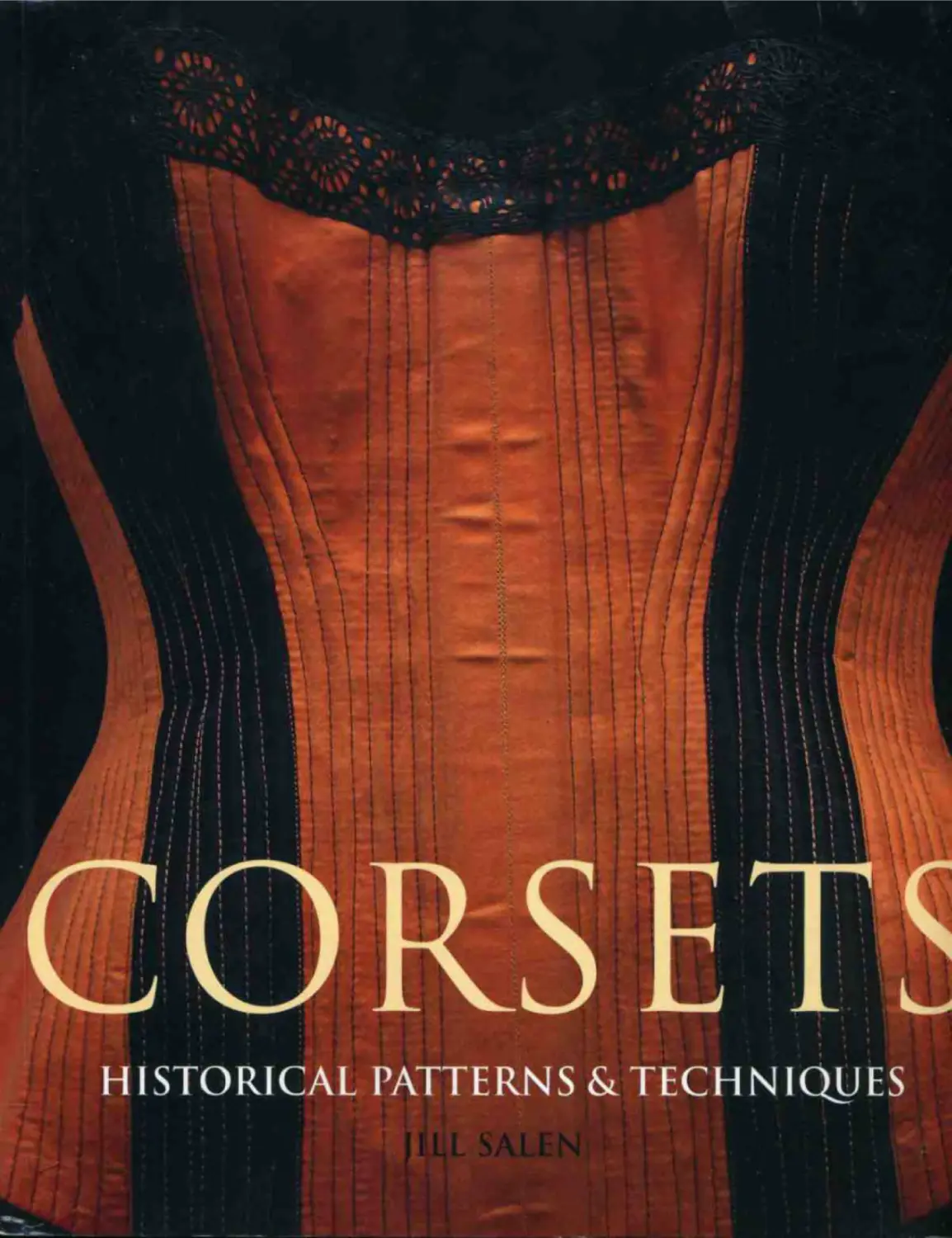
Previous page: This corset, from
1875. is held at the Symington
Collection at Leicestershire County
Council Museum Services. UK.
Contents
Acknowledgements 4
Introduction 6
Patterns
Finely Whale-Boned Corset, c 1750	1 1 '
Brown Jean Corset, 1780
Pregnancy Corset, 1780-85	1 8
Brown Jean Corset, 1790 2 2
Linen Corset, 1790 26
Pink Jumps, 1798 31)
Rural Corded Corset. 1830-40 34
Corded Taffeta Corset, 1840 3 8
Red-and-Black Lasting Corset, 1860
Childs Red Stay Band, 1880-85 46
Gold Exotic Corset, 1885 Di)
Swiss Riding Corset, 1890	54
‘Pretty Housemaid’Corset, 1890	5 8
Khaki Corded Corset. 1890-1900 62
Large Blue Jean Corset, 1890-1910 66)
Black-and-Yellow Flossed Corset, 1890-1900	/ I )
Black Corset with Blue Flossing, 1890	/ 4
White Ribbon Corset, 1900-10 78
Silk Ribbon Corset. 1900-5 82
Long White Corset. 1914	86
German Ersatz Austerity Corset. 1917	9()
1 )oll s Corsets, с. 19th century (M
Projects
White Linen Jumps, c. 1790 I ()2
Girls White Jean Corset. 1900 I ( )8
Techniques 114
Further Reading 124
Useful Addresses 126
List of Suppliers 127
Index 128
Introduction
My interest in corsets can be traced back to the 1950s when my grandmother and great-
grandmother were still wearing them. I was fascinated by corsets: I did not understand why my
grandmother and great-grandmother wore them, and my initial curiosity has led to this book.
Who is this book for?
This book is aimed at the costume maker who has a working knowledge of costume construction.
The shapes of the patterns and the direction of the grain found in this book should provide sufficient
information. Any finishing details die costume maker might require can. I hope, be found in the
photographs provided. All corsets referred to in the book arc from museum or private collections so
it was not possible to place them on dress stands to photograph them, but 1 have included museum
archive photographs wherever possible.
During my time as a costume cutter at the Welsh National Opera Company, from 1975-82.1
wanted more corset and bodice shapes than 1 could find in Norah Waughs Corsets and Crinolines or
Janet Arnolds Patterns of Fashion (see Further Reading, page 124). As theatrical costume makers we
rarely have time to visit collections and carry out research, so we are dependent on our designers’
references and our few books. Corsets and Crinolines is an invaluable resource for costume makers,
however, 18 corset patterns representing 250 years only gives us a few variations of corset styles that
must have existed. My aim was to add to my knowledge, and hopefully supplement the makers’
repertoire, with additional shapes and styles of corsets.
Included in this book are instructions for making a hand-stitched corset and a machine-stitched
corset (see page 102 and 108), so that the inexperienced corset maker has some guidance. Every
corset construction is different and when one seeks to adapt a historical pattern for contemporary'
use, the methods of constructing the corset need to suit the use to which the corset is to be put,
which the maker must adapt and decide upon.
Terminology
Throughout this book I refer to the garments as ‘corsets’ Originally they were referred to as ‘a
pair of bodies’.‘stays’ or as ‘corsets’. A ‘pair of bodies’ was an early term, most usually used when
the garment laced at the back and the front. ‘Stays’ could lace at the back and/or die front, and
later a ‘corset’ would usually lace at the back and have a split-busk fastening at the centre front.
Earlier corsets used a single lace to close the garment, and later ones had a double criss-crossing
lace, which was laced so that the wearer could tighten or loosen her corset herself. Corsets that only
closed at the back meant that the wearer needed help to dress.
Factors that affect the corset
When one considers the variety of underwear worn today, we know our choice of undergarment
is dictated by many factors. The same would have been true in the past.
Age of wearer: an older woman may have chosen to wear the styles of her youth.
Income: this obviously dictated what the wearer could afford.
Social class: if one belonged to more elevated social circles more fashionable and possibly a
variety of styles of undergarments would have been worn.
6 Introduction
Occupation: this would have affected what was worn. In the 1950s and 1960s my grandmother
wore her older, more comfortable corsets in the morning when she cleaned the house and changed
for die afternoon when she would visit and be visited. She referred to this as‘breaking-in her stays’.
Availability of source materials: the properties and qualities of source materials, such as whale
bone, would affect the style of corset. The appearance and use of metal eyelets (French holes) after
1828 meant that tighter lacing was possible. Before that date, hand-worked eyelets would have torn
if pul under too much strain.
Occasion: specific styles of corsets were worn for particular occasions. 1 or example, there were
corsets specifically for court dress, riding and (in the late 19th century) sportswear.
Provenance and dating
I have put the corsets in this book in museum date order, but provenance is not always clear a
corset may conform to one period and yet definitely be from a different era.
Leicestershire Museum Services has two 1830-40 corsets in its Symington Collection, which
absolutely exhibit the characteristics of that decade. They are completely hand stitched, string corded
and have a wide whale-bone centre-front busk. These two corsets could have been made years later,
just in the style of 1830-40. because someone liked the pattern or had always worn that style. One
of the corsets had had additional side panels inserted and machined in. so an 1830-40 string corded
corset was being altered for wear after 1855. The reason why this corset was altered for wear years
after it was originally created is not clear; it could have been due to hardship, for dressing up
purposes, for a play/pageant or it could have been because the owner was ill but. not wanting to go
without her corsets, instead chose to revert to this ‘old-fashioned style*, which was more comfortable
than the corsets being worn in the 1850s.
The Symington Collection has a red-and-black corded corset, which is dated at 1860.They also
have a grey-and-black corset dated 15 years later (1875), which is very similar, though it has a split
busk at the centre front. Platt Flail in Manchester also has a similar corset, which is brown and fawn
and dated around 1880-90. Can this mean that the same style of corset was being worn for 30 years?
In the few collections I have visited I have been surprised that the corsets on display seem to
cluster around certain dates.The 1860 red-and-black corset and its close relatives explain to some
extent how hard it must be to date a corset with no provenance. Luckily Leicestershire Museums
Symington Collection is well provenanced - the curators are certain that the red-and-black corset
was created in 1860. otherwise it could have been thought to be a variation of the 1880-90 corset
in the Manchester Museum. Two very basic guidelines for dating corsets are:
• if a corset is machine stitched, it will have been created after 1851
• if a corset has metal eyelets, it will have been created after 1828
Now. after compiling these patterns and techniques. I actually have more questions than I did when
I first embarked upon this project, and I am happy with this outcome to be a good maker you
always have to be questioning, researching and problem solving
Construction
These days costume makers rarely have the time to sew a corset by hand. If the corset is to be seen,
this book will aid the maker in reconstructing the garment as far as time and budget allows. If the
corset is not to be seen, it will help the maker to achieve rhe correct silhouette for the period.
Introduction 7
When constructing corsets I make toiles of corset patterns, near and around the correct date,
without altering it to fit the contemporary figure. 1 then find someone who fits the corset, observing
how the corset affects the wearers posture and what it docs to her figure.The patterns in this book
arc presented for die maker - make of them what you will.
Current corset manufacturers
ll is an enjoyable process to look at. measure and draw corsets. I am indebted to the staff of the
museums who have helped inc write this book - particularly Philip Warren at Leicestershire
Museums Symington Collection, who has an in-depth knowledge of the collection and who
helped me to understand the mass manufacture of Symingtons corsets from I860-1990.
The Symington Collection was created by the Market 1 iarborough-based company 1< & WH
Symington, which began making corsets for ladies in the 1860s. The company eventually grew into a
major international business.This unique collection was presented to Leicestershire County Councils
Museums Service in 1980. It includes some pieces made by their competitors, and some pieces that
pre-date the setting up of the company. As a collection it provides insight into the development of
corsetry manufacturing in the UK.
As part of my research for this book I w ent to sec Ian and Conna Voller ofVollers to discuss w hy
Vollers has managed to survive as a corset manufacturer. The company was started in 1899 by Ian’s
great-grandparents in Portsmouth, a city w here corset manufacturers were the major employers of
women from 1880-1950.
Today Vollers have an interesting clientele: lingerie supplier Iligby A I’eller, high street stores
and a bespoke service by mail order or via the internet. Their business is worldw ide - they use the
internet as a show room and can respond to the w hims and fancies of the current market. Vollers have
survived, unlike larger companies such as Symington s, because they arc a small and flexible enterprise
offering a bespoke service. For example one of their leaflets from 1950 promised that you could ‘have
your favourite corset copied*. During the period 1950-80 Vollers grew old along with its customers,
then in 1991 Ian and Corina took over and rejuvenated the company’s approach. They now sell their
corsets through a beautifully photographed catalogue, which inspires the buyer, who now wants a
corset that w ill be seen and worn as a garment. Interestingly Vollers* current corsets are based on
their original patterns of 1899.
Why do corset styles alter?
There are many reasons why the styles of corsets have changed over time:
•	(’hanging fashions demanded different underpinnings.
•	Availability of/changing materials. For example in the 19th century whale bone became less
plentiful, and better quality steel for boning became available.
•	The invention of metal eyelets in around 1828 these reinforced lacing holes allowed a woman
to be very tightly laced.
•	The invention of steel split-metal busk fastenings in the 1830s. These were in general use by the
1860s. so that a woman no longer had to be laced into her corset by someone else.
•	The invention of the sew ing machine in 1851. This made it possible for the industrialization and
mass production of corsets to take place.
•	With industrialization in the 1850s came the ability to produce more corsets for less cost.
•	Industrialization led to the marketing of corsets, w hich reinforced the need for appropriate corsets
for specific occupations and leisure activities, such as corsets for housemaids and for horse riding.
8 Introduction
•	The Industrial Revolution in the 19th century brought the working woman a disposable income
for tile first time. She spent her money on keeping up with fashion, often emulating her mistress.
How were changes in corset making
passed on?
Before the advent ofcheap newsprint and illustrated advertisements, how did corset styles change
in a seemingly uniform manner across the UK? Word of mouth and observation could be the answer.
At the lowest income level, drovers came from outlying areas of the UK, bringing their cattle to
London. Presumably they took home information that affected fashion and consequently the
underpinnings of fashion. As early as 1693 occasional periodicals were printed, which were aimed
at women. Occasionally these periodicals contained patterns for corsets and fashion advice, The
WMtivmaHf Guide (1838) by A. Lady advocates buying a corset from a stay maker and then buying
another unmade-up. to take a pattern from it. Occasionally there were patterns in publications such
as Godcfs Ladies Magazine (1830-95). Newsprint became cheap to produce at about the same time
as die invention of the sewing machine in 1851, which facilitated the mass production of corsets.
Because newspaper advertising was inexpensive corset manufacturers were able to publicize their
wares, offering women new styles.
How representative are corsets in
collections?
It must be remembered that corsets in collections arc no different from the clothes in our own
wardrobes today. Often the garments that linger in our own wardrobes are:
•	Ill-fitting.
•	Expensive special purchases too good to give or throw away.
•	hems that no longer fit but that we hope will fit again one day.
•	Special occasion items that conjure up the event they were worn at. such as wedding outfits, a first
ball dress, christening robes in other words, garments that do not reflect everyday wear.
So the garments in museums do not always give us quite the window on the past that we might hope
for. Usually these garments arc small in size, making us think that people in the past were a lot smaller
than we arc now, when in fact often the garment was simply too small to cut down for someone else.
Women have worn corsets as underpinnings for more than 400 years. In the past they were a
necessary foundation under clothes, allowing women to have a fashionable silhouette - refining
the waist and supporting the back and bust. Women have not worn corsets as a fashion aid since
the 1950s and al that time both my grandmother and great-grandmother were still wearing them.
They would not have fell dressed without their corsets - not because they were seeking to achieve
a more youthful silhouette, but because the corsets formed part of their armour of respectability'.
Modern women arc secure in the knowledge that it is not how you wear your clothes that
determines whether you are respectable or not. but the way in which you behave. It is interesting
that in 2008 - when 51 per cent of the population is female, when we have had the vote since 1928,
equal pay since rhe 1970s and where we feel more than entitled to have a career and children - that
we arc still choosing to wear corsets, usually visible for all to sec.
Introduction 9
10 Patterns
Finely Whale-Boned Corset, c. 1750
These are brown linen stays with a centre-back closure.The front is
open for Bin (20cm) of the 14m (35.5cm) and then stitched together.
The remaining 8in (20cm) has hand-worked eyelets and there is a strong
single twine laced through them, which is decorative and practical.
Fine bands of whale boning, flowing gracefully into one another, suggests
an understanding of the needs and comfort of die wearer, and that it was
created by makers who understood the forms they were working with.
The whale bone extends down mto the tabs of the corset so that it flows
over the waist, rather than pushing forcibly into it.
A corset such as this probably needed the strength of a man to
construct it but the subtleties of the design suggest a woman s
involvement, whether as the wearer or someone engaged with the
construction. Indeed, at this time men were the stay makers but they
often employed their wives and daughters and could take on girls as
apprentices, although they rarely did.
There is no corresponding hand-worked eyelet for the shoulder ribbon
tie on the front of the stays, but there are two drill holes, which could
have been used to fasten the shoulder strap; there is no evidence of them
ever having been hand whipped, which they would have been on a
corset like this.
Corsets in the early to mid 1700s did not always have shoulder straps,
but by the 1780s, when the boning was becoming more sophisticated,
shoulder straps were more necessary for the dynamics of the corset.
Opposite: This corset, dated to
around 1750, is held at the Colchester
and Ipswich Museum. UK.
Patterns 11
12 Patterns

14 Patterns
Brown Jean Corset, 1780
This corset is constructed out of twill-weave brown jean fabric, with
a linen lining. The boning is whale bone and the corset is hand stitched.
There is a delicate fanning of boning, lending support where it is needed
and displaying an understanding of the fabrics used, utilizing their
properties. There is a stiff, curved thicker piece of whale bone, horizontal
across the bust and with straight horizontal bones across the shoulders
combined with a long straight back to support this low, exposing front
to the corset. The edges of this corset appear to be bound with a narrow
white kid or gloving suede.
At this time, the corsets could have been centre-back fastening,
centre-front fastening or have both, with or without a stomacher under
the laces or pinned over the lacing, or even covered in what would be
considered a dress fabric — because the corset was going to be seen.
This corset cannot lie flat on the table and reminds one of an ice-cream
cone. It would have fitted a woman with a 36m (91cm) or larger bust
and a 30in (76cm) waist, not dissimilar measurements to the Pregnancy
Corset (see page 18), but much shorter in the body length.This may
be because the wearer was shorter or because fashion dictated a higher
waistline. If the latter, this suggests that it should appear chronologically
after the Pregnancy Corset, but for the chronology’ of this book, 1 have
followed the date given by the museum.
The swooping side seam is delightful, using the grain of the fabrics
to flow around the body and support the bust.The shoulder straps
tie closed at the front while the centre back of the corset would
have been closed by someone else, using one lace.
Opposite: Corset from 1780, held at
St Fagan’s National History Museum,
Cardiff.
Patterns 15
.inn
16 Patterns
Patterns 17

Pregnancy Corset, 1780—85
Jean and Pawel Nowak gave permission for this corset from their
costume collection to be measured and included in this book. It was
bought many years ago and the seller thought the corset was Victorian.
They believe it to be a pregnancy corset, which is certainly possible.
This corset will have fitted someone with a 38in (96.5cm) bust and
28m (71cm) waist - not what we would consider stout, but the lacing
was present for some kind of ease or comfort. As Willett and Cunnington
in The History of Underclothes say:‘the open corset was laced in front and
behind, and for stout people extra side lacing might be added’. And
Norah Waugh in Corsets and Crinolines says ‘a side lacing seems to have
been used for pregnancy’ (see Further Heading, page 124).
The corset is beautifully made and has obviously been worn; it shows
little damage except for the tape along the centre-front seam, which is
unravelling, and the roughly sewn-in linen lining, which does look worn.
back
Opposite: This pregnanes' corset is
dated 1780-85. It is held in a private
costume collection belonging to Jean
and Pawel Nowak.
Patterns 19
CB BACK
20 Patterns


Brown Jean Corset, 1790
The fabric of this corset is brown jean, hand sewn and with whale
bone throughout. It is a beautiful corset, in good condition, with no
alterations. A stain on its back panel does not appear to be from wear.
There is a boning channel on the shoulder strap but no boning in it and
the shoulder strap ties up at the front. The garment is delicately stitched
but it would have taken some strength to do the stitching. There is
boning fanning out to flow with the body; the crossing of the bones
indicating an understanding of the properties and capabilities of whale
bone when combined with fabric. The corset looks like the support
structure for a bridge.
Tins corset would qualify as half-boned stays, typical of its period and
designed to elevate and push the bust forward. It is supported by 50 or
more fine whale bones gradually fanning out. and the horizontal bones
across the bust would have ensured a smooth line to the low-cut front.
The long back of this corset would help support the very low front.
I included this corset in this book because it would be achievable for the
modern corset maker, as it presents less difficulty than the fully boned
stays shown on previous pages. It is one of the styles seen from 1770
onwards, by which time the makers of corsets had begun to realize that
it was the direction of the whale bones that was important, meaning that
less seaming was used. For closure, one lace would have been used. One
of the eyelets has been displaced, so that when the two fronts came
together they would be evenly matched.
Opposite: Corset from 1790, held at
Hereford Museum. UK. These
photographs show the outside of the
corset (top) and the inside (bottom).
Patterns 23
na banc
24 Patterns

26 Patterns
Linen Corset, 1790
This corset is made up from two layers of linen; unusually the lower edge
of the corset has been faced with its binding rather than being bound
with it. It has two bust gussets and a fine drawstring in a channel along
the bust edge of the garment, to allow the wearer to draw the edge in.
It has a centre-front opening and yet the shoulder straps close at the
back with, unusually, three lace holes, but long ties have been added
to the straps, which may have crossed at the back and tied in front.
The centre-back panel is heavily boned and there has been some
amendment or alteration on the back side seam; it is interesting to
speculate whether a new front was added, or a longer front reduced,
which would account for the rebinding of the lower edge. Alterations
can be difficult to understand, but are always interesting.
There % an empty bone channtX on the front pant\ where ift meets the
side back panel, which appears curved but is in fact straight.The eyelets
are displaced at the top of this corset, as one lace would have been used
to close it.
Opposite: This corset, from 1790, is
held at Hereford Museum. UK.
Patterns 27
28 Patterns

30 Patterns
Pink Jumps, 1798
This pretry corset is made with pink silk taffeta lined with linen. No
bones are present, but boning channels are visible. Seams have Kin
(6mm) wide twill tape sewn along their gutters. The top and bottom
of the ‘jumps’ are bound with silk ribbon.The shoulder straps and the
centre-front fastenings are later additions, and 1 have not included them
in the pattern. At the lower part of the centre front the fastenings appear
to have been gendy laced and, higher up, the rounded tabs close with
Dorset buttons and buttonholes.
This garment was not originally ‘a pair of jumps’, but a pair of
‘half-boned stays’. The bones have been removed but the back of this
corset would not lace up comfortably unless the bones were present,
so they were probably removed after the garment was no longer worn.
This is a beautifully shaped garment, delicately but strongly stitched and
in a delightful shade of pink. It is a pattern I have made up with the
original centre-front lacing rather than the button closure and with a
conventional shoulder strap lacing closed at the front. The corset is
longer in the body than it appears.
Opposite: This 1798 corset features
an alteration in the front, к adds
inches to the garment and the careful
fastening at the front would allow
access for a baby to feed. This corset
is held at Colchester and Ipswich
Museum, UK.
Patterns 31
32 Patterns
Patterns 33

Rural Corded Corset, 1830—40
Made in buff cotton twill, with a centre-front whale-bone busk and
straps over the shoulders, this corset has taped bones at the back and
is corded. The cording appears to have been done with different types
of‘stuff1 as the ends, still visible on the inside of the garment, are of
different colours and types of infilling.
The lining of this corset is interesting as it is made of pieced white linen
with an occasional red line through and, despite die piecing, attention is
given to the straight of the grain.
The patterns of the cording seem very simple but when the corset is
worn, the cording lines are effective - the vertical lines support the
grain and behave as boning and the cross-grain cording lines over hips
and radiates up to the shoulders on the back panels, gently curving and
giving a softer shape - simple but effective.
This corset is a robust, practical garment, constructed with an
understanding of where it needed to be strong but also an awareness
of the wearers needs to feel good about her shape and attractiveness.
Another intriguing feature of this corset is the different type of cording
patterns for the bust areas; it is slightly more ‘padded’ on the left bosom,
and there is a tuck in the actual garment creating fullness held by the
stay-tape edging.
Opposite: This corset, from the
1830s, is held in the Symington
Collection at Leicestershire County
Council Museum. Cording turns out
to be evident to a greater extent on
the corsets from 1830-1920 than I
realized before collating these patterns.
Patterns 35
36 Patterns
Patterns 37

Corded Taffeta Corset, 1 840
This beautiful hand-stitched corset has reasonably crude alterations
at the centre front» which opens by means of alternating buttons and
buttonholes.The buttons are linen pulled over what feels like a metal
ring and» although the alteration is constructed with cruder stitches
than the rest of the corset, the fabric seems to be the same. One wonders
whether fabric was supplied with the corset for when the wearer wanted
to make adjustments.
The corset represents a mixture of styles. It is possible that it could be as
early as 1820, except die centre-back metal eyelets date from after 1828.
The steels are crudely hand stitched in, indicating that they are a later
amendment (the metal eyelets could have been inserted over earlier
hand-worked ones).
Most of the corset is cut on the cross-grain of the fabric; it is made of
white silk taffeta and has a fine white linen lining.Through the narrow
binding over the bust runs a thread, as a drawstring to allow that area to
be tightened or loosened.
Opposite: This corset is in the
private collection ofVina Cooke,
who owns the Museum ofDqlls
and Bygone Childhood at Newark
in Nottinghamshire.
Patterns 39


Red-and-Black Lasting Corset, 1860
This closed-front corset of red (now faded to orange) and black cotton
lasting is stiffened down the centre front with a wooden busk. The busk
is wrapped in wool or wash leather and the corset is completely corded
except for the steel or whale bone on either side of the eyelets. Cording
gave a measure of suppleness to a corset while still conforming to the
desired rigidity of figure control. Although the channels for the cording
are machine stitched, it is not machine cording, as the infill of wool or
twine would have been pulled through with a long, strong needle.
Corsets of this type were closed by lacing down the centre back and any
minor changes to the fit could be achieved by adjusting the laces. It was
impossible for such a corset to be put on by the wearer without help
from either a member of their family or a household servant.
At the centre back the eyelets completely match and there is no
displacement. On the side back seam the cording disappears, suggesting
an alteration to fit the corset more closely before it was finished, since it
does not look as if it has been altered afterwards. This suggests that the
person was measured and fitted, or the corset was part produced to a
standard size and then fitted and finished.
Opposite: This I860 corset is
front the Symington Collection at
Leicestershire County Council
Museum, although Phillip Warren,
curator of the Symington Collection,
does not think that this corset was
made by Symington. The Symington
Collection includes many corsets or
half corsets from other sources,
presumably acquired to learn from
their competitors.
Patterns 43
CF seam
44 Patterns
Patterns 45

Child’s Red Stay Band, 1880—85
Now faded to orange, tins simple design is made in red sateen and
corded for additional support. The band is constructed with three layers
of fabric: sateen, hessian and a glazed-linen lining.The two front panels
and the back panel have 24 rows of machine cording, stitched in cream
thread, 6 stitches to 1 in (2.5cm).
I he right side-back seam between the side panel and the back panel
has an opening in it to pass the fastening tab through. I he fastening
tabs have a hook and an eyelet on one, and three eyelets on the other.
Although this garment has never been worn the hook has broken off.
but a ribbon could have been passed through the eyelets to fasten it. It
has two shoulder straps of' in (1.25cm) India straight tape.
It may be an uncomfortable, restrictive garment to our eyes, but it is
actually very light and pliable. Stay bands developed from the tight
binding of swaddling, known to be practised in Europe from c. 13th
century, which was thought necessary to prevent deformity. By the
early 1800s swaddling was dying out as a practice in the UK, but a less
restrictive stay band remained in use until the 1930s.This is an example
from the 1880s.
In 1873 machine-corded, machine-made stay bands were marketed by
Symingtons at 4in (10cm) deep for a newborn and lOin (25.5cm) for
the older child. At that time girls of eight years old were usually in their
first corset. In 1908 the ‘liberty bodice’ became available and from then
on the market for stay bands decreased. Liberty bodices were worn by
boys and girls until the practice finally died out in the 1970s.
I he stay bands were thought to encourage an upright posture and help
develop a strong spine. At the time they were worn there was no central
heating - keeping a child warm was a priority, which could be why this
one is red, as red was perceived as a warm colour.
Opposite: Stay hand from rhe
1880s. held in the Symington
Collection at Leicestershire
County Council Museum. UK.
Patterns 47
48 Patterns
BACK

Gold Exotic Corset,
In the Symington Collection are a number of corsets and half
corsets, partially unpicked. None of them appear to be of Symington's
manufacture, so presumably Symington s were undertaking market
research and keeping abreast of any new methods of construction,
new materials, finishes or styles.
Only half remains of this corset, as presumably the lost half was taken
apart for research purposes. It has steel bones either side of its metal
eyelets for lacing closed at the back, and a spoon busk at the front for
closure; there are only IS thin canes to give the garment its shape, and
the corset obtains its form from the flowing panels that make up the
corset rather than boning. The attractive ‘belt' area of this corset takes a
flattering line, flowing around the 2О-231П (5(>-58.5cm) waist, and it is
decorated by having metal eyelets punched through all the layers of the
waist section at top and bottom.
The Rational Dress Society was founded 1881 in 1 ondon and drew
attention to how restrictive corsetry could be; it was thought by the
society that corsets could be damaging to women's health and restricted
their lifestyles. Women were taking more part in working life by 1885,
and taking part in some sports. This meant that women began to want
corsets that allowed for these pursuits. This corset, while reducing the
waist to 2< >in (50cm), was also aerating it via the eyelets, which arc also
a decorative feature.
I have described this corset as ’Exotic’ as there is a subtle gold sheen to
the fabrics used, enhanced by the small, gold eyelets.
Opposite: 1885 corset from the
Symington Collection held by
Leicestershire Museum Sen ices.
Patterns 51
FRONT (A)	FRONT fB)	FRONT (С.	FRONT (D)
Scale (in)
52 Patterns


Swiss Riding Corset, 1890
This corset is made of one layer of sprigged jacquard silk. It has
a centre-front split-busk fastening, and lacing at the centre back
supported each side with two bones. The two centre-back bones
are of flat steel and unusually die eyelets are on the edge of the
garment, which would mean if they were placed under too much
stress they would be in danger of pulling out or ripping.
The label inside suggests that it is a Continental corset - it reads:
B. Wassonbeiger-Alti. Corseiticre-Montreaux
The eyelets and bones are all backed or faced with fine-cotton twill tape
of varying widths: l/^in (4cm) on the centre back and %in (1.5cm) for
the seam boning channels. The stitching for the channels is %in (1cm)
wide and the whale bones fit loosely into the channels.
Bound with only India tape top and bottom, the edges are then covered
with machine-made eyelet lace with a %in (6mm) pale blue ribbon
passing through. There is a waistband stay tape on the inside of the
garment.
This is a delicate corset that may possibly have been used for riding but
was more likely for boudoir use. This corset qualifies as a riding corset
because it is cut low under the bust and high over the hips, and this style
coincides with women becoming more active and indulging in various
sports. This attractive corset actually gives very little support.
Opposite: This silk jacquard
riding corset from 1890 is held
at Hereford Museum, UK.The
photographs show the front of
the corset (top) and the back
of the corset (bottom).
Patterns 55
56 Patterns
Patterns 57
«•мйЗ:
‘Pretty Housemaid’ Corset, 1890
This corset has a spoon split-busk centre fastening. It is made of drab
twill lined with fawn coutil and interlined with hessian.This was a
Symington speciality corset advertised as the ‘strongest, cheapest corset
ever made’. With machine cording across the hips and down the panels,
there is minimal whale boning (see pattern). An interesting feature of this
corset is the busk protector —a strong wide covered steel 4Иш (11.5cm)
in length, stitched to the underside of the busk for support and to offset
die breaking of the busk across the waist area with ‘constant stooping.
The corset is finished with decorative machine flossing in blue and gold
thread, which serves no practical purpose. This corset was a top seller of
its day.
The company was alert to the needs and desires of its market. They
produced this affordable, attractive, well-designed and guaranteed corset
for individuals who may have only had tiny amounts of disposable
income, but the numbers of housemaids made the production
worthwhile. In 1850 there were one million servants in Britain, the
second-largest occupation after agriculture. In 1901 the British social
reformer Benjamin Seebohm Rowntree suggested that the keeping of
servants marked the divide between the working class and the middle
class. Everybody wanted a housemaid, and every7 housemaid in turn
wanted a Symington ‘Pretty Housemaid*.
Opposite: 1890 corset from the
Symington Collection at Leicestershire
County Council Museum. UK. By
1890 Symingtons had realized the
value of producing an attractive
garment fit for purpose. This corset was
sold in vast numbers over many years
to ordinary women who had to work
hard when wearing their corsets.
Patterns 59
60 Patterns
BACK (Г)
Patterns 61
62 Patterns
Khaki Corded Corset, 1890—1900
With khaki-coloured lasting as the outer fabric and a beige silica lining,
this corset uses cording as an attractive feature over the hips and in the
bust gussets. It is similar to a much higher-quality corset produced by
Symington s (see page 2), which has an attractive combination of
machine cording and quilting.
This is a small corset - bust 30in (76cm), waist 21 in (53cm) and hips
32in (81cm) - and one would imagine that this corset was wom
because convention dictated that a corset should be worn, not for
reasons of control. It is possible that the cording acted as a layer of
padding to enhance a slight figure.
Hand flossing has been added to strengthen the apex of the gusset in
a light-coloured thread and cream cotton machine-made lace has been
attached over the top edge.
There is a very wide and solid split-busk fastening almost lin (2.5cm)
wide each side, supported by a double busk of 1/fin (3.8cm) wide.
The wooden or steel busk fits the pocket loosely. The strength of the
fastening seems out of proportion to the scale of the corset with its
2lin (53cm) waist.
Opposite: This corset, from cl890. is
held at Hereford Museum. UK. This
photograph shows the corset from the
front (left) and the back (right).
Patterns 63
FRONT
bone
СИ
Patterns 65

Large Blue Jean Corset, 1890—1910
This corset is made of one layer of blue jean fabric stitched with pale
pink thread. There is a pale pink hand-made lace at the back to lace
it closed.
The centre-front panel, the centre-back panel and the ‘belt’ are all lined
with a medium-weight calico. The boning channels are also made of
the calico, cut on the straight grain Xin (1.9cm) wide with Xin (6mm)
turnings, turned in over a strip of cardboard and, when executed, spiral
steel boning inserted.The centre front has a metal split busk and both
sides of the centre back have flat steels either side of the metal eyelets -
none of which is displaced.The top and bottom edges of this corset are
bound in Xin (1.5cm) twill cotton tape.
This corset is unworn and it has no makers label inside, but it does not
look homemade. It cannot have been expensive to produce, would not
have been difficult to construct and has an almost uniform look to it,
but has finishing details picked out in pink, to make it more attractive
for the wearer.
This is a solid, sensible, no-nonsense corset, made in a hard-wearing yet
comfortable fabric, not really designed to create a waistline but more to
hold everything neatly together.
Opposite: Tins corset is part of the
authors corset collection and is dated
1890-191'0. It was bought from a
Newark Antiques Fair in Nottingham
in 2005.
Patterns 67
68 Patterns
Patterns 69
70 Patterns
Black-and-Yellow Flossed Corset,
1890-1900
Made in black sateen with yellow embroidery, this corset features
surface vertical bone channels, and horizontal cording over the bust.
The centre-front straight split-busk fastening is on a slight cross-grain
of the fabric.Thvre arc bones to strengthen it, which are removable.
Some corsets had an additional covered steel built into their
construction, called a double busk. This indicates that the corsets
did break and that women wished to extend their life or delay the
possibility of them breaking.
The bones of this corset arc encased in boning к hannels stitched
on rhe surface of the corset, which were attractive and possibly
more comfortable to wear. There could be strips of cardboard in
these channels, as has been found in partially unpicked corsets.
The boning appears to be flat steel.
Opposite: I he Symington’s ‘Pretty
Housemaid’Corset (see page 58)
came with a double busk to cope
with ‘constant stooping’, so very
possibly this pretty corset, cl89o from
St Fagans National History Museum,
was actually designed for a working
woman rather than a lady.
Patterns 71
72 Patterns
FRONT (Л)
О
L
F ROM (В)
hunc Ьижк
СР
Pattern* 73
74 PatrernN
Black Corset with Blue Flossing, I8’k<
This stylish wasp-waisted corset features steel boning and is finely corded
over the bust. Made in black sateen, it is a glorious manufactured corset
edged at top and bottom with black and pale blue cotton machine
brodene anglaise.
The bust gussets have been cut from finely corded fabric and when
assembled the in (9mm) wide bindings are machined on the right side
of the garment and continue over the bust gussets and then fin (0.6cin)
steel bone, passed through the binding.There may be some fine card in
the binding as well to keep it even, but as none of this corset is undone
it is not possible to tell (although similar corsets in the Symington
Collection, which were undone to explore their construction, do have
card present).
The side-front and side-back panels are machine corded and there are
three bones either side of rhe centre back to support rhe metal eyelets.
The side seams also have a binding carrying in (6mm) steel bone.
There is pale blue hand-stitched flossing. This is a beautiful corset; it
looks delicate and dainty but is actually robust in its construction.
Opposite: This corset, from St
Fagans National History Museum.
Cardiff, is very typical of |K9(K
corsets but it has a straight busk
rather than a spoon one.
Patterns 75
0	12	3
i____i____l___i
Scale (in)
76 Patterns
BUST GUSSET
Pattern* 77
78 Patterns

White Ribbon Corset, 1900—10
This conet is constructed with 2in (5cm) wide linen ribbon, and plain
white linen that encases flat steel bones on the side seams, centre front
and centre back. It had suspenders at the front that have been cut off.
This corset reflects the growing need of women to have more freedom
of movement while still wanting to constrict their waists Women from
the 1881 Is onwards were taking part in sporting activities such as croquet,
tennis, roller-skating, ice skating, badminton, golf and eventually cycling.
I he Rational Dress Society was formed in 1881 to raise womens
awareness of how their lives were impeded b\ the burden of
fashionable silhouettes.
Fashion has never gone hand-in-hand with logic and common sense,
but in 1900 women were on the verge of experiencing a freedom of
movement that they had not enjoyed for nearly a hundred years.
Opposite: A view of the outside or
a 1900— 10 corset. This corset was
donated to the St Fagans National
History Museum by Mrs Lena Jones
of Machynlleth. Wales.
Patterns 79
BACK
SIDE BACK
О	1	2
1_________I________L
Seale (in)
80 Patterns
SIDEFRON1
FRONT
Patterns 81
82 Patterns
Silk Ribbon Corset, 19()()—5
This delicate ribbon corset is made from 2 4n (5.7cm) wide silk floral
woven ribbon - it uses at least 6-7 yards (5,5-6.5m) of ribbon, if not
more, when matching the floral repeats is taken into account.The corset
has a straight metal split-busk closure at the centre front, encased in the
silk ribbon, turned in and hand stitched.
The side panel and the centre-back panels arc also extravagantly laced
with the ribbon.The centre back of the corset has metal-backed eyelets
supported by four rows of bones on each side. None of the eyelets were
displaced and a fine woven silk braid with metal aiguillettes at its ends
was used to cross-lace the corset.
The side panel houses four rows of whale boning and there may possibly
be another layer of fabric sandwiched in as well. The ribboned back and
front sections of this corset have a boning channel of чп (B.9cm) wide
ribbon stitched through the wrapped layers of the corset, and a narrow
tin (0.6cm) whale bone travelling through each channel.
A very’ prettily tied bow is hand stitched to the top of the split busk.
On both of the side panels at the hip edge arc lin (2.5cm) wide linen
buttons attached to the corset with a button-hole stitched loop.
Left: A pretty 19IMMI5 corset,
from the Fashion Museum. Bath
Patterns 83
BACK	SIDE BACK	SIDE
imning
Scale (in)
84 Patterns
SIDE FRONT
Patterns 85

Long White Corset, 1914
c?
Made from white mercerized cotton with a fine silk bow (now
deteriorating) at the apex of the straight metal split busk at the centre
front, this corset has metal bones throughout and laces up at the back
w ith cross-lacing, supported by four bones either side of the centre
back. The side panels have a rigid set of six an (0.6cm) bones.
The cotton used for the hip area is an even weave and durable, and
suggests summerwear. There is a Jin (5cm) w ide strongly woven cotton
ribbon with a pretty’ geometrical and alternating flower pattern that
forms the low bust control, suppressing the figure gently to achieve
the softly flowing lines that were desirable in 1914.
The ribbon is folded in half to cover the split busk, and the holes for
the ‘loops’ arc cut through and not finished in any way. At the centre
back the Jin (5cm) wide ribbon is faced with twill ribbon or fabric
- there is a possibility that twill is also present, hidden underneath the
ribbon at the centre front.
The top edge of this corset is closely machine over-locked, and the low er
edge is bound w ith twill straight tape. The suspenders are from the side
panels and either side of the centre-front fastening, presumably to help
its dynamics, the suspenders preventing the corset riding up with wear.
Opposite: This 1914 corset is
from the Symington C ollection
at Leicestershire County Council
Museum. UK.
Patterns H7
ЧП
* I ‘	»
Ф ! 1
bent's
0	12	3
l__I_I__i
bone*
Stale (in)


German Ersatz Austerity Corset, 1917
Acute wartime shortages in Germany forced the development of this
ersatz fabric. Made from canvas weave, paper twine was processed for
rigidity and strength. In 1916 ersatz (substitute) materials were made
available for the purchasing public in Germany, a necessity since as a
country it had always imported large amounts of wool and cotton; they
even created a paper-based thread. Make do and mend was advocated
and the pleasing Barnum trimming on this otherwise very austere corset
was probably a result of that.
There is a printed mark inside the busk but it is not decipherable. The
corset fastens at the front with a straight metal split busk, and at the back
it has metal eyelets supported by two Йп (1.25cm) bones either side. The
rest of the boning encased in the corset seams is flat steel. The top edge
of the corset is trimmed with barman edging and the bottom edge with
5йп (1.6cm) straight twill tape. It has no suspenders.
During World War I German women were encouraged to be
nationalistically minded consumers and not to purchase foreign goods,
particularly French goods. Indeed, corsets from Pans were described as
‘un-German and dangerous'; they also suggested that French corsetry
made German women sick. It was thought unpatriotic to be thinking
of French fashion when one could be aiding the cause of the war.
Substitute and synthetic materials were produced in Germany to alleviate
the shortages of textiles during World War 1 but they continued to make
these afterwards, especially in the late 1930s when Germany was again
preparing for war. It is interesting to consider that even during times
of immense hardship it was still important to produce and wear corsets.
Opposite: This 1917 corset is
held in the Symington Collection
at Leicestershire County Council
Museum, UK.
Patterns 91


94 Patterns
Dolls’ Corsets
These dolls corsets (pages 94—101) are in the collection of Hereford
Museum Services and 1 could nor resist including them. They look
deceptively easy to achieve. This white 19th-century example would
have taught a young girl how to create a corset: assembling it in rhe
right order, inserting the gussets and hand sewing die eyelets. It is
probably based on the type of corset worn in 1820—40.
There is thought to be a link between the type of dolls that girls play
with and how this affects their perception of themselves and their role
in society.The dolls of 1800-50 resembled the girls who played with
them; by 1850 the juvenile dolls had been replaced by ‘fashion-plate*
dolls, which were shapely and corseted.
These ‘fashion-plate dolls' were influential in helping the young girls
of the time formulate their appearance and behaviour in the future,
an interesting thought when we consider how popular Barbie has
been over recent decades.
Opposite and left: This dolls corset
is held in the collection of Hereford
Museum Services and could have been
used to teach a young girl how to
make a corset. These photographs
show the front of the corset (opposite)
and the back (left).
Patterns 95
96 Patterns
Patterns 97
98 Patterns
Dolls’ Corsets (continued)
This blue silk dolls corset, from the late 19th century,
is a corset in miniature; by doubling the measurements
it could fit a woman.
Because the metal eyelets are on the edge of the
garment, because it measures in centimetres, and the
busk fastenings are evenly spaced, it is almost certainly
not from the UK.This is a precise, elegant little item,
made by someone used to producing corsets.
Opposite: This dolls corset, held in
the collection of Hereford Museum
Services, shown closed (top) and
opened out (bottom).
Patterns 99
тггг>г>	гш^гп
100 Patterns
Patterns НИ


102 Projects
Project: White Linen Jumps, c. 1790
Described as white linen jumps dating from the mid to late 1 Sth
century, this garment has a delightful shape. Jumps were a less-fitted
garment, usually boneless, and they fastened at the front. Aristocratic
ladies were known to wear ‘jumps’ for casual dress and during pregnancy.
This is a nicely made garment, and appears to be comfortable to wear.
Where the shoulder strap is attached to the back panel there is a
machine-stitched alteration. After the seams were stitched, the layers of
this garment were laid together and the edges turned in and felled, then
the edges were pin stitched or subbed through to secure the edge, with
rows of stab stitching Xin (6mm) either side of each seam. The boning
channels arc stitched through all of the layers.
The boning channels on the centre back are open at the top, possibly
so the bones could be removed for washing the garment, or for comfort.
The boning channels are quite wide, suggesting the bones used could be
steels, which would need to be removed to prevent rust marks.
Eyelets at the centre front are slightly displaced as one lace would have
been used to close this garment. Darning has taken place at the lower
edge of the centre front; the linen was probably under too much strain
at this point.
Opposite: 1 his л 1790 corset (jumps)
is held at Hereford Museum, UK.
Projects 103


Constructing a hand-stitched corset,
White Linen Jumps, c. 1790
Almost every one of the corsets in this book has been constructed by
a different method. Instructions are given here for the cl790 Hereford
white corset, which appears to be an outer layer of cotton and a lining
of white linen; the corset was in good condition, but there were no
bones in or with the garment.There was a hand-darned repair on the
front panels of the corset.
When corsets are in a poor state of repair a lot can be learnt, as we can
see inside them. This corset, apart from the darns, was intact, so some
of the processes have been presumed based on past experience and
observation.
1.	Cut out the corset back, one side, one front and one strap, adding
seam allowances all round - Xin (1.5cm) is sufficient. Add balance
marks as indicated on the pattern pieces. Flip over the last three
pieces and cut out a second side, front and strap, again adding
seam allowances and balance marks. You now have seven pieces.
2.	Join the side pieces to the back at the SB seam. Now join each
side piece to the corresponding front piece at the SF seam. Attach
the straps to the back, referring to the double balance marks for
placement (see page 115). Press the seams open and trim the seam
allowances at the corners.
3.	Repeat steps 1 and 2 to cut and join the lining pieces.
4.	Trim the seam allowances on the lining to Xin (6mm).
5.	Lay out the main corset, right side up. Lay the lining right side
down on top, aligning the edges, and pin and tack (baste) in place.
6.	Backstitch around the corset, taking a Xin (1.5cm) seam allowance,
and leaving both CF edges open so that you can insert the front
boning later.
7.	Turn the corset out through one of the open front edges.
8.	Use a knitting needle or similar tool to push out the corners of
the corset, paying particular attention to the tabs along the bottom
edge. Work round the edges of the corset, rolling the fabric between
your fingers to make sure that the edge is completely turned out.
9.	Tack along the gutters (seams) of the corset to align the fabric and
lining seams. Secure the layers around the edges with stab stitch,
leaving the two CF edges open for the present.
106 Projects
10.	Now work along the SB, SF and shoulder seams, sub stitching
on each side of the seams. Remove the tacking stitches.
11.	Tack (baste) where the boning channels will go on all panels,
without Licking on the actual channels to avoid getting tacking
thread caught in the main stitches.
12.	Backstitch the boning channels, adjusting the width to suit the
boning you intend to use. (There was no boning in this corset.
The channels were left open, which may be because the bones
needed to be removed for washing to avoid creating rust marks.) *
13.	Stitch the two rows of backstitch on either side of the eyelets at
the CF on each front piece.
14.	Use a stiletto to create the eyelets at the CF and work each one
with whipstitch (see page 117). Make the eyelets for the front
shoulder fastening too.
15.	Insert the bones at the CF on each front piece, turn in the seam
allowances and whipstitch or backstitch the fabric to the lining.
Add stab stitching along these edges for consistency. Insert the
remaining bones.
16.	Add the cord to lace the corset. This would have most likely have
been a single lace (see page 115).
* The 'boning* channel on the bias of the front panel is a puzzle because there
is no obvious entry point, although there is heavy darning at the lower edge of
the channel, where the bones could have been slipped out and the darning done.
Alternatively, the boning could have been added before the shoulder seam was
stitched and rhe eyelets worked. Of course, the channel may never have held
boning — it could have been used simply to hold the layers together. I am going
to presume that no boning was ever inserted.
This was a simple garment, quickly made. Was it worn to nurse a baby?
Was it all that the lady wore as a corset? Or, was it a ‘corset’ for the
hottest days of summer?
Projects 107

108 Projects
Project: Girl’s White Jean Corset, 1900
This is a white jean corset with white flossing and white machine
stitching, with bust gussets, cording and a split-metal busk fastening at
the centre front. Four steel bones at the centre back
support metal eyelets for cross-lacing.
The bust gussets are on the bias of the fabric and the corset is bound
top and bottom with a straight cotton twill tape. This corset had never
been worn.
Originally I presumed that this was a travellers sample, using their
shortest split-busk fastening. As it was a simple garment that included
a variety of corsetry techniques. I thought this would be a good corset
for my students to reconstruct to try out the techniques needed to
construct a post-1850s corset. I reconstructed it. my nine-year-old
daughter tried it on and it fitted her - she found it comfortable and
it refined her non-existent figure, giving it definition. Given that my
daughter probably has the build of a 12-14-year-old girl in the 19th
century, we decided that it was more likely a young woman’s corset
rather than a traveller s sample.
At that time girls were corseted from about eight years old. and while
we cannot agree with this practice, it was then thought to be right and
proper, even necessary.
Opposite: This 191ИI corset is held
in the collection at Colchester and
Ipswich Museum.
Projects 109
110 Projects
Scale (in)
Projects 111
Constructing a machine-stitched corset,
Girl’s White Jean Corset, c.1900
Each corset in this book is made up by different methods and I have
decided to include step-by-step instructions for this one. as this corset
is quick and straightforward to construct, incorporating nearly all the
techniques used in the machine construction of corsets in their
simplest form.
1.	Cut out the outer and lining fabrics, remembering to add seam
allowances — usually Jfin (1.3cm) is enough, with Xin (2cm) on the
side seams (see step 10). You will need to cut each piece once, then
flip the patterns and cut the pieces again. Transfer the balance marks
and mark the pattern on the right side of the lining for guidance,
using an HB pencil very gently
2.	Slash all the gusset darts on the front panels of the outer fabric and
the lining. Turn under the edges of the gusset darts and then lay
these over the gusset pieces; topstitch the gussets in place on the
very edge of the right side of both sections (see page 118).
3.	Lay out the left front, right side up. and place the lining right side
down on top with edges matching. Pin and then stitch the CF
seam. Trim the edges of the seam allowances to Kin (6mm). Position
the stud side of the split busk behind the outer fabric and work out
where the studs will go, then use a stiletto to piece the holes (see
page 122). Insert the stud side of the split busk. With the busk
sandwiched between the lining and outer fabric, use a zip (zipper)
foot on your sewing machine to stitch alongside the busk, securing
it in place.
4.	Lay out the right front, right side up, and place the lining right side
down on top with edges matching. Lay the loop side of the busk on
top and mark where the loops fall along the CF seam. Remove the
busk and stitch the seam, leaving gaps for the busk loops.Turn the
pieces right side out and insert the busk. Secure the busk with a line
of stitching in the same way as before.
5.	Lay out each back piece, right side up, and place the lining right
side down on top with edges matching. Join each back piece to its
lining along the CB seam. Trim the seam allowances to Xin (6mm),
turn the pieces right side out and press them.
112 Projects
6.	Pin or tack (baste) each panel to its lining with right sides out
and edges matching to hold the layers together.
7.	On each back panel machine three rows of stitching to form
the boning channels, adjusting the width to suit the boning
you intend to use. Insert the boning.
8.	Make the eyelets as explained on page 117.
9.	Machine stitch the lines for the cording on the front and
back panels.
10.	Using a mattress needle or other long, sturdy needle, thread quilting
wool or hemp through the channels. Where the cording channels
intersect on the back panels, push the needle through the lining
fabric and cut off the excess wool.
11.	Lay the panels together in pairs with the outer fabrics facing,
matching the side seams. Stitch the side seams. To neaten the seam
allowances on the Vining side, leave the top layer of lining as it is but
trim away all the other layers of the seam allowance to Xin (1.3cm);
tuck the w ider lining layer over the others and stitch down along
the folded edge. From the right side of the corset this seam looks
like a boning channel, but it isn’t.
12.	Check that the centre front and centre back of this corset are level
with each other and then trim down to the actual finished level.
Use a Xin (1.6cm) Petersham ribbon or a strong Йп (1.3cm) twill
tape to bind the top and bottom edges of the corset: starting on the
inside of the corset, machine the ribbon at the desired level, fold it
over to the right side of the corset and machine it again - this
ensures that there is only one row of machining visible on the
outside of the corset.
13.	Add the lacing - this corset would be laced with a double lace
(see page 115).
Projects 113
Accessing patterns
The scale of these patterns is !6:lin, except the dolls’ patterns, which
are full sized. All measurements are in inches - these corsets work
particularly well with imperial measurements.
The patterns can be accessed by obtaining lin squared graph paper and
plotting the patterns out. or it may be possible to enlarge them on a
photocopier.
The patterns have no seam allowances included, as seam allowances will
depend on the makers requirements, so some thought should be given
to this before cutring out.
On page 122 instructions are given for inserting a split-busk fastening
into a lined corset; the maker may be mounting the outer fabric on
coutil then making up the corset as if it only had one layer, in which
case extend the CP and CB by 2><in (63mm), incorporating the facing
into the body of the garment.
To learn as much as possible from these patterns:
1	First plot a pattern.
2	Add on the seam allowances.
3	Cut it out of a firm felt/calico and seam it up using a long
machine stitch and matching balance points.
4	Attach some fake lacing* and any bones that seem crucial to
the shape.
★Fake lacing: two 15in (38cm) strips, each comprising eyelets supported by
boning, which can be machined into a corset or toile for fitting.
Next find someone who fits this corset. Observe how it restricts her
movement, what it does to her bust and think about the gown that will
be worn over it. Then consider how the figure of the person who will
wear it differs from the person it actually fits. Very little advice can be
given in a book about how to deal with this last step. Look at pictures
of the period and decide where it is most appropriate to extend or add
in a panel. Points you must address are:
•	Does the waist sit where it should for the period?
•	Is the neckline correct for the period?
•	Does rhe corset contain the bust, so when gowned a correct silhouette
for the period will be achieved?
114 Techniques
Balance marks
Balance marks are a guide to where seams should match: they are
worth marking on the pattern and then the fabric. When the pattern
has been plotted it is also useful to mark the ‘top' of each pattern and
number each pattern sequentially, as it is all too easy to get the panels
in the wrong order or even upside down.
Grain
Most patterns are drawn with the vertical lines of the graph paper
echoing the direction of the grain on the corset. Occasionally the
patterns do not fit on the page - on those pattern pieces the correct
grain is marked with a double pointed arrow (see right).
TOP
3
Lacing
All the corsets from c. 1750 to c. 1860 are single laced (figure 1). Corsets outside this period
have a split-busk fastening at the CF and they have a double-laced back (figure 2) to allow
the wearer of the corset to put on the garment herself, fasten the split busk at the front,
then get hold of the laces at the CB to draw them in. and then tie them in a bow.
Techniques 115
Threads
When reconstruction for older corsets is being undertaken, linen
thread is the most suitable, but a general rule is to use synthetic threads
for synthetic fabrics and natural threads for natural fabrics, such as silk,
cotton and linen.Thread can be improved for sewing by waxing it
(drawing the cut thread over beeswax) before using it.
Backstitch
Backstitch is a stitch that is quickly executed, with an easy rhythm.
It is made easier if the seamstress wears a thimble.
Saddle stitch
Many of die early corsets appear to have been saddle stitched; this is a
strong stitch, which probably came from leather working. Using two
threaded needles at once, pushing through the two or more layers of
fabric, alternately, ensures that one thread goes through the other one
and locks the threads together, preventing them from running.
Stab stitch
Stab stitch is the same as backstitching. but the stitch diat is visible
on the surface is the size of a pinhead and these stitches have spaces
between them. Used on the edges of garments to hold the layers in
place, it is both a decorative and practical stitch.
116 Techniques
Worked eyelets
Eyelets are usually positioned between two bones, but they can be on
the edge of the corset. They are usually executed when the garment is
finished. There is the same number of eyelets on both sides of the corset,
but they are usually ‘displaced’. This means that, instead of the eyelets all
lining up with their opposite hole, one of the top or bottom eyelets is
not in line.The theory is that, when laced, the corset will lie together
evenly. With some corsets, however, there is no displacement and those
corsets lie evenly. If there is displacement on the original corset, you are
recommended to follow that displacement as the original maker probably
knew best.
Worked eyelet holes are also used to tie shoulder straps to the corset
and sometimes to join on petticoats.
Whipped eyelets
To create a hand-worked eyelet, first use a stiletto or awl to push a hole
through all the layers of fabric. A stiletto or awl is ideal, but anything that
can prise the threads of the garment apart without breaking them is
suitable. A stiletto was designed for this action and examples can still
be found in antique shops or markets, but be careful to buy one with
a perfect point. You can also buy new ones in specialist shops.
Once the hole has been created, use a single waxed thread to oversew
or whip the edges tightly - practice makes perfect.
Buttonholed eyelets
Occasionally a small metal or bone ring is used to strengthen the hole,
which is then buttonhole stitched rather than whip stitched. The c. 1598
corset pattern in Janet Arnolds Patterns of Fashion is executed this way
(see Further Heading, page 124). None of the hand-stitched corsets
illustrated in this book had metal or other rings strengthening the
eyelet hole.
Techniques 117
Inserting a gusset
As with the Girls White Jean Corset project (see page 108). the gusset is usually inserted in
the surface fabric and the lining fabric before they are sandwiched together. In some cases
the gusset is lined before being inserted, as in the 1830—40 Rural Corded Corset (see page
34), where it was inserted in the outer fabric, then the lining of the body of the corset was
turned in and hand stitched down.
When the first method of inserting a gusset is executed, the fabric is cut and the edges
turned under (stage l).Then the edges are laid over the gusset and backstitched into place
(stage 2). Sometimes further ncatening or flossing takes place at the point of weakness, as in
the Girls White Jean Corset (see page 108).
Stage 1
118 Techniques
Binding
The binding for most corsets is
executed with straight tape, usually
a twill-weave tape. A neat finish is
achieved if the tape is laid on the
inside of the garment and hand
stitched down, then pulled over
to the front of the corset and
neatly hand stitched there. Half of
the binding appears on the inside,
and half on the outside of the
corset. Bias binding is not used
in the construction of any of the
corsets in this book as it has no
strength and wears easily.
Taping seams
A narrow Xin (6mm) strongly woven tape is often
laid over the guBey of seams in the heavily whale
boned earlier corsets, probably to improve the way
they looked and to stop the gutters of the seams
showing through the top garment.
Techniques 119
Flossing
Flossing is a decorative stitch finish, usually in a bright or contrast
embroidery thread, which is used to secure the end of the bone,
stopping the bone slipping about in the boning channel.
The needle is inserted at one side of the bone, then again at the top
of the bone, in and out. crossing the thread (figure 1).
Then the needle is inserted again, this time opposite the original point,
passing the needle under the bone and appearing again under the very
first stitch (figure 2).
Repeat these actions three or four times (figure 3 and 4), then finish the
threads on die inside of the garment.
Two other flossing finishes (figure 5) are also found on the Black-and-
Yellow Flossed Corset (see page 70) and the Black Corset with Blue
Flossing (see page 74). Presumably the inclusion of‘hand finishing’ on
these corsets meant that they would have been more expensive.
120 Techniques
Cording
Known also as string cording or‘candlewicking’, the process of cording
is very similar to Italian quilting. A good example of cording can be seen
in Corded Taffeta Corset (see page 38). On the earlier corsets narrow
channels were created by backstitchmg or saddle stitching parallel lines,
then string or similar was pulled through with a long, strong needle.
Later, factories such as Symington s had their own machines, which
created lengths of corded fabrics that were then cut up for panels in
the corsets. Machine-made cording is fine and often a layer of Hessian
would have been added in to strengthen it. This created a pliable yet
supportive fabric. It may be surprising to find that so much cording
is present in corsets, but it was cheap to produce and possibly more
comfortable than steel or whale boning.
Techniques 121
Split busk insertion
When constructing a corset using a split busk, insert the busk into the
centre-front panels before attaching those panels to any other panel. Also,
create the bone channels and insert the eyelets on the centre-back
panels, before constructing the corset.
Usually the loop sides of a split busk are inserted in the wearers (‘her*)
right side and the stud side on her left. On commercially made corsets
from 1850 onwards the split busk is usually encased between the outer
fabric and the lining fabric. For practical purposes, providing the outer,
seen fabric is reasonably durable:
1.	Lay out the left front of the corset, right side up. Lay the lining right
side down on top and stitch the centre-front (CF) seam.Trim the
scam allowances to Xin (6mm).
2.	Position the busk so you can see where the studs need to appear.
Starting with the top stud, use a stiletto to push through and make
a hole from the right side of the main fabric; push the first said
through (see figure 1). Repeat with the remaining studs, making
sure you keep the fabric taut between the studs.
3.	Fold back the fabrics to decide where the seam allowances should
lie - they normally lie under the split busk on the inside of the
corset (see figure 2). Fold the lining over the busk, matching the
edges of the lining and main fabric. Pin the layers. Using a zip
(zipper) foot, machine close to the edge of the busk, keeping the
fabric taut (see figure 3).
4.	Place the looped part of the busk on the right corset front and
mark where the loops fall along the CF seam (figure 4). Make sure
the left and right corset fronts will be aligned when the studs and
loops of the busk marry up. Stitch the CF seam, leaving gaps for
the loops.
5.	Slip the looped side of the busk into position. This time the seam
allowances lie either side of it. Fold the lining behind the main
fabric, matching the edges, and pin the layers together. Using a zip
(zipper) foot, machine close to the edge of the busk, keeping the
fabric taut (figure 5).
6.	Check that the busk closes properly and the wo fronts are aligned
before continuing with the construction of the corset (figure 6).
Metal eyelets
Holes to ‘punch’ the eyelets through are best created by using a stiletto
or awl, a tool that prises the threads apart to create the hole rather than
weakening the fabric by breaking the threads as an eyelet punch would
do. If an eyelet punch is used, make sure the hole ‘punched’ is a bit
smaller than the diameter of the intended metal eyelet
Metal eyelets or French holes have been available since c. 1830. The ones
I prefer to use are the ‘hammer in’ ones (see List of Suppliers page 127),
being easy to insert, comfortable to wear and strong. Small, backless
eyelets are not as effective, as they can easily pull out when lacing.
Eyeleting machines are available.
Eyelets are usually situated between two bones and are usually evenly
matched, except when one of the top or bottom eyelets is displaced, in
theory to stop the corset lacing unevenly. The boning and eyeleting of
the centre-back panel is easier to achieve before the corset is made up,
but eyeleting can be left until the corset has been constructed.
Techniques 123
Further Reading
Arnold. Janet (1985) Patterns of FashiomThe cut and construction of clothes for
men and women c. 1560-1620, Drama Books (UK) and Quite Specific
Media (US)
Arnold» Janet (1977) Patterns of Fashion I, Englishwomen’s dresses and their
construction c. 1660-1860, Macmillan (UK) and Quite Specific Media (US)
Arnold, Janet (1977) Patterns of Fashion 2, Englishwomen’s dresses and their
construction c. 1860-1940, Macmillan (UK) and Quite Specific Media (US)
Baumgarten. Linda (2002) И7шг Clothes Reveal: The Language of Clothing
in Colonial and Federal America,Yale University Press. USA
Bradfield. Nancy (1968) Costume in Detail, Harrap (UK) and Costume
and Fashion Press, an imprint of Quite Specific Media Group Ltd. (US)
Buck, Anne (1984) Victorian Costume and Costume Accessories, Ruth Bean
Blum, Stella (1974) Harpers Bazaar, Dover Publications Inc.
Carter, Alison (1992) Underwear, the Fashion History, Batsford
Coates. Alwyn R. (2001) Toiler Corset Photographed,Yellowhead
Cunnington, C. W. & Cunnington P. (1951) The History of I 'nderclothes,
Michael Joseph
Doyle, Robert (1997) il aisred Effort, Sartorial Press Publications, USA
Gibbs-Smith, Charles H. (1960) The Fashionable Lady in the 19th Century,
Her Majesty’s Stationery Office
Guenther, Irene (2004) Nazi Chic?, Berg
Hart, Avril and North, Susan (1998) Historical Fashion in Detail in the 17th
and 18th CenturiesN&h Publications
Johnston. Lucy (2005) Nineteenth-century Fashion in Detail,V&A
Publications
Lady, A. (1986) I Workwomans Guide, Opus Publications
May, Trevor (1991) An Economic and Social History of Britain 1760-1970,
Longman
Mikhaila, Ninya. and Malcolm-Davies, Jane, (2006) The Tudor Tailor,
Batsford (UK) and Costume and Fashion Press, an imprint of Quite
Specific Media (US)
Page, Christopher (1981) Foundations of Fashion, Leicestershire Museums
Shep, R. L. (1993) Corsets: A Visual History, R. L. Shep, USA
124 Further Reading
Steele, Valerie (2001) Hie Corset A Cultural History,Yale University Press.
USA
Summers. Leigh (2001) Bound to Please, Berg
Taylor, Lou and Wilson, Elizabeth (1989) Through the Looking Glass: A
history of dress from 1860 to the present day, BBC Books
Tozer. Jane and Levitt, Sarah (1983) Fabric of Society: A century of people and
their clothes 1770-1870, Laura Ashley Ltd
Tobin, Shelley (2000) Inside Out: A brief history of underwear, The National
Trust
The Kyoto Costume Institute (1999) I bions of the Body: Fashion or
Invisible Corset, Nissha Printing Co. Ltd
The Kyoto Costume Institute (2002) Fashion: A history from the 18th to the
20th century, Taschen
The Kyoto Costume Institute (1989) Revolution in Fashion, European
Clothing 1715-1815, Abbeville Press, New York
Warren. Philip (2001) Foundations of Fashion, the Symington Corsefry
Collection 1860-1990, Polar Print ’
Waugh. Norah (1987) Corsets and Crinolines, Batsford
Articles
Arnold, Janet, A wedding dress worn by the Danish Princess Sophia Magdalena
in 1766 (Costume 1)
Arnold, Janet. Hie 'pair of straight bodies9 (Costume 41)
Campbell. Myrtle. Embroidered bodices: an East India Company connection?
(Costume 36)
Mactaggart, P and R. A., Haifa century of corset making: Mrs Turner's
recollections (Costume 11, 1979)
Mactaggart, P and K. A.. Ease, Convenience and stays, 1750-1850
(Costume 13. 1981)
Summers. Leigh. Yh, they did wear them: working-class women and corsetry in
the nineteenth century (Costume 36)
Waterhouse, H., A fashionable confinement: whaleboned stays and the pregnant
woman (Costume 41)
Further Reading 125
Useful Addresses
The museums that have been kind enough to let me
measure their corsets from their reserve collections are:
Colchester and Ipswich Museum Services
Museum Resource Centre
14 Ryegate Road
Colchester CO 1 1YG
www.colchcstcrmuscums.org.uk
Leicestershire County Council Museum
services: the Symington Collection
wwwileicestershircmuseums.ac.uk
St Fagans: National History Museum
St Fagans
Cardiff CF5 6XB
www.museumwales.ac.uk
Hereford Museum and Art Gallery
Broad Street
Hereford HR4 9AU
www.herefordshirc.gov.uk
Fashion Museum
Assembly Rooms
Bennett Street
Bath BAI 2QH
www.fashionmuseum.co.uk
Below: These corsets
are held in the Fashion
Museum collection, Bath.
List of Suppliers
UK
Devine Supplies
57a Brightwell Avenue
Westcliffe on Sea
Essex SSO 9EB
Tel: 01702 352 500
devinesupplies@aol.com
Corset fabric, boning, split busks, spoon
busks and more.
MacCulloch and Wallis Ltd
25-6 Dering Street
London WIS I AT
Tel: 0207 629 0311
www.macculloch-wallis.co.uk
Boning, split busks, general sewing
supplies.
Wilh. Wissner GmbH and Co.
PO Box 1432
D-73014 Goppingen
GERMANY
Tel:++49(7161) 6817-16
info@wissner.de
Source for plastic boning that echoes
most closely whale boning.
Whaleys (Bradford) Ltd
Harris Court
Great Horton
Bradford BD7 4EQ
Tel: 01274 576718
melcrocker@whaleysltd.co.uk
www. whaleys-bradford. 1 td. u к
Fabrics including linen.
Buckles Express
Cortress House
Julia Street
Strangeways
Manchester М3 1DQ
Tel: 0161 834 9790
www.bucklesexpress.com
Eyelets and insertion tools.
Vena Cava Design
PO Box 3597
Poole BH14 9ZL
Suppliers of all corse try needs.
US
Delicious LLC
1040 N. American St. #901
Philadelphia.
PA 19123
215-413-8259
corsetmaking.com
supplies@CorsetMaking.com
Fabrics and corset-making supplies.
Grannd Companies
295 Main Street
South River
N| 08882
732-390-1964
www.grannd.com
Corset-making supplies and linen.
Linda Sparks
Farthingales
240 Wellington Street
Stratford
Ontario
linda@farthingales.on.ca
Corset-making supplies.
Farthingales.La.
3306 Pico Blvd
Santa Monica
Calfornia
90405-2116
Tel: 310-392-1787
Fax:310-392-1762
sales@fartlnngalesla.com
Corset-making supplies.
I'S iuppber hsi (vurttff of u'lnn fudifrbttlifr.nfm
List of Suppliers 127
Index
Aiguillettes 83
Awl 123
Balance marks 115
Binding 119
Buttons 31,39, 83
Busk 7,35, 43.63
Busk protector 59
Candle wicking 121
Cane 51
Cording 35. 43.109, 121
Cross lacing 87
Displacement 43. 103
Dolls 95
Double busk 63,71
Double lacing 113
Drawstring 39
Eyelets 7. 8, 43,51,67.75. 117,123
Flossing 59, 63,71.75. 109, 120
French holes 7. 123
Grain 6, 115
Gussets 27,41,63, 95, 109, 112. 118
Gutters 107
Jumps 31, 103
Lacing 6, 115
Machine cording 43, 47, 59. 71.75
Metal eyelets 83,91,99, 109, 123
Split metal busks 8, 55, 63, 67, 71,87, 91,
109
Split busk, insertion 122-123
Spoon busks 51, 59
Stay band 47
Steel bones 51,55, 67,71,75, 79,
91. 109
Stiletto 107, 112, 117, 123
Stitches 116
Suspenders 79, 87
Swaddling 47
Taping seams 119
Vollers 8
Wasp waist 75
Whalebone 8,11,15,23,59, 83
128 Index