/

















Текст
                    OTHER BOOKS
BY PROFESSOR LANDAU:
Differential and Integral Calculus
Elementary Number Theory
Grundlagen der Analysis
Handbuch der Lehre von der Ver-
teilung der Primzahlen, 2 Vols.
Einfuhrung in die Elementare und
Analytische Theorie der Alge-
braischen Zahlen und der Ideale
Darstellung und Begriindung
Einiger Neuerer Ergebnisse der
Funktionentheorie
Vorlesungen uber Zahlentheorie,
3 Vols.
Elementare Zahlentheorie
(Vol. 1, Part 1 of Zahlentheorie)

FOUNDATIONS OF ANALYSIS
THE ARITHMETIC OF
WHOLE, RATIONAL, IRRATIONAL
AND COMPLEX NUMBERS
A Supplement to Text-Books on the
Differential and Integral Calculus
BY
EDMUND LANDAU
TRANSLATED BY
F. STEINHARDT
COLUMBIA UNIVERSITY
CHELSEA PUBLISHING COMPANY
NEW YORK, N. Y.

The present work is a translation into English,
by f. steinhardt, of the german-language book
GRUNDLAGEN DER ANALYSIS,
by Edmund Landau
FIRST EDITION, 1951
SECOND EDITION, 1960
THIRD EDITION, 1966
COPYRIGHT ©, 1951, BY CHELSEA PUBLISHING COMPANY
COPYRIGHT ©, 1960, BY CHELSEA PUBLISHING COMPANY
COPYRIGHT ©, 1966, BY CHELSEA PUBLISHING COMPANY
LIBRARY OF CONGRESS CATALOGUE CARD NUMBER 60-15580
PRINTED IN THE UNITED STATES OF AMERICA

PREFACE FOR THE STUDENT
1. Please don't read the Preface for the Teacher.
2. I will ask of you only the ability to read English and to
think logically—no high school mathematics, and certainly no
advanced mathematics.
To prevent arguments: A number, no number, two cases, all
objects of a given totality, etc. are completely unambiguous
phrases. "Theorem 1," "Theorem 2," .... "Theorem 301" (and
the like in the case of axioms, definitions, chapters, and sections)
and also )", )" (used for distinguishing cases) are simply
labels for distinguishing the various theorems, axioms, defini-
definitions, chapters, sections, and cases, and are more convenient for
purposes of reference than if I were to speak, say, of "Theorem
Light Blue," "Theorem Dark Blue," and so on. Up to 01," as
a matter of fact, there would be difficulty whatever in introduc-
introducing the so-called positive integers. The first difficulty—overcome
in Chapter I—lies in the totality of the positive integers
1,...
with the mysterious series of dots after the comma (in Chapter I,
they are called natural numbers), in defining the arithmetical
operations upon these numbers, and in the proofs of the pertinent
theorems.
I develop corresponding material in each of the chapters in
turn: in Chapter 1, for the natural numbers; in Chapter 2, for
the positive fractions and positive rational numbers; in Chapter
3, for the positive (rational and irrational) numbers; in Chap-
Chapter 4, for the real numbers (positive, negative, and zero) ; and
in Chapter 5, for the complex numbers; thus, I speak only of
such numbers as you have already dealt with in high school.
In this connection:
3. Please forget what you have learned in school; you haven't
learned it.

vi Preface for the Student
Please keep in mind everywhere the corresponding portions
of your school work; you haven't actually forgotten them.
4. The multiplication table is not to be found in this book,
not even the theorem
2 2 = 4;
but I would recommend, as an exercise in connection with Chap-
Chapter 1, § 4, that you make the following definitions:
2 = 1 + 1,
4= ((A + 1) +1) +1),
and then prove the theorem.
5. Forgive me for "theeing" and "thouing" you.* One rea-
reason for my doing so is that this book is written partly in usum
delphinarum:-\ for, as is well known (cf. E. Landau Vorlesungen
uber Zahlentheorie, Vol. I, p. V), my daughters have been study-
studying (Chemistry) at the University for several semesters already
and think that they have learned the differential and integral
calculus in College; and yet they still don't know why
x-y = y-x.
Berlin, December 28, 1929.
Edmund Landau
* In the original German, Professor Landau uses the familiar "du" [thou]
throughout this preface. [Trans.}
t For Delphin use. The Delphin classics were prepared by great French
scholars for the use of the Dauphin of France, son of King Louis XIV.
[Trans.]

PREFACE FOR THE TEACHER
This little book is a concession to those of my colleagues (un-
(unfortunately in the majority) who do not share my point of view
on the following question.
While a rigorous and complete exposition of elementary mathe-
mathematics can not, of course, be expected in the high schools, the
mathematical courses in colleges and universities should acquaint
the student not only with the subject matter and results of mathe-
mathematics, but also with its methods of proof. Even one who studies
mathematics mainly for its applications to physics and to other
sciences, and who must therefore often discover auxiliary mathe-
mathematical theorems for himself, can not continue to take steps
securely along the path he has chosen unless he has learned how
to walk—that is, unless he is able to distinguish between true and
false, between supposition and proof (or, as some say so nicely,
between non-rigorous and rigorous proof).
I therefore think it right—as do some of my teachers and col-
colleagues, some authors whose writings I have found of help, and
most of my students—that even in his first semester the student
should learn what the basic facts are, accepted as axioms, from
which mathematical analysis is developed, and how one can pro-
proceed with this development. As is well known, these axioms can
be selected in various ways; so that I do not declare it to be in-
incorrect, but only to be almost diametrically opposite to my point
of view, if one postulates as axioms for real numbers many of the
usual rules of arithmetic and the main theorem of this book
(Theorem 205, Dedekind's Theorem). I do not, to be sure, prove
the consistency of the five Peano axioms (because that can not be
done), but each of them is obviously independent of the preceding
ones. On the other hand, were we to adopt a large number of axioms,
as mentioned above, the question would immediately occur to the
student whether some of them could not be proved (a shrewd one
would add: or disproved) by means of the rest of them. Since it has
been known for many decades that all these additional axioms can

vjii Preface for the Teacher
be proved, the student should really be allowed to acquaint himself
with the proofs at the beginning of his course of study—especially
since they are all quite easy.
I will refrain from speaking at length about the fact that often
even Dedekind's fundamental theorem (or the equivalent theorem
in the development of the real numbers by means of fundamental
sequences) is not included in the basic material; so that such
matters as the mean-value theorem of the differential calculus,
the corollary of the mean-value theorem to the effect that a func-
function having a zero derivative in some interval is constant in that
interval, or, say, the theorem that a monotonically decreasing
bounded sequence of numbers converges to a limit, are given
without any proof or, worse yet, with a supposed proof which in
reality is no proof at all. Not only does the number of proponents
of this extreme variant of the opposite point of view seem to me
to be decreasing monotonically, but the limit to which, in con-
conformity with the above-mentioned theorem, this number converges,
may even be zero.
Only rarely, however, is the foundation of the natural numbers
taken as the starting point. I confess that while I myself have
never failed to cover the (Dedekind) theory of real numbers, in
my earlier courses I assumed the properties of the integers and
of the rational numbers. But the last three times I preferred to
begin with the integers. For the next Spring term (as once before)
I have divided my course into two simultaneous courses one of
which has the title "Grundlagen der Analysis" (Foundations of
Analysis). This is a concession to those hearers who want, after
all, to do differentiation right away, or who do not want to learn
the whole explanation of the number concept in the first semester
(or perhaps not at all). In the Foundations of Analysis course
I begin with the Peano axioms for the natural numbers and get
through the theory of the real and of the complex numbers. The
complex numbers, incidentally, are not needed by the student in
his first semester, but their introduction, being quite simple, can
be made without difficulty.
Now in the entire literature there is no textbook which has the
sole and modest aim of laying the foundation, in the above sense,
for operations with numbers. The larger books which attempt that
task in their introductory chapters leave (consciously or not) quite
a bit for the reader to complete.

Preface for the Teacher ix
The present book should give to any of my colleagues of the
other pedagogical faction (who therefore does not go through the
foundations) at least the opportunity, provided he considers this
book suitable, of referring his students to a source where the
material he leaves out—and that material only—is treated in full.
After the first four or five rather abstract pages the reading is
quite easy if—as is actually the case—one is acquainted with the
results from high school.
It is not without hesitation that I publish this little book, because
in so doing I publish in a field where (aside from an oral communi-
communication of Mr. Kalmar) I have nothing new to say; but nobody
else has undertaken this labor which in part is rather tedious.
But the immediate cause for venturing into print was furnished
by a concrete incident.
The opposition party likes to believe that the student would
eventually learn these things anyway during the course of his study
from some lecture or from the literature. And of these honored
friends and enemies, none would have doubted that everything
needed could be found in, say, my lectures. I, too, believed that.
And then the following gruesome adventure happened to me. My
then assistant and dear colleague Privatdozent Dr. Grandjot (now
Professor at the University of Santiago) was lecturing on the
foundations of analysis and using my notebook as a basis for the
lectures. He returned my manuscript to me with the remark that
he had found it necessary to add further axioms to Peano's in the
course of the development, because the standard procedure, which
I had followed, had proved to be incomplete at a certain point.
Before going into details I want to mention at once that
1. Grandjot's objection was justified.
2. Axioms which, because they depend on later concepts, can-
cannot be listed at the very beginning, are very regrettable.
3. Grand jot's axioms can all be proved (as we could have
learned from Dedekind), so that everything remains based on
Peano's axioms (cf. the entire following book).
There were three places where the objection came in:
I. At the definition of x + y for the natural numbers.
II. At the definition of x • y for the natural numbers.
m ra
III. At the definition of 2 #wandof JJ xn, after one already
, n== 1 »= 1
has x + y and x • y, for some domain of numbers.

x Preface for the Teacher
Since the situations in all three cases are analogous, I will speak
here only about the case of x + y for natural numbers x, y. When
I prove some theorem on natural numbers, say in a lecture on
number theory, by first establishing it as true for 1 and then
deducing its validity for x + 1 from its validity for x, then occa-
occasionally some student will raise the objection that I have not first
proved the assertion for x. The objection is not justified but it is
excusable; the student just had never heard of the axiom of induc-
induction. Grandjot's objection sounds similar, with the difference that
it was justified; so I had to excuse it also. On the basis of his five
axioms, Peano defines x + y for fixed x and all y as follows:
x + \ = x'
x + y' = (x + y)',
and he and his successors then think that x + y is defined gener-
generally; for, the set of y's for which it is defined contains 1, and con-
contains yf if it contains y.
But x + y has not been defined.
All would be well if—and this is not done in Peano's method
because order is introduced only after addition—one had the con-
concept "numbers :g y" and could speak of the set of ifs for which
there is an f(z), defined for z^y, with the properties
/(z') = (/(z))' for z<y.
Dedekind's reasoning does follow these lines. With the kind help
of my colleague von Neumann in Princeton I had worked out such
a procedure, based on a previous introduction of ordering, for this
book. This would have been somewhat inconvenient for the reader.
At the last minute, however, I was informed of a much simpler
proof by Dr. Kalmar in Szeged. The matter now looks so simple
and the proof so similar to the other proofs in the first chapter,
that not even the expert might have noticed this point had I not
given above a detailed confession of crime and punishment. For
m
x • y the same simple type of proof applies; however, 2 %n and
m n==l
XI xn are possible only with the Dedekind procedure. But from
«== l
Chap. I, § 3 on, one has the set of the xt=ky anyway.
To make it as easy as possible for the reader I have repeated in
several chapters, or sometimes in all, certain (not very lengthy)
phrases. For the expert it would of course be sufficient to say once

Preface for the Teacher xi
and for all, for instance in the proof of Theorems 16 and 17: This
reasoning holds for every class of numbers for which the symbols
< and = are defined and have certain properties mentioned earlier.
Such repeated deductive reasonings occurred in connection with
theorems which had to be given in all the chapters concerned
because the theorems are used later on. But it suffices to introduce
m i*>
2 an and H an since they will then apply to the preceding
w==i w=i
types of numbers. I therefore defer their introduction to the chapter
on complex numbers, and do the same for the theorems on sub-
subtraction and division; the former hold for the natural numbers,
say, only if the minuend is larger than the subtrahend, the latter
for the natural numbers, say, only if the division leaves no
remainder.
My book is written, as befits such easy material, in merciless
telegram style ("Axiom," "Definition," "Theorem," "Proof,"
occasionally "Preliminary Remark," rarely words which do not
belong to one of these five categories).
I hope that I have written this book, after a preparation stretch-
stretching over decades, in such a way that a normal student can read
it in two days. And then (since he already knows the formal rules
from school) he may forget its contents, with the exception of
the axiom of induction and of Dedekind's fundamental theorem.
Should, however, any of my colleagues who holds the other point
of view find the matter so easy that he presents it in his lectures
for beginners (in the following or in any other way), I would have
achieved a success which I do not even dare hope will be realized
on any large scale.
Berlin, December 28, 1929
Edmund Landau

TABLE OF CONTENTS
PAGE
Preface for the Student v
Preface for the Scholar vii
Chapter I
NATURAL NUMBERS
Axioms 1
Addition 3
Ordering 9
Multiplication 14
Chapter II
FRACTIONS
§ 1. Definition and Equivalence 19
§ 2. Ordering 21
§ 3. Addition 26
§ 4. Multiplication 31
§ 5. Rational Numbers and Integers 35
Chapter III
CUTS
§ 1. Definition 43
§ 2. Ordering 45
§ 3. Addition 48
§ 4. Multiplication 54
§ 5. Rational Cuts and Integral Cuts 61
Chapter IV
REAL NUMBERS
§ 1. Definition 69
§ 2. Ordering 70
§ 3. Addition 75
§ 4. Multiplication 84
§ 5. Dedekind's Fundamental Theorem 89
xiii

xiv Table of Contents
Chapter V
COMPLEX NUMBERS
PAGE
§ 1. Definition 92
§ 2. Addition 93
§ 3. Multiplication 96
§ 4. Subtraction 101
§ 5. Division 102
§ 6. Complex Conjugates 106
§ 7. Absolute Value 108
§ 8. Sums and Products 112
§ 9. Powers 126
§ 10. Incorporation of the Real Numbers into the System of
Complex Numbers 131

CHAPTER I
NATURAL NUMBERS
Axioms
We assume the following to be given:
A set (i.e. totality) of objects called natural numbers, possessing
the properties—called axioms—to be listed below.
Before formulating the axioms we make some remarks about
the symbols = and H= which will be used.
Unless otherwise specified, small italic letters will stand for
natural numbers throughout this book.
If x is given and y is given, then
either x and y are the same number; this may be written
x = y
(== to be read "equals") ;
or x and y are not the same number; this may be written
D= to be read "is not equal to").
Accordingly, the following are true on purely logical grounds:
1) x = x
for every x.
2) If
x = y
then
y = x.
3) If
x = y, y = z
then
x = z.

2 I. Natural Numbers [Axioms 1-5,
Thus a statement such as
a = b = c = d,
which on the face of it means merely that
a^b, b ^ c, c ^ d,
contains the additional information that, say,
a = c, a = d, b = d.
(Similarly in the later chapters.)
Now, we assume that the set of all natural numbers has the
following properties:
Axiom 1: 1 is a natural number.
That is, our set is not empty; it contains an object called 1
(read "one").
Axiom 2: For each x there exists exactly one natural number,
called the successor of x, which will be denoted by xr.
In the case of complicated natural numbers x, we will enclose
in parentheses the number whose successor is to be written down,
since otherwise ambiguities might arise. We will do the same,
throughout this book, in the case of x + y, xy, x — y, — x, x*y etc.
Thus, if
x = y
then
x9 = y'.
Axiom 3: We always have
a'+ 1.
That is, there exists no number whose successor is 1.
Axiom 4: //
x' = yT
then
x = y.
That is, for any given number there exists either no number or
exactly one number whose successor is the given number.
Axiom 5 (Axiom of Induction) : Let there be given a set Wl
of natural numbers, with the following properties:
I) 1 belongs to Wl.
II) // x belongs to Wl then so does x'.
Then Wl contains all the natural numbers.

h, 1-3] § 2. Addition
§2
Addition
Theorem 1: //
X^rV
then
x'^y\
Proof: Otherwise, we would have
x' = y'
and hence, by Axiom 4,
x = y.
Theorem 2: x' 4= x.
Proof: Let m be the set of all x for which this holds true.
I) By Axiom 1 and Axiom 3,
i' + i;
therefore 1 belongs to Wl.
II) If a belongs to SK, then
a?'4= a?,
and hence by Theorem 1,
(*')' + *',
so that x' belongs to 3K.
By Axiom 5, $? therefore contains all the natural numbers, i.e.
we have for each x that
xr 4= x.
Theorem 3: //
3+1,
then there exists one (hence, by Axiom 4, exactly one) u such that
x = u'.
Proof: Let Wl be the set consisting of the number 1 and of all
those x for which there exists such a u. (For any such x, we have
of necessity that
*H=1
by Axiom 3.)
I) 1 belongs to 2».

4 I. Natural Numbers [Th. 4-5,
II) If x belongs to 90?, then, with u denoting the number x,
we have
x' = u',
so that x' belongs to $Jl.
By Axiom 5, 9K therefore contains all the natural numbers;
thus for each
B=t= 1
there exists a u such that
x = u'.
Theorem 4, and at the same time Definition 1: To every pair
of numbers x, y, we may assign in exactly one way a natural num-
number, called x + y (+ to be read "plus"), such that
1) x + 1 = x' for every x,
2) x + v' = (x + #)' /or ever?/ a? and ever?/ ?/.
x + y is called the sum of x and y, or the number obtained by
addition of y to x.
Proof: A) First we will show that for each fixed x there is
at most one possibility of defining x + y for all y in such a way that
x + l = x'
and
x + yf = (x + y)' for every y.
Let ay and by be defined for all y and be such that
at = a?', 6t = x\
<v = K)'> lr = (by)' for ever>y y-
Let 90^ be the set of all y for which
av = hv
I) al = x' = bl;
hence 1 belongs to Tt.
II) If 2/ belongs to W, then
S = &2/'
hence by Axiom 2,
(«,)' = 0,)',
therefore
<v = («,)' = F,)' = V>
so that ?/' belongs to Wl.
Hence Wl is the set of all natural numbers; i.e. for every y we
have
ay = by.

Def. 1] § 2. Addition 5
B) Now we will show that for each x it is actually possible to
define x + y for all y in such a way that
and
x + y' = (x + y)' for every y.
Let 90? be the set of all x for which this is possible (in exactly
one way, by A)).
I) For
x = l,
the number
x + y = yf
is as required, since
x + l = V = x\
x + y' = {y')'= (x + y)'.
Hence 1 belongs to 99?.
II) Let x belong to 99?, so that there exists an x + y for all ?/.
Then the number
x' + y = (x + y)9
is the required number for x', since
)' = (a?')'
and
Hence aj' belongs to 99?.
Therefore 99? contains all x.
Theorem 5 (Associative Law of Addition) :
(x + y) + z = x + (y + z).
Proof: Fix x and y, and denote by 99? the set of all z for which
the assertion of the theorem holds.
thus 1 belongs to 3tt.
II) Let z belong to 3tt. Then
hence
so that z' belongs to 2tt.
Therefore the assertion holds for all z.

6 I. Natural Numbers [Th. 6-9]
Theorem 6 (Commutative Law of Addition) :
x + y = y + x.
Proof: Fix y, and let $R be the set of all x for which the
assertion holds.
I) We have
y + l = y*,
and furthermore, by the construction in the proof of Theorem 4,
1 + V = V',
so that
1 + y = y + 1
and 1 belongs to $Jl.
II) If a belongs to 3tt, then
x + y = y + x,
therefore
(x + y)' = (y + x)' = y + x\
By the construction in the proof of Theorem 4, we have
x' + y = (x + y)\
hence
x' + y = y + x',
so that x9 belongs to Wl.
The assertion therefore holds for all x.
Theorem 7: y 4= x + y.
Proof: Fix x, and let <$l be the set of all y for which the asser-
assertion holds.
I) 1 + x',
i=M + i;
1 belongs to Wl.
II) If ?/ belongs to $Jl, then
2/ + a + V,
hence
2/' 4= x + ?/',
so that y' belongs to Wl.
Therefore the assertion holds for all y.
Theorem 8: //
y + z
then
x + y=Jf=x + z.

§ 2. Addition
Proof: Consider a fixed y and a fixed z such that
and let $? be the set of all a for which
x + y ^= x -\- z.
hence 1 belongs to 3tt.
II) If x belongs to 3tt, then
a + 2/ H= a + 2,
hence
(a+ !/)'+(* + *)',
#' + 2/ H= x' + 2;,
so that x' belongs to Wl.
Therefore the assertion holds always.
Theorem 9: For given x and y, exactly one of the following
must be the case:
1) x = y.
2) There exists a u (exactly one, by Theorem 8) such that
x = y + u.
3) There exists a v (exactly one, by Theorem 8) such that
y = x + v.
Proof: A) By Theorem 7, cases 1) and 2) are incompatible.
Similarly, 1) and 3) are incompatible. The incompatibility of 2)
and 3) also follows from Theorem 7; for otherwise, we would have
x = y + u = (x + v) + u = x + (v + u) = (v + u) + x.
Therefore we can have at most one of the cases 1), 2) and 3).
B) Let x be fixed, and let %Jl be the set of all y for which one
(hence by A), exactly one) of the cases 1), 2) and 3) obtains.
I) For 2/ = 1, we have by Theorem 3 that either
# = 1 = 2/ (case 1))
or
x = u' =1 + u = y + u (case 2)).
Hence 1 belongs to 3tt.
II) Let y belong to 3tt. Then
either (case 1) for y)

8
hence
or (case 2) for y)
hence if
then
but if
then, by Theorem 3,
x — y
or (case 3) for y)
hence
I. Natural
y' = y+l
x-=y ■
u =
x = y +
u = w'' =
l + w) = (
y = x
Numbers
= x + 1
+ u,
1,
\ = v'
1,
1 + w,
y+l) + v
v,
(case
(case
(case
3)
1)
2)
[Th.
for
for
for
10-12,
y');
y');
y');
(case 3) for ?/').
In any case, y' belongs to fflt.
Therefore we always have one of the cases 1), 2) and 3).

Def. 2-5] § 3. Ordering
Definition 2:
then
(> to be read "
Definition 3:
then
§3
Ordering
x = y
x >
is greater than."
//
y = x
x <
(< to be read "is less than.")
Theorem 10:
cases
+ u
y>
)
+ V
y-
For any given x, y, we have exactly one of the
x = y, x >
Proof: Theorem 9, Definition
Theorem 11:
then
Proof: Each
x >
y <
of these means
x = y
for some suitable u.
Theorem 12:
then
Proof: Each
If
x <
y>
of these means
y = x
for some suitable v.
Definition 4:
means
(^ to be read ":
Definition 5:
means
x^
x>y or
y, x < y.
2 and Definition 3.
y
X.
that
+ u
y
X.
that
+ v
y
x = y.
is greater than or equal to.")
x^
V

10 I. Natural Numbers [Th. 13-20]
x < y or x = y.
(^ to be read "is less than or equal to.")
Theorem
then
Proof:
Theorem
13: //
Theorem 11.
14: //
x ^ y
y^x,
then
Proof: Theorem 12.
Theorem 15 (Transitivity of Ordering) : //
x < y, y <z,
then
x < z.
Preliminary Remark: Thus if
x > y, y > z,
then
x > z,
since
z < y, y < x,
z < x;
but in what follows I will not even bother to write down such
statements, which are obtained trivially by simply reading the
formulas backwards.
Proof: With suitable v, w, we have
y — x ~r v, z — y ~r wf
hence
X < Z.
Theorem 16: //
x ^ y, y <z or x < y, y^z,
then
x < z.
Proof: Obvious if an equality sign holds in the hypothesis:
otherwise, Theorem 15 does it.
Theorem 17: //
x^yy y ^z,

§ 3. Ordering 11
then
x<,z.
Proof: Obvious if two equality signs hold in the hypothesis;
otherwise, Theorem 16 does it.
A notation such as
a < b =g c < d
is justified on the basis of Theorems 15 and 17. While its immedi-
immediate meaning is
a < b, b :g c, c < d,
it also implies, according to these theorems, that, say
a < c, a < d, b < d.
(Similarly in the later chapters.)
Theorem 18: x + y > x.
Proof: x + y = x + y.
Theorem 19: //
x > y, or x = y, or x < y,
then
x + z > y + z, or x + z = y + z, or x + z < y + z,
respectively.
Proof: 1) If
. ^ «> 2/
then
x -f~ z >- y -f~ z.
x = y
X -f- 8 =
X <
y>
y + z:
x + z -
Theorem 20: //
# + 2>2/ + z, or x + 2 = y + 2, or # + £<?/ +2,
2)
then
3)
then
If
clearly
If
hence, by 1),

12 I. Natural Numbers [Th. 21-27]
then .. 7
x > y, or x = y, or x < y, respectively.
Proof: Follows from Theorem 19, since the three cases are, in
both instances, mutually exclusive and exhaust all possibilities.
Theorem 21: //
x > y, z > u,
then
x + z > y + u.
Proof: By Theorem 19, we have
x + z > y + z
and
y + z = z + y>u + y = y+u,
hence
x + z > y + u.
Theorem 22: //
x^y, z > u or x > y, z^iu,
then
x + z > y + u.
Proof: Follows from Theorem 19 if an equality sign holds in
the hypothesis, otherwise from Theorem 21.
Theorem 23: //
x^y, z^u,
then
x + z^y + u.
Proof: Obvious if two equality signs hold in the hypothesis;
otherwise Theorem 22 does it.
Theorem
Proof:
or
Theorem
then
Proof:
hence
24:
Either
X
25: //
y
y
X
X
y
=
u
All
=
>
X
X
All
1.
1
+
X
+
+
1,
1
1.
u,

§ 3. Ordering 13
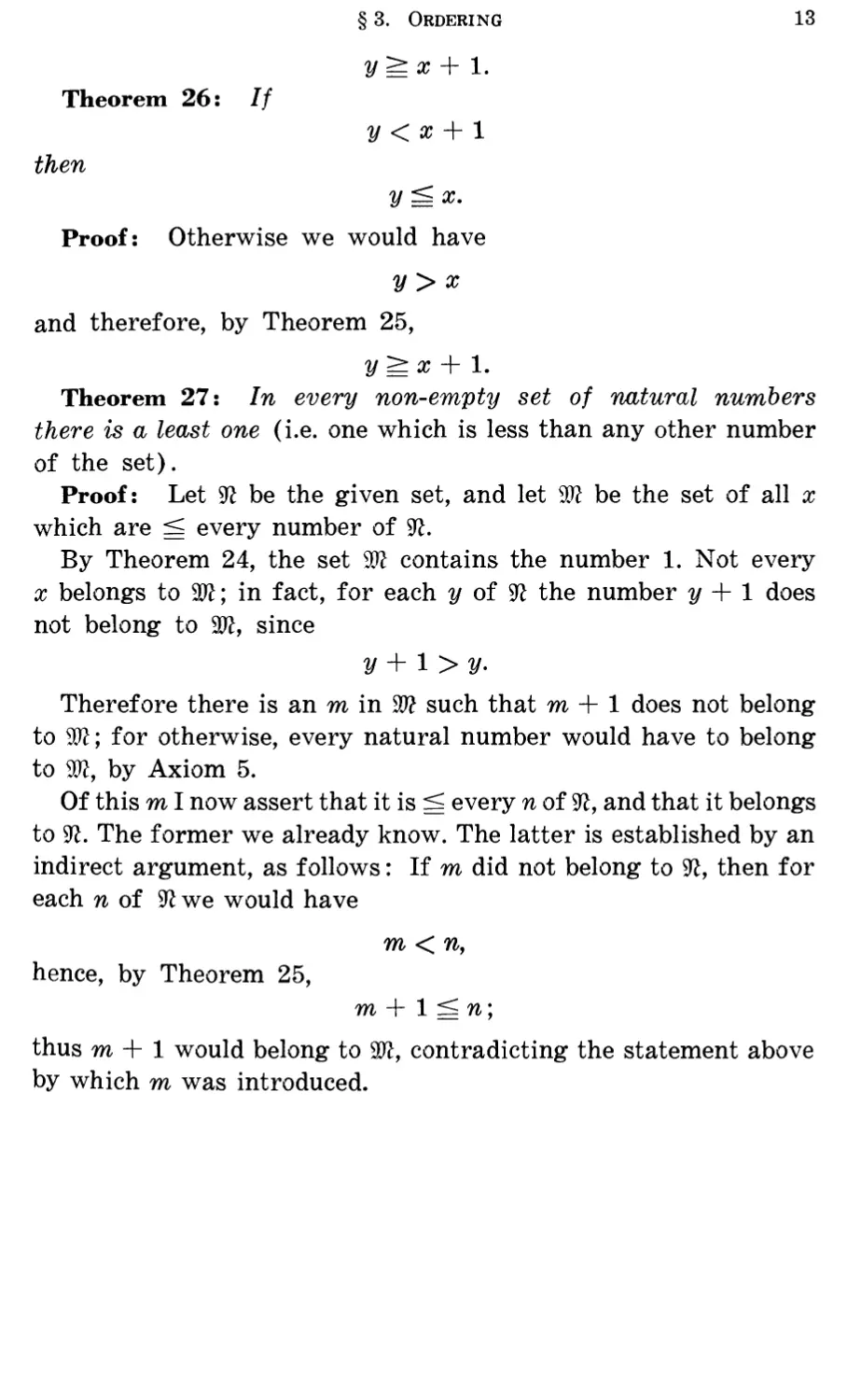
Theorem 26: //
V < x + 1
then
V ^ x.
Proof: Otherwise we would have
y>x
and therefore, by Theorem 25,
y^x + 1.
Theorem 27: In every non-empty set of natural numbers
there is a least one (i.e. one which is less than any other number
of the set).
Proof: Let Sft be the given set, and let <$l be the set of all x
which are :g every number of Sft.
By Theorem 24, the set $Jl contains the number 1. Not every
x belongs to Wl; in fact, for each y of $1 the number y + 1 does
not belong to Wl, since
y + 1 > y.
Therefore there is an m in 1 such that m + 1 does not belong
to %Jl; for otherwise, every natural number would have to belong
to $Jl, by Axiom 5.
Of this m I now assert that it is rg every n of Sft, and that it belongs
to S$l. The former we already know. The latter is established by an
indirect argument, as follows: If m did not belong to % then for
each n of Sftwe would have
m < n,
hence, by Theorem 25,
m + 1 5^ n;
thus m + 1 would belong to Wl, contradicting the statement above
by which m was introduced.

14 I. Natural Numbers [Th. 28-29,
§4
Multiplication
Theorem 28 and at the same time Definition 6: To every pair
of numbers x> y> we may assign in exactly one way a natural num-
number, called x • y (• to be read "times"; however, the dot is usually
omitted), such that
1) x • 1 = x for every x,
2) x • y' = x • y + x for every x and every y.
x • y is called the product of x and y, or the number obtained
from multiplication of x by y.
Proof {mutatis mutandis, word for word the same as that of
Theorem 4) : A) We will first show that for each fixed x there
is at most one possibility of defining xy for all y in such a way that
x • 1 = x
and
xy' = xy + x for every y.
Let ay and by be defined for all y and be such that
ax = x, bx = x,
ay, = ay + x, by' = by + x for every y.
Let Wl be the set of all y for which
ay = by.
ay
hence 1 belongs to ffi.
II) If y belongs to 90?, then
ay = by,
hence
ay = ay + x = by + x = by'i
so that y' belongs to 90?.
Hence %Jl is the set of all natural numbers; i.e. for every y we
have
ay = by.
B) Now we will show that for each x, it is actually possible to
define xy for all y in such a way that

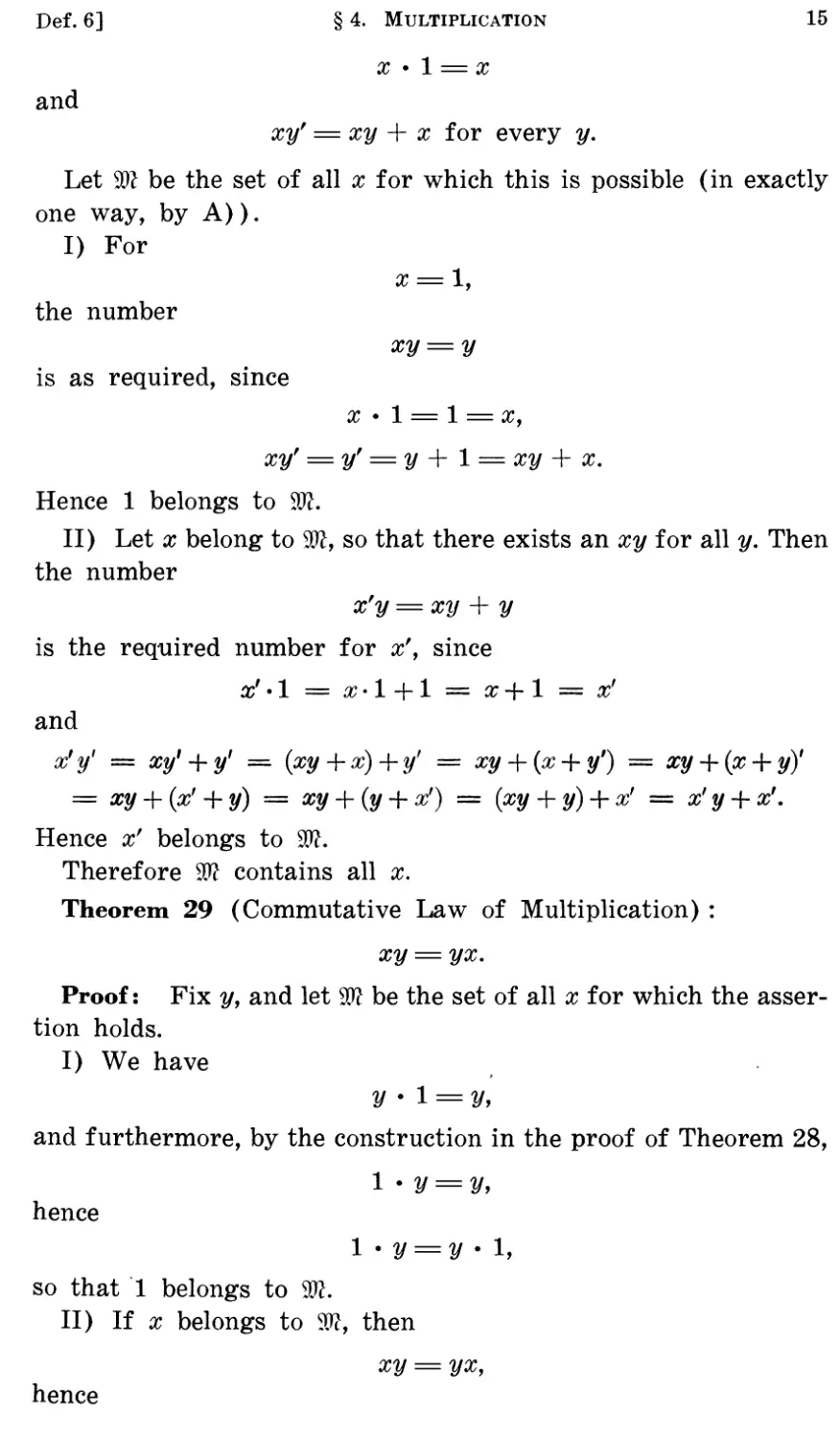
Def. 6] § 4. Multiplication 15
X • 1 = X
and
xy' = xy + x for every y.
Let Wl be the set of all x for which this is possible (in exactly
one way, by A)).
I) For
x = l,
the number
xy = y
is as required, since
x • 1 = 1 = x,
xy' = y' = y + 1 = xy + x.
Hence 1 belongs to ffi.
II) Let x belong to ffl, so that there exists an xy for all y. Then
the number
x'y = xy + y
is the required number for x\ since
and
= «y + (ptf + y) = ay + (y + a/) = (a;y + y) + x' = x'y + x'.
Hence x' belongs to Wl.
Therefore W contains all x.
Theorem 29 (Commutative Law of Multiplication) :
xy = yx.
Proof: Fix y, and let $Jl be the set of all x for which the asser-
assertion holds.
I) We have
V • 1 = V>
and furthermore, by the construction in the proof of Theorem 28,
1 • V = V,
hence
1 - y = y . 1,
so that 1 belongs to W.
II) If x belongs to 9W, then
xy = yx,
hence

16 I. Natural Numbers [Th. 30-34]
xy + y = yx + y = yx'.
By the construction in the proof of Theorem 28, we have
x'y = xy + y,
hence
x'y = yx\
so that x' belongs to Wl.
The assertion therefore holds for all x.
Theorem 30 (Distributive Law) :
x(y + z) = xy + xz.
Preliminary Remark: The formula
(y + z)x = yx + zx
which results from Theorem 30 and Theorem 29, and similar
analogues later on, need not be specifically formulated as theorems,
nor even be set down.
Proof: Fix x and y, and let Wl be the set of all z for which the
assertion holds true.
I) x(y + 1) = xtf = xy + x = xy + x • 1;
1 belongs to $Jl.
II) If z belongs to 3tt, then
hence
= xy + (xz+x) = xy
so that 2' belongs to 9D£.
Therefore, the assertion always holds.
Theorem 31 (Associative Law of Multiplication) :
(xy)z = x(yz).
Proof: Fix x and y, and let Wl be the set of all z for which the
assertion holds true.
I) (xy) • l = xy = x(y • 1) ;
hence 1 belongs to 90?.
II) Let z belong to m. Then
(xy)z = x(yz),
and therefore, using Theorem 30,
(xy) z' = (xy) z + xy = x (yz) + xy = x(yz + y) = x (yz'),

§ 4. Multiplication 17
so that z' belongs to Wl.
Therefore $Jl contains all natural numbers.
Theorem 32: //
x > y, or x = y, or x < y,
then
xz > yz, or xz = yz, or xz < yz, respectively.
Proof: 1) If
x > y
then
x = y + u,
xz = (y + u)z = yz + uz > yz.
2) If
then clearly
3) If
then
hence by 1),
Theorem 33: //
xz > yz, or xz = yz, or xz < yz,
then
x > y, or x = y, or x <.y, respectively.
Proof: Follows from Theorem 32, since the three cases are, in
both instances, mutually exclusive and exhaust all possibilities.
Theorem 34: //
x > y, z> u,
then
xz > yu.
Proof: By Theorem 32, we have
xz > yz
and
yz = zy > uy = yu,
hence
xz > yu.
X
xz
X
y
yz
xz
= y
= yz.
<y
> x,
> xz,
<yz.

18 I. Natural Numbers [Th. 35-39,
Theorem 35: //
%^V, z > u or x > y, z^iu,
then
xz > yu.
Proof: Follows from Theorem 32 if an equality sign holds in
the hypothesis; otherwise from Theorem 34.
Theorem 36: //
a ^ y, z^u,
then
xz g: yu.
Proof: Obvious if two equality signs hold in the hypothesis;
otherwise Theorem 35 does it.

Def. 7-8] § 1. Definition and Equivalence 19
CHAPTER II
FRACTIONS
§1
Definition and Equivalence
Definition 7: By a fraction —l (read "xx over x2") is meant the
x%
pair of natural numbers xl9 x2 (in this order).
Definition 8:
to be read "equivalent") if
Theorem 37:
Proof:
Theorem 38: //
x* y*
then
y* **
Proof: xty2 = yt
hence
Theorem 39: //
then
Proof: xty2 = y,xt, yx02 = zxy%,

20 II. Fractions [Th. 40-43,
hence
We always have
(xy)(*u) = x(y(eu)) = x{(yz)u) = x(u(y*)) = (xu)(yz)
= (xu)(ey);
therefore
and
so that, by the above, we have
(*i OB/i 2/2) = (*i OB/i 2/2),
By Theorems 37 through 39, all fractions fall into classes, in
such a way that
*7~ 2/2
if and only if — and — belong to the same class.
*2 2/2
Theorem 40: ^L ^ 5l^
x2 &%x
Proof: xx(x2x) = xl(xxi) = (xtx)x2.

Def.9-10] §2. Ordering 21
§2
Ordering
Definition 9: — > —
(> to be read "is greater than") if
Definition 10: —- <■
(< to be read "is less than") {/
Theorem 41: // —, — are arbitrary, then exactly one of
x2 y%
^ > ^
z* y*' *, y,' ^
is the case.
Proof: For our xl9 x2, y±9 y2, exactly one of
is the case.
Theorem 42: //
y.
Proof: If
then
Theorem 43: //
then

22
Proof:
then
Theorem
If
44: //
II. Fractions
xxVi < 2/i#
[Th. 44-48,
*, 2/2 *2 ** 2/2
then
Preliminary Remark: Thus if a fraction of one class is greater
than a fraction of another class, then the same will be true for
all pairs of representatives of the two classes.
Proof: yxu% = uxy%, exx% = xxe» oo1y2>ylx2,
hence
(fc«O(*i*i) = Kri(^,4
and therefore, by Theorem 32,
B/1 *.) (^1 «*2) = {ux z2) (xx y2) > (ux #2) (yx x2\
so that, by Theorem 33,
Theorem 45: //
X* 2/2 *2
Preliminary Remark: Thus if a fraction of one class is less
than a fraction of another class, then the same will be true for
all pairs of representatives of the two classes.
Proof: By Theorem 43, we have
2/2
since
we then have by Theorem 44 that

Def. 11-12] § 2. Ordering 23
so that, by Theorem 42,
*2 V
Definition 11: ^- >^
means
x% itt xt n
-1 > — or ~± ro^
X2 y* z* y*'
(> to be read "greater than or equivalent with.")
Definition 12: ^ < —
*2 y*
—L<c— or -!,\, £l.
^2 ^2 ^2 2/2
^ to be read "less than or equivalent with.")
Theorem 46: //
Proof: Obvious by Theorem 44 if > holds in the hypothesis;
otherwise, we have
zy x, yx ux
*2 ^2 ^ «*2
Theorem 47: //
then
Proof: Obvious by Theorem 45 if < holds in the hypothesis;
otherwise, we have
zx xx
yx
—rv
Theorem 48: //

24 II. Fractions [Th. 49-55]
then
Proof: Theorem 38 and Theorem 42.
Theorem 49: //
then
Proof: Theorem 38 and Theorem 43.
Theorem 50 (Transitivity of Ordering) : //
then
Proof: xxy2 <yxx2, yx*t < zxy2,
hence
\xie*)\y\y%) < \zix\
X* Z ~^Z. 1$
Theorem 51: //
^*L or ^iL,
** y2 y*
then
Proof: Follows from Theorem 45 if an equivalence sign holds
in the hypothesis; otherwise from Theorem 50.
Theorem 52: //
then
xx ^ ex
Proof: Follows from Theorem 39 if two equivalence signs
hold in the hypothesis; otherwise from Theorem 51.

§ 2. Ordering 25
Theorem 53: Given —, f/iere exists a
x
Theorem 54: Given —, f/iere exists a
x
Proof:
Theorem 55: //
then there exists a -1- such that
2
Proof:
hence

26 II. Fractions [Th. 56-61,
§3
Addition
Definition 13: By ^-f^- (+to be read "plus") is meant
the fraction —^—^—-.
x n
It is called the sum of —- and —, or the fraction obtained by the
addition of —1 to-1-.
y% x2
Theorem 56: //
*2 ™ y.' ^ ~ ^
^» ^2 y2 w»
Preliminary Remark: The class of the sum thus depends only
on the classes to which the "summands" belong.
Proof: xxy% = yxx9, zxn% = uxe%,
hence
hence
i»,) (y, «*2) = (y t «*,) (a?, ^2) + (ux y2) (x2 ^,),
*! a?,) (y.tO = (y
^ ^2 + *rt«, ^ y^
Theorem 57: 5_ + ^^
XX X
Proof: By Definition 13 and by Theorem 40, we have
xx x2 xtx + x2x ( j
-4— f\J C\J f\J
X X XX XX X
Theorem 58 (Commutative Law of Addition) :

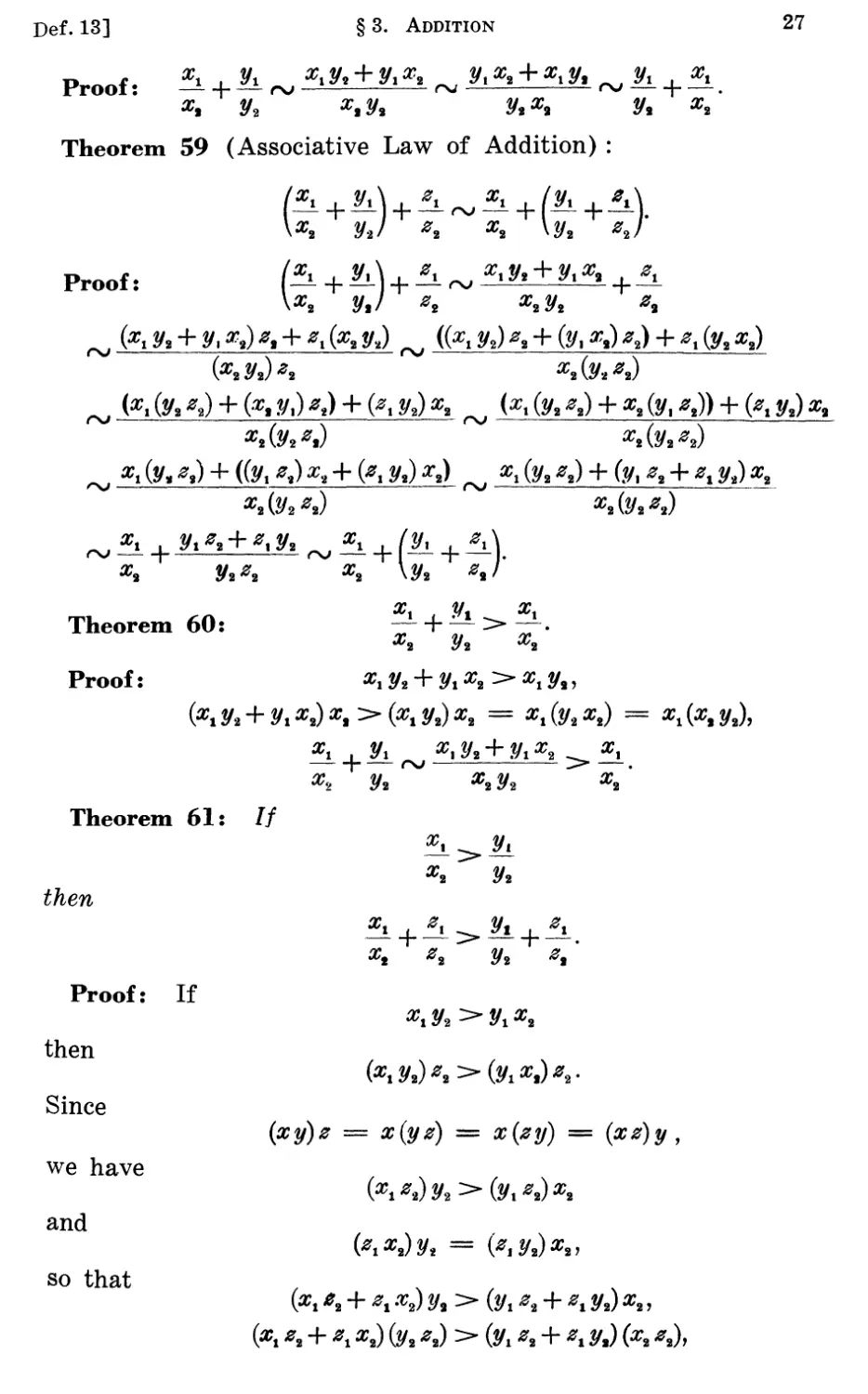
Def. 13] §3. Addition 27
Proof: gL+*„*.*+?.*■ ^yt**+*>y>~a+^.
Theorem 59 (Associative Law of Addition) :
U, y./ ^ ^ \y, *./
Proof:
+ ^
, yJ
fa & + y, **) *,+^1 fe yj ^ (K y») ^ + 0, *») ^) + ^, (y, a?,
(g, (y, ^2) + (g, .v.) *.) + (^1 yJ X2 ^ (^, (y, ^,) + a, (y, ^.)) + (^ y.)
Theorem 60: —- + ^ > ^.
*2 y* x2
Proof: a?, y. + «/i ^2 > x^^
(*i y2 + 2/1 *■) *■ > (*i y2) ^2 = *i (y. ^2) = *t (*, y J,
gi 1 yi
#* 2/2
Theorem 61: //
then
xt
Proof: If
then / , \
Since
(xy)e = a?(yjer) = x{zy) = (xe)y ,
we have
(«i^)y»>(yi^)afi
and
so that
(xt ** + zx x2) y% > (yt z% + zx y2) x2,
(xt z2 + ex x2) (y, z2) > (yt z2 + zx yJ (x2 z2),

28 II. Fractions [Th. 62-67]
x. z. x, z ~\~ z.x y z ~\~ z. y yx z.
then
Theorem 62: //
2/2 x'.
x. y. x. y. x. y.
-1 > — or -±rsj?± or -Jl -c -1 ,
i_ j i_ -^> y 1 1 i_ or - i ^- ^*vj *^ ^ 1 i_
or -^ -|- ^l <: — + — , respectively.
Proof: The first part is Theorem 61; the second is contained
in Theorem 56; and the third is a consequence of the first, since
Vl _l *1
Theorem 63: //
x. z. y, z.
■— OT —- H Lrv-^--| l-
%* 2* V* *.
or ^4.^^^ + ^,
t/ien X* ** ^ **
— > — , or ^-r^^-, or —<—, respectively.
X2 Ml X2 \fi X2 2f2
Proof: Follows from Theorem 62, since the three cases, in both
instances, are mutually exclusive and exhaust all possibilities.
Theorem 64: //
then
Proof:
By
Theorem
X,
X2
Xl
X2
61x
x%
y
> y
*\
z.
we
f2 ' ^2 "
L 2/l ,
have
2^2/2"
w,
P^2
and
it z z v u v u
i?2 W2 ^2  2 i/2 c/2

§ 3. Addition 29
so that
^2 ^2 2/2 V
Theorem 65: //
'
±_ _^>" *s *■ £_ -^^ t. or — "^>
Proof: Follows from Theorems 56 and 61 if the equivalence
sign holds in the hypothesis; otherwise from Theorem 64.
Theorem 66: //
^L>y± £l>^l
X2 y* &2 U2
then
00 Z ^^ tl U
w» ^2 i/2 W2
Proof: Follows from Theorem 56 if two equivalence signs hold
in the hypothesis; otherwise from Theorem 65.
Theorem 67: //
then
—- -j no —-
2/2 u9 x2
has a solution —. // — and —L are solutions, then
Preliminary Remark: If
^~ 2/2 '
there does not exist a solution, by Theorem 60.
Proof: The second assertion of Theorem 67 is an immediate
consequence of Theorem 63; for if
2/2 ^~^+^
then, by Theorem 63,

30 II. Fractions [Th. 68-70,
The existence of a — (the first assertion of Theorem 67) is
proved as follows. We are given that
Determine u from
xiV* = yi^ + u
and set
u2 =
then —L is a solution, since
u
»■*■+«
Definition 14: T/ie specific — constructed in the proof of
Theorem 67 is denoted by ^—^i (— to be read "minus"), and
%* y%
is called the difference —*- minus — or ^/ie fraction obtained by
subtraction of the fraction ^- from the fraction-L .
Thus if y' *•
then

Def. 14-15] § 4. Multiplication 31
§4
Multiplication
Definition 15: By — • ^ (• to be read "times"; however, the
/* m
dot is usually omitted) is meant the fraction
It is called the product of —i and — , or the fraction obtained
by multiplication of — by— •
2 if 2
Theorem 68: //
then
Preliminary Remark: The class of the product thus depends
only on the classes to which the "factors" belong.
Proof: xty% = ytx9, ztu2 = uxet,
hence
~x~^rxJ y*<
Theorem 69 (Commutative Law of Multiplication)
Proof:
Theorem 70 (Associative Law of Multiplication) :
111. Ml\±L no ?*-(&. Z-)
\x2 yj et x, \y2 ej

32
Proof:
Theorem
71
II.
lxx y,\ bx
\x2 y2) z2
(Distributive
Fractions
xtyx bx |
xx \xb\ ol
x2 y2z2 x
Law) :
[Xi Vx) *x
'2 \y2 Z2/
[Th. 71-75]
Proof-
«(y^) ^B/^) (^2/)^
^y ** X y ^ ^'
Theorem 72: //
xt zx yt zx xx zx yx zx xx zx yt zx
-J--1->^-1- or -±-±rsj^ i- or -±-L<z*i--i- respectively.
x2 ** y2 ^2 »2 ^2 y2 #2 a, ^2 y2 ^2 ^
Proof: 1) If
then
X Z CC Z V Z 1/
_l_Lrv_L_L>lL-lrvlI
x2 z* ^2^2 y,*, y2
2) If
then, by Theorem 68,
3) If

§ 4. Multiplication 33
then
y* V
hence, by 1),
lLLZI.^ "* *
Theorem 73: //
#9 ^2 2/2 ^2 #2 ^2 2^2 ^2 ^2 ^2 ^2 ^2
—^r^-^or -1 r^^± or —<— , respectively,
x2 y* xz y>2 X2 y*
Proof: Follows from Theorem 72, since the three cases are in
both instances mutually exclusive and exhaust all possibilities.
Theorem 74: //
then
Proof:
and
so that
Theorem
then
By
75
Theorem
y* *
y2 *
72,
\
2
y, **
'^^l-^Ml
%2 *2 y*
we have
x\ &i y%
X 8 !/„
2 2 i/2
z y u
X 2 t/o
2 2 </2
* — or -
u2 a
X2 *2 y*
u
u2'
*2
Mlr
%
ut'
ft
* y
Proof: Follows from Theorem 68 and Theorem 72 if the equiv-
equivalence sign holds in the hypothesis; otherwise from Theorem 74.

34
Theorem
76: //
II.
Fractions
. Vx *i -
' y, ' *2 "
[Th. 76-80,
then
x\ z\ > y\ ui
Proof r Follows from Theorem 68 if two equivalence signs hold
in the hypothesis; otherwise from Theorem 75.
Theorem 77: The equivalence
where — and — arc given, has a solution —. // —L and —l arc
solutions, then
Proof: The second assertion of Theorem 77 is an immediate
consequence of Theorem 73; for if
y> 2 y2
then, by Theorem 73,
The existence of a — (the first assertion of Theorem 77) is
proved as follows. If we set
then —L is a solution, since
u
y«

Def. 16-19] § 5. Rational Numbers and Integers 35
§5
Rational Numbers and Integers
Definition 16: By a rational number, we mean the set of all
fractions which are equivalent to some fixed fraction. (Such a
set is therefore a class in the sense of § 1.)
Capital italic letters will always denote rational numbers, unless
otherwise specified.
Definition 17: X=Y
(= to be read "equals") if the two sets consist of the same frac-
fractions. Otherwise,
X=f Y
D= to be read "is not equal to").
The following three theorems are trivial:
Theorem
Theorem
then
Theorem
then
Definition
78:
79: //
80: //
18:
X = X.
X=Y
Y = X.
X=Y, Y =
A. Zj .
X> Y
(> to He read "is greater than") if for a fraction —- of the set X,
and for a fraction — of the set Y (hence for any such pair of frac-
tions, by Theorem 44) we have that
Definition 19: X < Y
x
(< to be read "is less than") if for a fraction ~ of the set X, and
y± 2
for a fraction —of the set Y (hence for any such pair of fractions,
V\
by Theorem 45) we have that

36 II. Fractions [Th. 81-96,
Theorem 81: For any given X, Y, exactly one of
z = y, x>y, x<y
must be the case.
Proof: Theorem 41.
Theorem 82: //
then
Proof: Theorem 42.
Theorem 83: //
then
Proof: Theorem 43.
Definition 20:
means
x>
Y <
x<
Y>
x^
X>Y or
(^ to be read "is greater
Definition 21:
means
Y
X.
Y
X.
•XT
y -XT
than or equal to.")
X^
X < y or
(^ to be read "is less than
Theorem 84: //
then
Proof: Theorem 48.
Theorem 85: //
then
Y
X=Y.
or equal to.")
x^
x^
Y
Y
Proof: Theorem 49.
Theorem 86 (Transitivity of Ordering) : //
z<y, y <z,
then
-A v. & •
Proof: Theorem 50.
Theorem 87: If
x ^ y, y < z or x < y, y ^ z,
then
X <Z.
Proof: Theorem 51.

Def. 20-22] § 5. Rational Numbers and Integers 37
Theorem 88: // X ^ Y, Y ^ Z,
then
X^Z.
Proof: Theorem 52.
Theorem 89: Given X, there exists a
Z>X.
Proof: Theorem 53.
Theorem 90: Given X> there exists a
Z <X.
Proof: Theorem 54.
Theorem 91: // X < Y,
then there exists a Z such that
X <Z <Y.
Proof: Theorem 55.
Definition 22: By X + Y (+ to be read "plus") we mean the
class which contains a sum (hence, by Theorem 56, every such
sum) of a fraction from X and a fraction from Y.
This rational number is called the sum of X and Y, or the
rational number obtained from the addition of Y to X.
Theorem 92 (Commutative Law of Addition) :
X+Y=Y + X.
Proof: Theorem 58.
Theorem 93 (Associative Law of Addition) :
(X + Y) + Z = X + (Y + Z).
Proof: Theorem 59.
Theorem 94: X + Y > Z.
Proof: Theorem 60.
Theorem 95: If X>Y
then
X + Z>Y + Z.
Proof: Theorem 61.
Theorem 96: //
X > y, or X=Yf or X < Y,
then
X + Z >Y + Z, or X + Z=Y + Z, or X + Z <Y + Z,
respectively.
Proof: Theorem 62.

38 II. Fractions [Th. 97-111,
Theorem 97: //
X + Z>Y + Z, or X + Z=Y + Z, or X + Z <Y + Z,
then
X > Y, or X =Y, or X < Y, respectively.
Proof: Theorem 63.
Theorem 98: // X > Y, Z > E7,
X + Z > Y + U.
Proof: Theorem 64.
Theorem 99: //
X^Y, Z>U or X>Y,
then
X + Z>Y+ U.
Proof: Theorem 65.
Theorem 100: // X ^ Y, Z ^ [/,
Z + Z ^ Y + [/.
Proof: Theorem 66.
Theorem 101: // X > Y,
Y + E7 = Z
/mis exactly one solution 17.
Preliminary Remark: If
Z^ Y,
there does not exist a solution, by Theorem 94.
Proof: Theorem 67.
Definition 23: This U is denoted by X — Y (— to be read
"minus") and is called the difference X minus Y, or the number
obtained from subtraction of the rational number Y from the
rational number X.
Definition 24: By X • Y (• to be read "times"; however, the
dot is usually omitted) we mean the class which contains a product
(hence, by Theorem 68, every such product) of a fraction from X
by a fraction from Y.
This rational number is called the product of X by Y, or the
rational number obtained from multiplication of X by Y.
Theorem 102 (Commutative Law of Multiplication) :
XY=YX.
Proof: Theorem 69.

Def. 23-24] § 5. Rational Numbers and Integers 39
Theorem 103 (Associative Law of Multiplication) :
(XY)Z = X(YZ).
Proof: Theorem 70.
Theorem 104 (Distributive Law) :
X(Y + Z) = XY + XZ.
Proof: Theorem 71.
Theorem 105: //
X>Y, or X=Y, or X <Y,
then
XZ > YZ, or XZ = YZ, or XZ < YZ, respectively.
Proof: Theorem 72.
Theorem 106: //
XZ > YZ, or XZ = YZ, or XZ < YZ,
then
X > y, or X=Y, or X <Y, respectively.
Proof: Theorem 73.
Theorem 107: // X > Y, Z > U,
then
XZ > YU.
Proof: Theorem 74.
Theorem 108: //
X ^ Y, Z > U or X > y, Z ^ [/,
Proof: Theorem 75.
Theorem 109: //
z ^ y, z ^ [/,
^ y[/.
Proof: Theorem 76.
Theorem 110: The equation
YU = X
in which X and Y are given, has exactly one solution U.
Proof: Theorem 77.
Theorem 111: //
x y x y x y

40 II. Fractions [Th. 112-113,
then
x > y, or x = y, or x < y, respectively,
and vice versa.
Proof: x • 1 > y • 1, or x • 1 = y • 1, or x • 1 < y • 1,
means the same as
x > y, or x = y, or x < y, respectively.
Definition 25: A rational number is called an integer (or a
whole number) if the set of fractions which it represents contains
x
a fraction of the form y .
By Theorem 111, this x is uniquely determined. Conversely, to
each x there corresponds exactly one integer.
Theorem 112: 1. +1
x y xy
TT^T
Preliminary Remark: Thus, the sum and the product of two
integers are themselves integers.
Proof: 1) By Theorem 57, we have
x y x + y
_ + _„__.
2) By Definition 15, we have
x y xy xy
TT~!TT~17-
Theorem 113: The integers satisfy the five axioms of the
natural numbers, provided that the role of 1 is assigned to the
1 x
class of y and that the role of successor to the class of y is
assigned to the class of — .
Proof: Let 3 be the set of all integers.
1) The class of y belongs to 3-
2) For each integer we have defined a uniquely determined
successor.

Def. 25-26] § 5. Rational Numbers and Integers 41
3) This successor is always different from the class of y, since
we always have
a' + l.
x' y'
4) If the classes of y and of y coincide, then
x' = y>
x = y,
x y
x y
and the classes of y and of y coincide.
5) Let a set Wl of integers have the following properties:
I) The class of y belongs to 2ft.
X __ X1
II) If the class of -y belongs to Wl, then so does the class of -y .
Furthermore, denote by Wl the set of all x for which the class
of y belongs to Wt. Then 1 belongs to Wl, and for any x belonging
to Wl, its successor x' also belongs to Wl. Therefore, every natural
number belongs to Wl, so that every integer belongs to Wt.
Since =, >, <, sum, and product all correspond to the earlier
concepts (by Theorems 111 and 112), the integers have all the
properties which we have proved, in Chapter 1, attach to the
natural numbers.
Therefore, we throw out the natural numbers and replace them
by the corresponding integers. Since the fractions also become
superfluous, we may, and henceforth we will, speak only of rational
numbers whenever any of the foregoing material is involved. (The
natural numbers remain, in pairs, over and under the fraction
Jine, in the concept of fraction; the fractions survive as individual
elements of the sets which constitute the rational numbers.)
Definition 26: The symbol x (now freed of its previous mean-
ing) denotes the integer determined by the class of y .
In our new terminology, we thus have, for instance,

42 II. Fractions [Th. 114-118,
X.I = X,
since
xx 1 xx'\ xx
—. -— f\j _ f-^j —e
x% 1 xt-l x2
the fraction —, then
Theorem 114: If Z is the rational number corresponding to
yZ = x.
y x yx xy x
Proof: f rv^ rv—^-rv—.
1 y 1-y 1-y 1
Definition 27: The U of Theorem 110 is called the quotient of
X by Y, or the rational number obtained from division of X by Y.
It will be denoted by -y (to be read "X over Y").
Let X and Y be integers, say X = x and Y = y. Then by Theo-
x
rem 114, the rational number — determined by Definitions 26 and
is
X
27 stands for the class to which the fraction — (in the earlier
y
sense) belongs.
x
We need not be afraid of confusing the two symbols —, since
fractions as such will from now on no longer occur. — will hence-
y
forth always denote a rational number. Conversely, every rational
x
number may be expressed in the form — , by Theorem 114 and
Definition 27.
Theorem 115: Let X and Y be given. Then there exists a z
such that
zX> Y.
Y
Proof: "y* is a rational number; by Theorem 89, there exist
integers (in our new terminology), say z and v, such that
L Z
v > X'
By Theorem 111, we have
hence, by Theorem 105,

Def. 27-29] § 1. Definition 43
CHAPTER III
CUTS
§1
Definition
Definition 28: A set of rational numbers is called a cut if
1) it contains a rational number, but does not contain all
rational numbers;
2) every rational number of the set is smaller than every
rational number not belonging to the set;
3) it does not contain a greatest rational number (i.e. a number
which is greater than any other number of the set).
We will also use the term "lower class" for such a set, and the
term "upper class" for the set of all rational numbers which are
not contained in the lower class. The elements of the two sets will
then be called "lower numbers" and "upper numbers," respectively.
Small Greek letters will be used throughout to denote cuts, except
where otherwise specified.
Definition 29: I = >?
(= to be read "is equal to") if every lower number for I is a lower
number for r\ and every lower number for r\ is a lower number
for I.
In other words, if the sets are identical.
Otherwise,
D= to be read "is not equal to").
The following three theorems are trivial:
Theorem 116: f = f.
Theorem 117: // | = rj
then
Theorem 118: // f = jy, y\ = f,
then

44 III. Cuts [Th. 119-123,
Theorem 119: // X is an upper number for I and if
then X1 is an upper number for |.
Proof: Follows from 2) of Definition 28.
Theorem 120: If X is a lower number for I and if
X,<X,
then X^ is a lower number for I.
Proof: Follows from 2) of Definition 28.
Conversely, the statement of Theorem 120 is of course equivalent
to 2) of Definition 28. Thus if we wish to show that a given set
of rational numbers is a cut, we need show only the following :
1) The set is not empty, and there is a rational number not
belonging to it.
2) With every number it contains, the set also contains all num-
numbers smaller than that number.
3) With every number it contains, the set also contains a
greater one.

Def. 30-31] § 2. Ordering 45
Ordering
Definition 30: //I and yj are cuts, then
(> to be read "is greater than") if there exists a lower number
for I which is an upper number for yj.
Definition 31: //I and yj are cuts, then
£<rj
(< to be read "is less than") if there exists an upper number for
I which is a lower number for yj.
Theorem 121: //
then
Proof: Each means that there exists an upper number for yj
which is a lower number for |.
Theorem 122: //
then
Proof: Each means that there exists a lower number for rj
which is an upper number for |.
Theorem 123: For any given I, yj, exactly one of
£ = y, £ > *i> f <*i
is the case.
Proof: 1)
| = rj9 | > n
are incompatible by Definition 29 and Definition 30.
I = n, !< n
are incompatible by Definition 29 and Definition 31.
If we had

46 III. Cuts [Th. 124-128,
it would follow that there exists a lower number X for I which is
an upper number for yj, and that there also exists an upper num-
number Y for I which is a lower number for yj. By 2) of Definition 28,
we would then have both
X < Y and X > Y.
Therefore we can have at most one of the three cases.
2) If
then the lower classes do not coincide. Then we either have that
some lower number for £ is an upper number for yj, in which case
it follows that
or we have that some lower number for yj is an upper number
for I, in which case it follows that
Definition 32: | ^ yj
means
I > yj or | = yj.
(^ to be read "is greater than or equal to.")
Definition 33: | ^ yj
means
I < yj or f = iy.
(^ to be read "is less than or equal to.")
Theorem 124: //
then
Proof: Theorem 121.
Theorem 125: //
t^rj
then
rj^t.
Proof: Theorem 122.
Theorem 126 (Transitivity of Ordering) : //
I < YJ, YJ < f,
then

Def. 32-33] § 2. Ordering 47
Proof: There exists an upper number X for I which is a lower
number for rj; there also exists an upper number Y for rj which
is a lower number for £ Applying property 2) of cuts (cf. Defini-
Definition 28) to the cut rj, we obtain
X<Y,
£0 that Y is an upper number for I. Therefore
!<£
Theorem 127: //
£ ^ *?,*?< C or I < iy, 17 ^ C,
Proof: Obvious if the equality sign holds in the hypothesis;
otherwise, Theorem 126 does it.
Theorem 128: //
then
Proof: Obvious if two equality signs hold in the hypothesis;
otherwise, Theorem 127 does it.

48 III. Cuts [Th. 129-132,
§3
Addition
Theorem 129: I) Let I and rj be cuts. Then the set of all
rational numbers which are representable in the form X + Y,
where X is a lower number for I and Y is a lower number for rj,
is itself a cut.
II) No number of this set can be written as a sum of an upper
number for I and an upper number for rj.
Proof: 1) Consider any lower number X for I and any lower
number Y for yj. Then X + Y belongs to our set.
Next, consider any upper number X1 for I and any upper number
Y1 for y] ; if X and Y are any lower numbers for I and for rj respec-
respectively, we have
X<XX, ¥<¥„
hence
X+T<Xl+Tl9
therefore X1 + Yx does not belong to our set, and we have proved
II), as well as property 1) of cuts for our set.
2) To prove that our set satisfies property 2) of cuts, we must
show that with any number it contains, our set also contains all
numbers which are less than that number. Let
Z < X + Y,
where X and Y are lower numbers for £ and rj respectively. Then
hence, by Theorem 106,
X+Y
so that, by Theorem 105,
and

Def. 34] § 3. Addition 49
therefore by virtue of the second property of cuts as applied to
Z Z
I and yj, the numbers X -=—^ and Y-^—== are lower num-
X. + Y A +Y
bers for I and yj respectively.
The sum of those two rational numbers is the given Z, since
3) Any given number of our set is of the form X + Y where
X and Y are lower numbers for I and yj respectively. Using the
third property of cuts as applied to I, we can find a lower number
X,>X
for I; then
X1 + Y > X + Y,
so that there exists in our set a number which is > X + Y.
Definition 34: The cut constructed in Theorem 129 is denoted
by I + yj (+ to be read "plus") and is called the sum of I and y\,
or the cut obtained from addition of yj to |.
Theorem 130 (Commutative Law of Addition) :
Proof: Every X + Y is a Y + X, and vice versa.
Theorem 131 (Associative Law of Addition) :
(| + ^) + C = l + (>; + C).
Proof: Every (X + Y) + Z is an X + (Y + Z), and vice versa.
Theorem 132: Given any A, and given a cut, then there exist
a lower number X and an upper number U for the cut such that
U — X = A.
Proof: Let X1 be some lower number, and consider all rational
numbers
X1 + nA
where n is an integer. Not all of these are lower numbers; for if
Y is any upper number, then
Y>Xi;
hence by Theorem 115, we have for some suitable n that
nA>Y — Xl9
Xx + nA > (Y — X,) +X1 = Y,
so that X1 + nA is an upper number.

50 III. Cuts [Th. 133-140]
The set of all n for which X1 + nA is an upper number contains
a smallest integer, by Theorem 27; we will denote it by u.
If
u=l,
then we set
X = Xl9 U = X1 + A;
if
u> 1,
then we set
X = X1 + (^—1)A, t/ = X1 + ^A=X +A.
In each case, X is a lower and U an upper number, and
U — X = A.
Theorem 133: I + r\ > |.
Proof: Let 7 be a lower number for n. By Theorem 132, we
can find a lower number X for I and an upper number U for I such
that
U — X=Y;
then the number
[7 = Z+ Y
is an upper number for I and a lower number for I + y\. Therefore
I + >?>!.
Theorem 134: // I > jy
Proof: There exists an upper number Y for r\ which is a lower
number for |. Choose a greater lower number
Z> Y
for I; it is an upper number for r\. Now by Theorem 132, we can
find an upper number Z for C and a lower number U for C such that
Z- U = X-Y.
Then we have
Y+Z = Y+((X-r)+ P) = (Y+(X-Y))+ 17 = X+ JT,
so that this number, besides being a lower number for I + C, is
also (by Theorem 129, II)) an upper number for r\ + f. Therefore
I + C> v + C.
Theorem 135: //
I > ??, or | = ?7, or | < rj,

§ 3. Addition 51
then
£ + £>>? + £, or £ + £ = *? + £, or ! + £<>? + £,
respectively.
Proof: The first part is Theorem 134, the second is obvious,
and the third follows from the first since
17 + C > I + C
I + t <rj + f.
Theorem 136: //
I + C> *7 + C, or ! + £ = >? + £, or I + C<>? + C,
£.> rj, or € = rj, or | < ?y, respectively.
Proof: Follows from Theorem 135, since the three cases are,
in both instances, mutually exclusive and exhaust all possibilities.
Theorem 137: //
6 >i?, %>v
then
Proof: By Theorem 134, we have
and
n + l = £ + V> v + rj = rj + v,
so that
I + % > t] + v.
Theorem 138: //
l^ri, %> v or %>% i>v
then
I + i > rj + v.
Proof: Follows from Theorem 134 if the equality sign holds
in the hypothesis; otherwise from Theorem 137.
Theorem 139: //
then
I 4- f ^ n + v.
Proof: Obvious if two equality signs hold in the hypothesis;
otherwise, Theorem 138 does it.
Theorem 140: //

52 III. Cuts
then
has exactly one solution v.
Preliminary Remark: If
then there does not exist a solution, by Theorem 133.
Proof: I) There exists at most one solution; for if
then, by Theorem 135,
n + vt =1= n + %.
II) I will show first that the set of all rational numbers of the
form X— Y (hence X > Y) where X is a lower number for I
and Y is an upper number for rj9 constitutes a cut.
1) We know from the first part of the proof of Theorem 134
that such an X — Y does indeed exist.
No upper number X1 for I can constitute such an X — Y, since
each number of this form satisfies
X— Y < (X— Y) + y =Z<Z1.
2) If an X— Y of the above sort is given and if
U<X— Y,
then
E7+ Y <(X— Y)+ Y = X,
so that the number
E7+ Y = X2
is a lower number for I, and the number
U = X2 — Y
belongs to our set.
3) If an X—Y of the above sort is given, choose a lower
number
X3>X
for £. Then
(Z3 —Y)+Y> (X—Y) + Y,
X3 — Y>X— Y,
so that X3 — Y is a number of our set which is greater than the
given number X — Y.
Our set is therefore a cut; let us denote it by v.
We will show that it satisfies

[Def. 35] § 3. Addition 53
Yj + V = |.
To prove this, it suffices to establish the following two statements:
A) Every lower number for v + rj is a lower number for S.
B) Every lower number for I is a lower number for v + rj.
As regards A) : Every lower number for v + rj is of the form
(X—Y) + Y1
where X is a lower number for I, Y an upper number foi rj, Yj a
lower number for rj, and
X> Y.
Now we have
(x-r)+rt<x,
so that (X — Y) + Y1 is a lower number for |.
As regards B) : a) Let the given lower number for I be at
the same time an upper number for rj, and denote it by Y. Choose
a lower number X for f such that
*> Y,
and moreover choose, by Theorem 132, a lower number Y1 for rj
and an upper number Y2 for ?; such that
Y2-Yt = X-Y.
Then we have
Y^> Y
hence
r2+(r- r.) = ((z- r)+r,)+(r-F1) = (x-Y)+(y1+(y- r,))
= (x-r)+r= x,
r-r, = x-rt>
r=(r-r,)+r) = (x-rj+r,,
so that Y is a lower number for v + rj.
h) If the given lower number for I is also a lower number for yj,
then it is less than all those rational numbers which were con-
considered in a) and which turned out to be lower numbers for v + rj.
Hence in this case the given number must itself be a lower number
for v + yj.
Definition 35: The v of Theorem 140 is denoted by I — rj
(— to be read "minus") and is called the difference I minus rj, or
the cut obtained by subtraction of rj from |.

54 III. Cuts [Th. 141-145,
§4
Multiplication
Theorem 141: I) Let | and rj be cuts. Then the set of all
rational numbers which are representable in the form XY, where
X is a lower number for £ and Y is a lower number for rj, is itself
a cut.
II) No number of this set can be written as a product of an
upper number for I and an upper number for rj.
Proof: 1) Consider any lower number X for I and any lower
number Y for rj; then XY belongs to the set.
Next, consider any upper number X1 for I and any upper num-
number Y1 for yj. If X and Y are any lower numbers for I and for rj
respectively, we have
hence
therefore X1Y1 does not belong to our set, and we have proved II),
as well as property 1) of cuts, for our set.
2) Let X be a lower number for I, Y a lower number for rj,
and let
Z<XY.
Then we have
2^
so that ~y is a lower number for rj. The equation
thus shows that Z belongs to our set.
3) Let there be given any number of the set; it is of the form
XY where X and Y are lower numbers for I and for rj respectively.
Choose a lower number

Def. 36] § 4. Multiplication 55
for I; then we have that
XXY > XY,
so that our set contains a number which is > XY.
Definition 36: The cut constructed in Theorem 141 is denoted
by I • yj (• to be read "times"; however the dot is usually omitted),
and is called the product of I and r], or the cut obtained from multi-
multiplication of I by r).
Theorem 142 (Commutative Law of Multiplication) :
fy = *£.
Proof: Every XY is a YX, and vice versa.
Theorem 143 (Associative Law of Multiplication) :
Proof: Every (XY)Z is an X(YZ)f and vice versa.
Theorem 144 (Distributive Law) :
Proof: I) Every lower number for £(?y + C) is of the form
X(Y + Z)=XY + XZ
where X, Y and Z are lower numbers for I, rj, and C, respectively.
The number XY + XZ is a lower number for grj + S £
II) Every lower number for ty + £C is of the form
XY + XXZ
where X, Y, Xlt and Z are lower numbers for I, ?y, I, and C, respec-
respectively. Let X2 stand for the number X in case X ^ X^ and for the
number X1 in case Z < Zi; then X2 is a lower number for I, so that
X2(Y + Z) is a lower number for f (jy + 0- From
follows
hence XY + XiZ is a lower number for f (jy + C).
Theorem 145: //
I > iy, or f = iy, or I < jy,
f f > jyf, or f f = jyf, or f C < jyf, respectively.
Proof: 1) If I > iy,
X, Z ^ X2 Z

56 III. Cuts [Th. 146-152,
then we have by Theorem 140 that, with a suitable v,
hence
it = (V + V)i =
2) If
i = n
then obviously „. .
§s = nt
3) If
i<v
then
so that by 1),
vt>it,
Theorem 146: //
IC > ^C, or IC = ^C, or IC < ^C,
I > rj, or £ = y], or I < rj, respectively.
Proof: Follows from Theorem 145, since the three cases are,
in both instances, mutually exclusive and exhaust all possibilities.
Theorem 147: //
then
Proof:
and
so that
By
Theorem
tree
145,
tree
tree
1>V7] =
Theorem 148: //
| ;> jy, C> V Or | > jy, C ^ Vy
then
Proof: Follows from Theorem 145 if an equality sign holds in
the hypothesis; otherwise from Theorem 147.
Theorem 149: //

Def. 37] § 4. Multiplication 57
then
K ^ riv.
Proof: Obvious if two equality signs hold in the hypothesis;
otherwise, Theorem 148 does it.
Theorem 150: For any given rational number R, the set of all
rational numbers < R constitutes a cut.
Proof: 1) By Theorem 90, there does exist an X < R. The
number R itself is not < R.
2) If
X < R9 Xx ^ R,
then
X<X,.
3) If
X<R,
then by Theorem 91 there exists an X± such that
X < X, < R.
Definition 37: The cut constructed in Theorem 150 is denoted
by R*.
(Thus capital italic letters with asterisks will stand for cuts,
not for rational numbers.)
Theorem 151: I • 1* = |.
Proof: | • 1* is the set of all XY where X is a lower number
for | and
r<i.
Every such XY is < X and thus is a lower number for |.
Conversely, let there be given a lower number X for |. Choose,
for |, a lower number
XX>X
and set
Then
4
so that the number
X = XtY
is a lower number for | • 1*.
Theorem 152: For any given i=,- the equation
£v = l*
has a solution v.

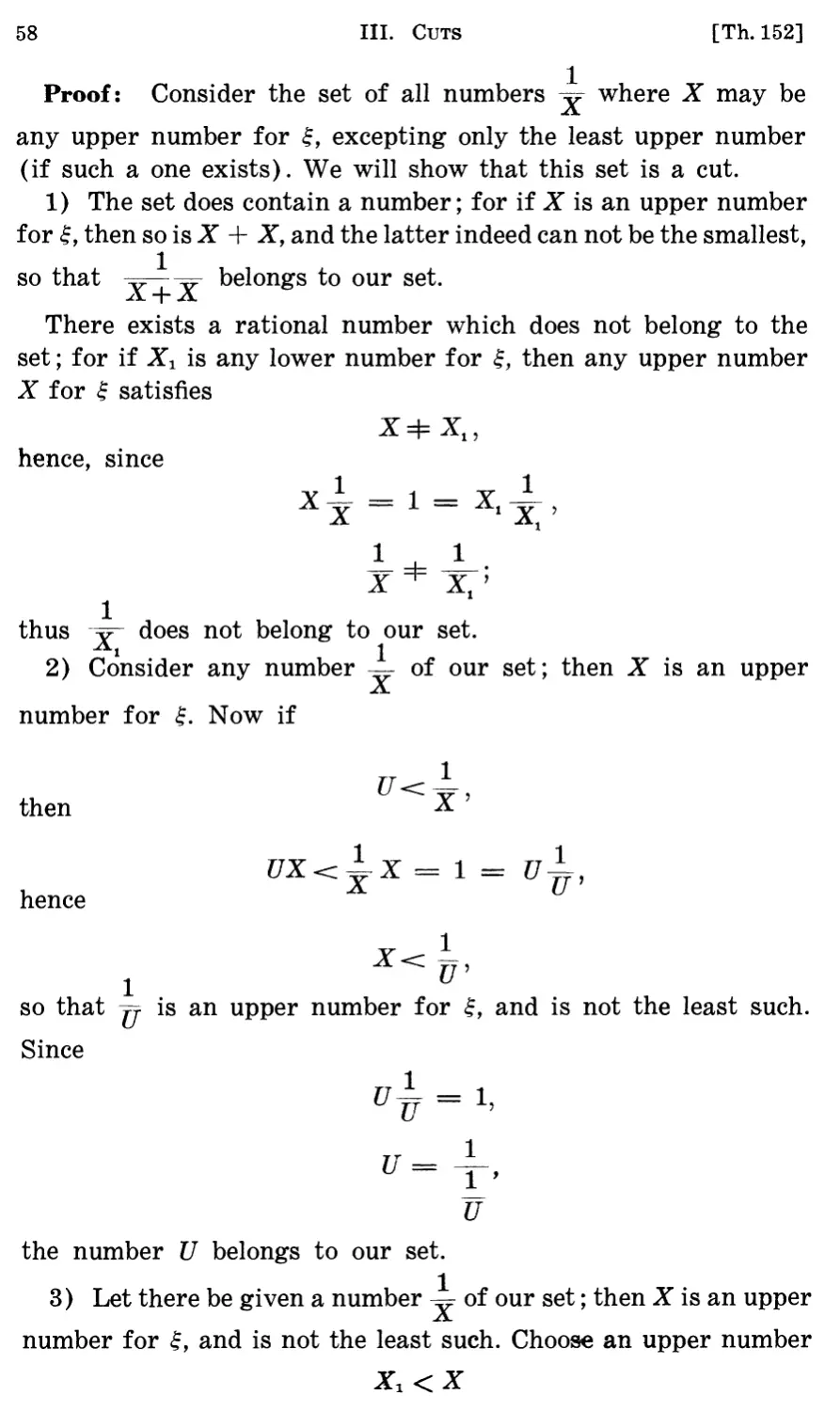
58 III. Cuts [Th. 152]
Proof: Consider the set of all numbers ^ where X may be
any upper number for I, excepting only the least upper number
(if such a one exists). We will show that this set is a cut.
1) The set does contain a number; for if X is an upper number
for I, then so is X + X, and the latter indeed can not be the smallest,
so that ^-= belongs to our set.
There exists a rational number which does not belong to the
set; for if Xx is any lower number for I, then any upper number
X for I satisfies
hence, since
x ^ xt;
thus y does not belong to our set.
2) Consider any number — of our set; then X is an upper
number for |. Now if
then
hence
so that Yf is an upper number for I, and is not the least such.
Since
T'
u
the number U belongs to our set.
3) Let there be given a number = of our set; then X is an upper
number for I, and is not the least such. Choose an upper number
X1<X

§ 4. Multiplication 59
for I, and choose (Theorem 91) an X2 such that
X, < X2 < X.
Then X2 is an upper number for I, and is not the least such. From
X, ~^r -<Z X. ~y- = 1 = 2L2 -^r-
we obtain
so that we have found a number in our set which is greater than
the given one.
Our set is therefore a cut; let it be denoted by v.
We will show that it satisfies.
!v = l*.
To prove this, it suffices to establish the following two statements:
A) Every lower number for £v is < 1.
B) Every rational number < 1 is a lower number for £u.
As regards A) : Every lower number for £v is of the form
xx7'
where X is a lower number for I and X1 an upper number for I.
Now
X<Xt
implies
As regards B) : Let
Choose any lower number X for I and then, by Theorem 132, a
lower number Xx for I and an upper number X2 for I such that
X,-XI = A-J7)X
Then we have
(Zt-X.) + tfX2< A - 0) X,+ Z7X, = X, = (X, - X,)+ X,,
PX2<X,,
X, = (jftfx, = ^(^X,)<-iXl = A.
Therefore -=± is an upper number for I, and is not the least such.

60 III. Cuts [Th. 153-155,
If U^ = X
U *
then
Tl — ^ — X * •
here, Zi is a lower number for I, and -^- is a lower number for
hence 17 is a lower number for |v.
Theorem 153: The equation
YjV= |,
where I and ?; are given, has exactly one solution v.
Proof: I) There exists at most one solution; for if
then, by Theorem 145,
II) If t is the solution—whose existence is proved by Theorem
152—of the equation
rjr = 1*,
then the cut
V = X%
satisfies the equation in Theorem 153; for we have, by Theorem
151, that
nv = V(xi) = (n%)i = i*| = i
Definition 38: The v of Theorem 153 is denoted by — (to be
read "I over rj"), and is called the quotient of I by rj, or the cut
obtained from division of I by rj.

Def. 38-40] § 5. Rational Cuts and Integral Cuts 61
Rational Guts and Integral Cuts
Definition 39: A cut of the form X* is called a rational cut.
Definition 40: A cut of the form x* is called an integral cut.
(Thus small italic letters with asterisks stand for cuts, not for
integers.)
Theorem 154: //
X>Y, or X=Y, or.X < F,
then
X* > F*, or X* = Y*, or X* < Y*, respectively,
and vice versa.
Proof: I) 1) If
X> Y,
then F is a lower number for X*. The number Y is an upper
number for F*. Therefore
X* > Y*.
2) If
then clearly
3) If
then
hence, by 1),
X =
X* =
x<
r>
r*>
Y
Y*.
Y
x,
X*,
Y*.
II) The converse is obvious, since the three cases are, in both
instances, mutually exclusive and exhaust all possibilities.
Theorem 155: (X + Tf = X* + F*;
(X- Yf = X*- F*, if X > F;
(XT)* = X*F*;
/X\* _ X*_
\y) - F**
Proof: I) a) Every lower number for X* + F* is the sum

62 III. Cuts [Th. 156]
of a rational number < X and of a rational number < Y; it is
therefore < X + Y, and is thus a lower number for (X + Y) *.
6) Every lower number U for (X + Y)* is < X + Y. Now
C7 — -A. —^ ^ "T" ■*
X+Y
implies that U. as the sum of a rational number < X and of a
rational number < Y, is a lower number for X* + Y*.
Hence we have
(X + Y)* = X*+Y*.
II) If
X> Y
then
X = (X-Y) + Y,
so that by 1),
X* = (X-Y)*+F*,
(X-Y)* = X*-Y*.
III) a) Every lower number for X*Y* is the product of a
rational number < X and of a rational number < Y; therefore
it is < XY, and so is a lower number for (XY) *.
h) Every lower number U for (XY) * is < XY. Choose a rational
number Ul9 by Theorem 91, such that
U 1
Then
and
Thus the relation
represents U as the product of a lower number for X* and a lower
number for Y*. Therefore U is a lower number for X*Y*.
Hence we have
(XY)* = X*Y*.
iv) x = |-r,

§ 5. Rational Cuts and Integral Cuts 63
so that by III), we obtain
"Vste
D)'=
Theorem 156: The integral cuts satisfy the five axioms of the
natural numbers if the role of 1 is assigned to 1* and if we set
Proof: Let 8* be the set of all integral cuts.
1) 1* belongs to 8*.
2) For every x* in 8*, the cut (x*)' is also in 3*.
3) We always have
a1 =1=1,
hence
(*')* =i= i*,
(x*y #= i*.
4) If
(x*)' = (y*)'
then
x' = y',
x = y,
x* = </*.
5) Let a set Wl* of integral cuts have the following properties:
I) 1* belongs to m*.
II) If x* belongs to Wl*, then so does (x*)'.
Also, denote by Wl the set of x for which x* belongs to Wl*. Then
1 belongs to Wl, and if x belongs to Wl then so does x\ Hence every
integer belongs to $R, so that every integral cut belongs to 3D?*.
Since =, >, <, sum, difference (whenever it exists), product,
and quotient, in the domain of rational cuts all correspond to the
earlier concepts (by Theorems 154 and 155), the rational cuts have
all the properties which we have proved, in Chapter 2, attach to
the rational numbers; the integral cuts, in particular, have all the
properties that have been established for the integers.
Therefore, we throw out the rational numbers and replace them
by the corresponding rational cuts, so that in all that follows we
will only have to speak in terms of cuts whenever any of the fore-

64 III. Cuts [Th. 157-161,
going material is involved. (However, the rational numbers sur-
survive—in sets—in the concept of cut.)
Definition 41: The symbol X (now freed of its previous mean-
meaning) will denote the rational cut X* to which we also transfer the
name "rational number"; the name "integer" will similarly be
transferred, to apply to integral cuts.
Thus, for instance, we will simply write
4 = 1
instead of
ST = **
Theorem 157: The rational numbers are those cuts for which
there exists a least upper number X. This X is then V 6 cut.
Proof: 1) For the cut X (our old X*), X (the rational num-
number in the old sense) is a least upper number.
2) If there exists a least upper number X for a cut I, then every
lower number for I is < X and every upper number is ^ X, so that
the cut is X (the old X*).
Theorem 158: Let I be a cut. Then X is a lower number if,
and only if,
and hence is an upper number if, and only if,
Proof: 1) If X is a lower number for I, then, noting that X
is an upper number for X (the old X*), we have
2) If X is an upper number for I, and is the least such, then
we have by Theorem 157 that
3) If X is an upper number for I but is not the least such, we
choose an upper number X1 less than X. Then X1 is a lower number
for X, so that
Theorem 159: //
then there exists a Z such that
I <Z <Tj.

Def. 41] § 5. Rational Cuts and Integral Cuts 65
Proof: Choose an upper number X for I which is a lower num-
number for rj, and then choose a greater lower number Z for rj. Then
we have by Theorem 158 that
I ^ X < Z <rj.
Theorem 160: Every
may be brought into the form
z = xy, x ^ i, y ^ jy.
Proof: Denote by £ the lesser of the two cuts 1 and
Then
Z-g,
Choose ^i and Z2 by Theorem 159 such that
6<-Z;<6 + & fl<^.<fl
Then we have
Qfa + t) = l6 + E)^ + F + E)C^F + O^
6 ) ^ -g,) = z.
By means of
and using
7 Z 7
Y= Z1>v,
we have decomposed Z as required.
Theorem 161: For each C, the equation
has exactly one solution.
Proof: I) There exists at most one solution; for if
then
6161>6,6,.
II) Consider the set of all rational numbers X for which
XX <f.
This set constitutes a cut, for:

66
1)
then
If
then
2)
then
3)
If
If
Let
III. Cuts [Th. 162,
X<1 and ,
XX<X-1 = X<
X ^ 1 and X ^ £,
xx<g,
xx < 5.
Choose a Z less than the lesser of the two cuts 1 and
Then
furthermore, we have
and
(X + Z)(X + Z) =
If we denote by I the cut which we have constructed, then we
now assert that
If we had
then we could choose, by Theorem 159, a Z such that
n>z>i.
This Z, being a lower number for $S, would satisfy
Z= X.X,, X^g, X,<|;
if X denotes the greater of the two numbers Xi and X2, then we
would have, in contradiction to the above, that
X<£,
Z ^ XX < C.

Def. 42] § 5. Rational Cuts and Integral Cuts 67
If we had
then we could choose, by Theorem 159, a Z such that
By Theorem 160, Z would be of the form
Z= XXX2, Z.^6, X2^£;
if X denotes the lesser of the two numbers X± and X2, then we
would have, in contradiction to the above, that
Z^|,
z ^ xx ^ c
Definition 42: An?/ cw£ which is not a rational number is called
an irrational number.
Theorem 162: There exists an irrational number.
Proof: It suffices to show that the solution of
II = 1',
whose existence is guaranteed by Theorem 161, is irrational.
Otherwise, we would have
among all such representations we choose one, by Theorem 27, for
which y is as small as possible. Since
r = u = -■- = — .
y y yy
we have
yy<V{yy) = xx = {Vy)y<{Vy)(Vy\
y <zx <c V y.
Set
x-y = u.
Then
y + u = x<Vy = y+y,
u<y.
Now we have that
(y + iv) (v + w) = (v -f w) v + (v + w) w =
= (vv + V (v to)) +

68 HI. Cuts [Th. 163-165,
hence, setting
that y~u = '
xx + tt = (y + u)(y + u) + tt = {yy + V (yu)) + (u
= (yy + (l'u)(u + t)) + (uu + tt)
= {yy + 1' (uu)) + ((V (ut) +uu) + tt)
which contradicts u u
= V (y y) + V (uu) =
tt = l'(uu),
1.1= V

Def. 43] § 1. Definition 69
CHAPTER IV
REAL NUMBERS
§1
Definition
Definition 43: The cuts will henceforth be called ''positive
numbers"; similarly, what we have been calling "rational numbers"
and "integers" will henceforth be called "positive rational numbers"
and "positive integers" respectively.
We create a new number 0 (to be read "zero"), distinct from the
positive numbers.
We also create numbers which are distinct from the positive
numbers as well as distinct from zero, and which we will call negar-
tive numbers, in such a way that to each I (i.e. to each positive
number) we assign a negative number denoted by — I (— to be
read "minus"). In this, —I and —y\ will be considered as the
same number (as equal) if and only if I and r\ are the same number.
The totality consisting of all positive numbers, of 0, and of all
negative numbers, will be called the real numbers.
Capital Greek letters (such as 3, H, Z, Y) will be used through-
throughout to denote real numbers, except where otherwise specified.
"Equal" will be written "=" and "unequal" ("different") as =".
Thus for any given 3 and H, exactly one of
3 = H, 3 + H
is the case. For real numbers, the concepts of identity and of
equality are merged, so that the following three theorems are
trivial:
Theorem 163: 3 = 3.
Theorem 164: //
3 = H
then
H = 3.
Theorem 165: //
,_ 3 = H, H = Z
then
3 = Z.

70 IV. Real Numbers [Th. 166-168,
§2
Ordering
Definition 44:
£ if S = £,
0 if S = 0,
% if 3 = -I
The number \ 3 \ is called the absolute value of 3.
Theorem 166: \ 3 \ is positive, for positive and for nega-
negative 3.
Proof: Definition 44.
Definition 45: If 3 and H are not both positive, then
3>H
if and only if we have
either 3 negative, H negative and | 3 | < | H |,
or 3 = 0, H negative,
or 3 positive, H negative,
or 3 positive, H = 0.
(> to be read "is greater than.")
Note that, in case 3 and H are positive, we already have the
concepts ">" and "<"; the latter, in fact, has been used in one
of the cases of Definition 45.
Definition 46: 3 < H
means H > 3.
(< to be read "is less than.")
Note that if 3 and H are positive, Definition 46 is in agreement
with our old concepts.
Theorem 167: For any given 3 and H, exactly one of
3 = H, 3>H, 3<H
is the case.
Proof: 1) For positive 3 and H we know this from Theorem
123.
2) If 3 is positive while H is = 0 or negative, then
3 + H,
and furthermore, by Definition 45,
3>H,

Def. 44-48] § 2. Ordering 71
and finally, by Definition 46,
E not < H.
3) If 3 = 0 while H is positive, then
S + H,
and furthermore, by Definition 45,
E not > H,
and finally, by Definition 46,
4) If 3 = 0, # = 0, then
S not > #,
S not < H.
5) If E = 0 while # is negative, then
S not < H.
6) If 5 is negative while H is positive or = 0, then
E not > H,
E <H.
7) If S and # are both negative, then
3 =1= H, 3>H
3 = H, 3 not
3 =1= H, 3 not
Definition 47:
means
(^ to be read "is
Definition 48:
means
(fg to be read "is
Theorem 168:
',
> J5T,
>
greater
S<
g not <5
3 not <-J3
3<H
or 3 = H.
than or equal
£<#
for S|<
r for |S| =
for |S| >
to.")
H or 3 = H.
less than or equal to."
//
)
^l>
H\.
then
and vice versa.
Proof: Definition 46.

72 IV. Real Numbers [Th. 169-173,
Theorem 169: The positive numbers are the numbers which
are > 0; the negative numbers are the numbers which are < 0.
Proof: 1) By Definition 45, we have
6>0.
2) If
then, by Definition 45,
S = 1
3) By Definition 46, we have
4) If
S<0
then, by Definition 46,
S = -6.
Theorem 170: |£|>0.
Proof: Definition 44, Theorem 166, and Theorem 169.
Theorem 171 (Transitivity of Ordering): //
3
then
Proof: 1) Let
Z>0,
If
then
and we have the earlier Theorem 126.
If
then certainly
£<: Z.
2) Let
Z = 0.
then
hence
3) ^ z<o,

Def. 49-51] §2. Ordering 73
We also have
\S\>\H\, \H\>\Z\,
hence
|*|>|Z|,
3<Z.
Theorem 172: //
then
Proof: Obvious if an equality sign holds in the hypothesis;
otherwise, Theorem 171 does it.
Theorem 173: // E ^ H, H ^ Z,
then
E^Z.
Proof: Obvious if two equality signs hold in the hypothesis;
otherwise, Theorem 172 does it.
Definition 49: // S ^ 0
then S is called rational if either
E = 0
or
E < 0, | E | a rational number.
Thus we now have positive rational numbers, the rational num-
number 0, and negative rational numbers.
Definition 50: //
S<0
then E is called irrational in case it is not rational.
Thus we now have positive irrational numbers and negative
irrational numbers. (Numbers? Yes; for, we had an irrational I,
and the positive number I + X-is always irrational, since
t + X=Y
would imply
i = y—x;
similarly, — (I + X) is always negative irrational.)
Definition 51: //
then E is called integral {or an integer) if either
E = 0
or
S < 0, E | an integer.

74 IV. Heal Numbers [Th. 174-175,
Thus we now have positive integers, the integer 0, and negative
integers.
Theorem 174: Every integer is rational.
Proof: We already know this in the case of positive numbers.
For 0 and for negative numbers, it follows from Definitions 49
and 51.

Def. 52]
§ 3. Addition
75
Addition
Definition 52:
-(\3} + \H\) if S<0,
S + H =
0;
0 } if S>0, tf<0; { \3
= 1*1;
<l*l;
#+g i/ 2<0, 77>0;
H if 3 = 0;
g if H = 0.
(+ to be read "plus.") 3 -\- H is called the sum of 3 and H, or the
number obtained by addition of H to 3.
In this definition, note the following:
1) For
3 > 0, H > 0
we had the concept of 3 + H as early as Definition 34.
2) This same concept is used in Definition 52.
3) The third case of Definition 52 uses the concept of sum as
introduced in the second case.
4) The fourth case and the fifth case overlap for
but the number defined as 3 + H is the same (namely 0) in the
two cases.
Theorem 175 (Commutative Law of Addition) :
S + H = H + 3.
Proof: If
5 = 0,
then each side reduces to H; if
# = 0,
then each side = S.
If
3 > 0, H > 0,
then Theorem 175 is the earlier Theorem 130.

76 IV. Heal Numbers [Th. 176-180,
If
then, by Theorem 130,
3 + H = -(|j?|+|J5T|) = -(\H\ + \3\) = H+S.
If
then the assertion reduces to the definition itself.
If
S>0, i7<0
then we have by the preceding case that
H+3 = 3.+ H,
hence
Definition 53: - 3 = j . v.
for a = 0,
/or S < 0.
(— to be read "minus.")
Note that for 3 > 0, we have the concept — 5 from Definition 43.
Theorem 176: //
3 > 0, or 3 = 0, or 51 < 0,
— 3 < 0, or — £ = 0, or — 5 > 0, respectively,
and vice versa.
Proof: Definition 43 and Definition 53.
Theorem 177: — (— 3) = 3.
Proof: Definitions 43, 44, and 53.
Theorem 178: | — E \ = | 3 |.
Proof: Definitions 43, 44, and 53.
Theorem 179: 3 + (—3) = 0.
Proof: Definition 52, Definition 53, and Theorem 178.
Theorem 180: — C + H) = — 3 + (— H).
Proof: By Theorem 175, we have
-C + H) = -(H+3)
and
-3 + (-H) = -#+(-£);
hence without loss of generality, we may assume that

Def. 53] § 3. Addition 77
for, at least one of the relations
S^H, H^S
holds, and
-(H + S) = -H + (-3)
implies
-(S + H) = -3 + (-H).
Thus let _
S^H
K 3>0, H>0,
-3 + (-H) = -(S+H).
2)If 3>0,H=0,
then
-3 + (-H) = -3 + 0 = -3 = -C + 0) =
8)If 3>0,H^0,
then
either
S>|2r|,
hence
3 + H = »-|J5T|,
-3+(-H) = -3+\H\ = -C-\H\) =
* = 1*1,
h6nCe 3+H = 0,
-3+(-H) = -3+\H\ = 0 = -(»
*<l*l.
hence s+s-= - (i*i-a),
-3 + (-H) = -3+\H\ = |ir|-S = -
4) If
ff = 0,
then
-S + (-H) = 0 + (-H) = -H = -
5) If
3<0,
then
-3+(-H) = |S| + |1T| = -(S + H).

78 IV. Keal Numbers [Th. 181-185,
Definition 54: E — H = E + (— H).
(— to be read "minus.") S — H is called the difference E minus
H, or the number obtained by subtraction of H from E.
Note that Definition 54 agrees (as it should), for the case
E > H > 0,
with the earlier Definition 35; for in this case, we have that
, |S|>|-J5T|f £ + (-#) = \S\-\-H\ = *-#•
Theorem 181: -(» - H) = H- S.
Proof: By Theorems 180 and 177, we have
-C-H) = -(£ + (-#)) = — S + (—(—J5T)) = -5+H= H+(-g)
= H-3.
Theorem 182: //
S — H > 0, or E — H = 0, or S — H < 0,
then
S > H, or E = H, or S <H, respectively,
and vice versa.
Proof: Since —H (as well as H itself) stands for any real
number at all, we may write — H in place of H, and we must
then show that the cases
S + H > 0, or 3 + H = 0, or S + H < 0,
correspond to the cases
S > — H, or 3 = — H, or S < — H,
respectively.
Indeed, the assertion is obvious if S = 0 or H = 0. As for the
rest, if we have the case
S > 0, H > 0,
or any of the first three cases of Definition 52, we need only verify
— decomposing the third case into the three subordinate cases
\H\>\S\, \H\ = |ff|, \H\<z\S\
— that we obtain the signs
>, =, <, >, =, <, >, =, <, respectively,
simultaneously in both of the above instances.
Theorem 183: //
S > H, or S = H, or E < H,

Def. 54] § 3. Addition 79
then
— E < — H, or — 3 = — H, or — 3 > — H, respectively,
and vice versa.
Proof: By Theorem 182, the former corresponds to the cases
S-H>0 , or 3-H = 0 , or 3-H<0,
respectively, and the latter to the cases
— J5T —(—S)>0 , or -H-(-3) = 0 , or -#-(-£)<0.
respectively, so that the relations
-H-(-3) = — J5T + (—(—S)) = -H+3 = 3 + (-H) = 3-H
prove everything.
Theorem 184: Every real number can be represented as the
difference of two positive numbers.
Proof: 1) If
then
3 = (»+l)-l.
2) If
* = 0,
then
£=1-1.
3) If
S<0,
then
-3 = \3\ = (|H| + 1)-1,
Theorem 185: //
3 = g, —6,, H = rj.-tj,
then
3 + H = (^ + ^-F, + ^.
Proof: 1) Let
S>0, H>0.
Then, since
we have
so that the assertion is true.

80 IV. Keal Numbers [Th. 186-187]
2) Let
Then, by Theorem 181,
so that 1) yields
-£ + (-#) = (
S+H = -(-{?+(-#)) = F, + ifc)-
3) Let
S>0,
hence
A) If
3>[H\,
then
so that
8, + 9, = (F. - y + 80 + * = (8i - 80 + (8.+vd = (8,+*?,) + (I,
= (8.+nd + (fa. - n.) + ((8. - y - fa. -1?.)))
= E,+fat+fa. - ij.))) + ((I. - 8.) - to. - flj)
B) If
then A) yields
= -(-H + (-S)) = -((,,-,,)+ E,-I,))
-to,+y) = fa.+y-fa,+y
C) If
hence
then
4) Let

Then
5)
Then
a)
then
3) yields
Let
If
§ 3. Addition
3 -
I =
3 + H
■*)-
= 0.
= L,
81
b) If
then
c) If
then, by a),
H = -(-H) = ^1
6) Let
ff = 0.
Then, by 5),
Theorem 186 (Associative Law of Addition)
Proof: By Theorem 184, we have that
3 = 1,-g., H = ,,-,„ Z = 5,-
Now Theorem 185 yields
Theorem 187: For any given S, H, the equation
H+Y = S

82 IV. Heal Numbers [Th.188-191]
has exactly one solution Y, namely
Y = 3-H
Proof: 1) Y = 3- H
is a solution, since by Theorem 186 we have
H+C-H) = C-H) + H = C + (-H)) + H = 3
= 3 + 0 = 3.
2) If
H+Y = 3
then
3-H = 3 + (-H) = -H+3 = -H+(H+Y) = (-
= 0 + T = Y.
Theorem 188: We have
3+Z>H+Z, or 3+Z = H+Z , or 3 + Z<
respectively, according to whether
3>H , or 3 = H, or 3< H.
Proof: By Theorem 182, the former relations hold according
to whether
0 , or (» + Z)-(jy + Z) = 0,
or (S'
respectively, and the latter according to whether
£-#>(), or S-i7 = 0,or 3-H<0.
The relations
= 3 + {-H) = 3-H
then prove the assertions of the theorem.
Theorem 189: //
3>H, Z>Y
then
S'+Z> H + Y.
Proof: By Theorem 188, we have
3 + Z> H + Z
H + Z = Z + H>Y + H = H+Y,
S0 that 3+Z>H+Y.

§ 3. Addition 83
Theorem 190: //
g>F, Z>7 or £>#, Z>Y
then
s + z > h + y.
Proof: Follows from Theorem 188 if an equality sign holds
in the hypothesis; otherwise, from Theorem 189.
Theorem 191: //
3 ^ H, Z^Y,
then
s + z ^ h + y.
Proof: Obvious if two equality signs hold in the hypothesis;
otherwise, Theorem 190 does it.

84 IV. Keal Numbers [Th. 192-200,
§4
Multiplication
Definition 55:
-(|*]|jy|), if £>0, H<0 or S<0 ;
3> H = |*||J5T|, if 3<0, #<0;
0, if 3 = 0 or H = 0.
(• to be read "times"; however, the dot is usually omitted.) E • H
is called the product of E by H, or the number obtained from multi-
multiplication of E by H.
Note that the product E • H for the case S > 0, H > 0 was
defined earlier (cf. Definition 36), a fact used in Definition 55.
Theorem 192: We have
if, and only if, at least one of the two numbers S, H is zero.
Proof: Definition 55.
Theorem 193: \3H\ = \S\\H\.
Proof: Definition 55.
Theorem 194 (Commutative Law of Multiplication) :
EH = HE.
Proof: If E > 0, H > 0, this is Theorem 142; in the other
cases, it follows from Definition 55, since the right-hand side of
Definition 55 is symmetric in E,H (by Theorem 142), as is also
its subdivision into cases.
Theorem 195: E • 1 = E.
Proof: For E > 0, this follows from Theorem 151; for E = 0,
from Definition 55; for E < 0 we have, by Definition 55, that
JM ~-(|tf|-l) = -|*|= *.
Theorem 196: //
SH=0, #=N0,
then
3H= |*||#| or 3H= -(|*||#|),
where the first alternative holds if none or both of the numbers
S, H are negative, and the second if exactly one of these numbers
is negative.

Def. 55] § 4. Multiplication 85
Proof: Definition 55.
Theorem 197: (— E)H = 3(— H) = — {EH).
Proof: 1) If one of the numbers E, H is zero, then all three
of the expressions are 0.
2) If
3 4= 0, H 4= 0,
then by Theorem. 193, all three of the expressions have the same
absolute value | E | • | H |, and all three will, by Theorem 196, be
> 0 or < 0 according to whether or not exactly one of the num-
numbers E, H is negative.
Theorem 198: (~3)(-H) = 3H.
Proof: By Theorem 197, we have
(-3H-H) = £(-(-#)) = 3H.
Theorem 199 (Associative Law of Multiplication) :
CH)Z = 3(HZ).
Proof: 1) If one of the numbers E, H, Z is zero, then both
sides are 0.
2) If
£ + 0, H 4= 0, Z 4= 0,
then by Theorem 193, both sides have the same absolute value
(\3\\H\)\Z\ = |S|(|tf|[Z|),
and by Theorem 196, both sides are > 0 if none or two of the
numbers E, H, Z are negative, while both sides are < 0 if exactly
one or all three of those numbers are negative.
Theorem 200: 8fa-6) = 6^-66-
Proof: 1) If
then ^
so that, by Theorem 144,
2) If
then **
U = U,
t(tl-t) = |.0 = 0:

86 IV. Heal Numbers [Th. 201-204]
3) If
then we have by 1) that
6fo-6) = t{-(S-n)) = -FF-1?)) = "F6-61?) = 6i?-66-
Theorem 201 (Distributive Law) :
3(H + Z) = 3H+3Z.
Proof: 1) Let
S>0.
By Theorem 184, we have
H = ^-r/2, Z = ^-6,,
hence, by Theorem 185,
so that, by Theorems 200 and 144,
and hence, by Theorems 185 and 200,
s(h+z) = (Srit-ariJ + is^-sQ = sfo
= 3H + 3Z.
2) Let
ff = 0.
Then
g(H + Z) = 0 = SH+3Z.
3) Let
2<0.
Then we have by 1) that
(
hence
= 3H+SZ.
Theorem 202: 3(H—Z) = 3H-SZ.
Proof: By Theorem 201, we have
S(J5T-Z) = S(J5T+(-Z)) = 3H+3(-Z) = 3H+(-(8Z))
= 3H-3Z.
Theorem 203: Let
3>H.

§ 4. Multiplication 87
Then from
Z > 0 , or Z = 0 , or Z < 0 ,
it follows that, respectively,
SZ > HZ , or SZ = HZ , or SZ < HZ.
Proof: 3-H>0,
hence
(S-#)Z>0,or (ff-jy)Z = 0 , or (S-H)Z<0,
according to whether
Z>0,or Z = 0,or Z<0,
respectively. Since we have by Theorem 202 that
(S-H)Z = Z{S-H) = ZS-ZH = 3Z-HZ,
we have by Theorem 182 that in the above cases, respectively,
SZ>HZ,oy 3Z = HZ,or
Theorem 204: The equation
HT = S,
where S, H are given and where
has exactly one solution Y.
Proof: I) There is at most one solution; for if
HT, = 3 = HT,
then
0 = HTX-HT% =
so that, by Theorem 192,
II) 1) Let
Then
is a solution, since
2) Let

88 IV. Real Numbers [Th. 205,
Then
F = -I
is a solution; for we have from 1) that
S = \H\ (JL Sj = \H\(-Y) = (-\H\)Y= HY.
Definition 56: The Y of Theorem 204 is denoted by -^- (to
£1
be read "E over H"). It is called the quotient of E by H> or the
number obtained from division of E by H.
Note that if E > 0, H > 0, then this definition agrees (as it
should) with the earlier Definition 38.

Def. 56] § 5. Dedekind's Theorem 89
8 *^
Dedekind's Fundamental Theorem
Theorem 205: Let there be given any division of all real num-
numbers into two classes with the following properties:
1) There exists a number of the first class, and also one of the
second class.
2) Every number of the first class is less than every number
of the second class.
Then there exists exactly one real number 3 such that every
H < 3 belongs to the first class and every H>3to the second class.
In other words, every number of the first class is ^ 3 and every
number of the second class is ^ 3.
Preliminary Remark: It is obvious that, conversely, every real
number 3 gives rise to exactly two such divisions. One of these has
as its first class all H :g 3 and as its second class all H > 3; the
other one has as its first class all H < 3 and as its second class
all H ^ 3.
Proof: A) There can not be more than one such 3; for if
we had
31 <S2
and if 31 as well as S2 were as specified by Theorem 205, then the
number Al ** would have to belong both to the first and to
the second class, since
B) To prove the existence of a suitable 3, we distinguish four
cases, as follows:
I) Suppose that the first class contains a positive number.
Consider the cut whose lower class contains all those positive
rational numbers which lie in the first class of the given division,
with the exception of the greatest such number if one exists; and
whose upper class contains all the remaining positive rational
numbers (i.e., contains all positive rational numbers of the second

90 IV. Heal Numbers [Th. 205]
class, along with the greatest positive rational number of the first
class, if any). This actually gives a cut, for:
1) Since the first class contains a positive number, it also con-
contains every smaller positive rational number (and such do exist,
by Theorem 158) ; hence it contains a positive rational number
which is not the greatest therein. The lower class is therefore not
empty.
Since the second class does contain a number, it also contains
every greater positive rational number (and such do exist, by
Theorem 158). The upper class is therefore not empty.
2) Every number of the lower class is less than every number
of the upper class; for, every number of the first class is less than
every number of the second class, and the greatest positive rational
number of the first class (if any) is certainly greater than every
number of the lower class.
3) The lower class does not contain a greatest positive rational
number. For, the first class either does not contain such a greatest
one, or if it does, then that number was assigned to the upper
class; and we know from Theorem 91 that a set consisting of all
positive rational numbers less than a given one does not contain
a greatest.
We denote by 3 the positive number defined by our cut, and
we now assert that this 3 satisfies the requirements of Theorem 205.
a) Consider any H such that
H<3.
We choose, by Theorem 159 (with I = #, r\ = 3, in case H > 0;
and with g = ~ q = £, in case ff^0),aZ such that
H < Z < 3.
Then Z is a lower number for 3 and hence belongs to the first
class; therefore, so does H.
b) Consider any H such that
H>3.
We choose a Z, by Theorem 159, such that
3 < Z < H.
Then Z is an upper number for 3 and (by Theorem 159) not the
smallest such, so that it belongs to the second class; therefore,
so does H.
II) Suppose that every positive number lies in the second class,
and that 0 lies in the first class.

§ 5. Dedekind's Theorem 91
Then every negative number lies in the first class, and
£ = 0
satisfies the requirements.
III) Suppose that 0 lies in the second class, and that every
negative number lies in the first class.
Then every positive number lies in the second class, and
3 = 0
satisfies the requirements.
IV) Suppose that there exists a negative number in the second
class.
Then we consider the following new division:
Put H into the new first class if — H was in the original second
class;
put H into the new second class if — H was in the original first
class.
This new division evidently satisfies the two conditions of Theo-
Theorem 205. For,
1) each of the new classes does contain a number;
2) if H,<H2,
then, by Theorem 183, —H2<— H^
Moreover, the new division comes under case I), since the new
first class does contain a positive number. Thus by I), there exists
a number S1 such that every
H <51
lies in the new first class, while every
H>S1
lies in the new second class. If we set
then
H < 39 or H > 3,
implies that
— H > 3l9 or — H < 3l9 respectively.
Hence — H lies in the new second class, or new first class, respec-
respectively, so that H lies in the original first class, or original second
class, respectively.

92 V. Complex Numbers [Th. 206-212,
CHAPTER V
COMPLEX NUMBERS
§1
Definition
Definition 57: A complex number is a pair of real numbers
Sl9S2 (in a definite order). We denote this complex number by
[Slf S2]. Here, [Su S2] and [Hlf H2] are considered as the same
number (as equal, written "=") if9 and only if,
S1 = Hlf S2^ H2;
otherwise, they are considered as unequal (different; written
Small German letters will stand throughout for complex
numbers.
For every % and every t), we thus have exactly one of the cases
For the complex numbers, the concepts of identity and of equality
are merged, so that the following three theorems are trivial:
Theorem 206: £ = j.
Theorem
then
Theorem
207:
208:
//
//
I
I % 9 i
then
I = »•
Definition 58: n = [0, 0J.
Definition 59: C = [1, 0].
The letters n and e will thus be reserved for particular complex
numbers.

Def. 57-60] § 2. Addition 93
§2
Addition
Definition 60: //
I = [Sv SJ, ij = [Ht, J5TJ,
then
E + 9 = [£, + #,, S. + iTJ.
(+ to be read "plus.") % + t) is called the sum of % and t), or the
(complex) number obtained by addition of t) to £.
Theorem 209 (Commutative Law of Addition) :
Proof: [
Theorem 210: £ + U = £.
Proof: [ffM SJ + [0, 0] = [^ + 0, ff2 + 0] = [S,, £J.
Theorem 211 (Associative Law of Addition) :
Proof: If
s = [slt 3,1 9 = t^i^ #J> a = [zn z2],
then we have by Theorem 186 that
Theorem 212: For any given %,t)9 the equation
has exactly one solution u; if we set
I = [Slf S,]t t) = [Hl9 FJ,
then the solution is given by
u = [Sl-Hl, St-Ht].
Proof: For every
u = [r,, rj ,
we have

94 V. Complex Numbers [Th. 213-219,
and the requirements are exactly
Hl + Y1 = ft, Ht+Y2 = ft,
so that Theorem 187 does the rest.
Definition 61: The u of Theorem 212 is denoted by £ — t)
(— to be read "minus"). It is called the difference % — t), or the
number obtained by subtraction of t) from £.
Theorem 213: We have
E-9 = n
i/, awd only if,
I = 9-
Proof: We have
ft-jy, = st-Ht = o
if, and only if,
ft = #i, ft = 2Tr
Definition 62: — I = U — £.
(— on the left to be read "minus.")
Theorem 214: //
I = [ft,SJ
then
-I = [-ft, -ft].
Proof: - [ft, ft] = [0, 0] - [ft, ft] = [0 - ft, 0 - ft]
= ["ft, -*.].
Theorem 215: — (—j) = j.
Proof: By Theorem 177, we have
-(-sj = ft, -(-so = s2.
Theorem 216: j + (— j) = n.
Proof: By Theorem 179, we have
ft-K-ft) = o, ft+(-ft) = o.
Theorem 217: -fe + 9) = ~E + (-9)-
Proof: By Theorem 180, we have, setting
j = [ft, ft], t) = [Hl9 2TJ,
that

Def. 61-62] § 2. Addition 95
- (S + 9) = [- (ft + #,), - (ft + #2)] = [~ ft + (- #,), - ft + (- #2)J
= [-ft, -8t] + [-Ht, -H2] = -s + (-9)-
Theorem 218: £ — ^ = j + (— t)).
Proof: [ft - ff,, ft - ^J = [ft, ft] +[-H17 - Ht).
Theorem 219: -(? — 9) = 9 - f.
Proof: -(E-9) = -

96 V. Complex Numbers [Th. 220-224,
Q 3
Multiplication
Definition 63: //
then
(• to be read "times"; however, the dot is usually omitted.)
£ • t) is called the product of % and t), or the number obtained from
multiplication of % by t).
Theorem 220 (Commutative Law of Multiplication) :
£9 = 9£-
Proof: [Bl9 B%][Hlt H2] = [SXHX-S2H2, BxHt+B%H^
Theorem 221: We have
£9 = n
if, and only if, at least one of the two numbers %, t) is equal to n.
Proof: Let
£ = [*„ ffj, t) = [^, H2\
1) If
£ = n
then
Si = S2 = 0,
£9 = [O-J^-0-jy,, 0-J5T, + 0-jyj = [0, 0] = n.
2) If
t) = n
then, by Theorem 220 and by 1),
let) = t>£ = m = n.
3) We are to infer from
let) = n
that
5 = n or t) = n.

Def. 63] § 3. Multiplication 97
We may therefore assume that
and we have to prove that
holds, i.e. that l = n>
Sx = 32 = 0
holds.
By hypothesis, we have
5lHl — 32H2 = 0 = 31H2 + 32H>li
hence
= (C, Hx) Hx - C2 H2) H,) + (C, ff2) H2 + C2 Ht) H2)
= C, (H, HJ - 32 (H2 HJ) + Ct (H2 H2) + 32 {Hx H2))
= (C, (Ht Hx) - S2 (Hx H2)) + 32 (H, H2)) + 3X {H% H2)
= S^H.H^ + SA^^) = 3X{H,HX + H2H2\
so that
K = o,
S2H, = 0 = 3,HV
Since Hx and H2 are not both 0, we therefore have
S, = 0.
Theorem 222: ge = J.
Proof: [X, 3A [1, 0] = [3, ■ 1 -B, ■ 0, St ■ 0 + 3, ■ 1] = [*„ SJ.
Theorem 223: g (— e) = — g.
Proof: [*t, ft] [-1,0] = [St (-1) - S, • 0, S, • 0 + S2 (- 1)]
= [-£., -SJ.
Theorem 224: (_ £) 9 = j (_ 9) = _ (£ t,).
Proof: 1)
ffj = [(- a-,) /r, - (- at) h, , (- ad #,+(- s2) nt]
2) By 1), we have

98 V. Complex Numbers [Th. 225-229]
Theorem 225: (-£)(-*>) = £*)•
Proof: By Theorem 224, we have
(-£)(->}) = S(-(-9)) = £*>•
Theorem 226 (Associative Law of Multiplication) :
(£9)» = £(>)»)•
Proof: As an exception, and for the sake of making the writ-
writing more concise, we set, by way of abbreviations,
C + H) + Z = S + H + Z,
C27) Z = 3 HZ
so that
3 + (H+Z) = 3 + H+Z,
3 (HZ) = 3 HZ
will also hold.
Set
S = [3,, 3,}, t) = [Ht, H%], t = [Z,, ZJ.
Then we have
(S9)j = [S&StH,, S,J,+ S1JJ[Z1, ZJ
= [(a, #, - S2 J5TJ Z, - C, 27, + S2 ^,) Z,,
(S, i7, - 3, Ht) Zt + C, H, + 3, Ht) ZJ
= [(S, iJ, Z, - 3, H, Z.) - C, i72 Z2 + S2 Hx ZJ,
(S, i7, Z, - 2, iT, ZJ + Ct H, Z, + S2 Ht Z,)]
(S, ^2 Z, + 32 /7, Z J + (S, fl, Z8 + (- C, i/2 ZJ))]
= [3, #, Z, - C, H, Z, + 3, fl, Z2 + S2 i7, Z J,
Ct H% Z, + ff2 iJ, Z, + 3, J5T, ZJ - 3, H% ZJ.
Since
stea) = tta)£.
we obtain by an interchange of letters (H for S, Z for H, S for Z)
that
£(9 a) = [■ff.z,s.-(fl.z,£,+ff,z,31+fliz13j,
{Hx Z2 3, + ff2 Z, 3. + i?, Z, SJ - H, Z2 3J.
Since
3HZ = 3(flTZ) = (JTZ)S = HZ3,
A+B + T = A + {B+T) =

§ 3. Multiplication 99
we see from the expressions just calculated that
(£9)» = £($»)•
Theorem 227 (Distributive Law) :
Proof:
Theorem 228: £(!}-*) = £9-£»-
Proof: sE-a) = £ft+ ("*)) =
Theorem 229: The equation
where % and t) are given and
has exactly one solution u.
where
Proof: 1) There is at most one
t)Ux
then
n = tjUi —
so that, by Theorem 221,
n =
2) If
9 =
then
TT TT
and
it =
is a solution, since
= I =
= u,-t
1 — «!•
= [Hlt I
I*' "
solution; for if
9(«.-«2),
».,
21, >0,

100 V. Complex Numbers [Th. 230-239,
-[*.£+*§'-(»■■§)+'■■£]«
r
Definition 64: The u of Theorem 229 is denoted by ~- ( to be
9
read "j over t)"). /^ is ca^ecZ the quotient of % by t), or the number
obtained from division of % by t).

Def. 64] § 4. Subtraction 101
§4
Subtraction
Theorem 230: fe - Q) + t) = j.
Proof: (j - 9) + g = ^ + (j - 9) = j.
Theorem 231: (E + 9)-*) = E-
Proof: t) + E = j + t).
Theorem 232: £ — (j — g) = tj.
Proof: (S~9) + 9 = t ■
Theorem 233: fe -1|) - j = E - (t) + j).
Proof: (9 *) (9i) (fe9)i)
= (((E-J))-9) + ») + 9 = (s-9) + 9 = £•
Theorem 234: (jg +1|) — j = i + (t) - 5).
Proof: (E + (9 —ft)) + » = £ + ((9~») + ») = I +
Theorem 235: (e - t)) + J = E - (t) - 3).
Proof: ((£ - 9) + S) + (>} - i) = (E-9) + (8 + (9-
= (S-9) + 9 = E-
Theorem 236: fc + j) - (t) + 5) = j - 9.
Proof: (E_^) + (^ + j) = ((E_q) + 9) + j = j+
Theorem 237: (j - 5) + (j - u) = (j + }) - (t) + u).
Proof: ((j
Theorem 238: (j-q)-(j-u) = (
Proof: By Theorems 237 and 236, we have
= £-9.
Theorem 239: We have
e-9 = a-u
i/, and owiy t/,
E + u = 9 + 5.
Proof: Theorems 213 and 238.

102 V. Complex Numbers [Th. 240-249]
Theorem
then
Proof:
Theorem
240:
241:
//
//
§5
Division
t» =1= n,
t) 4= n,
Proof: JJE = S9-
Theorem 242: //
E =N n, k) =# n,
Proof:
Theorem
CYi
Proof:
Theorem
243:
(9i
244:
//
I
9 4= n,
= -|-(»9)
= E-
i
= |^ = S.

§ 5. Division 103
Theorem 245: //
9 =1= n, a 4= n,
then
I* = -L
9* 1"
Proof:
i
Theorem 246: //
9 =f= n, i 4= n,
then
Theorem 247: //
t> =1= n, u =1= n,
1.1 = 11
Proof:
(f i)*-« - iGN - !((*
then
Theorem 248: //
*) =1= n, s =t= n, u =1= n,
v 0
u
Proof: By Theorems 247 and 246, we have
V*_.i_ = feu) s =
t)i u (t)j)u
Theorem 249: //
S =1= n,

104 V. Complex Numbers [Th. 250-256]
then
Proof:
Theorem 250: //
then
Proof:
Theorem 251: //
then
if, and only if,
Proof: 1) If
then, by Theorem 250,
2) If
then, by Theorem 222,
Theorem 252: //
then
if, and only if,
Proof: For the case
the assertion is obvious.
Otherwise, we have by Theorem 248 that
X 9*'
u
so that Theorem 251 now proves the assertion.
n _
E ~
in =
1 _
I
I* =
9*
¥ _
9
I =
I =
I 9
£ _
S = 9e
=1= n, u
E« =
ft =
n.
n.
n,
e.
r E-
n,
e
9-
= e.
= 9-
• =N ti
1
u
9 ft-
n,

§ 5. Division 105
Theorem 253: If
9 =f= n,
then
I ■ i =£+8
9 9 9 '
Proof:
Theorem 254: //
=f= n, u
+
Proof: By Theorems 246 and 253, we have
1 +1 = iH. + .9* = ^^±33
Theorem
then
Proof:
Theorem
255:
256:
9^
//
9
9 =(=",
9
) = 9f-
) =f= n, u =
h _ S«
9
9~9:
Proof: By Theorems 246 and 255, we have

106 V. Complex Numbers ITh. 257-263,
Complex Conjugates
Definition 65: Given
then the number
£ = [ft, -ft]
is called the complex conjugate of £.
Theorem 257: f = £.
Proof: [ft, -(-ft)] = [ft, ft].
Theorem 258: We have
I = n
if, and only if,
I = n.
Proof: S. = 0, -ft = 0
is the same as
ft =0, ft = 0.
Theorem 259: We have
if, and only if, £ is of the form
Proof: We have
ft = ft, -ft = ft
if, and only if,
39 = 0.
then
Theorem 260: IC + t) =
Proof: If
E = [ft, ft], ij = [Ht,
= [*t, -SJ + [Ht, -J5TJ =

Def. 65] § 6. Complex Conjugates 107
Theorem 261: E? = Etj.
Proof: If
[t, 2], j [
then
E9 = [*, Ht-g,H,,- (St Ht + S.
Theorem 262: j_^ = | — jj.
Proof: Since
S = (E-)
we have, by Theorem 260, that
S-9 = S-
Theorem 263: 7/
Proof: Since
we have, by Theorem 261, that
* -
hence by Theorem 258, we have
so that
"'
ea

108 V. Complex Numbers [Th. 264-269,
Absolute Value
Definition 66: Denote by \J% the (positive) solution I
—whose existence and uniqueness was established by Theorem
161—of the equation
n = t
Definition 67: \/0 = 0.
Definition 68: | [gt, 32] \ = \l3t 3, + S2 S2.
(| | to be read "absolute value," or "modulus.")
Proof: Definitions 68, 66, and 67.
Theorem 265: ![£,, SJI^ISJ,
Proof: |
if
then
since otherwise
would follow. Thus Theorem 265 is proved.
Theorem 266: //
K 0]K 0] = [H, 0][H, 0], S>0,
3 === ^»
Proof: Since
[Z, 0] [Z, 0] = [ZZ-0-0, Z-O + O-Z] = [ZZ, 0],
the hypothesis gives
[88, 0] = [HH, 0],
33 = HH.

Def. 66-68] §
If
then
hence, by Theorem 161
If
then
Theorem 267: [|
Proof: If we set
then we have
7. Absolute Value
1*1
HH =
H
I»I
I»I
HH =
H =
El. 0][|]
I =
>0,
= 33>
>0,
= H.
= o,
33 =
0 = 3
El, 0] =
1*1, «2J
o,
o,
109
= [3,3,-3^-3,), «!(-£,)+ *,*,] = [S1( Sj[S,,-Si] = M-
Theorem 268: |£t)| = |j||t)|.
Proof: By Theorems 267 and 261, we have that
hence by Theorem 266 that
IJ9I = IEII9I-
Theorem 269: //
t) #= n,
-111
19
Proof: |t)l>0,
Sh - r
hence, by Theorem 268,

110
V. Complex Numbers
[Th. 270-273]
= Isl,
Theorem 270: //
Proof: If
then Theorem 265 gives
hence
, = 1.
= 1^1 +
Theorem 271: |?
Proof: 1) If
% + t) = n,
then the left-hand side of the inequality is 0, hence fg the right-
hand side.
2) If
Z + t) =1= n,
then, since
-J_ + _3_ = l±!. = e
Theorem 270 gives
so that, by Theorem 269,
t
Theorem 272: |-j| = |j|.
Proof: (- SJ (- SJ + (- S2) (- S2) = 3,3, + 32 Sr
Theorem 273: |K — 9 I ^ II5l " 19 II-
Proof: j = 9 H" fe — 9)»
hence, by Theorem 271,

§ 7. Absolute Value
Ill
From this we obtain, by interchanging % and t), that
|t,-E|>|t,|-|El,
so that, by Theorem 272,
IS-9I = |-(9"S)I - |9-Sl^l9l-Ul = -dsl
But
implies, since | H \ is equal either to H or to — H, that
Therefore we obtain

112 V. Complex Numbers [Th. 274-275]
§«
Sums and Products
Theorem 274: // x < y,
then the m^x and the n^y can not be put into one-to-one
correspondence.
Throughout this section, I will use the term "correspondence"
to mean "one-to-one correspondence."
Proof: Let 9ft be the set of all x with the property that the
assertion holds for all y > x.
I) If
1 <y,
then we can not set up a correspondence between m = 1 and the
n^y. For if to m = 1 there corresponds n = 1, then there does
not remain any m to correspond to n = y; and if to m = 1 there
corresponds an n > 1, then there does not remain any m to corres-
correspond to n= 1.
Hence 1 belongs to 9ft.
II) Let x belong to 9ft, and let
x + 1 < y.
Assuming we had a correspondence between the m ^ x + 1 and
the n^y, we distinguish two cases as follows:
a) To m = x + 1 corresponds n = y. Then the m ^ x must
correspond to the n^y — 1; but this is impossible, since
x<y — l.
ft) To m = x + 1 corresponds an n = n0 < y. Then let m = m0
be the number corresponding to n = y, so that m0 < x + 1. Con-
Consider now the following modified correspondence between the
m ^ x + 1 and the n^y:
!For mH=^o, m + x +1, preserve the status quo.
Let m = m0 correspond to n = n0.
Let m = x -{- 1 correspond to n = y.
This gives a correspondence of the sort whose impossibility we
have just established in a) above.
Hence x + 1 belongs to 9ft, and the assertion is proved.

§ 8. Sums and Products 113
Since the proofs of Theorems 275 through 278, and 280 through
286 below, as well as the corresponding definitions, would be word
for word the same in the case of sums as in the case of products,
we will avoid lengthy repetitions by doing everything just once.
For this, we choose a neutral symbol ■#■ which is to stand for +
throughout, or for • throughout. We introduce another symbol,
S, which will be neutral for the time being but which will later
be split into two symbols ( 2 in the case of + , T[ in the case
of •) —By "defined" I will mean, in what follows, "defined as a
complex number."
Theorem 275: Let x be fixed, and let f(n) be defined for
n 5^ x. Then there exists exactly one
Q*(n)
defined for all n^x (and written more fully as
fef(n),
more briefly as
B(»))
with the following properties:
9,A) = f(l),
8*0+1) = fl*(w)*f(w + l) f°r n<x.
Proof: 1) We will show first that there is at most one such
G*(»).
Let both q(n) and i)(n) have the required properties. Let Wl
be the set which contains all those n 5=j x for which
and all n > x as well.
hence 1 belongs to 90?.
II) Let n belong to Wl. Then
either
n<x, g(n
hence
so that n + 1 belongs to 9P?;
or
n > x,
hence
n + 1 > x
so that, once more, n + 1 belongs to

114 V. Complex Numbers [Th. 276-279,
Therefore SO? is the set of all positive integers, so that we have
for every n ^ x that
as was to be proved.
2) Next we will show for any given x that if f(n) is denned
for every n t=k x, then there does exist a suitable qx(n).
Let Wl be the set of all x for which this holds, i.e. for which,
\(n) being denned for n^x, there exists a suitable qx(n) (hence
exactly one, by 1) above).
I) For # = 1, and assuming that f(l) is denned, we have in
what is required (since the second of the properties stipulated
in Theorem 275 is a vacuous requirement here, n < 1 being im-
impossible). Hence 1 belongs to Wl.
II) Let x belong to $Jl. If f (n) is denned for n ^ x + 1 then
it is certainly denned for n ^ x, so that for n^x there exists
exactly one §x(n) associated with the f(w). Now
or n =
is as required for x + 1. For, we have firstly
9x+1(i) = 9,(i) = fa).
Secondly, for
n <zx
we have (since n + 1 ^ x) that
while if
thus
implies, in any case, that
Therefore a? + 1 belongs to 9D£, and 90^ contains all positive
integers.
Theorem 276: // f (n) is defined for n fg x + 1, then we have
for the associated qx(n) and Qx+l(n) that

Def. 69] § 8. Sums and Products 115
Proof: This was observed in the construction in 2), II) of
the preceding proof.
Definition 69: // \(ri) is defined for n^x, then
i f(») = ft.(a) (=
w= 1
// i\r signifies +, we write
2 fW;
=l
i/ ^ signifies •, we
n fw-
i
B to be read "sum"; TI to be read "product.")
In these symbols, we may use in place of n any other letter
which stands for integers.
Theorem 277: // f(l) is defined, then
Proof: 9,A) = f(l).
Theorem 278: // f(w) is defined for n^x + 1, then
n=1 w
Proof: Theorem 276.
Theorem 279: 2 S = S [«, 0].
n = l
Proof: Fix y, and let 90? be the set of all x for which this holds.
I) By Theorem 277, we have
2 £ = £ = ?e = 5[1,0].
w= 1
Hence 1 belongs to SK.
II) If # belongs to 3D?, then we have by Theorem 278 that
X^\= 2 £ +S = £[
l l
Hence a? + 1 belongs to 3ft.
Therefore the assertion holds for all x.

116 V. Complex Numbers [Th. 280-283]
Theorem 280: // f(l) and f(l + 1) are defined, then
Proof: By Theorems 278 and 277, we have
11
Theorem 281: If \(n) is defined for n^x + y, then
x + y x y
S f(») = S f(«)* S f (*+»)•
w = 1 w= 1 w = 1
Proof: Fix x, and let Wl be the set of all y for which this holds.
I) If f (n) is defined for n ^ x + 1, then we have by Theorems
278 and 277 that
X&1 £ = £ f(»)■*- S
l
Hence 1 belongs to 90?.
II) Let y belong to STO. If f (n) is defined for n % x + (?/ + 1),
then we have by Theorem 278 (applied to x + y instead of x) that
oc + y
f(n)= S f
l
= £ f(»)*f £
which by Theorem 278 (applied to y instead of x, and to f (x + n)
instead of f (n)) is
x y+l
= K f (»)■*- S f (* + »)•
w=1 w=1
Hence 3/ + 1 belongs to 90?, and Theorem 281 is proved.
Theorem 282: // \{ri) and q(n) are defined for n^x, then
£ (f(»)-*-BM) = £ f(*o* £ bw-
Proof: Let $fl be the set of all x for which this holds.
I) If f(l) and g(l) are defined, then
Hence 1 belongs to W.

§ 8. Sums and Products 117
II) Let x belong to 2ft. If f(n) and q(n) are defined for
n :g x + 1, then we have, since
»=1
= ( 5 fw* 5
\» = 1 n = 1
S !()* S 9()
n= 1 w=1
Hence x + 1 belongs to 90?, and the assertion holds for all x.
Theorem 283: Let s(n) set up a correspondence between the
n :g x and the m^x. Let f (n) be defined for n^x. Then
n=l n=1
Proof: We set
f (*(»)) = B(»)
as an abbreviation.
Denote by 2ft the set of all x for which the assertion
s b(») = 5 tw
n = 1 w = 1
holds (for all admissible s and f).
I) If
then
5A) = 1,
hence, if f(l) is defined,
X T
S B(») = 9A) - f(l) = S fW-
w=l w=l
Therefore 1 belongs to 2ft.
II) Let x belong to 2ft. Let s(n) set up a correspondence between
the n :g x + 1 and the m fg # + 1, and let f (ft) be defined for
n^x + 1.
1) If s(# + !) = # + 1,

118
V. Complex Numbers
[Th. 283]
then s(n) makes the n fg x correspond to the m ^ x, so that we
have
S 8(»)= S fH
1 l
w=1
n=l
hence
2) If
1, 5A) = 1,
then s (n) makes the n for which l + l^w^^ + l correspond to
the m for which 1 + l^m^^ + l; hence sA + n) — 1 makes
the n :g x correspond to the m :g #. Therefore we have
n =I
i
n=1
hence, by Theorem 281,
= 5 f(i+»),
3) If
set
and determine b from
Then we have
a) Let
Then each of
<&<0 + 1, s(b) = 1.
a> 1, 6 >► 1.
and
1 for n = 1,
a for w = 6,
?(n) for l<w<
a f or w = 1,
«8(n) = 1 for n = a,
n for 1 < » ^ # + 1, w 4= a
makes the n g a? + 1 correspond to the m ^ x + 1.

§ 8. Sums and Products 119
Now we have
s(n) = s2(s1(n)) for n^ x + 1.
For, by means of s2(s1(n))
1 is first sent into 1 and from there into a = s A),
b is first sent into a and from there into 1 = s(b),
every other n :g x + 1 is first sent into s (n), thence into s (n).
s1(n) leaves 1 unchanged, and s2(n) leaves x + 1 unchanged.
We therefore have by 1) and 2) that
x+1 x+1 x+1 x+1
S B(»)= £ f(*(»))= £ f(*.(*i(*»)= £ !
w==l w=l w=l w=l
x+1
£
l
/?) Let
Then
a =
1.
sg(n) =
6 for w = 1,
1 for n = 6,"
w for 1 < w < a? + 1, w
makes the n ^ a? + 1 correspond to the m^x + 1. Moreover
s (n) = s1 (s3(n)) for n^x + 1.
For, by means of s1(s3(n))
1 is first sent into b and from there into a = s A),
6 is first sent into 1 and from there into 1 = s (b),
every other n ^ a? + 1 is first sent into n, thence into s(n).
s3(n) leaves a? + 1 unchanged. We therefore have by 1) and 2)
that
x+1 x+1 x+1 x+1 x+1
£ B(»)=^-£ f(«(»))= £ f(*,(*■(»)))= £ f(*i(»))= £ f(»)-
w=l w=l w=l n=l n=l
7) Let
If x = l, then
is trivial.
If x > 1, then by
a = b = a? + 1.
£ B(») = £ f(»)
= 1 w = 1
1 for w = 1,
x + 1 for n = x + 1,
5 (w) for 1 -c w -c a? + 1,

120 V. Complex Numbers [Th. 284-285,
the n 5£ x + 1 are made to correspond to the m ^ x + 1. Hence,
by 1),
*&\(») = 5 g(n)*g(* + l) = (g(l)^ £ g
»=1 n=l \ «=1
= g(i)*f s
W = 1
M=l
Therefore a + 1 belongs to 90?, and the Theorem is proved.
In Definition 70 and in Theorems 284 through 286, we will, as
an exception, let small italic letters stand for any (not necessarily
positive) integers.
Definition 70: Let
and let f (n) be defined for
Then
(+)y
£ f(») = £ f((n+y)-l).
w = y n== 1
Here we could use, instead of n, any other letter which stands
for integers.
Note that
x + 1 > y; y fg (n + y)— 1 ^x for 1 fg n ^ (a: + 1) — y;
note also that for y = 1, Definition 70 agrees (as it should) with
Definition 69.
Theorem 284: Let
y ^u < x;

Def. 70] § 8. Sums and Products 121
let f(n) be defined for
Then
£ tw = £ fw* £ fw-
n = y n — y n = u-\- 1
Proof: By Definition 70 and Theorem 281, we have
X
S f() S
n=y n=1
w=1 w =1
since
Now we have
so that, by Definition 70,
iC W (X -{- 1) — (W + 1)
S f(»)= S f(»)■*■ S
n = y n = y n=l
= S f(»)* S f(»).
n = y n = u-\- 1
Theorem 285:
6e defined for
V = n = x-
Then
X X -\- V
K f(») = S f (»-»).
n — y n — y-\-v
Proof: By Definition 70, the left-hand side of this equality is
= S ( )
w= 1
while the right-hand side (note: y ^n — v ^ x for y -\- v^n^
x + v) is
((» + !>) + D-
= S
w = 1

122 V. Complex Numbers [Th. 286-287]
in this, we have
and
Theorem 286: Let y^x and let \{n) be defined for
Let s(n) establish a correspondence between the n for which
y ^n^x and the m for which y fg m fg #. Then
n=y n=y
Proof: sx (n) = s ((n + y) -1) - (y -1)
sets up a correspondence between the positive n^(x + 1)—#
and the positive m fg (# + 1) — ?/. Hence, by Theorem 283,
a?
S ((y
w =y w = 1 n= 1
In place of
the sloppier notation
is also used (and a similar one for products) ; but an entirely
unobjectionable notation is, for instance,
in other words,
a+b+c+b
—which, by definition, goes back to the earlier concept of addi-
addition, and means
, for instance,

§ 8. Sums and Products
Nor need we hesitate to write, for instance,
ct-b + c
to mean
6)
123
since what is meant is
Wlth
= o,
= c.
For the remainder of this section, small italic letters will again
stand for positive integers.
Theorem 287: If \{n) is defined for n^x, then there exists
a S such that
X
2 f(») ^s,
J^flftol.o] = [3,0].
Proof: Let Wl be the set of all x for which (with \(n) arbi-
arbitrary) there exists such a S.
I) If f(l) is defined, then
j S f(»)| = lf(i)l>
S DfWI,O] = [|fAI,0];
1
hence
s = lf(i)l
is as required for x = 1. Therefore 1 belongs to Wl.
II) Let x belong to 2tf. If f (n) is defined for n ^ a + 1, then
there exists a S± such that
S
wSi[|f(»»)|, o] = [*„()].
By Theorems 278 and 271, we have that
05+1
S f('
n = 1

124
hence, setting
that
V. Complex Numbers
A z==1 A^
x+ 1
2 f(»)
[Th. 288-289]
On the other hand, Theorem 278 yields
S Df(»)l,O]= S
w = 1 w = 1
Therefore £ satisfies the requirements in the case of x + 1; hence
a; + 1 belongs to 3tt, and Theorem 287 is proved.
Theorem 288: // f(w) is defined for n^x, then
\ ft f(»),o] = ft QfWI,o].
Proof: Let SU be the set of all x for which this holds.
I) If f(l) is defined, then
[I n f(ti)|fol = tita)i,o] = n [itwi,o].
Hence 1 belongs to $Jl.
II) Let x belong to Wl. If f (n) is defined for n ^ x + 1, then
we have by Theorems 278 and 268 that
ft
ft [IfMl,o]= ft [|fWI,o]-[|f(*+i)|,o]
= 1 n = 1
X
n
ft f(n)
1
-|f(x+l)|-O.O,
= f n tw -if(*+i)i,o| = f
i= 1
f(»)
n f(»
M=l
■•]
n f(»
l
so that x + 1 belongs to m, and Theorem 288 is proved.
Theorem 289: // f (n) is defined for n^x, then
ft f(») = n

§ 8. Sums and Products 125
if and only if there exists un n^ x such that
f(w) = n.
Proof: Let Wl be the set of all x for which this holds.
I)
is identical with
Hence 1 belongs to
II) Let x belong
means
to S
X
n
n f(»)
n= 1
f(l) =
fC).f(*H
= tt
tt.
= tt
-1) =
by Theorem 221, a necessary and sufficient condition for this is that
ft f(») = n or f(a? + l) = n,
l
i.e. (since x belongs to Wl) that
f (n) == n for some n ^ a? or for n = x -f- 1.
Hence a; + 1 belongs to Wl, and Theorem 289 is proved.

126 V. Complex Numbers [Th. 290-293,
Powers
In this section, small italic letters will stand for integers.
Definition 71:
f =
II £ for x > 0,
w= 1
e for i 4= n, x = 0,
-^r /or i 4= n, a? < 0.
k 4
(To be read "s to the a?.") Thus j* is always defined except when
Note that if
J + n, a; < 0,
then we have, by the first line of Definition 71 and by Theorem
289, that
£lxl =# n,
so that -w is then meaningful.
Theorem 290: //
then
Proof: For x > 0 this follows from Theorem 289; for x = 0,
from the definition; and for x < 0, from
S*SW =1= n.
Theorem 291: f = £.
1
Proof: f = n I = *•
w== 1
Theorem 292: Let
x>0
or
I 4= n, t> 4= n.

Def. 71] § 9. Powers 127
Then
(W)x = ftf.
Preliminary Remark: Both sides are certainly meaningful;
for if x ^ 0, then
ffl + n.
Proof: 1) For fixed y, t), let Wl be the set of all x > 0 for which
E9)" = ST-
I) By Theorem 291, we have
so that 1 belongs to Wl.
II) If x belongs to Wl, then
tor1 =a?n to) = n
w= 1 n= 1
n s-s ( n 9 -9 = n s- n ^ =
w=l /\w=l / n = 1 w=l
so that a: + 1 belongs to 30^.
Thus if x > 0, then we always have
2) Let
x = 0, £ =f= n, ^ =N n.
Then
fe9)* = e = ee = £\f.
3) Let
^<0, y =|= n, 9 =f= n.
By 1), we have
e e
Theorem 293: ex = e.
Proof: By Theorem 292, we have
= e*ex,
n == zxtx — c*c = e^Ce* — c),
so that, by Theorems 290 and 221,
c-e = n,
e* = e.

128 V. Complex Numbers [Th. 294-297]
Theorem 294: Let
x> 0, y > 0
or
r + n.
Then
Proof: 1) Let
x > 0, £/ :> 0.
Then, by Theorem 281,
x y &-\-y
2) Let
but not at the same time
a? :> 0, ^ >- 0.
a) Let
Then, by 1),
vl*lv!yl T\x\+\y\ vlaj
y\x\ «l
Then
A)
then,
B)
then
C)
then,
Let
If
by
If
If
by
1),
1),
c « c _|y| ^|yi
\y\ Yx-\y\
r\y\ Yx-
= e = f =
vlyl—

§9. Powers 129
y) Let
Then, by /?),
d) Let
Then
$
e) Let
Then, by d),
Theorem 295:
then
ff
% ——
ft
if
Proof: By Theorem
by Theorem 290,
hence
Theorem 296:
then
x-y
c
x<0, 2/>0.
x = 0.
ef = f = t+y =
x #= 0, «/ = 0.
I
f _ f-y
f
294, we have
yy y(x—y)+y ^x.
c c c ?
we have
//
Proof: By Theorem
Theorem 297:
or
Then
Proof: 1) Let
e
Y
Let
4 =T= >
_« yx~y
f ~ * ■
e
295, we have
— JL_ r°-x — r-«
- f - £ - S
a? > 0, v > 0
= n, ^ > 0, y > 0.

130 V. Complex Numbers [Th. 298-299]
Then we have by Theorem 289 that
(f)y = (it*)' = ny = n — it* = f.
2) Let
a) For fixed £, x, let 9D£ be the set of all y > 0 such that
ory = f.
I) (fI = f = r1;
hence 1 belongs to 3tt.
II) Let 3/ belong to 9P^. Then we have by Theorem 294 that
so that y + 1 belongs to Wl.
Therefore the assertion is true for y > 0.
b) Let
y = 0.
Then
(87 - e = s*
c) Let
y<o.
Then, by a),
Of )lyl = 2TIJfl,
so that, by Theorem 296 and by a),
(rx\y __ g == e e r-(*lyl> ra;y

§ 10. Incorporation of the Real Numbers 131
§10
Incorporation of the Real Numbers into the
System of Complex Numbers
Theorem 298: [3 + H, 0] = [3, 0] + [H, 0];
[3-H,0] = [3,0]-[H,0];
[3H,0] = [3,0][H,0];
[-3,0] = -[3,0];
|[a,0]| = |a|.
Proof: 1) [3, 0] + [H, 0] = [3 + H, 0 + 0] = [3 + H, 0].
2) [3, 0]-[H, 0] = [3-H, 0-0] = [3-H, 0].
3) [3, 0][H,0] = [3H-0-0, 3-0 + 0-H] = [3H,0\.
4) By 3) we have, if H =)= 0, that
[/^[^o] = [h^,0\ = [3,0],
5) -[3,0] = [-3,-0] = [-3,0].
6) \S\ = \/\3W\ = S/3~3 = \J33+ 0-0 = \[3, 0]|.
Theorem 299: The complex numbers of the form [x, 0] satisfy
the five axioms of the natural numbers if the role of 1 is assigned
to [1, 0] and if we set
\_x,0Y=[x',0].
Proof: Denote the set of all [x, 0] by [3].
1) [1,0] belongs to [3].
2) If [x, 0] belongs to [3] then so does [x, 0]'.
3) We always have
x' + l,
hence

132 V. Complex Numbers [Th. 300-301,
[*', 0] =|= [1, 0],
4) if 1*0]'* [1,0].
[x, 0]' = [y, 0]'
then
[at, 0] = [*/', 0],
[a, 0] = [y> 0].
5) Let a set [STO] of numbers from [3] have the following
properties:
I) [1,0] belongs to [3R].
II) If [a, 0] belongs [STO] then so does [a, 0]'.
Now denote by Wl the set of all x for which [#, 0] belongs to
[STO]. Then 1 belongs to STO, and if x belongs to m then so does x'.
Therefore every positive integer x belongs to 90?, so that every
[a, 0] belongs to
Sum, difference, product, and quotient (whenever it exists) of
two [3, 0] correspond, by Theorem 298, to the earlier concepts,
as do also the symbols — [£, 0] and | [3, 0] |; moreover, we may
define
[5, 0] > \H, 0] if E > H,
[5,0] < [ff,0] if 3<H.
Thus the complex numbers [3, 0] have all the properties which
we have proved, in Chapter 4, attach to the real numbers; the
numbers [x, 0], in particular, have all the properties that have
been established for the positive integers.
Therefore, we throw out the real numbers and replace them by
the corresponding complex numbers [3, 0], so that we need no
longer speak in terms of any but complex numbers. (However,
the real numbers survive—in pairs—in the concept of complex
number.)
Definition 72: The symbol E (now freed of its previous mean-
meaning) will denote the complex number \_E, 0] to which we also
transfer the name "real number" Similarlyy \_E, 0] will now be
called an integer if E is an integer; a rational number if E is
rational; an irrational number if E is irrational; a positive num-
number if E is positive; a negative number if E is negative.
Thus we write, for instance, 0 in place of n, and 1 in place of e.

Def. 72-73] § 10. Incorporation of the Real Numbers 133
Now we may denote the complex numbers by small or by capital
letters of any alphabet whatsoever (even mixing alphabets if we
wish to). However, the following specific number is usually de-
denoted by a (specific) small italic letter, on the basis of
Definition 73: % = [0, 1].
Theorem 300: ii = — 1.
Proof: ii =. [0, l][0, 1] = [O-O-l-l, O-l + l-O]
= [-1,0] = -1.
Theorem 301: For real ulf u2y we have
u. + u^i = [ul9 wj.
Hence for every complex number x, there exists exactly one pair
of real numbers uly u2 such that
x = ux i
Proof: For real ul9 u2, we have
By Theorem 301, the symbol [ ] has become superfluous; the
complex numbers are simply the numbers ux + u2i, where ux and
u2 are real. To equal (unequal) pairs ul9 u2 correspond equal (un-
(unequal) numbers, and the sum, difference, and product of two com-
complex numbers ux + u2i, vx + v2i (where ul9 u2, vl9 v2 are real) are
constructed- by means of the formulas
U2i) - (Vx + Vj) = K - Vt
We need not even memorize these formulas, as long as we re-
remember that the laws for operating with real numbers remain
valid and that Theorem 300 holds; then we can simply calculate
as follows:
= («1 »I - «*. f,) + K

134 V. Complex Numbers
As to division, calculation yields, provided that vx and v2 are
not both zero, that
(vt vx + v2v2) + (- (vx v2) + v2vx)i
2 -(u^ + u^
% viVi + V2v2
is the canonical representation in the sense of Theorem 301.

[A-L]
Index
135
INDEX
Absolute value, 70, 108
Addition, 4, 26, 37, 49, 75, 93
associative law of, 5, 27, 37, 49,
81, 93
commutative law of, 6, 26, 37,
49, 75, 93
Associative law, of addition, 5, 27,
37, 49, 81, 93
of multiplication, 16, 31, 39, 55,
85, 98
Axiom of induction, 2
Axioms of natural numbers, 2
satisfied by integers, 40
satisfied by integers (in com-
complex number system), 131
satisfied by integral cuts, 63
Class, lower, 43
upper, 43
Classes of fractions, 20
Commutative law, of addition, 6,
26, 37, 49, 75, 93
of multiplication, 15, 31, 38, 55,
84,96
Complex conjugate, 106
Complex number, 92
canonical representation of,
133, 134
Complex number system, incorpo-
incorporation of real numbers into,
132
Conjugate, complex, 106
Correspondence, 112
Cut, 43
characterizing properties of, 44
integral, 61
rational, 61
corresponding to rational num-
number, 57
Dedekind's theorem, vii, viii, ix,
x, 89
Defined, 113
Difference, 30, 38, 53, 69, 78, 94
Different, 1, 35, 43, 69, 92
Distributive law, 16, 32, 39, 86,
99
Division, 42, 60, 88, 100, 102ff.
Equality, 1, 35, 43, 69, 92
Equivalence, 19
Factor, 31
Fraction, 19
Fractions, classes of, 20
Grand jot, ix, x
Greater than, 9, 21, 35, 45, 70
Induction, axiom of, 2
Integer, 40, 41, 64, 73, 132
renamed positive integer, 69
Integers, replacing natural num-
numbers, 41
totality of, v
Integral cut, 61
Irrational number, 67, 73, 132
existence of, 67
Kalmar, ix, x
Law, associative, of addition, 5,
27, 37, 49, 81, 93
of multiplication, 16, 31, 39,
55, 85, 98
commutative, of addition, 6, 26,
37, 49, 75, 93
of multiplication, 15, 31, 38,
55, 84, 96
distributive, 16, 32, 39, 86, 99
Least number, 13
Less than, 9, 21, 35, 45, 70
Lower class, 43
Lower number, 43

136
Mathematical induction, see
axiom of induction
Minuend, xi
Minus, 30, 38, 53, 69, 76, 78, 94
Modulus, 108
Multiplication, 14, 31, 39, 55, 84,
96
associative law of, 16, 31, 39,
55, 85, 98
commutative law of, 15, 31, 38,
55, 84, 96
distributive law of, 16, 32, 39,
86,99
inverse of, 39, 57, 60, 87, 99
Natural number, 1
axioms of, see axioms
incorporation into system of
integers, 41
Negative number, 69, 132
Negative rational number, 73
Number, complex, 92
irrational, 67, 73, 132
least, 13
lower, 43
natural, 1
axioms of, see axioms
incorporation into system of
integers, 41
negative, 69,132
positive, 69, 132
rational, 35, 42, 64, 132
renamed positive rational, 69
upper, 43
whole, 40
One, 2, 40, 63, 92, 131, 132
Ordering, 9ff., 21ff., 45ff., 70ff.
transitivity of, 10, 24, 36, 46,
72
Over, 19, 42, 60, 88, 100
Parentheses, convention regard-
regarding, 2
Peano, vii, viii, ix, x
Plus, 4, 26, 37, 49, 75, 93
Index [M-Z]
Positive integer, 69
Positive number, 69, 132
Positive rational number, 69, 73
Power, 126
Product, 14, 31, 39, 55, 84, 96,115
Quotient, 42, 60, 88, 100
Rational cut, 61
replacing rational number, 63
Rational number, 64, 73
negative, 73
positive, 69, 73
replacement by rational cuts,
63
Real number, 69, 132
incorporation into complex
number system, 132
integral, 73
Sequences, fundamental, viii
Subtraction, 30, 38, 53, 69, 78, 94,
101
Subtrahend, xi
Successor, 2, 40, 63, 131
Sum, 4, 26, 37, 49, 75, 93, 115
Summand, 26
Theorem, fundamental, of
Dedekind, vii, xi, 89
mean-value, viii
Times, 14, 31, 39, 55, 84, 96
To the, 126
Transitivity of ordering, 10, 24,
36, 46, 72
Unequal, 1, 35, 43, 69, 92
Upper class, 43
Upper number, 43
Von Neumann, x
Whole number, 40
Zero, 69, 92, 132
as rational number, 73