


































Теги: country life 500 shades of green favorite hue eye's favorite color green shades nature's palette visual perception color psychology natural beauty greenery benefits
ISBN: 0045-8856
Год: 2024


EVERY WEEK
JULY 17, 2024
500 shades of green
Why it is the eye’s favourite hue
Rex Whistler’s triumph and tragedy
Big hearts and funny faces: the bull terrier
Alan Titchmarsh’s favourite flower show
VOL CCXXIII NO 29, JULY 17, 2024
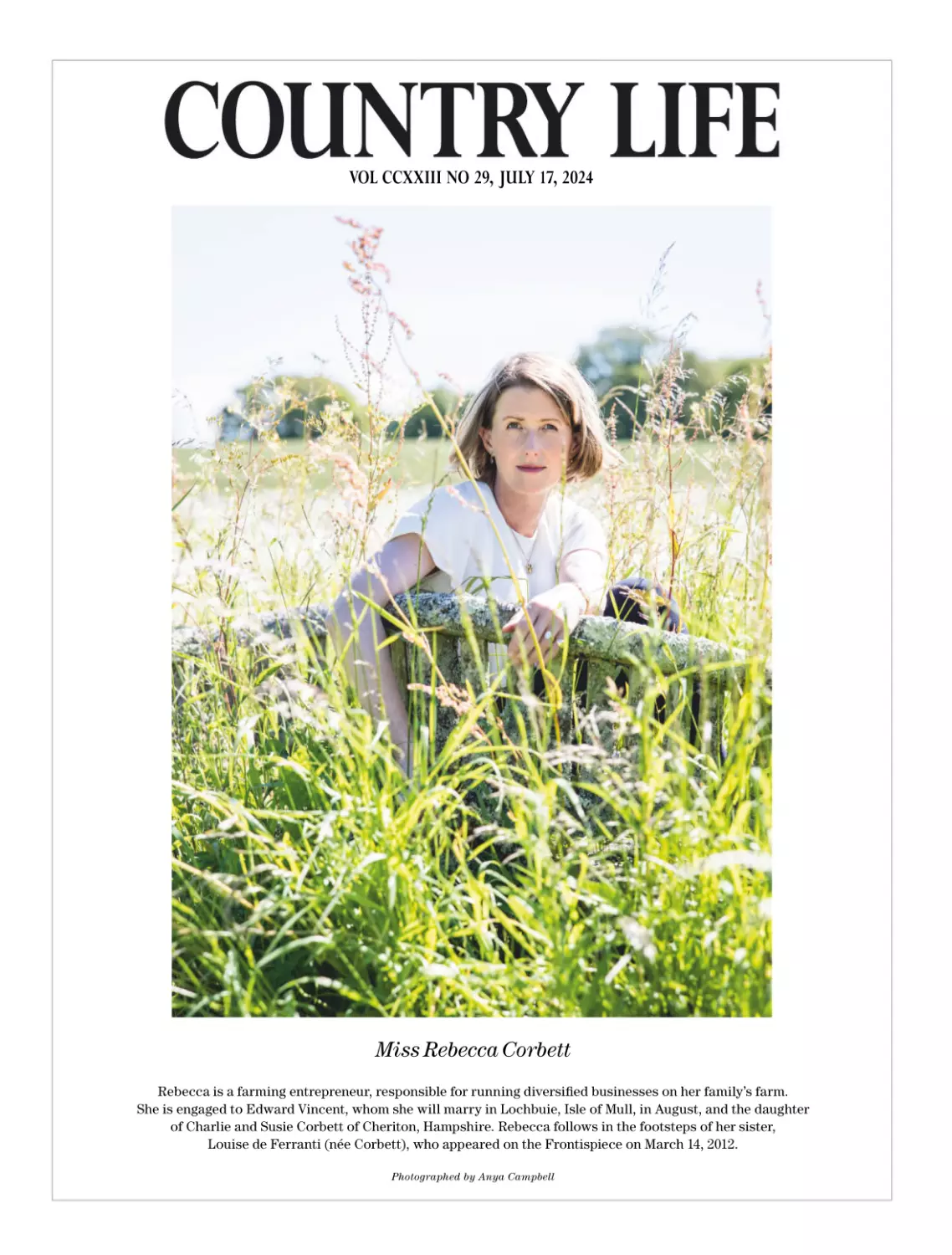
Miss Rebecca Corbett
Rebecca is a farming entrepreneur, responsible for running diversified businesses on her family’s farm.
She is engaged to Edward Vincent, whom she will marry in Lochbuie, Isle of Mull, in August, and the daughter
of Charlie and Susie Corbett of Cheriton, Hampshire. Rebecca follows in the footsteps of her sister,
Louise de Ferranti (née Corbett), who appeared on the Frontispiece on March 14, 2012.
Photographed by Anya Campbell
Contents July 17, 2024
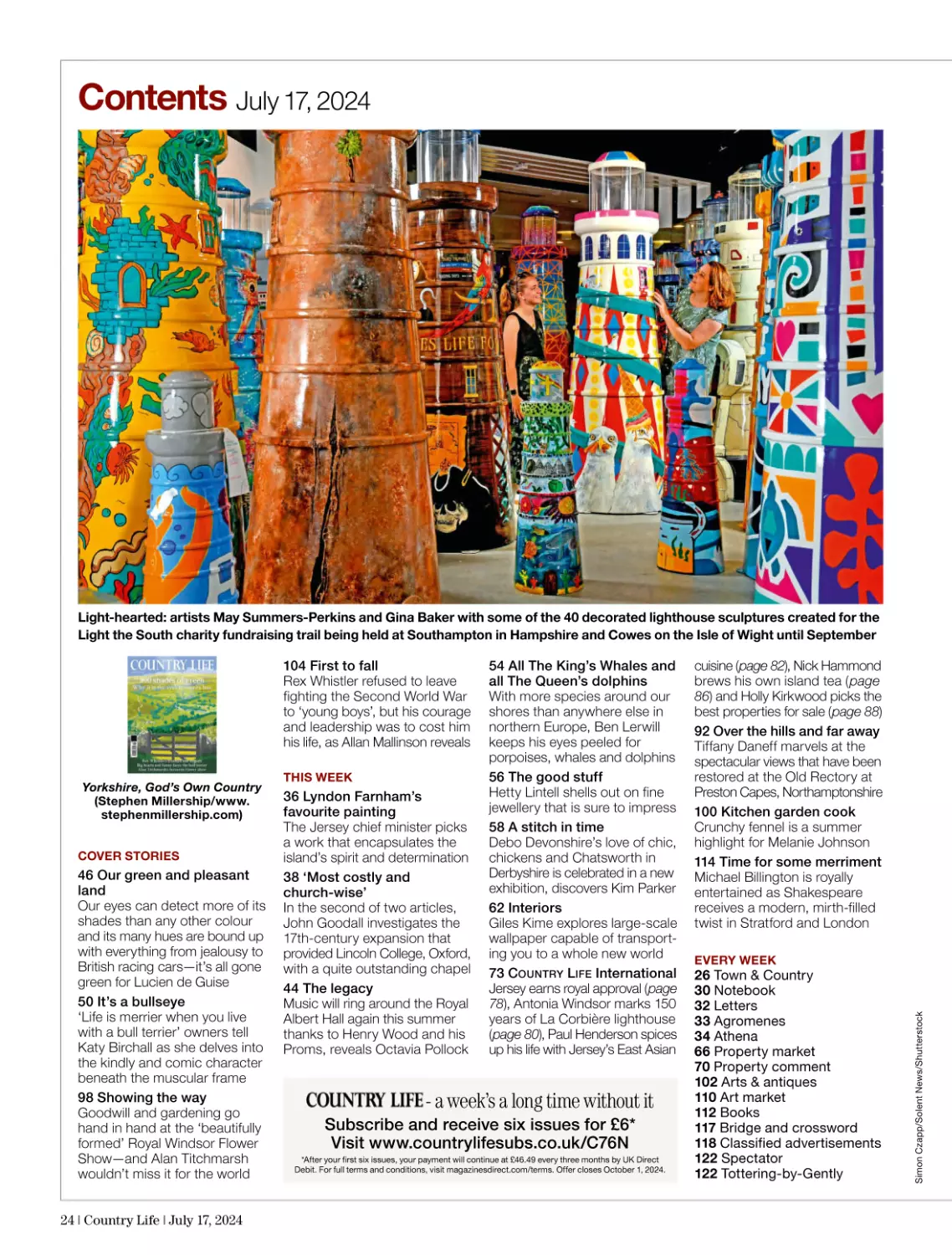
Light-hearted: artists May Summers-Perkins and Gina Baker with some of the 40 decorated lighthouse sculptures created for the
Light the South charity fundraising trail being held at Southampton in Hampshire and Cowes on the Isle of Wight until September
Yorkshire, God’s Own Country
(Stephen Millership/www.
stephenmillership.com)
COVER STORIES
46 Our green and pleasant
land
Our eyes can detect more of its
shades than any other colour
and its many hues are bound up
with everything from jealousy to
British racing cars—it’s all gone
green for Lucien de Guise
50 It’s a bullseye
‘Life is merrier when you live
with a bull terrier’ owners tell
Katy Birchall as she delves into
the kindly and comic character
beneath the muscular frame
98 Showing the way
Goodwill and gardening go
hand in hand at the ‘beautifully
formed’ Royal Windsor Flower
Show—and Alan Titchmarsh
wouldn’t miss it for the world
24 | Country Life | July 17, 2024
THIS WEEK
36 Lyndon Farnham’s
favourite painting
The Jersey chief minister picks
a work that encapsulates the
island’s spirit and determination
38 ‘Most costly and
church-wise’
In the second of two articles,
John Goodall investigates the
17th-century expansion that
provided Lincoln College, Oxford,
with a quite outstanding chapel
44 The legacy
Music will ring around the Royal
Albert Hall again this summer
thanks to Henry Wood and his
Proms, reveals Octavia Pollock
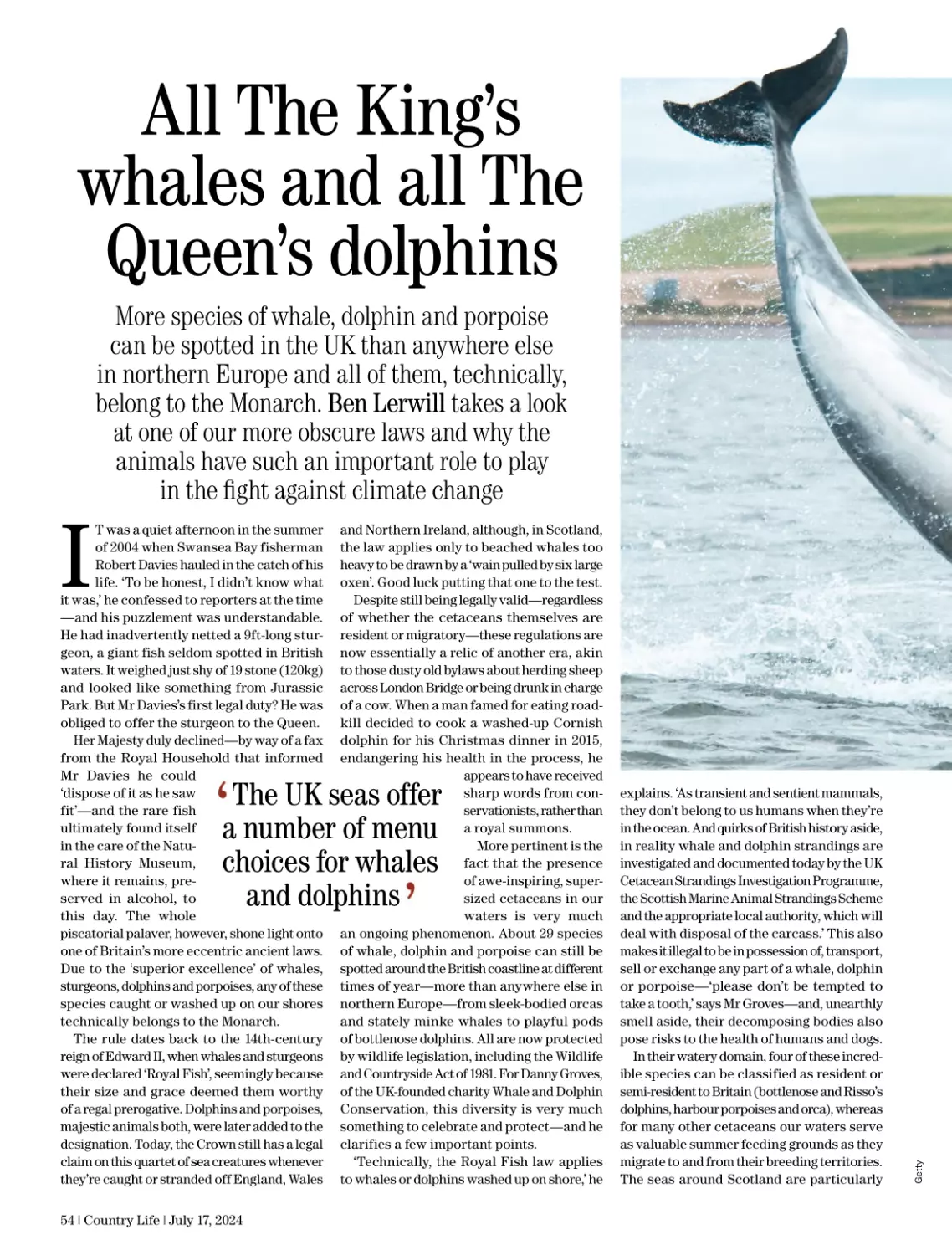
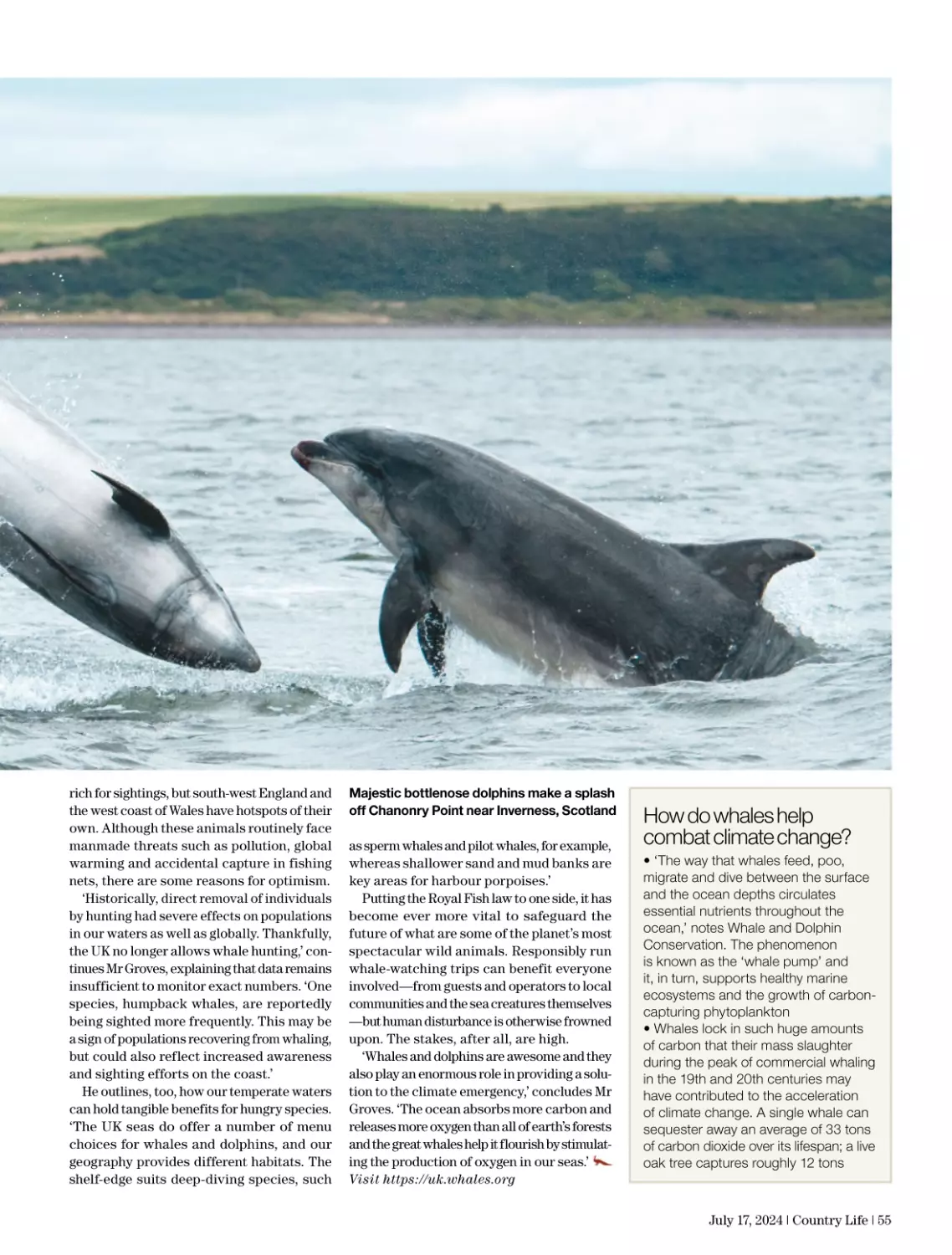
54 All The King’s Whales and
all The Queen’s dolphins
With more species around our
shores than anywhere else in
northern Europe, Ben Lerwill
keeps his eyes peeled for
porpoises, whales and dolphins
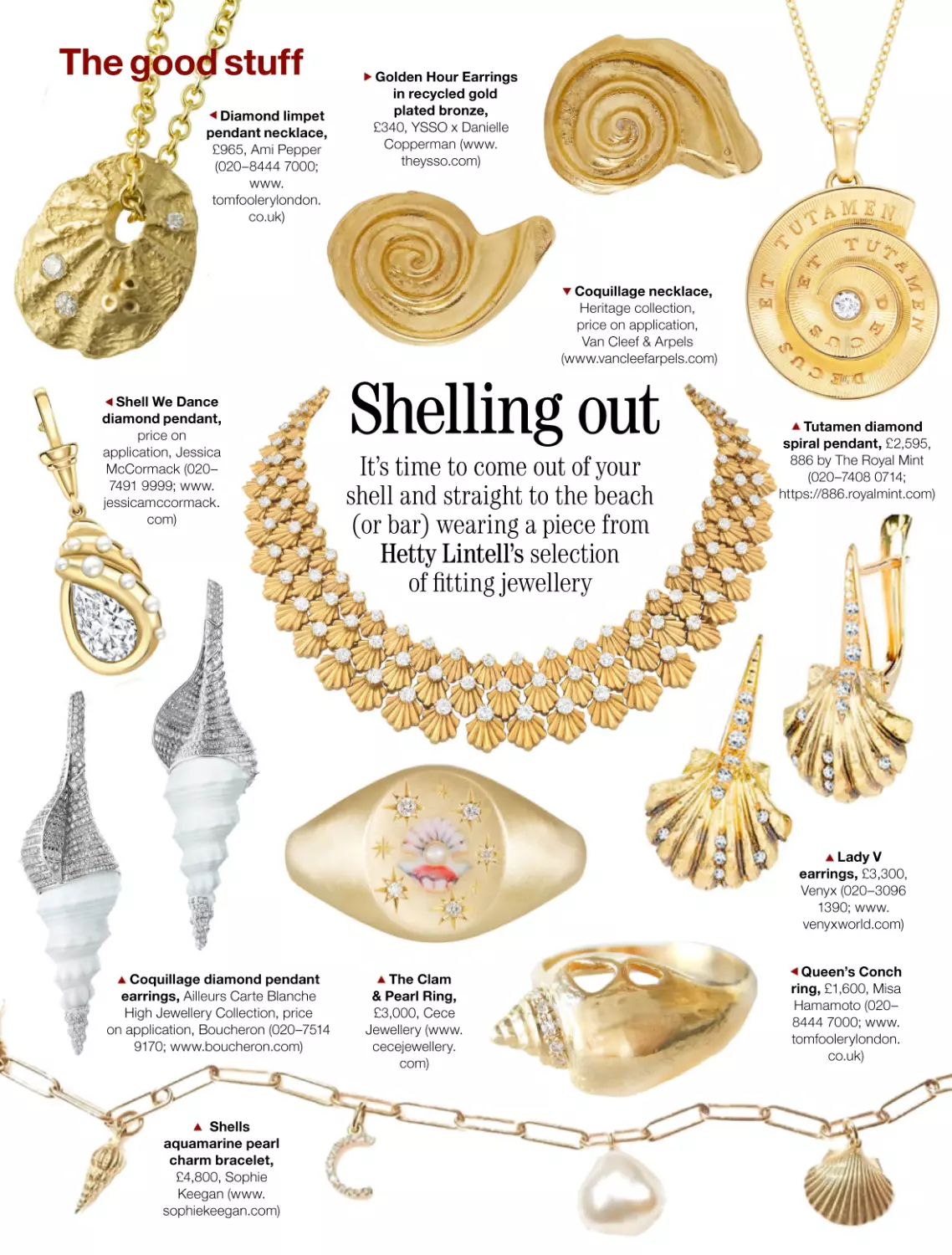
56 The good stuff
Hetty Lintell shells out on fine
jewellery that is sure to impress
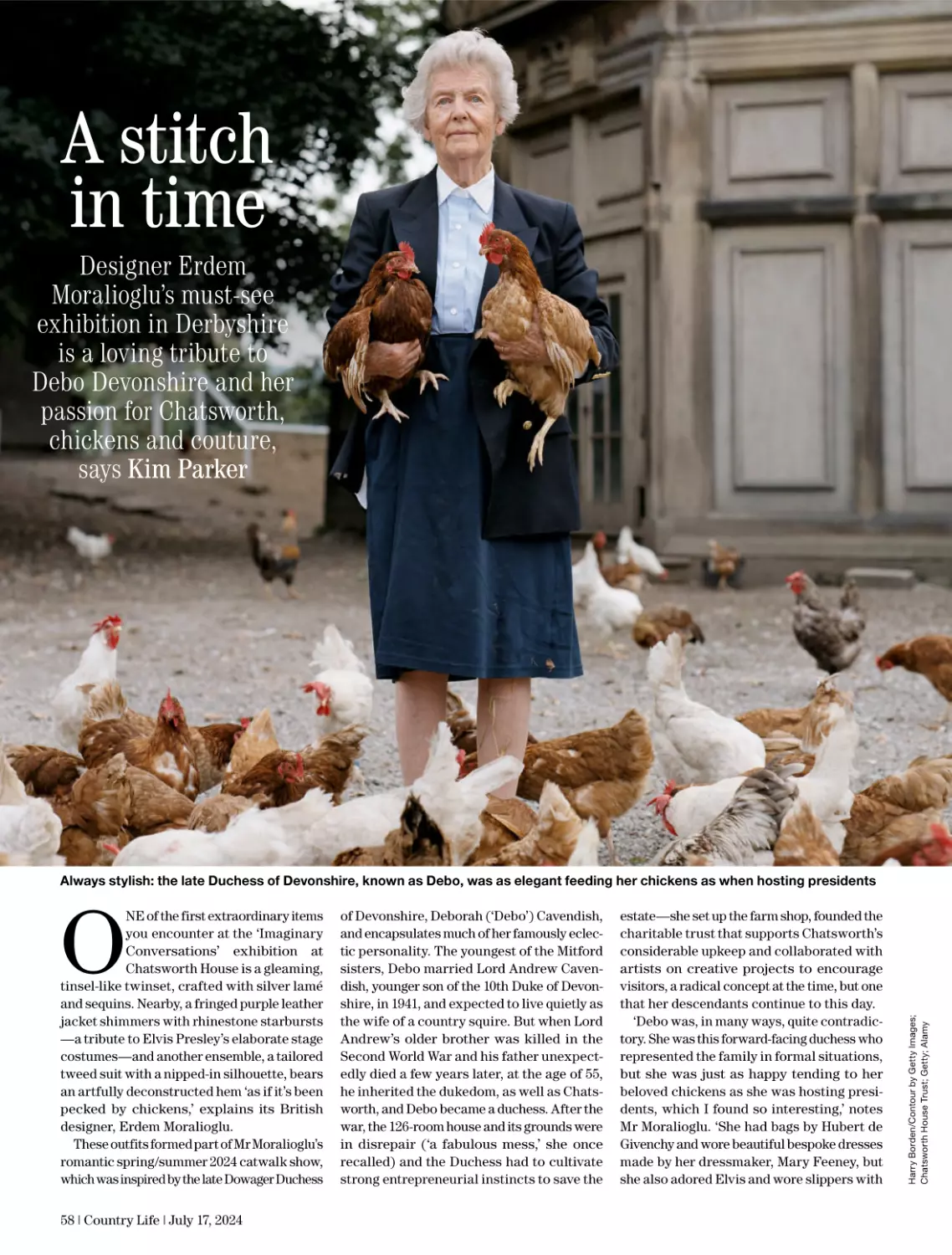
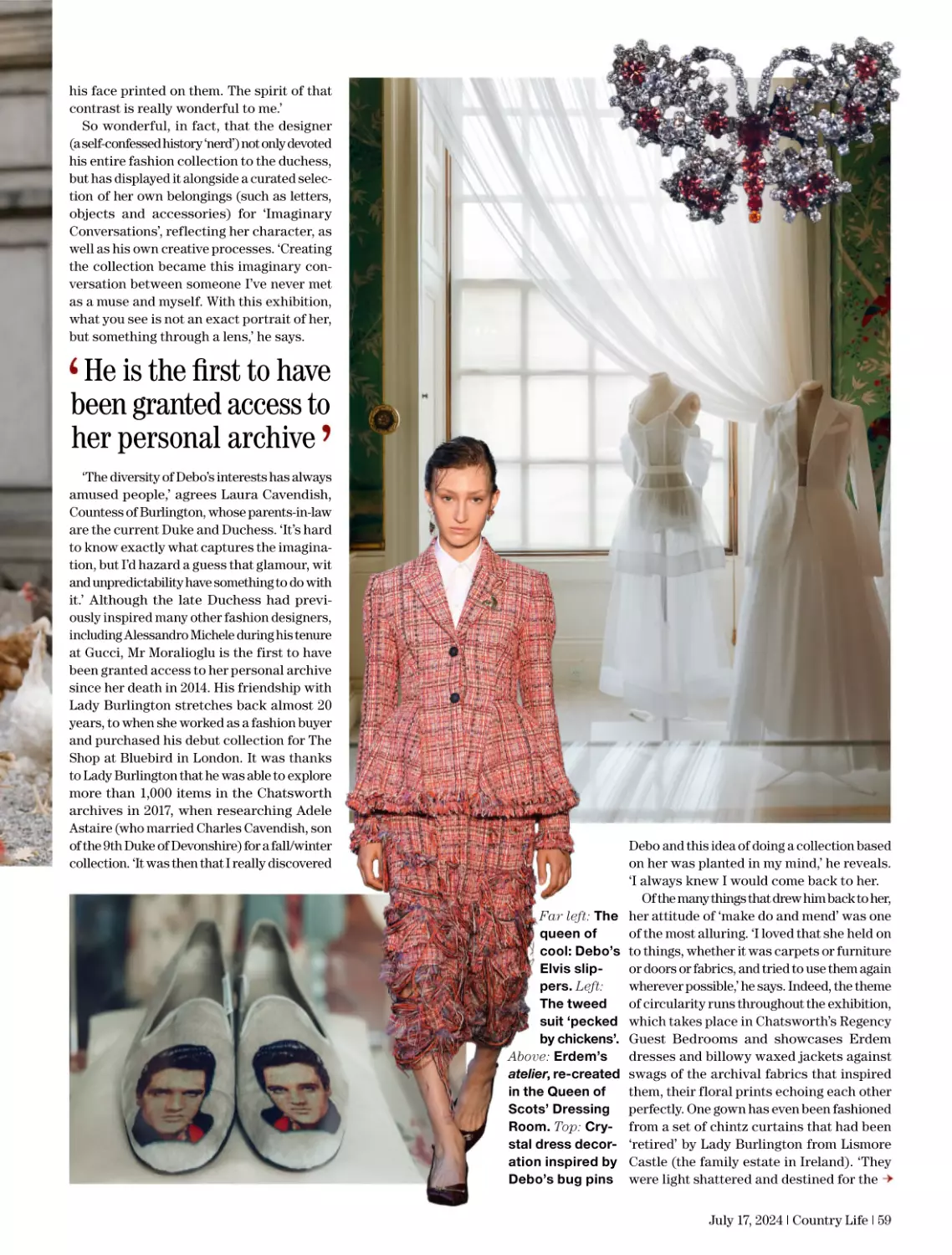
58 A stitch in time
Debo Devonshire’s love of chic,
chickens and Chatsworth in
Derbyshire is celebrated in a new
exhibition, discovers Kim Parker
62 Interiors
Giles Kime explores large-scale
wallpaper capable of transporting you to a whole new world
73 COUNTRY LIFE International
Jersey earns royal approval (page
78), Antonia Windsor marks 150
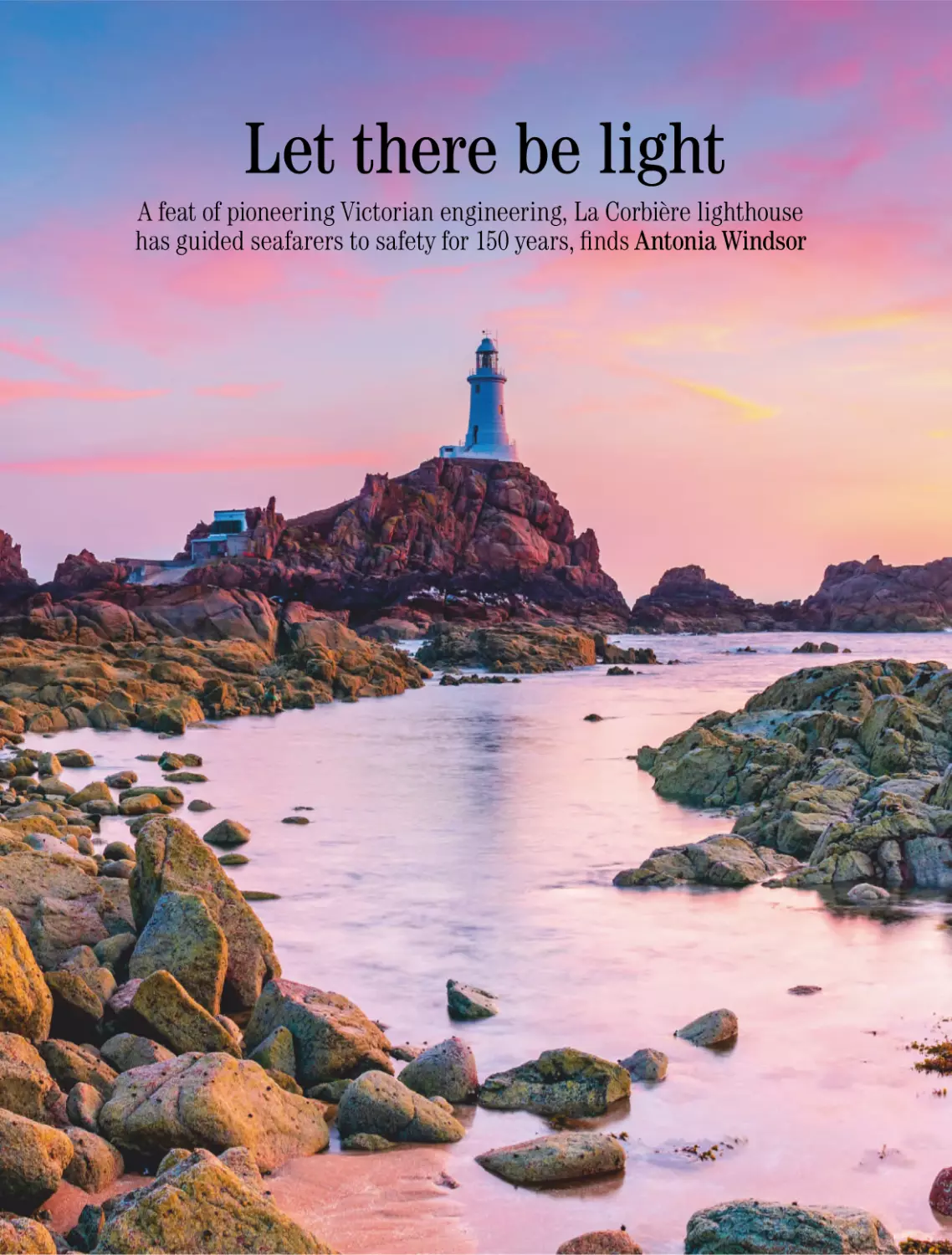
years of La Corbière lighthouse
(page 80), Paul Henderson spices
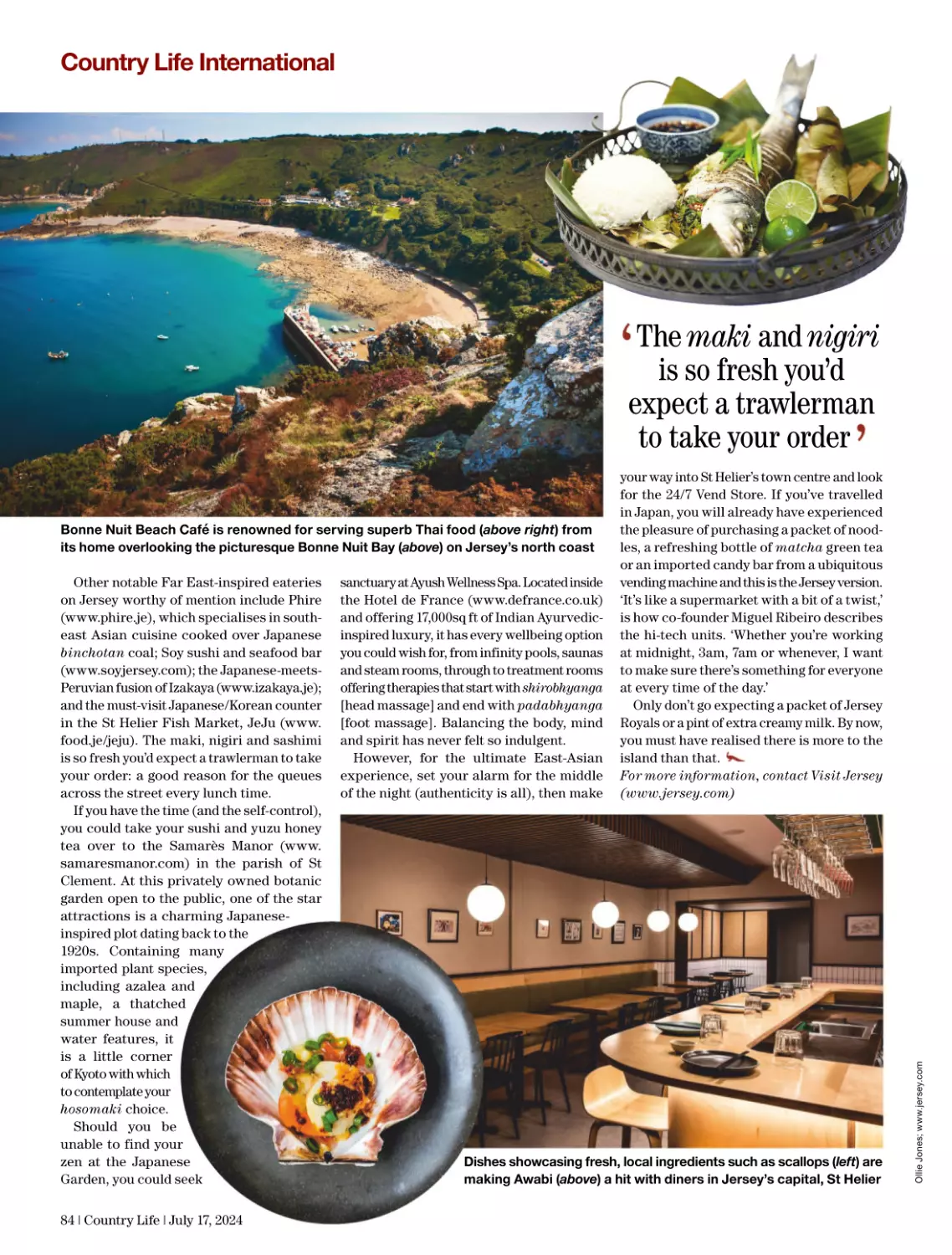
up his life with Jersey’s East Asian
- a week’s a long time without it
Subscribe and receive six issues for £6*
Visit www.countrylifesubs.co.uk/C76N
*After your first six issues, your payment will continue at £46.49 every three months by UK Direct
Debit. For full terms and conditions, visit magazinesdirect.com/terms. Offer closes October 1, 2024.
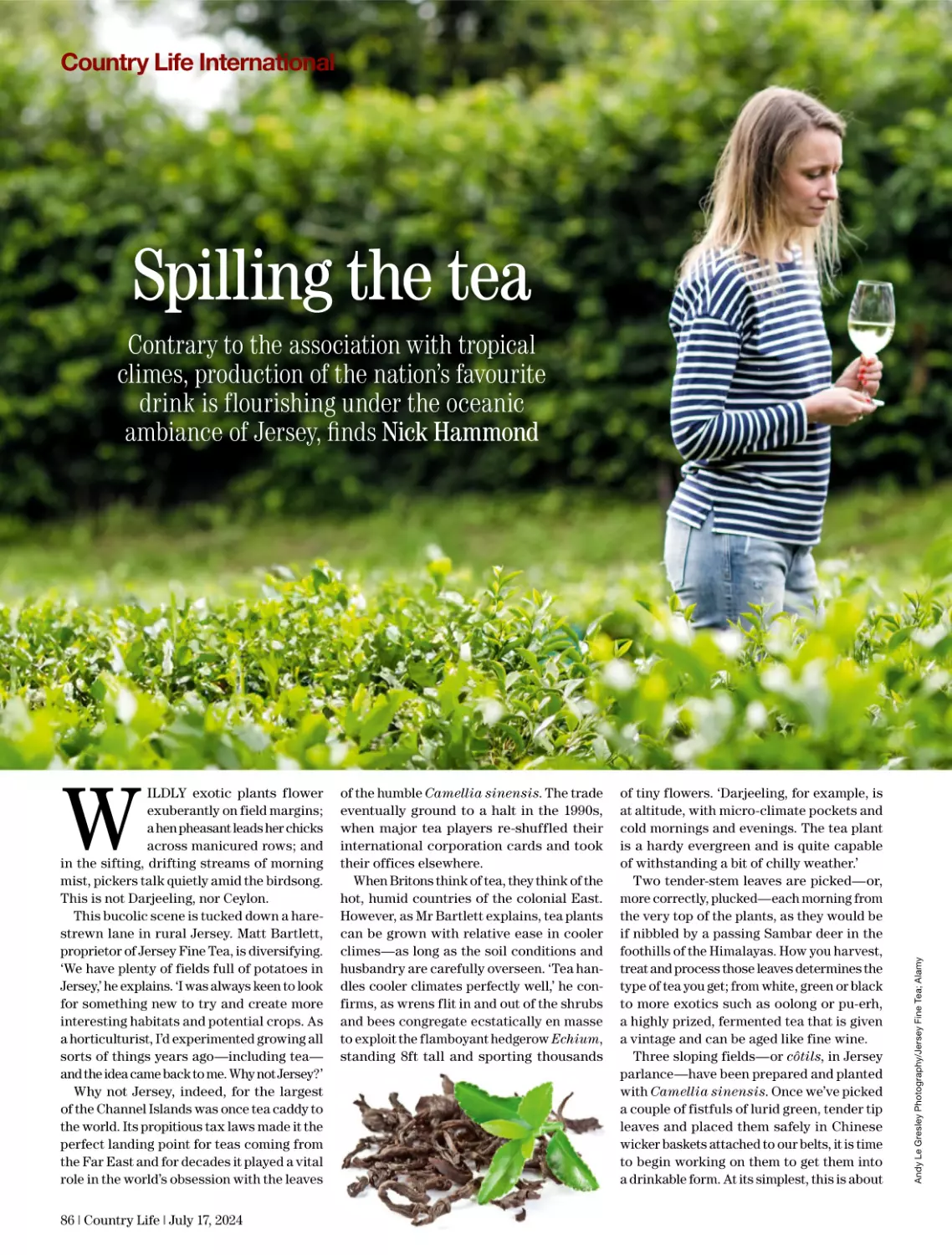
cuisine (page 82), Nick Hammond
brews his own island tea (page
86) and Holly Kirkwood picks the
best properties for sale (page 88)
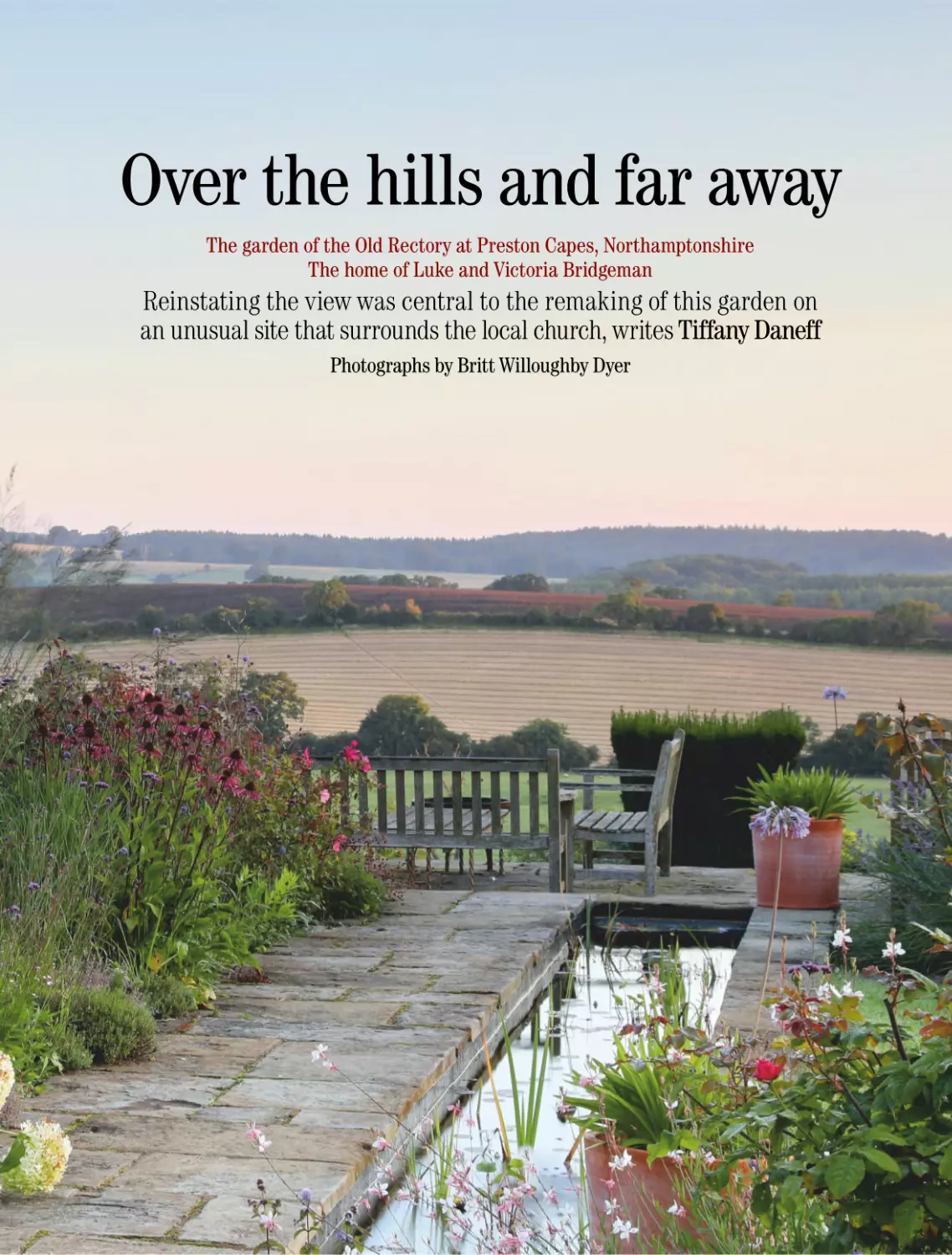
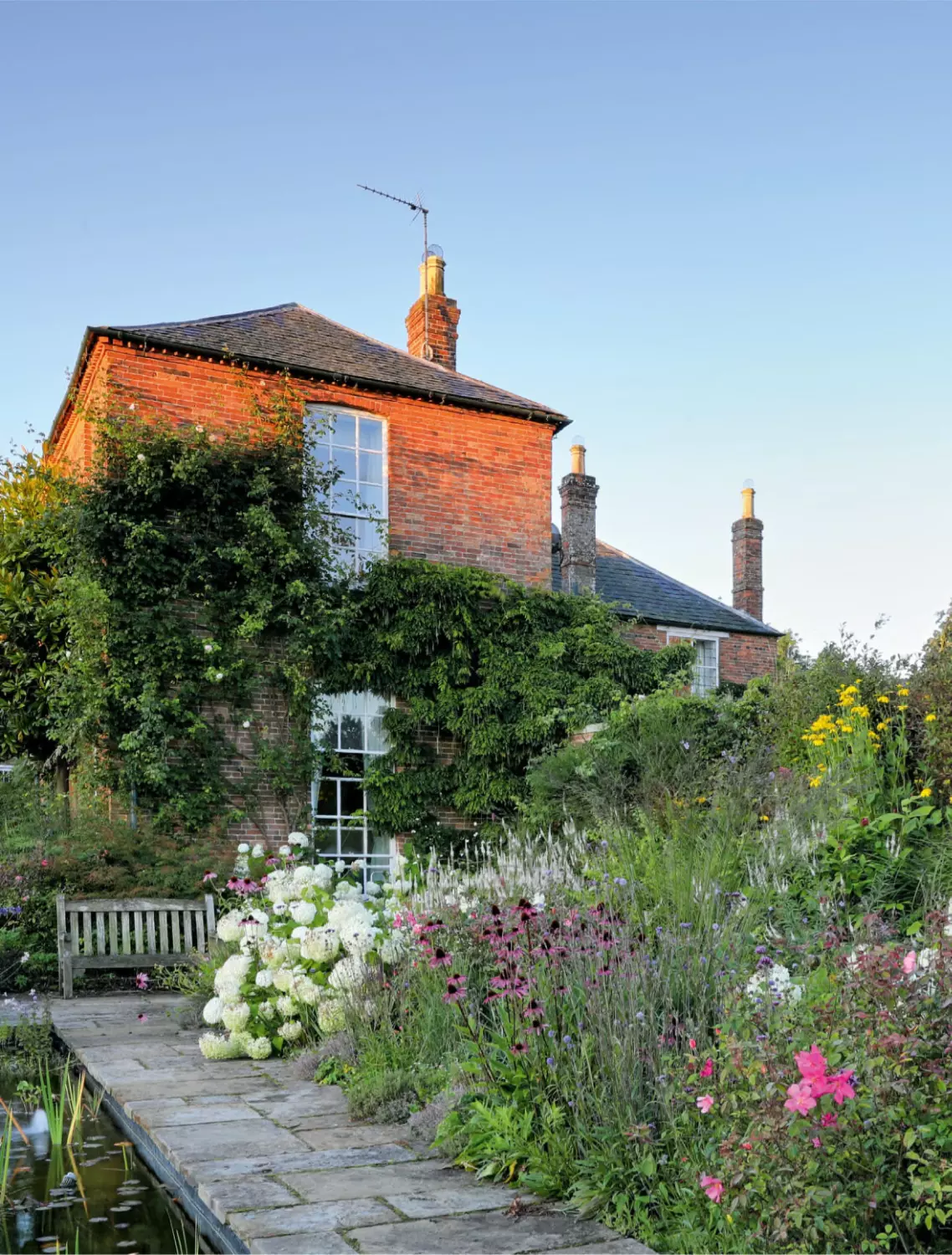
92 Over the hills and far away
Tiffany Daneff marvels at the
spectacular views that have been
restored at the Old Rectory at
Preston Capes, Northamptonshire
100 Kitchen garden cook
Crunchy fennel is a summer
highlight for Melanie Johnson
114 Time for some merriment
Michael Billington is royally
entertained as Shakespeare
receives a modern, mirth-filled
twist in Stratford and London
EVERY WEEK
26 Town & Country
30 Notebook
32 Letters
33 Agromenes
34 Athena
66 Property market
70 Property comment
102 Arts & antiques
110 Art market
112 Books
117 Bridge and crossword
118 Classified advertisements
122 Spectator
122 Tottering-by-Gently
Simon Czapp/Solent News/Shutterstock
104 First to fall
Rex Whistler refused to leave
fighting the Second World War
to ‘young boys’, but his courage
and leadership was to cost him
his life, as Allan Mallinson reveals
Future Publishing Ltd, 121–141 Westbourne Terrace, Paddington, London W2 6JR
0330 390 6591; www.countrylife.co.uk
Choose your battles
ACHEL REEVES, our new
Chancellor, didn’t exactly say
‘Look out, Nimbys’—not in public,
anyway—in her first speech.
However, what she did warn, on the subject
of planning, was: ‘The answer cannot always
be no.’ Ms Reeves has previously described
England’s complex and turgid planning
system as ‘the graveyard of economic ambition’; if her party is to fulfil its manifesto
pledge of 1.5 million new homes by the end
of Parliament, things will certainly have to
speed up (Property comment, page 70).
Already, the new Labour Government
has tweaked the National Planning Policy
Framework that barred onshore wind
development to facilitate its manifesto
promise to double the number of turbines.
These are currently part of the scenery in
many (less populated) rural landscapes
in Europe, as well as in Wales and Scotland,
and they have increased in size since the
R
PPA Front Cover of the Year 2023
Property Magazine of the Year 2022,
Property Press Awards
PPA Magazine Brand of the Year 2019
PPA Front Cover of the Year 2018
British Society of Magazine Editors Columnist
of the Year (Special Interest) 2016
British Society of Magazine Editors Scoop
of the Year 2015/16
PPA Specialist Consumer Magazine
of the Year 2014/15
British Society of Magazine Editors
Innovation of the Year 2014/15
arguments began. The number of solar
panels—currently the subject of anguished
protest in Oxfordshire and Wiltshire—
is set to be trebled. Green Belt land—13%
of England—will no longer be sacrosanct.
Yet, at the same time, Labour’s manifesto
pledges include three new National Forests,
nine National River Walks, the planting
of ‘millions’ of trees and the expansion of
peatlands and wetlands.
There is no doubt that reassessment of the
green belt is well overdue—some of it is
hardly green any more—and we desperately
need more houses and newer infrastructure in what politicians call ‘the right
places’. Yet, although the Prime Minister
correctly suggests that the ‘ugly bits’ can
be built on, what will be the criteria for ugliness? One man’s wasteland may be another’s
secret haven. Will permitted development
come down to an invidious beauty parade?
Most conservation charities believe that
Editorial
Editor-in-Chief
Mark Hedges
News & Property Editor
Annunciata Elwes 3961
everyone should live within reach of some
sort of green space—the CPRE, which
advocates ‘land recycling’, describes the
green belt as ‘the countryside next door for
30 million people in towns and cities’—and
the fact that biodiversity does not thrive in
isolation is sinking in, hence the regularly
bandied-about phrase ‘wildlife corridor’.
Increasingly, however, wildlife itself does
not recognise boundaries, as otters and
foxes colonise cities.
It is easy to poke fun at the efforts
of ‘Nimbys’, but there is surely a streak
of Nimbyism in all of us or, at the very least,
a silent, vaguely guilty gratitude to those persistent people who make the effort to object
to potential desecration. New MPs may find
loyalties tested, torn between constituency
pleas and Government policy. Seasoned
objectors may need to choose their battles,
deciding what they can live with and what
they cannot—heads versus hearts.
*V\U[Y`3PML7PJ[\YL3PIYHY`
Editorial Enquiries
Lifestyle and Travel Editor
Rosie Paterson 6591
Content & Permissions
,_LJ\[P]L
Cindie Johnston 6538
Editor’s PA/Editorial Assistant
Amie Elizabeth White 6102
3\_\Y`,KP[VY
/L[[`3PU[LSS07984 178307
*SHYL+V]L
Telephone numbers are
WYLÄ_LKI`0330 390
Head of Design
+LHU<ZOLY
Emails are
name.surname@futurenet.com
Senior Art Editor
Emma Earnshaw
(K]LY[PZLTLU[KPYLJ[VY
HUK*SHZZPÄLK
2H[L)HYUÄLSK 07817 629935
Deputy Editor
Kate Green 4171
Deputy Art Editor
Heather Clark
Managing & Features Editor
Paula Lester 6426
Senior Designer
Ben Harris
Architectural Editor
John Goodall
Picture Editor
3\J`-VYK 4072
Gardens Editor
;PɈHU`+HULɈ6115
Acting Deputy Picture Editor
,TTH+H]PZ
,_LJ\[P]L,KP[VYHUK0U[LYPVYZ
Giles Kime 6047
Chief Sub-Editor
6J[H]PH7VSSVJR 6605
Deputy Features Editor
Victoria Marston 6446
Senior Sub-Editor
Stuart Martel
(K]LY[PZPUNHUK
*SHZZPÄLK7YVK\J[PVU
Stephen Turner 6613
Assistant Features Editor
Agnes Stamp
Digital Editor
;VI`2LLS
Senior Ad Production Manager
1V*YVZI` 6204
Art and Antiques Editor
Carla Passino
(carla.passinobargioni@
futurenet.com)
Deputy Digital Editor
1HTLZ-PZOLY 4058
Property Correspondent
7LUU`*O\YJOPSS
0UZLY[Z*HUVW`4LKPH
020–4517 1430;
paloma.walder@canopymedia.co.uk
Back issues
www.magazinesdirect.com
;VÄUKV\[TVYLJVU[HJ[\Z
at licensing@futurenet.com or
view our available content at
www.futurecontenthub.com
Commercial director
(K]LY[PZPUN7YVWLY[`
3\J`2OVZSH 07583 106990
0U[LYUH[PVUHS7YVWLY[`
Scarlett Glendenning
07938 735212
3\_\Y`
Katie Ruocco 07929 364909
0U[LYPVYZ;YH]LS
,TTH/PSL`07581 009998
Art & Antiques
Head of Print Licensing
Rachel Shaw
Circulation Manager
4H[[OL^+L3PTH
Production
Group Production Manager
5PNLS+H]PLZ
Management
Senior Vice President Women’s
HUK3\_\Y`
/PSSHY`2LYY
Managing Director
Malcolm Young
Julia Laurence 07971 923054
7YPU[LKI` Walstead UK
Subscription enquiries
0330 333 1120
www.magazinesdirect.com
July 17, 2024 | Country Life | 25
Town & Country
Annunciata Elwes
Nature’s siege of Corfe
HE National Trust has launched
a £2 million conservation project
at Corfe Castle, Dorset. Over the
next three years, specialists will
remove vegetation and restore the walls
of the castle, which dates back to the 11th
century, including its nine towers, keep and
26ft-high curtain wall. Most work will be
carried out by specialists hanging from ropes
high above the ground, particularly precarious as the castle is perched on a steep-sided
hill rising 180ft above the valley.
Corfe Castle is considered structurally
stable, but extreme weather has caused
stones to loosen and fall. Heat and drought
have dried out the stone and killed vegetation,
causing roots to shrink, creating gaps. Subsequently, warm, wet winters have encouraged plant growth, often deep within the walls.
It is hoped that the removal of vegetation will
also reveal parts of the castle not seen for
more than a century. Some 30 years ago, part
of an arch was glimpsed through ivy and
T
26 | Country Life | July 17, 2024
rubble at the base of the east turret—project
manager Christina Newnham believes this
could be the famous sallyport, the gateway
through which parliamentary troops were
let in during the 1645 siege, which led to the
castle’s capture and ruin. ‘It is a really significant part of the castle’s history and we
would like to find it if we can,’ she says.
As the castle was built in different phases,
various types of mortar have been used. Conservationists have thus developed ‘recipe
books’ for mortar mixes that mimic the
originals, ‘sourcing aggregates from across
Purbeck as the original castle builders did,’
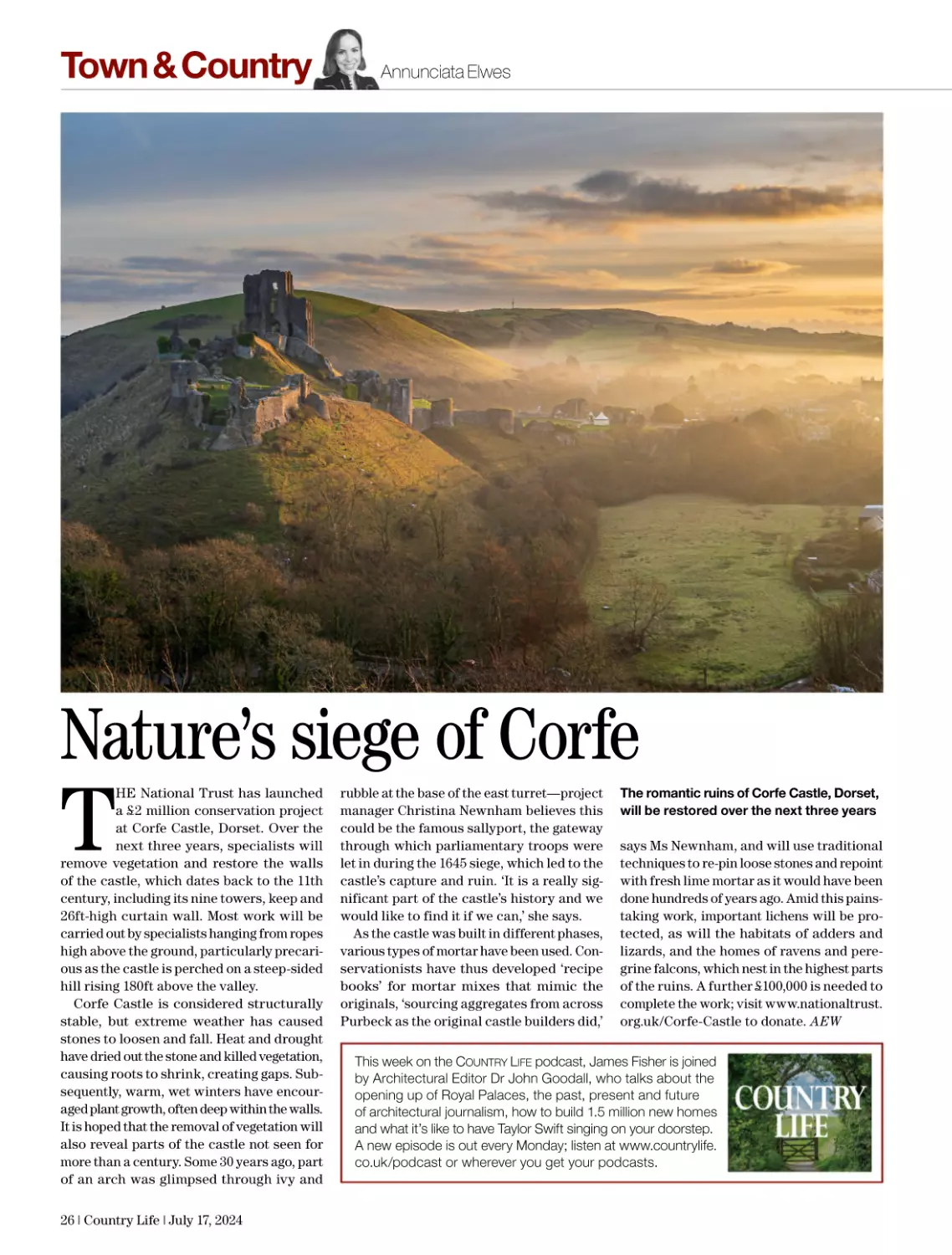
The romantic ruins of Corfe Castle, Dorset,
will be restored over the next three years
says Ms Newnham, and will use traditional
techniques to re-pin loose stones and repoint
with fresh lime mortar as it would have been
done hundreds of years ago. Amid this painstaking work, important lichens will be protected, as will the habitats of adders and
lizards, and the homes of ravens and peregrine falcons, which nest in the highest parts
of the ruins. A further £100,000 is needed to
complete the work; visit www.nationaltrust.
org.uk/Corfe-Castle to donate. AEW
This week on the COUNTRY LIFE podcast, James Fisher is joined
by Architectural Editor Dr John Goodall, who talks about the
opening up of Royal Palaces, the past, present and future
of architectural journalism, how to build 1.5 million new homes
and what it’s like to have Taylor Swift singing on your doorstep.
A new episode is out every Monday; listen at www.countrylife.
co.uk/podcast or wherever you get your podcasts.
For all the latest news, visit countrylife.co.uk
Good week for
A little seasoning
Two Kunekune pigs, Salt
and Pepper, have been
introduced to Gunnersbury
Park, west London, to help
maintain the land; they will
live in moveable pens, feeding on brambles and scrub
Park life
A 28-acre country park, partly built
on the former Shoreham landfill site
in West Sussex, has opened after
‘extensive refurbishment’, with waterways, grasslands and 340 new trees
The National Gallery
The Trafalgar Square institution has
reached its bicentenary fundraising
campaign target of £95 million, the
largest in the gallery’s history
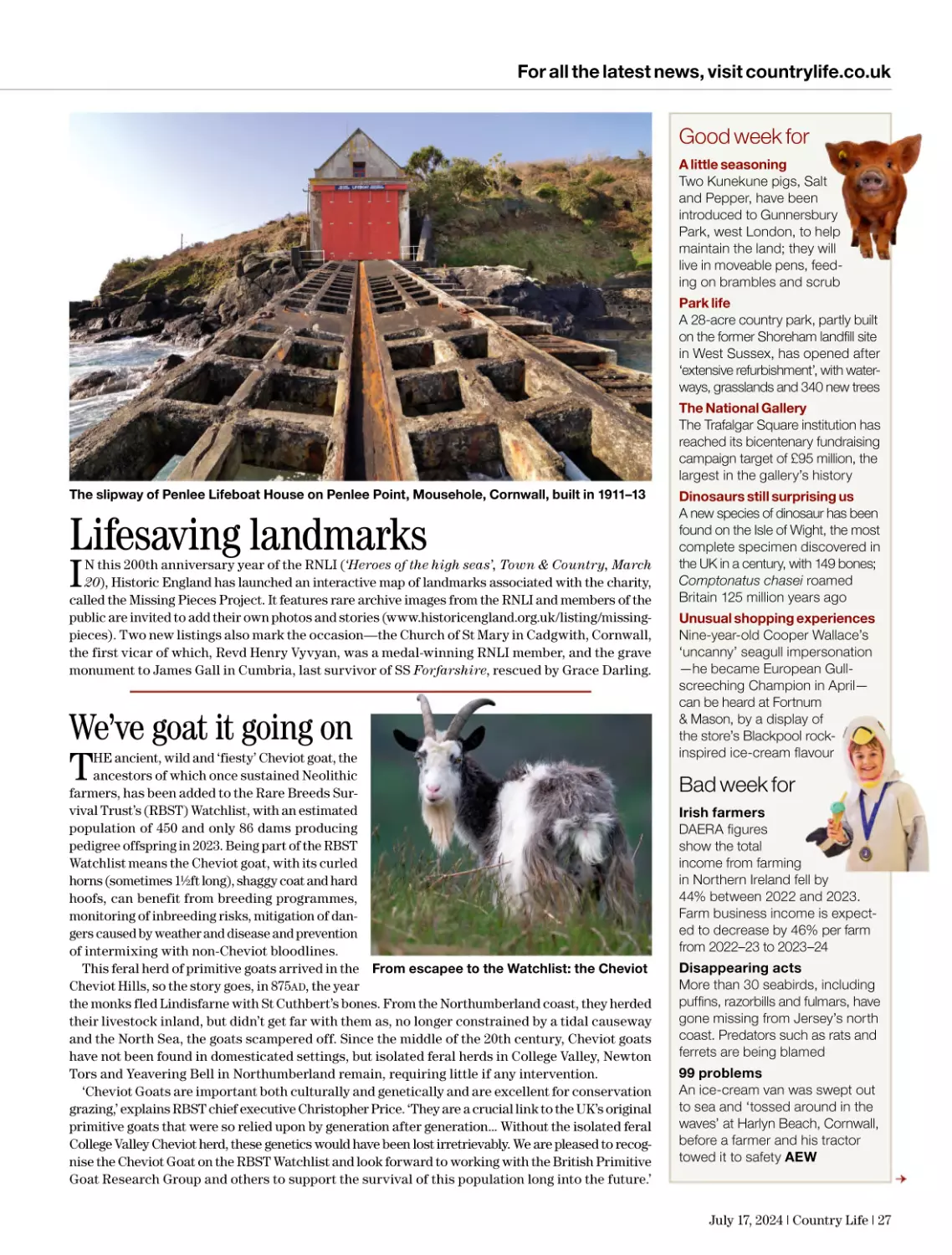
The slipway of Penlee Lifeboat House on Penlee Point, Mousehole, Cornwall, built in 1911–13
Lifesaving landmarks
N this 200th anniversary year of the RNLI (‘Heroes of the high seas’, Town & Country, March
20), Historic England has launched an interactive map of landmarks associated with the charity,
called the Missing Pieces Project. It features rare archive images from the RNLI and members of the
public are invited to add their own photos and stories (www.historicengland.org.uk/listing/missingpieces). Two new listings also mark the occasion—the Church of St Mary in Cadgwith, Cornwall,
the first vicar of which, Revd Henry Vyvyan, was a medal-winning RNLI member, and the grave
monument to James Gall in Cumbria, last survivor of SS Forfarshire, rescued by Grace Darling.
I
We’ve goat it going on
HE ancient, wild and ‘fiesty’ Cheviot goat, the
ancestors of which once sustained Neolithic
farmers, has been added to the Rare Breeds Survival Trust’s (RBST) Watchlist, with an estimated
population of 450 and only 86 dams producing
pedigree offspring in 2023. Being part of the RBST
Watchlist means the Cheviot goat, with its curled
horns (sometimes 1½ft long), shaggy coat and hard
hoofs, can benefit from breeding programmes,
monitoring of inbreeding risks, mitigation of dangers caused by weather and disease and prevention
of intermixing with non-Cheviot bloodlines.
This feral herd of primitive goats arrived in the From escapee to the Watchlist: the Cheviot
Cheviot Hills, so the story goes, in 875AD, the year
the monks fled Lindisfarne with St Cuthbert’s bones. From the Northumberland coast, they herded
their livestock inland, but didn’t get far with them as, no longer constrained by a tidal causeway
and the North Sea, the goats scampered off. Since the middle of the 20th century, Cheviot goats
have not been found in domesticated settings, but isolated feral herds in College Valley, Newton
Tors and Yeavering Bell in Northumberland remain, requiring little if any intervention.
‘Cheviot Goats are important both culturally and genetically and are excellent for conservation
grazing,’ explains RBST chief executive Christopher Price. ‘They are a crucial link to the UK’s original
primitive goats that were so relied upon by generation after generation... Without the isolated feral
College Valley Cheviot herd, these genetics would have been lost irretrievably. We are pleased to recognise the Cheviot Goat on the RBST Watchlist and look forward to working with the British Primitive
Goat Research Group and others to support the survival of this population long into the future.’
T
Dinosaurs still surprising us
A new species of dinosaur has been
found on the Isle of Wight, the most
complete specimen discovered in
the UK in a century, with 149 bones;
Comptonatus chasei roamed
Britain 125 million years ago
Unusual shopping experiences
Nine-year-old Cooper Wallace’s
‘uncanny’ seagull impersonation
—he became European Gullscreeching Champion in April—
can be heard at Fortnum
& Mason, by a display of
the store’s Blackpool rockinspired ice-cream flavour
Bad week for
Irish farmers
DAERA figures
show the total
income from farming
in Northern Ireland fell by
44% between 2022 and 2023.
Farm business income is expected to decrease by 46% per farm
from 2022–23 to 2023–24
Disappearing acts
More than 30 seabirds, including
puffins, razorbills and fulmars, have
gone missing from Jersey’s north
coast. Predators such as rats and
ferrets are being blamed
99 problems
An ice-cream van was swept out
to sea and ‘tossed around in the
waves’ at Harlyn Beach, Cornwall,
before a farmer and his tractor
towed it to safety AEW
July 17, 2024 | Country Life | 27
Town & Country
Dog’s dinner
White
magic
Bon appetite: A Maltese at the
dinner table (below) by Charles
van den Eycken (estimate £4,000–
£6,000) is among 261 lots in
Bonhams’s The Dog Sale on
July 24. Other highlights include
a portrait of Rufford Ormonde,
the sheepdog (owned by American financier John Pierpont
Morgan) who rescued a woman
from drowning in 1897 (£2,000–
£3,000), and top lot Col Newport
Charlett’s Favourite Greyhounds
at Hanley Court, Worcestershire,
oil on canvas, by William Henry
Davis (£50,000–80,000)
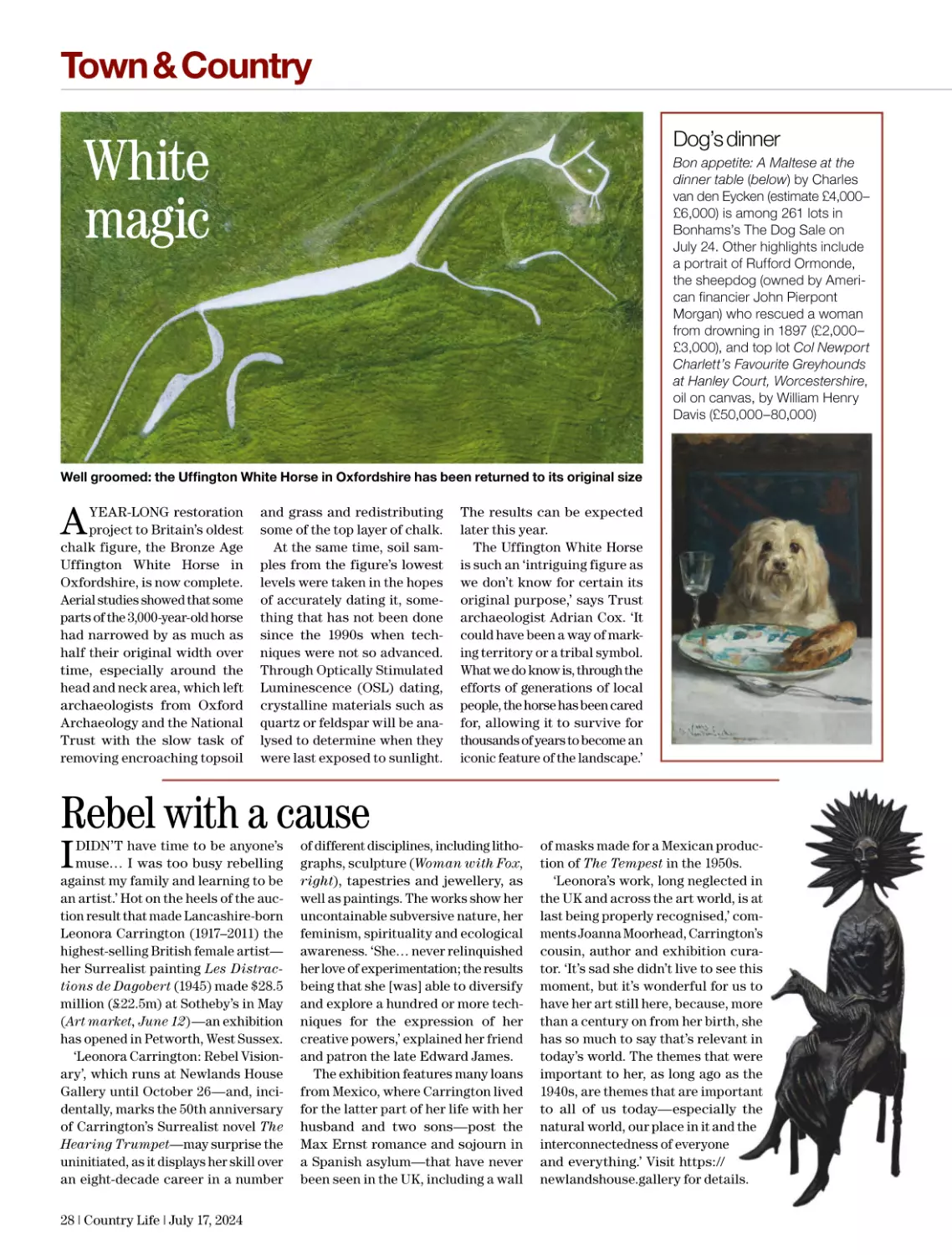
Well groomed: the Uffington White Horse in Oxfordshire has been returned to its original size
YEAR-LONG restoration
project to Britain’s oldest
chalk figure, the Bronze Age
Uffington White Horse in
Oxfordshire, is now complete.
Aerial studies showed that some
parts of the 3,000-year-old horse
had narrowed by as much as
half their original width over
time, especially around the
head and neck area, which left
archaeologists from Oxford
Archaeology and the National
Trust with the slow task of
removing encroaching topsoil
A
and grass and redistributing
some of the top layer of chalk.
At the same time, soil samples from the figure’s lowest
levels were taken in the hopes
of accurately dating it, something that has not been done
since the 1990s when techniques were not so advanced.
Through Optically Stimulated
Luminescence (OSL) dating,
crystalline materials such as
quartz or feldspar will be analysed to determine when they
were last exposed to sunlight.
The results can be expected
later this year.
The Uffington White Horse
is such an ‘intriguing figure as
we don’t know for certain its
original purpose,’ says Trust
archaeologist Adrian Cox. ‘It
could have been a way of marking territory or a tribal symbol.
What we do know is, through the
efforts of generations of local
people, the horse has been cared
for, allowing it to survive for
thousands of years to become an
iconic feature of the landscape.’
Rebel with a cause
I
DIDN’T have time to be anyone’s
muse… I was too busy rebelling
against my family and learning to be
an artist.’ Hot on the heels of the auction result that made Lancashire-born
Leonora Carrington (1917–2011) the
highest-selling British female artist—
her Surrealist painting Les Distractions de Dagobert (1945) made $28.5
million (£22.5m) at Sotheby’s in May
(Art market, June 12)—an exhibition
has opened in Petworth, West Sussex.
‘Leonora Carrington: Rebel Visionary’, which runs at Newlands House
Gallery until October 26—and, incidentally, marks the 50th anniversary
of Carrington’s Surrealist novel The
Hearing Trumpet—may surprise the
uninitiated, as it displays her skill over
an eight-decade career in a number
28 | Country Life | July 17, 2024
of different disciplines, including lithographs, sculpture (Woman with Fox,
right), tapestries and jewellery, as
well as paintings. The works show her
uncontainable subversive nature, her
feminism, spirituality and ecological
awareness. ‘She… never relinquished
her love of experimentation; the results
being that she [was] able to diversify
and explore a hundred or more techniques for the expression of her
creative powers,’ explained her friend
and patron the late Edward James.
The exhibition features many loans
from Mexico, where Carrington lived
for the latter part of her life with her
husband and two sons—post the
Max Ernst romance and sojourn in
a Spanish asylum—that have never
been seen in the UK, including a wall
of masks made for a Mexican production of The Tempest in the 1950s.
‘Leonora’s work, long neglected in
the UK and across the art world, is at
last being properly recognised,’ comments Joanna Moorhead, Carrington’s
cousin, author and exhibition curator. ‘It’s sad she didn’t live to see this
moment, but it’s wonderful for us to
have her art still here, because, more
than a century on from her birth, she
has so much to say that’s relevant in
today’s world. The themes that were
important to her, as long ago as the
1940s, are themes that are important
to all of us today—especially the
natural world, our place in it and the
interconnectedness of everyone
and everything.’ Visit https://
newlandshouse.gallery for details.
Country Mouse
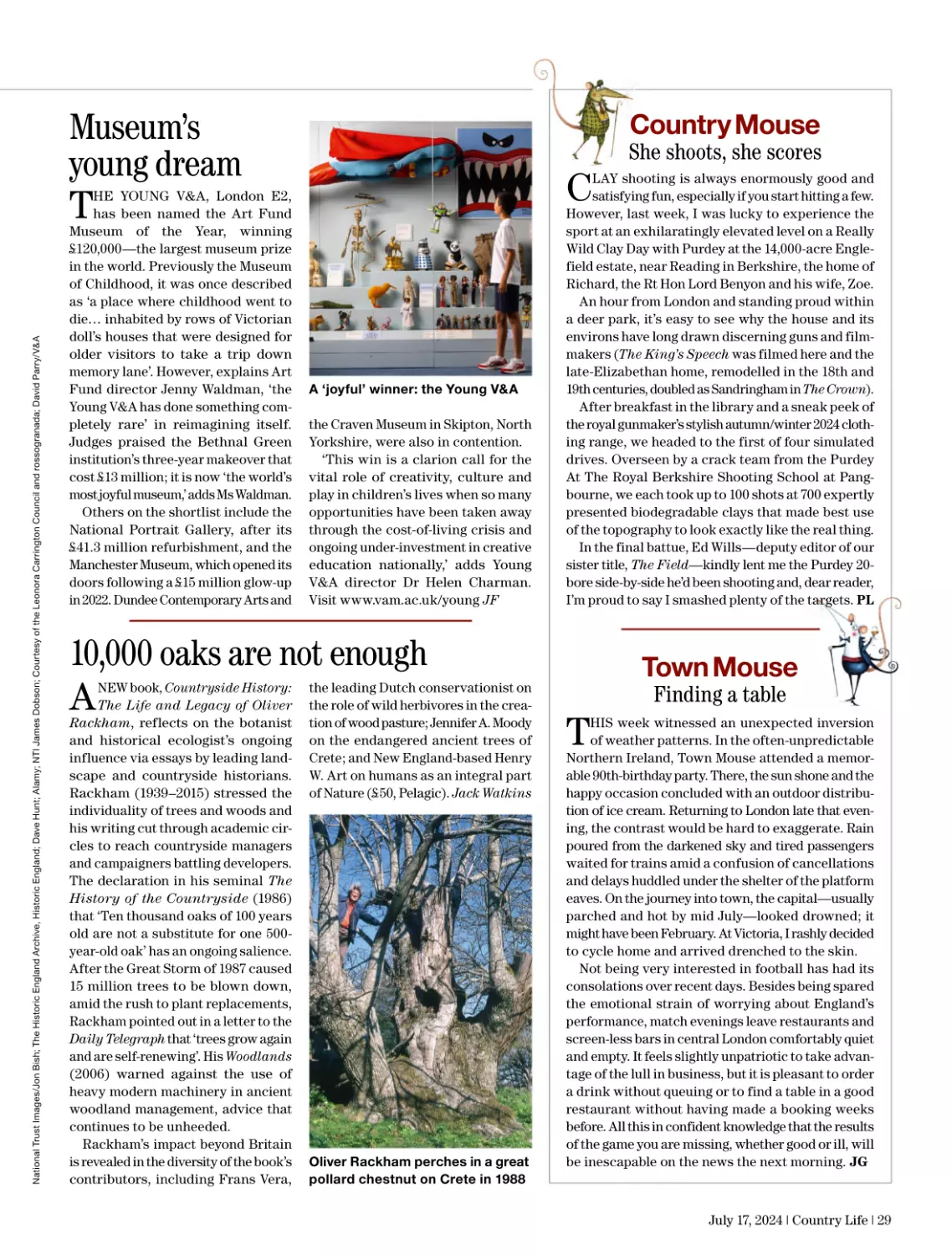
Museum’s
young dream
HE YOUNG V&A, London E2,
has been named the Art Fund
Museum of the Year, winning
£120,000—the largest museum prize
in the world. Previously the Museum
of Childhood, it was once described
as ‘a place where childhood went to
die… inhabited by rows of Victorian
doll’s houses that were designed for
older visitors to take a trip down
memory lane’. However, explains Art
Fund director Jenny Waldman, ‘the
Young V&A has done something completely rare’ in reimagining itself.
Judges praised the Bethnal Green
institution’s three-year makeover that
cost £13 million; it is now ‘the world’s
most joyful museum,’ adds Ms Waldman.
Others on the shortlist include the
National Portrait Gallery, after its
£41.3 million refurbishment, and the
Manchester Museum, which opened its
doors following a £15 million glow-up
in 2022. Dundee Contemporary Arts and
She shoots, she scores
C
T
National Trust Images/Jon Bish; The Historic England Archive, Historic England; Dave Hunt; Alamy; NTI James Dobson; Courtesy of the Leonora Carrington Council and rossogranada; David Parry/V&A
LAY shooting is always enormously good and
satisfying fun, especially if you start hitting a few.
However, last week, I was lucky to experience the
sport at an exhilaratingly elevated level on a Really
Wild Clay Day with Purdey at the 14,000-acre Englefield estate, near Reading in Berkshire, the home of
Richard, the Rt Hon Lord Benyon and his wife, Zoe.
An hour from London and standing proud within
a deer park, it’s easy to see why the house and its
environs have long drawn discerning guns and filmmakers (The King’s Speech was filmed here and the
late-Elizabethan home, remodelled in the 18th and
19th centuries, doubled as Sandringham in The Crown).
After breakfast in the library and a sneak peek of
the royal gunmaker’s stylish autumn/winter 2024 clothing range, we headed to the first of four simulated
drives. Overseen by a crack team from the Purdey
At The Royal Berkshire Shooting School at Pangbourne, we each took up to 100 shots at 700 expertly
presented biodegradable clays that made best use
of the topography to look exactly like the real thing.
In the final battue, Ed Wills—deputy editor of our
sister title, The Field—kindly lent me the Purdey 20bore side-by-side he’d been shooting and, dear reader,
I’m proud to say I smashed plenty of the targets. PL
A ‘joyful’ winner: the Young V&A
the Craven Museum in Skipton, North
Yorkshire, were also in contention.
‘This win is a clarion call for the
vital role of creativity, culture and
play in children’s lives when so many
opportunities have been taken away
through the cost-of-living crisis and
ongoing under-investment in creative
education nationally,’ adds Young
V&A director Dr Helen Charman.
Visit www.vam.ac.uk/young JF
10,000 oaks are not enough
NEW book, Countryside History:
The Life and Legacy of Oliver
Rackham, reflects on the botanist
and historical ecologist’s ongoing
influence via essays by leading landscape and countryside historians.
Rackham (1939–2015) stressed the
individuality of trees and woods and
his writing cut through academic circles to reach countryside managers
and campaigners battling developers.
The declaration in his seminal The
History of the Countryside (1986)
that ‘Ten thousand oaks of 100 years
old are not a substitute for one 500year-old oak’ has an ongoing salience.
After the Great Storm of 1987 caused
15 million trees to be blown down,
amid the rush to plant replacements,
Rackham pointed out in a letter to the
Daily Telegraph that ‘trees grow again
and are self-renewing’. His Woodlands
(2006) warned against the use of
heavy modern machinery in ancient
woodland management, advice that
continues to be unheeded.
Rackham’s impact beyond Britain
is revealed in the diversity of the book’s
contributors, including Frans Vera,
A
the leading Dutch conservationist on
the role of wild herbivores in the creation of wood pasture; Jennifer A. Moody
on the endangered ancient trees of
Crete; and New England-based Henry
W. Art on humans as an integral part
of Nature (£50, Pelagic). Jack Watkins
Oliver Rackham perches in a great
pollard chestnut on Crete in 1988
Town Mouse
Finding a table
HIS week witnessed an unexpected inversion
of weather patterns. In the often-unpredictable
Northern Ireland, Town Mouse attended a memorable 90th-birthday party. There, the sun shone and the
happy occasion concluded with an outdoor distribution of ice cream. Returning to London late that evening, the contrast would be hard to exaggerate. Rain
poured from the darkened sky and tired passengers
waited for trains amid a confusion of cancellations
and delays huddled under the shelter of the platform
eaves. On the journey into town, the capital—usually
parched and hot by mid July—looked drowned; it
might have been February. At Victoria, I rashly decided
to cycle home and arrived drenched to the skin.
Not being very interested in football has had its
consolations over recent days. Besides being spared
the emotional strain of worrying about England’s
performance, match evenings leave restaurants and
screen-less bars in central London comfortably quiet
and empty. It feels slightly unpatriotic to take advantage of the lull in business, but it is pleasant to order
a drink without queuing or to find a table in a good
restaurant without having made a booking weeks
before. All this in confident knowledge that the results
of the game you are missing, whether good or ill, will
be inescapable on the news the next morning. JG
T
July 17, 2024 | Country Life | 29
Town & Country Notebook
Edited by Victoria Marston
Quiz of the week
Cabinet of curiosities by David Profumo
1) What type of butterfly can be
grizzled, large or dingy?
2) Which part of the body would
a phrenologist study?
3) What tool would be found in
a ship’s binnacle?
4) Located between Oxford Street
and Regent’s Park, what is the name
of the BBC’s London headquarters?
5) Which is the first month of the
year to have 30 days?
Sweetcorn stool
Riddle me this
One falls, but never breaks; the other
breaks, but never falls. What are they?
100 years ago in
July 19, 1924
Large white butterfly caterpillars
ATERPILLARS are regarded
by most as pests, and it is not
easy to create interest in things
which are usually referred to as
grubs or maggots, and are regarded with dislike, which is not
surprising when a man looks no
farther than his roses or cabbages.
A little enquiry shows caterpillars are interesting little beasties.
They do not eat anything which
comes their way, but will rather
starve than eat any but their
proper food. A caterpillar has
a very important duty to perform
for his species. He will in due
course produce something of
a much more perfected nature.
His sole business is to grow and
in order to do this he must eat.
C
1) Skipper 2) The skull (or head) 3) Compass
4) Broadcasting House 5) April.
Riddle me this: Night and day
30 | Country Life | July 17, 2024
IGANTISM was a marked feature of the
earliest Wunderkammern and this delightful modern example is a lusciously decorated,
sculptural, lightweight polyresin corn-on-thecob footstool, complete with huge bite mark.
Made for the eye-catching and eccentric Rotary
Hero Inc of Yokohama, Japan, it is in the ludic
art tradition of Duchamp and Oldenburg’s giant
Floor Burger (1962).
I adore seasonally fresh sweetcorn, whether
foil-wrapped in campfire coals or plain boiled
and drenched with melted Lurpak, seasoned
Cajun-style with trusty Tubby Tom’s Steak
Haus powder.
A key crop for centuries before the ‘discovery’ of America, the wild relative of maize
—teosinte—was domesticated in Mexico some
G
Time to buy
9,000 years ago (the Mayas
worshipped a young corn-cob
deity) and modern cultivars
include white and red. It is
an American icon: June 11 is
National Corn on the Cob Day,
there’s a Corn Palace in Mitchell,
South Dakota (‘full of a-maizeing facts’), plus a Maize Museum in
Schaghticoke, New York.
Rotary Hero also offers a giant cheeseburger, moai-head tissue dispenser and an
ice-cream stool; on the pretext that our
grandchildren want one, that’s this summer’s
purchase—only don’t tell Mrs Cabinet, who
detests all such artefacts.
Follow David on Instagram
@david_profumo
Cotton Canvas
Beach Bag in Indigo
Blue Sailing Boats,
£65, Molly Mahon
(01342 825700; https://
mollymahon.com)
Super Nutrient
Haircare Set: 100%
natural ingredients,
including seaweed,
frankincense and
mint leaf, £57.90,
The Cornish Seaweed
Bath Co (www.cornish
seaweedbath.co.uk)
On this day…
July 17, 1918
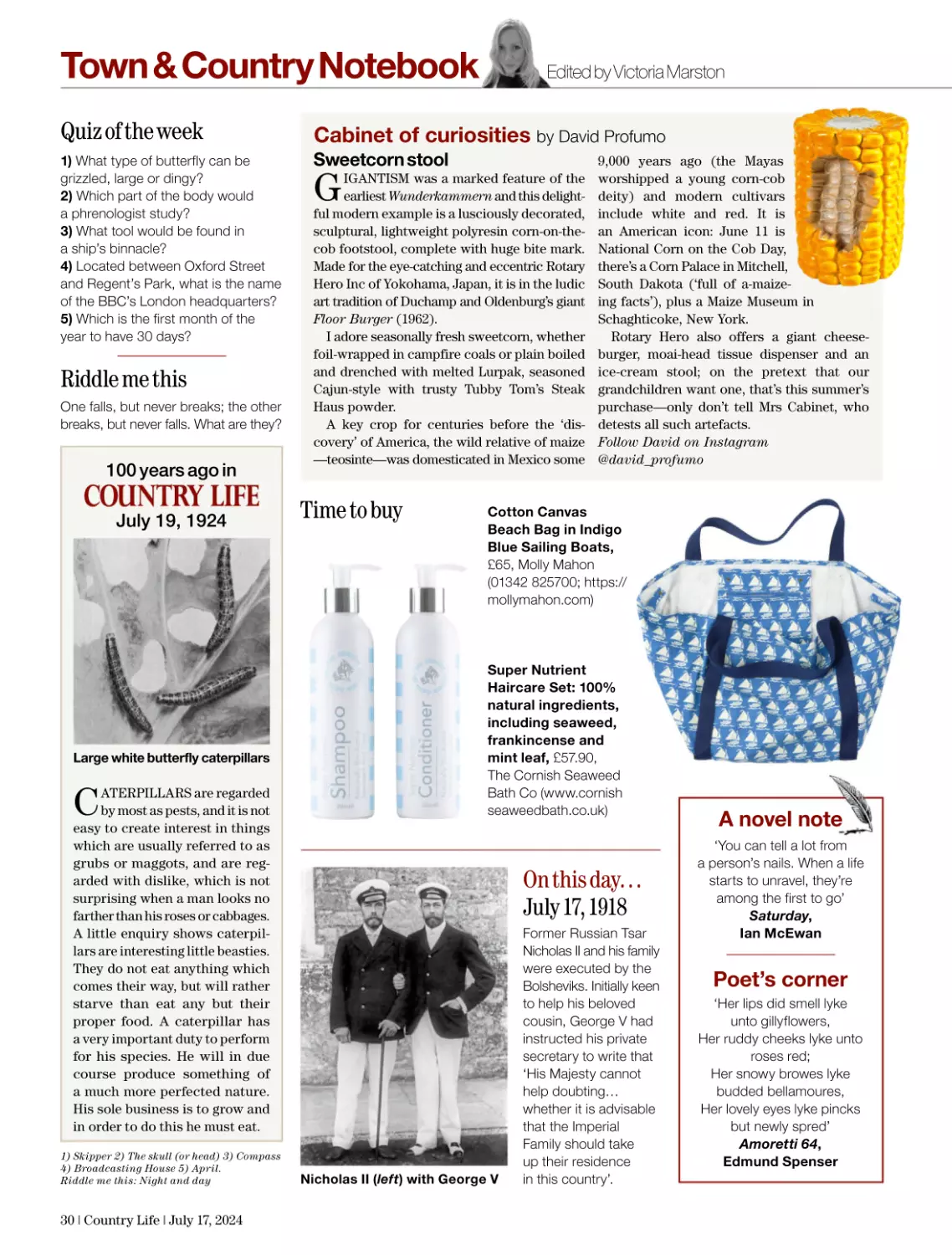
Nicholas II (left) with George V
Former Russian Tsar
Nicholas II and his family
were executed by the
Bolsheviks. Initially keen
to help his beloved
cousin, George V had
instructed his private
secretary to write that
‘His Majesty cannot
help doubting…
whether it is advisable
that the Imperial
Family should take
up their residence
in this country’.
A novel note
‘You can tell a lot from
a person’s nails. When a life
starts to unravel, they’re
among the first to go’
Saturday,
Ian McEwan
Poet’s corner
‘Her lips did smell lyke
unto gillyflowers,
Her ruddy cheeks lyke unto
roses red;
Her snowy browes lyke
budded bellamoures,
Her lovely eyes lyke pincks
but newly spred’
Amoretti 64,
Edmund Spenser
Glyn Satterley/Country Life Picture Library; Getty; Alamy; Stephen Farthing, Doing One’s Best To Look Relaxed: A ‘Dollar Princess’ (Daisy after Sargent), 2021 Courtesy the artist, Picture credit Moira Jamrisko; Annabelle King/Future Plc
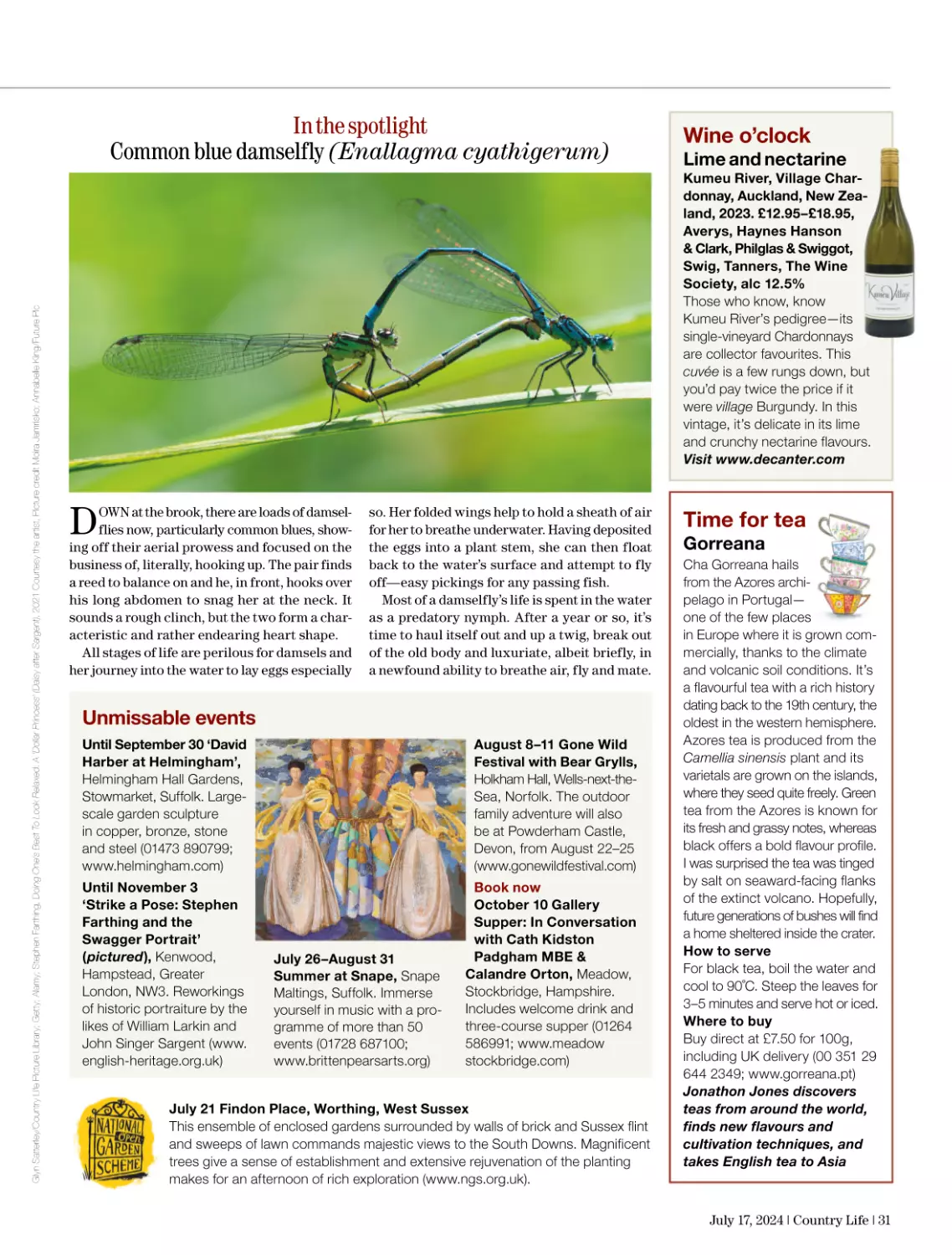
In the spotlight
Common blue damselfly (Enallagma cyathigerum)
Wine o’clock
Lime and nectarine
Kumeu River, Village Chardonnay, Auckland, New Zealand, 2023. £12.95–£18.95,
Averys, Haynes Hanson
& Clark, Philglas & Swiggot,
Swig, Tanners, The Wine
Society, alc 12.5%
Those who know, know
Kumeu River’s pedigree—its
single-vineyard Chardonnays
are collector favourites. This
cuvée is a few rungs down, but
you’d pay twice the price if it
were village Burgundy. In this
vintage, it’s delicate in its lime
and crunchy nectarine flavours.
Visit www.decanter.com
OWN at the brook, there are loads of damselflies now, particularly common blues, showing off their aerial prowess and focused on the
business of, literally, hooking up. The pair finds
a reed to balance on and he, in front, hooks over
his long abdomen to snag her at the neck. It
sounds a rough clinch, but the two form a characteristic and rather endearing heart shape.
All stages of life are perilous for damsels and
her journey into the water to lay eggs especially
D
so. Her folded wings help to hold a sheath of air
for her to breathe underwater. Having deposited
the eggs into a plant stem, she can then float
back to the water’s surface and attempt to fly
off—easy pickings for any passing fish.
Most of a damselfly’s life is spent in the water
as a predatory nymph. After a year or so, it’s
time to haul itself out and up a twig, break out
of the old body and luxuriate, albeit briefly, in
a newfound ability to breathe air, fly and mate.
Unmissable events
Until September 30 ‘David
Harber at Helmingham’,
Helmingham Hall Gardens,
Stowmarket, Suffolk. Largescale garden sculpture
in copper, bronze, stone
and steel (01473 890799;
www.helmingham.com)
August 8–11 Gone Wild
Festival with Bear Grylls,
Holkham Hall, Wells-next-theSea, Norfolk. The outdoor
family adventure will also
be at Powderham Castle,
Devon, from August 22–25
(www.gonewildfestival.com)
Until November 3
‘Strike a Pose: Stephen
Farthing and the
Swagger Portrait’
(pictured), Kenwood,
Hampstead, Greater
London, NW3. Reworkings
of historic portraiture by the
likes of William Larkin and
John Singer Sargent (www.
english-heritage.org.uk)
Book now
October 10 Gallery
Supper: In Conversation
with Cath Kidston
Padgham MBE &
Calandre Orton, Meadow,
Stockbridge, Hampshire.
Includes welcome drink and
three-course supper (01264
586991; www.meadow
stockbridge.com)
July 26–August 31
Summer at Snape, Snape
Maltings, Suffolk. Immerse
yourself in music with a programme of more than 50
events (01728 687100;
www.brittenpearsarts.org)
July 21 Findon Place, Worthing, West Sussex
This ensemble of enclosed gardens surrounded by walls of brick and Sussex flint
and sweeps of lawn commands majestic views to the South Downs. Magnificent
trees give a sense of establishment and extensive rejuvenation of the planting
makes for an afternoon of rich exploration (www.ngs.org.uk).
Time for tea
Gorreana
Cha Gorreana hails
from the Azores archipelago in Portugal—
one of the few places
in Europe where it is grown commercially, thanks to the climate
and volcanic soil conditions. It’s
a flavourful tea with a rich history
dating back to the 19th century, the
oldest in the western hemisphere.
Azores tea is produced from the
Camellia sinensis plant and its
varietals are grown on the islands,
where they seed quite freely. Green
tea from the Azores is known for
its fresh and grassy notes, whereas
black offers a bold flavour profile.
I was surprised the tea was tinged
by salt on seaward-facing flanks
of the extinct volcano. Hopefully,
future generations of bushes will find
a home sheltered inside the crater.
How to serve
For black tea, boil the water and
JVVS[V á*:[LLW[OLSLH]LZMVY
3–5 minutes and serve hot or iced.
Where to buy
Buy direct at £7.50 for 100g,
including UK delivery (00 351 29
644 2349; www.gorreana.pt)
Jonathon Jones discovers
teas from around the world,
finds new flavours and
cultivation techniques, and
takes English tea to Asia
July 17, 2024 | Country Life | 31
Letters to the Editor
Letter of the week
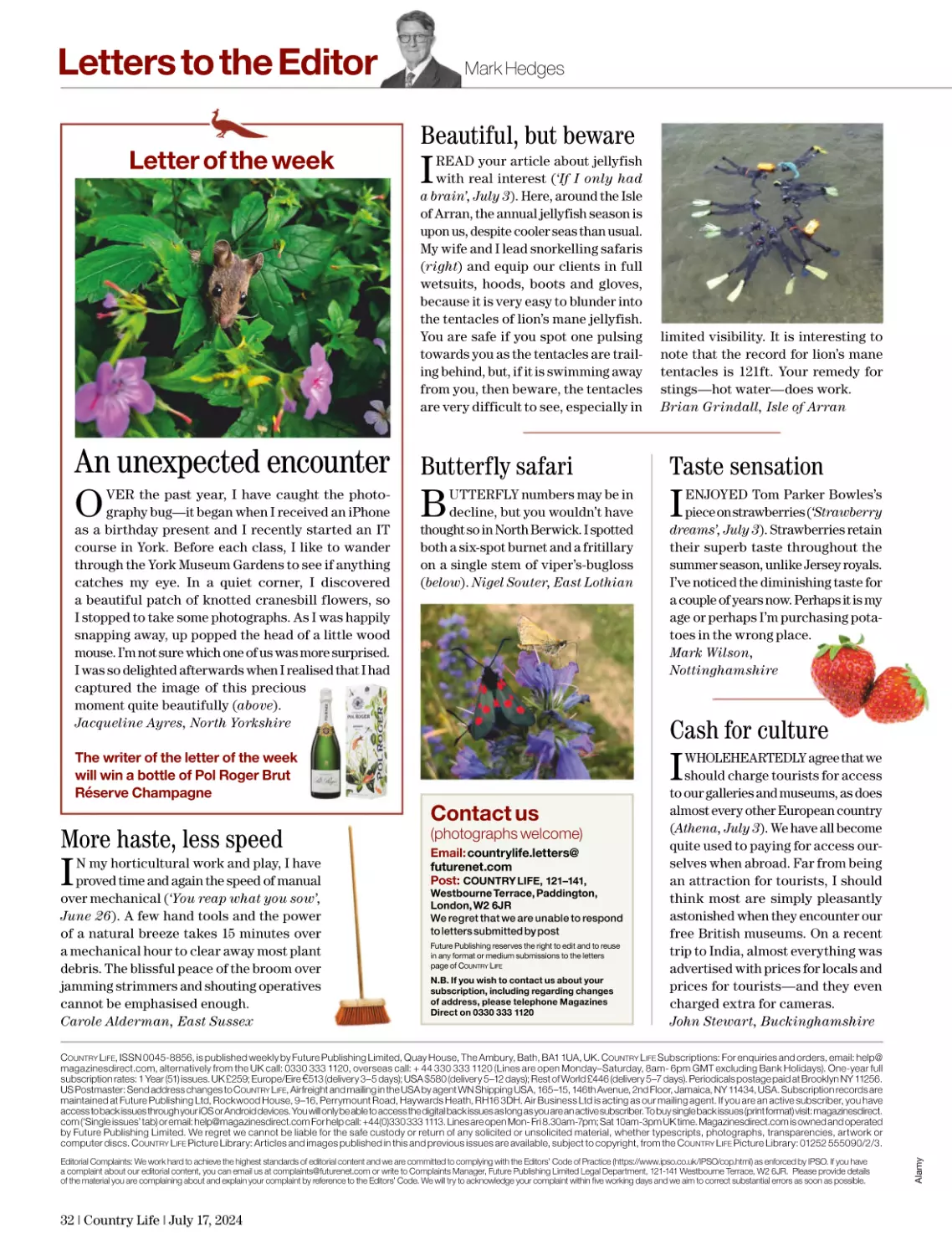
An unexpected encounter
VER the past year, I have caught the photography bug—it began when I received an iPhone
as a birthday present and I recently started an IT
course in York. Before each class, I like to wander
through the York Museum Gardens to see if anything
catches my eye. In a quiet corner, I discovered
a beautiful patch of knotted cranesbill flowers, so
I stopped to take some photographs. As I was happily
snapping away, up popped the head of a little wood
mouse. I’m not sure which one of us was more surprised.
I was so delighted afterwards when I realised that I had
captured the image of this precious
moment quite beautifully (above).
Jacqueline Ayres, North Yorkshire
O
The writer of the letter of the week
will win a bottle of Pol Roger Brut
Réserve Champagne
More haste, less speed
N my horticultural work and play, I have
proved time and again the speed of manual
over mechanical (‘You reap what you sow’,
June 26). A few hand tools and the power
of a natural breeze takes 15 minutes over
a mechanical hour to clear away most plant
debris. The blissful peace of the broom over
jamming strimmers and shouting operatives
cannot be emphasised enough.
Carole Alderman, East Sussex
I
Mark Hedges
Beautiful, but beware
READ your article about jellyfish
with real interest (‘If I only had
a brain’, July 3). Here, around the Isle
of Arran, the annual jellyfish season is
upon us, despite cooler seas than usual.
My wife and I lead snorkelling safaris
(right) and equip our clients in full
wetsuits, hoods, boots and gloves,
because it is very easy to blunder into
the tentacles of lion’s mane jellyfish.
You are safe if you spot one pulsing
towards you as the tentacles are trailing behind, but, if it is swimming away
from you, then beware, the tentacles
are very difficult to see, especially in
I
limited visibility. It is interesting to
note that the record for lion’s mane
tentacles is 121ft. Your remedy for
stings—hot water—does work.
Brian Grindall, Isle of Arran
Butterfly safari
Taste sensation
UTTERFLY numbers may be in
decline, but you wouldn’t have
thought so in North Berwick. I spotted
both a six-spot burnet and a fritillary
on a single stem of viper’s-bugloss
(below). Nigel Souter, East Lothian
ENJOYED Tom Parker Bowles’s
piece on strawberries (‘Strawberry
dreams’, July 3). Strawberries retain
their superb taste throughout the
summer season, unlike Jersey royals.
I’ve noticed the diminishing taste for
a couple of years now. Perhaps it is my
age or perhaps I’m purchasing potatoes in the wrong place.
Mark Wilson,
Nottinghamshire
B
I
Cash for culture
WHOLEHEARTEDLY agree that we
should charge tourists for access
to our galleries and museums, as does
almost every other European country
(Athena, July 3). We have all become
quite used to paying for access ourselves when abroad. Far from being
an attraction for tourists, I should
think most are simply pleasantly
astonished when they encounter our
free British museums. On a recent
trip to India, almost everything was
advertised with prices for locals and
prices for tourists—and they even
charged extra for cameras.
John Stewart, Buckinghamshire
I
Contact us
(photographs welcome)
Email: countrylife.letters@
futurenet.com
Post: COUNTRY LIFE, 121–141,
Westbourne Terrace, Paddington,
London, W2 6JR
We regret that we are unable to respond
to letters submitted by post
Future Publishing reserves the right to edit and to reuse
in any format or medium submissions to the letters
page of COUNTRY LIFE
N.B. If you wish to contact us about your
subscription, including regarding changes
of address, please telephone Magazines
Direct on 0330 333 1120
Editorial Complaints: We work hard to achieve the highest standards of editorial content and we are committed to complying with the Editors’ Code of Practice (https://www.ipso.co.uk/IPSO/cop.html) as enforced by IPSO. If you have
a complaint about our editorial content, you can email us at complaints@futurenet.com or write to Complaints Manager, Future Publishing Limited Legal Department, 121-141 Westbourne Terrace, W2 6JR. Please provide details
of the material you are complaining about and explain your complaint by reference to the Editors’ Code. We will try to acknowledge your complaint within five working days and we aim to correct substantial errors as soon as possible.
32 | Country Life | July 17, 2024
Alamy
COUNTRY LIFE, ISSN 0045-8856, is published weekly by Future Publishing Limited, Quay House, The Ambury, Bath, BA1 1UA, UK. COUNTRY LIFE Subscriptions: For enquiries and orders, email: help@
magazinesdirect.com, alternatively from the UK call: 0330 333 1120, overseas call: + 44 330 333 1120 (Lines are open Monday–Saturday, 8am- 6pm GMT excluding Bank Holidays). One-year full
subscription rates: 1 Year (51) issues. UK £259; Europe/Eire €513 (delivery 3–5 days); USA $580 (delivery 5–12 days); Rest of World £446 (delivery 5–7 days). Periodicals postage paid at Brooklyn NY 11256.
US Postmaster: Send address changes to COUNTRY LIFE, Airfreight and mailing in the USA by agent WN Shipping USA, 165–15, 146th Avenue, 2nd Floor, Jamaica, NY 11434, USA. Subscription records are
maintained at Future Publishing Ltd, Rockwood House, 9–16, Perrymount Road, Haywards Heath, RH16 3DH. Air Business Ltd is acting as our mailing agent. If you are an active subscriber, you have
access to back issues through your iOS or Android devices. You will only be able to access the digital back issues as long as you are an active subscriber. To buy single back issues (print format) visit: magazinesdirect.
com (‘Single issues’ tab) or email: help@magazinesdirect.com For help call: +44(0)330 333 1113. Lines are open Mon- Fri 8.30am-7pm; Sat 10am-3pm UK time. Magazinesdirect.com is owned and operated
by Future Publishing Limited. We regret we cannot be liable for the safe custody or return of any solicited or unsolicited material, whether typescripts, photographs, transparencies, artwork or
computer discs. COUNTRY LIFE Picture Library: Articles and images published in this and previous issues are available, subject to copyright, from the COUNTRY LIFE Picture Library: 01252 555090/2/3.
Puck’s valley
AN MORTON’S article on Puck reminded me of a story that intrigued
me as a child (‘The oldest Old Thing
in England’, June 19). Local lore in
the Llanelly area of Monmouthshire
has it that Shakespeare visited the
Clydach Gorge (below), now a wellknown tourist attraction. The beautiful
wooded area has a section known as
Cwm Pwca [Puck’s valley]. It is said
that, when staying with friends in
Breconshire, Shakespeare conceived
A Midsummer Night’s Dream as he
strolled along the wooded banks
of the Clydach.
Thankfully, the area’s beauty was
not destroyed when the Clydach
Ironworks opened in the 1790s. Now
that the A465 roadworks from Merthyr
to Gilwern have been completed,
something of the gorge’s earlier tranquillity has returned. Puck now rules
his tiny kingdom undisturbed.
Stephen Parry-Jones, Cardiff
I
So far, so good
HE new Government certainly
delivered its first week with
aplomb. Immediately seizing the
opportunities of power, ministers
were seen reassuring the embattled Ukrainians, speaking to our neighbours in the EU
and redefining relationships within the UK.
The party’s historic majority may have been
achieved with a very small increase in their
vote and little marked enthusiasm from the
electorate, but they moved rapidly to establish
a sense of purposeful government.
Rishi Sunak’s graceful and dignified exit
restored much of his reputation, but, despite
the wise warnings of James Cleverly, the
Tory defeat was further scarred by futile
recriminations from Suella Braverman and
Kemi Badenoch that undermined any claim either had
to leadership and reminded
us that, unless it learns to
re-establish cohesion and
public purpose, the Conservative Party faces a long
sojourn in the wilderness.
For country people, the
scene is much altered. From
arable farmers on the light
land in east Suffolk to dairy
men in Somerset, from sheep
farmers on the South Downs to cattle men
on the Scottish Borders, they will be represented by a Labour MP for the first time for
generations. It provides us all with a real opportunity to win back the interest of a party that
was, up until the late 1950s, still represented
in the rural areas. In 1951, 1955 and 1959, the
results from a handful of rural seats were
eagerly watched, as they might determine the
overall result. Labour ministers such as Tom
Williamson and Fred Peart won plaudits from
the farming community and faced down those
Labour MPs who, like Stanley ‘Featherbed’
Evans, a short-lived Agriculture Minister,
questioned farming support. Now that food
security has moved centre stage and food
prices for the least well off are so concerning,
we country people, whatever our political
T
views, have a real chance to ensure that what
had become an exclusively urban party regains
an understanding of rural issues.
Sir Keir Starmer’s appointments bode well for
this enterprise. Steve Reed, the Defra Secretary,
has already outlined his priorities, which give
a direction to the department that has recently
been conspicuously lacking. Dealing with
pollution was a powerful election issue and has
already meant an immediate meeting with the
water industry and putting Thames Water under
special measures. A roadmap for reaching
a zero-waste economy is long overdue, so it’s
not surprising that it’s priority number two.
Priority number three is to boost food security, which will be a real fillip for farmers, as
is the appointment of Daniel Zeichner as the
Agriculture Minister. He
is a thoughtful and wellinformed man who has
already impressed with his
willingness to listen and
ready grasp of essentials.
The need to produce food
will properly go hand in
hand with a commitment to
ensure Nature’s recovery and
also with priority number
five, which is to protect communities from flooding.
If the Prime Minister sticks to his avowed
determination to bring stability back to ministerial appointments, this is a team that will
be with us for some years and with which we
country people can build an understanding
during this period of radical change. Whatever
happens politically in the future and whatever
our party preferences, this is not an opportunity to be missed. Many of these new members
may not be schooled in country matters, but
that does offer us the opportunity to build again
a real understanding of rural concerns in the
Labour Party. At the same time as keeping newly
minted Liberal Democrats up to the mark, we
should be encouraging a new generation of prospective Tory candidates to work to recover their
party’s historic role as the country party. In
the countryside, it is genuinely all to play for.
We have a real
chance to ensure
that an urban
party regains an
understanding
of rural issues
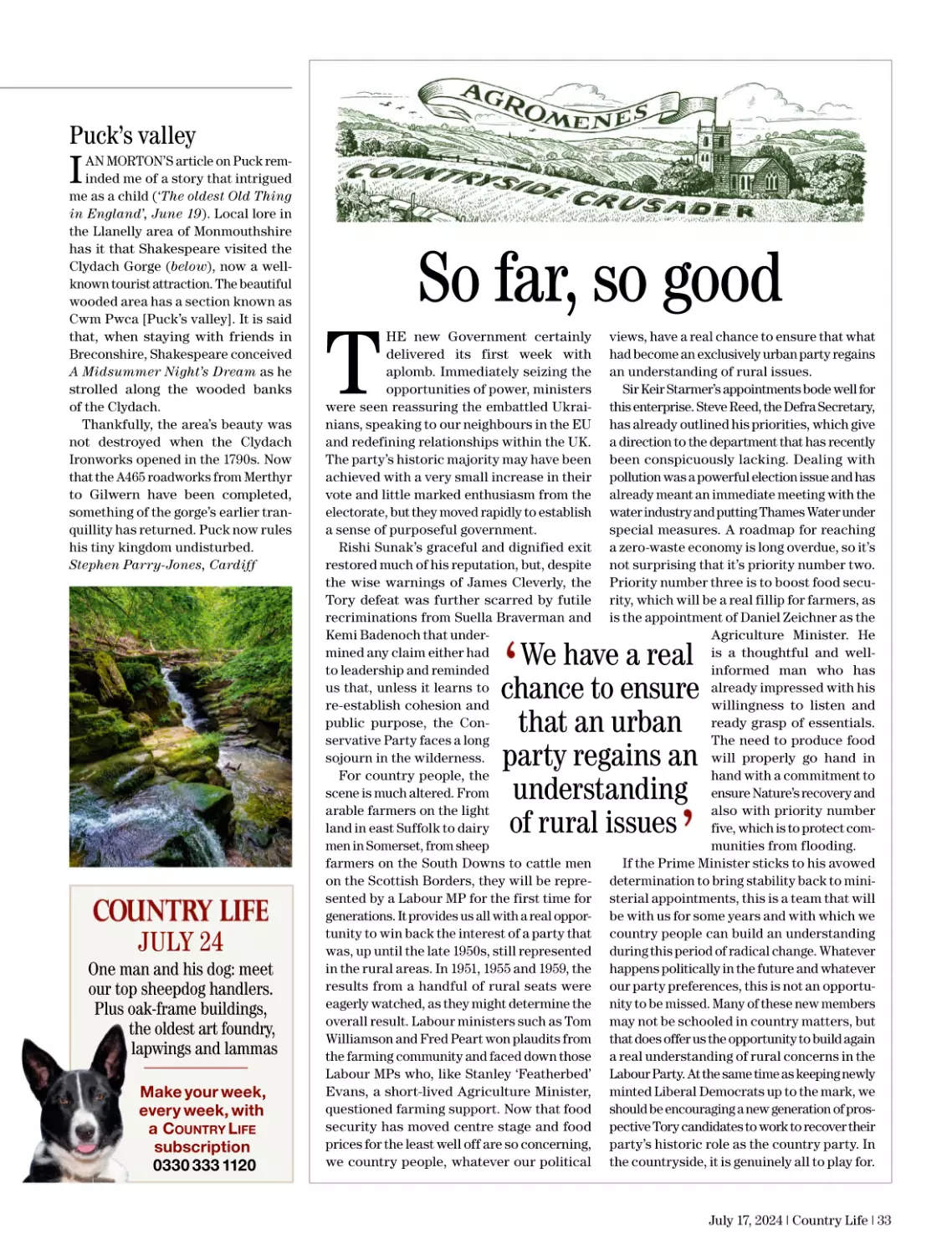
JULY 24
One man and his dog: meet
our top sheepdog handlers.
Plus oak-frame buildings,
the oldest art foundry,
lapwings and lammas
Make your week,
every week, with
a COUNTRY LIFE
subscription
0330 333 1120
July 17, 2024 | Country Life | 33
Athena
Cultural Crusader
The new
hands at
the tiller
N the flurry of appointments and
policy announcements that followed
the General Election, the new government has begun to assume substance.
Whereas many of the Labour front bench
passed with their briefs from Opposition
to Government, the Shadow Secretary of
State for Culture, Media and Sport (DCMS),
Thangam Debbonaire, was one of the prominent casualties of the General Election.
Who knows how she might have performed, but in personal terms she seemed
unusually well suited to the role. Her experience as a classical musician would have
been particularly valuable, given the
damage that has cumulatively been done
to musical life in the country by the combined effects of the pandemic, cuts and
Brexit. Hopefully, these difficulties are
I
something that the person who has taken
her place, Lisa Nandy, will bear in mind.
The new Secretary of State for DCMS is
an unknown quantity as regards the Arts.
She lists her recreations in Who’s Who as
‘theatre’ and ‘Rugby League’, but, to date,
it is her personal concern with social justice that seems most striking. Her string
of shadow briefs, which stretches back to
2012, have been for International Development, Children and Families; Energy and
Climate Change; Foreign and Commonwealth Affairs; and Levelling up, Housing
Communities and Local Government.
In the Labour
manifesto, the words
“theatre” and “gallery”
appeared not at all
Her supporting Minister of State in the
department—and also jointly in the
Department for Science, Innovation and
Technology—Sir Chris Bryant, is less
of a surprise. He has been an MP for more
than two decades and has previous experience both of government and, in opposition, of the DCMS. Meanwhile, the Shadow
Minister before the election, Stephanie
Peacock, has become Parliamentary UnderSecretary of State in the DCMS.
Important as some degree of experience
may be, however, Athena is more exercised
by the question of how long these individuals will stay in post. Only with the return
of stable leadership in DCMS—don’t forget
that we have had eight Secretaries of State
since 2017, about one every 10 months—
will it be possible for them to get to know
their jobs. That, in turn, will allow them
to formulate a proper Government strategy
to shape the Arts in a positive way.
There is a formidable list of challenges
to address. Some are practical, funding
being the outstanding issue in this regard,
others to do with the conduct of cultural
life; working to draw the poison from the
‘culture wars’ (which, sadly, show no signs
of going away), for example, and the management of arms-length bodies.
Not that Athena is holding her breath
for any dramatic changes; there is so little
money to spare. Added to which, the Labour
manifesto didn’t suggest enthusiasm for
culture: the word ‘museum’ appeared only
once, ‘theatre’ and ‘gallery’ not at all and
the ‘Arts’ and ‘music’ only with relation to
education. There is no question that the
hands at the tiller of the DCMS matter.
The way we were Photographs from the COUNTRY LIFE archive
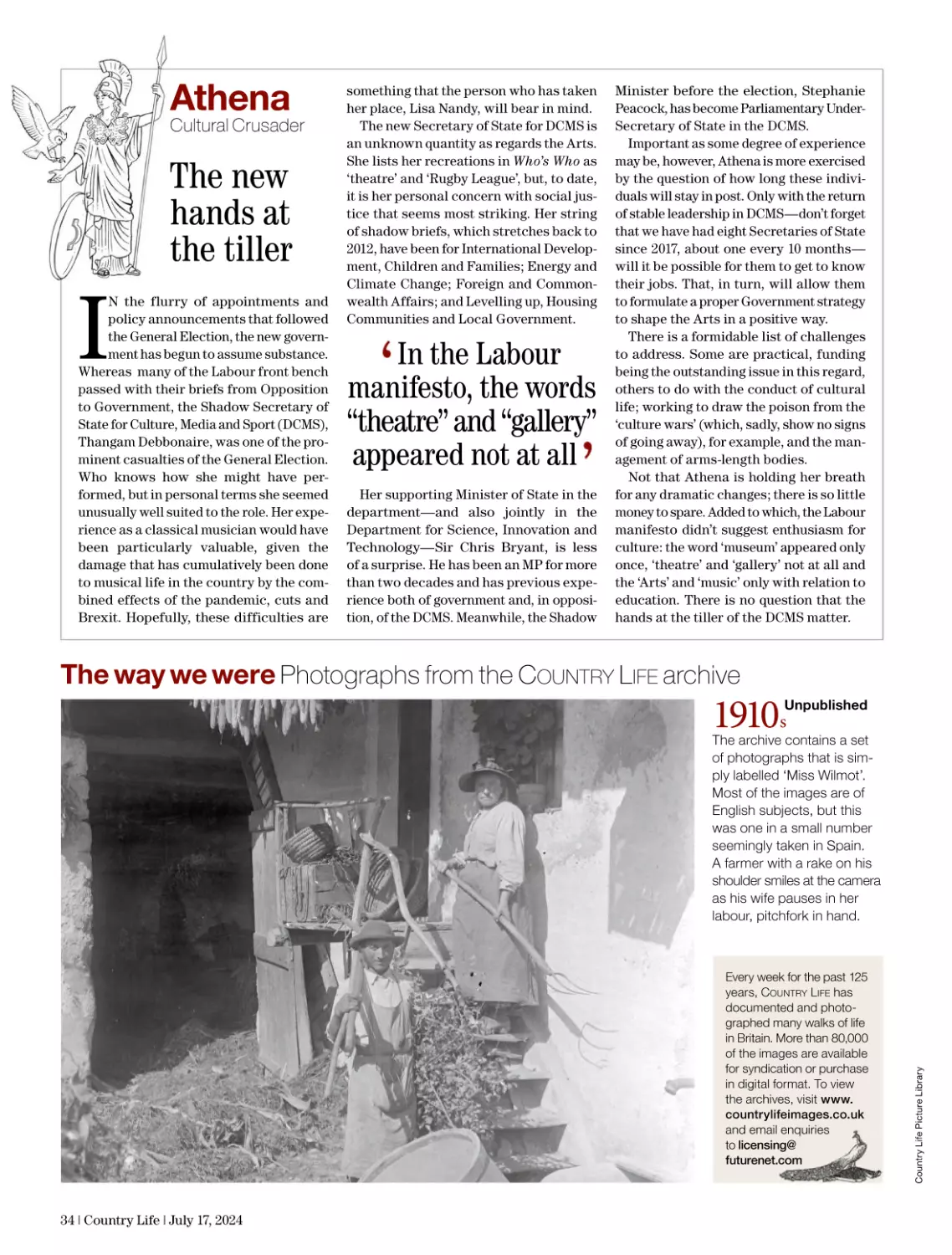
1910s
Unpublished
Every week for the past 125
years, COUNTRY LIFE has
documented and photographed many walks of life
in Britain. More than 80,000
of the images are available
for syndication or purchase
in digital format. To view
the archives, visit www.
countrylifeimages.co.uk
and email enquiries
to licensing@
futurenet.com
34 | Country Life | July 17, 2024
Country Life Picture Library
The archive contains a set
of photographs that is simply labelled ‘Miss Wilmot’.
Most of the images are of
English subjects, but this
was one in a small number
seemingly taken in Spain.
A farmer with a rake on his
shoulder smiles at the camera
as his wife pauses in her
labour, pitchfork in hand.
My favourite painting Lyndon Farnham
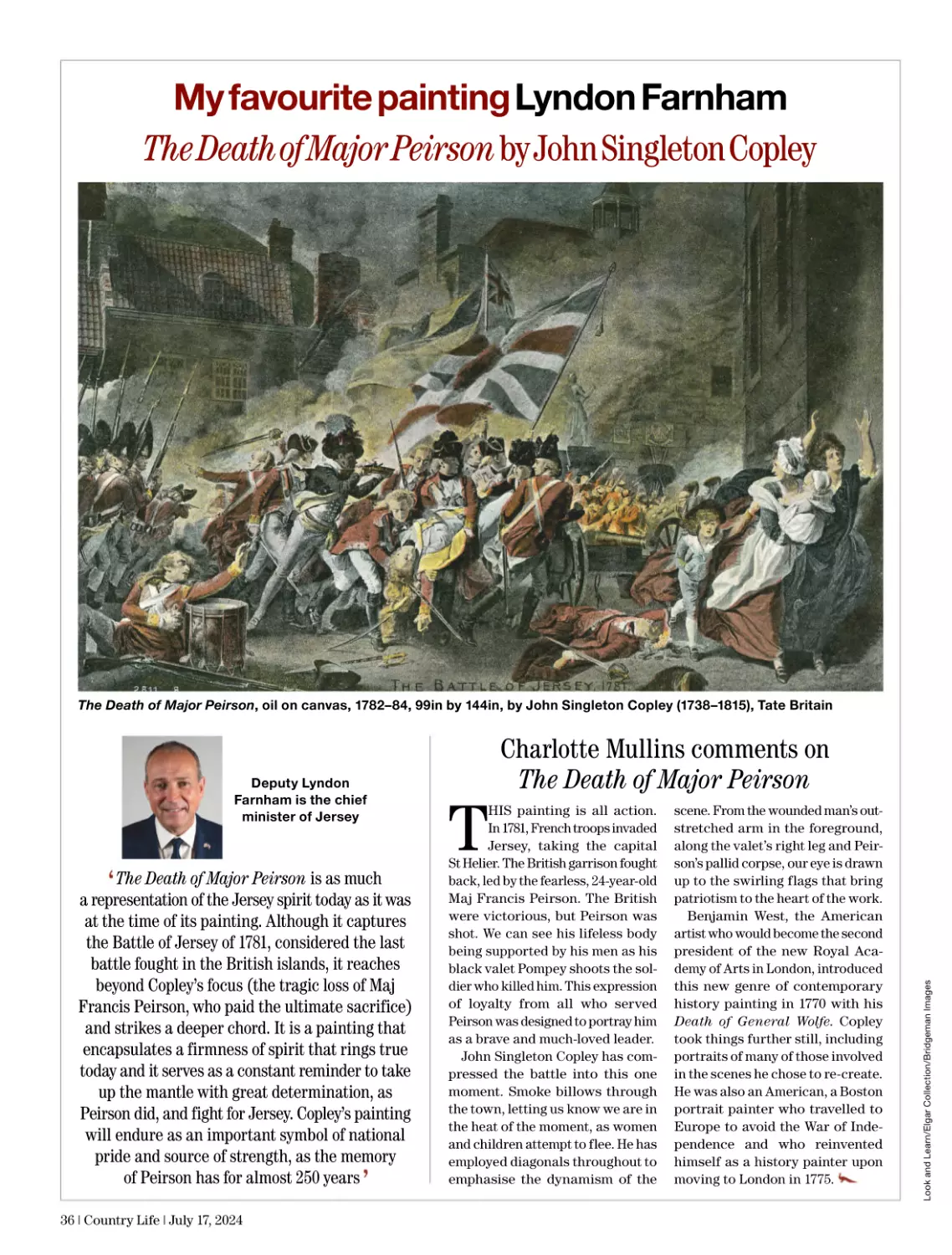
The Death of Major Peirson by John Singleton Copley
The Death of Major Peirson, oil on canvas, 1782–84, 99in by 144in, by John Singleton Copley (1738–1815), Tate Britain
The Death of Major Peirson is as much
a representation of the Jersey spirit today as it was
at the time of its painting. Although it captures
the Battle of Jersey of 1781, considered the last
battle fought in the British islands, it reaches
beyond Copley’s focus (the tragic loss of Maj
Francis Peirson, who paid the ultimate sacrifice)
and strikes a deeper chord. It is a painting that
encapsulates a firmness of spirit that rings true
today and it serves as a constant reminder to take
up the mantle with great determination, as
Peirson did, and fight for Jersey. Copley’s painting
will endure as an important symbol of national
pride and source of strength, as the memory
of Peirson has for almost 250 years
36 | Country Life | July 17, 2024
HIS painting is all action.
In 1781, French troops invaded
Jersey, taking the capital
St Helier. The British garrison fought
back, led by the fearless, 24-year-old
Maj Francis Peirson. The British
were victorious, but Peirson was
shot. We can see his lifeless body
being supported by his men as his
black valet Pompey shoots the soldier who killed him. This expression
of loyalty from all who served
Peirson was designed to portray him
as a brave and much-loved leader.
John Singleton Copley has compressed the battle into this one
moment. Smoke billows through
the town, letting us know we are in
the heat of the moment, as women
and children attempt to flee. He has
employed diagonals throughout to
emphasise the dynamism of the
T
scene. From the wounded man’s outstretched arm in the foreground,
along the valet’s right leg and Peirson’s pallid corpse, our eye is drawn
up to the swirling flags that bring
patriotism to the heart of the work.
Benjamin West, the American
artist who would become the second
president of the new Royal Academy of Arts in London, introduced
this new genre of contemporary
history painting in 1770 with his
Death of General Wolfe. Copley
took things further still, including
portraits of many of those involved
in the scenes he chose to re-create.
He was also an American, a Boston
portrait painter who travelled to
Europe to avoid the War of Independence and who reinvented
himself as a history painter upon
moving to London in 1775.
Look and Learn/Elgar Collection/Bridgeman Images
Deputy Lyndon
Farnham is the chief
minister of Jersey
Charlotte Mullins comments on
The Death of Major Peirson
‘Most costly and church-wise’
Lincoln College, Oxford, part II
The Rector and Fellows of Lincoln College
In the second of two articles, John Goodall describes the 17th-century expansion
of the college to include an outstanding chapel, amid a bitter personal clash between
two strong-willed men, and the institution’s evolution to the present day
Photographs by Paul Highnam
N September 9, 1603, the lawyer
and diarist Sir Roger Wilbraham
arrived in Oxford to find it
afflicted by plague. It was busy
nevertheless. The promised visit of James I
to nearby Woodstock had brought the
ambassadors of Spain and the Archduke
of Austria to the city and they had taken up
residence in Christ Church and Magdalen
College respectively. On their architectural
merits, Sir Roger judged these foundations,
with Merton and All Souls’, to be the ‘four
great colleges’ of the university. He was less
impressed by the others, observing ‘Lincoln
College and others I saw on the outside: they
seem far inferior to the former’.
His reaction was not surprising given that
Lincoln College—a relatively modest foundation, as we discovered last week—had
hardly changed since its troubled foundation
in the 15th century. Indeed, the events of the
Reformation had by equal measure diminished and fossilised Oxford architecturally
during the later 16th century. Sir Roger visited,
however, at the start of a remarkable revival.
As evidence of this, he admired the ongoing
works to the city’s new library, the Bodleian,
which he judged ‘for beauty of building… will
equal any in Christendom’. Lincoln College,
too, would be touched by this sea change in
the university’s affairs.
The first college statutes of 1479, issued by
Thomas Rotherham, Bishop of Lincoln, constituted a community of 12 fellows governed
by a rector. Despite further small bequests
into the 1530s, the college was rarely up to
strength. During the Reformation, its fellowship was religiously conservative, but the institution survived and, from the 1560s, it began
to accept numbers of paying undergraduates.
To these were added fellow-commoners in
1606, ‘the sons of lords, knights, and gentlemen’ who ‘shall not go bow to Fellows in
college’, but were to enjoy equality with them
at ‘table, garden and other public places’.
To accommodate the expanding community,
a two-storey range was begun in 1607, south
of the original quadrangle along Turl Street.
O
38 | Country Life | July 17, 2024
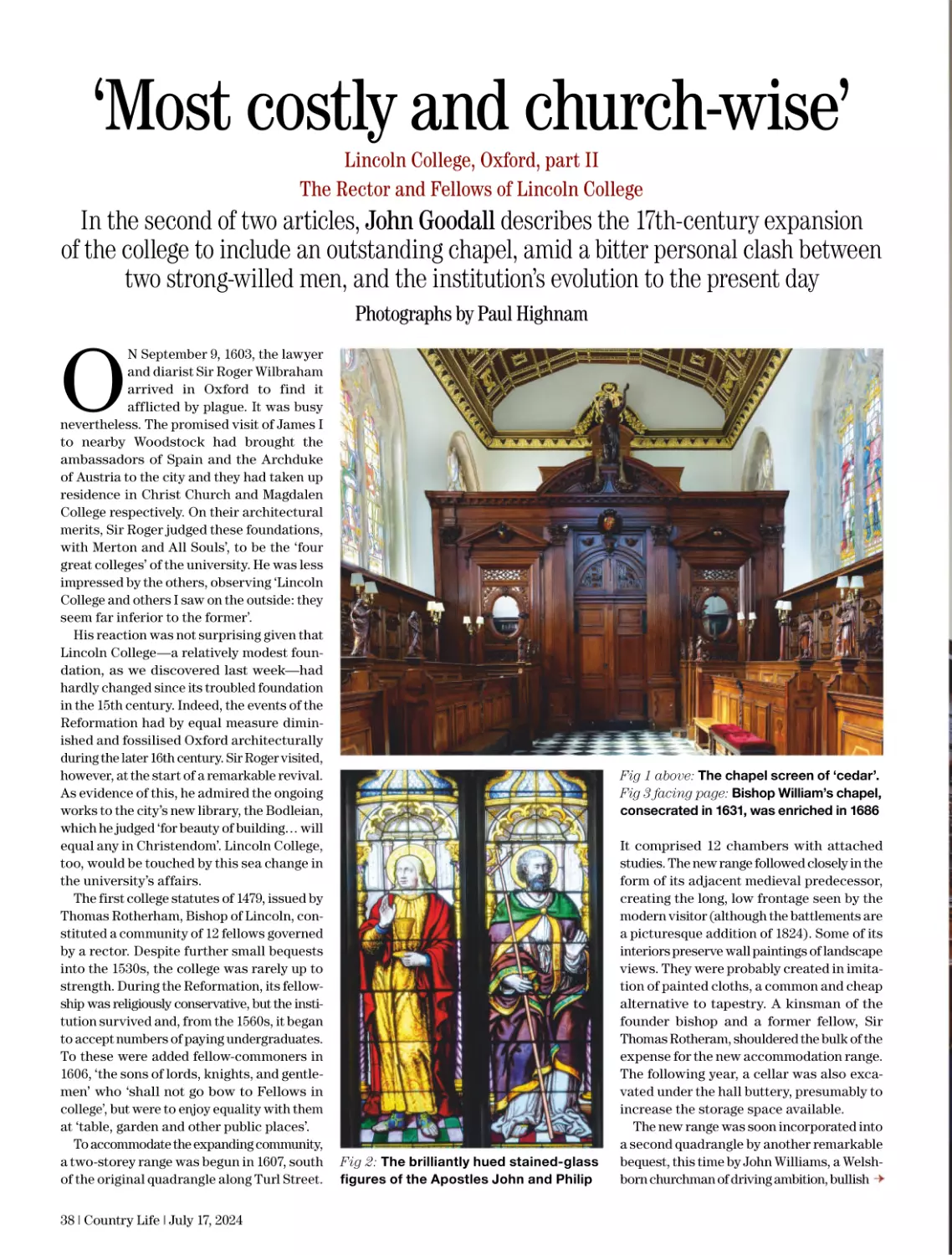
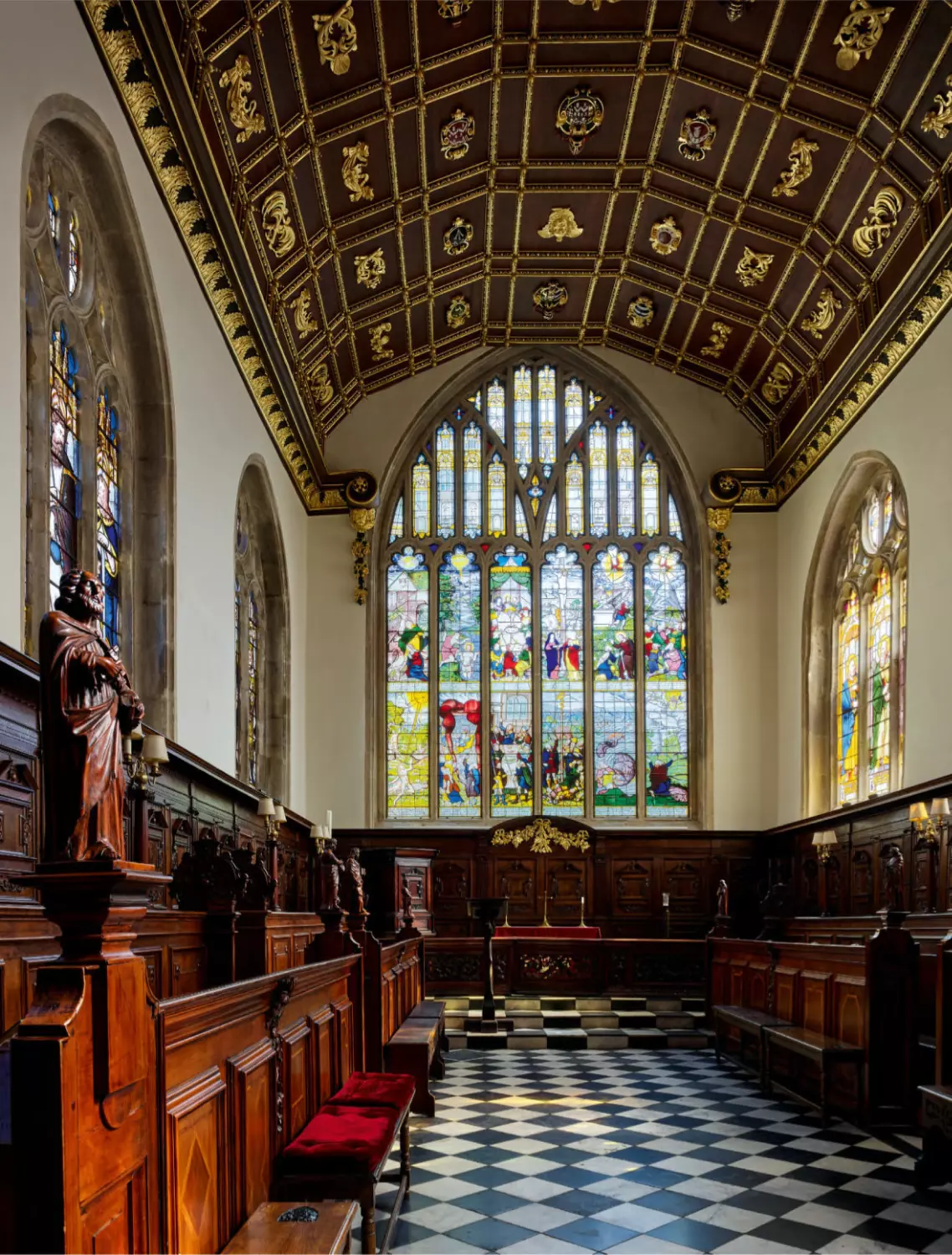
Fig 1 above: The chapel screen of ‘cedar’.
Fig 3 facing page: Bishop William’s chapel,
consecrated in 1631, was enriched in 1686
Fig 2: The brilliantly hued stained-glass
figures of the Apostles John and Philip
It comprised 12 chambers with attached
studies. The new range followed closely in the
form of its adjacent medieval predecessor,
creating the long, low frontage seen by the
modern visitor (although the battlements are
a picturesque addition of 1824). Some of its
interiors preserve wall paintings of landscape
views. They were probably created in imitation of painted cloths, a common and cheap
alternative to tapestry. A kinsman of the
founder bishop and a former fellow, Sir
Thomas Rotheram, shouldered the bulk of the
expense for the new accommodation range.
The following year, a cellar was also excavated under the hall buttery, presumably to
increase the storage space available.
The new range was soon incorporated into
a second quadrangle by another remarkable
bequest, this time by John Williams, a Welshborn churchman of driving ambition, bullish
determination and Calvinist persuasion.
According to his admiring chaplain and biographer, John Hacket, a childhood injury
leaping from the walls of his native Conwy
made him ‘chaste perforce’. He was educated
at Cambridge, secured the favour of James I
and cumulatively became—in quick succession in 1620–21—Dean of Westminster, Lord
Keeper of the Great Seal and Bishop of Lincoln.
At the same time, he fell out with the future
Charles I, as well as his favourite the Duke
of Buckingham and William Laud, from 1633
Archbishop of Canterbury and a reformer
of Oxford University. What began as mutual
distrust ripened from 1623 into deep animosity. This eventually proceeded to complex
legal proceedings in Star Chamber and, in 1637,
Williams briefly ended up imprisoned in the
Tower of London and a popular hero. Williams
delighted in tormenting Laud and was by character completely at odds with him; in his portraits, he appears more statesman than cleric.
Underpinning and reinforcing their personal divisions were, inevitably, disagreements over religious practice. Laud famously
sought to dignify church services with beautiful fittings and ceremony, as well as to impose
universal conformity of practice (with ultimately disastrous results). Williams’s views,
by contrast, are much harder to characterise.
As Dean of Westminster, he presided over
some of the most extravagantly performed
liturgy in the contemporary English church
and, with Laud, vigorously defended the episcopacy. Yet he wrote a tract defending the
alignment of the communion table east-west,
as opposed to altar-wise, north-south, as well
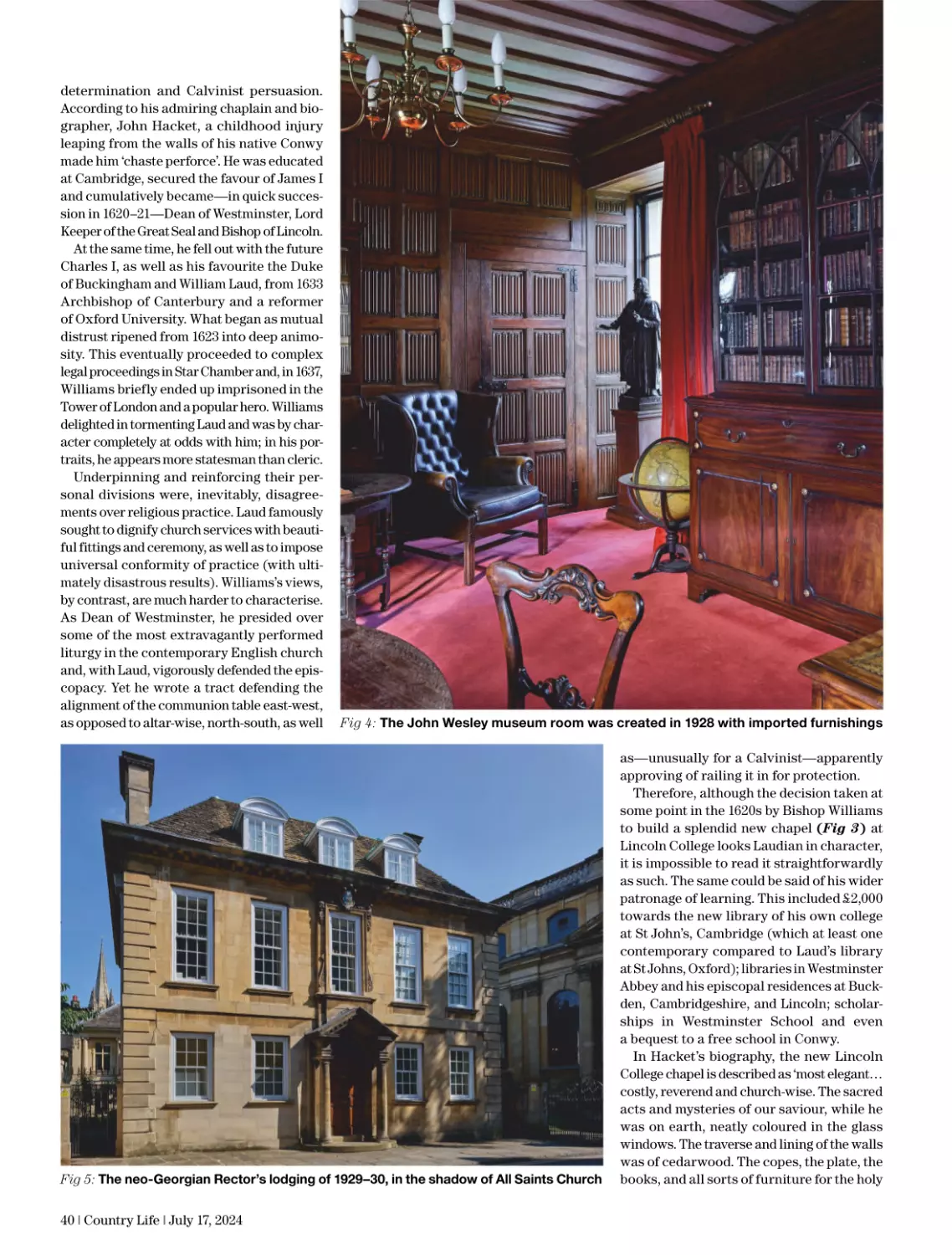
Fig 4: The John Wesley museum room was created in 1928 with imported furnishings
Fig 5: The neo-Georgian Rector’s lodging of 1929–30, in the shadow of All Saints Church
40 | Country Life | July 17, 2024
as—unusually for a Calvinist—apparently
approving of railing it in for protection.
Therefore, although the decision taken at
some point in the 1620s by Bishop Williams
to build a splendid new chapel (Fig 3) at
Lincoln College looks Laudian in character,
it is impossible to read it straightforwardly
as such. The same could be said of his wider
patronage of learning. This included £2,000
towards the new library of his own college
at St John’s, Cambridge (which at least one
contemporary compared to Laud’s library
at St Johns, Oxford); libraries in Westminster
Abbey and his episcopal residences at Buckden, Cambridgeshire, and Lincoln; scholarships in Westminster School and even
a bequest to a free school in Conwy.
In Hacket’s biography, the new Lincoln
College chapel is described as ‘most elegant…
costly, reverend and church-wise. The sacred
acts and mysteries of our saviour, while he
was on earth, neatly coloured in the glass
windows. The traverse and lining of the walls
was of cedarwood. The copes, the plate, the
books, and all sorts of furniture for the holy
table, rich and suitable’. One notable detail
of this description is its reference to cedar, in
fact only originally used on the screen (Fig 1)
(the stalls are oak), but more familiar in opulent late-17th-century interiors. The chancel
also has a chequered floor of white and black
marble, a striking enrichment for the period.
Even so, it is the stained glass that really
catches the eye (Fig 2). This is coherently
organised with full-length Old Testament
prophets in the north-side windows facing
Apostles to the south, the latter accompanied
by sentences from the Creed. In each side
window, the arms of Williams appear four
times, combined, respectively, with the see
of Lincoln, the College of Westminster and
other branches of his family. The east window
above the communion table is of six lights—
an unusual number—giving equal emphasis
to the episodes from the life of Christ and the
Old Testament scenes that are understood
to prefigure them; for example, the Resurrection with Jonah emerging from the whale.
Frustratingly, all the documentation regarding the chapel is lost, almost certainly in the
course of Williams’s legal struggle with Laud.
All we have to date the building are the
inscriptions ‘1629’ and ‘1630’ in the windows.
That said, the glass is initialled by the younger
of two brothers, Bernard and Abraham van
Linge, natives of Emden in East Friesland.
The former contracted to create windows
for Wadham College, Oxford, in 1621, immediately after his arrival in England, and his
workshop was taken over by his brother
after he returned home in 1623. That, in turn,
probably identifies the mason involved here
and the influences at play on the design.
Among many other projects, the van
Linges worked on the glass of two chapels—
that of Lincoln’s Inn, London, of 1618–22 and
University College, Oxford, under construction
from 1634—in which the architectural detail
of the building bears comparison to that at
Lincoln College. The former project was overseen by the prominent Oxford mason John
Clark and involved his brother-in-law, Hugh
Davies; and the latter, after Clark’s death in
1624, Davies alone. Might Davies, therefore,
be the figure responsible? Whatever the case,
the glazing and architectural schemes seem
to have been conceived together and, fasci-
natingly, show a particular awareness of the
14th-century architecture and iconography
of New College Chapel, the most admired
of Oxford’s college buildings.
Williams was mysteriously absent from
the consecration ceremony of the chapel on
September 15, 1631, which in the fractious context of the moment raises the question of who
actually had control of it. In the published
text, the beauty of the building is described
with reference to the preached word. If the
pulpit is not ‘sanctified’, it suggests, then the
‘purest things here shall be made unclean.
This cedar shall not keep the savour… but shall
smell of superstition. The altar shall be called
no more than a dresser. The reverence that
is done there shall be apish cringing, and all
the seemly glazing be thought nothing but a
little brittle superfluity…’. Is this Laudian
jibing or Calvinist retort? Curiously, three
months later, Williams consecrated another
private chapel of a friend at Fawley Court,
Buckinghamshire. It was destroyed in the
1640s, but might have offered further context for this splendid interior and the
interpretation of the ceremony.
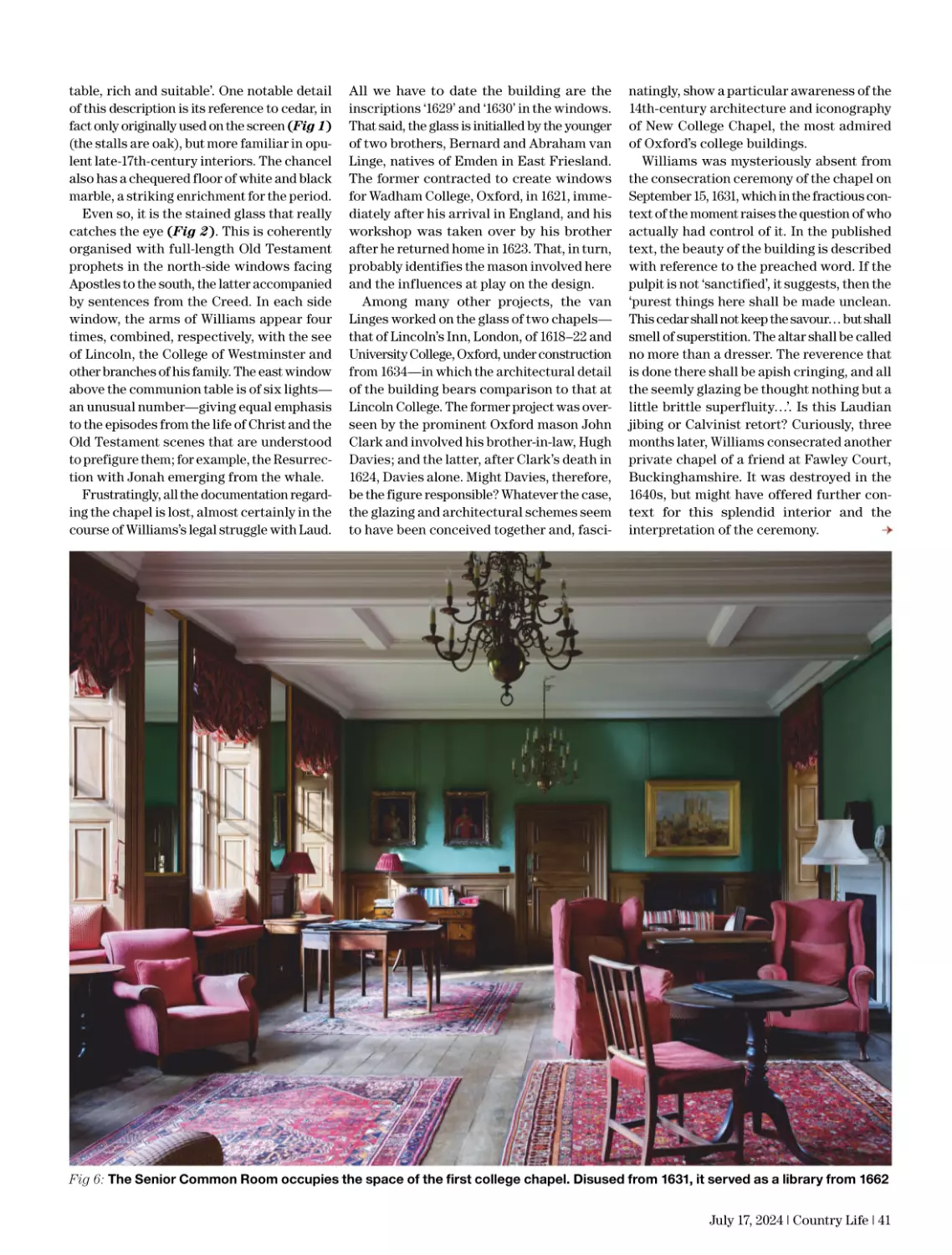
Fig 6: The Senior Common Room occupies the space of the first college chapel. Disused from 1631, it served as a library from 1662
July 17, 2024 | Country Life | 41
Since the completion of the chapel and its
quadrangle, the architectural development
of the college has largely involved renovation
and also, more recently, the infill of the college
landholding first constituted in the 15th century. The Civil War brutally interrupted the life
of the university, but when Charles I assumed
Oxford as his capital, Lincoln College became
the home of his Exchequer (COUNTRY L IFE ,
September 21, 2022). In the aftermath of the
fighting and the upheavals of the Commonwealth, the college was returned to order by
Nathaniel Crewe, later the Bishop of Durham
and a noted philanthropist in his see.
It was incorporated
into a second
quadrangle by another
remarkable bequest
Crewe’s father gave £220 for the conversion
of the old chapel, which had remained disused
since 1631, into a library. The work was undertaken between 1656 and 1662; the room is now
the Senior Common Room (Fig 6). Long after
he left the college, Crewe also contributed
£100 to the renovation of the hall undertaken
between 1697–1701. This was fitted with new
wainscotting and a screen painted with his
arms, as well as a fireplace to replace the
original central hearth. In the interim, in 1686,
a long-serving Rector, Fitzherbert Adams,
paid more than £700 out of his own pocket
for the renovation of the college buildings
and chapel, creating the present ceiling with
heraldic ornament, the front stalls and laying the marble floor in the nave. It was conceivably at this time that the entrance courtyard was first fitted with sash windows.
The 18th century did not witness much significant change to the college buildings or the
scale of its community. In 1824, the exterior
façade was battlemented and this enrichment was extended internally through the
college quadrangles in 1854. More important
changes followed from 1881, when Sir Thomas
Jackson, also architect of the Examination
Schools, refurnished the hall with a new
Flamboyant Gothic fireplace and revealed
the medieval open-timber roof from beneath
a plaster ceiling. He added an extension, the
Grove Building, to the rear of the hall, demolishing an 18th-century residential block.
In 1906, Herbert Read and R. F. MacDonald
created an Edwardian Baroque library, now
the Berrow Foundation Building, to which
Stanton Williams added an award-winning
extension in 2017. Read also built the unassuming Rector’s Lodging (Fig 5) in 1929–30,
overlooking Turl Street. Shortly before this,
42 | Country Life | July 17, 2024
in 1928, the American Methodist Committee
paid for the creation of a museum room (Fig
4) to celebrate the 200th anniversary of John
Wesley’s Fellowship at Lincoln College. The
room, which was fitted out in an eclectic
antique style, was then believed to be the one
he had occupied. Further research suggests
he actually lived in the chapel quadrangle.
Perhaps the most striking recent addition
to the complex, however, is an Oxford landmark with a history of its own. All Saints
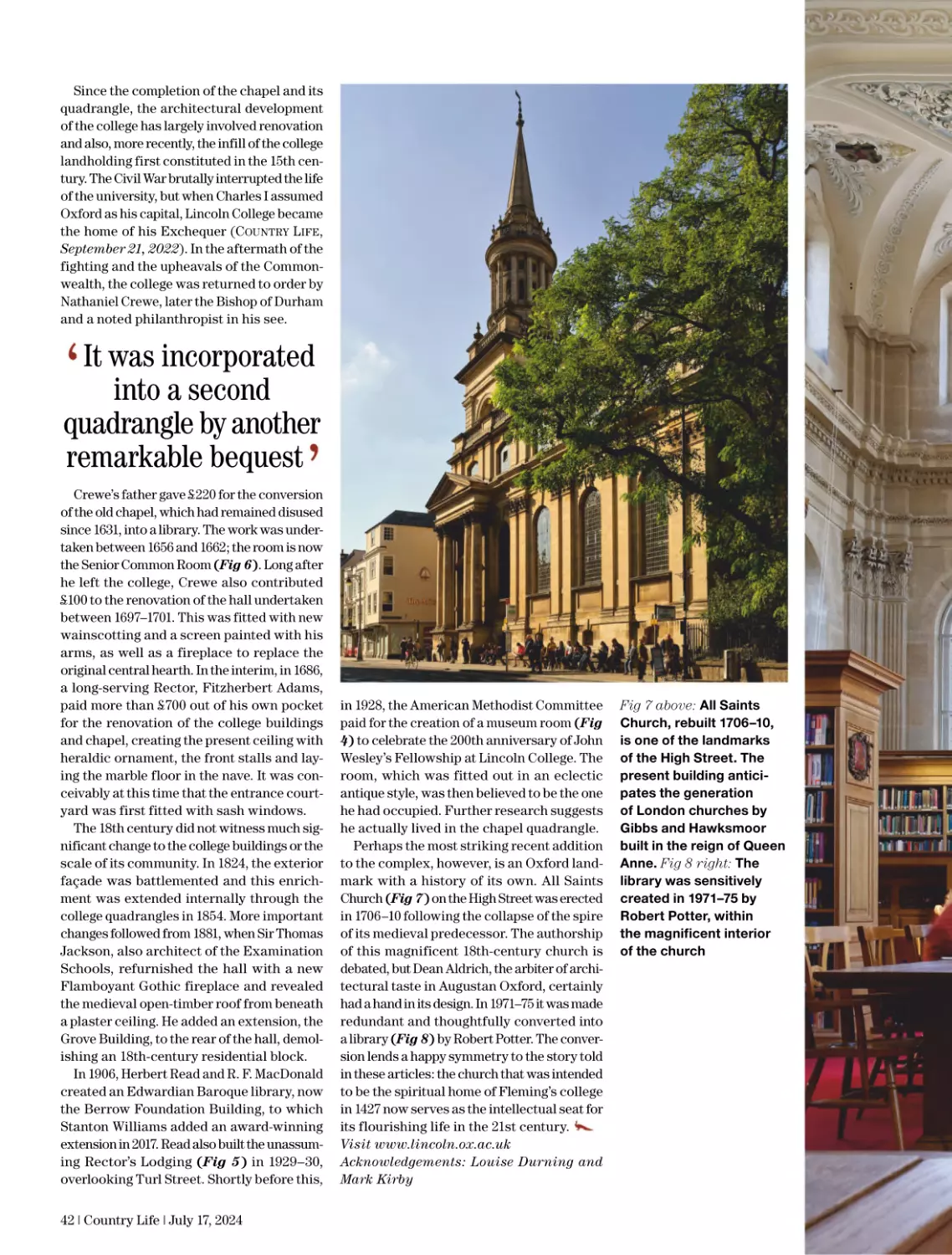
Church (Fig 7) on the High Street was erected
in 1706–10 following the collapse of the spire
of its medieval predecessor. The authorship
of this magnificent 18th-century church is
debated, but Dean Aldrich, the arbiter of architectural taste in Augustan Oxford, certainly
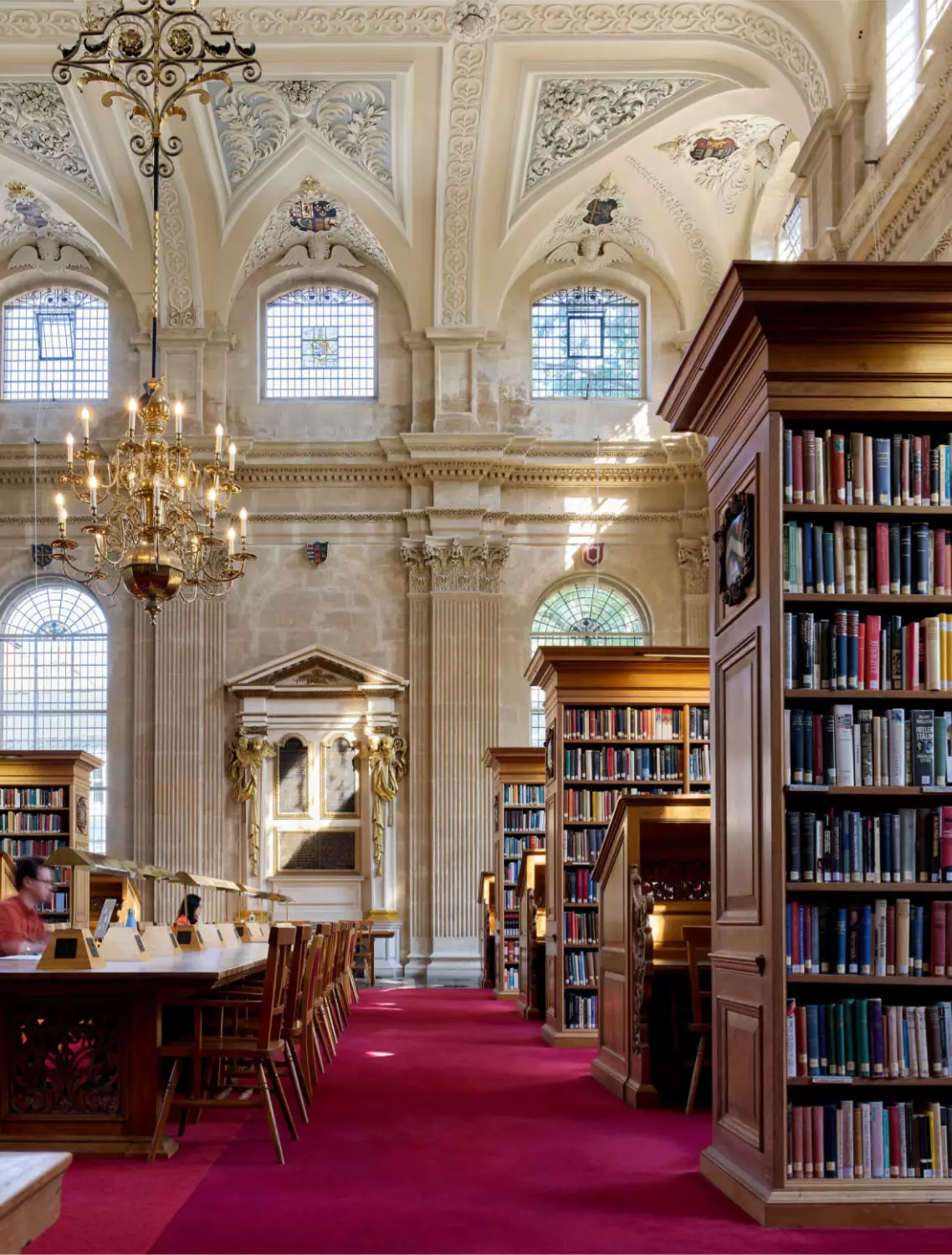
had a hand in its design. In 1971–75 it was made
redundant and thoughtfully converted into
a library (Fig 8) by Robert Potter. The conversion lends a happy symmetry to the story told
in these articles: the church that was intended
to be the spiritual home of Fleming’s college
in 1427 now serves as the intellectual seat for
its flourishing life in the 21st century.
Visit www.lincoln.ox.ac.uk
Acknowledgements: Louise Durning and
Mark Kirby
Fig 7 above: All Saints
Church, rebuilt 1706–10,
is one of the landmarks
of the High Street. The
present building anticipates the generation
of London churches by
Gibbs and Hawksmoor
built in the reign of Queen
Anne. Fig 8 right: The
library was sensitively
created in 1971–75 by
Robert Potter, within
the magnificent interior
of the church
Behind the Proms
• The name comes from
‘promenade concerts’, originally
performances held in parks
with listeners walking past,
an arrangement that exposed
more people to classical music
• Co-founder Robert Newman,
manager of the Queen’s Hall,
where the Proms were held
before it was destroyed in the
Blitz, stated he wished ‘to train
the public in easy stages’, starting with ‘popular’ music and
‘gradually raising the standard
until I have created a public for
classical and modern music’
• Wood’s famous Fantasia on
British Sea Songs was composed
in 1905 to celebrate 100 years
since the Battle of Trafalgar
44 | Country Life | July 17, 2024
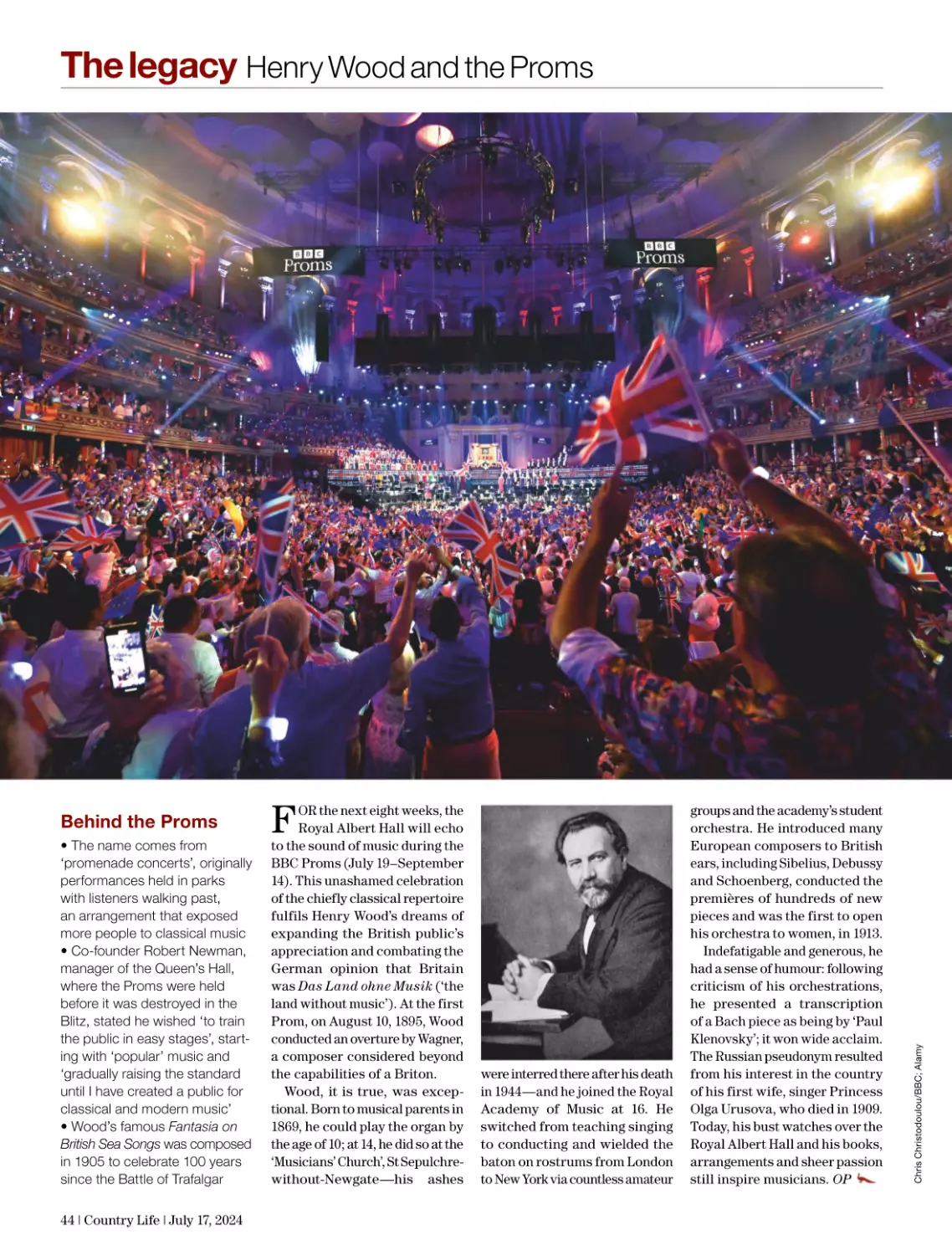
OR the next eight weeks, the
Royal Albert Hall will echo
to the sound of music during the
BBC Proms (July 19–September
14). This unashamed celebration
of the chiefly classical repertoire
fulfils Henry Wood’s dreams of
expanding the British public’s
appreciation and combating the
German opinion that Britain
was Das Land ohne Musik (‘the
land without music’). At the first
Prom, on August 10, 1895, Wood
conducted an overture by Wagner,
a composer considered beyond
the capabilities of a Briton.
Wood, it is true, was exceptional. Born to musical parents in
1869, he could play the organ by
the age of 10; at 14, he did so at the
‘Musicians’ Church’, St Sepulchrewithout-Newgate—his ashes
F
were interred there after his death
in 1944—and he joined the Royal
Academy of Music at 16. He
switched from teaching singing
to conducting and wielded the
baton on rostrums from London
to New York via countless amateur
groups and the academy’s student
orchestra. He introduced many
European composers to British
ears, including Sibelius, Debussy
and Schoenberg, conducted the
premières of hundreds of new
pieces and was the first to open
his orchestra to women, in 1913.
Indefatigable and generous, he
had a sense of humour: following
criticism of his orchestrations,
he presented a transcription
of a Bach piece as being by ‘Paul
Klenovsky’; it won wide acclaim.
The Russian pseudonym resulted
from his interest in the country
of his first wife, singer Princess
Olga Urusova, who died in 1909.
Today, his bust watches over the
Royal Albert Hall and his books,
arrangements and sheer passion
still inspire musicians. OP
Chris Christodoulou/BBC; Alamy
The legacy Henry Wood and the Proms
IP
R
C
ER
BS
SU
FF
O
O
TI
N
Make someone’s week, every week,
with a gift subscription
EVERY WEEK
MAY 8, 2024
The glorious Cotswolds
101 pages of property for sale
EVERY WEEK
MAY 15, 2024
Everything’s coming up roses
The best of Chelsea
SIX
Footman to fritillary: the names that flutter by
Fill your cup: the Cotswold cafés raising their coffee game
Bloomsbury gardens, Mrs Beeton and the best of Badminton
EVERY WEEK
ISSUES FOR
£6
JUNE 12, 2024
How to make the
countryside beautiful again
*
THE
GREEN
ISSUE
Scratching the surface: why soil matters
Seaside foraging and the real cost of wool
The Royal Family’s favourite artist
EVERY WEEK
Interiors special
APRIL 10, 2024
How beautiful things transform a home
The man who discovered oxygen
In the Monet: a garden inspired by great art
When the frog croaks: how animals forecast weather
Why everyone wants to live in Rose Cottage
Brawn and brilliance: the drama of Caravaggio
Saving otters and playing duets with nightingales
ORDER ONLINE NOW
Visit www.countrylifesubs.co.uk/D52V or telephone
0330 333 1120 and quote code D52V
Offer closes October 7, 2024. Price is guaranteed for the first 6 months, please allow up to 6 weeks for the delivery of your first subscription issue (up to 8 weeks overseas) the subscription rate includes postage and packaging.*Savings are based on the cover price.
Payment is non-refundable after the 14-day cancellation period. **Access to the digital library will end with your subscription. For full terms and conditions, visit www.magazinesdirect.com/terms. For enquiries and overseas rates please call: +44 (0) 330 333 1113. Lines are open
Monday-Friday 8:30am–7pm, Saturday 10am–3pm UK Time (excluding Bank Holidays) or email: help@magazinesdirect.com. Calls to 0330 numbers will be charged at no more than a national landline call and may be included in your phone provider’s call bundle.
Our green and
pleasant land
The human eye can detect more shades of green than
any other colour and they are matched by a bewildering
variety of names, discovers Lucien de Guise
S the summer holidays approach,
schools up and down the country
will be singing the praises of
England’s green and pleasant
land. Jerusalem seems to have been the first
time that greenness and pleasantness were
equated with this island. More than a century after William Blake wrote the words, it
became a hymn. It was taken up by the Suffragettes and, exactly 100 years ago, became
the official anthem of the Women’s Institute.
It has now acquired the status of unofficial
national anthem, endorsed by David Cameron
when he was prime minister.
Shakespeare is the poet the nation usually
turns to for a burnishing of its self-image. The
Bard of bucolic Warwickshire was, however,
far behind Blake the London urbanite in his
green credentials. For the earlier William,
England was ‘This precious stone set in the
silver sea’. John of Gaunt
doesn’t specify the colour
of the precious stone in
his deathbed tirade
against Richard II in the
eponymous play. Shakespeare goes on to mention ‘a demi-paradise’,
which would no doubt
have been different from the present-day
ideal. It could possibly have meant a full house
paying top price at his Globe Theatre.
Before and after Shakespeare’s day, the
colour green had few names and many diverse
associations. Some were good, such as a 1562
Etymologiae that takes a modern, holistic
ecotherapy view of green being ‘much comfortable to the sight of man’. Others tended
to be bad. Artists liked to show the Devil wearing green and, in mystery plays, it was the
colour of Judas’s clothing. It might represent
sickness, as well as love, hope and youth.
It was the colour of dragons and wild men,
as well as young maidens. Shakespeare wrote
of Cleopatra’s ‘Salad days’ when she was ‘green
in judgment’. Most of all, the Bard evoked
jealousy through this colour. Whether it was
the ‘green-eyed monster’ of Othello or ‘greeneyed jealousy’ of the merchant of Venice,
A
Shakespeare created a beast that lives on.
What he could not have foreseen is how green
would come to embody Britain—or, at least,
the English part of the Union. Nor the profusion of words that have come to describe it.
The human eye can apparently detect more
shades of green than any other colour, matched
by a bewildering variety of names in the English language. There are hundreds of them;
far more than the Inuit have for types of snow.
The unexpected thing about all the variants
of green in English is how few relate to England. Traversing the world, we encounter
everything from Amazon to Zomp green.
There is Eau de Nil—a romantic view of the
River Nile popularised by Flaubert in the 19th
century and continued by Alfred Hitchcock
for his leading ladies—so why no Goring-bySea green or at least a Thames brown? Green
was once considered to be the colour of
water, rather than land.
Before blue became
the typical description,
Chaucer gave us ‘sailing… waves green and
high’. Shakespeare has
Macbeth lamenting: ‘Will
great Neptune’s ocean
wash this blood/Clean
from my hand?… Making the green one red.’
Shades of green that relate to other English
locales are as rare as rivers. They abound
elsewhere, however. There is Russian, Persian, India and Pakistan green. There is even
a Brooklyn green, but the closest I can find
to England is Erin. This romantic name for
Ireland has geographical proximity to the
UK, without quite getting there. Numerous
alternatives with an Irish connection exist,
from Leprechaun to Kelly. The latter is such
an antiquated piece of stereotyping, I’m surprised it exists at all (being an American
reference to the large number of immigrants
with the name Kelly more than a century ago).
Closer to the Sceptred Isle than the Emerald
Isle is something called Shire green.
There is Russian,
Persian, India and
Pakistan green, even
a Brooklyn green
46 | Country Life | July 17, 2024
The familiar patchwork of England’s
fields, rich in sun-nurtured chlorophyll
Although it sounds like a reference to Blake’s
vision of England, nurtured by the loving
rustic hand of Tolkien, this colour is somewhat ambiguous. Some people associate it
with the horses, which are definitely not green.
Where an undeniably English name comes
up, it’s usually a reference to the people, not
the place: Lincoln green after the dyers of
that town; Kendal green for the same reason.
To be fair, most of the shades that seem to
describe places really relate to products.
There is Persian green for carpets or ceramics
and Paris green for a paint pigment developed in 1814 (see box). Most famous of all is
turquoise, which might raise some eyebrows
among lovers of blue, but is defined as being
‘between blue and green’. To make it
more confusing, the colour of the
actual stone can change when
in contact with skin and
other environmental factors.
The name is opaque, too.
Known in English as a colour
for 400 years, it is more
reminiscent of Central
Asia and Iran than Turkey.
Celadon has taken an
equally mysterious route into the English
language, referring to an East Asian ceramic
colour, but probably derived from a character in French literature of the 17th century.
Alcoholic beverages have also inspired hues.
A recent innovation at the Pantone Color
Institute—which has much influence in the
field of colour recognition—is an off-white
called English Sparkling, but French alcohol
long ago spawned two important shades of
green. Against the wholesomeness of Bordeaux
and Burgundy is the sickliness of Absinthe
and Chartreuse. Both were controversial in
the 19th century, one because of the appalling
reputation of the drink itself, the other because
the colour so divided opinions in its day. The
Getty; Alamy; Roy Miles Fine Paintings/Bridgeman Images
Above: It isn’t easy being green, spending
each day the colour of the trees: myriad
shades in an English wood. Below: It’s
easier for a frog: Kermit has conquered
all with his distinctive garb. Below: The
fastest colour of all: British Racing Green
same could be said for Oscar Wilde’s green
carnation, together with his whole persona:
‘He had that curious love of green, which in individuals is always the sign of a subtle artistic
temperament, and in nations is said to denote
a laxity, if not a decadence of morals.’
Nature is where the real dividends of green
are found, which certainly doesn’t include the
dyed flowers favoured by Wilde and his circle.
There is a staggering selection of natural
greens. Most refer to plants and minerals,
such as Myrtle, Pine, Lime, Jade, Emerald,
Fern, Laurel, Mint, Tea, Avocado, Moss, Swamp,
Artichoke, Pistachio, Asparagus, Parsley, Sage,
Thyme—and, yes, there is a greyish-green
shade known as Rosemary.
He had that curious
love of green...
the sign of a subtle
artistic temperament
Once again, these colours don’t relate exclusively to England. The closest is very distant
from Blake’s pastoral vision. It’s British Racing
Green to the rescue. In fact, its first use as
a racing livery was a tribute to Ireland. In 1903,
the Irish Republic was still part of the UK and
a handy venue for a pioneering motor race
when racing was illegal on British roads. The
colour has been maintained by Aston Martin
in its recent successful Formula 1 seasons.
The company may have a Canadian owner now,
but every car is still made in Gaydon, Warwickshire—as green and pleasant a factory environment as exists in modern England.
Frederic Leighton’s painting of Desdemona, who brought out the green-eyed monster
Green and not so pleasant
The green that was really noticed
before the modern era was less
about Nature and more about
paints and dyes. Getting green
pigments right has always been
difficult. Wall tapestries might
make the viewer wonder if the
vegetation of Olde England was
really as blue as that, but most
green dyes were a combination
of blue and yellow and, as the
latter tends to fade faster, the
eventual result is too much blue.
A breakthrough happened in
1775, when Carl Scheele used
arsenic to create a lively, albeit
deadly shade of green. Soon after
came a new and equally vibrant
version known by many names,
including Paris green and Emerald
green. Much loved by 19th-century
artists, it was no less poisonous
than Scheele’s colour. Both are
well suited to J. E. Millais’s painting of Shakespeare’s drowned
Ophelia, which glows with spectral
light on the walls of Tate Britain.
There were real-life victims, too.
Both shades of green were used
in everything from children’s toys
to haute couture and wallpaper
produced by William Morris (left).
The most notable victim of all may
have been England’s arch enemy.
The furnishings in Napoleon’s St
Helena prison home had enough
Paris and Scheele’s green to make
anyone sick. The greens did come
back to English fields—as insecticides that were later banned.
July 17, 2024 | Country Life | 49
It’s a bullseye
With the brawn of a bulldog and the brains of a terrier,
this much-maligned breed has the ability to rouse
adulation or antipathy. Yet beneath the muscular
frame of the bull terrier lies a stoic and
kindly character, says Katy Birchall
Y all accounts, the dog in the 1968
hit musical film Oliver! belonged
to the wrong character. Say ‘bull
terrier’ and many will immediately
think of Bull’s-eye, the famously unfortunate companion to Oliver Reed’s sinister
criminal Bill Sikes, a fierce, brutish dog as
feared as his cruel, unforgiving master—but
anyone who owns a bull terrier will tell you
that this dog is no villainous sidekick.
This is a breed with a big heart, a comical
nature and an eye that holds a mischievous
twinkle. Bull’s-eye would surely have been
more at home with the film’s gentler interpretation of Fagin, charming his way around
town and slyly picking a pocket or two—and
nothing illustrates this better than Butch,
the dog that played Bull’s-eye in the cinematic
classic. ‘Butch was an old boy when he started
filming Oliver!,’ recalls Cindy Sharville of her
beloved family pet. ‘He
was loving, clever and
obedient, so long as
treats were involved—
during breaks, he would
carry his bowl up to anyone eating, scrounging
for food. Reed loved him
and would sit on the
floor with Butch on his lap.’
With its unique downfaced egg-shaped head,
keen, bright eyes and muscular physique,
this striking breed naturally catches the eye.
David Mason’s first bull terrier Purdey made
a splash in 2005, when she was photographed
for The Sunday Times in a bespoke coat by
Nutters of Savile Row, a brand then owned
by Mr Mason. ‘Purdey was such a lovely dog
and when we lost her, it really was like losing
a member of the family,’ admits Mr Mason,
founder of Mason & Sons, which champions
and restores established British brands, such
as Anthony Sinclair and Mr Fish. ‘It didn’t take
us long to get our next one, Lulu. You’ll find
that with bull terriers—once you’ve had one,
you won’t want anything else.’
Currently the owner of two-year-old Vesper,
who cheerfully greets customers at the company’s headquarters in John Lennon’s former
B
Marylebone home, Mr Mason concurs that the
breed has become somewhat synonymous
with Mason & Sons, thanks to his dogs taking a starring role in several campaigns.
‘They’re an important part of our life story—
everything at Mason & Sons is British,
including the dog,’ he laughs. ‘Bull terriers are
an acquired taste. I think they’re beautiful,
of course, but it’s their character that really
has the appeal. They are notoriously stubborn and somehow always getting in trouble.
They know right from wrong, but they can’t
seem to help themselves. It can be maddening,
but ultimately you love them for it.’
The breed owes its origins to James Hinks,
an animal dealer in Birmingham who developed a new strain of all-white ‘bull-andterriers’ during the 1850s. Having kept and bred
fighting dogs, Mr Hinks is believed to have
crossed the bulldog, the now-extinct white
English terrier and the
dalmatian to produce
his white ‘bull terrier’.
Despite its ancestry,
this dog was not bred
with the fighting ring
in mind—Hinks had set
his sights on the show
world, determined to
establish a companion dog with a striking purewhite coat and a more refined appearance.
As his son James Hinks Jnr later wrote, the
bull terrier was to be ‘the old fighting dog
civilised, with all of his rough edges smoothed
down without being softened; alert, active,
plucky, muscular and a real gentleman’.
The conformation of the bull terrier has
evolved through the years. Most notably, the
head took on its distinctive long, domed ‘egg’
shape and the white coat gave way to colour
as brindle, red and fawn were accepted in
the breed standard. It has, however, retained
its original characteristics: the strength and
courage of its bulldog ancestry and the terrier’s wit and mischief. Perhaps most of all,
it has stayed true to Hinks’s vision that it
It was to be the old
fighting dog civilised;
alert, plucky and
a real gentleman
50 | Country Life | July 17, 2024
Owners are united in the belief that ‘life
is merrier when you live with a bull terrier’
would become a companion dog—enthusiasts
will tell you that the bull terrier’s purpose
in life is to be right at your side.
‘After her morning walk, Olive will sit
under my car and wait for me there, so I have
to take her with me wherever I’m going,’
reveals Fleur Worsley of her five-year-old
bull terrier. ‘On the occasions I have to go
to work without her, she hates it.’
If you don’t have
a sense of humour,
the bull terrier
isn’t for you
Star quality: Purdey steals the limelight from David Mason in a Sunday Times photoshoot
Small wonder: the miniature bull
terrier is on the Kennel Club’s
vulnerable native breed list
of The Princess Royal. ‘Many years ago at
Crufts, Princess Anne walked into the bullterrier ring holding a bouquet of flowers,’
she recalls. ‘She stopped to talk to the judge,
who was standing with a handler and their
bull terrier. The next thing we knew, the dog
had jumped up and snatched Princess Anne’s
flowers, scoffing the lot. Luckily, she burst
out laughing (The Princess Royal has kept
bull terriers for decades, which may explain
her not minding the loss of the blooms).
If you don’t have a sense of humour, the bull
terrier is not the dog for you.’
Smitten with the breed since she got her
first puppy 40 years ago, Mrs Clark owns
six miniature bull terriers, a breed almost
identical to its larger counterpart in everything but size—although, sadly, the miniature is currently on the Kennel Club (KC)’s
vulnerable native breed list, with only 264
Getty; Neil Wilder; Shutterstock
A keen horsewoman, Mrs Worsley works
for Oxford Polo, where, she admits, a bull
terrier tends to stand out. ‘My colleagues
have spaniels, labradors, lurchers and whippets. I park up, open the boot and out jumps
my bull terrier—people can be horrified,’
she admits. ‘But give Olive 10 minutes or so
and they’ll be fussing over her. Bull terriers
have an unfair reputation. Our postman was
scared of Olive at first, but they’re now best
friends. My husband never wanted one, but
he adores Olive—he takes her shooting with
him. She happily sits next to him on the peg.’
It is the natural comedian in the bull terrier that has hooked Mrs Worsley for life: ‘I’ll
never be without one. They are hilarious—
every morning, we’re woken up by Olive
dramatically yawning in the kitchen. My
sister got me a fridge magnet that says “Life
is much merrier when you live with a bull
terrier” and, for me, that sums it up.’
Breeder and judge Elaine Clark concurs
that the bull terrier has a knack for comic
timing, as she once witnessed in the presence
Loyal to the last
• Sir Walter Scott once wrote ‘the
wisest dog I ever owned was what
is called a bulldog terrier’, of his
beloved dog Camp. A portrait of
Scott and Camp, painted by James
Saxon in 1805, is on display at the
Scottish National Portrait Gallery
• In 1899, Rudyard Kipling wrote the
short story Garm: A Hostage, about
an officer and a fiercely devoted bull
terrier in India during the days of the
British Raj
• Gen George S. Patton Jnr purchased bull terrier Willie from the
widow of an RAF officer in March
1944—Willie had accompanied the
officer on six missions across
Europe, but missed the seventh
flight, from which his owner did
not return. Willie became famous
as the general’s constant companion: a 12ft statue of Patton
and Willie stands today at the
General Patton Memorial Museum
in California, US
• The bull terrier counts numerous
public figures past and present among
its fans, including The Princess
Royal, Eric Clapton, John Bishop,
Marc Jacobs and Jane Birkin
Left: The Princess Royal shares her love of the breed with granddaughter Mia Tindall. Right: Lap dog: Jane Birkin was a devotee
registrations in 2023. ‘Bull terriers and miniatures are great family dogs. They adore
children and know when to be gentle with
them,’ enthuses Mrs Clark. ‘They’re happy
to go on long walks, but don’t necessarily
need loads of exercise. What they do like
is a lot of attention and they can’t be left at
home for a long time.’
Bill Lambert, the KC’s health, welfare
and breeder services executive, grew
up with bull terriers and, when it came
to buying his own dog, there was no
other breed. ‘My wife didn’t like the look
of them at first, but that’s the wonderful
thing about pedigree dogs—you need to go
deeper than looks and the bull terrier
is a great example,’ he says. ‘They
don’t have universal appeal, but
beauty is in the eye of the beholder.
It’s their temperament—fun, stoic and
They adore children
and know when to be
gentle with them
Strong willed: the bull
terrier’s stubbornness can
make them difficult to train
kind—that makes them so special.’ The breed
has its faults, Mr Lambert notes. The white
bull terriers in particular can be prone to
deafness—although this issue has lessened
thanks to the Brainstem Auditory Evoked
Response (BAER) test, which many breeders
now use—and the bull terrier’s stubborn
nature can also make them difficult to train:
‘They are strong willed and haven’t got great
recall, so you need to be on the lookout and
prepared to put them on lead around other
dogs—they are strong and muscular, so you
have to be responsible.’
Working at the KC, Mr Lambert would be
forgiven for being tempted by one of the
many other dog breeds out there. ‘I love all
dogs,’ he concludes. ‘The thing is, if I got
another breed, that would only mean I’d
have one less bull terrier—and, honestly,
nothing else quite matches up.’
July 17, 2024 | Country Life | 53
All The King’s
whales and all The
Queen’s dolphins
T was a quiet afternoon in the summer
of 2004 when Swansea Bay fisherman
Robert Davies hauled in the catch of his
life. ‘To be honest, I didn’t know what
it was,’ he confessed to reporters at the time
—and his puzzlement was understandable.
He had inadvertently netted a 9ft-long sturgeon, a giant fish seldom spotted in British
waters. It weighed just shy of 19 stone (120kg)
and looked like something from Jurassic
Park. But Mr Davies’s first legal duty? He was
obliged to offer the sturgeon to the Queen.
Her Majesty duly declined—by way of a fax
from the Royal Household that informed
Mr Davies he could
‘dispose of it as he saw
fit’—and the rare fish
ultimately found itself
in the care of the Natural History Museum,
where it remains, preserved in alcohol, to
this day. The whole
piscatorial palaver, however, shone light onto
one of Britain’s more eccentric ancient laws.
Due to the ‘superior excellence’ of whales,
sturgeons, dolphins and porpoises, any of these
species caught or washed up on our shores
technically belongs to the Monarch.
The rule dates back to the 14th-century
reign of Edward II, when whales and sturgeons
were declared ‘Royal Fish’, seemingly because
their size and grace deemed them worthy
of a regal prerogative. Dolphins and porpoises,
majestic animals both, were later added to the
designation. Today, the Crown still has a legal
claim on this quartet of sea creatures whenever
they’re caught or stranded off England, Wales
I
and Northern Ireland, although, in Scotland,
the law applies only to beached whales too
heavy to be drawn by a ‘wain pulled by six large
oxen’. Good luck putting that one to the test.
Despite still being legally valid—regardless
of whether the cetaceans themselves are
resident or migratory—these regulations are
now essentially a relic of another era, akin
to those dusty old bylaws about herding sheep
across London Bridge or being drunk in charge
of a cow. When a man famed for eating roadkill decided to cook a washed-up Cornish
dolphin for his Christmas dinner in 2015,
endangering his health in the process, he
appears to have received
sharp words from conservationists, rather than
a royal summons.
More pertinent is the
fact that the presence
of awe-inspiring, supersized cetaceans in our
waters is very much
an ongoing phenomenon. About 29 species
of whale, dolphin and porpoise can still be
spotted around the British coastline at different
times of year—more than anywhere else in
northern Europe—from sleek-bodied orcas
and stately minke whales to playful pods
of bottlenose dolphins. All are now protected
by wildlife legislation, including the Wildlife
and Countryside Act of 1981. For Danny Groves,
of the UK-founded charity Whale and Dolphin
Conservation, this diversity is very much
something to celebrate and protect—and he
clarifies a few important points.
‘Technically, the Royal Fish law applies
to whales or dolphins washed up on shore,’ he
The UK seas offer
a number of menu
choices for whales
and dolphins
54 | Country Life | July 17, 2024
explains. ‘As transient and sentient mammals,
they don’t belong to us humans when they’re
in the ocean. And quirks of British history aside,
in reality whale and dolphin strandings are
investigated and documented today by the UK
Cetacean Strandings Investigation Programme,
the Scottish Marine Animal Strandings Scheme
and the appropriate local authority, which will
deal with disposal of the carcass.’ This also
makes it illegal to be in possession of, transport,
sell or exchange any part of a whale, dolphin
or porpoise—‘please don’t be tempted to
take a tooth,’ says Mr Groves—and, unearthly
smell aside, their decomposing bodies also
pose risks to the health of humans and dogs.
In their watery domain, four of these incredible species can be classified as resident or
semi-resident to Britain (bottlenose and Risso’s
dolphins, harbour porpoises and orca), whereas
for many other cetaceans our waters serve
as valuable summer feeding grounds as they
migrate to and from their breeding territories.
The seas around Scotland are particularly
Getty
More species of whale, dolphin and porpoise
can be spotted in the UK than anywhere else
in northern Europe and all of them, technically,
belong to the Monarch. Ben Lerwill takes a look
at one of our more obscure laws and why the
animals have such an important role to play
in the fight against climate change
rich for sightings, but south-west England and
the west coast of Wales have hotspots of their
own. Although these animals routinely face
manmade threats such as pollution, global
warming and accidental capture in fishing
nets, there are some reasons for optimism.
‘Historically, direct removal of individuals
by hunting had severe effects on populations
in our waters as well as globally. Thankfully,
the UK no longer allows whale hunting,’ continues Mr Groves, explaining that data remains
insufficient to monitor exact numbers. ‘One
species, humpback whales, are reportedly
being sighted more frequently. This may be
a sign of populations recovering from whaling,
but could also reflect increased awareness
and sighting efforts on the coast.’
He outlines, too, how our temperate waters
can hold tangible benefits for hungry species.
‘The UK seas do offer a number of menu
choices for whales and dolphins, and our
geography provides different habitats. The
shelf-edge suits deep-diving species, such
Majestic bottlenose dolphins make a splash
off Chanonry Point near Inverness, Scotland
as sperm whales and pilot whales, for example,
whereas shallower sand and mud banks are
key areas for harbour porpoises.’
Putting the Royal Fish law to one side, it has
become ever more vital to safeguard the
future of what are some of the planet’s most
spectacular wild animals. Responsibly run
whale-watching trips can benefit everyone
involved—from guests and operators to local
communities and the sea creatures themselves
—but human disturbance is otherwise frowned
upon. The stakes, after all, are high.
‘Whales and dolphins are awesome and they
also play an enormous role in providing a solution to the climate emergency,’ concludes Mr
Groves. ‘The ocean absorbs more carbon and
releases more oxygen than all of earth’s forests
and the great whales help it flourish by stimulating the production of oxygen in our seas.’
Visit https://uk.whales.org
How do whales help
combat climate change?
• ‘The way that whales feed, poo,
migrate and dive between the surface
and the ocean depths circulates
essential nutrients throughout the
ocean,’ notes Whale and Dolphin
Conservation. The phenomenon
is known as the ‘whale pump’ and
it, in turn, supports healthy marine
ecosystems and the growth of carboncapturing phytoplankton
• Whales lock in such huge amounts
of carbon that their mass slaughter
during the peak of commercial whaling
in the 19th and 20th centuries may
have contributed to the acceleration
of climate change. A single whale can
sequester away an average of 33 tons
of carbon dioxide over its lifespan; a live
oak tree captures roughly 12 tons
July 17, 2024 | Country Life | 55
The good stuff
Diamond limpet
pendant necklace,
£965, Ami Pepper
(020–8444 7000;
www.
tomfoolerylondon.
co.uk)
Golden Hour Earrings
in recycled gold
plated bronze,
£340, YSSO x Danielle
Copperman (www.
theysso.com)
Coquillage necklace,
Heritage collection,
price on application,
Van Cleef & Arpels
(www.vancleefarpels.com)
Shell We Dance
diamond pendant,
price on
application, Jessica
McCormack (020–
7491 9999; www.
jessicamccormack.
com)
Shelling out
It’s time to come out of your
shell and straight to the beach
(or bar) wearing a piece from
Hetty Lintell’s selection
of fitting jewellery
Tutamen diamond
spiral pendant, £2,595,
886 by The Royal Mint
(020–7408 0714;
https://886.royalmint.com)
Lady V
earrings, £3,300,
Venyx (020–3096
1390; www.
venyxworld.com)
Coquillage diamond pendant
earrings, Ailleurs Carte Blanche
High Jewellery Collection, price
on application, Boucheron (020–7514
9170; www.boucheron.com)
Shells
aquamarine pearl
charm bracelet,
£4,800, Sophie
Keegan (www.
sophiekeegan.com)
The Clam
& Pearl Ring,
£3,000, Cece
Jewellery (www.
cecejewellery.
com)
Queen’s Conch
ring, £1,600, Misa
Hamamoto (020–
8444 7000; www.
tomfoolerylondon.
co.uk)
A stitch
in time
Designer Erdem
Moralioglu’s must-see
exhibition in Derbyshire
is a loving tribute to
Debo Devonshire and her
passion for Chatsworth,
chickens and couture,
says Kim Parker
NE of the first extraordinary items
you encounter at the ‘Imaginary
Conversations’ exhibition at
Chatsworth House is a gleaming,
tinsel-like twinset, crafted with silver lamé
and sequins. Nearby, a fringed purple leather
jacket shimmers with rhinestone starbursts
—a tribute to Elvis Presley’s elaborate stage
costumes—and another ensemble, a tailored
tweed suit with a nipped-in silhouette, bears
an artfully deconstructed hem ‘as if it’s been
pecked by chickens,’ explains its British
designer, Erdem Moralioglu.
These outfits formed part of Mr Moralioglu’s
romantic spring/summer 2024 catwalk show,
which was inspired by the late Dowager Duchess
O
58 | Country Life | July 17, 2024
of Devonshire, Deborah (‘Debo’) Cavendish,
and encapsulates much of her famously eclectic personality. The youngest of the Mitford
sisters, Debo married Lord Andrew Cavendish, younger son of the 10th Duke of Devonshire, in 1941, and expected to live quietly as
the wife of a country squire. But when Lord
Andrew’s older brother was killed in the
Second World War and his father unexpectedly died a few years later, at the age of 55,
he inherited the dukedom, as well as Chatsworth, and Debo became a duchess. After the
war, the 126-room house and its grounds were
in disrepair (‘a fabulous mess,’ she once
recalled) and the Duchess had to cultivate
strong entrepreneurial instincts to save the
estate—she set up the farm shop, founded the
charitable trust that supports Chatsworth’s
considerable upkeep and collaborated with
artists on creative projects to encourage
visitors, a radical concept at the time, but one
that her descendants continue to this day.
‘Debo was, in many ways, quite contradictory. She was this forward-facing duchess who
represented the family in formal situations,
but she was just as happy tending to her
beloved chickens as she was hosting presidents, which I found so interesting,’ notes
Mr Moralioglu. ‘She had bags by Hubert de
Givenchy and wore beautiful bespoke dresses
made by her dressmaker, Mary Feeney, but
she also adored Elvis and wore slippers with
Harry Borden/Contour by Getty Images;
Chatsworth House Trust; Getty; Alamy
Always stylish: the late Duchess of Devonshire, known as Debo, was as elegant feeding her chickens as when hosting presidents
his face printed on them. The spirit of that
contrast is really wonderful to me.’
So wonderful, in fact, that the designer
(a self-confessed history ‘nerd’) not only devoted
his entire fashion collection to the duchess,
but has displayed it alongside a curated selection of her own belongings (such as letters,
objects and accessories) for ‘Imaginary
Conversations’, reflecting her character, as
well as his own creative processes. ‘Creating
the collection became this imaginary conversation between someone I’ve never met
as a muse and myself. With this exhibition,
what you see is not an exact portrait of her,
but something through a lens,’ he says.
He is the first to have
been granted access to
her personal archive
‘The diversity of Debo’s interests has always
amused people,’ agrees Laura Cavendish,
Countess of Burlington, whose parents-in-law
are the current Duke and Duchess. ‘It’s hard
to know exactly what captures the imagination, but I’d hazard a guess that glamour, wit
and unpredictability have something to do with
it.’ Although the late Duchess had previously inspired many other fashion designers,
including Alessandro Michele during his tenure
at Gucci, Mr Moralioglu is the first to have
been granted access to her personal archive
since her death in 2014. His friendship with
Lady Burlington stretches back almost 20
years, to when she worked as a fashion buyer
and purchased his debut collection for The
Shop at Bluebird in London. It was thanks
to Lady Burlington that he was able to explore
more than 1,000 items in the Chatsworth
archives in 2017, when researching Adele
Astaire (who married Charles Cavendish, son
of the 9th Duke of Devonshire) for a fall/winter
collection. ‘It was then that I really discovered
Far left: The
queen of
cool: Debo’s
Elvis slippers. Left:
The tweed
suit ‘pecked
by chickens’.
Above: Erdem’s
atelier, re-created
in the Queen of
Scots’ Dressing
Room. Top: Crystal dress decoration inspired by
Debo’s bug pins
Debo and this idea of doing a collection based
on her was planted in my mind,’ he reveals.
‘I always knew I would come back to her.
Of the many things that drew him back to her,
her attitude of ‘make do and mend’ was one
of the most alluring. ‘I loved that she held on
to things, whether it was carpets or furniture
or doors or fabrics, and tried to use them again
wherever possible,’ he says. Indeed, the theme
of circularity runs throughout the exhibition,
which takes place in Chatsworth’s Regency
Guest Bedrooms and showcases Erdem
dresses and billowy waxed jackets against
swags of the archival fabrics that inspired
them, their floral prints echoing each other
perfectly. One gown has even been fashioned
from a set of chintz curtains that had been
‘retired’ by Lady Burlington from Lismore
Castle (the family estate in Ireland). ‘They
were light shattered and destined for the
July 17, 2024 | Country Life | 59
Above: Gallery of glamour: rhinestones glitter and sequins gleam against delicately decorated walls. Facing page: To celebrate the
Duchess’s love of the countryside, Erdem collaborated with Barbour on a waxed-cotton coat with replica Chatsworth fabrics
bin, but Erdem persuaded me to send them
to him,’ she says. Mr Moralioglu repurposed
the fabric into a one-shouldered dress and
invited Debo’s great-granddaughter (the
daughter of his late friend, Stella Tennant)
Cecily Lasnet, who was interning in his workshop, to embroider flowers over the top, in
an ‘extraordinarily touching’ gesture.
Other pieces are displayed with their design
references taken from the late Duchess’s wardrobe. In the Alcove Bedroom, a glass vitrine
holds a shimmering array of Victorian and
Edwardian insect brooches, anniversary gifts
from her husband, around a Cecil Beaton photograph of the Duchess in an off-the-shoulder
gown—both of which inspired the dark velvet
dress on an adjacent mannequin, with its
elegant shoulder ties and sprinkling of crystal
bugs. Next door, in the Queen of Scots’ Bedroom (where Mary Queen of Scots slept during
60 | Country Life | July 17, 2024
her house arrest at Chatsworth in the 16th
century), a dress with an embellished bodice
and sheer, lingerie-like skirt is juxtaposed
against the underpinnings of a haute couture
dress from the 1950s created for the Duchess
by Jean Patou. ‘For me, these two dresses
summarise the idea behind the whole collection. I loved the idea of taking an undergarment that had been fitted specifically to
Debo’s body and was something that no one
was ever supposed to see, and bringing it to
the outside,’ says Mr Moralioglu. ‘This pairing
epitomises the conversation between the past
and the present, between Debo and myself
and between Chatsworth and its legacy.’
For Lady Burlington, a notable part of the
exhibition is in the Queen of Scots’ Dressing
Room. Here, Mr Moralioglu has re-created
his own atelier—everything from his mood
boards and sketches for the spring/summer
collection to the cotton toiles employed by his
cutting team, and the model fitting photographs from his spectacular catwalk show,
held in September 2023 at the British Museum.
‘My hope is that those who see it learn how
a designer works from an archive and the time
and effort that goes into research, pattern making and print design. Artists and designers
often have new and interesting ways of seeing
the world and Chatsworth has always been
a place that was experimental. William [Lord
Burlington] and I have a responsibility to
conserve and protect the historical aspects
of Chatsworth, but also to embrace new projects and welcome an increasingly diverse
audience,’ she says. Somewhere, one suspects,
Debo herself is nodding in agreement.
‘Erdem: Imaginary Conversations’ is at
Chatsworth House, Derbyshire, until
October 20 (www.chatsworth.org)
Legendary Chatsworth chatelaines
Before Debo, wife of the 11th Duke of Devonshire, many other ladies of the Derbyshire
manor had been renowned for their wit, style and savvy
Bess of Hardwick, Countess
of Shrewsbury (1521–1608)
Married four times, Bess was a powerful
figure in Elizabethan society (The legacy,
May 15) and established the current
Cavendish line with her second husband,
Sir William Cavendish. Widely celebrated
for her building projects, she was responsible for bringing Chatsworth House into
the family—persuading Sir William to leave
Suffolk and buy the manor of Chatsworth
for £600 in 1549—constructing nearby
Hardwick Hall and creating its inventory,
known today as the Hardwick Hall Collection, the largest assembly of important
embroidery and tapestries preserved by
a single family. Her son William became
the 1st Earl of Devonshire.
Christian Cavendish, née Bruce
(1595–1675)
Canny and well connected, Scottishborn Christian took over the running of
the (almost bankrupt) Cavendish estates
on the death of her husband, William,
2nd Earl of Devonshire, in 1628, when
their son, also William, was only 11. After
dealing with William’s substantial debts
and recovering the family’s finances,
she became an influential Royalist and
woman of letters, befriending poets and
politicians, such as Edmund Waller and
William Herbert, 3rd Earl of Pembroke.
Georgiana Spencer Cavendish
(1757–1806)
Portrayed by Keira Knightley in 2008’s The
Duchess, Georgiana became mistress of
Chatsworth aged only 17, but rose to the
challenge of managing the estate, as well
as forging a place for herself at the heart
of Society as a writer, collector, fashion icon,
political campaigner and, sadly, a gambler, accruing large debts. She also made
a scientific study of minerals and, unusually, nursed her children herself. Dubbed
‘a phenomenon’ by Horace Walpole and
‘the best-natured and best-bred woman
in England’ by the then Prince of Wales,
tales of Georgiana’s legendary charm have
endured for more than two centuries.
July 17, 2024 | Country Life | 61
Interiors
The designer’s room
Penny Morrison brought
a spare room to life with
a pair of four-poster beds
and graphic pattern
HEN the interior designer
Penny Morrison was asked to
decorate a holiday home, her
remit was to make every bedroom feel
grown-up and special. ‘I always think it’s
nice to make the spare bedroom something of a treat to stay in—almost somewhere nicer than being at home.’ In this
case, she decided the solution was to opt
for a pair of four-poster beds. ‘A four
poster is a key ingredient in a luxurious
bedroom. Fortunately, this bedroom had
very high ceilings, so there was plenty
of space to accommodate these two beds,
which are my own design.’
The property had recently been significantly overhauled, a process that involved
stripping the house to its bare bones and
starting again in order to bring it up to
21st-century standards. ‘The result of the
work was a very elegant interior, with
cool stone floors and lots of fresh white
paint, but it was rather stark in nature,’
says Mrs Morrison.
Striped fabrics in horizontal and vertical formats play a significant role in this
scheme. She used Cotswolds-based Rapture & Wright’s Tribal Stripe in a pale Delft
blue for the bed testers, curtains and valances (01608 652442; www.raptureand
wright.co.uk). The testers have a cut fringe
from Samuel & Sons in ruby red along the
scalloped edge to add definition (020–7351
5153; www.samuelandsons.com). The redand-cream rug on the floor and the X-frame
footstools are from her own collection. The
mid-century bedside table is from Chelsea
Textiles and painted in glossy crimson to
tie in with the rest of the room (020–7584
5544; www.chelseatextiles.com).
Arabella Youens
Penny Morrison (020–7384 2975;
www.pennymorrison.com)
W
Mike Garlick
62 | Country Life | July 17, 2024
July 17, 2024 | Country Life | 63
Interiors The inside track
Giles Kime
Rooms with a view
How large-scale wallpapers transport you to another world
I
T’S hard to imagine how 18th-century
guests at houses such as Belton in
Lincolnshire and Blickling and Felbrigg
in Norfolk, would have responded to
the exotic scenes and motifs that characterised the Chinese wallpaper that became such
a popular feature of English country houses.
Deep in the countryside, they couldn’t be further removed from the exuberant and colourful work of decorative painters of Guangzhou.
Country-house interiors that make a bold
statement have a tendency to detract from
their setting. That, surely, is the job of the
townhouse interior, not only in Georgian
England, but also in the 21st century, where
the light, noise and clutter of city streets is so
chaotic that it makes sense for them to look
inward rather than outward. In urban spaces,
pattern and colour are brilliant decorating
devices; for evidence, look no further than
the Diplomatic Reception Room in the White
House dominated by sweeping Scenes of
North America block-printed in the early 19th
century by a manufacturer in Rixheim, France,
64 | Country Life | July 17, 2024
that has been making wallpaper since the
French Revolution. More recently, it has been
demonstrated by projects where hand-painted
de Gournay wallpapers (www.degournay.
com) have been used to inject glorious, largescale scenes. It’s an approach that the hotelier
Kit Kemp employs brillliantly.
As have so many things, the production
of panoramic wallpaper has been transformed
by digital technology, perhaps most successfully by Adam Ellis (www.adamellis.com). The
Slade-trained artist employs a vast archive
to create a dizzying array of designs that
transport you to tropical rainforests, lakes
crowded with flamingos, classical gardens
and the ocean depths. Unlike conventional
wallpapers, each design is bespoke, responding to the architecture of the space for which
it is intended. His studio creates a remarkable
range of stand-alone prints, too, some with
the mood-laden Surrealist feel of Italian artist
Piero Fornasetti, who made distinctive furniture and wallpapers (www.fornasetti.com).
Mr Ellis also created a design for Suzy
Hoodless’s room at this year’s WOW!house
at Design Centre, Chelsea Harbour, London
SW10. For inspiration, he looked to the garden
of the interior designer’s house in Cornwall.
It proves how panoramic wallpaper can add
depth to space—in this case, one that didn’t
exist only five days before the event.
Pablo Enriquez; James McDonald
Above: An enchanted—and convivial—world: a bar created by Adam Ellis. Below: The Dining Room by Suzy Hoodless at WOW!house
Property market
Penny Churchill
Country and western
Otters, kingfishers, geese, deer, dukes, monks and wild swimmers–
all are drawn to these West Country properties, one built
by Sir Edwin Lutyens, another on old Cistercian land
Madford House offers spectacular views of the Culm valley and Blackdown Hills from its prime position near Hemyock in Devon. £1.5m
ONDON buyers seeking sanctuary in the
West Country, without severing close
links with the capital, need look no further than secluded Madford House, an imposing
former vicarage set in 10 acres of gardens,
flower meadows and wetlands on the banks
of the River Madford, two miles from Hemyock,
Devon, 12 miles from Tiverton Parkway and
13 miles from Taunton. From its sheltered
and sunny position, the house enjoys glorious westerly views over the Culm valley, the
picturesque ruins of Dunkeswell Abbey and
the patchwork landscape of the surrounding
Blackdown Hills National Landscape.
L
66 | Country Life | July 17, 2024
Dunkeswell Abbey was founded in 1201
by Cistercian monks who established their
houses in wild and remote areas, where their
skills as farmers eventually made the order
one of the richest and most influential in
England. The abbey was founded by William
Brewer, an influential Plantagenet courtier,
who granted his lands in Dunkeswell parish
to the Cistercian order, which grew increasingly rich from grants of land and churches,
mainly in east Devon. It was dissolved in
1539, when a condition of the subsequent
sale of the buildings was that they be rendered unfit for monastic use.
That same year, John Russell, 1st Earl of
Bedford, a close adviser to the King, bought
the most valuable parts of the Dunkeswell
estate and sold the vast abbey buildings for
the salvage of building materials. The abbey
site was later returned to the Crown and
leased to a succession of landowners. In the
late 18th century, the estate was owned by
the Simcoe family, who, in 1842, built the
present Holy Trinity Church on the site of the
abbey church and, in 1878, built Madford
House as a permanent home for its vicar.
In the 20th century, the house was a country
retreat of the Wills family of tobacco fame
Find the best properties at countrylife.co.uk
A sea
captain’s
lookout
over Fowey
Harbour
TRUTT & PARKER
(020–7591 2213) quote
a guide price of £2.5m for
The Old Vicarage at Polruan,
a sheltered Cornwall coastal
village bounded on three
sides by water. For sale
for only the third time in
its history, the charming,
mid-Victorian clifftop villa,
which commands sensational water views at the
mouth of the Fowey river,
was built in 1877 for local
sea captain John Lamb. The
house, which is unlisted,
has gated steps down to the
beach and offers two main
reception rooms, a kitchen/
dining/living room, utility
and shower room, a principal
bedroom suite, three further
bedrooms and a bathroom.
S
and the Eley family, founders of the eponymous cartridge makers.
Built of mellow brick under a slate roof
with a handsome front façade, the classic
Victorian former vicarage offers 2,756sq ft
of light, well-proportioned living space on
two floors, including three reception rooms,
a kitchen/breakfast room, principal bedroom with a bathroom en suite, four further
bedrooms and a family bathroom. Further
accommodation is provided in a first-floor
apartment in the former coach house. The
gardens, walled in places, are well established with large areas of lawn interspersed
with spring flowers, profusely stocked beds
and mature trees. The land, comprising two
large fields bordered by the Madford River,
surrounds the house to the west. To the
south-west, a wildlife sanctuary centred on
a half-acre lake stocked with roach, perch
and carp, is a haven for deer, otters, kingfishers and a thriving family of geese.
For sale through Humberts in Honiton
(01404 42456) at a guide price of £1.5 million,
‘Madford House, which is unlisted, has been
the subject of a considerable programme
of refurbishment over the eight years of the
current owners’ stewardship and is in beautiful order throughout,’ says selling agent
Alex Coates.
The estate blends into
the rolling landscape
of this wonderfully
unspoilt part of Devon
Some 20-odd miles west of Madford, Oliver
Custance Baker of Strutt & Parker (020–7591
2213) and Richard Addington of JacksonStops in Exeter (01392 214222) are handling
the sale of the aptly named Coombeland,
a secluded, 150-acre farming and sporting
estate set in its own private enclave in the
hills above the Exe valley, four miles southwest of Tiverton and 12 miles north of Exeter.
The agents quote a guide price of £4.5m for
the idyllic small estate, which blends into the
undulating, rolling landscape of this wonderfully unspoilt part of rural Devon.
The land surrounds the house and forms
a valley that runs from east to west, with
a tributary of the River Dart running along
the valley floor. Divided between some 70 acres
of pasture and 60 acres of woodland, much
of it is designated ancient woodland; its
steep contours previously provided the setting for a challenging high-bird shoot, which
would be easy to reinstate. In front of the
main house, the stream feeds an ornamental
lake—a haven for wildlife and wild swimmers. The hunting rights are vested in the
Badgworthy Land Company, but haven’t been
exercised in recent years.
The principal house is Grade II-listed
Coombeland House, a traditional Devon
farmhouse described by Historic England
as being of ‘17th-century origins, remodelled
and extended in the mid 19th century’ and
‘charming externally with a very unspoiled
July 17, 2024 | Country Life | 67
Property market
Privacy and seclusion are guaranteed at idyllic Coombeland, a 150-acre farming and shooting estate near Tiverton in Devon. £4.5m
interior’. Renovated throughout in recent
years, it offers three main reception rooms,
a large kitchen/living room, an orangery,
five bedrooms and four bathrooms. Further
accommodation is provided in the adjoining
six-bedroom guest cottage, beside which
a splendid purpose-built stable yard is a core
element of the estate. An enchanting former
mill building has been converted into a onebedroom cottage, currently let on an assured
shorthold tenancy.
The ancient west Devon stannary and
market town of Tavistock, on the edge of the
Dartmoor National Park, can trace its history
to at least 961, when Tavistock Abbey was
founded. Surrendered following the dissolution of the monasteries, the abbey was later
demolished, the ruins of which can still be
seen in the centre of town. Much of the land
was acquired by the aforementioned Russell
family, Earls and later Dukes of Bedford,
whose influence came to an end when, in 1911,
most of their holdings in the area were sold
to pay death duties. One of the last of the fine
houses to be built on Bedford-owned land was
Littlecourt in Down Road, Tavistock, now
also for sale through Jackson-Stops (01392
214222) at a guide price of £1.5m.
Designed by Sir Edwin Lutyens and built
in 1910, Littlecourt stands proudly at the end
of a pollarded lime drive that leads up to the
forecourt formed by imposing wings either
side of the front entrance. The quality of its
construction was recorded in COUNTRY L IFE
68 | Country Life | July 17, 2024
(October 3, 1925) in glowing terms: ‘Built
just before the war, the site is high ground
above Tavistock, and formed part of the
Duke of Bedford’s estate. Being set so high
and exposed it was necessary to housecomfort that the construction should be very
sturdy; so the walls were built hollow in two
skins (the inner of brick, the outer of stone)
of a very substantial thickness. The stone
is of a delightful greenish-brown tone with
a fine texture, and as here built, in random
ashlar, it offers an admirable example of modern masonry.’ Although partially rebuilt and
remodelled following an upstairs fire in the
early 2000s, much of the original design and
intricate detail, which are the hallmarks
of Lutyens’s work, have been retained or
re-created throughout. Today, Littlecourt offers
three main reception rooms overlooking the
gardens, a conservatory, garden room, kitchen
and domestic offices, two principal bedroom
suites, four further bedrooms, a shower
room and an attached one-bedroom annexe.
A gateway from the beautifully maintained
gardens leads out onto Whitchurch Common
and the open moor beyond.
The hand of Sir Edwin Lutyens is in evidence at Littlecourt in Tavistock, Devon. £1.5m
Property comment
Annunciata Elwes
Thanks be
to Jeremy
As the changes to
permitted development
rights for agricultural
buildings–known as
Clarkson’s Clause–start to
kick in, Annunciata Elwes
assesses their impact
HETHER or not you’ve binge
watched Clarkson’s Farm, landowners across the country can thank
their lucky stars for the existence of Jeremy
Clarkson, something many of them probably
wouldn’t have said in his Top Gear days.
New planning laws came into effect
on May 21 that better enable farmers to
convert agricultural buildings for residential or commercial use without planning
W
70 | Country Life | July 17, 2024
Recent planning changes make it easier to convert agricultural buildings for residential
or commercial use—thanks, in part, to television presenter-cum-farmer Jeremy Clarkson
permission—supposedly inspired by Mr
Clarkson’s battles with West Oxfordshire
District Council over his farm shop and restaurant at Diddly Squat Farm. It is hoped that
farmers will benefit financially in a climate
where, as the Amazon Prime show illustrates,
there are soaring production costs, few profits
and mostly only the love of the farming way
of life keeping things going. The amendments
will ‘turbocharge rural housing development’
claimed the Conservative government at the
time and give farmers across England ‘greater
freedom to diversify and grow their business’.
Amended Class R rights now allow 1,000sq m
(10,764sq ft) of floorspace to be converted to
‘flexible commercial use’ without planning
permission (previously 500sq m or 5,382 sq ft;
cue more local farm shops, we hope). Under
Class Q, disused as well as current agricultural buildings can now be developed and,
provided there is suitable access, 10 homes
can be created from a single agricultural unit
(up from five), with a floorspace of 1,000sq m
(previously 450sq m or 4,843sq ft) and with
single-storey extensions also allowed.
Mr Clarkson’s
influence is shown in
the addition of former
agricultural buildings
As well as providing new homes and local
employment opportunities, comments Roger
Punch of Marchand Petit, the new regulations
should tidy up the ‘unused structures that litter
our landscapes. I doubt the effect will be
instant, but every increment to improve and
reutilise these structures will be of benefit
to the rural economy’. Savills’s rural agency
director Penny Dart warns that ‘conversions
of this type often take a considerable time
and costs tend to be high’, however, another
positive angle is that ‘the widening of the flexibility could help multi-generational farming
families needing additional accommodation’.
Although Class R reforms apply to relevant
buildings within National Landscapes, Conservation Areas, national parks and SSSIs
(when not listed or scheduled monuments),
Class Q reforms do not—and this has been
criticised. However, the semi concession means
that the ‘architecture of these refurbished
structures must be delivered with care,’ continues Mr Punch. ‘In architectural terms,
sympathetic is not good enough as a dictate—
the importance of positive architecture and
sustainable, durable materials in re-using these
structures cannot be over-emphasised…
Case in point
The phrase ‘various outbuildings’
takes on a whole new meaning in
the light of the amended regulations.
Within the 265 acres of Grade II-listed
Depden Hall, near Bury St Edmunds,
Suffolk, are assorted former farm
buildings, including three large barns.
Moated and with eight bedrooms, it’s
on the market with John D. Wood
at £3 million (020–8819 3604).
Stringent conditions should be imposed on
these sensitively located buildings and local
planning authorities should closely monitor
these conversions.’
Local councils are still involved, explains
Richard Clews of Strutt & Parker’s Chelmsford
office, who advises on planning across Suffolk,
Cambridgeshire and Essex, as any proposed
scheme needs their consent through prior
approval. ‘It’s a slimline planning application
where no one has to discuss any policies,’
he jokes. ‘But there are boxes to tick—you’d
have to demonstrate that you’re fulfilling all
criteria to get a certificate giving permission.
‘These regulations have existed since 2015
and agricultural-tied dwellings since the 1940s,’
he adds, ‘but Mr Clarkson’s influence is shown
in the addition of former agricultural buildings
and the changes to Class R rights for commercial conversions. I struggle to bring to mind
a farmer who has any disused buildings on his
or her land. However, when it comes to Class Q
residential conversions, the change to include
former agricultural buildings will be particularly prevalent where parcels of land have
been sold off with old farm buildings on them.
Mr Clews continues: ‘The main crux is that
the changes are very welcome, particularly
regarding floor space. Rural business hubs
are an increasingly attractive proposition,
allowing room for perhaps one to three businesses to take up residence in an agricultural
conversion, particularly where offices in
a nearby town are prohibitively expensive—
we’ve seen a number of these come to fruition.’
However, he explains, converting buildings
into houses becomes a little more complicated
as each residential unit is now capped at
150sq m (1,614sq ft)—‘which makes an average
four-bedroom house,’ advises Mr Clews. ‘For
those wanting a big barn conversion, there’s
just under a year left of the transition period
in which the 465sq m [5,005sq ft] limit for
a single residence applies.’
When it comes to the property market,
anecdotally at least, the early signs of a positive
shift have been felt, even if the red tape could
be more brutally trimmed. ‘A retired farmer
we’re currently working with stands to gain
an additional £300,000 on the sale of his
property, thanks to the ability to convert his
previously unusable barn,’ explains Claire
Carter, country house manager at John D. Wood
& Co. ‘This is only one example of the positive
financial impact that many property owners
will experience. Beyond individual benefits,
this legislation is likely to stimulate broader
economic activity in rural areas. It encourages
the preservation and repurposing of historic
agricultural buildings, blending modern
living with heritage conservation. We expect
an uptick in demand for rural properties,
driven by buyers looking to invest in these
now more versatile estates.’
July 17, 2024 | Country Life | 71
International
JERSEY SPECIAL
Alan Copson/AWL Images
Summer 2024
La Corbière
lighthouse at 150
Wok on: flavours
of the Far East
Dream properties
for sale
PAGE 80
PAGE 82
PAGE 88
Country Life International
Don’t miss
The Gorey fête
The event, on August 16, is a day
of live music, beach games, thrilling funfair rides and a fireworks
display (www.jersey.com)
Genuine Jersey artisan
market
Browse local wares and fresh,
seasonal produce in the pretty
harbour village of St Aubin. Every
second Saturday, until September
(www.genuinejersey.je)
Weekender
The island’s great summer festival returns to the People’s Park
on August 31–September 1,
promising a weekend packed
with music (www.weekender.je)
Sailing to Neverland? The Queen and King inspect a display of floats on their visit in 2012
A
T time of writing, The King and Queen
Camilla were set to visit the island this week
to tour the Jersey Expo Event, a convention that
aims to promote local agriculture and aquaculture industries and Jersey’s journey to net zero.
The trip would mark the first time a British
monarch has visited Jersey since 2005—when
Elizabeth II last came—and The King’s first visit
since he acceded to the throne in 2022.
Their Majesties were due to be welcomed by
a 21-gun Royal Salute by the 1781 Militia at the
People’s Park, St Helier, firing the Duke of Edinburgh Battery, and were to attend a sitting of
Sustainable
celebrations
HIS year, Longueville
Manor (01534 725501;
www.longuevillemanor.com),
the most highly acclaimed
hotel on Jersey, turns 75.
Observing its milestone with
a rewilding scheme, the hotel
(right) will plant 75 trees
throughout the year, both
to mark the anniversary and
to further Longueville’s commitment to the local environment and sustainability. Another popular island residence is St Brelade’s Bay
Hotel (01534 746141; www.stbreladesbayhotel.com), which also celebrates
a significant anniversary this year, turning 160.
T
78 | Country Life | July 17, 2024
La Faîs’sie d’Cidre
Located within the heart
of rural St Lawrence at
Hamptonne, the annual
cider festival takes place on
October 19–20 (www.jersey.com)
Black butter-making
Practise the ancient art of making
nièr beurre, a traditional farmhouse delicacy of the island, on
October 3–5, with supper and
live music (www.jersey.com)
Sting warning
L
AST month, two Portuguese
man o’ war were spotted on
Jersey beaches. One was seen
on Greve d’Azette beach on the
south-east coast and another
on Ouaisné Bay in the south.
The marine organisms, which
resemble jellyfish, but are, in
fact, siphonophores, can deliver
a painful sting (‘If I only had
a brain’, July 3). The Jersey
Coastguard advises islanders to
‘avoid touching’ any of the creatures and for dog walkers
to be mindful of where their pets are poking their noses.
Further sightings should be reported to Environmental
and Consumer Protection (01534 445808; environmental
health@gov.je).
Getty; Alamy
Jersey royals
the States Assembly and the Royal Court. Ahead
of the royal visit, eight cannons were restored
by prisoners of the States of Jersey Prison.
The King was to present the new King’s Colour
to the Jersey Sea Cadets at the Pomme D’Or
Hotel in St Helier and witness the King’s Parade
march past, which comprises the Band of the
Island of Jersey, Jersey Field Squadron, Veterans,
Blue Light services, Cadet units and Scouts and
Guides. The visit was planned to conclude with
a community tea party at Liberation Square to
meet ‘a cross-section of the island community’.
The King and Queen, then the Prince of Wales
and the Duchess of Cornwall, last visited the
Channel Islands during the Diamond Jubilee
year of 2012.
The Corn Riots harvest
festival
This unusual event marks the
1769 riots that led to a change
in legislation establishing the
States Assembly, on September 30–October 1
(www.jersey.com)
Country Life International
ERCHED majestically on a rocky
outcrop, La Corbière lighthouse
has been a steadfast guardian
of the treacherous waters around
the south-western tip of Jersey since 1874.
Designed by civil engineer Sir John Coode
(1816–92), the 62ft-high structure was the
first lighthouse in the British Isles to be built
from concrete. This innovation in construction materials was groundbreaking at the
time and has contributed to the structure’s
remarkable durability and longevity.
The lighthouse’s name, La Corbière, is
derived from the Jèrriais word for ‘a place
where crows gather’. Perhaps a reference
to the black rocks that surround the area
or referencing its sense of foreboding, the
name nods to the formidable challenges
posed by this part of Jersey’s coastline.
A painting in the town hall in St Helier by
the Channel Island artist James Finucane
Draper (1836–76) titled Corbière Rocks depicts
the site as it was before the lighthouse was
built: jagged rocks set against the backdrop
of a stormy sky. The
French writer Victor
Hugo, who spent some
time on the island
before the lighthouse
was built, would go on
to describe the concrete structure as ‘the
herdsman of the waves’.
La Corbière’s story
began in the mid 19th
century, a time when
maritime navigation was fraught with peril.
The waters around Jersey, known for their
strong currents and hidden reefs, claimed
numerous ships and lives. The need for reliable navigational aid was desperate and
conversations began about building a lighthouse. Before building commenced, the
Jersey Government bought the headland to
gain access to the foreshore and plans were
drawn up by Sir John, who had been knighted
in 1872 for his work on Portland Harbour
in Dorset. The resident Jersey engineer was
Imrie Bell, who had already worked on
important civil-engineering projects on the
island, including the breakwater at Elizabeth
Castle and La Collette Harbour.
‘Drawings from the time show that the
lighthouse was built from the sea, with
barges coming in from St Helier and men
removing the materials in wheelbarrows,’
reveals Jersey Blue Badge Guide Sue Hardy,
who used to conduct guided tours of the
lighthouse. ‘The concrete was then mixed
and poured in situ into moulds as the tower
was raised.’
P
Ms Hardy explains that Bell wrote a detailed
guide to the building of the lighthouse in
which he explains the process: ‘It was quite
a scientific exercise. All the moulds were
carefully crafted by carpenters on site and
the interior was coated with a soapy emulsion,
so that the concrete didn’t stick.’
Last to be built were the steps up to the
lighthouse and the 984ft causeway from the
shore (which is covered when the tide is high).
‘Of course, they didn’t need the steps or the
causeway until the end,’ says Ms Hardy, ‘as
they were building from the sea.’
On April 24, 1874, the lighthouse was lit for
the first time. The Illustrated London News
reported that ‘the expeditious performance
of [its construction] is due in great part to the
use of concrete as the material for the tower.
It is the first, but assuredly will not be the
last, work of this kind executed in this excellent constructive material’.
The original lamp was a three-wick paraffin
lamp and for more than 100 years lighthouse
keepers manned the tower and signalled
ship movements: first
by flag, then Morse
Code, then by radio and
finally by telephone.
The lighthouse became
fully automated in 1976,
eliminating the need
for a keeper and it now
contains radar navigational technology, leading to the retirement of
the old booming foghorn.
La Corbière’s influence extends beyond its
practical functions. It has become an integral part of Jersey’s cultural heritage and its
prominence is reflected in the Jèrriais language, where it has given rise to several proverbial expressions. Phrases such as j’avons
pâssé La Corbiéthe (the worst is over) and
il a pâssé hardi dg’ieau l’tou d’La Corbiéthe
(that’s water under the bridge) underpin the
lighthouse’s symbolic significance within
the local community. It’s a popular destination for both locals and tourists, too, who
like to walk the causeway at low tide, following in the footsteps of the keepers who once
maintained the light.
In honour of the anniversary, the lighthouse has been given a new lick of paint
(white paint serves as a daytime beacon to
ships) and, for several weeks, it was floodlit,
causing traffic to snake for miles as locals
came to view the landmark looking grander
than ever before.
80 | Country Life | July 17, 2024
Remarkable engineering made ethereal:
La Corbière lighthouse as the sun sets
AWLImages
The lighthouse’s
name is derived from
the Jèrriais word
for “a place where
crows gather”
Let there be light
A feat of pioneering Victorian engineering, La Corbière lighthouse
has guided seafarers to safety for 150 years, finds Antonia Windsor
Country Life International
Spice up your life
The influence of East Asian culture has brought a fresh vibrancy and
excitement to Jersey’s culinary scene, discovers Paul Henderson
O the uninitiated, Jersey is something of a cultural curiosity.
The largest of the Channel Islands,
it is the southernmost outpost of
the British Isles, but, officially, it is not part
of the UK. It is self-governing, with its own
banking and legal systems, but it is a British
Crown Dependency. It sits only 14 miles
from mainland France and has retained
a lot of its Gallic heritage, but it maintains
a comforting, almost bygone Englishness.
Ask anyone who hasn’t visited the island
what it is famous for and they will invariably
tick off one of three things: financial services, Jersey Royal potatoes and the finest
dairy cattle. Or, as one local expressed with
a twinkle in his eye: ‘We only do cash, crops
or cows here, don’t we?’
Except they don’t. The island of Jersey
might be small, but it punches well above its
weight in terms of history, heritage and multicultural diversity. French and British may
dominate, but Jersey has its own language
(Jèrriais), is home to a significant Portuguese
population (with most hailing originally from
the island of Madeira) and, most recently,
has forged new and expanding links with
Asia. The Bailiwick may not be turning
Japanese, exactly, but hearts and minds are
opening to the Far Eastern way of life.
From food and festivals to art and lifestyle, the influence of East Asian culture has
brought a fresh vibrancy and excitement
to the island. Local illustrator Theo Jenner
(www.theojenner.co.uk), whose whimsical
work is inspired by traditional Japanese
ukiyo-e (translated as ‘pictures of the floating world’) artists Hokusai and Hiroshige,
is helping spread the word with his Eastmeets-West creations. ‘I have been obsessed
with the iconic Great Wave off Kanagawa
since I first saw it [at the age of 12] and I try
to bring that same dynamism and bold simplicity to my depictions of Jersey,’ Mr Jenner
says of his pop art.
Over lunch at the bustling Kyoto Prefecture
(www.kyotoprefecture.je), one of the island’s
newest sushi restaurants in St Aubin, Mr
Jenner admits to being pleasantly surprised
at the response to his work: ‘As someone
who grew up here, I know Jersey can be quite
conservative, but the East Asian aesthetic
T
82 | Country Life | July 17, 2024
has become very popular worldwide and
I do think the islanders have embraced it.’
The artist’s prints of Jersey landmarks such
as Elizabeth Castle, Mont Orgueil and Corbière Lighthouse have appeared in galleries
on the island, he was commissioned by the
RNLI to create a piece to commemorate the
organisation’s 200th anniversary and he is
also the lead designer for Jersey’s Lunar
New Year Festival.
Launched in 2023 to encourage locals
to celebrate Chinese New Year with the estimated 2,000-plus Asian residents in Jersey,
the two-week festival features dancing,
workshops, exhibitions and food tastings.
We wanted to create
a beginner’s guide
to Asian food that you
haven’t had before
Festival organiser Victoria Li reveals the
objective behind the event is to foster lifestyle connections as Jersey strengthens its
financial ties with Asia. ‘The festival provides
a platform for our islanders to learn about
and appreciate the rich cuisines, traditions,
customs and arts of Asia,’ Ms Li explains.
‘This not only enhances community cohesion,
but also enriches Jersey’s cultural landscape.
For many Asian people, Jersey offers a rare
blend of tranquillity, safety and economic
opportunity. However, personally speaking,
as an overseas Chinese person, I have also
stayed for the incredible seafood.’
This year, to help promote the event, more
than 5,000 traditional red envelopes were
handed out on the high street in the Bailiwick’s capital, St Helier. Symbolising good
luck and prosperity, they contained exclusive
offers from local shops and a few special
prizes. After all, nothing encourages cultural
appreciation like a little retail incentive.
Brother-and-sister duo Stephen and Hayley
Yu needed no encouragement to bring a flavour of East Asia to Jersey, having been
brought up in the island’s oldest Cantonese
restaurant, the Rice Bowl (www.ricebowl.je).
‘Our [parents] met on Jersey in the 1960s
and opened the [restaurant] soon after, but
Stephen and I found it boring as kids, so we
both ended up travelling and doing other
things,’ says Miss Yu, who qualified as an
architect in Hong Kong before returning to
the island with her husband. ‘However, when
we got older and came home, we knew we
wanted to start a food-related business and
bring something different to Jersey. We felt
there was something missing from the dining
scene and that’s where Awabi came from.’
Modelled on a minimalist late-night drinking den, Awabi (www.awabi.co.uk) is a PanAsian mix of Chinese, Korean, Vietnamese,
Thai and Japanese food, created from the
best local ingredients, but often using British
and French cooking techniques. It is a very
cool spot and wouldn’t look out of place
in New York, London or Seoul. ‘We wanted
to create an experience that would be like
a beginner’s guide to Asian food that you
haven’t had before,’ Mr Yu explains. ‘We
wanted to encourage people to experiment,
share dishes with friends and, most importantly, have fun.’
The response to Awabi, they say, has been
far beyond their expectations and they have
received rave reviews, including an entry in
the Michelin Guide. In case you were wondering, the Rice Bowl is still going strong.
Serving old-school, ‘proudly inauthentic’
Chinese classics, it will soon be celebrating
its 50th anniversary and it is worth a visit,
not least for Jairra Poltrias’s incredible
cocktails served from the restaurant’s small
Hong Kong-style bar.
An award-winning bartender from the
Philippines, Miss Poltrias has been living
on Jersey for a couple of years and offered
us some insider recommendations: Bonne
Nuit Beach Café (www.bonnenuitbeachcafe.
co.uk) and the Thai Dicq Shack (www.thai
dicqshack.je). At these two wonderful beach
huts, both serving incredible Thai food—
Bonne Nuit is on the north side of the island,
the Dicq Shack is on the south—diners are
encouraged to order their food and enjoy
their Pad See Ew or Jungle Curry sitting
outside, admiring the view.
Playing with Phire: savour south-east Asian
cuisine cooked over binchotan coal at Phire
Country Life International
The maki and nigiri
is so fresh you’d
expect a trawlerman
to take your order
Other notable Far East-inspired eateries
on Jersey worthy of mention include Phire
(www.phire.je), which specialises in southeast Asian cuisine cooked over Japanese
binchotan coal; Soy sushi and seafood bar
(www.soyjersey.com); the Japanese-meetsPeruvian fusion of Izakaya (www.izakaya.je);
and the must-visit Japanese/Korean counter
in the St Helier Fish Market, JeJu (www.
food.je/jeju). The maki, nigiri and sashimi
is so fresh you’d expect a trawlerman to take
your order: a good reason for the queues
across the street every lunch time.
If you have the time (and the self-control),
you could take your sushi and yuzu honey
tea over to the Samarès Manor (www.
samaresmanor.com) in the parish of St
Clement. At this privately owned botanic
garden open to the public, one of the star
attractions is a charming Japaneseinspired plot dating back to the
1920s. Containing many
imported plant species,
including azalea and
maple, a thatched
summer house and
water features, it
is a little corner
of Kyoto with which
to contemplate your
hosomaki choice.
Should you be
unable to find your
zen at the Japanese
Garden, you could seek
84 | Country Life | July 17, 2024
sanctuary at Ayush Wellness Spa. Located inside
the Hotel de France (www.defrance.co.uk)
and offering 17,000sq ft of Indian Ayurvedicinspired luxury, it has every wellbeing option
you could wish for, from infinity pools, saunas
and steam rooms, through to treatment rooms
offering therapies that start with shirobhyanga
[head massage] and end with padabhyanga
[foot massage]. Balancing the body, mind
and spirit has never felt so indulgent.
However, for the ultimate East-Asian
experience, set your alarm for the middle
of the night (authenticity is all), then make
Dishes showcasing fresh, local ingredients such as scallops (left) are
making Awabi (above) a hit with diners in Jersey’s capital, St Helier
Ollie Jones; www.jersey.com
Bonne Nuit Beach Café is renowned for serving superb Thai food (above right) from
its home overlooking the picturesque Bonne Nuit Bay (above) on Jersey’s north coast
your way into St Helier’s town centre and look
for the 24/7 Vend Store. If you’ve travelled
in Japan, you will already have experienced
the pleasure of purchasing a packet of noodles, a refreshing bottle of matcha green tea
or an imported candy bar from a ubiquitous
vending machine and this is the Jersey version.
‘It’s like a supermarket with a bit of a twist,’
is how co-founder Miguel Ribeiro describes
the hi-tech units. ‘Whether you’re working
at midnight, 3am, 7am or whenever, I want
to make sure there’s something for everyone
at every time of the day.’
Only don’t go expecting a packet of Jersey
Royals or a pint of extra creamy milk. By now,
you must have realised there is more to the
island than that.
For more information, contact Visit Jersey
(www.jersey.com)
Country Life International
Spilling the tea
ILDLY exotic plants flower
exuberantly on field margins;
a hen pheasant leads her chicks
across manicured rows; and
in the sifting, drifting streams of morning
mist, pickers talk quietly amid the birdsong.
This is not Darjeeling, nor Ceylon.
This bucolic scene is tucked down a harestrewn lane in rural Jersey. Matt Bartlett,
proprietor of Jersey Fine Tea, is diversifying.
‘We have plenty of fields full of potatoes in
Jersey,’ he explains. ‘I was always keen to look
for something new to try and create more
interesting habitats and potential crops. As
a horticulturist, I’d experimented growing all
sorts of things years ago—including tea—
and the idea came back to me. Why not Jersey?’
Why not Jersey, indeed, for the largest
of the Channel Islands was once tea caddy to
the world. Its propitious tax laws made it the
perfect landing point for teas coming from
the Far East and for decades it played a vital
role in the world’s obsession with the leaves
W
86 | Country Life | July 17, 2024
of the humble Camellia sinensis. The trade
eventually ground to a halt in the 1990s,
when major tea players re-shuffled their
international corporation cards and took
their offices elsewhere.
When Britons think of tea, they think of the
hot, humid countries of the colonial East.
However, as Mr Bartlett explains, tea plants
can be grown with relative ease in cooler
climes—as long as the soil conditions and
husbandry are carefully overseen. ‘Tea handles cooler climates perfectly well,’ he confirms, as wrens flit in and out of the shrubs
and bees congregate ecstatically en masse
to exploit the flamboyant hedgerow Echium,
standing 8ft tall and sporting thousands
of tiny flowers. ‘Darjeeling, for example, is
at altitude, with micro-climate pockets and
cold mornings and evenings. The tea plant
is a hardy evergreen and is quite capable
of withstanding a bit of chilly weather.’
Two tender-stem leaves are picked—or,
more correctly, plucked—each morning from
the very top of the plants, as they would be
if nibbled by a passing Sambar deer in the
foothills of the Himalayas. How you harvest,
treat and process those leaves determines the
type of tea you get; from white, green or black
to more exotics such as oolong or pu-erh,
a highly prized, fermented tea that is given
a vintage and can be aged like fine wine.
Three sloping fields—or côtils, in Jersey
parlance—have been prepared and planted
with Camellia sinensis. Once we’ve picked
a couple of fistfuls of lurid green, tender tip
leaves and placed them safely in Chinese
wicker baskets attached to our belts, it is time
to begin working on them to get them into
a drinkable form. At its simplest, this is about
Andy Le Gresley Photography/Jersey Fine Tea; Alamy
Contrary to the association with tropical
climes, production of the nation’s favourite
drink is flourishing under the oceanic
ambiance of Jersey, finds Nick Hammond
careful control of oxidation and the addition
of gentle heat, plus a bit of elbow grease.
‘We don’t normally do it this way, you understand,’ says Mr Bartlett, firing up a tabletop
gas stove and tipping the leaves into a wok
as we sit overlooking tea fields and a pasture
spotted with Rhode Island reds. ‘This is to show
you the process. Each stage is delicate and
largely by hand. Making tea is labour heavy.’
With heat applied and Mr Bartlett gently
crushing and moving the leaves around in
the pan, they become sticky and ball together.
After few more minutes and a period of cooling,
they are placed in a muslin cloth, tied tightly
and rolled across a washboard in a motion
that can only be described as kneading.
‘We have a machine in the workshop that
assists with the rolling of some of our teas,’
Mr Bartlett says, working the bun of leaves
until dark stains start to appear on the cloth.
‘This helps break down the cellular structure
and rolls the leaves into the tight curls you see
in whole, loose-leaf tea. It doesn’t rip the leaf.’
After a good 15–20 minutes, the leaves have
coalesced into a sticky ball and have to be
teased apart before being spread out on trays
and placed in an oven on a gentle heat. ‘We
have a Chinese oven as used in traditional
growing regions, but this will work just as
well for our purposes,’ says Mr Bartlett as
he pops the tray into his kitchen oven.
Each stage is delicate,
largely by hand. Making
tea is labour heavy
We take the chance to nip down narrow
lanes to his workshop, where Wallace-andGromit-style contraptions spin and hum under
watchful eyes to turn this humble leaf into
one of the staples of human existence on the
planet. On our return, our leaves have darkened and curled into the crispy, delicately
fragrant tea leaves we all know and love.
Jersey’s Camellia sinensis leaves make
a cold-brew green tea, served like wine
‘This is a green tea,’ Mr Bartlett explains,
putting on the kettle. As you can imagine, the
intricacies, etiquette, preferences and techniques of teamakers worldwide cover myriad
variations. However, tea—and particularly
whole-leaf green tea—has been shown to
have surprising health benefits, not least as
a powerful deliverer of antioxidants known
to tackle some more perfidious ailments.
The final judgement? ‘My’ morning-picked
green tea is surprisingly good, considering
our Heath Robinson approach to its production. It’s only a couple of hours since those
leaves were plucked from their host bush. With
a pleasing lemon-green colour and a delicate
nose of biscuit and grass, the resultant brew
is refreshing, cleansing and moreish—a packet
of which I get to take triumphantly home
and later brand Jersey Cockcrow Brew.
Jersey Fine Tea (www.jerseyfinetea.com)
July 17, 2024 | Country Life | 87
Country Life International
Island of plenty
From traditional granite houses to harbourside retreats, Holly Kirkwood
has the pick of the best properties for sale across Jersey
St Brelade, £16.25 million
With vistas across the golden sands of Ouaisne
and St Brelade’s Bay, Le Val Lodge is a substantial coastal residence offering seven
generous reception rooms, a modern openplan kitchen, a study and a wine cellar, seven
luxurious bedroom suites and seven bathrooms.
The gardens are a private haven offering
terrific views out to sea, as well as a tennis
court, an infinity pool and expansive southfacing terraces. Living Room (01534 717100;
www.livingroomproperty.com); Knight Frank
(01534 877977; www.knightfrank.com)
88 | Country Life | July 17, 2024
St Martin, £14 million
Standing in 16 acres of magnificent gardens and grounds, Anne Port Bay represents a rare
opportunity to purchase a significant coastal estate on Jersey. Accommodation includes
a dining room and a drawing room, as well as a library and large kitchen, plus a 30ft extension.
An impressive marble staircase leads up to the principal bedroom suite and two guest suites.
The entire second floor comprises one vast room, ideal for housing a collection. Outside, the
summer house sits adjacent to the terrace and there is a three-bedroom cottage. Mature
gardens include woodland leading to a beach with a slipway from which, on clear days,
the coastline of France can be seen. Hunt Estates (07797 721881; www.huntestates.com)
St Martin, £10,995 million
On the market for the first time in 40
years, Rozel Mill is a handsome country
property only minutes away from Rozel
Harbour. Its ground floor comprises
a formal dining room and a 40ft orangery
that includes a bespoke kitchen, a breakfast area, a living room and a cosy reading
nook. Upstairs, the primary suite and four
further bedrooms are spread over the first
and second floors. The pretty gardens
feature a terrace, jacuzzi and a wonderful dining terrace on the seaward side.
A separate two-bedroom cottage offers
further accommodation. The historic mill
dates back to the 14th century and, in
more recent history, it was commandeered
as a lookout point by the Germans during
the Second World War. Hunt Estates (07797
721881; www.huntestates.com)
Country Life International
St Mary, £4.5 million
A beautiful period farmhouse that has been
fully renovated, Maupertuis Farm now enjoys
a formal dining room, a modern kitchen,
a sitting room and another handsome living
room on the ground floor. Upstairs, a private
study benefits from a balcony, which overlooks
the pool, and seven bedrooms include
a spacious primary suite with his-and-hers
bathrooms. Outside, a swimming pool and
pool house can be found, complete with
gym and sauna. The grounds also feature
a tennis court, stables and a charming
orchard. Situated next to La Mare Vineyards,
the property is well-positioned for northern
cliff-path walks and the village of St Mary.
Some 15 vergées (about 6½ acres) of fields
surround the property and are currently
leased to a local farmer. Broadlands (07700
348421; www.broadlandsjersey.com);
Savills (01534 722227; www.savills.com)
Trinity, £4.65 million
An extremely rare opportunity, Les Cateaux
is a property available to purchase by nonqualified buyers who wish to move to the
island. Enjoying character features throughout, this period house comprises five large
bedrooms, formal and informal reception
rooms and a spacious breakfast kitchen.
A detached studio cottage provides further
accommodation in the grounds and the
pretty enclosed courtyard is home to
a swimming pool and pool house; in addition,
a 90ft barn could be usefully converted.
Knight Frank (01534 877977; www.knight
frank.com); Savills (01534 870074; www.
savills.com)
St Brelade, £4.65 million
The Assembly Rooms is a modernised fourbedroom property in the heart of St Aubin
offering state-of-the-art living overlooking the
harbour. Open-plan living spaces on the first
floor are all designed around the magnificent
water views and include a kitchen, sitting room
and a pretty inner courtyard. The garage, which
has space for six cars, sits on the ground floor
with the gym and a fully stocked wine store.
Broadlands (01534 880770; www.broadlands
jersey.com); Fine & Country Jersey (01534
888855; www.fineandcountry.je); Gaudin
& Co (01534 730341; www.gaudin.je); Knight
Frank (01534 877977; www.knightfrank.com);
Savills (01534 870074; www.savills.com)
St Mary, £3.55 million
Sycamore Cottage is an idyllic family property
that has been elegantly extended. Inside, the
house has charming period details, including
exposed granite walls, original fireplaces and
wood beams. The ground floor includes a pretty
breakfast kitchen, two bedrooms and three
reception rooms and large bifolding doors that
lead out onto an expansive terrace. Upstairs
are two further bedrooms. Outside is an
adventure playground and a natural freshwater
pool. Broadlands (01534 880770; www.broad
landsjersey.com); Fine & Country Jersey (01534
888855; www.fineandcountry.je); Gaudin & Co
(01534 730341; www.gaudin.je); Hunt Estates
(01534 860650; www.huntestates.com)
90 | Country Life | July 17, 2024
Over the hills and far away
The garden of the Old Rectory at Preston Capes, Northamptonshire
The home of Luke and Victoria Bridgeman
Reinstating the view was central to the remaking of this garden on
an unusual site that surrounds the local church, writes Tiffany Daneff
Photographs by Britt Willoughby Dyer
HE 13th-century church of St Peter
and St Paul stands left of the main
gates into the gardens of the Old
Rectory in Preston Capes, a small
village with large views over undulating fields
and tree-lined hills, the latter rare in this part
of south Northamptonshire. Generally, the
county of squires and spires is hunting country,
running over flat fields and wide hedges, the
skyline pierced with medieval steeples. It was
the lovely rural view with still-visible ridgeand-furrow stripes that drew Luke and Victoria
Bridgeman here in 2007, when they bought
the rectory from its former owner, Norman
St John-Stevas, formerly an MP and later Lord
St John of Fawsley, who is buried in the churchyard on the other side of the garden wall.
As so often happens, much of that view
had become obscured and overwhelmed
by trees—a mature beech and cedar—and
overgrown hedges, although the main culprit
was a line of Cupressus leylandii. These
had been planted by St John-Stevas as a windbreak, but, by the autumn of 2008, when the
Bridgemans finally moved in (‘Norman
wanted to enjoy a last summer here’) the
evergreens had grown outlandishly high and
blocked the view to the right.
T
Stand-out plants are
Calycanthus ‘Venus’
and ‘Aphrodite’
For the first 10 years, the Bridgemans were
happy in their garden. The children played
on the large lawn that reached almost to the
red-brick walls of the Georgian house and
was edged with the skimpiest of beds, which,
Mrs Bridgeman remembers, ‘crept around
the walls with room only for climbers that
clung to the brick’. She trebled the depth of the
beds to make space for roses and some herbaceous planting beneath the honeysuckle, roses,
wisteria and clematis and enjoyed the bulbs
that appeared each spring on the bank below
the leylandii—snowdrops and narcissus—
and were followed by primroses.
There was a surprising amount of garden
with which to contend. The Bridgemans had
a sense that there was much more that could
be done to enjoy it more fully, as well as to
better link its various parts, which included,
at the bottom of the hill, an area that was,
if not quite big enough to be described as parkland, was planted with mostly oaks and
Preceding pages: A formal rill leads to the
seating area overlooking the Old Rectory’s
wonderful view, with Hydrangea arborescens ‘Annabelle’. Left: Rosa ‘Mutabilis’ with
Calycanthus floridus ‘Aphrodite’ to its right
July 17, 2024 | Country Life | 95
Above: Widening the beds, now filled with roses and perennials, has helped to
ground the house, which already had a Magnolia grandiflora growing against the wall.
Right: The formality of the Irish yews is countered by mounds of Rosa moyesii, with
scarlet single flowers on arching stems that are followed by large, flagon-shaped hips
limes and grazed by a herd of roe deer inherited from St John-Stevas. Unless you knew the
garden well, you might not push open the gate
in the garden wall behind the house to discover a path that leads around the upper
slopes of the hill embracing the church in its
walled churchyard above, with fields full of
nettles sloping down and away to the right.
The terrace is where
one can properly feast
on the view
‘Luke suggested that we get in an expert
to help us,’ remembers Mrs Bridgeman, who
has become a keen gardener and, together
with expert help three days a week from
Chie Arai, an extremely knowledgeable plantswoman, keeps the garden going.
The owners talked to the Oxfordshire-based
designer James Alexander-Sinclair, who had
done some work for Mrs Bridgeman’s parents.
The idea was not to go for a radical change,
but to open up the view, bring in more colourful planting and make better use of the
garden by creating different areas to sit and
enjoy the sun as it moves around the house.
The most obvious intervention as one walks
around the garden today, four years after the
works started, is the removal of the leylandii
hedge and the cedar, which had to go after
96 | Country Life | July 17, 2024
dropping a large branch. The beech has also
gone, as it was slowly rotting, with a holly
growing through its centre. ‘We must have
taken out about 50 leylandii,’ says Mrs Bridgeman. ‘We felt a bit exposed at first’, but young
plantings of the fine species Sorbus ulleungensis ‘Dodong’, with its vivid orange-cut
leaves and large clusters of berries, are taking
well on the bulb-filled slopes, where choice
acers, liquidambars, hydrangeas, hamamelis,
cornus and roses will eventually provide
a froth of autumn colour below the lawn.
The latter has changed considerably, with
three square beds of herbaceous plants cut
into the side nearest the house and a huge bed
in front of the long garden wall. A small access
path at the back allows you to get in to clear
or simply walk through the shrubs and perennials, which, by late summer, are towering
well above you. Stand-out plants here are two
Calycanthus ‘Venus’ and ‘Aphrodite’ and huge
inulas, rudbeckias and coreopsis. A handful
of low yew domes are spotted about the beds,
not quite marking each corner, for that would
be too formal, but giving just the necessary
markers to ground the airy plantings that,
in late summer, feature red spikes of bistorts,
yellow rudbeckias and the perpetual flowering Rosa x odorata ‘Mutabilis’.
These massed flowerbeds are edged with
a cool limestone path that leads past a formal
pool to a terrace arranged with benches and
tables, where one can at last properly feast
on the view. The idea for this came from Mr
Bridgeman. ‘The benches were all Norman’s.’
The garden below slopes in a wilder meadowy
planting of long grass, through which grow
mounds of Rosa moyesii, their hips gleaming in the late-summer sun, with a double
row of flat-topped Irish yews (planted in St
John-Stevas’s time) leading to a gate through
to the deer field below.
Many cherries and apples have been put
in around the garden and in the orchard.
Along the path below the church the steep
grassed bank is now filled with gorse, hazel,
field maple and sorbus, all of which can be
found growing wild in the fields and hedgerows. At the bottom of the hill, a new pond
catches the eye and more oaks and limes
have been added to those in the deer field.
Where the land below the churchyard had
sloped steeply away, Mr Alexander-Sinclair
suggested levelling the ground to create
space for a productive garden and using the
spoil to gently level the field below. Mrs
Bridgeman has put in another round pond
just outside the entrance to the vegetable
garden and planted cherries around it, too.
This area below the churchyard is now home
to cutting flowers and peonies and is a favourite place to sit.
Closer to the house, small terraces and
gardens have been created, with tables and
benches to sit and read or have coffee. Each
has its own personality and moment in the
sun. To screen these from the churchyard
is a ‘wall’ of pleached ornamental pear, Pyrus
calleryana ‘Chanticleer’, which comes into
flower early in spring with bright-orange leaves
late into autumn. Everything looks so happily
settled here that it takes some effort to imagine
the garden was ever any different.
Mid- to late-summer stars
Patrinia scabiosifolia (eastern valerian)
Light and airy stems that reach 3ft.
Performs much the same function in the
border as the more familiar purple
Verbena bonariensis, but with yellowygreen flower sprays
Rosa x odorata ‘Mutabilis’
Deservedly popular, as it is a perpetual
flowering rose that needs little pruning,
producing elegant flowers that turn from
orangey or buff-yellow to pink and finally
pale crimson.
Verbena macdougalii ‘Lavender
Spires’ Delicate spikes of purplish flowers.
Reaches more than 5ft and likes light,
well-drained soil. Plant it with grasses,
but keep it sheltered from strong wind
Calycanthus ‘Aphrodite’
A multi-stemmed shrub with big glossy
leaves that turn yellow in autumn and
eye-catching flower cups of a deep blood
red. Needs space to grow, as it can reach
well over 8ft
Salvia greggii ‘Royal Bumble’
With startling scarlet flowers on handsome dark stems, this is a strong and
shrubby bush with excellent foliage that
grows to 2ft in height
Persicaria amplexicaulis ‘Blackfield’
A handsome bistort that reaches about
3ft, with black-tipped buds and deep
purple-red flowers that keep going into
early autumn
July 17, 2024 | Country Life | 97
In the garden
Alan Titchmarsh
Showing the way
A
Goodwill and good gardening: a delightful range of stands and
displays give the annual Royal Windsor Flower Show a rural feel
every three years). The reasons
behind these decisions are clearly
financial. But these are the giants
of the show world and I have
a personal affection for those
flower shows that are of more
modest proportions and, as
a result, more in touch with their
visiting gardeners.
Malvern in Worcestershire
is a favourite, not only because
of its delightful location beneath
the daisy chain of the Malvern
Hills, but also because it has
an abundance of heart and soul.
It might not be regarded as an
essential part of the social scene,
but that means it is peopled by
those who want to grow things,
rather than simply be seen sipping Champagne. The atmosphere
of a flower show is influenced
every bit as much by its clientele
Horticultural aide-mémoire
Sort out raspberries
Now that the summer raspberries have fruited, this is the
time to remove the current year’s canes and train their
successors. The brown and woody ones should be cut
out right to the base and set aside. The new green ones,
which will bear next year’s crop, should be carefully selected
so that they are tied in to the wire at regular intervals. Any surplus,
spindly or sickly looking canes are removed with the brown ones.
Once that is done, chop out any canes that are inclined to spread
away from the neat line or the whole thing will get out of hand. SCD
98 | Country Life | July 17, 2024
as by its setting. Malvern is also
a great place to buy plants—
there are avenues with terraces
of small enclosures to left and
right, many of them with tiny
gardens displaying the plants
that can be bought from the back
of the stall. I defy any gardener
not to come away with bagfuls
of treasures and spend the next
few days shoe-horning them into
their beds and borders.
Sandringham
and the Savill
Garden go head
to head
Together with Malvern, the RHS
Harlow Carr Flower Show in
North Yorkshire was a particular
favourite, for the same reasons.
Alas, it is no more, but the show
that now holds a special place in
my heart—and not only because
I am its honorary president—
is that held in Berkshire in mid
June by the Royal Windsor Rose
and Horticultural Society.
Here is a show that radiates
goodwill and good gardening.
The part of Windsor Great Park
in which it is held—around the
cricket pitch of the York Club—
has the sort of rural feel that we
remember from flower shows
of the first half of the 20th century.
You will find marquees stuffed
full of roses and flower arrangements, sherry trifles and Victoria
sponge cakes, vegetables and
fruits, together with more than
1,000 entries from children who
have made miniature gardens,
animals from aubergines and
potatoes and giant butterflies from
brightly coloured scrap paper.
There are flower-filled farm
carts in competition—this is
when the likes of Sandringham
in Norfolk and the Savill Garden
at Windsor go head to head in
showing off their expertise. There
are tiny show gardens—barely
6ft by 12ft—that ask young
designers to accept the challenge
of making a garden to reflect the
‘Harmony’ in Nature that is so
important to The King. Local
primary schools compete to grow
the heaviest crop of potatoes
in a pot and to create a garden
in a wheelbarrow. And the verdant
turf is dotted with nurserymen
selling everything from herbs
and herbaceous perennials to
copper collars to repel slugs and
well-made garden tools. The
refreshments, courtesy of nearby
Coworth Park, are in the form
of a swish picnic. As the saying
goes: ‘What’s not to like?’
The Royal Windsor Flower Show
lasts for only one day in June, but
the 5,000 folk who come to enjoy
it have room to breathe in a setting
that is as Arcadian as it gets. No
wonder The Duchess of Edinburgh
is so devoted to it and attends
every year, leaving smiles in her
wake. Other flower shows could
learn much from this small, but
beautifully formed treasure.
Chatsworth: The gardens
and the people who made
them by Alan Titchmarsh
is out now (Ebury)
Next week Summer bulbs
Jason Ingram; Alamy
NOTHER openin’, another
flower show. We seem
to have so many of them
nowadays, but that should really
be a cause for celebration rather
than irritation. The king of them
all is Chelsea, although, nowadays, the density of the crowds
is putting off many visitors.
A reduction in daily entry numbers (or an increase in timed
tickets) would suit us all—if you
are listening, RHS—so that the
crowds around the show gardens are not 10 deep, as a friend
counted this year, by 11am. She
gave up in the end and concentrated on the Great Pavilion,
where, ironically, fewer exhibitors than in days of old means
there is plenty of space to stand
and stare.
Steps really do need to be taken
to encourage a greater number
of nurseries and growers to make
the journey to SW3 from the far
reaches of the British Isles, not
to say the globe. Would a financial
incentive help? My 2015 Chelsea
catalogue lists 103 exhibitors
within the canvas confines. This
year, there were only 67. Whatever
the reasons (economic and climatic), it is a situation that needs
to be addressed. Either that or
the Pavilion needs to be reduced
in size so that it does not appear
to be quite so thinly populated.
The other regulars in the show
calendar are Hampton Court,
west London (soon to be held at
its regal venue biannually), and
Tatton Park, Cheshire (ditto, but
Kitchen garden cook Florence fennel
by Melanie Johnson
More ways with
Fennel
Pan-fried scallops with
fennel and apple
Thinly slice a fennel bulb and
a crisp apple. Gently sauté in
butter and olive oil until softened
and add seasoning. Remove to
a serving plate and cover with foil
to keep warm. Add more butter
and oil to the pan and, over
a medium-to-high heat, add fresh
scallops, patted dry and seasoned.
Fry for a couple of minutes until
gently browned, turn and repeat.
Place the scallops onto the serving plate with the fennel and
again cover with the foil. Add
a couple of dollops of mayonnaise to the same frying pan,
together with the juice of a lemon.
Heat through for about a minute,
then pour the sauce over the
scallops and serve.
Method
7YLOLH[`V\YV]LU[V á*
MHUá*á-NHZTHYR
,P[OLYHZR`V\YI\[JOLY[V
ZWH[JOJVJR[OLJOPJRLUMVY
you or do it yourself: use
RP[JOLUZJPZZVYZ[VJ\[[OL
IHJRIVULKV^ULP[OLYZPKL
HUK[OLUYLTV]LP[+PZJHYK
[OLIHJRIVULHUK[\YU[OL
JOPJRLUZV[OH[P[PZIYLHZ[ZPKL
\WHUKNLU[S`MSH[[LU^P[O[OL
WHSTZVM`V\YOHUKZ:LHZVU
[OLJOPJRLUHSSV]LY^P[OZHS[
HUKWLWWLY
4P_[VNL[OLY[OLNHYSPJI\[[LY
OLYIZHUKQ\PJLMYVTVULVM[OL
SLTVUZHUK[OLUY\IP[HSSV]LY
[OLJOPJRLUPUJS\KPUN\UKLY
[OLZRPU
;VHSHYNLYVHZ[PUN[YH`HKK
[OL[OPUS`ZSPJLKMLUULSHUK[OL
YLTHPUPUNSLTVU^LKNLZ
+YPaaSLV]LYVSP]LVPSWV\YPU
[OLNSHZZVM^OP[L^PULHUK
JOPJRLUZ[VJR7SHJL[OL
JOPJRLUVU[VWHUKYVHZ[MVY
HIV\[

TPU\[LZIHZ[PUN
OHSM^H`[OYV\NO;OLJOPJRLU
ZOV\SKILNVSKLU^P[O
JYPZWLKZRPU
9LTV]L[OLYVHZ[PUN[YH`MYVT
[OLV]LUHUKHYYHUNL[OL
JOPJRLUMLUULSHUKSLTVUVU
HZLY]PUNWSH[LHUKJV]LY^P[O
MVPS7V\Y[OLJYLHTPU[V[OLWHU
Q\PJLZTP_PUNP[[OYV\NOHUK
ZLY]LPUHQ\NHZP[PZVYWHZZ
[OYV\NOHZPL]LILMVYLZLY]PUN
:LY]LOV[KV[[LK^P[OJOP]L
MSV^LYZHUKLUQV`^P[OMH[
JOPWZ[VOLSWTVW\W[OL
KLSPJPV\ZZH\JL
Ingredients
^OVSLJOPJRLU
ZWH[JOJVJRLK
JSV]LZNHYSPJ
NYH[LK
NI\[[LY
ZWYPNZSLTVU[O`TL
ZWYPNYVZLTHY`
SLTVUZQ\PJL
of one and three
J\[PU[V^LKNLZ
MLUULSI\SIZ[V\NO
V\[LYSLH]LZYLTV]LK
[OPUS`ZSPJLK
TSVSP]LVPS
NSHZZKY`^OP[L
^PUL
TSJOPJRLUZ[VJR
TSKV\ISLJYLHT
*OP]LMSV^LYZ
to serve (optional)
+LSPJPV\ZZLY]LK^P[O
MH[JOPWZ
Fennel and potato dauphinoise
Thinly slice three fennel bulbs
and roughly the same amount
of peeled potatoes. Layer them in
a buttered oven dish. Mix together
500ml double cream, 100g grated
Gruyère cheese, two cloves
of garlic, season well and pour
it over the fennel and potatoes.
Sprinkle a further 100g cheese
on top, cover with foil and bake
at 180˚C/350˚F for 45 minutes.
Remove the foil and bake for
a further 25 minutes, by which
time you should be able to easily
pierce the vegetables with a cutlery knife. Serve hot as a side dish.
With its crunchy bulb and feathery fronds, fennel is a summer
highlight in both the kitchen and the garden
100 | Country Life | July 17, 2024
Melanie Johnson
Creamy fennel and lemon roasted
spatchcock chicken
Arts & antiques The piece I’d never part with
That’s my boy
ARK WEISS had been on a road
trip scouring country auctions
when he first saw the portrait
of a young Flemish boy 46 years
ago and stopped in his tracks. Nothing was
known of the sitter and little about the painter:
‘There are no clues as to the clearly wealthy
and possibly noble family into which [the
boy] was born and, even today, I am not
entirely sure who painted it,’ Mr Weiss notes.
At the time, the portrait was attributed to
Frans Pourbus, although it might instead
be a late work by Gillis Claeissens (1526–
1605), the scion of a painting dynasty from
Bruges, in what is now Belgium. Nonetheless,
Mr Weiss couldn’t resist it and bought it.
‘I cannot explain the particular attraction
of this portrait, except that, for me, it is
a remarkably charming and beautiful image
and one that has a certain mystery.’
M
I cannot explain
the attraction, except
that it is a remarkably
charming and
beautiful image
It was one of his first independent purchases
—he had only started working as an art
dealer six years earlier, joining his parents,
Ivor and Joan, who had a gallery in Colchester, Essex—and perhaps a harbinger
of fate. At the time, Mr Weiss explains, ‘we
were dealing for the most part in late-18th- and
19th-century paintings, primarily Victorian,
so this was one of my very first forays into
early portraiture and very much a precursor
of my future career’.
It was also an excellent investment. In
March 1977, a few months after securing the
painting at auction, Mr Weiss and his parents
sold it to a theatrical photographer, the late
Angus McBean, ‘who lived in a mènage à trois
in Flemings Hall, a beautiful moated Elizabethan manor house in Suffolk. Obviously,
I was delighted that, as a very young man at
the outset of my career, a portrait that I had
102 | Country Life | July 17, 2024
An air of mystery: an exquisite portrait
of an unnamed young boy, believed to
be a late painting by Gillis Claeissens
bought independently of my parents was successfully sold for very decent profit. If memory
serves me well, I think it cost £1,800 and we
sold it for £2,900. It certainly helped strengthen
my own personal interest in early portraiture’.
Indeed, Mr Weiss would soon specialise
in 16th- and 17th-century Northern European
portraits, opening his own gallery in London
in 1986, but many decades would pass before
he laid eyes again on the painting that had
started it all.
In the spring of 2003, he and his wife were
invited by the new owner of Flemings Hall
—his friend, client and eminent fashion
designer Jasper Conran—to stay for a weekend. At dinner, they met two other guests:
the two former partners of McBean, who had
died in 1990. ‘I asked them whatever happened to the portrait and they said they still
owned it,’ says Mr Weiss.
On the spur of the moment, he enquired
whether he could buy it back—and they
agreed. That same weekend, Mr Conran
also suggested to Mr and Mrs Weiss that
they could spend some time in the summer
at Pigouille, his house in France, which he
was selling. They liked it so much that they
ended up buying it themselves. ‘It seemed
perfect destiny that, through Jasper, this
ever-so-beautiful portrait that I first fell in
love with nearly 50 years ago should now hang
in pride of place over the fireplace of our
beloved Pigouille.’
A MATCH MADE IN HEAVEN
F there was anyone that knew about pairing new lighting to period settings, this
was the late antiques dealer and lighting
maker Charles Edwards (www.charles
edwards.com). As the final touch for the
1830s cow barn he converted into a summer dining room at his Northamptonshire
home, he placed one of his Mews gatepost
lanterns—a traditional design with ball
finial, hooded roof and ball feet inspired
by London’s mews houses—on a dualfaceted mathematical sundial carved in
stone and dating from 1731. The sundial
would have originally been mounted on
a wall or pedestal. Similarly, the lantern
is designed to sit upon a gatepost and can
be made to fit any pillar mount—whether
contemporary or antique.
I
Roger Hooper; Alamy; Royal Collection Trust/© His Majesty King Charles III, 2024/Bridgeman Images
A chance encounter with a 17th-century Flemish painting of a child
at a country auction 46 years ago kindled art dealer Mark Weiss’s passion
for early Northern European portraiture, as he tells Carla Passino
WEIRD & WONDERFUL
To paint
the lily
WHEN Emilie
Charlotte Langtry,
newly arrived to
London with her
husband, Edward,
received her very
first Society invite,
for an evening
at home at Lady
Sebright’s, her life
was on the cusp
of enormous change.
As she glided into
the drawing room,
the beautiful Mrs
Langtry—Lillie to
her friends—found
to her great surprise
that ‘quite half the people in the
room seemed bent on making [her]
acquaintance,’ according to her
memoirs. Among them were the
celebrated John Everett Millais
and a younger painter, Frank Miles.
Millais, who, like Langtry, came
from a Jersey family, requested
‘that he should be the first painter
to reproduce on canvas what
he called, the “classic features”
of his countrywoman’. Miles, however, was so smitten with the glamorous newcomer that he started
UTOMATA have a long
history. They first
appeared in antiquity—the
earliest examples date from
ancient Egypt. In the Middle
Ages, the Jacquemarts that
struck the hours were a relatively common sight and, in the
18th century, French inventor
Jacques de Vaucanson made
a life-size duck so realistic
that, if fed corn, it generously
proffered a dropping from the
other end of its body. However,
it’s only in the 19th century,
with the advent of industrial
technology, that automata
really boomed. Their Golden
Age was from the mid 19th
century to the early 20th and
at the forefront of it was, from
the 1860s, a French firm,
Roullet et Decamps. To the
complex clockwork mechanisms that governed an
automaton’s movements, the
company’s craftsmen added
bisque or papier-mâché
heads, rich costumes and
exquisite trimmings. These
‘toys’ were anything but—they
were meant to take pride of
place in the drawing room or,
sometimes, in shop windows.
A
sketching her on the spot. Although
he pipped the more established
artist to the post, Millais had his
moment later, painting probably
the greatest picture of Langtry: he
portrayed her modestly dressed
in black, with a flower in her hand.
His much acclaimed A Jersey Lily
(above) was shown at the Royal
Academy of Art in 1878 and cemented her position as a Society
beauty. Langtry became known
as the Jersey lily—a name she later
shared with a potato digger commonly used on her native island.
Although the Roullet et
Decamps catalogue included
a huge range of different automata, from Breton peasants
to jesters and lute players,
animals dominated: bears,
monkeys, or bunnies popping
out of cabbages. A more dignified rabbit—bespectacled
and busy knitting (below)—
is being presented by Cheffins
as part of its sale of the late
Eve Clarke’s collection on
July 25 (www.cheffins.co.uk).
One of three Roullet et Decamps automata owned by the
Fulbourn, Cambridgeshire,
antiques dealer, this is estimated at £400– £600.
Take five: links between Fabergé and the Royal Family
WHEN Maria Feodorovna, Tsarina
of Russia, sent a present from Moscow’s
celebrated goldsmith Carl Fabergé to
her sister, Alexandra, wife of Edward VII,
it sparked a lifelong passion, not only
in the British Queen but also in the King,
their children and their descendants.
1. The British and Russian royal families
continued to exchange Fabergé presents
over the decades, but the former would
also go on shopping sprees to Russia—
‘I got half of Fabergé’s shop,’ the Prince
of Wales noted in 1894
2. Eventually, the Russian firm opened
a London boutique in 1903. Over time,
the Royal Family amassed hundreds
of objects, ranging from cigarette cases
to pendants
3. In 1907, Fabergé’s London representative suggested to Edward VII that it could
capture in stone the menagerie the King
and Queen kept at Sandringham in Norfolk. Pigs and
stoats, hens and rabbits,
horses and dogs, turkeys
and even a bear were all
rendered in wax by some
of the firm’s best sculptors,
with the models then sent
to Russia to be carved
and mounted with gold,
silver and precious
stones. The commission
included the King’s
favourite dog, Caesar,
although his likeness, made
from chalcedony and decorated with gold, enamel and
rubies, was only delivered after
Edward VII’s death in 1910
4. Interest in Fabergé continued even after George V
ascended to the throne—the
King and Queen Mary
bought three of the
imperial Easter Eggs
that Tsar Nicholas II
had originally commissioned for his wife,
Alexandra Feodorovna,
such as the Basket
of Flowers from
1901 (pictured)
5. Since then, the
Royal Family has continued to add to its
Fabergé collection, including, in 1944, an exquisite
study of cornflowers and oats
bought by Queen Elizabeth and
Queen Mary to decorate the
shelter room for the then
Princess Elizabeth
July 17, 2024 | Country Life | 103
Artist of the week
Above: Snatching a moment of quiet: Officers’ Mess Tent, Codford. Facing page: Rex Whistler’s intensely poignant self-portrait of 1940
First to fall
Rex Whistler, determined that the Second World War shouldn’t be left to young boys,
worked hard to become an officer and lead troops into battle, but the naivety of early
courage cost him his life on his very first day of battle, as Allan Mallinson reveals
EX WHISTLER was up a scaffold
with his portable radio in the saloon
at Mottisfont Abbey in Hampshire
when he heard the news. Dipping
his brush, he wrote a message on top of the
cornice by the bay window, before hurrying
to Salisbury to be with his parents on their
way to the cathedral: ‘I was painting this
Ermine curtain when Britain declared war on
the Nazi tyrants. Sunday, September 3rd, R.W.’
Whistler—Reginald John, but always ‘Rex’
—was then 34 and comfortably off. At the Slade
School of Fine Art, which he’d entered in 1922,
his professor, Henry Tonks, had been in no
doubt of his talent: ‘Directly he is launched,
he will be an amazing success.’ And he was.
In 1925, the Tate Gallery wanted to revamp its
gloomy basement refreshment room. Tonks
championed his protégé and, over 18 months,
R
104 | Country Life | July 17, 2024
Whistler would create a 55ft narrative mural,
The Expedition in Pursuit of Rare Meats,
depicting a party of eccentric gastronomic
adventurers travelling through exotic landscapes searching for unusual delicacies to
eat. Tonks declared it ‘the most amusing room
in Europe’ when it reopened in November
1927. Although now considered problematic,
at the time, the mural, with its ‘frivolously
gallant style’, won the artist a series of private
commissions and much social cachet.
Whistler’s background was relatively
humble. He was born in 1905 in the London
suburb of Eltham, where his father was
a builder and his mother a clergy daughter.
They managed to send both sons to public
school—Laurence, the younger, to Stowe; Rex
to Haileybury. Later, at the Slade, Whistler
became close friends with Stephen Tennant,
youngest son of the 1st Baron Glenconner and
Pamela, née Wyndham, one of the three Wyndham sisters of Sargent’s celebrated portrait.
Tennant would become prominent among
what the popular papers called the Bright
Young Things, with whom Whistler, lean, good
looking, charming, witty with both word and
brush, would soon be numbered. Tennant was
consumptive and, in 1924, when at the Slade,
Whistler accompanied him on a curative visit
to Switzerland and Italy. Tennant’s mother
had taken a house in Sanremo and, in the
new year, invited Edith Olivier, a 52-year-old
bluestocking spinster and Wiltshire neighbour, to join them. Whistler and Olivier began
an intense, platonic and enduring attachment.
In 1936, he began what was perhaps his
most dramatic mural, a European fantasy
landscape with a background of Snowdonia
Rex Whistler (1905–44)
July 17, 2024 | Country Life | 105
Artist of the week
Whistler’s Edith Olivier has all the firm formality that befits the first lady mayor of Wilton
for the dining room of Plas Newydd, seat of the
Marquess of Anglesey on the island. For some
time, Whistler had been pursuing one of
Anglesey’s daughters, Caroline Paget, eight
years his junior. The love—obsession—was
not requited and certainly not consummated,
but they holidayed abroad together. Physical
relief for Whistler came only with a succession of married women, including Siegfried
Sassoon’s estranged wife, Hester, and with
the Hollywood star Tallulah Bankhead.
After the Munich agreement in 1938, Whistler tried the Territorials, but they were not
looking for officers of his age who lacked
military experience. When war did come, in
September 1939, he told everyone: ‘This time
it can’t be left to the young boys.’ Prospects
106 | Country Life | July 17, 2024
for a commission were not promising, policy
being to select men who showed officer potential during recruit training. The Guards,
however, were always something of an army
within an army and the Welsh Guards took
him, although their colonel doubted that
he’d be able to give him any active position,
for Whistler was well over the usual age for
a platoon commander. Nevertheless, he sent
him to the regimental tailors to be measured.
Whistler gave up his studio in Fitzroy
Square and moved to the cathedral close in
Salisbury, Wiltshire, where, the year before,
at Olivier’s suggestion, he had taken a lease
on the Walton Canonry for his mother and
ailing father. There, he enjoyed ‘the temporary
idleness of the Close: Time for reading and
for painting odds and ends,’ including a commercial calendar—12 oil paintings quickly
done, but with exquisite draughtsmanship.
Not until April was his uniform ready. After
collecting it, he returned to the flat off Regent’s
Park where Paget’s sister had lent him a room
for a studio, put it on and painted a selfportrait. Although marvellously debonair,
it has a distinctly ‘Goodbye to All That’ look.
However, it was another two months before
he received orders to report to the Welsh
Guards’ training battalion in Colchester,
Essex. ‘I know I shall make an idiotic soldier’,
he wrote to Anglesey. For a time, it seemed
so. Within days, he was in trouble, having forgotten his tie when rushing, late, to get on
parade. He only survived training, he said,
by ‘looking at my watch every quarter of an
hour and doing what the others [were] doing’.
After the battalion moved to the racecourse
at Sandown Park in Surrey, when France
had fallen and England stood in expectation
of invasion, Whistler kept painting, including two memorable portraits—the battalion’s
master cook and a fellow officer, ‘Jock’ Lewes,
Bren gun on knee—and even paid commissions. Things were shaping up for a long war.
Early in 1941, the War Office decided that
the Guards would form an armoured division
and 2nd Battalion Welsh Guards, to which
Whistler was now posted, was one of the units
earmarked for conversion to tanks. In September, the Guards Armoured Division assembled near Salisbury Plain: 2nd Welsh Guards
occupied ‘an unfinished camp with no hard
standings and only indescribable mud’ at
Codford, with a handful of tanks, all obsolete.
Whistler’s father had by then died, his
mother had gone to live with relatives and the
army had requisitioned the canonry, but the
Angelo Hornak/Rex Whistler Archive/The Salisbury Museum; National Army Museum /Bridgeman Images Dan Brown/Rex Whistler Archive/The Salisbury Museum
‘Jock’ Lewes, painted at Sandown Park,
where the Welsh Guards were training
The meat
of the matter:
Whistler’s mural
at Tate Britain
D
ESCRIBED by Clive Aslet as
‘an ironic Rococo fantasy’, The
Expedition in Pursuit of Rare Meats
is a panoramic mural following an
imagined journey through European art
and architectural styles. Led by the fictional Duke of Epicurania, the hunting
party sets off from the steps of the gallery, travels as far as China and returns
home laden with spoils, rare food and
drink, greeted by a cheering crowd. The
mural, says the Tate, includes ‘racist
imagery that speaks to legacies of the
transatlantic slave trade and British
colonialism’. During the journey, the
hunting party kidnaps a black child as
his naked mother watches from a tree.
The scene at the Great Wall in China
is typical of chinoiserie wallpaper, as
Whistler intended, but the Tate’s ethics
committee considered that ‘the impact
of these racist depictions [was] compounded by the fact they were designed
for a decorative mural in a restaurant’.
The restaurant is now closed and the
basement has been renamed ‘The Rex
Whistler Room’, with a video counterpoint, Viva Voce, by black artist, curator
and academic Keith Piper (Athena,
June 5): it’s an imagined conversation
between Whistler and a fictional academic, Prof Shepherd, in which the historical context of the mural is explored.
Ulysses’s Farewell to Penelope, a masterpiece long lost and now on display in Salisbury
proximity of Olivier and friends (Sassoon only
three miles away at Heytesbury) made winter
bearable. In February, new tanks began arriving and the divisional commander decided
that ‘the all-seeing eye’ that had been the
Guards’ divisional sign in the First World War
should, with slight modifications, become the
same for Guards Armoured, too. Whistler was
called on to paint different eyes on a dozen
vehicles, which then paraded for the winner
to be chosen by a panel of senior officers.
With the threat of invasion now receding
came the prospect of liberating occupied
Europe. The 2nd Welsh Guards became an
armoured reconnaissance regiment, equipped
with Cromwell tanks—fast, with good armour
and a powerful gun. It was time for Guards
Armoured to quit the Plain for more intensive training. On March 1, 1943, St David’s Day,
Whistler’s battalion held a farewell service
in Salisbury Cathedral: 700 (predominantly)
Welsh voices—an incomparable choir.
The division eventually moved to Norfolk
and Whistler, much liked and respected by
his troop of 14 guardsmen—especially his
sergeant, Lewis Sherlock—was invited with
several senior officers to Sandringham. At
dinner, he sat next to the 17-year-old Princess
Elizabeth, writing to his mother afterwards
that he found her ‘gentle from shyness but not
too shy, and a delicious way of gazing—very
serious and solemn—into your eyes while
talking, but all breaking up into enchanting
laughter if we came to anything funny’.
During these years, there was leave and
recreation, but also a growing concern that
at his age, Whistler really ought not to be leading a troop. The new divisional commander,
Maj-Gen Allan Adair, wanted him for his headquarters. Whistler told his commanding officer:
‘Well, I’m bloody well not going—Sir! I’m going
to stay with my troop!’ Adair, a shrewd,
much-decorated Grenadier, did not press him.
In late summer, they moved to the Yorkshire Wolds, where they finally had space for
realistic battle practices. ‘Tragic as the sight
of ruined crops and hedgerows must have been
to the local landowners and farmers, the value
of the lessons provided for us was immeasurable,’ records the divisional history.
July 17, 2024 | Country Life | 107
Artist of the week
Whistler’s too-short life
June 24, 1905 Born in Eltham, London
1919 Enters Haileybury College,
Hertfordshire
1922 Begins at the Royal Academy,
London, but leaves after one term and
moves on to Slade School of Fine Art
1927 Completes The Expedition in
Pursuit of Rare Meats at Tate Gallery
1940 Commissioned 2nd Lieutenant,
Welsh Guards
June 1944 Crosses to Normandy with
2nd (Armoured Reconnaissance)
Battalion Welsh Guards
July 18, 1944 Killed in action near
Caen, during Operation Goodwood
Lady Caroline Paget, for whom Whistler bore an unquenchable torch of unrequited love
They stayed the winter, Whistler also working
on set designs for a West End performance
of An Ideal Husband, Sadler’s Wells’s ballet
Le Spectre de la Rose and a film with James
Mason, A Place of One’s Own—as well as the
decorations and invitations for the battalion’s
Christmas party for 300 local children.
In April 1944, the division moved again—
to Sussex, not for the D-Day landings, but
ready for the breakout from Normandy. On
June 19, days before Whistler’s 39th birthday,
they crossed to France, but still had to wait
a month before seeing action. Caen stood in
the way and Rommel had seven Panzer divisions ready. Gen Montgomery decided to
attack on a narrow front east of the city, with
three armoured divisions advancing like
a wedge, Guards Armoured left-rear: ‘Operation Goodwood.’ On July 16, 2nd Welsh
108 | Country Life | July 17, 2024
Guards learned they would be protecting the
flanks. Whistler, as the battalion burial
officer, would carry 20 white crosses in the
metal box the blacksmith in Codford had
made for his paints and brushes, fixed to his
tank’s turret. His troop thought it ominous.
Near the village of Giberville, Whistler’s
troop had to cross a railway cutting into
which telegraph wires had fallen. He ordered
his other two tanks across first, but his own
failed to get up the far side. Dismounting, he
saw the offside sprocket was fouled by wire,
so told the crew to dismount to help free it
—a mistake, leaving the radio unmanned.
Minutes later, machine-gun fire struck the
tank. More bursts followed. Trying to remount
to radio his sergeant, Sherlock, would have
been suicidal, so Whistler decided to sprint
the 50 yards to his tank to tell him to clear the
village. He succeeded, but then made a second
mistake, sprinting back rather than crouching on the blind side of Sherlock’s tank. As
he jumped down, a mortar bomb fell close,
blowing him 10ft into the air. Sherlock knew
at once that Whistler was dead.
That night, Sherlock asked leave to take
a scout car to bring his troop leader back for
burial. When he reached the spot, he found
a shallow grave with a crude cross marked ‘an
unknown officer’. All he could do was substitute Whistler’s name in red wax pencil.
Whistler was later reburied in the wargraves cemetery at Banneville-la-Campagne.
His death had been the mistake of inexperience, the naivety of first courage. John Gielgud
wrote a eulogy in The Times: ‘O that it should
have come to this.’ COUNTRY L IFE published
a three-page, illustrated tribute by Edith on
September 1. Some thought it over the top (she
compared him to the Elizabethan Sir Philip
Sidney), but it ended with the incontestable
esteem of his regiment: ‘He made himself most
beloved by us all, officers and men.’ Lewes,
the officer he had painted at Sandown, had
been killed in North Africa with the Special Air
Service in 1941, but, in 2nd Battalion Welsh
Guards, Whistler had been first to fall.
‘Rex Whistler: The Artist and His Patrons’
is at the Salisbury Museum, Wiltshire (www.
salisburymuseum.org.uk), until September 29
Art market
Huon Mallalieu
Farewell to the arms
A 15th-century cannon, an 18th-century flintlock
belt-pistol and two swords excavated near
Castillon, the site of the battle that ended Britain’s
rule in south-western France, featured prominently
in an Olympia Auctions sale last month
Fig 1: Sword
‘in excavated
condition’ from
the wreck of
a barge found
in a Dordogne
tributary. £60,000
F
ORGIVE me if I’m wrong,
but might Castillon be the
most significant battle
of English history of which you
have never heard? That could
be for the usual reason: it was
a defeat—and not merely a defeat,
but a Hundred Years’ War-ending
defeat. The 300 years of Plantagenet rule had been a golden age
for Bordeaux and the duchy of
Guyenne, so many people were
not overjoyed to be liberated by
the French in 1451. Indeed, the
following year, they demanded
that the English return and the
redoubtable, but elderly, general
John Talbot, Earl of Shrewsbury,
landed to retake the city and
much of western Gascony. The
French prepared their counterattack well, crucially giving command to the brothers Jean and
110 | Country Life | July 17, 2024
Gaspard Bureau, who were masters of ordnance. They deployed
some 300 up-to-the-minute cannons to besiege Castillon, on the
Dordogne, east of Bordeaux.
Despite his age, Talbot was
rash and overconfident. Rather
than await reinforcements, he
attempted to raise the siege and,
in the ensuing battle, he and
a son were killed, with perhaps
half his men dead or wounded,
against about 100 French. After
only a century, the battlefield
domination of the longbow had
given way to artillery. The consequences were wide ranging
and long lasting. Castillon surrendered and Bordeaux followed
three months later. English rule
in France was reduced to Calais
and this exacerbated Henry VI’s
mental breakdown, leading to
the 30 years of civil conflict
known as the Wars of the Roses.
The French Crown was at last
able to establish actual control
over its territory.
In the 1970s, a quantity of
swords was excavated near the
battlefield, reputedly from the
wreck of a barge discovered in
the River Dordogne, or a tributary
midway between the field and the
town, now known as Castillonla-Bataille. Still on board were two
casks containing 80 swords that
the late historian Ewart Oakeshott concluded had been collected from the dead. Some are
said to have been sold in a Parisian flea market, others appeared
more grandly at Christie’s in
Geneva. The Royal Armouries
made and sold replicas, as have
others. The two ‘in excavated
condition’ that featured in Thomas
Del Mar’s Olympia Auctions sale
at the end of last month had previously been sold in 1978 and 1979
at Christie’s in London, going to
Howard M. Curtis, whose collection was re-sold in 1984, again at
Christie’s. I do not have the previous prices, but, here, the £60,000
(Fig 1) and £35,000 were both
rather more than any might have
made in the marché aux puces.
Not having the historical resonance given the swords by their
find-spot, a 15th-century cannon
(Fig 2), which was probably
smaller than most of those that
accomplished the slaughter
at Castillon, sold for much less,
£11,875. It may have dated from
a decade or so after that battle
and was German. Unfortunately,
the lessons of Castillon could
Olympia Auctions
Fig 2 left: German 15th-century breech-loading cannon. £11,875. Fig 3 right: Round 18th-century
South Indian translucent hide shield, decorated with a spiralling trellis design. £43,750
Fig 5: Gold-mounted flintlock duck gun,
probably made for the Dey of Algiers. £475,000
Fig 4: Scottish flintlock belt-pistol inscribed
‘Taken at the Battle of Colloden’. £14,375
not be fully illustrated by this
sale: although it included an
archery collection, they were
mostly Asian examples and there
were no English longbows.
Several other items among the
varied arms on offer particularly struck me. Weapons by the
royal and imperial gunsmith
Nicolas Noël Boutet (1761–1833)
appear from time to time on the
market, but here was an exceptional gold-mounted flintlock
duck gun (Fig 5), probably made
for presentation to the Dey of
Algiers, and it made an equally
exceptional £475,000. An 18thcentury Scottish flintlock beltpistol entirely made of steel was
inscribed ‘Taken at the Battle
of Colloden’ (Fig 4), but this is
thought to be a hopeful—misspelt—19th-century addition
(£14,375). A round 18th-century
South Indian translucent hide
shield (Fig 3) decorated with
a spiralling trellis design made
£43,750 and the ultimate accessory for a nervous picnicker,
a combined percussion pistol,
knife and fork (Fig 6), made in
about 1880, reached £2,750.
Earlier last month, an Olympia
sale of Indian, Islamic and SouthEast Asian art, together with
classical antiquities, was headed
by a turquoise-glazed hexagonal
tile decorated with the çintamani
design (Fig 7), which reached
£143,750, against an up-to£15,000 estimate. The çintamani
pattern, a cluster of three roundels representing leopard spots
flanked by wavy tiger stripes,
is a Buddhist and Hindu pattern
derived from the Sanskrit term
for auspicious jewel. It became
an Ottoman motif signifying
strength and power. This large
tile—the longer diametric almost
11½in—was made in Syria in the
second half of the 16th century.
The tiles come in two palettes,
turquoise and black, or two tones
Fig 6: Combined percussion pistol, knife and fork, 1880. £2,750
of blue and apple-green on a white
ground. It is not known for which
building it was intended, but
probably it belonged to a çintamani border surrounding a larger
wall composition, as at the
Rüstem Pasha Mosque (1561) in
Eminönü or the Apartment of the
Sacred Mantle and the Library
of Ahmed III at the Topkapi Palace
in Istanbul. There is a panel of 11
such hexagonal tiles in the V&A
Museum and, two years ago,
a single similar tile from the
collection of the theatre-costume
designer Anthony Powell sold
for £114,400 at Roseberys. The
Olympia example had belonged
to the artist Sir Howard Hodgkin
(1932–2017), a keen collector
of Damascus and Iznik pottery.
Other items of his in the sale
mostly made prices in the hundreds or low thousands, with one
blue-and-white hexagonal tile
fragment reaching £21,250.
Next week Mixum-gatherum
Pick of the week
Fig 7: Turquoise-glazed 16th-century tile with
çintamani pattern, made in Syria. £143,750
No doubt someone will tell me that they are
common enough, but I don’t believe that I have
ever seen anything quite like another of the lots
in the Olympia antiquities sale. Dating from about
the 6th century BC, this was a Corinthian pottery
vase in the form of a flexed and sandalled leg.
It had painted and low-relief details, and the
vase mouth was at the knee. I wonder what
it might have been designed to contain. In fact,
it was last on the market at Sotheby’s in 1994,
but, again, I do not have that price. This time,
it reached £3,250.
July 17, 2024 | Country Life | 111
Books
Edited by Kate Green
Falling in love with Florence
Florence
Has Won
My Heart
Mark Roberts
(Mount Orleans
Press, £25)
I
Counting:
Humans,
History and the
Infinite Lives
of Numbers
Benjamin
Wardhaugh
(William Collins, £25)
UMANS are the only species
with the ability to count,
but other species can assess the
relative sizes of two quantities.
Dogs can only do so when the ratio
of the difference is no closer than
three to two, but some birds can
when it is 4:3 and rhesus monkeys
are able to when the ratio is as
tight as six to five. Humans are
H
112 | Country Life | July 17, 2024
Seat of yearning: Seymour Kirkup tried to lure the ghost of Shelley
(above) back to Florence, Italy, by reclining on the poet’s old sofa
Horace Mann
expected to die
on the journey
and brought
along his
own coffin
obviously the result of much
painstaking research, charts what
100 famous English-speaking
writers thought of Florence and
its influences, with the help of
letters, diary entries, book extracts,
poems and other sources.
It is packed with fascinating
snippets. When the diplomat
Horace Mann, the cynosure
of 18th-century Grand Tourists,
first travelled to Florence, he
expected to die on the journey
and brought along his own coffin.
Although E. M. Forster’s novel
A Room with a View defined the
city for many English readers,
he hardly spent any time there.
Yards from our own apartment,
Seymour Kirkup, a 19th-century
dilettante, lay on Shelley’s sofa
(which he had bought at great
expense) hoping to be visited by
the poet’s ghost. Which brings
me to another wonderful aspect:
it contains details of places
of which I had never heard. How
did I miss the Horne Museum,
for instance, or the Circolo dell’
Unione, a gentleman’s club to
which, it transpires, I have reciprocal membership rights?
a ghastly, blackmailing woman
who was clearly based on Ross.
Outraged by this, Ross attacked
Ouida with a whip in via Tornabuoni and placed an unbound copy
of the book in her downstairs
lavatory for the use of guests.
Literary visitors to the Tuscan
capital have provided Mark Roberts with a rich vein of material,
which he has mined brilliantly
well. I am willing to bet this will
win your heart, too.
Jonathan Self
capable of working out the larger
amount even when the ratio is 10:9.
It is argued that animals have
some concept of small numbers,
although not by counting, but
through something ‘called subitising, because it happens subito,
suddenly’. At only a few weeks
old, a human ‘can tell apart sets
of one, two, three of four items,
all equally fast and equally accurately, but their performance
drops sharply if the number
of objects becomes larger’.
Humans have, therefore, devised
a multitude of ways of divining
numbers beyond four and counting, recording and communicating
these through bodily gestures,
marks, symbols, tools and language. Yet an Amazonian tribe,
Pirahã, has no number words in
its vocabulary. Exercises with
anthropologists have shown that
tribe members still have the human
ability to learn to count, but have
chosen not to employ it. It is reckoned that their distant forefathers
did count, so the need, or desire,
simply dropped out of their particular society—even trade with outsiders has not reignited the desire.
The author’s widely researched
and knowledgeable exploration
of counting covers a vast period
globally and historically. Such
a broad canvas has produced
many fascinating nuggets, but
also a huge, unwieldy mass of
information that may swamp the
layman. Pertinently, he asks: ‘Is
a digital world one that contains
more counting, or less? What does
the future hold, as human beings
outsource more and more of their
everyday counting (and arithmetic) to sophisticated machines?
Is it reasonable to imagine that
arithmetic, and even counting
itself, might eventually vanish
from human practice, in the
same way that, say, copperplate
handwriting has done?’
Roderick Easdale
Getty
N September 2014, we
advised the younger children’s schools that I had
been posted to Florence for three
months (a black lie), engaged
a tutor and rented a flat in via
della Condotta. Eventually, we
moved there for two whole years,
establishing ourselves in a sundrenched apartment overlooking
the Chiesa di Santa Felicita.
In four cumulative years of
living in the city, we left but once
(to make a day trip to Siena)
because there was still so much
we hadn’t seen. We possess dozens of books on everything from
Florentine cooking to Florentine
history. Actually, I doubt there
is a larger collection of Florentinethemed books in all of Munster.
Yet, and I don’t make this statement lightly, none has given me
as much pleasure or taught me as
much about the place as this book.
The rather dry subtitle—
Literary Visitors to the Tuscan
Capital, 1750–1950—only hints
at its subject matter. The book,
This may be a serious book, but
it is full of gossip. To offer a single
example: in the 1870s, the novelist
Ouida fell in love with the Marchese
della Stufa, cavaliere servente
to the married non-fiction writer
Janet Ross (née Duff-Gordon),
who had no intention of giving
him up. Frustrated, Ouida wrote
a frothy three-volume novel about
EPISODES INCLUDE TOM KERRIDGE NORMAN FOSTER BEHIND THE SCENES AT BLENHEIM
MARK HEDGES ISABELLA TREE EMMA SIMS-HILDITCH MILLIE PILKINGTON
THE
PODCAST
Art, architecture, property, culture and the beauty
of Britain: a new episode out every Monday
Listen on Apple Podcasts, Spotify or at www.countrylife.co.uk/podcast
Theatre
Michael Billington
Time for some merriment
John Hodgkinson’s Falstaff is the star turn in a Shakespearean comedy given added
zest with topicality and Cole Porter remains the peerless adapter of the Bard
HE Royal Shakespeare
Company’s new regime
at Stratford has got
off to a bouncy start.
Blanche McIntyre’s production
of The Merry Wives of Windsor
—in rep with The School for
Scandal until September—is both
a delight in itself and confirmation
that Shakespeare’s comedy offers
a timelessly accurate portrait of
English middle-class manners.
Everything about Miss McIntyre’s production is ruthlessly up
to date—one character wears
a Harry Kane T-shirt and the
Garter Inn advertises ‘Pie-Sports’
—but it is John Hodgkinson’s
superb Falstaff that is the focus
of the evening. Although the
action revolves around Falstaff’s
humiliation by the Berkshire
bourgeoisie, Mr Hodgkinson disports himself with great dignity.
He is nattily clad in a well-cut blue
suit, prides himself on his portliness and, even after he has been
ditched into the Thames and
forced to disguise himself as the fat
woman of Brentford, never quite
loses his authority. This Falstaff
may seek to prey on the wives
of Windsor, but he is unassailably
a knight of the realm and a lord
of language. When finally mocked
by a Welsh parson, Mr Hodgkinson asks with great relish: ‘Have
I lived to stand as the taunt of one
that makes fritters of English?’
This production reminds us that
Shakespeare’s perfectly plotted
comedy captures the female wiliness, male insecurity and mild
xenophobia that characterised
Elizabethan middle-class life and
that is still with us today. You see
all this reflected in the mischievous performances of Samantha
Spiro and Siubhan Harrison as the
titular wives, in Richard Goulding’s
manic jealousy as Frank Ford and
in Jason Thorpe’s French dentist
114 | Country Life | July 17, 2024
Making merry: Samantha Spiro, John Hodgkinson, Siubhan Harrison in The Merry Wives of Windsor
and Ian Hughes’s Welsh parson,
who are regarded as professionally
necessary, but socially marginal.
The real joy of this production,
for all its topical references to
the Euros and the cast’s rendering of Sweet Caroline, lies in its
acknowledgement of the play’s
linguistic vivacity. At one point,
Tara Tijani’s Anne Page announces
that, sooner than marry Dr Caius,
she ‘had rather be set quick
i’ th’earth and bowled to death
with turnips’. The biggest laugh
of the evening comes when
Falstaff, after his immersion in
the Thames, tells us: ‘You may
know by my size that I have
a kind of alacrity in sinking.’ This
verbal richness almost justifies
Karl Marx’s claim that ‘there is
more life in Act One of The Merry
Wives of Windsor than in the
entirety of German literature’.
Shakespearean comedy also
motors the classic 1948 Cole Porter
musical Kiss Me, Kate, currently
being given a swish revival by
Bartlett Sher at London’s Barbican
Theatre. It is basically a backstage saga in which we see how
the emotional friction of Fred
Graham and Lilli Vanessi echoes
the warring relationship of Petruchio and Kate in The Taming of the
Shrew, whom they are playing on
stage. The show’s strength lies
in the ingenuity of the book by
Sam and Bella Spewack and in
Manuel Harlan; Johan Persson; Steve Gregson 2024. All Rights reserved
T
Brush up your Shakespeare: Cole Porter’s Kiss Me, Kate is given a good-time revival by Bartlett Sher at the Barbican Theatre, London
a golden seam of hit Porter songs.
I am struck by Porter’s ability to
lift a phrase from Shakespeare
and use it as the starting point for
a lyric, as in I’ve Come To Wive It
Wealthily in Padua, and his gift for
artfully condensing the original subplot so that the rivalry for Kate’s
sister, Bianca, is summed up in
a single song, Tom, Dick or Harry.
The one flaw is that Adrian
Dunbar, although a good actor,
lacks the voice to do justice to
a big number such as So In Love,
but there are many compensations.
Stephanie J. Block, a Broadway
star making her London debut,
is terrific as Lilli and gets a round
of applause with her declaration
I Hate Men; Georgina Onuorah
brings a voice of purple richness
to Always True To You in My
Fashion; and Nigel Lindsay and
Hammed Animashaun predictably
Shakespeare’s
comedy captures
the female
wiliness, male
insecurity and
mild xenophobia
still with us
stop the show as a pair of hoodlums who find themselves sucked
into The Shrew and making their
exit with Brush Up Your Shakespeare. You come out having had
a thoroughly good time and
admiring Porter’s ability
to musicalise the Bard.
Echoing Kiss Me, Kate,
John Van Druten’s The
Voice of the Turtle, now
dashingly revived at London’s Jermyn Street Theatre,
takes us back to an era when
Wit and grace:
Imogen Elliott and
Nathan Ives-Moiba in
The Voice of the Turtle
popular theatre was literate,
as well as funny. First staged
on Broadway in 1943 and last
seen in London in 1947, this is an
elegant comedy that shows how
love can flourish even in times
of war. The simple plot shows
a New York actress, Sally, agreeing to look after Bill, a sergeant
on weekend leave, who has been
deserted by his girlfriend.
Although at heart this is no
more than a boy-meets-girl story,
several things give it resonance.
One is its use of a theatrical
background with references
to everything from the Lunts to
fake-Russian acting gurus. The
other, reminding us that Mr Van
Druten went on to write I Am
A Camera, is its literary
skill. In the course of their
weekend idyll, Sally and
Bill quote from the Bible,
Milton and Shakespeare: that, as much
as anything, gives
us hope for their
romantic future.
Imogen Elliott,
in one of the most
assured theatrical
debuts I have seen,
invests Sally with
a beguiling wit
and charm, Nathan
Ives-Moiba is all
easy grace as her
military beau and Philip Wilson
directs this forgotten comedy,
faintly reminiscent of Terence
Rattigan’s While The Sun Shines,
with great style
In one of Rattigan’s plays, After
The Dance, the characters hum
a popular song called Avalon. That
is the title of this year’s edition
of Giffords Circus which, even
in a damp summer, brings some
festive cheer to our country gardens.
As always, the show is written and
directed by Cal McCrystal, but, for
the first time in my experience, there
is no Tweedy the Clown. Even if
I miss his scuttling anarchy, Tyler
West has an impish mischief and
even makes an unexpected appearance as The Lady of the Lake.
As always, there is a prodigious
amount of skill on display. Ukrainian acrobats perch on each other’s
heads, Italian siblings rollerskate
on a revolving disc, a female pair
from Argentina and the US, dubbed
Damsels of the Ring, spin through
the air on hoops. Set in an Arthurian context, it proves once again
that popular culture can have its
roots in literature and legend.
‘The Merry Wives of Windsor’
until September 7 (01789 331111);
‘Kiss Me Kate’ until September 14
(020–7870 2500); ‘The Voice of the
Turtle’ until July 20 (020–7287
2875); Giffords Circus on tour
until September 29 (01453 800200)
July 17, 2024 | Country Life | 115
IP
R
C
ER
BS
SU
FF
O
O
TI
N
Dive into summer with
a subscription
SIX
ISSUES FOR
£6
*
Visit www.countrylifesubs.co.uk/D52W or telephone
0330 333 1120 and quote code D52W
Offer closes October 7, 2024. Price is guaranteed for the first 6 months, please allow up to 6 weeks for the delivery of your first subscription issue (up to 8 weeks overseas) the subscription rate includes postage and packaging.*Savings are based on the cover price.
Payment is non-refundable after the 14-day cancellation period. **Access to the digital library will end with your subscription. For full terms and conditions, visit www.magazinesdirect.com/terms. For enquiries and overseas rates please call: +44 (0) 330 333 1113. Lines are open
Monday-Friday 8:30am–7pm, Saturday 10am–3pm UK Time (excluding Bank Holidays) or email: help@magazinesdirect.com. Calls to 0330 numbers will be charged at no more than a national landline call and may be included in your phone provider’s call bundle.
Crossword
Bridge Andrew Robson
C
OUNTING, counting and
counting: the three ways to
improve your defence. The first
‘counting’ is counting shapes—
try to guess declarer’s shape from
the bidding and play to date.
The second ‘counting’ is counting
high-card points, especially useful
if declarer has indicated his pointcount in the auction. The third
‘counting’ is counting declarer’s
tricks. If declarer has enough
tricks for his contract in three
suits, your only hope is to cash
out the fourth suit.
Adopt the role of East on our
first deal from rubber bridge.
West leads the two of Spades vs
Three Notrumps, declarer winning
dummy’s King and, at trick two,
leading a Club. And you?
Dealer South
Neither Vulnerable
Dealer North
Neither Vulnerable
KQ5
107653
AQ5
73
J432
J94
1062
1064
has only one Heart. At trick three,
you cash the Ace of Hearts—in case
declarer’s singleton is the King.
His majesty is felled and, provided
your partner remembers to unblock
the nine of Hearts, you can now
cash out the suit. You next lead the
two of Hearts to partner’s Knave,
whereupon partner’s retained four
of Hearts can be led—with you
holding the Queen-eight over
dummy’s ten-seven-six. One down.
The other key thought process
for a defender is to consider how
declarer is playing the hand. After
all, declarer is a logical player (or
one should presume as much—with
the caveat that an inexperienced
declarer may have gone ‘off piste’).
Our second deal comes from
a Duplicate Pairs (where restricting overtricks is often as important
as defeating the contract)
KQJ103
KJ743
73
K
1086
AQ82
97
AJ82
N
W %E
S
A97
K
KJ843
KQ95
South
West
North
1
Pass
1
Pass
2 (1)
Pass
3 (2)
Pass
3NT
End
74
Q10982
K65
A75
East
1) Five Diamonds and four
Clubs—at least.
2) Invitational to game with
three or four Diamonds. Note, to
force to game North would have
to go via the Fourth Suit Forcing
(Two Spades).
Count declarer’s shape. Partner
has led the two of Spades, so has
four (no more); that means declarer
has three Spades. Declarer has
advertised five Diamonds and
four Clubs. Ergo—declarer has
only one Heart.
Next, count declarer’s tricks.
Very probably declarer has the
King of Diamonds and the Ace
of Spades (he would hardly bid
Three Notrumps without a stopper in the unbid suit). That means
declarer has eight tricks between
Diamonds and Spades. If you
allow declarer to make even one
Club trick, he has nine.
You must rise with the Ace of
Clubs and try to cash four Heart
tricks—which you will definitely
be able to do, given that declarer
A86
65
Q1082
9864
952
N
A
W %E
AJ94
S
QJ1032
South
2
West
Dbl(1)
North
A prize of £25 in book tokens will be awarded for the first correct solution opened.
Solutions must reach Crossword No 4839, Country Life, 121–141 Westbourne
Terrace, Paddington, London, W2 6JR, by Tuesday, July 23. UK entrants only
ACROSS
1 Quiet about advert old
American finds unthinkable
(12)
8 Accuse one politician each (7)
9 Make certain beast of burden
died on Yorkshire river (7)
11 One carelessly letting go
of globule dispenser (7)
12 Ingenuous son keeping time
for citizens (7)
13 Chap primarily interested
in European sea eagle (5)
14 Originally living in big room,
engineers confused
situation (9)
16 Girl drinking sparkling wine
with new succulent flavour (9)
19 Fertile spot in Samoa’s
islands (5)
21 Mocking leader of children
in lacy collection (7)
23 Finished a large ultimately
useful garment (7)
24 Seasonal model, abominable
in the Himalayas? (7)
25 One with rational view
about a catalogue (7)
26 Scatter rot round city as
a prelude (12)
4839
DOWN
1 Old copper dips into lewd
material and maize (7)
2 Once sufficient illustration?
(7)
3 Old Testament woman
endowed with sagacity? Not
so (9)
4 Mark Two? (5)
5 Italian dish drunkard
initially took in port (7)
6 Disentangle a French
composer (7)
7 Bows taken by violinists?
Nonsense (12)
10 Inconsolable—music blaring
out in the small hours (12)
15 See building material mostly
outside one store? (9)
17 Twilight party we need at
first to support tabloid (7)
18 Earnings right for a new
arrival (7)
19 Herb Lear’s daughter found
in centre of wood (7)
20 Like certain reptiles
crossing Rhode Island in
a frightening way (7)
22 Like some clothing originally
named in German song (5)
TAIT
East
1
Pass
4
End
1) Take-out—for the minors.
As West, you lead the Queen
of Clubs, dummy’s King winning
the trick. At trick two, declarer
leads a Heart to the Queen and
your Ace. Now what?
It may appear attractive to switch
to Diamonds—before declarer
dumps a Diamond from dummy
on his Ace of Clubs. Failing to
cash the Diamonds (either one or
two) could be a complete bottom
at Pairs.
But here’s the thing. If declarer
had the Ace of Spades, he would
have crossed to that Ace to cash
the Ace of Clubs dropping a Diamond, rather than leading the
Heart. This means that, assuming
declarer has a modicum of nous,
your partner has the Ace of Spades.
Switch to a Spade.
East wins the Ace of Spades
and is not hard-pressed to switch
to a Diamond. This secures two
defensive Diamond tricks and the
game is one down.
SOLUTION TO 4838
ACROSS: 5, Comb; 7, Re-encounter; 9, Eyrie; 10, Nanometer; 11, Nickers; 12, Morose;
14, Darlington; 17, Riversides; 20, Atones; 22, Filings; 23, Talkative; 24, Elate; 25, Suppressive;
26, Mess. DOWN: 1, Transmogrifies; 2, In toto; 3, Cowered; 4, Eternal; 5, Crescent;
6, Market town; 8, Personal stereo; 13, Reevaluate; 15, Rod; 16, Princess; 18, Insteps;
19, Sarkier; 21, Obtuse.
The winner of 4837 is E. Fletcher, Argyll
July 17, 2024 | Country Life | 117
Spectator
Joe Gibbs
How to earn the sympathy vote
OLLING day came at last
and with it the promise
of deliverance from election limbo. My wife and I had last
exercised our democratic rights
in the council elections. Our polling station is a convivial spot for
catching up on local news and
chatting to neighbours. As we
were handed our ballot papers,
my ingenuous bride asked me:
‘Darling, who do we vote for?’
I noticed the presiding officer’s
eyebrows levitate through his
hairline. Was he aghast at the
absence of the objective ‘whom’,
I wondered? Pronouns are such
a consideration now and polling
officials must require an eye for
detail. In H. M. Bateman style, an
imaginary monocle pinged from
his eye. His shoulder-length locks
seemed to stand on end. A clutch
of poll clerks covered their mouths,
gaping in round-eyed horror.
I considered whether we were
breaking some polling station
rule with our public deliberation
—and then I clicked. In this
enlightened age, they were simply
staggered at the quaint spectacle
P
of a wife seeking voting instructions from her husband. I obliged,
of course, with Stepford-husband
alacrity. This time, the same team
of officials was on duty. Here
comes Alf Garnett, they were
probably thinking, keeping a sympathetic eye out for my wife.
A clutch of poll
clerks covered
their mouths,
gaping in
round-eyed
horror
I voted tactically to preserve
the Union. Our friend the Lovelorn
Laird of the West went contrarywise. Following E. M. Forster’s
dictum—‘If I had to choose
between betraying my country
and betraying my friend, I hope
I should have the guts to betray
my country’—he held his nose
and voted ‘Nat’. This, he assured
TOTTERING-BY-GENTLY By Annie Tempest
We are committed to only using magazine paper which is derived from responsibly managed,
JLY[PÄLKMVYLZ[Y`HUKJOSVYPULMYLLTHU\MHJ[\YL;OLWHWLYPU[OPZTHNHaPUL^HZZV\YJLKHUKWYVK\JLK
MYVTZ\Z[HPUHISLTHUHNLKMVYLZ[ZJVUMVYTPUN[VZ[YPJ[LU]PYVUTLU[HSHUKZVJPVLJVUVTPJZ[HUKHYKZ
(SSJVU[LU[Z-\[\YL7\ISPZOPUN3PTP[LKVYW\ISPZOLK\UKLYSPJLUJL(SSYPNO[ZYLZLY]LK
No part of this magazine may be used, stored, transmitted or reproduced in any way without the prior
^YP[[LUWLYTPZZPVUVM[OLW\ISPZOLY-\[\YL7\ISPZOPUN3PTP[LKJVTWHU`U\TILY
PZYLNPZ[LYLK
PU,UNSHUKHUK>HSLZ9LNPZ[LYLKVɉJL!8\H`/V\ZL;OL(TI\Y`)H[O)(<((SSPUMVYTH[PVU
contained in this publication is for information only and is, as far as we are aware, correct at the time
VMNVPUN[VWYLZZ-\[\YLJHUUV[HJJLW[HU`YLZWVUZPIPSP[`MVYLYYVYZVYPUHJJ\YHJPLZPUZ\JOPUMVYTH[PVU
You are advised to contact manufacturers and retailers directly with regard to the price of products/
122 | Country Life | July 17, 2024
us, was wholly to support
a family friend, a lady who was
the local candidate.
I have a private theory that
he was motivated by guilt. Last
Christmas, as part of the Sisyphean struggle of finding himself
a mate—every time he rolls a damsel to the top of his mountain
fastness she tumbles back down
again—he invited a Continentalstyle drop-dead beauty to stay.
The beauty was up front in her
need for a husband whose salary
was five times her own six figures
earned in finance. Her aim was
to have five children and then
become an Anglican priest supported by her terrestrial master
of the universe. She had lived
her life in cities and was OCD
about clean and tidy.
Heaven knows what the laird
had promised to inveigle her into
his remote rural lair, but I felt he
was punching above his weight on
this one. The closest he has come
to a salary is a modest subsidy
from the beef-suckler scheme.
One look at his kitchen would have
told her all she needed to know
about ‘waste not, want not’. And
her bathroom towel wasn’t extra
fluffy; it was full of dog hairs.
To impress the beauty, the laird
threw a Christmas Eve party. He
invited the lady candidate as local
colour. His signature dish, venisonbone broth, had been simmering
in a cauldron on the Aga for
months, awaiting just such an
occasion. To add piquancy, he
mined the permafrost of his deep
freeze to find pigs’ trotters. These
lay at woolly-mammoth depth,
denoting a lengthy period since
the laird had farmed pigs.
As she grimaced her way
through the broth that yuletide,
the candidate tried to compute
how many power cuts the trotters
might have endured. It was no
surprise that everyone’s Christmas
Day was spent upended in deep
conversation with the great white
telephone. The beauty fled south
to a metropolitan plant-based
life and the candidate collected
a hard-won vote in a new form
of pork-barrel politics.
Next week Jason Goodwin
Visit Tottering-By-Gently on our website: www.countrylife.co.uk/tottering
ZLY]PJLZYLMLYYLK[VPU[OPZW\ISPJH[PVU(WWZHUK^LIZP[LZTLU[PVULKPU[OPZW\ISPJH[PVUHYLUV[\UKLY
V\YJVU[YVS>LHYLUV[YLZWVUZPISLMVY[OLPYJVU[LU[ZVYHU`V[OLYJOHUNLZVY\WKH[LZ[V[OLT;OPZ
THNHaPULPZM\SS`PUKLWLUKLU[HUKUV[HɉSPH[LKPUHU`^H`^P[O[OLJVTWHUPLZTLU[PVULKOLYLPU
If you submit material to us, you warrant that you own the material and/or have the necessary rights/
permissions to supply the material and you automatically grant Future and its licensees a licence to
publish your submission in whole or in part in any/all issues and/or editions of publications, in any format
W\ISPZOLK^VYSK^PKLHUKVUHZZVJPH[LK^LIZP[LZZVJPHSTLKPHJOHUULSZHUKHZZVJPH[LKWYVK\J[Z(U`
material you submit is sent at your own risk and although every care is taken neither Future nor its employees,
HNLU[ZZ\IJVU[YHJ[VYZVYSPJLUZLLZZOHSSILSPHISLMVYSVZZVYKHTHNL>LHZZ\TLHSS\UZVSPJP[LKTH[LYPHS
PZMVYW\ISPJH[PVU\USLZZV[OLY^PZLZ[H[LKHUKYLZLY]L[OLYPNO[[VLKP[HTLUKHKHW[HSSZ\ITPZZPVUZ
C6<5;9@LIFEPZHTLTILYVM[OL0UKLWLUKLU[7YLZZ:[HUKHYKZ6YNHUPZH[PVU^OPJOYLN\SH[LZ[OL
<2»ZTHNHaPULHUKUL^ZWHWLYPUK\Z[Y`>LHIPKLI`[OL,KP[VYZ»*VKLVM7YHJ[PJLHUKHYLJVTTP[[LK
[V\WOVSKPUN[OLOPNOLZ[Z[HUKHYKZVMQV\YUHSPZT0M`V\[OPUR[OH[^LOH]LUV[TL[[OVZLZ[HUKHYKZ
HUK^HU[[VTHRLHJVTWSHPU[WSLHZLLTHPSJVTWSHPU[Z'M\[\YLUL[JVT0M^LHYL\UHISL[VYLZVS]L
`V\YJVTWSHPU[VYPM`V\^V\SKSPRLTVYLPUMVYTH[PVUHIV\[07:6VY[OL,KP[VYZ»*VKLJVU[HJ[07:6
VUVY]PZP[^^^PWZVJV\R
Member of the Audit
Bureau of Circulation
9000
9001