/
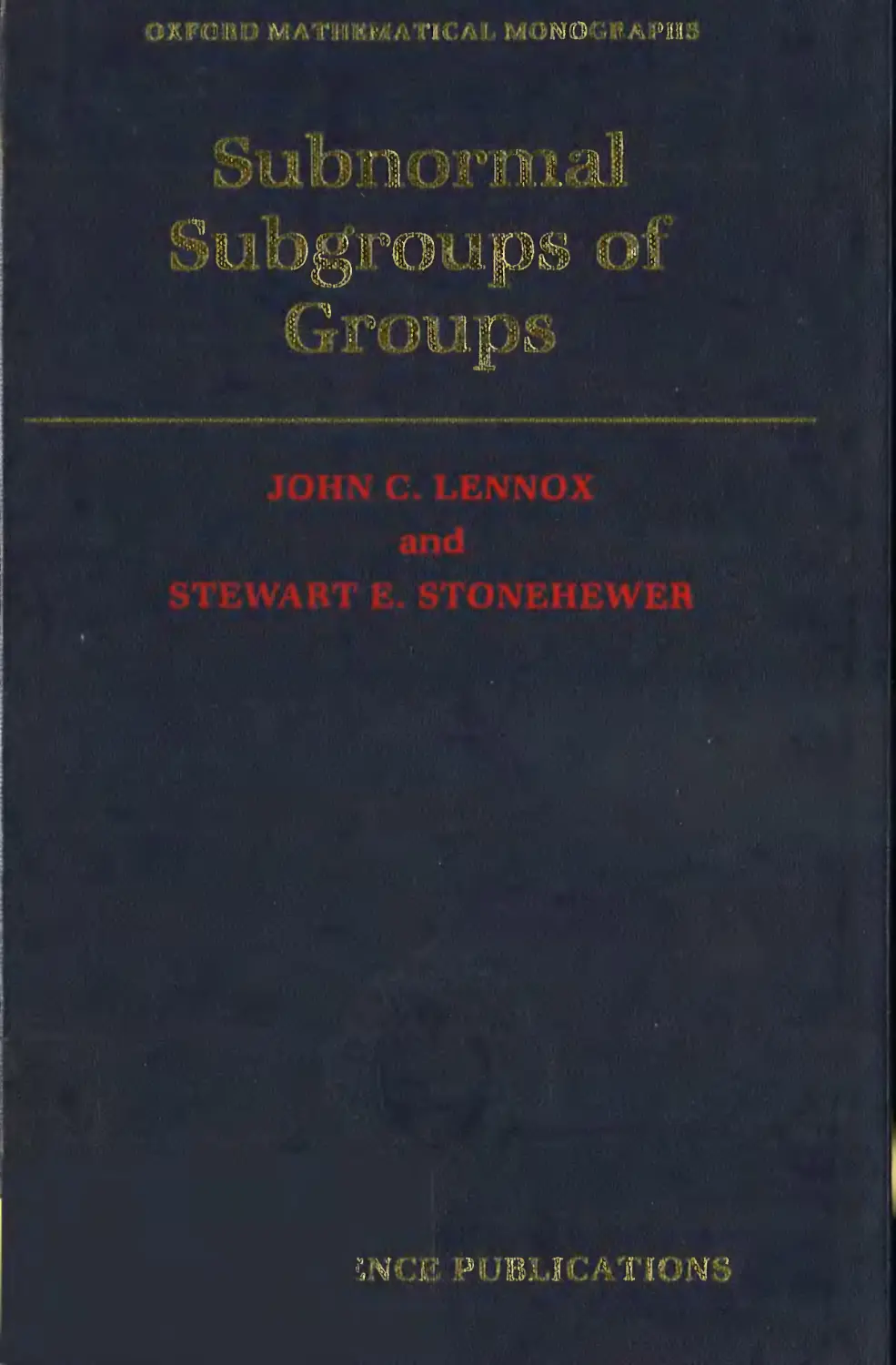


Автор: Lennox J.C. Stonehewer S.E.
Теги: mathematics number of subgroups
ISBN: 0-19-853552-X
Год: 1987

Текст
\
\ ", .
.- :"
'
' :;
.,
,
:
"
" . . ,
':, ,..,
\
OJ ,\
'N[)
\ \ °nn
t \
\
I
II .
. :-'
{ . \ I F. -)' A1 ',1\ \ .1 \ 1
I) I
m
'
, ,'t t. .
....
:}
.:' "
\
r
f
i j) 1 '
'
{("\ ·
JI (3':
ffi' :
:f
.:
. I lit 1 tr'
I '. ,
:: 'i' I'
;, i '; L\..
\f J! I J 11:
1. J
\ 1 i
\l!
OXFORD MATHEMATICAL MONOGRAPHS
Series Editors
I. G. MACDONALD R. PENROSE H. MCKEAN J. T. STUART
OXFORD MATHEMATICAL MONOGRAPHS
A. Belleni-Morante: Applied semigroups and evolution equations
I. G. Macdonald: Symmetric functions and Hall polynomials
J. W. P. Hirschfeld: Projective geometries over finite fields
N. Woodhouse: Geometric quantization
A. M. Arthurs: Complementary variational principles Second edition
P. L. Bhatnagar: Nonlinear waves in one-dimensional dispersive systems
N. Aronszajn, T. M. Creese, and L. J. Lipkin: Polyharmonic functions
J. A. Goldstein: Semigroups of linear operators
M. Rosenblum and J. Rovnyak: Hardy classes and operator theory
J. W. P. Hirschfeld: Finite projective spaces of three dimensions
K. Iwasawa: Local class field theory
A. Pressley and G. Segal: Loop groups
J. C. Lennox and S. E. Stonehewer: Subnormal subgroups of groups
Subnortnal Subgroups
of Groups
JOHN c. LENNOX
Reader in Pure Mathematics
University College, Cardiff
STEWART E. STONEHEWER
Reader in Mathematics
University of Warwick, Coventry
CLARENDON PRESS · OXFORD
1987
Oxford University Press, Walton Street, Oxford OX2 6DP
Oxford New York Toronto
Delhi Bombay Calcutta Madras Karachi
Petaling Jaya Singapore Hong Kong Tokyo
Nairobi Dar es Salaam Cape Town
Melbourne Auckland
and associated companies in
Beirut Berlin Ibadan Nicosia
Oxford is a trade mark of Oxford University Press
Published in the United States
by Oxford University Press, New York
<!d John C. Lennox and Stewart E. Stonehewer, 1987
All rights reserved. No part of this publication may be reproduced,
stored in a retrieval system, or transmitted, in any form or by any means,
electronic, mechanical, photocopying, recording, or otherwise, without
the prior permission of Oxford University Press
British Library Cataloguing in Publication Data
Lennox, John C.
Subnormal subgroups of groups.-(Oxford
mathematical monographs)
I. Groups, Theory of
I. Title II. Stonehewer, Stewart E.
512'.2 QAI71
ISBN O-19-853552-X
Library of Congress Cataloging-in-Publication Data
Lennox, John C. (John Carson)
Subnormal subgroups of groups.
(Oxford mathematical monographs)
Bibliography: p.
Includes indexes.
I. Groups, Theory of. 2. Group rings.
II. Title. III. Series.
QA171.L547 1986 512'.22, 86-8697
ISBN O-19-853552-X
Set by Macmillan India Ltd, Bangalore 25
Printed in Great Britain by
St Edmundsbury Press Ltd
Bury St Edmunds, Suffolk
PREFACE
The concept of a subnormal subgroup of a group is derived from that of a
normal subgroup due to the fact that normality is not a transitive relation.
Thus subnormality is the transitive closure of the relation of normality.
According to Karl Gruenberg, Philip Hall considered the subnormal sub-
groups to be the bare bones or 'skeleton' of a group, providing the framework
for all the other structures.
In finite groups the significance of the subnormal subgroups is apparent
since they are precisely those subgroups which occur as terms of composition
series, the factors of which are of paramount importance in describing a
group's structure. Thus it was with finite groups that Helmut Wielandt began
his pioneering work on the subject in 1939 with a paper which has become a
classic. Among many striking results, this paper contains the celebrated 'join'
theorem, namely that the subgroup generated by two subnormal subgroups of a
finite group is itself subnormal. Almost twenty years elapsed before
H. Zassenhaus showed that this result can fail to hold in infinite groups.
Meanwhile Wielandt continued his development of the finite theory and
R. Baer, K. Hirsch and B. I. Plotkin made significant contributions more
generally. Then about 1960 Philip Hall in his Cambridge lectures began to
inspire certain of his students, notably D. J. S. Robinson and J. E. Roseblade,
with an enthusiasm for the theory, while Baer in Frankfurt was similarly
motivating H. Heineken and O. H. Kegel. Since that time the subject has
proliferated, which amply justifies Hall's analogy.
It is our objective to present the theory of subnormal subgroups from its
beginnings to the present day. Previously most of this material existed only in
dispersed form throughout the journals and unpublished manuscripts. In this
connection two points should be made. First, with the development of the
theory it has been possible for us to improve and shorten many original
proofs. Secondly, the nature of the subject is such that some contributions
have completely superseded much previously published material. For exam-
ple, on the join problem (that is discovering when the join of two subnormal
subgroups is subnormal) we could have presented simply the work of John
Williams ( 3.3, 3.4, and Chapter 5), omitting much of Chapter 1. We have
chosen not to do this because many of the early arguments have considerable
interest in their own right and are worthy of a permanent place in the record.
Thus Wielandt's original proof of his join theorem ( 1. 3) and his theory of
operators ( 4.1, 4.2) are exactly right when working within the class of finite
groups, though both have very far-reaching generalizations.
The join problem has been the main research topic relating to subnormal
subgroups and therefore receives fullest consideration in our book. It is the
VI
PREFACE
theme of Chapters 1, 3, and 5. Chapter 1 contains purely group-theoretic
arguments, while Chapter 3 introduces techniques from the theory of modules
over group rings and these are further exploited in Chapter 5. It is a rather long
story and so Chapters 2 and 4 serve both as interludes and as a means of
adding variety along the way. Nevertheless this arrangement is natural rather
than artificial, each of Chapters 2 and 4 making use of what has immediately
preceded. The former is mainly concerned with how the internal structure of
groups generated by subnormal subgroups is restricted by those subgroups.
Then in Chapter 4 we discuss the remarkable propensity which subnormal
subgroups display for permuting with one another. Chapter 6 considers
groups which are rich in subnormal subgroups and finally Chapter 7 describes
criteria for determining when subgroups are subnormal.
For reasons of space we have been unable to include all the contributions to
the theory, but following Derek Robinson's example in his books Finiteness
conditions and generalized soluble groups [119] we have tried to compensate for
omissions by giving at least statements and references wherever possible. We
also decided not to give comprehensive accounts of generalizations of
subnormal subgroups, for example ascendant, descendant, and serial sub-
groups. Apart from lengthening the book considerably, the theory of those
generalizations is by no means so well developed. On the other hand they have
not been ignored completely, for instance where they impinge directly on our
main subject matter. A little of our material will be already familiar to some
readers through certain available texts, in particular Robinson's books already
mentioned. However, there are always reasons for these duplications, for
example to make sections self-contained, to have important fundamental and
far-reaching arguments readily available, to present familiar results in a way
adapted to our needs, or to offer alternative proofs.
Our notation follows closely that of Robinson and includes Philip Hall's
algebra of group classes and closure operations. This has the advantage of
reducing the statement of some results to a mere halfline and the disadvantage
of being completely unintelligible to the uninitiated. Therefore we have made
efforts not to become slaves of the symbols and for this reason readers may
detect a few inconsistencies in our presentation. They are designed to help
rather than hinder and in any case consistency is the hobgoblin (according to
Emerson) and the vice (according to Russell) of little minds.
Some knowledge of group theory, ring theory, and linear algebra is
assumed, but nothing beyond undergraduate courses. Indeed though the
book has been designed as a postgraduate text, the prerequisites are such as
should not deter the able and enthusiastic undergraduate student who has
discovered the fascination of groups. For the postgraduate we offer much
food for thought and ideas for further research. It will be seen that many last
words have been written on some aspects of the theory, while elsewhere much
remains to be done. Thus after more than four decades the join problem is now
PREFACE
Vll
fairly well understood, whereas the theory of subnormalizers is possibly still in
its infancy.
We are particularly grateful to many colleagues who have supplied
information and commented on the manuscript during its preparation. Thus
we record with pleasure our thanks to R. S. Dark, K. W. Gruenberg,
B. Hartley, H. Heineken, O. H. Kegel, F. Napolitani, R. E. Phillips, D. J. S.
Robinson, J. E. Roseblade, H. Wielandt, and J. S. Wilson. From this
distinguished list we would like to single out Dr Roseblade who undertook the
task of reading and criticizing in detail the greater part of a draft manuscript.
We have endeavoured to incorporate all of his suggestions with the exception
of adopting a module-theoretic approach from the beginning, and this for the
reasons already given above. Accordingly we ask his forgiveness.
FInally we wish to pay tribute to the genius and inspiration of Professor
Wielandt and the late Professor Hall, both of whom either directly or
indirectly had the greatest influence in the development of our interest in this
area. It is our sincere wish that their work will be continued by others and that
our book will be of some assistance in this endeavour.
Cardiff
Warwick
October 1985
J. C. L.
S. E. S.
CONTENTS
INDEX OF NOTATION Xl
1 THE JOIN OF TWO SUBNORMAL SUBGROUPS 1
1.1 Definitions and first properties 1
1.2 First results on joins 3
1.3 Wielandt's Join Theorem 6
1.4 The class 6 of groups with the subnormal join property 10
1.5 Counterexamples 14
1.6 Subnormal coalescence and the permutizer 21
1.7 Some subnormal coalition classes 32
2 THE JOIN OF MANY SUBNORMAL SUBGROUPS 42
2.1 Internal structure of joins of finitely many subnormal subgroups 42
2.2 Internal structure of joins of arbitrarily many subnormal subgroups 50
2.3 Subnormal composition factors 55
2.4 Seriality of joins and the class 6 00 66
2.5 Baer groups 74
2.6 The class 6 00 (continued) 84
2.7 The commutator of two subnormal subgroups 88
3 THE DERIVED AND LOWER CENTRAL SERIES OF A
JOIN OF SUBNORMAL SUBGROUPS 89
3.1 The derived series of a join of subnormal subgroups 89
3.2 Applications to the join problem and coalescence 97
3.3 The lower central series of a join of subnormal subgroups 100
3.4 Further applications to the join problem 116
3.5 More on the classes 6 and 6 00 123
4 THE PERMUTABILITY OF SUBNORMAL SUBGROUPS 128
4.1 Wielandt's theory of operators 128
4.2 The permutability properties of operators 133
4.3 Roseblade's Permutability Theorem 138
4.4 Permutability properties of soluble and nilpotent residuals of
subnormal subgroups 142
4.5 Relative normalizing and centralizing properties 146
4.6 Universal normalizing properties: the Wielandt subgroup 151
5 THE JOIN PROBLEM-A CRITERION 155
5.1 Williams' Join Theorem 155
5.2 Examples 159
5.3 Persistent properties of nilpotent groups 161
5.4 Proofs of the main theorems 165
6 GROUPS WITH MANY SUBNORMAL SUBGROUPS 171
6.1 Groups in which every subgroup is subnormal 171
6.2 Non-nilpotent groups with every subgroup subnormal 180
6.3 Groups in which every subgroup is almost subnormal 191
x
CONTENTS
6.4 Groups with all subnormal subgroups of bounded defect
6.5 Groups with the subnormal intersection property
7 CRITERIA FOR SUBNORMALITY
7.1 Permutability
7.2 Permutability of conjugates of subgroups
7.3 The Wielandt maximizer lemmas
7.4 Groups satisfying the maximal condition
7.5 Polycyclic-by-finite groups
7.6 Join-subnormality
7.7 The subnormalizer of a subgroup
BIBLIOGRAPHY
GENERALIZA TIONS OF RESULTS
INDEX
197
209
213
213
220
222
229
232
234
238
243
250
251
INDEX OF NOTATION
1 Classes and operations
x <
x
r X ... X
1 2 n
{All AEA}x
X A
(G)
Special classes
21
( n)
{t
( p, 7t)
j.r.p.d.
(fj
i!
Max (-n, -sn)
9Jla x (-n, -sn)
9Jlax-<J 2
Min (-n, -sn)
9Jlin(-n, -sn)
9Jl
91 (91 c )
S
6,6 1 , 6 2 , 6 00 , 6 00
U d , U d , n
Special operations
x is a subclass of
x-by- groups
inductively (Xl. . . X n -1)X n
smallest Al-closed class (all A E A) containing x
largest A-closed class contained in x
groups isomorphic to G and groups of order 1
abelian groups
groups with every subnormal subgroup having
bounded defect (defect < n)
groups with a finite composition series
finite (p-, 1[-) groups
(155)
finitely generated groups
(127)
maximal condition for (normal, subnormal)
subgroups
groups satisfying Max(-n, -sn)
(33)
minimal condition for (normal, subnormal)
subgroups
groups satisfying Min(-n, -sn)
p(9Jlax-sn u 9Jlin-sn)
nilpotent groups (of class < c)
soluble groups
(10, 13, 13, 71, 209)
groups in which normality is transitive
s
(172)
L (39), Ln (52), M and M (52), N (32), No (21), N 1 (46), N2 (23), p (13), Q (39), R (45),
Ro (130), S (13), sn (10), u (116)
A < B AX < BX for all classes x
xu
2 Elements and groups
h 9
[x, y]
[Xl'...' Xn]
[x, nY]
(XI...)
H < X
N<JG
H snG, H ascG
HperG
H <Jm G
ApsnG
snG, psnG
H9
X Y
XuY
X Y
[X]
[X, Y]
[Xl' . . . , Xn]
[X, n Y]
181
IG:HI
CG(H), N G(H)
PH(K)
HvK
coreG(H), HG
AutG,OutG
PautG
Horn (X, Y)
Hl X ... x Hn
Hl ffi . . . ffiHn,
DrH 1
1
H*K
N]H
H1K, WrGA
HlK
A@B
Hl.K
r(G), rex> (G)
h(G)
INDEX OF NOTATION
g - 1 hg
x-ly-lxy
inductively [[Xl, . . . , Xn-l], xn]
n----+
[x, y, . . . ,y]
group or subgroup generated by X such that. . .
H is a subgroup contained in X
N is a normal subgroup of G
H is a subnormal, ascendant subgroup of G
H is a permutable (quasinormal) subgroup of G
H is subnormal of defect at most m in G
A preserves subnor lity in G
(230)
g-lHg
(XYlyeY)
X and Yare conjugate in (X, Y)
X and Yare G-isomorphic
(X)
( [x, y] I x eX, ye Y)
inductively [[Xl'...' X n - l ], Xn] for n > 3
n
[X, 1': . . . , Y]
cardinality of 8
index of subgroup H in group G
centralizer, normalizer of H in G
permutizer of K in H
HK = KH
core of H in G
automorphism, outer automorphism group of G
power automorphisms of G
homomorphisms from X to Y
direct product
direct sum
direct product or sum
free product
semidirect product of normal subgroup Nand H
wreath product, power
complete wreath product
tensor product
H/H'@K/K' = 0
rank, torsion-free rank of G
Hirsch length of G
n(G)
-r( G)
(G), (G: L)
2
An
C n
CpaJ
RG
9
gC
3 Special subgroups
G'
G(l)
Gn
Goo
G
G
Pr ( G )
Y1(G)
yf (G)
'l(G)
p (G)
<I>(G)
w(G)
wn(G)
4 Miscellaneous
<
l,O
lp
GF(p)
GL(n, p)
GL(n, R)
p'
n'
(J)
INDEX OF NOTATION
Xlll
primes dividing finite element orders in G
primes p for which G has a quotient of order p
subnormal composition factors of G, between G
and L
subnormality lattice
alternating group of degree n
cyclic group of order n
quasicyclic p-group
group ring of Gover R
augmentation ideal of RG
ideal generated by all products of c elements of 9
derived subgroup [G, G]
2th term of derived series of G
< gn I g E G >
(nilpotent) group G modulo its periodic subgroup
x-residual of G
join of all subnormal x-subgroups of G
rth Baer radical of G
2th term of lower central series of G
inductively Yi (y 1- 1 (G))
2th term of upper central series of G
x-radical of G
Frattini subgroup of G
Wielandt subgroup of G
nth term of upper Wielandt series of G
strict inclusion (with reference to groups and
classes)
set of all integers, rationals
l/pl
field of p elements
general linear group of invertible n x n matrices over
GF(p)
general linear group of invertible n x n matrices over
ring R
all primes different from p
all primes not in n
first limit ordinal
1
THE JOIN OF TWO SUBNORMAL SUBGROUPS
1.1 Definitions and first properties
A subgroup N of a group G is said to be normal in G if N occurs as the kernel of
a homomorphism of G. Then, following Wielandt, we write N <J G. Thus
N <JG if and only if g-INg = N for all geG.
A subgroup H of a group G is said to be subnormal in G if there are a non-
negative integer m and a series
H = H <JH <J . . . <JH = G
m m-l 0
(1)
of subgroups of G. In this situation we write
H snG
and
H <JmG.
Of course, for fixed Hand G, there will exist several series of type (1) of various
lengths m; for example we have not required Hi -# Hi-I. The smallest such m is
called the defect of the subnormal subgroup H of G. Thus G has just one
subnormal subgroup of defect 0, namely G itself, while the other normal
subgroups of G are the subnormals of defect 1. The subgroups of order 2 in the
alternating group of degree 4 and the non-central subgroups of order 2 in
the dihedral group of order 8 are all examples of subnormal subgroups of
defect 2. In fact the non-central subgroups of order 2 in the dihedral group of
order 2 m are subnormal of defect m - 1, for all m > 3.
One series of type (1) is canonical. To describe it we proceed as follows. Let
H be any subgroup of a group G. The normal closure of H in G, denoted by HG,
is the smallest normal subgroup of G containing H. So
HG = (hglheH, geG).
(Here h g = g-1 hg; and for any subsets X, Yof G we shall write
X Y = (xYlxeX, yeY).)
If we put Ho = G, then HG becomes the first of an inductively defined
descending series of subgroups, namely HI' where for all finite i > 0
H - H H i
i+ 1 - ·
Therefore
H< ...<JH. <JH.<J...<JH <JH =G
= 1+1 1 1 0 ,
(2)
and this is the most rapidly descending series of subgroups, containing H, with
2
THE JOIN OF TWO SUBNORMAL SUBGROUPS
each normal in the one above. For, if
H < . . . <JK i + l <JKi<J. . . <JK l <JK o = G
is such a series and if Hi < K i for some i, then
Hi+l = HH i < HKi < K i + l .
Hence our claim follows by induction on i. We call (2) the normal closure series
of H in G and we call Hi the ith normal closure of H in G.
For elements x, y in G, [x, y] = X-I y-l xy is the commutator of x and
y. Then if X, Y are subsets of G, [X, Y] = < [x, y] Ix EX, Y E Y>. Since
[x, y] = [y, X]-l, we have [X, Y] = [1': X]. For subsets Xo, Xl' . . . , X n of
G, we define [X 0] = < X 0 > and inductively
(3)
[XO,X l ,... ,XJ = [[XO,X b ... ,Xn-l],X n ],
for n > 2;
and when Xl = X 2 = ... = X n = X (say), we also write this as [XO,nX].
Proposition 1.1.1. Let H be a subgroup of G. Then
(i) the ith normal closure of H in G is H[G'iH];
(ii) H <J mG if and only if H coincides with its mth normal closure in G.
Proof. (i) The statement is clear when i = 0 and 1. (We point out that H
normalizes [G, H], i.e. [G, H] is normal in the subgroup which it generates
with H. In fact X normalizes [X, Y] provided only that X is a subgroup; see
Robinson [119], Lemma 2.11(ii).) Thus if we denote the ith normal closure of
H in G by Hi and suppose that
H. = H [ G .H ]
I , I
for some i > 1, then
H - H H i - H [G.iH] - H[G H]
i+l - - -, i+l ,
and the result follows by induction.
(ii) If H <Jm G, then there is a series of type (3) with H = Km. Thus H m < Km
implies H = H m. The converse is clear. 0
Remark. The argument of (i) also proves the following:
JfG is generated by subgroups H and K, then,for i > 1, the ith normal closure of
H in G is H[K, iH].
Our first important investigation, which provides the theme of Chapter 1, is
concerned with the subgroup generated by two subnormal subgroups. Before
embarking on this major topic, it is convenient to record some elementary
results.
THE JOIN OF TWO SUBNORMAL SUBGROUPS
3
Proposition 1.1.2
(i) Let H <J m G and K be a subgroup of G. Then H (l K <J m K. In particular
H <J m L whenever L is a subgroup of G containing H.
(ii) IfH l <J m G,for all A E A (an indexing set), where m is independent of A, then
nH l <JmG.
1
Proof. (i) There is a series H = Hm<JH m - 1 <J. . . <JH 1 <JH o = G. Thus
H (l K = Hm (l K<JH m - 1 (l K<J... <JH 1 (l K<JH o (l K = K.
(ii) Again there are series Hl = H;.,m<J . . . <JH l , 1 <JHl,O = G, for all
A EA. Then the result follows since
nHl,i+l <JnHl,i. 0
1 1
Some facts are so obvious that their statement is almost an embarrassment.
The following is one such.
Proposition 1.1.3. If H <J m K <J n G, then H <J m+n G.
Indeed subnormality is the transitivization of normality. We also record
Proposition 1.1.4. If H <Jm G and () is a homomorphism ofG, then H 8 <Jm G8.
Thus ifN <JG, then HN IN <JmGIN and HN <JmG. Infact the normal closure
series of any subgroup K ofG is mapped by () onto the normal closure series of K fJ
in G8.
1.2 First results on joins
Wielandt [157] tells us that Robert Remak asked, in a seminar in the mid-
19308, whether, in a finite group, the subgroup generated by two subnormal
subgroups (that is their join) is itself always subnormal. As we shall shortly see,
this was answered in the affirmative by Wielandt in his 1939 paper [152], which
provided much of the impetus for the subsequent development of the subject.
Then Zassenhaus constructed an example in 1958 which shows that a join of
two subnormal subgroups can fail to be subnormal in an infinite group. The
determination of interesting necessary and sufficient conditions for a join to be
subnormal is probably the most important unsolved problem in this area of
group theory today. Many sufficient conditions are known and it is the object
of the present chapter (and 3.2, 3.4 and Chapter 5) to give a comprehensive
account of them. The starting point is
Theorem 1.2.1. Let H, K be subnormal subgroups ofG and set J = < H, K >.
If H K = H, then J is subnormal in G. More precisely, if H <JmG and K <JnG,
then J <JmnG. (Note that HK = HJ.)
4
THE JOIN OF TWO SUBNORMAL SUBGROUPS
Proof. Denote the ith normal closure of H in G by Hi. It is clear, by induction
on i, that K normalizes Hi for all i. Thus
Hi+l <JHiK
and K <J n Hi K (by Proposition 1.1.2(i) ). Hence Hi + 1 K <J n Hi K, by
Proposition 1.1.4. Then
J = HK = HmK <JmnHoK = G,
by Proposition 1.1.3. 0
Corollary 1.2.2. If H <J 2 G and K is subnormal in G, then J = < H, K > is
subnormal in G. In fact if K <J n G, then J <J 2n G.
Proof. By Proposition 1.1.1(ii), H <JHG and therefore H9 = g-l Hg<JHG,
for all geG. It follows that HK<JHG<JG and, since K n.ormalizes H K ,
Theorem 1.2.1 applies. 0
Situations when the hypothesis H K = H is satisfied will be considered in
Chapter 4 (see also Theorem 1.3.11). However, as we shall see in 1.5, II <J2 J is
not sufficient to imply that J is subnormal in G.
It is now possible to establish two elementary conditions, each equivalent to
the fact that a join of two subnormal subgroups is itself subnormal.
Theorem 1.2.3. Suppose that H and K are subnormal subgroups of G and
J = < H, K >. Then each of the following conditions implies the other two.
(i) J is subnormal in G;
(ii) H K is subnormal in G;
(iii) [H, K] is subnormal in G.
Proof. (i) (ii): Let J be subnormal in G. Since H K is normal in J, it follows,
from Proposition 1.1.3, that H K sn G.
(ii) (iii): Suppose that HKsnG. Since [H,K]<JJ, we see that
[H, K ] <J HK and then Proposition 1.1.3 shows that [H, K ] sn G.
(iii) (i): Finally let [H, K] be subnormal in G. Since K normalizes
[H, K], Theorem 1.2.1 gives [H, K] K sn G. However, H normalizes [H, K] K
and so a further application of Theorem 1.2.1 shows that
J = H[H, K]KsnG. 0
Corollary 1.2.4. If H, K are subnormal subgroups of G and G' (the derived
subgroup of G) is nilpotent, then < H, K > is subnormal in G.
Proof. Since [H, K] < G' and all subgroups of a nilpotent group (of class c)
are subnormal (of defect < c), we have [H, K] sn G' <J G. Thus the corollary
follows from Theorem 1.2.3. 0
THE JOIN OF TWO SUBNORMAL SUBGROUPS
5
The key result so far has been Theorem 1.2.1. It is also the essential
ingredient in the proof of the next very useful property, which may be viewed
as a natural extension of Theorem 1.2.1.
Theorem 1.2.5. If H <J m G, K <J n G and J = H K = KH, then J <J S G, where
s < mn(n + 1) (n + 2) . . . (n + m -1).
Proof. By Proposition 1.1.2(i), H <J m J. Thus let H <J r J, for some r < m, and
proceed by induction on r to show that J <JsG, where
s < mn(n + 1) (n + 2) . . . (n + r - 1).
When r = 0 we interpret this product as m and the result is clear. The case r = 1
is covered by Theorem 1.2.1. Therefore suppose that r > 2 and assume the
usual induction hypothesis. We have a series
H = H r <JH r - l <J . . . <JH o = J.
Let K l =Hl nK. Then K l <JK and so K l snG. Now HI =Hl n (HK)=HK l
with H <J r - l HI and K l <In+ 1 G. Hence by induction HI <J 5 1 G, where
SI < m(n + 1) (n + 2) . . . (n + r - 1). Since K normalizes HI, a further appli-
cation of Theorem 1.2.1 shows that J <J5 1 n G as required. 0
Robinson [111] (Lemma 2.4) obtained the above result under the ap-
parently weaker hypothesis J = H KH. However, as J. S. Wilson has pointed
out, the two hypotheses are equivalent.
Proposition 1.2.6. IfH, K aresubnormalinGandJ = (H, K) = HKH, then
J = HK.
Proof. Let H <J r J and proceed by induction on r. If r < 1, the result is clear.
Assume r > 2 and the usual induction hypothesis. Then with H J = HI'
HI = H(H I n KH) = H(H I n K)H = H(H I n K),
by induction, since H <J r - 1 HI. Therefore
J=H I K=H(H I nK)K=HK. 0
In Theorem 4.3.1 we shall see that if Hand K are orthogonal (that is if
H/H'@K/K' = 0), then HK = KH whenever Hand K are subnormal
subgroups of a group. (Also if Hand K are not orthogonal, then there is a
group G with subnormal subgroups Ho '" Hand Ko '" K such that
HoKo -# KoHo (Theorem 4.3.8).) Thus in particular whenever Hand K are
subnormal subgroups of G and H is perfect (that is H = H'), then (H, K )
= HK is subnormal in G. (See also Theorem 1.6.6.)
If J is the join of subnormal subgroups Hand K of G and if J = H KH K,
then we shall see in Theorem 1.5.7 that J can fail to be subnormal in G.
6
THE JOIN OF TWO SUBNORMAL SUBGROUPS
However, it appears to be unknown whether the apparently stronger
hypothesis J = HKH u KHK always implies that J is subnormal in G.
1.3 \Vielandt's Join Theorem
In 1939 Wielandt [152] (Satz 7) proved that the join of two subnormal
subgroups of a finite group is always subnormal. This result, one of the most
important in the theory, will be extended to many classes of infinite groups in
later sections, using arguments of ever increasing complexity. Therefore it is
important historically and mathematically to give Wielandt's original proof at
the outset. In fact we shall give two further proofs, both of interest because of
their simplicity.
Theorem 1.3.1. Let H, K be subnormal subgroups of a finite group G. Then
(H, K ) is subnormal in G.
Wielandt's proof used a double induction argument. However, in a
footnote, he stated that his proof could be applied to cases where G is not
necessarily finite, provided that G satisfies Max-sn, that is the maximal
condition for subnormal subgroups. (This means that every non-empty set of
subnormal subgroups of G contains at least one maximal member; or
equivalently every strictly ascending chain of subnormal subgroups of G has
finite length.) Thus we have
Theorem 1.3.2. Let G satisfy Max-sn and let H, K be subnormal subgroups of
G. Then (H, K ) is subnormal in G.
Proof. We argue by induction on the defect, m say, of H in G. When H <J G,
the result is clear from Proposition 1.1.4. Therefore suppose that m > 2 and
assume the usual induction hypothesis. Now H <J m -1 HG and so, by a second
induction on r, the join of any finite number r of conjugates of H in G is
subnormal in G. Since G satisfies Max-sn, it follows that H K is generated by
finitely many conjugates of H by elements of K and thus H K sn G. So
(H, K)snG, by Theorem 1.2.3. 0
The same method suffices to prove
Theorem 1.3.3. If H, K are finite subnormal subgroups of G, then (H, K) is
finite and subnormal in G.
Theorem 1.3.1 is a corollary of each of the above results. Also Theorem 1.3.2
is a corollary of the next result which may be thought of as a second proof of
Theorem 1.3.1.
Theorem 1.3.4. Let H, K sn G and suppose that the set of subnormal
THE JOIN OF TWO SUBNORMAL SUBGROUPS
7
subgroups ofG lying between H and J = (H, K ) contains a maximal member.
Then J sn G.
It is convenient to isolate the key step in the argument:
Lemma 1.3.5. Let S be a subgroup of G and suppose that H is a maximal
member of the set of subnormal subgroups of G lying in S. Then H <J S.
Proof. Denote the subnormal defect of H in S by m and suppose, for a
contradiction, that m > 2. If Hi is the ith normal closure of H in S, then there is
an element x in Hm-l (and so HX normalizes H) such that
H < HHX = H*,
say. Then H* < S and, by Theorem 1.2.1, H* sn G, giving the desired
contradiction. 0
Proof of Theorem 1.3.4. Without loss of generality we may assume that H is
a maximal member of the set of subnormal subgroups of G lying in
J = (H, K). Thus H K = H, by Lemma 1.3.5, and the result follows from
Theorem 1.2.1. 0
Corollary 1.3.6. Let H, KsnG, J= (H,K) and suppose that IJ:HI is
finite. Then J sn G.
Readers familiar with the method of establishing isomorphic refinements of
series (see Lemma 2.3.5) will have no difficulty deducing
Corollary 1.3.7. The set of subnormal subgroups H of a group G, for which
there exists a composition series of finite length between H and G ,forms a lattice
with respect to the operations of join and intersection.
Variations on the theme of the proof of Theorem 1.3.4 are possible and we
include two such. The first was given by Philip Hall in his Cambridge lectures.
Theorem 1.3.8. Let H,KsnG,J = (H,K) and suppose that the set
{(H,H X l,H x 2, . . . ,HXs)lx t , . . . ,xsEJ, s > O}
satisfies the maximal condition. Then J sn G.
(1)
Proof. We may assume that H is a maximal member of the set of subnormal
subgroups of G which belong to (1). Then, as in the proof of Lemma 1.3.5, we
see that H <JJ and Theorem 1.2.1 establishes the result. 0
Suppose that N <JG and that X < Yare subgroups of G with NX = N1':
Then Y = (N X) n Y = (N n Y)X and therefore
N n X < N n 1': (2)
8
THE JOIN OF TWO SUBNORMAL SUBGROUPS
This fact shows that the class of noetherian groups, that is groups satisfying
Max (the maximal condition for subgroups), is closed under forming
extensions. The same is true for Max-sn, also Min and Min-sn, the
corresponding minimal conditions. We can use (2) in connection with
Theorem 1.3.8 to give
Corollary 1.3.9 [111] (Corollary 4.2). IfH, K sn G and [H, K] satisfies Max,
then (H,K)snG.
Proof. Denote the ith normal closure of H in J = (H, K) by Hi. Since
HI = H [H, K] (by the remark after Proposition 1.1.1), it follows that
Hi = H (Hi n [H, K]) = H i + 1 (Hi n [H, K]),
for all i > 1, and hence Hi/Hi+l satisfies Max. Now (2) and induction on i
decreasing show that the set of subgroups between H 1 and H satisfies Max.
Thus the set (1) in Theorem 1.3.8 satisfies Max and so that theorem
applies. 0
Lemma 1.3.5 is also the key step in the following.
Theorem 1.3.10 [158] (10.5). Let {H AlA. E A} be a set of subnormal subgroups
of G and let J be their join. Then J is subnormal in G if and only if the set of
subnormal subgroups of G lying in J contains a maximal member.
Proof. Let M be a subnormal subgroup of G maximal with respect to lying in
J. By Lemma 1.3.5, M <JJ and so HAM snG, by Theorem 1.2.1. Therefore
H A < M for all A.EA and hence J = M snG. 0
Of course Theorem 1.3.4 is a special case of this result.
Yet another proof of Theorem 1.3.1 was suggested by Kegel and uses
Theorem 1.3.11 [159]. Let N be a minimal normal subgroup of the finite
group G. Then N normalizes every subnormal subgroup of G.
Proof. We proceed by induction on IGI. Let H sn G, H # G and put
HI = HG. So HI < G. If N Hl' then N nH I = 1 and thus [N,H 1 ] = 1.
Hence [N,H] = 1. On the other hand, if N < HI' then N = Nr for some
minimal normal subgroup N 1 of H 1. Indeed each conjugate N , for g E G, will
be a minimal normal subgroup of HI and so will normalize H, by induction.
Therefore N normalizes H. 0
In Theorem 4.6.1 we shall extend this result to certain infinite groups. At this
point we are interested only in its application to Theorem 1.3.1.
Third proof of Theorem 1.3.1. We recall that H, K are subnormal subgroups
THE JOIN OF TWO SUBNORMAL SUBGROUPS
9
of the finite group G and we must prove that J = (H, K) sn G. Proceed by
induction on IGI and let N be a minimal normal subgroup of G. By induction
IN/N snG/N and so, by Theorem 1.3.11, J <JJN snG. 0
Robinson weakens the hypothesis of Theorem 1.3.2 in [111] (Theorem
4.3 (i) ):
Theorem 1.3.12. Let H, K sn G and suppose that G' satisfies Max-sn. Then
(H,K)snG.
Proof. Let m denote the defect of H in G and proceed by induction on m. Let
HI = H G so that HI <J G' and hence HI satisfies Max-sn. Therefore, by
induction on m and a second induction on s,
fI = { (H Xl, H X2, . . . , H Xs ) 1 Xl' . . . , Xs E J, s > I}
is a set of subnormal subgroups ofG. We show that HKE fI and then Theorem
1.2.3 applies. Thus suppose, for a contradiction, that HKFt fI. Then there is an
infinite strictly ascending chain of subgroups
X l <X 2 < ...
(3)
with Xi = (H, H X 1, H X 2, . . . , HXi), say, where Xl'...' Xi E K. Let
L i = ([H, Xl], [H, X 2 ], . . . , [H, Xi]). (Here [H, Xi] = [H, {Xi}].) Then
L.<J ( H L. ) = X.snG
I , I I
and so LisnG'. It follows from the hypothesis that there exists r > 1 such
that Lr = Lr+l = Lr+2 = . . . and then X r = Xr+l = Xr+2 = . . ., contra-
dicting (3). 0
Another condition, sufficient for the subnormality of a join J of subnormal
subgroups Hand K, is that J satisfies Max-sn. However, this is superseded by
Corollary 1.3.13 [111]. Let H, K sn G and J = (H, K) and suppose that J'
satisfies Max-sn. Then J sn G.
Proof. By Theorem 1.3.12 and induction on s,
{(H X 1,H X 2, . . . ,H X s)lx l , . . . ,xsEJ, s > I}
is a set of subnormal subgroups of J. Let X 1 < X 2 < . . . be an ascending
series of subgroups, where Xi = (H, H X 1, . . . , HXSi ), Sl < S2 < . . . and all
Xi E J. Define L i = ([H, Xl], . . . , [H, x s .]). Then
I
.L.<J ( H L. ) =X.snJ
I , I I
and so L i sn J'. Hence, by hypothesis, there is an integer r > 1 such that
Lr = Lr+ 1 = . . . and then X r = X r + 1 = . . .. Thus Theorem 1.3.8 applies to
show that J is subnormal in G. 0
10
THE JOIN OF TWO SUBNORMAL SUBGROUPS
1.4 The class 6 of groups with the subnormal join property
Mter Wielandt's theorem one of the major steps forward in the join problem
was made by Roseblade in 1964. He showed that if subnormal subgroups H, K
satisfy Min-sn (the minimal condition for subnormal subgroups), then their
join J is also subnormal [123]. The following year Roseblade obtained the
same conclusion when Hand K satisfy Max-sn [125]. However, these and
other results established rather more than the subnormality of J by showing
how the internal structure of Hand K restricts that of J. This gave rise to the
concept of subnormal coalescence which we consider in 1.6 and 1.7.
For the present we shall continue to investigate the class, which we denote
following Robinson by 6, of all those groups in which the join of two
subnormal subgroups is always subnormal. Our results so far show that 6
contains all groups G such that
(i) G' is nilpotent (Corollary 1.2.4) or
(ii) G' satisfies Max-sn (Theorem 1.3.12).
We shall see in 1.5 that 6 is not the class of all groups. Since any group can
be embedded in a simple group [111], it follows that the class 6 is not closed
with respect to forming subgroups. On the other hand there is the elementary
Proposition 1.4.1. Subnormal subgroups of groups in 6 also belong to 6.
Philip Hall defined a closure operation A to be a map which assigns to any
class x of groups a class AX such that (i) x < AX = A 2 X, (ii) AX < A whenever
X < and (iii) A(l) = (1). Here, for any group G, (G) denotes the class of all
groups isomorphic to G and all groups of order 1. A class X is said to be A-
closed if X = AX. For any class x of groups, sox denotes the class of all
subnormal subgroups of x-groups (that is groups in x). Then So is a closure
operation and Proposition 1.4.1 says that So 6 = 6. The subnormal subgroup
interior of a class x, denoted by x Sn , is the class of those groups in which all
subnormal subgroups belong to X. Thus writing 6) for the class of finitely
generated groups, G E 6) s n if and only if every subnormal subgroup of G is
finitely generated. It does not appear to be known whether GE6) s n always
implies that G satisfies Max-sn, though the converse fails because of the
existence of non-finitely generated simple groups.
If is another class of groups, then x is defined to be the class of all
groups G which have a normal subgroup N in x with G / N E . Such a group G
is said to be an x-by- group. One of the major results concerning the class 6
was proved by Robinson [111] (Theorem 5.2*):
Theorem 1.4.2. 66) s n = 6.
Thus if a group G has a normal subgroup N in 6 and every subnormal
subgroup of G / N is finitely generated, then G E 6. For the proof (and some
later applications) we need an important technical result from [129]. If X is a
THE JOIN OF TWO SUBNORMAL SUBGROUPS
11
subset of a group and j > 1, we write
X (j) = {x 1 X2 . . . Xj I Xi EX, 1 < i < j} .
Lemma 1.4.3. Let H, K be subgroups ofG and suppose that K is generated by
a subset X. Then, for any n > 0,
H K = (H, H x , H X (2), . . . , H x (n» [H, n + 1 X] K .
Proof Since ([H, X], K) = K H , we see that
[H,X]K = [H,X]<[H,XJ,K) = [H,X]K H = [H, X]HK H = [H,X]<H,K)
and so [H, X]K <J (H, K). Thus
H K = H [H,X]K. (1)
Define Ho = Hand H i + 1 = [Hi' X], for i > O. So (1) becomes
Hg = HoHf. (2)
Then, by induction on n,
H K = HoHI . . . Hn H :+l' (3)
for all n > 1. (Replace Ho in (2) by Hn for the induction step.)
Clearly
HoHI = (Ho,H ).
Suppose we have shown that
H H ... H - (H HX H X(n-l»
o 1 n-l - 0' 0'...' 0 ,
(4)
(5)
.for some n > 2. Since [H i H i + 1 ,X] = Hi+l H i + 2 , for all i > 0 (using the
elementary commutator identity [h 1 h 2 ,x] = [hi ,xjh 2 [h 2 ,x]), we may re-
place Hi in (5) by HiH i + 1. Then from (4) we see that
H H ... H - (H H x H X(2) H X(n»
o 1 n - 0' 0, 0 ,..., 0 .
(6)
Thus (6) holds for all n > 0, by induction. The lemma now follows
from (3). 0
Corollary 1.4.4. Let H, K be subgroups of G with N <J K and suppose that
K/ N can be generated by r elements, where r is finite. Then, for any n > 0,
H K = LN[H,n+lK],
where L is generated by at most 1 + r + r 2 + . . . + r n conjugates of H by
elements of K.
Proof There is an r-element set X such that K = (X,N). Replace X in
Lemma 1.4.3 by the set XN. Then there is a subgroup L generated by at most
12
THE JOIN OF TWO SUBNORMAL SUBGROUPS
1 + r + r 2 + . . . + r" conjugates of H under K such that
H K = LN[H,n+lXN]K < LN[H,n+l K ] < H K ,
giving the required result. 0
We can now give a somewhat simpler proof of Theorem 1.4.2 than that in
[111].
Proof of Theorem 1.4.2. Let G E 60>sn so that there is an N <J G with N E 6
and GIN Eo>sn and suppose that H, K are subnormal subgroups of G. We
prove that (H, K) sn G by induction on the defect m of H in G. Suppose that K
has defect n ( > 1) in G. If A = K n N, then
KIA '" KNIN snGIN
and so KIA is finitely generated. Therefore, by Corollary 1.4.4,
H K = LA[H,n K ]
where L is generated by finitely many (say r) conjugates of H under K. It is
sufficient, by Theorem 1.2.3, to show that H K sn G. However, [H, nK] <J K sn G
and therefore, by Theorem 1.2.5, it is sufficient to show that
LA snG. (7)
Clearly H G E 60>so. Thus, by induction on m and a second induction on r, Lis
subnormal in H G and hence in G. Let s ( > 1) denote the defect of L in G. Since
A sn G, (7) will follow, according to Theorem 1.2.3, provided we show that
A L sn G. Now a second application of Corollary 1.4.4 gives
A L = (All, . . . , Alr)L f'\N [A, sL]
for finitely many elements 11' . . . , It in L. Therefore
A L <J (All, . . . , A I" L n N, [A, s L] ) sn N <J G,
since the t + 2 subgroups in the join are all subnormal in Nand N E 6. Thus
ALsnG, as required. 0
The product of group classes defined before Theorem 1.4.2 is not associative
and so to avoid ambiguity we define
Xl X 2 . . . X n = (Xl . . . X n - 1 )x n
inductively for n > 3 and group classes Xl' X 2 , . . . , x,.. We also introduce the
notation 21 and 91 for the classes of abelian and nilpotent groups, respectively,
and IDlOI for the class of groups satisfying Max.
Corollary 1.4.5. Any extension of an 6-group by a group satisfying Max is an
6-group, that is 6 (IDlOI) = 6. In particular 9121 (0) n 91) < 6.
The first part of the corollary is clear since a group G satisfies Max if and
THE JOIN OF TWO SUBNORMAL SUBGROUPS
13
only if every subgroup of G is finitely generated. The second part follows from
Corollary 1.2.4 and the fact that finitely generated nilpotent groups satisfy
Max [119] (p. 55). A special case yields
6) n 2(3 < 6,
that is finitely generated soluble groups of derived length at most 3 satisfy the
subnormal join property. This is of interest since we shall see in 1.5 that
6) n 2(4 1:. 6 and 2(3 1:. 6.
A further result concerning 6 is a substantial improvement on Theorem
1.3.12, due to Robinson [113] (Theorem 6.2). First, if x is a class of groups,
then PX is the class of all groups G for which there is a series of finite length,
1 = Go <J G l <J . . . <J Gft = G,
with G i + 1/ G i EX, 0 < i < n. Thus p (for poly) is a closure operation. Denote by
IDloI-sn (respectively IDlin-sn) the class of groups satisfying the maximal
(respectively minimal) condition for subnormal subgroups. Using this no-
tation, Robinson's result can be stated in the following concise form.
Theorem 1.4.6. {P(IDloI-sn u IDlin-sn)} 6 = 6.
I t will be convenient to postpone the proof until 2.6.
We have considered the class of groups in which a join of two subnormal
subgroups is always subnormal. Robinson [111] also considered the class of
joins themselves. For any class x of groups, sx is the class of all subgroups of X-
groups. Then 8 is another closure operation. The subgroup interior. of a class
denoted by x S , is the class of all groups in which all subgroups belong to £
Now let 6 1 denote the subgroup interior of the class of all groups J such that
whenever J = (H, K> is a subgroup of G with H, K sn G, then J sn G. Clearly
6 1 < 6 and 6 1 # 6, since, as we have already remarked (before Proposition
1.4.1), 6 is not s-closed (that is 86 # 6). By Theorem 1.2.1, the class 2( of
abelian groups is contained in 6 1 . However, Corollary 1.3.13 implies more
than this, namely
(rolOI) 2( < 6 1 .
By analogy with Corollary 1.4.5, Robinson also obtained
6 1 (IDlOI) = 6 1
[111] (Theorem 5.2).
A third class is the 8 n -interior 6 2 of the class of all 6-groups J such that
whenever J = (H, K> is a subgroup of G with H, K sn G, then J sn G. Thus
6 1 = 6 .
We shall see in Theorem 1.5.1 that there are nilpotent groups of class 2 which
are not in 6 2 . Also simple groups lie in 6 2 and any group embeds in a simple
14
THE JOIN OF TWO SUBNORMAL SUBGROUPS
group. Therefore 6 2 is not s-closed and
6 1 < 6 2 < 6
« denotes strict inclusion).
By Theorem 1.3.12 and its corollary,
(IDlQI-sn) < 6 2 .
Robinson's main result concerning 6 2 corresponds to Theorem 1.4.2:
6 2 0>sn= 6 2
[111] (Theorem 5.2*).
There is also the following:
916 2 < 6
[111] (Theorem 5.3(ii)).
1.5 Counterexamples
We turn now to examples of a join of subnormal subgroups which is not itself
subnormal. The first of these is due to Zassenhaus and appeared in 1958 as
exercise 23 on page 235 of [171]. This led to some variations by Philip Hall
which he included in his Cambridge lectures during the early 1960s. One of
these is described by Robinson in [111]. Finally, a more general construction,
offering infinitely many examples, was given by Roseblade and Stonehewer in
[129] .
We begin with the Zassenhaus result, which is certainly worth stating as a
theorem. We shall indicate the construction, but leave the routine verifications,
as was originally intended, as an exercise for the reader. For any integer c > 0,
91c denotes the nilpotent groups of class < c.
Theorem 1.5.1. There is a countable group G with subnormal subgroups H and
K such that (H, K) is not subnormal in G. More precisely
(i) H, K <J3 G,
(ii) H and K are free abelian groups of infinite rank,
(iii) G e 912'
(iv) J=(H,K)e91 2 .
By Corollary 1.2.2, the subnormal defects of Hand Kin G must be precisely
3. Also, by Corollary 1.2.4, G cannot be metabelian and, by Theorem 1.4.2, G
cannot be finitely generated. By Theorem 1.2.1, J cannot be abelian. In
Theorem 4.3.1, we shall see that if Hand K are groups such that the tensor
product H / H' &J K / K' is trivial, then H K = KH whenever Hand K are
subnormally embedded in any group G. (The definition of tensor product can
be found for example in [34].) So J = H K will be subnormal in G. In fact in
Chapter 5 we shall see that if H / H' &J K / K', modulo its maximal periodic
divisible subgroup, has finite rank (see p. 39), then J = (H, K) will always be
THE JOIN OF TWO SUBNORMAL SUBGROUPS
15
subnormal in G. Therefore in many ways Theorem 1.5.1 gives the best possible
counterexample in relation to the join problem. The construction is as follows.
For each integer r > 0, let Ar denote the set of all integer sequences
a = (a o , a I' . . . , a r )
with 0 < a o < a l < ... < are Let V be a free I-module with basis
{u (a, b)1 (a, b) E Ar x Ar, r > O} .
Suppose that b = (b o , b l , . . . , b r ). If 1t,1t' are any permutations of
a o , ai' '. . . , a r and b o , b l , . . . , b r , respectively, such that a o 1t = ao if a o = 0
and b o 1t' = b o if b o = 0, then define
u (a1t, b1t') = (sign 1t) (sign 1t')u (a, b).
Now let r > 1 and let a, b be any sequences of non-negative integers of length
r + 1 for which u (a, b) has not already been defined. Then set u (a, b) = O. Thus
with a = (a o , ai' . . . , a r ) and b = (b o , b l , . . . , b r ), u (a, b) = 0 in each of the
following cases:
(i) a i = 0 for some i # 0,
(ii) b i = 0 for some i # 0,
(iii) a i = a j for some i # j,
(iv) b i = b j for some i # j.
For all i > 1, define endomorphisms i and '1i of V by
i: u(a, b) ()o,ao u ( (i, ai' a 2 , . . . , a r ), b),
'1i: u(a, b) bo,bou(a, (i, b l , b 2 , . . . , b r »
- u( (0, ai' . . . , a r , a o ), (b o , b l , . . . , b r , i»,
where b j, k is the Kronecker symbol. The Zassenhaus exercise proceeds as
follows. (We write the maps i' '1i on the right.)
(1) i k = '1i'1" = 0 for all i, k > 1.
Let 1'ik = i'1k - '1k i. Then
(2) j1'ik = 1'ik j and '1j1'ik = 1'ik'1j for all i, j, k > 1.
(3) 1'111'22... 1'rr # 0 for any r > 1.
The maps Xi = 1 + i' Yi = 1 + '1i are automorphisms of V (since, by (1),
1 - i' 1 - '1i, respectively, are their inverses). Let
J = < Xi' Yd i > 1 )
and form the natural semidirect product G = V] J.
(4) J is not subnormal in G. (Use (3).)
Now put H = < xd i > 1 ), K = < Yd i > 1 ), so that J = < H, K ). Then
(5) H, K <J 3G. (Show that J, VH and VK belong to 91 2 .)
Finally the verification of part (ii) of the theorem follows without difficulty
using (1). 0
16
THE JOIN OF TWO SUBNORMAL SUBGROUPS
Hall's first example replaces the free I-modules V, H, K by elementary
abelian 2-groups, with some simplification of the computations involved.
Theorem 1.5.2 [111]. There is a countable group G with subnormal sub-
groups H, K such that
(i) H, K <]3 G,
(ii) H and K are infinite elementary abelian 2-groups,
(iii) G e 912'
(iv) J = (H, K )e91 2 ,
(v) J is not subnormal in G, indeed J is self-normalizing in G and J G = G.
Proof Let
f/ = {S I S c I, 3 integers m < n such that S contains all i < m and no i > n}.
Then let A, B be elementary abelian 2-groups with bases
{asISef/},
{bsISef/},
respectively, and put V = A x B. For all n e I, define automorphisms X n , Yn
of V:
X n : as .-. as,
Yn: as .-. asb s . n ,
b s .-. bsa s . n ,
b s .-. b s
for all S e f/. Here we are adopting the following notation: if the integers
nt, n2, . . . , n r are distinct and none belongs to S, then
as. n 1 . ... . n, = aT'
where T = S u {nl, n2, . . . , n r }; otherwise a s . n1 ..... n, = 1. The same applies
with b in place of a.
Thus X2 = Y 2 = 1. and
n n ,
XmX n : b s .-. bsas.mas.n,
showing that XmX n = XnXm. Similarly YmYn = YnYm. Therefore
H = (xn I n e I )
and
K=(Ynlnel)
are elementary abelian 2-groups. Let J = (H, K ) and G = V] J, the natural
semidirect product of V and J. Then
[B, H] = A, [A, K] = B, [A, H] = [B, K] = 1.
Direct calculations show that, with Zmn = [xm, Yn],
Zmn: as .-. asa s . m . n
b s .-. bsb s . m . n
and [zmn, x,] = [zmn, y,] = 1. Hence J e91 2 .
THE JOIN OF TWO SUBNORMAL SUBGROUPS
17
Now HI = H G = VH[H, K] and
H HI = H v = H AB = H B = AR.
Since H <:] AH, it follows that H <:]3 G. Similarly K <:]3 G. However,
JG=HGK G = VJ=G
and so J is not subnormal in G. In fact it is not hard to see that J = N G( J), the
normalizer of J in G. 0
The above group G has two natural automorphisms. First there is the
involution t 1 defined by
as .-. b s , b s '-' as, x n .-. Yn, Yn'-' x n
for all Sin f/ and n in 71.. Let G 1 = G] < t 1 ) and observe that Zmn = Znm. Also
one checks easily that z;'n = 1. Therefore t 1 fixes Zmn, for all m, n. Moreover t 1
fixes XmYm and asb s , for all m and S. Hence
< t 1 ) <:]4 G 1 .
Now J <:] J <t 1 ) = <H, t 1 ) = J 1, say, and so J 1 cannot be subnormal in G 1 .
On the other hand H <:]4 G 1. Thus we have proved
Theorem 1.5.3 (P. Hall). Thejoin of a subnormal, countably infinite, elemen-
tary abelian 2-subgroup and a subnormal subgroup of order 2 need not be
subnormal.
The second automorphism t 2 of G in Theorem 1.5.2 is induced by the shift
map n .-. n + 1 of 71.. So t 2 is defined by
X n .-. X n + 1 , Y n .-. Y n + 1 , a s .-. a s' , b s .-. b s ' ,
where mE S' if and only if m -1 E S. Let G 2 = G] < t 2 ). Then it is easy to see
that G 2 = <a so ' b so ' Xo, Yo, t 2 ), where So is the set of all integers < O. Thus,
H, K <:]4 G 2 , but J is not subnormal in G 2 . Therefore we can state
Theorem 1.5.4 (P. Hall). There is a finitely generated soluble group of
derived length 4 in which the join of two subnormal subgroups is not subnormal.
(cr. p. 13.)
So far we have exhibited four groups not in 6. Our final construction yields
infinitely many such examples.
Theorem 1.5.5 (Roseblade and Stonehewer [129]). Let S( #= 0) be a com-
mutative ring with 1, let A be afree S-module of infinite dimension and let C be the
additive subgroup of S generated by 1. Then there exists a group G with
subnormal subgroups H A and K C such that J = < H, K ) #= G and J is
self-normalizing in G.
18 THE JOIN OF TWO SUBNORMAL SUBGROUPS
Proof. Let R be the exterior algebra on A, that is R = Tj I, where
I( i1 )
T = S + L A (8)s . . . (8)s A
n l
is the tensor algebra on A and I is the ideal generated by {a 2 I a e A}. Then A
embeds in Rand
a 2 = 0
(1)
for all a in A. Also, for x in R,
xA = 0 if and only if x = O. (2)
This follows without difficulty from the facts that dims A is infinite and I is a
homogeneous ideal of T, that is contains its homogeneous components.
F or all a in A, define 2 x 2 matrices over R by
Ao(a)=( ).
Then, under multiplication, H = {Ao(a)laeA} A (under addition). Let
= ( ) , K = < > (under multiplication)
and J = (H, K). Note that K C. Also H (8)K A (8)cC A does not have
finite rank modulo its maximal periodic divisible subgroup, a necessary
condition for J to fail to be subnormal, as we mentioned on p. 14. We claim
that
H K , K H e91 2 .
(3)
In order to see this, write
( l+na a ) ( l+X 0 )
An(a) = 2 l and b(x) = 0 1
-na -na +x
for aeA, xeR and nelL. Then
[b(X), c;] = 1
(4)
for all x in R. Also, if a, beA, then (a + b)2 - a 2 - b 2 = 0, by (1), and so
ab = - ba. Thus abc = cab, for c in A, and hence
[b(ab), Ao(C)] = 1.
It is routine to check that An(a) = An + 1 (a) and so
H K = (An (a) I nelL, a e A ).
(5)
Then
.
[An (b), Am(a)] = [Ao(b), Am_n(a)] n = b( (m - n)2ab) n = b( (m - n)2ab)
THE JOIN OF TWO SUBNORMAL SUBGROUPS
19
which lies in the centre of J, by (4) and (5). Thus H K e 91 2 .
For all a in A, write
p(a) = c;lo(a),
y(a) = [p(a), c;].
Then
( 1 - a 0 ) ( 1 0 )
p(a) = 1 1 + a ' y(a) = 2a 1 and [p(a), y(b)] = 1,
for all b in A. Since K H = <p(a) I aeA), it follows that y(a)e'l (K H ),
the centre of K H . Therefore, modulo. 'I (K H ), p(a) and c; commute. Thus
[p(a - b), c;] = 1 and hence (conjugating by A.o (b)), [p(a), P(b)] = 1. Hence
K H e 91 2 and (3) is established.
The group J acts in a natural way on the direct sum V of two copies of R.
Thus if (x, y) e V, then
(x, y)lo(a) = (x, xa + y), (6)
(x, y) = (x + y, y). (7)
Let G = V]J and VI = {(x, O)lxeR}, V 2 = {(O, Y)lyeR}. By (2) and (6),
Cv(H) = V 2 . Similarly, from (7), Cv(K) = VI. Again by (6), [V, H] < V 2 and
hence [V, H, H] = 1. Therefore VH e91 2 . In the same way, (7) gives VK e91 2 .
Since G/V J, it follows from (3) that
H <:]2 VH <:]3 G, K <:]2 VK <:]3 G.
Hence H, K<:]5G. However, if NG(J) > J, then Cv(J) #= 1. But
Cv(J) = Cv(H) nCv(K) = V 2 n VI = 1,
and so J must be self-normalizing in G. 0
To complete our counterexamples, we describe a variation of the previous
construction, due to Rex Dark, which shows that J can fail to be subnormal in
G even when J = HKHK (cf. Proposition 1.2.6). In place of the exterior
algebra in Theorem 1.5.5, we consider commutative rings R such that
(i) 2r = r 2 = 0 for all r in Rand
(ii) rR #= 0 for all r( #= 0) in R.
For convenience we shall call any countable, commutative ring R satisfying
conditions (i) and (ii) a Dark ring. (It is easy to see that there are no finite Dark
rings #= 0.) The key result is then
Lemma 1.5.6. There is a Dark ring R ( #= 0) such that R = {rs I r, s e R }.
Proof. Let R be any Dark ring and let aeR. We show first that
there is a Dark ring S > R with elements x, y such that xy = a. (8)
Clearly we may suppose that a #= O. Let F be a field of 2 elements and define
20 THE JOIN OF TWO SUBNORMAL SUBGROUPS
R' = F ffi R as additive groups. Then define multiplication on R' by
(e+r) (f+s) = ef+ (fr+es+rs), (9)
for all e, feF and r, seR, where Or = 0 and lr = r. So R' is a commutative,
associative and countable ring with 1, containing R as an ideal. Now let
A = {peR' lap = O}, an ideal of R'.
Let P be the ring R'[x, y] with relations x 2 = y2 = Ax = Ay = O. Then if
T = R' / A, we can write the elements of P uniquely in the form
e+ r+ ocx + py+ yxy
with eeF, reR and lX, p, yeT. For reR', put f= A+r(eT) and let
1 = {ra-fxylreR'}.
Since ae A, we have (ra - fxy)x = (ra - fxy)y = 0 and hence 1 is an ideal of P.
Moreover if S = {r+ocx+pYlreR and lX, peT}, then S (\1 = 0 and so S
embeds in Q = P / I. Therefore S is a countable, commutative ring, containing
R, in which xy = a. It is easy to see that S satisfies (i). In order to see that S
satisfies (ii), consider (J = r + ocx + pye S, (J #= O. If r #= 0, then there is an
element s in R with rs #= 0 and thus (JS #= 0, as required. If lX = A + s #= 0
(seR'), then
(JY = as + ry #= 0
since s ft A. Similarly if P = A + t #= 0 (t e R'), then (JX = at + rx #= O. Therefore
S is a Dark ring and (8) follows.
Now let R be a Dark ring. hen we can use (8) to show that
there is a Dark ring S with R < S and R C {xYlx, yeS}. (10)
For, suppose that R = {r 1 , r2,. . . } and take So = R. Define Si (i > 1)
inductively as follows. Using (8), choose a Dark ring Si with X h Yi e Si such that
R < Si-l < Si and XiYi = r i . Then S = U Si satisfies (10).
i O
Finally let M be a countably infinite vector space over F and let Ro be the
subring generated by M of the exterior algebra on M. (Ro is commutative since
IF I = 2.)ThenR o isaDarkring.DefineR i (i > 1) inductively as follows. Using
(10), choose a Dark ring R i with R i - 1 C {xYlx, yeR i }. Then R = U R i
- i O
satisfies the requirements of the lemma. 0
We can now prove
Theorem 1.5.7. There is a group G with subnormal subgroups H, K such that
J = < H, K> = H KH K, but J is not subnormal in G.
Proof. According to Lemma 1.5.6, there is a Dark ring R #= 0 such that
R = {rs I r, seR}.
(11)
THE JOIN OF TWO SUBNORMAL SUBGROUPS
21
As in the lemma, we take R' = F (f) R with multiplication given by (9). (F is a
field of 2 elements.) For all r e R, define invertible 2 x 2 matrices over R' by
).(r) = ( ; ). Jl(r) = G ). (r) = C r 1 r ).
Then the multiplicative groups H = {A.(r)lreR}, K = {Jl(r)lreR} and
L = {b (r) Ire R} are all elementary abelian 2-groups. Also
[).(r), Jl(s)] = ).(r)Jl(s»).(r)Jl(s) = C : rs ; y = (rs),
for all r, sERe Therefore, by (11), [H, K] = L < HKHK. Hence, with
J = < H, K), we have J = H[H, K] K = HKHK. Since L < '1 (J), it follows
that J is nilpotent of class 2.
Let VI' V 2 be copies of R and take V = VI (f) V 2 as additive groups. Then J
acts as a group of automorphisms of V according to
(x, y)).(r) = (x, xr + y),
(x, y)p(r) = (x + yr, y),
for all x, y, r e R. By property (ii) of Dark rings, C v(H) = V 2 and C v(K) = VI.
Let G = V] J. Then
NG(J) = C v ( J)J = (C v(H) (\ Cv(K)) J = J.
However,
H <J V 2 H <J VHL<JG
and similarly K <J3 G. 0
1.6 Subnormal coalescence and tbe permutizer
A class x of groups is said to be a normal coalition class if the product of two
normal x-subgroups of a group is always an x-group. In this case we also say
that the class is No-closed. Then No becomes a closure operation by defining
No'D, for any class 'D, to be the intersection of all No-closed classes x such that
x > 'D. One of the most famous results about normal coalition classes is due to
Fitting [33]:
Tbeorem 1.6.1. The nilpotent groups form a normal coalition class. More
precisely, if H, K <J G and if H, K are nilpotent of classes c, d, respectively, then
H K is nilpotent of class at most c + d.
Proof. The commutator identity [hk, 1] = [h, l]k[k, 1] shows that if L is also a
normal subgroup ofG, then [HK, L] = [H, L] [K, L]. For any group X and
22
THE JOIN OF TWO SUBNORMAL SUBGROUPS
all i > 1, write
1
Yi(X) = [X, X, . . . , X],
the ith term of the lower central series of X (Yl (X) = X). By induction onj, we
obtain
Yj+l (HK) = n[X 1, X 2 , . . . , X j + 1 ],
where Xi = H or K and all 2 j + 1 possible factors in the product are included.
Takingj = c + d, each factor must contain at least c + 1 Hs or d + 1 Ks among
the Xi. Since H, K <J G, it follows that all Yi(H), Yi(K) are normal in G and so
each factor lies in Yc+l (H) or Yd+l (K), both of which are 1. Thus
HKe91. c + d . 0
The finite case of the above theorem is due to Wendt [149].
The concept of a normal coalition class has been extended in a way which is
relevant to our discussion of the join problem. A class x of groups is called a
subnormal coalition (or coalescence) class if the join of two (and hence finitely
many) subnormal x-subgroups of any group G is always a subnormal x-
subgroup of G. We also say that x is subnormally coalescent. Then the
examples of 1.5 show that the class of all groups is not a subnormal coalition
class. In fact they show considerably more, namely that Fitting's theorem
(above) is no longer valid if normal is replaced by subnormal in the statement.
Thus, Hall's group G of Theorem 1.5.2 is generated by two elementary abelian
2-subgroups, namely AH and BK, both subnormal of defect 2 in G. However,
G cannot be nilpotent as it possesses the self-normalizing subgroup J. Hall's
second example G 1 (in Theorem 1.5.3) is generated by AH and < t 1 ). Here AH
is an elementary abelian 2-subgroup, subnormal of defect 3 in G 1 , and < t 1 )
has order 2 and is subnormal of defect at most 5. Again G 1 cannot be nilpotent.
In contrast to the above examples, Baer [5] ( 3, Satz 3) had previously
shown that the finitely generated nilpotent groups form a subnormal coalition
class. This and all the other major theorems on coalescence can now be
obtained as corollaries of one main result (Theorem 1.6.11, though see also
Theorem 3.4.1). However, Lemma 1.4.3 allows us to prove Baer's theorem very
quickly as a special case of the following.
Theorem 1.6.2 (Roseblade and Stonehewer [129]). If x = sox = NoX,
then the finitely generated x-groups form a subnormal coalition class.
(The hypothesis x = sox cannot be removed here; see Theorem 2.1.8.
However, the result will be significantly improved in Theorem 3.2.1.)
Two subgroups H, K ofa group are said to permute (or be permutable with
each other) if H K = KH, and this is the case precisely when H K = < H, K ). In
order to prove that the join of two subnormal x-subgroups is an x-group in
Theorem 1.6.2, we need to consider first the special case in which Hand K
permute. Also, with later applications in mind, we choose to give rather more
THE JOIN OF TWO SUBNORMAL SUBGROUPS
23
information about joins by introducing an operation N 2 on group classes.
Thus for any class X, N 2 X will denote all those groups which are the product of
two normal x-subgroups. Since NoX is always N 2 -closed, x < NoX implies
N 2 X < NoX. We shall call the class
(N 2 S 0 )t X
the tth sub junction of X, for each t > O. (The Oth subjunction is x itself.)
Proposition 1.6.3. Let H, K be subnormal subgroups of J of defects m and n
respectively and suppose that J = H K. Then there is an integer t, depending only
on s, such that J belongs to the tth sub junction of ( H) u (K), whenever m + n < s.
In particular, J EX whenever H, K EX = SoX = NoX.
Proof. We proceed by induction on s. Then we may assume that s > 3 and,
without loss of generality, m > 2. Let HI = H K , so that HI = H(HI nK).
Now H has defect m -.. 1 in H 1 and H InK has defect at most n. Since
HI n K <J K, we see that H 1 n K E So (K). Therefore, by induction, HI belongs
to the t l th subjunction of (H) u (K), for some t l = t l (s).
Finally, J = H 1 K and 1 + n < m + n < s. A second application of the
induction .hypothesis now gives the result. 0
Proof of Theorem 1.6.2. Let H, K be finitely generated subnormal x-
subgroups of G and suppose that H, K have defects m, n, respectively, in
J = < H, K ). We prove that J is a subnormal x-subgroup of G by induction
on m. The case m < 1 is covered by Theorem 1.2.1 and Proposition 1.6.3.
Assume, therefore, that m > 2.
By Lemma 1.4.3,
H K = L[H,n K ],
where L is generated by finitely many conjugates of H under K. Thus, by
induction on m and a second induction on the number of these conjugates, Lis
a (finitely generated) subnormal x-subgroup of G. Also
[H, nK] <J K,
and hence [H, nK] is a subnormal x-subgroup of G. Then H K is subnormal in
G, by Theorem 1.2.5, and H K E x, by Proposition 1.6.3. Thus J is subnormal in
G according to Theorem 1.2.3. Finally J = HKK EX on applying Proposition
1.6.3 once more. 0
By taking the class of nilpotent groups for x, we obtain Baer's theorem.
Similarly we see that the finite groups form a subnormal coalition class, though
this was proved in Theorem 1.3.3. Other subnormal coalition classes (from
Theorem 1.6.2) are
(i) the finitely generated groups (OJ),
24
THE JOIN OF TWO SUBNORMAL SUBGROUPS
(ii) the finitely generated soluble groups (OJ (\ p ),
(iii) the groups satisfying the maximal condition for subgroups (IDlax).
Remark. Using the more precise information of Proposition 1.6.3 and
keeping track of defects, the argument of Theorem 1.6.2 shows that when H
and K have subnormal defects m and n in G and are generated by rand s
elements, then J = (H, K> is subnormal of defect at most d in G and J lies in
the tth subjunction of (H) u (K), where d and t depend only on m, n, rand s.
The main goal throughout the remainder of this section is to prove a result
(Theorem 1.6.11) which has all the important results on subnormal coalescence
as corollaries. Our starting point is the following interesting and important
result due to Roseblade.
Theorem 1.6.4. Let J = (H, K> with H and K subnormal of defects m and n,
respectively, in J. Then there is an integer A, dependirzg only on s, such that
JC).) < HK
whenever m + n < s.
Here JC).) is the Ath term of the derived series of J. We also point out that H K
will not be a subgroup in general. In order to prove this theorem we shall need
Lemma 1.6.5. Suppose that H h H 2' . . . , H, are subgroups of G and X <J G.
If J = (H l' H 2 , . . . , H, >, then
[X,J] = [X, HI] [X, H 2 ] . . . [X, H,] .
(1)
Proof. Denote the right-hand side of (1) by 1': Since Hi centralizes X/EX, H J,
Hi normalizes Yand centralizes X/Y, for all i. Therefore [X, J] < 1': The
reverse inclusion is clear. 0
Let H <JmG and N <JG. For any a > 0, NCa)<JG. Modulo NCa), N has
derived length < a and therefore this is also true of the factors of the normal
closure series of H in HN. Thus
(HN)Cam) < HNCa).
(2)
Proof of Theorem 1.6.4. Put A(O) = A(I) = 0 and
A(S) = (s - 2)! 4 S - 2
for s > 2. We show, by induction on s, that J().) < HK whenever m+n < s.
If H or K is normal in J, then the result is trivial. So we may assume that
m, n > 2. Denote the ith terms of the normal closure series of H, K in J by Hi'
THE JOIN OF TWO SUBNORMAL SUBGROUPS
25
K i , respectively. Then, by induction on s, we have
J(l) < Kn-lH nH m - 1 K,
where I = A(S -1). Let X = [H, K](l) <JJ. Thus
X < J(l) nH I < Hm-lK nH I = Hm-l (K nH 1 )
and
X < J(l) n K 1 < Kn-l H n Kl = Kn-l (H n K 1 ).
From H <J Hm-l and K <J Kn-l we obtain
[X,H] < HX < HH m - 1 (K,",H 1 ) = HK,",Hl < (H, K nH 1 )
and similarly [X, K] < (K, H n K 1 ).
Now applying induction to H <J m - 1 H 1 and K n H 1 <J n H l' we have
[X,H](I) < (H,K nH I )(l) < H(K nH 1 ) < HK
and similarly [X,K](l) < HK. Since H normalizes [X,H](l), this gives
[X, H](l) [X, K](l) < [X, H](l) H K = H[X, H](l) K = H K.
By Lemma 1.6.5, [X,J] = [X,H] [X, K] with both factors normal in X. Also
[X, J]j[X, H](l) [X, K](l)
is soluble of derived length < 21 and so [X, J](21) < H K. Write U = [H, K].
So U <JJ and
U(l+ 1 +21) = XU +21) < [X, J](21) < H K.
Finally H 1 =HU and K 1 =UK. Putting I 1 =(1+3I)(m-l) and
1 2 = (1 + 31) (n -1), it follows from (2) that H d < HU(1 + 31) < HK and
similarly K 2) < H K. Therefore, since J jH I) K 2) has derived length < 11 + 1 2 ,
we have
J(ll +1 2 ) < H I) K 2) < H I) H K = HH I) K = HK.
Moreover 11 + 1 2 = (1 + 31) (m + n - 2) < 4I(s - 2) = (s - 2)! 4 s - 2. 0
Remark. We shall not compute explicit bounds like A(S) in general. On the
other hand there is no harm in exhibiting an occasional one when it is easy to
compute and not unattractive.
Theorem 1.6.4 will be extended in 3.1. As a bonus at this point, however, we
can use it to establish the remarkably good behaviour of perfect subnormal
subgroups in relation to joins. This was shown for groups with a composition
series by Wielandt [152] (Satz 23) and later generalized to arbitrary groups as a
special case of Roseblade's work on orthogonality ([124] and 4.3). The
original arguments were quite different from the ones given here.
26
THE JOIN OF TWO SUBNORMAL SUBGROUPS
Theorem 1.6.6. Let H and K be subnormal subgroups of a group and let
J = < H, K ). I}' H is perfect, then J = HK.
Proof. By Theorem 1.6.4, there is an integer A. > 0 such that JO.) < H K and so
JO.)K < HK. However H = H' = HO.) < J().') and thus HK < J(l)K. Therefore
HK = JO.)K
,
a subgroup, and hence H K = J. D
From Theorem 1.2.5 we deduce
Corollary 1.6.7. The join of a perfect subnormal subgroup and an arbitrary
subnormal subgroup is always subnormal.
Remarks
1. We see that the perfect groups form a subnormal coalition class.
2. A perfect subnormal subgroup is not normal in general, 3:s can be seen in
the group As l C 2 , the wreath product of the alternating group As and the
cyclic group C 2 of order 2. However, see Theorem 2.5.10.
Arbitrary subnormal subgroups do not in general permute (see, for example,
the dihedral group of order 8). Nevertheless, given any subgroups Hand K of a
group, there is always at least one subgroup of H (namely 1) which permutes
with K. In fact there is a unique largest subgroup PH(K) of H whose product
with K is a subgroup. It is the join of all the subgroups L of H for which
LK = KL. This subgroup PH(K) is called the permutizer of K in H. (The
term is not etymologically' sound, but conceptually belongs to the
centralizer-normalizer family.) The permutizer of one subnormal subgroup in
another will be of fundamental importance. To begin with, it enables us to see
Theorem 1.6.6 as a special case of the following general result.
Theorem 1.6.8. Let H and K be subnormal subgroups of a group. Then there is
an integer A. > 0 such that H().) < P H(K);furthermore A. depends only on the sum
of the subnormal defects m and n of H and K in their join J.
Proof. From Theorem 1.6.4 we have J().) < HK for some A. depending
only on m + n. Therefore J().) K < H K and J().) K = (H n J().) K) K. Thus
H().) < H n J().) K < P H(K) as required. D
The main reason for introducing and studying the permutizer P H(K) is that
it is subnormal in G whenever H and K are subnormal in G. (This contrasts
with the fact that NH(K), although contained in PH (K), is not in general
subnormal in G; see for example the symmetric group of degree 4.)
Theorem 1.6.9 (Roseblade and Stonehewer [129]). There is a function
d(m, n) such that if H <J m G and K <J n G, then P H(K) is subnormal in G of defect
at most d(m, n).
THE JOIN OF TWO SUBNORMAL SUBGROUPS
27
Proof. We argue by induction on m. Let P = P H(K). If H <J G, then P = H
and so cases m = 0, 1 are clear. Suppose that m > 2 and assume the usual
induction hypothesis. Let
HI = HG, K 1 = pK n K.
So
pK = PK 1 .
(3)
W=H 1
H
K
KI
Now K 1 <In+l G and therefore K 1 <In+l HI.
Also H <J m - 1 HI. Thus, by induction,
PI = PH(K 1 ) <J d (m-l.n+ 1) HI <J G.
Then, by Theorem 1.2.5, Q = P 1 K 1 <Jf G, for some f depending only on m
and n.
By (3), P < PI and pK = PK 1 < P 1 K 1 = Q. Therefore thefth term X of the
normal closure series of pK in G lies in Q. Moreover K normalizes X, since K
normalizes every term of this normal closure series. Thus X = (PIn X)K 1
and so XK = (PI nX)K, that is PI nX < P. Therefore
PIn X = P <J d(m. n) G ,
where d(m, n) is the larger of d (m - 1, n + 1) and f. D
We can now prove a result linking permutable subgroups and joins of
subnormal subgroups.
Theorem 1.6.10 [129]. Suppose that L, M, H, K are subgroups of G with
L < H <J m G, M < K <J n G and LM = M L. Then there is a subnormal sub-
group X of G such that
(i) LM < X < H K,
(ii) the subnormal defect of X in G is bounded by a function of m and n, and
(iii) X belongs to the tth subjunction of(H) u (K),for some t depending only on
28
THE JOIN OF TWO SUBNORMAL SUBGROUPS
m and n; in particular
X E { No, so} « H) u (K»,
the smallest No- and so-closed class containing H and K.
Proof. Let be the ith subjunction of (H) u (K), J = (H, K> and H <J mo J.
If H <JJ, then J = HK <JmnG, by Theorem 1.2.1, and J E tl' for some
t 1 = t 1 (n), by Proposition 1.6.3. Thus we can take X = J in this case.
Suppose that mo > 2 and argue by induction on mo. Let HI = H K and
K 1 =Hl nK. Then L < H<J mo - 1 H 1 ,
HI nM < K 1 <JK<JnG
and HI n LM = L(H 1 n M) is a subgroup. Therefore, by induction, there
is an integer t 2 = t 2 (m, n) and a subnormal t2-subgroup X 1 of G with
L(H 1 n M) < X 1 < H K 1; and the defect d of X 1 in G is bounded by a function
of m and n.
Now L M = L(LM n M) < L(H 1 n M) < Xl and L M is normalized by M.
Thus M normalizes the dth term Q of the normal closure series of L M in G and
Q < Xl. Hence
J
H
M
HlnM
M < P K(Q) = P,
say. By Theorem 1.6.9, P is subnormal in G with defect bounded by a function
of m and n. Hence, by Theorem 1.2.5,
X=QP
THE JOIN OF TWO SUBNORMAL SUBGROUPS
29
is subnormal in G with defect similarly bounded. Also
LM < QP=X < X1K < HK.
Finally, Q sn Xl E t2 and P sn K E Xo. Therefore, by Proposition 1.6.3, there is
an integer t = t(m, n) such that X E Xr. D
A precursor of this result appeared in Wielandt [152] (Satz 31) where he
proved that if L, M are subgroups of a group G with a composition series and if
H, K are the minimal subnormal subgroups of G containing L, M respectively,
then LM = M L implies H K = KH. In fact it is clear from Theorem 1.6.10 that
this result extends to the case where G satisfies Min-sn.
The main result relating to subnormal coalescence which has been proved by
purely group-theoretic means is due to J. E. Roseblade (unpublished). Later in
3.4 we shall apply module theory over group rings to obtain even deeper
resul ts.
Theorem 1.6.11 (Roseblade). Suppose that L, M, H, K are subgroups of G
with L < H <JmG, M < K <JnG and LIL', MIM' each generated by at most r
elements, where r is finite. Then there is a subgroup X of G such that
(i) (L,M) < X < (H,K);
(ii) X <J d G, where d depends only on m, n and r; and
(iii) X belongs to the tth subjunction of (H) u (K), where t depends only on m,
n and r.
Proof Let J = (H, K) and H <J moJ. For i > 0, denote the ith subjunction
of (H) u (K) by . We argue by induction on mo. If H <JJ, then
J = HK<JmnG, by Theorem 1.2.1; and JE to' for some to = to(m,n), by
Proposition 1.6.3. Thus we suppose that mo > 2 and assume the usual
induction hypothesis. Clearly we may also assume that n > 2.
By hypothesis there is a subgroup Y of M, generated by at most
r elements, such that M = ¥M'. By Lemma 1.4.3, there is a subset Yo of Ywith
I Yol < 1 + r + r 2 + . . . + r n - 1 such that
L Y = LYo[L,nYJ.
Thus (L, Y) = L Yo Y 1 where Y 1 = Y[L, n Y] < K. The join of two subgroups
with derived quotients generated by at most r elements has derived quotient
generated by at most 2r elements. Therefore, by induction on mo and a second
induction on I Yol, we know that there is a subgroup S of G with
LYo < S < HYo < J
(4)
such that S <J d 1 G and S E tl' where d 1 and t 1 depend only on m, nand r. Now,
by Theorem 1.6.10, there is a subgroup T of G with
(L, Y) = LYoY 1 < T < SK, (5)
T <J d 2 G and T E t2' where d 2 and t 2 depend only on m, nand r.
30
THE JOIN OF TWO SUBNORMAL SUBGROUPS
J
H
K
M'
L
Let P = PK(T). By Theorem 1.6.9, P is subnormal in G with defect
bounded by a function of only m, nand r. Therefore p<J{, K and so PE l.
Thus, by Proposition 1.6.3, there is an integer t = t(m, n, r) such that
. X = TPE t.
By Theorem 1.2.5, X <JdG, where d = d(m,n,r). Now,
P > TnK > Y
and so M = (1': M' ) = (P n M,M' ). In a soluble group it is clear that the
only subnormal subgroup supplementing the derived subgroup is the group
itself. (A more general result appears as Lemma 3.2.4.) Since P n M sn M, it
follows that
M = (P nM,Mo.»
for each A. > O. By Theorem 1.6.8, we can find A. (depending only on d 2 and n,
that is on m, nand r) such that
K().) < P.
Clearly M().) < K().) and so M = P n M, that is M < P. Therefore
(L,M) < X < (H,K),
completing the proof of the theorem. D
When HIB' and KIK' are themselves finitely generated, we can take L . H
and M = K to obtain
THE JOIN OF TWO SUBNORMAL SUBGROUPS
31
Theorem 1.6.12. Let H, K be subnormal subgroups of G with H/H', K/K'
finitely generated and let J = (H, K). Then
(i) J = H* K, where H* is generated by k conjugates of H under K;
(ii) J <Jd G;
(iii) J belongs to the tth sub junction of ( H) u (K); and k, d, and t depend only on
the defects of H and K in G and the number of generators of H/H' and
K/K'.
Proof. In the notation of Theorem 1.6.11, K = M < P < K. Therefore
P = K and J = X = TK. However, S = H Yo, according to (4), and so, by (5),
HY o Yl < T < HYoK. Thus
HYoK = TK = J
and we can take H* = H Yo. D
Remarks
1. The theorem itself shows that H* sn G.
2. The theorem will be shown to hold under even weaker hypotheses in 3.4.
Clearly Theorem 1.6.2 is a special case of the above result. So also is the main
theorem of Roseblade and Stonehewer [129] (Theorem A). In order to state
the latter, we make two definitions. First a class is said to be subjunctive if
= No = sn . (Finite group theorists call such an a Fitting class.) Secondly,
we say that a class is locally coalescent if, whenever Hand K are subnormal -
subgroups ofa group G and F is a finitely generated subgroup of J = (H, K),
there is a subnormal -subgroup X of G with F < X < J. Of course, every
subnormal coalescence class is locally coalescent.
We now have
Theorem 1.6.13 [129]. Subjunctive classes are locally coalescent.
This follows from Theorem 1.6.11, since if H, K sn G and J = (H, K), then
every finitely generated subgroup of J is contained in a subgroup of the form
(L, M), where L, M are finitely generated subgroups of H, K.
Suppose that is a locally coalescent class and H h H 2' . . . , H s are
subnormal -subgroups of a group G. Let J = (HI' H 2, . . . , Hs). Induction
on s shows that if F is a finitely generated subgroup of J, then there is a
subnormal -subgroup X of G with F < X < J. Thus, as a corollary of the
above theorem, we have
Theorem 1.6.14. Let be a subjunctive class and suppose that J is generated
by subnormal -subgroups of G. Then every finitely generated subgroup F of J
lies in a subnormal -subgroup X of G with F < X < J.
32
THE JOIN OF TWO SUBNORMAL SUBGROUPS
Taking for the class of all groups, we see that a join of subnormal
subgroups is always the set-theoretic union of subnormal subgroups.
For any class we denote by N the class of groups G which can be
generated by (possibly infinitely many) subnormal -subgroups. Then
Corollary 1.6.15. Let be a subjunctive class. Then G E N if and only if every
finitely generated subgroup of G lies in a subnormal -subgroup.
In particular
a join of subnormal soluble subgroups is locally soluble. (6)
(In 3.1 (Theorem 3.1.1) we shall prove an even better result, namely ajoin of
finitely many subnormal soluble subgroups is actually soluble.) Of course, a join
of subnormal nilpotent subgroups is locally nilpotent and the easiest way to
prove this is to use the Hirsch-Plotkin theorem, which says that the class of
locally nilpotent groups is No-closed (Theorem 2.1.1 (iii». Thus (6) is especially
interesting, bearing in mind that the class of locally soluble groups is not
No-closed (Theorem 2.1.2 (iii».
If a subjunctive class is s-closed, then Corollary 1.6.15 shows that N is
also s-closed. Therefore we have
Theorem 1.6.16. If a group is generated by subnormal soluble subgroups, then
so is every subgroup.
1.7 Some subnormal coalition classes
Suppose that subnormal subgroups H, K of a group G satisfy Max-sn. Then
HI H', KIK' are finitely generated and so Theorem 1.6.12 applies to show that
any subjunctive subclass of 9Jlax-sn is subnormally coalescent. Roseblade
proved the following slightly stronger result in 1965.
Theorem 1.7.1 [125]. If = No < IDlax-sn, then is a subnormal coalition
class.
Proof. Let H, K be subnormal -subgroups ofG and let J = (H, K ). By the
above remarks, we know that J is subnormal in G and J satisfies Max-sn. Thus
if
Hi+l <JHi<JH i - 1
is part of the normal closure series of H in J, then Hi satisfies Max-sn and so Hi
is the join of finitely many conjugates of H i + 1 (under Hi-I), all normal in Hi.
By induction on i decreasing, we see that
HKENo(H) < .
Similarly KHE and hence JE . D
THE JOIN OF TWO SUBNORMAL SUBGROUPS
33
We recall from 1.4 that (fjsn is the class of all groups in which the subnormal
subgroups are finitely generated. Then there is
Theorem 1.7.2 [111]. If = No < (fj5n, then is a subnormal coalition
class.
Proof. Let H, K be subnormal -subgroups ofG and J = (H, K). Certainly
Hand K, and therefore HIH' and KIK', are finitely generated. So
Theorem 1.6.12 applies and J is subnormal in G. Also, because (fjsn is
subjunctive (even p-closed), J e(fjsn. Thus if Hi is the ith normal closure of H in
J, then Hi is finitely generated and hence is the product of finitely many
conjugates of H i + I under Hi-I. Therefore, by induction on i decreasing, we
see that
HI = H KENo = X.
Similarly K H e and then J = H K K H E No = . D
Roseblade obtained an (unpublished) improvement on the coalescence of
9Jlax-sn. We denote the class of groups satisfying the maximal condition for
subnormal subgroups of defect at most 2 by IDlax-<J2. In fact R. S. Dark has
shown that the class 9Jlax-<J 2 is strictly larger than the class 9Jlax-sn. However,
superseding Theorem 1.7.1 we have
Theorem 1.7.3. If = No < IDlax-<J 2 , then is a subnormal coalition class.
Proof We suppose that H, K are subnormal -subgroups of G and
J = (H, K). Then HIH' and KIK' satisfy Max and so, by Theorem 1.6.12,
J = LKsnG
where L is subnormal in G and is generated by finitely many conjugates of H
under K.
We show, by induction on the defect of H in J, that J e9Jlax-<J 2 . Let L i be
the ith normal closure of L in J and let X be any join of conjugates of L 2 in J
such that X > L 2 . So X <J2 J and therefore X n K <J2 K. Also
X = X n LK = L (X n K).
Thus, since K e9Jlax-<J 2 , LI is generated by finitely many conjugates of L 2
under K, that is
L - (L kl L k2 L kr )
1- 2,2,...,2,
for some k l ,... ,krEK. Now, L 2 = LLI and so
L I = « L L 1) k 1, . . . , (L L 1 ) kr) = « L k 1 ) L 1, . . . , (L kr) L 1 )
= ( L kl L kr ) Ll
,..., .
34
THE JOIN OF TWO SUBNORMAL SUBGROUPS
J
K
However, by Theorem 1.6.12(ii) and induction on r,
< L k 1, . . . , L k r ) sn L 1
and hence L 1 = < L k 1 , . . . , L k r ). Thus our induction (and a second induction
on the number of conjugates of H under K involved in the generation of L 1 )
show that L 1 e9)lax-<J 2 and therefore so does J. For, J = L 1 K and the class
9)lax-<J 2 is closed with respect to forming quotients and extensions.
It follows that if Hi denotes the ith normal closure of H in J, then HI is
generated by finitely many conjugates of H 2 . Therefore, as above (with H
replacing L), H 1 is generated by finitely many conjugates of H. Hence
HI e9)lax-<J 2 by what we have lready proved. Thus H 2 is generated by
finitely many conjugates of H3 and, continuing, Hi is generated by finitely
many conjugates of H i + 1 , for all i. Therefore
HIe No =
and similarly K H e . Then J e as required. D
Now we turn our attention to the minimal condition for subnormal
subgroups. Roseblade and Robinson obtained the analogue to Theorem 1.7.1
independently in 1964 and 1965, respectively ([123] and [113]).
Theorem 1.7.4. If = No < 9)lin-sn, then is a subnormal coalition class.
We can quickly establish the subnorma ty of the join here using
Theorem 1.6.11 and a corollary of
Lemma 1.7.5. Let H be a subgroup of G and suppose that there is an integer d
such that, for every finitely generated subgroup F of H, there is a subgroup
X <JdG with F < X < H. Then H <JdG.
Proof. For any subgroup S ofG, let Si denote the ith normal closure ofS in G.
THE JOIN OF TWO SUBNORMAL SUBGROUPS
35
We show, by induction on i, that for any i and any element g of Hi, there is a
finitely generated subgroup F of H such that geFi. This is clear if i < 1.
Suppose that it is true for some i-I, i > 2 and let g e Hi. Then
g = hi l h 2 . . . h;s
(1)
where hI, . . . , hs e Hand Yl, . . . , Ys e H i - 1. By induction there is a finitely
generated subgroup F of H, without loss of generality containing hI, . . . , hs,
such that
Yl, Y2, . . . , Ys e F i - 1.
(Note that S < T implies that Si < for all i.) Thus g e F i by (1).
Now take i = d. By hypothesis there is a subgroup X <J d G such that
F < X < H. Thus
geFd < Xd=X < H,
that is Hd < H. Therefore H = Hd<JdG. D
An ascending chain of subgroups of a group G is a set (H a)cx < 1 of subgroups,
where A. is an ordinal, Ha < Ha+ 1 whenever (X + 1 < A., and Hp = U Ha for all
a <P
limit ordinals p < A.. (This concept was involved in the definition of9Jlax-sn in
1.3, but only with A. = w, the first limit ordinal, and then the idea was
understood to be intuitively obvious.) If each Ha is normal in Ha+ 1, then the
chain is called an ascending series.
Corollary 1.7.6. Let d be an integer and suppose that a subgroup H of a group
G is the union of an ascending chain of subgroups Xa with all Xa <Jd G. Then
H <JdG.
Proof of Theorem 1.7.4, part 1. Let Hand K be subnormal subgroups of G
with H, K e9Jlin-sn and J = (H, K). We show that J sn G.
Let H = H(w) (the wth term of the derived series of H) and K = K(w). Using
the fact that 9Jlin (the class of groups satisfying the minimal condition for
subgroups) is p-closed, that is closed under forming extensions (see p. 13), it
follows that HI H and K I K are soluble groups satisfying Min. Such groups are
finite extensions of direct products of finitely many groups isomorphic to the
quasicyclic group Cpr.o, for various primes p (see [119], p. 68). Therefore there
are ascending chains of subgroups
H < L 1 < L 2 < . . . < H = U L i ,
i 1
K < M 1 < M 2 < . . . < K = U M i ,
i 1
and an integer r with all the factors LiI H , Mil K generated by at most r
36
THE JOIN OF TWO SUBNORMAL SUBGROUPS
elements. Since H is perfect, H < Li and so LilLi and similarly Mil M i are
generated by at most r elements, for each i.
Now from Theorem 1.6.11 we see that there is a subgroup Xi <J d G with
(L i , M i ) < Xi < J,
and d depends only on r and the defects of Hand K in G. Every finitely
generated subgroup of J lies in some (L i , M i ) and therefore, by Lemma 1.7.5,
we have J <J d G as required.
It remains to show that if
H, K E = No % < IDlin-sn,
then J E . For this we need some preliminary results and so we interrupt the
proof of Theorem 1.7.4.
Lemma 1.7.7. Let H <Jm J, K <In J and let J = (H, K) = HK. Then, given
integers a, b > 0, there is an integer A ( > 0), depending only on m, n, a and b, such
that
J().) < H(a) K(b).
Proof. If Hand K are normal in J, then H(a) and K(b) are also normal in J.
Moreover, J I H(a) K(b), as the product of two soluble normal subgroups, is
soluble of derived length < a + b. Thus we proceed by induction on m + nand
assume that one of m and n, say m, is at least 2. Let HI = H J . Then
HI = H (H InK). By induction t ere is Al = Al (m, n, a, b) with
Hi ld < H(a)(H I nK)(b).
Finally, since J = H I K, induction also gives A = A (n, AI, b) such that
J().) < H ld K(b) < H(a) K(b). 0
Remark. We shall extend Theorem 1.6.4 in Theorem 3.1.1, showing that the
hypothesis (H, K) = HK is unnecessary in Lemma 1.7.7.
v
The next result was originally proved by Cernikov in [25]. Here we follow
Roseblade [123].
Lemma 1.7.8. Let H, K be subnormal subgroups of a group and suppose that
H '"'-J CprrJ, K '"'-J CqrrJfor primes p and q (not necessarily distinct). Then (H, K) is
abelian.
Proof. Let J = (H, K). Then H J is a p-group and K J is a q-group (by
induction up the normal closure series). Thus if p #= q, then
[H, K] < H J n KJ = 1.
THE JOIN OF TWO SUBNORMAL SUBGROUPS
37
Therefore we may suppose that p = q. By induction on defect, we may also
suppose that H J and K J are abelian.
LetheHandkeK. Thenh pl = l,for some I. Also there is an element k 1 inK
. I
with k = k. Now we use the fact that [H, K] < '1 (J) and the commutator
identities
[ab,c] = [a,c]b[b,c], [a,bc] = [a,c] [a,b]C
to obtain
I I I
1 = [h P , k 1] = [h, k 1] p = [h, kf] = [h, k].
Therefore J is abelian. 0
As we shall see shortly, the above two lemmas, together with what we have
already proved of Theorem 1.7.4, suffice to show that
any subjunctive subclass of IDlin-sn is subnormally coalescent.
However, to remove the hypothesis of sn-closure on this subclass (that is to
complete the proof of Theorem 1.7.4) requires a further important result due
to Roseblade. First an easy result.
Lemma 1.7.9. Suppose that f/is a set of minimal normal subgroups of the
group G and that S is the subgroup generated by the members of f/. Then S is the
direct product of some members of f/.
Proof. Call a subset!!7 of f/ independent if <!!7 > is the direct product of the
members of !!7. Then order the independent subsets of f/ by inclusion. By
Zorn's lemma there is a maximal independent subset ff. If S > < ff > = T,
say, then there is a group H in f/ such that H T. Since T <J G and H
is a minimal normal subgroup of G, we must have T n H = 1. Therefore
TH = T x H, contradicting the maximality of !!7. Thus S = T. 0
Roseblade's result is
Theorem 1.7.10. If G satisfies Min-sn and H is subnormal in G, then H has
only finitely many conjugates in G.
Proof. Suppose the theorem is false. Then there is a group G, satisfying Min-
sn, with a subnormal subgroup Go minimal subject to containing a subnormal
subgroup with infinitely many conjugates. We may assume that Go = G.
Similarly, we may assume that H is a subnormal subgroup of G minimal
subject to IG: N G(H) I being infinite.
Let G* be the unique minimal subnormal subgroup of finite index in G.
Then G* <J G and hence G 1 = G* H sn G. If G 1 < G, our choice of G shows
that IG 1 : N G1 (H) I is finite. Since IG: G 1 1 is finite, it follows that IG: N G(H)I is
finite, giving a contradiction. Thus G = G* H.
38
THE JOIN OF TWO SUBNORMAL SUBGROUPS
Let HI = HG. Then HI < G and so IH I : N HI (H) I is finite. Therefore, since
every subgroup of finite index contains a normal subgroup of finite index, H!
normalizes H so that
[HT, H] < H.
(2)
Clearly HT is characteristic in HI and hence HT <J G. Thus the centralizer
CG(HI/H!) has finite index in G and [G*, HI] < H!. With (2) this gives
[G*,H,H] < [G*,HI,H] < H.
Then H <JH[G*, H] <JG*H = G and therefore H <JH I .
By choice of H, every proper normal subgroup L of H has only finitely many
conjugates in G and so G* normalizes L. If Q is the product of all such L, then
G* normalizes Q and therefore Q <JG = G*H. Hence we may assume that
Q = 1 and H is simple. Thus by Lemma 1.7.9, H I is the direct product of
certain conjugates of H. Since G satisfies Min-sn, HI must be the direct product
of finitely many conjugates of H. However, such a direct product has only
finitely many normal subgroups (either by an easy exercise or by looking ahead
to 2.3). This contradicts our supposition that I G : N G(H) I is infinite. 0
Remark. If H sn G E 9Jlin-sn and I G : G* I = d, then N G(H) > G* and so
H has at most d conjugates in G.
Proof of Theorem 1.7.4, part 2. We have
H, K E = No < 9Jlin-sn,
Hand K are subnormal in J = (H, K) and we must show that J E . In fact it
is sufficient to prove that
J E 9Jli n-sn.
(3)
For then, by Theorem 1.7.10 and induction on defect, we may assume that H J
and K J E%, whence J ENo = %.
To prove (3) we recall that H(w) is perfect and hence H(w) K and H(w) K(w) are
subgroups by Theorem 1.6.6. Using Lemma 1.7.7 it follows that some term of
the derived series of H(w) K is contained in H(w) K(w). Since the reverse inclusion
is clear, we have
N = H(w) K(w) <J H(w) K.
Similarly N is normalized by H and hence N <J J. The class 9Jlin-sn is
subjunctive and hence, by Proposition 1.6.3, N satisfies Min-sn. The class IDlin-
sn is also closed under forming extensions. Thus we may assume that N = 1,
that is Hand K are soluble. (Note that we only need H, K EIDlin-sn to prove
(3).) Therefore Hand K satisfy the minimal condition for all subgroups and so
they have normal subgroups H* and K*, respectively, of finite index, each a
direct product of finitely many CpCX)-subgroups (for various primes p).
THE JOIN OF TWO SUBNORMAL SUBGROUPS
39
By Lemma 1.7.8, M = (H*, K* >J is abelian and JIM is finite, by
Theorem 1.3.3. It follows that M is the product of only finitely many
conjugates of (H*, K* > = H*K* and so M satisfies Min. Then J satisfies
Min and (3) is established. This completes the proof of Theorem 1.7.4. 0
Remarks
1. The final two paragraphs above (proving (3)) and Proposition 1.6.3
combine to show that
any subjunctive subclass of 9Jlin-sn is subnormally coalescent.
For, M will belong to %, and then so will HM, KM and hence J. The result
is weaker than Theorem 1.7.4, but avoids using Theorem 1.7.10.
2. Any group satisfying the minimal condition for subnormal subgroups of
defect < 2 actually satisfies Min-sn. (See [119], p. 184.) Thus there is no
need to consider the analogue of Theorem 1.7.3.
Our final application of Theorem 1.6.11 to subnormal coalescence concerns
groups of finite rank. A group G has finite rank r if every finitely generated
subgroup of G can be generated by at most r elements and r is the least integer
with this property. Clearly every finitely generated abelian group has finite
rank. On the other hand the additive group Q of rationals has rank 1, but is not
finitely generated. The class of groups of finite rank is easily seen to be s- and Q-
closed. (For any class %, Q %is the class of all quotients of %-groups.) However,
p-closure is not quite so immediate.
Lemma 1.7.11 [8]. Let N <JG, where N and GIN have .finite ranks r, s,
respectively. Then G has finite rank < r + s.
Proof. Let H = (hI, h 2 , . . . , h k > be a finitely generated subgroup of G.
Then HIH n N '"'-J HN IN has finite rank < s and so
= Wi (aI, . . . , as)x i
for certain words Wi and elements aI, . . . , lls of H and Xi of H n N. Moreover
(xI,...,xk>=(bl,...,b r > for some bl,...,brEHnN. Therefore
H = (aI' . . . , lls, b I, . . . , b r > as required. 0
Thus the class of groups of finite rank is p-closed and therefore No-closed.
For any class of groups, L denotes the class of all groups G such that
every finite subset of G lies in an -subgroup of G. So L is the 'local' closure
operation. Then Drukker et ale [32] proved
Theorem 1.7.12. For i > 1, let i be L- and so-closed classes of groups and let
= U .
i I
40
THE JOIN OF TWO SUBNORMAL SUBGROUPS
Suppose that the product of a normal i-subgroup and a normal j- subgroup
always belongs to k' where k depends only on i and j. Then the %-groups of finite
rank form a subnormal coalition class.
Proof. Let H, K be subnormal -subgroups of G with defects m, n and having
finite ranks r, s, respectively. Then H is an i-grOUP and K is an j-group for
some i andj. Thus if L < Hand M < K with Land M finitely generated, then
Land M can be generated by at most rand s elements, respectively, and so the
same is true of LIL' and MIM'. Therefore, by Theorem 1.6.11, there is a
subgroup X of G such that
(L, M) < X < (H, K) = J,
say,
X <Jd G
and
X E (N2 so)' ((H) u (K»,
where d and t depend only on m, n, rand s. Since every finitely generated
subgroup of J lies in one like (L, M), it follows from Lemma 1.7.5 that
J <J d G. Also (H) u (K) < %i U %j and therefore by hypothesis there is an
integer k, depending only on m, n, rand s, such that X E k. Thus
J E L k = k < .
Finally, since the product of two normal subgroups of finite ranks r 1 , r2 has
rank < r 1 + r2 (from Lemma 1.7.11), we see that X has finite rank bounded by
a function of m, n, rand s and therefore the same is true of J. 0
Some special cases deserve mention.
Corollary 1.7.13. The following are all subnormal coalition classes:
(i) groups of finite rank;
(ii) nilpotent groups of finite rank;
(iii) soluble groups of finite rank;
(iv) locally nilpotent groups of finite rank;
(v) locally soluble groups of finite rank.
Proof. (i) Take each i in the theorem to be the class of all groups.
(ii) For each i take %i to be the nilpotent groups of class < i. The hypotheses
of the theorem are then satisfied, by Theorem 1.6.1.
(iii) For each i take %i to be the soluble groups of derived length < i.
(iv) In this case we take each to be the class of locally nilpotent groups
and use the Hirsch-Plotkin theorem (2.1.1 (iii» which says that this class is No-
closed.
(v) Here we take i to be the class of locally soluble groups of rank < i.
Then the product of a normal i-subgroup and a normal j-subgroup has
THE JOIN OF TWO SUBNORMAL SUBGROUPS
41
rank < i + j and is locally soluble [120] (Corollary 1 of Theorem 10.3.8) and so
Theorem 1.7.12 applies. (The method of (ii) fails here because the class of
locally soluble groups is not No-closed. See Theorem 2.1.2(iii).) 0
Further examples of subnormal coalition classes have been found by Van
Werkhooven [146].
2
THE JOIN OF MANY SUBNORMAL
SUBGROUPS
2.1 Internal structure of joins of finitely many subnormal subgroups
In the previous chapter we were primarily concerned with conditions sufficient
to guarantee that a join J of two subnormal subgroups Hand K is subnorma
though in 1.6 and 1.7 (on subnormal coalescence) we discovered some
internal properties of Hand K which are inherited by J. The intention now is
to continue this investigation of the internal structure of J. The concept of No-
closure is clearly of fundamental importance. Indeed if J is to inherit
properties from Hand K, then it must do so when Hand K are normal. Thus
we begin with a resume of the No-closed classes of groups. We shall omit proofs
where they are already easily accessible.
Many classes are No-closed for elementary reasons. Thus the finite, finitely
generated and countable groups, as well as the perfect groups, are all No-closed
classes. Similarly any class which is closed with respect to forming extensions
and quotients (that is p- and <rclosed) is obviously No-closed. Examples are the
following:
(i) soluble groups, .
(ii) SN *-groups, that is groups G having an ascending series from 1 to G
with abelian factors,
(iii) IDloJ:, IDlin,
(iv) IDloJ:-sn, IDlin-sn,
(v) IDloJ:-n, IDlin-n (the classes of groups satisfying the maximal/
minimal conditions for normal subgroups),
(vi) x-groups (for any set x of primes),
(vii) locally finite groups,
(viii) groups of finite rank (Lemma 1.7.11),
(ix) locally soluble groups of finite rank [120] (Corollary 1 of Theorem
10.3.8).
The classes whose No-closure is not so obvious tend to be those related to
nilpotency. Some of these are given in
Theorem 2.1.1. The following classes are No-closed.
(i) Nilpotent groups.
(ii) Hypercentral groups (that is groups G having an ascending central series
from 1 to G).
(iii) Locally nilpotent groups.
THE JOIN OF MANY SUBNORMAL SUBGROUPS 43
(iv) L -groups, where % is any No- and s-closed class of finitely generated
groups. In particular the class of locally noetherian groups is No-closed.
(See also Theorem 2.2.5.)
(v) Periodic divisible abelian groups. (A group is divisible if every element
has an nth root for each n > 1. See also Theorem 2.2.8.)
(vi) Divisible nilpotent groups.
(vii) Divisible hypercentral groups.
Proof (i) is Fitting's Theorem 1.6.1.
(ii) is due to Philip Hall [48] (Lemma 1). The proof is also given in [119]
(page 51).
(iii) is the famous Hirsch-Plotkin theorem ([60], [109], [119]) and is a
special case of (iv), choosing the class of finitely generated nilpotent groups
for X
(iv) was proved by Hall in his Cambridge lectures and a proof can be found in
[119] (Theorem 2.3.1). Baer also has this result in [6] ( 4, Satz 1) with the
additional hypothesis of <r<;losure of X
(v) A periodic divisible abelian group is a direct product of C p CX)-gro ups, for
various p [72], and so the product of two such normal subgroups is certainly
abelian, by Lemma 1.7.8. Thus it is also divisible and clearly periodic.
(vi) is a corollary of (i) and (vii).
(vii) is a consequence of (ii) and Theorem 9.23 of [120], which proves that a
hypercentral group G is divisible provided GIG' is divisible. (A quotient of a
divisible group is clearly divisible.) 0
Remarks
1. We cannot omit 'periodic' in (v). For, the group G of unitriangular 3 x 3
matrices over the rational field Q is the product of two normal abelian
subgroups, each isomorphic to Q Et)Q. But G is not abelian.
2. Philip Hall proved in his Cambridge lectures that the class of perfect
groups in which every subnormal subgroup is actually normal is No-
closed.
It is probably of interest to record a few results in the opposite direction,
namely classes which are not No-closed. Some of these are perhaps a little
. .
surprIsIng.
Theorem 2.1.2. The following classes are not No-closed.
(i) Finite supersoluble groups.
(ii) The Fitting groups, that is products of (arbitrarily many) normal nilpotent
subgroups.
(iii) Locally soluble groups.
(iv) SI*-groups, that is hyperabelian groups (having an ascending series of
normal subgroups, from 1 to the whole group, with abelian factors).
44 THE JOIN OF MANY SUBNORMAL SUBGROUPS
(v) SI-groups, that is those groups for which the factors of every generalized
composition series are abelian. (See 2.3.)
Proof. (i) There is a non-supersoluble semidirect product G of an elementary
abelian group of order 25 by the quaternion group of order 8, and G is the
product of two normal supersoluble subgroups. (This example is due to
Huppert [61]. See also [134] (p. 219, Exercise 9.2.29).)
(ii) This appears in [117] (pages 114-16). However, the example is the group
G 1 of Theorem 1.5.3. We recall that
G 1 = G] (t 1 ),
with t 1 an involution, V, Hand K are elementary abelian 2-groups and
G = V] (H, K). Routine calculations show that, for each X n in the basis of H,
[G, xn] = [V, xn] [K, xn] v
and
[V, X n , xn] = 1 = [[K, xn] v, xn] .
Therefore [G, X n , xn] = 1 and so (x ) is abelian. Similarly (y ) is abelian for
each Yn in the basis of K. Thus G is a Fitting group.
If T = (t 1 ), then T <]4 G 1 and hence, by Proposition 1.6.3, VTis nilpotent.
Moreover VT <] 2 G 1 and so VT G 1 is a Fitting group. Thus G 1 is the product of
the normal Fitting subgroups G and VT G 1 . However, G 1 is not itself a Fitting
group. For otherwise Tl = TG 1 would be nilpotent and hence VHT 1 = G 1
would also be nilpotent, by Proposition 1.6.3. This is not the case, since G 1 has
a proper self-normalizing subgroup, namely (H, K) .
(iii) This remarkable result was due in the first instance to Philip Hall in his
1962/3 Cambridge lectures. Baumslag et ale gave a second proof in 1965 [12]. It
is a corollary of the following result, also due to Hall, which appears in [120]
(Theorem 8.19 .1 (i) ):
There is afinitely generated group which is the product of two normal locally
soluble hyperabelian subgroups, but which is not itself hyperabelian. (1)
(iv) is also shown by (1) above.
(v) is again due to Hall and appears in [120] as a consequence of Theorem
8.19.1 (ii):
There is afinitely generated group G which is the product of two normal locally
soluble subgroups, but which is not an SI -group (that is, there is no generalized
series of normal subgroups from 1 to G with abelian factors).
On the other hand a chief factor (that is, a minimal normal subgroup of a
quotient) of a locally soluble group is always abelian [97]; see also [119]
(Corollary 1 of Theorem 5.27). Thus every locally soluble group is an
SI -group. 0
THE JOIN OF MANY SUBNORMAL SUBGROUPS 45
Other examples of non- No-closed classes follow from an important result by
Hall and Hartley [50]:
Theorem 2.1.3. For each group H there is a group G which is the product of
two normal free subgroups such that H can be embedded in G.
The proof of this also appears in [120] (Theorem 8.19.2). It follows that the
only s- and No-closed class containing the free groups is the class of all groups.
For any class , we say that a group Gis residually-% (and write G E R%) if there
are normal subgroups N;. (lEA) ofGsuch thatGfN;.E all lEA, and n N;. = 1.
lEA
Thus G is residually nilpotent if and only if }'Cl)(G) (the coth term of the lower
central series of G) is 1. By a famous result of Iwasawa ([65]; see also [120]
(Theorem 9.11» free groups are residually nilpotent. We have therefore
Theorem 2.1.2 (continued). The following classes are not No-closed.
(vi) SN -groups, that is those groups having a generalized series with abelian
factors. (See 2.4.)
(vii) SI -groups, that is those groups having a generalized series of normal
subgroups with abelian factors. (See 2.4.)
(viii) Residually soluble groups.
(ix) Residually nilpotent groups.
All of these results follow from Theorem 2.1.3 because free groups belong to
each of the four classes which are subgroup-closed.
More non-No-closed classes appear in [12] and [120] (pages 92 and 93).
Recall that if F is a free group with a countably infinite basis and if W is a
subset of F, then the class of all groups G, for which the kernel of
each homomorphism F -+ G contains W, is called a variety. Clearly var-
ieties are always closed with respect to L, Q, Rand s. Also every class such
..,
that % = Q% = R is a variety (Birkhoff, Kogalovskii, Sain; see [119]). A
further interesting (and unpublished) result due to Philip Hall is
Theorem 2.1.4. The only No-closed varieties are (i) the groups of order 1 and
(ii) the class of all groups.
Proof IfID (#= (1» is a variety, then ID contains acyclic group of prime order
p (say). Assuming that ID is No-closed, it follows, by induction on order, that ID
contains all finite p-groups which can be generated by elements of order p. If a
group G has a normal subgroup N, then G can be embedded in the complete
wreath product Nl(GfN) [130]. Thus any finite p-groupcan be embedded in a
repeated wreath product
( . . . (C p l C p) l . . . ) l C p
46 THE JOIN OF MANY SUBNORMAL SUBGROUPS
and hence contains all finite p-groups. Since free groups are residually finite
p-groups ([65]; also [120] (Theorem 9.11», contains all free groups and
therefore all groups. D
We conclude our discussion of the operator No by considering its
application to the class of abelian groups. By Theorem 1.6.1, No < 91. In
fact Philip Hall has shown that
6> n 91 < No < 91.
Clearly the first strict inclusion will follow from 6> n 91 < No .Thus suppose
for a contradiction that G is a finitely generated nilpotent group and Grt No .
Since G satisfies the maximal condition for subgroups, we may assume that
every proper subgroup of G lies in No 21. Now G is not cyclic and so G = H K,
where H, K <JG and H #G#K. Then H, K E No and hence G E No21
Secondly consider the group G presented by
(xn In E lL, x; = [x" X m , xn] = 1, alII, m, n Ell> .
Then G is nilpotent of class 2. On the other hand, it is easy to show that if A is
an abelian subgroup of G, then lAG' /G' I < 2. Since G /G' is infinite, it follows
that G is not in the class x of nilpotent groups generated by finitely many
abelian subgroups. However,
< x = NoX
and so
NO < X < 91.
Nl-closure. We say that a class x is Nl-closed if the join of afinite number of
subnormal x-subgroups is always an x-group. Thus the class of finite groups is
Nl-closed (Theorem 1.3.3) and the Nl-closure of the class of finite nilpotent
groups then follows without difficulty using Theorem 1.6.1. In fact for classes
of finite groups, Nl- and No-closure coincide.
Clearly every subnormal coalition class is Nl-closed (see Theorems 1.6.2,
1.6.12, 1.7.1, 1.7.2, 1.7.3, 1.7.4, 1.7.12 and Corollary 1.7.13). On the other hand,
there are Nl-closed classes which are not subnormally coalescent, besides the
class of all groups.
Theorem 2.1.5 [139]. A join offinitely many subnormal soluble subgroups is
always soluble.
This result will be proved in its proper context in Chapter 3 as an immediate
consequence of Theorem 3.1.1. It is interesting to observe, however, that if a
join of two subnormal x-subgroups, while being an x-group, is not necessarily
subnormal, then it is not possible to establish the Nl-closure of x by induction
on the number of subnormal subgroups generating the join.
Other Nl-closed classes are determined by Van Werkhooven [146]. For
THE JOIN OF MANY SUBNORMAL SUBGROUPS 47
example, if x is Nl -closed, then so is the class xty, where ty denotes the class of
finite groups. Wielandt has many results concerning Nl-closure of classes of
finite groups. Thus, if n is a set of primes, then in [155] (Satz 3.1) it is shown
that the class offinite groups possessing a Halln-subgroup with a Sylow tower
(corresponding to a fixed ordering of the primes in n) is Nl-closed. By choosing
all orderings of n simultaneously, it follows that the class offinite groups with a
nilpotent Halln-subgroup is Nl-closed. Also, by choosing n to be the set of all
primes, we see that the class offinite groups with a Sylow tower (corresponding
to a fixed ordering of the primes) is Nl-closed.
Of course any class which is not No-closed cannot be Nl-closed. However,
No-closure does not imply Nl-closure. For, a join of two subnormal nilpotent
subgroups need not be nilpotent. This is shown by all the groups constructed
in Theorems 1.5.1, 1.5.2 and 1.5.5. Thus, in each case VH is nilpotent (by
Proposition 1.6.3) and subnormal in G. Moreover G = (VH, K). Since
(H, K) is a proper self-normalizing subgroup, G cannot be nilpotent. We note
that K in Theorem 1.5.5 can have order 2. Another striking situation is that of
Theorem 1.5.2 and it is worthwhile giving more details.
Theorem 2.1.6. There is a non-nilpotent group G which is generated by two
elementary abelian 2-subgroups, each subnormal of defect two in G.
Proof. Recall that in Theorem 1.5.2, V = A x B,J = (H, K), G = V]J, A, B,
Hand K are elementary abelian 2-groups, [B, H] = A, [A, K] = B,
[A, H] = [B, K] = 1.
Thus (AH)G = VH[H, K] and (AH) VH[H, K] = (AH)H[H,K] = AH since [H, K]
normalizes A and centralizes H. So AH <J2 G and similarly BK <J2 G.
Therefore G is generated by the elementary abelian 2-subgroups AH and BK,
each subnormal of defect two in G. On the other hand, J is self-normalizing in
G and so G is not nilpotent. D
Remarks
1. The above group G is not even hypercentral. This is because proper
subgroups of hypercentral groups cannot be self-normalizing.
2. It is not hard to see that if G is the join of a finitely generated subnormal
nilpotent subgroup K and a subnormal nilpotent subgroup H of defect
< 2, then G is nilpotent. For, by Lemma 1.4.3,
G = H* K,
where H* is generated by finitely many conjugates of H. Thus, by
Theorem 1.6.1, H* is nilpotent. Then G is nilpotent, by Proposition 1.6.3.
(This argument appeared in [129] ( 3.2).)
Following through the No-closed classes of Theorem 2.1.1, we postpone a
discussion of the locally nilpotent, locally noetherian and periodic divisible
48 THE JOIN OF MANY SUBNORMAL SUBGROUPS
abelian groups until 2.2, where results stronger than Nl -closure will be
established without difficulty. The class of divisible abelian groups, however, is
not so well-behaved. The following result shows that neither the divisible
nilpotent nor the divisible hypercentral groups form an Nl-closed class.
Theorem 2.1.7. There is a group generated by two subnormal torsion-free
divisible abelian subgroups which is not hypercentraI.
Proof. We modify the example of Theorem 1.5.5. Thus let A be an infinite-
dimensional Q -space and let R be the exterior algebra on A. So, as a Q -space, R
is a torsion-free divisible abelian group under addition.
For a in A, write
(a) = ( ;)
and H = {Ao(a)laeA}.
Then H (under multiplication) is isomorphic to A (under addition). For q e Q,
write
= ( 1 0 )
q q 1
and K = { q I q e Q}. So K (under multiplication) is isomorphic to Q (under
addition). With J = (H, K), we can show, as in Theorem 1.5.5, that
HK, K H e91 2 . Now J acts on V = RffiR according to
(x, y)i.o (a) = (x, xa + y),
(x, y) q = (x + qy, y).
Let G = V]J. Then exactly as in Theorem 1.5.5, we see that H, K <J5 G
and J is self-normalizing in G. So G is not hypercentral. However, with
V 2 = {(O, y) lyeR}, we have
G = (V 2 H , K) .
Moreover V 2 H = V 2 x H is a torsion-free divisible abelian subgroup, sub-
normal in G, by Theorem 1.2.1. D
We note that one of the two subnormal subgroups generating G in the above
theorem, namely K, has rank 1. By contrast, a join of two subnormal abelian
subgroups of finite rank is always nilpotent, by Corollary 1.7.13(ii).
An interesting example due to Rex Dark (see [129]) is described in
Theorem 2.1.8. There is an No-closed class x of finitely generated groups
which is not subnormally coalescent. Thus it is not Nl-closed.
Proof. Let Q = {r /2 s I r, s e 7L }, the additive group of dyadic rationals, and let
D = Ql ffi Q2
THE JOIN OF MANY SUBNORMAL SUBGROUPS 49
be the direct sum of two copies of Q. Then D has commuting automorphisms ct
and " defined by
d rz = 2d
,
all d eD,
and
(x, y)K = (x, x + y),
(2)
all (x, y)eD. Let A,K be the subgroups of the automorphism group of D
generated by ct, Ie, respectively, and let
G = D]AK.
We take H = DA and x = No ((H) u (K)). Since H = < (1,0), (0,1), ct> and K is
cyclic, x-groups are finitely generated.
Equation (2) shows that [D,K] < Q2 and [Q2,K] = 1. Therefore
K <JKD = KG and so
K <J2G.
Clearly H <JG and thus G is generated by two subnormal x-subgroups. We
show that G rt x.
Let 8 be any subgroup of G such that
(i) 8 n Ql 1= 1 and Q2/8 n Q2 is finite, and
(ii) 8 Hand 8 $ DK.
Suppose that 8 = MN, where M,N <J8 and M,N eX. Then
at least one of M,N satisfies (i) and (ii). (3)
For, suppose that M $ DK. In this case there is an element dctm"neM with
deDandm 1= 0, and so [8 n Q2,M] « M n Q2)hasfiniteindexinQ2. Thus
Q2/ M n Q2 is finite. (4)
Also, by considering [8 n Ql ,M], we see that M contains an element
(x,y)eD with x1=O. By (4) there is an integer I > 1 such that (O,ly)eM.
Therefore (lx,O)eM and so
M n Ql 1= 1.
(5)
Therefore to prove (3) we may assume that either M < H or M < DK. Similar
arguments apply to N and so without loss of generality M < H and N < DK.
Thus M DK (by (ii)) and (5) holds. Since M D, it follows that
DM n A 1= 1. Now by considering the conjugates of elements in M n Ql by
elements of M, we deduce that Ql/ M n Ql is finite. Similarly DN n K 1= 1
and, since [M nQl,DN nK] < N nQ2, we have Q2/N nQ2 finite.
Thus N n Q2 is not finitely generated and so the nilpotent group N cannot
be finitely generated, contradicting N ex. Therefore (3) follows.
Now let Xo = (H)u (K) and, for n > 0, define Xn+l = N2Xn, that is
X n +l-grOUPS are the product of two normal xn-subgroups. Then x = U xn.
n O
Hence if G ex, some subgroup 8 satisfying (i) and (ii) is isomorphic to H or
50 THE JOIN OF MANY SUBNORMAL SUBGROUPS
G
H
AK
D
K
1
K. Clearly S K and therefore there is an isomorphism O:H --+ S. However,
H' = G' = D and so
DB = S' < D.
Let r:J.B = dr:J.m"n, where d ED. Then m 1= 0 1= n, by (ii). Corresponding to (1,0)
and (0,1) there must be two I-independent elements in S' satisfying
(x,y)da"'K" = (2 m x, n2 m x + 2my) = (2x,2y).
However, this equation has solutions ( 1= (0,0)) only when m = 1 and then they
have the form (O,y). Thus Grtx. D
2.2 Internal structure of joins of arbitrarily many subnormal subgroups
In 2.4 and 2.6 we shall consider when the join of arbitrarily many subnormal
subgroups is subnormal. However, the problem of determining the internal
structure of such a join occurs most naturally at this point of our development
of the theory of subnormal subgroups.
Proposition 2.2.1. Let x be a class of groups. Then every join of subnormal x-
subgroups is an x-group if and only if every product of normal x-subgroups is an
x-group.
Proof Suppose that every product of normal x-subgroups is an x-group and
let H be a subnormal x-subgroup of defect m in a group G. Denoting the ith
normal closure of H in G by Hi' we have
H - H H i - 1
i - i+ 1 ,
for 1 < i < m - 1, a product of conjugates of Hi + 1, all normal in Hi.
Therefore, by induction on i decreasing, we see that HIE x. Thus a join of
THE JOIN OF MANY SUBNORMAL SUBGROUPS 51
subnormal x-subgroups is a product of normal x-subgroups, namely their
normal closures. Hence the join is an x-group.
The converse is immediate. D
For any class x we have defined NX to be all those groups which are
generated by subnormal x-subgroups. It follows from the above proposition
that x = NX if and only if every product of normal x-subgroups is an x-group.
Thus the closure operation N can be seen as an obvious generalization of both
No and Nt.
The x-radical P%(G) of a group G is defined to be the product of all the
normal x-subgroups of G. Thus it follows that
if x = NX, then the x-radical of a group G contains all the subnormal x-
subgroups of G.
Also if x = NX = Qxand G/ P%(G) has trivial x-radical for every group G, then
x is said to be a radical class. Various characterizations of radical classes are
given in [119] (pages 2(}- 2).
Our main concern in this section is to determine the more important
N-closed classes. Already from Proposition 2.2.1 it follows easily that the class
SN* (that is the class of groups G having an ascending series, from 1 to G, with
abelian factors) is N-closed.
Proposition 2.2.2. If x = LX = NoX, then x = NX.
Proof. Let G be a product of normal x-subgroups N)., A. E A. By Proposition
2.2.1, it is sufficient to prove that G EX. Let X be a finite subset of G. Then X lies
in a product H of finitely many of the N).. By hypothesis HEX. Therefore
G E LX = x. D
Then we obtain
Corollary 2.2.3. The following are N-closed classes:
(i) locally finite groups;
(ii) n-groups, for any set n of primes.
It follows from (ii) that subnormaln- and n' -subgroups commute elementwise.
(n' is the set of primes excluded from n.) In particular the periodic elements of a
nilpotent (or even locally nilpotent) group G form a subgroup Go and the p-
elements (for p a prime) also form a subgroup G p (the p-component of G); and
Go is the direct product of the G p .
Since the class of locally nilpotent groups is No-closed (Theorem 2.1.1 (iii)),
we also have
Theorem 2.2.4. A join of subnormal locally nilpotent subgroups is locally
nilpotent.
52 THE JOIN OF MANY SUBNORMAL SUBGROUPS
Thus a join of subnormal nilpotent or hypercentral groups is locally nilpotent.
Theorem 2.2.4 also follows from
Theorem 2.2.5. Let x = NoX = sx be a class of finitely generated groups.
Then the class LX is N-closed.
Proof. By Theorem 2.1.1(iv), LX is No-closed. Thus the result follows from
Proposition 2.2.2. D
As a special case we see that
the class of locally noetherian groups is N-closed.
For any class X, let Lo X denote the class of groups in which each finite set of
elements lies in a subnormal x-subgroup. Then Corollary 1.6.15 says that
for any subjunctive class x, Lo x is N-closed.
The class of soluble groups is not N-closed; for example a direct product of
soluble groups of unbounded derived lengths is not soluble. However, as we
have already pointed out in 1.6, a join of subnormal soluble subgroups is
locally soluble. This is also a corollary of Theorem 2.1.5.
An analogue of Theorem 2.2.5 is due to Rips and Robinson and is described
in detail in [119] (pages 62-4). Accordingly we shall merely state the result
here. For any class x, let MX denote the class of groups G in which each finite
set of elements lies in a normal x-subgroup. Thus MX < LoX. However, M is
not a closure operation. For example
(C 4 x C 4 X ... )]C 2 ,
with infinitely many copies of C 4 on each of which C 2 acts non-trivially, lies in
M 2 ty, but not in Mty. Thus let M be the closure operation generated by M; so
M X = U x,
cz
where the union is taken over all ordinals ct. Then
Theorem 2.2.6. Let x = NoX = sx be a class of finitely generated groups.
Then the class M X is N-closed.
It is easy to see that M X < Lo X < N x, for any class x. On the other hand, if %
satisfies the hypotheses of Theorem 2.2.6, then NX < N M X = M X. Therefore
we have
Corollary 2.2.7. If x = No X = sx is any class of finitely generated groups,
then M X = NX = LoX.
We mention that M 1= Lo' that is there are classes x for which M X < Lo x, and
THE JOIN OF MANY SUBNORMAL SUBGROUPS 53
we leave this as an exercise for the interested reader. Similarly Ln 1= N, though
this is very easy to see.
The only No-closed class of Theorem 2.1.1 which remains to be discussed in
relation to N-closure is that of the periodic divisible abelian groups. In fact a
periodic divisible hypercentral group is abelian [120] (Corollary 2 of Theorem
9.23). Moreover, by Lemma 1.7.8, subnormal Cpco- and Cqco-subgroups
commute elementwise (even when p = q). Consequently a join of any number
of periodic divisible abelian subnormal subgroups is abelian. Thus
Theorem 2.2.8. The class of periodic divisible abelian groups is N-closed.
An extension of this result to joins of ascendant subgroups (see p. 70 for
definition) can be found in [119] (Lemma 4.46).
Semis imp Ie groups
A direct product of non-abelian simple groups is said to be semisimple. Already
we have seen that perfect subnormal subgroups permute with arbitrary
subnormal subgroups (Theorem 1.6.6). Moreover we shall see in 4.5 that
under suitable conditions perfect subnormal subgroups normalize and even
centralize other subnormals. In particular disjoint perfect subnormal sub-
groups will be shown to commute elementwise (Corollary 4.5.4). That disjoint
non-abelian simple subnormal subgroups commute elementwise follows
without difficulty from Theorem 1.6.6. Then, using Zorn's lemma, the fact that
the class of semisimple groups is N-closed is an immediate corollary. However,
we choose to establish this result by more elementary considerations.
First we prove
Proposition 2.2.9. Let G be the direct product of non-abelian simple groups
G).(AEA). Then every subnormal subgroup H of G is the direct product of a
selection of the G). and hence H <J G. In particular a semisimple group can be
expressed in only one way as a direct product of simple groups.
Proof. Suppose that there is an element h in H whose projection in G). is
g). 1= 1. Choose x). E G). such that [g).,x).] 1= 1. Then [g).,x).] = [h,x).] and
hence [H,G).] 1= 1. Therefore [H,G).] = G). and so
H HG;. = HG)..
But H snHG). so that H = HG).. Thus H > G).. Therefore H is the direct
product of those G). into which H projects non-trivially. D
Of course the final statement of the proposition is a special case of the
Krull-Remak-Schmidt theorem on direct decompositions (see [72] and
[171]). As a corollary we have
54 THE JOIN OF MANY SUBNORMAL SUBGROUPS
Theorem 2.2.10. The class of semisimple groups is N-closed. Thus a join of
subnormal non-abelian simple subgroups is their direct product; and a join of
subnormal semisimple subgroups is just the direct product of the simple direct
factors of these subgroups.
Proof. Let G be the product of normal semis imp Ie subgroups N 1, A E A. By
Proposition 2.2.1, it is sufficient to show that G is semisimple.
From Proposition 2.2.9, any direct product of non-abelian simple groups
has a unique expression as such. Then the union of any ascending chain of
direct products of non-abelian simple groups is similarly such a direct product.
Thus by Zorn's lemma there is a maximal normal semisimple subgroup M of
G. Suppose that M #- G. Then there is some N 1 M. By Proposition 2.2.9,
N1=(N1nM)xD,
where both factors are semisimple and D #- 1. Moreover any conjugate
(in G) of a simple direct factor of D lies in N 1 n M or D; and the former
possibility cannot occur because N 1 n M <JG. Therefore D <JG. Thus
M < (M,D) = M x D<JG, contradicting the maximality of M. Hence
M = G and G is semisimple. D
Remarks
1. The first application of Proposition 2.2.9 above can be avoided by arguing
as in Lemma 1.7.9. Thus consider those subsets f/ of the set of all simple
direct factors of all the N 1 for which (f/) is the direct product of the
members of f/. Ordering the sets f/ by inclusion and applying Zorn's
lemma to those for which ( f/ ) <J G, we see that there is a maximal one,
say J{. Take M = (J{) and proceed as before.
2. As a special case of the theorem, we see that if H is a non-abelian simple
subnormal subgroup of G, then HG is the direct product of the conjugates
of H in G and HG is a minimal normal subgroup of G, by Proposition 2.2.9.
(This latter fact was proved by Wielandt in [154] (5).)
3. Let H, K be subnormal subgroups of G with H non-abelian and simple and
H nK = 1. Then [H,K] = 1. For, we may assume that G = (H,K).
Also HG is a minimal normal subgroup of G by 2 above. Therefore
HG n KG = HG or 1. In the former case KG = G and so K = G and H = 1,
a contradiction. Hence HG n KG = 1 and then [H,K] = 1 ([154] (2)).
4. Let G be the direct product of simple groups G1(AEA) where, unlike
Proposition 2.2.9, there is now no requirement that the G 1 be non-abelian.
Suppose that H is a subnormal subgroup of G. Then an easy application of
Zorn's lemma shows that H is complemented in G by the direct product of
a selection of the G 1 and hence H <JG.
5. If a group has a minimal normal subgroup, then that subgroup must be
characteristically simple (that is have no characteristic subgroups other
THE JOIN OF MANY SUBNORMAL SUBGROUPS 55
than itself and 1- a subgroup is characteristic if it is invariant under all
automorphisms of the group). Now suppose that a characteristically
simple group G has a minimal normal subgroup H. Then G is generated by
Ha. as C( runs through the automorphisms of G. Therefore, by Lemma 1.7.9,
G is the direct product of certain of the Ha.. So H must be simple and G is
either semisimple or elementary abelian.
2.3 Subnormal composition factors
In this section we continue the investigation of N-closed classes, but now with
particular reference to composition factors. A series
1 = Go <J G 1 <J . . . <J G, = G
of a group G, with I finite, is called a (finite) composition series of G if each factor
G i + 1 /G i is simple. The famous Jordan-Holder theorem (see [72] and [171])
says the following:
If a group G has a composition series of length I, then any series ofG (of finite
length and without repetitions) has length < I, any two composition series have
the same length I and there is a bijection between the two sets of composition
factors (counting multiplicities) such that corresponding factors are isomorphic.
(I is called the composition length of G.)
In this situation it follows that any series (without repeated terms) can be
refined (by inserting extra terms if need be) to a composition series. Also the
factors (with multiplicities) in any composition series of G are uniquely
determined as a set of abstract groups called the composition factors of G.
The Jordan-Holder theorem depends on the equally famous Zassenhaus
lemma, a proof of which we include for the sake of completeness and for its
applicability to other problems which we shall consider.
Lemma 2.3.1. Let Al <J A 2 and B 1 <J B 2 be subgroups of a group. Then
(A 2 nB 2 )A 1 /(A 2 nB 1 )A 1 (A 2 nB 2 )B 1 /(A l nB 2 )B 1 .
Proof. Clearly Al n B 2 <J A 2 n B 2 and there is an isomorphism
(A 2 nB 2 )/(A l nB 2 ) (A 2 n B 2 )A 1 / AI.
Also A 2 n B 1 <J A 2 n B 2 and hence
(AI n B 2 ) (A 2 n B 1 ) <J A 2 n B 2 .
Restricting the isomorphism (1), we have
(AI nB 2 )(A 2 nB 1 )/(A l nB 2 ) (A 2 nB 1 )A 1 /A l . (2)
(1)
56 THE JOIN OF MANY SUBNORMAL SUBGROUPS
A 2
8 2
(A 2 n 8 2 )A I
(A 2 n 8 2 )8 1
Al
8 1
A l nB 2
Then forming quotients from (1) and (2) we obtain
(A 2 n B 2 )/(A 1 n B 2 ) (A 2 n B 1 ) (A 2 n B 2 )A 1 /(A 2 n Bl)Al.
The result now follows by symmetry. 0
The Jordan-Holder theorem is an immediate corollary, since any two series
have isomorphic refinements according to the Zassenhaus lemma. Thus the
groups with a composition series are precisely the groups satisfying Max-sn
and Min-sn. It is probably also worth recording the following result.
Theorem 2.3.2. A group G has a composition series if and only if G has only
finitely many subnormal subgroups.
Proof Suppose that G has a composition series. We show that G has only
finitely many subnormal subgroups, by induction on the composition length I
of G. Thus we assume that I > 2. It is sufficient to show that G has only finitely
many maximal normal subgroups.
Let K be a maximal normal subgroup of G. By induction there are only
finitely many subgroups N of K such that N <1 G. Therefore, again by
induction, there are only finitely many maximal normal subgroups of G
intersecting K non-trivially. Thus suppose that there is a maximal normal
subgroup L of G such that K n L = 1. So G = K x Land K, L are simple. We
may assume that K and L are not both abelian. Since any maximal normal
subgroup of G different from K and L is isomorphic to both K and L, it follows
that K and L are both non-abelian. Proposition 2.2.9 then shows that K and L
are the only maximal normal subgroups of G.
The converse statement of the theorem is immediate. 0
THE JOIN OF MANY SUBNORMAL SUBGROUPS 57
Remarks
1. Let H sn G and suppose that
H=Ho<JHI<J...<JH,=G (3)
is a series of finite length I with each factor H i + I/Hi simple. Then we call
(3) a composition series between H and G. The Jordan-Holder theorem
extends to such series. Also the argument of Theorem 2.3.2 adapts easily to
show that there is a composition series between H (sn G) and G if and only
if there are only finitely many subnormal subgroups of G containing H.
2. A series
1 = Go <J G I <J . . . <J G, = G
of a group G, with I finite and all G i <J G, is called a chief series of G if each
factor G i + I /G i is a minimal normal subgroup of G /G i . The groups
G i + I/G i are the chieffactors of G. The Jordan-Holder theorem extends to
chief series and a group G has a chief series if and only if G satisfies Max-n
and Min-n (the maximal and minimal conditions for normal subgroups).
Again the argument of Theorem 2.3.2 adapts easily to show that G has a
chief series if and only if G has only finitely many normal subgroups.
Since a group G with a composition series satisfies Max-sn, Theorem 1.3.2
shows that the join J of any collection (necessarily finite) of subnormal
subgroups H;. (A. e.A) of G is subnormal in G. Thus J has a composition series.
Thinking of composition factors as abstract groups, it is then an easy exercise
(using the Jordan-Holder theorem and induction on composition length) to
show that the set (not counting multiplicities) of composition factors of J is the
union of the sets of composition factors of the subgroups H;.. In fact there is a
generalization of this result to arbitrary groups. Accordingly if X is subnormal
in a group G, Y <J X and X / Y is simple, then we call X / Y a subnormal
composition factor of G. Also we denote the set (without multiplicities) of
abstract simple groups which occur as subnormal composition factors of G by
rc (G). It seems to be unknown whether rc (G) can be empty if G # 1. However,
Theorem 2.3.3. If G is generated by subnormal subgroups H;. (A. e A), then
rc (G) = U rc (H;.).
;.
Thus the class of groups with subnormal composition factors from afixed set of
abstract simple groups is N-closed.
This result combines with Corollary 1.6.7 to give
Corollary 2.3.4. The class of groups in which all the subnormal subgroups are
perfect is subnormally coalescent.
58 THE JOIN OF MANY SUBNORMAL SUBGROUPS
Of course the subnormal subgroups of G are all perfect if and only if rc (G)
contains no abelian groups.
In order to prove Theorem 2.3.3 we need
Lemma 2.3.5. Any two ascending series of subnormal subgroups of a group G,
starting from a subnormal subgroup H, have isomorphic refinements.
Proof. Let
H = Ao <1 Al <1 . . . Acz <1 Acz + 1 <1 . . .,
H - B <1 B <1... B <1 B <1...
- 0 1 fJ fJ+ 1
be ascending series with all Acz, BfJ sn G and G = U Acz = U BfJ. By
Lemma 2.3.1, cz fJ
(A cz + 1 n BfJ+ l)AaI(A cz + 1 n BfJ)Acz (Acz+ 1 n BfJ+ I)BfJI(A cz n BfJ+ I)BfJ.
Now Acz+ 1 n BfJ sn A cz + 1. Therefore (A cz + 1 n BfJ)Acz sn A cz + 1 (by Prop-
osition 1.1.4) and hence (Aa+ 1 n BfJ)Acz is subnormal in G. Since, for fixed ex, the
subgroups (A cz + 1 n BfJ)Acz form an ascending series of subnormal subgroups
from Acz to A cz + 1 and, for fixed P, the subgroups (Acz n BfJ+ I)BfJ similarly form
an ascending series of subnormal subgroups from BfJ to BfJ+ b the result
follows. 0
It is in fact true that ascending series of subgroups which are not necessarily
subnormal also have isomorphic refinements (see [72]).
Proof of Theorem 2.3.3. Clearly rc (G) ::> U rc (H A ). To establish the reverse
A
inclusion, we may assume, by Proposition 2.2.1, that H;. <1 G, all A. Let X IY
be a subnormal composition factor of G. Well-order A and let N A = n Hp.
Jl<).
Introduce a further index v > A, all A, and put N v = G. Then the subgroups
N A (A E {A, v} = A *, say) form an ascending series from 1 to G of normal
subgroups with each factor isomorphic to a quotient of some H A.
Let X <1 XI <1 . . . <1 X r = G be a series. By Lemma 2.3.5, the series (N A)). EA.
and
1 <1 Y<1X <1X 1 <1 . . . <1X r = G
have isomorphic refinements. Since XI Y admits no non-trivial refinements,
XI Ymust be isomorphic to a subnormal composition factor of H A , for some A,
and hence the theorem follows. 0
If D is an intersection of subnormal subgroups H A (AEA), then clearly
rc (D) # n rc (H;)
A
in general. Though obviously rc (D) c n rc (H A) if I A I is finite. However, there
A
THE JOIN OF MANY SUBNORMAL SUBGROUPS 59
are groups G with subnormal subgroups H). (A. e A) and
D = nH).
).
such that (D) t= (G). For example let p be prime and let R be the
localization of 7L at p. Write G = GL(n, R), where n > 3, and define
D = {I +aeI2IaepR}.
Here e 12 denotes the matrix with (1, 2)-coefficient equal to 1 and with zeros
elsewhere. Wilson shows in [168] (pages 174-5) that if Dm is the mth normal
closure of the subgroup DinG, then
n Dm = D.
m 1
Moreover, from Theorem 2*(b) of the same paper, every subnormal com-
position factor of G has order p. Since D is abelian and torsion-free, D has
subnormal composition factors of every prime order.
Let L be a subgroup of a group G, and denote by (G: L) the set of abstract
subnormal composition factors XI Yof G with L < 1': We shall obtain a much
stronger result than Theorem 2.3.3 (see Theorem 2.3.7). This is motivated by
Satze 6 and 9 of Wielandt's paper [152]:
If G possesses a composition series and H, K sn G, then
(H:H n K) = ( < H, K > :K).
(4)
Indeed the hypothesis that G has a composition series will be shown to be
redundant. The relation c in (4) is fairly straightforward and was generalized
in the following way by Wielandt [158] (8.5).
Theorem 2.3.6. LetH 1 ,H 2 ,..., Hnbefinitelymanysubnormalsubgroupsof
G. Then, for each i,
(Hi:D) c U (G:H j )
j#:i
where D = HI n . . . n Hn.
Proof We suppose that n > 2 and i = 1. Let XI Y be a subnormal com-
position factor of H 1 such that
D < Y<1X < HI.
Let D 1 = H 2 n H3 n . . . n Hn. Thus HI n D 1 = D and there are series
1 <1 Y <1 X <1 U 1 <1 . . . <1 U r = G,
1 .<J D 1 = V o <1 VI <1 . . . <1 V s = G.
60 THE JOIN OF MANY SUBNORMAL SUBGROUPS
HI
DI
By Lemma 2.3.5, these series have isomorphic refinements, hence either
XI Y (X n D1)/(Y n D 1 )
or
X I Y (X n V k + 1) Jtk I (Y n V k + 1) V k ,
for some k, 0 < k < s - 1. The first possibility cannot hold and so
XI Ye rc (G:D 1 ). Then once more by Lemma 2.3.5 we obtain
XI Ye rc (G:H 2 ) u rc(H 2 :D 1 ).
(5)
If n = 2, the result now follows. On the other hand, if n > 3, then we can argue
by induction on n to obtain
rc (H 2 :D 1 ) c U rc(G:H j ).
j 3
Thus, again from (5), the result follows. 0
Remarks
n
1. Without difficulty we deduce that rc (G: D) = U rc (G: HJ.
i= 1
2. The case n = 2 shows that if H, K sn G, then
rc (H:H n K) c rc (G: K).
By taking G = < H, K > we obtain the relation c in (4).
3. Wielandt also pointed out that Theorem 2.3.6 does not extend to infinitely
many subnormals. For, let G = < g > be an infinite cyclic group and let
Hn = < g2ft >, for n > 1. Then D = n Hn = 1 and the theorem ob-
n l
viously fails.
4. Theorem 2.3.6 shows that if n is a set of primes and G is a finite group, then
the subnormal subgroups of G with index a n-number form a lattice.
Similarly if !/ is a set of finite simple groups, then the subnormal
subgroups H of G for which rc (G:H) c !/ also form a lattice.
In order to obtain the relation => in (4), Wielandt needed a more
complicated argument. We describe his interesting proof here. Thus suppose
THE JOIN OF MANY SUBNORMAL SUBGROUPS 61
that G has a composition series and H, K sn G = (H, K ). We prove that
rc(H:H nK) => rc(G:K)
(6)
by induction on the length 1 ofacomposition series between Hand G. We may
assume that 1 > 1. Choose a maximal normal subgroup G* of G containing H
and put G* n K = K*.
Case (i). Suppose that K* = H n K. Then H n K <1K. If H <1HK, then (6)
follows without difficulty. Therefore we assume that H K # H. Thus there is an
element k in K such that H* = (H, H k ) > H. We note that H* sn G, by
Theorem 1.3.2. Let 1 denote a composition series between K and G and let {I }
denote the set (without multiplicit\es) of abstract composition factors of the
series 1. Similarly we use 2, 3 and 4 as indicated in the diagram. Then
G
H
K
HnK
{I} c {2} u {3}, by induction on 1 applied to G = (H*, K). Also by
induction, applied to H* = (H, H k ), {2} c {4}. Since conjugation by k
takes a composition series between H n K and H to one between H n K and
H k , we have {4} = {3}. Thus (6) holds in this case.
Case (ii). (Diagram on p. 62.) Suppose that K * > H n K. Then
H (H, K*) > H. So H snG and {I} c {2} by induction applied to
(H, K). Also
{2} c {2} u {3} = {4}
and {4} c {5} by induction applied to (H, K* ). Therefore again (6) holds.
It is clear that the above argument will not adapt to arbitrary groups G, first
because composition series do not exist in general (and composition lengths
cannot be replaced by subnormal defects in this instance) and secondly because
a join of subnormal subgroups is not always subnormal. Thus it is perhaps a
62 THE JOIN OF MANY SUBNORMAL SUBGROUPS
G
H
K
HnK
little surprising that the hypothesis that G has a composition series can be
shown to be unnecessary in (6). We do this in
Theorem 2.3.7 (Stonehewer [144]). Let G be generated by subnormal
subgroups H 1 (A. E A, possibly infinite). Then, for each A.,
f{j (G:H 1 ) = U f{j (HJl:H1 n HJl).
. Jl. #= A.
Remarks
1. Using Theorem 2.3.6 we see that, if IA I is finite, then
U f{j (G :H 1 ) = U f{j (H 1 :D),
1 1
where D = nH 1 . Also if H, K sn G, then
1
f{j ( < H, K >: K) = f{j (H:H n K),
and so (4) holds for arbitrary groups.
2. With the notation of Theorem 2.3.7, we have
f{j (G) = U f{j (H 1 ),
1
that is Theorem 2.3.3.
In order to prove Theorem 2.3.7, we need one of the main results of Chapter
3, namely Theorem 3.1.1. This says that if the group G is generated by finitely
many subnormal subgroups H b . . . , Hn and d 1 , . . . , d n are integers > 0, then
there is an integer d > 0 such that
G (d) < H I dd H &d 2 ) . . . H dn). (7)
THE JOIN OF MANY SUBNORMAL SUBGROUPS 63
(As a corollary of (7) we shall have Theorem 2.1.5 which says that a join of
finitely many subnormal soluble subgroups is soluble.)
Proof of Theorem 2.3.7. The group G is generated by subnormal subgroups
H;. (AeA). Let X/Ybe a subnormal composition factor ofG with
H;. < Y<1X < G,
forsomeA. We have to prove that X/Yerc(HIl:H;. nHIl),forsomejl # A. We
reduce first to the case when
A is a finite set.
(8)
To see this choose an element x from X \ }': Then there are elements Ah . . . , An
in A such that x e < HAl' . . . , H ).n > = J, say, and we may assume that
HAl = H;.. To simplify notation put Hi = H Ai' i = 1, 2, . . . , n. Now by
Theorem 1.6.14, there is a subnormal subgroup L of G such that x e L < J.
Therefore X n L sn G and so (X n L) Y sn G, by Proposition 1.2.1. Since
xeX n Land xrt 1-: we must have (X n L) Y = X. Hence (X n J) Y = X and
therefore
X/Y (X nJ)/(YnJ),
a subnormal composition factor of J above HI ( = H;.). Replacing G by J, it
follows that we may assume (8).
Thus we have G = < H h H 2 , . . . , Hn > with each Hi sn G and X/ Y is a
subnormal composition factor of G with HI < Y <1 X < G. It now suffices to
prove the theorem in the case when
G is soluble.
(9)
For, let P2 = P H2 (H 1 ), the permutizer of HI in H 2 . Then HI n H 2 < P 2 . Put
Q2 = H 1 P 2 . Since P 2 snG, by Theorem 1.6.9, we have Q2snG, by
Theorem 1.2.5. Thus there are series
H 1 <1 . . . <1 Q2 <1 . . . <1 G
and
H <1...<1Y<1X<1...<1G
1 ,
HI
H 2
H l nH 2
64 THE JOIN OF MANY SUBNORMAL SUBGROUPS
and so, by Lemma 2.3.5, we may assume that either HI < y <1 X < Q2 or
Q2 < Y<1X < G.
(10)
In the first case
XIYerc(Q2: H 1)=rc(P2: H 1 nP 2 ) c rc(H 2 :H 1 nH 2 ),
as required. Therefore we assume that (10) holds. By Theorem 1.6.8, there is an
integer d 2 such that H d2) < P 2 . There is no loss of generality in taking HI = Q2
and so we may assume that H d2) < HI. Repeating this process with
H 3' H 4 , . . . , Hn in turn replacing H 2, we obtain
H d;) < H
I = 1,
for 2 < i < n and for certain integers die However, according to (7) there is an
integer d such that
G(d) < HI H d2) . . . H dn)
and so G(d) < HI. Let N = G(d). Since HI n (HiN) = (H 1 n Hi)N and
rc(H i N:(H I nHi)N) c rc.(H i :H 1 nH i ),
for all i, it follows that we may replace G by GIN. Then we have established (9)
and so we may suppose that G is soluble.
I t is now clear that X I Y C p, a cyclic group of prime order p. The next step
is to show that
we may assume that G is finitely generated. (11)
For, choose xeX\}': Then xe'< K 1 , K 2 , . . . , Kn > = M, say, where K i is a
finitely generated subgroup of Hi, for each i. So M is finitely generated. Let
Hr = Hi n M. Thus Hr > K i , M = < Ht, . . . , H: > and Ht sn M. Put
XI = X n M, }1 = Y n M. Since x e XI \ }!, we have
X 1 /Y 1 X 1 YIY= XIY
and hence C p ere (M: HT). If the theorem holds for finitely generated groups,
then
Cperc(Hj:HT nHj)
(12)
for some j > 2. Let
H 1 nH j = Ao<1A1 <1... <1 Am = Hj
be a series with all Ai + 1 I Ai abelian. Intersecting with M, we obtain
Ht n Hj = Ao n M <1A 1 n M <1 . . . <1Am n M = Hj
and
(A i + 1 n M)/(A i n M) (A i + 1 n M)Ail Ai < A i + 1 I Ai.
By (12), C p erc((A i + 1 nM)/(A i nM)), for some i, and so
C p ere (A i + II Ai) c rc (Hj:H i n H j ),
THE JOIN OF MANY SUBNORMAL SUBGROUPS 65
showing that the theorem will hold for all groups. Therefore (11) follows.
Now G is a finitely generated soluble group. Let
HI = Bo <J B 1 <J . . . <J B, = G
be a series with each factor B i + 1/ B i abelian. Choose i as large as possible such
that B i + I/Bi has C p as a subnormal composition factor. Then for allj > i + 1,
Bj+ I/Bj must be periodic. Since G is finitely generated, induction over j
decreasing shows that IG: B i + 11 is finite and B i + 1 is finitely generated.
Therefore we may assume that X = B i + 1 and Y = HI. Then IG: H 11 is finite.
We have already seen (while proving (9)) that it is in order to replace G by G
factored by any normal subgroup contained in HI. Thus we may assume that
HI is core-free in G (that is the intersection of the conjugates of HI in G is 1)
and so G is finite.
Finally, for 1 < i < n, let G i = (HI, H 2, . . . , Hi). Since all the subgroups
G i are subnormal in G, Lemma 2.3.5 gives
X/Yerc(G i + 1 : G i ),
for some i > 1. Therefore, by (6) applied to the finite group G i + 1 generated by
the subnormal subgroups Hi+l and G i ,
X/Yerc(H i + 1 :G i nH i + 1 ) c rc(H i + 1 :H 1 nH i + 1 )
as required. Thus
rc (G: H).) c U rc(HIl:H 1 n H Il ).
Jl#:).
The reverse inclusion follows from Theorem 2.3.6. This completes the proof of
Theorem 2.3.7. 0
Let G be a finite group and let 5/ be a set of abstract simple groups. By
Theorem 2.3.6, there is a unique subnormal subgroup G* of G minimal such
that rc (G: G*) c 5/. Clearly G* <J G. Now suppose that G (still finite) is
generated by subnormal subgroups HI' H 2 , . . . , Hn. Then
Hi/(H i n G*) HiG*/G*
and hence rc(Hi:H i n G*) c 5/. Therefore Hr < Hi n G* and so
(Ht, H!, . . . , H:) < G*.
Conversely, let (Ht,..., H: ) < Y <J X sn G with X / Y simple. Then
G = (H b . . . , Hn, Y) and hence, by Theorem 2.3.7,
n
X/Ye U rc(Hi:H i n Y)
i = 1
(13)
n
c Ure (Hi:Hr) c 5/.
i = 1
66 THE JOIN OF MANY SUBNORMAL SUBGROUPS
Therefore G* < (Hf, H!, . . . , H:). Consequently
G* = (Hf, H!, . . . , H: ).
(14)
This result is due to Wielandt [153] (Satz 2.4). Clearly by far the greater part of
the argument lies in establishing (13), that is Theorem 2.3.7. However, this
theorem does not require G or the number of generating subnormal subgroups
to be finite, and so we can obtain what is essentially a generalization of (14) to
arbitrary groups:
Corollary 2.3.8 (Stonehewer [144]). Let G be a group generated by
subnormal subgroups H;. (A. EA). If XI Yis a subnormal compositionfactor ofG,
then
XIYEU (H;.:H;. (1 Y).
;.
Proof Since G = (1': H;.I A. E A ), we may take H;. in Theorem 2.3.7 to be Y
here. 0
In conclusion we remark that there is no result like (14) with radicals
replacing residuals. For, with f/ = {C 2 } and G the dihedral group of order 12,
then G = HK where H and K are dihedral of order 6 (and therefore normal in
G). However, denoting the join of those subnormal subgroups of G with
composition factors in f/ by G*, we have
H * = K* = 1,
whereas
G* C 2 .
2.4 Seriality of joins and tbe class 6 a:>
Theorem 1.6.14 shows that if J is the join of a set of subnormal subgroups of a
group G, then
every finitely generated subgroup of J lies in a subnormal subgroup of G
contained in J. ( 1)
Hickin and Phillips used this result to prove that J is a serial subgroup of G
[58]. First we must define this concept.
Definition. A subgroup H of a group G is said to be serial in G if there is a set
{Aa, ValuEQ}
of subgroups of G, where Q is a totally ordered indexing set, such that
(i) H < Va <:J Aa, all U E Q;
(ii) Aa < V T if U < -r;
(iii) G\H = U (1\,\ Va).
O'EQ
(2)
THE JOIN OF MANY SUBNORMAL SUBGROUPS 67
The set (2) is said to be a generalized series between H and G.
Thus the terms Aa, Va form a nested set of subgroups between Hand G. The
quotients Aa/ Va are called the factors of the series. Moreover each element of G
outside H lies in just one of the layers Aa \ Va. From (ii) we have
Aa < n V T = V, say.
u<t
If Aa < V, then there is an element x E V\Aa and so x E Ap \ V p for some p E Q.
Thus u < p and hence x E V < V p . This contradiction shows that
Aa = n V T . (3)
u<t
Similarly
V - U AT. (4)
a-
t<u
(IfQ has a greatest or least element u, then (3) and (4) are intepreted as Aa = G
and Va = H, respectively.)
When Q is a finite set, then H sn G and so subnormality is a special case of
seriali ty .
A generalized series between 1 and G is called a generalized series of G. Such
a series which contains all intersections and unions of its terms is said to be
complete. If f/ 1 and f/ 2 are generalized series of G, then !/ 2 is called a
refinement of f/ 1 if each term of f/ 1 is also a term of f/ 2. If f/ 1 has no
refinements other than itself, then it is called a generalized composition series of
G. One uses Zorn's lemma to show that every group has such series. Similarly if
f/ is a generalized series of normal subgroups of G and if f/ has no refinements
(consisting of normal subgroups of G) other than itself, then f/ is called a
generalized chief series of G. Again by Zorn's lemma, every group has such
series. Clearly generalized composition and chief series are complete. We use
Kuros's terminology and say that G is an SN-group if every factor Aa/ Va of
every generalized composition series of Gis abelian. Similarly, G is an SI -group
if every factor 1\s / Va of every generalized chief series of G is abelian. (See
Theorem 2.1.2.) A ge:::' .alized series with all factors belonging to a class x is
called an x-series.
Our main concern with generalized series at this point is
Theorem 2.4.1 [58]. Let H be a subgroup of G. Then the following are
equivalent.
(i) H is serial in G.
(ii) For each finite subset F of H, there is a serial subgroup L of G with
F < L < H.
- - .
(iii) If K is a finitely generated subgroup of G and H < (H, K), then
H K < (H, K).
68 THE JOIN OF MANY SUBNORMAL SUBGROUPS
If His a join of subnormal subgroups of G, then, by (1), Theorem 2.4.1 (ii)
holds and so we have
Theorem 2.4.2 [58]. Ajoin of arbitrarily many subnormal subgroups is serial.
In order to prove Theorem 2.4.1, we need a lemma. First, suppose that G is a
group and F is a subset of G\I. A finite sequence
Al <JB 1 < A 2 <JB 2 < ... < An<JB n
(5)
n
of subgroups of G is called a separating chain for F if F c U (Bi\A i ).
1
Lemma 2.4.3. Let H be a subgroup of G and suppose that, for each finite
subset F ofG\H, there is a separating chain (5) with H < AI. Then H is serial in
G.
Before proving this result we show how it is used to establish Theorem 2.4.1.
Proof of Theorem 2.4.1. To see that (i) implies (ii) we simply take L = H.
We show that (ii) implies (iii). Suppose, for a contradiction, that K is finitely
generated and H < (H, K), but K < HK. Then there is a finite subset F of H
such that K < FK, and hence K < LK, where L is serial in G and F < L < H.
Thus (L,K) = LK. However,
K f= H K $ L L < (L, K),
and L is serial in (L, K) (by an elementary property of serial subgroups
analogous to Proposition 1.1.2(i»). Therefore, since K is finitely generated,
there is a subgroup N (L, K) with L < N. Then LK < NK = N < (L, K),
giving the required contradiction.
Finally (i) follows from (iii). For, it suffices to prove that the hypotheses of
Lemma 2.4.3 hold. Thus suppose, for a contradiction, that this is not the case
and let rc be the set of all finite, non-empty subsets of G\H for which the
hypotheses of the lemma fail. Choose FE rc with I F I as small as possible and
let K = (F). So
K H HK (H,K),
by hypothesis. Let F 1 = HK (1 F.
(6)
Case 1. If F 1 = 0, then
F e (H,K)\HK,
contradicting F Ere.
Case 2. Suppose that F 1 =1= 0. By (6), K $ HK and so F HK. Therefore
IF 11 < IF I and by our choice of F there must be a finite chain
H < A 1 <JB 1 < ... < An<JB n
THE JOIN OF MANY SUBNORMAL SUBGROUPS 69
(H,K)
K
F
H
FJ
n
with F t c U (Bi\A i ). Let Y = (H, F t ). Then
t
H < At (1 Y<:JB t (1 Y < . . . < An (1 Y<:JB n (1 Y < HK<:J (H, K) (7)
and F\Ft c (H, K )\HK. Hence (7) is a separating chain for F, contradicting
F E CC. Therefore the hypotheses of Lemma 2.4.3 hold and so H is serial
in G. 0
The proof of Lemma 2.4.3 uses Mal'cev's work on local systems. If X is a set,
a local system.P on X is a set of subsets of X such that every finite subset of X is
contained in some element of .P. Now let M be a subset of a group G with
1 EM and let « be a relation on M. We shall be interested in the following
properties:
(i) x « y « z x « z;
(ii) x « y or y « x;
(iii) x « 1 x = 1;
(iv) x « y, z « y and xz- t E M xz- t « y;
(v) y 1< x and x Y E M y 1< x Y .
Proof of Lemma 2.4.3. Let F be a finite subset of G \H. So there is a separating
chain (5) for F with H < At. Write S = H u F and put Ao = 1, Bo = H. Then
define a relation « on S by:
x«y<=>x= 1
or
r < s where xEBr\Ar and YEBs\As.
One easily verifies (taking M = S) that Sand « satisfy properties (i)-(v) above.
Now define a functionfs: S x S --+ {O, I} by
I' ( ) = { 0 if x « y
J x,y .
s 1 otherwIse.
70 THE JOIN OF MANY SUBNORMAL SUBGROUPS
The sets S (as F runs through all finite subsets of G\H) form a local system .P of
G. Then according to P. Hall (who formulated a method due to McLain [91];
see for example [120] (Lemma 8.22» there is a functionf: G x G --+ {O, I} such
that, given any finite subset C of G x G, there exists S E.P for which C c S x S
and f and is coincide on C.
We define a relation ,« on G by:
x «y<::>f(x, y) = o.
Again (taking M = G) it is routine to verify that G and « satisfy properties
(i)-(v). Now define a relation on G as follows:
x y<::>x « y and y « x.
Then is an equivalence relation. According to (iii), {I} is an equivalence
class. Let 0 be the set of all equivalence classes except {I}. If a, t EO, we write
a < t if a =1= t and there are xEa, YEt with x «y.
One checks easily that < is a well-defined total ordering of o.
Finally we see that 0 has a least element, namely ao = H\I. For a =1= ao, we
define
Aa = {xix «y, some YEa}
and
Va = U AT.
t<u
Then it is straightforward to show.that {Aa, Va la E n, a =1= ao} is a generalized
series from H to G. 0
When H is serial in a group G and the indexing set 0 is well-ordered, then H
is called an ascendant subgroup of G. In this case 0 may be taken to be a set of
ordinals
{ I <Y}.
(8)
Then (3) shows that Aa. = Va. + 1 if + 1 < y, and Aa. = G if + 1 = y. Thus the
subgroups Aa. are superfluous, except possibly for Ay _ 1 which, if it exists,
equals G. In any case we put V y = G and write
H= JI: <:JV <:J... Jt:<:JV <:J... V =G
o 1 a. a.+l y.
Observe from (4) that if is a limit ordinal, then
Va. = U Vp.
P<a.
(9)
Similarly if 0 is inversely well-ordered, then a serial subgroup H of G is said
to be descendant. This time 0 with reverse ordering may be taken to be a set of
ordinals (8). Then the subgroups Va. are superfluous (defining Ay = H) and we
THE JOIN OF MANY SUBNORMAL SUBGROUPS 71
write
H = Ay . . . <:J 1\z + 1 <:J A(Z . . . <:J Al <:J Ao = G.
When is a limit ordinal, we have, by analogy with (9),
A(Z = nAp.
P<a.
Clearly a subnormal subgroup is both ascendant and descendant and hence
(together with seriality) we have three generalizations of the concept of
subnormality. In the light of Theorem 2.4.2 it is natural to ask if a join of an
arbitrary number of subnormal subgroups is always ascendant or descendant.
In fact a join of two subnormal subgroups need be neither ascendant nor
descendant. For, in the group G of Theorem 1.5.2, J is self-normalizing and so
cannot be ascendant. Also JG = G and so J cannot be descendant either.
Serial,. ascendant and descendant subgroups have not proved to be very
tractable and so we turn our attention now to the consideration of conditions
sufficient to guarantee that a join J of arbitrarily many subnormal subgroups
of a group G is actually subnormal. A necessary and sufficient condition has
already been given in Theorem 1.3.10:
J sn G if and only if the set of subnormal subgroups of G lying in J contains
at least one maximal member. (10)
Denote by 6 00 the class of groups in which all joins of arbitrarily many
subnormal subgroups are subnormal. An equivalent formulation of (10) is
given in the following result [111] (Lemma 8.1).
Theorem 2.4.4. GE 6 00 if and only if the union of each ascending chain of
subnormal subgroups of G is subnormal in G.
Proof. Suppose that the union of each ascending chain of subnormal
subgroups of G is subnormal and let J be a join of subnormal subgroups of G.
Then it is clear by Zorn's lemma that the set of subnormal subgroups of G lying
in J contains a maximal member and so G E 6 00 by (10). The converse is
immediate. 0
Remark. It follows that IDlax-sn < 6 00 , but this was already clear from (10),
that is Theorem 1.3.10.
The remainder of the theory of 6 00 -groups which we shall present (here and
in 2.6) is almost entirely due to Robinson ([111] and [113]), though some
proofs have been modified. We note the elementary facts that Q6 00 = sn 6 00
= 6 00 . We saw in Corollary 1.2.4 that in 9l -groups the join of two (and hence
finitely many) subnormal subgroups is always subnormal, that is 9l < 6. It is
not surprising that 6 00 is a much smaller class than 6. In fact it is easy to see
72 THE JOIN OF MANY SUBNORMAL SUBGROUPS
that there are metabelian groups which are not in 6 00 . We give three examples:
1. Let G m be the dihedral group of order 2 m , for each m > 2. Then G m has a
subgroup Hm of order 2 which is subnormal in G m of defect m -1. Let
G = G 2 X G 3 X . . .
and let H = H 2 X H3 X . . . . Thus each Hm is subnormal in G, but H is
not subnormal in G. (Otherwise H <JftG, for some n, and hence
H (1 G m = Hm<JftG m , which is clearly not the case if m-l > n.)
2. Let p be an odd prime and let Am be a cyclic group of order pm, for each
m > 2. In the automorphism group of Am there is a unique cyclic subgroup
Hm of order pm-l (see [134] (5.7.12)). Form the natural semidirect
product G m = Am]Hm. Then it is easy to check that Hm is subnormal of
defect m in G m . Put
G = G 2 X G 3 X ...
and H = H 2 X H3 X . . . . As in example 1, each Hm is subnormal in G, but
H is not subnormal in G.
3. Let p be any prime, A C p , H Cp<X) and G = A lH, the standard wreath
product formed by taking H in its regular representation. Since every
cyclic subgroup of a soluble p-group of finite exponent is subnormal (see
Theorem 2.5.7), it follows that H is generated by subnormal subgroups of
G. On the other hand, if H is subnormal in G, then HG is abelian, by Lemma
1.7.8. However, H is its own centralizer in G and so this would imply that
H <J G, which is false. Thus H is not subnormal in G.
A positive result concerning the class 6 00 is analogous to Corollary 1.4.5:
Theorem 2.4.5. 6 00 (IDlax-sn) = 6 00 .
Proof. Let N <JG with N E 6 00 and GIN EIDlax-sn. By Theorem 2.4.4 it is
sufficient to prove that the union of an ascending chain of subnormal
subgroups of G is subnormal. Thus let
H < H <... H <...
1= 2= (1=
( < y) be such an ascending chain and let H = U H(I. Since GIN EIDlax-sn
IX<y
and HN = U H(lN with all H(lN sn G, we must have HN = H(lN, for some ,
a:<y
and so H = H(I (H (1 N). Also
H (1 N = U (H fJ (1 N).
P<y
Each HfJ (1 N is subnormal in N and therefore H (1 N sn N, since N E 6 00 . It
now follows that H is the join of two subnormal subgroups of G, namely
THE JOIN OF MANY SUBNORMAL SUBGROUPS 73
HfZ and H nN. Moreover HfZ normalizes H nN and hence HsnG, by
Theorem 1.2.1. 0
Corollary 2.4.6. Finitely generated m 2 -groups lie in 6 00 .
For comparison with Theorem 2.4.5, we recall Theorem 1.4.2:
6(fj5n = 6.
Clearly IDlax-sn < 6 00 « 6), but it appears to be unknown whether
(fjsn < 6 00 . In fact it is easy to see that this will be the case if and only if
(fjsn < IDlax-sn. For the necessity, let G E (fjsn. Suppose that
H 1 < H 2 < ...
is an ascending chain of subnormal subgroups of G. If G E 6 00 , then H = U HfZ
fZ
is subnormal in G and therefore H is finitely generated. Thus H = Hn, some n,
and G will satisfy Max-sn.
Now consider a group G satisfying Min-sn and let H be subnormal in G. If
G* is the unique minimal subgroup of finite index in G, then
N = NG(H) > G*,
by Theorem 1.7.10. Thus H <JHG* <JdG, where d = IG:G*I. It follows from
Corollary 1.7.6 that the union of each ascending chain of subnormal
subgroups of G is subnormal and hence G E 6 00 , by Theorem 2.4.4. Therefore
IDlin-sn < 6 00 .
By analogy with Theorem 2.4.5 it is natural to ask if 6 00 (IDlin-sn) = 6 00 . In
fact this is not the case, because, by example 3 above,
C p l C pel) 6 00 .
There is a result in this direction, however. If G satisfies Min-sn and G has no
proper subgroups of finite index, then every subnormal subgroup of G is
actually normal, by Theorem 1.7.10. We denote the class of groups in which all
subnormal subgroups are normal by . (These are the groups in which
normality is transitive.) Thus
IDlin-sn < tj.
(11)
Also we shall prove
Theorem 2.4.7. 6 00 < 6 00 .
Then, using (11), 6 00 (IDlin-sn) < 6 00 ( tj) < (6 ) tj
< 6tj, by Theorem 2.4.7
= 6, by Theorem 1.4.2.
74 THE JOIN OF MANY SUBNORMAL SUBGROUPS
Therefore
Corollary 2.4.8. 6 00 (IDlin-sn) < 6.
Another special case of Theorem 2.4.7 is
Corollary 2.4.9. 6 00 < 6.
Proof of Theorem 2.4.7. Let N <:J G, N E 6 00 and GIN E . Suppose that H, K
are subnormal subgroups of G with < H, K > = J. We show that J sn G by
induction on the defect r of H in J. We may assume that r > 1.
Since H N sn G and GIN E , it follows that H N <:J G. Therefore H K < H N
and so
HK = H(HK (1N).
(12)
If x E H K (1 N, then there is a finitely generated subgroup F of K such that
xeH F (1 N. By induction on r and a second induction on 1 F I, H F snG. Hence
HF (1 N snN. Now
H K (1 N = < H F (1 Niall finitely generated subgroups F of K > sn N
since NE6 oo . Therefore HK (1NsnG. Then, by (12), HKsnG and so
J sn G. 0
For further results in this direction see 3.5.
The main result on the class 6 ee (Theorem 2.6.1) involves the theory of Baer
groups, which we therefore introduce in the next section.
2.5 Baer groups
A group which is generated by subnormal abelian subgroups is called a Baer
group. Since
N = N9I = N (fj (191),
Baer groups can also be thought of as joins of subnormal nilpotent subgroups
or as joins of subnormal finitely generated nilpotent subgroups. By Theorem
1.6.2, a join of finitely many subnormal finitely generated nilpotent subgroups
is always subnormal and nilpotent. Therefore every finitely generated
subgroup of a Baer group is subnormal and nilpotent. This is sufficiently
important to be stated as
Theorem 2.5.1
(i) A group G is a Baer group if and only if every finitely generated subgroup of
G is subnormal.
(ii) Every finitely generated subgroup of a Baer group is nilpotent.
In particular the finitely generated Baer groups are just the finitely generated
THE JOIN OF MANY SUBNORMAL SUBGROUPS 75
nilpotent groups and the finite Baer groups are just the finite nilpotent groups.
Also there is the following connection with the class 600.
Corollary 2.5.2. All the subgroups of a group G are subnormal if and only if G
is a Baer group in the class 600.
(An example of a metabelian Baer group of rank 2 which is not in 600 will be
given in Theorem 3.5.5.)
From the definition of Baer groups it is by no means clear that the class is
closed with respect to forming subgroups, but Theorem 2.5.1(i) shows that this
is in fact the case. Since Q- and N-closure are immediate, we obtain
Theorem 2.5.3. The class of Baer groups is closed with respect to taking
sub{1roups, quotients and subnormal joins.
Clearly 91 < N21 and it is easy to see from example 1 on page 72 that the
inclusion is strict. On the other hand, every Baer group is locally nilpotent, by
Theorem 2.5.1(ii). The group C 2 <X) ]C z (with C z acting by inversion) is locally
nilpotent, but the Cz-subgroup is not subnormal. Therefore
91 < N < L91.
We now consider a way in which Baer groups can arise. Let N be a group and
H a subgroup of Aut N (the automorphism group of N). Suppose that
I - N <:I N <:J...<:J N - N
- m m-t 0 -
(1)
is a series of subgroups of N, each invariant under H, such that all the. factors
N i - 1/ N i are fixed elementwise by H. Then H is said to stabilize the series (1)
and H is called a stability group. Clearly
<Ii! m .
[N, H, H, . . . , H] = 1
and so H is subnormal in the natural semidirect product G = N]H.
Conversely if H (a subgroup of Aut N) is subnormal in N ] H, then there exists
a senes
H = H m <:J Hm - t <:J . . . <:J Ho = G.
Putting N i = N (1 Hi, we obtain a series (1) and
[N i - t , H] < N (1 [H i - t , H] < N (1 Hi = N i .
Thus H normalizes the subgroups N i and centralizes the factors Ni-t/N i , that
is H stabilizes the series (1).
The main result on stability groups is due to P. Hall [46].
76 THE JOIN OF MANY SUBNORMAL SUBGROUPS
Theorem 2.5.4. Suppose that H stabilizes a series
1 = N m <JN m - 1 <J. . . <JN o = N.
Then H is nilpotent of class < (;).
The connection with Baer groups is the immediate
Corollary 2.5.5. If H is a group of automorphisms of N and if H is subnormal
in N]H, then H N is a Baer group.
We need a useful commutator identity in order to prove Theorem
2.5.4. For n > 3 and elements Xl, . . . , X n of a group, we define inductively
[Xl' . . . , Xn] = [[Xl' . . . , X n -l], x n ]. Then
Lemma 2.5.6. If a, b, c are elements of a group, then
[a, b- 1 , c]b[b, c- 1 , a]C[c, a- 1 , b]a = 1.
Proof Observe that [a, b- 1 , C]b = (a-lb-lac-la-l)(b-lc-lba-lb-l)-l,
etc. 0
Proof of Theorem 2.5.4. Let G = N] H. Since the cases m < 1 are trivial, we
suppose that m > 2. Let C = C H( N 1 ). Thus C <J Hand H IC is isomorphic to
the group of automorphisms of N 1 induced by H. By induction on m, we may
assume that H IC is nilpotent of class at most (m 2 1). It is sufficient to show
that C < (m-l (H), the (m -1)th term of the upper central series of H.
For a fixed X eN, the map c r-+ [ C, x] is a homomorphism from C to
[C, N] < N 1 . Therefore the set C i of all ceC such that [c, N] < N i is a
subgroup of C, normalized by H. We claim that the series
1 = C m <JC m - 1 <J... <JC 1 = C
is actually centralized by H. For, [H, N, C i ] < [N 1 , C] = 1. It follows that if
heH, xeN and ceC h then [h, x- 1 , c] = 1 and Lemma 2.5.6 gives
[x, c- 1 , h]C[c, h- 1 , X]h = 1.
N ow [x, c - 1] e N i and so [x, c - 1 , h]C e N i + 1. Hence [c, h - 1 , x] e N i + 1. This is
true for all X eN and therefore [c, h- 1 ] eC i + 1, that is [C i , H] < C i + 1. Thus
our claim is established and C < (m-l (H), as required. 0
Remark. Hall shows in [46] (Lemma 3) that if the subgroups N i are all
normal in N, then H is nilpotent of class < m -1 (assuming m > 1).
THE JOIN OF MANY SUBNORMAL SUBGROUPS 77
The next result shows that a large class of Baer groups. is to be found among
the soluble p-groups.
Theorem 2.5.7. For any prime p, soluble p-groups offinite exponent are Baer
groups. More precisely, let G ( =1= 1) be a soluble p-group offinite exponent and let
I be the minimal length of a series of G with elementary abelian factors. Then
d
[G, (g), (g ), . . . , (g )] = 1
for all geG, where d = 1 + p+p2 + . . . + pi-I. Hence (g) <JdG.
Proof Let 1 = Go <J G 1 <J . . . <JG , = G be a series of G with elementary
abelian factors. Replacing each G i by its core in G (that is the intersection of its
conjugates), we may assume that G i <J G, for all i. Let g e G. Since the result is
clear -if 1 = 1, we suppose that 1 > 2. Then, by induction on 1,
d l ·
[G,(g),(g),...,(g)] < G 1 , (2)
where d l = 1 + p+ p2 + . . . + p'-2. Now gl = gpl-l eG 1 . Let y = (g _1)pl-l
(in the group ring lLG). Thus if a e G 1 , then
1 = [a, gl] = a 91 -1 = a" (since G I is elementary abelian)
p'-l
= [a, g, g, . . . , g].
Hence
[G 1 ,p'-l(g)]=1. (3)
(Note: IfH < GandH9 = H,then[H, (g)] = [H,g].)Sinced = d l +p'-l,
the theorem follows from (2) and (3). 0
This and other results about soluble p-groups of finite exponent appear in
7.1 of [120].
We introduce the notation
IDl = p(IDlax-sn u IDlin-sn).
Thus a group G belongs to the class IDl if and only if there is a series of-finite
length
1 = Go <J G 1 <J . . . <J G , = G
(4)
where each factor G i + l/G i satisfies Max-sn or Min-sn. In Theorem 2.6.1 we
shall prove that IDlSex> = Sex> and we shall need the following result.
Theorem 2.5.8. Baer IDl-groups are nilpotent.
In order to prove this Theorem, we must consider a rather special situation.
78 THE JOIN OF MANY SUBNORMAL SUBGROUPS
Lemma 2.5.9. Let G = AX where A is a normal divisible abelian subgroup and
X is a subnormal nilpotent subgroup of G. Suppose that X is periodic. Then
[A, X] = 1.
Proof. By Proposition 1.6.3, G is nilpotent and so [A, sX] = 1 for some s.
Choose s minimal and suppose for a contradiction that s > 2. Let Ao = A and
Ai = [Ai-I' X] for i > 1. Then
Ai = n [Ai-I, x]
xeX
and each factor in the product is a homomorphic image of Ai - I. It follows, by
induction on i, that each Ai is divisible. Denote the homomorphism a r-+ [a, x]
from As- 2 to As- I by x*. Then x t--. x* defines a homomorphism from X to the
additive group Horn (As- 2, As-I) of homomorphisms from As- 2 to As- I .
Since divisible groups of finite exponent have order 1, this latter group is
torsion-free and so X IC x(A s - 2 ) must be trivial, giving the desired
contradiction. 0
Remarks
1. The above lemma can fail if X is not periodic. For example let AI' A 2
be C 2 cc-groups and al t--. a2 be an isomorphism from Al to. A 2 . Take
A = Al X A 2 , X = (x) Coo (an infinite cyclic group) and let x act on A
according to
af = ai a 2,
a2 = a2,
all al eAI'
all a2 eA 2 .
Now form the natural semidirect product G = A]X. Then X <:J 2 G, but
[A, X] :1= 1.
2. If X I X' is periodic but X is not necessarily nilpotent, then we can at least
say that A normalizes H (Robinson [119], Lemma 3.13).
Proof of Theorem 2.5.8. Let G e IDl. Call the smallest integer 1, for which there
is a series (4) with each G i + I/G i satisfying Max-sn or Min-sn, the IDl-length of
G. Now suppose, in addition, that G is a Baer group. We proceed by induction
on 1. The case 1 = 0 is trivial and so we assume that I > 1 and the usual
induction hypothesis holds. There is a subgroup N <:JG ofIDl-length I-I and
GIN eIDlax-sn u IDlin-sn.
The class of Baer groups is subgroup closed (Theorem 2.5.3) and so, by
induction, N is nilpotent. Also GIN is a Baer group. If GIN satisfies Max-sn,
then GIN is finitely generated, by theorem 2.5.1(i). Therefore G is the product
of N and a finitely generated (and hence subnormal and nilpotent) subgroup,
THE JOIN OF MANY SUBNORMAL SUBGROUPS 79
showing that G is nilpotent (Proposition 1.6.3). Thus we may assume that
GIN satisfies Min-sn.
Let G = GIN. The mini m al subgroup G * of finite index in G normalizes each
subnormal subgroup of G, by Theorem 1.7.10. In particular every finitely
gener ated subgroup of G * is normal and so every subgroup of G * is normal.
Then G* is a Dedekind group and nilpotent of class < 2 (see Theorem 6.1.1).
Hence G , as the product of G * and a finitely gene ra ted subnormal nilpotent
subgroup, is nilpotent (Proposition 1.6.3). Thus G satisfies Min and has a
normal periodic divisible abelian subgroup of finite index. Then it is easy to see
that we may assume that
for some prime p.
Now GIN' is a BaerIDl-group. Ifit is nilpotent, then so is G, by a well-known
result of P. Hall [46] (Theorem 7). Therefore, replacing G by GIN', it is in
order to assume that N is abelian. A divisible subgroup of an abelian group is a
direct factor (see [72]) and hence the abelian IDl-group N has a finitely
generated subgroup L with
NIL CplxCP2x ... xC p :.
According to (5) there is an ascending chain
Xl < X 2 < . . .
of finitely generated subgroups such that G = NX, where
GIN Cpa)
(5)
X = U Xi.
i 1
(6)
Also each Xii Xi (\ N Xi N IN is a finite group. Therefore L has only finitely
many conjugates under Xi and consequently LXi is finitely generated. By
Theorem 2.5.1, Xi is subnormal in G and Xi is nilpotent. The group XiN I L Xi is
now the product of the normal divisible abelian subgroup N I LXi and the
subnormal nilpotent subgroup Xi LXiILXi. Moreover XiNILx i is periodic,
since GIN and NIL are periodic. It follows from Lemma 2.5.9 that
[N, Xi] < LXi.
Therefore [N, Xi] is finitely generated. From [N, X'] = 1, we deduce
[N, Xi]X = [N, Xf] = [N, Xi[X i , X]] = [N, Xi] = A,
say.
If the torsion subgroup of A has order m, then the subgroups Aj = Am j ,
j > 1, are normal in G and n Aj = 1. (Here An is the subgroup consisting of the
. 1
J_
nth powers of the elements of A.) So the group X I X (\ N ( Cpa) acts on each
finite quotient AIAj and hence must act trivially. Thus [A, X] < Aj, allj, and
80 THE JOIN OF MANY SUBNORMAL SUBGROUPS
therefore [N, Xi, X] = [A, X] = 1. Then from (6) we obtain
[N, X, X] = 1
and so X <:J2 G. Also X' < N and consequently [X', X, X] = 1, that is X is
nilpotent. Therefore G is nilpotent, by Proposition 1.6.3. D
We saw in 1.6 that perfect subnormal subgroups of arbitrary groups
behave remarkably well. In Baer groups they excel themselves. Thus
Theorem 2.5.10. If H is a perfect subnormal subgroup of a Baer group G, then
H <:JG.
Proof We may assume that G = (H, g). So G = H (g), since (g) snG
(Theorem 1.6.6). Let
H=H <:JH <:J...<:JH =G
n n-l 0
be the normal closure series of H in G. Ifn > 2, then Hn-l = H H,,-2 is perfect.
However, Hn-l = H(Hn-l (\ (g») and so Hn-l/H is cyclic and perfect, that
is Hn = Hn-l. It follows that H = HI <:J G. D
Remarks
1. There are non-trivial perfect Baer groups, for example the McLain groups
[120] (Theorem 6.21). One of these groups appears in Theorem 3.1.6.
2. Philip Hall showed that Theorem 2.5.10 extends to perfect ascendant
subgroups of Baer groups i a fairly routine way.
While Baer groups are rich in subnormal abelian subgroups, there are Baer
groups (:1= 1) with no non-trivial normal abelian subgroups. Their construction
is due to R. S. Dark. First we introduce the following concept.
Definition. A group G is said to be prime if [A, B] :1= 1 whenever A and B are
non-trivial normal subgroups of G.
Clearly a prime group cannot have a non-trivial normal abelian subgroup.
Dark's result is
Theorem 2.5.11 [45]. For each prime p there is a Baer p-group (:1= 1) which is
prime.
Proof We divide the argument into three parts.
1. The construction. We shall form a semidirect product G of a group H by a
group W of automorphisms of H.
Let p be a prime and, for each positive integer m, let U m be the group of upper
unitriangular (m + 1) x (m + 1) matrices over the field of p elements. For
THE JOIN OF MANY SUBNORMAL SUBGROUPS 81
1 < k < m, define Gk and Ek as follows: Gk is the element of U m with 0 every-
where above the diagonal except for 1 in the (k, k + 1)-position; and Ek
is the subgroup of U m consisting of those matrices with (i, j)-coefficient 0
unless either i = j or i < k < j. Elementary matrix calculations show that,
for 1 < k < m,
Gf = 1, (7)
< Gk'm > = Ek (8)
and
Ek is abelian. (9)
Let F be a free group with basis {Xi Ii > 1} and let {J)m be the set of all maps 4>
from the set of positive integers into the set {O, 1,2, . . . , m}. For 4> E {J)m there is
a homomorphism F -. U m defined by
{ 1
x.r-+
1 Gq,(i)
if 4>(i) = 0
otherwise.
Denote the kernel of this homomorphism by Kq, and let R = n Kq" where
tPecf)
{J) = U {J)m. Thus R<JF and we define H = FIR.
m l
If Y . - Rx. then H = < Y . I i > 1 >
1 I' 1 = ,
yf = 1
(10)
(11)
and
< y r > is abelian,
for all i > 1, by (7), (8) and (9). Also, for 4> E {J)m, Kq, > R and so there is a
homomorphism H -. U m defined by
{ 1 if 4> (i) = 0
y.r-+
1 Gq,(i) otherwise.
We shall also use the symboll/J to denote this homomorphism.
If U is any permutation of the set of positive integers, then the automorphism
of F defined by Xi r-+ Xia (i > 1) permutes the subgroups Kq" 4> E {J)m, for fixed m,
and so leaves R invariant. It follows that U determines an automorphism of H
defined by Yi r-+ Yia ; we shall also use the symbol u to denote this automorph-
ism. Now, for each k > 1, let Uk be the automorphism of H corresponding to
the permutation
(1, 1 + pk - 1 , 1 + 2 p k - 1, . . . , 1 + (p - 1) pk - 1 ) (2, 2 + pk - 1 , 2 + 2 p k - 1, . . . ,
2+(p-1)pk-l)... (pk-l,2 p k-l,3 p k-l,... ,pk).
Define W = <Uk I k > 1 > and form the natural semidirect product
G = H] W.
82 THE JOIN OF MANY SUBNORMAL SUBGROUPS
Put W k = (0'1,0'2' . . . , O'k> and regard W k as a group of permutations of
{ 1, 2, . . . , pk }. Then
k >
W k CplCpl.. .lC p
(12)
where C p is the cyclic group of order p in its regular representation. (The
permutational wreath product is defined in [43] (pp. 81-3) and in [120] (pp.
18-19).) It follows that W is isomorphic to the wreath power WrC:,
where A is the set of positive integers in their natural order, as defined by
P. Hall in [49] (see also [120], pages 18-19). Thus G is a locally finite p-group.
2. Showing that G is prime. We claim that
if 1 :1= A<JG, then H nA:1= 1.
In order to see this, observe first that
if i :1= j, then (y{l> :1= (yY> .
(13)
(14)
For, define 4> E{J)2 by
<I>(k) = {
ifk=i
if k =j
otherwise.
Then E 1 = (yf/> tP and £2 = (yY> tP , by (8), and E 1 :1= E 2 by definition.
Suppose, for a contradiction to (13), that 1 :1= A <J G,"but H n A = 1. Thus
[H, A] = 1.
(15)
However, if yO' E A, where y E Hand 0' E W, then O':F 1 since H n A = 1.
Therefore there is a positive integer i such that iO' :1= i and hence
(y!,>Y = (y!,> = (Yi > .
Thus, by (14), (y{l>Y :1= (y!,>, contradicting (15), and so (13) must hold.
Let A, B be non-trivial normal subgroups of G. By (13) there are non-trivial
elements a E H n A and b E H n B. Choose an integer k such that
a, b E (yi! 1 < i < pk -. 1 >.
Then bU"E (Yi I p k-l < i < 2 p k-l > n B. To prove that G is prime, it suffices to
show that [a, b U ,,] :1= 1. This in turn will follow from:
if 1 < r < s, 1 :1= C E (y h Y 2, . · . , Y r > and 1 :1= d E (y r + 1 , Y r + 2' · . . , Y s >,
then [c, d] :1= 1.
(16)
To establish (16), note first that if x E F and Y = Rx, then y :1= 1 if and only if
x Ft R, that is if and only if x Ft K. for some 4> E (J). Hence Y :1= 1 if and only if
Y" :1= 1 for some tP E(J). In particular there are elements tP E(J) such that ctP :1= 1.
Choose such a 4> E {J)m with m as small as possible. Then ctP E U m. We claim that
ctP EEl. (1 7)
THE JOIN OF MANY SUBNORMAL SUBGROUPS 83
For, suppose not. Then m > 2. If Z E U m' we write za. for the element of U m-l
obtained from z by deleting the first row and column. Clearly (1: U m U m - 1 is
a homomorphism. Define 4>1 E{J)m-l by
<PI (i) = { (i)-1
if 4> (i) = 0 or 1
otherwise.
The homomorphisms 4>1 and 4>(1 from H to U m-l coincide on the generators Yi
of H and therefore 4> 1 = 4>(1 and c tP1 = ctPa.. Since (17) is assumed to be false,
ctPa. :1= 1 and hence c tP1 :1= 1, contradicting the minimality of m. Thus we have
established (17). In a similar way we can show that
ctP E Em.
(18)
Denote the matrix with 1 in the (i,j)-position and Os elsewhere by eij. Then
(17) and (18) show that
ctP = 1 + Ae 1, m + 1 ,
(19)
and 0 < A < p since ctP :1= 1. From the hypothesis of (16), c E (Yl, Y2, . . . , Yn).
Define 4>2 E {J)m by
<P2 (i) = { <P i)
ifl < i < r
otherwise.
Thus c tP2 = ctP and so without loss of generality we may assume that
4> (i) = 0,
unless 1 < i < r.
(20)
Similarly we can find an integer n and an element t/J E {J)n such that
d'" = 1 + ,ue 1, n + 1
with 0 < ,u < p and
t/J (i) = 0,
(21)
unless r < i < s.
(22)
Now (20) and (22) allow us to define a map 0 E {J)m + n by
O(i) = { (i)
m + t/J (i)
From (19) and (21) it follows that
c 8 = 1 + Ael, m+ 1
and
if 4> (i) = t/J (i) = 0
ifO<4>(i) < m
if 0 < t/J (i) < n.
d 8 = 1 + ,ue m + 1, m + n + 1 .
Therefore [c, d]8 = [c 8 , d 8 ] = 1 + A,ue 1 ,m +n+ 1. Since A,u ¥= 0 mod p, we have
[c, d]8 :1= 1 and this proves (16).
3. Showing that G is a Baer group. We show that G is generated by subnormal
abelian subgroups. From (11) it is clear that H is generated by subnormal
abelian subgroups of G. Therefore it is sufficient to show that
(Uk) sn H (Uk)
(23)
84 THE JOIN OF MANY SUBNORMAL SUBGROUPS
and
H (Uk) sn G,
(24)
for k > 1. By (12), Wk = (UI, U2, . . . , Uk) is a finite p-group. Also Wkw is the
direct product of the conjugates of W k in W, since the permutational wreath
product is associative. Thus (Uk) sn W k <:J Wk W <:J Wand so (24) holds.
Finally, if i > pk, then Uk fixes Yi. Putting N = (yflll < i < pk), it follows
that [H, Uk] < N and so N (Uk) <:JH (Uk). From (10) and (11)weseethatNis
the product of pk elementary abelian normal subgroups. Then N is a soluble p-
group of finite exponent and the same is true of N (Uk). Thus, by Theorem
2.5.7, (Uk) sn N (Uk) and (23) follows. 0
2.6 The class Soo (continued)
We recall the notation 9Jl = p(IDlax-sn u IDlin-sn). The main result on the class
Soo is then
Theorem 2.6.1. 9JlS oo = Soo.
We shall need some preliminary results, the first of which will allow us to apply
Theorem 2.5.4 (that is the nilpotency of stability groups).
Lemma 2.6.2. Let x = QX = sox and ID = So ID be subclasses ofSoo. Suppose
that in every semidirect product G = N] J, where N E x, J E ID and J is the union
of an ascending chain of subnormal subgroups of G, J is subnormal in G. Then
xID < Soo.
Proof. Let G E xID. Then there is a subgroup N <:J G with N E X and GIN E ID.
Suppose that J is the union of an ascending chain of subnormal subgroups Ha
of G,
J = U Ha.
a<)'
By Theorem 2.4.4, it is sufficient to prove that J is subnormal in G.
Clearly N n Ha is subnormal in Nand N n J = U (N n Ha). Since
a<)'
N EX < SOO, it follows that N n J sn N. Let
N nJ = Nm<:JN m - 1 <:J... <:JN o = N
be the normal closure series of N n J in N. Then J normalizes N n J and N
and hence also each N i . Therefore we have a chain
J=NmJ < ... < Ni+IJ < NiJ < ... < NoJ=NJ
of subgroups of G. As ajoin of subnormal subgroups of GI N(E SOO)>>N J IN is
subnormal in GIN, that is NJ sn G. Suppose that NiJ sn G for some i. Then, by
induction on i, it suffices to show that N i + 1 J sn NiJ.
THE JOIN OF MANY SUBNORMAL SUBGROUPS 85
Use bars to denote subgroups modulo N i + I. Since
N i nNi+IJ = N i + 1 (N i nJ) = N i + l ,
- --
we have NiJ = Ni]J, NiESnQX= X,
J JIN i + 1 nJ = JIN nJ NJINES n ID = ID
and J = U H « with each H « sn NiJ. So the result follows from the
«<)'
hypotheses. 0
During the proof of Theorem 2.5.8, we saw that an abelian IDl-group A has a
finitely generated subgroup B such that
A I B "'" C PI x C P2 x ... x C PsCG .
(1)
This leads to
Lemma 2.6.3. Let G = A]J, where A is an abelian IDl-group and J sn G. Then
there is an integer d = d ( A) such that J <:J d G.
Proof. As we have just remarked, there is a finitely generated subgroup B of A
such that (1) holds. Let q be a prime different from Ph . . . , PS. Suppose that
bE Band b = a q , for some a EA. There is a positive integer m, prime to q, such
that am E B and so a E B. Therefore
Bq < B nAq < Bq
- -
and hence Bq = B n Aq.
We choose infinitely many values qh q2, . . . for q and let
X= n Aqi<:JG.
i 1
Then B n X = n Bqi is finite and so X is periodic, since X I X n B X BIB is
i 1
periodic. By Lemma 1.7.11, A has finite rank, say rh and hence AI Aqi has order
dividing qp. Thus JA qi <:J'1 JA. It is easy to see that n JAqi = JX and so, by
i 1
Proposition 1.1.2(ii), JX <:J'1 J A = G.
The periodic subgroup of A has the form Al x A 2 , where Al is divisible and
A 2 is finite. Thus A splits over At x A 2 (see [72], Volume 1, pages 202-5), that
is A = At X A 2 X A 3 , where A3 is torsion-free. Therefore X = Al X A , where
A < A 2 . Now Al is J-invariant and [AI,J] is smaller than Al and (as in the
proof of Lemma 2.5.9) divisible. It follows easily that [A I, r2J] = 1, where r2 is
the rank of AI. Hence J <:J'2 AIJ. Finally
Al J <:J'3 AlA! J = XJ,
where r3 = IA 2 1. Thus J <:J'1 +'2 +'3 G. 0
86 THE JOIN OF MANY SUBNORMAL SUBGROUPS
Now we can prove an important special case of Theorem 2.6.1.
Theorem 2.6.4. 9Jl < 6 co .
Proof. We have already seen in 2.4 that 9Jlin-sn < 6 co ; and 9JloI-sn < 6 co
follows from Theorem 1.3.10 (or even Theorem 1.3.2). Therefore we may argue
by induction on 9Jl-Iength I (as defined in the proof of Theorem 2.5.8),
assuming I > 2 and the usual induction hypothesis.
Let X be the class of all 9Jl-groups of 9Jl-Iength < 1- 1 and let
'D = 9JloI-sn u 9Jlin-sn.
So X, 'D < 6 co and we must show that X'D < 6 co . Thus according to Lemma
2.6.2, we consider a semidirect product G = N] J, where N E X, J E 'D and J is
the union of an ascending chain of subnormal subgroups Ha of G, that is
J = U Ha.
cx<'}'
It suffices to show that J is subnormal in G.
Let C = C J(N). So C <J G. Also if Ha <Jr G, r > 1, then
.c r >
[N, Ha, Ha, . . . , Ha] < N (') Ha = 1.
Thus defining No = Nand N i = [N, iHa], i > 1, we see that HaCjC is a
subgroup of Aut N stabilizing the series
N = No > N l > . . . > N r = 1 .
By Theorem 2.5.4, HaCjC must therefore be nilpotent. Let BjC be the Baer
radical of G jC, that is the join of all the subnormal nilpotent subgroups of G jC.
Then Ha < B, for all rx < y, and hence J < B. However, BjC is a Baer group
and an 9Jl-group (since B <J G and 9Jl is sn-closed) and so BjC is nilpotent, by
Theorem 2.5.8. Therefore J jC is subnormal in B jC, that is J sn B <J G, as
required. 0
All is now ready for our main result.
Proof of Theorem 2.6.1. We have to show that 9Jl6 co = 6 co . By Theorem
2.6.4,9Jl < 6 co . Therefore according to Lemma 2.6.2, it is sufficient to consider
a semidirect product G = N] J, where N E 9Jl and J is the union of an ascending
chain of subnormal subgroups H a (rx < y) of G, and show that J is subnormal in
G. (We may assume that J E 6 co , but we do not require this fact.)
LetC = CJ(N)<JG. As in Theorem 2.6.4, HaCjC is nilpotent. Since we may
replace G by GjC, we may even assume that Ha is nilpotent. Then if B is the
Baer radical of G, each Ha < B and so J < B <J G. Moreover, B (') N, as a
subgroup of the Baer group B, is also a Baer group (Theorem 2.5.3); and as a
THE JOIN OF MANY SUBNORMAL SUBGROUPS 87
normal subgroup of N, B n N eIDl. Therefore, by Theorem 2.5.8, B n N is
nilpotent. Replacing G by B, this means that we may assume that N is
nilpoten t.
Let Z = '1 (N). By induction on the class of N, it is sufficient to show that J
is subnormal in ZJ; in other words we may assume that N = A (say) is abelian.
Finally, according to Lemma 2.6.3, there is an integer d = d(A) > 1 such that
Ha <:]d AHa, that is
[A'dHa] < A n Ha = 1,
all ex < }'. Therefore [A, d J] = 1 and so J <:] d AJ as required. 0
To conclude this section, we use the above results to prove a theorem
outstanding from 1.4. Recall that 6 is the class of all groups in which the join
of two subnormal subgroups is always subnormal. Then
Theorem 1.4.6. IDl6 = 6.
Proof. Let H, K be subnormal subgroups of G e IDl6 and J = (H, K). We
proceed by induction on the defect m of H in G to show that J is subnormal in
G. Thus suppose that m > 2 and assume the usual induction hypothesis.
There is a normal subgroup N of G with N e IDl and G / N e 6. Since N J is
subnormal in G, we may assume that G = N J. If x e N n J, then, by Theorem
1.6.14, there is a subgroup F subnormal in G such that x e F < J. So
xeN n F sn N.
Therefore N n J is subnormal in N, since N eIDl < 6 00 , by Theorem 2.6.4.
Consider the normal closure series
N nJ = Nr<:]N r - 1 <:].. .<:]N o = N
of N n J in N. Now J normalizes N and therefore J normalizes each N i . Thus
it is sufficient, by induction on i, to show that N i + 1 J is subnormal in NiJ, for
r-l > i > O. Since N i + 1 <:]NiJ, we may assume that G = N] J andCJ(N) = 1
(first replacing G by NiJ/N i + 1 and N by Ni/N i + 1 and then factoring by
C J (N)). Then Hand K, being subnormal subgroups ofG, each stabilize a series
of N and are nilpotent, by Theorem 2.5.4. Therefore Hand K lie in the Baer
radical B of G and so J < B <:] G. Without loss of generality G = B and thus N
is nilpotent, by Theorem 2.5.8. Now by induction on the class of N we may
assume that N = A (say) is abelian.
Let J o be a finite subset of J. Clearly HG e IDl6 and H <:] m-l HG. Therefore,
by induction on m, HJ o sn HG<:]G. By Lemma 2.6.3, there is an integer
d = d(A) > 1 such that HJo<:]d AHJ o , that is
[A'dHJo] < A nHJ o < A nJ = 1.
88 THE JOIN OF MANY SUBNORMAL SUBGROUPS
Thus [A, dHJ] = 1 and so H J sn AHJ <:JG. Then J = HJK is subnormal in G,
by Theorem 1.2.1. 0
A significant improvement of Theorem 1.4.6 will be established in Chapter 3
(see Theorem 3.5.1).
2.7 The commutator of two subnormal subgroups
Suppose that H is a nilpotent subnormal subgroup of the group G. Then
[G, nH] = 1 for some n. Conversely, if H < G and [G, nH] = 1 for some n, it is
clear that H is a nilpotent subnormal subgroup of G. Thus HG in this case is
generated by nilpotent subnormal subgroups and is a Baer group.
Suppose now that HI and H 2 are subgroups of a group G and that
[H 2, n H 1] = 1 for some n. In view of the above, the question arises as to what
implication this condition has for H 2. Here, of course, HI need not be
nilpotent and so Hf2 need not be nilpotent. However, Hf2 = HI [H h H 2] and
we can prove that [H b H 2] is a Baer group and therefore locally nilpotent.
This we state as
Theorem 2.7.1. Suppose that J = (H b H2> and that [H 2 , nHl] = 1. Then
[H 2 , HI] is contained in the Baer radical of J.
Proof. The hypothesis clearly implies that [L, n HI] = 1 where L = H 1, and
so if x eH b we have [L, n (x>] = 1. It follows that (x> sn (L, x> and hence
(XL> is generated by nilpotent subnormals and is a Baer group. Thus [L, (x>]
is a Baer group. Moreover [L, (x>] is a normal subgroup of Land [L, HI] is
generated by such. The result follows. 0
Alternatively this result may be deduced from the theorem of Hall [46]
that, under the hypotheses of Theorem 2.7.1, [H 2 , Ym+l (HI)] = 1, where
m = n(n -1)/2. (Compare Theorem 2.5.4.) In fact Theorem 2.7.1 will be super-
seded by Lemma 4.5.12.
Hall raised the question in 1958 [46] as to whether for two subgroups HI
and H 2 of a group J, the hypotheses [H b nH2] = 1 = [H 2 , mHl] would force
[HI, H 2 ] to be nilpotent. However, the examples on p. 22 of a pair of nilpotent
subnormals whose join fails to be nilpotent show that [H 1, H 2] need not be
nilpotent, even in the case [H1,3H2] = [H2,3Hl] = 1. Roseblade [128]
showed that his result (Theorem 1.6.4) on the derived series of the join of a pair
of subnormal subgroups has as a corollary the fact that, under the hypotheses
of Hall's question, the commutator [H b H 2] is always soluble.
3
THE DERIVED AND LOWER CENTRAL SERIES
OF A JOIN OF 'SUBNORMAL SUBGROUPS
Our objective in this chapter is to carry forward our study of the properties of
the derived series of a join of subnormal subgroups which has already played a
decisive part in Chapter 1. We recall that the main purely group-theoretical
result on subnormal coalescence (Theorem 1.6.11) depended on the fact that
although the product of two subnormal subgroups need not be a subgroup,
nevertheless the product set contains the lth term (for some finite l) of the
derived series of the join of those subgroups (Theorem 1.6.4). Furthermore, if
the join of two subnormal subgroups happens to be their product, then the
product of any term of the derived series of one subgroup with any term of the
derived series of the other contains some term of the derived series of their join
(Lemma 1.7.7). This fact was used in our study of subnormal coalition classes
contained in 9Jlin-sn (Theorem 1.7.4).
Both of these results foreshadow the main result of the first part of this
chapter, Theorem 3.1.1, that if we have a join of a finite number of subnormal
subgroups of a group and take the product (set) of arbitrary terms of the
derived series of each of these subgroups, then this set contains some term of
the derived series of the join. This result, which is proved by purely group-
theoretic means, reduces many questions on properties of joins of subnormal
subgroups of an arbitrary group to the same questions for soluble groups-a
fact that we have aready put to good use in Chapter 2 in investigating
subnormal composition factors.
The question naturally arises as to whether anything analogous holds for
the lower central series of a join of subnormal subgroups. It turns out that the
answer to this question is in the affirmative provided we are prepared to
impose some restriction on the ambient join J-for example J / J' being of
finite rank (a corollary of Theorem 3.3.1). Howeve;, in order to prove this
theorem, which leads to the most comprehensive results so far obtained in
connection with the join problem, we first of all reduce to the case of soluble
groups by Theorem 3.1.1 and then a further reduction allows us to reinterpret
the problem as a question about properties of the integral group ring of a
nilpotent group of finite rank. It is in this form that the solution is finally
achieved using techniques developed by P. Hall.
3.1 The derived series of a join of subnormal subgroups
The major theorem is due to Roseblade [128].
90
DERIVED AND LOWER CENTRAL SERIES
Theorem 3.1.1. Suppose that J = <HI, H 2 ,..., Hn) where Hi <JhiG for
i = 1, 2, . . . , n. Then there exists A,1 = A,1 (h, r) such that
J().d < H rd H ¥2) . . . H n)
and
J(i..d <JA.l G
whenever hi + h 2 + . . . + h n < h and rl + r2 + . . . + r n < r.
Wielandt (see Theorem 4.4.1) anticipated this result by proving that if J, in
addition to satisfying the hypotheses of Theorem 3.1.1, is a group with finite
composition series, then
J«(J) = H\(J) . . . H (J)
co
where, for a group X,X«(J) denotes n x(r).
r = 1
Of course as an immediate consequence of Theorem 3.1.1 we have Theorem
2.1.5 (stated, but not proved, on p. 46):
the join of finitely many soluble subnormal subgroups is soluble.
This result was first proved by Stonehewer in [139] in the following form:
if Hi <JhiG and H r) = H r+ 1) for i = 1, . . . , n, then there exists
A,2 = A,2 (hi, . . . , h n , r) such that if J is the join of the Hi, then
J(A.2) = Hr) H ) . . . H ).
We have already seen in 1.5 that joins of finitely many subnormal
subgroups of a group G are not in 'general subnormal. Theorem 3.1.1 shows,
however, that suchjoins are only a 'soluble step' away from being subnormal in
that some bounded term of the derived series of the join is subnormal in G.
Thus in the extreme case where J is perfect we have J sn G and
J = HI H 2 . . . Hn, although we shall see in Theorem 3.1.3 that this does not
mean that HI, . . . , H n are perfect. It is the fact that, in general, some term of
the derived series of the join J is actually subnormal in G that we apply to the
join problem in 3.2.
It is convenient to split off the pair case of Theorem 3.1.1 as
Theorem 3.1.2. Suppose that J = < H 1 ,H 2 ), where Hi <JhiG, i = 1, 2. Then
there exists A,3 = A,3 (h, r) such that
J().3) < H r d H 2)
and
J().3) <JA.3 G
whenever hi + h 2 < h and rl + r2 < r.
The three major ingredients in the proof of Theorem 3.1.2 have already been
DERIVED AND LOWER CENTRAL SERIES
91
established in Chapter 1 (and two of them have been mentioned at the start of
the introduction to this chapter). They are Theorem 1.6.4, Lemma 1.7.7 and
Theorem 1.2.5, which we now list in that order as (1), (2) and (3) below,
contenting ourselves with a slightly weaker form of the last result in the
interests of symmetry.
Suppose that J = (H 1 ,H 2 ) with Hi<JhiJ, i = 1,2. Then there exists
A4 = A4(h) such that whenever hi +h 2 < h,
J( ) < HI H 2. (1)
If further J = H 1 H 2, then there exists As = As (h, r) such that, whenever
hi +h 2 < hand rl +r2 < r, we have
JP.s) < Hr d H 2). (2)
Finally, suppose that J=H 1 H 2 with Hi<JhiG for i=l, 2. Then for
h 1 +h 2 < h
J <Jh! G.
(3)
The proof of Theorem 3.1.2 consists in using (1) to give a suitable
permutable product of subnormal subgroups to which we can apply (2) and
(3). We do this as follows. With Hi<JhiG(i = 1, 2) and J = (H 1 ,H 2 ), set
M = J( ). Then M < H 1 H 2 by (1). We form the subgroup MH 2 . Clearly
MH 2 = (H 1 H 2 ) (') (MH 2 ) = (HI (') MH 2 )H 2 .
Thus if U = (H 1 (') M H 2), we have that U permutes with H 2. Furthermore,
since M <J J, we have U <J h 2 M, so that U <J hI + h 2 G. We now apply (3) to the
pair U, H 2 to obtain
UH 2 = MH 2 <J(h l +2h 2 )!G.
For t > A4 we have J(t)<JMH 2 and so
J(t) <J (2h)! G
(t > A4)
(4)
whenever hi + h 2 < h. Applying (2) to the pair U, H 2 we obtain
(UH 2 )(m) < U(rd H 2) < Hr d H 2),
where m = AS (2h, r) and r 1 +r 2 < r. Since J( ) < UH 2 , we deduce that
J P .4+ m ) < Hr d H 2). (5)
Taking (4) and (5) together we obtain the result - A3 (h, r) may be defined as
(2h)! + A4(h) + As (2h, r). This completes the proof of Theorem 3.1.2. 0
Before moving on to the proof of Theorem 3.1.1 for arbitrary n, we make
some remarks about, and deduce some corollaries of, the pair case (Theorem
3.1.2). Wielandt's version of Theorem 3.1.1 in the limiting case for groups with
a finite composition series naturally suggests the question of an analogue of
92
DERIVED AND LOWER CENTRAL SERIES
Theorem 3.1.1 for limit ordinals. However, as Stonehewer points out in [139],
by Theorem 2.1.3 any group X can be embedded in the product of a pair of
normalfree subgroups and so taking for X any non-trivial perfect group we see
that there is no possibility of such an analogue. If J = < H 1 ,H 2) with
HI sn J, H 2 sn J and J is perfect, then we have at once from Theorem 3.1.2
that J = HI H 2 = Hid H 2) for any positive integers r 1, r 2 . But this does not
imply that HI or H 2 is perfect or even that they have any non-trivial perfect
subgroups. Indeed Roseblade [128] has modified the argument of Theorem
2.1.3 to prove
Theorem 3.1.3. Any torsion-free group can be embedded in a perfect group
which is the product of a pair of normal free subgroups.
Of course, free groups have no non-trivial perfect subgroups. It is an open
question whether the analogue of Theorem 3.1.3 holds for an arbitrary group.
Proof of Theorem 3.1.3. Suppose that G is any torsion-free group. By a result
of Higman et ale [59] we may embed G in an infinite group L which has only
two classes of conjugate elements and hence is perfect. Let F be the free group
with basis x). (1 =F A. E L) and let X be the split extension of F by L, where the
action of L on F is given by x = x;.p(A., JlEL).
Let Y be the subgroup of X generated by all the elements A. -1 x). with
1 =F A.EL. As in the proof of the Hall-Hartley theorem (Theorem 2.1.3), Yis
normal in X and is free. Also X = F 1':
Now let K = LX. Then X / K is generated by the symbols x). (1 =F A. E L) and
Jl(JlE L) subject to the relations Jl = 1 and x = x).p(A., JlE L). Since all the
non-identity elements of L are conjugate, it follows at once that X / K is infinite
cyclic. Hence X' < K. But since L is perfect, so also is K. We deduce that
X' = K is a perfect group containing L and therefore G as a subgroup. Now
X' = F'[F, YJY'[F, YJ. SinceFisnormal,F'[F, YJ < Fand so, as a subgroup
of a free group, F'[F, YJ is free. Similarly Y'[F, YJ is free. Thus X' is the
product of a pair of normal free subgroups as required. 0
Subgroups with trivial intersection are said to be disjoint. We note that the
normal free subgroups in the above proof are not disjoint. That this is no
accident is demonstrated by a corollary of Theorem 3.1.2.
Theorem 3.1.4. Suppose that HI and H 2 are disjoint subnormal subgroups of a
group and that J = <HI' H 2 ). Then
J().) = Hi).) H ).)
for all limit ordinals A..
Proof. That Hi).) H ).) < J().) for any ordinal is clear. Suppose that A. is a limit
ordinal and that J(Jl) = H<t) H<.f) for all limit ordinals Jl < A.. If A. is a limit of
DERIVED AND LOWER CENTRAL SERIES
93
limit ordinals, then JO.) = n J(p) and this equals Hi).) H ).) since HI n H 2
= 1. If A. is not such a limit, th A. = Jl. + w for some limit ordinal Jl.. Therefore
J().) = J(p + w) < H<t' + n) H<.f + n)
for all n > O. To see this we simply apply Theorem 3.1.2 to the pair HY),H<-f)
whose join is J(p) by hypothesis if Jl = 0 and by induction if not. It now follows
that
J().) < n H(p + n) H(p + n) = H().) H().)
= I 2 I 2'
n
again since H I n H 2 = 1: 0
It is convenient at this point to mention a further corollary of Theorem 1.6.4
(that is (1) of this section).
Theorem 3.1.5. Suppose that J = < HI, H 2 ). Thenfor all n > 1 there exists
A,6 = A,6 (n) such that
[H I ,H 2 ](A,6) < [H2,n H I] [HI,n H 2].
This result has some bearing on the work of Hall [46] on sufficient
conditions for a group to be nilpotent. It shows, for example, that [H I ,H 2 ] is
soluble whenever there exists an n such that [H2,nHI] and [HI,nH2] = 1.
Hall showed further that each of these conditions implies that [H I, H 2] is
locally nilpotent and gave many conditions which were sufficient to ensure that
it is nilpotent. However, as is pointed out on p. 88, there are examples of a pair
of nilpotent subnormal subgroups H I,H 2 such that [H I,H 2 ] is not nilpotent,
even when [HI,3H2] = [H2,3HI] = 1. Roseblade [128] gives an example
(3.1.6 below) to show that [H I ,H 2 ] may be perfect and non-trivial even when
[H I' 3 H 2] is trivial, although, of course, in this case [H 2, n HI] =F 1 for all n, by
Theorem 3.1.5.
Proof of Theorem 3.1.5. Suppose that F = HI * H 2 is the free product of the
groups H I and H 2. Suppose n > 0 and let K I, K 2 be the nth normal closures of
H I ,H 2 , respectively, in F. It follows from (1) that if A,6(n) = A,4(2n), then
F(lt,) < K I K 2 .
Hence in the group F
[H I ,H 2 ](A,6) < [H I ,H 2 ] nKIK2.
Recalling the remark after Proposition 1.1.1,
KI=HI[H2,n H I] and K2=H2[HI,nH2].
Therefore
[Ht,H2] nK I K 2 = [HI,H2] nHI[H2,nHI]H2[HI,nH2].
Since [H I,H 2 ], [H 2,nH I]' H 2 and [H l,n H 2] all lie in H f and HI n HI = 1, it
94
DERIVED AND LOWER CENTRAL SERIES
follows that
[H 1 ,H 2 ] nK 1 K 2 = [H 1 ,H 2 ] n[H2,nHl]H2[Hl,nH2]
= [H 1 ,H 2 ] n[H2,n H l] [H 1 ,n H 2]
= [H2,n H 1] [H 1 ,n H 2].
Therefore
[H b H 2](A.6) < [H 2 ,n H l] [H1,nH2].
(6)
Furthermore any group J generated by subgroups HI and H 2 is a
homomorphic image of F and so, since commutators of subgroups are
preserved under homomorphisms, it follows that (6) must hold when HI and
H 2 are viewed as subgroups of J. 0
We now give Roseblade's example in
Theorem 3.1.6. There exists a group G and a cyclic subgroup H ofG such that
[G,3H] = 1 and yet [G,H] = HG is non-trivial and perfect.
Proof. Let K be the field of p-elements, p a prime, and let A be the set of
rational numbers in their natural order. Let V be a vector space over K with
basis elements VA. (A. e A). For A. < Jl, we write (A.,p for the automorphism of V
defined by
vi '1l = VA. + v p
and (A.,p fixes all v" (v =F A.). Then the group
M = < (A.,plA. < Jl)
is one of McLain's characteristically simple groups [120]. The normal closure
in M of any (A.,p is abelian and yet M = M'. Hence M has no non-trivial cyclic
homomorphic images.
Let T be the group of automorphisms of V induced by order-preserving
maps O:A. A.' (A. eA) of A onto itself. Then
(f,p = (l',Jl'
and so T normalizes M. We form the group G = MT and set H = < (0,1 ).
Since HM is abelian, we get [G'3H] = 1. Since M has no non-trivial cyclic
homomorphic image, the fact that [H,G] = M is perfect will follow from
showing that M = HG. But this is clear, as McLain pointed out in [89], since if
A. < Jl are rationa there exists some 0: A. 1--+ A.' such that 0' = A. and l' = Jl. 0
In order to prove Theorem 3.1.1 we need two lemmas. The first is a
consequence of (1) and is a sort of 'swap-over' lemma which helps us cope with
the fact that the product of subgroups involved in the theorem is not
necessarily a subgroup.
Lemma 3.1.7. Suppose that Xi<JXiG for l < i < n. Then there exists
DERIVED AND LOWER CENTRAL SERIES
95
A7 = A7 (X) such that
(V1 Xi)X A7) < iV 1 Xi
whenever Xl + X2 + . . . + X n < X.
Proof We define A7(X) = XA4(X) where A4 comes from (1) on p. 91. We
may assume that each Xi is greater than zero and that n > 1. We write
Si = (x-i) (x) for 0 < i < n. For 0 < i < n-2, let 1i = < X n - b X1 Si + d ).
F or these i
X 0 X (Si) = X O X (Si+ dtA'4(X)) < X 0 'u (x))
n-I 1 n-I 1 = n-I'i
= ' A,4(X)) X . < X (Si+l ) x 0
'i n-I = 1 n-I'
by (1) applied to the pair X Si+ 1), X n- i. The result follows by induction on i. 0
Secondly we need a straightforward inductive generalization of
Theorem 1.2.1.
Lemma 3.1.8. Suppose that 1i <:]YiG for 1 < i < n. If each 1i is normal in
y = < 1'1, . . . , ), then
y <:] Yl Y2 0 0 0 Yn G.
We may now proceed with the proof of Theorem 3.1.1. Suppose then that
Hi<:]hiGfori = 1,2,..., n,thatJ = <HI, H 2 ,..., Hn )andrI, r2,..., r n
are non-negative integers. Let
n
U = n Hlrd.
i = 1
(7)
We must show that there exists Al = Al (h, r) such that J (ld <:]llG and J(A,l) < U,
whenever hI +h 2 + . . . +h n < hand rl +r2 + . . . +rn < r.
We define Al (h, r) by induction on h. If h = 0, then all Hi are equal to G and
it is clear that we may set Al (0, r) = r. Suppose therefore that h > 0 and that
Al (h -1, r) has been defined for all r.
If any hi = 0, then obviously G(r) < U and of course G(r) <:] G. Since requiring
Al (h, r) > r is no restriction for us, we may assume that no hi is zero. One
consequence of this is the trivial
n < h.
(8)
We set
K i = <Hjlj=l=i),
1 <.<
=l=n.
Since hi > 1, there is a subgroup L i with Hi <:] L i <:] hi -1 G. Then J < < L i , K i ).
Applying induction to L i and Hj (j =1= i), we see that for any PI > 0
J(Jl2) < < L i , K i ) (Jl2) < L i n H Jld < LiK Jld,
ifi
(9)
96
DERIVED AND LOWER CENTRAL SERIES
where J.L2 = Al (h -1, (h - 1)J.Ll). We have used (8) here.
Now
n
J (Jl2 + 1) < [J(Jl2), J] = n [J (Jl2), Hi],
i = 1
(10)
by Lemma 1.6.5, and the factors on the right are normal in their join. For any
J.L3 > 0, let J.L4 = 1 + hJ.L3 + J.L2. Then from (8) and (10)
n
J (14) < [J(Jl2), J] (hIl 3 ) < n [ J(Jl2), Hi] (P3)
i = 1
n
< n [LiKflld, Hi] (Jl3)
i = 1
(by (9))
(11)
n
< n (Hi' KfJld > (Jl3)
i = 1
(since Hi <J L i )
< J.
For any J.Ls > 0, let J.Ll = Al (h -1, (h -1)J.Ls). Induction applied to the Hj
(j =1= i) then gives
K JlI) < n H }Jls) and K JlI) <J JlI G. (12)
1
jfi
Now we apply Theorem 3.1.2 to the paIr H. K!Jld Thus with
I' 1 .
J.L3 = A3 (h + J.Lh r),
(H. K JlI) >(Jl3) < H ri) K JlI) and (Hi, K !JlI) > (Jl3) <JJl3 G. (13)
I' 1 = 1 1
Therefore from (11)
J(Jl4 k t\ (HriIKfp,)) = Ca HfriJ)C:fi K!P,I) (since Hj < KJor j =F= i)
« .n H!riJ )[ .n ( . n.H}JlS» )]
1=1 1=1 1fl
(by (12)).
Now choose J.Ls = r+A7(h) and apply Lemma 3.1.7 repeatedly to give
n
J(J4) < n HVd = u.
i = 1
From (11) we have
n
J (14) <J n [J(Jl2), Hi] (Jl3).
i = 1
(14)
Also [J(1l2), Hi] (Jl3) is a characteristic subgroup of [J(Jl2), Hi] <J J(Jl2) <J J and
DERIVED AND LOWER CENTRAL SERIES
97
therefore
[ J(p.2) H. ] (#£3) <J 2 < H. K #£d > (#£3)
, 1 I' 1
<J#£3G
(using (11))
(by (13)).
The factors on the right of (14) are normal in J (p.2) and therefore in their join.
Thus Lemma 3.1.8 yields
n h
n [J(#£2), Hi] (#£3) <J (2 + #£3) G
i = 1
(using (8)). Finally from (14)
h
J(#£4) <J 1 + (2 + #£3) G.
The proof is completed by defining A,I (h, r) = J.L4 + 2 + (2 + J.L3)h. A tedious
check reveals that A,1(h,r) > r, a necessary condition to cover the case hi = 0,
for some i, as we pointed out at the beginning of the proof. However, it is
clearly quicker and quite in order to modify our definition of A,I (h, r) so that r is
an obvious lower bound, for example by adding r -1. 0
3.2 Applications to tbe join problem and coalescence
Roseblade's theorem (Theorem 3.1.1) enabled him to improve the results we
have established in Chapter 1 on coalescence and the join problem. In
particular we recall Theorem 1.6.12, which implies that if is a subjunctive
class and if Hand K are -subnormals of a group G with HI H' and KI K'
finitely generated, then the join J of Hand K is an -subnormal in G. Now
HIH' and KIK' finitely generated implies that J IJ' is finitely generated (but not
of course conversely). Roseblade's results on derived series are precisely what is
needed to show that finite generation of the derived quotient of J is enough to
guarantee that J is subnormal in G. In fact we have
Tbeorem 3.2.1 [128]. Suppose that is subjunctive and J is the join of finitely
many subnormal -subgroups of the group G. If J I J' isfinitely generated, then J
is a subnormal -subgroup of G.
As a special case we note at once that if J is ajoin offinitely many subnormal
subgroups of a group G and if J IJ' is finitely generated, then J is subnormal in
G-a significant generalization of Wielandt's original join theorem. However,
in Theorem 3.4.1 we shall show that we can weaken the hypothesis even
further-we need only assume that J'IY3(J) has finite rank. This, the widest
generalization of Wielandt's theorem to date, requires new techniques which
we shall develop in the appropriate place. We pause here merely to point out
that they will imply the existence of various bounds, for example for the defect
of J in G in terms of the defects of Hand K in G and the rank of J ' /'Y3 ( J). Even
98
DERIVED AND LOWER CENTRAL SERIES
under the stronger hypothesis that J / J' is finitely generated, this fact will not
be obtainable from the proof of Theorem 3.2.1.
The proof of Theorem 1.6.12 relied heavily on properties of the permutizer.
So also does the proof of Theorem 3.2.1. Indeed, we shall deduce it from the
following consequence of Theorem 3.1.1.
Theorem 3.2.2 [128]. Suppose that J = (H 1 ,H 2 ,..., Hn> with Hi<JhiG
for 1 < i < n. Then there exists As = As (h) and subnormal subgroups
PI, P 2 ,. . . , Pn of Hb H 2 ,. . . , Hn, respectively, such that
J(A.s) <J l s G
,
J (A.s) < PIP 2 . . . P n
and
P i + 1 PI P 2 . . . Pi = PI P 2 . . . PiP i + 1
whenever hI + h 2 + . . . + h n < h.
(1 < i < n),
Proof. Assume the hypotheses and suppose that h > hI + . . . + h n . We
define subgroups Pi, Qi of J, for 1 < i < n, and integers Ph qi, for 1 < i < h,
ind uctively by
PI =Ql =H 1 , (1)
Pi + 1 = PHi + 1 (Qi) (1 < i < n), (2)
Qi+ 1 = QiPi+' 1 (1 < i < n), (3)
PI = q 1 = h, (4)
Pi+l = Jl6(h+qi) (1 < i < n), (5)
where Jl6(r) = max (d(m, n)) for m + n < r, as in Theorem 1.6.9, and
q i + 1 = (Pi + 1 + q i )! (1 < i < n). ( 6)
A routine induction using Theorem 1.6.9 and 3.1 (3) shows that
p.<JPiG
I
(7)
(8)
and
Qi <JqiG
&' 1 <.<
lor = I = n.
We now set rl = 0 and ri+ 1 = (h + qi) for 1 < i < n, where A4 comes from
p. 91. From Theorem 1.6.8 applied to the pair H i + 1 , Qi we obtain via (8) that
H ri+d < P (Q . ) ( 1 < i < n ) . ( 9 )
1+1 - Hi+ 1 I -
Now (2) and (9) show that H id < P i + 1 for 1 < i < n. Hence
H ri) < P .
I = I
(1 < i < n).
DERIVED AND LOWER CENTRAL SERIES
99
The result follows from Theorem 3.1.1 by defining
A,s (h) = A,1 (h, r 1 + . . . + r n ). 0
We may now move towards a proof of Theorem 3.2.1. Suppose in Theorem
3.2.2 that HI, H 2, . . . , H n are all in the subjunctive class Clearly, so also are
PI,. . . , Pn. Since Qi = P 1 P 2 . . . Pi for 1 < i < n, we have P i + 1 Qi = Qi P i+l
for 1 < i < n, by Theorem 3.2.2, and a simple induction argument (via
Proposition 1.6.3) shows that each Qi lies in Thus Qn E and so we have as a
consequence of Theorem 3.2.2
Corollary 3.2.3 [128]. Suppose that J = (HI, H 2 , . . . , Hn > with
Hi <JhiG, for 1 < i < n. If is any subjunctive class containing all Hh then
J (1s(h» E
whenever hI +h 2 + . . . +h n < h.
In order to prove Theorem 3.2.1 we also need a result from [124].
Lemma 3.2.4. If G = N'Y with N <JG and YsnG, then G = N(r)y for any
positive integer r.
Proof As a characteristic subgroup of N, N(r) is normal in G. Therefore
T = N(r)Yis subnormal in G, G/T G is soluble and perfect, so G = T G . Hence
G = T as required. 0
Proof of Theorem 3.2.1. Suppose that x is a subjunctive class and
J = (HI, H 2, . . . , H n > where the Hi are -subnormals of G. Suppose further
that J / J' is finitely generated. Then there exists a finitely generated subgroup F
of J such that J = J' F.
By Theorem 1.6.14, there is a subnormal -subgroup X of G such that
F < X < J. Since J = J' X, it follows by Lemma 3.2.4 that J = J(ls) X, where
A,s is given by Theorem 3.2.2. Now J(1s) sn G by Theorem 3.2.2 and from
Corollary 3.2.3 it is in Therefore J, as the join of a pair of permutable
subnormal -subgroups of G, is itself an -subnormal of G by Proposition
1.6.3 and Theorem 1.2.1. 0
To conclude this section we mention a further corollary of Theorem 3.2.2
which should be compared with Corollary 3.2.3.
Corollary 3.2.5. Suppose that = QSn and that J = (HI' . . . , Hn> with
Hi E X, Hi <Jhi G for 1 < i < n. Then there exists A,9 = A,9 (h) such that
J(1s) E x 19
whenever hI +h 2 + . . . +h n < h.
This corollary improves upon results by Stonehewer [139] and we note that
it follows at once (either from Corollary 3.2.5 or from Corollary 3.2.3) that if
100
DERIVED AND LOWER CENTRAL SERIES
= 2 = QSn I contains all abelian groups, then in any group thejoin offinitely
many subnormal -subgroups is in
In order to prove Corollary 3.2.5, we need the following version of it in the
special case of a pair of permuting subgroups.
Lemma 3.2.6. Suppose that J = HI H 2 with HI <Jhl J and H 2 <Jh2 J. Then
there exists Jl7 = Jl7(h) such that whenever = QSn is a class containing HI
and H 2 and hI +h 2 < h, J is in I1l7.
We omit the proof which may be modelled on that of Proposition 1.6.3.
Proof of Corollary 3.2.5. We define a sequence of positive integers t i
depending only upon h by putting to = t 1 = 1 and
t i + 1 = t i Jl7(Qi+Pi+l)
(1 < i < h),
where the Pi and qi are as in (4), (5) and (6). With the notation as in the proof of
Theorem 3.2.2, suppose that = QSn is a class containing HI, H 2, . . . , H n.
Clearly PI, P 2 , . . . , Pn are also in and, by (1), so also is Ql.
Suppose that for some i, 1 < i < n, the subgroup Qi is in ti. Since < ti,
we may apply Lemma 3.2.6 to the pair Pi + 1, Qi to give, using (7), (8) and (3),
that Qi+ 1 is in ti+l. It follows that Qn is in tn, and therefore in th. But th is
S -closed and so it follows from Theorem 3.2.2 that J (A-8) is in th. On defining
n
(h) = t h the proof is complete. 0
3.3 The lower central series of a join of subnormal subgroups
In 3.2 we have seen that properties of the derived series of a join of subnormal
subgroups enable us to make considerable progress with the join problem. It
turns out that the behaviour of the lower central series of a join of subnormal
subgroups is the key to deeper results.
It is of course an immediate consequence of Fitting's theorem that if
H b H 2 , . . . , Hn are normal subgroups of their join J, then, given any positive
integers at, . . . , tl", we have, for any r > al + . . . + an - (n -1),
Yr(J) < Y al (H 1 )y a2 (H 2 ). . . yan(H n ). (1)
If the subgroups HI, . . . , Hn are allowed to be subnormal rather than normal,
it is not hard to see that, in genera even in the case n = 2, things go badly
wrong. For example, if we take for J the group G of Theorem 1.5.2 and for HI
and H 2 the subnormal subgroups VH and VK respectively, then we obtain
13(H 1) = Y3(H 2) = 1,
but Y4( J) = 13 (J) = V =1= 1, so that no analogue of (1) holds in J. (For the
special case of two permuting subgroups, see Proposition 3.3.12.)
DERIVED AND LOWER CENTRAL SERIES
101
In this example J' /Y3 (J) has infinite rank and it turns out that in general if
we require J' /Y3 (J ) to have finite rank, then we obtain not only an analogue of
(1) but also that J is subnormal in G. The main objective in 3.3 and 3.4 is to
prove two theorems of John P. Williams which we have sharpened to include
relevant bounds. The second will be Theorem 3.4.3. The first is
Theorem 3.3.1 [166]. Let HI, H2'...' Hn be subnormal subgroups, of
defects hb h 2 , . . . , h n respectively, of a group G and let J = (H 1,. . . , Hn).
Suppose further that J' / Y3 (J) has finite rank r. Then given positive integers
ah. . . , an, there exists a function c = c(a b . . . , an, hi,. . . , h n , r) such that
Y C ( J) < Y a 1 (H 1) . . . Y an (H n).
We note that we shall frequently abbreviate expressIons like
c(al'...' a,., hi'...' h n , r) to c(a, h, r).
This theorem was proved in the case n = 2 for J / J' finitely generated in [79]
and, again in the case n = 2, was established in [80] for J /J' of finite rank.
We note that, for any group X, X/X' offinite rank r implies X/Yn(X) offinite
rank bounded by a function of rand n, for any n (see 5.3, p. 162). Hence in
particular X' /Y3(X) has finite rank.
Suppose then that H (= HI) and K (= H 2) are subnormal subgroups of
their join J and that we are trying to prove that something like (1) holds.
Roseblade's Theorem 3.1.2 will allow us to assume that J is soluble. Induction
on the derived length of J followed by a further induction will give a reduction
to the case where J is abelian-by-nilpotent. Thus J has an abelian normal
subgroup A such that X = J / A is nilpotent. Weare really only concerned with
the action of J on A by conjugation, so that we are effectively working in the
split extension G = A]X. Now X is of course the join of the subgroups
y= HA/A and Z = KA/A and so we are led to consider the way in which the
action of X on the module A is built up out of the actions of Yand Z on A in
light of the fact Hand K are subnormal in J. In this way we are led to examine a
question which is parallel to the original one, but framed in terms of the
integral group ring lLX of the nilpotent group X = (1': Z ). Of course lLX is
the set of all finite formal sums nxx, n x E lL, x EX, with the obvious addition
and multiplication.
We are concerned with the integral augmentation ideal x which is the kernel
of the ring homomorphism nxx 1-+ nx from lL X to lL. (We use this notation
for the augmentation ideal consistently.) Under certain conditions, for
example X/X' of finite rank, given positive integers a, b, there exists a positive
integer c such that
XC < lLXl}Q + lLX 3 b .
(Here XC is the ideal of lLX generated by all products of c elements of x.)
More generally we shall be concerned with a group J generated by
102
DERIVED AND LOWER CENTRAL SERIES
subnormal subgroups HI' . . . , H n and, following Williams, we shall say that J
satisfies the augmentation condition if, given positive integers b 1 , . . . , b n , there
exists a positive integer e such that
je < l J I + . . . + l J :n.
In the strategy behind the proof of Theorem 3.3.1, the augmentation condition
plays a central role.
The first step is to establish the augmentation condition for nilpotent groups
of finite rank.
Theorem 3.3.2. Let X be a nilpotent group of class c and.finite rank r and suppose
that X is generated by subgroups Yl,. . . , l';,. Then given positive integers
b 1 , . . . , b n , there exists e = e (b, c, r) such that
x e < lX 1) b l + . . . + lX t) b n .
--- 1 n
This result is then used to obtain
Theorem 3.3.3. Suppose that J = < HI, . . . , Hn >, Hi sn J and J'IY3(J) has
finite rank. Then nilpotent homomorphic images of J satisfy the augmentation
condition. More precisely, suppose that X = J IN is a nilpotent (of class c) image
of J and 1i = HiN IN. Then if the rank of J' IY3 (J) is r, given a}, . . . , an, there
exists e = e(a, c, r) such that
x e < l X 1) I + . . . + l X 1):n .
The proof of Theorem 3.3.1 is then completed by means of
Theorem 3.3.4. If the nilpotent homomorphic images of a join J of subnormal
subgroups HI,..., H n satisfy the augmentation condition, then given
aI, . . . , an, there exists c such that
Yc(J) < Y al (HI) . . . Y an (Hn).
Moreover if J'IY3(J) has finite rank r, then c = c(a, h, r), where Hi<JhiJ.
We first prove Theorem 3.3.2. The main ingredient is
Theorem 3.3.5. Suppose that X is a finitely generated nilpotent group
generated by subgroups Y and Z. Then X satisfies the augmentation condition.
We remark here that there is no hope for a result like Theorem 3.3.1 if the
corresponding ring-theoretic version does not hold. To illustrate this in the
case of two subgroups, take X = < 1'; Z > to be nilpotent of class c and form
the natural split extension G = lX]X, where X acts on lX by right
multiplication. Set H = < lX, Y > and K = < lX, Z > . Since X is nilpotent, H
DERIVED AND LOWER CENTRAL SERIES
103
and K are subnormal in G. If d > 1, then
Yc+d+ 1 (G) < lX (X -1)d = ;£d
(see Lemma 3.3.7) = [lX'dX] < Yd+l (G). Similarly, for a, b > 1,
Yc+a+l (H) < lXl}u < Ya+l (H) and Yc+b+l (K) < lX3 b < Yb+l (K). Now
consider the following two properties:
(PI) for all u, v > 1, there exists w > 1 such that Yw(G) < Yu(H)Yv(K);
(P2) for all a, b > 1, there exists d > 1 such that ;£d < lX l}a + lX 3 b.
Then it follows from above that (PI) and (P2) are equivalent.
Theorem 3.3.5 is proved using techniques developed by Philip Hall, but
before we give the proof, we show how Theorem 3.3.2 is deduced from it. We
proceed by induction on the number of subgroups n and thus we consider first
the case n = 2. Suppose then that X is a nilpotent group of finite rank r,
generated by subgroups which we shall denote by Yand Z instead of Y 1 and }2,
for notational convenience. Let 11, Z 1 be finitely generated subgroups of 1'; Z,
respectively, and let X 1 = < Y 1 , Z 1 ). Then X 1 is finitely generated and so by
Theorem 3.3.5, given a, b, there is an integer e such that
;£1 < lX 11}i + lX 1 3 . (2)
Now e can be bounded by a function of a, b, c and r (where c is the nilpotency
class of X) using the following argument due Brian Hartley. Let Hand K be
free nilpotent groups of class c on r generators and form the free product
F = H * K of Hand K. Since the rank of X is r,.11 and Z 1 can each be generated
by at most r elements. Hence if .
F=F/Yc+l(F),
there is an epimorphism from F to X 1 in which Hand K map onto 11 and Z 1,
respectively, and this epimorphism factors through F . Thus there is an
epimorphism (J: F X 1 in which H 8 = 11, K 8 = Z 1. On applying
Theorem 3.3.5 to F = < H , K ), we see that there is an integer e such that
Te < l F a + l Ff b .
Clearly e depends only on a, b, c and r, because F, H and K are defined by c and
r. Applying the extension of (J to the group rings, we obtain (2).
Finally, since every finitely generated subgroup of X is contained in one like
X 1, we have
;£e < lXl}a+lX3 b ,
where e = e(a, b, c, r) as required. The case n = 2 is complete and an easy
induction gives the case for general n. Thus Theorem 3.3.2 will follow from
Theorem 3.3.5.
The key result used in the proof of Theorem 3.3.5 is a slight generalization of
104
DERIVED AND LOWER CENTRAL SERIES
the fact, due to Hall [48] (Lemma 9), that if M is a noetherian lX-module,
where X is a finitely generated nilpotent group, and if some central element of
lX annihilates every simple image of M, then some power of that element
annihilates M.
Lemma 3.3.6. Let X be afinitely generated nilpotent group and M afinitely
generated left lX-module. Suppose that xM < N for every maximal submodule
N of M. Then x eM = 0, for some positive integer e.
Proof. Hall shows in [44] that if G is a polycyclic-by-finite group, then
finitely generated lG-modules are noetherian. Thus M is noetherian and we
may therefore assume that the result is true with any quotient M / L in place of
M. We may in addition clearly suppose that the action of X on M is faithful.
Choose z -# 1 in the centre of X. Then it follows from the hypothesis that
z -1 annihilates all simple quotient modules of M. Therefore by the first of
Hall's results above, there is an integer a such that
(z-l)aM = o.
Furthermore, since the lemma is true for the module M / (z - I)M, there is an
integer b such that
x b M < (z - I)M.
Hence x ab M = O. 0
In what follows we shall need
Lemma 3.3.7. Suppose that a group G is generated by a subset S. Then
(S - l)lG = lG(S - 1) = g.
Proof. Clearly (S -1)lG < g. However, for SI, S2 eS, we have
SI (S2 -1) = (SI -1) (S2 -1) + (S2 -1)e (S -1)lG,
and s 11 (s 2 - 1) = (s 11 - 1) (s 2 - 1) + (s 2 - 1)
= (1 - s 1) S 11 (s 2 - 1) + (s 2 - 1) e (S - 1) l G.
Hence (S -1)lG is an ideal of lG. Since G acts trivially by left multiplication
on lG/(S -1)lG, we must have (S -1)lG = g. Similarly lG(S -1) = g. 0
All is now ready for the proof of Theorem 3.3.5. Recall that X is a finitely
generated nilpotent group generated by subgroups Yand Z. We must show
that X satisfies the augmentation condition relative to Y and Z. Thus let
a, b > 1. Take M to be the left lX-module
lX /(lX l}a + lX3 b )
and denote by J.L the coset represented by 1 in M. Then M = l X J.L. We note that
M is noetherian [44]. Suppose that N is a maximal submodule of M. Then
DERIVED AND LOWER CENTRAL SERIES
105
M / N J = M , say) is a simple left lLX -module. Since X is polycyclic, it follows
that M is a finite elementary abelian p-group, for some prime p ([47]; see also
[120], Theorem 9.55 (ii)). Thus M is an irreducible lLpX-module and since Yis
subnormal in X, Clifford's theorem (see [26]) shows that M (as lLp }:module) is
a direct sum of irreducible lLp }:submodules M 1, A. E A, say. Writing jJ. = J.L + N,
we have
il = il I + . . . + ilk,
where Pi E M 1. say. Then 1) a J.L = 0 implies that 1) ail = 0 and so 1) ail i = 0, all i.
I _
But 1)ili is a lLp }:submodule of M 1i and thus 1)ili = o. Therefore 1)il = 0, that is
1)J.L < N. Similarly 3J.L < N. However, by Lemma 3.3.7,
lLX1)+lLX3=x
and hence xJ.L < N. Then xM < N.
Lemma 3.3.6 guarantees the existence of an integer e such that x e M = 0 and
so we have
x e < lLX1)a+lLX3 b . 0
We want to use Theorem 3.3.2 in order to prove Theorem 3.3.3, that is if
J = (HI'...' Hn> is a join of subnormal subgroups HI'...' Hn and
J' /Y3 (J) has finite rank, then nilpotent images of J satisfy the augmentation
condition. This is already clear in the case when J / J' has finite rank, for then
J /Yn(J) has finite rank and so we can apply Theorem 3.3.2. To deal with the
situation where J' /Y3 (J) has finite rank we need the following result.
Lemma 3.3.8. Let X = (1";., . . . , > be a nilpotent group of class c and
suppose that X' /Y3 (X) has rank r. Then there exists an integer t, depending only
on c and r, such that if F is afinitely generated subgroup of X', then there exist
t-generator subgroups Ai of 1i with F < (AI, A 2 , . . . , An >.
The proof of this result is rather long and so we split off the first part into
two lemmas. In what follows, a simple commutator of weight c will mean an
element of the form [x}, X2, . . . , xc].
Lemma 3.3.9. Let X be a nilpotent group of class 2 and suppose that X' has
finite rank r. Let F be afinitely generated subgroup of x'. Then there exists a
subgroup FI generated by at most 2r simple commutators of weight 2 such that
F < F I < X'.
Proof. Since F is finitely generated, there exists a finitely generated subgroup
X I of X such that F < X . Hence we may assume that X is finitely generated
and F = X'.
Consider first the case when X is finite. Then X is a direct product of finite
p-groups and it is easy to see that we may assume that X is a p-group. The
106
DERIVED AND LOWER CENTRAL SERIES
simple commutators of weight 2 generate X' and by Burnside's basis theorem,
r of them suffice.
Now suppose that X is infinite but X' is finite. Since X is finitely generated, it
follows that X /, 1 (X) is finite. Let N be a maximal torsion-free subgroup
of '1 (X). Then X / N is finite and N n X' = 1. By the first case X'
can be generated, modulo N, by at most r simple commutators. In fact since
N n X' = 1, they generate X'.
Suppose finally that X' is infinite. Any set of generators of a free abelian
group A of rank r contains a subset T with I T I = r and I A: < T > I finite. (For,
we choose T so that < T > A 2 = A.) Thus, by considering X modulo the torsion
subgroup of X', we see that there is a subgroup M, generated by at most r
commutators, which has finite index in X'. Now (X / M)' = X' / M is finite and
so we may apply the previous case to X / M giving a further r commutators
which generate X' modulo M. Hence 2r commutators suffice for X'. 0
Lemma 3.3.10. Suppose that X is a nilpotent group of class c > 2 and
X' /Y3 (X) has finite rank r. Then there exists a positive integer m = m(c, r) such
that if F is a finitely generated subgroup of Yc(X), there is a subgroup F 1
generated by at most m simple commutators of weight c such that
F < F 1 < Yc(X).
Proof. The case c = 2 is Lemma 3.3.9 and we proceed by induction on c.
Since F is finitely generated, there exist finitely generated subgroups A of
Yc- 1 (X) and B of X such that F < [A, B]. We may assume inductively that A is
generated by m 1 = m(c - 1, r) simple commutators of weight c - 1. Thus a
typical generator of A has the form [u, v], where u is a simple commutator of
weight c - 2 and v is an element of X.
Let U be the subgroup of Yc-2(X) generated by all such u and V be the
subgroup generated by all such v. Thus U, V can each be generated by m 1
elements and A < [U, V], so
F < [U, V, B] < Yc(X).
Each of the subgroups [V, B, U] and [B, U, V] is in the centre of X (since
Yc(X) is; see [119] (Lemma 2.21 (ii))) and so we have by the 3-subgroup lemma
(see 4.3.4) F < [V, B, U] [B, U, V]. Now [V, B] is a finitely generated
subgroup of X'. Hence by Lemma 3.3.9, there are subgroups Land M of X,
each generated by at most 2r elements, such that [V, B] < [L, MJY3(X). Now
[Y3(X), U] < Yc+l(X) = 1 and so [V, B, U] < [L, M, U]. Using the 3-sub-
group lemma once more, we obtain
[L, M, U] < [M, U, L] [U, L, MJ.
Now [M, U] is generated (modulo Yc(X)) by 2mlr simple commutators of
DERIVED AND LOWER CENTRAL SERIES
107
weight c-l and hence [M, U, L] is generated by 4mlr2 commutators of
weight c. The same argument applies to [U, L, M].
Turning to [B, U], which is a finitely generated subgroup of Yc- 1 (X), we see
from the induction hypothesis that there are ml simple commutators of weight
c - 1 which generate a subgroup H of Yc- 1 (X) such that [B, U] < H Yc(X).
Since [Yc(X), V] = 1, we obtain [B, U, V] < [H, V].
Now V can be generated by ml elements of X and so [H, V] can be
generated by m simple commutators of weight c. Putting these facts together,
we obtain
F < [V,B,U][B,U, V] < [L,M,U][H, V] < [M,U,L][U,L,M][H, V]
and F 1 = [M, U, L] [U, L, M] [H, V] can be generated by
(4mlr2) ( 4m l r2 )(mi) = 16mtr 4
simple commutators of weight c. Setting m(c, r) = 16m(c - 1, r)4r 4 completes
the proof. 0
All is now ready for the proof of Lemma 3.3.8. So suppose that
X = < 11, . . . , > is a nilpotent group of class c and that X' /Y3(X) has rank
r. Let F be a finitely generated subgroup of X'. Then we may assume
that c > 1 and by induction on c that there are t 1 -generator subgroups of
}i, t 1 = t(c-l,r), such that
F < < WI' . . . , > Yc (X).
Let f be an element of F. Thenf = we for some WE < W b . . . , W n > , e E Yc(X).
Let E be the subgroup of Yc(X) generated by all such e as f runs through a finite
set of generators of F. Then E is a finitely generated subgroup of Yc(X) and
F < < WI, . . . , , E >.
By Lemma 3.3.10 there is a subgroup E 1 of Yc(X) containing E and which
can be generated by m = m(c, r) simple commutators of weight c. Let
[Xl' . . . , Xc] be such a commutator. We can write
Xj = Yl ,jY2,j . . . Yr,jWj,
where Yi.jEY i and WjEX', 1 < i < n, 1 < j < c. Let be the (at most mc-
generator) subgroup of generated by all the Yi,j appearing in some such
expressions of all the Xj occurring in the m generators of E 1 . Since Yc+ 1 (X) = 1,
commutators of length c are homomorphic in each argument and hence
[ Xl, X 2, . . . , Xc] = n [y i 1 , Y i 2'...' Y i c ] ,
1, 2, c'
where the product is over alII < i 1 < r, 1 < i 2 < r, . . . , 1 < ic < r. It follows
that E 1 < < Vb . . . , V n >. Hence
F < < WI, . . . , , VI, . . . , V n > ,
108
DERIVED AND LOWER CENTRAL SERIES
so the result follows on setting Ai = < Vi, > which is a subgroup of ,
generated by at most t 1 + me elements. 0
The final ingredient we need for the proof of Theorem 3.3.3 is a special
situation in which the augmentation condition is invariably satisfied.
Proposition 3.3.11 [79]. Suppose that Yand Z are subnormal subgroups of the
group X = YZ. Then given any positive integers a, b, there exists c, depending
only on a, b and the defects of Yand Z in X, such that
XC < IXI)D+IX3 b .
Proof. Suppose that Y <J m X and Z <J n X. We argue by induction on m + n. If
m = 0 or n = 0, the result is clear, so we may assume that m > 0, n > o. Let 11,
ZI be the normal closures of 1':Z in X, respectively. Then I; = Y( 11 n Z) since
X = YZ, and so by induction there is an integer C 1 = Cl (a, b, m, n -1) such
that
I) 1 1 < II; I) D + II; 3 b.
Similarly there exists C2 = c2(a, b, m -1, n) such that
31 2 < IZI t)D+IZ I3 b.
Moreover I; <JX,ZI <JX and x = IXI)I +IX31 (by Lemma 3.3.7) and thus
we conclude that
xCl+C2 < IXI)D+IX3b.D
We may now prove Theorem 3.3.3. Suppose that J is the join of subnormal
subgroups HI, . . . , Hn and that J' 1"13 (J) has finite rank r. Our aim is to show
that each nilpotent image X = J I N of J satisfies the augmentation condition.
Suppose that X has class c and set = HiN IN. Let F be any finitely
generated subgroup of X'. Then, by Lemma 3.3.8,
F < C = < AI, . . . , An >,
where Ai < 1i and the number of generators of each Ai depends only on rand c.
Since C is nilpotent of class at most c, its rank is also bounded (see 5.3, p. 162).
Let b 1 , . . . , b n be any positive integers. We now apply Theorem 3.3.2 to obtain
an integer s such that
fs < (s < ICQ 1 + . . . + ICQ n < IXI)t 1 + . . . + IXI) n,
where s is independent of F. This is the crucial point. Indeed s = s ( b, r, c).
Hence on setting Q = X' we obtain
qS < IXI) 1 + . . . + IXI) n.
Furthermore X = 1112 . . . 1';Q and so, by repeated application of Proposition
DERIVED AND LOWER CENTRAL SERIES
109
3.3.11, there is an integer e = e(b, r, c) such that
x e < lXl)fl+ . . . + lXl) n+ lXqs
and the proof is now complete. 0
In order to attack the proof of Theorem 3.3.4 we need one more preliminary
result. It is the group-theoretic version of Proposition 3.3.11.
Proposition 3.3.12. Suppose that H and K are subnormal subgroups of defects
m and n, respectively, in their join J and that J = HK. Then there is afunction
c = c(a, b, m, n), where a, b are any positive integers, such that
Yc( J) < Ya(H)Yb(K).
This result was in essence proved independently by Stonehewer [142] and
Brewster [15]. We give Brewster's version of the proof showing that there is a
function c = c(h, s) such that Yc(J) < Ya(H)Yb(K) whenever h > m+n and
s > a + b. This is clearly equivalent to what we require.
The function c(h, s) is defined inductively as follows. Put c(O, s) = c(l, s)
= c(2, s) = s -1 for s > 2. We then define
c(h, s) = c(h - 1, c(h - 1, s) + s),
h > 3. The proof goes by induction on h. If m = n = 1, then Fitting's theorem
gives the result at once, as was observed in the introduction to this section. So
we may assume that m > 1. Suppose that Hm-l is the (m -1)th normal closure
of H in J (so that J = Hm - 1 K). Then we obtain from the induction hypothesis
that
Y c(h - 1, c(h - 1, s) + s) ( J) < Y c(h - 1, s) ( Hm - 1 ) Y s ( K ).
(3)
Also by the induction hypothesis applied to Hm - 1 = H (K n Hm - 1)' we obtain
YC(h -1, b)(Hm- 1) < Ya(H)Yb (K n Hm -1),
so that we may now deduce from (3) and (4) that
Yc(h, s) (J) < Ya(H)Yb(K). 0
(4)
Proof of Theorem 3.3.4. Suppose that J is the join of subnormal subgroups
HI, . . . , Hn of defects hi , . . . , It,., respectively, and that nilpotent images of J
satisfy the augmentation condition. Given integers ai, . . . , an, we wish to
prove that there exists c such that
Yc ( J) < Y a1 (HI) . . . Y an (H n ).
We split the proof into four steps: the cases where J is
(i) abelian-by-nilpotent,
(ii) nilpotent-by-nilpotent,
(iii) polynilpotent (that is soluble),
110
DERIVED AND LOWER CENTRAL SERIES
(iv) arbitrary.
Case (iv) will be reduced to case (iii) by applying Theorem 3.1.1.
(i) J abelian-by-nilpotent
For some positive integer r 1 , we have Y, (J) = A, say, is abelian. By
1
Proposition 3.3.12, there exist positive integers b i = b i (ai, hi) such that
Ybi(HiA) < Yai(H i ). (5)
We now put X = J / A and 1i = HiA/ A, so that X is a nilpotent image of J and
satisfies the augmentation condition. Hence there exists r2 such that
X'2 < lXl) l + . . . + lXl) n.
If further J' /Y3 (J) has finite rank r, then we have, by Theorem 3.3.3,
r2 = r2 (b, rl, r). For the purpose of keeping track of bounds, we assume in this
special case that rl = rl (a, h, r). The reader who is not interested in bounds can
simply ignore them at each stage.
It follows at once that
AX'2 < Al)fl + . . . + Al) n,
which, when translated into multiplicative notation, becomes
[A, '2J] < [A, b1H1] . . . [A, bnHn].
But A = y,.(J) and hence, on setting C = r 1 +r2 and using (5), we obtain
Y c ( J) < Y a 1 ( HI) . . . Y an (H n) as required.
(ii) J metanilpotent
Now there is a positive integer r3 = r3 (a, h, r) such that N = }"3 ( J ) is nilpotent
of class at most r3. Then by Proposition 3.3.12, there exists Ci = Ci(r3, hi) such
that
C i = Yc;(HiN) < Yai(H i ) n N. (6)
Clearly Ci<JN and hence the C i normalize each other. By induction on the
class of N we may assume that there exists r4 = r 4 (c, h, r, r3) such that if Z
denotes the centre of N, then
Y'4(J) < Yc 1 (H 1 Z) . . . ycn(HnZ)Z.
The induction is started by the result in step (i). Therefore on setting
A = Y'4(J), we have
A < Y Cl (HI N) . . . Y C n ( H n N ) Z.
It follows that
A' < C 1 ...C n =C.
(7)
DERIVED AND LOWER CENTRAL SERIES
III
Moreover J j A' is abelian-by-nilpotent and so by step (i) there exists
rs = rs (c, h, r) such that
Yrs(J) < YC1(H1A') . . . Ycn(HnA')A' < C 1 . . . CnA'. (8)
It follows at once from (6), (7) and (8) that
Yrs(J) < C 1 .. . C n < Ya l (H 1 )... Yan(Hn).
Remark. If the subgroups Hi (i = 1, 2, . . . , n) are all subnormal in some
group G and J is metanilpotent, then by repeated application of Theorem 1.2.5,
C is subnormal of bounded defect in G. Hence so is its normal subgroup Ys (J).
(iii) J polynilpotent
Now J has a series I=N p + 1 <N p <... <N 1 <N o =J with
YlJj(N j ) = N j + 1, for some integers qj depending only on a, hand r. Note that
p = p (a, h, r) in the special case where J' jY3 (J) has rank r. Without loss of
generality we can replace each qj by their maximum q. The case p = 1 is of
course step (ii) and we proceed by induction on p. Assume therefore that p > 2
and that the result is true for p - 1.
By Proposition 3.3.12 there exist integers Si = Si (q, hi, ai), which we may
assume to be not less than q, such that
Y Si (Hi N 1) < Y ai (Hi) N 2.
Then Y;i(H i N 1 ) = Ys i (Y s ;(H i N 1 )) < y a ;(H i )N 3 and so on until we obtain
D i = Y i(Hi N 1 ) < Yai(H;). (9)
(Here Yl (G) = Yi(G) and, for j > 2, y1(G) is defined inductively to be
1'i(1'1- 1 (G)).) Note that Di<JH i , Hi <JhiJ, N 1 <JJ. It follows that H i N I and
therefore D i have bounded defect in J. Our strategy now is to find A <J J such
that A < D 1 . . . Dn and J j A is polynilpotent with a series of length p, so that
we may apply the induction hypothesis to JjA.
Applying the induction hypothesis to JjN p , we obtain the existence of
t 1 = t 1 (a, h, r) such that
Y t 1 ( J) < Y S 1 ( HI N p) . . . Y Sn ( H n N p ) N p
< Ys l (H I N 1 ) . . . Ys n (H n N 1 )N p .
Now Ysi(H i N 1 ) < N 1, since s; > q, so Ysi(H i N 1 ) <J N 1 , for i = 1, . . . , n. Also
N p <JN 1 . Thus
G 1 = Y SI (HI N 1) . . . Y Sn (Hn N 1) N p
is a group, as it is a product of normal subgroups of N 1.
We now apply Fitting's theorem repeatedly to G 1 and obtain an integer
112
DERIVED AND LOWER CENTRAL SERIES
t 2 = t2 (a, h, r) such that
Yt 2 Yt 1 (J) < Yt 2 (G I ) < Y;l(H l N l ) . . . Y;n(HnN l ).
Again, each Y;i(HiN l ) is contained in N 2 as a normal subgroup and so their
product is a group G 2 . As before, we obtain t3 such that
Yt3Yt2Ytl(J) < Yt3(G2) < y: 1 (H l N l ). . . y:n(HnN l ),
and so on until we have
A = YtpYtp-l . . . Yt 1 (J) < Y l(Hl N l ) . . . Y n(IInNl). (10)
By Proposition 3.3.12 we can choose ei = ei(h b ab q) such that
Y ei(H i N p ) < Y ai (Hi).
We may assume that ei > q, by increasing ei if necessary.
Observe that J / A is polynilpotent with a series of length p, so our induction
hypothesis produces an integer c = c(e, h, r) with
Y c ( J) < Y e 1 ( HI A) . . . Yen (Hn A)A
< Yel(Hl N p ) . . . Yen(HnNp)A.
(11)
Further E i = Yei(HiN p ) < N l since ei > q, so E i normalizes each Dj, since
Dj<JN I . From (9), (10) and (11) we obtain
Yc(J) < El . . . EnDl . . . Dn = (ElDl) . . . (EnDn) < Ya 1 (H I ) . . . Yan(H n ),
as required.
(iv) J arbitrary
Set Ai = Yai(H;), i = 1, . . . , n. For each pair i, j, 1 < i < n, 1 < j < i, define
subgroups Qi, j as follows: Qi, i = Ai and inductively (with j decreasing)
Qi, j - 1 = P Qi, j ( A j - 1).
Let Pi = Qi, 1, i > 1. Then
Pi A l A 2... Ai = Qi,IAlA2... Ai =A l Qi,lA 2 ... Ai
< A l Qi,2 A 2 ... Ai = AlA2Qi,2 A 3... Ai
< A l A 2 Qi, 3 A 3 . . . Ai
= . . . < AI. . . A i - I Qi, iAi = Al A 2 . . . Ai.
Hence PiAl A 2 . . . Ai = AlA2 . . . Ai for i = 1, . . . , n, and therefore
P P ... P A A ...A -A A ...A
I 2 n 1 2 n - I 2 n.
(12)
By Theorem 1.6.8 it is easy to see that there exists lX, depending only on the
defects of HI' . . . , Hn in J, such that A a) < Pi. Moreover, by Theorem 3.1.1
DERIVED AND LOWER CENTRAL SERIES
113
there exists m = m(a, h, lX) such that
J (m) < H al +cx) . . . H a" +cx)
= (H ad)(a) . . . (H a,,»)(a)
< Y al ( HI )(a) . . . Ya" (Hn)(a)
< PI. . . Pn.
Finally J / J (m) is polynilpotent (p = m - 1, q = 2 in the notation of step (iii))
and so by step (iii) there exists an integer c = c(a, h, r) such that
Yc(J) < Yal(HI J(m»)... Ya,,(HnJ(m»)J(m)
< Y ( H ) ... Y ( H ) J (m)
- allan n
= J(m)Ya 1 (H 1 ) . . . Yan(Hn)
< PI . . . Pn A I . . . An
=A ...A
1 n,
by (12). 0
Before pressing on, we pause here to record the fact (pointed out originally
by Dan Segal for the case n = 2 and X/X' of finite rank) that Theorem 3.3.1
enables us to strengthen Theorem 3.3.3 to
Theorem 3.3.13. Let J be the join of subnormal subgroups Hi <Jhi J,
i = 1, 2, . . . , n, with J' /Y3 (J) offinite rank r. Then, given any positive integers
ai, . . . , an, there exists a function f = f (a, h, r) such that
j f < lJ fl + . . . + lJI)"a".
The proof requires
Lemma 3.3.14. Suppose that G is any group and that = Yn (G). Then
1)n < 9 n , for n = 1, 2, . . . .
Proof. The result is clear for n = 1. Suppose that 1)n < 9 n for some n > 1.
Then, for y E , g E G, we have
(y - 1) (g - 1) E 1)n 9 < 9 n + 1
and
(g - 1) (y - 1) E 91)n < 9 n + 1.
Therefore yg-gYE9 n + 1 , so that [y,g]-IE9 n + 1 . But +1 = [ ,G] and
Lemma 3.3.7 shows that 1)n+ 1 is generated as a right l + I-module by
{[y,g]-IIYE ,gEG}.
Hence 1)n+ 1 < 9 n + 1 and the result follows by induction on n. 0
114
DERIVED AND LOWER CENTRAL SERIES
Proof of Theorem 3.3.13. By Theorem 3.3.1, there exists c = c(a, h, r) such
that
Yc(J) < Yal(H1) . . . Yan(Hn).
If u E Yc( J), then u = VI . . . V n , where Vi E Yai(H;}. Hence
u-1 = (vl-1)+VI(W-1),
where w = V2 . . . V n . Further
w -1 = (V2 -1) + V2 (V3 . . . V n -1),
etc., so that it readily follows, on setting V=Yc(J) and Vi = Ya.(H i ),
I
i = 1, 2, . . . , n, that
lLJu < lLJD 1 + . . . + lLJD n .
By Lemma 3.3.14, D i < ri, i = 1, 2, . . . , n, so that
lLJu < lLJ l + . . . + lLJ n. (13)
Now applying Theorem 3.3.3 to J IV = < HI V IV, . . . , Hn U IV) yields an
f = f (a, h, r) such that
if < lLJu + lLJ l + . . . + lLJ :n.
The result follows at once from (13). 0
We narrow our attention now to the situation whereJ = < H, K ) is thejoin
of a pair of subnormal subgroups of a group G. In light of the work of Williams
which will be described in Ch pter 5, it is reasonable to conjecture that if
[H, K]/[H, K, J] is the direct product of a group offinite rank and a periodic
divisible group, then, given integers a, b, there exists an integer c such that
Yc(J) < Ya(H)Yb(K)
and, furthermore, that J sn G. In this direction, Howard Smith has proved
Theorem 3.3.15. Let J = < H, K), where H, K are subnormal subgroups of a
group G, and suppose that
[H, K] Yn( J )/Yn( J)
has finite rank for all n = 1, 2, . . . . Then
(i) given a, b, there exists c such that Yc( J) < Ya(H)Yb(K), and
(ii) J sn G.
We defer the proof of the second part to the next section. The first part
req ulres
Proposition 3.3.16. Suppose that X is a finite nilpotent group, of class d,
generated by subgroups Y and Z such that [1':Z] has rank r. Then
DERIVED AND LOWER CENTRAL SERIES
115
(i) [1': Z] can be generated by at most r commutators of the form [y, z], with
Y E 1': Z E Z; and
(ii) given positive integers a, b, there exists c = c(a, b, r, d) such that
XC < lLX 1)Q + 7l.X3b.
Proof. Of course [1': Z] is generated by commutators [y, z], Y E 1': Z E Z.
Write y = YP1 . . . Y PI ' Z = ZP1 . . . ZPI' where the Pi are the primes dividing the
order of X and Ypi,Zpi are the components of Y,z, respectively, in the Sylow Pi-
subgroup Si of X. Since X is the direct product of the Sh we have
. I
[y,z] = n [YPi,Zpi].
i = 1
Clearly the Pi-component of [1': Z] is generated by elements of the form
[YPi,Zpi] and hence by at most r such elements, by Burnside's basis theorem.
Hence [1': Z] can be generated by at most r commutators of the form [y, z],
with Y E 1': Z E Z. Th s gives (i). Furthermore, if Y 1 = (Yl, . . . , Yr) and
Z 1 = (z 1, . . . , Zr ), we have
W = [1':Z] = [Y1,Zl]
and W is contained in the 2r-generator subgroup Xl = (Y 1 , Z 1) of X.
By Theorem 3.3.2, there exists el = el (a,b,d,2r) such that
m e1 < X 1 < lLX 11) + lLX 1 3 < lLX1)D + lLX3 b .
Let YW = V. Now X = V Z, V <J X and W <J V, so by Proposition 3.3.11 there
exists e2 = e2 (a, el, d) such that
D e 2 < 1L V1)D + 1L Vm e1
and there exists e3 = e3 (e2,b,d) such that x e3 < lLXD e2 + lLX3 b . Therefore
XC < lLX1)Q + lLX3 b
for c = e3. 0
Proceeding now to the proof of Theorem 3.3.15, we suppose that J is the join
of subnormal subgroups Hand K and that [H, K] Yn (J)/Yn (J) has finite rank
for all n. Using Theorem 3.1.2 and Proposition 3.3.12 in a routine way, we can
reduce to the case where J is abelian-by-nilpotent. Assume then that
A = Yd + 1 (J) is abelian. It is clearly enough to show that, given lX, P, there exists
c such that
[A,c J ] < [A,a H ] [A,JJK].
Now J is the set-theoretic union of finitely generated subgroups F of the
form F = (L, M), where L, M are finitely generated subgroups of H, K,
respectively. By applying Theorem 3.3.3 to the nilpotent image F IF n A of F,
116
DERIVED AND LOWER CENTRAL SERIES
we deduce that there is an integer e such that
[A,e F ] < [A,aL] [A,pM] < [A,aH] [A,pK].
It suffices to show that e can be bounded independently of F. Working modulo
[A, eF], we may assume that AF is nilpotent. Let U be a finitely generated
subgroup of A, so that < U,F > = X, say, is finitely generated and nilpotent.
Suppose that [H,K]AjA has rank r and let XjN be a finite quotient of X.
Then from Proposition 3.3.16 applied to FNj(A nF)N (which is finite and
nilpotent of class at most d), we see that there is an integer c = c (lX, P, r, d) such
that
[UF,e F ] < [UF,a L ] [UF,pM]N.
The integer c is independent of N. Also a subgroup of a polycyclic group is
the intersection of those subgroups of finite index which contain it [99].
Therefore
[UF,eF] < [UF,aL] [UF,pM] < [A,aL] [A, pM].
Similarly c is independent of F and hence
[A,eF] < [A,aL] [A,pM]
as required. 0
3.4 Furtber applications to tbe join problem
.
We come now to the promise application, due to Williams [166], of the
results on lower central series to the task of proving that a join J of subnormal
subgroups HI' . . . , Hn of a group G is subnormal in G, provided that J' jY3 (J)
has finite rank. Since the case n = 2 is considerably easier from a technical
point of view, we split that case off first in order to discuss the conceptual
points arising. So suppose that J is the join of subnormal subgroups Hand K
of a group G and that J' jY3 (J) has finite rank. It follows from Theorem 3.3.1
that, for some integer c, Ye (J) < HK. Thus if we set L = HYe (J), we obtain
L=H(K nL).NowYe(K) < K nL,soK nL<]e-1KsnGand hence Lis
subnormal in G, by Theorem 1.2.5. But Ye (J) <] L, so that Ye (J) is subnormal in
G. The subnormality of Ye (J) will playa central role in what follows, though it
must be pointed out that in itself it is not sufficient to ensure the subnormality
of J. This fact is demonstrated by the example given in Theorem 1.5.1 of a join
J of a pair of subnormal subgroups of a group G, where J is nilpotent but not
subnormal in G. However, in the case where J'jY3 (J) has finite rank, the
subnormality ofYe (J) in G can be lifted to that of J by using techniques already
developed in Chapter 1.
In order to express the first main result concisely, we introduce some further
notation. If is a class of groups, u is the class of all groups which are the
union of an ascending chain, of length at most w, of -subgroups. We recall
DERIVED AND LOWER CENTRAL SERIES
117
that N2 is the class of all groups which are expressible as the product of two
normal -subgroups.
Our first objective is to establish the following portmanteau theorem, which
was first proved in [80] for the case J I J' of finite rank.
Theorem 3.4.1. Let G be a group with subnormal subgroups H and K of
defects m, n, respectively, and let J be their join. Suppose that J' IY3 (J) has finite
rank r. Then
(i) there is afunction d = d (m, n, r) such that J is subnormal in G of defect at
most d. Moreover, if is the cla s (H) u (K), then
(ii) there is a function f = f(m, n, r) such that
J' E U(N2 sn) f ,
and
(iii) there are functions g = g (m,n),c = c (m,n,r) and a normal subgroup N of
J such that
N E (N2 so)9
and J IN is nilpotent of class at most c.
When J I J' has finite rank, it will be apparent from the proof that J belongs
to the class described in part (ii). Moreover, when J I J' is finitely generated,
then the operation u is redundant. (See Theorem 3.2.1.) Then all the known
coalescence results appear as special cases of this theorem. For convenience, we
collect together the more important of them, along with a note, if relevant, of
where they appear in Chapter 1.
(a) Finite groups (Theorem 1.3.3).
(b) Finitely generated nilpotent groups (a special case of Theorem 1.6.2).
(c) Any class of groups satisfying the maximal condition for subgroups for
which = No = s (P. Hall, unpublished). We note that = No is
equivalent to = N 2 .I.
(d) Any class = No < IDlin-sn (Theorem 1.7.4).
(e) Any class = No < IDlax-sn (Theorem 1.7.1).
(f) Finitely generated -groups, for any class = No = so (Theorem
1.6.2).
(g) The class of all -groups of finite rank, where is the class of all groups,
nilpotent, soluble, locally nilpotent or locally soluble groups (Corollary
1.7.13 ).
Clearly (a), (b) and (c) are special cases of (e) and there is no difficulty in
deducing (e) from Theorem 3.4.1. For, if x = NoX < IDlax-sn and if H is a
subnormal x-subgroup of a group J E IDlax-sn, then (as we saw in the proof of
Theorem 1.7.1) H J E.I. Similarly (d) is a special case of Theorem 3.4.1(i) and
(iii). For, with the above notation, but x = NoX < IDlin-sn, H J E x follows from
Theorem 1.7.10 and a routine induction.
118
DERIVED AND LOWER CENTRAL SERIES
Observe next that ( f) is a special case of Theorem 3.2.1 in the situation where
J is the join of just two subnormal subgroups and in this case Theorem 3.2.1 is
an obvious consequence of Theorem 3.4.1. The coalescence of the five classes
listed under (g) is immediate from Theorem 3.4.1. (The No-closure of the class
of groups of finite rank has already been noted on p. 39 as a consequence of
Lemma 1.7.11. Also the No-closure of the class of locally soluble groups of
finite rank has already been recorded on pp. 40 and 41.)
We note, too, that Robinson's result (Theorem 1.3.13) that if J = (H,K),
where H, K are subnormal in G, then J sn G, provided J' E IDlax-sn, is an
immediate consequence of Theorem 3.4.1.
The result which enables us to lift the subnormality of Yc (J) to that of J,
as mentioned on p. 116, is obtained by combining Theorem 1.2.5 and
Corollary 1.4.4.
Lemma 3.4.2. Let H and K be subnormal subgroups of a group G, of defects m
and n respectively, and let J be their join. Suppose that there is a normal subgroup
N of J with N < H n K and each ofHIN, KIN generated by at most r elements,
where r is finite. Then J is subnormal in G of defect bounded by a function of m, n
and r. Also there is a function f (m, n, r) such that J E (N2 so) f «H) u (K)).
Proof. Let H <J 1110 J and proceed by induction on mo. If 1110 = 1, then the
result follows by Theorem 1.2.1. We suppose therefore that mo > 2 and assume
the natural induction hypothesis. For all k E K, N < H k and so by Corollary
1.4.4 (assuming that n > 1, which is permissible)
H K = L [H, "K],
where L is generated by at most s = 1 + r + r 2 + . . . + r"- 1 conjugates of H
under K. By induction on mo and a second induction on s, we see that L is
subnormal in G with defect bounded by a function of m, nand r. Also
[H,"K] <JK <J"G
and therefore, by Theorem 1.2.5, H K is subnormal in G with defect bounded by
a function of m, nand r. A final application of Theorem 1.2.5 shows that
J = HKK is also subnormal in G with defect similarly bounded.
The final statement of the lemma follows easily from the induction
argument and Proposition 1.6.3. 0
We may now proceed with the proof of Theorem 3.4.1. Suppose that J is the
join of subnormal subgroups Hand K of defects m and n, respectively, in a
group G. Suppose further that J'IY3 (J) has rank r. By Theorem 3.3.1 there is a
function c of m, nand r such that
N = Yc+l (J) < HK.
Thus
HN = H(HN nK).
(1)
DERIVED AND LOWER CENTRAL SERIES
119
Since HN <]m J, we see that (HN n K)<]m+nG. Therefore, by Theorem 1.2.5,
HN is subnormal in G of defect bounded by a function of m and n. Set
L = HN. Similarly M = KN is subnormal in G with defect bounded in terms of
m and n.
Let F be any subgroup of J' containing N such that FIN is finitely generated.
(Clearly we may suppose that c > 1.) By Proposition 3.3.8 there is an integer t,
depending only on c and r, such that there exist subgroups A of Land B of M
with F < (A,B) and AIN,BIN have at most t generators. Clearly A and Bare
subnormal in G of defect depending only on c, m and n. It follows from Lemma
3.4.2 that (A, B) is subnormal in G of defect bounded by a function of m, n, c
and r, and so ofm, nand r. Now N < F < (A,B) < J, so F is subnormal in G
of defect bounded by a function of m, nand r. Thus J' is subnormal in G with
defect similarly bounded, by Lemma 1.7.5. Finally J = H (KJ') and two
further applications of Theorem 1.2.5 give (i) of the theorem.
We recall that x = (H) u (K). Then by Proposition 1.6.3 it follows that L,as
given by (1), lies in (N2 so)S x, for some s = s(m, n). By Lemma 3.3.8, if FIN is a
finitely generated subgroup of J' IN, then there are t-generator subgroups
AIN, BIN of LIN, MIN respectively, withF < (A,B) and t = t (c,r). Now by
Lemma 3.4.2 there is a function f = f(m, n, r) such that
F E (N2 so) f x.
Abelian groups of finite rank are countable and hence nilpotent groups of
finite rank are countable. Therefore since J' IN has finite rank, it is countable
and
J' E U(N2 so) f x.
To prove (iii) we can take g (m, n) = s + 1 and since c = c (m, n, r) has already
been found, the proof of Theorem 3.4.1 is complete. 0
We now state and prove the generalization, due to Williams, of the foregoing
theorem to n subgroups, n > 2.
Theorem 3.4.3 [166]. Suppose that HI, . . . , Hn are subnormal subgroups of
a group G and let J = (HI, . . . , Hn ). If J' IY3 (J) has finite rank, then J is
subnormal in G.
Remark. The subnormal defect of J in G can be checked from the proof to be
bounded in terms of n, the defects of the Hi in G and the rank of J'IY3 (J).
Proof. The main difficulty to be overcome in showing that J is subnormal in
G is proving that some term of the lower central series of J is subnormal in G.
In the case of two subgroups, this was a simple consequence of the pair case of
Theorem 3.3.1. For more than two subgroups, it is by no means an immediate
deduction from Theorem 3.3.1 and in fact one has to go back to examining
120
DERIVED AND LOWER CENTRAL SERIES
certain facets of the proof of that theorem in order to circumvent the difficulty.
The argument proceeds in two steps.
Step (i). Assume that J is polynilpotent, so that there is a series
1 = N p + 1 < N p < N p - 1 < . . . < No = J,
where yqj(N j ) = N j + 1 for some qj. That Yc(J)snG, for some c, in the case
p = 1 was indicated at the end of part (ii) of the proof of Theorem 3.3.4. Our
objective is to extend that argument by induction on p. We show by induction
on p that, given integers ai' . . . , an, there exist an integer h and subgroups
C p,j,i and Lp,j of J (1 < j < p, 1 < i < n) such that
(a) 1 = L p, p < L p, p _ 1 < . . . < L p, 1 and L p, j <J J, all j;
(b) C p, j, i sn J , for all i,j;
(c) Cp,j,i and Cp,j,k permute, for allj, i, k;
(d) L p, j < C p, j + I, 1 C p, j + I, 2 . . . C p, j + I, n , for all j < p;
(e) Cp,j,i < Yai(Hi)Lp,j, for allj, i;
( f ) Y ( J ) < C C . . . C
h = p, 1, 1 p, 1. 2 p, I, n .
We consider first of all the case p = 1. Then J is metanilpotent. Set L 1, 1 = 1,
C 1 ,1,i = C i and h = rs, where C i and rs are defined in step (ii) of the proof of
Theorem 3.3.4 (pp. 110 and 111). The above conditions are clearly satisfied in
this case.
Now let p > 1 and assume the natural induction hypothesis. We then put
C p,p, i = D i , where D i is the su group in (9) on p. 111. Let
A = Ytp Ytp-I . . . Y tl (J)
as in step (iii) of the proof of Theorem 3.3.4. Then
A<C C ...C
= p, p, 1 p, p, 2 p, p, r .
Each C p, p, i < N p and so ei exists such that Y ei (Hi A) < Yai (H i), by Proposition
3.3.12. We now apply the induction hypothesis to the factor groupJjA with the
integers ei replacing the ai. Thus we obtain an integer h and subgroups C p-1.j, i
and L p - 1 ,j of JjA, for 1 < j < p-1, 1 < i < n, satisfying the conditions
corresponding to (a)-( f).
For 1 < j < p-1, define Cp,j,i to be the full pre-image in J ofC p - 1 ,j,i and
Lp,j the full pre-image in J of Lp-l,j. Thus in particular L p ,P-l = A. Finally
set Lp, p = 1. It is routine to check that conditions (a) to (f) hold for this choice
of h,C p,j,i and Lp,j.
The next step is to prove that C p, j, i sn G. This is certainly the case for j = p, as
Cp,p,isnJ and Cp,p,i < ytli(H i ) together imply Cp,P,isnYtli (Hi), and of course
Yai(Hi)<JHisnG. So we may proceed by reverse induction onj and assume
that each C p,j+ l,isn G. As these subgroups permute, their product is sub-
normal in G. It now follows from (a) and (d) that Lp,j is subnormal in G.
DERIVED AND LOWER CENTRAL SERIES
121
Furthermore, since Lp, j <J J, we have tha Lp, j permutes with Yai (H i) and hence
Ya.(Hi)Lp,jsnG. Combining (b) and (e) gives
I
C p,j, i sn Y ai (Hi)Lp,j,
so that C p, j, i sn G, as claimed.
Therefore each C p, I, i is subnormal in G and, by repeated application of
Theorem 1.2.5, their product is subnormal in G. The fact that Yh (J) <JJ,
together with (f), now shows that Yh (J) sn G.
Step (ii). We are now in a position to deal with the general case. By Theorem
3.1.1 there is an integer s such that J(s) sn G. Of course J / J(s) is soluble and hence
polynilpotent, so that the above argument, with p = s - 1 and each = 1,
yields an integer h and subgroups C p,j,i and Lp,j of J /J(S) satisfying the
conditions (a) to (f) stated above.
For 1 < j < p = s - 1 and 1 < i < n, define Fj, i to be the full pre-image in J
of Cp,j,i and Kj to be the full pre-image in J of Lp,j' so that Kp = J(s) in
particular. The Fj,bKj and N = Yh(J) satisfy
(a') 1 < Kp < . . . < K 1 and Kj<JJ, for allj;
(b') Fj,i sn J, for all i, j;
(c') F j, i and Fj, k permute, for all j, i, k;
(d') K j < F j + 1. 1 F j + 1, 2 . . . F j + 1. n , for all j < s - 1;
(e') Fj,i < HiKj, for all i,j;
(f') N = Yh(J) < Fl,1 Fl,2... Fl,n.
The argument is now as in step (i). We claim that Fj,i sn G, for all i,j. For, from
(b') and (e') we have F p,i sn Hi J(S), but Hi sn G and J(s) sn G, so Hi J(s) sn G and
hence F p, i sn G. By induction onj decreasing, we may assume that each Fj+ 1, i is
subnormal in G and hence, by repeated application of Theorem 1.2.5, so is their
product. By a familiar argument it now follows from (d') that Kj is subnormal
in G and then that HiKjsnG. From (e') it readily follows that Fj,isnG, as
req uired.
Hence F l,isn G, for each i, and, again by Theorem 1.2.5, so is their product.
But this product contains N and is contained in J. It follows at once that
N sn G. We have now established that Yh (J) sn G for some h. We finally deduce
that J is subnormal in G as in the pair case Theorem 3.4.1, except this time by
using repeated applications of Lemma 3.4.2 at the appropriate juncture. 0
Our final task in this section is to prove Theorem 3.3.15(ii), which Smith
[135] established while seeking a common origin to the version of Theorem
3.4.1 with J / J' of finite rank and Robinson's result (Corollary 1.3.13, p. 9). We
suppose that Hand K are subnormal subgroups of a group G, J = < H, K >
and that
[H, K] Yn(J)/Yn (J)
has finite rank, for all n > 2. We prove that J is subnormal in G. Recall that we
122
DERIVED AND LOWER CENTRAL SERIES
have already established in Theorem 3.3.15(i) that, under these hypotheses,
Yc (J) < HK, for some c, and hence, by the usual argument (see page (00),
Yc (J)snG. We require
Proposition 3.4.4. Suppose that H <]m G, K <]" G, J = (H, K) and that there
exist a positive integer c and a normal subgroup N of J such that
Yc (J) < N < H n K,
with J INfinitely generated and [H, K] N IN of rank r. Then J is subnormal in G
with defect bounded in terms of only m, n, c and r.
Proof For i = 0, 1, . . . , c - 3, the factor group
L i = [H,K'i J ]NI[H,K'i+1 J ]N
can be generated by commutators of the form [h, k, SI, . . . , Si] modulo
[H, K,i+ IJ]N, where hE H, k E K and sjEH uK for j = 1, . . . , i. Since
the torsion-free rank of L i is at most r, there exists a subgroup R i generated
by at most r commutators of the above form, each commutator involving
i + 2 « c - 1) elements of H uK, such that
I[H,K,iJ]N:Ri[H,K,i+1J]NI < 00.
We now set R = (Ro, . . . , R c - 3 ), so that R is generated by a set of at
most r(c - 2) commutators with entries in H uK. It is easy to see that
I [H, K]N: RNI is finite. Therefore, if H* and K* are the subgroups generated
by the H-entries and K-entries,"respectively, in these commutators and we put
J* = (H*,K*), then J* can be generated by 2r(c-l)(c-2) elements and
I[H, K]N:J* n [H, K]NI is finite. Note also that
H* N <]c H <]mG
and
K*N <]c K <]"G.
We may now apply Lemma 3.4.2 to conclude that J*N is subnormal in G
with defect in G bounded (by a function of m, n, c and r). Hence RN has
bounded defect, since RN <]c J* N. Since RN has finite index in [H,K]N and
[H,K]NIN is finitely generated, M = coreJ(RN) (that is the intersection of
the conjugates of RN in J) has finite index in [H, K]N and contains N.
(Finitely generated groups have only finitely many subgroups of a given finite
index [42].) Of course M <]RN and so M has bounded defect in G. Hence MH
has bounded defect in G, by Theorem 1.2.1, and MH has finite index in
H [H,K]N = HKN = HK.
Now let Q = core} (MH). Then Q hasfiniteindexinH K , Q<]J and Q < MH.
Hence Q has bounded defect in G so that QK has bounded defect in G.
Moreover, QK has finite index in J and therefore so has T = coreJ(QK).
Clearly Thas bounded defect in G. Observe that J ITis a finite nilpotent group
and, modulo T, [H, K] has rank at most r. By Proposition 3.3.16(i), we now see
DERIVED AND LOWER CENTRAL SERIES
123
J
[H,K]
N
R
that [H,K] can be generated, modulo T, by at most r commutators [hi,k i ],
where hiEH, kiEK. Let X = (hi'. . . ,h r ) and Y= (k l ,. . . ,k r ). Then TX
and TYhave bounded defect in G, since TX <JC TH and TY<J C TK. We can
now apply Lemma 3.4.2 once more to obtain that T (X, Y) is subnormal of
bounded defect in G. But [H,K] <J T(X, Y) and hence [H, K] is subnormal in
G and has bounded defect. Finally, a double application of Theorem 1.2.1
yields that J = ([H,K]H)K is subnormal of bounded defect in G. 0
Continuing with the proof of Theorem 3.3.15(ii), as we have already pointed
out on p. 122, N = yc (J) sn G. Then [H, K] N I N has finite rank r, say, by
hypothesis. Let F be a finitely generated subgroup of J. Then F < V
= (L, M), where L, M are finitely generated subgroups of H, K, respectively.
Now LN <JC HN sn G and so LN, and similarly MN, are subnormal in G of
defect independent of F. Moreover, since VN IN is finitely generated and
[LN,MN]NIN=[L,M]NIN has rank at most r, we deduce from
Proposition 3.4.4 that VN is subnormal in G of defect d, say, independent of F.
By Lemma 1.7.5 we have J <Jd G. 0
3.5 More on tbe classes 6 and 6 00
In this section we give applications, due to Smith [137], of the foregoing work
in this chapter to the classes 6 and 6 00 . Weare interested first of all in
extending Robinson's result (Theorem 1.4.6) that
p(IDlax-sn u IDlin-sn)6 = 6
to
Tbeorem 3.5.1. An extension of a group offinite rank by an S-group is an
6-group.
At first sight this result does not appear to be an extension of Robinson's
theorem. However, we notice that soluble groups in the class
124
DERIVED AND LOWER CENTRAL SERIES
IDl = p (IDlax-sn u IDlin-sn) have finite rank. We note further that the class
IDl6 is closed under Q and so. Robinson's result follows from Theorem 3.5.1 on
using the following very helpful reduction argument which Smith has
established. It is dependent upon Roseblade's work on derived series of joins
of subnormal subgroups and we record it as
Proposition 3.5.2. Suppose that is a Q- and so-closed class of groups and that
soluble -groups belong to S. Then < S.
Proof. Let G E and suppose that Hand K are subnormal subgroups of
defects m and n in G. We prove that J = (H, K ) is subnormal in G, by
induction on m. If m = 1, then J = HK <J" G, by Proposition 1.2.1. Suppose
therefore that m > 2 and that the usual induction hypothesis holds. Denote by
Hi the ith term of the normal closure series of H in G and set L = H m - 1. By the
induction hypothesis
J o = (L, K ) sn G.
Hence JoESo = x. We now set P = PL(K), so that
HK =HPK<J(H,PK) =J 1 ,
say, and therefore J = H K K sn J 1 . By Theorem 1.6.8 there exists a positive
integer A with L(A) < P and, by Theorem 3.1.2, there exists p, such that
Jgz) < L(A) K c: PK < J 1 . Now.PK is subnormal in J o , by Theorems 1.6.9 and
1.2.5. Furthermore Jol J ) is a soluble Q x ( = x )-group and hence lies in S by
hypothesis. It follows at once that J 1 sn J 0 and so J 1 sn G. But J sn J 1 and the
result is proved. 0
Proof of Theorem 3.5.1. Suppose that G is an extension of a group of finite
rank by an S-group. By Proposition 3.5.2 we may assume that G is soluble. Let
N be a normal subgroup of G such that N has finite rank and GIN E S. We
proceed by induction on the derived length of N. Suppose that A is the last
non-trivial term of the derived series of N. Then A <JG and we may assume
that G I A E S.
Let Hand K be subnormal subgroups of G and set J = (H, K ). Since
G I A E S, we have J A sn G and so we may replace G by J A. Then, without loss
of generality, J n A = 1, since J n A <J G, so that G = J A splits over A. Also,
since CJ(A)<JG, we may assume that CJ(A) = 1. It follows at once from
Theorem 2.5.4 that Hand K are nilpotent and hence that G = (A, H, K ) is a
Baer group. Then G is locally nilpotent. Let P be the periodic subgroup of A.
Thus P <J G and AI P is torsion-free. It now follows from [120] (Lemma 6.37)
that if r is the rank of A, then AlP < (r(G I P), so that [A, rG] < P. Therefore
DERIVED AND LOWER CENTRAL SERIES
125
we certainly have
[A, rJP] < JP,
from which it follows that J P <Jr G.
Clearly G can be replaced by JP, that is we may now assume that A is
periodic and, as before, that CJ(A) = 1. Let F be any finitely generated
subgroup of J. Then F < < H 0, Ko ) = J o , where H 0, Ko are finitely generated
subgroups of H, K, respectively. It is enough to show that there is an integer d,
independent of F, such that [A, dJO] = 1, for then [A, dJ] = 1 and J <Jd G. Let
Ap denote the p-component of A for each relevant prime p. Then Ap <J G and so
it is sufficient to show that [Ap, dJO] = 1, for some fixed d independent of p.
Let a E Ap and set Ao = < a )J. Then Ao < < a, J o ), a finitely generated and
therefore nilpotent subgroup of G. So Ao is finitely generated and hence finite,
since A is periodic.
It is clearly sufficient to prove that, for some suitably bounded d, [Ao, dJO]
= 1. Let C = C Jo (Ao). Then J o = Jo/C is a finite p-group which acts as a group
of automorphisms of the finite p-group Ao. By a result of P. Hall (which we
find convenient to prove later as Lemma 6.1.10), J o has rank at most
r(5r - 1)/2. Now Hand K are nilpotent of classes C m and C n depending only
on m and n, the defects of Hand K, respectively, in G. (In fact C m < m - 1,
C n < n - 1.) It follows that Ho <Jcm+m J o , Ko <Jcn+n J o . By Theorem 3.3.1 we
- -
deduce that J o = < Ho, Ko ) has nilpotency class depending only on m, nand r.
Regarding Ao in the usual way as a l Jo -module, we may apply Theorem 3.3.2
to give an integer d = d (m, n, r) such that
- -
[Ao, dJO] < [Ao, mHo] [Ao, nKO] = 1.
Hence [Ao, dJO] = 1, as required. 0
The main result on the class 6 00 was IDl6 00 = 6 00 (Theorem 2.6.1) and it
was proved (Theorem 2.4.5) that 6 00 (IDlax-sn) = 6 00 , but that IDlax-sn
cannot be replaced by IDlin-sn here; the most that can be said is that
6 00 (IDlin-sn) < 6 (Corollary 2.4.8). Our remaining objective in this section is
to extend these results to show
Theorem 3.5.3 [137]. (i) An extension of an 6 OO -group by a group offinite
rank is in 6. (ii) 6 00 IDl < 6.
(Recall that IDl = p (IDlax-sn u IDlin-sn). Also (ii) follows from (i) and
Proposition 3.5.2.)
In fact Smith has extended this result to show that if x is the class of finite
rank-by-abelian-by-finite rank groups, then 6 00 x < 6, but we content
ourselves here with the special case. As a preliminary, we need
Lemma 3.5.4. Suppose that the group G has a normal nilpotent subgroup N of
class C such that GIN hasfinite rank r. Then if H, K are subnormal subgroups of
126
DERIVED AND LOWER CENTRAL SERIES
G of defects m, n, respectively, their join J is subnormal in G with defect d
depending only on m, n, c and r. If further H and K are nilpotent, then so is J.
Proof We prove the first part by induction on m. The case m = 0 is trivial and
the case m = 1 is dealt with by applying Proposition 1.1.4. Assume that m > 2
and that the natural induction hypothesis holds. Let F be a finitely generated
subgroup of HK. Then there exist elements k l , . . . , ks of K such that
F < < H k 1, . . . , H ks > < H < k h . . . , ks) = H K * ,
where K* = (K n N) < Xh . . . , x, >, for some suitably chosen elements
Xl, . . . , X, in K. We may now apply Corollary 1.4.4 to obtain, for n > 1,
H K * = < H Yl, . . . , H y, > K n N [H, n K *], ( 1 )
where Yl, . . . , y, eK and t = t(r, n).
By the induction hypothesis, together with a second induction on t,
M = < H Yl, . . . , H y, > is subnormal in HG with defect at most
d 1 = d 1 (m - 1, c, r, t) = d 1 (m - 1, c, r, n).
Moreover R = MKnN is normal in (K nN)M M, which, by Theorem 1.2.1, is
subnormal in G with defect at most d 2 = d 2 (d l , c + 1), since (K n N)M
< N <JG. Furthermore, it follows from (1) that
[H, n K *] < P = PK(R),
so that
F < H K * = R[H, nK*] < (RP) n H K <JRP.
Combining Theorems 1.6.9 and 1.2.5 we obtain that RP is subnormal in G of
defectd 3 , bounded in terms ofn and d 2 . HenceHK <Jd 3 +1 G, by Lemma 1.7.5,
and therefore J = HK K <JdG, d = d(m, n, r, c), by Theorem 1.2.1. The proof
of the first part of the result is complete.
In order to prove the second part, we may assume that G = < H, K > and
that H, K are nilpotent of classes a, b, respectively. The proof proceeds exactly
as in the first part, by induction on the defect of H in G, to show that G is
nilpotent of class bounded in terms of a, b, m, n, c, r. All that is needed is to keep
careful track of the classes involved and to apply Proposition 1.6.3 at suitable
junctures. 0
All is now ready for the proof of Theorem 3.5.3. Suppose that G has a
normal 6CX>-subgroup N with G / N of finite rank r. Let Rand K be subnormal
subgroups of G with join J. By Proposition 3.5.2 we may assume that G is
soluble and by a familiar argument we may also assume that G = JA, where
A ( < N) is a non-trivial normal abelian subgroup of G. Without loss of
generality we may suppose that coreJ(A) = 1, so that A nJ = 1 and
Theorem 2.5.4 applies to give Hand K nilpotent. Hence G = < H, A, K > is a
Baer group. By Corollary 2.5.2 all subgroups of N are subnormal in Nand
DERIVED AND LOWER CENTRAL SERIES
127
hence in G. In particular, J n N sn G and J n N is nilpotent. But J / J n N has
finite rank and so J is nilpotent, by the second part of Lemma 3.5.4. Hence
G / A J is nilpotent, of class c, say.
Suppose now that F is a finitely generated subgroup of J. Then there exists
F 0 = < Ho, Ko ), where Ho, Ko are r-generator subgroups of H, K, respect-
ively, and F < F 0 (J n N). Furthermore HA, KA and (J n N)A are nilpotent,
by Proposition 1.6.3, and so there exist s, t, u with
[A, sH] -; [A, ,K] = [A, u(J n N)] = 1.
It now follows from Theorem 3.3.2 that there exists d = d(s, t, r, c) such that
[A'dFO] = 1.
Write F 0 = X and J n N = 1': Then, in additive notation, we have A Zd =- 0
and A t} u = o. Since Y <J < X, Y) = Z , say, Proposition 3.3.11 shows that there
is an integer v = v (u, d) (in fact v = ud will do) such that A 3 v = O. Retranslating
this into multiplicative notation we obtain [A, vF] = 1. It now follows that
[A, vJ] = 1. Therefore J sn AJ = G, as required. 0
To complete the section we give an easy example (due to Smith) of a soluble
group of finite rank which is not in the class 6 ex>.
Theorem 3.5.5. There exists a metabelian Baer group of rank 2 which does not
belong to the class 6ex>.
Proof. For each positive integer n, let Pn denote the nth prime. Define
n n-l
Hn = <a,bla Pn = b Pn = 1, a b = a 1 + pn ).
Then H n is metacyclic and hence of rank 2. Also [a, i b ] = aP and so [a, nb]
= 1, that is Hn has nilpotency class n. Let G be the direct product of the Hn, for
all n > 1, so that G is metabelian and is a Baer group. If G were in 6 ex> , then, by
Corollary 2.5.2, we would have every subgroup of G subnormal in G. By
considering the direct product of the subgroups < b ) (for all n), it is easy to see
that this is false. 0
Observe, for example by Corollary 1.2.4, that G E 6.
Smith has also studied the class .2 of all groups G such that, given subnormal
subgroups H, K of G and positive integers a, b, there exists c with
Yc (J) < Ya (H)Yb (K), where J = < H, K ). He proves that .2 < 6 (that is the
inclusion is strict). The reader is referred to [137] for the details.
4
THE PERMUT ABILITY OF SUBNORMAL
SUBGROUPS
It is abundantly clear from the theory we have developed so far in this book
that subnormal subgroups which permute with each other play a very
important part. It is therefore appropriate that a chapter should be devoted to
this situation in its own right and we have elected to place the section at this
point in view of the fact that the most efficient way of obtaining the best results
is to use certain properties of the lower central series of subnormal subgroups.
4.1 Wielandt's theory of operators
As our starting point we take the following seminal result of Wielandt (later
generalized by Roseblade, see Theorem 1.6.6).
Theorem 4.1.1 [152] (Satz 23). A perfect subnormal subgroup of a group with
a composition series permutes with every subnormal subgroup of that group.
Wielandt's method of proof here was first of all to show that, in a group G
with a composition series, a perfect subnormal subgroup P can be written as
the join of a finite number of perfect subnormal subgroups Pi, i = 1, . . . , s,
say, of a special type, namely, each Pi has a unique maximal normal subgroup.
He then showed that if K is a subnormal subgroup which does not contain Pi,
then K normalizes Pi and thus certainly permutes with Pi. Therefore Pi and
hence P itself permute with all subnormal subgroups of G and the result
follows. (See Wielandt [152], (20) and (23) or [159], 4.1 and 4.3.)
However, as we have already recorded a proof of the generalization of
Theorem 4.1.1 to all groups in Theorem 1.6.6, we do not pursue the original
proof any further here.
The first main result that we shall prove on permutability was conjectured
by Wielandt on the basis of Theorem 4.1.1 and was eventually proved by him
in [153].
Theorem 4.1.2. Suppose that G satisfies Min-sn and that H, K are subnormal
subgroups of G. Then HK = KH provided that n(H/H') n n(K/K') is empty.
Here, as usual, for a group X, n(X) denotes the set of primes dividing the orders
of elements of finite order in X.
Once again this result has been superseded in time by a more general
THE PERMUTABILITY OF SUBNORMAL SUBGROUPS 129
theorem due to Roseblade which depends on different arguments (see
Theorem 4.3.1). However, Wielandt's proof is of considerable interest as it
involves a very elegant theory of operators which he developed as a tool to
obtain his result and which we reproduce here. The theory originally
concerned a group G with a composition series and its lattice I: of subnormal
subgroups. (Recall that I: is a lattice by Proposition 1.1.2(ii) and
Theorem 1.3.2.)
For an arbitrary group G and any lattice I: of subgroups of G, a map
co: I: -+ I: is called an operator on I: if, for all H, K in I:,
(i) (H, K)CJ> = (HCJ>, KCJ», and
(ii) H <J K HCJ> <J K.
Here, of course, HCJ> denotes the image of H under the map co. Note that (ii)
implies that H(O <J H.
We denote by Q the set of all operators on I:. In showing that various maps
are operators, our interest lies in the fact that they then satisfy condition (i)
above.
The proof of Theorem 4.1.2 is carried out in two major stages. In the first we
construct certain maps and demonstrate that they give rise to operators and in
the second (in 4.2) we develop the quite remarkable permutability properties
of operators which allow us to read ofT the result.
Constructing operators
Wielandt was concerned, as mentioned above, with groups that have a
composition series, that is groups which satisfy both Max-sn and Min-sn (see
p. 56). We shall, however, present this part of the discussion in the somewhat
wider context of groups which are required to satisfy only Min-sn, as
developed by Roseblade in Cambridge lectures.
To develop the theory of operators we need first some notation. If x is a class
of groups and G is any group, then we shall say that a normal subgroup K of G
is an x-kernel if G / K is in x. The intersection of all x-kernels of G will be
denoted by G , the x-residual of G. Clearly G/G is residually an x-group.
We remark that, since the class IDlin-sn is coalescent by Theorem 1.7.4, we
may speak of the lattice I: of subnormal subgroups of a group in this class. Also
when x is the class of soluble groups, the map H t-+ H is an operator on I:, by
Theorem 3.1.2, and the same is true when x is the class of nilpotent groups, by
Theorem 3.3.1. Our first main theorem includes the former of these results.
Theorem 4.1.3. Suppose that x = pQsnxand that G is a group satisfying Min-
sn. Then the map H t-+ H is an operator on the lattice I: of subnormal subgroups
of G.
As a consequence of this result we shall prove
130 THE PERMUTABILITY OF SUBNORMAL SUBGROUPS
Corollary 4.1.4. Suppose that Xl' . . . , x n are pairwise disjoint pQsn-closed
classes of groups and G is any group satisfying Min-sn. Then the map
H t-+ H 1 n H 2 n . . . n H n
is an operator on I:, the lattice of subnormal subgroups of G.
Here, by pairwise disjoint we mean, of course, that Xi n Xj = (1) for i =1= j.
Preparatory to the proof of Theorem 4.1.3 we need some properties of x-
residuals. We recall from p. 45 that a class X is said to be R-closed, that is
X = RX, if G is an x-kernel for all groups G. A class x is said to be Ro-closed if
the intersection of two (and hence finitely many) x-kernels of any group G is an
x-kernel of G. Thus Ro is the 'finite' version of R so that if, for example, G
satisfies Min-sn and x is Ro-closed, then G /(G ) E X and, since G is a
characteristic subgroup of G, we obtain (G ) <J G. Hence G/(G ) E x 2 . Thus
if in addition x = P x, we must have
G = (G ) .
This means that G has no non-trivial x-quotients. A group with no
x-quotients other than 1 is called x-perfect. This means that G is x-perfect.
Summing up we have
Lemma 4.1.5. Suppose that G satisfies Min-sn and that x = RoX = px. Then
G/G Ex and G is x-perfect.
We now record a useful sufficient condition for x = Ro x, where x is a class
of groups. To express this concisely we write A < B, for operations A and Bon
group classes, to denote that AX < BX for every class x of groups.
Lemma 4.1.6. Ro < PS o .
Proof. Suppose that x = pS n x and that Hand K are x-kernels of G. Then we
have
H/H nK KH/K<JG/KEX= sox,
so that H/H n K EX. It follows at once that G/H n K EX 2 = x. D
We also need
Lemma 4.1.7. Suppose that = QSox and G is any group with H <JG and
K sn G. Then if HEX and K is x-perfect, we obtain K H = K.
Proof. Let J = HK and Kl = K J , K 2 = KK 1 . Since K snG, it will suffice to
prove that Kl = K 2 . Now
Kl = K(H n K l ) = K 2 (H n K l ),
THE PERMUTABILITY OF SUBNORMAL SUBGROUPS 131
so that
KIIK2 H nK1IH nK2eQSnX= x.
On the other hand K 1 is x-perfect since K is and, as is easily seen, the class of x-
perfect groups is N-closed. It now follows that Kl = K 2 , as required. 0
As an immediate consequence of this result, we see that the condition H <] G
can be replaced by H sn G provided we assume in addition that x = NX.
However, we need something rather stronger than this in order to be able to
prove Theorem 4.1.3. It turns out that the condition x = NoX is enough
provided that the group G in question satisfies Min-sn. Now it is easy to see
that
NO < PQ < PQsn
and we present the result in a form shaped to our needs as
Lemma 4.1.8. Suppose that x = PQSnx, GeIDlin-sn, and H sn G, K sn G.
Then if Hex and K is x-perfect, we have K H = K.
It is clear that Lemma 4.1.8 will follow from Lemma 4.1.7 together with
Lemma 4.1.9. Suppose that G e IDlin-sn and H is a subnormal x-subgroup of
G, where x is any class of groups. Then H G e NoX.
Proof By induction on the defect of H in G we may assume that H <]2 G. By
Theorem 1.7.10 H has only a finite number of conjugates in G. Thus H G , as the
product of these conjugates, is in NoX, as required. 0
For further results on relative normalizing properties of subnormal
subgroups see 4.5 and 4.6 and in particular Theorem 4.5.10.
Proof of Theorem 4.1.3. Suppose that x = PQSnx and that G is a group
satisfying Min-sn. Let I: be the lattice of subnormal subgroups of G and let
H, K eI:. We require first of all to prove
(i) (H,K):£ = (H:£, K:£).
Set J = (H, K). Th ll H IH n J:£ HJ :£IJ:£ e X so that H:£ < J:£. Similarly
K:£ < J:£ and thus
(H:£, K:£) < J:£.
We now treat the special case where H is x-perfect, that is H = H:£. Then
J:£ > (H, K:£).
Denoting factors modulo the normal closure of K :£ in J by bars, we see that K
is an x-group, since KIK:£ex, and H is x-perfect. Therefore K normalizes H
by Lemma 4.1.8. Hence J = KH(K:£)J and it follows that
(K :£)J = ((K :£)H) (K.I)J.
132 THE PERMUTABILITY OF SUBNORMAL SUBGROUPS
Therefore
(K )J = (K )H
since the latter is subnormal in J, by Theorems 1.7.4 and 1.7.10. HenceJ = KQ,
where Q = <K , H), and Q < J from above. Let Ql be the normal closure
of Q in J . Then
J = Ql (K n J )
so that
J /Ql EQsn(KIK ) < x.
But J is x-perfect so that we now must have J = Ql and therefore J = Q.
This completes the first step.
For the general case we consider V = <H , K) . Since H is x-perfect, it
follows from the first case that V = < H , K ). But V is normalized by K, by
definition, and by symmetry it is normalized by H as well. Hence V <JJ. But
J I V is the join of two subnormal x-subgroups H V I V and K V I V and we can
now use the fact that x = Noxtogether with Lemma 4.1.9 to deduce that J IV
is in x, so that J < V. But V < J so that we obtain V = J . This completes
the proof of (i).
For (ii) we simply note that if H <J K, then H <J K since H is characteristic
in H. The proof that
Ht-+H
is an operator is now complete. 0
Examples. Obvious examples of classes fulfilling the hypotheses of
Theorem 4.1.3 are x = p21 (as we have already pointed out on p. 129), iY and
iY p , the class of finite p-groups, p a prime.
Proof of Corollary 4.1.4. We proceed by induction on the number n of
classes involved, the case n = 1 being Theorem 4.1.3.
We suppose then that n > 1 and that the natural induction hypothesis holds.
We let A: H t-+ H l n . . . n H n, Pi: H t-+ n H j and
j#:i
Ai: H t-+ H i,
i = 1, . . . , n.
By induction we know that if Hand K are subnormal in G with join J, then
J Pi = < H Pi, K Pi ).
Now
< H)., K). ) < J). < J Pi = < H Pi, K Pi ).
By Theorem 4.1.3 we have
< H Pi, K Pi ) A.i = < H PiA.i , K Pi A.i ).
THE PERMUTABILITY OF SUBNORMAL SUBGROUPS 133
Now
H Pi/ H A H Ai H Pi/ H Ai e Xi.
Hence
H PiAi < H). and similarly
Therefore we have
K PiAi < K)..
(H Pi, K Pi ) Ai < (H A, K A ),
so that
J Pi Ai < (H A, K A )
for i = 1, 2, . . . , n.
Now
and
J Pi Ai < J A
JA/JP1A1JP2A2 e Xl n X2 = (1).
Hence J A = (H A, K A ). The fact that A. is an operator is now clear. D
Suppose that H is subnormal in G and Hi (i > 0) are the terms of the normal
closure series. If Hi/Hi+l ex for all i, then we call H an x-subkernel of G.
In order to gear in now to Wielandt's original formulation of his results, we
specialize to the class (t of groups with a finite composition series, that is
groups which satisfy both Max-sn and Min-sn. Suppose, then, that G e (t. Let A
be a set consisting of abstract simple groups and suppose that H is a subnormal
subgroup of G with the property that all the composition factors of G above H
lie in A. Thus if H < K <J L sn G, L/ K simple, then L/ K e A (see Remark 1 on
p. 57).
We write X for the PQsn -closure of A, that is the smallest P, Q and sn -closed
class of groups containing A. Moreover, since A is a set of simple groups, X will
in fact be the p-closure of A u (1). With this notation it is clear that H is an x-
subkernel of G. Conversely, if M is an x-subkernel of G and is a composition
factor of G above M, then we clearly have e A. Thus the x-subkernels of G are
precisely those subnormal subgroups M of G with (G: M) c: A, that is such
that G < M. We note that Wielandt in his original formulation used the
notation H A , where H sn G, to denote H , but since A is a class of groups, the
notation is now ambiguous and we do not use it.
4.2 The permutability properties of operators
In the interests of maximal generality we set the initial discussion in a wider
context than that of groups with Min-sn. Suppose that G is an arbitrary, but
fixed, group. Following Wielandt we shall say that a subset If? of the set of
subgroups of G is a subnormality lattice if and only if
(i) 1 e 2 ,
(ii) H,Ke2=>H nK, (H,K)e2,
(iii) H, K e 2 => there is at least one series H = L, <J L, _ 1 <J . . . <J Lo
= (H,K), where e2, i = 0,1,... ,r.
134 THE PERMUTABILITY OF SUBNORMAL SUBGROUPS
Thus, for example, if G e IDlin-sn, then the set of all subnormal subgroups of G
is a subnormality lattice.
Let 2 be a subnormality lattice and let U be the set of all maps of 2 into
itself. Then U is an associative semigroup under the usual law of product of
maps. The identity map is the unit of Uand the map 0: H 1, He 2, is a right
zero. We write Q for the set of all operators on 2 (as defined on p. 129), so that
Q c U. We now write down some of the basic properties of Q, of which the first
three are self-evident.
(1) ex, {3 e Q => ex{3 e Q,
(2) HCJ><JH for all He2, coeQ,
(3) H < K, H, K e2 =>HCJ> < KCJ> for all coeQ.
The properties of Q in which we are most interested are those relating to
permutability and in order to write them down concisely we shall use the
notation H v K (the v stands for 'vertauschbar') to denote H K = KH, for H, K
in 2.
(4) H v K => HCJ> v KCJ>, for all co eQ,
(5) HvK=>HCJ>vK, for all coeQ,
(6) if co e Q, then HCJ> v KCJ> => HCJ> v K,
(7) if co e Q, H v KCJ> => HCJ> v K,
and finally the most important of all :
(8) Suppose that ex, {3 are in Q. Then Ha. v KfJ <=> HfJ v Ka..
We prove (4)-(8). Suppose that H v K. According to (iii) on p. 133 there is a
serIes
H=L<J L <J ...<J L =HK=J
, ,-1 0 ,
where L i e 2, i = 0, 1, . . . , r. In order to see (4) we proceed by induction on r.
If r = 0, then H = J so that K < H and hence, since KCJ> < HCJ> by (3), we have
KCJ> v HCJ> trivially. So suppose that r > 0 and assume the natural induction
hypothesis. Then L 1 = H(K n L 1 )andfrom the induction hypothesis we have
Lf = HCJ>(K n L 1 )CJ>. But Lf <JJ so that LfvKCJ>. Moreover (K n L 1 )CJ> < KCJ>
by (3), so that we obtain Lf KCJ> = HCJ> KCJ>, a subgroup, as required.
Furthermore, since HCJ> KCJ> = (H K)CJ> <J H K, we have HCJ> KCJ> v K. Hence
HCJ> v K, and thus (5) is established. The same argument goes for (6). To see (7)
we apply (5) with KCJ> replacing K and then (7) follows from (6). Finally, in
order to get (8) we note that Ha. v KfJ yields H v KfJa. by (7), from which it
follows, again by (7), that HfJa. v K and then a third application of (7) gives
HfJ v Ka., as required.
We have now reached a point in the theory where we have enough
information to give the shorter version of the proof of Theorem 4.1.2 due to
Hainzl [41]. We shall reproduce his proof below (see p.137). However,
Wielandt's original method involved some further properties of operators
which are of sufficient interest to be included and so we shall give these first.
The fundamental result is
THE PERMUTABILITY OF SUBNORMAL SUBGROUPS 135
Proposition 4.2.1. Let C01, . . . , COk be elements of Q. Let ex, p, ex', p' be
products of positive powers of C01, . . . , COk such that in both exp and ex' p' each COi
occurs at least once. Suppose that H, K are in 2. Then Ha. v KfJ if and only if
Ha.' v K fJ'. In particular, Ha. v K fJ if and only if
HOO1 . . . OOk V K.
In order to see this we define an equivalence relation on Q as follows:
ex p if and only if, for H, K in 2, Ha. v K implies HfJ v K and conversely.
If this is so, we shall say that ex and pare permutationally equivalent. We then
have that the associative product in Q induces an associative, commutative,
idempotent product in Q/ . This is the content of
Lemma 4.2.2.
(i) If ex, p, y eQ and ex p, then exy py;
(ii) if ex, p e Q, then exp pex;
(iii) if co e Q, then co 2 co.
Proof (i) By hypothesis Ha. v K HfJ v K. If Ha. y v K, then by (7) Ha. v KY.
Hence HfJ v KY. Again by (7), HfJY v K. It now follows that exy py.
(ii) Suppose that Ha. fJ v K. Then Ha. v KfJ by (7) and hence HfJ v Ka. by (8). A
final application of (7) yields HfJa. v K.
(iii) Hoo2 v K implies HOO v KOO by (7) from which HOO v K by (6). Conversely, if
2
HCJ> v K then HOO v K by (5). 0
Proof of Proposition 4.2.1. By Lemma 4.2.2 and the hypothesis, it follows
that both exp and ex' p' are permutationally equivalent to C01 CO2 . . . COk.
Therefore
Ha. v KfJ Ha. fJ v K
(by (7»
HOO1 . . . 00" v K
Ha.' v K/J'. 0
If, in addition, 2 satisfies the minimal condition, as is the case, for example,
when 2 is the lattice of subnormal subgroups of a group satisfying Min-sn,
then we obtain a particularly useful corollary to Proposition 4.2.1.
Proposition 4.2.3. Suppose that 2 satisfies the minimal condition. Let ex, p
be elements of Q such that for H, K in 2, H v K always follows from
H = Ha. = HfJ. Then, for all H,K in 2, Ha.vKfJ.
Proof The sequence H(a./J)", n = 1, 2, . . . must break off. The limit L of the
sequence clearly satisfies L = La. = LfJ and so permutes with K by hypothesis.
136 THE PERMUTABILITY OF SUBNORMAL SUBGROUPS
It now follows from Proposition 4.2.1 that Ha v KfJ, as required. 0
We are now in a position to give the long awaited
Proof of Theorem 4.1.2. Suppose then that G is a group satisfying Min-sn
and that H, K are subnormal subgroups of G such that n(H / H') n n(K/ K') is
empty. We have to show that H v K.
We set J = (H, K) and note first of all that the result is essentially a
theorem about finite groups. To see this, observe that = PQSn ' so that by
Theorem 4.1.3 the map H r-+ H is an operator on the subnormal subgroups of
G. This means
J = (H ,K ).
Moreover, since G is a group satisfying Min-sn, H normalizes every
subnormal subgroup in G by Theorem 1.7.10. Hence
J = H K .
We can then work in J / J , which inherits the hypotheses, since J = H KJ
= HJ K implies J = HK directly. Thus we may assume that J is finite.
Let PI' . . . , Pn be the primes dividing I J I which do not appear in n(K/ K')
and let A be the map on the subnormal subgroups of J given by
n
A: L r-+ n L Pj.
i = I
Similarly let q I' . . . , qm be the primes dividing I J I which do not appear in
n(H/H') and let Jl be the map
m
Jl: L r-+ n L qj.
i = I
By Corollary 4.1.4 both A and Jl are operators. Suppose that LsnJ and
L l = LJl = L. Then n(L/ L') is empty since P E n(L/ L') means that P is different
from PI'...' Pn, qI,..., qm. Hence L = L' and L permutes with all
subnormal subgroups of J by Theorem 4.1.1. It now follows from Proposition
4.2.3 that HJl v K l. But HJl = Hand K l = K, so that H v K, as required. 0
As a further consequence of Proposition 4.2.3, we have the following result.
Tbeorem 4.2.4. Suppose that G is a group with Min-sn and H, K are
subnormal subgroups of G. Then
(i) (H,K)91= (H 9I ,K 91 );
(ii) H 91 v K.
Proof. (i) follows from Theorem 3.3.1 and then (ii) is a consequence of
Proposition 4.2.3 (defining tX: H r-+ H 91 and p as the identity) and Corollary
1.6.7. However, Theorem 3.3.1 is far too powerful a result to use here and so we
offer the following alternative simple p oof of (i).
THE PERMUTABILITY OF SUBNORMAL SUBGROUPS 137
We may assume that G = (H, K). Clearly
B = (H 91 , K91) < G 91 = A,
say. Let Pi denote the ith prime and let Xi be the class of soluble Pi-grOUPS. If
y: H r-+ n H%i,
i t
then Corollary 4.1.4 gives GY = (HY, KY) < B. Since nilpotent residuals are
preserved by homomorphisms (for groups in the class 9Jlin-sn), we may assume
"
that GY = 1 and hence G is a Cernikov group (that is a finite extension of an
abelian group satisfying Min) and a direct product of Pi-grOUPS, i = 1, 2, . . . .
Let G* be the minimal subgroup of finite index in G. Then G* is abelian,
A < G* and HG* I H'1l is nilpotent, by Proposition 1.6.3. Since the divisible
- v
subgroups of a nilpotent Cernikov group are central (see Corollary 5.3.4), we
have
[H, G*] < H 91 < B.
Similarly [K, G*] < B. Therefore, since B < A < G*, B<JG and AIB is
central in G. Thus A = B, as required. 0
We have a more detailed look at similar permutability properties of
residuals in 4.4.
Hainzl's proof of Theorem 4.1.2
We now give the proof of Theorem 4.1.2 due to Hainzl [41] which avoids the
appeal to 4.2.1-4.2.3.
Suppose then that Ge9Jlin-sn and H, K are subnormal in G with
1t(HIH') n 1t(KIK') empty. As before we can reduce to the case where
G = (H, K) is finite. Let A be the set of all cyclic groups of prime order which
appear as composition factors of G. Let At be the set of groups of prime order
pwithpe1t(HIH')andA 2 = A\At. Writext andx2 forthePQsn-closureof At
and A 2 , respectively. Then the maps
L r-+ L %1
,
L r-+ L %2
are operators on the lattice of subnormal subgroups of G (Theorem 4.1.3).
We proceed by induction on I H I. It is clear that H %2 = Hand K %1 = K from
the definition of Xl and X2, and if H%1 = H, we have H = H' and the result
then follows from Theorem 4.1.1. Thus we may assume that H%1 < H. Now it
is easy to see that
1t (H %1 I (H %1 )') n 1t (K %2 I (K %2 )' )
is empty, from the definition of At, A 2 . By the induction hypothesis we
conclude that H %1 V K %2. But then H %2 V K %1 by (8) and so H v K, as
required. 0
Let G be a group with a composition series and Q be the set of operators on
138 THE PERMUTABILITY OF SUBNORMAL SUBGROUPS
the subnormal subgroups of G. If (I E Q, following Wielandt [160], we set
G a = (SISsnG, sa = 1). It is clear that (Ga)a = 1 and we have
Proposition 4.2.5 [160] (Satz 12.1). Suppose that G is a group with a
composition series, A and B are subnormal subgroups ofG and (I E Q. If A a < B a ,
then A normalizes B a . In particular G a normalizes B a .
Proof Since (IEQ, we have (A,B)a = (Aa,B a ) <:J (A, B). But (Aa,Ba) = B a ,
by hypothesis, and the result follows. 0
Thus, for example, G 91 normalizes A 91 for all A sn G. Also G Wn normalizes AWn
for all sets n of primes. ( 7t denotes the class of finite n-groups.)
4.3 Roseblade's Permutability Tbeorem
Suppose that Hand K are subnormal subgroups of a group G. Then, as we saw
in Wielandt's Theorem 4.1.2, Hand K permute provided that G satisfies
Min-sn and n(H/H') nn(K/K') is empty. The latter condition, for groups
with Min-sn, implies that the tensor product
H/H'@K/K'
is trivial. (For elementary results on tensor products we refer the reader to
Fuchs [34].) In such a case we say that the subgroups Hand K are orthogonal
and write
H 1. K.
We note that the condition depends only on the groups themselves in
their abstract structure and not on the way in which they are embedded in
some larger group. Also the condition H 1. K does not necessarily
imply n(H/H') n n(K/K') = 0, as may be seen, for example, by taking
H Cpt%> K. However, H 1. K does imply L(H) n L(K) = 0, where
L(H) = {p IC p E Q(H)}. One example of a result about orthogonal sub-
normal subgroups is afforded by Lemma 1.7.8, where it was proved that if
H Cpt%>, K Cqt%>, then Hand K commute.
In the light of Wielandt's result mentioned above, P. Hall conjectured that
any pair of orthogonal subnormal subgroups of an arbitrary group permute.
Roseblade established the truth of this conjecture in 1965 in what will form the
main result of this section.
Tbeorem 4.3.1 [124]. If H and K are orthogonal subnormal subgroups of a
group, then HK = KH.
Suppose that Hand K are subnormal subgroups of a group G and write
J = (H, K). Since J = H[H, K]K and since HK = KH is equivalent to
J = HK, it is clear that Hand K are permutable if and only if [H, K] < HK.
THE PERMUTABILITY OF SUBNORMAL SUBGROUPS 139
Now since H, K are subnormal in G, there exist m and n with
[K,mH] < H
and
[H, nK] < K.
Thus Theorem 4.3.1 follows from the apparently stronger, though, as we shall
see on p. 141, equivalent
Tbeorem 4.3.2 [124] (Theorem 2). If H and K are orthogonal subgroups of
a group, then
[K, H] = [K, mH] [H, nK]
for any positive integers m and n.
Roseblade's theorem is, of course, a significant generalization of Wielandt's
Theorem 4.1.2, and his proof is completely different from that of Wielandt in
that the theory of operators has to be replaced by commutator calculations
and induction on the sum of the defects of Hand K. We shall not, in fact, give
Roseblade's original proof here, but rather the following simplified version
due to Brewster [15] who reduces the problem to one about nilpotent groups
by means of his
Theorem 4.3.3. If H and K are subnormal subgroups of their join J, then H
and K permute if and only if their images in any nilpotent factor of J permute.
Remarks
1. We note that this result is a generalization of that of Wielandt [160] (Satz
10.12) proving that, for J finite, J = HK provided J = HKJ 91 , whenever J
is generated by subnormal subgroups H, K.
2. If J IJ' happens to be of finite rank, then Theorem 4.3.3 follows at once
from Theorem 3.3.1. However, we do not need to invoke Theorem 3.3.1 at
any stage of the proof.
3. Granted Theorem 4.3.3, we note how easy it is to deduce Theorem 4.1.2
for finite groups (and hence for groups with Min-sn by the usual
arguments): by Theorem 4.3.3 we may assume that J is nilpotent. Let
'It = 'It(HIH'). Then H is a 'ltl.group since H is nilpotent. The hypothesis
'It (HI H') n 'It(KI K') is empty then yields that K is a 'It' -group. Thus Hand
K, being subgroups of coprime order in a nilpotent group, commute.
4. In [81] Lennox and Wilson use Brewster's result to prove another
permutability criterion. Suppose that H and K are subnormal subgroups of
their join J and that J I J' is finitely generated. If HtP KtP = KtP HtP for all
homomorphisms 4> from J onto finite nilpotent groups, then HK = KH.
From 4 it follows by a routine argument, similar to that given in [99]
(Section 7), that there is an algorithm for deciding whether or not two
subnormal subgroups of a group J, with J IJ' finitely generated, permute.
14O THE PERMUTABILITY OF SUBNORMAL SUBGROUPS
Before we give the proof of Brewster's result, we show how it facilitates the
proof of Roseblade's theorem (Theorem 4.3.1). First of all we need two
lemmas.
Lemma 4.3.4 (Hall's 3-subgroup lemma). Suppose that H, K and L are
subgroups of a group G. Then any normal subgroup of G containing two of the
subgroups [H, K, L], [K, L, H] and [L, H, K] contains the third.
Proof [H, K, L] can be generated by conjugates of elements of the form
[h, k, I], where he H, k e K, Ie L. Thus Lemma 2.5.6 gives the result. 0
Lemma 4.3.5 [124] (Lemma 1). If H and K are groups, then H / H' @ K/ K' is
isomorphic to the factor
[H, K]/[H, K, K] [K, H, H]
in the free product H * K.
Proof Suppose that G = H * K, where Hand K are embedded in G in
the natural way. Both [H, K, K] and [K, H, H] are normal subgroups of
[H, K] = X, say. Let N = [H, K, K] [K, H, H]. Clearly, N <J G and by
Lemma 4.3.4 it follows that both [H', K] and [K', H] are contained in N. The
elements N[h, k], h eH, k e K, of X / N therefore depend only on the cosets H'h
and K'k. A simple verification, using the fact that X is free on the commutators
[h, k], heH, keK, h :1= 1 :1= k, shows that the map
N[h, k] r-+ H'h@K'k
is an isomorphism of X / N onto H / H' @ K / K'. This completes the proof. 0
Thus if H 1. K, we must have
[H, K] = [H, K, K] [K, H, H]
in H * K. However, if this equation holds in G = H *K, it must also hold in any
group L which contains Hand K as subgroups. This is because commutator
subgroups are preserved under homomorphisms and there is a homomorph-
ism of G onto the subgroup < H, K > of L which maps Hand K (as subgroups
of G) isomorphically onto Hand K (as subgroups of L). This particular case of
Theorem 4.3.2 we record as
Proposition 4.3.6. If H and K are orthogonal subgroups of a group, then
[H, K] = [K, H, H] [H, K, K].
A special case of this result is
THE PERMUTABILITY OF SUBNORMAL SUBGROUPS 141
Corollary 4.3.7. If H and K are orthogonal subgroups of a residually
nilpotent group, then [H, K] = 1.
Before moving on we prove that a second consequence of Lemma 4.3.5 is
that if Hand K are not orthogonal, then they can always be subnormally
embedded in a group such that HK :1= KH.
Tbeorem 4.3.8 [124] (Theorem 3). If H and K are groups, then there exists a
group G = (H, K > such that
(i) [K, H, H] = [H, K, K] = 1,
(ii) H n (K[H, K]) = K n (H[H, K]) = 1 and
(iii) [H, K] H/H'@K/K'.
Proof Let F = H * K and N = [H, K, K] [K, H, H]. Let bars denote factor
groups modulo N. Clearly F = ( H , K > and [ K , H , H ] = [ H , K , K ] = 1.
Now H n (K H ) = 1 and N < K H . Therefore
(NH) nK H = N
so that H n ( K H ) = 1. Similarly K n ( H K ) = 1. Lemma 4.3.5 shows that
[ H , K ] H / H '@ K / K ',
since H H, K K both follow from H n N = K n N = 1. Let G = F. We
- -
identify H with Hand K with K in the natural way and note that if H K = KH,
then H <:JG and K <:JG so that [H, K] = 1. Therefore if H/H' @K/K' is non-
trivial, then HK :1= KH. 0
In order to see that Theorem 4.3.2 follows from Theorem 4.3.1, and thus to
complete our justification of the statement on p. 139 that they are equivalent,
we proceed as follows. It suffices to show that Theorem 4.3.2 holds when Hand
K are embedded in H * K. Denote the terms of the normal closure series of
H, K in G by Hm, Kn, respectively. Since Hm is generated by conjugates of H
and therefore by subgroups isomorphic with H, it is not hard to show that
Hm.l Kne By Theorem 4.3.1
G = HmKn,
m > 0, n > o.
We then have
HI n KI = (Hm n KI)(Kn n HI)'
for all m, n > 1. But H n KI = 1 and Hm = H[K, mH] so that Hm n KI =
[K, mH]. Similarly Kn n HI = [H, nK] and the result follows. 0
We return to the deduction of Roseblade's theorem (Theorem 4.3.1) from
Brewster's. Suppose that Hand K are orthogonal subnormal subgroups of
their join G. Then the images of Hand K remain orthogonal in any factor
group of G. Therefore by Theorem 4.3.3 we may assume that G is nilpotent.
Hence [H, K] = 1, by Corollary 4.3.7. 0
142 THE PERMUTABILITY OF SUBNORMAL SUBGROUPS
We observe at this point that it is an immediate consequence of
Theorem 4.3.2 that if Hand K are orthogonal subnormal subgroups f a
group and H is nilpotent, then K is normalized by H. (See 4.5 for further
normalizing properties.)
Proof of Brewster's Theorem 4.3.3. Suppose that J = < H, K > where Hand
K are subnormal subgroups of J and that
J = HKYc(J)
for all c > 1. In order to prove that J = H K, we may assume by Theorem 1.6.4
that J is a soluble group. We proceed by induction on the derived length of J.
Let A be the last non-trivial term of the derived series of J. Then by the natural
induction hypothesis we have J = HAK. By Proposition 3.3.12, there exists r
such that
Yr(HA) < HY2 (A) = H.
Again by Proposition 3.3.12 there exists s such that
Ys(J) < Yr(HA)K < HK.
By assumption J = HYs(J)K so that J = HK as required. 0
Another consequence of Theorem 4.3.3 is the following result which settles a
conjecture of Lennox [74].
Brewster [15] (Corollary 2): Suppose that H and K are subnormal subgroups
of their join J and that
Hj(H nK)H'@Kj(H nK)K' = O.
Then J = HK.
This result had already been established in [74] for the case where Hand K
satisfy Min-sn. Brewster also proves:
Suppose that H and K are subgroups of a group and that
Hj(H nK)H'@Kj(H nK)K' = O.
Then
[H, K] = [H, mK] [H n K, K] [H n K, H] [K, nH],
for m, n > 1.
4.4 Permutability properties of soluble and nilpotent
residuals of subnormal subgroups
The starting point for this section is again Wielandt's theory as expounded in
4.1. Let 6 denote the class of soluble groups. It is an immediate consequence
of Theorems 1.6.6, 4.1.3 and 4.2.4 that we have
THE PERMUTABILITY OF SUBNORMAL SUBGROUPS 143
Tbeorem 4.4.1. Suppose that H and K are subnormal subgroups of a group G
satisfying Min-sn. Then
(WI) (i) H 5 K = KH 5
(W2) (i) H 91 K = KH 91
and
and
(ii) (H,K)5=H 5 K 5 ,
(ii) (H, K)91 = H 91 K 91 .
Of course (i) follows from (ii) in both cases. The hypothesis that G satisfies
Min-sn cannot be omitted in either result. For, according to Theorem 2.1.3,
any group L can be embedded in the product G of two normal free subgroups,
say Hand K. By Iwasawa's theorem (already quoted on p. 45) showing that
free groups are residually nilpotent,
H 91 = H 5 = K 91 = K 5 = 1.
However, G 5 = 1 (or G 91 = 1) would imply L 5 = 1 (or L 91 = 1). (Cf.
Roseblade's construction in Theorem 3.1.3.) In spite of this Stonehewer [139],
[142] has shown that (WI) and (W2) can be substantially generalized.
Tbeorem 4.4.2. Suppose that H and K are subnormal subgroups of their join J
and that H / H 5 and K / K 5 are soluble. Then ( WI) holds for H and K and J / J 5
is soluble.
It is obvious that this result (and also Theorem 4.4.1 (WI) of course) is an
immediate corollary of Roseblade's theorem (Theorem 3.1.2). For, by hypo-
thesis, we have H 5 = H(m) and K 5 = K(n) for some integers m and n. Then by
Theorem 3.1.2 there exists a positive integer I such that
J(l) < H(m) K(n).
Therefore
J5 < J(l) < H 5 K 5 < J5
and it follows that
J5 = H 5 K 5
and J / J 5 is soluble. Moreover J 5 K = H 5 K so that the latter is a group. Then
we get
H 5 K = KH 5
and so J satisfies (WI).
By an analogous argument we obtain from Theorem 3.3.1
Theorem 4.4.3. Suppose that H and K are subnormal subgroups of their join J
and that J' /Y3 (J) has finite rank. Then if H / H 91 and K/ K 91 are nilpotent, (W2)
holds for H and K and J / J 91 is nilpotent.
Stonehewer in [142] had earlier proved weaker versions of Theorem 4.4.3,
firstly where Hand K had finite rank and secondly in the case where they were
144 THE PERMUTABILITY OF SUBNORMAL SUBGROUPS
groups possessing series each factor of which satisfied either Max-sn or Min-
sn. The hypothesis of Theorem 4.4.3 is clearly satisfied in both cases. We
mention, however, part of Stonehewer's method here, as it raises an interesting
question. What he did was to show that the hypotheses of the following result
were satisfied in each of the cases he considered.
Proposition 4.4.4 [142]. Suppose that H and K are subnormal subgroups of
their join J and that J 91 = (H 91, K 91 ). Then (W 2) holds for H and K provided
only that HI H'Jl is nilpotent.
Proof Let A = J91 and, for some c > 1, let N = yc(A). Then N <JJ. If we
apply Proposition 3.3.12 to the product HAl N = (H N I N)(AI N), we deduce
that
(HAIN)91 = (HNIN)91
since AIN is nilpotent. However, it is easy to see that (HNIN)91 = H 91 NIN,
since HIH'Jl is nilpotent, and it follows that H 91 NIN <JHAIN. In particular
H'JlN <JA and hence from A = (H 91 , K 91 ) we see that
A = H 91 K 91 Yc(A).
This is true for all c > 1 and therefore A = H'Jl K'Jl, by Theorem 4.3.3. 0
The results which we have considered having a conclusion of type
H 5 K = KH 5 (or H'JlK = KH 91 ) all involve the hypothesis that HIH5 is
soluble (or HI H 91 is nilpotent) so that in fact some term of the derived (or
lower central) series of H actually'permutes with K. Thus we are led to the
question of whether it is generally true for subnormal subgroups Hand K of a
group that, for some finite i, the ith term of the derived (lower central) series of
H permutes with K. For derived series the question is open, whereas for lower
central series the answer is in the negative. To see this let L be an infinite
elementary abelian 2-group and K = ( ) be a cyclic group of order 2. Form
W = L l K. Let F be the field of two elements, B = F W, the group ring, and
form the split extension B] W = G. (In other words G is C 2 l (L l C 2 ).) Over F
we have ( -1)2 = 0, so that
K <J2 BK <J2 G.
Put H = BL <J2 G. We show that Yn (H) does not permute with K, for any n.
Clearly (H,K)=G#HK, because W#LK. For n > l, Yn+l(H) =
[B, nL] = Bn, say. Suppose Bn permutes with K. Then
( Bn, B ) < (Bn, ) n B = Bn ( ) n B = Bn,
from which it follows that Bn = B . Then ifC = F(L x L ), it is easy to deduce
that [C, nL] = [C, n L ], which in additive notation reads Cln = CI n.
Applying the epimorphism C -+ F L defined by L' -+ 1 then yields (F L)ln = 0,
that is In = 0, a contradiction, since L is infinite.
THE PERMUTABILITY OF SUBNORMAL SUBGROUPS 145
In this example it is also not hard to check that if M = L B, then
PM(K) = M nM = [B, L] n [B, L ] = [B, L, L ],
from which it follows that Bn P M(K), for all n. Hence Yn (M) is not contained
in PM(K), for any n.
What we can say in general is that some term of the derived series of H is
always contained in P H(K) (assuming of course that Hand K are subnormal in
their join; this is Theorem 1.6.8) and by using a similar argument, based on
Theorem 3.3.1, it is easy to establish the following analogue of Theorem 1.6.8.
Tbeorem 4.4.5. Suppose that H and K are subnormal subgroups of their join J
and that J'IY3(J) has finite rank. Then Yr(H) < PH(K), for some r > 1.
Concluding remarks. Jennifer Whitehead [150] considers locally nilpotent
and hypercentral residuals and proves
(i) Suppose that H and K are subnormal subgroups of their join J and that
J I J L91 is locally finite. Then
JL91 = (H L91 , K L91 ) = H L91 K L "JI and H L91 K = KH L91 .
(ii) Suppose that J is a group generated by subnormal subgroups H and K, each
of finite rank. If HI H* and KI K* are hypercentral, then
J* = (H*,K*) = H*K*
and J I J* is h ypercentral of finite rank.
Here, for a group G, G* denotes the hypercentral residual of G, which in fact
coincides with the locally nilpotent residual for a group of finite rank (Mal'cev
[98]; see also, for example, [120] page 38). Of course H having finite rank does
not guarantee that HI H* is hypercentral in general, as can be seen from the
infinite dihedral group. Also there is no precise analogue of Theorem 3.3.1, as
the following example shows. Let
2 ..
A = (adao = 1, ai+l = ai, 1 > 0),
B = (bdb o = 1, bf+l = b i , i > 0)
be C2 -groups. Put K = A x B and define
G = (K, c, tlaf = ai, bf = aibi, a = ai-I, b = bb c l = c- 1 , t 2 = 1, i > 1).
- -
Letll = (A, c, t). Then H, K <:J G and G = HK . If H = (c) and K = 1, then
HIH and KIK are hypercentral. However, H is core-free in G and G is not
hypercentral, since it contains the infinite dihedral u bgr oup (c, t). Thus
there is no normal subgroup N of G contained in (H, K) such that GIN is
hypercentral. Also G has rank 4.
146 THE PERMUTABILITY OF SUBNORMAL SUBGROUPS
4.5 Relative normalizing and centralizing properties
The starting point of our discussion of the join problem for subnormal
subgroups was Theorem 1.2.1, where we proved that if H, K are subnormal in
G, J = (H, K > and HK = H, then J sn G and we promised to consider
situations where H K = H. We devote this section to the topic, including also a
discussion of the related question of when subnormal subgroups centralize
each other. Indeed if Hand K are trivially intersecting subnormal subgroups
of a group, they centralize each other if and only if they normalize each other
and we note incidentally that it was Speiser who in 1927 first pointed out the
elementary but useful fact that normal subgroups of a group centralize each
other if they intersect trivially.
Subnormal subgroups intersecting trivially do not of course necessarily
centralize each other-consider the dihedral group of order 8. However, in
[152] Satz (19) Wielandt proved
Theorem 4.5.1. Suppose G is afinite group and H, K are subnormal subgroups
ofG such that the sets of primes involved in the compositionfactors of prime order
of H and K are disjoint. Then [H, K] = 1 provided H n K = 1.
We shall not give Wielandt's proof here, but point out that this result is true
even for groups with Min-sn as can be seen from a simple application of
Lemma 4.1.8. P. Hall in Cambridge lectures (1963/64) restated Theorem 4.5.1
in a more general form.
Theorem 4.5.2. Suppose that %and are {N, So }-closed classes of groups such
that all groups in n are perfect. Then if H and K are trivially intersecting
subnormal subgroups of a group G with H E and K E , we have [H, K] = 1.
Proof Suppose that Hand K are subnormal subgroups of defects m and n,
respectively, in their join J. We proceed by induction on m + n. If m, n < 1,
there is nothing to prove. Suppose that n > 1 and that the natural induction
hypothesis holds. Let K 1 = K J and L = H n K 1. Then L <J H, so L E . Also
L has defect at most m in K 1 , K has defect n -1 in Kl and L n K = 1. By the
induction hypothesis [L, K] = 1. Hence [L, Kh] = 1 for all hE H.
Thus [L, K 1 ] = 1 and so L « K 1 ) is abelian. But LsnK l E N = , so
L E So = . Thus L E % n and L is perfect by hypothesis. Hence L = 1 and
so we have L = H n Kl = 1 and applying the induction hypothesis to Hand
Kl we obtain [H, K 1 ] = 1 from which the result is immediate. D
Remark 3 on p. 54 is a special case of this theorem, taking for the class of
semisimple groups and for the class of all groups.
The condition on the composition factors of Hand K in Wielandt's result
(Theorem 4.5.1) certainly implies that no abelian homomorphic image of His
isomorphic to any subnormal subgroup of K/(l (K), that is
Q(H/H') nSn(K/'l(K)) = (1).
(1)
THE PERMUTABILITY OF SUBNORMAL SUBGROUPS 147
P. Hall conjectured that this condition would turn out to be central in
resolving the question: when is H normalized by K in every subnormal
embedding with H n K = I? Of course if H is to be normalized by K it must
permute with K and for this to be true in every subnormal embedding we must
have H 1.. K by Theorem 4.3.8. In fact the orthogonality of Hand K together
with condition (1) turn out to be both necessary and sufficient as described in
Theorem 4.5.3 [127], [131]. Suppose that H and K are groups. Then H is
normalized by K in every subnormal embedding with H n K = 1 if and only if
(1) Q(H/H') n Sn(K/'1 (K» = (1), and
(2) H 1.. K.
As an immediate consequence of this result we observe
Corollary 4.5.4. A perfect subnormal subgroup is normalized by every
subnormal subgroup with which it has trivial intersection. In particular, trivially
intersecting perfect subnormal subgroups of a group commute elementwise.
In order to prove Theorem 4.5.3 we need
Lemma 4.5.5 [127]. Suppose U is generated by normal subgroups U 1 (A E A).
If V <J' U, then
[U" V] < n (V nUl).
leA
Proof. Let V = V, <J -l <J . . . <J VI <J V o = U be a series connecting V to
U. Suppose that for some i, 0 < i < r, we know that
[U'i V ] < n (Vi nUl).
..teA
Then
[U,i+l V] < [ n ( n U 1 ), +I J < n (V i + l nUl).
..teA ..teA
This is because V < +l and the subgroups +l and n U 1 (AEA) are all
normal in . The lemma follows since U = [U, 0 V] = nUl. D
..teA
We now deduce
Lemma 4.5.6 [127] (Lemma 2). Let J = HK with H sn J and K sn J. Suppose
that H nK < N<JK. IfQ(H/H') nSn(K/N) = (1), then K nH K < N.
Proof. We note first that H, besides having no non-trivial abelian homomor-
phic images in sn (K / N), has no nilpotent images either. This is because, by
Griin's lemma, a non-abelian nilpotent group L always has a non-trivial
homomorphic image in 'I (L).
148 THE PERMUTABILITY OF SUBNORMAL SUBGROUPS
Let H <In J and K <JS J and let Hi, i = 0, . . . , n, be the terms of the normal
closure series of H in J. Suppose that for some i, 1 < i < n, Hi n K N but
Hi + 1 n K < N. Then r = N (K n H i )/ N is a non-trivial homomorphic image
of (K nHi)/(K nH i + 1 ). Now
Hi/Hi+l (K nHi)/(K nH i + 1 )
SInce
Hi = H(K n Hi) = Hi+l (K n Hd.
Furthermore Hi/Hi+l is generated by the subnormal Q(H)-subgroups
Hi + 1 H x / Hi + 1 (x e Hi - 1 ).
Hence Q(H) nSn(r) > (1). By the initial remark, r cannot be nilpotent.
However,
H - H H i - 1 - H H i - 1
i - - i+l
and Hi - 1 = H (K n Hi -1). Thus Hi is generated by the normal subgroups
Hf+l (xeK nH i - 1 ).
We may apply Lemma 4.5.5, since K n Hi <Js Hi, to obtain
[Hi's (K n Hi)] < n (Hf+l n K n Hi),
the product being taken over all xeK n Hi-I. But K n H i - 1 < N J(K n Hd
and K nHi+l < N<JK. Therefore [Hhs(K nH i )] < N and so, in par-
ticular, the (s + l)th term of the lower central series of K n Hi is in N. This
shows that r is nilpotent, a contradiction which establishes the result. D
Roseblade points out an interesting consequence of Lemma 4.5.6 in the case
where H = H'; then N may be taken to be the normal closure (H n K)K of
H n K in K.
Corollary 4.5.7. If H = H'snG and KsnG, then H K = H(H nK)K.
We may then deduce
Theorem 4.5.8. If H = H' sn G and K sn G such that (H n K)K is soluble, then
H is normalized by K.
Proof We may suppose that G = (H, K). Let HI = H K . By induction
on the defect of H in G we may assume that K n HI normalizes H. Since
H K = KH, this means that H <J H 1. Also H 1, as a join of perfect sub-
groups, is perfect. However, H 1 /H is soluble, by Corollary 4.5.7, and so
HI = H, as required. D
If in Theorem 4.5.8 the group G has a finite composition series, then it is
enough to assume, together with H = H', that H n K is soluble. In this form
the result was proved by Wielandt [152] (Satz 24). If G has Min-sn and K is
THE PERMUTABILITY OF SUBNORMAL SUBGROUPS 149
soluble, then the result follows from Lemma 4.1.8. It does not appear to be
known whether it is sufficient to take H n K soluble in the general case.
Proof of Theorem 4.5.3. Suppose that Hand K are subnormal subgroups of a
group G with H l..K and Q(H/H') nSn(K/'I(K)) = (1). It follows at once
from Theorem 4.3.1 that Hand K permute and hence we may apply
Lemma 4.5.6 to yield H K n K < Z = 'I (K). But K <Jm G for some m > 1, so
we have [H,mK] < H K nK < Z from which we obtain [H,m+IK] = 1.
Finally, by Theorem 4.3.2, the fact that H 1.. K means that we have, for all
r, s > 1,
[K, H] = [K, ,H] [H, sK]
= [K"H], (for s > m+ 1)
< H,
taking r so that H <J'G. Thus H K = H, as required. D
For extensions of some of these results see Schmid [132].
Returning to the situation of disjoint subnormals we now record a further
result of Roseblade.
Theorem 4.5.9 [127] (Theorem B). Suppose that H and K are subnormal
subgroups of a group G. If H n K = 1, then H is normalized by K if and only if
[H, K] n PI (G) < H.
Here PI (G) denotes the Baer radical of the group G as defined on p. 86. By
means of Theorem 2.5.1 (i), we obtain
Corollary 4.5.10 [131] (Korollar 4.6). Disjoint subnormal subgroups H and K
of a group G commute elementwise if and only if[H, K] has no non-trivial cyclic
subgroups subnormal in G.
Note. A weaker version of this result for groups with the maximal condition
for subnormal subgroups appears as (17) in [152].
In order to prove Theorem 4.5.9, Roseblade used a result which answers a
question of P. Hall and is of independent interest. To describe it we define, for
r > 1, the rth Baer radical P, (G) of a group G inductively by P, (G)/ P,-l (G)
= PI (G/P,-l (G)). The result is
Theorem 4.5.11. Let H and K be subnormal subgroups of a group G with
H n K = 1. If H <J' (H, K), then [H, K] < P,(G).
When r = 0 we adopt the convention Po (G) = 1. The case r = 1 is given by
Corollary 2.5.5.
ISO THE PERMUTABILITY OF SUBNORMAL SUBGROUPS
Question. Suppose r > 2. Does there exist a group J = (H, K > where H, K
are disjoint subnormal subgroups with H <Jr J, but [H, K] Pr-l (J)? Ifr = 2,
the corresponding question has an affirmative answer, as Roseblade shows. Let
G = HiT, where H is the symmetric group of degree 3 and T C 2 . Let K be
the second term of the normal closure series of T in G. Then H <J2 G and
K <J2 G. It is easy to see that H n K = 1 and [H, K] is the split extension of an
elementary abelian group of order 9 by the inversion automorphism. Thus
[H, K] is not nilpotent and hence not in PI (G).
In order to prove Theorems 4.5.9 and 4.5.11 we need two preliminary
lemmas.
Lemma 4.5.12. If J = (H, K > and [H, sK, H] = 1 for some s > 1, then
[H, K] < PI (J).
Proof Let Z = '1 (H K ). Since K normalizes [H, sK], it follows from the
hypothesis that [H, sK] < Z. Since [H K , sK] = [H, sK] we may apply
Corollary 2.5.5 to the group ZK/Z acting on ZHK/Z to deduce that
Z[H, K]/Z < PI (J /Z). It follows that [H, K] < PI (J). D
Lemma 4.5.13. If H;. snG (AEA) and J = (H;.IAEA), then
Pr(J) = J n Pr(G),for any r > o.
Proof Theorem 2.5.1 (i) and a straightforward induction on r show that
Pr(X) = X npr(G) for any subnormal subgroup X of G. Even if J is not
subnormal, it is still the set-theor tic union of subnormal subgroups (see the
comment on p. 32 after the statement of Theorem 1.6.14). The result follows at
once. D
Proof of Theorem 4.5.11. Let J be the join of subnormal subgroups Hand K
ofGsuch thatH n K = 1,H <Jr J andK <In J. We proceed by inductiononrto
show that [H, K] < Pr(G). If r = 1, H <JJ and so [H, nK] < H n K = 1.
Hence [H, K] < PI (J), by Lemma 4.5.12, and therefore [H, K] < PI (G) by
Lemma 4.5.13.
We now suppose r > 1 and assume the natural induction hypothesis. Let
HI = H J , so that H <J r - 1 HI and by induction
[H, K nH 1 ] < Pr-l (G).
Denoting factor groups mod Pr-l (G) by bars, we have
- - -
[H, nK, H] = 1,
since [H, nK] < K n HI. From Lemmas 4.5.12 and 4.5.13 we deduce that
[H, K] < PI (G),
so that [H, K] < Pr(G), as required. D
THE PERMUTABILITY OF SUBNORMAL SUBGROUPS 151
Proof of Theorem 4.5.9. Let G, H, K be as in the statement of the theorem, set
X = [H, K] and suppose that X n PI (G) < H. If K <J' (H, K), then
[H, ,K] < (X n K) n P,(G)
by Theorem 4.5.11. Hence
[H, ,K] < P,(X n K).
But
PI (X n K) = X n K n PI (G) < H n K = 1
and so P,(X n K) = 1.
Application of Lemmas 4.5.12 and 4.5.13 now gives X < PI (G) and so
X < H, as required. D
4.6 Universal normalizing properties: the \Vielandt subgroup
For any group G we define w(G), the Wielandt subgroup of G, to be the
intersection of all the normalizers of subnormal subgroups of G. At first sight
one might think that this subgroup had very little chance of being non-trivial
except in very obvious and uninteresting situations. However, in 1958
Wielandt showed that this is not the case-indeed if G is a non-trivial finite
group, for instance, w(G) is not the identity subgroup. More precisely he
proved
Theorem 4.6.1 [154]. Suppose that G is an arbitrary group. Then w(G)
contains
(a) every simple non-abelian subnormal subgroup of G, and
(b) every minimal normal subgroup M of G such that M satisfies Min-sn.
We note that we cannot replace 'simple' in (a) by 'perfect' as is seen by taking
G itself to be a perfect group which has a subnormal subgroup which is not
normal. However, see Theorem 4.6.3. We have already proved (b) for finite
groups in Theorem 1.3.11. We note that the condition that M satisfies Min-sn
cannot be dropped. Suitable examples of groups with minimal normal
subgroups not contained in w(G) are furnished by McLain's construction-
see for example Robinson [120], p. 81, No. (iii).
Proof of Theorem 4.6.1. (a) Suppose that H is a simple non-abelian
subnormal subgroup of G and K is any subnormal subgroup. If H n K #= 1,
then since H n K sn Hand H is simple we must have H < K and so H
normalizes K trivially. If H n K = 1, then [H, K] = 1 by Remark 3 on p. 54.
(b) Suppose that M is a minimal normal subgroup of G which satisfies Min-
sn and that H <Jft G. If n < 1, then M < N G(H) trivially. So suppose that
n > 1 and proceed by induction on n. By the minimality of M we have either
H G n M = 1, in which case [H, M] < H G n M = 1 and so M < NG(H), or
152 THE PERMUTABILITY OF SUBNORMAL SUBGROUPS
M < H G . In this latter situation suppose that N is a minimal normal subgroup
of H G contained in M. Clearly, each conjugate of N in G is a minimal normal
subgroup of H G and satisfies Min-sn. By the induction hypothesis each
conjugate of N normalizes H. Hence N G < N G(H). But M = N G and the result
follows. D
It follows at once from Theorem 4.6.1 (b) that if G is a group with Min-sn,
then the socle of G (that is the product of all the minimal normal subgroups of
G) is contained in the Wielandt subgroup and hence, if G #= 1, then w( G) #= 1.
However, we can say much more:
Theorem 4.6.2 [113], [123]. Suppose that G is a group satisfying Min-sn.
Then w(G) has finite index in G.
Proof This follows at once from Theorem 1.7.10-see the remark on
p. 38. D
We note that if G is the infinite dihedral group, then w(G) = 1; of course this
group does not satisfy Min-sn.
In any group G it is clear that w(G) is a characteristic subgroup and we can
therefore define the upper Wielandt series ofG by setting WI (G) = w(G) and,
for n > 1, W n (G)jWn-1 (G) = w(GjWn-1 (G)). It follows at once from the
foregoing results that if G is a group with Min-sn, then wn(G) = G for some
finite n and we may call the least such n the Wielandt length of G. In [21]
Camina has investigated the relationship between the Wielandt length of
certain finite groups and various Qther invariants of the groups. He proved, for
example, that if G is a finite soluble group with Wielandt length n and Fitting
length m, then G has derived length at most m + n - 1 if m + n > 2. (The Fitting
length of a finite soluble group G is the smallest integer m such that G has a
series of length m with nilpotent factors.)
We note that if G is a group with (finite) Wielandt length n, then a trivial
induction shows that subnormal subgroups of G have their defects bounded by
n.
By definition w( G) has all of its subnormal subgroups normal and so w( G)
is a -group (see p. 73) -indeed -groups are just those groups in which
w(G) = G. We shall study -groups in their own right in 6.4. However, we
observe that w(G) contains, by Theorem 4.6.1(a), every simple non-abelian
subnormal subgroup of G and such subgroups are clearly perfect -groups.
Thus the following result of Kegel generalizes Theorem 4.6.1(a).
Theorem 4.6.3 [70]. A perfect subnormal -subgroup of a group normalizes
each subnormal subgroup of the group.
Thus, for any group G, all perfect subnormal -subgroups of G are contained
in w(G). We shall deduce Theorem 4.6.3 from
THE PERMUTABILITY OF SUBNORMAL SUBGROUPS 153
Theorem 4.6.4 [70]. Suppose that H is a normal CX-subgroup of a group G.
Then H normalizes every subnormal subgroup K of G for which either K / H n K
or H / H n K is perfect.
Proof. Assuming the notation of the statement of the theorem, we note that
H n K <JHK and so we may suppose that G = HK and H n K = 1. If
K = K', the result follows at once by Corollary 4.5.4. Hence we assume that
K #= K' and that H = H' N G(K). Then by Theorem 4.5.3 there exists a
subnormal subgroup D of H such that '1 (H) < D and D/'1 (H) is abelian.
Therefore D is nilpotent and every subgroup of D is subnormal in the CX-group
H. Hence if zeD, < z ) <J H and so H induces an abelian group of
automorphisms of < z). However, H = H' and so H centralizes z. Thus
ze'l (H) and D = '1 (H), a contradiction. D
In order to deduce Theorem 4.6.3 from Theorem 4.6.4 we need only prove
Lemma 4.6.5. The normal closure of a perfect subnormal CX-subgroup of a
group is a perfect CX-group.
Proof. Suppose that H is a subnormal perfect CX-subgroup of a group G.
Then HI = H G , as a join of perfect subgroups, is perfect. By induction on the
defect of H in G we may assume that H 2 = H H I is a perfect normal CX-subgroup
of HI and so is contained in w(H 1 ), by Theorem 4.6.4. But w(H 1 ) is a
characteristic subgroup of HI and so w(H 1 )<JG. Hence HI = H < w(H 1 )
and therefore HI is a CX-group. D
We note that Kegel actually proves that it is enough to assume that the CX-
subgroup in question is ascendant, from which he deduces that a perfect
ascendant CX-subgroup normalizes every ascendant subgroup. In fact Hall (in his
Cambridge lectures) showed that a perfect ascendant CX-subgroup is subnormal
of defect at most 2 and normalizes every descendant subgroup. Also a normal CX-
subgroup normalizes every descendant perfect subgroup (cf. the first case of
Theorem 4.6.4).
Finally in this section we recall (Theorem 1.7.4) that the class IDlin-sn is
coalescent. Therefore, by Theorem 4.6.2, if H and K are subnormal subgroups of
a group G, both ofwhich satisfy Min-sn and where H has no proper subgroups of
finite index, then H normalizes K (see Robinson [113] and Roseblade [123]).
Kegel [70] has extended this to
Proposition 4.6.6. Suppose H is a normal CX-subgroup of a group G. Then H
normalizes every subnormal subgroup K of G such that (i) H / H n K satisfies
Min-sn and has no proper subgroups of finite index and (ii) K / H n K is
generated by subgroups which satisfy Min-sn.
This result is a straightforward consequence of Theorem 1.7.10. That the
condition on K/H n K is necessary is shown by the following example
154 THE PERMUTABILITY OF SUBNORMAL SUBGROUPS
[70]. Let p be a prime and P a quasicyclic p-group and form the direct product
N = P x Z of P with an infinite cyclic group Z = (z). Let (1 be an
isomorphism of a group Q to P and let Q operate on N as follows:
[Q, P] = 1,
zq=zqa, qeQ.
Then J = (P, Q ) is a normal subgroup of G = (Z, P, Q ), J satisfies Min-sn
and has no proper subgroups of finite index. However, J does not normalize Z.
5
THE JOIN PROBLEM-A CRITERION
In 4.3 we have seen that if Hand K are groups with
H/H'@K/K' = 0,
then H K = KH whenever Hand K are subnormally embedded in a group G;
and conversely if the above tensor product is non-zero, then there is a group G
with H, K as subnormal subgroups and H K #= KH. Of course H K = KH is a
sufficient condition for J = (H, K> to be subnormal in G, but it is not
necessary. The purpose of this chapter is to find necessary and sufficient
conditions for the subnormality of J whenever Hand K are subnormally
embedded in a group G. As in 3.3, our methods use properties of powers of
augmentation ideals; and the examples exhibiting non-subnormal joins are
derived from Theorem 1.5.5. The main results presented here are due to J. P.
Williams [167], though the methods and examples differ in many places.
5.1 \Villiams' Join Theorem
We say that
an abelian group is fr.p.d.
if it is the direct sum of a group U of finite rank and a periodic divisible group
V. Then the p-component (that is the subgroup consisting of all the elements of
p-power order) of U is a direct sum of np cyclic and Cpcx>-subgroups, for each
prime p, with the numbers np finite and bounded, and the torsion-free quotient
of U embeds in a direct sum of finitely many copies of o. The group V is a
direct sum of Cpc:o-subgroups, with no restriction on the number of summands
or the primes p. Since a divisible subgroup of an abelian group is always a
direct summand [34], the word 'direct' can be omitted from the definition of
fr.p.d. groups and U can always be assumed to have finite p-components. In
particular the class of fr.p.d. groups is Q-closed.
Williams' result is the following.
Theore 5.1.1. Let H, K be groups.
(i) IjH/H' @ K/ K' isfr.p.d., then (H, K> is subnormal in all groups in which
H and K can be subnormally embedded.
(ii) Conversely if H/H'@K/K' is not fr.p.d., then there is a group G,
containing H and K as subnormal subgroups, such that (H, K> is not
subnormal in G.
156
THE JOIN PROBLEM-A CRITERION
We begin by finding necessary and sufficient conditions on abelian groups X
and Y for X @ Yto befr.p.d. Denote the rank of a group G by r(G) and, for an
abelian group G, denote the periodic subgroup by Go and the p-component by
G p. So Go = EeG p. Still assuming G abelian, write G co = G I Go, the torsion-free
p
quotient ofG, and denote the rank of GcolpG co by gp. For each prime p, let Ap
and Bp be basic subgroups of X p and Y p respectively. (See, for example, [34].)
Then Ap is a direct sum of r p (say) cyclic groups, with Ap pure in X p and X pi Ap
divisible. (A subgroup A of an abelian group G is said to be pure in G if nG n A
= nA for all integers n > 1.) Similarly Bp is a direct sum of sp (say) cyclic
groups. While Ap and Bp need not be unique, they are determined to within
isomorphism [34]. (We will take care not to confuse Ap, Bp with p-
components.)
Some properties of tensor products will be required.
Lemma 5.1.2. Let X, Y be abelian groups and T = X @ 1': Then
(i) T co X co @ Y co and r ( Too) = r ( Xc()) . r ( Y 00 );
(ii) for each prime p, Tp (A p @ B p ) Ee( Ee X p)Ee( Ee Y p ).
y p copies x p copies
Proof. (i) The natural homomorphisms X Xc(), Y Y co define a homo-
morphism T X co @ Y oo with kernel To. (See [35], Theorem 61.5.) Since the
rank of a torsion-free abelian group is the cardinality of a maximal l-
independent set of elements, the' second part follows easily.
(ii) By [35], Theorem 61.5,
To (X 0 @ Yo) Ee (X 0 @ Y co) Ee (X co @ Yo).
Taking p-components we have
Tp (X p @ )Ee(Xp@ Yco)Ee(X co @ Y p ).
By [35], Theorem 61.1, X p@ Ap@B p . Suppose that U is an abelian p-
group and V is a torsion-free abelian group. Let {v). + p VIA. E A} be a basis of
Vip V. Then the elements of U @ V can be written uniquely as finite sums
1:). u). @ v)., where u). E U. (See [34], Theorem 65.4.) So (ii) follows. 0
An elementary result on the rank of an abelian group will also be needed.
The proof is an easy exercise.
Lemma 5.1.3. For any abelian group X,
r(X) = r(X co) + max {r(X p) I all p}.
Now we can find exactly when a tensor product is fr.p.d.
THE JOIN PROBLEM-A CRITERION
157
Lemma 5.1.4. Let X, Y be abelian groups. Then X @ Y is fr.p.d. if and only
if there is an integer d such that r (X co) . r (Y co) < d and, for all primes p,
rps p , rpyp, xps p < d.
Proof Suppose that T = X @ Y is fr.p.d. Then T = U V, where r (U) = d
(say) is finite and V is periodic and divisible. Since T co is a homomorphic image
of U, r(Tco) < d. It follows from Lemma 5.1.2(i) that r(X co). r(Y co ) < d. For all
primes p, Tp = Up V p , and r(U p ) < r(U) = d while V p is divisible. Thus a
basic subgroup of Up is a basic subgroup of 1;, and hence has rank at most d.
However, from Lemma 5.1.2(ii), we see that a basic subgroup of Tp is
isomorphic to
(Ap@Bp) ( . A p ) ( (f). B p )
Y p COpIes X p COpIes
of rank rpsp+rpyp+xpsp. Therefore this sum cannot exceed d.
Conversely suppose that there is an integer d such that
r(X co). r( Y co ), rps p , r PYP' xps p < d
for all primes p. Then, by Lemma 5.1.2(i), r(Tco) < d. Also, for each p,
r(Ap@Bp) = rps p < d.
If yp > 1, then rp < d and so X p splits over Ap. (If Ap has exponent n, then it is
easy to see that nX p complements Ap in Xp.) Thus
yp .
Xp(f). . . (f)X p
is the direct sum of rpyp cyclic groups and a divisible group. Similarly
'( x
p
1;, (f) . . . (f) I;,
is the direct sum of xps p cyclic groups and a divisible group. Therefore, by
Lemma 5.1.2(ii), Tp is the direct sum of at most 3d cyclic groups and a divisible
group. It follows from Lemma 5.1.3 that T is the direct sum of a group of rank
at most 4d and a periodic divisible group, that is T is j.r.p.d. 0
In order to prove Theorem 5.1.1 (ii), it is necessary to analyse the non-j.r.p.d.
situation. Before we do this, consider an abelian group X and assume
the notation described before Lemma 5.1.2. Then, for each prime p,
pX 0 = pX n X 0 and so
(pX +Xo)/pX Xo/pX o Xp/pX p .
However, X p = Ap + pX p and Ap n pX p = pAp (by the purity of Ap in X p).
Thus
Xp/pX p Ap/pAp.
(1)
158
THE JOIN PROBLEM-A CRITERION
Also X/(pX +X o ) XIX)/pXIX) and therefore
r(X/pX) = rp+xp. (2)
Recall that a group G is a subdirect sum of groups G.,t if G embeds in the
unrestricted direct (that is cartesian) sum of the G.,t in such a way that the
projection of G into each G.,t is surjective. (In multiplicative terminology sum is
replaced by product.)
Lemma 5.1.5. Let H, K be groups and suppose that H / H' @K/ K' is not
fr.p.d. Then H, K have homomorphic images H , K respectively, satisfying one of
the following conditions:
(i) For some prime p, one of H, K is an infinite elementary abelian p-group and
the other has order p. _ _
(ii) There is an infinite set of primes PI, P2, . . . such that one of H, K is a
subdirect sum of cyclic groups, i of order Pi for each i, and the other is a
subdirect sum of cyclic groups, one of order Pi for each i.
(iii) H , K are both torsion-free abelian, one of infinite rank and one of rank 1.
Proof Let X = H/H', Y= K/K'. By (2), H has an elementary abelian p-
quotient with rank at least max {r p' x p } and K has a similar quotient with rank
at least max {sp, yp}.
Case 1. Suppose that, for some prime p, one of the products rps p , rpyp, xps p is
infinite. Then one factor of this product is infinite and the other is non-zero.
Thus condition (i) is satisfied.
Case 2. Suppose that the set {r pSp, r py p' xps p I all p} consists of finite, but
unbounded, integers. Then the same is true of one of the sets {r pSp I all p},
{rpyplall p}, {xps p lallp}. Of the non-zero products of this particular set, the
first factors or the second factors must form an unbounded set and therefore
condition (ii) holds.
Case 3. Finally suppose that r(X IX». r(YIX» is infinite. So X IX) i= O. Since X IX)
embeds in X IX) @ Q ([34], Theorem 64.4), X IX) has a non-zero homomorphic
image in Q. The same applies to YIX) and at least one of XIX)' YIX) has infinite rank.
Therefore condition (iii) is satisfied. _
According to Lemma 5.1.4, at least one of these three cases applies and so the
proof is complete. 0
Theorem 5.1.1 (i) will be obtained from part (i) of the following result. Part
(ii) emphasizes the crucial role played by the fr.p.d. condition.
Theorem 5.1.6
(i) Let J be a nilpotent group generated by subgroups H, K and suppose that
H / H' @K/ K' isfr.p.d. Then given any integers a, b > 1, there is an integer
THE JOIN PROBLEM-A CRITERION
159
f > 1 such that
if < lJl)a+ lJf h .
(ii) Conversely let H, K be nilpotent groups with H / H' flJ K/ K' not fr.p.d.
Then there is a nilpotent group J generated by H and K such that
if lJI)2+ lJf2 for allf > 1.
The next section is devoted to the proofs of Theorems 5.1.1 (ii) and 5.1.6(ii).
5.2 Examples
Let H, K be groups with H/H' flJK/K' not fr.p.d. Then one of the three
situations of Lemma 5.1.5 applies and in order to prove Theorems 5.1.1 (ii) and
5.1.6(ii) we consider these cases separately.
Case (i). We may assume that there are epimorphisms
cx- p-
H H, K K,
(1)
where H is a countably infinite, elementary abelian p-group, for some prime p,
and K has order p. Let F be a field with p elements and A be a countably infinite
F-space. As in Theorem 1.5.5, we take R to be the exterior algebra on A. Let J
be the multiplicative group of2 x 2 matrices over R generated by Ho and Ko,
where
Ho = all ( ;). aeA,
Ko = all () ). feF.
Take H = Ho, K = Ko.
We construct a group J = (H, K ), with Hand K subnormal in J, such that
J has a quotient isomorphic to J. Then we can adapt the method of Theorem
1.5.5. First form the free product P = H * K. So there is an exact sequence
8 -
l Nl P J l,
where (J is constructed fro ex and p. From (3) in Section 1.5 and Fitting's
Theorem 1.6.1, we see that J is nilpotent of class at most 4. Therefore
N = ([H'4 K ], [K'4 H ])P < N 1 .
(2)
Now there is an exact sequence 1 [H, K] P H x K 1 in which ljJ
maps H (as a subgroup of P) isomorphically onto H (as a subgroup of H x K),
that is [H, K] n H = 1 in P. Since N < [H, K], it follows that H embeds as
H N / N in P / N = J, say. Similarly K embeds in J and J = (H, K ). Moreover
from (2) we see that
H <]4 J
,
K <]4 J.
(3)
160
THE JOIN PROBLEM-A CRITERION
If V = REeR, then J acts in a natural way on V. Let No = N1/N. Thus
J / No '"'oJ J and so J also acts on V (No acting trivially). Let G = V] J. As in
Theorem 1.5.5,
[V, H, H] = 1
(4)
and so H <]2 V H. Therefore H <]6 G, by (3), and similarly K <]6 G. Also from
Theorem 1.5.5 we know that J / No is self-normalizing in G / No and so
J is self-normalizing in G. (5)
Consider the abelian group V as a IJ-module. From (4) it follows that
V 1)2 = O. Similarly Vf 2 = O. Hence if
if < IJ 1)2 + IJf2 (6)
for some f, we would have Vi f = 0, that is [V, f J] = 1, contradicting (5).
Now suppose that Hand K are nilpotent. Then P/[H, K] '"'oJ H x K is
nilpotent and so there is an integer 1( > 1) such that 1', (P) < N 1 n [H, K].
Therefore replacing N above by 1', (P), J becomes nilpotent. Also Hand K are
still embedded subnormally in G, J remains self-normalizing and (6) fails to
hold for all f This completes case (i).
Case (ii). Now we may assume that there are epimorphisms (1) with H a
. i .
subdirect sum of the groups CpiEe. . . EeC pi , all i > 1, and K a subdirect su1]1 of
the groups C pi , all i > 1, where {Pi Ii > I} is an infinite set of primes. For each i
> 1, let F i be a field with Pi elements, Ai an i-dimensional Fi-space and R i the
exterior algebra generated by Ai over F i . Let F, A and R be the unrestricted
direct sums of the F i , Ai and R i , respectively. So F is a commutative ring with 1,
A is an F -module and R is an A-algebra. Denote by A *, F* the images of H , K ,
respectively, under their natural embeddings in A, F. Then identify H , K with
multiplicative groups of 2 x 2 matrices over R:
- ( 1 a ) - ( 1 0 )
H = all 0 1 ' aeA*; K = all f 1 ' feE*.
Let J = < H , K > and denote by J i the subgroup of J generated by the matrices
( ;). (; )
with aeAi' !eFi' all i > 1. Then J is a subdirect product of the subgroups J i ,
i > 1. As in case (i), each J i is nilpotent of class at most 4 and so the same is true
of J. Thus as before we can construct J = < H, K > with H <]4 J, K <]4 J,
V = REeR and G = V]J. Again H, K <]6G.
We must show that J is not subnormal in G. (Certainly J is not self-
normalizing in this case. For, if r is in the i th component of Rh then the element
THE JOIN PROBLEM-A CRITERION
161
(r, 0) of V centralizes J.) However, we claim that [G, iJ] J for any i. To see
this, observe that A i + l' as an (i + I)-dimensional F i + 1-space, has a basis
{a o , a 1 , . . . , a i }, say. Let v: J J i + 1 be the natural homomorphism and, for
1 < j < i, choose xjEJ such that
X = ( 1 aj )
J 0 1 .
Similarly choose Y E J such that
yv=( ).
where e is the identity element of F i + 1. Let v = (ao, 0) E V. Then [G, 2iJ]
contains [v, Xl' Y, X2, Y, . . . , xi,y]. An easy calculation shows that this
commutator is (a O a 1 . . . ai' 0), which is not the zero of V. It follows that
[G, 2iJ] J for any i, and so J is not subnormal in G.
The argument of case (i) also establishes Theorem 5.1.6 (ii) in this case.
Case (iii). Finally we assume that there are epimorphisms (1) with H and K
torsion-free abelian, H of infinite rank and K of rank 1. Then
A = H @Q,
F= K @Q
are Q-spaces of infinite dimension and dimension 1, respectively. Let R be the
exterior algebra generated by A over F, and identify H and K with
multiplicative groups of 2 x 2 matrices over R via the maps
h ......-+ ( 1 h @l ) - ( 1 0 )
o 1 ' k 1-+ k @ 1 1 '
for all h E H , k E K . Let J = < H , K >. As in the previous cases, J is nilpotent of
class at most 4. (Of course K may not be cyclic now and the calculations of
Theorem 1.5.5, showing that the normal closures of H and K have class 2, need
some small modifications.) The construction of J and G proceeds in the same
way as before. Since H has infinite rank, J turns out to be self-normalizing in G,
as in case (i). Theorem 5.1.6(ii) follows similarly.
This completes all cases of the proofs of Theorems 5.1.1 (ii) and 5.1.6(ii). 0
5.3 Persistent properties of nilpotent groups
For the proof of Theorem 5.1.6(i) we need information on how the structure of
a nilpotent group is determined by its derived quotient. Thus (following
Robinson [116]) a class x of abelian groups is said to be
(i) tensorial if every homomorphic image of A @ B belongs to x whenever
A, BEX; and
162
THE JOIN PROBLEM-A CRITERION
(ii) persistent if, for all i > 2, Yi(G)I'"Ii+ 1 (G) e X for all groups G with GIG' eX.
Let G be any group, i > 1, ueYi(G) and geG. Then the map
UYi+ 1 (G) (8) gG' 1-+ [u, g] Yi+ 2 (G)
is well-defined and an epimorphism
Yi(G)/Yi+ 1 (G) (8) GIG' Yi+ 1 (G)/Yi+ 2 (G).
(1)
Thus
tensorial classes are persistent.
Many properties of nilpotent groups G are easy consequences of this result.
For example, if GIG' is generated by p-elements, then G is a p-group, and if
GIG' is finite, then so is G. Also if G has class c and GIG' is fini tel y generated (by
d elements), then all the subgroups of G are finitely generated (that is G satisfies
Max) and G has finite rank bounded by a function of c and d. Similarly if GIG'
has finite rank r, then G has finite rank bounded by a function of c and r.
Whenever G is a nilpotent group, we denote the periodic subgroup of G by
Go and the torsion-free quotient GIGo by Goo (consistent with the notation
already adopted when G is abelian). We also write roo (G) for the torsion-free
rank of G, that is the rank of Goo. If G is abelian, then r 00 (G) is the dimension of
the Q-space
Goo (8) Q f4tW G (8) Q.
(See for example [34], Theorems 64.2 and 64.4.) Suppose that N <] G. Since
tensoring with Q preserves short exact sequences, it follows that
r 00 (G) = r 00 (N) + r 00 (GIN).
(See [35], Theorem 60.6.) Concerning torsion-free rank, we have
(2)
Proposition 5.3.1. If H is a nilpotent group and roo (H I H') is finite, then
roo (H) is finite.
Proof Since HooIH f4tW HIHoH', a homomorphic image of HIH', (2) shows
that H ooIH has finite torsion-free rank. By Lemma 5.1.2(i), the class of
abelian groups having finite torsion-free rank is tensorial, hence persistent,
that is Yi(H)/Yi+ 1 (H) has finite torsion-free rank, for all i > 1. For j > 0, let
Zj = 'j(Hoo). By Lemma 2.3.1, the upper and lower central series of H have
isomorphic refinements and hence (by (2» roo (Zj+ l/Zj) is finite, all j > o.
However, each Zj+ 1 IZ j is easily seen to be torsion-free (see for example [119],
Theorem 2.25) and so Zj+ l/Zjhas finite rank. Therefore H 00 has finite rank, by
Lemma 1.7.11. 0
Remark. A routine check shows that r 00 (H) is bounded by some function of
roo (HIH') and the class of H.
THE JOIN PROBLEM-A CRITERION
163
Now we concentrate on the p-component H p of a nilpotent group H. A
group all of whose elements have pth roots is called p-divisible.
Proposition 5.3.2. Let H be a nilpotent group and suppose that, for some
prime p, H / H' is p-divisible. Then Hp is abelian and divisible.
Proof We show that
H is p-divisible.
(3)
To see this, observe that the class of p-divisible abelian groups is tensorial,
hence persistent. Thus if H has class c, Yc(H) is p-divisible. We may assume that
c > 2 and, by induction on c, that H/Yc(H) is p-divisible. Since yc(H) < '1 (H),
(3) follows.
From (3) we see that H p is divisible. To see that H p is abelian, consider the
epimorphism (1) with G = Hp and i = 1. Then Y2(H p ) = Y3(H p ) = 1. 0
A simpler proof that H p is abelian, and even lies in the centre of H 0, follows
from the next result. (Of course, knowing that H p is abelian, the fact that it lies
in the centre of Ho is a consequence of Lemma 2.5.9.)
Lemma 5.3.3. Let G be a nilpotent group of class at most c ( > 1) and, for any
n > 1, let X n = {x IxeG, x n = I}. Then the exponent of G/CG(X n) divides n C - 1 .
Proof The result is trivial if G is abelian, so we proceed by induction on c.
Assume that c > 2 and that the lemma is true for groups of class < c - 1.
Then for all geG and xeXm
,-2
[x, gn ] e'1 (G).
,-I ,-2 ,-2
Hence [x, gn ] = [x, gn ]n = [x n , gn ] = 1 as required. 0
Thus we obtain
Corollary 5.3.4. A divisible subgroup of a periodic nilpotent group G lies in the
centre of G.
The same elementary commutator argument yields
Lemma 5.3.5. If G is a group with G /, 1 (G) periodic, abelian and divisible, then
G is abelian.
Proof Let Z = '1 (G) and a, beG. Then an e Z, some n > 1, and there is an
element c in G such that b = cnmodZ. So b = cnz, some zeZ, and therefore
[a, b] = [a, cn] = [an, c] = 1. 0
We return to the consideration of the p-component of a nilpotent group.
Observe that additive notation is adopted for abelian groups.
164
THE JOIN PROBLEM-A CRITERION
Proposition 5.3.6. Let H be a nilpotent group of class c, X = H j H' and p be a
fixed prime. Suppose that there is afinite integer d such that r(X jpX) < d. Then
there is an integer e = e(c, d) and there are normal subgroups F, D of Hp such
that F is finite of rank at most e, D is abelian and divisible and Hp = FD.
Proof Notice that the commutativity of D and the normality of F and D in
H p will follow from Corollary 5.3.4.
Suppose that H is abelian and recall that A p is a basic subgroup of X p of rank
rp. By hypothesis and (2) in 5.1, Ap is finite of rank at most d and so X p splits
over Ap (see Lemma 5.1.4). Thus the proposition follows in this case.
Now we proceed by induction on c ( > 2) and assume the truth of the
proposition for groups of class c -1. Let D be the unique maximal divisible
subgroup of H p' which exists and lies in '1 (H p), by Corollary 5.3.4. Then by
Lemma 5.3.5, H pj D has no non-trivial divisible subgroups. Since D <] H, we
may factor by D and assume that
H p has no non-trivial divisible subgroups. (4)
We must show that Hp is finite of rank bounded by a function of c and d.
Let xbe the class of abelian groups Ywith r(Yjp Y) finite. IfJi, Y 2 are abelian
groups and T = Ji (8) Y 2 , then TjpT 1ijPJi (8) Y 2 jpY 2 . Therefore the class x
is tensorial, hence persistent and if Z = yc(H), then r(ZjpZ) < dC. If P jZ is the
p-component of H j Z, induction gives
PjZ = (UjZ)(VjZ),
where U /Z is finite of rank < e(c "':"1, d) and VjZ is abelian and divisible. By
Lemma 5.3.5, V is abelian. Also VjpV = (pV + Z)jpV Zj(pV n Z), a
homomorphic image of ZjpZ, and so r(VjpV) < dC. By the abelian case
(applied to V) and (4), H p n V (the p-component of V) is finite of rank at most
e(l, dC). Finally
Hp/Hp n V HpVjV < PjV UjU n V,
a homomorphic image of UjZ, and therefore HpjHp n V is finite of rank
< e(c -1, d). The proposition now follows from Lemma 1.7.11. 0
For Theorem 5.1.6(i) we need
Lemma 5.3.7 [40] ( 4.3, Proposition 3). If G is a periodic divisible group,
then 9 2 = 9 3 .
Proof Let n > 1 and x e G. Then x n - 1 + x n - 2 + . . . + x + 1 = n mod 9 and
so
XZ-l = n(x-l)mod 9 2 . (5)
Now let ye G. It suffices to show that (x -1)(y -1) e 9 3 . There is an element
THE JOIN PROBLEM-A CRITERION
165
zeG such that zn = y and
(x -1)(y -1) = (x -1)(zn -1) = n(x -1)(z -1) mod 9 3
by (5) (with z for x). Thus, again by (5),
(x -1)(y -1) = (x n -1)(z -1) mod 9 3 .
The result follows by taking n to be the order of x. 0
Now we can establish the augmentation condition for nilpotent groups
where one of the generating subgroups is periodic and divisible.
Theorem 5.3.8. Let J be a nilpotent group of class c generated by subgroups
H and K with H periodic and divisible. Then given a, b > 1, there exists
f =f(c, b) > 1 such that if < IJl)a + IJt b .
Proof By Proposition 3.3.11, if Yand Z are subgroups of a nilpotent group X
of class < c and if X = YZ, then there is an integer f = f(c, b) such that
xf < IXI)2 + IX3 b . (6)
Let x e if. Now H is the direct product of its p-components H p and (by
Corollary 5.3.4) each H p is the direct product of C pcx>-subgroups. Therefore
there are subgroups H 1 of Hand K 1 of K such that H 1 is divisible, H 1 and K 1
have finite rank and xeif, where J 1 = (H 1 , K 1 ). Then J1IJ and hence J 1
have finite rank and so, by Theorem 3.3.2, there is e > 1 such that
i < IJ 1 I) + IJ 1 t .
Let N = Hfl. Thus n e < IJl)a + IJt b . However, H 1 lies in the centre
of the periodic subgroup of J 1 (by Corollary 5.3.4) and therefore N is
periodic and divisible. (Lemma 1.7.8 also shows this.) Then by Lemma 5.3.7,
n 2 = n 3 = n 4 = . . . and so
n 2 < IJl)a + IJt b .
Finally J 1 = NK 1 and from (6) we have
xe if < IJ 1 n 2 + IJ 1 f < IJl)a + IJf b .
Since x was an arbitrary element of if, the theorem is proved. 0
5.4 Proofs of the main theorems
Proof of Theorem 5.1.6(i). We consider first the case when
HIH' and KIK' are not periodic. (1)
The method is to find periodic normal subgroups L, D of Hand M, E of K with
HI LD and KIME of finite rank, Lorthogonal to K, H orthogonal to M and D,
166
THE JOIN PROBLEM-A CRITERION
E divisible. Then we can use the augmentation condition results of Theorems
3.3.2 and 5.3.8 and Proposition 3.3.11.
Thus suppose that J= (H,K) is nilpotent of class C, HIH'@KIK' is
fr.p.d. and (1) is true. With X = HIH', Y = KIK', it follows that
X aJ # 0 # YaJ.
From Lemma 5.1.4 (and using the notation employed there), there is an integer
d such that r(X aJ). r(YaJ) < d and for all primes p
r pSP' r PY P ' xps p < d.
(2)
Therefore 1 < r(X aJ) < d and 1 < r(YaJ) < d and so x p < d and Y p < d, for all
p. We partition the set of all primes as follows:
1tl = {plsp > d}, 1t2 = {plr p > d}, 1t3 = {pip $1tl u 1t2}.
Thus (2) shows that if p E 1th then r p = x p = O. Therefore X p is divisible and
X aJ is p-divisible and so X is p-divisible. Thus H p is divisible, by Proposition
5.3.2. Also X@KpIK = 0 and therefore [H, K p ] = 1, by Corollary 4.3.7.
Similarly if p E 1t2, then Kp is divisible and [H p' K] = 1.
Now suppose that p E 1t3. Then r p < d and so r(X IpX) < 2d, by (2) in Section
5.1. Therefore by Proposition 5.3.6, H p = F pDp, where F p is a finite subgroup
of rank at most e = e( c, 2d) and D p is a divisible abelian subgroup. Similarly
Kp = GpEp, where G p is finite of rank < e and Ep is divisible and abelian.
I.£t L = (H pip E 1t2)' D = (H p' Dqlp E 1tl, q E 1t3). Then L, D <J H, [L, K]
= 1 and D is periodic, divisible an abelian. Also each p-component of HI LD
has rank < e and r aJ (HI LD) = r aJ (H) is finite and bounded by some function
of c and d, by the remark after Proposition 5.3.1. Therefore if r(H I LD) = r,
then r is finite and bounded by a function of c and d (by Lemma 1.7.11).
Similarly let M = (Kplp E 1tl)' E = (K p , Eqlp E 1t2, q E 1t3 ), so that M, E <J K,
[H, M] = 1, E is periodic, divisible and abelian and r(KIME) = s, say,
bounded by a function of c and d.
Now let H 1 ILD, K1/ME be finitely generated subgroups of HILD, KIME
respectively. Then there are subgroups U, V such that
HI = (U, LD),
K 1 = (V, ME)
and U can be generated by at most r elements, V can be generated by at most s
elements. Write J 1 = (HI, K 1 ). Thus J is the set-theoretic union of all such
subgroups J 1 and it suffices to show that there is an integerf = f(a, b, c, d) such
that
j{ < lL J 1 I)i + lLJ 1 f .
Let W = (U, V). Then W is finitely generated with rank bounded by a
function of c and d and there exists fl = fl (a, b, c, d) such that
roll < lL Wu Q + lL Wu b , (3)
THE JOIN PROBLEM-A CRITERION
167
by Theorem 3.3.2. Write P = (W, D, E). Two applications of Theorem 5.3.8
show that
p/2 < ZP mil + ZP b a + ZPe b (4)
for some 12 =12 (a, b, c, d). Finally consider J 1 = (P, L, M). We have L<JJ
and so P L = LP. Similarly M <J J and (P L)M = M(P L). Therefore two
applications of Proposition 3.3.11 give an integer I = I( a, b, c, d) such that
j{ < ZJ 1 P 12 + ZJ 1 Ia + ZJ 1 m b < ZJ 11)i + ZJ 1 f ,
by (3) and (4).
This completes the proof of Theorem 5.1.6(i) under the assumption (1). For
the remaining case we may assume that Y = K/ K' is periodic. Since periodicity
is tensorial and hence persistent, this means that
K is periodic.
This time Lemma 5.1.4 gives no information about reo (X) and so we have no
control over r co (H). Instead we find normal subgroups L, D, F of K such that
K = LDF, with L orthogonal to H, D periodic and divisible (and abelian) and
F of finite rank.
Again let J have class c. We partition the primes as follows:
1tl = {plsp > d}, 1t2 = {pi 1 < sp < d}, 1t3 = {plsp = O}.
If p E 1t 1, then (2) shows that r p = x p = 0 and hence, as before, X is p-divisible
and [H, K p ] = 1. If p E 1t2, then (as for p E 1t3 in the previous case) Kp = F pDp,
where Fp is finite of rank at most e = e(c, d) (note that YP = 0) and Dp is
divisible and abelian. If p E 1t3, then Y p is divisible and so K p is divisible and
abelian, by Proposition 5.3.2.
LetL = (KplpE1tl ),sothat[H, L] = l;letD = (Kp,DqlpE1t3,qE1t2),
a divisible abelian group; and let F = (F pip E 1t2 ), so that r (F) < e. Then
L, D, F <J K, the latter since, for p E 1t2, Dp < '1 (K p ), by Corollary 5.3.4. Let
F 1 be a finite subgroup of F and WI = (H, F 1 ). Suppose that there is an
integer 11 = 11 (a, b, c, d) such that
ro{l < Z W1l)a + Z WI f .
(5)
Since W = (H, F) is the union of all such subgroups WI' we shall then have
mil < Z Wl)a + Z Wfb.
Then applying Theorem 5.3.8 to P = ( W, D), there exists 12 = 12 (a, b, c, d)
such that
P 12 < ZPm /1 + ZPbb.
Now P = (H,F,D), [H,L] = 1 and L<JK. Therefore J = (P,L) = PL
168
THE JOIN PROBLEM-A CRITERION
and, by Proposition 3.3.11, there exists f = f(a, b, c, d) such that
jf < ZJ p f2+ ZJl b < ZJl)a+ ZJf b
as required. Thus it suffices to prove (5).
Suppose that F 1 has exponent n. By Lemma 5.3.3, H IC H(Ff) = H (say) has
exponent dividing n C - 1 . However, the prime divisors p ofn all belong to 1t2 (by
the definition of F) and therefore r p < d and x p < d, by (2). Thus, by (2) in 5.1,
r(X IpX) < 2d. Then it is easy to see that H is finite and generated by at most 2d
elements. Therefore there is a subgroup HI of H with at most 2d generators
such that
Ff = Ffl < (HI, F 1 > = W 2 ,
say. So W 2 is generated by at most e + 2d elements and by Theorem 3.3.2 there
exists f3 = f3 (a, b, c, d) such that
WI3 < Z W 2 1)i + Z W 2 f .
Finally, WI = (H,F 1 > = HW 2 and therefore Proposition 3.3.11 gIves
fl = f;. (a, b, c, d) such that
W{l < Z W 1 1)a + Z WI WI3 < Z W 1 1)a + Z WI f ,
establishing (5) and the proof of Theorem 5.1.6(i). 0
It is not hard to see that f in this theorem is a function of a, b, c, d.
The proof of Theorem 5.1.1(i) requires the group-theoretic analogue of the
above result.
Theorem 5.4.1. Let H, K be subnormal subgroups of their join J and suppose
that HIH' @ KI K' isfr.p.d. Then given any integers a, b > 1, there exists c > 1
such that
Yc(J) < Ya(H)Yb(K).
Proof Since the class of fr.p.d. groups is Q-closed, Theorem 5.1.6(i) shows
that the nilpotent homomorphic images of J satisfy the augmentation
condition and then Theorem 3.3.4 completes the proof. 0
Remark. The integer c is bounded by a function of a, b, the defects of H, K in
J, and d (from Lemma 5.1.4).
The strategy for proving Theorem 5.1.1(i) is very similar to that used in
proving Theorem 5.1.6(i) and therefore we need a result about subnormality
analogous to Theorem 5.3.8.
Proposition 5.4.2. Let H, K be subnormal subgroups of G and let
J = (H, K >. Suppose that there is a subgroup N <J J with N sn G and H N I N
periodic, divisible and abelian. Then J is subnormal in G.
THE JOIN PROBLEM-A CRITERION
169
Proof Let N = N m <JN m - 1 <J. . . <J N 1 <JN o = G be the normal closure
series of N in G. Then J normalizes each N i and it suffices to show that
J N i sn J N i-I, all i.
Now N i <J J N i -1' so if bars denote quotients modulo N i, we must show that
J sn JN i - l . We have
H = HNi/N i HN/(HN n N;},
a homomorphic image of H N / N and so H is periodic, divisible and abelian.
Therefore, by Theorem 2.2.8, H ]N i - 1 is abelian (and periodic and divisible).
Thus H <J 2 JN i _ 1 and by Corollary 1.2.2
J = ( H , K )sn JN i - l . 0
Remark. The subnormal defect of J in G is bounded by a function of the
defects of Nand K in G.
Proof of Theorem 5.1.1(i). We have H, K subnormal in G and
T = H / H' @ K/ K' fr.p.d. We must show that J is subnormal in G. By
Theorem 5.4.1,
N=yc(J) < HK
forsomec. ThenHN < HK andhenceHN = H(HN n K). Now HN snJand
so HN n K snK. Therefore HN n K snG and (by Theorem 1.2.5) HN snG.
Similarly KN sn G. Let bars denote quotients modulo N. Then H / H ' @ K / K ',
as a homomorphic image of T, is fr.p.d. and J = ( H , K ) is nilpotent. As in
Theorem 5.1.6(i), we distinguish two cases. Thus suppose first that
H / H ' and K / K ' are not periodic.
As in the corresponding case of Theorem 5.1.6(i), there are normal subgroups
L, D of H N with N < L n D, L <J J, D / N periodic, divisible and abelian and
HN / LD of finite rank r. Similarly there are normal subgroups M, E of KN
with N < M n E, M <J J, E/ N periodic, divisible and abelian and KN / M E of
finite rank s.
Consider finitely generated subgroups U / N, V / N of H N / N, KN / N
respectively, and let
J 1 = (U, V,LD,ME).
Every finitely generated subgroup of J lies in a subgroup like J 1 (for some
U, V). Therefore if we prove that J 1 is subnormal in G with defect bounded
independently of the choice of U, V, Lemma 1.7.5 will guarantee that J is
subnormal in G. By Lemma 3.4.2, W = (U, V) is subnormal in G with defect
suitably bounded. Then two applications of Proposition 5.4.2 show that
P = (W, D, E) sn G. Finally consider J 1 = (L, M, P ). Since L <J J, it follows
that LP sn G and since M <J J we obtain J 1 = (LP)M sn G.
170
THE JOIN PROBLEM-A CRITERION
For the remaining case we can assume that
K / K ' and therefore K are periodic.
Again, as in the corresponding case of Theorem 5.1.6(i), there are normal
subgroups L, D and F of KN = LDF, with N < L n D n F, L <J J, D periodic,
divisible and abelian and F of finite rank at most e. Let F 1 = F 1/ N be a finite
subgroup of F . As before, there is a subgroup H 1/ N of H , with a finite number
(independent of the choice of F 1) of generators, such that
Ff < (H 1 ,F 1 ) = W 2 ,
say.
By Lemma 3.4.2, W 2 is subnormal in G with defect bounded by some
function of the defects of Hand Kin G and the integer d (from Lemma 5.1.4).
If WI = (H, F 1 ), then WI = HW 2 is subnormal in G, by Theorem 1.2.5. Let
W = (H, F). Every finitely generated subgroup of W lies in some subgroup
WI and hence W is subnormal in G, by Lemma 1.7.5. Proposition 5.4.2 now
shows that P = ( W, D) is subnormal in G. Finally since L <J J, J = P L is
subnormal in G, as required. 0
Again the subnormal defect of J in G is bounded by some function of the
defects of Hand K in G and the rank of H/H' @K/K' modulo its maximal
periodic divisible subgroup.
It is easy to extend the main results of this chapter from two groups Hand K
to finitely many. Thus suppose that n > 2 and HI' . . . , H n are groups with
Hi/H @ Hj/Hi f.r.p.d. for all i #j. If HI,. . ., Hn are subnormally embed-
ded in some group G and if J i = ('H 1 , H 2 ,. . . , Hi), then
Ji/J @Hi+l/H +1 isf.r.p.d. (6)
for 1 < i < n -1. Therefore, by Theorem 5.1.1(i) and induction on i, it follows
that
J = I n is subnormal in G.
Similarly given positive integers ai' . . . , an, there exists c > 1 such that
Yc(J) < Ya 1 (H 1) . . . Ya" (Hn) (7)
(by Theorem 5.4.1, induction on nand (6)). Finally if in addition each Hi is
nilpotent, then there exists f > 1 such that
jf < ZJ 1) 1 +. . . + ZJ I);' . (8)
For, we may assume that j/i < ZJ i 1) 1 + . . . + ZJ i I)fi, for some i > 1, and
proceed by induction on i. By (7) we know that J i + 1 is nilpotent. Therefore, by
(6) and Theorem 5.1.6(i), the induction step goes through and (8) follows.
6
GROUPS WITH MANY SUBNORMAL
SUBGROUPS
6.1 Groups in which every subgroup is subnormal
The first case to consider is that of a group each of whose subgroups is normal;
such groups are called Dedekind groups [28]. Clearly abelian groups are
Dedekind groups and the structure of non-abelian Dedekind groups
(Hamiltonian groups [171]) is given by
Theorem 6.1.1. A non-abelian group has each of its subgroups normal if and
only if it is the direct product of a quaternion group of order 8 and a periodic
abelian group with no elements of order 4.
Proof Suppose first of all that G is non-abelian with all subgroups normal.
Let a, b be elements of G such that [a, b] = c =F 1. Let A, B, C be the subgroups
of G generated by a, b, c, respectively, and set H = < A, B). Then each
subgroup of H is normal. This clearly implies C < A n B and hence
C < '1 (H). Thus H is nilpotent of class 2. Furthermore, c = a r = b S , say, where
r, s are integers, and hence
c S = [a,b]S = [a,b S ] = [a,c] = 1.
It follows that a and b have finite orders m and n, say. We choose a, b so that
m and n are minimal. Let p be any prime dividing m. Then
1 = [aP,b] = [a,b]P=c P
and we deduce at once that m and n are both powers of p-at least p2, since
1 < C < A and 1 < C < B.
Suppose that apa. = c Y , b pfJ = c lJ , where p does not divide y, . Then, by
replacing a by a lJ and b by bY, we may assume that
apa. = bpi = [a, b] = c # 1; w here a > p > o.
Since H is nilpotent of class 2, it is easy to see that
(xy)n = x n yn [x, y] - n(n-l)/2.
We exploit this relation as follows: H is clearly generated by a and a - pa. - fJ b
= b 1 and hence the order of b 1 must be at least equal to that of b. Using the
relation above, we have
bf = a-pa.- fJ + 1 b P c- p (P-l)pa.- fJ /2
172 GROUPS WITH MANY SUBNORMAL SUBGROUPS
and since a P , b P are in the centre of H we deduce
bt = C- p a.(p-l)/2.
Therefore ex = p = 1 and p = 2 and so H is a quaternion group of order 8. We
nextshowthatG = HD, whereD = CG(H). SupposethatxeGand [x, a] # 1.
Then aX = a-I and hence [a, bx] = 1. If [bx, b] # 1, we have [abx, b] = 1 and
so abxeD. Thus xeDH, as required.
Suppose now that yeD. Then [a,by] # 1 and hence by has finite order,
by a previous argument. But [b,y] = 1 and b 4 = 1 so that y has finite order.
If y has order 4, then (by)4 = 1 and so [a, by] = (by)2 = b 2 y2. However,
[a, by] = a 2 = b 2 and therefore we obtain y2 = 1, a contradiction. Thus D has
no elements of order 4. Since D has all of its subgroups normal, it must be
abelian-it can contain no quaternion subgroup.
The converse is an easy exercise. 0
For generalizations see N.N. Vil'jams [147], D. S. Nymann [103] and
I. N. Abramovskii [1] and [2]. See also 6.4 on -groups.
Once we replace normality by subnormality, the situation is much more
complicated, although very significant progress has been made. We have seen
in Theorem 2.5.1 that Baer groups, that is groups in which every finitely
generated subgroup is subnormal, are locally nilpotent. The largest obvious
class of groups in which every subgroup is subnormal is the class of nilpotent
groups. Of course if G is nilpotent of class c, then each subgroup of G has
subnormal defect at most c. The first main development in this area came when
Roseblade in [126] proved conver ely that a group is nilpotent if all its
subgroups are subnormal of bounded defect.
In order to describe Roseblade's result in more detail, we need to introduce
some auxiliary notation. Let d be a non-negative and n a positive integer. Then
U d , n will denote the class of groups in which every n-generator subgroup is
subnormal of defect at most d. By Lemma 1.7.5 it follows that
co
U d = n U d , n
n = 1
is the class of groups in which every subgroup is subnormal of defect at most d.
We note that U d < L9l, by Theorem 2.2.4. Roseblade's result is then
Theorem 6.1.2 [126] (Theorem 1). There exist functions fl and f2 such that
for each d > 0,
U d ,/2(d) < 9l /ddr
Although the functionsfl andf2 exist, they are defined in such a complicated
way as to make reasonable estimates for them very difficult.
It follows at once of course that U d < 91 /1 (d) for all d, and hence we have
GROUPS WITH MANY SUBNORMAL SUBGROUPS 173
Corollary 6.1.3. A group in which every subgroup is subnormal of defect at
most d is nilpotent of class at most fl (d).
In [55] Heineken proved that if a group G has all its cyclic subgroups
subnormal of defect at most 2, then G is nilpotent of class < 3 provided G is
not periodic. Later Mahdavianary [92] proved that the assumption that G is
not periodic is unnecessary here. (See also Stadelmann [138] and Cappit [22].)
As a run up to the proof of Theorem 6.1.2 we show that it is essentially a
result about finite p-groups, which fact will help to shorten the original proof
somewhat. Suppose then thatfl (d) andf2 (d) exist such that a finite p-group in
U d ,/2 (d) has nilpotency class at mostfl (d). Let G be any group in U d ,/2 (d) and let
K be any finitely generated subgroup of G. Then K E U d ,/2(d) and hence, in
particular, K E U d , 1, so that every cyclic subgroup of K is subnormal.
Therefore K is certainly generated by subnormal abelian subgroups and hence
it is a Baer group an d, since it is also finitely generated, it is nilpo te nt by
Theorem 2.5.1 (ii). Let K be any finite homomorphic image of K. Then K is the
direct product of its Sylow subgroups, each f which is in U d ,/2 (d) and hence in
91 /1 (d) by our assumption. It follows that K E 91 /1 (d). But K, being a finitely
generated nilpotent group, is residually finite, and therefore K is in 91 /1 (d). (See
Robinson [122] 5.4.17.) It follows at once that G E 91 /1 (d) as required.
The next step in the proof of Theorem 6.1.2 is to bound nilpotency class in
terms of d and derived length.
Theorem 6.1.4. There exists a function f3 (d, m) such that for all d > 0 and
m > 0,
U d , d n m < 91 /3 (d,mf
It is apparently unknown whether there exists a function g (d) such that
U d , d < 9l g (d).
Of course U 1 is the class of Dedekind groups and so U 1 (= U 1 ,1) < 9l 2 .
Thus we can set f3 (1, m) = 2 for all m > O. The major part of the proof of
Theorem 6.1.4 consists in establishing the metabelian case (m = 2) which we
separate as
Theorem 6.1.5. There exists a function p (d) such that for all d > 0,
U d , d n 2 < 9l JJ (d).
In order to deduce Theorem 6.1.4 from Theorem 6.1.5, we suppose
inductively that m > 1, f3 (d, m - 1) is defined, and that G E U d , d n m.
Then GIG" E9l JJ (d) by Theorem 6.1.5 and by induction G' has class at most
f3 (d, m - 1). An important result of P. Hall [46] now yields that G is nilpotent
of class at most
f3(d,m) = (f3(d,m; 1)+ 1 )P(d)- (f3(d,;-I)}
174 GROUPS WITH MANY SUBNORMAL SUBGROUPS
For any group A and integer n > 1, let An = (anlaEA ). In order to prove
Theorem 6.1.5 we need, following P. Hall's account (Cambridge lectures
1963/64),
Lemma 6.1.6. Suppose that A is an abelian normal subgroup of a group G and
that x E G. Then x: a...... [a, x] is an endomorphism of A and if [A, G'] = 1, then
there exists PI (d) such that
APdd) < '2d-1 (G),
provided that = 0 for all x E G.
Proof. The fact that x is an endomorphism is clear. Let x, y E G and let
= x, 1'/ = ,. Then we may clearly write
[a,xy] = a +"+ "
and since [A, G'] = 1, we have 1'/ = 1'/ . If d = 1, then A lies in the centre of G
and we can put PI (1) = 1. Hence we may assume inductively that d > 1. Then
2d - 2 > d and, since y = 0, we have
( + 1'/ + 1'/)2d - 2 = 0
in the ring of endomorphisms of A.
Now any term of degree d or more in either or 1'/ is zero and hence
( =D. d-l d-l = O.
Now let
t = ( = )
and set Al = (a 8 %laEA, xEG) where Ox = t -I. Then Al is a normal
subgroup of G and
d-l
af% = 0
for all al E AI, X E G. By the induction hypothesis we have
A < '2d-2 (G) = Z,
say, where b = PI (d - 1). Thus, for any a E A,
d-l
atb % EZ,
d-l
so that if A 2 = A b, then ai% E Z for all a2 E A 2 . Working in G 1 Z and noting
that A 2 <J G, a second application of the induction hypothesis shows that for
all a2 E A 2 ,
Za2 E '2d-2(GIZ).
But this certainly means that a E '2d-1 (G). Therefore a tb2 E '2 d - 1 (G). The
GROUPS WITH MANY SUBNORMAL SUBGROUPS 175
result follows on defining
( 2d - 2 )
Pl(d)= d-l Pl(d-l)2. 0
We may now proceed to the
Proof of Theorem 6.1.5. Suppose that G E U d , d n 21 2 and set A = G'. Let
x E G. Then (x) <JdG and so [a'dx] < (x), whence [a, d + IX] = 1 for any
a E A. It follows at once from Lemma 6.1.6 that
A b < '2 d (G) = Z,
say, where b = PI (d + 1). Replacing G by GjZ we may assume that A b = 1. Let
xEG and y = Xk, where k = d!b. Using the notation of Lemma 6.1.6, set
= x, 1'/ = ,. Then
=k +G)e+ ... +( ) d,
slDce d+ 1 = O. Moreover, b divides all ( ). i = 1, . . . ,d, and hence
1'/ = O. In other words
[yk, A] = 1, for all y E G. (1)
Let Xl'...' Xd be arbitrary fixed elements of G and set
X = (X, Xl, . . . ,Xd). Then XjCx(A) is an abelian group of exponent
dividing k and so has order at most k d + 1. Furthermore X' < A, so X' has
exponent dividing b. Also X' is an abelian group generated by the conjugates
of commutators in the generators x, Xl,. . . ,Xd and an easy calculation now
yields that
d+l
IX'I < bd(d+ l)k /2 = P2 (d),
say.
Set Y= ([a,x,xl, . . . ,Xd] laEA). Then it is easy to see that Yis normal
in G, since G is metabelian and A = G'. Now G E U d , d and so
[a, x, Xl, . . . ,Xd - 1] E (X, Xl, . . . 'X d -1 ) = H, say, since H has defect at most
din G. Thus [a,x,xl, . . . ,Xd] EX' and so IYI < P2(d). However, G is locally
nilpotent and using the fact that a minimal normal subgroup of a locally
nilpotent group is central (see [119], p. 154), an elementary argument shows
that
Y < 'P2 (d) (G).
Now Yd+3(G) is generated by elements of the form [Ul, U2,X,Xl,... ,Xd] =
[a, x, Xl, . . . ,Xd]' where a = [Ul, U2] EA. Thus
Yd + 3 (G) < 'P2(d)(G).
176 GROUPS WITH MANY SUBNORMAL SUBGROUPS
Recalling that we have been working modulo Z, we conclude the proof by
setting
PI (d) = d +2 + P2 (d)+ 2 d . 0
In order to deduce Theorem 6.1.2 from Theorem 6.1.4, we need to show that
there are functionsf(d) and m(d) such that U d , fed) < m(d). To isolate the key
steps involved in doing this, we proceed to see what is required in trying to
establish Theorem 6.1.2 by induction. The essential ingredient in the induction
step is
Lemma 6.1.7. Suppose that G E U d , r and that H is a t-generator subgroup of
G, t < r. Then
H d - j / H d - j + 1 E U j, r - t
for 0 < j < d. (Here Hi is the ith term of the normal closure series of H in G.)
Proof Suppose that X / Hd - j + 1 is an (r - t)-generator subgroup of
Hd-j/Hd-j+l. Then X = YH d - j + 1 , where Y has r-t generators. Set
K = < H, Y). Then K has t + (r - t) = r generators and hence K <JdG by
hypothesis. Therefore K = Kd <Jj Kd _ j and furthermore K < Hd - j < Kd - j,
so that K<JjH d - j . Finally, since X = YH d - i + 1 = KH d - j + 1 , we obtain
X/H d - j + 1 <JjHd-j/Hd-j+l, as required. 0
In order to prove Theorem 6.1.2, we have to show thatfl (d) andf2 (d) exist
with U d ,f2(d) < 91 fl (d). If s = 0, then we may clearly take fl (0) = f2 (0) = 0 and
if d = 1 we may take fl (1) = 2 and f2 (1) = 1, using the fact that U 1, 1 < 91 2 .
Thus we may assume inductively that d > 1 and that the result holds
for d - 1.
We define m = (d -1)([log2 fl (d -1)] + 1), [ ] denoting integral part,
f4(d) = f3 (d, m) + 1 andf2 (d) = f2 (d -1) + k (d). Let G E U d ,f2(d) and suppose
that H is a subgroup of G with f4 (d) generators. If 0 < j < d, we have
Hd-j/Hd-j+l EU j ,f2(d-l)
by Lemma 6.1.7, since f2 (d) - f4 (d) = f2 (d -1). By the induction hypothesis
we now get
H d - j/Hd - j+ 1 E9I fdd - 1 )
for 0 < j < d. It follows from this and the definition of m that (HG)(m) = H m) <
Hd = H. (Recall that H\m) < Y2 m (H 1 ); see [119], p.51.) Moreover
f2 (d) > d, so that
HG / (HG)(m) E U d , d n m.
By Theorem 6.1.4, HG /(HG)(m) is nilpotent of class at mostf3 (d, m) = f4 (d) - 1.
Hence
Yf4(d)(HG) < H.
GROUPS WITH MANY SUBNORMAL SUBGROUPS 177
Thus if we define %,. to be the class of all groups G such that Yr (HG) < H for
each r-generator subgroup H, then
G E f4 (d).
The final element in the proof consists in establishing
Lemma 6.1.8. There exists a function fs (r) such that
%,. < 9l fs (r).
For then we takefl (d) = fs (f4 (d)) and the proof of Theorem 6.1.2 is complete.
Proof of Lemma 6.1.8. By the argument on p. 173 we may assume that G is a
finite p-group. Let G E r and suppose that H is an r-generator subgroup of G.
Then Yr(HG) < H and hence H <J r - l HG<JG so that H <JrG. Thus
< Ur,r.
It follows from Theorem 6.1.4 that it will be sufficient for our purposes if we
can show that G is soluble of derived length at mostf6 (r) for some functionf6.
For in that case G \vill be nilpotent of class at most
Is (r) = f3 (r,f6 (r)).
In order to obtain a bound on the derived length of G, we first show that we
can reduce to the case where G is a product of normal abelian subgroups. To
see this we define an ascending series
1 = Go < G l < . . . < G a < . . .
of normal subgroups ofG as follows: G a + l/G a is the product of all the abelian
normal subgroups of G/G a . Now suppose that x E G. Then Yr (x )G) < (x )
so that [x, Yr( (x ) G)] = 1. It follows that Yr+ 1 ( X )G) = 1 and hence
(x)G < G r .
Thus G r = G and therefore if we can show that there exists a function
f, = f, (r) such that G i + 1 /G i is soluble of derived length at mostf, (r), then G is
soluble of derived length at mostf6 (r) = rf, (r). Thus we have our reduction to
the case where G is a product of normal abelian subgroups.
Choose now a set of generators {xli A. E A} for G with (Xl )G abelian and let
X be a subgroup of G generated y some r-element subset {X).I' . . . , x Ar} of
these generators. Then X G = (xr, . . . , x ) , a product of r abelian normal
subgroups and therefore nilpotent of class at most r by Fitting's theorem.
Bringing into play the fact that G E r' we also have
V = Yr(X G ) < x.
The rank of X, as an r-generator group of class at most r, is at most
r + r 2 + . . . + rr (using (1) on p. 162) and so V has number of generators
178 GROUPS WITH MANY SUBNORMAL SUBGROUPS
bounded by r + r 2 + . . . + rr. In addition V is abelian and the product of all
such subgroups V is Yr(G).
Recalling that G is a finite p-group, we now need
Lemma 6.1.9. Let the finite p-group G be a product of normal r-generator
abelian subgroups. Then G has nilpotency class is (r) + 1 at most, where
is (r) = r(5r -1)/2.
For the group G of Lemma 6.1.8, this gives Yk + 1 (Yr(G)) = 1, where
k = fs(r + r 2 + . . . + rr) + 1. So G is soluble of derived length at most
f7 (r) = 3 + [log2 k] + [log2 (r -1)],
as required to complete the proof of Lemma 6.1.8.
The proof of Lemma 6.1.9 depends on a property of p-groups of
automorphisms of abelian p-groups due to P. Hall (in the case of finite p-
groups and then extended to abelian p-groups of finite rank by Baer and
Heineken [9]). We only need the finite version here and we record it as
Lemma 6.1.10. Suppose that A is afinite abelian p-group of rank r. Then any
p-subgroup of Aut A can be generated by r(5r -1)/2 elements.
Proof We shall use additive notation for A throughout the proof. Let P be
any p-subgroup of Aut A and let C = C p(A/pA). Then A/pA is an elementary
abelian group of order pr and P /C is isomorphic with a subgroup of a Sylow p-
subgroup of the general linear' group GL(r,p) and so IPICI < pr(r-l)
(Zassenhaus [171], p.142). Hence PIC can be generated by r(r-l)/2
elements. For this reason it is enough to show that C can be generated by
r(5r -1)/2 - r(r - 1)/2 = 2r 2 elements.
If pA = 0, then C = 1 and we are done. So we assume that the exponent pe of
A is greater than p. Suppose that 1 # a E C. Then there is a largest positive
integer m = m(a) such that m < e and a centralizes A/pm A. Let ai, . . . ,a,. be a
basis for A, so that we can write, for 1 < i < r,
r
a.a=n. +p m" a..a.
r -r i..J rJ J'
j = I
where the integers aij are not all divisible by p. Thus we can represent a by the
matrix
1 + pmM,
where M = M(a) is the r x r matrix (aij). Moreover if I is the largest integer
such that 1m < e, we can represent a-I by the matrix
I
1 + L (- pm M).
i = I
GROUPS WITH MANY SUBNORMAL SUBGROUPS 179
Now let { tXI, . . . ,tXd} be a minimal set of generators for C and set
M. = M ( tX. ) m. = m ( tX. ) and
r r, r r
m(tXI'... ,tXd) = ml + ... +md.
Among all possible minimal generating sets for C, choose {tXI' . . . ,tXd} to be
one whose m-value m(tXI' . . . ,tXd) is maximal. We assume that the mi are
ordered so that m I < m2 < . . . < md. If d < 2r 2 , then there is nothing more to
prove. So assume that d > 2r 2 .
Suppose now.that m r 2 + 1 = 1, which means that mj = 1 for allj < r 2 + 1, and
let i be least such that M I, . . . ,M i are linearly independent over GF(p). Then
clearly 1 < i < r 2 + 1 and there exist integers k j such that
i-I
M i = L kjMjmodp.
j=l
Now set
N = N.- INk . . . N
I.A. I.A. r I.A. I I.A. r - I .
Since 1 = ml = . . . = mi, the automorphism tx is represented by a matrix
1 + pM, where
i-I
M= -M i + L kjMj = Omodp.
j=l
Therefore tx centralizes A/p2 A and m(tX) > 1. But tXI, . . . ,tXi - I, tx, tXi + I' . . . ,tXd
generate C and since m(tX) > 1 = m(tXJ, these elements form a minimal
generating set with m-value greater than the maximum m(tXI' . . . ,tXd). This
contradiction means that m r 2 + 1 > 1. Now r 2 < d - r 2 , so M,.,. + l' . . . ,Md are
linearly dependent mod p. We let t be the least integer subject to the conditions
r 2 + 1 < t < d and
t - I
Mt = L kjMjmodp
j = r+ 1
for suitable integers k j. Now set
t - I
tx = tX- I n tX j
t J '
j = r 2 + 1
remembering that mj < mt if j < t. A binomial expansion shows that tx is
represented by 1 + pm, M, where
where Kj = k j pTnr -mj,
t - I
M = -Mt+ L kjM j = Omodp.
j = r 2 + 1
It follows that m(tX) > mt and so m(tXI,..., tXt - I, tx, tXt + I, . . . ,tXd) >
m(tXI' . . . ,tXd), a final contradiction. 0
We proceed now to deduce Lemma 6.1.9. Suppose that G is a finite p-group
which is a product of normal r-generator abelian subgroups. Then there exists
180 GROUPS WITH MANY SUBNORMAL SUBGROUPS
a subset {x). I A. E A} such that Xl = < x). >G is an r-generator abelian group and
G is the product of the X).. Fix A. E A, set X = < x). > G and let H = GIC G (X). By
Proposition 6.1.10 H can be generated by fs (r) = r(5r -1)/2 elements.
Therefore if <1> (H) is the Frattini subgroup of H (that is the intersection of the
maximal subgroups of H), we have HI<1>(H) is an elementary abelian p-group
with at mostfs (r) generators. Moreover H can be generated by the xJlCG(X),
Jl E A, and hence by fs (r) of these elements by the Burnside basis theorem. Thus
H is a product offs (r) abelian normal subgroups and is therefore nilpotent of
class at mostfs (r). Hence y 18 (r) + 1 (G) centralizes X = X).. But the X). generate G
and the result is immediate. 0
The proof of Roseblade's theorem (Theorem 6.1.2) is now complete and so
we turn in the next section to the counterexamples constructed by Heineken,
Mohamed and Smith which demonstrate the existence of groups which are not
nilpotent but have every subgroup subnormal.
6.2 Non-nilpotent groups with every subgroup subnormal
The Heineken-Mohamed group
Four years after Roseblade's theorem (Theorem 6.1.2) appeared, Heineken
and Mohamed constructed a group which shows that the bound on the defects
of the subgroups in Roseblade's result cannot be relaxed. Their example has
each of its subgroups subnormal, yet the group is not nilpotent and so the
subnormal defects are not bounded.
More precisely we have
Theorem 6.2.1 [56]. There exists a group G with the following properties:
(HM I) G' is elementary abelian of exponent p and GIG' Cpee;
(HM II) every proper subgroup of G is subnormal and nilpotent;
(HM III) the centre of G is trivial.
We first describe some consequences of this result. A group G is said to
satisfy the normalizer condition if H < N G(H) for all proper subgroups H of G.
If G is such a group, then we can define an ascending series {N a (H) } from H by
the rules
No (H) = H, N a + 1 (H) = NG(Na(H)) and N).(H) = U Na(H)
a<).
where rJ. is an ordinal and A. is a limit ordinal. We call this series the ascending
normalizer series of H in G. Clearly the series reaches G after a finite or infinite
number of steps so that H is ascendant in G. Conversely, a proper ascendant
subgroup of a group is always distinct from its normalizer. Thus groups with
the normalizer condition are precisely those groups in which every subgroup is
GROUPS WITH MANY SUBNORMAL SUBGROUPS 181
ascendant. It is known (see [120], p. 2) that all groups satisfying the normalizer
condition are locally nilpotent. The Heineken-Mohamed example demon-
strates that such groups need not be hypercentral (thus answering Problem 21
v
of the Kuros-Cernikov Survey [73]). Furthermore, it is easy to see that the
direct square of a Heineken-Mohamed group does not satisfy the normalizer
condition. (See Problem 17 of [73].)
Some comments on the genesis of the example in Theorem 6.2.1 are in order.
Heineken and Mohamed showed that if G is a non-nilpotent soluble group
satisfying (HM II), then GIG' C pCO for some prime p, G is a countable p-group
and (G')P # G'. The fact that G must be a p-group means that if a torsion-free
soluble group satisfies (HM II), then it is nilpotent. It appears to be an open
question whether there exist any torsion-free groups which satisfy (HM II) and
yet are not nilpotent.
In [51] Hartley has constructed groups G n , for each natural number n,
which satisfy (HM II) and (HM III) and such that G' is abelian of exponent pn.
He asks whether there exist non-hypercentral groups G for which G' is an
abelian p-group of infinite exponent, GIG' Cpco and HG' < G for every
H < G. Such a group would have each of its proper subgroups hypercentral
and ascendant.
It was subsequently shown by Heineken and Mohamed [57] and in-
dependently by Meldrum [101] that there are 2 o pairwise non-isomorphic
groups with the Heineken-Mohamed properties. In [52] Hartley obtained an
example of a group G satisfying (HM I), (HM II) and (HM III), where G is a
subgroup of the wreath product C P 1 C pCO, and used an approach suggested by
Meldrum's paper [101] to show that G has 2 o pairwise non-isomorphic
quotients with trivial centre.
Theorem 6.2.2 (Hartley [52] ). Let p be a prime and let W = C P 1 C prrJ. Then W
contains a subgroup G with the following properties:
(i) GIG' C pCO and G' is elementary abelian;
(ii) every proper subgroup of G is subnormal and nilpotent;
(iii) G has trivial centre; and
(iv) G has 2 o pairwise non-isomorphic quotients, each with trivial centre.
This result clearly supersedes Theorem 6.2.1. We content ourselves with
proving (i)-(iii) in detail and sketching (iv), leaving the interested reader to
consult Hartley's paper for further information.
Proof. Let W = Cl U, where C = (c > is cyclic of order p and
U = (Ul,U2,.. .Iuf = 1,uf+l = ui,i = 1,2,... >
is a quasicyclic p-group.
If we denote the base group of W by B, then W = B] U and if R denotes the
182 GROUPS WITH MANY SUBNORMAL SUBGROUPS
group ring lLpU of U over lLp, then B can be regarded in the usual way as a
(right) R-module, where U acts by conjugation. We write b for the image of an
element bE B under this action of E R.
We now let
p-l
a be an element of B U 2 -1\ B(UI -1) , (1)
for example, a = C U2 -1, and construct by induction a sequence of elements
ai E BUj -1, for i = 2, 3, . . . , which satisfy the relations
, -1
(Ui + 1 ai + l)P = Ui ai a(Ui + 1 - 1 ,
for i > 2.
(2)
We start by taking a2 = 1 and so assume that we have obtained the sequence
up to and including ai. By the induction hypothesis and the fact that
a E B U 2 - 1 < BUj - 1, there exists b E B such that
, -1 p
ai a(Uj+ 1 -1 = bUi -1 = b(Ui + 1 -1) .
For (2) to hold we need
p-l p-l p
a (Ui + 1 - 1) - a . a (Ui + 1 - 1) - b (Ui + 1 -1)
i+ 1 - r - .
Hence we can set ai+ 1 = b Ui + 1 -1 E BUi+ 1 -1. Let Vi = Uiab for i > 2, so that
p-l
v P - V .a(Ui+ 1 -1)
i+l - r ,
. > 2
I _ .
(3)
Note that
2
V = 1.
(4)
We now set G = < vd i > 2 > and show that G has the properties (i)-(iv).
First of all
p - 1 ) p - 1
1 = [Vi+l, V{+l] = [Vi+l, Vi a (Ui+l- 1 ) ] = [Vi+l, a(Ui+l- 1 ] [Vi+l, Vi],
from which we obtain
[ ] u. - 1
Vi + 1, Vi = a I
(5)
since (Ui+ 1 -1)1' = Ui -1. Moreover G' is a normal subgroup of G contained in
B and so G' is an R-submodule of B. Hence, since a Ui -1 E G', i > 2, we have
G' > aU, where u is the augmentation ideal of Rand
aU = {a I Eu}.
On the other hand it follows from (5) that G' < aU and so G' = aU. From (3),
vf+ 1 = Vi mod aU, (6)
and then from (6) we see that every subgroup of G which properly contains aU
also contains Ul = v . Hence, since U 1 tG n B, we have
G' = aU = G n B.
Thus (i) of the theorem holds.
In order to establish (ii) we need two preliminary lemmas.
(7)
GROUPS WITH MANY SUBNORMAL SUBGROUPS 183
Lemma 6.2.3 [56] (Lemma 2). Suppose that G is a non-abelian group
possessing an abelian normal subgroup N of finite exponent pk such that
GIN CprrJ. Then
(a) G is not hypercentral;
(b) every proper subgroup of G is subnormal and nilpotent if and only if there is
no proper subgroup H of G such that HN = G.
Proof. We set D = C G ('2(G) n N). The exponent of GID does not exceed
that of N and since N < D, GID is a homomorphic image of GIN. Therefore D
= G and '2(G) n N < '1 (G). If G were hypercentral we would conclude that
N < '1 (G) so that G is abelian, a contradiction. Hence (a) is true. If there is no
proper subgroup of G which supplements N, then for each V < G, VN is an
extension of an abelian group of exponent pk by a cyclic group of order pr, for
some r. Thus VN is nilpotent (Baumslag [11]). Hence V sn VN and, since
VN -<J G, we have V sn G.
Conversely, suppose that every proper subgroup of G is subnormal and
nilpotent. Then if G = HN with H < G, we have that H is nilpotent and
subnormal. But N is an abelian normal subgroup of G and hence G is nilpotent
(by Proposition 1.6.3), in contradiction to (a). D
The other result we need is
Lemma 6.2.4 [56]. The set of all ideals of lpCpr¥.J is totally ordered.
Proof. It is clearly sufficient to show that if u and v are elements of lpC pr¥.J and
u is not in the ideal generated by v, then v is in the ideal generated by u. Of
course, u and v are both contained in the subring R 1 generated by the elements
of C pr¥.J of order pk for some k. Now R 1 = lp < x ), for some x, and the ideals of
R 1 are ordered since they are just
(1 - X)5 R 1 ,
for 0 < S < pk,
as
k k
0= 1-x P = (l-x)P.
Therefore v is contained in the ideal of R 1 generated by u and so of course the
same holds in lpCprrJ. D
We can now prove Theorem 6.2.2 (ii). By Lemma 6.2.3 it is enough to show
that no proper subgroup of G supplements G'. Suppose then that HG' = G.
Then H contains elements {vka k Ik = 2, 3, . . . }, where k E u, by the foregoing
argument. Hence k is a sum of products of elements of the form (1 - u j) and
therefore is nilpotent in lpCprrJ. Now by (3)
p-l
V p - V a (Uk + 1 - 1)
k+ 1 - k ,
so that we obtain
p-l
(vk+la k+l)P = Vf+l a k+l(Uk+l-l)
p-l
= vka(1+ k+l)(Uk+l-l) EH.
184 GROUPS WITH MANY SUBNORMAL SUBGROUPS
Multiplying by (vka k)-1 yields
p-l
a(1 + k + 1 )(Uk + 1 -1) - k E H.
We wish to show that
a Uk - 1 EH
(8)
and we distinguish two cases for this purpose.
Case (i). Suppose that (Uk+l -1)1'-1 R # kR. By Lemma 6.2.4 the ideals of
lLpCpoo are nested and so if 17, 'E Rand 17R # 'R, then the larger is (17 - ')R.
Recall that 1 + k+ 1 is a unit in R and choose 17 = (1 + k+ 1)(Uk+ 1 -1)1'-1 and
, = k. Then it follows in particular that ((1 + k+ 1) (Uk+ 1 -1)1'-1 - k)R
contains (Uk+ 1 - 1)1' = Uk - 1. Since G' = aU,
p-l
a(1+ k+d(Uk+l-1) - kEG' n H <JG
and so (8) follows.
Case (ii). Now suppose that (Uk+l -1)P-l R = kR. We have, writingq = p2,
q p-l p-l , -1
Vk+2 = (Vk+ 1 a(Uk+2 -1) )1' = vC+ 1 a(Uk+2 -1) (uk+l- 1
p p-l q-p
= Vk+ 1 a(Uk+2 -1) (uk+2 -1)
q-l
= Vk+l a(Uk+2 -1)
p-l q-l
= Vka(Uk+ 1 -1) + (uk+2 -1) .
Consequently
. q-l
(Vk+2a k+2)q = V:+2a k+2(Uk+2-1)
q-l p-l
=Vka(1+ k+2)(Uk+2-1) +(uk+l- 1 ) .
On multiplying this by (Vk a k)-1 we obtain
) q-l p-t
a(1 + k+2 (uk+2 -1) +(uk+t- 1 ) - k H
E .
As before consider the ideals generated by
(Uk+2 -1)q-l and (Uk+ 1 -1)1'-1 - k.
The former is (Uk+2 -1)q-l R and the latter has the form
(Uk + 1 - 1)1' - 1 P R = (Uk + 2 - l)q - p p R,
for some pER. Since (Uk + 2 - l)m = 0 if and only if m > pk + 2, these two ideals
are distinct. Therefore, as in case (i), the larger ideal is generated by
(1 + k+2) (Uk+2 -1)q-l + (Uk+ 1 -1)1'-1 - k
and contains
(Uk+2 -1)q = Uk -1.
From (9) we obtain a Uk - 1 EH, as required.
GROUPS WITH MANY SUBNORMAL SUBGROUPS 185
We see, then, that aUk -1 E H, for all k > 2, from which it follows that aU < H.
Hence G' < H and so G = H, as required. This completes the proof of (ii).
Our next step is to show that U acts on aU faithfully and fixed-point-freely,
that is no non-trivial element of aU is fixed by all of U. The latter part is
immediate since B contains aU and C B(U) = 1. If U does not act faithfully on
aU, then we must have
1 = a U (Ul - 1) = a(Ul - l)u
,
so that aU! -1 E C B (U) = 1. Therefore a E B(u! -1)P- \ which is not so by (1).
Hence the action is faithful.
Armed with these facts about the action of U, we can proceed. First of all
recall that BG > U and so the fixed-point-free action of U on aU = G' yields
'1 (G) n G' = 1.
(10)
The faithfulness of the action implies that C w(G') = B, so that
CG(G') = G nB = G', (11)
from (7). Putting (10) and (11) together we get '1 (G) = 1, and (iii) is proved.
The final part of Theorem 6.2.2, showing that G has 2 o distinct quotients,
depends on a deeper analysis of aU which yields
Proposition 6.2.5. There exists a set; of2 o ideals J of R such that J < u and
(i) U acts faithfully and fixed-point-freely on aUf a J for all J E;; and
(ii) the annihilator in R of aUf a J is J.
We do not prove this result here (see Hartley [51] for the details), but conclude
this section by showing how (iv) follows from it.
Let J E / as in Proposition 6.2.5. Then a J is a normal subgroup of G and
a J < G'. It follows from Proposition 6.2.5 that
CG(G'/a J ) = G nB = G',
so that
'1 (G/a J ) = 1.
Suppose now that J 1 and J 2 are in / and rJ. is an isomorphism mapping
G 1 = G/a J1 onto G 2 = G/a J2 . Then rJ. induces an isomorphism of Gl/G with
G 2 /G 2 which we may combine with the natural isomorphism between U and
Gi/Gi, i = 1, 2, to give an automorphism (J of U which satisfies
(x")CZ = (X CZ )U8 (x E G , u E U). (12)
If UER = lLpU, then (12) will continue to hold provided we extend (J to R
linearly. It follows that (J maps the annihilator in R of G onto that of G 2 , so
that we obtain Jf = J 2 from Proposition 6.2.5. Furthermore, if R i = lLp < Ui ),
then (J leaves R i invariant and so leaves all its ideals invariant since they are just
186 GROUPS WITH MANY SUBNORMAL SUBGROUPS
the powers of the unique maximal ideal. Therefore
J = C91 J 1 n RiY= i9 1 (J 1 n R i )/!= i9 1 J 1 n R i = J 1 .
Hence J 1 = J 2 and we are done. 0
Hypercentral groups with every subgroup subnormal
Suppose that G is a non-nilpotent hypercentral group with every proper
subgroup subnormal and nilpotent. Then there exists x E '2(G)\'1 (G) and the
map g 1-+ [x, g], g E G, is a homomorphism with non-trivial abelian image.
Hence G' < G and so G' is nilpotent. Thus G is soluble and, as pointed out on
p. 181, GIG' Cp and (G')P =F G', for some prime p. But then it follows at once
from Lemma 6.2.3 (a) that G is abelian, a contradiction. In other words a non-
nilpotent group in which every proper subgroup is subnormal and nilpotent
cannot be hypercentral. The question naturally arises as to the existence of
non-nilpotent hypercentral groups in which every subgroup is subnormal. The
hypercentrallength of a hypercentral group G is the first ordinal p such that
'p(G) = G. Smith in [136] proves
Theorem 6.2.6. There exists a group G with the following properties:
(S I) G is metabelian of rank 2,
(S II) every subgroup H of G is subnormal and has finite index in its second
normal closure in G,
(S III) G is hypercentral of length' (J) + 1.
Of course G is a further example of a non-nilpotent group satisfying the
normalizer condition. However, here we can say rather more. Suppose that H
is a subgroup of an arbitrary group G. Then as on p. 180 we can form the
ascending normalizer series of H in G by setting No (H) = H and defining
inductively N i+ 1 (H) = N G(N i (H». Note that if H sn G, it is not in general true
that this series reaches G after a finite number of steps even for a finite group G
(see Camina [19] and [20]). We shall say that a group G satisfies the strong
normalizer condition if H < G implies Ni(H) = G for some finite i. It is not
hard to see that the Heineken-Mohamed examples do not satisfy the strong
normalizer condition. However, Smith's group does satisfy this condition.
Before constructing Smith's group and deducing its properties, we record a
number of results which show that in some sense the example is best possible.
It is apparently still an open question whether groups with every subgroup
subnormal can be insoluble. However, hypercentral groups with this property
must be soluble.
Theorem 6.2.7 (Brookes [17]). A hypercentral group G with all subgroups
subnormal is soluble.
GROUPS WITH MANY SUBNORMAL SUBGROUPS 187
Proof We proceed by induction on the hypercentrallength p of G. If p = 0,
the group is trivial and there is nothing to prove. If p > 0 but p is not a limit
ordinal, then p = u + 1, for some u, and by induction 'a (G) is soluble. But
'a+l (G)/'a(G) is abelian and so G = 'a+l (G) is soluble.
Hence we assume that p is a limit ordinal and that all hypercentral groups of
hypercentral length less than p are soluble if all of their subgroups are
subnormal. Let G have hypercentrallength p and suppose that G is not soluble.
We construct a subgroup H of G which is not subnormal and thus obtain a
contradiction.
Let HI = 1, nl = 0, rl = 0 and (Xl = 0 and construct a set of finitely
generated subgroups Hi of G, strictly ascending sequences of integers ri and ni
and a set of ordinals (Xi < p, i > 1, as follows: suppose that HI' . . . , Hi-I,
ni-l, ri-l and (Xi-l have already been defined. Let Zj = 'j(G) and define
co
K i = n (Z(Xi-1 G(n».
n=1
Then the groups Z(Xi-1 G(n) /Z(Xi-1 are just the terms of the derived series of
G/Z(Xi_1.
Suppose that G/ K i is soluble. Then K i = Z(Xi-1 G(n) for some n. If K i
> Z(Xi-1' then K i /Z(Xi_1 is a non-trivial hypercentral group and as such has a
proper derived group Z(Xi-1 G(n+ 1) /Z(Xi-1. But this contradicts the definition of
K i and hence K i = Z(Xi-1. However, Z(Xi-1 is soluble by induction and hence G
is soluble, a contradiction. Thus G / K i is not soluble. Therefore G / Z(Xi _ 1 is not
soluble and so neither is the ni-l th derived subgroup Z(Xi-1 G(ni- d / Z(Xi-1 . Set
L i -1 = Z(Xi -1 G(ni - d and (for any s) let lps be the natural homomorphism
lps: L i - 1 --+ L i - 1 /Z(Xi_1 L I.
We show that there exists an Si such that there is a finitely generated subgroup
of defect greater than ri - 1 in L{!.i 1.
For suppose that this is not the case. Let/ 1 and/ 2 be the functions defined in
Theorem 6.1.2 and put S = 11 (ri-l) + 1. By hypothesis all finitely generated,
and in particular all 12 (ri-l)-generated subgroups of Lj!.1 are subnormal of
defect no more than ri-l. Therefore by Theorem 6.1.2, L{!.1 is nilpotent of
class at most 11 (ri -1) = s - 1, a contradiction, since Lj!.1 has derived length
exactly s. Hence there exist Si and a finitely generated subgroup Hi such that
Hrs; has defect ri > ri-l in Lr!i 1. We may of course take Hi to be a subgroup of
G(ni -1). Let ni = ni - 1 + Si > ni - 1. Then (H 1, . . . , Hi ) is a finitely generated
subgroup of G and so there is an (Xi < p such that (HI, . . . , Hi ) < Z(Xi. We
have now defined Hi, ri, ni and (Xi. The final step is to show that the subgroup
H=(Hdi > l)
cannot be subnormal in G, and thus obtain a contradiction.
Consider, then, the image H of H in G = G/Za.,_lG(n,), for some t. Now
188 GROUPS WITH MANY SUBNORMAL SUBGROUPS
Hi < ZC1 r _l if i < t -1, Hi < G (ni- d for all i, and n, < ni if t < i. Co ns eq uently,
Hi < G(n,) if i > t + 1. So Hi is trivial except for i = t. Thus H = Hr. Now
- -
Ht was defined to have defect at least rt in Lt -1 which means that H has defect
no less than rr in G. But rl < r2 < ... is an unbounded sequence and so H
cannot be subnormal. 0
Brookes deduces Theorem 6.2.7 from a stronger result which Casolo [24]
has improved to: A group, in which every non-trivial section (that is quotient of a
subgroup) is not perfect and in which every subgroup is subnormal, is soluble.
It is a well-known result of Hall (see [46]) that if N <J G and Nand G / N' are
nilpotent, then G is nilpotent. An easy application of this fact, together with the
foregoing theorem, shows that if a hypercentral non-nilpotent group with all
subgroups subnormal exists, then there is such a group which is metabelian.
We note from Theorem 6.2.6 that Smith's group has rank 2. In general a
locally nilpotent group G has finite rank if and only if the torsion subgroup T
of G has finite rank and G/T is nilpotent of finite rank. Such a group is
hypercentral (see [120], p. 38). The further fact that a group of finite rank, in
which every finitely generated subgroup is subnormal, is nilpotent if it
possesses elements of only finitely many distinct prime orders (Gruenberg
[39]) means that a non-nilpotent hypercentral group of finite rank with all
subgroups subnormal must have elements of infinitely many distinct prime
orders. On the other hand such a group cannot be periodic, again in
contradistinction to the Heineken-Mohamed group, for we have
Proposition 6.2.8 (Smith [136]). . A periodic group with finite rank and all
subgroups subnormal is nilpotent.
Proof Suppose that G is such a group and is not nilpotent. By the preceding
remarks G is a direct product of p-groups G p and each G p is nilpotent. Since G is
not nilpotent, the G p must have unbounded class. Thus, given n, there is a prime
p(n) = p such that G p has class greater than n. It follows from Theorem 6.1.2
that, given m, there is a prime p(m) = p such that G p has a subgroup Hp of
defect at least m. The subgroup H generated by the H p cannot be subnormal, a
contradiction. 0
Again we note that Smith's group has hypercentrallength (J) + 1. That this is
best possible (for non-nilpotent groups of finite rank) follows from
Proposition 6.2.9 (Smith [136]). A hypercentral group of hypercentral
length at most (J), which has finite rank and all subgroups subnormal, is nilpotent.
Proof Suppose that G satisfies the hypotheses of the proposition. If T is the
torsion subgroup of G, then T is nilpotent, by Proposition 6.2.8, and G / T is
nilpotent, by Gruenberg's result referred to above. Therefore G is soluble. By
Lemma 2.3.5, the upper central series and the derived series of G have
GROUPS WITH MANY SUBNORMAL SUBGROUPS 189
isomorphic refinements. Then it is easy to see that all but a finite number of the
factors of the upper central series are periodic, that is there is a finite integer i
such that G I 'i (G) is periodic and hence nilpotent, again by Proposition 6.2.8.
Thus G is nilpotent. 0
Construction of Smith's group (Theorem 6.2.6)
For each positive integer n, let Pn denote the nth prime and define X n = (xn ),
co
a cyclic group of order P:. Set X = Dr Xn. Let Z = (z) be an infinite cyclic
n=1
group and put A = X x Z. We now set G = (A, Yh Y2, . . . ) subject to
(Rl) [xm, Yn] = 1, for m =F n,
(R2) [xn, Yn] = x n,
n-1
(R3) y n = ZX n ,
(R4) [Yh Yn] = x;-Pn, n =F 1,
(R5) [Ym, Yn] = x mumn x;-Pnunm, for m =F nand m, n =F 1, where, for i =F j,
j-l - 1 d i
uijPj = mo Pi.
Then G is an extension of A and it is clear that X <J G, G I X is isomorphic to a
subgroup ofQ via XYn 1-+ IIp:- 1 , Xz 1-+ 1, and G I A is a direct product of cyclic
groups of order p:- 1 for different primes Pn. Also rank G = 2. Fixing n > 1 and
adjoining the relations
x m = 1,
for m =F n,
and
zX n = 1,
it is not hard to see by routine calculations that G has a nilpotent image of class
exactly n for all n. Thus G is not nilpotent.
We now show that every subgroup H ofG is subnormal in G. If H n A < X,
we have HI H n X = HI H n A HAl A which is periodic. Then, since X is
periodic, so too is H and since G I X is torsion-free, this forces H < X. Hence
H <JX <JG, that is H <J2 G. So we may assume that H n A > H n X. Then
xz r e H for some x e X, r > 0, and since x has finite order and A is abelian, we
have
zSeH
,
for some s > O. We set
X* = (xnIPnts)
and show that H <JHX*.
Let xneX*, geH. Since GIA is abelian, we may write
g = a y fJ 1 . . . Y fJr
(Xl (Xt '
w here the rx. j are distinct and the /3 j =F O. If none of the rx. j = n, then [x n , g] = 1
190 GROUPS WITH MANY SUBNORMAL SUBGROUPS
by (Rl). If n = c(" say, then writing /3, = /3,
[xn, g] = [xn, Y ],
which element we now show is contained in H.
From (R3) it follows that, for some p -number u,
gU = a'y ,
for some a' EA. Then r, gU are in H and therefore so is
Now
[r,gU] = [z,gU]s.
[z,gU] = [z,y ]
n-1
= [ygn x n - 1 , y ]
(by (R3»,
(by (R2»,
- [ - 1 P ] X
- X n , Yn E n
and, since sand Pn are coprime, we see that
[X;l,Y ]EH.
But then
[ P ] [ - 1 P ] - 1 H
X n , Yn = X n , Yn E,
as required.
Thus H <J X* H = H*, say. Now let XO be the subgroup of X generated by
all X m such that Pm divides s. Then X = X* x Xo. Further let Pd be the largest
prime divisor of s. Then it follows from (Rl) and (R2), by an easy calculation,
that
Xe < 'd(G),
for all e < d. Hence XO < 'd(G) and so
H* <Jd H* XO = HX <JG
,
since G/X is abelian. We therefore have
H <Jd+2 G.
We have seen that Xe < 'd(G), for all e < d, and it is clear from this that
X < 'W (G),
so that G, being non-nilpotent, has hypercentrallength precisely co + 1, by
Proposition 6.2.9.
We next show that G satisfies the strong normalizer condition. If H n A
< X, then exactly as on p. 189, H < X, whence N 1 (H) = NG(H) > A and so
N 2 (H) = G. So we may assume that H n A > H n X and adopt the notation
used above. It is clear, byinductiononr, that'r(G) < Nr(H), for r = 1,2,. . . .
Moreover XO < 'd(G) and H <JHX*. Hence
HX = HX* XO < N 1 (H)'d(G) < Nd(H).
GROUPS WITH MANY SUBNORMAL SUBGROUPS 191
Bu t G / X is abelian and hence
N d + 1 (H) = G.
Our final task is to show that if H < G, then I H 2 : H I is finite, where H 2 is the
second normal closure of H in G. This is trivial if H < X. If not, we have, again
with the familiar notation,
HX°<JHX<JG.
Hence H 2 < HXo. But IHXo:HI is finite and the result follows. 0
6.3 Groups in which every subgroup is almost subnormal
We say that a subgroup H of a group G is almost subnormal in G if IHn: HI is
finite for some n, where Hn is the nth normal closure of H in G. Under these
circumstances Hr = Hr+l for some finite r, and we call this subgroup the
subnormal closure of H in G. It is clearly the smallest subnormal subgroup of G
containing H. Ifr is chosen least such that Hr = Hr+ 1 and IHr: HI = s, then we
call the ordered pair (r, s) the near defect of H in G.
In light of 6.1 and 6.2, the question arises: what do groups look like if all
their subgroups are almost subnormal of bounded near defect-in particular,
how far can they be from nilpotent? In [76] Lennox proved that they are finite-
by-nilpotent. More precisely we prove
Theorem 6.3.1. Suppose that G is a group in which each finitely generated
subgroup is almost subnormal of bounded near defect. Then G is finite-by-
nilpotent. Furthermore there is a function J1. such that if I H n : HI < m for all
finitely generated subgroups H ofG, then I Yp(m +n) (G) I < m!.
The case m = 1 is essentially Roseblade's theorem (Theorem 6.1.2) and indeed
J1.(m + n) =.h (m + n) + 1. The case n = 1 had been anticipated by I. D.
Macdonald in [87]. He proves the stronger result that if the cyclic subgroups of
a group G are of finite index, bounded by m, in their normal closures, then
IG'I < mk, where k = 900(lOg2 m )3.
The Heineken-Mohamed examples ( 6.2) show that even if m = 1, the
bound n cannot be relaxed. If n = 1, the bound m cannot be relaxed, since FC-
groups (that is groups in which each element has only finitely many conjugates)
are precisely those groups in which each finitely generated subgroup is of finite
index in its normal closure, and not all FC-groups are finite-by-nilpotent. We
also note that Neumann [102] has shown that if G is a group with I HI: HI
finite for all (that is not only finitely generated) subgroups H of G, then G' is
finite and so G is finite-by-abelian. However, Smith's example (Theorem 6.2.6)
shows that there exist groups G which are not finite-by-nilpotent, but have
IH 2 : H I finite for all H < G. Smith's group is hypercentral and this leads to the
question of how nearly hypercentral are groups G such that, for some fixed n,
IHn:HI is finite for all H < G.
192 GROUPS WITH MANY SUBNORMAL SUBGROUPS
It is easy to see that a finite-by-nilpotent group G has each of its subgroups
almost subnormal of bounded near defect. For, Yn+l (G) is finite, for some n,
and if H < G and we set K = HYn+l (G), then K <In G, so Hn is contained in K
and hence IHn: HI < IYn+ 1 (G) I. Thus Theorem 6.3.1 gives a characterization
of finite-by-nilpotent groups. It is fruitful to compare this with a very well-
known earlier characterization due to P. Hall. In [45] he showed thatfinite-by-
nilpotent groups are precisely those groups which have some term of their upper
central series offinite index. Thus if G is such a group with IG: 'r(G) I = s, say,
and H < G, then clearly H is subnormal of defect at most r in a subgroup,
namely H 'r(G), of finite index at most s in G. This pruperty also characterizes
finite-by-nilpotent groups.
Theorem 6.3.2. Suppose that G is a group and that there exist integers r, s such
that if H < G and H is finitely generated, then H is subnormal of defect at most r
in some subgroup of finite index at most s in G. Then G is finite-by-nilpotent and
IG: ' (r+s)(G)1 < (S!)l(S).
Here A(S) is the number of primes less than sand J1. is as in Theorem 6.3.1. It is
not known whether A(S) can be replaced by 1.
In the case r = 1, the hypothesis amounts to saying that every finitely
generated subgroup of G has at most s conjugates. In [102] Neumann proved
that a group in which every subgroup has only afinite number of conjugates has
its centre of finite index. Macdonald then showed in [87] that if in G no
subgroup has more than s conjugates, then I G: '1 (G) I < sa., where
= 81 (lOg2 S)2. Lennox has shown in [76], by giving an alternative proof of
Neumann's theorem, that in order to obtain Macdonald's conclusion, it is
enough to assume that no finitely generated subgroup of G has more than s
conjugates.
We noted in 6.1 that Roseblade's theorem reduces quite rapidly to the finite
case. In order to reduce Theorems 6.3.1 and 6.3.2 to the finite case, we need the
following weaker version of both of these results for finitely generated groups.
Theorem 6.3.3. Suppose that G is afinitely generated group and that to each
cyclic subgroup X of G there corresponds a series of the form
X=X n < X n - 1 < ... < Xl < Xo=G,
where, for each i = 0, 1, . . . , n -1, either Xi + 1 is ascendant in Xi or Xi + 1 is of
finite index in Xi. Then G is finite-by-nilpotent.
In the language of Phillips [108], the cyclic subgroups X are f-ascendant in G
and so Theorem 6.3.3 has the corollary that a group with every cyclic subgroup
f-ascendant is locally finite-by-nilpotent. We also note two further easy
corollaries of Theorem 6.3.3, omitting the simple deductions.
GROUPS WITH MANY SUBNORMAL SUBGROUPS 193
Corollary 6.3.4. Afinitely generated group isjinite-by-nilpotent if and only if
it has only a .finite number of self-normalizing subgroups.
Corollary 6.3.5. Afinitely generated group is.finite-by-nilpotent if and only if
each self-normalizing subgroup is of finite index.
Comparing the forms of Theorems 6.1.2, 6.3.2 and 6.3.3, it is natural to ask
whether the first two can be deduced from a result analogous to the last. In this
connection we have
Theorem 6.3.6. Suppose that G is a group such that if H is ajinitely generated
subgroup of G, then there is a .finite series
H = H(a) < . . . < H(O) = G
of length a = a( G) and where, for some subset J c {O, 1, . . . , a-I}, we have
H (i + 1) <J H (i), if i J, and
L IH(i):H(i+l)1 < f=f(G).
ieJ
Then G isfinite-by-nilpotent and IG: ' (1 + f) (G) I < (f!)l(f).
The proof is an immediate consequence of the arguments which we shall
adduce for Theorem 6.3.2, and we omit it.
Proof of Theorem 6. .3. Suppose first of all that G is any group (not
necessarily finitely generated) in which to each cyclic subgroup X there
corresponds a series of the type stated in the hypothesis. Write H asc K
whenever H is an ascendant subgroup of K. Then
xr asc G,
for some r.
(1)
(Here xr is the subgroup generated by the rth powers of the elements of X.)
For, XS asc X 1 for some s, by induction on the length of the series. If XI asc G,
we are home, so we may assume that I G : X 11 is finite. Then the core Yof X 1 in
G also has finite index in G. But then Y n X S asc G and since Y n X S = xr, for
some r, we have (1).
It follows from (1) that if R is the Gruenberg radical of G (that is the join of
the ascendant abelian subgroups of G; see [119], p. 61), then G/ R is periodic.
The next step is to show that
G / R is locally finite.
(2)
In order to do this we may assume that R = 1, so that G is periodic. By
Corollary 2.2.3 (i), it suffices to show that, with X as above, X = X G is locally
finite. We may suppose inductively that U = XXI is locally finite. If XI asc G,
then U asc G and so U G = X is locally finite (see [119], p. 20). Hence we may
194 GROUPS WITH MANY SUBNORMAL SUBGROUPS
assume that I G : XII is finite and so I G : Y I is finite. Thus I U : U n Y I is finite
and since U n Yasc G, we have U n Y < L, the locally finite radical of G. Since
the class of locally finite groups is p-closed ([133]; see also [119], p. 35), we
may suppose that L = 1. Then U is finite and I G: N G (U) I is finite. Hence UG
is finite, by Dietzmann's lemma ([30]; see also [119], p. 45). Therefore
X = UG < L = 1 and (2) is established.
Suppose now that G satisfies the hypotheses of Theorem 6.3.3. Then G is
finitely generated and it follows from (2) that G / R is finite. But then R is finitely
generated and since R is locally nilpotent (see [119], p. 61), we have that R is in
fact nilpotent. Hence G is nilpotent-by-finite and so satisfies the maximal
condition for subgroups, since it is finitely generated. Since the hypotheses are
inherited by all homomorphic images of G, we can make a noetherian induction
reduction to the case where 1 #- N <J G implies that G / N is finite-by-nilpotent,
but G is not. Also, since G satisfies the maximal condition, the hypothesis now
becomes: if X is a cyclic subgroup of G, then for each i = 0, 1, . . . , n - 1, either
Xi + 1 <J Xi or IX i : Xi + 1 I is finite.
Let A = '1 (R). Since the periodic part P of A is finite, we have G / P, and
hence G, finite-by-nilpotent if P =1= 1. Therefore we may assume that A is
torsion-free. Let aeA, xeG. We show that
[a, rX] = 1,
for some r,
(3)
that is a is a right Engel element of G. Set X = (x ). Suppose that, for some i,
j (=f= 0), k exist such that [a j , kX] e Xi. This is clear for i = O. Then if
IX i :X i + 1 1 is finite, we have [aj'kx]teXi+l for some t. But A is an abelian
normal subgroup of G and hence [ajt,kx]eXi+l. If, on the other hand,
X i + 1 <JX i , then
[aj'kx,x] = [a j ,k+l x ]eX i + 1 .
Thus by induction there exist integers u( =f= 0), v such that [aU, vx]eXn = X.
Therefore [aU, v + 1 x] = 1. Set r = v + 1. Again since A is abelian and normal,
we obtain [a, rX]U = 1 and so [a, rX] = 1 as A is torsion-free. Thus (3) is
established.
Hence a is a right Engel element of G and as such lies in the hypercentre of G
by a result of Baer ([7], see also [120], p. 52). (The hypercentre of a group is the
limit of the upper central series.) Then A < 'r (G), for some r, since G satisfies
the maximal condition. Moreover A =F 1, since G is not finite, and so G / A is
finite-by-nilpotent. By Hall's theorem, some term Z / A of the upper central
series ofG/ A is of finite index in G/ A, so that [Z, sG] < A, for some s. But then
[Z, r+sG] = 1 and hence IG: 'r+s(G)1 is finite. Thus G is a finite-by-nilpotent
group, a contradiction. 0
Proof of Theorem 6.3.1. We shall use Theorem 6.3.3 to reduce to the finite
case. For notational convenience let x(m, n) denote the class of groups G all of
GROUPS WITH MANY SUBNORMAL SUBGROUPS 195
whose finitely generated subgroups H have I Hn: HI < m. Suppose that we have
proved the finite version of the theorem. Let G E x(m, n) and suppose that K is
an arbitrary finitely generated subgroup of G. Then KINE x(m, n), for all
N <J K, and in particular if KIN is finite. By the finite version, I Yd(K/ N) I < m!,
where d = Jl(m + n). Hence
IYd(K)N IN I < m!.
(4)
By Theorem 6.3.3, K is finite-by-nilpotent and since it is also finitely generated,
it is nilpotent-by-finite and hence residually finite. By (4), I Yd(K) I < m!.
We now select K to be a finitely generated subgroup of G with IYd(K)1
maximal. Let x E Yd(G). Then x E Yd(H) for some finitely generated subgroup H
of G. If we put J = < H, K ), then x E Yd(J). However, Yd(J) > Yd(K) and the
maximality condition forces equality. Hence Yd(G) = Yd(K) and the result
follows.
It remains to prove Theorem 6.3.1 for finite groups. In order to do this, we
need
Lemma 6.3.7. Let G be a finite group and p be a prime. Then there exists a
soluble p' -subgroup H of G such that the subnormal closure of H in G is normal
and is the smallest normal subgroup of G modulo which G is a p-group.
The relevance of this to the investigation in hand is seen in
Corollary 6.3.8. Suppose that G is afinite group and that all subgroups ofG
have index at most m in their subnormal closures. Then the smallest term U of the
lower central series of G has order at most m!.
For, if p is a prime divisor of IUI, Lemma 6.3.7 gives a p'-subgroup H with
U < H 1 and I H 1 : HI < m. Thus if pa. is the highest power of p dividing
I U I, pa. < m, since H is a p' -group. This is the case for all p dividing I U I and
so I U I < m!, as required. 0
Suppose now that G is a finite group satisfying the hypotheses of Theorem
6.3.1. By Corollary 6.3.8, the smallest term of the lower central series of G, Yd (G)
say, has order at mo lil!. It remains to bound d and for that purpose we may
assume that Yd(G) = 1. It follows from the hypotheses and Theorem 6.1.2 that
the class ofG is at mostf1 (m + n)and we may taked = Jl(m +n) = fl (m +n)+ 1.
Hence the proof of Theorem 6.3.1 is complete subject to Lemma 6.3.7.
Proof of Lemma 6.3.7. Let G be a finite group and p be a prime. We proceed by
induction on I G I, the result being trivial for I G I = 1, and assume the natural
induction hypothesis. If G is a p-group, set H = 1 and we are done. So we may
assume that G has a non-trivial Sylow q-subgroup Q, where q is a prime distinct
from p. Let N = NG(Q). Then G = NQ1 (where Q1 = QG), by the Frattini
argument, and so the subnormal closure of Q is normal in G, that is it is Q1.
196 GROUPS WITH MANY SUBNORMAL SUBGROUPS
Now IN IQ 1< IGI, so there exists a soluble p'-subgroup HIQ of N IQ such
that the subnormal closure of HIQ in NIQ is normal in NIQ and is the p-
residual of N IQ, that is the smallest normal subgroup of N IQ modulo which
NIQ is a p-group. Clearly H is a soluble p'_groUp. We show that H is the
subgroup we want. First of all it is evident that the subnormal closure of H in N
is normal in N and the subnormal closure of H in G = N Q I contains Q I, since
H > Q. Hence the subnormal closure of H in G is normal in G. Finally suppose
that L <J G and G I L is a p-group. Then N INn L is a p-group and so
H < N n L. Therefore HI < L. But HI > QI and hence GIHI = NQIIHNQI,
which is a p-group. Thus HI is the p-residual of G. The proof is complete. D
Proof of Theorem 6.3.2. It is convenient to prove first the result for finite
groups. This ultimately depends on
Lemma 6.3.9. Suppose that G is afinite group in which each self-normalizing
subgroup has index at most s. Then the index of the hypercentre of G is at most
(S!)l(S) .
Proof Let p be any prime divisor of I G I and S be any Sylow p-subgroup of G.
Set N = N G(S). Then N is self-normalizing and so I G: N I < s. By Sylow's
theorem, I G : N I = 1 mod p, so that if p > s, we must have G = N, that is S <J G.
Hence the intersection of the normalizers of all the Sylow p-subgroups of G is
the intersection of those with p < s.
Now for fixed p, the Sylow p-subgroups of G are all conjugate. It follows that
the intersection of the normalizers of these subgroups is just the core of any
one of them and hence is of index at most s! in G. Therefore the intersection of
the normalizers of all Sylow subgroups of G is of index at most (S!)l(S). But this,
by a result of Baer ([4], Corollary 3), is the hypercentre of G. Indeed it is 'c(G),
where c is the largest nilpotency class of a Sylow subgroup of G [76]. D
Proof of the finite version of Theorem 6.3.2. Suppose that G is a finite group
with every subgroup subnormal of defect at most r in some subgroup of index
at most s. Then all self-normalizing subgroups have index at most sand
therefore the hypercentre Z of G has index at most (S!)l(S), by Lemma 6.3.9. Let
S be a Sylow p-subgroup of G. Then S is nilpotent and has each of its subgroups
subnormal of defect at most r + s, since S inherits the hypothesis on G. By
Theorem 6.1.2, S has nilpotency class less than Jl(r + s). By the remark at the
end of the proof of Lemma 6.3.9, Z = 'p(r+s)(G) and the proof is complete.
We may now finish the
Proof of Theorem 6.3.2. Suppose that G is a group in which every finitely
generated subgroup is subnormal of defect at most r in some subgroup of
index at most s. Set Jl = Jl(r + s) and t = (S!)l(S). Let L be an arbitrary finitely
GROUPS WITH MANY SUBNORMAL SUBGROUPS 197
generated subgroup of G. Then, since the hypotheses are subgroup-inherited,
we can apply Theorem 6.3.3 to L and conclude that L is a finite-by-nilpotent
group. Since it is also finitely generated, it is residually finite (see p. 195). Let x
be any element of the hypercentre Z of L and suppose that {M 1 } is a set of
normal subgroups of finite index in L intersecting in the unit subgroup. Setting
L = L / M 1, we have X E 'p ( L ), by the last step in the proof of the finite version
of the theorem. Therefore
[x,pL] < n M 1 = 1.
1
It follows that x E 'p (L), and so Z = 'p (L).
Suppose now that Z E 'w(G) and let gl, . . . , gp be arbitrary elements ofG. By
the above argument, if L = <z, gl, . . . ,gp), we have 'w(L) = 'p(L),and since
Z E 'W (G) implies Z E 'W (L), we have
[z, g 1, . . . , g p] = 1.
It follows that 'W (G) = 'p (G). Furthermore, if L is again any finitely generated
subgroup of G, then L/'p(L) is a finite group with trivial centre and so, by the
finite version of the theorem, I L : 'p (L) I < t.
Choose a finitely generated subgroup L of G with I L: 'W (L) I maximal. If His
any finitely generated subgroup of G with H > L, then
IH:'w(H)1 > IL:'w(H) n LI > IL:'w(L)I,
and so, by definition of L, we must have equality throughout. It follows that
H = L'w(H) and 'w(L) < 'W (H), and it is now easy to see that 'Q)(L) < 'w(G).
But H has the same properties as L, and so, by the same token, 'W (H) < 'W (G).
It is now apparent that G = L'w(G). Then G/'w(G) L/'w(L) has order at
most t as required. D
We conclude the section by pointing out that Mann has proved analogous
results for the class offinite-by-Iocally nilpotent groups, of which the following
is an example: a group G isfinite-by-Iocally nilpotent if and only if there exists a
natural number m such that, to each subgroup H of G, there corresponds a
subgroup K > H with IK: HI < m and K is locally ascendant in G. Here K
locally ascendant means that, given any finitely generated subgroup L of G,
K n Lase L.
6.4 Groups with all subnormal subgroups of bounded defect
In 6.1 we were interested in groups in which every subgroup is subnormal and
has bounded defect. Here we turn our attention to the related class of
groups in which every subnormal subgroup has bounded defect. Thus if n
denotes the class of all groups in which no subnormal subgroup has defect
198 GROUPS WITH MANY SUBNORMAL SUBGROUPS
exceeding n, then we have
C'.()
= U n.
n=O
Clearly nilpotent groups of class c belong to c and Roseblade's theorem tells
us that nilpotent n-groups have class bounded in terms of n. All simple
groups are -groups, indeed 1 -groups, and hence it is usual in studying -
groups to impose some extra condition (solubility for example) in order to
ensure that there is some texture to the subnormal structure of the group.
The class 1: groups in which normality is a transitive relation
We consider first the class 1. This is obviously the class (defined on p. 73) of
all groups in which the relation of normality is transitive (or equivalently of all
groups G for which the Wielandt subgroup w(G) = G). Such groups have been
subjected to fairly intensive investigation since Best and Taussky [13J showed
that a finite group, all of whose Sylow subgroups are cyclic, is a -group. We
have already seen that (i) direct products of non-abelian simple groups and
(ii) groups satisfying Min-sn with no proper subgroups of finite index are -
groups (Proposition 2.2.9 and (11) on p. 73, respectively). It is clear from the
definition that normal subgroups and homomorphic images of -groups are
-groups. However, it is not true in general that subgroups of -groups are
-groups. Indeed, as remarked above, every simple group is a -group,
whereas any group can be embedded in a simple group. Finite groups with all
their subgroups -groups have been studied in [IJ. We can, however,
characterize -groups as follows.
Proposition 6.4.1. A group G is a -group if and only if every finite subset ofG
is contained in a -subgroup of G.
This result, which was proved by Robinson [11 OJ, means that the class is L-
closed. It follows from the fact that -groups can be characterized in terms of
the normal closures of their cyclic subgroups:
Lemma 6.4.2. A group G is a -group if and only if for each cyclic subgroup X
ofG we have Y= X Y , where Y= X G .
Proof If G is a -group and X is a cyclic subgroup of G, then X Y <J Y <J G
and so X Y <J G by transitivity. Hence Y = X Y. Conversely, suppose that the
condition is satisfied in a group G. It is sufficient to show that H <J G
follows from H <JK <JG. Let xeH and X = < x>. Then Y= XG < K. So
Y= XY < H. Hence H <JG. D
Proof of Proposition 6.4.1. The necessity is clear. Suppose that every finite sub-
set of a group G is contained in a -subgroup of G. Let x e G, X = < x > and
GROUPS WITH MANY SUBNORMAL SUBGROUPS 199
y = X G. If g E G, then by hypothesis there is a -subgroup H of G which
contains both x andg. Let Z = X H. Then x g EZ = X z, by Lemma 6.4.2, and so
x g E X Y. Since g is arbitrary, we have Y = X Yand so, again by Lemma 6.4.2, G is
a -group. D
Since every subgroup of a nilpotent group is subnormal, nilpotent -groups
have every subgroup normal and hence are precisely the Dedekind groups of
Theorem 6.1.1. In particular they are of class at most 2. We use this fact to show
that -groups possess a unique maximal normal nilpotent subgroup. In fact
we have
Lemma6.4.3 [110]. LetGbea -groupand let L = Y3(G). ThenC = CG(G')
is the unique maximal nilpotent normal subgroup ofG. Also C = CG(L) and C is a
Dedekind group.
Proof First of all [C', C] < [G', C] = 1, so C is nilpotent and since. it is
normal in the -group G, it is a Dedekind group. Let N be any nilpotent
normal subgroup of G and let x EN. If X = < x > , then we have X sn G so that
X <J G. Now G / C G (X) Aut X, so that G' < C G (X) since Aut X is abelian.
Hence x E C and so N < C. Therefore C is the unique maximal normal
nilpotent subgroup of G. Moreover C G (L) is nilpotent, since G / L is, and thus
CG(L) < C. But C < CG(L) and hence C = CG(L). D
Armed with this fact, we may now prove that the class of soluble -groups is
res tricted.
Theorem 6.4.4 [110]. Soluble -groups are metabelian.
Proof If the result is false, then it is clear, since is Q-closed, that there is a
counterexample G with 1 =F G" abelian. It follows from Lemma 6.4.3 that
[G", G'] = 1 and hence G' is nilpotent and of course normal in G. Therefore
G' < C G (G'), again by Lemma 6.4.3, and so G" = 1, a contradiction. D
We note in passing that the above theorem yields
Corollary 6.4.5. Soluble -groups are locally supersoluble.
The fact that finite soluble -groups are supersoluble was pointed out by
Gaschutz in [36].
Proof Suppose that G is a soluble -group and let H be any finitely
generated subgroup ofG, with generators Xl,X2,..., X n . Let cij= [XbXj].
Then since G' is abelian (by Theorem 6.4.4), we have < cij > <J G. Now H' is
generated by the Cij and it follows easily that H is supersoluble. D
As a further useful consequence of Theorem 6.4.4 we derive the fact that any
-group has a maximal normal soluble subgroup, which we identify in
200 GROUPS WITH MANY SUBNORMAL SUBGROUPS
Theorem 6.4.6. Suppose that G is a CX-group. Then the derived series of G
terminates with G" and S = CG(G") is the unique maximal soluble normal
subgroup of G. Moreover S is metabelian and [S, G', G'J = 1.
Proof GIG(n) is a soluble -group for n > 2. Hence it is metabelian by
Theorem 6.4.4, and so G" is the terminal of the derived series. Suppose that H
is any soluble normal subgroup of G. Then H' is an abelian normal subgroup
ofGand hence, by Lemma 6.4.3, is contained in C G (G'). Thus [H', G'J = 1. The
same argument applied to GIH' yields [H, G'J < H' and therefore we have
[H, G', G'J = 1. By Lemma 4.3.4, [G", HJ = 1, so that H < S = C G (G"). On
the other hand S is soluble and normal in G and the result follows. D
Suppose now that G is any CX-group and that S is the maximal soluble
normal subgroup of G as given by Theorem 6.4.6. Then G has the series
G > G"S > S > 1, with G"SIS perfect and S metabelian. Note further that
G"SIS has no non-trivial abelian normal subgroups. Suppose that G is finite
and, for the moment, that we know about finite soluble CX-groups. We focus
attention therefore on the perfect CX-group G"SIS whose description is given
by the following result.
Theorem 6.4.7. A finite perfect CX-group G which has no non-trivial abelian
normal subgroups is a direct product of non-abelian simple groups and thus is
semis imp Ie.
Proof We may clearly assume that G is directly indecomposable. Let
R = SI X ... x Snbe the socle ofG, that is the product of the minimal normal
subgroups of G. Here the Si are non-abelian simple subgroups (see
Theorem 2.2.10). Moreover G IC G(Sd embeds in Aut Si and writing
K i = SiCG(Si), since KiICG(Si) corresponds to the inner automorphisms
of Si under this map, it is clear that G I K i embeds in Out Si, the group
of outer automorphisms of Si. By a famous conjecture of Schreier, which is
seen to be true as a result of the classification of all finite simple groups, Out Si
is soluble. Hence G I K i = 1, since it is both soluble and perfect. Therefore
G = K i = Si x CG(Sd. The result follows by the direct indecomposability
of G. D
Finite soluble CX-groups were first classified by Gaschiitz [36J. (For another
approach see Zacher [170J.) This classification depends on the special way in
which a CX-group acts by conjugation on a normal abelian subgroup and we
begin by considering this situation. Suppose that G is any CX-group and that A
is a normal abelian subgroup of G. Then every subgroup of A is normal in G
and so the action of G on A by conjugation gives rise to automorphisms of A
which leave each subgroup of A fixed. Such an automorphism clearly maps
each element of A to one of its powers and for this reason is called a power
automorphism of A. We denote the set of all such by PautA. Then
PautA = {(XI(xEAutA and Ha. = H for all H < A}.
GROUPS WITH MANY SUBNORMAL SUBGROUPS 201
The information on power automorphisms which we need in order to classify
all finite soluble -groups is contained in
Proposition 6.4.8. Suppose that A is an abelian group and (X E Paut A.
(i) If A is not periodic, then (X is either the identity or inverts all elements of A.
Thus IPaut AI = 2.
(ii) If A is a p-group offinite exponent, then there is a positive integer I such that
aa. = a',for all a E A. If (X is non-trivial and has order prime to p, then (X acts
fixed-point-freely on A.
Proof (i) Suppose that a is an element of infinite order in A and that b is an
arbitrary element of A. Then aa. = a', ba. = b m and (ab)a. = (ab)n for some
integers I, m, n, where. I = + 1. Since (X is an automorphism, we have (ab)a.
= aa.ba., which entails (ab)n = a'b m . Hence anb n = a'b m . If < a > n < b > = 1,
then this means that an = a ' and b n = b m . But a has infinite order and so n = I.
Therefore ba. = b ' . On the other hand, if < a > n < b > =F 1, then 1 =F a r = b S ,
for some r, s. Applying (X to this equation, we get
arl = b sm = arm
,
so that I = m and again ba. = b ' . Since I = + 1, the result follows.
(ii) An abelian p-group of finite exponent is a direct product of cyclic
groups, since a basic subgroup must be the whole group (see p. 156). Thus we
may choose < a > to be a cyclic direct factor of maximal order and < b > to be
any cyclic direct factor of the complement of < a > in A. There are integers I, m
and n such that aa. = a', ba. = b m and (ab)a. = (ab)n. Therefore anb n = a'b m and if
a and b have orders pr and pS, respectively, then we must have
I = n mod pr, m = n mod pS.
By choice of a, s < r and so I = m mod pS. Hence ba. = b ' , as required.
Finally suppose that (X =F 1 and that (X has a fixed point c. Then c ' = c =F 1
and so I = 1 mod p. Hence
e-l
IP = lmod p e,
where pe is the exponent of A. But this means that (Xpe-l = 1.
We now state and prove the theorem of Gaschiitz.
D
Theorem 6.4.9. Suppose that G is afinite soluble -group. Then L = Y3(G) is
the smallest term of the lower central series of G, it is abelian and G / L is a
Dedekind group. Furthermore IL I is odd and is coprime to I G: L I, so that L has a
complement in G.
Proof G/Y4(G) is a nilpotent -group and so has class at most 2. Hence
L = Y 4 (G). Since G is metabelian by Theorem 6.4.4, L is abelian. We now show
that I L I is odd. Clearly L 2 (the subgroup generated by the squares of the
202 GROUPS WITH MANY SUBNORMAL SUBGROUPS
elements of L) is normal in G and we consider the -group G j L 2 . The elements
of G act as power automorphisms on Lj L 2 . However, this quotient is an
elementary abelian 2-group and hence the only power automorphism is the
id ntity. Thus [L, G] < L 2 . But L = [L, G] so L = L 2. Therefore ILl is odd.
For the last part we show that Gj L has no elements of order a prime p
dividing I L I. The existence of the complement will then follow from the
Schur-Zassenhaus theorem [72]. Note that p must be odd. Let 8 j L be the
Sylow p-subgroup of G j Land Lp' be the p-complement of L, that is the join of
the q-components of L for all q =F p. Then 8 j Lp' is a p-group. It is therefore a
Dedekind group and since it has odd order, it must be abelian, by Theorem
6.1.1. Let C = C G (L p ), where Lp is the p-component of L. Since Lp < 8 and
8j Lp' is abelian, we have [8, L p ] < Lp n Lp' = 1. Hence 8 < C. This means
that GjC is a p'_group and since Lp is abelian, GjC is isomorphic with a
subgroup of Paut Lp. If G = C, then L = [L, G] = [L p " G] < Lp' < L, a
contradiction. Hence we can choose x e G \ C and consider the action of x on Lp
by conjugation. By Proposition 6.4.8 this action is a am, where m =1= 1 mod p.
Moreover Lp and Lj Lp' are isomorphic as < x )-modules and so x induces
in Sj Lp' a power automorphism a an, where n =1= 1 mod p. Hence
8 = [8, < x )] L p '. But 8j L is in the centre of the Dedekind group Gj L since p
is odd. Therefore [8, < x ) ] < L and it now follows that 8 = L. D
Thus far we have that if G is a finite soluble -group, then G has an abelian
normal subgroup L, of odd order, with a nilpotent complement (in G) which is
a Dedekind group of order coprime to that of L, acting on L as a subgroup of
Paut L. We now use these facts to onstruct all finite soluble -groups.
Suppose that A is a finite abelian group of odd order and B is a finite
Dedekind group of order coprime to that of A. Suppose further that there is
given a homomorphism 0: B -+ Paut A, such that for each prime p dividing
IA I, there is an element b p eB with b acting non-trivially on the p-component
of A. Form the split extension
G(A, B, 0) = A]B.
This group is clearly soluble. That it is a -group follows from
Lemma 6.4.10. Let N be a normal subgroup of a finite group G such that
(i) G j N is a -group,
(ii) H sn N implies that H <J G and
(iii) IN 1 and IG: N 1 are coprime.
Then G is a -group.
Proof Suppose that H <JK <JG. We show that H <JG. Now H n N snN
and so H n N <JG, by (ii). We may pass to factor groups and assume that
HnN=1. Thus (IHI,INI) =1. Let M=Kn(HN)=H(KnN). Then
M <J G, by (i), and H <J M since H <J K. Therefore if 1[ is the set of all prime
GROUPS WITH MANY SUBNORMAL SUBGROUPS 203
divisors of I G : N I, then H is the unique maximal normal x-subgroup of M and
so is normal in G. D
Thus G(A, B, 0) is a -group and conversely, by Theorem 6.4.9, every
finite soluble -group is a G(A, B, 0). Note that if G = G(A, B, 0), then
A = [A, G] = Y3(G), by the construction.
As previously noted, not every subgroup of a -group is a -group.
However, the structure theorem of Gaschiitz shows that finite soluble -
groups are well-behaved in this respect.
Theorem 6.4.11. Subgroups of finite soluble -groups are -groups.
Proof Let L = Y3 (G) and H be a subgroup of G. By Theorem 6.4.9, I L I and
I G: L I are coprime and therefore so are IH n L I and IH: H n L I. Furthermore
H / H n L H L/ L < G / L, this last quotient being a Dedekind group. Hence
H / H n L is a -group. Finally, subgroups of H n L are normal in G and so, a
fortiori, in H. Therefore H is a -group by Lemma 6.4.10. D
A different characterization of finite soluble -groups, in terms of Sylow
subgroups, is given by Robinson in [115]. He proves that afinite group G, in
which every subgroup of a Sylow p-subgroup P is normal in N G (P), is afinite
soluble -group, and conversely. This leads to the further fact that afinite group
G is a soluble -group if and only if each of its p-subgroups is pronormal in G
[105]. For this we recall that a subgroup H of a group G is pronormal in G if, for
any g e G, Hand H9 are conjugate in their join. Rose proved that a finite group
has each of its p-subgroups pronormal if and only if every subgroup of a Sylow
p-subgroup P is normal in N G (P), and this result provides the link. We note in
passing that pronormality and subnormality imply normality.
The classification of infinite soluble -groups is much more complicated
than the finite case, and indeed is not complete, although considerable progress
has been made. Robinson shows in [110] that countable periodic soluble -
groups, like finite soluble -groups, split over the third term of the lower
central series, and this fact, together with a more detailed description of power
automorphisms of periodic abelian groups, leads to a complete classification.
If a soluble -group has elements of infinite order, this tends to have a great
effect on the structure of the group. Robinson distinguishes groups G of types I
and II according to whether C G (G') is non-periodic or periodic. He proves
Theorem 6.4.12. Suppose that the group G has an abelian subgroup C and an
element z C such that
(i) I G : C I = 2,
(ii) for all c eC, C Z = c- 1 and
(iii) < Z2, C 2 > = < Z2, C 4 > .
Then G is a soluble -group; ifC is not periodic, then G is of type I. Conversely
every non-abelian soluble -group of type I has this structure.
204 GROUPS WITH MANY SUBNORMAL SUBGROUPS
Proof We show first that a group with the hypotheses of the theorem is a -
group. Let H <J K <J G. Every subgroup of C is normal in G, so we may assume
that H contains an element zc, ceC. Then by (ii), [C, zc] = [C, z] = C 2 < K
and so [C 2 , zc] = C 4 < H. Hence H contains < (ZC)2, C 4 >. However,
(ZC)2 = ZCZC=Z2, by (ii), and so H > <Z2, C 2 >, by (iii). But G' = [C, <z >] =C 2
and so H <J G. Thus G is a -group, G is clearly soluble and, provided C is not
periodic, C = CG(G'), so that G is of type I.
Conversely, suppose that G is a non-abelian soluble -group of type I and set
C = CG(G'). Then C is a Dedekind group, by Lemma 6.4.3, and so Cis abelian
since it is non-periodic. Let c be an element of infinite order in C, d e C and
zeG. Then < c > <JG and < d > <JG, so that C Z = c r and d Z = d S for some
integers r, s. If < c > n < d > =F 1, then c ' = d m , where I and m are non-zero.
Hence c lr = d ms = CiS, from which we get r = sand d Z = dr, since c has infinite
order. Suppose that < c > n < d > = 1. Now < cd > <J G and therefore, for some
integer t, (cd)Z = (Cd)l. Hence crd s = cldl and c r = c l , d S = dl. This implies that
r = t and d Z = dr. Therefore d Z = d r for all d eC.
Since G is not abelian, we can choose z e G \ C. Then [z, C] =F 1, otherwise
[z, G'] = 1 and zeC, a contradiction. Hence r =F 1 and since c has infinite
order, we must have r = -1. Thus d Z = d -1 for all d e C. From G' < C we have
IG: CI = 2 and G = < z, C >. Furthermore z 2 eC and (Z2)z = Z-2. Therefore
Z4 = 1. Also [C, z] = C 2 and [C 2 , z] = C 4 , so that < z >G = < Z, C 2 > and
< z > (z, c 2 > = < Z, C 4 >. But G is a -group and so < Z, C 4 > = < Z, C 2 > . D
As a consequence of this result, we show that the class of finitely generated
soluble -groups is surprisingly small; indeed non-abelian groups of this type
are finite.
Theorem 6.4.13 [110]. Finitely generated soluble -groups are finite or
abelian.
Proof Suppose that G is a non-abelian finitely generated soluble -group.
Then G is supersoluble, by Corollary 6.4.5, and so every subgroup of G is
finitely generated. Let C = C G (G') and suppose that C is not periodic. Then Gis
a soluble -group of type I. Let G = < z, C > as in Theorem 6.4.12, and let Tbe
the periodic subgroup of C. Then T =F C and C j T is free abelian of finite rank.
However, Z2 e Tsince Z4 = 1 and hence, by Theorem 6.4.12, (Cj T)2 = (Cj T)4,
which contradicts the freeness of C j T. Therefore C is periodic and even finite,
being finitely generated. But G' < C = C G (G') and so I G : C I is finite. It follows
that G is finite, as required. D
Soluble -groups of type II are much more difficult to handle and in fact
their classification is incomplete (see [110]).
Robinson also studies soluble -groups, that is soluble groups an of whose
subgroups are -groups. The non-abelian ones are periodic and are precisely
the periodic soluble -groups with the property that the 2-component L 2 = 1
GROUPS WITH MANY SUBNORMAL SUBGROUPS 205
and n(L) n n(Gj L) is empty, where L = Y3(G). Note that Theorem 6.4.11
shows that the classes and coincide for finite soluble groups. Robinson
also proves that a locally soluble -group is soluble and therefore metabelian.
To round off our discussion of -groups, we mention that Robinson in
[118J has classified the finite minimal non- -groups, that is the finite groups
which are not -groups, but all of whose proper subgroups are -groups.
Such groups are all soluble and fall into 7 natural types. In [121J Robinson has
also studied just non- -groups, that is groups which are not -groups, but all
of whose proper homomorphic images are -groups. The soluble just non- -
groups are classified (9 types) and in addition all soluble just non- -groups
and all finite just non- -groups are given. Finally we note that a finitely
generated soluble group with all itsfinite homomorphic images -groups is itself
a -group [121J.
Soluble 2-groups
In Theorem 6.4.4 we saw that soluble groups in the class 1 have derived
length at most 2, and it might be hoped, perhaps in view of Theorem 6.1.2
bounding the class of nilpotent n-groups in terms of n, that there is some
bound on the derived lengths of soluble n-groups. However, this is not the
case and Robinson constructs examples of iterated complete wreath products
which are torsion-free 2-grOUPS of derived length n, for any prescribed n (see
p.221). Also Hawkes [54J shows that any finite soluble group can be
embedded in a finite soluble 3-grOUP.
However, in 1975 Camina and Renouf (unpublished) proved that a finite
soluble 2-grOUP G has Fitting length at most 7. It follows from
Theorem 6.1.2 that the derived length is also bounded. Indeed (as already
observed on p. 173) Mahdavianary [92J has shown that nilpotent 2-grOUPS
have class at most 3. Using this result and the argument of McCaughan and
Stonehewer [86J, we can prove
Theorem 6.4.14. Afinite soluble 2-group has derived length at most 8 and
Fitting length at most 5.
The following example [86J shows that derived length 5 and Fitting length 4
are attainable. Let V be a vector space of dimension 2 over GF(3),
H GL (2, 3) and form G = VJH in the natural way. Since all the non-trivial
subgroups of H contain the central involution z and H j < z > is isomorphic to
the symmetric group of degree 4, it follows that H E 2. Similarly if K sn G and
K V, then z E VK and therefore V = [V, z J < K. Hence G E 2. Theorem
6.4.16 below shows that 5 and 4 are indeed the upper bounds of derived and
Fitting lengths respectively of finite soluble 2-grOUPS.
We point out in passing that, in contrast to the class of finite soluble 1-
groups, the group GL (2, 3) shows that the class of finite soluble 2-grOUPS is
206 GROUPS WITH MANY SUBNORMAL SUBGROUPS
not subgroup-closed. For, the Sylow 2-subgroup of GL(2, 3) is the semi-
dihedral group of order 16, having a subgroup of order 2 and defect 3.
Theorem 6.4.14 is deduced from a property of chief factors of finite soluble
2-grOUPS.
Theorem 6.4.15. Let F be the Fitting subgroup of afinite soluble 2-group G.
Then every chief factor of G avoided by F has rank at most 2.
(The Fitting subgroup is the nilpotent radical and a factor HI K is avoided by a
subgroup F if H n F < K.)
Note first of all that, to within isomorphism, the chief factors referred to in
the theorem are precisely those which lie above F in any chief series through F.
For, if HIK is a chief factor of G with F < K < H, then F avoids HIK.
Conversely, if HI K is a chief factor of G avoided by F, then
FHIFK Q HI(FK nH) = HI(F nH)K = HIK.
Thus F HI F K is a chief factor of G.
Deduction of Theorem 6.4.14from Theorem 6.4.15. Suppose that G is a finite
soluble 2-grOUP, F is the Fitting subgroup of G and X = G I F. The Fitting
subgroup of a finite group is the intersection of the centralizers of the chief
factors of the group (see [63]). Therefore the Fitting subgroup F 1 of X is the
intersection of the centralizers oft e .chieffactors HI K of X and each HI K has
rank at most 2, by Theorem 6.4.15. Bya theorem of Zassenhaus, it follows that
the derived length of X ICx(H I K) is bounded. Indeed the derived length is at
most 4 and the Fitting length at most 3 (see [31]). Hence the same bounds
apply to X I Fl. It follows that G has Fitting length at most 5. By
Mahdavianary's result, F and Flare metabelian, so that G has derived length at
most 8.
Proof of Theorem 6.4.15. We suppose that the result is false and take G to be a
counterexample of least order. Let M be a minimal normal subgroup of G.
Then M is abelian, M < F and G I M is not a counterexample. Also if F 1 I M is
the Fitting subgroup of G 1M, then F 1 > F. Now it is easy to see, using the
Jordan-Holder theorem and the observation following the statement of the
present theorem, that there is an "offending" chief factor of G (that is one with
rank > 3 and avoided by F) lying between F and Fl. Now M is an elementary
abelian q-group, for some prime q, and if we denote the Sylow q-subgroup of
FIlM by QIM, then Q is a normal q-subgroup of G and therefore, being
nilpotent, is contained in F. Hence F 1 IF is a q' -group.
Thus, for some prime p #= q, there is an offending p-chief factor between F
and Fl. Let PI M be the Sylow p-subgroup of F 1 1M, so that P <J G and there is
GROUPS WITH MANY SUBNORMAL SUBGROUPS 207
an offending chief factor between F and F P. Hence there is an offending chief
factor between F n P and P. Let C = C p (M). Then C <J G and we claim that
M = F n P = C. (1)
For, since F is nilpotent and M is abelian, we certainly have M < F n P < C.
On the other hand, suppose that M < C. If Po is the Sylow p-subgroup of C,
then 1 #= Po <J G. Denote the Fitting subgroup of G I Po by F 2 1 Po. Then
F 2 n PI Po is nilpotent and so, since PI M is a p-group, (F 2 n P)/(M n Po)
= F 2 n P is also nilpotent. Therefore F 2 n P < C < F n P, since C is
nilpotent. Hence F 2 avoids PI F n P. But G I Po is not a counterexample to the
theorem and there is an offending chief factor between F n P and P. This
contradiction shows that M = C and (1) holds.
F
It is now evident that all chief factors of G of rank > 3 which lie between M
and P are offending and we choose one such chief factor VIU with I VI as small
as possible. Then
V= (v G ), for all VE V\U. (2)
For, let X = (v G ). By (1), 1 #= [X, M] < X n M and therefore X > M. Then
VIU = XUIU ,.e, XIX n U,
and so this last quotient is an offending chief factor between M and P. Hence
X = V, by choice of V.
We now show that
V I M is an elementary abelian p-group. (3)
In order to see this, we choose W > M with W minimal such that V I W is an
elementary abelian p-group. Then W < U. Suppose that W> M. Let WIYbe
a chief factor of G with Y > M. We prove that
there is an element v E V\ U with v P E (4)
208 GROUPS WITH MANY SUBNORMAL SUBGROUPS
Accepting this for the moment, we have < v G ) = V, by (2)..:... Let bars denote
subgrou ps and elements modulo T he n < v) sn G. But G e 2 and hence
< v) <J V. It follows from (4) that V is an elementary abelian p-group.
However, this contradicts our choice of Wand so (3) holds.
We must now prove (4). There are two cases, according to whether p is odd
or even.
Case 1. p is odd. Define a m ap (J: V W by x r-+ x p . Since V has class at most
2, (xy )P = xPyP, for all x,ye V, and so (J is a homomorphism. By choice of
V I U, W has rank at mos 2. But V I U has rank at least 3 and so the kernel of (J
cannot be contained in U. Hence (4) holds.
Case 2. p = 2. Let Vol W be a complement to U I W in V I W. It follows from
- -
(2) that each su bgroup of V o wh ich does not lie in W , being subnormal of d efec t
at most 2 in G, i ormal in y and t her efore in Vo. On the other hand, W is
clearly central in V o (even in P) and so V o is a De de kind group. Suppose that (4)
is false, so that all elements of order 2 in Vlie in U. Then all elements of order 2
in V o lie in W . If V o is abelian, this implies that
r ( V o I W) < r (W) < 2,
whereas r ( V o I W) = r ( V I U) > 3. If V o is not abelian, then by Theorem 6.1.1 it
is either the quaternion group Qs or the direct product of Qs and a group of
order 2. In each case r(Vol W) < 2, giving the same contradiction as before.
We have now reached the final stage of the proof. Let VI be a complement to
M in V and set U 1 = U n VI. Choose ve VI \ U 1 with CM(v) = Mo, say, as
large as possible. Since an irreducible abelian group of linear maps is cyclic (see
for example [63]) and r(V1IU 1 ) > 3, we have
Mo 1. (5)
Setting M 1 = [M,v], we obtain the V-decomposition M = Mo X MI. Let D
be any subgroup of Mo. Then
D <J V.
(6)
For, if H = < v), then DM 1 H <J MH <J2 G, since [M,H] = M 1 , and so
DM 1 H <J2 G. Therefore DM IH <J (DM I H)G = V, by (2). Thus
DM1H n Mo = D<J V
as required.
Hence V acts on Mo as a group of power automorphisms. By Proposition
6.4.8, the power automorphisms of Mo are precisely the maps a r-+a',
o < r < q, and so form a cyclic group. Therefore VICv(M o ) is cyclic.
Set C 1 = Cv(M o ). By (1), Mo M. Hence by (5) and the fact that M is a
minimal normal subgroup ofG, there is an element geG such that Mg Mo.
Now Cr' = Cv(Mg) and VIC is cyclic. Therefore
r(VI(C I nC )) < 2
GROUPS WITH MANY SUBNORMAL SUBGROUPS 209
and C 1 n C $ U. Thus there is an element belonging to VI \ U I which
centralizes < M1,M b ), contradicting the choice of v. 0
In [23] Casolo has improved Theorem 6.4.14 to
Theorem 6.4.16. Afinite soluble 2-group has derived length at most 5 and
Fitting length at most 4.
Casolo's method depends on a more delicate arithmetic analysis of the orders
of chief factors of such a group, based in part on the argument of Theorem
6.4.15. Thus let G be a finite soluble 2-grOUP, put Fo = 1 and define F i / F i - l
(i > 1) inductively to be the Fitting subgroup of G / F i - l . Suppose that FI is a
p-group for some prime p. Then Casolo shows that, for all primes q not
dividing p - 1, all q-chieffactors of G, lying between FI and F 2 , are cyclic. This
result leads in turn to the fact that if G is any finite soluble 2-grOUP, then
F3/ F 2 is abelian and G/ F 2 is supersoluble and metabelian. Thus G has Fitting
length at most 4. From the example given after the statement of Theorem
6.4.14, it is clear that Casolo's result is best possible.
It is convenient to set a wider discussion of the class in the context of the
somewhat larger class of groups with the subnormal intersection property. To
this we turn in the next section.
6.5 Groups with the subnormal intersection property
It is immediate from Proposition 1.1.2(ii) that in any group the intersection
of finitely many subnormal subgroups is again subnormal. However, the
conclusion is in general false for intersections of infinitely many subnormal
subgroups. For example, if G = < a,x lax = a- l ,x 2 = 1 ), the infinite dihedral
group, and if An = < a 2ft , X ), then An sn G since G / < a 2ft ) is a finite 2-group.
00
But < x) = n An is not subnormal in G.
n=l
We use the symbol 6 00 to denote the class of groups with the subnormal
intersection property, that is groups in which the intersection of an arbitrary
collection of subnormal subgroups is again subnormal. The fact that < 6 00
follows at once from Proposition 1.1.2(ii) and the situation is made particu-
larly transparent by the next result.
Lemma 6.5.1 [119]
(i) A group G belongs to the class 6 00 if and only if the normal closure series of
every subgroup of G becomes stationary after a finite number of steps.
(ii) A group G belongs to the class if and only if the normal closure series of
every subgroup of G becomes stationary after a bounded finite number of
steps.
Notation. In order to avoid confusion in this section, we shall denote the nth
210 GRO.UPS WITH MANY SUBNORMAL SUBGROUPS
term of the normal closure series of a subgroup H of a group G by HG,n and not
by Hn as elsewhere in the book.
Proof of Lemma 6.5.1. (i) Suppose that the condition is satisfied and let
(K# J AeA be a set of subnormal subgroups of G. Let K = n Kl. By
leA
hypothesis, KG,n = KG,n + 1 = ..., for some n = n (K). Now each Kl is
subnormal in G, so Kl = KX,n(K.d and therefore we have
KG,n < n KX,n(K.d = n Kl = K.
1 1
Hence K = KG,n and K sn G.
Conversely suppose that G is an 6 00 -group and H < G. Then HG,n sn G, for
00
each n, and hence HG,CtJ = n HG,n is subnormal in G. But this means that,.for
n=1
some n,
HG,CtJ = (HG,CtJ)G,n > HG,n > HG,CtJ.
Therefore HG,n = HG,CtJ, so that HG,n = HG,n+ 1 = ....
(ii) Suppose that H < G implies that HG,n = HG,n + 1 = ..., where n is
independent of H. Then if H sn G, we have H = HG,n and hence H <In G. Thus
GE n. The converse is clear. 0
However, #= 6 00 . This is the content of
Proposition 6.5.2. Suppose that p is a prime, X ,...., C p and y ,...., C p«J. Then
G = Xl Y is an 6 00 -group which does not belong to the class .
Proof. Let B be the base group of G. Then G = B B <J G and B n Y = 1.
Now B is an elementary abelian p-group and hence if y E then regarding y - 1
as an endomorphism of B we get
(y-l)P=yP-l. (1)
m m-l
Suppose that y has order pm. Then, by (1), (y -1)1' = 0 and (y -1)P #= o.
But since (y)G = (y )B, we see that (y) sn G with defect exceeding pm - 1.
The fact that Y contains elements of arbitrarily high order pm shows that G f! .
In order to show that G E 6 00 , we use Lemma 6.5. t(i). Suppose then that
H < G. If BH < G, then BH / B is cyclic and so there is an element y E Y such
that H < (B,y) <J G. For some m, (y -1)pm = 0 as before, and so (B,y) is
nilpotent, from which it follows that H is subnormal in (B, y ) and hence in G.
Thus the normal closure series of H becomes stationary after a finite number of
steps. Hence we may assume that G = BH. Our objective will be to show that
[B,H] = [B,pH], so that [B,H] = [B,H,H] and therefore
H G = H B = HB,2 = HG,2
GROUPS WITH MANY SUBNORMAL SUBGROUPS 211
as required. To achieve this, it is sufficient to show that any element z = [b,h],
where beB, heH, belongs to [B,pH].
Let h = b' y, b' e B, y e Then z = [b, y]. Since Y is divisible, there is an
element y' eYsuch that (y')P = y. By (1) we have
z = [b,(y')P] = b(y't -1 = b(y'- l t = [b,pY'].
But G = BH, and so y' = b"h', for some b"eB, h'eH, and then
z = [b,ph'] e [B,pH]. 0
We note that this example has appeared on p. 72, where it is shown not to
belong to the class 6 00 . Thus 6 00 $ 6 00 .
In connection with a natural question arising from Proposition 6.5.2,
Robinson has given a complete solution to the problem of when the wreath
product of two nilpotent groups is contained in either of the classes and 6 00 .
The ore m 6. 5. 3. Suppose that H and K are nilpotent groups. Let W = Hi K
and W = HiK.
(A) If W or W belongs to the class 6 00 , then
(A 1) for. each prime p e 1t (K), there is an in eger i = i (P) > 0 such that
I i+ 1
HP = HP =. . . , and
(A2) for all but afinite number of primes pin 1t(K), H = HP; and ifp is one of
these exceptional primes, then the p-component of K satisfies the minimal
condition for subgroups.
I n the case where We 6 00 , we have -in addition
(A3) either H 1 or K is periodic.
(B) If Wor W belongs to n' thenfor any prime p e 1t (K)for which H #= HP,
we have
(Bl) the p-component of K is finite and
(B2) p < n.
Conversely, if H and K satisfy (AI) and (A2), then W belongs to 6 00 ; if(Bl) is
also satisfied, then W belongs to . If H and K satisfy (AI), (A2) and (A3), then
W is in 6 00 ; if further (Bl) holds, then W belongs to .
The proofs of these results are to be found in [114].
It has already been mentioned (p. 205) that the subgroups of finite soluble
3-grOUPS account for all finite soluble groups. A consequence of Theorem
6.5.3 confirms the complexity of the class of soluble groups. Indeed any
soluble group of derived length n can be embedded in a soluble n-group of the
same derived length; also for each integer n > 0 there exists a torsion-free soluble
2-group of derived length n [114].
The metabelian group C piC pC£) of Proposition 6.5.2 is not finitely generated.
That this is no accident is shown by the fact that, for finitely generated soluble
groups, the classes and 6 00 coincide with the class of finite-by-nilpotent
212 GROUPS WITH MANY SUBNORMAL SUBGROUPS
groups. This is a consequence of the fact that finite-by-nilpotent groups are
groups (p. 192) and of
Theorem 6.5.4. Afinitely generated soluble group belongs to the class 6 00 if
and only if it is finite-by-nilpotent.
The proof of this result of Robinson [112] is given in his book [122] and so we
do not reproduce it here.
There have been several attempts to study the structure of rather wider
classes of soluble groups with the subnormal intersection property. For
example, McCaughan [83] proves that the classes and 6 00 coincide for
soluble minimax groups. (The class of minimax group is p(IDlax u"IDlin).) For
further results in this area, see McDougall [88], McCaughan [82] and
McCaughan and McDougall [84].
7
CRITERIA FOR SUBNORMALITY
To know that a group possesses a non-trivial proper subnormal subgroup is
of course to know that the group is not simple and therefore criteria for the
subnormality of a sub oup are of considerable importance in the study of the
normal structure of a group.
7.1 Permutability
Historically the first criteria for the subnormality of a subgroup of a group
arose in the attempt to see what implication there was for the normal structure
of a group G when G possessed a permutable (or quasinormal) subgroup, that is
a subgroup H such that HK = KH for all subgroups K of G. We denote this
relation by H per G. Of course all normal subgroups are permutable. Not all
permutable subgroups are, however, normal. The smallest example is the
group G = A]H where A is a cyclic group of order 8 with generator a say and H
is a cyclic group of order 2 with generator h and the action is given by h: a ....... as.
It is not hard to see that H is a non-normal permutable subgroup of G. (See
Maier [93] for a family of such examples.) We record the fact that Huppert
[62] has shown that if G = AB where A, B are cyclic p-groups (p an odd prime),
then every subgroup of G is permutable.
However, certain permutable subgroups are normal.
Theorem 7.1.1 (Ore [104]). A maximal permutable subgroup of a group is
normal.
Proof. Suppose H is a maximal permutable subgroup of a group G which is
not normal. Then K =1= H for some conjugate K of H. By the maximality,
G = HK, since HK per G, and so K = H hk for some hE H, k E K. But this gives
the contradiction H = K. 0
This theorem leads at once to a subnormality result for finite groups.
Theorem 7.1.2 (Ore [104]). A permutable subgroup of a finite group is
subnormal.
Proof. Suppose that H per G. Then we may construct a chain
H = Ho < HI < . . . < Hn = G where Hi is a maximal permutable subgroup
of H i + 1 . Hence H i <JH i + 1 by Theorem 7.1.1 and thus H sn G. 0
214
CRITERIA FOR SUBNORMALITY
Corollary 7.1.3. A finite simple group cannot have a proper non-trivial
permutable subgroup.
Our main objective in this section is to prove (Theorem 7.1.12) that this
criterion for simplicity is valid for all groups. We point out at once that
subnormal subgroups are not, in general, permutable. To see this suppose that
G is a dihedral group of order 8 generated by subgroups Hand K of order 2.
Then H K =/= KH since I H K I = 4 and G =/= H K. However, G is nilpotent and so
both Hand K are subnormal.
In fact permutability is a very much stronger property than subnormality in
finite groups. We recall that if H is a subgroup of a group G, then H G , the
intersection of the conjugates of H in G, is called the core of H in G. Also H is
said to be core-free if H G = 1. In [64] Ito and Szep proved
Theorem 7.1.4. A core-free permutable subgroup H of a finite group G is
nilpotent.
In order to prove this, Ito and Szep first showed that H is soluble. However,
the solubility of H is not dependent on the finiteness of G as was shown much
later by Gross [37].
Theorem 7.1.5. Let H be a permutable subgroup of a group G. Then if H is
core-free and subnormal in G of defect n ( > 1), H is soluble of derived length at
most n-l.
That all derived lengths can ccur is shown by Stonehewer in [143].
Proof If n = 1 there is nothing to prove as H = 1. So suppose that n > 1 and
that the natural induction hypothesis holds. Assume that H(n-l) =1= 1. Then,
since H is core-free, there is an x e G such that H(n - 1) $ H X. If M is the core of
H in H (x), then H (x)/ M is a counterexample to the theorem. We may
therefore assume that G = H (x). Let L be the (n - l)th term of the normal
closure series of H in G. Since H < L we have L = H (y) for some ye (x) so
that
[G, (y)] = [(x)H, (y)] = [H, (y)] < [H,L] < H.
But [G, (y)] <J G and so y is in the centre of G. Hence L per G and if K is the
core of L in G, we have by the induction hypothesis that L(n-2) < K. Clearly
yeK so that K = (y)(H nK) and H nK<JK. Therefore K' < H nK.
However, K'<JG so K' = 1. Hence H(n-l) < L(n-l) < K' = 1, a
contradiction. 0
Proof of Theorem 7.1.4. Suppose G is not a p-group and let pr i , pfi be the
orders of the Sylow pi-subgroups of G and H respectively. Then (Xi > Pi, all i.
For if not, suppose (Xi = Pi = (X ( > 1), say, for some i and set Pi = p. Let G p be a
CRITERIA FOR SU.BNORMALITY
215
Sylow p-subgroup ofG. Then HG p = GpH and a consideration of the order of
a Sylow subgroup shows that G p < H. Hence all the Sylow p-subgroups of G
are contained in H and so coreG(H) #= 1, a contradiction.
Suppose now that Pi > 0 and p = Pi. Suppose k #= i and set q = Pk. We
consider the group K = HG q . Every Sylow p-subgroup of H is a Sylow p-
subgroup of K, in fact H contains every Sylow p-subgroup of K and so the
subgroup S = H of H generated by all Sylow p-subgroups of H is normal in
K. In particular S is normalized by G q and therefore by every Sylow q-
subgroup of G, q #= p. It follows at once that S is normalized by the subgroup Q
of G generated by all p' -elements of G. Since H is core-free, Q < G. Clearly
Q <J G.
We now prove that S is a Sylow p-subgroup of H. This will complete the
proof since p is any prime dividing the order of H and a finite group with its
Sylow p-subgroups normal is nilpotent. Suppose S is not a Sylow p-subgroup
of H. Then, since S is soluble (H is soluble by Theorem 7.1.5), there exist Sylow
p-complements and so we can write S = H pT, where (I TI, I H pi) = 1. Now Q
normalizes S and so H contains every conjugate of Tby an element of Q. If R is
the subgroup generated by all p'-elements of H, then R is normalized by all
Sylow p-subgroups of G by the above argument. Since TQ < R, it follows that
H > R > TQG p = TG #= 1, contradicting H G = 1. 0
We point out here that Maier and Schmid in [96] have improved Theorem
7.1.4 in showing that a core-free permutable subgroup of a finite group G is
contained in the hypercentre of G.
When we leave the class of finite groups the situation becomes more
complicated. Iwasawa [66] demonstrated that permutable subgroups need
not be subnormal in general. His examples are constructed as follows: let
p be a prime, A an abelian group of type Cp and ct a p-adic integer such that
ct = 1 mod p (ct = 1 mod 4 if p = 2). Then a aa, aeA, defines an auto-
morphism of A. We form G = A]H, where H = (ct), and it turns out that
every subgroup of G is permutable in G. However, if ct #= 1, then H is not
subnormal in G. For examples where a core-free permutable subgroup need
not even be locally soluble (cf. Theorem 7.1.5) see Gross [38]. Still, all is not
lost, since we have
Theorem 7.1.6 (Stonehewer [140]). A permutable subgroup of a group is
ascendant.
In order to prove this result we need the following lemma which shows the
interesting fact that a permutable subgroup is always normalized by an infinite
cyclic subgroup disjoint from it.
Lemma 7.1.7 [140]. Suppose that H is a permutable subgroup of a group
G = H K, where K is an infinite cyclic group with H n K = 1. Then H <J G.
216
CRITERIA FOR SUBNORMALITY
Proof Let p be any prime. Then HKP is a subgroup of index pin G. We write
X = X pfor its core in G. Then IG:XI divides p! and so HX/X is ap'-subgroup
ofG/X. Working modulo X we have that G is finite and so H sn G by Theorem
7.1.2. Hence, since H is a p' -group, HG is also a p' -group, from which it follows
that HG < HKP. Bringing X and p into play once more we have (HX)G < X so
that HG < X pfor all p. Ifwe now put N = 9 X p' it is clear that IG:N I is infinite
and N > H. Hence N = H. But N > HG and so H = HG<JG. 0
An alternative proof can be found in [14].
We may now prove Theorem 7.1.6. Let H per G. We assert that there exists
an ordinal p and an ascending series
H - H <J H <J... <J H <J H <J . . . <J H - H G
- 0 1 a a+ 1 p -
such that Ha per G and H a + 1/ Ha is a finite cyclic group for all ordinals C( < p.
For, suppose that no such series exists: Then by Zorn's lemma we can construct
a non-extendable series of type
H = Ho<JH 1 <J... <JHa<JH a + 1 <J... <JH p < HG
where Ha per G and Ha+ 1 / Ha is finite cyclic. Thus there is no subgroup
Hp+l per G where Hp"# Hp+l and Hp+l/Hp is finite cyclic.
Set U = Hp. Since U < HG, there exists geG such that U < uug. Since
U per G, we must have V = uu g = U (gn) for some positive integer n. If
I V: U I is infinite, then I U (g): U I is infinite so that (g) n U = 1 and then
ug = U by Lemma 7.1.7, a contradiction. Hence I V: U I is finite and U sn V
by Theorem 7.1.2. Let W be the penultimate term (before reaching U) in the
normal closure series of U in V. Then U <J W, U =/= Wand W per G since W is
generated by conjugates of U. Furthermore W < HG and W/U is clearly finite
cyclic, which contradicts the non-extendability of the chain. 0
It is not difficult to show that there is always an ascending series from H to G
of length at most (J) + 1. Whether there is always such a series of length (J)
appears to be an open question. For finitely generated groups the situation is
rather better. In fact Stonehewer [141] has generalized Ore's theorem
(Theorem 7.1.2) in showing that a permutable subgroup of a finitely generated
group is always subnormal. This follows at once from
Theorem 7.1.8. A permutable subgroup of a group is locally subnormal.
. By H locally subnormal in G we mean H is subnormal in every subgroup of
form (H, gl, . . . , gn). We note that this result is independent of Theorem
7.1.7 since ascendant subgroups need not be locally subnormal, and con-
versely. The natural semidirect product (. .. l C p 1 C p 1 ... )]C oo illus-
trates the former statement; the latter is a consequence of the existence of
locally nilpotent groups with proper self-normalizing subgroups (Kargapolov
[67]; see also [120], pp. 27-9).
Theorem 7.1.8 follows at once from Theorem 7.1.2 together with
CRITERIA FOR SUBNORMALITY
217
Lemma 7.1.9. Suppose that G = (H, gl, . . . , gn) and H per G. Then
I HG : H I is finite.
Proof Suppose that K is an infinite cyclic subgroup of G such that
H n K = 1. Then we claim that H n Kg = 1 for all geG ([140] Lemma 2.2).
For, if Hg n K "# 1 and K = (k), then k n eHg < H (g) for some positive
integer n. By hypothesis I H (k n ) : H I is infinite so I H (g ) : H I is infinite. But
then g normalizes H by Lemma 7.1.7, and so k n eH, a contradiction. It follows
that if L is the subgroup generated by all infinite cyclic subgroups of G which
intersect H trivially, then L <J G.
ThusG = (L,gl'...' gn,H)wherewemayassumegi L,i = 1,2,..., n.
This means that each gi has a positive power in H. We now set
n
U = (gl'...' gn,H) and prove by induction on L IH(gi):HI that
i= 1
I HU : H I is finite. The result then follows since HU = HG. Suppose the natural
induction hypotResis. We may assume that HU :F H so that Hgi "# H for some i.
But then H < H Hgi per G and by the induction it follows that I (H Hgi)U : H Hgj I
is finite. But (HHgi)U =Hu and IHHgi:HI < IH(gi):HI < 00. Hence
IHu: HI < 00 as required. 0
We mention here the fact that Lennox has shown [77] that if His a core-free
permutable subgroup of a finitely generated ,group G, then HG is nilpotent of
finite exponent and each Sylow p-subgroup of H is permutable in G. It would
be of interest to know whether H is actually contained in the hypercentre of G,
generalizing the Maier-Schmid result [96]. For progress in this direction, see
Busetto [18] and Lennox [78].
It is of course an immediate corollary of Theorem 7.1.8 that Corollary 7.1.3
extends to finitely generated groups. However, it is in fact true that no simple
group can have a proper -non-trivial permutable subgroup (Theorem 7.1.12)
although this is not a mere deduction from Theorem 7.1.7. In order to establish
it we need to know more about the structure of core-free permutable
subgroups of an arbitrary group.
Theorem 7.1.10 [140]. Suppose that H is a core-free permutable subgroup
of a group G. Then
(i) H is a subdirect product of finite nilpotent groups; and
(ii) every finitely generated subgroup of HG is a subdirect product of finite
nilpotent groups.
From the first part of this theorem we have at once
Corollary 7.1.11. A perfect permutable subgroup of a group is always normal.
From the second part we may deduce the promised criterion for simplicity.
218
CRITERIA FOR SUBNORMALITY
Theorem 7.1.12. A simple group cannot have a proper non-trivial permutable
subgroup.
Proof Suppose that G is simple and H per G with 1 "# H "# G. Then H G = G
and H is core-free, so by Theorem 7.1.10 G is locally a residually nilpotent
group. However, by a theorem of Mal'cev [97] the class of all groups with an
abelian (generalized) series of normal subgroups (and residually nilpotent
groups are such) is L-closed. Thus G is abelian, a contradiction. 0
Proof of Theorem 7.1.10. (i) Suppose that H is a core-free permutable
subgroup of G. Let geG and set X = H (g), C = C(g) = Hx. If IX:HI is
finite, then HIC is a permutable subgroup of the finite group XIC and hence
H IC is nilpotent by Theorem 7.1.4. On the other hand if I X : H I is infinite, we
have C = H <J X by Lemma 7.1.7. Thus in both cases HIC is a finite nilpotent
group. But H is core-free in G and so
n C(g) = 1.
geG
I t follows at once that H is residually a finite nilpotent group.
For the proof of (ii) we need
Lemma 7.1.13 [140]. Let H per G, gh . . . , gn e G and J = Hgl . . . Hgn. If
C i = (Hgi )J, then J IC i is finite and nilpotent, 1 < i < n.
Proof We may suppose gl = 1 and that some positive power of each gi
belongs to H (otherwise gieNG(H) by Lemma 7.1.7). We prove that JIC 1 is
nilpotent-it is finite by Lemma 7.1.9. Suppose that n > 2 and let
K = Hg3 . . . Hgn
,
L = HK (g2 ) > J.
Clearly IL:JI is finite. Let M = H L . Since H per L, it follows from Theorem
7.1.4 that HIM is nilpotent. Therefore Hg21M is nilpotent and we may apply
Fitting's theorem (see Proposition 1.6.3) to obtain
HHg21M is nilpotent.
Now M < C 1 and so HHg21c 1 is nilpotent. Similarly HHgi IC 1 is nilpotent for
3 < i < n. Applying Fitting's theorem once more yields that
(HHg2IC 1 ) . . . (HHgn/C 1 ) = JIC 1
is nilpotent. 0
Proof of Theorem 7.1.10(ii). Let H be a core-free permutable subgroup of G
and suppose that F is a finitely generated subgroup of HG. We have to show
that F is residually a finite nilpotent group.
CRITERIA FOR SUBNORMALITY
219
Clearly there are elements gl, . . . , gn in G such that F < Hgl . . . Hgn = K.
Let geG. Then F < HgK = J, say. By Lemma 7.1.13, there is a subgroup
e <J J such that e < Hg and J Ie is finite and nilpotent. Hence F IF n e is finite
and nilpotent. But n Hg = 1 and so n e g = 1. The result follows. 0
geG g
We conclude this section with a result due to Kegel [69] who strengthened
Ore's theorem (Theorem 7.1.2) to
Theorem 7.1.14. Suppose that G is afinite group and H is a subgroup of G
which permutes with all Sylow subgroups of G. Then H is subnormal in G.
Proof. Suppose the result to be false. Then there exists a group G of least
order and a subgroup H demonstrating the fact. We may assume that
H is contained in a proper subgroup V of G which is maximal with res-
pect to permuting with all Sylow subgroups of G. Let V p be a Sylow p-sub-
group of V. Then V p < G p , a Sylow p-subgroup of G. Now HG p = GpH and
(HG p ) n V = H(G p n V) = HV p . Hence H permutes with all Sylow sub-
groups of V. By the minimality of G, H sn V. Hence we may assume H = Vand
the result is completed by the following analogue of Theorem 7.1.1.
Lemma 7.1.15. Suppose that H is a proper subgroup of a finite group G and
that H is maximal with respect to permuting with all Sylow subgroups of G. Then
H <JG.
Proof. Suppose that H is not normal in G. Then there exists an element g of
prime power order pa which does not normalize H. We claim that I G : HI = pfJ,
for some p. Suppose then that I G: HI = pfJ m , (p, m) = 1 and m > 1. If S is a
Sylow p-subgroup of G containing g, then HS = SH < G, since m > 1.
Furthermore if K = (H, Hg), then K clearly permutes with all Sylow
subgroups of G and H < K < HS < G. The maximality of H gives a
contradiction. Hence m = 1 and I G : H I = pfJ.
It follows that H is normalized by the normal subgroup N generated by all
p'-elements ofG. Thus H <JHN, so HN < G. However, HN permutes with all
Sylow subgroups ofG. It follows that HN = H, so N < H. We may therefore
assume N = 1 and G is a p-group. But then HG < G and HG trivially permutes
with all Sylow subgroups of G. By the maximality of H we obtain H = HG <J G,
as required. 0
Kegel [69] and Deskins [29] proved that if H is a core-free subgroup of a
finite group G and if H permutes with every Sylow subgroup of G, then H (and
therefore HG) is nilpotent (compare Theorem 7.1.4). However, H is not
necessarily contained in the hypercentre of G and so the Maier-Schmid
theorem (referred to on p. 215) does not generalize here.
Before leaving subnormality criteria connected with Sylow sugbroups we
mention a problem due to Kegel [69]. If G is a finite group and H sn G, it is not
220
CRITERIA FOR SUBNORMALITY
hard to see that if S is a Sylow p-subgroup of G, then H n S is a Sylow p-
subgroup of H. Is the converse true? Kegel has given an affirmative answer in
the case when H is soluble.
7.2 Permutability of conjugates of subgroups
Suppose that G is a finite group and that A, B are subgroups of G with the
property that AB X = B X A for all x E G. The implication of this condition for
the subnormal structure of G has been the subject of several papers, the first of
which concerns the case A = B.
Theorem 7.2.1 (Szep [145]). Suppose that G is afinite group and that A is a
subgroup of G with AA X = AX A for all x E G. Then A sn G.
We remark that the converse implication does not hold. Let
G = < a, t I at = a -1, as = t 2 = 1 >
be a dihedral group of order 16. Then the subgroup < t > is subnormal but does
not permute with its conjugate under a. However, see Theorem B of Hartley
and Peng [53].
In 1961 Kegel [68] proved a very useful criterion for the non-simplicity of a
finite group which he exploited to demonstrate that any product G = HK of
finite nilpotent groups H, K is always soluble.
Theorem 7.2.2. Suppose that G is afinite group and that A, B are subgroups of
G with AXB = BA X for all x E G. JfG > AB, then either A or B is contained in a
proper normal subgroup of G.
Szep's result follows at once on putting A = B and using a simple induction
on IGI.
In [156] Wielandt proved
Theorem 7.2.3. Suppose that G is a finite group and that A < B < G with
AB x = BXAfor all xEG. Then A sn G if A sn B.
This result leads at once to the following subnormality criterion.
Corollary 7.2.4 (Wielandt [158], p. 71). A subgroup A of afinite group G is
subnormal if and only if there exists a subgroup B of G containing A such that
A sn B and AB x = B X A for all x in G.
The sufficiency follows from Theorem 7.2.3 and in order to see necessity, set
B= G.
In [161] Wielandt improved on the foregoing results by simultaneously
generalizing them in
CRITERIA FOR SUBNORMALITY
221
Theorem 7.2.5. Suppose that G is a.finite group, A and B are subgroups of G
and AB X = B X A for all x in G. Then the following hold:
(a) IfG = ABG = BAG, then G = AB.
(b) AB n BA sn G.
(c) If AB < H < G, then A H n B H sn G.
(d) If X, Yare arbitrary subsets of G, then [AX, BY] sn G.
Proof (a) Suppose that G = AB G = BAG. We proceed by induction on
I G : A I. If A <J G, then G = A G B = AB. If this is not the case then, since
G = ABG, there are elements beB, geG such that b g = h NG(A). The
subgroups A * = (A, A h ) and B* = B g satisfy the same hypotheses as A and
B. Since IG: A* I < IG: A I, we have
G = A*B* = (A,Ah,B g ) = (A,B g ) = AB g .
Hence g e Ag - 1 Bg so that g e AB. It follows that G = AB.
(b) We induct on IGI. If G = AB, then A B n BA = AG n BG <JG. Other-
wise by (a) one of the subgroups ABG or BAG is smaller than G. Suppose
ABG < G. Then by induction A B n B A sn AB G . But A B n B A < B G so that
AB n BA sn BG <JG. Hence AB n BA sn G, as required.
(An alternative proof is given by Wielandt in [158], 15.)
(c) The subgroups K = AH, L = BH satisfy the same hypotheses as A, B.
By (b) we get K n L = KL n LK sn G.
(d) The subgroups K = AX, L = BY again satisfy the same hypotheses. We
have [K, L] <JKL n LK and so by (b) we obtain KL n LK sn G. 0
As a contribution to the case where more than two subgroups are involved,
Wielandt [161] proved the following generalization of Theorem 7.2.5.
Theorem 7.2.6. Let G be a finite group, suppose that A 1, . . . , An < H < G
and set Bj= (Adii=j). If AjBj=BJAj for 1 < j < n, all xeG, then
Bf n B n . . . n B sn G.
Proof Set C j = A Y n BY. By Theorem 7.2.5(c) we have C j sn G. It follows by
Theorem 1.2.1 that C 1 C 2 . . . C n sn G. This product is calculated step by step
by means of Dedekind's distribution formula as follows. Using the fact that
AY < BfI for i =/= j, we get
C 1 C 2 =C1(Ar nBr)=C1Ar nBf =AfAr nBf nBr,
C 1 C 2 . . . C k = A fAr . . . A n B f n . . . n B (k = 1, . . . , n).
Since B7 < Af Af . . . A:, we obtain for k = n
Bf n Br n . . . n B: = C 1 C 2 . . . C n sn G. 0
For the case A = B Koppe [71] has given the following generalization of
Theorem 7.2.1 to infinite groups.
222
CRITERIA FOR SUBNORMALITY
Theorem 7.2.7. Suppose that Gisanygroupand that A < GwithAAX = AXA,
all x in G. Then A is a serial subgroup of G.
In order to prove this we need the criterion for seriality due to Hickin and
Phillips, Theorem 2.4.1, that A is serial in G if and only if, for every finitely
generated subgroup H of G with H < A H , we have H < A.
Proof of Theorem 7.2.7. If A is not serial in G, there is, by the Hickin-Phillips
criterion, a finitely generated subgroup H of G with H < A H and H A. So
there is a minimal finite number n ( > 1) of elements hi, . . . , h n of H such that
C = AA h l . . . Ahn, say, contains H. LetB = AA h l . . . Ahn-l. Then there exist
elements bE B, a E A such that h n = ba hn = bh; I ah n . Hence h n = ab E Band
B = C, a contradiction. 0
7.3 The Wielandt maximizer lemmas
Suppose that G is a group and A is a subgroup of G. Then it is clear that each of
the following conditions is both necessary and sufficient for A to be normal in
G:
(1) A <J < A, g > , all g E G;
(2) [g, a] E A, all g E G, a E A.
It is also clear that the analogous conditions
(3) A sn < A, g > , all g E G;
(4) whenever g E G, a E A, then [g, na] E A for some positive integer n (here
[g, la] = [g, a] and [g, i+ la] = [[g, ia], a] for i > 1)
are necessary for the subgroup A to be subnormal in G. In this section we wish
to describe the pioneering work of Wielandt [162] in developing techniques to
show that conversely, for finite groups at least, (3) and (4) (and other related
conditions) are also each sufficient to ensure that A is subnormal in G.
If we want to prove that (3) is a sufficient condition for A sn G, then in the
case where G is a finite group it is natural to proceed by assuming that this is
false and looking at a counterexample of least order. Thus A is not subnormal
in G but A sn M for every maximal subgroup M of G which contains A.
Wielandt's results depend on a careful analysis of such extreme situations, an
analysis which yields two lemmas which have been styled the 'maximizer
lemmas' by Hartley and Peng [53]. We shall first of all state these and show
how to deduce a whole series of subnormality criteria from them, leaving their
proofs until the end of the section.
Lemma 7.3.1 (First maximizer lemma). Let G be afinite group and let A be
a subgroup ofG. Suppose that A is not subnormal in G, but A sn H for all proper
subgroups H of G containing A. Then
(i) A is contained in a unique maximal subgroup M, and
(ii) if gEG, then A g < M if and only if gEM.
CRITERIA FOR SUBNORMALITY
223
M is called the Wielandt maximizer of A. This lemma has a close connection
with the concept of subnormalizer (see 7.7).
Lemma 7.3.2 (Second maximizer lemma). With the hypotheses of the first
maximizer lemma assume further that A n H sn H for all H < G. Let M be the
Wielandt maximizer of A. Then A contains an element a of prime power order
such that, if geG, then ageM if and only if geM.
Corollaries of the first maximizer lemma
Theorem 7.3.3 (Wielandt). Suppose that A is a subgroup of afinite group G.
Then each of the following conditions is equivalent to A sn G:
(i) .A sn < A, g > , for all g in G;
(ii) A sn < A, A g > ,for all g in G;
(iii) A sn < A, Aa 9 > ,for all a in A, g in G.
Proof Clearly A sn G => (i) => (ii) => (iii), so it is enough to show that
(iii) => A sn G. Assume that this is not the case and take G to be a
counterexample of least order. By the first maximizer lemma there exists a
Wielandt maximizer M of A. Since A sn < A, A a9 >, we must have < A, A a9 >
< M and by (ii) of the same lemma this means that a g eM for all a e A, g e G,
which in turn entails that geM for all g e G, a contradiction. 0
It is not difficult to deduce from (ii) that A G is nilpotent whenever < A, Ag > is
nilpotent for all g e G. This is a special case of a result of Baer ([7], Satz L).
Another special case is that AG is a p-group whenever < A, A g > is a p-grOUp for
all g e G. (See Alperin and Lyons [3].) Since the conditions (i), (ii) and (iii) are all
inherited under homomorphisms of G, we shall see that Theorem 7.3.3 extends
to the class of all polycyclic-by-finite groups (via Theorem 7.5.1). For a proof
of (ii) .in the case of groups with Max, see 7.4.
Closely related to the foregoing we have
Theorem 7.3.4. Suppose that A is a subgroup of afinite group G. Then each of
the following conditions is equivalent to A sn G:
(i) g e G and g e < A, A g > => g e A;
(ii) a e A, g e G and g e < A, a g > => g e A;
(iii) aeA, geG and ge < A, Aa 9 > => geA.
Proof Observe first of all that A snG implies (i). For, if ge < A, Ag > and
A sn G, then g belongs to the normal closure of A in < A, g > . Hence < A, g >
= A. Clearly (i) => (ii) => (iii), so it remains only to show that (iii) => A sn G. We
proceed by induction on IG I. Let H = < A, A cfl > . If H < G, then A sn H by the
induction hypothesis. If H = G, then g e A by (iii) so that G = A. Hence in
either case A sn < A, Aa 9 > and the result follows by Theorem 7.3.3(iii). 0
224
CRITERIA FOR SUBNORMALITY
By contrast with Theorem 7.3.3, if G = < x, a I x D = X - I, a 2 = 1 > is the
infinite dihedral group and if A = < a > , then g E < A, A cfl > implies that g EA.
However, A is not subnormal in G and so 7.3.4(i) fails here as a subnormality
criterion in the class IDlaz. Of course A is descendant in G and in view of
Theorem 2.4.1 it would be of interest to know for which classes of groups (i)
implies seriality.
From (i) we have at once
Theorem 7.3.5. Suppose that A is a subgroup of afinite group G. Iffor every
g E G either A9 A = AA9 or A sn < A, A9 >, then A sn G.
This yields another proof of Theorem 7.2.1. Also it is not difficult to see that if
A is a subgroup of a finite group G and. AA cfl = A cfl A for all a E A and,g E G,
then A sn G.
In [162] Wielandt shows that the hypothesis in Theorem 7.3.4(i) is
unnecessarily sharp when we are considering it as a sufficient condition for
subnormality. He demonstrates the existence of 'test sets' T c G with the
property that if gET and g E < A, A 9 > implies that g E A, then A sn G. As
examples of such test sets we may take, for any n, the set 1;, of all commutators
[g, el, . . . , en], where the ei belong to a set of generators of A and g E G. Let
Too = n 1;,. Then we obtain
n 1
Theorem 7.3.6. Let A be a subgrQup of a finite group G. Then each of the
following conditions is equivalent to A sn G:
(i) A sn < A, A 9 > for all g E Too ,.
(ii) 1;, c A for some n.
We leave the proof as an exercise. In fact it is not difficult to deduce directly
from Lemma 7.3.1 that if G is a finite group with a subgroup A and if for each
g E G there exist subsets Ab...' An of A such that A = < Ai > and
[g, AI, . . . , An] < A, then A sn G. Hartley and Peng [53] have generalized
this to groups with Min.
Theorem 7.3.7. Let G be a group satisfying Min and let A be a subgroup ofG.
Then
(i) if, for each g E G, there exists n = n(g) > 0 and a sequence AI, A 2 , . . . , An
of generating sets of A such that [g, A I, . . . , An] < A, then A is an
ascendant subgroup of G,. and
(ii) A sn G if and only if there exists an integer n > 0 and for each
g E G a sequence AI,..., An of generating sets of A such that
[g, Ab . . . , An] < A.
CRITERIA FOR SUBNORMALITY
225
We omit the proof. The case where A is the cyclic subgroup generated by a
single left Engel element a is of independent interest. (This means that, for each
g E G, there exists n > 0 such that [g, na] = 1. If n can be chosen independently
of g, then a is called a bounded left Engel element.) Wielandt points out in [162]
that in the finite case (ii) leads to the well-known fact that every left Engel
element of a finite group lies in the Fitting subgroup (Baer [7]). Hartley and
Peng deduce from (ii) a generalization of Baer's result, originally proved under
weaker hypotheses by Martin and Pamphilon [100].
Corollary 7.3.8. Let the group G satisfy Min. Then
(i) every left Engel element ofG lies in the Hirsch-Plotkin (that is the locally
nilpotent) radical of G, and
(ii) every bounded left Engel element of G lies in a finite nilpotent normal
subgroup of G.
Again we omit the proof. Hartley and Peng use this result as the basis for a
unified approach to the work of Martin and Pamphilon and others on Engel
elements.
Wielandt has proved the following (unpublished) analogue of
Theorem 7.3.7(ii) for groups with Max:
Theorem 7.3.9. Suppose that G is a group with Max and A < G. Let Ao be a
set of generators of A with Ao = Ao 1. Then A sn G if and only if for all g E G
there exists n such that [g, nAO] < A.
The proof depends on results in 7.4 and may be left as an exercise.
Corollaries of the second maximizer lemma
We shall state the main result of this section in its fullest generality, as
described in [53]. However, we shall prove it only for the finite case, following
Wielandt. A group element of prime power order is said to be primary, and we
interpret [g, na] as g if n = O.
Theorem 7.3.10. Let the group G satisfy Min and let A < G. Then
(i) A is ascendant in G if and only if, for each g E G and each primary a E A,
there exists n = n (g, a) > 0 such that A permutes with A [g n a ], and
(ii) A is subnormal in G if and only if there exists an integer n > 0 such that A
permutes with A [g, n a ] for all g E G and primary a E A.
It is immediately clear that this result is a very satisfying generalization of
the Ore-Szep theorems in that it yields both necessary and sufficient
conditions for subnormality (and ascendancy). As a direct corollary we have
the following further subnormality criteria.
226
CRITERIA FOR SUBNORMALITY
Theorem 7.3.11. Let A be a subgroup of a group satisfying Min. Then A sn G
if and only if there exists an integer n > 0 with at least one of the following
properties:
(i) For all g E G and primary a E A, [g, na] EA.
(ii) F or all g E G and primary a E A, A n < a, g ) <In < a, g ) .
(iii) For all gEG, A <In < A, A9).
(iv) F or all g E G and primary a E A, A <In <A, A dl ).
We note that in the finite case <In may be replaced by sn and that (ii), (iv) are
weaker hypotheses than Theorem 7.3.3(i) and (iii), respectively. Theorem 7.5.1
will give an immediate extension to the class of all polycyclic-by-finite groups.
Deduction of Theorem 7.3.11 from Theorem 7.3.10. Clearly A <In G implies
(i)-(iv). Also (i) implies A sn G by Theorem 7.3.10(ii). Furthermore (i) evidently
follows from (ii) and since [g, a, a] = a-[g,a]aE <A, A a - g ), (iv) leads to
[g, n + 2 a ] E A for all g E G and primary a E A and hence implies A sn G via (i).
Finally (iv) follows from (iii) and hence so also does (i). 0
Deduction of Theorem 7.3.10 from the second maximizer lemma (in the finite
case). It is in fact most convenient to prove first of all that Theorem 7.3.11(i)
is equivalent to A sn G. Necessity is clear, so we suppose that given g E G and
primary aEA there exists n such that [g, na] EA. (Note that we may rephrase
the condition this way since G is finite.) Suppose H < G and g E H. Then if a is a
primary element of A n H, we have [g, na] EA n H for some n by hypothesis.
Thus in the minimal counterexample situation we may assume that A is not
subnormal in G but that A n H sn H for any H < G. Then, by the second
maximizer lemma, A has a Wielandt maximizer M and there exists a primary
element a E A such that a 9 E M if and only if gEM (g 6 G).
Choose x E G \ M. By hypothesis [x, na] E A < M for some n > O. If we now
choose m minimal subject to the condition [x, ma] EM, we then have m > 0
and if we set g = [x, m -1 a], then g rt M, but [g, a] EM. Hence a -9 E M and so
a 9 EM. But then gEM, a contradiction. We have therefore proved that
if[g, n a ] E A for all g E G, a E A, then A sn G.
(*)
We proceed now to establish the finite version of Theorem 7.3.10. Clearly we
need only prove sufficiency. If this is not the case we may assume that G is a
minimal counterexample and hence we have that A is not subnormal in G but
A < H < G implies A sn H and also if g E G and a is a primary element of A,
then A permutes with A[g,n a ], Let g, a be two such elements and con-
sider B = AA [g, n a ]. Then B is a subgroup and since a group cannot be the
product of two conjugate proper subgroups, we must have B < G. By
minimality, AsnB. Now [g,n+1a]EB and since AsnB we must have
[g, n+m a] EA for some m > 1. Since this holds for all gEG and primary aEA,
we can now apply (*) to yield A sn G, as required. 0
CRITERIA FOR SUBNORMALITY
227
It is also clear from the proofs that Theorems 7.3.10 and 7.3.11 remain true if
[g, na] is replaced by u;(g), where U a is any map of G into itself sending g to a
word w(g, a) such that < a, a 9 ) = < a, w(g, a) )-for example, ua(g) = a 9 -
and where u is the result of n applications of u a .
Wielandt has also pointed out the following additional subnormality
criteria which may also be deduced from the foregoing results.
Theorem 7.3.12. Suppose that G is afinite group and A < G. Then each of the
following conditions is equivalent to A sn G.
(i) Whenever a is a prirnary element of A and g E G, then g = [g, n a], where
n = n(g, a), implies g E A.
(ii) If a is primary in A and a is conjugate to b in < a, b) , then b E A.
We omit the proof, but note that it is easy to see that (ii) implies (i) and that the
infinite dihedral group demonstrates that (ii) is not a sufficient condition for
subnormality in groups with Max.
Bartels in [10] has generalized Theorem 7 3.1 (ii). He uses Xu Yto denote
that the subsets X, Yof G are conjugate in < X, Y) and proves the following
conjecture of Wielandt.
Theorem 7.3.13. F or any subset X of afinite group G, the smallest subnormal
subgroup of G containing X is < Y I Y c G, Xu Y) .
This leads to the following criterion for subnormality.
Theorem 7.3.14 [10]. Suppose that A is a subgroup of afinite group G and X
is a subset of A with X A = A. Then each ofthefollowing conditions is equivalent
to A sn G:
(i) If Xu Y for Y c G, then Y c A.
(ii) If YEG and {x }u{y} for some XEX, then YEA.
We shall not prove these two theorems.
Further extensions of the theory
Wielandt has asked the question: Suppose that A is a subgroup of a finite
group G and S is a set of generators of A with the property that for each g E G
and s E S, [g, nS] E A for some n. Is A sn G? Peng in [107] has given a positive
answer in the case of finite soluble groups. For an extension of Peng's result to
finitely generated subgroups of soluble minimax groups, see Whitehead [151].
For further extensions of variants of Theorem 7.3.11(i) to various classes of
infinite soluble groups see Peng [106] and McCaughan and McDougall [85].
Wehrfritz [148] studies linear groups and proves the following: Let G be a
subgroup of G L (n, Q) and A be a soluble-by-finite subgroup of G. If for each
a E A there exists a positive integer m such that [g, ma] E A for all g E G, then
A sn G.
228
CRITERIA FOR SUBNORMALITY
Proofs of the maximizer lemmas
First maximiier lemma. Suppose that G is a finite group and A < G such that
A is not subnormal in G but A < H < G => A sn H. We require to prove (i) A is
contained in a unique maximal subgroup M of G and (ii) if A 9 < M, g E G, then
gEM. We note first of all that (i) => (ii). For, A9 < M => A < Mg- 1 . Hence
M = Mg- 1 by (i). Thus if grtM, then M <J < M, g) = G and hence A sn G, a
contradiction. Therefore we need only establish (i). In order to do this we need
Lemma 7.3.15. Suppose that H is an arbitrary group and that A < H. Let f/
be the set of all subgroups of H which are generated by conjugates of A and in
which A is contained as a subnormal subgroup. Suppose that f/ satisfies the
maximal condition with respect to inclusion and that if KI E f/, K 2 E f/ and
KI < K 2 , then KI snK 2 . Then among all subgroups of H which contain A
as a subnormal subgroup, there is a unique maximal one. More precisely,
if L = <K IKEf/) and M = NH(L), then (a) LEf/, (b) AsnM, (c) if AsnX,
then X < M.
Proof (a) Clearly A E f/, so f/ =F 0. Hence fT, the set of maximal elements
of f/, is also non-empty. The assertion L E f/ is equivalent to the assertion
I!T I = 1. Suppose then that I fT I > 1. Among all pairs (LI' L 2 ) with
L i E fT, LI =F L 2 , we choose one for which the join B of the conjugates
A h(h E H) which lie in LI n L 2 is maximal. Thus A < B < LI E f/, whence
AsnBEf/.
We cannot have both B <J LI and B <J L 2 since that would mean
A sn B <J < L 1 , L 2 ) E f/ and so LI = L 2 by choice of the L i . We may assume
that B <j:J LI. Then, since B sn L 1 , there exists a subgroup BI with B BI < LI
which is generated by suitable conjugates of B and hence belongs to f/ (for
example BI could be the penultimate term of the normal closure series of Bin
L 1 ). It now turns out that B L 2 , since otherwise B <J < B 1 , L 2 ) E f/ so that
BI < L 2 and therefore BI < LI n L 2 , which contradicts the maximality
property of B. Hence there exists a subgroup B 2 E f/ such that B B 2 < L 2 .
Set C =( B I ,B 2 ). Then A sn B<J C so that CEf/. Since f/ satisfies the maximal
condition there is an L3 EfT with C < L3. Now we have B < BI < LI n L3
and so, by the maximality property of B, we obtain LI = L3 and similarly L 2
= L3 so that LI = L 2 , which contradicts our assumption. Hence I!T I = 1.
Thus the unique maximal subgroup in f/ contains all K E f/ and so is their
JOIn.
(b) A is subnormal in M since A sn L <J M.
(c) Let AsnX < H. Then N=AxEf/. For every XEX we have
AsnN = NXsnLxEf/, so that LX < L. The same holds for X-I and hence
XEM. 0
CRITERIA FOR SUBNORMALITY
229
.
We may now prove Lemma 7.3.1(i). The hypotheses of Lemma 7.3.15 are
fulfilled for H = G: for if K E f/, then K < H since A is not subnormal in G,
and hence A h sn K for every A h < K; by Wielandt's join theorem (1.3.1),
Kl < K 2 implies Kl snK 2 . By Lemma 7.3.15 A lies in a unique maximal
subgroup M of G and A sn M. 0
Second maximizer lemma
We first of all need
Lemma 7.3.16. Suppose that G is a .finite group and that S sn G, S < M, a
maximal subgroup of G. Then S < MG.
Proof. Since SM is a join of subnormal subgroups of the finite group G,
it is subnormal in G and hence we may suppose S <J M. Let r be minimal with
Sr+ 1 < M, Sr M. Here Sr is the rth term of the normal closure series of Sin G.
Then G = < M, t > where tE Sr\M. However, both M and t normalize Sr+ 1 and
so Sr+l <JG. Thus S < Sr+l < M G , as required. 0
Suppose now that G is finite and that A is not subnormal in G but
A n H sn H for all H < G. By the first maximizer lemma, A has a Wielandt
maximizer M, say. We proceed by induction on I G I + I A I. If MG # 1, we have
the result holding in Gj MG and we can recover it for G. So we may assume that
MG = 1. By Lemma 7.3.16, if BsnG and B < M, then B = 1.
Now I A I > 1. If A is not simple, take 1 # B A. Then B is not subnormal in
G but B n H sn H for all H < G by the hypothesis on A. Hence B has a
Wielandt maximizer in G and this must be M. By the induction hypothesis we
have the result.
Thus A is simple. If A' = 1, the result is immediate from the first maximizer
lemma since A is cyclic of order a prime p. Hence A = A'. Let g E G and suppose
A 9 n A # 1. Then A 9 n A sn A by hypothesis and so A 9 n A = A since A is
simple. Hence A 9 = A and so gEM by definition of M. Suppose now that
A nMg# 1. Now A nMgsnMg and AgsnMg. So Ag normalizes A nMg
(see Theorem 4.5.1). Then bEAg implies A nAb # 1 (since A b
> A n M 9 # 1). Hence bE M by the foregoing. It follows that A 9 < M and
hence gEM by the first maximizer lemma. Thus A n M 9 # 1 implies gEM.
Therefore if gEG\M, we obtain Ag n M = 1. So any aEA, a # 1, satisfies
agftM if gftM. 0
7.4 Groups satisfying the maximal condition
The theory of subnormality criteria for groups with Max is not nearly so far
developed as that for groups with Min. However, in unpublished work
Wielandt has obtained the following extension of Theorem 7.3.3(ii).
230
CRITERIA FOR SUBNORMALITY
Theorem 7.4.1. Suppose that G is a group with Max and A < G. Then A sn G if
and only if Asn < A, A9) for all gEG.
In order to develop his ideas in greatest generality and pave the way for
future applications, Wielandt starts with the notion ofa Sylow property: fjJ is a
Sylow property of groups if for any group G there is a set fjJG of subgroups of
G such that
(1) if A E fjJG and <P is a homomorphism of G, then A4> E fjJ(G4»;
(2) if A E fjJG and A < F < G, then A E fjJF.
Thus for example if fjJIG= {AIAsn<A, A9) for all gEG}, then fjJl is a
Sylow property. Denote the set of subnormal subgroups of G by sn G. Then
clearly Theorem 7.4.1 is tantamount to showing that fjJ 1 G c sn G for groups G
with Max. The proof of the latter is facilitated by the following reduction to a
limiting situation.
Theorem 7.4.2. Let fjJ be a Sylow property. Suppose that there exists a group
r with Max such that 9r sn r. Then there exists G, satisfying Max, infact a
section of r, such that fjJG sn G and we have '
(i) if1 < N <JF < G, then fjJ(FIN) c sn( N);
(ii) if1 < NsnF < G and AEfjJF, then <A, N )snF.
Proof. We consider the set of all FIN such that 1 < N <J F < rand
fjJ(F IN) sn (FIN) and we choose G = FIN with N maximal for this to
hold. Then (i) is clear. _
In order to prove (ii) we first of all consider the case N <J F. Set F = FIN and
- -
su p pos e that A E fjJ F. Then A E fjJ F since fjJ is a Sylow property and hence
A sn F by (i). It follows at once that < A, N ) = AN sn F. We now assume only
that N snF and that (ii) is false. We choose N maximal subject to these
conditions. Then A < NG(N.). For, if not, N < NA so that NAsnF which
implies that < A, N ) = AN A sn F, a contradiction. Since N <P F there exists a
series N<JM<J...<JF with M#N. By choice of N, <M, A)snF.
However, N <J < M, A) and by the normal case it then follows that
< A, N ) sn < A, M) sn F so that < A, N ) sn F, a contradiction. 0
Condition (ii) in Theorem 7.4.2 leads to the formulation of the following
definition: we say that a subgroup A of a group G preserves subnormality in G,
and write A psn G, if and only if we have < A, N ) sn F whenever A < F and
1 < N sn F < G. Denote the set of such A by psn G. Theorem 7.4.2(ii) says that
A E fjJG implies A psn G. We note that if G satisfies Max, then sn G c psn G.
However, consideration of the symmetric group of degree 3 shows that the
reverse inclusion does not hold.
Theorem 7.4.3. Suppose that G is a group with Max. Then
(1) psn G is closed with respect to forming joins;
CRITERIA FOR SUBNORMALITY
231
(2) if ApsnF where F < G, then there exists a unique largest subgroup SF(A)
of F such that AsnSF(A);
(3) if A 1 , A 2 psn F, F < G, A 1 =F 1 =F A 2 , then S F(A 1 ) = S F(A 2 ) if and only if
A 1, A 2 sn < A l' A 2 ).
Proof (1) is clear since groups with Max have the join property (Theorem
1.3.10).
(2) We need to show that if AEpsnF and AsnF i , where F i < F, i = 1,2,
then A sn < F 1 , F 2 ). Suppose that this is false and choose a counterexample
with A maximal. If A is not normal in either F 1 or F 2 , we may chooseJiEFi
such that A Ai, Ai = < A, Ah )snFi, i = 1,2. Set B = < A 1 , A 2 ). Then
BpsnF, by (1). Now A 1 , A 2 are subnormal in B since A<JB and AhEpsnF.
It follows that Ai sn < B, F i ), i = 1, 2, by choice of A. By definition of psn we
have B = < B, Ai ) sn < B, F i ), i = 1, 2, and therefore B sn < F 1 , F 2 ), again by
choice of A. Thus A sn < F 1 , F 2 ), a contradiction.
If A is normal in F 1 , say, then we may assume that A is not normal in F 2 and
an argument similar to, but easier than, the above leads to the desired
conclusion.
(3) Suppose that Ai sn < A 1 , A 2 ), Ai E psn F, i = 1, 2. Then if S F(AJ = Si,
we have < A 1 , A 2 ) < S1 n S2. Now < A 1 , A 2 ) E psnF by (1) and it follows
that < A 1 , A 2 ) sn S1. Hence A 2 sn S1 so that S1 < S2 by uniqueness. Similarly
S2 < S1 and S1 = S2, as required. The converse is trivial. 0
Combining Theorems 7.4.2 and 7.4.3 we obtain
Theorem 7.4.4. Let fjJ be a Sylow property and G be a group with Max. In
trying to prove that fjJG c sn G, we may without loss of generality assume that
for all F < G (i) fjJF c psnF, and (ii) whenever E < F, E = < A 1 , . . . , Ar)
where Ai psn F, then S F(E) exists.
We can now prove Theorem 7.4.1. Suppose that
fjJ 1 G = {A < G I A sn < A, A 9 ) for all g E G}.
Then in order to show fjJ1 G c sn G for G satisfying Max, we may assume by
Theorem 7.4.4 that SG(A) exists and it therefore contains A 9 for all g E G. Hence
AsnAG<JG
so that AsnG, as required. 0
Remarks
1. The property fjJ 2 defined by
fjJ2G = {A < GIA9A = AA9 for all gEG}
is a Sylow property. However, the above techniques are not enough to
prove that fjJ2G c snG for groups G with Max.
232
CRITERIA FOR SUBNORMALITY
2. It is not difficult to deduce from Theorem 7.4.4 the following well-known
result of Baer [7].
Theorem 7.4.5. JfG is a group with Max, then its Fitting subgroup is equal to
the set of all left Engel elements of G.
7.5 Polycyclic-by-fioite groups
Suppose that G is a group and <p a homomorphism of G. We say that <p is afinite
homomorphism if GcP is finite. One way of studying the subnormal structure of
an infinite group G is to look at the subnormal structure of its finite images and
then try to deduce something about G itself. Of course this method has chance
of success only in cases where G has plenty of finite images, for example, if Gis
residually finite. The first question that arises in connection with subnormality
is: given H < G and HcP sn GcP for all finite homomorphisms <p of G, for what
classes of groups G can we deduce H sn G? Our first result shows that the class
of polycyclic-by-finite groups qualifies. This is well known to be the p-closure
of the class consisting of finite or cyclic groups.
Theorem 7.5.1 (Kegel [70]). Suppose that G is a polycyclic-by-finite group
and H < G such that HcP sn GcP for allfinite homomorphisms <p ofG. Then H sn G.
We need a simple lemma on finitely generated torsion-free abelian groups.
Lemma 7.5.2. Suppose that A is afinitely generated torsion-free abelian group
and B < A. Then there exists a positive integer m such that
B = BA m n ( n BA P )
pE1t
where 1t is any infinite set of primes.
Proof By the basis theorem, A and B have bases ai, . . . , a" and b l , . . . , b r ,
respectively, where b i = a i and k i - l divides k i for i = 2, . . . , t. Let m = kr.
Then Am < B X D, where D = < llr+l, . . . , an > and it is easy to check that
BA m n ( n BA P ) < B ( n DP ) = B,
pE1t pE1t
since 1t is infinite. Equality follows. 0
Proof of Theorem 7.5.1. The Hirsch length h(G) of G is defined to be the
number of infinite cyclic factors in any series of G for which the factors are
cyclic or finite. By Lemma 2.3.1, h(G) is an invariant of G. We proceed by
induction on h(G), the result being trivial if h(G) = o. Thus we may assume
that G is infinite and so G has a torsion-free abelian normal subgroup A =F 1.
Set B = A n H and let m be the integer produced by Lemma 7.5.2. Then A'" is
CRITERIA FOR SUBNORMALITY
233
infinite and so by the induction hypothesis AmH snG. Hence [A, n H ] < AmB,
for some n. Moreover A PH sn G and since I AI A PI = pr, where r = rank A, we
have APH <Jr AH. Hence we have
[A,n+rH] < AmB n ( n APB ) ,
pE1t
where 1t is any set of primes. By Lemma 7.5.2, [A, n+rH] < B < H so that
H sn AH. But AH sn G by the induction hypothesis, so we have H sn G, as
required. 0
Theorem 7.5.1 implies the solubility ofa decision problem for polycyclic-by-
finite groups.
Corollary 7.5.3. There is an algorithm for deciding whether or not a given
subgroup of a polycyclic-by-finite group is subnormal.
In [75] Lennox shows that there is no analogous result for finitely generated
metabelian minimax groups. If we take G to be the group with presentation
G = < a, x, y I aX = a - 1, a Y = a 2 , [x, y] = 1 ),
then it is easy to check that with H = < a, x), HcP <J GcP for any finite
homomorphism ljJ of G, but H, though ascendant, is not subnormal in G.
Mal'cev in [99] proved that each subgroup H of a polycyclic-by-finite group
G is closed in the profinite topology on G, that is H is equal to the intersection
of all subgroups of finite index in G which contain H. (For a short proof see
Wilson [169].)
However, in the above example the subgroup H is not closed in the profinite
topology on G. In [16] Brewster and Lennox prove, by a detailed analysis of
the profinite and related topologies, that ifG is a soluble minimax group and H
is a closed subgroup in G such that HcP sn G4> for allfinite homomorphisms ljJ of G,
then H snG.
They also give an example to show that the result fails to hold if we omit the
requirement that G be minimax, even for closed subgroups of a finitely
generated metabelian group.
Kegel's theorem can be used to extend many of the foregoing subnormality
criteria from the class of finite groups to that of polycyclic-by-finite groups.
Sometimes the extension is immediate. As an example of a case where it
is not immediate, but easy, we give the extension of Wielandt's theorem
(Theorem 7.2.5).
Theorem 7.5.4. Suppose that G is a polycyclic-by-finite group, A, B < G and
AB x = B X A for all x E G. Then we have
(a) ifG = AB G = BAG, then G = AB;
(b) A B nBAsnG;
234
CRITERIA FOR SUBNORMALITY
(c) if AB < H < G, then AH n BH snG;
(d) if X, Yare arbitrary subsets of G, then [A x, BY] sn G.
Proof (a) By Kegel's theorem we have at once that G = ABN for all normal
subgroups N of finite index in G. But AB is a subgroup of G by hypothesis and
so, by Mal'cev's theorem mentioned above, G = AB.
(b) This is not an immediate consequence of Kegel's result, since if we set
C = A B n BA and take <p to be a finite homomorp his m of G, th en denoting
images under <p by bars, we do not necessarily have C = A Ii n B A. However,
once we have (b), (c) and (d) are deduced as in the finite case. We prove (b) as
follows. Let N be the kernel of <p. We work in GIN GcP. By Theorem 7.2.5(b),
A Ii n B A sn G which implies that D = (A BN) n (BAN)snG. Clearly C < D so
that for sufficiently large n, [G, nC] < D < ABN. Therefore on commutating
once more with C we obtain
[G, n+1C] < [ABN, C] < CN,
since N <J G and C <J AB. Thus we do in fact have CN sn G, that is CcP sn GcP. By
Theorem 7.5.1, C sn G as required. 0
7.6 Join-subnormality
Suppose that Hand K are subgroups of a group G. Following Wielandt [163],
we shall say that Hand K are join-subnormal if both Hand K are subnormal in
their join < H, K ). Using this concept we can rephrase Theorem 7.3.3(ii)-ifG
is a finite group and H < G is such that any two conjugates of Hare join-
subnormal, then H is subnormal in G. Thus in this situation H G is generated by
pairwise join-subnormal subgroups and if 1 =F H =F G, we conclude that
H < G and so G is not simple. Wielandt considers the case where a finite
group G is generated by pairwise join-subnormal subgroups G 1 , . . . , G n and
raises t e question of the influence of this fact on the normal structure of G-
must the G i be subnormal in G, or can one at least say that G is non-simple in
non-trivial cases? Wielandt points out that both of these questions have a
negative answer. The alternating group G on 9 symbols is generated by the
three permutations gl = (123) (456) (789), g2 = (147) and g3 = (259). Ifwe set
G i = < gi ), i = 1, 2, 3, then G i and G k are join-subnormal since they generate a
3-group-indeed for i < k the Gi-conjugates of gk generate an abelian group.
However, if additional conditions are imposed on the G i , we obtain useful
posi tive answers.
Theorem 7.6.1 (Wielandt [163]). Suppose that the finite group G is
generated by pairwise permutable subgroups G 1 , . . . , G n which are pairwise
join-subnormal. Then each G i is subnormal in G.
This result will be superseded by Theorem 7.7.1. The proof depends on
CRITERIA FOR SUBNORMALITY
235
Wiedlandt's theory of operators developed in Chapter 4. We need one further
operator not mentioned in that chapter.
Suppose Xis a class of groups. For a group H we use H.tto denote the join of
all subnormal subgroups of H which belong to X. We then have
Proposition 7.6.2. Suppose that X is a class of perfect simple groups and H is a
subnormal subgroup of a group G. Then H.t normalizes every subnormal
subgroup of G and H.......-+ H.t is an operator.
The first assertion follows at once from Theorem 4.6.1 and the second from
Lemma 7.6.3. Suppose H and K are join-subnormal and S is a non-abelian
simple normal subgroup of < H, K ). Then either S < H or S < K.
Proof Suppose that S H. Then S n H = 1 and by Remark 3 on p. 54 we
have [H, S] = 1. If in addition S K, then [K, S] = 1 so that S is in the centre
of < H, K ). However, S is non-abelian, a contradiction. 0
Proof of Theorem 7.6.1. We prove G 1 sn G. Suppose the result to be false.
We choose a minimal counterexample (G; G 1 , . . . , G n ) in the sense that
d = 1 G 1 + 1 G 1 1 + . . . + 1 G n 1 is least possible with G 1 not subnormal in G.
Clearly n > 3 and G n =F 1. We select a maximal normal subgroup M n of G n and
let Xbe the p-closure of the class (Gnl M n ). Then by Theorem 4.1.3 the mapping
H .......-+ H.t is an operator which we apply to the groups G 2 , . . . , G n , but not to
G 1 . According to (4) and (5) on p. 134, the pairwise join-subnormal subgroups
G 1 , Gj, . . . , G; are pairwise permutable. Since 1 G; 1 < 1 G n I, the minimality
hypothesis leads at once to the conclusion that
G 1 sn < G 1 , GI, . . . , G;) = G 1 N
where
N = <Gf,..., G;)<JG.
The normality follows easily from the fact that
< G i , Gk).t = < Gl, Gt) <J < G i , G k ), for all i, k.
If N =F 1, then IGINI < IGI and we conclude that GIN snG from which we get
the contradiction G 1 sn G. Hence N = 1, from which it follows that all
composition factors of each G i are isomorphic to Gnl M n = S, say.
Suppose that S is perfect. We then apply the same argument as above with
the operator H .......-+ H.t instead of H .......-+ H.t. Corresponding to N we obtain the
normal subgroup L = < (G1).t, . . . , (Gn).t), which this time cannot be 1 since
it contains the minimal subnormal subgroups of G n . Hence G1LsnG.
However, L normalizes G 1 by Proposition 7.6.2 and again we obtain the
contradiction G 1 sn G.
236
CRITERIA FOR SUBNORMALITY
Hence S is a cyclic group of order p, a prime, and therefore each G i is a p-
group. But then so is their product G = G 1 . . . G n and hence again we have, as
our final contradiction, that G 1 sn G. D
Wielandt's main result on join-subnormality is
Theorem 7.6.4. Suppose that G is afinite group generated by pairwise join-
subnormal subgroups G 1 , . . . , G n . Then
(a) G j is subnormal in G,for fixedj, ifGt sn GtP for every homomorphism <p ofG
which maps all the G i onto p-groups (for the same prime p);
(b) G i is subnormal in G,for all i = 1, 2, . . . , n, ifGtP is a p-group for each of the
homomorphisms <p mentioned in (a).
That these sufficient conditions are also necessary is clear.
An interesting criterion for the non-simplicity of a group can be deduced
from Theorem 7.6.4.
Theorem 7.6.5. Suppose Gis afinite group which is generated by pairwise join-
subnormal proper subgroups G 1 , . . . , G n which are not all p-groups for the same
prime p. Then G is not simple.
Proof. Suppose G is simple. Clearly we may assume that G 1 i= 1. Hence G 1 is
not subnormal in G since G 1 < G. By Theorem 7.6.4(a) there exists a
homomorphism <p of G such that all Gt are p-groups and Gf is not subnormal
in GtP. Hence Gf i= 1 and so <p is an isomorphism since G is simple. Hence all G i
are p-groups, a contradiction. D .
The example given in the introduction to this section shows that the
alternating group on 9 symbols is generated by 3 pairwise join-subnormal
subgroups of order 3.
For the proof of Theorem 7.6.4 we need two auxiliary results, the first of
which shows that if G is generated by pairwise join-subnormal subgroups, then
their nilpotent residuals are subnormal in G.
Proposition 7.6.6. Suppose the finite group G is generated by pairwise join-
subnormal subgroups G}, . . . , G n . Then ifG? is the nilpotent residual ofG i and
N = < Gf, . . . , G ), we have (a) Gr sn G and (b) G i sn GiN, for all i.
Proof. (a) By Theorem 4.4.1 the Gr satisfy the hypotheses of Theorem 7.6.1
and therefore Gr sn N. But N <:J G (see the argument in the proof of Theorem
7.6.1) and so G? sn G.
(b) Again by Theorem 4.4.1 the subgroups G}, G , . . . , G'!! satisfy the
hypotheses of Theorem 7.6.1 a nd hence G 1 is subnormal in their join G 1 N. D
We now consider the group G = GIN, where Gand N areas in the statement
of Proposition 7.6.6. Clearly G is generated by the subgroups G i = GiNIN,
CRITERIA FOR SUBNORMALITY
237
which are all nilpotent since G? < N. Of course the G i are pairwise join-
subnormal since the G i are. In the next theorem Wielandt describes the
structure of such a join of pairwise join-subnormal nilpotent subgroups
showing that it is essentially a central product of the joins of corresponding
Sylow subgroups.
Theorem 7.6.7. Suppose that thefinite group G is generated by pairwise join-
subnormal nilpotent subgroups G h . . . , G n .
(a) Let p be a prime and Pi, C i be the Sylow p-subgroup and p-complement,
respectively, of G i . Let P be the join of the Ph C that of the C i . Then
P<JG, C<JG, PC = G, [P,C] = 1.
n
(b) Suppose further that p, q, . . . , r are the distinct prime divisors of n I G i I
i = 1
and define Q, . . . , R in analogous fashion to P. Then G = PQ . . . R and
the factors centralize each other.
We note that the example of A g cited earlier shows that P need not be a
p-group.
Proof (a) Since the G i are nilpotent, it follows from Theorem 4.4.1 that
< Gi, G k > is nilpotent. Thus Ph C k are subgroups of coprime order in a
nilpotent group and hence commute elementwise. Therefore [P, C] = 1.
Moreover
PC = < P, C> = < P}, . . . , Pn, C}, . . . , C n > = < G}, . . . , G n > = G.
(b) The subgroups C, C 1, . . . , C n satsify the same hypotheses as
n
G, G}, . . . , G n and since n ICd has only the prime divisors q, . . . , r, we
i = 1 #
obtain the desired result by induction on the number of prime divisors. D
We are now in a position to prove the main result, Theorem 7.6.4. So
suppose that G is a finite group generated by pairwise join-subnormal
subgroups G}, . . . , G n . We assume that Gj sn Gt; for every homomorphism <p
of G which maps all the G i onto p-groups for the same prime p. We are required
to prove that G j sn G.
We suppose that this is false and choose a counterexample with d = IGI
+ IG 1 1 + . . . + IGnl minimal. Thus we have at once that if 1 i= N <J G, then
GjN snG. We claim that all the G i are nilpotent. If not, then 1 i= < Gf,. .. , G >
= N <J G and so G j N sn G. However, G j sn G j N by Proposition 7.6.6. Thus G j
sn G, a contradiction.
However, the G i are not all p-groups for the same prime p, for in that case
G j sn G by hypothesis, taking <p to be the identity automorphism. Thus n I G i I
has at least 2 distinct prime divisors. Taking one of them to be p, we must
238
CRITERIA FOR SUBNORMALITY
have at least one C i i= 1, in the notation of Theorem 7.6.7. By that result
[Pj,C] = 1 and C<JG. Hence GjC sn G and we obtain
p.<Jp.c = p.c.c = G.CsnG
J J J J J .
Thus the Sylow p-subgroup of G j is subnormal in G. Since this holds for all
Sylow subgroups, we have that G j sn G, a contradiction. We have proved (a).
Part (b) follows at once since p-subgroups are subnormal in their join if and
only if this is a p-group. D
We finally record the suggestion made by Wielandt ([163] and [164]) that
progress with join-subnormality might well be made by considering the
problems from a graph-theoretic point of view (vertices are subgroups and an
edge between two vertices denotes join-subnormality).
Wielandt also asks the question: suppose that A and B are subgroups of a
finite group such that for each a E A, bE B there exists a positive integer n such
that [b, na] E A and [a, nb] E B. Are A and B join-subnormal?
7.7 The subnormalizer of a subgroup
Suppose that H is a subgroup of a group G. Then the normalizer N G(H) of H
can of course be defined by
N G(H) = {g IH <J (H, g > }
and H is a normal subgroup of G if and only if N G(H) = G. Following
Wielandt we may in analogous fashion form the set
SG(H) = {giH sn (H, g> }
and call it the subnormalizer of H in G. (The notation was anticipated in
Theorem 7.4.3.) It is an immediate corollary of Theorem 7.3.3(i) that for finite
groups G, H is subnormal in G if and only if SG(H) = G. However, whereas
N G(H) is always a subgroup, it is not in general true, even for finite groups, that
SG(H) is a subgroup. As an illustrative example the symmetric group G of
degree 5 can be generated by two subgroups A, B each of order 8 whose
intersection H has order 2. Thus H sn A and H sn B, so that both A and Bare
contained in SG(H). If SG(H) were a subgroup, then we would have SG(H) = G
and so H sn G, which is not the case. Another example is of course the
alternating group of degree 9; see p. 234.
One situation, however, where the subnormalizer is always a subgroup is
given to us by Wielandt's maximizer lemma (Lemma 7.3.1)-if G is a finite
group and H is a subgroup of G such that H is not subnormal in G but is
subnormal in every proper subgroup K of G with H < K, then SG(H) is a
(proper) subgroup of G. In fact SG(H) is the Wielandt maximizer of H here.
Also for any finite group G and subgroup H, it is easy to see that SG(H) is a
subgroup if and only if for all subgroups A, B of G with H sn A, H sn B, it
CRITERIA FOR SUBNORMALITY
239
follows that H sn (A, B). This latter condition therefore takes on interest in
its own right.
In the example of the symmetric group G of degree 5 mentioned above it is
clear that the subgroups A and B do not permute, for otherwise G = AB would
be a 2-group. That this is no coincidence is shown by the following theorem,
first proved by Maier in [94] for soluble subgroups and then for arbitrary
subgroups by Wielandt [165] (see also Maier [95]).
Theorem 7.7.1. Suppose that G = AB is a finite group, with A and B
subgroups and H sn A, H sn B. Then H sn G.
Proof Suppose that the result is false. We choose a counterexample G of
minimal order for which IG:AI + IHI is also minimal and proceed to derive a
contradiction. We deduce
(i) A is a maximal subgroup ofG. For if A < V < G, we have G = VB and
V = A(B n V). Then by the minimality of IGI we have H sn V and since
IG:AI + IHI > IG: VI + IHI, we have H sn VB = G, a contradiction.
(ii) AG = coreG(A) = 1. For if not and N = A G , then we have HN sn G and
since HN < A, we have H sn HN. Hence H sn G, a contradiction.
(iii) There are no non-trivial subnormal subgroups of G contained in A.
This follows from (i), (ii) and Lemma 7.3.16.
(iv) H is simple. For, if 1 < K H, then K sn A and K sn B so that it follows
from IG:A 1+ IHI > IG:AI + IKI that K sn G, which is not so by (iii).
We must now distinguish the cases H abelian and non-abelian.
Case 1. IHI = p, p a prime. Since H is subnormal in both A and B it follows
that HA and HB are p-groups. If S is a Sylow p-subgroup of A, then HA < S.
Hence H is contained in all Sylow p-subgroups of both A and B. According to a
theorem ofWielandt (see [63], VI 4.7) there are Sylow p-subgroups Ap and Bp
of A and B, respectively, such that ApBp is a Sylow p-subgroup of G. Suppose
g E G. Then g = ab, a E A, bE B, and it follows from the above remarks that
(HQ, H b - 1 ) is contained in ApBpand is therefore ap-group. Transforming by b
shows that (H, Hg) is a p-group so that H sn (H, Hg). It now follows from
Theorem 7.3.3 that H sn G, a contradiction. Hence H is not abelian.
Case 2. H non-abelian simple. We define
f/ = {K IH < K < A n B, K snA, K sn B, K is semisimple}.
We recall here that a semisimple group is a direct product of non-abelian
simple groups (see 2.2). Since H E f/, we have f/ i= 0 and so
C = (KIKEf/) i= 1.
By Theorem 2.2.10 we have H <:JC, CEf/, but C is not subnormal in G, since H is
240
CRITERIA FOR SUBNORMALITY
not subnonnal in G. By Theorem 7.3.4(i1 there exists gE(C, cg), gftC. We may
write g = 00, a E A, bE B. Thus 00 E (C, cab) SO that ba = (OO)b- 1 E (Cb-\ ca).
Now C and ca are semisimple subnormal subgroups of A and hence ca
normalizes C, again by Theorem 2.2.10. Similarly Cb- 1 normalizes C. Hence
ba E N G (C) and so cba = C. Therefore K = C b = ca- 1 is semisimple and
subnormal in A and in B and hence the same is true of (H, K). Thus
(H, K) E f/ and so K < C, that is K = C. Then a, band g all normalize C and
therefore g E C, a contradiction. D
It is easy to deduce from Theorem 7.7.1 an important subnormality
criterion.
Theorem 7.7.2. Suppose that G = AB is a finite group, where A and Bare
subgroups, and H < G. Then H is subnormal in G if and only if H sn HA and
H sn HB.
Proof Suppose that H sn H A and H sn HB. Then HA<:J (H, A) = A*, say,
and so H sn A*. Similarly H sn B* = (H, B). Clearly G = A*B* and by
Theorem 7.7.1 H sn G as required. The converse is trivial. D
As Wielandt also shows in [165], some of the results on join-subnormality
( 7.6) can be used to deduce the following subnormality criteria from Theorem
7.7.2.
Theorem 7.7.3. Suppose that H is a subgroup of the finite group G = AB,
where A and B are subgroups.
(a) If H sn HH X = HXH for all x.EA u B, then H sn G.
(b) Suppose that H sn (H,H X ) for all XEA uB. Then H 91 sn G. Thus if
H = H', then H sn G.
(c) Suppose that HH X = HXH for all XEA u B. Let P be a normal Sylow
subgroup of H. Then P sn G. If H is nilpotent, then H sn G.
For the proof we need the following criteria for H sn (H, X).
Proposition 7.7.4. Suppose that H, X are subgroups of the finite group G.
(a) If H sn HH X = HXH for all XEX, then H sn (H, X).
(b) If HH X = HXH for all XEX, then a normal Sylow p-subgroup P of H is
subnormal in (P, X).
Proof (a) Since H sn HH X for all elements XEX, it follows that HX sn HXHY
for all x, y E X and so conjugates of H under X are pairwise join-subnormal. By
Theorem 7.6.1, H sn (HXlxEX). But the latter group is normal in (H, X).
(b) By the result ofWielandt on Sylow subgroups of products mentioned in
the proof of Case 1 of Theorem 7.7.1, we have that ppx = pxp is a Sylow
p-subgroup of HH X for each XEX. But then P sn pp x and so P sn (P, X)
by (a). D
CRITERIA FOR SUBNORMALITY
241
We now prove Theorem 7.7.3. For the first part we assume that H < G
= AB and that H sn H H X = H X H for all x E A u B. By Proposition 7.7.4(a) we
obtainH sn (H, A) and H sn (H, B). ThatH snGnowfollowsfrom Theorem
7.7.2.
For the second part we assume that H sn (H,H X ) for all XEA uB. By
Proposition 7.6.6(a), H 91 sn (H, A) and we again apply Theorem 7.7.2.
Finally in the third part we have from Proposition 7.7.4(b) that P sn (P, A)
and we apply Theorem 7.7.2 once more. If H is nilpotent, then all of its Sylow
subgroups are subnormal in G and so also is H by Wielandt's join
theorem. D
Wielandt gives examples to show that certain conditions rather surprisingly
fail to enable one to deduce results of the type H sn A, H sn B H sn (A, B).
For example not even H < '1 (A), H sn B and solubility of (A, B) suffice to
ensure H sn (A, B). For, let p be an odd prime and consider the subgroups
H = (h), A = (h, a), B = (h, b) of GL(3, p), where
( 1 0 0 ) ( 1 1 0 ) ( 1 0 0 )
h= 0 1 0, a= 0 1 0, b= 0 0 1 ·
o 0 -1 0 0 1 0 1 0
It is clear that H < '1 (A) and H sn B. Suppose, however, that H sn (A, B). Let
K = b- 1 Hb. Then K = (k), where
( 1 0 0 )
k= 0 -1 0 ,
001
and we deduce that K sn (A, B) and hence K sn (k, a). But this is not the case
since a has order p and is inverted under conjugation by k. Therefore H is not
subnormal in (A, B). Of course the example of A g (p. 234) has the same
features except for solubility.
Conjectures (Wielandt [165]). Suppose that H < G = AB, a finite group,
with A and B subgroups. Then
(a) H sn G if HH X = HXH for all XEA u B;
(b) H sn G if H sn (H, H X ) for all XEA u B;
(c) H sn G if H sn (H, x) for all XEA u B.
The first two conjectures, if true, would strengthen Theorem 7.7.3 con-
siderably and one might hope that they could be proved by using correspond-
ing analogues for Proposition 7.7.4. Wielandt gives examples to show that
these analogues are actually false so that other methods will have to be found.
The subnormalizer S G(H) defined at the beginning of this section is not the
only possible candidate for that role. Indeed other subnormality criteria give
rise to 'subnormalizers'. For example, in view of Theorem 7.3.3(ii) and (iii) and
242
CRITERIA FOR SUBNORMALITY
Theorem 7.3.11(i), we might define
S (H) = {g IH sn (H, Hg > },
S (H) = {giH sn (H, Hh 9 > for all hEH},
S (H) = {g I [g,,.I1] EH for all hE H, n = n(g, h)}.
Note that
SG(H) c S (H) c S (H) c S (H).
The problem is which, if any, of these is a good candidate for the elusive
subnormalizer. Perhaps it is in this direction that progress will be made in the
next 40 years.
BIBLIOG RAPHY
v
1. Abramovskil, I. N. Locally generalized Hamiltonian groups, Sibirsk. Mat. Z. 7,
481-5 (1966) = Siberian Math. J. 7, 391-3 (1966).
2. Abra ovskir, I. N. The structure of locally generalized Hamiltonian groups,
Leningrad Gos. Pede Inst. Ucen. Zap. 302, 43-9 (1967). .
3. Alperin, J. L. and Lyons, R. On conjugacy classes of p-elements, J. Algebra 19,
536-7 (1971).
4. Baer, R. Group elements of prime power index, Trans. Amer. Math. Soc. 75, 20-
47 (1953).
5. Baer, R. Nilgruppen, Math. Z. 62, 402-37 (1955).
6. Baer, R. Lokal Noethersche Gruppen, Math. Z. 66, 341-63 (1957).
7. Baer, R. Engelsche Elemente Noetherscher Gruppen, Math. Ann. 133,256-70
( 1957).
8. Baer, R. Polyminimaxgruppen, Math. Ann. 175, 1-43 (1968).
9. Baer, R. and Heineken, H. Radical groups of finite abelian subgroup rank,
Illinois J. Math. 16, 533-80 (1972).
10. Bartels, D. Subnormality and invariant relations on conjugacy classes in finite
groups, Math. Z. 157, 13-17 (1977).
11. Baumslag, G. Wreath products and p-groups, Proc. Cambridge Philos. Soc. 55,
224-31 (1959).
12. Baumslag, G., Kovacs, L. G. and Neumann, B. H. On products of normal
subgroups, Acta Sci. Math. (Szeged) 26, 145-7 (1965).
13. Best, E. and Taussky, O. A class of groups, Proc. Roy. Irish Acad. Sect. A47, 55-
62 (1942).
14. Bradway, R. H., Gross, F. and Scott, W. R. The nil potence class of core-free
quasinormal subgroups, Rocky Mountain J. Math. 1, 375-82 (1971).
15. Brewster, D. C. A criterion for the permutability of subnormal subgroups,
J. Algebra 36, 85 -7 (1975).
16. Brewster, D. C. and Lennox, J. C. Subnormality and quasinormality in soluble
minimax groups, J. Algebra 48, 368-81 (1977).
17. Brookes, C. J. B. Groups with every subgroup subnormal, Bull. London Math.
Soc. 15, 235 -8 (1983).
18. Busetto, G. Pro prieta di immersione dei sottogruppi quasinormali periodici,
Sem. Mat. Univ. Catania 34, 243-9 (1979).
]9. Camina, A. Hypemormalizing groups, Math. Z. 100,59-68 (1967).
20. Camina, A. Finite soluble hypernormalizing groups, J. Algebra 8, 362-75 (1968).
21. Camina, A. The Wielandt length for finite groups, J. Algebra 15, 142 -8 (1970).
22. Cappit, D. On groups with every subgroup 2-subnormal, J. London Math. Soc.
(2) 2, 17-18 (1973).
23. Casolo, C. Gruppi finiti risolubili in cui tutti i sottogruppi subnormale hanno
difetto al pin 2, Rend. Sem. Mat. Univ. Padova 71,257-71 (1984).
24. Casolo, C. On groups with all subgroups subnormal, Bull. London Math. Soc. 17,
397 (1985).
25. Cernikov, S. N. Endlichkeitsbedingungen in der Gruppentheorie, Math.
Forschungsberichte XX, Berlin: VEB Deutscher Verlag der Wissenschaften
1963; (German translation of Finiteness conditions in the general theory of
244
BIBLIOGRAPHY
groups, Uspehi Mat. Nauk. 14,45-96 (1959) = Amer. Math. Soc. Trans/ations
(2) 84, 1-67 ( 1969) (with a supplement by the author».
26. Curtis, C. and Reiner, I. Representation theory of finite groups and associative
algebras, New York: Interscience 1962.
27. Dark, R. S. A prime Baer group, Math. Z. 105, 294-8 (1968).
28. Dedekind, R. OOOr Gruppen, deren gimtliche Teiler Normalteiler sind, Math.
Ann. 48, 548 -61 (1897).
29. Deskins, W. E. On quasinormal subgroups of finite groups, Math. Z.82, 125-32
( 1963).
30. Dietzmann, A. P. On p-groups, Dokl. Akad. Nauk. SSSR 15, 71-6 (1937).
31. Dixon, J. D. The structure of linear groups, London: Van Nostrand 1971.
32. Drukker, M., Robinson, D. J. S. and Stewart, I. N. The subnormal coalescence of
some classes of groups of finite rank. J. Austral. Math. Soc. 16, 324-7
(1973).
33. Fitting, H. Beitrage zur Theorie der Gruppen endlicher Ordnung, Jahresber.
Deutsch. Math. Verein. 48, 77-141 (1938).
34. Fuchs, L. Abelian groups, Oxford: Pergamon 1960.
35. Fuchs, L. Infinite abelian groups, vol. 1, New York: Academic Press 1970.
36. Gaschiitz, W. Gruppen, in denen das Normalteilersein transitiv ist, J. reine
angew. Math. 198, 87-92 (1957).
37. Gross, F. Subnormal, core-free, quasinormal subgroups are solvable, Bull.
London Math. Soc. 7, 93-5 (1975).
38. Gross, F. Infinite permutable subgroups, Rocky Mountain J. Math. 12, 333-43
( 1982).
39. Gruenberg, K. W. The upper central series in soluble groups, Illinois J. Math. 5,
436-66 (1961).
40. Gruenberg, K. W. Cohomological topics in group theory, Lecture Notes in
Mathematics 143, Berlin: Springer-Verlag (1970).
41. Hainzl, J. Uber die Vertauschbarkeit subnormal en Untergruppen, Dissertation,
Tiibingen (1962).
42. Hall, M. A topology for free groups and some related groups, Ann. of Math. 52,
127 -39 (1950).
43. Hall, M. The theory of groups, New York: Macmillan 1959.
44. Hall, P. Finiteness conditions for soluble groups, Proc. London Math. Soc. (3) 4,
419-36 (1954).
45. Hall, P. Finite-by-nilpotent groups, Proc. Cambridge Philos. Soc. 52, 611-6
(1956).
46. Hall, P. Some sufficient conditions for a group to be nilpotent, Illinois J. Math. 2,
787 -801 (1958).
47. Hall, P. On the finiteness of certain soluble groups, Proc. London Math. Soc. (3) 9,
595 -622 (1959).
48. Hall, P. The Frattini subgroups offinitely generated groups, Proc. London Math.
Soc. (3) 11, 327-52 (1961).
49. Hall, P. On non-strictly simple groups, Proc. Cambridge Philos. Soc. 59, 531-53
(1963).
50. Hall, P. and Hartley, B. The stability group ofa series of subgroups, Proc. London
Math. Soc. (3) 16, 1-39 (1966).
51. Hartley, B. A note on the normalizer condition, Proc. Cambridge Philos. Soc. 74,
11-15 (1973).
BIBLIOGRAPHY
245
52. Hartley, B. On the normalizer condition and barely transitive groups, Algebra i
Logika 13, 589 -602 (1975).
53. Hartley, B. and Peng, T. A. Subnormality, ascendancy, and the minimal
condition on subgroups, J. Algebra 41, 58-78 (1976).
54. Hawkes, T. O. Groups whose subnormal subgroups have bounded defect, Arch.
Math. (Basel) 43, 289-94 (1984).
55. Heineken, H. A class of three-Engel groups, J. Algebra 17, 341-5 (1971).
56. Heineken, H. and Mohamed, I. J. A group with trivial centre satisfying the
normalizer condition, J. Algebra 10, 368-76 (1968).
57. Heineken, H. and Mohamed, I. J. Groups with normalizer condition, Math. Ann.
198, 179-87 (1972).
58. Hickin, K. K. and Phillips, R. E. On classes of groups defined by systems of
subgroups, Arch. Math. (Basel) 24, 346-50 (1973).
59. Higman, G., Neumann, B. H. and Neumann, H. Embedding theorems for
groups, J. London Math. Soc. 24, 247-54 (1949).
60. Hirsch, K. A. Ober lokal-nilpotente Gruppen, Math. Z. 63, 290-4 (1955).
61. Huppert, B. Monomiale Darstellung endlicher Gruppen, Nagoya Math. J. 6,
93-4 (1953).
62. Huppert, B. Ober das Produkt von paarweise vertauschbaren zyklischen
Gruppen, Math. Z. 58, 243-64 (1953).
63. Huppert, B. Endliche Gruppen I, Berlin-Heidelberg-New York: Springer 1967.
64. Ito, N. and Sup, J. Ober die Quasinormalteiler von endlichen Gruppen, Acta Sci.
Math. (Szeged) 23, 168-70 (1962).
65. Iwasawa, K. Einige Satze iiber freie Gruppen, Proc. Imp. Acad. Tokyo 19, 272-
4 (1943).
66. Iwasawa, K. On the structure of infinite M-groups, Japanese J. Math. 18, 709-28
(1943).
67. Kargapolov, M. I. Some problems in the theory of nilpotent and soluble groups,
Dokl. Akad. Nauk. SSSR 127, 1164-6 (1959).
68. Kegel, O. H. Produkte nilpotenter Gruppen, Arch. Math. (Basel) 12, 90-3 (1961).
69. Kegel, O. H. Sylow-Gruppen und Subnormalteiler endlicher Gruppen, Math. Z.
78,205-21 (1962).
70. Kegel, O. H. Ober den Normalisator von subnormalen und erreichbaren
Untergruppen, Math. Ann. 163, 248-58 (1966).
71. Koppe, H. Uber Untergruppen, die mit ihren Konjugierten vertauschbar sind,
Math. Z. 152, 99 (1976).
72. Kuro , A. G. The theory of groups, 2nd ed. (2 vols.), New York: Chelsea 1960.
73. Kuro , A. G. and Cemikov, S. N. Soluble and nilpotent groups, Uspehi Mat.
Nauk.2, 18-59 (1947) = Amer. Math. Soc. Translations 80 (1953).
74. Lennox, J. C. A note on orthogonality and permutability of subnormal
subgroups, Proc. Cambridge Phi/os. Soc. 72, 351-5 (1972).
75. Lennox, J. C. Finitely generated metabelian groups are not subnormality
separable, Math. Z. 149, 201-2 (1976).
76. Lennox, J. C. On groups in which every subgroup is almost subnormal, J. London
Math. Soc. (2) 15, 221-31 (1977).
77. Lennox, J. C. A note on quasinormal subgroups of finitely generated groups, J.
London Math. Soc. (2) 24, 127-8 (1981).
78. Lennox, J. C. On quasinormal subgroups of certain finitely generated groups,
Proc. Edinburgh Math. Soc. 26, 25-8 (1983).
246
BIBLIOGRAPHY
79. Lennox, J. C., Segal, D. and Stonehewer, S. E. The lower central series of a join of
subnormal subgroups, Math. Z. 154, 85 -9 (1977).
80. Lennox, J. C. and Stonehewer, S. E. The join of two subnormal subgroups, J.
London Math. Soc. (2) 22, 460-66 (1980).
81. Lennox, J. C. and Wilson, J. S. A note on permutable subgroups, Arch. Math.
(Basel) 28, 113 -6 (1977).
82. McCaughan, D. J. Subnormal structure in some classes of infinite groups, Bull.
Austral. Math. Soc. 8, 137-50 (1973).
83. McCaughan, D. J. Subnormality in soluble minimax groups, J. Austral. Math.
Soc. 17, 113-28 (1974).
84. McCaughan, D. J. and McDougall, D. The subnormal structure of meta-
nilpotent groups, Bull. Austral. Math. Soc. 6, 287 -306 (1972).
85. McCaughan, D. J. and McDougall, D. Criteria for subnormality, Arch. Math.
(Basel) 29, 451 -4 (1977).
86. McCaughan, D. J. and Stonehewer, S. E. Finite soluble groups whose subnormal
subgroups have defect at most two, Arch. Math. (Basel) 35, 56-60 (1980).
87. Macdonald, I. D. Some explicit bounds in groups with finite derived groups,
Proc. London Math. Soc. (3) 11, 23-56 (1961).
88. McDougall, D. Soluble minimax groups with the subnormal intersection
property, Math. Z. 114, 241-4 (1970).
89. McLain, D. H. A characteristically-simple group, Proc. Cambridge Philos. Soc.
50, 641-2 (1954).
90. McLain, D. H. Remarks on the upper central series of a group, Proc. Glasgow
Math. Assoc. 3, 38-44 (1956).
91. McLain, D. H. Local theorems in universal algebras, J. London Math. Soc. 34,
177 -84 (1959).
92. Mahdavianary, S. K. A special class of three-Engel groups, Arch. Math. (Basel)
40, 193 -9 (1983).
93. Maier, R. Normality conditions for quasinormal subgroups in finite groups,
Math. Z. 123, 310-14 (1971).
94. Maier, R. Um problema da teoria dos subgrupos subnormais, Bol. Soc. Brasil
Mat. 8, 127 -30 (1977).
95. Maier, R. Subnormalidade em produtos, Trabalho de Matemdtica No. 167,
Universidade de Brasilia (1980).
96. . Maier, R. and Schmid, P. The embedding of quasi normal subgroups in finite
groups, Math. Z. 131, 269-72 (1973).
97. Mal'cev, A. I. On a general method for obtaining local theorems in group theory,
Ivanov. Gos. Pede Inst. Ucen. Zap. 1, 3-9 (1941).
98. Mal'cev, A. I. On certain classes of infinite soluble groups, Mat. Sb. 28, 567-88
(1951) = Amer. Math. Soc. Translations (2) 2, 1-21 (1956).
99. Mal'cev, A. I. On homomorphisms onto finite groups, Ivanov. Gos. Pede Inst.
Ucen. Zap. 18, 49-60 (1958).
100. Martin, J. E. and Pamphilon, J. A. Engel elements in groups with the minimal
condition, J. London Math. Soc. (2) 6, 281-6 (1973).
101. Meldrum, J. D. P. On the Heineken-Mohamed groups, J. Algebra 27, 437-44
( 1973).
102. Neumann, B. H. Groups with finite classes of conjugate subgroups, Math. Z. 63,
76-96 (1955).
103. Nymann, D. S. Dedekind groups, Pacific J. Math. 21, 153-9 (1967).
BIBLIOGRAPHY
247
104. Ore, O. On the application of structure theory to groups, Bull. Amer. Math. Soc.
44, 801-6 (1938).
105. Peng, T. A. Finite groups with pronormal subgroups, Proc. Amer. Math. Soc. 20,
232 -4 (1969).
106. Peng, T. A. A criterion for subnormality, Arch. Math. (Basel) 26, 225-30 (1975).
107. Peng, T. A. A note on subnormality, Bull. Austral. Math. Soc. 15, 59-64
(1976).
108. Phillips, R. E. Some generalizations of normal series in infinite groups, J. Austral.
Math. Soc. 14, 496-502 (1972).
109. Plotkin, B. I. On some criteria of locally nilpotent groups, Uspehi Mat. Nauk. 9,
181-6 (1954) = Amer. Math. Soc. Translations (2) 17, 1-7 (1961).
110. Robinson, D. J. S. Groups in which normality is a transitive relation, Proc.
Cambridge Phi/os. Soc. 60, 21-38 (1964).
Ill. Robinson, D. J. S. Joins of subnormal subgroups, Illinois J. Math. 9, 144-68
(1965).
112. Robinson, D. J. S. On finitely generated soluble groups, Proc. London Math. Soc.
(3) 15, 508 -16 (1965).
113. Robinson, D. J. S. On the theory of subnormal subgroups, Math. Z. 89,30-51
(1965).
114. Robinson, D. J. S. Wreath products and indices of subnormality, Proc. London
Math. Soc. (3) 17,257-70 (1967).
115. Robinson, D. J. S. A note on finite groups in which normality is transitive, Proc.
Amer. Math. Soc. 19,933-7 (1968).
116. Robinson, D. J. S. A property of the lower central series of a group, Math. Z. 107,
225-31 (1968).
117. Robinson, D. J. S. Infinite soluble and nilpotent groups, London: Queen Mary
College Mathematical Notes (1968).
118. Robinson, D. J. S. Groups which are minimal with respect to normality being
intransitive, Pacific J. Math. 31, 777-85 (1969).
119. Robinson, D. J. S. Finiteness conditions and generalized soluble groups, Part 1,
New York-Heidelberg-Berlin: Springer 1972.
120. Robinson, D. J. S. Finiteness conditions and generalized soluble groups, Part 2,
New York -Heidelberg-Berlin: Springer 1972.
121. Robinson, D. J. S. Groups whose homomorphic images have a transitive
normality relation, Trans. Amer. Math. Soc. 176, 181-213 (1973).
122. Robinson, D. J. S. A course in the theory of groups, New York -Heidelberg-
Berlin: Springer 1980.
123. Roseblade, J. E. On certain subnormal coalition classes, J. Algebra 1, 132-8
(1964).
124. Roseblade, J. E. The permutability of orthogonal subnormal subgroups, Math.
Z. 90, 365 -72 (1965).
125. Roseblade, J. E. A note on subnormal coalition classes, Math. Z. 90, 373-5
(1965).
126. Roseblade, J. E. On groups in which every subgroup is subnormal, J. Algebra 2,
402-12 (1965).
127. Roseblade, J. E. A note on disjoint subnormal subgroups, Bull. London Math.
Soc. 1, 65-9 (1969).
128. Roseblade, J. E. The derived series of a join of subnormal subgroups, Math. Z.
117, 57-69 (1970).
248
BIBLIOGRAPHY
129. Roseblade, J. E. and Stonehewer, S. E. Subjunctive and locally coalescent classes
of groups, J. Algebra 8, 423-35 (1968).
130. Schenkman, E. Group theory, Princeton: Van Nostrand 1965.
131. Schmid, P. Normalitat bei Paaren subnormaler Untergruppen, Dissertation,
Tiibingen (1970).
132. Schmid, P. Subnormale Einbettung von Paaren von Gruppen, Math. Z. 118,
34-9 (1970).
133. Schmidt, O. J. Infinite soluble groups, Mat. Sb. 17, 145-62 (1945).
134. Scott, W. R. Group theory, Englewood Cliffs: Prentice- f!all 1964.
135. Smith, H. Commutator subgroups of a join of subnormal subgroups, Arch.
Math. (Basel) 41, 193-8 (1983). ..
136. Smith, H. Hypercentral groups with all subgroups subnormal, Bull. London
Math. Soc. 15, 229 -34 (1983).
137. Smith, H. Groups with the subnormal join property, Canadian J. Math. 37, 1-16
(1985).
138. Stadelmann, M. Gruppen, deren Untergruppen subnormal vom Defekt zwei
sind, Arch. Math. (Basel) 30, 364-71 (1978).
139. Stonehewer, S. E. The join of finitely many subnormal subgroups, Bull. London
Math. Soc. 2, 77 -82 (1970).
140. Stonehewer, S. E. Permutable subgroups of infinite groups, Math. Z. 125, 1-16
( 1972).
141. Stonehewer, S. E. Permutable subgroups of some finite p-groups, J. Austral.
Math. Soc. 16,90-7 (1973).
142. Stonehewer, S. E. Nilpotent residuals of subnormal subgroups, Math. Z. 139,
45-54 (1974).
143. Stonehewer, S. E. Permutable subgroups of some finite permutation groups,
Proc. London Math. Soc. (3) 28, 222-36 (1974).
144. Stonehewer, S. E. Subnormal composition factors of infinite groups, Rend. Sem.
Mat. Univ. Padova 63, 285-94 (1980).
145. Sup, J. Bemerkung zu einem Satz von O. Ore, Publ. Math. Debrecen 3, 81-2
(1953).
146. Van Werkhooven, A. J. On the join of subnormal subgroups, Proc. Amer. Math.
Soc. 42, 1-7 (1974).
147. Vil'jams, N. N. Metadedekind and metahamiltonian groups, Mat. Sb. 76, 634-
54 (1968) = Math. USSR-Sb. 5, 599-616 (1968).
148. Wehrfritz, B. A. F. Wielandt's subnormality criteria and linear groups, J. Algebra
67, 491-503 (1980).
149. Wendt, E. Ober eine Spezielle Klasse von Gruppen, Math. Ann. 55, 479-82
(1901-1902).
150. Whitehead, J. On certain properties of subnormal subgroups, Canadian J. Math.
30, 573-82 (1978).
151. Whitehead, J. Subnormality and ascendancy in soluble groups of finite rank,
Arch. Math. (Basel) 34, 10-14 (1980).
152. Wielandt, H. Eine Verallgemeinerung der invarianten Untergruppen, Math. Z.
45, 209-44 (1939).
153. Wielandt, H. Vertauschbare nachinvariante Untergruppen, Abh. Math. Sem.
Univ. Hamburg 21, 55-62 (1957).
154. Wielandt, H. OOOr den Normalisator der subnormalen Untergruppen, Math. Z.
69, 463-5 (1958).
BIBLIOGRAPHY
249
155. Wielandt, H. Sylowtiirme in subnormalen Untergruppen, Math. Z. 73,386-92
(1960).
156. Wielandt, H. Subnormale Hiillen in Permutationsgruppen, Math. Z. 79, 381-8
( 1962).
157. Wielandt, H. On the structure of composite groups, Proc. Internat. Conf. Theory
of Groups, Austral. Nat. Univ. Canberra, August 1965, Gordon and Breach
Science Publishers, 379-88 (1967).
158. Wielandt, H. Topics in the theory of composite groups, Lecture Notes by Darrell
J. Howarth, Wisconsin (1967).
159. Wielandt, H. Subnormal subgroups and permutation groups, Lecture Notes by
F. Demana, W. McWorter and S. Sehgal, Ohio (1971).
160. Wielandt, H. Subnormale Untergruppen endlicher Gruppen, Lecture Notes by
Max Selinka, Tiibingen (1971).
161. Wielandt, H. Vertauschbarkeit von U ntergruppen und Subnormalitit, Math. Z.
133,275-6 (1973).
162. Wielandt, H. Kriterien fUr Subnormalitat in endlichen Gruppen, Math. Z. 138,
199-203 (1974).
163. Wielandt, H. Ober das Erzeugnis paarweise kosubnormaler Untergruppen,
Arch. Math. (Basel) 35, 1-7 (1980).
164. Wielandt, H. Zusammengesetzte Gruppen: Holders Programm Heute, Proc.
Symp. Pure Math. 37, 161-73 (1980).
165. Wielandt, H. Subnormalitit in faktorisierten endlichen Gruppen, J. Algebra 69,
305-11 (1981).
166. Williams, J. P. The join of several subnormal subgroups, Proc. Cambridge Phi/os.
Soc. 92, 391-9 (1982).
167. Williams, J. P. Conditions for subnormality of a join of subnormal subgroups,
Proc. Cambridge Phi/os. Soc. 92, 40 1-17 (1982).
168. Wilson, J. S. The normal and subnormal structure of general linear groups, Proc.
Cambridge Phi/os. Soc. 71, 163-77 (1972).
169. Wilson, J. S. Polycyclic groups and topology, Rend. Sem. Mat. Fis. Mi/ano 51,
17-28 (1983).
170. Zacher, G. Caratterizzazione dei t-gruppi finiti risolubili, Ricerche Mat. 1,
287 -94 (1952).
171. Zassenhaus, H. The theory of groups, 2nd ed., New York: Chelsea 1958.
GENERALIZATIONS OF RESULTS
For ease of reference the following is an indication of how certain results
(listed in column 1) have been generalized or superseded (by those listed in
column 2).
1
1.3.1
1.3.2
1.3.3
1.3.11
1.3.13
1.4.2
1.4.6
1.6.2
1.6.4
1.6.6
1.7.1
1.7.2
1.7.4
1.7.7
1.7.13
2.1.1 (iii)
2.1.1(iv)
2.1.1(v)
2.1.5
2.3.3
2.6.4
2.7.1
2
3.4.1
3.4.1
3.4.1
4.6.1
3.4.1
3.5.2
3.5.2
3.4.1
3.1.1
4.3.1
3.4.1
3.4.1
3.4.1
3.1.1
3.4.1
2.2.4
2.2.5
2.2.8
3.1.1
2.3.7
2.6.1
4.5.12
1
4.1.1
4.1.2
4.2.4(i)
4.3.6
4.5.1
4.6.1 (a)
6.1.2
6.2.1
6.3.2
6.4.14
7.1.2
7.1.3
7.1.4
7.2.1
7.2.3
7.2.5
7.3.3(i)
7.3.3(ii)
7.3.3(iii)
7.3. 12(ii)
7.6.1
2
4.3.1
4.3.1
3.3.1
4.3.2
4.1.8
4.6.3
6.3.1
6.2.2
6.3.6
6.4.16
7.1.6
7.1.12
7.1.10
7.2.7
7.2.6
7.5.4
7.3.11(ii)
7.3.6
7.3.11(iv)
7.3. 14(i)
7.7.1
A-closed 10
almost subnormal 191ff
ascendant 70
ascending
chain 35
normalizer series 180, 186
series 35
augmentation
condition 102ff, 159ff, 165ff
ideal 101
avoided 206
Baer
group 74ff
radical 86ff, 149ff
rth 149
basic subgroup 156ff
bounded left Engel element 225
centralizing properties 146 fT
Cernikov group 137
characteristically simple 54
chief
factor 44, 57
series 57
Clifford's theorem 105
closure operation 10
commutative rings 17ff
commutator 2
identities 11, 37, 76
of subnormal subgroups 88
complete generalized series 67
composition
factor 55ff
length 55
series 55ff
core 77, 214
core-free 65, 214
Dark ring 19ff
Dedekind group 79, 171ff, 199, 202
defect 1
derived series 89ff
descendant 70
disjoint
classes 130
subgroups 92
divisible 43
dyadic rationals 48
INDEX
exterior algebra 18, 159ff
f-ascendant 192
FC-group 191
fr.p.d. 155ff
factor of generalized series 67
finite
homomorphism 232ff
rank 39 ff
Fitting
class 31
group 43
length 152, 205
subgroup 206ff
Fitting's theorem 21
fixed-poi nt-free action 185, 201
generalized
chief series 67
composition series 67
series 67ff
group ring 101ff
Gruenberg radical 193
HaU1t-subgroup 47
Hamiltonian group 171ff
Heineken-Mohamed group 180
Hirsch length 232
Hirsch- Plotkin
radical 225
theorem 32
hyperabelian 43
hypercentral 42
length 186ff
hypercentre 194
integral augmentation ideal 101ff
join 3
join-subnormal 234ff
Jordan -Holder theorem 55
just non- -group 205
left Engel element 225
local system 69
252
locally
ascendant 197
coalescent 31
subnormal 216
lower central series l00ff
IDl-group 77, 125
IDl-Iength 78
maximal condition 8, 229ff
for normal subgroups 42
subnormal subgroups 6
Maximizer lemmas 222ff
minimal condition 8
for normal subgroups 42
subnormal subgroups 8
minimax 212
near defect 191
nilpotent residual 142fT
noetherian group 8
normal 1
closure 1
ith 2
series 2
coalition class 21
normalizer condition 180
normalizing properties 146ff, 151ff
operator on lattice 129ff
orthogonal subgroups 5, 138ff
p-complement 202
p-component 51, 155
p-divisible 163
p-residual 196
perfect group 5
permutability
of conjugates 220ff
of subnormal subgroups 128ff
of operators 133ff
permutable subgroup 213ff
permutationally equivalent operators 135
permute 22
permutizer 26ff
persistent 162
polycyclic-by-finite group 232ff
power automorphism 200ff
preserves subnormality 230
primary element 225ff
prime group 80ff
product of classes 10, 12
profinite topology 233
pro normal 203
pure subgroup 156
INDEX
quasicyclic group 35
quasinormal subgroup 213ff
radical class 51
rank 39ff
refined series 55
refinement of generalized series 67
Remak, R. 3
residually -group 45
right Engel element 194
Roseblade's permutability theorem 138 ff
SI- group 44, 45
SI-group 44, 67
SI*-group 43
SN - group 45
SN -group 67
SN*-group 42, 51
section 188
semisimple group 53ff
separating chain 68ff
serial 66
simple commutator 105
socle 152
soluble
groups satisfying Min 35
residual 142ff
stabilize 75
stability group 75
strong normalizer condition 186, 190
subdirect
product 158, 217
sum 158
subgroup interior 13
subjunction .23
subjunctive 31
subnormal 1
closure 191
coalition (coalescence) class 22ff, 32ff, 97,
117,118
composition factor 57ff
intersection property 209ff
join property 1 Off, 123ff, 155ff
subgroup interior 10
su bnormalizer 238ff
subnormality lattice 133ff
subnormally coalescent 22
Sylow
property 230ff
tower 47
- group 73, 152, 198ff
-group 204
tensor
algebra 18
product 14, 155
tensorial 161
test sets 224
three-subgroup lemma 140
torsion-free rank 162
union of ascending chain of subnormal sub-
groups 35, 71, 84
unrestricted direct
product 158
sum 158
upper Wielandt series 152
variety of groups 45
weight of simple commutator 105
INDEX
253
Wielandt
length 152
maximizer 223
subgroup 151ff
Wielandt's join theorem 6ff
Williams' join theorem 155ff
-by- group 10
-group 10
-kernel 129
-perfect 130ff
-radical 51
-residual 129ff
-series 67
x-subkernel 133
Zassenhaus
example 3, 14 ff
lemma 55
') n trn" ,\ ... · .. r" ?
I C} . fl.,) J'1 'if ., v.....J t .