/




Теги: military affairs military positions military executions
Год: 1959




Текст
                    *AR 633-15
ulations )	HEADQUARTERS,
I	DEPARTMENT OF THE ARMY
i	)	Washington 25, D. C., 7 April 1959 .
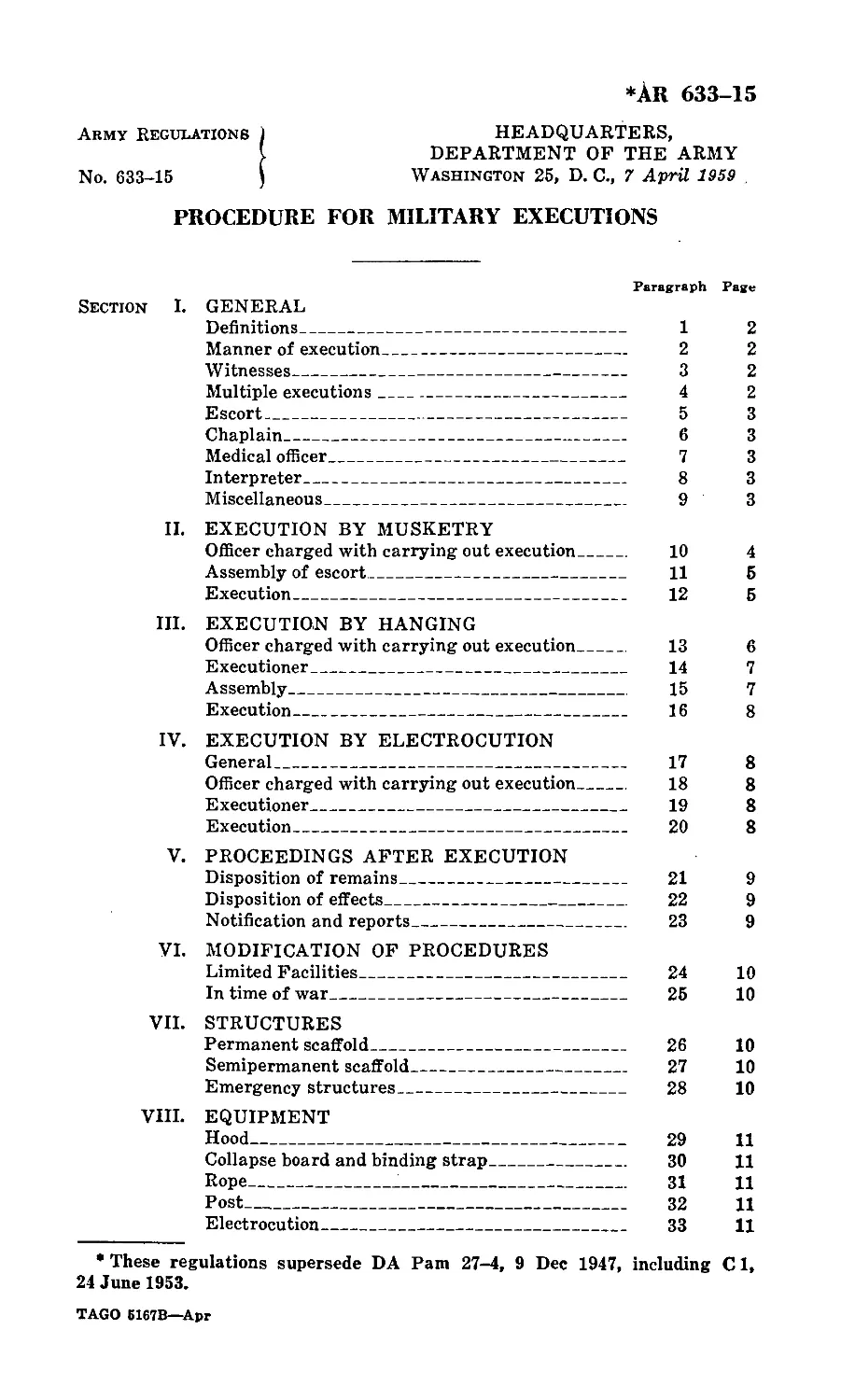
PROCEDURE FOR MILITARY EXECUTIONS
Paragraph Page
Section I. GENERAL
Definitions_______________________________________________ 1	2
Manner of execution__________________________ 2	2
Witnesses____________________________________ 3	2
Multiple executions__________________________ 4	2
Escort_______________________________________ 5	3
Chaplain_____________________________________ 6	3
Medical officer______________________________ 7	3
Interpreter__________________________________ 8	3
Miscellaneous________________________________ 9	3
II.	EXECUTION BY MUSKETRY
Officer charged with carrying out execution__	10	4
Assembly of escort__________________________ 11	5
Execution___________________________________ 12	5
III.	EXECUTION BY HANGING
Officer charged with carrying out execution______	13	6
Executioner_________________________________ 14	7
Assembly____________________________________ 15	7
Execution___________________________________ 16	8
IV.	EXECUTION BY ELECTROCUTION
General__________________________________________ 17	8
Officer charged with carrying out execution_	18	8
Executioner_________________________________ 19	8
Execution___________________________________ 20	8
V.	PROCEEDINGS AFTER EXECUTION
Disposition of remains__________________________ 21	9
Disposition of effects______________________ 22	9
Notification and reports____________________ 23	9
VI.	MODIFICATION OF PROCEDURES
Limited Facilities_______________________________ 24	10
In time of war______________________________ 25	10
VII.	STRUCTURES
Permanent scaffold________________________________ 26	10
Semipermanent scaffold______________________ 27	10
Emergency structures________________________ 28	10
VIII.	EQUIPMENT
Hood_______________________________________________ 29	11
Collapse board and binding strap____________ 30	11
Rope--------------------------------------   31	11
Post________________________________________ 32	11
Electrocution_______________________________ 33	11
* These regulations supersede DA Pam 27-4, 9 Dec 1947, including С1,
24 June 1953.
TAGO Б167В—Apr
AR 633-15	2
Section I
GENERAL
1.	Definitions. For the purpose of these regulations only the
following definitions apply:
a.	Confirming authority. The competent authority of the agency
through which military jurisdiction is exercised ordering the exe-
cution of a sentence of death.
b.	Officer designated to execute the approved sentence. The offi-
cer designated by the confirming authority (a above) to execute
the approved sentence of death.
c.	Officer charged with carrying out the execution. The sub-
ordinate officer duly and officially named by an order of the officer
designated to execute the sentence (b above) and directed therein
to carry out the execution.
2.	Manner of execution. Military executions will be in the
manner designated by the confirming authority or by shooting,
hanging, or electrocution.
3.	Witnesses. The officer designated by the confirming authority
to execute the approved sentence will prescribe whether the execu-
tion will be public or private, rules of secrecy as to time, place, and
the presence of witnesses, military or civilian, including members
of the press if the presence of the latter is deemed proper. In the
case of the execution of a foreign national, the officer designatd to
execute the sentence will prescribe whether persons of the same
nationality as the condemned may be present. Neither photographs
nor motion pictures of the actual execution will be permitted ex-
cept for official purposes. The environs of the place of execution
will be closely and securely guarded to prevent the intrusion of un-
authorized persons. All persons in attendance will be cautioned
that no demonstrations or unseemly conduct will be tolerated.
4.	Multiple executions. In multiple executions by electrocution
in the continental United States the prisoners will be executed in
succession and the same electric chair will be used for each execu-
tion. In multiple executions by musketry or hanging, the prisoners
may be executed either simultaneously or in succession. Where two
or more prisoners are to be executed in succession by musketry or
hanging, the same execution party or gallows may be used for each
execution. Where two or more prisoners are to be executed simul-
taneously by musketry, a separate execution party will be provided
for each of the prisoners. The latter will be placed in line at an
interval of ten paces. Where two or more prisoners are to be exe-
cuted simultaneously by hanging, the officer designated to execute
AGO Б167В
3
AR 633-15
the sentence will prescribe the number of gallows to be erected,
and the prisoners will be hanged from the gallows simultaneously
or by groups.
5.	Escort. The escort for execution by musketry or hanging
may be dismounted or motorized, but upon arrival at the scene of
execution, motorized escorts will form in the manner prescribed
for dismounted escorts. The minimum escort will consist of com-
ponents as prescribed in paragraphs Ila and 15a. Where the pris-
oner is to be executed by electrocution, the strength, formation,
and duties of the guard escort will be as prescribed by the officer
charged with carrying out the execution.
6.	Chaplain. In all executions, a chaplain of the prisoner’s
choice will be provided if practicable. If no chaplain of the pris-
oner’s choice or of his particular faith and/or race is available, the
officer charged with the execution of the sentence will take all rea-
sonable measures to provide a civilian clergyman of that faith
and/or race. The chaplain should be available at all times after
the prisoner is notified of the time of execution.
7.	Medical officer. A medical officer will be officially designated
to be in attendance upon the execution. It will be his duty to de-
termine the extinction of life in the prisoner and to make pro-
nouncement thereof. He will furnish a death certificate to accom-
pany the report of execution.
8.	Interpreter. In the event the prisoner does not speak English,
an interpreter will be officially designated to be in attendance at
the notification of the prisoner (par. 9a) and the execution. It is
his duty to interpret the charge, finding, sentence orders, and any
last statement made by the prisoner. Before entering upon his
duties, the interpreter will take the oath or affirmation required
of an interpreter for a court-martial.
9.	Miscellaneous, a. The prisoner will be notified of the time
of execution no less than 24 hours prior thereto if practicable, at
which time the charge, finding, sentence, and order directing the
execution will be read to him by the officer charged with carrying
out the execution. The chaplain should be present.
b.	Unless the exigencies of the situation preclude such action,
due notice of the time and place of execution will be given to the
next of kip of the prisoner and an opportunity provided for the
claiming of the body following the execution.
c.	Items of clothing and alterations thereto to be worn by a
prisoner to be executed by hanging or electrocution will be as pre-
scribed by the officer charged with carrying out the execution, in
AGO Б167В
AR 633-15
4
accordance with the technical instructions of the executioner. A
prisoner in the Armed Forces of the United States will be dressed
in regulation uniform from which all decorations, insignia, or
other evidence of membership therein have been removed. Like-
wise, no such evidences will appear on any clothing used in burial.
Similar procedures may be dispensed with, at the discretion of the
officer charged with carrying out the execution (or higher au-
thority) in the case of a prisoner in the armed forces of another
nation. A prisoner not within the foregoing categories may be
dressed in any clothing available.
d.	After the prisoner is notified of the time of execution (a
above), the commanding officer of the place of confinement will,
where practicable, approve any reasonable special request of the
prisoner, including special request for food, and permission to
have in his possession a Bible, Rosary, or similar religious articles
during the execution. Sufficient writing paper and envelopes should
,be furnished and no limit placed on the number of letters which
may be written. All letters are subject to censorship and may or
may not be forwarded.
Section II
EXECUTION BY MUSKETRY
10.	Officer charged with carrying out execution. The officer
charged with carrying out the execution will command the escort
and make the necessary arrangements for the conduct of the exe-
cution. He will—
a.	Instruct and rehearse the escort and the execution party in
their duties, insuring that all members of the execution party are
qualified in the weapon to be used.
b.	Arrange for the receipt of the prisoner by the prisoner guard.
c.	Arrange for an execution party of eight men and one ser-
geant.
d.	Arrange for a chaplain to accompany the prisoner.
e.	Arrange for the presence of a medical officer at the scene of
the execution.
f.	Cause a post with proper rings placed therein for securing
the prisoner in an upright position to be erected at the place of
execution.
g.	Cause eight rifles to be loaded in his presence. At least one
but no more than three will be loaded with blank ammunition. He
will place the rifles at random in the rack provided for that pur-
pose.
h.	Provide a black hood to cover the head of the prisoner.
AGO Б167В
5
AR 633-15
i.	Provide a 4-inch round target, white or black as appropriate;
a black target will be used when light colored clothing is worn.
j.	Cause the prisoner’s wrists to be secured either behind his
back or in front at the waist (fig. 1), before or immediately after
his receipt by the prisoner guard.
k.	Provide straps to secure the prisoner to the post at waist and
ankles.
11.	Assembly of escort, a. The prisoner guard will consist of
four men armed with rifles, under the command of a sergeant
'armed with a pistol. At the proper time, the prisoner guard will
proceed to the place of confinement to receive the prisoner.
b.	The execution party will be formed unarmed and proceed to
a previously prepared rack of rifles, secure arms, and move to the
scene of the execution, halting 15 paces from and facing the po-
sition to be taken by the prisoner. The sergeant of the execution
party will be armed with a pistol. At close interval, at order arms,
and at parade rest the execution party will await the arrival of the
prisoner and escort.
c.	Witnesses, if any, will take position facing the scene of the
execution, 15 paces to the right and 5 paces to the front of the exe-
cution party.
d.	At the designated time, the prisoner, with his wrists bound
securely behind his back or in front at the waist (fig. 1), accom-
panied by the chaplain, will be received by the prisoner guard. The
escort will then proceed to the scene of the execution.
e.	The prisoner guard, prisoner, and chaplain will proceed di-
rectly to the prisoner’s post, halt, and face the execution party.
12.	Execution, a. The officer charged with carrying out the
execution will take position in front of the execution party and
face the prisoner. He will notify the prisoner and the chaplain that
a brief time will be allowed the prisoner for any last statement.
After a reasonable time, he will order the sergeant of the execu-
tion party and the sergeant of the prisoner guard to secure the
prisoner to the post and to place the hood over his head. The med-
ical officer then will place the target over the prisoner’s heart. The
prisoner prepared, the officer charged with carrying out the exe-
cution will order the prisoner guard to move to a position five
paces behind the execution party. The chaplain and medical officer
will take positions five paces to the left of and five paces to the
front of the execution party. The officer charged with carrying out
the execution will take position five paces to the right of and five
paces to the front of the execution party.
AGO Б167В
AR 633-15	6
b.	Commands for the execution will be given orally as pre-
scribed below:
(1)	At the command READY, the execution party will take
that position and unlock rifles.
(2)	At the command AIM, the execution party will take that
position with rifles aimed at target on the prisoner’s
body.
(3)	At the command FIRE, the execution party will fire si-
multaneously.
(4)	The officer charged with carrying out the execution will
then bring the execution party to “Order Arms.”
c.	The officer charged with carrying out the execution will join
the medical officer who will examine the prisoner and, if necessary,
direct that the “coup de grace” be administered. Should the med-
ical officer so decide, the sergeant of the execution party will ad-
minister the “coup de grace,” with a hand weapon, holding the
muzzle just above the ear and one foot from the head.
d.	Upon pronouncement of the death of the prisoner by the med-
ical officer, the execution party will proceed to the rack from which
the rifles were originally obtained, and replace the rifles in the rack
at random. The execution party will then be dismissed.
e.	The prisoner guard will return to the area of their quarters
and be dismissed.
Section III
EXECUTION BY HANGING
13.	Officer charged with carrying out execution. The officer
charged with carrying out the execution will command the escort
and make the necessary arrangements for the conduct of the exe-
cution. He will—
a.	Instruct components of the escort in their duties.
b.	Arrange for the receipt of the prisoner by the prisoner guard.
c.	Arrange for a chaplain to accompany the prisoner.
d.	Arrange for the presence of a medical officer at the scene of
the execution.
e.	Provide a proper gallows.
f.	Provide a black hood to cover the head of the prisoner.
g.	Provide a collapse board for use if necessary.
h.	Cause the prisoner’s wrists to be secured before or immedi-
ately upon his receipt by the prisoner guard. The wrists may be
secured either behind the back or in front, fastened to the belt
(fig.l).
AGO Б167В
7
AR 633-15
i.	Determine the proper amount of drop of the prisoner through
the trapdoor. A standard drop chart for normal men of given
weights is given below. Variation of the drop because of physical
condition may be necessary. A medical officer will be consulted to
determine whether any factors, such as age, health, or muscular
condition will affect the amount of drop necessary for a proper
execution.
120 lbs or less _____________8' 1"
125 lbs ____________________7'10"
130 lbs _____________________7'7"
135 lbs _____________________7'4"
140 lbs _____________________7'1"
145 lbs _____________________6'9"
150 lbs _____________________6'7"
155 lbs _____________________6'6"
160 lbs _____________________6'4"
165 lbs _____________________6'2"
170 lbs ___________________6'0"
175 lbs ____________________5'11"
180 lbs ___________________5'9"
185 lbs ____________________5'7"
190 lbs ___________________5'6"
195 lbs ____________________5'5"
200 lbs ____________________5'4"
205 lbs ____________________5'2"
210 lbs ____________________5' 1"
220 lbs and over____________5' 0"
j.	Rehearse the execution within 24 hours prior to the scheduled
time for the execution. A sandbag or similar object approximating
the prisoner’s weight may be used to insure proper functioning of
the gallows, trapdoor, and hangman’s noose.
14.	Executioner. An official experienced executioner will be ap-
pointed by the officer charged with carrying out the execution. If
one is not available to the command, a professional civilian execu-
tioner may be obtained and appointed. In the event a professional
executioner is not available, a suitable emotionally stable member
of the command will be selected and appointed executioner.
15.	Assembly, a. The prisoner guard will consist of 10 men
armed with rifles, two corporals armed with pistols, under the
command of a sergeant armed with a pistol. The prisoner guard
will form in double ranks and at the proper time will proceed to
the door of the place of confinement to receive the prisoner.
b.	Witnesses, if any, will assemble at the scene of the execution
in positions designated by the officer charged with carrying out
the execution.
c.	At the designated time the prisoner, with his wrists bound
securely, accompanied by the chaplain, will be received by the pris-
oner guard and placed between the ranks. The escourt will then
proceed to the scene of the execution.
d.	Upon the arrival of the escort at the scene of the execution,
the corporals and the sergeant of the prisoner guard will conduct
the prisoner to the platform of the gallows, the officer charged with
carrying out the execution and the chaplain preceding the pris-
oner.
AGO Б167В
AR 633-15
8
16.	Execution, a. The officer charged with carrying out the
execution will notify the chaplain and the prisoner that a brief
time will be allowed the prisoner for any last statement. After a
reasonable time, he will have the executioner place the hood over
the prisoner’s head, bind the prisoner’s ankles, adjust the noose
around the prisoner’s neck, and then take position at the trigger.
Upon signal from the officer charged with carrying out the exe-
cution, the executioner will spring the trap. The medical officer
will then examine the body for time of death and report to the
officer charged with carrying out the execution.
b. Upon the pronouncement of the death of the prisoner, the es-
cort will return to the area of their quarters and be dismissed.
Section IV
EXECUTION BY ELECTROCUTION
17.	General. Execution by electrocution may be effected only
at the confinement facility designated by Headquarters, Depart-
ment of the Army. Procedures for execution by electrocution will
necessarily vary from those prescribed for execution by musketry
or hanging.
18.	Officer charged with carrying out execution. The officer
charged with carrying out the execution will make the necessary
arrangements for the conduct of the execution. He will—
a.	Select and appoint such personnel, including guards, as may
be required to carry out the execution.
b.	Instruct all components of the execution party in their duties.
c.	Arrange for a chaplain to accompany the prisoner.
d.	Arrange for the presence of a medical officer at the scene of
the execution.
e.	Provide the mechanical facilities and items of equipment and
clothing required to carry out the execution.
19.	Executioner. The officer charged with carrying out the
execution will obtain and appoint a professional civilian execu-
tioner to perform the execution. Execution by electrocution may
not be performed by other than a professional civilian executioner.
20.	Execution, a. On the day of execution, the prisoner will
be clothed and otherwise prepared in accordance with instructions
of the executioner.
b.	At the designated time, the prisoner, accompanied by the
chaplain, will proceed under guard from the prisoner’s cell into the
execution chamber. The officer charged with carrying out the exe-
AGO Б167В
9
ЛК 633-15
cution will notify the chaplain and the prisoner that a brief time
will be allowed the prisoner for any last statement. After a reason-
able time, he will order the guards to place the prisoner in the
electric chair according to the instructions of the executioner. Fol-
lowing the placing of the prisoner in the electric chair, the officer
charged with carrying out the execution, the guards, the chaplain,
and the medical officer will move to designated positions in the
execution chamber. The executioner will then perform final prepa-
rations. Upon signal from the executioner that all final prepara-
tions have been completed and he is ready to proceed, the officer
charged with carrying out the execution will signal the execu-
tioner to perform the execution.
c.	Upon notification from the executioner that he may proceed,
the medical officer will then examine the body, note the time of
death, and report to the officer charged with carrying out the exe-
cution.
d.	Upon pronouncement of the death of the prisoner, the officer
charged with carrying out the execution will dismiss the execution
party.
Section V
PROCEEDINGS AFTER EXECUTION
21,	Disposition of remains. The officer charged with carrying
out the execution will arrange in advance for an ambulance or
other conveyance with sufficient personnel to be in attendance
upon the execution to receive and care for the body. If the next of
kin or other relatives of the deceased desire the body, the officer
charged with carrying out the execution will, if practicable, per-
mit its delivery to them for burial. If no such claim is made, he will
cause it to be buried in a post or civilian cemetery or at the pace
of death, whichever may be deemed proper and is authorized by
pertinent regulations. Disposition of remains of such personnel of
the Armed Forces of the United States is governed by Army Reg-
ulations of the 638-series or comparable regulations of the United
States Navy or United States Air Force as appropriate. All burials
in post cemeteries are governed by AR 210-190.
22.	Disposition of effects. See 10 USC 4712 et scq. and AR
643-50 or AR 643-55 as applicable. War criminals and civilan res-
ident criminals convicted by a Military Tribunal and executed by
military authorities are considered as subject to military law for
the purpose of disposition of effects.
23.	Notification and reports. The officer designated to execute
the approved sentence will notify The Adjutant General immedi-
AGO Б167В
AR 633-15	10
ately following the execution, by fastest available method of com-
munication, of the carrying out of the sentence of death, the time,
place and any unusual circumstances attendant thereon. He will
likewise, in addition, furnish other notifications as may be re-
quired by AR 600-65 and AR 600-66 or AR 600-67. The quarter-
master or other officer in charge of burial will furnish the report
of burial as required in the regulations cited in paragraph 21.
Section VI
MODIFICATION OF PROCEDURES
24.	Limited facilities. If the facilities are not available for the
carrying out of each of the provisions of this regulation or if the
exigencies of the situation require it, the officer designated to exe-
cute the approved sentence may make the necessary modification
of the provisions herein contained, except that he may not change
the mode of execution. Any modification will be reported in writ-
ing to the confirming authority.
25.	Ln time of war. In time of war, only the minimum number
of troops necessary to accomplish the execution need be employed.
Section VII
STRUCTURES
26.	Permanent scaffold. A permanent type, demountable scaf-
fold, with a metal trigger mechanism, will be erected when the
need for such a structure is determined by the commanding officer
(fig. 2). Where available, troops belonging to the Corps of Engi-
neers will be employed in the constructing of the scaffold, but
where not available, or where it is more practicable, other troops
or civilans may be employed. Preliminary tests will be made to in-
sure the strength of the rope and the stability of the scaffold’s con-
struction. If facilities are limited, a trapdoor on the second floor
of the building may be constructed to effect the execution, or a
similar improvisation employed.
27.	Semipermanent scaffold. A semipermanent scaffold which
requires no special metal fittings may be used in executions by
hanging when deemed expedient by the officer charged with
carrying out the execution (fig. 3).
28.	Emergency structures. When the exigencies of the field so
dictate, emergency type gallows may be used (fig. 4).
AGO Б167В
11	AR 633-15
Section VIII
EQUIPMENT
29.	Hood. The hood will be black, the outer surface of rough
materials, split at the open end so that it will come well down
on the prisoner’s chest and back.
30.	Collapse board and binding strap. A collapse board will
be provided for use in case of the collapse of the prisoner (fig. 5).
31.	Rope. The rope will be of manila hemp, at least % inch
and not more than IVi, inches in diameter and approximately 30
feet in length. The rope will be boiled and then stretched while
drying to eliminate any spring, stiffness, or tendency to coil.
The hangman’s knot (fig. 7) will be used in the preparation of
the noose. That portion of the noose which slides through the
knot will be treated with wax, soap, or grease to insure a smooth
sliding action through the knot. The noose will be placed snugly
around the prisoner’s neck in such a manner that the hangman’s
knot is directly behind his left ear.
32.	Post. Design for post used in execution by musketry as
mentioned in paragraph 12a, is shown in figure 6.
33.	Electrocution. Facilities and equipment for effecting execu-
tion by means of electrocution will be in accordance with Head-
quarters, Department of the Army instructions.
AGO B167B
AR 633-15
12
2"« 211» CLIP ANCLES
I	ON UNDER SIDE	I
r*----------S' e'OUT TO OUT OF COLS-----------------J
------10' 0"-----------------------J
PLAN OVER BEAM
О ,01
PLATFORM AND STAIR PLAN AT SECTION A-A SCALE Г
Figure 2 ©. Permanent scaffold.
AGO 5167B
13
AR 633-15
3' 6
FRONT ELEVATION SCALE '/2"=l'
Figure 2 ®. Permanent scaffold, front elevation.
AGO Б1674
AGO 5167В
Figure 2 ®. Permanent scaffold, side elevation.
AR 633-15
АСЮ 5167В
=4
•{"thick steel plate
BELLCRANKS
I I —,1-Д---SPLIT TYPE
PILLOW BLOCKS
—SHAFT-2" BL ACK PIPE
Figure % ®. Permanent scaffold, bell crank.
AR 633-15
AGO 5167В
-I LJ
Front Elev Jj- = 12“
Side Elev #'« l2"
Figure 8 ©. Semipermanent scaffold.
AR 633-15
17
AR 633-15
2"x8" Spiked All Around Top Of
6"x6“ To Form Plote or Ribbon
Figure 3 ®. Semipermanent scaffold, details.
AGO 5167B
AR 633-15
18
Elevation of Trigger post = 12“
zHeovy Strap Hinge
Screw Eye
4"x4"	9* 6" Long Cut In Two Pieces At Center
Hinged To Stand with I-Inch Bow At Center
MATERIALS
2 pcs 6''i8*- 221			Long	Goliows Posts
4	6 »6 -	12*		plotform posts
2	2“x IO“-	16*		Step Stringers
4	2"xlo"-	I a*		Cross Bor- Beam
3	2“x8" -	14*		Joist-Extend for stoir 1
1	2"x8"-	I2‘		Joist- Short
7	2“»8>	10*		Joists- Regular
8	2“»6”-	14'		X Broces
4	2"x6"-	I O’		Goliows Braces
1	4"x4“-	ia'		Knee Broces (cut to 5* 0
4	4”x4"-	4'		Newels
2	2"x4"-	16*		Slair Rail
1	2“x4"-	14’		Stair Roil
3	2''x4"-	10		Stoir Rail & Trap Door
				pope 2"xB" 12* Long \
	^Flooring If	2“	Ihlck	<6	2"x8" 10' Long I
				U 2"x8" 8' Long/
1	pc 2"x6“-	8*	Long	Trap Door Rails
1	г’хвзХ'в'			140 BM3/4” T8G Pine
4		14*		Cut into S' 8" lengths
1	4**x4***	10*		Trigger
landing
Roil
Flooring
Step Tread
Figure 3 ®. Semipermanent scaffold, details—Continued.
AGO Б167В
19
AR 633-15
Figure 4. Emergency gallows, post type and tripod type.
AGO Б167В
AR 633-15
20
7Г
В.
— 50
'-6
A - Brace Board
В В В -1 Inch strops
12 3
Figure 5. Collapse board.
Figure 6. Post used in execution by musketry.
AGO Б167В
21
AR 633-15
Length of loops: from A to В should be approximately 18 inches, and from C
to Running End should be approximately 35 inches to 108 inches depending
upon diameter of the rope. Wrap Running End around for six turns. No
extra rope should remain.
Figure 7 © and ©. Hangman's knot.
Tighten loops by pulling at Running End. Lock loops and form knot by pulling
down at point D. Slide knot up or down on Standing Part to adjust size
of loop.
Figure 7 ® and ©.
AGO Б167В
AR 633-15
22
[AG 250 (16 Mar 59) PMGK]
By Order of Wilber M. Brucker, Secretary of the Army:
MAXWELL D. TAYLOR,
General, United States Army,
Official:	Chief of Staff.
R. V. LEE,
Major General, United States Army,
The Adjutant General.
Distribution:
Active Army: D.
To be distributed as needed to Headquarters of Department of the
Army Staff Agencies, Headquarters Army Audit Agency and field
offices, Headquarters of Major Commands.
NG: State AG (3).
US AR: None.
☆ U.S. Government Printing Office: 1959—480522
AGO Б167В