/
























































Текст
                    The Army of Maria Theresa
Christopher Duffy
Eighteenth-century military history is attracting an
increasingly wide and well-informed public. A great
deal is known about the monstrous Frederick of
Prussia, the foremost soldier of his time. So far we
have heard very little about the military achieve-
ment of his great and gracious rival, the Empress-
Queen Maria Theresa of Austria, who deserves to
go down in history as 'the lady who gave Old Fritz
a bloody nose'.
Against every expectation, the Austria of the
young IVlaria Theresa survived the onslaught of
Frederick and his robber allies in the early 1740s.
The army was the one branch of the state for
which she harboured 'a real personal interest", and
she brought it to such a pitch that she could go
over to the offensive in the later campaigns of the
mighty Seven Years War (1756-63). This time it
was Frederick who was lucky to survive. The
Austrians were now evolving forms of war which
put the Prussians at a disadvantage, and in one final
conflict (1778-79) they successfully held superior
enemy forces in the mountains of Bohemia.
On balance, IVlaria Theresa's military achieve-
ment emerges as more creative than Frederick's.
The leadership and discipline were more en-
lightened, and in their use of light infantry, and
above all in the employment of their potent
artillery, the Austrians foreshadowed some import-
ant aspects of Napoleonic warfare. Readers will note
with interest that Irish generals played an import-
ant part in this work.
The Army of Maria Theresa does full credit to
the human interest of this colourful period. The
book is based largely on contemporary memoirs
and manuals, and the wealth of unpublished manu-
script material in the Kriegsarchiv,
Vienna.
ISBN 0 7153 7387 0

HISTORIC ARMIES AND NAVIES
The Army of Maria Theresa

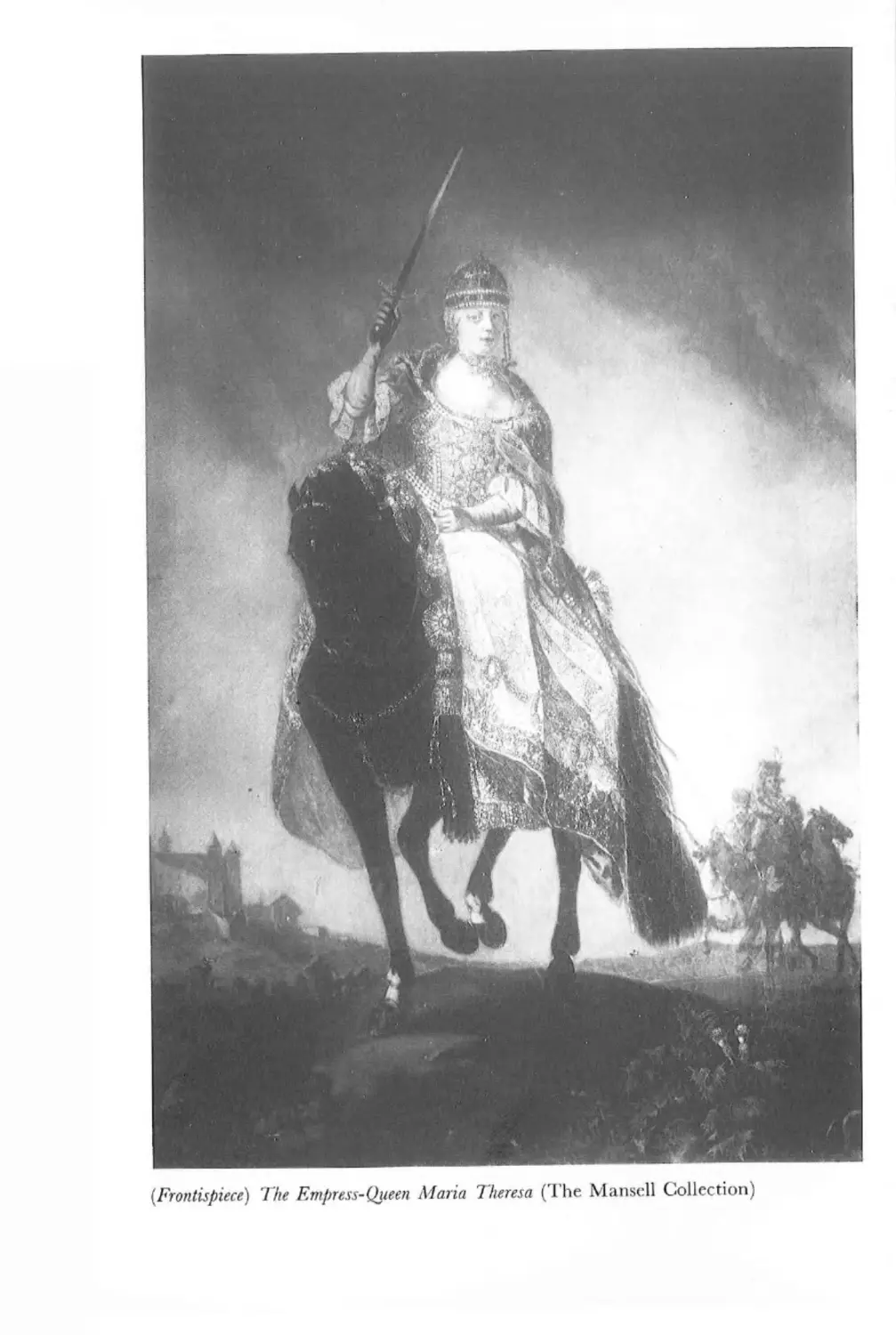
{Frontispiece) The Empress-Queen
Maria Theresa (The Mansell Collection)

HISTORIC ARMIES AND NAVIES
DAVID & CHARLES
NORTH POMFRET (VT) VANCOUVER • LONDON
The Army of
Maria Theresa
The Armed Forces of Imperial Austria, 1740-1780
CHRISTOPHER DUFFY

In memory of James Dujfy,
first lieutenant in the regiment of Marschall,
killed at Meissen 21 September l75g
ISBN o 7153 7387 o
© Christopher Duffy 1977
All rights reserved. No part of this
publication may be reproduced, stored
in a retrieval system, or transmitted,
in any form or by any means, electronic,
mechanical, photocopying, recording or
otherwise, without the prior permission
of David & Charles (Publishers) Limited
Set in 11 on 13 Baskerville
and printed in Great Britain
by Redwood Burn Limited, Trowbridge (& Esher
for David & Charles (Publishers) Limited
Brunei House Newton Abbot Devon
Published in Canada
by Douglas David & Charles Limited
1875 Welch Street North Vancouver BC

Contents
Introduction and Acknowledgements 6
1 The Theresian State 8
2 The Supreme Direction of the Armed Forces
i8
3 The Officers 24
4TheMen 47
5 The Infantry of the Line 63
6 The 'Croats' 82
7 The Cavalry 91
8 The Artillery 105
9 The Technicians
118
10 Financiers, Commissaries, Doctors and Priests 123
11 The Control of the Army
135
12 Mihtary Operations
139
13 Maria Theresa's Army and the Test of War
145
Notes 215
Appendix: List of Regiments 221
Bibhography 247
Index 253

Introduction and Acknowledgements
This is a story from the diverse and colourful Habsburg Austrian monarchy in the
middle of the eighteenth century, which was perhaps the most creative period of its
existence. At the centre of the stage stands the admirable and gracious Empress-
Queen Maria Theresa, the mother-figure of Central Europe. The Theresian_epoch
rivals the Elizabethan Age in its excitement, and the reign of Victoria in its solid
achievement, with the telling difference that its presiding genius was a much more
agreeable kind of person than the two formidable ladies evoked in our comparison.
At once heroic and human, Maria Theresa devoted much of her energy to enhancing
both the fighting efficiency and the welfare of her armed forces, which was the one
branch of her state for which she harboured 'a real personal interest'. It is one of
the objects of the present work to do justice to the magnitude of this creative achieve-
ment. Measured by her standard, the activity of her rival Frederick of Prussia appears
merely destructive, in the sense that he left an army that was in a worse state than
the force he had inherited.
The Army of Maria Theresa also sets out to show that the Austrian army was not
called into being 'just to give the Itahans somebody they could beat'. On the con-
trary, Maria Theresa's troops were engaged almost from the outset of her reign in
a battle of survival against the greater part of Europe, including the Prussia of
Frederick the Great, the most dangerous of all possible enemies. After a bad start,
the Austrians not only learnt to deal out at least as much punishment as they received,
but evolved a style of warfare which ultimately put Old Fritz at a distinct disadvan-
tage. In the use of its light infantry, and above all in the employment of its mighty
artillery, the Theresian army foreshadowed some important aspects of Napoleonic
warfare. We ought to set the record straight, now that eighteenth-century military
history is attracting an increasingly wide and well-informed public.
It is also timely to recall the high reputation of the Irish who worked and fought
for eighteenth-century Austria. Among their ranks were numbered types as varied
as Captain MacBrady, the berserker of Schweidnitz, and Field-Marshal Lacy, who
was the meticulous manager of the military machine and a leader of society in
Mozart's Vienna. They had their counterparts in every monarchy of CathoUc
Europe, a fact which has escaped so many people who generalise about the Irish
character and achievement.
I cannot conceal that my own interest in our theme remains primarily romantic.
The period and the place have been invested with a magic for me ever since I began
to hear and read about history. A particularly strong impression was made by an
illustration in an encyclopaedia, showing Maria Theresa and the infant Joseph before
the Hungarian magnates, and I still recall with pleasure a representation of Frederick
the Great at Hochkirch, standing outside a tent while his grenadiers streamed past
in disorder. I thank Providence that the inspiration is as fresh as ever. There is a
6

peculiar thrill to be had in turning over the pages of a manuscript still encrusted
with the sand that was scattered over the ink two hundred or more years ago, and
even now one can scarcely visit the field of Kolin without being impressed by the
grand scale of the horizon, and the almost tangible atmosphere that reverberates
from the events of 18 June 1757. I shall have failed in my chief ambition, if I do
not communicate something of these enthusiasms to the reader.
I should like to express my gratitude to the many people who have helped me in
various ways, in particular Dr J. C. v. Allmayer-Beck (Director of the Army
Museum, Vienna), Dr H. Bleckwenn, Professor J. Kunisch, Dr M. Messerschmidt,
and Mr John Edgcumbe. I am much indebted to the officials of the Kriegsarchiv,
Vienna, and especially Dr K. Peball, Dr P. Broucek, Dr O. Winter, Dr L. Moser,
Herr J. Lippitsch and the ubiquitous Paul Pe'Sek. They run a friendly and truly
helpful institution. A nearby establishment, the Cafe Siller, also did a good deal to
maintain morale.
All maps are by the author.
C.D
7

The Theresian State
The DoJiiains of the Empress-Queen
The 'Austria' of the Habsburg dynasty was a whole httle universe, an entity which
retains the power to stir the imagination in all sorts of ways. The sentimentalist will
be inclined to linger in a kind of confectioner's Vienna, inhabited by memories of
the waltz kings and the homely Biedermeier comforts of Schubert's time. The passing
tourist will be persuaded to associate the traditional Austria with tiresomely cheerful
Tyroleans who wear leather shorts and have brushes stuck in then- hats.
A more representative picture of the old world can be created simply by
wandering through the courts and narrow streets which extend to the north of
Vienna's Graben Square and St Stephen's Cathedral. Nowhere, perhaps, does the
atmosphere of eighteenth-century ofHcialdom hang more heavily than around the
building of the old Bohemian Chancellery and the little Judenplatz outside. We
may people the palaces and squares by betaking ourselves to the Kunsthistorisches
Museum, and absorbing the visions of Vienna which were recorded by the painter
BernadoBellotto in the hot summer of 1759, while Austria's armies were sweating
far away on the plains beside the Oder.
However, we must travel much further afield if we are to gain some inkling of
the extent and the sheer strangeness of the old empire. Where books and museums
fail, it is still possible to recreate the past in an odd corner of the vanished realm like
the' Banat of Temesvar, which is nowadays shared between Rumania and Yugo-
slavia. The terrain is an eerie landscape of thinly-turfed sandhills, which were
reclaimed by German colonists after Prince Eugene conquered the region in 1716.
Here and there the site of a village is betrayed by a slender white church tower,
crowned by an onion dome in best baroque style. Wolves still lurk in the Transyl-
vanian Alps, which rise like green hummocks to the east, while herds of pigs rush
down to cool themselves in the grey waters of the half-mile-wide Danube, as it
pushes its way towards the Iron Gates. The heat, the vegetation, and the vast
horizon are a world removed from Western Europe.
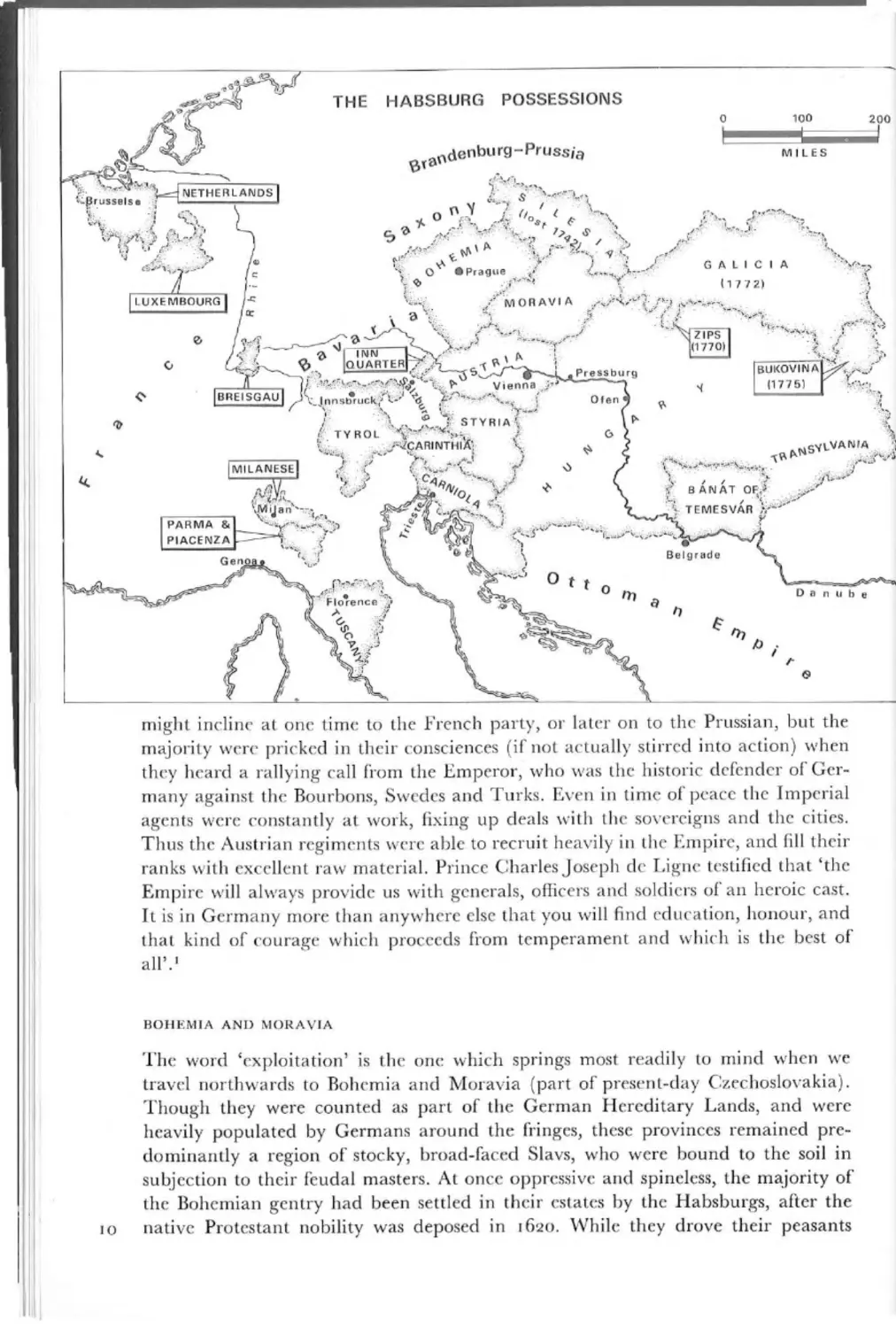
As they existed in the middle of the eighteenth century, the Habsburg domains
comprised the area of modern Austria, together with much of present-day Czecho-
slovakia, Poland, Hungary, Yugoslavia, Rumania, northern Italy and Belgium.
How did it all come together ?
The lands of the Hungarian and Bohemian crowns signed themselves over to
the Habsburgs as a measure of desperation in 1527, after the old independent mon-
archy of Hungary had been crushed by the Turks. Still further to the east, the
principality of Transylvania was won from the Turks in the later seventeenth
century, and held in direct subjection to the Vienna administration. Thus the arch-
duchy of Austria was buttressed to the north and east by an arc of territory extending
some two thousand miles from Silesia, Bohemia and Moravia by way of Transyl-
vania and Slavonia to the wilds of the Adriatic coastlands.
1
8

Southwards across the Alps generations of Maria Theresa's ancestors had
campaigned in northern Italy against the hostile French dynasty of Bourbon. The
Emperor Charles VI tried to establish a claim to Spain as well, but the Spanish
Bourbons threw him out in 1714. He never got over the loss, and he made sure that
Austrian court etiquette and ways of doing business were heavily influenced by the
gloomy formality of old Spain. It was some consolation that his British and Dutch
allies helped Charles to salvage a couple of prizes from the wreck of the empire of
the defunct Spanish Habsburgs, to wit the Milanese, and the provinces of the
southern Netherlands which were marooned far away in the green and damp
lowlands of north-western Europe.
The Empire survived until the end of "World War I, when its destruction left a
rent in the political and social fabric of Europe which has still to be mended. It is
strange to reflect that the old order endured so long largely through the achievement
of a long-dead woman, the Empress-Queen Maria Theresa. She took charge of the
Habsburg dominions in 1740, at the age of twenty-three, and though she lacked
any training in government she preserved her state through a desperate military
crisis and went on to rule it for the next forty years according to principles which
most people today would still acclaim as models of humanity and reason. Maria
Theresa's warmth and spontaneity appeal to us at the present time as strongly as
they did to her subjects, and evoke a sympathy which we cannot feel for her tough,
calculaUng or merely obscure royal contemporaries. Here at least the historian and
the sentimentalist are in full agreement.
Before we look more closely at the woman and her work, it is useful to take stock
of the component parts of the Habsburg dominions.
the german heartlands
At the centre of the Habsburg empire resided the Austrian core, namely present-
day Upper and Lower Austria, with the Tyrol and the Vorarlberg, the southern
duchies of Styria, Carinthia and Carniola, and the 'Austrian littoral' of Istria,
Trieste and Eiume. Across southern Germany there were scattered the enclaves of
Vorder-Osterreich, of which the most important was the Breisgau with the city of
Freiburg.
Leaving the Netherlands and Austrian Italy out of account, it was probably in
these 'German' lands that Maria Theresa's subjects were at their happiest. The
Tyroleans were poor but free, and most of the remaining Austrian countryfolk lived
under a degree of feudal subjection that was irksome rather than intolerable, and
certainly preferable to the bondage which obtained in Bohemia, Moravia and
Hungary. The Habsburg capital of Vienna was already an important centre of
commerce, and elsewhere in Austria there were assets like the Styrian and Carinthian
iron, or the salt of the Salzkammergut, which gave rise to a degree of local prosperity.
However, the specifically 'Austrian' contribution to the Habsburg army was
surprisingly small. In Maria Theresa's time the Tyroleans shunned army life as an
aflfront to their inborn freedom, while it would have been unthinkable to have
formed regiments from folk as unmilitary as the Viennese.
Fortunately the German-speaking element in the army was kept up by invoking
the moral authority invested in the office of Emperor of Germany, which the
Habsburgs had enjoyed with hardly a break since 1273. Some of the independent
'Electors' and the scores of princes, dukes and municipalities which ruled 'Germany' 9

might incline at one time to the French party, or later on to the Prussian, but the
majority were pricked in their consciences (if not actually stirred into action) when
they heard a rallying call from the Emperor, who was the historic defender of Ger-
many against the Bourbons, Swedes and Turks. Even in time of peace the Imperial
agents were constantly at work, fixing up deals with the sovereigns and the cities.
Thus the Austrian regiments were able to recruit heavily in the Empire, and fill their
ranks with excellent raw material. Prince Charles Joseph de Eigne testified that 'the
Empire will always provide us with generals, officers and soldiers of an heroic cast.
It is in Germany more than anywhere else that you will find education, honour, and
that kind of courage which proceeds from temperament and which is the best of
air.^
BOHEMIA AND MORAVIA
10
The word 'exploitation' is the one which springs most readily to mind when we
travel northwards to Bohemia and Moravia (part of present-day Czechoslovakia).
Though they were counted as part of the German Hereditary Lands, and were
heavily populated by Germans around the fringes, these provinces remained pre-
dominantly a region of stocky, broad-faced Slavs, who were bound to the soil in
subjection to their feudal masters. At once oppressive and spineless, the majority of
the Bohemian gentry had been settled in their estates by the Habsburgs, after the
native Protestant nobihty was deposed in 1620. While they drove their peasants

mercilessly, the new Bohemian nobles proved oddly amenable to direction from
above-they submitted to the Elector of Bavaria, when he got himself crowned Em-
peror in 1742, and, after a period of obstruction, they acquiesced in the very high
financial demands made by the Vienna government in 1748.
In the Seven Years War (1756-63) Bohemia actually contributed more than
four times as much money as all the lands of the Hungarian crown, and between
20 and 40 per cent more than the Austrian Netherlands, which were the next most
productive source of revenue. Together with the physical devastation caused by the
war, this weight of taxation precipitated a collapse of the economy, and caused
actual starvation in Bohemia and Moravia in the 1770s. Prague, the capital of
Bohemia, was a pleasant place which was frequented mostly by such nobles as could
not afford the prices in Vienna.
Otherwise the lands of the old Bohemian kingdom ought to have emerged as
the most prosperous of Maria Theresa's dominions, taking into account the mines,
forests and vineyards of the mountain rim, the excellent beer, the clothing industry
of the Bohemian-Moravian borders, and the extensive cultivation of flax in Moravia,
'which gives a pretty aspect to the countryside, when it is in flower'.^
Poverty has always been the most eloquent recruiting sergeant of all, so it is
hardly surprising that Bohemians and Moravians formed the backbone of many of
Maria Theresa's 'German' regiments. However, the Bohemians entered the Austrian
artillery with positive enthusiasm, since they inherited a proud gunner tradition
from the militant Hussite heretics of the fifteenth century.
THE LANDS OF THE HUNGARIAN CROWN
Nowhere was the power of the nobility more extravagantly and irresponsibly dis-
played than in the lands of the Hungarian crown, and more particularly in the hills
and plains of Hungary proper, which swept from within a few miles of Vienna to
the edge of the sandy wastes of the Banat of Temesvar.
Though the Hungarian lands (excluding Transylvania) accounted for more
than one-third of the population and area of Maria Theresa's dominions, the
Hungarian contribution to the Habsburg war machine remained disproportionately
small - in money terms perhaps less than one-tenth of the total revenues. The
trouble was that the Hungarian church and gentry and the almost inconceivably
rich noble dynasties like those of Esterhazy, Palffy and Batthyany contrived to
unload the burden of taxation upon their wretched serfs, while voting only the
most grudging support to the central government. Reforms of nearly every kind
were resisted with obstinacy and success, which was why Hungary was left as the
most socially backward of the Habsburg lands.
Maria Theresa showed the utmost regard for the prickly Hungarian sensibilities.
She displayed herself in all the historic trappings of the 'Queen of Hungary' to the
noble assembhes of 1741, 1751 and 1764, she flattered and feasted the great magnates,
she left the ancient Hungarian constitutions intact, and she founded the Order of
St Stephen as a counterpart to the Golden Fleece. The effort produced some tangible
rewards. The Hungarian nobility became powerfully attracted by the kind of dis-
tinction which service to the Habsburg state had to offer. More important still, the
Hungarians put into the field some properly-organised regiments in place of the
feudal contingents of the ancient 'Noble Insurrection'. The Hungarian hussars were
admitted to be the finest light cavalry of Europe, while the regiments of Hungarian
11

infantry were worthy of a race that was 'full of courage and intelhgence'.^ All the
same, there were times when Maria Theresa would have preferred the hard cash
of the Hungarians instead of their sabre-swinging enthusiasm.
Thus the relations between Habsburgs and Hungarians bore the character of
an uneasy truce between equals. The 'German' and Hungarian troops were at
daggers drawn, and each hated to be placed under the orders of a commander of
the other nation.
To the north-east of the Hungarian plain extended the mountains and basins
of the principality of Transylvania [Siebenburgen). A melting-pot of Wallachians,
Hungarians, Germans and gipsies, it was administered directly from Vienna, but
furnished only a few troops to the army, and then only towards the end of Maria
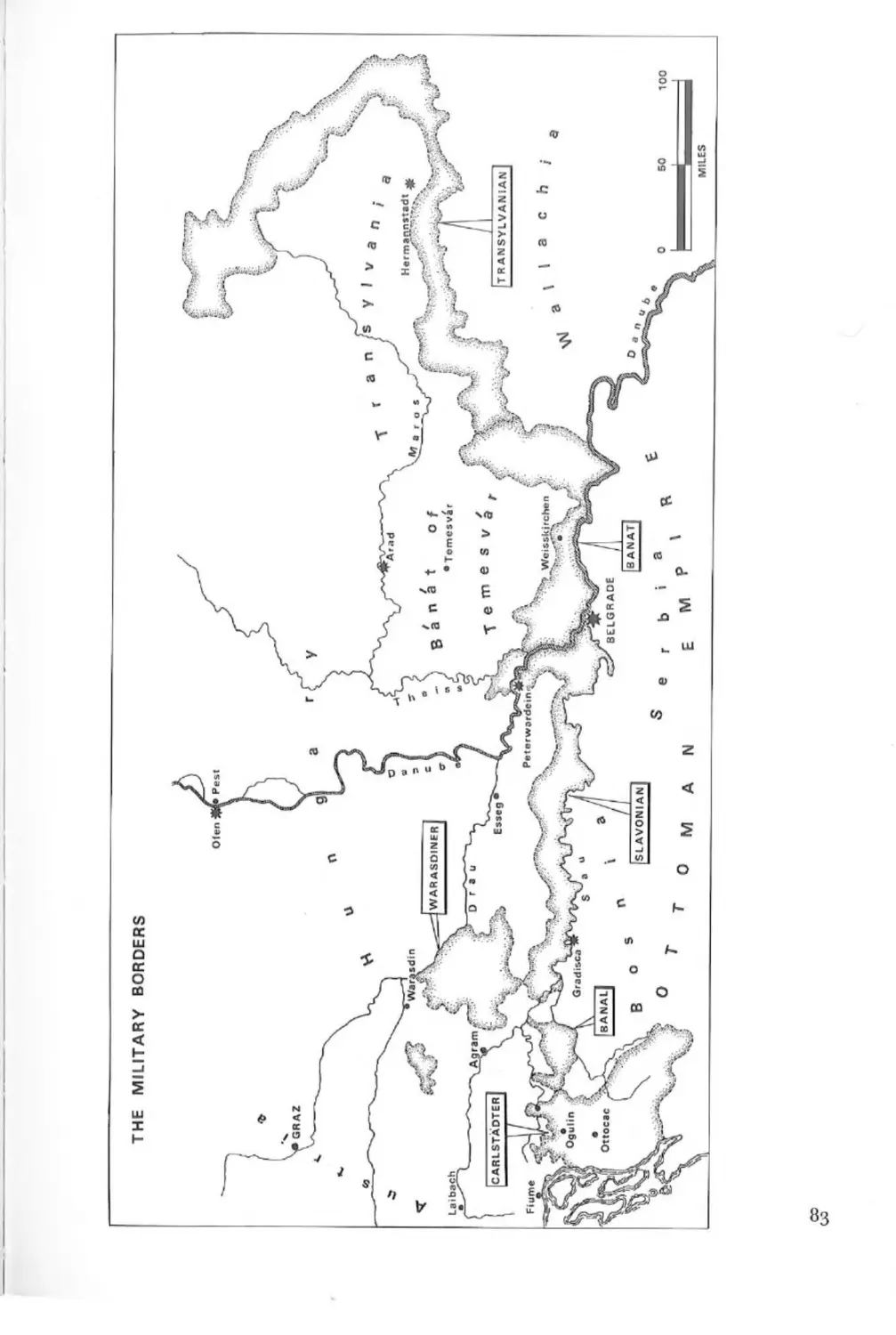
Theresa's reign. In contrast, Hungary was closed off to the south by the 'mihtary
borders' of Slavonia and Croatia, which were populated by the most warlike folk
of the Habsburg dominions. We shall get to know these 'Croats' more intimately in
a later chapter.
austrian lombardy
Direct Austrian rule in northern Italy extended over the archduchy of Milan and
the little duchies of Mantua, Parma and Piacenza. In addition the grand duchy of
Tuscany came to the house of Habsburg-Lorraine by treaty in 1738.
The region was as remote in character as it is possible to imagine from the
barbarities of Hungary, and Maria Theresa wisely devolved the administration upon
a succession of able Italian-born ministers. The Italians had the happy trait of
attributing all the benefits of Habsburg rule directly to Maria Theresa, and writing
down all the inconveniences to her ministers or to bad advice. Thus the Austrians
could rely upon a residue of popular support, when the region happened to be
overrun by hostile* armies, and Lombardy furnished a couple of more than passable
regiments.
the netherlands
The Austrian Netherlands covered an area corresponding to present-day Belgium
and Luxembourg, exclusive of the area around Liege. An industrious, prosperous
and advanced people like the Lombards, the Netherlanders earned the right of being
governed by their own elite, or at least by some of the best administrators that Maria
Theresa could provide. Maria Theresa's brother-in-law Prince Charles of Lorraine
ensconced himself in viceregal state in Brussels, and the capital's intellectual hfe
entered a period of prosperity. The Royal Academy was one of many institutions
that were founded under the Austrian rule.
In the provinces the Flemings sung the praises of de goede Keiserin, though they
feared even a whisper of reform. Harbouring fewer reservations, the French-speaking
Walloons of the south and east embraced the Habsburg cause with remarkable
enthusiasm, and made up a large part of the condngent of between 12,000 and
17,000 troops which the Netherlands contributed to the army in the Seven Years
War. These men combined 'the patience of the Germans with the sense of honour
of the French, and their gaiety in the hottest fire'.'^ A regiment of Walloon dragoons
dealt the decisive blow at the batde of Kohn (1757), which was the proudest memory
of the Theresian army.
12

The forces of separatism
In the first critical years of Maria Theresa's reign, her nobility and some of her
ministers considered themselves less as parties in a fight for survival than as stock-
holders in some old and ramshackle concern which had passed under inexperienced
management. It seemed only common prudence for the magnates to look first to
their own interests, and take steps, if necessary, to place their investment elsewhere.
There was one Bohemian noble who at least had the politeness to write to Maria
Theresa and ask her not to take it too much amiss if he gave his allegiance to the
Elector of Bavaria.
Whereas in Prussia and most of Western Europe the monarchs had long since
broken the pohtical power of the nobiUty, in the Habsburg lands the nobles not only
maintained the authority of their Stdnde (provincial assemblies) intact, but carried
their separatist tendencies into the very heart of the government.
Likewise the individual organs of administration were inchned to funcdon with-
out reference to the whole. Quarantine regulations were permitted to retard the
march of reinforcements to the theatre of war in the dangerous year of 1740 and
again in the winter of 1756-7, and it was most unwillingly that the authorities
allowed the provisions for the army to cross internal boundaries without having to
pay excise.
We should also bear in mind that in this period governments and societies were
as yet undisciplined by the Industrial Revolution and the clock, and that underlings
were in the habit of regarding a prescripUon from above as an expression of intent
rather than a mandate for action. Experienced administrators came to expect little
else. Thus in 1753 the Hofkriegsrath (War Council) expressed pained surprise upon
learning that Colonel Valenziani had taken a new dress reguladon at face value and
rushed to have his regiment outfitted in the new uniforms. The Hofkriegsrath felt that
the precipitate colonel ought to have waited until (as almost invariably happened)
the government had had time to change its mind.
The extraordinary diversity of the Habsburg dominions served to compound
the normal inefficiencies of the dme. In particular there were difficulties of language
which threatened to prove disastrous in military affairs. No other army of the time
could have produced a column of regiments chattering variously in German, Czech,
French, Flemish, Raeto-Romance, Itahan, Magyar and Serbo-Croatian, and ah
passing in review under the eyes of a general who was cursing to himself in Gaelic.
This Babel of tongues gave rise to a 'singular confusion'.'
Of all these languages German was the most widely known throughout the
army, and officers of any ambidon could hardly get along without it. 'We have
what is called "army German", which sounds well in the mouths of real generals and
officers. It must be spoken in an inspiring and abrupt manner, and the soldiers (who
are always good judges of such things) often assess the merit of their superiors
accordingly.'®
In sheer numbers of native speakers, however, the predominant language-group
probably remained the Slavonic, as represented by the Czech of the Bohemian
troops and the Serbo-Croat of the borderers. French was of course essendal for
managing the Walloons, and as the pohte tongue of eighteenth-century Europe it
held the field in most headquarters. Only a few generals, like Loudon, felt really
uncomfortable in it.
The Hungarian rank and file, ever aware of their nadonal identity, could be 13

approached effectively only through Magyar.
'Hungarian curses are at once the
mightiest and the most peculiar you can find in any language. What is singular about
them is that they are susceptible of an infinite variety of nuances, according to the
nature of the provocadon.'"' However, it was worth a scholarly officer's while to try
some Ladn, which was the official language of Hungarian government and law.
This was spoken in a tripping and harmonious style which resembled 'the galloping
of their horses'.®
The reguladons and drill books which began to appear in the late 1740s sought
to impose German as a uniform Dienstsprache in the army, and care was taken in
the 'German' regiments to assign non-German-speaking recruits to veterans who
could instruct them in the language. In dme many even of the 'Croats' learnt
German, which they spoke in a characterisdcally pedandc and guttural style - the
source of the esoteric brand of humour called Grenzwitze (ht. 'border jokes').
All the same there is a good deal of evidence to suggest that the difficulties of
communication remained formidable. There were all too few officers who, like
General Siskovics, could command German, Hungarian, Walloon and Italian troops
with equal facility. Imagine the embarrassment of General Andreas Panovsky, who
on 16 August 1762 found himself in the position of having to get an uncomprehending
regiment of Walloon dragoons to charge at a critical stage of the action at Reichen-
bach. After staring mutely at the men he was seized by a fit of inspiration and burst
out with 'Allans foutre, sacredieuf The delighted troopers responded with a cry of
'voild un brave bougre!',
and they tore into the Prussian squadrons like madmen.'
At other times it was difficult to tell whether the message had got through at
all. An officer once went to report some suspicious movements on the part of the
Prussians to Field-Marshal Serbelloni, who was notoriously bad at German. He
found the field-marshal
sitting on his bed, with a cup of chocolate to one side, and holding a book in
which he seemed to be totally engrossed. The officer concluded that his entrance
had passed unnoticed, and so he repeated his reports concerning the movements
of Prince Henry, using a very loud voice. The field-marshal inclined slightiy to
the right, and then to the left, without stirring from the spot, and finally he
stared woodenly at the officer. With his broken German, in which he always
used the infinitive ending, he dismissed him with a curt: 'Serbelloni, he move
too'."
The forces of unity
So far we have considered only the forces which threatened to pull the loosely-
textured Habsburg dominions apart. All the same there were some strong counter-
vailing influences, and chief among these were the character and achievement of
Maria Theresa herself
The only heir of the Emperor Charles VI, Maria Theresa spent the years before
her accession in harmless amusements and in learning to be a good wife to the hand-
some, heavy and more than slightiy fatuous Francis Stephen of Lorraine, whom she
married in 1736 and loved to distraction. The old Emperor died in October 1740,
and for the next two years Maria Theresa and a knot of devoted ministers and generals
fought to save her inheritance from dissolution. The Elector of Bavaria impudentiy
14

had himself made King of Bohemia and Emperor in 1742, but the Austrians proved
themselves to be more than a match for the Bavarians and their French allies in the
subsequent campaigns in Bohemia and south-western Germany. Finally in 1745
Maria Theresa had the satisfaction of seeing her own beloved Francis Stephen
crowned Emperor at Frankfurt.
A much more formidable enemy was Frederick II (Trederick the Great') of
Prussia, who invaded the rich northern province of Silesia in 1740. The Prussians
beat Maria Theresa's whitecoats whenever they met in open batde, and in 1745
Maria Theresa had to buy peace at the price of signing away Silesia. She and her
ministers appreciated that only a thoroughgoing reform would enable the Habsburg
state to survive in proximity to a dangerous neighbour like this.
From 1748 a number of devices added greatly to the power of the Vienna
administration. The central government was concentratcd in a single Directorium,
and by entering into a number of long-term agreements the ministers relieved them-
selves of the burden of having to call on the noble Stdnde at every turn for cash,
supplies and recruits. The nobles did not at first recognise how much of their inde-
pendence they were losing in the process.
The reformed Habsburg army fought with credit in the Seven Years War
(1756-63), even if Frederick escaped the retribution which had been prepared for
him by Maria Theresa and her French and Russian alhes. After this ordeal she
resumed the work of remaking the Habsburg dominions, this time in the company
of her son Joseph II, who became co-regent after Francis Stephen died in 1765.
Maria Theresa did what she could to ameliorate the wretched life of the serfs,
beginning with the Crown estates in Bohemia. She introduced new though severe
codes of justice, and she laid the foundations of a system of universal elementary
education. Trade, industry and agriculture began to flourish, except in war-ravaged
Bohemia, and the population of the Habsburg states doubled in the course of the
reign - Maria Theresa contributing more than her share in the form of her sixteen
litde archdukes and archduchesses.
By the time of Maria Theresa's death in 1780 the sum of the Habsburg dominions
was of more consequence than the component parts, which had manifestly not been
the case forty years earlier. In fact the Empress-Queen had fashioned an Austrian
state that was recognisably the same creature which survived until 1918.
Item for item, much the same kind of reform was going ahead in contemporary
Prussia and Russia. What imprinted a unique character on Maria Theresa's achieve-
ment was the wonderful integrity of her life - her refusal to concede that pubhc
affairs should be conducted with any less morality and feeling than her private life.
Hence her instinctive abhorrence of Frederick of Prussia, the enemy of her dynasty
and subjects, a 'bad man', a 'wicked neighbour', a 'monster', whom she once wanted
to call out for a duel with pistols. Hence her leaning towards moderation, even
when carrying out necessary reforms, an instinct variously interpreted by her bio-
graphers as a finely-attuned sense of political wisdom, or a motherly concern for
the happiness of her subjects. Hence, finally, her agony of mind when Chancellor
Kaunitz and her own son Joseph II began to carry Austria into the harsh world of
Realpolitik.
To know Maria Theresa in the setting of her daily family life is therefore to
know her as the statesman. Pretty, in a plump kind of way, she presided like a mother
hen over her sizeable Imperial brood, with whom she loved to snatch a few hours
in some modest chambers tucked away in all the splendours of the Schonbrunn or
15

the Hofburg. The French officer de Guibert was once received in audience, and
records his disappointment when he discovered that Maria Theresa was quite alone,
without glittering guards or liveried footmen. T found only a good bourgeoise, when
in my imagination I was searching for a great sovereign.'" He did not appreciate
that in Maria Theresa the two characters were the same.
Maria Theresa's religion gave her strength in time of test, and reinforced her
Viennese Hausfrau's, disinclination towards everything that was abstract, doctrinaire
or dehumanising. She could never have desired to match her great rival Frederick
in his adventurous independence of mind, or the ruthless impersonality of his con-
duct. By the same token Maria Theresa's subjects responded with a warmth that
had little in common with the appalled admiration which Frederick evoked in his
own peoples and armies.
Political philosophy knows no terms adequate to describe the tendencies which
gradually marshalled all classes of Habsburg society behind the Theresian state. For
some time now the great nobles had been engaged in a direly expensive competition
in building palaces in Vienna, whether the spacious residences planted around the
outer rim of the fortifications, or the flat-sided blocks with absurdly over-proportioned
gateways which lined the narrow streets of the Inner City. The court spent the winter
in the Hofburg Palace, a complex of buildings on the south side of the Inner City,
and in summer the whole apparatus moved out three miles into the country to the
impressive new pile of the Schonbrunn. Such was the setting for the crowded and
gossipy society of Vienna, which enticed more and more of the nobility from their
provincial retreats.
All classes enjoyed strolling along the old ramparts of Vienna, or promenading
through the Prater and other royal gardens which were opened to the public after
the Seven Years War. Behind the pompous fa9ades of the noble palaces many of
the rooms were let out to poor families, while anyone in passable dress and with a
couple of florins to spare could gain entry to one of the carnival balls. Maria Theresa
herself remained eminently approachable, and until 1753 (when a nobleman went
berserk in the Schonbrunn) any individual could turn up unannounced at the
public audiences.
Thus in Theresian Vienna the element of physical proximity ensured that the
Empress-Qiieen, her ministers and generals were known as individuals to a wide
popular audience. Governmental circles were all too aware that das Publicum was
capable of expressing its opinion in a variety of ways. Sarcastic verses were frequently
posted on the gates of palaces and churches. The wife of the slow-moving Field-
Marshal Daun was greeted with a barrage of sleeping caps, and for other targets the
ammunition was uncomfortably harder or unpleasantly squashier. All the while a
stream of broadsheets and doggerel poems kept the people informed and excited.
Hundreds of miles distant from Vienna, Maria Theresa's subjects and soldiers
could share certain fundamental sentiments. Maria Theresa's religion was not
different in kind from that of a Bohemian peasant, and town and country throughout
the Habsburg dominions were adorned with calvaries and statues of saints, each
with its train of kneeling and mumbling devotees.
The sense of everybody-in-the-boat-together was reinfbrced when Maria
Theresa's armies were fighting the heretical Prussians and their godless King-
Frederick. 'All those who have served Catholic states are aware of an element of
religious fanatacism which supervenes when they are at war with Protestant powers.''^
Thus General Loudon could report from Moravia in 1758 that 'all the peasants are
16

ready to take up arms and go out to fight the enemy. They demand only to be led.
This could well bring on a peasant war, which is scarcely desirable, but we must do
what we can to sustain these good people in their zeal'.'^
In popular usage the Habsburg troops were already called simply 'Austrians',
and the army was awakened to its specifically national (as opposed to Imperial)
identity during the short but interesting period fi'om 1742 to 1745, when the office of
Emperor was held by a hostile Bavarian.
The predominant heraldry of the army was the red-white-red which had come
from the Norman kingdom of Naples in the twelfth century. Red cuffs and lapels
were sported by most of the line regiments until the later 1760s, and the white coat
of the 'German' infantry and cavalry was worn with pride for a century to come.
'White is our colour, and so it must remain for ever.""^
As for modes of conduct and thought, Maria Theresa liked to think that the
Austrians went about affairs with a certain Milde and Munificenz. The army in its
turn took a pride in affecting a certain battle-tested casualness, which was contrasted
with the faddish artificiahty of Frederick and his troops - those 'beings of EucHd'.'^
Some at least of the 'Austrians' were aware of influences which overcame all
divergences of racial origin. If Joseph Sonnenfels regretted that he could find nobody
in eighteenth-century Austria who felt a compulsion like that of Classical patriotism,' ®
the Prince de Ligne (who was a Walloon) just as stoutly proclaimed the validity of
a concept of 'fatherland' which evoked the ties which attached the members of
society to each other, and thus to the head from whom they all derived their welfare.
He held that in the Austrian service an important ingredient of this brand of patriot-
ism was its power to absorb and transmute foreigners.'"' Likewise Field-Aiarshal
Khevenhuller maintained that one of the attractions of the Imperial army was that
it could show many living examples of foreign soldiers of fortune who had won their
way to rank and influence, while others, 'even if not so lucky, may spend their old
age eating the Emperor's bread in peace'.'® Not only the officers, but the entire class
of bureaucrats and court nobility had a stake in promoting a recognisable state
feeling.
What Maria Theresa demanded (like Franz Josef after her) was a sense of loyalty
to the person of the sovereign. The man's place of birth was a very minor considera-
tion. Indeed it was not until 1905 that Vienna did away with the custom by which
foreign officers could serve in the Austrian forces while retaining their native
citizenship.
By itself a diversity of race and language does nothing to sap a sense of corporate
identity in an armed force. Otherwise the army of the later Napoleonic empire
would not have given such a good account of itself, or General Alexander have driven
the Germans up Italy in 1944 with a host of twenty-six nationalities ranging from
Poles to Brazilians.
This body of evidence lends support to the Prince de Ligne's bold assertion that
in the Europe of his day the Austrian army was the 'sole national army, although
made up of several nations'."
17

The Supreme Direction of the Armed Forces
'Mater Castrorum'. Maria Theresa as head of the army
Maria Theresa held the ultimate responsibility of supreme command of her troops
until her dying day, and there was never any danger that, as a woman, she might
have proved indifferent to the affairs of her army. In the crisis of 1741 she wrote to
Francis Stephen that she was well aware that her salvation and that of her house
depended, after God, on the army, and she went on to express her determination to
care for the army more as a mother than as a sovereign. Many years later she testified
that 'this branch of the state administration was the only one for which I harboured
a real personal interest'.'
The industrious and inquisitive Empress-Queen attained a breadth and pre-
cision of mihtary expertise which put most of her generals to shame. She followed or
initiated the progress of every reform in discipline, tactics, dress and weapons, and
she was competent to gi\ e an immediate and informed opinion on many a matter
that was puzzling her 'advisers'. It is significant that in the grand manoeuvres in
Bohemia in 1754, while Emperor Francis Stephen went off hunting, Maria Theresa
was busy inspecting the magazines and field bakeries.
An excellent horsewoman in her younger days, Maria Theresa was able to ride
around the army camps of the 1740s and early 1750s, and follow some of the move-
ments in person. Back in Vienna the Prussian envoy Podewils reported in 1747 that
'she goes to some pains to win over the soldiers to her through her generosity. She
frequently distributes money among them, and seldom passes her bodyguards with-
out throwing them some ducats. Her troops accordingly love her deeply, and their
regard is strengthened by the steadfastness she displayed under the cruellest blows of
fate'.2
According to another Prussian, 'she was usually present in person whenever
columns marched through Vienna on their way to the army. She encouraged the
soldiers with the most gracious expressions, calling them "my children", and smiling
with approval when the word "mother" ran like a feu-de-joie through the ranks'.^
An English volunteer testified from his own experience in the Seven Years War that
the Austrian soldiers refrained from deserting because they were 'well paid, well
dressed and well fed. Moreover the troops are aware that the Empress is concerned
for their welfare, and this consideration binds them to her service for her own sake'."^
Maria Theresa liked to establish a personal bond with her generals, and she
enquired closely into their welfare and that of their families. Once, when she heard
that General Loudon had fallen dangerously ill, she characteristically sent him her
doctor and ordered him to get well.
The Empress set a taxing pace in the conduct of public affairs. Her working
day commonly lasted from about seven in the morning until seven in the evening.
Once a week, or thereabouts, a company of varying size assembled in Maria Theresa's
presence for one of the conferences of state. The large and slow-moving Grosse Con-
i8
2

ferenz of the last reign gradually fell out of favour, owing to the increased urgency of
public business and the separation of foreign and domestic affairs. By the time of the
Seven Years War it had been replaced by the more handy and compact conferences
in mixtis and by meetings of an ad hoc military commission. Many of the most impor-
tant decisions v^'ere taken on a still less formal basis, when Maria Theresa and the
chancellor Kaunitz acted on information they received directly from commanders
at the theatre of war. According to the court master of ceremonies, Khevenhiiller-
Metsch, the new cabal system received a significant impetus in the emergency of
May 1757-
As the war progressed Maria Theresa and Kaunitz willy-nilly became accus-
tomed to determining campaigns in some detail, because Field-Marshal Daun, who
was the nominal commander of the field army, abdicated so much of his responsi-
bilities. The year 1761 saw the foundation of the Staatsconferenz of half a dozen
ministers of state. Here too the impetus came from Kaunitz, who was less concerned
with giving the ministers back their talking-platform than with setting up a machine
that would keep the whole body of public administration under his control.
Maria Theresa never allowed the domestic disasters which beset her large
family to divert her attention from state affairs. All the same, her sex imposed some
important limitations upon her efficicncy as director of the military machine. She
had to revolve the day-to-day direction of operations upon the generals, and like
the rest of the court she had to wait in almost hysterical anticipation for tidings of
the wars.
Both circumstance and character held Maria Theresa back from exercising
another vital function of supreme command - that of disciphning and prunin" the
corps of senior officers. Not only did the distance from the theatre of war dcrn nc
her of the opportunity of keeping her generals constantly up to the mark, but she
was a sweet-tempered person who laboured under a continuing sense of obligation
to any person who had once earned her gratitude. Rather than dismiss the octo-
genarian Joseph Harrach from the presidency of the Hofkriegsrath she placed the
septuagenarian Field-Marshal Neipperg at his side, and kept the latter gentleman
at work until his faculties too began to fail. Thus for most of the Seven Years War
the machinery of mifitary administration was encrusted with two layers of senile
incompetence. In 1762 a new president was finally appointed in the person of
Field-Marshal Daun, who himself had only four more years to live. Daun was suc-
ceeded by his protege, General Lacy, who was the youngest man to hold the office
for generations, and in order to cushion the senior functionaries from this appalling
shock Maria Theresa had to allow the chief commissary Chotek to retire on full pay,
and give Field-Marshal Golloredo the direction of the military academies.
Like all sovereigns, Maria Theresa was to some extent guided by the experience
of her experts. Understandably she depended most completely on her ministers in
the first couple of years of her reign, and she harboured a lifelong gratitude to men
like Bartenstein, Kinsky and Field-Marshal Khevenhtiller who gave her their sup-
port in that testing period. After weathering the first crisis Maria Theresa began to
commission individuals to carry out specific works of reform, always favouring
enthusiastic people who approached her with a well-thought-out scheme. In the
military field we encounter folk like Prince Liechtenstein, with his plan for remaking
the artillery, or Prince Sachsen-Hildburghausen, who had long meditated how to
reform the military borders.
The influence of Kaunitz was something else again. Appointed Chancellor in 19

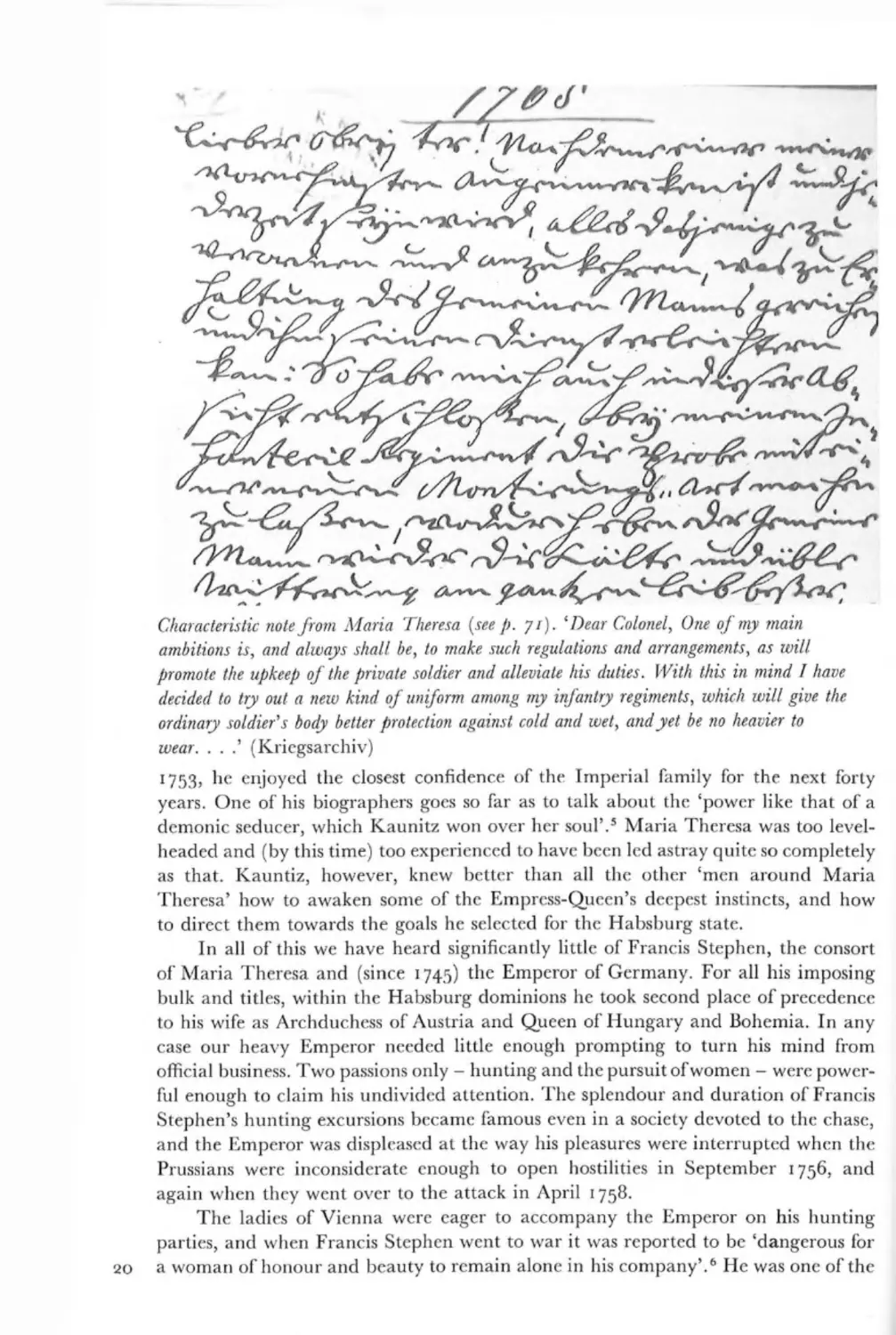
Characteristic note from Maria Theresa {see p. 7/). 'Dear Colonel, One of my main
ambitions is, and always shall be, to make such regulations and arrangements, as will
promote the upkeep of the private soldier and alleviate his duties. With this in mind I have
decided to try out a new kind of uniform among my infantry regiments, which will give the
ordinary soldier's body better protection against cold and wet, and yet be no heavier to
wear. . . .' (Kriegsarchiv)
1753) he enjoyed the closest confidence of the Imperial family for the next forty
years. One of his biographers goes so far as to talk about the 'power like that of a
demonic seducer, which Kaunitz won over her soul'.' Maria Theresa was too level-
headed and (by this time) too experienced to have been led astray quite so completely
as that. Kauntiz, however, knew better than all the other 'men around Maria
Theresa' how to awaken some of the Empress-Queen's deepest instincts, and how
to direct them towards the goals he selected for the Habsburg state.
In all of this we have heard significantly little of Francis Stephen, the consort
of Maria Theresa and (since 1745) the Emperor of Germany. For all his imposing
bulk and titles, within the Habsburg dominions he took second place of precedence
to his wife as Archduchess of Austria and Queen of Hungary and Bohemia. In any
case our heavy Emperor needed little enough prompting to turn his mind from
official business. Two passions only - hunting and the pursuit of women - were power-
ful enough to claim his undivided attention. The splendour and duration of Francis
Stephen's hunting excursions became famous even in a society devoted to the chase,
and the Emperor was displeased at the way his pleasures were interrupted when the
Prussians were inconsiderate enough to open hostilities in September 1756, and
again when they went over to the attack in April 1758.
The ladies of Vienna were eager to accompany the Emperor on his hunting
parties, and when Francis Stephen went to war it was reported to be 'dangerous for
a woman of honour and beauty to remain alone in his company'.® He was one of the
20

few men who could afford the expensive tastes of the famous Wilhelmine Auersperg,
the daughter of his former tutor Field-Marshal Neipperg. His other women tended
to be rather long in the tooth, and it is also significant for our military story that
he harboured an inclination towards Countess Fuchs, who happened to be the
mother-in-law of Field-Marshal Daun.
Otherwise life for the Emperor was one long struggle against boredom. He
collected coins, medals, jewels, strange machines and exotic plants and animals,
and the courtiers became skilled in laying on all kinds of little diversions for his
amusement. Like some people of otherwise limited intellect, he possessed a certain
skill with cards and money, and the people of Vienna were grateful for his reassuring
presence at the more spectacular of their fires, though perhaps they would have
preferred the fire-brigade.
The last words are with Frederick of Prussia. 'The Emperor gives the impression
of a good bluff innkeeper who leaves all his affairs to his wife.'"'
The Hofkriegsrath
The most notorious and least understood of the Habsburg mihtary institutions, the
Hofkriegsrath (Court Council of War), saw to the routine administration of the army.
The Hofkriegsrath was founded by the Emperor Ferdinand I in 1556, and its func-
tions were last defined by instructions of 1650 and 1668.
The Hofkriegsrath proper hived off specialised works of administration to organs
like its Obrist-Land-und-Haus ^eugamt (for ordnance and the arsenals), the Fortifica-
tions-Bau-^ahl-Amt (for fortresses and other military construction), and the General-
Feld-Kriegs-Auditoriat-Amt (for military justice). There were even branches of foreign
affairs which had come under the management of the Hofkriegsrath, and so this
unhkely organisation was responsible for relations with Russia (until 1742) and with
Turkey (until 1753).
There existed much debatable ground which was disputed by powerful and
independent organisations. Chief of these rival outfits was the General-Kriegs-Com-
missariat (of which more anon) which won free of the Hofkriegsrath at the end of
1746 and spread its activity into all kinds of matters relating to pay, recruiting,
head-counting, rations and supply. A third party with interests in the same field
was the Obrist-Proviantamt, which was a department of the civil financial administra-
tion.
The Hofkriegsrath had more than enough troubles within its own organisation.
At the outset of the reign the institution was composed of one president (old Joseph
Harrach), one vice-president, and thirty-six counsellors of whom the only ones of
any consequence were the four geheime Referendare. A staff of more than a hundred
clerks, archivists and doormen completed the establishment. The mihtary were fond
of complaining of the quality of the administration, and if we believe the soldiers
the personnel was made up of inexperienced clerks and failed commissaries, 'whose
ability extended no further than working out a contract or some other procedure of
military finance'.® Out of sheer frustration Field-Marshal Khevenhiiller once boxed
the ears of the first Referendar Augustin Wober in front of several witnesses.
In their turn the counsellors might have asked what kind of performance the
army could expect, when they were left unpaid for the first two years of the reign,
and when they were disposed in so many buildings around Vienna that 'the Hof- 21

kriegsrath was scattered all over the place and separated . . . not just from its sub-
ordinate departments, but from its offices and records as well'.®
In theory all the incoming documents ought to have been made the subject of
a paper called a Referat, which detailed the contents and the arguments advanced
by the counsellors, and ended with the Hofkriegsrath'% decision. Since, however, it
was physically difficult for the counsellors to gather in a single place, the president,
vice-president and Referendare got into the habit of opening the incoming correspon-
dence themselves and sending out instructions on their own authority. Little attempt
was made to observe proper paths of communication, with the result that even the
regimental commanders were left in the dark as to whether their ensigns and
NCOs were carrying their grievances direct to the Hofkriegsrath.
Above all there was that mass of documentation which reflected what Andrew
Wheatcroft has called 'the Habsburg passion to get everything down on paper'.
Colonel Hiller posed the question 'How is it possible to ensure a proper management
of military affairs from a Hof kriegsrath which consists . . . of civilian officials who are
skilled only in devoting the most enormous correspondence to the most insignificant
items, as the one means they have of making themselves indispensable?'.'" By 1771
every company of Croats had to maintain seventy-two separate files, and send in
two weekly reports, ten monthly reports, two quarterly reports, and a consolidated
return every six months.
Oddly enough, the Hofkriegsrath in Maria Theresa's reign was entirely innocent
of the one charge which is usually laid to its account - that it bound the operational
freedom of commanders in the field. Reduced as it was to an organ of administration,
the Hofkriegsrath had neither the will nor the capacity to determine plans of cam-
paign. It lost much of its significance even as a postbox, for in the Seven Years War
the army commanders were expected to correspond on all important matters direct
with Maria Theresa or Francis Stephen. If the dispatches were debated at all, it
was in one of Maria Theresa's 'conferences', and in any event the replies were written
out by Kaunitz's chancellery. With absolute consistency Maria Theresa encouraged
the generals in the field to make up their own minds and act on their own account.
She sent binding and detailed instructions only when the field commander was
unwilling to shoulder the responsibility for direct action.
Some of the Hofkriegsrath'?, worst abuses were eliminated as a consequence of
an Instruction of 23 March 1745, which seems to have been penned by Maria Theresa's
cabinet secretary Ignaz Koch, who had once been a counsellor himself. The per-
sonnel were drastically reduced in number (the Referendare to three, and the other
counsellors to eleven), although the survivors were given handsome salaries from
the proceeds of the Hungarian contribution and the taxes which the officers had to
pay upon their promotions. The whole conduct of affairs was regulated and stream-
lined, and the colonels and generals were given the very needful control of the stream
of correspondence from the army.
So as to relieve the Hofkriegsrath of some of its burdens, the administration of
military justice was entrusted in 1753 to a separate Justizkolleg. Less happily the
General-Kriegs-Commissariat took ffight in 1746 and entrenched itself in opposition to
the Hofkriegsrath.
Otherwise nobody put forward any constructive ideas until after the Seven
Years War. The 72-year-old Field-Marshal Neipperg was installed in 1755 as vice-
president to Joseph Harrach, whom Maria Theresa did not dare to remove from
office, on account of his past services and powerful family connections. Neipperg
22

himself was 'old, enfeebled in health, and by character a father of difficulties'.'' He
pursued a vendetta against Augustin Wober, but his own management of affairs was
painfully complicated, and he retained a measure of influence only by keeping up a
secret correspondence with his old pupil Francis Stephen.
On 30 January 1762 Field-Marshal Daun began a short but fruitful term as
president. He regained a good degree of control over the General-Kriegs-Commissariat,
and he brought a number of generals into the Hofkriegsrath, which helped to restore
its credit among the military men. It was a pity that he was not afforded the time
he needed to carry out his longer-term ambitions of using the Hofkriegsrath as a means
of lending technical support support to the generals in the field, and of encouraging
a spirit of professionahsm among the officers.
General Lacy, Daun's chosen successor, followed his old chief in the post in
1766. Lacy found that affairs were still badly muddled, and he made it his business
to bring all the departments and dependencies of the Hofkriegsrath under unified
control. It was under his reign that the work of reincorporating the Commissariat
was completed. He rounded off his work by moving many of the scattered offices to
a large building on the square Am Hof, which was vacated by the Jesuits when they
were expelled from the Austrian dominions in 1773.
By now Lacy was worn out by the day-to-day drudgery of the president's job,
and in 1774 he gave way in favour of the fat and jolly Field-Marshal Andreas Hadik'
who had recently managed the occupation of Gahcia with great efficiency. The new
president put forward a paper urging that the administration would actually be
speeded up if the running of the Hofkriegsrath became less centralised. However,
Lacy and Joseph II continued to exercise a very tight control of military affairs from
outside the council, and in 1780 an anonymous memorandum commented that
'nowadays the Austrian Hofkriegsrath exists as an empty form. The Emperor directs
everything, and he does with the army exactly what he likes'.
The commanding generals and inspector generals
The local peacetime command of the army devolved upon senior 'commanding
generals', each of whom was made responsible for the affairs of one of the non-
Austrian provinces or kingdoms (the Netherlands, Bohemia, Moravia, Hungary,
Transylvania, Slavonia and the generalcies of Carlstadt and Warasdin).
In no other continental army was it quite so difficult to establish uniformity as
the Austrian, with its troops of myriad races, scattered in little garrisons over thou-
sands of miles. At one extremity the clouds over the Netherlands coasthne could be
seen from the cliffs of Kent. At the other end of the empire the noise of Austrian
saluting cannon could be heard over the marshes of the Black Sea littoral.
In 1765, therefore, Field-Marshal Daun adopted a Prussian practice and
appointed three 'inspector generals', each of whom would see that uniformity of
standards was maintained in one of the branches of the service (General Lacy for
the infantry, Lieutenant-General d'Ayasasa for the cavalry, and Lieutenant-General
Beck for the mihtary borders). On top of this the inspector generals acted as a channel
of communication - they informed the local commanders of all the changes that
were decreed by Vienna, and they drew on their own experience to send suggestions
for reform to the Hofkriegsrath.
23

The Officers
24
Social origins
It is no exaggeration to claim that every aspect of the life and institutions of Maria
Theresa's 'Austria' represents an order of complexity about five times more confused
than in the Prussia of Frederick the Great. This heartening statement certamly
applies in full force to the origins of the Theresian officer corps, a body of gendemen
of very diverse social and national provenance.
Whereas the bulk of the Prussian officers were drawn from a remarkably homo-
geneous class of small-time landowners, the Habsburg officer corps was distinguished
by a fundamental social imbalance. As the Prince de Ligne put it: 'In our service you
descend at once from the grands seigneurs to the parvenus'.'
At the top of the scale we encounter the great magnates who astonished foreign
visitors with their magnificent style of life. People like these maintained one or more
palaces in Vienna, and ruled as virtual sovereigns over thousands of serfs out in the
country. Among the higher generals in Maria Theresa's reign appear no less than
five princes Esterhazy, four princes Lobkowitz and six counts Colloredo. As for the
Harrachs, there was no getting away from them. They had a large palace on the
Freyung in Vienna, as well as extensive estates nearby on the Hungarian border,
and in the earlier part of the reign they owned one brother (Friedrich) who was
Chancellor and another (Joseph) who was President of the Hofkriegsrath.
As individuals, if not as a class, the grands seigneurs were capable of considerable
generosity The Esterhazys and Palff^ys raised or maintained entire regiments out
of their own pockets, while Prince Liechtenstein contributed ten million florins of
his personal fortune to the work of reforming the artillery.
Below the level of the grands seigneurs the Austrian army lacked the stabilising
influence that came from any class which could be compared with the Junker
squirearchy of Prussia. The Prussian staff officer Hans v. Winterfeldt shrewdly
observed that it was of fundamental importance for the Austrians to persuade the
nobility to make a military career. 'They will never get anything done . . . unless
they can compel the Bohemian counts to serve as free corporals or ensigns.
One of the radical problems came from the fact that most of the sons of the
nobility attended the new provincial Ritterakademien or were sent to Halle, Leyden
or other foreign universities, and only rarely took a path that would lead them into
the state service Maria Theresa was acutely aware of what was needed, and in the
1750s she gave every encouragement to the poor but respectable nobility to enter
the new state-inidated foundations like the Theresianum, the Wiener Neustadt
military academy and the reorganised engineer academy. In almost every case she
evoked htde enthusiasm.
.
The social gap was filled by a parvenu nobility of state and army service, which
was demarcated at the upper end fairly sharply from the world of the grands sagneurs.
The courtier Khevenhuller-Metsch wrote that the 1753 promotion of the Knights
3

of the Golden Fleece caused displeasure to people of discriminadon in such matters,
who noted that it embraced a creature like the chief commissary Salburg, who was
not of ancient or illustrious birth.
At the lower end the Habsburg nobility of service and indeed the officer corps
as a whole was remarkably easy to enter. Field-Marshal Khevenhiiller taught his
cavalry officers that in the Austrian army there was no 'pre-eminence of the nobility',^
and even the mighty Prince Joseph Esterhazy was moved to agree:
Subordinadon consists of obedience, submission to orders, respect, courtesy,
and the observance of a difference between junior and senior . . . the nobihty
enjoys no preference in this regard whatever, for all the things are determined
by rank. The higher a man's rank, the more it is up to him to disUnguish himself
and win merit.
Cognazzo explained:
It is a great virtue of the Austrian service that promotion is the unfailing reward
of good service ... by his courage, military experience and intelligence the low-
liest soldier may win his way step by step from the musket to the sash of an order,
from the society of his tent companions to that of the Hofkriegsrath.^
In this respect it is worth mentioning that in Maria Theresa's reign almost one-third
of the holders of the Knight's Cross of the Mihtary Order were of non-noble origin.
Cognazzo himself was well acquainted with the career of an individual 'who began
as a clerk to a regimental commander . . . then became a regimental auditor with the
rank ofheutenant. A stroke of good fortune brought him to the full rank of captain,
and in the Seven Years War the natural course of things made him colonel com-
mandant of a regiment of hussars'.®
In any event it was quite easy for a persistent officer to make his way into the
nobility of service. Maria Theresa was liberal in handing out the Nobilitdtsdiplom,
which imphed no actual grant of land, and in April 1757 she decreed that she would
bestow this document upon all officers who had served for thirty years with un-
blemished conduct. Thus was formed the most loyally Habsburg of all classes - the
landless nobility of the new creadon which owed everything to the dynasty.
National origins
Alongside the nadve Khevenhullers, Trauns and Dauns of Maria Theresa's army
we encounter such a quandty of foreign officers that it almost seemed as if the
Austrian soil was mcapable of producing good stock'' - such was the combined
effect of the diversity of the dominions, the unique opportuniUes for advancement,
and the Habsburg tradidon of prizing loyalty to the person of the sovereign above
national origin. Out of the 177 recipients of the Knight's Cross of the Military Order
of Maria Theresa in the Seven Years War, 72 had German names, 22 Irish or Scots,
21 French, 20 Itahan, 18 Slavonic, 11 Magyar, 11 Flemish or Scandinavian, and 2
Spanish.
Some of the liveliest and most enterprising of Maria Theresa's commanders
hailed from Hungary. Foremost was the brave and selfless General Nadasti.
'Not 25

just the Hungarian cavahy, but the whole mounted arm without exception was
devoted to him. Even the infantry held him in . . . generally high esteem.'®
The hussars and regiments of Hungarian infantry were officered principally by
native Hungarians, to whom Maria Theresa awarded complete parity of status with
the officers in the German regiments.
A high proportion of Maria Theresa's officers was furnished by the Empire,
and Prince Albert of Saxony wrote approvingly of the armies of Austria as forces
'in which the first houses of Germany considered it an honour to serve'.® Dignitaries
like the lords of Baden-Durlach, Baden-Baden, Brandenburg-Bayreuth, Zweibrucken-
Birkenfeld, Anhalt-Zerbst, Sachsen-Gotha and Mecklenburg-Strelitz made a signal
contribution to the service, for they usually kept their regiments in splendid condi-
tion, and filled them with prime recruits from their own lands. The other German
officers came from all quarters of the Empire — Bavarians like Preysing, Saxons or
Thuringians like Romer, Marschall and Jahnus, Hanoverians hke Schulenburg-
Oyenhausen, Rhinelanders Hke zum Jungen, Elmendorf and Nesselrode, and folk of
Brandenburg-Prussian or Pomeranian stock like Brunyan, Buccow, Damnitz, Donn-
hoff, Normann, Kalckreuth and Schroder.
The many Lutherans and Galvinists among the officers from the Empire were
allowed to exercise their religion in private. In some cases it was diplomatically
useful for the Austrians to have some Protestant officers at hand, as was proved
after the capture of the heretical city of Breslau in 1757, when the Calvinist
Lieutenant-General Sprecher was cunningly installed as governor, with the Lutheran
Major-General WulffersdorflF as his commandant.
Whole regiments were officered almost entirely by Protestants, and at least one
of Maria Theresa's ministers feared the outcome if Frederick tried to represent his
quarrel with Austria as one of religion. The dreaded exodus never took place,
despite Frederick's,energetic propaganda. In any case there were some of the heretics
(notably Schulenburg, Brettlach and Burghausen) who saw the error of their ways
and embraced the True Faith of their own accord.
Italian officers owned a generally high reputation in the eighteenth century,
and both Austrian Lombardy and the other Italian states produced commanders
who did credit to 'that country where they have always known how to combine
good manners with subdety, courage and mihtary talents'.Piedmont was the
native land of General Guasco, the hero of Schweidnitz, and the Colonel Caramelh
who performed so well in command of the grenadiers at Kunersdorf From the
Lombard aristocracy came Viscond, Clerici, and the cold, slow-moving Serbelloni
whose temperament stood in such contrast to that of southerners like Lucchese
d'Averna, a hot-blooded Sicilian who was bred up in Spain. Pallavicini and Botta
were born to the old aristocracy of Genoa, while the Piccolominis belonged to a
family of papal nobility which had given generadons of service to the Habsburgs.
A further disdnctive Latin contribudon to the army was rendered by the
Spanish famihes of Cifuentes, Cordova, Montoja, Puebla and Vasquez. Their names
recalled the Spanish ambitions of the old Emperor Charles VI, who showed extrava-
gant generosity to the Spaniards who had declared themselves in his name.
Moving northwards, we meet another reminder of Charles VI's lost causes, in
this case the duchy of Lorraine, which had been ceded by the Empire to the French
in 1738. This part of the world blessed the Habsburgs with the gifts of Francis Stephen
and his brother Charles and (more usefully, perhaps) those of the commanders
Sincere, Dombasle, Ville and Ruttant.
26

The officer in society [Mansfeld, from Stephanie's Die abgedankten Officiers, 1770)
Ensigns {Manuscript of 1749 Infantry Regulations, Kriegsarchiv)
The Netherlandish tribute was remarkable for the high military and artistic
gifts of Prince Charles Joseph de Ligne and Duke Karl Leopold of Arenberg. Another
distinguished Netherlander, Fran9ois-Sebastien de Clerfayt, began his career in the
later part of the reign and went on to command Austrian armies in the 1790s.
The story of the Habsburg Irish is probably the most bizarre and revealing of
all. Altogether the Irish gave the army of Imperial Austria some thirteen field-
marshals, two presidents of the Hofkriegsrath and dozens of other generals. At the
latest count the number of junior officers ran well into the hundreds. The Irish
military men were themselves just one wing of an entire society which was uprooted
from its homeland by religious discrimination. Irish civihans by the score were
active in the Habsburg dominions as doctors, teachers, financiers, scholars and
administrators.
The Irish soldiers arrived in Austria like creatures from outer space. It was soon
evident that most of them were good fighters, and the Imperial heralds were suit-
ably impressed when the Irish summoned up their long memories (and sometimes
also their powerful imaginations) to compose long and impressive pedigrees. The
Brownes boldly claimed descent from Hengist and Horsa, while the O'Donnells
did not shrink from tracing their line back to the Dark Ages. Irishmen of all kinds
liked to shroud themselves in an aura of mysterious aristocracy by adding the prefix
de or von to the name of their native village or county. Thus the Irish could match
every Karst von Karstenwerth and every Radetzky von Radetz with a Macquire
von Inniskillin or a Kavanagh von Ballybrack. Some of the gentlemen acquiesced
in the ways in which their names were mangled by their German neighbours, and
so the historian can become familiar with names like 'Neulau' and 'Ottowart'
without realising that he is looking at the honest Irishmen Nolan and O'Dowd.
The Irishmen liked to hang together, as Field-Marshal Daun noted in 1760,
27

and the Hibernians came to hold an established position in eighteenth-century
Austria. St Patrick's Day was the occasion of sentimental reunions, and a Vienna
newspaper of 1765 records that the Spanish ambassador (whose name, by the way,
was O'Mahony) celebrated 17 March by holding a banquet for a large number of
Irish' military men, and that the entire Court wore Irish crosses in honour of the
occasion.
Prague had a powerful attraction for the newly-arrived Irish nobility. It was a
beautiful city with a lively social and cultural life, and not nearly so expensive to
live in as Vienna. It stood within convenient reach of the estates of the Brownes and
other families, and practically every Irishman in the Imperial Army must have
known his way to the House of the Irish Franciscans in the 'Street of the Irish'
opposite the Powder Tower. These friars acted as a kind of clerical Mafia, and helped
to keep up links between Irishmen in Central Europe, as well as passing on messages
and enquiries to their native land. Prague was also the home of scores of Irish
doctors, which enabled the Hibernians to find care for the body as well as for the
soul. Further south Irishmen likewise congregated at Graz, and also across the Alps
at Parma, where many of their sons were educated at the Noble College.
It was for a different kind of Irishman that Mozart wrote the part of Don
Basilio in The Marriage of Figaro. This was Michael Kelly, who was the son of the
Master of Ceremonies at Dublin Castle and famed for his fine tenor voice and
pohshed manners. This gave rise to an embarrassing incident in 1787, when Kelly
gained an audience with Joseph II. Kelly went to the Schonbrunn, and found Joseph
chatting with a group of generals, among whom were numbered the old war horses
Dalton, Dillon and Kavanagh. The Emperor was delighted at this encounter
between Kelly, who was the epitome of the elegance of Georgian Dublin, and these
representatives of an older and rougher Ireland. Gaelic has always been a mystery
to Dubliners, and'so Kelly was at a loss when Kavanagh made some remark to him
in that language. Joseph turned around at once. 'What, Kelly,' he said, 'don't you
know the language of your own country?' Without thinking, Kelly replied 'Please,
Your Majesty, none but the lower orders of the Irish people speak Irish.' Joseph
laughed aloud, and poor Kelly could have bitten his tongue off, but luckily the
elderly generals were too pohte, or possibly too deaf, to take him up on his rude
remark."
Adventurous and well-affected folk of all nations could serve in the army as
'volunteers', without entering the officer corps proper. In the Seven Years War the
authorities gave a ready welcome to scions of princely houses like Dom Joao de
Bragan^a and Prince Louis of Wurttemberg, as well as to accredited officers from
the French, Russian and Saxon courts. Khevenhuller-Metsch retails the edifying
story of the French general Montazet, who wore a blue coat, Hke the Prussians, and
was mistakenly hacked about by the Austrian cavalry at Hochkirch. The drastic
operation actually improved his looks, 'for his nose used to be somewhat crooked,
but has now healed perfectly straight'.'^
The fledgling officer
A large number of Maria Theresa's officers, and certainly nearly all the generals,
entered the service in their boyhood or teens. Recruiting officers v^^ere instructed to
try to
28

obtain young noblemen as cadets for the regiment . . . these must be well built,
of pleasant countenance and intelligent, for they are going to be trained as
officers. The recruidng officer may be assured that nobody in the regiment will
thank him for bringing in unsuitable cadets, be they of the most eminent
families.'^
Regimental proprietors were permitted to admit Regiments-Cadeten on this foot-
ing throughout the reign, but Maria Theresa felt that there was something hap-
hazard about the system of rounding up cadets at random and leaving their instruc-
tion to the regiments. On 14 December 1751 she accordingly announced that she
had decided to set up a proper mihtary academy. Her ideas on the subject were
probably influenced by her chief financial adviser. Count Haugwitz, who had
travehed through Carinthia and Carniola in 1747, and seen how the young nobles
were wasting their time hunting and fishing. The chosen creator was General
Leopold Daun, and the site was the old Imperial Burg at Wiener Neustadt, a small
town twenty-five miles south of Vienna. On 17 July 1752 Daun and Francis Stephen
drove out to see the work, and one of the courders had to admit that 'a wonderful
amount has been done in a short dme'."* The place opened on 11 November with
a complement of 191 cadets.
The Academy comprised two corps of a nominal 100 cadets each - one made up
of the sons of the nobility of the Hereditary Lands, and the other of the sons of
deserving officers or civihan officials. The cadets entered the Academy in their
early teens, or sometimes younger sdll, and followed a course of from two to four
years.
The cadet's day began when he was roused at five in the morning. He attended
chapel at six, then drank a measure of soup to fordfy himself against the strenuous
morning of inspections and drill. Lunch was followed by an afternoon devoted to
the study of fortification, artillery, mathematics, and the French, Italian and Czech
languages, and the day was rounded off by a three-course supper. Time was also
found in the syllabus for instruction in riding and in the pohte accomplishments of
dancing and fencing. A strict discipline was imposed on the younger cadets, but
their older brethren were allowed a looser rein and some of the best among them
were selected for the cadet government of corporals.
Maria Theresa followed the progress of the Academy with the closest attention,
and she found it convenient to drop in on the place from the Imperial hunting lodge
of Laxenburg. She was deUghted at what Daun was doing, and she instructed the
regiments to set aside places for the products of Wiener Neustadt, the first twelve
of whom completed their courses in 1754.
The Wiener Neustadt cadets were fed and educated free. At the same time she
established the Vienna Theresianum as a free finishing school for 100 sons of poor
nobles and officers, and (just in case the nobifity remained ignorant of what was
going on) she sent descriptions of the Theresianum, the Wiener Neustadt Academy
and the reformed Ingenieuracademie to the Austrian and Bohemian Stdnde for circula-
tion among the noble families. Among the higher nobility the response was dis-
appointingly small, and Maria Theresa exclaimed 'it is quite unbelievable that
nobody is wiUing to take advantage of these favours'.
Daun used to rule the officer academies 'on a military footing, in other words
in an arbitrary and almost despotic manner'.'® Towards the end of the reign,
however, some officers began to feel that the training was elementary and un-
29

realistic, and Maria Theresa accordingly sent General Franz Joseph Kinsky to
have a look at several foreign military academies, notably the establishment at
Stuttgart in Wurttemberg. It was largely on the Stuttgart model that Kinsky set
about reforming Wiener Neustadt when he beq^me Lokaldirektor in 1779. He replaced
the NCOs by increasing the number of officer instructors, he persuaded Maria
Theresa to present the Academy with a colour of its own, and he put affairs in
general on a' more military establishment. In later years Kinsky's former pupils
looked back on him as 'a most well informed and esdmable man, a loyal servant of
the state and a true father to the pupils'.'^
Regimental officers
The officer aspirants were variously admitted to the regiments as Volontdre, Ordinari
Cadeten (the sons of serving officers). Regiments Cadeten or the senior Fahnen Cadeten.
From there they advanced to the rank of ensign {Fdhndrich in the infantry. Cornet in
the cavalry). Already in 1752 the Inhabers were instructed to put aside every third
vacancy for the future products of Wiener Neustadt. The ensign derived his name
from his original funcdon in life, which was to carry his unit's colour or standard on
parade and in batde. He worked closely with the NCOs, and he had the special
responsibihty of seeing to the welfare of the sick and wounded. In return the elder
officers of all ranks bore a responsibility towards the ensigns, and 'when a young
man comes among them straight from his mother or a Jesuit college to begin his
service, nobody must be permitted (as happens only too often) to amuse himself by
leading him astray by various subterfuges. This kind of conduct does you no credit.
After all, the young man is sdll your comrade, and he will be serving alongside
you'.'®
In 1748 the number of ensigns was reduced to eight to the regiment, and
finally in 1759 the ranks of ensign and cornet were abolished altogether and the
young men were made second lieutenants {Unter-Leutenants) instead. The actual
responsibility of carrying the colours or standards was entrusted to rehable NCOs
or men who bore the new rank o'lFiihrer.
With the appearance of the second lieutenant in 1759, the former lieutenant
was renamed the first lieutenant [Ober-Leutenant). As before, he functioned as the
captain's right-hand man in the running of the company.
The lot of the Austrian subalterns (ie the ensigns, cornets and lieutenants) was
not a particularly enviable one. The Prussian commentator Berenhorst claims that
the tribe was mostly recruited
from NCOs who happen to be good at writing, from the Viennese court nobility,
from sons of the lowest classes of Imperial functionaries, and from officers of
fortune, the household officials of princes and counts and other lowly people
of the non-labouring classes. To these must be added many Netherlanders and
Italians of similar provenance. In other words they are all people who, except
for the sons of officers and the products of Wiener Neustadt, are devoid of praise-
worthy principles and warlike pride, and have never known what it was to sit
at a father's knee and learn tales of ancestral deeds - it hardly matters whether
they were fables or not."
30

Thus (according to Berenhorst) was created a kind of officer proletariat, from which
few men could hope to rise to a captaincy.
The picture was somewhat overdrawn, for Berenhorst came from a service
where officer rank was regarded as a preserve of the nobility. All the same, Maria
Theresa's army owned many lieutenants who had decades of ill-rewarded service
behind them, and again and again the Austrian subaltern was reminded that he
crouched at the very bottom of a great hierarchy of rank. Some of the colonels
tyrannised their young officers mercilessly, and decorum between the ranks was
maintained by a strict and (by Prussian standards)^" very uncomradely code of
etiquette. In the earher part of the reign compliments were paid by raising the hat
and bending the knee, a procedure which Maria Theresa regarded as 'totally un-
military',^' and as late as 1769 the regulations stipulated that on encountering a
staff officer or general the junior officer must remove his hat, stand still and be ready
to pay further respects when the potentate came close. In the off-duty hours the
Austrian custom decreed that a junior officer must stand undl his senior was seated,
a rite which was enforced e\'en between first and second lieutenants. Not surprisingly,
the use of the famihar second person singular {Du) was not current in the officer
corps until the nineteenth century.
The captain was the head of the company or squadron (he was called Haupt-
mann in the infantry and dragoons, and Rittmeister in the cuirassiers and hussars). He
disciphned and administered the officers and men under his command, and answered
directly to the regimental major. Otherwise he owned little of the authority of his
counterparts in the Prussian army, for most of the company economy was managed
by his regimental seniors and the officials of the Commissariat.
Senior officers were entitled to retain captaincies in their regiments, which
gave rise in 1748 to the new rank oi Capitain-Leutenant, an unfortunate class of person
who did all the work for the nominal captains but collected none of the perquisites.
In 1769 each squadron of cavalry was assigned two captains, one of whom, the
Erster Rittmeister, commanded the squadron as a whole and directed one of the two
component 'wings', while the other, the Rittmeister en second, was responsible only for
the second 'wing'.
Some of the best captains were detached to command the grenadier companies
or elite squadrons of cavalry. As well as being a fiirst-class officer, the grenadier
captain was supposed to present the image of a 'highly civihsed man, since he stands
general watch in field and garrison and comes m_ore to the nodce of the generals
than do the other officers, a circumstance which he can turn to his great advantage'.^^
The major {Obrist-Wachtmeister, then Major from about 1757) was a stern-
minded person who implemented the orders of the regimental commander. He
inspected the troops daily, kept the captains and subalterns up to the mark, and
rode before the troops with drawn sword whenever the regiment paraded or marched.
As a man whose fundamental task was to enforce standards, he was expected to 'lay
aside all familiarity and friendliness in aflFairs pertaining to the service, and to inspire
great fear and respect whenever he appears with the regiment'.^^
New officers were powerless to take up their duties before they were 'presented'
to the regiment by the major. For this onerous work he was entitled to demand a
present from the new officer - usually a brace of pistols or the equivalent in cash.
A position of second major was introduced in the Seven Years War and was
made permanent in 1769, which facilitated tactical command now that the battalion
was assuming greater importance as a fighting unit. In the sphere of administration
31

the second major received reports and returns from the regimental adjutant who
commanded the NCOs and who collated the muster lists from the companies.
The lieutenant-colonel {Ohrist-Leutenant) was supposed to be present in person
whenever the regiment appeared as a body. Otherwise he left the detailed manage-
ment of drill to hard men like the major. His own sphere extended over the admini-
stration and welfare of the regiment in general, and he was expected to ensure that
humanity was not forgotten in the running of affairs. He played a central part in
some of the regimental ceremonies, giving the current password [Parole) to the
officers, and presenting the daily and weekly reports to the colonel commandant.
In the absence of the colonel proprietor, that vitally important personage, the
colonel commandant {Titular Obrist) carried on all the regiment's business. He
guarded the privileges of the regiment, promoted officers and NCOs, directed the
administradon, and received and signed the reports and rolls. In view of the extent
of his responsibilities, it is surprising that the colonel commandant had to be satis-
fied with a heutenant-colonel's pay until 1755, when he was at last given a salary
appropriate to his rank.
An important stage in the evolution of European standing armies was reached
when the colonel proprietor {Obrist-Inhaber, wiirklicher Obrister or Obrister) was trans-
muted from the virtually untrammelled owner of his regiment into a military func-
tionary, subject to direction by the state. In Austria this process made considerable
strides in the Theresian period.
At the outset of the reign the Inhaber was in undisputed possession of the rights
which Maximilian I had ceded to his colonels in 1508, in recognition of their
generosity in raising regiments on his behalf Except in the regiments of cuirassiers
the Inhaber exercised an independent judicial authority (the
gladii et aggratiandi)
which gave him the power of life and death over the men of the regiment. He
advanced the officexs and NCOs (though in pracdce the work was often devolved
upon the commandant), and he did not hesitate to appoint officers from other
regiments over the heads of officers of his own who might be senior or more deserving.
No officer, NCO or man could marry without the Inhaber\ permission, and this
potentate's power even extended beyond the grave, for he could claim a douceur of
a horse or 400 florins from the estate of every dead officer, and grab all the posses-
sions of such officers as died intestate. As the supreme manager of the regiment's
economy, the Inhaber could tap many further sources of wealth. With any contrivance
he could divert some of the bounty money from the recruits, impose stoppages on
his men, and keep back some of the Verpflegs-Geldern which were supposed to buy
uniforms and equipment. On top of his colonel's pay he drew the income of captain
of the Leib-Compagnie, but he was able to draw his general's salary only when he took
the field or assumed command of a fortress.
Tactics, drill and words of command were left very much to the whim of the
Inhaber, and he selected the colours of cufTs and lapels according to his taste.
The Inhaber's freedom was systematically exploited by a number of bad men like
General Samuel Schmettau, who deliberately left their regiments under strength
while drawing money for the full establishment. Conversely a good Inhaber was
willing to take on all kinds of unofficial obligations. He helped the women and
children, he paid the debts of his officers, and he attended to the embelhshment of
his regiment 'by engaging fine-looking soldiers through better conditions or pay,
by cultivating plenty of style, finery, panache and elegance, by building up a
splendid and numerous corps of musicians, and other things of that kind'.^'' The
32

Prince de Ligne claimed that his campaigns in the Austrian service cost him over
800,000 florins, of which he devoted more than 200,000 to the welfare of his regiment
and the other units under his command. Other conscientious Inhabers, like Joseph
Esterhazy or Leopold Daun, drew up excellent regulations which inspired tlie official
codes of later years.
Whether they were misused or not, the Inhaber's privileges took a hammering
once Maria Theresa began to remake the army. In 1748 the hihaberh power to
impose corporal punishment was restricted, and in the following year the new
infantry regulations inaugurated the series of official codes which laid down set
rules for tactics and the management of regimental affairs. In 1765 the Hofkriegsrath
assumed the right to appoint all officers above the rank of captain, and two years
later the colours of the uniform facings were allocated by lottery. In 1769, an
important year, many of the strange regimental financial customs were abolished,
the regiments were given a designation by number (instead of the Inhaberh name)
and the colonel commandant was given enhanced prestige as the mainspring which
set all the other parts of the mechanism in motion.
The generals
The hierarchy of senior officers ran in the following ascending order:
Major-General [General-Feldwachtmeister, or G. -FWM) Lieutenant-General {Feld-
marschall-Leutenant, or FML) Full General {Feldzeugmeister, or FZM in the
infantry; General der Cavallerie, or GdC, in the cavalry) Field-Marshal {Feld-
marschall, or FM).
The rank of major-general was regarded as 'one of the most onerous functions
which can exist, whether in field or garrison. It demands men of great liveliness,
experience and skill'.^^ Essentially an executive instrument, the major-general
commanded a brigade of two, three or more regiments.
The lieutenant-general managed a division or Department of two or three brigades.
Full general and General der Cavallerie,
Seven Years War period (Ottenfeld)
33

Next in command camc tlie full general, who exercised authority over an entire
wing of infantr)- or cavalry, or (in the absence of other full generals) over wings of
both arms.
The Austrian army was burdened with a grotesquely large corps of field-
marshals. The Emperor Charles VI owned an excessively generous disposition, and
the recipients of his bounty survived so long that Austria entered the war in 1740
with more than thirty field-marshals, hardly any of whom were fit to take active
command of an army. Maria Theresa and Francis Stephen did nothing to redress
the imbalance. Far too many of their field-marshals owed their exalted rank to a
variety of bad reasons - because Maria Theresa wished to soothe their ruffled feel-
ings, because the corps of generals needed to be cheered up, or (as happened in 1754)
simply because the treasury desired to gather in money by way of fees.
Promotion and pay
Promotion in the Theresian army was at once expensive and unpredictable. The
Hofkriegsrath exacted a set fee upon every advance in rank, and on 2 April 1745 a
new scale of fees demanded greatly increased contributions from newly promoted
officers, ranging from 50 florins from the new lieutenant to 2,000 from the new
field-marshal. The formalities were arranged by agents in Vienna, who required a
sweetener for their trouble, and, as we have seen, the ensigns, lieutenants and cap-
tains were required to give presents to the regimental major. The newly appointed
Inhaber had to pay 400 florins to the commissary who 'presented' him to the regi-
ment, while upon further promotion the senior officer yielded up a riding horse with
full accoutrements to the general in authority over him.
In theory promotion proceeded from seniority or outstanding service, as deter-
mined for subalterns and captains by the Inhaber, and for senior officers by the
Hofkriegsrath. The system, however, was subject to a number of almost irresistible
pressures.
A hard-up or greedy Inhaber would be inclined to favour candidates who were
wilhng to back up their enthusiasm with plenty of cash. People of this generous
disposition could be speeded up the rungs of promotion, or, if they came from out-
side, could be inserted in the regiment by the process of Aggregation, which had
originally been instituted as a means of finding places for officers from disbanded
regiments. In 1748 Maria Theresa declared that Aggregation would have to end, 'so
as not to cut off'deserving officers from the path of promotion'.^®
The advancement of able or lucky officers was greatly accelerated in wartime.
The superb drillmaster Siskovics was rushed out of turn from grenadier captain to
major, and a couple of days later he became colonel commandant of the regiment
of Haller - a progress which so disgusted the lieutenant-colonel that this gentleman
went off and joined the Prussian army. Beck was a major-general at twenty-seven,
while the energetic Loudon took only four years to pass from major to full general.
Maria Theresa was convinced that generals ought to be promoted on the strength
of talent rather than seniority, and she regarded the career of Field-Marshal Lacy
as a convincing proof of the importance of promoting a good man out of turn.
We find prohibitions or at least strong disapproval of the sale of commissions in
Prince Eugene's edict of 1703, in General George Browne's private Kriegs-Exercitium
of 1716, in various decrees of Charles VI and Maria Theresa, and finally and
34

definitively in an outright ban in 1848. For the most part, however, the authorities
seemed to have been resigned to keeping tiie habit under a modicum of restraint. No
officer was supposed to buy his promotion by more than one rung at a time, or to
injure the rights of others during his ascent.
The middle-aged officer looked upon his captaincy as an investment in money
and labour, much as we nowadays regard a medical or legal practice, and he knew
that when he came to retire he could realise something hke 10,000 florins on the
sale. All this gave a valuable element of flexibility:
By this means the in\'alid officer, or one who is approaching that state,
may be replaced by one who is younger and more active.
Mediocre or bad officers can bc purged from the regiment, making way
for others who are more suitable.
Wealthy men, who are always useful to a regiment, are encouraged by
this prospect to opt for the military life.^^
The officers' income was calculated on a complicated scale which comprised
a money salary and a series of rations - 'mouth portions', bread rations, fodder
rations, and servis (the allowance for firewood and light). At the top of the scale in
the 1750s the field-marshal drew an annual 10,000-10,800 florins cash, with 150
'mouth portions', 45 bread rations, 54 fodder rations and 150 florins in servis. The
ensign had to content himself with 228 florins in pay, 4 'mouth portions', 2 bread
rations, i fodder ration and 4 florins in servis.
The monthly cash equivalent of a 'mouth portion' was 4 florins, and of a fodder
ration 3 florins. As a general rule the 'portions' and rations could be made over in
money or kind, though in theory an officer could draw the fodder ration only in
kind and according to the actual number of his horses. All officers above second
lieutenant always drew their servis in cash.
The French officer G. A . de Guibert concluded that Austrian generals were not
particularly wealthy, as compared with their counterparts in France, but he added
that they at least had the advantage of being paid at set rates. At the regimental level
the subalterns seem to have had litde opportunity or inchnation to put much money
aside, which placed them in some embarrassment when they had to fit themselves
out for campaign.
The Austrian officer could retire with the minimum of formality. He merely
had to send the request to the Hofkriegsrath, and serve on in his regiment until the
consent arrived, which usually did not take very long. However, there was a real
deterrent to leaving the service in the smallness of the pensions, which amounted to
an annual 100 florins for an ensign, 150 for a heutenant and 200 for a captain. On
2 April 1772 an official memorandum drew attention to the host of worn-out
officers who could not be put up in the invalid houses, and made the comment that
'there are many of those gentlemen who are unable to exist on such pittances, and
consequently have fallen into the utmost penury or other circumstances which
bring the rank of officer into discredit'.^® The facilities for the officers in the houses
were therefore extended.
A number of the orphaned sons of officers were brought up in the Wiener
Neustadt Academy, while others were admitted to the Militdr-Knaben Stiftung, which
was set up at Petau in 1768. It was decreed that in the Petau foundation 'the whole
education and sustenance of the officers' children must correspond to the nature of 35

their profession, and fit them to stand up to a hfe of hardship and fatigue'.^® How-
ever, the young gentlemen at Petau were educated and accommodated separately
from the sons of the NCOs and men, and they were placed directly in the regiments
as cadets on reaching the age of seventeen or eighteen.
Ujiiforrns and equipment
The impressive individuality of the eighteenth-century Austrian officers was at its
most blatant in the matter of military dress. As Joseph Esterhazy remarked to his
regiment, there were some officers who were inclined to wear a proper uniform 'only
as if they were doing a favour to their colonel'.^" An observant Frenchman was
struck by the
difference in dress and manners which obtains between the Austrian, and
Prussian officers. The Austrians are entirely French in style, what with their
coloured waistcoats and the great variety in the ways they wear their uniforms
.
.
.
from officer to private soldier the Austrians are distinguished from the
Prussians by their bearing, by their dress, and, if I may say so, by their cast of
features. I could almost have believed I was in a French garrison."
When we have a description of the appearance of a specific officer, his garb is liable
to show some remarkable variations from the regulation norm. There is the testimony
of a Prussian heutenant who was stricken in the bottom at the battle of Prague, and
abandoned with the rest of the wounded when the Prussians retreated several weeks
later. The Austrians took over the care of the unfortunates, and our Prussian records
how
amongst others Prince Kinsky came up to see us. He was wearing a blue coat
with narrow silver braid, and I took him for a regimental surgeon. I begged him
earnestly to take just one look at my wound, and showed him my naked behind.
But he just laughed and said 'I don't know anything about that. I'm Prince
Kinsky'.
From the regulations we gain some inkling both of the determination of the
authorities to enforce uniformity, and of the extent of the irregularities they were
trying to correct. The infantry regulations of 1749 sought to impose a norm for
officers' dress, and the edition of 1769 went on to stipulate, with some elaboration:
All officers without exception must wear their sashes, as also gaiters of the same
pattern as worn by the NCOs from Feldwdbel upwards. This applies on all
appearances and parades of the regiment, and on every kind of service except
ordinary drills and church parades (when they do not have to wear the sash),
or in the field, where they may be permitted to put on boots. In no circumstances
may they appear on duty with cloaks, button-up cloaks [^Roquelaures^, or furs,
or wearing winter- or nightcaps under their hats. If they are allowed to put on
a greatcoat in wet weather, this must be white and of the uniform style. Off
duty, they dispense with the sash, and may appear according to circumstances
in boots, gaiters or stockings. However, they must always have their hair
36

The generals' uniforms of 1J51. From left to right, field-marshal (Feldmarschall),full
general of infantry (Feldzeugmeister),/«// general of cavalry (General der Cavallerie),
lieutenant-geyieral (Feldmarschall-Leutenant) and major-general (General-
Feldwachtmeister)
dressed in a pigtail, and wear the regimental uniform complete with sword, as
perpetual signs of their officer status.^^
Except for the better quality of the cloth, and certain items to be specified
shortly, the regulation uniform of the Austrian officer was almost identical for most
of the reign with that of the private soldier.
The hair was curled into locks at the side, and at the back it was drawn into the
long military pigtail. The locks and crown were powdered, and the three-cornered
hat was jammed on top of the whole confection.
The officers of both infantry and cavalry wore a sash wound about their
middles immediately over the waistcoat. The colours were the Imperial black and
yellow, and the materials and cost were laid down in some detail in a regulation of
18 December 1748. Only the generals were permitted to wear sashes of cloth of gold,
and the rest had to content themselves with silk or wool.
At the beginning of Maria Theresa's reign the most evident sign of the German
officer's authority was his partisan - a kind of short, broad-bladed pike. The weapon
was about six feet long, including the blade and the shaft of pohshed black wood.
The decoration of the head was meticulously determined by the rank of the wearer,
from the gilded and tassehed blade of the colonel to the simple polished metal of the
heutenant (the NCOs carried a plain half-pike caUed the Kurzgewehr). The partisan
went out of use in the late 1750s or early 1760s.
The stick was a further token of office. Everybody who laid claim to any kind
of authority was proud to own one of these objects - whether the field-marshal with
his decorated and jewelled baton, the corporal with his hazel stick, or the auditors,
clerks and surgeons with their 'Spanish tubes'. A number of sayings were associated
with the little wand that was carried by the ensign - 'nobody can lean on the Herr
ensign's stick'or, more curiously still, 'it ought to bend when you lift up a girl's apron'.
The sword was worn with many small variations in form throughout the reign,
though it seems to have been left to the individual whether to sport a sword knot
as well.
The generals retained their regimental uniforms until, in November 1751, the
Hofkriegsrath sent out instructions and drawings which gave details of a range of
special generals' uniforms. The breeches, waistcoat and cuffs were of a light reddish
brown. The coat was white, with gold buttons, and it was decorated with zigzag
or wavy borders of gold braid according to the general's rank.
37

The officer's life
The eighteenth-century aristocrat surrounded himself on campaign with many of
the comforts that he enjoyed at home. The English volunteer Horace St Paul took
the field with the Austrians in the Seven Years War and brought along with him a
tent complete with mobile kitchen, bed and chairs. His petit portmanteau was kept in
perpetual readiness, and it contained a morocco-leather wridng stand, six shirts, six
cravats, eight handkerchiefs, six towels, four pairs of stockings, a pair of breeches,
three waistcoats, two pairs of gaiters, bed linen with a kidskin coverlet, two night-
caps and two sleeping hoods, a mirror with razor, brush and shaving soap, hair
powder and pomade with combs and dressing gown, slippers, clothes brushes and
boot scrapers, riding coat, candles with brass candlesticks, a box of drawing instru-
ments, and maps and books.Baggage like this was diflficult to rescue in time of
disaster, and (since the Austrians were beaten rather often in the 1740s) some
officers lost their goods several times over in the course of a war.
The better-off subalterns and the captains and majors went to war with one
private waggon each, as the regulations permitted. The colonel had two waggons,
the general from two to four, and the field-marshal was allowed five, which was
rather few by the standards of foreign armies. Various ordinances forbade the officers
to attach their carts to the transport train, or to commandeer army horses and
vehicles for their own purposes - which suggests that these convenient customs were
commonplace.
The officer was permitted to detach only a couple of soldiers from his company
as Fourierschutzen, or batmen, but there was in practice no limit on the number of
invalids or other people who could be hired as private servants.
The officers were quartered on private houses, when they did not camp with
their regiments or dwell in one of the few barrack buildings. Here, too, every
officer's entitlement was laid down in the regulations which came out in the later
1740S and the 1750s. The subalterns were each allotted two rooms and a kitchen,
while the field-marshal enjoyed a full suite often rooms and a kitchen. On campaign
the generals had their quarters selected for them by the staff quartermaster.
The pay and the rations were quite inadequate to sustain the poorer officers in
the field. Field-Marshal Daun informed Maria Theresa on 14 May 1757 that if he
did not hold open table many officers would 'get little or nothing to eat'. Maria
Theresa offered to defray the cost of a free table for thirty or forty subalterns, but
Daun had to reply that this arrangement would still be of little use to the young
officers who found themselves at any distance from headquarters. The subalterns
had to spare their horses, and rather than make the long journey they would content
themselves with 'a spoon of soup'.^^
On the cramped and murderous battlefields of the eighteenth century officers
of all ranks stood in the same acute danger. The Prince de Ligne tells how he won
large sums of money in a gambling session with five officers on the eve of the battle
of Breslau, and how every one of his debtors was killed on the next day without
having paid up.^® Elsewhere he has a rather nasty story about a rich young Walloon
officer who died of wounds:
38
His father wanted to have the body. But where on earth were we to find it
among the 'salt pots' [grave pits] where the corpses had been thrown in thou-

sands at a time? The father was four hundred leagues away, and we knew of
his wish two months after the event. Luckily the army was encamped near the
battlefield, and the officer who was entrusted with this task took the first body
he lighted upon. This happened to be the corpse of a Prussian soldier. The body
was sent to Namur, where a thousand masses were offered uselessly for its
benefit. I have seen the tomb, which was a fine affair of marble.^''
Generally speaking, the Austrian officer corps was careful to observe the code
of honour which used to ameliorate some of the acerbities of war in the eighteenth
century. At Rossbach in 1757 the Duke of Voghera, leading the cuirassier regiment
of Brettlach, saluted and received the salute of the nearest Prussian general, then
launched his men into the charge. The incident was typical of the spirit of the
times. Most gracious of all, perhaps, was the gesture of Joseph II, who during some
manoeuvres near Prague in 1776 formed a square of six grenadier battalions around
the spot where the Prussian field-marshal Schwerin had died nineteen years before,
and fired three salvoes of muskets and cannon in his memory. Frederick the Great
wrote to his brother Prince Henry: 'Past centuries can show nothing to compare
with such magnanimity. This is better than the deed of Achilles, who is praised to
the skies by Homer, yet who had the body of Hector dragged from his chariot
around the walls of Troy.
The Austrian officers seem to have fared reasonably well in Prussian captivity.
The custom of the eighteenth century gave the officer prisoner the status of a guest
until such time as the belligerent governments got around to arranging a cartel - an
agreement which specified the going rates of exchange for every rank of prisoner. A
field-marshal, for instance, was returned to his friends for something like 3,000 rank
and file soldiers or 15,000 florins, while a colonel merited a mere 130 men or 650
florins. The price of a private was set at around 5 florins.
Meanwhile the officer prisoner made himself as comfortable as he could. Some
of the Austrian generals (and even some of their wives) became part of Berlin
society, and more particularly the circles which revolved round the Queen of
Prussia and Prince Henry's wife Wilhelmine. General Thurheim provoked frissons
of delicious horror among the ladies, by showing the silver plate which filled an old
wound in his head, while General Beck made a particularly good impression on the
queen's master of ceremonies, who talks of him as 'a small man with finely-drawn
features and a penetrating gaze'.^'
An impression of the lot of the junior officers comes from the young Captain
Johann Franz Khevenhtiller-Metsch, who was captured while looking after a
party of sick at the time of the battle of Leuthen. After a hard march and an un-
comfortable night he was brought before King Frederick, who told him in a scornful
way that he had missed nothing by not being present at such an uninstructive battle.
The captain replied with spirit that he 'had been present at four other actions in the
same year which had been instructive enough, to wit Kolin, Gorlitz, the bombard-
ment of Liegnitz, and most recently the battle of Breslau'. Frederick promptly
changed the subject of conversation. Khevenhiiller-Metsch was thereupon detained
with about seventy other officers at Neisse. The conditions were pleasant enough,
and a few months later he was released by way of exchange, and returned to his
parents 'burnt brown like a gipsy, but otherwise healthy and looking well'.'^®
The Austrians made some considerable hauls of Prussian prisoners, capturing
almost one-tenth of Frederick's entire corps of ofl^icers on the single day of Maxen
39

(21 November 1759). Enemy private soldiers were usually sent to the southern
provinces of Austria. A Prussian author wrote in 1778 that 'twenty years ago the
common sort of people in Carinthia and the Tyrol sdll regarded Protestants as not
quite human. However, the affair of Maxen had the effect of disabusing a good ten
thousand folk of these and many other superstidous delusions'.'^' Most of the junior
officers ended up at Hainburg and Bruck-an-der-Leitha on the Austro-Hungarian
borders, or at Krems, which was a very pleasant town in the Wachau. Once they
had given their parole the Prussians were free to wander as they pleased:
The town of Krems was in a romandc situation, with the wide Danube flowing
on the one side, and terraced vineyards rising to the crests of the hills on the
other. As further attractions there were the beautiful tree-lined avenues which
followed that majestic river to the monastery and town of Stein and the market
town of Mautern. All of this offered us plenty of agreeable walks, and we took
advantage of them in perfect safety.
Nearly all the generals, and some of the other officers, were accommodated in
some style as the personal 'house prisoners' of Maria Theresa in Vienna. At the end
of the Seven Years War 250 of these gendemen held a farewell dinner, at which
General Finck proposed a toast to the Empress-Queen. The fanatical General
Fouque presented the Austrians with their only i;eally awkward guest. He protested
that the Prussian officer prisoners were being paid in low-value Dutch coinage, and
made himself such a nuisance that in September 1761 he was consigned to Carlstadt
in Croatia. In retaliation Frederick had the Austrian lieutenant-generals turned out
of their quarters in Magdeburg and sent to the citadel: 'A number of the generals
did not like the idea of exchanging their comfortable quarters in the town for a
fortress chamber, andat became necessary to evict them by force."^^
What was the peacetime hfe of the Austrian officer? At first sight this gendeman
does not seem to be renowned for his sense of grinding devotion to duty. In theory
at least he could gain private leave at a fee of four florins per month, and we hear
an official complaint to the effect that 'the officers are often away from their regiments
or posts for a year at a time, leaving others to carry out their duties'.'^'* If the repro-
bates claimed most of the attention, we must still bear in mind that a large body of
poor or conscientious officers fived a severely constricted hfe. The existence of the
officers of the Croats could be bleak, even terrible, while their cousins among the
hussars had not yet acquired the later reputation of the light cavalry for carefree
extravagance. Thus in 1762 the French envoy in Vienna successfully discouraged
one of his young countrymen from entering the Austrian service as an ofliicer of
hussars. He explained that affairs were not on the same footing as in France, where
an officer need do only four months' duty in the year, leaving himself free to pass the
whole winter in Paris and perhaps make the acquaintance of a wealthy heiress:
Here, on the contrary, you are liable to be stationed in peacetime in some
ghastly Bohemian or Hungarian village. You can get leave at the very most
only once every two years, so as to spend the Carnival season in Vienna. And
you won't do yourself much good if you renew your application too often.^'
Officers of all arms knew one of the nuisances of the Austrian service, where
regiments were shutded from one station to another every two or three years. For
40

the officer this was 'more troublesome and inconvenient than if he was placed in
one permanent quarter. Then at least, when a war ended, he would know in what
country and under what roof he could lay his head'.'^® Such was the case in Prussia.
In the earlier reign the less well-off subaltern had precious few places where he
could spend his off-duty hours in an agreeable manner. Cafes became prominent
only in later decades, and meanwhile the inns offered the only escape from the
regimental guardroom, where the officers congregated to eat, drink, gossip and
gamble.
All this encouraged an unsophisticated kind of entertainment, and the Prince
de Ligne looked back with regret to the lively young officers of the 1750s, who
created all sorts of commotions. While we were spending a winter in quarters
in Dresden, for example, we walked around in chains, played at ghosts, changed
the shop signs about, and danced quadrilles with the sedan chairs when we came
across people who were being carried away from some grand dinner. Amongst
other amusements, we used to cry out fire alarms and squirt water over the
citizens who appeared at the windows, or go to the camp and cause the tents
to collapse. On one occasion, when I was enjoying myself in this manner, I
heard a pistol fired by an officer who was not particularly fond of jokes.
While a modicum of horseplay was tolerated, all sorts of pressure could be brought
to bear on young officers who threatened to get above themselves:
Just see them at Minkendorf or Prague, when the Emperor [Joseph],
Lacy, Hadik or Loudon commands the army! The day before the subalterns
might have ordered a village about in a high-handed fashion, but now they
shrink before the splendour of heroes of this kind . . . Garrison life in Vienna
also does much for the education of these young gentlemen. They are valued
for their own worth, if they happen to be intelligent and modest, and know
how to live. If, however, they hope to impress other people by their pushing and
boastful behaviour, they are left to stew in their barracks.'^®
The prosperous senior officer naturally had a much wider world at his disposal
-
the comedy and ballet, the royal apartments, the ante-rooms of the noble palaces,
and (even in wartime) a restorative excursion to take 'the cure' at Karlsbad or other
resorts. Lacy was especially fond of the ambience of Spa in the Ardennes, and after
the Seven Years War he begged Count Nugent, the Austrian envoy to Berlin, to
meet him there so as 'to live, to eat, to drink, and let ourselves go a little ... In Spa
we can admire great rocks, the peculiar beasts of the mountains and all sorts of
other things which are well worth seeing'."'®
Lacy and his like were valued in polite society on account of their varied
experiences and their knowledge of mankind. Again the respect was accorded to
the man rather than to his uniform, which was the reverse of the priorities obtaining
in Prussia.
Gambling was the first recourse of most of the officers who craved stronger
sensations. On occasion the stakes were ruinously high, and it was not unknown for
a captaincy or a colonelcy to change hands on the fall of a single card. The authorities
were willing to acquiesce in a little play for small stakes, but gambling on credit
was always regarded with severe disfavour. Finally on. 2 June 1753 the order went 41

out forbidding any officer, without the written permission of his regimental com-
mander, to fall more than lOO florins in debt.
A whole string of edicts tesdfy to the inability of the authorities to keep down
the Austrian officers' love of hunting on campaign - which was one of the many
traits which they shared with their English counterparts. We have a characteristic
specimen from the field service regulations of 1749, which proclaimed that offenders
were going to be punished regardless of rank. 'At the same time hunting dogs and
indeed all other kinds of dogs are to be banished from the army or shot.'=°
The duel flourished almost everywhere in eighteenth-century Europe, but in
the Austrian service it was crushed by an astonishingly draconian edict of 1752. The
challenger, the challenged and the seconds - all were to be beheaded, even if the
duel turned out to be a bloodless affair; if one of the participants fled, his property
was to be administered by the state, and restored to his heirs only after the offender
had died in exile.
Next to the French, the Austrian officers enjoyed probably the best selection of
wines of any European army, and above all the splendours of Tokay and the other
Hungarian vintages. All the same the Austrians do not seem to have been great
drunkards, judging by the little which the regulations have to say on this head.
Blatant sexual immorahty was rare and somewhat dangerous in Theresian
Austria, but the statuesque and empty-headed ladies of Viennese society considered
themselves out of fashion if they did not have a cavaher of some kind to tow in their
wakes. Many a young officer-about-town acquired his knowledge of worldly manners
from a high-born inamorata perhaps as much as a dozen years his senior - the kind
of arrangement which inspired the Rosenkavalier of Richard Strauss. Princess Wilhel-
mine Auersperg (1738-75) probably took first place as the educator of young officers
and the consoler of the older ones. 'She was of the medium size, her complexion of
clear brown, her eyes grey, her hair chestnut, luxuriant and glossy.'"
Two at least of the senior commanders were assisted by feminine influence. As
the father of the devastating Wilhelmine Auersperg, Field-Marshal Neipperg had a
strong claim to consideration from her circle of admirers, among whom was num-
bered Emperor Francis Stephen himself Then there was the complicated case of
General (later Field-Marshal) Daun, who married Josepha Nostitz in 1745. The
lady was a grieving widow, and the match aroused all the more speculation since
'both the newly-married partners have passed the age when love is spiced by
mystery'." What was more important was the fact that Josepha was the daughter
of Countess Fuchs, who in turn was Maria Theresa's nanny and yet another of the
objects of the Emperor's affections. Thus when Daun was on campaign the Feld-
marschallin was able to safeguard his flank at court, rather like Marlborough's
Duchess Sarah in the London of Queen Anne.
The Austrian officer was rarely discouraged from marrying, if he found a
suitable woman, though the artillery regulations of 1757 cold-heartedly stipulate
that no gunner officer was to marry unless he could show that his spouse would
have enough to live on if she became widowed. The mobilisation of the summer of
1756 revealed that the wives of the poor officers of all arms were living under very
hard conditions.
Many of the wives of the more wealthy officers wished to accompany their
husbands into the fleld, and they were severely disappointed when (as usually
happened) they were ordered to stay at home. General Hadik was made slightly
ridiculous by the way his spouse trailed about with him almost everywhere he went.
42

while the Feldinarschallin Konigsegg almost died of chagrin when her husband set off
to take command in the Netherlands in 1745.
When a wife was not present to exercise her authority, the regimental provost
stepped in to take her place:
He must make due report to the regimental chaplain when he discovers that
an officer is keeping a woman under the pretence of a cook, a cleaner, a laun-
dress or the like. The other whores are usually to be found plying for their
living among the sutlers, and the provost is to expel them from the regiment
without further ado. Should they come back, he is to have them flogged and
cast out by his assistant. If they return yet again, he is to shave their eyebrows,
cut ofl" the hair from their heads, and have them whipped on their way once
Once placed under arrest for any reason, an officer was bound to go meekly
and silently to his place of confinement. Any representations had to be left to his
comrades, who were supposed to enter their pleas within twenty-four hours.
Maria Theresa was very fond of intervening on the side of respectability. She
had all sorts of devices for the reform of erring young officers, which was why the
Prince de Ligne used to go about in terror of her, much to the amusement of the
court. In 1779 she consigned Lieutenant Carl Montoja to correction in the monastery
at Beraun, in the wilds of Bohemia. Next year the chastened young man wrote to
her to explain that his confinement had entered the second year,
and all the time I feel as if I am being buried among rocks. Now my eyes are
opened. Now I see the magnitude of my faults. Often and deeply have I re-
gretted them.^''
Morale and proficiency
Nowhere are Maria Theresa's imaginative and creative instincts more evident than
in her ambidon to build up a sense of pride and cohesion in her corps of officers. As
early as 1747 the Prussian envoy reported:
She seeks to grant distinctions to the military men, who certainly stand in higher
esteem than they did under the late Emperor. She has frequently stated that it
is only through the sword that one may make one's fortune under her rule.
When officers are on duty with her she invites them to dine at her table, regard-
less of their rank. This habit gives great displeasure to the high nobility . .
She was in full agreement with Daun when he pointed out that they could not
hope to attract the nobles and wealthy magnates to the profession of arms,
unless we can do everything we can to make the military class an object of
emulation. This consideration gains all the more importance from the fact that
the treasury cannot possibly give higher pay to the considerable armed forces
which Your Majesty is compelled to maintain.'®
It was 'out of special grace and favour for the military'^'' that Maria Theresa
43

decided that officers would be allowed access to the apartments wearing uniform
beneath their Spanish court dress. The only etiquette that the officers had to know
was to bend the knee three times on approaching and leaving the Imperial presence.
The appropriate decrees went out on 25 February 1751. In later years Joseph II
characteristically drove things to an extreme. He seldom ventured forth except in
uniform (hke his rival Frederick the Great) and he relieved his officers altogether
from the obligation of wearing the Spanish Mantelkleid.
In 1757 Maria Theresa gave veteran officers of good repute an automatic
entitlement to nobility. Ten years later she awarded senior officers the 'permission
to hunt large and small game on the Crown estates in the German and Hungarian
Hereditary Lands', = ® and in 1771 she enlarged the Elisabeth-Stiftung for hard-up old
generals.
Most of all, the Austrian army prized the white crosses and the red and white
ribbons of the Mihtary Order of Maria Theresa. The day of Kohn (18 June 1757)
was declared the birthday of the institution. The Order consisted initially of two
grades, those of Grand Cross and Knight's Cross. An intermediate grade, that of
Commander, was introduced in 1765. Emperor Francis Stephen became Grand
Master of a specially-appointed chapter, which was to be convened at intervals to
sift through hkely candidates. This body was under instructions (by statute no 3) to
look for specific deeds of gallantry, and ignore claims based upon 'high birth, long
service, wounds sustained in action, or past merit, let alone simple favour or second-
hand recommendations'.'®
Disappointingly enough, the first batch of crosses went on 7 March 1758 to
grand personages hke Daun, Nadasti and Prince Charles of Lorraine. The later
promotions were, however, much more inspired, and by the end of the war the 177
knights numbered in their ranks heroes like the sixteen-year-old Second Lieutenant
Baron Mylius, who took part in the storming of Glatz in 1760.
Frederick the Great wrote in the War of the Bavarian Succession that Austrian
generals were willing to take unjustifiable risks, just to gain the Order. The award
retained its peculiar magic until the very end of the Habsburg Empire, and was
bestowed sparingly even in the great bloodletting of World War I.
Maria Theresa and her fellow reformers were determined that the officers must
earn their enhanced status through hard work and professionahsm. Daun stressed
that
intelhgence is the distinguishing feature of the body of officers, just as courage
is that of the soldiers . . . Experience by itself is incapable of enabhng one to
acquire military knowledge in a systematic way. A foundation of theory is
necessary, if you want to equip yourself to carry out important mihtary functions.
It is not enough for a commander to master weapons. He must also be conver-
sant with books, maps and topographical sketches. He must own a precise
understanding of the fundamental principles of mihtary knowledge.
Some of the more ambitious younger officers began to despise their happy-go-
lucky seniors. The Prince de Ligne had no time for the kind of general who used
to say 'in the old days we didn't bother about drill. We gave the soldiers something
to do, and some of the officers spent all day dancing with Tyrolean girls, while others
went to headquarters and eventually returned to their tents drunk or ruined by
gambhng. ... In the old times we were happy, scrufTy, and . . .' here the Prince
44

de Ligne used to step in with a tart
. . and you got beaten'.®'
If the years brought a gradual improvement in technical efficiency, there were
still too many ways in which the reputation of the Austrian officer corps remained
frankly bad. A Prussian observer accused the Austrians of lacking a sense of tactical
initiative, and he claims that throughout the Seven Years War
they thought only of parrying the blows which were directed at them. Every
commander remained just where fate had placed him at the beginning of the
action, without bothering about what was happening in the other parts of the
field. All too often they seemed to be almost indifferent to the outcome of a
batde.
Browne's generals let him down badly at Lobositz. So did most of Daun's at Hoch-
kirch, and after this last battle Daun remarked sagely that there had been many
operations which 'could not be executed as they could and would be, if we had more
generals who showed a trace of ability or enterprise'.®^ Later in the war, when it
was a quesdon of ransoming some of the captured Austrian generals, Daun com-
mented that it would be better to leave these 'heroes' in the hands of the enemy.
Maria Theresa was well aware of the problem. Indeed it is likely that statutes nos 3
and 21 of her Military Order were dehberately drafted so as to galvanise her slug-
gish commanders into displaying some kind of initiative.
There is also a distinct impression of a lack of mental activity, at least concern-
ing the problems of the service. As the French volunteer Champeaux remarked, 'in
general they do not get down to hard work. They look upon study as a tacit avowal
of incapacity'.®"^ The Austrian army certainly had its quota of highbrows - men
hke the essayist and freethinker Prince Charles Joseph de Ligne, his fellow Nether-
lander Field-Marshal Arenberg, who was a friend and correspondent of Voltaire,
the keyboard virtuoso and composer Major Ignaz Beecke, Lieutenant-Colonel
Ayrenhoff the playwright, and the engineer general Phillip Harsch, who was a
skilful flautist and a patron of artists and musicians. However, we look in vain for
any body of literature to compare with the memoirs of the contemporary Prussian
officers, who were a lively and critical body of men. Even in professional matters
very httle ever got written down. When an unusually inquisitive officer tried in 1756
to assess the evolution of the Austrian cavalry in recent decades, he was forced to
rely largely upon hearsay, for there were so few men in the Imperial service 'who
give themselves the trouble of putting together observations or useful descriptions
of campaigns'.®'
The physical and intellectual idleness of some of the officers was compounded
by a feeble sense of corporate responsibility. At the outset of the reign the crisis of
1740-1 provoked a rash of desertions, most notably that of Field-Marshal Secken-
dorff, who went over to the Bavarians. In later years the Prussian spymaster Hans
V. Winterfeldt was able to entice a number of Austrian officers into the Prussian
service, and he found little difficulty in persuading several more to send him reports
and plans.
Even commanders of irreproachable loyalty were fond offending among them-
selves in a most destructive way. During the mobilisation of 1756 the generals were
notably slow to betake themselves to the field - some because they disliked the com-
manders, and others because they wanted to fix themselves up with the baggage
appropriate to their rank. Serbelloni eventually turned up at Piccolomini's head- 45

quarters in September and declared that 'the Empress should not be under the mis-
apprehension that she can order about a general of cavalry hke a major'.®® In the
subsequent campaigns the army divided itself up into the pardes of the Mdastianer,
the Daunianer, the Lacyianer, the Loudonianer and the like, and it is not going too far
to suggest that the rift between Loudon and the Lacy-Daun connection may have
cost Maria Theresa the war.
We must conclude that many of Maria Theresa's officers failed to respond to
her efforts to train them up and imbue them with a sense of pride. At the lower
level the explanation was largely one of figures. As Kaunitz pointed out in 1757,
'the lack of officers is one of the principal defects of the Imperial army'.®^ There
were just three or four officers to run the large infantry company of 200 men, and
five or six to direct the squadron of cavalry. These numbers were frequently reduced
by half, according as officers became unfit for service or were sent away to command
detachments. 'In these circumstances,' wrote Prince Charles of Lorraine, 'we have
to leave the private soldiers to their own devices, even though the men are of use
only when there are officers to lead them.'®®
The lack of corporate pride and communal purpose was a more complicated
malady, which derived perhaps from the cosmopolitan background of the officer
corps, and its lack of class unity. It is important to bear in mind that Maria Theresa
inherited her army at a time when a spirit of faction had already set in among her
officers. In the last years of Charles VI the Prince of Sachsen-Hildburghausen
detected a passion for place-hunting, which he attributed to the way in which
seniority and merit were overlooked when officers were promoted. Field-Marshal
Khevenhuller preferred to look to a more fundamental cause - to a breakdown in
the spirit of order, which had once been maintained at root by a corps of able
NCOs.
As a woman Maria Theresa could do litde to curb the natural instinct of some
military men to devote more energy to worsdng their domestic rivals than to beating
the common enemy. The Austrian service owned no figure to compare with Frederick
of Prussia, who was at once the active director of the field army, the focus of loyalty
and the source of all distinction.
46

4
The Men
Recruitmg
For most of its existence the Theresian army resorted to a crop of ill-assorted ex-
pedients to harvest a crop of more or less willing recruits, and only at the end did
it think of basing itself on a 'modern' system of conscription. The wonder is that the
quality of the rank and file remained fundamentally good.
The primary obligation of recruiting lay on the individual regiments, which
armed themselves with the appropriate authority from Vienna and sent out officers
to gather in volunteers. The recruiting parties for the 'German' regiments ranged
through the German Hereditary Lands and the Reichsunmittelbare areas of the
Empire, though elsewhere in Germany they needed the permission of the city or the
reigning prince. The negotiations with the German sovereigns were considered a
'branch of foreign affairs',' and were managed by the Chancellor, the Reichshof-
kanzlei and the President of the Hofkriegsrath. In 1766, to avoid confusion, each
regiment was assigned a fixed recruidng district {Rayon) within the Empire. The
ordinary regimental recruiting brought in a notoriously high proportion of shady
characters, but some of the very best human material in the army came by way of
those princes of the Empire who raised and maintained regiments for Maria Theresa
largely at their own cost.
The proportion of foreigners among the rank and file varied considerably from
time to time. It was very high at the outset of the reign, but the war with Bavaria
and Saxony closed off much of the Empire to Austrian recruiting, and so in 1744,
out of a total of 52,391 recruits, only 19.4 per cent were drawn from outside the
Habsburg dominions.^
While every 'German' regiment had its own flavour, it was also 'an aggregate
of men of all the Hereditary Lands. Together with the recruits from the Empire
they formed a compound in which troops of the various nations were certainly
intermingled, yet never so closely bound as to provoke undesirable consequences'.^
In principle the non-German 'national' regiments were supposed to recruit
only from their own countrymen, but on 12 September 1756 the Netherlands and
Itahan regiments were allowed to recruit in the Empire, and on 3 January 1758 the
Hungarian regiments were given authority to enlist deserters and foreigners of all
nations.
The appallingly severe discipline which obtained in Frederick's army encour-
aged a mass of men to desert from the Prussian service. These fugitives were given
a ready welcome by the Austrians, whether they intended to enlist in the army or
not, and bounties were paid to men who were enterprising enough to bring over
their muskets, pistols or horses. The Prince de Ligne claimed that enemy deserters
were a useful acquisition for the army, being skilful, brave and determined people.''
This striking observation did not entirely accord with his own experience. One day. 47

General Lacy wanted news of the enemy. He called out to a Prussian hussar on
outpost duty 'Ten ducats for you if you desert!' He really had no hope of
success, but the hussar galloped up to us, braving a carbine shot from his
neighbour on the way. He told us what he knew and Lacy duly paid up, even
though the information was of httle value. Now we had to decide what to do
with him. General Lacy proposed that I should take him into my service. He
proved incorrigible, stealing everything he could lay his hands on ;ind lashing
out with his sabre in all directions. He was such a dangerous character that
whenever I returned to camp at night-time I made him walk in front of me, and
kept a hand on my pistol. It was all my fault - I have never been able to send
anyone away. Luckily he killed a sutler. He deserted once more and relieved
me of my embarrassment.'
The mechanisms of 'voluntary' recruiting are not without their interest. The
infantry recruiting oificers went on their rounds accompanied by a little train of
clerks, medical orderlies, musicians, and NCOs and private soldiers chosen from
'the most senior, the best and the finest-looking men of the regiment'.® The play-
wright Gotdob Stephanie knew the realities of the army from his service with the
Austrians as a Feldwdbel, and in his play The Recruiting Officers {Die Werber, Vienna,
1763) he presents us with the ideal of a responsible and humane recruiter in the
person of the dragoon captain Werten, who maintained that you did not need
confidence tricks to attract men into the service, as long as you could offer the
recruit a real prospect of advancement. 'Provided he is an able man, and is confident
that he can make his way thereby, he will cheerfully shoulder his musket, being-
assured that he will not have to carry it for long.'"'
The Prince de Ligne, who was less scrupulous, tells us that canny recruiting
officers found good hunting grounds at the country fairs. It was a good idea for
them to make no positive attempt to catch any men until two or three days had
passed. This gave the peasants time to run out of money and get into fights, and
they were then only too keen to escape justice by enlisting in the army.® Cognazzo
adds some enlightening details as to how the trap was baited: 'There are a number
of attractive tricks which work almost irresistibly on the minds of the mob - a ringing
handbell, the persuasive patter of a recruiting officer who is up to all the dodges of
the charlatan's trade, seductive music, and a beaker which is kept full of sparkhng
wine.'® An attractive uniform was by no means the least of the inducements, which
was why Prince Ftirstenberg specified in 1770 that his regiment must be allowed to
sport facings of yellow.
The financial inducement was offered by a bounty ranging from twenty-five
florins for the infantryman to fifty or more for the cuirassier and dragoon. Eighteen
or more florins might be deducted as stoppages for pay for uniform and side arms,
which indicates that the bounty alone could have played little part in winning men
over.
Cognazzo claims that once the 'volunteer' appreciated his fate, it was no better
than a pressed man's.
We should not allow ourselves to be blinded by delusions about 'love of country'
or 'inclination towards mihtary service'. If we take the trouble to investigate the
most important impulses which bring the lads to the free recruiting table, we
shall find that they are things hke drunkenness, a frenzy of passions, love of
48

idleness, a horror of any useful trade, a wish to escape from parental discipline,
inclinadon towards debauchery, an imaginary hope of untrammelled freedom,
sheer desperation, the fear of punishment after some sordid crime, or however
else you care to define the motives of worthless people like these.'®
Outright compulsion was, however, very rarely employed in regimental recruit-
ing. There were very few cases like that of the young haberdasher's apprentice of
Vienna, who in 1744 was forcibly enlisted at the instance of his prospective father-
in-law. On joining the transport of recruits to Italy he found that he was the only
individual out of three hundred men who was not a volunteer. The officers of his
regiment were sorry to hear of his fate, but said that they were powerless to do any-
thing about it. Our unwilhng recruit therefore solved his problems by deserting."
In general the recruiting officers shunned Frenchmen, Jews, Turks and gipsies.
The preferred ages were between eighteen and thirty, and officers were unwilling
to accept recruits of less than 5ft 5in in height.
Because cavalry service was inherendy so attractive, the recruiting officers of
this arm were forced to go about their business with some circumspection, so as not
to divert recruits from the unglamorous infantry. The mounted regiments were on
the lookout for men who had been brought up with horses and were used to hard
work - people like blacksmiths, ploughmen, carters and cattle drovers. Recruits
were taken from the ages of eighteen to forty, and the minimum height was fixed
at 5ft 4in.
The second main source of recruits in the older period was the conscripts fur-
nished by the Stdnde of Austria and Bohemia. The process was costly and hap-
hazard, for the Stdnde gained a rebate on taxation of anything between twelve and
twenty-four fiorins for every conscript delivered up, and each year the government
had to negotiate the agreements afresh. Considered as groups, the Austrian and
Bohemian Stdnde each furnished the recruits in annual batches of between three and
eight thousand. The selection of the conscripts was largely the business of the feudal
lords, who rounded up vagabonds and peasants' sons willy-nilly. No workable
alternative was found to this horrible system before the last decade of the reign.
49
The recruiting table {Mansfeld, from
Stephanie's Die Werber, lyG^)

Origins of Recruits: (left) The Company of Lodron in the regiment of Marschall {IR NO
18) 2g November ly^G {rank and file). There were seven Lutherans and five Galvinists. All
the rest were Catholics, including all the Austrians, Bohemians, Moravians and Silesians.
Twenty-one of the soldiers had civilian trades, of whom five were shoemakers, five carpenters,
three millers, two textile workers, two masons, one a tailor, one a coppersmith, one a law
student and one other;
(right) The grenadier company of Hamilton in the regiment of Macquire {Tyroler Land-
und-Feld Regiment IR NO 46) 24 May ijsg [rank and file). Only six of the total were
Protestants, and all of these were Lutherans. Twenty-four of the grenadiers had civilian
trades, namely five shoemakers, three carpenters, two tailors, two textile workers, two smiths,
two nailsmiths, one locksmith, one miller, one tanner, one gardener, one student and three
others.
50
Lifelong service was decreed for all men from corporal downwards. The first
important exception was made on 12 May 1757, when a military conference decided
to offer contracts of limited service to 'capitulants' - men who were wilhng to sign
up for six years or the duration of the war. Daun hoped that 'in time they may be
promoted to NCOs or even further, according to their aptitude for the service and
other talents'.'^ The evidence of the muster hsts shows that a good many men took
up the offer. The six-year capitulants remained an important resource of the army
for the rest of the reign. Field-Marshal Phifip v. Moltke stated in 1768 that the
capitulants made up 'almost the third part of the whole army', and that in his own
regiment they were the source of the best NCOs.'^
Whatever his motives, the poor recruit was never in greater need of encourage-
ment than just after he had been processed, packaged and forwarded to his regiment:
The newly-recruited soldier is usually sad and downcast, having been snatched
from his parents all at once and carried away from his birthplace. Agricultural
DUTCHSLAVONIANSWISS_THUNGARIANSILESIANAUSTRIANMORAVIAN_GERMANBOHEMIANIVENETIANFLORENTINEDANISHPOLISHSWISSMORAVIANDUTCHSILESIANAUSTRIANALSACE^LORRAINEOTHERGERMANBOHEMIANSW_CE_RMANJTYRttEAN
Total 110
Tofal 84

Patterns of Service: (left) Regiment of Marschall {IR NO i8). Company of Lodron sg
November
This chart shows the service pattern of a company which has just embarked
on war after several years of peace. There is a clearly recognisable group of veterans who
were recruited in the middle or late years of the War of the Austrian Succession. Recruiting
fell off sharply immediately after the peace, but it has been resumed with great urgency upon
the approach of the Seven Years War;
(right) Regiment of Los Rios {IR NO g), Inhaber's Company, ly January iy6o. The
ravages of war are only too evident in this chart, which indicates that the veteran troops have
been wiped out and the gaps filled by recruits
work may be hard in its own way, but the recruit is in no condition to stand
up to the duties and toils of the soldier's hfe. Hence it is a good idea to accustom
him to his new conditions gradually.
You cannot do better than to cheer these people up in one way or another.'"*
The thousands of muster hsts still preserved in the War Archives in Vienna
give us an indication of the kind of people who were caught up by the older recruit-
ing systems. In time of peace the great majority of men enhsted in their early or
middle twenties, and we find a preponderance of soldiers with seven or more years
of service. In wartime, however, recruits began to appear in their late teens, and
after a number of bloody campaigns most regiments carried on their books a large
number of soldiers whose service was reckoned in months or at the most a couple
of years. The number of men who had ser\'ed a civihan trade varied considerably
from regiment to regiment, though shoemakers, textile workers and tailors were
most prominently represented. Except among the Stdnde recruits, married men
accounted for a tiny fraction (often 3 per cent or less) of the total.
The most obvious shortcoming of the older method was that it failed to pro-
duce enough bodies. The infantry was roughly 9 per cent (about 12,000) short of
establishment at both the beginning and end of the Seven Years War. Between times
the regiments were so badly depleted by the campaigns that some of the ensigns
had to make contracts with the Jews of Prague, Metz and Strasbourg, who under-
took to furnish recruits upon commission.
In contrast the Prussian regiments were virtually immortal, for they were con-
stantly replenished by reservists {Cantonists) from specially earmarked tracts of 51

territory. General Crcutz therefore urged that a system of cantonal conscription
would not only enable the Austrian army to be brought up to strength in a four-week
mobilisation, but would create
H close bond between the peasant and the soldier. Since every district would
ha\'e its own regiment, this unit would become a second homeland and family
for the peasants. When they leave their nati\'e villages, it would be to enter a
regiment that was composed in the main of their friends, relati\'es and ac-
quaintances."
After the Sc\-en Years War Lacy argued that the fundamental tie of military service
ought to oblige for life, hke any other vocadon. fie enhsted the support of Joseph II,
and in 1765 and again in 1766 he put forward positive proposals for a cantonal sys-
tem. Maria Theresa hesitated, for Kaunitz urged that a sound economy was a
source of greater strength than an inflated mihtary establishment, but Lacy and
Joseph won the day. The enrolling of the males of the German Hereditary Lands
was beguii in 1770. An appropriate law was published in 1777, and finally the
actual System was put into full operation in 1781. The new arrangement co-existed
with a scaled-down \-ersion of the old regimental recruiting and the enlistment of
capitulants.
The liability to cantonal conscription extended to males aged between twenty
and forty and measuring 5ft or more. Exemption was accorded to nobles and to only
sons who were due to follow their fathers in a trade, and the conscription did not
extend to Italy, the Netherlands, or (undl 1784) Hungary or the Tyrol. The ardllery
carried on its own recruiting as before, as did the regiments from the exempted
pro\'inces, but all the conscripts were put through a two-year course of basic infantry
training, after which the men suitable for the cavalry were selected according to
physique. The trained soldier was recalled to the colours for only six weeks a year,
leaving him free to carry on with his civilian calling for the rest of the time. As a
matter of principle, leaving was 'never to be refused to men whom anyone calls to a
proper employment'."'
It is by no means easy to assess the social impact of conscription. There were
undoubtedly many nobles who feared that their serfs were going to be spirited away.
Likewise among the people all the unpleasant apparatus of lists, passes and painted
house numbers awakened a dread of lifelong military servitude. The Prussian com-
mentator Berenhorst makes the point that when Lacy released the soldiers on leave
he forgot an essendal feature of the Habsburg lands, where (unlike Prussia) 'the
family of the agricultural labourer has its domicile only by virtue of the arbitrary
will of the feudal lord, and possesses no estabhshment of its own, to which the sol-
dier can return whenever he is released'.'"'
On the other side Field-Marshal Wallis argued that 'the system of releasing
soldiers on leave gives the peasant and the farmer the helpers they must have in
order to be able to carry oii trade and the rural economy'.'® Lacy himself claimed
that the cantonal principle not only enabled a larger army to be put on foot at
smaller cost, but respected the 'natural freedom''"' of the men and encouraged them
to be docile. There were at least some patriotic souls who appreciated the flexibility
of the new arrangements:
In 1780 an ofliccr liappened to enter the house of a prosperous townsman in
52

the course of inspecting the conscription rolls of his district. The householder
approached him with his three sons and said 'Here are my three sons. Look at
them, and see if they will be suitable for you. The eldest is sixteen, the middle
one is fourteen and the youngest is thirteen. I am only too glad to deliver them
up to a master who will use them for our common good. When I become old
and infirm, he will send one of them back to me. And when he does not need
them, I know that he will restore all three'.
The soldier's life
Nowadays armies claim to value drill for its 'spiritual' worth, but iij the eighteenth
century its purpose was to turn the soldiers into automata, capable of performing a
number of machine-like functions in the close-order tactics of those times. The recruit
was initiated gradually into the wonders of the science, learning first how to stand
and march without weapons, then acquiring the rudiments of musket drill, and
finally building up the speed of all his movements.
A new man should be encouraged to acquire inclination and love for the ser-
vice, and not be dismayed and made timorous right at the beginning. He is to
be instructed through weU-meaning representations, not through reprimands
or abuse. The new man ought not to be made to feel the impact of drill all at
once, let alone be greeted with blows or other ih-treatment, especially if he
happens to be simple in the head or have no command of German.^'
The regulations enjoined the soldier to remain 'as silent as a mouse'^^ on the
field of battle, and 'if any soldier seeks to demoralise the others through faint-
hearted talk, or look around him preparatory to taking flight and therefore lose his
A
study in physiognomy. One of the curious illustrations from the manuscript of the
1749
Infantry Regulations (Kriegsarchiv)
53

Bishop Felbiger, the pioneering
educationalist
place in the ranks, such offender or offenders are to be run through by the sword of
the nearest officer or NCO'.^^ This kindly sentiment reflected the influence of Prus-
sian discipline.
The soldier of the eighteenth century might find himself out of actual combat
for weeks or months at a time, but when the rival commanders did get around to
staging a battle, the consequences were murderous in the extreme. Prince Charles
Joseph de Ligne remembered that after the bloody campaign of 1757 his company
went to winter quarters so depleted that the chaplain was left with nobody to say
the responses at mass.
Once taken prisoner by a civilised enemy hke the French or Spanish, the Aus-
trian private soldier was usually marched off to captivity in some fortress or castle.
If he fell into the grip of the Prussians, however, he was more than likely to be
forcibly enlisted in the ranks of Frederick's bluecoats. The Austrians retrieved some
of their lost brethren by cartel, and offered bounties to encourage the rest of the
men to make their escape.
In peacetime the regiments of infantry were scattered all over the Habsburg
domains. Every three years or so they marched to a new station in some distant
province, apparently to obviate the risk of an 'all too great familiarity' with the
local townsmen and peasants. In contrast the majority of the cavalry regiments
rarely strayed from Hungary, 'for no subsistence in the world is to be obtained as
cheaply as in this kingdom. The entire horse ration for a month amounts to a mere
three florins, and consequently no more than thirty-six florins in the course of the
year'.
One of the fundamental objectives of the 1748 pohtical and economic reforms
was to bring about a physical separation between the civilians and the mihtary.
Some of the troops were therefore lodged in purpose-built barracks. These remained
few and bad. A French oflicer describes the accommodation in the Austrian barracks
as 'immense halls where an entire company of 160 men sleeps, lives, and does its
cooking. The windows are low and narrow, and the stench is horrible'.^' The con-
necting stairways were narrow and dirty, and it was pathetic to see how the grey-
faced soldiers' brats had to labour up the steps.
Since the treasury could not meet the expense of wholesale barrack-building,
most of the soldiers were still lodged in the towns and villages, whether individually
among the householders, or in small Cameradschaften in improvised 'semi-barracks'
[Quasi-Kasernen] where they came under a modicum of supervision.
54

The system of accommodation remained no less vicious in the later part of the
reign. Joseph II wrote in 1776:
The majority of the barracks, and semi-barracks were badly built, and the
health of the inmates suffered in consequence - we began to set up more
barracks immediately after the Seven Years War, but for these reasons we had
to abandon them once more. Then we took another pernicious course. We
scattered the troops much too widely among the peasants in the villages, which
was a considerable burden on the countrypeople, as well as being detrimental to
the training of the soldiers. We finally settled on the single well-tried remedy,
namely the practice of assigning the soldiers to the towns and settling them
among the citizens in the so-called 'military rooms', by which the townsman
enjoyed a rent from his house without any direct vexation from the soldiers,
while the troops were kept healthy and under close supervision.^®
Six hundred thousand florins were actually assigned for setting up the 'military
rooms' in Bohemia alone, but most of this sum was diverted to the work of convert-
ing the former Jesuit houses into barracks, which left far too little to bring the
'military rooms' up to an acceptable standard.
The regulations decreed that in accommodation of all kinds, 'the muskets are
to be arranged in a uniform fashion on the racks, with the cartridge pouches and
side-arms hanging alongside. The same goes for the uniforms and knapsacks and
for the caps, which are to be arranged in a neat fashion on further racks on top'.^''
The beds were wide, thick, dirty things to which the soldiers were assigned by pairs,
on the 'hot bunk' system, one man taking his rest while the other went abroad.
The men were given free allowances of firewood and candles of good beef
tallow. In terms of pay the private was entitled to between 5 and 6i kreutzer per
day (at 60 kreutzer to the florin), which he collected every flve days in his captain's
tent. The bread ration came to a daily i|-2lb, though meat and all other extras
had to be bought by the soldier out of his own pocket.
Pay was all too often in arrears in the earlier part of Maria Theresa's reign,
which greatly provoked desertion. It was a different story after the flnances were
put on a sound footing in 1748. Cognazzo testifies that he 'served through the Seven
Years War from beginning to end, in various corps and in all kinds of situations, but
I never knew of an instance when an officer went short of his monthly salary, or the
soldier did not have his pay dispensed meticulously on the appointed day'.^® After
the war some of the provinces actually asked for soldiers to be billeted on them, on
account of the stimulus of trade.
From the evidence of the regulations the soldier would appear to be a meek
and browbeaten creature, who received orders with bared head, and who in public
was forbidden to eat, drink, smoke, shout or run. In practice he enjoyed considerable
liberty, especially when he lived in one of the scattered little billets. The kinds of
satisfaction open to an intelligent private soldier are revealed by the case of Josephus
Wiener (afterwards the famous man of letters 'Joseph v. Sonnenfels'), who enlisted
as a penniless and ill-educated youth in the regiment of Deutschmeister in 1749. He
rapidly rose to the rank of corporal, and became known as the best drillmaster and
recruiter among the NCOs. Serving in Styria, Carinthia, Hungary and Bohemia he
came to know conditions over a wide area of the monarchy:
55

I learnt the French language from the deserters who came over to us as recruits.
I acquired Italian from deserters who reached the regiment from Italy. I
picked up Czech from the girls at Sobotka and Jung-Bunzlau. I read whatever
I could get my hands on, and formed a literary style in imitation of the authors.^'
He obtained his release in 1754, but he recalled the names of his captain and colonel
with gratitude, and until the end of his days he was proud to show his old soldier's
coat to his highbrow friends.
Military justice harboured a horrifying range of punishments for the less well-
disposed soldier. The corporal punishments culminated in running the gauntlet - an
arrangement by which the offender had to run as much as ten times up and down
a double rank of up to three hundred of his comrades, who were belabouring him
all the time with sticks or straps. This barbarity did not reach the same peak of
sadistic perfection as in Prussia, but it was capable of causing the death of the
victim.
If an outright death penalty was decreed, the favoured methods were hanging
or shooting. By a nice old custom the ensign of the condemned man was expected
to ask the colonel for remission, and he waited by his horse booted and spurred,
ready to gallop off to the place of execution with any last-minute reprieve. Maria
Theresa herself was known to have intervened on behalf of a deserter, the news of
whose death-sentence reached her while she was playing cards. She hastened to a
writing table and dashed off a note to the vice-president of the Hofkriegsrath, telling
him that desertion by itself did not merit a hanging.
Maria Theresa's instincts accorded with the opinion of good old commanders
like Khevenhiiller, who maintained that 'subordination is no slavery'. Maria Theresa
and Daun imposed some important limitations on the freedom of disciplinary action
in the late 1740s and early 1750s, and it now became an offence for an officer or
NCO to kick a man, or beat him with a stick over the head, in the face or on the
feet.
The relatively humane disciphne of the Theresian army made a good impres-
sion on the British general Burgoyne, who toured the Continent after the Seven
Years War and expressed a decided preference for the tone prevailing in the Austrian
army over that of the Prussian:
They are not yet arrived at the extraordinary steadiness of the latter under
arms, but cannot fail of soon attaining it, with the advantage of seeing their ends
compassed with good will and little severity . . . zeal, emulation and honour,
with equal subordination, will outgo any diligence arising from dread of
punishment or other slavish principles.®®
The day-to-day enforcement of discipline was the business of the provost
(Profoss) and his assistants. The Hofkriegsrath received many requests from veteran
NCOs to be appointed to this responsible and profitable post, and the Prussian ex-
soldier Laukhard remarked enviously that
the Imperial provost is a man of consideration, whom the officers and men
address as their 'Herr Vater'. He has good pay and a pleasing uniform. The
Prussian provost, on the other hand, is usually an ill-paid old invalid, who
wears a grey livery with green braid. He has no junior assistants to confine the
prisoners or to cut the sticks and switches for him . .
56

The Austrian soldier did not feel quite the same compulsion to desert as his
Prussian counterpart, who was subject to a very harsh discipline. Desertion, when
it did occur, was most liable to set in among recruits from the Empire, or in the army
generally after a disastrous defeat like the one at Prague in 1757. Severe punishments
were decreed for deserters and those who harboured them, but Maria Theresa
wisely abrogated the old death-sentence for desertion, calculating that people would
now be more inclined to deliver the fugitives up. General pardons periodically
wiped the slate clean and invited the deserters to return, and in any case the Austrian
articles of war established a useful distinction between the Deserteur, who simply ran
off, and the treacherous Ueberldufer who actually went over to the enemy.
The married soldiers were the ones who were the least hkely to make themselves
scarce. Many companies owned between three and five men of this kind, who had
been given the colonel's permission to marry suitable girls. Strong and healthy
farmers' daughters were usually considered a good choice. The wives contributed a
good deal to the regiment - they washed the laundry, kept the barracks and billets
clean, and helped to tend the sick and wounded on campaign.
In the 1740S a regiment on the march still had something of a horde of the
Vdlkerwanderung, with all the attendant women and children, but already in 1749
we note an attempt to restrict the old freedoms:
In future none of the wives of the infantry shall be permitted to march along-
side the regiments except such as are childless, and then only in order to serve
the soldiers with spirits ... All wives who have children, or who find difficulty
in walking on account of age, shall be kept . . . with the rest of the regimental
baggage behind the stragglers at the tail of each column.®^
The process was hastened by the coming of the Seven Years War. The Stdnde recruits
exceeded the normal limitation of one married man in every ten, and on 28 November
1756 a mihtary conference decided that their wives and children must be left at
home and entrusted to the care of their feudal lords. Finally in 1775 the general
rule was established that no wives were to follow the regiments into the field.
The story of the army's children is associated with one of the most remarkable
enterprises in the history of education. Somewhat to the amusement of Frederick of
Prussia, Maria Theresa approached him after the Seven Years War and 'borrowed'
the gifted Ignaz v. Felbiger, who was the CathoHc bishop of Sagan in Silesia and a
pioneer of the principle of universal elementary education. On Felbiger's initiative
a Schulkommission was set up in every province of the Hereditary Lands on 6 December
1774, and over the following years a network of three grades of school (the village
Trivialschule, the district Hauptschule and the model provincial Normalschule) began
the daunting task of providing a primary education for all children between the ages
of six and twelve.
The military responded with extraordinary enthusiasm. Up to now the education
of the children of the regiment had been the responsibility of the chaplain, who,
according to the infantry regulations of 1769, was empowered to seek out a soldier
to help him in his work. With the introduction of the Felbiger system, however, a
large number of officers put their inffuence behind the new educational drive, for
they appreciated how schooling would prove useful in all sorts of ways - it would
prevent the soldiers' children from running wild, would provide the army with a
fund of literate NCOs, and would benefit the soldiers and the community at large 57

by producing a body of educated and employable veterans.
In Bohemia the regiments of Hessen-Darmstadt and Arenberg taught both the
army brats and local children in their regimental schools, while on the military
borders Major-General Schilling set up no less than twenty-two schools for the
children of the 'Croats'. Major-General Franz Kinsky felt inspired to write about
education at large, and Colonel Braun of the regiment of Stein conceived the idea
of encouraging the progress of his soldiers by prizes. The Prussian Berenhorst wrote
scornfully about
decrees relating to the greatest possible enlightenment of the junior NCOs and
the men, and their instruction in reading, writing and arithmetic. Only learned
men were now to be promoted. Enthusiasm begat exaggeration. In order to
draw attention to themselves, various commanders made their pupils learn
plays by heart - and actually perform them.^®
Perhaps most significant of all. First Lieutenant Arond of the regiment of Walhs
came to Vienna with a plan for training up a body of soldier-teachers in the Haupt-
normalschule of St Anna. The first batch of thirty-one NCOs and men were given a
grounding in reading, writing, arithmetic and methods of instruction, and they were
told to
inculcate their pupils with principles that are calculated to make them think
and act ... as good Christians, upright members of human society, civilised
beings and future defenders of the fatherland. We must remember that most
of them have already devoted themselves as children to the way of life of their
fathers.®"*
Maria Theresa accompanied Joseph to a pubhc examination of these student-
teachers on 3 August 1780. She had consistently supported Felbiger's ideals, and in
this year, the last of her life, she dismissed the Hofkriegsrath'?, objections as verbiage,
and declared that the project of setting up military schools throughout the army was
at once 'necessary, useful and practicable'.®'
The military hfe inevitably produced a number of teak-hard veterans who were
prepared to soldier on from one generation to the next. In the middle 1730s the
Emperor Charles VI happened to inspect the regiment of Alt-Daun as it marched
through Vienna from the Rhine to the new war against the Turks, and he dis-
covered two old soldiers - the drum major with fifty years' service, and a private
with fifty-three - who were looking forward to the fresh campaign. Likewise the
muster lists of Maria Theresa's reign reveal many a company with a sprinkling of
soldiers in their fifties.
Such men as could not stand the course were supposed to be removed from
active service as 'invalids'. Provision was made for the Austrian and German veterans
in the Vienna Armenhaus, for the Bohemians and Moravians in the great house at
Prague, for the Hungarians and foreigners in the invalid house at Pest, and for the
Netherlanders in the invalid free company at Limburg. These places were main-
tained partly from state funds and partly from stoppages from military pay, and the
inmates received small pensions as well as free accommodation, bread and servis.
Wives and children were also accommodated, though they had to leave the house
upon the death of the father of the family. By 1750 the Invalidenhofkommission was
58

responsible for the welfare of a total of 6,000 invalids, some of whom were put up
in the houses, while the rest lived outside with assistance.
The more active invalids were encouraged to set themselves up in trade, or
establish themselves as colonists along the mihtary borders. In the Seven Years War
a number of the aged gentlemen helped to garrison the fortresses and escort prisoners.
An important sorting-out process was initiated by Field-Marshal Lacy in 1771.
While the authorities now excluded the half-invalids from pensions or accommoda-
tion altogether, they were also aware that
there are men who have declined to have themselves taken in care as invalids,
whether because they harbour groundless prejudice and abhorrence towards
the invalid houses, or simply because they are ignorant of the benefits . . . Such
aged invalids are incapable of earning their keep, and the burden of their
maintenance consequently falls upon the state. When a long-serving soldier
ends his life in this miserable way, it can only provoke among the other citizens
an ineradicable horror of mihtary service.®®
The proud old veterans were now told that they were still at liberty to enter an
invalid house, and that they were prefectly free to leave again if their circumstances
improved.
The company NCOs
As visible signs of his authority, the NCO was distinguished by the broad braid on
his hat, his red and yellow sword knot, his stick and (until 1759) the infantry
Kurzgewehr.
The Gefreyter (lance-corporal) was the man in authority who stood nearest to
the soldiers. A reliable but limited veteran of at least a dozen years' service, he was
Treed' from strenuous duties (hence his German title) and he supervised the basic
military family of the six- or seven-man tent Cameradschaft.
The company was divided for administrative purposes into four, five or six
Corporalschqften, each of which was entrusted to a corporal. This post was admitted
to be one of the most difficult and tiring in the company, 'and for that reason it
must be held by men who are good, healthy and not too old'.®"'
The Feldwdbel, Fiihrer and Fourier collectively comprised the company's kleine
Prima Plana, so called because their names appeared at the bottom of the first page
of the muster list.
The Fourier, or company clerk, was responsible both to the Fiihrer (colour ser-
geant) for keepmg up the records, and to the regimental quartermaster for distribut-
ing billets and pitching the company's tents.
The Fiihrer occupied an intermediate rank. He acted as the deputy of the
Feldwdbel, and frequently carried the colour or standard for the ensign or cornet - a
responsibility which he took on permanently when the ensigns and cornets became
'second lieutenants' in 1748. With all this he was also responsible, with the assistance
of the Fourier, for keeping up the company muster hsts, records and accounts, as
well as helping to look after the sick - for which reason a married Fiihrer was at an
advantage.
The Feldwdbel (sergeant-major) stood on the next rung of command and was
an important man in every respect. Under the authority of the captain and lieuten-
59

ants he was responsible for all the detailed running of the company - training the
recruits, inspecting the soldiers and their billets and tents, calling the roll, distribut-
ing rations, and preserving the alignment and order of the company on the march.
Oddly enough, the Feldwdbel received less pay than the company clerk, a
circumstance which perhaps reflected the Austrian army's order of priorities. 'What
can be the justification', asked Field-Marshal v. Moltke, 'of putting th.e Fourier on a
par with the Feldwdbel? After all the Fourier rarely smells powder smoke, and in the
winter he can do his work behind a comfortable stove'.®®
After the Feldwdbel, we leave the hierarchy of the company NCOs. As individuals
the Austrian NCOs were probably every bit as proficient as their famous counter-
parts in the Prussian army, and from the places they were assigned in the line of
battle we can see that they were expected to lead the men into action, and not just
push them forward with their half-pikes. The pity was that the Austrian NCOs were
so badly overworked, for the miserly estabhshment allowed half a dozen or less to
the company, and about seventeen Feldwdbels to the full regiment.
The regimental staff
The colonel commandant, the lieutenant-colonel and the major had a number of
skilled people who helped them to run the regiment.
Immediately at the colonel's side stood the Auditor, a canny individual, well-
versed in legal affairs, who administered summary military justice (Standrecht) and
often acted as the colonel's private secretary.
The Quartiermeister had a rank equivalent to the most senior heutenant. As the
direct employer of the company clerks he managed the regiment's accounts and
muster lists, and he also had the responsibihty of assigning billets and staking out
the regiment's camps. The regimental Proviantmeister acted as his deputy, and saw
that the regiment was supplied with bread and fodder in wartime.
One of the peculiarities of the Austrian army was that the vital function of
Adjutant (or Wachtmeister-Leutenant) was exercised not by an officer, but by an NCO
who was the equivalent in rank only of the most senior Feldwdbel. He was expected
'to behave courteously towards all the officers, and not presume to establish friendly
relations with them'.®® None of this could have been very good for regimental
discipline.
The Regiments-Feldscher [Regiments-Chirurg from 1752) was responsible for the
medical services of the regiment, and he directed the ten ordinary Feldscher, or
orderlies, who were distributed among the companies. We shall see more of his work
later.
In wartime a suitable NCO took on the self-explanatory work of the regimental
Wagenmeister. He went to the issuing of the Parole (password) every evening, so that
he knew how to arrange the regimental transport on the following day. Until 1769
he owned the privilege of acting as sutler to the regimental staff.
The very considerable powers of the Profoss have been discussed already.
Another formidable gentleman was the Regiments-Tambour (drum-major), who com-
manded the drummers and pipers of the infantry, and the trumpeters and kettle-
drummers of the cavalry. In camp he assembled all the drums in a pyramid at the
Feldwache, where also were kept the partisans of the colonel and lieutenant-colonel.
He was master of the nineteen Austrian regulation drum beats, from reveille to
60

NCOs with half-pikes. Note the stick hanging from the right-hand lapel [1749 Infantry
Regulations)
tattoo. He was also expected to be acquainted with the foreign drum beats, and
'since it often happens that the Regiments- Tambour is sent to parley with the enemy,
it is very useful for him to have the command of several languages'."*® The cavalry
kettle-drums were supposed to have been suppressed in the 1760s-the dragoon
drums first, followed by the drums of the cuirassiers and dragoons - though cavalry
drums are stih given specific treatment in the cavalry Reglement of 1769.
Every regiment had its own Buchsenmacher, or armourer, to keep the weapons in
good order, a sensible arrangement which did not obtain in ah foreign armies. The
repair of souls was entrusted to the Caplan or Regiments-Pater, whose activities will be
investigated later.
The honour of the Theresian soldier
The Theresian period witnessed a determined and on the whole a very successful
effort to enhance the standing of the private soldier. Some fairly brutal abuses had
certainly been uncovered by the inspections that were carried out before the Seven
Years War. Indeed everything that was forced and artificial in the eighteenth
century seems to be summed up in the policy of Count Kalnocky, commandant of
the Hungarian infantry regiment of Gyulay, who ordered his men to buy false
moustaches, and then had them beaten when they failed to pay up. Likewise the
Field Service Regulations of 1749 had to direct a condemnation at the commanders
who
seem to be ashamed of speaking in an affable way with the private soldiers.
Some of them actually labour under the delusion that it detracts from their
officers' status to approach the private man other than through blows, threats 61

and curses. Nothing could be more harmful to our service, and nothing could
be more shameful.'"
By the middle 1750s the worst malpractices had been identified and oudawcd
by regulation. Not just the authorities in Vienna, but at least a large minority of
generals and officers were informed by the conviction that the private soldier was a
human being, with a brain, a heart and a soul that were capable of grasping the
concept of honour. In contrast the bruised and browbeaten Kerl of the Prussian army
was allowed at the most to share only in the collective honour of his regiment.
Soldiers of any age would have been willing to recognise commanders like
Khevenhiiller, Browne, Nadasti, Daun and Loudon as first-class leaders of men.
Even among the intellectuals Joseph Sonnenfels proclaimed his pride in the fact
'that I have carried a musket and spent my time in a guardroom ... I should be
neglecting an essential duty, if I failed to avow my esteem for a condition of hfe to
which I owe so much'.'*^
Slightly odder in our eyes is the power which Maria Theresa and her generals
attributed to cash rewards. We are inchned to forget that in the eighteenth century
many of the most enlightened spirits liked to give people a solid reason for showing
loyalty - whether through the florins that were showered on the Austrian soldiers,
or the beer that was dispensed for English electors.
When money ran out, the general could still resort to an old-fashioned style of
exhortation. Major-General Joseph Esterhazy told the private soldier of his regiment
to bear in mind that
he has the honour of serving the greatest monarch in the whole world ... he
must therefore incline himself to carry out all reasonable orders with a willing
heart, and bear with patience all the hardships which he may endure through
heat, cold and rain^comforting himself with the thought of better times ahead.
I know that many soldiers are fond of saying 'Why the heh should we put up
with all this? It's all right for the generals and officers. They eat and drink as
much as they hke, and they've got their horses', and so forth. Yes, but the
officer frequently has to endure the same hardships as you, and remember that
most of them would never have become officers and generals if they had not
been through all this in the first place."*®
Whatever the source of inspiration, the constancy of the Austrian soldier was a
force which Maria Theresa's enemies had to reckon with. The Enghsh volunteer
Lloyd concluded from his service in the Seven Years War that
The Austrian Army is composed chieffy out of the class of labourers, vassals of
the great lords; they are obedient and patient, and bear without a murmur the
greatest hardships; and though their religion does not rise to any degree of
enthusiasm [i.e . 'fanaticism'], probably from want of being excited by an able
leader, yet it keeps them sober, and free from vice: objects must strike hard to
make any sensible impression, which once received lasts long, because not
easily eflfaced. By education and temper, proper to form a good soldier, and
superior to any other, who are not raised by some species of enthusiasm.'*'*
Here was a more lasting resource than the britde mechanism of the Prussian
mihtary machine.
62

The Infantry of the Line
Organisation
Maria Tlieresa's arch-enemy Frederick of Prussia inherited a remarkably well-
managed army, and he kept its basic organisation intact throughout his reign. In
contrast the Austrian mihtary institutions were in a state of perpetual but creative
ferment. The organisation of the infantry regiments in particular underwent a
number of complicated changes, which are best presented in tabular form:
1740: Regiment of three battalions and two grenadier companies; battalions
of five companies each.
1748: Regiment of four battalions and two grenadier companies; battalions
of four companies each (five in Hungarian regiments).
1756 peace estabhshment: Regiment of three field battalions, one garrison
battalion and two grenadier companies; battalions of four companies
each.
1756 war estabhshment: Regiment of two field battalions, two grenadier
companies and one garrison battalion; field battalions of six companies
each and garrison battalion of four.
1769 peace estabhshment: Regiment of three battalions and two grenadier
companies; two field battalions of six companies each, and one garrison
battalion of four companies and two grenadier companies.
1769 war estabhshment: As in the peace establishment, except that the third
battalion was reinforced by two extra fusilier companies.
The German infantry regiment owned a nominal 2,300 officers and men in
1740, 2,408 in 1748 and on the peace establishment of 1756, 2,693 on the war
establishment of 1756, 2,215 on the peace establishment of 1769, and 2,707 on the
war establishment of 1769. The size of the fusilier company varied from about 130
to 160 officers and men. The battalion was somewhat weaker than its Prussian
counterpart - by as much as 150 men in the War of the Austrian Succession - and
in both absolute and proportionate terms it had an inadequate complement of NCOs.
For tactical purposes the battalion was broken into sixteen platoons (Z^ge),
each seven or eight files wide and each file on three or four ranks (always three ranks
for the grenadiers, and for the fusihers as well from 1757).
Categories of infantry
Specialist grenadiers were introduced in the Austrian infantry in 1700, as particu-
larly strong and enterprising men who were trained to throw grenades. The grenade
as such was a passing fad in warfare, and the Prince de Ligne remarked that 'a
single howitzer shell causes more execution than all the bombs of our twenty thou-
5
63

sand grenadiers'.'
However, these people condnued to earn their keep as ehte
troops in their own right, distinguished by their stature, their haughty bearing,
their ferocious moustaches, and above all by their grenadier bearskin caps. Cognazzo
observed 'how experience has taught us that in our army it does a man good simply
to give him a grenadier bearskin. Just because he is treated with a little distinction
he is less inclined to desert, and he fights better'.^
At the outset of the reign every regiment of line infantry had its own permanently
attached companies of grenadiers, each no officers and men strong. In later years
the Austrian army, like many others of the time, began to detach the grenadiers
from the parent regiments of fusiliers and combine them as masses of elite troops to
carry out particularly desperate and dangerous enterprises. Twenty-two companies
of grenadiers were used in this way at the battle of Prague in 1757, and again at
Breslau later in the same year. In a further development the grenadiers were formed
into scratch battalions in the camp of Skalitz before the opening of the 1758 cam-
paign, and they fought as such at Domstadtl and Hochkirch.
The reputation of the parent regiments depended very much upon their grena-
diers, and the Inhabers were unwilling to see these splendid creatures pass under the
command of a strange major or lieutenant-colonel. Finally in 1769 the system was
regulated by the device of forming the grenadiers into nineteen permanent batta-
lions of between four and six companies each, which were to be commanded by
lieutenant-colonels and appropriate staff appointed directly by the Hofkriegsrath.
Two further battalions were added to the number in 1770. The grenadiers retained
the facings of their parent regiments, which kept alive a useful spirit of compeddon
between the component companies in the massive new battalions.
Besides her solid mass of German infantry (forty-four regiments in 1740)
Maria Theresa owned a number of more or less exotic infantry regiments haihng
from other provinces or kingdoms of the monarchy. Three regiments of Hungarian
infantry stood at her disposal at the beginning of the reign (IRs 19, 34, 51). In the
electric atmosphere of the Pressburg Landtag of September 1741 the Hungarian
magnates talked of raising no less than 21,600 men to form thirteen additional
64

Grenadiers. On the left the regiment of Waldeck - red cuffs, collar, stock and cap badge;
gold cap tassel, brass cap frontal and buttons. On the right the regiment of Wurmbrand -
red cuffs, lapels, collar and turn-backs; black stock, red cap bag with silver tassel, white
buttons [David Morier, c 1748. By gracious permission of HM the Queen)
Hungarian infantry. The regiment of Erherzog Ferdinand [IR NO 2) c lyGs. White coat
with yellow tasselled Litzen, cuffs and turn-backs; white shoulder straps; yellow and white
barrel sash; dark blue waistcoat with yellow braid, dark blue pants, dark blue sabretache
with yellow devices; sabre with iron furniture. The hair is dressed in Hungarian plaits
[Lt-col V Gibellini. By courtesy of Belmont-Maitland Ltd, proprietors 0/Tradition)
65

regiments, but the recruiting proved so disappointing that the number was soon
reduced to a more reahsdc six (IRs 2, 31, 32, 33, 37, 52). By November 1742 the
number of the new soldiers was put at 14,877 troops actually with the colours - and
3,055 deserters - and many of the recruits received their baptism of fire in bloody
riots, like the one which led to a pitched battle between indignant peasants and the
regiment of Haller.
The lively Hungarian troops proved their worth convincingly enough, oncc
they got to grips with the common enemy. Both the old and the new regiments were
placed on a common establishment in 1744, and five years later the authorities
determined on a distinctive uniform that combined elements of Hungarian national
dress with the rococo fashions of Western Europe. The hat was the characteristic
Western tricorn, but the waistcoat was a Hungarian-style dolman and the belt
was covered with a barrel sash. The white coat was decorated with tasselled button-
holes, and in place of the gaiters and breeches of the German infantry the Hun-
garian sported half-boots and tight-fitting hose [gdtyak] that were decorated down the
front with Hungarian knots. By his left-hand side hung the heavy Hungarian sabre
-
and it was not intended just for display.
The six Netherlandish infantry regiments (IRs 9, 30, 38, 55, 58, vii) wore
uniforms of the same cut as those of the German infantry, though the cloth was
of Netherlands manufacture and was more durable and expensive than the Moravian
material of the rest of the army. Most of the men were drawn from Flanders and
Brabant, but considering the relative populations a higher proportion came from
the duchies of Luxembourg and Limburg and the Walloon provinces of Hainault,
Namur and Tournai. French names predominated in the muster lists, and in general
parlance these units were known as 'Walloon' regiments - a term which evoked the
prestige of the famous Walloon regiments in the service of Spain.
The Italian 'national regiments' were uniformed and drilled on the same foot-
ing as the German and Netherlandish. The army owned one Itahan regiment (IR
48) at the beginning of the reign, and in 1744 Marquis Giorgio Clerici spirited up
2,300 vagabonds and ruffians in a remarkably short time in order to raise a regiment
of his own (IR 44).
Whatever their record as fighters in the nineteenth century, the Tyroleans
showed a marked aversion to any kind of military service in the reign of Maria
Theresa. In 1745 the small and useless Tyroler Land-Bataillon was reconstructed into
an eleven-company-strong Tyroler Land-und-Feld Regiment (IR 46), which was put on
the establishment of a German regiment three years later. As its name implied, the
new regiment was intended to serve both in Tyrol and in the field. Enhstment
was on an attractive system of five- or six-year 'capitulations', but so few natives
were willing to come forward that about half the rank and file were recruited from
outside the province - chiefly men from southern and western Germany, with a
sprinkling of Bohemians, Alsatians and Lorrainers. It proved just as difficult to
recruit native officers, and in March 1758 the Hofkriegsrath decided that an approach
on this head must be made to the Tyrolean authorities, 'for the said regiment is
overcrowded with so many strange foreign cadets'.®
In 1766 all the native troops of the regiment were scraped together and formed
into a third battalion, which was given the old name of the Tyroler Land-Bataillon
and destined only for local duties. The device seems to have made the contribution
of the Tyrol to national defence appear more inadequate than ever, and in 1771 the
government prevailed on the Tyrol Stdnde to raise the establishment of the regiment
66

to a total of 6,000 men, of whom 4,000 were to be available for duties outside the
Tyrol.
An Alpine regiment of much higher repute was the short-lived Graubiindtner
Regiment Sprecher (IR viii), which was raised by Salomon Sprecher v. Bernegg in
1743. Recruited in Germany and the Swiss canton of Grisons (Graubundten), its
justice and administration were managed according to ancient Swiss codes. The
complement of 2,600 men was divided into two companies of grenadiers and twenty
of fusiliers. After performing good service in the later campaigns of the War of the
Austrian Succession the regiment was disbanded in 1749, on the grounds of economy.
The Deutsches Feld-Jdger Corps was another excellent but ephemeral unit. Many
armies of the time appreciated the advantage of using forest gamekeepers (Jdger)
as light infantry, for the natural field craft of these people and their mastery of
rifled weapons gave them a decided advantage in broken country over the infantry
of the line, who moved in mass formations and were armed with the smooth-bore
musket; General Lacy raised 400 of such Jdger in 1758. By 1760 their number had
risen to 1,000, and they were now given an establishment of ten companies and
attached to the Pionier-Corps.
Jdger won free again in 1761, and they enjoyed a
last glorious taste of independence before they were disbanded in 1763. The corps
was revived in the War of the Bavarian Succession, but abolished just as quickly as
before when peace returned. The Jdger wore a leather helmet and a serviceable coat
of that bluish grey that went by the name oi Hechtgrau (pike grey).
The Theresian army never arrived at a really satisfactory means of reinforcing
regiments that became battered and depleted in the course of the campaigns. The
cantonal system was prepared only in the last years of the reign, and meanwhile the
device of 'garrison battalions' offered an inadequate substitute. Such garrison
battalions were first designated in 1756, when the term was apphed to the third
battalions of the field regiments, which were composed of the less fit officers and
men and destined to act as trained reserves. In the event the battalions were sucked
into the field in the course of the following year, even though their complements
were decidedly feeble. As some kind of substitute, Depositorien of up to 200 officers
and men were set up for every regiment during the winter of 1757-8.
After the Seven Years War the third battalions were usually employed for
garrison duty, separately from the two field battalions. In 1769 the name Garnisons-
Bataillon was replaced by the more glamorous-sounding Obristleutenants-Bataillon.
However, the dreary function remained the same, and many of these 'lieutenant-
colonels' battalions' were sent to occupy Galicia when the Austrians took over the
province in 1772.
In the interests of economy the government also sought to make some use 0/
those invalids and half-invalids who had been mustered out of the field army
altogether. At the beginning of the Seven Years War a four-battalion Invalidencorps
was raised in the Hereditary Lands, and another of seven companies in the Nether-
lands. A fully-fledged Oesterreichisches Garnisons-Regiment came into existence in 1760.
It was disbanded at the end of the war, but the principle of the thing appealed to
the calculating Field Marshal Lacy, and in 1766 he founded an Erstes Garnisons-
Regiment from the half-invalids of the Prague house. A ^weites Garnisons-Regiment
was estabfished in 1767. The nucleus of a third was raised in the Netherlands in
1772, and four years later it duly became the Drittes Garnisons-Regiment.
In contrast to the servile respectability of the garrison regiments, the free corps
and free companies offered the nearest military equivalent to the licensed piracy of 67

the naval privateers. Men of all nations flocked to these units in the hope of adven-
ture and plunder, since the free companies acted on the fringes of the regular armies
and were capable of taking off on all kinds of excidng forays. Companies of this kind
were commanded by individuals who raised their outfits on a business basis and
solely for the duration of the war. A typical deal was arranged by one Colonel Otto
in 1778, when he contracted to raise a free corps of 800 infantry and 200 cavalry,
and undertook 'not only to clothe and arm his corps himself but to command it in
person. He is forbidden to enlist Imperial subjects, let alone any Imperial deserters'."*
In return Otto was to receive forty florins for every man whom he produced pro-
perly clothed and armed at Eger, the assembly station in north-west Bohemia.
Free corps sprang up in profusion in every one of Maria Theresa's wars. Most
notorious of all was the Panduren-Corps von der Trench, which began its disreputable
hfe in 1741. After a career of piUage and rapine, as well as some daring coups de main,
the corps was taken over by the relatively respectable Major Johann Daniel
Menzel. One of the major's admirers wrote that it was important to draw a distinc-
tion between lawless freebooters of the type of Trenck and a true partisan leader
like Menzel (even if it was not easy for the ignorant to appreciate the difference):
The only kind of person suitable for this profession is one who belongs to no
regiment, and who has a natural bent for such forays. This activity can offer
him a path to fame and fortune. Yet, despite every precaution, it is also a means
by which you may occasionally incur some odium.'
Most of the free companies sported coats of darkish green, particularly in the
later wars, but the Trenck freebooters managed to distinguish themselves even in the
matter of dress. Trenck himself admitted that they 'struck people as being particu-
larly frightful, because their heads had been shaved, leaving only a scalp lock'.®
One of the notable features of the Austrian service was the absence of privileged
regiments of guards - 'no Mamelukes, no Praetorians, no Janissaries'.'' The ordinary
marching regiments did garrison service in Vienna by rotation, and ceremonial
lifeguard duties were entrusted to the non-combatant units of the Trahanten-Garde
and the mounted Arcieren-Garde, which owned only about 100 officers and men each.
By custom every member of the guards was paid sixty fforins annual Z^^pfengeld by
the city of Vienna, as recompense for waiving his ancient privilege of trading in
wine and beer. The small Tuscan Swiss Guard was taken into the Austrian service
in 1745, and in deference to Magyar sensibilities a noble Hungarian Leibgarde was
created in 1760. Three years later the noble Arcieren-Garde was renamed the German
Leibgarde, so as to make clear the distinction from the Hungarian guards.
In 1769 numbers were issued to every regiment of infantry, cavalry and hussars,
which further reinforced the impression of uniformity. The numbers were awarded
in the first instance according to the seniority of the Inhaber of the time. The infantry
regiments retained the identical numbers until the dissolution of the monarchy in
1918, but the cavalry and hussars had a complicated arrangement by which their
numbers changed according to the relative seniority of each new Inhaber.
Seeking to marshal all possible manpower against the King of Prussia, Maria
Theresa took several foreign regiments into her pay for the duration of the Seven
Years War. Three regiments of infantry and one of cavalry were hired from Modena
in 1757 and placed in garrison in Lombardy, thus freeing the infantry regiments of
Pallavicini and Mercy to march to the theatre of war in the north. Another Itahan
68

unit, the Tuscan infantry regiment, was taken over in 1757, and saw active service
in Loudon's army tliree years later.
On 16 September 1757 the Bishop of Wurzburg signed over the infantry
regiments of Roth-Wiirzburg and Blau-Wiirzburg. This acquisition was doubly
important, since Wurzburg was the most influential state of the Franconian Circle
of the Empire, and because the Wiirzburg troops were excellent fighters, as they
were going to prove in the defence of Leuthen village. The contingent of the German
Soldtruppen was reinforced by the infantry regiment of Lambert, which was hired
from the bishop of Mainz on 27 September 1756.
Uniforms and equipment
Three quotations sum up the Austrian philosophy of mihtary dress:
There can be no doubt that a soldier who has a poorish or stained uniform,
yet is cheerful and healthy, is likely to fight better than a soldier who owns a
splendid uniform but has nothing to live on.
(memorandum of 1740)®
It is my intention that an equahty should be observed in the matter of
uniforms, and that all useless display should be abandoned.
(Maria Theresa, 1748)"
I can think of no other troops who have a greater uniformity of dress than
the Austrian soldiers.
(Guibert, 1773)'°
In the middle of the eighteenth century, one of the most elegant ages in the
history of costume, the Austrian infantry wore what was possibly the most simple,
tasteful and pleasing uniform of any European service. It was not so lumpish as
the British uniforms, and it was less skimpy and less loaded with senseless detail than
the Prussian.
The effect was not achieved without some effort. The War of the Austrian
Succession brought a measure of uniformity (thanks largely to the practice of issuing
uniforms centrally through the Vienna Hauptmagazin), and on 16 March 1754 the
Hofkriegsrath instructed the regiments in great detail as to the norms of every item
of military dress. Certain regiments still affected tight 'Prussian' coats, while others
(notably in Bohemia) had their muskets lacquered and sent their coats to be decor-
ated by the Jews, but by October 1757 it could be said with confidence that the
whole of the German infantry was 'equipped with identical items of clothing and
with white coats'."
During this period the full infantry uniform comprised a coat, a waistcoat, a
hat, a pair of gaiters, a pair of breeches, two stocks, two shirts, two pairs of stockings,
a pair of shoes, a cartridge pouch, an oil flask, a water flask, a priming needle,
brushes, musket, bayonet and knapsack.
The hat of the earlier part of the reign was a black felt tricorn. The edges were
trimmed with plain braid, though in some regiments the design was scalloped. There
was a cockade on the left turned-up side of the hat, and small bobs at the two rear-
ward corners. A sprig of oak leaves was frequently worn on the hat in the War of
the Austrian Succession, as a ready means of distinguishing the Austrian infantry 69

from the French and Spanish troops, most of whom also wore a white uniform.
The grenadier cap was a black bearskin, which had a long tasselled cloth flap
hanging down the side or back. The hair at the side of the grenadiers' heads was
kept short, 'since the custom is to seat the cap well down over the eyes'.'^
The
grenadier cap was calculated to inspire terror in the enemy, but otherwise it was a
useless encumbrance, giving no protecdon against the sun, and absorbing a con-
siderable weight of rainwater. The general effect was decidedly odd when it was
worn by men with small heads or faces. Except on important occasions like parades
or batdes, the grenadier kept his cap in a linen bag and wore a common tricorn
instead.
Off duty both the infantry and cavalry wore a comfortable forage cap [Holtz-
Kappen or Holtz-Mutze)
which was made from the cloth of old coats. In cold weather
it was frequently kept under the hat or cap for the sake of warmth.
The hair was dressed into double locks at the side and a long, unpowdered
whip-like mihtary pigtail at the back. Both locks and pigtail were kept in place by
papers (Papilotten) when the men were off duty, and Maria Theresa was outraged
by the 'blasphemy' when soldiers dared to appear in this condidon in church.
Mihtary beauty could be further enhanced by the wearing of moustaches (false in
some regiments).
The head was jammed in place by a stock - a neck-cloth of stiff fabric. Red
stocks became the regulation wear in 1754, though most of the regiments seem to
have retained their black stocks as well.
According to the circular of 1754, the lower edge of the coat was to extend to
within an inch or so of the ground, when the man was in a kneehng position. In cold
weather the lapels were buttoned across the chest, and the three-buttoned 'round'
Austrian cuflTs were pulled down over the fingers. The coat was cut in generous
style, and 'caused the soldiers considerable inconvenience during their exercise of
arms. In more than one action our brave grenadiers threw off their huge sack-like
coats in which they were clothed, so as to be able to load more briskly'.'®
The body of the coat was delivered by the manufacturers in the Perlgrau of the
undyed wool, but the soldier soon brought it to an immaculate white by the hberal
apphcation of pipeclay. The Habsburg white was regarded as an eminently prac-
tical hue at a time when the infantry of the fine wore its uniforms for display rather
than camouflage.
This colour is by far the best and most handsome for mihtary wear. The white
coat always looks good, whether it is new or old. It is so easy to restore the
appearance of an old coat by applying pipeclay. After a httle wear, blue coats
become whitish, pike grey coats turn a dirty ashen colour, and green coats go
yeflowish. Repairs to a white coat hardly show up at all, whereas they look
terrible on a dyed coat."*
The units were distinguished by the colour and shade of the cuffs and lapels,
the design of the shoulder strap and the clasps at the coat tails, and the letters of the
Inhaber'?. monogram which adorned the cartridge pouches of some regiments. The
turn-back skirts were originally of the same colour as the cuffs and lapels, but in the
1750S they assumed the white of the rest of the coat.
Beneath the coat the soldier wore a waistcoat [Camisol), which in the German
regiments was of the same white cloth as the coat and breeches. It reached down as
70

far as the middle joints of the fingers, when the hand was resting naturally by the
side.''
From 1754 black gaiters [Gamasdmi) were stipulated for field conditions, and
their white counterparts were reserved for parades. This was in accordance with the
Prussian practice. The gaiters constricted the leg rather badly, and they proved to
be particularly inconvenient in wet weather, which was why it was decided on 3
October 1756 that 'the soldiers should help themselves out instead with their woollen
socks'.'®
A medical textbook of 1758 urged that the shoes should be made of thick and
strong leather, which was to be stitched with waxed thread and smeared with wax,
'so that it is quite impossible for water to penetrate inside'.''' Half boots were worn
by the Hungarians, and by the infantry generally from the later 1760s.
A radically new uniform was introduced in 1767. The impulse almost certainly
came direct from Maria Theresa, who had long been dissatisfied with the old
uniform and wrote in 1765:
One of my main ambitions is, and always shall be, to make such regulations
(left) The new infantry uniform of iy6y. Showing the characteristic leather cap; huttonecl-up
coat with coloured cuffs, collar and turn-backs; exterior belt, and sword with 'mameluke' hilt
(Ottenfeld)
(right) Grenadier. Showing the positions of cartridge pouch, water bottle and calfskin knapsack.
The tricorn hat was for everyday wear (Ottenfeld)
71

and arrangements, as will promote the upkeep of the private soldier and allevi-
ate his duties. With this in mind I have decided to try out a new kind of uniform,
among my infantry regiments, which will give the ordinary soldier's body better
protection against cold and wet than before, and yet be no heavier to wear.'®
The general appearance of the new uniform was well described by an English-
man. He observed that the troops made
a fine appearance, and the army in general are more judiciously clothed than
any other I have seen.
Instead of coats with long skirts, their uniform is a short jacket of white cloth,
with waistcoat and breeches of the same, and each soldier has a surtout [great-
coat] of coarse grey cloth, which he wears in cold or rainy weather. This he
rolls up in a very small bulk when the weather is good, and it is little or no
incumbrance on the march. They have short boots for shoes; and, in place of
hats, they wear caps of very stout leather.'®
The cap in question was a round, flat-topped affair, with a heavy leather flap
standing up in the front. This new headgear was introduced as an experiment in the
regiment of Lacy (IR 22) and it became an important feature of the uniform of
1767. The Austrian cap, or Casquet, exercised a signiflcant influence on European
military fashion for several decades afterwards, and it may well have provided the
inspiration for the famous 'Waterloo shako' of the British infantry in 1815. The
Austrian grenadiers continued to wear their bearskins.
In their new coat Maria Theresa and Lacy sought to combine the advantages
of the Prussian and the old Austrian uniforms. It was shorter and tighter than the
earlier version, and it was fastened down the front with a single row of buttons.
Collars were now made universal, and together with the narrow lapels and the little
turn-backs they gave the coat a neat, buttoned-up appearance, but deprived the
uniform of much of the elegance of the 1740s and 1750s. The distinguishing colours
of the collar, lapels and turn-backs were allocated among the regiments by lottery,
though the Inhabers were usually able to arrange a swap if they were particularly
attached to the regiment's old colour. The greatcoat was universally admitted to be
an excellent inspiration, and it was 'usually the last item of clothing which the
deserters like to sell off'.^°
The soldier stuffed his bread ration, spare clothing and personal gear into a
commodious knapsack, which was worn low down on the back and hung from a
strap passing over the left shoulder. The material in the earlier part of the reign
was usually ticking, though unshaved calfskin began to gain the upper hand from
about 1755. At Chotusitz and Leuthen the victorious Prussians found Austrian
knapsacks piled in neat rows on the ground, which indicates that the knapsack was
usually discarded before an action.
The grenadiers and the Hungarian infantry wore long curved sabres through-
out the reign, a circumstance which (because the grenadiers were ferocious and the
Hungarians were excitable) provides us with some of the very few authenticated
instances of the use of cold steel weapons in the open field in the eighteenth century.
Cognazzo claims that swords came in very useful whenever muskets were broken or
unserviceable, and 'I have often seen fusifiers standing about defenceless, or at the
most clutching bayonets like kitchen knives, and all because there were no spare
72

muskets at hand'.^' There is the well-attested case of the Hungarian regiment of
Haller, which ran out of ammunition in the battle of Kolin and proceeded to carve
up the Prussians with its sabres.
An ordinary Fusiliersdhel was issued to all the remaining infantry of the line in
1765. The single-edged blade was 2i^in long and shghtly curved, and the strange-
looking 'mameluke' hilt lacked any knuckle guard.
The musket ammunition came in the form of cylinders of thin, stiff cartridge
paper, each containing a leaden ball and a charge of powder. The soldier carried
his personal stock of up to forty cartridges in a pouch of thick black leather which
hung by his right hip from a white leather strap. Among the peculiarities of the
Austrian service was the fact that six of the cartridges were of buckshot, at three or
four little bullets to the round. Elsewhere in Europe the priming pan was usually
filled with coarse powder direct from the cartridge. However, the Austrian infantry
regulations of 1749 describe the use of a powder horn, which enabled the pan to be
primed with fine powder in the antique style, without diminishing the powder in the
cartridge.
The Austrian infantry went to war at the beginning of the reign armed with
the Model 1722 ordindre Flinte, a muzzle-loading smooth-bore musket patterned
largely on the Model 1717 French musket. At 18.3mm the cahbre was smaller than
that of the Prussian musket, and so the wounds inflicted by the enemy weapon were
'more considerable and dangerous'.^^ The large priming pan was set above a 'round'
lock plate, and the frizzen was protected against damp by a leather cover {Futteral)
which hung from the sling. The length of the barrel was 43in, and the musket
weighed rather more than iilb. The bayonet was i8in long, and it had the usual
triangular-sectioned blade of the time.
The ramrod was made of beech, and it was very liable to snap in the heat of
action. On 8 December 1744 the authorities therefore decided to introduce a stout
The Commissflinte of 1754
iron ramrod in the Prussian style. Further changes followed apace. In 1748 the
order went out to rearm six regiments with a musket to the design of Johann Schmied,
who was a military clerk with an inventive turn of mind. The new weapon was
light, but unfortunately somewhat fragile, and in 1754 Prince Liechtenstein sum-
moned a commission of officers and technicians to compare the Schmied musket
with specimens of three different models which were supplied by the Penzeneter
works. Features of all four weapons were incorporated in the Commissflinte of 1754,
the weapon which was going to see the army through the rest of the century.
73

The Commissflinte was of the same cahbre as the Model 1722 musket, though the
barrel was a little shorter (at 39|in) and it was secured to the woodwork by three
stout bands, instead of the under-barrel pins of the Model 1722. The barrel was of
good-quality iron, carefully drilled out in a single operation, and the 'flat' lock plate
and all the lock parts were made of wrought steel. The butt plate and the mounts
were of iron, and the stock was made either of beechwood stained black (in the
fusilier companies) or of polished walnut (for the grenadiers). The musket was
equipped with a sling and Futteral of white leather, and the whole weapon weighed
about gib exclusive of the bayonet. In dirty weather the butt and the lock were
encased in a fabric bag.
The shortlived Feld Jdger Corps was armed with a 15mm rifle. This was a typical
mihtary adaptation of the contemporary German hunting rifle, with eight exterior
facets to the barrel and six interior grooves. In 1768 the new units of the Grenz-
scharfschiitzen were issued with a curious weapon with two superimposed barrels -
the upper being rifled for accurate long-range work, and the lower a smooth-bore
tube for rapid fire at closer ranges. Neither of these rifles mounted a bayonet,
though the 1768 model came with a long spear with three lugs, upon which the
sharpshooter could rest the barrel according to his convenience.
Hand grenade throwing continued to feature in the drill books of Maria
Theresa's reign, though the actual bomb had passed out of use before her time,
largely because people were not strong enough or brave enough to use it effectively.
When the grenade was eventually reintroduced it was in the form of a projectile to
be shot from hand-artillery. After some trials in actual combat, several grenadiers
in every squadron of mounted grenadiers were issued in 1761 with Gewehrhaubitzen -
carbines with short, wide barrels which could propel the grenades well beyond
throwing distance. Eight years later a number of similar weapons were distributed
among the infantry.
In 1747 Major-General Joseph Esterhazy was already most specific concerning
the way in which the uniforms and equipment were to be maintained. He told the
soldiers of his regiment of Hungarian infantry that they must
cultivate cleanliness, and keep themselves free from vermin in the head and
clothes. They are to wash and comb themselves frequently. Twice a week they
must have themselves shaved and put on a cleanly-laundered shirt. Hats are
always to be kept clean and neatly turned up. Likewise the grenadiers must
cultivate the habit of hanging their bearskin caps in the sun and air, and beating
them out so as to prevent the fur from getting matted; they keep their tricorns
ded behind them to the strap of the cartridge pouch. The hair is to be kept
neatly combed and curled, so that it does not hang in the eyes, and the pigtail
is to be neatly braided and it is to reach down to the waist. The stock is to be
wound tidily around the neck above the shirt. The coat, dolman and breeches
are all to be put on carefully and neatly, and the pockets in the coat and dol-
man are not to be filled with all kinds of rubbish. At all times the skirts of the
coat are to be turned back. The shoes must show no creases, and they are to be
neatly laced up. The soldier is always to keep a stock of needles, together with
thread and patches in the colour of the uniform, so that he can patch and sew
up any tears in the cloth. Shoes are changed around daily, and the soldier must
turn out in a white shirt and cleanly dressed on parade and on every Sunday
and feast day. He is to obtain whatever brushes are necessary to keep the
74

uniform and shoes clean. He must also furnish himself with a handkerchief, so
that he does not have to wipe his nose on his cuff, or blow through his fingers.^®
The regulations specified that the musket and all metal parts of the equipment
were to be kept 'mirror bright', and some keen regiments got the bad habit of
loosening the bands and screws of the musket, so as to make a more resounding
clatter when the weapon was slammed about in drill - a custom not unknown in
twentieth-century Sandhurst. Altogether the cult of spit and polish took a heavy
toll among the small arms. Cognazzo remarks:
we polished our weapons unceasingly, and in the course of time the musket
barrels became so thin that after a few live rounds they were liable to burst
and melt, with unfortunate consequences. This was revealed to our astonished
eyes in the campaigns of 1756 and 1757. Many regiments got off scarcely eight
or ten volleys before we saw a couple of hundred of these beautiful, gleaming
muskets lying useless on the ground.^"*
The fetish of smartness actually grew more compelling after the Seven Years
War, when the official infantry code of 1769 did not hesitate to tell the men exactly
how they were to do up their breeches and gaiters.
Colours
The colours of the regiment served as rallying-points in battle and as the focus of
loyalty. At the beginning of the reign every company of fusihers had its own colour,
but in 1748 the number was reduced to two per battalion. The grenadiers owned no
colours whatsoever until they were formed into combined battalions in 1769.
The infantry colour of 1740 was a single sheet of silk, adorned with devices in
appHed silk or embroidery and measuring 6ft by 4ft 6in. The Leibfahne, or colour of
the Inkaber's company (later battalion) had a field of white silk, decorated on the
reverse side with the Imperial double eagle and on the obverse (ie with the staff to
the left) with some rehgious emblem. The colours of the other companies (later
battaHons) had the double eagle on both sides, and the fields were coloured uni-
formly within the regiment - whether yellow, green, red or red-white-red. Both the
Leibfahne and the ordinary colours were edged on three sides with a characteristically
lively Habsburg border of flames or triangles. The staff side had no border. The
staff itself was wound about with spirals of cloth - black, yellow, red and white.
A new heraldry was decreed in 1743, when the Elector of Bavaria had himself
made Emperor. The double eagle was to be replaced by a religious device, and a
grass-green field was determined for all save the Leibfahne. It is doubtful whether
many regiments actually replaced their colours before a circular of 22 December
1745 restored the old designs and standardised the range of colour schemes. The
Leibfahne retained its white field, but in all the other companies the field was to be
of Imperial yellow. The colours for the borders were determined as black, yellow,
red and white, in no particular order.
The colours became badly tattered in the course of the Seven Years War (when
they were not actually lost), and, as always, they proved uncomfortable to carry on
account of the weight of embroidery and applique-work. In 1766, therefore, it was
75

determined that the devices v^'ere to be painted in oils direcdy on the silk. The new-
colours were light to carry, but the oil paint was liable to fade, and if the colour got
wet it had to be dried off before it could be rolled up and cased.
The presentation of a new set of colours was a matter of great moment for the
regiment, and the occasion was celebrated by feasdng and fireworks. There was the
interesting episode on 15 May 1748, when the regiment of Kollowrath set up some
pavilions for this purpose on the meadows near Schonbrunn. The festivities went
ahead according to plan until a wretched captain, who was half deaf and who had
perhaps 'imbibed a little too deeply of the wine', took such umbrage at a well-
meaning remark of the colonel commandant Franz Aulock 'that he not only knocked
the colonel down, but snatched his sword away and would have run him through
if the officers on the spot had not prevented him. The unfortunate captain, who
had a wife and children, was summoned before a court martial and condemned to
be shot, though subsequently he was reprieved'.^'
Tactics
Maria Theresa proclaimed to the army in 1749 'How it has come to Our nodce
that Our Imperial infantry possesses neither a uniform drill, nor any uniform
observation of military practice. These two shortcomings not only give rise to
various disorders, but promote dangerous, harmful and damaging situations both
in the field and in garrison.'^® In the first ten years of the reign the army had
certainly gone about the business of fighting in a great variety of ways, which owed
something to sets of private and public regulations, but probably rather more to the
whim of individual colonels.
In the earlier period Field-Marshal Neipperg commissioned tactical codes for
infantry and cavalry, which were completed in July 1741. General Maximilian
Browne composed a set of principles of his own and circulated them in his armies in
1746 and again in 1756. This was followed by the notable Regulament of Major-
General Joseph Esterhazy, an informative and influential work which he printed in
1747. Nobody took much notice of an uninspired official infantry Reglement, which
had been drawn up by a commission of generals and published in 1737.
In the era of the pre-Seven Years War reforms one of the most urgent tasks was
therefore to impose an equality of practice upon the army. An important fruit of the
deliberations of the Military Reform Commission was the Regulament und Ordnung des
gesammten Kaiserlich-Koniglichen Fuss-Volcks, which was pubhshed in 1749. The inspira-
tion came from sources as diverse as the legalistic Amterbiicher of the early sixteenth
century, various old administrative instructions, private codes of conduct (notably
the Esterhazy regulations of 1747), the lessons of the recent war and the example
of the Prussian army. Maria Theresa herself is said to have contributed information
which she gleaned from two interviews with an ex-Prussian captain called Doss. The
Prussian ambassador reported to Frederick that
every regiment is in possession of this book, but the penalty for communicating
its contents is nothing less than cashiering with disgrace. For this reason neither
I nor any of the other foreign envoys have been able to obtain a copy. In general
it is modelled according to the drill of Your Majesty's troops, but several officers
have assured me that the Austrians are going about things in such a way that
they will never come near, let alone equal, the success of the Prussians.
76

The Regulament treated of every aspect of regimental affairs in almost obsessive
detail, and, just in case the reader should remain in any doubt as to what was
meant, the manual exercise of arms was illustrated by a lengthy series of engravings.
The fundamentals of the 1749 Regulament were left unchanged by Field-Marshal
Lacy's revised editions of 1769, and they underwent substantial modification only
in the code of 1805. Even then the Theresian methods of deployment and the articles
of conduct in garrison and the field held sway until the middle of the nineteenth
century.
The 1749 Regulament laid down that
the men are to be arrayed in four ranks, each three paces distant from the next,
and the files one pace apart. The whole regiment is to be drawn up with the
tallest and best-looking men in the first rank, the slightly less tall in the fourth
rank, the smaller or middle sized men in the second rank, and the smallest and
ughest in the third. The same principle determines the allocation of the men
along the files from the flanks towards the centre'^®
From 1757 the number of ranks was reduced from four to three, as was already the
case with the grenadiers. In battle conditions 'the assigned officers and NCOs are
responsible for seeing that the second rank is brought up as closely as possible behind
the first, and that the troops push forward when they level their muskets. Since the
third rank does not fire, these precautions go far to obviate the possibility of any
injury or damage to the men in front or to the side'.^® Altogether the three-rank
battalion took up a frontage of between 240 and 300 paces, including the interval
for the cannon. All formations could be thickened up and shortened, if necessary,
by doubling up the files.
The battalion was divided into the sixteen tactical blocks of the little Austrian
platoon, each seven or eight files wide (ten for the grenadiers). For all evolutions,
however, the platoons were combined two-by-two in half divisions (each the rough
equivalent of the large Prussian platoon), or in full divisions or companies of four
platoons each. When it came to converting a formation of march into line of battle.
77

the Austrians seem to have preferred the rather old-fashioned technique of proces-
sional deployment by wheeling from open column. Wheeling could be accomplished
by platoons, half divisions, battalions or even larger formations, although, as the
Prince de Ligne describes, the officers always had to contend with the 'sheep-like
instinct' which caused the men to cling together in the columns: 'I cannot recall a
single action when we did not see dozens of columns which we had to try to break
up - I with the flat of my sword, and my corporals with blows with their sticks.
In the Seven Years War movements were carried out at the 'ordinary' or
'middle' pace, and rather less frequently at the double. The 'ordinary' and 'middle'
paces seem to have corresponded with faster or slower versions of the natural pace.
However, the regulations of 1769 emphasised that 'the knees must be kept absolutely
stiff while raising and putting down the feet during the step; in every pace the foot
must be raised the natural distance from the earth, and put smartly down again
without stamping'.
When moving across open country or along broad roads the army marched by
preference in closed columns on a divisional frontage. The men marched at their
ease, with muskets slung, and the officers were sometimes reminded to ride by the
side of the road so as not to cover the troops with mud or dust. On parade or in action,
however,
the men must observe a correct posture while they are marching, with the head
and eyes always inclined to the right, and when they pass by an officer they
must look him straight in the eye . . . the musket is to be carried in the proper
way. The trigger guard must be pressed into the body, so that the musket can-
not waver, and the right hand is to hang motionless down the man's right-hand
side.®^
The Austrian arrny was burdened with fire tactics of truly abominable com-
plexity. As soon as the troops were drawn up in line of battle the officers were
expected to make a rapid inspection to see that the muskets were in good condition,
with the flints firmly screwed in place, and that the cartridge pouches were full and
ready. The leading two ranks were then ordered to fix bayonets, and when the time
came to open fire the first rank flopped down on the right knee and crouched for-
ward over its muskets. The second rank closed up and levelled its weapons over the
first, while the third remained with shouldered muskets or occasionally pointed its
muskets between the files of the second rank. The fourth rank (while it still existed)
formed a reserve.
There were instances when the fixst rank was ordered to ffing itself down so
sharply that a number of the men suffered ruptures. Once they were on their knees,
the men sometimes had to be beaten in order to get them to stand upright again and
expose themselves to the enemy fire. Thus the battle of Parma in 1734 ended with
a large proportion of the infantry crawling about on the ground.
In theory the fire could be delivered by individual ranks along a platoon or
divisional frontage, or by divisions, half divisions or platoons firing as units. Divisions
and platoons were also supposed to be capable of blasting away with volleys on the
advance.
A special drill was devised for almost every eventuality, beginning with a 'hedge
fire' {Hocken-Feuer) given by the first rank of each platoon in succession. 'This tactic
78 is employed when the enemy are posted and concealed in hedges or brushwood, and
78

we cannot get at them from the flank or any other side except frontally.'®®
The files could be spread further apart when it was necessary to hold a length
of rampart or trench {Retrenchment-Feuer), and the troops were trained to fight back-
to-back if they were caught marching along a sunken road or on a track through a
thick wood {Doppeltes Weeg Feuer). The prescriptions for Brucken-Feuer concerned an
elaborate manoeuvre which was designed to launch the grenadiers over a bridge in
the face of the enemy.
On the subject oiHohlen Weeg and Gassen Feuer the 1749 regulations explain that
'The first device comes into operation when the enemy is hidden or placed in a
sunken road or other defile, and wishes to prevent us from passing through. Gassen
Feuer, however, is employed in streets on the occasion of a riot or when a fortress is
being taken by storm.'®"* Both these evolutions were accomplished by a caracole of
column of platoons - each platoon firing in succession, then splitting in two to allow
the half platoons to wheel off to the right and left and make way for the next platoon
to come up behind.
Buckshot was to be employed against infantry at ranges below a hundred paces.
When the troops came under attack by cavalry they were to keep up a sustained fire
with the same ammunition, 'but as soon as the cavalry come within ten paces the
first two ranks stand fast, and level their bayonets against the necks or heads of the
horses, so as to make them frightened and confused, while the third rank is to fire at
the riders'.®'
Orders to the battalion as a whole were transmitted by the drums at the com-
mand of the major. Within the sub-units the officers put their men through their
motions through shouted orders, the prescribed sequence for fire being Man wird
chargiren! (load!), Macht euchfertig! (make ready!), Schlagt an! (present!) and Feuer!
In dealing with the tactics of cold steel we enter the field of mythology, and
more specifically Classical mythology. Towards the middle of the eighteenth cen-
tury a number of authorities compared what they had read of ancient military history
with what they could see of the inadequacies of the musket, and arrived at the
conclusion that an attack without firing must be an irresistible force. This school of
thought owned several adherents in Austria, among whom were numbered Field-
Marshal Khevenhuller himself, and the General Thiingen who maintained that
'battles are won less by fire than by the actual- break-in'.®®
It was the impressive composure of the advancing infantry, as much as the
sharpness of their blades, which was expected to discomfort the enemy. The regula-
tions of 1749 describe the infantry as marching to the attack in silence and with
shouldered muskets. A command of Marsch! Marsch! set the men off at the double,
but even in a bayonet attack only the first rank was supposed to lower its muskets,
and it was to deliver a volley just before the physical contact.
One of the tactics of the grenadiers and Hungarian infantry was to send their
rearmost ranks around the flanks of the company or battalion so that they could get
at the enemy with their sabres, as actually happened in 1757 in the battles of Prague
and Kolin.
These and other remarkable occurrences were duly noted by contemporaries,
for it was rare for the niceties of the parade ground or textbook to survive the first
moments of any action. As regards the tactics of cold steel, the Prince de Ligne
encountered only one authenticated case of a bayonet fight in the open field. This
was occasioned by a coincidence in the combat at Moys on 7 September 1757, when
his regiment and a Prussian force climbed the Jackelsberg hill from opposite sides 79

and ran into eacli other at the top.
The difficult tacdcs of 'fire and redre' were carried out with notable success by
the regiment of Jung-Colloredo (IR No 40) at Lobositz, and again by Loudon's
grenadiers at Liegnitz. The field of Kolin witnessed some interesdng displays of
textbook precision in fire tacdcs, most remarkably by the Hungarian regiment of
Ezherzog Carl (IR 2), which delivered volleys just as if it had been on the drill
square. 'There were even officers who drove regulation pedantry so far that they
made the soldiers hold their muskets at the "Present", so as to correct the aim and
make sure of hitting the enemy.'" Otherwise the combats almost always resolved
themselves into uncontrollable fire fights, which were staged at a range of rather
over a hundred paces and endured until one or other of the sides lost its nerve and
fled.
The parade-ground rate of fire of five rounds per minute sank to two or less in
real combat. All the same, the soldiers were under continual pressure to maintain
the rate of fire, and they were liable to adopt a number of more or less pernicious
practices. According to the Prussian habit the musket might be held in the left hand
and loaded on the slant, without setting the butt on the ground, or the man might
omit to ram the charge and bullet home and simply shake them down the barrel
by striking the butt on the earth. Many a soldier was shot by his own rearward ranks,
and in a very reveahng comment Cognazzo states:
The battle of Kohn in 1757 was the sole instance in my career when I have seen
orderly and well-judged volleys delivered by tight and compact ranks. All the
same there were many brave lads who fell wounded from behind, without ever
having turned their backs on the enemy.®®
On top of this the musket of the time was inaccurate in the extreme. The Prince
de Ligne once issued the 144 men of a company with ten rounds each and ordered
them to fire at a long cloth target which he painted to represent the frontage of four
enemy platoons. Out of the 1,440 carefully-aimed rounds only 270 hit the cloth. He
found that at 100 paces it was necessary to aim at the knees, at 150 at the buckle of
the belt, at 200 at the chest, at 250 at the moustache and at 300 at a point one foot
above the man's head.
All the best examples of Austrian tactical proficiency come from the period
which falls between the great Bohemian exercise camps of the middle 1750s and
the last stages of the Seven Years War. Otherwise the standard of Austrian infantry
drill remained fairly bad throughout the reign. The French military pundit Guibert
saw the regiment of Colloredo go through its paces at Olmutz in 1773, and he
remarked that the deployments were invariably badly done, with no proper inter-
vals being observed; the advance in battie order was executed slowly, to the accom-
paniment of much chatter, and the ranks were out of ahgnment along afl their
lengths. Thiebault put his finger on one of the reasons. The Prussians, he wrote, had
large garrisons, and customarily manoeuvred in long fines, 'whereas in the Austrian
service, though the troops are drilled just as dihgently, they are frequently scattered
in small garrisons for the sake of economy'.®'
Mirabeau attributed the faihng to the great size of the company, to the paltry
establishment of officers and NCOs, and to the lowly status of the subaltern:
The Austrian army looks splendid under arms. It is well dressed, well equipped
80

and well armed. It is composed of tall and active soldiers. Yet with all this it is
deficient in co-ordination, uniformity and training. It simply does not know
how to move. You cannot see an Austrian line advance three hundred paces
without losing its alignment and intervals and fall into grievous disorder -
something which would be inconceivable in the Prussian army. An Austrian
column cannot march without getting strung out, or form into line without
having to extend or close itself up.'*"
In part the confusions derived from the regulations themselves, which betrayed
an obsession with forms and ceremonies, and with laying down procedures for every
conceivable happening in garrison and in the field. Much space was devoted to the
prescribed salutes and evolutions with swords, partisans, muskets and colours on
particular occasions and before assorted dignitaries. The 1749 edition of the infantry
regulations had a special drill for Good Friday, a 27-page Exercitium for the obsolete
boar spear [Schweinsfeder), and an enumeration of the procedures required of NGOs
and privates when they approached to make their reports through doors or tent
entrances of various heights:
If the soldier delivering the report is offered a glass of wine, he is to bring his
musket from the 'present' to a position in front of his left foot ... he removes
his hat in the prescribed fashion, but instead of raising his fingers in the salute
he must take hold of the glass. Once he has drunk, he replaces the hat and once
more presents arms."*'
While the Prussians gave the recruit a modicum of training in wartime and
could feed him into the battle after three weeks, the Austrians wasted time in incul-
cating mastery of a host of details of the manual exercise of arms. Gognazzo claims:
I know of regiments which as late in the campaign [of 1758] as the battle of
Hochkirch still had between two and three hundred men who could not be in-
corporated in the line of battle, because they did not know how to load and fire.
We had been playing at training these men for the whole summer."*^
8i

6
The 'Croats'
Historical
evolution
The 'Croats' were a force of hght infantry, recruited principally from the militarised
Slavonic population which had been settled along the eastern borders of the Habs-
burg empire. They gave the Theresian army a unique character, and presented it
with some strong advantages.
Taking everything into consideration, there are no light troops who are their
equals. The House of Austria owes all its military fame to its Croats and hussars.
Without them it would have gone under in the War of 1740, and perhaps even
in that of 1756.
(Mirabeau)'
The principle of forming a border of mihtary colonists was a very ancient one, which
went back to the soldier-settlers of the later Roman and Byzantine empires, and was
represented in later times by the cossacks of the Tsar.
In the Habsburg lands the eastern military border was created as a direct result
of the destruction of the Hungarian army and state by the Turks in the battle of
Mohacs, on 26 August 1526. In 1535 the Archduke of Inner Austria (ie Styria,
Carinthia and Carniola) was already giving special privileges to the Slavonic peoples
who were fleeing frorn the advance of the Turks, and seventeen years later the
refugees and auxiliaries were placed under military command. Finally in 1578 the
work of maintaining the mihtary border was formally devolved upon the Inner-
Austrian Stdnde. In the course of time the numbers of the Grenzer (lit. 'borderers')
was swelled by fresh waves of refugees, notably the Greek Orthodox Serbs who
flooded into the Carlstadt and Slavonian generalcies in the 1690s and again in the
later 1730s.
Although they were sadly lacking in organisation and discipline, the wild Croats
made their presence felt in the campaigns of the War of the Austrian Succession, as
well as furnishing 20,000 men to guard the eastern borders. Along the Danube they
struck terror into the French and Bavarians (and not a few of their own commanders),
and at Hohenfriedberg on 4 June 1745 they created a sensation when they plundered
the Prussian war chest and Frederick the Great's tent. Old Fritz told his generals
that they had little to fear from the Croats in the open country.
But it is a diff"erent question in the woods and mountains. In that kind of terrain
the Croats throw themselves to the ground and hide behind the rocks and trees.
This means that you cannot see where they are firing from, and you have no
means of repaying them for the casualties they inflict on you.^
Meanwhile within the monarchy the Croats had received a much-needed
disciplinarian and champion in the person of Prince Joseph Sachsen-Hildburg-
82

83

hausen, who prized die military borders as 'a treasure of the Imperial monarchy,
such as could never be bought and paid for in money'.® Maria Theresa abolished the
Inner-Austrian Kriegsrath at Graz in October 1743, and transferred its functions to
Hildburghausen, as head of a new Militdr-Directorium for the borders. Hildburghausen
held this office from 1744 to 1749. He imposed a severe military code in 1745, and
over the next four years he created powerful units of Croats on fixed establishments
-
namely two regiments of Warasdiners, four of Carlstiidters, three of Slavonians and
associated companies of Grenz-Husaren. The Croats responded well to most of the
changes, and Hildburghausen claimed that 'the Croats train so diligently, that a
Croatian regiment learns as much in one week as a German regiment in a whole
half year'."*
Hildburghausen resigned in 1749. His Directorium vanished with him, but the
essentials of his work were continued by Field-Marshal Carl Batthyany, who re-
organised the Banal borders, where he set on foot two regiments of infantry and one
of hussars.
While preserving the Croats' special way of fighting, Maria Theresa resolved
that the Grenzer 'shall be regarded in every particular as the equal of the other regi-
ments'.' This allayed the grievances of many of the Croat officers, who had threat-
ened to resign if their men were still to be regarded as irreguldr. As a further sign of
the enhanced status of the Croats, the government in 1754 issued a new administra-
tive and judicial code for the borders - the Militdr-Granitz-Rechten - which was
milder in tone than the old Hildburghausen version. Originally intended only for
the Warasdiner and Carlstadter borders, it was given a wider apphcation after the
Seven Years War.
The whole experiment was endangered when, in January 1755, an extensive
mutiny broke out in the Kreutzer and St Georger regiments of the Warasdin
generalcy. The blame lay pardy with the high-handed ways and lack of imagination
of some of the Austrian commanders, but partly also with the fact that the new re-
quirements from Vienna coincided with a diminution of the obvious danger from the
Turks. In other words, the whole orientation of the institutions of the mihtary borders
was undergoing a change.
Maria Theresa dispatched Lieutenant-Colonel Philipp Beck to the seat of the
troubles, and this cunning and sympathetic litde man was able to persuade the mu-
tineers to lay down their arms and present their grievances in writing. Back in Vienna
the chancellor Kaunitz, who was another champion of the Croats, pointed out the
value of a region which had the capability of putting a force of 50,000 men into actual
service, instead of merely laying out an equivalent contribution in money. He added
that the Croats 'contributed greatly to the salvation of the whole monarchy', and
that they offered human material 'from which we could fashion infantry of the best
and most formidable kind'.®
Field-Marshal Neipperg went to Croatia to conduct a thoroughgoing investiga-
tion on the spot. Gratifyingly enough, the Warasdiners made no trouble about hand-
ing over the ringleaders among the mutineers, and they declared that they wished to
remain under military administration. A number of reforms were set in train, now
that the air was cleared. On 29 June the government announced that it would fur-
nish the arms and equipment free, and make arrangements for the Warasdiners to
buy their uniforms at closely-regulated prices. (It was only in the impoverished
Carlstadt generalcy that the state furnished uniforms gratis.) The deal was incor-
porated in a new Regulament of 11 October, which supplemented the code of 1754
84

Liccaner Croat. He is wearing an earlier form of the Croatian uniform - red jacket with
green cuffs and yellow braid; sea green waistcoat with yellow braid; red pants; red and
green barrel sash; black cap; sword with iron furniture; white and red Opanken shoes.
[By courtesy of the Albertina Collection)
and met nearly all the grievances of the Croats.
The misunderstanding with the Warasdiners was sorted out just in time, con-
sidering that hostilities were about to break out with Prussia. Strengthened, disci-
pHned and trained, the Croats mustered 34,000 infantry and 6,000 border hussars
at the outset of the new war in 1756. Kaunitz expected great things of them. As he
pointed out to the Emperor:
Public opinion does not do justice to the Grenzers. Yet these people are the ones
who reach the enemy first, who maintain the closest contact with them and
keep them in a state of perpetual unrest. The Croats undergo more discomfort
and danger than the other troops, without receiving the same care. They have
to run rather than march. No hardship is considered too great for them, and
their losses are considered almost unworthy of note. But it is thanks to the
Croats and the hussars that the army can sleep in peace, that the regular troops
are spared, and that our lands are protected from enemy raids."'
The chancellor was not going to be disappointed in the performance of his favourites.
Altogether 88,000 Groats saw service in the course of the Seven Years War,
making up probably more than a quarter of the army. There were 9,000 Croats
engaged in the fighdng around Prague in May 1757. It was the Croats who sustained 85

the first shock at Kohn, and 7,000 of them took part in the assault at Hochkirch.
They were the first in position at Maxen, and the first to storm into the fortress of
Schweidnitz in 1761.
Commanders like Loudon, Beck, Draskowitz, Lusinski, Jahnus, Ried and
Brentano made their reputations as leaders of Croats. All the time, however, the
Croatian commanders had to contend with the instinct of other generals to split the
Grenzers up into penny packets:
No general befieved he could exist away from the main army unless he had
several hundred or upwards of a thousand of the 'redcloaks' scattered about
him to see to his safety. Hence we had some of these brave men almost every-
where, but never had them in a united corps.®
Loudon was well aware of the tendency. In 1757 he suggested to Maria Theresa
that two battalions of grenadiers should be assigned to the Croats. He indicated that
'although the Croats are essentially an extremely brave people, they have so far been
unable to deliver an attack in an orderly formation. Every time we attempt it, they
disperse again in their old fashion'.® Loudon's project was taken up, and combined
forces of Croats and grenadiers or hussars saw action at Kolin, Moys and Maxen.
Inevitably some of these very active troops fell into the hands of the enemy.
The Prussian preacher F. E. Boysen came to know many of the alhed prisoners who
were gathered at Magdeburg in the Seven Years War. In his estimation the Austrians,
Russians and Swedes were far more civilised than the French or Germans, and
among the Austrians I would give pride of place to the 'Pandours', whom the
newspapers are so fond of decrying for their wildness and barbarity ... I can
testify to their civilised behaviour. Not only did they conduct themselves in a
pohte fashion, wh'enever I had to hold a service in the high school, but their
manner towards me was one of courtesy and seemliness, even though their re-
ligious beliefs must have led them to regard me as an heretical preacher. Once
when I visited the late Dr Damisch, who was their physician, he told me that
these men were not without means, and that he was well paid for his medical
ministrations.'®
The work of expanding and consolidating the military borders was resumed
immediately after the Seven Years War. In the original Croatian territories the
generalcies of Warasdin and Carlstadt were combined in May 1763 under the
authority of Phihpp Beck, who was now a full general. In the same year the military
boatmen of the Danube, Sava and Theiss were united into a battafion of Tschaikisten.
Beck became the first General-Grenzinspektor in 1765. By now the total population of
the mihtary borders had reached 350,000, of whom about three-quarters were of
Slavonic stock, while the rest were Magyars and the closely-related Szeklers. The
adherents of the Greek Orthodox faith were in the majority, except in the Warasdin
generalcy and the recruiting areas of the Gradiskaner and Broder regiments.
Beck held his post for three creative years. His successor was the polyglot General
Joseph Siskovics, who preferred to conduct his business from Vienna - an arrange-
ment which led to the setting up of the Militdrgrenze department of the Hofkriegsrath.
Work had already begun on raising two regiments in the sandy Banat, and the cre-
ation of a new military border in Transylvania. The cadres of two regiments of in-
86

Warasdiner Creutzer Croat. In this example the short jacket has evolved into a coat. The
coat is white, with light green cuffs, collar, turn-backs and tasselled Litzen; light green
waistcoat with white braid and yellow buttons; white pants; white and yellow barrel sash;
sword with iron furniture. The pack is of grey cloth, bound with red cord or straps; the red
cloak has been rolled up and tied to the bottom of the pack. {By courtesy of the Albertina
Collection)
fantry and one of horse were formed from the Szekler peoples of Transylvania in
1764, and a matching set from the Wallachians in 1766. Unfortunately the Szeklers
objected that they were already doing enough to support the monarchy by paying
high taxes, without having to do military service as well, and so the organisation of
the Transylvanian borders was not completed until the 1780s.
The military training of the Grenzers went on apace. A Frenchman saw three
hundred Groats drilling after the Seven Years War and remarked: 'They all perform
well under arms. They look splendid, and no other troops in the world can match
their warlike air.'"
In the War of the Bavarian Succession the Carlstadt and Banal regiments could
put only one battahon each into the field, on account of the depressed state of their
homelands, while the new Banat and Transylvania borders contributed nobody at
all. However, the Warasdiner regiments were present in the shape of two battalions
each, and they found plenty of scope for their peculiar talents in the fighting which
raged along the hills and forests of north-east Bohemia.
By the end of the reign the military borders formed a tract of territory between
20 and 60 miles deep, and extending no less than 1,000 miles in length, all the way
87

from the arid mountains above the Adriatic and across the plains of the Sava, the
Danube and the Theiss to the furthest reaches of the Transylvanian Alps.
Institutions
The establishment of the Croatian regiments was very large indeed, the regiments
of Warasdiners and most of the regiments of Carlstadters owning four battalions
each, with nominal complements of between 3,860 and 5,000 men. The colossal
Liccaner regiment of the Carlstadt generalcy was composed of six battahons with (in
1749) a total of 5,785 officers and men. The individual Croatian battahon comprised
sixteen companies of fusiliers and two of grenadiers.
According to custom, only a single Division or levy of one-third of the regiment's
strength was liable to be called up for wartime service, though by agreement with
the Croats the second levies were summoned up on several occasions during the
Seven Years War. The serving levies left their homes in the spring, and regardless of
the state of the campaign they returned when the stipulated term expired in the late
autumn, as though propelled by the same kind of horning instinct which drives herds
of pigs and geese along Croatian or Serbian roads today. There was very little the
generals could do to stop them. Individual deserters, on the other hand, were rare
and they were abominated by their comrades. They were declared perpetual exiles,
and their houses were burned down and the sites strewn with salt.
The responsibilities of the Croatian officer appeared endless. Guibert wrote:
You can scarcely conceive of the kind of life which these people lead. Most of
them dwell in isolated little houses which have been built by the government.
They enjoy no kind of society for six months of the year - not only are they far
distant from one another, but the snow falls early in the season and remains on
the ground well into the year ... I can picture no more wretched condition to
which a thinking being could be condemned by a miserable fate.'^
The captain had to keep up registers of population, cattle and crops, determine which
households were to furnish a soldier, and adjudicate in disputes between families -
and all this on top of having to lead his fit and active men in the field.
In the earlier part of the reign a large proportion of the officer corps was made
up of foreigners - Germans, Dutch, Italians and some French - together with a
number of Austrian officers who had been banished from the regiments of the line.
Loudon became a lieutenant-colonel attached to the Slavonians early in the Seven
Years War, at a time when such a post was 'often the summit of the career of a cap-
tain who was superannuated, or otherwise unfit to do service as a major'.'® When
the question of mobilising the second division was mooted in November 1756 it was
found that 'there are too few officers with these people, and without officers we cannot
hope to make good use of them'.'"*
In the course of the Seven Years War the number of native officers began to
increase, as a consequence of the Regulament of 11 October 1755, and in any case a
number of the best 'German' officers embarked on a career with the Croats - some
attracted by the prospect of profit, but others lured by the excitement of the life and
the parity of status with the regiments of the line. When Guibert toured the borders
in 1773 he found that the officers were of the same cahbre as in the rest of the army,
88

and that the Groadans had actuahy come to prefer the foreign officers, whom they
trusted to be less partial than their own countrymen.
The military borders were virtually innocent of commerce or manufactures,
and the people supported themselves by working as free tenants on the lands which
had been allocated among them by the crown. The conditions of this strange mihtary
and social contract were laid down in some detail in the successive codes, of which the
edition of 1754 defined the most important clause in the following terms:
14. Since they enjoy Imperial privileges, all able-bodied males are bound to
render service and are subject to military jurisdiction. The statutes bind them
to carry out military training, and they obey willingly whatever directions the
officers give them in this respect. Whoever refuses these duties will incur the loss
of privileges, and, according to circumstances, physical punishment or the death-
penalty.''
The land was divided up into parcels, each of which corresponded to the holding of
one soldier. In the Carlstadt generalcy the homesteads formed between eight and
twelve yokes of land, each yoke consisting of a lot 200 paces long by 50 wide. The
sale or subdivision of land was forbidden.
In the relatively fertile Warasdin generalcy the Croats were able to form
villages, but in the generalcy of Carlstadt and in Slavonia the population was
scattered in small hamlets or isolated homesteads. Here and there could be seen the
simple house of an officer, set amid a small garden or a field of corn, but the soldiers
lived in draughty cabins of wood. The centre of the cabin floor was reserved for a
fire, over which was baked a poor unleavened bread of millet, oats and sometimes
the seeds of wild grasses. The enjoyment of wine and meat was almost unknown. If
the householder was prosperous enough to own any furniture or domestic utensils,
these were heaped up in a corner.
The question of Croatian military dress is a difficult and complicated one, and
the cause of grievous vexation to the authorities at the time, and much agony to
students of costume ever since. In the early 1750s the Grenzers began to appear in
uniform and stylised versions of the national dress - namely a fur hat or high felt
shako [Klpbuk), a distinctive red cloak, an embroidered dolman with barrel sash, an
hussar-type pelisse or short open jacket, tight and richly-decorated pants [Schoitasch),
and shoes {Opanken) with elaborate strap bindings. In the course of time this colour-
ful garb succumbed to a degree of Western influence. A short coat appeared in the
Seven Years War, and this in turn gave way in the 1760s to a full uniform coat in
the style of the Hungarian infantry. The shako and the famous red cloak survived
almost intact, and in any case the Croat often preferred to wear his home-made
'house uniform' of brown cloth.
Many people were struck by the way in which the Croats' apparently crushing
style of life produced the best Hght infantry in Europe. The Prussian officer Archen-
holtz commented that
their territories are characterised by sandy and rather barren soil, many woods
which are inhabited by wild beasts, by a chain of mountains and by a climate
of extremes. But these are the very conditions which harden the already large
and strong frames of the Croats, accustom them to all the hardships that hfe can
offer, and form them into soldiers. In this backward land the people must hunt 89

in order to live, and this circumstance compels them to brave every danger.
Hence their great courage. They display astonishing composure in putting up
with hunger and thirst, frost and heat, as well as the most extreme physical pain,
even under the hands of the surgeons. Death holds no terror for them. In their
love for fatherland and prince no other people surpass them.^®
With all of this the Croats remained essentially a survival of the later Middle
Ages, when military skill was a matter of national speciality - the Swiss producing
pikemen, the English archers, and so on. The direction of their military training was
questioned by Joseph II, who made a tour of the mihtary borders in 1779 and began
to wonder whether the natural bent of the Croats towards open-order fighting was
being neglected. Berenhorst went so far as to claim that there was something funda-
mentally misconceived about the policy of turning the Croat from a 'highwayman'
into an imitation of the regular soldier. In any case the Croats lost the monopoly of
their old way of fighting in the Napoleonic period, when elite regiments of regular
troops throughout Europe were given special training as light infantry.
As a social and economic phenomenon the backward military borders could not
be reconciled with the tendencies of the nineteenth century. The grasping hands of
the Hungarian politicians reached out to this extensive land, where it seemed to be
impossible to maintain the warlike character of the people without holding agricul-
ture and the economy in a state of more than medieval depression. The one enduring
value of the Croats to the Habsburgs resided in their loyalty, which contributed so
much to the salvation of the dynasty in the revolutions of 1848-9 .
The sense of obligation of the Emperor Francis Joseph died with the passage of
time. The last of the Grenzer regiments was disbanded on i October 1873,
the
military borders were finally incorporated in the lands of the Hungarian crown on
I August 1881. Abortive projects to revive the Croatian military institutions were
made by Major-General Clam-Martinic on 13 May 1918, and again by the SS
Lieutenant-Colonel Meduna in October 1941. The Yugoslav government would hke
to forget that the military borders ever existed, while the 'hberal' historians of the
West have long shown great indulgence towards the wildest excesses of the Magyars
and the Serbs, yet regard any manifestation of Croatian nationalism as somehow
illegitimate.
It is more pleasant to recall the days of the grateful Empress-Queen Maria
Theresa, and the contribution which the 'Croats' made to her cause. 'The honour
of the army resides in our 60,000 Croats', wrote the Prince de Ligne. 'They never
desert. They are sober, obedient, easy to lead, tireless, and as splendid-looking as
they are proficient.''''
90

7
The Cavalry
Eighteenth-century commanders exploited the mobility of mounted troops in a
number of ways. They guarded the two open flanks of the army; they swept the
enemy horse from the field and overran such enemy infantry as was shaken or al-
ready in flight, as at Kolin, Maxen and Kunersdorf; and they did outpost duty and
undertook raids and reconnaissances.
The cavalry was subdivided according to the size of its mounts and the nature
of its specialised functions. The cuirassiers were biggish men, mounted on heavy
horses, and they bore the brunt of the fighting in formal battles. The dragoons were
a shghtly fighter breed of cavalry, capable of taking their place alongside their heavy
brothers in line of battle, but also suitable for more widely-ranging enterprises. From
Hungary came the hussars - light and wiry men, perched on swift horses, who
excelled in undertakings where dash and speed were at a premium. Finally in 1759
the Austrians established a new kind of horseman, their Chevauleger or light dragoon,
who was intended to combine the lively virtues of the hussars with the more solid
qualities of the 'German' cavalry (ie the cuirassiers and dragoons).
Organisation
The cavalry regirnents went to war in 1740 on an estabfishment of twelve ordinary
companies and one efite company. The dragoon regiments owned a complement of
about 1,000 officers and men, but the cuirassiers and hussars reached this number
only from 1743.
The peace establishment of 1748 reduced the strength of the regiments to 800
officers and men each. The cuirassiers retained almost their full estabfishment of
horses, because these heavy animals were difficult to obtain in a hurry upon mobilisa-
tion, but the horse complement of the dragoon regiments was allowed to fall by 200
or more. On the outbreak of the Seven Years War, however, the cavalry regiments
were brought to a fully mounted estabfishment of 1,015 officers and men.
The two-company squadron seems to have been first introduced in 1751. In the
Seven Years War this new and powerful entity replaced the company as the main
administrative and tactical unit, which produced a regiment made up of six squad-
rons and one elite company. In 1758 the sixth of these squadrons was set aside as the
Reserve-Escadron - one of its component companies being designated the Depositorium
for replacements, while the other, the Reserve-Compagnie, did duty in garrison. For
tactical purposes the squadrons could be combined two-by-two to form a Division,
of which every regiment owned three.
In the winter of 1761-2, when the monarchy was very hard up, the establish-
ment of the cuirassier and dragoon regiments was reduced to about 850 officers and 91

men each, and that of the hussar regiments to i,ooo. Several regiments were dis-
banded after the Seven Years War, which enabled the remaining regiments to be
placed on an establishment of seven squadrons (including the Reserve-Escadron). Thus
the individual regiment could put a theoretical 1,439 officers and men into the field
in wartime. The establishment of the ordinary company varied considerably in
Maria Theresa's reign. It was a paltry 75 officers and men in the Seven Years War,
but rose to 174 or even more in the post-war period.
The organisation and employment of the dragoons was not essentially different
from that of the cuirassiers, though it was part of the pride of the former gentlemen
to cling to usages, names of ranks and items of dress which reminded them of their
origins as mounted infantry. The cuirassiers in their turn regarded the dragoons as
half-breeds, and the despised hussars as little better than mounted bandits.
In the matter of organisation the hussars differed from their comrades in the
'German' cavalry only in the pronounced difference which obtained between the
hussar peacetime and wartime establishments. This led to some hurried searches for
men and especially for horses whenever war broke out. The regimental establishment
sank to 160 men and 361 horses after the peace of Aix in 1748, but rose to a height of
1,335 rncri and horses at one stage of the Seven Years War.
The best men and the strongest horses of the cavalry were concentrated in
special high-grade units - the carabinier companies of the cuirassiers and the
mounted grenadier companies of the dragoons. They owned no standards of their
own, but they always took the post of honour in front of the regimental drums. In
1768 these elite companies were combined into two independent Garabiner Regi-
ments, consisting of seven squadrons apiece (eight from 1769). The component com-
panies came over intact from the parent regiments, and in the following years the
carabinier regiments lived a parasitical existence, recruiting their officers and men
directly from the best material of the other regiments. The men of the former dragoon
grenadier companies wore caps instead of hats, otherwise the uniform was almost
identical with that of the cuirassiers.
The Chevaulegers owed their origin to the general lightening of cavalry which was
evident in Austria in the third quarter of the eighteenth century, when some of the
cuirassiers were disbanded or made into dragoons, and some of the dragoons were
converted into a superior light cavalry. The impulse probably came from the need
to make use of the hussar-type remounts which were being purchased in the Ukraine,
Moldavia and Wallachia.
The process began as early as i February 1758, when six extra companies were
established in the dragoon regiment of Lowenstein (DR 14). These Chevaulegers
acquitted themselves magnificently on 17 June 1758, when they defeated the crack
Prussian dragoon regiment of Bayreuth in an action to the east of Olmutz, and made
off with the Prussians' silver drums. The combined regiment went on to fight with
distinction at Hochkirch, and in March the next year the Chevauleger element was
increased to ten squadrons and made into a separate regiment under Prince Lowen-
stein. Five regiments of dragoons were made into Chevaulegers in February 1760. All
the newcomers were converted back again by 1765, but another dragoon regiment
was reconstituted as Chevaulegers in the same year, and four more followed in the
1770S. Joseph II in particular was much taken with the new cavalry. He was the
Inhaber of a regiment of Chevaulegers himself, and he was often portrayed in its green
coat.
92

Uniforms and equipment of the 'German' cavalry
The cuirassier was crowned with a smalhsh black tricorn hat. The edges of the hats
of the officers and NCOs were braided with gold or silver according to rank, though
the braid of the rank and file disappeared in 1758. Originally decorated merely with
a button and a bow, the hat sprouted a black and yellow plume after the Seven Years
War. A protective cap of iron strips was fitted inside the crown in 1757, which was
another imitation of a Prussian practice.
The cuirassier regulations of 1751 laid down that 'the hair must always be kept
well combed, but it is never to be curled with papers or powdered. Still less must the
moustaches be dyed black'. In the cuirassiers that fiendishly uncomfortable device
the stock was of a stiff black cloth or horsehair.
The old pearl-grey coat and leather jerkin of the cuirassiers gave way in the
middle of the century to a plain white coat with red cuffs and skirt turn-backs. (The
regiment of Modena (CR iii) was unique in owning cuffs and skirts of dark blue.)
The breastplate was worn immediately over the coat, which was of a more generous
cut than the corresponding Kollet of the Prussian cuirassiers.
(left) O'Donnell cuirassier {CR Mo 14), Seven Years War. Red cuffs, turn-backs and shoulder
straps on white coat; white waistcoat, yellow buttons, red breeches, sword with brass
furniture. The coat was worn without the cuirass, except in action {By courtesy of the
Albertina Collection)
(right) Sachsen-Gotha dragoon {DR No 28). Red coat with blue cuffs, lapels, turn-backs and
shoulder strap;yellow aiglets; blue waistcoat;yellow buttons; straw breeches; sword with
brass furniture {By courtesy of the Albertina Collection)
93

The sleeved waistcoat {Aermelweste) was usually of white cloth, bordered at the
bottom with strips designating the wearer's rank. After the Seven Years War the
elegant waistcoat was replaced by a sleeved bodice {Leibel), made from the cloth of
old coats and dyed the regimental colour.
Off parade the trooper discarded his tricorn and coat in favour of a forage cap
and the Aermelweste. For stable work and other messy duties he put on a simple smock
(Kittel). In 1764 a proposal was made to replace the coat and waistcoat by the
antique jerkin of buff leather. However, the cavalry reform commission pointed out
that the regiments of Anhalt-Zerbst and Anspach had worn this gear in the i 762
campaign, and had suffered severely from the cold and wet.
The burdensome breastplate provided the most distinguishing feature of the
cuirassier uniform. It was a shaped slab of wrought iron, lacquered or painted in
black. It had a lining of white leather or ticking, and was bordered with a roll of
white chamois leather, or, in the case of the officer's cuirass, with a frill of red cloth
or velvet. At 321b the breastplate was too heavy to be worn except when absolutely
necessary, and in daytime even the cavalry sentries were permitted to take this object
off and lay it on the ground in front of them.
The corresponding plastron, or back-piece, was left in store for the eventuality of
a Turkish war, when cavalrymen were liable to be cut about by scimitars or shot at
with arrows. Antique-style tailed iron helmets were left in reserve for the same pur-
pose, and they were actually worn by the cuirassiers and dragoons in the Turkish
campaigns of 1788-9.
The breeches were usually of red or straw-coloured cloth, though for all except
the most formal wear both they and the boots were covered by ticking overalls
(Ueberzugshosen), which were fastened by buttons running down the outer sides. The
boots were high and heavy affairs, furnished on the inside with Faschinen - stiff leather
linings which reached down to the ankle. The Faschinen, breastplate and iron-lined
hat combined to render the cuirassier almost defenceless, once he was thrown from
his horse. On ordinary dismounted duty, the cuirassiers and dragoons were permitted
to wear the far more comfortable shoes and stockings.
In wet weather the large Radmantel (literally 'wheel cloak') could be stretched
forward with the reins, and it provided excellent protection both on horseback and
in camp. Unfortunately the Radmantel was liable to flap about badly in high winds,
and after the Seven Years War it was replaced by the Roquelaure, a kind of sleeved
cloak which could be done up in the front with buttons. This garment was of white
cloth.
The cuirassier's sword hung in slings from a waist belt. The blade was straight
and stiff, and its form was prescribed in 1748, and again with more exactitude in
1769. It was supposed to be long enough to enable the trooper to cut down to the
navel of a standing infantryman, without having to bend in the saddle - a require-
ment which made for a length of between thirty-two and thirty-eight inches. There
was a broad and shallow central blood channel, and the point, originally aligned
centrally, was placed on a line with the back of the blade in the later 1760s. Until
about the same time the Inhaber was allowed a wide discretion in the matter of the
design of hilts and scabbards. The fashion was for basket hilts, though they were
rarely so enclosed as the Prussian model, and the material was brass or polished iron
(gilded or silvered for the hilts of the officers and NCOs). The scabbards were clad
in leather or iron, and decorated according to the taste of the Inhaber. Metal cladding
was finally made the norm in 1775.
94

The cuirassier carried his carbinc either suspended from a broad white carbine
belt of white leather, or fastened down the right-hand side of the saddle with the
muzzle resting in a shoe. The two pistols were kept in holsters that were fastened to
the front of the saddle and protected by ornamental covers of the same cloth as the
saddle cloth. The cartridge pouch was a smaller-capacity version of the infantry
pouch, and contained holes for only about fifteen rounds at a time.
It was only in 1750 that authorised patterns of carbines and pistols were issued
to the Inhabers. The authorities, who were perpetually fascinated with innovations in
small-arms, decreed in 1759 that twelve men in every squadron of cuirassiers were to
be armed with a Musketon (or Trombon). This was a carbine with a squashed-down
bell muzzle specially designed to fire twelve buckshot at a time in a destructive
swathe. Two years later the remarkable Gewehrhaubitz made its appearance among
the mounted grenadiers (sec p 74).
The dragoons were particularly fond of their bayonets, which they retained
from the days of their earlier career as mounted infantrymen. The weapon was with-
drawn in 1769, but reissued in 1770 in the form of a metal spear which could be
folded under the carbine barrel when not in use.
It was also in 1770 that the Milanese clockmaker Giuseppe Crespi put forward
a design for a breech-loading carbinc. His project was to cut away the last few inches
of the breech to make room for a rearward-pivoting tube, which swung upwards to
receive the powder and bullet. All the dragoons, carabiniers and Chevaulegers were
issued with the new weapon in the course of the 1770s. Crespi's design was a good
one, but it suffered from defective sealing where the tube met the barrel (as did
virtually all breech-loaders before the gas-tight cartridge was invented in the middle
of the next century). So many men were burnt in the face and hands in the course
of the War of the Bavarian Succession that the Crespi carbine was withdrawn from
service in 1779.
Those cross-bred beasts the dragoons retained items of equipment of both
infantry and cavalry provenance. Booted and spurred like the cuirassiers, they were
nevertheless spared the burden of the breastplate, and they managed to cling to their
bayoneted carbines, their infantry-style coats, and the characteristic dragoon aiglets.
Regiment by regiment the dragoons entered the Seven Years War wearing coats
of a wide variety of distinctive colours - dark blue, green, red or white. Dark blue
coat and breeches were made the norm in 1757, but the new uniform was introduced
only gradually, with the result that the de Ligne dragoons made their celebrated
charge at Kolin with the veterans wearing their familiar green and only the recruits
clad in blue. A red coat was decreed in 1765, though only a few regiments got around
to buying it before a final decision was made in favour of a white coat two years later.
The highly-favoured Chevaulegers retained their old dark green dragoon coats
until 1765, when they received a smart rig-out comprising a grass-green coat with
poppy-red cuffs, and breeches of white for the men and of light straw for the officers.
The officers retained the dragoon tricorn hat, but the men were issued with a felt
hat bearing the Imperial monogram.
Origins, uniform and equipment of the hussars
What the Croats were to the 'German' infantry, the ferocious hussars contributed to
Maria Theresa's cavalry by their irrepressible enterprise and dash. Originating on 95

Cuirassier sword and hussar sabre
Palatinal hussar [HR Mo 36). Kalpak with
red bag; light blue dolman and pelisse with
white braid; red and white barrel sash; red
pants and yellow boots; sword with iron
furniture {By courtesy of the Albertina
Collection)
the Hungarian plains, the hussars were still in the middle of the eighteenth century
very much an attribute of the Habsburg army, even though Hungarian renegades
and foreign officers like the Prussian Zieten began to train up passable imitations of
the genre. Mirabeau commented:
The Hungarian has an inborn spark, and a natural inclination towards strata-
gems. He Hves in a country which abounds in horses. He learns to be a horseman
in his childhood, and, having nothing better to do in that half-savage land, he
teaches his horse all sorts of tricks, and acquires a peculiar mastery of that kind
of equitation. His land is thinly populated and the dwellings are consequently
sparse, which means that when he is out riding he must keep a sense of direction,
in order to be able to retrace his path. With his kind of upbringing, the Hun-
garian becomes a perfect light cavalryman without further training.'
Maria Theresa had eight regiments of regular hussars standing at her disposal
on her accession in 1740. These relatively respectable gentlemen were joined by suc-
cessive waves of wild men from the East, beginning with 2,100,volunteers from the
Jazygier and Kumanier, who were peoples of the Theiss river region. They reached
Neipperg's army in Silesia in the summer of 1741. In action they adopted the en-
dearingly simple technique of charging flat-up in disorder until their horses crumpled
beneath them. For the rest of the time they plundered and burnt heretical villages
and
attacked all the travellers they found on the road. They presented their pistols
and asked their victims whether they were Catholics or Lutherans. If they were
96

Catholics, they were merely relieved of their money and otherwise spared. If
they happened to be Lutherans, they were robbed, badly beaten up and carried
away as prisoners.^
Great were the promises of support made by the Hungarian magnates in the
historic Pressburg Landtag of September 1741. Insurrections-Husaren began to flood out
to the theatre of war, and over the following year the Stdnde and individual magnates
continued to dispatch groups of strangely assorted enthusiasts to take part in the fight-
ing. Thus on I July 1743 Vienna was honoured by the passage of an hussar regiment
which had been raised by the Transylvanian Stdnde and entrusted to the command
of Colonel Kalnoky (HR 17):
Among the ranks was a private hussar of uncommon strength. Her Majesty at
once ordered him to put on a display in her presence. He lifted up a royal
chamberlain, the younger Count Wilczeck, with his left arm. This gentleman
was pretty corpulent, and must have weighed almost three hundredweight, yet
the hussar carried him almost playfully up and down the room as if he had been
a child, and showed not the slightest strain.®
Not long afterwards the herculean hussar was shot for robbery.
If the number and quality of the volunteer hussars fell somewhat short of expec-
tations, there were still enough good men to fill out three new regiments of regular
hussars and make a powerful contribution towards driving the French and Bavarians
from Bohemia and up the Danube. The enemy troops retailed a horror-story to the
eff'ect that an hussar had been seen to cleave a Frenchman's head in four pieces with
a single cut, and 'there were scarcely twenty officers in the whole of the French army
who had not lost some of their baggage through the speed and bold courage of the
Austrian hussars'.'* Otherwise the hussars were used on all the tasks suitable for light
cavalry, being employed
for reconnaissance work, or for launching quick attacks in battle and throwing
the enemy into confusion. They never attempt to make a stand, especially when
they come under heavy fire. They disperse like lightning, but they can reassemble
in an instant'.'
Nadasti, Baranyay, Fesztetics, Trips, Ghilanyi, Berenklau, Hadik - a whole genera-
tion of commanders made their names leading hussars in these exciting times.
The hussars were reduced to some kind of order after the War of the Austrian
Succession, and it is significant that the code of hussar regulations which came out
in 1751 approximated in nearly every respect to the regulations of the 'German'
cavalry. All the hussar regiments now received proper pay, which means that hussars
should no longer have been under any necessity to live on plunder or whatever
douceurs their colonels felt inclined to give them.
The first campaigns of the Seven Years War indicated that the old predatory
instincts were not to be tamed so easily. The authorities in Vienna resigned themselves
to the fact that the hussars were incorrigible robbers, and they put it to Daun that
it might be a good idea to permit such Grenzers and hussars, who have already
taken some booty, to send it back to Hungary under reasonably small escort. 97

This would not only relieve them of anxiety lest their plunder should change
hands again, but spur on their countrymen to take military service.®
There was a characteristic episode on i August 1759 when a captain and about thirty
hussars forced their way into the Prussian town of Halle and split up in search of
plunder:
they had made appropriate preparations for this expedition, and brought along
the necessary gear like axes, hatchets and jemmies. When the householders
were slow to open their doors of their own accord, the hussars burst them open
and presented their sabres at the citizens' throats, threatening to hack them in
pieces on the spot if they did not unlock all the doors and chests and yield up
their money and treasures.^
The design of the hussar uniform was famous for its extravagance and absurdity.
The features were derived from the Slovakian national costume, as modified by the
Jazygier and Kumanier, and finally interpreted by the Hungarian magnates. The
hair was worked into fierce little plaits, and the head was crowned by a fur Kalpak,
or flat-topped cap. The Kalpak was 10Jin high, and it owned a long bag {Ueberzeug)
of coloured cloth which hung from the crown down one of the sides. A tall felt
Csakelhaube (shako) was worn as an everyday alternative to the Kalpak, and after the
Seven Years War it replaced its furry brother altogether.
The rest of the outfit consisted of light boots, long tight pants with overalls, a
barrel waist sash, a frogged dolman, and a fur-lined pelisse which could be worn
either as an ordinary outer jacket, or in a more typically 'hussar' fashion by inserting
the left arm in a sleeve, which left the rest of the jacket hanging in an abandoned
fashion from a cord which passed across the neck and over the right shoulder. The
regulations go into sofne detail:
The pelisse must be cut suflficiently well to enable the man to button it up com-
fortably from top to bottom, and still allow him to reach back to his shoulder
with his hand and move about freely. As for the length, the bottom edge should
fall one-and-a -half inches short of the seat when the man is sitting. The sleeves
should reach to the wrist. They are to be lined only with thin, good-quality
ticking, to prevent them being too bulky. The edging of the slit in the sleeve is to
reach within two inches of the elbow.
The dolman must be close-fitting, rather than broad, and it should be long
enough to permit one inch of the material to appear below the barrel sash.
The pants reach up to the hip, and they are cut in such a way as to enable
the man to walk, lie and sit with freedom.®
The rig-out was completed by a cloak with a broad collar. The officers' uniforms were
richly worked with gold and silver, and their off'-duty dress was a strange amalgam
of East and West, with the Hungarian boots, pants and dolman clashing rather badly
with the rococo white coat and tricorn hat. The officer carried a mace {Buzogdny) or
axe (Fokos) as a specific sign of his authority.
The hussar gloves were of white leather, with gauntlets reaching three inches
above the wrist. The cartridge pouches and carbine straps were of the same model as
worn by the 'German' cavalry, but the straight Pallasch of the cuirassiers and dragoons
98

was replaced by a heavy curved sabre which had a blade (according to the regula-
tions of 1751) 32in long and ijin wide. For most of the reign the choice of hilt and
mounts was left to the Inhaber, as indeed were the colours and design of the hanging
pouch [Sabretache), the saddle cloth {Shabraque) and the covers of the pistol holsters.
Nobody took any notice of an order of 1757, which sought to impose dolmans and
pelisses of dark blue {Franzblau), and only in the late 1760s did the authorities manage
to enforce a new and limited range of colours - red for the Sabretaches and Shabraques,
blues and greens for the dolmans and pelisses, and blue or madder red for the pants.
Hungarian saddles and harness were lightly built. The stirrups were worn very
short, by the standards of the time, and the spurs were consequently positioned near
the side of the horse's chest, which made both riders and mounts somewhat jittery
when they were in closely-packed formations.
Every company (later squadron) of the hussars owned its own Estandard. This
was a double-sided swallow-tail flag, very much like the standard of the dragoons.
Only the cuirassiers carried square standards. Throughout the cavalry the standards
were of stiff silken material, heavily embroidered in silk or metal thread. The Leib-
standarte had a white field, with the double eagle on the obverse side, and an image
of Our Lady on the other. The field of the other standards was that of the distinguish-
ing regimental colour, and the emblem of the Madonna was usually replaced by the
Inhaberh monogram.
Cavalry tactics
The regiments of horse were divided into half a dozen squadrons apiece, each com-
posed of two companies and three tactical Zuge. The ordinary squadron owned about
fifty files of three men each, which, allowing a frontage of one long pace for every
horse, gave the squadron a frontage of about sixty yards.
The regiments marched by preference in a column of four files. Tactical columns
could be formed of squadrons, companies or Zuge, and deployment into line seems
to have been most commonly achieved by the processional movement, as with the
infantry. In time of battle the cavalry were drawn up in exceptional instances in two
ranks, but more frequently in three. In the latter case it was important to have
good, rehable and well-mounted men positioned in the first rank, the recruits
and the less good men in the second rank, the most senior and rehable in the
third rank. The most steadfast troopers of all are placed on the flanks of the
various ranks.®
Intervals of five paces were normally allowed between the ranks, and the files were
closed up if possible knee to knee, and in any event tightly enough to prevent an
enemy rider from barging through. In battle the first-line squadrons were permitted
intervals of eight short paces at the most, but gaps of anything between thirty and
fifty paces were permitted for the squadrons in the second fine, so as to allow any
badly-mauled units from the first fine to pass through and rally in the rear.
When action was imminent, the senior captain of the squadron placed himself
in the centre of the squadron, or even a short distance in front of the first rank 'so
that he may be seen at all times by his squadron'.'® The Estandarten-Fuhrer rode
alongside him or immediately behind. The lieutenants were deployed on the flanks. 99

and the second captain either joined them or stationed himself behind the centre of
the squadron. The object was to keep the squadron together by physical and moral
force. However, the Field Service Regulations of 1749 contain a curious passage to
the effect that immediately before the charge was launched, the Estandarten-Fuhrer,
accompanied by the centre three files and a trumpeter and a drummer, was to fall
back 150 paces, with the intention of acting as a reserve and rallying-point in the
event of a re\'erse.
The cavalry was forbidden to receive an attack at the halt. When it came to
making a charge of its own, the 1751 regulations stipulated that
the squadrons must remain well closed up in their ranks and files, and maintain
a common frontage with the rest of the regiment. At a distance of about two
hundred paces from the enemy they are to break into a trot, and when they
come within twenty or thirty paces they are to attack at a full gallop . . . Every
cavalry officer must be firmly persuaded that two things are of fundamental
importance if you want to beat the enemy: the first is to assail them with the
greatest speed and force, and the other is to seek to take them in the ffank."
If the cavalry regiments were stationed on the flanks of the army, they were to
keep pace with the infantry and break into a sudden gallop when only twenty paces
from the enemy. In any case the Austrians rarely gave their horses their heads in a
wild carriere, like the Prussians in the last stage of their charges, and the Prussian
cavalry general Warnery claims that the Austrian horses were not accustomed to a
sustained gallop, citing an action on 4 December 1757 when the Prussian hussars
easily overhauled General Nostitz and a force of retreating Austrian dragoons.
There is ample evidence to show that rival forces of cavalry seldom met in
head-on collision. In the Prince de Ligne's experience the onrushing lines halted as
if on the drill field, turned aside and trailed each other on parallel courses for a
couple of minutes, then broke off contact altogether. Actual hand-to-hand combat
occurred only when a fleeing force was overtaken by the enemy, in which case the
victors and vanquished rode alongside exchanging blows, with the worst riders
attracting most of the punishment.
The regulations of 1751 forbade the cuirassiers and dragoons to employ their
flrearms in Western warfare, except in the confusion of a melee. The hussars were,
however, permitted to fire by squadrons on the flanks of the battlefield, and in peace-
time even the 'German' cavalry trained against the eventuality of a Turkish war by
learning to shoot from the saddle. The Turks were dangerous enemies at close range,
but they were liable to be upset by fire, and for this reason the regiments stationed
in Hungary were trained to hold their carbines high in a threatening manner during
the advance.
Despite every admonition, the 'German' cavalry persisted in the bad habit of
using fire against the Prussians in the Seven Years War. The cuirassiers are said to
have delivered carbine volleys on the fields of Lobositz and Reichenberg, and the
Prussian field-marshal Schwerin was particularly struck by the odd conduct of 800
Austrian dragoons in a skirmish near Koniggratz on 22 September 1756:
Our friends the Austrians are always great ones for shooting, and they certainly
lived up to their reputation in the action on the 22nd. Not only did they shoot
at our men, but in order to heighten the effect of their threatening display they
100

fixed their bayonets on the muzzles of their carbines. Thus armed, the first rank
advanced against our hussars on horseback. Our hussars, however, were not
put out of countenance by this display, and promptly fell on them, wishing
nothing better than to try conclusions with cavalrymen who had armed them-
selves with bayonets in such a frightful way.'^
Maria Theresa was impehed by a sound instinct when, in 1764, she told the
cavalry reform commission not to bother to introduce the cavalry to all the niceties
of infantry fire-tactics: T do not set much store by firing by cavalry."® The cavalry
in general, and more particularly the dragoons, were already expected to be versed
in a simplified version of the infantry drih. The regulations of 1751 devoted no less
than 54 pages to this subject, together with 17I on the dismounted drill of the
dragoons grenadiers.
Proficiency
The Austrian cavalry was the only branch of the army to decline in relative pro-
ficiency in the period of Maria Theresa's great wars. The reasons were investigated
by a deeply concerned officer of cavalry who wrote an anonymous essay on this
theme in 1756.'"*
Our informant explains that in the Turkish campaigns of 1737-9 the cavalry
had needed no persuading to stay together in tight formations, since there was little
good plunder to be had from the enemy, and the Turks cut up any individuals who
strayed from the ranks. At the outset of Maria Theresa's reign the cavalry did well
enough in the battle of Mollwitz,
though if our courage had been backed up by a modicum of good order, the
fight would have been given a better outcome. At Chotusitz we hkewise chased
the enemy cavalry from the field, and it was all the more regrettable that the
victory was snatched from our hands by the fact that our horse fell into perni-
cious disorder and lusted for plunder in a shameful way ... in those times the
Prussians could neither ride nor fight, and their ignorance of the cavalryman's
trade drove them to despair. They did not even know how to tighten their girths
properly, so that their saddles were liable to slide and deposit them under their
horses.
Nor did the other members of the hostile alliance offer much of a challenge, since 'we
were deafing with enemies who were in a state of still greater disorder than us. The
French wrote marvellously about cavalry affairs, but they actually performed them
very badly'.
Before the Seven Years War, however, the Prussian cavalry was transformed by
General Seydfitz, who was probably the first horseman of his time. Thus by 1756 the
Prussian cavalry could ride 'like the wind', and manoeuvre and attack in compact
formations. In Austria, on the other hand, 'we do not bother very much about the
art of riding . . . and in this respect as in many others the enemy have become our
superiors'. Some officers of fortune gave themselves airs as riding instructors, when
they could not master their own horses, 'and most of them are capable of doing no
more than hacking around on an old broken-down English horse'. In the same period
101

a 'spirit of contradiction' set in among many of the cavalry officers, who not only
uttered loud complaints about the new and admittedly complicated foot drill, but
opposed necessary reforms of all kinds. Not even the events of 1756 could bring the
officers to a better way of thinking:
In the last campaign you heard no sentiment more frequently expressed than
'I haven't bothered to read the regulations. I don't need them, and I don't want
them!' . . . unconsidered remarks like these are frequently spoken in front of the
private troopers, and they are hardly calculated to inspire them with confidence.
This analysis received some support from the later episodes of the Seven Years
War. The Austrian cavalrymen did best when they launched limited counter-attacks
at some particularly desperate stages of an action (as at Hochkirch or Torgau), or
when they helped to push over an enemy who was very badly battered already (as
at Kolin and Kunersdorf). However, the Austrians seem to have been incapable of
putting into the field a battle-winning battering ram to compare with the cavalry of
Seydlitz. Warnery observes that
the Austrian troopers hold the bridle in both hands without being able to stop
their horses . . . their cavalry is so heavy that it cannot exploit whatever ad-
vantages it gains. Thus it is certainly capable of driving back the enemy, but
can never do them much damage. Large-scale evolutions remain unknown to
the Austrians, and their drill book is full of things which are useless in combat.'®
Already fighting for its reputation, the Austrian cavalry was dealt a severe blow by
the drastic economies of the winter of 1761-2, which struck two squadrons from the
establishment of every regiment of cuirassiers and dragoons. Hence in the decisive
campaign of 1762 the-command of the open field passed to the Prussians.
Over the same period the Prussian hussars had responded very well to their
training at the hands of the generals Zieten and Winterfeldt, and Maria Theresa
had to complain on 28 May 1757 that it seemed as if the Prussians were better at
light cavalry work than the Hungarians. Warnery claimed:
In placing the hussars on the footing of the 'German' cavalry, the Austrians
turned them into amphibians - or perhaps it just seemed to me to be so because
our hussars had become so much better. We hardly heard of the Austrian hussars
in the later campaigns, and after the battle of Prague they never awaited the
shock or fought hand to hand.'®
This was slightly exaggerated, for the Prussian hussars fought more like dragoons
than proper hussars, and they were careful to ensure themselves against defeat in
open combat. Not only was the individual Prussian regiment larger than the Hun-
garian by five squadrons, but the Prussians appeared in huge corps of several regi-
ments at a time, making a mass of thousands of men, fianked by artillery. On the
attack their favourite tactic was a wheel in mass formation.
The revival of the Theresian cavalry dates from the mid-1760s. Field-Marshal
Lynden set up a reform commission at the end of 1764, and called in for consultation
such luminaries as the cavalry generals Lowenstein, O'Donnell, Althann and Albert
of Saxony. Likewise General Hadik and Lieutenant-General Nauendorff addressed
themselves to the reform of the hussars in 1765.
102

The fruits of their labours were found in a new set of hussar regulations and the
revised 'German' cavalry regulations of 1769 and 1772. Squadrons and files were
thickened up, the evolutions improved, and signals entirely ousted in favour of
simplified verbal orders. A greater uniformity was meanwhile imposed upon clothing
and equipment, and much attention was focused upon creating an effective medium
cavalry of dragoons and Chevaulegers. The effect of the reforms was cumulative.
General Mack wrote:
As late as 1769 our cavalry did not know how to ride. It could neither direct
nor master its horses, and there was not a single squadron which was capable of
holding to its course . . . there was no question of breaking and reforming in an
orderly fashion. By 1773, however, order was restored.'"'
The scrappy fighting of the War of the Bavarian Succession emphasised the
value of the lighter cavalry. The hussars did well, but the cavalry as a whole
had to cover the long chain of border mountains, which extended from Eger to
Bielitz. There were no fortresses or defensible places, and it very soon became
evident that our horse was incapable of withstanding the united cavalry of the
Prussians and Saxons.'®
In the winter of 1778-9 all the field squadrons of dragoons and hussars were accord-
ingly reinforced to 180 men each.
Remounts
There was seldom any lack of recruits for the exciting but not particularly dangerous
life of a cavalryman. In contrast, the authorities never arrived at a really satisfactory
system of providing enough horses for the eager troopers to ride. In part the difficulty
arose from the divergence that obtained between the peacetime and wartime estab-
lishments of horses, which was compounded by the fact that the regiments (especially
the hussars) were slow to respond to calls to make up the difference when hostihties
threatened.
Another source of trouble arose from the failure of Hungary and Transylvania,
the horse-breeding areas of the monarchy, to supply anything like the required
quantity of cavalry horses. The hussars had to be mounted principally on the light
'Pohsh' horses from the Ukraine, Moldavia and Wallachia, while the dragoons and
more especially the cuirassiers needed the heavy animals of Holstein and Hanover.
Not only were these cuirassier horses very expensive, but they were difficult to trans-
port across Germany in time of crisis. Thus three regiments of cuirassiers were dis-
banded in 1769 and another four in 1775, as opposed to only a single regiment of
dragoons.
The stock of horses was replenished by a variety of means. The hussars some-
times made up their numbers by direct purchase, while the Stdnde occasionally
furnished animals in return for cash or the remission of taxes. However, by far the
greater proportion of remounts came by way of contracts which the state placed with
expert dealers - men like Pazelt of Prague, Norbert Kolinsky of Iglau, Johann Georg
Nagerele of Klagenfurt, Nathan Moyses Goldschmidt of Cologne, or the Johann 103

Heinrich Altvatter who provided the 2,002 cuirassier and dragoon horses for the first
'augmentation' in the Seven Years War. The largest horse fairs were held in Wtirt-
temberg, Ansbach and Bavaria.
That famous connoisseur of horses, Lieutenant-General de la Reintrie, was made
director of remounts in i 760 and put forward the idea of buying as many horses as
possible within the confines of the monarchy. The argument was elaborated in an
anonymous memorandum after the Seven Years War. The author pointed out that
it was a matter of national security, and not just the millions of florins which were
being lost to the monarchy. In the late war it had proved difficult enough to ensure
the supply of the north-west German horses, even though the transports passed
through lands that were mostly occupied by the French or other friendly powers:
Just think of what would happen if we were faced with a similar situation, and
did not have these circumstances acting in our favour. If we relied exclusively
on foreign sources of remounts, it is easy to see that the Austrian cavalry,, that
vital part of our army, would presently be destroyed.'^
For these reasons the peasants were now encouraged to breed horses for purchase
by the contractors, and the state established a number of breeding-stations in Bohemia
and Moravia, which, according to General Burgoyne, were
furnished with stallions and mares from all countries at the Emperor's expense
in order to breed horses for the army. These studs are carefully superintended,
the different breeds and crosses are tried, and those will be multiplied which
appear best adapted to the climate and soil, and to the use they are intended
for.20
The studs were in active operation by 1770. However, the scheme of peasant
horse-breeding broke down, because it was so difficult to supervise so many small
establishments. In the War of the Bavarian Succession the government was therefore
forced to look once more to the Stdnde and the contractors. The Jewish dealer Julius
made some particularly useful purchases in Holstein, and by himself he managed to
provide 2,842 horses for the cuirassiers and 1,153 ^or the dragoons. Finally, between
the years 1779 and 1781 the government prepared the way for a kind of equine con-
scription by having all the horses of the peasants enrolled and inspected.
The preferred cavalry horse was a dark-coated mare or gelding aged between
four and seven years, and standing sixteen hands high for the cuirassiers, fifteen for
the dragoons and fourteen for the hussars. The prices rose phenomenally in the course
of the reign. In terms of florins an acceptable cuirassier horse came in the 80s in the
War of the Austrian Succession, in the 90s in the Seven Years War, and in the i6os
in the War of the Bavarian Succession.
In the earlier part of the reign the veterinary care of these expensive animals
was the responsibility of the regimental smiths {Fahnenschmiede), who were of variable
quality. A Thier-Arzneischule was, however, established in 1766, in imitation of the
French and Swedish veterinary schools, and in 1769 a qualified Ober-Schmied was
placed on the establishment of every cavalry regiment.
104

8
The Artillery
The great power of the Theresian artillery not only swung the military balance in
favour of Austria in the last period of the reign, but through its influence gave new
force to the gunnery arm in general and laid an essential foundation for the warfare
of the Napoleonic period. Here lies eighteenth-century Austria's major contribution
to the art of war.
Development
The growing proficiency of the Austrian artillery was associated above all with the
name of Prince Joseph Wenzel Liechtenstein. Born in Prague in 1696 and educated
at the Garolinum, he became the Inhaber of a dragoon regiment in 1725 and a
Knight of the Golden Fleece in 1740. Liechtenstein's distinguished military and
diplomatic career almost came to an end when he was cut down at the battle of
Chotusitz in 1742. What impressed him most painfully in this action, however, was
the effect of the eighty-two well-served Prussian cannon, which presented a striking
contrast to the antiquated Austrian guns.
Liechtenstein worked out a comprehensive plan for reforming the artillery, and
Maria Theresa was so impressed that she made him Generaldirector of the whole
artillery arm in 1744. Liechtenstein had scarcely begun to get his schemes under way
before he was whisked off again to the wars. He commanded the Austrian army in
north Italy in 1746, but before the war was over he was back with his beloved guns,
and in 1748 the premature death of Prince Johann Karl delivered to him the fabulous
Liechtenstein family fortunes, which people said were founded upon the secret of the
philosopher's stone. Over the following years he poured out his money without stint
to finance experiments and support the gunners' orphans and widows and all the
other needs of the corps.
As a master of what we would now call 'public relations', Liechtenstein was
renowned for the lavish and ingenious way in which he laid on entertainments at
his house near the cannon works at Ebergassing, south-east of Vienna, and later at
Pressburg after he was appointed commanding general of Hungary in 1753. How-
ever, Liechtenstein established the home of the artillery in his native Bohemia, and
his working life was concentrated in the corps headquarters at Budweis and the
exercise and experimental grounds to the north at Moldauthein. Here he built
laboratories and a 'polygon' of fortification, and oversaw experiments in ballistics,
cartridges, rapid fire, mines and mortar bombs. He published editions of the French
technical authors Belidor and Deidier, and he was generous in rewarding people who
came to him with well-thought-out projects for inventions, even if the devices
ultimately did not work.
105

Prince Joseph Wenzel Liechtenstein
Butt used in Liechtenstein's experiments at Moldauthein (Kriegsarchiv)
106
A most curious assortment of folk aided Liechtenstein in his labours. From an
old Austrian family came Andreas Feuerstein and his famous brother Anton, who
was ennobled for his services in 1757. Johann Schroder hailed from Prussia, the
Feuerteufel Theodor Rouvroy from Luxembourg by way of Saxony, and Nikolaus
Alfson from Norway. Most striking of all was the example of the Swiss carpenter
Jacquet, an illiterate mechanical genius who installed a new range of horizontal
drilling machines in the cannon works at Ebergassing. The whole team was inspired
by the conviction that artillery was the 'soul of an army'.'
The main achievements of the Liechtenstein period of artillery reform may be
itemised as the introduction of a new range of artillery in 1753, the expansion and
militarisation of the personnel, the creation of the artillery fusiliers, and the publica-
tion of the artillery Reglement in 1757.
The new power of the artillery was evident from the first engagements of the
Seven Years War, and the Prussian general Warnery frankly avowed that 'the
Austrian artillery was far superior to ours, both in number and quality'.^ Altogether
seven crosses of the Military Order of Maria Theresa were awarded to artillery
officers in the course of the war. Liechtenstein himself was active in forwarding
ammunition and ordnance of all kinds to the armies in the field, though he was un-
fortunate enough to lose his temper at a conference on 28 May 1757, and thereby
forfeited his place in the innermost counsels of the monarchy.
Within his own realm Liechtenstein's position remained unassailable, and after
the war he was awarded the almost unique distinguishing title of Hoheit (Highness).
He died in 1772 at the age of seventy-six. 'Never has the loss of a patriot been so
unanimously and generally regretted as that of this truly great and unforgettable
man. He was a benefactor of his fatherland, and a father to many thousands of its
subjects.'^
Liechtenstein's place as Generaldirector was taken by the able General Franz
Ulrich Kinsky, and Joseph H took the opportunity to insist that the artillery corps
should be conducted less as a private empire than as a department of the army,
subject like the other organs to the Hofkriegsrath. Kinsky carried through a drastic
reorganisation of the corps, and he abolished many of the picturesque anomalies

which had survived since the days of the medieval trade guilds. Kinsky retired at the
beginning of 1778. The new Generaldirector, Lieutenant-General Joseph Colloredo,
enjoyed the full support of the Emperor in establishing a new cannon foundry and
in the work of tidying-up after the War of the Bavarian Succession.
A significant increase in the quantity of ordnance was noticeable throughout
the period of the reforms. The army in Bohemia in 1745 was equipped with a feeble
complement of 94 field pieces, and of these 35 were lost at the battle of Hohenfried-
berg. The army went to war in 1756 with a much more respectable total of 203 field
pieces, and the train reached a wartime peak four years later with 458. The establish-
ment of field pieces attained 648 in 1768, 666 in 1772 and no less than 1,060 by the
end of the reign. In the last period the heavy 6-pounders and 12-pounders accounted
for more than half the total.
Organisation
The Deutsches-Feldartilleriecorps comprised the miners (of whom more anon), and the
officers, NCOs and Buchsenmeister (private gunners) of the artillery. Before the Seven
Years War, Liechtenstein reorganised the inchoate mass of gunners into three bri-
gades of eight companies each. In 1757, under the pressure of the war, he set up the
Artillerie-Fiiselier Regiment to assist the gunners to handle the pieces, and in 1758 he
increased the brigade establishment to ten companies apiece, making thirty com-
panies in all.
From Spanish times the Austrians inherited the separate corps of the Nieder-
Idndisches National-Artillerie and the Lombardisches National-Artillerie. The Netherlandish
artillery owned an establishment of eight companies and about 600 men, and of
these between 100 and 300 served with the field army at any given time in the Seven
Years War.
Liechtenstein gave the supporting organisations a fixed hierarchy of rank and
pay, but otherwise left their antiquated structures intact. These consisted of the
Ross-Partei (the transport organisation), the Feld-^eugamt (which maintained the
artillery of the field armies), and the more permanent and static Haus-Artillerie (which
kept up the ordnance in the arsenals and fortresses). In peacetime the Ross-Partei and
the Feld-^eugamt existed only in cadre. Thus, while Liechtenstein brought about a
transformation in ordnance and tactics, 'the same did not apply to the administra-
tion'. -^
On I May 1772 the new Generaldirector Kinsky imposed a thoroughgoing reform
on the whole apparatus. The three brigades of the German field artillery were re-
made into three Feld-Artillerie Regimenter of four battalions each. Every battalion was
composed of four companies, which produced a total of forty-eight companies. A
separate Garnisons-Artillerie took over the fortress artillery, and the old Feld-Zeugamt
and the Haus-Artillerie became two departments of an all-embracing ^eugwesen
(ordnance department). Kinsky signed over the Ross-Partei to the emergent state
military transport organisation, and he abolished the artillery fusiliers altogether.
This last move was a very bad one, since the gunners now had to resume the old
practice of borrowing infantrymen when they went on campaign. These conscripted
assistants served 'unskilfully, unwillingly and negligently'.®
107

Personnel
Not the least of Liechtenstein's achievements was to set in train a badly-needed
expansion of the corps of Biichsenmeister. The establishment of the German gunners
rose from a wholly inadequate 800 in 1746 to 1,000 in 1749, 2,000 in 1755, 3,126 in
1760 (the highest number in the Seven Years War), and nearly 5,000 in 1769.
For most of the reign the gunners gloried in a proliferation of antique-sounding
ranks. Every group of four of Liechtenstein's companies was directed by an Ober-
Stiickhauptmann (major). The plain Stiickhauptmann, or captain, was in charge of the
individual company, and under his authority the Stiickjunker (first lieutenant) com-
manded an infantry regiment's-worth of field artillery, in other words between four
and six guns. So as to keep control of what was going on, the artillery officers usually
went into action on horseback.
The remaining ranks descended from Alt-Feuerwerker (second lieutenant) by way
oi Jung-Feuerwerker
[Feldwdbel) and Corporal to the plain Biichsenmeister.
I<.insky re-
named the Biichsenmeister as 'Kanonier'
{'Bombardier'
for the howitzers), and in his
unsentimental way he substituted the normal military titles for the old ranks.
The corps had no need of open recruiting. Instead the advantages of the gunner's
hfe attracted volunteers in plenty from the other arms of the service, as well as edu-
cated civilians like hard-up students or unlucky tradesmen. The requirement was for
a man who was well-built, stood over 5ft 5in tall, and could read and write in German.
No foreigner was accepted into the artillery, on account of the secret nature of its
lore, and in any case the majority of the gunners hailed from Bohemia, which was
the spiritual and physical home of the Habsburg artillery.
The recruit was assigned to a Corporalschaft for his first training. In their turn the
Biichsenmeister and NCOs attended brigade schools to learn how to calculate ranges,
elevations and charges, how to build batteries, and how to serve the cannon, howit-
zers and mortars. Examinations were held in the spring under the authority of the
chief technician of the corps, the Oberfeuerwerksmeister, and every summer from the
early 1750s the gunners assembled for joint training in the exercise camps.
Promotion to officer rank almost always proceeded from within the corps.
Candidates had first to qualify at the central school which Liechtenstein established
in 1744 at the artillery depot at Bergstadl near Budweis. Here the aspirants were
inducted by experienced officers and NCOs into the principles of the design and
service of the pieces, as well as the mysteries of arithmetic, geometry, trigonometry,
mechanics, hydraulics, optics, ballistics, military building and fortification.
Except, perhaps, for the incorrigible madmen who found fulfilment as hussars,
none of Maria Theresa's soldiers were happier than her gunners. The tone of the
discipline was set by the introduction to the Reglement of 1757, which proclaimed that
'we must seek in the artillery to encourage the men in their duties more through love
of honour, and good treatment, than through brutality, untimely blows and beat-
ings'.® One of the most dreadful fates which could befall a gunner was to be trans-
ferred to the infantry, and if the poor man wished to make his way back again he had
to go through the ordeal of standing inside a circle of his former comrades and
pleading his cause three times over.
Safe in the bosom of the corps, the gunners enjoyed rates of pay that were one-
third greater than in the infantry. They owned ancient rights to the church bells of
captured towns, as well as the power to exact a levy from any non-gunner officer who
wished to attach his baggage to the artillery train. On top of this the gleeful gunners
108

levied tolls and excise on folk who passed through their barracks, and until 1757 they
were entitled to claim quotas of wood, straw, hay, cattle tongues and calves' heads
from the local fairs. Morale was further enhanced by the homogeneity of class and
national origin. As stout Bohemians the gunners were renowned as connoisseurs of
beer and dumplings, and they were willing to hire civilian musicians at considerable
expense in order to maintain their reputation for good music. St Barbara's Day (4
December) was an occasion of great festivity, as was the promotion of any of the
officers.
The corps took pride in looking after its widows and dependents, which was one
of the many traits which it inherited from its past as a trade guild. There was a sad
increase in these unfortunates in the Seven Years War, which was one of the reasons
why the gunners went on to found their Witwen-und-Waisen-Confraternitdt in 1774.
The gunners and artillery fusiliers wore infantry-type coats of fawn [Rehbraun).
The facings were orange-red, but only the Netherlandish gunners owned lapels as
well as cuffs. Both kinds of artilleryman had httle black leather boxes which were
worn frontally on a belt passing around the waist, as well as a vent pricker {Besteck)
which was mounted on a black-yellow cord slung over the left shoulder. Boots and
leather breeches were worn as optional foul-weather gear by the ordinary gunners,
and as a matter of routine by most of the officers. The hair at the back of the head
was sometimes dressed into a short, clubbed pigtail called the Canone, which seems to
have been unique to the artillery.
The gunner's hunting knik {Hirschfdnger) was replaced in 1758 by a grenadier
sabre. The ordinary fusilier sabre was substituted in 1772, and this in turn gave way
to a more 'agricultural' artillery sword two years later.
The ordnance
kinds of artillery
The mainstays of eighteenth-century artillery were the long-barrelled cannon which
fired solid shot or canister. These were grouped as field guns (such as 3-pounders,
6-pounders and hght 12-pounders) which gave close fire-support to the infantry, and
as the heavier and longer-ranged battery guns (hke heavy 12-pounders, i8-pounders
and 24-pounders) which were assembled in larger batteries or employed in siege
work.
In contrast the howitzers and mortars had short and stubby barrels, specially
designed to throw explosive shells without shattering the brittle cast-iron casings.
The howitzers were mobile field pieces, mounted on stocky versions of the ordinary
cannon carriages, while the mortars were specialised weapons for static siege warfare
and sat on massive wooden beds.
Maria Theresa inherited a range of ardllery which was at once cumbersome and
feeble. The 3-pounder on the model of 1718, for instance, fired a shot of about the
size of a tennis ball from a barrel which was thirty calibres long and weighed more
than i,ooolb. Many creatures like this were lost at Mollwitz in 1742, and more at
Chotusitz in 1742 and Hohenfriedberg in 1745. The Austrians filled out their de-
pleted artillery trains with some new pieces of lighter construction, about which we
know little. However, the revival of the ordnance was essentially the work of Major-
General Anton Feuerstein, the chief of the Feld-Artillerie-Corps, who came to Liech-
tenstein with a project for a completely new system of artillery. He sought above all 109

to pare weight to a minimum by shortening and hghtening the barrels, and intro-
ducing lighter and more efficient gun carriages.
Feuerstein's 'system' underwent extensive testing from 1745. It was given official
approval in 1750, and the new guns were introduced in 1753. The sequence ran as
follows:
Name
Calibre
Length of barrel
Weight of barrel
3-pounder field piece
75mm
115cm
53olb
6-pounder field piece
96mm
152cm
9121b
i2-pounder field piece
120mm
190cm
1,7901b
The barrels of all these field pieces were sixteen calibres long. Not only were they
cheaper to make and easier to transport than the old long barrels, but they heated
up less badly during rapid fire, and sustained less damage to the interior while they
were being loaded. The vents were drilled with a forward slant, so that the tube of
the empty fuse was thrown clear of the crew when the piece was fired.
The Feuerstein battery pieces comprised short and long versions of 12-pounders,
i8-pounders and 24-pounders. They were much longer and heavier in proportion
than the field pieces, and medium versions were not introduced until 1764.
Feuerstein's system owned only two calibres of howitzer. These were the 7-
pounder (150mm calibre) which weighed 6171b, and the lo-pounder, which weighed
1,6761b.
There were four shell-firing mortars (lo-pounder, 30-pounder, 6o-pounder and
lOO-pounder), and one pierrier, or thin-walled mortar which discharged showers of
stones.
The barrels of all the pieces were cast from a durable bronze, and a generous
windage (the equivalent of one-ninth of the bore) made sure that the shot or shell
did not stick in the bore. Four 6-pounders fired between 4,000 and 7,000 rounds
each in an experiment in 1777, and after this severe test the bores were found to be
enlarged by only nine sixty-fourths of an inch.
In 1757 the Croats were issued with some ultra-light pieces - a i-pounder
cannon, and 2-pounder, 2j-pounder and 4-pounder howitzers. This ordnance was
very ineffective, and it soon passed out of use.
In the Seven Years War the Prussians devised a number of batteries of fast-
moving horse artillery, based on their hght 6-pounder cannon. Some of the guns fell
into the hands of the Austrians, when Finck's corps capitulated at Maxen in 1759,
and Field-Marshal Daun commissioned Anton Feuerstein to set up a mobile battery
in imitation. By 1760 Feuerstein was able to put into the field twelve 3-pounders,
which were drawn by teams of four horses each (instead of the usual two) and accom-
panied into action by mounted gunners. In the following year the Russians helped
Loudon's corps to set up a further horse artillery battery of four 6-pounders.
In 1762 Colonel Rouvroy projected a system of purpose-built horse artillery,
which was designed to accommodate four of the gun detachment on the trail of the
carriage, which was to be lengthened and upholstered with a 'sausage' seat. Some
of the ordnance was actually built, but Rouvroy's scheme appears to have come into
general use only towards the end of the century.
Horse artillery of a more conventional kind enjoyed a revival when, on 5 March
1778, Joseph II assigned mounted crews to twenty-four 6-pounder cannon and eight
7-pounder howitzers. The new artillery performed remarkably well in the first cam-
110

The ordnance of the Theresian army:
A ^-pounder cannon {1753), showing the
draw- and pushing-bars in position, and the
locations of the gun detachment while the piece
is in motion
B 6-pounder cannon (1733)
C y-pounder howitzer {iy§3)
D 12-pounder cannon {1753)
E Russian 12-pounder unicorn howitzer
F Russian 12-pounder oval-bore grape
howitzer
G large ammunition cart
H small ammunition cart
paign of the War of the Bavarian Succession, and by the spring of 1779 the horse
artillery comprised one-twelfth (84 out of 1,060 pieces) of the complement of field
artillery.
During the Seven Years War the Russians tried to saddle the Austrians with a
range of eccentric artillery which had been introduced by their master general of
the ordnance, Piotr Shuvalov. These were a canister-firing howitzer with an oval
bore, and a long-barrelled shell-firing howitzer called the 'unicorn'.
Liechtenstein
had httle confidence in the new weapons. In the autumn of 1759 he forwarded four 111

canister howitzers and two unicorns to Daun's army 'from political considerations
and out of special regard for the Russian court','' but in February of the next year
the pieces and their bombardiers undertook the long trek back to Russia.
carriages, ammunition, caissons, transport and storage
The fresh and rational approach of Liechtenstein and his partners was very evident
in the design of the gun carriages. These were both light and strong - the cheeks
being only one cahbre thick, but firmly braced with bands of iron. Special attention
was given to the problem of adjusting the weight of the gun over the axle. The cheeks
of the carriage were now pushed further forward over the centre of gravity, which
rendered the trail easy to lift on field service. To facilitate road transport, however,
an additional rearward pair of trunnion holes was cut in the cheeks of the 12-
pounders : the barrel was lifted back on to them on the march, 'so as to obviate the
forward preponderance of weight, which used to cause the long barrel to shake, and
also to distribute the weight more equally among the four wheels'® - ie the two wheels
of the gun carriage and the two wheels of the limber which received the trail of the
carriage on the march. This arrangement proved far more satisfactory than the bad
old compromise of having a single set of trunnion holes, and it was widely copied by
other armies.
Liechtenstein established a common axle and just two types of wheel for the
whole range of field artillery and supporting vehicles. He thereby ensured that spares
were always at hand in the event of a breakdown. The 36-inch diameter wheel served
for the front wheels of the large ammunition cart, and the 51-inch wheel for the field
guns and howitzers, for the small two-wheeled ammunition cart and the rear wheels
of the large four-wheeled ammunition cart. He laid down that
The gun carriages and the wheels are to be painted all over in oil colours - the
wood in dark yellow, and the ironwork in black. This practice is eminently
serviceable as well as economical: It gives much better protection than before
against damp and other climatic conditions, and so the greater durability of the
wood repays the cost many times over.®
The barrels were elevated and depressed by a wedge, which from 1748 was driven
by a screw. The mop-cum-rammer and the traversing bars were carried on the
carriage itself, and like all the other items of equipment they were marked with the
number of the gun. This was an expression of the proprietorial pride of the teams of
Austrian artillerymen, who were assigned to the individual pieces for a whole cam-
paign at a time - 'both officers and men feel their honour is engaged in taking a close
interest in the upkeep of their equipment and ammunition. Thus the whole ordnance
is most carefully maintained'.'®
The classic round of the artillery was the solid iron roundshot, which in Austria
was usually cast in the normal way, but then reheated and forged over so as to render
the surface tough and smooth. For short-range work, however, canister was the fa-
voured round. This consisted of large quantities of small balls (usually 30Z), which
were crammed into a cylinder of sheet iron. The top of the cylinder was closed with
an iron lid, and the bottom with a one-inch-thick sabot of wrought iron, and the
intervals between the balls were filled with sawdust. There were 30 such shot in the
3-pounder round, 60 in the 6-pounder, and 120 in the 12-pounder cannon and the
112

7-pounder howitzer. Lead canister (and sometimes even two superimposed cyhnders
of the same) were employed at short ranges. Iron canister was preferred at longer
ranges, for the shot did not become distorted under the impact of discharge, and
their greater elasticity added considerably to the ricochet effect.
The charges were of coarse-grained black powder, and were usually calculated
at about one-quarter or one-third of the weight of the roundshot, and rather more
than one-third of the weight of the canister. The 7-pounder howitzer had to fire over
a wide range of elevation, and consequently had charges of 430Z, 30 oz, 24 oz and
160Z.
Austrian gunpowder was renowned for its strength, and the effect was enhanced
when Liechtenstein had the charges packed in linen cartridges, which were bound
together with a sabot and the shot or canister, and rammed down the barrel intact.
The linen surface of the cartridge was covered in a protective paste devised in 1755
by Stiickhauptmann Johann Hasewander, and painted in white oil paint. Hence the
powder was held firmly and neatly together, and preserved against spillage and
damp. The fuze was a narrow and carefully-made tube of sheet metal, filled with an
explosive composition. The lower end of the tube terminated in a sharp copper cone,
which, when the fuze was ignited, was driven by the priming through the fabric
casing of the cartridge, thus ensuring that the main charge took fire.
The allowance of ammunition was reckoned at 150 shot and 70 canister for the
3-pounder, between 160 and 180 shot and 50 canister for the 6-pounder, between
120 and 160 shot and 30 canister for the 12-pounder, and between 120 and 140
shells and 20 canister for the 7-pounder howitzer.
For most of the reign the pieces had a small stock of ready ammunition stored
in a httle chest which fitted between the brackets of the trail of the carriage. In 1774
the ammunition was transferred to a larger chest which was set in the Prussian style
on top of the limber.
The main reserve of ammunition was carried in separate ammunition carts,
which Liechtenstein assigned on the basis of one small cart (two horses and two
wheels) to every 3-pounder cannon and 7-pounder howitzer, and three small carts
to every two 6-pounders or 12-pounders. From 1759 the 7-pounder howitzer and the
6- and 12-pounder cannon were allotted the more capacious four-wheeled ammuni-
tion cart, which was drawn by four horses. The cartridges were carried from the
vehicles to the pieces in leather bags.
The ammunition carts were light and well-designed, and the cartridges were
arranged upright along the six or eight compartments into which the chests were
subdivided. 'The gunners watch over their ammunition solicitously, and so it is kept
in very good condition throughout the longest campaigns'.''
The carts accompanied the pieces into action, and as they were exhausted so
they were replenished from the Artillerie-Reserve, a mass of extra 2-, 4- and 6-horse
ammunition carts which were positioned behind the second line of the army in battle.
Between 200 and 400 gunners were assigned to the reserve, so as to prepare' the
ammunition and act as replacements for casualties among the first-hne gunners. A
second reserve was created in 1757, and it was stationed further still to the rear.
The guns were drawn along the roads by strong and rather expensive horses.
Two animals were assigned to the 3-pounder, three to the 7-pounder howitzer, four
to the 6-pounder cannon and six to the 12-pounder. The artillery transport was the
business of the Ross-Partei (literally 'horse party'). This organisation owned only a
tiny cadre in peacetime, but it was expanded dramatically in the event of hostilities.
113

Netherlandish Biichsenmeister. Fawn
coat, waistcoat and breeches; orange red
cuffs, lapels and turn-backs;yellow
buttons;
yellow cord and tassel; sword with brass
furniture; hat with yellow braid. The
uniform of the German artillery was
identical, save for the absence of the lapels
and coloured turn-backs {By courtesy of the
Albertina Collection)
Three-pounder in action. No 2 is standing
by the muzzle with his rammer, while the
Vormesiter is inserting the fuze into the
vent (Ottenfeld)
when drivers were recruited en masse and the horses were bought or hired in their
thousands. In the last three campaigns of the Seven Years War the Ross-Partei
attained a strength of 1,177 carts, 5,257 horses and more than 3,000 personnel, in
addition to 166 hired carts and their complement of drivers and horses.
In 1757 the wartime Ross-Partei was divided into Trupps of 100 horses and 50
drivers each. There were sixty such Trupps on foot in 1762, but at the end of the war
the entire personnel of the Ross-Partei was slashed to 96 men. A new kind of arrange-
ment was essayed in the War of the Bavarian Succession, by which time the artillery
transport formed part of the larger military transport organisation. Lieutenant-
General Rouvroy was distressed to see how the system sank into chaos in the first
114

campaign. l"he muddle derived pardy from the ignorance of the artillery officers
and NCOs, 'who had no knowledge of horses and teams, but principally because of
the way the transport was organised into companies and divisions, which fell into
complete disorder because the artillery was dispersed so widely'.'^
The hghter pieces marched with the regiments, but the train of heavier artillery
was usually inserted between the columns of the army, which led to a lot of com-
plicated sorting-out when the Austrians had to put themselves in order of battle.
The Prussians, in contrast, used to march their heavy guns along the side of the army
nearest the enemy, so that they merely had to wheel the guns round and open fire.
Guns, equipment, muskets and ammunition of all kinds were held in a great
number of depots. The chief depositories were at Vienna, Prague, Olmtitz, Budweis
and Bergstadl, but there were additional stores in countless small towns, villages and
castles. Upon mobilisation most of the 3-pounders were sent direct to the regiments,
while the rest of the pieces were assembled as the army's artillery reserve. In 1772
Kinsky abohshed the old ordnance department, the Haus-Artillerie, and replaced it
by a new arrangement of twelve regional departments, which stood under the
authority of an overall Zfiugwesen. Except in Vienna, the new organisation was staffed
by invalid or otherwise decrepit officers and men of the artillery - a thoroughly bad
arrangement which lasted until the middle of the nineteenth century.
The artillery in battle
The men who served the guns fell into two categories - the professional gunners
{Biichsenmeister) who did all the skilled work of loading and aiming, and the Hand-
langer, the artillery fusihers or borrowed infantrymen who provided the brute force
needed for traversing and moving the gun.
In action the no i gunner inserted the charge and shot into the muzzle of the
piece, whereupon no 2 rammed the round firmly home. The chief gunner was the
Vormeister, or no 3, who pushed the fuze into the vent and directed no 5 and the
Handlanger in elevating and traversing the piece. When everything was arranged to
his satisfaction, the Vormeister commanded no 4 to touch off the fuze. The responsi-
bility of no 6 was to convey the ammunition from the trail box or the ammunition
cart which was positioned about twelve paces behind the piece.
The number of Handlanger varied according to the calibre of the piece - six for
a 3-pounder, eight for a 6-pounder, twelve for a 12-pounder and eight for a 7-pounder
howitzer. When the Vormeister desired the gun to be traversed, one or more of the
Handlanger heaved upon the traversing spike and swung the trail to right or left as the
Vormeister signalled. The heaviest work of the Handlanger came when they had to
push and pull the gun forward, for the piece was unhitched from the horse-drawn
limber as much as 500 paces from the line of battle, and thereafter it had to be moved
by main force. The trail was lifted off the ground by a wooden bar, which passed
transversely through an eye in the traversing spike, and the piece was hauled muzzle
first by lines which passed from hooks on the carriage and axles to belts around the
remaining Handlanger^' waists. Additional traction could be applied to the 3- and
6-pounder cannon and the 7-pounder howitzer by passing a bar through four short
cylinders that were set on prongs projecting from the cheeks of the carriage on either
side of the muzzle.
A strong fresh team of Handlanger could heave a field piece forward at greater
115

speed than marching infantry, and the regulations recommended:
Whether advancing or retiring, you should first make a fairly long bound, then
get off several rounds from the same spot and finally move a fair distance in the
same way as before. This will enable you to maintain a much higher rate of fire
than if you move after every shot.'®
The 3-pounder's roundshot carried 500 paces point-blank (ie the range of near-
horizontal flight), and at 800 paces it could penetrate nearly 5ft of well-rammed
earth. However the cahbre was too small for a really destructive effect, and the pro-
portion of 3-pounders in the ardllery was drastically reduced in the later reign. The
piece was very easy to move on the battlefield, but only two horses were provided
for road transport, which meant that the gun became immobilised as soon as one of
the beasts was incapacitated.
The 6-pounder was a more impressive performer, with its point-blank range of
600 paces and penetration of 7ft, and it proved to be a useful weapon for showering
enemy infantry with canister. Feuerstein's masterpiece was, however, the hght 12-
pounder (800 paces and 7|ft), which gready heartened the Austrian troops by
hitdng the enemy at long range. This was the first time that a piece of such heavy
cahbre had been made into a truly mobile and effecdve field gun, and it soon came
to be recognised that a hght but hard-hitdng 12-pounder of this type represented
the opdmum combination of firepower and mobifity. The Feuerstein 12-pounder
became father to the 'Austrian' 12-pounder of Frederick the Great's army, grand-
father of the massed batteries of Napoleon's army, and great-grandfather of the
'Napoleon' gun of the American Civil War. Thus the Feuerstein system of artillery
brought smooth-bore ordnance close to its final perfection.
In the campaigns of 1760 and 1761 the gunners were ordered to take into the
field a number of captured Prussian 24-pounders. These were thoroughly bad guns,
being heavy, short-ranged and inaccurate, and the artillery was saddled with these
monsters only 'through the clamour of the people who admired Prussian artifacts'.
At the other extreme the Feuerstein 7-pounder howitzer seemed to the Austrians
to be a most economical and versatile 'area' weapon. It was drawn by only three
horses, yet it carried up to 2,000 paces with sheU and 800 with canister.
Details of all these weapons were duly noted by the French gunner Jean-
Baptiste de Gribeauval, who was borrowed by Maria Theresa in the Seven Years
War and rose to the rank of lieutenant-general in the Austrian service. Gribeauval
sent a detailed report on the Imperial ordnance to the French war minister on
3 March 1762, and the example of the Austrian artillery probably became Gribeau-
val's chief inspiration when he remade the French artillery in the 1770s.
The Austrian gunners practised twice a week with special i-pounder training
pieces, and in the field they could deliver four rounds per minute without difficulty.
The accuracy with roundshot was acceptable out to 1,000 paces, where the field
artillery could score 40-70 per cent hits on a target the size of a company, but there-
after the effect fell off markedly, and sank to hits of only 15 per cent at 1,500 paces.
The 7-poundcr howitzer scored 20-30 per cent hits at 1,000 paces, but only 2 per
cent at the longer range.
The artillery officers were told to make certain that the Biichsenmeister did not
aim too high, and hkewise to
116

take the utmost care to prevent the gunners and assistants from running away
as soon as the enemy open their musket fire. On the contrary they must direct a
heavy fire of canister at the enemy, vv'hich will silence their musketry soon
enough.'^
Liechtenstein worked out a rational and effective deployment of artillery in the
field. The greater part of the 3-pounders were told off in fours or sixes at a time to
the individual infantry regiments, where they came under the command of a
Stiickjunker. Every third battalion in the first line of battle, however, was assigned a
pair of 7-pounder howitzers instead. Liechtenstein confirmed an old Austrian
practice, according to which,
when the enemy is standing in battle formation, a platoon of infantry is posi-
tioned in front of every couple of pieces in the first line, so as to conceal them
from enemy reconnaissance . . . the platoon remains there till the time comes for
the artillery to open fire, when it breaks off to right and left.^®
The remaining howitzers and 3-pounder cannon, together with the 6- and 12-
pounders, were placed at the disposal of the army as a whole. The 3-pounders and
the 6-pounders were usually disposed in small batteries of up to four pieces, but it
was found advantageous to concentrate the 12-pounders in a single central battery,
and (together with the 7-pounder howitzers) in two flanking batteries whence they
could strike at the hostile cavalry. A proportion of pieces of all calibres was held in
reserve behind the second line in three or more groups.
The guns were assigned to their tasks on the battlefield by the chief of the field
artillery, who stood at the right hand of the commander of the army — a position
which indicated the power and prestige of the Theresian artillery.
117

9
The Technicians
The Engineers
As the term was understood in the eighteenth century, the mihtary engineer was an
officer who was primarily concerned with building, defending and attacking for-
tresses. To begin with, Maria Theresa was very badly off for these vital experts. She
found that they had a proper organisation only in the distant Netherlands, where
two 'brigades' of seven officers each had been set up in 1732. The seventy-two
remaining engineers were 'scattered and virtually concealed in an anonymous
fashion all over the place, and none of them beheved that he needed to refer to any
of the others'.'
The quaUfications of the engineers were of the most diverse kind. Prince Eugene
had experienced an appalhng lack of native engineers in the War of the Spanish
Succession, and in 1718 he had founded engineer academies in Vienna and Brussels
so as to supply the deficiency. Unfortunately with the passage of time the Brussels
institution became an unspecialised military academy, while the one in Vienna lost
its vocational military connections almost entirely, like the future French Polytech-
nique.
In these circumstances a valuable contribution was made to the stock of native
engineers by the unfortunately-named 'Chaotic Foundation' {Chaotische Stift), which
was estabhshed as ari orphanage from the legacy of Baron Chaos in 1663. The
Chaotic Foundation grew steadily in prestige, and it began to attract young folk
who had a bent towards military engineering, notably the future Theresian engineers
Harsch, Rochepine and Giannini. However, the director urged in 1743 that it was
important to provide the place with better technical facihties, 'so as to separate the
officers from the other scholars, who are bad and young'.^
The parlous state of military engineering in the earlier part of the reign was
revealed by the way the Austrians mismanaged their siege of the powerful French
garrison in Prague in the summer of 1742. The technical side of the operation was
entrusted to General Ferdinand Philipp Harsch (a product of the Chaotic Founda-
tion), who drew up a list of siege requisites and
admitted that he took as his model one of the memoranda reproduced by
Saint-Remy {Memoires d'Artillerie, 1702) for a siege of one of the most important
fortresses of Europe. Unfortunately our director found therein all sorts of terms
which were unknown to him, and he had to look up the meanings in a dic-
tionary, which did not always explain the sense particularly clearly.®
In 1747 Maria Theresa commissioned Colonel Paul Ferdinand Bohn to reduce
engineering affairs to some kind of order. He was made Prodirector of a new corps of
engineers, though (because things were done in that way in Austria) Prince Charles
of Lorraine was placed in nominal command over his head as General-Genie-Director.
118

Zimmerleute, with their distinctive caps,
aprons and axes {Manuscript of i74g
Infantry Regulations,
Kriegsarchiv)
Sappers (Ottenfeld)
Bohn retained the existing Netherlandish brigade of engineers, and reorganised
the remaining officers into the various brigades of the German Hereditary Lands,
Hungary and Italy, making a grand total of ninety-eight officers. Each of the four
brigades was placed under a colonel, who was responsible for keeping up the for-
tresses in his district. Meanwhile Bohn as Prodirector was busy examining officer
candidates, touring the fortresses in the spring, and evaluating projects for mihtary
construction in the winter. The structure of the corps and the duties of the officers
were detailed in a Regulament which was published on 20 July 1747.
As overall director of military education, Field-Marshal Daun tried to ensure
the supply of future generations of native engineers. In 1754 he renovated and
embellished the buildings of the Chaotic Foundation in the western suburbs of "9

Vienna, and united it as an Institut with the Vienna engineering academy. Six years
later the school came under the authority of the Prodirector of the corps.
The performance of the new corps fell somewhat below expectations. In the
defence of Prague in 1757 the only Austrian engineers present were a colonel and a
major, both of whom were comprehensively ignorant of everything that had to do
with engineering. Later in the year, when the Austrians were besieging Schweidnitz,
the Saxon officer Callenberg, who was strongly pro-Austrian, was angry to discover
that, after all the money that had been spent on the corps, the management of the
siege was taken over by the French brigadier-general Riverson and seven of his
countrymen. Likewise in the brilliant defence of Schweidnitz by the Austrians in
1762 the technical side of affairs was left largely in the hands of Gribeauval. After
the war the French officers continued to make a major contribution to Austrian
engineering affairs, and they did a great deal to set up the new system of fortress
defence in Bohemia against the Prussians.
In 1761 the original white coat of the engineers was replaced by one of more
serviceable blue. In siege conditions, however, the officers allowed themselves
considerable latitude as to their appearance.
The sappers
One of the principal causes of the dismal performance of the Austrians in siegework
was the gap that yawned between the engineer officers on the one hand, and the
unskilled soldier-labourers on the other. Thus in the attack on Schweidnitz in 1757
the Austrians were careful to make use of the men of the Walloon regiments, who
had some experience in digging trenches from their service in foreign armies. It was
left to Gribeauval to suggest that the Austrians ought to create a proper corps of
sappers, who would provide a nucleus of skilled labour for siege warfare.
The Sapeur-Corps was duly set on foot in April 1760, with an establishment of
three companies of a nominal eighty-five officers and men each. The officers were
interchangeable with those of the engineers, while the men were made over in
contingents of four from every regiment of infantry. All the men were to be strong
and able-bodied, and one in every four was expected to be able to read and write.
The new corps earned its keep very soon indeed. In July 1760 the corps com-
mander Major Bechard helped to plan and carry out Loudon's spectacular coup de
main on the fortress of Glatz, and he was chosen to bear the thirty-three captured
colours in triumph to Vienna. In 1762 twenty-four of the sappers made an heroic
contribution to the defence of Schweidnitz. No less than ten of the number were
killed and eleven wounded, and three of the officers were awarded the Mihtary
Order of Maria Theresa, which must have been a record for a unit of this size.
The original sappers came to the corps in 1760 clad in the tattered uniforms
of their parent infantry regiments. Before long they were rigged out in a new corps
uniform of leather breeches, leather cap, and a Hechtgrau coat with turn-back skirts
and cuffs of carmine red.
The pioneers
Every infantry regiment held on its establishment a handful of pioneers {Zimmerleute),
who helped to clear away obstacles on the march and to make minor works of field
120

fortification. They sported aprons and grenadier-type fur caps, and carried axes
as the specific sign of their function.
Early in the Seven Years War General Lacy urged that it would be most
advantageous to have a combined corps of such people standing at the immediate
disposal of the commanding general, who could send them ahead with the advance
guard to widen and repair roads and set up light timber bridges. Daun replied that
a single battalion of pioneers would be adequate, and so in January 1758 Maria
Theresa approved the setting-up of a pioneer battalion of four companies of 111
officers and men each. The companies were assigned a number of bridging waggons,
which bore 32ft-long beams and i oft-high uprights. The pioneers proved to be so
useful that in 1759 the corps was augmented by more than 600 officers and men.
Most inadvisedly, the corps was disbanded as part of the drastic economies that
were carried through in the winter of 1761-2, and after the war Lacy argued in vain
that the army should retain at least a cadre of the pioneers.
During their short existence the pioneers wore the leather cap and Hechtgrau
coat of the Jdgers and sappers, but with cuffs and collar of grass green.
The Pontoniers
The eclipse of the pioneers threw their rivals, the Pontoniers, into all the greater
prominence. The bridging trains of the War of the Austrian Succession had been
essentially improvised affairs. It was easy enough to bring the heavy pontoons of
sheet metal or wood up the Danube to serve in the campaigns against the Bavarians
and French, and the personnel could be filled out by enlisting the Tschaikisten - the
Danubian boatmen who had originally been raised for military service against the
Turks. But it proved much more difficult to assemble an adequate bridging train
on the northern theatre, for the Bohemian and Moravian watersheds separated the
regime of the Danube from those of the Elbe and Oder, and the heavy pontoons
were very difficult to transport overland.
In 1749 the business of crossing rivers was reduced to some kind of order, with
the setting up of an Obrist-Schiffamt (which administered the bridges) and two military
Pontons-Compagnien of thirty-four officers and men apiece. The old pontoons were
replaced by twelve pontoons of wood, and eighty of tin or copper which were
destined for the northern rivers, while the former two-wheeled transport carts were
replaced by more substantial four-wheelers. With the demise of the pioneers towards
the end of the Seven Years War the pontoniers took over the light Laufbriicke as well.
In the field the pontoon train usually marched behind the advance guard. When
a crossing was to be effected in the presence of the enemy, the infantry of the advance
guard made the first passage on wooden pontoons and whatever boats could be
obtained from the locality. Once the bridgehead was secure the pontoniers threw
across one or more bridges, using the flimsy sheet metal pontoons and the remainder
of the wooden pontoons. Smaller rivers were crossed by building bridges of local
timber or the beams of the Laufbriicke.
The Pontoniers wore infantry-type coats of a distinctive light blue, with cuffs
and waistcoat of red.
121

The Austrian fortress system
Austria entered the third year of the War of the Austrian Succession almost devoid
of artificial defences. There was no stronghold on the upper Danube to stay the
progress of the French and Bavarians. In the north, all the fortresses of Silesia had
been lost to the Prussians, leaving Bohemia and Moravia uncovered; the only places
of any account were Prague, with its decaying ramparts, and the Moravian strong-
holds of Brunn and Olmutz.
There were ways in which the virtual absence of fortresses actually served
Austrian interests. Frederick commented that 'in Bohemia and Moravia you are
often embarrassed to find secure places [for the magazines], since there is hardly a
single town which is defensible'."* By the same token, however, the Austrians had
nowhere to assemble their own stores in safety when invasion threatened. This was
why they lost great quantities of supplies when the Prussians poured into Bohemia
in April 1757. Olmiltz was the only place on the theatre which was put into a
reasonable state of defence, and it performed magnificently when the Prussians took
the path through Moravia in 1758.
After the Seven Years War the Austrians for the first time had the leisure to
think about setting up a coherent network of fortresses. On the Turkish borders the
fortresses of Gradisca, Esseg and Peterwardein were considerably strengthened, and
a completely new fortress was founded at Arad so as to secure the communications
between Hungary and the Banat.
As for the defence of the border with Prussia, General Lacy drew Daun's
attention in 1764 to the fine of the upper Elbe, which curled so conveniently round
the foot of the mountains on the Austrian side. Lacy's incfination was to estabfish a
fortress by the river at Pless, where there was a spacious site which commanded the
main entry from Silesia and dominated the interesting area of the confluence of the
Elbe, the Aupa and the Metau. This view coincided with that of five French en-
gineers who were called in for consultations, but that bird of ill-omen General
Harsch (Bohn's successor as Prodirector) urged instead that they ought to fortify the
town of Koniggratz, which stood on a cramped site a dozen miles downstream.
Prince Charles of Lorraine came down in favour of Harsch, and work on the Konig-
gratz site began in 1766.
The war of the Bavarian Succession emphasised how important it was to lend
every conceivable reinforcement to the fine of the upper Elbe. Joseph accordingly
made an extensive tour of the Bohemian border, and concluded that the Pless site
still deserved a fortress of its own.
The foundation stone of the new fortress of Josephstadt at Pless was laid in 1780,
and the work on the vast brick ramparts was completed in thirteen years according
to the designs of Joseph's argumentative French protege General Querlonde. Away
to the west the course of the lower El,be as it flowed towards Saxony was secured by a
town fortress at Kopist, which was renamed 'Theresienstadt' and fortified to the
designs of Pellegrini.
Koniggratz and the two newer fortresses were actually put in a state of defence
in 1795, in a period of tension with Prussia, but they played no active part in either
the Napoleonic wars or the disastrous events of 1866. In World War H the proud
name of Theresienstadt was defiled by the Nazis, who made the place a transit camp
for their Jewish victims, while Josephstadt is now a Soviet garrison.
122

10
Financiers, Commissaries, Doctors and Priests
The finances
The welfare of the Theresian army and the survival of the Austrian state hung from
year to year upon the ability of the Viennese government to pay its way. The re-
sources of the monarchy were potentially vast but virtually unrealisable, since the
greater part of the wealth was retained by the nobles and the clergy. Hence nothing
short of a fundamental reorganisation of the state was capable of tapping some of these
riches.
In 1740 the annual income of the state was reckoned at just 20,000,000 florins,
and the debts at a crippling 101,000,000. Without the Enghsh and Dutch subsidies
the monarchy could scarcely have survived the decade. As it was, the pay of the
officers and men sank far in arrears (by as much as eight months for the army in
Italy in 1746), and there were regiments which were supported only by the genero-
sity of some of the wealthier commanders.
After the War of the Austrian Succession Maria Theresa set herself the task of
raising the state revenues to an annual 40,000,000 fforins, of which 14,000,000 were
to be devoted to maintaining an army of 108,000 men. A vital part in the operation
was played by the Silesian refugee Count Friedrich Wilhelm Haugwitz, who in 1748
estabhshed the principle of the 'ten year recess', by which the provincial Stdnde
would be freed from their obligations of supplying accommodation and provisions
for the army, in return for making over direct contributions in cash. The all-embrac-
ing Directorium in Puhlicis et Cameralibus was set up in the following year and took over
the hitherto separate Austrian and Bohemian chancelleries, which simplified the
administration of the system.
The provinces undertook to raise the money by levying taxes on rents and fixed
property, but the actual size and duration of the contributions became a matter of
much debate. Bohemia was the most generous, contracting to raise 5,270,488 florins
per annum for ten years. At the other extreme Carinthia had to be forced into paying
anything at all, while Hungary exacted large pofitical concessions and yielded up
only a miserly pittance in return.
By 1754 Maria Theresa had attained her objective of 40,000,000 florins.
Seventeen milhon came from the provinces by way of contributions in cash. The
balance was made up by taxes, fees, and the proceeds of various state enterprises -
including the system of tobacco monopoly which continues to produce a vile weed
in Austria today.
In 1753 a useful currency convention fixed the silver content of the florin (at
23.39 grammes), and rated the worth at one-half of a Reichsthaler. The same year
saw the first minting of the two-florin Maria-Theresien Thaler, a coin which has re-
mained in high demand ever since on account of its intrinsic worth and artistic value.
The spectacular decollete of the portrait was particularly well received in the Levant.
While the doubling of the state revenue was sufficient to keep the newly- 123

expanded army of 108,000 men on foot as a going concern, there was nothing to
spare for assembling provision magazines, preparing for mobilisation, or building
new fortresses or the barracks which would have enabled the troops to have been
kept together in larger bodies.
Kaunitz reckoned that the extra cost of a new war would amount to something
hke 10-12,000,000 florins per annum. In the event, the cost of the single campaign
of 1760 reached 44,000,000 florins, while the extraordinary costs of the war as a
whole amounted to no less than 260,000,000. The existing flnancial structures were
incapable of bearing the burden. Kaunitz put the blame on Haugwitz and his
centralising tendencies, and in 1761 he took a much more direct hand in internal
aff"airs and broke up the mighty Directorium. This was more than a httle unfair,
because the flnancial system of 1748 was essendally a peacetime measure, designed
to keep an unmobilised army in existence on an adequate footing. The wonder is
that the 1748 system survived as well as it did.
Since Maria Theresa shunned the kind of extortion and fraud by which Freder-
ick kept the Prussian mihtary machine in operation, she had to make fresh appeals
to the public spirit of the Stdnde, and imposed a variety of ill-assorted taxes. As usual,
Austria and Bohemia bore the heaviest burden. On top of this 147,000,000 florins
and 18,000,000 florins-worth of natural produce were raised by credit - namely
90,000,000 from the German Hereditary Lands, 32,000,000 from the Vienna
Stadtbanco, 26,000,000 from the Netherlands, 11,000,000 from private loans, and a
paltry 7,000,000 from Hungary. By 1761 the service of the loans amounted to more
than 4,000,000 florins, and in the following year the shortage of cash induced the
Stadtbanco to issue notes [Coupons] to the value of 12,000,000, which were backed
by the credit of the Habsburg lands and represented the first introduction of paper
currency to Central Europe.
Throughout the war the soldiers were paid promptly and in undebased coinage,
which was a fair achievement in itself. In the winter of 1761-2, however, the army
in Silesia was reinforced by a corps of Russians, and the government seized the
opportunity to carry through a number of drastic economies. All officers from major
upwards were told to content themselves with paper money, which was redeemable
only after the war, and two companies were struck from the estabhshment of every
regiment of infantry, cuirassiers and hussars and from the staff" dragoon regiment.
The oflficers and men were redistributed, but the paltry savings in administration
were made at the price of a diminution in the effectiveness of the regiments: 'The
disadvantageous effects of this reduction on the following campaign . . . must be
known to everyone who served in Silesia in that year'.' General Lacy complained
that Maria Theresa ought simply to have explained her embarrassment to the army,
for the officers and soldiers would have gladly served on half pay.
The end of the Seven Years War brought precious httle rehef to the Austrian
economy, thanks to the inflation in prices, the obligation to serve the 165,000,000
florins worth of debts contracted during the war, and the great size of the army,
which eventually reached a wartime strength of more than 200,000 men. The legacy
of Emperor Francis Stephen amounted to more than 30,000,000 florins, but this
sum was consumed by the state after 1765 with no apparent refief to the economy.
Bohemia sank into stagnation and ruin in the 1770s, and the cost of the War of the
Bavarian Succession brought the whole of the Habsburg economy to the verge of
collapse.
Bearing these gloomy facts in mind, it is legitimate to question whether Austrian
124

ambitions after 1750 continued to correspond with the reahsable resources of the
monarchy.
JVar industry
The deficiency in cash was all the more regrettable since, in material terms, almost
all the needs of the army could be met from within the Habsburg dominions.
Flax was cultivated on a large scale in Moravia, and the manufacture of
woollen cloth became a speciality of the httle towns along the Bohemian-Moravian
border, and more particularly of Iglau, which could produce a white uniform at a
cost of a little over six florins. By 1757 the cost of the infantryman's entire uniform
and equipment was brought down to fifteen florins, or twenty florins with the musket.
His total expense in uniforms, equipment, pay and rations was defined in 1749 as an
annual forty-seven florins eleven kreutzer.
Small arms were manufactured principally from native ores, notably the iron
of Styria, which was reputed to be more finely grained than the Swedish. Almost all
the sword blades were forged by the Pottensteiner Factory or by Moosbrugger and
his companion swordsmiths at Waitz. The blades were expected to prove their
temper by cleaving a nail in two without denting the edge.
The muskets, carbines and pistols were supphed to the Imperial arsenals
mainly by the privileged Armaturs-Gesellschaft at Wiener Neustadt, and by the Steyr
firm of Schbffler and Haager and their local rivals the Penzeneters. Small quantities
of rather bad weapons were manufactured from 1749 in the factories at Weipert,
Prossnitz and Karlsbad in Bohemia and Moravia, and in the crisis of the Seven
Years War inferior muskets were bought in thousands at a time from the gunsmiths
in the Netherlands. After the Seven Years War, however, Anton Penzeneter the
younger was able to overcome nearly all his competitors and carry on a flourishing
business based on his workshops at Steyr, Hainfeld and Vienna.
Good bronze artillery was cast at Vienna and at the Netherlandish foundry at
Malines, and in smaller quantities at Prague, Innsbruck, Graz, Ofen in Hungary
and Hermannstadt in Transylvania. After the Seven Years War the French brothers
Poitevin took charge of the arsenal at Vienna, and set new standards in the economy,
skill and uniformity with which the pieces were manufactured.
The production of gunpowder was a monopoly exercised by the artillery. This
was a large-scale and profitable business, thanks to the passion of the nobility for
game shooting, and when de Guibert visited the mills in 1773 he was struck by the
cheapness and strength of the mihtary gunpowder, which he reckoned to be as good
as the sporting powder used in France.^
The
Kriegs-Commissariat
One of the most extraordinary features of the Austrian service was the all-pervading
influence of the commissary branch. The essential function of its officials was
determined in 1749 to consist 'of supervising the military estabhshment, economy
and disciphne for the common good'.® In detail the commissaries held musters in the
spring and autumn to see that men, horses and equipment were present in the
official numbers and state; they issued uniforms, equipment and weapons, supplied 125

the army with victuals, accepted recruits and remounts into the regiments, compiled
the company muster lists, shared in the administration of the regimental pay, rations
and accommodation, and even helped the Profoss and chaplain to maintain standards
of discipline, morals and rehgious observance.
The outfit was commanded by a General-Kriegs-Commissarius. Under his authority
functioned a hierarchy of officials - the Ober-Kriegs-Commissdre, the Kriegs-Commissdre
and the Amts-Officiere. Their numbers were considerably expanded in wartime (in
1746, for example, there were eighty-three of them), but whenever peace returned
many of the officials left the service altogether, and the rest were kept on half-pay
or retainers.
The commissaries were unpopular with military and civilian alike. The Em-
peror Francis Stephen remarked in 1751 that timber would become scarce if a
gallows had to be built to hang every dishonest official of the commissariat, and in
popular speech it was the custom to cap a string of insults with the exclamation -
'and you're a commissary as well!' In Gognazzo's experience the worst specimens
had risen from the ranks of the clerks and lackeys."* This is confirmed by the story
of a certain Koschinna, a former lackey in the Kaunitz household, who acquired
some expertise in financial matters and was able to buy himself the title of 'Baron
Koschinna v. Freudenthal'. In the Seven Years War the new baron embarked on a
career as a commissary:
In his manners he was wild, crude and gross, and gave no indication of ever
having been in service with an eminent gentleman. He was cruel, even tyran-
nical, when he had the power to torment people who refused to fall in with his
ideas. At the sight of the slightest danger, however, he was overcome with that
crawling fear and timidity which commonly plagues men of dictatorial men-
tafity.'
All this helps to account for the cringing tone of the regulations of 1749, which
advised the commissaries to
cultivate a courteous and modest manner. When you compose your letters you
should employ rather too many compliments than too few, as a sign of the special
regard which is due to the military. The job of the commissary had attracted a
good deal of prejudice, and you must do everything you can to render our work
less hateful in the sight of others.®
The most 'glorious' years of the commissariat were associated with the name of
the veteran official Count Franz Ludwig Salburg, who embarked on his reign as
General-Kriegs-Commissarius in 1746. On 28 December of that year Salburg won for
the commissariat the status of a department of state {Hofstelle) completely inde-
pendent of the Hofkriegsrath. In the Seven Years War Salburg resolved to soldier on
regardless of mounting criticism and a horrible disease which was eating away his
nose, but in the middle of the campaign of 1757 he was removed from office and the
commissariat department was annexed by the Haugwitz Directorium. This measure
caused 'great confusion in the supply system, to the prejudice and hindrance of
military operations'."' The muddle in supplies served to immobilise the Austrians
after they captured Breslau, and allowed the Prussians to seize the initiative in the
series of events which culminated in the disastrous battle of Leuthen on 5 December.
126

In 1761, after the fall of the Directorium, the commissariat was reconstituted on
more rational lines. It was made answerable to the Hofkriegsrath for questions of
military supply, and to the three new departments of civil finance for its contracts
and accounting.
Systems of military economy
The means of keeping the Austrian army supphed with victuals and fodder were of a
complexity which almost defies description, and which was given to engendering
handy terms like the 39-letter Generalfeldproviantverpflegsadmodiazion. Broadly speak-
ing, these necessities came at various times from three sources - provincial authorities,
private contractors, or a state-administered Regie.
In the earlier part of the reign the provinces were under the obligation to
provide the army with provisions and fodder in peacetime, and with winter quarters
in time of war. The details were worked out between the officials of the Stdnde on the
one hand, and the army commissaries on the other. The great financial and adminis-
trative reforms of 1748-9 effected an important change of emphasis. The funda-
mental objective was to secure an enduring peace, and with this in view it was
essential 'to keep on foot a sufficient armed force in both wartime and peacetime'.®
The old hand-to-mouth expedients were now plainly inadequate. The provinces were
therefore relieved of their old obligations, and sizeable contributions in cash were
substituted. Here the government had two ambitions in mind - 'to stop the soldiers
oppressing the civilians who give them quarters',® and 'to have a rehable sum by
way of contributions paid over correctly and at a proper time'.'° As many troops as
possible were now lodged in barracks or 'semi-barracks', and the regiments drew
their rations from new state magazines which were established throughout the
provinces.
The outbreak of the Seven Years War interrupted the operation of the new
scheme, and only after 1763 was it possible to ascertain how well the army would get
along without the direct assistance of the vStdnde. Immediate purchase by the state was
found to be a reliable though expensive means of keeping the army supplied. The
alternative system of provisioning was by way of contractors, who usually worked
several at a time in an Admodiazion, or combine. They in turn employed a host of
sub-contractors, who were 'mostly townsmen of a settled and prosperous kind'. The
contractors promised to deliver supplies at their personal risk and cost, and it was
said to be in their own best interests to 'deliver everything in the proper quahty and
quantity, and by accurate volume and weight, out of fear of provoking any dissatis-
faction'."
Where the difficulty arose was in stipulating a satisfactory price. If the con-
tractors stood to make excessively high profits in time of stable prices, they were
just as liable to bankrupt themselves in time of inflation and leave the state to pick
up the pieces. Immediately after the Seven Years War the supply of the army was
turned over entirely to the merchants. The Jew Lazar Osterreicher took on the
important contract for the troops in Austria and Bohemia, but he proved unequal
to the task, 'having insuflficient knowledge of the job, and owning inadequate private
means to carry on an undertaking which was on so large a scale and which extended
over several provinces'.'^ In 1765 the deal was cancelled and the contract taken on
by the merchant syndicate called the Grechtlerische General-Admodiazion. The Grechtler 127

concern itself lost 1,192,236 florins, owing to the rising cost in cereals, and the state
resumed the management of affairs when the contract ran out on i November 1770.
The expenses continued to rise, and by February 1774 the state had assigned
7,400,000 florins to keep the supply machine in operation.
At the regimental level the colonel had to perform a balancing act between the
monies he received from the central Military Chest [Kriegs-Cassa], and the cost of
the supplies, uniforms and equipment he drew from the stores. Most regiments
consequently lost their bearings in a blizzard of paperwork, especially after the
reforms in mihtary economy in 1748 involved the regiments in making returns for
literally thousands of items. This proliferation of business led commandants to
'devote themselves more to regimental economy and accounts than to real military
service'.'® Attempts were made in 1755 and 1757 to reduce affairs to some kind of
order, but by 1761 many regiments had run deeply into debt, the total deficit
amounting to 727,409 florins for suppfies and 751,016 for uniforms and equipment.
The complexities were in no way abated after Lacy took over the management of
things in 1766. This ingenious Irishman required the colonels to forward accurate
information as to their needs, based on their monthly returns, but deprived them of
the authority to draw the necessary supphes and goods from the stores. These were
now furnished directly by the state. Lacy thereby
lost the love of the officers, for he robbed them of the power to deceive their
sovereign. Hitherto the captains supplied the needs of their companies, and
they had become accustomed to making at least twice as much as their entitle-
ment on the cost of cloth, hats, shoes and the like. The senior officers were
usually in a conspiracy with the paymasters to appropriate part of the military
chests for themselves. All this has now ceased. Everything that the soldier needs
is supplied from huge magazines at the Imperial expense. The Austrian soldier
receives his full pay on the minute, he is better dressed than any soldier in
Europe, and he is maintained in a way that is most beneficial to his health and
bodily strength. The great field-marshal has been rewarded for this masterly
arrangement by scorn and contempt.'"*
Supply in the field
In the field the daily allowance of bread stood at i|-2lb. The loaves were prepared
by baking companies, which were equipped with mobile and efficient ovens that
were the envy of foreign powers.
Whereas the bread ration was issued free, the soldier had to buy his meat from
the regimental butcher - a civifian tradesman who was subject to the same kind of
supervision as the sutlers (see below). Although the state did not take a direct part
in the retail side of the business, the authorities made sure that sufficient cattle were
sent to the theatre of war to keep the army supplied at reasonable rates. The animals
were usually herded along behind the baggage.
Wine, beer and other comforts were purveyed by the regimental sutlers - fairly
disreputable folk who were grudgingly licensed by the staff auditor of the army, and
kept under supervision by the regimental Profoss \
Every now and again the regiments ought to send some trustworthy men to go
to the tents of the coffee-purveyors, Jews and butchers, and likewise to mix with
128

the tradesmen at headquarters, so as to see and hear if there are any folk there
who are inciting the men to desert.''
Bohemian beer was well worth buying from the sutlers, but their wine was all too
often a horrid concoction of red fruit juice laced with raw spirits, which gave the
soldiers bad stomach cramps.
The weight and composition of the horse rations varied considerably according
to the locality and the season of the year. In the summer months raw green fodder
might account for one-third of the weight of the ration, and in time of hardship (as
in 1757) a proportion of barley was mixed with the oats and hay which made up the
dry feed.
In the mass the men and beasts consumed food at a frightening rate. The rise
in demand during the reign is best shown in diagrammatic form:
Quantity of transport waggons
in the Seven Tears War
The supply of the Theresian Army in the field: as
shown by the issue of daily rations [from the figures
in KA Armee Verpflegungswesen lygs Nostitz-
Rieneck F XIV). The dip in 1746 derives from the
fact that peace had just been signed with Prussia, and
that many regiments had not yet been transferred to the
ctive theatres of war in northern Italy and the
Netherlands.
The slackening of effort in the later Seven
Tears War is small but significant. The huge scale of
the issues in 1778-yg was clearly a great burden on
the Austrian economy.
This pattern indicates a seven-fold increase in rations for the troops and a five-fold
increase for the horses.
In the War of the Austrian Succession the normal way of obtaining supphes
was by direct purchase by the state, though there were a number of important
exceptions: in the northern theatre in 1741 the army was maintained by the Bohe-
mian and Moravian Stdnde, in the Netherlands from 1745 to 1748 the army looked 129

to contractors; contractors actually supplied the armies in Italy with fodder through-
out the war, and from 1746 with bread as well.
In the Seven Years War state purchase and contract are found in association.
Resort was also made on occasion to the Stdnde, even though the provinces had been
relieved in 1749 of the obligation of keeping the army supplied in peacetime. The
whole process was supervised by the specialised staff of the Feld-Proviant Amt, which
had the responsibility of keeping the army fed in wartime, and was answerable both
to the Treasury and to the Kriegs-Commissariat.
In addition the armies did a good deal of foraging on their own account, and
the ability to keep their own animals fed - while starving the enemy's - was an
important attribute of celebrated commanders like Browne. The business of mowing
or confiscating the fodder was more especially the work of the cavalry, and great
care had to be taken not to weaken the operational strength of this arm by detaching
too many troopers at a time, as actually occurred before the battle of Prague.
Whenever an expedition returned to base, the regimental officers were to 'watch the
fodder being delivered, and see if any goods have been taken from our subjects and
packed up in the bales or elsewhere'.'® The army was by no means so particular
when it was a question of exacting fodder or 'contributions' in cash in enemy
territory.
When opportunity offered, the stocks of flour, salt, oats, peas and other pro-
visions were piled in large magazines in or near the theatre of war. Fortresses and
castles were considered the best sites.
For mass transport of supphes the army was thrown for the greater part of the
reign entirely upon private enterprise. The department known as the Feld-Proviant-
Fuhrwesen was simply an organising body, which owned no permanent estabhshment
of vehicles or animals, and no permanent transport personnel except three veteran
overseers (Verwalter) who were kept on after the Seven Years War. When hostilities
broke out, the government simply hired everything it needed from the civilian
coaching and carting concerns.
The 'system' worked rather better than might have been expected: 'From
supervisor down to ordinary waggoner, the personnel knew all about the driving
and horses. There was no expensive corps staff, and no posts for military officers
which the state had the burden of maintaining in peacetime.'"' As an example of the
flexibility of the apparatus we may cite the first chaotic weeks of the Seven Years
War, when the Austrian contractor Dietrich got the first vital stocks of ammunition
and artillery requisites from Vienna to Prague and Pardubitz within fourteen days
of signing his contract.
The later statistics from the Seven Years War confirm the impression that the
Austrian effort reached its peak in the third or fourth campaigns of that struggle.
From a mere 400 waggons in 1756 the complement of the transport train reached
2,070 in 1759, then sank to 1,340 in 1760 and remained, at that figure until the end
of the war. The highest number attained by the personnel was 3,990 and by the
horses 8,280.
There was still the problem of organising the carts in a passably 'military'
fashion after they had reached the theatre of war. Someone complained in 1758 that
the waggon trains are often so long that you are unable to see from one end to
the other. But what causes the most trouble is that the trains are kept in no
proper order and that no satisfactory escorts can be provided. Hence part of the
130

baggage arrives, early, and part comes up late. Nobody bothers about keeping
any stadon. All they want to do is to get ahead of the others.'®
Finally in 1760 the mass of drivers and vehicles was divided into four Verwalter-
schaften or six Ojfficierschqften apiece, each Officierschaft consisting of fifty or more
waggons.
After the Seven Years War the machine was broken up in the usual fashion.
In July 1771, however, we detect the first beginnings of a state Fuhrwesens-Corpi
when preparations were being made to occupy Galicia. The organisation reached a
strength of four companies during the actual operation in 1772. The greater part
was disbanded over the following years, but in 1776 Lacy used the survivors as the
foundation upon which to build up a properly organised state transport corps of 821
men and 448 horses. These in turn formed a small professional nucleus for the huge
expansion of the Austrian transport in the War of the Bavarian Succession, in which
the men and animals reached grand totals of 21,388 and 37,797 respectively, of
which 10,967 drivers and 16,188 horses were destined to haul the artihery.'''
An entirely different dispensation provided for the more immediate needs of the
regiments. These owned a complement of vehicles, drivers and animals which they
retained from one campaign to the next. The size of this 'regimental' transport
varied considerably in the War of the Austrian Succession, as the army hired more
or less transport in the mass - the larger the army transport the less the regimental
transport, and so on. In the Seven Years War, however, most of the infantry regi-
ments owned a vehicle for the regimental chest, a cart for the field smithy, between
six and nine supply waggons for the bread and dry fodder, and three carts (or from
1758 thirty-one mules) for carrying the tents. Every regiment of cavalry owned
between three and four supply waggons, but bore all the rest of their needs on their
horses. These facihties provided about four days' food for the troops, and five days'
fodder for the horses. In addition the individual soldier carried four days' bread in
his knapsack, and the cavalryman packed three days' fodder into a bag which he
fixed behind his saddle.
The characteristic cart of the time was a covered vehicle in 'Wild West' style,
which came in light and heavy versions, both drawn by teams of four horses, or
occasionally by teams of six oxen. Mules were employed for hghter transport in the
mountain campaigns of the War of the Austrian Succession, and again for carrying
tents in the Seven Years War. It is odd that the Austrians did not think of using their
own excellent Hafffinger ponies.
In theory, rivers offered 'at once the easiest, cheapest and most satisfactory form
of transport'.The Danube certainly offered an easy path into Bavaria, but the
Austrians owned no equivalent avenue in the northern theatre, if we except the
navigable reach of the Elbe below Melnik in Bohemia. Frederick of Prussia was
much better placed, for the Oder and the lower Elbe enabled him to bring his heavy
supphes all the way from his rearward magazines to the theatre of war.
Medical
services
In most lands the story of the medical care of the eighteenth-century soldier is a
grisly and unhappy one. If the Theresian army offers a htde relief it is principally
due to the efforts of two men - the Irish Protomedicus Dr Brady, and the medical
dictator Gerhard Van Swieten, who was a Dutchman.
131

As chief doctor of the army Brady lodged a formidable indictment on 29
January 1744 concerning the disorganisation and indisciphne prevaihng in the
medical services. He described how the Kriegs-Commissariat refused to allow him to
inspect the hospitals or control the issue of medicaments, how its bureaucrats
appointed and moved doctors in an arbitrary fashion, and how they so muddled up
the transport arrangements that bed linen might be desperately needed in some
places, while it was piled up in decaying heaps in others. In 1746 the medical
administration was at last reduced to some kind of order. The Protomedicus was given
authority over the employment of doctors and surgeons and the procurement of
medicaments, while the Commissariat was ordered to confine itself to the role of
economic supervision.
Van Swieten has been aptly described as 'one of those commanding, easygoing
men with double chins, who combined unhmited intefiectual vitahty, natural
authority, and great benevolence'.^' He was a Cathohc Dutchman, who had found
it more rewarding to work and teach in the Austrian Netherlands than in his nadve
land. He made a good impression on Kaunitz, who was employed in Brussels in 1744.
and in the following year he was invited to Vienna and appointed as Maria Theresa's
first personal physician. The Empress-Queen delivered the whole medical system
of Austria into his hands and assured him of her full support.
In 1749 Van Swieten remade the medical faculty of the University of Vienna,
and in 1750 he was able to persuade the Hofkriegsrath to admit to the army only such
surgeons as had undergone a strict examination by the reformed university. The
next year he established the principle that the orderhes (Unter-Feldscher) must submit
to a test by the army medical authorities, and show that they were capable of working
under only a modicum of supervision: 'nothing short of a proper knowledge of anat-
omy and physiology could recommend a man in the eyes of this great expert. It is
thanks to him that the army has been rid of the former host of empirical quacks'.^^
There were considerable murmurings in the army against the new system. Van
Swieten explained that
in the old days the officers used to repay their personal servants by having them
made medical orderhes. At that time the medical faculty of the university was
only too willing, in return for payment, to obhge any officer who asked for a
certificate of competence. They never bothered to see or get to know the person
concerned.^®
Beneath the Protomedicus functioned the hand-picked Stabs-Medici and Stabs-
Chirurgen, who were attached to headquarters and the main hospitals, and carried
out complicated treatments or operations.
The post of regimental surgeon {Feldscherer-, from 1752 Regiments-Chirurg) was
first established in 1718. His was the chief responsibihty for the care of the sick in the
field and in garrison. He trained and supervised the company orderhes, he per-
formed operations, and he dispensed medicaments from his medicine chest, which
was carried on a pack horse.
Before the Brady and Van Swieten reforms the surgeons were very much a law
unto themselves. They were in the habit of purloining medicines and selling them
off, or at least using them in their private practice, and in 1749 the Field Service
Regulations actually had to stipulate that they must remain with their regiments
on campaign, since in former times 'very few of them stuck at their duties, but made
off as it suited their whim, convenience or greed'.
132

The orderhes were on an estabhshment of one per company. Van Swieten de-
manded that they 'must know how to draw blood, how to stick plasters, how to
apply the ordinary bandages, and how to carry out easy operations hke lancing
abscesses, and other procedures of the kind'.^®
In battle a fire of wood, straw, hay and leaves was kept up during the action,
so that the column of smoke would indicate the position of the surgeons, orderlies,
chaplains and transport carts in the rear. The lightly-wounded warriors were simply
patched up and sent back to the fray. The more serious cases were helped to the
dressing station by men who were specially told off for the purpose, and it was
usually an offence for a soldier to step out of rank to help a wounded comrade. The
stricken officers were carried by their servants or by the musicians.
The wounded and sick were piled with their muskets and cartridge pouches
on to fodder or bread waggons, and transported to the rear in batches of about two
hundred men at a time. The hospitals were divided into three categories, according
to a regulation which dated back to 1738. The regimental reception centres were
established by the surgeons in suitable buildings or improvised huts of logs and thatch.
When the regimental hospitals could not cope, the overffow was distributed among
the several Filial-Spitdler,
or deposited in the large single Feld-Spital, which the
Protomedicus sited in a secure town well to the rear. Every hospital normally stood
under the command of a detached heutenant or captain, and the regiments sent
rehable old soldiers to work as orderhes.
Joseph II went into the question of hospitals in some detail, and complained in
1776 that they were ah too often sited in old and ruinous buildings. 'In Prague,
among other shortcomings, the rain and snow fall on the heads of the sick, and there
is one of the houses which is about to coffapse at any moment.'^® Ah too often the
surgeons had to draw the httle curtain at the foot of the bed which signified that the
occupant was about to die: 'Here is the batdefield where more men perish than in
action'.^"'
With these reservations, the lot of the sick or wounded man was generally
considered to be better in the Austrian service than in almost any other. Here at
least there were responsible officers to look after his welfare, and his health was in the
hands of surgeons and orderlies who were chosen with care.
The teachings of Austrian medical men were founded on good observations,
even if the deductions and cures now seem somewhat odd.^®
The cure of souls
In the Austrian service the chaplain {Caplan or Regiments-Pater) not only played a
prominent part in regimental ceremonies, but exercised a considerable moral
authority over officer and man alike.
All the Catholic members of the regiment heard mass on Sundays and the
frequent feast days of eighteenth-century Austria, and the regulations laid down with
great elaboration the ways in which due honour was to be paid to the Sacrament as
it was carried in its monstrance through the ranks. As part of his day-to-day dudes
the chaplain visited the sick and wounded, and gave a basic education to the children
of the regiment. Most of the chaplains were chosen from the rehgious orders, though
once they arrived with the army they came under the authority of the field bishop
[Pater Superior).
133

Protestants, devotees of the Greek Orthodox faith and other people of that
kind were permitted the free exercise of their rehgion, provided they v^'ere not too
noisy about it. The infantry regulations of 1769 sensibly remarked:
Religion is something you should never speak about. Rather it is something
you should strive to live by. Upon pain of severe and unfaihng punishment we
forbid any behaviour which may create ill-feeling between those of different
faiths."
Music
Nowadays it is difficult to appreciate that the rather splendidly apparelled regimental
musicians of the eighteenth century performed one of the essential functions of the
wireless operator of today - to transmit orders. Under the authority of the fearsome
Regiments-Tambour every company of infantry owned two drummers and two lifers.
In combat they were either arrayed behind the regiment or assigned in Spiele of one
drummer and one fifer at a time to stand by the colours. Their counterparts in the
cavalry were the trumpeters and kettle-drummers. Their instruments were hung
about with tassels and embroidered cloths, and they themselves sported sumptuous
coats with stripes and edges of gold. The cavalry musicians in general were renowned
for their disorderly way of life, and the kettle-drummers in particular were virtually
useless in battle, since they lost control of their horses as soon as they took up the
drumsticks. It was probably for this reason that the kettie-drum was abolished some
time after the Seven Years War.
Music of a softer and more beguiling kind emanated from the 'chapels' of
woodwind which were maintained by Inhabers of wealth and good taste. There were
mostly formed of civilian musicians, who played airs from the operas with the same
expertise as military marches. It is recorded that the woodwind of the regiment of
Daun became so popular in Vienna that when the troops marched oflFto war in 1756
the citizens petitioned for the Hautboisten-Banda to stay behind. The musicians of the
Austrian artillery enjoyed a particularly high reputation, and the best performers of
all probably hailed from the huge Orphanage in Vienna, which Father Ignaz
Parhamer ran on military lines. Whole battles were represented by his hundreds of
perfectly-drilled charges, and on at least one occasion Parhamer combed the district
and put thousands of children on parade. Some contemporaries harboured reserva-
tions about the enterprise, and at the present time we find something peculiarly
chiUing about Parhamer's youthful army, with its colours, drums and patriotic
enthusiasm.
Very rarely has the enjoyment of good music been so widespread as it was in the
Theresian empire. In camp, when the Tambours and Hautboisten had fallen silent, the
German and Bohemian troops would strike up their part songs and hold the listener
spellbound for hours on end.
134

The Control of the Army
The army staff
The Austrians entered the Seven Years War splendidly equipped in every respecl
save for the means of managing their army. The French officer Montazet noted thai
the troops were good, especially the infantry,
but there are hardly any proficient senior officers, there is no general staflF and
there is no kind of order. In other words the machine moves out of sheer habit
...
the execution of a combined plan becomes virtually impossible, since it is
difficult to find functionaries who can carry it out.'
The work of what we would now call the chief of staff" fell upon the oddly-
named Generalquartiermeister, who had no direct concern with stores, but was mainly
responsible for planning the movements of the army. General Peter Franz Guasco
was the last man to hold this post in its unreformed state. He complained that the
conditions of his job fell very far short of what was needed to 'inspire any ambition
in the other officers to take it on, or to lend it the prestige which it enjoys in almost
all foreign armies'.^ In fact Guasco did htde except fuss around camp sites, planting
sticks to mark out the lines. The army still moved in a single mass down a single road,
with the baggage strung out for miles behind.
The first campaigns of the Seven Years War displayed the defects of the system
all too clearly. Daun accordingly gained Maria Theresa's consent to set up a proper
general staflF, and he chose as the head his gifted young protege Franz Moritz Lacy.
On 20 February 1758 Lacy was simultaneously promoted fieutenant-general
and
appointed Generalquartiermeister. Lacy got down to work immediately. He assembled
the personnel for the new staff" in little more than a month, and over the course of the
year he trained the officers in their tasks and assembled contingents of'staflf' infantry,
dragoons,
and pioneers which stood at the immediate disposal of headquarters.
The Generalquartiermeister was now in a position to exercise a decisive infiuence
on operations. Lacy demanded that every holder of this post must have a command
of the details of the service, as well as a mastery of cartography, a ready eye for
terrain and a facihty for taking quick decisions. One or two major-generals func-
tioned as the chief assistants of the Generalquartiermeister, and under their authority
a staff of colonels, lieutenant-colonels, majors and captains helped the commander-
in-chief and the other generals to run their commands, and more particularly to
direct the marches and the planting of camps.
In peacetime the Generalquartiermeister'?, staff was perpetuated in cadre form. The
personnel were chiefly concerned with compiling maps and topographical and
statistical surveys of the hkely theatres of war. As happened in earlier times, the
Generalquartiermeister was forced, whenever war approached, to collect the rest of his
staff"in some haste:
11
135

The colonels are asked if they have any officers who know how to draw and
have some command of geometry. The colonels take the opportunity to recom-
mend the officers they want to get rid of, or the ones they wish to favour, boldly
proclaiming that they own all the necessary qualiffcadons. The first pistol shot
of the war rings out, and the officers are reduced to confusion.®
The staff troops were an inspiradon of Lacy's. They comprised two regiments
of infantry (mostly composed of weedy recruits), one of dragoons, and a pioneer
battalion with attached Jdgers. The infantry and dragoons wore a Prussian-looking
uniform of blue, while the pioneers and Jdgers were clad in the inconspicuous and
serviceable Hechtgrau.
These troops saw to a number of essendal and specialised tasks, which up to
now had been performed rather badly by men detached from the regiments of the
line. Around headquarters the staff infantry provided guards for the generals, the
staff and the places of detention. The dragoons helped in the same work, but also
roamed afield and furnished escorts for convoys, reconnaissance parties and the
like. The Jdgers were fit and agile foresters and mountaineers, who were constandy
up with the advance guard and threw out the screens behind which the pioneers
could make their bridges and the staff could stake out their camps. The staflf troops
were disbanded after the Seven Years War, but revived for the War of the Bavarian
Succession.
Most of the remaining personnel at headquarters were the counterparts of the
regimental staff. The regimental chaplain here became the Pater Superior, the surgeon
became the Stahs-Medicus,
the Auditor became the Auditor-General
and the Wagen-
meister became the Ober-Stabs-Wagenmeister,
while the Profoss was inffated into the
General-Gewaltiger and kept the entire army in awe of his displeasure.
There was no regimental counterpart of the Ober-Wegmeister
(or Capitaine des
Guides).
'His responsibihty is to keep up the recruiting of good and reliable guides,
who have an accurate knowledge of the ground over which the war is being fought'.
It was seldom difficult for the Ober-Wegmeister
or commanding general to gain
passable information, for Maria Theresa retained many sympathisers among the
townspeople and clergy of the lost province of Silesia, while the heavy-handed ways
of Frederick won over most of the peasants to the milder manners of the Austrians.
However, the Austrians had nothing to compare with the sinister network of in-
formants, traitors and agents which Old Fritz habitually spun in the lands of his
enemies.
The generals' staffs
Every general had a litde mihtary family to help him in the work of running his
command. Once Lacy had expanded the army staff he was in a position to allot an
establishment of senior General-Adjutanten and Flugel-Adjutanten to every commanding
general. The General-Adjutanten
were chosen from among the cleverer colonels or
lieutenant-colonels. The first General-Adjutant
was responsible for 'the detailed
business of the whole army'.® He and his fellows kept up reports, tables, orders of
battie, and a Haupt-Protocoll
which enumerated all the orders and allocations of
duties. No less importantly he acted as the main channel of communication between
his commanding general and the adjutants of the subordinate generals. Much of the
136

less glamorous work was handed over to the lesser Flugel-Adjutanten. These were
majors and captains who likewise hailed from the staflF of the Generalquartiermeister.
Every general was surrounded by a bevy of chattering junior adjutants and
ADCs. The Generalsreglement of 1769 sought to bring some order to the old custom by
ahocating just one captain to a full general, a first heutenant to a
fieutenant-general,
and a second-heutenantto a major-general. Afi the same, the rest of the army was sdll
inchned to dismiss the young officers as members of a household rather than mihtary
functionaries.
Outside the hierarchy of adjutants the commander of the field army maintained
a Feld-Kriegs-Kanzlei of a secretary and anything up to a dozen clerks, who lent him
some assistance with the mass of incoming and outgoing paperwork. Unfortunately
it seemed that every mihtary reform and change of precedure involved more and
more clerking. Early in the Seven Years War, for instance, it became the practice
for the commander of the main field army to write frequent reports in person to their
Imperial Majesties. In 1760 a captured Austrian officer informed his hosts that
our Field-Marshal Daun is a great and brave commander, but the Prussian
army benefits greatly from the fact that he spends so much time composing his
official reports to Vienna and keeping up his field journal. He wakes up early,
and his first task in the morning is usually to dictate from his bed or read over the
descriptions of what happened the day before. We should prefer him to act hke
General Loudon. He is a lively kind of person, who prefers the saddle to the 137

writing desk, and it has never taken him long to plan and execute all sorts of fine
schemes.®
Once an operational army embarked on campaign it established a Feld-Post to
secure a reasonably rapid circulation of correspondence with Vienna. This normally
comprised two or more postmasters and several couriers and postillions. Specially
urgent messages were carried by hand of officer. The Prince de Ligne recalls how
he was once detached by General O'Donnell for this purpose:
The letter was for Emperor Francis Stephen, and I was so afraid of losing it that
I sewed it up in my waistcoat. I arrived and addressed the Emperor. He asked
me for the letter, but in return I had to ask him for a pair of scissors. 'What a
commotion!' he remarked. When I told him why, he set to work on my pocket,
he was so anxious to read the letter. He unpicked the document, but it had
become heavily scented by an aromatic smudge and I think also a scrap of
perfumed leather. He threw it away, picked it up Hke a dead cat, and dropped it
once more. Thereupon he sent for some vinegar and fumigated the letter. He
cursed me to the devil, but then forgave me'.''
Councils of war
The only good reason for calhng together a council of war was the one attributed to
Prince Eugene of Savoy, namely that he wanted somebody to back him up when he
had already decided not to fight. The institution certainly favoured negative
influences. In any given council the majority of the generals would usually oppose
any decisive action, and so dampen the enthusiasm of a hvely commander-in-chief
Conversely, on the few occasions when a council was in a bellicose mood, its inten-
tions could still be overruled by a cautious leader, as Prince Charles of Lorraine
proved before the battle of Prague in 1757.
Unfortunately the summoning of councils of war became only too fashionable
in the Seven Years War, when Daun proved unwilHng to shoulder personal res-
ponsibiHty. The habit was sanctified in the Generalsreglement of 1769, which required
the commander to call his generals together when, for example, he got wind that the
enemy were about to attack.
138

12
Military Operations
Camps
In the eighteenth century the armies committed themselves to open battle at the
most on only three or four occasions in a given campaign. They spent the rest of
the season in camp, or in progressing in elaborate fashion from one camp site to the
next.
The choice of the ground was the responsibihty of the Generalquartiermeister. He
rode ahead of the army with a small escort, prospecting for a strong site which had
good access to supplies of wood, water and straw. Lacy wrote:
The best cover for the front of a camp is provided by rivers, marshes, ravines and
sunken roads. Villages are also suitable, as long as they are furnished with
tenable houses, churchyards, and other features of the kind. . . . Now we come
to the security of the flanks. The best support is offered by ponds or streams,
provided they are impassable on foot and horseback. There is also a lot to be
said for treeless hills, which dominate the ground to the flanks and are broken up
by ravines. There is also some advantage to be had from leaning the ffank on a
wood, but there are also many dangers to be considered, and unless you take
certain precautions such a camp site is undesirable.'
In this comment about the woods, Lacy had in mind the difficulty of seeing
enemy formations and movements through the trees, as happened at Kunersdorf
and Torgau.
The camps were positioned if possible on high ground, which commanded a
wide view without itself being overlooked by neighbouring heights. It was only
common prudence to sound out fall-back positions, and 'you must take as much
account of the rear of the camp, with respect to freedom of movement and the
ability to retreat, as you do to guarding and obstructing the approaches. This is the
fundamental rule for all positions'.^
Once they found a site that pleased them, the Generalquartiermeister and his staff"
did some quick measurements and sums, and staked out the positions of the army,
regiment by regiment. As the army entered the camp, so the regimental quarter-
masters led the units to their assigned places. The soldiers unloaded their linen ridge
tents from the carts or mules, and pitched them in sets of double streets by companies
or squadrons. The frontage of the regiment amounted to about 450 paces. The
standards or colours were planted with escorts at the forward ends of the streets,
and along the sides the muskets or carbines were stacked in prettily painted wooden
racks [Gewehrschranken). This practice compelled the soldiers to carry the weapons
to the shelter of their tents whenever rain threatened. Parties now streamed out from
the regiments to draw water, cut wood, and collect fodder from the fields or the
magazines. The command, administration and security of the camps were conducted 139

on the same principles as in the contemporary Prussian army.®
When the time came to take up winter quarters the army was dispersed among
villages and towns well to the rear. The Cantonnimngs Quartieren offered an inter-
mediate stage between the field camps and winter quarters proper, and they were
sited in localities close to the theatre of war.
Marches
Frederick became skilled in reading the signs that told him that the Austrians were
about to bestir themselves from their inactivity:
...
at these times they cook more than usual. Such is their invariable habit, for
they never march before the soldiers have eaten. It is easy to learn if they intend
to take up a camp, for they reconnoitre the site well in advance and make no
attempt at concealment. If, on the other hand, they feel energetic and want to
attack you, you can divine their purpose from their habit of pulling back their
light troops."*
On the day before the intended march the Generalquartiermeister worked out his
Marschzettel - a document which specified the hour of departure, the routes to be
followed, and the number and composition of the columns.
The advance was spearheaded by patrols of hght cavalry. Then came the
detachments which were told off to occupy the villages on the way, together with the
Generalquartiermeister and the men who were going to stake out the next camp. An
all-arms advance guard followed next, and last of all came the main army with the
baggage, stragglers and women in the rear. Additional detachments guarded the
flanks and rear if the* enemy were anywhere in the neighbourhood. Generally
speaking, in the earher campaigns of the reign the army marched Sy lines in a
compact block, very much in the formation in which it gave battle. A more flexible
formation was preferred in later times, after the Austrians became more clever at
moving masses of men. The Generals-Reglement of 1769 states that 'it greatly promotes
the progress of the army if you can break it up and make it march in several columns'.®
The artillery and baggage were assigned to the best road, but the rest of the army
frequently marched across country in columns as wide as the terrain would permit.
Very early on the morning of the appointed day the drums beat Vergatterung,
summoning the column commanders and the officers of the Generalquartiermeister's
department to a final conference. Half an hour was allowed for packing up the tents
and forming the regiments into column,
then the march must get under way immediately after morning prayers. You
must always strive to make an early start from the old camp, so as to be able to
enter the new one as soon as possible. This is especially important in the summer,
in order to avoid the heat'.®
On the march the men were allowed to 'take off their stocks and tie them
around their arms, and hkewise they are permitted to hang their swords over their
shoulders and undo some buttons of their waistcoats'.'' On forced marches, however,
the soldier had to 'put up with being directed through water and boggy patches.
140

even when he could have passed dryshod by taking a path around the side. The
progress of the army does not permit such conveniences. The only thing that matters
is the speed of the march'.®
The soldiers were kept under close watch when they passed through woods or
villages, lest anybody should take it into his head to shp away. For the same reason
the fining of the water flasks was usually entrusted to corporals and a few rehable men.
The ordinary unforced march was a leisurely affair, which allowed the bakers
to prepare their bread and the commanding general to collect his wits. This involved
a complete rest on every third or fourth day of the march, and an average daily
progress of something hke six or eight miles. Troops were driven harder if they
belonged to a corps which embarked on some particularly exciting enterprise. Hadik
covered flfteen miles a day on his raid on Berhn 1757, while Lacy clocked up more
than twenty on his 200-mile return trip to the same place in 1760.
Battle
Most Austrian commanders regarded open battle as a mighty and fearsome under-
taking, which they embraced only after every rational alternative had failed. Even
when they had steeled themselves to launch an offensive the Austrians still liked to
take their time about things. Thus the elaborate preparations before the attacks at
Soor and Hochkirch stand in marked contrast to the impetuous ways of Frederick,
who was in the habit of hurhng himself at the foe with the minimum of ceremony.
Once they were on the move the Austrians groped forward with some circumspection
-
so circumspectly indeed, that some of the forces (and at Liegnitz an entire army)
were liable to fall short of the objective altogether.
The Austrians were famous for their skill in defensive warfare. In the flrst place
it was difficult to force them to fight a battle at all, as Frederick found out. He wrote
in 1768:
One must expect to be reduced to waging a war of outposts against the Austrians.
This is because the superiority of our cavalry and the mobility of our infantry
compels them to forsake the open plains. Moreover the terrain of Bohemia and
Moravia and the Saxon and Silesian frontiers offers them favourable ground for
taking up the defensive.®
Frederick claims that when the Austrians offered fight, they did so only after they
had arranged their forces in depth behind zones of obstacles: 'The first rule of their
commanders is never to be forced into giving battle. Such is the foundation of their
system.''®
This analysis should not pass entirely unchallenged. Looking at the major
battles in our period, we find that on at least five occasions (Chotusitz, Soor, Breslau,
Hochkirch and Liegnitz) the Austrians were actually on the attack. Otherwise their
artistry lay in an eye for ground, rather than in accumulating artificial obstacles. In
their defensive actions the Austrians either received the attack in very hghtly fortified
positions, or were drawn or driven to give battle away from their lines, as at Leuthen.
The one important exception is offered by the great batde of Torgau in 1760, and
even there the Austrians merely occupied a position which had been left behind by
Prince Henry of Prussia.
141

As regards the order of battle, the Austrians usually fought in a conventional
way, with their infantry in the centre and the cavalry on either wing. The first line
of battle was made of an almost continuous wall of regiments and guns. Between
300 and 500 paces to the rear was positioned the second line ~ a weaker formation in
which the regiments were disposed at intervals. The job of the second line was to fill
whatever gaps appeared in the first line, and to provide a support upon which the
shattered regiments could rest. A small knot of regiments formed a third line, or
corps de reserve, which stood still further to the rear.
In these circumstances 'Austrian' battlecraft was often a question of the skill
with which the commander could counter enemy moves by shuffling regiments and
divisions sideways, or wheeling or reversing whole lines at a time, as at Piacenza,
Lobositz, Kolin and Torgau. At Leuthen the calculations went disastrously wrong.
Before an action the generals and officers were expected to put on a cheerful
and confident manner, and make Hght of the coming ordeal, 'which will make all the
greater impression ... if the officers are already on good terms with their men'.'^
The Prince de Ligne writes that he had
always noticed something very peculiar during the halt that is usually made to
draw up the regiments, and afford them some rest and give them their final
orders. This is the sight of men relieving themselves along the greater length of
the two lines of battle. They are then given a general absolution, which is not
calculated to fortify them against this weakness of nature.'^
The light troops of the rival sides were usually the first elements to make contact,
which gave rise to a hot but irregular fire of small arms. Then it was the turn of the
heavy artillery. 'Nowadays the beginning of a battle gives the impression of a tennis
court when a basket of balls is overturned - the ground is covered with leaping and
bounding shot."^
The army advanced or stood for some time with flying colours and sounding
music, but the host fell silent as soon as fresh orders rang out or the range closed to a
few hundred paces. When they were on the attack the infantry marched with
shouldered muskets, and only when they came within good musket shot did the first
one or two ranks lower their weapons and open fire, aiming at the middles of the
enemy soldiers.
During this time the cavalry on the wings were often stranded powerless under
the fire of the enemy guns. It was largely left to the initiative of the cavalry com-
manders when to put in their attack, 'but this must be carried out not just with a part,
but with the entire two hnes of the wing'.''^
After the decision was gained, the infantry were expected to restore themselves
to order, while the cavalry were to assemble one or two squadrons from every
regiment and send them in pursuit. In the event of a reverse, the army was supposed
to remove itself from the scene in a calm, orderly and silent fashion, though 'on such
occasions the cannon, colours, standards, drums and ammunition carts must be
defended to the uttermost, and every possible effort must be put up to save them'.'®
Most of the continental powers were fortunate in that they could expect to
encounter 'civilised' enemies who fought in much the same way as they did
themselves. The Austrians, however, always had to reckon on the possibility of a war
with the undisciplined but powerful hosts of the Turks. The Habsburg army was
trained and equipped accordingly. The cavalrymen had to know how to shoot, as
142

well as how to use their swords, and the arsenals held all sorts of antique gear - the
infantry Schweinsfeder, for instance, or the cavalry helmets and backplates - which
saw the light of day only in the event of a Turkish war. The army as a whole was
trained in special techniques like forming squares with thousands of troops at a time,
which would have been suicidal in Western warfare, but were a basic means of
survival amid the lava-like flow of the Turkish hordes.
The art of war
The admirably clear and straightforward Field Service Regulations [Feld Dienst
Regulament) of 1749 were one of the most useful products of the first age of reform,
defining as they did the responsibilities of the various ranks of generals, and explain-
ing the principles of supply, camps, transport, marches, discipline, the arrangement
and conduct of forces in battle, the tactics of the three arms and the treatment of the
wounded.
The more inventive of the generals were in" the habit of working out regulations
and exhortations of their own. Thus in the Seven Years War Daun was able to
explain his intentions in greater detail in documents like the Lagerordnung, Ordre de
Bataille and General-Schlachtordnung
of 24 May 1757, and the Militar
Feld-Regulament
of 12 March 1759.
After the war the essentials of the 1749 regulations were reworked and con-
siderably expanded in the Generals-Reglement of 1769. The commander-in-chief was
now given greater freedom in arranging his orders of battle, regardless of the seniority
of the component regiments and generals, and a proper channel was established for
transmitting orders through the army.
All these documents were concerned with the routine mechanisms of managing
an army in war - affairs like arranging a camp, or shuffling the regiments into
column of march. Nowhere do we find a strategic overview, or a reasoned discussion
of the whys and wherefores of tactics. To the fundamentally unbookish Austrians
the higher reaches of generalship appeared as a personal and arcane art - part of the
style of naturally great commanders, rather than a body of knowledge accessible to
any field officer of application and understanding.
This was one of the reasons why nobody bothered to subsume the vast corpus
of experience and observation into anything which approached a doctrine of war.
The opportunities were certainly there. Before the opening of the campaign of 1757
Emperor Francis Stephen sent his brother Prince Charles some remarkably percep-
tive analyses of the Prussian way of war. The Emperor pointed out that the Prussian
army was a vulnerable organism, for the ranks were filled up with pressed troops, and
the men were liable to be run into the ground by Frederick's feints and forced
marches. Francis Stephen suggested a number of means by which these circum-
stances could be turned to good account. Proceeding to battle tactics, he mentioned
that Frederick was fond of holding back one wing in reserve, while concentrating
his best troops on the other wing in a striking force. The Emperor indicated that the
most effective countermeasure would be to get in a blow against the 'refused'
wing.*® Unfortunately these documents remained a private communication from
one royal brother to another, and they were never circulated in the army at large.
It was the same story with the evaluation of Frederick's General Principia vom
Kriege, a copy of which was taken by the Austrians in February 1760. Daun read the 143

essay with some care, and penned a memorandum for the enhghtenment of the
immediate Imperial circle.
Daun greatly approved of what Frederick had to say about disciphne, and only
wished that 'our own officers and generals showed greater apphcation on this point'.
He also admired the sections concerning subsistence, the knowledge of terrain,
coup d'oeil, the choice of positions and camps, and the conduct of marches and
battles. On strategy, Daun expressed full agreement with Frederick's principle of the
concentration of force: 'you cannot defend everything at once,' wrote Daun, 'and
it is better to bear with a small disadvantage than expose yourself to such a great
danger [of dispersal], which is the particular consequence of making large detach-
ments'. All the same, Daun found it incautious of Frederick to have 'communicated
the most secret matters to so many generals'.'''
With these considerations in mind, it is tempting to conclude that we ought to
be talking about individual 'Austrian generals' rather than an identifiable 'Austrian
generalship'. Maria Theresa certainly had some commanders who were up to the
most daring and unpredictable enterprises - Browne in one of his aggressive moods.
Lacy in his days as chief of staff, and Loudon throughout almost all of his career.
However, the popular impression seems to be the correct one, namely that the
Theresian generals seem to have been more interested in outlasting the enemy than
outfighting him. On the whole the Austrian commanders tended to shine in the
choice of good positions, in the management of logistics and staff work (at least
after Lacy's reforms of 1758), and in closing off the sources of the enemy's subsistence.
This preservative strategy stood Austria in good stead in the 1740s, but it failed to
answer Maria Theresa's needs in the Seven Years War, when she was committed to
the positive objective of destroying Prussia's power.
What was lacking in most commanders was the killer instinct. In such a cos-
mopohtan 'nation' it is curious to find commentators wridng so consistently about
'something phlegmatic in the constitution of the inhabitants, physical and intellec-
tual, which is adverse to strong emotions.'® . . . The Austrians are equally skilful
in the arts of war and peace, though they are more naturally inchned to the latter,
thanks to their docile and easy-going temperament. Hence they find it difficult to
remain angry for long'." It was the Austrian in Daun which made him take issue
with certain passages in Frederick's maxims on the art of war. He shrank from the
cruelty involved in Frederick's methods of exacting information and fodder from the
peasants, and he claimed that the king had
often given battle without good reason. My opinion is that you should offer
battle [only] when you find that the advantage you gain from a victory will be
greater, in propordon, than the damage you will sustain if you retreat or are
beaten.
Nothing could be feebler than the section of the 1769 Generals-Reglement deahng
with the conclusion of a successful battle, where the victorious commander is merely
told to see the enemy out of sight, and then make sure that the plunder is divided
in an orderly fashion. Altogether most Austrian officers would have been inclined
to agree with the cavalryman who wrote in 1756 that in combat it was a question of
'driving away the unrighteous enemy, not of exterminating the human race'.^'
144

13
Maria Theresa's Army and the Test of War
The state of the army in ij^o
The Emperor Charles VI died on 20 October 1740, and his 23-year-old daughter
Maria Theresa came into possession of the vast ramshackle Habsburg dominions.
She inherited an army which bore less resemblance to a fighting force than to some
horrid object that was preserved as a lesson in every ill capable of infecting a military
organism.
As early as 1734 Prince Eugene of Savoy had complained to the Emperor con-
cerning the damaging effects of a long peace, during which 'many disorders and
abuses have crept in among the regiments, and many officers have forgotten part of
their duties'.' Eugene's own powers were already sadly decayed, and he died in 1736,
leaving the monarchy with no efTective guidance in the series of disastrous wars
which closed the old Emperor's reign. The Kingdom of the Two Sicilies was overrun
by the Bourbon Spanish army in 1735, and four years later Serbia and the city of
Belgrade were lost to the Turks. The 'disorders and abuses' remained as bad as ever.
The field-marshals Wallis, Neipperg and Seckendorff were disgraced and
imprisoned, for their share in the debacle, and the demoralisation of the officer corps
was amply demonstrated in the first years of the new reign, when several generals
took themselves off to foreign armies. The case of Carl zu Wiecl was typical. He
deserted to the Prussians in 1742, and tried to justify his action to his brother in a
lengthy apologia. He had already been stricken by a feverish melancholy in the war
in Hungary, which was 'the graveyard of the Germans', and he went on to enumerate
the ruin or miserable deaths of commanders like Caraffa, Wirich Daun, Seckendorff,
Wurmbrand, Doxat, Wallis and Neipperg.
[But] the worst of all is that promotion does not proceed according to merit.
An extremely brave man will actually be at a disadvantage, if he has enemies,
whereas a coward who has friends at court will be advanced over the head of a
hero. It is just the same within the regiments.^
As for the Austrian private soldier, he returned from the Turkish wars in a
battered state, and 'brought with him nothing but wounds, booty and laurels -
things which do not appeal to well-mannered ladies'.^ Instead of the full establish-
ment of 160,000 troops the army had been reduced by its ordeals to about 108,000
effectives, and these survivors were dispersed in penny packets from the Netherlands
to Transylvania, and from Silesia to Tuscany. In terms of units the army comprised
52 regiments of infantry, 18 of cuirassiers, 14 of dragoons and 8 of hussars.
Comradeship, disciphne and training inevitably suffered, and there were no
generally-accepted practices or regulations which might have helped to restore
cohesion. In later years Maria Theresa made a famous declaration on the subject: 145

You would scarcely believe it, but not the slightest attempt had been made to
estabhsh uniformity among our troops. Each regiment went about marching,
drilling and taking alarm stadons in its own fashion. One unit would close
formation by a rapid movement, and the next by a slow one. The same words
and orders were expressed by the regiments in quite different manners. Can
you wonder that the Imperialists were invariably beaten in the ten years before
my accession? As for the state in which I found the army, I cannot begin to
describe it."^
The Prussian challenge
On 16 December 1740, in one of the truly decisive moments of history, the young
king Frederick II of Prussia led his blue-coated army into the remote northern
Habsburg province of Silesia. Nowadays we can appreciate that the Prussian
invasion of 1740 began the process which was to swing the balance of armed strength
away from western and southern Europe to Prussia, and ultimately to a Prussianised
Germany. But, even in the shorter term, Habsburg Austria and other powers of
Europe were compelled to put themselves into some kind of order and sharpen their
teeth so as to be able to survive in this dangerous new world.
Nothing could have been more alien to Austrian habits than the strenuous mode
of hfe of the Prussian squirearchy. This was a class of tough, small-time landowners,
who were bred up on barren and windswept estates, and were penetrated with an
instinct of unquestioning obedience to their Hohenzollern rulers. For almost three-
quarters of a century, however, the Austrians had become accustomed to the support
of these austere northern neighbours against hereditary enemies like the Swedes and
the French, and (for all his grumblings) no sovereign of Germany had given more
unselfish aid to the Emperor than the last king of Prussia, Frederick William I.
The old king's son. Grown Prince Frederick, came to the throne of Prussia on 31
May 1740. Here was a creature of quite different stamp. His humanity had been
blighted by some appalling experiences in his earlier years, he was free from the
constraints of reUgion, and he had seen the Austrian army in action in the 1730s and
despised what he saw.
These circumstances conspired to present Frederick's aggression in a peculiarly
shocking light. A Prussian officer testifies:
The usual hate between belligerent nations attained an extraordinary pitch
between the Austrians and the Prussians . . . And it was the Austrians, being so
ignorant and still so far behind in enlightenment, who excelled in this national
animosity. According to their pohtical notions Frederick's war was a culpable
rebeUion against Emperor and Empire, and their religious delusions led them
to believe that they were fighting heretics, who deserved to be stamped out.®
The Austrian military men were at first amused by the immaculate drill and
turnout of the 'powdered army' of the Prussians, and they prided themselves on the
fact that the Austrian soldier had been trained 'on the battlefield rather than the
drill square'.® The Austrians had no inkling that all their manifold experience of
war against the French, Spanish and Turks left them peculiarly unprepared for the
coming encounter with the Prussians. 'What matters is not how long a nation has
146

been at war, but against whom it has been fighting."
Silesia, the object of Frederick's ambitions, was stranded beyond the mountains
of the Bohemian and Moravian borders, and both racially and strategically it
belonged to northern Europe (it now forms part of Poland). The province was
virtually untenable. The fortifications of the towns were in advanced decay, and the
river Oder offered the Prussians a natural highway up the centre of the land.
Frederick launched his 26,000 troops in a double-pronged offensive - one directly
up the Oder, and another which curled to the south and rejoined the first prong at
Neisse in Upper Silesia.
The Austrians had just 6,000 troops with which to meet the attack. The local
commander, Lieutenant-General Browne, tried in vain to awaken the authorities in
Vienna to the urgency of the situation, and by the end of the year his little force had
been driven back to the snowy mountains of Moravia.
Only now did the Austrians bestir themselves into some kind of activity. Fifteen
thousand troops were assembled in northern Moravia in the early spring of 1741,
and the command of this improvised army was entrusted to the ill-fated Field-
Marshal Neipperg. This gentleman enjoyed a certain reputation for his witty and
biting repartee, but he had been heavily implicated in the military and political
disasters of the last Turkish war, and he had only recently emerged from prison - an
experience which was hardly calculated to bolster his confidence. There were those
who alleged that he owed his command to the influence of his old pupil Francis
Stephen of Lorraine, who wanted to give him a chance to rebuild his'battered repu-
tation.
The first appearance of Neipperg's little army in Silesia caught the Prussians off
their guard, but the Austrian troops were so exhausted by their march that the
field-marshal was content to estabhsh contact with the fortress of Brieg, where there
was an Austrian garrison, and he encamped his regiments around the village of
Mollwitz. The trouble was that 'almost the entire infantry was made up of recruits,
peasants and other poor material. On top of that most of them had reached their
regiments only a matter of days before they took the field'.® Thus the Prussians were
able to regain the initiative, and Frederick gathered 19,000 men to throw at the
intruders.
The Austrians were still at their ease when, on the late morning of 10 April
1741, columns of Prussian troops were seen to be uncoiling over the snowy fields.
Lieutenant-General Carl Romer appreciated at once what had to be done, and he
deployed six regiments of cavalry so as to screen the rest of the army while it was
sorting itself out. By this enterprising act he drew on himself the attention of the
Prussian artillery. Nothing was more galling to cavalry than to stand inactive under
fire, and R5mer cut the misery short by hurling his command against the right wing
of the Prussian cavalry. The enemy horsemen soon proved to be gratifyingly inferior:
They fought at a stand, and so they got the worse of every clash. The extra-
ordinary size of their horses did them no good at all - our cavalrymen always
directed their first sword cut at the head of the enemy horse; the horse fell,
throwing its rider to the ground, and he would then be attacked from behind.
The Prussian troopers have iron crosses set inside their hats. These were splintered
by our swords, which made the cuts more deadly still. I might add that we
had been ordered to sharpen most of our swords before the action, and now
their edges looked hke saws.®
147

KEY TO THE BATTLE MAPS
AUSTRIAN INFANTRY REGIMENT
AUSTRIAN BATTALION
AUSTRIAN CAVALRY REGIMENT
AUSTRIAN REGIMENTS ARE IDENTIFIED BY NUMBER
(See list of Regiments in the appendix )
6 CUIRASSIER
REGIMENT
ALLIED INFANTRY REGIMENT
ALLIED BATTALION
ALLIED CAVALRY REGIMENT
ENEMY INFANTRY REGIMENT
ENEMY BATTALION
ENEMY CAVALRY REGIMENT
148
Heights are given in metres
3 INFANTRY
REGIMENT
19 DRAGOON
REGIMENT
30 HUSSAR
REGIMENT

The Austrian cavalrymen now began to erode the exposed right flank of the Prussian
infantry, which persuaded young King Frederick to remove himself from the field
with some speed.
Unfortunately Romer was dropped by a pistol shot from a Prussian dragoon,
and there was nobody to stop the Prussian infantry as it bore down on the main
Austrian army with frightening composure and precision. Now it was the turn of the
whitecoats to sufi^er. Neipperg admitted afterwards that
the Prussian infantry kept up a really hellish fire. He had seen nothing like it
in all his campaigns, for they got off five rounds before the Austrians fired so
much as two. He therefore ordered the men to let the balls roll down the barrels
without ramming. But this meant that the force of the shots was so feeble that
after the battle the bullets were cut out of the Prussian wounded without any
danger.'®
In this respect it is worth recaUing that the Austrian infantry were still equipped
with beechwood ramrods, which snapped much more easily than the sturdy iron
ramrods of the Prussians.
The cavalry of the Austrian right at last began to move, but since the infantry
refused to advance, our cavalry became so disheartened that it could in no
way be persuaded to attack, even though General Berlichingen 'tried to inspire
them through his personal example. He spurred to within twenty paces of the
enemy, he exhorted, he threatened, all without any effect. He became so angry
that he spht the heads of two cavalrymen who were riding away, and he cut
several others down from their horses. Things went from bad to worse. . . . Our
infantry kept up a continuous fire, but could not be made to advance a step.
The battalions sank into disorder, and it was pathetic to see how the poor
recruits tried to hide behind one another, so that the battahons ended up thirty
or forty men deep, and the intervals became so great that whole regiments of
cavalry could have penetrated between, even though the whole of the second
hne had been brought forward into the first."
In the evening Neipperg drew his army from the field, having lost more than 4,500
officers and men and most of his artillery.
It took something like fifteen years for the Austrian army to recover from the
blow which the Prussians had dealt to its confidence at Mollwitz. In immediate
strategic terms, however, the action decided very litUe, for the Austrians fingered
throughout the summer in southern Silesia, and Frederick was not at all incHned to
trust his luck to a second battle. Finally on 9 October 1741 Neipperg, as plenipo-
tentiary, made a deal with Frederick at Klein-Schnellendorf by which that monarch
annexed Lower Silesia and quartered his troops in Upper Silesia. In return Frederick
gave his gracious consent for the Austrian army to march away undisturbed.
The crisis of the Austrian monarchy, ly4.1 -2
The reason why the Austrians struck such a bad bargain at Klein-Schnellendorf was
that developments in the west were threatening the monarchy with dissolution.
149

In the months following Maria Theresa's accession the kings of France and
Spain and the electors of Bavaria, Saxony, Cologne and the Palatinate all lodged
direct or indirect claims to Habsburg territory, thus denying the basis of the Prag-
matic Sanction of 1713, the document by which the old Emperor had sought to
preserve the unity of his family possessions. Hostihties broke out in September 1741,
when 50,000 Bavarians and French moved into Upper Austria. The Saxon army
and a further corps of French at the same time made ready to invade Bohemia.
Many of Maria Theresa's servants and nobles began to reckon on a transfer
of power to one or more of the hostile sovereigns. The mood was one of calm accep-
tance - a far more dangerous state of mind than outright panic - and only a small
knot of her more obstinate counsellors were at hand to lend Maria Theresa the
support she craved. Prominent among these were the ministers Bartenstein and
Starhemberg, the elderly Hungarian Judex Curiae Field-Marshal Johann PalflFy, and
that splendid old war horse Field-Marshal Andreas Khevenhuller, who survived
into the 1740s as a living embodiment of past glories. He was a grandson of the great
Montecuccoh, and he had been born in 1683, the year when Vienna was saved from
the Turks.
With Austria and Bohemia in imminent danger of being overrun, Maria Theresa
used the pohtical and moral authority of Johann Palffy to make an approach to her
Hungarian nobles, whom she met in a formal assembly at Pressburg. The Hun-
garians proceeded to drive some hard and realistic bargains, which secured for
Hungary a privileged position in the new reign. All the same, the assembly was
memorable for the emotion-laden session on 11 September, when Maria Theresa
appealed to the loyalty of the magnates in the hall of the royal castle, whereupon
those gallant gendemen drew their sabres and the chamber rang to the cry of
Vitam nostram et sanguinem
consecramus!
It was the supplication of a young and beautiful woman in distress, who, as
her last refuge, threw herself on the affections of a nation, that had experienced
from her ancestors, and even from her immediate predecessors, the severest
treatment.'^
In the first enthusiasm there were people who believed that the Hungarians
would raise as many as 100,000 men. In the event the permanent Hungarian con-
tribution consisted of three new regiments of regular hussars and six new regiments
of infantry, which were raised over a long period of dme. Otherwise the only Hun-
garians to reach the field were the thousands of irregular 'Insurgents' who swarmed
in plundering bands through Vienna in the early months of 1742.
Meanwhile the fate of the monarchy was being decided on the Danube and in
Bohemia. While Khevenhtiller made ready to defend Vienna with whatever troops
could be spared from the north, the Bavarians saved him the trouble by turning
aside from the Danube valley and pushing northwards into Bohemia. Charles
Albert, the elector of Bavaria, was less interested in crushing Khevenhtiller than in
making sure that none of his 'friends' grabbed Bohemia for themselves. By 23
November 1741 an unholy mass of more than 65,000 Bavarians, French and Saxons
was crowding about the decayed walls of the Bohemian capital of Prague. The
garrison consisted of three battalions, mostly untrained recruits, and these were
taken completely by surprise when the allies stormed into the city on the night of
25/26 November.
150

Maria Theresa conveyed her bitterness and determination in a celebrated
letter to the Bohemian Chancellor, Philipp Kinsky:
My mind is made up. We must put everything at stake in order to save Bohemia,
and you must work and plan on this basis. Perhaps this will involve such
destruction as will not be repaired in twenty years, but I must have land- and
soil {je veux avoir Grund und Boden), and to this end I shall have all my
armies, all my Hungarians killed off before I cede so much as an inch ofground.'^
Revelling in his apparent good fortune, Chalres Albert had himself crowned
King of Bohemia and elected Emperor of Germany. Maria Theresa, the heir of a
huge empire, was now reduced to the authority of Archduchess of Austria and
'King' of Hungary.
151

Meanwhile Khevenhuller on the Danube was giving the first impetus to the
counter-attack that was ultimately to take the Austrians far into western and
southern Europe. The old field-marshal gathered together a scratch force, and on
the last day of 1741 he took the offensive over the river Enns into Upper Austria.
The Austrian hussars and free corps seemed to be unbeatable, and within less than
two months Khevenhuller had cleared Upper Austria and conquered Bavaria up to
the Isar.
The struggle for Bohemia,
iy42
A long and singularly unpleasant chapter in Austrian military history opened
towards the end of 1741, when Maria Theresa entrusted the gathering forces on the
northern theatre to the command of her brother-in-law. Prince Charles of Lorraine.
Charles had come to Vienna in 1736, on the occasion of the marriage of his elder
brother Francis Stephen to Maria Theresa. He was reported to be 'an eminent, well
built and handsome gentleman, almost a foot taller than his brother the Grand
Duke'.''^ Charles further advanced his career when he married Marianne, the
younger sister of Maria Theresa, thus making himself her brother-in-law twice over.
The heavy form and red face of Prince Charles came to be seen more and more
in mihtary circles, and he spoke loudly and convincingly on a wide range of subjects.
It was only natural for Maria Theresa to entrust him with the high command, and
take a sisterly interest in his progress. She advised him
to send a report in German every second day for the benefit of the old men in
our Court Chancellery. It's enough for you to sign some document telling of all
the moves you are contemplating and something about the condition of the
troops. I also urge* you to report about insignificant things as well. This has
created a favourable opinion of Khevenhuller here.'®
No reasonable person could blame Prince Charles for the indecision he showed
in the face of his first important and independent command. What was truly in-
comprehensible was the obstinacy with which he clung to power once his incapacity
was revealed - a trait which compares unfavourably with the conduct of nineteenth-
century incompetents like the Duke of Cambridge or the Union general Ambrose
Burnside, who had the honesty to withdraw from field command as soon as they
decently could. Charles remained impervious to every criticism.
He was accused of spending a large part of every day at table, and of passing
the evening in all kinds of excesses. There were some mornings when he was in
no state to work, because he still had a heavy head from the debaucheries of the
evening before. He put his trust in unworthy people, and in choosing his
favourites he paid precious little attention to merit or military ability. He just
wanted them to be 'lively lads' (a favourite expression of the prince), by which
he understood gamblers, rogues, drunkards, debauchees, gluttons, buffoons and
a fair ration of ponces.'®
Charles embarked on his new career in the early winter of 1741, when he took
over the former army of Field-Marshal Neipperg. The allies pounced on Prague
152

Prince Charles of Lorraine. Wearing field-marshal's uniform, and the cross of the Teutonic
Order
153

before he could get to the scene, and early in December Charles marched his troops
to winter quarters in southern Bohemia.
In spite of the unfavourable season the enemy began to show alarming signs of
activity away on the eastern flank. First of all the Prussians planted winter quarters
in northern Moravia, contrary to the terms of the Treaty of Klein-Schnellendorf
Then the Saxons and a corps of French moved into the area of the Bohemian-
Moravian borders. Finally in February 1742 Frederick launched a full invasion of
Moravia and reached out towards the Saxons and French. Having reached Znaym
on the 19th, Frederick dispatched a small force of two battahons and 3,000 hght
cavalry which actually skirmished to within sight of the spires of Vienna. There
were scenes of panic in the capital, for Prince Charles was away in Bohemia, and
Khevenhuller was prosecuting his conquests on the upper Danube.
In fact the Prussian raid to the Danube was just an empty demonstration, for
the allies were arguing among themselves, and their communications were en-
dangered by the fortress of Brunn, where Maria Theresa's loyal Lutheran general
Wilhelm Roth had a small but very active garrison. Frederick tamely pulled his
main army out of Moravia and took up quarters in north-east Bohemia.
Despite all the urgings of Maria Theresa, Prince Charles did nothing positive
until 17 May, when he tried to bring off a kind of'Mollwitz' in reverse, by throwing
his 29,000 men against the Prussians in their camp at Chotusitz. The affair began at
eight in the morning. The left wing of the Austrian cavalry, after a first repulse,
drove the opposing horse from the field and disappeared in enthusiastic pursuit. On
the right flank the cavalry was still more successful, but the troopers gave themselves
up to plundering the Prussian camp. The whole weight of the battle now rested
upon the infantry and guns in the centre. The Austrians might still have carried the
enemy position if Lieutenant-Colonel Livingstein had not had the bad idea of setting
fire to Chotusitz village. The flames and smoke effectively disrupted the attack. Thus
the Prussian left wing was able to hold its ground until Frederick brought the rest of
the army to the scene. Now that his advantage was lost, Charles ordered his army to
disengage at about noon.
This little battle (called 'Czaslau' by the Austrians, and 'Chotusitz' by the
Prussians) cost Prince Charles over 6,000 men and one-third of his artillery. All the
same, not a single colour or standard had fallen into the hands of the enemy. If the
Austrians were wildly over-optimistic when they claimed the victory, they had at
least put up a respectable performance, and certainly fought much better than at
Mollwitz. It was here that Prince Liechtenstein conceived his ambition to remake the
Austrian artillery; and that one of the lieutenant-generals, Leopold Daun, established
a reputation for keeping his head under heavy fire.
It was plain that the Austrians could not cope with two such dangerous enemies
as the Prussians and the French at the same time. On 11 June 1742 a new agreement,
the Preliminaries of Breslau, bought off Frederick at the heavy price of allowing
him to add most of Upper Silesia to the territory he had won the year before. This
put an end to what is known as the 'First Silesian War'.
Now that they had their hands free, the Austrians could begin to think about
turning the French from Bohemia. In the course of the summer Prince Charles
slowly herded the French armies into Prague, then subjected the place to an appall-
ingly mismanaged siege. He was forced to raise the siege in September, when a new
French army irrupted into Bohemia from the west, and it became necessary to
summon up Khevenhuller from the Danube with most of his troops.
154

The united army amounted to more than 50,000 men, and with this powerful
force the Austrians were able to manoeuvre the new French army out of Bohemia
and push down to the valley of the Danube, where they established winter quarters
along the borders with Bavaria. Just 17,000 troops were left to keep up the blockade
of the 'old' French army in Prague. The greater part of the French garrison broke
out on the night of 16/17 December and made for Germany, where they arrived
after appalling hardships. The rest capitulated on 26 December. Bohemia was now
free of the French, except for some remnants in the Eger valley, and so the safety
of the Austrian monarchy and its most important kingdom was assured.
The last campaigns against the Bourbons,
1743-8
germany
Within the limits of our space, we can present only a summary treatment of the rest
of the War of the Austrian Succession. This contrast represented the last episode in
generations of strife between the houses of Habsburg and Bourbon, and it was fought
according to the best rules of earlier eighteenth-century warfare.
The beginning of 1743 found Maria Theresa in a tigerish mood, resolved not
just to punish the Bavarians, but to break the power of the French in Germany,
reconquer Lorraine for the Empire and drive the Spaniards from Italy. There was a
general resurgence of confidence, and the army sang:
Vivat hoch die Kaiserinne
Maria Theresia!
Unser Feldzug so beginne,
Dass sie hat Viktoria.
The cause of Maria Theresa had awakened sympathy in Britain, and in the early
months of 1743 was set on foot the curious institution known as the Pragmatic Army,
which was made up of British, Hanoverian and Austrian contingents and was
intended to exclude French influence from the Empire. The mixed force scored a
victory over a French army at Dettingen, on the river Main, on 27 June. The
Pragmatic Army crossed to the west bank of the Rhine just below Mainz on 23
August, and advanced a short distance up-river before coming to a halt in front of
some powerful French lines.
Meanwhile the main Austrian army had experienced little difficulty in clearing
the enemy forces from Bavaria. When it came to moving into western Germany,
however. Prince Charles was unwilling to subordinate himself to the command of the
Pragmatic Army, and preferred to make a crossing of the Rhine further upstream.
The attempt was made on 4 September, and ended in a muddled failure. A diarist
put the blame on a certain general who 'dined with Prince Charles the day before.
Having drunk too deeply he was unable to fulfil his duty in the passage of the river,
which was fixed for later on the same night'.'"'
The Austrians remained in Germany for the next campaigning season, and
finally effected their crossing of the Rhine at the beginning of July 1744. They began
to make some progress on the far side, and after the fall of Lauterbourg Charles wrote
exultantly to Francis Stephen: 'Now at last, my dear brother, we are in Alsace. I 155

can scarcely convey to you hov^' well our Hungarian regiments have behaved, both
cavalry and infantry.''®
Then everything went wrong at once. The French began to move reinforce-
ments down from the Netherlands, the natives proved disappointingly apathetic,
and, worst of all, Frederick of Prussia made ready to renew the war in the east.
News came on 20 August that the Prussians had actually invaded Bohemia, and four
days later the Austrians had to recross the Rhine.
In the autumn and early winter all the available forces were concentrated
against Prussia. The isolated Austrian enclave of Vorder-Osterreich was abandoned
to the French, and by the end of the year the enemy had reoccupied Bavaria.
In normal circumstances, however, it was not at all easy for the French to keep
up a proper military presence in central Germany, and in March and April 1745
Field-Marshal Batthyany undertook a surprise offensive which conquered the
unhappy land of Bavaria for the third time in the war. The Bavarians made a separate
peace on 22 April, and since the last campaign against the Prussians had turned out
unexpectedly well, the Austrians were able to take a sizeable contingent across
Germany to join the Pragmatic Army on the Main. Francis Stephen arrived on 6
July to take up the nominal command, for the 'Bavarian' Emperor Charles Albert
had died early in the year, and the Pragmatic alliance was inspired by the laudable
ambition to set up Francis Stephen as Emperor in his place. The combined army
of 50,000 troops forced the French to fall back to the west bank of the Rhine, and
on 4 October 1745 Francis Stephen was enthroned as emperor in Frankfurt cathedral.
The event was fraught with all kinds of significance. The Habsburgs were able to
invest themselves once more with all the trappings of the Imperial authority, while the
army reclaimed its old heraldry and invested itself once more with the proud title of
kaiserlich-koniglich - the kaiserlich referring to the Imperial dignity and the kdniglich
to the crowns of Hungary and Bohemia. In strategic terms, the French were now
firmly excluded from the Empire.
the netherlands
The same strategic 'sordng-out' process was in operation in the Austrian Nether-
lands, though in a fashion that was far more painful for the Austrians than in
Germany. Stranded far outside any conceivable Austrian sphere of infiuence, the
Netherlands had come to Charles VI in 1714 as his share of the realm of the defunct
Spanish Habsburgs. Family sentiment apart, there was no good reason for the
Austrians to be there. The communications with Austria were long and tenuous, the
Dutch had garrisons annoyingly planted in the fortress towns, and the Netherlands
overseas trade had been crippled in the interests of English and Dutch merchants.
The vulnerability of the Netherlands was brought home in a very evident
manner in 1744, when the Marshal de Saxe drove back the forces of the Pragmatic
alliance and wrested coastal Flanders from the nerveless garrisons. The year 1745
saw the loss of Tournai and Western Flanders, and as a result of the campaign
of 1746 the allies were expelled from the Austrian Netherlands altogether and
penned up on the lower Meuse around Maastricht.
The routine of sieges and manoeuvres was punctuated by a number of uniformly
disastrous field batdes. The Austrians did very litde to influence the outcome. At
Fontenoy (11 May 1745) their presence was represented by just eight squadrons of
dragoons and hussars. In 1746 and the following campaigns the Austrians certainly
156

maintained a sizeable contingent in the theatre, but in both the big battles (Rocoux,
II October 1746; Laffeldt, 2 July 1747) their regiments were stranded on the far
right of the positions and took little part in the combat.
ITALY
It was entirely in keeping with the contradictions of Austrian policy in the 1740s
that while Maria Theresa was fighting to maintain her authority in the Netherlands,
she also had armies heavily engaged in southern Europe. With the help of the
aggressive little state of Piedmont-Sardinia, the Austrians were able to preserve
their foothold in northern Italy against some concerted attacks by the Bourbon
powers of France and Spain.
Here at least the Austrians took a proper share of the fighdng. Much of the
credit for the survival of Austrian Lombardy was due to Field-Marshal Otto Traun,
who was Statthalter at the beginning of the war, and who repulsed a Spanish army at
Camposanto on 8 February 1743. Traun was one of the oldest and certainly the
gentlest of Maria Theresa's generals. His military career stretched as far back as
1695, when, after graduating from the high school at Halle, he served as a volunteer
in the Brandenburg army at the siege of Namur. In the 1700s Traun entered the
service of his native Austria, and in 1708 and the following years he completed his
military education as an adjutant to Field-Marshal Guido Starhemberg in Italy.
From this experience he learnt how to conduct marches and plant camps with
foresight, and acquired the art of holding the defensive with inferior forces.
Defensive operations were in fact his forte, and he had few rivals in this respect,
as may be testified by all men who understand war. The soldiers were very fond
of him, because he cared for their welfare, and they invariably called him their
'father'. He was really too good-hearted towards the officers, especially in
matters of mihtary economy. Indeed he had nothing left for his own servants,
with the result that in later years he had almost nothing to live on, and was
virtually compelled to contract his second marriage ... so as to obtain a house-
keeper and nurse.'®
Austria's standing in Italy was further improved as a consequence of the Treaty
of Worms of 14 September 1743, by which Maria Theresa gained an EngHsh
subsidy and a formal undertaking of support from Piedmont-Sardinia. In the
following year the new commander of the army, the vile-tempered Field-Marshal
Lobkowitz, actually embarked on an offensive down the Italian peninsula in the
direction of Naples. The move ended in a comic-opera campaign around Velletri,
in the hills south of Rome, but this otherwise disappointing episode confirmed the
reputation of Lieutenant-General Maximilian Browne, who was the one man in the
Austrian camp who was willing to stand up to the dictatorial Lobkowitz.
One of the army's Irishmen, Browne was a tallish, active man with a beaky
nose and bushy eyebrows. He drove his men hard, but himself harder still, and he
showed a characteristic panache and proficiency in a variety of military operations -
from bold coups de main to 'glorious' retreats and cunning defensive battles. Browne
proved very useful to the Pragmatic alliance because he got on so well with the
British, and whenever possible he liked to communicate with his acquaintances in
his own heavily-accented brand of the English language (we note with interest 157

spellings like 'overtorned' and 'cornel'). Among his suite was his protege and kinsman
Franz Moritz Lacy, the future field-marshal and remaker of the Austrian army.
In 1745 the war in the northern theatres had to take first priority for Maria
Theresa, and so the Spanish and their French allies were able to take the initiative
along the whole length of northern Italy. The demoralised Austrian army ended the
year hemmed in around Novara, 'almost naked, without shirts, shoes, or stockings,
and sadly clothed'.
Peace was signed with Prussia on Christmas Day 1745, and Browne was
immediately ordered to take off with some 20,000 men from northern Europe to
redress the balance in Italy. Moving at an average rate of thirteen miles a day,
Browne came across the Brenner Pass early in 1746 and proceeded to roll up the
positions of the startled Spaniards from their eastern flank. The two Austrian armies
joined forces on 11 April, which gave the overall commander. Prince Liechtenstein,
a total of 56,000 men. With this force Liechtenstein and Browne were able to defeat
the Bourbon armies at Piacenza on 15 June and hound them into France by way of
the mountain passes and the Ligurian coastlands.
Tired but exhilarated, an army of 30,000 Austrians and Piedmontese was
committed at the close of 1746 to no less an enterprise than the invasion of Provence.
The object of launching the new campaign at such an unfavourable time of year
was to provide some kind of diversion in favour of the Pragmatic Army, which was
doing so badly in the Netherlands. Browne stormed across the border river of the
Var into French territory, and by the middle of December the heads of columns
had fanned out in a wide arc extending to Castellane, Draguignan and Frejus.
Unfortunately Browne had no means of cracking open the fortress-port of Antibes,
which would have offered him an entry for sea-borne supplies, and in any case a
great quantity of stores was lost when the city of Genoa rebefled early in December.
In January 1747 the French marshal Belle-Isle assembled an overwhelming
force of 50,000 men and began to drive forward. Browne pulled his troops out of their
positions, and by 3 February 1747 he had extricated his army intact from under the
noses of the French. This was the kind of operation that was greatly admired at the
time, and a Frenchman testified that Browne managed the business 'with all the
artistry of a great captain'.^'
Thereafter almost all the Austrian effort in Italy was devoted to vain attempts
to reduce the rebellious Genoese.
The Second Silesian War,
1744-5 .
There was something familiar, almost comforting, in the last bout of the old-style
wars against the French and Spanish. Much more serious was the problem of
fighting off Maria Theresa's new and deadly enemy Frederick of Prussia, who
reopened hostilities in August 1744, at a time which could scarcely have proved less
convenient for the Austrians.
The Prussians swarmed over the Bohemian border in three columns, and by
early September they had united before Prague in a strength of 80,000 troops. The
Austrian commander Major-General Harsch was thoroughly demoralised, and on
the 16th he delivered the city up to the Prussians together with its garrison of 3,000
regulars and 9,000 militia. Encouraged by this very easy success, Frederick pro-
ceeded to overrun central Bohemia.
158

As we have seen, the irruption of the Prussians into the virtually undefended
heart of the monarchy forced Prince Charles to abandon his campaign on the west
bank of the Rhine. The army began to recross the river on 23 August, and by 2
October the troops had united in Bohemia with the scanty survivors of the original
garrison.
Field-Marshal Traun, the commander general in Bohemia, was content to
leave Prince Charles with the nominal command of the force. Charles affected to
despise the old man, but Traun was in fact physically tougher and far more active
than the self-indulgent prince - a circumstance which in no way deterred Charles
from arrogating to himself the credit for every success. Against all likelihood, these
successes proved to be very substantial indeed. The superiority of the Austrian
hussars and light infantry was evident from the first encounters, and Frederick drew
back to Beneschau amid swarms of skirmishers. Meanwhile Traun played a waiting
game with the main Austrian army, and posed a constant threat to the Prussians
while never allowing them to catch him at a disadvantage.
Thus the Austrians had already gained the initiative before they were joined
on 21 October by an auxiliary corps of their new allies the Saxons, which gave them
a combined force of 70,000 men. Frederick hoped to salvage something from the
campaign by taking up winter quarters behind the line of the upper Elbe, but this
sanctuary was violated when the Austrians forced a crossing at Telschitz on 19
November. Later in the month Frederick set about withdrawing his army out of
harm's way into Silesia. There were terrible sufferings among the retreating Prussian
columns, and all told the enterprise cost Frederick anything between 10,000 and
30,000 men through disease and desertion.
By any reckoning the campaign of 1744 represented a notable Austrian victory.
Charles characteristically claimed all the glory for himself, and his friends in Vienna
persuaded Maria Theresa that the prince would be in a position to perform more
brilliantly still if he was installed in sole, untrammelled command.
Vienna felt its first forebodings when Charles proved to be uncommonly slow
in getting his Austro-Saxon force of 90,000 men under way in the new campaign.
Finally at the beginning of June 1745 the main army lumbered out of north-eastern
Bohemia and entered Silesia by way of Landeshut. On the early morning of the
4th the aUies were resting in their scattered positions near Hohenfriedberg when they
were assailed by the entire Prussian army. The first weight of the attack fell away
to the left on the Saxons, and these unfortunate folk were convincingly defeated
before the \\ustrians put in an appearance.
The conduct of the Austrians was at once complacent and sluggish. 'The horses
were tied to the picket pales, and the Austrians took their ease in a quite unjusti-
fiable fashion, as if the Prussians were twenty leagues distance.The battle had
lasted nearly two hours before the cavalry so much as received the order to saddle
up. The horsemen arrived on the field only towards seven in the morning, and
instead of pressing on against the Prussian left they halted by the swampy banks
of the Striegauer Wasser in the behef that this httle barrier was impassable. The
Prussian cavalry promptly proved the contrary, and they chased the panicky
Austrian horse from the field. The Austrian general Berlichingen was furious at
being captured by one of the Zieten hussars; 'Do I really have to be taken by a mob
like this? I saw the Prussian hussars at Mollwitz. They're a tatty crowd, and they
ran for their lives at the sight of the first Hungarians.' He went on in this vein until
the hussar silenced him with a punch to the head. The general's hat fell off, then 159

i6o
his wig, and finally his whole bulk toppled from the saddle on to the ground.^^
Prince Charle's infantry was left totally unprotected, now that the cavalry had
made itself scarce. For a time the foot soldiers put up a dogged resistance between
two villages, but then the super-large Prussian dragoon regiment of Bayreuth
launched a devastating charge which cleaved through the loose Austrian line and
rode over the regiments of Marschall, Thungen, Daun, Grunne and Kollowrat.
Prince Charles withdrew his battered army from the fight at nine in the morn-
ing. General Thungen and three other commanders were dead, and about 10,000
men remained on the field or in the hands of the Prussians. Charles reported pathetic-
ally, 'we have suffered a total defeat in one of the finest positions you could imagine'.
The news of the little disaster at Hohenfriedberg reached Vienna on 6 June, and
'caused all the more consternation, since the great superiority of our army in no
way led us to expect such a bitter reverse'.^'

Prince Cliarles recoiled into Bohemia, and for more than three months he
remained behind the river Adler, patching up his badly knocked-about army and
incorporating the reinforcements. In the middle of September the Austrians began
to grope forward again, and discovered that Frederick was encamped in an un-
concerned fashion in broken country south of Trautenau. The active hussar general
Nadasti sounded out the ground, and discovered that the extensive Konigreich-Wald
might give the Austrians an opportunity to make a concealed ieft-flanking' move-
ment and roll up Frederick's position from the west. A good ten days passed in further
reconnaissance, without Frederick showing any signs of hfe. The attack was finally
determined for 29 September, but the column of the Duke of Arenberg got slightly
lost and the other three moved so slowly that the army had to make camp overnight,
with the rival outposts only 500 paces apart.
On the morning of the real 'surprise', 30 September 1745, the army arranged 161

itself into a line of battle 6,000 paces long, extending along high ground from
Burkersdorf to Neu-Soor - the place that was going to give its name to the action.
At eight o'clock the mists in the valley beneath vomited forth a mass of Prussian
cavalry, which climbed the slopes with powerful strides and overthrew the forty-
eight squadrons of horse on the Austrian left. Frederick was clearly reacting with
extraordinary speed. The right wing of the Prussian army was next to appear, and
after two repulses it gained possession of the Graner Koppe, a key position on the
Austrian left which was defended by no less than six battalions, fifteen companies of
grenadiers and sixteen guns. Frederick now pushed his centre and left into the
battle, and before the morning was out the Austrians had been cast back into the
Konigreich-Wald in some disorder.
The day of Soor cost Charles 7,444 out of his total command of some 41,000
men. Probably in no other batde of the 1740s was the slowness and muddled staff
work of the Austrians so evident. Prince Charles talked about 'this disaster which is
driving me mad'," and he was as quick as ever to cast the blame on others. He
found some good words to say about the infantry, but he was unbridled in his
strictures on the cavalry, which he described as being useless against the Prussians.
Charles was confident enough concerning his own standing in the eyes of the
court, but the army was not to be won over so easily.
One day Prince Charles was present at the Empress's table when General
Spada turned the conversation to the battle of Soor. The general was careless
enough to let slip the remark that he would bet a hundred to one that Her
Majesty's troops would have beaten the Prussians if only they had been led by
the King of Prussia. The prince became violently angry, and since he was
unable to calm down he had to leave the table.^^
Frederick remained in the neighbourhood until the middle of October, then
stole away to quarters in Silesia. Charles began to wonder whether he ought to do
something to re-establish contact with the Saxons, who had parted from him in
August. In late November he showed his nose in Lusatia, but Frederick got to the
road juncdon of Goriitz before him, and the Austrians prudently ducked back into
Bohemia. Still seeking to effect the juncdon, Charles continued his march westward
as far as the Elbe, then crossed to the west bank and marched down to the neigh-
bourhood of Dresden, the Saxon capital. Without waiting for Charles to arrive, the
Saxons inadvisedly accepted batde with a Prussian corps at Kesselsdorf on 16
December. They were soundly defeated, and Charles withdrew with his Austrians
and the remnants of the Saxons into Bohemia.
With this sad episode we come to the end of the tale of the wars of the 1740s.
In every way the price that Maria Theresa had to pay was a heavy one. On 25 Decem-
ber 1745 the Austrians signed over to Frederick the whole of Silesia with the county
of Glatz, thereby renouncing an industrious population of 1,200,000 souls. The
Netherlands were lost just as convincingly, in military terms, and when the French
returned the land in 1748 it was largely at the expense of Austrian territory in Italy,
where Maria Theresa had to make over the duchies of Parma, Piacenza and Guast-
alla to the Bourbon Infant Don Phihp.
162

Chancellor Wenzel Anton Kaunitz {Steiner)
163

The remaking of the Austrian state,
1748-56
The end of the War of the Austrian Succession found Maria Theresa's troops
exhausted and demorahsed, and yet six years later she was able to put into the field
'an army that was fuh of strength and life'.^® The difference in the two conditions
was the effect of one of the most creative periods in the history of the Habsburg
monarchy.
Put in the simplest terms, the aim of Maria Theresa and her ministers was to
rebuild the army and state in such a way as to enable them to survive in competition
with the Prussia of Frederick the Great. Significandy enough, the initiator of the
most important administrative and financial reforms was a refugee from Silesia,
Count Haugwitz. He got the Stdnde to vote monies for terms of several years at a time,
and in compensation the government waived its rights to demand billets for the
troops and supphes in kind. This arrangement had a double advantage: it reduced
the intervention of the Stdnde, and it provided the basis for a more 'military' system
of supply.
Foreign relations and many other branches of state activity were the concern of
Count (later Prince) Wenzel Anton Kaunitz, who became chancellor in 1753. A
man of notorious phobias and eccentricities, he nevertheless had a unique contribu-
tion to make to the monarchy. In the late 1740s, when the old advisers were at their
least persuasive, Kaunitz came forward as the one man who seemed to know what
he was about and who could present his ideas in a cogent form. Alone among Maria
Theresa's assistants he knew how to stand clear of mechanical details and build up
an argument step by step to what seemed afterwards to be a simple, obvious and
irresistible conclusion.
We have already seen how Kaunitz came to exercise a sometimes decisive
influence over strategy, and how very well he knew the capabilities of the Austrian
military machine. In the sphere of foreign policy his first and most spectacular
achievement was to guide the 'Diplomatic Revolution' - the complicated process
by which the Austrians and French set aside their ancient enmity, and joined forces
against Frederick of Prussia.
The initial agreement between Austria and France became known as the First
Treaty of Versailles, of i May 1756, and it was a purely defensive deal. The Russians
and Swedes were already showing an interest in the possibilities of the new arrange-
ment when, at the end of August 1756, Frederick sent his armies into Saxony as a
first blow against what he considered to be a hostile coalition. This drastic action
furnished Kaunitz with the one argument which might persuade his foreign friends
to commit themselves to a series of offensive agreements. The Russians signed
themselves up on 2 February 1757, and so did the French in the Second Treaty of
Versailles on i May. All but a small part of Frederick's dominions were doomed to
dismemberment, with Silesia and Glatz returning to Austria, and other portions
going to Saxony and Sweden.
It is not at all easy to assess the positive military value of this network of alliances.
The French certainly sent over some useful 'volunteers' and technicians, while the
Russians generously dispatched a battery of their strange new artillery (even if the
Austrians did not particularly want it). When we look at operations, however, it is
difficult to detect any effective working-together of the allied armies.
As early as 27 July 1757 Kaunitz ruled out any direct co-operation between the
Austrian and French armies in that year's campaign. The chance did not come again.
164

for in later years the French had their hands more than full in coping with the
British-paid 'Army of Observation' in western Germany - something which had
not entered Kaunitz's calculations. Moreover, the discipline of the French armies
had undergone a sad decline since the great days of the Marshal de Saxe in the
1740s, which further detracted from the value of the French alliance. The Swedish
army, too, was but a shadow of former times, and its commanders made only the
most tentative forays from Swedish Pomerania.
The Russians put into the field some powerful armies which they had fashioned
out of excellent human material. Unfortunately the system of Russian supply was
rudimentary, and when the Austrian general Plunkett saw the army in 1760 he was
taken aback by the clumsiness of the artillery and the quantity of the baggage
waggons, which made him appreciate for the first time all the implications of the
term impedimenta exercitus. Of the prominent Russian commanders, Saltykov was a
comfortable Russian of the old school, while Fermor was a spiky Baltic Lutheran.
All of them were inclined to hedge their bets, lest by prosecuting the war against
Prussia too energetically they fell into disfavour with any new regime which might
take power in St Petersburg.
Kaunitz believed that the only way of making the Russians useful was to prevail
upon them to send an auxiliary corps of 30,000 or so men to fight alongside the
Austrians, a doctrine which helps to explain why the campaigns of the main Austrian
and Russian armies were so badly-co -ordinated. The Austrians seriously entertained
the idea of uniting the two armies on just one occasion - after the battle of Kuners-
dorf in 1759 - and this solitary initiative was ruined by the caution of Daun and the
obstinacy of the Russian generals.
165

It is difficult to escape the conclusion that, once having created his aUiance,
Kaunitz was not quite sure what to do with it. Unlike the British, who were ex-
perienced at this kind of thing, Kaunitz and Maria Theresa had no money to
disburse as paymasters, and their concern remained with their own troops, who
were directly and inextricably committed to major military operations. The winning
or losing of the war therefore hung upon the Austrian army. How fit was it to stand
the test?
The work of initiating and co-ordinating military reform was entrusted to a
high-powered commission which first met on 8 February 1748, and held altogether
twenty sessions. Prince Charles of Lorraine was appointed president, and the detailed
work fell to the field-marshals Liechtenstein, Harrach and Cordua and the generals
Wenzel Walhs, Daun and Schulenburg. Speciahsed knowledge was contributed by
the General-Kriegskommissdr Count Franz Ludwig Salburg, and by the war counsellor
Augustin Wober, who had a talent for soothing tempers and reconciling arguments.
The details of the reforms have been turned over in earlier chapters. Uniforms
and weapons were improved and systematised, and the conduct of the service was
regulated by an important series of instructions - the infantry and commissariat
regulations of 1749, the cavalry and hussar regulations of 1751 and the artillery
regulations of 1757. The artillery in particular grew in power and prestige, and the
troops of the military borders became a versatile and effective force. All this implied
a more pronounced professional commitment on the part of the officer. The Field
Service Regulations of 1749 set out to educate the higher commanders, while the
founding of the Wiener Neustadt mihtary academy in 1752 began to give the officer
corps as a whole an element of uniformity in its basic training.
In earlier times military manoeuvres had been fairly dismal affairs, carried
out under the eyes of a major-general or a bored commissary. Now the field days
became much more exciting and instructive, being designed at once to accustom
the troops to some of the rigours of warfare and to give the commanders experience
in moving large formations of men. Not a few heads were accidentally parted from
their bodies at Prince Liechtenstein's artillery camps at Moldauthein, and Lieuten-
ant-General Browne, as commanding general in Bohemia from 1752, introduced
some alarmingly realistic contested exercises between rival army corps. A veteran
recalled how two brigadiers got drunk and brought about a confrontation between
Hungarian and German regiments on the heights of Skalka at Kuttenberg in 1752:
Nobody believed that he could give way without losing face. Both sides became
excited. . . The Hungarians began to shoot off their buttons, which were shaped
like bullets, while the Germans answered by discharging their ramrods. I can
still picture that major of the regiment of Haller who was skewered by a ramrod
before my eyes.^'
Browne put on a still more ambitious - but rather better disciphned - per-
formance for the benefit of their Imperial Majesties when they visited the camp of
Kolin between 17 and 23 August 1754.
The beneficial effects of these affairs were soon felt:
They improved our marching both in hne and column. They taught us how
to deploy, how to traverse, and countless other technicalities, which were
unknown in our old way of doing things. They gave the generals the oppor-
166

tunity they wanted to try out principles of tactics on a large scale, and manoeuvre
their forces according to the nature of various kinds of terrain.®"
As early as January 1747 the Prussian ambassador Podewils had foreseen
powerful opposition to the reforms on the part of the vested interests which profited
from the many abuses:
I know that one day, while Maria Theresa watched a regiment parading, she
expressed her general approval, but added that the coats were too long. She
thought that these garments must be inconvenient to the soldiers on the march,
whether in great heat or in the rain, and was of the opinion that they ought to
be changed to the Prussian style. But the others objected that the long coats
were necessary to protect the troops at night time, whereas the soldiers of Your
Majesty [ie Frederick] did not need long coats, because every one of their
tents had a cover. Well then, she said, her troops ought to have tents of the
same kind. The next day they submitted to her the estimate of the cost. They
grossly exaggerated the expense of the covers, of the pack horses to carry them,
and of the men to look after the horses, so that the total bill reached an enor-
mous sum and it was easy for them to persuade the Empress to give up her idea.®'
Only the poorer or the more professionally-minded officers positively welcomed
the changes, and many of the others left the service in disgust. Maria Theresa was
not to be deflected: 'The new system has reduced the mihtary men to order and
contained them within reasonable bounds. They at once set up a great outcry, since
the officers were thereby denied all opportunity of winning themselves some nice
little benefits at the expense of the country ... for that very reason I resolved to
proceed with all the greater severity'.®^
If the army was not inclined to take every last rubric of the regulations au pied
de la lettre, a distinct tightening-up, almost a Prussianisation, became evident in
military affairs:
Now they all set about drilling, and everybody wanted to learn to load and fire
smartly. Coats and waistcoats were cut closer to the body, and the hair was
curled and powdered"
...
No more did we hear the old Gothick orders
Schlagt an! Gebet Feuer! Instead the young officer gave vent to a clear, short and
penetrating An! then exploded in a full-throated Feuer!, hke Homer's Stentor.
Now we saw the generals return smihng and inwardly satisfied from their
peaceful battiefields . . . where they had gazed at their troops with a martial eye
and timed them with watches in their hands, observing to their own great
astonishment just how many rounds these new Austrians could fire in a minute.®'^
For all the finely-spun filaments of his intelhgence network, Frederick of
Prussia remained in almost wilful ignorance of the new-found power of his neigh-
bours. He took no notice of the ex-Austrian general Schmettau, who was aware of
what the Austrians were doing with their artillery. The king preferred to listen to
the comforting words of Field-Marshal Schwerin (so soon to die before an Austrian
cannon), who told him that the Prussians need have no anxiety concerning the
outcome of a battle with Maria Theresa's army: 'I myself harbour no fear of their
artihery. It had very httie effect in all the batties in which I fought. This arm caused 167

Areas of Strategic Interest (indicated by numbered
co-ordinates in the margin).
1-2 A The plain of tlie lower Elbe. Tiiis region was
the stamping ground of the Reichsarmee from the
middle of the Seven Years War. The skilful Prince
Henry of Prussia was able to find a number of good
defensive positions at Torgau and other places, even
though the country offered few obvious barriers to
progress.
3 B-C The hill country south of Dresden. Then
dense pinewoods and sandstone outcrops extended
on both banks of the Elbe, and this tangled region
was the scene of much camping and manoeuvring in
the second half of the Seven Years War.
3-4 B -C The Erzgebirge passes. The most obvious
invasion route of Bohemia for an enemy who had
possession of Saxony (Prussian main army 1 744,
1 756 and 1757). The fortress of Theresienstadt was
eventually built so as to counter the threat. The Elbe
was navigable for barges as far up as IVIelnik.
5-6 A-B The Eger valley. A back door to Bohemia
from western Germany (French armies 1742).
3-4 D The passes east of the Elbe gorge. These
were difficult tracks which traversed broken country,
and were chosen only by commanders who wished
to bring off a strategic surprise (Browne 1756, Prince
Henry 1778).
3-4 E The Lusatian passage. A goodish road
passing through reasonably fertile country. It gave
the Austrians the alternatives of turning against
Dresden or into Silesia (Severn 1757, Charles of
Lorraine after Kolin 1757, Daun 1758).
168

2 F-l The transverse routes north of the
Riesengebirge. Most important for Frederick's lateral
communications. The mountains were impassable.
5 H-l TheTrautenau, Braunau and Nachod valleys.
A vital series of avenues, which brought the
Austrians into the heart of Silesia, and the Prussians
deep into Bohemia. The campof JaromSr (and later
the fortresses of Josephstadt and Koniggratz)
secured the southern exit (Schwerin 1744, Charles
of Lorrain 1 745, Frederick 1745, Schwerin 1 757,
Loudon 1760 and 1 761, Frederick 1778).
3 J Schweidnitz. Frederickfortified the place
before the Seven Years War, and the stronghold and
its associated camps became of the first importance
for the possession of Silesia (captured by the
Austrians 1757, the Prussians 1758, the Austrians
1761 and the Prussians 1762).
5-6 l-K The County of Glatz. An annoying
strategic appendix, which the Austrians had to clear
before they could feel safe in eastern Silesia. The best
roads led from the north and west (captured by
Loudon 1 760).
7 M The Jagerndorf avenue. From here a network
of roads led through wooded but not very difficult
country to Olmutz, about forty-five miles to the
south-south-west, and therefore offered the
Prussians an opening into Moravia and the means of
threatening Vienna itself (1758). Frederick secured
himself against a counter-stroke by his camp of
Neustadt and the fortress of Neisse.The difficult
route northwards by way of Ziegenhals was taken by
Neipperg early in 1741.
169

more noise than actual execution, and was capable of inspiring fear only amcjng
cowards, recruits and born poltroons.
The Seven Years War,
1756-63
mobilisation
Thanks to the work of mihtary reform, the Austrian army of i 756 knew what it
was supposed to do in wartime. The problem that remained was a physical one -
how to bring together the manpower, animals and equipment to place the army on a
war footing in a time of rising international tension. Whereas Frederick always kept
considerable forces in Silesia, ready to spring, the Austrians did not have the money
to hold large bodies of troops together for any length of time. Moreover, the states-
men knew that if they brought their forces together too quickly they would merely
furnish Frederick with an excuse to blame Austria as the instigator of the war.
The Austrian army began to assemble for the deadly work in January 1756,
when the first cavalry regiments slowly undertook the march west from Hungary.
Over the following months the army was gradually brought up to a full peace
establishment of 177,444 troops, and then, from 8 July, an intensification of the
recruiting filled out the host to the war strength. On 20 September 1756 the Austrians
had some 200,000 troops under arms. These consisted of:
55 infantry regiments
118,148 men
108 grenadier companies
10,800 men
30 regiments of German
cavalry
24,000 men
10 hussar regiments
8,000 men
The infantry and hussars
of the military borders
40,000 men
Some of the infantry regiments were actually over-strength, but the hussars still
needed time to reach their complement of horses, and for a short time there was an
acute shortage of animals to move the artillery, ammunition and supphes to the
armies which were forming in Bohemia and Moravia:
Maria Theresa opened her stables and gave up her own horses in order to
transport the cannon. The Austrian and Bohemian nobility thereupon vied
with one another to imitate this great example. People came from all directions
to make horses available, and so the movement was effected with completely
unexpected speed.®®
The morale and expectation of the troops was high. The Prince de Ligne
records that, while his regiment was marching from the Netherlands to take part
in the war, he
brought an Irishman called Butler to dine with the Margravine of Bayreuth,
through the territory of which our column was passing. 'What do you think
of this war?' she asked. 'And what is going to become of the King of Prussia?'
170

'Madame,' said Butler, 'I believe he is all f. . . d up.' 'That Vi'ould displease me
somewhat', replied the Margravine, 'he's my brother.' 'In that case, madame,
I am the one who is in that situation.'®"'
When hostilities broke out at the end of August 1756 the main army of 32,465
troops was assembled in Bohemia, with a supporting corps of 22,606 positioned to
the east in Moravia. The respective commands went to the newly-promoted Field-
Marshal Browne, who was approaching the culmination of his career, and the quiet
and determined Field-Marshal Piccolomini.
The Lobositz-Pirna
campaign,
1756
As is the way with small powers, the state of Saxony Poland clung to the delusion
that an attitude of pious neutrality was the best guarantee of survival in a dangerous
world. The innocence of the Saxons afforded them no protection at all when, late
in August, 62,000 Prussians marched into their territory as the first move of a 'pre-
emptive strike' directed against Austria and the other members of the gathering
coalition.
The precise timing of the attack came as a surprise to Maria Theresa and
Francis Stephen, who were on a hunting expedition at Hollitsch, on the Hungarian-
Moravian borders. All the same, the Empress had accepted willingly the risk of
being anticipated by the enemy,.as the price of showing up Frederick as 'the un-
doubted aggressor'.®® It was left to the army to face the military consequences.
The most important task that lay before Field-Marshal Browne was to do
something to rescue the i5,ooo-strong Saxon army, which had contrived to strand
itself in the camp of Pirna-Konigstein, which crowned a sandstone plateau on the
west bank of the Elbe above Dresden. Browne conceived the bold plan of sending a
flying corps from Bohemia to Saxony by way of the wild border mountains on the
right, or eastern, bank of the Elbe. The Saxons were then to cross the river, and
escape with the Austrians into Bohemia.
Before Browne could put his scheme into effect he had to do something to
check and hold the powerful forces which Frederick was beginning to feed up the
west bank of the Elbe into northern Bohemia. This ambition brought the rival
armies into contact at Lobositz on i October 1756.
Browne planted a force of Croats on the tangled slopes of the volcanic Lobosch
hill in front of his right flank. There was an advance guard in close support of the
Croats, but the main body of the army was cunningly disposed behind the ponds
and marshy banks of the Morellen-Bach. Browne had about 34,000 men under his
command, including the Croats, which was rather more than the Prussians, though
he was inferior in guns and cavalry.
Frederick was at first under the impression that he was merely deahng with the
rearguard of a retreating army, and the Prussian cavalry was very badly mauled
when it carried out two charges across the plain towards the Morelkn-Bach position.
Meanwhile the Austrian artillery came into action against the enemy infantry,
which was still packed in the valley beside the Lobosch hill. To the Prussian soldiers
the cannon shot seemed to cleave the air above their heads, 'sometimes plunging into
the earth behind us and throwing stones and clods high into the air, sornetimes
falhng among us and snatching men out of the ranks as if they had been wisps of
straw'.®®
171

172
Frederick now saw fit to absent himself from the scene of action. However, the
Prussian generals pushed more and more troops into the bitter fighting which had
broken out on the Lobosch, and the decisive moment came when the Duke of
Bevern charged down the hill, chasing the Croats before him and crashing into the
Austrian advance guard. A Prussian wrote that 'the Austrian regiment of Jung-
Colloredo fought well very on this occasion. It was formed, arranged and com-
manded on that day by Count Lacy. If the other regiments had done the same, the
victory might have been with the Austrians'.'^"
As soon as the advance guard had abandoned the ground behind Lobositz
village, Browne drew the main army across the plain to the Elbe, which placed a
barrier athwart the Prussian pursuit and brought the action to an effective end.
The fighting had cost the Austrians 2,873
the Prussians rather more.
The enemy troops began to mutter, 'these are no longer the old AustriansV' and
one of Frederick's officers observed that the encounter had presented the king with a
new experience:

On this occasion Frederick did not come up against the same kind of Austrians
lie had beaten in four battles in a row. He was not dealing with people like
Neipperg or the blustering Prince Charles of Lorraine. He faced Field-Marshal
Browne, who had grown grey in the service, and whose talent and experience
had raised him to one of the heroes of his time. He faced an artillery which
Prince Liechtenstein had brought to perfection at his own expense. He faced
an army which during ten years of peace had attained a greater mastery of the
arts of war, and had striven to adopt the methods of its former victors and shape
itself according,to their discipline'.
The instructive little battle at Lobositz left Browne's strategy intact. While the
Prussians remained inactive on the west bank of the Elbe, he took off with a picked
band of 8,800 troops and made his way by forced marches through the wooded hills
of the east bank, which were being lashed by freezing rain. Browne was already
afflicted by tuberculosis, and this ordeal went far to contribute to the ruin of his
health and judgement in the following year.
Browne's advance to the bank of the Elbe almost opposite the Saxon camp was
'a manoeuvre admired by all military men'."^® However, the Saxons were too de-
moralised and too badly led to do anything about putting their side of the scheme
into effect, and Browne was forced to retreat to Bohemia, leaving the Saxons to
surrender to the enemy.
On his return to the main army Browne determined to 'dispute the terrain as
far as the rules of war will permit'The Austrians effectively closed off the country-
side to the enemy foraging parties, and the last week of October found the Prussians
in full retreat into Saxony, leaving the roads littered with their dead horses.
the crisis in bohemia, april-may 1757
Now that he was committed to a major war, Frederick made up his mind to open
the campaign of 1757 before the Austrians, which, as the Prince de Ligne ruefully
admitted, was 'never particularly difficult'.''-^
A curious malaise and inactivity settled upon the Austrian counsels. Maria
Theresa summoned Prince Charles of Lorraine from the Netherlands with the
object of setting up a joint command with Browne, the hero of 1756. The field-
marshal, however, dismissed the arrangement as unworkable, and loyally declared
that he was willing to serve under Charles as second in command. This did not
prevent the army and court from continuing to repose their chief trust in Browne,
who persuaded himself that there was no likelihood of a new Prussian attack, and
advised against bringing the army out of quarters too early and gobbling up the
precious magazines.
On 18 April and the following days 113,000 Prussian troops broke across the
Bohemian border in four sectors. Everything in Bohemia fell into chaos - 'regiments
were looking for generals, generals were looking for regiments, and sometimes they
failed to meet up'."'® Browne for a time was sunk in physical and mental prostration,
and his troops roamed in panic over the countryside.
Thus the Prussians were permitted to concentrate their forces deep inside Bo-
hemia. The Duke of Bevern swept aside General Konigsegg, who tried to arrest his
progress at Reichenberg on 21 April, and he joined forces with Field-Marshal
Schwerin, who had marched up through eastern Bohemia unmolested by the cold 173

and slow-moving Serbelloni, who had taken command of the semi-independent
corps in that part of the world.
Worst of all, the ill-feeling between Prince Charles and Browne permitted the
king'/s main army to eflfect a junctiori with Schwerin's command on the early morn-
ing of 6 May, in the immediate presence of the Austrian army just outside Prague.
Without halting the march Frederick directed the united army around the eastern,
or right flank of the Austrian position.
The Austrian army of 62,000 troops was arrayed along the edge of a dusty
plateau which extended for four miles to the east of Prague. Browne was the first
174

to detect what the enemy were up to, and with all his old determination and speed
he detached the second line of the army and threw it at the Prussians while they
were floundering through a hne of boggy ponds. The Austrian ardllery was firing
with speed and accuracy, and Browne might wefl have succeeded in turning the
whole course of the battle if a cannon shot had not thrown him badly wounded to the
ground (he died some weeks later).
Now the Austrians were overcome by one disaster after another. On the right
wing of the new eastward-facing line the Austrian cavalry sank into confusion in the
clouds of blinding dust and were worsted by the Prussian hussars. Away on the left
flank the enemy infantry penetrated a gap which had opened in the angle between
the new line and the old one, and in bitter fighting the Austrians were pushed back
in disarray towards Prague.
The appalling day of 6 May ended with 3,000 troops scattered over the land-
scape of Bohemia, and all the rest milling about Prague in disorder. It was very
small consolation that the Austrians had made the enemy pay very dearly for their
success. The Prussians actually suffered 14,300 casualties as opposed to the 13,400
men (including over 4,500 prisoners) lost by the Austrians.
the golden sun of kolin, 18 june i 757
The disaster at Prague reduced the effective Austrian military force to the corps in
eastern Bohemia, which Field-Marshal Daun had taken under his command two
days before. Daun owed his position above all to his influential connections and to
his part in the work of military reform. We shall become acquainted with his short- 175

176 Field-Marshal Leopold Daun

comings later on, but in the crisis of May-June 1757 he was able to give the monarchy
exactly what it most needed - someone who could restore shaken troops to order,
and keep his composure on a day of battle.
Kaunitz, too, performed a signal service, by taking rapid stock of the situation
and re-establishing contact between Vienna and the theatre of war. A message was
accordingly got to Prince Charles, telling him to stay put in Prague with his shattered
army, while Daun gathered the other fugitives from the battle and began to con-
sider how he could save the city. On 7 June Daun was expressly ordered to give
battle, if necessary, and armed with this authority he began the march on Prague
five days later.
King Frederick left Prague under blockade, and in the crushing heat of mid-
June he moved his army against Daun. In expectation of the coming shock Daun
arrayed his 35,160 infantry, 18,630 cavalry and 154 guns along a low range of hills
near Kolin, south of and parallel to the Prague-Vienna Kaiserstrasse. The Austrians
were well acquainted with the ground, thanks to their prewar manoeuvres, and the
expert knowledge of the military topographer Lieutenant-Colonel Veltetz.
The Austrians spent the night of 17/18 June under arms, and early the next
morning they saw the dark columns of the Prussian army mo\'e into view on their
left front. The day held the promise of being fine and hot, and the Prussians grounded
their arms on the Kaiserstrasse to draw breath - 'never could you hope to see a more
splendid day or a finer sight'.Frederick was planning to repeat the manoeuvre of
Prague and catch the Austrians in their right flank. He took his bearings from the
attic of a wayside inn which, by a coincidence, bore the name of Slati Slunce (The
Golden Sun).
Early in the afternoon there was a blinding flash from thousands of bayonets
as the Prussians shouldered arms once more and resumed their tramp eastwards
across the front of the waiting Austrian army. Daun had already taken the pre-
caution of shifting his reserve corps under Lieutenant-General Wied to the right,
and now that the danger to this flank declared itself more clearly with every minute
that passed the field-marshal ordered the army to move over as a body.
Thus Frederick was frustrated in his hope of turning the Austrian flank, and
from three in the afternoon the Prussian corps launched themselves one by one up
the gradient against the front of Daun's position. They were set a suicidal task. The
Austrians
actually saw nothing of the Prussians save their brass caps which were gleaming
through the thick growth of corn, and as soon as these brave but doomed men
.
. . had climbed one-third or a half of the steep slope with unspeakable difficulty,
they were met and thrown back by the extremely regular vollies of the infantry,
and a frightful rain of canister from the batteries which maintained a cross fire
from every side."^®
On the eastern flank of the field the command of the Prussian general Hiilsen
was the first to come into action. It surmounted the ridge but became entangled
with a force of Croats and grenadiers who were holding an oak wood just south
of the village of Krzeczhorz. Next in line to the west was Tresckow's corps, which
was repelled in fine style by the regiments of Deutschmeister, Baden and Botta.
Some time after four in the afternoon the Austrian division of Starhemberg
was directed into the fighting around the oak wood:
177

Four Sons of Erin:
Field-Marshal
Maximilian
Ulysses Browne [By courtesy of
Kevin McGrath)
General Carl Claudius
O'Donnell
{By courtesy of Rupert Couglan)
1/8

Field-Marshal Franz Moritz Lacy
General Johann Sigismund
Mac quire von Inniskillin
179

The first grenadier company of the regiment of Gaisruck was on the right wing.
Without firing a shot it pushed with great determination to within a short
distance of the oak wood, then dehvered a devastating platoon fire on the
advance, just as if it had been on the drill square. All the time the veteran
grenadiers reminded one another to keep aiming a little lower.^®
The battle now became dangerously fluid. Starhemberg's success encouraged
Wied and the reserve corps to make a counter-attack on their own account. Wied
was taken between the enemy infantry and cavalry and badly mauled, and for a
time the divisions to his left were caught up in the crisis as well. It was at this junction
that the splendid Hungarian infantry regiment of Haller was crushed by the Prussian
general SeydUtz and his two regiments of cavalry.
From half past four a blessed interval of one hour supervened before the
enemy were again ready to renew the attack. The Prussian cavalry division of
Penavaire put in a charge around the west of the village of Krzeczhorz, and there
were renewed assaults on the part of the infantry of Manstein and Tresckow. The
Austrians had long since been reduced along most sectors to a single hne. Their
artillery was firing with unprecedented effect, but the infantry were so low on
ammunition that in at least one regiment the drummers cut open the tops of their
drums and filled them with cartridges from the pouches of the dead and wounded.
Towards seven in the evening the Duke of Bevern with the First Battahon of
the Prussian Garde and six other good battahons delivered a last assault against the
Austrian centre in the area south of Bristwi. The bluecoats in turn came under a
devastating counter-attack from six regiments of Austrian cavalry, which erupted
from the direction of the oak wood with the Walloon dragoon regiment of de Ligne
at the head. According to legend its beardless young troopers were on their mettle
because Daun had just referred to them somewhat dismissively as blancs bees.
This blow precipitated a general collapse of most of the Prussian infantry, who
were ridden down before they could form square. General Nadasti, the hussar
commander, neither gave nor received any orders to carry out a prolonged pursuit,
and Daun was content to let his army spend the night on the battlefield, surrounded
by the more than 12,000 casualties of the Prussians.
This glorious day vindicated all the years of work of Daun and his fellow
reformers, and, as a Prussian princess tardy commented, proved to the Austrians
'that after all they were only dealing with men, something which they might have
doubted up to now'.'° A captured Prussian lieutenant watched in fascination as the
Austrians celebrated their good fortune in the village where he was being held
prisoner:
There appeared an elegandy atdred drummer and behind him two ranks of
sounding trumpeters, who were likewise beautifully dressed. They rode into the
village and progressed to the far end, all the time proclaiming their victory by
beating on the drums and blaring with their trumpets. I had never yet seen
anything to compare with the splendour of these instruments. The drums were
hung about with red silk covers, richly interwoven with gold, while the trum-
pets were adorned with a mukitude of cosUy tassels."
180
The court chamberlain bore the tidings to Maria Theresa at Schonbrunn on

KOLIN — the turning of the tide
CHOCEIMITZ
\
)//
/KRZECZHOHZ
L-3 20
2
ONE MILE
DR 31_pR37 DR 39
Saxons Carabs.
\JvIied
aid
the early morning of 20 June. There could have been no more auspicious moment
to proclaim the institution of the Military Order of Maria Theresa. The day of
Kolin was designated as the birthday of the new order, and Daun was nominated
Commander and awarded a Grand Cross in the first promotion. As a more personal
testimony, Maria Theresa presented the field-marshal's little son with a map of
Bohemia, on which the name of the battle was entered in gold lettering. The golden
case bore the inscription in Maria Theresa's own hand:
Toutes les fois que vous regarderez cette carte geographique, souvenez-vous
de la journee, ou votre pere a sauve la Monarchic.
THE ARMY LOSES ITS WAY, JUNE-DECEMBER I 757
Already on 20 June the Prussians abandoned their lines before Prague, after they
had submitted the place to weeks of blockade and intermittent bombardment. Daun
reached the city on the 23rd, and on the next day the two Austrian armies united in a
strength of 100,000 men.
Prince Charles resumed the overall command, and tamely permitted the
Prussians to extricate themselves from Bohemia with the minimum of interference.
The only encounter of any note was staged on 15 July, when the generals Macquire
and Arenberg stormed the httle town of Gabel:
It was certain death to show yourself at the gate and try to enter. The lieutenant-
colonel who planned the scheme . . . was standing against the wall and pushing 181

the grenadiers inside. Finally a captain seized him by the scruff of the neck and
threw him into the street, where he was killed in an instant.^^
Two thousand Prussians were taken prisoner in this affair.
Moving into the mountains, the army reduced the Lusatian textile town of
Zittau on 23 July, after a cruel bombardment which destroyed supplies that could
have proved very useful to the Austrians. The troops spent the following weeks
encamped in the Lusatian valleys, where they became subject to disease, demoralisa-
tion and desertion. Kaunitz declared that the only way to get things moving again
would be to evict Prince Charles from the command, but the Emperor retorted that
he would 'regard the recall of his brother as a personal dishonour'.^^
The idle conduct of the victors of Kolin gave Frederick a precious opportunity
to confront a danger which arose on his western flank, where the French and the
states of southern and western Germany were gathering armies together in a hostile
fashion. At the end of August he accordingly took himself off into Thuringia, leaving
the Duke of Bevern with just 43,000 men at Bautzen to cover the approaches to
Brandenburg and Silesia.
During the absence of Old Fritz the Austrians got in a number of blows which
were gratifying in themselves, but offered little compensation for the greater oppor-
tunities which were being missed. On 7 September Nadasti led a little expedition
against a detachment which Bevern had incautiously placed under General Winter-
feldt at Moys, on the far side of the Lausitzer Neisse. The Austrian grenadiers were
directed in column of division up the slopes of the dominating Jackelsberg hill in
broad daylight, and against all likelihood they brought off a complete surprise.
These heroes then dispersed in search of plunder, leaving three battalions of fusihers
to bear the brunt of the counter-attack. The Prince de Ligne recalls:
We are dealing with the regiments of Manteuffel and Tresckow. I have never
seen anything so splendidly brave as the conduct of the Prussians on this occa-
sion. Wintetfeldt advanced against us like a madman, and got himself killed
at their head. His command was climbing the hill from one side, while our
battalion [of IR NO 38] came up the other. We reached the summit at the
same time as the enemy, and for a moment we swayed back and forth hke a
crowd in the pit of an opera house. I tried to halt, consolidate and reassure our
troops by forming a barrier with my partisan and the half-pikes of the NGOs.
It was singularly unpleasant to find ourselves under fire from two directions.
The Prussians were keeping up their heaviest fire of the war, while the Austrian
regiment of Platz, instead of being on our right, was blazing off its cartridges
behind us, so as to have an excuse to make off. The first ranks of the Prussians
and my own men were so close that the muzzles were almost touching, and the
circumstances of the action now became frightful. The hutments, field kitchens
and tents had been set on fire by the discharges, and the enemy used them as a
kind of parapet from where they fired into us at point blank range. Thus the
wounds were so huge that you would have sworn that they had been inflicted
by cannon shot.'"^
The Prussians were finally pushed down the hill and out of Moys, and when the
action was over Winterfeldt was found lying dead on the slopes.
182
Now that Winterfeldt was destroyed, Bevern was left with no alternative but to

recoil into Silesia. He was followed by Prince Charles and the main body of the
Austrians. The generals Marschall and Hadik were left with a small corps in Lusatia,
and in order to give these folk something to do, Vienna decided that it would be a
good idea for Hadik to embark on an expedition against Berlin, which was now
virtually undefended.
Lieutenant-General Andreas Hadik combined a mild and genial demeanour
with ruthless energy - traits which may have contributed to his original ambition
to become a Jesuit - and on the present adventure he brought his command of
3,500 men from Hoyerswerda to the Prussian capital in just five days. Halting his
troops outside Berlin, he demanded a contribution from the city fathers.
'After
everything was agreed, General Hadik asked the magistracy for two dozen pairs of
ladies' gloves, stamped with the city arms, for he wished to make a present of them
to the Empress.'^® Clutching his money and his gloves, he was off again on 17
October and threaded his way back to camp through the vengeful Prussian forces.
On the main theatre of war in Silesia the brand-new Prussian fortress of Schweid-
nitz had been under blockade since 30 September. The commander of the siege army
was the hussar general Nadasti, the beloved papa moustache, who resolutely refused
to show himself in the trenches. He had no time for the niceties of contemporary
siege warfare, and on 12 November he cut the proceedings short by throwing an
assault across open ground against Redoubt No 36 and the Bogenfort. As the
columns closed in,
'General v. Rebentisch showed his cheerful and merry face
through the palisades, and greeted his many acquaintances most courteously [he was
an ex-Austrian officer]. But the smile was wiped off his countenance as soon as the
troops were ordered to level their muskets'.^® On the Austrian side the grenadier
captain Rummel was making his way across the ditch and into the Bogenfort:
He reached the top, and just as he had promised before he left, he announced
his arrival to the generals and the princely volunteers who were looking on. It
is said that the troops who were supposed to defend the fort were taken by
surprise, and actually lent some aid to the escalading force. Looking at the
dimensions of the fort and the immense belly of Herr Rummel, you would be
tempted to conclude that they helped him with his ladder.'^
The rest of the fortress yielded without further ado, which gave the Austrians 6,000
prisoners of war and the possession of the key to southern Silesia.
Meanwhile the rest of the army was pushing the Duke of Bevern back with
agonising slowness towards the Silesian capital of Breslau. The French officer
Montazet complained that 'this army is deficient in the vital things it needs to get it
moving with any speed. There is almost nobody at hand to reconnoitre the terrain,
mark out the camps or prepare the marches'.'®
These stately motions did not correspond with the urgency of the situation. Not
only was it imperative for the Austrians to gain possession of Breslau, if they were to
stay in Silesia over the winter, but they had to reckon with the fact that Frederick
had now settled accounts with the French and the German Reichsarmee (see below)
and had his hands free.
At last on 22 November 1757 Charles threw his army at the outnumbered
forces of the Duke of Bevern, who was holding an over-extended line of the villages,
earthworks, hills, hedges and marshes in front of Breslau. The fighting proved
unexpectedly tough, and the decisive push was finally made by the Austrian left 183

wing, under General Macquire, who had been supposed to provide only a diversion.
The enemy abandoned the city of Breslau to the Austrians. As the Prussian
columns were winding away a cuirassier consoled a weeping girl: 'Don't distress
yourself, my dear. Give us fourteen days and we'll be back again.He was only
slightly over-optimistic.
the catastrophe of leuthen, 5 december 1757
It is significant that we have heard little so far about Austria's allies. In the high
summer of 1757 an army of 55,000 Russians had moved heavily through East
Prussia, and on 30 August the invaders beat the defending Prussian army at Gross-
Jagersdorf The cost, however, proved so high, and the supphes fell into such
disorder, that the Russians withdrew once more into their own territory.
More dismal still was the performance of the other alhes - the French and the
princes of southern and western Germany. The start was deceptively encouraging.
On 26 July the main French army had had the good fortune to defeat the Duke of
Cumberland and his Army of Observation of Hanoverians and Protestant German
auxiliaries at Hastenbeck, in the area of the lower Elbe. The Army of Observation
was temporarily neutralised, as a consequence of a treaty in September, and the
field was clear for a second French army under Marshal Soubise to unite with the
Reichsarmee in Thuringia and meditate adventures further afield.
The French element in the combined force was very badly disciplined. The
German contingents were, if anything, still less effective, for they were thrown
together by greedy princes who were interested mainly in wresting concessions from
Vienna and hiring out their subjects on the best terms.
The Austrian
field-marshal Duke Joseph Friedrich of Sachsen-Hildburghausen
was in direct command of the German regiments and exercised a small measure of
control over the French as well. This intelligent but unlucky gentleman had won
golden opinions from Prince Eugene, and in the 1740s he had undertaken the
mighty work of reorganising the Croatian military borders. Grosse Magnificence
was
evident in his array of Croadan and Hungarian uniforms, and in the entertainments
he staged in his garden in Vienna.
Plundering as it went, the Franco-German Executions-Armee
advanced to its
own execution at the hands of Frederick. Hildburghausen reported shortly before
the clash that Soubise was 'the nicest man in the world', but inspired no respect in
his army. The excesses of the troops had reached 'such awful proportions that it
makes you shudder to talk about them. I cannot believe that such an unchristian
and impious body of men can obtain God's blessing'.®"
On 5 November 1757 the 42,000-strong host tried to turn the flank of Frederick's
army at Rossbach. While they were sdll in column of march the alhes came under
devastating artillery fire, and were then overwhelmed by the torrential charges of
the Prussian cavalry. In those dreadful minutes almost the only troops to acquit
thernselves with any credit were the two attached Austrian cuirassier regiments of
Bretlach and Trautmannsdorf Hildburghausen told the Emperor that by the end
of the battle 'everything sank into confusion. It was quite impossible to rally a single
unit, and even when you thought you had got a squadron or a battalion together it
needed only a cannon shot to come whizzing down and they all ran like sheep'.®'
With the French and Germans out of the reckoning, the term of grace of
Prince Charles's army in Silesia had finally expired. Charles suffered Frederick to

march his army eastwards into Silesia and gather up the remnants of Bevern's force.
Then, when the Austrians could profitably have stayed put in the hnes around
Breslau, Charles took his troops out a few miles into the open country and arranged
them along a not particularly strong front which faced to the west. The hne extended
for four and a half miles. The centre and the right were reasonably weU posted, but
the left flank stopped well short of the Schweidnitzer Wasser, which could otherwise
have offered a useful support. Worse still, there was a misunderstanding which left 185

some of the less-than-rehable Bavarian and Wiirttemberg regiments holding the
first line on this vulnerable sector.
With 65,000 troops at its disposal the Austrian high command was so confident,
or so careless, that a good number of the heavy guns were left behind in Breslau, and
the field bakery was actually positioned in front of the army.
Many of the best-informed and most experienced officers were of the opinion
that we could have avoided a major battle. But the faction of Prince Charles
believed that his glory was at stake, and they were virtually certain of the
victory.®^
On the early morning of 5 December 1757 Frederick directed his army of
33,000 men over the snow-covered ground against the right centre of the Austrian
position.
The Austrians were standing in huge and apparently endless hnes. This was
the first time they had chosen to give battle in the open field, and they could
hardly believe their eyes when they saw the small Prussian force advancing to
attack them.®®
Charles and the right-wing cavalry commander Lucchese assumed that the Prus-
sians would continue to roll on in the same direction and hit the Austrian line
somewhere near Frobelwitz. The infantry and much of the cavalry of the left were
accordingly diverted to the north. The Austrians did not detect the change of
direction when Frederick wheeled his army to his right and sent it south under
cover of a fold in the ground. (Some time after the war, the Prussians out of curiosity
ordered a horseman to ride with a flag along the hne of Frederick's march, and they
discovered that he remained completely invisible from the standpoint of the Austrian
commanders.)
The danger appeared only too real to General Nadasti, commanding on the
left flank, who sent messenger after messenger to warn Charles about the forces that
were assembling to the south. He could evoke no response, and the Prussian army
was given all the time it needed to dress its lines and bear down on the Austrian flank.
At the first Prussian volleys the Wiirttembergers took to their heels, and they were
followed a few minutes later by the Bavarians, leaving the Austrian flank bereft of
11,000 or 12,000 men.
The troops from the Austrian right now came down at a run, only to pile up
in disorder around the village of Leuthen. The officers strove to form the regiments
into a new line facing south, but the Prussian infantry and heavy guns wrought
frightful carnage, and by about half past three in the afternoon the Austrians had
lost the village and were in retreat.
Only now did Lucchese commit the fine cavalry regiments of the right to the
combat. Lucchese was killed in the melee, and his badly mauled command was
repulsed, which brought about the final collapse of the Austrian infantry. A Prussian
officer testified that 'the Austrian infantry fought magnificantly, but they were
badly positioned. The cavalry could have won the victory on their own account, for
they were stronger by themselves than the Prussians [this was a slight exaggeration],
but in their usual fashion they did httle or nothing of value'.
The Prince de Ligne rode through the confusions of the following night to the
186

quarters of Prince Charles and Daun at Grabischen. He found them 'sunk in the
depths of despondency. The Prince seemed to be saying to himself "I can't beheve
it!", while Daun was evidently thinking "I told you so!".'®^
Charles scarcely knew in what state he would find the army on the day after
the carnage. We know now that he left behind no less than 6,000 or 7,000 wounded
and 3,000 dead:
The spectacle which presented itself was such as no language could well des-
cribe; great numbers of the men and horses which had fallen on the preceding
day, being hard frozen, and their limbs fixed in the attitudes of pain or distortion
in which they had expired.®®
Entire regiments hke the Durlach and Wallis infantry had been overwhelmed in the
battle, which brought the number of prisoners to about 12,000, and another 17,600
men were lost when the demorahsed fugitives in Breslau surrendered on 20 December.
The survivors streamed over the wintry mountains to quarters in northern Bohemia,
where cold and disease carried away many of those who had been spared in the last
campaign.
Frederick himself was taken aback by the ease and magnitude of his victory,
which delivered to him all the open country north of the border mountains. He
asked the captured General Beck how the Austrians could have allowed themselves
to be so completely beaten. Beck simply rephed: 'We expected the main attack
on our right wing, and we made our arrangements accordingly.' 'How was that
possible?' rejoined Frederick, 'a single patrol against my left wing would have
uncovered the truth almost at once.'®''
On the Austrian side the debacle gave rise to all kinds of sober reflections, but
those astute critics the citizens of Vienna did not hesitate to lay the blame at the
door of Prince Charles. Embarrassingly enough, it never crossed Charles's mind to
give up the command. After two strong hints from the Emperor had failed, Maria
Theresa drafted an unequivocal letter which was sent on 16 January 1758. Charles
at last stepped down. The pity of it was that brave old Nadasti was sacrificed at the
same time, to mollify the feehngs of the Lorraine party. Never again was the 'Austrian
Zieten' given active command.
THE TURNING OF THE TIDE - OLMUTZ AND DOMSTADTL, MAY-JUNE I 758
The unfortunate outcome of the 1757 campaign left the initiative in Prussian hands.
Frederick cleaned up some unfinished business from the last year and besieged the
isolated fortress of Schweidnitz, which fell on 18 April. This eliminated the last
Austrian foothold in Silesia, and added a further 8,000 prisoners to the bill which
could be laid to the account of Leuthen.
With Silesia cleared, and Daun and the Austrian army ensconced in northern
Bohemia, Frederick side-stepped to his left into Moravia and drove south against
minimal resistance. There was much packing of bags in Vienna, for Frederick had
55,000 men under his command, and the only obstacle which stood between him
and the capital was the lone Moravian fortress of Olmutz. 'At this juncture the
Emperor happened to be passing his time en joyeuse compagnie at Hollitsch, but he
was forced to curtail his recreation upon the repeated urgings of the Empress.'®®
Considerably modernised of late, the fortress-town of Olmutz was wefl equipped 187

with artillery and owned a garrison of 8,500 troops. The command lay in the hands
of General Ernst Dietrich Marschall. His trembling voice and scarred face made
him seem even older than his years, but he was counted as 'one of the most intelligent
and courageous generals in the entire army'.®'
Trederick laid Olmiitz under preliminary blockade on 3 May, and stood by
impatiently while a siege corps got on with the attack. The Austrians saw the
Prussian generals and engineers ride out to reconnoitre the place on the 15th, and
they were
given a highly unpleasant greeting from our cannon at a range of 1,800 paces.
The third shot was fortunate enough to bowl over an enemy hussar and his
horse, and our guns continued to fire with such good eflfect that the party was
soon driven behind the shelter of the summit of the Tafelberg.''"
The Prussian batteries at last opened fire on 31 May, upon which Marschall issued
the order to the townspeople and garrison that 'any talk of capitulation will be
unfailingly punished by hanging'."'' The garrison launched two destructive sorties,
and the Austrian artillery commander Lieutenant-Colonel Alfson fired no less than
67,000 rounds from his cannon and mortars, which was more than enough to ensure
superiority of the Austrian artillery throughout the defence. Thus Frederick's
calculations were already going badly astray when some further misfortunes com-
pelled him to abandon the siege in some haste.
It was Kaunitz who perhaps more than anyone else had kept alive Austria's
will to continue the war through the gloomy winter of 1757-8. Heavy recruiting had
gone ahead, especially in Bohemia, and the successive transports were incorporated
by Field-Marshal Daun, the new commander, in his growing army. Fiery subor-
dinates hke Loudon were for doing something spectacular to stay Frederick's
progress, but Daun thought it more important to train up the army in the strong
and convenient camp of Skahtz. Amongst other things he combined his grenadier
companies into powerful battalions of ehte troops, and he taught his generals to
place their regiments on the ground according to tactical necessity, instead of
disposing them in long strings according to the order of battle. All the time General
Lacy's new corps of staff officers was famiharising itself with its important work.
In May 1758 the army moved into the pleasant and fertile province of Moravia,
which did a great deal by itself to raise the morale of the troops. Maria Theresa
gave Daun complete freedom of action in the matter of reheving Olmutz, and on
22 June he was able to slip 1,200 troops into the fortress. Frederick exclaimed: 'I
can hardly beheve these are the Austrians! They must have learnt to march 1'"'^
Already the work of Lacy's staff was bearing fruit.
It was not long before the opportunity came for more decisive action. Word
arrived that'an important Prussian convoy of 4,000 ammunition and supply waggons
had set out from Silesia for the force in front of Olmutz, which inspired Daun to
commission the generals Loudon and Siskovics to intercept the transport in the
wooded valleys. Loudon's detachment made an indecisive attack on the head of the
column on 29 June, but on the next day he and Siskovics closed from opposite sides
near Domstadtl and destroyed virtually the entire train. Meanwhile Lacy and his
staff had reconnoitred the tracks through the hills, and the main army was bearing
down on Olmutz in a clever arrangement of several columns.
All this was too much for Frederick, who raised the siege of Olmutz on 2 July.
Old Fritz was never to be so dangerous again. The ghost of 1740-1 was at last
188

exorcised, and Austria was firmly set on the path of strategic and political counter-
offensive.
MR BIGWIG TAKES HIS TIME, JULY-NOVEMBER I 758
If the new-found Austrian power was slow to assert itself, the explanation lies chiefly
in the character of Field-Marshal Daun.
He was famous for a number of high skills: the ability to keep his army supplied
and to see to its security; the art of carrying out prudent marches; the know-
ledge of how to choose advantageous and happy positions; the secret of how to
exhaust his enemies. But when we look for an aptitude for the offensive, or the
determination required to exploit a victory, we find that these qualities were by
no means present to the same extent.''®
Frederick used to speak rudely about 'Mr Bigwig' or 'his fat excellency of Kolin',
and one of the French officers at Daun's own headquarters lamented:
If only the field-marshal was a little less timid: but this seems to be a vain hope.
There is such a narrow margin between a timorousness of this kind, and the
prudence you must always show when you are facing the King of Prussia, that a
naturally cautious man is inchned to confuse the two.'''^
Daun was alive to the kind of thing that was being said about him. He once
wrote to Maria Theresa:
People talk about exterminating all and sundry, about attacking and fighting
every day, about being everywhere at once, and anticipating the enemy.
Nobody desires this more than I do . . . God knows that I am no coward, but
I will never set my hands to anything which I judge to be impossible, or to the
disadvantage of Your Majesty's service.'"
In Daun's defence we should add that some of his generals gave him less than
outstanding support, and that he had never desired to assume active field command
itself In one respect Daun's habits of mind actually placed Frederick in a quandary,
for it was just when the field-marshal's slow uncoihngs lulled Old Fritz into the
deepest torpor that Daun was apt to hsten to the bold counsel of someone hke Lacy
or Loudon. Against every expectation the Austrian army would therefore be com-
mitted to the attack, and the Prussians might find the whitecoats rampaging through
their streets of tents.
At least Daun's superb professionahsm was never in doubt. On 6 July 1757 a
French officer admired the way he brought the army in eight columns from Benatek
to Jung-Bunzlau: 'he is always the first on horseback, and he never returns to his
quarters until he has examined the front and neighbourhood of his camps. To
accompany him on his rides is therefore most instructive'.''®
In 1758 it was unfortunate that the feeble 'exploitation' of the happy outcome
of the campaign in Moravia gave the field-marshal's enemies so much ammunition.
With Daun trailing a long way behind, Frederick executed a circuit into north-
east Bohemia, then took himself back to Silesia and went in search of the Russians. 189

Daun gave up the chase, and in the late summer he moved over to Saxony, where
he intended to act in concert with the Prince of Zweibrucken and the reconstituted
Reichsarmee.
Daun and Zweibriicken hatched a mighty plan to encircle and crush the army
of Prince Henry of Prussia, whom Frederick had left in charge of his forces in
Saxony. However, Zweibrucken cooled towards the project, and Daun himself
wasted a precious day holding a review in honour of Count Haugwitz. Thus the
Austrians accomphshed nothing of value before Frederick, having beaten the
Russians at Zorndorf on 25 August, arrived in Saxony to resume his quarrel with
Daun.
On 11 September news came that Frederick was in the offing, and Daun
accordingly settled his army among the ponds, marshes, woods and ravines at
Stolpen, in the tangled hill country east of Dresden. A French volunteer sighed:
'The junior officers and soldiers are unanimous in their desire to fight. Never has
an army let shp such a magnificent opportunity of acquiring glory'.''"'
Frederick manoeuvred against the Austrian communications, and on the night
of 5/6 October Daun began a march to a less exposed position at Kitthtz, where his
80,000 troops arrived on the 7th. Three days later Frederick came up with his own
army about 30,000 men and disposed them in a notably ill-articulated fashion nearby
at Hochkirch.
Frederick's carelessness enabled Lacy to overcome Daun's instinctive caution,
and for several days in succession the field-marshal rode forward to sound out the
ground for a full-scale attack on the Prussian camp. During one of the reconnais-
sances the little group of Austrian officers came under fire from the Prussian outposts.
As the balls were buzzing around. General Serbelloni proclaimed 'They're only
flies'.
A moment later a bullet shattered his hand. Daun turned and quietly re-
marked, 'Yes, but they seem to bite.'"'®
The detailed working-out of the arrangements was left to Lacy, who devised
a plan for seven main columns to converge on the Prussian camp. The principal focus
of the assault was to be the exposed Prussian salient on the spur at Hochkirch,
which was to be taken by forty-two battahons of line infantry with attached Croats
and cavalry, and the attack was to go in when the clock in Hochkirch church struck
five on the morning of 14 October.
Everything was done to leave Frederick's peace of mind undisturbed:
The tents were left standing in the Austrian camp, and the usual watch fires
were religiously maintained. A large number of workers spent the whole night
felling trees for an abatis, and all the time' they called out to each other and
sang.'®
At the appointed moment the Austrians burst through the enemy outposts in
thick fog, then captured the heavy battery in front of Hochkirch and poured into
the village behind. A Prussian describes how
the air resounded with the whizzing and clattering of the cannon shot. The
Hungarian battle cry Hudry! Hudry! penetrated through the shouts of the
Prussian and Austrian grenadiers. The ear was filled with the noise of bullets
and sword blades, as they found their mark, and with the cries of the wounded
soldiers. The night had been as dark as pitch, but now it was illuminated as if
190

by continual lightning, enabling us to distinguish the white coats and bearskin
caps of the enemy from the blue coats and brass grenadier caps of the battling
Prussians.®"
Frederick was still absent from the scene, but Field-Marshal Keith and other
Prussian commanders organised a number of counter-attacks and threatened to
recover the ground that had been lost. During these critical minutes General Lacy
in person brought up three companies of mounted grenadiers and carabiniers and
charged the Prussian flank. General Loudon too was in a fiery mood, and with his
command he broke up a move by the Prussian cavalry under Zieten.
The Austrian right now entered the action, taking the villages of Koditz and
Laussig in its first onrush, and battling its way into possession of the large battery
on the Prussian left. Everywhere else, however, the Prussians made good their
escape from the considerably superior Austrian forces. The officers were concerned
only with gathering their men together again, and the generals Durlach, Arenberg
and Lowenstein showed a distinct lack of energy.
At a cost to themselves of rather over 7,000 men the Austrians had inflicted a
loss of more than 9,000 troops on Frederick's army in the bitterly-fought battle of
Hochkirch. Field-Marshal Keith was numbered among the Prussian dead.
His body, after he fell, stripped and naked, was carried into the church in the
village and laid upon a barrow, covered with a Croat's cloak. When all resist- 191
igi

ance on the part of the Prussians was completely at an end, and their army
dispersed. Marshal Daun, accompanied by Lacy and several other oflicers
entered the church. Seeing a dead body exposed on a barrow, and conceiving
it to be a person of distinction, he enquired who it was. Lacy approached the
corpse, and after attentively regarding it, exclaimed with great emotion 'Alas!
'tis my father's best friend, 'tis Keith!'. . . At so melancholy a piece of intelh-
gence, Daun burst into tears, as did Lacy, and every person present. How
affecdng a moment, and how subhme, as well as touching a subject, for the
pencil of an artist!®'
Drying his eyes, Daun took stock of what had been gained. The damage to Frederick
was great, but the field-marshal was only too aware that the passivity of some of his
generals had prevented his victory from being truly decisive.
Daun rejected a proposal from Lacy to launch a new attack on the 26th. Thus
Frederick was allowed to break off contact and hasten eastwards into Silesia, where
the fortress of Neisse had been invested by an Austrian corps under General Harsch.
Daun abandoned all hope of catching up with Old Fritz - a tacit avowal of the
superior marching qualities of the Prussians - and instead he turned back against
the city of Dresden.
In his brisk fashion Frederick relieved Neisse and rushed back to Saxony
before the Austrians had the opportunity to do anything of consequence against
Dresden. This final disappointment deprived the Austrians of any hope of holding on
in Saxony through the winter, and so in the second half of November the army
crossed 'that furious chain of mountains'®^ into Bohemia.
THE AUSTRIAN ARMY IN THE MIDDLE OF THE SEVEN YEARS WAR
The inconclusive close- of so many of Field-Marshal Daun's campaigns stood in
unfortunate contrast to the very pronounced improvement in the battleworthiness
of his army. Cognazzo had once known cases
where the sight of a blue Prussian coat or the terrifying glint of their fusilier and
grenadier caps had been enough to spread panic among our troops. But they
failed to produce sufficient effect at Kolin and Breslau, and they had clearly
lost most of their old power as the day dawned at Hochkirch.®®
By the end of 1760 Lacy had become convinced that the Prussians had lost their
edge:
No troops could show more courage and steadfastness than ours have done on
various occasions, especially in the battle of Breslau and just recently at Maxen.
When it comes to a battle, both officers and men are brimming over with
boldness and enthusiasm.®"^
At the higher level, Frederick of Prussia drew the attention of his generals to
the proficiency which the Austrians were showing in their camps, in their marches
and above all in the way they disposed their mighty artillery in defensive positions.
General Fouque rephed to the king at the beginning of 1759 that he did not see
how the Prussians could cope with this kind of warfare. He agreed with 'Frederick
192

that it was a good idea to tempt the Austrians into fighting in the open plains, 'but
when I reflect on the conduct of Field-Marshal Daun in the last campaign I almost
doubt whether Your Majesty will be able to lure that old fox . . . from his earth'.
In his circular Frederick had also raised the possibility of attacking the Austrians
while they were on the move, but Fouque had to point out that their marches were
'so well prepared, and masked by such a swarm of light troops, that we may scarcely
hope to gain any real advantage on such occasions'. As for the guns, the Prussians
simply could not compete: 'Your Majesty himself is wilhng to concede that the
Austrian artillery is superior to ours, that their heavy guns are better served, and
that they are more effective at long range - both from the quality of their powder
and the weight of their charges.'®^
Many of the older and less competent Austrian generals were withdrawn from
active command in the course of the war. There was still a place for well-tried, or at
least well-entrenched, senior warriors hke Buccow, Arenberg, O'Donnell, Harsch,
Sincere and Serbelloni, but the recent campaigns had thrown up a new generation
of lively young commanders of the ilk of Lacy, Loudon, Beck, Brentano, Hadik and
Macquire, who had been major-generals or simply colonels at the beginning of the
war.
The tragedy was that Loudon and Lacy, the two most able of the younger
gentlemen, were at dagger's drawn. Franz Moritz Lacy (1725-1801) was certainly
the better connected of the pair. Brought up under the wing of Maximihan Browne,
he had become the creator of Daun's staff corps in 1758 and consequently 'the
field-marshal's
right hand'.
The official promotion to full general followed in
February 1760. Lacy was just as good at inspiring bold attacks as at making the
comphcated arrangements for moving troops and supplies, and these qualities,
together with his courtly ways, won him a secure place in the esteem of Daun and
Maria Theresa.
Lacy's competitor in popular esteem was Gideon Ernst Loudon (1717-90),
a man of very different stamp, and 'the King of Prussia's most dangerous and
troublesome enemy'.®® He was born in the Russian Baltic provinces in 1717, and
spent his earher career as a penniless soldier of fortune. In the early 1740s he had
actually offered his sword to Frederick of Prussia, who spurned the approach, and
after his rebuff he entered the Austrian service as a junior officer. He made his name
very rapidly in the Seven Years War, and his devastating blow at Domstadtl in 1758
set him firmly on the path to high command. Kaunitz prized Loudon highly, but
his rugged virtues won him precious few other friends in exalted places. He was 'a
man of individualistic character, at once serious, modest and half melancholy ... he
spoke httle, but what he had to say was accurate and true'.®"'
In comparing the two rivals, we find that Lacy's talents were considered 'more
universal', Loudon's 'more concentrated'.
One is greater in the theory of war, in the vast detail requisite for enabling an
, army to act with effect, and in combining or directing a variety of military
operations. The other has no equal in rapid, decisive and successful execution.
Lacy is more respected in Vienna: Loudon is more dreaded at Berhn.®®
THE MOVE TO THE NORTHERN PLAIN, I 759
After the see-saw campaigning of the first three years of the war, the contest became 193

a struggle of attrition. Frederick now raced desperately from one front to another,
while the main Austrian army consolidated itself beyond the border mountains in
southern Silesia and Saxony, and sent various corps to help out its friends on the
two flanks - the Russians to the east, and the Reichsarmee on the Elbe to the west.
In 1759 it seemed for once that the allies were willing to make a significant
contribution to the downfall of Old Fritz. The French concluded a secret treaty
at the end of 1758, by which they promised new support to the German auxiliaries,
while the Russians made ready to open up the Brandenburg-Prussian heartland
from the east with an army of 70,000 men under the command of Field-Marshal
Saltykov.
At the start of the campaigning season Daun had a total of almost 100,000
men at his disposal, of whom 53,000 remained with the main army, but it was only
after some urgent prodding from Vienna that in late June he moved slowly from the
border mountains into Upper Silesia. The Russians were left to fight their way
towards the Oder without support, and the most that Daun consented to do for the
moment was to detach Lieutenant-General Loudon with about 24,000 picked troops.
This force reached the river Oder at Zilchendorf on 2 August.
The Russians had arrived on the east bank of the river opposite, but they
quite reasonably demanded that Daun ought to bring up his main army before
they could take the risk of crossing to the west bank. Loudon carried his corps to the
far side to show his willingness to help, and he joined the Russians in their camp of
Kunersdorf, which extended along a low sandy ridge opposite the town of Frankfurt-
an-der-Oder. He had just persuaded the Russians to pass to the west bank after all,
when the joint force was assailed by the enemy.
Frederick had disengaged all available troops and made his passage of the
Oder unhindered by Daun, who was still fifty miles away at Triebel. The king had
only 50,000 troops to pit against the 60,000 of the Russians and Austrians, but these
odds were still very favourable indeed compared with the ones which would have
obtained if Daun had put forward the extra effort needed to join hands with Saltykov.
On the night of 11/i2 August Frederick sent his army on a wide clockwise
circuit which was designed to take the camp of Kunersdorf in its north-eastern salient
and rear. In the early morning a great cloud of dust arose from the woods as the
Prussians marched to their start hnes, then as the sun rose in the cloudless sky the
Austro-Russian salient came under a devastating bombardment and a heavy
attack by infantry. Loudon had sent twelve companies of Austrian grenadiers to
help the Russians to hold this exposed position, but after three-quarters of an hour
of fighting the survivors had to withdraw to the little Kuh-Grund valley which lay
in front of the main position;
We were looking into the sun, and the wind blew into our faces the smoke of
the battle and the dense clouds of dust which were thrown up from this sandy
soil. We could see no more than three paces, which greatly aided the enemy
and acted to our severe disadvantage.®®
Frederick brought into action the 'diversionary' corps of General Finck to
support his attack from the north, and the allied hne was bent into a hairpin shape
with the open end facing towards the Oder. The Prussians battered in vain at the
positions under the scorching afternoon sun, and 'the Austrians performed miracles',®"
although they were'badly knocked about in the process.
194

In the late afternoon Loudon brought together the Russian and Austrian
cavalry and threw it at the Prussian horse opposite the sandy height of the Grosser-
Spitzberg. The Prussians were already exhausted by a night march and a day of
strenuous combat, and they collapsed under this final ordeal. The Prussian cavalry
fled, whereupon the left-wing infantry was ridden down by the alhed troopers and
the whole of the rest of the army dissolved in panic. By the end of the day Frederick
was able to collect just 5,000 troops out of his original host.
The victorious day of Kunersdorf represented the only occasion on which the
Russians and Austrians fought side by side in any numbers, and ironically enough
the degree of co-operation was remarkable. The Austrian infantry and guns were
employed wherever they were most needed, with no particular regard to the order
of battle, and the Russians did not hesitate to commit their own cavalry regiments
to the command of Loudon.
The Russian Empress Elizabeth sent Loudon a costly sword of honour as a
token of her gratitude. Loudon, who dreaded compliments more than battles,
forwarded the weapon to Daun, whom he over-generously held to be the author of
his victory.
Although depleted by a quarter, the Russian army crossed to the west bank of
the Oder in the middle of August, and parties of Cossacks began to present them-
selves to the astonished gaze of the Austrians. On one such occasion, 'after various
grimaces and prostrations their chief made his report, while they proceeded to
skewer several hares in the field-marshal's presence'."
Maria Theresa thought it
would have been natural to combine the armies and exploit the victory by advancing
on Berhn, which lay only fifty miles away. Saltykov, however, felt that he had done
more than enough for the common cause, while Daun was obsessed with a desire to
join with the Reichsarmee against Prince Henry of Prussia, who still commanded a
reasonably intact army and was threatening to invade Bohemia.
The alhed armies drew apart in the late summer. The Russians marched up the
Oder, but in October they abandoned their half-hearted move against the fortress
of Glogau when Frederick came up to see them off. Daun, after all these wasted
months, took his army back to the south-west to do something to exploit a favourable
opportunity which had suddenly opened up in Saxony, when the Reichsarmee and
an Austrian corps under General Macquire had browbeaten the isolated garrison
of Dresden into capitulating on 4 September. With Frederick still absent on the
Oder, the responsibility of disputing Saxony devolved upon his brother Prince
Henry of Prussia, a superb professional who rivalled the Austrians in the skill with
which he chose his ground.
By retiring from one strong position to another Prince Henry preserved his
army reasonably intact until Frederick appeared on the scene with reinforcements
from Silesia. Daun drew back, and in the second half of November he began to
settle his army for a long stay in the camp of Plauen in the hills south of Dresden.
Seeking to match Daun at his own game, Frederick dispatched Lieutenant-
General Finck with about 15,000 troops to occupy the plateau of Maxen in the
broken and heavily forested country in the Austrian rear. This tempting target
induced Lacy to sound out the paths through the woods:
There was great talk of difficulties. Lacy sought to allay them, engaging his
honour and wagering his neck for the success of the enterprise. Debates went on
until the last moment, and almost all the generals opposed the scheme. But 195

finally Lacy won over the field-Marshal,
and on the spot he proceeded to
make arrangements that were every bit as fine as the ones for Hochkirch."
On the morning of 20 November 1759 the enemy came under concerted attacks
from the Austrians and a detachment of the Reichsarmee. The wretched Finck dis-
covered that the enemy were on all sides of him, and on the 21st he capitulated with
558 officers and some 13,000 men.
The Finckenfang at Maxen came too late to change the face of the war in Saxony,
but it encouraged the flagging French and Russians to persevere in the alliance, and
it gave Daun's reputation a new lease of life.
Now that Dresden was in his grasp, Daun was able to retain a useful foothold
in southern Saxony for the winter. He sent his army into quarters in December,
believing his duty was completed:
Frederick's army was always reduced to less than half by the end of every
campaign, but the Austrians invariably made the mistake of allowing him time
to rebuild his forces. If they had ventured to make a single winter campaign
they would have finished him off for good, for the Prussian army is not clothed
to withstand a winter war.'^
loudon's year, 1760
Even his brilUant coup at Maxen failed to rescue Lacy from a deepening depression.
He was downcast when news came that his mother had died in the same month.
196

far away in Russia, and he was aware that the pubhc and some of the mihtary men
held him responsible, however unjustly, for the delays and hesitations of the last
campaign. The well-meaning Maria Theresa did him little good by advancing him
to full general, for he was happier and more effective when planning for the army
as a staff officer, than in exercising the heavy but localised responsibilities of the
immediate commander of a wing.
Loudon and his ally at court. Chancellor Kaunitz, sensed that this was the
time to take the initiative, and in the spring of 1760 they persuaded Maria Theresa
to accept a plan of campaign that left the main army in Saxony with the obligation
of holding down the main body of the Prussian forces, while Loudon took off with
50,000 troops into Silesia and joined an auxiliary corps of Russians. Lacy described
the scheme as a 'carnival idea', engendered by the heady fumes of the Fasching
season. The Russians failed to put in an appearance, but the Loudon-Kaunitz
strategy was put into execution anyway.
While Daun and Frederick glowered at each other across their old stamping
ground in southern Saxony, Loudon irrupted from Bohemia into Silesia. On the
early morning of 23 June he swept the 12,000 troops of the Prussian commander
Fouque from the long ridge outside the road junction at Landeshut. Fouque was
one of those tigerish lieutenant-generals whom the Prussian service bred in such
profusion, and he was badly cut up by the Austrian cavalry while he was holding
out with the last of his men. He was saved from further dismemberment by Colonel
Voit of the Lowenstein dragoons. With all the courtesy of eighteenth-century
Austria, Voit brought up his own parade horse and begged the bleeding Fouque to
mount.
He declined, commenting 'The blood would spoil your fine saddlery'.
Voit
replied 'It will become far more precious, when it is stained with the blood of a
hero'.
There was one officer who was vulgar enough to taunt the captured
commander for his misfortune to his very face. But all the officers who were
present condemned his bad manners. Fouque interrupted, and merely said
'Let him speak, gentlemen! You know how it goes in war: it's my turn today,
and to-morrow it's yours'.
The news of these exciting events drew both Frederick and Daun towards
Silesia. Upon reflection, however, Frederick found the idea of having to deal with
the combined armies of Loudon and Daun somewhat unattractive, and before
Daun could prevent him he doubled back and laid Dresden under siege on 13 July.
This was an appalling risk. Frederick had thereby interposed himself between the
active garrison of Dresden under General Macquire, and the main Austrian army
which by itself was twice the size of his own.
Against all the instincts of the soldiers, the Austrian army remained motionless
while Frederick subjected Dresden to a barbaric bombardment:
We were chatting and regaling ourselves in our camp, while in the distance
one of the finest capitals in the world was going up in flames . . . Field-Marshal
Daun witnessed the sight from his headquarters at Schonfeld, as did the Prince
of Zweibrticken from his fine castle of Gross-Sedlitz. Fragments of cloth and
charred paper were carried as far as our camp.®®
197

Frederick raised his siege of Dresden on 29 July, not on account of any pressure from
Daun, but because he had heard that Loudon had stormed into the fortress of Glatz
in brilhant style three days earher. The king set off in some haste for Silesia, escorted
by the Austrian army in its usual fashion.
Thus the stage was set for a concentration of all the combatants. Frederick
dragged his exhausted 30,000 troops to the east and established communication with
the corps of Prince Henry, who was holding off an army of Russians. Daun on his
side joined forces with Loudon, which produced a combined army of 90,000, and
the Russians even agreed to feed General Chernyshev with 25,000 troops into the
mass of humanity that was trampling around central Silesia.
During these interesting proceedings Lacy happened to lose his baggage to the
Prussians. King Frederick courteously sent back the personal effects, but Lacy asked
him to be so kind as to return the maps as well - the ones he had made as chief of
staff to Daun. He declared that he would rather have lost the maps to Frederick,
than any one else, but added that he would be glad to have them back all the same.
Old Fritz replied that it was his ambition to
introduce more urbanity and politeness to a trade which is inherently hard and
cruel. As soon as the pace of the campaign begins to slacken, my topographical
engineers will set to work to copy your maps, and I shall be delighted to send
them back to you as soon as they have finished.®®
The Austrians steeled themselves to carry out a monster converging attack
against Frederick's position - a kind of Maxen writ large. The scheme was for
Loudon to creep with his 24,000 men across the Katzbach below Liegnitz and come
at the enemy from the eastern flank, while Daun brought the main army across the
httle river in a frontal assault. The attack was due to go in on the early morning of
15 August 1760. Durfng the night, however, Frederick shifted his ground to the
plateau near Liegnitz, which was enough by itself to upset the Austrian calculations.
Worse still, the column commanders of the main army ignored their orders, and the
host was slow to get under way.
These delays left Loudon to face the enemy alone. He carried out his instruc-
tions to the letter, in ignorance of what had happened to the main army, and from
before dawn until five in the morning he was engaged in a hopeless fight with the
Prussians, who deluged his grenadiers with canister and launched a vicious counter-
attack.
Loudon finally withdrew his battered command over the Katzbach in excellent
order. As Frederick looked on he is said to have commended the example to his
ofiicers: 'Except for the bodies lying about you'd think they were marching off
parade!'.®'' The main Austrian army scarcely got into action at aU, but Loudon had
lost more than 8,000 men of his corps.
In his first bitterness Loudon complained that the Austrian high command had
-deliberately left him in the lurch. Wherever the blame resided, the Austrian officers
were full of recriminations over the fumblings which had lost them a unique oppor-
tunity of crushing Frederick's 30,000 men with 90,000 of their own.
Daun still owned a convincing superiority over Frederick, but the Russians had
understandably lost interest in joining forces, and he felt that he could not justify the
risk of giving another battle. In this time of frustration he seized with alacrity on
a suggestion from the Russians that each of the allied armies should send a raiding
198

corps against Berlin. On 28 September Lacy was accordingly dispatched from
Langenwaltersdorf with a lightly laden force of about 15,000 troops. The Russians
in their turn sent 20,000 men under the generals Tottleben, Chernyshev and Panin.
Lacy entered Berlin on 9 October 1760 - a matter of hours after the place had
been taken over by the Russians. Vienna had ceded the Arsenal and the immense
magazines to the Russians in advance, but the greencoats merely roamed through
the stores hke destructive children, and the citizens were able to retrieve most of the
weapons and equipment for their king.
Lacy took under his care various trophies which had been captured from the
Austrians in earlier campaigns and raised 50,000 in 'contributions' from Berlin and
31,000 from Potsdam and other towns. However, the Austrian commanders were
very careful to leave private property intact. Major-General Emerich Esterhazy
placed the regiment of Kaiser on guard over the palaces of Potsdam and, according
to the Prince de Ligne, 'he appropriated nothing more than a table for himself, a
writing desk for the general [Lacy], a flute for O'Donnell, and a pen for me'.'®
Frustrated at Potsdam, the marauding Cossacks betook themselves to the palace of
Charlottenburg and wrecked it in concert with the Austrian hussars and the Saxons:
'They marched knee-deep in shattered porcelain and crystal'."
Lacy would have liked to have seized the opportunity to wreak really serious
damage on the Prussian mihtary machine, but the Swedes showed no inchnadon
to venture from Pomerania, while General Totdeben was making a suspiciously
incomplete job of wrecking the Prussian war establishments. Frederick in person
was now moving on Berhn, and since it was dangerous to tarry any longer, the
Austrians and Russians went their separate ways on 12 October.
THE TORGAU CAMPAIGN, OCTOBER-NOVEMBER 1760
Those dreadful weeks of marching and countermarching on the open Silesian plains
under the late summer sun had worked as much destruction on Daun's main army
as a major battle. The infantry and cavalry were almost on their knees, while the
ardllery horses were so depleted that many of the cannon were being dragged by
oxen. Daun saw that it would be more profitable to transfer the theatre of war back
to Saxony, where the Reichsarmee had been making good progress down the Elbe.
Marching westwards, Daun was rejoined by Lacy's corps on 23 October, and the
united army crossed to the left bank of the Elbe. Loudon was left behind in Silesia
with 30,000 men, which was a severe diminution in itself, yet Daun took no measures
to supply the deficiency by linking up with the Reichsarmee or even recalling the
11,000 Austrians who were serving with that noble body. Thus the Prussians and
Austrians were evenly matched at about 56,000 troops each when Frederick marched
to the attack on 3 November 1760.
For several days now the Austrians had been making themselves comfortable
in an old camp of Prince Henry's, which extended along a narrow ridge to the west
of Torgau. The army was facing south. It had the fortified town of Torgau to its
left, the wooded Dommitzscher Heide on its right, and in front there were vineyards
which sloped down to a bottom of ponds and swampy channels. The corps of General
Lacy was stationed on the far eastern, or left, flank, facing the large Torgau Pond.
The 3rd dawned cold and windy, and every now and then the lowering black
clouds discharged blinding showers of hail and sleet. The Prussians made their
appearance from the south-east early in the morning, and as far as could be made 199

out through the murk a large corps of bluecoats (actually Zieten with 18,000 troops)
was making ready to attack the left of the Austrian hne head-on. Daun therefore
ordered Lacy to keep a watch on events in this part of the world, a commission which
effectively tied up Lacy's corps and the neighbouring regiments of the main army -
26,000 men altogether.
Meanwhile Frederick and the rest of the Prussians took themselves on a wide
westerly circuit through the woods, intending to come at the Austrians from their
rear. Daun was at his best in this kind of situation. Responding calmly and efficiently
to the enemy ploy, he rearranged his command so as to form a westward-facing
flank and a new, northward-facing front. Many of the regiments simply had to
reverse their fronts.
The purgatory of the Prussian army began towards two in the afternoon, when
Frederick hurled his best troops - ten battahons of grenadiers - against the western
sector of the new Austrian front. The Austrian ardUery commander, Major-General
Walther Waldenau, had assembled a total of 275 pieces in the position, and as the
grenadiers emerged from the trees 'Daun received the Prussians with a cannonade
such as has never been experienced since the invention of gunpowder'.'""
The
grenadiers were massacred.
Three of the Austrian infantry regiments now made an ill-timed counter-
attack, which helped to provoke the Prussians into throwing altogether sixteen
battalions into a new assault. This, too, was convincingly repulsed, though in the
process Daun received a painful musket wound in the left foot. He kept his injury a
secret for two hours, until the blood was dripping from his boot.
The front of the main Austrian army actually grew stronger as the battle
progressed, for General Sincere incorporated the flanking regiments in the new
hne, and General Ried brought up the reserve corps in time to catch the right flank
of the third of the suicidal attacks of the Prussian infantry, which was launched by
eleven battahons. Further to the east the Prussian left-wing cavalry under the
Prince of Holstein carried out a dangerous two-pronged attack and made some
progress into the Austrian position before it was finally repulsed by General Carl
O'Donnell with the cavalry of the right. With these efforts the resources of the
main Prussian army seemed to have been exhausted.
Now that the battle was going so gratifyingly well, Daun warned Lacy to give
adequate support to the western flank at Siiptitz, where some firing had broken out.
He then left the command of the main army in the hands of O'Donnell and had him-
self borne away at half past six in the evening to have his wound dressed at Torgau.
We left Zieten and his corps of Prussians confronting Lacy away to the south-
east. After several hours of fruitless cannonading, Zieten began to follow in Fred-
erick's tracks with theambition of rejoining his royal masteron the farsideof the field.
He thereby set in train a chapter of accidents which turned the battle in favour of
the Prussians. Seeking to cover his march against disturbance from the Austrian
army, Zieten detached two brigades against the western'end of the enemy position.
Some of these battalions attacked the village of Siiptitz (which gave rise to the
noise which carried to the ears of Daun), while the others managed to pick their
way across an unguarded causeway and up the slopes leading to the dominating
slopes behind Suptitz. The Austrian response was muddled and slow, and Lacy had
taken no effective counter-measures before the ragged remnants of the main Prussian
army surged up from the other side and finally wrested the heights of Suptitz from
the whitecoats.
200

Amid all the uncertainties, it was only too clear that the vital heights were in
the hands of the enemy, and that the rest of the position was untenable. Daun had
already sent off a messenger to report his victory to Vienna, and he was thunder-
struck when Lacy and O'Donnell came to him at Torgau with the dreadful news.
Whole regiments wandered about in confusion in the fourteen-hour night, and
the casualties lay on the freezing field in their thousands.
Weltering in their blood and deprived of all help, these unfortunates desired
nothing but a speedy death. And yet many hundreds of them had to undergo
still greater agonies before their wish was fulfilled. A host of degenerate hu-
manity - soldiers, drivers and women - swarmed over the battlefield on that
bloody night, robbing the living and the dead. The helpless wounded were not
permitted to retain so much as their shirts. They uplifted their voices in loud
complaint, but their cries were lost in the frightful sound of the general uproar
which rose from thousands of throats towards the clouds. Many of the wounded
were murdered by those monsters out of fear of discovery.""
Now that they had been turned out of their position with a loss of more than
15,000 men, the Austrians were left with no alternative but to try to dodge round
the Prussian army and make for the safety of Dresden and the mountains. Over the
following days Lacy managed this perilous operation with something like his old
skill.
Thus the campaign in Saxony ended very much in the same state as it had 201

begun. The Austrians seemed to be unbeatable as long as they held on in Dresden
and the nest of nearby camps, but their luck ran out as soon as they ventured any
distance into the northern plain.
The question of command was earnestly debated. Daun refused to institute a
'witch hunt' against his protege Lacy, but that gentleman had effectively disqualified
himself for field command through his apparent inactivity in the great battle. Lacy
in his turn was unwilhng to serve under Loudon. Daun therefore found himself
once more the chief of the main field army, though with severely curtailed moral
authority. This was surely the least desirable outcome of all.
1761, THE VANISHING OPPORTUNITY
The diminution of Daun's prestige was only too evident when the plans were being
shaped for the next campaign. Maria Theresa and Kaunitz now hoped for great
things of Loudon, who was to advance with about 70,000 men into Silesia and act in
concert with the Russians. Lacy urged in vain that all the resources should be
concentrated under Daun's command for a decisive blow in Saxony. Understandably,
perhaps, Maria Theresa and her chancellor doubted whether on his past record
Daun would be up to carrying out such a dramatic scheme. He was accordingly left
to hold his positions in Saxony.
For most of the campaigning season Loudon seemed to be having no better
luck with his war in Silesia. The Russians were certainly in a comphant mood, and
sent Field-Marshal Buturlin into Silesia with an army which joined forces with
Loudon's command on 17 August. Frederick, however, bid defiance to the alhes
from his famous camp of Bunzelwitz, and on 11 September Buturhn began to
march most of his men back to Poland.
Late in September Frederick emerged from his shell and began a half-hearted
move against Loudon's communications with Bohemia. Now that the war was
mobile again, Loudon responded in devastating style. Learning that the vital
fortress of Schweidnitz was held by just five battahons, he stole up on the place and
on the early morning of i October he threw in an assault with eight companies of
Russian grenadiers and twenty battalions of his own Austrians.
The 800 Russians were fired by drink, and upon the command of their officers
the leading troops hurled themselves into the ditch of the Bogenfort, so creating a
causeway of green-coated corpses for their surviving comrades. On the Austrian
sector Count Walhs and the regiment of Loudon had the task of assaulting the
Galgenfort:
Twice the Austrians were repulsed. But then Walhs cried out to them 'We'll
take the fortress, or I'll die in the attempt! I've promised it to our chief, and
our regiment bears his name. Victory or death!' This httle speech worked a
miracle. The officers carried up the ladders in person, and the fort was stormed
in the general warlike fervour.'"^
All the remaining outworks had fallen by five in the morning, whereupon the alhes
completed the conquest by storming over the town wall.
At a cost of 1,767 men, Loudon in a matter of three hours had reduced the
most modern fortress of Central Europe and captured 3,700 troops, 221 cannon
and great stores of all kinds. It is no exaggeration to say that there was probably
202

no other man of the century who could have carried it off so well.
Loudon's capture of Schweidnitz enabled the Austrians to plant their winter
quarters in Silesia, for the first time in the war, and it was in Silesia that the Austrians
were going to place more than half their forces in the coming campaign. The pity
of it was that Maria Theresa's army was in no state to put forth the little extra
energy which would have turned the war finally and decisively in her favour. The
statistics confirm the impression that the material effort of the monarchy had reached
its peak in 1759 and 1760. Now, when Austria needed to strain every nerve to
overturn Frederick's battered army, the Vienna government embarked on a series
of economies which ehminated the cadres of 20,000 men from the strength of the
army and weakened some of the supporting services.
Then there was the issue of command. Loudon appears to have been embarrassed
by the publicity that he had attracted in his campaign, and he was only too ready
to hand over control in Silesia to Daun, who was hardly the man for desperate
enterprises.
Lastly, Maria Theresa's loyal ally Empress Elizabeth of Russia died on 5
January 1762, and her successor Peter III not only withdrew his support from the
alliance but went on to place his corps in Silesia at the disposal of Frederick. If the
Austrians had been able to make httle use of the Russians, while they were still
friends, the defection of Russia nevertheless came as a painful and astonishing blow.
'Even the Austrian officers who were held prisoner in Breslau, and so could bear
testimony with their own eyes and ears, were inchned to dismiss the happening as a
false rumour, designed to demoralise the troops.''"®
1762, THE YEAR OF DECISION
On the Saxon theatre the war went badly almost from the start. The command of
the Reichsarmee and the 45,000 troops was united in the person of General Serbelloni,
who proved to be no match for Prince Henry of Prussia. Henry took the offensive
in May, and drove the Austrian corps back on Dresden and away from the Reichs-
armee, which had to make a wide circuit by way of Franconia in order to escape.
Serbelloni was recalled to Vienna, and early in September the Reichsarmee and
the Austrians combined under the command of Andreas Hadik. The new chief
represented a great improvement, but even he was caught off his guard when Prince
Henry attacked and beat the Reichsarmee and an Austrian detachment at Freiberg
on 29 October. The open country of Saxony was once more delivered up to the
enemy.
Meanwhile the issue of the Seven Years War was being resolved in Silesia, and
more particularly around the fortress of Schweidnitz, which was at once the Austrian
foothold in the Silesian lowlands and the symbol of Maria Theresa's claim to the
whole duchy. Daun's strategy was dominated by the defensive. He placed Lieuten-
ant-General Guasco with 12,000 picked troops in Schweidnitz, and for the rest he
was content to manoeuvre with his army in the hills to the south.
Frederick was granted all the time he required to restore his army and await
the arrival of the promised corps of 20,000 Russians, which reached him on 30
June 1762, and gave him a superiority of as many troops over the Austrians.
Perpetually anxious for his communications, Daun had already shifted his
camp twice before the Prussians came at him on 21 July and overran the entrench-
ments on his right flank at Burkersdorf To the dismay of Vienna, Daun recoiled to 203

the position of Wuste-Waltersdorf and gave up his communicadons with Schweid-
nitz. On 16 August Daun returned for the last dme to the plain and carried out a
feeble attack on a Prussian camp at Reichenbach, but two days later he was back
in the mountains and the Austrians were burying themselves more deeply than
ever. Out of all the stupendous armies which Austria had put into the field, only the
forces in Saxony and the garrison of Schweidnitz were left to carry on the fight.
Schweidnitz came under complete investment at the beginning of August, and
under regular siege from the 8th. The place contrived to hold out for sixty-three
days, and this epic defence was proof enough that the strength of the Theresian
army lay not in the high command but in the devotion and expertise of the officers
and soldiers.
With the support of the sappers and the Bohemian miner captain Pabhczek,
General Gribeauval brilliantly disputed every yard of the glacis and the mine
galleries, and drove the Prussian engineer Lefebvre into a state of nervous collapse.
The demoralised and starving Prussian infantry were driven to pick the grains from
amid the horse dung, and they were apt to burst into tears when the Austrians
attacked them in their trenches. The most famous single sortie was undertaken by
the elegant Lieutenant Waldhiitter ('pretty Miss Waldhiltter'), who dashed forward
with just thirty-three Hungarians on the night of 26/27 September and captured the
third of Lefebvre's mine galleries.
The counter-attacks as a whole were inspired by the 28-year-old Colonel Tom
Caldwell, a gallant gendeman who ultimately lost his life in one of the sorties. One
of Caldwell's Irish compatriots. Captain James Bernard MacBrady, was holding
204

the unrevetted Jauernicker Fleche when the Prussians tried to storm the work on the
night of 18/19 August:
He thereupon ordered the cannon to be fired, which created a dreadful slaughter
among the storming parties, and completely filled the embrasures with their
bodies. MacBracy himself took up a scythe, of which there were four planted
on the breastwork. Lieutenant Heydecker and his sergeant followed the example.
All the Prussians who appeared on the breastwork were hacked down and fell
to the foot of the rampart.
Daun sent a coded message to Guasco, authorising him to surrender. The
garrison fought bravely on, but the artillery was badly knocked about and running
short of cannon shot, and on 7 October the magazine of the main Jauernicker Fort
blew up, killing more than two hundred officers and men. Guasco finally yielded
his fortress two days later.
The Austrian armies spent a wretched winter amid the snows, frosts and fogs
of the border mountains. The French and Swedes had already reached their own
accommodations with the enemy, and on 15 February 1763 the Peace of Hubertus-
burg restored the boundaries of Prussia, Austria and Saxony to the hnes they had
followed before the war.
THE COST OF THE WAR
The six years of campaigning had cost the Austrians 303,595 men, of whom 32,622
were killed in action and 93,404 died of wounds or disease. The loss in horses
amounted to 82,483, and the enemy had taken 89 colours, 23 standards, 397 cannon,
46 howitzers, 31 mortars and 554 ammunition carts.
Was the Austrian monarchy in any way compensated for the huge effort it had
put forth? In terms of territory, obviously not, for Frederick was confirmed as
master of Silesia. Yet everything was not pure loss. The troops had taken on - and
frequently beaten - an army which had been reckoned the finest in the world, and
Austria was now clearly an initiator of international politics, and no longer its
passive victim. To Prince Albert of Saxony it seemed in 1764 that Austria had
attained a new pinnacle of prestige: the land was ruled by a popular and admired
monarch, her succession was safe, and 'her armies, in which the first princes of
Germany reckoned it was an honour to serve, returned to her lands after seven years
of warfare in a stronger and finer state than they had been before the outbreak of
hosdhdes'.'°^
The army of the later years of the reign
For two months in the spring of 1763 the roads of Central Europe were full of
traffic as the Austrian regiments made their way back to their scattered garrisons,
and the horses were sent to market or restored to their original owners. The opera-
tion was directed by General Lacy with his characteristic efficiency, and only after
it was complete did he appreciate that all the excitements and concerns of the last
seven years were over. He wrote to a friend about the strangeness of peacetime life in
Vienna:
205

It is an invariable round. I get up when the sun already stands high over the
city. I yawn, get dressed in a leisurely fashion, make a few visits, eat somewhere
or other, attend the theatre, go for a stroll, dine and lastly find myself totally
exhausted in bed, having really done nothing all day long. We occasionally go
out hunting, and come back just as tired and pleased with ourselves as we
once did when we returned from campaign.'"®
The direction of the peacetime machine remained in the hands of Field-Marshal
Daun, as president of the Hofkriegsrath. His wife died on 19 January 1764, and two
years later Daun himself fell dangerously ill. Maria Theresa wrote to him anxiously:
'This would be one of the greatest losses I could imagine. It is to you alone that I
owe the existence of my army and the honour of my weapons.''"' The field-marshal
died on 5 February 1766.
THE NEW MEN
The army was carried into the later part of the century by youngish generals who
had made their name in the Seven Years War, and who now acted under the
authority of Maria Theresa and her eldest son Joseph II, who became co-regent
after Francis Stephen died in 1765.
Joseph's traits of character were already evident to foreign observers. As long
ago as 1747 the Prussian ambassador had noted:
He is obstinate and wilful. He prefers to be locked up or made to go without
food, rather than beg anyone's pardon. The Emperor and Empress are ex-
cessively fond of him, which prevents them from weaning him from his faults,
and which will have only too great an influence on the formation of his charac-
ter.'"®
Joseph grew up secretive, vain and impulsive. He dominated conversations, jingling
the coins in his pocket as he talked, and seeking to anticipate the answers of the
person he was addressing. Only among mihtary men did he feel really at ease, for
he was fascinated by the example of Frederick of Prussia, and longed to try con-
clusions with him on a field of battle. All of this boded ill for the peace of Europe.
Joseph's closest helpmate was the same Franz Lacy who had attracted the
detestation of the public in the last campaigns of the Seven Years War. Connoisseurs
of the military art hke Frederick and Daun continued to hold him in high regard,
and it was probably on the express recommendation of the dying field-marshal that
Lacy followed him as president of the Hofkriegsrath in February 1766. The promotion
to field-marshal came at the same time. For Maria Theresa, this was the one man
in the monarchy who was capable of shouldering the burden of work ahead. Lacy's
peculiar authority remained unshaken, even after ill-health forced him to resign the
presidency in 1774, and he therefore exercised a predominant influence over the
Theresian army for more than one-third of its existence. His achievement was summed
up many years later by the Archduke Charles, who testified that 'Field-Marshal
Lacy was the first man who brought the essential branches of military administration
into a coherent system, designed both for war and peace.""''
Lacy the public personage was 'a man of detail and precision, ingenious,
resolute and indefatigable'."" He customarily worked fourteen hours a day, and
206

The Emperor Joseph II
207

founded a reputation as the classic exponent of conventional eighteenth-century
warfare. Maria Theresa once jokingly threatened to bring his bachelor existence to
an end by marrying him herself, but Lacy valued the precious freedom of his off-
duty hours, when he could chat within the select circle of 'the Princesses', relish his
fine collection of Burgundy, or walk with his dogs through his estate in the Vienna
Woods. Altogether, the range of Lacy's talents earned him the tide of 'one of the
greatest men of genius in our century'.'"
The popular image credited Lacy with harbouring a deep antagonism towards
his comrade in arms, the matchless soldier Loudon. Joseph at least behaved to-
wards Loudon with respect and gratitude, even if the veteran's talents were not of a
kind to shine in peacetime:
Naturally modest, taciturn and shy, he scarcely ever obtrudes his opinions on
any subject. . . . Neither his education, his manners, nor his habits quahfy
him ... for the great world. In a mixed company he is lost, unless the discourse
turns to war. ... He presents to common eyes, a lank and bony figure, destitute
of animation or address'."^
THE REFORMS
If the reforms of the 1740s and 1750s established an army that was run on profes-
sional, regular and humane principles, the objects in the Josephine period were 'to
maintain a larger army than before, though at the minimum expense, and keep it
constantly ready for action'."®
On 28 December 1766 Maria Theresa received from Joseph a memorandum
which must be counted one of the most important documents of her reign. Joseph
began: 'Si vis pacem, para helium. This is an obligation which lies upon us, and we
must make ready accordingly. But consider how far short we are of this objective!
Out of 100,000 men we have no arrangements to mobilise so much as 6,000.'""^ He
desired both to increase the number of troops, and to make the army capable of
springing to arms whenever hostilities threatened. He believed that something like
the Prussian system of cantonal conscription would serve Austria very well.
Maria Theresa passed Joseph's paper to Kaunitz. The ChanceUor argued in
reply that the strength and welfare of the state hung upon three closely-interrelated
considerations - sound finances, a well-managed army, and a wise and far-sighted
foreign policy. He pointed out that no state could hope to keep on foot an army
capable of meeting every conceivable enemy, and that in peacetime at least the
number of troops must remain in correspondence with the available money. He
feared that an increase in the military establishment would destroy the monarchy's
financial credit.
Maria Theresa made no immediate decision in favour of either party, but it
was soon evident that Joseph's mihtaristic enthusiasms were gaining the upper hand.
In earher chapters we have seen the immense scope of the transformation that
was effected by Joseph and Lacy: how they set up the machinery to raise the majority
of the manpower of the army through the radically new principle of conscription,
how they extended the mihtary borders, how they worked out a code for the in-
struction of the generals, how they enhanced the power of the artillery and restored
the proficiency of the cavalry.
As for his own military qualities, Joseph was determined to harden his body
208

and pack his mind with useful information. With these objects in view he liked to
take off in the summertime with a few chosen companions on wide-ranging tours of
inspection and military rides. Again and again he was drawn to the hilly northern
borders, where the old heroes had died, and where he too might have to do battle
with Frederick of Prussia, his enemy and his idol. One day in July 1768 he chmbed
the summit of the Goldsteiner Schneeberg to gain a distant prospect of the fortress
of Neisse, in Prussian Silesia. As he reported to Maria Theresa, 'hke Moses we viewed
the Promised Land without being able to enter it'."^
The autumn was the season to go to the exercise camps and see the corps go
through their paces. On such occasions Lacy dashed about shouting and putting
people in order, while Joseph assiduously noted down the conduct of units and
individuals.
Li 1770 Old Fritz actually invited Joseph and a party of generals across the
border of the 'Promised Land' to a review at Neisse, where he exposed the Prussian
army to their fascinated gaze. The next year the Austrians returned the compliment
at their camp at Neustadt. The weather on 4 September was blessedly fine, which
displayed the troops to the best advantage, and 'the king could not refrain from
showing his particular admiration for a battalion of Hungarian grenadiers, and said
that they seemed to be hke so many sons of Mars'. On the following day, however, a
phenomenal cloudburst swept part of the camp down the hillside, ruining the
baggage and uniforms, 'and the great Frederick, who had not brought along clothes
suitable for this unexpected happening, had the inconvenience of wrapping himself
up in his cloak and spending several hours by the side of a kitchen fire, over which
he dried his breeches and his only coat'."®
What was the capability of the new army? In round numbers, Joseph and
Maria Theresa could put almost 200,000 men into the field at the turn of the 1760s
and 1770s. These were distributed among 59 regiments of hne infantry, 17 of Croats,
15 of cuirassiers, 2 of carabiniers, 11 of dragoons, 2 of chevaulegers, 15 of hussars,
and the units of gunners, sappers and the like.
By 1766 Frederick had already begun to notice the improvement in the strength
and proficiency of the whitecoats: 'The work has begun well. God knows how far it
will go.'"'
The Venetian ambassador claimed that the power of the army in
Austria was at an unprecedented height. 'Taking everything into account, I think
we can say that the mihtary machine has become this people's favourite object of
attention. I pity the powers which may feel its impact.'"®
A great deal was lost in the process. Harsh and censorious, Joseph rated generals
entirely in what he could see of their present efficiency, and Maria Theresa began
to fear that he harboured an unfavourable view of mankind in general. If many
old anomalies and abuses were rooted out, so was the gunners' Mayday and all
sorts of customs and survivals which used to ameliorate the bleakness of mihtary
hfe. The tendency was to replace names by numbers, as in the nomenclature of
regiments, and the population as a whole was forced to accept a large measure of
direct state control. In striving to measure up to Frederick's Prussia, Austria had
herself become to some degree Prussianised.
THE FIRST PARTITION OF POLAND, I 772
The monarchs of Central and Eastern Europe had long found something untidy and
reprehensible about the chaos which sometimes overtook Polish politics, and in 209

1770) on the initiative of Joseph, Austrian troops were sent to occupy the small
territory of Zips in southern Poland. Joseph asserted that lie was merely exercising
some ancient rights, but the precedent proved so attractive that on 17 February
1772 Frederick and the Empress Catherine of Russia agreed to help themselves to
large chunks of Poland. Frederick hinted to Catherine that a considerable slice
ought to be presented to the Austrians as well, lest they should take umbrage, and
Kaunitz argued that Austria might as well join in the feast, since the others were
going to carve up Poland anyway. All Maria Theresa's protests were o\'erruled. The
treaty of partition was concluded on 5 August 1772, and General Hadik directed a
bloodless occupation of a large part of Galicia.
The gain was of extremely questionable worth. There was httle additional
security for the Hungarian borders in the open country and backward people of
Galicia, and it was certainly unwise of the statesmen to have increased the wild
diversity of the Habsburg empire. The dubious morality of the whole deal was
tacitly admitted by Lacy, when he argued against the idea of raising specifically
'national' regiments in Galicia. Fie stressed that
a national spirit is taking a general hold, especially among the common people.
We may therefore expect the Poles to be as attached to their fatherland as the
Silesians, and take just as long as that people to be weaned from their pre-
judice."®
THE IMPOSSIBLE WAR - THE AFFAIR OF THE BAVARIAN SUCCESSION, 1778-g
The next major initiative of Kaunitz and Joseph concerned nothing less than the
annexation of Bavaria, where the elector died at the end of 1777 without leaving
direct descendants. Frederick got wind of the scheme, and since Austria refused to
consider a compromise he opened hostilities in July 1778.
For several months now Austria had been preparing for war. In March 1778
an Englishman described how Vienna was
now transformed into an arsenal. The streets, as well as the public places, are
crowded with cannon, ammunition, baggage, and all the apparatus of an
approaching campaign. Every day, new regiments arrive, which, after being
reviewed, continue their march towards Bohemia or Moravia. Nothing can
convey a more striking idea of the greatness of the House of Austria, the mag-
nitude of its resources, the extent of its dominion, and the fiumber of provinces
subject to Maria Theresa, than the scene to which I am daily a witness. From
the shore of the Adriatic, and from the foot of the Apennines, to the frontiers
of Moldavia and Wallachia, troops are constantly pouring in to maintain her
quarrel. Albanians, Croats, Hungarians, and Italians successively arrive under
the walls of Vienna. So many different nations, united in one cause, remind me
of the fabulous ages of the earth, when all Greece, or the lesser Asia, flocked to a
common standard, and fought under the same leader.'^"
While Maria Theresa herself dreaded the prospect of war, the Habsburg
dominions were seized by an access of patriotic zeal:
Recruiting went ahead extraordinarily well in all the Hereditary Lands.
210

Hungarians, Szeklers and Wallachians came forward in swarms, and tlie young
nobility joined in with enthusiasm. Parents proffered their own sons, and many
\illages, which were supposed to present a couple of men, provided ten or
fifteen who volunteered of their own free will, and were very upset when
they were not accepted ... in short, the patriotic feeling was general, and no
monarchs of the world could boast that they had better subjects, or were more
loved, than Joseph and A'laria Theresa.'^'
Where was all the enthusiasm going to be directed? Lacy had long been
meditating how to defend Bohemia, and early in 1778 he clarified his ideas during
a strenuous ride which he took along the Bohemian Elbe in the company of Joseph,
Archduke Maximihan and Loudon. By April Lacy was in a position to draw
up a definitive Defensionsplmi fur das Konigreich Bohmen. The essential principle was to
concentrate the Austrian forces just behind the northern border in a central position
from which they could block or outflank any Prussian move across the mountains.
The whole formed a rough triangle, which had an open rear, and two 45-mile-long
sides meeting in an angle amid the border mountains.
The left-hand, or western, branch covered the ground in front of the Iser, and
was occupied shortly after the outbreak of hostilities by Field-Marshal Loudon
with his Iser-Armee of 80,000 troops and 250 guns. The right-hand branch ran along
the right bank of the upper Elbe as it curled down from the primeval woods and
massive outcrops of the Riesengebirge. Field works were dug at likely Crossing-points,
with larger groups of entrenched camps at Hohenelbe, Arnau, Jaromiersch and
Smierschitz. The job of the upper Elbe hne was to bar the access from Silesia, and it
was here that Joseph and Lacy posted their Elbe-Armee of 100,000 men and 436 pieces.
Thanks to an alliance he had made with the Saxons, Frederick for once in his
career enjoyed an actual superiority of force over the Austrians. The figure was
something hke 40,000 troops. He planned to exploit his advantage by undertaking a
giant pincer movement - the main Prussian army was to assemble in Silesia and
pour into north-eastern Bohemia by way of the passes of Trautenau, Nachod and
Braunau, while Prince Henry with the Second Army and the Saxons took the direct
route from Saxony on Prague.
Frederick crossed the border on 5 July 1778 and began to grope his way forward,
whereupon Joseph ordered his armies to occupy their positions. The government of
Europe waited in fearful anticipation for the impending colhsion of the massive
armies, and Joseph's own enthusiasm began to abate in the presence of the realities
of war. He wrote to his brother Leopold:
War is a frightful thing, what with the destruction of the fields and villages, the
lamentation of the poor peasants, the ruin of so many innocent people and,
for myself, the disturbances I experience for days and nights on end. This is
how my time goes. I have to get up and be outside before daybreak, for that is
the critical moment. In this season of the year this means that I must be in the
saddle by three in the morning. I then endure the heat of the day, and I go to
bed before eight in the cool of the evening. While I am abed I am awakened
two or three times to hear the various reports which have arrived. As you can
imagine, if I fall asleep again it is only out of exhaustion.
Frederick was more than a litde taken aback at the sight of the bristhng Austrian 211

entrenchments in the Jaromiersch sector, and in the middle of August he set off to
try his luck further upstream. The Austrians found that the village near the aban-
doned Prussian camp were in an indescribable state, and that the whole area was
pervaded by a stench of dead horses.
On the morning of 26 August Frederick emerged with considerable forces
opposite the position of General Siskovics at Hohenelbe. The Austrians believed
that a big battle was imminent, but Old Fritz recoiled once more in frustration. For
almost three weeks the armies glowered at each other through the fine cold rain,
and the first dusting of snow appeared on the crests of the mountains to the north.
The Prussians suffered terribly in terrain which Frederick variously likened to the
Alps or Siberia, but the Austrian troops were as well clad and fed as they usually
were when Lacy was in charge of military economy.
The campaign of 1778 was a masterpiece in this respect. No army has ever
known such admirable arrangements, and everything was available in super-
fluity. Although the large and powerful army in Bohemia grew from day to day,
the price of all kinds of provisions had fallen by the end of the campaign, and
actually stood lower in Bohemia than in the provinces which were distant from
the theatre of war.'^®
If tempers tended to fray in the Austrian camps, it was only because the troops
were not allowed to get to grips with the enemy.
Frustrated on the upper Elbe, Frederick looked to the west and urged Prince
Henry to get under way with his Prussians and Saxons. Henry masked his intentions
by making some clever diversions, and at the end of July he led his main forces
across the passes of the Lausitzer Gebirge against the Austrian Iser-Armee. The
confused and disheart&ned Loudon consolidated on Miinchengratz, on the Iser, and
expressed his doubts as to whether he would be able to make a stand even here.
Joseph arrived at Miinchengratz on the night of 10 August, expecting the worst,
but he found that Loudon's alarm was unnecessary.
There was in fact little more that Prince Henry could do in this direction. After
crossing to the left bank of the Elbe, his forces fell back on Saxony in the last week of
September. Away to the east Frederick withdrew first on Schatzlar, and then in the
second half of October he retreated into Silesia. Joseph wrote to Lacy: 'We owe
everything to you, uniquely and exclusively - to your knowledge of the ground, and
to your gift for devising schemes that were capable of frustrating everything the
enemy could undertake.''
In the winter of 1778-9 the Austrians got the better of most of the clashes in the
border mountains, but the Habsburg finances were near collapse and Maria Theresa
was exerting afl her influence in favour of peace. Russia offered to mediate between
the two powers, and in May 1779 the respective deputies reached terms at Teschen.
This time Austria was content merely to take over the corner of north-east Bavaria
which lay between the Danube, the Inn and the Salza.
The War of the Bavarian Succession has always placed historians in some
embarrassment. The students of statecraft dismiss the military trial of strength as
of no importance, and prefer to stress the political outcome, which enhanced the
position of Prussia in Germany. The mihtary men, however, talk of the Austrians'
strategy in terms of a 'Lacy cordon system', and emphasise the probably baleful
influence of these experiences on the younger generation of Imperial commanders.
212

Few, if any, commentators are willing to acknowledge the upsurge of Austrian
patriotism (for in their eyes people were not supposed to become enthusiastic about
their governments before the coming of the French Revolution), or to concede that
the course of the campaign represented a defensive victory that is directiy com-
parable with Wellington's success in turning the French back from the lines of
Torres Vedras in 1810. With inferior forces at their disposal. Lacy and Emperor
Joseph had dictated the terms of the confrontation and sent Frederick and Prince
Henry home with the disheartened and shivering remnants of their forces. If the
war was a static one, this was simply the way in which the Austrians now preferred
to fight. As Frederick had already observed in 1770, the Austrians were making the
art of war more comphcated, difficult and dangerous: 'we now have to batde not
simply with men, but against powerful positions and strong artihery'.
The last days of Maria Theresa
It was to Maria Theresa's bitter regret that she saw her state being run on lines
which accorded less and less with her own moderate instincts. At home the inflated
mihtary estabhshment bore heavily on the welfare and hberties of the subject.
Abroad, Joseph and Kaunitz embarked on an opportunistic foreign policy which
aimed to carry Habsburg rule well beyond the historic boundaries. She was forced
to give her consent to the First Partition of Poland 'because so many great and learned
men will have it so. But long after I am dead you will experience the evil effects of
this violation of everything we used to account holy and just'. Likewise, the approach
of the War of the Bavarian Succession filled her with horror, and she ran to shut
her apartment windows whenever regiments passed outside - something which
would have appeared inconceivable to people who knew the Empress in the 1750s.
It was only when the war was over that Maria Theresa could bear to see her
troops again. The army and the sovereign met for almost the last time on 12 May
1780, when Maria Theresa came to visit a corps of 32,000 men drawn up in hne at
Minkendorf:
She arrived ... in a gilded three-tiered phaeton, drawn by eight horses in
cosdy trappings and driven by coachmen in Spanish court dress. She sat alone
on the highest seat ... A field-marshal rode at either door of the vehicle,
namely Lacy and Loudon. Behind the carriage followed the higher diplomats
and all the generals who were not on duty that day. You could scarcely imagine
the richness of the saddle cloths and harness, all embroidered with gold and
studded with diamonds. Add a peerless summer day, with not a cloud to be
seen, and you might have thought that some goddess was staging her descent
to earth . . . The Empress drove slowly along the whole front, fixing every man
with her gaze . . . The officers, who were otherwise accustomed to reinforcing
their orders with the stick, now treated their men as gentiy as if they had been
delicate young girls. It was only now and then you could hear them muttering
between their teeth, 'You people just wait tih we get back to barracks
The beloved Empress-Queen died on 29 November 1780, trusting in her God
but apprehensive of the fate of her children in the new world.
In the short term Lacy and Joseph achieved their immediate ambition, namely 213

to establish an army which stood on at least an equality with that of Frederick of
Prussia. However, the Austrian armies, trained up in the received techniques of
eighteenth-century warfare, fared badly against the springy and aggressive forces
of the French Revolution and the earher Napoleonic empire. The battle of Austerhtz
in 1805 raged across the fields of the estate of the long-dead Prince Kaunitz, a
circumstance which made a deep impression on the superstitious Viennese. In 1809
after the further Austrian defeat at Wagram, Napoleon stood before the pompous
tomb of Field-Marshal Daun in the Augustinerkirche in Vienna and proclaimed:
'There he hes! Everything is vain, everything passes away like smoke
The honour of the Austrian army was restored only when Archduke Charles
rebuilt the structure on the more solid of the foundations which had been planted by
Lacy. There was no need to re-examine the relationship between the military, the
state and society, as was the case in contemporary Prussia. Maria Theresa had done
her work too well for that. It was actually one of Lacy's old adjutants, Johann
Joseph Radetzky, who was going to lead the Habsburg army to its last great victories
in 1849, thus spanning a century of warfare in a living continuity of two generations.
When, however, the veterans looked back on the eighteenth century, they
forgot about the reformers and the regulations and heartened themselves with the
thought that they had once belonged to the army of Maria Theresa. Major-General
Johann Heldensfeld recalled how as a child cadet he had seen the Empress-Queen
on her last visit to Wiener Neustadt:
The Empress inspected the pupils. She then admitted the children to her tent,
took most of us in turn on to her lap, kissed us like a mother and repeatedly
sighed, 'My dear children. This is the last dme I see you!' There were tears in
her eyes. During her stay at Wiener Neustadt she gave us a wonderful dme.
We were admitted to the programme of illuminations in the Cistercian Garden,
and allowed to run about the garden and later on in her apartments. We
enjoyed it just as if she had been our mother and we had been her children. I
can still picture the motherly anxiety of our adored monarch, when one of the
httle ones feU into the Kehrbach, which flowed through the garden. . .
Already in late November the sad prophecy of that great sovereign was
fulfilled, to the loss of humanity and the Austrian state. I have never forgotten
her in all the years that have passed. I have always called her to mind with
gratitude, and remembered her in my prayers. I have never seen her portrait
without a sense of consolation and thanks steahng over my heart. She has been
accepted by the Almighty, and we must declare that she has been so. She was
as good, and as complete as any human being can be.'^®
The concluding words are with another old warrior. Prince Charles Joseph de
Ligne, who has been our companion through so much of our story. He died in the
Vienna of 1814, when the capital was the scene of a famous diplomatic congress and
crowded with a glittering international society. He shared in something of the
excitement, even in his final days, but it was the recollection of an earher age which
roused him to his last cry:
En Avant! Marie Therese Vivat!
214

Notes
I The Theresian State
1 Ligne, MHanges, xxviii, 57-8
2 Dutens, 152
3 Ligne, Melanges, I, 159
4 Ibid, I, 159
5 Gognazzo, Beytrag, 18
6 Ligne, Melanges, II, 202, 203
7 Gognazzo, Beytrag, 75
8 Ligne, Melanges, II, 203
9 Ligne, Fragments, II, 2
ID Gognazzo, Gestdndnisse, IV, 158
11 G. A. Guibert, II, 284
12 Gognazzo, Beytrag, 13
13 Loudon to Hofrat Hochstatter, Buch-
berger, 386
14 Ligne, Melanges, II, 11
15 KA [Kriegsarchiv), anonymous rela-
tion FA (Feld-Acten), 1756, X 7I
16 'Lleber die Liebe des Vaterlandes',
1771, in Gesammelte Schriften, VII, 5
17 Ligne, Melanges, II, 164
18 Teuber, Osterreichische Armee, I, 79
19 Ligne, Melanges, I, 156
2 The Supreme Direction of the
Armed Forces
1 To Tarouca, February 1766, Kretsch-
mayr, 271
2 Podewils, 48
3 Archenholtz, II, 116
4 St Paul, 189
5 Kiintzel, 55
6 Wraxall, II, 352
7 Gisors, IoI
8 Gognazzo, Gestdndnisse, I, 25
9 KA, Field-Marshal Wallis, Geschichte
des Hofkriegsraths, 1792, Nostitz-
Rieneck F II
I o KA, Denkschrift . . . iiber die
Verbesserung des Militdr-Systems,
1792, Nostitz-Rieneck FV 10
II Khevenhuller-Metsch, IV, 142
12 Arneth, XI, 829
3 The Officers
I Ligne, Melanges, xxviii, 59
2 Lehmann, 11
3 Teuber, Osterreichische Armee, I, 80.
4 Esterhazy, 410
5 Gognazzo, Beytrag, 11 o
6 Gognazzo, Gestdndnisse, IV, 216
7 Ligne, Fragments, I, 246
8 Gognazzo, Gestdndnisse, II, 210
9 Arneth, VIII, 250
10 Ligne, MHanges, X, 83
11 M. Kelly, Reminiscences, London,
1826, I, 266-7
12 Khevenhuller-Metsch, V, 88
13 Esterhazy, 312
14 Khevenhuller-Metsch, III, 50
15 Guglia, II, 22
16 Khevenhuller-Metsch, III, 213
17 Anon, 'Gharakterzuge', 103
18 Esterhazy, 395
19 Betrachtungen, II, 146-7
20 DufTy, Army of Frederick the Great, 24
21 Teuber, Osterreichische Armee, I, 98
22 Esterhazy, 259
23 Ibid, 334-5
24 Ligne, Melanges, I, 131
25 Generals-Reglement, 1769, 68
26 KA, Oesterreichischer Erbfolge-Krieg,
1,418
27 KA, Gedanken iiber das Kauffen und
Verkaufen der Chargen in der Armee,
Nostitz-Rieneck F II, no. 8
28 KA, Normale iiber die Invaliden-
Versorgung 2 April 1772, Nostitz-
Rieneck F III 9
29 Ibid
30 Esterhazy, 400
31 G. A. Guibert, II, 114, 256
32 Lemcke, 31
33 Reglement fiir die . . . Infanterie,
1769, 55
34 St Paul, Ixiv
35 Thadden, 235, 239
36 Ligne, Fragments, I, 208
37 Ibid, I, 220-1
38 Schwerin, 381
39 Lehndorff, 375
40 Khevenhuller-Metsch, V, 17-18
215

. 1 F. S . Sack, Briefe uber den Krieg,
Berlin, 1778, 56
[,2 Prittwitz, 182
[.3 Archenholtz, II, 132
[,4 Erbfolge-Krieg, I, 416
[.5 To Valentin Esterhazy, Thurheim
Von den Sevennen, 169
1.6 KA, J. Passel, Betrachtmgen, 26 July
1790, Nostitz-Rieneck F VII, 6
1.7 Ligne, Fragments, I, 61
},8 J. P. Pezzl, Skizze von Wien, Vienna,
1789. 694
Kotasek, 220
30 Feld Dienst Regulament, 1749
31 Wraxall, II, 354-7
32 Khevenhuller-Metsch, II, 32
33 Reglement fiir die . . . Infanterie,
1769, 103
54 Anon, 'Aus dem Letzten
Lebensjahre', 123
55 Podewils, 48
56 Allmayer-Beck, 19
57 Teuber, Osterreichische Armee, I, 82
58 Allmayer-Beck, 20
59 Hirtenfeld, 6
60 Walter, ^entralverwaliung, II, 347
61 Ligne, Melanges, II, 197
62 Warnery, 327
63 Thadden, 365-6
64 Waddington, I, 334
65 KA, Schreiben eines Officiers der
Cavallerie an seinen Freund,
Koniggratz, 28 December 1756,
Kriegswissenschaftliche Memoires
II, 24
66 Cognazzo, Gestdndnisse, II, 199
67 Conference of 18 May 1757, in
Khevenhuller-Metsch, IV, 340
68 KA, Ide qui mest venue pour trouver
avec les fonts destine pour le militaire,
Nostitz-Rieneck F III i
4 The Men
1 Kotasek, 22
2 Nitsche, 77
3 KA, Passel, Betrachtungen, Nostitz-
Rieneck F VII, 6
4 Ligne, Melanges, II, 196
5 Ligne, Fragments, I, 44
6 Esterhazy, 311
7 Stephanie, I, 50
8 Ligne, Melanges, I, 205
9 Cognazzo, Beytrag, 90
10 Ibid, 91
11 Dikreiter, 23-4
12 KA, Prot. in Publicis, 8 January
1758
13 KA, Puncten, 29 February 1768,
Nostitz-Rieneck F III 5
14 Anon, Unterricht und Heilungsart, 4
15 KA, Einige Gedancken zum Dienst
Eurer Kayserlichen Majestdt,
undated, Nostitz-Rieneck F IV 3
16 Urlaubs-Normale, 1777
17 Berenhorst, II, in
18 KA, Field-Marshal Wallis,
Geschichte des Hofkriegsraths, 1792,
Nostitz-Rieneck F II
19 Kotasek, 122
20 Richter, 83-4
21 Esterhazy, 177
22 Reglement fiir die . . . Infanterie,
1769, 18
23 Feld Dienst Regulament, 1749
24 KA, Passel, Betrachtungen, Nostitz-
Rieneck F VII 6
25 J. A. Guibert, Observations sur la
Constitution Militaire et Politique
de Sa Majeste Prussienne,
Amsterdam, 1778, 132
26 KA, 10 October 1776, Nostitz-
Rieneck F IV 5
27 Reglement fur die . . . Infanterie,
1769, 236
28 Cognazzo, Gestdndnisse, III, 6o~i
29 Kann, 152
30 Burgoyne, 74
31 Magister F. Ch. Laukhards Leben,
13th ed, 2 vols, Stuttgart, 1930,
II, 34
32 Feld Dienst Regulament, 1749
33 Berenhorst, II, 107
34 KA, Beschreibung der auf den j,ten
August iy8o . . . angeordneten
offentlichen Prufung, Nostitz-
Rieneck F IX 4
35 KA, undated note, 1780, Nostitz-
Rieneck F IX 4
36 KA, Mormale uber die Invaliden-
Versorgung, Nostitz-Rieneck F III
9
37 Esterhazy, 425
38 KA, Puncten, Nostitz-Rieneck F III 5
39 Esterhazy, 353
40 Reglement fiir die .. . Infanterie,
1769, 105
41 Feld Dienst Regulament, 1749
42 'Der Mann ohne Vorurtheil' in
Gesammelte Schriften, III, 86
43 Esterhazy, 443
44 'Reflections on the General
Principles of War', Annual
Register, London, 1766, 175
5 The Infantry of the Line
I Ligne, Melanges, II, 123
216

2 Gognazzo, Beytrag, 106
Generale von iy4y, BerHn, 1936, 70
3 KA, Prot in Publicis, 22 March 1758
3 Teuber, Osterreichische Armee, I, 142
4 KA, Historische Nachrichten ilber den
4 Berthng, 22
im Jahre ijyS . . . ausgebrochenen
5 Teuber, Osterreichische Armee, I, 144
. . . Krieg, Manuscripte 64
6 Gonference of 22 March 1755,
5 Anon, Denckwurdiges Leben und
Khevenhiiller-Metsch, III, 231
Thaten, gi
7 Note of 7 November 1756, Ibid,
6 Alexich, 171
IV, 251
7 KA, Passel, Betrachlungen, Nostitz-
8 Gognazzo, Gestdndnisse, III, 257
Rieneck F VII 6
9 Bertling, 24
8 Teuber, Osterreichische Armee, I, 83
10 F. E. Boysen, Eigene
9 Ibid
Lebensbeschreibung, QuedHnburg,
10 G. A. Guibert, 3
i795> 254-5
11 Teuber, Osterreichische Armee, I, 124
11 G. A. Guibert, II, 89
12 Esterhazy, 262
12 Ibid, II, 70-2
13 Gognazzo, Gestdndnisse, I, 18
13 Gognazzo, Gestdndnisse, III, 128
14 Richter, 140-1
14 MiHtary conference of 28 November
15 Teuber, Osterreichische Armee, I,
1756, Khevenhuller-Metsch, IV,
123-4
276
16 Khevenhuller-Metsch, IV, 236
15 Bertling, 107
17 Anon, Beschreibung und Heilungsart, 5
16 Geschichte des Siebenjdhrigen Krieges,
18 KA, note 5 December 1765,
II, 226-7
Nostitz-Rieneck F XV 2
17 Eigne, Melanges, 1, 159
19 Moore, II, 403-4
20 Berenhorst, II, 317
7 The Cavalry
21 Gognazzo, Beytrag, 141-2
I Mirabeau, 25
22 Anon, DenckwUrdiges Leben und
2 Alexich, 140
Thaten, 8
3 Khevenhuller-Metsch, I, 163
23 Esterhazy, 439-40
4 Anon, DenckwUrdiges Leben und
24 Gognazzo, Beytrag, 143-4
Thaten, 134
1
25 Khevenhuller-Metsch, II, 224-5
5 Anon, Neues und sehr Curidses
26 Introduction to the Regulament und
Gesprdch, 28
Ordnung, 1749, I, i
6 18 May 1757, Khevenhuller-Metsch.
27 Podewils, 141
IV, 342
28 Regulament und Ordnung, 1749, I, 2
7 Anon, ^uverldssige Nachrichten, 7
29 Richter, 41
8 'Anhang' to the Regulament und
30 Eigne, Melanges, I, 17
Ordnung, JUr . . . Husaren-
31 Regulament und Ordnung, 1749, I, 122
Regimenter, 1751
32 Esterhazy, 113-14
9 Feld Dienst Regulament, 1749
33 Regulament und Ordnung, 1749, I,
10 Ibid
191
11 Regulament und Ordnung fur . . .
34 Ibid, I, 209
Cuirassier und Dragoner Regimenter,
35 Feld Dienst Regulament, 1749
II, 320-2
36 Erbfolge-Krieg, I, 704
12 Schwerin, 260
37 Gognazzo, Gestdndnisse, II, 354
13 Teuber, Osterreichische Armee, I, 98
38 Gognazzo, Beytrag, 31
14 KA, Schreiben eines Officiers der
39 D. Thiebault, Mes Souvenirs de
Cavallerie an seinen Freund,
39
Vingt Ans de Sejour d Berlin, 3rd
Koniggratz, 28 December 1756,
j
ed, 4 vols, Paris, 1813, III, 221-2
Kriegswissenschaftliche Memoires,
1
40 Mirabeau, 226
Kriege gegen Preussen, II, 24
;
41 Regulament und Ordnung, 1749, II,
15 Warnery, 127-8
1
138
16 Ibid, 13
42 Gognazzo, Gestdndnisse, III, 5
17 Kotasek, 100
18 KA, Field-Marshal Nostitz,
6 The 'Croats'
Betrachtungen ilber die
I Mirabeau, 17
Oesterreichische Cavallerie . . . ly^^
2 R. Fester (ed), Die Instruction
bis . . . lygz, Nostitz-Rieneck FV
Friedrichs des Grossen fur seine
13
217

19 KA, Allerunthdnigstes Protocoll und
Gutachten, Nostitz-Rieneck F X 46
20 Burgoyne, 75
8 The Artillery
1 KA, Artillerie Systeme ab Anno
2 Warnery, 126
3 Cognazzo, Gestdndnisse, II, 187
4 KA, Das ost. Artillerie-System vom
J-
5 KA, Artillerie Systeme ab Anno
6 Reglement fiir das .. . Feld-
Artilleriecorps, 1757, 8-9
7 Dirrheimer and Fritz, 70
8 KA, Artillerie Systeme ab Anno 775.3
9 Ibid
10 Gribeauval, in Hennebert, 41
11 Ibid, 40
12 KA, Lieutenant-General Rouvroy,
28 December 1778, Nostitz-
Rieneck F XI 3
13 Reglement fiir das .. . Feld-
Artilleriecorps, 1757, 124
14 Gribeauval, in Hennebert, 38
15 Feld Dienst Regulament, 1749
16 KA, Artillerie Systeme ab Anno 7753
9 The Technicians
1 Teuber, Osterreichische Armee, I, 167
2 Erbfolge-Krieg, I, 443
3 Cornet, lo
4 'Testament Polidque' (1768), in
Die Politischen Testamente
Friedrichs des Grossen, supplement
to Politische Gorrespondenz
Friedrichs des Grossen, Berlin,
1920, 150
10 Financiers, Commissaries,
Doctors and Priests
1 KA, Field-Marshal NosUtz,
Betrachtungen, Nostitz-Rieneck
FV13
2 G. A. Guibert, II, 323
3 Instruction fiir die Kriegs-
Commissariatische Beamte, 1749, 3
4 Cognazzo, Beytrag, 86
5 Anon, ^uverldssige jYachrichten, 19-20
6 Instruction fiir die Kriegs-
Gommissariatische Beamte, 1749,
231
7 Khevenhuller-Metsch, IV, 142
8 Militdr-Gontributions und Gameral
System, 22 October 1748
9 KA, Punkte welche bey Bilancirung
des neuen Montirungs-Sistems gegen
das vom Jahre iJ4g zu beantworten
kommen, i 793, Nostitz-Rieneck F
XV 14
I o Militdr-Gontributions und Gameral
System, 22 October 1748
II KA, A. M . Bohn Patriotische
Gedanken Uber das Kaiserl. Konig.
Militaire Verpflegswesen, 1793,
Nostitz-Rieneck F XIII 20
12 KA, Armee Verpflegungswesen ijgj,
Nosdtz-Rieneck F XIV
13 KA, Militar Commissions Protocoll
das Monturs Oeconomie Systeme
betreffend, 1794-5, Nostitz-Rieneck
F XVI
14 Riesebeck, I, 238
15 Regulament und Ordnung, 1749, II, 77
16 Feld Dienst Regulament, 1749
I 7 KA, Anon, Allerunterthdnigste
Prothocoll, I 794, Nostitz-Rieneck
FXII36
18 KA, Anon, memorandum FA 1758
XIII CI27
19 See KA, Nostitz-Rieneck F XI 23
andFXII36
20 Generals-Reglement, 1769, 80
21 Crankshaw, 221
22 Cognazzo, Beytrag, 151-2
23 Anon, 'Ein Schreiben van Swietens',
152
24 Feld Dienst Regulament, 1749
25 Anon, 'Ein Schreiben van Swietens',
15'
26 KA, 10 October 1776, Nostitz-
Rieneck F IV 5
27 Ligne, Melanges, I, 183
28 Anon, Kurze Beschreibung und
Heilungsart der Krankheiten,
welche atn oftesten in dem Feldlager
beobachtet werden, Vienna, 1758;
A. F. Storck, Medicinisch-
Praktischer Unterricht fur die Feld
und Landvuunddrzte der
osterreichischen Staaten, 2 parts,
Vienna, 1776
29 Reglement fiir die . . . Infanterie, 1769,
60
II The Control of the Army
1 Waddington, I, 560-1
2 Peball, 125
3 Ligne, Melanges, II, 131
4 Generals-Reglement, 1769, 7
5 Ibid, 63
6 C. D. Kuster, Characterziige das
preussischen General-Lieutenants
von Saldern, Berlin, 1793, xi-xii
7 Ligne, Fragments, I, 274
12 Military Operations
218

1 Generals-Regleinent, 1769, 25
2 Ibid, 23
3 See Duffy, The Army of Frederick
the Great, 150-1
4 Die Instruction Friedrichs des Grossen
.
. . von iJiJ, 60-2
5 Generals-Reglement, pt II, 30
6 Ibid, pt II, 138
7 Reglement filr die . . . Infanterie,
1769, 173
8 Ibid, 10
9 'Testament Politique' (1768), in
Die Politischen Testamente
Friedrichs des Grossen, 162
10 'Betrachtungen uber die Taktik',
1758, in Frederick's Militarische
Schriften, vol. VI of Die Werke
Friedrichs des Grossen, Berlin, 1913,
"9
11 Feld Dienst Regulament, 1749
12 Ligne, Melanges, I, 234-5
13 Ibid, II, 121
14 Generals-Reglement, 1769, 124
15 Feld Dienst Regulament, 1749
16 Arneth, V, 171-2
17 In KA, Kriegswissenschaftliche
Memoires, Kriege gegen Preussen
n, 27
18 N. Wraxall, Memoirs, new ed, 2
vols, London, 1806, II, 255
19 Anon, Beitrdge zur Schilderung Wiens,
2 vols, Vienna, 1781-3, I, 174
20 Kriegswissenschaftliche Memoires,
II, 27
21 KA, Schreiben eines Officiers der
Cavallerie, Kriegswissenschaftliche
Memoires, Kriege gegen Preussen,
II, 24
13 Maria Theresa's Army and the
Test of War
1 M. Braubach, Prinz Eugen, V,
Vienna, 1965, 217
2 F. v . dr. Wengen, Karl Graf zu
Wied, Gotha, 1890, 32
3 Cognazzo, Beytrag, 50
4 Arneth, IV, 87
5 Archenholtz, II, 130
6 Cognazzo, Gestandnisse, II, 21
7 Ibid, II, 2
8 Neipperg's relation, in Duncker,
'Militarische und politische
Actenstucke zur Geschichte des
ersten Schlesischen Krieges
1741', in Mittheilungen, 1887, 1888
9 Duncker, 'Actenstucke',
Mittheilungen, 1887, 207
i o Anon, Denckwurdiges Leben und
Thaten, 80
11 Duncker, 'Actenstucke',
Mittheilungen, 1887, 205
12 Wraxall, II, 300
13 Arneth, I, 414
14 Ibid, II, 30
15 Erbfolge-Krieg, III, 256
16 Podewils, 74
17 Khevenhiiller-Metsch, I, 175
18 Arneth, II, 549
19 Khevenhuller-Metsch, II, 211
20 Villettes, 29 January 1746, Public
Record Office, London, SP
92/51 Sardinia 1746
21
Memoires d'un Militaire,
Wesel, 1759, .135
22 General Stille, in Naumann,
Sammlungen ungedruckter
Nachrichten, 4 vols, Dresden
1782-3, I, 353"4
23 Hildebrandt, III, 122
24 KA, 4June i745, FA Krieg in
Schlesien und Bohmen 1745
VI 13
25 Khevenhiiller-Metsch II, 62
26 KA, to Francis Stephen, 30
September 1745, FA Krieg in
Schlesien und Bohmen 1745 IX
27 Podewils, 74-5
28 Cognazzo, Gestandnisse, II, 182
29 Cognazzo, Beytrag, 24
30 Ibid, 25
31 Podewils, 47-8
32 Arneth, IV, 34
33 Berenhorst, II, 70
34 Cognazzo, Beytrag, 21-2
35 Schwerin, 255
36 Archenholtz, I, 15
37 Ligne, Fragments, I, 88
38 Arneth, IV, 485
39 U. Braeker, Lebensgeschichte,
Zurich, 1789, 152
40 Warnery, 57
41 Archenholtz, I, 20
42 J. A. Retzow, Charakteristik der
wichtigsten Ereignisse des
Siebenjahrigen Krieges, 2 vols,
Berhn, 1802, I, 61
43 Lehndorff, 306
44 KA, to Francis Stephen, 23
October 1756, CA X 15
45 Ligne, Melanges, XIV, 7
46 Ibid, XIV, 7
47 Ibid, XIV, 19
48 Cognazzo, Gestandnisse, II, 355
49 Hoen, 'Kolin', 64
50 Princess Wilhelmine, 25 June 1757,
in E. Berner and G. Volz, 'Aus
219

der Zeit des Siebenjahrigen
Krieges', in Quellen und
Untersuchungen, IX, Berlin, 1908,
381
51 Prittwitz, 160
52 Ligne, Melanges, XIV, 28-9
53 Waddington, I, 599
54 Ligne, Melanges, XIV, 45-6
55 Archenholtz, I, 93
56 Letter of an eyewitness, in
Khevenhuller-Metsch, IV, 398
57 Ligne, Melanges, XIV, 63-4
58 Waddington, I, 567
59 G. Griinhagen, Die Oesterreicher
in Breslau 1757, undated, 57
60 KA, Zehentner's history of the
Seven Years War, in
Manuscripte 55
61 C. V. dr. Goltz, Von Rossbach bis
Jena und Auerstedt, 2nd ed, BerHn,
1906, 21
62 Khevenhuller-Metsch, IV, 412-13
63 Archenholtz, I, 135
64 Warnery, 251
65 Ligne, Melanges, XIV, 90
66 Wraxall, I, 177-8
67 Archenholtz, I, 141
68 Khevenhuller-Metsch, V, 32
69 Gognazzo, Gestandnisse, III, 3
70 Hirtenfeld, Vor Hundert Jahren,
55-6
71 Ibid, 40
72 Archenholtz, I, 153
73 Gognazzo, Gestandnisse, II, 209
74 Ghampeaux, in Waddington, I,
334
75 Thadden, 374
76 Boisgelin, in Waddington, I, 254
77 Thadden, 374
78 Wraxall, I, 169
79 Archenholtz, I, 181
80 G. D . Ktister, Bruchstuck seines
Campagnelebens im
Siebenjahrigen Kriege, Berlin,
i79i> 36
81 Wraxall, I, 182
82 Ligne, Melanges, XIV, 194
83 Gognazzo, Beytrag, 139
84 Arneth, VI, 99
85 Biittner, Fouque, I, 77, 79-80, 81
86 Berenhorst, I, 301
87 Professor Gellert, in Munchener
Intelligenzbldtter, 1790, no 25,
198
88 Wraxall, I, 346
89 KA, Anonymous relation, FA
Gorps Loudon 1759 VIII 13
90 KA, Ghevalier de Mesnager-
Belle-Isle, 12 August 1759, FA
Gorps Loudon XIII 47
91 Ligne, Melanges, XV, 34
92 Ibid, XV, 88
93 Warnery, 353
94 Archenholtz, II, 42-3
95 Ligne, Melanges, XV, 170-1
96 Arneth, VI, 446
97 Hildebrandt, III, 36
98 Ligne, Melanges, XVI, 49
99 Ibid, XVI, 50
100 Archenholtz, II, 106-7
101 Ibid, II, 113
102 Ibid, II, 179
103 Ibid, II, 218
104 Gognazzo, Gestandnisse, IV, 189
105 Arneth, VII, 250
106 Kotasek, 219
107 Arneth, VII, 186
108 Podewils, 68-9
109 Kotasek, 253
no Burgoyne, 72
111 Riesebeck, I, 236-7
112 Wraxall, I, 339-40
113 Gognazzo, Gestandnisse, IV, 299
114 Arneth, VII, 530
115 Ibid, VII, 529
116 Ibid, VIII, 577, 577-8
117 Ibid, VIII, 556
118 Kotasek, 110
119 Ibid, 123
120 Wraxall, I, 348-9
121 Anon, Oesterreichischer Kriegs-
Almanach, II, 153-4
122 Arneth, X, 498
123 Richter, 136
124 Kotasek, 163
125 Elements de Castrametie et de
Tactique
126 J. B. Fuchs, Erinnerungen aus dem
Leben eines Kblner Jurisien,
Gologne, 1912, 161
127 Thadden, 471
128 Anon, 'Gharakterziige', 104
220

Appendix: List of Regiments
Infantry regiments
The numbers are those awarded to the regiments in 1769. Before this date the regiments
were known by the names of their current Inhabers. Except where stated, the coat, waistcoat
and breeches were white. The word 'facings' is here understood to relate to the distinctive
colours of the cuffs, lapels and (in the 1740s) the turn-backs of the coat. The Egalisierung
(colour scheme) of 1767 applies to the colour of the collar, cuffs and turn-backs of the new
style of uniform.'
In the older uniform the tricorn hat was worn with a pom-pom at the left side and a
small bob at each of the two rearward corners: the order given for their colours is from the
outside inwards.
IRNOI
Inhaber or designation 1740 Lothringen, 1745 Kaiser.
Uniforms (i) earlier part of reign - red or scarlet facings, with shoulder strap edged with
red, yellow buttons; mixed red, black and yellow pom-pom, yellow and black bobs;
(ii) Egalisierung 1767 - dark red with yellow buttons.
Record Recruited in Moravia and the Empire. The regiment of the male head of the
Habsburg state. Decided the action at Simbach (Bavaria) 1743. Distinguished at
Breslau and Leuthen, almost annihilated at Torgau.
IRNO2
Inhaber or designation 1741 Ujvary, 1749 Erzherzog Carl, 1761 Erzherzog Ferdinand.
Uniforms (i) earlier part of reign-1741 blue pelisse and pants; 1743 green facings;
Seven Years War - yellow cuffs, yellow turn-backs, yellow tasselled Litzen, white
shoulder strap, yellow buttons, dark blue waistcoat with yellow lace, dark blue pants,
blue sabretache with yellow devices; (ii) Egalisierung 1767-yellow with yellow
buttons.
Record A Hungarian regiment, raised in western Hungary 1741. Very distinguished at
Kolin, heavy casualties at Torgau.
IRNO3
Inhaber or designation 1740 Lothringen (ie Prince Charles of Lorraine).
Uniforms (i) earlier part of reign - red facings, yellow shoulder strap edged with red,
single-breasted waistcoat, yellow buttons; scalloped hat border, red, yellow, blue
pom-pom, red bobs; (ii) Egalisierung 1767 - sky blue with white buttons.
Record Recruited in the Empire. Heavy casualties at Hohenfriedberg. Put up gallant
last-ditc?h stands at Soor, Leuthen and Torgau.
IRNO4
Inhaber or designation 1740 Deutschmeister.
Uniforms (i) earlier part of reign - dark blue facings, dark blue shoulder strap edged with
white, yellow buttons; no pom-pom, blue ( ?) and yellow bobs; (ii) Egalisierung 1767 - sky
blue with yellow buttons.
221

Record Recruited in the Empire, and especially the lands of the Teutonic Order. The
Inhaber was the current head of the Order. A very famous regiment, distinguished at
Camposanto, Rottofreno (1746), Kolin and Landeshut.
IRNO7
Inhaber or designation
1740 Neipperg, 1774 Harrach.
Uniforms
(i) earlier part of reign - blue facings, white shoulder strap, yellow buttons;
red and yellow pom-pom, yellow and black bobs ( ?); (ii) Egalisierung 1767 - dark brown
with white buttons.
Record Recruited in the Empire. Distinguished with heavy casualties at Hohenfriedberg
and Soor. Almost destroyed at Torgau, restored 1761.
IRNO8
Inhaber or designation
1740 Hildburghausen.
Uniforms
(i) earlier part of reign - red facings, white shoulder strap, yellow buttons;
no pom-pom, single red bob on right-hand corner of hat; (ii) Egalisierung 1767-
poppy red with yellow buttons.
Record Recruited in the Empire. Distinguished in the retreat from Leuthen, and at
Meissen and Maxen.
IRNO9
Inhaber or designation
1740 Los Rios, 1775 Clerfayt.
Uniforms
(i) earlier part of reign - green facings, white shoulder strap, yellow buttons;
no pom-pom, red and yellow bobs; (ii) Egalisierung 1767-apple green with yellow
buttons.
Record A Netherlandish regiment which first saw action at Dettingen. Distinguished at
defence of Maastricht (1748), and at Prague, Kolin, Breslau, Leuthen and Kunersdorf.
IRNO10
Inhaber or designation
1740 Jung-Wolfenbiittel.
Uniforms
(i) earlier part of reign - red facings, white shoulder strap edged with red,
single-breasted waistcoat, yellow buttons; blue, yellow and blue pom-pom, blue and
red bobs; (ii) Egalisierung 1767 - parrot green with white buttons.
Record Recruited in SW Germany. Disdnguished at Dettingen, and at Spechtshausen
(Saxony, 1762).
IRNOII
Inhaber or designation
1740 Wallis (Franz Wenzel).
Uniforms
(i) earlier part of reign - red or scarlet facings, white shoulder strap, white
buttons; no pom-pom, yellow and red bobs; (ii) Egalisierung 1767-rose red with
white buttons.
Record Recruited in the Empire. Raised by Wallenstein 1621. An old and fine regiment
which kept its reputadon through Maria Theresa's reign. Distinguished at Rottofreno
(1746). Distinguished, with heavy casualties, at Prague and Leuthen.
IRNO12
Inhaber or designation
1740 Botta, 1775 Khevenhuller-Metsch.
Uniforms
(i) earlier part of reign - dark blue facings, black shoulder strap, yellow buttons;
blue, white and blue pom-pom, yellow and red bobs; (ii) Egalisierung 1767-dark
brown with yellow buttons.
222

Record Recruited in the Empire. Heavy casuahies at Hohenfriedberg and Soor. Very
distinguished at Kolin.
IRNO13
Inhaber or designation i 740 Moltke.
Uniforms
(i) earlier part of reign - light blue facings, light blue shoulder strap edged with
white, yellow buttons; no pom-pom, red and yellow bobs; (ii) Egalisierung 1767 - grass
green with yellow buttons.
Record Recruited in the Alpine regions of Austria. In Transylvania on garrison duty late
1743-8. Two battalions captured in garrison 1758. Heavy casualties at Liegnitz.
IRNO14
Inhaber or designation i 740 Salm-Salm, 1770 Ferraris, i775 Tillicr.
Uniforms
(i) earlier part of reign - black facings, black shoulder strap edged with yellow,
yellow buttons; no pom-pom, red and blue bobs; (ii) Egalisierung 1767-black with
yellow buttons. The very distinctive black facings survived into the twentieth century.
Record Recruited in the Empire. Distinguished at Dettingen, captured at Maastricht
(1748). Distinguished at Kolin and Freiberg.
IRNO15
Inhaber or designation
1740 Pallavicini, 1773 Fabris.
Uniforms
(i) earlier part of reign - red facings, red shoulder strap edged with yellow,
yellow buttons; red, white, red, white pom-pom, yellow and black bobs; (ii) Egali-
sierung 1767 - red with yellow buttons.
Record Recruited in the Empire. Distinguished at Velletri (1744), distinguished at
Prague and defence of Dresden (1760). Distinguished in attack on Habelschwerdt
(1779)-
IRNO16
Inhaber or designation
1740 Livingstein, 1741 Konigsegg, i778 Terzy.
Uniforms
(i) earlier part of reign - dark blue or violet facings, black shoulder strap,
narrow black collar, yellov/ buttons; no pom-pom, red and yellow bobs; (ii) Egali-
sierung 1767 - violet with yellow buttons.
Record Recruited in the Empire. Distinguished at Piacenza (1746). Heavy losses at the
Sebastiansberg (1759).
IRNO17
Inhaber or designation i 740 Kollowrat, 1773 Koch.
Uniforms
(i) earlier part of reign - red facings, red shoulder strap edged with white,
yellow buttons; yellow, red, yellow pom-pom, red and yellow bobs; (ii) Egalisierung
1767 - sulphur yellow with white buttons, changed c 1770 to light brown with white
buttons.
Record Recruited in the Empire. Distinguished at Mollwitz, distinguished with heavy
casualties at Hohenfriedberg and Soor.
IRNO18
Inhaber or designation i 740 Seckendorff, 1742 Marschall, i 773 Brincken.
Uniforms
(i) earher part of reign - red facings, red shoulder strap, yellow buttons; no
pom-pom, red and yellow bobs; (ii) Egalisierung 1767 - red with white buttons.
Record Recruited in the Empire. Third battalion captured at Prague 1741 and again at
Freiburg 1744. Very distinguished at Meissen (1759).
223

IRNO19
Inhaber or designation
1740 Palffy (Leopold), 1773 D'Alton.
Uniforms
(i) earlier part of reign - Hungarian-style facings in light blue, dark red barrel
sash and dark red lace on blue waistcoat; (ii) Egalisierung 1767 - sky blue with white
buttons. •
Record A Hungarian regiment. A battalion destroyed by the mob in Genoa (1746).
Distinguished at the storming of Schweidnitz in 1757 and again in 1761. Heavy losses
at Liegnitz.
IRNO20
Inhaber or designation 1740 Diesbach, i 744 Alt-Colloredo.
Uniforms
(i) earlier part of reign - dark blue facings, dark blue shoulder strap, yellow
buttons; dark blue or black with device of'A' superimposed on 'C in yellow beneath
pom-pom, red and blue bobs; (ii) Egalisierung 1767 - red with white buttons.
Record Recruited in the Empire. Distinguished at Sarzana (1745). Very distinguished
under Colonel Lacy at Lobositz. Captured at Breslau 1757, but restored and dis-
tinguished at Hochkirch.
IRNO21
Inhaber or designation
1740 Schulenburg, 1754 Arenberg, 1778 Gemmingen.
Uniforms
(i) earher part of reign - light blue facings, white shoulder strap with blue
central zig-zag, yellow buttons; light green and white pom-pom, black (?) and white
bobs; (ii) Egalisierung 1767 - sea green with yellow buttons.
Record Recruited in the Empire. A battalion captured at Prague 1744. Distinguished in
defence of Siiptitz village at Torgau.
IRNO22
Inhaber or designation 1740 Suckow, 1741 Roth, 1748 Hagenbach, 1757 Sprecher, 1758
Lacy.
Uniforms
(i) earlier part of reign - red facings, red shoulder strap, single-breasted waist-
coat, yellow buttons; yellow, red and white pom-pom, red and yellow bobs; (ii)
Egalisierung 1767 - yellow with white buttons. Yellow was Lacy's favourite colour.
Record Recruited in the Empire. Distinguished at Hirschfeld (1757). Captured at Breslau
1757, reorganised 1758.
IRNO23
Inhaber or designation 1740 Baden-Baden, 1771 Ried.
Uniforms
(i) earlier part of reign - dark blue facings, white shoulder strap edged with
dark blue, white buttons; (ii) Egalisierung 1767 - poppy red with white buttons.
Record Recruited in Baden. Heavy casualties at Kunersdorf.
IRNO24
Inhaber or designation
1740 Starhemberg, 1771 Preiss.
Uniforms
(i) earher part of reign - dark blue facings, dark blue shoulder strap, yellow
buttons; no pom-pom, blue and white bobs; (ii) Egalisierung 1767-dark blue with
white buttons.
Record Recruited in Inner Austria. Distinguished at Chotusitz, distinguished at Guastalla
(1746). Heavy losses at Kolin, distinguished (after joined by 2nd bn) at Glatz (1760),
severe casualties at Liegnitz.
224

IRNO25
Inhaber or designation
1740 Wachtendonck, 1741 Piccolomini, i 757 Thurheim.
Uniforms
(i) earlier part of reign - red facings, red shoulder strap, yellow buttons; no
pom-pom, red and yellow bobs; (ii) Egalisierung 1767 - sea green.
Record Recruited in the Empire. Distinguished at Camposanto and Hochkirch. Very
distinguished at Meissen (1759). Performed well in the 1762 campaign in Saxony.
IRNO26
Inhaber or designation
1740 Grunne, 1751 Puebla, 1776 Riese.
Uniforms
(i) earlier part of reign - red facings (and red turn-backs even in 1762), white
shoulder strap edged with red, yellow buttons; scalloped hat edge, no pom-pom, red
and yellow bobs; (ii) Egalisierung 1767 - parrot green with yellow buttons.
Record Recruited in the Rhine-Hessian Circle. Ridden down by the Bayreuth dragoons at
Hohenfriedberg. Distinguished at Hochkirch, and again with heavy casualties at
Torgau.
IRNO27
Inhaber or desigjiation
1740 Hessen-Cassel, 1753 Baden-Durlach.
Uniforms
(i) earlier part of reign - light blue facings, light blue shoulder strap, white
buttons; no pom-pom, red bobs; (ii) Egalisierung 1767-yellow with yellow buttons.
(NB. There is some uncertainty regarding the facings in the 1740s.)
Record Recruited in the Empire. One battalion suffered heavy losses at Hohenfriedberg.
Distinguished and captured at Leuthen. Restored, and distinguished at storm of
Schweidnitz 1761.
IRNO28
Inhaber or designation
1740 Arenberg, 1754 Scherzer, 1754 Wied, 1779 Wartensleben.
Uniforms
(i) earlier part of reign - green facings, yellow shoulder strap with central green
zig-zag, single-breasted waistcoat, yellow buttons; scalloped hat edge, green, white
and red pom-pom, yellow and black bobs; (ii) Egalisierung 1767-grass green with
white buttons.
Record Recruited in the Empire. Distinguished at Dettingen. Distinguished at Prague,
captured at Breslau 1757. Disdnguished at Maxen. Very heavy losses at Torgau, and a
battalion captured at Freiberg.
IRNO29
Inhaber or designation
1740 Alt-Wolfenbtittel, 1760 Loudon.
Uniforms
(i) earlier part of reign - blue facings, white shoulder strap edged with blue,
yellow buttons; scalloped hat edge; (ii) Egalisierung 1767-light blue with white
buttons.
Record Heavy losses at Leuthen. Very distinguished at Landeshut.
IRNO30
Inhaber or designation 1740 Prie, 1753 Sachsen-Gotha, 1771 Ligne (Charles Joseph).
Uniforms
(i) earlier part of reign - dark blue or violet facings, white shoulder strap,
flecked with blue and red, yellow buttons; red pom-pom, red bobs; (ii) Egalisierung
1767 - pike grey with yellow buttons.
Record A Netherlandish regiment. In 1757 a battalion was attached to the French army.
Very distinguished in the storm of Schweidnitz 1761. A battalion distinguished in the
attack on Ober-Schwedeldorf (1779).
225

IRNO31
Inhaber or designation
1741 Haller, i 777 Esterhazy.
Uniforms
(i) earlier part of reign - originally blue pelisse and pants, then white coat with
light blue Hungarian-style decoration, white cuffs, white slioulder strap, light blue
waistcoat with red lace, light blue pants, red and l)lue barrel sash; (ii) Egalisierung
1767 - yellow, yellow pants, white buttons.
Record A Hungarian regiment raised in 1741. Saw little action in the War ol'the Austrian
Succession, but accjuired a high reputation from its conduct at Kolin.
IRNO32
Inhaber or designation
1741 Forgach, i773 Gyulai.
Uniforms
(i) earlier part of reign - originally blue pelisse and pants, then white coat with
white tasselled Litzen, light blue cuffs and turn-backs, two light blue shoulder straps,
light blue waistcoat with red lace, light blue pants, red and blue barrel sash, blue
pom-pom, blue bobs; (ii) Egalisierung 1767 - sky blue, sky-blue pants, yellow buttons.
Record A Hungarian regiment raised in 1741. Recruited chiefly in Slovakia. Distinguished
on the Rhine 1744, at Piacenza (1746) and in the defence of the Col de 1'Assiettc
(1747). Suffered heavily at Torgau. Later became the popular Budapest Hausregimoit.
IRNO33
Inhaber or designation
1741 Andrassy, 1753 Esterhazy (Nikolaus).
Uniforyns (i) earlier part of reign - originally blue pelisse, then white coat with dark blue
tasselled Litzen, dark blue cuffs, two dark blue shoulder straps, dark blue waistcoat
with yellow lace, dark blue pants, yellow buttons, yellow and black barrel sash,
yellow and blue pom-pom, blue and yellow bobs; (ii) Egalisierung 1767-dark blue,
dark blue pants.
Record A Hungarian regiment raised in 1741. Recruited chiefly in western Hungary.
Distinguished in the storm of Monte Artemisio at Velletri (1744). Distinguished at
Prague, Breslau, Leuthen and Hochkirch.
IRNO34
Inhaber or designation
1740 Vettes, i 756 Batthyany.
Uniforms
(i) earlier part of reign - white coat with yellow facings until about the middle
of the Seven Years War, then with dark blue cuffs, turn-backs, shoulder strap, waist-
coat and pants; (ii) Egalisierung 1767 - red, red pants, white buttons.
Record An older Hungarian regiment, raised in 1733. Suffered heavy casualties at Hoch-
kirch and Liegnitz.
IRNO35
Inhaber or designation i74oWaldeck, 1763 Macquire, 1767 Hessen-Darmstadt, 1774 Wallis.
Uniforms
(i) earlier part of reign - red facings, white shoulder strap, yellow buttons; no
pom-pom, white and red bobs; (ii) Egalisierung 1767 - brownish red, yellow buttons.
Record Recruited in Franconia and Swabia. Lost at Leuthen, then reorganised. Dis-
tinguished at Hochkirch and Kunersdorf
IRNO36
Inhaber or designation
1740 Browne, 1759 Tillier, 1761 Kinsky.
Uniforms
(i) earlier part of reign - light blue facings, white shoulder strap with blue
edging and central blue zig-zag, white buttons; white scalloped hat edging, red and
yellow pom-pom, red and blue bobs; (ii) Egalisierung 1767-pale red with white
buttons.
226

Record Hcl]5ccl to cover the retreat at Leuthen. Distinguished at Hochkirch and Maxen.
Nearly wiped out at Torgau. Heavy losses when attacked by superior forces at Briix
(.778).
IRNO37
Inhaber or designation
1741 .Szirmay, 1744 Esterhazy, 1747 Esterhazy (Josepli), 1762
Siskovics.
Uniforms
(i) earlier part of reign - originally blue pelisse and pants, then white coat with
red Litzen, red cuffs, two red shoulder straps, red turn-backs, red waistcoat with blue
lace, red pants, yellow buttons, red and blue barrel sash; yellow and red pom-pom,
blue and red bobs; (ii) Egalisierung 1767 - red with yellow buttons, red pants.
Record A Hungarian regiment raised in i 741. Recruited chiefly in Slovakia. Distinguished
at Hochkirch. Helped to cover the retreat at Liegnitz.
IRNO38
Inhaber or designation
1740 Ligne (Claudius), 1766 Merode, 1774 Kaunitz.
Uniforms
(i) earlier part of reign - rose red facings (the de Ligne house colours), two
rose red shoulder straps, silver buttons; no pom-pom, light green bobs; (ii) Egalisierung
1767 - rose red with yellow buttons.
Record A Netherlandish regiment, made famous by the memoirs of Prince Charles Joseph
de Ligne who served in it in the Seven Years War. Individual battalions distinguished
at Dettingen, Kolin, Breslau, Leuthen and Hochkirch.
IRNO39
Inhaber or designation
1756 Palffy, i 758 Preysach.
Utriforms (i) earlier part of reign - originally with blue dolman, then white coat with white
Litzen, red cuffs and turn-backs, two white shoulder straps edged with red, red waist-
coat with white lace and white buttons, red pants, white and red barrel sash; no
pom-pom, yellow and black (blue?) bobs; (ii) Egalisierung 1767 - dark red with white
buttons.
Record A Htmgarian regiment raised in 1756 at the cost of Count Johann Palffy. Recruited
chiefly in the area of Buda. Distinguished at Olmutz and Landeshut.
IRNO40
hihaber or desigtmtion i 740 Damnitz, i 754 Jung-Colloredo.
Uniforms
(i) earlier part of reign: blue facings, white shoulder strap edged with grey (?),
yellow buttons; white and blue pom-pom, blue and white bobs; (ii) Egalisierung 1767 -
carmine red with white buttons.
Record Recruited in the Hereditary Lands. Heavy casualties at Soor and Torgau.
IRNO41
Inhaber or designation
1740 Bayreuth, 1767 Plunquet, 1770 Furstenberg, 1777 Belgiojoso,
1778 Bender.
Uniforms
(i) earlier part of reign - red facings, red shoulder strap, white buttons; scalloped
hat edge, green, yellow and white pom-pom, red and yellow bobs; (ii) Egalisierung
1767 ~ light brown with yellow buttons, replaced at the request of Prince Furstenberg
in 1770 by yellow with yellow buttons.
Record Recruited from Bavaria and Franconia. There was a significant Irish element
among the officers. Capitulated at Freiburg (1744) but exchanged in 1745. Heavy
losses at Moys and Torgau.
227

IRNO42
Inhaber or designation
1740 O'Nelly, 1743 Gaisruck, 1769 Gemmingen, i 775 Mathescn.
Uniforms
(i) earlier pari of reign - blue facings, blue shoulder strap with white edge and
central white zig-zag, yellow buttons; yellow and blue pom-pom, red and blue
(black?) bobs; (ii) Egalisierung 1767 - orange red with white buttons.
Record Recruited in Franconia. Very distinguished under heavy fire at Kolm. Suffered
heavily at Breslau, and fought as a single battalion at Leuthen. Distmguished at
Hochkirch, almost annihilated at Torgau. A hard-fighting regiment which became
still more famous in the nineteenth century.
IRNO43
Inhaber or designation
1740 Platz, 1768 Buttler, 1775 Thurn.
Uniforms
(i) earlier part of reign - red or orange-red facings, yellow buttons; (n) Egali-
sierung I 767 - sulphur yellow with yellow buttons.
Record Fought at Soor, then went to the Netherlands theatre. Heavy casualties at Kolin,
distinguished at Landeshut and Liegnitz.
IRNO44
Inhaber or designation i 744 Clerici, i 769 Gaisruck, i 778 Belgiojoso.
Uniforms
(i) ear her part of reign - red with yellow buttons; (ii) Egalisierung
1767-red
with yellow buttons.
Record An Italian regiment, raised in the Milanese in 1744 at the cost of Marquis Giorgio
Clerici. Distinguished at Cuneo (1744)- Asked for, and received, the honour to be the
first regiment to storm the churchyard at Hochkirch. One battalion surrendered m
disgraceful circumstances near Gabel in 1778.
IRNO45
Inhaber or designation
1740 Daun, 1761 O'Kelly, 1767 Billow.
Uniforms
(i) earlier part of reign - red facings, red shoulder strap edged with white,
yellow buttons; yellow and red pom-pom; (ii) Egalisierung 1767-carmine red with
yellow buttons.
Record Recruited in Moravia and Silesia. In the Italian campaigns i744~7 - Present at
Breslau, Leuthen, Hochkirch and Torgau.
IRNO46
Inhaber or designation The Tiroler Land-und Feld Regiment; 1748 O'Gilvy, 1751 Sincere,
1752 Macquire, 1764 Migazzi.
Uniforms
(i) earlier part of reign - red facings, red shoulder strap, yellow buttons; green
pom-pom, red bobs; (ii) Egalisierung 1767 - dark blue with yellow buttons.
Record Recruited in the Tyrol and SW Germany. Raised 1745, and placed on the footing
of a German regiment in 1745. Disdnguished at the storm of Schweidnitz (1757),
Breslau and Leuthen.
IRNO47
Inhaber or designation
1740 Harrach, 1764 Brandenburg-Bayreuth, 1769 Elrichshausen,
1779 Kinsky.
Uniforms
(i) earlier part of reign - blue or violet facings, blue shoulder strap, yellow
buttons; yellow pom-pom, blue and yellow bobs; (ii) Egalisierung 1767-steel green
with white buttons.
Record Recruited in Austrian Silesia. Distinguished at Mollwitz, Prague and Torgau.
228

IRNO48
Inhaber or designation
1740 Vasquez, 1755 Luzan, 1765 Ried, 1773 Gaprara.
Uniforms
(i) earlier part of reign - green facings, white shoulder strap, yellow buttons;
no pom-pom or bobs; (ii) Egalisierimg 1767 - light brown with yellow buttons.
Record An Italian regiment, recruited in the Milanese. Distinguished at the storm of
Schweidnitz (1757).
IRNO49
Inhaber or designation
1740 Walsegg, 1743 Barnklau, 1747 Kheul, 1758 Angern, 1767
Pellegrini.
Uniforms
(i) earlier part of reign - red facings, white shoulder strap, white buttons; no
pom-pom, yellow and blue bobs; (ii) Egalisierung 1767 - pike grey with white buttons.
Record Recruited in SW Germany. Very disdnguished at Prague, distinguished at
Liegnitz.
IRNO50
Inhaber or designation
1740 Wurmbrand, 1749 Harsch, 1773 Poniatowski, 1776 Stain.
Uniforms
(i) earlier part of reign - red facings, red shoulder strap and red turn-backs,
with unique white Litzen - one on the shoulder strap, seven down the side of each
lapel, and three on each cuff; white buttons; no pom-pom, blue and red bobs. The
hat and the cut of the uniform were made the norm for the rest of the infantry before
the Seven Years War. (ii) Egalisierung 1767 - violet with white buttons.
Record A smart regiment, recruited in Bohemia. A battalion suffered heavily at Hohen-
friedberg. Fought at Lobositz, Kolin, Breslau, Leuthen, Hochkirch, Maxen and
Torgau.
IRNO51
Inhaber or designation
1740 Gyulai. For a time known as the siebenbiirgisches jYational-
Regiment.
Uniforms
(i) earlier part of reign - dark blue cuffs, shoulder strap and turn-backs, red
tasselled Litzen; dark blue waistcoat with red lace and yellow buttons, dark blue
pants, red and blue barrel sash; yellow and black pom-pom, yellow and black bobs;
(ii) Egalisierung 1767 - dark blue with yellow buttons.
Record An old-established Hungarian regiment. Helped to cover the retreat at Hohen-
friedberg. Decided the action at Teplitz (1762).
IRNO52
Inhaber or designation 1741 Bethlen, 1763 Karolyi.
Uniforms
(i) earlier part of reign - originally blue dolman and red pants, then 1743 red
facings, 1748 blue facings, 1757 light green cuffs and turn-backs, white tasselled
Litzen, white shoulder strap, light green waistcoat with yellow buttons, hght green
pants, red and yellow barrel sash; (ii) Egalisierung 1767 - dark red with yellow buttons.
Record A Hungarian regiment raised in 1741. Distinguished at Breslau.
IRNO53
Inhaber or designation 1741 Panduren-Corps von der Trenck, 1748 Slavonisches Panduren-Bataillon,
1756 Simbschen, 1763 Beck, 1768 Palffy.
Uniforms
(i) earher part of reign - 1741 Turkish-style dress with high black shako, red
cloak and red dolman; Seven Years War - Hungarian style uniform with red cuffs,
dark lilac tasselled Litzen, red waistcoat with yellow lace, red pants, black and yellow
barrel sash, scalloped hat edging; (ii) Egalisierung 1767 - red with white buttons.
229

Record Recruited in the areas of Slavonia outside the mihtary border. Enjoyed an exciting
and disreputable career in the War of the Austrian Succession. Reorganised 1756.
Distinguished at Olmutz and Liegnitz.
IRNO54
Inhaber or designation 1740 Konigsegg, 1751 Sincere, 1769 Callenberg.
Uniforms
(i) earlier part of reign - red facings, red shoulder strap with red edging and
central zig-zag, yellow buttons; scalloped hat border, yellow pom-pom, yellow and
red bobs; (ii) Egalisierung 1767 - apple green with white buttons.
Record Recruited in Lower Austria and Moravia. Distinguished at the crossing of the
Rhine (1744). Heavy casualties at Torgau. Captain James MacBrady and a detach-
ment of 270 distinguished in the defence of Schweidnitz (1762).
IRNO55
Inhaber or designation
1742 Ghanclos, or Erstes niederlandisches Matiotml-Regiment, , 1746
D'Arberg, 1768 Murray.
Uniforms
(i) earlier part of reign - red or orange-red facings, white shoulder strap with
red edging, yellow buttons; black pom-pom, red and yellow bobs; (ii) Egalisierung
1767 - blue with yellow buttons.
Record A Netherlandish regiment, raised in 1742. Fought at Dettingen. Distinguished at
the storm of Schweidnitz (1761).
IRNO56
Inhaber or designation
1740 Daun, 1741 Mercy, 1767 Nugent.
Uniforms
(i) earlier part of reign - blue or violet facings and shoulder strap, yellow
buttons, blue and white pom-pom, blue and white bobs; (ii) Egalisierung 1767-steel
green with yellow buttons.
Record Suffered heavily at Prague. Distinguished at Breslau, but fled at Leuthen. Heavy
casualties at Torgau.
IRNO57
Inhaber or designation
1740 Thungen, 1745 Andlau, 1769 Colloredo.
Uniforms
(i) earlier part of reign - red facings, white shoulder strap edged with red,
yellow buttons; no pom-pom, red and yellow bobs; (ii) Egalisierung 1767 - pale red
with yellow buttons.
Record Recruited in the Empire. Crushed at Hohenfriedberg. Until 1759 only one batta-
lion was present in the Seven Years War - it suffered heavily at Leuthen, and was
captured at the Pass-Berg in 1759. After reorganisation the whole regiment fought at
Liegnitz.
IRNO58
Inhaber or designation
1763 Vierset.
Uniforms
(i) 1763 - blue facings, yellow buttons; (ii) Egalisierung 1767 - black with white
buttons.
Record Raised by the French in Liege, and taken into Austrian service 1763. A battalion
took part in the attack on Ober-Schwedeldorf (1779).
IRNO59
Inhaber or designation
1740 Daun (Leopold), 1766 Daun (Franz), 1771 Langlois.
Uniforms
(i) earlier part of reign - red facings, red shoulder strap, yellow buttons; green
230

pom-pom with monogram 'K' below, red and blue bobs; (ii) Egalisierung i 767 - orange
yellow with yellow buttons.
Record Recruited in Upper and Lower Austria. Distinguished at Chotusitz, Simbach
(1743), and (with heavy losses) at Hohenfi'iedberg. Helped to decide the battle of
Breslau. Distinguished at Zuckmantel (1779).
Disbanded infantry regiments
Numbered according to the sequence of their dissolution
IR NO
1
Inhaber
1740 Schmettau.
Uniform
Red facings.
Record Disbanded in 1741 after its Inhaber deserted to the Prussians.
IR NO
N
Inhaber
1740 Heister.
Uniform
Red facings.
Record On garrison duty in the Netherlands. Disbanded 1747.
IR NO (iii)
Inhaber
1740 Goldlin, 1741 Kheul.
Uniform
Red facings.
Record Heavy losses in the siege of Genoa 1746-7 . Disbanded 1747.
IR NO (iv)
Inhaber
1740 O'Gilvy.
Uniform
Blue facings.
Record Recruited in Bohemia. Disdnguished at Mollwitz. Took litde part in the war after
one battalion captured in Prague (1744). Disbanded 1748.
IR NO (v)
Inhaber
1740 Wallis, 1746 Hagenbach.
Uniform
Rose red facings.
Record Mainly on the Italian theatre. Distinguished at Camposanto (1743). 1748 incor-
porated in IR NO 22.
IR NO (vi)
Inhaber
1740 Traun.
Uniform
Red or blue facings.
Record Mainly on the Italian theatre. Disbanded 1748.
IR NO (vii)
Inhaber
1743 Arenberg.
Uniform
Red facings.
Record Raised by Prince Arenberg in 1743 as Z""eites niederlandisches National-Regiment.
Fought at Detdngen, Rocoux, Laffeldt, and in the defence of' Maastricht (1748).
Disbanded 1748.
231

IR NO (viii)
Inhaber
1743 Sprecher.
Uniform
Red facings.
Record Raised in the Grisons by Colonel Salomon Sprecher 1743. Heavy losses when
surprised at Codogno (1746). Disbanded 1749.
IR NO (ix)
Inhaber
1740. Marulli.
Uniform
Blue facings.
Record An Italian regiment which saw little action, except at Velletri (1744). Disbanded
1751-
Grenzer {'Croat') infantry regiments
Numbered according to the scheme of 1769
GZ IR NO 60 GARLSTADTER LICGANER
Uniforms
(i) Seven Years War - red jacket with pointed green cuffs and yellow lace; sea
green waistcoat with yellow lace; red pants, red and green barrel sash; black or red
cap; sword with iron furniture; (ii) 1769 - white coat with violet Egalisierung, yellow
buttons, white pants.
Record First saw action 1742. Distinguished at Tetschen (1756), and the storm of Glatz
(1760).
GZ IR NO 61 GARLSTADTER OTTOGANER
Uniforms
(i) Seven Years War - red jacket with pointed blue cuffs and yellow lace;
.l ight blue waistcoat with yellow lace; red pants; red and blue barrel sash; black or red
cap; sword with iron furniture; (ii) 1769-white coat with violet Egalisierung, white
buttons, white pants.
Record Raised 1746. Captured a Prussian battalion at Liebau (1758). Distinguished at
Reichenstein (1759), the storm of Glatz (1760), and Meissen (1762).
GZ IR NO 62 GARLSTADTER OGULINER
Uniforms
(i) Seven Years War - blue jacket with pointed yellow cuffs and yellow lace;
blue waistcoat with yellow lace; r-ed pants; red and yellow barrel sash; red cloak;
black or red cap; sword with iron furniture; (ii) 1769-white coat, orange-yellow
Egalisierung, yellow buttons, white pants.
Record Formed in 1746. Saw action in Provence 1747. Heavy losses at Troppau (1759),
distinguished at Landeshut.
GZ IR NO 63 GARLSTADTER SZLUINER
Uniforms
(i) Seven Years War - blue jacket with pointed red cuffs and yellow lace; red
waistcoat with yellow criss-cross embroidery; blue pants; blue and yellow barrel sash;
black or red cap; red cloak; sword with brass furniture; (ii) 1769-white coat,
orange-yellow Egalisierung, white buttons, white pants.
Record Raised 1746. Distinguished near Maastricht (1747). On the 1757 Berlin raid, and
distinguished at Pretschendorf (1762). Distinguished at Niklasberg (1778).
GZ IR NO 64 WARASDINER CREUTZER
Uniforms
(i) Seven Years War - short white coat, with light green round cuffs, collar.
232

turn-backs, and tasselled Litzen
light green waistcoat with white lace and yellow
buttons; white pants; white and yellow barrel sash; black cap, sword with iron
furniture; (ii) 1769 - white coat, red Egalisierung, yellow buttons, white pants.
Record Raised 1745. One of the battalions distinguished at Brandeis (1757) and Kolin,
but both captured at Breslau (1757). Reorganised and fought in later actions with
success.
GZ IR NO 65 WARASDINER ST GEORGER
Uniforms
(i) Seven Years War-short white coat with round green cuffs, green collar,
turn-backs and tasselled Litzen-, green waistcoat with white lace, white pants; white
and yellow barrel sash; black hat; sword with iron furniture; (ii) 1769-white coat,
red Egalisierung, white buttons, white pants.
Record Raised 1745. A battalion distinguished at Gorlitz (1757) and Breslau.
GZ IR NO 66 SLAVONISGH BRODER
Uniforms
(i) Seven Years War - short dark blue or dark brown jacket with round yellow
cuffs and yellow collar; dark blue waistcoat with yellow lace; blue pants, yellow and
blue barrel sash; black cap, sword with brass furniture; (ii) 1769-white coat, pale
red Egalisierung, yellow buttons, white pants.
Record Raised 1747. Various battalions distinguished at Brandeis (1757), Friedland
(1759) and Torgau.
GZ IR NO 67 GRADISGANER
Uniforyns (i) Seven Years War - dark blue or red jacket, with pointed blue cuffs and
collar; blue waistcoat; red pants; yellow or red barrel sash with blue knots; (ii) 1769 -
white coat, pale red (?) Egalisierung, white buttons, white pants.
Record Raised 1747. Distinguished at the Pass-Berg (1759) and in the storm of Schweidnitz
(1762).
GZ IR NO 68 SLAVONISGH-PETERWARDEINER
Uniforms
(i) Seven Years War - brown or light bluejacket with red cuffs and collar;
blue waistcoat with red lace; blue pants; red and yellow barrel sash; black cap, sword
with brass furniture; (ii) 1769-white coat, pike grey Egalisierung, yellow buttons,
white pants.
Record Raised 1747. Distinguished in many small actions in the Seven Years War.
GZ IR NO 69 ERSTES BANAI,-GZ-IR
Uniforms
(i) Seven Years War - dark bluejacket with pointed red cuffs and yellow lace;
red waistcoat with yellow frogging; red pants; blue and red barrel sash; black cap;
sword with iron furniture; (ii) 1769-white coat, carmine red Egalisierung, yellow
buttons, white pants.
Record Raised 1750. Its name derived not from the Banat region, but from the Banus of
Croatia, who was itsDistinguished at the storm of Schweidnitz (1757), at
Reinerz (1757) and in the retreat from Leipzig (1760).
GZ IR NO 70 ZWEITES BANAL-GZ-IR
Uniforms
(i) Seven Years War - Bluejacket with pointed red cuffs and elaborate red and
yellow Litzen-, red waistcoat with yellow lace; red pants; red and blue barrel sash;
black cap; sword with iron furniture; (ii) 1769-white coat, violet Egalisierung,
white pants.
Record Raised i 750. Fought at Lobositz, Prague, A'leissen and Torgau.
233

GZ IR NO 71 TEMESVARER ANSIEDLUNGS-CORPS (OR REGIMENT)
Uniform
White coat, dark brown Egalisierung, white buttons, white pants.
Record Formed in the Banat from German veterans 1765.
GZ IR NO 72 ILLYRISGHES-GZ-IR
Uniform
White coat, pike grey Egalisierung, white buttons, white pants.
Record Formed 1766. United 1775 with the Walachisch-Banater Gz-I-Bn to form the
Walachisch-Illyrisches Gz-I -R .
GZ IR NO 73 SIEBENBURGISGHES I SZEKLER GZ-R
Uniform
Originally national dress, then white coat, rose-red Egalisierung, white buttons.
Record Formed in Transylvania in 1762. Disdnguished at Levin (1778).
GZ IR NO 74 SIEBENBDRGISGHES 2 SZEKLER GZ-R
Uniform
Originally national dress, then as in the first regiment.
Record Formed in Transylvania in 1762. Distinguished at Olbersdorf-Mossnik (1778).
GZ IR NO 75 ERSTES SIEBENBURGISGHES WALAGHEN-GZ-R
Uniform
Originally national dress, then white coat, parrot green Egalisierung, yellow
buttons.
Record Formed in Transylvania 1762. Joined with the second regiment in Moravia in
1779-
GZ IR NO 76 ZWEITES SIEBENBljRGISCHES WALAGHEN-GZ-R
Uniform
Originally national dress, then white coat, parrot green Egalisierung,
white
buttons.
Other infantry units
STABS-INFANTERIE-REGIMENT
Uniforms
(i) Seven Years War - blue coat with red collar and cuffs, white turn-backs, no
lapels, blue waistcoat, white breeches; red pom-pom and bobs; (ii) War of Bavarian
Succession - blue coat with red Egalisierung, yellow buttons; tricorn hat.
Record Raised for specialised duties 1758-63, and again 1778-9 . Its unique uniform
looked rather Trussian', and enabled the regiment to evade capture at Torgau.
DEUTSGHES FELD-JAGER GORPS
Uniform
Pike grey coat, waistcoat and breeches, green cuffs and collar, leather casquet.
Record Raised on a small basis 1758. Distinguished at Torgau. Made an independent
united 1761, but disbanded 1763. Reconstituted in the War of the Bavarian Succession.
OESTERREIGHISCHES GARNISONS-REGIMENT
Record Existed 1760-3 in garrison posts in Austria.
ERSTES GARNISONS-REGIMENT (iR NO 5)
Uniform
White coat and collar, dark blue cuffs, white buttons.
234

Record Formed from the half-invalids of the Prague house, 1766. Stationed on the eastern
borders.
ZWEITES GARNISONS-REGIMENT (iR NO 6)
Uniform
White coat and collar, black cuffs, yellovv' buttons.
Record Formed 1767.
DRITTES GARNISONS-REGIMENT
Uniform
White coat and cuffs, black collar, white buttons.
Record Formed as a battalion in 1772, and converted to a regiment in 1776. Did garrison
duty in the Netherlands.
Free corps, battalions, companies and legions
These were formed to the number of about sixty in the various wars of Maria Theresa.
The grand titles had less to do with the size or organisation than with the enthusiasm of the
founders. Only four of the units seem to have been of any great significance:
BATAILLON BECK
Uniform
Green coat with buff cuffs and lapels, green waistcoat and breeches, white
buttons, tricorn edged with buff.
Record Raised by Lieutenant-General Beck 1759. Distinguished in the defence of Neider-
Arnsdorf (1760). Disbanded 1763.
BATAILLON LOUDON
Uniform
Green coat with red cuffs and lapels, green waistcoat and breeches, yellow
buttons, tricorn edged with white.
Record Raised by Loudon in 1758. Distinguished at Kunersdorf, Landeshut and Liegnitz.
Disbanded 1763.
CORPS OTTO
Uniform
Green coat, black cuffs, yellow buttons, yellow breeches.
Record A company of sharpshooters, with accompanying chevaulegers and hussars, raised
by Captain Otto in Saxony in 1759. Joined the Reichsarmee and distinguished in many
small actions. Disbanded 1763.
CORPS VON DER TRENCK
See IR NO 53.
Cuirassier regiments
Numbered according to the scheme of 1769, which assigned numbers throughout the
cavalry regardless of subdivision into cuirassiers, dragoons, etc. Thereafter numbers were
endlessly changing, according to the relative seniority of the Inhabers.
All cuirassier coats were white. They had two shoulder straps, but no lapels. The
cuirassier and dragoon hats were plain black tricorns, without pom-poms, bobs or edging.
A single button was worn on the left-hand side of the hat, just below the cockade.
235

CRNO3
Inhaber
1740 Hohenzollern-Hechingen, 1750 Erzherzog Leopold.
Uniforms
(i) earlier part of reign - red cuffs, turn-backs and shoulder straps, white
waistcoat, white buttons - one row on coat, one row on waistcoat, red breeches,
sword with iron furniture; (ii) 1765-poppy red Egalisierung, yellow buttons, white
breeches.
Record Recruited in the Empire. Disdnguished at Sahay (1742). Heavy casualties at
Torgau. Converted to dragoons 1775.
CRNO4
Inhaber
1740 Hohenembs, 1756 Erzherzog Ferdinand; 1761 Erzherzog Maximihan.
Uniforms
(i) earlier part of reign - red cuflFs and turn-backs, white shoulder straps, white
waistcoat, yellow buttons - one row on coat, one row on waistcoat, red breeches, sword
with brass furniture; (ii) 1765 - poppy red Egalisierung, white buttons, white breeches.
Record Recruited in the Hereditary Lands. Entered the Habsburg service as a force of
Florendne cavalry in 1619, and enjoyed many privileges in the Hofburg as a reward
for having saved Ferdinand H from Protestant rebels in the same year. Heavy casual-
ties at Mollwitz and Prague. Helped to cover the retreat at Leuthen, distinguished at
Hochkirch.
CRNOb
Inhaber
1740 Portugal, 1766 Berlichingen.
Uniforms
(i) earlier part of reign - red cuffs, turn-backs and shoulder straps, red waistcoat
white buttons - one row on coat, one row on waistcoat, red breeches, sword with
brass furniture; (ii) 1765-carmine red Egalisierung, white buttons, white breeches.
Record Recruited in Bohemia. Disdnguished at Kolin and Torgau. Converted to dragoons
1779-
CRNO8
Inhaber
1740 Palffy, 1774 Rothschiltz.
Uniforms
(i) earlier part of reign - red cuffs and turn-backs, white shoulder straps, white
waistcoat, white buttons - one row on coat, one row on waistcoat, red breeches,
sword with brass furniture; (ii) 1765-sea green Egalisierung, white buttons, white
breeches.
Record Recruited in the Empire. Saw action at Chotusitz, Hohenfriedberg, Soor, Lobo-
sitz, Kolin, Landeshut, Liegnitz and Freiberg.
CRNO10
Inhaber
1740 Lobkowitz, 1753 Stampach, 1768 Modena.
Uniforms
(i) earlier part of reign - red cuffs, turn-backs and shoulder straps, red waistcoat,
yellow buttons - one row on coat, double row on waistcoat, straw breeches, sword
with brass furniture; (ii) 1765 - dark green Egalisierung, yellow buttons, white breeches.
Record Distinguished at Lopositz and Torgau.
CRNO12
Inhaber
1740 Seherr, 1743 St Ignon, 1745 Serbelloni, 1778 Mecklenburg-Strehtz.
Uniforms
(i) earlier part of reign - red cuffs and turn backs, white shoulder straps, red
waistcoat, white buttons - two rows on coat and waistcoat, red breeches, sword with
brass furniture; (ii) 1765 - dark green Egalisierung, white buttons, white breeches.
Record Recruited in the Empire. Disdnguished at Sahay (1742), heavy casualties at
Hohenfriedberg and Soor, distinguished at Kolin and Torgau.
236

CRNO14
Inhaber
1740 Cordua, 1756 O'Donnel, 1773 Brockhausen, 1779 Haag.
Uniforms
(i) earlier part of reign - red cuffs, turn-backs and shoulder straps, white
waistcoat, yellow buttons - single rows on coat and waistcoat - red breeches, sword
with brass furniture; (ii) 1765 - blue Egalisierung, white buttons, white breeches.
Record Recruited in the Empire and the Netherlands. Saw little action in the 1740s after
Sahay (1742). Its Inhaber in the Seven Years War was Carl O'Donnell, one of the
best heavy cavalrymen in the army. Very distinguished at Lobositz. Distinguished
at Kolin, Breslau Leuthen and Hochkirch.
CRNO20
Inhaber
1740 Miglio, 1745 Schmerzing, 1762 D'Ayasasa, 1779 Jacquemin.
Uniforms
(i) earher part of reign - red cuffs, turn-backs and shoulder straps, white
waistcoat, yellow buttons - two rows on coat, two rows on waistcoat - red breeches,
sword with brass furniture; (ii) 1765 - red Egalisierung, yellow buttons, white breeches.
Record Recruited in Bohemia. Distinguished at Piacenza, Adeissen (1759) and Maxen.
CRNO21
Inhaber
i74oBernes, 1751 TrautmannsdorfiF.
Uniforms
(i) earher part of reign - red cuffs, turn-backs and shoulder straps, white
waistcoat, white buttons - one row on coat, one row on waistcoat - red breeches,
sword with brass furniture; (ii) 1765-dark blue Egalisierung, white buttons, white
breeches.
Record Very distinguished at Rossbach, Landeshut and Liegnitz.
CRNO22
Inhaber
1740 St Ignon, 1750 Kalckreuth, 1760 Prinz Albert (of Saxony), 1768 Kleinholdt,
1773 Thurn.
Uniforms
(i) earlier part of reign - red cuffs, turn-backs and shoulder straps, red waistcoat,
white buttons - one row on coat, one row on waistcoat - straw breeches, sword with
brass furniture; (ii) 1765 - light blue Egalisierung, yellow buttons, white breeches.
Record Recruited from the Empire. Distinguished at Landeshut and Liegnitz. Disbanded
I775'
CRNO23
Inhaber
1740 Birkenfeld, 1761 Stampa, 1773 Jacquemin.
Uniforms
(i) earlier part of reign; red cuffs, turn-backs and shoulder straps, white waist-
coat, yellow buttons - single row on coat, double row on waistcoat - red breeches,
sword with brass furniture; (ii) 1765 - parrot green Egalisierung, yellow buttons, white
breeches.
Record Recruited in the Empire, and one of the oldest regiments in the army. Very
distinguished at Kolin. Distinguished at Kunersdorf. Disbanded 1775-
CRNO25
Inhaber
1740 Lanthieri, 1745 Bentheim, 1751 Stampach, 1753 Anhalt-Zerbst, 1767
Podstatzky.
Uniforms
(i) earlier part of reign - red cuffs, turn-backs and shoulder straps, straw
waistcoat edged with red at bottom, yellow buttons - one row on coat, concealed row
on waistcoat - straw breeches, sword with brass furniture. (NB. In the Seven Years
War the regiment is known to have worn a kind of jerkin), (ii) 1765-sea green
Egalisierung, yellow buttons, white breeches.
237

Record Recruited in Boliemia. Very distinguished at Hochkirch. Distinguished at Maxen.
Disbanded 1775.
CR NO 2-]
Inhaber
1740 Palffy (Johann), 1751 Radicad, 1756 Lowenstein, 1758 Daun (Benedict)
1766 Voghera.
'
Uniforms
(i) earlier part of reign - red cuffs and turn-backs, white shoulder straps, white
waistcoat, yellow buttons - single row on coat, double row on waistcoat - red breeches,
sword with brass furniture; (ii) 1765-carmine red Egalisierung, yellow buttons'
white breeches.
'
Record Recruited in the Empire and Bohemia. A smart and well-maintained regiment,
whose uniform was made the pattern for the others before the Seven Years War!
Disdnguished at Meissen and Torgau.
CRNO29
Inhaber
1740 Lubomirski, 1745 Bretlach, 1767 Caramelh.
Uniforms
(i) earlier part of reign - red cuffs, turn-backs and collar, straw waistcoat, white
buttons - one row on coat, one row on waistcoat - straw breeches, sword with iron
furniture; (ii) 1765 - black Egalisierung, white buttons, white breeches.
Record Recruited in the Empire. Lost heavily at Chotusitz. Disdnguished at Lobositz,
Rossbach and Freiberg.
CRNO33
Inhaber 1740 Diemar, 1751 Anspach.
Uniforms
(i) earlier part of reign - red cuffs and turn-backs, white shoulder straps, white
waistcoat, white buttons - one row on coat, double row on waistcoat, red breeches
.sword with brass furniture; (ii) 1765 - parrot green Egalisierung, white buttons, white
breeches.
Record Very distinguished at Lobositz. Heavy casualties at Liegnitz.
Disbanded cuirassier regiments
Numbered according to the sequence of their dissolution
CR NO (i)
Inhaber
1740 Berlichingen, 1751 Gelhay, 1759 Ville.
Uniforms
(i) earlier part of reign - red cuffs, turn-backs and shoulder straps, white
waistcoat, yellow buttons - one row on coat, double row on waistcoat - red breeches,
sword with brass furniture; (ii) 1765-black Egalisierung, yellow buttons, white
breeches.
Record Recruited in Bohemia. In Italy in the War of the Austrian Succession. Dis-
tinguished at Hochkirch. Disbanded 1768.
CR NO (ii)
Inhaber
1740 Caraffa, 1743 Lucchesi, 1758 Buccow, 1764 Kleinholdt.
Uniforms
(i) earlier part of reign - red cuffs, turn-backs and shoulder straps, red waistcoat
white buttons - one row on coat, double row on waistcoat - red breeches, sword with
brass furniture; (ii) 1765 - red Egalisierung, white buttons, white breeches.
Record Recruited from Westphalia. Distinguished at Torgau. Disbanded 1768.
238

CR NO (111)
Inhaber
i 740 Podstatzky, 1743 Gzernin, 1755 Alt-Modena.
Uniforms
(i) earlier part of reign ~ dark blue cuffs and turn-backs, white shoulder straps,
white waistcoat, white buttons - one row on coat, one row on waistcoat - dark blue
breeches, sword with brass furniture. NB. These blue facings were unique in the
cuirassiers, (ii) 1765 - dark blue Egalisierung, yellow buttons, white breeches.
Record Recruited in Lombardy. In 1755 Maria Theresa described the burdens imposed
on the men as 'exorbitant'. Very distinguished at Meissen and Maxen. Disbanded
1768.
Dragoon regiments
By 'earlier part of reign' is to be understood the uniform known to have been worn in the
Seven Years War, regardless of the dark blue uniform that was decreed in 1757. A white
coat with coloured Egalisierung was introduced in 1767. The shoulder strap was always
worn on the left shoulder, and the aiglets on the right.
DRNOI
Inhaber
1740 Althann, 1748 Erzherzog Joseph, 1765 Kaiser ( Joseph).
Uniforms
(i) earlier part of reign - green coat with red cuffs, lapels, turn-backs, shoulder
strap and aiglets, green waistcoat, yellow buttons - two rows on coat, double row on
waistcoat - straw breeches, sword with brass furniture; (ii) as chevaulegers 1766 - grass
green coat with poppy red Egalisierung, yellow buttons, white breeches. Emperor
Joseph II was frequently depicted in this uniform.
Record Recruited in the Empire. Distinguished at Hohenfriedberg, Soor, Lobositz,
Breslau, Leuthen, and Koniggratz (1758). Converted to chevaulegers in 1765.
DRNO6
Inhaber
1740 Liechtenstein (Joseph Wenzel, the gunner).
Uniforms
(i) earlier part of reign - dark blue or violet coat with red cuffs, lapels, turn-
backs and aiglets, dark blue or violet shoulder strap, red waistcoat, yellow buttons -
two rows on coat, double row on waistcoat - red breeches, sword with brass furniture;
(ii) 1767 - light blue Egalisierung, yellow buttons, white breeches.
Record Recruited in the Empire. Distinguished at Lobositz, and at the Sebastiansberg
(1758). Disbanded 1775.
DRNO7
Inhaber
1740 Batthyany, 1773 Kinsky.
Uniforms
(i) earlier part of reign ~ dark blue or purple coat with red cuffs, lapels, turn-
backs and aiglets, dark blue or purple shoulder strap, dark blue or purple waistcoat,
yellow buttons - two rows on coat, double row on waistcoat - dark blue or purple
breeches, sword with brass furniture. This scheme was chosen in 1757 as the model
for the rest of the dragoons (see above), (ii) 1767-light blue Egalisierung, yellow
buttons, white breeches.
Record Recruited in the Empire. Distinguished at Pfaffenhofen (1745). Heavy losses at
Prague and Leuthen. Distinguished at Hochkirch. Very distinguished at Torgau.
Converted to chevaulegers in 1775.
DR NO 9 ('SAVOYEN')
Inhaber
1740 Aspremont-Linden, 1773 Richecourt.
Uniforms
(i) earlier part of reign - red coat with black cuffs, lapels, turn-backs and aiglets,
red shoulder strap, red waistcoat, yellow buttons - two rows on coat, double row on 239

waistcoat - red breeches, sword with black furniture; (ii) 1767-black Egalisierung,
yellow buttons, white breeches.
Record Recruited in the Empire. Distinguished at Piacenza and Kolin. Suffered heavy
casualties in 1759 when surprised by the Prussian Black Hussars when hearing Mass
at Tanne. Further heavy losses at Torgau.
DRNO13
Inhaber
1740 Khevenhuher, 1744 Holly, 1756 Jung-Modena.
Uniforms
(i) earlier part of reign - red coat with light blue cuffs, lapels and turn-backs,
red shoulder strap, white aiglets, light blue waistcoat, white buttons - two rows on
coat, double row on waistcoat - light blue breeches, sword with brass furniture;
(ii) 1767 - dark blue Egalisierung, white buttons, white breeches.
Record Recruited from Bohemia and the Empire. Ludwig Andreas Khevenhuller, the
Inhaber from 1726 to 1744, was famous for his knowledge of the dragoon service and
rose to field-marshal. I)istinguished at Piacenza and Rottofreno (1746), captured
many colours and standards at Maxen. Converted to chevaulegers in 1773, with no
change of uniform.
DRNO19
Inhaber
1740 D'Ollone, 1746 Hessen-Darmstadt.
Uniforms
(i) earlier part of reign - light red coat with green cuffs, turn-backs and
shoulder strap, yellow aiglets, no lapels, white waistcoat with green lower border,
yellow buttons - single row on coat, single row on waistcoat - white breeches, sword
with brass furniture; (ii) 1767 - dark green Egalisierung, yellow buttons, white breeches.
Record Recruited in the Empire. Disdnguished at Kolin, Hochkirch, Torgau, and Zuck-
mantel (1779). Converted to chevaulegers 1773.
DRNO28
Inhaber
1740 Sachsen-Gotha, 1767 Bettoni, 1773 Lobkowitz.
Uniforms
(ii) earher part of reign - red coat with blue cuffs, lapels, turn-backs and
shoulder strap, yellow aiglets, blue waistcoat, yellow buttons - two rows on coat,
double row on waistcoat - straw breeches, sword with brass furniture; (ii) 1767 - light
blue Egalisierung, white buttons, white breeches.
Record Recruited in southern Germany. Very distinguished at Kolin under its command-
ant, Colonel Carl O'Donnell. Further distinguished at Moys and Landeshut. Tem-
porarily converted to chevaulegers 1760 with no change in uniform. Perrnanently
converted 1779.
DRNO31
Inhaber
1740 Ligne, 1757 Daun (Benedict), 1758 Lowenstein, 1759 St Ignon, 1779
D'Arberg.
Uniforms
(i) earlier part of reign - green coat with red cuffs, lapels, turn-backs, shoulder
strap and aiglets, red waistcoat, yellow buttons - two rows on coat, double row on
waistcoat - yellow breeches, sword with brass furniture; (ii) 1767-red Egalisierung,
yellow buttons, white breeches.
Record Possibly the most celebrated dragoon regiment of the army. Recruited in the
Netherlands. Distinguished at Ramillies (1746). Its famous charge helped to decide
the battle of Kolin, after which Maria Theresa presented the regiment with four
standards. Distinguished at Hochkirch. Captured in considerable part at Torgau, but
later escaped en masse. Converted to chevaulegers 1760, but reconverted 1765.
240

DRNO37
Inhaber 1740 Romer, 1741 Philibert, 1753 Kollowrat, 1769 Sachsen-Gotha.
Uniforms
(i) earher part of reign - dark blue coat with poppy red cuffs, lapels, turn-
backs, shoulder strap and aiglets, red waistcoat, white buttons - two rows on coat,
double row on waistcoat - red breeches, sword with iron furniture; (ii) 1767 - poppy
red Egalisierung, white buttons, white breeches.
Record Recruited in Lower Austria and Bohemia. Took part in the fatal charge of its
Inhaber Romer at Mollwitz. Distinguished at Lobositz, Kolin, Hochkirch (where it
captured the silver kettle-drums of the Jung-Platen dragoons), Landeshut and
Liegnitz.
DRNO38
Inhaber 1740 Wiirttemberg.
Uniforms
(i) earlier part of reign - red coat with black cuffs, lapels, turn-backs and
aiglets, red shoulder strap, straw breeches, yellow buttons - two rows on coat, single
row on waistcoat - straw breeches, sword with brass furniture; (ii) 1767-black
Egalisierung, white buttons, white breeches.
Record Recruited in SW Germany. Distinguished at Mollwitz, Laffeldt, Kolin, Domstadtl,
Kunersdorf and at the defence of Schweidnitz (1762).
STAFF DR
Uniform Dark blue coat with red cuffs and shoulder strap, white turn-backs and aiglets,
no lapels, dark blue waistcoat, yellow buttons - single row on coat, single row on
waistcoat - red breeches, sword with brass furniture.
Record Set up in 1758 to see to special duties. Detachments distinguished at Maxen.
Disbanded at the end of the war, but reconstituted in 1769.
Disbanded dragoon regiments
Numbered according to their order of dissolution
DRNO1
Inhaber 1740 Limburg-Styrum.
Uniform- Red coat with green facings.
Record Distinguished at Dettingen. Disbanded 1748.
DR NO (n)
Inhaber 1740 Preysing.
Uniform Red coat with blue cuffs.
Record Fought at Hohenfriedberg but placed in reserve at Soor. Disbanded 1750.
DR NO (iii)
Inhaber 1740 Kohary, 1758 Althann.
Uniforms
(i) earlier part of reign - white coat with red cuffs, lapels, turn-backs and
shoulder strap, yellow aiglets, white waistcoat, yellow buttons - two rows on coat,
single row on waistcoat - white breeches, sword with brass furniture; (ii) 1767-
poppy red Egalisierung, white buttons, white breeches. NB. This was the only dragoon
regiment to wear the white uniform in the earher part of the reign.
Record Recruited in the Empire. Raised in 1733 at the cost of Count Andreas Kohary.
Disdnguished at Piacenza. Heavy losses at Liegnitz. Disbanded 1768.
241

Other medium cavalry regiments
cl r no i8 (chevaulegers regiment)
Inhaber
1759 Jung Lowenstein.
Uniforms
(i) i 759 - grass green coat with red cuffs, lapels, turn-backs, shoulder strap and
aiglets, red waistcoat, yellow buttons - two rows on coat, double row on waistcoat -
red breeches, sword with brass furniture; (ii) 1767-grass green coat, poppy red
Egalisierung, yellow buttons.
Record Recruited in A'loravia. Formed before the campaign of 1759 from part of DR NO
31. Distinguished at Kunersdorf, Landeshut and Liegnitz.
cb r no 5 (erstes carabinier-regiment)
Inhaber
i 768 Sachsen-Teschen.
Uniform
White coat with dark red Egalisierung, yellow buttons, white breeches.
Record Founded 1768.
cb r no 15 (zweites carabinier-regiment)
Inhaber
1768 Althann, 1770 Erzherzog Franz.
Uniform
White coat with dark red Egalisierung, white buttons, white breeches.
Hussar regiments
Unless otherwise stated, the uniform is that of the Seven Years War. The fur of the pelisse
was always black. In the later 1760s the fur kalpak was replaced by a felt shako. Except
in the case of HR NO 2, all kalpaks seem to have been brown.
hr no 2 (kaiser-husarbin)
Inhaber
1756 the Emperor.
Uniform
Yellow kalpak with dark blue or purple bag. Dark blue or purple pelisse, dolman,
pants and sabretache with yellow lace, yellow and blue barrel sash, black boots, sabre
with brass furniture. (Black shako 1767.)
Record Raised by Emperor Francis Stephen at his own expense in Slovakia in 1756. Saw
its first action at Kolin.
hrnoii
Inhaber
1740 Csaky, 1741 Nadasti.
Uniform
Kalpak with light green bag. Light green pelisse and dolman with yellow lace,
yellow and green barrel sash, dark blue or purple pants, black boots, sabre with brass
furniture. (Black shako 1767.)
Record An old-established and excellent regiment, raised in 1688. Distinguished at Pisek
(1742), Simbach (1743), Soor, Gorlitz (1757), Landeshut, Liegnitz, Hartmannsdorf
(1761) and Nonnenbusch (1761).
hrno16
Inhaber
1740 Karolyi, 1759 Palffy (Rudolph), 1758 Hadik.
Uniform
Kalpak with red bag. Blue pelisse, dolman and pants with red lace and white
buttons, red sabretache with blue double eagle, red and blue barrel sash, black boots,
sabre with brass furniture. (Black shako 1767.)
Record Recruited in NW Hungary. Raised by Alexander Karolyi 1734. Distinguished at
Landeshut, and at Neustadt (1761).
242

HR NO 17 (SIEBENBURGISGHES HUSAREN-REGIMENT)
Inhaber i 749 Kalnoky.
Uniform Kalpak with red bag. Light blue pelisse and dolman with yellow lace, yellow
and blue barrel sash, red pants, red sabretache with yellow 'K' monogram, black
boots, sabre with brass furniture. (Poppy red shako 1767.)
Record Raised by the Transylvanian Stande 1742. Distinguished at Nachod (1758),
Kunersdorf, Lindewiese (1760).
HRNO24
Inhaber 1742 Esterhazy (Paul Anton), 1762 Lusinsky, 1773 Wurmser.
Uniform Kalfjak with red bag. Light blue pelisse and dolman with yellow lace, yellow and
blue barrel sash, red pants, red sabretache with yellow 'E' monogram, yellow boots,
sabre with brass furniture. (Green (?) shako 1767.)
Record Raised in western Hungary at the cost of Prince Esterhazy in 1742. Saw action at
Chotusitz, Hohenfriedberg, Soor, Prague, Leuthen, Hochkirch and Torgau.
HRNO30
Inhaber 1740 Baranyay, 1766 Nauendorf, 1775 Wurmser.
Uniform Kalpak with red bag. Green pelisse and dolman with red lace and yellow buttons,
red and yellow barrel sash, light blue pants, green sabretache with black double eagle,
black boots, sabre with brass furniture. (Black shako 1767.)
Record Raised in 1696. Distinguished in Upper Austria 1742, at Piacenza, and with the
Reichsarmee from 1758.
HRNO32
Inhaber 1740 Dessewflfy, 1742 Festetics, 1757 Szechenyi, 1767 Ujhazy, 1768 Esterhazy
(Emerich).
Uniform Dark blue pelisse, dolman and pants with red lace. Dark blue sabretache. (Grey
shako 1767.)
Record Raised in 1702. Distinguished in Silesia 1741, Bohemia 1742 and at Maxen.
HRNO34
Inhaber 1740 Havor, 1744 Dessewflfy, 1768 Ujhazy, 1773 Graeven.
Uniform Blue pelisse and dolman with carmine red lace. Carmine red pants. (1767
parrot green pelisse and dolman, red pants, light blue shako.)
Record Raised in 1733. Distinguished at Piacenza, Hochkirch, Losdorf (1760) and
Libochowitz (1778).
HRNO35
Inhaber 1741 Beleznay, 1754 Morocz, 1759 Bethlen, 1773 Barco.
Uniform Kalpak with red bag. Light blue dolman and pelisse with red lace and yellow
buttons, red and blue barrel sash, light blue pants, black boots, sabre with brass
furniture. (Green shako 1767.)
Record Raised in 1741. Distinguished at Neisse (1741), Nordheim (1745), Grunberg
(1759) and Oppeln (1761). In 1778 it carried out a brilliant charge against superior
cavalry at Trautenau.
HR NO 36 (JAZYGIER UND KUMANIER, OR THE PALATINAL-HUSAREN-REGIMENT)
Inhaber 1756 the Palatine Count Ludwig Batthyany, 1765 Torok.
Uniform Kalpak with red bag. Light blue dolman and pelisse with white lace, red and 243

white barrel sash, red pants, yellow boots, sabre with iron furniture. (Grey shako
1767.)^
Record Raised in 1 756. Distinguished at NTaxen and served generally well in the Seven
Years War. Disbanded 1775.
hr no 47 (siebenburgisghes szekler)
Uniform
Dark blue pelisse and dolman, red pants. (Black shako, dark blue pants 1767.)
Record Raised in Transylvania in 1762 withovit an Inhaber.
Disbanded hussar regiments
Numbered according to the order of their dissolution
hr no (1)
Inhaber
1740 Pestvarmegyey, 1743 Trips.
Record Raised in 1743. Distinguished at Nordheim (1744). Disbanded 1748. No details of
uniform are preserved.
hr no (ii)
Inhaber
1740 Splenyi, 1762 Esterhazy (Emerich).
Uniform Kalpak with red bag. Dark green pelisse and dolman with red and white lace,
red and white (?) barrel sash, red pants, green sabretache with black double eagle.
Record Raised 1733. Distinguished at Prague, Maxen and Kirchhain (1762). Disbanded
1768.
hr no (in)
Inhaber
1 740 Ghilanyi, 1753 Hadik.
Uniform
Kalpak with red bag. Dark blue pelisse and dolman with red lace, red and
yellow barrel sash, red pants, black boots, red sabretache with a bear device in black,
sabre with brass furniture.
Record Raised 1734, and recuited in Transylvania. Distinguished at Nachod (1758) and
Kunersdorf. Disbanded 1768.
Grenz cavalry regiments
gz dr no (i) (walaghisghes grenz-dragoner-regiment)
Uniforms
(i) 1763 - casquet, dark blue coat with carmine red facings and sabretache,
yellow buttons, white pants; (ii) 1767 - white coat with red Egalisierung, yellow buttons.
Record Raised in Transylvania 1763. Disbanded 1771.
gz hr no (ii) (garlstadter grenz-husaren-regiment)
Uniforms
(i) Seven Years War - kalpak with red bag, dark blue pelisse, dolman and pants
with yellow lace, dark blue sabretache with yellow double eagle, yellow and white
barrel sash, black boots, sabre with brass furniture; (ii) 1769-black shako, grass
green pelisse and dolman with yellow lace, yellow barrel sash, red pants.
Record Raised in Croatia 1746. Saw a good deal of action in the Seven Years War.
Distinguished in Bohemia in 1778. Disbanded 1780.
gz hr r no (iii) (warasdiner grenz-husaren-regiment)
244

Uniforms
(i) Seven Years War - kalpak with red bag; red dolman and pelisse with white
lace, red and white barrel sash, red pants, sabre with iron furniture; (ii) 1769 - black
shako, grass green pelisse and dolman with yellow lace, red pants.
Record Raised in Croatia 1746. Distinguished at Landeshut. Disbanded 1780.
Gz hr no (iv) (banal grenz-husaren-regiment)
Uniforms
(i) Seven Years \N?ir - kalpak with red bag; dark blue dolman and red pelisse
with yellow lace, red and yellow barrel sash, dark blue pants, red sabretache with
black double eagle, sword with brass furniture; (ii) 1769-black shako, grass green
pelisse and dolman with yellow lace, yellow barrel sash, red pants.
Record Raised in Croatia by the Banus Count Carl Batthyany in 1750. In the Seven
Years War it saw action mainly in Saxony. Disbanded 1780.
gz hr no (v) (slavonisches grenz-HUSAREN-regiments)
Uniforms
(i) Seven Years War - red (or green) pelisse and dolman with yellow lace,
red pants; (ii) 1769 - black shako, parrot green pelisse and dolman with yellow lace,
yellow barrel belt, red pants.
Record Raised in Slavonia 1747. Distinguished at Strehlen (1760) and Dobeln (1762).
Mounted free corps
Of the various exotic units the most famous was that of Colonel Johann -Daniel Menzel,
which was raised in 1743. Colonel Bertolotti took over the command after Menzel was
killed in 1744, and the corps fought in Germany and Italy until it was disbanded in 1746.
The uniform was characterised by the red pelisse and dolman. A short-lived 'hussar free
corps Csernoevich' served on the Main in 1745.
Three corps were raised in the War of the Bavarian Succession, and seem to have
consisted mainly of lancers from Galicia. These were the O'Donnell free corps and two
units of Bosniaken.
245

Bibliography
(a) Principal manuscript sources in the Kriegsarchiv, Vienna
Feld-Acten and Cabinets-Acten (reports from commanders in the field).
Hofkriegsrdthliche-Acten (instructions from the Hofkriegsrath).
Prot Exp, Prot Reg and Prot in Publicis (summaries of the Hofkriegsrath's correspondence).
Kriegswissenschaftliche Memoires (occasional memoranda on various subjects).
Muster-Listen.
Papers of the Nostitz-Rieneck Hofcommission. (This committee was set up to investigate
military reform, in virtue of an order of 28 December 1791; General F. Nostitz
assumed the chairmanship in 1792. To support its work, the committee collected a
large quantity of memoranda, illustrative documents and statistical abstracts relating
to the army in the earlier part of the century. Historians have so far neglected this
mass of material, which is a prime source of information as to how the Theresian
army was run.)
{h) Contemporary official publications
Reglement fiir das Ingenieurs-Corpo, Vienna, 1748
Regulament und Ordnung des gesammten Kaiserlich-Kbniglichen Fuss-Volcks, Vienna, 1749 (re-
printed Osnabriick, 1969)
Regulament und Ordnung fiir gesammte Kaiserl. Kbnigl. Cuirassier und Dragoner Regimenter, 2 pts,
Vienna, 1749 (fundamentally unaltered in the Exercier-Reglements of 1769 and 1772)
Artillerie Exercitia und Experimenten welche zu Moldau Thein Anno ly^g
. . . bewurcket word,
Vienna, 1749
Instruction fiir die Kriegs-Commissariatische Beamte, Vienna, 1749
Feld Dienst Regulament, Vienna, 1749
Regulament und Ordnung, fiir gesammte Kaiserl. Kbnigl. Husaren-Regimenter, Vienna, 1751
Reglement fiir das Kaiserlich Kbnigliche gesammte Feld-Artilleriecorps, Vienna, 1757
Kurze Beschreibung der Heilungsart der Krankheiten welche am oftesten in dem Feldlager beobachtet
werden, Vienna, 1758
Exercitium fur die sdmmentliche K.K. Infanterie, Vienna, 1769
Reglement fiir die sdmmentliche K.K. Infanterie, Generals-Reglement, Vienna, 1769
(c) Other sources
ANON. 'Aus dem letzten Lebensjahre der grossen Kaiserin: Das Kloster als Correctionsmittel
fiir Officiere', in Mittheilungen des K.K. Kriegs-Archivs, Vienna, 1881
ANON. Beitrdge zur Geschichte des osterreichischen Heerwesens, vol I, Vienna, 1872
ANON. 'Charakterziige des Kaiserin Maria Theresia', in Mittheilungen, Vienna, 1877
ANON. DenckwUrdiges Leben und Thaten des beriihmten Herrnjohann Daniels von Menzel, Frankfurt
and Leipzig, 1743
ANON. 'Die Ernahrung und Leistungsfahigkeit der k.k . Truppen im Felde, von der Zeit
des 30 jahrigen Krieges bis zur Gegenwart', in Mittheilungen, 1885
ANON. 'Feldmarschall Prinz Joseph zu Sachsen-Hildburghausen', in Mittheilungen, 1881
ANON. 'Der hohe Adel im kaiserlichen Heere einst und jetzt', in Mittheilungen, 1884
ANON. Neues und sher Curioses Gesprdch zwischen einen Franzosischen Deserteur und einigen 0 ester-
247

reichischen Husaren, Frankfurt and Leipzig, 1742
ANON. Oesterreichischer .Kriegs-Almanach, 2 vols, Vienna, 1779
ANON.
'Ein Schreiben van Swietens in Angelegenheit des Militar-Sanitatswesens', in
Mittheilungen,
1885
ANON, ^uverldssige jYachrichten von dem traurigen Schicksale der Stadt und Universitdt Halle,
Amsterdam, 1759 (the experiences of a Prussian city under Austrian and Imperial
German occupation)
ALEXICH, K. 'Die freiwilligen Aufgebote aus den Landern der ungarischen Krone im ersten
schlesischen Krieg', in Mittheilungen, 1889
ALLMAYER-BECK, J. c . 'Wandlungen im Heerwesen zur Zeit Maria Theresias', in Maria
Theresia. Beitrdge zur Geschichte des Heerwesens ihrer ^eit, Graz, 1967 (this important
volume is one of the series Schriften des Heeresgeschichtlichen Museums in Wien)
ARCHENHOLTZ, J. w. Geschichte des Siebenjdhrigen Kriegs in Deutschland (1790), 5th ed, 2 pts,
Berlin, 1840
ARNETH, A. Geschichte Maria Theresias, 10 vols, Vienna, 1863-79 (the classic study of the
BANGERT, D. E. Die russisch-dsterreichische militdrische Zusammenarheit im Siebenjdhrigen Kriege in
denjahren iJsS-iy^g,
Boppard, 1971
BENEDIKT, H. Kaiseradler uber dem Apennin, Vienna, 1964
. Als Belgien Osterreichisch war, Vienna, 1965
BERENHORST, G. H . Betrachtungen uber die Kriegskunst, 3 pts, Leipzig, 1798-99 (for some highly
critical comments concerning the Austrian army)
BERTLING, M. Die Kroaten und Panduren in der Mitte des xvii Jahrhunderts und ihre Verwendung in
den Friderizianischen Kriegen, Berlin, 1912
BLECKWENN, H. 'Die Regimenter der Kaiserin', in Maria Theresia. Beitrdge (by the foremost
expert on eighteenth-century uniforms)
.
'Uniformen und Ausriistung der osterreichischen Grenztruppen 1740-1769', in
Die K.K. Militdrgrenze. Beitrdge zur ihrer Geschichte, Vienna, 1973 (another important
contribution to the series Schriften des Heeresgeschichtlichen Museums in Wien)
BODART, G. Les Troupes Beiges au Service de VAustriche 1714-1801,
undated thesis in the
Kriegsarchiv
BOLTEK, J. 'Das k.k. Cavallerie-Geschtitz', in Mittheilungen, 1885
BRINNER, W. Geschichte des k.k . Pionnier-Regiments, 2 vols, Vienna, 1878-81
BUCHBERGER, K. 'Briefe Loudon's. Beitrage zur Charakteristik Loudon's unci der Geschichte
des Siebenjahrigen Krieges', in Archiv fiir osterreichische Geschichte, XLVIII, Vienna,
1872
BURGOYNE, J. 'Observations on the Present Military State of Prussia, Austria and France'
(1767), in Political and Military Episodes . . .from the Life and Correspondence of the Right
Hon. John Burgoyne, ed Fonblanque, E.B ., London, 1876
BIJTTNER, G. A. Denkwiirdigkeiten aus dem Leben des Konigl. Preuss. Generals von der Infanterie
Freiherrn de la Motte Fouque, 2 pts, Berlin, 1788 (for Fouque's memorandum on the
Austrian conduct of war, 2 January 1759)
COGNAZZO, J. Gestdndnisse eines Oestrichen Veterans, 4 pts, Breslau, 1788-91
.
Freymiithige Beytrag zur Geschichte des osterreichischen Militairdienstes,
Frankfurt and
Leipzig, 1789. (The identity of the author of these works has been debated for almost
two centuries. 'Cognazzo' was evidently an Austrian officer from the Adriatic provinces
who betook himself to Prussia under something of a cloud. I myself harbour no doubt
that most of his observations on the Theresian army are well-considered and accurate.)
CORNET, H. (ed). Siege de Prague {1742). Journal authentique d'un Lieutenant-Ingenieur dans
I'Armee Autrichienne devant Prague, Vienna, 1867
CRANKSHAW, E. Maria Theresa, London, 1969
CRISTE, O. Kriege unter Kaiser Josef II, Vienna, 1904
DIKREITER, H. G. (ed). Altosterrcichische Soldatengeschichten aus der ^eit Maria Theresias, Breslau,
1925 (the all-too brief testimony of a haberdasher's apprentice who was forcibly
recruited into the army in 1744)
DIRRHEIMER, G.,
and FRITZ, F. 'Einhorner und Schuwalowsche Haubitzen', in Maria
Theresia. Beitrdge
248

DOLLECZEK, A. Gesckickte der osterreichischen Artillerie, Vienna, 1887 (nicely written and very
informative)
.
Monographic der k.u.k. osterr. -ung blanken und Handfeuer-Wajfen,
Vienna, 1896
DUCHESNE, A. 'Le Souvenir que les Beiges ont conserve de I'lmperatrice Marie Therese', in
Maria Theresia. Beitrage
DUFFY, c. J . The Wild Goose and the Eagle. A Life of Marshal von Browne ijo^-iy^y,
London,
1964. (For details concerning the campaigns in Silesia 1740-1, Bohemia 1741-2,
Bavaria 1743 and 1745, west Germany 1743 and 1745, Italy 1744 and 1746-8, and
Bohemia 1756-7. The augmented translation Feldmarschall Browne, Vienna and
Munich, 1966, contains a list of Irish officers in the Imperial service).
.
The Army of Frederick the Great, Newton Abbot, 1974 (the companion volume of the
present work)
DUNCKER, K. 'Die Invasion Schlesiens durch die konig. preussischen Truppen im Monate
December 1740', in Mittheilungen,
1885
.
'Militarische und polidsche Actenstiicke zur Geschichte des ersten Schlesischen
Krieges 1740' in Mittheilungen,
1887, 1888, 1891, 1892
DUTENS, M. L. Intimrairc des Routes les plus frequentes, London, I 793
ESTERHAZY DE GALLANTHA, J. Rcgulament und unumdnderlich-gebrauchliche
Observations-Puncten,
Gavi, 1747 (probably the last and most significant of the private regimental regulations)
GATTI, F. Geschichte der k.k. Ingenieur- und k.k. Genieakademie ijiy~i86g,
vol I, Vienna, 1901
LE COMTE DE GISORS 1732-1758, ed. G. Rousset, Paris, 1868. (Gisors, a young French officer,
visited the camp of Kolin in 1754.)
GROSSER GENERALSTAB (Prussian). Die Kriege Friedrichs des Grossen, 20 vols, Berlin, 1890-1913
GUGLIA, E. Maria Theresia, 2 vols, Munich, 1917
GUIBERT, G. A. Journal d'un Voyage en Allemagne fait en lyyj, 2 vols, Paris, 1803 (especially
for conditions on the military borders)
HAUSMANN, F. 'Die Feldzeichen der Truppen Maria Theresias', in Maria Theresia. Beitrdge
HENNEBERT, LT-COL. Gribeauval, Paris, 1896 (for Gribeauval's detailed report on the
Austrian artillery, 3 March 1762)
HENNING, F. Und sitzet er zur linken Hand: Franz Stephan von Lothringen, Vienna, 1961
HILDEBRANDT, C. Anekdoten und Gharakterzuge aus dem Leben Friedrichs des Grossen, 6 vols,
Halberstadt, 1829-55
HIRTENFELD, J. Der Militdr-Maria-Theresien-Orden
und seine Mitglieder, 4 vols, Vienna, 1857
(especially useful for biographical details)
.
Vor Hundertjahren! Erinnerung an Olmiitz und seine ruhmvollen Vertheidiger, Vienna, 1858
HOEN, M. Die Schlacht bei Kolin am 18. Juni lysy, Vienna, 1911
HOEN, R., and BREMEN. Preussen-Deutschlands Kriege, 2 vols, Berlin, 1907-12
JAHNS, M. Geschichte der Kriegswissenschaften vornehmlich in Deutschland, vol III, Munich and
Leipzig, 1891
JIHN, F. 'Der Feldzug 1760 in Sachsen und Schlesien mit besonderer Beriicksichdgung der
Schlacht von Torgau', in Mittheilungen,
1882
.
'Der Feldzug 1761 in Schlesien und Sachsen', in Mittheilungen,
1884
KAINDL, F. 'Die K.K. Militargrenze - zur Einfuhrung in ihrer Geschichte', in Die K.K .
Militdrgrenze.
Beitrdge
KHEVENHULLER-METSGH, J. J. Aus der ^eit Maria Theresias. Tagebuch des Fiirsten Johann Josef
Khevenhuller-Metsch, Kaiserlichen Obersthofeisters iy42~iyy6,
8 vols, Vienna, 1907-72.
(The diary of the court master of ceremonies. This fund of informadon and gossip is
all the more valuable since K-M described in disapproving detail many of the inno-
vations in state affairs. The diary is supported by documents and the minutes of
conferences. The pubhcation of this work is a triumph of persistent scholarship over
the assorted horrors of Central Europe in the twentieth century.)
KISZLING, R. Die Kroaten, Graz, 1956
KOPETZKY, F. Josef und Franz von Sonnenfels, Vienna, 1882
KORNAUTH, F. Das Heer Maria Theresias. Faksimile-Ausgabe der Albertina-Handschrift
'Dessins
des Uniformes des Troupes /./ . et R.R. de I'annee lyGs', Vienna, 1973. (A beautiful repro-
duction of a contemporary series of plates of uniforms. The introduction and com-
mentary are also useful.)
249

KOTASEK, E. Feldtnarsc/iall Graf Lacy. Bin Leben fur Osterreichs Herr, Horn, 1956 (a work of the
first importance for the history of the later Theresian army)
KRAJASOVICH, P. 'Die Mihtargrenze in Kroatien', in Die K.K. Militdrgrenze.
Beitrdge
KRETSGHMAYR, H. Maria Theresia, Leipzig, 1938
K.U .K. KRIEGS-ARCHIV. Oestcrreichiscker Erbfolge-Krieg 174,0-48, 9 vols, Vienna, 1895-1914
(the uncompleted official history of the War of the Austrian Succession)
KRONES, F. Ungarn uriter Maria Theresia and Josef II, Graz, 1871
KUNiSGH, J. 'Der kleine Krieg', in Frankfurter Historische Abhandlungen, IV, Wiesbaden, 1973.
Esp. on 'partisan' warfare as a path to promotion. NB at the time of writing. Prof.
Kunisch is engaged on detailed studies of the career of Loudon.
KUNTZEL, G. FUrst Kaunitz-Rittberg als Staatsmann, Frankfurt, 1923
LEHMANN, M. Friederich der Grosse und der Ursprung des Siebenjahrigen Krieges, Leipzig, 1894 (on
the Austrian mobilisation and the question of 'war blame')
LEHNDORFF, E. Dreissig Jahre am Hofe Friedrichs des Grossen, Gotha, 1907
LEiTNER V. LEiTNERTREu, T. G . Ausfuhrllche GesMchte der Wiener-Neustadter
Militar-Akademie,
Hermannstadt, 1852
LEMCKE, J. F . 'Kriegs und Friedenbilder', in Preussische Jahrbiicher, CXXXVIII, Berlin,
1909 (for the experiences of a Prussian subaltern in Austrian captivity)
EIGNE, c. J. Melanges militaires, litteraires et sentimentaires, vols, I, II, IX, X, XIV-XXII,
XXV, Dresden, 1795-1802
. Fragments de I'Histoire de ma Vie, ed F. Leuridant, 2 vols, Paris, 1928. (Prince Charles
Joseph de Ligne is our most valuable single source of information on the atmosphere
of the Theresian army.)
LLOYD, GENERAL. 'Reflections on the General Principles of War', in Annual Register, London,
1766. (Lloyd served with the Austrian army in the later campaigns of the Seven
Years War, but his 'Reflections', like his historical works, are disappointingly dry and
uninformative.)
LOEHR, A. o. 'Die Finanzierung des siebenjahrigen Krieges', in Mumismaiische
^eitsckrift,
LVIII, Vienna, 1925
MARCZALI, H. Hungary in the Eighteenth Century, Cambridge, 1910
MEYNERT, H. Geschichte der k.k . osterreichischen Armee, 4 vols, Vienna, 1854
MIRABEAU, H. G . Systeme Militaire de la Prusse, London, 1788
MOORE, J. A View of Society and Manners in France, Switzerland and Germany, 2 vols, London,
1780
MULLER, w. Gerhard van Swieten, Vienna, 1883
NITSGHE, G. Osterreichisches Soldatenthum im Rahmen Deutscher Geschichte, Berlin and Leipzig,
1937
NOSINICH, J.,
and WIENER, COLONEL. Kaiser Joseph II als Staatsmann und Feldherr, Vienna,
1885
OTRUBA, G. Die Wirthschaftspolitik Maria Theresias, Vienna, 1963
PATERA, H. V. Unter Osterreichs Fahnen, Vienna and Cologne, i960
PEBALL, K. 'Das Generalsreglement der Kaiserlich-Koniglichen osterreichischen Armee
vom I. September 1769. Versuch einer Quellenanalyse', in Maria Theresia. Beitrdge
PETERS, CAPTAIN. 'Die osterreichischen Befestigungen an der oberen Elbe', in Mittheilungen,
1902
PICK, R. The Empress Maria Theresa, New York, 1966, and London, 1968
PODEWILS, o. c . Friedrich der Grosse und Maria Theresia. Diplomatische Berichte von Otto Christoph
Graf von Podewils, Berlin, 1937
PRERADOVICH, N. Des Kaisers Grenzer. 300 Jahre Tiirkenabwehr, Vienna, 1970
PRiTTWiTZ, c. w. Unter der Fahne des Herzogs von Bevern. Jugenderinnerungen, Berlin, 1935
(for the experiences of a young Prussian officer after his capture at Kolin)
REGELE, o. Die osterreichische Hofkriegsrai 1556-1848, Vienna, 1949
.
Generalstabschefs aus vier Jahrhunderten, Vienna, 1966
RICHTER, A. F. Historische Bemerkungen iiber den k.k . osterreichischen Militdrdienst, Pressburg,
1845. (An interesting work. Despite the late date of publication, it is clearly drawn
from direct experience of the Theresian army.)
RICHTER, H. M. Oesterreichische Volksschriften und Volkslieder im siebenjahrigen Kriege, Vienna,
250

1869 (especially good on 'public opinion')
RiESEBECK, K. BHefe eines reisenden Franzosen, 2 vols, no place of publication, 1784
ROTHENBERG, G. E . The Military Border in Croatia ly40-1881,
Chicago, 1966 (probably the
best coverage of the subject in any language)
ST PAUL, H. A Journal of the First Two Campaigns of the Seven Years War, ed G. G . Butler,
Cambridge, 1914 (the diary of an English 'volunteer')
SGHWERiN, D. Feldmarschall Schwerin, Berlin, 1928
SCHWICKER, J. H . Geschichte der osterreichischen Militdrgrenze, Vienna, 1883
SEEGER, K. Marschallstab und Kesselpauke. Tradition und Brauchtum in der deutschen und oster-
reichisch-ungarischen Armee, Stuttgart, 1939
SODERSTERN, E. Der Feldzug in Mahren oder die Belagerung und der Entsatz von Olmiitz, Frankfurt
1858
SONNENFELS, J. Gesammte Schriften, 10 vols, Vienna, 1783-7
SRBIK, H. R . Deutsche Einheit, vol I, Munich, 1935
STEPHANIE, G. Stephanie des jiingern sammtliche Lustspiele, 6 vols, Vienna 1771-81 (with Die
Werber (1763), Die abgedankten Ojficiers (1770) and Die Kriegsgefangenen (1771)
STORGK, A. F. Medicinisch-praktischer Unterricht fUr die Feld-und Landwundarzte der osterreichischen
Staaten, 2 pts, Vienna, 1776. (Anton Storck was van Swieten's pupil and successor.)
TEUBER, O. Ehrentage Osterreichs, Vienna, 1892
. Die Osterreichische Armee von lyoo bis i86y, 2 vols, Vienna 1895, reprinted Graz, 1971;
with illustrations by R. Ottenfeld. (Luxurious and detailed, though somewhat patchy
in its coverage. The fine illustrations have not entirely withstood the criticisms of
modern experts. Hans Bleckwenn describes it as 'the coffee-table book of the Austrian
army'.)
. Historische Legionen Habsburg, Vienna, 1896
THADDEN, F. L . Feldmarschall Daun, Vienna, 1967
THURHEIM, A. Feldmarschall Otto Ferdinand Graf von Abensberg und Traun iGyy-iy^B, Vienna,
1877 (contains very useful lists of Austrian generals and regiments from 1701 to 1748)
.
Von den Sevennen bis zur Nevua, Vienna, 1879 (for the visit to Vienna of the French
officer Count Valentin Esterhazy)
VANiGEK, F. Specialgeschichte der Militdrgrenze, 4 vols, Vienna, 1875
WADDINGTON, R. La Guerrc de Sept Ans. Histoire Diplomatique et Militaire, 5 vols, Paris, 1899-
1914 (especially for the reports of French officers serving with the Austrian army)
WALTER, F. Die Geschichte der osterreichischen ^entralverwaltung in der ^eit Maria Theresias
{iy40-i'j8d), Vienna, 1938
. Manner um Maria Theresia, Vienna, 1951
v^ANGERMANN, E. The Austrian Achievement ly00-1800, London, ,1973
WARNERY, K. E. Campagnes de Frederic II, Roi de Prusse, Amsterdam, 1788 (this Prussian
hussar general makes some interesting comments on the Austrian cavalry.)
WRAXALL, N. Memoirs of the Courts of Berlin, Dresden etc, 2nd ed, 2 vols, London, 1799-1800
WREDE, A. Die Geschichte der k.u .k . Wehrmacht, 5 vols, Vienna, 1898-1905 (an indispensable
source book, which contains especially useful lists of regiments)
ziMMERMANN, J. 'Militarverwaltung und Heeresaufbringung in Osterreich bis 1806', in
Handbuch der deutschen Militdrgeschichte, pt 3, Freiburg, 1965 •
251

Index
Albert of Saxony, Field-Marshal, 102, 205
Alfson, Nikolaus, Colonel, 106, 188
Althann, Michael Anton, General, 102
Arad, 122
Arenberg, Carl, Field-Marshal, 27, 45, 161,
181, 191, 193
army, Austrian:
artillery, 6, 105-17; evolution, 105-7;
equipment and ammvmition, 112-13;
gunners, 108-9; horse artillery, i lo-i i ;
ordnance, 109-12; organisation, 107-g;
proficiency, 192-3; regulations, 106,
166; transport, i 13-15
battle formations and tactics, 141-3
camps, 139-40
cavalry, 91-103, 166; arms, equipment
and uniforms, 93-5; organisation, 91-2;
remounts, 103-4; tactics, 99-103, 142-3,
147; Chevaulegers, 91, 92, 95, 103;
cuirassiers, 91-5; list of cuirassier
regiments, 235-9; dragoons, 91-2, 95,
103; list of dragoon regiments, 239-42;
hussars, 91, 95-9, 102, 103, 166; list of
hussar regiments, 242-5
chaplains, 133-4
Croats, 14, 82-9; evolution, 82, 84-8;
organisation, 88-go; tactics, 82, 85-6,
90; uniforms, 84-9
engineers, i 18-20
fortresses, 122
generals, 33-4
Hofkriegsrath, 13, 19, 21-3, 35, 47, 56, 58,
86, 126, 206
infantry, 63-81 ; arms, equipment and
uniforms, 17, 69-76; organisation, 63;
tactics, 76-81, 146, 166-7; regulations,
166; foreign infantry, 68-g; free corps,
67-8; garrison regiments, 67; grenadiers
63-4; Hungarian infantry, 64-6, igo;
Jdger, 67, 74; Netherlands infantry, 66;
Tyrol infantry, 66-7; list of infantry
regiments, 221-32
marches, 140-1
medical services, 131-3
men, 47-62; children, 57-8; conditions of
life, 53-6; discipline and morale, 11, 12,
13, 16-17, 18, 56-7, 61-2, 145-7;
invalids, 58-9; recruits, 9-14, 47-53
music, 134
NCOs, 59-60
officers, 29-46; careers and promotion,
28-33; 34; conditions of life, 38-g; 41-3;
education (esp. Wiener Neustadt
Academy), 24, 29-30, 35, 166, 214;
morale and proficiency, 43-6; orphans,
35-6; pensions, 35; prisoners, 39-40;
ranks, 30-3, 34; recruitment and origins,
24-8; uniforms and equipment, 36-7
orders and decorations (esp. Military
Order of Maria Theresa), 11, 24, 25, 44,
45, 106, 120, 181
pioneers, 120-1
pontoniers, 12 i
regiments (if cited in text); Arenberg
LR 21, 58; Baden-Durlach LR 27, 187;
Botta IR 12, 177; Brettlach CR 29, 39,
184; Erherzog Carl IR 2, 80; Clerici
IR 44, 66; Jung-Colloredo IR 40, 80,
172; Hessen-Darmstadt IR 35, 58;
Deutschmeister IR 4, 177; Erherzog
Ferdinand IR 2, 65; Furstenberg IR 41,
48; Grunne LR 26, 160; Gyulai, IR
51, 61; Haller IR 31, 66, 166, 180;
Kaiser IR i, 199; Kollowrath IR 17,
76, 160; Kreutzer Warasdiner GZ IR
64, 84; Lacy IR 22, 72; Leibgarde
(German), 68; Leibgarde (Hungarian),
68; Ligne (Walloon Dragoons) DR 31,
12, 180; Lowenstein DR 31, 92; Los
Rios IR 9, 51 ; Marschall IR i8, 50, 51,
160; Mainz (hired), 69; Mercy IR 56,
68; Modena CR iii), 93; Pallavicini
IR 15, 68; Platz, IR 43, 182; St
Georger Warasdiner GZ IR 65, 84;
Thungen IR 57, 160; Trabanten-Garde,
68; Trautmannsdorf CR 21, 184;
Panduren Corps von der Trenck IR 53, 68;
Tuscan (hired), 69; Tuscan Swiss
Guard, 68; Tyroler Land-imd-Feld
Regiment (Macquire) IR 46, 50, 66-7;
Waldeck IR 35, 65; Wallis IR 11, 187;
Wurmbrand IR 50, 65; Blau-Wurzburg
(hired), 6g; Roth-Wiirzburg (hired), 69
regimental system, 32-3, 60-1, 68
sappers, 120
size of army, 145, 170
staff system, 135-8, 140, 143, 183, 188
strategy, 143-4, 213
supply system, 125-31; commissariat, 21,
125-7; bread, 128-9; contractors.
253

I2 7~8; fodder, 129-30; transport, 130-1
army, Prussian, 17, 146
army, Russian, 165, 195
army, Swedish, 165
Arond, Lieutenant, 58
Auersperg, Wilhehnine, Princess, 21, 42
Auloch, F., Colonel, 76
d'Ayasasa, Joseph, Lt-Gen, 23
Ayrenhoff, Colonel, 45
charactcr: 154, 189; 16, 19, 21, 23, 38,
42, 43, 44, 45, 46, 50, 62, 110, 119-20,
121, 135. 137. 138, 143-4. 176, 177. 180-1,
187, 188, 190, 192, 193, 194, 197, 199, 200,
202, 203-5, '06, 214
Daun, Wirich, Field-Marshal, 145
Dettingen, battle (1743), 155
Domstadtl, action {1758), 64, 188, 193
Dresden, siege (1760); 197-8; 190, 195-6
Banat of Temesvar, 8
Baranyay, Johann, Lt-Gen, 97
Bartenstein, Johann Christoph, 19
Batthyany, Carl, Field-Marshal, 84, 156
Bechard, Johann, Major, 120
Beck, Philipp, Lt-Gen, 23, 34, 39, 84, 86,
187, 193
Beecke, Ignaz, Major, 45
Berenklau, Johann Georg, Lt-Gen, 97
Berlichingen, Johann, General, 149, 159
Berlin, raid on (1757), 183; raid on (1760),
199
Bohemia, 8, lo-i i
Bohn, Paul Ferdinand, Colonel, 118-19
Botta d'Adorno, Anton Otto, Maj-Gen, 26
Brady, Dr, 131-2
Braganga, Dom Joao, 28
Breslau, battle (1757), 38, 141, 183-4, 192,
siege (1757), 26; Preliminaries of (1742),
154
Brettlach, Carl Ludwig, General, 26
Brieg, 147
Browne, Maximilian Ulysses, Field-Marshal,
45, 62, 147, 157-8, 171-5, 178
Briinn, 122
Buccow, Adolph Nikolaus, Lt-Gen, 26, 193
Bunzelwitz, camp (1761), 202
Burkersdorf, action (1762), 203
Caldwell, Tom, Colonel, 204
Camposanto, battle (1743), 157
Caraffa, Johann Carl, Field-Marshal, 145
Caramelli, Colonel, 26
Charles VI, Emperor, 9, 14, 34, 46, 58
Charles VII, Emperor (Elector Charles
Albert of Bavaria), 11, 150, 151, 156
Charles, Archduke, 206, 214
Charles of Lorraine, Prince, character: 152,
206, 214; 44, 118, 122, 138, 143, 154,
155, 159, 160, 161, :66, 173, 181, 183-7
Chotek, Rudolph, 19
Chotusitz, batde (1742), 72, lOi, 105, 109,
141, 154
Clerici, Giorgio, Lt-Gen, 26
Clerfayt, Francois-Sebastien, Lt-Gen, 27
Colloredo, Carl, Field-Marshal, 19
Colloredo, Joseph, Field-Marshal, 107
Cordua, Caspar, Field-Marshal, 166
Crespi, Giuseppe, 95
Creutz, Peter, General, 52
Damnitz, Wolfgang, General, 26
Daun, Leopold Joseph Maria, Field-Marshal,
Esseg, 122
Esterhazy, Emerich, Maj-Gen, igg
Esterhazy, Joseph, Maj-Gen, 25, 36, 62, 74,
76
Eugene of Savoy, Prince, 8, 138, 145, 184
Felbiger, Ignaz, Bishop, 57
Fermor, Wilhelm, General, 97
Fesztetics, Joseph, General, 97
Feuerstein, Andreas, 106
Feuerstein, Anton, Maj-Gen, 106, 109-10,
116
Finck, Friedrich, Lt-Gen, 40, 195-6
finances, 11, 123-5
Fontenoy, battle, (1745), 156
Fouque, Heinrich, General, 197
Francis Stephen of Lorraine, Emperor,
character: 20-1; 14-15, 44, 46, 124, 126,
138, 143, 155, 156, 171, 206
Frederick II (the Great), King of Prussia, 6,
15. 16, 39, 40, 140, 141, 144, 146, 172,
167, 177, 182, 187, 189, 209, 211
Freiberg, action (1762), 203
Fuchs, Charlotte, Countess, 21, 42
Gabel, action (1757), 181-2
Galicia, occupation (1772), 67, 131, 209-10
Genoa, 158
Ghilanyi, Johann, Lt-Gen, 97
Giannini, Ernst, Lt-Gen, 118
Glatz, storm (1760), 44, 120, 198
Gradisca, 122
Grechtler, combine, 127-8
Gribeauval, Jean-Baptiste, Lt-Gen, 116,
120, 204
Gross-Jagersdorf, batde (1757), 184
Guasco, Peter Franz, General, 26, 135, 203,
205
Hadik, Andreas, Field-Marshal, 23, 42, 97,
102, 141, 171, 183, 193, 203, 210
Harrach, Johann Joseph, Field-Marshal, 19,
21, 22, 24, 166
Harsch, Ferdinand Philipp, General, 45,
118, 122, 158, 192, 193
Hasewander, J., Captain, 113
Flaugwitz, Friedrich Wilhelm, 29, 164, 123,
124
Henry, Prince of Prussia, 39, 141, 195, 199,
203, 211, 212
(Sachsen-) Hildburghausen, Joseph Friedrich,
Field-Marshal, 19, 46, 82-4, 184
Hochkirch, battle (1758), 6, 28, 45, 68, 86,
254

92, 102, 141, '90-2
Hohenfriedberg, battle (1745), 82, 109, 159-60
Hubertusburg, peace (1763), 205
Hungary, 8, 11-12, 13-14, 150
industry, 125
Irish officers, 6, 19, 23, 25, 27-8, 34, 41,
45, 46, 48, 52, 59, 67, 76, 77, 102, 121,
122, 124, 128, 131-2, 135-6, 138, 147,
157-8, 170-5, 178-9, 181, 184, 188, 189,
191, 192, 193, 195-6, 197, 198, 199-202,
204-6
Jahnus, Franz, Maj-Gen, 26, 86
Joseph II, Emperor, character: 206; 15, 28,
39. 44 . 52. 92, 106, I 10, 122, 133, 208-13
Josephstadt (Pless), 122
zum Jungen, Johann, Field-Marshal, 26
Kalnocky, Thomas, Colonel, 61
Karlsbad, 41
Kaunitz, Wenzel, Chancellor, character and
achievement: 19-20, 164; 15, 52, 84, 85,
124, 132, 165, 166, 177, 182, 193, 202,
208, 210, 213-14
Keith, Jacob, Field-Marshal, 191-2
Kesselsdorf, batde (1745), 162
Khevenhuller, Ludwig Andreas, Field-
Marshal, 17, 19, 21, 25, 46, 56, 62, 79,
150. 152, 154
Khevenhuller-Metsch, Johann Franz,
Captain, 39
Kinsky, Franz Ulrich, General, 106, 107,
"5
Kinsky, Franz Joseph, General, 30
Kinsky, Philip, 19, 51
Klein-Schnellendorf, treaty (1741), 149
Koch, Ignaz, cabinet secretary, 22
Kolin, battle (1757), 7, 12, 79, 80, 86, 91,
142, 177, 180-1
Koniggratz, 122
Konigsegg, Christian, General, 173
Konigsegg, Lothar, Field-Marshal, 43
Kunersdorf, battle (1759), 26, 91, 139, 165,
194-5
Lacy, Franz Moritz, Field-Marshal,
character: 193, 196-7, 206-8; military
reforms, 128, 131, 135, 188, 206, 208-9;
19. 23, 34, 41, 46, 48, 52, 59, 67, 77, 121,
122, 124, 139, 141, 144, 172, 179, 189,
190, 191, 192, 195-6, 198, 199-202, 205-6
Laffeldt, battle (1747), 157
Landeshut, battle {1760), 197
Leuthen, battle (1757), 39, 69, 126, 141, 142,
185-7
Liechtenstein, Joseph Wenzel, Field-Marshal,
artillery reforms: 24, 105-6, 108, 109-10,
111-12, 113, 117, 154, 166, 167-8; 19,
158, 166
Liegnitz, batde (1760), 80, 141, 198
Ligne, Charles Joseph, 10, 17, 27, 33, 38,
41. 43. 44-5. 54. 63. 79. 80, 100, 138,
142, 170, 182, 214
Lobositz, battle (1756), 45, 80, 100, 142,
171-3
Lombardy, 9, 12, 26
Loudon, Gideon Ernst, Field-Marshal,
character: 193, 208; 13, 16, 18, 34, 46,
62, 86, 188, i8g, 191, 194, 195, 197, 198,
202-3, 211, 212
Lowenstein, Christian Philipp, General, I02,
191
Lucchese d'Averna, Joseph, General, 26, 186
(Aspremont-) Lynden, Ferdinand Carl,
Field-Marshal, 102
MacBrady, James Bernard, Captain, 6, 204-5
Mack, Carl, General, 103
Macquire, Johann Sigismund, Lt-Gen, 179,
181, 184, 193, 195
Maria Theresa, Empress-Queen, character
and achievement: 6, 9, 14-16, 18-20, 151,
214-15; Maria Theresa and the Army,
18-21; 22, 29, 31, 34, 38, 43, 46, 52, 56,
57. 58, 70. 71-2 . 76. 84, loi, 105, 145-6,
167, 170; Maria Theresa in the War of
the Austrian Succession, 145-6, 150-2,
154-5, 157. '62; Maria Theresa between
the wars, 164, 166-7; Maria Theresa in
the Seven Years War, 170, 171, 173,
180-1, 187, 195, 197, 202, 203; Maria
Theresa after the Seven Years War, 206,
208-14
Marschall, Ernst Dietrich, General, 26, 183,
188
Maxen, capitulation (1759), 39-40, 86, 91,
no, 192, 195-6
Menzel, Johann Daniel, Major, 68
Mollwitz, battle (1741), loi, 109, 147-9
Moltke, Philipp, Field-Marshal, 50, 60
Montazet, Antoine, General, 28, 135
Moravia, 8, lo-ii, 16-17
Moys, action {1757), 79, 86, 182
NMasti, Franz Leopold, General, 25-6, 44,
62, 97, 161, 180, 183, 186, 187
Neipperg, Reinhard Wilhelm, Field-Marshal,
19. 21, 22-3, 76, 84, 145, 147, 149, 152
Netherlands, 12, 27, 156-7
Nugent, James, 41
O'Donnell, Carl, General, 102, 138, 178,
193, 200, 201
Olmutz, siege (1758), 122, 187-8
Osterreicher, Lazar, 127
Otto, Michael, Colonel, 68
Pabliczek, Joseph, Captain, 204
Palffy, Johann, Field-Marshal, 150
Pallavicini, Gian-Luca, Lt-Gen, 26
Panovsky, Andreas, General, 14
Parhamer, Ignaz, Father, 134
Penzeneter, Anton, 125
Petau, 35-6
Peterwardein, 122
255

Piacenza, battle (1746), 142, 158
Piccolomini, Octavio, Field-Marshal, 45, 171
Pirna, camp {1756), 171
Prague, siege (i 741)1 '5°! siege {1742), 118,
154-5; siege {i744)> 158; battle (1757). 36,
57, 64, 79, 85, 102, 138, 174-5; siege
(1757), 120, 181
Qiierlonde, Louis, General, 122
Radetzky, Joseph, Field-Marshal, 214
Reichenbach, action (1762), 14, 204
Reichenberg, action (1757), 100, 173
de la Reintrie, Lt-Gen, 104
Ried, Johann Heinrich, General, 86, 200
Rocoux, battle {1746), 157
Romer, Carl, Lt-Gen, 147
Rossbach, battle (1757), 39, 184
Roth, VVilhelm, Lt-Gen, 154
Rouvroy, Theodor, Lt-Gen, i 10, 114
Sachsen-Hildburghausen, see Hildburghausen
Salburg, Franz Ludwig, 25, 126, 166
Schilling, Heinrich, Major-General, 58
Schmettau, Samuel, General, 32, 167
Schulenburg-Oyenhausen, Ludwig, General,
26
Schweidnitz, first siege (1757), 183; second
siege (1757), 187; storm (1761), 86, 202;
siege (1762), 6, 26, 120
Schwerin, Kurt Christoph, Field-Marshal,
39, 100, 167-8, 173
Seckendorff, Friedrich Heinrich, Field-
Marshal, 45, 145
Serbelloni, Johann Baptist, Field-Marshal,
14, 26, 44-6, 190, 193, 203
Seydlitz, Friedrich Wilhelm, General, loi,
180
Silesia, 8, 146, 149, 162
Sincere, Claudius, Lt-Gen, 26, 191, 200
Siskovics, Joseph, General, 14, 34, 86, 188,
212
Slavonia, 8, 82
Sonnenfels, Joseph, 17, 55, 62
Soor, battle (1745), 141, 161-2
Spada, N, Maj-Gen, 162
Sprecher v. Bernegg, Salomon, Lt-Gen, 26,
67
Starhemberg, Guido, Field-Marshal, 157
Starhemberg, Winulph, Lt-Gen, 180
Stephanie, Gottlob, 48
Van Swieten, Gerhard, 131-3
Theresianum academy, 24
Theresienstadt (Kopist), 122
Thiingen, Adam Sigmund, General, 79
Thurheim, Franz Ludwig, General, 39 ,
Torgau, battle (1760), 102, 139, 141, 142,
199-202
Transylvania, 8, I2, 86-7
(Abensperg und) Traun, Otto Ferdinand,
Field-Marshal, 157, 159
Trenck, Franz, Colonel, 68
Trips, Adolph, Lt-Gen, 97
Valenziani, Colonel, 13
Veltetz, Colonel, 177
Versailles, treaty (1756), 164; treaty (1757),
164
Vienna, 8, 9, 16
Visconti, Hannibal, Field-Marshal, 26
Waldenau, Walter, Maj-Gen, 200
WaldhUtter, Lieutenant, 204
Wallis, Franz Wenzel, Field-Marshal, 52,
202
Wallis, Georg Olivier, Field-Marshal, 145
Wied, Carl, Lt-Gen, 145, 177, 180
Wiener Neustadt academy, see officers,
education
Winterfeldt, Hans, Lt-Gen, 45, 102, 182
Wober, Augustin, 21, 23, 166
Worms, treaty (1743). i57
Zieten, Hans, General, 102, 191, 200
Zittau, bombardment (1757), 182
Zorndorf, battle (1758), 190
ZweibrUcken, Friedrich Prince of, Field-
Marshal, 190, 197
256

Historic Armies and Navies
This series, perhaps the first of its kind, is a com-
prehensive study of the character, workings and
achievements of some of the military organisations
which nations or leaders have raised to defend their
interests. The scope of the titles will carry us from
eastern Europe in the early eighteenth century,
where a dying Swedish empire did battle with the
emerging force of Russia, to the drama that was
played out on the Normandy beaches in June 1944
In preparing this series, we have borne in mind the
fact that the public has been educated in the his
tory of warfare by means of many modern media
We have also recognised that the ever-growing banc
of 'war gamers' represents one of the most discern
ing and knowledgeable elements of our readership
We refer these gentlemen in particular to our maps
diagrams, and lists of units and uniforms.
WELLINGTON'S ARMY
In the Peninsula 1808-1814
Michael Glover
Michael Glover gives the reader an unusual insight
into the life of Wellington's soldiers providing in-
formation on uniforms, weapons and organisation
as well as a moving portrait of the man whose
presence on the field was 'equal to two divisions'.
S^ X 6%in
Illustrated
THE ARMY OF FREDERICK THE GREAT
Christopher Duffy
X 6%in
Illustrated
THE INDIAN ARMY
The Garrison of British Imperial India
1822-1922
T A Heathcote
9% X 6%in
Illustrated
Printed in the UK

Caen
The Brutal Battle and the Break-out from
Normandy
Henry Maule
Pick up a new perspective on the past with Henry
IVlaule's firsthand account of the fighting around
Caen. This l<ey operation, often misunderstood,
smashed the full might of German armour and
paved the way for the spectacular drive for Paris
and the liberation of Western Europe.
8}i X SYiin
Illustrated
The Peninsular War
1807-1814
A Concise Military History
Michael Glover
A recognised authority on Wellington and his
period, Michael Glover's compelling narrative
account catches the excitement and agony of
battle ahd brings alive the people and events in-
volved. Together with the numerous battle plans,
maps and photographs it provides an overall con-
spectus of a complex campaign, never before
achieved in such concise yet vivid form.
8% X S'Ain
Illustrated
Great Naval Actions
Oliver Warner
A retelling of important sea battles, famous ones
such as the Glorious First of June'and less familiar
actions like the British capture of Manila, that
bring out new and controversial points, be it the
forgotten but significant role of the Dutch in 1588
or the question, was the First of June so glorious?
Richly illustrated with plates and drawings, Oliver
Warner's book demonstrates throughout the
importance of individuals' bravery and initiative in
the struggle for sea power.
9% X eHin
Illustrated
Sea Battles
A Reference Guide
Michael Sanderson
This is a concise account of the principal sea
battles of history, taking us through over 2,000
years from the Graeco-Persian Wars in 499-448BC
to the end of the Second World War. The number
of sea battles throughout history is obviously so
large that the book has been limited, with a few
exceptions, to those battles fought between con-
siderable forces in the open sea. Even so, there are
accounts of over 250 battles arranged in alphabeti-
cal order and placed in the context of the wars to
which they belong and other engagements during
the same period.
972 X 7%in
Illustrated