/




Текст
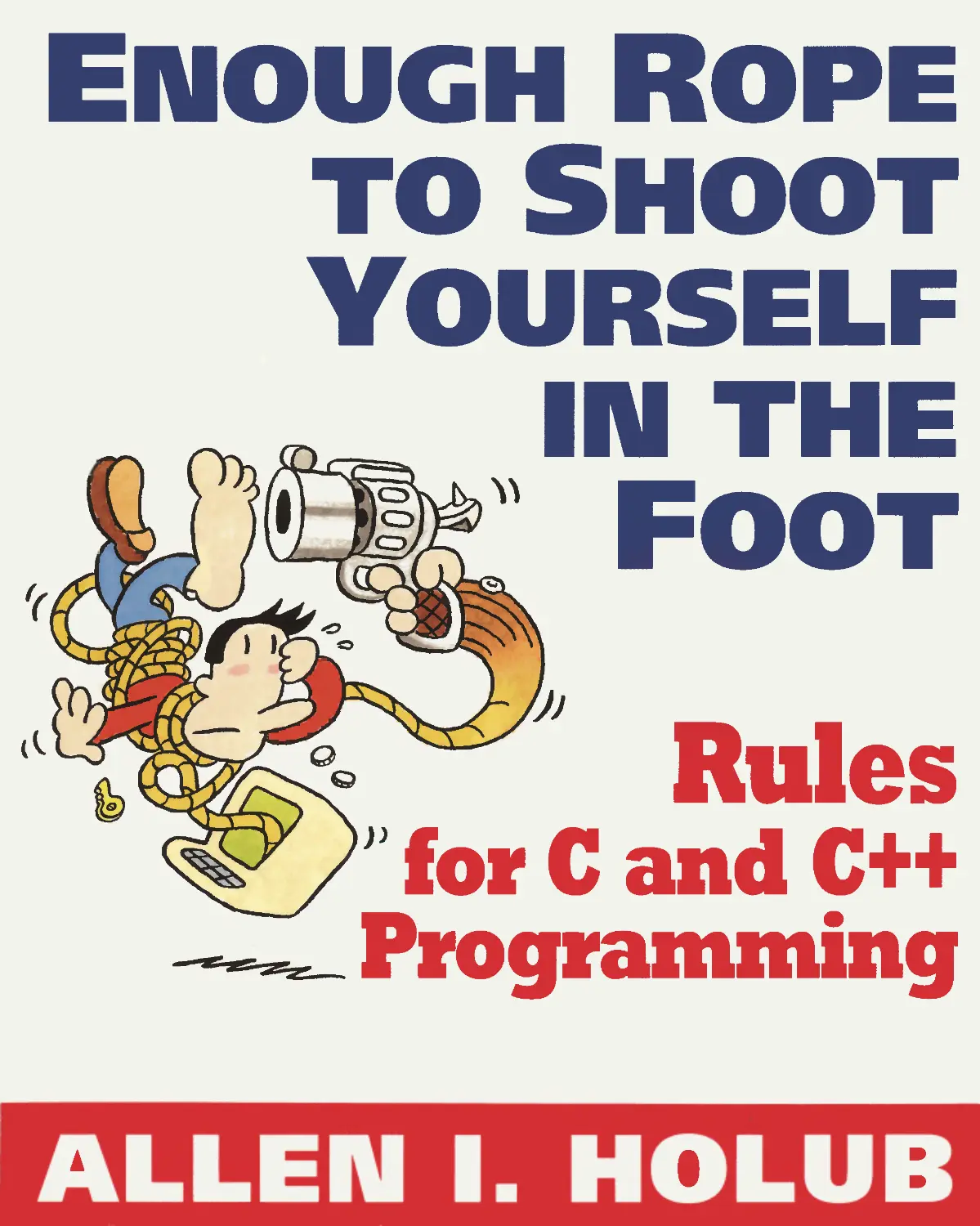
ENOUGH ROPE
TO SHOOT
YOURSELF
IN THE
· g " FOOT
....
Rules
J) fo.. C and C++
--Z" Pa-og..amming
I(
(l
A
I
.
.
Enough Rope to Shoot
Yourself in the Foot
Rules for C and C++ Programming
Allen I. Holub
McGraw-Hili
New York San Franclaco Washington, D.C. Auckland Bogo
Caracas Lisbon London Madrid Mexico City Milan
MontnNll New Deihl San Juan Singapore
Sydney Tokyo Toronto
Ubrary of Congress Cataloging-in-Publication Data
Holub, Allen I.
Enough rope to shoot yourself in the foot: rules for C & C++
programming I by Allen I. Holub.
p. cm.
Includes index.
ISBN 0-07-029689-8 (P)
1. C++ (Computer program language) 2. C (Computer program
language) I. Title.
QA76.73.CI53H625 1995
005. 13-dc20 95-35136
CIP
McGraw-Hill
A Division of The McGraw.HiU Companies
Copyright C 1995 by The McGraw-Hill Companies, Inc. Printed in the United States of
America. Except as permitted under the United States Copyright Act of 1976, no part of this
publication may be reproduced or distributed in any form or by any means, or stored in a
data base or retrieval system, without the prior written permission of the publisher.
pb 123456789 FGIDFGR 90098765
ISBN 0-07-029689-8
The sponsoring editor of this book was Jennifer Holt DiGiovanna, the
Executive Edito'r, was Robert E. Ostrander; and the book edito'r, John Bake1:
Printed and bound by Quebecor Printing, Fairfield, PA.
McGraw-Hill books are available at special quantity discounts to use as premiums and sales
promotions, or for use in corporate training programs. For more information, please write to
the Director of Special Sales, McGraw-Hill, 11 West 19th Street, New York, NY 10011. Or
contact your local bookstore.
Product or brand names used in this book may be trade names or trademarks. Where we
believe that there may be proprietary claims to such trade names or trademarks, the name
has been used with an initial capital or it has been capitalized in the style used by the name
claimant. Regardless of the capitalization used, all such names have been used in an editorial
manner without any intent to convey endorsement of or other affiliation with the name
claimant. Neither the authors nor the publisher intends to express any judgment as to the
validity or legal status of any such proprietary claims.
Infonnation contained in this work has been obtained by McGraw-Hill, Inc. from
sources believed to be reliable. However, neither McGraw-Hill nor its authors
guarantee the accuracy or completeness of any infonnation published herein and
neither McGraw-Hill nor its authors shall be responsible for any errors, omissions,
or damages arising out of use of this infonnation. This work is published with the
understanding that McGraw-Hill and its authors are supplying infonnation but are
not attempting to render engineering or other professional services. If such services
are required, the assistance of an appropriate professional should be sought.
MH95
0296898
For Amanda
Contents
c:IcI1(),",IEtctSJr11Etl1t!t........................................................................................................ )(iii
Il1tr()cilJc:ti()11 ................................................................................................................... )(\f
f) rt 1 lrl1Et [)Et!tiSJI1 f)r()c:Et!t!t............................................................................................ 1
1 The essentials of programming: No surprises, minimize coupling, and maximize cohesion................................ 3
2 Stamp out the demons of complexity (Part 1)3
2.1 Don't solve problems that don't exst ......... ............................................................................................4
2.2 Solve the specific problem, not the general case.................................................................................. 4
3 A user interface should not look like a computer program (the transparency principle)....................................... 5
4 Don't confuse ease of learning with ease of USQ................................................................................................... 6
5 Productivity can be measured in the number of keystrokes..................................................................................6
6 If you can't say it in English, you can't say it in C/C++................................................................................. .......... 7
6.1 Do the comments first............................. ......... .......... ........... ....... ......... ..... ....... ....... ......... ......... .... ........ 8
7 Read code..................................................................................................................................... .......................... 8
7.1 There's no room for prima donnas in a contemporary programming shop........................................... 8
8 Decompose complex problems into smaller tasks.................. ........... ........... ............. .................. ............. ..... ........ 8
9 Use the whole language 9
Use the appropriate tool for the job................................................................................................................9
10 A problem must be thought through before it can be solved......................................................................... 9
11 Computer programming is a service industry...............................................................................................10
12 Involve users in the development process................................................................................................... 10
13 The customer is always right.......................................................................................................................10
14 Small is Beautiful. (Big == slow)................................................................................................................... 11
vIII Contents
Part 2
15
16
17
18
19
20
21
Part 3
22
23
24
25
26
27
28
29
30
31
32
33
34
35
36
37
38
39
40
41
GEtI1Etral DEtvEtI()pr11Etl1t I!»!» UEt!» ......................................... ........ ... ....... ........ .... .... 13
First, do no harm.......................................................................................................................... ................ 14
Edit your code.......................................................................................................................... ..................... 14
A program must be written at least twice..................................................................................................... 14
You can't measure productivity by voluma.................................................................................................. 14
You can't program in isolation...................................................................................................................... 14
Goof off............................................................................................................................ ............................. 15
Write code with maintenance in mind-the maintenance programmer is you............................................. 15
21.1 Efficiency is often a bugaboo ............................................................................................................. 16
F()rr11atti I1SJ al1ct D()c:u r11EtI1tati()11 .. ....... ... .... .... .... ... .... .... ........ ..... ..... ..... ............. 17
Uncommented code has no value... ... ........ ........ ... ... .., ... .............. ... ... ... ... ... ... ... ... ..... ... .... ......... ... .... .., .... ..... 18
Put the code and the documentation in the same place................................................................ ..............18
Comments should be sentences.. ... ... .............. ..... ... .., ... ........... ... ... ... ... ... ... ...... ...... ......... ... ... ... ........ ... .... .... 18
Run your code through a spelling checker.... .., ..... .................... ... ... ... ... ........... ...... ... ...... ....... ... .... .... ........... 19
A comment shouldn't restate the obvious ..... .... .... ......... ........ ...... ... ...... ... ........... ... .......... ... ...... .... .... ........... 19
A comment should provide only information needed for maintenanoo....................................................... 19
Comments should be in blocks.................................................................................................................... 21
Comments should align vertically................................................................................................................. 21
Use neat columns as much as possible.. ........... ................. .................... ... ......... ...... ......... ....... .... ... .... ........22
Don't put comments between the function name and the open brace........................................................ 23
Mark the ends of long compound statements with something reasonable.................................................. 24
Put only one statement per line. ... ........ ... ........ ... ..... ... ... ... ... ........ ... ......... ... ... ... ... ... ... ... .., ... ... ........... .., .........25
Put argument names in function prototypes............................................. ...................................................25
Use a "predicate" form to split up long expressions................. ......... ... ...... ... ...... ... ..... ......... .......... .... ..........25
A subroutine should fit on a screen........ ........ ... ... ... ... ..... ... ... .., ..... .... ... ... ... ... ... ... ........... ... ... ....... .................26
All code should be printable ... ..... ... ........ ... .... ....... .., ........... ...... ...... ... ......... ...... ......... .... .............. .................26
Use lines of dashes for visual separation between .. subroutines................................................................ 26
White space is one of the most effective comments................................................................ ....................27
Use four-space indents.. ... ..... ..... ...... ............. ...... ... ........ ......... ... ... ......... ... ....... ... ........ ........... .......... ........... 28
Indent statements associated with a flow-control statement....................................................... ................28
41.1.Comments should be at the same indent level as the surrounding coda........................................... 30
42 Align braces vertically at the outer leveL...................................................................................................... 30
43 Use braces when more than one line is present under a flow-control statement....................................... 31
Part arl1Et!» al1ci IciEtl1tifiEtr!»....................................................................................... 33
44 Names should be common English words, descriptife of what the function, argument, or
variable does.......................................................................................................................... ...................... 34
44.1. Do not clutter names with gibberish.... ........ ...... ........ ... ...... ........ .... ......... ............. ............. ...... ...... ... .... 34
45 Macro names should be ENTIRELY_CAPITALIZED . ................................................................................. 35
45. 1 Do not capitalize members of anenum ....... ... ........... ...... ..................... ................ ..................... ... ........35
45.2 Do not capitalize type names created with atypedef .......................................................................36
46 Avoid the ANSI C name space..... ... ..... ...... ... ..... ...... ........ ..................... ...... .., .... .., ...... ...... ........ ... ... ............ 36
47 Avoid the Microsoft name space.. ....... .... .... ... ........ ... ... ... ........ ... ... ..... ............. ....... ....... ..... ........... ....... .... .... 36
48 Avoid unnecessary symbols .... ........ ... ........ ... ... ........ .... .......... ... .., ... ..... .... ... ....... ... ... ... ... ........ ... ... ... '" ..... .... 37
49 Symbolic constants for Boolean values are rarely necessary..................................................................... 37
Part 5
50
51
52
53
R U lEt!» 1()r GEtI1Etral Pr()SJrar11r11 il1SJ ................ ....... ... ...... .... ..... ............................. 1
Don't confuse familiarity with readability.............. ..... ... ...... ..... .................. ... ...... ...... ... ... ..... ............. .............42
A function should do only one thing............................................................................................................. 43
Too many levels of abstraction or encapsulation are as bad as too few..................................................... 44
A function should be called more than once, but.................................................................... ....................44
53.1 Code used more than once should be put into a function............................................................ .......45
Contents Ix
54 A function should have only one exit point..................................................................................................45
54.1 Always put a return at the outer leveL.................................................................................................. 46
55 Avoid duplication of effort............. ... ........... ... ........ ...... ... ........ ... ..... ... ................ ........ ...... .... .......... ..... ..... ..... 47
56 Don't corrupt the global name space........................................................................................................... 47
56. 1 Avoid global symbols.. ....... ... .............. ... ........... .............. ..... ... ... ..... ... ..... ........... ..... ..... ....... ..... ..... .......47
56.2 Never require initiaization of a global variable to call a function......................................................... 48
56.2.1 Make locals static in recursive functions if the value doesn't span a
recursive call............................................................................................................................. 49
56.3 Use instance counts in place of initialization functions........................................................................50
56.4 If an if ends in return, don't use else ............................................................................................ 51
57 Put the shortest clause of an iff else on top ............................................................................................52
58 Try to move errors from run time to compile time........................................................................................ 53
59 Use C function pointers as selectors........................................................................................................... 54
60 Avoid do / whi Ie loops.............................................................................................................................. .. 55
60.1 Never use a do/while for a forever loop...........................................................................................56
61 Counting loops should count down if possible.............................................................................................56
62 Don't do the same thing in two ways at the same . tima.............................................................................. 56
63 Use for if any two of an initialization, test, or increment are present........................................................ 57
64 If it doesn't appear in the test, it shouldn't appear in the other parts otor statement............................... 58
65 Assume that things will go wrong................................................................................................................. 59
66 Computers do not know mathematics.......................................................................................................... 59
66.1 Expect the impossible ..... ... ...... ... ....... .... ........... ... ... ........... ..... ... .., ..... ... ..... ..... ............... ............... .......60
66.2 Always check error-return codes......................................................................................................... 60
67 Avoid explicit temporary variables.................. ... ........ ... ... ..... ... .., ..... ... ..... ........ ... ..... ..... .... ..... ...... .............. ...61
68 No magic n umoors .................................................................................................................................... .., 61
69 Make no assumptions about sizes............................................................................................................... 61
70 Beware of casts (C issues) ..........................................................................................................................63
71 Handle special cases directly.............. .............. ...... ........... ........... ... ................ ..... ..... ..... ..... ..... ... ..... ....... ....64
72 Don't try to make lint happy..........................................................................................................................66
73 Put memory allocation and deallocation code in the same placa............................................................... 66
74 Heap memory is expensive..................................................................................................................... ..... 67
75 Test routines should not be interactive .... .............. ... ................... ....... ....... ..... .... ..... ........ ........... ................. 69
76 An error message should tell the user what's right.....................................................................................69
77 Don't print error messages if an error is recoverabla..................................................................................70
78 Don't use system-dependent functions for error messages........................................................................ 70
Part 6
79
80
81
lrl1Et PrEtJ>r()(:Et!»!»()r ............................................................................................. :i
Everything in a.h file should be used in at least two.C files ........................................................................ 74
Use nested liDCl ude s............................................................................................................................... 74
You should always be able to replace a macro with a function...................................................................74
81.1 ?: is not the same as iff else .......................................................................................................... 79
81.2 Parenthesize macro bodies and arguments........................... .... ............................. ..... .......... ..... ........ 79
82 enum and const are better than a macro........... ... .............. ..................................... ............. ..... ................ 80
83 A parameterized-macro argument should not appear more than once on the right-hand side.................. 81
83.1 Never use macros for character constants.......................................................................................... 81
84 When all else fails, use the preprocessor.................................................................................................... 82
Part C:- EtlatEtci IJIEt!» ................................................................................................ Ii!)
85 Stamp out the demons of complexity (Part 2).............. .......... ....... .... ... ........ ............. ..... ... ..... ..... ..... ... ..... ....86
85. 1 Eli mi nate cl utter _ .. . . . . . . . . . . . .. . .. .. . . . . .. . . . . .. ... .... .. . . . . . . . . . . . ... . . . . . . . . . . . . . . .. . .. . . . . . . . . . . .. .. . . . . . . .. . . . . .. . . . .. . . .. . . . . .. . . . . . . . . . . .. .. 86
85.2 Avoid bitwise masks; use bit fields....... ............ .............. ..... ... ..... ... ........... ... .......... .... ......... ..... ..... .......86
85.3 Don't use done flags ........ ...... ... ..... ...... ... ... ..... ... ... ...... ... ..... ........... ........ ... ..... ............. ..... ... .......... .......88
x Contents
85.4 Assume that your reader knows C.......................................................................................................89
85.5 Don't pretend that C supports a Boolean type 'define TRUE) ......................................................... 89
86 1-bit bit fields should beUDsigned.............................................................................................................. 90
87 Pointers must be above the base address of an .. array............................................................................... 90
88 Use pointers instead of array indexes.......................................................................................................... 91
89 Avoid goto except. .. ................................................................................................................................92
Part 8 Ru lEt!» 1()r C++ Pr()g rar11r11i I1SJ . ............. ...... ..... .............. .... ...... .... ................. ...... 95
Part 8.A Deslg nand Impl ementaUon Issues........................................................................................................... 96
90 Object-oriented and IIstructured- designs don't mix...................................................................................... 96
90.1 If it's not object-oriented, use C............................................................................................................96
91 Expect to spend more time in design and less in development................................................................... 97
92 C++ class libraries usually can't be used in a naive way............................................................................. 97
93 Use checklists........................................................................................................................ ....................... 98
94 Messages should exercise capabilities, not request .. information............................................................... 99
95 You usually cannot convert an existing structured program to object-oriented......................................... 100
96 A derived class object is a base-class object............................................................................................. 101
97 Derivation is the process of adding member data and methods................................................................ 101
98 Design the objects first............................................................................................................................ ... 103
99 Design the hierarchy next, from the bottom up.......................................................................................... 103
99.1 Base classes should have more than one derived class................................................................... 103
100 The capabilities defined in the base class should be used byallderived classes..................................... 104
101 C++ is not Smalltallr-avoid a common obj ect class .............................................................................. 104
102 Mix-ins shouldn't derive from anything....................................................................................................... 108
103 Mix-ins should be virtual base classes....................................................................................................... 108
104 Initialize virtual base classes with the default constructor.................. ............................ ............................ 108
105 Derivation is not appropriate if you never send a base-class message to a derived-class object........... 108
106 Choose containment over derivation whenever possible........................................................................... 108
107 Use private base classes only when you must provide virtual overrides.............................................. 108
108 Design the data structures last................................................................................................................... 109
109 All data in a class definition must beprivate ..........................................................................................110
110 Never provide public access to private data ............................... ............ ............ ...... ... ...... .................... 110
110.1 Do not use geVset functions............................................................................................................. 113
111 Give up on C idioms when coding in C++...................................................................................................115
112 Design with derivation in mind....................................................................................................................115
112.1 A member function should usually use theprivate data of a class.............................................. 116
113 Use cons t .................................................................................................................................................. 117
114 Use struct only if everything's public and there are no member functions......................................... 117
115 Don't put function bodies into class definitions........................................................................................... 118
116 Avoid function overloads and default arguments.......................................................................................122
Part 8. B Coupll n g Issues ........ .... .... .... .... ........ .................................. ... ....... ........ ... .......... ................. ......... ... ....... ... 124
117 Avoid f ri end classes ............................................................................................................................... 124
118 Inheritance is a form of coupling................................................................................................................. 125
119 Don't corrupt the global narm space: C++ issues...................................................................................... 125
Part 8. C Referen ces...... ..... ........... ................ .............. ................. ... ...... ......... ............................. ...... .......... .... ......... 128
120 Reference arguments should always be const ........................ ............... .................... ............................. 128
121 Never use references as outputs, use pointers........... ... .................. ................. ... ............... ........ .......... ..... 128
122 Do not return references (or pointers) to local variables............................................................................ 130
123 Do not return references to memory that came fromnew ..........................................................................131
Part 8.D Constructors, Destructors, and operator: () ..................................................................................... 133
Contents xl
124 Operator= () should return a const reference ......................................................................................133
125 Assignment to self must work. ........ ........ ..... ....... ......... ........ ... .................. ...................... ....... ................. .... 133
126 Classes having pointer members should always define a copy conSr'uctor and operator= () ............. 135
127 If you can access an object, it has been initialized.................................................................................... 135
128 Use mem ber-initialization lists.................................................................................................................... 135
129 Assume that members and base classes are initialized in random ordeL................................................ 135
130 Copy constructors must use member initialization lists............................................................................. 137
131 Derived classes should usually define a copy constructor andoperator= () ........................................137
132 Constructors not suitable for type conversion should have two or more arguments................................. 139
133 Use instance counts for class-level initialization........................................................................................ 140
134 Avoid two-part initialization ............... ................... ................ ............. ..... ..... ... ........... .... ........ ....... ........ .... ... 141
135 C++ wrappers around existing interfaces rarely work welL........................................................................ 141
Part 8. E VI rtual Functl on8............. .... ........ .... .... .... ........... ........ ........ .... ..... ........ ..... ..... ..... ...... .... ..... .... .... ..... ........... 145
136 Virtual functions are those functions that you can't write at the base-class level..................................... 145
137 A virtual function isn't virtual when called from a constructor or destructor............................................... 145
138 Do not call pure virtual functions from constructors...................................................................................148
139 Destructors should always be virtual.................................................................................................... 149
140 Base-class functions that have the same name as derived-class functions genErally should be virtual... 149
141 Don't make a function virtual unless you want the derived class to get control of it............................ 150
142. protected functions should usually be virtual................... .............. ............... .......... ......................... 150
143 Beware of casts: C++ issues .......... ........ ........... ................ ........ .............................. ..... ................. ....... ...... 151
144 Don't call constructors from operator = ( ) ............................................................................................... 152
Part 8. F Operator Overloads...................... ........... ........ ........ .......................... ........ ..... ..... ............ ....... ..... ............. 155
145 An operator is an abbreviation (no surprises)............................................................................................ 155
146 Use operator overloads only to define operations for which there is a C analog (no surprises)............... 155
147 Once you overload an operation, you must owrload all similar operations............................................... 156
148 Operator overloads should work exactly like they would in C.................................................................... 157
149 Itls best for a binary-operator overload to be aninline alias for a cast ..................................................158
150 Don't go bonkers with type-conversion operators...................................................................... ....... ......... 159
151 Do all type conversions with constructors if possible................................................................................. 159
Part 8. G Memory M anagem ent.. ... ..... .... ....... ... ........ .... ............ .... .... .... .... ........ ..... ..... ................ .... ............. .... ........ 161
152 Use new/delete rather than malloc () /free () .................................................................................... 161
153 All memory allocated in a constructor should be freed in the destructor................................................... 161
154 Local overloads of new and delete are dangerous ............ ............................................................ ......... 161
Part 8. H T em plates ... ... ...... ..... ... ........... .... ....... ... ......... ....... ........... ..... ........ ........ ..... ..... .......... ..... ........ .... ...... ...... .... 162
155 Use inline function templates instead of parameterized macros........................................................... 162
156 Always be aware of the size of the expanded template............................................................................. 162
157 Class templates should usually define derived classes............................................................................. 165
158 Templates do not replace derivation; they automate it.............................................................................. 165
Part 8.1 ExcepUons.. .... ... .............. ........... ........ ........... ................... .... ..... ... .... ..... ..... .... ........... ..... ..... ..... ....... ..... ..... 169
159 Intend for exceptions not to be caught....................................................................................................... 169
160 Throw error objects when possible......................................................................................................... 171
161 Throwing exceptions from constructors is tricky........................................................................................ 173
C:()I1c:IIJ!»i()11 ...................................................................................................................1
Il1ciEt)( ............................................................................................................ .................1111
Acknowledgements
This book was much too long in the making, and I'm indebted to three editors at McGraw-Hill who
put up, in succession, with my constant delays: Neil Levine, Dan Gonneau, and Jennifer Holt-
DiGiovanna. I'm particularly indebted to Bob DuCharme, who saved me from myself by making a
very thorough pass through the initial draft of this book. His suggestions have considerably
improved the current volume.
Introduction
The title of this book describes what I consider to be the main problem with both C++ and C: the
languages give you so much flexibility that, unless you're willing and able to discipline yourself, you
can end up with a large body of unmaintainable gobblygook masquerading as a computer program.
You can do virtually anything with these languages, even when you don't want to. This book
attempts to get a handle on this problem by presenting a collection of rules of thumb for program-
ming in C and C++ - rules that will hopefully keep you out of trouble to begin with. Though most
of the rules given here apply equally to C and C++ programming, I've included a lot of material that
is relevant only in the C++ world, concentrated into the final section whenever possible. If you're
programming in C only, just ignore the C++ stuff that found its way into earlier sections.
I've been programming professionally since about 1979, and the rules in this book are the ones
that I use daily. I make no claims that these rules are definitive or that they're even "correct." I can
say, however, that they've served me pretty well over time. Though this book is not a "traps-and-
pitfalls" book, many of the rules will keep you out of the sort of trouble that "traps-and-pitfalls"
books discuss.
Rules of thumb are, by nature, flexible. They gradually change with experience, and no one rule
is valid in every situation; I break my own rules all the time. Nonetheless, I'll warn you at the outset
that I'm pretty opinionated about this stuff: and I have little sympathy for sloppy thinking or sloppy
programming. I make no apology for stating strongly things that I believe strongly. My opinions are
always subject to change, of course, provided that you can convince me that I'm wrong, but bear in
mind that this book is based on experience, not theory. I realize that a lot of this book treads
dangerously close to religion for some and that many of the things I say are controversial, but I think
that there's always room for intelligent discourse between two people with the common goal of
improving their craft
xvi Enough Rope to Shoot Yourself In the Foot
I often teach C++ and object-oriented design classes, both inhouse for individual companies and
for the University of California, Berkeley Extension. This book came about at the request of my stu-
dents, most of whom are dedicated professionals with a real desire to learn the material. I look at a
lot of code in the process of grading homework, and this code is pretty representative of the work
produced by the professional programming community in the San Francisco Bay area. Unfor-
tunately, every semester, I also see the same problems repeated over and over. This book, then, is in
some ways a list of common problems that I find in real code produced by real programmers along
with my advice on how to solve those problems.
The programming and design problems discussed here are not limited to student code, unfor-
tunately. Many of the examples of how not to do things are taken from a commercial product the
Microsoft Foundation Class (MFC) library. As far as I can tell, this library was designed without a
thought to good maintenance, by people unaware of even rudimentary object-oriented-design princi-
ples. I have not explicitly attributed most of these examples in the text because this book is not a
"what's wrong with MFC" book; users of the MFC library will recognize the code when they
encounter it I've taken examples from MFC simply because I work with it a lot, so I am very fami-
liar with its foibles. Many other commercial class libraries have similar problems.
Finally, this book is not an introduction to C++. The discussion accompanying the C++ -related
rules assumes that you know the language. I don't waste space describing how C++ works. There
are lots of good books that teach you C++, including my own C+C++ (New York, McGraw-Hill,
1993). You should also familiarize yourself with object-oriented design principles. I recommend
Grady Booch's Object-Oriented Analysis and Design with Applications, 2nd ed. (Redwood City,
Benjamin Cummings, 1994).
About the rule numbering: Sometimes, I've grouped several rules together because it's con-
venient to describe them all at the same time. When I've done that, all the rules (which will have
different rule numbers) are clumped together at the top of the section. I've used subrules (of the
form "1.2") when one rule is a special case of another.
Part
The Design Process
This part and the following one on Development are the two most nebulous parts in the book. The
rules here are quite general in nature-not concerning themselves with the mechanics of C or C++
programming at all, but rather discussing the more general process of program design and develop-
ment
The rules in the current part deal with the overall design process. As I reread this part., I become
worried that a lot of these rules will seem like platitudes. Nonetheless, some of the rules here are the
most important ones in the book, because violating them can cause a lot of grief once development
starts. In away, many of the rules in this part are for managers; programmers often know them but
aren't given the freedom to user their knowledge.
The Design Process 3
1. The essentials of programming: No surprises, minimize coupling,
and maximize cohesion.
Many (if not all) of the rules in this book can be summarized into the three meta-rules (if you will) in
this section's title.
"No surprises" is self evident. A user interface should act the way it looks like it should act. A
function or variable should do what its name implies.
Coupling is a connection between two program or user-interface objects. When an object
changes, everything that it's coupled to might change as well. Coupling makes for surprises. (I
change this thing over here, and suddenly that thing over there doesn't work.) A C++ example: If
an object of one class sends messages to objects of a second class, the sending class is coupled to the
receiving class. If you change the interface to the receiving class, you'll also have to examine the
code in the sending class to make sure it still works. This sort of light coupling is harmless. You do
need to know about the coupling relationships to maintain the program, but without some coupling, a
program couldn't do anything. Nonetheless, you want to minimize coupling relationships as much
as possible.
This minimization is typically done in C using modules and in C++ using classes. The functions
in the module (and member functions of the class) are coupled to each other, but with the exception
of a few interface functions (or objects), they don't communicate to the outside world at all. In C,
you'd use the static storage class to restrict the use of a function to a single module. In C++, you
use pr i va te member functions.
Cohesion is the opposite of coupling, things that are grouped together (items in a dialog box,
items on a menu, functions in a module, or members of a class) should be related functionally. A
lack of cohesion is also "surprising." The editor that I'm using has an "Options" menu, but it also
scatters additional configuration options across four other pop-up menus. I expected a cohesive
configuration, and when I couldn't find the option I wanted under the "Options" menu, I assumed
that the option wasn't available. This bad design is still bothersome; after a year of use I still haven't
memorized where every option is located, and I often have to spend an annoying five minutes
searching in five different places looking for the thing I want to change. On the source-code side, a
lack of modular cohesion makes you do the same thing-spending your life looking for function
declarations in 15 different files-an obvious maintenance problem.
2. Stamp out the demons of complexity (Part 1).
Richard Rashid (the developer of Mach) gave a keynote address at a Microsoft Developer's Confer-
ence a few years ago. His main point was that too much complexity, both in user interfaces and
within a program, was the single largest problem facing software designers and users today. Ironi-
cally, this speech was given following two days of largely unsuccessful attempts to show several
thousand very smart programmers how to program the Microsoft OLE 2.0 interface-one of the most
complex application-programming interfaces I've ever seen. (OLE stands for "Object Linking and
Embedding." The OLE 2.0 standard defines an interface that two programs can use to interact with
each other in an orderly fashion. It's really object orientation at the operating-system level.)
An earlier speaker, who was urging us to use the Microsoft Foundation Class library, told us that
MFC's support for OLE "encapsulates 20,000 lines of code essential to every basic OLE 2.0 appli-
cation." The audience was stunned, not by the utility of MFC, but by the fact that it takes 20,000
lines of code to write a basic OLE 2.0 application. Any interface this complex is seriously flawed.
4 Enough Rope to Shoot Yourself In the Foot
The next few rules use OLE to demonstrate specific problems, but don't think that the complexity
problem is Microsoft specific; it's endemic.
2.1 Don't solve problems that don't exist.
2.2 Solve the specific problem, not the general case.
It's instructive to use OLE as an example of what goes wrong with many too-complex designs.
There are two main reasons for OLE's complexity. First, it unsuccessfully tries to be language
independent. The idea of a C++ virtual-function table is central to OLE 2.0. The OLE specification
even uses C++ class notation to document how various OLE interfaces have to work. To implement
OLE in a language other than C++, you must simulate a C++ virtual-function table in that language,
effectively limiting your choices to C++, C, or assembly language (unless you're a compiler writer
and can add features to your language of choice). Frankly, you'd be mad to program OLE in any
language other than C++; it will take much less time to learn C++ than it will to write a C++ simula-
tor. This idea of language independence then, is a failure. The interface could be simplified consid-
erably by abandoning it.
Looking back at the story in the previous section, the Microsoft Foundation Classes do actually
solve the complexity problem with respect to OLE with a simple, easy-to-understand interface that
implements all of the functionality needed by most OLE 2.0 applications. The fact that no one was
willing to program OLE until the MFC wrapper layer became available is telling. Providing a good
wrapper around a bad interface is no solution to the fundamental problem.
If the MFC wrapper is so simple, then why is the underlying layer so complex? The answer to
this question is a basic design issue. The designers of the OLE interface never asked themselves two
basic questions:
. What basic functionality does a real application have to support?
. What is the simplest way to implement that functionality?
In other words, they did not have a real application in mind when they designed the interface, but
designed for some theoretical worst case. They implemented the most general interface they could
without thinking about what was actually going to be done with the interface, resulting in a system
that could do anything, but that was too complex to be usable. (They probably didn't test the inter-
face by implementing an application in it either, otherwise they would have found these problems.)
In some ways, the object-oriented design process is an attempt to solve this problem. It's rela-
tively easy to add functionality to an object-oriented system, either with derivation or by adding new
message handlers to existing classes. By hiding the data definitions from a class's users, you give
yourself the ability to completely change the interior organization of a class-including the data
definitions-without affecting the users of that class, provided that you maintain the existing inter-
face.
In a structured design, you tend not to have that luxury . You usually design the data structures
first, and modifying a data structure is a major undertaking because you have to examine every sub-
routine that uses that data structure to make sure that it still works. As a consequence, "structured"
programs tend to have a lot of code that doesn't do anything. It's there because someone might want
to use some functionality in the future. In fact, many structured designers pride themselves on their
ability to predict the direction in which the program might evolve. In all, this makes for a lot of
needless work and for programs that are bigger than necessary.
Rather than designing for every eventuality, design your code so that it is easily extended when a
new functionality is actually needed. Object-oriented designs tend to work better here.
The Design Process 5
3. A user interface should not look like a computer program (the trans-
parency principle).
I once heard someone say that the best user interface ever designed was the pencil. It's function is
immediately clear, it doesn't need a user's manual, it gets the job done with little fuss. The most
important attribute, however, is transparency. The pencil, when viewed as an interface between you
and the paper, is invisible. When you use a pencil, you are thinking about what you are writing, not
about the pencil itself.
Like a pencil, The best computer interfaces are the ones that obscure the fact that you're even
talking to a computer: the interface to the ignition system of your car is a great example. You turn
on the ignition, put the car in gear, and step on the pedal, as if any of these interface objects (a key,
an ignition switch, a pedal) are hooked up directly to the engine. They aren't, though; they're usu-
ally just control inputs to a computer which is controlling the engine.
Unfortunately, that level of clarity is often missing from user interfaces. Imagine a Windows
GUI interface to an automobile. You start by selecting a main menu called "Move Car." Clicking
on it would pop up the "gear shift" menu, which would make you chose from "Forward,"
"Reverse," and "Neutral." Click one of these to move a check mark next to the desired gear. Then
move back up to the main menu and select the "Go" command. This item pops up the "Speed" dia-
log, where you have to use a slider to enter a desired speed. It's difficult to enter the correct speed,
though, because the slider has such fine resolution (1 MPH is about half a millimeter of mouse
movement), so you settle for 34.7 MPH rather than 35. You then click the "Go" button on the dialog
box, and a message box with an exclamation point pops up saying "The parking break is still
engaged-press FI for help" (and the speaker emits a rude noise). Resigned, you click the "OK"
button to get rid of the message box, then try the main menu again, but the machine just beeps at
you. Finally realizing that the problem is that the modal "Speed" dialog is still displayed, you click
the "CANCEL" button to get rid of it You pull down the "Parking brake" menu and uncheck the
"Engaged" box. You then pull down the "Go" menu again. You get another message box (and rude
noise) telling you that you must first select a gear with the "Gear shift" menu. At this point, you
decide that maybe you'll walk to work.
Here's another example: In the course of writing a review, I recently looked at several aviation-
logbook programs. (A "logbook" is a very simple spreadsheet Each line represents a particular
flight, and the columns break out the total time for the flight into various categories [total time, time
spent flying in the clouds, etc.] Other columns mark the flight as business related, and so forth.)
By far, the best interface of the bunch was one that looked just like a familiar paper logbook, but
it automated the drudgery. You put a time in the "total" column, and the same time appeared in other
likely columns. Columns were added together automatically to form category totals. You could
generate the necessary reports easily and export the data to a tab-delimited ASCII format that's read-
able by virtually every spreadsheet or word-processing program in the world. To an untrained eye,
the whole interface seemed underwhelming, to say the least, but it was functional and intuitive, and
the program was small and fast The most important thing, though, is that this interface looked like a
logbook, not like a Windows program.
At the other extreme was a wowie-zowie Windows GUI, it had dialog boxes, it had 3-D graphics,
you could generate pie charts showing the percentage of cloud time you've had in Cessna 1718 in the
last 17 years, you could pull up a scanned photograph of an airplane . . . you get the picture. The pro-
gram looked beautiful, but it was almost impossible to use. There was no practical reason to create
most of the charts and reports it could generate. Data entry was ungainly and slow; you had to pull
down a dialog box with fields scattered allover the place. You actually had to read the whole thing
6 Enough Rope to Shoot Yourself in the Foot
to find the category you were interested in, and some of the categories were hidden under buttons,
necessitating an elaborate search. To add insult to injury, the program was built on top of a
relational-database server (remember, all this to maintain a simple table with no relational links). It
took up 30MB on my disk. It took almost 5 minutes for me to make an entry that takes about 10
seconds to make in the paper logbook or the simple GUI mentioned earlier. The thing was unusable,
but it sure was impressive.
One of the main problems was that the tools used to produce the second program drove the inter-
face design. These programs were all developed in a very-high-level language: Visual Basic (which
I like quite a bit, by the way). Applications created with application builders such as Visual Basic
(or PowerBuilder, or Delphi, or ...) tend to have a particular look that immediately tells you what
tool was used to build the application. An interface designer has no recourse if that particular look is
inappropriate for a particular design. Users of application generators should have several to chose
from, then use the one that best matches the needs of the interface. It's been my experience that
most realistic programs will eventually have to move at least some of the interface code into a
lower-level language like C or C++, however, so it's important that your application generator be
able to use low-level code as well.
4. Don't confuse ease of learning with ease of use.
This problem was once confined almost entirely to the Macintosh, but Windows has been gaining
lately. The Mac was designed primarily to be easy to learn. Your great aunt Mathilde MacGilicutty
could walk into a computer store and be entering recipes in no time flat. So Mathilde takes the
machine home and happily enters recipes for a few months. Now she wants to take her recipes,
correlate them based on chemical composition, and write a journal article on the colloidal properties
of albumin-based comestibles. Dr. MacGilicutty is a good typist, normally working at about 100
words a minute, but that darn mouse keeps slowing her down. Every time her hands leave the key-
board, she loses a few seconds. She tries to find a word in her document and finds that she has to
bring down a menu, enter text in a dialog box, and click several buttons. At the end of the file, she
has to explicitly tell the search engine to wrap to the top. (Her 15-year-old version of the vi editor
let her do all this with two keystrokes-without letting go of the keyboard.) In the end, she finds that
it takes twice as long to perform a common task-writing a journal article-than it used to, mostly
because of user-interface problems. She didn't need a manual to use the program, but so what?
Returning to the example of a pencil from the previous section. It's very difficult to learn how to
use a pencil. It takes most children several years. (You could argue that many doctors never learn
how to use one.) On the other hand, once you learn how, a pencil is very easy to use.
The main issue here is that expert users often require completely different interfaces than
beginners. Band aids like hot keys don't solve this problem; the old ungainly user interface is still in
the way of productivity, and it makes little difference whether you open a menu with a hot key or the
mouse. It's the menu that's the problem.
5. Productivity can be measured in the number of keystrokes.
An interface that requires fewer keystrokes (or other user actions such as mouse clicks) is better than
one that requires many keystrokes to perform the same operation, even though these sorts of inter-
faces tend to be harder to learn.
Similarly, user interfaces that hide infonnation in menus or under buttons are usually harder to
use because multiple operations (pulling down several menus) are needed to perform a single task.
The Design Process 7
Program configuration is a good example. Many of the programs that I use daily scatter
configuration options under several menu items. That is, I have to pull down one menu to bring up a
dialog box that configures one aspect of what the program does (to choose a font, for example). Then
I have to bring down another menu to do something related (to chose a color, for example). It's
better to put all configuration options on a single screen and use screen layout to group the options
functional I y.
6. If you can't say it in English, you can't say it in C/C++.
This rule and the ones that follow are also user-interface rules, but the "user" is the programmer
using the code that you're writing-often yourself.
The act of writing out an English description of what a program does, and what each function
within the program does, is really a critical step in the thinking process. A well-constructed, gram-
matically correct sentence is a mark of clear thinking. If you can't write it down, odds are that you
haven't fully thought out the problem or the solution. Bad grammar and sentence construction is
also an indication of sloppy thinking. The first step of writing any program, then, is to write out
what the program does and how it does it.
There is some discussion about whether it's possible to think at all without language, but I'm
convinced that analytical thinking of the sort needed in computer programming is closely tied to
language skills. I don't think that it's an accident that many of the best programmers that I know
have degrees in history, English literature, and the like. It's also not an accident that some of the
worst programs I've seen have been written by engineers, physicists, and mathematicians who had
devoted a lot of energy in school to staying as far away from English-composition classes as possi-
be.
As a matter of fact, skills in mathematics serve almost no purpose in computer programming.
The sort of organizational skills and analytic ability needed for programming come entirely from the
Humanities. Logic, for example, was taught by the philosophy department when I was in school.
The process used to design and write a computer program is almost identical to the process used to
compose and write a book. The process of programming has no connection at all to the process used
for solving mathematical equations.
I'm differentiating, here, between computer science-the mathematical analysis of computer
programs-and programming or software engineering-a discipline concerned with the writing of
computer programs. Programming requires organizational abilities and language skills but not the
sort of mathematical abstraction needed to do calculus. (I was forced to take a year of calculus in
school but never used any of it in a computer-science class, even though it was a prerequisite to most
of them, or in the real world.) Scientists, mathematicians, and engineers who use computers in their
work are not necessarily programmers.
I once received a peer review of a book I'd written on the subject of compiler design in which
the reviewer (who taught at an Ivy League school) said that he "saw absolutely no relevance in
including the source code for a compiler in a book about compiler design." To his mind, one should
teach the "basic principles" -the underlying mathematics and language theory-and that the imple-
mentation details were "trivial." The first comment makes sense when you realize that it was written
by a computer scientist, not a programmer. The reviewer was interested only in the analysis of a
compiler, not in how to write one. The second comment just shows you how much the academic
elite have isolated themselves from the real work of programming. It's interesting that the original
work in language theory that made compiler-writing possible was done by a linguist-Noam Chom-
sky at M.I.T.-not by a mathematician.
8 Enough Rope to Shoot Yourself In the Foot
The flip side of this coin is that, when you get stuck solving a problem, one of the best ways to
un stick yourself is to explain the problem to a friend. More often than not, the solution springs into
your head half way through the explanation.
6.1 Do the comments first.
If you followed the advice in the previous rule, the comments for your program are already done.
Just take the implementation description in the document you just wrote and add blocks of code after
each paragraph implementing the functionality described in the paragraph. The excuse "I didn't
have time to add in the comments" is really saying "I didn't design the code before I wrote it and
don't have time to reverse engineer it." If the original programmer can't do this reverse engineering,
who can?
7. Read code.
All writers are readers. That's how you learn, by seeing what other writers are doing. Strangely,
programmers-who are writers of C++ or C-don't often read code. More's the pity. I strongly sug-
gest that, at minimum, the members of a programming group should read each other's code. The
reader can find bugs that you didn't see and make suggestions that will improve the code.
The idea here is not a formal "code critique" which has a judgmental air about it; nobody wants
to step on a friend's toes, so the odds of getting useful feedback in a formal situation are small. A
better approach is for you to sit down with a friend and just go through the code, explaining what it's
doing and getting some feedback and advice. For this exercise to be useful, the code's author
shouldn't do any explaining in advance. The reader should be able to understand the code by reading
it (We've all been subjected to textbooks that were so abstruse that we couldn't understand anything
until it was explained by a professor. Though this provides job security for the professor, it doesn't
reflect well on the book's author.) If you find yourself having to explain something to your reader,
that means that your explanation should have been in the code as a comment. Add the comment as
you speak; don't put it off until the review is over.
7.1 There's no room for prima donnas in a contemporary programming
shop.
This is a corollary to the reading rule. Programmers who think that their code is perfect, who resent
criticism rather than taking it as helpful, and who insist that they must work in private, are probably
writing unmaintainable gobblygook-even if it does seem to work. (The operative word, here, is
seem).
8. Decompose complex problems into smaller tasks.
This is really a rule of writing as well. If a concept is too difficult to explain all at once, break it up
into smaller parts and explain each part in turn. That's what chapters in a book and sections in a
chapter are all about.
To give an example in programming, a threaded binary tree is like a normal tree, except that the
child pointers in the leaf nodes point back up into the tree itself. One real advantage of a threaded
tree is that it's easy to traverse the tree nonrecursively by following these extra pointers. The prob-
lem is that it's difficult to come up with traversal algorithms (postorder traversal in particular). On
the other hand, given a pointer to a node, it's easy to write an algorithm that finds its postorder
The Design Process 9
successor. By changing the problem definition from "do a postorder traversal" to "starting at the
deepest node, find postorder successors until there are no more," the problem becomes tractable:
tree t;
node = postorder_first ( t );
while ( node)
node = postorder_successor ( t );
9. Use the whole language.
9.1 Use the appropriate tool for the job.
This rule is a companion to "Don't confuse familiarity with readability," presented below, but is
typically more of a management problem. I've often been told that a student isn't permitted to use
some part of C or C++ (typically, it's pointers) because it's "not readable." Usually, this rule is
imposed by managers who know FORTRAN, BASIC, or some other language that doesn't support
pointers and who can't be bothered to learn C. Rather than admit their knowledge is deficient, these
managers would rather hamstring their programmers. Pointers are perfectly readable to a C pro-
grammer.
Alternatively, I've seen situations where management required programmers to move from a
language like COBOL to C, but weren't willing to pay for the training needed to make the move.
Even worse, management paid for the training but weren't willing to budget the time necessary to
actually learn the material. Training is a full-time occupation. You can't get "useful" work done
simultaneously, and you're throwing away money if you try. Anyway, once the managers see that
their staff hasn't been turned into C++ gurus by taking a 3-day short course, they react by limiting
the parts of the language that can be used. Effectively saying "You may not use any part of C++ that
isn't like the language we used before moving to C++." It certainly won't be possible to exploit any
of the advanced features of a language-which are after all the reason for using the language in the
first place-if you restrict yourself to the "simplest" feature subset.
Given these limitations, I do wonder why the change from COBOL to C was made in the first
place. It's always struck me as lunacy to make COBOL programmers use C. COBOL is a great
language for database work. It has built-in primitives that make simple work of tasks that are quite
difficult in C. C, after all, was designed to build operating systems, not database application pro-
grams. It's easy enough to augment COBOL to support fancy graphical user interfaces if that's the
only reason for the move to C.
10. A problem must be thought through before it can be solved.
This rule, and the two that follow, started out at the head of this part of the book. I've moved them
here because, on reflection, I was afraid that you'd abandon the whole part after reading them. My
intent is not to sermonize, however. These rules address very real problems and, in many ways, are
the most important rules in the book.
The current rule is such an obvious statement, when applied to life, that it seems strange that it's
almost heresy to apply it to programming. I'm often told that "it's impossible to spend five months
in design without writing a line of code-our productivity is measured in lines of code written per
day." The people who say this usually know how to do a good design, they just don't have the "lux-
ury . "
10 Enough Rope to Shoot Yourself In the Foot
It's been my experience that a well-designed program not only works better (or works at all) but
can be written faster and maintained more easily than a poorly designed one. An extra four months
in design can save you more than four months in implementation and could save you literally years
of maintenance time. You haven't been very productive if you have to toss out the last year's work
because of a fundamental design flaw.
Moreover, poorly designed programs are harder to implement. The argument that you don't have
time for design because you "have to get the program market as fast as possible" just doesn't hold
water, since it takes much longer to implement a bad (or nonexistent) design.
11. Computer programming is a service industry.
I'm sometimes shocked by the contempt that some programmers have for the users of their programs,
as if the "user" (said with a sneer) is a lower life fonn incapable of cognitive reasoning. The fact is
that the entire computer exists for only one purpose: to serve the end users of our products. If
nobody used computer programs, there would be no programmers.
The sorry fact is that well over half of the code written every year is discarded. The programs
are either never put into service or are used for only a very short time, then discarded. This
represents an incredible loss of productivity, dwarfing the day-to-day productivity concerns of most
managers. Think of all the startup companies producing programs that will never sell-of all the
inhouse development teams writing accounting packages that won't be used.
It's simple to see how this sorry state comes about: programmers are building programs that peo-
ple don't want. The remedy is also simple, though surprisingly difficult to implement in some
environments: ask people what they want, then do what they tell you.
Unfortunately, many programmers seem to believe that end users don't know what they want.
Balderdash. More often than not, the users have been so intimidated by the buzzword-rattling
"expert" that they clam up. I've often been told "I know what I need, but I can't express it." The
best reply to which is, "Well, say it in English; I'll do the translation to Computerish."
12. Involve users in the development process.
13. The customer is always right.
No program can be successful unless the designers talk directly to the end users. Often, however, the
situation is more like the game many of us played in kindergarten where 20 kids sat in a circle.
Somebody whispers a sentence to his or her neighbor, who relays it to his or her neighbor, and so on
around the circle. The fun is in hearing what the message sounds like when it goes full circle-
usually nothing like the original message. This same process often happens in program development.
A user talks to a manager, who talks to another manager, who hires a consulting company. The
president of the consulting company talks to a manager of development, who talks to a team leader,
who talks to the programmers. The odds of even a simple requirements document making it through
this process unscathed are nil. Even worse, there's almost no way for the developers to ask questions
of the end users. The only solution to this problem is to intimately involve users in the development
process, ideally by making at least one end user a part of the development team.
A related situation is really just arrogance on the part of the programmer, who says "I know that
users say that they want to do it that way, but they don't know enough about computers to make an
informed decision; my way is better." This attitude virtually guarantees that the program will never
be used. The cure here is to make the end user officially the person who decides that the design is
okay. No one can start coding until the user-member of the team signs it off: People who ignore the
The Design Process 11
design in favor of their own concoction should be fired. There's really no room for this sort of child-
ish intransigence in the real world.
This is not to say that an experienced designer can't often come up with a better solution to a
problem than the one invented by an end user, especially considering that end users often come up
with interfaces modeled after programs that they use regularly. You have to convince the user that
your way is better before implementing it, however. A "better" interface isn't better if nobody but
you can (or will) use it.
14. Small is Beautiful. (Big == slow)
Program bloat is an enormous problem. The 350MB hard disk on my laptop can hold the operating
system, a stripped-down version of my compiler, a stripped-down version of my word processor, and
nothing else. Back in the dark ages, I could put CP/M versions of all of these on a single 1.2MB
floppy. UNIX, at the time, ran quit happily on a 16-bit PDP II with 64K of core (internal memory).
Nowadays, most operating systems require a 32-bit machine with a minimum of 16MB of core to run
at a reasonable speed. I'm convinced that a lot of this memory bloat is the result of sloppy program-
ming.
Over and above the space issues, you also have execution-time issues. Virtual memory is not
real memory. If your program is too big to fit into core or if it is running simultaneously with other
programs, it will have to be swapped to disk periodically. These swaps are time consuming to say
the least. The smaller the program, the less likely that a swap will occur, so the faster it tends to run.
The third issue is modularity. One of the basic philosophies of UNIX is that "small is better."
Large tasks are best accomplished by a cooperating system of small modular programs, each of
which does only one task well, but each of which can communicate with the other components.
(Microsoft's Object Linking and Embedding [OLE] standard adds this capability to Windows as
does OpenDoc to the Macintosh.) When your application is a modular collection of small programs
that work together, it becomes very easy to customize your program by swapping modules. If you
don't like the editor, swap in a new one.
Finally, programs tend to get smaller as they are refined. Large programs have probably never
gone through the refinement process.
Looking for a solution to this problem, I notice that poorly managed program groups often create
unnecessarily large programs. That is, a band of cowboy programmers, each working alone in their
office and not talking to one another, will write a lot of redundant code. Instead of one version of a
simple workhorse function being used throughout the system, every programmer will create their
own version of the same function.
Part
General Development Issues
This part of the book contains rules for the general development process, without getting too much
yet into the details of C or C++ themselves. I do that in subsequent parts.
14 Enough Rope to Shoot Yourself In the Foot
15. First, do no harm.
This rule is for maintenance programming. Back when I was a kid, I read a Science Fiction story
where a hapless time traveler accidentally steps on the prehistoric equivalent of a butterfly and
returns to his own time to find the world altered in horrible ways. Large computer programs are like
that, touch a seemingly insignificant thing over here, and all the code over there stops working.
Object-oriented design techniques exist primarily to solve (or at least get a handle on) this problem
in the future, but there are millions of lines of legacy code that has to be maintained today.
I've seen programmers change parts of programs just because they don't like the way that the
code looks. This is a bad idea. Unless you are familiar with every part of the program that will be
effected by a change (and that's almost impossible), don't touch the code. You can quite reasonably
argue that virtually none of the rules in this book apply to maintenance programming. You just can't
change existing code to bring it into line with any style guide, no matter how much you would like to
do so, without running the risk of irrepairable harm. The rules presented here are useful only when
you have the luxury of starting from scratch.
16. Edit your code.
17. A program must be written at least twice.
18. You can't measure productivity by volume.
Back when you were taking English in school, you would never have considered handing in the first
draft of a writing assignment-at least not if you expected a grade better than a C. Many computer
programs are just that, however-first drafts-and they have as many problems as your first-draft
essays had. All good code is first written, then edited to make it better. (I mean "edit" in the
English sense of "revise," of course.)
Bear in mind that the editing will have to be done eventually because unedited code is essen-
tially unmaintainable (just as your unedited essay was essentially unreadable). The creators of the
program are familiar with the code and can do the editing much more efficiently than a maintenance
programmer who will first bave to decipher the thing before any real work can be done.
Unfortunately, it looks great on a performance review when someone codes quickly but without
thought to maintenance or elegance. "Wow, she produces twice the code in half the time." Consider
that some poor maintenance programmer will then have to spend eight times as long, reducing the
code to half its original size, to get it usable. Lines-of-code per day, a measure of volume, is not a
measure of productivity.
If you need motivation other than maintenance, bear in mind that editing can be seen as the pro-
cess of making something smaller. Small programs run faster.
19. You can't program in isolation.
Gerald Weinberg's classic The Psychology of Computer Programming (New York, Van Nostrand
Reinbold, 1971) has a great story about soda-pop machines. The powers-that-be in a computing
center decided that too much time was being spent hanging out around the pop machines goofing off
People were making too much noise, and getting nothing accomplished, so they removed the
machines. Within days, the local consultants became so overloaded with work that people couldn't
schedule time with them. The lesson is that people weren't goofing off at all; as they were making
all that noise, they were solving each other's problems.
General Development Issues 15
Isolation can be a real problem in an object-oriented design team, which must by necessity be a
mix of users, designers, programmers, documenters, and so forth, all working together. Because the
number of programmers in the group is often smaller than in a more-traditional design environment,
it becomes difficult to find someone with whom to discuss problems; productivity suffers. Think of a
weekly company party as a productivity tool.
20. Goof off.
If you can't solve an intractable problem, do something else for a while. Programmers are often
most productive when they're staring out of windows, wandering the halls with blank expressions on
their faces, sitting in coffee houses drinking Cafe Lattes, or otherwise "goofing off."
I was a student back in the dark ages when a personal computer was an Apple I, and serious pro-
gramming geeks owned S-I00 boxes that you programmed by entering binary instructions from the
front-panel switches, one byte at a time. (If you were lucky, you had a BASIC interpreter and a ter-
minal made out of an old TV set.) The undergraduates shared a PDP IlnO running UNIX (which ran
fine on a 16-bit machine with 64K of memory-My! How things have improved.). Using a PC for
your homework was not an option.
The average programming class had between 40 and 80 people in it, and there were six or so pro-
gramming classes going on at any given moment. Consequently, when an assignment was handed
out in class, you grabbed the paper and literally ran as fast as you could down to the terminal room,
where you chained yourself to the computer and started coding furiously until you finished the
assignment. This could take several days. If you got up to eat or sleep, somebody else got your ter-
minal, and there was a very real possibility that you couldn't get back on in time to get the assign-
ment done. Some people still program this way.
This environment, of course, did not lead to well-thought-out program designs, so most of these
programs were four times larger than necessary and took two times longer to debug than was
required. Also, the number of lines of code written per hour decreases proportionately with the
number hours that you've been sitting staring at a screen. (It's a fantasy to think that you can be
more productive working 12 hours a day than working 8.)
At some point during my senior year, I got so frustrated trying to solve a problem that I had been
beating my head against for some four hours that I logged off in disgust and stomped out About
three minutes later, while walking down the hill for a knockwurst, the solution popped into my head
unbidden. This was a real revelation: you have to relax to let your brain work. Unfortunately, I
couldn't get back onto the machine, so I never did fix my bug, but at least I understood how the pro-
cess should work.
21. Write code with maintenance in mind-the maintenance
programmer is you.
Maintenance starts immediately after writing the code, and the maintenance programmer at this
stage is usually you. It's a good idea to keep the maintenance programmer happy. Your first con-
cern, then, is for the code to be easy to read. The structure and purpose of every line should be abun-
dantly clear, and when it isn't, you should add explanatory comments.
One of the reasons that the quest for mathematical proofs of program correctness is so quixotic is
that there are no correct programs. Not only does every program have bugs, but the requirements
change as soon as the program is put into service and the user needs some new feature, thereby intro-
ducing new-and-improved bugs. Since the bugs are always with us, we should write our code to
16 Enough Rope to Shoot Yourself In the Foot
make the bugs easier to find.
You could restate the current rule as: Don't be clever. Clever code is hardly ever maintainable.
21.1 Efficiency is often a bugaboo.
I've spent hours making a subroutine more Uefficient" without stopping to consider how often that
subroutine was called-a waste of time when the routine is called only once or twice. Your code
should certainly be as efficient as possible, but your primary concern is maintenance, and you should
not sacrifice readability on the altar of efficiency. Code first for maintenance, then run a profiler on
your program and find out where the real bottlenecks are. Armed with real information, you now
know where's it's worth giving up a little readability in exchange for speed and can go back and
make the changes. You might consider putting the original code into a comment, however, so you
don't lose it. Always bear in mind that no amount of tweaking at the code level will improve
efficiency as much as a better algorithm. A bubble sort is going to run slowly, no matter how well
it's coded.
Part
Formatting and Documentation
Formatting is important; C and C++ are hard enough to read as it is without making matters worse
with bad fonnatting. Imagine trying to read a book that had no formatting in it no paragraph indent-
ing, no blank lines, no capitalization, no spaces following punctuation, and so forth. Maintenance is
impossible in poorly fonnatted code.
I've combined formatting and documentation rules in one part because formatting is one of the
best documentation tools at your disposal. The "documentation" discussed in the current part is pro-
gram documentation (i.e., comments, not user-level documentation.) They don't call it "code" for
nothing, and a good comment is your Captain Crunch Secret Decoder Ring.
I realize that debate on formatting and commenting issues approaches religious intensity at
times. Bear in mind, then, that the rules I've given here are only the rules that I use. There are other
perfectly reasonable ways to do things. On the other hand, some half-wit once told me that "It
doesn't matter what fonnatting style you use, as long as you use it consistently." Code that's format-
ted consistently bad is worse than code that is occasionally readable. Accidental lucidity is better
than none at all.
18 Enough Rope to Shoot Yourself In the Foot
22. Uncommented code has no value.
A program that takes a year to write could be in use for 10 years. You're going to spend a lot more
money on maintenance than you will on the initial creation, and uncommented code is unmaintain-
able. A "brilliant" programmer who, in one-third the time used by everybody else, writes short,
elegant, but uncommented code is costing you money. Some less talented programmer is going to
have to spend 10 times longer than necessary fixing the inevitable bugs.
Programmers who can't write English (or whatever language that's spoken in the country where
the maintenance is going to go on) are producing time bombs, not computer programs. Since good
documentation is so critical to the maintenance process, it's important that programmers be capable
of writing it For this reason, entry-level programmers with degrees in English, history, and other
liberal-arts disciplines are often better bets than people with degrees in the hard sciences (math, phy-
sics, and so forth.) The hard-science people rarely know how to write, and most of them don't know
how to program either; they're taught how to code up an algorithm, not how to write a maintainable
computer program.
Fortunately, writing is a skill that is easily learned. Of course, if you follow the "Do the com-
ments first" rule, you'll have all your comments written before you start coding.
23. Put the code and the documentation in the same place.
Once the documentation is separated from the code, it's very difficult to keep it up to date. Conse-
quently, the bulk of your documentation should be in the comments, not in a separate document.
If you really need fancy printed documentation, you can use something like Web (for Pascal) or
CWeb (for C and C++) in conjunction with TeX. l I use a similar system called arachne that I
developed in order to write my book Compiler Design in C. (Arachne documents C and C++, using
troff as the typesetting engine.) All of these programs let you put the source code and documenta-
tion in a single file. You can extract the source code to compile it, or you can submit the file to a
word processor to print a combined source/documentation manual. The systems allow symbolic
cross referencing between the code and document, allow you to reference pieces of code to other
pieces of code ("this code is used over there"), and so forth. Because a normal text processor is used
for the printed version, you can do things not easy to accomplish in comments-inserting pictures,
for example.
24. Comments should be sentences.
They should be properly spelled and punctuated, without abbreviations if possible. Don't turn your
comments into a secret code by using strange abbreviations and inventing your own grammatical
structure. You shouldn't need that Captain Crunch Secret Decoder Ring to decipher the comments,
too.
I Web is described in Donald Knuth, Th£ WEB System of Structured Documentation (Palo AIto: Stanford University Dept.
of Computer Science, Report No. STAN-CS-83-980, 1983). CWeb is described in Donald E. Knuth and Silvio Levy, The
eWEB System of Structured Documentation (Reading: Addison Wesley, 1994). Both documents not only describe how
the system works, but demonstrate it as well. The books document the actual source code using the system that the
source code implements.
TeX is Knuth's typesetting system. It is available in several commercial versions.
formatting and Documentation 19
25. Run your code through a spelling checker.
Not only will your comments be more readable, but this practice will encourage you to use variable
names that are readable, because they're actual words. For this reason I suggest not using the
check-only-words-in-comments feature available in some editors. Common abbreviations (like i, j,
p, str, buf, etc.) can be added to your spell checker's exception dictionary.
26. A comment shouldn't restate the obvious.
Again, beginning C programmers tend to fall into this trap. Avoid obviously ridiculous thing like:
++x; II increment x
but I also don't like comments like:
1*------------------------------------
* Global-variable Definitions:
*------------------------------------
*1
Your average programmer knows what a definition looks like.
27. A comment should provide only information needed for
maintenance.
A particularly obnoxious, and worthless, comment is the formulaic header block. A header in itself
is not evil, quite the contrary. A comment block at the top of a file that describes what's going on in
the file can be quite useful. A good one tells you what functionality the file implements, provides a
list of public (non sta tic) functions, tells you what these functions do, etc.
The headers that I don't like are the ones whose contents are determined by fiat, typically by
some sort of company-wide style guide. These sorts of headers usually look like Listing 1, increas-
ing clutter with copious amounts of worthless information at the expense of readability. It is often
the case, as in Listing 1, that the header is considerably larger than the actual code. It's also com-
mon, as is the case here, that the code is either perfectly self-documenting or needs only a line or two
of comments to make it so. Though it might warm the cockles of an autocratic bureaucrat to require
this nonsense, it does little to improve maintenance.
Listing 1. A worthless header comment.
1
2
3
4
5
6
7
8
9
10
11
12
13
14
1*---------------------------------------------------- ------**
** DATE: 29 Februa 1 2000 **
**
**
**
** FUNCTION:
equal
**
**
**
**
* * AUTHOR:
** Joseph Andrews
**
**
**
**
** DESCRIPTION:
The purpose of this function is to compare two strings
for lexicographic equality.
**
**
**
**
**
**
**
* * EXCEPTIONS:
**
-+
20 Enough Rope to Shoot Yourself In the Foot
Listing 1. continued. ..
15
16
17
18
19
20
21
22
23
24
25
26
27
28
29
30
31
32
33
34
35
36
37
38
39
40
41
42
43
44
45
46
47
48
49
50
51
52
53
54
55
56
**
The function doesn't work for unicode strings.
**
* * SPECIAL REQUIREMENTS:
**
none.
**
**
**
**
**
**
**
**
**
**
**
**
**
**
**
**
**
**
**
**
**
**
**
**
**
**
**
**
**
**
**
**
** No part of this subroutine may be reproduced in any form **
** whatsoever without explicit permission in triplicate from**
** the department of redundancy department. Violators will **
** be required to hand over their firstborn male child. **
**----------------------------------------------------------**
return !strcmp(sl,s2)i II Return true if strings are equal.
**
* * ARGUMENTS:
** char *sl;
** char *s2;
**
A pointer to the first string to compare
A pointer to the second string to compare
** OUTPUTS:
The function returns true if the argument strings are
lexicographically identical.
**
**
**
* * COMMENTS:
**
none
The real problem is that this sort of header violates many other rules: "don't comment the obvious,"
"eliminate clutter," and so forth. What little real information that is supplied in the header belongs
in a revision-control system, not in the source code. Comments in the code should tell you things
that are useful for maintenance.
**
** IMPLEMENTATION NOTES:
** None.
**
** REVISION_HISTORY:
**
**
AUTHOR: Andrews, Joseph
DATE: 12, July, 1743
CHANGE: Initial
**
**
**
**
AUTHOR: Jones, Tom
DATE: 13, July, 1743
CHANGE: Changed names of arguments from str1, str2.
**
**
**
** All code in this file is copyright (c) Fictitious Inc.
All rights reserved.
**
**
*1
inline equal ( char *sl, char *s2 )
{
formatting and Documentation 21
28. Comments should be in blocks.
Comments are generally best if placed in multiline blocks alternating with blocks of code. That is,
the comment should be describing at a high level what the next several lines are doing. If every
other line is a comment, it's like reading two books at the same time, one line from the first, then one
line from the second, and so on. If the code that you're commenting is complex, you can use foot-
notes:
II Here is a block comment describing the block of code that follows.
II After a general summa , I describe some specifics:
II
II
II
II
II
II
II
II
II
1. This comment describes what's happening on the line
labeled with a 1
2. This comment describes what's happening on the line
labeled with a 2
At point 1, below, the algorithm is positioned to...
here_is_the_code()j
while ( some_condition
{
this_code_is_rather_obscure()j
1* 1 *1
}
more_stuff_here()j
while ( some_condition
{
this_code_is_also_obscure()j
1* 2 *1
29. Comments should align vertically.
Align the I * and * I vertically in multiline comments.
1* First line,
* second 1 ine,
* t h i rd 1 in e .
*1
If your compiler supports it, C++ style comments help here:
I I First line,
II second line,
II third line.
There are two reasons for this rule, both demonstrated in the following code:
22 Enough Rope to Shoot Yourself In the Foot
1***************************************************** ******************
void the_function( void J
Here is a multiline comment, doing all of the thIngs that a comment
should do.
Unfortunately, the lack of a vertical line of stars to the left
makes it difficult to visually separate the comment from
the code
***********************************************************************
void the_function( void J
(
II here is the actual function.
code_goes_here(Ji
)
1***********************************************************************1
First, did you notice that I forgot to put a I at the far right of the second line of stars? It's easy to
lose entire functions this way. Second, it's hard to see where the comment stops and the code
begins. Fix both problems as follows:
1***************************************************** ******************
* void the_function( void J
*
*
Here is a multiline comment, doing all of the things that a comment
should do.
*
*
*
The vertical line of stars to the left makes it
easy to visually separate the comment from the code
*
*
***********************************************************************
*1
void the_function ( void)
{
II here is the actual function.
code_9 0 es_here()i
30. Use neat columns as much as possible.
Because formatting is really a kind of comment, the foregoing rule applies to the actual code as well.
The following two blocks are functionally identical, but note how much easier it is to find variable
names in the second block, not just because of the comment alignment, but because the names fall
into a neat column as well:
formatting and Documentation 23
int Xi II Describe what x does.
unsigned long int (*pfi) ()i II Describe what pfi does.
const char *the_variablei II Describe what the_variable does.
int z; II Describe what z does.
X = 10i II Comment goes here
the_variable = X; II Another comment goes here
z = x; II Here's another.
as compared to:
int x; II Describe what x does.
unsigned long int ( *pfi ) () i II Describe what pfi does.
int Zi II Describe what z does.
const char
*the_variable; II Describe what the_variable does.
z
= x;
II Comment goes here
II Another comment goes here
II Here's another.
x = 10;
the_variable = Xi
You can look at this sort of formatting as "tabular" in nature, as if I was creating a table with a
"type" column, a "name" column, and a "description" column.
Another good use of columns is in a C++ member-initialization list, which I fonnat as follows:
class derived
{
public base
string str;
const int Xi
public:
derived ( char *init_str, int in it_x ) {}
derived: :derived( char *init_str, int init_x )
:base( str, x
, str ( init_str
, x (i n i t_x
{ }
31. Don't put comments between the function name and the open
brace.
The main problem with:
foo( int x )
1* Don't put
* comments
*1 here.
{
I I . . .
is that the function body might end up on the next screen or page. Also, readers can't easily tell
whether they're looking at a prototype or an actual definition. Move the comment either above the
function name or into the function body beneath the open brace:
24 Enough Rope to Shoot Yourself In the Foot
1* Ei ther put
** it here.
*1
foo( lnt x )
{
1* Or put it here,
** indented at the same level as the code.
*1
32. Mark the ends of long compound statements with something
reasonable.
First of all, end-of-block comments such as:
whlle( a < b
{
for ( i = 10 j - - i >= 0 j )
{
f( i )j
} II for
I I while
do nothing but add clutter when the blocks are short I use them only when the compound statement
is too large to fit on a screen (in my editor about 40 lines) or when there is so much nesting that I
can't keep track of what's going on. End-of-block comments are certainly worthwhile when the
compound statements are large, but I've often seen code like this:
On page 1:
whlle( a < b )
{
while ( something_else()
{
for( i = 10j --i >= OJ
{
for( j = 10j --j >= OJ
{
II lots of code goes here
On some subsequent page:
} II for
} II for
} I I while
I I while
These comments are too terse to be useful. End-of-block comments should identify the controlling
statement completely. The end-of-block comments from the previous example should look like this:
II fort j = 10; --j >= 0; )
II fort i = 10; --i >= 0; )
II while( something_else() )
II while( a < b )
formatting and Documentation 25
Because an #ifdef is almost always some distance from the #endif, I always label the #endif:
#ifndef SOMEFILE_H_
#define __SOMEFILE_H_
II 1000 lines of code go here
#endif I I _SOMEFILE_H_
I'll do the same with a #e18e.
33. Put only one statement per line.
There's absolutely no reason to pack as much stuff on one line as you can, unless you intend to make
the code unreadable. If there's more than one semicolon on a line, something's wrong. Don't use a
comma operator (even if you know what it is) for the same reason. An obvious exception is the for
statement, all three parts of which should be on a single line.
34. Put argument names in function prototypes.
This is particularly important in class definitions. Manual pages (and help systems) for the code
you're working on hardly ever exist when you most need them-as you're doing the initial develop-
ment You typically get the documentation from two places: comments attached to the actual func-
tions and .h files. Of the two, the .h file is usually better because it's more compact. In any event,
the documentation you usually need for a function is the order and number of arguments, and the
easiest place to find this information is in the function prototype. If your prototypes look like this:
some_function ( int, int, int, int, int )i
you're not going to get much help.
35. Use a "predicate" form to split up long expressions.
A "predicate" in English is the back half of the sentence-the verb and the object on which the verb
is acting. Word order in English is, of course, inflexible: the verb always comes first.
Many computer languages actually mimic the structure of English (C and C++ fall into this
category). Pascal, for example, is even punctuated like an English sentence, with semicolons
separating independent clauses and a period at the end of the whole shebang. A function call is a
good example of a predicate form: the verb is the function name and the direct objects (the things on
which the verb is acting) are the arguments.
You can also look at operators as verbs, because they perform some action on the operands (the
"objects"). It's reasonable, then, to use the same layout that you would with an English sentence
when you need to split a long expression onto several lines. Put the verb (the operator) first:
if( its_thursday_and_the_moon_is_in_scorpio()
I I its_friday_afternoon_and_close_to_quitting_time()
I I i_just_cant_bear_to_look_at_this_computer_for_another_minute()
)
go_home ( ) i
Of course, you might be better off just shortening the subroutine names to something more
26 Enough Rope to Shoot Yourself In the Foot
reasonable so that they'll all fit on one line.
Notice how I've placed the parentheses and braces in the earlier code to make the structure more
apparent. Also notice that I've used braces, even though the language doesn't require it, to make it
easier to find the statement attached to the if. The following code is harder to read because it's
more difficult to see where the if ends and the statement begins:
if( its_thursday_and_the_moon_is_in_scorpio()
I I its_friday_afternoon_and_close_to_quitting_time()
I I i_just_cant_bear_to_look_at_this_computer_for_another_minute()
go_home() ;
36. A subroutine should fit on a screen.
The subroutine-calling overhead in C/C++ is quite small; if the function is inline, it's nil. It's a
good idea, then, to make your subroutines a manageable size and also to use a lot of them. A subrou-
tine name makes a great abstraction. If the names are chosen properly, you can often eliminate the
need for comments.
In general, I like for the working part of a subroutine (the code, less the header comments and so
forth) to be visible in its entirety when I'm editing; it should fit on one screen or one window.
37. All code should be printable.
It's often easier to debug from a printed page than from a screen, even a large screen. The paper is
easier to read because it's higher resolution and in sharper focus than the screen. You also can
spread out the paper listings on a table top. You can't get that kind of concurrency unless you have
having 3-by-5-foot, 300-dpi monitor.
So, your code should be easily printable. Subroutines should fit on a single page if possible
(about 60 lines max), and no line of code should be so long that it can't fit on a single line of output
(about 79 characters, depending on the font), even if your editor does scroll horizontally. If you
exceed these limits, you have to use such a small font to get everything to fit that you can't read the
listings any more.
38. Use lines of dashes for visual separation between subroutines.
I always put a comment like:
//-------------------------------------------------------------
above every function definition. (By extension, I don't use lines of dashes anywhere else.) Though
blank lines are great for providing visual separation between block of code, if you use blank lines
exclusively, they stop working. A line of dashes between functions makes it very easy to find the
functions. Just as a blank line represents a paragraph boundary, dashed lines are like section head-
ings. When I need even further separation, I use:
//==============================================================
/ / DESCRIPTIVE TEXT
//==============================================================
Think of it as a chapter heading.
formatting and Documentation 27
I try not to put any comments except dashed lines at this outermost nesting level because such
comments can make it difficult to find the function definitions. That is, I fonnat functions like this:
11---------------------------------------------------- ---------
void descriptive_name ( type descriptive_name)
{
II If the function and argument names are not sufficiently
II descriptive, I'll put a comment here describing what the
II function does. I'll omit this comment if the names are
II adequate to get the point across. (The relevant rule is
II "Don't comment the obvious."J
II
II I describe the return values and argument next. Again
II you might not need this comment if the names are good
II enough.
II
II Finally, I put a comment here describing how the function
II does whatever it does. Again, I'll leave this comment out
II when the code itself is sufficiently descriptive.
code_goes_here()i
39. White space is one of the most effective comments.
This seems like a small issue, but it can dramatically improve the readability of your code. Look at
how white space is used in this book as an organizational device and you'll see how to use it in your
own programs. Blank lines (or an indented first line) give visual separation between paragraphs. A
space follows a period, but doesn't precede it, because the period terminates something. You get the
idea. Here are the rules:
. Break the code into logical chunks (Le. paragraphs) where each chunk performs one operation.
Surround those chunks with either blank lines or lines containing only a curly brace.
. White space should always follow punctuation.
. Operators are abbreviations for words. When you see "+," you say "plus." Like any abbrevia-
tion, you should surround the symbol with space characters. (For example: a + b reads "a plus
b," a+b reads "aplusb.")
. Exceptions are unary operators, which are treated as word prefixes or suffixes (* p, a - -, f (a rg I
arg) , etc).
. A . or - > is the C/C++ equivalent of a hyphen. There should be no space on either side: p-
>msg ( ) , obj . msg ( ) .
Here's one of the things that happens when you pack things too tightly. Consider:
int *Pi
y= (x/*p++J;
f(int /* place-holder */)i
When you strip the comments out, you get:
28 Enough Rope to Shoot Yourself In the Foot
int *Pi
Y= (x
) i
The I * in Y= (xl *p++) is treated as a start-of-comment symbol that is terminated by the * I in the
f ( ) call. (This one really happened to me, and it took all day to track it down. The compiler, of
course, generated no error messages because there's nothing syntactically incorrect.)
One final related issue. I've been seeing declarations like the following a lot lately:
int* Xi
The problem is that
int* x, Yi
does not declare two pointers, as the distribution of white space implies. This is really another 1-
can-program-FORTRAN-in-any-Ianguage problem. Though it would be nice if C worked in the way
the foregoing formatting implies, it doesn't When properly formatted,
int *x, Yi
makes it very clear that x is a pointer and Y isn't
40. Use four-space indents.
Nickolaus Wirth, who invented Pascal and Modula-2, once published a book that used one-space
indents throughout the book. The listings were some of the hardest reading I've ever done. Use
enough indent so that your reader can tell the code is indented; four spaces seem ideal.
You must indent consistently. Even the outer block of a subroutine should be indented. This is
not acceptable:
void f (void)
{
if( x )
YYY()i
more_code()i
even_more_code()i
}
because it makes it too hard to find the top of the subroutine. Compare the foregoing to the follow-
ing:
void f (void)
{
if( x )
YYY()i
more_code() i
even_more_code()i
41. Indent statements associated with a flow-control statement.
I do this even with one-line statements:
formatting and Documentation 29
if( by_land
one ( ) i
else
two ( ) i
not:
if( by_land) one() else tWO()i
One obvious exception is:
if( by_land
{
one ( ) i
}
else if( by_sea
{
two() ;
}
else if( by_air
{
three ( ) ;
I've used braces here for two reasons. First, I've occasionally thrown in an if statement while
debugging and forgotten to put in the brace, as in the following code:
if ( by_land )
one(); if (debug) printf("aagh");
else if( by_see
which binds like this:
if( by_land
one ( ) ;
if (debug)
printf ("aagh");
else
if( by_see)
Code is also more readable if the braces are there.
I sometimes violate the indenting rule when I can use formatting to make it crystal clear what's
going on. The neat columns make the following workable:
if ( by_land one()i
else if ( by_sea two();
else if (by_tunnel three();
but this is unreadable:
if(by_land)one();
else if(by_sea)two();
else if(by_tunnel)three();
Code like the following isn't acceptable:
30 Enough Rope to Shoot Yourself In the Foot
for( a i b i C )i
while ( ++i < 10 )i
It's too easy to accidentally do:
while ( i < 10 )i
++ii
(In other words "compare i to 10 forever, then increment i.") If a semicolon never appears at the
end of a line that starts with a for or whi Ie, you can use a search-file-for-string utility like grep to
find these problems for you.
41.1 Comments should be at the same indent level as the surrounding
code.
The whole point of indenting is to make your code's structure readily apparent If you indent com-
ments in a helter-skelter fashion, you've defeated the purpose of the indenting. The comment in the
following code should be indented:
f ( )
{
/* A longish comment
* * goes here.
*/
code ( ) i
A similar problem is:
f ( )
{
int local_vari
int another_local_vari
code() ;
Not indenting the local-variable definitions implies that they are at the same scoping level as the
function name (which is global). Because this isn't true, you should indent to indicate scope:
f ( )
{
int local_vari
int another_local_vari
code ( ) ;
42. Align braces vertically at the outer level.
Finding a missing curly brace is sometimes a big problem. If you hang the braces out where you can
see them, it's easier to see when they're mismatched:
formatting and Documentation 31
while ( some_condition
{
II inner block
I really dislike the "K&R" style of:
if( condition {
code ( ) ;
}else{
more_code();
Not only is it hard to match up the braces, but the lack of visual separation provided by a line con-
taining only an open brace makes for less readability.
43. Use braces when more than one line is present under a flow-
control statement.
This rule applies even when the additional lines are only comments. The problem is that it's too
easy to accidentally add another statement and forget to add the braces. Code like the following is
safer:
if( something() )
{
1* Quo usque tandem abutere
* Gatesalina, patientia
* nostra.
*1
something_else() ;
}.
Part
Names and Identifiers
Names are important. Properly chosen names can make the code virtually self documenting, requir-
ing little or no extra input in the guise of explicit comments. Poorly chosen names (like sta te) can
add unnecessary complexity to your code. This part of the book contains rules that are specific to
naming.
34 Enough Rope to Shoot Yourself In the Foot
44. Names should be common English words, descriptive of what the
function, argument, or variable does.
A void abbreviations; they hurt readability. Some people abbreviate habitually, leading to absurd
practices like truncating the last letter from a word or removing all vowels from a word. Consider
the oddly named UNIX c rea t () function; c rea te () is obviously better. I've also seen ridiculous
things like lngth for length andmt for empty.
Abbreviations in common use are obvious exceptions. Here are a few that I see enough that I use
them myself:
col
cur
1 J
max
min
obj
p ptr
s str
column index
current
generic loop counter
maximum (usually as a prefix or suffix)
minimum (usually as a prefix or suffix)
generic object (you have base-class pointer but don't know derived class).
generic pointer
string (typically a cha r* in C)
but don't use these if the named object is not being used in a generic way. For example, i makes
sense for a loop counter in a for statement only if that counter is used for no other purpose than
counting the number of iterations:
for ( i = 10; - - i >= 0; )
pu tcha r ( , - , ) ;
II draw 10 dashes
Use a real name when you use the counter for something other than counting. Compare this code:
for( i = Oi i < imaxi ++i )
for( j = Oi j < jmax; ++j )
move_cursor(i,j) ;
to:
for( row = 0; row < max_row; ++row )
for( col = 0; col < max_coli ++col
move_cursor ( row, col )i
I'd also avoid x and y when you mean row and column. An earlier rule recommended running your
code through a spelling checker. A real benefit of this practice is that it encourages you to use real
words for names.
44.1 Do not clutter names with gibberish.
A great example of this problem can be seen in any Microsoft-supplied sample code, though the
problem is by no means restricted to Microsoft All Microsoft Windows demonstration code
encodes a variable's type into its name. For example, a declaration like the following:
const char *str;
would be declared like this:
LPCSTR lpszstri
Translate lpszstr as: "long pointer to string terminated by zero called str." There are actually
Names and Identifiers 35
several problems, here, not the least of which is the fact that the LPCSTR hides the fact that we're
declaring a pointer. The problem addressed by the current rule is the name itself, however.
This naming style is called "Hungarian" notation, after the native country of Microsoft's head of
programming, Charles Simonyi, who invented it (It's not called Hungarian notation because it
makes Microsoft code look as if it were written in Hungarian.)
Hungarian notation makes a lot of sense in assembly language, in which all you know about a
variable is its size. Encoding type information in the name tells you how the variable is used as
well. 2 Higher-level languages like C and C++ use variable declarations for this purpose.
Dr. Simonyi has defended the notation in print several times, but I see little to recommend it in a
C or C++ program. To my mind, Hungarian notation does nothing but hurt readability. A simple
str or string is much more readable and conveys the same information. If you really need to know
the type, it's easy enough to find the definition. 3
It is also a common, though less extreme, practice to start pointer names with p. This practice
also just clutters the code. You probably don't start ints with i, doubles with d, and functions with
f. Why use p for pointers? The one obvious exception is when you have both an object and a
pointer to the object in the same scope:
char str[128], *pstr = strj
on the other hand, a real name for the pointer is probably better. Consider:
char str[128], *first_nonwhite = stri
while ( isspace(*first_nonwhite) )
++first_nonwhitej
/ / At this juncture, the name "first_nonwhite" tells you a lot
/ / more about what the variable's doing than would "pstr."
45. Macro names should be ENTIRELY_CAPITALIZED.
As is discussed in a subsequent section, macros often have side effects. It's useful, then, to be able to
tell at a glance that something is a macro. Of course, you shouldn't use all caps for anything except
macros or you've defeated the purpose of the current rule.
45.1 Do not capitalize members of an enum.
It should be possible to replace a constant defined with an enUffi with a cons t variable. If the name
is all caps, you'd then have to change the name. There are also macro-related problems (which will
be discussed shortly) that don't exist with an enUffi. It's useful to distinguishing the two with a
glance.
2 I suspect that Hungarian notation came to be used so heavily because much of Microsoft Windows is written in assembly
language.
3 At least it should be. I suspect that some proponents of Hungarian notation organize their code so poorly that they can't
find the declarations. By encoding the type in the name, they can save hours of searching around in poorly constructed
listings. Assembly language programs, which tend by necessity to have large numbers of global variables, are an obvious
exception.
36 Enough Rope to Shoot Yourself In the Foot
45.2 Do not capitalize type names created with a typedef.
Because a macro can also be used in a typedef-like manner, it's useful to know whether or not
something can be used syntactically as a true type. For example, given:
typedef void (*ptr_to_funct) (int)j
you can say both of the following:
(ptr_to_funct) ( p )j
ptr_to_funct f(long);
II cast p into a function pointer
II f returns a function pointer
A macro like:
#define PTR_TO_FUNCTION void(*) (int)
lets you do the cast:
(PTR_TO_FUNCTION) ( P );
but not the function declaration:
PTR_TO_FUNCTION f(long);
The macro expands to:
void(*) (int) f(long);
but the compiler wants:
void (*f(long)) (int);
A lower case type name doesn't pose any reading problems because you can always tell by context
whether or not a symbol is used as a type.
46. Avoid the NSI C name space.
Symbols starting with underscores and type names ending with _t have been reserved in ANSI C for
use by the compiler vendor. Don't do either. Also, avoid any function name that is part of the ANSI
C or Draft ISO/ANSI C++ standard.
47. Avoid the Microsoft name space.
This might seem like a Microsoft-specific rule, but it isn't (given Microsoft's current proclivities
towards world dominion). Anyone who's serious about portability must consider that his or her code
might eventually either run under a Microsoft operating system or have to interface to a Microsoft
class library. The Foundation Class Library, for example, has been ported to the Macintosh and
many uNIX/Motif environments at this writing and will probably appear on other operating systems
in the near future.
At this writing the Windows application-programming interface (API) has some 1,200 functions
in it. The Microsoft Foundation Class (MFC) library, which is rapidly supplanting the raw C inter-
face, adds some 80 class definitions. Unfortunately, Microsoft has a way of adding even more func-
tions and classes with almost every release of the compiler. If Microsoft happens to pick a function
or class name that you're using for some other purpose, guess who's going to have to change the
name.
Names and Identifiers 37
Because none of these Microsoft symbols conform to the ANSI C standard, which requires the
names of vendor-supplied objects to begin with an underscore, you must protect yourself by avoid-
ing Microsoft-style naming conventions:
. All Microsoft function names use Pascal-style conventions of MixedUpperAndLowerCase (),
and they always start with a capital letter. I prefer all lowercase and underscores, but whatever
you do, DontUseTheMicrosoftStyle (). Member functions in MFC classes follow the same
convention.
. Microsoft class names all start with a capital "C" followed by another capital letter (for exam-
ple, CSt ring, CWnd, CDialog, etc.). The initial C does little but add clutter, and omitting it from
our own names gets us out of the Microsoft name space.
. One of the most basic precepts of object-oriented design is not to expose member data in class
definitions. Nonetheless, many Microsoft Foundation Class classes have publ ic data fields.
These fields all start with an m_, which serves no purpose other than adding clutter to the name.
Nonetheless, we can exploit this nonsense by not starting our own field names with m_, thus
easily distinguishing our members from those inherited from the MFC base class.
48. Avoid unnecessary symbols.
Symbolic constants are often introduced unnecessarily. For example, don't define error-return
values if only one error is returned, just return FALSE. Don't do this:
enum { INSERT_ERROR, DELETE_ERROR };
insert ( )
{
II...
return INSERT_ERROR;
delete ( )
{
II...
return DELETE_ERROR;
just return 0 on failure and some true value like 1 on success.
49. Symbolic constants for Boolean values are rarely necessary.
Choosing a wrong name can add a lot of unnecessary complexity to your code. Consider the follow-
ing simplistic function that counts words in a string:
38 Enough Rope to Shoot Yourself In the Foot
int nwords(const char *str)
{
typedef enum { IN_WORD, BETWEEN_WORDS } wstatej
int
wstate
word_count
state
= OJ
= BETWEEN_WORDSj
for(j *str j ++str
{
if ( isspace (*str) )
state = BETWEEN_WORDS;
else
if( state != IN_WORD
{
++word_count;
state = IN_WORD;
}
return word_count;
The improperly chosen name, s tat e has required us to introduce two unnecessary symbols:
IN_WORD and BETWEEN_WORDS. Now consider this variant:
int nwords2(const char *str)
{
int word_count = 0;
int in_word = 0;
for(; *str ; ++str
{
if( isspace(*str)
in_word = 0;
else
if ( ! in_word
{
++word_count;
in_word = 1;
}
return word_count;
Renaming the nebulously named state to something that actually describes what the variable is
doing lets me eliminate the Boolean symbolic constants IN_WORD and BETWEEN_WORDS. The result-
ing subroutine is both smaller and easier to read.
Here's another example. The following code:
Names and Identifiers 39
enum child_type { I_AM_A_LEFT_CHILD, I_AM_A_RIGHT_CHILD }i
struct tnode
{
child_type positioni
struct tnode *left,
*righti
} t i
II...
t.position = I_AM_LEFT_CHILDi
if( t.position == I_AM_LEFT_CHILD
II...
can be simplified like this:
struct tnode
{
unsigned is_left child
struct tnode *left,
*righti
t i
t.is_left_child = Ii
if( t.is_left_child )
I I . . .
thereby eliminating two unnecessary symbols. One final example is:
enum { SOME_BEHAVIOR, SOME_OTHER_B EHAV I OR , SOME THIRD_BEHAVIOR }i
f( SOME_BEHAVIOR , X)i
f( SOME_OTH ER_BEHAV I OR , X)i
f( SOME_TH I RD_BEHAVIOR , X)i
which requires four symbols (three symbolic constants and a function name). It's better, though
sometimes impossible, to eliminate the selector constant in favor of multiple functions:
some_behavior(x)i
some_other_behavior(x)i
some_third_behavior(x)i
The flip side of this coin is in a function call. Consider this prototype:
create_window ( int has_border, int is_scrollable, int is_maximized) i
I've again chosen reasonable names to eliminate the need for symbolic constants. Unfortunately, the
function call is unreadable:
create_window ( TRUE, FALSE, TRUE )i
I have no idea what the window will look like from just looking at the call. A few symbolic con-
stants clean things up in the call:
40 Enough Rope to Shoot Yourself In the Foot
enum UNBORDERED =0, BORDERED =1};
enum UNSCROLLABLE=O, SCROLLABLE =1};
enum NORMAL_SIZE =0, MAXIMIZED =1};
I I . .
create_window ( BORDERED, UNSCROLLABLE,
I I Must have values shown
liar create_window()
I I won I t work.
MAXIMIZED );
but now I've a different problem. I don't want to use the symbolic constants inside
create_window () itself. They're here only to make the call more readable, and I don't want to
clutter up the function with code like:
if( has_border == BORDERED)
II...
as compared to a simple:
if( has_border)
II...
The former is both ugly and redundant. Unfortunately, if someone changes the value of the symbolic
constant BORDERED, the second if statement won't work. I usually compromise with a comment that
tells the maintenance programmer not to change the symbol values, as I've done in the previous
example.
Part
Rules for General Programming
This part contains rules that affect coding generally, as compared to the earlier part that discussed
program development generally. These rules aren't particularly language dependent
42 Enough Rope to Shoot Yourself In the Foot
50. Don't confuse familiarity with readability.
(Or the real-programmers-can-program-FORTRAN-in-any-Ianguage syndrome.) Many people
attempt to abuse the macro preprocessor to make C look like some other language. For example:
#define begin
#define end
whi Ie ( ...
begin
II...
end
This practice does nothing but make your code unreadable to someone who doesn't know the
language you're trying to mimic. It makes the code less readable to a C programmer, not more so.
A related problem is using the macro preprocessor to hide the C declaration syntax. For exam-
ple, don't do the following:
typedef const char *LPCSTRi
LPCSTR stri
This sort of thing causes maintenance problems because someone not familiar with your conventions
will have to look up the typedef to find out what's really going on. Additional confusion arises in
C++, because the reader might interpret the foregoing as a definition for a C++ object of class
LPCSTR. It will not occur to most C++ programmers that an LPCSTR is a pointer. C declarations are
perfectly easy to read by C programmers. (Don't, by the way, confuse the foregoing with the reason-
able practice of defining wo rd as a 16-bit signed number to get around the portability problems
inherent in an in t, whose size is undefined in ANSI C and in C++).
By the same token, many programmers avoid the conditional operator (?:) just because they
think it looks weird. The conditional can simplify your code considerably, however, and make the
code more readable as a consequence. There are a lot of examples of the conditional scattered
throughout this book, but here's one to make my point: I think that:
p r i n t f ( II % s II , St r ? s t r : II < emp t y > II ) ;
is much more elegant than:
if( str == NULL)
printf ( II <empty> II );
else
printf ( II%SIl I str ) i
You also save the overhead of two p r in t f () calls.
I also often see ++ and - - used incorrectly. The whole point of an autoincrement or autodecre-
ment is to combine the operation with other operations. Instead of:
while ( *p )
{
putchar ( *p );
++Pi
or:
Rules for General Programming 43
for( i *p i ++p )
putchar( *p ) i
use:
while ( *p )
putchar ( *p++ ) i
This code is perfectly readable to a competent C programmer, even if there's no equivalent operation
in FORTRAN or Pascal.
You should also never hide operators in macros just because you don't like the way they look. I
once saw the following in a real program:
struct tree_node
{
struct tree_node *lftchldi
} i
#define left_child(x) ((x)->lftchld)
II...
traverse ( tree_node *root )
{
if( left_child(root) )
traverse ( left_child( root) )i
II...
The programmer deliberately made the structure definition less readable to avoid a name conflict
between a field and a completely unnecessary macro, all because he didn't like the look of the - >
operator. He would have been much better off just calling the field left_chi ld and dispensing with
the macro altogether.
If you really think that a program must look like Pascal to be readable, you should be program-
ming in Pascal, not C or C++.
51. A function should do only one thing.
It's usually a bad idea to encode what a function is supposed to do in its arguments. The function
name should do this. For example:
UpdateAllViews( CView *sender, long lhint, CObject *phint )
{
II sender
I I NULL
I I CView*
II
II
I I CView*
II
II...
lhint
xx
o
phint
xx
CRec t *
1
CRec t *
Initial update, called from framework
Called when embedded object invalidated.
phint points at document-relative rectangle
holding position of invalid object.
Message sent by CView object ("sender")
phint holds client frame of the CView.
You should have three functions here: ini tial_update (), update_embedded_object (), and
update_view (). One sure clue that something's wrong here is the nebulous nature of the argument
names. A function shouldn't be passed "hints." It should be given directives.
44 Enough Rope to Shoot Yourself In the Foot
52. Too many levels of abstraction or encapsulation are as bad as too
few.
The main point of using abstractions, such as functions or symbolic constants (or encapsulations like
struct or class definitions) is to make the code more readable. Don't use them just because you
can. For example, the nested structs in the following code serve no useful purpose:
struct tree_nodei
struct child-ptr
{
unsigned is_threadi
struct tree_node *childi
} i
struct tree_node
{
struct child-ptr left,
right;
} ;
tree_node *Pi
if( !p->left.am_a_thread
p = p->left.child;
The following is more readable because there are fewer dots and is easier to maintain because there's
one fewer definition to debug:
struct tree_node
{
struct tree_node *left_childi
unsigned left_is_thread 1;
struct tree_node *right_childi
unsigned right_is_thread Ii
} ;
if( !p->left_is_thread
p = p->left_child;
53. A function should be called more than once, but. . .
By the same token, if a function is properly cohesive (i.e. if it performs a single operation and all of
the code in the function works towards that end), there's no reason to break out a chunk of code into
other functions unless you will use the broken-out code somewhere else. My experience is that,
when a function gets too large, it's often possible to break out pieces that are general enough to be
reused elsewhere in the program, so this rule doesn't really contradict the "small is beautiful" rule.
If you don't break out the code, a block comment describing the purpose of the block of code that
you would have broken out serves the same purpose as the function name-documentation.
There are times, however, when breaking out code into a smaller function makes the code
dramatically more readable because of the eliminated clutter. This practice-abstracting a chunk of
code into a single function name-does add symbols to the global name space, however, and the
added overall complexity is a definite minus. When I do use a function in this way-as an
Rules for General Programming 45
abstraction-I generally declare it both s ta tic, so it can't be accessed outside the current file, and
inl ine, so there won't be any overhead in the call. Don't take the function-as-abstraction process to
an extreme. I've seen perfectly good programs rendered completely unreadable by abstracting
things to the point where no function was longer than five or six lines. The resulting program also
ran much slower than necessary, and the source code was five times longer than it needed to be.
53.1 Code used more than once should be put into a function.
This rule is the flip side of the previous one. If you find almost-identical code appearing in more
than one place in your program, this code should be split out into a subroutine that's called from
several places. The benefits are smaller program size and better maintenance, the latter both because
the program is simpler and because you now have only one function to maintain; if you find a bug,
you need to fix it in only one place. As mentioned earlier, the function name provides a good
abstraction as well. Calls to a well named function are usually self explanatory, obviating the need
for a comment.
54. A function should have only one exit point.
This rule applies only to C programs. Generally, multiple goto branches to a single exit point are
better than multiple return statements. This way you can put a breakpoint at the single exit point
rather than having to deal with multiple breakpoints. For example:
f ( )
{
int ret_val = ERROR;
if( some_condition
{
/ / . . .
ret_val = SOMETHING;
goto exit;
}
else
{
/ / . . .
ret_val = SOMETHING_ELSE;
goto exit;
exit:
return ret_val;
This technique doesn't work in C++ because constructor functions are called implicitly as part of a
declaration; a declaration often hides a function call. If you skip over the declaration, you skip over
the constructor call. For example, in the following code, the destructor for x will be called, but the
constructor won't be:
46 Enough Rope to Shoot Yourself In the Foot
f 00 ( )
{
if( some_condition
goto exitj
some_class x; I I The constructor is not called. (The goto
II branch skips over it.]
I I . . .
exit:
II The destructor for x IS called here, when
II x goes out of scope.
Because of this problem, it's best to avoid goto branches altogether in C++ programs.
54.1 Always put a return at the outer level.
Sometimes, when the subroutines are short, it's not worth the trouble to have a single exit point. (To
my mind, the "avoid complexity" rule overrides any other rule with which it comes in conflict.) In
this situation, always ensure that there are no paths out of the subroutine that don't pass through a
re turn statement. Not this:
if( a )
{
I I . . .
return doo_wha_dittY()j
}
else
{
II...
return ERROR;
but this:
if( a
{
I I . . .
return doo_wha_ditty();
}
II...
return ERROR;
Ideally, the error return is the outer one so that you correctly handle an unexpected falling through to
the outer level.
Rules for General Programming 47
55. Avoid duplication of effort.
The following code demonstrates the problem:
if( strcmp(a, b) < 0 )
{
}
else if ( strcmp(a, b) > 0 )
{
}
else if ( strcmp(a, b) 0)
{
}
A strcmp () call is not low overhead in C (as it is in Pascal and other languages). You're much
better off doing:
int cmp = strcmp(a,b)i
if( cmp < 0 )
{
}
else if (cmp > 0)
{
}
else II crop -- 0
{
}
56. Don't corrupt the global name space.
COlTUption of the global name space is a particular problem in a team-programming environment.
You don't want to be in a position of needing permission from every member of a team every time
you introduce a new symbol. So:
· A local variable is always preferable to a class member.
· A class member is always preferable to a static global.
· A static global is always preferable to a true (nonstatic) global.
A sta tic global symbol is not exported from the .C file, so it's not visible to other modules. Use
static for as many global symbols (variables and functions) as possible. A pri vate symbol in a
class definition is even better. A symbol defined locally within a subroutine is best of all because it's
isolated from every other function in the program.
A corollary is: avoid the preprocessor. Because the scope of a macro is so large, it's effectively
the same as a global variable.
56.1 Avoid global symbols.
Expanding a bit on the previous rule, two functions are coupled through a global variable when one
function sets the global and the other uses it (If the global wasn't shared, there'd be no reason for it
to be global; it could be a s ta tic local). The coupling relationships associated with globals are par-
ticularly nasty maintenance problems because the relationships are difficult to trace. When a global
48 Enough Rope to Shoot Yourself In the Foot
changes at runtime, it's very difficult to find out what changed it Similarly, if you have to change
the behavior of a global object, it's very difficult to find out what uses it For this reason, it's best to
avoid globals altogether. Of course, most real-world programs will need a handful of globals, but as
a rule of thumb, I get very nervous if there are more than 10 of them.
You can often limit the scope of a global variable to a single file by declaring it s ta tic, which at
least limits the damage to a single file. At least you know that all of the coupling relationships are
found in the current file. Also bear in mind that everything I've said about global variables also
applies to macros, functions, and so forth. You restrict access to functions by making them s tat i c
if at all possible.
56.2 Never require initialization of a global variable to call a function.
There is one situation where static globals make sense: when you have a system of recursive func-
tions. (You can use s tat i c globals to reduce the amount of stack space required by using them to
pass values between the subroutines. You never need to use a static global to pass infonnation from
one subroutine to another, recursive instance of the same subroutine. A local static variable is the
proper choice in this situation. Use static globals in situations where more than one subroutine is
invoked: A() calls B(), which calls A(), which calls B(), and so forth.)
Because the global variable used by our recursive function is made static to minimize cou-
pling, how do you initialize it? Here's how not to do it This is file 1:
static int glob;
get_glob ( x )
{
return globj
.set_glob ( x )
{
glob = Xj
void recursive_function ( void)
{
int y = globj
II...
recursive_function() ;
and here is file 2:
set _g 1 ob ( 1 a ) j
recursive_function() ;
x = get_glob ( ).j
You've achieved little here in terms of coupling; in fact, a simple global variable would be easier to
manage. Moreover, you've set yourself up for a potential problem: forgetting to call set_glob ().
Here's how to do it right:
Rules for General Programming 49
static int glob:
static void recursive_function ( void)
{
int y = glob;
II...
recursive_function() ;
int do_recursive ( int init_val
{
glob = init_val;
recursive_function();
return glob;
Neither the global nor the recursive function can be accessed directly from outside the module
because of the static storage class. You must get to the recursive function through the accessfunc-
tion, do_recu rs i ve ( ) , which guarantees that everything is initialized properly before making the
call to the recursive function.
56.2.1 Make locals static in recursive functions if the value doesn't
span a recursive call
While we're on the subject of recursion, there is a rule to use to reduce stack usage even further. A
local variable can be declared static (thereby removing it from the stack) if its value doesn't have
to be retained across a recursive call. Here's one example:
f ( )
{
static int ii
II...
for ( i = 10; - - i >= 0 i )
I I . . .
f ( ) ;
for( i = 10; --i >= 0; )
I I . . .
II 1 IS reinitialized after the
II recursive call, so it can be
II static.
50 Enough Rope to Shoot Yourself In the Foot
Here's another:
int f ( )
{
static int depth = Oi
static int depth_max = Oi
++depthi
depth_max = max( depth, depth_max )i
if( depth> 10 )
return -Ii II recursion level too deep.
f ( ) i
--depthi
return depth_maXi
In this last case, the depth variable is used to pass information-the recursion depth-from one
instance of the subroutine to another, recursive instance of the same routine. depth_max keeps track
of the maximum recursion depth used. depth wouldn't work at all if it had to retain its value across
calls-the whole point is that each recursive call modifies the variable.
56.3 Use instance counts in place of initialization functions.
Initialization functions, with the obvious exception of C++ constructors, shouldn't be used simply
because it's too easy to forget to call them. Many windowing systems, for example, require you to
call a windowing-system-initialization function before creating a window (and another shutdown
function after deleting the last window). This is a bad idea. Fix the problem with an instance count,
which in C typically needs to be a global variable (declared static to limit its scope). Do it like
this:
static int num_windows = OJ II limit access to current module
create_window ()
{
if( ++num_windows == 1 ) II have just created first window
initialize_video_system()i
II...
}
destroy_window ()
{
I I . . .
if( --num_windows == 0 )
shutdown_video_system() i
II have just destroyed last window
Rules for General Programming 51
You can use a static class member for this purpose in C++.
56.4 If an if ends in return, don't use else.
Instead of:
if( condition
return XXXi
else
{
do_lots_of_stuff()i
it's usually better to say:
if( condition)
return XXXi
do_lots_of_stuff()i
It's best to make that last return an error return so that you'll get an error back when you inadver-
tently miss a path.
A conditional statement can also solve the problem in simple situations, and make the code more
readable to boot. Rather than:
f ( )
{
/ / . . .
if( X )
return 123i
else if ( y )
return 456i
else
return ERRORi
use
f ( )
{
//...
return x ? 123
Y ? 456
ERROR
Note how the fonnatting makes the foregoing code readable.
One common situation where you have multiple returns looks like this:
52 Enough Rope to Shoot Yourself In the Foot
if( A )
return FAIL;
else if( B )
return SUCCESS;
else
{
II Lots of code
return SUCCESS;
II Two identical returns statements are suspect
You can eliminate these as follows. First, eliminate the multiple returns by factoring them to an
outer level, like this:
if( A )
return FAIL;
else if( B
else
{
II Lots of code
}
return SUCCESS;
Next, get rid of the if clause that has an empty statement attached to it:
if( A )
return FAIL;
else if ( ! B
{
II Lots of code
}
return SUCCESS;
57. Put the shortest clause of an if/else on top.
It's often the case that an if/else will have one short clause (usually an error-handling statement)
and one large clause that does the work:
if( some_error() )
error ( II AAAAghhh! ! ! ! II );
else
{
II 30 lines of code go here
Always put the short clause at the top. That is, don't do:
Rules for General Programming 53
if( !some_error() )
{
II 30 lines of code go here
}
else
error ( II AAAAghhh! ! ! ! II ) i
The problem is that the test in the if statement controls the else as just as much as it controls the
if. If the large block comes first, the odds of the else being on the next screen or page are quite
high. When I've done it wrong, I find myself looking at an else and asking "how did I get to here?"
If the i f is visible at the same time, I know how I got there.
58. Try to move errors from run time to compile time.
Uninitialized variables are bugs waiting to happen. You should always initialize a variable when
you declare it. In C++, declaration-time initialization is always possible because a declaration can
go anywhere a statement can go; just defer the declaration until you have declaration, can go any-
where enough information to be able to initialize the variable. This way, you'll get a compile-time
error ("variable not found") rather than a runtime error if you try to use the variable prematurely.
In C, you can declare a variable after any open brace, so you can often defer declaration for a
while, but you don't have the flexibility of C++. At the very least, initialize the variable to a value
that will force the subroutine to blow up in a detectable way if the variable is used; don't let the ini-
tial value default to garbage, which might seem like a reasonable value to the code. A pointer ini-
tialized to NULL, for example, is safer than one that holds a garbage value that might be a legal
address.
On the down side, it's nice to have all of the variable declarations in one place-at the top of a
block-so that you can find them easily. If your subroutines are small enough, you can generally do
both. For example, you can split up a subroutine to move declarations to the top of a block where
you can find them. A subroutine like the following one:
f ( )
{
II code that doesn't use i
int i = init_vali
II code that uses i.
can be split up as follows:
f ( )
{
II code that doesn't use i
9 ( in i t_ va 1 );
g( int init_val
{
int i = init_vali
II code that uses i.
54 Enough Rope to Shoot Yourself In the Foot
A general-purpose counter variable that is initialized at the head of a for loop is an obvious
exception to this rule. Sometimes the use of too many subroutines can cause more problems than it
solves, and an embedded declaration is a better choice. Use your head.
59. Use C function pointers as selectors.
This rule is strictly for C programmers. (C++ programmers should use virtual functions.) In C,
replace code like the following:
typedef enum shape_type { CIRCLE, LINE, TEXT };
typedef struct
{
shape_type type;
union shape_data
{ II data here for various shapes.
}data;
}
shape;
extern void print_circle( shape *p );
extern void print_line (shape *p );
extern void print_text (shape *p );
shape a_c ire 1 e = { CIRCLE, ... };
print_shape ( shape *p
{
switch ( p->type )
{
case CIRCLE: print_circle( p );
case LINE: print_line (P)i
case TEXT: print_text (p)i
with:
Rules for General Programming 55
typedef struct
{
void (*print) ( struct *shape );
union shape_data;
{ II data here for various shapes.
}
}
shape;
extern void print_circle( shape *p );
extern void print_line (shape *p )i
extern void print_text (shape *p )i
shape a_circle = { print_circle, ... };
print_shape ( shape *p
{
(p->print) ( p );
The main advantages of this approach are:
. You don't need the shape_type enum any more.
. print_shape () is now much simpler to write.
. print_shape () will continue to work without modification when (not iO you add new shapes to
the system.
60. Avoid dolwhile loops.
A dolwhi Ie is inherently dangerous because you always execute the body once. Consequently, you
have to test termination conditions before entering the loop. I often see code like the following:
if( !test_something
return ERROR;
do
{
stuff();
}while( test_something )i
You're much better off doing:
while ( test_something
stuff();
A similar case is:
if( some_condition()
do
Illots of stuff
while ( some_condition() && other_stuff() )i
which is easily handled with:
56 Enough Rope to Shoot Yourself In the Foot
while ( some_condition() )
{
Illots of stuff
if ( ! other_stu f f ( )
break;
I've been programming professionally since 1979 and have used a do/while loop exactly twice in
that time.
60.1 Never use a dolwhile for a forever loop.
Code like the following:
do
{
II several pages of code goes here
while ( 1 );
just forces the maintenance programmer to flip through your listing looking for the whi Ie rather than
being able to find it immediately, as would be the case were the whi Ie (1) at the top of the loop.
61. Counting loops should count down if possible.
Loops are one of the places where a little efficiency can help program execution quite a bit because
the code is executed so many times. Because a test against zero is usually more efficient than one
against an explicit number, a loop that counts down is usually more efficient. Use
for( i = maXi --i >= 0; )
rather than:
for( i = 0; i < maxi ++i )
Note that, in both cases, the counter can be used as a valid array index, which is something that
makes the code less error prone because it tends to keep the array access in bounds.
62. Don't do the same thing in two ways at the same time.
As a counterpoint to the previous rule, consider the following code (which has a bug in it):
int array[ARRAY_SIZE];
int *p = array;
for( i = 1; i < ARRAY_SIZE; ++i )
*p++ = 0;
The problem is that the counter is out of phase with the pointer (i has the value 1 when p points at
array [0]), and the last cell won't be initialized.
I generally prefer pointers (instead of array indexes) for simple array traversal because pointers
tend to be more efficient, eliminating the multiplication operation implicit in a [i ], which is inter-
preted as:
(a + (i* sizeof(a[O])))
Rules for General Programming 57
I'd rewrite this code as follows:
int
int
int *const
array[ARRAY_SIZEli
*current = array
end = array + (SIZE-I);
while ( current <= end)
*current++ = 0;
It's equally-safe (though less efficient) to do the following:
int array[ARRAY_SIZE]i
int i;
for( i = 0; i < ARRAY_SIZEi ++i )
array [ i) = 0;
By the way, if you do use pointers, you should derive an index using pointer arithmetic rather than
keeping a second variable. You'd have a problem if you passed i to a function in the previous buggy
example. Use code like this:
for(current = arraYi current <= end i ++current)
{
II...
f( current - arraY)i II pass f() current array index
On the other hand, code such as the following should generally be avoided because the loop control
is needlessly inefficient:
while ( (current - array) < ARRAY_SIZE
II...
63. Use for if any two of an initialization, test, or increment are
present.
Otherwise, use a whi Ie. Code such as:
int x = 10i
II 200 lines of code that don't use x go here
while ( x > 0 )
{
II 200 lines of code go here
f( x-- );
is not a great idea, even if you save a marginal amount of time by combining the - - with the function
call. Move the initialization and the x - - into a for statement. Because a declaration can go any-
where a statement can go in C++, you can even defer the declaration of x to just above the for:
58 Enough Rope to Shoot Yourself In the Foot
int x = 10;
for(; x > 0 ; --x)
{
II 200 lines of code
f (x) ;
(As an aside, though you can say for (int x=O i... in C++, the practice is misleading because the
scope of x is actually the outer scope, as if the declaration was on the line preceding the for. I don't
recommend it)
If the three statements in a for are too long to fit on one line, you can fonnat it like this:
for( some_long_variable_name = f()j
some_long_variable_name
some_long_variable_name = f() )
II...
but it's often better to split out one of the clauses, like this:
int some_long_variable_name = ()j
for(; some_long_variable_name i some_long_variable_name = f() }
{
I I . . .
or in an extreme case:
int some_extremely_long_variable_name = f()j
for(jj some_extremely_long_variable_name = f() )
{
if( !some_extremely_long_variable_name
break;
II...
The main point is to get the initialization, test, and increment in one place. I'd never do:
int some_extremely_long_variable_name = ()j
while ( some_extremely_long_variable_name )
{
II many lines of code
some_extremely_long_variable_name = f()i
because it breaks up the loop control.
64. If it doesn't appear in the test, it shouldn't appear in the other parts
of a for statement.
Because the purpose of a for statement is to get the initialization, test, and increment parts of a loop
into one place so that you can see what's going on with a glance, you don't want to clutter up the for
statement with stuff that has nothing to do with loop control, or you defeat the whole purpose of the
Rules for General Programming 59
construction. Avoid code like the following:
int *ptr;
/ / . . .
for( ptr = array, i = array_size; --i >= a
f (ptr++) }
which is better stated as:
int *ptr = array;
for( i = array_size; --i >= a
f( ptr++ };
65. Assume that things will go wrong.
Some of the best examples of this problem involve "sign extension." Most computers use a form of
arithmetic called "twos complement." The most-significant bit of a negative twos-complement
number is always 1. For example, an eight-bit signed char holding the number -10 is represented as
follows in a twos-complement machine: 11110110 (or oxf6). The same number in a 16-bit int is
represented as Oxfff6. If you convert the 8-bit char to an int, either explicitly with a cast operation
or implicitly simply by using it in an arithmetic expression in which the second operand is an int,
the compiler coverts the char to an int by adding another byte and duplicating the "sign" bit (the
high bit) of the cha r in every bit of the newly added byte. That's sign extension.
There are two kinds of right-shift operations at the assembly-language level: an "arithmetic
shift" gives you sign extension (whatever value was in the high bit before the shift will still be in the
high bit after the shift); a "logical shift" fills in from the left with zeros. The rule about whether you
get an arithmetic or logical shift when you use the C/C++ shift operator is simple: If you need sign
extension, assume that you'll get zero fill. If you need zero fill, assume you'll get sign extension.
Another good example is error-return values. A surprising number of programmers don't bother
to check whether malloc () returns NULL if it can't get memory. Maybe they're assuming that
there's an infinite amount of virtual memory available, but the fact is that it's easy for a bug to use up
all available memory, and you'll never detect the problem if you don't check the error return. If a
function can indicate an error condition, you can assume that the error will occur at least once over
the life of the program.
66. Computers do not know mathematics.
Computers are arithmetic engines-glorified adding machines. They don't know mathematics. Even
expressions as simple as the following one can get you into trouble:
int x = 32767;
x = (x * 2) / 2;
(x will end up with -1 in it on a 16-bit machine. 32,767 is Ox7 f f f. The * 2 is effectively a left shift by
one bit, yielding Ox f f f e-a negative number. The /2 is an arithmetic right shift; sign extension is
guaranteed, so you now have Oxf f f f or -1.) It's important to consider the limitations of the
hardware every time you do arithmetic. If you multiply before dividing, you run the risk of running
out of bits to store the number; if you divide first, you run the risk of truncating to zero; and so forth.
Entire books have been written on numerical analysis for computers, and you should read at least
one of these if you do a lot of math in your programs.
60 Enough Rope to Shoot Yourself In the Foot
You also have to know the peccadillos of your language. In C, for example, type conversions are
done on an operator-by-operator basis. I once spent a morning trying to figure out why the following
code didn't do anything:
long Xi
X &= Oxffffi II clear all but the bottom 16 bits of a 32-bit long.
The machine had a 16-bit int and a 32-bit long. The constant Oxffff is an int with the arithmetic
value -1. The C compiler, when processing the &=, saw dissimilar operand types, so converted the
int to a long. A -1 represented as as a long is Oxffffffff, so the AND operation has no effect.
This is the way the language is supposed to work. I just didn't think.
Note that you cannot fix this problem with a cast. All that the following code does is make the
implicit type conversion explicit. The same type conversion happens, however:
x &= (long)Oxffffi
The only way to fix the problem is with:
x &= OxffffULi
or equivalent.
66.1 Expect the impossible.
A switch should always have a default case, especially if the default shouldn't happen:
f( int i) II i should have the value 1 or 2.
{
switch ( i )
{
case 1: do_something()i
case 2: do_something_else()i
breakj
breaki
default:
fprintf(stderr,
"Internal error in f(): illegal value of i (%d)", i )i
exit( -1 );
The same goes for if/else blocks that work in a switch-like fashion.
A loop should also test for the impossible. The following code works even if i is initially zero-
something that's not supposed to happen:
f( int i) II i should be positive
{
while ( --i >= 0 )
do_somethlng()i
A whi 1 e ( - - i) is less robust because it fails miserably when i is initially zero.
Rules for General Programming 61
66.2 Always check error-return codes.
This should be self evident, but the ISO/ANSI C++ committee required new to throw an exception
when it couldn't get memory because it discovered that some ridiculous number of runtime errors in
real programs were caused by people not bothering to check whether new evaluated to NULL.
I've also seen a lot of code in which people didn't bother to see if fopen () actually worked
before they started using the FILE pointer.
67. Avoid explicit temporary variables.
Most variables that are used only once fall into this category. For example:
int x = *P++i
f( X )i
should be:
f( *p++ )i
Rarely, an explicit temporary is useful when you need to guarantee order of evaluation or if an
expression is simply so long that it's unreadable. In the latter case, the variable name is providing
useful documentation and, if chosen properly, can eliminate the need for a comment. For example,
you can replace:
f( Coefficient_of_lift * (0.5 * RHO * square(v)) ); II pass ff) the generated lift
with:
double lift = Coefficient_of_lift * (0.5 * RHO * square(v));
f( lift )i
This rule is not prohibiting either of these uses, but rather the degenerate use I mentioned first.
68. No magic numbers.
The main body of your code should not have explicit numbers in it. Use enum or cons t to give the
number a symbolic name. (I've discussed elsewhere why a #def ine isn't a great choice here.)
There are two advantages:
. The symbolic name makes the value self documenting, obviating the need for a comment.
. If the number is used in more than one place, there's only one thing to change-the constant
definition.
I sometimes make an exception to this rule for locally used variables. For example, the following
code uses a magic number (128):
f ( )
{
char buf [128] i
fgets( buf, sizeof(buf)/sizeof(*buf), stdin );
Because I've used si zeof () in the fgets () call, changes made to the array size are automatically
reflected in the code. Adding an extra symbol to hold the size would add unnecessary complexity.
62 Enough Rope to Shoot Yourself In the Foot
69. Make no assumptions about sizes.
The classic problem is code that assumes that an int is 32 bits. The following code doesn't work if
you have a 32-bit pointer and a 16-bit int (as you can on the 80x86):
double a[lOOO], *p = ai
II...
dist_froffi_start_of_array_in_bytes = (int)p - (int)a;
A more subtle problem in C (but not C++) is:
9 ( )
{
doesnt_work( 0 )i
doesnt_work( char *p )
{
if ( ! P )
II...
II probably doesn't work
The compiler accepts the call because forward references are permitted in C. (They aren't in C++ so
the foregoing isn't a problem in C++.) 0 is an int, so a 16-bit object is pushed on the stack, The
function expects a (32-bit) pointer however, so it uses the 16 bits that were pushed and adds another
16 bits of garbage to make the 32-bit pointer. Odds are the if ( ! p) will fail because only 16 of the
32 bits will be zero.
A traditional solution is to use typedefs:
typedef int
typedef long
word;
dwordi
II always 16 bits
II always 32 bits.
You can then change the typedef statements in a new environment to assure that a word remains 16
bits and a dwo rd remains 32 bits. A 32-bit system might redefine the foregoing as:
typedef short wordi
typedef int dwordi
II always 16 bits
II always 32 bits.
Another size-related time bomb is hidden in the way that ANSI C does internationalization. ANSI C
defines the wchar_t type to handle wide character sets such as Unicode-the new 16-bit multina-
tional character set. The ANSI C standard also says that wide-character string constants should be
preceded by an L. Microsoft and other compiler vendors try to help you write portable code by pro-
viding macros like the following:
#ifdef UNICODE
typedef wchar_t _TCHAR
# define _T(x) L##x
#else
typedef char _TCHAR
# define _T(x) x
#endif
If _UNICODE is not defined, the statement:
_TCHAR *p = _T ("doo wha di tty ") i
evaluates to:
Rules for General Programming 63
char *p = IIdoo wha ditty II ;
If _UN I CODE is defined, the same statement evaluates to:
wchar_t *p = Llldoo wha ditty II;
So far, so good. You might now try to move your existing code into a Unicode environment simply
by using your editor to replace all instances of cha r with _ TCHAR and replace all string constants
with the original text, bracketed with _ T ( and ). The problem is that code such as the following (in
which the_TcHAR was originally achar) no longer works:
_TCHAR str[4];
I I . . .
int max_chars = sizeof(str); II assumes l-byte char
A _TCHAR will be two-bytes wide when _UNICODE is defined, so your character count will be twice
the actual number of characters in the string. You'd have to use the following to fix the problem:
int max_chars = sizeof(str) I sizeof(*str)
70. Beware of casts (C issues).
The cast operator is often misunderstood. A cast does not tell the compiler to "treat this variable as
if it were declared as this type." It should be viewed as a runtime operation that creates a temporary
variable of the type specified in the cast, then initializes the temporary variable from the operand. In
C++, of course, this initialization can be very-high overhead because a constructor can be called.
The first place that a misunderstanding of a cast can get you into trouble is in C, where function
prototypes aren't required. When a compiler sees a function call without a preceding prototype, the
compiler assumes that the function returns an into The following code does not say "malloc ()
actually returns a pointer, not an int":
int *p = (int *) malloc( sizeof(int) );
rather, the code says "I assume that ma 11 oc () returns an in t because there's no preceding proto-
type, convert that int to a pointer to assign it to p). If an int is 16 bits and a pointer is 32 bits,
you're now in deep doo doo. Themall oc () call might well return a 32-bit pointer, but because the
compiler assumes that ma 11 oc () returns a 16-bit int, it ignores the other 16 bits. The compiler then
takes the truncated 16-bit quantity and converts it to a 32-bit int as best as it is able, usually by
filling in the top 16 bits with zeros. If the pointer happened to hold an address greater than a x f f f f,
which is likely on most machines, you've just lost the high bits. The only way to fix this problem is
by preceding themall oc () call with a proper prototype that says that ma 11 oc () returns a pointer
(usually by including <stdl ib. h».
The next issue is that the foregoing cast might have been put into the code just to shut up the
compiler, which will most certainly generate a type-mismatch warning if the cast is missing. Casts
are often abused in this way-to shut up the compiler when you should really be paying attention to
the warning. Many compilers, for example, generate a warning about possible truncation when given
the following code:
64 Enough Rope to Shoot Yourself In the Foot
f( int x );
/ / . . .
unsigned y;
f ( y );
and many programmers will shut up the compiler with an f ( (int) y). The cast, though, doesn't
change the fact that an unsigned int can hold a value that won't fit into a signed int, so the result-
ing call might not work.
Here's a similar problem that comes up with function pointers. The following code happens to
work fine:
some_object array[ size] i
int my_cmp( some_object *pl, some_object *p2 ) i
qsort( array, size, sizeof(some_object), ((*) (void*,void*)) my_cmp ),
The similar code that follows fails miserably with no warning messages:
some_object array[ size ]i
void foo( int x ) i
qsort( array, size, sizeof(some_object), ((*) (void*,void*)) foo );
qsort () passes pointer arguments to foo ( ), but foo () expects an int argument, so it will use an
int's worth of the pointer. Worse, foo () will return a garbage value, which qsort () will use
because it expects an int return value.
Alignment presents difficulties as well. Many machines require objects of certain types to be at
specific addresses. For example, though a one-byte cha r can be placed at any address in memory, a
two-byte short might have to be at an even address, and a four-byte long might have to be at an
address that's an even multiple of four. The following code, again, generates no warnings but can
cause the program to blow up at runtime:
short x;
long *lp = (long*) ( &x );
*lp = 0;
This bug is particularly nasty, because the * 1 p= 0 fails only if x happens to be at an address that is not
an even multiple of four. The code might seem to work until you add a declaration for another short
just above x, then the program blows up.
One compiler that I know of tries to deal with this problem by actually modifying the contents of
the pointer to guarantee a legal address as a side effect of the cast. In other words, the following
code could actually modify p:
p = (char *) (long *)pi
71. Handle special cases directly.
Write your algorithms in such a way that they'll handle the degenerate cases directly. Here's a trivial
example of the wrong way to do things:
Rules for General Programming 65
print( const char *str
{
if( !*str )
returni
II nothing to do, string is empty
while ( *str )
putchar( *str++ ) i
The if statement is unnecessary because this case is handled quite well by the whi Ie loop.
Listings 2 and 3 demonstrate a more realistic scenario. Listing 2 defines a deliberately naive
doubly-linked-list header and a function to remove an element.
Listing 2. Linked list: Case 1.
1
2
3
4
5
6
7
8
9
10
11
12
13
14
15
16
17
18
19
20
21
22
23
24
25
26
27
typedef struct node
{
struct node *next, *previ
I I . . .
nodei
node *headi
remove ( node **headp, node *remove )
{
I I Remove the node pointed to by "remove" from the 1 ist whose
II head is at *headp.
if ( * headp
{
remove
II The node is at the head of the list.
if( remove->next )
remove->next->prev = NULLi
II If it's not the only node in
II the list, position the
II successor at the first node.
*headp = remove->nexti
}
else
{
II The node 1S in the middle of the list
remove->prev->next = remove->nexti
if( remove->next )
remove->next->prev = remove->preVi
Listing 3 shows code that does the same thing, but I've modified the previous-node pointer in the
node structure by making it hold the address of the previous node's next field rather than a holding
pointer to the entire structure. This simple change means that the first element is no longer a special
case, so the remove function becomes dramatically simpler.
The point is that a slight recasting of the problem allows me to use an algorithm that doesn't have
special cases, thereby simplifying the code. Of course, this simplicity doesn't come for free-it's
now impossible to traverse backwards through the list-but we might not need that capability.
66 Enough Rope to Shoot Yourself In the Foot
Listing 3. Linked list: Case 2.
1
2
3
4
5
6
7
8
9
10
11
12
13
typedef struct node
{
struct node *next, **prevj II <=== Added a * to prev
II...
} nodej
node *headj
remove ( node **headp, node *remove )
{
if( * (remove->prev) = remove->next )
remove->next->prev = remove->prev
I I If not at end of list
II adjust successor
72. Don't try to make lint happy.
Lint is a C syntax checker. (There's also a C++ version available in the MS-DoslWindows world. It's
manufactured by Gimple Software.) Though these programs are invaluable for occasional use, they
print out so many garbage error messages and warnings that your code will be almost impossible to
read if you get rid of all of them. Code like the following should be avoided:
(void) printf(II.. .1I)j
There's nothing at all wrong with assignment in a loop:
while ( p = f() )
9 (p) j
even if a novice programmer might use = instead of ==. (The problems of novices should not matter
when -you're considering style guidelines for experienced professionals. It's like passing a law that
says that all bicycles must have training wheels because 2-year-olds have a hard time riding without
them. )
I've read a suggestion that you can have the compiler find inadvertant assignment (when you
actually meant to compare) simply by putting constant values first. For example, the following code
would give you a compiler error if you used = instead of ==:
#define MAX 100
II...
if( MAX == x )
II...
The idea has some merit, but I find the code somewhat hard to read.
73. Put memory lIocation and deallocation code in the same place.
Memory leaks-allocating memory but forgetting to free it-are a big problem in applications that
have to run for any length of time: database servers, point-of-sale software, operating systems, and
so forth. There are lots of ways to track the problem. Many programs, for example, modify ma I-
loc () to keep an "in-use" list that can be traversed by free () to see if the pointer is valid. You can
also augment the header needed for in-use-list maintenance by storing information about where the
Rules for General Programming 67
allocation occurred. (Pass __LINE__ and __FILE__ into your debugging malloc ().) The in-use
list should be empty when the program exits. If it isn't, you can traverse the list and, at least, find out
from where the memory came.
Detection is desirable, but prevention is better. If possible, you should put a free () in the same
function as the matching ma 11 oc ( ) . For example, use this:
void user( void
{
p = malloc( size )i
producer ( p ) i
consumer ( p ) i
free( p )i
instead of this:
void *producer(
{
void *p = malloc( size )i
II...
return Pi
}
void consumer ( void *p )
{
II...
free( p )i
}
void user( void
{
void *p = producer() i
consumer ( p ) i
You can't always do the foregoing in C, however. For example, the earlier rules about uninitialized
variables applies to memory from ma 11 oc ( ) , too. It's better to do this:
some_object *p = allocate_and_init()i II Does not return if no
II memory is available.
than to do this:
some_object *p = malloc( sizeof(some_object) ) i
if ( ! P )
fatal_error (" Out of memory! ") i
init()i
C++ solves this problem with constructors.
74. Heap memory is expensive.
The other main malloc ( ) /free () (or new/delete) issue is the time required to do memory manage-
ment, which can be significant I've reduced run times by as much as 50% by replacing multiple
calls to ma 11 oc () and free () with other strategies. For example, if you have a very-active data
structure of identical objects, you can use something like the code in Listing 4 to manage data-
structure members.
68 Enough Rope to Shoot Yourself In the Foot
Listing 4. Managing your own free list.
1
2
3
4
5
6
7
8
9
10
11
12
13
14
15
16
17
18
19
20
21
22
23
24
25
26
27
28
29
30
31
32
33
34
35
36
37
38
39
40
41
42
43
44
45
46
47
48
49
50
51
52
typedef struct some_class
{
struct some_class *nextj
II...
}
some_class
static some_class *free_list = NULLj
11---------------------------------------------------- ---------
free_object ( some_class *object )
{
II Rather than passing the memo to freer) link it onto
II the head of a free list.
object->next = free_listj
free_list = objectj
}
11---------------------------------------------------- ---------
free_aIl_objects ( )
{
II Free up all of the objects on the free list. Sorting the
II objects by base address before entering the loop will
II improve free's performance, but I'm not doing that here.
II (Quicksort lends itself to linked-list sorting nicely.)
some_object *currentj
while ( free_list)
{
current = free_listj
free_list = current->nexti
free( current )i
}
11---------------------------------------------------- ---------
some_class *new_object( )
{
II If there's an object on the free list, use it. Get an
II object from malloc() only if the free list is empty.
some_class *objectj
if( free_list)
{
object = free_listi
free_list = object->nextj
II unlink from list
}
else
{
II You could improve performance further by allocating
II objects in blocks of 100 rather than one at a time,
II but that also complicates the free_all_objects()
II function.
...
Rules for General Programming 69
Listing 4. continued. . .
53 object = malloc( sizeof(some_class) );
54
55
56 if( object)
57 II put initialization code here
58
59 return object;
60
75. Test routines should not be interactive.
I am often presented with test functions that have elaborate interactive user interfaces. Not only is
this a waste of time, it doesn't make for very complete testing. People sitting at keyboards trying
whatever comes into their heads are not exactly systematic. It's better for a noninteractive test func-
tion to systematically exercise those functions that need to be tested.
Don't ever erase that test subroutine, by the way; just use an #ifdef TEST to include or exclude
the routine from your compile. If you're like me, you'll erase the test function in the morning and
need it again that afternoon, even if you haven't used it in the past two years.
76. An error message should tell the user what's right.
Back in the days of CP/M, the DDT debugger had a single error message. No matter what you did
wrong, it said:
?
Though error handling like this fortunately is no longer the norm, I still see it, albeit with fancier
trappings. Several Windows programs that I own just ring the bell when I enter an invalid item into
a dialog box, leaving me to wonder what a valid item is. I've often seen error messages that gave me
copious amounts of information about what I did wrong, but don't give me a clue about how to do it
right. In the most frustrating situation, a dialog prompts you to enter a number, but when you enter
the wrong number, it prints a message like:
Invalid value.
without a clue about what a valid value might be. Sometimes the dialog refuses to shut down unless
you enter a valid value. Sometimes the program is in control of the machine, and you can't switch to
another application to terminate the one that's giving you grief. (Windows calls this "feature" a
system-modal dialog box. Please don't use these). So there you are, faced with the choice of ter-
minating the program with a Ctrl-C or equivalent (if you can), turning off the power, or randomly
typing in numbers until you happen to hit on one that the data-entry code is happy with. The ques-
tion is whether it will take more time to redo the last three hours' work, which you didn't think of
saving before you brought up the dialog, or to spend the next three hours playing 20 questions with a
dialog box. It's this sort of thing that gives computers a bad name.
An error message should tell you how to fix the problem, something like:
Numbers must be in the range 17 to 63, inclusive.
or:
70 Enough Rope to Shoot Yourself In the Foot
Dates must take the form mm-dd-yyyy.
There should be some way (like a "help" button) to get more information if you need it. Finally,
you must have a way to harmlessly terminate the data-entry process (like a "Cancel" button).
77. Don't print error messages if an error is recoverable.
Library routines (and most low-level subroutines) should not print error messages. They should
return an error code that can be tested by the caller. This way the caller can take some remedial
action. For example, if a recursive quick-sort function prints an error when it runs out of stack, the
calling subroutine can't retry the sort using a different, nonrecursi ve algorithm. The user would be
looking at the error message even if the second sort attempt succeeds.
78. Don't use system-dependent functions for error messages.
Many window-based environments don't support a notion of standard output or error. (In these
environments printf () or fprintf (stderr, . . .) calls are typically ignored.) If you make
assumptions about your environment, you'll find yourself needing to make massive changes just to
get a recompile to work in a new environment.
At minimum, protect yourself like this:
#define error printf
#define terminate(x) ExitProcess(x)
then use:
if( some_error)
{
error( "Something's wrong here ");
terminate( -1 );
Here's a more flexible solution:
Rules for General Programming 71
#include <stdio.h>
#include <stdarg.h>
#ifdef WINDOWS
void error( const char* format,
{
char buf[255]i II hope it's big enough
va_list argsi
va_start ( args, format )i
if( vsprintf(buf, format, args ) < sizeof(buf) )
: :MessageBox(NULL, buf, 11*** ERROR ***11 MB_OK
else
{
MB_ICONEXCLAMATION )i
: :MessageBox(NULL, IIBuffer overflow while printing error message. II,
IIFatal Error ll ,
MB_OK I MB_ICONEXCLAMATION )i
ExitProcess( -1 )i
}
va_end ( a rgs ) i
}
#elif MOTIF
II Motif-specific error function goes here
#else
void error( const char* format, ... )
{
va_list argsi
va_start ( args, format )i
vfprintf(stderr, format, args )i
va_end (args)i
}
#endif
Part
The Preprocessor
Many features of C++ make the C preprocessor less important than it traditionally has been.
Nonetheless, there are times when the preprocessor is needed even in a C++ program, and of course
the preprocessor is still an essential part of C programming. Rules in this part of the book concern
themselves with proper use of the preprocessor.
I should say that a lot of macros I've seen are on rather shaky ground when it comes to readabil-
ity and maintenance. I will often not use a macro if an equivalent function will do the same job in a
more readable fashion, and I will never use a macro that has side effects (discussed below). In C++ I
never use parameterized macros, using in 1 i ne functions or templates that expand to inline functions
instead. A parameterized macro, even in C, should be a method of last resort. They are hard to
debug (because you can't trace into them), often hard to read, and difficult to maintain at best Use
them only when execution speed is a real issue, verified by actually testing the code. This part of the
book, then, contains rules for those situations where the preprocessor is the only solution to a prob-
lem.
74 Enough Rope to Shoot Yourself In the Foot
79. Everything in a .h file should be used in at least two .c files.
This rule is pretty self explanatory-don't clutter the global name space with symbols that aren't
used globally. If a symbol isn't used outside of the current file, it should be declared only in the
scope of the current file. If this unshared symbol is a global variable or function, it should be
declared sta tic.
Note that static functions have their place even in C++. There's a tendency to put all wor-
khorse functions used by any of the message handlers into the class definition itself. Sometimes a
local static function in the .cpp file does the job just as well, and the prototype for the function
need not clutter up the class definition.
80. Use nested #includes.
Though most of the rules in this part tell you how to avoid the preprocessor, the #include mechan-
ism is an indispensable preprocessor function in both C an C++. Nonetheless, there are problems
even here.
It's a really bad idea to require someone to #include one file to be able to #include another.
I'm always getting the includes out of sequence or forgetting one of them. Consequently, a .h file
should always #include those files that define things that are used in the current .h file. Because
problems can arise if the compiler reads a.h file more than once, you must take steps to prevent mul-
tiple processing of the same file. Put lines like:
#ifndef FILENAME_H__
#define FILENAME_H__
at the top of every .h file, and put a matching:
#endif II FILENAME_H_____
at the bottom. Because FILENAME_H__ is defined the second time the preprocessor processes the
file, the contents are ignored on the second pass.
81. You should always be able to replace a macro with a function.
This is the macro version of the "no surprises" rule. Something that looks like a function should act
like one, even if it's really a macro. (For this reason, I will sometimes not fully capitalize the macro
name if it's behavior is sufficiently function like. I'll always use all caps if the macro has side effects,
though). There are several issues.
First, a macro shouldn't use a variable that's not passed in as an argument. Here's the worst pos-
sible way to do things:
The following code is in a .h file:
#define end() while(*p) \
++p
and the following is in a . c file:
The Preprocessor 75
char *f( char *str
{
char *p = str;
end ( ) ;
/ / . . .
return p;
There are several nasty surprises for the maintenance programmer here. First, the variable p is
apparently unused, so there's a temptation to delete it, thereby breaking the code. Similarly the code
breaks if the name p is changed to something else. Finally, it's really surprising that calling end ( ),
which looks like a normal function call, would modify p.
A first attempt to fix the problem might look like the following. In the .h file:
#define end(p) while(*p) \
++p
and in the . c file:
char *f( char *str )
{
end(str) ;
/ / . . .
return str;
But now, the macro still surprisingly modifies str-a normal C function couldn't work like this. (A
C++ function could, but it shouldn't. I'll explain why in the C++ part of the book.) To modify str
in a function, you'd have to pass in its address, so the same should apply to the macro. Here's a third
(finally correct) variant in which the end () macro is easily replaced by a similarly named function.
In the . h file:
#define end(p) while(*(*p)) \
++(*p)
and in a .c file:
char *f( char *str
{
end(&str);
/ / . . .
return str;
The end (&str) expands to:
while (* (*&p) )
++(*&p)
and * &p is the same as p-the * and & cancel each other-so the macro effectively does the follow-
ing:
while (* (p) )
++(p)
The second macro-as-function problem occurs when you want to do more than one thing in the
macro. Consider this macro:
76 Enough Rope to Shoot Yourself In the Foot
#define two_things()
a()ib()
if( x )
two_things() ;
else
something_else() ;
which expands as follows (I've reformatted to make what's going on painfully obvious):
if( x )
a ( ) i
b ( ) i
else
something_else() ;
You get a "no preceding if for else" error message. You cannot solve the problem with curly braces
alone. Redefining two_things to:
#define two_things { a(); b()i }
causes this expansion:
if( x )
{
a ( ) i
b ( ) ;
else
something_else()i
That troublesome semicolon was the one that followed the two_things () in the macro invocation.
Remember, a semicolon by itself is a legal statement in C. It doesn't do anything, but it's legal.
Consequently, the el se tries to bind to the semicolon, and you get the same "no preceding if for
else. "
It's unreasonable to say that, even though this macro looks like a function call, its invocation
may not be followed by a semicolon. Fortunately, there are two real solutions to this problem. The
first uses the little-known "sequence" (or comma) operator:
#define two_things()
(a(),b())
This comma is the comma that separates subexpressions in the initialization or increment part of a
for statement. (The comma that separates function arguments is not the sequence operator.) The
sequence operator evaluates left to right and evaluates to the rightmost thing in the list (here to what-
ever b () returns). Saying:
x = (a(),b())i
is just like saying:
a ( ) i
X = b ( ) i
The Preprocessor 77
If you didn't care what the macro evaluated to, you could do a similar thing using a plus sign instead
of a comma. (The statement:
a()+b();
alone on a line is perfectly legal C, there's no requirement that the result of the addition be stored
anywhere.) The order of evaluation wouldn't be guaranteed with a plus sign, however; b () might be
called first. (Don't confuse associativity rules with order of evaluation. Associativity just tells the
compiler where to put implicit parentheses. Order of evaluation takes over once all of the
parentheses are in place. There's no way to add additional parentheses to ( (a ( ) ) + (b ( ) ) ).) The
sequence operator is guaranteed to evaluate left to right, so it doesn't have these problems.
I should also point out that the sequence operator is bordering on too weird to appear in normal
code. I only use it in macros, and then I provide copious comments explaining what's going on.
Never use a comma when a semicolon will do the job. (I've seen people do this to avoid using
braces, but that's too ugly for words.)
The second solution uses braces, but with a twist:
#define two_things() \
do \
{ \
a(); \
b(); \
while ( a )
if( x )
two_things();
else
something_else() ;
which expands to:
if( x )
do
{
a ( ) ;
b ( ) ;
} while ( a ) ; II <== semicolon binds to the while(O)
else
something_else();
You can also use:
#define two_things() \
if ( 1 ) \
{ \
a(); \
b(); \
else
but I think the dolwhi Ie (0) is marginally cleaner.
Because you can declare a variable following any open brace, you can use the foregoing tech-
nique to define a macro that effectively has its own local variables. Consider the following macro,
which swaps two ints:
78 Enough Rope to Shoot Yourself In the Foot
#define swap_int(x,y) \
do \
{ \
int X##Yi \
x##y = Xi \
X = Yi \
Y = x##y \
} \
while(O)
The ## is the ANSI C concatenation operator. I'm using it here to assure that the temporary-variable
name doesn't conflict with either input-variable name. Given the invocation:
swap(laurel,hardY)i
the preprocessor first substitutes argUments in the normal way (replacing X with laurel and y with
ha rdy), yielding the following for the temporary-variable name:
int laurel##hardYi
The preprocessor then removes the hash marks, yielding:
int laurelhardYi
One added benefit of being able to replace macros with functions is debugging. Sometimes you
want something to be a macro for efficiency, but you need to set a breakpoint at it when debugging.
Use in 1 i ne functions for this in C++, and use the following in C:
#define _AT_LEFT (this) ((this)->left_child_is_thread? NULL: (this)->left)
#ifdef DEBUG
static tnode *at_left(tnode *this) { return _AT_LEFT (this) ;
#else
# define at_left(this) _AT_LEFT (this)
#endif
I'll finish up this rule by mentioning two more weird constructions that are occasionally useful in a
macro, primarily because it's helpful for a macro to expand to a single statement to avoid the brace
issues discussed earlier. That is, you want the macro to expand to a single expression if possible.
The comma operator accomplishes this at the cost of readability, and as with the comma operator, I
never use the forms shown in Table 1 in normal code for the same reason-they're too hard to read.
(For that matter, I don't even use them in macros if I can come up with some other way to do it)
The first two expressions count on the fact that evaluation of an expression using & & or I I is
guaranteed to go from left to right, and evaluation terminates as soon as truth or falsity can be deter-
mined. Taking a && f () as an example. If a is false, then it doesn't matter what f () returns because
the expression will evaluate false if either operand is false. Consequently, the compiler never calls
f () if a is false, but it must call f () when a is true. The same applies in reverse to b; f () is called
only if b is false.
The Preprocessor 79
Table 1. Macro equivalents to if statements.
This code: Does the same thing as:
(a && f ( ) ) if( a )
f ( ) i
(b I I f ( ) ) if ( ! b )
f ( ) ;
(z ? f() : 9 ( ) ) i f ( z )
f ( ) i
else
9 ( ) i
81.1 ?: is not the same as if/else.
The last entry in Table 1 brings up another issue. The conditional operator is just that, an operator.
It occurs only in an expression, and it evaluates to a value. The conditional operator is not usually a
replacement for an if/else statement, any more than && or I I are reasonable replacements for a
simple if. Though most people wouldn't consider replacing:
if ( z
i = j;
else
i = k;
with:
z && (i = j) i
z II (i-= k)i
I've occasionally seen the equivalent done with a conditional:
z ? (i = j) : (i = k) i
All of the foregoing code is equally wrongheaded. The following code shows the proper way to use
a conditional operator, and the result is cleaner (Le. better) than an equivalent i fIe 1 se:
i=z?j: k;
81.2 Parenthesize macro bodies and arguments.
This rule is pretty basic, but I've found that a lot of people who use C on a daily basis have forgotten
it. Here's the classic problem:
#define TWO_K 1024 + 1024
which when used in:
10 * TWO_K
expands to:
10 * 1024 + 1024
which evaluates to:
80 Enough Rope to Shoot Yourself In the Foot
(10 * 1024) + 1024
Solve the problem with parentheses:
#define TWO_K (1024 + 1024)
There's a similar problem in the following code:
#define SQUARE (x) (x * x)
Gi ven:
SQUARE (y + 1);
the macro expands to:
y+1*y+1
and evaluates to:
y + (1 * y) + 1
Again, parentheses come to the rescue. The following definition:
#define SQUARE (x) ((x) * (x))
expands to:
((y + 1) * (y + 1))
82. anum and canst are better than a macro.
A #def ine should be your last choice when defining a constant value. Consider the following com-
mon bug discussed earlier:
#define TWO_K 1024 + 1024
x = TWO_K * 10
which evaluates to 11,264 (1024+(1024*10)) rather than the desired 20,480. An enum definition
like:
enum { two_k = 1024 + 1024 };
or a cons t like:
const int Two_k = 1024 + 1024;
have none of the problems of the macro. Parentheses aren't required.
The enum has several points in its favor over a const: First, the const int definition in C actu-
ally allocates space for the int and initializes that space. You can't modify the space, but it does
take up some memory. Consequently, a C const definition can't go in a.h file; you need an extern
as you would with any other global variable. (None of this is a factor in C++, which allocates space
only if you take the address of the const or pass it by reference. C++ const definitions can-in
fact, often should-go into a.h file.)
The enum is different in that space is never allocated for it Like a macro, it can be evaluated at
compile time. Consequently, there's no performance loss when you use an enum.
The second issue is corruption of the global name space. The scope of an enum is easily limited.
For example, in the following code, de fa u 1 t_i is visible only inside the function f ( ) :
The Preprocessor 81
void f ( int i )
{
enum { default - i = 1024 } i
if ( I . )
. 1
i = default i
-
In:
void f ( int i )
{
#define DE FAULT_ I 1024
if ( I . )
. 1
i = DEFAULT_ I
DEFAULT_I is visible to all functions whose definitions follow the macro definition. If DEFAULT_I
were defined in a .h file, it could be visible in several files--even if the code in those files didn't use
it. 'The same problem applies even to a canst defined at the global level.
The enum is particularly useful in C++ because it can be limited to class scope and initialized in
the class definition itself rather than the constructor. These issues are discussed further in the C++-
rules part of the book.
Finally, an enum can be used as the argument to a case statement and as the array size in an array
declaration. A canst can't be used in either situation.
83. A parameterized-macro argument should not appear more than
once on the right-hand side.
The SQUAR E () macro presented above has a serious problem even in it's modified form. Given:
#define SQUARE (x) ((x)*(x))
The statement SQUARE ( + + x) increments x twice. The macro also evaluates incorrectly in this case.
If x starts out holding 2, SQUARE (++x) effectively evaluates to 3 * 4. This behavior is an example
of a macro side effect-a situation where the macro behaves unexpectedly.
SQUARE (++x) is also an example of a situation where using a macro is simply too risky to justify
the maintenance difficulties. A C++ inline function, or a template that expands to an inline function,
is a much better solution. Even in C, a simple function with worst-case arguments is more maintain-
able than the equivalent macro:
double square ( double x )
{
return x * Xi
There's considerable doubt in my mind that it's worth using a function to hide a simple multiplica-
tion, however.
82 Enough Rope to Shoot Yourself In the Foot
83.1 Never use macros for character constants.
For example:
#define SPACE ' ,
makes sense only if you are going to use a character other than space in place of a space (as when
you're testing a tab-expansion program, for example).
Never do this:
#define SPACE Ox20
The actual value of the character constant for a space (, ,) is changed by the compiler to suit the
compilation environment. It is Ox20 in an ASCII environment and something else in an EBCDIC
environment. Don't assume that any character has a particular value.
84. When all else fails, use the preprocessor.
We'll see in the C++ part of the book that that the C preprocessor doesn't have much place in C++.
There are a few places where it's still handy, though. The first is:
#ifdef DEBUG
# define D(x) x
#else
# define D(x) /* empty */
#endif
The D () macro expands to its argument if you're debugging, otherwise it expands to an empty string.
It's used like this:
f ( )
{
D( printf("Here's a debugging diagnostic\n"); )
In this case, the argument to D () is the entire p r in t f () statement, which will disappear when you're
not debugging.
Another similar use is handy when you have to initialize those inevitable few globals in a large
program. The problem is keeping the variable declarations (in a .h file) in synch with the variable
definitions (in a .c file), where space is actually allocated and the variable is initialized. Here's a
sample .h file:
#ifdef ALLOC
# define I(x) x
# define EXPORTED /*empty*/
#else
# define I(x) /*empty*/
# define EXPORTED extern
#endif
EXPORTED int
EXPORTED some_object
9 1 ob_x [ 10] I ( = { 1, 2, 3, 4} );
glob-y I( ("constructor", "arguments") );
In exactly one place in your program (I typically do it in a file called globals.cpp), you'll put the
lines:
The Preprocessor 83
#define ALLOC
#include "globals.h"
Everywhere else, you'll just include the file without the previous #define ALLOC. When you com-
pile globals.cpp, the #define ALLOC forces the following expansion:
/*empty*/ int glob_x[10] ={1, 2, 3, 4}i
/*empty* / some_object glob-y ("constructor", "arguments") i
Everywhere else, the lack of a #def ine ALLOC forces the following expansion:
extern int
extern some_object
glob_x[10] /*empty*/ i
glob-y /*empty*/ i
The final example of preprocessor usage is the ASSERT () macro, which prints an error message and
terminates the program only when you are debugging (DEBUG is #defined) and the argument to
ASSERT () is false. It's very useful for testing things like NULL pointer arguments. One version of
ASSERT ( ), which is used like this:
f( char *p )
{
ASSERT ( p, "f(): Unexpected NULL arg." )i
is defined as follows:
#ifdef DEBUG
#define ASSERT(condition,msg)
if( ! (condition) ) \
{ \
fprintf(stderr,"ASSERT(" #condition ") FAILED "\
"[File" __FILE__ ", Line %d] :\n\t%s\n",\
__LINE__, (msg) ) i \
exi t ( -1 ) i \
} \
else
#else
# define ASSERT(c,m) /* empty */
#endif
In the earlier example, the ASSERT () prints the following string when the assertion fails:
ASSERT(p) FAILED [File whatever.cpp, Line 123]:
f(): Unexpected NULL argo
then exits the program. It gets the current file name and line number from the preprocessor using the
predefined __FILE__ and __LINE__ macros. The condition that causes the failure is printed using
the ANSI C "stringization" operator (the I), which effectively surrounds the expanded argument with
quote marks after doing the argument substitution. (The #condi t i on expands to "p" in the current
example.) Then normal C string concatenation comes into play to merge together the various strings,
creating a single format argument to fprintf ().
You have to use the preprocessor here, because you need to print the file and line number on
which the assertion was made. A C++ inline function could only print the file and line number in
84 Enough Rope to Shoot Yourself In the Foot
which the inl ine function was defined.
All ANSI C compilers should implement an assert (expr) macro in assert.h, but the ANSI C
macro has no ability to print a custom error message. An ANSI C assert () is enabled when NDEBUG
is not defined (the default).
Part
C-Related Rules
This section discusses the C-specific pro grammin g rules that weren't covered in the previous sec-
tions.
86 Enough Rope to Shoot Yourself In the Foot
85. Stamp out the demons of complexity (Part 2).
The complexity demons are particularly nasty in C. The language itself seems to encourage unnatur-
ally complicated solutions to simple problems. These rules address this issue.
85.1 Eliminate clutter.
C provides a rich set of operators and, as a consequence, provides many ways of doing things. It
even provides many ways of doing nothing, which is the point of the examples in Table 2
While on the subject of doing nothing, bear in mind that C is happy to permit expressions that do
nothing. For example, the following statement, shown in its entirety, is perfectly legal and won't
generate even a warning message:
a + bi
Of course, if you had meant to say
a += bi
you'd be in trouble.
85.2 Avoid bitwise masks; use bit fields.
A lot of programmers, particularly programmers who started life with assembly language, habitually
use bit masks rather than bit fields. I've seen a lot of code like the following:
struct fred
{
int statusi
II...
} i
#define CONDITION_A OxOl
#define CONDITION_B Ox02
#define CONDITION_C Ox04
#define SET_CONDITION_A(p)
#define SET_CONDITION_B(p)
#define SET_CONDITION_C(p)
( (p) ->status 1 =
((p)->status 1=
((p)->status 1=
CONDITION_A)
CONDITION_B)
CONDITION_C)
#define CLEAR_CONDITION_A(p) ((p)->status &= CONDITION_A)
#define CLEAR_CONDITION_B(p) ((p)->status &= CONDITION_B)
#define CLEAR_CONDITION_C(p) ((p)->status &= CONDITION_C)
#define IN_CONDITION_A(p)
#define IN_CONDITION_B(p)
#define IN_CONDITION_C(p)
( (p) ->sta tus &
( (p) ->status &
( (p) ->status &
CONDITION_A)
CONDITION_B)
CONDITION_C)
#define POSSIBILITIES (x)
#define POSSIBILITY_A
#define POSSIBILITY_B
#define POSSIBILITY_C
#define POSSIBILITY_D
((x) & Ox0030)
OxOOOO
Ox0010
Ox0020
Ox0030
That's 17 macros to maintain in addition to the field in the data structure, and those macros will
Table 2. How to do nothing in C.
Bad
type *end = array;
end += len-I;
while(*p++ != '\0')
while(gets(buf) != NULL)
if( p != NULL)
if( p == NULL)
if (condition != 0)
if (condition == 0)
if (condition )
return TRUE;
else
return FALSE;
return condition?O:l;
return condition?l:O;
++x;
f (x) ;
--x;
return ++x;
int x;
f ( ( int ) x );
(vo id) p r in t f ( II 0 k II ) ;
if (x > y)
else if (x < y)
else if (x == y)
*(p+i)
Good
type *end
=array+ (len-l) ;
while ( *p++ )
while ( gets ( ) )
if( p )
if( !p )
if( condition
if( !condition
return condition;
return !condition;
return condition!=O;
f( xt1 );
return x+l;
f (x) ;
printf("ok");
if (x > y)
else if (x < y)
else
p[i];
C-Related Rules 87
Comments
Initialize in the declaration.
! = 0 does nothing in a relational
expression.
(or return condi tion! =0). If it
wasn't true, you couldn't get to the
return TRUE.
Use the appropriate operator. The
relational operators like ! and ! =
all evaluate to 1 or 0 by definition.
Don't modify something if you
don't need to use the modified
value more than once.
See preceding rule.
It's already an int.
Just ignore the return value if
you're not interested.
If it's not> and it's not <, it has to
be = =.
This one is really an exception to
the rule about using pointers
presented later in this part. When
doing real random access into an
array, the bracket notation is
easier to read than the pointer ver-
sion, which is equally inefficient in
the random-access case.
probably be buried in a .h file somewhere, not in the file where they are used. The situation would be
even worse if you omitted the macros and put the tests directly in the code. Something like:
88 Enough Rope to Shoot Yourself In the Foot
if( struct.status &= CONDITION_A
II...
is difficult to read at best. Even worse is something like this:
struct.status = POSSIBILITY_Ai
if( POSSIBILITIES (struct.status) == POSSIBILITY_A
II...
A better solution uses bit fields; they take up no more space and are just as efficient on most
machines. (Some people argue that the second example is better than a bit field because there's no
implicit shift, but many machines support a bit-test instruction that eliminates any need for a shift,
which is a pretty low-overhead operation even if it is used. The need to eliminate unnecessary com-
plexity usually overrides such low-level efficiency considerations.)
enum { possibility_a, possibility_b, possibility_c, possibility_d };
struct fred
{
unsigned in_condition_a 1;
unsigned in_condition_b 1;
unsigned in_condition_c 1;
unsigned possibilities 2i
} ;
You now need no macros at all because code like the following is perfectly readable without them:
struct fred flintstone;
flintstone.in_condition_a = 1;
if( flintstone.in_condition_a )
I I . . .
flintstone.possibilities = possibility_b;
if( flintstone.possibilities == possibility_a
I I . . .
The one obvious exception to this rule is interfacing to memory-mapped hardware; a bit field does
not guarantee any sort of ordering in the int from which the bits are carved.
85.3 Don't use "done" flags.
A "done" flag is hardly necessary in C or C++. Using one just adds an unnecessary variable to the
subroutine. Don't do this:
BOOL done = FALSEi
while ( ! done )
{
if( some_condition()
done = Ii
Do this:
C-Related Rules 89
while ( 1 )
{
if( some_condition()
break;
Many programmers get in the habit of using "done" flags when they learn to program, primarily
because languages like Pascal don't support the rich set of control-flow statements available in C.
One exception to this rule is breaking out of nested loops in C++, where a go t 0 might cause the
code to jump over a constructor or destructor call. This problem was discussed in rule 54.
85.4 Assume that your reader knows C.
Don't do something like this:
#define SHIFT_LEFT (x, bits) ((x) « (bits))
C programmers know that «= means "shift left." Similarly, don't do things like:
x++; II increment x
One problem is that comments like the foregoing often appear in introductory texts on the language
because the reader is unfamiliar with C. You shouldn't conclude that just because you see it in such
a text that it's a good general practice.
85.5 Don't pretend that C supports a Boolean type (#define TRUE).
The following can cause more trouble than not:
#define TRUE 1
#define FALSE 0
Any nonzero value is "true" in C, so in the following code, f () could return a perfectly legitimate
"true" value that didn't happen to be 1, and the test will fail:
if ( f () == TRUE) I I call fai is when f returns a true value that isn 't 1
I / . . .
The following is safe, but rather awkward; I don't think there's much to recommend the practice:
#define FALSE 0
if( f() != FALSE)
II...
The real issue here is really a pretend-C-is-Pascal problem. C, unlike Pascal, doesn't support a
native Boolean type, and pretending that it does just gets you into trouble.
Often, the need for an explicit comparison against true or false can be removed by renaming
things:
if( i_am_sleepy(p)
is much better than:
if( sleepy(p) != FALSE)
Because it's buried in a macro, a good maintenance programmer cannot make any assumptions about
the actual values of TRUE and FALSE. TRUE could be 0 and FALSE be -1, for example. As a
90 Enough Rope to Shoot Yourself In the Foot
consequence, if a function returns an explicit TRUE or FALSE, our diligent maintenance programmer
has to spend days making sure that an explicit test for ==TRUE or ==FALSE is used to test the return
value of every call (as compared to a simple! preceding the call, for example). The following:
if( i_am_grumpy() )
can no longer suffice because the compiler expects zero for false.
As a final note, bear in mind that the following doesn't work:
#define FALSE 0
#define TRUE !FALSE
The !, like all relational operators, evaluates to 1 if the operand is true (nonzero), 0 if not The fore-
going is identical to:
#define FALSE 0
#define TRUE 1
This is safe but ridiculous:
#define IS_TRUE (x) ((x)!= 0)
#define IS_FALSE (x) ((x) 0)
86. 1-bit bit fields should be unsigned.
Ever since ANSI C allowed a bit field to be a signed quantity, I've been seeing code like:
struct fred
{
int i : 1;
}
a_fred;
The possible values are 0 and -1. A statement like:
#define TRUE 1
II...
if( a_fred.i TRUE)
I I . . .
doesn't work because a_f red. i can have the value 0 or -1, but it can never be equal to 1. Conse-
quently, the i f always fails.
87. Pointers must be above the base address of an array.
This rule was mandated by ANSI C, but many programmers seem unaware of the way the language is
supposed to work. ANSI C proclaims that a pointer may go one cell beyond the end of an array, but it
may not have a value less than an array's base address. Violating this rule can break code that
attempts to run in an 80x86 segmented memory model, for example. The following code won't work:
int array[ SIZE ];
int *p = array + SIZE;
while ( --p >= array)
I I . . .
II This is okay; you can go one further.
II This doesn't work---possible infinite loop.
The problem is that, in a segmented architecture, it's possible for the array to be at the beginning of a
C-Related Rules 91
segment-to have an effective address of OxOOOO. (In the 8086 architecture, this would be the
"offset" component of a segment:offset address.) If p is positioned at the beginning of the array
(OxOOOO), the - - p effectively rolls around to Oxflfe (assuming 2-byte in ts), which is treated as
greater than p. In other words, the previous loop never terminates. Fix the problem like this:
while ( --p >= array)
{
II...
if( p == array
breakj
You might be able to get away with a:
int *p = array + (SIZE - l)j
do
{
II...
}while( p-- > array )j
but be careful that p is in bounds when you enter the loop. (The pointer must be initialized to
p+ (SIZE-I) rather than p+SIZE.)
88. Use pointers instead of array indexes.
Generally, incrementing a pointer is a better way to go through an array than an array index. For
example, a simple loop like the following is tremendously inefficient:
struct thing
{
int fieldj
int another_fieldj
int another_fieldj
} j
thing array [ nrows ] [ neols ]j
int row, eolj
for( row = OJ row < nrows j ++nrows )
for( eol = OJ eo 1 < neols ++eols
array [row] [eol].field = OJ
The expression:
array [row] [eol]
requires two run-time multiplications and an addition. Here's what's really happening:
array + (row * size_of_one_row) + (eol * size_of_a_thing)
Each structure is 12 bytes, and 12 isn't a power of 2, so a more efficient shift can't be used in place of
the multiply.
You can do the same thing with a pointer like this:
92 Enough Rope to Shoot Yourself In the Foot
thing *p = (thing *)arraYi
int n_cells = nrows * ncolsi
while ( --n_cells > = 0 )
(p++)->field = OJ
There are no run time multiplications here at all. The p++ just adds 12 to p.
On the flip side, a pointer is better only when you can increment it-when you're accessing
sequential elements. If you're doing true random access into the array, the bracket notation is much
easier to read and there's no difference in execution speed.
Similarly, if the innermost part of the loop is inherently inefficient-say for example, we did this:
for( row = OJ row < nrows j ++nrows )
for( col = OJ col < ncols j ++cols )
f ( array [row] [col] ) j
and f () took two seconds to execute-then the relative savings of using a pointer are far outweighed
by the overhead of the function call, and you can certainly argue that the brackets are more readable.
Of course, if f () is a C++ inline function, the function-call overhead might be trivial and a pointer
would make more sense, so you could argue that tbe pointer version is better because overhead is
difficult to determine.
Finally, it's true that the optimizer can often transform the array-index version of a loop into a
pointerized version, but I think it's bad style to write inefficient code in the hope that the optimizer
will clean up after you. Pointers are just as readable as array indexes to someone who knows the
language.
89. Avoid goto except...
The rules in this section apply only to C programs. A goto should never be used in C++ for the rea-
sons discussed in rule 54--it's possible for constructors and desttuctors to not be called.
Generally you should avoid a goto statement, not because a goto is inherently evil, but because
there are better ways to do things. C gives you lots of ways to break out of loops other than a go t 0,
for example.
The goto can also hurt readability. I've actually seen code like the following, but it took half an
hour to figure out how it worked:
C-Related Rules 93
while ( 1 )
{
while ( condition
{
/ / . . .
while ( some_other_condition
{
labl:
//...
goto lab2;
}
/ / . . .
if( some_different_condition
{
/ / . . .
if( some_other_condition
goto labl;
else
{
lab2:
/ / . . .
}
More the point, after I figured it out, it was easy to rewrite it to eliminate the goto branches.
The readability problem still exists even when an explicit goto isn't there. A swi tch statement,
for example, performs an implicit goto to get to the case statement. The following is legal C, but I
wouldn't recommend it:
switch ( some_condition)
{
case A: if( some_other_condition
//...
else
{
case b:
/ / . . .
The goto is useful in several situations. Here are two:
· Multiple goto branches to a single label preceding a return statement are better than multiple
re turn statements. It's easier to debug such a function because you can set a single breakpoint
when you need to trap the exit code. Bear in mind that a goto must precede a statement; it can-
not precede a close brace. Use a:
/ / . . .
exit:
return;
if necessary.
94 Enough Rope to Shoot Yourself In the Foot
· Goto branches in a downward direction that allow an escape from a system of nested loops are
better than a "done" flag that has to be tested in every loop-control statement. If each of the
whi Ie statements in the following code executed 100 times, the done flag would have to be
tested 1,000,000 times, even though it's set only on an error condition:
int done = 0;
int condition 1 , condition2, condition3;
I I . . .
while ( !done && conditionl )
{
while ( !done && condition2
{
while ( !done && condition3
{
if( something_terrible
done = 1;
Eliminate the unnecessary million tests with agoto as follows:
while ( conditionl )
{
while ( condition2
{
while ( condition3
{
if( something_terrible
goto out;
}
out:
II...
The test in a loop-control statement is one place where efficiency is a real consideration because
the code is executed many times. This is particularly true in the inner loop-control statements of
a nested system. A done flag in an inner test can slow down the execution quite a bit and is best
avoided.
Part
Rules for C++ Programming
This part of the book contains rules unique to C++ programming. As I said in the Introduction, this
book is not an introduction to C++, so the following rules assume that you at least know the syntax
of the language. I don't waste space describing how C++ works. There are lots of good books that
teach you C++, including my own C+C++. You should also familiarize yourself with object-
oriented design principles. I recommend Grady Booch's Object-Oriented Analysis and Design with
Applications, 2nd ed. (Redwood City: Benjamin Cummings, 1994).
As is the case with the book as a whole, the rules start out addressing general issues, then move
on to the specific.
96 Enough Rope to Shoot Yourself In the Foot
Part 8.A. Design and Implementation Issues.
90. Object-oriented and "structured" designs don't mix.
90.1 If it's not object-oriented, use C.
Let me start by saying that there's absolutely nothing wrong with a well-done structured design. I
happen to prefer the 00 approach because I seem to think in an 00 way, but it would be presumptu-
ous to call 00 design "better." I do believe that an 00 approach gives you more maintainable code
when the program is large. The benefit is less apparent with smaller programs because object-
orientation usually adds complexity at the application level. (The main benefit of 00 is better
maintenance by means of data abstraction, not reduced complexity.)
C++ is particularly intolerant of sloppy design. It's been my experience that C++ programs that
don't take a strict object-oriented approach are almost unmaintainable, combining all of the worst
features of structured and object-oriented design without reaping any of the benefits of either
approach. I don't really buy the argument that you can use C++ as a "better C." The language is too
complex-the learning curve too steep-for this to be true. If you don't take advantage of the
object-oriented features of the language, there's little point in using it Using the object-oriented
features incorrectly causes even more problems.
Unfortunately, many programmers know how to do object-oriented design but don't actually do
it. Excuses range from "It's too much trouble (or I don't have time) to do it right" to "Strict object-
oriented design is an academic exercise; there's no time for it in the real world where you have to do
things quick and dirty." Perhaps the most disturbing excuse I've heard for bad design (in this case of
a class library) was "Not enough of our customers know C++ well enough to use it correctly, so we
designed the class library to be easier to use." (Translated into straight talk: Average users are too
dumb to do it right; in fact, they aren't even interested in learning how to do it right, and it would be
a lot of work to teach them. So, we won't even bother. We'll just dumb down the product.) The
problem was compounded by a tutorial that violated object-oriented principles right and left, and
unfortunately the tutorial is used by thousands of programmers who don't know any better as an
example of how to write an application using this class library. They, quite reasonably, expect the
tutorial to show how to do things correctly, so they never suspect that things are deliberately done
incorrectly to make the tutorial "easier to understand."
C++ is a difficult language to both learn and use. There are so many details to writing a C++ pro-
gram that even experienced programmers forget them at times. Moreover, just finding enough C++
programmers to write, much less maintain, your code is a difficult process. You're deluding yourself
if you believe that C++ can be used naively. It's too easy for an inexpert programmer to do some-
thing wrong and not even know it, making for a very frustrating time tracking down a bug that is
recognizable as such. Many of these sorts of bugs even go undetected through initial testing and
make it into the final product, making maintenance a shaky proposition.
Why then use C++ at all? The answer is that, when used properly C++ gives you significant
benefits in maintenance. You can make massive changes in behavior (like translating an entire pro-
gram from English to Japanese or moving it to a different operating environment) with only a few
changes in the source code-all limited to a very small comer of that code. These sorts of changes
in a structured system tend to require modification of virtually every function in the program.
If you don't follow the rules, though, you end up with the disadvantages of both systems. Struc-
tured designs tend to have problems with coupling relationships not found in a good object-oriented
Rules for c++ Programming 97
design, but if you go halfway, many of these bugs will be hidden in classes where they will be hard
to find. Moreover, object-oriented designs tend to be very complex, and the interrelation between
objects is sometimes unpredictable. (That's also one of the main benefits of the methodology; it's
possible to model a system so complex that the behavior can't be predicted in advance.) Tools like
object diagrams become indispensable because, if the system doesn't work, odds are that it's the
message flow that's at fault. If an individual object doesn't work, it's easy to fix provided that the
interface is correct because the changes will be limited to a single class definition. When you do
things incorrectly, it becomes very difficult to track these problems because back doors are used to
pass information, and a change in one class can ripple to other classes.
So, if you "don't have the time to do it right," you're much better off staying with a structured
design and a straight C implementation. It will be easier to find bugs because the code will be less
compartmentalized and you won't have the added complexity of a message-passing system to dis-
tract you. Taking shortcuts now can make a sort-of-object-oriented program unmaintainable a year
from now; you might have to throw out the whole program and start over. The promise of better
maintenance can only be realized only if you follow the rules.
Because this book isn't an OO-design book, I'll refer you to Booch's book, mentioned in the
introduction of this part, if you need to learn about the process of object-oriented design. This book
discusses the rules that help that process go more easily.
91. Expect to spend more time in design and less in development.
My experience is that, once you factor out the C++ learning curve, object-oriented (00) systems
take about the same time to develop as structured systems. However, you spend a much higher per-
centage of the total time in design with an 00 approach, and the coding goes faster. In practice, a
large project could spend four to six months in design without any code being written. Unfor-
tunately, this is a hard pill for the productivity-equals-lines-of-code-per-day folks to swallow.
Because the overall development time is the same, the increase in productivity happens after the
code hits maintenance. Correctly done, object-oriented systems are easier to code and easier to
main tain.
92. C++ class libraries usually can't be used in a naive way.
One of the "big lies" about C++ that's pushed by those salespeople with the pointy teeth and
slicked-back hair is that your second-bench C programmers can use class libraries created by the
gurus without really needing to know C++. Unfortunately, any but the most trivial class library will
use hard-to-understand parts of C++ like inheritance and virtual functions-at least it will if it's
designed properly. A library that didn't exploit those features of C++ could just as easily be imple-
mented in C. Users of the library will have to know C++ pretty well by necessity.
Any program written by people who aren't thoroughly versed in whatever language they're using
will be at best buggy; at worst, it will be unmaintainable. Probably the hardest bug to find is one that
you don't think is a bug. If your understanding of how the language works is imperfect, you might
think that there's nothing wrong with a piece of code that is pathologically buggy, because the code
looks okay.
The industry has seen this problem before, when COBOL shops were forced to move to C, but
the programmers weren't given the training necessary for them to use C correctly. There's a lot of
unmaintainable buggy C out there as an object lesson. C++ shows all the signs of being even more
of a problem, as managers jump onto the C++ bandwagon without really knowing what they're
98 Enough Rope to Shoot Yourself In the Foot
getting into. A lot of buggy C++ code is being written daily by people that don't know enough of
the language to know that they're doing anything wrong.
93. Use checklists.
One of the reasons that C++ has such a steep learning curve is that you have to keep track of so
many small details to accomplish even simple tasks. It's easy to forget something, even when you've
been doing it for a while. I handle the problem by keeping a few boilerplate template files around-
one for each common situation. (I've one for a base-class definition, one for a derived-class
definition, and so forth.) I start by copying the appropriate template into my current working file,
and then use my editor's search-and-replace feature to fill in the blanks. r 11 also move appropriate
functions into .cpp files when appropriate, and so forth. Listings 5 and 6 show simple template (in
the English, not C++ sense) files for base and derived classes (somewhat stripped down from the
ones that I actually use, but you get the idea).
Listing 5. base. tem- Checklist for a base-class definition.
1
2
3
4
5
6
7
8
9
10
11
12
13
14
15
16
17
18
19
20
21
22
23
24
25
26
27
28
29
30
31
32
class base
{
cIs obji
public:
virtual
base
base
base
void )i
void )i
const base &r ) i
const base &operator=( const base &r )i
private:
} i
//--------------------------------------------------------------------
/*virtual*/ base: :base( void)
{
}
//--------------------------------------------------------------------
inline base: :base( void) : obj ( value)
{
}
//--------------------------------------------------------------------
inline base: :base( const base &r ) : obj ( r.obj )
{ }
//--------------------------------------------------------------------
inline const &base: :operator=( const base &r )
{
if( this != &r )
{
obj = r.obji
}
return *thisi
Rules for C++ Programming 99
Listing 6. derived.tem- Checklist for a derived-class definition.
1
2
3
4
5
6
7
8
9
10
11
12
13
14
15
16
17
18
19
20
21
22
23
24
25
26
27
28
29
30
31
32
33
34
35
36
class derived: public base
{
cIs obji
public:
virtual
derived
derived
derived
void ) i
void )i
const base &r ) i
const derived &operator=( const derived &r )i
private:
} i
//--------------------------------------------------------------------
/*virtual*/ derived: :derived( void)
{
}
//--------------------------------------------------------------------
inline derived: :derived( void) base( value)
, obj ( value )
{
}
//--------------------------------------------------------------------
inline derived: :derived( const derived &r) base (r )
,obj (r . obj )
{ }
//--------------------------------------------------------------------
in line const &derived::operator=( const derived &r )
{
if( this != &r )
{
*((base *)this) = ri
obj = r.obj;
}
return *this;
94. Messages should exercise capabilities, not request information.
Object-oriented and structured systems tend to approach problems in radically different ways. Take
the lowly employee record as an example. In a structured system, you'd use a struct and access
fields in that struct allover your program. Code to print the record, for example, could easily be
duplicated in several hundred places in the code. If you change something basic, like changing the
name from an array of cha r to an array of 16-bit Unicode characters, you have to ferret out every
reference to the name and modify it to work with the new type.
In a well-designed object-oriented system, it won't be possible to access the name field. 4 Let me
100 Enough Rope to Shoot Yourself In the Foot
repeat that because the concept is so fundamental: It is not possible to access a field inside an object,
even something as simple as a name in an employee object. Rather you'll ask the employee to exer-
cise some capability, such as "print yourself," "flush yourself to the database," or "update yourself
by interacting with a user." In the last case, the message handler would throw up the dialog box that
the user would use to enter or modify the data.
The main advantage of this approach is that the sender of these messages could care less how the
data is stored internally. As long as the object can get itself printed, updated, or whatever, there's no
problem. You can change the name to Unicode without affecting the sender of the message. Many of
the other rules in this part of the book discuss this issue further.
95. You usually cannot convert an existing structured program to
object-oriented.
One of the side effects of the organization just described is that it is usually not possible to convert a
structured approach to this way of thinking without a complete rewrite of the code. Going back to
printing, the message might really be "render yourself onto this device," and the message handler
would be passed a reference to a generic dev ice object to receive the data. The actual code that
does the rendering is effectively inside the object. (By way of clarification, there's no reason why
several render-yourself messages can't be supported. A spreadsheet object might support render-as-
grid, render-as-graph, and render-as-piechart messages, for example.)
In a structured system, the code that does the rendering is external. Some function gets an object
from somewhere, then make various system calls to get the thing on the screen. If you're talking
about p r i n t f ( ) , the calls acen't very complicated, but if you're talking about Windows or Motif,
then you have a problem. The object-oriented design is effectively inside-out with respect to the
structured design.
The advantage to the object-oriented approach is that you can change operating environments by
changing the dev ice implementation, and none of the other code in the program is affected. The
changes involved are so fundamental, though, that getting to that point involves rewriting every
function in the program that calls an operating-system function directly. This is not a trivial enter-
prise and will probably involve throwing away the majority of the code in the existing application.
The update-yourself message is similar; the update dialog box would be drawn by external code
in a standard structured program. In an 00 design, the object itself interacts with the user in
response to receiving an update-yourself message-inside out from the structured approach. The
advantage, again, is that changes to the fields that have to updated are concentrated in the class
definition. You don't have to search the entire program for all the code that uses objects of a class
every time a field in the class definition changes.
My experiences with hybrid applications have not been good; They seem to have all the prob-
lems of both structured and object-oriented systems without any of the advantages of either. This is
the real danger of the "I don't have time to do it right" guys-that they'll end up with an unmain-
tainable hybrid.
4 To be strictly correct, at least in terms of c++ idiom, I should can a "field" a "member data component." It's rather
awkward to say "the name member-data. component," however, so I'm just going to use "field" when the meaning is clear
from context.
Rules for C++ Programming 101
It's a mistake to consider a body of existing code, no matter how large, to be an "asset" that you
must "leverage. " You are not throwing away the money spent to write the existing code if you
decide to discard it. The money spent writing the code has probably already paid for itself in sales,
and you got to where you are now, not by "leveraging" existing code, but by writing code from
scratch. Some start-up company that's nipping at your heals is taking advantage of current technol-
ogy and current thinking about design methodology by writing their product from scratch.
Meanwhile, your existing code is locking you into an obsolete design and out-of-date technology.
It's just not possible to sit back and rest on your laurels; you must constantly be rewriting from
scratch to improve your product in any but the most incremental way.
I should say that many people disagree with me on this point. A reviewer of a recent article
responded to the (perhaps oversimplified) statement that hybrid applications "don't work" by saying
"I know tons of shipping applications that are written exactly this way and therefore do work, in that
they make a profit for their creators." On the other hand, the fact that this reviewer worked for a
company that owned several huge hybrid applications might have colored his comments. One of
those hybrids was over a year late at the time that he made his comment, and maintenance was a
consistent nightmare on many of the others, but I guess that those issues weren't important enough to
consider-this particular programmer didn't do maintenance.
96. A derived class object is a base-class object.
97. Derivation is the process of adding member data and methods.
In C++, a derived class can be seen as a mechanism for adding member data and message handlers to
an existing class definition-to the base class. (You can also look at derivation as a means of chang-
ing the behavior of a base class object when it receives a particular message. I'll look at that use in a
moment when I discuss virtual functions.) A class hierarchy, then, is just a means of representing
the member data and methods defined for a particular object. An object contains all of the data and
methods declared at its level and also at all levels above it.
A common error made by beginning C++ programmers is to look at a class hierarchy and think
that messages are passed from derived-class objects to base-class objects. Remember, a class-
hierarchy doesn't exist at runtime in C++. All that you have at runtime is the actual objects, whose
fields were defined at compile time using the class hierarchy.
The matter is confused by many Smalltalk books that describe the runtime implementation of the
message-handling system as if messages are being passed from derived to base-class. 5 This is simply
not true (in either Smalltalk or C++). C++ uses inheritance. The derived class is the base class, but
with a few fields and message handlers added. Consequently, when a C++ object receives a mes-
sage, it either handles it or it doesn't; either it has defined a handler or it has inherited one. If neither
is the case, the message just can't be handled. It isn't passed anywhere.
5 They aren't. Even in Smalltalk, there's only one object, which either receives the message or doesn't. Smalltalk
interpreters, however, tend to implement message handling with several tables of function pointers, one for each class. If
the interpreter can't find a handler for a message in the derived-class's dispatch table, it searches the base-class table.
This mechanism isn't used in C++, which is a compiled language and, therefore, doesn't use multilevel runtime table
lookup. Even if an functions in a base class were virtual. for example, the virtual-function table of the derived class
would have a slot for each base-class virtual function. The C++ runtime environment doesn't search through a hierarchy
of tables, it just uses the table for the current object. More on this in a bit.
102 Enough Rope to Shoot Yourself In the Foot
Don't confuse the inheritance relationship with aggregation. In aggregation, one class contains
an object of another class (as compared to deriving from another class). Aggregation is actually
preferable to derivation when you have a choice because the coupling relations between a contained
object and the outside world are much weaker than those between a base class and the outside world.
Aggregation allows the container's methods to act as a filter through which messages destined
for the contained object are passed. Often the message handlers will have the same name in the con-
tainer and the contained object. For example:
class string
{
II...
public:
const string &operator=( const string &r };
} ;
class numeric_string
{
II A string that holds a number
string str;
II...
public:
const string &operator=( const string &r );
const string &numeric_string: :operator=( const string &r )
{
if( r.all_characters_are_digits()
str = r;
else
throw invalid_assignment();
return *this;
This is actually a rather weak example of aggregation because, if opera tor= () were virtual in the
string class, numeric_string could derive from string and override the assignment operator to
test for a valid numeric value. On the other hand, if the s t ring overloaded + to do concatenation,
you might want to overload + in a nume r i c_s t ring to do addition (i.e. convert the strings to
numbers, add the numbers, then evaluate to a string that held the result). Aggregation would solve a
few problems in this last situation.
Moving back to derivation, objects of the classes shown in Table 3 would probably be layed out
identically in memory. Each of these definitions has a some_cIs component, if you will, but access-
ing that component requires very different procedures and mechanisms. In this book, I use the
phrase "base-class component" to refer to the part of the object that's defined at the base-class level,
not to a contained object. Put another way, when I say that a derived-class object has a "base-class
component," I mean that some of it's fields and message handlers are defined at the base-class level.
When discussing containment, I'll call it a "field" or a "contained object."
Rules for C++ Programming 103
Table 3. Two class definitions represented identically in binary
Aggregation Derivation
class container class base : public some - cIs
{ {
some - cIs contained; I I . . .
II...
} ; } ;
98. Design the objects first.
The first order of business should always be designing the messaging system, typically using object
diagrams like the ones described by Booch. If you start with the class hierarchy, you tend to over-
design, implementing functionality that's not needed. Moreover, without knowing how the objects
need to communicate with each other, it's usually difficult to tell in advance what sort of capabilities
will be required in each class. It's difficult to generalize when you have no specifics.
99. Design the hierarchy next, from the bottom up.
Once you get the object/messaging system designed, you can start on the hierarchy. Sit back and
look at the various objects, and you'll see that many of them receive similar messages. If two mes-
sages sent to two different object are close, but not identical, you can usually come up with a slightly
more general compromise that can work in both places. The handlers for all common messages
should be concentrated into a single base class. For example, given object one, which receives the
messages A, B, and C, and object two, which receives A, B, D, and E, you should end up with a
small class hierarchy in which a base class implements messages handlers for A and B, one derived
class implements a handler for C, and a second derived class implements handlers for D and E. You
continue this process of combining common elements into common base classes until there's nothing
else to combine. You now have the basic class hierarchy.
You'll note that the more general a class, the higher it is in the hierarchy. For example, a
manager probably has all the properties of a generic employee but a few more properties as well
(such as a list of managed employees). It makes sense, then, for manager to derive from employee
because it adds functionality not present in the employee base class.
At this stage of the design process, you still haven't even thought about what's going to be in the
objects. You're still dealing only with the messaging system.
The last step in this stage of the design-after you've sketched out the complete class hierarchy
design-is to write out the class definitions. You'll add apubl ic member function for each message
that that the object receives. These message handlers are the only public things in your class
definition. Everything else must be pri vate or protected. More on this shortly.
99.1 Base classes should have more than one derived class.
This is just a different way of looking at the previous rule. If a base class is a way to concentrate like
functionality into one place, it makes sense that you'll never have a derived class with no siblings. If
104 Enough Rope to Shoot Yourself In the Foot
you do, the capabilities of this only child should be moved into the parent
100. The capabilities defined in the base class should be used by all
derived classes.
101. C++ is not Smalltalk-avoid a common obj ect class.
The bottom-up hierarchy-development process typically gives you a forest of small trees, most wider
than they are tall. Building a hierarchy from the bottom up helps you avoid a common problem in
C++ class hierarchies: a Smalltalk-like obj ect class from which everything in the system derives.
This is good design in Smalltalk, but usually doesn't work in C++. What functionality could this
common obj ec t implement? That is, what functionality does every object of every class in your
program have to have? The only one that I can think of is memory management-the ability for an
object to create itself. This is done in C++ using new, which is effectively a glob3.l-level function. In
fact, you can look at the C++ global level as the functional equivalent of the Smalltalk obj ect. A
good C++ class hierarchy is usually a collection of smaller hierarchies. To quote no less an authority
than Bjame Stroustup-the creator of C++ -on the subject: 6
The point here is that styles that are appropriate and well supported in Smalltalk are
not necessarily appropriate for c++. In particular, a slavish following of Smalltalk
style in C++ leads to inefficient, ugly, and hard to maintain C++ programs. The
reason is that good C++ requires design that takes advantage of C++'s static type
system rather than fights it. Smalltalk supports a dynamic type system (only) and
that view translated into C++ leads to extensive unsafe and ugly casting.
. .. In addition, Smalltalk encourages people to see inheritance as the sole or at
least primary way of organizing programs and to organize classes into a single-
rooted hierarchies. In C++, classes are types and inheritance is by no means the
only means of organizing programs. In particular, templates are the primary means
for representing container classes.
One big problem with a poorly designed hierarchy is excess baggage. Base classes usually have to
have fields to support the capabilities exercised by the various handlers. If a derived class doesn't
use this capability, then the object is carrying around the overhead without the benefit. That's one of
the problems with a Smalltalk-like hierarchy that is rooted in a common object. Any fields that you
put there (and any slots in the virtual-function table) will be carried around by every object in the
system, whether or not the object uses those fields.
The best way to avoid this problem is to use multiple inheritance to implement mix-in classes.
Here's how a mix-in works. Returning to our employee example, you could implement it as a sys-
tem of classes as follows:
6 This quote an excerpt from an essay that Stroustrup posted to BIX in December, 1992. The entire essay is reproduced in
Martin Heller's Advanced Win32 Programming (New York, Wiley, 1993), pp. 72-78.
Rules for C++ Programming 105
class employee
{
II contains all information common to all employees:
II name, address, etc.
} j
class manager : public employee
{
II adds manager-specific information, such as a list of
II employees. A manager is also an employee, of course,
II so derivation is appropriate
database list_of_managed_employeesj
class peon : public employee
{
II add peon-specific information
manager *the_bossj
All this is reasonable until it comes time to create our list of employee objects for the manager to
maintain. In many data-structure implementations, an object is made storable by deriving its class
from a class that implements those things that the data-structure needs to get its work done. You
could do that here with:
class storablej
class employee public storable {/*...*/}j
class manager public employee {/*.. .*/}j
class peon public employee {/*...*/}j
The database class's add () method, for example, would take a pointer to a storable object as its
argument This way, any storable object (or an object of any class that derives from storable)
can be added to a database without needing to modify any of the code that comprises class data-
base.
All seems hunky dory until we actually look at the way the classes are used. Let's say that this is
an average company where the managers outnumber the peons by a ration of 100 to 1. There are no
lists of managers, however, only lists of peons. Nonetheless, every manager will carry around the
overhead of being storable, even though that capability is never used. Solve the problem with
multiple inheritance:
class storablej
class employee
class manager
class peon
{/*.. .*/}j
: public employee {/*.. .*/}j
: public employee, public storable {/*.. .*/}j
The issue here is that "storability" is an attribute of an object. It's not a base class in the standard
sense of "a circle is a shape," but rather "a peon is storable." That missing "a" is important. A base
class that implements a "property" like storability is called a mix-in class, because you can mix the
property into those classes that need it., and only into those classes. One good way to distinguish
between these two uses of derivation is that the name of a mix-in class is usually an adjective
106 Enough Rope to Shoot Yourself In the Foot
(storable, sortable, persistent, dynamic, etc.). The name of a true base class is usually a noun.
Because of the nature of C++, there are a few problems with multiple inheritance discussed in all
of the textbooks, most caused by a diamond-shaped class hierarchy:
class parent { } ;
class mother public parent { } ;
class father public parent { } ;
class child : public mother, public father { }
There are two difficulties. Ifparent has a method called go_to_sleep (), you'd get an error if you
tried to send the message like this:
child philip;
philip.go_to_sleep();
The problem is that there are effectively two parent objects in the chi ld object. Remember,
derivation just adds fields (member data) and message handlers (member functions). Amother has a
pa ren t component: it contains all of the fields of a pa ren t in addition to its own? The same goes
for the fa ther. A chi ld, then, has a mother and fa ther, each of which has a parent. The prob-
lem with phi 1 ip. go_to_sleep () is that the compiler doesn't know which parent should receive
the message, the one in the mother or the one in the father. 8
One way to solve the problem is with a disambiguating function that directs the message to the
correct (or to both) affected classes:
class parent
public: go_to_sleep(); };
class mother
class father
public parent {};
public parent {};
class child : public mother, public father
{
public:
go_to_sleep ( )
{
mother: :go_to_sleep();
father: :go_to_sleep();
Another solution is a vi rt ua 1 base class:
7 Don't confuse this process with aggregation. The mother does not have a parent member, but rather the part of the the
mother that is defined at the base-class level is characterized as a "parent component."
8 It's actually more correct, but more confusing, to say that at compile time, the compiler doesn't know from which of the
parent base classes the chi ld inherits the go_to_s1 eep () message handler. You might wonder why the ambiguity
matters, because the function is the same in both cases. The runtime ramification is that the compiler doesn't know what
value to put into the thi s pointer when it cans the base-class member function.
Rules for C++ Programming 107
class parent {}i
class mother
class father
virtual public parent {};
virtual public parent {}i
class child: public mother, public father {}
which causes the compiler to put only one parent in the child that's shared by both mother and
father. The ambiguity goes away, but other problems are introduced. First, there's no way to indi-
cate at the child level whether or not you want the virtual base class. For example, in the following
code, the t ree_l i s t_node can be a member of both a tree and a list at the same time:
class node;
class list_node
class tree_node
public node {}i
public node {};
class tree_list_node : public list_node, public tree_node {}i
In the following version, the t ree_l i s t_node can be a tree member or a list member, but not both
at the same time:
class node;
class list_node
class tree_node
virtual public node {}i
virtual public node {}i
class tree_list_node : public list_node, public tree_node {};
You'd like to be able to make this decision when you create the t ree_l is t_node, but there's no
way to do it.
The second problem is initialization. The constructors in the 1 is t_node and tree_node both
probably initialize the node base class but to different values. If there's only one node, which gets to
do the initialization? The answer is not pretty. The most derived class (tree_list_node) has to
initialize the node. It's really a bad idea, though, to require a class to know about anything in the
hierarchy beyond its immediate parents-otherwise there's too much internal coupling.
The flip side of the same problem shows up when you have vi rtual functions, as in the follow-
ing code:
108 Enough Rope to Shoot Yourself In the Foot
class persistent
{
public;
virtual flush() = 0;
} ;
class docl: virtual public persistent
{
public:
virtual flush() { 1* flush docl data to disk *1 }
} ;
class doc2: virtual public persistent
{
public:
virtual flush() { 1* flush doc2 data to disk *1
} ;
class superdoc : public docl, public doc2 {};
persistent *p = new superdoc();
p->flush(); II ERROR: which flush() function gets called?
102. Mix-ins shouldn't derive from anything.
103. Mix-ins should be virtual base classes.
104. Initialize virtual base classes with the default constructor.
You can minimize the problems discussed earlier by trying to adhere to the following rules (many
mix-ins can't adhere to all of them, but do your best):
. If possible, a mix-in should not derive from anything, thereby avoiding the diamond-shaped-
hierarchy problem entirely.
. It should be possible for a mix-in to be a virtual base class, so that if you do end up with a dia-
mond, the ambiguity problem won't arise.
. If possible, the mix-in should always be constructed using only the default constructor (the one
with no arguments). This makes it easier to be a virtual base class because you don't have to
worry about initialization by the most-derived object. Default construction is, after all, the
default.
105. Derivation is not appropriate if you never send a base-class mes-
sage to a derived-class object.
106. Choose containment over derivation whenever possible.
107. Use private base classes only when you must provide virtual
overrides.
The main benefit of derivation is that you can write general code that manipulates generic base-class
objects, and this same code can also manipulate derived-class objects (or more precisely, can mani-
pulate the base-class component of the derived-class object). For example, you can write a function
that prints a list of shape objects, but the list actually contains objects that derive from shape, such
Rules for C++ Programming 109
as ci rcle and 1 ine. The print function doesn't need to know this, however. It's quite happy think-
ing that they're generic shapes. This quality is what people mean when they say code reuse. You're
reusing the same code to do different things-sometimes it prints a circle, sometimes a line.
If you find yourself with a derived-class object that is never asked to exercise a base-class capa-
bility, there's probably something wrong with the hierarchy design, though there are rare situations
where this behavior is reasonable; that's why p r i va t e base classes are part of the language.
Nonetheless, containment (making the object a field in a class rather than a base class) is always a
better choice than derivation (provided, of course, that you have the choice).
If a derived-class object never receives base-class messages, the odds are that the base class
component of the derived-class object should actually be a field and that derivation shouldn't be
used at all. Rather than this:
class derived : private base
{
} ;
you're almost always better offwith:
class derived
{
base base_obj;
} ;
Use p r i va te base classes only when you must provide derived-class overrides of base-class virtual
functions.
One good example of this misuse of derivation is found in many Windows class hierarchies,
which derive classes like "dialog box" from "window." In real code, however, you'll never send a
window-related message (like "move yourself' or "resize yourself') to a dialog box. That is, a dia-
log box is not a window, at least in terms of how a dialog-box object is used in the program. Rather,
a dialog box uses a window to display itself. The phrase is a implies derivation, while uses implies
containment -a better choice here.
This bad design, by the way, usually comes about by not following the rule about defining the
objects first. That is the concept of a "window" in Microsoft Windows is meaningful only to the
display subsystem. A dialog box is represented by a window, bit that doesn't mean that it is a win-
dow, even if the display subsystem would prefer to look at it that way. The bad design comes from
starting out with an existing display system, and then wrapping it with a class library rather than
starting with a description of a program, and then deciding how to implement the natural objects in
the program.
108. Design the data structures last.
The last thing to do in the design process is to add data fields. In other words, once you get the mes-
sages worked out, you need to figure out how to implement the capabilities requested by the mes-
sages. This is probably the hardest part of the object-oriented-design process for a structured pro-
grammer to do: forcing yourself not to think about the underlying data structure until the entire mes-
saging system and class hierarchy is done.
At this point in the design process, you'll also add pr i va te "workhorse" (or "helper") functions
that help the message handlers get their jobs done.
110 Enough Rope to Shoot Yourself In the Foot
109. All data in a class definition must be private.
110. Never provide public access to private data.
All data in a class definition must be pri vate. Period. No exceptions. The problem here is the tight
coupling between a class and its users when the users access data fields directly. I'll give you a few
examples. Let's say that you have a string class that uses an array of char to store its data. A year
from now, you get a client in Pakistan and need to translate all of your strings to Urdu, necessitating
a move to Unicode. If your string class allowed any access to a local cha r * buffer, either by making
the field public or by defining a function that returned a char*, you're in deep trouble.
Let's look at code. Here is a really bad design:
class string
{
public:
char *bu f;
II...
} ;
f ( )
{
string s;
I I . . .
printf("%s\n", s.buf );
If you try to change the definition of bu f to a wcha r_t * to handle the Unicode (as is mandated by
ANSI C), all of the functions that accessed the buf field directly are now broken. You'll have to
modify every one of them.
Other related problems have to do with internal consistency. If the string object kept an internal
length field, you could modify the buffer without modifying the length, thereby breaking the string.
Similarly, the string's destructor might assume that because the constructor allocated the buffer using
new, it would be safe to pass the bu f pointer to delete. If you have direct access, however, you
could do something like this:
string s;
char array[128];
s. buf = array;
and the memory system would blow up when the string went out of scope.
Just making the bu f field private doesn't help if you still provide access through a function. List-
ing 7 shows a fragment of a simple string definition that I'll use several times in the remainder of this
part. (I've simplified by putting everything in one listing; normally the class definition and the
in 1 i ne functions would be in a .h file and the rest of the code in a . cpp file.)
You'll note that I have deliberately not implemented the following function in Listing 7:
string: :operator const char*() { return buf; }
If I had, I could do the following:
Rules for C++ Programming 111
Listing 7. A simple string class.
1
2
3
4
5
6
7
8
9
10
11
12
13
14
15
16
17
18
19
20
21
22
23
24
25
26
27
28
29
30
31
32
33
34
35
36
37
38
39
40
41
42
43
44
45
46
47
48
49
50
51
52
class string
{
char *bu f ;
int length; II buffer (not string) length;
public:
virtual
s t r in g ( vo id );
string( const char *input_str = "" );
string( const string &r );
virtual const string &operator=( const string &r );
virtual int operator< ( const string &r
virtual int operator> ( const string &r
virtual int operator==( const string &r
consti
consti
consti
virtual void print( ostream &output ) const;
II...
} ;
/1----------------------------------------
inline string::string( const char *input_str 1*= ""*1 )
{
length = strlen(input_str) + Ii
buf = new char [ length ]i
strcpy( buf, input_str )i
}
11----------------------------------------
inline string: :string( const string &r )
{
length = r.lengthi
buf = new char [ length ]i
strcpy( buf, r.buf )i
}
11----------------------------------------
/*virtual*1 string: :string( void)
{
delete buf;
}
1/----------------------------------------
l*virtual*1 const string &string: :operator=( const string &r )
{
if( this != &r
{
if( length != r.length
{
free ( bu f ) i
length = r.lengthi
buf = new char [ length ]i
}
strcpy( buf, r.buf )i
...
112 Enough Rope to Shoot Yourself in the Foot
Listing 7. continued. ..
53 return *this;
54
55
56 11----------------------------------------
57 l*virtual*1 int string: :operator< (const string &r) const
58 {
59 return strcmp(buf,r.buf) < 0;
60 }
61 11----------------------------------------
62 l*virtual*1 int string: :operator> (const string &r) const
63 {
64 return strcmp(buf,r.buf) > 0;
65 }
66 11----------------------------------------
67 l*virtual*1 int string: :operator==(const string &r) const
68 {
69 return strcmp(buf,r.buf) == 0;
70 }
71 11----------------------------------------
72 l*virtual*1 void string: :print( ostream &output ) const
73 {
74 cout « buf ;
75 }
76 11----------------------------------------
77 inline ostream &operator«( ostream &output, const string &s )
78 {
79 II This function is not a member function of class string,
80 II but does not have to be a friend because I implemented
81 II a print-yourself method.
82
83 s.print(output);
84 return output
85
void f ( void )
{
string s;
I I . . .
p r in t f ( II % s \ nil, ( cons t char * ) s );
but I can't implement an opera tor char* () function that works with a Unicode string, which uses
16-bit bytes. I'd have to provide an operator wchar_t* function, then modify the code in f () to:
printf ("%s\n", (const wchar_t*) s );
One of the main things that I'm trying to avoid with an object-oriented approach, however, is the
need to modify the user of an object when the internal definition of that object changes, so a conver-
sion to c ha r * is unacceptable.
There are problems on the internal-consistency front, too. Given the bu f pointer returned by
opera tor const char* (), you can still modify the string through the pointer and mess up the
1 ength field, though you'd have to work at it a bit:
Rules for C++ Programming 113
string Si
II...
char *p = (char *) (const char *)Si
gets( p )i
An equally serious, but harder to detect, problem appears in the following code:
const char *g( void)
{
string Si
II...
return (const char *)Si
The cast operation calls operator const char* (), which returns buf. The string class's des-
tructor passes the buffer to delete when the string goes out of scope, however. Consequently, g ( )
returns a pointer to deleted memory. Unlike the earlier example, this second problem doesn't have a
convoluted two-part cast to give us a clue that something's wrong.
The implementation in Listing 7 does it right by eliminating the cha r* conversion in favor of
message handlers such as the print-yourself method (print ()). I'd print the string with:
string Si
s.print( cout )
or:
cout « Si
not by using p r in t f ( ). There's no public access to the internal buffer at all. The surrounding func-
tion could care less how the characters are stored-as long as the string object responds correctly to
a print-yourself message. You can change the internals of the string representation as much as you
want without affecting the sender of the print () message. For example, the string object could
keep two buffers-one for Unicode strings and another for c ha r * strings-and provide translations
between them. You could even add a translate_to_French () message and have a multilingual
string. This degree of isolation is what object-oriented programming is all about, but you don't get it
unless you follow the rules rigidly. There's no room for cowboy programmers here.
110.1 Do not use get/set functions.
This rule is really the same as the previous one "All data must be pri vate." I've separated it out
because it's such a common error among beginning C++ programmers. There's no difference
between:
struct xxx
{
int Xi
} i
and:
114 Enough Rope to Shoot Yourself In the Foot
class xxx
{
private:
int Xi
public
void setx( int ix ) { X = iXi
int getx( void ) { return Xi
except that the second version is harder to read. Simply making the data private is not sufficient; you
need a change of thinking. To summarize some of the the earlier points:
· A message implements a capability.
· A public function implements a message handler.
· The data fields are irrelevant to the outside world; you add them only to be able to implement a
capability. Access should not be possible.
Note that you will occasionally see a message handler that does nothing but return the contents of a
field or set a field to a value passed as an argument This handler is not a get/set function, however.
The question to ask is how that situation came about. There's absolutely nothing wrong if you start
out with a set of messages, and then decide that the easiest way to implement a message is by putting
a dedicated field in the class definition. In other words, this message handler is not a complicated
way to access a field; rather, the field is a simple way to implement a message. Though you get to
the same place, you got there in a very different way.
Of course, this organization means that C++ can't be used effectively in a hybrid C/C++ environ-
ment because the interface between the two halves of the program destroys the encapsulation that
you've been trying so hard to implement In a way, it's a pity that C++ is built on top of C because it
just encourages us to do it wrong.
I'll finish this section with a more realistic example. I once saw an interface in which a "calen-
dar" object allowed a user to interactively select a date by clicking on a day displayed on a picture
of a calendar. The "calendar" then exported the date to the rest of the program by encapsulating it
in a "date" object that was returned from a get_da te () message. The problem here is that the
design is inside out. The programmer was thinking in a structured, not an object-oriented way.
If properly done, the only object visible to the rest of the program would be the "date" object.
The "date" would use a "calendar" object to implement an initialize-yourself message (which could
be a constructor), but the "calendar" would be contained within the "date." The definition of the
"calendar" class might even be nested within the "date" class definition. The "date" object might
also support other initialization messages such as initialize-yourself-from-edit-control or initialize-
yourself-from-string, but in all cases, it's the responsibility of the "date" object to deal with the user
interface needed for initialization. The rest of the program would just use the "date" directly;
nobody other than the "date" would even know that a "calendar" object exists. That is, you'd
declare a "date" and tell it to initialize itself. You can then pass the "date" object around as needed.
Of course, a "date" would also be capable of printing itself, transferring itself to or from a file, com-
paring itself with other dates, and so forth.
Rules for C++ Programming 115
111. Give up on C idioms when coding in C++.
Many of the problems discussed in the previous rules are caused by C programmers unwilling to
give up familiar C idioms when they move to C++. The same problem applies to natural languages:
You'd have a hard time making yourself understood in French if you just translated English idioms to
their literal equivalent.
A good example of this problem in C++ is a char*. Most C programmers hate to stop using
char* for a string. The problem is that you tend to look at a char* and think that it is a string. It's
not It's a pointer. Pretending that a pointer is a string usually causes problems, some of which I've
already discussed and others of which will be discussed later.
Symptoms of this problem are the appearance of char* anywhere in a program that supports a
s t ring class; you should be doing everything in terms of s t rings. To put it more generally: In
order to make an object-oriented system work, everything has to be an object. The C basic types are
not of much use except deep in the bowels of a low-level member function of a low-level class.
Encapsulating your char* into a string class solves lots of problems, and you can waste a lot of
time trying to support cha r * when a perfectly good s t ring exists and can do the job.
A class definition does not need to add much overhead, so that's not an excuse. If your s t ring
class has a single char* field and if all the methods are inl ine functions, you have no more over-
head than you would had you used the cha r * directly, but you'll have all the maintenance benefits
available to a C++ class. Moreover you'll be able to do things like derive a class from s t ring; you
can't derive from char*.
Take a Windows edit control-a small window into which the user types data-as an example.
(For you X-Window programmers, a Windows "control" is the rough equivalent of a "widget.") An
edit control has all of the properties of both a window and a string, and as a consequence, you'd like
to implement one by deriving simultaneously from a window class and a s t ring class.
112. Design with derivation in mind.
Never assume that a class will never be used as a base class. A case in point was the edit-control
example mentioned in the previous rule. I'd like to implement one by deriving simultaneously from
a window class and a string class, because an edit control has the properties of both. I won't be
able to pull it off unless many of the s t ring functions are virtual. That is, because I can do the fol-
lowing with a string:
string str = II xxx II ;
s t r = II Abc II ;
str += "def II ;
II initialize string to hold "xxx"
II Replace previous contents with "abc"
II concatenate "def" to the string.
I'd like to be able to do the following to put text in both the buffer maintained by the edit control and
the corresponding window as well:
class edit_control public string
, public window
{/*.. .*/};
edit_control edit = "XXX";
ed i t = II Abc II ;
ed i t + = II de f II ;
I'd also like to pass my edi t_control object to a function that expected a string argument, and
any changes that function made to (what it thought was) the string would automatically appear in
116 Enough Rope to Shoot Yourself In the Foot
the edit-control window, too.
None of this is possible if functions like opera tor= () and opera tor+= () aren't virtual in the
string class, thereby allowing me to change their behavior in the edi t_control derived class. For
example, because the opera tor= () function of the str ing class in Listing 7 on page 111 is virtual,
I can do the following:
class edit_control public string
, public window
II...
virtual string &operator=( const string &r )i
virtual string &edit_control: :operator=( const string &r )
{
*(string *)this = ri
window: :caption() = ri II The window:: is just for clarity.
The following function could be passed either a simple string object or an edi t_control object;
it doesn't know or care which it is:
f( string *s )
{
II...
*s = "New value" i
In the case of a string object, the internal buffer is updated. In the case of an edi t_control, the
buffer is updated, but the caption of the window is modified, too.
112.1 A member function should usually use the private data of a
class.
Because all publ i c member functions are message handlers and all pr i va te functions and data just
support the publ ic message handlers, there's something wrong if a function doesn't either access
member data or call a function that accesses member data. That function should probably be moved
out to the global level or moved into a different class.
One clear indication that you've done something wrong is a function in one class that requires
access to fields from an object of another class to do its work (as compared to having a pointer to
another object to be able to send that object messages). In a worst-case scenario, class "host" grants
friend status to class "guest," and a member function of class "guest" uses a "host" pointer to
access the fields of class "host" but doesn't access any fields of its own class at all. The friend
mechanism is often misused in this way, but a class should grant friendship only so that the friend
can send private messages to the granting class. A f r i end class should never access the data
members of another class; the coupling is too strong.
You see this error a lot in document/view architectures like MacApp and MFC. Architecturally,
a "document" contains the da and a "view" implements a user interface. The difficulty arises
when you want to display some data in your "view." Never allow the "view" to access fields of the
"document" to display those fields. The data of any class-including a "document" -should be a
carefully guarded secret. A better approach has the "view" passing the "document" a "render your-
self into this window" message. 9
Rules for C++ Programming 117
113. Use canst.
The cans t storage class is often omitted from C programs. This is really just sloppiness, but it has
little effect on functionality in C. Because C++ is much pickier about types than C, this is a much
bigger issue in C++. You should use canst whenever possible; it makes the code more robust, and
sometimes the compiler will not accept code that doesn't use it It's particularly important to:
. Always pass pointers to canst objects if you're not modifying the object. The declaration:
puts( const char *p )
tells the compiler that puts () is not going to modify the chars in the array passed via p. That's
an extremely useful piece of information for maintenance.
· All messages that do not change the internal state of an object should be declared with canst,
like this:
class cIs
{
public:
int aperatar==( const cIs &p ) consti
} i
(It's the cans t on the far right I'm talking about here.) This cans t tells the compiler that it's
safe to pass the message to an object that's declared canst. Note that this canst at the far right
effectively creates the following definition for thi s:
const current_class *thisi
If code in this canst function tried to modify any of the class's data fields or if a call to another
member function that was not marked canst were attempted, you'd get an error message on the
order of "cannot convert pointer to const current_class to pointer to current_class." The pointer
in question is thi s, and it's never legal to implicitly convert a pointer to a constant into a pointer
to a variable (because you could then modify the constant through the pointer).
cans t references are also important and are discussed later.
114. Use struct only if everything's public and there are no member
functions.
This rule is a variant on the "If it looks like C, then it acts like C" principle. Use struct only when
you're doing C-like things.
Another thing to avoid is derivation from a struct. If I've gotten nothing else across, I hope
I've made the point about nothing-but-private data clear. Given the problems of direct access to
public da you can understand why the following is not a great idea:
9 Users of MFC can refer to my article "Rewriting the MFC Scribble Program Using an Object-Oriented Design
Approach," Microsoft Systems Journal 10:8 (August, 1995) for a more in-depth discussion of this topic.
118 Enough Rope to Shoot Yourself In the Foot
typedef struct tagSIZE II Existing definition from a C .h file
{
LONG cx;
LONG cy;
}
SIZEi
class CSize
{
public SIZE
II Definition In a C++ file
II...
I've seen class definitions like the foregoing that require you to access the cx and cy fields of the
base class through a derived-class pointer in order to get at the height. For example:
CSize some_size;
some_size.cYi
II ugh!
You ought to be able to say:
some_size.height() ;
The foregoing code has another, subtler problem. Derivation from an existing C structure is often
done by programmers who hope to be able to pass a C++ object to an existing C function. That is,
the programmer is assuming that because derivation effectively adds fields to a base class, a derived
class will literally be layed out exactly like the base class, but with a few extra fields tacked on. This
might not be true, however. If the derived class adds a vi rtual function, for example, the base class
might have a virtual-function-table pointer added above it. Similarly, if the derived class uses multi-
ple inheritance to derive simultaneously from a C struct and something else, there's no guarantee
that the C struct will be at the top.
115. Don't put function bodies into class definitions.
There are several problems here. When you actually put the function body in a class definition, like
this:
class amanda
{
public:
void peekaboo( void) { cout « "peek a boo\n"; }
C++ makes the class i nl i ne. The first problem is that these functions tend to grow over time to be
too large to be an inline function. It's best to put your inline function definitions outside the
class definition but still in the same .h file as the class definition:
Rules for C++ Programming 119
class amanda
{
public:
void peekaboo( void }i
void amanda: :peekaboo( void
{
cout « "peek a boo\n"i
Even more of a problem than size is clutter. Often, the class definition is the only hard documenta-
tion you have of the class members. You really want the whole thing to fit on one page, and you want
the definition to provide a concise list of function prototypes. If the function and argument names are
chosen carefully, this is often all of the documentation you'lI need.
As soon as you start adding function bodies-even bodies as short as one line-to the class
definition, you lose this clarity. The class definition starts going out to several pages, and it becomes
hard to find things, ruining the class definition as a documentation tool.
The third problem is more insidious and can waste hours if you're not careful. Consider the frag-
ment of a linked-list implementation in Listing 8 (which will not compile). The 1 i nked_l i stand
the 1 i s t_node classes send messages to each other. The compiler must see a class definition before
it can permit you to send a message to an object of that class. (You can declare a pointer to an object
just by seeing a class XXXi, but you can't do anything with that pointer until the entire class
definition is processed.) Because in 1 i ne functions are used in Listing 8, there's no way you can
arrange the class definitions to avoid forward references. You can solve the problem by putting the
function definitions down at the bottom of the file where they belong. I've done that in Listing 9.
120 Enough Rope to Shoot Yourself In the Foot
Listing 8. A fragment of a linked-list implementation
1 class list_nodei
2
3 class linked_list
4 {
5 int number_of_elements_in_listi
6 list_node *rooti
7
8 private: II this section contains messages
9 friend class list_nodei II received only from list_node objects
10 void have_removed_an_element(void)
11 {
12 --number_of_elements_in_listi
13
14
15 public
16 void remove_this_node( list_node *p
17 {
18 II The following line generates a compiler error because
19 II the compiler doesn't know that a list_node has a
20 II remove-yourself_from_me( &root ) message.
21
22 p->remove-yourself_from_me( &root )i
23
24
25 I I . . .
26 }i
27
28 class list_node
29 {
30 linked_list *owneri
31 private: II This section contains messages
32 friend class linked_list: II received only from linked_list objects
33
34 void remove-yourself_from_me( list_node *root )
35 {
36 I I . .. Do the removal
37 owner->have_removed_an_element()i
38
39 } ;
Rules for C++ Programming 121
Listing 9. An improved fragment of a linked-list implementation
1
2
3
4
5
6
7
8
9
10
11
12
13
14
15
16
17
18
19
20
21
22
23
24
25
26
27
28
29
30
31
32
33
34
35
36
37
38
39
40
41
42
43
44
45
46
47
48
class list_node;
class linked_list
{
int number_of_elements_in_listj
list_node *root;
private:
friend class list_nodej
void have_removed_an_element( void);
public
void remove_this_node( list_node *p );
I I . . .
} ;
11==================================================== ================
class list_node
{
linked_list *ownerj
private:
friend class linked_list:
II this section contains messages
II received only from linked_list
II objects
void remove-yourself_from_me( list_node *root )j
} ;
11==================================================== ================
II linked_list functions:
11==================================================== ================
inline void linked_list: :remove_this_node( list_node *p )
{
p->remove-yourself_from_me( &root );
}
11---------------------------------------------------- ----------------
inline void linked_list::have_removed_an_element(void)
{
--number_of_elements_in_list;
11==================================================== ================
II list_node functions:
1/==================================================== ================
void list_node: :remove-yourself_from_me( list_node *root )
{
II... Do the removal
owner->have_removed_an_element() ;
122 Enough Rope to Shoot Yourself In the Foot
116. Avoid function overloads and default arguments.
This rule does not apply to constructors and operator-overload functions.
Function overloading, like many other features of C++, was added to the language for specific
reasons. Don't get carried away with it. Functions that do different things should have different
names.
Function overloads usually cause more problems than they solve. First, there's the ambiguity
problem:
f ( int, long );
f ( long, int );
f( 10, 10 );
II ERROR: Which ffJ do I call?
More insidious is:
f( int )
f( void* );
f( a );
II ERROR: Call is ambiguous.
The problem here is C++, which says that a can be treated as a pointer as well as an in t. If you do
this:
const void *NULL = 0;
const int ZERO = 0;
you can say f (NULL) to pick the pointer version and f ( ZERO) to get the in t version, but that's an
awful lot of clutter. You're better off just using two function names.
Default arguments, which effectively create function overloads (one for each possible combina-
tion of arguments) also cause problems. For example, if you say:
f( int x = a );
then accidentally call f () without an argument, the compiler will happily and silently provide a
zero. All you've done is eliminated what would otherwise have been a useful compile-time error
message and moved the error into runtime.
Exceptions to the foregoing include operator overloads and constructors; most classes have
several, and default arguments often make sense with constructors. Code like the following is per-
fectly reasonable:
class string
{
public:
string( char *s = "" );
string( const string &r );
string( const CString &r }; II conversion from MFC class.
II...
} ;
As a point of clari fication, different classes will often handle the same message by implementing
identically named message-handler functions. For example, most classes implement a p r in t ( )
message. The point that I'm trying to make here is that it's a bad idea for a single class to have mul-
tiple message handlers with the same name. Rather than:
Rules for C++ Programming 123
class string
{
/ / . . .
public:
print( FILE *fp)i
print( iostream &ios )i
print( window &win)i
I'd recommend:
class string
{
//...
public:
print_file
print_stream
print_window
FILE *fp)i
iostream &ios )i
window &Win)i
Even better, if you had a device class that could represent a FILE, an iostream, or a window,
depending on how it was initialized, you could implement a single p r in t () function that took a
device argument.
I must say that I occasionally violate this rule myself, but I do it knowing that I might be causing
trouble for myself down the line.
124 Enough Rope to Shoot Yourself In the Foot
Part 8. B. Coupling Issues
The concept of coupling was described earlier in a general sense. I've also covered the most impor-
tant C++ rule for reducing coupling relations: "All data must be private." The idea of minimizing
coupling is really central to C++. You can argue that the main purpose of object-oriented design is
to minimize coupling relationships by means of encapsulation. This section contains C++ -specific
rules that affect coupling.
117. Avoid friend classes.
Coupling comes in degrees. A tight coupling between classes happens when you use the f r i end
keyword. In this case, when you change anything in a class that grants f r i end status, you also have
to examine every function in the f r i end class as well to make sure it still works.
This characteristic is obviously undesirable; you really want to limit the access provided by the
friend mechanism. I'd like something that worked like protected but applied to friends. In a
linked list, for example, I'd like to allow a 1 i s t_node object to send a handful of messages to a
1 i s t object, but I don't want these messages to be implemented with publ i c functions because
nobody except list_node objects will send them. My list can make these functions private and
grant f r i end status to the 1 i s t_node, but the 1 is t_node can then access every private member of
a 1 i st. What I really want is: "Member functions of this f r i end class can call these three private
member functions but can't access anything else that's private." Unfortunately, C++ provides no
way to limit access to a limited set of message handlers; it's all or nothing.
Though we're stuck with this behavior, we can at least limit the damage by agreement. In other
words, we can grant f r i end status with the tacit understanding that the f r i end won't access any-
thing except a limited number of functions in the granting class. Document this relationship as fol-
lows:
class granting
{
I I . . .
private: friend class grantee
II Functions defined in this section will be accessed by
II members of class grantee but are not available for
II public use.
message_sent_from_grantee() ;
another_message_sent_from_grantee() ;
private:
II True private functions go here. Though the grantee
II could access these functions, it won't.
II...
} ;
Remember, we're not really limiting the friendship; this is just a notational convention to help the
Rules for C++ Programming 125
reader of our class definition divine our intent. Hopefully, whoever is writing the grantee class will
be grown up enough to not impose on our friendship with unwelcome advances.
118. Inheritance is a form of coupling.
Inheritance is not a panacea because it is, after all, a form of coupling. When you change the base
class, the change affects all derived-class objects and all users of derived-class objects (who might be
passing it messages, handlers for which are inherited from the base class). In general, you should
make your class hierarchies as shallow as possible to minimize this rippling effect. By the same
token, the protected storage class is suspect because there is a tighter coupling between base and
derived class than there would be if the derived class used only the public interface to the base class.
119. Don't corrupt the global name space: C++ issues.
The class definition provides a great way to get symbols out of the global name space because these
symbols must either be accessed through an object or with an explicit class name. x. f () is a
different function than y . f () when x and y are objects of different classes. Similarly x: : f () is a
different function from y: : f ( ). You should look at the class name and : : as effectively part of the
function name that can be omitted only when something else (like a . or - » serves as a disambigua-
tor.
I often use an enum to limit a constant symbol to class scope:
class tree
{
anum max_nodes = 128 }i
public:
enum traversal_mechanism { inorder, preorder, postorder }i
print( traversal_mechanism how = inorder )i
/ / . . .
/ / . . .
f ( )
{
tree t i
/ / . . .
t.print( tree: :postorder ) i
The tree: : postorder constant passed to print () is effectively not in the global name space
because the tree: : prefix is required to access it There is no name conflict if another class has a
member named postorder because that member would be named other_class: :postorder if
used externally. Furthermore, the constant max_nodes is pr i va te, so it can be accessed only by
member functions and friends of cIa s s tree-an even further limitation of scope.
One advantage of an enum over a cons t member of the class is that the value can be initialized
right in the class declaration. A const member would have to be initialized in the constructor func-
tion, which could be in a different file. An enum can also be used as the size in an array declaration
and as a case in a swi tch; a const won't work in either place.
126 Enough Rope to Shoot Yourself In the Foot
A const member does have its uses. First, you can put non-int-sized things into it Second, you
can initialize it at runtime. Consider the following C++ global-variable definition:
const int default_size = get_default_size_from_ini_file()i
The value is read from the file as the program boots, and this value can't be changed while the pro-
gram is running.
The foregoing also applies to cons t class members, which can be initialized from a constructor
argument but can't be changed by the member functions. Because a const object cannot appear to
the left of an equal sign, const members must be initialized using the member-initialization list as
follows:
class fixed_size_window
{
const size heighti
const size widthi
fixed_size_window( size the_height, size the_width
, height ( the_height)
, width (the_width )
{ }
Nested classes are also useful. You'll often need to create an "auxiliary" class that your user doesn't
even know about. For example, the code in Listing 10 implements class int_array, a dynamic
two-dimensional array whose size doesn't need to be known until runtime. You can access elements
using standard C/C++ array syntax (a [ row] [col]). An i nt_a rray does this using an auxiliary
class about which the user of the int_array knows nothing. I've used a nested definition to remove
this auxiliary-class definition from the global name space. Here's how it works: The expression
a [row] [co 1] evaluates as (a [row] ) [col]. The a [row] calls int_array:: operator [ ] (),
which returns an int_array: : row object that references an entire row. The [co 1] is applied to
that int_array:: row object, causing int_array:: row: : opera tor [ ] () to be called. This
second version of opera tor [ ] () returns a reference to an individual cell. Note that the constructor
of class int_array:: row is pri vate because I don't want Joe User to be able to manufacture
one. The row must grant friend status to the int_array so that the int_array can create a row.
Listing 10. Auxiliary classes.
1 #include <iostream.h>
2
3 class int_array
4 {
5 class row
6 {
7 friend class int_arraYi
8 int *first_cell_in_rowi
9
10 row( int *p ) : first_cell_in_row(p) {}
11 public:
12 int &operator[] ( int index )i
13 } i
14
...
Rules for C++ Programming 127
Listing 10. contin ued. . .
15
16
17
18
19
20
21
22
23
24
25
26
27
28
29
30
31
32
33
34
35
36
37
38
39
40
41
42
43
44
45
46
47
48
49
50
51
52
53
54
55
56
57
58
59
int nrows;
int neols;
int *the_array;
public:
virtual
int_array( void );
int_array( int rows, int eols );
row operator[] (int index);
} ;
11==================================================== ================
II int_array members
11==================================================== ================
int_array: : int_array ( int rows, int eols )
nrows ( rows )
, neols ( eols )
, the_array ( new int[rows * eols] )
{ }
11---------------------------------------------------- ----------------
int_array: : int_array( void)
{
delete [] the_array;
}
11---------------------------------------------------- ----------------
inline int_array: : row int_array: :operator[] (int index)
{
return row( the_array + (neols * index) );
}
11==================================================== ================
II int_array::row members
11==================================================== ================
inline int &int_array: :row: :operator[] ( int index)
{
return first_eell_in_row[index];
//====================================================================
void main( void)
{
int_array
ar(10,20); II same as ar{lOj{20j, but sizes don't
II need to be known at compile time.
ar[l] [2] = 100;
eou t « a r [ 1] [2] ;
128 Enough Rope to Shoot Yourself In the Foot
Part 8.C. References
120. Reference arguments should always be canst.
121. Never use references as outputs, use pointers.
Reference arguments are in the language for four reasons:
· You need them to define a copy constructor.
. You need them to define operator overloads. If you defined:
some_class *operator+( some_class *left , some_class *right )i
you'd have to do addition like this:
some_class X, Yi
X = *(&X + &y)
Using references for the argument and return value lets you say:
X = X + ri Y
1
· You often wanl ass objects by value for semantic reasons. For example, you typically pass a
double to a function, not a pointer to a double. Nonetheless, a double is really an 8-byte
packed structure with three fields in it a sign bit, a mantissa, and an exponent. Pass a reference
to a cons t object in this situation.
· When an object of some user-defined class would normally be passed by value, use a reference to
a cons t object instead to avoid the implicit copy-constructor call.
References are not in the language to mimic Pascal, and they should not be used the way that a Pas-
cal program uses them.
The problem with reference arguments is maintenance. Last year, one of your coworkers wrote
the following subroutine:
void copy_word(char *target , char *&src) II src is a reference to a char*
{
while ( isspace(*src)
++srCi
II Increment the pointer
II referenced by src.
while ( *src && !isspace(*src)
*target++ = *src++i
II Advance the pointer
II referenced by source to
II just past the current word.
The author intended you to call copy _word () multiple times. Each time, the subroutine would copy
the next word to the ta rget buffer and advance the source pointer.
Yesterday, you wrote the following code:
Rules for C++ Programming 129
f( const char *p )
{
char *p = new char[1024];
load ( p );
char word [64] ;
copy_word ( word, p );
delete( p );
II Surprise! p has been modified so the memory
II pool has just blown up!
The main problem is that, looking at the copy_word (word, p) call, you haven't a clue that p will be
changed by the subroutine. You'd have to go look up the function prototype (which is probably
nested six levels deep in #include files) to get this information. The maintenance problems are
immense.
If something looks like a normal C function call, it should act like a normal C function call. If
the author of copy _word () had used a pointer for the second argument, the call would have looked
like this:
copy_word ( word, &p );
That extra & is critical. The average maintenance programmer will assume that the only reason to
pass the address of a local variable to another function is to permit that function to modify the local
variable. In other words, the pointer version is self-documenting; you're telling your reader that the
object is changed by the function. A reference argument doesn't give you this information.
This is not to say that you should avoid references. The fourth reason at the beginning of this sec-
tion is perfectly legitimate; references are great ways to avoid the copy overhead implicit in a pass
by value. To make things safe, though, reference arguments should always reference canst objects.
Gi ven this prototype:
f( const some_class &obj );
this code is perfectly legal:
some_class an_object;
f( an_object );
It looks like a call by value, and more importantly, it acts like a call by value-the cons t prevents
f () from modifying an_obj ect. You get the efficiency of a call by reference without the problems.
To summarize: I decide whether or not to use a reference, first by ignoring the fact that refer-
ences exist. Function inputs are passed by value and output arguments use pointers to the place in
which the output value will be stored. I then convert those arguments that are passed by value into
references to cons t objects if they are:
· objects of some class (as compared to basic types like int)
. not modified anywhere in the function
Objects that are passed by value and then modified inside the function must still be passed by value,
of course.
To round things out, here's a real-world example of how not to use references. The CDocument
object maintains a list of CV i ew objects. You can access the members of this list as follows:
130 Enough Rope to Shoot Yourself In the Foot
CDocument *doc;
CView *view;
POSITION pos = doc->GetFirstViewPosition();
while ( view = GetNextView(pos) )
view->Invalidate();
There are two problems. First, GetNextView () is a lousy name. It should be called
GetCurrentViewAndAdvanceposi tion () because it really returns the current thing, and then
advances the position pointer (which is a reference-argument output) to the next thing. Which
brings us to the second point: The average reader is going to look at the previous code and wonder
how the loop terminates. In other words, there's a surprise here. The advance operation is obfus-
cated by hiding it in GetNextView (pos), so it becomes unclear where the advance happens.
Matters would be made worse if the loop were larger and contained several functions that took pos
as an argument; you'd have no idea which function advanced the position.
There are lots of better ways to solve this problem. The simplest is to use a pointer argument to
GetNextView () rather than a reference:
POSITION pos = doc->GetFirstViewPosition()
while ( p = GetNextView( &pOS ) )
view->Invalidate();
This way, the &pOS tells you that pos will be modified; why else pass a pointer? There are lots of
better solutions, however. Here's one:
for( CView *p = doc->GetFirstView(); p
p->Invalidate();
p = p->NextView() )
Here's another:
POSITION pos = doc->GetFirstViewPosition()i
for(; pos ; pos = doc->GetNextViewPosition(pos)
(pos->current())->Invalidate()i
Here's a third:
CPosition pos = doc->GetFirstViewPosition()i
for(i pos i pos.Advance() )
( pos->CurrentView() )->Invalidate()i
Here's a fourth:
ViewListIterator cur_view =
doc->View_list()i
II Iterate across the
II document's list of
I I Views.
advances to the next View.
returns a view*.
for(; cur_view i ++cur_view )
cur_view->Invalidate()i
II ++
II ->
There are probably a dozen more possibilities. All of the foregoing have the desirable characteristic
that there are no hidden operations. It's clear how the "current position" is advanced.
122. Do not return references (or pointers) to local variables.
This problem also appears in C, where you can't return a pointer to a local variable. Don't return a
reference to an object that won't exist after the return. The following code doesn't work:
Rules for C++ Programming 131
some_class &f ()
{
some_class Xi
I I . . .
return Xi
The real problem here is the syntax of C++. The return statement can be some distance from the
definition of the return value. The only way to know what return X is actually doing is to look at
the top of the function and see whether or not it returns a reference.
123. Do not return references to memory that came from new.
Every call to new must be matched with a delete-just like mal lac () and free (). I've sometimes
seen people trying to get around the copy-constructor overhead of a binary-operator overload like
this:
const some_class &some_class: :operator+( const some_class &r ) const
{
some_class *p = new some_classj
II...
return *Pi
This code doesn't work because you can't get the memory back to delete it. When you say
some_class a, b, Ci
c = a + bi
The a+b returns an object, not a pointer. The only way to get a pointer that you can pass to delete
is with:
some_class *Pi
c = *(p = &(a + b))j
That's too ugly for words.
The operator+ () function can't return a pointer directly. If it looked like this:
const some_class *some_class: :operator+( const some_class &r ) const
{
some_class *p = new some_classi
I I . . .
return Pi
You'd have to say:
c = *(p = a + b)i
which is not as ugly as the earlier example, but it's still pretty bad. The only solution to this problem
is to grit your teeth and return an object:
132 Enough Rope to Shoot Yourself In the Foot
const some_class some_class: :operator+( const some_class &r ) const
{
some_class obj;
//...
return obj i
If you get a copy constructor call in the re turn statement, so be it
Rules for C++ Programming 133
Part 8.D. Constructors, Destructors, and operator= ( )
Constructors, destructors, and operator= () functions are special in that the compiler
generates them if you don't. The compiler-generated default constructor (the one with no argu-
ments) and the compiler-generated destructor are needed to set up the virtual-function table pointer
(more on this shortly).
The compiler-generated copy constructor (the one whose argument is a reference to the current
class) is needed for two reasons in addition to the virtual-function table. First, C++ code that looks
like C must act like C. Because the rules about copying that apply to a class also apply to a
struct, the compiler will typically have to generate a copy constructor in a struct to handle C-
style structure copying. The copy constructor is used explicitly like this:
some_class Xi
some_class y = Xi
II default constructor
II copy constructor
but it's also used implicitly in two situations. The first is a call by value:
some_class Xi
f( some_class X)i II passed by value, not by reference.
I I . . .
f( X )i
II copy constructor is called to pass x by value. It has
II to be copied onto the stack.
The second is a return by value:
some_class Xi
return X;
II Remember that x is a local, automatic variable. It
II goes away when the function returns. The return
II statement, then must copy x somewhere safe
II (typically onto the stack, below the arguments).
II It uses the copy constructor for this purpose.
9 ( )
{
The compiler-generated opera tor= () function is needed only to support C-style structure copying
where no assignment operation is defined.
124. Operator= () should return a const reference.
125. Assignment to self must work.
The opera tor= () definition should always take the following form:
134 Enough Rope to Shoot Yourself In the Foot
class class_name
{
const class_name &operator=( const class_name &r );
} ;
const class_name &class_name: :operator=( const class_name &r )
{
if( this != &r )
{
II do the copying here
}
return *this;
The argument, which represents the source operand, is a reference to avoid the overhead of a call by
value; it's a reference to a cons t because it's not going to be modified.
The function returns a reference because it can. That is, you could remove the & from the
return-value declaration, and everything would work fine, but you'd have an unnecessary call to the
copy constructor, necessitated by the return by value. Because we already have an object that's ini-
tialized to the right value (* thi s), we can just return that Even though it's really a bug for opera-
tor=() to return an object rather than a reference, the compiler will just do what you tell it. There
will be no error message; and in fact, everything will work. The code will just run more slowly than
necessary .
Finally, operator= () must return a const reference simply because you don't want anyone to
be able to modify the returned object after the assignment occurs. The following will be illegal if a
const reference is returned:
(x = y) = z;
The reason is that (x=y) evaluates to opera tor= ( ) 's return value: a const reference. The receiver
of the = z message is the object just returned from the x=y. You can't send an opera tor= () mes-
sage to a const object, however, because the declaration doesn't have a trailing const:
II
II
II
II
II
const class_name &operator=( const class_name &r
DON'T DO THIS
IN AN operator=()
FUNCTION.
I
V
consti
The compiler should give you an error on the order of "cannot convert reference to variable to refer-
ence toconst" if you try (x=y) =z.
The other issue in the earlier code is the test:
if( this != &r )
in the opera tor= () function. The expression:
class_name x;
I I . . .
x = Xi
must always work, and a test of thi s against the address of the incoming right argument is the easi-
est way to make sure. Bear in mind that many algorithms assume that an assignment to self is harm-
less, so don't make it a special case. Also bear in mind that assignment to self might be obscured by
Rules for C++ Programming 135
a pointer, as in:
class_name array[10];
class_name *p = array;
/ / . . .
*p = array [ 0] ;
126. Classes having pointer members should always define a copy
constructor and operator= ( ) .
When a class doesn't supply copy heuristics-a copy constructor and opera tor= () function-the
compiler does. The compiler-supplied constructor is supposed to do a "member-wise" copy that is
supposed to work as if you had said this->field = src. field for every member. This means
that, in theory, the copy constructors and opera tor= () functions of the contained objects and base
classes should be called. Even when everything works right, though, pointers are copied as pointers.
That is, a "string" represented by a char* is not a "string," it's a pointer, and only the pointer will
be copied. Imagine that the string definition back in Listing 7 on page 111 didn't have a copy con-
structor or opera tor= () function. If you say:
string sl = .. foo", s2 i
/ / . . .
s2 = sl;
the assignment would overwrite the pointer member of s2 with the pointer from s 1. Whatever
memory that was addressed by sl->buf is now lost, so you have a memory leak. Worse, if you
change sl, s2 changes too because they're both pointing at the same buffer. Finally, when the strings
go out of scope, both strings will pass bu f to delete, effectively deleting the same memory twice and
probably corrupting the memory pool. Solve the problem by adding a copy constructor and ope ra-
tor= (), as was done in Listing 7 on page 111. Now the copy will have its own buffer which has the
same contents as the source string's buffer.
One last note: I said "supposed to" and "in theory" in the first paragraph because I've seen
compilers that effectively did a memcpy () as the default copy operation, just as a C compiler would
do. In this case, the contained object's copy constructor and opera tor= () will not be called. and
you'll always have to provide a copy constructor and opera tor= () function to copy contained
objects. If you want to play it absolutely safe, you'll do this for all classes that contain members that
are anything except basic C numeric types.
127. If you can access an object, it has been initialized.
128. Use member-initialization lists.
129. Assume that members and base classes are initialized in random
order.
A lot of inexperienced C++ programmers avoid member-initialization lists, I suppose, because they
look so weird. The fact is that most code that does not use them is simply incorrect. Take the fol-
lowing code, for example (assume the string-class definition from Listing 7 on page 111):
136 Enough Rope to Shoot Yourself In the Foot
class base
{
string Si
public:
base( const char *init_value )i
}
//-----------------------------------
base: :base( const char *init_value )
{
s = init_valuei
The basic principle is: if you can access an object, it has been initialized. Because the s field is visi-
ble to the base constructor, C++ guarantees that it is initialized before the body of the constructor is
executed. The member initialization list is the mechanism for choosing which constructor to exe-
cute. If you leave it out, as is the case in the previous code, you'll get the default constructor-the
one with no arguments or, in the case of the string class that we're looking at, the one whose argu-
ments all default to some value. Consequently, the compiler will first initialize s to an empty string,
allocating a one-character string from new and initializing it to hold a \0. Then the body of the con-
structor is executed, and string: : operator= () is called. This function deletes the buffer that we
just allocated, allocates a longer buffer, and initializes it to ini t_value. That's an awful lot of
work. It's better just to get the thing initialized to the correct value to begin with. Use:
base( const char *init_value ) : s(init_value)
{ }
Now s will be initialized correctly, and there's no need for the opera tor= () call to reinitialize it
The current rule also applies to base classes, which are accessible from the derived-class con-
structor, so they must be initialized before the derived-class constructor is executed. Base classes
are initialized before members of the derived class because derived-class members are not visible in
the base class. To summarize, objects are initialized in the following order:
· Base classes, in order of declaration.
. Fields, in order of declaration.
Only then is the derived-class constructor executed.
There's one final caveat. Note that the order of declaration controls the order of initialization.
The order in which items appear in the member-initialization list is immaterial. Moreover, the order
of declaration shouldn't be considered immutable. For example, you might change the order in
which fields are declared. Consider this class definition in a .h file somewhere:
class wilma
{
int Yi
int Xi
publici
wilma ( int ix ) i
} i
Here's the constructor definition, in a . c file:
wilma::wilma( int ix) : y(ix * 10), x(y + 1)
{ }
Rules for C++ Programming 137
Now suppose that some maintenance programmer comes along and alphabetizes the fields, swapping
the order of x and y. The constructor doesn't work any more: x is initialized first because it comes
first in the class definition, and it's initialized to y + 1, but y is uninitialized.
Fix the code by not assuming anything about initialization order:
wilma: :wilma ( int ix ) : y(ix * 10), x( (ix * 10) + 1)
{ }
130. Copy constructors must use member initialization lists.
Derivation also has its problems with respect to copying. A copy constructor is still a constructor, so
the issues discussed in the previous rule apply here, too. If the copy constructor doesn't have a
member-initialization list, then the default constructor is used for base classes and contained objects.
Because the member initialization list is missing in the following copy-constructor definition, the
base-class component of the derived-class object is initialized using base (void) and the s field is
initialized using string: : string (void):
class base
{
public:
base( void )i
base( const base &r )i
const base &operator=( const base &r )i
II default constructor
II copy constructor
} i
class derived
{
string Si II class has a copy constructor
public:
derived ( const derived &r )
} i
derived: :derived( const derived &r )
{ }
Use the following to guarantee that the s t ring field and the base-class component of the derived-
class object are copied too:
derived: :derived( const derived &r ) : base(r), s(r.s)
{ }
131. Derived classes should usually define a copy constructor and
operator= ( ) .
There's another copy-related problem under derivation. In one part of the ARM,10 the document
says unequivocally: "constructors and the ope ra to r= () function are not inherited." Later on in the
same document, however, it says that there are situations where the compiler can't generate a copy
10 Ellis and Stroustroup's The Annotated c++ Reference Manual (Reading: Addison Wesley, 1990), which is used as the
base document by the Iso/ANSI C++ committee.
138 Enough Rope to Shoot Yourself In the Foot
constructor or opera tor= () function that chains correctly to the base-class function. Because,
there is no practical difference between an inherited operator= () and a generated operator= ()
that does nothing but call the base-class function, this ambiguity has caused a lot of grief.
I've seen two completely incompatible behaviors in compilers faced with this dilemma. Some
compilers "do it right" in that compiler-generated copy constructors and opera tor= () functions
chain automatically to base-class (and contained object) constructors and opera tor= () functions. ll
This is the way that most people assume that the language works. In other words, there are no prob-
lems with the following code:
class base
{
public:
base( const base &r );
const base &operator=( const base &r );
} ;
class derived
{
public base
string s;
II no operator=() or copy constructor
} ;
derived X;
derived y = X;
II calls base-class copy constructor to copy base-class.
II also calls string copy constructor to copy the s field.
II calls base-class operator=() to copy base-class.
II also calls string operator=() to copy the s field.
X = Yi
If all compilers worked this way, there'd be no problem. Unfortunately, some compilers take the
"are not inherited" directive at face value. The code just presented won't work with these com-
pilers. In these compilers, the compiler-generated derived-class copy constructor and opera tor= ( )
function act as if the base-class (and contained-object) equivalents just don't exist. In other words,
the default constructor-the one with no arguments-is called to copy the base-class component,
and a memberwise copy-which might just be a memcpy ( ) -is used for the field. My understanding
of the new-and-improved draft ISO/ANSI C++ standard is that this behavior is not correct, but for the
time being, you have to assume the worst to guarantee portability. Consequently, it's probably a
good idea to always put into a derived class a copy constructor and opera tor= () function that
explicitly chain to their base-class counterparts. Here's a worst-case implementation of the earlier
derived class:
II Of course, copy constructors and operator= () functions that you (as compared to the compiler) provide never chain
automatically to their base-class counterparts.
Rules for C++ Programming 139
elass derived
{
string Si
public:
derived ( const derived &r )i
const derived &operator=( const derived &r )i
public base
} i
//------------------------------------------------------------
derived: :derived( const derived &r ) : base(r), s(r.s)
{ }
//------------------------------------------------------------
const derived &derived: :operator=( const derived &r )
{
(* ( ba s e * ) t his) = r i
s = r.Si
The member-initialization list in the copy constructor was described earlier. The following excerpt
from the operator= () function needs some explaining:
(* (base*)this) = ri
The thi s pointer points at the entire current object; (base*) thi s converts it into a pointer to the
base-class component of the current object. (* (base*) this) is the object, and (* (base*) this) =r
passes that object an = r message, calling the base-class opera tor= () to overwrite information in
the current object from the right operand. You could replace this code with:
base: :operator=( r )i
but I've seen compilers reject this statement when the base class did not have an explicitly declared
operator= () function. The first form works whether or not there's an explicitly declared opera-
tor= ( ). (You'll get default, memberwise copy if not.)
132. Constructors not suitable for type conversion should have two or
more arguments.
c++ uses constructors for type conversion. For example, the char* constructor on line nine of List-
ing 7 on page 111 also handles the following cast operation:
char *pehar = II abed II
(string) pehari
Remember, a cast is a runtime operator that creates a temporary of the required type and initializes it
from the argument. When a class is involved, a constructor is used to do the initialization. This
conversion is also used implicitly. The following code works fine because the char* string constant
is converted silently to as t ring in order to be passed to f ( ) :
f( const string &s ) i
/ / . . .
f ( II doc wha di t ty II ) i
The problem is that we sometimes don't want to permit a constructor to be used for implicit type
conversion. Consider the following array container that supports an in t constructor that specifies
the array size:
140 Enough Rope to Shoot Yourself In the Foot
class array
{
II...
public:
array ( int initial_size )i
} i
You probably don't want the following to work, however:
f( const array &a ) i
II...
f( isupper(*str) )i
(The call passes f () an empty one-element array if * s t r is upper case or a zero-element array if it's
lower case).
The only way to suppress this behavior is to add a second argument to the constructor, because
multiple-argument constructors are never used implicitly:
class array
{
I I . . .
public:
enum bogus { set_size_to }i
array ( bogus, int initial_size )i
} i
array ar( array: :set_size_to, 128 ) i
This is really ugly, but we've no choice. Note that I've not given the bogus argument a name
because it's not used for anything other than selecting the function.
133. Use instance counts for class-level initialization.
A few sections back, I discussed using a static global instance count to control library-level initial-
izations. In C++, we have better options because we can use a class definition to limit scope:
Rules for C++ Programming 141
class window
{
static int num_windows;
public:
window ( ) ;
window ( ) ;
} ;
int window: :num_windows = 0;
window: : window ( )
{
if( ++num_windows == 1 ) II have just created first window
initialize_video_system();
window: : window ()
{
if( --num_windows == 0 )
shut_down_video_system()i
II have just destroyed last window
Finally, an instance count can also be used as a number-of-times-called count to force subroutine-
level initialization:
f ( )
{
static int have_been_called = 0;
if( !have_been_called )
{
have_been_called = Ii
do_one_time_initializations() i
134. Avoid two-part initialization.
135. C++ wrappers around existing interfaces rarely work well.
Generally, a variable should be initialized at declaration time. Separating the initialization from the
declaration is sometimes necessitated by bad design in code that you didn't write, as in the follow-
ing fragment, written to run under the Microsoft-Foundation-Class (MFC) library:
f( CWnd *win) II CWnd is a window
{
II The following line loads "buf" with the window caption
II (the text in the title bar):
char buf[80]; 1* = *1 win->GetWindowText(buf, sizeof(buf))j
I I . . .
Because I must do the initialization with an explicit function call, I've deliberately broken my one-
statement-per-line rule in order to at least get the declaration and initialization on the same line.
142 Enough Rope to Shoot Yourself In the Foot
There are several problems here, the first being bad design of the CWnd class (which represents a
window). Because a window has a "text" attribute that holds the caption, you should be able to
access the attribute like this:
CSt ring caption = win->caption()j
and you should be able to modify the attribute like this:
win->caption() = "new contents"j
but you can't do that with the current implementation.
The main problem is that the Foundation-Class library wasn't designed in an object oriented
way-starting with the objects and deciding what messages have to be passed between them and
what attributes they have. Instead, Microsoft's designers started with an existing procedural inter-
face (the C application-programming interface [API] to Windows) and put a C++ wrapper around it,
thereby perpetuating all the problems of the existing interface. Because the C API has a function
called GetWindowText ( ), the designers mindlessly mimicked this call with a member function in
their CWnd wrapper. They did kludge the following call onto the interface:
CSt ring stri
win->GetWindowText( str }j
but this is not a solution for two reasons: Two-part initialization is still required and the argument is
a reference-output.
The main lesson is that procedural designs are radically different in structure from object-
oriented designs. It's usually not possible to move code from one design to another without major
rewriting. Just wrapping C++ classes around a procedural design does not make that design object
oriented.
It's instructive, I think, to grope around looking for a solution to the current problem using C++,
but I'll warn you that there is no good solution here (other than redesigning the class library). My
first attempt to put a layer around CWnd is in Listing 11.
The auxiliary class (window: :caption) is needed to permit win->text () ="new caption".
The text () call returns a caption object, which is then passed the = message.
The main problem with Listing 11 is that the Foundation-Class library has many classes that
derive from CWnd, and the interface implemented in class window won't be reflected in the inter-
face to these other CWnd derivatives. C++ is a compiled language, so it's not possible to insert a
class into the middle of a class hierarchy without changing the source code.
Listing 12 defines another solution of sorts. I've split out the window: : capt i on class into a
standalone class that's attached to a window when it's initialized. Use it like this:
f(CWnd *win}
{
caption cap( win
CSt ring s = capi
cap = "New Caption"j
II conversion to CSt ring is supported.
II uses operator=(CString&)
I don't like the way that changing a caption also changes the window to which the caption is
attached in this last example. The hidden connection between two objects could, itself, be a source
of misunderstanding, being too much like a macro side effect. Be that as it may, Listing 12 does
solve the initialization problem.
Rules for C++ Programming 143
Listing 11. A layer around CWnd: attempt one.
1
2
3
4
5
6
7
8
9
10
11
12
13
14
15
16
17
18
19
20
21
22
23
24
25
26
27
28
29
30
31
32
33
34
35
class window : public CWnd
{
public:
class caption
{
CWnd *target_window;
private: friend class window;
caption( CWnd *p ) : target_window(p) {}
public:
operator CString ( void
const caption &operator=( const CString &s
) consti
) i
} ;
caption text( void);
} ;
11---------------------------------------------------
caption window: :text( void)
{
return caption( this )i
}
11---------------------------------------------------
window: :caption: :operator CString( void) const
{
CString output;
target_window->GetWlndowText( output )i
return outputi II returns a copy
}
11---------------------------------------------------
const caption &window: :caption: :operator=( const CString &s )
{
target_window->SetWindowText( s );
return *thisi
144 Enough Rope to Shoot Yourself In the Foot
Listing 12. A Caption Object
1 class caption
2 {
3 CWnd target_windowi
4 public:
5 window_text ( CWnd *win ) : target_window ( win) {}i
6
7 operator const CString( void )i
8 const CString &operator=( const CString &r )i
9 } i
10
11 inl ine caption:: operator CStr ing ( void );
12 {
13 CSt ring outputi
14 target_window->GetWindowText( output };
15 return outputi
16
17
18 inline const CSt ring &caption: :operator= ( const CSt ring &s
19 {
20 I I returns a CString (rather than a "caption") so that
21 II a = b = "abc"
22 II will work
23
24 target_window->SetWindowText( s )i
25 return Si
26
Rules for C++ Programming 145
Part 8.E. Virtual Functions
Virtual functions give a derived-class object the ability to modify behavior defined at the base class
level (or to provide some capability that the base class needs but can't implement, usually because
the infonnation needed to do the implementation is declared at the derived-class level). Virtual
functions are central to object-oriented design because they let you define a general-purpose base
class without needing to know specifics that can be provided only by the derived class. You can
write code that thinks it's manipulating base-class objects but that actually manipulates derived-
class objects at runtime. You can write code to put an object into a generic data_structure, for
example, but at runtime actually do the insert into a tree or a 1 in ked_l i s t (classes that derive
from data_structure). This is such a fundamental object-oriented operation that C++ code that
doesn't use virtual functions is probably not designed properly.
136. Virtual functions are those functions that you can't write at the
base-class level.
Virtual functions exist for two purposes. First, virtual functions define capabilities that all derived-
classes must have, but which can't be implemented at the base-class level. For example, you could
say that all shape objects must be capable of printing themselves. You can't write a print () func-
tion at the base-class level because the geometric infonnation is stored in the derived classes (c i r-
cle, line, polygon, etc.). So you make print () virtual in the base class and actually define the
function in the derived class.
The second purpose is a workhorse virtual function. Take our storable class as an example. To
store an object in a sorted data structure, a storable object has to be able to compare itself to another
storable object. That is, the database function will have code like this:
add( storable *insert )
{
storable *object_already_in_databasej
I I . . .
if( object_already_in_database->cmp(insert) < a )
II object_already_in_database < insert
The storable object, again, can't define a cmp () function because the information that needs to be
compared (the key) is in the derived-class object, not in the storable base class. So you make the
function virtual in the storable class and provide it in the derived class. These workhorse func-
tions will never be publ i c, by the way.
137. A virtual function isn't virtual when called from a constructor or
destructor.
This isn't so much rule but a statement of fact, although it comes as a surprise to many. Base classes
are initialized before derived classes. Also, derived-class functions presumably access derived-class
data; otherwise there'd be no point in putting the function in the derived class. If a base-class con-
structor could call a derived-class function through the virtual-function mechanism, the function
146 Enough Rope to Shoot Yourself In the Foot
could effectively use uninitialized derived-class data fields.
Just to make things crystal clear, lets look at what's happening under the hood. The virtual func-
tion mechanism is implemented by means of a table of function pointers. When you declare a class
such as the following one:
class storable
{
int stuff i
public:
storable( void) i
virtual void print( void )i
virtual void virtf( void )i
virtual int crop (const storable &r ) = Oi
int nonvirtual( void )i
} i
storable: :storable void
void storable: :print void
void storable: :virtf ( void
int storable: :nonvirtual( void
stuff = Oi
1* print debugging stuff *1
1* do something *1
The underlying class definition (as generated by the compiler) might look like this:
int _storable_-print storable *this ) { 1*.. .*1 }
int _storable__v i rt f ( storable * thi s ) { 1*... * I }
int _storable__nonvirtual( storable *this ) { 1*.. .*1 }
typedef void (*_vtab[]) (.. .)i
II array of function pointers
_vtab _storable__vtab
{
_storable_-p rint ,
_storable__virtf,
NULL
II place holder for compare function
} i
typedef struct storable
{
_storable__vtab *_vtablei
int stuffi
}
storablei
_storable__ctor( void)
{
II constructor
_vtable =
stuff
_storable__vtabi
= Oi
II Compiler adds this line
II This line came from source code.
When you call a nonvirtual function, using code like this:
storable *Pi
p->nonvirtual()i
Rules for c++ Programming 147
the compiler effectively generates:
_storable__nonvirtual( p
When you call a virtual function like this:
p->print();
you get something very different
( p->_vtable[O] ) ( p );
It's this indirection through the table that makes virtual functions work. When you call a derived-
class function through a base-class pointer, the compiler doesn't even know it's looking at a derived
class function. For example, here's a derived-class definition at the source-code level:
class employee: public storable
{
int derived_stuff;
I I . . .
public:
virtual int cmp( const storable &r )i
} ;
l*virtual*1 int employee: :print( const storable &r
l*virtual*1 int employee: :cmp (const storable &r
Here's what the compiler will do with it:
int _employee_-print( employee *this ) { 1*.. .*1 }
int _employee__cmp (employee *this, const storable *ref_r ) { 1*.. .*1 }
_vtab _employee_vtable =
{
_employee_-print,
_storable_vi rtf,
II There's no derived-class override, so use
II a pointer to the base-class function.
_employee_cmp
} ;
typedef struct employee
{
_vtab *_vtable;
int stuff;
int derived_stuffi
II Compiler-generated field.
II Base-class field.
II Field added in derived-class declaration.
}
employeei
_employee__ctor( employee *this )
{
_storable_ctor()i
_vtable = _employee_vtablei
II Default constructor, generated by
II the compiler.
II Base classes are initialized first.
II Set up virtual-function table.
The compiler has overwritten those slots in the virtual-function table that represent derived-class
overrides of virtual functions. The virtual function that has not been overridden in the derived class
(v i rt f remains initialized to the base-class function).
148 Enough Rope to Shoot Yourself In the Foot
When you create an object at runtime with:
storable *p = new employee();
the compiler effectively generates:
storable *p;
p = (storable *)malloc( sizeof(employee) );
_employee_ctor( p );
The call to the _employee_ctor () first initializes the base-class component by calling
_storable_ctor ( ), which sets up the virtual function table to its own table and executes. Then
control transfers back to _employee_ctor () and overwrites the virtual-function-table pointer to
point at the derived-class table.
Note that, even though p now points at an employee, the code p->print () generates exactly the
same code as before:
( p->_vtable[O] ) ( p );
Now, however, p points at a derived-class object, so the derived-class version of print () is called
(because _vtable in a derived-class object points at the derived class table). It's critical that the
two p r in t () functions be in the same slot in their relative tables, but the compiler makes sure that
this works.
Returning to the main point of the current rule, the initialization order is important when consid-
ering how constructors work. The base-class constructor is called by the derived-class constructor
before it does anything else. Because _vtable points at the base-class virtual function table when
in the base-class constructor, you'll end up getting base-class virtual functions when you call them.
A p r in t call in the base class constructor still gets:
( this->_vtable [0] ) ( p );
but _vtable points at the base-class table and _vtable [0] points at the base-class function. The
same call in the derived-class constructor would get the derived-class version of p r in t ( ), because
_vtable will have been overwritten by a pointer to the derived-class table by the time print () was
called.
Though I haven't shown it previously, the same thing goes on in a destructor. The first thing a
destructor does is point _vtable at the table for its own class. Only then does it execute the code
that you provide. A derived-class destructor calls the base-class destructor on the way out (at the
very bottom of the function-after the user-supplied code is executed).
138. Do not call pure virtual functions from constructors.
This rule is mandated by the behavior just discussed. A "pure" virtual function definition (one with
an =0 instead of a body) causes a NULL to be put into the base-class virtual-function table in place of
the usual function pointer. (In the case of a "pure" virtual function, there is no real function to point
to.) If you call a pure virtual function from a constructor, you'll be using the base-class table and
will effectively be calling a function through a NULL pointer. You'll get a core dump on a UNIX
machine and a "General Protection Fault" in a Windows system, but MS-DOS does just what you ask
and tries to execute the code at memory-location 0 as if it were legitimate.
Rules for C++ Programming 149
139. Destructors should always be virtual.
Consider this code:
class base
{
char *p;
base() { p = new char [SOME_SIZE] ;
base() { delete p;
} ;
class derived public base
{
char *dp;
derived() { dp = new char[SOME_SIZE];
derived() { delete dp;
} ;
Now consider this call:
base *p = new derived;
/ / . . .
delete p;
Remember, the compiler doesn't know that p actually points at a derived-class object. It assumes
that p points at the declared type, a base. Consequently, the delete p effectively turns into:
_base__destructor(p);
free (p) ;
The derived-class destructor is never called. If you redefine the classes to make the destructor vir-
tual:
virtual base() { /*.. .*/ }
the compiler accesses the destructor through the virtual-function table, just like any other virtual
function. Because the destructor is now vi rtual, delete p now generates:
( p->_vtable[DESTRUCTOR_SLOT] ) (p);
Because p points at a derived-class object, you get the derived-class destructor, which chains to the
base-class destructor when it's done with the derived-class component.
140. Base-class functions that have the same name as derived-class
functions generally should be virtual.
Remember, a public function is a message handler. If the base class and the derived class both have
message handlers with the same name, you're saying that the derived-class object has to do some-
thing different from a base-class object to handle the same message. The whole point of derivation is
to be able to write general code in terms of base-class objects, and have that code work even if it's
dealing with derived-class objects. Consequently the message should be handled by the derived-
class function, not the base-class function.
The one common exception to this rule is an operator overload where the base class might define
some set of overloads and the derived class wants to add an additional overload (as compared to
150 Enough Rope to Shoot Yourself In the Foot
changing the behavior of a base-class overload). Though the overload functions in the two classes
will have the same names, they'll most certainly have different signatures, so they can't be virtual.
141. Don't make a function virtual unless you want the derived class
to get control of it.
I've read that you should make all member functions virtual "just in case." This is not good advice.
You certainly don't want a derived class to get control of all your workhorse functions; otherwise,
you'd never be able to write reliable code.
142. protected functions should usually be virtual.
One mitigating factor in the base-class/derived-class coupling situation described earlier is that a
C++ derived-class object hardly ever needs to send a message to its base-class component. The
derived class inherits functionality (and members) from, and usually adds functionality (and
members) to, the base class, but the derived class doesn't often call base-class functions. (A derived
class should never access base-class da of course.) One exception is virtual functions, which
can be seen as a means of changing base-class behavior. Messages are often passed from a derived-
class override to the equivalent base-class function. That is, a derived-class virtual override often
chains to the base-class function that it is overriding. For example, the MFC's CD i a 1 og class imple-
ments a Windows dialog box (a kind of data-entry window). The class provides a virtual function
called OnOk ( ), which shuts down the dialog box when a user clicks the button labeled "OK." You
define a dialog box of your own by deriving from CDialog, and you might provide an override of
OnOk () that does data validation before allowing the dialog box to shut down. Your override chains
to the base-class function to actually do the shutting down:
class mydialog : public CDialog
{
I I . . .
private:
virtual OnOk( void);
} ;
I*virtual*/ mydialog: :OnOk( void);
{
if( data_is_valid() )
CDialog: : OnOk ( ) ;
else
beep ( ) ;
II Send message to base class
II typically informative Windows error message
The OnOk ( L function is pr i va te in the derived class because nobody will send an OnOk () message
to a mydialog object. The base class's OnOk () can't be pri vate because you need to chain to it
from the derived-class override. You don't want CDialog: :OnOk () to be public because, again,
nobody should be sending an OnOk () message to a CDialog object. So, you make it protected.
The derived-class override can now chain to OnOk ( ) , but the function isn't externally accessible.
It's not a good idea to use protected to provide a secret interface to the base class that only the
derived class can use because this can hide a coupling relationship. Though such aprotected func-
tion is occasionally the only way to do things, the normal public interface is usually a better choice.
Rules for c++ Programming 151
Note that this rule doesn't flip around. Though protected functions should usually be vi rtual,
many vi rt ua 1 functions are publ i c.
143. Beware of casts: C++ issues.
C casts were discussed earlier, and casts cause problems in C++ too. In C++, you also have the
problem of down casting-the casting of a base-class pointer or reference to the derived class. The
problem usually appears in virtual-function overrides because the derived-class function signature
must exactly match that of the base class. Consider this code:
class base
{
public:
virtual int operator==( const base &r ) = 0;
} ;
class derived : public base
{
char *key;
public:
virtual int operator==( const base &r )
{
return strcmp(key, ((const derived &)r) . key 0;
} ;
Unfortunately, there's no guarantee that the incoming r argument actually references a derived-class
object. It can't reference a base-class object because of the pure virtual function; you can't instan-
tiate a base object. It could, however, reference an object of some other class that derives from
base but wasn't of class deri ved. Given the earlier definition, the following code doesn't work:
class other_derived: public base
{
int key;
/ / . . .
} ;
f ( )
{
derived
other_derived
dobj ;
other;
if( derived == other_derived
id_be_shocked() ;
The ISO/ANSI C++ committee has introduced a runtime typing mechanism that solves this problem,
but at this writing many compilers don't support it. The proposed syntax looks like this:
152 Enough Rope to Shoot Yourself In the Foot
class derived : public base
{
char *keYi
public:
virtual int operator==( const base &r
{
derived *p = dynamic_cast<derived *>( &r )i
return !p ? 0 : strcmp(key, ((const derived &)r) . key )==0
} i
The dynamic_cast<t> evaluates to 0 if the operand cannot safely be converted to type t, otherwise
it does the conversion.
This rule is also a good demonstration of why you don't want all classes in your hierarchy to
derive from a common obj ect class. It's almost impossible to use arguments of class obj ect
directly because the obj ect class itself defines almost no functionality. You find yourself constantly
casting obj ect pointers into whatever type the incoming argument actually is. This cast is
dangerous Without runtime typing because you might be converting to the wrong type. The cast is
ugly even with runtime typing, adding unnecessary clutter to the code.
144. Don't call constructors from operator= ( )
Though this rule talks about assignment overloads, it's really addressing a virtual-function problem.
It's a temptation to implement operator= () like this:
class some_class
{
public:
virtual
some_class( void )i
some_class ( void )i
some_class ( const some_class &r )i
const some_class &operator=( const some_class &r )i
} i
const some_class &operator=( const some_class &r )
{
if ( thi s ! = & r )
{
this-> some_class() i
new (this) some_class(r) i
}
return *thisi
This variant of new initializes the object pointed to by this as a some_class object, in this case
using the copy constructor because of the r argument 12
Rules for C++ Programming 153
There are several reasons not to do the foregoing. First, it doesn't work under derivation. When
you define:
class derived : public some_class
{
public:
deri ved () i
II Assume that compiler-generated operator=()
II chains to base-class operator=().
Because the base-class destructor is (correctly) defined as vi rtual, the earlier base-class call to:
this-> some_class()
calls the derived-class constructor, so you'll destroy a lot more than you had intended. You can try
to fix this problem by changing the destructor call to:
this->some_class: : some_class()i
An explicit call-out of a class name-the some_class: : in this example-suppresses the virtual
function mechanism. The function is called as if it weren't virtual.
The destructor isn't the only problem. Consider a simple assignment of derived-class objects:
derived dl, d2i
dl = d2i
The derived-class operator= () (whether or not it's compiler generated) chains to the base class
operator= (), which, in the current case, uses operator new () to explicitly call the base-class
constructor. A constructor does a lot more than what you can see in the definition, however. In par-
ticular, it initializes the virtual-function-table pointer to point at the table for its class. In the current
example, before the assignment, the vtable pointer points at the derived-class table. After the
assignment, the vtable pointer points at the base class table; it's been reinitialized by the construc-
tor call implicit in the new invocation in the operator= () overload.
So, calling constructors in an opera tor= () function just doesn't work if there's a virtual-
function table. Because you might or might not know what your base-class definitions look like, you
must assume that a virtual-function table is there, so don't do it
The best way to eliminate duplicate code in an operator= () is with a common workhorse func-
tion:
12 Some compilers actuaIly permit an explicit constructor call, so you could possibly do the same thing as follows:
canst some_class &aperatar=( oo t some_class &r )
(
if( this != &r )
(
this->-some_class() ;
this->some_class::some_class( r );
}
This behavior is nonstandard, however.
154 Enough Rope to Shoot Yourself In the Foot
class some_class
{
void create ( void );
void create ( const some_class &r }i
void destroy ( void )i
public:
virtual
some_class( void) { destroy();
some_class ( void) { create ();
const some_class &operator=( const some_class &r );
} ;
inline const some_class &some_class: :operator=( const some_class &r )
{
destroy () i
C rea t e ( r ) i
inline some_class: : some_class ( void)
{
c rea te ( ) i
some_class: : some_class ( void)
{
destroy ( ) i
Rules for C++ Programming 155
Part 8.F. Operator Overloads
145. An operator is an abbreviation <no surprises).
An operator is not an arbitrary squiggle that means whatever you want it to mean. It's an abbrevia-
tion for an English word. For example, the symbol + mean "add," so you shouldn't overload opera-
tor + () to do anything else. Though the obvious applies here (you can define a + b to subtract b from
a, but you shouldn't), I'm really talking about more-creative problems.
You can reasonably argue that, when you concatenate, you are "adding" one string to the end of
another, so an overload of + for concatenation might be reasonable. You can also argue that it's rea-
sonable to use relational operators to do lexicographic ranking in a s t ring class, so overloads of <,
==, and so forth, are probably okay as well. You cannot argue reasonably that - or * have any mean-
ing with respect to strings.
Another good example of how not to do things is C++'s iostream interface. Using shift «<) to
mean "output" is nonsensical. Your C output function is called pr in t f ( ) , not shi f t f ( ). I under-
stand that Stroustrup chose a shift because it's analogous to various UNIX shells' I/O redirection
mechanisms, but this rational doesn't really hold up under scrutiny. Stroustrup is assuming that all
C++ programmers understand UNIX-style redirection, but the concept doesn't exist in some operating
systems; Microsoft Windows is an example. Also, to make the analogy complete, > should be over-
loaded to perform an overwrite operation, and » should append. The fact that > and » have
different precedence levels makes implementing this behavior awkward, however. Matters are made
worse by the fact that the shift operators are at the wrong precedence level. A statement like cou t
« x += 1 doesn't work as you expect because« is higher precedence than +=, so it is interpreted
as (cout«x) += 1, which is illegal. C++ needs the extensibility provided by the iostream system,
but it should get it by introducing "input" and "output" operators that have the lowest precedence
of any operators in the language.
An analogy to the shift-as-output problem can be found in hardware design. Most hardware
designers would be happy using + to mean OR and * to mean AND because that notation is used in
many hardware-design environments. An overload of opera tort () that did an OR operations is
obviously undesirable in C++, however. By the same token « means "shift" in C and C++; it
doesn't mean "output."
As a final example of the problem, I've sometimes seen implementations of a "set" class define I
and & to mean "union" and "intersection." This might make perfect sense to a mathematician, who
is familiar with this style of notation, but it is neither a C nor C++ idiom, so it will be unfamiliar to
your average C++ programmer (and thus hard to maintain). An ampersand is an abbreviation for
AND; you should not assign an arbitrary meaning to it. There's absolutely nothing wrong with
a. Union (b) or a. intersect (b). (You can't say a. union (b), with a lower-case "u," because
union is a keyword.)
146. Use operator overloads only to define operations for which there
is a C analog <no surprises).
Operator overloading was put into the language primarily so that you can integrate an arithmetic
type that you invent into the existing C arithmetic system. The mechanism was never intended to be
a means for extending that system. Consequently, it's best to use operator overloading only when
using classes to implement an arithmetic type.
156 Enough Rope to Shoot Yourself In the Foot
Nonetheless, it's also reasonable to use operator overloads anywhere that a C analogy is unre-
markable. For example, most classes will overload assignment. Overloads of operator== () and
opera tor! = () are also reasonable with most classes.
A less obvious (and more controversial) example is an "iterator" class. An iterator is means of
visiting every member of a data structure, and it's used almost exactly as if it were a pointer to an
array. For example, you can iterate across an array, visiting every element, in C as follows:
string array [ size ];
string *p = array;
for( int i = size; --i >= a ; )
visit ( *p++ );
II visit() is passed a string.
A C++ analog might look like this (keys is a tree whose nodes have string keys; any other data
structure would do, here):
tree<string> keys; II bina tree with nodes having string keys
iterator p = keys;
II...
for( int i = keys.size(); --i >= a ; )
visit( *p++ ); II visit() is passed a string
In other words, you treat a tree as if it were an array and can iterate across it with an iterator that
works like a pointer to an element. Because the i tera tor (P) behaves exactly like a C pointer, the
no surprises rule is not violated.
147. Once you overload an operation, you must overload all similar
operations.
This rule is a continuation of the previous rule. Once you say that "an iterator works just like a
pointer," it really must work just like a pointer. The example in the previous rule used only the
overloads of * and + + but my real-world implementation of an iterator completes the analogy by sup-
porting every pointer operation. Table 4 shows various possibilities (t is a tree and ti is a tree itera-
tor). *++p and *p++ both have to work, etc. In the earlier example, I would also overload opera-
tor [] and (unary) operator* () in the tree class to make the tree-as-array analogy hold every-
where. You get the idea.
One problem here is operator== () and operator! = (), which superficially seem to make sense
in situations where other relational operators are meaningless. For example, you might consider
using == to test two circles for equivalence, but does "equivalence" mean "at the same location hav-
ing the same radius" or does it just mean "having the same radius?" Overloads of other relational
operators like < or <= are even more dubious because their meaning is not immediately apparent. It's
best to avoid operator overloading entirely if any ambiguity of meaning exists.
Rules for C++ Programming 157
Table 4. Operator overloads in an iterator.
Operation
ti = t;
- -t i;
ti += 1;
ti - 1;
ti + 1;
ti - 1;
t i [ i] ;
ti[-i] ;
t2 = ti;
t2 - ti;
t i ->msg ( ) ;
( * t i) . ms g ( ) ;
Description
Reinitialize to start of the sequence
Return to previous node
Seek forward i nodes
Seek backwards i nodes
Evaluates to another temporary-variable iterator, initialized to the
Indicated offset from tie
Node at offset i from the current position
Node at offset -i from the current position
Copy position from one iterator to another.
Distance between two elements addressed by separate iterators
Send a message to the node.
Send a message to the node.
148. Operator overloads should work exactly like they would in C.
The main new issue here is lvalues and rvalues. Lvalues are easy to describe in C++: They're just
references. The C compiler, when evaluating expressions, processes the operators one at a time,
with the processing order determined by associativity and precedence rules. Each stage in the
evaluation uses a temporary variable generated by the previous operation. Some operators generate
"rvalues," actual objects that actually hold a value. Other operators generate "lvalues," references
to objects. ("L" and "r," are used by the way, because in the expression l=r, the thing on the left of
the = generates an lvalue. The thing on the right forms an rvalue.)
You can minimize surprises to your readers by making your operator overload functions work
identically to their C equivalents in terms of what they can do. Here's how the C operators work and
how to mimic the behavior:
. Assignment operations (=, +=, -=, etc.) and autoincrement and autodecrement operators (++, --)
require lvalue operands for the target-the thing being modified. Think of + + as equivalent to
+ = 1 to see why it's in the same category as assignment.
In a member-function operator overload, thi s is effectively an lvalue, so there's nothing to
worry about. At the global level, the left operand of binary assignment-operator overload (and
the only operand to a unary assignment-operator overload) must be a reference.
· All other operators can take either lvalue or rvalue operands.
Use a reference to a canst object for all operands. (You could also pass operands by value, but
that's usually less efficient.)
· Variable names of aggregates (arrays) generate rvalues-temporary variables of type pointer-to-
first-element, initialized to point at the first element. Note that the notion that you can't incre-
ment an array name because it's a constant is actually not correct. You can't increment an array
158 Enough Rope to Shoot Yourself In the Foot
name because it's an rvalue, and all the increment operators require lvalue operands.
Variable names for nonaggregates generate lvalues.
The *, - >, ., and [] operators generate Ivalues when the referenced thing is not an aggregate,
otherwise they work like aggregate-variable names. Ify is an array x->y generates an lvalue that
references the field. If y is not an array x - >y generates an rvalue that references the first cell of
the array.
In C++, overloads of* and [] should return references to the indicated object. operator-> is
weird. The rules essentially force you to use it the same way you would in C. -> is treated as a
unary operator with the operand to it's left. The overload function must return a pointer to
something that has fields in it-a struct, class, or union. The compiler will then use the field
to get the lvalue or rvalue. You can't overload a ..
. All other operands generate rvalues.
The equivalent operator overloads should return objects. They should not return references or
pointers.
149. It's best for a binary-operator overload to be an inline alias for a
cast.
This is one that will change as compilers improve in quality. Consider the following, easy-to-
understand augmentation to the s t ring class in Listing 7 on page 111.
class string
{
enum special_ { special }i
string( special_ ) {}i II does nothing.
II...
public:
const string operator+( const string &r ) consti
I I . . .
} i
11---------------------------------------------------- ------
const string: :operator+( const string &r ) const
{
string tmp( special) i
II make an empty object
tmp.buf = new char [ strlen(buf) + strlen(r.buf) + 1 ] i
strcpy( tmp.buf, buf )i
strcat( tmp.buf, r.buf ) i
return tmpi
Many compilers generate rather inefficient code when given the foregoing. The tmp object must be
initialized with a constructor call; it's not a very expensive one here, but it usually is much higher
overhead. tmp must be destroyed with a matching destructor call when the function returns. The
copy constructor must be called to process the return, and this object will have to be destroyed, too.
Rules for C++ Programming 159
You can sometimes improve this behavior by making the operator-overload an inl i ne alias for a
cast operation:
class string
{
string(const char *left, const char *right )i
public:
const string string: :operator+( const string &r ) consti
} j
//----------------------------------------------------------
string: :string(const char *left, const char *right )
{
buf = new char [ strlen(left) + strlen(right) + 1 ]i
strcpy( buf, left )i
strcat( buf, right }j
}
//----------------------------------------------------------
inline const string::operator+( const string &r ) const
{
return string(buf, r.buf)j
Compilers that do better here effectively treat:
string sl, S2i
sl + S2i
as if you had said the following (you can't do this yourself because bu f is p r i va te):
string(sl.buf,s2.buf)
The net result is elimination of the copy-constructor call implicit in the re turn statement of the first
implementation.
Constructors used in this way are often declared pri vate, as is the case here, because the user
would not normally need to access them directly.
150. Don't go bonkers with type-conversion operators.
151. Do all type conversions with constructors if possible.
It's a common error among new C++ programmers to go nuts with type conversions. You feel that
you have to provide conversions from every type in the system to your new class and vice versa.
This can lead to code like the following:
class riches
{
public:
riches( const rags &r )i
} i
class rags
{
public:
operator riches ( void )i
} j
160 Enough Rope to Shoot Yourself In the Foot
The problem is that both functions define a conversion from rags to riches. The following code
generates a "hard error" (one that renders the compilation invalid) because the compiler doesn't
know whether to convert rags to riches using the constructor in class riches or the operator over-
load in class rags; they both claim to do the job:
rags horatio_alger;
riches bill_gates = (riches) horatio_alger;
This problem is usually not so obvious. For example, if you define too many conversions:
class some_class
{
public:
operator int
operator const char *
(void) ;
(void) ;
} ;
a simple statement like:
some_class X;
cout « X;
won't work. The problem is that class stream defines both of the following:
ostream &ostream: :operator«( int X };
ostream &ostream: :operator«( const char *s };
Because both conversions are available, the compiler doesn't know which one to call.
It's best to do all type conversion with constructors, and define the minimum set necessary. For
example, If you have a conversion from double, you don't need int, long, and so forth because the
normal C type-conversion rules are still applied by the compiler in order to call your constructor.
Rules for C++ Programming 161
Part 8.G. Memory Management
152. Use new/delete rather than malloe ( ) /free ( ) .
There's no guarantee that opera tor new () calls malloc () to get its memory. It could implement
its own memory manager. Consequently, it's a hard-to-detect error to pass free () memory that
came from new (and vice versa).
Avoid the problem by always using new and delete when you're writing C++. Among other
things, this means that you shouldn't use strdup () or any other function that hides amalloc () call.
153. All memory allocated in a constructor should be freed in the des-
tructor.
Not doing this is usually a bug, but I've seen code that did it on purpose. The code in question actu-
ally violated another rule: Don't allow public access to private data. A member function not only
returned an internal pointer that addressed new memory, but the class expected the calling function
to pass that pointer to delete. This is a bad idea on both counts; a memory leak is just too easy.
On the "bug" front, it helps to put the constructor and destructor functions physically close to
each other in the .cpp file to make it easier to notice when you blow it.
154. Local overloads of new and delete are dangerous.
The main problem here is that overloads of new and delete defined as class members follow
different rules than do the global-level overloads. The local overload is used only when you allocate
a single object. The global overload is always used when you allocate an array. Consequently, this
code probably won't work:
some_class *p = new some_class[l]i II calls global operator newt)
II...
delete Pi II calls some_class::operator delete()
Remember that these two lines could be in different files.
162 Enough Rope to Shoot Yourself In the Foot
Part 8.H. Templates
Many problems with templates are really caused by the textbooks, which typically simplify the dis-
cussion of templates so much that you end up without a clue about how they should be used. This
section addresses common template problems.
155. Use inline function templates instead of parameterized macros.
Gi ven the earlier:
#define SQUARE (x) ((x) * (x))
a:
SQUARE (++x)
expands to:
((++x) * (++x))
incrementing x twice. You can't solve this problem in C, but you can in C++. A simple inl ine
function works to some extent, in that
inline int square ( int x ) { return x * Xi }
has no side effects. It only accepts in t arguments, however. A function template that expands to
multiple overloads of the in 1 i ne function is a more general solution:
template <class type>
inline type square ( type x ) { return x * Xi }
Unfortunately, this works only in simple situations. The following template can't handle the invoca-
tion max (10, 1 OL) because the argument types aren't the same:
template <class type>
inline type max( type x, type y ) { return (x > y) ? x : Yi }
To handle max ( 10 , 10 L ), you'd have use a prototype to force expansion of a version of max () that
could do the job:
long max( long, long )i
The prototype forces a template expansion. The compiler is happy to convert the in t argument to
long to call the function, even though it won't do the conversion to expand the template.
Note that I'm recommending the use of templates here only because squa re is an i nl i ne func-
tion. If it weren't, too much code would be generated for the mechanism to be viable.
156. Always be aware of the size of the expanded template.
Most books demonstrate templates with a simple array container like the one in Listing 13. You
can't use derivation here (say, with an array base class from which a int_array derives). The
problem is the operator [ ] () overload. You'd want it to be a virtual function in the base class, then
override it in the derived classes, but the signature of the derived-class version would have to differ
from the base class signature for this to work. Here, the function definitions would differ only by
Rules for C++ Programming 163
return type: int_array: : operator [ ] () would need to return an int reference,
long_array: : operator [] () would need to return a long reference, and so forth. Because the
return time isn't considered as part of the signature when function-overloads are evaluated, a
derivation-based implementation isn't viable. A template is the only solution.
Listing 13. A simple array container.
1 template <class type, int size>
2 class array
3 {
4 type array[size]i
5 public:
6 class out_ot_bounds {}i II thrown when you use an
7 II out-of-bounds array index.
8 type &operator[] (int index)i
9 } i
10
11 template <class type, int size>
12 inline type &array<type,size>: :operator[] (int index)
13 {
14 if ( 0 <= index && index < si ze )
15 return array [ index
16 throw out_ot_boundsi
17
The only reason that this definition is practical is that the member function is inline. If it weren't,
you could have a massive amount of duplicate code. Remember that all of the following expand out
the complete template including all member functions. Because each of the following definitions
effectively creates a different type, you'd expand the template four times, generating four identical
operator [] () functions, one for each template expansion:
array<int,10>
array<int,ll>
array<int,12>
array<int,13>
ten_element_arraYi
eleven_element_arraYi
twelve_element_arraYi
thirteen_element_arraYi
(array<int, 10>: : operator [] (), array<int, 11>: : operator [ ] (), and so forth).
The question then is how to minimize this duplicate code. What if we pull the size out of the
template, as in Listing 14? The earlier declarations now look like this:
array<int> ten_element_array (10)i
array<int> eleven_element_array (ll)i
array<int> twelve_element_array (12)i
array<int> thirteen_element_array (13)i
We now have only one class definition (and one version of opera tor [] ()), with four instances of
the class.
164 Enough Rope to Shoot Yourself In the Foot
Listing 14. An array template (Pass 2).
1 template <class type>
2 class array
3 {
4 type *arraYi
5 int sizei
6 public:
7 virtual array( void )i
8 array ( int size = 128 )i
9
10 class out_of_bounds {}i II thrown when you use an
11 II out-of-bounds array index.
12 type &operator[] (int index)j
13 } i
14
15 template <class type>
16 array<type>: :array( int sz 1*= 128*1 ): size(sz)
17 , array ( new type [ sz ] )
18 { }
19
20 template <class type>
21 array<type>: : array( void
22 {
23 delete [] array i
24
25
26 template <class type>
27 inline type &array<type>: :operator[] (int index)
28 {
29 if( 0 <= index && index < size)
30 return array [ index]
31 throw out_of_boundsi
32
The main disadvantage of this second implementation is that you can't declare a two-
dimensional array. The definition in listing 13 allows the following:
array< array<int,10>, 20> arj
(a 20-element array of lO-element arrays). The definition in Listing 14 sizes the array using the con-
structor, so the best you can get is:
array< array<int> > ar2(20)i
The inner array<int> is created using the default constructor, so it's a l28-element array; we've
declared a 20-element array of l28-element arrays.
You can solve this last problem with derivation. Consider the following derived-class definition:
Rules for c++ Programming 165
template< class type, int size>
class sized_array : public array<type>
{
public:
sized_array() : array<type> (size) {}
} i
There's nothing here but a single in 1 i ne function, so this is a very light class definition; It will not
expand the program's size at all, no matter how many times the template is expanded. You can now
say:
sized_array< sized_array<int,lO>, 20> ar3j
to get a 20-element array of 10-element arrays.
157. Class templates should usually define derived classes.
158. Templates do not replace derivation; they automate it.
The main thing to remember about class templates is that they will spawn many class definitions. As
is the case every time you have multiple similar class definitions, identical functions should be com-
bined into a common base class.
First, let's look at how not to do things. The storable class that I've been using as an example
provides a good example. First, let's make a collection object that manages storable objects:
class collection
{
storable *headj
public:
II...
storable *find( const storable &a_match_of_this ) constj
} j
storable *collection: :find( const storable &a_match_of_this ) const
{
II Send a message to the head-at-list object requesting
II that it search the list tor a match at a_match_ot_this;
return head? head->find( a_match_of_this
NULL
The mechanics of finding things is hidden in storable. You can change the underlying data struc-
ture by changing the storable definition, and those changes won't affect the collection imple-
mentation at all.
Next, let's implement a storable that uses a simple linked list as its underlying data structure:
166 Enough Rope to Shoot Yourself In the Foot
class storable
{
storable *next, *prevj
public:
storable *find
storable *successor
virtual int operator==
const storable &match_of_this
void
const storable &r
constj
constj
constj
} ;
storable *storable: :find( const storable &match_of_this ) constj
{
II Returns a pointer to the first node in the list rooted
II at myself who has the same key as "r". Typically, a
II collection object would send this message to the
II head-of-list object, a pointer to which is stored in
II the collection class.
storable *current = this;
for(; current; current = current->next
if( *current == match_of_this )
return currentj
II found a match
storable *storable::successor( void) const
{
II Returns the next node in sequence.
return next j
The operator== () function has to be pure virtual because there's no way to implement it at the
storable level. Implementation has to be done in a derived clasS: 13
class storable_string : public storable
{
string Si
public:
virtual int operator==( const storable &r ) constj
II...
} ;
virtual int operator==( const storable &r ) const
{
storable_string *right = dynamic_cast<storable_string *>( &r )i
return right? (s == r.s) : NULLi
I've used the proposed ISO/ANSI C++ type-safe down-cast mechanism, here. right is initialized to
13 I'd probably use multiple inheritance in the real world, deriving a class from string. I've used containment here to
simplify the example a bit.
Rules for C++ Programming 167
NULL if the incoming object (r) is not a storable_string. For example, it could be some other
class that derives from storable.
So far, so good. Now for the template-related issues. Somebody who doesn't know what they're
doing says: "Oh boy, I can eliminate both the derivation and the need for virtual functions with a
template," probably by doing something like this:
template <class t_key>
class storable
{
storable *next, *prev;
t_key key;
public:
I I . . .
storable
storable
int
storable
*find const storable &match_me
*successor ( void
operator==( const storable &r
constj
const;
constj
} ;
template <class t_key>
int storable<t_key>: :operator==( const storable<t_key> &r ) const
{
return key == r.key ;
template <class t_key>
storable<t_key> *storable<t_key>: :successor( void) const
{
return next;
template <class t_key>
storable *storable<t_key>: :find( const storable<t_key> &match_me ) const
{
storable<t_key> *current = this;
for(; current; current = current->next
if( *current == match_me)
return currentj
II found a match
The problem here is overhead. The member functions of a template class are themselves template
functions. When the compiler expands out the storable template, it also expands out versions of
all member functions of that template. Though I haven't shown them, there are probably a lot of
functions defined in the storable class. Many of these functions will be like the successor ( )
function in that they do not use the typing information passed to the template. That is, every expan-
sion of this function will be identical in content to every other expansion. Of the functions that
aren't like that, most of the rest will be like find, which do use the typing infonnation, but which are
easily modified not to use it.
You can solve this problem by using the template mechanism to create a derived class. Given
the earlier, nontemplate implementation, you can do this:
168 Enough Rope to Shoot Yourself In the Foot
template <class t_key>
class storable_tern : public storable
{
t_key keYi
public:
virtual
int operator==( const storable &r ) consti II Base-class override
II...
} i
template <class t_key>
l*virtual*1 int storable_tem<t_key>::operator==( const storable &r ) const
{
t_key *right = dynamic_cast<t_key *>( &r )i
return right? (s == r.s) : NULLi
Put another way, I have concentrated into a base class all functions that don't care what the key type
is. I then use the template mechanism to create a derived-class definition that implements only those
functions that need to know the key type. The net result is a considerable reduction of code size.
The template mechanism can be seen as a means of automating the production of boilerplate derived
classes.
Rules for C++ Programming 169
Part 8.1. Exceptions
159. Intend for exceptions not to be caught.
Generally, an exception should be thrown only if:
. There's no other way to report an error (e.g. constructors, operator overloads, etc.).
. The error is unrecoverable (e.g. out of memory).
. The error is so obscure or unexpected that it won't occur to anyone to test for it (e.g. printO.
Exceptions were put into the language to handle error situations that could not otherwise be handled,
such as an error that occurs in a constructor or operator-overload function. Without exceptions, the
only way to detect a constructor error is to send the object a message:
some_obj x;
If( x.is_invalid() )
II construction failed.
which is messy at best Operator overloads present the same problem. The only way that the ope ra-
tor + () function used in:
x = a + b;
could report an error is to return an invalid value, which would be copied to x. You could then say:
if( x == INVALID)
I I . . .
or some such. Again, rather messy.
Exceptions are also useful when handling errors that are usually fatal. For example, most pro-
grams just call exit () ifmalloc () fails. All those tests like:
if( ! (p = malloc(size)) )
fatal_error ( E_NO_MEMORY );
can go away if new simply doesn't return when it runs out of memory. Because new actually throws
an exception [as compared to calling exi t ()], you can catch the exception in those rare cases where
there's something you can do about the problem.
There's another issue as well. One of the reasons the ISO/ANSI C++ committee required new to
throw an exception when it can't get memory is because somebody did a study and found out some
ridiculous percentage of the runtime errors in real programs were caused by people not bothering to
check whether ma 11 oc () returned NULL. For reasons discussed later, I don't think that an exception
should be used instead of error returns just to protect programmers from themselves, but it works
with new because the error is usually unrecoverable anyway. A better example might be printf ().
Most C programmers don't even know that printf () returns an error code. (It returns the number
of characters printed, which might be zero if the disk is full.) Programmers who do know about the
error return tend to ignore it. It's not really a good idea for a program that's writing to redirected
standard output to continue as if nothing were wrong, so throwing an exception might be a good idea
here.
So, what's wrong with exceptions? There are really two problems. The first is readability . You'll
have a hard time convincing me that:
170 Enough Rope to Shoot Yourself In the Foot
some_class obj;
try
{
obj . f ( ) ;
}
catch( some_class: :error &err )
{
II do error action.
is more readable than:
if( obj.f() == ERROR)
II do error action.
In any event, if the try block has more than one function call in it, you can't easily recover because
you might not know where the error came from.
The following example demonstrates the the second problem. The CF i 1 e class, which imple-
ments basic binary file I/O, throws an exception if the disk fills during the write, as it can easily do
on a floppy. Moreover, the Wr i te () function doesn't return any sort of error code. An exception
catch is the only way to detect an error. Here's an example of how you must detect a write error:
char data[128];
CF i 1 e f ( II some_f i 1 e", CF i 1 e: : modeRead );
try
{
f.Write( data, sizeof(data) );
}
catch( CFileException &r )
{
if( r.m_cause == CFileException: :diskFull
I I do_something.
There are two problems. The first is the obvious one of the code being so ugly. I'd much rather say:
bytes_written = f.Write( data, sizeof(data));
if( bytes_written != sizeof(data) )
I I deal_wi th_i t
The second problem is both more subtle and more serious. You can't actually recover from this
error. First, you don't know how many bytes were written before the disk reached the full state. If
Wr i te () returned this number, you could prompt the user to swap disks, erase some nonessential
files, or do something else to free up some space. You can't do that here because you don't know
how much of the buffer has already been written, so you don't know where to start the write on the
new disk.
Even ifWr i te () did return the number of bytes written, you still couldn't recover. For example,
even if CF i 1 e were rewritten to work as shown below, the following code wouldn't work either:
Rules for C++ Programming 171
char
CFile
data[128] ;
f( "some_file", CFile: :modeRead );
int bytes_written:
try
{
bytes_written = f.Write( data, sizeof(data) };
}
catch( CFileException &r }
{
if( r.m_cause == CFileException: :diskFull
I I do_something.
II bytes_written contains garbage down here.
Control is transferred directly from somewhere inside Wr i te () to to the ca tch block when the
exception is thrown, skipping over any return statement inside Wri te () and also over the assign-
ment statement in the calling function; bytes_wr it ten remains uninitialized. I suppose that you
could pass Wr i te () a pointer to a variable that it could modify to hold the number of bytes written
before tossing the exception, but that's not much of an improvement The best solution is to give up
on exception tossing and return either the number of bytes written or some equivalent error indica-
tor.
The final issue is overhead. Exception handling is very high overhead, both in times of code size
and execution speed. This is the case even in operating systems like Microsoft NT, which support
exception handling at the operating-system level. You can expect a 10%-20% increase in code size
and a performance slow down of several percent when exceptions are used heavily.14 Consequently,
exceptions should be used only when the overhead is not an issue, an error return is usually a better
choice when it's available.
160. Throw error objects when possible.
Listing 15 shows a simple system of class definitions used for exception tossing. I can catch read or
write errors like this:
14 I've measured this on the Microsoft 32-bit Visual C++ compiler; other compilers are either comparable or worse.
172 Enough Rope to Shoot Yourself In the Foot
try
{
f i 1 e f ( II name II I II rw II ) i
buffer bi
b = f. read ( )
f . wr i te ( b ) i
}
catch( file: : open_error &r
{
II File doesn't exist, can't open it.
}
catch( file: :io_error &r )
{
II some sort of unrecoverable I/O error.
If I care only that some sort of error occurred, and I don't care what sort of error, I can also do this:
file fi
try
{
buffer bi
b = f. read ( )
f . wr i te ( b ) i
}
catch( file: :error &r )
{
II...
Listing 15. Exception Classes
1 class file
2 {
3 public:
4 class error
5 class open_error
6 class io_error
7
8 II...
9
{ } i
public error {}i
public error {}i
This code works because a file: : read_error object is a file: :error object (because it's a
derived class). You can always catch a derived-class object using a base-class reference or pointer.
I could also introduce another class that used the same mechanism:
Rules for C++ Programming 173
class long_double
{
public:
class error
class divide_by_zero
II...
{ } i
public error {}i
} i
Because the error classes are nested definitions, the names are actually file:: error and
long_double: : error, so there's no name conflict here.
To make the maintenance easier, 1 always use e r ro r as my exception base class. (I might not
use the derived classes, though, if there is only one sort of error that can happen.) This way 1 know
that, given some_class that throws an exception, 1 can catch the exception with:
catch(some_class: :error &r)
That's one less thing to look up.
When derivation is in the picture, 1 use the base-class e r ro r like this:
class employee
{
public:
class error
class database_access error
{ } ;
public error {};
} ;
class peon : public employee
{
class error
class aagh
public employee::error {}i
public error {};
} ;
This way an aagh exception can be caught as a peon:: aagh, a peon:: error, or an
employee: : error.
There's little point in having a global-level error class from which all local error classes
derive because you can use ca tch ( . . . ) to handle this situation.
161. Throwing exceptions from constructors is tricky.
I'll preface this section with the observation that a compiler that conforms to the ANsI/IsO C++
committee's working papers won't have most of the problems discussed here. Many compilers (the
Microsoft compiler is one) don't conform, however.
Errors in constructors present a real problem in C++. Because they aren't called explicitly, con-
structors can't return error codes in the normal way. Setting the constructed object to an "invalid"
value is clunky at best and sometimes impossible. Exception tossing can provide a solution, here,
but there are a lot of issues to consider. Consider the following code:
174 Enough Rope to Shoot Yourself In the Foot
class c
{
class error {}i
int *pi;
public:
c() { throw error()i }
II...
} ;
void f ( void
{
try
{
c *cp = new Ci
II...
delete CPi
II Cp is not initialized if the constructor
/ / fails,
II and this line isn't executed either.
}
catch( c: :error &err )
{
printf ("Constructor failure\n")i
delete CPi
II BUG: CP holds garbage here
The problem is that the memory allocated by new is never deleted. That is, the compiler allocates the
memory first, then calls the constructor, which throws an error object. Control now passes directly
from the constructor to the catch block. The code that assigns new's return value to cp is never
executed-control jumps right over it Consequently, there is no way to free the memory because
you do not have a valid pointer. My reading of the ANsIlIso working papers is that this behavior is
incorrect-the memory should be deleted implicitly. Many compilers do it wrong, though.
Here's the easy way to fix the problem (I've put a function body in the class definition only to
make the example shorter):
Rules for C++ Programming 175
class c
{
int *pi;
public:
c () { 1*... * I throw thi s; }
} ;
void f ( void )
{
try
{
c *cp = NULL;
cp = new c;
c a_c_object();
}
catch( c *points_at_unconstructed_object
{
if( !cp ) II then constructor called by 'new' failed
delete points_at_unconstructed_object;
Things get tricky when some objects are allocated by new and others from the heap. You have to do
something like the following to figure out what went wrong:
void f ( void )
{
c *cp = NULL; II Cp must be declared outside the t block because the
II t block forms a scope, so cp wouldn't be accessible
II in the catch block if it were declared in the t block.
try
{
c a_c_object;
cp = new c;
}
catch( c *points_at_unconstructed_object
{
if( !cp ) II then constructor called by 'new' failed
delete points_at_unconstructed_object;
You can't solve this problem inside the constructor because there's no way for the constructor to
know whether its initializing memory that came from new or memory that came from the stack.
In all of the previous examples, the destructor for the failed object is called even when the con-
structor fails and throws an exception. (It's called either indirectly by delete or implicitly when the
object goes out of scope, even if it goes out of scope due to an exception toss.)
Similarly, the delete invocation indirectly calls a destructor on that object. I'll come back to
this issue in a moment. Returning to the destructor issue, the failed constructor must put the object
into a destroyable state before it can throw the error. Given the earlier definition for class c, the fol-
lowing code works only if there's no error above the new int [ 128] and new succeeds as well:
176 Enough Rope to Shoot Yourself In the Foot
c: : C ( )
{
if( some_error() )
throwerror(this);
II...
pi = new int[128];
II...
if( some_other_error()
{
delete [] pi;
throw error(this);
C : : C (
{
delete pi;
II BUG: pi is un initialized.
II BUG: pi is uninitialized if
II new throws an exception.
)
II Remember to do this.
II This throw is safe.
Remember, pi holds garbage until it's initialized from new. If the throw above the new invocation is
executed or if new itself throws an exception, then pi is never initialized. (It's probably not NULL;
it's uninitialized). When the destructor is called, delete is passed this garbage value. Solve the
problem by initializing the pointer to a safe value before anything can go wrong:
c: : C ( ) : pi (NULL) I I initialize it in case 'new' fails
{
if( some_error() )
throwerror(this);
I I . . .
pi = new int[128];
I I . . .
if( some_other_error()
{
delete [] pi;
throw error(this);
C : : C (
{
if( pi )
delete pi;
II This throw is now safe.
II Failure of new is now safe.
II Remember to delete active memo .
II This throw is safe.
You must remember to delete memory that is successfully allocated if an exception is thrown after
the allocation operation, as was done previously.
You might be able to clean up the foregoing code at the user level by taking my advice from the
previous rule about throwing an error object and hiding the complexity in that error object. The
class definition gets much more complicated, however. The implementation in Listing 16 counts on
the fact that a destructor for an explicitly declared object should be called as the try block is exited,
before the catch block is executed. The destructor for an object that came from new won't be called
until the memory is passed to delete, which happens in the destroy () message, sent from the
catch statement. Consequently has_been_destroyed will be true only if the object didn't come
from new and an exception was thrown from the constructor; it's false if the object did come from
Rules for C++ Programming 177
new because the destructor will not have been called yet.
Of course, you could quite reasonably argue that I've no business checking the contents of an
object that has, theoretically, been destroyed. There's another problem as well. Some compilers (the
Microsoft Visual C++ 2.1 compiler is one) call the destructor after the ca tch is executed, even
though objects defined in the try block are not accessible in the ca tch block. Consequently, the
code in Listing 16 won't work with these compilers. Probably the best solution would be to write a
version of opera tor new () that could reliably indicate whether memory came from the heap or the
stack.
Listing 16. except.cpp- Throwing an Exception from a Constructor
1
2
3
4
5
6
7
8
9
10
11
12
13
14
15
16
17
18
19
20
21
22
23
24
25
26
27
28
29
30
31
32
33
34
35
36
37
38
39
40
41
42
class c
{
public:
class error
{
c *p; II NULL if successfully constructed
public:
error( c *p_this );
void destroy ( void );
} ;
private:
unsigned has_been_destroyed 1;
int *pi;
private: friend class error;
int been_destroyed ( void );
public:
c ( )
c();
} ;
11==================================================== ================
c: :error: :error( C *p_this )
: p( p_this )
{ }
11---------------------------------------------------- ----------------
void c: :error: :destroy( void)
{
if(p && !p->been_destroyed()
delete p;
}
11==================================================== ================
c: :c() : has_been_destroyed( 0 )
{
I I . . .
throwerror(this);
I I . . .
}
11---------------------------------------------------- ----------------
...
178 Enough Rope to Shoot Yourself In the Foot
Listing 16. continued.. .
43 c : : C ( )
44 {
45 I I . . .
46 has_been_destroyed = Ii
47 }
48 11---------------------------------------------------- ----------------
49 int c: : been_destroyed ( void)
50 {
51 return has_been_destroyed;
52 }
53 11==================================================== ================
54 void main( void)
55 {
56 try
57 {
58 c *cp = new Ci
59 c a_c_objecti
60
61 delete cp;
62 }
63 ca tch ( c:: error &err )
64 {
65 err.destroy(); II calls destructor only if object came from new
66
67
Conclusion
So that's it A lot of rules that I've found useful and that hopefully you will too. Many of the rules
presented here are controversial, of course. You're welcome to argue with me about them. I cer-
tainly don't hold myself up as the Emily Post of C++ style, and I break many of these rules myself on
occasion, but I honestly believe that following these rules makes me a better programmer, and I hope
that you find them of some value.
I'll conclude with a question. How many C++ programmers does it take to screw in a lightbulb?
None, you're still thinking procedurally. A properly designed light_bulb class would inherit a
change method from a generic bulb class. Just create a derived-class object and send it a change-
yourself message.
--,42
++,42
?: (conditional operator), 42
vs. i f/else, 79
# # operator, 77
# operator, 83
&& used for if, 78
I I used for if, 78
[row] [col] , implementing with
A
auxiliary class, 126
20,000 lines of code, 3
abbreviations, 155
common, 34
abstraction, 44
access function, 49
access initialization, 135
aggregation, vs. inheritance, 102
Alger, Horatio, 159
alignment, 64
brace, 30
ALLOC, 82
ambiguity
and type conversion, 159
function overloads, 122
in the ARM, 137
under multiple inheritance,
106
applications. hybrid, 100
Arachne, 18
argument names, in function
prototypes. 25
arguments
default, 122
reference, 128
array
brackets, implementing with
auxiliary class, 126
container, 163
indexes, and counters, 56,
91
indexes, and pointers, 91
pointers into, 90
prevent modification using
canst, 117
template, 162-164
arrogance, 10
ASSERT () ,83
assert ( ) , ANSI C macro, 84
assignment. to self, 133-134
autoincrement, 42
Index
autodecrement,42
automobile, interface to, 5
auxiliary class, 126
code example, 126
window: : caption
example, 142
aviation, 5
B
baggage, excess, 104
base class, 101
more than one derived class,
103
template for, 98
private, 108
base. tem, 98
beautiful, small, 11
begin, 42
BETWEEN_WORDS, 38
big == slow, 11
big lies. C++, 97
binary
operator overload, 158
tree, 8
binding
problems in macros, 79-80
182 Index
bit fields, 86, 90
problem with TRUE, 90
bitwise masks, 86
bloat, 11
bonkers, with type-conversion,
159
Booch, Grady, 95
Boolean
constants, 37
type , 89
values, don't use macros, 38
braces, 30
K&R-style,30
bubble sort, 16
bulb, light, 179
c
C
idioms, 115
known by reader, 89
C++
big lies, 97
casts, 151
constructors, 133
coupling issues, 124
design issues, 96
destructors, 133
difficult to learn, 96
exceptions, 169
hard to learn, 98
intolerant of slopy design, 96
memory management, 161
operator= ( ) , 133
operator overloads, 155
references, 128
templates, 162
virtual functions, 145
wrappers, 141
calendar object, 114
capability, implemented by mix-in,
104
capitalization
enum,35
type names, 36
caption, window, 142
caption object, 144
car, interface to, 5
cast
in operator overload, 158
to derived class from base
class, 151
base to derived class, 151
C++ issues, 151
in C, 63
CDialog,37
CDocument, 129
CFile, 170
char*, 115
checklist, 98
for base-class definition, 98
for derived-class definition,
99
class, 103
auxiliary (code example) ,
126
definition, as documentation,
119
definitions, functions defined
in, 118
definitions, nested, 126
employee and manger,
103
friend, 124
hierarchy, 103
represents fields in
objects, 101
libraries, used naivly ,97
mix-in, 108
string, 111
templates, automate
derivation, 165
virtual base, 108
auxiliary, 126
exception, 172
storable mix-in, 165
cleverness, 16
clutter, 86
function bodies in class
definition, 119
names, 34
of global name space, 74
COBOL, 9
code
as an asset, 101
changing, 14
discarded, 10
printable, 26
with documentation, 18
cohesion, 3
columns, 22
comma operator, 76
comments, 18
align vertically, 21
header, 19
in blocks, 21
maintenance, 19
restate obvious, 19
between function name and
brace, 23
do first, 8
footnote-style, 21
header-block, 19
same indent level as, 30
sentences, 18
common object class (see: object
class)
compiler-design book, review, 7
complex problems,
decomposition. 8
complexity, 3
demons, 86
compound statements, mark, 24
computer science, different from
programming, 7
concatenation operator, 77, 155
conditional operator (? : ), 42
confusion, familiarity and
readability,42
const, 117, 128, 133
allocates space, 80
at far right of prototype, 117
vs. enum, 125
constants,
Boolean, 37
enum in a class definition,
125
constructors, 133
copy (see: copy constructor)
throwing excception from,
177
and virtual functions, 148
called from operator= ( ) ,
152
default arguments, 122
exceptions thrown from, 169
inheritance of, 137
type conversion, 139
type-conversion, 159
container, array, 163
containment, vs. derivation, 108
conversion, C to C++, 141
copy constructor
and derivation, 137
compiler generated., 133
with poitner members, 135
and member initialization,
137
corruption, of global name space,
47
countingloops,56
counts, instance, 50
coupling, 3, 125
and global variables, 47
C++ issues, 124
cout, 155
cowboy programmers, 11, 113
critique, code, 8
Cstring,37
customer, always right, 10
CView, 129
CWeb, 18
CWnd, 37, 142
layer around, 143
D
dashes, lines of, 26
data
exporting date, 114
private, 110
structures, design last, 109
date object, 114
DEBUG, 82
decomposition, of complex
problems, 8
default
arguments, 122
case, 60
delete, 161
Delphi, 6
demons, 3
derivation, 103
adding members, 101
and base-class messages,
108
and class templates, 165
design, 115
from struct, 117
vs. containment, 108
derived class, 101, 103
template for, 99
copy constructor and
operator=(), 137
used for exceptions, 171
derived. tem, 99
design
c++ issues, 96
data structures last, 109
derivation, 115
good design saves time, 10
object-oriented (see: 00
design)
objects first, 103
pencil, 6
structured, 96
for theoretical case, 4
destructors, 133
virtual, 149, 153
exceptions thrown from, 169
development process, involve
users, 10
development time, 00, 96
dialog box
not a window, 109
system modal, 69
discarded, code is, 10
documentation, put with code, 18
documentlview architecture, 116
do nothing, 86
done', 88
do/whi 1 e, 55-56
in macro, 77
down cast, 151
° ( x) , 82
dynamic_cast<t>, 152
E
ease, of learning and use, 6
edit, code, 14
edit control, 115
editing, makes programs smaller.,
11
efficiency, 16
employee
class, 103
record, 99
employee, using mix-in classes,
104
encapsulation, 44
end,42
English, 7, 18
identifiers, 34
enum,35
advantages over canst, 80
better than a macro, 80
in a class definition, 125
vs. const member, 125
error class, 171
ERROR, returning, 37
error
handling, using derived
classes, 171
message, 69-70
return, 59, 61
run/compile time, 53
evaluation, order of. 79
excceptions
classes , 172
and constructors, 173
C++, 169
not recoverable, 170
problems, 169
thrown from constructor, 177
Index 183
thrown from MFC CFi ie,
170
using derived classes, 171
EXPORTED, 82
expressions, predicate form, 25
F
FALSE, 89
familiarity, and readability, 42
_FILE_,83
file, .h, 74
flag, done', 88
flow-control, indent, 28
footnote-style comments, 21
for, 57
forever loop, 56
forward references, 119
Foundation Classes, see MFC,
142
fprintf(stderr, ...) ,70
free ( ) ,67, 161
free list , 68
friend, 124
misuse of, 116
function
bodies, in class definitions,
118
called more than once, 44
do one thing, 43
exit point, 45
geUset, 113
multiple versions of, 11
overloads, 122
ambiguity,122
pointers
as selectors, 54
implement virtual
functions, 146
prototypes , 25
virtual, 145, 166
G
geUset functions, 113
global
name space, 47, 125
clutter, 74
symbols, 47
variable
initialization, 48, 82
static,48
goofing off, 14-15
goto, 45, 92
vs. done flag, 89
grouping, see Cohesion, 3
184 Index
H
.H file, 74
-has. relationship, 114
harm, do none, 14
header comment, 19
hierarchy, class, 103
Hungarian Notation, 34
hybrid applications, 1 00
I ( ) , 82
identifiers, 34
idioms, C, 115
if, 51
predicate form, 25
in macro, 77
on top, 51-52
replaced by I I or & &, 78-79
impossible, 60
#inelude,nes d,74
indent
flow-control, 28
four-space, 28
inheritance
as coupling, 125
constructors and
operator=(), 137
multiple, 165
vs.aggregation, 102
initialization, 50
class level, 140
global variables, 82
members and base class
,
135
of a global variable, 48
two-part, 141
under multiple inheritance,
107
virtual base classes, 108
windowing system, 50
i itialize-yourself message, 114
Inline
default in class definition
,
118
function templates, 162
instance counts, 50, 140
interface, user (see user
interface)
intersection" 155
1N_WORD,38
iostream, 155
is-a relationship, 101, 109
iteration, 129
ite, rator 156
J
job security, 8
K
keystrokes, 6
knockwurst, 15
Knuth, Donald, 18
K&R-style braces, 30
L
layer, around CWnd, 143
leaks, memory (see memory
leaks)
learning, ease of, 6
leverage, existing code, 101
libraries, class (see: class
libraries)
lightbulbs, 179
_L1NE_,83
Iines,ofdashes,26
Un ked list, 65, 120-121
use of friend, 124
lint, 66
list
free , 68
linked (see: linked list)
member-initialization, 135
local variable
in macro, 77
statie,49
under recursion, 49
log-book programs, 5
loop
counting, 56
forever, 56
infinite, 29
LPCSTR,42
lpszetr,34
Ivalue, 157
M
m_. . . , 34
MacApp, 116
Macintosh, 6
macro, 42
ALLOC, 82
binding problems, 79
Boolean values, 38
DEBUG, 82
° ( x) , 82
equivalents to i f
statements, 79
EXPORTED, 82
for character constants, 82
hide * , 42
1,82
local variable, 77
names, 35
parameterized, 81
readability, 73
side effects, 74
side effects, 81
side effects solved with
template, 162
TRUE/FALSE, 89
vs. bit fields, 86
vs. inl ine function
templates, 162
vs. typedef, 36
magic numbers, 61
maintenance, 15-16
malloe ( ) ,67, 161
problems with return type,
63
management, memory (see:
memory management)
manager class, 103
masks, bitwise, 86
mathematical proofs, 15
mathematics, 59
no use in programming, 7
max () template, 162
member function, pri vate data,
116
member-initialization lists, 135
members, adding by derivation,
101
memory (see also new,
malloe () )
heap, 67
leaks, 66
caused by exception,
173
management, 66, 104, 161
menus, hides interface details, 6
message
calendar example, 114
in aggregation, 102
not passed in class
hierarchy, 101
same message implemented
in several classes, 122
sent to const object, 117
should exercise capabilities,
99
MFC, 4,43,116
CFile exception, 170
naming conventions, 36
OnOk ( ) , 150
CWnd, 142
publ ic data, 37
reference outputs, 129
Microsoft, 3,34
Foundation Classes (see
MFC)
naming conventions, 36
mix-in class, 104, 108
storable, 165
modularity, 11
modules, to minimize coupling, 3
mouse, clicks, 6
multiple inheritance, 104, 165
initialization, 107
problems, 106
multiple versions of functions, 11
N
names, 34
Boolean function arguments,
39
clutter, 34
field in employee, 99
field in structures, 39
macro, 35
struct fields, 43
name space, 36
nested
#include,74
class definitions, 126
new, 67, 131,161
exceptions thrown from, 169
problems with constructor
exceptions, 173
NULL, vs. zero, 122
numbers, magic, 61
o
obj ect class, 104
ugly casts, 152
Smalltalk-like class
hierarchy, 104
object-oriented design (see: 00
design)
objects, design first, 103
OLE, 3
should program in C++, 4
00 Design
allows for extension., 4
design/development time, 97
gives better maintenance, 96
too much trouble, 96
operator=(), 133, 152
and derivation, 137
assignment to self, 134
compiler generated., 133
inheritance of, 137
pointer members, 135
operator== ( ) , virtual, 166
operator+ ( ) , for
concatenation, 155
operator [ ] ( )
implementing with auxiliary
class, 126
in array template, 162
operator« ( ) , misuse of, 155
operator overloads, 133, 155
binary, 158
exceptions thrown from, 169
not virtual, 149
should work exactly like they
would in C, 157
in an iterator, 157
outputs, reference, 128
overflow, arithmetic, 59
overhead, size of template class,
167
overloads
function, 122
operator (see operator
overloads)
p
parameterized macro, 81
parenthesize macro bodies and
arguments, 79
Pascal, 128
pencil, difficult to learn how to
use,6
pointer, 90
members, 135
modeled by iterator, 156
and array indexes, 91
checking with ASSERT ( ) ,
83
readable to a C programmer,
9
vs. reference, 128
PowerBuilder,6
predicate, 25
prefixes, in names, 35
preprocessor, stringization (#)
operator, 83
prima donna, 8
printable code, 26
printing, done from inside an
object, 100
print-yourself message, 100
Index 185
private
base classes, 108
data, 110, 116
problems, that don't exist, 4
productivity, 6
measured by volume, 14
profiler, 16
program, must be written twice,
14
programmers, cowboy, 11
programming
as service industry, 10
as writing, 7
different from computer
science, 7
in isolation, 14
protected, 150
Psychology of Computer
Programming, 14
publ i c data, in MFC, 37
R
rags, 159
Rashid, Richard, 3
readability, and familiarity, 42
reader, assume knows C, 89
recipes, 6
recursion, 49
and static globals, 48
reference, 128, 130, 133
arguments, 128
is Ivalue, 157
outputs, 128
reasons for use, 128
rules for use in function
arguments, 129
vs. pointers, 128
rendering, done from inside an
object, 100
return, 51
at outer level, 46
error, 61
multiple, 45, 51
riches, 159
run time type identification (RTTI),
151
rvalue, 157
s
sequence operator, 76
service industry, 10
set class, 155
side effects
macro, 81
186 Index
solved with template,
162
SQUARE (+ +x) ,81
Simonyi, Charles, 35
size
of Ichar l , 63
of expanded template, 162
of programs, 11
of variable, 62
sizeof(),61
slow, == big, 11
small
is beautiful, 11
is better, 14
Smalltalk, 104
obj ect class, 104
runtime message handling,
101
soda-pop machines, 14
SPACE, 82
spelling checker, 19
SQUARE (x) , binding problems,
80
SQUARE (++x) ,,81,162
state,38
statement, one per line, 25
static
functions, 74
global variables, 48
storable, 145, 165
strcmp ( ) ,47
string class, 111
base class for edit control,
115
not a char*, 115
stringization (#) operator, 83
Stroustrup, Bjarne: Small talk vs.
C++, 104
struct, 117
derivation from, 117
used too heavily, 44
structured design, 4, 96
not bad, 96
convert to 00, 100
structures, field names, 39
subroutine, fit on screen, 26
surprises, 3
swi tch, use default case, 60
symbolic constants, see names,
39
symbols
global, 47
unnecessary, 37
system modal dialog boxes, 69
T
_TCHAR,63
teeth, pointy, 97
template (checklist), 98
template
array, 162-164
C++, 162
class, size, 167
files, help write C++ code,
98
max ( ) , 162
temporary variables, 61
test
component of for
statement, 58
routines, 69
TeX, 18
thinking, 9
threaded binary tree, 8
throw, exception from constructor,
177
time travel, 14
tool, appropriate, 9
tools, controlling interface, 6
training, 9
transparency, of user interface, 5
tree, 8
troff, 18
TRUE, 89
problems with signed bit
field, 90
TWO_K,79
two ways, to do things, 56
two-part initialization, 141
type-conversion, 159
constructors, 139
type identification, run time, 151
typede f vs. macro, 36
U
Unicode, 63
union" 155
UpdateAllViews() ,43
use, ease of, 6
user
as lower life form, 10
interface transparency, 5
expert, 6
in development process, 10
lIuses. relationships, 109
V
variables
initializing global, 82
temporary, 61
view, document interaction, 116
virtual
and protected, 150
base class, 108
destructor, 149, 153
functions, 145, 166
add fields to struct, 118
C equivalent, 54
chain to base class
version, 150
in OLE, 4
in string, 116
pure, 148
under the hood, 146
memory, 11
operator== () in
storable, 166
Visual Basic, 6
void *, returned from malloc ( ) ,
63
vtable, 146
W
Web, 18
Weinberg, Gerald, 14
white space, 27
window caption, 142
windowing system, initializing, 50
workhorse virtual function, 145
wrappers, C++, 141
writing
programming is, 7
required skill for
programming, 18
Z
zero, vs. NULL, 122
About the Author
Allen Holub is a Programmer, Consultant, and Trainer specializing in C++, object-oriented design,
and Microsoft operating systems. He gives inhouse training seminars throughout the U.S. and
teaches for the University of California, Berkeley and Santa Cruz Extensions as well. He also works
as a programmer and object-oriented-design consultant, using C and C++ in the Microsoft Windows,
Windows 95, Windows NT, and UNIX environments.
Mr. Holub writes regularly for various computer magazines, including Microsoft Systems Jour-
nal, Windows Tech Journal, and occasionally BYTE. His popular "c Chest" column, which
appeared in Dr. Dobb's Journal from 1983 to 1987, provided many people with their first introduc-
tion to C. His many books include Compiler Design in C, C+C++, and The C Companion, Mr.
Holub is a composer and an instrument-rated private pilot
You can reach him on the Internet at allen@holub.com or through his company, Software
Engineering Consultants, P.O. Box 5679, Berkeley, CA 94705 (voice and fax: (510)540-7954).