/













































Автор: Hopkins D. Cullen P.
Теги: english grammar ielts english language
ISBN: 978-0-521-60462-8
Год: 2007


Текст
                    Cambridge
Grammar for
IELTS
with answers
Self-study grammar
reference and practice
DIANA HOPKINS iuith
PAULINE CULLEN
Cambridge Books for Cambridge Exams • •
Cambridge
Grammar for
IELTS
with answers
Self-study grammar
reference and practice
DIANA HOPKINS with
PAULINE CULLEN
CAMBRIDGE UNIVERSITY PRESS
Cambridge, New York, Melbourne, Madrid, Cape Town, Singapore, Sao Paulo, Delhi
Cambridge University Press
The Edinburgh Building, Cambridge CB2 8RU, UK
www.cambridge.org
Information on this tide: www.cambridge.org/9780521604628
© Cambridge University Press 2007
This publication is in copyright. Subject to statutory exception
and to the provisions of relevant collective licensing agreements,
no reproduction of any part may take place without the written
permission of Cambridge University Press.
First published 2007
3rd printing 2008
Printed in the United Kingdom at the University Press, Cambridge
A catalogue record for this publication is available from the British Library
ISBN 978-0-521-60462-8
Produced by Kamae Design, Oxford.
My thanks go firstly to my editor, Jessica Roberts, who has worked tirelessly and patiently with me and kept me going
through her endless words of encouragement. Thanks also to my commissioning editor, Alison Sharpe, whose
encouragement and gentle persuasion have led the project to completion, and to Anna Teevan, who saw me through the
initial stages. Many thanks also to all at Cambridge University Press who have contributed along the way, and to the
teachers and readers involved in commenting on the material. And of course I would like to thank Pauline Cullen,
without whom this book may never have quite reached the final stages and whose contribution has been much
appreciated.
Finally, a thank you to my children Laura and Alexander, my partner, Ned Garnett and my mother, for their support,
encouragement and help at every stage.
Diana Hopkins
The authors and publishers would like to thank the following teachers and readers who commented on the material
in its draft form:
Guy Brook-Hart, Valencia, Spain; Mike Gutteridge, Cambridge, England; Vanessa Jakeman, Hove, England; Barbara
Thomas, Cambridge, England.
The authors and publishers are grateful to the following for permission to reproduce copyright material. It has not
always been possible to identify the sources of all the material used and in such cases the publishers would welcome
information from the copyright owners.
p.14: New Scientist for the adapted article ‘Good vibrations help jumping spiders to hunt* by Peter Aldous, 24 February
1996 from www.newscientist.com; p.60: The Economist for the text adapted from the article ‘Dressed to dazzle* by Barney
Southin, and for p.71: listening text adapted from ‘Back on the treadmill* by Konstantin Kakaes, Economist Intelligent
Life, Summer 2004, © The Economist Newspaper Limited; p.64: ESA for adapted listening text ‘World’s Largest
Switchboard for Climate Monitoring1 from www.innovations-report.com; p.87: Wcities for the adapted text from
www.wcities.com, Wcities © 2006; p.88: adapted from an article ‘Great Guide - Buying a Backpack’ in the Rambler,
former members* magazine of the Ramblers* Association, www.ramblers.org.uk; p.103: Professor Rajendra Persaud for the
text ‘Practical Intelligence Lends a Hand’ taken from www.caribvoice.org; p.113: Roger Hedge for the adapted text
‘Discovery and Prehistory of Soap’ from www.butser.org.uk; p.140: Professor John Maule for the adapted article ‘How
Consumers Decide’ from www.faradaypackaging.com; p.160: Bristol Magazines Ltd for the adapted article We are family*
by Philip Dalton from BBC Wildlife Magazine, November 2004; p.180: Auspac Media for the adapted text from ‘Robotic
Approach to Crop Breeding’ by Jennifer Manyweathers, Australasian Science Magazine, March 2006; p.206: Scientific
American Inc., for article adapted from ‘Experience Versus Speed* by Marion Sonnenmoser, Scientific American Mind
Volume 16, Number 2, 2005, Copyright © 2005 by Scientific American Inc, All rights reserved.
Photographs: Alamy Images/©Stockdisc for p8 (crt), /©Mark Sykes for p8 (crb), /©D Hurst for pll (r), /©Lebrecht Music
& Arts PL for p27, /©Rena Pearl for p80 (1), /©B.Mete Uz for p80 (m), /©Sciencephotos for p140, /©Motoring Picture
Library for pl44 (1), /©Epictura for pl44 (ml), /©Image Broker for p!69; Corbis Images/©Bettmann for pll (1), /©David
Ball for p38 (c), /©Gideon Mendel for p41, /©Charles Jean Marc/Sygma for p42, /©Viviane Moos for p80 (r), /©Richard
Klune for p98 (1), /©Stephen Frink for p 98 (r), /©Royalty Free for pl44 (cr), /©Chris Collins for pl44 (br), /©Keith
Dannemiller for pl 50, /©Guenter Rossenbach/Zefa for pl88, /©Photocuisine for p!98; Dell for p8 (d);
Empics/©AP/Vincent Thian for p69; FLPA/©Mark Moffett/Minden Pictures for p!4; Getty Images for pp8 (r), 38 (r), 90;
Photolibrary.com/©Thom DeSanto for p8 (c), /©Royalty Free for p38 (1); Punchstock/©Image Source for p!44 (tr),
/©Digital Vision for pl60, /©Image Source for pl54, /©Bananastock for p210 (1); Rex Features for pp8 (1), 32, 64, 210 (r);
Royal Ontario Museum ©ROM for p!12 (reproduced with permission); Topfoto/©UPP for pl58.
Key: 1 = left, c = centre, r = right, t - top, b = bottom
Picture Research by Hilary Luckcock
iii
Introduction................................................................................vii
Entry test...................................................................................ix
1 Present tenses
present simple; present continuous; state verbs..................................................... 1
Test practice: Listening Section 1.................................................................. 6
2 Past tenses 1
past simple; past continuous; used to-, would....................................................... 8
Test practice: Academic Reading.....................................................................14
3 Present perfect
present perfect simple; present perfect continuous............................................... 18
Test practice: General Training Writing Task 1....................................................25
4 Past tenses 2
past perfect simple; past perfect continuous......................................................27
Test practice: Academic Reading ..................................................................34
5 Future 1
plans, intentions and predictions: present continuous; going to-, will...................................38
Testjjractice: General Training Reading...............................................................   44
6 Future 2
present simple; be about to-, future continuous; future perfect.................................... 48
Test practice: Academic Writing Task 2..............................................................54
7 Countable and uncountable nouns
countable and uncountable nouns; quantity expressions (many, much, a lot of some, any, a jew, few, no).55
Test practice: Academic Reading..................................................................60
8 Referring to nouns
articles; other determiners (demonstratives, possessives, inclusives: each, every, both, all etc.)....64
Test practice: Listening Section 4....................................................................71
9 Pronouns and referencing
personal, possessive and reflexive pronouns; avoiding repetition.......................................73
Test practice: Academic Writing Task 2.................................................................79
10 Adjectives and adverbs
describing things; adding information about manner, place, time, frequency and intensity...........80
Test practice: General Training Reading............................................................87
iv
11 Comparing things:
comparative and superlative adjectives and adverbs; other ways of comparing....................90
Test practice: Academic Writing Task 1.......................................................  97
12 The noun phrase
noun + prepositional phrase; noun + participle clause; noun + to-infmitive clause....................98
Test practice: Academic Reading.....................................................................103
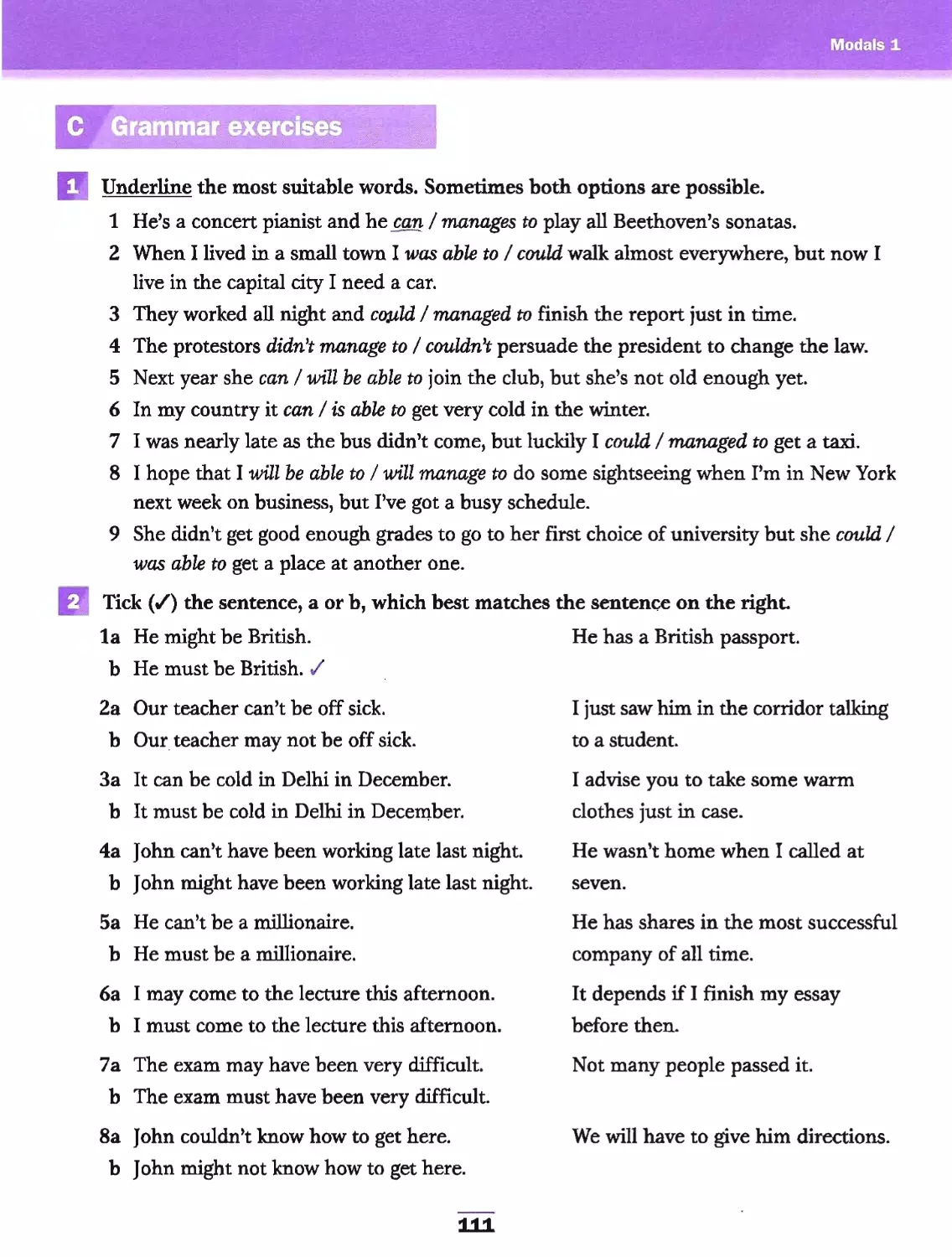
13 Modals 1
ability; possibility; alternatives to modals..............................................................  107
Test practice: Listening Section 4......................................................................    113
14 Modals 2
obligation and necessity; suggestions and advice; adverbs........................................  114
Test practice: General Training Reading ...........................................................120
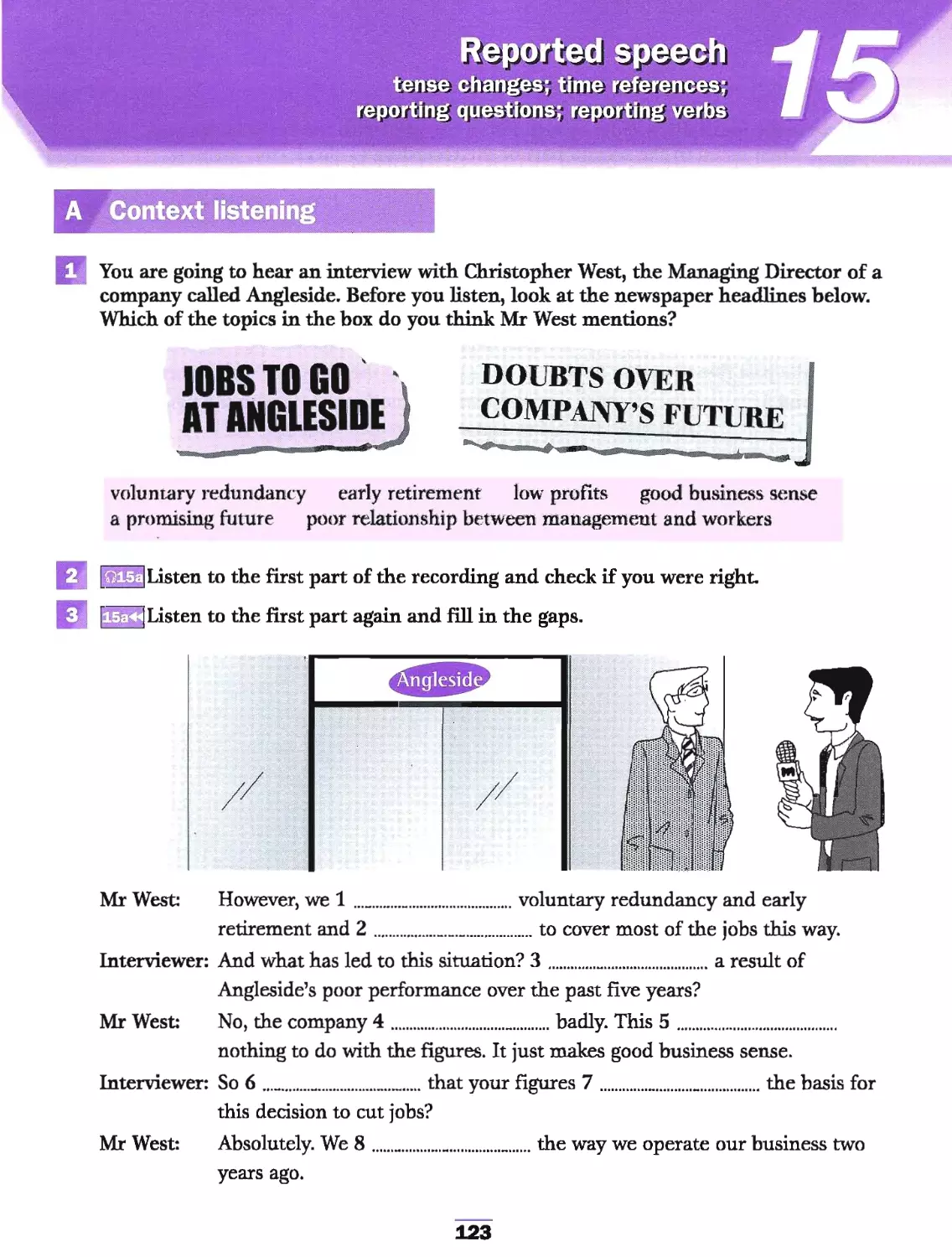
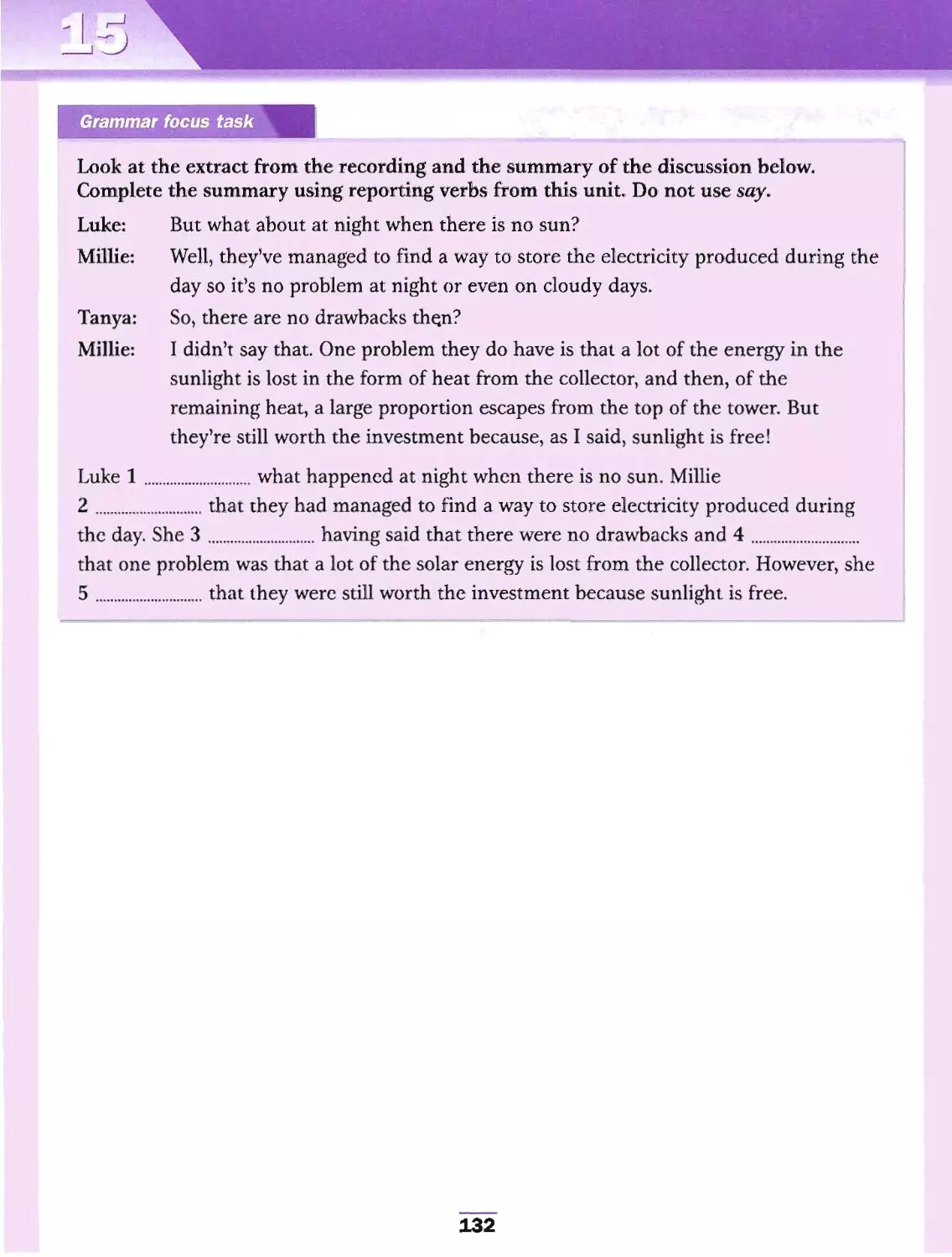
15 Reported speech
tense changes; time references; reporting questions; reporting verbs...............................  123
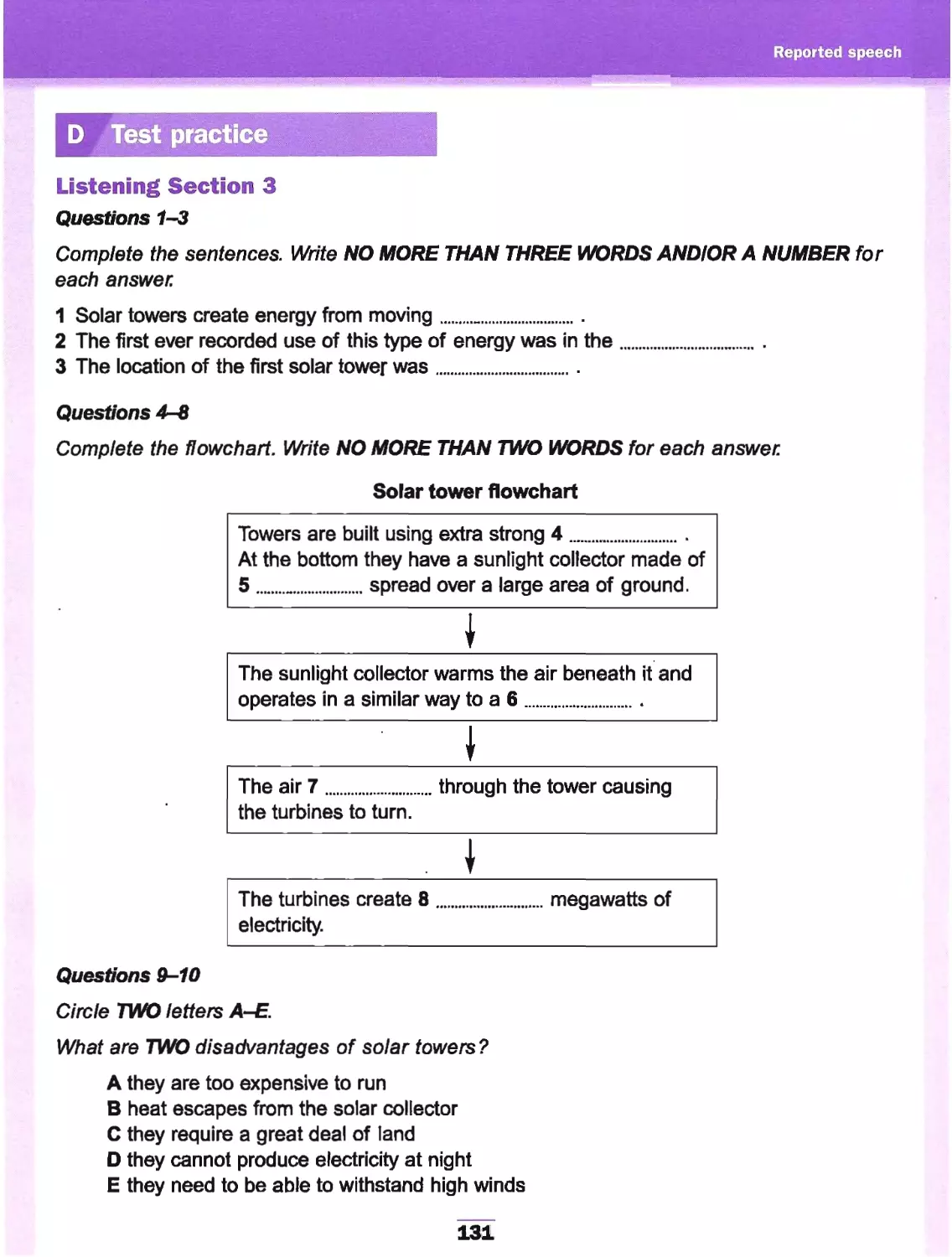
Test practice: Listening Section 3...................................................................131
16 Verb + verb patterns
verb + to-infinitive; verb + -ing] verb + preposition + -ingj verb + infinitive without to....................133
Test practice: Academic Reading...............................................................................140
17 Likelihood based on conditions 1
zero, first and second conditionals; other ways to introduce a condition.............................  144
Test practice: Academic Reading........................................................................150
18 Likelihood based on conditions 2
third conditional; mixed conditionals; wishes and regrets; shoidd(rit) have............................154
Test practice: Academic Reading........................................................................160
19 Prepositions
prepositions after verbs, adjectives and nouns; prepositional phrases................................164
Test practice: Listening Section 2................................................................   171
20 Relative clauses
relative pronouns; defining and non-defining relative clauses; prepositions.....................173
Test practice: Academic Reading.................................................................180
v
21 Ways of organising texts
subject choice; introductory if, ellipsis; organising information; it- and what-dauses...........184
Test practice: Academic Writing Task 2.........................................................  190
22 The passive
the passive; reporting with passive verbs; have something done, need + -ing............................................................. 191
Test practice: Academic Writing Task 1.................................................................197
23 Linking ideas
conjunctions, adverbials and prepositions; linking expressions.................................... 198
Test practice: Academic Reading....................................................................206
24 Showing your position in a text
pronouns; adverbs; verbs; adjectives................................................................  210
Test practice: Academic Writing Task 2............................................................    215
25 Nominalisation in written English
forming nouns from other parts of speech (verbs, adjectives and linking words)...............216
Test practice: Academic Writing Task 1.....................................................  222
Key..........................................................................................223
Recording scripts............................................................................240
Appendix 1: Irregular verbs..................................................................256
Appendix 2: Phrasal verbs....................................................................257
CD tracklist................................................................................ 258
vl
Introduction
To the student
Who is this book for?
This book is for anyone preparing for IELTS.
Although the IELTS test does not include a
specific grammar module, it is important to
be able to recognize and use grammar
appropriately. This book covers the grammar
you will need to be successful in the test. You
can use it to support an IELTS coursebook,
with a general English language course for
extra grammar practice, or with practice tests
as part of a revision programme. You can use
it in class or for self-study.
How do I use this .book?
There are two ways to use this book. You can
either start at Unit 1 and work through to the
end of the book, or you can do the Entry test
on page ix to find out which units you need
most practice in and begin with those.
What is in this book?
This book contains 25 units. Each unit is in
four parts:
A: Context listening This introduces the
grammar of the unit in a context that is
relevant to the IELTS test. This will help you
to understand the grammar more easily when
you study section B. It also gives you useful
listening practice. Listen to the recording and
answer the questions. Then check your
answers in the Key before you read the
Grammar section.
B: Grammar Read through this section
before you do the grammar exercises. For
each grammar point there are explanations
with examples. You can refer back to this
section when you are doing the exercises.
C: Grammar exercises Write your answers to
each exercise and then check them in the Key.
D: Test practice Each unit has a test task.
These help you practise the different parts of
the test. The test task is followed by a
grammar focus task, which gives you extra
practice in the grammar from the unit.
The Key
The Key contains:
	answers for all the exercises. Check your
answers at the end of each exercise. The
Key tells you which part of the Grammar
section you need to look at again if you
have any problems.
	sample answers for exercises where you
use your own ideas to help you check your
work.
	test tips for each exercise type in the Test
practice section.
	sample answers for all the writing tasks in
the Test practice section. Read these after
you have written your own answer. Study
the language used and the way the ideas
are organised.
Recording scripts
There are recording scripts for the Context
listenings in each unit and for the Test
practice listening tasks. Do not look at the
script until after you have answered the
questions. It is a good idea to listen to the
recording again while you read the script.
The Entry test
You can do this test before using the book to
help you choose what to study. Answer the
questions and then check your answers in the
Key. The Key tells you which units are most
important for you.
vii
To the teacher
This book offers concise yet comprehensive
coverage of the grammar necessary in order
to be successful in the IELTS test. It can be
used for self-study or with a class. It will be
particularly useful for a class where all the
students are preparing for IELTS. It will also
be useful for revision, and for candidates in
classes where some students are not entered
for the test, as sections A, В and C are
designed to be useful for all students.
The Entry test
The Entry test can be used diagnostically as a
means of prioritising the language areas to be
covered, either for a class, or for individual
students.
A:	Context listening This section is suitable
for classroom use. Many of the tasks can be
done in pairs or small groups if appropriate.
B:	Grammar This section is designed for
private study, but you may wish to discuss
those parts which are particularly relevant to
your students’ needs.
C:	Grammar exercises This section can be
done in class or set as homework. Students
can be encouraged to check their own work
and discuss any difficulties they encounter.
D: Test practice This section can be used to
familiarize students with the test task types
while offering further practice in the
grammar for each unit. Each task is followed
by a Grammar focus task, designed to raise
students’ awareness of a particular language
point covered in that unit. The book contains
at least one task from each part of the
Listening, Academic Reading, General
Training Reading, Academic Writing and
General Training Writing modules.
In classes where there are students who are
not entered for the test, you may prefer to set
Section D tasks as extra work for IELTS
candidates only. However, they offer all
students valuable opportunities to practise
the grammar of the unit and provide an
effective teaching resource for EAP classes.
vfli
Entry test	Л
A
You can do this test before using the book to help you choose what to study. Choose the correct
answer, A, В or C, for each question. When you have finished, check your answers on page 223.
The key tells you which units are most important for you.
1	Most university students.......on
campus in their first year.
A lives
В live
C are living
2	From this graph we can see that the
economy..............at the moment.
A improves
В improve
C is improving
3	They..........persona] computers
when my father was a student.
A hadn’t
В didn’t have
C weren’t having
4	I.........want to be a practising
doctor but now I’m more interested in
research.
A was used to
В used to
C would
5	The teacher.........us how to do the
experiment when the fire bell rang.
A showed
В shown
C was showing
6	I finished my essay yesterday but
............it	in to the tutor yet.
A I’ve given
В I haven’t given
С I didn’t give
7	.........the experiment three times
now with different results each time!
A We’ve done
В	We did
C We’ve been doing
8 When I arrived the lecture..........so
I didn’t find it easy to follow.
A started
В had started
C had been starting
9 She............well at school but that
changed when she became friends with
a different group of girls.
A did
В had done
C had been doing
10 .........the doctor at 2.00 this
afternoon so I can’t go to the lecture.
A I’m seeing
В I see
С I will see
11	My sister.........economics and
politics when she goes to university.
A is going to study
В studies
C will study
12	While we’re working on the project our
boss............on a beach in Greece!
A will sit
В will have sat
C will be sitting
lx
13	If the trend continues, the average
income...............by 107% by 2020.
A will increase
В will have increased
C will be increasing
14	You can base your geography
assignment on..............country - it
doesn’t matter which.
A a
В some
C any
15	There aren’t........places left on
the course so you’d better apply soon.
A much
В many
C lots of
16	I don’t know whether to accept the job
offer. It’s.............
A a difficult decision
В the difficult decision
C difficult decision
17	For those of you new to the company,
this leaflet is full of..........
A a valuable information
В the valuable information
C valuable information
18	The manager interviewed..........
candidates in turn.
A each of the
В each
C every
19	I know it’s not much of a present but I
made it................
A me
В myself
C by myself
20	You should visit Bath. It’s......
city.
A a historical and interesting
В a historical interesting
C an interesting historical
21	The government has released some
............data showing how schools are
not providing an adequate education to
our children.
A shocking
В shock
C shocked
22	You really should go to Namibia. The
scenery is............stunning and the
people are very friendly.
A very
В fairly
C absolutely
23	This factory produces some of
............cameras in the world.
A best
В the best
C the most best
24	.........people live in the countryside
than 100 years ago.
A Less
В Few
C Fewer
25	The bookshop...........the end of the
road is excellent.
A at
В on
C in
Entry test
26	There were millions of people around
the world.............the football match
live on television.
A watched
В watching
C were watching
27	Scientists finally.......find a cure
for the disease after years of research.
A managed to
В can
C could
28	She got a terrible mark in the exam so
she..............very hard at all.
A mustn’t have worked
В can’t have worked
C didn’t work
29	What.........in order to get a permit
to work in your country?
A do I need to do
В must I do
C ought I do
30	When you write your essays you
.............copy ideas from books
without referencing them properly.
A mustn’t
В don’t have to
C have to
31	Doctors have.........us to cut down
on salt in our diets if we want to reduce
the risk of getting heart disease.
A insisted
В suggested
C advised
32	........this newspaper report, more
women smoke than men nowadays.
A Apparently
В According to
C Supposedly
33	My parents encouraged.........this
course.
A me to do
В me doing
C me do
34	What will you do if.......
A you don’t get a good IELTS score?
В you didn’t get a good IELTS score?
C you won’t get a good IELTS score?
35	A recent government report has warned
that............we act immediately to
reduce pollution, there will be serious
consequences for the planet.
A provided that
В in case
C unless
36	If I didn’t have to work tonight,.....
A I’d be able to relax now.
В I’m able to relax now.
C I’ll be able to relax now.
37	I wish that man........tapping his
fingers on the table. It’s really
annoying me.
A stopped
В had stopped
C would stop
38	I’m aiming......... a band 7 in IELTS.
A on
В for
C to
xi
39	Do you have any knowledge..........
how our education system works?
A of
В on
C for
40	The minister.........is responsible
for education has just resigned.
A which
В who
C what
41	The University of St Andrews.......
is the oldest university in Scotland.
A which was founded in 1413
В , which was founded in 1413,
C , that was founded in 1413,
42	Many children these days do not have a
healthy diet............is possible that
this is because less healthy foods are
cheaper than healthy ones.
A What
В That
C It
43	The charity is trying to find ways to
save and............the world’s
endangered animal species.
A the charity is trying to find ways to
protect
В to find ways to protect
C protect
44	In the past we threw a lot of our
kitchen waste away, but today many
items such as plastic bottles and
newspapers................
A are recycled
В recycle
C need recycling
45	I can’t pick you up from the station on
Wednesday because...............on that
day.
A I’m fixing my car
В I’m having my car fixed
С I need my car fixed
46	These drugs are the best medicine
available as a treatment at the moment,
............they are expensive,
unfortunately.
A although
В because
C so
47	Learning a foreign language is important
because it helps you to understand other
cultures better............it can be a
useful skill in many areas of work
A However,
В Despite this,
C In addition,
48	.........I can’t go to the conference as
I’ve got to go to Sydney on business.
A Frankly
В Unfortunately
C Personally
49	.........I think it’s useful to write an
outline of your essay before you start to
write the first draft.
A Interestingly,
В Definitely,
C Personally,
50	The..........of dark red spots is one
of the first signs of the disease.
A appearance
В appearing
C appear
Present tenses
present simple; present continuous; state verbs
A Context listening
You are going to hear a woman interviewing a student for a survey about what people
do in their free time. Before you listen, look at the pictures. Which activities do you
think the student does in his free time?
Listen and check if you were right.
□ Listen again and decide if the following statements are true or false. If a
statement is false, write the correction.
1	Peter is waiting for his friends..................................................
2	He isn’t studying much this month.............................................. -
3	His parents own a shop..................-.......................—.................
4	He practises the guitar most mornings....................-..........._.....—......
5	He frequently uses the Internet.........................._........................
6	His cousin is living in America at the moment.....................................
7	Peter doesn’t support any football teams.........................-............. —
Look at your answers to Exercise 3 and answer these questions.
1	Which sentences are about a situation that is permanent or a fact?......
2	Which sentences are about everyday habits?.........
3	Which sentence is about an action happening at the moment of speaking?..........
4	Which sentences are about a temporary situation? ........
В Grammar
1 Present simple
verb/verb + (e)s
do/does not + verb
do/does... + verb?
He plays tennis.
She doesn't play tennis.
Do you play tennis?
We use the present simple
♦	to talk about regular habits or repeated actions:
I get up really early and practise for an hour or so most days.
I use the Internet just about every day.
Words that describe how often or when are often used (e.g. always, generally, normally,
usually, often, sometimes, rarely, never, every day, every evening).
♦	to talk about permanent situations:
My parents own a restaurant.
A We use the present perfect, not the present simple, to say how long something has
continued:
I have worked there since I was 15. (not I work there since I was 15 : see Unit 3)
♦	to talk about facts or generally accepted truths:
Students don't generally have much money.
If you heat water to 100°C, it boils, (see Unit 17)
The following words are often used: generally, mainly, normally, usually, traditionally.
♦	to give instructions and directions:
You go down to the traffic lights, then you turn left.
To start the programme, first you click on the icon on the desktop.
♦	to tell stories and talk about films, books and plays:
In the film, the tea lady falls in love with the Prime Minister.
2 Present continuous
В
ат/is/are + verb + -ing
am/ts/are not + verb + -ing
am/is/are ... + verb + -ing?
He’s living in Thailand.
I'm not living in 'Thailand.
Are they living in Thailand?
We use the present continuous
♦	to talk about temporary situations:
Pm studying really hard for my exams.
My cousin is living in Thailand at the moment. (= he doesn’t normally live there)
Words like at the moment, currently, now, this week/month/year are often used.
♦ to talk about actions happening at the moment of speaking:
Pm waiting for my friends.
2
Present tenses
♦	to talk about trends or changing situations:
The Internet is making it easier for people to stay in touch with each other.
The price of petrol is rising dramatically.
♦	to talk about things that happen more often than expected, often to show envy or to criticise
with words like always, constantly, continually, forever:
My mum’s always saying I don’t help enough! (complaint)
He’s always visiting exciting places! (envy)
3 State verbs
The present continuous is not normally used with state verbs because the meaning of the verb
itself is a general truth rather than something temporary. These verbs describe thoughts,
feelings, senses, possession and description.
Here are some examples of state verbs.
♦	thoughts: agree, assume, believe, disagree, forget, hope, know, regret, remember, suppose, think,
understand
I assume you’re too busy to play computer games.
♦	feelings: adore, despise, dislike, enjoy, feel, hate, like, love, mind, prefer, want
Do you mind if I ask you a few questions?
I love music.
♦	senses: feel, hear, see, smell, taste
This pudding smells delicious.
A To talk about something happening now we use can:
I can smell something burning.
♦	possession: have, own, belong
My parents own a restaurant.
♦	description: appear, contain, look, look like, mean, resemble, seem, smell, sound, taste, weigh
You look like your mother. (= a permanent situation, not a temporary one)
A Some state verbs can be used in the continuous form when the meaning is temporary.
Compare:
What are you thinking about? (now)
I think you should tell her exactly what happened, (my opinion, so not temporary)
I’m tasting the sauce to see if it needs any more salt.
The sauce tastes delicious.
She’s having a great time, (is having = is experiencing, not possession)
Students don’t generally have much money, (have = possession)
3
C Grammar exercises
□ Choose the best endings for sentences 1-8.
1	Fiona is watching television	(a) b	because her favourite film star is on. when she has time.
2	I’m having my lunch	a b	at one o’clock every day. early today as I have an appointment.
3	I do the shopping	a b	at the same time every week, today for a friend who’s ill.
4	What are you doing	a b	to your sister when she behaves badly? to your sister? Leave her alone!
5	I wear casual clothes	a b	at the weekend. because we’re having a party at lunchtime.
6	Teachers work hard	a b	to get the concert ready for next week, but they get long holidays.
7	The company’s financial situation is improving	a b	now that it has a new Chief Executive. when there is greater demand for its products.
8	Serge is thinking of retiring early	a b	every time something bad happens at work, because he isn’t happy at work any more.
В Fill in the gaps with the correct form of the verbs in brackets.
1	I’m busy right now. I	......(fill in) an application form for a new job.
2	My tutor........................(see)	me for a tutorial every Monday at two o’clock.
3	John......................(not/study)	very hard at the moment. I......................
(not/thirik) he’ll pass his exams.
4	‘What.......................(he/do)?’	‘He...................(try)	to fix the television
aerial.’
5	Animals.....................(breathe	in) oxygen and..................(give out)
carbon dioxide.
6	Be quiet! I...................(want)	to hear the news.
7	In my country we.....................(drive) on the right-hand side of the road.
8	My friend Joe’s parents...................(travel)	round the world this summer, and
probably won’t be back for a couple of months.
9	The college....................(run)	the same course every year.
10	Numbers of wild butterflies....................(fall) as a result of changes in
farming methods.
4
Present tenses
| Fill in the gaps with the verbs in the box in the correct present tense.
agree catch up cause have go up know think use-
We 1...............energy for three main things: electricity production, heating and
transport. For the first two, we 2...............options such as solar and wind power,
or natural gas. But oil is still the world's number one source of energy, and for transport
at least, there is currently no alternative. In China, domestic energy consumption
3..............year by year and demand in similar regions 4...................fast. We
5..............how to use energy more efficiently now than in the past but the worldwide
rise in demand 6................concern amongst experts. Some experts 7...................that
oil supplies will start to fall within the next twenty years. Most experts 8..............that
we need to find a new source of energy soon.
г Look at the following extracts. There are six incorrect verbs. Find and correct them.
1	2	3	4	5
From the, graphs, ojc, are, seeing that the, number
of e,mploye,e,S e,mp!oye,d by th is firm inare,ase,s
The. sun heats the tjround Ths is warming the air
nearby and ihe warm air rises into the sky. the air
is kisin<jj rt becomes cooler and tta water vapour inside
rt change into droplets of water. These jpm together to
form a cloud.
e,ach ye,ar and the, numbe,r of e,mploye&S leaving
after less than five, years decreases.
1	4
2 ............................................. 5	........
3 ............................................. 6	........
5
D Test practice
Listening Section 1
Questions 1-3
Choose the correct letter, A, В or C.
Example
Which sport is the woman interested in?
A gymnastics
(B)swimming
C tennis
1	How long is the heated pool?
A 15 metres
В 25 metres
C 50 metres
2	Which of these is free for all members?
A the beginners swimming class
В the training session
C the keep-fit class
3	Which of these does the woman need to book?
A swimming lanes
В gym equipment
C sauna
6
Present tenses
Questions 4-10
Complete the notes below.
Write NO MORE THAN THREE WORDS ANDIOR A NUMBER for each answer.
ГТТТТТТТГГГГГГГГГГГГГГГГЯЯГТ
Yoga classes
•	held on Monday, 4.  and.....mornings
•	weekend evenings from 5    .to „
•	attend 6 ....per	week
•	see instructor to change 7...
•	cost £1.50
Meet John 8.;...
Office located on first floor
Meet at 9...tomorrow
Tel: 10......
Look at the following extracts from the conversation and underline the tenses that the
speakers used.
1	I’m wanting / want to do some sports activities.
2	Our tennis team are always looking / always look for new people.
3	Are members having to I Do members have to pay to use the pools?
4	We’re not actually allowing I don’t actually allow anyone to book the swimming lanes or
the gym equipment.
5	What time is suiting / suits you?
6	Great, well, I’m thinking / think that’s everything.
7
Past tenses 1
past simple; past continuous; used to; would
A Context listening
Г You will hear a man giving a talk on the radio about protecting your home from
burglaries. Before you listen look at the pictures below. Make a list of all of the items.
1
2
Listen and answer the following questions.
Which three items from your list were stolen?
Why did the man tell this story?
A to show that crime has increased
В to show that crime can happen at any time
C to show that burglars can open any lock
Щ Listen again and complete these sentences.
1	A few weeks ago a woman..............to report a burglary.
2	It............at	five in the afternoon when she............the	news on TV.
3	This woman..............the front door locked.
4	When her son got older she...........the door unlocked whenever she was at home.
5	The burglar simply............in through the front door.
6	The son.............anything because he..............to	music.
7	Then the burglar.............into	the front room,..........all	the cupboards and
.............a	valuable collection of CDs.
Look at sentences 1-7 above and answer the following questions.
1	Which two sentences provide a background scene and an action?...............
2	Which two sentences talk about a single completed action in the past?...........
3	Which sentence describes a series of completed actions in the past?...........
4	Which two sentences talk about a repeated action in the past?...........
5	Which four tenses or structures are used in sentences 1-7?............
S
Past tenses 1
В Grammar
1 Past simple
verb + -ed (or -d)
did not + verb
did... + verb?
He worked for die police.
She didn’t work for rhe police
Did they work for the police?
A Irregular verbs
Many verbs are irregular: went (go), came (come), wrote (write) (see Appendix 1)
Note the verb be is irregular: Uhe/she/it was-, you/we/they were
We use the past simple
♦	to talk about single past completed actions. Often the time is mentioned:
A few weeks ago a woman called to report a robbery at her house.
But no time reference is necessary if it is already known:
How did the burglar break in without anybody hearing him? (in the story I just told you about)
♦	to give a series of actions in the order that they happened:
The burglar came in through the front door, picked up the woman’s handbag, emptied it out
and stole her purse.
he came in picked up emptied and stole
the handbag it out her purse
fill	|
THE PAST	NOW
We often use words like next or then to indicate the sequence of events:
Then, the burglar went into the front room, opened all the cupboards and took a valuable
collection of CDs.
♦	to talk about past repeated actions:
When her son got older he often went out to visit his friends after school.
Notice that used to and would can also be used (see B3).
♦	to talk about long-term situations in the past which are no longer true:
Bill Murphy worked for the police force for over 17 years.
he worked for the police force for over 17 years
-*--------------17 YEARS-------------►	NOW
Explorers at that time believed that the world was flat.
Notice that used to can also be used (see B3).
9
2 Past continuous
wos/wre + verb + -ing
was/were not + verb + -ing
was/were ... + verb + -ing?
She was watching the news.
They weren't watching the news.
Were you watching the news?
We use the past continuous
♦ to provide the background scene to an action or event (usually in the past simple). We often
use words like when, while and as:
It happened at five in the afternoon while she was watching the news on TV.
He was doing his homework in his bedroom when the burglar came into the house.
NOW
THE PAST
I
the burglar came into the house
It is possible to have more than one background scene happening at the same time:
He was listening to music and working on his computer.
♦ when we want to emphasize the activity without focusing on its completion. Compare:
For a while last year I was working at the cinema, studying for my degree and writing a
column for the local newspaper, (we don’t know if the actions were completed or not, or
whether they happened at the same time)
Last year I worked at the cinema, studied for my degree and wrote a column for the local
newspaper, (suggests all of the jobs are now complete, and probably happened in that order)
A State verbs (see Unit 1) do not generally have a continuous form.
3 Used to and would
used to / would + infinitive
did not + use to + infinitive
did ... use to + infinitive?
She used to / would lock the door.
I didn 't use to lock the door.
Did they use to lock the door?
We use used to + infinitive or would + infinitive (contracted to W in spoken English) to talk
about past repeated actions:
She used to keep the front door locked, (but she stopped doing this)
She would leave the door unlocked whenever she was at home.
A Would is unusual in the negative form and in Yes/No questions.
We use used to + infinitive to talk about permanent situations that are usually no longer true:
Bill Murphy used to work for the police force, (but he doesn’t now: not Btft Mttrpky would work
for the pelieefbreez)
We do not use used to Uwe want to talk about how long the situation lasted:
Bill Murphy worked for the police force for over 17 years, (not BUI Mttrpky used to work-for the
pekee foree-fer ever U-yearsT)
A We do not use would with state verbs.
10
Past tenses 1
C Grammar exercises
ЕУ Fill in the gaps in this model answer with verbs from the box in the past simple.
Thanks to modern technology; there have been enormous changes In the
workplace over the past 100 years.
What are the most significant changes that have occurred and what changes
do you foresee In the next 100 years?
allow be be be invent increase lay
mean own receive replace ride take walk
The pace of change in the world of technology is amazing. If 1.(not)
long ago that the postal service 2......„...oar only way to communicate
over any distance. It 3...........  days	and sometimes weeks to receive letters
from within the same coantry. As a resalt the news in the letters 4________
already oat of date when people 5..............them. In the workplace, this
6................    that	business was mostly conducted locally, over relatively
short distances
When Alexander Graham Bell 7............ the
telephone in 1876 it 8.........„„ the
foundation for the communication systems we
have today. The telephone 9 .............two
people to communicate instantly across a great
distance Eventually computers 10........_.....
typewriters and dramatically 11............
the speed of our daily work life Nowadays the
Internet is an essential part of every business
However, it is not just communications that have
changed. Only 50 years ago most people 12
............_. (not) a can People 13
______________..to work or 14...........
bicycles Changes in travel as well as the
increased speed of communications have led to
the global business world that we
have today.
2
3
Fill in the gaps with the past simple or past continuous form of the verbs in brackets.
In which gaps could you use used to?
11.......had......(have) a wonderful biology teacher, Mrs Hughes. She 2..................
(make) us excited about the subject because she was so interested herself. I remember
one lesson in particular; we 3...............(study)	different types of plants, and Mrs
Hughes 4..................(describe) the different parts of the flower. She 5............
(pick up) a purple flower, I can’t remember exactly what it was, and then suddenly we
6.................(notice) that she 7...............(сту)! She 8................(apologise)
and 9.................(say) that sometimes nature was so beautiful it just made her cry! We
10................(not/know) what to do at first, but it certainly 11.............(make)
us think. Something similar 12..................(happen)	while she 13..............
(show) us how to work the microscope. She 14.................(examine) a slide of
some plant tissue and she 15.................(smile)	all over her face. She suddenly
16................(get) all excited and 17...............(say),	‘Isn’t it wonderful?’ Some
students 18...............(laugh) at her when she 19..................(not/look)	but I
didn’t. Somehow her enthusiasm 20...................(inspire) me, and 121................
(start) to like biology.
A teacher and student are talking about local customs. Fill in the gaps with the verbs in
brackets in the correct form. Use would or used to where possible.
Teacher: What sort of things 1 ... djd ..you.,.use„ +o. do.. (you/do) as a child?
Yoko: Oh, when I was a child growing up in Japan there were many customs that we
2..............................(follow). For example, I remember we 3....................
(move) house when I was seven and we 4....................(visit)	our new
neighbours with gifts. At that time the tradition was that people 5
..................(give) gifts of Japanese noodles, but it is different now and
people tend to give things like soap or towels or nothing at all.
Teacher: 6.....................(have) one tradition that you particularly remember?
Yoko: Yes, one tradition that I 7....................(really/like)	was in the spring when
the cherry blossoms were out. As a family we 8....................(go)	into the
countryside and we 9......................(spend) the day eating, drinking and
singing. One year my father 10....................(take)	a lovely photo of me
and my sisters and I still keep that picture on my wall today.
Teacher: And 11.....................(you/have to) do anything you didn’t like?
Yoko: Yes. I remember how we 12...........................(have	to) clean the house
thoroughly. This ceremony is called Osoji and my sisters and I
13...................(not/look forward to) it very much!
12
Past tenses 1
c Read the test task and a student’s response. Tick (/) the underlined verbs if they are
right, and correct them if they are wrong.
Describe an unforgettable trip you once made.
You should say:
where you went
why you went there
what happened
and explain why you remember it so well.
I remember a trip I once 1 made to my
grandmother’s house. She 2 would live about 30
kilometres away from us and we 3 used to going
there quite often with our mother. On this occasion
we 4 set off to my grandmother’s after school on a
cold winter’s day. When we were about to leave we
5 were noticing that some snow was beginning to fall,
and as we 6 were driving along we 7 were realising
that it 8 snowed more and more heavily. Suddenly
we had to brake hard as the car in front stopped
suddenly. We 9 were skidding and 10 went off the
road into a ditch! It was pretty scary, but we were
lucky and none of us were hurt. We got out of the
car, and my mother 11 was phoning for help on her
mobile phone. While we 12 were waiting for help it
13 was stopping snowing and we 14 sang lots of songs
to keep ourselves cheerful. Eventually the truck
15 was coming and pulled our car out of the ditch.
The car wasn’t badly damaged, but we 16 decided to
turn round and go home. We didn’t manage to see
our grandmother that day, but it was so frightening
that I will never forget it.
1		<...............
2	..................
3	..................
4	..................
5	..................
6	..................
7	..................
8
9	..................
10	...................
11	...................
12	...................
13	...................
14	...................
15	...................
16	...................
13
D Test practice
Academic Reading
You should spend about 20 minutes on Questions 1-13 which are based on the Reading
Passage below.
Jumping spiders
Peter Aldhons examines how Portia spiders catch their prey
A
For a stalking predator, the element of surprise is
crucial. And for jumping spiders that sneak onto other
spiders' webs to prey on their owners, it can be the
difference between having lunch and becoming it.
Now zoologists have discovered the secret of these
spiders' tactics: creeping forward when their prey's
web is vibrating.
В
The fifteen known species of Portia jumping spiders are relatively small, with adults
being about two centimetres long (that's smaller than the cap on most pens). They
habitually stay in the webs of other spiders, and in an area of these webs that is as out-
of-the-way as possible. Portia spiders live mostly in tropical forests, where the climate is
hot and humid. They hunt a range of other spiders, some of which could easily turn the
tables on them. 'They will attack something about twice their own size if they are really
hungry,' says Stimson Wilcox of Binghamton University in New York State. Wilcox and his
colleague, Kristen Gentile of the University of Canterbury in Christchurch, New Zealand,
wanted to find out how Portia spiders keep the upper hand.
C
All jumping spiders have large eyes that look like binocular lenses, and they function
pretty much the same way Most jumping spiders locate their prey visually, and then
jump and capture from one centimetre to over ten centimetres away. Only a few species
of jumping spiders invade the webs of other spiders, and the Portia spider is among
them. Jumping spiders, including Portia spiders, prey on insects and other arthropods by
stalking. Sometimes the spiders lure their victims by vibrating the web to mimic the
struggles of a trapped insect. But many web-weaving spiders appear to be wise to these
14
Past tenses 1
tricks, so stalking is often a better strategy. Sometimes, the researchers found, Portia
spiders take advantage of the vibrations created in the web by a gentle breeze. But, if
necessary, they will make their own vibrations.
D
The researchers allowed various prey spiders to spin webs in the laboratory and then
introduced Portia spiders. Ib simulate the shaking effect of a breeze the zoologists used
either a model aircraft propeller or attached a tiny magnet to the centre of the web which
could be vibrated by applying a varying electrical field. The researchers noticed that the
stalking Portia spiders moved more when the webs were shaking than when they were
still, and they were more likely to capture their prey during tests in which the webs were
periodically shaken than in those where the webs were undisturbed. If the spiders were
placed onto unoccupied webs, they would make no attempt to change their movements.
E
It is the Portia spider's tactic of making its victims' webs shake that has most intrigued
the researchers. They noticed that the spiders would sometimes shake their quarry's
web violently, then creep forwards up to five millimetres before the vibrations died
down. 'They'd make a big pluck with one of their hind legs,' says Wilcox. These twangs
were much more powerful than the gentler vibrations Portia spiders use to mimic a
trapped insect, and the researchers were initially surprised that the prey spiders did not
respond to them in any way. But they have since discovered that the violent twanging
produces a pattern of vibrations that match those caused by a twig falling onto the web.
F
Other predators make use of natural 'smokescreens' or disguises to hide from their prey:
lions hunting at night, for example, move in on their prey when clouds obscure the
moon. 'But this is the first example of an animal making its own smokescreen that we
know of,' says Wilcox. 'Portia spiders are clearly intelligent and they often leam from
their prey as they are trying to capture it. They do this by making different signals on
the web of their prey until the prey spider makes a movement. In general, Portia spiders
adjust their stalking strategy according to their prey and what the prey is doing. Thus,
Portia spiders use trial-and-error learning in stalking. Sometimes they will even take an
indirect route to reach a prey spider they can see from a distance. This can sometimes
take one to two hours following a predetermined route. When it does this, the Portia
spider is actually solving problems and thinking ahead about its actions.'
15
Questions 1-9
The Reading Passage has six paragraphs labelled A-F.
Which paragraph contains the following information?
Write the correct letter A-F next to Questions 1-9.
NB You may use any letter more than once.
1	the reaction of the Portia spider’s prey to strong web vibrations
2	a description of how the researchers set up their experiment
3	a comparison between Portia spiders and another animal species
4	an explanation of how the researchers mimicked natural conditions
5	a comparison between Portia spiders and their prey
6	the reason why concealment is important to Portia spiders
7	a description of the Portia spider’s habitat
8	the number of species of Portia spiders
9	an example of the Portia spider’s cleverness
Questions 10-13
Choose the correct letter, А, В, C or D.
10	In their laboratory experiments, the researchers found that the Portia spiders moved most
when the web was
A vibrating.
В motionless.
C undisturbed.
D unoccupied.
11	What discovery did the researchers make about Portia spiders?
A They make very strong vibrations with one leg.
В They move 5 mm at a time on a still web.
C They move slowly when vibrations stop.
D They use energetic vibrations to mimic a trapped insect.
16
Past tenses 1
12	Portia spiders are the only known animal to
A use the weather to disguise themselves.
В mimic other prey-eating animals.
C create their own smokescreen.
D stalk using ‘trial and error’.
13	The Portia spider demonstrates ‘thinking ahead’ when it
A chooses prey that is a short distance away.
В takes a longer route to reach its prey.
C reaches its prey in a short time.
D solves the problem of locating its prey.
Grammar focus task
Look at the underlined verbs in these sentences from the text. Match the sentences (1-3)
to the explanations (a-c).
1	The researchers allowed various prey spiders to spin webs in the laboratory and then
introduced Portia spiders.
2	Portia spiders moved more when the webs were shaking than when they were still.
3	They noticed that the spiders would sometimes shake their quarry’s web violently.
a a series of single past completed actions
b a repeated action in the past
c a background scene and an action
17
Present perfect
present perfect simple and continuous
A Context listening
в You are going to hear two university students, Carl and Sue, talking about an
assignment. Before you listen, look at the list of activities (A-F). Put the activities in
the order which you think is best when writing an assignment.
A make notes
В start to write
C do research
D make a plan
E re-read books
F get a book list
F Listen to the first part of the conversation. Which five activities does Sue
mention? Write the letters A-F in the correct order in boxes 1-5 on the flowchart.
1		2		3		4		5
F |- : | Listen to the second part of the conversation and fill in the gaps.
1	Sue: I.................plenty	of information for the assignment.
2	Sue: When I was in the library last week, I..............those	leaflets.
3	Carl: I................tired	since I started this course!
4	Carl: I..................and	I’m already tired.
F Look at your answers to Exercise 3 and find examples of each of the following:
a something that only happened recently......
b something that happened at some time before now, but we do not know when........
c an action + the length of time it has been going on...
d something that happened at a stated time in the past....
Which tense is used in each of the examples а-d above?
18
Present perfect
В Grammar
We use the present perfect when we want to show a link between the present and the past.
1 Present perfect simple
have/has + past participle
have/has not + past participle
have/has ... + past participle?
She's started the assignment.
[ haven't started the assignment.
Have you started the assignment?
We use the present perfect simple
♦	to talk about a time period that is not finished (e.g. today, this week)-.
I've written a rough plan this morning, (it is still morning)
I’ve written a rough plan	NOW
I	I
THIS MORNING
♦	to show that something happened at some point in the past before now. We don’t state when
it happened:
I’ve collected plenty of information, (at some point before now and 1 will use it to write my
essay)
The following time expressions are often used: ever, never, before, up to now, still, so far.
It’s the longest I’ve ever had to write, (at any point before now)
A If we state when something happened we must use the simple past:
I wasted a lot of time last week, (not I have wasted a let ef-time- last week)
♦ to talk about a present situation which started in the past, usually with for/since:
I’ve worked really hard
for the last two weeks NOW
I’ve worked really hard for the last two weeks. (I’ve worked hard till now)
We use/or with a length of time (e.g. for two hours, for three days, for six months) and since
with a point in time (e.g. since 2001, since Monday, since ten o’clock, since I was four, since I
started the course).
♦	to talk about something that happened at an unstated time in the past but is connected to
the present:
I’ve read all the books on the reading list. (I have the notes now)
The following time expressions are often used: recently, just, already, and yet with negatives
or questions.
I’ve just got up.
Have you written your assignment yet?
19
Compare the use of the present perfect with the past simple:
Present perfect
♦	links the past with the present:
I’ve made quite a lot of notes, (at some point
before now and I may make more notes)
♦	does not talk about a specific time in
the past:
Have you read the leaflet? (at some time
before now)
♦	uses time expressions that show the time
period is unfinished:
I’ve read six articles this week, (the week
isn’t finished)
Past simple
♦	only talks about the past:
I made notes on the most important things.
(when I did the reading and I’ve finished
making notes)
♦	states a specific past time, or the time is
understood:
I read the leaflets when I was in the library.
(I’m not in the library now and the reading
is finished)
♦	uses time expressions that show the time is
finished:
I read five books last week, (last week has
finished)
Note the position of the following time expressions that occur with the present perfect:
♦	between the auxiliary and main verb (e.g. recently, already, always, ever, just, never)
I’ve already written the notes.
I’ve just finished my essay.
Ever is generally used with questions or negatives:
Have you ever been to Buenos Aires?
♦	after the main verb (e.g. all my life, every day, yet, before, for ages, for two weeks, since 2003,
since I was a child etc.)
I’ve felt tired for weeks.
I haven’t flown before.
If there is an object clause, the time expression comes at the end:
I’ve gone to bed early every night since then.
I’ve written more than ten assignments since I started this course.
2 Present perfect continuous
Bhave/has been + verb + -ing
have/has not been + verb + -ing
have/has... been + verb + -ing?
I’ve been studying really hard.
He hasn’t been studying really hard.
Have you been studying really hard?
We can use either the present perfect simple or the present perfect continuous to say how long
a situation or activity has been going on (often with for or since):
I’ve felt tired for weeks.
I’ve been feeling tired since I started this course.
I’ve worked at the restaurant since I moved here.
I’ve been working at the restaurant for three years.
20
Present perfect
Compare the different uses of the present perfect simple and the present perfect continuous:
Present perfect continuous
♦	emphasises how long:
I’ve been reading for the past two weeks.
♦	focuses on the activity itself (it does not show
whether the activity is completed or not):
I’ve been writing my essay, (we don’t know if
the essay is finished or not)
Present perfect simple
♦	says how many times:
I’ve read three articles.
♦	focuses on the result or completion of the
activity:
I’ve written my essay, (the essay is finished
but we don’t know when)
What have you been doing? (the boy’s	What have you done? (the boy’s mother is
mother is interested in the activity that	interested in the result of the action: the
made him so dirty now)	broken window)
A. State verbs (see Unit 1) do not generally have a continuous form:
I’ve known them since I was a child, (not Pve been knowing tkem-sinee-Twas a-ehdd)
Grammar extra: This is the first time etc.
We use the present perfect tense with the following structures: it/this/that is the first / the
second / the best / the only I the worst...
Iris the first time I’ve ever had to write such a long assignment.
Is this the only time you’ve travelled abroad?
That’s the sixth cup of coffee you’ve had today.
21
C Grammar exercises
в Tick (/) the correct underlined verbs, and correct the verbs that are wrong.
I would like to be considered for your degree coarse in Зэо’оду Starting
in October next yean I feel I am a good candidate for this course as I
1 have always been interested in natural history and even as a child I
2 have enjoyed studying animals and insects in mg garden. Your science
faculty has a good reputation and I would very much like to be part of it
As you 3 already saw in Section A of this application, I have a good
academic record and 14 just received the results of my recant excm. ай of
which 5 have been excellent
In addition, your university attracts me because I enjoy sports and I
6 have read in your prospectus about the large number of sports on offer.
Last gear 17 have represented my school at badminton and 18 played in
football teams since I was eleven. 19 have recently joined a basketball team
which competes at a national level.
110 did not travel abroad much yet although as a young child 111 have been
to Singapore end Hong tong with ny fcmily. I realize that 112 have not spent
much time away from home up to now, but am keen to become more
independent
1		/.......
2	...enjoyed...
3
4	..........
5
6
7
8
9
10	...........
11	...........
12	...........
В Look at the chart and fill in the gaps with the past simple or present perfect simple of
the verbs in brackets to make true sentences.
22
Present perfect
1	The chart shows the percentage of British adults who............(use) the
Internet since 1995.
2	The number of women who have ever used the Internet.................(increase) by
more than 60% since 1995.
3	The percentage of men who have accessed the Internet.............(rise)	to 60%
in 2005.
4	The number of women to have accessed the Internet..............(rise)	each year.
5	The percentage of men who used the Internet...............(be)	greater than the
percentage of women from 1995 to 2005.
6	However, British women...............(overtake) British men in Internet usage since
2005.
7	The total number of people accessing the Internet..............(grow)	each year
although the most significant rise............(occur)	between 1995 and 2000.
F Underline the correct form of the verbs.
see q
To: ' Paul Johnson
From: . Sunita Soh
Subject: Seminar presentation on Friday
Dear Paul
1 I've just received / I've just been receiving your message to us all about the seminar on
Friday. 2 I've worked / I've been working on my presentation for the last week, and 3 have
now finished / now finished it, so I am happy to be one of the first to present it. However,
4 I've made /1 made an appointment to see the university careers advisor immediately after
the seminar, so I will need to leave on time.
I'd like some advice about my presentation. At last week's lecture 5 you've said / you said
that we should use visual aids as much as possible. 6 I haven't found /1 didn't find anything
to use. Is it essential? 7 I've done /1 did lots of presentations before, and I feel OK about
this one. In my last presentation 8 I used/1 have been using the overhead projector, and I
want to do this again - does this count as a visual aid?
One last question: 9 I've been /1 went to Professor Russell's lecture yesterday, and 10 have
been learning / learnt quite a lot that is relevant to this course. Is it okay to refer to another
course in my presentation? 11 I've been wondering /1 wondered about this - maybe it is
better to stick to the materials and references 12 you've given / you've been giving us. I
hope you can let me know.
Thanks for your help.
Sunita
Л
23
г Fill in the gaps with a verb from the box in the present perfect simple or present
perfect continuous. You will need to use some verbs more than once.
be do feel have live pass study start take travel want work
Interviewer: How long	(1 you) here?
Student:	I	(2)	in London for the past three years. I come from
Japan originally. I	(3)	at a college here since I arrived.
Interviewer: 	(4	you) any travelling over the past three years?
Student:	Yes, I	(5)	really lucky. I have long holidays so
1	(6)	all over Europe. I especially liked Spain.
Interviewer: What is the most interesting thing you	(7)	recently?
Student:	Well, I	(8)	to play tennis, and I	(9)
singing lessons for a few months now too. But the thing that I am most
proud of is that I	(10	just) my driving test. It’s the
first time I	(11)	it so I’m really pleased but
I	  (12	never) so nervous in all my life!
Interviewer: How do you think English will be useful in your life?
Student:	1	(13)	a Hospitality and Tourism course over here, so I
need English for my studies and my job. I	(14	always)
to work in the tourist industry because I	(15	always)
interested in history and cultural sites, and I	(16	already)
as a tour guide in my home town.
Now answer these questions about yourself.
17 How long have you been studying English?
18 Have you studied any other languages? (Which ones? For how long?)
19 Have you travelled very much? (Where have you been to?)
20 What have you been doing to prepare for this exam?
21 How has your life changed over the past ten years?
24
Present perfect
D Test practice
General Training Writing Task 1
You should spend about 20 minutes on this task.
You have seen an advertisement for a weekend Job as a local tour guide showing
visitors around your city,
Write a letter of application to the tourism office. In the letter
*	give your reasons for wanting the job
•	explain why you think you can do the job
•	describe any relevant experience you have
Write at least 150 words.
You do NOT need to write any addresses.
Begin your letter as follows:
Dear Sir or Madam,
25
Grammar focus task
Look at the model answer. Find one example each of:
1	a sentence which uses the present perfect simple to show something which started in the
past and is still going on
2	a sentence which uses the present perfect continuous to show something which started in
the past and is still going on
3	a sentence which uses the present perfect simple to show something happened at an
unstated time in the past but has a present result
Dear Sir or Madam.
I am writing to apply for the post of tour guide advertised on your website
I believe I fulfil all the necessary criteria, and very much hope that you will
consider my application.
I have lived in this town all my life and therefore know all about the places of
interest and their history. I have visited the castle and the cathedral many
times and I have read many guide books full of interesting historical facts. I
therefore feel that I am in a good position to lead visitors around these sites.
I have always been interested in history and over the past few years 1 have
regularly participated in activities at the castle and at other sites
Recently I have been working as a receptionist at a local hotel in the evenings
so I have experience of dealing with overseas visitors, and I enjoy talking
to them.
I do hope you will consider me for this post and I look forward to hearing
from you.
Yours sincerely,
26
Past tenses 2
past perfect simple; past perfect continuous
A Context listening
г You will hear a woman giving a talk on the famous composer, Mozart. Before
you listen match the words (1-10) with the correct meanings (a-j).
1	extraordinary	a	brother or sister
2	sibling	b	reach a high level in something
3	achievement	c	part of a piano or computer
4	keyboard	d	amazing
5	demand	e	status
6	master (verb)	f	success
7	gifted	g	very talented
8	in rapid succession	h	ask in a forceful way
9	reputation	i	fast development at a very early age
10	precocious	j	quickly one after another
2] Now listen and complete the notes below.
Name:
Wol-Fqqnq Amadeus Mozart
Date of birth:
1 .................................
Number of surviving brothers and sisters:
2 ................................
Profession of father:
3 ................................
Wrote first composition before the age of:
4	............................
Taught self to play:
5 ................................
Listen to the text again and fill in the gaps.
1	However, when Mozart...................five of his siblings.........._.....in
infancy or early childhood.
2	Mozart’s father, Leopold,.................a composer, and his grandfather
..................a musician.
3	In just 30 minutes Mozart.................the piece of music, which his father
..................into Nannerl’s notebook.
4	By the time he.................six, the little boy...............a composition
of his own.
5	They...................to Vienna and...................sensational reports of
Mozart’s talent.
6	His family..................richer	than they...............before.
For each sentence underline which event happened first.
Look at your answers to Exercise 3 and answer these questions.
1	Which tense is used in sentence 5 to show that the events took place in chronological
order?...........................
2	Which tense is used in the other sentences to show that the second event the speaker
mentioned actually happened first?........................
28
Past tenses 2
В Grammar
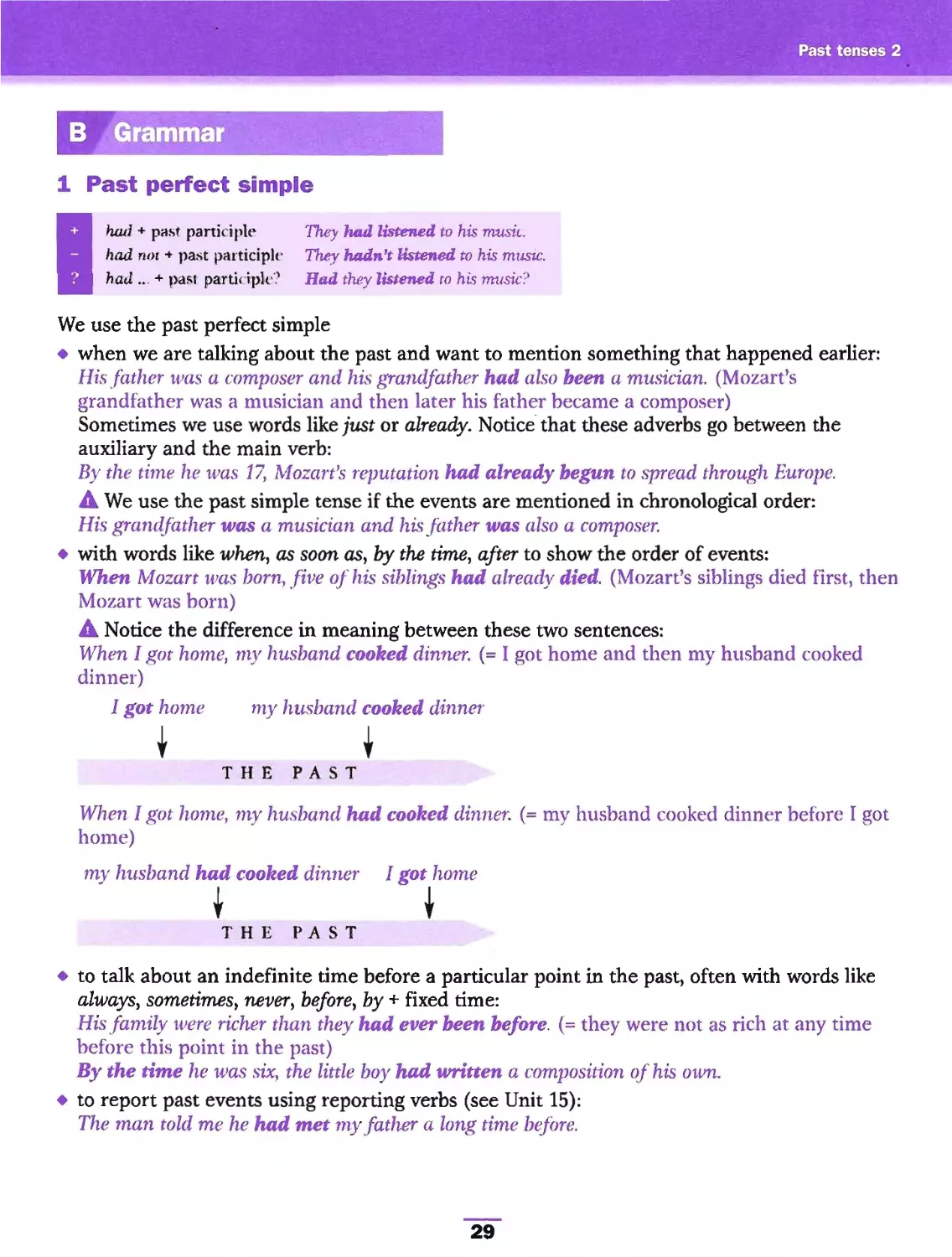
1 Past perfect simple
В had + past participle
had not + past participle
had... + past participle?
They had listened to his music.
They hadn’t listened to his music.
Had they listened to his music?
We use the past perfect simple
♦	when we are talking about the past and want to mention something that happened earlier:
His father teas a composer and his grandfather had also been a musician. (Mozart’s
grandfather was a musician and then later his father became a composer)
Sometimes we use words like just or already. Notice that these adverbs go between the
auxiliary and the main verb:
By the time he was 17, Mozart’s reputation had already begun to spread through Europe.
A We use the past simple tense if the events are mentioned in chronological order:
His grandfather was a musician and his father was also a composer.
♦	with words like when, as soon as, by the time, after to show the order of events:
When Mozart was horn, five of his siblings had already died. (Mozart’s siblings died first, then
Mozart was born)
A Notice the difference in meaning between these two sentences:
When I got home, my husband cooked dinner. (= I got home and then my husband cooked
dinner)
I got home my husband cooked dinner
I	I
THE PAST
When I got home, my husband had cooked dinner. (= my husband cooked dinner before I got
home)
my husband had cooked dinner I got home
I	I
THE PAST
♦	to talk about an indefinite time before a particular point in the past, often with words like
always, sometimes, never, before, by + fixed time:
His family tvere richer than they had ever been before. (= they were not as rich at any time
before this point in the past)
By the time he was six, the little boy had written a composition of his oivn.
♦	to report past events using reporting verbs (see Unit 15):
The man told me he had met my father a long time before.
29
2 Past perfect continuous
had been + verb + -ing
had not been + verb + -ing
had... been + verb + -ing?
She'd been studying for ages.
He hadn’t been studying for long.
Had you been studying for longf
We use the past perfect continuous to focus on how long an activity continued or to focus on
the activity itself:
Times were hard and the family had been struggling for some time, (to show how long)
Mozart's sister was extremely gifted at the keyboard and she had been making excellent progress.
(focus on the activity)
A We cannot use the past perfect continuous to say how many times something happened:
I knew the way as I had visited her several times before, (not / knew the way as I had been visiting
her several times-befere:)
A State verbs (see Unit 1) do not generally have a continuous form.
Grammar extra: Unfulfilled hopes
We use the past perfect to talk about past disappointments or things that did not happen
as expected:
The politician had expected to be re-elected, but in the end she only got ten per cent of the vote.
I had been hoping to go with my brother on his trip but I was too sick to go.
30
Past tenses 2
C Grammar exercises
F Fill in the gaps with the past perfect simple of the verbs in brackets in the positive or
negative.
According to Dr Ken Winkle, Australia’s Red-back spider is colonising the world.
Dr Winkle, a venom expert from the University of Melbourne, said that authorities
1....Ьййк.-'ЙУЛ^..... (find) Red-back spiders in Japan and Belgium. They suspected that
spiders or their eggs 2................(enter)	these countries along with Australian
trading goods. Furthermore, it was extremely likely that the spiders 3..................
(make) their way into other nations around the world but that people 4..................
(discover) them yet. Dr Winkle said the spiders 5..................(also/tum	up) in the
port city of Osaka (which receives a variety of Australian trade goods) in the late 1990s
and 6.................(multiply) quickly. He said Australian spider experts were
collaborating with Japanese officials to find a way to stop the venomous invader.
Г Complete the report with the past simple or past perfect simple of the verbs in brackets.
The chart shows the percentage of people aged 65 and over in the United States between 1900 and
2000. In the year 1900 Jost over 9% of the population 1........№.......(be) aged over 65. However,
by 1960 this figure 2 .................(doable).
The number of people aged between 75 and 84 3..............„....(remain) fairly steady between
1900 and 1930. making up only 1-1.3’/» of the population The figure 4..............(begin) to rise
more significantly in 1990 and by 1970 it 5................(triple) to reach 3% of the population
Although there 6...................(be)	no change in the number of people aged 65-79 between 1960
and 1970. the number of people aged 75 and over 7..................(increase)	during this time By t he
year 2000.12.9% of the LIS population 8.................(reach) the age of 65 or more, although this
was slightly lower than in 1990 when it 9...............(peak) at 12.6%.
Tlie diart shows that today people in the United States can expect to live longer than in 1900. By the
year 2000 more tlw 12% of the population 10.....................(manage) to live to the age of 65 and
over compared to only 9.1% in 1900.
31
в Fill in the gaps with the past simple, past perfect simple or past perfect continuous of
the verbs in brackets.
Last year my friends ...____________(1 arrange) for us to try fire-walking, which is
when you walk on hot coals. I________________(2 always/be) fascinated by it and I
________________(3 hear) people say it was an unforgettable experience. I was very
excited when I________________(4 arrive) on the day, although beforehand I
________________(5 feet) a little frightened! My friends and I(6 come)
in the hope that by the end of the day we would be able to say we________________
(7 walk) across hot, burning coals.
Our teacher was very good, and by teatime we______(8 learnt) a great
deal and  _________(9 prepare) the fires. I_______(10 expect) to be
terrified when the time came to walk, but as I____(11 take off) my shoes
and socks I___________(12 not/feet) afraid. I_____(13 approach) the
coals as all my friends before me_______(14 do), and started walking! I
could feel the heat, but as I______(15 step) back onto the grass at the
other end I knew the coals_________(16 not/bum) my feet at all. As
I............(17 hope), all my friends(18 manage) the walk
and none of us were burnt. The whole experience was amazing, and I just wished I
Past tenses 2
Fill in the gaps with a verb from the box in the past simple, past perfect simple or past
perfect continuous tense. Use each verb once.
be buy decide develop discuss feel like make
phone run start stay take visit wait work-
1	She *d. been ujorkinp.as a waitress for five years when he met her.
2	The lecture...................by	the time they got there.
3	In the supermarket he.......‘............all	the ingredients he needed and then went
home to make her birthday cake.
4	Holly did very well in her exam, which was a shock because she.....................
(never) an exam before.
5	They went on a big tour of Britain. First they..................in	London for a few
days. Then they..................Cambridge, York, and Edinburgh, and then Bath.
They....................to	Bath before, but they..................it	so much that
they....................to	go back again.
6	Scientists announced the launch of the new drug last week. They...................it
for five years.
7	By the time I got to the meeting they...................(already) the important issues
and they....................the	big decisions without me. I...................from
my mobile to tell them the train was late and I...................annoyed that they
..................(nor)	for me.
8	I looked terrible when I saw Joe last night because I..................for over an
hour and I was exhausted.
33
D Test practice
Academic Reading
Questions 1-12
Read the passage below and answer Questions 1-12.
The history of the biro
A
One chilly autumn morning in 1945, five thousand
shoppers crowded the pavements outside
Gimbels Department Store in New York City. The
day before, Gimbels had taken out a full-page
newspaper advertisement in the New York Times,
announcing the sale of the first ballpoint pens in
the United States. The new writing instrument
was heralded as "fantastic... miraculous...
guaranteed to write for two years without
refilling!" Within six hours, Gimbels had sold its
entire stock of ten thousand ballpoints at $12.50
each - approximately $130 at today's prices.
в
In fact this ‘new’ pen was not new after all, and
was just the latest development in a long search
for the best way to deliver ink to paper. In 1884
Lewis Waterman had patented the fountain pen,
giving him the sole rights to manufacture it. This
marked a significant leap forward in writing
technology, but fountain pens soon became
notorious for leaking. In 1888, a leather tanner
named John Loud devised and patented the first
“rolling-pointed marker pen" for marking
leather. Loud's design contained a reservoir of
ink in a cartridge and a rotating ball point that
was constantly bathed on one side with ink.
Loud's pen was never manufactured, however,
and over the next five decades, 350 additional
patents were issued for similar ball-type pens,
though none advanced beyond the design stage.
Each had their own faults, but the major
difficulty was the ink: if the ink was thin, the
pens leaked, and if it was too thick, they
clogged. Depending on the climate or air
temperature, sometimes the pens would do both.
C
Almost fifty years later, Ladislas and Georg Biro,
two Hungarian brothers, came up with a
solution to this problem. In 1935 Ladislas Biro
was working as a journalist, editing a small
newspaper. He found himself becoming more
and more frustrated by the amount of time he
wasted filling fountain pens with ink and
cleaning up ink smudges. What's more, the
sharp tip of his fountain pen often scratched or
tore through the thin newsprint paper. Ladislas
and Georg (a chemist) set about making models
of new pen designs and creating better inks to
use in them. Ladislas had observed that the type
of ink used in newspaper printing dried rapidly,
leaving the paper dry and smudge-free. He was
determined to construct a pen using the same
type of ink. However, the thicker ink would not
flow from a regular pen nib so he had to
develop a new type of point. Biro came up with
the idea of fitting his pen with a tiny ball
bearing in its tip. As the pen moved along the
34
Past tenses 2
paper, the ball bearing rotated and picked up
ink from the ink cartridge which it delivered to
the paper.
D
The first Biro pen, like the designs that had
gone before it, relied on gravity for the ink to
flow to the ball bearing at the tip. This meant
that the pens only worked when they were held
straight up, and even then the ink flow was
sometimes too heavy, leaving big smudges of
ink on the paper. The Biro brothers had a
rethink and eventually devised a new design,
which relied on capillary action rather than
gravity to feed the ink. This meant that the ink
could flow more smoothly to the tip and the
pen could be held at an angle rather than
straight up. In 1938, as World War II broke out,
the Biro brothers fled to Argentina, where they
applied for a patent for their pen and
established their first factory.
E
The Biros' pen soon came to the attention of
American fighter pilots, who needed a new kind
of pen to use at high altitudes. Apparently, it was
ideal for pilots as it did not leak like the fountain
pen and did not have to be refilled frequently. The
United States Department of War contacted
several American companies, asking them to
manufacture a similar writing instrument in the
U.S. Thus fortune smiled on the Biro brothers in
May 1945, when the American company
‘Eversharp’ paid them $500,000 for the exclusive
manufacturing and marketing rights of the Biro
ballpoint for the North American market
Eversharp were slow to put their pen into
production, however, and this delay ultimately
cost them their competitive advantage.
F
Meanwhile, in June 1945 an American named
Milton Reynolds stumbled upon the Biro pen
while on vacation in Buenos Aires. Immediately
seeing its commercial potential, he bought
several pens and returned to Chicago, where he
discovered that Loud's original 1888 patent had
long since expired. This meant that the ballpoint
was now in the public domain, and he therefore
wasted no time making a copy based on the
Biro design. Establishing his pen company with
just $26,000, Reynolds quickly set up a factory
with 300 workers who began production on 6th
October 1945, stamping out pens from precious
scraps of aluminum that hadn't been used
during the war for military equipment or
weapons. Just 23 days later, it was Reynolds'
ballpoint pen that caused the stampede at
Gimbels Department Store. Following the
ballpoint's debut in New York City, Eversharp
challenged Reynolds in the law courts, but lost
the case because the Biro brothers had failed to
secure a U.S. patent on their invention.
35
Questions 7-6
The reading passage has six paragraphs A-F.
Choose the most suitable heading for each paragraph from the list of headings below.
Write the correct number i-ix in the space provided.
List of Headings
i Fountain pens are history
ii Fame at last for the Biro brothers •
iii A holiday helps bring the biro to America
iv A second design and a new country
v War halts progress
vi Dissatisfaction leads to a new invention
vii Big claims bring big crowds
viii A government request brings a change of ownership
ix Many patents and many problems
1	Paragraph A......
2	Paragraph В......
3	Paragraph C......
4	Paragraph D......
5	Paragraph E......
6	Paragraph F......
Questions 7-9
Choose the correct answer, А, В, C or D.
7 The problem with the ballpoint pens invented between 1888 and 1935 was that
A they cost a great deal of money to manufacture.
В the technology to manufacture them did not exist.
C they could not write on ordinary paper.
D they were affected by weather conditions.
8	The design of the Biro brothers’ first pen
A was similar to previous pens.
В was based on capillary action.
C worked with heavy or light inks.
D worked when slanted slightly.
9	Milton Reynolds was able to copy the Biro brothers' design because
A the Biro brothers’ original patent was out of date.
В it was legal to copy other designs at the time.
C they did not have a patent for North America.
D the Biro brothers gave him permission.
36
Past tenses 2
Questions 10-12
Answer the questions below using NO MORE THAN TWO WORDS ANDIOR A NUMBER for
each answer.
Write your answers in the spaces provided.
10	What material was the first ballpoint pen designed to write on?...........
11	Where did the Biro brothers open their first factory?..........
12	In what year did the first American biro factory begin production?..........
Grammar focus task
Look at the extracts from the text. Without looking back at the text, fill in the gaps
with the correct form of the verbs in brackets.
1	The day before, Gimbels .................................... (take out) a full-page newspaper advertisement
in the New York Times, announcing the sale of the first ballpoint pens in the United
States... Within six hours, Gimbels........................(sell) its entire stock often thousand
ballpoints at $12.50 each - approximately $130 at today’s prices.
2	In 1884 Lewis Waterman.........................(patent)	the fountain pen, giving him the sole
rights to manufacture it. This marked a significant leap forward in writing technology,
but fountain pens.....................(soon/become) notorious for leaking.
3	Ladislas..................(observe) that the type of ink used in newspaper printing dried
rapidly, leaving the paper dry and smudge-free.
4	Immediately seeing its commercial potential, he.........................(buy) several pens and
	(return)	to Chicago, where he.(discover) that Loud’s
original 1888 patent...........................(long since/expire).
5	Following the ballpoint’s debut in New York City, Eversharp..........................(challenge)
Reynolds in the law courts, but.....................(lose) the case because the Biro brothers
................(Jail) to secure a U.S. patent on their invention.
37
Future 1
plans, intentions and predictions:
present continuous; going to; will
A Context listening
You are going to hear Tim, a sports team
coach, talking to Amanda, a player in the
team, about a trip they are going tp make.
Before you listen look at the pictures.
Which sport does the team play? Which
two countries will they visit?
□ ppi Listen and complete the table below. Write no more than two words or a number
for each answer.
Country	Number of matches	Number of free days	Accommodation	Other plans
1		2 		3 			stay in a 4 		do lots of walking
5		6				7				s	:		visit some 9
В |	| Now listen again and write
A if Tim makes this statement
В if Amanda makes this statement
C if both Tim and Amanda make this statement
1	We’re travelling to Scotland by plane........
2	We’ll have fun even if the weather is bad........
3	The team will be pleased with the accommodation in Athens............
4	The two countries are going to provide very different experiences........
5	The team manager is holding a party on our return...........
В Look at the statements in Exercise 3 and answer these questions.
1	Which tense is used in statements 1 and 5?...............
2	Which structure is used in statements 2 and 3 to refer to the future?..........
3	Which structure is used in statement 4 to refer to the future?............
4	Which statements talk about a fixed arrangement?...............
5	Which statements are predictions?................
38
Future 1
В Grammar
1 Present continuous
We use the present continuous to talk about plans or definite arrangements for the future:
We’re staying in a small hotel, (we have made the arrangements)
Notice that time expressions are used or understood from the context in order to show that we
are talking about the future (and not the present):
The manager is having a part}'just after we get back, (time expression given)
We’re playing four matches there, (future time expression understood)
2 Will
will + verb
will not (won’t) + verb
win... + verb?
Wr’l! enjoy' it.
He won’t enjoy it.
Will they enjoy it?
We use will
♦	to make predictions, usually based on our opinions or our past experience:
I think it’ll be extremely hot there.
♦	to talk about future events we haven’t arranged yet:
We’ll probably stay in some sort of mountain lodge there.
♦	to talk about future events or facts that are not personal:
The best player on the tour will get a special trophy.
The prime minister will open the debate in parliament tomorrow.
♦	to talk about something we decide to do at the time of speaking:
Tell me all about it and I’ll pass on the information to the rest of the team.
We often use will to make offers, promises or suggestions:
Don’t worry, I’ll let everyone know, (a promise)
3 Going to
am/is/are+going to + verb
am/is/are not+going to + verb
am/is/are... + going to + verb?
bt’re going to hire a bus.
He’s not going to hire a bus.
Are they going to hire a bus?
Going to often means the same as the present continuous and will.
We use going to
♦	to talk about events in the future we have already thought about and intend to do:
We’re going to hire a bus. (we intend to go, but we haven’t made the arrangements yet)
We’re going to get a boat to a couple of the islands.
♦	to make predictions when there is present evidence:
Well, we’re certainly going to have a varied trip. (I am judging this from what I know about
the plans)
39
Going to and will can follow words like think, doubt, expect, believe, probably, certainly, definitely,
be sure to show that it is an opinion about the future:
I think it’s going to be a great trip.
I’m sure we’ll enjoy it whatever the weather.
It’ll probably rain every day.
We can often choose different future forms to talk about the same future situation. It depends
on the speaker’s ideas about the situation:
Present continuous or going to?
Going to or will?
The manager is having a party when we get
back, (definite arrangement)
We’re going to hire a bus and then drive
through the mountains, (less definite
arrangement - we haven’t booked the bus yet)
I’m sure we’ll enjoy it. (prediction based on
my guess)
We’re going to have a very varied trip!
(prediction based on what I know about the
weather)
Often there is very little difference between going to and will for predictions.
Grammar extra: Making predictions using words other than will
In formal writing we often use expressions other than will to predict the future (e.g. be
likely to, be predicted to, be estimated to, be certain to):
The population is likely to increase to 22 million in 2011.
The average annual rainfall is predicted to be ten per cent lower than today’s figures.
40
Future 1
C Grammar exercises
г Fill in the gaps in the second half of this model answer with phrases from the box.
Thanks to modern technology, there have been enormous changes in the
workplace over the past 100 years.
What are the most significant changes that have occurred and what changes do
you foresee in the next 100 years?
are going to feel
are- likely to occur
will be
will find
are going to happen
are predicted to work
will continue
will have
are likely to lead to
is likely to become
will develop
will result
... So. now let ns consider the changes that 1	. in the next 100 years. Unfortunately,
I believe that not all changes 2...............for the better For example, in the future more and
more people 3....................from	home and so they 4 ......._........  more	isolated from thein
colleagues. On the other hand they 5..................(certainly) greater freedom to choose their
working hours.
A further possible change is that handwriting 6...........  obsolete.	We are already so used to
using a keyboard that today's children are losing the ability to spell without the aid of a word
processor
Without a doubt even greater changes
7............     in	technology used in the
workplace. Computers 8.................
(undoubtedly!) to grow even more powerful
and this 9...............(probably) in an
even faster pace of life than we have now. Let us
hope that our employers 10.............   a
way to reduce the stress on workers this fast
pace can bring.
I also think these improvements in technology
11................  even	more globalisation thar
now and companies 12...................very
strong international links,
41
Underline the most suitable form of the verbs.
Dear Paul and Claire
Were having a, wonderful time here in France. The weather Is beautiful and.
we’ve got lots of plans for how to spend the next couple of weeks. Tomorrow
1 we’re gang out / we ndl go out on a glass-bottomed boat to Look at the
wonderful sea Life, and then on Wednesday we think 2 we’re taking / ne!d
take a, tour of the old town. Ollie’s aunt Lives quite close, so 3 we’re
visiting / неге going to visit her too if we have time.
The hotel is lovely and lively and has lots of good night life. Tonight
4 they’re holding / they'd hold an international evening, with lots of food
from different countries.
As you know, we’re here with our friends, John and Wendy, but 5 they
aren’t staying / they uoni stay as long as us, so 6 неге probably doing /
He'd probably do the really 'touristy’ things with them, and be lazy in our
second week. You can hire small sailing boats for the day, so we think
7 were doing / не’re going to do that next week, and 8 не!re also going to
try / неге also trying to have time to do some shopping!
I hope you are ready for your big trip. 9 You're loving / You'd Love
Australia,. In fact 10 you’re going to probably end up / you’d probably end up
staying there much Longer than you’ve planned.
Have a great time., and 11 не’ге going to see / He’d see you when you get
back.
Love Kath and Ollie
42
Future 1
в Fill in the gaps with the present continuous or wiB-future form of the verbs in brackets.
Kirsty: Hi Elaine. It’s Kirsty, here.
Elaine: Hello, how are you?
Kirsty: Fine. Listen, I know this is very short notice but ..<xr.?...ycu..dojnq„ (1 do) anything
tonight?
Elaine: Nothing why?
Kirsty: Well I...............(2	take) my class to the theatre, but one of them can’t go.
Would you like to come?
Elaine: I’d love to. What’s the play about?
Kirsty: Oh, I................(3	tell) you all about that a little later. I......(4 pick)
you up at 6.30 - is that okay?
Elaine: Yes, OK. Or how about meeting a bit earlier? We could have a coffee beforehand.
Kirsty: Well, I...............(5 see) the school principal at four, but I suppose I could
come after that. My meeting.................(6	probabfy/finish) at about 5.30. Is
that okay?
Elaine: Yes, of course. What time does the play actually start?
Kirsty: At 7.30, although we................(7	need) to be there before as
I..............(8 meet) my students at the theatre at seven. Afterwards they
...............(9 probably/want) to talk about the play for a little while. But I
hope that......(10 not/go on) for too long. There..........................(11	be)
plenty of time for us to discuss it at tomorrow’s lesson.
Elaine: That’s fine. I...............(12	see) you at 5.30!
В Write sentences about yourself.
1	Write two intentions about your future.
2	Write three plans or arrangements for your future.
3	Predict three things that you think will happen to the workplace in the future.
43
D Test practice
General Training Reading
Questions 1-9
Read the passage below and answer Questions 1-9.
How to choose a university course
How do I choose a course?
You've decided you want to do a course. Whether you would like a career change, a better
job or simply to learn something new, it's a good idea to think carefully first. Here's a
guide to help you.
Qualifications - why do I need them?
Qualifications prove you've acquired knowledge or developed skills. For some careers like
medicine and law, it's essential you have specific qualifications. For others, such as
journalism, it helps to have a particular qualification.
Most universities set entry requirements for degree courses. Mature entrants don't always
need formal qualifications, but need evidence of recent study, relevant work experience or
professional qualifications. Professional bodies may grant you membership if you have
certain qualifications. It's not always essential to have a qualification. Working
knowledge, such as being able to use computer software, can be just as important.
What type of course should I do?
Your motives will help you choose the best course for your aims and goals. If you are
career-driven, you'll need a course relevant to your profession. If you are interested in
self-development and meeting people, you should find out who else will be on the course.
There are work-related (vocational) and academic courses. Further education colleges
offer academic courses and work-related courses. Universities offer higher education
qualifications, such as academic first degrees and higher degrees and the more vocational
diplomas.
For a career in plumbing, a vocational course is essential. For teaching, you need a
degree. However, for many jobs, you have a choice between academic and vocational
courses. A vocational course is better if you like doing things with your hands and
working manually. You might prefer an academic course if you like researching, analysing
and presenting arguments.
44
Future 1
Which type of study would suit me best?
Do you prefer on-the-job training, or do you prefer to research and gather facts? Do
you like working in a group covering the same topics and working towards the same
goal? If you prefer to work on your own, at your own pace, an open or distance
learning course might suit you. You study from home, with the help of tuition
packs, computers and tutor support via telephone or email. You can speed through
the course or take your time. But you do need self-discipline and motivation.
What about my personal circumstances?
You might prefer an open or distance learning course if:
•	you're working and you don't know how much time a week you can commit to
•	you work irregular hours
•	you're at home looking after pre-school children.
Many colleges and training centres now offer flexible open-learning courses, where
you can study at your own pace.
How do I know if it's a good course?
You've decided which subject and type of course you want, and how to study it. You
now need to choose between different course titles and providers. There are many
courses and they aren't of equal value. The only way to assess the quality and value
of a course is by research. Read prospectuses (course guides) carefully and note if a
course is accredited or validated by a recognised body (this might be an awarding
body or a professional body). This can add extra weight to your qualification.
Don't take everything you read at face value; check out the facts about each course
yourself. Ask course tutors as many questions as you want.
How can I be sure I'm making the right choice?
Be clear of your goal. If you've decided on a particular job, get an idea of what the
job's about and if you'll like it. Read careers information, buy trade magazines, and
speak to people currently working in the job. This research is well worth it. It's
better to take your time rather than do a course that leads to a job you might not
really want. You'll ensure that you don't waste any time or money.
What am I going to do after the course?
Plan for when you finish. If you're aiming for a particular job, do voluntary work while
studying. If you're doing an English course and want to be a journalist, you could write
for the student newspaper or work on the radio. Having a plan will help you make the
most of the opportunities that come your way when you're on the course.
45
Questions 1-5
Complete each sentence with the correct ending A-F from the box below.
Write the correct letter A-F next to Questions 1-5.
1	Students who want to do law	.........
2	Mature students	.........
3	Students who are motivated by self-development ...........
4	Students who have young children	.........
5	Students who choose a career in journalism ...............
A will not need any experience to start a course
В will benefit from open-learning courses
C could get relevant work experience while they study
D can be accepted onto a course without qualifications
E should enquire about the other students on their course
F must have certain qualifications
Questions 6-9
Classify the following statements as applying to
A academic courses
В vocational courses
C both academic and vocational courses
Write the correct letter A-C next to Questions 6-9.
6	These courses are available through further education colleges.
7	You must take this kind of course if you wish to have a career in plumbing.
8	You will learn research methods on this type of course.
9	You will learn practical skills on this course.
46
Future 1
Grammar focus task
These are extracts from the text. Without looking hack at the text, fill in the gaps with
the correct form of the verbs in brackets and then answer the questions that follow.
1	Your motives.............(help)	you choose the best course for your aims and goals.
2	If you are career-driven, you...........(need)	a course relevant to your profession.
3	You.............(ensure) that you don’t waste any time or money.
4	What............(I/do) after the course?
5	Having a plan............(help)	you make the most of the opportunities that come
your way when you’re on the course.
Which future forms are used?..................................................
Why?..........................................................................
47
Future 2
present simple; be about to;
future continuous; future perfect
A Context listening
ET Janet is a university lecturer. She gets nervous when she gives talks at conferences.
Look at the pictures. Which do you think would help Janet feel more confident and
relaxed?
El Listen to Janet’s conversation with her colleague, Phil. What advice does Phil give
her?
EX J Listen again and complete the sentences below. Write no more than three words
for each answer.
1	Janet................on	the report all next week.
2	By the end of the year, Janet.............the same talk at six conferences.
3	When she gets to Rome, Janet................very	nervous.
4	Before he gives his talk in London, Phil............it	at least ten times.
5	Janet is in a hurry because the train to the airport..........in	20 minutes.
EE Look at the sentences used in Exercise 3 and answer these questions.
1	Which sentences talk about events that will be over before a time in the future?
2	Which sentences talk about events or situations in progress at a particular time in the
future? ..................
3	Which sentence talks about a scheduled event?...............
48
Future 2
В Grammar
1 Present simple
We use the present simple with a future meaning
♦ to talk about timetables or schedules:
The conference only lasts three days.
The train to the airport leaves in 20 minutes.
♦ after conjunctions such as when, as soon as, after, before, until, as long as:
I’ll be feeling really nervous when I get to Rome, (not when I will get to Rome)
Can you do it before we have the departmental meeting? (not before we wiU have the meeting)
Note that other present tenses are also possible:
I won’t be able to relax until I’m actually giving my talk.
2 Be about to
I am/is/are about to + verb	I’m about to go to Rome.
am/is/are not about to + verb I’m not about to go to Rome.
am/is/are... + verb?	Are you about to go to Rome?
We use be about to to talk about something likely to happen in the immediate future:
I’m about to go to Rome for a conference. (I will be leaving very soon)
A The negative form suggests the speaker has no intention of doing something:
I’m not about to cancel my trip. (= I have no intention of cancelling my trip)
3 Future continuous
I will be + verb + -ing
will not (won’t) he + verb + -ing
will... be + verb + -ing?
ГЛ be feeling nervous.
She won’t be feeling nervous.
Will you be feeling nervous?
We use the future continuous
♦	to describe or predict events or situations continuing at a particular point in the future or
over a period of time in the future:
I’ll be working on the report all next week.
I’ll be working on the report
NOW NEXT WEEK
I’ll be thinking of you in Rome.
By the year 2015 it is estimated that well over one billion people will be learning English.
♦	to talk about events that are planned or already decided (this use is similar to the present
continuous for future arrangements):
I’ll be seeing Sarah at lunch.
49
4 Future perfect simple
Iwffl have + past participle	I’ll have done it by then.
will not (won't) have + past participle	We won't have done it by then.
wiB... + have * past participle? Will you have done it by then.’
We use the future perfect simple to talk about a future event that will finish before a specified
time in the future, often with before, by + fixed time, or in + amount of time:
By the end of the year I will have given the same talk at 6 conferences!
I’ll have finished it by next Friday.
In a week’s time I’ll have written the report.
5 Future perfect continuous
I will have been + verb + -ing	I’ll have been studying here for three months,
will not (won't) have been + verb + -ing We won’t have been studying here for long
wtB... + have been + verb + -ing? How long will you have been studying here?
We use the future perfect continuous to show how long an activity or situation has been in
progress before a specified time in the future. We usually mention the length of time:
By the end of the month I’ll have been working here for three years.
Grammar extra: The future in the past
We use was/were going to, was/were planning to, was/were about to + verb to talk something
planned which did not or will not happen:
I was going to leave this morning but they cancelled my flight.
We were about to leave when the phone rang.
50
Future 2
C Grammar exercises
F The following chart shows the results of a class survey about planned activities for
Saturday afternoon. Complete the sentences using the future continuous tense.
1	Twelve students Mil be uxftcnirff TV.. on Saturday afternoon.
2	The students....................books	on Saturday.
3	The largest group of students..................this	Saturday afternoon.
4	A similar number of students....................and...................this	weekend.
5	A very small number of students...................this weekend.
6	Approximately 15 students...................this	weekend.
Write what you will be doing at the following times.
7	At six o’clock tomorrow I’ll..................................................
8	Next Saturday afternoon I won’t...............................................
9	On Sunday morning.............................................................
10	In a year’s time..............................................................
51
Read the following projections about the future population of Australia.
Population projections
According to the latest available projections (which are based on several
combinations of assumptions reflecting past trends in births, deaths and
migration), the total population of Australia is likely to have increased to
between 22.3 and 23.3 million by 2021.
The projected population will increase at a declining rate. The average
annual growth rate is predicted to be between 0.5 and 0.8 during 2011-2021.
Without overseas migration, the projected total population should peak at
about 23.3 million in 2041, and then start to decline marginally.
Age distribution
The projected population will age progressively due to the increasing
proportion of the elderly (aged 65 years or more) and the decreasing proportion
of children (aged under 15 years). In brief, the number of persons aged under 15
is projected to be between 3.7 and 4.1 million in 2031; the population of
working age (15-64 years) is projected to increase to between 14.4 and 15.0
million in 2031; and the number of persons aged 65 years or more is projected
to increase to between 2.94 and 2.98 million in 2031. The projections also show
significant increases in the number of persons aged 80 years or more.
Write the verbs in brackets in the future perfect tense. Then choose the correct ending
for each sentence.
1	By the year 2021 the population of Australia	(reach)	a	by the early 2040s.
2	The population of Australia	\	b	to almost 2.98 million.
		(peak)	\
3	By the year 2031 the number of children aged under 15	(rise)	-- c	a maximum of 23.3 million.
4	By 2031 the number of people of working age in Australia	(grow)	d	to between 3.7 and 4.1 million.
5	By 2031 the number of people aged 65 and over	(go	up)	e	significantly.
6	By the year 2031 the number of people aged over 80	(increase)	f	to around 15 million.
52
Future 2
в In six of these sentences there is a verb in the wrong tense. Underline each mistake and
write the correction.
1	When I’ll find the answer I'll let you know........
2	My exams finish on 27th June.................
3	I'll be fine in the interview as long as they won't ask me technical questions..
4	What time is your meeting about to start tomorrow?.............
5	I'll hand in my notice for this job after I'll get the contract for my new one....
6	I'll text you before we set off..............
7	The bus doesn’t arrive until 7.30 in the evening.........
8	I've got my schedule for the Japan trip We're about to fly to Tokyo at 10 am on Monday, and then
travel by train to Kyoto for one night..............
9	The moment I'll receive my results I'll phone you........
□ Fill in the gaps with a future form from this unit and the verbs in brackets.
Teacher: What ..^4 Vой be doing (1 you/do) this time next year?
Student 1: Well, that’s difficult to say but I hope that I...................(2	travel) round
the world. Before then I...................(3 hopefully/save up) enough
money for the ticket. I plan to end up in Australia and when I
	(4	get) there I’ll get a job and earn some money. So, in a
year’s time I.(5 probably/travel) for a few months already. I
hope that I.....................(6	visit) quite a lot of different countries by
then too.
Teacher: What do you plan to do when you graduate?
Student 2: Well, my plans have changed a bit. I......................(7	do) a journalism
course, but I didn’t get accepted. So I’ve sorted something else out and I
	 (8	start) a hospitality course tomorrow, actually. It’s for six
months, so I................................................(9	not/finish) in time to go travelling next
spring, unfortunately. However, as soon as I....................(10	find out) if
I’ve passed the course, I can apply for a job in a hotel in Australia.
53
D Test practice
Academic Writing Task 2
You should spend about 40 minutes on this task.
Write about the following topic:
The birth rate in most developed countries is predicted to begin to fall
over the next 50 years. By 2030 it is estimated that over one third of the
population in most developed countries will be aged 65 and over.
What effects will these predictions have on developed countries if they
prove true? What can be done now to deal with this situation?
Give reasons for your answer and include any relevant examples from your own knowledge or
experience.
You should write at least 250 words.
Grammar focus task
Look at the extract from a model answer below. Fill in the gaps with the verbs in the
box in the correct future tense.
be pay rise work
... By 2030 the percentage of the population aged 65 or older 1...................
significantly, to more than 30%. This means that fewer people 2....................,	and
therefore fewer people 3.....................income	tax. In the future it may be necessary
for governments to increase the official retirement age to 70 or even older. When today’s
30-year-olds 4...................in their sixties it is unlikely that they will enjoy the
relaxed lifestyle that today’s older generation can expect when they give up work.
54
В Grammar
1 Countable and uncountable nouns
Countable nouns
♦ generally have a singular and plural form:
a window, lots of windows
A Some countable nouns only have a
plural form: clothes, trousers, jeans, scissors
♦ take a singular or plural verb form:
The window is big. The windows are big.
♦	can be replaced by a singular or plural
pronoun:
I’d like that desk; it’s better than mine.
It’s got shelves as well. They’re really handy.
♦	can be measured with weights and
measures: two kilos of potatoes
or numbers: It’s got three drawers.
♦	can be used with a/an;
a desk, an apple
Uncountable nouns
♦	cannot be plural: advice (notWwees),
furniture (not furnitures), data
A Some uncountable nouns look plural
but they are not: news, economics, physics
♦	take only a singular verb form:
The natural light is really nice.
♦	can be replaced by a singular pronoun:
‘What shall we say about the furniture?’
‘Well, it’s not luxurious but it is very
comfortable.’
♦	can be measured with weights and
measures: two kilos of sugar
or with words like a piece of, cup of, bit of,
slice of. a piece of information
♦	cannot be used with a/an;
information (not an information)
2 Some and any
Some
♦	is generally used in positive statements: There are some shelves above the desk.
♦	can also be used in questions and particularly in requests and offers:
Would you like some biscuits?
♦	means ‘an unspecified (not large) amount’:
It would be great to get some money to help with the rent, (we don’t know how much money)
A We use some of with, other determiners (e.g. my, the, these) to refer to a particular group:
Some of my students have part-time jobs.
Any
♦	is usually used in negatives and questions:
My desk hasn’t got any drawers.	Has your desk got any drawers?
♦	can also be used in positive statements to mean fit doesn’t matter who/which/where/when’:
Call me any time if you need further help. (= it doesn’t matter when you call)
A We can also use no + noun to mean the same as not... any;
My desk has got no drawers. (= my desk hasn’t got any drawers)
We use no when the noun is a subject:
No applicants had the necessary experience for the job. (not Net any applicants)
Words like something/anything, somebody/anybody, etc. follow the same rules as some and any.
56
Cowintablb »dl мсошШе тошге
wntahto ати! xiT№mmtai)te twit»; quantity
rwh /л? m, ытэ, w>/> si Ш tew, m)

A Context listening
□ a bedside table
ЕГ You are going to hear Alan and Sara talking about advertising a spare bedroom to rent.
Before you listen look at the types of furniture below. Tick the furniture you think
might be in the room.
О shelves	EJ a wardrobe
□ a filing cabinet Q a bed
□ a sofa	О a towel rail
|	| Listen and answer the questions below.
Which three pieces of furniture are in the room?
A a bed	C a desk
В a bedside table	E a lamp
What does the desk look like?
A
□ a desk
□ a coffee table
1
F a mirror
G a wardrobe
2
| ~] Listen again and fill in the
gaps in the advertisement.
Write no more than one word or
a number for each answer.
Accommodation for rent
Small, furnished 1.........available. Sunny
with a nice view of the 2.........Good
location close to two types of 3........
Rent 4 £.........per 5 ............Rent
includes 6..........and all other bills.
C Look at the two groups of nouns in the table below. How are they different? Add the
nouns from Exercises 2 and 3 into the table in the correct group.
Group 1	Group 2
advertisement newspaper windows	money news accommodation
55
Countable and uncountable nouns
3 Quantities
We can use the following words to say how many or how much:
	Plural countable nouns	Uncountable nouns
everything	all (of)	all (of)
large quantities	lots of/ plenty of / a lot of many (of) most (of) a large/considerable/substantial number of	lots of/plenty of / a lot of much (of) most (of) a large/considerable/substantial amount of
medium quantities	some (qf)/a certain number of	some (of)/a certain amount of
small quantities	(a.) few (of) a small/limited/tiny number of	(a) little (of) a small/limited/tiny amount of
nothing	no / not any / none of	no / not any / none of
A few and a little are different from/ей» and little. Compare:
Few rooms have such good natural light. (= not many, so you are lucky)
We have a few rooms available with a sea view. (= a small number)
Little research has been done in this area. (= not enough)
A little research has already been carried out in this area. (= a small amount)
A We use a few of with other determiners (e.g. my, the, these) to refer to a particular group:
A few of the rooms have a sea view.
Lots of I a lot of are less formal than much/many:
There are lots of advertisements for accommodation in the paper.
Many scientists believe that global warming is having a negative impact on our climate.
A We do not usually use lots of with negative statements:
We don’t have a lot of/much time so we’ll have to he quick, (not we doWi have lots of time)
A We do not usually use much in positive sentences:
I found a lot of information on the Internet, (not much infarmatien)
Grammar extra: Nouns that can be both countable and uncountable
Sometimes the same noun can be either countable or uncountable depending on the
meaning (e.g. light, room, cake, time). Materials and liquids can also be either (e.g. glass,
paper, coffee, wine). Compare:
The natural light is really nice, (uncountable)
Both of the lights in the ceiling are really old. (countable)
There isn’t much room for a desk, (uncountable = space)
We have two spare rooms, (countable = rooms in a house)
Do you drink much coffee? (uncountable = in general)
Td like to order a coffee, please, (countable = a cup of coffee)
57
C Grammar exercises
Г Fill in the gaps with a word from the box below in the correct form. If the word is
countable, you may need to change it to a plural form.
advice cake -challenge electricity information situation size
1	I’ve faced many	in my life, but none as difficult as this.
2	Some of the best ..........I heard while I was a student was to take regular breaks
when studying so that you don’t lose concentration.
3	A dictionary is a wonderful source of............
4	I’ve made some little............... for Claire’s birthday party.
5	One hundred years ago cars all looked the same but these days they come in lots of
different shapes and.................
6	My job as a journalist means I can find myself in difficult.........at times, but at
least it’s never boring.
7	There was no___________in the remote cottage, so they had to cook over the fire.
E Underline the correct form of the verbs.
1	Despite the recent improvement in the economy, unemployment has continued / have
continued to rise.
2	Our company hasn’t changed its products for over 30 years but now the time has come I
have come for a rethink.
3	The ideas in the report was / were presented in a very clear way.
4	The data show I shows that the numbers of people buying mobile phones has
remained stable for the past two years.
5	Transport to and from the airport is included I are included in the price.
6	There was I were no facilities like running water or electricity in the village.
7	All the information is I are interesting and well presented, but we need to consider the
whole situation very carefully before we reach a decision.
8	There was / were some important news about the proposed new hospital in the local
paper today.
58
Countable and uncountable nouns
3
Fill in the gaps with amount, number, few, little, many or much.
How much sleep do we need?
The 1	.. of sleep each person needs depends on 2.............factors, including
age. Infants generally require about 16 hours a day. For most adults, seven to eight
hours a night appears to be the ideal 3 .........of sleep, although a 4____________
people may need as 5____________as five hours' sleep or as 6..........as ten hours'
sleep each day. Getting too 7..........sleep creates a sleep debt, and eventually, your
body will demand that the debt be repaid.
«
A large 8..........of people over 65 have frequent sleeping problems, such as
insomnia, and deep sleep stages in 9...........elderly people often become very short
or stop completely. Microsleeps, or very brief episodes of sleep in an otherwise awake
person, are another mark of sleep deprivation. In 10...........cases, people are not
aware that they are experiencing microsleeps. The widespread practice of burning the
candle at both ends in western industrialized societies has created so 11..........
sleep deprivation that what is really abnormal sleepiness is now almost the norm.
Г Read the extract from a talk about a holiday destination. Decide if the underlined
quantity expressions are correct or not. Tick (/) them if they are right and correct
them if they are wrong.
The island is beautiful. Don’t be dismayed when you get off the plane
and find yourself in a large, rather ugly city with 1 a little sense of the
old way of life you have read about. Just a short car ride away is the
island you have been promised with its small villages and slow pace of
life. And there really is 2 anything for everyone. For those that like sun-
bathing, it has 3 some of the most beautiful beaches in the world. If you
like walking, the paths take you through some breathtaking scenery.
4 Little other places can match the stunning landscape of this island. For
water sports enthusiasts, there are 5 any unusual activities such as diving
for pearls or turtle spotting, along with 6 few of the more common sports
such as waterskiing or windsurfing. If history is your thing, don’t worry.
There’s 7 much history round every corner. Ruins from the ancient civili-
sations that lived here over 3000 years ago are everywhere, and although
8 a lot of people come here just to see the palace, you can find some less-
er remains scattered around the surrounding hills.
Visit it 9 some time of the year and you will not be disappointed. Not
10 many places in the world can offer so much. 11 Not any holiday will
ever match this one - our island has got it all!
1
2
3
4	........
5
6
7
8
9
10
11 .........
59
D Test practice
Academic Reading
You should spend about 20 minutes on Questions 1-14 which are based on the Reading
Passage below.
As high-tech materials invade high-street fashion, prepare for clothes that are cooler
than silk and warmer than wool, keep insects at arm’s length, and emit many
pinpricks of coloured light.
The convergence of fashion and high technology is leading to new kinds of fibres,
fabrics and coatings that are imbuing clothing with equally wondrous powers. Corpe
Nove, an Italian fashion company, has made a prototype shirt that shortens its sleeves
when room temperature rises and can be ironed with a hairdryer. And at Nexia
Biotechnologies, a Canadian firm, scientists have caused a stir by manufacturing
spider silk from the milk of genetically engineered goats. Not surprisingly, some
industry analysts think high-tech materials may soon influence fashion more
profoundly than any individual designer.
A big impact is already being made at the molecular level. Nano-Tex, a subsidiary of
American textiles maker Burlington, markets a portfolio of nanotechnologies that can
make fabrics more durable, comfortable, wrinkle-free and stain-resistant. The notion of
this technology posing a threat to the future of the clothing industry clearly does not
worry popular fashion outlets such as Gap, Levi Strauss and Lands’ End, all of which
employ Nano-Tex's products. Meanwhile, SchoellerTextil in Germany, whose clients
include famous designers Donna Karan and Polo Ralph Lauren, uses nanotechnology
to create fabrics that can store or release heat.
Sensory Perception Technologies (SPT) embodies an entirely different application of
nanotechnology. Created in 2003 by Quest International, a flavour and fragrance
company, and Woolmark, a wool textile organisation, SPT is a new technique of
embedding chemicals into fabric. Though not the first of this type, SPT's durability
(evidently the microcapsule containing the chemicals can survive up to 30 washes)
suggests an interesting future. Designers could incorporate signature scents into their
collections. Sportswear could be impregnated with anti-perspirant. Hayfever sufferers
might find relief by pulling on a T-shirt, and so on.
60
Countable and uncountable nouns
The loudest buzz now surrounds polylactic acid (PLA) fibres - and, in particular, one
brand-named Ingeo. Developed by Cargill Dow, it is the first man-made fibre derived
from a 100% annually renewable resource. This is currently maize (corn), though in
theory any fermentable plant material, even potato peelings, can be used. In
performance terms, the attraction for the 30-plus clothes makers signed up to use
Ingeo lies in its superiority over polyester (which it was designed to replace).
As Philippa Watkins, a textiles specialist, notes, Ingeo is not a visual trend. Unlike
nanotechnology, which promises to‘transform what clothes can do, Ingeo’s impact on
fashion will derive instead from its emphasis on using natural sustainable resources.
Could wearing synthetic fabrics made from polluting and non-renewable fossil fuels
become as uncool as slipping on a coat made from animal fur? Consumers should
expect a much wider choice of ‘green’ fabrics. Alongside PLA fibres, firms are
investigating plants such as bamboo, seaweed, nettles and banana stalks as raw
materials for textiles. Soya bean fibre is also gaining ground. Harvested in China and
spun in Europe, the fabric is a better absorber and ventilator than silk, and retains
heat better than wool.
Elsewhere, fashion houses - among them Ermenegildo Zegna, Paul Smith and DKNY
- are combining fashion with electronics. Clunky earlier attempts involved attaching
electronic components to the fabrics after the normal weaving process. But
companies such as SOFTswitch have developed electro-conductive fabrics that
behave in similar ways to conventional textiles.
Could electronic garments one day change colour or pattern? A hint of what could be
achieved is offered by Luminex, a joint venture between Stabio Textile and Caen. Made
of woven optical fibres and powered by a small battery, Luminex fabric emits
thousands of pinpricks of light, the colour of which can be varied. Costumes made
of the fabric wowed audiences at a production of the opera Aida in Washington, DC,
last year.
Yet this ultimate of ambitions has remained elusive in daily fashion, largely because
electronic textiles capable of such wizardry are still too fragile to wear. Margaret Orth,
whose firm International Fashion Machines makes a colour-changing fabric, believes
the capability is a decade or two away. Accessories with this chameleon-like capacity
- for instance, a handbag that alters its colour - are more likely to appear first.
61
Questions 1-6
Look at the following list of companies (1-6) and the list of new materials below.
Match each company with the correct material.
Write the correct letter A-H next to the companies 1-6.
NB You may use any answer more than once.
1	Corpe Nove	...... 4 Schoeller Textil	......
2	Nexia Biotechnologies ................... 5	Quest International and Woolmark .....
3	Nano-Tex	...... 6 Cargill Dow	......
New materials
A material that can make you warmer or cooler
В clothing with perfume or medication added
C material that rarely needs washing
D clothes that can change according to external heat levels
E material made from banana stalks
F material that is environmentally-friendly
G fibres similar to those found in nature
H clothes that can light up in the dark
Questions 7-14
Complete the summary below.
Write NO MORE THAN TWO WORDS from the Reading Passage for each answer.
Major changes in fabrics
Using plants
Nanotechnology will bring changes we can see, while the brand called 7.......will
help the environment. Fibre made from the 8.........plant has better qualities than
silk and wool.
Electronics
In first attempts to use electronics, companies started with a material made by a standard
9............method and then they fixed 10...........to	the material.
Luminex fabric
•	needs a 11...........to	make it work.
•	has already been used to make stage 12...........
•	is not suitable for everyday wear because it is too 13......
The first products that can change colour are likely to be 14.....
62
Countable and uncountable nouns
Grammar focus task
Which of these nouns from the text are countable (C) and which are uncountable (U)?
Which is an example of a noun that can be both countable and uncountable? How is it
used in the text?
1	materials (paragraph 1)...
2	shirt (paragraph 2) ....._
3	heat (paragraph 3)........
4	technique (paragraph 4)......
5	sportswear (paragraph 4).....
6	fibre (paragraph 5).......
7	clothes (paragraph 6).....
8	choice (paragraph 6)......
63
Referring to nouns
articlles; other dleteirmlners (demonstratives. possessives.
inctasives: eack every. both. ak either. neither etc.)
A Context listening
□ You are going to hear a speaker at an environmental awareness conference talking
about a European satellite called Envisat. Before you listen, put the words below into
two groups: the environment and satellites.
climate
fully-equipped , global warming instrument
launch monitoring	observation operational costs
В
outer space ozone depletion precise
|2|£l Now listen to the talk and complete the notes below.
Write no more than two words or a number for each answer.
Envisat satellite
•	Envisat was launched 1 ___.............
•	Envisat has 2................instrument	systems.
•	In 1990s ESA launched 3................and 4................
•	ESA will spend 2.3 billion euros over 5 ............
•	This is the same as 6..............  of	coffee per person per yean
□
Underline the correct words. | [Listen again to check your answers.
1	Envisat is a/the fully equipped observation satellite.
2	AJThe satellite was launched in 2002.
3	With its ten instrument systems it is equipped with -/the best eyes possible and offers
everything that -/the scientists could wish for.
4	The total cost of the Envisat Programme is 2.3 billion euros over 15 years. Included in
that/this sum is development and construction of the instruments.
5	Neither/None of our countries can afford to let down their environmental guard.
Look at your answers to Exercise 3 and answer these questions.
1 Why do we say a satellite in sentence 1 and the satellite in sentence 2?
2 In sentence 3, why do we use an article before best? Why don’t we use an article in
front of the word scientists?
3 In sentence 4, what does this sum refer to?
4 In sentence 5, why can’t we use neither?
64
Referring to nouns
В Grammar
1 Articles
a/an
We use а/ап
♦	to refer to something for the first time:
I’d like to talk to you today about an exciting development.
♦	to refer to any one from a group of several:
Climate protection is a challenge for our entire society, (one of many challenges)
♦	to classify people or things as belonging to a group:
Envisat is a fully-equipped observation satellite, (there are different kinds of satellite)
♦	to say what job somebody does:
My brother is an engineer.
A We can only use a/an with singular countable nouns.
the
We use the
♦	when the listener/reader knows which thing we mean (it may have been mentioned before):
Envisat is a fully-equipped observation satellite ... The satellite was launched in 2002.
or it is understood which thing we mean:
As part of the conference on environmental awareness ... (we are at the conference now so it is
clear which one I mean)
Compare:
I went to a conference on Environmental awareness last week, (the person I am talking to does
not know which conference I am talking about)
♦	when there is only one of this thing:
the earth, the sun, the twentieth century, the sixties, the Government, the Prime Minister (there is
only one government and one prime minister in each country)
♦	for superlatives (see Unit 11):
It is equipped with the best eyes possible.
♦	to talk about playing a musical instrument:
He plays the piano and she plays the guitar.
♦	with certain proper nouns:
nationalities (the British, the Chinese, the Egyptians)
rivers (the Thames, the Yangtze, the Nile)
island groups (the Maldives, the Philippines, the Seychelles)
mountain ranges (the Alps, the Himalayas)
seas and oceans (the Black Sea, the Mediterranean, the Pacific)
country names that represent a group (the United Kingdom, the United States of America)
many famous/historical buildings (the White House)
noun phrases with of (the Great Wall of China, the Temple of Heaven)
A With university names we can say the University of Bath or Bath University.
65
No article
We use no article
♦	with plural or uncountable nouns to talk generally about things:
It will deliver information about our changing environment.
It offers everything that scientists could wish for. (scientists in general not a specific group of
scientists)
♦	with certain proper nouns:
continents (Europe, Asia)
countries (Australia, China)
states or counties (Michigan, Cambridgeshire)
towns and cities (Tokyo, Jeddah)
mountains (Everest, Kilimanjaro)
lakes (Lake Superior)
companies (Microsoft, Sony)
buildings and places with the name of a town (Heathrow Airport)
♦	with mealtimes:
I have lunch at 12.30.
♦	in common expressions after prepositions:
to/at school/university; to/in class; in prison/hospital/bed
A We can use the!a if we want to be specific. Compare:
When I was a child I used to walk to school.
When I was a child I went to the school on the other side of town.
However, we cannot use an article with the following expressions:
at home; at/to work; at night; by bus/bicycle/car/train/plane; on foot
2 Demonstratives: this, that, these, those
We use these words to show whether something is near or remote, in terms of time or place:
	near	remote
time	Fd like to talk to you this morning about an exciting development, (today)	My mother called me later that day. (I am telling you this on a different day)
place	I like these pictures, (here)	Oht I prefer those pictures, (over there)
We can use this/that/these/those to refer back to something previously mentioned in the text:
The total cost of the Envisat programme is 2.3 hillion euros over 15 years. Included in this sum ...
(this sum = 2.3 billion euros)
We can refer back to whole sentences or ideas with this and that:
Seeing the earth from outer space highlights how tiny and fragile our planet is. Envisat helps people
to understand that. (= understand how tiny and fragile our planet is)
There is often very little difference between this and that when used in this way, so we could
say:
Envisat helps people to understand this.
Referring to nouns
3 Possessives
We use possessive determiners (my/your/his/her/its/our/their) to tell us what or who something
belongs to:
our blue planet; their children
A We cannot use possessive determiners after other determiners (e.g. a, the). We use
determiner + noun + of + possessive pronoun:
this planet of ours (not this ouryfam)
We use’s with singular nouns and irregular plural nouns. We use s’ after regular plural nouns:
Europe's technological showpiece; the children's toys; my parents' house
We usually use noun + of instead of’s when the thing we are referring to is not a person or
animal:
the price of the hotel (not the heteH&priee)
4 Inclusive»
each, every
Each and every are used with a singular noun and verb.
Each is used for things or people in a group of two or more, with a focus on the individuals in
the group:
Each European citizen has therefore invested seven euros in the environment.
Every is used for three or more things, with a focus on the group. Often the difference in focus
between each and every is very small:
Every citizen will have access to precise information about changes in the environment (= Each
citizen...)
We can use each (but not every) + of + noun/pronoun:
Each of the students gave the teacher a present, (not every ef the students)
all, most, some
We use all/most/some + plural noun and verb to talk about things in general:
Most children like sweets.
Some people believe space exploration is a waste of money.
We use all/most/some + of + pronoun or determiner + noun or to refer to a specific group:
Most of the children at my school play football
/ We do not need to use all + о/before a noun, but we need о/before a pronoun:
AH the children at my school play a musical instrument.
All of them like music, (not all them)
'• When all is followed by a singular noun referring to time the meaning is different. Compare:
I worked hard all day. (= I worked hard for one whole day)
I worked hard every day. (= I regularly worked hard)
67
Both, neither, either, none
Both, neither and either refer to two people or things. We use both + plural noun and
either/neither + singular noun:
Both satellites were launched in the 1990s.
Neither person knew very much about Envisat before the conference. (= not one or the other)
I don’t mind where we go. Either restaurant is fine. (= one or the other is fine)
A We use both + of + determiner + plural noun (or pronoun) with a plural verb. We can use
either/neither + of + determiner + plural noun (or pronoun) with a singular or a plural verb:
Neither of my sisters lives/live in the same town as me.
Both of them are married, (not Both aftkem is married/)
None means ‘not one’ (of a group). It can be followed by a singular or plural verb:
None of our countries is/are able to ignore the implications of global warming.
Referring to nouns
C Grammar exercises
F In some of these sentences there is a mistake with articles. Underline each mistake and
write the correction.
1	My father likes the classical music and listens to it all the time.
2	I saw a man sitting in a restaurant. A woman came and joined him, but the man got
up and left without speaking to her!.........../.......
3	Sun was shining and it was a lovely day..................
4	I can play piano...................
5	I come from United Arab Emirates....................
6	I’ve applied to study at the University of Edinburgh.................
7	I usually go to work by the bus.................
8	My husband is doctor...................
9	Sorry I’m late - car wouldn’t start this morning................
10	I’m going to take a cruise down river Nile.................
11	I once saw a cat wearing a pink coat and boots!............,....
12	My husband collects the antiques. He’s always going to auctions..................
Fill in the gaps with a/an or the or put a cross (X) if no article is needed.
BORNEO BORN AND BRED
1 ...1..Local legends say that 2....Borneo's
few thousand wild elephants are descendants
from those brought to 3.....island from India or
Malaysia as 4.....gift to 5.......sultan
in 6......eighteenth century. Biologists from
7.......Columbia University's Centre for
Environmental Research and Conservation compared
DNA samples from Borneo elephants with Asian elephants in Sumatra, India and
elsewhere. 8......findings confirmed their suspicions: Borneo's elephants are genetically
different. In fact 9...DNA differences are so great between them and their closest
relatives (elephants in Peninsular Malaysia) that 10..populations may have
separated up to 300,000 years ago, say 11....scientists. The animals became isolated
when 12........island became totally cut off from the mainland due to 13...rise in
sea level. Borneo's elephants are, therefore, 14.important, separate population.
69
Underline the most suitable words.
Report on holiday survey
1 This/That survey aimed to find out about 2 people’s I the people’s ideal holidays. We
used 3 the interviews I interviews and 4 the questionnaires I questionnaires to collect
5 our/their data. 6 Both/All of 7 those/these methods of data collection were quick and
simple to carry out and 8 neither/none of them were too demanding of the public.
9 Our findings I Findings show that many people like to take their holidays in the
summer. 10 This/The view was reinforced by the destinations suggested by
11 the people I people involved in 12 a survey I the survey. 13 The beach holidays I
Beach holidays were the most popular, particularly in 14 the Spain / Spain or 15 the
France I France. 16 Most/Both people in the survey said they looked forward to their
holiday. 17 Each/All person we interviewed agreed that it was important to have at
least one holiday 18 every/all year. 19 The price of the holiday / the holiday’s price was
important to most people, with general agreement that value for money was a
primary consideration.
Fill in the gaps with words from the box.
both	each	every	my neither none this that
that	their	those
My home town is smaller than London, but there are some similarities. 1 of the
two cities is famous for its architecture. For example, 2......Kuala Lumpur and London
have tall, modem buildings, set amongst older historical buildings. Although both cities
have rivers running through them, 3.........city is by the sea, which is a shame, as I think
some of the most beautiful cities in the world are by the sea.
4......major city in the world has one thing in common - being large and busy - and
5......is true of both London and Kuala Lumpur. In fact, some people don’t like my
city because it is so noisy and busy, but 6..is one reason why I love it.
A lot of city markets take place in the day-time, but in 7.home city they don’t
open until it’s dark! Malaysians tend to buy all their groceries at the night markets. In
London people tend to use supermarkets for 8......food shopping.
It is always hot in Kuala Lumpur, but London can get very cold. 9...’s probably why
you get outdoor restaurants all over Kuala Lumpur all year round whereas in London
there are almost 10......in the winter. In some restaurants in Kuala Lumpur, you can
go to the kitchen and point at the food and say, ‘I’ll have one of 11.,	please!’ You
can’t do that in London!
70
Referring to nouns
D Test practice
Listening Section 4
Questions 1-2
Choose the correct letter A, В or C.
1	Health club membership in Europe
A has reached 36 million.
В has declined in recent years.
C has followed a similar trend to America.
2	If people today ate the same amount as their parents did
A they would gain weight.
В they would have more energy.
C they would feel healthier.
Questions 3-4
Choose TWO letters A-E.
According to the speaker which TWO factors have contributed to the change in our fitness levels?
A availability of better food
В different working conditions
C labour-saving devices
D changes in healthcare
E diets which do not work
Question 5
Choose the correct letter, A, В or C.
5	Which of the following machines has been available for less than ten years?
71
Questions 6-10
Which exercise method do the following statements apply to?
A using an elliptical trainer
В running on the road
C using a treadmill
Write the correct letter A, B, or C next to Questions 6-10 below.
6	The impact on the body is more than twice your own body weight.
7	The impact on the body is almost the same as your own body weight.
8	It has the same impact on the body as walking does.
9	It is the best method for losing weight at speeds over 14 kph.
10	It has the highest impact on the joints.
Grammar focus task
Look at the following extracts from the recording. Which words or ideas do the
underlined words refer to in the text?
1	Unfortunately, instead of eating less than their parents did, many consume a lot more.
2	On top of this, the change in employment patterns over the past...
3	And this is where exercise machines come in.
4	That’s an amazing number of people
5	As its name implies, the machine delivers an elliptical motion ...
6	In that respect, ellipticals are superior.
7	After that, just keep going and going and going ...
72
Pronouns and referencing
personal. possessive and reflexive pronouns:
avoiding repetition
A Context listening
F You are going to hear a conversation between Chi Wen, a student from Hong Kong who
is studying in Australia, and her homestay host Mrs Smith. Which household chores do
you think Chi Wen will have to do?
|	| Listen and write
A if Mrs Smith will do this В if Chi Wen will do this
1	cook dinner	4 make lunches
2	make breakfast	5 wash clothes
3	buy food
| Listen again and fill in the gaps.
C if both of them will do it
6 wash sheets
7 dean the house
1	I can introduce__________to a friend of_________, Yi Ling.
2	I know..........’s really enjoying......here in Australia.
3	Now, I have had a lot of students staying with    .over the years and I do have a
few rules.
4	First of all, my husband and.......want everyone to feel at home so..........
treat everyone like.........’re a member of our own family.
5	And what about other meals? Can I cook for.........?
6	Yes, everyone makes their own breakfast and I always make sure there is plenty of
food in the fridge so..........can prepare   .........a packed lunch if you like.
7	I expect everyone to wash and iron for_______.
8	Can I use........to make local calls?
Г Put the words you wrote in Exercise 3 into four groups.
I,	rm,
myscIF,	_	mine..
В Grammar
1 Personal and possessive pronouns
Subject personal pronouns: /, you, he, she, it, we, they
Object persona] pronouns: me, you, him, her, it, us, them
Possessive pronouns:	mine, yours, his, hers, ours, theirs
We use pronouns to replace nouns and avoid repetition of the noun:
I can introduce you to my friend, Yi Ling. She’s a student from Taiwan, (not ¥i Lings a student)
We use subject pronouns before verbs:
I only arrived last month.
and object pronouns after verbs or prepositions:
I have had a lot of students staying with me over the years.
We use possessive pronouns to replace a possessive determiner and a noun:
1 don’t have a phone here. Can I use yours? (= your phone)
& Its is not used as a possessive pronoun.
2 Reflexive pronouns
Reflexive pronouns: myself, yourself, himself, herself, itself, ourselves, yourselves, themselves
We use reflexive pronouns
♦	when the subject and the object of the verb are the same:
You can prepare yourself a packed lunch if you like.
♦	to add emphasis to the subject or object:
/ clean the kitchen and the living areas myself. (= I do it, not anybody else)
♦	with by to mean on my own/on your own etc.:
I clean the kitchen and the living areas by myself (= on my own)
♦	after some set expressions in the imperative with yourself/yourselves:
Help yourself. Look after yourself (= be careful) Enjoy yourselves.
'. Notice the use of each other/one another below:
The boys taught themselves English. (= each boy taught himself English)
The boys taught each other/one another some new words. (= each boy taught the other boy
some new words)
74
Pronouns and referencing
3 Some special situations
It
We can use it
♦	as a subject to start a sentence without carrying any meaning. Often the sentences are about
the weather, the time or distance:
It didn’t always rain.	It’s five o’clock. It’s 10 km from the sea.
♦	to start sentences when the real subject is an infinitive or an -ing form:
It won’t take long to settle in. (= to settle in won’t take long)
♦	to refer to phrases, whole sentences or ideas:
I only arrived last month and I am brill finding it all a bit strange, actually. (= living in a foreign
country)
A We use there + be + noun phrase to show something exists (or doesn’t exist), not it-.
There’s a good coffee shop near here, (not ftns-a goed-eeffee-sk&p near here.)
You and we
To talk about everybody in general we can use
♦	you-.
In Australia you often eat sandwiches for lunch. (= people in Australia)
♦	we (when we include ourselves in the group):
We often eat lunch in a bit of a hurry. (= Australian people in general, and the speaker is
Australian)
They
We can use they
♦	to mean experts or authorities:
They have changed the law recently. (= the government)
They have discovered a new kind of beetle. (= scientists)
♦	when we do not know or do not need to say if the person is male or female:
I asked a student if they liked learning English and they said no!
One/ones
We can use one/ones to avoid repetition of a countable noun:
I do have a few rules. The most important one is that I want everyone to feel at home. (= the most
important rule)
75
C Grammar exercises
□ Fill in the gaps with it, its, itself, they, their or themselves.
Anatomy of a bat
The entire wing of a bat is called the patagium. Many species also have a membrane
between 1............hind limbs enclosing the tail.The patagium is full of fine blood
vessels, muscle fibres and nerves.When it is cold, these bats wrap 2....up in
3.............wings	like a coat. In warm weather 4........flap	5...........
wings in order to cool 6.........bodies.
The bat has claws on 7............thumbs	and sometimes on the toes of 8........
fore and hind limbs. The rear claws enable 9........to	hang 10............on	to a
tree branch or ledge.
AH bats are active at night or at twilight, so 11.....eyes are poorly developed.
Instead 12...........use 13.............nose	and ears to orientate 14..........
Pronouns and referencing
□ Find and correct 13 places where nouns could be replaced with the pronouns in the
box to make the email sound more natural.
He He he he he him himself ir it it mine
They us yours
₽) П О
To: Liz Jenkins
From: Sandy Moore
Subject: University life
Dear Liz
I'm sorry I haven't emailed you for a while. I'm really busy with my studies at the
moment. My course Is going well and I'm enjoying my-cotrrse-'^a lot. The trouble Is
that my course takes up all my time. How is your course going?
I hope you will be able to visit me soon. I'd like you to meet my friends. My best
friend here is Paul. Paul lives in the flat next to my flat, and I usually eat most of my
meals with Paul. At the moment I'm doing most of the cooking though, because Paul
had an accident last week. One of the reasons for the accident is connected to some
changes at the university recently. The university authorities have decided that
students shouldn't be allowed to bring cars up to the campus, so more and more of
the students are cycling. Because of this new rule, Paul was riding his bicycle to the
university. While he was cycling along a car driver drove into the back of his bike. The
car driver didn't stop and check if he was okay. Luckily Paul was not badly hurt and
managed to pick up his bike and get to the doctor's surgery. The doctor said his finger
was probably broken and strapped his finger up, so he can't hold anything in his right
hand at the moment and Paul can't really cook for Paul.
Anyway, he'd like to meet you, so we must arrange a time for you to come here.
Get in touch soon.
Love, Sandy
77
Fill in the gaps with a suitable pronoun or there.
Teacher: Do you think that governments spend too much on space exploration
nowadays?
Student: Well, I think that 1..........are a lot of different factors to take into
consideration. For example some countries want to show the rest of the world
that 2...........  are	successful and 3............can do this with a space
exploration program. 4..............seems	that 5 .._.......is more
important for these countries to impress the world than to look after their own
people. Sometimes 6.............is difficult to understand this because every
country in the world has 7............problems and has poor people that
need to be looked after because they can’t look after 8........    So,	yes,
I do think that these countries should look after people first before
9.............start trying to send men to the moon! 10...........  are	too
many other problems here on earth that we need to sort out.
Underline the correct words.
There are many reasons why 1 we/ they should recycle household waste. The main reason is to avoid
using up valuable resources making new things when 2 if is / we are not necessary. However I do not
think the government should make 3it / the law compulsory for people to recycle their waste.
If the government makes a law that all households must recycle 4 their / its rubbish, 5the law / it could
lead to more problems For example, how can 6you / people check that people are recycling everything?
7 It is not practical iodo this / To do this is not practical In addition, there is the argument that
individuals should be allowed to decide for 8 each other / themselves whether to throw something
away or to recycle 9 it / something,
I believe the most sensible approach is for the government to put more money info recycling schemes.
The most successful are 10 the ones / them where the government gives each household special boxes
to put different kinds of waste in. and 11 the government / they provide a regular collection service
12 ey I Th	are separate boxes for plastic, metal, glass etc. This makes 13 to recycle easier for
people / it easier for people to recycle and 14thay / there are therefore less likely to throw things in
the rubbish bin.
78
Pronouns and referencing
D Test practice
Academic Writing Task 2
You should spend about 40 minutes on this task.
Write about the following topic.
Governments spend millions of dollars each year on their space
programmes. Most recently, Mars is the focus of scientists’ attention.
Some people think this money would be better spent on dealing with
problems closer to home.
Do you agree or disagree?
Give reasons for your answer and include any relevant examples from your own
knowledge or experience.
You should write at least 250 words.
Grammar focus task
Look at these extracts from a model answer. Match the pronouns (1-5) to the uses (A-E).
... However, some people believe this cannot justify the huge amount of money spent on
space research when there is a greater need for 1 it here on earth ...
... For example, the United States and the USSR raced each other to see who could put a
man on the moon first. 2 It would have been much easier and cheaper if 3 they had
pooled resources and information, and made a joint expedition into space ...
... 4 It is very difficult to argue against these criticisms ...
... In my opinion, 5 we need a balance between how much money is spent on space
exploration and how much money is invested into solving problems here on earth. With
continued co-operation between nations over space travel more will be achieved for less
money. This should leave more money to be spent on problems at home ...
A a subject which doesn’t carry a specific meaning
В to refer to the United States and the USSR
C to refer to money
D to refer to people in general
E to replace an infinitive as a subject
79
. ‘Л’ .	-•: - у.
Adi~r,*iv~c
Adjectives
describing things; adding information about manner,
place, time, frequency and intensity
A Context listening
□ You are going to hear a man talking about a recent trip. Look at the following pictures
and try to guess which three countries the man visited.
E |	| Listen to check if you were right.
Г |	| Listen again and complete the table below. Write no more than two words for
each answer.
Countries visited	Interesting facts
1		♦ many 2	and	beautiful mosques
3		♦	travelled there by 4	 ♦	good for 5	 ♦	bought a beautiful 6
7		♦	visited Gujarati Textile 8	 ♦	great examples of 9	embroidery ♦	lots of wildlife in 10	areas ♦	saw incredible 11	birds	and several poisonous 12
Look at Exercise 3 and make a list of all the adjectives.
................ ...................... ...................
80
Adjectives and adverbs
В Grammar
1	Adjectives
Adjectives describe nouns.
How adjectives are used
We can use adjectives
♦	before nouns:
There are so many historical buildings.
It was well worth the trip, especially if you like local crafts.
♦	after the following verbs: be, become, get, seem, appear, look, smell, taste, feel
The mosques in particular are very beautiful.
They always seem pleased to see you.
♦	after find/make/keep + object:
Work hard on your research if you want to make your trip enjoyable and rewarding.
I found the insects rather frightening.
♦	with other adjectives or with other nouns to describe a noun:
a long, tiring boat ride (adjective + adjective + noun + noun)
The order of adjectives
When we use adjectives together, we put words which express opinion before words which
describe the characteristics or type of what we are talking about:
a beautiful Turkish carpet (beautiful = opinion + Turkish = type: not a Turkish bemtttftd earpet)
We often use nouns as adjectives to add information about type:
the Gujarati Textile Museum
When we use more than one adjective to describe characteristics or type, they usually follow
this order:
size —> temperature —> age —» shape —> colour —> nationality —♦ material —> type
Indian silk embroidery small mountain villages
hot black coffee	a beautiful old round table
When there are two or more adjectives after a verb or noun, we use and between the last two:
The people are very welcoming and friendly towards visitors.
We use and between two colours:
vivid blue and green feathers
Adjectives ending in -ed and -ing
Some adjectives connected with feelings are formed from verbs and have two possible forms,
usually -ed or -ing e.g. tired/tiring. We use -ed forms to talk about how we feel:
I tvas fascinated to see the extraordinary range of patterns.
I was amazed at the variety of wonderfid animals.
We use -ing forms to describe the things or people that cause the feelings:
It’s an absolutely amazing city to visit.
India is a fascinating country.
81
2	Adverbs
Adverbs give information about verbs, adjectives or other adverbs. Adverbs tell us how
(manner), where (place), when (time), how often (frequency), or how much (intensity)
something happens or is done. An adverb can be a single word (sometimes) or a phrase (from
time to time).
How adverbs are used
Adverbs which tell us about
♦	maimer are often formed by adding -ly to the adjective form:
careful —> carefully happy —» happily
They usually come after the verb (and object, if there is one):
I plan my trips very carefully, (not Z plan very earefuHymy trips)
♦	place usually come after the verb:
It was the first time I had been there.
Try to stay near the old part of the city.
•	time such as today, tomorrow, now, since 2003, for three minutes can go at the beginning or
the end of a clause:
I had a very memorable trip last year, (or Last year I had a very memorable trip.)
♦	frequency usually come before the verb but after he or an auxiliary verb:
I often travel for my job.
I have always enjoyed my visits there.
He's never late.
♦	intensity affect the strength of adjectives or adverbs:
fairfy, quite,	very, extremely,	absolutely,
rather, pretty	highly, really	completely, totally
weaker	stronger
The adverbs at the stronger end of the scale (absolutely, completely, totally) can only be used
with some adjectives. These tend to be ‘extreme’ adjectives that suggest a limit in their
meaning (e.g. terrifying, excellent, exhausted). Other ‘non-extreme’ adjectives (e.g. frightened,
good, tired) never collocate with these stronger adverbs. Compare:
There are some absolutely stunning examples of Indian silk embroidery, (not/aitiy stunning)
The people are very friendly, (not absolutefy friendly)
Really collocates with most adjectives.
A We cannot intensify adjectives or nouns which describe type (not-avery-Textile-Museum).
The order of adverbs
When two or more adverbs are used together at the end of a clause the order is usually
manner —> place —» time:
Hl meet you outside the station at six o’clock, (outside the station = place, at six o’clock = time)
82
Adjectives and adverbs
Irregular adverbs
Some adverbs of manner look the same as the adjective form (e.g. hard, fast, straight, late,
early):
Work hard on your research, (adverb)
This is a hard exercise, (adjective)
Hard is an adjective and an adverb, and hardly is an adverb meaning very little:
He hardly had time to say hello. (= he had very little time to say hello)
Good is an adjective, and well is the adverb:
He spoke very good English, (describes English)
He spoke English very well, (describes how he spoke)
However, well can also be an adjective when talking about health:
She’s not well - she’s got a cold.
Grammar extra: Adjectives
Some adjectives can be followed by to + infinitive to add to their meaning (e.g. able, likely,
right, wrong, lucky) and some adjectives describing feelings (e.g. surprised, afraid, happy,
delighted):
I’ll he happy to answer questions.
I was fascinated to see the extraordinary range of patterns.
Some adjectives can be followed by a preposition + -ing (see Unit 19):
People are tired of hearing politicians' promises, (not -tired to hear)
I am not very good at taking photographs, (not good to take photographs)
83
C Grammar exercises
a Read, the test task and the students’ responses. Some of the adjectives they used are
underlined. If they are used correctly, put a tick (/). If they are wrong, write the
correct answer.
Describe a favourite place.
You should say:
where it is
what kind of place it Is
what makes it special
and explain why you like it so much.
My favourite place is a 1 quiet little wood near my home town in Indonesia. I like it because it is a 2 green peaceful place. It is full of 3 old tall trees and there are lots of 4 wild interesting animals.	1			./.		 2 3				 4			 5		 6			 7			 8						 9					 10		 11		 12
Pm going to tell you about my bedroom. I love it because it is full of my things. The walls are painted with 5 blue yellow stripes, and there is a 6 wooden dark floor. There is a 7 lovely old photo of rpy family by my bed, and all my precious books are on the shelves.
My favourite place is the town I grew up in. It has 8 an ancient beautiful ruined castle and lots of 9 historical old buildings. The streets are 10 narrow winding, and there are lots of good shops. It is 11 busy noisy, but I like that. I feel good there because I have so many 12 childhood happy memories.
Write the missing adjectives and adverbs.
dramatic - dramatically impressive.. -
...slight____-................
steady.....-........................  sharp.....-..........................steeply...-..................
Now use the words to fill in the gaps on the next page. Use one pair of words for each
question.
84
Adjectives and adverbs
Coffee sales
8 -----------------
1	a Sales of coffee showed a..........increase
between 2004 and 2006.
b Sales of coffee increased.sljghfly..between 2004
and 2006.
2004
2006
Domestic car market
Usage of shopping bags
in Britain
1965
2005
Average house prices
Jan Aug Dec
2	a The domestic car market showed an............
growth of 50% for three consecutive years from 2001
to 2003.
b The domestic car market grew..............by	50% for
three consecutive years from 2001 to 2003.
3	a The world population grew.............between	1950
and 2005.
b The world population experienced a..........
growth between 1950 and 2005.
4	a The number of British households using their own
shopping bags when shopping fell..............
between 1965 and 2005.
b There was a............fall	in the number of British
households using their own shopping bags when
shopping between 1965 and 2005.
5	a House prices climbed..............during	the first half
of the year before falling............in	August.
b There was a..............climb	in house prices during
the first half of the year before a..........fall in
August.
85
Match the beginnings (1-8) and the endings (a-h) of the sentences. Join them by
adding a suitable -ed or -ing adjective formed from one of the verbs in the box. Use
each verb once.
excite frighten interest please relax
1 I was really
pleased. .. c...
2	Martin’s excellent exam results
were very
3	The jungle was full of strange
noises and I felt
4	After so much hard work, it was
a very
5	Paula wasn’t
6	Having a warm bath can be very
7	My trip through the jungle was
the most
8	After walking so far I felt very
surprise tire satisfy
a adventure Pve ever had. I can’t
wait to go back!
b as he had hardly had time to
study.
c when I opened my present
because it was just what I wanted.
d after exercise.
e moment when I finally finished
the project.
f so I had a warm bath.
g during the whole trip.
h in the lecture so she fell asleep.
Underline the correct words.
Environmentalists and conservationists tell us that there are ways that each of us can
help to 1 very reduce I greatly reduce our impact on the planet We can 2 work hard I
hardly work to conserve energy and we can invest in equipment to help us create our own
power. People 3 say often t often say that they want to save the planet, but the only way to
do this is to 4 take immediately action I take action immediately.
It is 5 really important I important really for individuals to 6 responsibly act I act responsibly
and try to reduce their contribution to greenhouse gases. There are several ways we can
do this. For example there are mini wind turbines that you 7 can install easily I easily can
install on your roof as well as very efficient solar panels that 8 work good I work well all
year round to provide electricity.
But if this is all too expensive, there are other ways to conserve energy that actually save
you money. In cooler weather, simply keep the heat 9 inside safely / safely inside by
closing doors after you so that the warmth doesn’t escape. It is 10 absolutely essential I
very essential that we all take this seriously and do our best to lead a more sustainable life.
86
Adjectives and adverbs
D Test practice
General Training Reading
Questions 1-8
Look at the information about five museums A-E in Seoul, South Korea.
For which museum are the following statements true?
И/Wfe the correct letter A-F next to Questions 1-8.
NB You may write any letter more than once.
1	This museum also functions as an occasional venue for performing arts.....
2	You can learn about natural history in this museum....
3	This museum is the only one of its kind in Korea....
4	This is the most high-tech of the museums......
5	A historical building once stood where this museum stands today....
6	This museum contains something for the very distant future....
7	The exhibits in this museum include objects from the distant past..
8	You can take classes one day a week at this museum.......
A Namsangol Traditional Folk Village
Located just north of Namsan Park, this re-
creation of a small village depicts the
architecture and gardens of the Chosun
Dynasty (1393-1910). There are five restored
traditional houses from that era. A large
pavilion overlooks a beautiful pond and ah
outdoor theatre hosts dance and drama
performances on weekends. There is also a hall
displaying traditional handicrafts and a kiosk
selling souvenirs. Recently, a time capsule
containing 600 items representing die lifestyle
of modern-day people of Seoul was buried to
celebrate the city’s 600th anniversary In 2394, it
will be opened!
В Eunan Museum
This privately-owned museum displays rare
specimens of animals, ores, and species of
insects collected from around the world. The
building comprises six floors, one under ground
and five above. Among the fauna on exhibition
are shellfish, insects, butterflies and birds.The
collection is housed on the lower floors. On
the third floor is a library and the fifth floor
has a study room and an ocean exhibition hall.
One aim of the museum is to bring animal
extinction to the attention of the public.
C National Museum of Korea
This is one of the most extensive museums in
Seoul, housing art and archaeological relics
from Korean prehistory through to the end of
the Chosun Dynasty (1910). Throughout the
three-floor museum, there are 4,500 artefacts
on display in 18 permanent galleries. Audio
guides, touch screens, and video rooms all
help to bring the ancient world alive here. In
addition to regular exhibitions, the museum
offers special educational programs such as
public lectures, arts and crafts classes, and
special tours.
87
D Seoul Metropolitan Museum of Art
Established in 1988, this museum is located
on the former site of Kyonghee-gung palace.
There are four floors with six exhibition halls.
The collections include more than 170
Korean paintings, Western paintings and
prints. Spend a peaceful and relaxing day
amidst beautiful works of art. If you are an art
enthusiast and would like to learn, the
museum offers art courses every Friday.
E Korea Sports Museum
This is the sole museum in Korea dedicated to
sports. It displays about 2,500 items tracing
back to 1920, when Korea's first sports
organization was founded. You can browse
through sports memorabilia such as badges,
medals, photographs, trophies, and mascots
related to national and international sports
events. Make sure not to miss the taekwondo-
related exhibits.
Gear Guide
Questions 9-14
Read the information below and answer Questions 9-14.
- Buying a Backpack
Most walkers will know the value of a good backpack. Choosing one is a different matter, as any trip to
an outdoor shop will reveal. To help, gear expert Peter Hawkins examines the ins and outs of a backpack.
A quick glance through my outdoor trade directory reveals 49 companies that sell or make rucksacks.
If they all produce ten backpacks then we have a frightening number for the humble beginner to choose
5 from. So before you set foot in an outdoor shop consider what you want your rucksack for.
The first and most vital consideration is your anticipated load. If your walks are short summer evening
strolls then a small sack would be fine, but if your walks are day-long and year-round then your sack
will need to be bigger. Mine typically contains a flask, packed lunch, waterproofs, clothing I've peeled off
during the day, first aid kit and an emergency shelter. In winter I add a sleeping bag and a torch. I need
10 a sack with a reasonable capacity.
My current backpack is a Craghopper AD30 (30 litres) which is just big enough. Admittedly I do often
lead walking parties in remote places so perhaps my added responsibilities cause me to carry more.
Compare my list with yours to see if you need as much carrying space.
The second consideration is weight Choose a light sack, but make sure it can take the weight of what
is you are carrying and it supports the load comfortably on your back.
The next thing to consider is the rucksack's features.Today you can get quite technically advanced
backpacks boasting excellent features: advanced fabrics, a variety of side and lid pockets, loops for walking
poles, internal frames, adjustable straps, hip belts and clever ventilation systems to keep your back cool.
You also need to look inside. It may seem obvious, but you should choose a backpack that allows you
20 easy access. Some have narrow necks that make removing bulky items difficult. It's also important to
choose a backpack that fits the length of your back. Being six feet I need a long, thin rucksack rather
than a short, wider one. If I use the latter, I have a hip belt round my stomach!
Last, and probably least, we have the look of the sack to consider. Obviously you can't see it when it's
on your back, but why buy something that won't look good on you? After all, there's no shortage of
25 colours or designs to choose from.
88
Adjectives and adverbs
Questions 9-14
Do the following statements agree with the opinions of the writer in the Reading passage?
Next to Questions 9-14 write
YES	if the statement agrees with the opinions of the writer
NO	if the statement contradicts the opinions of the writer
NOT GIVEN if it is impossible to say what the writer thinks about this
9	Few companies make backpacks.........
10	When choosing a backpack, people should think about their needs....
11	The Craghopper AD30 is more comfortable than other brands.....
12	Manufacturers still need to solve the problem of backpacks causing your back to get hot.
13	A person’s physical shape and size is an important consideration when choosing a
backpack...........
14	The style of a backpack is less important than other considerations.....
Grammar focus task
Look at the adverbs taken from the second reading passage and say whether each one
gives information about time, place, manner, intensity or frequency.
a often (line 11)	______________
b comfortably (line 15)	....„.........
c today (line 16)	..............
d quite (line 16)	.......„......
e inside (line 19)	..............
89

 — —
comparative and superlative adjectives and adverbs;
other ways of comparing; comparing nouns and quantities
F You are going to hear a talk comparing the performance of older and younger athletes.
Before you listen look at the phrases from the talk. Which ones would you associate
with young athletes and which ones would you associate with older athletes?
breaking records
peak fitness
Olympics
strongest in the world
physical improvement
complete a marathon
greatest increases in speed
four minutes quicker each year
set record running times
Listen and check if you were right.
El 2E Listen again and say whether these sentences are true or false. Correct the
sentences that are false.
1 Older athletes are getting faster and fitter.
2 Runners aged 50+ are speeding up less rapidly than young runners.
3 Women aged 60-68 running the New York marathon run on average two minutes
faster each year.
4 Older athletes are less likely to achieve their peak fitness than younger athletes.
5 People grow weaker because they are less active than when they were younger.
Г Underline the language used to compare in Exercise 3.
1	Which sentences contain adjectives?
2	Which sentences contain adverbs?
3	Which word is used as both an adjective and an adverb?
90
Comparing things
В Grammar
1 Comparing adjectives
adjective	comparative	superlative
one syllable: hard	adjective + -er. tarder	the + adjective + -est: the hardest
one syllable ending in -e: nice	adjective + -r. nicer	the + adjective + -st: the nicest
one syllable ending in vowel + consonant: fat	adjective with last consonant doubled er. fatter	the + adjective + consonant doubled + -est: he fattest
two syllables ending in -y: happy	adjective -y+ ier; happier	the + adjective -y+ test: the happiest
two or more syllables: enjoyable	more + adjective: more enjoyable	the most + adjective: the most enjoyable
Irregular: good, bad, far	better, worse, further/farther	the best, the worst, the furthest/farthest
Comparative adjectives
We use comparative adjectives to compare two or more things, people or places:
Younger runners will always be faster than older runners.
or the same thing, person or place at two different times:
Гт much fitter than I was last year.
We use than after comparative adjectives to say what we are comparing something with.
Sometimes we leave out the than-clause if it is clear from the context what we are comparing
something with:
Older athletes are getting faster and fitter, (than in the past)
Superlative adjectives
We use superlative adjectives to compare one thing in a group with all the others in that group:
The Olympics is probably the most exciting sports event in the sports calendar.
We can modify superlatives with
♦	one of the / some of the + superlative + plural noun:
It’s one of the few chances we get to see some of the best athletes in the world competing against
each other.
Tamsin is one of the most generous people I know.
♦	ordinal numbers:
Our team was the third best in the competition.
We can replace the with a possessive:
my best friend
his greatest achievement
91
2 Comparing adverbs
We can compare how things are done by using more/most + adverb:
Runners aged 50 and over are speeding up more rapidly than younger people.
Women aged 60 to 68 improved the most markedly.
Adverbs that have the same form as the adjective (e.g. hard, fast, straight, late, early, quick) add
-er/-est:
Women aged 60 to 68 run on average four minutes faster each year.
There are some irregular adverbs (e.g. well, better, best, badly, worse, worst-, far, further, furthest,
little, less, least):
I did worse than I had expected in the exam, so I was disappointed.
3 Other ways of comparing
We use less/the least to mean the opposite of more/the most.
You might imagine that the Masters Games would be less exciting to watch.
That was probably the least enjoyable meal I’ve ever had!
We can add emphasis
♦	with words like even, far, a great deal, a little, a lot, much + comparative:
Older women showed much greater increases in speed than expected.
♦	in formal English with words like slightly, considerably, significantly + comparative:
The figures for 2003 were significantly higher than those for the year 2000.
The number of women in higher education was only slightly lower than the number of men.
/ We cannot use very with comparatives (not the number efwemen was very lower).
We can say two things are the same or similar with as + adjective/adverb + as:
My car is as old as yours. (= the two cars are the same age)
Older athletes are as likely to achieve their peak fitness as younger athletes. (= they have the same
chance of achieving this)
We can add to the meaning by using just, almost, nearly, half, twice, three times etc.:
In 2005, our team was almost as successful as in 2003.
He can run twice as fast as the others in his team.
We can say two things are different with not as + adjective/adverb + as:
While they may not be as fast as their younger counterparts ...
We can show that a change is happening over time by repeating the comparative:
Each year athletes seem to be getting better and better.
Our atmosphere is gradually becoming more and more polluted.
It seems less and less likely that there will be a general election this year.
We use the + comparative + the + comparative to show that two things vary or change at the
same time:
It would seem that the longer athletes keep competing the greater their chances of setting new
records are.
The sooner the better.
92
Comparing things
4 Comparing quantities
quantifier	comparative	superlative
a lot / much / many	more	the most
a few	fewer (+ plural countable noun)	the fewest (+ plural countable noun)
a little	less (+ uncountable noun)	the least (+ uncountable noun)
For plural or uncountable nouns we can compare quantities with more or most:
Today’s top sportspeople receive a lot more money than in the past.
We can use fewer or the fewest with plural countable nouns, and less or the least with
uncountable nouns:
25 years ago few 60-year-old men and even fewer women would have considered running a
marathon.
There used to he less information available about fitness.
We can add emphasis
♦	with a lot I many + more I fewer + plural countable noun:
Increased sponsorship has given today’s athletes many more opportunities to succeed.
♦	with a lot / much + more I less + uncountable noun:
Today’s athletes need to do much more training than in the past.
♦	by repeating more/less/fewer:
So much in our society is about making more and more money.
We can say something is the same or different using (not) as many/much + plural/uncountable
noun (+ as):
There aren’t as many people doing sports at school (as there used to be).
We can add more specific information about quantity by using half twice, three times etc. with
as many/much ...as:
In 2004 China won nearly twice as many silver medals as the US.
The US won more than three times as many medals as Great Britain.
Grammar extra: Comparing nouns
We can compare how similar things are using like, the same (as), similar to:
Older athletes can achieve the same degree of physical improvement as those in their twenties
and thirties.
He swims like a fish.
This film is similar to this director’s last one.
93
C Grammar exercises
F Fill in the gaps with the adjectives in the box in a comparative or superlative form.
brave effective exciting expensive fast- happy good heavy small
1	I travelled through Turkey by train because it was	way to cross the country.
2	Scientists have discovered a tiny bacteria living in the deep ocean. They say it is
...................living	organism known to man.
3	It is almost impossible to find a parking space in the city centre so it is..........
to travel by public transport if you need to go there.
4	Pain killers are much..............  now	so they reduce pain a lot faster than in the past.
5	I like all kinds of sports, but I think football is.............game	to watch because
it is so fast-moving.
6	Nick did a bungee-jump, but I was too scared. He’s much...................than	me.
7	I think people from the north of my country are.................than	people from the
south. In the south no one ever seems to smile, but it’s the opposite in the north.
8	The website listed hotels in a wide price range. I was amazed that the...............
ones cost over $500 a night.
9	Weightlifters these days are lifting.............weights than ever before.
F Fill in the gaps with the words in brackets in a comparative or superlative form.
Teacher: What are 1	(obvious) differences you have noticed between
your own country and this one?
Student: Oh there are so many! In my country people are 2
(not/interested) in foreigners as people here, who are much 3............................
(friendly). They are always kind and welcoming. Also, the weather is very
different It’s much 4.................(hot) in my country. It’s only autumn but
I am feeling cold here already and it’s getting 5................(cold)	every day.
I don’t like that. Then there’s the food. Your food is 6...............(not/good)
ours. Our food is 7................(spicy) and 8................(delicious).
I think it’s 9...............(good)	in the world! It is 10...............
(not/expensive) either. I’ve also noticed that people here eat slightly
11................(early) and they eat their meals 12..................(quickly).
And I am beginning to change my own habits too! 13.....................(fang) I stay
here 14................(fast)	I seem to be eating.
94
Comparing things
3
Fill in the gaps in the model answer below. Use one word in each gap.
The charts below show the number and types of books bought by men and
women and four different age groups in the UK.
Summarise the information by selecting and reporting the main features, and
make comparisons where relevant.
Percentage who buy fiction
Percentage who buy non-fiction
The charts give information about the types of books that British men and women end different age
groups buy. The initial impression from the charts is that women tend to buy 1.................books
than men overall, although they buy slightly 2..............non-fiction books. The people that buy the
3.......„.......books are in the 45+ age group.
Nearly 60% of women buy fiction, which is almost 4................as many as the number of men who
choose this type of book. Nevertheless, most age groups buy 5...................fiction	books than non-
fiction ones showing that non-fiction is generally 6..............................popular	than fiction.
The number of people buying fiction increases steadily from ages 16 to 45 with the 7.................
number of books, at just over 40% of the age group bought by 16- to 24-year-olds and the
8...............number, at just over 50%, bought by the over 45s
However the pattern is different for non-fiction. The number of books bought by 25- to 44-year-olds
is 9................lower	than the number bought by 16- to 24-year-olds and those over 45. Just over'
40% of 16- to 24-gear-dds buy non-fiction, but this number is not 10..................high	as the number
of people aged 45 and over buying non-fiction, at nearly 60%. Only 31% of 35- to 44-year-olds buy
non-fiction, and the number of 24- to 34-year-olds is 11..................lower	at 28%.
95
□ Read the description of the table below. Decide if the underlined comparisons are
correct or not. Tick (✓) them if they are right and correct them if they are wrong.
2004 Olympic Games Medal Table
Rank	Country	Gold	Silver	Bronze	Total
1	United States	35	39	29	103
2	China	32	17	14	63
3	Russia	27	27	38	92
4	Australia	17	16	16	49
5	Japan	16	.9	12	37
6	Germany	14	16	18	48
7	France	11	9	13	33
8	Italy	10	11	11	32
9	South Korea	9	12	9	30
10	Great Britain	9	9	12	30
The table shows the number of medals won by the top ten countries in the 2004 Olympic Games. The USA won 1 greatest number of medals overall with a total of 103. They won 2 more silver medals as gold and 3 more medals than any other country in both categories. China had 4 the second high number of medals at 63, but unlike the USA, China won 5 less silver medals than gold medals. While Russia’s silver medal total was 6 more good than China’s, they did not do 7 well as China in the gold medals, winning just 27. In fact China had a 8 more lower overall medal total than Russia but, as the table is based on the number of gold medals won, they were placed second. Similarly, Germany was 9 significantly successful at winning medals than Japan, with a total of 48 compared to Japan’s 37, but because Japan won 10 two more gold medals that Germany they were ranked 11 higher. Great Britain gave 12 the worse performance in this group, winning only nine gold and nine silver medals.	1 the greatest 2 	 3 	 4 	 5 	 6 	 7 	 8 	 9 	 10 	 11 	 12
96
Comparing things
D Test practice
Academic Writing Task 1
You should spend about 20 minutes on this task.
The chart below shows the average hours worked per day by married
men and women in paid employment
Summarise the information by selecting and reporting the main features,
and make comparisons where relevant.
You should write at least 150 words. •
15 -r
Hours worked by married men and women in paid employment
24-44	24-44	45-64	45-64
Grammar focus task
Q paid work
Q unpaid work
at home
□ total
Fill in the gaps in the following sentences using the correct form of the words in
brackets and any other words you need.
1	The total number of hours worked by married women with children is....................
(great) the total number of hours worked by men.
2	Whilst women aged 45 to 64 may work...................(few)	hours inside the home
than younger women, overall they work...................(great)	number of hours per
day due to the extra hours of paid work that they do.
3	Men aged 25 to 44 spend only..................(slight/more)	time working outside the
home than men aged 45 to 64, but this figure is................(significant/high)	the
number of hours of paid work that women of the same age do.
4	Women in the 25 to 44 age group work almost....................(many)	hours inside the
home as outside, and there is only a slight difference in the 45 to 64 age group.
5	However, men work on average...................(three/long)	outside the home than inside.
97
The noun phrase
noun + prepositional phrase; noun + participle clause;
noun + to-infinitive clause
___	. 'MF WllMMhlTF	______
You are going to hear a woman giving a talk
about a project she is involved in. Before you
listen look at the pictures and the words below.
What do you think the purpose of the project is?
В
abundance analyze calculate
habitat harbour reef rope
car tyres conservation debris diver
rubble seahorses species submerged
J Listen and see if you were right. What did the study show? What did the woman’s
team decide to do?
a
b
2
3
4
5
6
7
8
c
d
2J Listen again and match the beginnings (1-8) and endings (a-h) of these phrases.
Stop the recording when you need to.
this horrible rubbish
the idea
the areas
other debris
sea tulips
a decision
the rubble
other possible sites
Add the phrases from Exercise 3 to the table below.
with bright red bodies
of the past
of putting rubbish into the harbour
with submerged rubbish
to expand our study
lying on the sea floor
cleared of rubbish
lying at the bottom of the harbour
e
f
g
h
noun + preposition	noun + past participle	noun + -ing	noun + to-infinitive
the idea of puffing rubbish into the harbour		this horrible rubbish lying at fne bottom of the harbour
S8
The noun phrase
В Grammar
The noun phrase
A noun phrase is a group of words with a noun as its main part. Information about the noun
can be before the noun and/or after the noun.
Information that comes before the noun in a noun phrase is usually expressed through
♦	determiners (see Unit 8):
this horrible rubbish
♦	adjectives and adverbs (see Unit 10):
a rich habitat
Information that comes after the noun is usually expressed through
♦	prepositional phrases:
an abundance of creatures
♦	past participle clauses:
the rubbish contained in the harbour
♦	present participle (-ing) clauses:
the rubbish lying at the bottom of the harbour
♦	ro-infinitive clauses:
a decision to expand
1	Noun + prepositional phrase
We can add information after a noun by using a prepositional phrase. Common prepositions in
these phrases are of, in, for, on, to, with:
possible sites with submerged rubbish
a rich habitat for an abundance of creatures
Of is the most common preposition used in prepositional noun phrases. It is used after nouns
of quantity or containers:
the number offish an abundance of creatures (quantities)
a bottle of water a packet of biscuits (containers)
We also use of to show belonging or possession (see Unit 8):
the rubble of the past (not tke pastes rubble)
particular areas of the harbour
We often use at, in and on to talk about physical location:
this rubbish lying at the bottom of the harbour
different species living in Sydney Harbour
Prepositional phrases containing with often express the same information as a relative clause
with the main verb have:
harbour sites with submerged rubbish (= harbour sites which have submerged rubbish)
sea tulips with bright red bodies (= sea tulips which have bright red bodies)
99
2	Noun + past participle clause
A past participle clause gives the same information as a relative clause (see Unit 20) with a
passive verb:
all of the rubbish contained in the harbour (= rubbish which is contained in the harbour)
areas cleared of rubbish (= areas which have been cleared of rubbish)
the data collected from the sites (= the data which is collected from the sites)
In both spoken and written English using a noun + past participle clause is more common than
the equivalent relative clause because it can express the same information in fewer words.
3	Noun + present participle (-ing) clause
A present participle clause can give the s'ame information as a relative clause with an active
verb, often in the present or past continuous:
the other debris lying on the sea floor (= the other debris which is lying on the sea floor)
As in section 2 above, the noun + present participle clause is more common than the
equivalent relative clause.
4	Noun + to-infinitive clause
To-infinitive clauses are used to show a purpose or intention and usually follow nouns of time,
place, manner and quantity:
time to go
the place to visit
a way to look at it
a lot to look at
Nouns followed by the to-infinitive are related to verbs also followed by the to-infinitive
(e.g. decide/decision-, plan/plari):
a decision to expand (decide to)
our plan to build a new hospital (plan to)
100
The noun phrase
C Grammar exercises
□ Fill in the gaps with of, in, for, on, to or with.
1	My family live in an old, wooden house „.with.. shutters.
2	Our main meal........the day usually includes rice and vegetables.
3	She got the best exam results_____the whole school.
4	At a wedding reception in Britain, all the guests usually get a piece...the cake.
5	In my country there are special universities_____talented sportsmen and women.
6	You need a large amount.......money if you want to travel around the world.
7	My recent business trip.......Florida was a great success.
8	The house........the corner is for sale.
9	The weather______Greece is wonderful compared with here.
10	You should buy a grammar book..........answers, so that you can practise by yourself.
2
Fill in the gaps with the present or past participle of the verbs in brackets.
People commuting to city jobs
1	The information_____xjjyjao_(give) in the
graph shows that more and more people
...........(work) in towns and cities prefer
to live in the countryside and commute to
work. The number of people..............
(move) out of towns and cities increased
significantly between 1985 and 2005.
2	Our awareness of food quality has changed recently with more people...........
(buy) organic food and eggs and meat.............(produce)	from animals that live in
natural, comfortable conditions. Since 1980 the quantity of food..........(grow)
organically in the UK has risen steadily.
3	The graph gives information.............
(concern) sales and profits of two
manufacturing companies. Company A
sells pencils..........(make) in the
UK, whereas Company В sells pencils
............(manufacture) overseas.
Company В has lower costs____________
(result) in a higher annual profit
101
Join the two sentences to make one sentence using a noun phrase. Add prepositions
where necessary.
1	I live in Malaysia. I live in the capital city.
I live in the.................................Malaysia.
2	Many people buy their own home. The number is increasing.
The number of....................................increasing.
3	A proposal was made by the education department. It was rejected by the government.
The proposal......................................the	government
4	We have computer software. The software’s purpose is to predict future earthquakes.
We have computer software....................................earthquakes.
5	A new dictionary is about to be published. The dictionary contains more words than
ever before.
A new dictionary....................................to be published.
6	My favourite novel is a story. The story is based on the author’s own experience.
My favourite novel..................................own experience.
Use noun phrases to replace the underlined sentences.
Describe a holiday you have had that was successful.
You should say:
when the holiday took place
who you went with
why it was successful.
Wi+h my friends
I recently had a wonderful holiday in Crete Л 1I went vdth-yny friendsT When we arrived
we saw a bus. 2 The bus was waiting to take us to our hotel. The hotel was nice with good
views. 3 The views were of the sea. The location was also very good. 4 There was lots to do
nearby. There are lots of Minoan sites. 5 You can visit them. It’s a lovely island.
6 It has beautiful beaches. We spent our time sightseeing, lying on the beach and walking.
Actually, it was the walking that I liked best. We did one amazing walk. 7 It was through
the Samarian Gorge. It took all day, but was well worth it. We saw a snake. 8 The snake
was curled up on a rock. And lots of lizards and birds. We got really hot and were very tired
when we arrived at the beach at the end of the long walk. It was great to see the sea. 9 It
was sparkling in the sun. We ran into the water to cool down. It was the best holiday ever.
102
The noun phrase
D Test practice
Academic Reading
You should spend about 20 minutes on Questions 1-12 which are based on the Reading
Passage below.
Practical intelligence lends a hand
Dr Rajendra Persaud explains how practical intelligence is linked to success.
This year, record numbers of high school students
obtained top grades in their final exams, yet
employers complain that young people still lack
the basic skills to succeed at work. The only
explanation offered is that exams must be getting
easier. But the real answer could lie in a study just
published by Professor Robert Sternberg, an
eminent psychologist at Yale University in the
USA and the world's leading expert on
intelligence. His research reveals the existence of
a totally new variety: practical intelligence.
Professor Sternberg’s astonishing finding is that
practical intelligence, which predicts success in
real life, has an inverse relationship with academic
intelligence. In other words, the more practically
intelligent you are, the less likely you are to
succeed at school or university. Similarly, the more
paper qualifications you hold and the higher your
grades, the less able you are to cope with
problems of everyday life and the lower your
score in practical intelligence.
Many people who are clearly successful in their
place of work do badly in standard IQ (academic
intelligence) tests. Entrepreneurs and those who
have built large businesses from scratch are
frequently discovered to be high school or college
drop-outs. IQ as a concept is more than 100 years
old. It was supposed to explain why some people
excelled at a wide variety of intellectual tasks. But
IQ ran into trouble when it became apparent that
some high scorers failed to achieve in real life
what was predicted by their tests.
Emotional intelligence (EQ), which emerged a
decade ago, was supposed to explain this deficit It
suggested that to succeed in real life, people
needed both emotional as well as intellectual skills.
EQ includes the abilities to motivate yourself and
persist in the face of frustrations; to control
impulses and delay gratification; to regulate
moods and keep distress from swamping the
ability to think; and to understand and empathize
with others. While social or emotional intelligence
was a useful concept in explaining many of the
real-world deficiencies of super intelligent people,
it did not go any further than the IQ test in
measuring success in real life. Again, some of the
most successful people in the business world were
obviously lacking in social charm.
Not all the real-life difficulties we face are
solvable*with just good social skills - and good
social acumen in one situation may not translate
to another. The crucial problem with academic
and emotional intelligence scores is that they are
both poor predictors of success in real life. For
example, research has shown that IQ tests predict
only between 4% and 25% of success in life, such
as job performance.
103
Professor Sternberg's group at Yale began from a
very different position to traditional researchers
into intelligence. Instead of asking what
intelligence was and investigating whether it
predicted success in life, Professor Sternberg asked
what distinguished people who were thriving from
those that were not Instead of measuring this
form of intelligence with mathematical or verbal
tests, practical intelligence is scored by answers to
real-life dilemmas such as: ‘If you were travelling
by car and got stranded on a motorway during a
blizzard, what would you do?' An important
contrast between these questions is that in
academic tests there is usually only one answer,
whereas in practical intelligence tests - as in real
life - there are several different solutions to the
problem.
The Yale group found that most of the really
useful knowledge which successful people have
acquired is gained during everyday activities - but
typically without conscious awareness. Although
successful people's behaviour reflects the fact
that they have this knowledge, high achievers are
often unable to articulate or define what they
know. This partly explains why practical
intelligence has been so difficult to identify.
Professor Sternberg found that the best way to
reach practical intelligence is to ask successful
people to relate examples of crucial incidents at
work where they solved problems demonstrating
skills they had learnt while doing their jobs. It
would appear that one of the best ways of
improving your practical intelligence is to observe
master practitioners at work and, in particular, to
focus on the skills they have acquired while doing
the job. Oddly enough, this is the basis of
traditional apprentice training. Historically, the
junior doctor learnt by observing the consultant
surgeon at work and the junior lawyer by assisting
the senior barrister.
Another area where practical intelligence appears
to resolve a previously unexplained paradox is
that performance in academic tests usually
declines after formal education ends. Yet most
older adults contend that their ability to solve
practical problems increases over the years. The
key implication for organizations and companies
is that practical intelligence may not be
detectable by conventional auditing and
performance measuring procedures. Training new
or less capable employees to become more
practically intelligent will involve learning from
the genuinely practically intelligent rather than
from training manuals or courses.
Perhaps the biggest challenge is in recruitment, as
these new studies strongly suggest that paper
qualifications are unlikely to be helpful in
predicting who will be best at solving your
company's problems. Professor Sternberg's
research suggests that we should start looking at
companies in a completely different way - and
see them as places where a huge number of
problems are being solved all the time but where
it may take new eyes to see the practical
intelligence in action.
104
The noun phrase
Questions 1-5
Choose the correct answer, А, В, C or D.
1	Professor Sternberg’s study showed that
A qualifications are a good indicator of success at work.
В education can help people cope with real-life problems.
C intelligent people do not always achieve well at school.
D high grades can indicate a lack of practical intelligence.
2	What is the ‘deficit’ referred to in the fourth paragraph?
A People with high IQ scores could not score well in EQ tests.
В EQ tests were unable to predict success at work.
C High IQ scores did not always lead to personal success.
D People with high EQ scores could not cope with real life.
3	Professor Sternberg’s research differed from previous studies because
A he used verbal testing instead of mathematics.
В he began by establishing a definition of intelligence.
C he analyzed whether intelligence could predict success in real life.
D he wanted to find out what was different about successful people.
4	Part of the reason why practical intelligence had not been identified
before Professor Sternberg’s study is that
A the behaviour of successful people had never been studied.
В successful people are too busy with their everyday lives.
C successful people cannot put their knowledge into words.
D successful people are unaware of their own abilities.
5	In order to increase the practical intelligence of employees, companies need to
A adopt an apprentice-style system.
В organise special courses.
C devise better training manuals.
D carry out an audit on all employees.
105
Questions 6-12
Classify the following characteristics as belonging to
A academic intelligence (IQ) tests
В emotional intelligence (EQ) tests
C practical intelligence tests
Write the correct letter A, В or C, next to Questions 6-12 below.
6	measures skills which are likely to improve with age
7	assesses people's social skills
8	measures the ability to deal with real-life difficulties
9	the oldest of the three tests
10	high scorers learn from their actions
11	high scorers are more likely to stay calm in difficult situations
12	questions have more than one possible answer
Grammar focus task
Look at the first paragraph of the text and find one example of each of the following
types of noun phrase:
1	noun + prepositional phrase
2	noun + past participle clause
3	noun ♦ to-infinitive
106
Modals 1
ability; possibility; alternatives to modals
A Context listening
You are going to hear two doctors discussing a patient. Before you listen look at the
newspaper headline and guess how it relates to the patient.
THE
Morning Herald
Does anyone
know who
this man is?
Q Listen and check if you were right.
r L*sten again and say whether the sentences below are true or false. Correct the
sentences that are false.
1	The patient could remember all his personal details.
2	The patient definitely came from Yorkshire.
3	The patient could speak French and Italian.
4	Joe thinks that the patient might have been running away from something.
5	Joe thinks that the patient was definitely unmarried.
6	The patient has been unable to make contact with anyone he knows.
7	Deborah thinks that the patient can’t have hit his head.
8	Deborah thinks that the patient will never recover his memory.
Underline these words in the questions and answers in Exercise 3.
could couldn’t might be able to must can’t will
1	Which words refer to ability?
2	Which words refer to certainty or impossibility?
3	Which words refer to possibility?
107
В Grammar
Modal verbs (can, could, may, might, must, will, would, shall, should, ought to, need) are auxiliary
verbs that give information about ability, possibility or necessity.
Modal verbs are followed by the infinitive without to and their form doesn’t change:
He could speak French and Italian, (not He e&tdds speak)
Could you speak French before you lived there? (not Did you e&M speak)
1 Ability
We use the following verbs to talk about ability:
Present	can, can't, be able to, manage to	I can't swim.
Past	could, couldn't, be able to, manage to	They weren't able to find out his name.
Perfect	be able to, manage to	Have you managed to finish the report yet?
Future	be able to, manage to	I won't be able to meet you later.
It is more common to use cant could to talk about general ability in the present and past than
be able to-.
Can you remember much, about it? (= Are you able to remember?)
He could speak French and Italian, but he couldn’t remember his name.
To talk about ability on one specific occasion in the past we use couldn’t, was(n‘t)/were(n't) able
to, but not could:
The police were able to find out that he could speak French and Italian, (not The pekee emddfmd
wi)
He couldn’t remember who he was.
We sometimes use manage to to show that something is difficult to achieve:
I’ve finally managed to give up smoking after all these years!
We use be able to or manage to with perfect or future forms:
Apparently he’s been able to find his family.
Within a year he’ll probably be able to remember quite a lot. (not Within a year he can prebably
remember quite a /of.)
2	Other uses of can
We use can to mean sometimes:
People can do funny things when they’ve experienced something terrible. (= people sometimes do
funny things)
We also use can to ask for and give permission:
Can I borrow the car this afternoon?
You can borrow it, but I need it later this evening.
108
Modals 1
3	Possibility
We use must, may, might, could, couldn't and can't when there is some evidence, information or
belief that something is probably or possibly true (or not true). The modal verb we choose
depends on the strength of the evidence we have to support our ideas.
very likely	must
possible	might, may, could, may not, might not
very unlikely	can't, couldn't
Could, may and might express the same degree of possibility:
He may/might/could remember some things already.
Couldn't expresses the same probability as can't. It is usually used to talk about the past:
The police realised he couldn't be Canadian. (= it was very unlikely that he was Canadian)
A May not and might not do not express the same probability as couldn’t:
The supermarket may/might not be open today because it's a Bank Holiday, (not the supermarket
emddrtk be open)
Present
We use may (not), might (not), could(n’t), must, can’t + infinitive without to to talk about
possibility in the present:
He may remember some things already. (= it is possible he remembers some things now)
It can’t be very easy living with someone who doesn’t remember any of the past. (= it is very
unlikely that it is easy)
We use may (not), might (not), could(n't), must, can’t + be + -ing to talk about things (possibly)
happening or in progress at the time of speaking:
They must be having a difficult time adjusting to it all.
The phone is engaged. She might be talking to her sister on the phone.
Past
We can use may (not), might (not), could(n’t), must, can’t + have + past participle to talk about
possibility in the past:
In the attack he must have hit his head. (= there is strong evidence that he hit his head)
He could have had a wife and children, (this is a possible situation)
He can’t have been married. (= there is strong evidence that he wasn’t married)
We can use may (not), might (not), couldn’t), must, can’t + have been + -ing to talk about things
possibly happening or in progress in the past:
He might have been trying to run away from his past.
109
Future
We can use may (not), might (not), and could (not) + infinitive without to to talk about
possibility or uncertainty in the future:
He could make a total recovery one day.
We can use may (not), might (not), could (not), must, can’t + be + -ing to talk about things
possibly happening at a time in the future:
I might be meeting John later.
4	Expressing possibility and opinions in written texts
Modals are very important in written texts because they ‘soften’ the message and help to show
that the author is expressing an opinion rather than a proven fact. May is very common in
these kinds of texts as well as can used to mean ‘sometimes’, (see B3)
Compare these sentences and the teacher’s comments:
Student’s work	Teacher’s comment
People are unkind about their colleagues but it is simply because they are -feeling insecure at work.	How do you know this?
People can be unkind about their colleagues but it may simply be because they are -feeling insecure at work.	Good sentence.
Banning cars with high fuel consumption is a good idea, as it will result in less pollution.	This is a very strong opinion.
Banning cars with high fuel consumption may be a good idea, as it could result in a less pollution.	Good sentence. You are making your opinion ‘softer1.
5	Alternatives to modals
Adverbs like certainly, probably, possibly, perhaps and maybe can be used to express similar
ideas to modal verbs:
He had probably been attacked and robbed. (= he must have been attacked)
We can use it + he + certain/likely/probable/posstble/impossible to express ability, probability and
possibility:
It is possible to program your computer to translate texts automatically. (= you can program your
computer)
It is possible that the train will be late. (= the train might be late)
110
Modals 1
C Grammar exercises
F Underline the most suitable words. Sometimes both options are possible.
1	He’s a concert pianist and he can I manages to play all Beethoven’s sonatas.
2	When I lived in a small town I was able to I could walk almost everywhere, but now I
live in the capital city I need a car.
3	They worked all night and could I managed to finish the report just in time.
4	The protestors didn’t manage to I couldn’t persuade the president to change the law.
5	Next year she can I will be able to join the club, but she’s not old enough yet.
6	In my country it can I is able to get very cold in the winter.
7	I was nearly late as the bus didn’t come, but luckily I could / managed to get a taxi.
8	I hope that I will be able to I will manage to do some sightseeing when I’m in New York
next week on business, but I’ve got a busy schedule.
9	She didn’t get good enough grades to go to her first choice of university but she could I
was able to get a place at another one.
F Tick (✓) the sentence, a or b, which best matches the sentence on the right.
la He might be British.	He has a British passport.
b He must be British. /
2a Our teacher can’t be off sick.
b Our teacher may not be off sick.
3a It can be cold in Delhi in December.
b It must be cold in Delhi in December.
4a John can’t have been working late last night.
b John might have been working late last night.
5a He can’t be a millionaire.
b He must be a millionaire.
6a I may come to the lecture this afternoon.
b I must come to the lecture this afternoon.
7a The exam may have been very difficult,
b The exam must have been very difficult.
8a John couldn’t know how to get here.
b John might not know how to get here.
I just saw him in the corridor talking
to a student.
I advise you to take some warm
clothes just in case.
He wasn’t home when I called at
seven.
He has shares in the most successful
company of all time.
It depends if I finish my essay
before then.
Not many people passed it.
We will have to give him directions.
г Replace the underlined phrases with a suitable past modal phrase.
(The mummy of Djedmaatesankh, a young woman from the ninth century BC, lies
behind a glass display in the Royal Ontario Museum. 2,800 years ago she lived in
Thebes with her husband on the east bank of the river Nile. They were well-off,
although as a double-income couple without children 1 jt-is4ikehMhey-were rather
unusual. Djedmaatesankh was a musician at the great Temple of Amun-Re at nearby
Karnak, where her husband was a temple doorkeeper. 2 It is possible that their jobs
at the temple provided the couple with a small wage and other benefits to supplement
their main income from a piece of fertile Nile land on which 3 it is possible that they
grew crops of barley, sesame, or dates.
We can only guess at what Djedmaatesankh's life would have been like, and try to
imagine what her problems were. 4 It is possible she was anxious about her inability
to have children and certainly, as she approached her thirties, 5 It is highly likely that
she worried about her health.
Looking upon a face from so long ago, a face not unlike that of any other young woman in Egypt
today, ties us more personally to history. In a way that 6 was impossible for her to imagine,
Djedmaatesankh has achieved a degree of fame in our 21st century, appearing in dozens of
newspapers and magazines.
Read the following essay. Find seven places where you can add may, can or can’t to
soften the verbs.
‘Children can be adversely affected by the Influence of television.’
To what extent do you agree with this statement? Give reasons for your answer.
Almost every family has a television these days, and many children watch a whole range of
programmes every day. Some people believe that television isAharroful to children, saying
that it influences behaviour in a negative way.	.......
There are a lot of programmes on television that are not educational and that contain
violence and bad language However: watching violence on television encourages violent ................
behaviour in children. This is true in cases of children who have already exhibited violent ..........
tendencies, but it isn't true of all children, otherwise we would have an epidemic of child ..........
crime. It is also argued that bad language on television encourages the same in children. ............
Nevertheless, overall I believe that restricting children's television viewing to mainly
educational programmes shown at a time of day when there is no violence or bad
language will overcome any risks of television being a bad influence.	.......
112
Modals 1
D Test practice
Listening Section 4
Questions 1-10
Complete the summary below.
Write NO MORE THAN TWO WORDS for each answer.
The history of soap
In ancient times soap was used to clean 1.................Soap	was not seen as a means of
personal hygiene until 2..............times. Ancient people had little technology but many
3...............so were probably able to discover soap by chance. Soap was probably only
used in 4..............societies.	There is no evidence that tribespeople at the time of the
British 5..............used soap.
The history of soap has mostly been discovered from 6.................. The earliest known use
of soap in 2500 BC was to wash 7.................  The	Egyptians made soap by mixing salts
with oil taken from 8................ The Romans saw washing themselves as a social activity.
They removed dirt using steam and a 9................... When Pompeii was excavated, they
discovered a 10...............for	making soap.
Grammar focus task
Listen to the first part of the recording again and fill in the gaps with a modal and the
verb in brackets in the correct form.
1	While you...............(find) some information on the origins of soap, it is not a
substance which has excited a great deal of study so far.
2	We can only assume that other activities............(provide) the basis from which
this key concept arose.
3	So, how is it that these primitive people from over two thousand years ago
................(discover) soap?
4	I carried out some experiments using basic techniques to try to find out what people
without any chemical knowledge.................(observe).
5	I was able to demonstrate that they would indeed..............(make)	a soap that is
not dissimilar to the one we know today.
Decide whether the modals are used to show ability or possibility in these sentences.
...
113
Modals 2
obligation and necessity; suggestions and advice; adverbs
A Context listening
и You are going to hear a man asking a colleague for advice about living in Hong Kong.
Before you listen, look at the pictures and guess which of these topics they talk about.
El Д Now listen again and fill in the gaps in the colleague’s advice.
1	You...............a few days to recover from jet lag.
2	You...............the underground system as much as possible.
3	You...............some Cantonese to travel on the public light buses.
4	You...............loose change on the ferries and the buses.
5	You...............to speak Cantonese in some market stalls.
6	You...............a work permit before you go.
7	You...............too casually for work.
8	You...............any guide books in England.
9	You...............lots of passport photos with you.
□ Complete the table below with words from Exercise 3.
strong obligation or necessity	advice or suggestions	no obligation or necessity
need. +o
114
Modals 2
В Grammar
We use expressions of obligation and necessity when there is a need to do something. This
need can be internal (the speaker feels it is necessary) or external (rules or the situation make
it necessary).
1	Obligation and necessity
The verbs must {mustn’t}, have to, have got to, and need to express obligation and necessity:
You’ll need to allow a bit of extra time to get over jet lag.
You have to get a work permit before you,go.
You mustn’t dress too casually for work.
Must is a modal verb and its form doesn’t change:
He must try a bit harder, (not he musts)
We use must when the obligation comes from the speaker:
You must invite me to visit you. (the speaker wants this)
When there is an institutional rule or a law have to or need to are more common than must:
You have to get a work permit before you go. (this is a rule)
Have to is more common in spoken English than must, but in written English either is used.
Have got to is more common in spoken English than written English:
I’ve got to find somewhere to live quite quickly.
Must is usually used on signs, notices and printed information:
All employees must hold a valid work permit.
To talk about obligation and necessity in the present we can use must(n't), have to, have got to
or need to. We use have to or need to with past and future tenses:
You will have to learn some Cantonese, (not -You^wittmmstdettrn}
He had to get up really early to catch the ferry to work, (not He must get up ear/у)
A We do not usually make questions with must and ought to:
What sort of things do you need to know? (not Wkat-sert eftkings must-yeu / eught-yeu te knew?)
2	No obligation
We use not have to, not need to and needn’t to suggest that there is no obligation or necessity to
do something:
You needn’t buy lots of guide books before you go. (= it is not necessary to buy guide books
before you go)
A Mustn’t does not mean the same as don’t have to, don’t need to and needn’t:
You don’t have to wait for ages. (= it is not necessary to wait)
You mustn’t wait here. (= it is not allowed to wait here)
115
To talk about lack of obligation in the past we can use needn’t have + past participle, didn’t need
to or didn’t have to:
We didn’t have to worry about work permits when I was there.
I needn’t have bothered to get a work permit. (= it wasn’t necessary)
There is a difference between didn’t need to and needn’t have:
John picked me up from the station so I didn’t need to get a taxi home. (= it wasn’t necessary so I
didn’t get a taxi)
I needn’t have got a taxi because John’s flat wasn’t far from the station. (= I got a taxi but it
wasn’t necessary)
To talk about the future we use not have to or not need to:
I hope I won’t have to work late tonight.
He’s not going to need to come to the meeting after all.
3	Suggestions and advice
We can use modal verbs shouldn’t) and ought (not) to to make suggestions or give advice:
You should try and use it whenever you can. (= I think it is a good idea)
You ought to take lots of passport photos with you.
You shouldn’t dress casually for work.
We can use must to give strong advice:
You must phone me when you get there.
4	Adverbs
Adverbs like also, always, never, sometimes, just and only come after modal verbs:
You should always carry plenty of loose change.
You must never do that again.
To add extra emphasis we can use really before the verb:
You really have to see it to believe it.
5	Formal written English
Verbs of obligation, necessity and suggestion are common in formal and academic writing
when giving opinions:
Governments should take advice from the experts before making new laws.
Companies need to consider cultural differences when engaging in business with overseas
organisations.
116
Modals 2
C Grammar exercises
в Underline the correct words. Sometimes both options are possible.
1	In my office you have to I dorCthave to wear a suit but lots of people do.
2	These pills must not I don’t have to be taken if you are under twelve years old.
3	I must / have to leave now because I have a meeting.
4	I didn’t need to go / needn’t have gone to the station to pick her up because she decided
to get the bus, so I finished my essay instead.
5	Notice to all conference participants: Please note that you must / have got to register
before entering the conference hall.
6	You mustn’t / don’t have to smoke inside but you can smoke outside.
7	When I was at university I must I had to write my assignments by hand because there
weren’t any computers then.
8	British dog-owners have to I must have passports for their dogs when they travel
abroad.
9	Next year I’ll have to / ’ll must get a job to pay back all the money I’ve borrowed from
the bank for my university fees.
10	The interview went really well so I didn’t need to worry I needn’t have worried about it
so much beforehand.
F Fill in the gaps below with the correct form of (not) have to, must, (not) need or should.
1	A: Pm going to Florence next week so I ,.1|..hgMg..to buy a guidebook.
B:	Ah, well, you’re in luck. You.............buy	a book because I’ve got a small
guide to Florence I can lend you.
2	A: What’s Mike doing these days?
B:	He’s studying really hard. He..........  pass	his exams in order to get the
promotion his company have promised him.
3	A:..............(you) wear a uniform at work?
B:	Yes, and I find it rather strange because I’ve never worn one before. When I was at
school we ..................wear	a uniform although the girls............wear
skirts and not trousers.
4	A: The rules for university fees have just changed. I was really lucky because I
................pay for my education, but unfortunately my brother
.................... pay when he goes to university next year.
B: Yes, I know. My sister will be affected too.
117
5 A: The bread’s m the oven. Can you remind me to get it out in 20 minutes? I
____________________forget like last time when I burnt the loaf.
B: I’m sorry. Гт afraid I go now, so I won’t be able to remind you.
Can’t you set a timer?
A: Oh,________________(you/really) go? I’d hoped you’d stay to lunch and have some of
my bread!
6 Ai I’ve just joined the tennis club. They’ve got all sorts of rules, you know.
B: Really? Like what?
A:	Well, you_______________wear white clothes on the courts, of course. But the really
silly rule is that you_____________turn your mobile off as soon as you arrive at
the dub. I don’t want to do that - what if Гт needed at work or something?
B:	Perhaps they don’t know you’re a doctor. You______________tell them.
F Read the extract from an Academic Writing Task 2. Decide if the underlined phrases
are correct or not. Tick (✓) them if they are right and correct them if they are wrong.
Pollution is causing enormous problems ail over the world these days. Governments 1 need to act qpickly
to stop this problem before it is too late.
The first thing I believe we 2 absolutely should do is reduce the amount we use our cars. Our
governments 3 must to encourage us to use public transport In my country, public transport is not
very reliable, so the first thing that governments 4 have to do is to ensure that buses and trains are a
vicble alternative to the can They 5 also should reduce the costs to the public of travelling on public
transport
However, it is not only the government that 6 needs to make an effort All of us 7 should make some
effort to reduce pollution, first of all we 8 ought try to walk or cycle if we can, rather than using our
oars. In the past people 9 must walk or cycle because theg did not have cars. It is a shame that we
have become so dependent on cars now Secondly, we 10 should trying to share car use with our
friends aid colleagues.
Al of us 11 wifl must make some changes to our lives if we want to reduce pollution. Fortunately, we
12 mustn’t make big changes to make big improvements in the situation.
1 			5	9 		_...
2 absolutely must do	6 		10
3 		7 		11
4 _______________ 8 ____________________ 12 ________________
118
Modals 2
ЦУ Fill in the gaps with the correct form of (not) have to, ought to or must(n*t) and the
verbs in brackets.
Teacher: Do you think it’s a good thing for young people to travel to different countries
before settling down to a job?
Student: Yes, I think it’s a really exciting and interesting thing to do.
Teacher: What 1	(you/think) about if you’re going to go travelling?
Student: Well, you 2______________________(consider) lots of things first. For example, you
3_____________________(have) enough money in the first place, so you
4.....................(lAjprk) a bit first to save some money. Then another
important thing to consider is who to go with. You 5_______________________(travel)
with a friend, but it is probably safer and less lonely if you do. Also, you
6_____________________(learn) a bit about the countries before you go. It’s a good
idea to research cultural issues, so that you don’t offend people by your
behaviour. If you go to Nepal, for example, you 7.....................(shout) or
raise your voice in public, and you 8...................(dlways/walk) around a
Buddhist temple in a clockwise direction. You 9...................    (find	out)
these things before you go.
Teacher: What things 10.....................   (you/arrange)	before you travel?
Student: Well, to visit some countries you 11....................... (have) a visa, so you
12....................(organise) that before you go.
119
D Test practice
General Training Reading Section 2
Questions 1-13
Read the passage below and answer Questions 1-6.
School rules
A Pupils are required to be in their classrooms by 8.30 a.m. each morning for registration. Pupils
coming late will be punished accordingly. Pupils may not leave the school grounds during the
normal working day without permission. During study periods and recreation students in the
sixth form may leave the school grounds provided that parents have given written authorization
at the beginning of the year.
В Students must come to school in proper attire. If this basic rule is not observed, the school
reserves the right to refuse entry to any student
C The school strongly disapproves of pupils taking paid employment. It should certainly never interfere
with school activities, and will not be accepted as an excuse for missing any school commitment.
D In the case of a pupil being absent from school, please telephone on the first day in all
instances. Messages can be left on the answering machine before 7.30 a.m. or you can send an
email to the school address to reach us by 8.30 a.m. at the latest.
E Except in the case of illness, students are expected to be present for the entire school year.
Routine medical and dental appointments should be arranged so as not to conflict with school
commitments, as should family travel.
F The school regards the completion of careful and regular work at home as an indispensable part of the
curriculum. Every pupil has a study plan outlining his/her evening obligations day by day and parents
are asked to ensure that their child has a suitable place and tims in which to do the work prescribed. If
a pupil appears to be doing too little work, parents should contact the form teacher at once.
G Homework can be excused only after the receipt and approval by the teacher concerned of a
letter from a parent setting out the reasons. Social engagements are not acceptable as an excuse.
It is essential that pupils endeavour to catch up on any missed work as soon as possible.
H During the holidays the school and its grounds are out-of-bounds for all pupils, unless accompanied
by a teacher. Pupils visiting the school's sports hall or any of the school's grounds or taking part in a
school visit of any kind, whether in term or in the holidays, are subject to school rules.
I Ho pupil may drive a car or motorbike within the school grounds without permission from the
headmaster. Permission to come by bicycle should be obtained from the form teacher. Bikes must be
walked onto the school grounds. Cycle helmets must be wom and lights used after dark.
Rollerblades, roller skates and skateboards are not permitted within the school grounds at any time.
J Bicycles must not be chained to the school railings. Any bicycles brought onto school grounds should
be clearly labelled with the owner's name and must be left locked in the bicycle sheds provided.
К Parents are strongly advised to put пяте tags on their children's belongings. The school cannot
be held responsible for any loss or theft of students' property. Students must keep track of their
belongings and not leave them lying around unattended.
120
Modals 2
Questions 1-6
The reading passage has eleven rules labelled A-K.
Which rule contains the following information?
Write the correct letter A-К next to Questions 1-6 below.
NB You may use any letter more than once.
1	information about what to do if your child cannot attend school
2	the person to contact about how much homework your child should be doing
3	advice about how students can keep their bicycles secure
4	the school’s opinion about schoolchildren working to earn money
5	details of what parents should do if their child cannot complete their homework
6	rules about visiting the school property outside of school time
Questions 7-13
Read the passage below and answer Questions 7-13.
School of Independent Study
The University's Independent Study online and correspondence courses offer you the flexibility
to reach your educational goals without giving up your life. The study materials you use in your
course have been developed by the university faculty so the material you cover is the same as
in the courses offered on campus. The only difference is that you can study and take tests when
it's convenient for youl
Tuition and fees
The Independent Study tuition fee is $115 per
course. Students may take as many courses as
they want. There is a shipping and handling fee
of $30 for each course. All Independent Study
students must purchase a Study Guide at a cost of
$30. The university also charges a connectivity
fee of $12 per course. Students enrolling for the
first time will be charged a $9 per course
Academic Excellence fee; for returning students
this fee is just $3 per course. A $15 Academic
Records fee is charged once each term,
regardless of the number of courses taken. This
fee entitles a student to free replacement copies of
end-of-course documentation for life. Tuition and
fees for out-of-state students are the same as those
of local residents.
Time limits
A course can be finished in a minimum of two weeks
per module and must be finished in a maximum of
four weeks. For example, if your course has three
modules you must remain in it for a minimum of six
weeks and a maximum of twelve weeks. If you need
to meet a deadline, you should take these minimum
and maximum periods into account. These periods
are calculated from the date you receive your first
lesson from the Independent Study office. Modules
cannot always be completed in the minimum amount
of time. You need to make sure that you know
whether your instructors are on vacation at any
stage during your enrolment, as this could affect the
return of assignments, exams and final grades. Your
enrolment is valid for nine months, which begins on
the day we post your enrolment application.
121
Questions 7-13
Look at the following statements.
Next to Questions 7-13 write
TRUE	if the statement agrees with the information
FALSE	if the statement contradicts the information
NOT GIVEN if there is no information on this
7	The course content offered through the School of Independent Study is different to the
other courses the university offers.
8	Students will receive all course materials by post.
9	The Study Guide is optional for Independent Study students.
10	Students will need to pay for extra copies if they lose their final certificate.
11	Students are able to complete each module in less than two weeks.
12	Students may take four weeks to complete a module if necessary.
13	Some modules take longer than two weeks to complete.
This is an extract from the second text. Without looking back, fill in the gaps with the
correct modal verb or need to.
A course can be finished in a minimum of two weeks per module and 1...........  be
finished in a maximum of four weeks. For example, if your course has three modules you
2..........remain in it for a minimum of six weeks and a maximum of twelve weeks.
If you 3.........meet a deadline, you 4...........take these minimum and maximum
periods into account. These periods are calculated from the date you receive your first
lesson from the Independent Study office. Modules cannot always be completed in the
minimum amount of time. You 5.............make sure that you know whether your
instructors are on vacation at any stage during your enrolment, as this could affect the
return of assignments, exams and final grades.
Are the verbs used to show obligation, necessity or advice?
122
Reported speech
tense changes; time references;
reporting questions; reporting verbs

A Context listening
□ You are going to hear an interview with Christopher West, the Managing Director of a
company called Angleside. Before you listen, look at the newspaper headlines below.
Which of the topics in the box do you think Mr West mentions?
!0BS TO GO
AT ANGLESIDE
DOUBTS OVER
COMPANY’S FUTURE
voluntary redundancy early retirement low profits good business sense
a promising future poor relationship between management and workers
Listen to the first part of the recording and check if you were right.
ET [. : [Listen to the first part again and fill in the gaps.
Mr West: However, we 1 ....................  voluntary	redundancy and early
retirement and 2..................to cover most of the jobs this way.
Interviewer: And what has led to this situation? 3..............  a	result of
Angleside’s poor performance over the past five years?
Mr West: No, the company 4....................  badly.	This 5.................
nothing to do with the figures. It just makes good business sense.
Interviewer: So 6 ...._.............that your figures 7................the basis for
this decision to cut jobs?
Mr West: Absolutely. We 8.....................the way we operate our business two
years ago.
123
Г Here is the journalist’s radio report. Fill in the gaps with the verbs in the box.
^3 Then listen to the second part of the recording to check your answers.
announced asked assured claimed denied hoped promised said
At local company Angleside, up to 150 employees will lose their jobs. Christopher West,
the Managing Director, 1...............they	would be offering voluntary redundancy
and early retirement and 2.............  to	cover the job losses in this way. I
3.................Mr	West if these cuts were a result of Angleside’s poor performance
over the past five years but he 4............that	the company had not been doing
well and 5..............that the job losses have nothing to do with the figures. West
6...............that	they decided to make changes two years ago. He 7.............
me that the company would continue to operate in the future and 8..............to	do
his best for the employees.
Г What are the main differences between the texts in Exercise 3 and Exercise 4?
124
Reported speech
В Grammar
We can use reported speech to report in writing or speech what someone has said.
1 Tense changes
When we report what someone has said we sometimes change the tense of the main verb: we
move tenses Ъаск’ one tense.
Original tense of main verb	Tense in reported speech
present simple	past simple
I live in Italy.	She said she lived in Italy.
present continuous	past continuous
Гт living in Italy.	She said she was living in Italy.
past simple	past perfect
I lived in Italy	She said she had lived in Italy.
past continuous	past perfect continuous
I was living in Italy	She said she had been living in Italy
present perfect	past perfect
I’ve lived in Italy	She said she had lived in Italy.
past perfect	past perfect
Pd lived in Italy.	She said she’d lived in Italy
be going to	was/were going to
Гт going to live in Italy	She said she was going to live in Italy
will	would
	—>
I’ll live in Italy.	She said she would live in Italy.
may / might	might
I may/might live in Italy next year.	She said she might live in Italy next year.
can	could
	—>
I can live in Italy	She said she could live in Italy.
must	> had to
I must live in Italy.	She said she had to live in Italy.
However, we often choose not to change the tense. This may be because
♦ what we are talking about remains true:
This has nothing to do with the figures.’
—> He said that the job losses have nothing to do with the figures, (at the time of reporting this
fact is still true)
♦ the original tense was past simple or past continuous:
‘We decided to change the way we operate our business two years ago.’
—> West claimed that they decided to make changes two years ago.
125
2	Reporting verbs
When we report what someone has said, we are unlikely to use exactly the same words as in the
original speech. We can choose from many different reporting verbs to help us convey the general
idea using fewer words than in the original speech. Here are some common reporting verbs:
reporting verb (+ that)
agree, admity announce) argue, believe, claim, complain, deny, explain) insist, promise, propose, reply, request, say,
state, suggest, think, warm
The director claimed (that) they decided to make the changes two years ago.
reporting verb + someone + that
assure, inform, persuade, remind, tell:
He assured the interviewer that the company would continue to operate in the future.
reporting verb + to-infinitive
agree, ask, claim, offer, promise, propose, refuse:
He promised to do his best for the employees.
reporting verb + someone + to-infinitive
advise, ask, encourage, invite, persuade, remind, tell, urge, warm
They urged the employees to stay calm.
reporting verb + preposition + -ing / noun
argue about, complain about: He complained about the terrible food.
apologise for: The company apologised for causing redundancies.
insist от The manager insisted on seeing the staff.
complain to: He complained to the manager.
reporting verb + someone + preposition + -ing / noun
accuse ofi They accused the company of planning badly.
advise about, remind about: They reminded her about the meeting.
advise on, congratulate от He advised me on the deal.
blame for, thank for: They thanked her for coming.
reporting verb + -ing I noun
accept, admit, deny, suggest
The director denied having financial problems.
The employees accepted the offer of early redundancy.
reporting verb + someone (+ noun)
offer, promise, refuse:
He offered her a job.
Some of the same verbs can be used in different ways (e.g. admit, claim, offer, persuade):
West claimed that they decided to make the changes two years ago.
West claimed to have decided to make the changes two years ago.
126
Reported speech
3	Time references etc.
We sometimes need to change other words or phrases in reported speech if they are reported
at a different time from the original words:
today —> that day	tomorrow —> the following day I the next day
yesterday —> the day before	next week —> the following week
now —> then I straight away	this —> that
here there
He said he would see me tomorrow, (reported on the same day)
He said he would see me the next day. (reported at a later date)
Sometimes the context requires pronouns to change:
‘I like you. ’ —» He said he liked her.
‘I like you. ’ —* I said I liked her.
4	Reporting questions
We use statement word order when reporting questions:
I asked Mr West how he was going to deal with the problem, (not / asked Mr Ifa't how was he
going to deal with the problem,)
To report questions with question words (who, what, where, why, when, how) we keep the
question word:
‘What has led to this situation?’
—* The interviewer asked what had led to this situation.
We can use if or whether to report yes/no questions:
‘Are these cuts a result of Angleside's poor performance over the past five years?’
—» I asked if/whether these cuts were the result of Angleside’s poor performance over the past five
years.
A We do not use a question mark for reported questions.
Grammar extra: Other ways of reporting
We can use other expressions to report speech e.g. according to (common in spoken and
written English), apparently, supposedly, seemingly (more common in spoken English):
According to the radio programme, they are cutting 150 jobs.
127
C Grammar exercises
□ Here is a conversation between Tanya and her teacher.
f Yes. Pm doing it next Saturday.
Do you feel prepared for it?
You’ve made excellent progress.
Thank you. Pm feeling very nervous though
Oh, try not to worry. You’ve worked very hard.
Well, your classes have been really helpful, so I think so.
Yes, I have. I think I’ll be alright once I’m doing the test.
A week later, Tanya tells her friend about the conversation. Fill in the gaps.
$06
To: Clara
From: Tanya
Subject: IELTS test on Saturday!
Hi Clara
I I was talking to my teacher about my IELTS test last week. She asked
| 1	the test. I said 2....................Saturday.	She asked
3......................prepared	for it. I replied 4................really	helpful. She
, told 5.....................excellent	progress. I said 6...................very nervous.
She told 7.....................worry	and said 8.....................very	hard. I said
9.....................alright	once I 10....................the	test.
128
Reported speech
2
Underline the correct verb in each sentence.
1	Some people grgue/remind that banning cars from city centres would reduce pollution.
2	The organisation campaigns against pollution and for the environment and they
insist/urge people to start walking and cycling more.
3	My boyfriend is always forgetting things so it was a good thing I reminded/suggested
him to bring his passport when we went on holiday.
4	I was very unhappy with the service so I complained/insisted to the manager and he
gave me a discount on my meal.
5	I needed to talk to my boss so 1'reminded/suggested a meeting and we arranged one for
later that day.
6	The students felt very strongly about the issue and refused/insisted on seeing the
vice-chancellor to discuss it.
7	I asked him really nicely but he still refused/denied to help me.
8	The tennis player regretted his actions and blamed/apologised for his behaviour
afterwards.
9	Jane was having difficulties sleeping and the doctor advised/suggested her to take some
rest from her heavy work schedule.
10	The armed robbers wamed/announced the bank staff not to move or they might use
their guns.
Correct the mistakes in these sentences.
1	I met Annie and she said me she was getting married.	..........
2	The education minister encouraged students take out a loan to cover their fees..
3	At the interview he asked did I want to start the job tomorrow!.................
4	The speaker urged people that they should vote for him..........................
5	We agreed making our presentation to the group first............................
6	My tutor promised mark the first draft of my dissertation immediately...........
7	Jacques invited us going to his house for dinner on Friday......................
8	During the Speaking module the examiner asked me what were my hobbies...........
9	The customers complained the quality of the food................................
10	When the college announced about the changes, everyone was worried..............
11	I wanted to pay for myself but my boyfriend insisted to pay.....................
12	The university sent me an email asking me when would I be arriving..............
129
г Report each of the sentences below using a verb from the box. Remember that you do
not need to report the original words exactly.
agree apologise ask ask deny encourage persuaded promise
refuse suggest
1	‘We are going to lower taxes and reduce unemployment!’
The government promised, to lauer taxes and reduce unemployment....................
2	‘I really think you should apply for the job. You’d have a good chance of getting it.’
She...................................................................................
3	‘No, I won’t help you. Do it yourself!’
He.................................................................................
4	‘Oh, okay, I’ll go to the meeting.’
She................................................................................
5	‘I didn’t cause the accident. It wasn’t me.’
He.................................................................................
6	‘We are very sorry that we lost your application form.’
They...............................................................................
7	‘Why aren’t there many poisonous snakes in Britain?*
He.................................................................................
8	‘Are you going to the lecture tomorrow?’
She................................................................................
9	‘Why don’t you have a day off? You could do with a rest.’
She................................................................................
10	‘Please come to the theatre with me, Dan. I really think you’ll enjoy it.’
‘Oh, alright then, Claire.’
Claire.............................................................................
130
Reported speech
D Test practice
Listening Section 3
Questions 1—3
Complete the sentences. Write NO MORE THAN THREE WORDS ANDIOR A NUMBER for
each answer.
1	Solar towers create energy from moving...........
2	The first ever recorded use of this type of energy was in the....„...
3	The location of the first solar tower was........
Questions 4-8
Complete the flowchart. Write NO MORE THAN TWO WORDS for each answer.
Solar tower flowchart
Questions 9-10
Circle TWO letters A-E.
What are TWO disadvantages of solar towers?
A they are too expensive to run
В heat escapes from the solar collector
C they require a great deal of land
D they cannot produce electricity at night
E they need to be able to withstand high winds
131
Grammar focus task
Look at the extract from the recording and the summary of the discussion below.
Complete the summary using reporting verbs from this unit. Do not use say.
Luke:	But what about at night when there is no sun?
Millie:	Well, they’ve managed to find a way to store the electricity produced during the
day so it’s no problem at night or even on cloudy days.
Tanya: So, there are no drawbacks thqn?
Millie:	I didn’t say that. One problem they do have is that a lot of the energy in the
sunlight is lost in the form of heat from the collector, and then, of the
remaining heat, a large proportion escapes from the top of the tower. But
they’re still worth the investment because, as I said, sunlight is free!
Luke 1..............what	happened at night when there is no sun. Millie
2.............that	they had managed to find a way to store electricity produced during
the day. She 3............having said that there were no drawbacks and 4...............
that one problem was that a lot of the solar energy is lost from the collector. However, she
5.............that	they were still worth the investment because sunlight is free.
132
Verb + verb patterns
verb + to-infinitive; verb + -ing; verb + preposition + -ing;
verb + infinitive without to
I .....  ......	„ __ ...	,, _ ... _	._,___ „ ....	,_. .
< < ............................... ............... ... ... ..... .. : < :
A Context listening
Г Freya is doing a course. What job do you think
she wants to do?
О |	| Listen and answer these questions.
1 What course is she doing?
2 What does she enjoy most?
3 What fear has she overcome?
F Complete these sentences from the recording by using the verbs in brackets.
Pet I Listen again and check your answers.
1	I decided.........(do) an animal management course.
2	I chose........(study) at Fairfield College because it’s got a good range of animals
and everyone’s really friendly.
3	The course is only three days a week, so I’ve already started....(work)
part-time at a pet shop.
4	I prefer.......(take) time so I can get to know them.
5	I don’t even mind......  (clean)	them out.
6	They’ve let us.......(treat) some minor problems, like removing splinters from
paws.
7	They make us.........(handle) all kinds of animals including spiders and snakes.
8	I remember...........(JfeeZ) really scared.
9	As long as you remember..........(do) it the way you’ve been taught, it’s fine.
10	Before, if I heard him......(bark), I just told him.......(be) quiet.
11	Fd really like.......(work) in either a zoo or a safari park.
□ All the verbs you have written in Exercise 3 follow other verbs. Which verbs are
followed by:
1	(object +) to-infinitive........................................................................
2	(object +) -ing.................................................................................
3	object + infinitive without to..................................................................
Which verb is followed by two different patterns?
133
В Grammar
When you use two verbs together the form of the second verb depends on the first verb. The
second verb can be the to-infinitive, the infinitive without to, or -ing.
A Many verbs can also be followed by a that-clause e.g. recommend, suggest, tell (see Unit 15).
1	Verb + to-infinitive
Some verbs are followed directly by the to-infinitive and do not need an object:
agree aim appear arrange attempt be able be likely claim decide deserve
fail hope learn manage offer plan promise refuse seem tend try
Was animal care something you always hoped to do?
I decided to do an animal management course during my last year at school.
Some verbs are always followed by an object + to-infinitive:
advise allow encourage force get persuade remind teach tell warn
This course has taught me to respect all animals and overcome my fears, (not This course has
taught to respect- aU animals)
I just told him to be quiet.
Get is used with an object + to-infinitive when it means persuade or make:
If you want to get your teachers to notice your work you should make sure you hand it in on time.
Some verbs can be used with or without an object + to-infinitive:
ask choose dare expect help intend need prefer prepare want
I didn't want to touch the snakes.
They wanted us to touch the snakes.
2	Verb (+ preposition) + -ing
Some verbs are followed by -ing:
avoid approve of can’t help can’t stand carry on consider deny don’t mind
enjoy feel like finish give up imagine include insist on involve keep mention
mind practise put off recommend resist suggest think of/about
I prefer dealing with the customers hut I don't mind cleaning out the animals and feeding them.
We’ve practised handling animals.
When a verb is followed by a preposition (except to) then the following verb is always -ing:
I was thinking about doing another course.
134
Verb + verb patterns
3	Verb + to-infinitive or -ing
Some verbs are followed by either to-infinitive or -ing with little difference in meaning:
attempt begin bother continue hate like love prefer start
I’ve started working at a pet shop. (= I’ve started to work at a pet shop.)
I like feeding the animals. (= I like to feed the animals.)
A Would like / would love I would prefer are followed by the to-infinitive:
I'd really like to work in either a zoo or a safari park.
I'd prefer to stop studying for a while.
Some verbs mean something different when they are followed by the to-infinitive or -ing.
forget go on need remember stop try
verb	+ to-infinitive	+ -ing
go on	♦ one action follows another: After university she went on to get a job us a vet. (= she finished university and then she got a job as a vet)	♦ an action is repeated or continued: She went on talking even though the film had started. (= she continued talking)
remember	♦ you remember before you do the action: As long as you remember to do what you've been told, it's fine. (= 1 remember 2 do what you’ve been told)	♦ you remember after doing the action: I remember feeling really scared. (=11 felt scared 2 I remembered that feeling)
forget	♦ the action did not happen: J forgot to post my application form. (= I didn’t post it)	♦ the action happened: I'll never forget meeting you that cold winter's day. (= we did meet) This form is usually in the negative.
stop	♦ there are two actions and the first stops so that the second can begin: I stopped to ask the way. (= I stopped and then I asked)	♦ there is one action which stops: I'm going to stop studying for a while.
try	♦ make an effort to do something. You may not always be successful: / try to find out why he's barking.	♦ experiment with doing something: She tried adding a bit more sugar but it still tasted horrible.
need	♦ the subject of the sentence will do the action: I need to mend my jeans. (= I will mend them)	♦ there is a passive meaning: My jeans need mending. (= we don’t know who will mend them)
135
4	Verb + object + infinitive without to
feel hear help let make notice see watch
Make and let are always followed by an object + infinitive without to:
They made us handle all kinds of animals including spiders and snakes.
They let us take it slowly.
A When make is used in the passive we use the to-infinitive:
I was made to handle all kinds of animals including spiders and snakes.
Help can be followed by an infinitive with or without to:
The course helped me understand my own dog better. (= The course helped me to understand
my own dog better.)
5	Negatives
If we want to make the second verb negative we use not:
I chose not to study at this college.
I enjoy not working late.
136
Verb + verb patterns
C Grammar exercises
|Q Fill in the gaps with the correct form of the verbs in brackets.
Tutor: So have you managed 1 .+<?...finish, (finish) the assignment, Kumiko?
Kumiko: Well, Fve nearly finished but I forgot 2........(add) a bibliography, so I’d
like 3........(have) an extension, if that’s possible?
Tutor: How long will you need 4............(do) it?
Kumiko: I aim 5........  (finish)	it today, but maybe two days would be the best thing.
Tutor: Yes, that’s fine. Have you begun 6.........(work) on your dissertation yet?
Kumiko: Yes, I started 7.........(write) my questionnaire a couple of weeks ago, but I
stopped 8.........(complete) this assignment. I’m planning 9........(get)
the questionnaire ready by the end of the week, and I’m hoping 10........
(show) it to you for your comments before I use it. Could we meet next week?
Tutor: Yes, of course. I’m afraid I can’t find my diary though. I remember 11........
(put) it in my briefcase this morning, but it doesn’t seem 12..  (be)
there. Why don’t you email me with a suitable time?
Kumiko: Yes, okay.
Tutor: So, I’ll see you in the seminar tomorrow. Don’t forget 13........(email) me!
Kumiko: Thank you, I’ll try 14......... (remember).
E Underline the correct form of the verbs.
1	Mario remembered to give /giving^ his assignment to his tutor because he had spoken
to her about its length, but she insisted that she had never received it.
2	If you can’t find the information at the library, try to look I looking on the Internet.
3	She studied medicine at university and went on to become I becoming a surgeon.
4	Look at Mum’s car! It definitely needs to clean I cleaning!
5	I’ll never forget to fall / falling off that swing when I was a child.
6	I was really nervous about the interview, and although I tried not to worry I not
worrying, I was awake most of the night.
7	The new government needs to take I taking notice of the opinions of the people.
8	It seems that the new system of sending out reminders has worked, because this year
90% of members remembered to renew I renewing their membership in time.
9	Economists predict that house prices will go on to rise I rising for at least another year.
10 We weren’t able to see the concert because Tamsin forgot to bring I bringing the tickets.
в Decide if the underlined sections are correct or not. Tick (Z) them if they are right and
correct them if they are wrong.
Teacher: What impact do you feel a good learning experience at school can have on people in terms of future learning? Student: Oh, well, obviously, having a good experience as a student will 1 allow you feel positive about learning in general. If you’ve had supportive teachers at school who 2 encouraged you to work hard, you are more likely 3 to go on to be conscientious in your university studies. Teacher: Can you give me an example? Student: Well, with my art classes, my teacher was so supportive that I 4 tried very hard pleasing her. However, I have had other teachers who 5 have made me to feel useless, and that 6 made me wanting to give up. Teacher: How can teachers ensure that their students have a positive learning experience? Student: I think teachers 7 need to be interested in their students. If they aren’t interested, their students 8 will stop to make an effort. Also, if students 9 enjoy being in class, they are more likely to learn. Students 10 don’t mind to work hard if they like what they are doing. So teachers should 11 try to make their classes stimulating. Teacher: Do you think that the curriculum in schools allows teachers to be creative and make their lessons interesting? Student: Yes, in my country teachers must follow a curriculum, but the government 12 doesn’t force them teach in a certain way. That means that teachers can 13 decide to teach the topic however they like. So, teachers can still be creative and 14 let their students deciding how they learn.	1 Q-lkw you to feel 2 		 3 	 4 	 5 			 6 	 7 	 8 	 9 	 10 	 11 	 12 	 13 	 14
138
Verb + verb patterns
г Fill in the gaps in the letter using both of the verbs in brackets.
Dear Sir,
I am writing to complain about the service I received in your hotel at the
weekend. I arrived at your hotel at lunchtime on Friday and your receptionist
1	(tell/me/take) a seat while she dealt with some other
customers. I 2...................(not feel like/wait) after a long journey but
I sat down anyway. However, after your receptionist 3....................
(finish/talk) to the other customers she walked away and left no one behind
the desk. After about ten minutes, I rang the bell, but still no one came.
I 4..................(t/y/find) someone else to help me, and when I
5....................(fail/do) this I went behind the desk and called through the
door. The receptionist was sitting in the back room at the computer. When she
6....................(see/me/stand) in the doorway, she apologized and said she
7....................(need/send) an urgent email and 8.....................(carry
on/look) at her screen.
If this had been the only poor service I received during my stay, I would not
9....................(bother/write) this letter. However, later that evening, in the
dining room, I had another bad experience. Your menu only had one vegetarian
dish, so I ordered this. Imagine my horror when 110...................(start/eat)
and discovered meat in the dish. 111....................(consider/leave)
immediately, but instead I explained the situation to the waiter. I
12...................(expect/him/get) me another vegetarian meal, but instead he
simply shrugged his shoulders, removed the plate and walked away.
113....................(hope/receive) a full apology from you for this poor
service and some recompense for the unpleasant time I experienced whilst
staying in your hotel. 114....................(advise/you/give) your staff some
customer care training in the immediate future.
Yours faithfully,
Geraint Rees
139
D Test practice
Academic Reading
You should spend about 20 minutes on Questions 1-13 which are based on the Reading
Passage below.
How consumers decide
Professor John Maule from the University of
Leeds describes new research into the way
that consumers choose a product.
Understanding consumers
Consumers are creatures of habit: they buy the
same products time and time again, and such is
their familiarity with big brands, and the colours
and logos that represent them, that they can
register a brand they like with barely any
conscious thought process. The packaging of
consumer products is therefore a crucial vehicle
for delivering the brand and the product into
our shopping baskets.
Having said this, understanding how consumers
make decisions, and the crucial role of packaging
in this process, has been a neglected area of
research so far. This is surprising given that
organisations invest huge amounts of money in
developing packaging that they believe is effective
- especially at the retail level. Our Centre for
Decision Research at Leeds University's Business
School, in collaboration with Faraday Packaging,
is now undertaking work in this area. It has
already led to some important findings that
challenge the ways in which organisations think
about consumer choice.
The research has focused on two fundamental
types of thinking. On the one hand, there's
Tieuristic processing7, which involves very
shallow thought and is based on very simple
rules: 1) buy what you recognize, 2) choose what
you did last time, or 3) choose what a trusted
source suggests. This requires comparatively little
effort, and involves looking at - and thinking
about - only a small amount of the product
information and packaging. One can do this
with little or no conscious thought.
On the other hand, 'systematic processing7
involves much deeper levels of thought. When
people choose goods in this way, they engage in
quite detailed analytical thinking - taking
account of the product information, including
its price, its perceived quality and so on. This
form of thinking, which is both analytical and
conscious, involves much more mental effort.
The role of packaging is likely to be very
different for each of these types of decision
making. Under heuristic processing, for example,
consumers may simply need to be able to
distinguish the pack from those of competitors
since they are choosing on the basis of what
140
Verb + verb patterns
they usually do. Under these circumstances, the
simple perceptual features of the pack may be
critical - so that we can quickly discriminate
what we choose from the other products on
offer. Under systematic processing, however,
product-related information may be more
important, so the pack has to provide this in an
easily identifiable form.
Comparing competition
Consumers will want to be able to compare the
product with its competitors, so that they can
determine which option is better for them. A
crucial role of packaging in this situation is to
communicate the characteristics of the product,
highlighting its advantages over possible
competitors.
So, when are people likely to use a particular
type of thinking? First, we know that people are
cognitive misers; in other words they are
economical with their thinking because it
requires some effort from them. Essentially,
people only engage in effort-demanding
systematic processing when the situation justifies
it, for example when they are not tired or
distracted and when the purchase is important
to them.
Second, people have an upper limit to the
amount of information they can absorb. If we
present too much, therefore, they will become
confused. This, in turn, is likely to lead them to
disengage and choose something else.
Third, people often lack the knowledge or
experience needed, so will not be able to deal
with things they do not already understand,
such as the ingredients of food products, for
example.
And fourth, people vary in the extent to which
they enjoy thinking. Our research has
differentiated between people with a high need
for thinking - who routinely engage in
analytical thinking - and those low in the need
for cognition, who prefer to use very simple
forms of thinking.
Effectiveness varies
This work has an important impact on packaging
in that what makes packaging effective is likely to
vary according to the type of processing strategy
that consumers use when choosing between
products. You need to understand how consumers
are selecting your products if you are to develop
packaging that is relevant Furthermore, testing
the effectiveness of your packaging can be
ineffective if the methods you are employing
concern one form of thinking (eg. a focus group
involving analytical thinking) but your consumers
are purchasing in the other mode (i.e. the
heuristic, shallow form of thinking).
For the packaging industry it is important that
retailers identify their key goals. Sustaining a
consumer's commitment to a product may involve
packaging that is distinctive at the heuristic level
(if the consumers can recognize the product they
will buy it) but without encouraging consumers to
engage in systematic processing (prompting
deeper level thinking that would include making
comparisons with other products).
Conversely, getting consumers to change brands
may involve developing packaging that includes
information that does stimulate systematic
processing and thus encourages consumers to
challenge their usual choice of product. Our work
is investigating these issues, and the implications
they have for developing effective packaging.
141
Questions 1-6
Do the following statements agree with the information given in the Reading Passage?
Next to Questions 1-6 write
TRUE	if the statement agrees with the information
FALSE	if the statement contradicts the information
NOT GIVEN if there is no information on this
1	Little research has been done on the link between packaging and consumers choosing a
product.
2	A person who buys what another person recommends is using heuristic thinking.
3	Heuristic processing requires more energy than systematic processing.
4	The concept of heuristic processing was thought up by Dr Maule’s team.
5	A consumer who considers how much a product costs is using systematic processing.
6	For heuristic processing, packaging must be similar to other products.
Questions 7-8
Choose the correct answer А, В, C or D.
7	When trying to determine how effective packaging is, testing can be made ‘ineffective’ if
A you rely upon a very narrow focus group.
В your consumers use only heuristic thinking.
C the chosen consumers use only shallow thinking.
D your tests do not match the consumers’ thinking type.
8	If a retailer wants consumers to change brands their packaging needs to be
A informative.
В distinctive.
C familiar.
D colourful.
142
Verb + verb patterns
Questions 9-13
Complete the summary below.
Write NO MORE THAN TWO WORDS for each answer.
Write your answers next to Questions 9-13 below.
Comparing competition
For consumers who want to compare products it is important that your packaging stresses
the 9...........of	your product.
We know that people only use systematic processing if the 10.................makes	it
necessary or desirable. We also know that too much 11.................could	make
consumers choose another product. Furthermore, consumers may not fully understand
details such as the 12...........of a product. While some people like using systematic
processing, others like to think in a 13........way.
Look at these sentences from the text. Without looking back, fill in the gaps using the
correct form of the verbs in brackets.
1	This is surprising given that organisations invest huge amounts of money in...........
(develop) packaging that they believe is effective.
2	This requires comparatively little effort, and involves....... (look at) - and........
(think about) - only a small amount of the product information and packaging.
3	Under heuristic processing, for example, consumers may simply need.............
(be able to) distinguish the pack from those of competitors.
4	Consumers will want............(be able to) compare the product with its competitors.
5	The role of packaging is likely.........(be) very different.
6	People vary in the extent to which they enjoy..........(think).
7	Prompting deeper level thinking that would include...........(make) comparisons with
other products.
8	Conversely, getting consumers...........(change) brands may involve............
(develop) packaging that does stimulate systematic processing and thus encourages
consumers..........(challenge) their usual choice of product.
143

zero, first and second conditionals
other ways to introduce a condition
UIMW1PJ
A Context listening
I til И fin-4 'I

Simon Brown has just inherited. $10,000 from his grandfather
and is talking to his father about what to do with it. Look at
these pictures. What would you do with the money?
2
3
4
5
6
7
8
0S) Listen to the recording. Which of the things in the pictures do Simon and his
father talk about? Do you agree with Simon or his father?
Match the first and second halves of these sentences from the recording.
2] Listen again and check your answers.
Unless you invest it properly,...
If I invest it,...
If I went travelling, ...
If you were to spend a year travelling around the world,...
If you own a car, ...
It would be great...
You won’t lose any money ...
As long as you get a second-hand one,...
a
b
c
d
e
f
g
h
you’d probably need an awful lot more money than this!
if I could drive to work instead of travelling on the bus.
you won’t earn much interest.
provided that you think of it as a long-term investment,
you shotild still be able to invest some money as well.
Fd lose a year of study.
you also have to pay for insurance and road tax every year.
I won’t be able to access the money quickly.
Look at the sentences in Exercise 3 above. Which words or phrases have a similar
meaning to if? Do any of the sentences talk about events in the past?
144
Likelihood based on conditions 1
В Grammar
Conditional sentences talk about a condition (usually introduced by if) and a possible result or
consequence. The tf-clause can be before or after the result clause. We use a comma between
clauses when the (/-clause comes first. Either clause can be positive or negative.
1	Zero conditional
if+ present tense, + present tense If you heat water to 100°C, it boils.
present tense + if + present tense Water boils if you heat it to 100 °C.
We use the zero conditional to talk about something that is a general truth or fact (if has a
similar meaning to every time):
If you own a car, you also have to pay for insurance and registration every year.
If it is no longer a fact we use the past tense:
When I was a child, if I helped my mother, she gave me extra pocket money.
2	First conditional
if+ present tense, + will/won’t (might/could/going to) + verb
will/won’t (might/could/going to) + verb + if+ present tense
If I invest my money, it will grow.
My money will grow if I invest it.
We use the first conditional to talk about something we feel is a probable future result:
If you leave your money in the bank, you won’t earn any interest and it may lose value over time.
We can use might, could, or may instead of will to suggest something is less probable:
If I invest it, I might lose it all.
or can to mean sometimes:
If you travel at rush hour, the trains can be very crowded, (this sometimes happens)
3	Second conditional
if+ past tense, would(n’t) (might/could) + verb If I invested my money, it would grow.
wouldn’t) (might/could) + verb + if+ past tense My money would grow if I invested it.
We use the second conditional to talk about imaginary, impossible or unlikely situations in the
present or future. The past tense does not refer to past time:
If I went travelling, I wouldn’t have any money left over.
A With the verb be we can use was or were with I/he./she./it:
That’s what I would do if I were/was you.
We can use was/were + to-infinitive to refer to unlikely actions in the future:
If you were to spend a year travelling around the world, you’d probably need an awful lot more
money than this!
145
4	Other words to introduce a condition
We can use other words such as when, provided that, in case, so/as long as and unless instead of
if in zero, first and second conditional sentences.
when; as soon as
We use when and os soon os instead of if to show that something is more likely:
III give you a lift into town if I finish my work in time. (= I am not sure if I will be able to give
you a lift)
III give you a lift into town when/as soon as I finish this work. (= I will give you a lift)
unless
We use unless to show a negative condition, with a similar meaning to if... not.
You won’t earn much interest unless you invest it properly. (= if you don’t invest it properly)
provided/provlding that, so/as long as
These phrases can be used instead of if for emphasis. Provided/providing that are more common
in written than spoken English:
You won’t lose any money provided that you think of it as a long-term investment. (= if you think)
As long as you get a second-hand car, you should still be able to invest some money. (= if you get)
In case
We use in case to talk about precautions. Compare:
You should keep this reference number in case there are any problems. (= keep the reference
number because there might be problems later)
You should quote this reference number if there are any problems. (= quote this reference number
at the time of any problems)
A We don’t usually start a sentence with in case.
146
Likelihood based on conditions 1
C Grammar exercises
Match the beginnings (1-8) and the endings (a-h) of these sentences.
1	If I win the competition,..,Q...
2	If you boil milk,__
3	What will you do...
4	What happens to the engine ....
5	If I get all my work done in time,.
6	I might buy a new laptop computer
7	If you agree to enrol in the diploma
course,......
8	If you put the sofa there,..
a we’ll give you the job.
b if you don’t get accepted at Macquarie
University?
(c) I’ll take you somewhere nice to celebrate,
d if you put diesel fuel into a petrol-driven
car?
e it forms a skin on the top.
f I’ll be home by six o’clock tonight.
g you won’t be able to open the cupboard.
h if my boss allows me to work from home
sometimes.
D Fill in the gaps in the extracts below using the verbs in brackets in the correct form.
1	My parents Joy?... (love) it if I..............(become) a doctor but I’m not sure
I’d be able to face all those years of study. Also if I.......  (be)	a doctor, I
.............(hate) all those hours you have to work.
2	These days I use the Internet more and more to do my shopping. If I..............
(not/have) my computer, I..............(not/know) what to do. I buy clothes, books
and DVDs online as well as holidays. If you............(not/find) what you want in
the shops, you............... (find) it on the Internet. Pm going to Barcelona in a few
weeks and I’m going to buy my ticket on the Internet because it............(save)
me about £50 if I..............(do) it that way.
3	This production of Shakespeare’s play ...._.....  (surprise)	you, unless you
.............(be used to) seeing all the characters being played by just two people!
4	Eggs are best kept at a cool room temperature, so I don’t keep my eggs in the fridge. If
I..............(keep) them in the fridge I...............(take) them out half an hour
before cooking. However, not everyone has somewhere cool to keep eggs. If you
.............(not/have) a cool place to store them in your home, you.............
(have to) use the fridge, but just remember to take them out in time.
147
3
Decide if the underlined verbs are correct or not. Tick (/) them if they are right and
correct them if they are wrong.
Teacher: Is it better to have one special friend or lots of good ones? Student: I think that if you have lots of friends, you 1 will be lucky. However, I feel that everyone should have someone special. If you 2 won’t have a special friend, you won’t have someone to talk to at difficult times in your life. Teacher: When do people make most friends? Student: Well, everyone makes friends when they are at school. If you 3 are in an environment where everyone is your own age, you 4 would probably make friends. Teacher: Do you think that friends need to be similar ages? Student: Well, generally friends from school are similar ages. But when you 5 started work, for example, you meet people of different ages. If you get on well with someone and you 6 will have a lot in common, then age 7 won’t be important. Teacher: Do people need to have things in common to be friends? Student: Well, yes. If you 8 like the same things, you will probably get on well. But having said that, I have a very good friend who is completely different from me. She loves sport and I hate it. If you asked me why we were friends, I 9 am not able to say! Maybe it’s just chance - if you are in a certain place at a certain time you 10 become friends, but if you 11 will meet the same person at a different time in a different place it 12 didn’t happen. Teacher: What different roles do friends play in people’s lives? Student: Well, your friends are the people you choose to be with. And if you 13 will need help, you often turn to your friends. It works the other way too. When your friends need you, you 14 will help them.	Фк	00	N)	О <5	OOMOsCH	N	и II	Illi	Illi	II	1 fe II	Illi	Illi	II	1 if
148
Likelihood based on conditions 1
□ Underline the correct words.
1	I’ll put my umbrella in my bag in case I provided that it rains later.
2	Unless I As long as you pay me in advance, I’ll buy the tickets for you.
3	I’m going to get fat if/ unless I stop eating so much chocolate.
4	You must follow the instructions accurately in case / unless you want to risk damaging
the machine.
5	When I travel on planes I always, put my toothbrush in my hand luggage in case / if
my suitcase gets lost
6	Ice skating is fun as long as / when you are willing to fall over a lot!
7	Dear Mr Brown, I am writing to inform you that your library books are overdue.
Provided that / When you return them immediately, you will not be fined.
8	I’ve just signed the contract for the job in Indonesia, starting in April. When / If I
move there, I’ll have to sell my car.
9	I wouldn’t stay out in the sun too long as long as / if I were you.
10	I don’t really like going to parties unless / as long as I know most people there.
149
D Test practice
Academic Reading
You should spend about 20 minutes on Questions 1-13 which are based on the Reading
Passage below.
Endangered chocolate
A The cacao tree, once native to the equatorial American
Forest, has some exotic traits For a plant. Slender and
shrubby, the cacao has adapted to fife close to the leaf-
littered forest floor. Its large leaves droop down, away
from the sun. Cacao doesn't flower, as most plants do, at
the tips of its outer and uppermost branches. Instead, its
sweet white buds hang from the trunk and along a few
fat branches which form where leaves drop off. These tiny
flowers transform into pulp-filled pods almost the size of
rugby balls. The low-hanging pods contain the bitter-
tasting, magical seeds.
В Somehow, more than 2,000 years ago, ancient humans in Mesoamerica discovered the secret
of these beans. If you scoop them from the pod with their pulp, let them ferment and dry in
the sun, then roast them over a gentle fire, something extraordinary happens: they become
chocolatey. And if you then grind and press the beans, which are half cocoa butter or more,
you will obtain a rich, crumbly, chestnut brown paste - chocolate at its most pure and simple.
C The Maya and Aztecs revered this chocolate, which they frothed up with water and spices to
make bracing concoctions. It was edible treasure, offered up to their gods, used as money and
hoarded like gold. Long after Spanish explorers introduced the beverage to Europe in the
sixteenth century, chocolate retained an aura of aristocratic luxury. In 1753, the Swedish
botanist Carolus Linnaeus gave the cacao tree genus the name Theobroma, which means ‘food
of the gods'.
D In the last 200 years the bean has been thoroughly democratized - transformed from an elite
drink into ubiquitous candy bars, cocoa powders and confections. Today chocolate is becoming
more popular worldwide, with new markets opening up in Eastern Europe and Asia. This is
both good news and bad because, although farmers are producing record numbers of cacao
bean, this is not enough, some researchers worry, to keep pace with global demand. Cacao is
also facing some alarming problems.
E Philippe Petithuguenin, head of the cacao program at the Centre for International Cooperation
in Development-Oriented Agricultural Research (CIRAD) in France, recently addressed a seminar
in the Dominican Republic. He displayed a map of the world revealing a narrow band within
18° north and south of the equator, where cacao grows. In the four centuries since the Spanish
150
Likelihood based on conditions 1
first happened upon cacao, it has been planted all around this hot humid tropical belt - from
South America and the Caribbean to West Africa, east Asia, and New Guinea and Vanuatu in
the Pacific.
F Today 70% of all chocolate beans come from West Africa and Central Africa. In many parts,
growers practise so-called pioneer farming. They strip patches of forest of all but the tallest
canopy trees and then they put in cacao, using temporary plantings of banana to shade the
cacao while it's young. With luck, groves like this may produce annual yields of 50 to 60 pods
per tree for 25 to 30 years. But eventually pests, pathogens and soil exhaustion take their toll
and yields diminish. Then the growers move on and clear a new forest patch - unless farmers
of other crops get there first. ‘You cannot keep cutting tropical forest, because the forest itself
is endangered,’ said Petithuguenin. ‘World demand for chocolate increases by 3% a year on
average. With a lack of land for new plantings in tropical forests, how do you meet that?’
G Many farmers have a more imminent worry: outrunning disease. Cacao, especially when grown
in plantations, is at the mercy of many afflictions, mostly rotting diseases caused by various
species of fungi, which cover the pods in fungus or kill the trees. These fungi and other
diseases spoil more than a quarter of the world’s yearly harvest and can devastate entire
cacao-growing regions.
H One such disease, witches broom, devastated the cacao plantations in the Bahia region of
Brazil. Brazil was the third largest producer of cacao beans but in the 1980s the yields fell by
75%. According to Petithuguenin, 'if a truly devastating disease like witches broom reached
West Africa (the world’s largest producer), it could be catastrophic.' If another producer had
the misfortune to falter now, the ripples would be felt the world over. In the United States, for
example, imported cacao is the linchpin of an $8.6 billion domestic chocolate industry that in
turn supports the nation’s dairy and nut industries: 20% of all dairy products in the US go into
confectionery.
I Today research is being carried out to try to address this problem by establishing disease
resistant plants. However, even the best plants are useless if there isn’t anywhere to grow
them. Typically, farmers who grow cacao get a pittance for their beans compared with the
profits reaped by the rest of the chocolate business. Most are at the mercy of local middlemen
who buy the beans then sell them for a much higher price to the chocolate manufacturers. If
the situation is to improve for farmers, these people need to be removed from the process.
But the economics of cacao is rapidly changing because of the diminishing supply of beans.
Some companies have realised that they need to work more closely with the farmers to ensure
that sustainable farming practices are used. They need to replant areas and create a buffer for
the forest, to have ground cover, shrubs and small trees as well as rhe canopy trees. Then the
soil will be more robust and more productive. They also need to empower the farmers by
guaranteeing them a higher price for their beans so that they will be encouraged to grow cacao
and can maintain their way of life.
151
Questions 1-3
Choose the correct letter, А, В, C or D.
Write your answers next to Questions 1-3 below.
1	The flowers of the cacao plant appear
A at the end of its top branches.
В along all of its branches.
C mainly on its trunk.
D close to its leaves.
2	In Africa, banana trees are planted with the cacao plants in order to
A replace the largest trees.
В protect the new plants.
C provide an extra crop.
D help improve soil quality.
3	In paragraph H, what is the writer referring to when he says ‘the ripples would be felt the
world over*?
A the impact a collapse in chocolate production could have on other industries
В the possibility of disease spreading to other crops
C the effects of the economy on world chocolate growers
D the link between Brazilian growers and African growers
Questions 4-9
The Reading Passage has nine paragraphs labelled A-l.
Which paragraph contains the following information?
Write the correct letter A-l next to Questions 4-9 below.
4	a list of the cacao growing areas
5	an example of how disease has affected one cacao growing region
6	details of an ancient chocolate drink
7	a brief summary of how the chocolate industry has changed in modern times
8	the typical lifespan and crop size of a cacao plantation
9	a reference to the scientific identification of the cacao plant
152
Likelihood based on conditions 1
Questions 10-13
Complete the notes below.
Write NO MORE THAN TWO WORDS from the passage for each answer.
Write your answers in spaces 10-13 below.
Ways of dealing with the cacao plant's problems
•	Need to find plants which are not affected by 10........
•	Chocolate producers need to work directly with farmers instead of 11.......
•	Need to encourage farmers to use 12.............methods	to grow cacao plants
•	Make sure farmers receive some of the 13..........made by the chocolate industry
Without looking back at the exam task, fill in the gaps with the verbs from the box in
the correct tense.
become dry grind happen let obtain press roast scoop
Somehow, more than 2,000 years ago, ancient humans in Mesoamerica, discovered the
secret of these beans. If you 1 ...them from the pod with their pulp, 2........
them ferment and 3.........in the sun, then 4........them over a gentle fire,
something extraordinary 5........... They 6......chocolatey And if you then
7.........and 8..........the beans, which are half cocoa butter or more, you
9.........a rich, crumbly, chestnut brown paste - chocolate at its most pure and simple.
153
Likelihood based on conditions 2
third conditional; mixed conditionals;
wishes and regrets; should(n’t) have
A Context listening
□ You are going to hear Simon Brown talking to his friend,
Anna, about his car. Look at the pictures below.. Why do you
think he regrets buying it?
F Г ] Listen and decide if the following statements are true or false.
1	Simon bought a second-hand car.
2	The price of petrol nearly doubled last month.
3	Simon has saved very little money from his job.
4	Simon took his father’s advice about the car.
5	Simon has a lot of money.
|	~| Listen again and complete these sentences.
1	If I..........a second-hand car, I.............to	take out this big bank loan.
2	It probably...........so bad if the price of petrol..........last month.
3	If I..........a bit before buying the car, I..........to save quite a bit by now.
4	If only I..........to him, none of this...............
5	If I..........his advice, I............a	small fortune now.
F Look at your answers to Exercise 4 and answer these questions.
1 Which tense is used in the if clause in sentences 1, 2, 4 and 5?............
Does it refer to present or past time?..............
2	Which sentences refer to a past situation in the result clause?............
Which structure is used?..................
3	Which sentences refer to a present situation in the result clause?............
Which structure is used?..................
154
Likelihood based on conditions 2
В Grammar
1 Third conditional
if + past perfect, woiild(n’t) have + past participle
would (n’t) have + past participle + if + past perfect
If you’d asked me, I’d have done it.
Pd have done it ifyov’d asked me.
The third conditional describes hypothetical situations in the past. We use the third conditional
to imagine the result of something that did not happen:
If Pd bought a second hand car, I wouldn't have taken out this big bank loan. (- he bought a
new car so he did take out a bank loan)
We can use might or could instead of would to say that .something was less certain:
If I'd saved more money, I might have gone on that college trip last week.
2 Mixed conditionals
if+ past perfect, would(n‘t) + verb	ifpd saved more. I’d be i ich.
if + past simple, wouldfn't) have + past participle if [ was sensible. I'd have saved more
tf+ past perfect, would(n’t) be + ing	if [ hadn’t saved. I wouldn’t be going on holiday.
if+ past continuous, wouldn't) + verb	ffi	was going on holiday soon. I'd be happy.
if + past simple, would(n’t) be + ing	if ] didn’t have savings. I wouldn't he going on	holidtv
We use mixed conditionals when the time in the if clause is different from the time in the
result clause.
We can mix past time and present time to imagine
♦	the present result of a hypothetical past situation or action;
past situation	present result
^TTd taken hts advitH'/’d own a small Jorrune non1 instead of a big dcbFi1(= I didn’t take his
advice so now I don’t own a small fortune)
It wouldn't be so had if the price of pctiol hadn't almost doubled lust month.
♦	the past result of a hypothetical situation in the present
present situation	past result
1 Tf vou got on better with Jitm^^you я>ДОи fane listened to his suggestions.* (= you don’t get on
with your father so you didn't listen to his suggestions)
If he had more qualifications, he would have got the fob.
We can mix past time and future time to imagine
♦ the future result of a hypothetical past situation or action:
past situation	future result
1 //1 hadn’t broken my wrist}Td be playing tennis later! (= I did break my wrist so 1 am not
playing tennis later)
If I'd bothered to get tickets, I'd be going to the concert tonight. (= I didn't bother to get tickets
so 1 am not going to the concert)
155
We can mix future time and present time to imagine
♦	the present result of a hypothetical future situation or action:
future situation	present result
---------------— “j—--------------H--------r—ГГС------------
If I wasn’t meeting my manager later, I’d be at the conference now. (= I am meeting my
manager later, so I’m not at the conference now)
♦	the future result of a hypothetical situation in the present:
present situation_______________________future result_______
7/1 was at home in America^Td be seeing my mother tomorrow1 because it’s her birthday. (= I
am not at home in America, so I won’t be seeing my mother tomorrow)
3 Wishes and regrets
We use wish + past verb to talk about situations that we would like to be different:
I wish I could help you. (= I can’t help you and I am sorry about that)
I wish my father wasn’t always right! (= he is always right and I find that annoying)
We use wish + something/someone + would + infinitive without to to show that we want
something to happen or someone to change their behaviour. We do not use this with state verbs:
I wish they would stop talking so loudly! (= they are talking loudly and I want them to stop)
I wish this holiday would go on forever.
We use wish + past perfect to talk about past situations that we regret:
I wish I’d thought about the other costs before I bought it. (= I didn’t think about the other costs
and I regret it now)
We can use never for emphasis with a negative verb:
I wish I’d never bought the car. (= I did buy it and I really regret it now)
A We can use if only in place of wish with the same meaning. It is a little more formal:
If only I had listened to my father!
4 Should(n’t) have
We use should(n’t) have + past participle to say that what did or did not happen was a mistake
or a bad thing:
I should have listened to him. (= but I didn’t)
We can use never for emphasis with a negative verb:
I should never have bought it! (- I did buy it and now I regret it)
Grammar extra: If It wasn’t for...
We can use if it wasn’t/weren’t for + noun phrase to say that a situation is dependent on
another situation, person or thing:
If it wasn’t/weren’t for the car, Pd have no money worries now. (the car is the reason for my
worries)
We can use if it hadn’t been for to talk about a past situation:
If it hadn’t been for your advice, I would have made the wrong decision.
158
Likelihood based on conditions 2
C Grammar exercises
EI Fill in the gaps with the correct form of the verbs in brackets.
Tutor: Tell me what you intend to write in your evaluation of your research.
Student: Well, firstly, if I ..'iLhflA.(1 have) a larger number of questionnaires
returned, I..........(2	get) more useful data.
Tutor: Is there anything you could have done to improve that?
Student: Well, I suppose I.............(3 receive) more completed questionnaires if
I..........(4 make) the questions easier to answer, for example, ‘yes/no’
questions.
Tutor: Yes, I think you are right. People are too busy to answer complicated questions.
Any other things you might change?
Student: Yes. I think I.......(5	be) more successful with my interviews as well if
I..........(6 plan) the questions more thoroughly beforehand, although I’m
not sure about that. If I......(7 prepare) the questions in more detail, it
...........(8 restrict) the interviewees too much. Oh, and another thing: if
I..........(9 start) collecting data sooner, it.....(10 not/be) such a
rush in the end.
Tutor: Good. I must admit that if you.........(11	not/leave) it all so late,
I..........(12 be able to) support you more. If you.......(13 come) to
see me before you sent out your questionnaires, I....(14 help) you. It
is a shame that your data was so disappointing because your research questions
were very interesting.
Read about two scientific discoveries that were made due to chance and complete the
sentences.
Alexander Fleming’s most famous discovery happened entirely by
accident. One day he was cleaning the culture dishes in his lab
when he saw mould growing on one of the plates. There weren’t
any germs growing around the mould, so Fleming decided to grow
more of it for experiments. He discovered that the mould acted
against bacterial infections. However, Fleming’s initial publication
about his discovery was largely ignored by the medical community
so he abandoned his research in 1932. It wasn’t until 1935, when
the researchers Florey and Chain saw Fleming’s research papers,
that the drug, penicillin, was developed.
—<——-----------------------------------.----------------------1
1	If Fleming hadn’t been cleaning the culture dishes, he
growing on one of the plates.
2	Fleming wouldn’t have grown more of the mould if there.........................
growing around it.
3	If his initial publication hadn’t been received so poorly by the medical community, he
..........................in 1932.
4	Penicillin might not have been developed if Florey and Chain......................
Harold Ridley, an ophthalmologist, developed a
revolutionary way of helping people with poor
eyesight as a result of cataracts1. During World War
II, Ridley worked with RAF pilots with eye Injuries.
He noticed that their eyes did not become infected
when they had eye injuries caused by bits of
Perspex from the windows of their planes. As a
result of this observation he decided to implant
plastic lenses in the eyes of people with cataracts.
Surgeons had earlier tried replacing the lens in the
eye with a glass one, but the operations always
failed because the body rejected the glass lens. Ridley's operations with plastic
lenses were successful. However, the medical community opposed Ridley’s
discoveries and it took many years for the technique to be accepted. Today
over 200 million people have their sight because of Harold Ridley.
1 Cataracts are regions of dead cells within the lens of the eye, and can cause blindness.
5	If Harold Ridley..........................pilots during World War II, he wouldn’t have
noticed the effects of Perspex splinters on their eyes.
6	If the pilots’ eye injuries had become infected from bits of Perspex, he
...........................to implant plastic lenses in cataract patients’ eyes.
7	If earlier surgeons had used plastic lenses, the operations........................
8	It wouldn’t have taken so many years for the technique to become widely available if
the medical community................................Ridley’s	discoveries.
158
Likelihood based on conditions 2
F Find and correct the mistakes in the sentences below.
ca+cn
1	If I hadn’t-atcso much I wouldn’t have a stomach ache now.
2	What would you done if you’d failed the exam?
3	I am starting university next autumn if I hadn’t had such bad exam results.
4	If the government would have kept their promise, taxes wouldn’t have gone up last
year.
5	I would have finished my essay on time if I didn’t have the accident.
6	If I was getting married next weekend, I was very excited by now.
7	If the economic conditions had been better when I bought this house, I might make a
fortune by now.
8	Life today will he very different if Thomas Edison hadn’t invented the electric light.
9	If you were more considerate, you didn’t make so much noise last night.
10	If I didn’t go to university, I wouldn’t be doing this job now.
□ Fill in the gaps using wish or should and the words in brackets in the correct form.
1	You . .Wouldn’t„„have(not/leave) school so young. You’d have a better job now.
2	I really..................(you/asfe) me before borrowing the car yesterday. I needed
to use it
3	I’m not enjoying my degree course at all. I..................(I/not/choose) physics. I
...................(choose) maths instead because I used to love it at school.
4	I..................(I/study)	languages at school because now I travel regularly for
work to Berlin and Paris.
5	That man is really annoying me. I....................(he/stop)	whistling.
6	We’re lost again. We always get lost when you have the map. You....................
(let) me have the map from the start!
7	I...................(I/have)	more time to work on this assignment. I’m worried I
won’t finish it by the deadline.
8	I..................(it/stop)	raining. I want to go for a walk.
9	I have terrible problems with my knees. I....................(I/not/do) so much
running when I was younger.
10	You..................(not/tell)	Paula about the party - it was meant to be a surprise.
159
D Test practice
Academic Reading
You should spend about 20 minutes on Questions 1-13 which are based on the Reading
Passage below.
The Giant Panda
For more than 100 years,
scientists have argued over
exactly what a panda is. Now,
finally, with the help of DNA
testing, the panda has been
admitted to the ursidae (bear)
family, and the spectacled
bear of South America has
been confirmed as its closest
living relative.
In 1869, French Jesuit
missionary Pere David first
described the giant panda to
western science. With just a
pelt and reported sighting to
go on, he classified it as a
bear. However, the following
year, zoologist Alphonse
Milne Edwards dissected the
first specimen and concluded
that it had more in common
with the red panda, a member
of the raccoon family. For
more than a century,
scientists quarrelled over
whether the giant panda
belonged to the bear family,
the raccoon family or a
separate family of its own.
They had good reason to be
confused. The giant panda
shares many physical
characteristics with the red
panda. Both have evolved to
feed on bamboo, grasping and
eating it in the same way, with
similar teeth, skulls and a
forepaws. They also both have
a distinctive cry which they
use to communicate with
others in their group.
In the mid-1980s there were
several studies involving DNA
comparisons between the
species. The first
investigations linked the giant
panda with bears, but in 1991
further tests contradicted
these findings and placed it in
the raccoon family with the
red panda. By the year 2000,
approximately twelve studies
had been completed, and all
except two placed the panda
in the bear family. The data
from these two studies was
reanalysed by other
researchers, who finally
concluded that the giant
panda was indeed a bear.
Today, there are eight species
of bear. Along with dogs, their
closest relatives, cats, raccoons
160
Likelihood based on conditions 2
and weasels, they belong to
the order Carnivora, a group of
meat-eating predators that
evolved some 57 million years
ago. The ancestors of modem
bears split from this group
about 34 million years ago,
and today the panda is our
oldest living bear, followed by
the spectacled bear. Both are
survivors of an ancient lineage
dating back 18 million years.
The rest - the brown, black,
polar, Asiatic black, sloth and
sun bears - are relatively
modem, dating back four to
five million years.
Researchers have found that
the spectacled bear and the
panda have several physical
features in common. The
spectacled bear’s muzzle is
comparatively short and it has
blunt molar teeth and large
jaw muscles, which are good
for grinding fibrous vegetation
- vegetation such as bamboo.
Indeed, scientists in Venezuela
have found that bamboo
makes up 70% of the diet of
some spectacled bear
populations. For most
spectacled bears, however, the
bromeliad, a tropical plant
with fleshy leaves, is their
main food source. Most
species of bromeliad grow in
trees, and spectacled bears
therefore have to be adept tree
climbers because they spend
their lives foraging for these
plants, as well as fruits, in the
cloud forest of the Andes.
The giant panda’s diet is
famously dull, with bamboo
representing 99% of its intake.
This is rather strange given
that its physiology is typical of
a carnivore and it has no
special adaptation for
digesting cellulose, the main
constituent of plant cell walls.
A panda manages to digest
only about 17% of the
bamboo it eats (a deer living
on grass achieves 80%
efficiency). It typically feeds
for 14 hours a day, consuming
20 kg or more of bamboo.
Unable to store fat effectively,
it continues eating in the
bitterly cold winter, at a time
when many other bears
hibernate.
With such a specialised diet,
the giant panda has evolved a
sixth digit, a prehensile
elongated wrist bone called
the radial sesamoid. They use
this ‘false thumb' to roll
bamboo leaves into fat, cigar-
shaped wads which they then
sever using their powerful
jaws. They feed mainly on the
ground but are capable of
climbing trees as well. The
spectacled bear is a more
frequent climber and will
even climb spiky cacti plants
to reach fruit at the top. They
also construct tree nests to act
as a bed as well as a platform
to feed from fruit-laden
branches.
Very occasionally, the giant
panda supplements its diet
with meat which it scavenges.
Spectacled bears eat carrion,
too, and some have been
known to kill small calves.
Spectacled bears are highly
adaptable and are found in a
wide range of habitats
including rainforest, dry forest
and coastal scrub desert. In
contrast, the giant pandas live
at an altitude of between 1,200
and 3,500 metres in mountain
forests that are characterised
by dense strands of bamboo.
There have been many
theories as to why the panda
has such a distinctive coat,
but the most convincing
argument is that of George
Schaller, one of the first
western scientists to study
wild pandas. He believes the
contrasting coat may help
prevent close encounters with
other pandas. ‘In pandas, a
stare is a threat,’ Schaller says.
‘The eye patches enlarge the
panda’s small, dark eyes
tenfold, making the stare
more powerful. A staring
panda will hold its head low,
so presenting the eye patches.
To show lack of aggressive
intent, a panda will avert its
head, cover its eye patches
with its paws or hide its face.’
Interestingly, the spectacled
bear is the only other bear
with comparably obvious
markings around the eye.
161
Questions 1-8
Classify the following characteristics as belonging to
A the giant panda
В the spectacled bear
C both the giant panda and the spectacled bear
Write the correct letter A, Bor C next to Questions 1-8 below.
1	an extra thumb on each paw
2	a tendency to sleep in trees
3	their species originated 18 million years ago
4	the ability to adjust to different environments
5	the use of noises to socialise with each other
6	the ability to climb trees
7	the eating of meat
8	a similarity to a type of raccoon
Questions 9-13
Complete the sentences with words taken from the passage.
Use NO MORE THAN TWO WORDS for each answer.
Write your answers in spaces 9-13 below.
9	The panda’s digestive system is that of a............
10	The giant panda must eat constantly because it can only.............a small amount
of bamboo.
11	In winter, giant pandas cannot.............because of their feeding habits.
12	Spectacled bears build..............to help reach their food.
13	Giant pandas may use their...............to	threaten other pandas.
162
Likelihood based on conditions 2
Grammar focus task
Look at the following extracts from the passage. Complete the sentences below using
verbs in brackets in the correct form.
For more than 100 years, scientists have argued over exactly what a panda is. Now, finally,
with the help of DNA testing, the panda has been admitted to the ursidae (bear) family.
1	If scientists....................(have)	DNA testing 100 years ago, they
...................(be able to) discover what a panda was.
However, the following year, zoologist Alphonse Milne Edwards dissected the first specimen and
concluded that it had more in common with the red panda, a member of the raccoon family.
2	If Alphonse Edwards........................(not/dissect) a giant panda, scientists
...................(not/think) the giant panda was a raccoon.
They had good reason to be confused. The giant panda shares many physical
characteristics with the red panda; both have evolved to feed on bamboo, grasping and
eating it in the same way, with similar teeth, skulls and forepaws.
3	If the giant panda......................(not/resemble) a red panda, there
...................(not/be) so many arguments among scientists.
In the mid-1980s there were several studies involving DNA comparisons between the
species. The first investigations linked the giant panda with bears, but in 1991, further tests
contradicted these findings and placed it in the raccoon family with the red panda.
4 If the 1991 DNA tests...................(not/contradict) the earlier findings, then the
argument.....................(be)	resolved earlier.
163
A Context listening
A student is being interviewed for a teacher training course. Which of the following do
you think she says she’s worried about?
finding accommodation
lots of hard work
controlling the class
pupils being rude to her
Listen and see if you were right.
Listen again and complete the interviewer’s notes below.
transport
finding maths difficult
having the right clothes
being unprepared to teach
__cL»_th_____rffc dfc ifc rfc	1ft_Л: Л:	__л*
Motes
Reasons for applying for this course:
•	has always been 1___________teaching
•	wmts to gain a teaching qualification
Reasons for choosing oar college specifically:
•	can 2.......accommodation 3...........her brother
•	was 4 ___________the description of the course in the prospectus
•	is keen on 5_____. teaching before dong it
Expectations of the coarse;
•	a friend 6__________her 7........    the	hard work
Concerns about the coarse:
•	feels she is not very 8........maths
•	has no 9.........teaching
•	10__________not being able to control the class
•	unsure what to do if pupils 11........her
Г Look at your answers to Exercise 3. Find at least one example of each of the following:
1	verb + about
2	adjective + about
3	adjective + at
4	verb + at
5	adjective + in
6	noun + of
7	verb + with
8	adjective + by
164
Prepositions
В Grammar
The choice of preposition in a clause often depends on the adjective, verb or noun which
comes before it.
1 Verb + preposition
Verb	Preposition
care, complain, hear, know, learn, say something, talk, think, warn, wonder, worry, write	about
aim, fire, laugh, look, point, shout, yell	at
choose, decide, differentiate, distinguish	between
aim, apologise, apply, forgive, hope, long, prepare, search, wait, watch, wish
learn, prevent, stop	from
assure, convince	of
concentrate, count, depend, insist, rely	on
apologise, explain, present, speak, talk, write	to
be, deal, go out, play, stay	with
A We do not use a preposition with marry.
She married him last year, (not She mame&with him)
Verbs of saying or thinking (e.g. complain, know, learn, say something, talk, think, warn
somebody, wonder, write) are often followed by about when we want to indicate the topic:
That way you can learn about teaching before being asked to do it.
A Some other verbs of saying or thinking (e.g. discuss, debate, consider, mention) do not need a
preposition:
We need to discuss the problem, (not discuss about)
Some verbs of saying (e.g. apologise, explain, present, speak, talk, write) are often followed by to
+ person to show who the speech is directed at:
Have you talked to anyone who has done this course?
We use at + person/thing after some verbs (e.g. aim, fire, laugh, look, point, shout, yell) to show
who or what is the focus of the verb:
If they shout at me in class, I’m not sure what I’ll do.
We often use for after verbs that show desire (e.g. aim, hope, long, wish) to introduce the thing
we want:
I’m aiming for a good mark in my next assignment.
A We use to after aim, hope and long if they are followed by a verb:
I’m hoping to get a better mark than last year.
165
2 Adjective + preposition
Adjective	Preposition
anxious, annoyed, concerned, depressed, excited, upset, worried	about
amazed, annoyed, astonished, awful, bad, clever, excited, good, skilled, surprised, terrible, useless	at
amazed, annoyed, astonished, concerned, disturbed, excited, impressed, inspired, shocked, surprised	by
bad, concerned, good, responsible
disappointed, interested	in
frightened, scared, terrified	of
aware, clever, cruel, generous, good, kind, mean, nasty, nice, polite, rude, selfish, true, typical, unkind	of
cruel, good, kind, mean, nasty, nice, polite, rude, unkind	to
annoyed, bored, concerned, disappointed, fed up, impressed, obsessed, pleased, satisfied, wrong	with
Adjectives talking about ability (e.g. awful, bad, clever, good, skilled, terrible, useless) are often
followed by ah
I’m not very good at maths.
Some adjectives describing fear (e.g. frightened, scared, terrified) can be followed by of.
There are some aspects of the course that I am a bit scared of.
Most people are frightened of being in front of a class for the first time.
Adjectives describing behaviour (e.g. clever, generous, good, kind, nice, selfish) in a clause
starting with it, that or this are often followed by of.
Would you like a cup of tea of coffee? That’s very kind of you.
Adjectives describing behaviour directed towards others (e.g. cruel, good, kind, mean, nasty,
nice, polite, rude, unkind) are often followed by to:
I’m worried about the pupils being rude to me.
3 Noun + preposition
Noun	Preposition
anything information, nothing, something	about
excuse, explanation, ideas, in return, need, reasons, reputation, responsibility	ft>r
change, decrease, drop, experience, fall, increase, rise	in
experience, knowledge, understanding	of
effect, impact, influence	on
in association, experience	with
166
Prepositions
4 Prepositional phrases: by, in, at, on, of
We use by
♦	to talk about who in a passive clause:
But you will be taught how to deal with those things by the tutors on the course.
♦	to explain how something is done:
You can remove any dirty marks by wiping it with a wet cloth.
♦	to talk about transport and communications e.g. by plane, by email:
We'll be in touch by email soon if that’s okay.
♦	to talk about chance (e.g. by chance, by accident, by mistake):
I saw the advertisement for the job by chance and decided to apply for it.
We use in for the following expressions: in love, in pain, in private, in touch, in debt, in danger, in
a rush, in fashion, in luck, in the end.
Don’t forget to keep in touch while you’re away!
We use at for the following expressions
♦	at first, at large, at peace:
At first I was impressed by the reputation of the university but I also like the course you offer.
♦	at work, at home, at school, at the airport, at university.
I’ve just finished my first degree at Stamford University.
We use on to say why you are somewhere (e.g. on holiday, on business, on duty).
We use о/with expressions of quantity (e.g. all, any, both, either, neither).
Grammar extra: Prepositions
We can use nouns, pronouns, or -ing after a preposition:
I was really impressed with the description of the course in your prospectus.
If they shout at me in class, I’m not sure what fll do.
Well, I’ve always been interested in teaching.
In negatives not comes between the preposition and -ing:
I’m worried about not being able to control a class.
167
C Grammar exercises
Choose the correct word (A, В or C) to complete each sentence.
1	I still haven’t forgiven her ...her behaviour in front of my boss.
(A) for	В of	C from
2	I’m going to...... to your parents about your exam results.
A talk	В discuss	C ask
3	I’m scared........making a fool of myself when I give the presentation.
A for	В to	C of
4	I’m very......in you. You’ve made a real mess of things.
A concerned	В astonished	C disappointed
5	The new drug prevents the bacteria   „ growing.
A to	В from	C in
6	There are many things........ with our society today.
A bad	В wrong	C disturbing
7	It was very generous.......you to offer to help me.
A of	В about	C for
8	The president first became______in politics as a student.
A aware	В involved	C enthusiastic
2
In nine of these sentences there is a wrong preposition. Underline each mistake and
write the correction.
1	There has been a rise in the number of people buying their own homes.
2	It is not difficult to distinguish amongst the emotional response to this crime and the
law’s response........
3	There is no need about a new school in this area.....
4	We want the government to promise to make a change in the law.....
5	I hate the way she always laughs to people...
6	I’ve decided to apply to that job in the newspaper....
7	Professor Ho has a good knowledge about his subject....
8	I’m afraid I broke this glass in accident.
9	My husband’s staying at my cousin while he is on business in America.......
10	I gave him one of my paintings in return for his help when I moved house....
11	Why do governments always insist in doing things that are unpopular? ..
12	When I was in school I did much more sport than I do these days...
168
Prepositions
Fill in the gaps in the conversation with a word from the box and a preposition.
anxious bad choose depend effect obsessed rely true worried
Teacher: Do you think that money can solve all problems?
Student: No, not really. Of course, I would be 1.лЬм! money if I didn’t have
very much, but I believe that too much money can be 2................you.
Teacher: So you think it is possible to have too much money?
Student: Well, there are lots of stories in the media about people who have won lots of
money in the lottery and realised that they are not happier as a result. I think
that large amounts of money can have a negative 3........................  people.
Teacher: Do you think that people 4....................modern	technology like
computers too much and that people are 5...................having the
latest high tech equipment?
Student: Well, yes, in some countries. But this isn’t 6.„...........many people in
the world who are only 7................. their	next meal. In rich countries
people always want a new gadget to make life easier but I’m not sure these
machines do actually do that. When we go shopping we have to 8..........
......hundreds of different brands of the same thing, and when these things
go wrong we don’t know what to do. I would prefer it if life were simpler and
we didn’t 9.................  expensive	technologies so much.
169
in the gaps in the letter with a preposition.
Five Star Hotels
★ ★ ★ ★ ★
Dear Mr Rees,
Thank you for your letter of 21 June. I was very disturbed 1..by...
your account of what happened in our hotel last week, and Г am
writing to apologise 2..........this. I can understand that you were
shocked 3...........the way the employee spoke to you. There can
be no excuse 4...........such behaviour and I fully understand why
you felt the need to complain 5..........the situation. I can provide
no explanation 6.........the way the receptionist behaved.
Our hotel group has a reputation 7..........being good 8...........
looking after our customers, and I am very sorry that your experience
9...................our service did not confirm this. I intend to deal
10 ...................... the staff member appropriately and I will ensure that
she does not repeat this behaviour 11........sending her on a
retraining course next week. I would like to assure you that the
behaviour you encountered is not typical 12........our staff.
As the manager, I am responsible 13.........all of our employees
so please accept my apologies again and this voucher worth £50 to
spend in any 14..........our hotels.
Yours sincerely,
Clive Martin
Hotel Manager
170
Prepositions
D Test practice
Listening Section 2
Questions 1 and 2
Choose the correct letter A, В or C.
1 How far away is the nearest big town to Greenville?
A 10 kilometres
В 25 kilometres
C 500 kilometres
2 Which service came to the town recently?
A fire service
В medical service
C weather station
Questions 3-10
Complete the notes below.
Write NO MORE THAN THREE WORDS ANDIOR A NUMBER for each answer.
Volunteer storm spotters
Duties:
•	Need to 3__________________the weather station as soon as the
storm has passed
•	Fill in a 4................
•	Attach extracts from 5...................
What to report:
•	Hall which measures 6__________________ across or larger
•	Wind damage e.g. 7.................  that	have been brought down
•	Flooding caused by heavy rainfall
How do I become a volunteer?
•	There will be a 8____________day next month
•	Contact local 9_______________rf you want to attend
•	Important to sign up before 31st 10............
171
These are some extracts from the recording. Without listening to the text again, fill in
the gaps with the correct prepositions.
1	Today we’re going to be talking........what we as a community can do to help each
other in severe weather.
2	The National Weather Bureau can provide a lot of helpful information and even warn
us............severe storms.
3	You don’t have to be particularly skilled...... anything.
4	They’d also like to hear.......very heavy rainfall.
5	What should you do if you care.........our community and you want to help?
6	This will only take up a day so don’t worry too much.......it.
7	You’ll need to talk........the police.
172
A Context listening
EF You are going to hear part of a radio
programme about making sure your
home is safe when you are away.
Before you listen, look at the picture.
What do you think the radio
programme will mention?
F ।	| Listen and see if you were right.
Г H’X | Listen again and complete the advice below using no more than three words from
the recording.
How to protect your home
Outdoors
•	If you live in an area 1.............a lot of tall trees, cut off overhanging
or dead branches.
•	Put away objects 2..............damaging missiles.
Indoors
•	If you are away for a long time then find someone 3..............on	your
home for you.
•	Install lights 4...............a	timer so that it looks as though you are
home.
•	Find someone 5...................your	mail regularly.
Look at your answers and underline all of the relative pronouns (where, which, who, that).
Which relative pronoun refers to a place?.......................................................
Which relative pronouns are used to refer to people?............................................
Which relative pronouns are used to refer to things?............................................
173
Relative clauses give information about a noun (or noun phrase). They are linked to the noun
(or noun phrase) by a relative pronoun (e.g. who, which). The relative pronoun can be either
the subject or the object of the clause, and we do not use another pronoun in the clause to
refer to the noun:
Why not install lights which have a timer? (not Why net mstttU lights whteh they have a timer?)
A We sometimes use a participle clause instead of a relative clause (see Unit 12):
the man sitting beside me (= the man who is sitting beside me)
the food kept in the fridge (= the food which is kept in the fridge)
1 Relative pronouns
We use
♦	who to refer to people:
Please welcome Mike Bowers, who is going to talk to us about how to look after your home.
♦	which to refer to things:
These are dangerous if you live in a flat which is in a large high-rise building.
♦	that to refer to people or things:
Find someone that can check on your home while you're away.
Store away any objects that could become damaging missiles.
That is an alternative to who and which and is more common in spoken English.
A That is not used in non-defining relative clauses (see below).
♦	where to refer to places:
This is your home, the place where you keep your most treasured possessions.
♦	when to refer to times:
Programme them to come on at times when you would normally he home.
♦	whose to show possession:
You're a person whose job involves a lot of travel.
He lives in an old house, whose roof needs repairing.
♦	why after the reason or reasons:
There are of ten very good reasons why one house is burgled and another is not.
2 Defining relative clauses
Defining relative clauses give information after a noun to identify the noun more clearly:
I ind someone who can collect your mail for you.
Store away any objects that could become damaging missiles if it gets windy, (the relative clause
identifies the type of objects)
Without these relative clauses, it is unclear which person, place or thing we are referring to:
Store away any objects if it gets windy, (we do not know which objects)
174
Relative clauses
We can leave out the relative pronoun when it refers back to the object of the defining relative
clause. Compare:
Maybe there’s a neighbour (that) you can ask. (neighbour is the object of the verb)
In the evening, a house that’s very dark can really stand out. (house is the subject of the verb:
not a house is very dark eon ready stand out)
3 Non-defining relative clauses
Non-defining relative clauses add extra, non-essential information about something. Compare:
I applied to the university, which is located in the centre of the city, (there is only one university,
so its location is extra information: non-defining)
I applied to the university which is located in the centre of the city, (there is another university
which is not in the centre of the city: defining)
Non-defining relative clauses are more common in written language than in spoken language.
With non-defining relative clauses
♦	we do not use the relative pronoun that:
The burglars got in through the kitchen window, which the owners had forgotten to shut.
(not the kitehen window-, that the owners)
♦	we separate the relative clause from the main clause with commas. There may be two
commas or one comma depending on whether the relative clause comes in the middle of a
sentence or at the end:
A letterbox can become full of uncollected letters, which is a great help to a burglar.
Mr Smith, who was my primary school teacher, got married last week.
♦	we cannot leave out the relative pronoun:
My new house, which I have just redecorated, is much larger than my old house, (not My new
house-, I have just redecorated)
♦	the relative pronoun can refer to a single noun phrase or to a whole clause:
My neighbour, who lives upstairs, often looks after my flat, (who refers to my neighbour)
Some people seem to think it’s just a matter of locking all the doors, which is fine as long as
there are no nasty storms while you are away, (which refers to the whole of the first phrase)
Compare the key differences between defining and non-defining relative clauses:
Defining relative clauses:	Non-defining relative clauses:
♦	identify the thing that you are talking about ♦ give additional, non-essential information
♦	that can replace who or which	♦ that cannot be used
♦	the relative pronoun can be left out if it	♦ the relative pronoun cannot be left out
refers to the object
♦	no commas	♦ must have commas
175
4 Prepositions
When prepositions are used with relative clauses they usually come at the end of the clause in
spoken English:
You may have a neighbour that you can rely on. (informal)
In formal style the preposition can be placed before the relative pronouns which or whom:
I was unsuccessful in obtaining a place at any of the universities to which I applied.
My boss, for whom I have worked for over 30 years, has decided to retire.
Grammar extra: Common collocations with relative pronouns
We often use the expression the one with defining relative clauses:
He's the one who suggested 1 became a teacher.
My father is the one that taught me to play the piano.
That house is the one where I grew up.
Where can be used after expressions such as the situation, the stage or the point:
We were in a situation where there were no easy solutions.
I’m almost at the stage where I'm ready to quit my job and go into business for myself.
I’ve reached the point where I feel I should just give up.
176
Relative clauses
C Grammar exercises
EK Match the beginnings (1-10) and endings (a-j) of these sentences, and join them by
adding a relative pronoun. In which two sentences can the relative pronoun be left out?
1	The college has many students	..4...	a	Mozart performed many of his
2	My cousin Phillip is a solicitor; he was the		operas.
	one		b	flat I rent.
3	I went to a school		c	every student wants to have.
4	I visited the theatre		€	 are dassed as ‘mature’ because
5	Why don’t you call again at a time	e	they are over 21. advised me to study law. I’m not as busy.
6	Mrs Jackson is the kind of teacher	f g h
			invented the first electric motor.
7	Faraday was the man			factory burned down yesterday?
8	Is there any reason		i	didn’t have very good sports
9	What was the name of that company	j	facilities. manufacturers like to keep demand above supply?
10	That’s the woman
E!l Rewrite the sentences below as single sentences using non-defining relative clauses.
1	My father lives in a small house full of ornaments. This makes it really difficult to dean.
2	Some students take a year out before university. This allows them to work or travel.
Some students.......................................................................
3	The Guggenheim Museum is in Bilbao. It only displays contemporary art.
The Guggenheim Museum,.........................................................
4	My English teacher is leaving. His lectures are very interesting.
My English teacher,.........................  _...................................
5	The lecture was about current economic policy. It was not very easy to understand.
The lecture..........................................................................
6	In 1951 my parents arrived in New York. They stayed there for the rest of their lives.
My parents arrived in New York......................................................
7	I gave my assignment to the faculty secretary. She was not very friendly.
I gave my assignment.............................................................
177
г There is a mistake with relative clauses in each of the email extracts below. Find the
mistakes and correct them.
1
I wonder if you can help me. I want to get in touch with the
woman which we met at the meeting last week. Do you
know the one I mean?
whieln tunc
Гт sending this email to ask for more information about the
language courses which I saw them advertised in The Daily
Star yesterday.
How are you getting on with your new job? I’m finding my
new job exhausting, that is not surprising considering I
have to travel so much.
I really enjoyed the lecture which you gave it on
Wednesday, and am thinking about doing my assignment
on the same topic.
You left your notebook at my house. Do you need it? It’s the
one which in you have written your lecture notes.
I'm just emailing you to find out if you want to go to the
cinema on Thursday. I've got today's newspaper which has
a list of films. If you're free, let me know.
Can you pick up some shopping on your way home? I want
some of those bread rolls what we had last week. Will you be
able to stop at the shop?
8
You are clearly a person who life is full and busy and that
is why we think you would like our Ladies Personal
Organiser. For just £15.99 you ...
178
Relative clauses
tT Read the description of how chocolate is made. Add the relative clauses (a-i) to the
text in the gaps and write in the appropriate relative pronoun where, which or that.
Chocolate’s varied flavours, colours, shapes and textures result from different recipe
traditions 1.......The essential ingredient in all chocolate is cocoa, which is made from
the cream-coloured beans 2........... The cacao tree, 3....,	produces a fruit about the
size of a small pineapple, 4........
After harvesting, the cocoa beans are removed from the pods and piled in heaps 5....
The dried beans are then transported to factories 6....  The	shells are then removed
and the beans are ground into chocolate liquor - a thick brown liquid 7....This liquor
contains a high percentage of fat (cocoa butter), 8....  The	solid block of cocoa that
remains is then made into a powder 9.......,	or is mixed back with some of the cocoa
butter, sugar and other flavour such as vanilla to make the different kinds of chocolate.
a ..........is removed by using presses
b ..........they are sorted and roasted
c ..........are left for several days to dry
d ..........can be used to make a hot chocolate drink
e ..........grows in equatorial regions such as South America, Africa and Indonesia
f ..........forms a solid at about room temperature
g .......... have evolved in different parts of the world
h inside..........are the tree’s seeds
i ..........grow in pods on the cacao tree
179
D Test practice
Academic Reading
You should spend about 20 minutes on Questions 1-12 which are based on the Reading
Passage below.
Robotic approach to crop breeding
Jennifer Manyweathers takes a look at a robot that is being used to
identify drought-tolerant crop varieties
A The Australian sunflower industry is the major source of
polyunsaturated fatty acids found in margarines and spreads.
Recognised as the type of fatty acid most able to protect against
heart disease, it is in everybody's best interest that Australia has a
competitive and healthy sunflower industry, but in Australia there is a
constant struggle with the harsh climate. However, thanks to one
special robot, farmers may be able to win the battle against drought.
В Dr Chris Lambrides, a research fellow at the University of Queensland,
is nearing the end of a project that aims to develop more drought-
tolerant sunflowers by selecting flowers that use water more
efficiently. He's done this with the help of a robot developed by the
Australian National University's Research School of Biological Sciences.
C Plants undergo photosynthesis to produce energy in the form of
sugar. This involves allowing carbon dioxide to enter the leaves
through pores called stomata. Transpiration is the mechanism by
which plants lose water through their leaves. This system is thought
to facilitate the passage of minerals through the plant and is vital for
healthy plants.
D However, in conditions of drought, the plants that can use the
available water efficiently and lose less to the environment will be
more likely to thrive and, in a commercial sense become more
profitable. These plants are classified as having a high transpiration
efficiency. When plants transpire, the leaves become cooler due to
evaporation. Therefore, by measuring the temperature of the leaves,
scientists can determine how much water is being lost through
transpiration.
180
Relative clauses
E When the project first began, the researchers used hand-held infrared
thermometers to measure the temperature difference between leaves
of different varieties of sunflowers in an experimental plot. Wind can
affect leaf temperature, and the research team discovered that its
initial approach did not cater for changes in wind speed, which could
not be controlled as an experimental variable. The team therefore
needed a technique to measure temperature continuously that would
allow it to examine the effects of other variables such as humidity.
They needed a robot.
F They designed a robot with two infrared thermometers set at 180° to
each other. The robot runs on an oblong track around the
experimental plot and the thermometers operate on each side of the
track. In order to minimize any variables from the two thermometers,
they are rotated 180° at the beginning of each run and the results are
averaged. The infrared thermometers can be rotated on an angle to
examine different parts of the foliage.
G The robot is also able to detect light intensity. It has a garage on the
track, where it waits until the light intensity is high enough to give
useful results. If the skies darken due to rain, heavy cloud cover or
sunset, the robot makes its way back to the garage to wait.
H The main difficulty faced by the research group was to find an
agronomist who could grow the perfect crop of sunflowers. The
sunflower canopy had to be complete, with no visible soil, so that the
thermometers would only measure the temperature of the plants and
not the surrounding environment. Eight varieties of sunflower were
examined. The data collected by the robot has been used by the
research team to determine which variety has the highest
transpiration efficiency.
I This is not the first time such methods have been used to determine
drought-resistance in plants. The team and their robot have already
made a major breakthrough in the Australian wheat industry with
Drysdale Wheat, which signalled the arrival of a new technique for
selecting drought-resistant species.
181
Questions 1-4
Complete the sentences with words taken from the passage.
Use NO MORE THAN TWO WORDS for each answer.
Write your answers next to Questions 1-4.
1	In terms of our health, sunflowers are important in defending humans against
2	The research team wanted to find a sunflower that could cope well in............
conditions.
3	The name of the process which is believed to help keep plants in good condition is
4	The research team had to rethink their initial approach when they realised they needed to
measure the impact of external conditions such as.................and.................
Questions 5-12
The reading passage has nine paragraphs labelled A-I.
Which paragraph contains the following information?
Write the correct letter A-I next to Questions 5-12.
5	the precise growing conditions required to allow the experiment to work
6	a description of the how the robot operates
7	an explanation of two important processes used by plants
8	a reference to a previous study using a different crop
9	details of what the robot does when conditions are poor
10	the name of the group responsible for making the robot
11	the number of different types of sunflower tested
12	the purpose of taking the temperature of the plants
182
Relative clauses
Grammar focus task
Look at these extracts from the text. For each extract answer the following questions.
1	Do they contain defining or non-defining relative clauses?
2	Which words or ideas do the relative pronouns refer to?
3	Does the relative pronoun act as the subject or the object of the verb?
1	Dr Chris Lambrides, a research fellow at the University of Queensland, is nearing the
end of a project that aims to develop more drought-tolerant sunflowers by selecting
flowers that use water more efficiently.
2	... the research team discovered that its initial approach did not cater for changes in
wind speed, which could not be controlled as an experimental variable.
3	It has a garage on the track, where it waits until the light intensity is high enough to
give useful results.
4	The main difficulty faced by the research group was to find an agronomist who could
grow the perfect crop of sunflowers.
5	The team and their robot have already made a major breakthrough in the Australian
wheat industry with Drysdale Wheat, which signalled the arrival of a new technique for
selecting drought-resistant species.
183
Ways of organising texts
subject choice; introductory it, ellipsis;
organising information; it- and w/rat-clauses
A Context listening
You are going to listen to a student interviewing a woman for a survey on shopping
habits. Look at these questions. How would you answer them?
How many times a week
you do the shopping?
ШнШгааПа
в FrPI Listen and compare your answers with the woman in the interview.
В CTd Listen again and fill in the gaps. Underline the subject of each verb.
1	‘No,...............with my family - my husband and three children?
2	‘And how many times a week  ............    the	food shopping?’
3	‘Oh,____________it on my own. If................... with the others,..._..„......
too many things in the trolley and...............me a fortune!’
4	‘.............. the	food shopping on Thursdays because................Monday to
Wednesday and.................  fewer	people in the supermarket on Thursday than on
Friday?
5	‘Well,..............it once but ............  it?
‘And.................. you why not?’
‘Well, what I like is being able to see the products and walking around the shop and
maybe buying things that aren’t on my shopping list, you know..............  do
that on your computer, can you?’
Now read part of the student’s written report. What is the difference between the kinds
of words that are used as subjects in the spoken text in Exercise 3 and the underlined
words that are used as subjects in the written report?
Nowadays people appear to do their shopping on a weekly basis at large supermarkets. These
supermarkets seem to have largely replaced the smaller individual shops. Most people tend to go to the
same store on the same day of the week and. according to my survey results, it is still the women who
do most of the shopping. In general, the people who were interviewed were not positive about online
shopping. However it is important to note that the respondents were interviewed at the supermarket
and were not a random sample of the general public.
184
Ways of organising texts
В Grammar
Ways of organising texts
1	The subject
We use different kinds of words as subjects depending on the context.
In informal contexts (e.g. conversation) subjects are very often personal pronouns such as I,
you, we:
‘First I need to ask about your household. Do you live alone?’
'No, I live with my family. ’
In formal contexts (e.g. academic writing) subjects are often nouns or noun phrases, which
makes the message sound factual rather than personal:
Most people tend to go to the same store on the same day of the week each time.
The Introductory It
We often use expressions beginning with it when the pronoun does not refer to any noun
(e.g. it is important, it is clear, it is useful, it is possible, it is difficult, it is likely, it seems, it
appears). We use this introductory it when the subject of the sentence is an infinitive, -ing or
tiuzt-clause. This structure is more common in written English than in spoken:
It is important to note that these respondents were interviewed at the supermarket, (not To note
that these respondents were interviewed at the supermarket is important)
It is clear that women do most of the shopping, (not That women do most of-tke shopping is dear.)
2	Ellipsis: leaving words out
We can leave out the subject of a verb to avoid repetition, as well as any other repeated words
such as auxiliaries or other verbs:
The respondents were interviewed at the supermarket and (they) were not a random sample of the
general public.
The students were researching and (they were) planning their seminar presentations.
3	Organising information in a text
In formal writing we often start clauses or sentences with information that has been
mentioned before. We usually place new information at the end of the clause or sentence. To
develop our texts in an organised and logical way we can use the information at the end of one
clause as the start of the next. This ‘zigzag pattern’ is common in academic writing where new
ideas are taken up and developed:
new information
People appear to do their shopping on a weekly basis at Targe supermarkets)
{These supermarkets^ seem to have largely replacedfhe smaller, individual shops.,
mentioned before	new information
The new information in the first sentence becomes known information in the second sentence.
185
4	Adding emphasis or contrast in a text
We can use it-clauses and w/iat-clauses to emphasize or highlight the information that directly
follows them.
/t-clauses
It + he + main focus + relative clause It is still the women who do most of the shopping.
Compare these sentences:
The women still do most of the household shopping at local supermarkets, (no emphasis)
It is still the women who do most of the household shopping at local supermarkets, (emphasizes
the women)
A We cannot say: They are stiU the women who de most of the shopping.
W/hat-clauses
What + secondary focus + be + main focus What I like is being able to see the products.
Compare these sentences:
I like seeing the products.
What I like is seeing the products, (highlights being able to see products in contrast with online
shopping where you can’t see products)
We normally use a singular verb after a what-clause.
5	Repeating ideas in a text
We can link ideas in a text by using related words. These related words can be
♦	pronouns:
Most people tend to go to the same store on the same day of the week each time, and they spend
between £100 and £200 a week on their household shopping, (they = most people)
♦	synonyms or rewording;
These supermarkets seem to have largely replaced the smaller, individual shops. Most people
tend to go to the same store on the same day of the week each time, (supermarket = store)
(See Unit 9 for more information about avoiding repetition in texts.)
186
Ways of organising texts
C Grammar exercises
г Rewrite sentences 1-8 using it- or whot-clauses to emphasize the underlined words.
1	I find writing essays really difficult.
What 1 find really difificu.lt .i5.ajntinq...gs5ay5.
2	The government needs a lot more loyal supporters.
What_______________________________________________________________________________
3	We don’t want words. We want action.
We don’t want words. What_______________________________________________________.
4	I really like reading novels. I don’t enjoy watching TV.
I really like reading novels. What______________________________________________.
5	In my country the bride is the most important person at a wedding.
In my country it___________________________________________________________________
6	Governments should be dealing with the causes of poverty, not the results of it
It______________________________________________________________________________.
7	I first decided to study medicine when I was ill in hospital as a child.
It_________________________________________________________________________________
8	When you are seriously ill your family suffer the most.
When you are seriously ill it___________________________________________________.
F Look at the sentences from the first paragraph of an essay answering this question.
‘The camera has changed the way we look at the world and the way that we
celebrate special occasions.' To what extent do you agree with this statement?
The beginnings of the sentences are mixed up, but the endings are in the correct order.
Match the beginnings (a-g) to the endings (1-7).
a Unfortunately, this can often interfere .A.
b Howeven it is also true that the	____
photographs record the event
c But has the photogrqph become
d ) The invention of the camera	____
e On important occasions such as weddings,
f One of these is	—
g Most adults in this country have a camera
these days	____
1 has brought many changes to our lives.
2‘ the way we see and experience the world.
3	and use it to create photographic
records of their experiences.
4	more important than the event or
experience it is recording?
5	cameras often have a primary role
6	with the enjoyment of the occasion.
7	so that in can be remembered in the future
Look at the underlined words. What do they refer hack to?
187
3
Fill in the gaps with a subject from the box.
A one kilowatt solar panel	a solar roof
Global energy-consumption	Many countries
Solar panels, solar water heaters and wind generators the government
These renewable energy systems	they
This rise
The Future of Energy
A look at the challenge of providing the world with energy without
damaging the environment.
1	.......SL..:/............is	predicted to rise nearly sixty per cent in the next twenty
years. 2............................  is	due to factors such as population growth,
urbanization, and economic and industrial expansion.
3..............................have set
themselves renewable energy targets, hoping
to be able to generate a proportion of the
electricity by such renewable means as wind
or solar power. On a cloudy day in Britain
4...............................can generate
enough electricity for the household to play
140 hours of TV and make 35 cups of tea.
5...............................saves up to a
ton of CO2 emissions each year.
6...............................	 all help to
provide alternative sources of energy for private
homes and 7.................................
are no longer prohibitively expensive.
8...............................	 can make savings
for householders in the long run, and in Britain
9...............................is providing
financial help with the cost of installing them.
188
Ways of organising texts
г Read the test task and the model answer. A teacher has underlined the problem areas
and written comments. Write the corrections below.
Many health problems In adults such as obesity and heart disease can be linked
to poor diet Research shows that it is important to encourage healthy eating
patterns at an early age in order to avoid ill-health as an adult
What action can be taken to encourage children to eat more healthily?
1 To educate our children about healthy eating and physical exercise is important. Children need to learn what to eat and 2 children need to experience eating a wider variety of foods. Packed lunches which are produced by the same person every day tend to contain the same food items every day too and also 3 these foods tend not to be the healthy option. Very often the contents of children’s lunch boxes are crisps, sweets and biscuits. In order to prevent the problems associated with poor diet, such as obesity and heart disease in adulthood, parents need to encourage their children to eat a greater variety of healthier foods. 4 The lack of experience of eating different kinds of foods often leads to poor diet in adults. Experiencing a wider variety of foods can lead to a more rounded and nutritious diet and 5 experiencing a wider variety of foods can therefore lead to better health. 6 To provide support and help to parents is important. One way to do this is to implement a system whereby all children get the same food. 7 No child would feel ashamed or embarrassed by the contents of their lunch boxes with this	1	grammar problem 2	avoid repetition 3	avoid repetition 4	add emphasis 5	avoid repetition 6	grammar problem 7	try starting with This system 8	avoid repetition
system. Although difficult to achieve, this would control the foods that all children ate, thereby ensuring a healthy diet. 8 Eating a healthy diet as a child undoubtedly has a huge influence on how healthy we are as adults.
1 |S !ГПРОГ^ЛИ^	our children aboid healthy eating and physical exercise..
2 ......................................................................................
3 ......................................................................................
4 ......................................................................................
5 ......................................................................................
6 ......................................................................................
7 ......................................................................................
8 ......................................................................................
189
D Test practice
Academic Writing Task 2
You should spend about 40 minutes on this task.
Write about the following topic:
Children today play very violent games. This must be the reason for the
increase in violence and crime in most major cities of the world.
What are your opinions on this?
Give reasons for your answer and include any relevant examples from your own knowledge
or experience.
Write at least 250 words.
Grammar focus task
Put the sentences of the first paragraph of this model answer in the correct order. What
is the new information in each sentence?
.... These games have become more violent over the past few years.
.... Some are concerned that playing violent games might encourage them to become
aggressive in real life.
........ Nowadays most children regularly play games on a computer or on their television.
.... What we need to establish is whether or not this is actually true.
.... In fact, many parents worry about this and the effect these games are having on
their children.
190
have something done; need + -ing
The passive
the passive; reporting with pasive verbs;
A Context listening
You are going to hear a student representative talking to new students and answering
their questions. Before you listen, match the words (1-8) with the definitions (a-h).
1	union	a	deal with / handle documentation etc.
2	president	b	speak for
3	process (verb)	c	buildings, equipment or services
4	represent	d	leader
5	run (verb)	e	working group or board
6	election	f	organised group or association
7	committee	g	organise/manage
8	facilities	h	an organised vote
F Listen and answer the following questions.
1	What do new students need to do to get a library card?
2	What is the students’ union?
3	What is the students’ union responsible for?
F 1 Listen again and fill in the gaps.
Questions
1	4 quickly?’		applications quite
2	‘So,			the	student’s
	union?’
3	‘And how			the
executive committee?’
Answers
‘Oh, yes.«All applications...............
on the spot so they’ll be able to issue you a
card straight away.’
‘No, the union................by students,
seven students to be precise.’
‘Well, the executive committee.................
by the students through an election process.’
Look at the objects of the verbs in the questions in Exercise 3. What happens to them
in the answers?
191
В Grammar
1 The passive: form
The active voice shows what something does. The passive voice shows what happens to
something. We make the passive with a form of the verb be + past participle.
Tense
present simple
present continuous
past simple
past continuous
present perfect
past perfect
going to
will
Passive form: be + past participle (+ by + agent)
—	> The union is run by 7 executive officers.
—	> The union is being run by 7 executive officers.
—	> The union was run by 7 executive officers.
—	> The union was being run by 7 executive officers.
—	> The union has been run by 7 executive officers.
—	> The union had been run by 7 executive officers.
—	> The union is going to be run by 7 executive officers.
—	> The union unit be run by 7 executive officers.
Other forms
infinitive
-ing form
used to
models
need to / have to
need + -ing
—	> The union is to be run by 7 executive officers.
—	> The university insists on the union being run by 7 executive officers.
—	» The university used to be run by 7 executive officers.
—	> The university should be run by 7 executive officers.
—	> The university needs to/has to be run by 7 executive officers.
*	—> The university needs running by 7 executive officers.
A We do not use the passive with intransitive verbs (verbs which cannot have an object):
he arrived (not he ж arrived)
2	The passive: use
We use the passive
♦	when the object is more important than the subject and the agent is either obvious, not
important, or unknown:
All applications are processed on the spot, (it is obvious that it is the library staff who
process the cards)
♦	in formal writing to make it less personal:
You are advised to return the application form within three days, (impersonal)
The active voice is more direct and personal:
I advise you to return the application form within three days.
♦	when we describe a process:
The union is run by seven executive officers who are elected by students.
A We do not generally use the passive for natural (or biological) processes, where people are
not involved (e.g. the carbon cycle):
Plants take up carbon dioxide from the air as part of photosynthesis.
192
The passive
Notice how if we want to repeat the ending of the previous clause or sentence at the beginning
of the next, we may need to use the passive:
Does the university run the union?
No, the union is run by seven executive officers
who are elected by students each year.
The executive officers are held accountable by the union council.
The council is also elected by the student population.
This pattern is typical of academic writing.
3	Reporting with passive verbs
With reporting verbs and verbs of thinking or feeling we can use
♦	it + passive verb + that (e.g. agree, announce, argue, believe, claim, decide, disclose, expect, feel,
hope, know, predict, recognize, report, say, suggest, think, understand):
It was felt that the facilities were in need of renovation.
♦	subject + passive verb + to-infinitive (e.g. ask, believe, consider, estimate, expect, feel, know,
mean, report, say, see, suppose, think, understand):
Our sports facilities are said to be among the best in the country. (= people say our sports
facilities are among the best in the country)
This building is believed to be the oldest in the town.
4	Have something done
To show that someone performs a paid service for us we use have + object + past participle:
You'll need to have your photo taken. (= someone else will take your photograph)
In informal English get + past participle can be used in the same way:
I got my photo taken yesterday.
5	Need + -ing
We can sometimes use need + -ing as an alternative to the passive to say that it is necessary to
do something without stating who will do it:
Somefaciliti.es need improving around the campus. (= it is necessary to improve some facilities)
193
C Grammar exercises
Read the test task. Fill in the gaps in the model answer with the verbs in the box in the
passive.
The flowchart below shows how banana chips are made.
Summarise the information by selecting and reporting the main features and
make comparisons where relevant.
add distribute fry leave make peel put remove rinse sell slice soak
The flowchart shows how banana chips 1...................First the bananas 2................
by a special machine and then they 3................in	water Next the clean bananas
4..................into	a chipping machine where they 5..............into	thin chips. After this
they 6..................Once they are dry. the banana chips 7...............in hot oil in large
deep fat fryers. The cooked banana chips 8...............from the fryers using a special sieve
which allows all of the oil to drain off The banana chips 9...........(then)	to cool. When they
have reached the right temperature, spices 10 ...............for	extra taste Finally the banana
chips are packaged ready to 11..................around	the world and 12...............
194
The passive
F There are 12 mistakes with active or passive verbs in this conversation. Find and
correct the mistakes.
Teacher: People are said that the increase in travel will lead to a loss of different cultures
around the world. Do you agree?
Student: Well, yes, I suppose that is a possibility. I’m sure the way of life of many people
around the world has changed by contact with tourists. But the change might
have been happened anyway, I suppose.
Teacher: Yes, maybe. So, do you think we should try to stop the disappearance of native
cultures?
Student: Oh, yes. I think it will be very sad if we lose different cultures. They enrich our
world, don’t they? But it is also argued that many people from poor countries
have given opportunities that they wouldn’t have had if there wasn’t any
tourism. Their cultures may have changed, but they have been benefited from
improvements in education and health as well as their standard of living.
Teacher: So do you think that improvements like this inevitably bring about a loss of
culture, as some people have been suggested?
Student: I suppose I do think that, yes. As we are continued to be provided with better
and better education and we have more and more contact with the world
outside our own countries, we are being become more and more the same!
Teacher: Can you give some examples of what you mean?
Student: Well, in my country we now have American restaurants and we watch American
movies on TV. American culture feels to be too dominant by many people in my
country. And English words have been come into my language too.
Teacher: Oh, that’s interesting. And do you think that there will one day be only one
language in the world?
Student: Well, the way we live has affected in a big way by things like the Internet, email
and cheap travel. All countries are using English for these things, and so we all
know a little bit of English already. But I am not sure it will use by all countries
instead of their own language. That seems unlikely to me.
Teacher: You’ve made some very interesting points. Thank you.
1 .....W......	4 ................... 7	........... 10 ..................
2 ............ 5 ........................ 8	........... 11 ..................
3 ............ 6 ........................ 9	........... 12 ..................
195
Fill in the gaps with an appropriate form, of the verb in brackets.
1	For a long time people ......(think) the giant panda was a type of raccoon.
2	At the beginning of the experiment, the chemicals............(place) in the beaker.
3	In medieval times the earth...........(believe) to be flat.
4	Up until now students..............(allow) to wear what they want, but the new head-
teacher has decided to introduce a uniform.
5	I can’t drive you to the airport because my car..........(service) tomorrow.
6	Next year the new theatre.............(open) by some of Britain’s biggest acting stars.
7	It..........(expect) that the President will resign due to the recent revelations.
8	Chocolate.............(make) from the bean of the cacao tree.
9	This report .......„....(claim) that there is corruption throughout the company.
10	Several students ..........  (know)	to have cheated in their exams.
11	People need_____________(encourage) to use public transport if we want to reduce our
carbon emissions.
12	I went on holiday because I really needed____________(take) a break.
Underline the correct words.
Air pollution In cities Is growing at an alarming rate. What measures
could be taken to address this problem?
Air pollution can 1 define / be defined as the addition of something harmful to the air at a faster rate
than it can 2 absorb / be absorbed, Everyone should be concerned about air pollution. It 3 effects / is
affect e<. us all, and as it 4 continues I is continued to worsen, so the environmental impact increases.
One of the mqjor causes of air pollution in cities is car use. Cars 5 use / are used for even the shortest
of journeys, and all efforts by governments to encourage people 6 to use / to be used public transport
seem to be failing. Industry is another major cause of pollution in our cities, but fortunately, new
industrial sites 7 are building / are being built away from large urban centres.
It 8 says / is said that there are too many contributing factors for us to 9 to decide / to be decided
exactly which one is the main problem, but I believe that one of the most serious problems that needs
10 to tackle / tackling is the use of the can In some cities laws 11 have passed / have been passed
concerning car use. Athens, for example only 12 allows / is allowed a certain number of cars into the
city centre each day. In my opinion, this is a good idea With this kind of law people have no choice and
13 : orce / are forced to use buses and trains. This ensures governments 14 know / is known that
public transport 15 will use / will be used, and can therefore justify the investment and expense of
ensuring the system works properly.
Another thing governments could do is to force people to 16 have their cars checked I check their cars
for carbon emissions and fine people with cars that produce high levels of harmful gases.
196
The passive
D Test practice
Academic Writing Task 1
You should spend 20 minutes on this task.
The diagram shows how fruit is canned.
Summarise the information by selecting and reporting the main features, and make
comparisons where relevant.
You should write at least 150 words.
Grammar focus task
Look at these sentences describing the flowchart. Rewrite them using a passive verb.
Then put the sentences in the correct order according to the flowchart.
1	They allow the cans to cool.
Passive:...............................................................................
2	They sterilize the cans using a special heating process.
Passive:................................................................................
3	They take the fruit to the cannery in large trucks.
Passive:..............„................... ............................................
4	They check the fruit before storage and they reject any poor quality fruit.
Passive:...............................................................................
Now write your own answer.
197
Linking ideas
conjunctions, adverbials and prepositions;
linking expressions
A Context listening
Г You are going to hear a student presenting a report on eating fish. Before you listen,
match the words (1-9) to the definitions (a-i).
1	staple (adj)
2	controversy
3	benefits and risks
4	consumption
5	mercury
6	poisonous
7	dose
8	exposure to
9	outweigh
a advantages and disadvantages
b be greater than
c main / basic
d a heavy silver metal
e harmful to the body
f contact with
g
h
i
disagreement
amount
eating
Listen and say whether these statements are true or false.
1	Eating fish might be bad for the heart.
2	Eating fish is good for the growth of the brain.
3	Some fish may contain a poison.
4	The Fisheries Scholarship funded this student’s project.
5	The Fisheries Scholarship influenced the results of the study.
6	Comprehensive information is available about the pros and cons of eating fish.
7	The research noticed strong negative effects on the brain from the mercury contained
in fish.
8	The student concludes that it is better for one’s health to avoid eating fish.
198
Linking ideas
Fill in the gaps in the extract from the talk with the words from the box.
Listen to the second half of the recording again and check your answers.
although
secondly
despite finally firstly however in spite of
to sum up
We discovered that, 1.......the literature available on the risks and benefits of fish
consumption, there are still important gaps in this information. 2...these gaps,
3........., decisions about how to advise people on fish consumption should be made
based on what we know now.
4........., in terms of heart disease, it has been shown that consuming even small
quantities of fish can lower your risk of heart disease by 17%. 5...,	consuming fish
is known to have a beneficial effect on brain development. 6......,	7.......
exposure to mercury through eating fish can have a negative effect on IQ levels, the
effects that have been observed are relatively small.
8.........,	it would seem that the health benefits of eating fish outweigh the risks.
Which of the words in the box is used:
1 to show contrast?...................................................................
2 to give one idea in a list of ideas?........................................„......
3 to introduce the conclusion?.......................................................
199
В Grammar
1 Ways of linking ideas
We use conjunctions (e.g. but, because) to join two clauses in one sentence:
clause 1	clause 2
'Fish has long been a staplefood in many culture?, butEhere has been some controversy recently
aEoui tEe Eenefiis and nsEs offish consumption)
clause 1	clause 2
t—---;------—i—------;------1	I----------------- I ---------------------.
Fish is known as a ‘brain food because it is beneficial to the development of the brain.
We can use adverbial expressions (e.g. consequently, however) to connect ideas in separate
sentences. These usually go at the beginning of the sentence or clause:
Fish is known as a ‘brain food’ because of the benefits it has for brain development. However,
recent studies have shown that fish can also contain mercury.
Some adverbial expressions (e.g. therefore, however, also) can be used in a variety of positions:
People therefore are unsure of whether to eat fish.
People are therefore unsure of whether to eat fish.
People are unsure therefore of whether to eat fish.
We can use prepositions (e.g. in spite of, because of) before a noun phrase or an -ing form:
The match was cancelled because of the snow, (notbeeause-efitt-snewed)
In spite of losing the first game, the team went on to win the tournament.
2 Linking expressions
Adding information
conjunctions: and, as well as
adverbials: also, anyway, besides, furthermore, in addition, likewise, moreover, similarly
We use these expressions to give additional information:
Fish supplies us with substances that might protect against heart disease. Moreover, in many
cultures fish is known as a ‘brain food’.
Sequencing
adverbials: first, next, after that, then; firstly, secondly, finally
Firstly, secondly and finally are used to order points in an argument:
Firstly, in terms of heart disease, it has been shown that consuming even small quantities offish
can lower your risk of heart disease by 17%. Secondly, consuming fish is known to have a
beneficial effect on brain development. Finally,...
First, next, after that and then describe the order of activities in a process:
First the fruit is picked by hand. Then it is transported to the factory.
200
Linking ideas
Cause, reason, result
conjunctions: because, so
adverbials: therefore, consequently, so, thus, as a result
prepositions: because of, due to, on account of, owing to
Because introduces the reason for something, and so introduces the result:
reason
I eat fish three times a week because it protects against heart disease.
result
Fish protects against heart disease so feat it three times a week.
Therefore, consequently, so, thus, and as a result introduce the result of a situation or action:
As a result, people are unsure whether to increase or decrease the amount offish they eat.
We use because of, due to, on account of and owing to to introduce the reason for something:
The match was cancelled because of the snow, (not because of it wets snowing)
The buses were all running late owing to the bad weather.
A We can use due to, on account of and owing to + the fact that with a clause:
The match was cancelled due to the fact that it was snowing.
Contrasting
conjunctions: but, although, though
adverbials: alternatively, however, in contrast, nevertheless, on the contrary, on the other hand, yet
prepositions: in spite of, despite
We use but between two contrasting ideas:
Fish has long been a staple food in many cultures, but there has been some controversy recently
about the benefits and risks of fish consumption.
Although can come at the beginning or in the middle of two contrasting ideas. We use a comma
between the two clauses:
Although the work was supported by grants from the Fisheries Scholarship Fund, this did not affect
the research findings.
The work was supported by grants from the Fisheries Scholarship Fund, although this did not
affect the research findings.
We use in spite of and despite + noun/-ing at the beginning or in the middle of two contrasting
ideas:
In spite of the considerable amount of literature on the risks and benefits offish consumption,
there are still important gaps in this information, (not fn spite-ef there is a eensiderable amount)
I eat fish regularly for health reasons despite not liking it much, (not despite / don’t hke-it)
A We can use despite and in spite of + the fact that with a clause:
I eat fish regularly for health reasons despite the fact that I don’t like it much.
201
Giving examples
adverbials: that is to say, in other words, that is (ie.),for example
We use these expressions to link two clauses that give the same information in a different way
or to give examples:
There has been some controversy recently about the benefits and risks offish consumption. For
example, we know that fish supplies us with polyunsaturated fatty acids, substances that might
protect against heart disease.
Grammar extra: Written and spoken English
Some linking expressions are more common in either written (formal) or spoken English:
Written: thus, therefore, finally, furthermore, hence, moreover, nevertheless, in addition, firstly,
secondly, finally
Regular comsumption offish can lower your risk of heart disease by 17%. Furthermore, it can
have a beneficial effect on brain development.
Spoken: so, then, anyway
Eating fish is good for you so I try to eat it regularly.
202
Linking ideas
C Grammar exercises
El Choose the best endings for these sentences.
1	I hurt my knee quite badly so
(a)I had to go to hospital, b I didn’t have the right running shoes.
2	One way to improve your health is to eat more fruit and vegetables. Alternatively,
a you could increase your risk of heart disease, b you could exercise more.
3	Humans like to form social groups. Likewise,
a many other mammals live independently of each other.
b many other mammals live together in small communities.
4	I didn’t work hard at school. Consequently,
a I did well at university, b I failed most of my exams.
5	I believe travelling can help us to understand other cultures. Furthermore,
a it can help you to become more independent.
b it can be a lonely experience at times.
6	In spite of the fact that learning to speak a foreign language requires a lot of time and
effort,
a many people give up after a short time, b many people manage it successfully.
7	In my experience, vegetarians tend to be quite healthy. In contrast,
a many meat-eaters do not have a healthy diet, b they look after their bodies well.
8	Fifty per cent of all newspaper readers in this country only read the sports section of
the paper. In other words,
' a many people are not interested in news.
b sports are reported very well in the newspaper.
9	Sydney is the biggest city in Australia, yet
a it isn’t the capital, b it is the oldest city.
10	You wouldn’t be allowed to drive in my country because
a there is no point in getting a car. b you need to be over 21.
11	Studies suggest that although sales of cookery books have increased significantly in
the past five years,
a we spend less time than ever in the kitchen, b we enjoy experimenting.
12	There are delays on all trains due to the fact that
a passengers should allow extra time, b there is a shortage of drivers.
203
Г Underline the correct linking expressions.
It is generally accepted that smoking causes the deaths of large numbers of people.
In order to address this problem governments should ban smoking in public places.
To what extent do you agree or disagree with this statement?
Many people think that the best wag to reduce deaths from smoking is to ban smoking in public places.
1	oweven / In addition, it is not as simple as that There are several reasons why I do not consider this
approach to be suitable.
2	Alternatively. / First к banning activities often increases their popularity by making them seem more
exciting. 31- more. /In contras most smoking takes place in the privacy of people's homes, and
would 4 f Herefore / nevertheles: not be affected by the ban. 5 Thirdly. / Similarly. a ban on smoking
would make extra demands on the police.
6	. JU lough / Despite the ideas behind banning smoking in public places are good, an alternative approach
needs to be taken, in mg opinion. Schools should lead the way in discussing the harmful effects of smoking not
on|y on the smokers themselves but on others cround them 7 In addition. / Conseapa ’ pcrents need io
support these efforts by encouraging their children io understand the negative aspects of smoking.
If we adopted these measures. I believe fewer people would take up smoking 8 as a result/ moreover.
To some extent these things ere alreac|y happening. 9 And / Nevertheless, further efforts are needed.
El Fill in the gaps with the linking expressions in the box.
as a result because but firstly for example however moreover similarly
1	Regular exercise increases the blood flow to your heart and keeps your heart healthy.
.....1ШЖ.., it provides you with a general sense of well-being.
2	In times of recession people stop spending, which can have serious consequences for
the economy._______________, poor sales can lead to closures of some businesses.
3	In this talk I will outline several possible reasons for melting polar ice caps.
.............,	it could be because of climate change. Another reason could be ...
4	These days many famous musicians are getting involved in political causes.............,
famous actors are often seen on television promoting some charity or other.
5	Pets can have a calming effect on their owners.............., having a pet can
increase stress due to the demands made on the owner to look after the pet properly.
6	Some people believe that we have too many public holidays,________________I believe
they are a good idea .............it is important to find time to celebrate traditions.
7	In my city there are too many cars on the road and there are always traffic jams.
________________, it is difficult for people to judge how long their journeys will take.
204
Linking ideas
□ Write one or two sentences with a similar meaning to the sentences below, using the
words in brackets and any other words you need.
1	Despite the rise in profits this year, our company is still losing money, (although)
....,...................  i...................'.........;...........1.........................
2	The head of my department called an emergency meeting so I had to cancel all of my
afternoon appointments, (because)
3	It is now much cheaper to rent a DVD at home so fewer people are going to the
cinema these days, (due to)
4	The cost of basic foods has risen because petrol prices increased last month. (As a
result)
5	Although there are over 30 girls on this course, the boys still outnumber the girls by
two to one. (but)
6	Although there are some advantages to the pace of modern life, it also has its
disadvantages. (However)
7	The numbers of red deer in the wild increased slightly in the 1980s, although the
increase was not sufficient to take them off the endangered species list, (in spite of)
205
D Test practice
Academic Reading
You should spend about 20 minutes on Questions 1-12 which are based on the Reading
Passage below.
Experience versus speed
Certain mental functions slow down with age, but the brain compensates in
ways that can keep seniors as sharp as youngsters.
Jake, aged 16, has a terrific relationship with his grandmother Rita, who is
70. They live close by, and they even take a Spanish class together twice a
week at a local college. After class they sometimes stop at a caf6 for a snack.
On one occasion Rita tells Jake, T think it’s great how fast you pick up new
grammar. It takes me a lot longer.’ Jake replies, 'Yeah, but you don’t seem to
make as many silly mistakes on the quizzes as I do. How do you do that?’
In that moment, Rita and Jake stumbled across an interesting set of
differences between older and younger minds. Popular psychology says that
as people age their brains ‘slow down*. The implication, of course, is that
elderly men and women are not as mentally agile as middle-aged adults or
even teenagers. However, although certain brain functions such as
perception and reaction time do indeed take longer, that slowing down does
not necessarily undermine mental sharpness. Indeed, evidence shows that
older people are just as mentally fit as younger people because their brains
compensate for some kinds of declines in creative ways that young minds
do not exploit.
Just as people’s bodies age at different rates, so do their minds. As adults
advance in age, the perception of sights, sounds and smells takes a bit
longer, and laying down new information into memory becomes more
difficult The ability to retrieve memories also quickly slides and it is
sometimes harder to concentrate and maintain attention.
On the other hand, the ageing brain can create significant benefits by
tapping into its extensive hoard of accumulated knowledge and experience.
The biggest trick that older brains employ is to use both hemispheres
simultaneously to handle tasks for which younger brains rely
predominantly on one side. Electronic images taken by cognitive scientists
at the University of Michigan, for example, have demonstrated that even
when doing basic recognition or memorization exercises, seniors exploit the
left and right side of the brain more extensively than men and women who
206
Linking ideas
are decades younger. Drawing on both sides of the brain gives them a
tactical edge, even if the speed of each hemisphere’s process is slower.
In another experiment, Michael Falkenstein of the University of Dortmund
in Germany found that when elders were presented with new computer
exercises they paused longer before reacting and took longer to complete
the tasks, yet they made 50% fewer errors, probably because of their more
deliberate pace.
One analogy for these results might be the question of who can type a
paragraph ‘better’: a 16-year-old who glides along at 60 words per minute
but has to double back to correct a number of mistakes or a 70-year-old
who strikes keys at only 40 words per minute but spends less time fixing
errors? In the end, if ‘better’ is defined as completing a clean paragraph,
both people may end up taking the same amount of time.
Computerized tests support the notion that accuracy can offset speed. In
one so-called distraction exercise, subjects were told to look at a screen,
wait for an arrow that pointed in a certain direction to appear, and then use
a mouse to click on the arrow as soon as it appeared on the screen. Just
before the correct symbol appeared, however, the computer displayed
numerous other arrows aimed in various other directions. Although
younger subjects cut through the confusion faster when the correct arrow
suddenly popped up, they more frequently clicked on incorrect arrows in
their haste.
Older test takers are equally capable of other tasks that do not depend on
speed, such as language comprehension and processing. In these cases,
however, the elders utilize the brain’s available resources in a different way.
Neurologists at Northwest University came to this conclusion after
analyzing 50 people ranging from age 23 to 78. The subjects had to lie down
in a magnetic resonance imaging (MRI) machine and concentrate on two
different lists of printed words posted side by side in front of them. By
looking at the lists, they were to find pairs of words that were similar in
either meaning or spelling.
The eldest participants did just as well on the tests as the youngest did, and
yet the MRI scans indicated that in the elders’ brains, the areas which are
responsible for language recognition and interpretation were much less
active. The researchers did find that the older people had more activity in
brain regions responsible for attentiveness. Darren Gleitman, who headed
the study, concluded that older brains solved the problems just as
effectively but by different means.
207
Questions 1-3
Choose the correct answer A, B, Cor D,
1	The conversation between Jake and Rita is used to give an example of
A the way we learn languages.
В the changes that occur in our brains over time.
C the fact that it is easier to learn a language at a young age.
D the importance of young and old people doing things together.
2	In paragraph six, what point is the analogy used to illustrate?
A Working faster is better than working slower.
В Accuracy is less important than speed.
C Accuracy can improve over time.
D Working faster does not always save time.
3	In the computerized distraction exercises, the subjects had to
A react to a particular symbol on the screen.
В type a text as quickly as possible.
C move an arrow in different directions around the screen.
D click on every arrow that appeared on the screen.
Questions 4-7
Complete each sentence with the correct ending A-F.
Write the correct letter A-F next to Questions 4-7 below.
4	According to popular psychology
5	Researchers at the University of Michigan showed that
6	Michael Falkenstein discovered that
7	Scientists at Northwest University concluded that
A the older we get the harder it is to concentrate for any length of time.
В seniors take longer to complete tasks but with greater accuracy.
C old people use both parts of their brain more than young people.
D older people use their brains differently but achieve the same result.
E the speed of our brain decreases with age.
F older people do not cope well with new technology.
208
Linking ideas
Questions 8-12
Complete the summary below.
Choose NO MORE THAN ONE WORD from the passage for each answer.
Write your answers in spaces 8-12 below.
People’s bodies and 8.................grow	older at varying stages. As we age our senses
take longer to process information and our aptitude for recalling 9........also
decreases.
However, older people’s brains do have several advantages. Firstly, they can call upon both
the 10..................and	11.................which	is already stored in their brain.
Secondly, although the 12...............of	each side of their brain is reduced, they are able
to use both sides at once.
Grammar focus task
These extracts are from the text. Without looking back at the text, match the
beginnings (1-7) and endings (a-g).
1	... evidence shows that older people are just as mentally fit as younger people because
2	... although certain brain functions such as perception and reaction time do indeed take
longer,
3	Although younger subjects cut through the confusion faster when the correct arrow
suddenly popped up,
4	Just before the correct symbol appeared, however,
5	The ability to retrieve memories also quickly slides and
6	Drawing on both sides of the brain gives them a tactical edge, even if
7	... when elders were presented with new computer exercises they paused longer before
reacting and took longer to complete the tasks, yet
a the speed of each hemisphere’s process is slower.
b they more frequently clicked on incorrect arrows in their haste.
c the computer displayed numerous other arrows aimed in various other directions.
d they made 50% fewer errors.
e their brains compensate for some kinds of declines in creative ways that young minds
do not exploit as well.
f it is sometimes harder to concentrate and maintain attention.
g that slowing down does not necessarily undermine mental sharpness.
209
Showing your position in a text
pronouns; adverbs; verbs; adjectives
A Context listening
□ You are going to hear two students, Nick and Tina, discussing a topic with their tutor.
Look at the pictures below. What do you think the topic is?
| Listen and decide whether these statements are true or false.
1	Tina believes that her time at school was good for her.
2	Nick had a bad experience at school.
3	Nick believes that the boy who was bullied probably feels bad about his school days.
4	Nick likes the idea of staying at home ah day.
5	Tina’s friend was able to meet new friends easily.
6	Tina believes that you receive a better standard of education in school.
I | Listen again and fill in the gaps.
1	Well, I’m a bit like you, Tina. I went to a normal school and,........, I had a
great experience there. Mind you,.............that	being educated at home would be
good for some children. There was a boy in my class who was bullied by some older
boys, and.............he must look back at his school days and feel really bad.
2	Yes, I think that’s a good point. But,............ schools do seem to be more
overcrowded and less well-funded these days and..............the	advantages of
home education in terms of the quality of education. That’s............the	way my
friend felt. Mind you,...........she finds it hard to interact in large groups of
people. And,............., she doesn’t have a great relationship with her parents
these days..............she	had enough of them as a child!
Look at your answers in Exercise 3 and find examples of:
1	two verbs that express the speaker’s attitude or opinion...........................
2	three adverbs that show how the speaker feels about the idea.......................
3	two adverbs that show possibility..................................................
210
Showing your position in a text
В Grammar
When speaking or writing we can choose language to indicate our feelings, attitudes, judgments
and beliefs. Task 2 in the Writing section of the IELTS test generally asks you to discuss a topic.
We have to decide where to position ourselves on the topic and demonstrate this through the
language we use.
1	Pronouns
In formal writing, first person pronouns (e.g. I, you, we) are not very common, but we can use
them to
« give our opinion of the topic being discussed with I or we:
I would argue that all children should attend school.
♦ show we are part of the group and identify with the reader, usually with we or us. Compare:
Is it better for us to educate our children at home rather than send them to school?
Is it better for parents to educate their children at home rather than send them to school?
The use of us in the first sentence changes the text from objective comment to a more
subjective one.
2	Adverbs
To show our attitude, feelings or assessment of something we can use
♦	single adverbs (e.g. actually,/ranfe/y,/ormnateZy, unfortunately, personally, luckily, interestingly,
naturally, surprisingly):
Frankly, I’d be totally bored staying at home all day.
But, unfortunately, schools do seem to he more overcrowded and less well-funded these days.
In speech we often use actually to correct someone or to show that we disagree with
something that has been said:
Actually, she believes that she received a better education as a result.
« adverbial phrases that express the speaker’s view of a generalization (e.g. broadly speaking, by
and large, in general, overall, on the whole, to a great extent):
But, in general, I don’t think it is a good idea.
♦	adverbial phrases of opinion (e.g. in my I our view, in my opinion):
In my opinion that’s a disadvantage.
To soften the tone of an argument we can use adverbs of possibility (e.g. certainly, definitely,
maybe, perhaps, possibly, presumably, probably):
Well, that’s certainly the way my friend felt.
Perhaps she had enough of them as a child!
So, maybe that’s a result of her education experience.
To show that the information has come from somewhere/someone else, we can use adverbial
phrases that report the views of other people (e.g. apparently, according to (somebody),
evidently):
According to my friend they did fun things like going out for walks.
Apparently there is a network of parents who teach at home, (someone else told me this)
211
Position of adverbs
Comment adverbs often come at the beginning or the end of a clause (e.g. according to,
fortunately, interestingly, luckily, surprisingly, unfortunately):
Interestingly, she doesn’t have a great relationship with her parents these days.
She doesn’t have a great relationship with her parents these days, interestingly.
Many adverbs can also come before the main verb or after be:
It is probably best.
He would possibly feel quite differently.
A Definitely is not usually used at the beginning of a clause:
I am definitely coming to the party, (not Definitely4rumreommg-tfHh^
3 Verbs
To show our opinion or feelings we can use verbs such as think, suppose, believe, feel, guess, see:
I think that’s a good point.
I can see that being educated at home would be good for some children. (= I can understand)
When the subject is I, it is sometimes preceded by personally.
Personally, I feel the teachers did a really good job.
To show that we are expressing our ideas rather than facts or to sound more cautious we can
use modal verbs of possibility (e.g. may, might, could, must, can) and verbs like seem or appear.
I think he must look back at his school days and feel really bad.
Schools seem to be more overcrowded and less well-funded these days.
4 Adjectives
We can use adjectives
♦	to show our feelings (e.g. glad, delighted, overwhelmed):
Anyway, I’m glad that my parents didn’t educate me at home.
♦	with it + be + adjective + that to show possibility and opinion (e.g. clear, possible, probable,
likely):
Yes, but it is likely that those people will be very similar.
212
Showing your position in a text
C Grammar exercises
F Underline the correct word or phrase in the sentences below.
1	I’m very worried about the plans to build a new shopping centre here. According to I
Apparently my friend they want to knock down some of the houses.
2	Apparently, / Personally, I believe that we will live longer in the future.
3	Joshua is working this weekend so presumably I actually he will have some time off at
a later date.
4	We cannot say for sure but definitely / perhaps an advertising campaign would
encourage people to recycle their waste more.
5	Overall, I Luckily, we can see that the experiments done by the early scientists have
had a great effect on our lives today.
6	We should probably / personally all reflect on the way we live our lives and try to be
more environmentally aware.
7	Certainly, I Surprisingly, John agreed to come when I invited him -1 hadn’t expected
that!
8	In my opinion I Unfortunately the number of students leaving university without
completing their degrees is rising.
В Put the words in brackets into the sentences below in a suitable place. There may be
more than one possible answer.
certainly
1	I Дbelieve she is the right person for the job, but I feel she may need some further
training, (certainly)
2	The start of the course has been delayed because the tutor is ill. (apparently)
3	I want to go to university when I leave school, (definitely)
4	I was late for the exam because my bus didn’t come, but the exam hadn’t started on
time so I only missed a few minutes, (luckily)
5	The university has decided to close the music department, (unfortunately)
6	It is time to reorganise our company structure, (perhaps)
7	My tutor was impressed with the effort I had put into my assignment, but suggested a
few changes. (On the whole)
8	It is true that people are living longer today than in the past, (probably)
213
3
Replace the underlined part of each sentence with an adverb from the box.
actually ..apparently evidently frankly
on the whole possibly surprisingly unfortunately
1	I’ve heard that he is a teacher. ..^5Й-Г<гпНу.
2	To be honest I don’t really like this kind of literature_________..
3	I found it unexpected that the survey revealed that university students today spend
longer on their work than in the past................
4	I’m not happy about it but I can’t come to your party because Гт working. —............
5	To sum it up, it seems that people prefer to spend festivals with their families or
friends rather than alone................
6	From what I have read in the journal, it seems that scientists believe the new drug will
work.._.............
7	I am not absolutely certain about this but if we reduce the amount we consume, we
will become happier.................
8	As a matter of fact I think this is the best piece of work you’ve done so far..........
Put the words or expressions in brackets into a suitable place in the model answer and
make any other necessary changes.
Many people have changed from a mainly meat-based diet to a
vegetarian one in recent years. What are the possible reasons for this
and to what extent do you consider it a sensible option?
they bel'KZve that
There are many reasons why people follow a vegetarian diet Firstly, it is because д it is wrong to kill
may be
animals. This f\ is- doe to religious beliefs or it is their own personal philosophy, (they believe that may be:
could be)
Another • motivation for stopping eating meat is health. The high fibre content of a vegetarian diet
reduces the likelihood of suffering from some bowel problems and heart disease. In addition, fewer
vegetarians then meat-eaters are overweight A further advantage is that a vegetarian diet is cheaper
than eating meat (it is possible that: according to research; seems to; can be)
Nevertheless. there are some disadvantages. Vegetarians lack a lot of the vitamins and minerals that are
present in meat such as iron or vitamin Bl 2. or calcium if you do not include dairy products in your diet
There is also the social problem of not being able to eat food available at parties and restaurants.
However, in terms of health a vegetarian is more likely to be healthy than a non-vegetarian and the
advantages outweigh the disadvantages, (it is clear that; can; overall; personally I feel that)
214
Showing your position in a text
D Test practice
Academic Writing Task 2
You should spend about 40 minutes on this task.
Write about the following topic:
School children are becoming far too dependent on computers. This is
having an alarming effect on reading and writing skills. Teachers need to
avoid using computers in the classroom at all costs and go back to
teaching basic study skills.
Do you agree or disagree?
Give reasons for your answer and include any relevant examples from your own knowledge or
experience.
Write at least 250 words.
Grammar focus task
Look at the sentences from a model answer to the question above. Fill in the gaps using
the words in the box.
actually definitely frankly I believe in my opinion
1	Modern technology does a lot of our thinking for us and as a result............we	are
losing our ability to work things out for ourselves.
2	Rather than holding students back, I believe modern technology has.............
improved standards of education considerably.
3	.............handwriting	and spelling skills have..........deteriorated	in recent
years.
4	...........  I	find some notes or texts which are handwritten impossible to read.
Now write your own answer.
215
Nominalisation in written English
forming nouns from other parts of speech
(verbs, adjectives and linking words)
A Context listening
□ You are going to hear Julie describing what happened when she was stung by a bee.
Which symptoms do you think she had?
itching pain redness shaking sneezing swelling
|O25|
Listen and check if you were right.
__| Listen again and answer these questions.
1	What was unusual about what happened when Julie was stung by a bee?............
2	Where did she get stung?.......................................................
3	How did it feel?...............................................................
4	What happened to her foot?....................................................
5	What other effects were there?.................................................
Read this written scientific account of the effects of bee stings.
Following a bcc sting the normal reaction is burning pain, redness, irritation and itching.
After a person has been stung by a bee once, they may become allergic to the bee's venom
There is a 60% risk of a serious reaction upon re-sting. In this situation there may be swelling
in the area around the bite, it may become red and sore, the victim may have breathing
difficulties, a dry cough, abdominal pain and vomiting. In extremely serious cases, the throai
may swell, blocking the airway and the heart may stop.
Look at the underlined words in the extracts from what Julie said. How are these words
expressed in the written text?
1	I was really surprised by how much it hurt............
2	It itched a bit too..........
3	My foot began to go red and swell up............
4	Then I began to find it difficult to breathe and kept coughing..........
5
Compare the language in the written report with the spoken language.
1	What happens to the spoken verbs in the written report?......................
2	What are the most common verbs in the written text?..........................
216
Nominalisation in written English
В Grammar
When we choose to give the main information in a clause as a noun phrase rather than as a
verb this is called ‘nominalisation’.
1	Nominalisation in written English
In spoken English we usually use a subject + verb to describe an event:
subject + verb
7 reacted' badly.
subject + verb	+ verb
Then really quicklyfny~fbot began to red'andts^U up1
In formal written language we use language that is less personal, so we often use a noun form
instead of a verb. The written scientific account describes the same reaction like this:
noun noun noun	noun
I —4 1 r——1------II  1	Г—4 '
Following a bee sting the normal 'reaction' is redness', irritation and itching!
noun
In this situation there may be'swelling'in the area around the bite.
In the spoken example the events are expressed by verbs (go red, swell up). In the written
examples the events have been changed into nouns (redness, swelling). Notice that the only
verb in the written examples is the non-action verb be.
We can also change some adjectives to nouns. Compare:
The cathedral is tall and can be seen from all over the town.
The cathedral's height makes it visible all over town.
The common differences between spoken and written English are:
Spoken	Written
♦	action or events are expressed as verbs: swell up ♦	events happen to people or are carried out by people: I reacted badly, my foot began to go red ♦	personal pronouns are used as subjects: I, she ♦	verbs are often action or event verbs: reacted, trod, itched	♦	actions or events may be expressed as nouns or noun phrases: swelling ♦	events are expressed impersonally: the normal reaction is ... ♦	nouns used as subjects: a person, the throat ♦	verbs are often not action or event verbs: be, have ♦	sentences have a lot of vocabulary words
217
2	Reasons for using nominalisation
Making texts impersonal and authoritative
By turning actions into nouns we make the text sound less personal and more authoritative.
We don’t use personal pronouns (e.g. I, you, he) as much.
Compare:
Following a bee sting the normed reaction is burning pain, redness, irritation and itching. In
this situation there may he swelling in the area around the bite.
Then really quickly my foot began to go red and swell up. It just got bigger and bigger. It itched
a bit too. I was really surprised by how much it hurt.
The nominalisations have been underlined. The spoken account is much more personal and
uses active verbs.
Adding information
Nominalisation is particularly useful for Academic Writing Task 1 because we can do several
things to add information to nouns in English:
♦	count: the two charts
♦	describe: the two coloured charts
♦	classify: the two coloured bar charts
We cannot do the same with verbs. It is only by changing verbs into nouns that we can add
information words to a text in such a concise way.
Avoiding repetition
We can use nominalisation to avoid repetition when we want to refer back to a previously
mentioned idea (see Unit 21):
The number of unemployed increased by 5% last month. The reason for this increase is still unclear.
Nominalisation can also be used to paraphrase what has been said. In the IELTS Listening and
Reading tests different words are used in the texts and the questions. Compare:
Listening text:
Then I began to find it difficult to breathe and kept coughing, although I didn't have a cold.
Question:
Which TWO of the following symptoms did Julie experience?
A breathing problems
В shaking
C a cough
D a high temperature
E chills
Options A and C are nominalisations of the verbs used in the listening text.
218
Nominalisation in written English
C Grammar exercises
ЕГ Write possible noun forms for the following verbs.
1	to research: ra5Card>> rg5earcha~..
2	to study:.......................
3	to find:........................
4	to respond:........................
5	to measure:........................
6	to earn:........................
7	to advertise:......................
8	to examine:........................
9	to suggest:........................
10	to create:......................
В Complete the sentences with the noun form of the adjectives in brackets.
1	The graphs show a significant differgncg. (different) between the ages at which men
and women marry.
2	The...........(strong) of the government’s argument for changing the law is that
many car accidents happen whilst drivers are speaking on their mobile phones.
3	The...........(deep) of the lake means that no one has ever seen the bottom.
4	Some parts of the world are not only important in terms of their biodiversity, but they
also have a special..............(beautiful) that must be conserved.
5	This is a good essay in parts, but you need to express yourself with more.............
(clear) at times.
6	The discovery of a new species of monkey in Africa is of great.............(interesting)
to both naturalists and the general public alike.
7	The...........(difficult) facing the scientists now is how to prove their theory.
8	The results of this research need to be treated with............(cautious).
9	The...........(significant) of the findings surprised even the researchers.
10	Many older people are afraid to go out at night due to the increase in.............
(violent) in our larger citites.
11	The current............(controversial) over pensions is likely to continue for some time.
12	We apologise for any............(confusing) caused by the last-minute change to the
schedule.
219
3
Underline the best answers.
The two pie charts show the average spending by households In a
country at two different points in its economic development
Summarise the information by selecting and reporting the main
features, and make comparisons where relevant
Household expenditure 2000
Recreation and
Medical care 1,9%
Fuel and light 6,6%
Travelling and
communication 33%
Education 1.7%
Housing 1
Clothing 2.4%
Household goods 3.2% —
Household expenditure 1920
Recreation and
Other items 7.7%
Food 71.9%
Medical care 3.5%—4	Other items 342%
Fuel and light 6.3%—T\
Travelling and	/	'	\
communication 14.3% т  \’Д	\
Education 6.0%----L---
Housing 6.3%---
Clothing
Household goods 3.1% —'	Food 21.8%
The two pie charts give information about 1 what households spent their money on I
household expenditure on goods and services in 1920 and 2000. It is immediately obvious
that 2 there are some quite significant differences / some things are significantly different
between the two charts.
In 2000 3 the largest proportion of expenditure was / most money was spent on recreation
and other items whereas in 1920 it was on food, with recreation and other items
accounting for just 7.7%. There is a great difference in terms of 4 the amount of money
people spent on food /food expenditure between the two years. In 1920 nearly 72% of
5 the total household budget / the total of what households spent went towards food,
compared to only 22% in 2000.
6 There has been a notable increase in / People have notably increased the amount of money
spent on travelling and communications between the two dates. In addition, the charts
show 7 a significant rise in the proportion of money spent on clothing / that people spent more
on clothes in 2000 compared to 1920.
There are some similarities, however. For example, in both 1920 and 2000 8 people spent a
similar proportion on fuel and lighting. / the proportion offuel and lighting expenditure was
roughly the same.
220
Nominalisation in written English
Fill in the gaps in the second sentences with nouns so that they have a similar meaning to
the first sentences.
1	a She wrote books that children enjoyed.
b Children enjoyed
2	a Young girls are spending increasing amounts on make-up because they have been
influenced by advertising.
b ............on make-up amongst young girls is on the...............due	to the
............of advertising.
3	a I failed to get good enough grades to get into university because I was ill on the day
of the exam.
b The reason for my.............to get good enough grades to get into university was
my..............on the day of the exam.
4	a If you eat healthily you can reduce the chances of getting ill.
b A healthy.............can	lead to a..........in the chances of getting ill.
5	a If you use the Internet you risk getting viruses and losing important information.
b ............of the Internet increases the............of	getting viruses which may
cause the..............of	important information.
6	a When people are content because their lives are successful they tend to be easier to
communicate with.
b ............due to personal..............tends	to lead to improved...........
with other people.
7	a In the thirteenth century engineers developed new ways to construct buildings
which made it possible to build the soaring arches of Salisbury Cathedral.
b ............in............in the thirteenth century made it possible to build the
soaring arches of Salisbury Cathedral.
8	a The IELTS reading module is difficult because it has long articles with lots of new
vocabulary in them.
b The.............of the IELTS reading module is due to its long articles containing
a lot of new vocabulary.
221
D Test practice
Academic Writing Task 1
You should spend 20 minutes on this task.
The graph below shows the population figures of different types of wild
birds in the United Kingdom between 1970 and 2004.
Summarise the information by selecting and reporting the main features,
and make comparisons where relevant.
Write at least 150 words.
Population of wild birds: 1970-2004
50	।	[	। i (	।	।	[ j ]	( j i [	। i ।	।	]	( j i । j i r~j ।	। j ।	।	]
1970	1973	1976	1979	1982	1985	1988	1991	1994	1997	2000	2004
Grammar focus task
Look at die extracts from a model answer and underline all examples of
nominalisation.
1	Since 1994 there has been an improvement in numbers of all species, although the
graph shows a slight decrease in 2000.
2	There was also a fall in the number of woodland birds of around 30% between 1974 and
1998.
3	It is only the coastal birds that have seen a steady increase in population over this
period.
222
f
Entry test
If you have the wrong answer, see the units indicated for more
information.
1 В (> Unit 1)
2 C(> Unit 1)
3 B(, Unit 2)
4 B(^ Unit 2)
5 C (- Unit 2)
6 В (- Unit3)
7 A(- Unit3)
8 В(л Unit 4)
9 C(-Unit4)
10 A(> Unit 5)
11 A (> Unit 5)
12 C (< Unit 6)
13 В (-Unit 6)
14 C(-Unit7)
15 В (> Unit 7)
16 A(, Unit 8)
17 C(- Unit 8)
18 A (- Unit8)
19 В (-Unit 9)
20 C(>UnitlO)
21 A (-Unit 10)
22 C(-Unit 10)
23 В (- Unit 11)
24 C (- Unit 11)
25 A(- Unit 12)
26 В (, Unit 12)
27 A (- Unit 13)
28 В (- Unit 13)
29 A (> Unit 14)
30 A (-Unit 14)
31 C(-Unit 15)
32 В (-Unit 15)
33 A(- Unit 16)
34 A (, Unit 17)
35 C (- Unit 17)
36 A (- Unit 18)
37 C (> Unit 18)
38 B(- Unit 19)
39 A ( Unit 19)
40 Bf Unit 20)
41 В (-Unit 20)
42 C (- Unit 21)
43 C (- Unit 21)
44 A(- Unit22)
45 В (- Unit 22)
46 A (- Unit 23)
47 C (> Unit 23)
48 В (> Unit 24)
49 C(-Unit 24)
50 A(- Unit25)
Unit 1
A: Context listening
2 1 playing and watching football; playing the guitar in a band
3 IT 2 F He is studying really hard for his exams this month.
3 F His parents own a restaurant. 4 F He practises the
piano most mornings. 5 T 6 F His cousin is living in
Thailand. 7 F He supports his local team.
4 1 sentences 3 and 7 2 sentences 4 and 5 3 sentence 1
4 sentences 2 and 6
C: Grammar exercises
1 2b 3a 4b 5a 6b 7a 8 b (- Bl and B2)
2 2 sees 3 isn’t studying; don’t think 4 *s he doing; ’s trying
5 breathe in; give out 6 want 7 drive 8 are travelling
9 runs 10 are falling (-B1-B3)
3 2 have (state verb) 3 is going up (year by year tells us this is
a gradual change over time) 4 is catching up 5 know
6 is causing 7 think 8 agree (- B2 and B3)
4 2 ore-mseasang is increasing 3 decreases is decreasing
4 is^warming warms 5 is-rising rises 6 change changes
(be careful of verb/subject agreement) (> Bl and B2)
D: Test practice
Listening
Questions 1-3: multiple choice
Test tip: Read all the questions carefully before you listen.
Underline or highlight any key information or words that you
need to listen for (e.g. How long is the heated swimming pool?)
Use the questions to help you find your way through the listening
text If you miss an answer, just move on to the next one.
1 A (a heated indoor pool, which is fust 15 metres long) 2 A (We
even offer complimentary classes for beginners) 3 C (we can only
have a maximum of seven people in die sauna at any one time, so
you do need to put your name on the list for that)
Questions 4-10: notes completion
Test tip: Read through the notes carefully before you listen and
try to predict what type of information you need to hear (e.g. for
question 4 you will need to write down two days of the week, or
for question 5 you will need to write a time). Pay careful
attention to the word limit and check your spelling at the end.
4 Tuesday; Friday (There are classes on Monday, Tuesday and
Friday in the morning) 5 6.00/six (pm); 7.30/seven thirty (pm)
(There are classes... every Saturday and Sunday in the evening.
Those classes are a bit longer, starting at 6.00 and finishing at 7.30.)
6 one day/1 day/once (each day is a different level, so you only
come once a week) 7 level(s)/class(es) (Most people start at the
223
tower level, and then you can talk to the instructor about changing if
you think it’s too easy.) 8 Doherty (My name is John Doherty,
that’s DOHERTY) 9 11.00/eleven (am) (I have appointments
from 9.00 to 10.30, so could you make it 11.00?) 10 0117 965 478
(my number’s 0117 965 478)
Grammar focus task
1 want 2 are always looking 3 Do members have to
4 don’t actually allow 5 suits 6 think
| Unit 2
A: Context listening
1	A CDs В a laptop computer C a roast chicken D a purse
E a handbag F a TV
2	1 CDs; a roast chicken; a purse 2 В (So you see, you do need
to he careful to lock your door at dU times of the day)
3	1 called 2 happened; was watching 3 used to keep
4 would leave 5 walked 6 didn’t hear; was listening
7 went; opened; took
4 1 sentences 2 and 6 2 sentences 1 and 5 3 sentence 7
4 sentences 3 and 4 5 past simple; past continuous; woutoh
used to
C: Grammar exercises
1 2 was 3 took 4 was 5 received 6 meant 7 invented
8 laid 9 allowed 10 replaced 11 increased 12 did not
own 13 walked 14 rode (> Bl and Appendix 1)
2 2 made 3 were studying 4 was describing 5 picked up
6 noticed 7 was crying 8 apologised 9 said 10 didn’t
know 11 made 12 happened 13 was showing
14 was examining 15 was smiling 16 got 17 said
18 laughed 19 wasn’t looking 20 inspired 21 started
(; B1 and B2)
Used to is possible in 1 and 2; used to have and used to make
3 2 would/used to follow 3 moved 4 visited
5 would/used to give 6 Did you use to have (would is not
used with state verbs or in questions) 7 really used to
like/used to really like (would is not used with state verbs)
8 used to/wouid go 9 used to/would spend 10 took
11 did you use to have to (would is not used in questions)
12 used to have to (would is not used with state verbs)
13 didn’t use to look forward to (would is not generally used
with negatives) Bl and B3)
4 3 used to go 4 Z 5 noticed 6 Z 7 realised
8 was snowing 9 skidded 10 Z 11 phoned 12 Z
(background scene) 13 stopped (event) 14 Z 15 came
16 Z (^ B1-B3)
D: Test practice
Reading
Questions 1-9: locating information
Test tip: Scan the passage for relevant information, and then
check that it matches the question exactly (e.g. for question 2 the
experiment is mentioned several times but only paragraph D
describes how it was done). Remember that the words in the
passage may paraphrase the words in the questions.
1 E (prey spiders did not respond to them in any way) 2 D (The
researchers allowed various prey spiders to spin webs in the
laboratory and then introduced Portia spiders.) 3 F (lions hunting
at night, for example) 4 D (7b simulate the shaking effect of a
breeze the zoologists used either a model aircraft propeller or attached
a tiny magnet to the centre of the web) 5 В (They will attack
something about twice their own size) 6 A (for jumping spiders
that sneak onto other spiders’ webs to prey on their owners, it can be
the difference between having lunch and becoming it) 7 В (Portia
spiders live mostly in tropical forests, where the climate is hot and
humid.) 8 В (The fifteen known species of Portia jumping spiders)
9 F (Portia spiders are clearly intelligent and they often learn from
their prey as they are trying to capture it. They do this by...)
Questions 10-13: multiple choice
Test tip: Read all the questions and options and underline or
highlight any important information or key words that you need
to find in the passage. Use the questions to locate the relevant
part of the reading passage. If you cannot find an answer, just
move on to the next one and come back to this one later.
10 A (Portia spiders moved more when the webs were shaking
(vibrating) than when they were stdl (motionless) so В is incorrect;
C is incorrect: they were more likely to capture their prey during tests
in which the webs were periodically shaken than in those where the
webs were undisturbed^ D is incorrect: If the spiders were placed onto
unoccupied webs, they would make no attempt to change their
movements) 11 A (They’d make a big pluck with one of their hind
legs = make strong vibrations with one leg; В and C are incorrect:
the spiders would... then creep forwards up to five millimetres before
the vibrations died dowrv, D is incorrect the violent twanging
produces a pattern of vibrations that match those caused by a twig
falling onto the web) 12 C (this is the first example of an animal
making its own smokescreen that we know of A is incorrect lions
also do this; В is incorrect Portia spiders mimic trapped insects
not other prey-eating animals; D is incorrect we are not told that
spiders are the only animal that uses tidal and error’)
13 В (Sometimes they will even take an indirect route to reach a prey
spider... When it does this, the Portia spider is actually solving
problems and thinking ahead about its actions.)
Grammar focus task
la 2 c 3 b
Unit3
A: Context listening
1 A logical order would be: IF 2 С ЗА 4D 5E 6B
21C2A3D4E5B
3 1 *ve collected 2 read 3 *ve been feeling 4 ’ve just got up
4 a sentence 4 (present perfect simple) b sentence 1 (present
perfect simple) c sentence 3 (present perfect continuous)
d sentence 2 (past simple)
C: Grammar exercises
1 3 have already seen 4 have just received 5 were 6 Z
7 represented 8 have played 9 Z 10 have not travelled
11 went 12 Z (, Bl)
2 2 has increased (since) 3 rose (in 2005)
4 has risen (each year) 5 was (from 1995 to 2005)
6 have overtaken (since 2005) 7 has grown (each year)',
occurred (between 1995 and 2000) (> Bl)
224
3 2 ve been working 3 have now finished 4 *vemade
5 said (at last week's lecture) 6 haven’t found 7 Ve done
8 used 9 went 10 learnt 11 ’ve been wondering
12 've given (> Bl and B2)
4 2 ’ve been living (for the past three years) 3 Ve been studying
(focus on activity) 4 Have you done 5 ’ve been (state verb)
6 ’ve travelled 7 Ve done 8 Ve started 9 ’ve been having
('ve been taking is also possible - focus on activity and
duration) 10 Ve just passed (recent activity) 11 Ve taken
(it’s the first time) 12 Ve never felt (*ve never been is also
possible) 13 ’ve been doing (’ve been taking is also possible -
focus on activity) 14 ’ve always wanted 15 Vealways been
16 Ve already worked (> Bl and В2» Grammar extra)
Answers will vary. Suggestions: 17 IVe been studying English
since 1 was six years old. 18 I haven’t studied any other
languages. /1 have studied... 11 studied French at school but
I’ve forgotten almost everything now. 19 Fve been to ...
20 IVe been reading a lot and taking lots of practice tests.
21 My life has changed a great deal. IVe finished university ...
(> Bl and B2)
D: Test practice
General Training Writing Task 1
Test tip: Read the question carefully. Make sure you include all
the information required in your letter and make sure you stick
to the time limit so that you leave enough time to answer Task 2.
Do not write any addresses.
See model answer in unit.
Grammar focus task
1 I have lived in this town all my life 2 I have been working as
a receptionist at a local hotel 3 I have read many guidebooks
Unit 4
A: Context listening
1	1 d 2 a 3 f 4 c 5 h 6b 7 g 8 j 9 e 10 i
2	1 January 27,1756 / 27 January 1756 / January 27th, 1756 /
27th January 1756 2 one/1 3 (a) composer 4 six/6
5 (the) violin
3	1 was bom; had already died 2 was; had alsojbcen
3 mastered; had copied 4 was; had written
5 hurried; spread 6 were; had ever been
4 1 past simple 2 past perfect
C: Grammar exercises
1 2 had entered 3 had made 4 had not discovered
5 had also turned up 6 had multiplied (> Bl)
2 2 had doubled 3 remained 4 began 5 had tripled
6 was 7 increased 8 had reached 9 had peaked
10 had managed (> Bl)
3 2 ’d always been 3 *d heard 4 arrived 5 ’d been feeling
6 had come 7 ’d walked 8 ‘d learnt 9 had prepared
10 ’d been expecting (*d expected) 11 took off
12 didn’t feel 13 approached 14 had done 15 stepped
16 hadn’t burnt 17 ’d been hoping (’d hoped)
18 managed 19 'd done (> Bl and B2, Grammar extra)
4 2 had started 3 bought 4 ’d never taken 5 stayed; visited;
*d been; ’d liked (liked); ’d decided 6 *d been developing 7’d
already discussed; *d made; ’d phoned; felt; hadn’t waited 8’d
been running (> Bl and B2)
D: Test practice
Reading
Questions 1-6: choosing paragraph headings
Test tip: Try to get the general idea of what each paragraph is
about. Make sure that the heading you choose reflects the overall
message in the paragraph and not just one fact.
1 vii (Paragraph A tells us about an advertisement for pens that
brought 5,000 people into a shop.) 2 ix (Paragraph В tells us
about earlier pens and their problems; there were 350 patents for
pens in fifty years. A patent is a formal application to
manufacture something so that no one else can copy it.) 3 vi
(Paragraph C tells us that one of the Biro brothers was annoyed
at problems he had with fountain pens, so he decided to invent a
new one.) 4 iv (Paragraph D tells us about the problem with
the first design and how this was solved with a second design
which worked better. We also learn that the brothers moved to
Argentina.) 5 viii (Paragraph E tells us that the United States
Department of War requested the pens be made in the U.S., so an
American company bought the rights from the Biro brothers.)
6 iii (Paragraph F tells us that an American man on holiday in
Argentina saw the pens and copied them back in the U.S.)
The following headings are incorrect: i (Although fountain pens
are mentioned in the text none of the paragraphs tells us that
they are no longer used = are history.) ii (The Biro brothers were
never very famous.) v (Paragraph E tells us that the United
States Department of War actually helped the progress of the
Biro pen.)
Questions 7-9: multiple choice
Test tip: Read all the questions and options and underline or
highlight any important information or key words that you need
to find in the passage. Use the questions to locate the relevant
part of the reading passage. If you cannot find an answer, just
move on to the next one and come back to this one later.
7 D (Depending on the dimate or air temperature, sometimes the
pens would do both i.e. leak and clog. A is incorrect: the pens were
never manufactured; В is incorrect there is no mention of the
manufacturing technology, C is incorrect: the first pen was
designed for use on leather - we are not told that it could not
write on paper.) 8 A (The first Biro pen, like the designs that had
gone before it, relied on gravity far the ink to flow to the ball bearing
at the tip. В is incorrect: the second pen was based on capillary
action, not the first; C is incorrect: the pen did not work with
heavy ink; D is incorrect the pen only worked when held
upright) 9 C (The Biro brothers had failed to secure a U.S. patent
on their invention. A is incorrect: it was Loud’s patent that had
expired, not the Biro brothers’ patent; В is incorrect: we know
that a patent gave the sole rights to manufacture; D is incorrect:
there is no mention of Reynolds having any contact with the Biro
brothers, and they sold the permission to Eversharp.)
Questions 10-12: short-answer questions
Test tip: Scan the text for the information you need. It is
important to write only the key words and take note of the word
limit (here you are told to write no more than two words and/or a
number).
10 leather 11 (in) Argentina (not ttwas-inArgentina)
12 (in) 1945 (not tfc-was-m4945)
225
Grammar focus task
1 had taken out; had sold 2 had patented; soon became
3 had observed 4 bought; returned; discovered; had long since
expired 5 challenged; lost; had failed
Unit5
Ai Context listening
1 hockey; Scotland and Greece
2 1 Scotland 2 four/4 3 3/three 4 mountain lodge
5 Greece 6 three/3 7 four/4 8 (a) (small) hotel 9 islands
31A2B3A4C5A
4 1 present continuous 2 wiU 3 going to 4 sentences 1 and 5
5 sentences 2-4
C: Grammar exercises
1 2 will be 3 are predicted to work 4 are going to feel
5 will certainly have 6 is likely to become
7 are going to happen 8 will undoubtedly continue
9 will probably result 10 will find 11 are likely to lead to
12 will develop (> B2 and B3, Grammar extra)
2 2 well take 3 we’re going to visit 4 they’re holding
5 they aren’t staying 6 we’ll probably do 7 we’re going to do
8 we’re also going to try 9 You’ll love 10 you’ll probably
end up 11 we’ll see (> B1-B3)
3 2 ’m taking 3 'll tell 4 ’ll pick 5 ’m seeing
6 will probably finish 7 ’ll need 8 ’m meeting
9 ’ll probably want 10 won’t go on 11 will be
12 'll see (> Bl and B2)
4 Answers will vary. Suggestions: 1 Pm going to visit my
grandmother. (I will visit my grandmother at the weekend
sounds like a promise rather than a planned visit.)
2 Pm travelling to America next week.
3 I think we will stop using fax machines. (> B1-B3)
D: Test practice
Reading
Questions 1-5: sentence completion
Test dp: Sentence completion with a box of possible answers is
similar to matching questions. Scan the passage for the key words
in the questions and underline or highlight them. Then carefully
read the information dose to those words and try to match it to the
ideas in the options (A-F). Remember there are more options than
you need to use. Some of the extra options may not be mentioned
at alk or may be the opposite of the information in the passage.
1 F (For some careers like medicine and law, iFs essential you have
specific qualifications.) 2 D (Mature entrants don't always need
formal qualifications) 3 E (If you are interested in self-development
and meeting people, you should find out who else wiU be on the
course.) 4 В (You might prefer an open or distance learning course
if... you're at home looking after pre-school children.) 5 C (... and
want to be a journalist, you could write for the student newspaper or
work on the radio)
Questions 6-9: classification
Test tip: Underline or highlight the key words in the reading passage
(e.g. academic, vocational). Carefully read the information nearby and
try to match the information in the passage to the facts in the
questions (6-9). Remember the words in the questions will not always
match the words in the passage exactly. Here you need to decide
whether these questions apply to only one type of course or to both. _
6 C (Further education colleges offer academic courses and work-
related courses) 7 В (For a career in plumbing, a vocational course
is essential) 8 A (You might prefer an academic course if you like
researching, analysing and presenting arguments.) 9 В (A
vocational course is better if you like doing things with your hands
and working manually.)
Grammar focus task
1 will help 2 ’ll need 3 ’ll ensure 4 am I going to do
5 will help
The future forms used are: wiU, going to
WiU is used to give suggestions and advice > B2
Going to is used to talk about future intentions > B3
Unit 6
A: Context listening
2 Phil advises Janet to practise in front of the mirror.
3 1 will be working 2 will have given 3 will be feeling
4 will have rehearsed 5 leaves
4 1 sentences 2 and 4 2 sentences 1 and 3 3 sentence 5
C: Grammar exercises
1 2 won’t (will not) be reading 3 will be playing computer games
4 will be doing sport; studying 5 will be resting
6 will be seeing friends (> B3)
2 2 will have peaked - a 3 will have risen - d
4 will have grown - f 5 will have gone up - b
6 will have increased - e (> B4)
3 2/3 they wotft ask they don’t ask
4	ts-yourmeeting-aboubterstart does your meeting start
5	after-Pll-get after I get 6 / 7 /
8	We1re-abottt-to-fly We fly
9	ffireceive I receive (> Bl)
4 2 ’ll be travelling 3 ’ll hopefully have saved up
4 get (when + present simple) 5 *11 probably have been
travelling (for a few months e duration) 6 *11 have visited (by
then) 7 was going to do 8 ’ll he starting/*m about to start
9 won’t have finished 10 find out (os soon as) (> B1-B5,
Grammar extra)
D: Test practice
Academic Writing Task 2
Test tip: Make sure that you read all parts of the question
carefully and address each point made. Organize your thoughts
and ideas well. Do not try to memorize essays. Make sure you
have at least 40 minutes to spend on this task and try to leave
time to check you spelling at the end.
Model answer
Nowadays, most people worry about over-population and living in
crowded cities. However, it is predicted that we will have the
opposite problem by the year 2030 when one third of the
population will be aged 65 or over and birth rates are predicted
to decline- What effect will this have on our society?
By 2030 the percentage of the population aged 65 or older will
have risen significantly, to more than 30%. This means that fewer
people will be working, and therefore fewer people will be paying
income tax In the future it may be necessary for governments to
increase the official retirement age to 70 or even older. When
226
Key
today’s 30-year-olds are in their sixties it is unlikely that they will
enjoy the relaxed lifestyle that today’s older generation can
expect when they give up work. Governments will therefore need
to make sure that this older generation is healthy and fit enough
to continue working.
However» I believe the biggest impact will be on the younger
generation. In 2030 the younger generation will need to work
much harder to support the large number of older people. If this
trend continues then it is possible that our entire culture will
change. For example, most marketing companies today try to
target the younger generation with their products and
advertisements. If the majority of the population is older then
this will change and companies will begin to target the older
generation instead.
So, what can be done now to prevent these problems? Firstly, I
believe that governments of developed countries should find
ways to encourage people to have larger families and increase the
birth rate. Secondly, I believe that they should encourage
migration from developing countries so that the problems of
over-crowding can be solved.
Grammar focus task
1 will have risen 2 will be working 3 will be paying 4 are
A: Context listening
2 1 A, C, G 2 В
3 1 room 2 garden 3 transport 4 60 5 week
6 electricity
4 Group 1 nouns are countable; group 2 nouns are uncountable.
Other countable nouns: bed, bedside table, bills, desk, garden,
lamp, location, mirror, wardrobe, rent, room, types, view, week
Other uncountable nouns: furniture, transport, electricity
C: Grammar exercises
1 2 advice 3 information 4 cakes 5 sizes 6 situations
7 electricity (. Bl, B2 and Grammar extra)
2
3
4
2 has come 3 were 4 shows (data is uncountable)
5 is included 6 were 7 is 8 was Bl and Grammar extra)
5 little (sleep is uncountable)/
much/many 7 little
2 many 3 amount 4 few
few (hours are countable) 6
8 number 9 many 10 many 11 much (> B3)
2 something (positive statement) 3 / 4 Few (places is
countable) 5 some/many (positive statement) 6 a few (a
small quantity) 7 plenty of / a lot of / lots of (much is not
usually used in positive sentences) 8/9 any (= it does
not matter which time) 10 / (places is countable)
11 No (^ B2 and B3)
D: Test practice
Reading
Questions 1-6: matching
Test tip: Underline or highlight each of the company names listed
(1-6) in the passage. Then read the relevant information for each
company carefully and match it to one of the ideas in the box.
Remember there will be more ideas in the box than you need and
that the words in the box will not match the words in the passage
exactly.
1 D (Corpe Nove... has made a prototype shirt that shortens its
sleeves when room temperature rises) 2 G (Nexia Biotechnologies...
scientists have caused a stir by manufacturing spider silk from the
milk of genetically engineered goats) 3 C (Nano-Tex... can make
fabrics more durable, comfortable, wrinkle-free and stain-resistant)
4 A (SchoeUer Textd... uses nanotechnology to create fabrics that can
store or release heat) 5 В (Created in 2003 by Quest International
... and Woolmark... SPT is a new technique of embedding chemicals
into fabric..Designers could incorporate signature scents into their
collections ... Hay fever sufferers might find relief by pulling onaT-
shirt = hay fever sufferers would find relief if their medication was
put into the material) 6 F (Developed by Cargill Dow, it is the first
man-made fibre derived from a 100% annually renewable resource
environmentally-friendly)
Options E and H are not used; E refers to a material that no one
has made yet (see paragraph 6) and H refers to materials made
by companies not on this list (see paragraphs 7-9).
Questions 7-14: summary completion
Test tip: Read through the summary carefully and try to predict
what type of information you need to find in the passage (e.g. for
question 7 you will need to find the name of a company). Pay
careful attention to the word limit you are given and make sure
you copy the words correctly.
7 Ingeo (Ingeo’s impact on fashion will derive instead from its
emphasis on using natural sustainable resources.) 8 soya bean
(Soya bean fibre ... is a better absorber and ventilator than sUk, and
retains heat better than wool.) 9 weaving (Clunky earlier attempts
involved attaching electronic components after the normal weaving
process.) 10 electronic components 11 battery (powered by a
small battery, Luminex...) 12 costumes (Costumes made of the
fabric wowed audiences at Verdi’s Aida in Washington, DC, last
year.) 13 fragile (this ultimate of ambitions has remained elusive
in daily fashion, largely because electronic textiles capable of such
wizardry are still too fragile to wear) 14 accessories / handbags
(Accessories with this chameleon-bke capacity -far instance, a
handbag that alters its colour)
Grammar focus task
2 C 3 U 4 C 5 U 6 C 7 С 8C Choice can also be
uncountable: I don’t have much choice.
A: Context listening
1 environment: climate, global warming, ozone depiction
satellites: fully-equipped, observation, launch, monitoring,
outer space, instrument, operational costs, precise
2 1 in 2002 2 ten/10 3 ERS1 4 ERS 2
5 fifteen/15 years 6 two/2 cups
3 1 a 2 The 3 rhe;- 4 this 5 None
4 1 Sentence 1 = the first time it is mentioned; sentence 2 = the
same satellite we have just mentioned. 2 We use the with
superlatives; we mean scientists in general, not a specific group.
3 2.3 billion euros 4 There are more than two countries.
C: Grammar exercises
1 3 The sun 4 the piano 5 the United Arab Emirates 6 /
7 by-the-bus 8 a doctor 9 the (my) car 10 the river Nile
11 / 12 the antiques (> Bl)
227
2 2 X (no article with countries) 3 the (referring back to Borneo
which has just been mentioned) 4 a 5 the (there is only one
sultan of Borneo) 6 the (there is only one eighteenth century)
7 X (no article necessary when the name of the university
comes first) 8 The (the findings of this study)/their (the
scientists' findings) 9 the (the specific differences between this
DNA) 10 the (the elephant populations already mentioned)
11 the (the scientists mentioned earlier = biologists) 12 the
(the island of Borneo) 13 a (not mentioned before and only
one of many which have occurred) 14 an (used to classify this
group of elephants) (> B1)
3 2 people’s (people in general) 3 interviews (not referred to
before and plural) 4 questionnaires (not referred to before
and plural) 5 our (data for our survey) 6 Both (only two
methods) 7 these (referring to something just mentioned)
8 neither (only two are mentioned) 9 Our findings (not
findings in general but the ones we got from our survey)
10 This (the idea just referred to: people like to take holidays in
the summer) 11 the people 12 the survey (the one
previously mentioned) 13 Beach holidays (in general not
specific ones) 14 Spain (no article with countries)
15 Erance 16 Most (more than two were surveyed)
17 Each (person is singular; it would need to say aU of the
people) 18 every (aU here means 4he whole year1) 19 The
price of the holiday (holiday = thing, not person or animal)
(> B1-B4)
4 2 Both 3 neither 4 Every (Each) 5 this (that)
6 that (this) 7 my 8 their 9 That 10 none
11 those /these (> B2-B4)
D: Test practice
Listening
Questions 1-5: multiple choice (one and multiple answers)
Test tip: Read all the questions carefully before you listen*
Underline or highlight any key information or words that you
need to listen for (e*g* for question 1 you need to listen for
information about Europe). Make sure you read the instructions
carefully (e.g. for questions 3 and 4 you need to write two letters).
Use the questions to help you find your way through the listening
text If you miss an answer, just move on to the next one.
1 C (health-club membership has doubled there as well) 2 A (even
if people today ate no more than the previous generation, they would
still be getting fatter) 3 &. 4 В, C (So what exactly has brought
about this change in fitness levels?... We can blame the car and
other such machines ... On top of this, the changes in how and where
we work have reduced the amount of daily calories people actually
need.) 5 В (an exercise machine that did not even exist a decade
ago - the elliptical cross trainer... delivers an elliptical or swinging
motion, with both the hands and feet tracing semi-circular patterns -
the feet on two moving platforms rather than bicycle pedals, and the
hands gripping handles that move but are not meant to support any
weight, which is important as there is no seat)
Questions 6-10: classification
Test tip: Listen carefully for the key words (e.g. treadmill, elliptical
trainer, running/road) and match what you hear to the ideas in
the questions. Remember the words in the questions will not
match the words in the recording exactly*
6 C (Running on a treadmill results in forces that are roughly two
and a half times the subjects body weight) 7 A (But using an
elliptical machine gives forces that are roughly equal to the subject's
weight) 8 A (This is much kinder on the body and makes the
impact comparable to that of walking) 9 В (when reaching speeds
above 14 kilometres per hour or so, running on firm ground uses up
substantially more calories, and therefore leads to a greater reduction
in weight, than running on a treadmill - or using an elliptical
machine.) 10 В (running on firm ground creates a greater force
on the body's joints than using machines)
Grammar focus task
1	the parents of the current generation of people
2	relying on cars and other machines and eating fast food
3	the fact that people have poor health so are looking for answers
4 45 million Americans 5 elliptical cross trainer
6	in respect of the impact on the body 7 running to gym
Units
A: Context listening
21A2B3A4B5C6A7C
3 1 you; mine 2 she; herself 3 me 4 1; we; they
5 myself 6 you; yourself 7 themselves 8 yours
4 I, you, she, we, they; me, you; myself, yourself, herself,
themselves; mine, yours
C: Grammar exercises
1 2 themselves (these bats) 3 their 4 they 5 their
6 their 7 its (the bat) 8 its 9 it 10 itself*
11 their (all bats) 12 they 13 their 14 themselves (> Bl
and Б2)
2 Dear Liz
I’m sorry I haven’t emailed you for a while. Гт really busy
with my studies at the moment. My course is going well and
I’m enjoying my-eeufse it a lot. 1Ъе trouble is that my course
it takes up all my time. How is yew-course yours going?
I hope you will be able to visit me soon. I’d like you to meet
my friends. My best friend here is Paul. Paul He lives in the
flat next to myHat mine, and I usually eat most of my meals
with Patti him. At the moment Гт doing most of the cooking
though, because Raul he had an accident last week. One of
the reasons for the accident is connected to some changes at
the university recently. The^tmvereity-auiherittes They have
decided that students shouldn’t be allowed to bring cars up to
the campus, so more and more of the students us are cycling.
Because of this new rule, Paul was riding his bicycle to the
university. While he was cycling along a car driver drove into
the back of his bike. The car driver He didn’t stop to check if
Paul was okay. Luckily Paul he was nor badly hurt and
managed to pick up his bike and get to the doctor’s surgery.
The doctor said his finger was probably broken and strapped
his-finger it up, so he can’t hold anything in his right hand at
the moment and Patti he can’t really cook for Patti himself.
Anyway, he’d like to meet you, so we must arrange a time for
you to come here.
Get in touch soon. Love Sandy (> Bl and B2)
3 2 they 3 they 4 It 5 it 6 it (= to understand this is
difficult) 7 its 8 themselves 9 they 10 There (> B1-B3)
228
4 2 it is 3 it (= for people to recycle their waste)
4 their (households = plural) 5 it (= the government making
a new law) 6 you (= everyone in general) 7 It is not
practical to do this* 8 themselves (people in general) 9 it
(to avoid repeating something) 10 the ones 11 they (to
avoid repeating the government) 12 There 13 it easier for
people to recycle 14 they (> B1-B3)
D: Test practice
Academic Writing Task 2
Test tip: Make sure that you read all parts of the question
carefully and address each point made. Organize your thoughts
and ideas well. Do not try to memorize essays. Make sure you
have at least 40 minutes to spend on this task and try to leave
time at the end to check your spelling.
Model answer
There is always going to be a discussion about the amount of
money that is spent on space exploration. Scientific studies of the
moon and the planets may provide information that is useful for
us on earth. However, some people believe this cannot justify the
huge amount of money spent on space research when there is a
greater need for it here.
In the past, different countries used space exploration to compete
with each other. For example, the US and the USSR raced each
other to see who could put a man on the moon first. It would
have been much easier and cheaper if they had pooled resources
and information, and made a joint expedition into space.
Fortunately, nowadays this is happening more and more, and
thus less money overall is being wasted.
Nevertheless, some critics believe that all money given to space
exploration is wasted. They argue that if the millions of dollars
spent on space research were put into health and education
programmes around the world, many lives would be significantly
improved It is certainly likely that if this money were invested in
crop development in different parts of the world, we could save
many more lives in countries where people do not have enough
food It is very difficult to argue against these criticisms.
In my opinion, we need a balance between how much money is
spent on space exploration and how much money is invested into
solving problems here on earth. With continued co-operation
between nations over space travel more will be achieved for less
money. This should leave more money to be spent on problems at
home.
Grammar focus task
1C2A3B4E5D
Unit 10
A: Context listening
2 The man visited Morocco, Turkey and India.
3 1 Morocco 2 historical buildings 3 Turkey 4 boat
5 local crafts 6 Turkish carpet 7 India 8 Museum
9 Indian silk 10 (more) remote 11 colourful 12 spiders
4 historical; beautiful; good; local; Turkish; Gujarati; great;
Indian; silk; remote; incredible; colourful; poisonous
C: Grammar exercises
1	3 tall old trees 4 interesting wild animals 5 blue and
yellow stripes 6 dark wooden floor 7/8 a beautiful
ancient ruined castle 9 / 10 narrow and winding (and is
needed because the adjectives come after the noun)
11 busy and noisy 12 happy childhood memories (^ Bl)
2	impressively; slightly; steadily, sharply; steep (> B2)
2a impressive b impressively
3a dramatically b dramatic
4a steadily b steady 5a steeply; sharply b steep; sharp
(> Bl and B2)
3	2 surprising-b 3 frightened -g 4 satisfying -e
5 interested - h 6 relaying - d 7 exciting - a 8 tired - f
(>B1)
4 2 work hard 3 often say 4 take action immediately
5 really important 6 act responsibly 7 can install easily
8 work well 9 safely inside 10 absolutely essential (> B2)
D: Test practice
Reading
Questions 1-8: multiple matching
Test tip: Read the questions (1-8) carefully to identify the kind of
information you need to find; simply scanning the text for a key
word is not enough. Remember the words in the questions will
not always match the words in the passage exactly.
1 A (and an outdoor theatre hosts dance and drama performances
on weekends) 2 В (displays rare specimens of animals, ores, and
species of insects ... shellfish, insects, butterflies and birds)
3 E (This is the sole museum in Korea dedicated to sports = the only
one) 4 C (Audio guides, touch screens, and video rooms aU help to
bring the ancient world alive here) 5 D (this museum is located on
the former site of Kyonghee-gung palace) 6 A (Recently, a time
capsule containing 600 items representing the lifestyle of modern-day
people of Seoul was buried to celebrate the city’s 600th anniversary.
In 2394, it wiR be opened!) 7 C (housing art and archaeological
relics from Korean prehistory) 8 D (the museum offers art courses
every Friday)
Question 9-14: identification of writer’s views (Yes / No / Not
Given)
Test tip: Yes means the ideas or opinions in the statement match
the ideas or opinions in the passage. No means that the ideas or
opinions in the statement are incorrect and do not match the
ideas or opinions in the passage. Not Given means that these ideas
are not mentioned in the passage.
9 No (... 49 companies that sell or make rucksacks; few has a
negative meaning) 10 Yes (consider what you want your rucksack
for) 11 Not given (We are only told that the writer has a
backpack and that it is big enough: My current backpack is a
Craghopper AD30 (30 litres) which is just big enough. There is no
information about how comfortable it is.) 12 No (Today you can
get quite technically advanced backpacks boasting excellent features:
... clever ventilation systems to keep your back cool) 13 Yes (choose
a backpack that fits the length of your back. Being six feet I need a
long, thin rucksack rather than a short, wider one.) 14 Yes (Last,
and probably least, we have the look of the sack to consider)
229
Grammar focus task
Grammar focus task
a frequency b manner c time d intensity e place
Unit 11
A: Context listening
3 1 T 2 F Runners aged 50 and over are actually speeding up
more rapidly that younger people* 3 F Women aged 60-68
running the New York marathon run on average four minutes
faster each year* 4 F They are just as likely to achieve their
peak fitness as younger athletes. 5 T
4 faster and fitter; less rapidly than; two minutes faster; less
likely than; weaker; less active than 1 sentence 1 (fitter,
faster) sentence 4 (likely, younger) sentence 5 (weaker, active,
younger) 2 sentence 2 (rapidly) sentence 3 (faster)
3 Faster is both an adjective and an adverb.
C: Grammar exercises
1 2 the smallest 3 better (best) 4 more effective
5 the most exciting 6 braver 7 happier 8 most expensive
9 heavier (a Bl)
2 3 friendlier / more friendly 4 hotter 5 colder (and colder)
6 not as good as 7 spicier 8 more delicious 9 the best
10 not as expensive 11 earlier 12 more quickly
13 The longer 14 the faster (> Bl and B2)
3 2 fewer 3 most 4 twice 5 more 6 less
7 lowest/smallest 8 highest/biggest/largest/greatest
9 significantly/considerably (much/far) 10 as
11 slightly/even (> BL B3 and B4)
4 2 more silver medals as than gold 3/4 the second high
highest 5 less fewer silver medals than gold medals
6 more-good better than 7 as well as 8 -more (much) lower
9 significantly more successful 10 two more gold medals
-that than 11 / 12 the-worse worst (> B1-B4)
D: Test practice
Academic Writing Task 1
Test tip: Make sure you read all of the information provided very
carefully. I*ook at the statistical information you are given and
choose the most important features. Look for data which is the
same or similar and features which show important differences or
changes.
Model answer
The chart provides a summary of the average number of hours
married men and women work every day both inside and outside
of the home. In both age groups shown, the total number of
hours worked by married women is greater than the total number
of hours worked by men. Whilst women aged 45 to 64 may work
fewer hours inside the home, they work the greatest number of
hours per day due to the extra hours of paid work that they do.
Men aged 25 to 44 spend only slightly more time working outside
of the home than men aged 45 to 64, but this figure is
significantly higher than the number of hours of paid work that
women of the same age do.
Women in the 25 to 44 age group work almost as many hours
inside the home as outside, and there is only a slight difference in
the 45 to 64 age group. However, men work on average three
times longer outside of the home than inside.
1 greater than 2 fewer; the greatest 3 slightly more;
significantly higher than 4 as many 5 three times longer
Unit 12
A: Context listening
2 The study showed that there were more fish in areas with
rubbish. The team decided to put rubbish back into some
areas of the harbour.
31h2c3g4f5a6e7b8d
4 noun + preposition: sea tulips with bright red bodies; the
rubble of the past; other possible sites with submerged
rubbish
noun + past participle: the areas cleared of rubbish
noun + -mg other debris lying on the sea floor
noun + to-infinitive a decision to expand our study
C: Grammar exercises
1 2 of 3 in 4 of 5 for 6 of 7 to 8 on 9 in
10 with (> Bl)
2	1 working; moving 2 buying; produced; grown
3 concerning; made; manufactured; resulting (> B2 and B3)
3	2 The number of people buying their own home is increasing.
3 The proposal made by the education department was
rejected by the government. 4 We have computer software
to predict (for predicting) earthquakes. 5 A new dictionary
containing more words than ever before is about to be
published. 6 My favourite novel is a story based on the
author’s own experience. (> B1-B3)
4	I recently had a wonderful holiday in Crete with my friends.
When we arrived we saw a bus waiting to take us to ourhotel.
The hotel was nice with good views_of the sea. The location
was also very good with lots to do nearby. There are lots of
Minoan sites to visit. It’s a lovely island with beautiful
beaches. We spent our time sightseeing, lying on the beach
and walking. Actually, it was the walking that I liked best. We
did one amazing walk through the Samarian Gorge. It took all
day, but was well worth it. We saw a snake curled up on a
rode. And lots of lizards and birds. We got really hot and were
very tired when we arrived at the beach at the end of the long
walk. It was great to see the sea sparkling,in the sun. We ran
into the water to cool down. It was the best holiday ever.
(> B1-B3)
D: Test practice
Reading
Questions 1-5: multiple choice
Test tip: Read all the questions and options and underline or
highlight any important information or key words that you need
to find in the passage. Use the questions to locate the relevant
part of the reading passage. If you cannot find an answer, just
move on to the next one and come back to this one later.
1 D (the more paper qualifications you hold and the higher your
grades, the less able you are to cope with problems of everyday life
and the lower your score m practical intelligence) 2 C (Deficit
refers back to the final idea mentioned in paragraph 3: some high
230
scorers failed to achieve in real life what was predicted by their tests)
3 D (Instead of asking what intelligence was and investigating
whether it predicted success in life, Professor Sternberg asked what
distinguished people who were thriving from those that were not)
4 C (high achievers are often unable to articulate or define what
they know) 5 A (Training new or less capable employees to become
more practically intelligent will involve learning from the genuinely
practically intelligent rather than from training manuals or courses)
Questions 6-12: classification
Test tip: Underline or highlight the key words in the reading
passage (e.g. IQ, EQ, practical intelligence). Carefully read the
information nearby and try to match the information in the passage
to the facts in the questions (6-12). Remember the words in the
questions will not always match the words in the passage exactly.
6 C (most older adults contend that their ability to solve practical
problems increases over the years) 7 В (EQ includes the abilities to
... understand and empathize with others) 8 C (practical
intelligence is scored by answers to realrlife dilemmas) 9 A (IQ as
a concept is more than 100 years old] the text also tells us that the
EQ and practical intelligence tests were devised after the IQ test)
10 C (the best way to reach practical intelligence is to ask successful
people to relate examples of crucial incidents at work where they
solved problems demonstrating skids they had learnt while doing
their jobs) И В (EQ includes the abilities to ... regulate moods and
keep distress from swamping the ability to think) 12 C (in practical
intelligence tests -asm real life - there are several different solutions
to the problem)
Grammar focus task
1	record numbers of high school students; top grades in their
final exams; expert on intelligence; the existence of a totally new
variety 2 the only explanation offered; a study just published
3 the basic skills to succeed
13
A: Context listening
2	The newspaper headline refers to a patient with amnesia that
the doctors are discussing.
3	1 F He couldn't remember his personal details.
2	F He could have come from Yorkshire. 3 T 4 T
5	F Joe thinks he could have been married. 6 F He’s been
able to find his parents. 7 F She thinks that he must have
hit his head. 8 F She thinks he could make a total recovery.
4 Ability: could; couldn’t; be able to
Certainty and impossibility: will; must; can’t
Possibility: could; might
C:	Grammar exercises
1	2 was able to / could (could й more natural) 3 managed to
(could is not used to talk about a specific occasion) 4 didn’t
manage to / couldn’t 5 can/ will be able to (can is being
used to give permission) 6 can (it sometimes happens)
7 managed to 8 will be able to / will manage to 9 was
able to (> B1-B2)
2	2a 3a 4b 5b 6a 7b 8b (we do not use could
not for possibility) (> B2-B3)
3	2 Their jobs at the temple may/might/could have provided
3 they may/might/could have grown 4 she
may/might/could have been 5 she must have worried
6 she could not (cannot) have imagined (> B3)
4	Almost every family has a television these days, and many
children watch a whole range of programmes every day. Some
people believe that television is-can be harmful to children,
saying that it influences may/can influence behaviour in a
negative way.
There are a lot of programmes on television that are not
educational and that contain violence and bad language.
However, watching violence on television encourages can/may
encourage violent behaviour in children. This is-may be true
in cases of children who have already exhibited violent
tendencies, but it isnk-can’t be true of all children, otherwise
we would have an epidemic of child crime. It is also argued
that bad language on television encourages can/may
encourage the same in children.
However, overall I believe that restricting the viewing of
children to mainly educational programmes shown at a time
of day when there is no violence or bad language wiH-
overcome may overcome any risks of television being a bad
influence. (> B1-B4)
D:	Test practice
Listening
Questions 1-10: summary completion
Test tip: Read through the information in the summary carefully
before you listen and try to predict what type of information you
need to hear. Pay careful attention to the word limit and check
your spelling at the end.
1 clothing (initially, it was only ever used on clothing) 2 modern
(the use of soap for personal hygiene was unheard of until fairly
recently and this is considered to be a relatively modem notion)
3 practical skills (what these people lacked in technology they
certainly made up far in practical skills) 4 wealthy (soap would
most likely have only been available in the wealthy communities)
5 Iron Age (there is no real evidence that the British colonies of the
Iron Age had access to such a product) 6 written texts (we have
had to rely almost entirely on written texts for our discoveries)
7 wool (The first known written mention of soap was on Sumerian
clay tablets dating from about 2500 BG The tablets spoke of the use
of soap in the washing of wool) 8 vegetables (Egyptians... made
soap by combining alkaline salts and oil which they extracted from
vegetables) 9 metal blade (they readied a steamy room where dirt
was sweated out and scraped away with a metal blade) 10 soap
factory (During the excavation of Pompeii, a city that was buried
under the eruption of Vesuvius in 79 AD, an entire soap factory was
revealed)
Grammar focus task
1 may be able to find (possibility) 2 must have provided
(possibility) 3 could have discovered (ability) 4 might have
observed (possibility) 5 have been able to make (ability)
231
Unit 14
A: Context listening
1	They discuss transport, languge lessons, work permits and
accommodation.
3	1 Hl need to allow 2 should try to use 3 ’ll have to learn
4 should always carry 5 Hl need 6 have to get
7 mustn’t dress 8 needn’t buy 9 ought to take
4	strong obligation or necessity: mustn’t, have to, need
advice or suggestions: should, ought to
no obligation or necessity: needn’t, don't need to
C: Grammar exercises
1 2 must not 3 have to (a fixed appointment = external
obligation) 4 didn’t need to go (I did not go) 5 must
(formal notice) 6 mustn’t (don't have to - it is not necessary)
7 had to (past tense) 8 have to / must (must is more natural
if this is a written instruction) 9 ’ll have to 10 needn’t
have worried (I did worry) (> Bl 8t B2)
2 1 won’t have to / needn’t / don’t need to 2 has to I must /
needs to 3 Do you have to; didn’t have to; had to
4 didn’t have to / didn’t need to; will have to 5 mustn’t;
have to; do you really have to 6 have to; have to; should I
must (>- B1-B3)
3 3 must-to encourage 4 / 5 ake-shmdd should also
reduce 6 / 7 Z 8 ought to try 9 -must had to walk
(past tense) 10 should eying try 11 will must have to
make / must make 12 musti^t don’t have to make I needn’t
make / don’t need to make (> B1-B4)
4 2 have to consider (ought to consider) 3 have to have
4 ought to work 5 don’t have to travel 6 ought to learn
7 mustn’t shout 8 must always walk 9 ought to find out
10 do you have to arrange 11 have to have 12 ought to
organise (have to organise) (> B1-B4)
D: Test practice
Reading
Questions 1-6: multiple matching
Test tip; Read the questions (1-6) carefully to identify the kind of
information you need to find; simply scanning the text for a key
word is not enough (e.g. bicycles are mentioned several times in
the passage but question 3 asks you to find information about
keeping a bicycle secure). Remember the words in the questions
will not always match the words in the passage exactly
1 D (7n the case of a pupil being absent from school, please
telephone on the first day in аД instances) 2 F (If a pupil appears
to be doing too little work, parents should contact the form teacher at
once.) 3 J (Any bicycles brought onto school grounds should be
clearly labelled with the owners name and must be left locked in the
bicycle sheds provided.) 4 C (The school stongly disapproves of
pupils taking paid employment.) 5 G (Homework can be excused
only after the receipt and approval by the teacher concerned of a
letter from a parent setting out the reasons.) 6 H (During the
holidays the school and its grounds are out-of bounds far all pupils,
unless accompanied by a teacher.)
Questions 7-13: identification of information in the text (True /
False / Not Given)
Test tip: True means the ideas or opinions in the statement
match the ideas or opinions in the passage. False means that the
ideas or opinions in the statement are incorrect and do not match
the ideas or opinions in the passage. Not Gwen means that these
ideas are not mentioned in the passage.
7 Raise (the material you cover is the same as in the courses offered
on campus) 8 Not given (There is no information about how
study materials will be delivered. Although there is a shipping
and handling fee, we do not know if this relates to posting course
materials, and some materials may be delivered online.) 9 False
(AU Independent Study students must purchase a Study Guide) 10
False (This fee entitles a student to free replacement copies ofend-of
course documentation far Ufa.) 11 False (A course can be finished
in a minimum of two weeks per module) 12 True (... and must be
finished in a maximum of four weeks) 13 True (Modules cannot
always be completed in the minimum amount of time.)
Grammar focus task
1	must (obligation) 2 must (obligation) 3 need to (necessity)
4 should (advice) 5 need to (necessity)
Unit 15
Ai Context listening
2	He mentions voluntary redundancy and good business sense.
3	1 ’ll be offering 2 hope 3 Are these cuts 4 hasn’t been
doing 5 has 6 are you saying 7 are not
8 decided to change
4 1 announced 2 hoped 3 asked 4 denied 5 said
6 claimed 7 assured 8 promised
5 Reporting verbs are used to indicate the way in which things
were said in Exercise 4. There are changes in tense, word
order and pronouns.
C: Grammar exercises
1 2 (that) I was doing it the following 3 (me) if I felt
4 that her classes had been 5 me (that) l*d made
6 (that) I was feeling 7 me not to 8 (that) Pd worked
9 (that) I thought Pd be 10 was doing (> Bl, B3 and B4)
2 2 urge 3 reminded 4 complained 5 suggested
6 insisted 7 refused 8 apologised 9 advised
10 warned (> B2)
3 2 encouraged students to take out 3 didl-want
if/whether I wanted 4 that they should to vote
5 malting to make 6 promised to mark 7 going to go
8 were^ny-hobbies my hobbies were 9 complained about
the quality 10 announced about the changes
11 -to^pay on paying 12 would! I would (> B2 & B4)
4 2 encouraged me to apply for the job. 3 refused co help me.
4 agreed to go to the meeting. 5 denied causing (having
caused) the accident. / that he had caused the accident
6 apologised for losing my application form. 7 asked why
there aren’t (weren’t) many poisonous snakes in Britain.
8 asked if (whether) I was going to the lecture the next day. 1
if Pm going to the lecture tomorrow. 9 she suggested (that)
I have (had) a day off. 10 persuaded Dan to go (come) to
the theatre with her. (> B1-B4)
232
Key
D: Test practice
Listening
Questions 1“3: sentence completion
Test tip: Try to identify the type of information you need before
you listen (e.g. for question 2 you need to listen for a date, or for
question 3 you need to listen for a place). Pay careful attention to
the word limit and check your spelling at the end.
1 (columns of) (hot) air (They actually work by using the sun to
make columns of hot air that rise upwards through the centre of the
tower.) 2 seventeenth/17th century (The first time solar energy
was produced was in the seventeenth century)
3	Spain (he chose Spain to build the first tower)
Questions 4-8: flowchart completion
Test tip: Completing a flowchart is similar to completing notes. Read
through the flowchart carefully before you listen and try to predict
what type of information you need to hear (eg. for questions 4 and 5
you need to listen for a type of material). Pay careful attention to the
word limit and check your spelling at the end.
4	concrete (They're constructed out of high-strength concrete)
5 plastic (a sunlight collector which is basically a large sheet of plastic)
6 greenhouse (it acts like a greenhouse) 7 rises (this hot air rises
up the chimney or the tower and drives the turbines at the top)
8 two hundred / 200 (it can generate 200 megawatts of power)
Questions 9-10: multiple choice (multiple answers)
Test tip: Read all the questions carefully before you listen.
Underline or highlight any key information or words that you
need to listen for. Some of the options may not be mentioned at
all; others will be incorrect Pay attention to how many choices
you need to make (here you need to choose two letters).
9	and 10 В, E in any order (One problem they do have is that a lot
of the energy in the sunlight is lost in the firm of heat from the
collector... keeping them stable is another drawback)
Grammar focus task
Suggested answers: 1 asked 2 explained 3 denied
4 admitted 5 insisted
Unit 16
A: Context listening
1	She wants to work in a zoo or a safari park.
2	1 She is doing a diploma course in animal management.
2 She enjoys feeding the animals most. 3 She has overcome
a fear of snakes.
3 1 to do 2 to study 3 working 4 taking 5 cleaning
6 treat 7 handle 8 feeling 9 to do 10 bark; to be
11 to work
4 1 decide, choose, remember, tell, would like 2 start, prefer,
not mind, remember 3 let, make, hear,
Remember can be followed by either the to-infinitive or -fog.
C: Grammar exercises
1 2 to add 3 to have 4 to do 5 to finish 6 working / to
work 7 writing / to write 8 to complete 9 to get
10 to show 11 putting 12 to be 13 to email
14 to remember Bl and B3)
2 2 looking 3 to become 4 cleaning 5 falling
6 not to worry 7 to take 8 to renew 9 rising
10 to bring (> B3)
3 3/4 tried very hard to please 5 have made me feel
6 made me want 7/8 will stop making 9 /
10 don’t mind working 11 / 12 doesn’t force them to
teach 13 / 14 let their students decide (> B1-B4)
4 2 did not feel like waiting 3 finished (had finished) talking
4 tried to find 5 failed to do 6 saw me standing
7 needed (had needed) to send 8 carried on looking
9 have bothered to write 10 started eating / to eat
11 considered leaving 12 expected him to get
13 hope to receive 14 advise you to give (> B1-B4)
D: Test practice
Reading
Questions 1-6: identification of information in the text (True /
False / Not Given)
Test tip: True means the ideas or opinions in the statement
match the ideas or opinions in the passage. False means that the
ideas or opinions in the statement are incorrect and do not match
the ideas or opinions in the passage. Not Given means that these
ideas are not mentioned in the passage.
1 True (understanding how consumers make decisions and the
crucial role of packaging in this process, has been a neglected area of
research so far) 2 True (heuristic processing1... is based on very
simple rules:... choose what a trusted source suggests) 3 False
(heuristicprocessing*... requires comparatively little effort...
‘systematic processing1 involves much deeper levels of thought... This
firm of thinking, which is both analytical and conscious, involves
much more mental effort) 4 Not given (the text does not give us
any information about who developed this concept) 5 True
(‘systematic processing* involves... taking account of the product
information, including its price, its perceived quality and so on)
6 False (Under heuristic processing, for example, consumers may
simply need to be able to distinguish the pack from those of
competitors.)
Questions 7-8: multiple choice
Test tip: Read all the questions and options and underline or
highlight any important information or key words that you need
to find in the passage. Use the questions to locate the relevant
part of the reading passage. If you cannot find an answer, just
move on to the next one and come back to this one later.
7 D (testing the effectiveness of your packaging can be ineffective if
the methods you are employing concern one form of thinking... but
your consumers are purchasing in the other mode) 8 A (getting
consumers to change brands may involve developing packaging that
includes information that does stimulate systematic processing)
Questions 9-13: summary completion
Test tip: Notice that the summary has a title; this helps you to locate
the part of the text being summarized- Read through the
informatinn in the summary carefully and try to predict what type
of information you need to find in the passage. Pay careful attention
to the word limit and make sure you copy the words correctly.
9 advantages / characteristics (A crucial role of packaging in this
situation is to communicate the characteristics of the product,
highlighting its advantages over possible competitors?) 10 situation
(people only engage in effbtt-demanding systematic processing when the
situation justifies it) 11 information (people have an upper limit to
the amount of information they can absorb. If we present too much,
therefore, they will become confused This, in turn, is tikefy to lead them
233
to disengage and choose something else} 12 ingredients (will not be
able to deal with things they do not already understand, the ingredients
offood products, for example) 13 simple (Our research has
differentiated between people with a high need for thinking - who
routinely engage in analytical thinking - and those low in the need for
cognition, who prefer to use very simple forms of thinking.)
Grammar focus task
1 developing 2 looking at; thinking about 3 to be able to
4 to be able to 5 to be 6 thinking 7 making 8 to change;
developing; to challenge
Unit 17
A: Context listening
2 They talk about a car, travelling and investing the money.
31c2h3f4a5g6b7d8e
4 provided that; unless; as long as
None of the sentences refer to events in the past.
C:	Grammar exercises
12e3b4d5f6h7a 8g(>BlandB2)
2	1 became; were (was); *d hate 2 didn’t have; wouldn’t know;
don’t find (can’t find); ’ll find; will save; do 3 will surprise; are
used to 4 kept; *d take; don’t have; TL have to (> B2 and B3)
3	2 don’t have 3/4 will probably 5 start 6 have
7 isn’t 8 / 9 wouldn’t be able 10 / 11 met
12 might not happen (may not happen) 13 need 14 help
(. B1-B3)
4	2 As long as 3 unless 4 unless 5 in case 6 as long as
7 Provided that 8 When 9 if 10 unless (> B4)
D:	Test practice
Reading
Questions 1-3: multiple choice
Test tip: Read all the questions and options and underline or
highlight any important information or key words that you need
to find in the passage. Use the questions to locate the relevant
part of the reading passage. If you cannot find an answer, just
move on to the next one and come back to this one later.
1 C (its sweet white buds hang from the trunk and along a few fat
branches) 2 В (using temporary plantings of banana to shade the
cacao while it’s young) 3 A (In the United States, for example,
imported cacao is the linchpin of an $8.6 biUion domestic chocolate
industry that in turn supports the nation’s dairy and nut industries.)
Questions 4-9: locating information
Tfest tip: Scan the passage for relevant information, and then check
that it matches the question exactly (e.g. for question 4 you need to
find a list of countries or places, not just one). Remember that the
words in the passage may paraphrase the words in the questions.
4 E (from South America and the Caribbean to West Africa, east
Asia, and New Guinea and Vanuatu tn the Pacific) 5 H (One such
disease, witches broom, devastated the cacao plantations in the Bahia
re&on of Brazil) 6 C (which they frothed up with water and spices
to make bracing concoctions) 7 D (In the last 200years the bean
has been thoroughly democratized - transformed from an elite drink
into ubiquitous candy bars, cocoa powders and corrections. Today
chocolate is becoming popular with new markets opening up in
Eastern Europe and Asia.) 8 F (groves Eke this may produce
annual yields of 50 to 60 pods per tree for 25 to 30 years) 9 C (In
1753, the Swedish botanist Carolus Linnaeus gave the cacao tree
genus the name Theobroma)
Questions 10-13: notes completion
Test tip: Read through the notes carefully and try to predict what
type of information you need to find in the passage (e.g. for
question 12 you need to identify a farming method). Pay careful
attention to the word limit and make sure you copy the words
correctly.
10 disease (try to address this problem by establishing disease
resistant plants) 11 (local) middlemen (Most are at the mercy of
local middlemen who buy the beans then sell them for a much higher
price to the chocolate manufacturers. If the situation is to improve for
farmers, these people need to be removed from the process}
12 sustainable (ensure that sustainable farming practices are used)
13 profits (Typically, farmers who grow cacao get a pittance for
their beans compared with the profits reaped by the rest of the
chocolate business... They also need to empower the farmers by
guaranteeing them a higher price for their beans so that they will be
encouraged to grow beans and can maintain their way of Ufa)
Grammar focus task
1 scoop 2 let 3 dry 4 roast 5 happens 6 become
7 grind 8 press 9 will obtain
Unit 18
A: Context listening
1 Simon regrets buying a new car because it has cost him a lot
of money.
21F2T3T4F5F
3 1 ’d bought; wouldn’t have needed 2 wouldn’t be; hadn’t
almost doubled 3 ’d waited; *d have managed 4 ’d
listened; would have happened 5 ’d taken; ’d own
4 1 past perfect; past time 2 sentences 1, 3 and 4; would have
+ past participle 3 sentences 2 and 5; would + infinitive
without to
C: Grammar exercises
1 2 would (might) have got 3 would (might) have received
4’d made 5 would (might) have been 6’d planned
7 *d prepared 8 would (might) have restricted 9 ’d
started 10 wouldn’t have been 11 hadn’t left 12 would
(might) have been able 13 ’d come 14 would (could) have
helped (> Bl)
2 2 had been any germs 3 wouldn’t have abandoned his
research 4 hadn’t seen Fleming’s research papers 5 hadn’t
worked with RAF 6 wouldn’t have decided
7 wouldn’t have failed 8 hadn’t opposed (> Bl)
3 2 wouldyea^done would you have done 3 am-starring
would be starting 4 would-hove-kept had kept
5 didn’t have hadn’t had 6 was-very-extited’d be very excited
7 mightmake might have made 8 wfll be would be
9 didn’tmaka wouldn’t have made 10 didn’t go hadn’t gone
(>BlandB2)
4 2 wish you’d asked 3 wish I hadn't chosen (shouldn’t have
chosen); should have chosen 4 wish I’d studied 5 wish
he’d stop 6 should have let 7 wish I had 8 wish it
would stop 9 wish I hadn’t done (shouldn’t have done)
10 shouldn’t have told (> B3 and B4)
234
D: Test practice
Reading
Questions 1-8: classification
Test tip: Underline or highlight the key words in the reading
passage (e.g. giant panda, spectacled bear). Carefully read the
information nearby and try to match the information in the
passage to the facts in the questions (1-8). Remember the words in
the questions will not always match the words in the passage
exactly. Here you need to decide whether these facts apply to only
one animal or to both.
1 A (the giant panda has evolved a sixth digit) 2 В (The spectacled
hear is a more frequent climber... They also construct tree nests to act
as a bed.) 3 C (Both are survivors of an ancient lineage dating back
18 million years) 4 В (Spectacled bears are highly adaptable and
are found in a wide range of habitats including rainforest, dry forest
and coastal scrub desert.) 5 A (They (giant pandas) also both have
a distinctive cry which they use to communicate with others in their
group. Here the giant panda is being compared to the red panda,)
6 C (They (giant pandas) feed mainly on the ground but are capable
of climbing trees as well. The spectacled bear is a more frequent
climber) 7 C (the giant panda supplements its diet with meat which
it scavenges. Spectacled bears eat carrion, too, and some have been
known to kill small calves) 8 A (the red panda, a member of the
raccoon family... The giant panda shares many physical
characteristics with the red panda)
Questions 9-13: sentence completion
Test tip: First identify the type of information you need to find
(e.g. for question 1 you need to find out why a giant panda eats
constantly). It may help to turn the sentences into questions (e.g.
what do spectacled bears build to help them reach their food?)
Make sure you stick to the word limit.
9 carnivore (This is rather strange given that its physiology is typical
of a carnivore) 10 digest (A panda manages to digest only about
17% of the bamboo it eats) 11 hibernate (Unable to store fat
effectively, it continues eating in the bitterly cold winter, at a time when
many other bears hibernate.) 12 (tree) nests / platforms / a (tree)
nest / a platform (They also construct tree nests to act as a bed as well
as a platform to feed from fruit-laden branches.) 13 eye patches (‘In
pandas, a stare is a threat,1 Schaller says. The eyepatches enlarge the
panda's small, dark eyes tenfold, making the stare more powerful.')
Grammar focus task
1 had had; would/might have been able to 2 had not dissected;
might/would not have thought 3 did not resemble;
might/would not have been 4 had not contradicted;
might/could/would have been
C: Grammar exercises
12A 3 C 4 С 5B 6 В 7A 8 В (^ Bl &B2)
2 2 amongst between 3 about for 4 / 5 to at 6 to for
7 about of 8 in by 9 at with 10 / 11 in on
12 in at (> Bl, B3 8t B4)
3 2 bad for 3 effect on 4 depend on (rely on)
5 obsessed with 6 true for 7 worried about
8 choose between/from 9 rely on (depend on) (> B1-B3)
4 2 for 3 by 4 for 5 about 6 for/of 7 for 8 at 9 of
10 with 11 by 12 of 13 for 14 of(>Bl-B4)
D: Test practice
Тл sterling
Questions 1-2: multiple choice
Test tip: Read all the questions carefully before you listen.
Underline or highlight any key information or words that you need
to listen for (e.g. How far away is the nearest big town to Greenville?)
Use the questions to help you find your way through the listening
text If you miss an answer, just move on to the next one.
1 C (but emergency services have to drive 500 kilometres to reach us
from the closest large town) 2 В (thanks to the arrival of Doctor Jones
earlier this year, we no longer have to drive so far if anyone gets sick)
Questions 3-10: notes completion
Test tip: Read through the notes carefully before you listen and try
to predict what type of information you need to hear (e.g. for
question 6 you will need to listen for a measurement, or for
question 10 you will need to listen for a month or date). Pay careful
attention to the word limit and check your spelling at the end.
3 contact / call / telephone (Well, immediately after the storm has
passed, the first thing you need to do is cad the national weather
station.) 4 report card (After that you simply have to complete what
they call a report card) 5 (local) (news)papcr (keep an eye out for
any reports in the local newspaper of storms ar storm damage. You
need to cut these out and send them in as well.) 6 two centimetres I
2cm (report any that is two centimetres in diameter or bigger)
7 large/big trees (They also need to know about damage caused by
high winds, especially if it uproots large trees.... restrict it to those big
enough to cause a problem, especially on our roads.) 8 training (...
weH be conducting training next month. This wiU only take up a day
so don't worry too much about it.) 9 police (If you do have the time
and would like to come along then you'll need to talk to the police who
are coordinating the event) 10 October (you'll need to put your
name down by the end of October at the very latest)
Grammar focus task
1 about 2 about 3 at 4 about 5 about 6 about 7 to
Unit 19
Unit 20
A: Context listening
2 She is worried about: finding maths difficult, being
unprepared to teach, controlling the class and pupils being
rude to her.
3 1 interested in 2 share 3 with 4 impressed by
5 learning about 6 warned 7 about 8 good at
9 experience of 10 worried about 11 shout at
4 1 warn; learn 2 worried 3 good 4 shout
5 interested 6 experience 7 share 8 impressed
A: Context listening
2 The problems mentioned are: the ladder left out, the letters in
the letterbox, the open window, overhanging branches.
3 1 where there are 2 that could become 3 that can check
4 which have 5 who can collect
4 1 Where refers to a place. 2 That and who are used to refer
to people. 3 That and which are used to refer to things.
235
C: Grammar exercises
1 2 who/that; e 3 which/that; i 4 where; a 5 when/that; f
6 who/that; c 7 who/that; g 8 why; j 9 whose; h
10 whose; b The relative pronoun can be left out in
sentences 6 and 8 (> Bl & B2)
2 2 Some students take a year out before university, which allows
them to work or travel* 3 The Guggenheim Museum, which is
in Bilbao, only displays contemporary art / The Guggenheim
Museum, which only displays contemporary art, is in Bilbao.
4 My English teacher, whose lectures are very interesting, is
leaving. 5 The lecture, which was about current economic
policy, was not very easy to understand. I The lecture, which
was not very easy to understand, was about current economic
policy 6 My parents arrived in New York in 1951, where they
stayed for the rest of their lives. 7 I gave my assignment to
the faculty secretary, who was not very friendly. (> B3)
3 2 which I saw-them-advertised 3 exhausting, that-which is
not 4 the lecture which you gave it on Wednesday
5 It’s the one which hr you have written your lecture notes in.
6 today’s newspapeTj which has 7 those bread rolls what-
(which/that) we had 8 a person-who whose life is full
(>B1-B4)
4 2 which/that; i 3 which/that; e 4 which; h
5 which/that; c 6 where; b 7 which/that; f 8 which; a
9 which/that; d (>B1-B4)
D: Test practice
Reading
Questions 1-4: sentence completion
Test tip: First identify the type of information you need to find
(e.g. for question 1 you need to find a disease or health problem).
It may help to turn the sentences into questions (e*g. what is the
name of the process that helps keep plants in good condition?)
Make sure you stick to rhe word limit.
1 heart disease (Recognised as the type of/atty acid most able to
protea against heart disease) 2 drought (a project that aims to
develop more drought-tolerant sunflowers) 3 transpiration
(Transpiration is the mechanism by which plants lose water through
their leaves. This system is thought to facilitate the passage of minerals
through the plant and ts vital for healthy plants.) 4 wind (speed),
humidity (the research team discovered that its initial approach did not
cater for changes in wmdspeed... The team therefore needed a
technique to measure temperature continuously that would allow it to
examine the effects of other variables such as humidity)
Questions 5-12: locating information
Test tip: Scan the passage for relevant information, and then
check that it matches the question exactly (e g. for question 7 you
need to find a mention of two processes used by plants, or for
question 11 you need to look for a number). Remember that the
words in the passage may paraphrase the words in the questions.
5 H (The sunflower canopy had to be complete, with no visible soil, so
that the thermometers would only measure the temperature of the plants
and not the surrounding environment.) 6 F (The robot runs on an
oblong track around the experimental plot and the thermometers
operate on each side of the track.) 7 C (Plants undergo photosynthesis
to produce energy in the form of sugar. This involves allowing carbon
dioxide to enter the leaves through pores called stomata. Transpiration
is the mechanism by which plants lose water through their leaves.)
8 I (The team and their robot have already made a major breakthrough
in the Australian wheat industry with Drysdale Wheat) 9 G (If the
skies darken due to rain, heavy cloud cover or sunset, the robot makes its
way back to the garage to wait.) 10 В (a robot developed by the
Australian National University’s Research School of Biological Sciences)
11 H (Eight varieties of sunflower were examined.) 12 D (by
measuring the temperature of the leaves, scientists can determine how
much water is being lost through transpiration.)
Grammar focus task
1 defining relative clause; that refers to a project and acts as the
subject of aims 2 non-defining relative clause; which refers to
wind speed and acts as the subject of could 3 non-defining relative
clause; where refers to a garage and acts as the object of iwtits
4 defining relative clause; who refers to an agronomist and acts as
the subject of could 5 non-defining relative clause; which refers
to Drysdale Wheat and acts as the subject of signalled
Unit 21
A: Context listening
3 11 live 2 do you do 3 I always do; I go; they always put;
it costs 4 I always do; I work; there are 5 I did try; I didn't
like; can I ask; You can’t
4 In the conversation the subjects are mostly personal
pronouns: I, you
In the written report the subjects are mostly noun phrases:
These supermarkets; The people who were interviewed; the
respondents.
C: Grammar exercises
1 2 the government needs is a lot more loyal supporters
3 wc want is action 4 I don’t enjoy is watching TV
5 is the bride who is the most important person at a wedding
6 is the causes of poverty (that) governments should be
dealing with, not the results of it 7 was when I was ill in
hospital as a child chat I first decided to study medicine
8 is your family that suffer the most (> B4)
2 2 f These refers to changes. 3 g It refers to a camera. 4 c
5 e 6 а This refers to the primary role of the camera.
7 b (>B3)
3 2 This rise 3 Many countries 4 a solar roof 5 A one
kilowatt solar panel 6 Solar panels , solar water heaters and
wind generators 7 they 8 These renewable energy systems
9 the government (> Bl, B3 and B5)
4 2 ehiidren^eed-eo* experience 3 thesefeeds'tend not
4 It is often the lack of experience of eating different kinds of
foods that 5 esperienciag-a wider variety-of foods can
therefore lead 6 Td-proride-suppoir^md-help^e-parentS'h
important^It is important to provide support and help to
parents. 7 'Ne-^iBdTWOttld-feel^l^med-or^mbarrassed-by’
theeomeRtt^HheiH^	This
system would ensure that no child felt ashamed or
embarrassed by the contents of their lunch boxes.
8 Eating arheakhy-dieth^jAily (* B1-B4)
D: Test practice
Academic Writing Task 2
Test tip: Make sure that you read all parts of the question
carefully and address each point made* Organize your thoughts
236
Key
and ideas well. Do not try to memorize essays. Make sure you
have at least 40 minutes to spend on this task and try to leave
time at the end to check your spelling.
Model answer
Nowadays most children regularly play games on a computer or
on their television, 'these games have become more violent over
the past few years. In fact, many parents worry about this and the
effect these games are having on their children. Some are
concerned that playing violent games might encourage them to
become aggressive in real life. What we need to establish is
whether or not this is actually true.
First, it may help to look back at the games that children used to
play many years ago before the invention of computers. In those
days children would probably have played popular board games
such as Monopoly or chess, or they may have played card games
or some type of outdoor sport. These sports or games would
probably only have encouraged children to become more
competitive rather than violent.
However, throughout history children have always played fighting
games with toy or pretend weapons, Even now many parents will
buy a toy gun or sword for their child. Why do we never read
reports in the media about the impact plastic weapons could have
on children? Perhaps this is because the link between play
fighting and actual fighting is not very strong
tn conclusion, the way children play games has changed with the
times but the ideas behind those games have actually changed
very little. Just as playing at soldiers did not increase violence in
the past, I believe that playing computer games will not lead to an
increase in violence in the future. I think that if we looked more
closely at life in our major cities then we would find there are
many other possible causes for the increase in crime and violence.
Grammar focas task
The new information is underlined.
Nowadays most children regularly play games on a computer or
on their television. These games have become more violent over
the past few years. In fact many parents worry about this and the
effect these games are having on their children. Some are
concerned that playing violent games might encourage them to
become aggressive in real life. What we need to establish is
whether or not this is actually true.
Unit 22
A: Context listening
1 If 2d 3a 4b 5g 6h 7c 8c
2 1 They need to go to the library and fill in a form and have
their photo taken. 2 It is a group which represents students'
views to the university. 3 It is responsible for extra facilities
around the campus that are not related to study e.g.
restaurants, entertainment and sports facilities.
3 1 Do they process; are processed 2 does the university run;
is run 3 do you choose; is chosen
4 They become the subject of the passive verb.
C: Grammar exercises
1 2 are peeled 3 are soaked 4 are put 5 are sliced
6 are rinsed
10 are added 11 be distributed 12 sold (> Bl and B2)
7 are fried 8 are removed 9 are then left
2 2 -hasxhanged has been changed 3 might-have-been
happened might have happened 4 hsve-givea have been
given 5 have-been-benefited have benefited 6 havebeen
suggested have suggested 7 -arecentifiued continue
8 are-bemg-beeome are becoming 9 -feels is felt 10 have
been-eome have come 11 has-affeeted has been affected
12 wflHwe will be used (> B1-B3)
3
2 are (were) placed 3 was believed 4 have been allowed
5 is being serviced 6 will be opened
8 is made 9 claims 10 are known
be encouraged) 12 to take (> B1-B4)
7 is expected
11 encouraging (to
4
2 be absorbed 3 affects 4 continues 5 are used 6 to use
7 are being built 8 is said 9 to decide 10 tackling
11 have been passed 12 allows 13 are forced 14 know
15 will be used 16 have their cars checked (> B1-B5)
D: Test practice
Academic Writing Task 1
Test tip: Study the diagram carefully to identify all of the key
stages and make sure that you don’t miss any important
information out of your description. You may need to change the
words on the diagram (e.g. to change verbs to nouns) co make
them fit grammatically into your sentences.
Model answer
The diagram shows how fresh fruit is canned. First the fruit is
picked from trees by hand. It is then transported to the cannery
by large trucks. At the cannery the fruit is washed and quality
checked, and any poor quality fruit is rejected- The good quality
fruit is put into cold storage. When it is ready for canning the
fruit is weighed and graded. The grading ensures that fruit of a
similar size is kept together. After this the fruit is peeled and the
cores are removed. It is then sliced into the required sizes and
put into cans. Juice or syrup is also added to the cans. Once the
cans have been filled they are sealed and cooked over heat to
ensure that the cans are sterilized. When the cans are cool, a
label is attached and they are placed into storage. The canned
fruit is now ready to be despatched to supermarkets and sold.
Grammar focus task
1 The cans are allowed to cool. 2 The cans are sterilized using
a special heating process. 3 The fruit is taken to the cannery in
large trucks. 4 The fruit is checked before storage and any poor
quality fruit is rejected.
The correct order is: 3, 4, 2,1
Unit 23
A: Context listening
Ilc2g3a4i5d6e7h8f9b
2 1 F 2 T 3 T 4 T 5 F 6 F 7 F 8 F
3 1 in spite of 2 Despite 3 however 4 Firstly
5 Secondly 6 Finally 7 although 8 To sum up
4 1 in spite of; however, despite; although
2 firstly; secondly; finally 3 to sum up
C: Grammar exercises
1 2 b 3 b 4 b (result) 5 a 6 b (contrasting idea)
7 a (contrasting idea) 8 a (restates the previous idea)
9 a (contrasting idea) 10 b (reason) 11 a 12 b (reason)
(> Bl and B2)
237
2 2 Firstly (the first idea in a list) 3 Furthermore (adds to the
previous idea) 4 therefore (this idea is a result of the
previous one) 5 Thirdly (introduces a third important
point) 6 Although (introduces a contrasting idea: despite
cannot be followed by a subject + verb) 7 In addition (adds
further information) 8 as a result (this idea is the result of
the previous one) 9 Nevertheless (gives contrasting
information) (> Bl and B2)
3 2 For example 3 Firstly 4 Similarly 5 However
6 but; because 7 As a result (> Bl and B2)
4 2 1 had to cancel all of my afternoon appointments because
the head of my department called an emergency meeting.
3	Fewer people are going to the cinema these days due to the
fact that it is now much cheaper to rent a DVD at home.
4	Petrol prices increased last month. As a result, the cost of
basic foods has risen. 5 There are over 30 girls on this
course but the boys still outnumber the girls by two to one.
6	There are some advantages to the pace of modem life.
However, it also has its disadvantages. 7 In spite of the fact
that the number of red deer in the wild increased slightly in
the 1980s, it (the increase) was not sufficient to take them off
the endangered species list / In spite of the slight increase in
the number of red deer in the wild in the 1980s, this was not
sufficient to take them off the endangered species list / Red
deer were not taken off the endangered species list in spite of
the fact that their numbers in the wild increased slightly in
the 1980s. (^ Bl and B2)
D: Test practice
Reading
Questions 1-3: multiple choice
Test tip: Read all the questions and options and underline or
highlight any important information or key words that you need
to find in the passage. Use the questions to locate the relevant
part of the reading passage. If you cannot find an answer, just
move on to the next one and come back to this one later.
7 D (Neurologists at Northwest University came to this conclusion
after analyzing 50 people... Darren Gleitman, who headed the study,
concluded that older brains solved the problems just as effectively but
by different means.)
Questions 8-12: summary completion
Test tip: Read through the information in the summary carefully
and try to predict what type of information you need to find in
the passage. Pay careful attention to the word limit and make
sure you copy the words correctly.
8 minds (Just as people's bodies age at different rates, so do their
minds.) 9 memories (As adults advance in age, the perception of
sights, sounds and smells takes a bit longer, and... The ability to
retrieve memories also quickly slides.) 10 & 11 IN EITHER
ORDER: knowledge, experience (On the other hand, the ageing
brain can create significant benefits by tapping into its extensive
hoard of accumulated knowledge and experience.) 12 speed
(Drawing on both sides of the brain gives them a tactical edge, even
if the speed of each hemisphere's process is slower)
Grammar focus task
Ie2g3b4c5f6a7d
Unit 24
A: Context listening
1 The topic is whether children should be educated at home or
at school
21T2F3T4F5T6F
3 1 fortunately, I can see; I think 2 unfortunately I can see;
certainly; I think; interestingly Perhaps
4 1 see; think 2 fortunately unfortunately; interestingly
3 certainly; perhaps
C: Grammar exercises
1 2 Personally, 3 presumably 4 perhaps 5 Overall,
6 probably 7 Surprisingly, 8 Unfortunately (> B2)
1 В (In that moment, Rita and Jake stumbled across an interesting 2
set of differences between older and younger minds.) 2 D (In the
end, if better' is defined as completing a clean paragraph, both
people may end up taking the same amount of time.) 3 A (subjects
were told to look at a screen, wait for an arrow that pointed in a
certain direction to appear, and then use a mouse to click on the
arrow as soon as it appeared on the screen. The other arrows were
used to distract the subjects.)
Questions 4-7: sentence completion
Test tip: Sentence completion with a box of possible answers is
similar to matching questions. Scan the passage for the key names
or words in the questions and underline or highlight them. Then
carefully read the information close to those words and try to
match it to the ideas in the options (A-F). Remember there are
more options than you need to use. Some of the extra options may
not be mentioned at all, or may be the opposite of the information
in the passage.
4 E (Popular psychology says that as people age their brains *slow
down'.) 5 C (scientists at the University of Michigan for example,
have shown that... seniors exploit the left and right side of the brain
more extensively than men and women who are decades younger)
6 В (Michael Falkenstein... found that when elders were presented
with new computer exercises they paused longer before reacting and
took longer to complete the tasks, yet they made 50% fewer errors) _
238
2 Apparently, the start of the course has been delayed
because the tutor is ilk / The start of the course has been
delayed because, apparently, the tutor is ill. / The start of the
course has been delayed because the tutor is ill, apparently.
3 I definitely want to go to university when I leave school.
4 I was late for the exam because my bus didn’t come, but
luckily the exam hadn’t started on time so I only missed a few
minutes. / I was late for the exam because my bus didn’t
come, but the exam hadn’t started on time, so luckily I only
missed a few minutes. 5 Unfortunately, the university has
decided to dose the music department. / The university has
decided to close the music department, unfortunately. / The
university has unfortunately decided to close the music
department 6 Perhaps it is time to reorganise our company
structure, 7 On the whole, my tutor was impressed with the
effort I had put into my assignment, but suggested a few
changes. I My tutor was impressed with the effort I had put
into my assignment on the whole, but suggested a few
changes. 8 It is probably true that people are living longer
today than in the past. (> B2)
2 Frankly, 3 Surprisingly, 4 Unfortunately,
5 On the whole, 6 Evidently 7 Possibly, 8 Actually,
(>B2)
4 There are many reasons why people follow a vegetarian diet
Firstly, it is because they believe that it is wrong to kill
animals. This may be 4s due to religious beliefs, or it could be
-is-their own personal philosophy.
It is possible that another motivation for stopping eating meat is
health. According to research, the high fibre content of a
vegetarian diet seems to reduces the likelihood of suffering from
some bowel problems and heart disease. In addition, fewer
vegetarians than meat-eaters are overweight A further advantage
is that a vegetarian diet can Ье4з cheaper than eating meat.
Nevertheless, it is clear that there are some disadvantages.
Vegetarians can lack a lot of the vitamins and minerals that
are present in meat, such as iron or vitamin B12, or calcium if
you do not include dairy products in your diet There is also
the social problem of not being able to eat food available at
parties and restaurants.
Overall, however in terms of health a vegetarian is more likely
to be healthy than a non-vegetarian and personally I feel that
the advantages outweigh the disadvantages. (> B1-B4)
D: Test practice
Academic Writing Task 2
Test tip: Make sure that you read all parts of the question
carefully and address each point made. Organize your thoughts
and ideas well. Do not try to memorize essays. Make sure you
have at least 40 minutes to spend on this task and try to leave
time at the end to check your spelling.
Model answer
Nowadays, modern technology has totally changed our approach
to study. In many countries students no longer have to copy notes
by hand from the blackboard; instead the teacher gives them a
photocopy. Rather than messy ink and pen, students present a
typed’Up copy of their assignments. Their computer even checks
their spelling as they go. In fact, some people believe that
modern technology does a lot of our thinking for us and, as a
result, we arc losing our ability to think for ourselves.
In my opinion, spelling skills have definitely deteriorated in recent
years. So many young people use mobile phones to send text
messages where speed and conciseness are more important than
spelling or grammar. Some teachers complain that these students
take the same attitude towards their written assignments.
On the other hand, typed assignments are much easier to read and
are much neater. Frankly, I find some notes or texts which are
handwritten almost impossible to read. Doctors, for example, have
often had a reputation for illegible handwriting, which could lead to
disastrous medical mistakes. Perhaps it is time we focused not on
handwriting but on presenting information as accurately as possible.
One advantage of computers is that access to the Internet has
opened up a world of learning to us. We no longer have to wait for a
book that has already been borrowed from the library before we can
do our research. In fact, the Internet can dearly be used to research
information in the same way as a library but more conveniently.
On the whole, rather than holding students back, I believe
modem technology has actually improved standards of education
considerably.
Grammar focus task
1 I believe (in my opinion) 2 actually
3 In my opinion (I believe); definitely 4 Frankly
Unit 25
A: Context listening
2 She experienced itching, pain, swelling and redness.
3 1 She had a very bad reaction and had to go to hospital.
2 On her foot. 3 It hurt. / It was very painful. 4 It went red
and swelled up. 5 Her foot itched, it was difficult for her to
breathe and she kept coughing.
4 1 burning pain 2 itching 3 swelling
4	breathing difficulties; a dry cough
5	1 The verbs are changed to nouns. 2 be, become (non-action verbs)
C:	Grammar exercises
1	2 study; studies; student 3 findings; find 4 response;
respondent 5 measurement; measure 6 earnings; earner
7 advertisement; advertiser, advertising 8 examination; examiner
9 suggestion 10 creation; creator; creativity (> Bl)
2	2 strength 3 depth 4 beauty 5 clarity 6 interest
7 difficulty 8 caution 9 significance 10 violence
11 controversy 12 confusion (> Bl)
3	2 there are some quite significant differences 3 the largest
proportion of expenditure was 4 food expenditure 5 total
household budget 6 There has been a notable increase in
7 a significant rise in the proportion of money spent on clothing
8 the proportion of fuel and lighting expenditure was roughly
the same. f> Bl and B2)
4	2 Spending (expenditure); increase; influence 3 failure; illness
4 diet; reduction 5 Use; risk; loss 6 Contentment; success;
communication 7 Developments; construction 8 difficulty
(> Bl and B2)
D:	Test practice
Academic Writing Task 1
Test tip: Spend time studying the information first. The title given
may help you with your first sentence, but try to use different words
and don’t just copy words from the question paper. Try to identify key
areas in the data (e.g. where the data changes considerably or where
there is no change over a period of time). Do not miss out any
important details in your description and make sure you stick to the
time limit so that you leave enough time to answer Task 2,
Model answer
The total number of all species of wild birds in the UK has been
relatively stable over the last two decades, although there were
significant drops in numbers between 1977 and 1979 and again in 1982
and 1986. Since 1994 there has been an improvement in numbers of
all species, although the graph shows a slight decrease in 2000.
In contrast, the population of farmland birds has suffered a severe
decline, particularly in 1978 when numbers fell dramatically. The
rate of decline in the population appears to have slowed and it has
remained relatively stable since 2000.
There was also a fall in the number of woodland birds of around
30% between 1974 and 1992. The population increased slightly in
2000 but it had dropped again by 2004.
It is only coastal species that have seen a steady increase in population
over this period. Their numbers dropped slightly in 1995 and again in
2003 but the overall trend has been a positive one.
Grammar focus task
1 an improvement in numbers; a slight decrease 2 a fall in the
number of woodland birds 3 a steady increase in population
239
Recording scripts
Recording la
Interviewer: Excuse me. I’m conducting a survey on how
people spend their free time. Do you mind if
I ask you a few questions?
Pete:	Oh, er, OK. Pm just waiting for my friends -
they’re always late, so I should have a few
minutes!
Interviewer: Right, now, can I have your name?
Pete:	It’s Peter, Peter Harley “HARLEY.
Interviewer: And do you work or are you a student, Peter?
Pete:	Well, both actually. I’m studying really hard
for my exams this month - I’m doing maths
at university - but I also help my parents out.
They own a restaurant and I work there as a
waiter in the evenings, so I don’t get a lot of
free time during the week.
Interviewer: It sounds as if you’re very busy.
Pete:	Yes, I am, and my mum’s always saying I
don’t help enough in the restaurant! But I do
manage to find some free time most days.
Interviewer: Great. Now, can you have a look at this list
and tell me whether you do any of these
things and if so, how often?
Pete:	Sure. OK, well, I love music and Гт learning
to play the piano. I get up really early and
practise for an hour or so just about every
day. I also play the guitar in a band with
some other friends. We used to practise
together at least three times a week but these
days we only manage to meet about once
every two weeks.
Interviewer: What about the next thing on the list:
computer games? I assume you’re too busy to
play them.
Pete:	Well, I used to play them all the time but now
I’m too busy studying and I don’t miss them
at all!
Interviewer: And do you use a computer for other things?
Pete:	I use the Internet just about every day for my
studies, and I also use it to keep in touch with
my friends and family. My cousin is living in
Thailand at the moment and he sends me
regular emails to let me know how much fun
he’s having! He’s always visiting exciting
places.
Interviewer. Yes, the Internet is making it much easier for
people to stay in touch with each other. Now,
how about team sport?
Pete:	Actually, I joined the local football team
when I was at school and I still play once a
month provided I can get to training. I much
prefer playing football to watching it on TV,
though I do occasionally watch a match if
there’s a big final or something.
Interviewer: What about going to watch live matches?
Pete:	I’d love to be able to afford to go every week
because I support my local team, but
students don’t generally have much money,
you know! I can’t remember the last time I
went to a live match. Oh, sorry, I can see my
friends - I have to go now.
Interviewer: 'Ihank you for your time.
Recording lb
Man:
Woman:
Man:
Woman:
Man:
Woman:
Man:
Woman:
Man:
Westfield Sports Centre, can I help you?
Yes, 1 hope so. I’ve recently moved to the area
and I want to do some sports activities.
Well, we have excellent facilities, including a
new gymnasium and several tennis courts. Our
tennis team are always looking for new people.
Oh, I was never any good at gymnastics and I
don’t think I’ve got the time to put into
learning tennis. No, Гт more interested in
swimming, and I’d also like to take a few yoga
classes if I can.
OK, well, we have three swimming pools: an
Olympic size 50 metre pool and a 25 metre
pool, which are both outdoors, and a heated
indoor pool, which is just 15 metres long but is
very popular with our members in the winter!
I bet it is! Do members have to pay to use the
pools?
Well, members don’t pay for the pools if they
just want to swim laps on their own. We even
offer complimentary classes for beginners, but
we do charge a small fee if you want to take part
in the advanced training sessions, and there’s
also a fee for our water-based keep-fit class.
Right And would I need to book any of the
facilities or can I just come whenever I want?
We don’t actually allow anyone to book the
swimming lanes or the gym equipment, but for
safety reasons we can only have a maximum of
seven people in the sauna at any one time, so you
do need to put your name on the list for that
240
Recording scripts
Woman:
Man:
Woman:
Man:
Woman:
Man:
Woman:
Man:
Woman:
Man:
Woman:
Man:
Woman:
Man:
Woman:
Man:
Woman:
Man:
Woman:
Man:
Fine. Now, I'd also really like to take a yoga
class. Do you have any?
Yes. There are classes on Monday, Tuesday and
Friday in the morning from ten till eleven» and
then every Saturday and Sunday in the
evening. Those classes are a bit longer, starting
at six and finishing at seven thirty.
Right, I’ll just make a note of that. So, does
that mean that if I enrol I can come on each of
those days?
No, each day is a different level, so you only
come once a week.
Oh» 1 see. Well, Fve been doing yoga for a little
while now, but I am still finding it quite
difficult. Which level do you think I should
choose?
Mose people start at the lowest level, and then
you can talk to the instructor about changing if
you think it's too easy.
OK. How much are the classes?
They're £1.50 an hour for members.
Great. Now, I’d like to come in and look at the
facilities. Would someone be able to show me
around?
Yes, no problem.
Who should I ask for?
Ask for me. My name is John Doherty - that’s
DOH ERTY.
And should I just ask for you at the reception?
Actually, my office is on a different level. Take
the lift up to level one and you’ll see my name
on the door right in front of you.
Great. I'd like to come tomorrow if that’s OK.
What time suits you?
Well, I have appointments from nine to ten
thirty, so could you make it eleven?
I’m sure that will be fine, but can I just take
your direct number in case something else
crops up?
That’s a good idea - my number’s 0117 965 478.
Great. I think that’s everything, so РП see you
tomorrow. Oh, my name’s Alison Martin, by
the way.
Thanks, Alison. See you tomorrow.
Recording 2
Presenter: Today’s guest is Bill Murphy, who worked for
the police force for over 17 years until his
retirement last week. Welcome to the show,
Bill. You’re going to tell us how to protect
our homes, is that right?
Bill Murphy: Thank you, yes, that’s right- As you say, I used
to work for the police force and I must have
seen hundreds of burglaries during that time.
Unfortunately, burglary seems to be on the
increase; the number of burglaries in our area
rose by 25% last year- What’s so frustrating is
that it’s possible to prevent many burglaries.
For example, a few weeks ago a woman called
to report a robbery at her house. It happened
at five in the afternoon while she was
watching the news on TV in a room at the
back of the house. Her son was also at home;
he was doing his homework in his bedroom
when the burglar came into the house.
Presenter: So, how did the burglar break in without
anybody hearing him?
Bill Murphy: Well, this woman used to keep the front door
locked at all times, but when her son got
older he often went out to visit his friends
after school, so she would leave the door
unlocked whenever she was at home so he
could come and go easily. The burglar simply
walked in through the front door, which was
unlocked, and no one heard a thing. So you
see, you do need to be careful to lock your
door at all times of the day.
Presenter: Absolutely. And what did the burglar steal?
Bill Murphy: On this occasion, the burglar came in
through the front door, picked up the
woman’s handbag and while she was
watching the TV, he emptied it out and stole
her purse. The son didn’t hear anything
because he was listening to music and
working on his computer upstairs. Then the
burglar went into the front room, opened all
the cupboards and took a valuable collection
of CDs. But the surprising thing is that after
that he went into the kitchen and stole the
roast chicken the woman had cooked for
dinner! So you see, it really is important to ...
Recording 3
Sue:	Hi Carl. Have you written your assignment yet?
Carl:	Hi Sue. No, I haven’t, but I’ve been trying to
get some ideas together.
Sue:	What sorts of things have you been doing?
Carl:	Well, I’ve worked really hard for the last two
weeks and I’ve nearly finished all the books on
the reading list. I’ve made quite a lot of notes
but they’re not very structured. What about
you?
241
Recording 4
Sue:
Carl:
(Pause)
Sue:
Carl:
Sue:
Carl:
Sue:
Carl:
Sue:
I did the reading a few weeks ago, and I made
notes on the most important things. I’ve
written a rough plan this morning, and I was
going to make a start on writing the
assignment today but I’ve decided I need to
read the most important parts of the books
again before I do that Гт actually finding it
quite hard. It’s the first time I’ve ever had to
write such a long essay so Гт a bit nervous
about it.
Yes, it’s the longest essay Fve ever had to write
as well. I find all the reading so difficult I read
five books last week, and they all said different
things!
I find the best approach is to read only the
sections that you need in order to answer the
question. You don’t usually have to read the
whole book I’ve collected plenty of
information for the assignment that way.
That’s good advice. Tve been trying to read the
whole of each book, and the more I read, the
more confused I get. I probably wasted a lot of
time last week.
Oh, Г11 tell you what other things I found
really helpful. When I was in the library last
week, I read those leaflets called ‘How to get
the best out of the library* and ‘How to write
assignments’. They really helped. Have you
read them?
No, I haven’t even seen them. Г11 have to get
hold of a copy; they sound very useful. I really
need some direction. I find Гт so tired at the
moment. I’ve read six articles this week but I
can barely remember what they said! In fact,
I’ve been feeling tired since I started this
course!
Hmm, I know what you mean. I felt like that as
well at the start until one of my tutors told me
it was far more important to get enough rest
than to stay up late studying. I’ve gone to bed
early every night since then and I manage to
concentrate for longer during the day, so in the
end I do actually get more done. I went to bed
at ten thirty last night and I feel great
Well, Pve just got up and I’m already tired. I
must try going to bed earlier - at least till I’ve
done this assignment.
Yeah, it should help.
Good morning and welcome to today’s talk on famous
composers. Today we’re going to look at the remarkable
career of Wolfgang Amadeus Mozart Mozart was bom in
Salzburg on January 27,1756, the last of seven children.
However, when Mozart was bom, five of his siblings had
already died in infancy or early childhood. His only
surviving sibling was his sister, Nannerl, who was five
years older. Mozart’s father, Leopold, was a composer and
his grandfather had also been a musician. Times were
hard and the family had been struggling for some time.
When she was eight, Nannerl began keyboard lessons with
her father. Mozart’s sister was extremely gifted at the
keyboard and she had been making excellent progress
when her brother, then aged three, demanded to be
taught as well. In just 30 minutes Mozart mastered the
piece of music, which his father had copied into Nannerl’s
notebook Wolfgang’s achievement was followed in rapid
succession by others. By the time he was six, the little boy
had written a composition of his own into the notebook.
And by age seven, he had taught himself how to play the
violin without ever having received a lesson.
When Leopold Mozart saw how extraordinary his son was,
he decided not to waste Wolfgang’s precocious talents and
took him on a tour across Europe with his sister. At Linz,
Wolfgang gave his first public concert. Among the
audience were some important statesmen who were
astonished and hurried on to Vienna to spread sensational
reports of what they had seen. By the time he was 17,
Mozart’s reputation had already begun to spread through
Europe and his family were richer than they had ever
been before.
Recording 5
Amanda: Hi Tim, just ringing to see if you’ve got the
details of the hockey team’s trip for next
month.
Tim:	Hi Amanda. Yes, I went to the travel agency
this morning. I’ve got the details right here in
front of me.
Amanda: Oh, great Well, why don’t you tell me all about
it and I’ll pass on the information to the rest of
the team.
Tim:	Good, well, first of all we’re flying to Scotland.
We’ll have to get up really early because our
flight leaves at six thirty in the morning. We’re
playing four matches there, which I know
sounds like a lot but we’ll also have three days
free. So, we’re going to hire a bus and then
drive through the mountains and we’ll probably
stay in some sort of mountain lodge there.
Amanda: Sounds wonderful. I hope the weather’s good.
Tim:	Me too, but it’ll probably rain every day.
242
Recording scripts
Amanda: Still» not to worry - Pm sure we’ll enjoy it
whatever the weather. Where to after that?
Tim:	From there we fly to Greece. We were
supposed to be playing five matches there but
two have been cancelled, so it’s only three now.
Still, that means there’s a bit of free time to do
some tourist things as well, as we now have
four days free altogether.
Amanda: Great What about accommodation over there?
71m:	Well» it’s more luxurious than last year’s
camping trip, so I think everyone will be happy
with it This time we’re staying in a small hotel
near the centre of Athens for a few days, and
then we’re going to get a boat to a couple of
the islands, although we haven’t decided which
ones yet.
Amanda: Pm sure we’ll have good weather there,
anyway, so lots of time for sunbathing on the
beach.
Tim:	Yes, I think it’ll be extremely hot there.
Amanda: You’re right - we’ll probably end up wishing
we were back in Scotland! Well, we’re certainly
going to have a varied trip.
Tim:	Yes. In Scotland we’re probably going to do lots
of walking and in Greece we’re going to be
lying on the beach. I imagine we’ll even get a
bit of a tan.
Amanda: I think it’s going to be a great trip!
Tim:	Ha! Just don’t forget to concentrate on your
game! Oh, and one more thing, don’t forget
that the manager is having a party just after we
get back to celebrate the team’s great results
last season, and the best player on the tour will
get a special trophy.
Amanda: Wow! Don’t worry, I’ll let everyone know.
I Recording 6
Phil:	Hey Janet, have you finished the report yet? Sarah was asking about it.
Janet:	I’m afraid not. I’m about to go to Rome for a conference and I won’t be able to finish the report before I go.
Phil:	Oh. When do you think it will be ready?
Janet:	The conference only lasts three days, so I’m not in Rome for long - just the weekend- Then Pll be working on the report all next week.
Phil:	Can you do it before we have the departmental meeting at the end of the month?
Janet	Oh, И1 easily have finished it by next Friday. I’ve got it in my diary.
Phil:	That’s great I’ll be seeing Sarah at lunch, so Pll tell her.
Janet	Thanks.
Phil:	Are you giving a talk at the conference?
Janet Yes, the same one I gave last month on plant
diversity and environmental changes. By the
end of the year I will have given the same talk
at six conferences! Luckily it’s a different
audience each time, but Pll soon be getting
polite requests to do something different! The
funny thing is I still get nervous every time
before I give it
Phil:	Oh come on, I don’t believe that.
Janet No, it’s true. I’ll be feeling really nervous when
I get to Rome. I won’t be able to relax until Pm
actually giving my talk. Don’t you get nervous
when you give talks at conferences?
Phil:	Not really, although I always make sure I
prepare well I always practise in front of a
mirror. I look a bit of an idiot, but no one can
see so I don’t mind. Гт giving a talk in London
next month and by the time I give the talk ГИ
have rehearsed it at least ten times. Practising
like that makes me feel confident - you should
try it.
Janet:	That’s a good idea. But even practice doesn’t
seem to help me.
Phil:	Well, good luck, I’ll be thinking of you in
Rome. When are you leaving?
Janet:	Well, I was going to leave this morning but
they cancelled my flight, so I’m on the evening
flight. Actually, I’d better get a move on, as the
train to the airport leaves in 20 minutes.
Recording 7
Sara; Alan! Will you help me write this
advertisement for the spare room?
Alan:	Yes, we’ve got so much space. It would be great
to get some money to help with the rent
Sara:	Now, we need to make it sound inviting.
Alan:	Well, the room might be on the small side but
the windows are very big so the natural light is
really nice. Few rooms have such good natural
light
Sara:	Yeah, it’s a great room for working in during
the day, and it’s also got a great view of the
garden.
Alan:	Exactly. What shall we say about the furniture?
Sara:	Well, it’s not luxurious but it is very
comfortable. The room has everything you
need. Oh, except they will need to bring their
own lamp; both of the lights in the ceiling are
really old and not very bright.
Alam That’s true. But it has got a nice bed.
Sara:	Yes, and it’s got a great wardrobe, which has
even got a few shelves for clothes as well. They
will need to bring their own mirror if they
want one, though.
243
Alan:	Yes - there isn’t one in the room at the
moment Now, there’s no room for a bedside
table but there is a good study desk in there.
Sara:	Yes, I wouldn’t mind a desk like that myself,
actually. It’s better than mine. It’s got three
drawers - mine hasn’t got any at all.
Alan:	Why don’t you put it in your study then?
Sara:	It’s too big. There isn’t much room in there.
Alan:	I suppose not, because the desk has got shelves
on top as well. They’re really handy for putting
books on. Now, what else?
Sara:	What about the location? We could say it’s
close to transport. We’re really lucky because
we’ve got the bus and the train nearby.
Alan:	That’s true. And what shall we say about the
rent? Shall we ask for £50 a week or is that too
little?
Sara:	Well, let’s say it includes electricity and any
other household bills and make it £60. Our
expenses are bound to go up with an extra
person in the house.
Alan:	Yes, you’re right, 1 hadn’t thought of that! Now,
pass me the newspaper.
Sara:	I thought you’d already read the news today?
Alan:	Yes, 1 have, but there are lots of advertisements
for accommodation and I want to look at them
before we finish ours.
Recording 8a
Good morning everyone. As part of the conference on
environmental awareness I’d like to talk to you this
morning about an exciting development in monitoring
climate change: Europe’s technological showpiece, Envisat.
Envisat is a fully-equipped observation satellite and it is
the largest, most technologically advanced, and most
powerful one that the European Space Agency (the ESA)
has ever created.
The satellite was launched in 2002 and is on the trail of
climate change, delivering up-to-the-minute information
about our changing environment. Seeing the earth from
outer space highlights how tiny and fragile this planet of
ours is. Envisat helps people to understand that and
encourages us to protect our blue planet as our place of
birth, and as the ancestral home where our children and
grandchildren will live after us.
With its ten instrument systems Envisat is equipped with the
best eyes possible and offers everything that scientists could
wish for. This unique flying environment station follows in
the footsteps of the successful remote sensing satellites ERSI
and ERS2, which were both launched in the 1990s.
Climate protection is a challenge for our entire society. The
ESA contributes to such endeavours and has provided
impressive scientific results in the field of atmosphere, ozone
and climate monitoring, and more. The total cost of the
Envisat programme is 2.3 billion euros over 15 years.
Included in this sum is the development and construction of
the instrument systems as well as the cost of the satellites,
the launch and the operational costs. Each European citizen
has therefore invested seven euros in the environment or
about the cost of two cups of coffee per year. For that, every
citizen will have access to precise information about changes
in the environment including global warming, ozone
depletion and climate change. This information is absolutely
essential and long overdue as the basis for political decisions.
The gas envelope around the earth is not determined by
political boundaries and none of our countries is able to
ignore the implications of global warming.
Recording 8b
Hello everyone and welcome to today’s talk about the
current trends in health and fitness. Nowadays, it seems
as though everyone in the wealthiest parts of the world is
battling with their weight and as a consequence, more and
more people are joining local gyms or buying home-
exercise machines.
In fact, according to the International Health, Racquet
and Sportsclub Association, membership in health clubs
in America doubled from a little over 17 million in 1987 to
more than 36 million in 2005. While the figures for
Europe are harder to come by, evidence over the past
decade suggests that health club membership has doubled
there as well.
What few people nowadays realize is that the average
person in the developed world is now burning 800 fewer
calories a day than a generation ago. This means that even
if people today ate no more than the previous generation,
they would still be getting fatter. Unfortunately, instead of
eating less than their parents did, as they should, many
people consume a lot more.
So what exactly has brought about this change in fitness
levels? Well, people in developed countries are not only
eating more but are also doing less exercise. Increased
technology has not helped. The car and other such
machines designed to help reduce our work load are as
much to blame as deep-fried fast food. On top of this, the
changes in how and where we work have reduced the
amount of daily calories people actually need. Such factors
are taking their toll on our health, with health costs soaring.
And this is where exercise machines come in. Walking
machines or treadmills and the like may not be the most
efficient way of burning off those excess calories and
boosting cardiovascular fitness but they are certainly the
most common. According to the Sporting Goods
Manufacturing Association International, some 45 million
Americans used a treadmill in 2003. That’s an amazing
number of people and an awful lot of treadmills.
244
Recording scripts
Recording 9
Having said that, an exercise machine that did not even
exist a decade ago - the elliptical cross trainer - is fast
replacing the traditional treadmill As its name implies, the
machine delivers an elliptical or swinging motion, with
both the hands and feet tracing semi-circular patterns -
the feet on two moving platforms rather than bicycle
pedals, and the hands gripping handles that move but are
not meant to support any weight, which is important as
there is no seat. Since the machine was introduced there,
the number of people using elliptical machines in America
has tripled to more than 11 million a year.
We have been doing some tests to find out if these
machines are actually any better than the previous
machines or if they are just another passing trend. Dr
John Porcari, a professor of exercise and sport science,
believes that ellipticals are at least better than the
previous exercisers, but no better than treadmills in terms
of increasing cardiovascular fitness. In one set of tests, Dr
Porcari measured the oxygen consumption, heart rate and
calorific expenditure of 16 volunteers, and found that
there was virtually no difference between elliptical
machines and treadmills. But elliptical machines have a
lower impact on the user than running, claim their
manufacturers. True, says Dr Porcari, who measured the
‘ground reaction forces’ of the test subjects on the various
machines. Running on a treadmill results in forces that
are roughly two and a half times the subject’s body
weight. But using an elliptical machine gives forces that
are roughly equal to the subject’s weight. This is much
kinder on the body and makes the impact comparable to
that of walking. In that respect, ellipticals are superior.
However, those who do not want to shell out for fancy
exercise machines will be heartened by the results of a
seminal study in 1969 by Lewis Pugh, a British
physiologist, which has been confirmed many times since.
Dr Pugh found that, when reaching speeds above 14
kilometres per hour or so, running on firm ground uses
up substantially more calories, and therefore leads to a
greater reduction in weight, than running on a treadmill
or using an elliptical machine. Dr Pugh attributed the
difference to air resistance. Manufacturers of exercise
machines point out, correctly, that running on firm
ground creates a greater force on the body’s joints than
using machines, in particular the knees and ankles. But,
what they don’t say is that modem running shoes go a
long way to reducing the impact of such forces. So,
perhaps the best exercise of all is simply to leave the car at
home, and run to the gym ~ and then right past it. After
that, just keep going and going and going ...
Mrs Smith: Hello, you must be Chi Wen. Pm Mrs Smith,
but my homestay students all call me Lucy.
Chi Wen; Oh, hello, Lucy. I’m very pleased to meet you.
Mrs Smith: So, how long have you been in Australia, Chi
Wen?
Chi Wem Well, I only arrived last month and I’m still
finding it all a bit strange, actually.
Mrs Smith: Oh, don’t worry. Pm sure it won’t take long to
settle in. If you like, I ran introduce you to a
friend of mine, Yi Ling. She’s a student from
China who stayed with me last year. I know
she’s really enjoying herself here in Australia.
Chi Wen: Oh, that would be nice.
Mrs Smith: Now, I have had a lot of students staying with
me over the years and I do have a few rules.
Chi Wen: Oh, of course.
Mrs Smith: First of all, my husband and I want everyone
to feel at home so we treat everyone as if
they were a member of our own family.
Chi Wen: That sounds lovely.
Mrs Smith: I cook and serve dinner for everyone at six.
We also make everyone speak English at
dinner; it’s really important to practise your
English as often as you can.
Chi Wen: I see, that’s a very good idea. And what about
other meals? Can I cook for myself?
Mrs Smith: Yes, everyone makes their own breakfast. I do
the shopping, and I always make sure there is
plenty of food in the fridge so you can
prepare yourself a packed lunch to take to
college if you like.
Chi Wen: Yes, I’ve noticed that in Australia you often
eat sandwiches for lunch.
Mrs Smith: Well, we often eat lunch in a bit of a hurry, so
sandwiches are very convenient. Now, do you
have any other questions about the house
rules?
Chi Wen: What about laundry? Can I use the washing
machine?
Mrs Smith: Oh, yes. I expect everyone to wash and iron
for themselves, although I can put a load of
washing on if you need me to. I will give you
dean bed sheets every week. I clean the
kitchen and the living areas myself but I
expect all my students to help out and dean
their own rooms.
Chi Wen: I have one other question. I don’t have a
mobile phone here yet Can 1 use yours to
make a couple of local calls?
Mrs Smith: That shouldn’t be a problem. Just let me
know when you want to use it
245
Recording 10
Recording 11
Good evening, everyone. As many of you know I often
travel for my job as a rug buyer and this evening I’ve been
asked to give a talk about travelling in Europe and Asia.
Pll try to pass on some useful advice for those of you who
are planning to travel there yourselves. At the end of my
talk, I’ll be happy to answer questions.
My first piece of advice is to work hard on your research
before you go if you want to make your trip enjoyable and
rewarding. I plan my trips very carefully for at least three
months before I leave, reading about the places I am going
to visit on the Internet and in books.
I had a very memorable trip recently, starting out in
Morocco. The city of Marrakech is an absolutely amazing
place to visit and well worth adding to your itinerary. Try
to stay near the old part of the city. There are so many
historical buildings and so much to see. The mosques in
particular are very beautiful.
After leaving Morocco I took a long tiring boat ride to
Turkey. It was well worth the trip, especially if you like
local crafts. I bought a beautiful Turkish carpet in one of
the villages while I was there. The man that sold it to me
spoke very good English and he told me all about the
different styles of carpet I was fascinated to see the
extraordinary range of patterns.
I left the small mountain villages of Turkey to travel to
the huge, crowded cities of India. India is a fascinating
country, and I have always enjoyed my visits there.
Everywhere you go the people are very welcoming and
friendly towards visitors. They always seem pleased to see
you. It’s easy to see why India is such a popular
destination for travellers.
One of the highlights for me on this visit was the Gujarati
Textile Museum. It was the first time I had been there. If
you are interested in textiles, this museum is really
impressive, with lots of information and some absolutely
stunning examples of Indian silk embroidery, and other
fabrics.
If you’re interested in seeing wildlife I recommend
travelling in the more remote areas of the country I was
amazed at the variety of wonderful animals which I saw
on my trip and the most incredible colourful birds with
vivid blue and green feathers. I also saw several poisonous
spiders, although I have to say that I found the insects
rather frightening!
The Olympics is probably the most exciting event in the
sports calendar. It’s one of the few opportunities we get to
see some of the best athletes in the world competing
against each other. And amazingly, each year they seem to
be getting better and better. So, you might imagine that
the Masters Games, which is for athletes aged 30 and over,
would be less exciting to watch. Well, this may not be true
for long because recent studies have shown that older
athletes are getter faster and fitter.
Now, it’s true they’re not as fast as their younger
counterparts, and probably younger runners will always
be faster than older runners. However, runners aged 50
and over are actually speeding up more rapidly than
younger people. The researchers analysed the finishing
times of 415,000 runners in the New York marathon
between 1983 and 1999 and discovered that finishers from
the older group showed the greatest increases in speed.
Interestingly, women aged 60 to 68 improved the most
markedly running on average four minutes faster each
year. Men of the same age ran just over one minute faster
than previously.
Not only that, a second study proved that older athletes can
achieve the same degree of physical improvement as those
in their twenties and thirties. In other words, they are just
as likely to achieve their peak fitness as younger athletes.
25 years ago few 60-year-old men and even fewer women
would have considered it possible to complete a marathon
let alone set record running times. The researchers
concluded that people grow weaker not simply because of
age, but because they don’t keep as active as they did
when they were younger. It would seem that the longer
athletes keep competing, the greater their chances of
setting new records are.
Recording 12
Good morning, everyone. What you can see on the screen
behind me is Sydney Harbour and it may surprise you to
learn that this horrible rubbish lying at the bottom of the
harbour was actually put there intentionally as part of a
conservation project! Now, the idea of putting rubbish
into the harbour instead of cleaning it out may seem
absurd to you, but allow me to explain. Two years ago I
was involved in a study with the University of Sydney. We
were asked to try to calculate the number of fish and
different species living in Sydney harbour. During this
study, the divers noticed that in the areas cleared of
rubbish very little life remained, whereas the old cars and
other debris lying on the sea floor actually provided a rich
habitat for an abundance of creatures including up to
twenty species of fish, crabs and seahorses and amazing
plants such as sea tulips with bright red bodies.
246
Recording scripts
We realized that if you remove all of the rubbish
contained in the harbour then you also take away the
homes of the creatures living there. Earlier this year» with
the help of the Sydney Harbour Federation Trust, we
reached a decision to expand our study and start putting
rubbish back into particular areas of the harbour.
So far we have used things like old car tyres and rope, but
we have a plan to carry out a more detailed study to test
out a variety of artificial structures and see whether the
sea creatures in the harbour find these as attractive a
home as the rubble of the past. We’ll also catalogue the
creatures living there and the data collected from the sites
will be analysed to establish whether these artificial reefs
have in fact helped to increase the volume of fish in the
harbour.
In the meantime, if you have any suggestions of other
possible sites with submerged rubbish that would be
suitable for our research, please speak to me after the
lecture.
Recording 13a
Deborah: Hi Joe.
Joe:	Hello Deborah, Listen, have you had much
experience dealing with amnesia?
Deborah: Actually, yes I have. It was a patient I had last
year when I was working in a hospital in Canada.
Joe:	Can you remember much about it?
Deborah: Well, a man was brought to us with some fecial
and head injuries and he couldn’t remember
who he was, where he lived or how he came to
be in Canada.
Joe:	Were there any clues at all?
Deborah: Well, he spoke with a strong British accent so
the police realized he couldn’t be Canadian.
They took him to a language expert who said
that he could have come from Yorkshire, in
England. The police also managed to find out
that he could speak French and Italian. But he
couldn’t remember his name, address, age, or
anything. Can you imagine what it must be like
to have your whole life lost like that?
Joe:	Yes, it must be awful. But do you think he was
genuine? He might have been trying to run
away from his past or something. People can
do funny things when they’ve experienced
something terrible.
Deborah: Well, if he was, it certainly wasn’t the best way
to go about it, because his picture was in all
the papers and on the news. He wouldn’t have
been able to fool everybody for so long if it
wasn’t true, Pm sure. At some point he was
bound to have said something to give it away.
No, I think he really had genuinely lost his
memory and couldn’t remember anything.
Joe:	He could have had a wife and children waiting
for him somewhere wondering what had
happened. Do you know if he was married?
Deborah: Well, he can’t have been, because if he’d been
married, his wife would have reported him
missing.
Joe:	Do you know what happened to him
afterwards?
Deborah: Well, apparently he’s been able to find his
parents and now he’s back in England living
with them.
Joe:	That’s amazing. Did you ever work out how he
had lost his memory?
Deborah: Well, when he arrived at the hospital he had a
head injury and no personal effects - no wallet
or phone or anything. We assumed that he had
probably been attacked and robbed, and he
must have hit his head, resulting in the loss of
memory.
Joe:	It can’t be easy for his parents, living with
someone who doesn’t remember their past.
They must be having a difficult time adjusting
to it all.
Deborah: Well, in my experience of these cases pieces of
memory do gradually come back. He may
remember some things already, and over a few
years he’ll probably be able to remember quite
a lot He could make a total recovery one day.
Recording 13b
Good afternoon, everyone. Today I am going to tell you
about the research I have been conducting into the history
of soap. While you may be able to find some information
on the origins of soap, it is not a substance which has
excited a great deal of study so fer. What we do know is
that even as long ago as 2500 BC soap was being used. Of
course, initially it was only ever used on clothing rather
than the body itself. In feet, although soap has existed for
so many years, the use of soap for personal hygiene was
unheard of until fairly recently and is considered to be a
relatively modern notion. So we can only assume that
other activities must have provided the basis from which
this key concept arose.
To make soap you need to combine three materials in
relatively exact proportions. So, how is it that these
primitive people from over two thousand years ago could
have discovered soap? Well, what these people lacked in
technology they certainly made up for in practical skills. I
carried out some experiments using basic techniques co
try to find out what people without any chemical
knowledge might have observed. And I was able to
demonstrate that they would indeed have been able to
make a soap-like substance that is not dissimilar to the
one we know today.
247
However, it is fair to assume that, as the process requires a Jack:
certain amount of time and specialization, soap would
most likely have only been available in the wealthy	Claire:
communities- Although there are ^claims that the British
Celts and their European counterparts used soap, there is
no real evidence that the British colonies of the Iron Age
had access to such a product.
Now, the history of soap is not easy to discover. As soap is
an organic substance no traces of it remain in	Jack;
archaeological sites, so we have had to rely almost entirely Claire:
on written texts for our discoveries. Fortunately there are
many of these. The first known written mention of soap
was on Sumerian clay tablets dating from about 2500 BC.
The tablets spoke of the use of soap in the washing of
wool. In another incidence, a medical document from
about 1500 BC mentions that Egyptians bathed regularly.
It also describes how they made soap by combining
alkaline salts and oil which they extracted from
vegetables.
We also know that the Romans used a mixture of earth,
soda and wine to clean their clothes and pots. For the
Romans bathing was not just a matter of hygiene; it was a
form of relaxation, a social activity. The bather moved
from room to room, getting progressively hotter, until
they reached a steamy room where dirt was sweated out
and scraped away with a metal blade. The Romans used
scented bath oils but these were used to moisturize the
skin rather than to cleanse it and there is no evidence that
they used soap in this way. This is not to say that the
Romans did not have soap. During the excavation of
Pompeii, a city that was buried under the eruption of
Mount Vesuvius in 79 AD, an entire soap factory was
revealed, showing that they did in fact have access to soap
but that they simply did not use it for personal hygiene.
| Recording 14
Claire:	Hello Jack. How much longer before you leave
for Hong Kong?
Jack:	Hi Claire, it’s about a month now. Actually I
could use a bit of advice. You used to live
there, didn’t you?
Claire:	That’s right- What sorts of things do you need
to know?
Jack:	Well, I’ve got to find somewhere to live quite
quickly. The company are only paying for me
to stay in a hotel for one week Will that be
enough?
Claire:	Yes, you should be able to find something by
then, but you’ll need to allow a bit of extra
time to get over the jet lag; there’s a big time
difference between there and the UK.
Jack:
Claire:
Jack:
Claire:
Jack:
Claire:
Jack:
Claire:
Jack:
Claire:
Jack
Claire:
Oh, I hadn’t thought of that What’s the
accommodation like?
Well, the rooms tend to be smaller than here
but you can get bigger places on one of the
other islands. A friend of mine rented a lovely
place on Lamma Island. The only problem was
he had to get up really early to catch the ferry
to work
What’s the transport like generally?
Fantastic! The underground system is called
the MTR and there are trains every couple of
minutes, so you don’t have to wait for ages like
we do here. You should try to use it whenever
you can. The bus system is a bit more
complicated because there are normal double
decker buses but there are also smaller buses
called ‘public light buses’. They only stop when
you ask them to so you’ll have to learn some
Cantonese if you want to take one of those.
The Star Ferry is amazing. It’s so cheap and
you get the best view of the harbour - you
really have to see it to believe it. You should
always carry plenty of loose change though for
the buses and the ferries.
The company has offered us Cantonese lessons
when I get there. Do you think I should take
them?
Oh, definitely, you must have lessons if you
want to be able to pronounce things correctly.
You don’t need to speak Cantonese in the
bigger shops but you’ll need some basic
phrases when you go shopping in the local
market
Is there anything else I need to know?
Well, nowadays you have to get a work permit
before you go. We didn’t have to worry about
those when I was there.
Yes, that’s already taken care of.
And you mustn’t dress too casually for work
Everyone dresses really well in Hong Kong.
I’ll remember that.
Oh, and you needn’t buy lots of guide books
before you go. You can get great ones there for
a fraction of the price. Also, you ought to take
lots of passport photos with you. You’ll find
you need lots to fill in any application forms.
Great! I’m getting pretty excited now.
I’m not surprised. Oh, one last thing ...
What’s that?
You must invite me to visit you!
248
Recording scripts
Recording 15a
Recording 15c
Interviewer:
Mr West
Interviewee
Mr West:
Interviewee
Mr West:
Interviewer.
Mr West:
Interviewee
Mr West:
Interviewer:
Mr West:
Interviewer:
Mr West:
So, Mr West, what does the future hold for
Angleside?
Well, we’ve just announced our future plans
for the company.
And how many jobs will have to go?
We’ll be losing 100 jobs here in Swindon, and
another 50 jobs will go from our
Birmingham branch. However, well be
offering voluntary redundancy and early
retirement and hope to cover most of the job
losses this way
And what has led to this situation? Are these
cuts a result of Angleside’s poor
performance over the past five years?
No, the company hasn’t been doing badly.
This has nothing to do with the figures; it
just makes good business sense.
So arc you saying that your figures are not
the basis for this decision to cut jobs?
Absolutely We decided to change the way
we operate our business two years ago.
So are you confident that the company will
continue to operate into the future?
Yes, of course. We are completely confident
about this.
And how are you going to deal with the
discontent of your workforce over this
announcement?
We will do our very best to make things as
easy as possible for our employees.
Well, we’re out of time. Thank you very
much for answering my questions.
Thank you.
Recording 15b
At local company Angleside, up to 150 employees will lose
their jobs. Christopher West, the Managing Director,
announced they would be offering voluntary redundancy
and early retirement and hoped to cover the job losses in
this way I asked Mr West if these cuts were a result of
Angleside’s poor performance over the past five years but
he denied that the company had not been doing well and
said that the job losses have nothing to do with the
figures. West claimed that they decided to make changes
two years ago. He assured me that the company would
continue to operate in the future and promised to do his
best for the employees.
Tutor:	OK, so it’s Millie’s turn to give her tutorial
today, isn’t it?
Millie:	That’s right. I’m going to talk about renewable
energy sources, and specifically solar towers.
Pm not sure how much you already know
about solar towers, so I thought I’d start with a
few questions. First of all, does anyone know
how solar towers work?
Tanya:	Don’t they somehow use the sun’s energy to
create electricity?
Millie:	Yes, in a way. They actually work by using the
sun to make columns of hot air that rise
upwards through the centre of the tower. Now,
do you know how old this idea is?
Luke:	I would have thought it was a twentieth-
century idea. That’s when we’ve had to start
thinking about how to solve energy problems,
isn’t it?
Tanya:	No, I read something about this last week. The
first time solar energy was produced was in the
seventeenth century, wasn’t it?
Millie:	That’s right, so it’s not a modem idea at all.
And Leonardo Da Vinci also made sketches of
a solar tower, though he never actually built
one. Their recent history starts really with a
man called Jorg Schlaich.
Tanya:	Yes, 1 read about him. He’s a professor from
Germany and he needed a country with plenty
of sunshine and land for his research so he
chose Spain to build the first tower.
Millie:	Correct! Well, everyone seems to know
something about these towers.
Luke:	Yes, but I still don’t really understand how they
work.
Millie:	Well, Pve made a flowchart to help you. Firstly,
you have to realize that they are very tall
towers. They’re constructed out of high-
strength concrete and they can be as high as
1,000 feet; there’s one being built in Australia
that’s one kilometre high. Now, all around the
base of the tower they have a sunlight collector
which is basically a large sheet of plastic. It
extends out for as much as seven kilometres,
and it is raised off the ground slightly so it
heats up the air underneath it
Luke:	So it acts like a greenhouse then?
Millie:	That’s exactly right In fact, they plan to try
and grow plants underneath it as well.
Tanya:	So what happens to the air?
249
Millie:
Tanya:
Millie:
Luke:
Millie:
Tanya:
Millie:
Luke:
Millie:
Tutor:
Well, the sunlight collector heats it to 65 °C -
that's on average 35° greater than the outside
temperature - and the laws of physics mean
that this hot air rises up the chimney or the
tower and drives the turbines at the top. As the
turbines revolve, they generate electricity. In
fact, they can generate 200 megawatts of power
or enough for 200,000 houses.
Wow, that sounds impressive. But it can’t all be
good news. What are the disadvantages? ГП bet
they’re really expensive to operate.
Well, no, not necessarily, because sunlight is
free after all, so it’s really only the initial
outlay that is costly. After that they’re very
efficient.
But what about at night when there is no sun?
Well, they’ve managed to find a way to store
the electricity produced during the day, so it’s
no problem at night or even on cloudy days.
So, there are no drawbacks then?
I didn’t say that. One problem they do have is
that a lot of the energy in the sunlight is lost
from the collector in the form of heat, and
then, of the remaining heat, a large proportion
escapes from the top of the tower. But they are
still worth the investment because, as I said,
sunlight is free!
Hang on. If these towers are so tall, how do
they cope in high winds? Surely they become
dangerous then?
Yes, keeping them stable is another drawback. I
believe they anchor the towers to the ground
with wires to stabilize them so they’re not
dangerous, but it is an issue.
You have certainly found an interesting topic
today, so thanks Millie. Perhaps we can have a
look at your pictures now.
Recording IS
Freya:
Presenter
Freya:
Presenter:
Freya:
Presenter:
Freya:
Presenter
Freya:
Presenter: Good afternoon, and welcome to Education
Today. This afternoon Freya Smith tells us
about her diploma course in animal	Presenter:
management. Welcome, Freya.
Freya:	Thank you.	Freya:
Presenter Now, tell me, Freya - was animal care
something you always hoped to do?
Freya:	Oh, yes, absolutely. I’ve always been interested
in working with animals and during my last
year at school I decided to do an animal
management course.
Presenter Right, and was it difficult to find the right
course?
No, not really. I chose to study at Fairfield
College because it’s got a good range of
animals and everyone’s really friendly.
So, tell us a little about the course.
Well, we get a lot of practical experience and
there’s also a lot of theory, but not so much
that it’s boring. I want to learn to manage the
animals and the business side of it. The course
is only three days a week, so I’ve already
started working part-time at a pet shop.
That must be interesting.
Yes, it’s quite a varied job. My favourite job is
feeding the animals. Some people rush
through this but I prefer taking time so I can
get to know them. In fact, I like having the
chance to hold them. I don’t even mind
cleaning them out.
And have you been pleased with the course so
far?
Oh yes, it’s been everything I expected it to be
and more, really. We’ve practised handling
animals and they’ve let us treat some minor
problems, like removing splinters from paws.
They make us handle all kinds of animals
including spiders and snakes, even if we don’t
want to. At first I didn’t want to touch the
snakes, and I remember feeling really scared,
but they let us take it slowly, and taught us
exactly how to hold them. As long as you
remember to do it the way you’ve been
taught, it’s fine. I still don’t like holding them,
but I’m not scared any more. This course has
taught me to respect all animals and overcome
my fears.
What has been the most useful thing you’ve
learned so far?
Learning about the behaviour of dogs on the
course has helped me understand my own dog
better. Before, if I heard him bark, I just told
him to be quiet. Now, I stop to think about
why he’s doing it.
And what do you hope to do when you’ve
finished?
Well, I was thinking about doing another
course when I finish, but now I’ve decided I’m
going to stop studying for a while and go out
to work. I’d really like to work in either a zoo
or a safari park.
250
Recording scripts
Recording 17
Recording 18
Father:	Simon, do you have rime for a little chat?
Simon:	Sure, Dad.
Father:	I just wondered if you’d thought about what
you were going to do with the money your
grandfather left you?
Simon:	Well, I have started to give it some thought. It’s
quite a lot of money so I want to make sure I
don’t just waste it. I had thought about leaving
it in the bank for a while.
Father:	Well, unless you invest it properly, you won’t
earn much interest and it may lose value over
time.
Simon:	Yes, but if I invest it, I won’t be able to access
the money quickly when I’ve decided what to
do with it, will I?
Father. Well, what sort of thing would you like to do?
Simon: Well, at first I thought about taking a trip
around the world, but if I went travelling, I’d
lose a year of study and I wouldn’t have any
money left over for anything else.
Father: Very true. If you were to spend a year
travelling around the world, you’d probably
need an awful lot more money than this!
Simon:	Right, so the other thing I wanted to do was
buy a car.
Father:	Do you think that’s a good idea? It’s not just
the initial cost of the car you have to consider,
you know. If you own a car, you also have to
pay for insurance and road tax every year and
then there’s the petrol...
Simon:	Yes, Dad, but I’m planning to get a part-time
job as well and it would be great if I could
drive to work instead of travelling on the bus,
especially if I have to work late at night.
Father:	I still think you should think about investing
some of your money for the future.
Simon:	But I’m scared that if I invest it, I might lose it
all when the stock market goes down.
Father: Well, it’s best not to look at it like that. You
won’t lose any money provided that you think
of it as a long-term investment. Now, I know
you want to buy a car but as long as you get a
second-hand one, you should still be able to
invest some of the money as well. That’s what I
would do if I were you.
Simon: But Dad, there’s this fantastic new car that Fve
seen ...
Anna:	Hi Simon, how are you? How is your new car
going?
Simon:	Oh, don’t ask me, Anna. It’s a nightmare! 1
should never have bought it!
Anna:	Why? What’s wrong? I thought you’d got one
of those fancy new models?
Simon:	I did, but that’s part of the problem. If I’d
bought a second-hand car, I wouldn’t have
taken out this big bank loan Fve got now.
Anna:	Oh, so I suppose you’ve got big repayments to
make?
Simon:	Yes, and I can’t sell the car until Fve paid for it.
But it’s not only that. I had no idea running a
car was going to be so expensive! I wish I’d
thought about the other costs before 1 bought
it.
Anna:	It probably wouldn’t be so bad if the price of
petrol hadn’t almost doubled last month.
Simon:	Don’t remind me - the petrol alone is costing
me a fortune!
Anna:	Lucky you’ve got that part-time job then!
Simon: That’s just the thing. Nearly all of my wages
are going on the car. If I’d waited a bit before
buying the car, I*d have managed to save quite
a bit by now. I might even have gone on that
college trip last week; it sounded great.
Anna:	Oh, dear. Can’t you ask your dad to help you
out?
Simon:	No way! When my granddad left me some
money, my dad didn’t want me to spend it on a
car. If only I’d listened to him, none of this
would have happened! I wish he wasn’t always
right!
Anna:	Well, maybe you should value his opinions
more. You do seem to argue with him a lot. If
you got on better with him, you might have
listened to his suggestions.
Simon: The worst thing is, Dad wanted me to buy
some shares with the money and now they’ve
gone up by thirty per cent. I should have
listened to him. If I’d taken his advice, I’d own
a small fortune now instead of a big debt!
Anna:	Oh, Simon, you poor thing. I wish I could help
you but I have even less money than you. At
least you have a car!
Simon: Oh, don4 say that! I wish I’d never bought the
car! If it weren’t for the car, Fd have no money
worries now.
251
Recording 19a
Interviewer: Come in Sarah. I do apologize for keeping
you waiting. Would you like a cup of tea or
coffee?
Sarah:	That’s very kind of you, but Pm fine thanks.
Interviewer: Now, I just want to run through a few
questions with you. Firstly, why have you
applied for this course?
Sarah:	Well, Pve always been interested in teaching
and I’ve just finished my first degree at
Stamford University, so I’d like to gain a
teaching qualification.
Interviewer: Right, and can you explain your reasons for
choosing our college specifically?
Sarah:	Well, that’s easy. My brother lives in the city
and I’m hoping for a place on this course
because then I’ll be able to share a flat with
him.
Interviewer: Oh, I see. So there isn’t anything about our
course that attracts you?
Sarah:	Oh, I didn’t mean it like that. I was really
impressed with the description of the course
in your prospectus. I haven’t applied to the
other university in the city because their
course didn’t appeal to me as much.
Interviewer: That’s interesting. Can you say a bit more
about what interests you about this course?
Sarah:	Well, I like the structure of it and the fact
that all the focus in the first term is on
theory. I like the idea of learning about
teaching before being asked to do it. Do you
see what I mean?
Interviewer: Yes, and it sounds like a good reason to
apply for our course. Have you talked to
anyone who has done this course?
Sarah:	Yes, my friend did it last year. She warned
me about all of the hard work! But that’s
OK, I expect to work hard.
Interviewer: Excellent! Now, do you have any concerns
about the course?
Sarah:	Well, I must admit there are some aspects of
the course that I’m a bit scared of.
Interviewer: Oh, what are they?
Sarah:	Well, you can see from my application form
that I'm not very good at maths. Will that
cause me any problems?
Interviewer: That’s very honest of you, but there is no
need to worry about that. It’s not important
for this course.
Sarah:	Oh, that’s a relief- But the thing I'm most
worried about is the classroom practice.
Interviewer Well, most people are frightened of being in
front of a class for the first time, but the
tutors will help you to feel more confident.
Sarah:	I haven’t had any real experience of teaching
and I’m worried about not being able to
control a class, and the pupils being rude to
me. If they shout at me in class, Pm not sure
what I’ll do.
Interviewer: That’s a common worry but you will be
taught how to deal with those things by the
tutors on the course. In the end, of course,
you have to take responsibility for what
happens in your classroom, but you will be
much better able to cope after training,
Sarah:	Well, that makes me feel a bit better. Thanks.
Interviewer: Right, well, I don’t want to make you late for
your train. Thank you for coming and we’ll
be in touch soon by email, if that’s okay.
Recording 19b
Hello everyone and welcome to Greenville community
centre. Today we’re going to be talking about what we as a
community can do to help each other in severe weather.
Our lovely little village is, as you know, quite remote.
There may be other similar sized communities only 25
kilometres away but emergency services have to drive 500
kilometres to reach us from the closest large town. That
can mean a wait of up to ten hours before help arrives.
Having said that, we are very lucky in that we’ve always
had our own fire service and, thanks to the arrival of Dr
Jones earlier this year, we no longer have to drive so far if
anyone gets sick What we don’t have, and are unlikely to
get in the near future, is a weather station.
Now, the National Weather Bureau can provide a lot of
helpful information and even warn us about severe
storms, but they can only do this if they build up a
database of information and to do that they need local
help. That means us. What we’d like to do is set up a
group of volunteer storm spotters to pass information on
to the Weather Bureau.
So, what do these storm spotters have to do? Well,
thankfully you don’t have to be particularly skilled at
anything. Quite simply, immediately after a storm has
passed, the first thing you have to do is call the national
weather station to let them know. After that you have to
complete a report card, which is very simple and won't
take more than a few minutes to do. The only other thing
they ask is that we keep an eye out for any reports in the
local newspaper of storms or storm damage. You need to
cut these out and send them in as well. Damage that
makes news here is unlikely to make it into the national
papers, so these can be an important source of extra
information.
252
Recording scripts
So that’s all as far as the duties go. Now, what sort of thing
do you need to report? Well, they don’t want to hear
about every single storm that we have, only the ones that
bring some unusual conditions. For example, we don’t
need to call them just because there is hail, but we should
report any hailstones that are two centimetres in diameter
or bigger. They also need to know about damage caused
by high wind, especially if it uproots large trees. Again,
don’t contact them every time you see a tree fallen over.
You should use your common sense and restrict it to those
big enough to cause a problem, especially on our roads.
They’d also like to hear about very heavy rainfall and
more especially any localized flash floods.
So, what should you do if you care about our community
and you want to help? Well, obviously you’ll need a bit
more information and preparation than I’ve given you
today so we’ll be conducting a training session next
month. This will only take up a day, so don’t worry too
much about it. If you do have the time and would like to
come along, then you’ll need to talk to the police who are
coordinating the event. And as our storm season is from
November right to the end of January, you’ll need to put
your name down by the end of October at the very latest,
but if you’d like to get in early, Sergeant Phillips is here
this afternoon and he’s happy to take names now. This
really is important for our community, and we’re hoping
to get a lot of support. Thank you.
Recording 20
Presenter: Good morning, listeners! The holiday season is
here and this is the rime when many of us plan
to get away from it all, but what about the
home you’re leaving behind? Well, please
welcome Mike Bowers, who is going to talk
about how to look after your home when you
are travelling.
Mike:	That’s right, Matthew. Whether you’re a person
whose job involves a lot of travel or whether
you travel for pleasure, you really need to
consider who will look after your home when
you are away.
Now, some people seem to think it’s just a
matter of locking all the doors and windows,
which is fine as long as there are no nasty
storms while you are away. If you’re going to be
away during a stormy or windy season, then you
also need to take a good look outside your
home. Perhaps you live in an area where there
are a lot of tall trees, in which case you will
need to cut off any dead branches that overhang
your property.
Do you have a garden or, if you live in a block
of flats, perhaps you have a balcony or
veranda? If so, make sure you store away any
objects that could become damaging missiles if
picked up by strong wind, things like outdoor
furniture or even plants, for example. These
can be especially dangerous if you live in a flat
which is in a large high-rise building.
Once you’ve taken care of the outdoors you
have to consider what could go wrong inside.
Remember this isn’t just a house or a flat; this
is your home, the place where you keep your
most treasured possessions. What would
happen to them in a flood, for instance? If
you’re leaving for an extended period of time,
the best idea is to find someone that can check
on your home while you’re away. Perhaps you
have a family member who lives close by, or
you may have a neighbour that you can rely on.
Another possible problem is having your home
burgled while you are away. Now, there are
often very good reasons why one house is
burgled and another is not. In the evening, a
home that’s very dark can really stand out. So
why not install lights which have a timer and
programme them to come on at times when
you would normally be home? Also, make sure
you find someone who can collect your mail for
you. You’ll be amazed how quickly a letterbox
can become crammed full of uncollected letters
and papers, which is a great help to a burglar
looking for homes that are empty!
Recording 21
Student Excuse me, can you spare a few minutes to
answer some questions?
Woman: Umm, yes, I suppose so. What’s it for?
Student Pm doing a survey about people’s shopping
habits for a university assignment
Woman: Oh, all right then.
Student: Great. First I need to ask about your
household. Do you live alone?
Woman: No, I live with my family - my husband and
three children.
Student: And how many times a week do you do the
food shopping?
Woman: Well, I usually do my food shopping once a
week at the supermarket.
Student: Do you usually shop alone or with someone
else in your family?
Woman: Oh, I always do it on my own. If I go with the
others, they always put too many things in the
trolley and it costs me a fortune!
253
Student: Right And do you always shop at this
supermarket?
Woman: Yes. It’s very close to my house so it’s very
convenient.
Student And do you tend to do the shopping on the
same day of the week?
Woman: Yes, actually I always do the food shopping on
Thursdays because I work Monday to
Wednesday and there arc fewer people in the
supermarket on Thursday than on Friday.
Student Great. Finally, would you ever consider using a
computer to buy your shopping online?
Woman: Well, I did try it once but I didn’t like it.
Student: Can I ask you why not?
Woman: Well, what I like is being able to see the
products and walking around the shop, and
maybe buying things that aren’t on my
shopping list, you know. You can’t do that on
your computer, can you?
Student: No, I suppose not
Recording 22
Jack:	Well, firstly, welcome to the university. My
name’s Jack Dawson and Pm president of the
students’ union. I’m here to answer any
questions you may have about university life.
Would anyone like to start?
Student 1: Er, yes, Pm not sure how to get a library card.
Jack:	Ah, yes, that’s very important. You need to go
to the reception at the library and they’ll give
you a form to complete. You’ll also need to
have your photo taken for the card.
Student 1: I’ve already got a passport photo. Can I use
that?
Jack:	Yes, in which case just give them your photo
with the filled-in form and they will do the
resL
Student 1: Гт keen to start using the library as soon as
possible. Do they process applications quite
quickly?
Jack:	Oh, yes. All applications are processed on the
spot so they’ll be able to issue you a card
straight away. Now, are there any other
questions?
Student 2: Can you explain a little bit about the students’
union? Pm not really sure what it does.
Jack:	Well, the students* union is a group which
represents your views to the university.
Student 2: So, does the university run the students’
union?
Jack:	No, the union is run by students, seven
students to be precise, who are called the
executive committee.
Student 2: And how do you choose the executive
committee?
Jack:	Well, the executive committee is chosen by the
students through an election process.
Student 2: And what exactly do they do?
Jack:	Well, the students* union is responsible for
many of the extra facilities around the campus
that are not related to study. We run the
restaurants and entertainment and the sports
facilities, which are said to be among the best
in the country. So if you think any of these
facilities need improving around the campus, or
if there are other services you think we need to
provide, then please come to one of our union
meetings and make a suggestion. Now, any
other questions? Yes, at the back ...
Recording 23
Fish has long been a staple food in many cultures, but
there has been some controversy recently about the
benefits and risks of fish consumption. For example, we
know that fish supplies us with polyunsaturated fatty
adds, substances that have been found to protect against
heart disease. Moreover, because it is benefidal to the
development of the brain, in many cultures fish is known
as а Ъгат food’. However, recent studies have shown that
fish can also contain mercury, which is poisonous in large
doses and has been linked to lower intelligence. As a
result, people are unsure whether to increase or decrease
the amount of fish they eat.
We recently undertook a project to evaluate the health
advice currently being given about fish consumption.
Although this work was supported by grants from the
Fisheries Scholarship Fund, this did not affect the
research findings or interpretations of the results. We
discovered that, in spite of the literature available on the
risks and benefits of fish consumption, there are still
important gaps in this information. Despite these gaps,
however, decisions about how to advise people on fish
consumption should be made based on what we know
now.
Firstly, in terms of heart disease, it has been shown that
consuming even small quantities of fish can lower your
risk of heart disease by 17%. Secondly, consuming fish is
known to have a beneficial effect on brain development.
Finally, although exposure to mercury through eating fish
can have a negative effect on IQ levels, the effects that
have been observed are relatively small.
To sum up, it would seem that the health benefits of
eating fish outweigh the risks.
254
Recording scripts
| Recording 24
Tutor:
Tina:
Tutor:
Nick:
Tutor:
Tina:
Nick:
Tina:
Nick:
Tina:
Nick:
Tina:
Nick:
Tina:
Well, today’s topic for debate is ‘home
schooling’. And the question we’re asking is, ‘Is
it better for us to educate our children at home
rather than send them to school?’ What do you
think» Tina?
Welk I was educated at an ordinary school and
I don’t have any regrets. Personally, I feel the
teachers did a really good job and that I have
benefited from the experience.
What about you, Nick?
Well, I’m a bit like you, Tina. I went to a
normal school and, fortunately, I had a great
experience there. Mind you, I can see that
being educated at home would be good for
some children. There was a boy in my class
who was bullied by some older boys, and I
think he must look back at his school days and
feel really bad. If he’d been educated at home,
he’d probably feel quite differently. But, in
general I don’t think it is a good idea.
So, do you know of anyone who was home-
schooled?
Yes, a girl on my course was taught at home by
her mother.
Surely her mum can’t know enough to teach
her everything? She must have missed out on a
lot of subjects!
Actually, she believes that she received a better
education as a result.
Frankly, I’d be totally bored staying at home all
day.
Well, according to my friend they did lots of fun
things like going out for walks and looking at
nature and going to the theatre to see literature
in action. I can see the benefits of that
Yes, but what about the social aspect. Doesn’t
your friend feel she missed out on making new
Friends?
No, I don’t think so. Apparently there’s a
network of parents who teach at home, and
they have clubs where their children meet and
that’s how they made friends.
Yes, hut it’s likely that those people will be
very similar. I doubt that they met many
people from different backgrounds and
cultures, which in many schools it is possible to
do. In my opinion that’s a disadvantage.
Yes, I think that's a good point. But,
unfortunately, schools do seem to be more
overcrowded and less well-funded these days
and I can see the advantages of home
education in terms of the quality of education.
Nick:
That’s certainly the way my friend felt. Mind
you, I do think she finds it hard to interact in
large groups of people. And, interestingly, she
doesn’t have a great relationship with her
parents these days. Perhaps she had enough of
them as a child!
Well, anyway, Гт glad that my parents didn’t
educate me at home. Some of my best friends
today were friends I met at school.
Recording 25
Julie:	When I was a teenager I was stung by a bee.
For most people, that’s not much of a problem
- it just hurts a lot. But I reacted really badly
to it. I ended up having to go to hospital where
they gave me an injection to stop the reaction.
What happened was that I trod on a bee chat
was crawling along the floor in the kitchen - it
was summer and 1 was barefoot. My first
feeling was, ‘Ow - that hurts!’ Then really
quickly my foot began to go red and swell up.
It just got bigger and bigger. It itched a bit too.
I was really surprised by how much it hurt.
Then it got even scarier because I began to
find it difficult to breathe and kept coughing.
Luckily my mum was there and she said, ‘Right
you're going straight to hospital!’ It was quite
near our house, but she drove really fast. I was
given an injection and soon recovered, but I
have to be really careful now in case I get
stung again.
Appendix 1: Irregular verbs
I Verb	Past simple	Past participle E	M Verb	Past simple	Past participle 1
be	was/were	been	lie	lay	lain
beat	beat	beaten	w	lit	lit
become	became	become	lose	lost	lost
begin	began	begun	make	made	made
bend	bent	bent	mean	meant	meant
bet	bet	bet	meet	met	met
bite	bit	bitten	pay	paid	paid
bleed	bled	bled	put	put	put
blow	blew	blown	read	read	read
break	broke	broken	ride	rode	ridden
bring	brought	brought	ring	rang	rung
build	built	built	rise	rose	risen
burn	burnt	burnt	run	ran	run
burst	burst	burst	say	said	said
buy	bought	bought	see	saw	seen
catch	caught	caught	sell	sold	sold
choose	chose	chosen	send	sent	sent
come	гятпе	come	set	set	set
cost	cost	cost	shake	shook	shaken
creep	crept	crept	shine	shone	shone
cut	cut	cut	shoot	shot	shot
deal	dealt	dealt	show	showed	shown
dig	dug	dug	shrink	shrank	shrunk
do	did	done	shut	shut	shut
draw	drew	drawn	sing	sang	sung
dream	dreamt	dreamt	sink	sank	sunk
drink	drank	drunk	sit	sat	sat
drive	drove	driven	sleep	slept	slept
eat	ate	eaten	slide	slid	slid
fell	fell	fallen	smell	smelt	smelt
feed	fed	fed	speak	spoke	spoken
feel	felt	felt	spell	spelt/speHed	spelt/spelled
fight	fought	fought	spend	spent	spent
find	found	found	spill	spilt	spilt
fly	flew	flown	split	split	split
forbid	forbade	forbidden	spoil	spoilt	spoilt
forget	forgot	forgotten	spread	spread	spread
forgive	forgave	forgiven	spring	sprang	sprung
freeze	froze	frozen	stand	stood	stood
g«	got	got	steal	stole	stolen
give	gave	given	stick	stuck	stuck
go	went	gone	sting	stung	stung
grow	grew	grown	strike	struck	struck
hang	hung	hung	swear	swore	sworn
have	had	had	swell	swelled	swollen
hear	heard	heard	swim	swam	swum
hide	hid	hidden	swing	swung	swung
hit	hit	hit	take	took	taken
hold	held	held	teach	taught	taught
hurt	hurt	hurt	tear	tore	torn
keep	kept	kept	ten	told	told
kneel	knelt	knelt	think	thought	thought
know	knew	known	throw	threw	thrown
lay	laid	laid	Tinderstand	understood	understood
lead	led	led	wake	woke	woken
lean	leant	leant	wear	wore	worn
learn	learnt	learnt	weep	wept	wept
leave	left	left	win	won	won
let	let	let	write	wrote	written
256
Appendix 2: Phrasal verbs
These are some useful phrasal verbs. Many phrasal verbs have more than one meaning.
Check them in a good dictionary before using this list.
account for	cut down	head for	see through
act as	deal with	hear from	see to
agree to	depend on/upon	help out	send (off/away) for/to
aim at	dispose of	hold on	send out
allow for	do up	hold on to	set aside
amount to	do without	hold up	set out
aspire to	draw up	join in	setup
attribute to	eat out	keep from	settle down
base on	engage in	keep on doing	settle into somewhere
be into	enter into	keep up (with)	sort out
believe in	even out	lay off	speak out/up
belong to	fall apart	lead to	stand by
break down	fall back on	lead up to	stand for
bring about	figure out	letdown	stand up to
bring back	fill in/out	let off	start afresh
bring in	find out	live on	start over
bring out	finish off	live up to	stay out of
bring up	fit in	look after	stick at
buildup	focus on/upon	look ahead	stick out
call for	get across	look at	stick to
call off	get at	look forward to	stick together
call on	get away with	look into	sum up
care for	get back	lookup	switch off
carry on	get in	makeup	take after
carry out	get off	make up for	take away
catchup	get on	miss out on	take down
cater for	get out of	name after	take in
check in	get round to	name for	take off
check out	get through	pass on	take on
cheer up	give away	payback	take out
clear up	give back	pick out	take over
dose down	give in	pick up	take up
come about	give up	play down	think about
come across	go back	point out	think of
come along	go down	put aside	think over
come around	go into	put forward	throw away/out
comeback	go off	put off	tryout
come down	go on	put on	turn into
come from	go over	put up	turnout
come out	go through	put up with	turn to
come up	go together	refer to	use up
come up against	go up	relate to	wake up
come up with	hand in	result in	work at
consist of	hand out	rule out	workout
count on	have (got) on	run out	writeup
257
Recording	CD track
Recording	CD track
la ............................... 2
lb ............................... 3
2		 4
3		 5-6
4	.............................. 7
5	.............................. 8
6		 9
7		 10
8a ............................... 11
8b ................................12
9 ................................ 13
10 ............................... 14
11 ............................... 15
12 ............................... 16
13a............................... 17
13b............................... 18
14............................... 19
15a...............................20
15b.............................. 21
15c...............................22
16 .............................. 23
17 .............................. 24
18..............................  25
19a.............................  26
19b.............................  27
20 .............................  28
21 .............................  29
22 .............................. 30
23..............................  31
24 ...............................32
25............................... 33
258
Cambridge
IELTS
Do you want to be confident that you have covered all the grammar
you will need for the IELTS test? Would you like to improve your
listening skills at the same time? Cambridge Grammar for IELTS
provides comprehensive coverage of the grammar needed for
the test and gives you the chance to hear grammar being used in
different situations, as well as offering plenty of test practice.
•	Presents grammar in a listening context
•	Contains clear and reliable grammar explanations with lots of
examples
•	Encourages analysis of the language
•	Practises a range of IELTS test tasks from the Academic and
General Training Reading, Writing and Listening papers
Also available:
Book without answers
We also recommend:
Cambridge
UNIVERSITY PRESS
www.cambridge.org
ISBN 978-0-521-60462-8
9 780521 604628 >