/
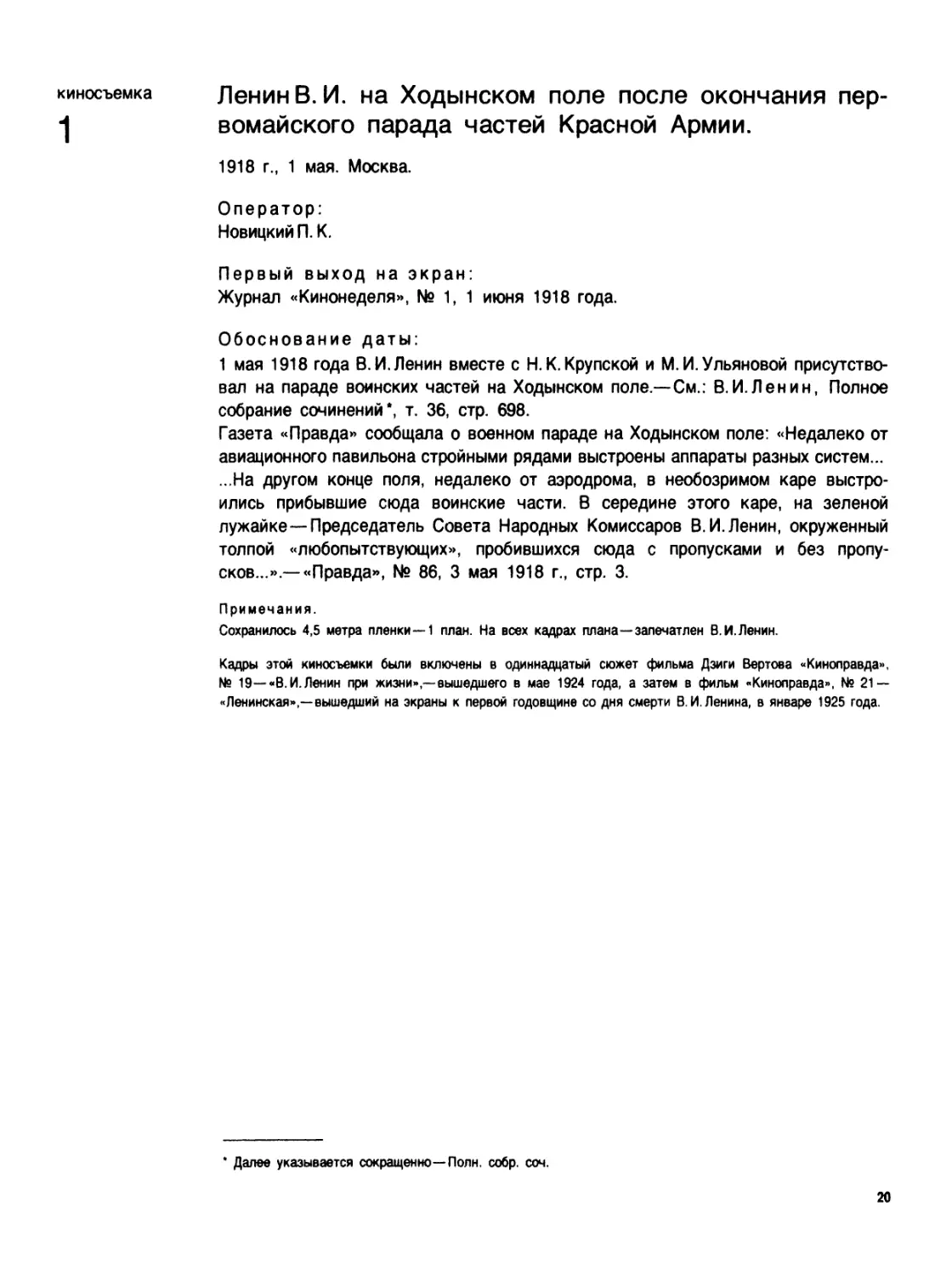
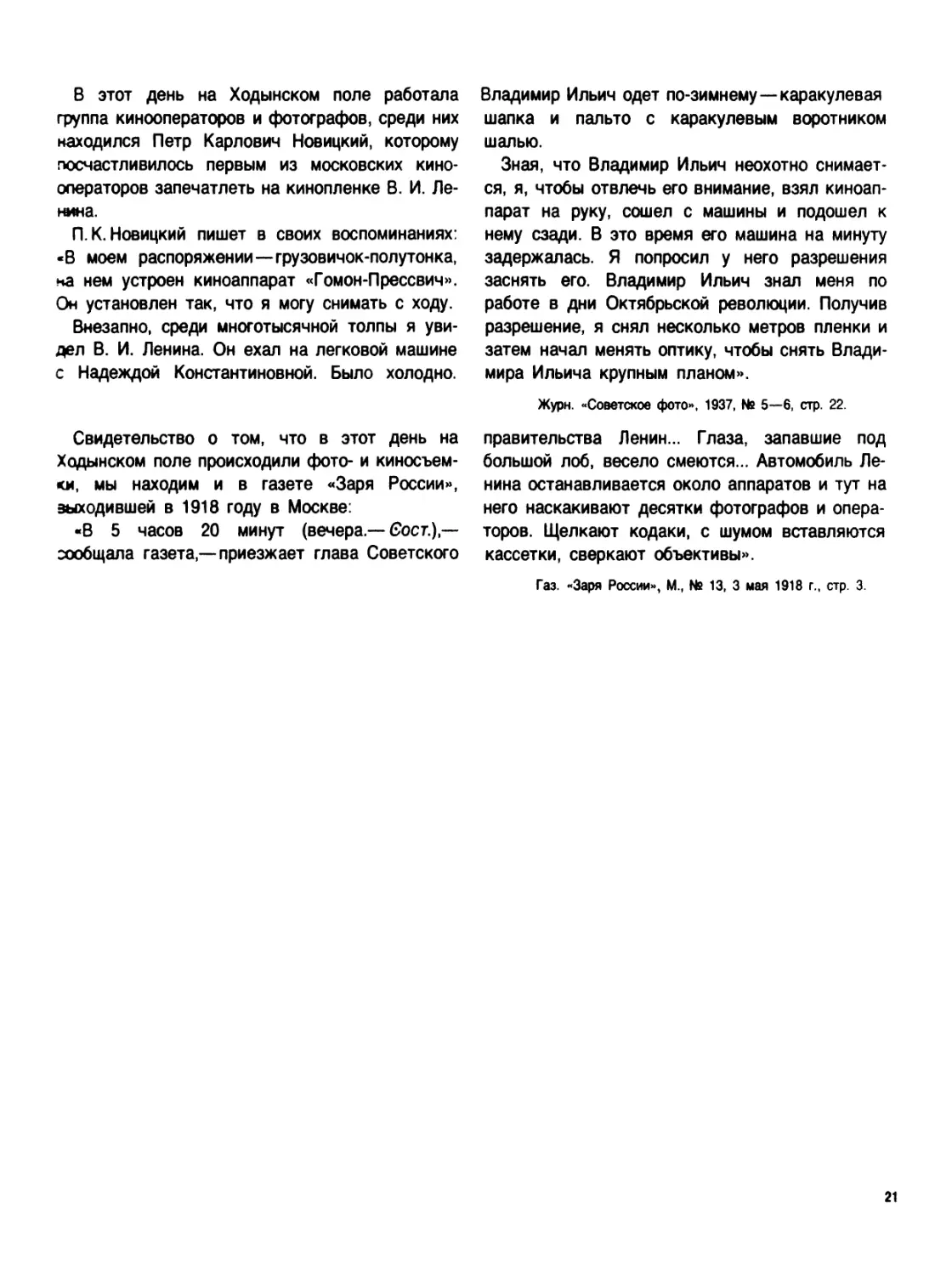
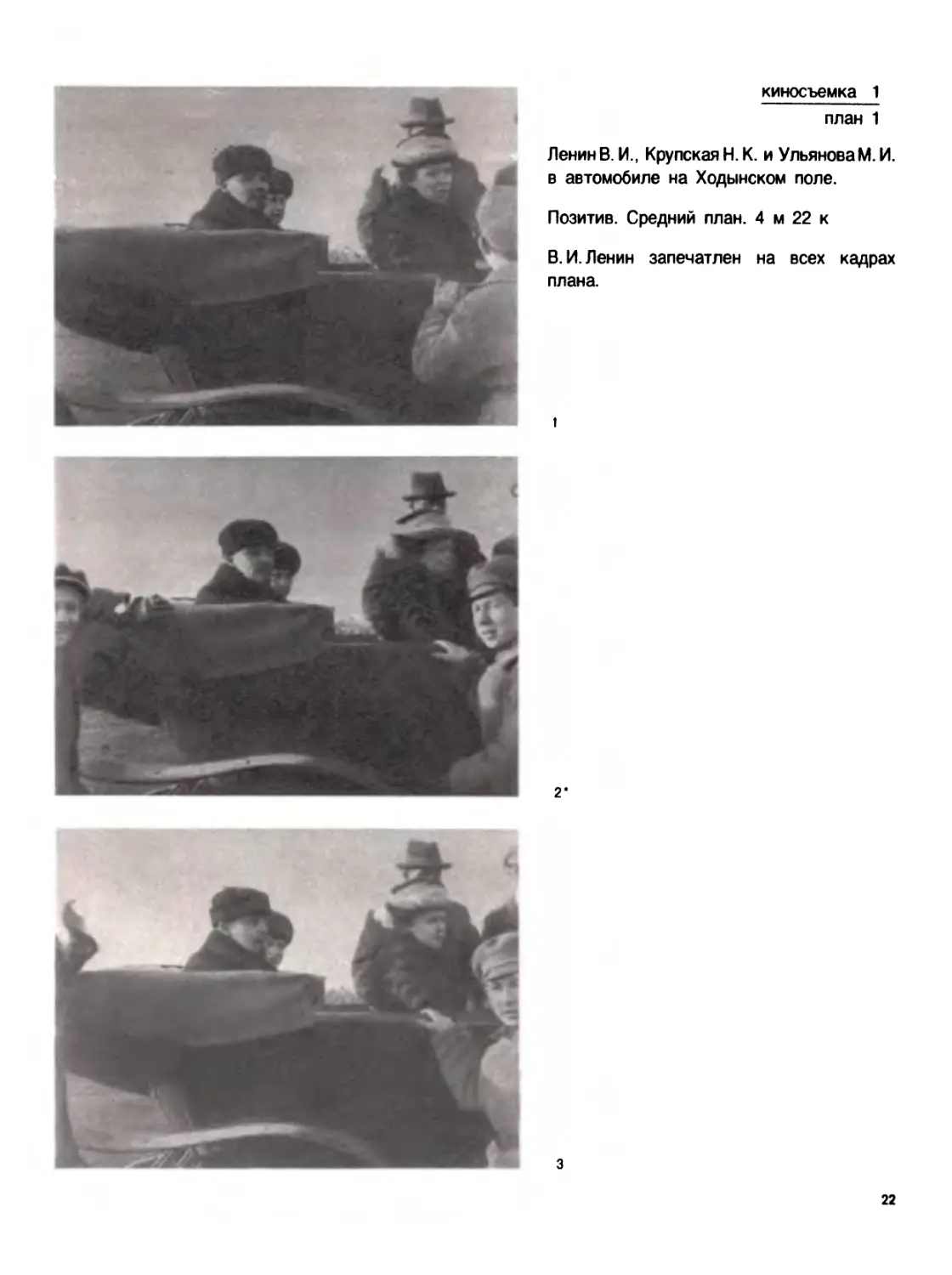

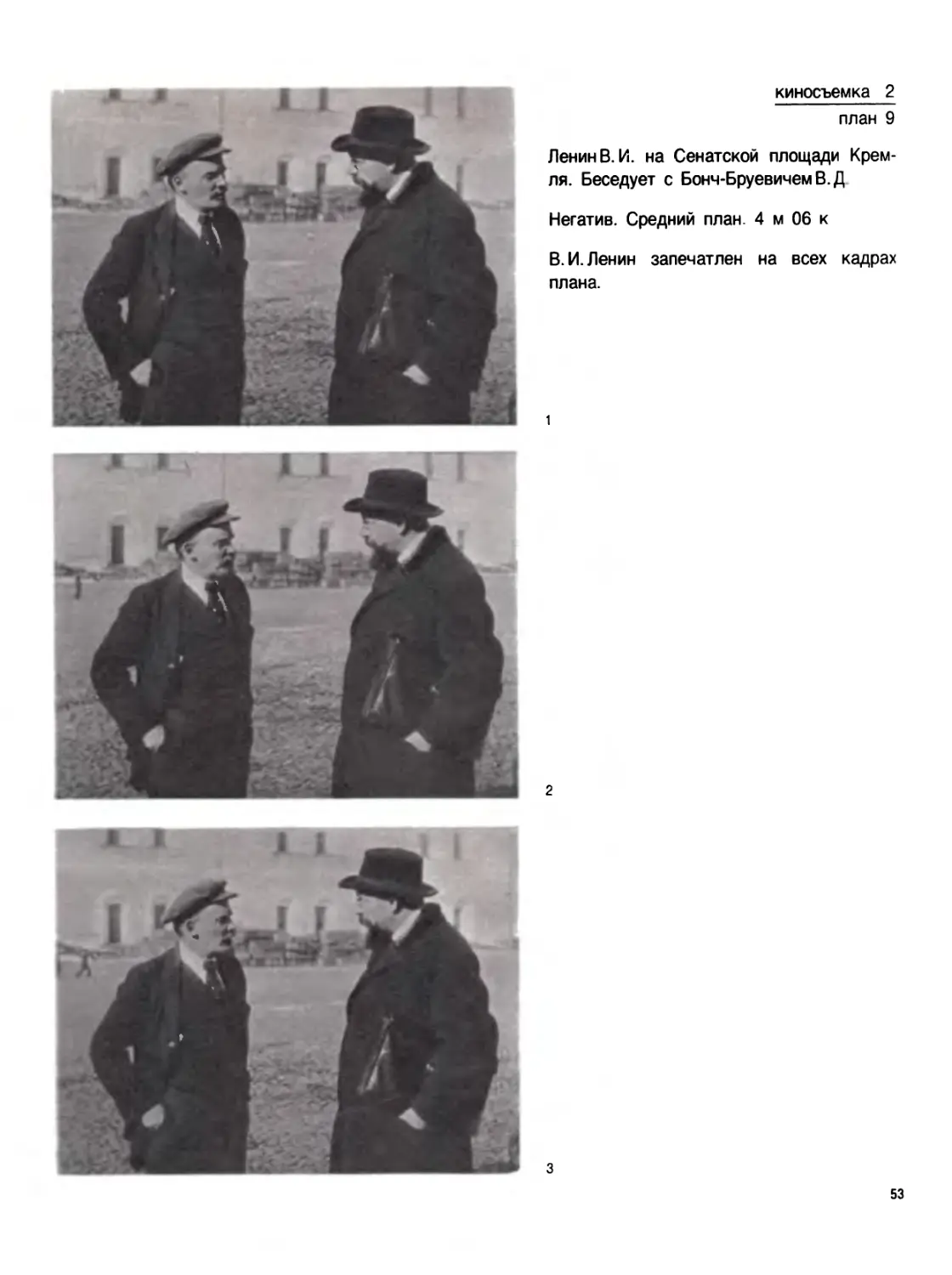
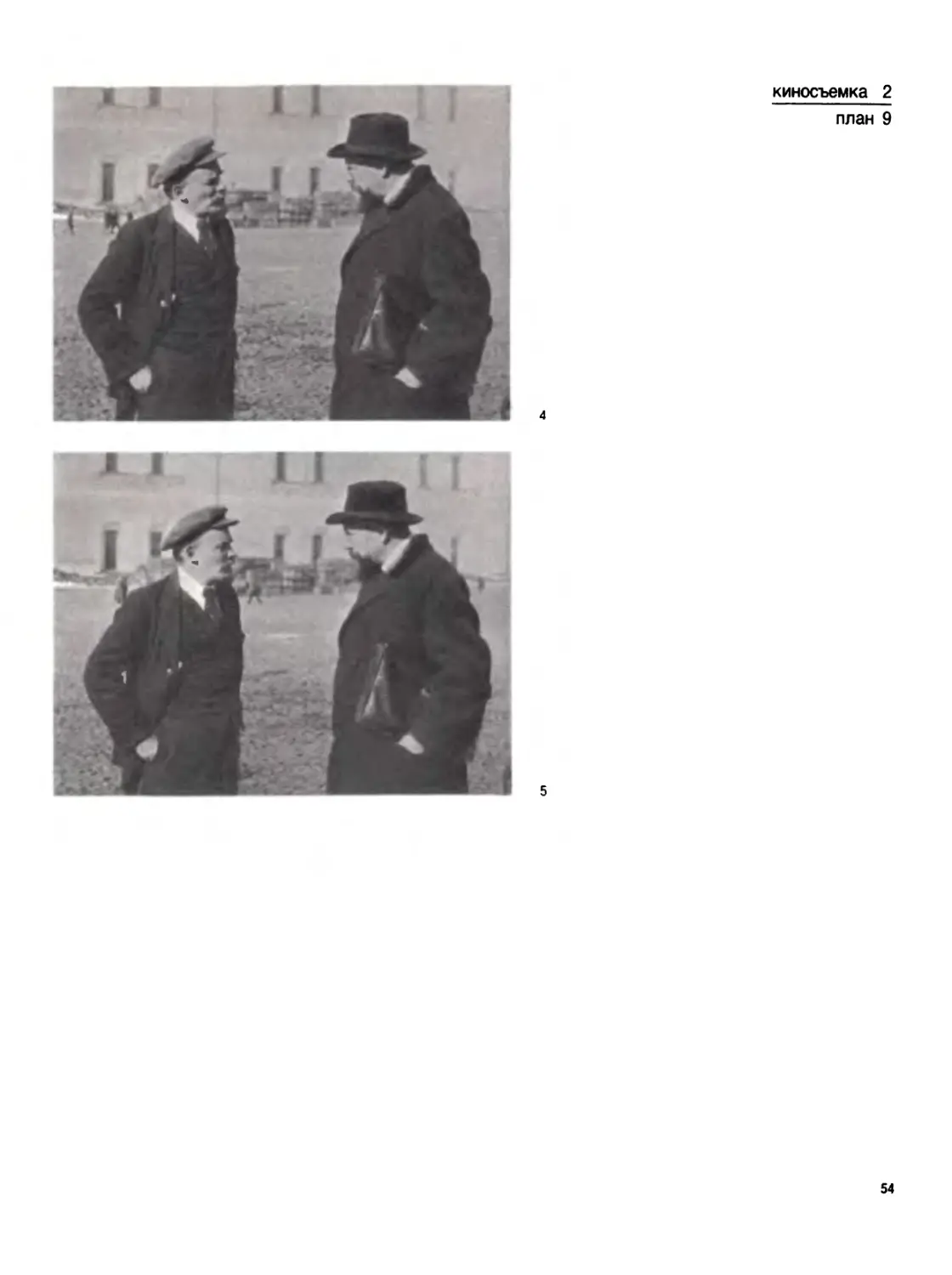
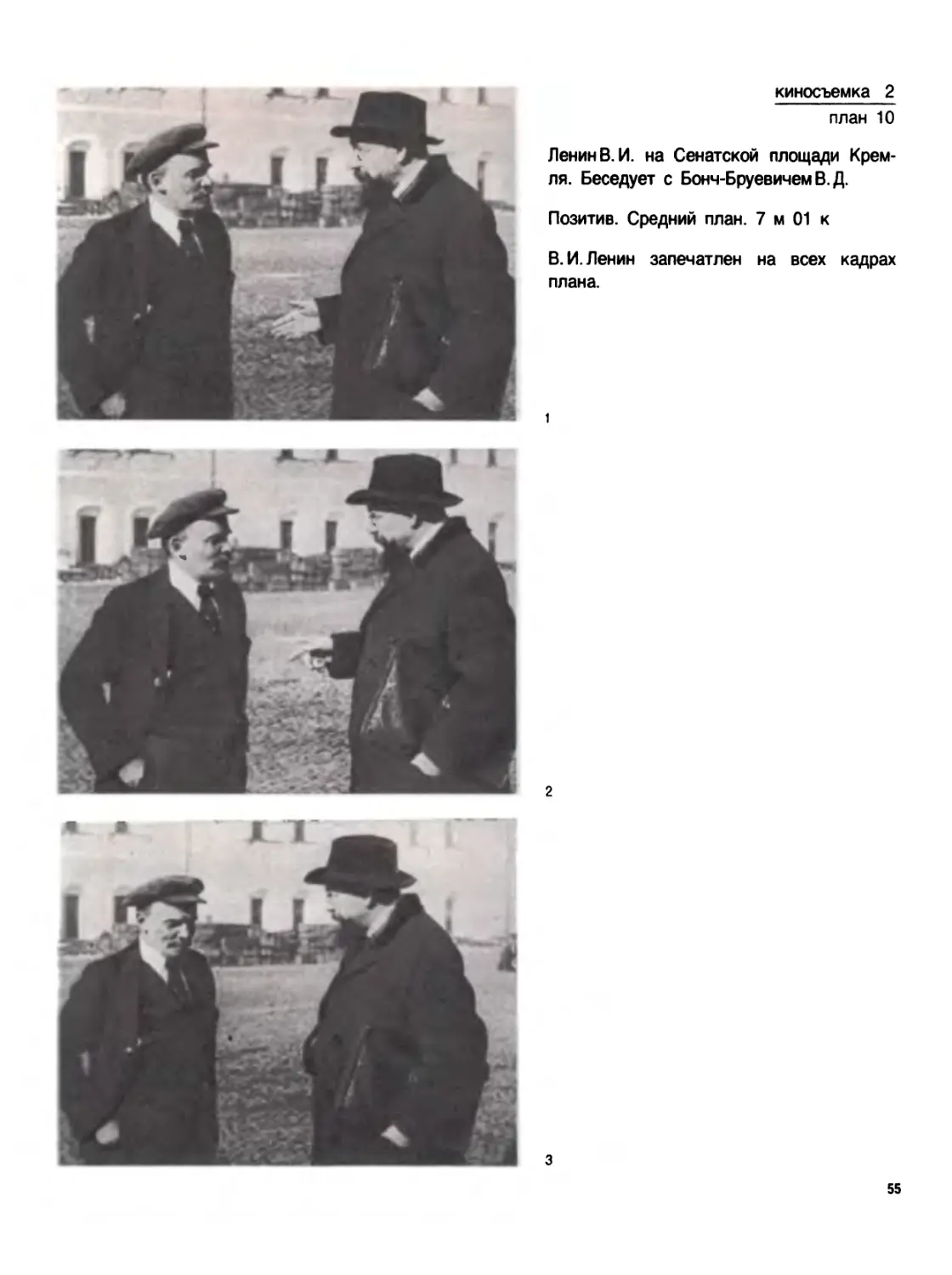
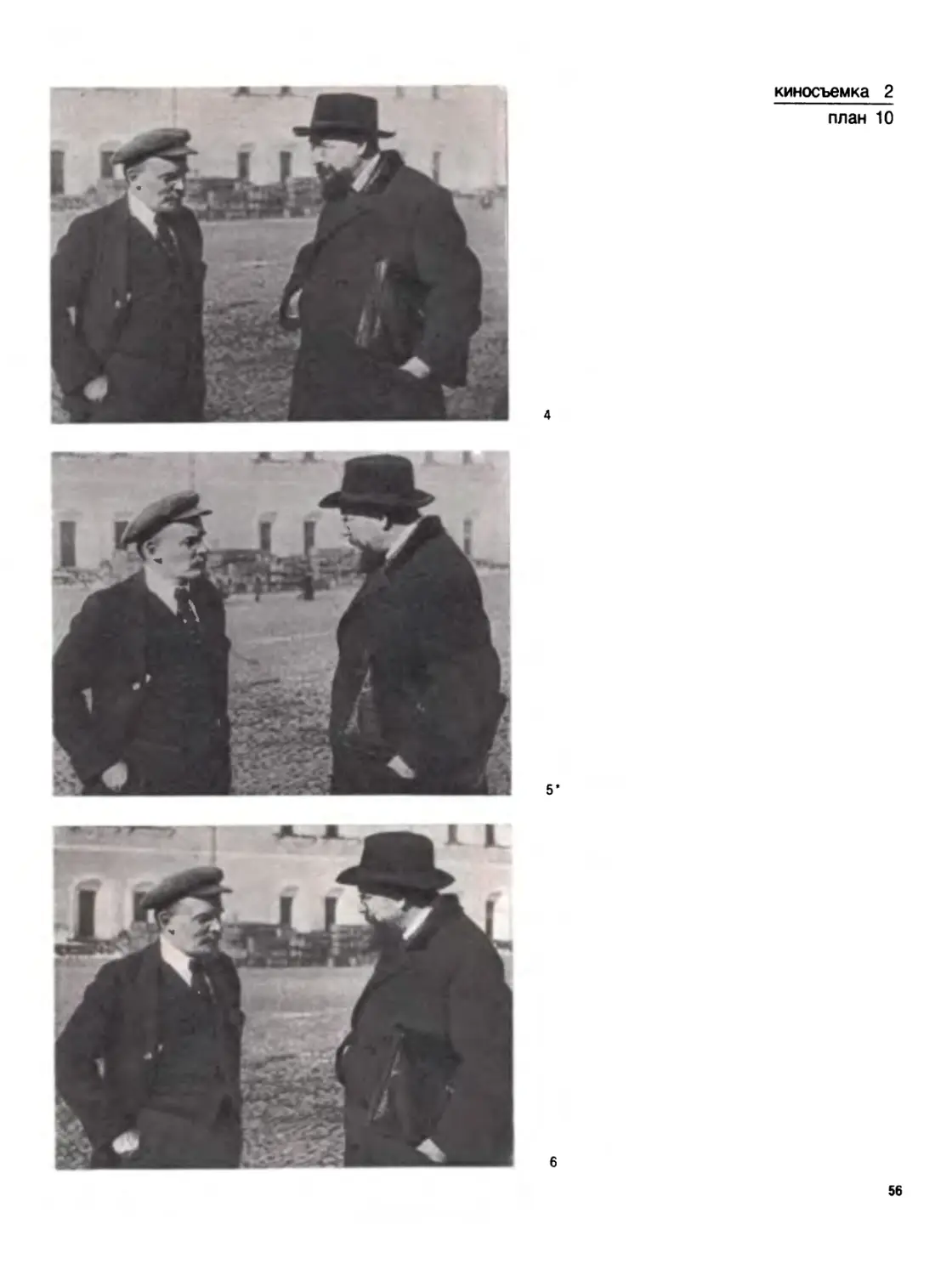
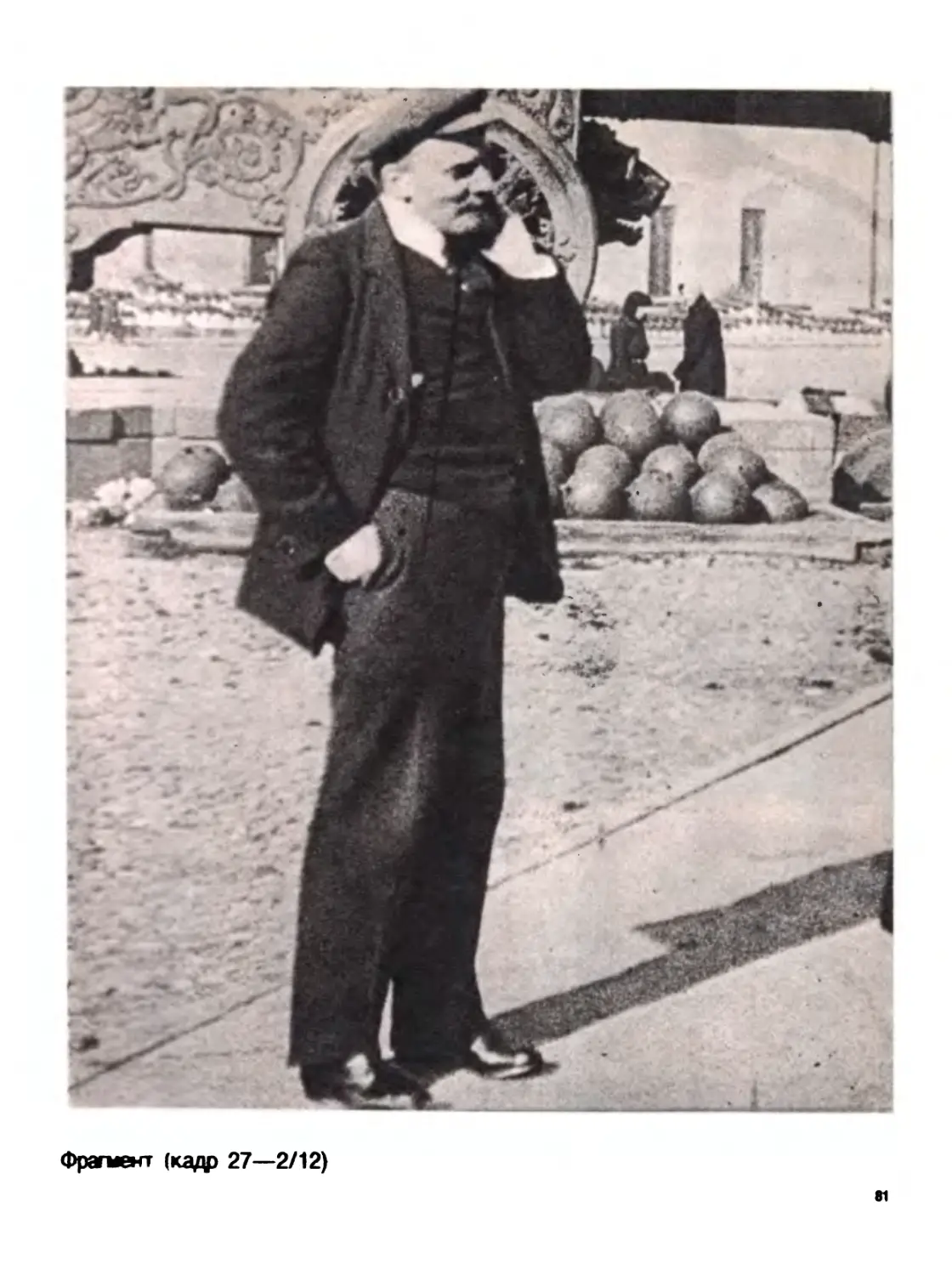
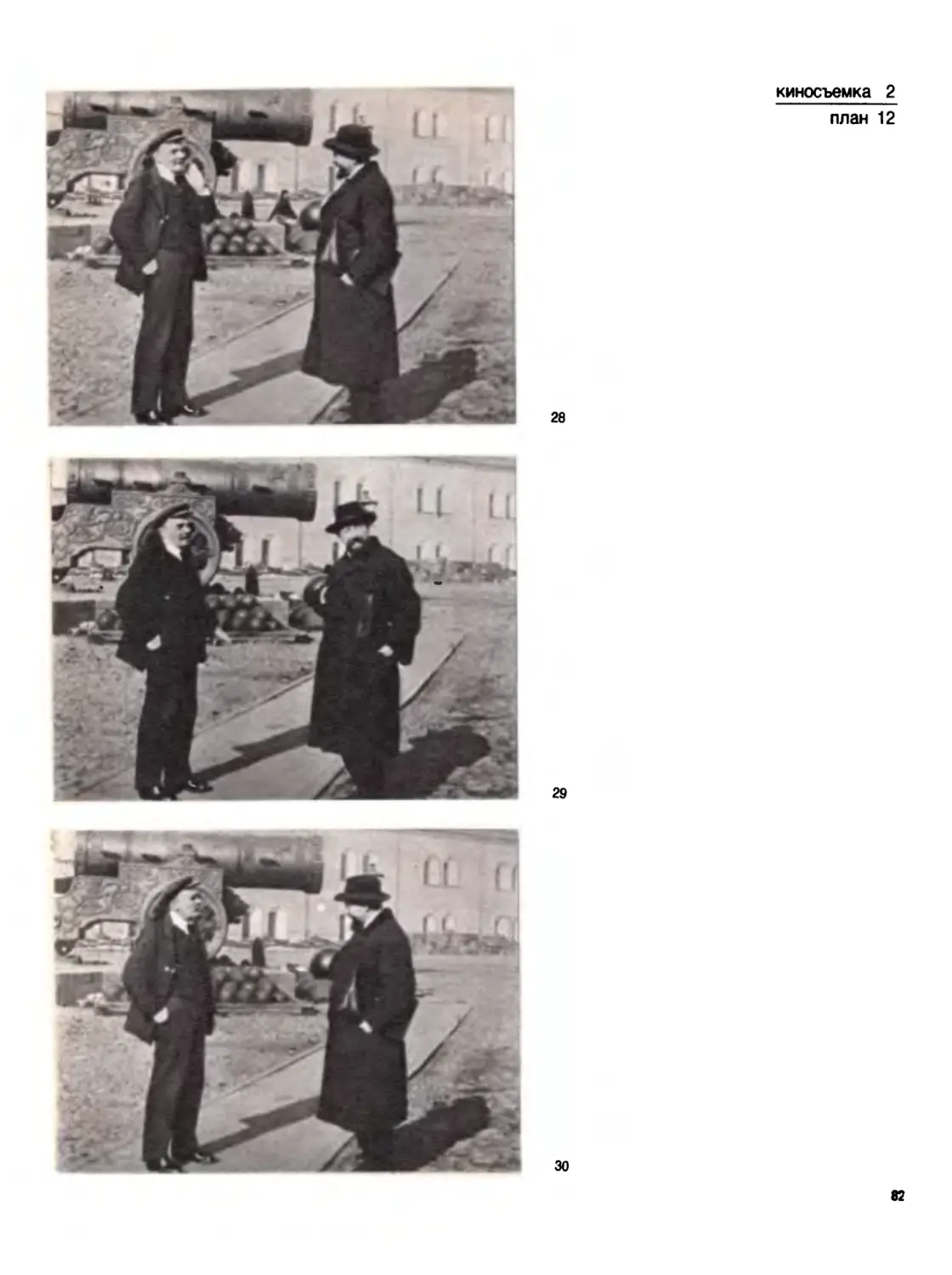
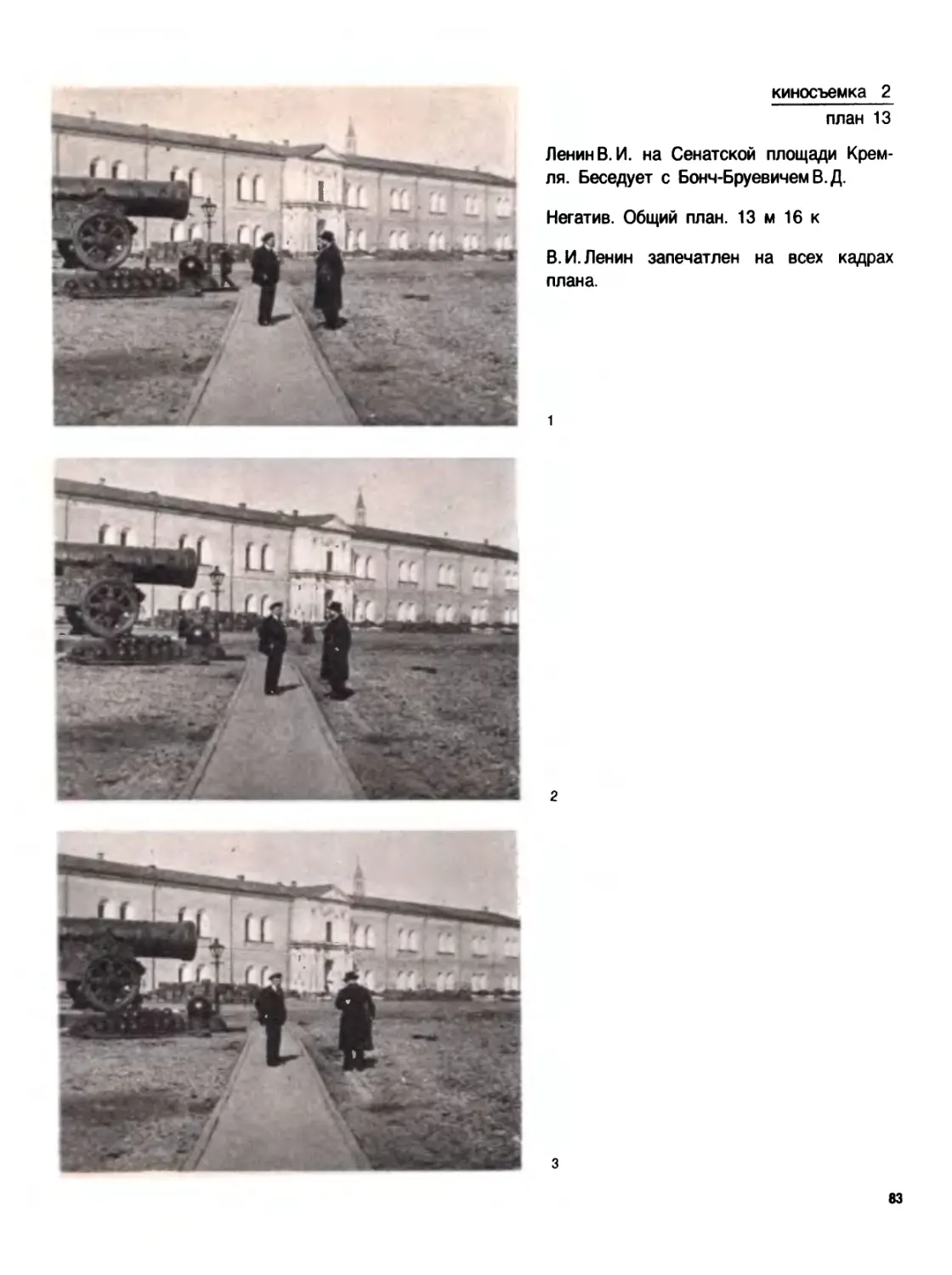
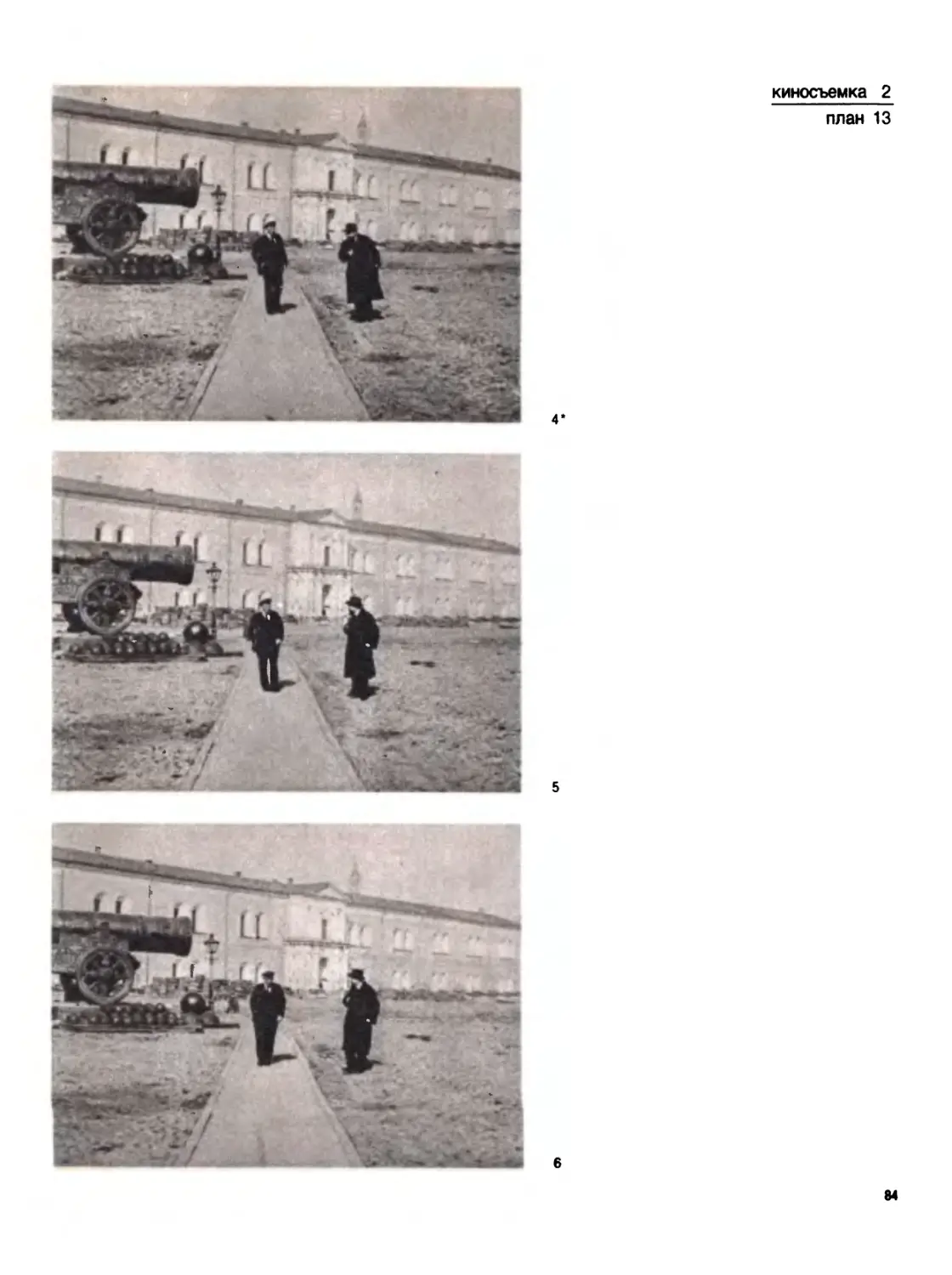
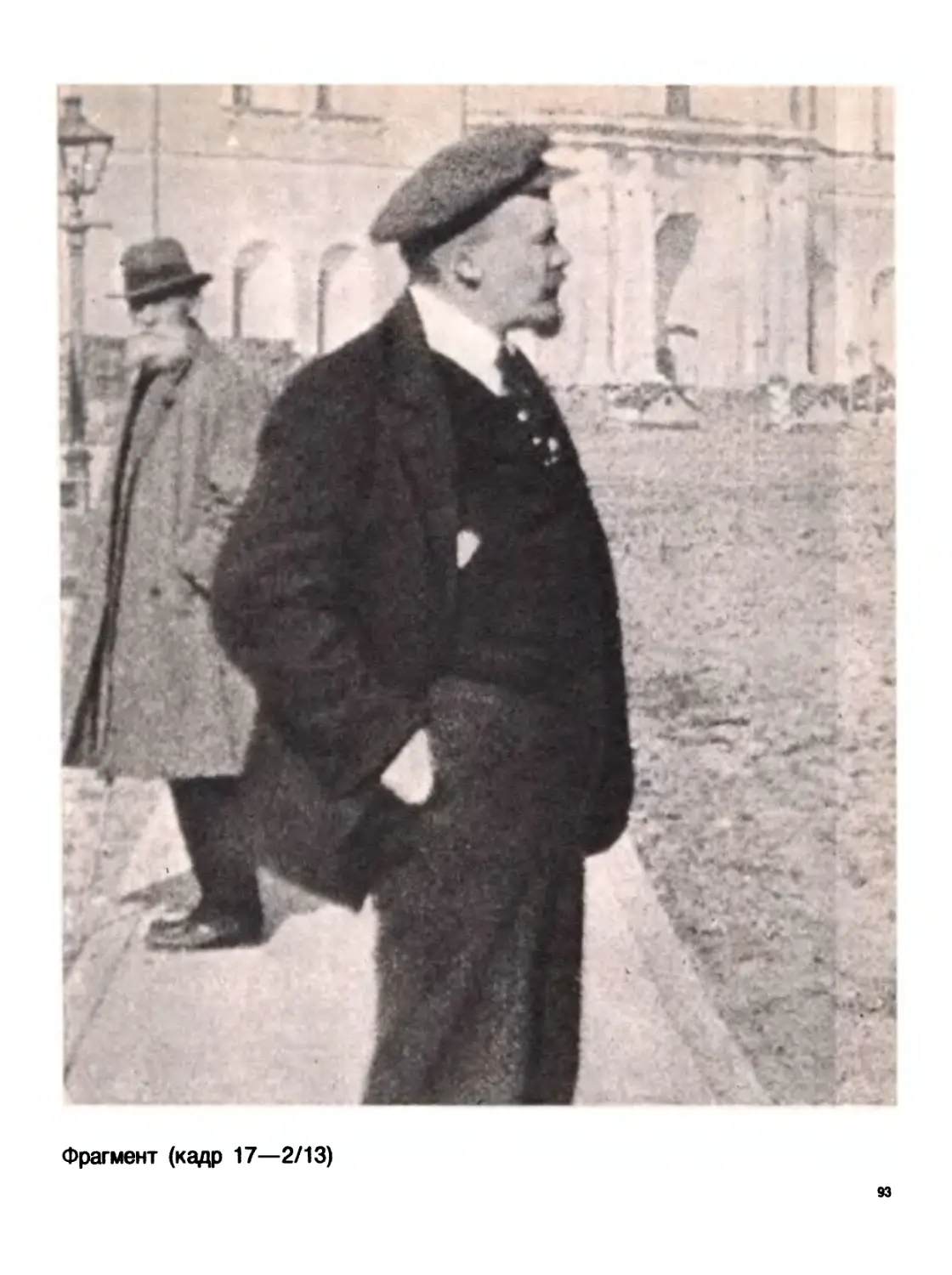
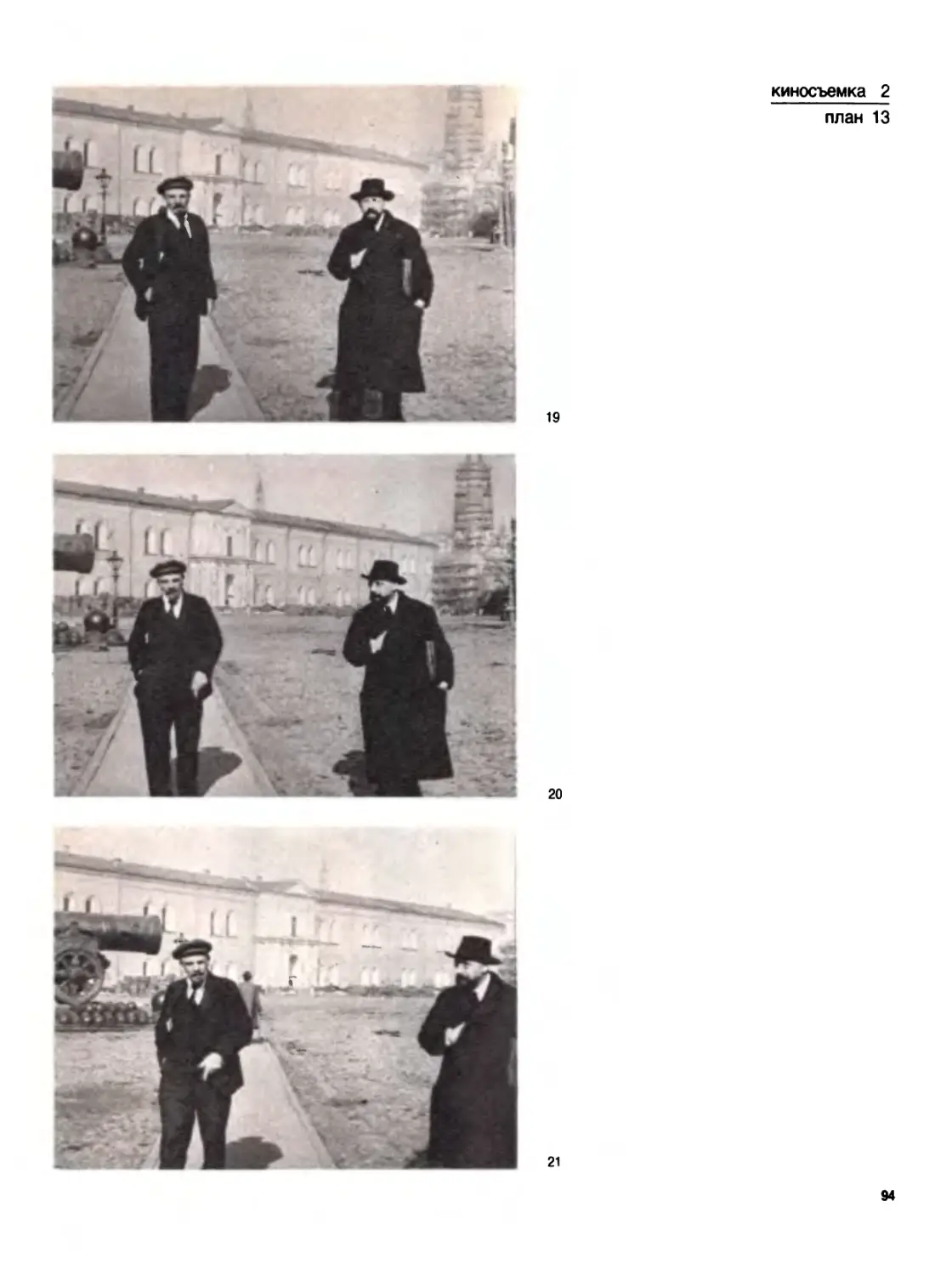
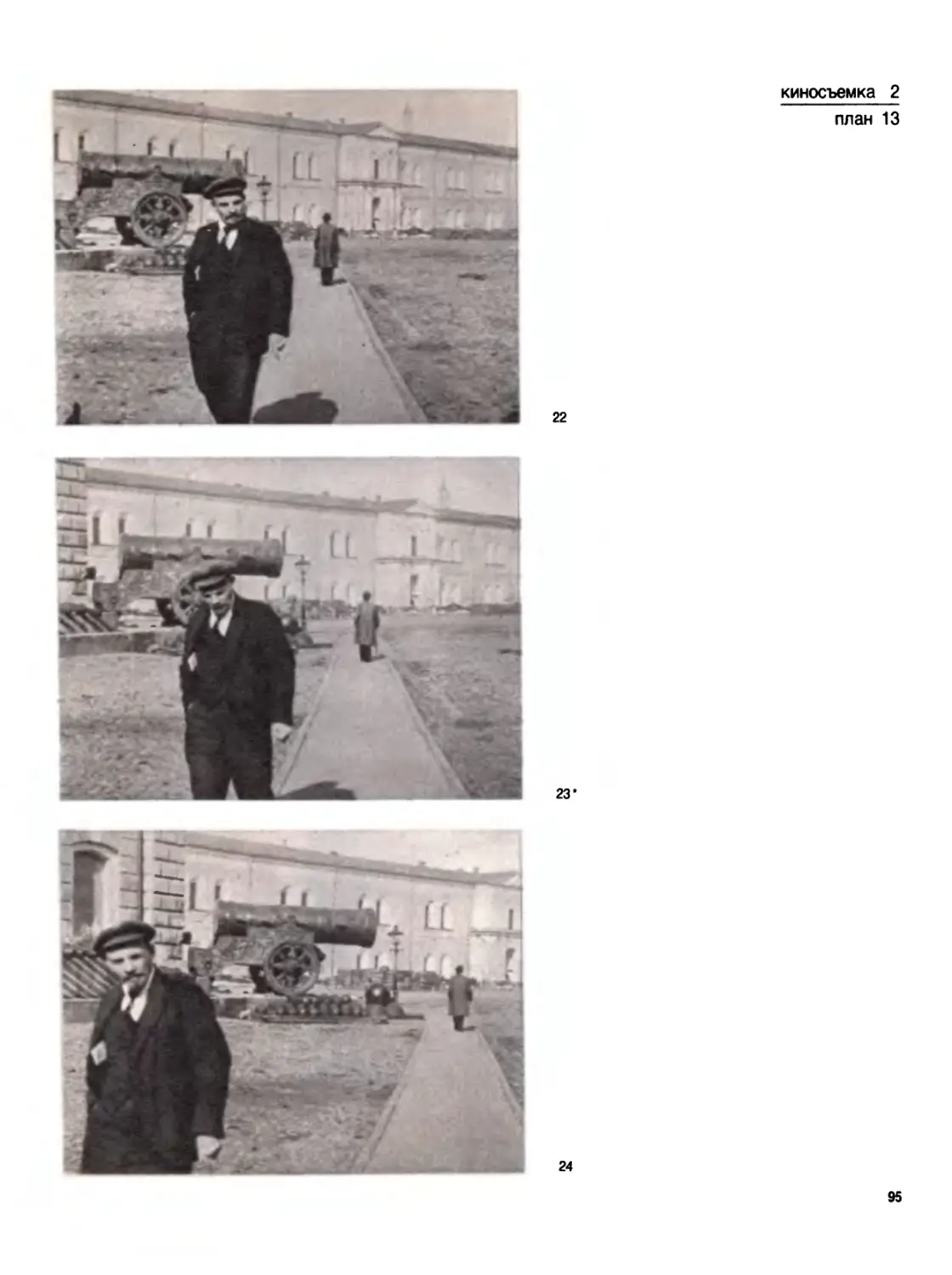
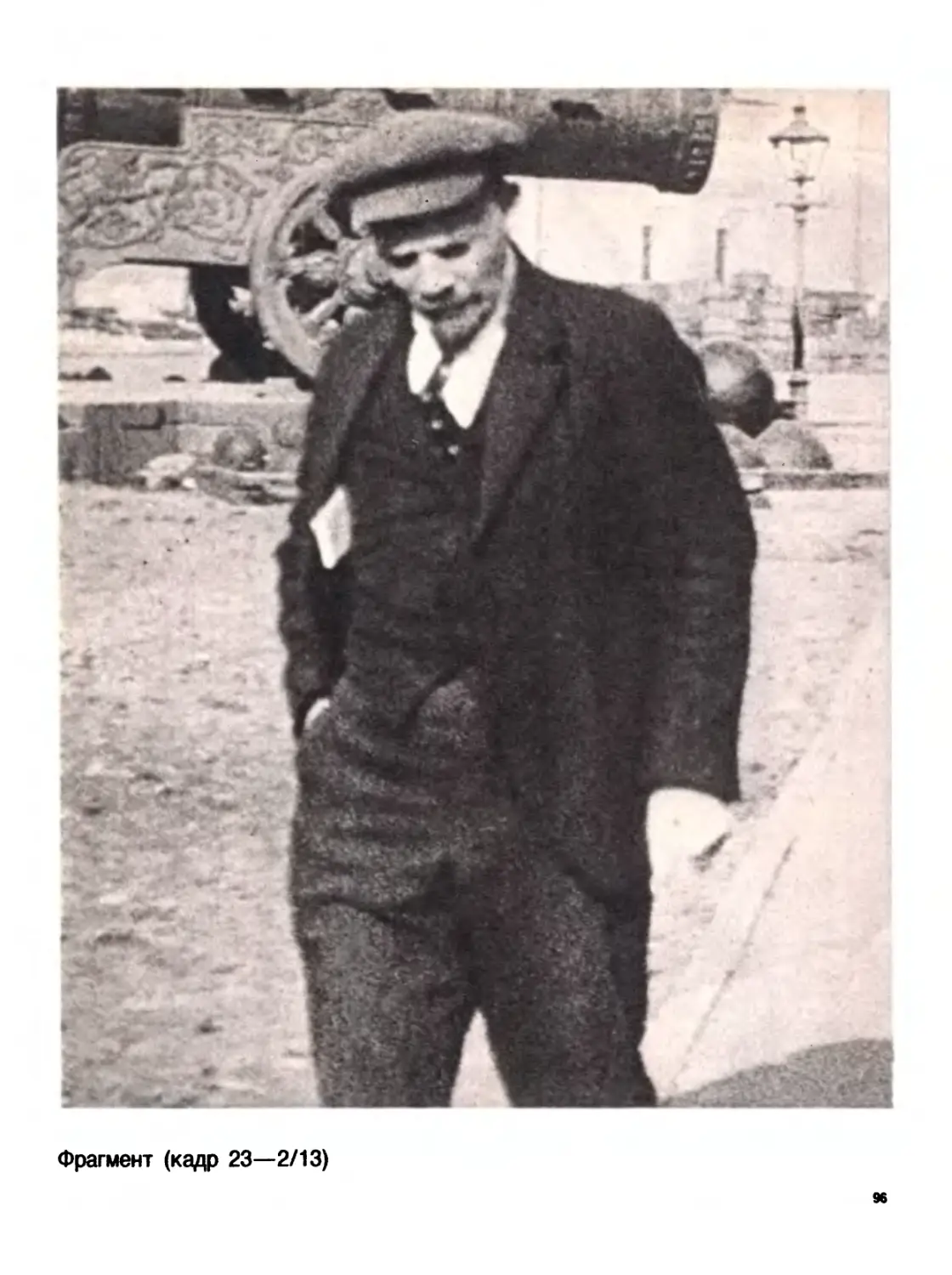
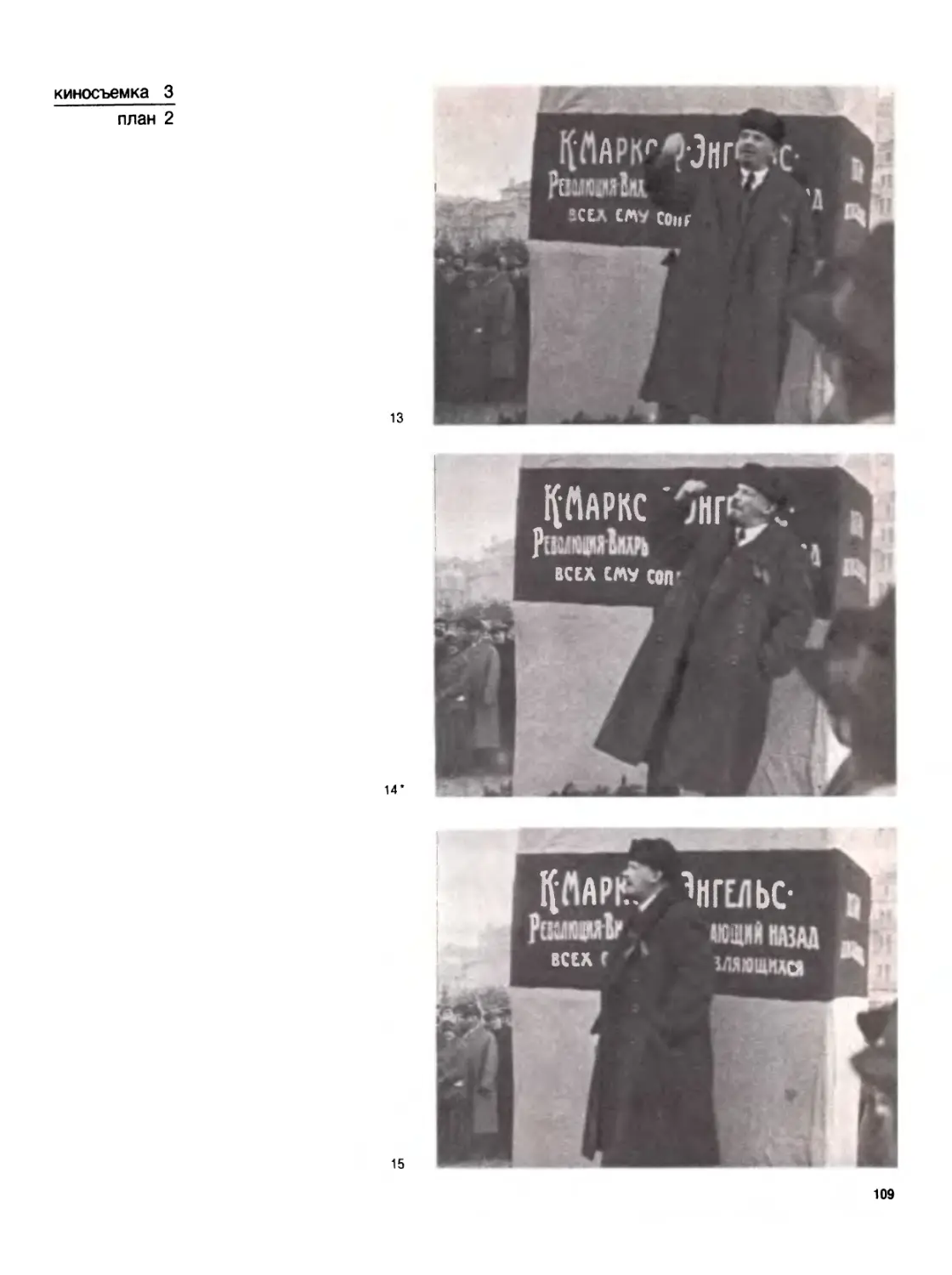
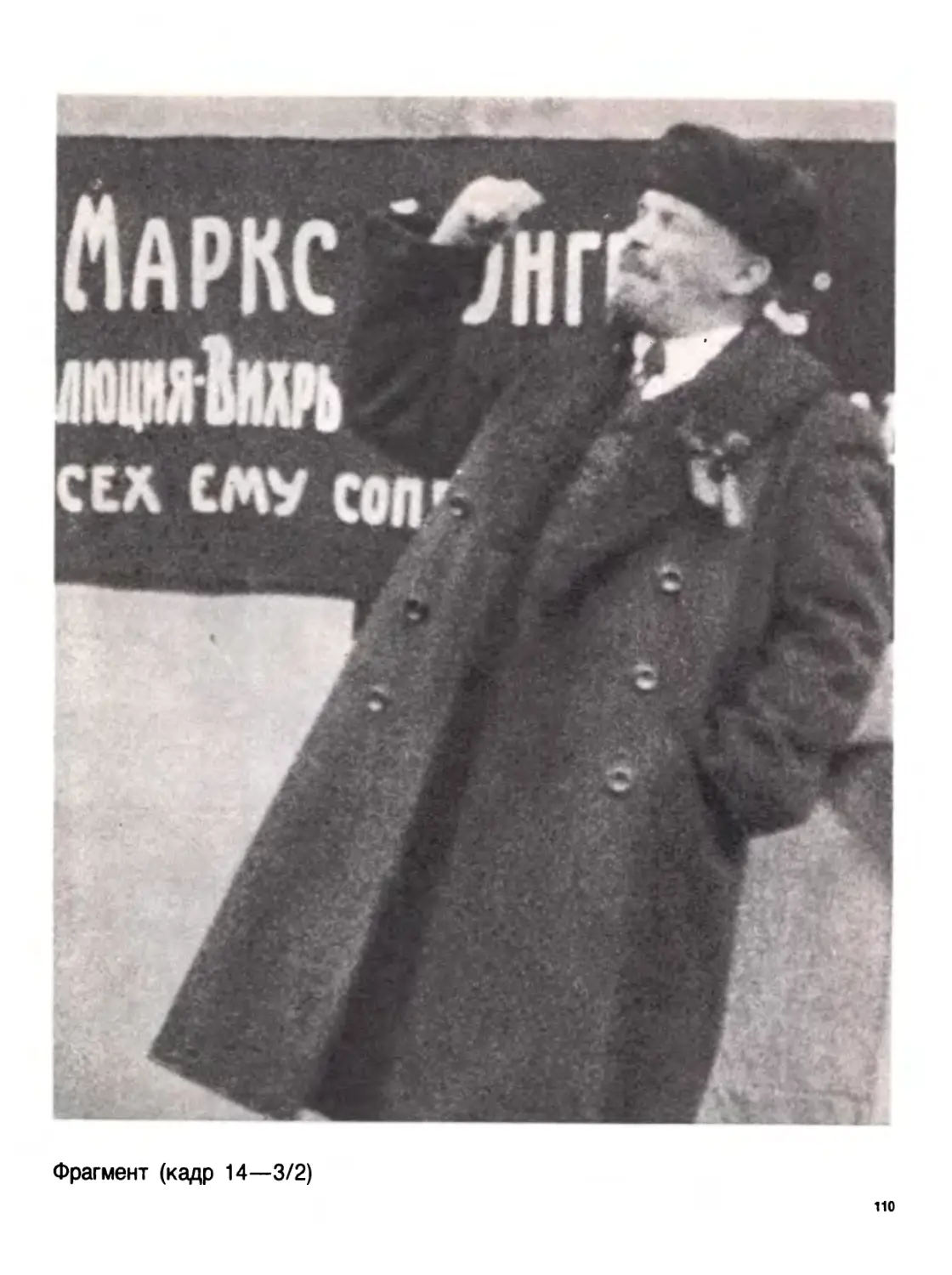
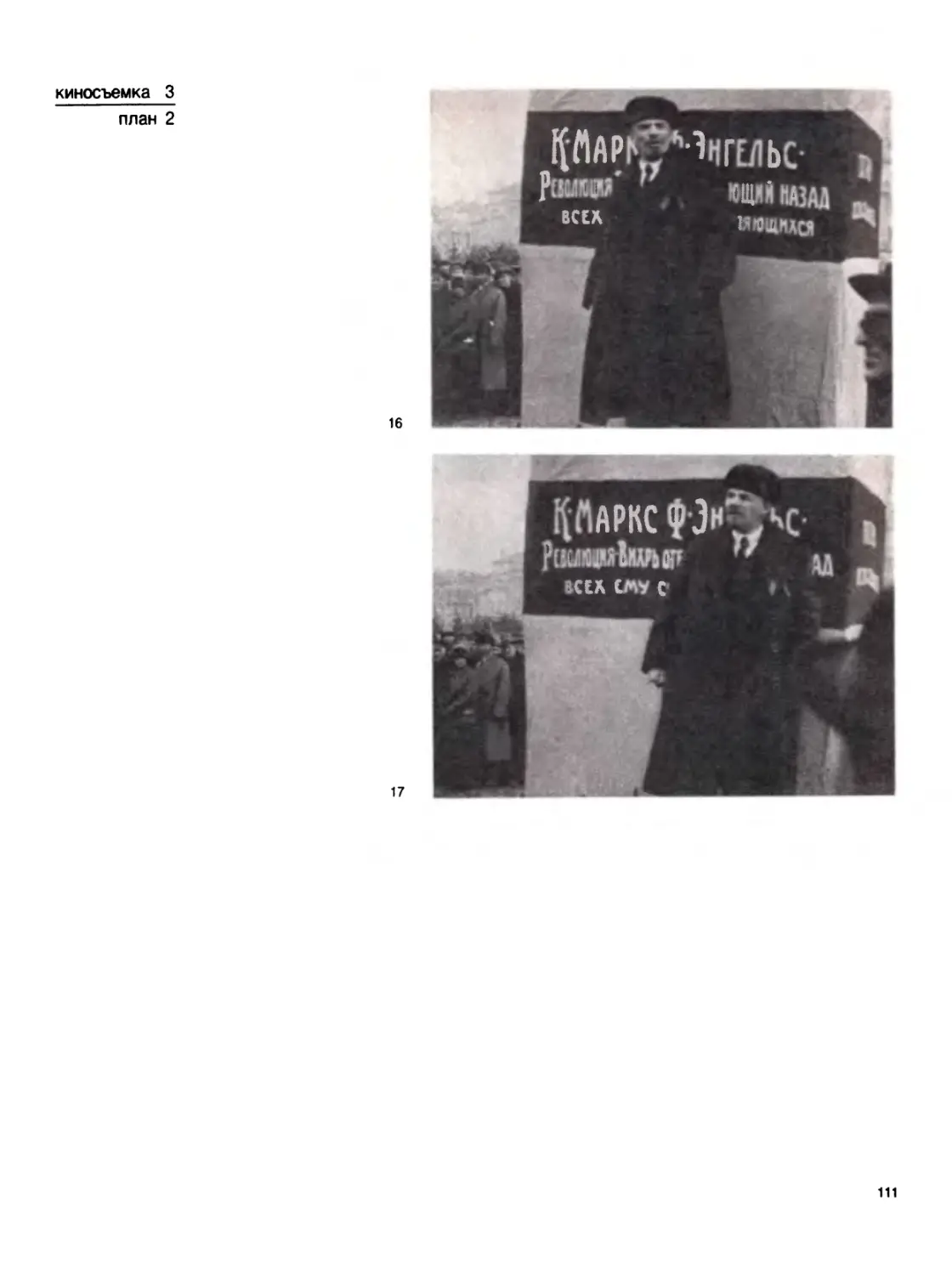
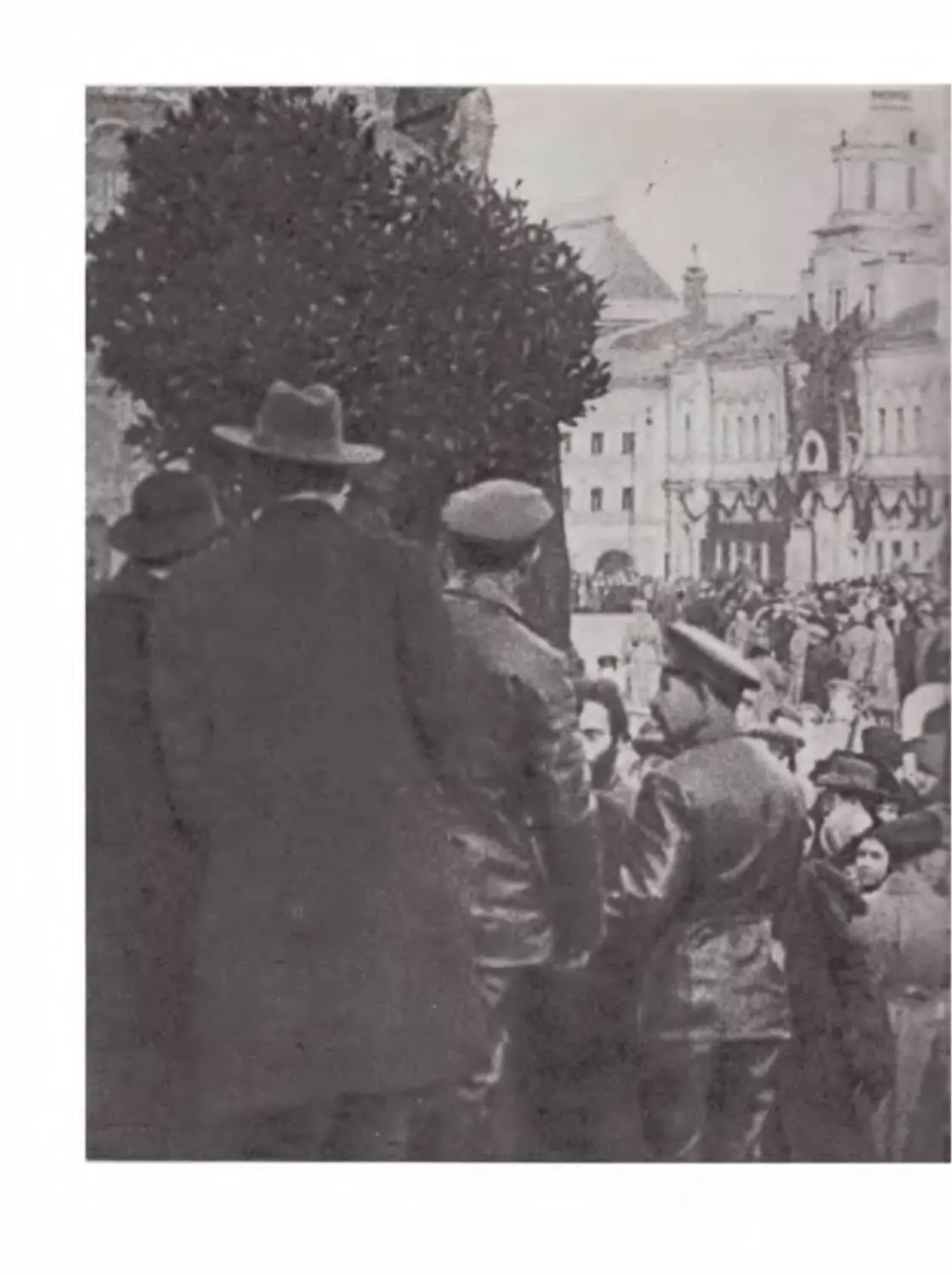





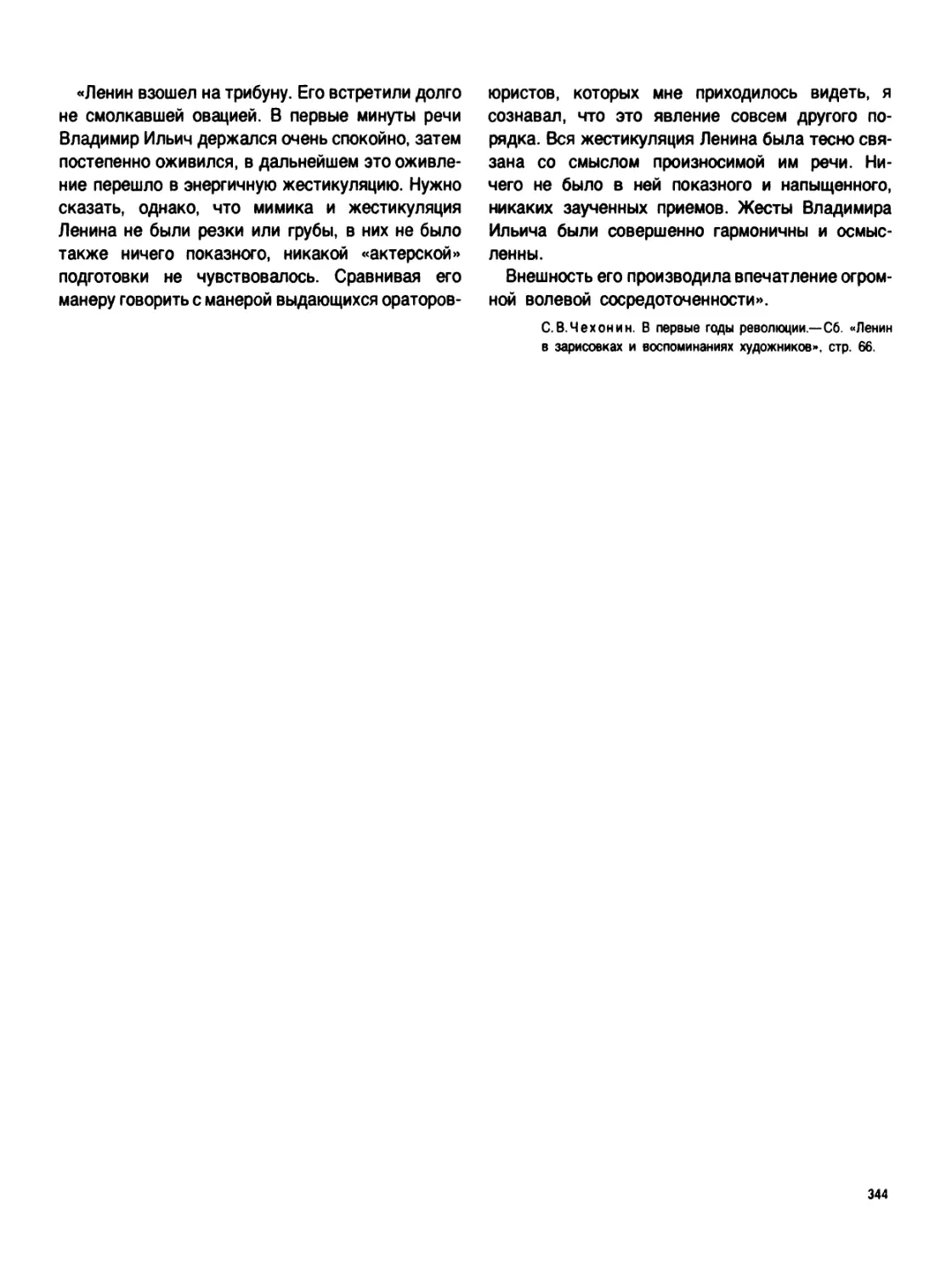
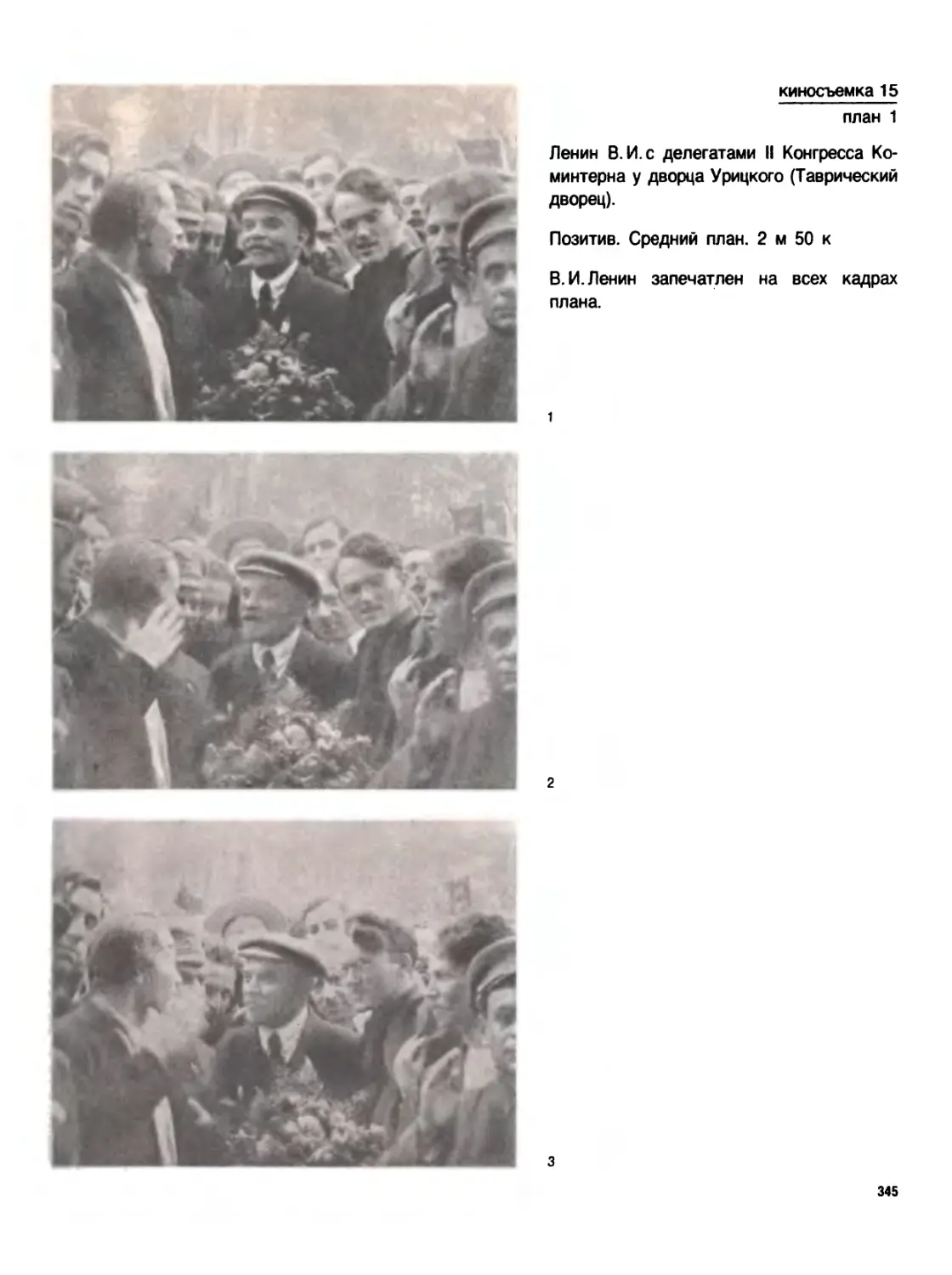
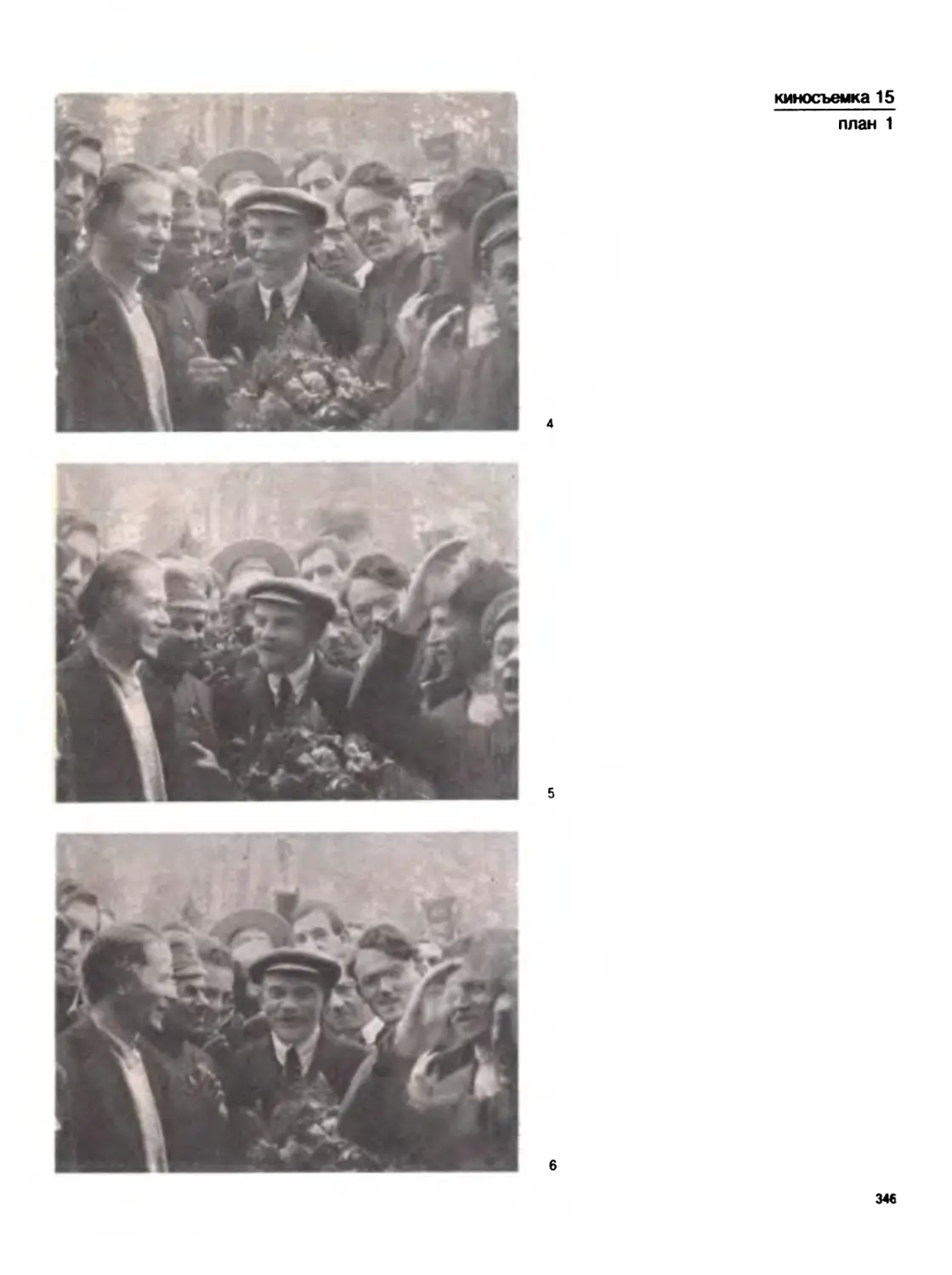
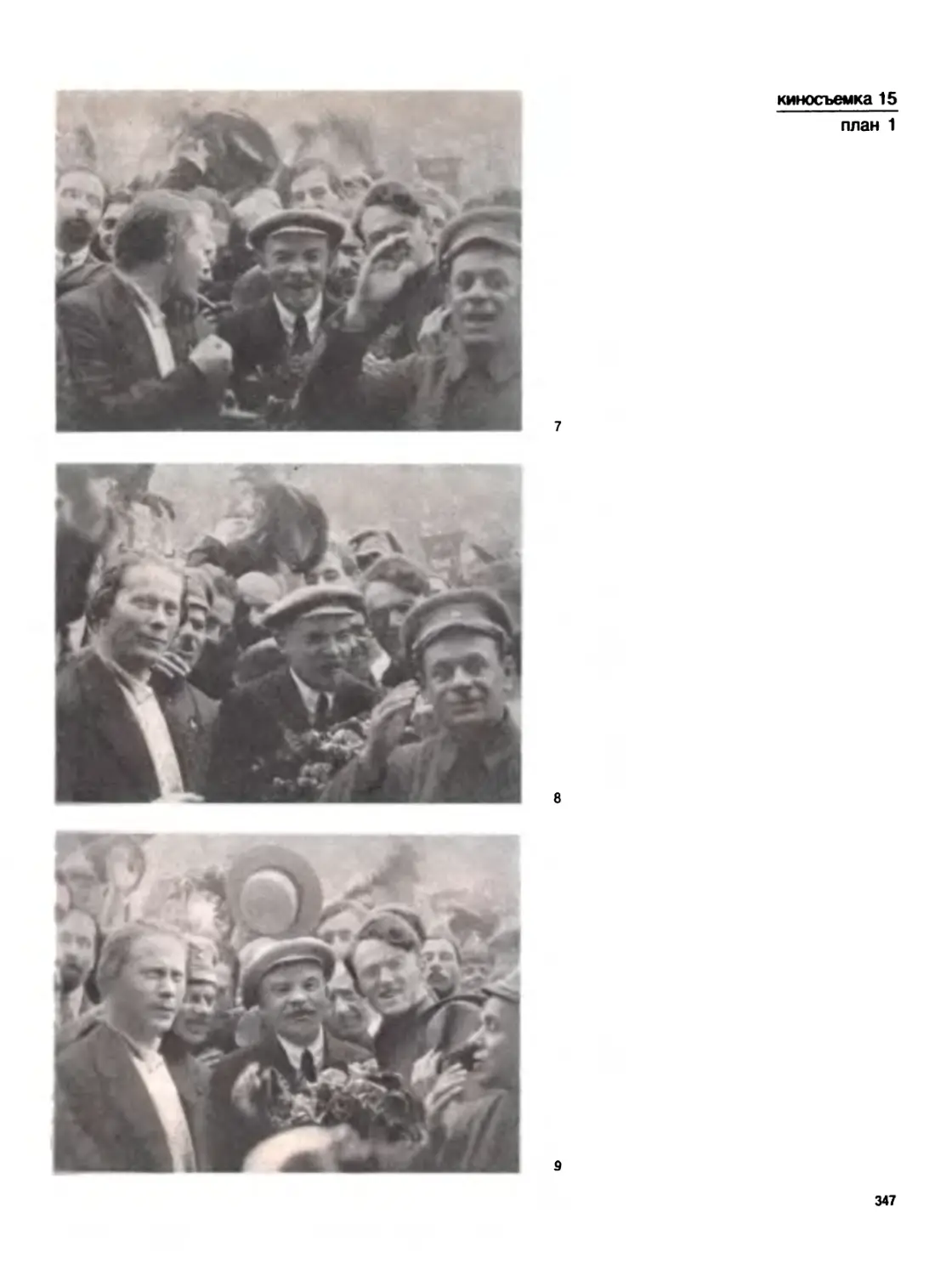
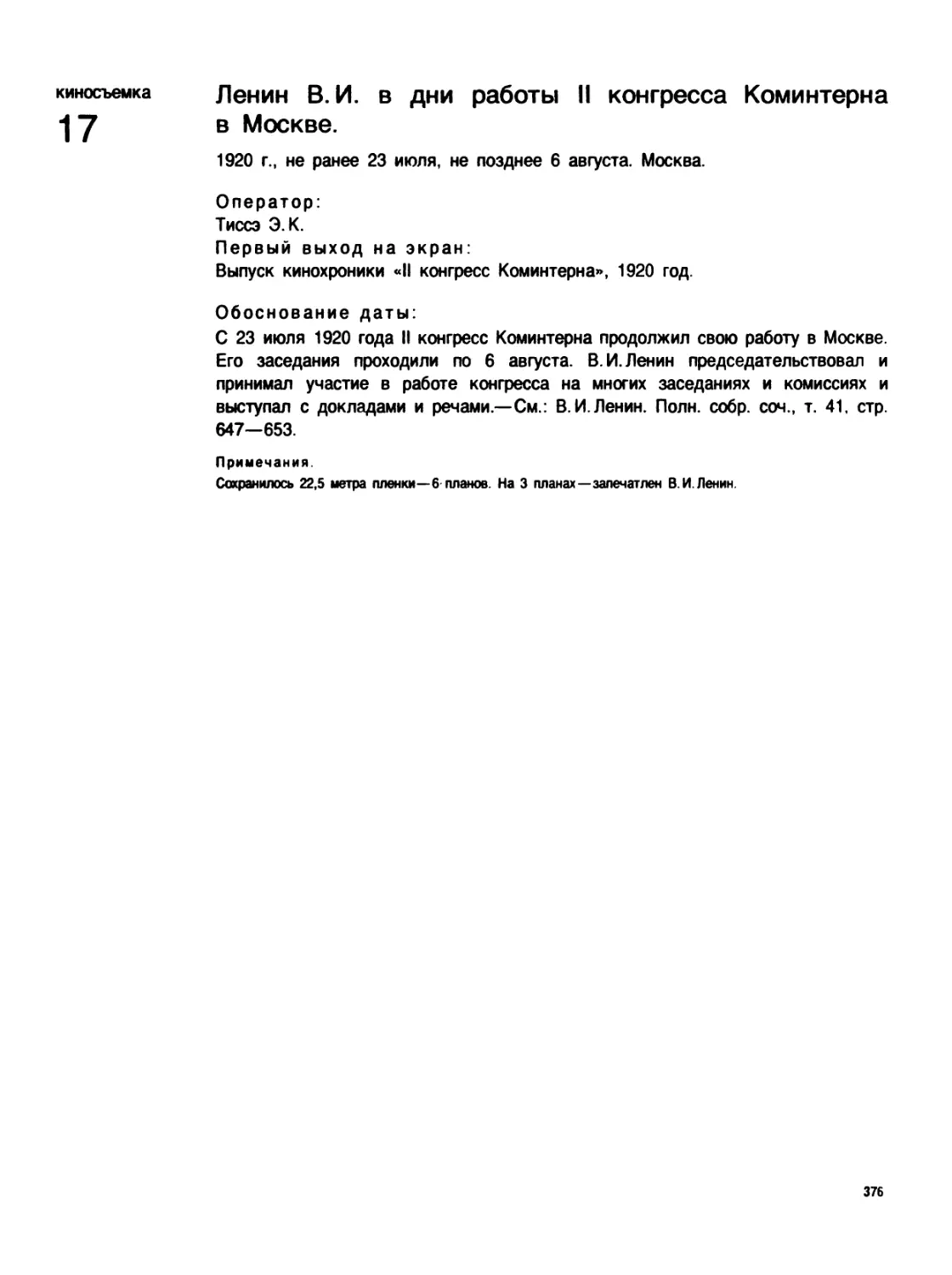
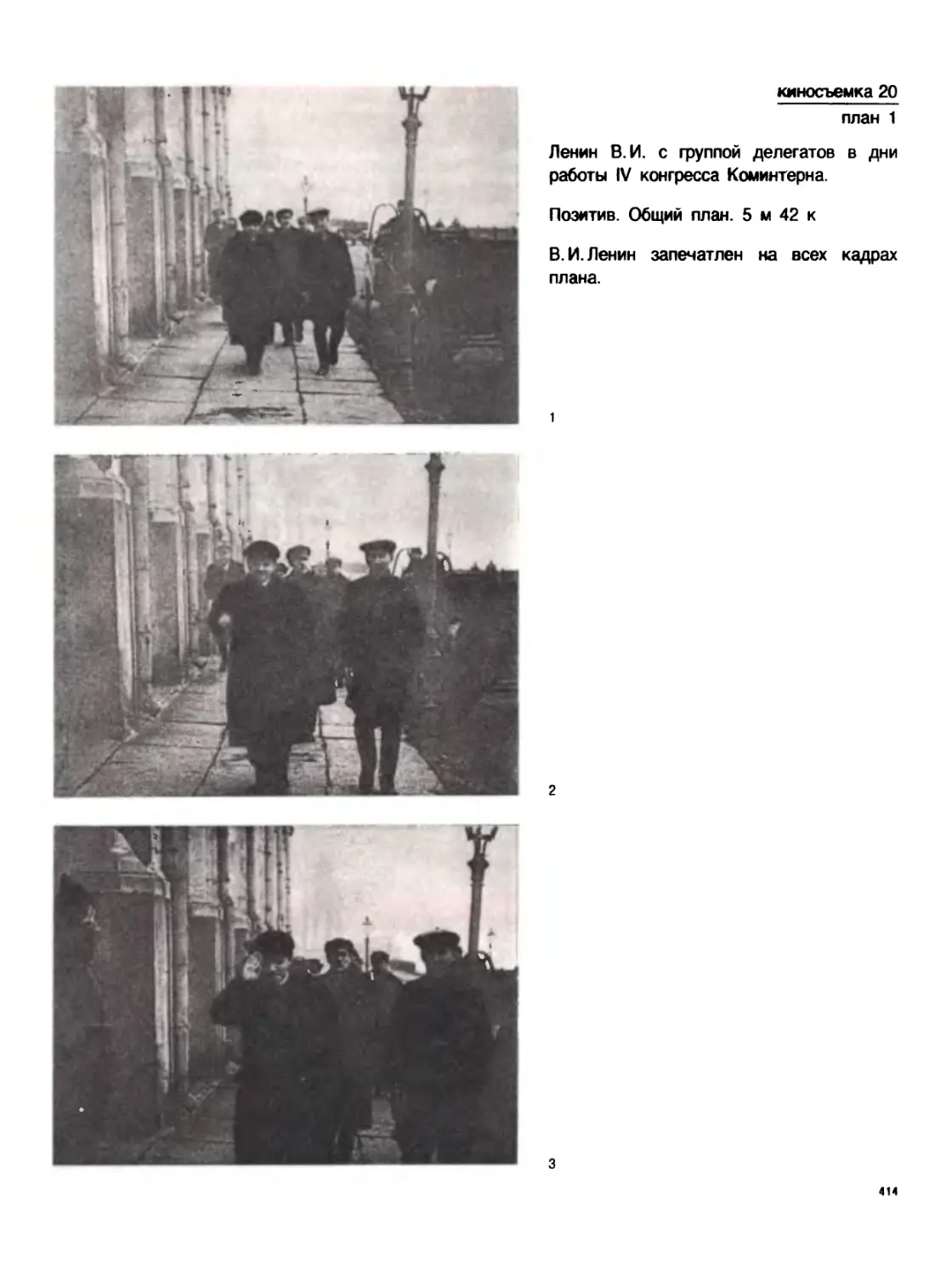









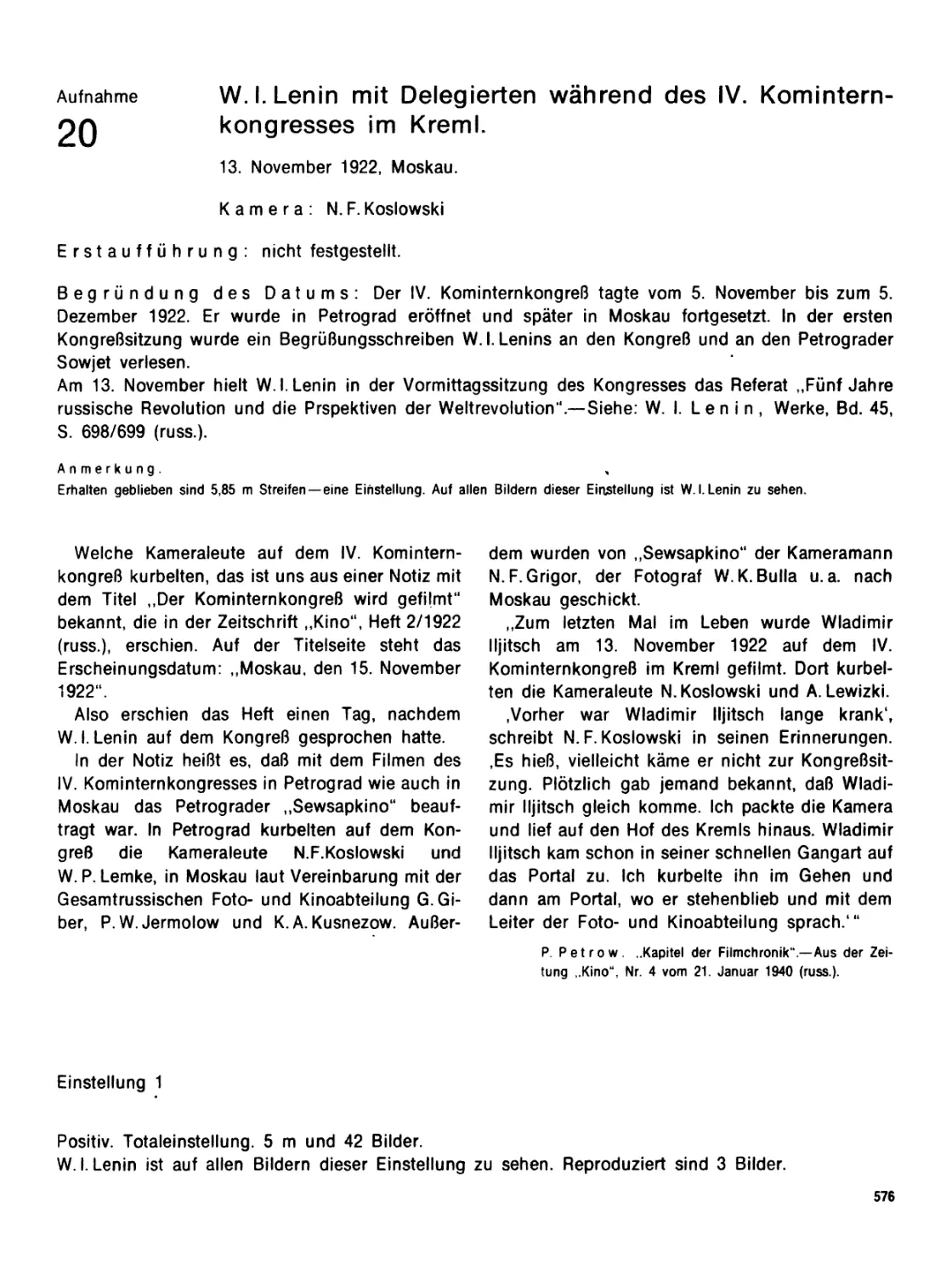





Текст
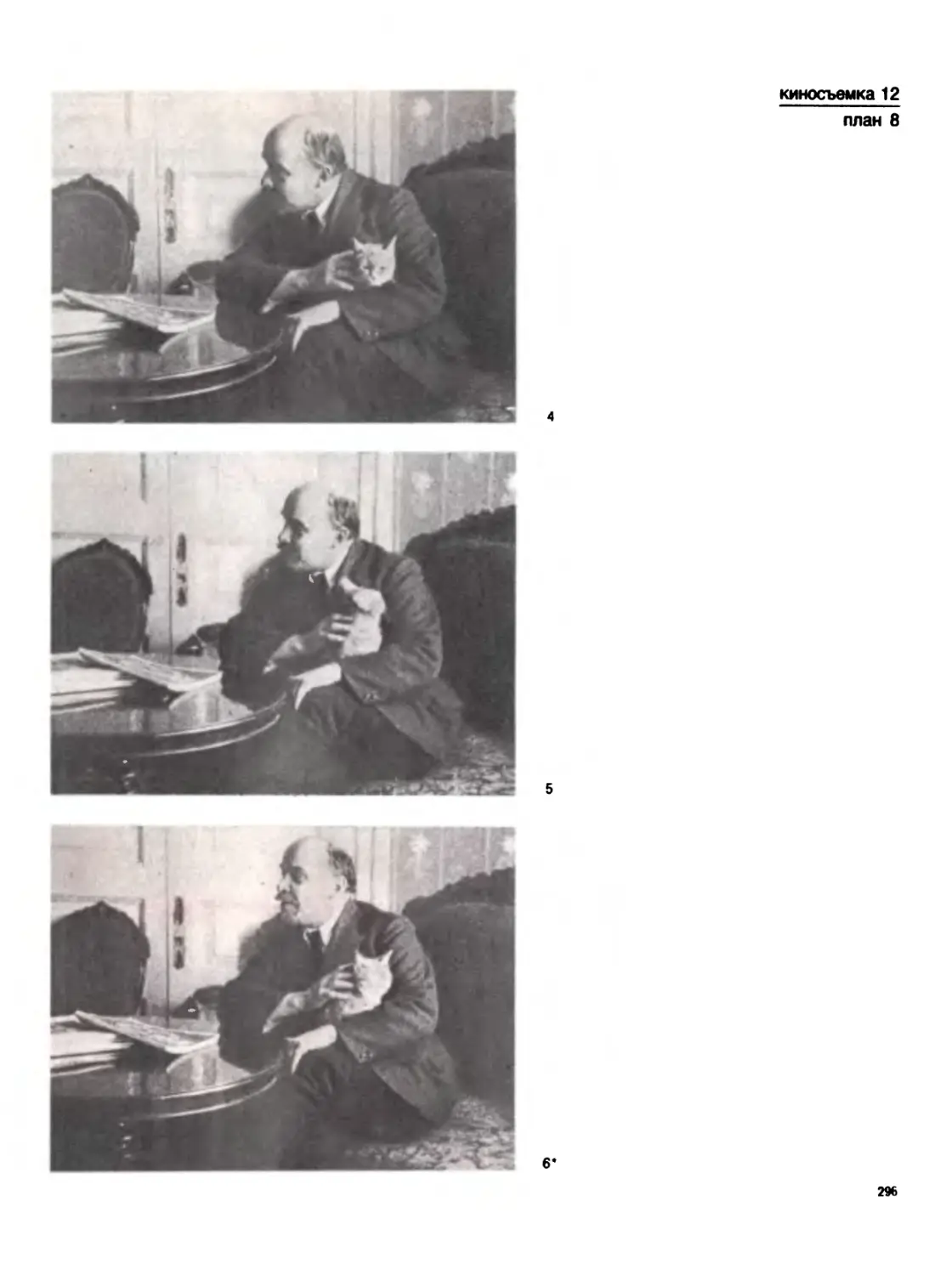
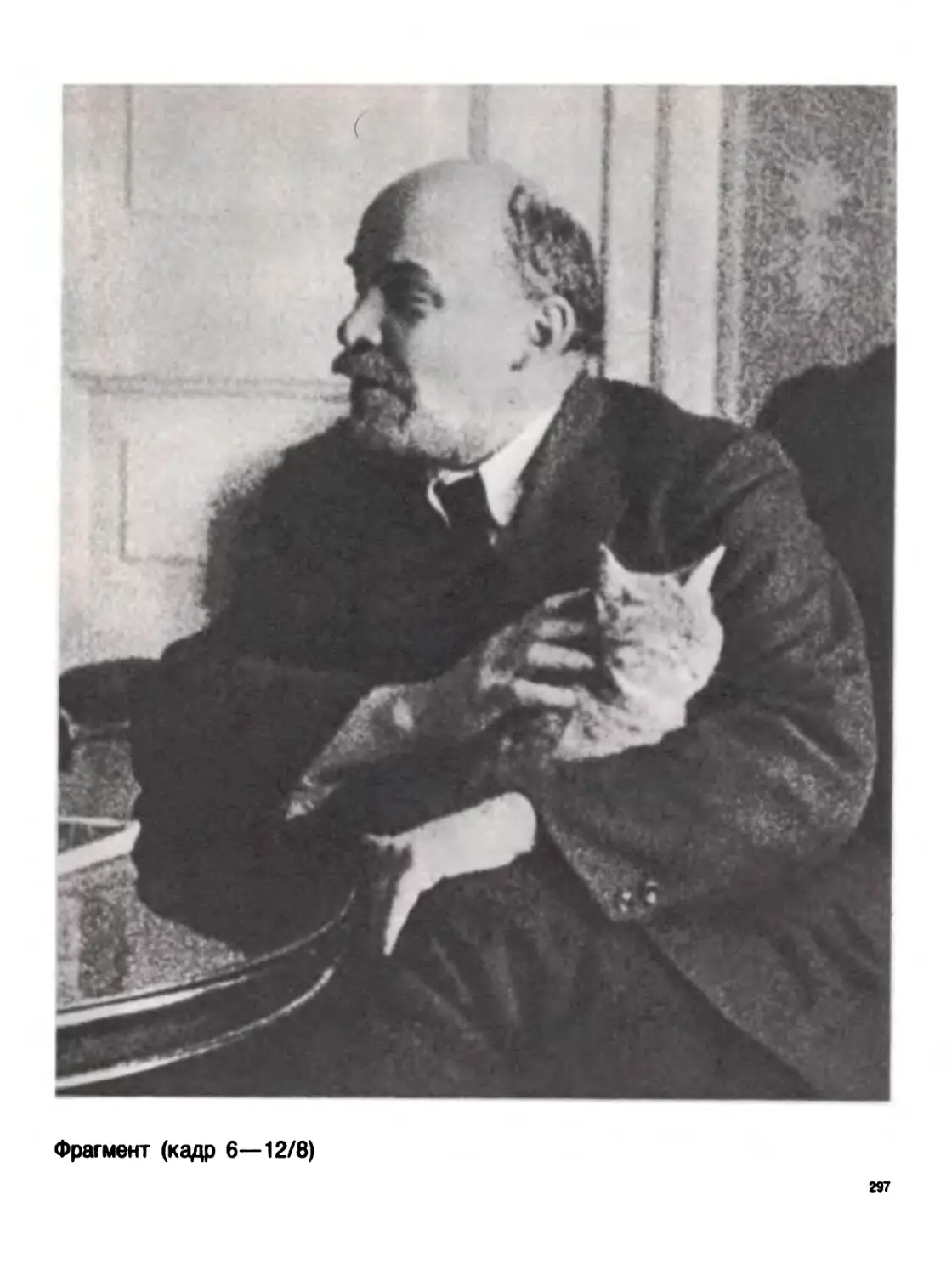
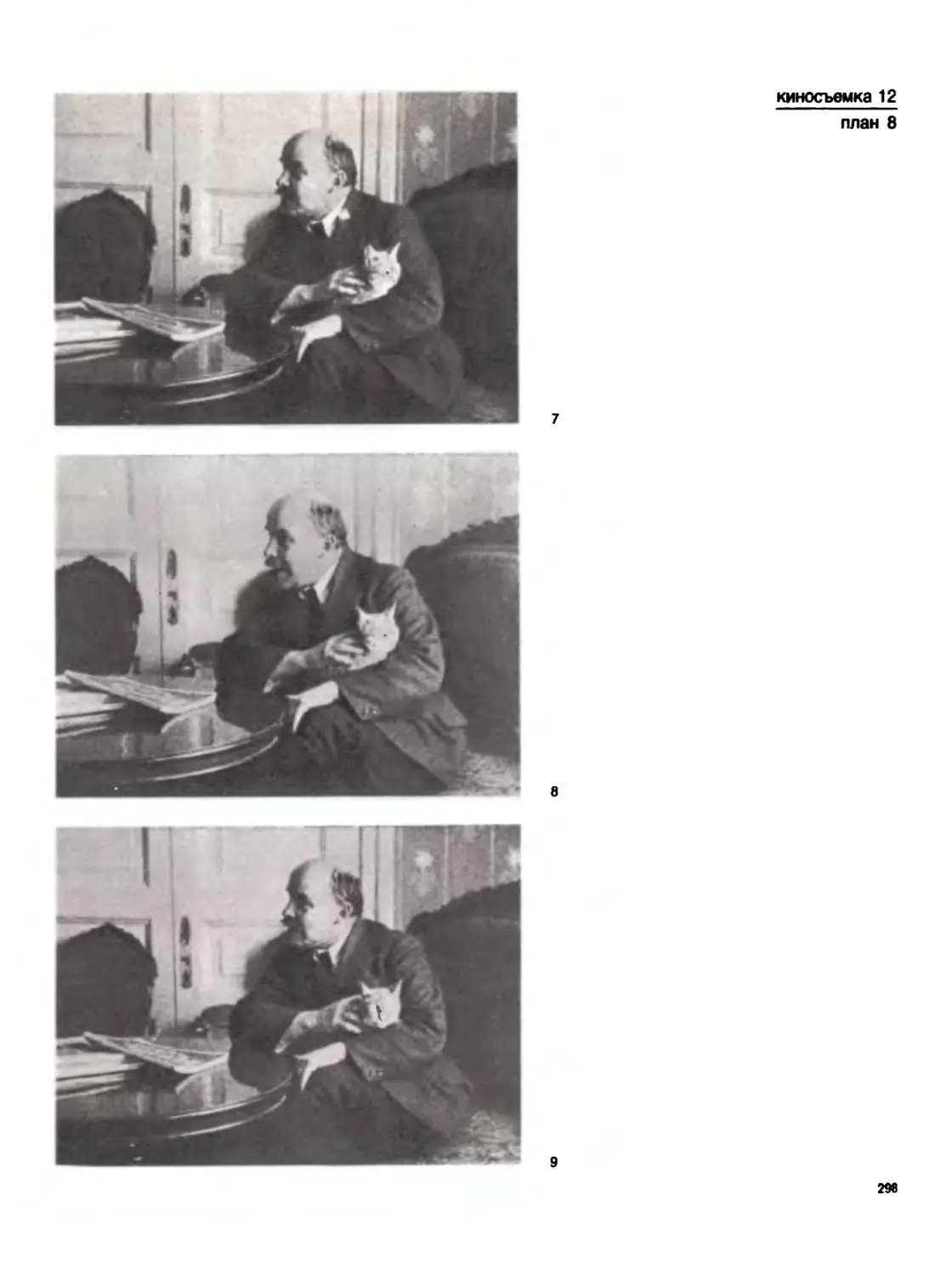
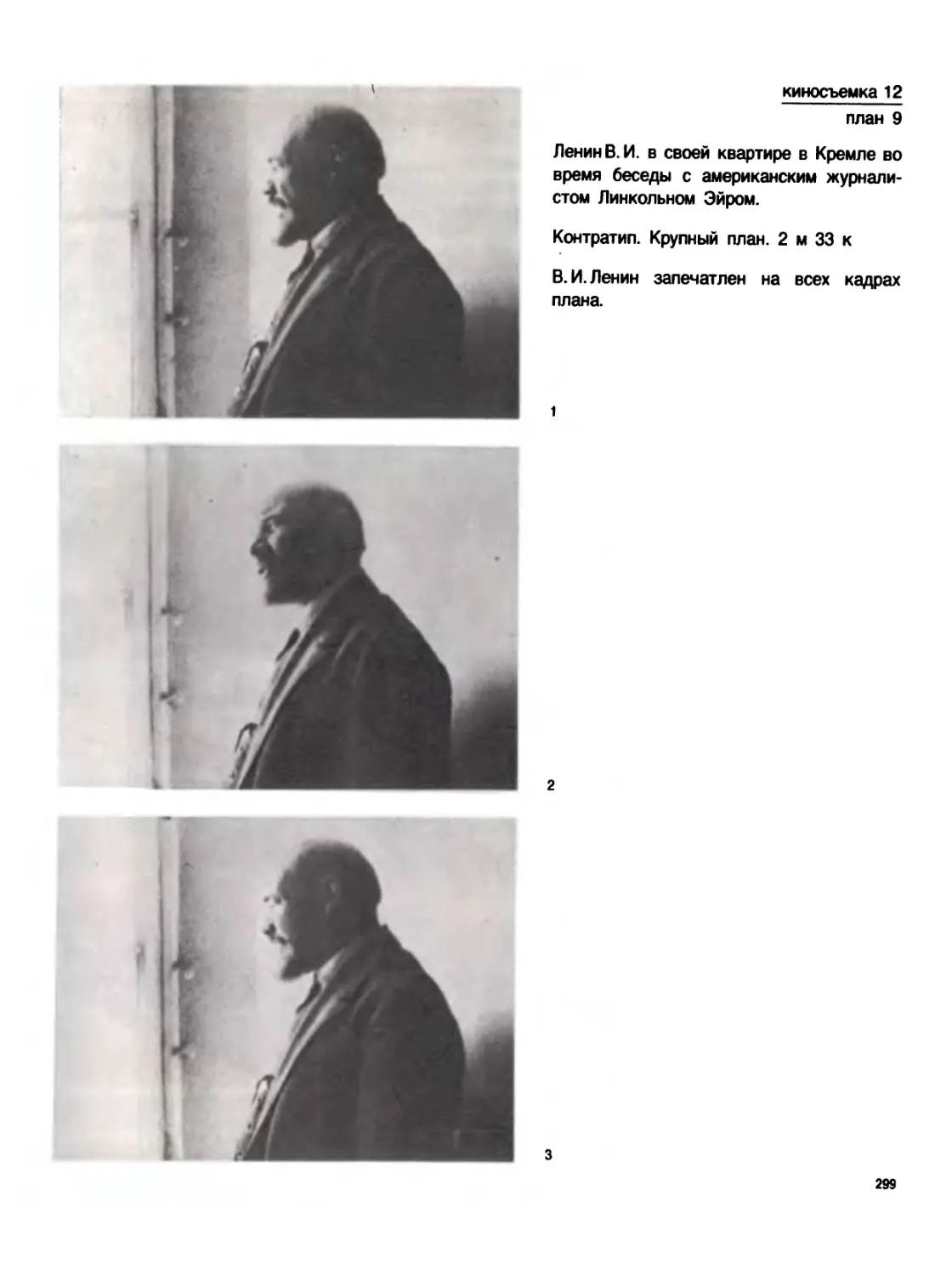
ЛЕНИН
LENIN
СОБРАНИЕ
ФОТОГРАФИЙ
И КИНОКАДРОВ
COLLEC
OF РНО'
ION
OGRAPHS
AND STILLS
LENINE
LENIN
ECUEIL
E PHOTOGRAPHIES
ET D'IMAGES DE FILMS
SAMMLUNG
MON FOTOS
UND FILMSZENEN
ТОМ ВТОРОЙ
КИНОКАДРЫ
VOLUME TWO
STILLS
DEUXIÈME VOLUME
IMAGES DE FILMS
BAND ZWEI
FILMSZENEN
ИНСТИТУТ
МАРКСИЗМА-ЛЕНИНИЗМА
при ЦК КПСС
ЦЕНТРАЛЬНЫЙ
ПАРТИЙНЫЙ
АРХИВ
МОСКВА
«ИСКУССТВО»
1980
UEMIM
COLLECTION OF PHOTOGRAPHS AND STILLS
IN TWO VOLUMES
VOLUME TWO
STILLS
ШШЫ
RECUEIL DE PHOTOGRAPHIES ET DIMAGES DE FILMS
EN DEUX VOLUMES
DEUXIÈME VOLUME
IMAGES DE FILMS
LEINM
SAMMLUNG VON FOTOS UND FILMSZENEN
IN ZWEI BÄNDEN
BAND ZWEI
FILMSZENEN
м
n
СОБРАНИЕ
ФОТОГРАФИЙ
И КИНОКАДРОВ
В ДВУХ ТОМАХ
Издание второе,
дополненное и исправленное
ТОМ ВТОРОЙ
КИНОКАДРЫ,
1918-1922
ББК 13.5
Л 45
РЕДКОЛЛЕГИЯ
А. В. КАРАГАНОВ
Р. А. ЛАВРОВ
А. И. ПЕТРОВ
И. С. СМИРНОВ
(титульный редактор)
С. Б. ТЕЛИНГ АТЕР
СОСТАВИТЕЛИ
А. М. ГАК
А. И. ПЕТРОВ
Л. Н. ФОМИЧЕВА
„ 80106-203
Л 71-80 4910020000
025 01)-80
о второй том книги-альбома «Ленин. Собрание фотографий и
кинокадров», подготовленного Институтом марксизма-ленинизма
при ЦК КПСС к 100-летию со дня рождения Владимира Ильича
Ленина, вошло свыше 600 документальных кинокадров из двадцати со¬
хранившихся киносъемок, запечатлевших Владимира Ильича.
Документальные кинокадры В. И. Ленина сняты в 1918—1922 гг. Их, к
сожалению, очень немного, но они ярко запечатлели живой облик
Владимира Ильича и ту обстановку, в которой жил и работал непревзой¬
денный организатор революционных масс, руководитель первого в мире
социалистического государства.
Короткие эпизоды документальной киноленинианы являются драго¬
ценной летописью жизни В. И. Ленина и молодой Советской республики.
Они рассказывают о ряде важнейших событий тех лет. Мы видим
В. И. Ленина, произносящего речи на открытии временного памятника
К. Марксу и Ф. Энгельсу, в день празднования 1-й годовщины Великой
Октябрьской социалистической революции 7 ноября 1918 года, на
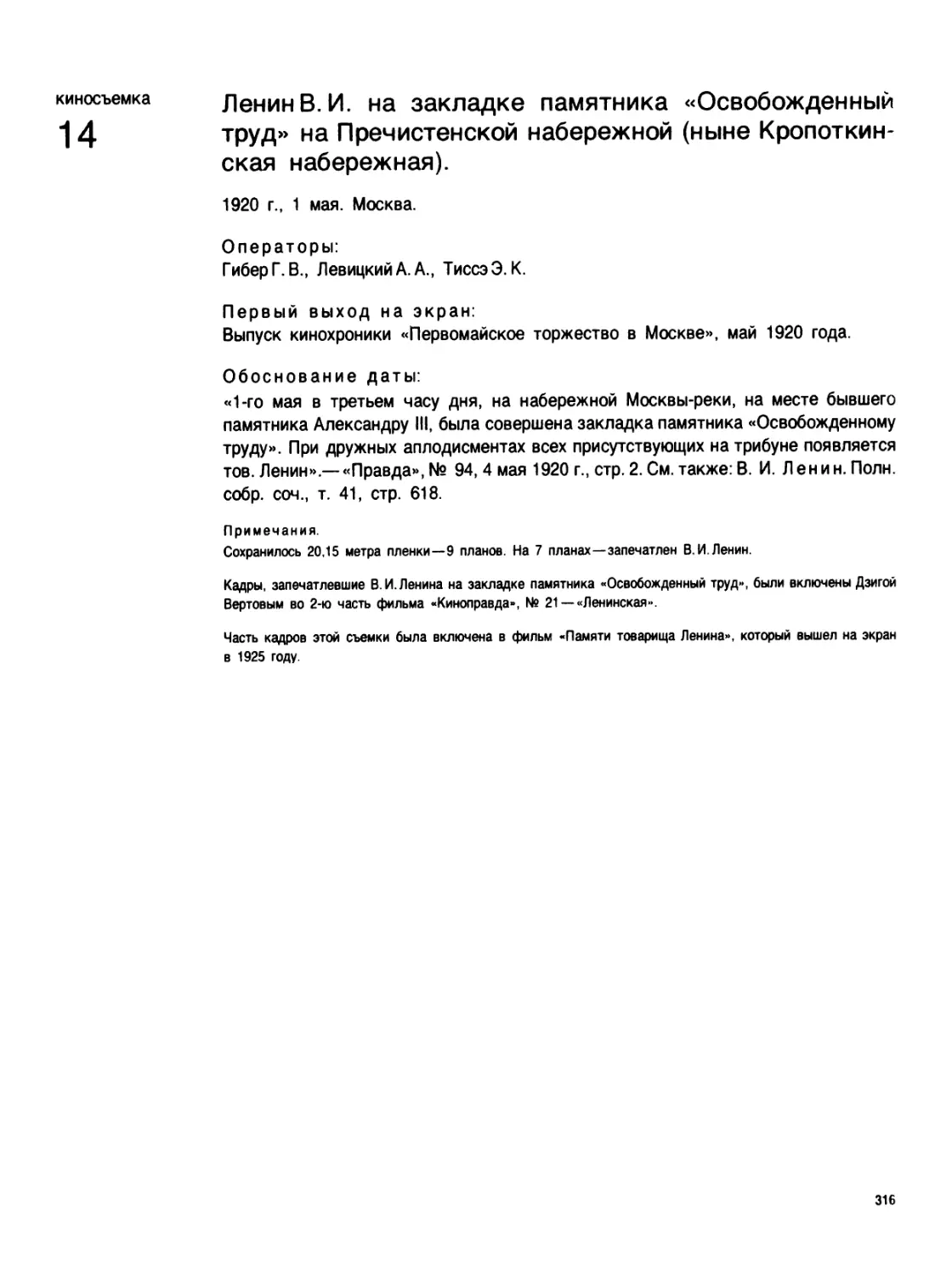
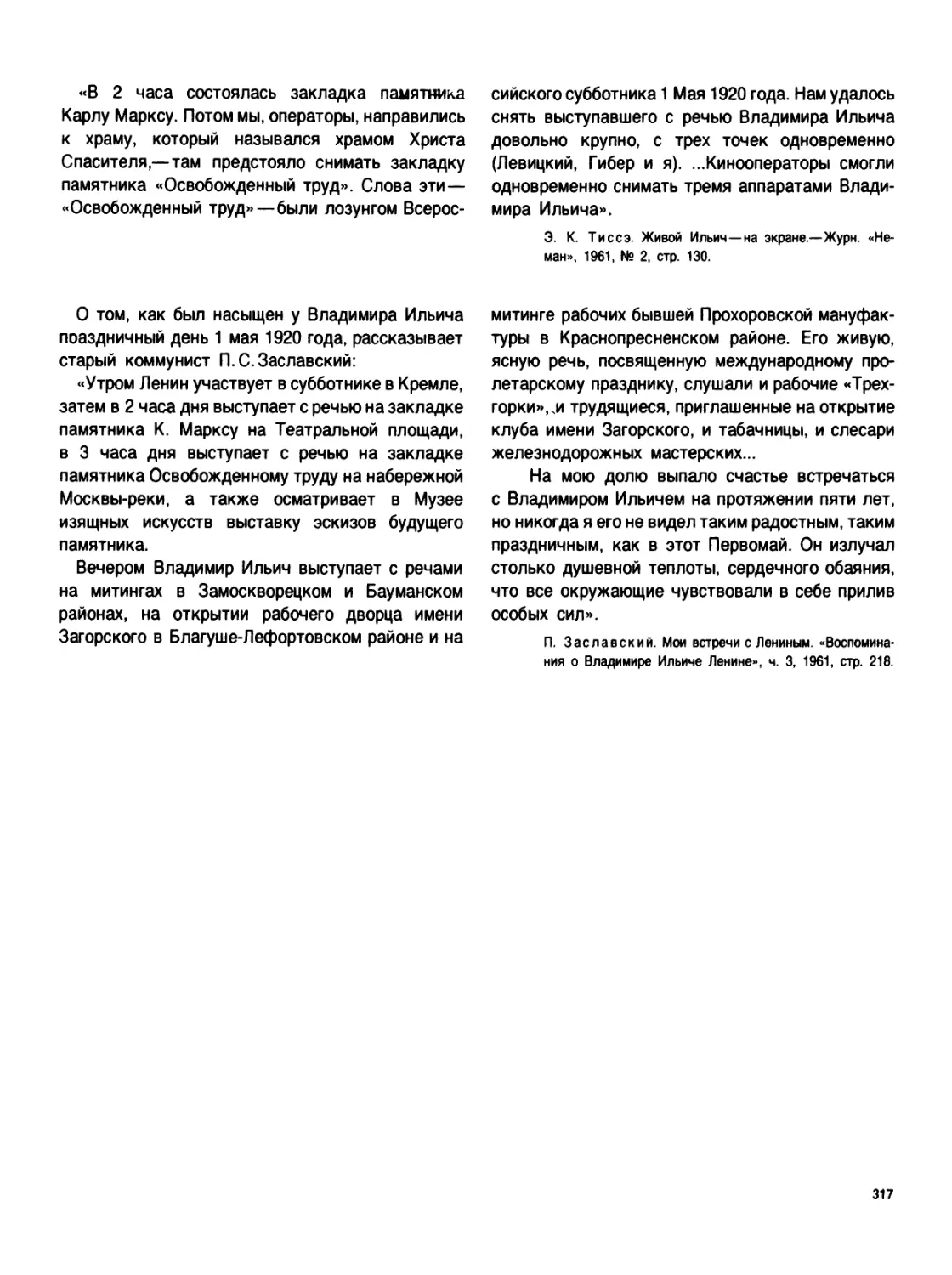
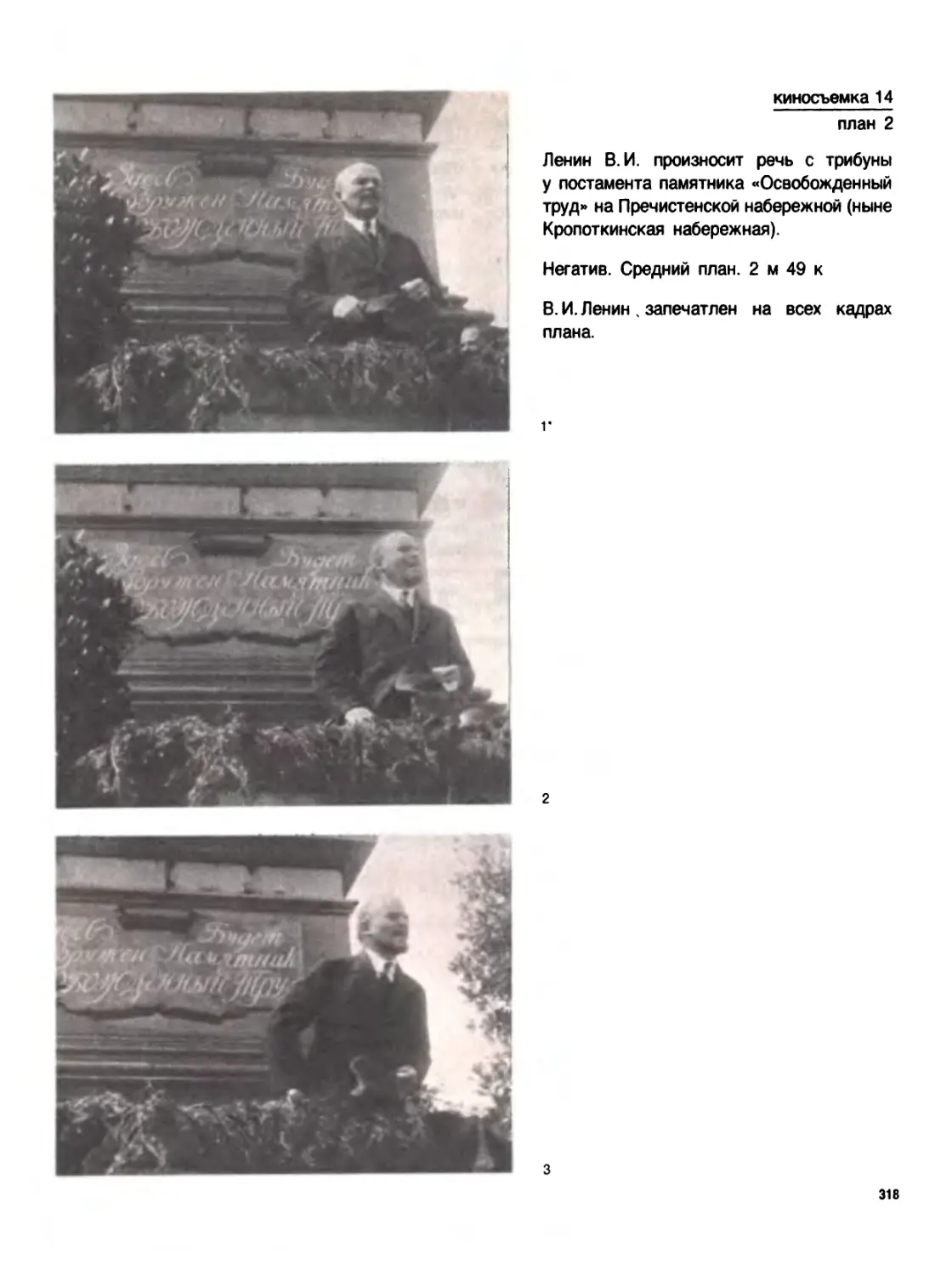
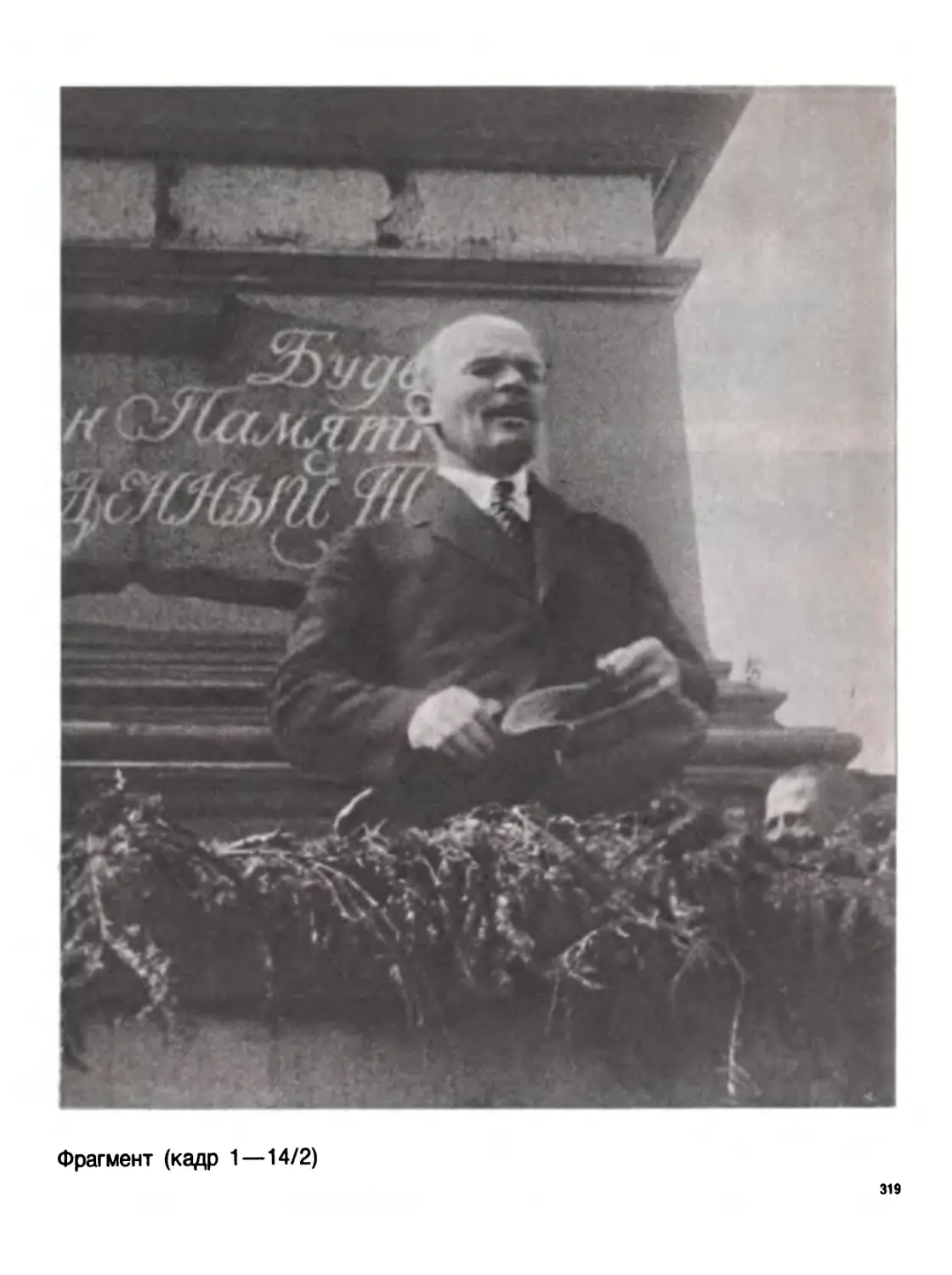
закладке памятника «Освобожденный труд» 1 мая 1920 года. Мы ви¬
дим Владимира Ильича на военном параде, народных демонстраци¬
ях и празднествах. На кинокадрах запечатлено участие В.И.Ленина в
работе конгрессов III Коммунистического Интернационала, организа¬
тором и руководителем которых он был. На одних кинокадрах Владимир
Ильич в президиуме или выступает с докладом перед делегатами
II и III конгрессов. На других мы видим, как Владимир Ильич при¬
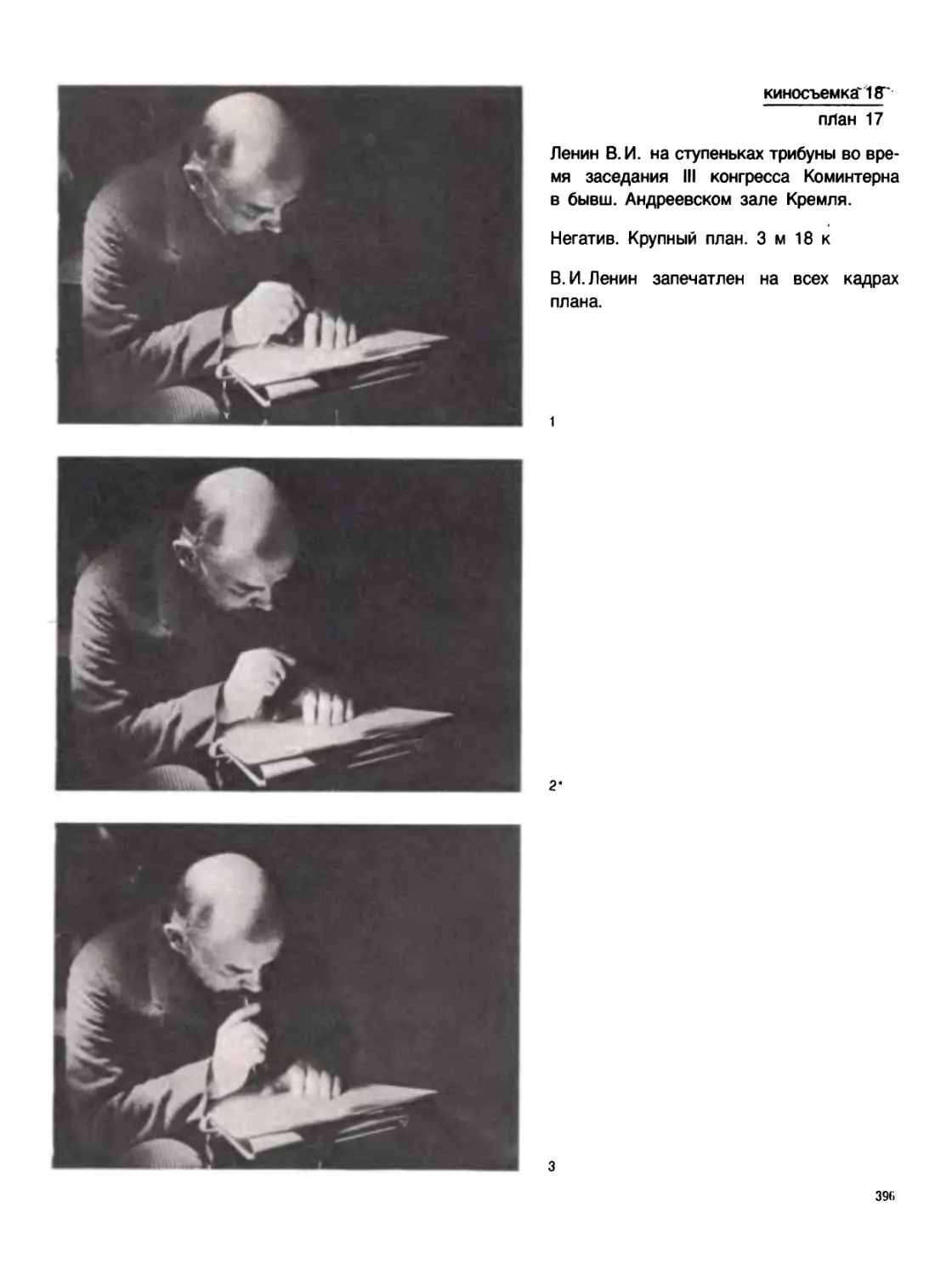
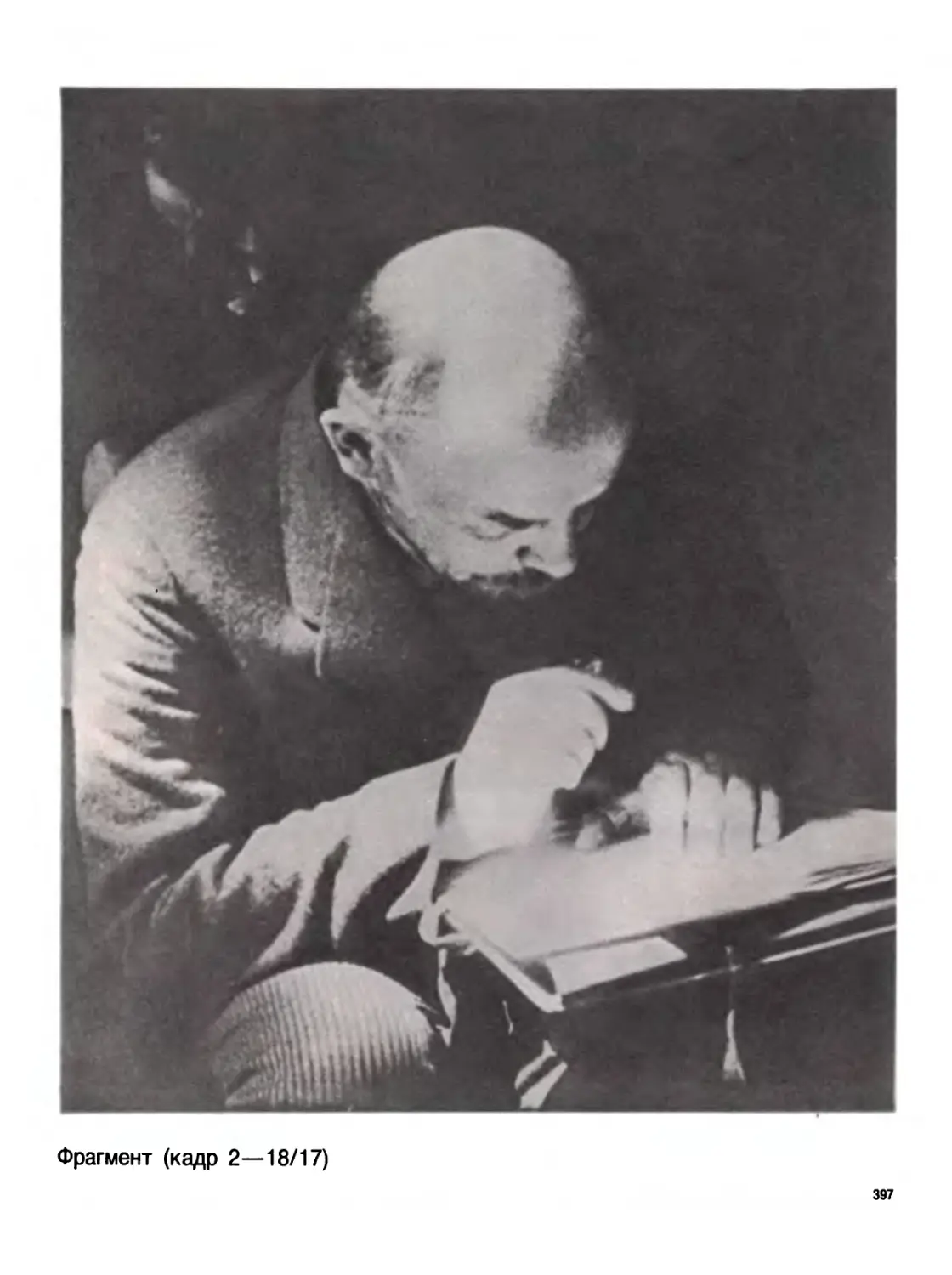
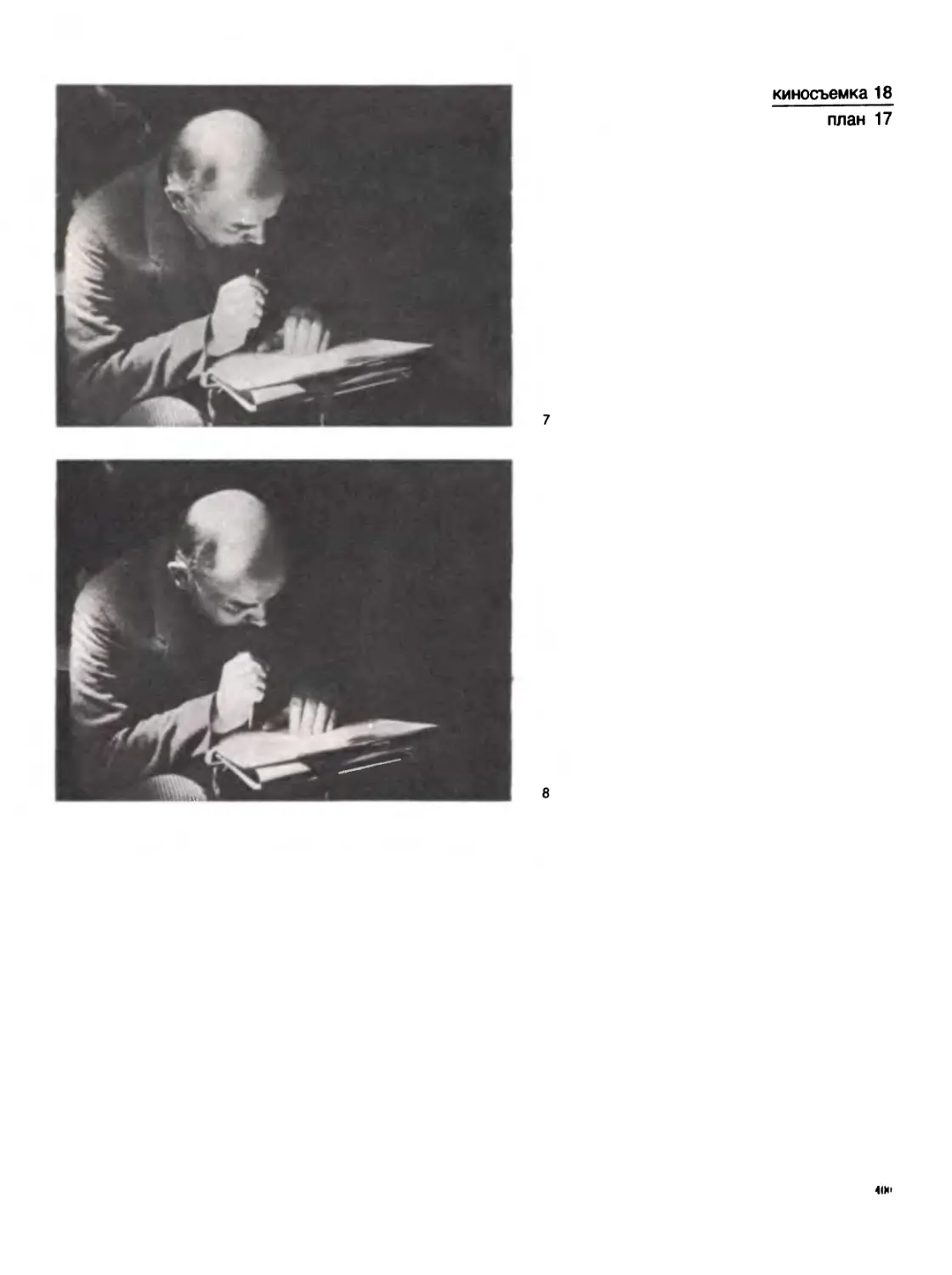
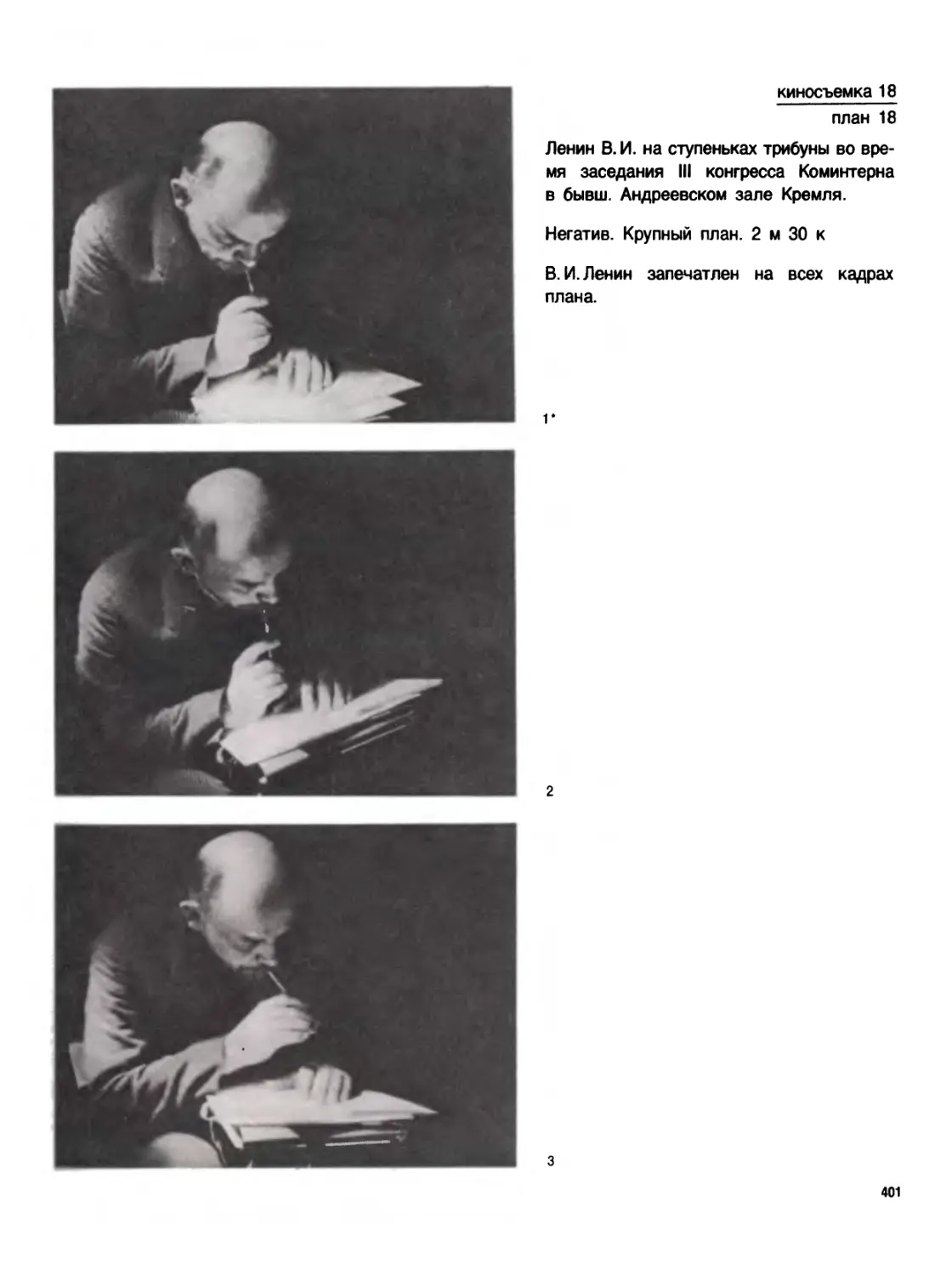
сел на ступеньки трибуны и углубился в чтение какого-то документа.
Нам бесконечно дороги кадры документальной киноленинианы. Они
ярко показывают в динамике дорогой облик Ленина, большую экспрес¬
сию, характерные жесты, движения и манеру речи Владимира Ильича.
Документальные ленинские кинокадры представляют большую историче¬
скую и художественную ценность. Они помогут людям нашей планеты
еще полнее и ярче представить незабываемые ленинские черты.
Коммунистическая партия свято хранит ленинское наследие—его
бессмертные труды, документы о жизни и деятельности В. И. Ленина, а
также фотографии и кинокадры, снятые при жизни Владимира Ильича.
Настоящий том является первым изданием, в которое вошли фотоот¬
печатки всех наиболее выразительных кинокадров В. И. Ленина.
Институт марксизма-ленинизма
при ЦК КПСС
ОТ СОСТАВИТЕЛЕЙ
На экране Владимир Ильич Ленин, произносящий речь. Стоя на
трибуне-автомобиле, Владимир Ильич ритмично поворачивается вправо и
влево к слушающим его людям. Говорит энергично, чуть подавшись
вперед корпусом.
Вот Владимир Ильич поднял в выразительном жесте правую руку,
выкинул ее резко вперед и немного вверх. Левая рука с зажатой в ней
кепкой закинута за спину. Резко опустив правую руку, он опять поднял
ее, затем выбросил вперед левую руку с кепкой. Опустив обе руки и еще
более подавшись вперед, Владимир Ильич продолжает речь, поворачива¬
ясь всем корпусом то в одну, то в другую сторону... Это широко
известные кинокадры, снятые оператором А. А. Левицким на Красной
площади во время парада войск Всевобуча 25 мая 1919 года.
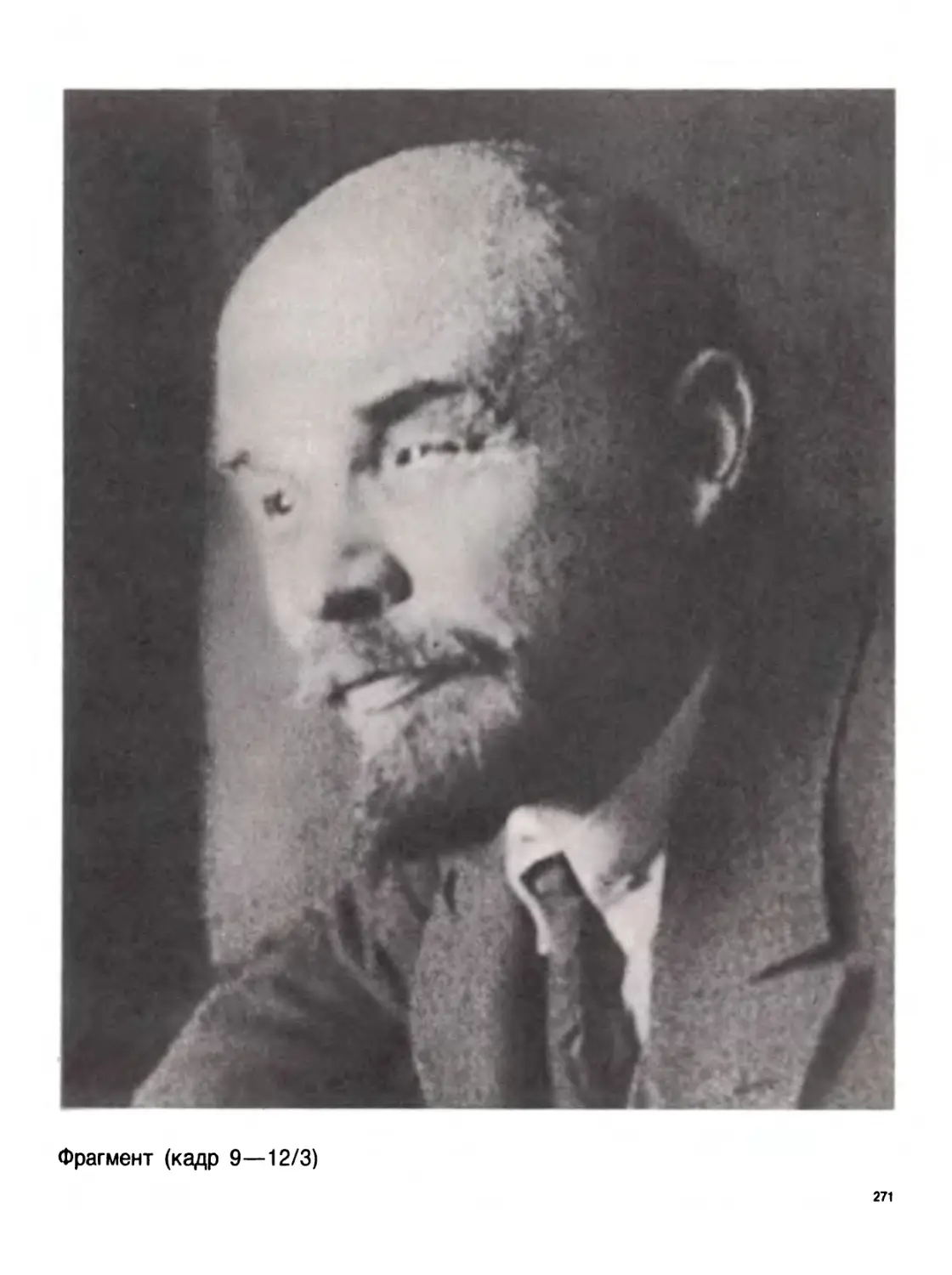
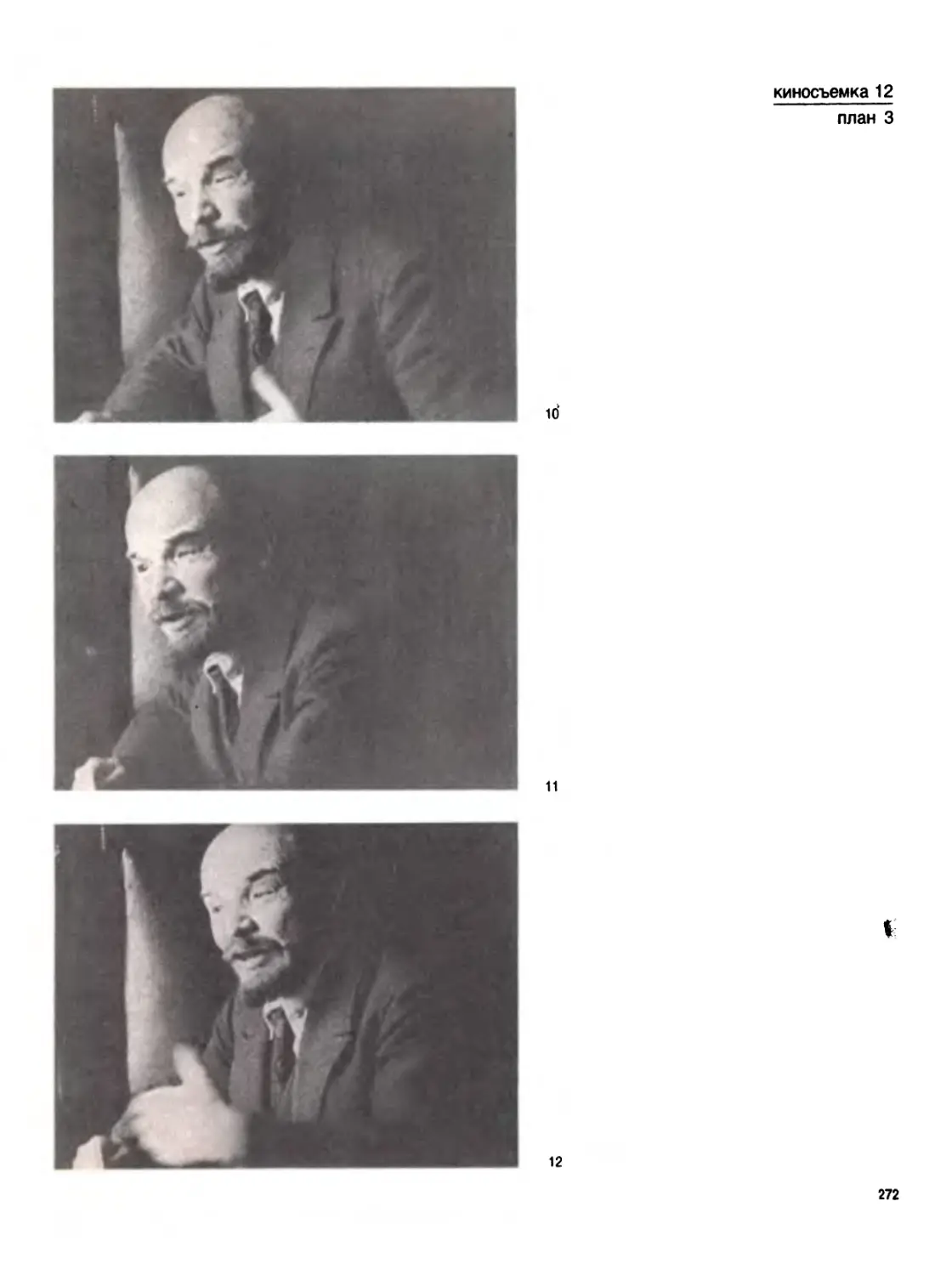
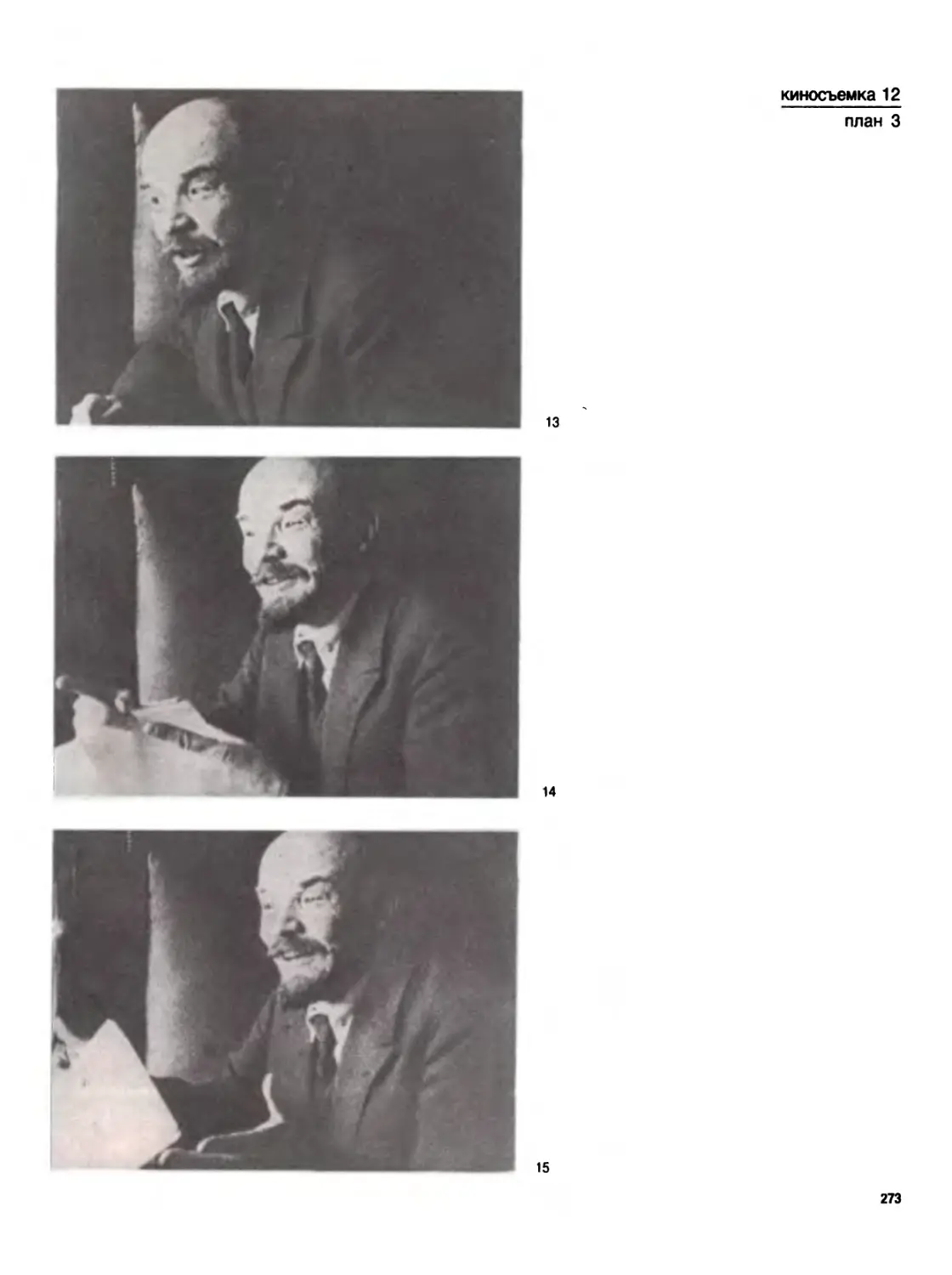
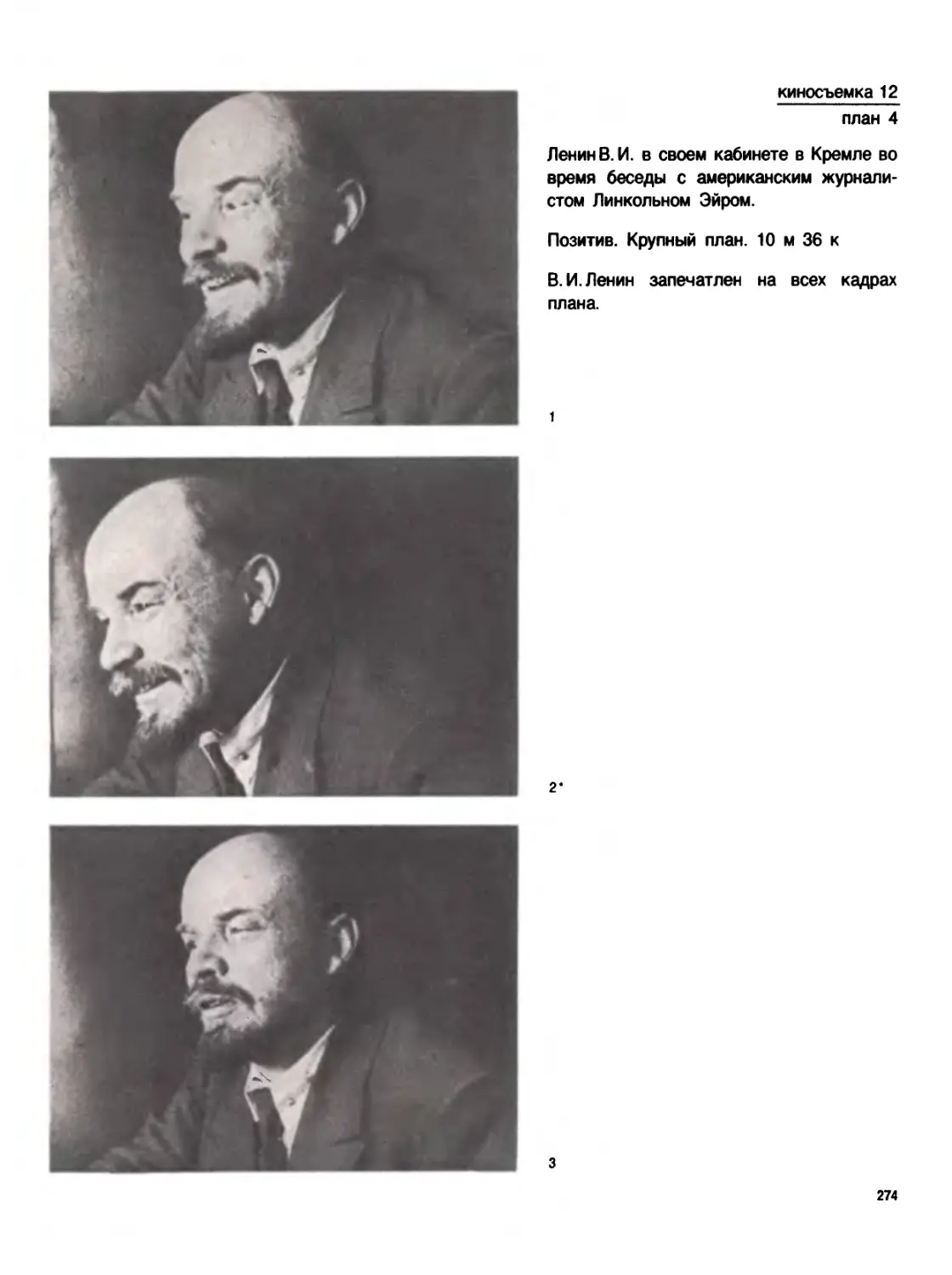
А вот другой кинопортрет—В. И. Ленин разговаривав! с кем-то нахо¬
дящимся за кадром, в руках у него бумаги, он улыбается, чуть
прищуренные глаза искрятся лукавым, веселым смехом. То, вдруг
посерьезнев, Владимир Ильич внимательно слушает, а затем опять
что-то говорит, жестикулируя правой рукой с зажатой в ней бумагой. Эти
кадры сняты американским кинооператором В. Кьюбсом во время беседы
В. И. Ленина с корреспондентом газеты «World» журналистом Л. Эйром в
феврале 1920 года.
Ни одна, даже самая хорошая фотография не может столь полно, как
кинематограф, дать представление о внешнем облике. Фотография
фиксирует одно единственное мгновение, а кинокамера запечатлевает
движения, жесты, смену чувств.
Не случайно А. В. Луначарский говорил о том, что Владимир Ильич
Ленин похож на себя только в кинематографе. То же говорил и Поль
Вайян-Кутюрье: «Ленин подлинный—только в кино. Ни один портрет не
похож на него»*.
«Когда рисуешь портреты Ленина, испытываешь потребность увидеть
его в кинематографе. Простая фотография не передает конструкцию
головы, жестикуляцию, мимику»**,—пишет художник Б. М. Кустодиев.
Сохранившиеся документальные кинокадры донесли до наших дней
облик живого Ленина, его характерные жесты, мимику. Невероятно
трудно было снимать кинооператорам в то время. Тяжелая и громоздкая
аппаратура, отсутствие так часто необходимой в репортажной съемке
телеоптики, недостаточное количество пленки и плохая осветительная
аппаратура (юпитеры), затрудняли производство киносъемок, а порой
делали их и вовсе невозможными.
И все же, несмотря на эти трудности, трудолюбивые и энергичные
кинолетописцы первых лет Советской республики фиксировали на
пленку события большой исторической важности. Они снимали то новое,
что происходило в молодой Советской стране, и, конечно, не упускали
даже самой малой возможности запечатлеть Владимира Ильича Ленина.
Известно, что первые киносъемки были сделаны еще в начале 1917
года в Стокгольме, а затем в Петрограде, по возвращении В. И. Ленина из
эмиграции. Об одной из первых киносъемок 1917 года свидетельствовала
шведская газета «Политикен», которая сообщала о проезде В. И. Ленина
с группой русских политэмигрантов через Стокгольм: «Группа русских
направилась мимо щелкавших аппаратами газетчиков и кинооператоров
к гостинице «Регина», где мы их оставили перекусить и отдохнуть с
дороги...»***. Однако кадры эти не сохранились, так же как не сохрани¬
лись и киносъемки, сделанные в мае 1917 года во время выступления
В. И. Ленина с балкона дворца Кшесинской, на Марсовом поле, во время
митингов рабочих на Обуховском и Путиловском заводах, и некоторые
киносъемки последующих лет.
Большую работу по розыску и собиранию документальных ленинских
кинокадров проделали многие советские историки и кинематографисты.
Особенно большой вклад в это дело внесли искусствовед профессор
Г. М. Болтянский, кинорежиссер-документалист Е. И.Свилова и редактор
отдела кинолетописи ЦСДФ К. В. Аксютин, которые вместе со своими
товарищами, разыскивая новые, неизвестные ленинские кинокадры,
* Сб. «Ленин в зарисовках и воспоминаниях художников». М.—Л., Госиздат, 1928,
стр. 22.
** Там же.
*** «Politiken», 1917, № 85, р. 1.
просмотрели в киноархивах и других организациях сотни тысяч метров
пленки, несколько сот документальных, научно-популярных фильмов
начиная с 1918 года, то есть с момента их выпуска.
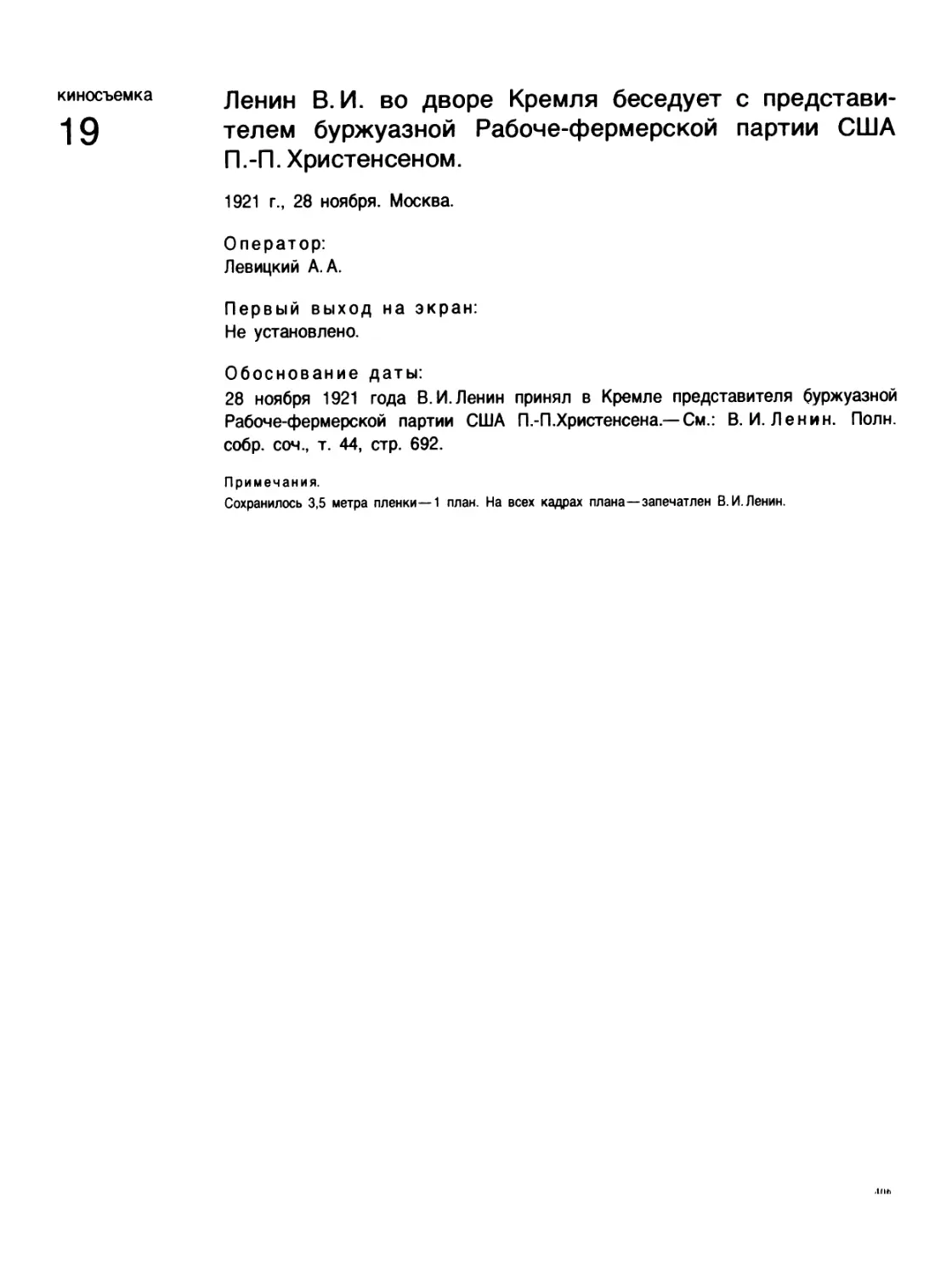
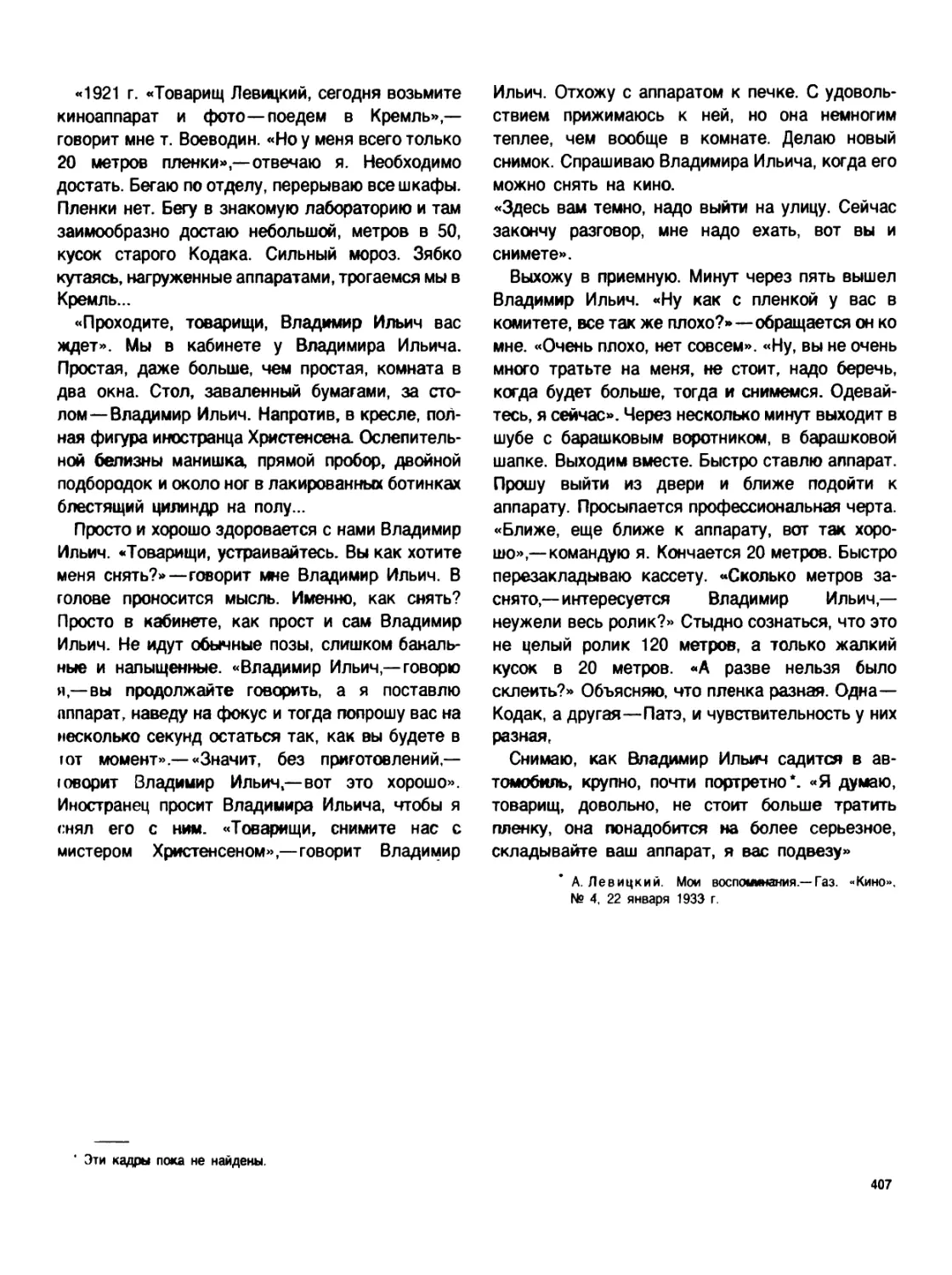
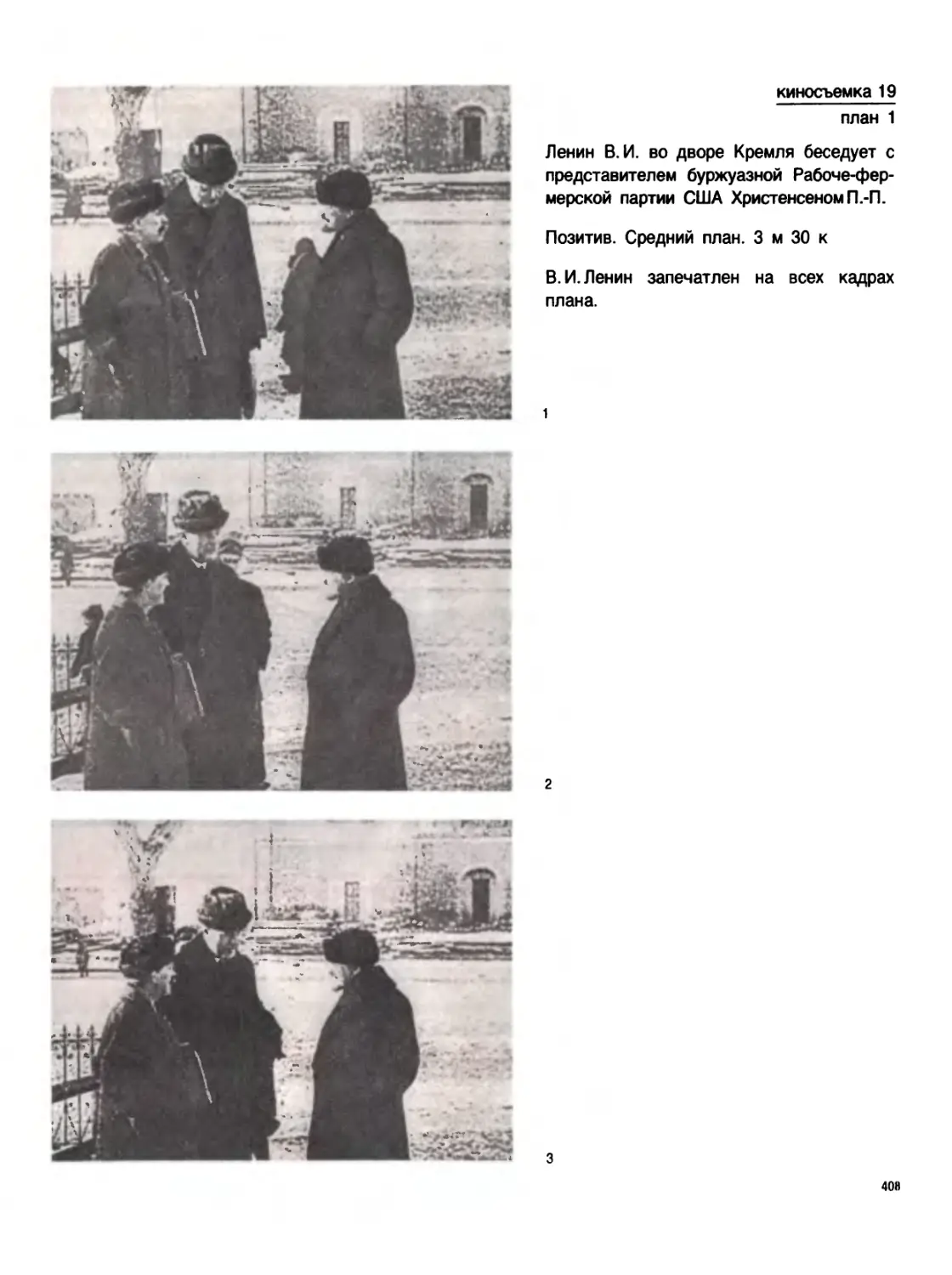
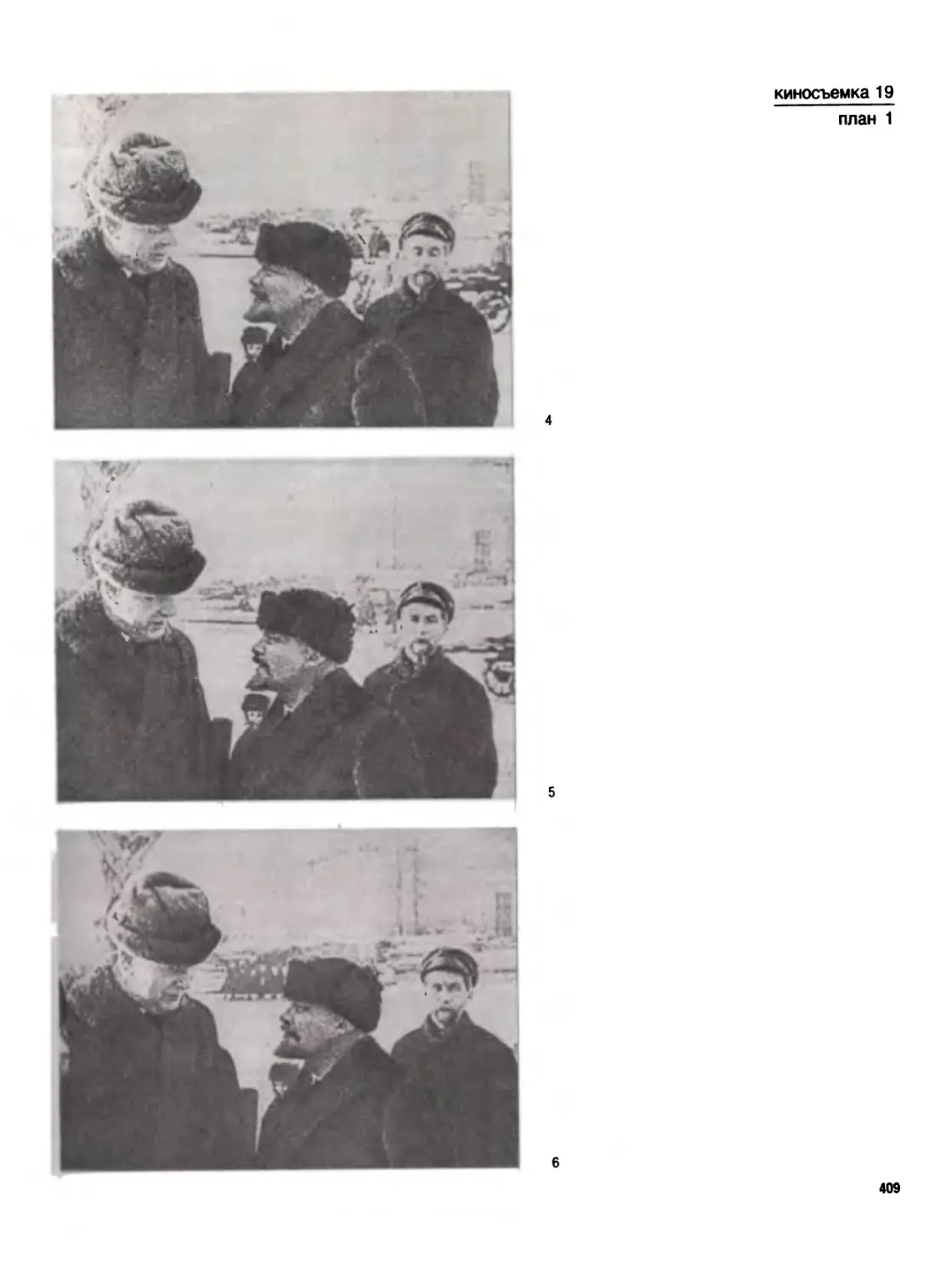
Были находки и за рубежом. В 1948 году французские друзья-
кинематографисты прислали небольшой кусок позитивной пленки, на
которой запечатлены В.И.Ленин, П.И.Воеводин и американец П.-П.Христен-
сен во дворе Кремля 28 ноября 1921 года (киносъемка эта
утрачена). Кадры сняты оператором А.А.Левицким после беседы
В.И.Ленина с П.-П.Христенсеном, состоявшейся в тот день. Режиссер
Е.И.Свилова, просматривая ленты Тбилисского киноархива, обнаружила
несколько метров пленки с неизвестными ленинскими кинокадрами. Эти
кадры были включены режиссером Дзигой Вертовым в фильм «Три песни о
Ленине». Еще раньше, в 1927 году, режиссер-документалист Э. Шуб,
разбирая различные хроникальные ленты, приобретенные через Амторг в
США, обнаружила кинокадры, снятые американским оператором В. Кьюб-
сом в Кремле во время беседы Ленина с журналистом Л. Эйром.
Предполагается, что было произведено 38 киносъемок В.И.Ленина,
но удалось разыскать только 20.
Не найдены пока следующие киносъемки:
В.И.Ленин с группой русских политэмигрантов в Стокгольме 13 апре¬
ля 1917 года (шведские операторы).
В. И. Ленин произносит речь с грузовика на Марсовом поле в Петрогра¬
де 1 мая 1917 года (оператор А. Г. Лемберг).
В. И. Ленин произносит речь с балкона дворца Кшесинской в Петрогра¬
де в мае 1917 года (оператор А. Г. Лемберг).
В.И.Ленин на митинге на Обуховском заводе в Петрограде в мае 1917
года (оператор И. С. Фролов).
В.И.Ленин произносит речь на митинге на Путиловском заводе в
Петрограде в мае 1917 года (оператор И. С. Фролов).
В.И.Ленин на Красной площади в 1918 году во время первомайского
праздника (оператор Э. К.Тиссэ).
В.И.Ленин на Красной площади 7 ноября 1918 года открывает
мемориальную доску в память павших борцов, а затем произносит речь
(операторы Г. В. Гибер, П. К. Новицкий).
В.И.Ленин на Красной площади в 1919 году во время первомайского
праздника (оператор Г. В. Гибер).
В.И.Ленин во время поездки к рабочим Рублевской водокачки в мае
1919 года (оператор Г. В. Гибер).
В.И.Ленин на коммунистическом субботнике железнодорожников
Александровского вокзала (ныне Белорусский вокзал) 17 мая 1919 года.
Владимир Ильич произносит речь и беседует с рабочими (операторы
неизвестны).
В. И.Ленин произносит речь с балкона Моссовета перед бойцами-
коммунистами, отправляющимися на фронт против Деникина, 16 октября
1919 года (операторы Г. В. Гибер, П. К. Новицкий и Н. Ф. Козловский).
В. И. Ленин на субботнике во дворе Кремля в декабре 1919 года
(операторы Г. В. Гибер, А. Г. Лемберг).
В.И.Ленин на первом Всероссийском субботнике во дворе Кремля
1 мая 1920 года (оператор А.А.Левицкий).
В.И.Ленин беседует с рабочими Прохоровской мануфактуры (комби¬
нат «Трехгорная мануфактура») 1 мая 1920 года (оператор Г. В. Гибер).
В.И.Ленин на площади Свердлова произносит речь перед войсками,
отправляющимися на польский фронт, 5 мая 1920 года (операторы
Г. В. Гибер, Э. К.Тиссэ).
В.И.Ленин и Н.К.Крупская после заседания Всероссийского совеща¬
ния политпросветов 3 ноября 1920 года (оператор П. В. Ермолов).
В. И. Ленин на X съезде РКП(б) в Кремле 8 марта 1921 года (оператор
Г. В. Гибер, фамилии других операторов, проводивших киносъемку, неиз¬
вестны).
В.И.Ленин на испытании первого советского электроплуга в учеб-
но-опытном хозяйстве Московского высшего зоотехнического института
22 октября 1921 года (оператор Е.И.Славинский).
Есть киносъемки, которые сохранились далеко не полностью, а
некоторые состоят всего лишь из нескольких кадров. К ним относятся
следующие восемь киносъемок:
В.И.Ленин на Ходынском поле после окончания первомайского
парада частей Красной Армии, 1 мая 1918 года (не найдены кадры
крупного плана).
В. И. Ленин на открытии временного памятника К. Марксу и Ф. Энгельсу
в день празднования 1-й годовщины Великой Октябрьской социалистиче¬
ской революции, 7 ноября 1918 года.
В.И.Ленин на Красной площади в день празднования 1-й годовщины
Великой Октябрьской социалистической революции, 7 ноября 1918 года
(сохранилось несколько кадров).
В.И.Ленин выступает с речью с балкона Моссовета на митинге
протеста против убийства вождей германского пролетариата Карла
Либкнехта и Розы Люксембург, 19 января 1919 года (сохранилось
несколько кадров).
В.И.Ленин на Красной площади в день Международного праздника
1 мая 1919 года (сохранилось несколько кадров).
10
В. И.Ленин в дни работы II конгресса Коминтерна в Москве, июль-
август 1920 года.
В. И.Ленин во дворе Кремля беседует с представителем буржуазной
Рабоче-фермерской партии США П.-П. Христенсеном, 28 ноября 1921
года (сохранилась небольшая часть позитивной кинопленки).
В. И. Ленин с группой делегатов в дни работы IV конгресса Коминтерна
в Кремле, 13 ноября 1922 года.
Начиная с 1918 года ленинские кинокадры включались в первые
советские документальные кинофильмы и хроникальные выпуски. Так,
например, кинокадры, запечатлевшие В. И. Ленина на Ходынском поле во
время военного парада 1 мая 1918 года, были включены в экранный
журнал «Кинонеделя», № 1. В октябре 1918 года был создан специаль¬
ный фильм, запечатлевший Владимира Ильича Ленина во время прогулки
во дворе Кремля по выздоровлении после ранения. Этот фильм обошел
все кинотеатры столицы, был показан в рабочих клубах и частях Красной
Армии.
Документальный фильм «Годовщина Революции» (1918 г.) режиссера
Д. Вертова, фильмы о II и III конгрессах Коминтерна (1920 и 1921 гг.),
выпуски «Кинонеделя» и «Киноправда», а в дальнейшем «Ленинский
госкинокалендарь», которые осуществлялись под руководством режиссе¬
ра Д. Вертова, включали документальные кадры, запечатлевшие Ленина
во время разных событий.
Более шестидесяти фильмов вышло на экраны страны за время с
1918 по 1927 год, которые включали документальные ленинские кино¬
кадры.
Позже, в 1947 году, когда по решению ЦК партии все ленинские
кинодокументы были собраны и систематизированы в Центральном
партийном архиве ИМЛ, удалось провести соответствующую их реставра¬
цию и обработку, позволившие улучшить техническое качество кинокад¬
ров и привести их к современным скоростям проекции (24 кадра в
секунду).
К двадцать пятой годовщине со дня смерти В.И.Ленина режиссе¬
ры М.И.Ромм, В.Н.Беляев и М.Е.Славинская осуществили полнометраж¬
ный документальный фильм «В.И.Ленин». В том же 1949 году вышел
на экран двухчастевой фильм «Кинодокументы о В.И.Ленине, снятые
при его жизни» режиссеров М.И.Ромма и М.Е.Славинской. В 1958
году режиссер М.Е.Славинская сделала документальный фильм
«Живой Ленин», в который были включены почти все ленинские кино¬
кадры.
К 100-летию со дня рождения В. И. Ленина режиссерами М. И. Роммом
11
и М.Е.Славинской была подготовлена новая редакция фильма «Живой
Ленин»*.
За прошедшие годы неоднократно публиковались в печати, экспони¬
ровались в музеях и на выставках некоторые фотоотпечатки с кинокад¬
ров. Отдельные кинокадры публиковались в фотоальбомах и других
изданиях вместе с фотографиями. Настоящий том является первой
обширной публикацией сохранившихся ленинских кинокадров.
Сегодня фонд кинодокументов В. И. Ленина составляют 20 кино¬
съемок, имеющих 259 планов—838,5 метра кинопленки (в одном
метре—52 кадра). На 144 планах запечатлен Владимир Ильич Ленин, на
115 планах—события, участником которых он был.
Первыми сохранившимися ленинскими кинодокументами являются
кадры, снятые оператором П. К. Новицким 1 мая 1918 года на Ходын-
ском поле, во время военного парада. Этими кадрами начинается
кинолениниана. Последняя киносъемка была сделана 13 ноября 1922
года во дворе Кремля, в дни работы IV конгресса Коминтерна.
Киносъемки группируются по годам:
1918 год—4
1919 год—7
1920 год—6
1921 год—2
1922 год—1
Второй том «Ленин. Собрание фотографий и кинокадров» содержит
637 кинокадров, из 20 съемок 88 планов, которые имеются в виде:
В дополнение к основным кадрам даются укрупнения 96 наиболее
выразительных ленинских кинопортретов.
Разная и не всегда хорошая пленка, замена некоторых негативов-
оригиналов позитивами или контратипами (дубль-негативами), на кото¬
рых имеются царапины, потертости и другие повреждения, значительно
отразились на техническом качестве кинокадров, хранящихся в Цен¬
тральном партийном архиве. Многие из этих кинокадров не поддаются
* Текст к фильму написан А. А. Сурковым.
Негативы-оригиналы
Позитивы, заменяющие оригиналы...
Контратипы, заменяющие оригиналы
50 планов (171 м)
32 плана (113 м)
6 планов (18,95 м)
12
полиграфическому воспроизведению. Кроме того, на некоторых планах
Владимир Ильич находится в глубине кадра и его очень трудно раз¬
глядеть в общей массе народа.
Есть среди кадров и такие, которые сняты при недостаточном
освещении, с большой недодержкой и пр. Поэтому в том не вошли планы
с техническими дефектами, а также и те, которые дублируют друг
друга—всего 56 планов:
Киносъемка 2 — 3, 4, 5 планы
Киносъемка 5 — 2, 3, 5, 6, 9 планы
Киносъемка 6 — 2, 6, 13, 17, 18, 23, 26, 29 планы
Киносъемка 7 — 4, 5, 17, 20, 25, 28 планы
Киносъемка 10—16, 19, 23 планы
Киносъемка 11 — 14, 15 планы
Киносъемка 12 — 10, 11 планы
Киносъемка 13 — 4, 5, 6, 8 планы
Киносъемка 14 — 3, 5, 8 планы
Киносъемка 15 — 2, 4, 9 планы
Киносъемка 16—1, 6 планы
Киносъемка 17—1 план
Киносъемка 18 — 2, 3, 4, 5, 6, 8, 19, 20, 21, 22, 23, 24, 25, 26 планы
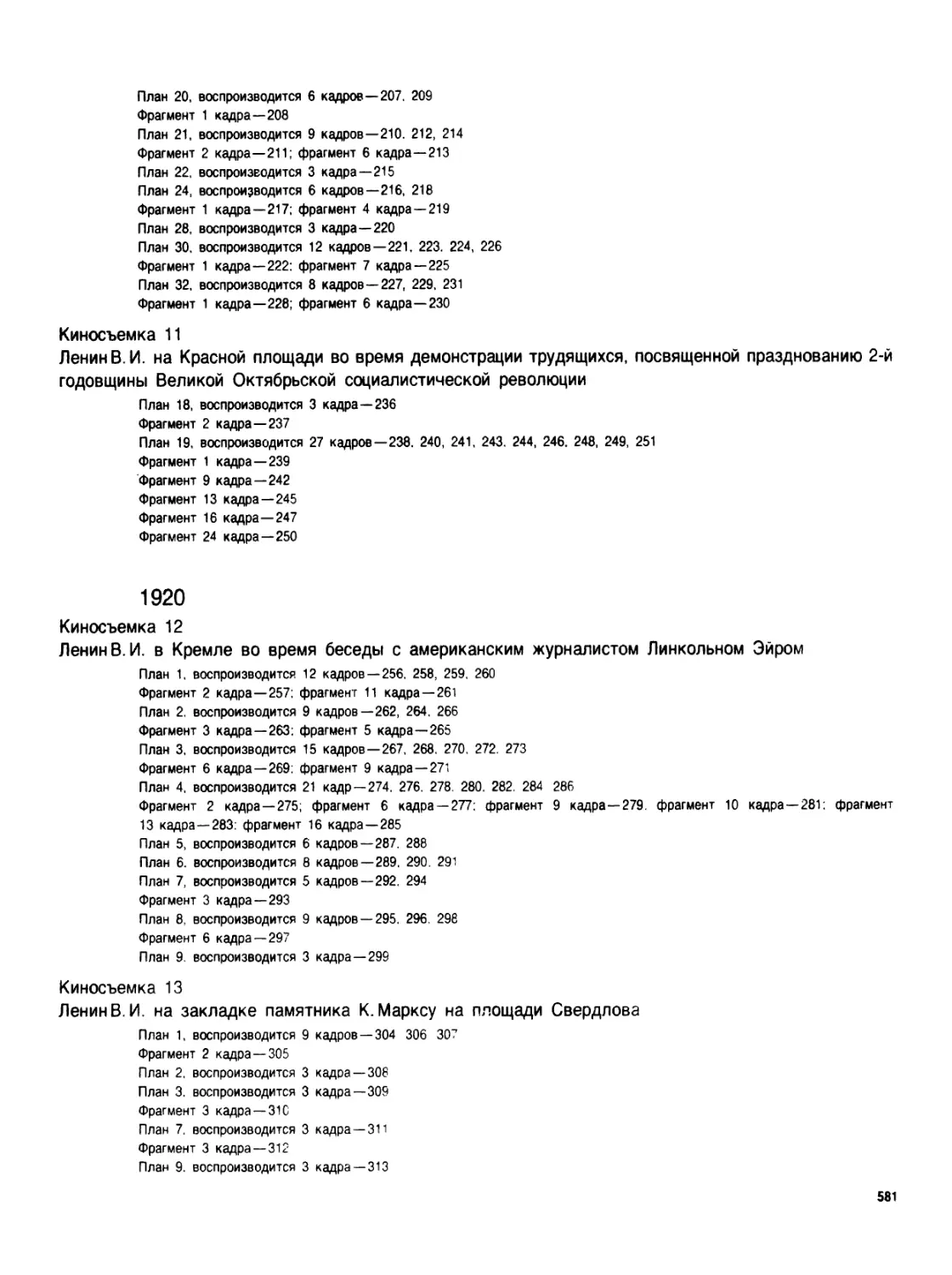
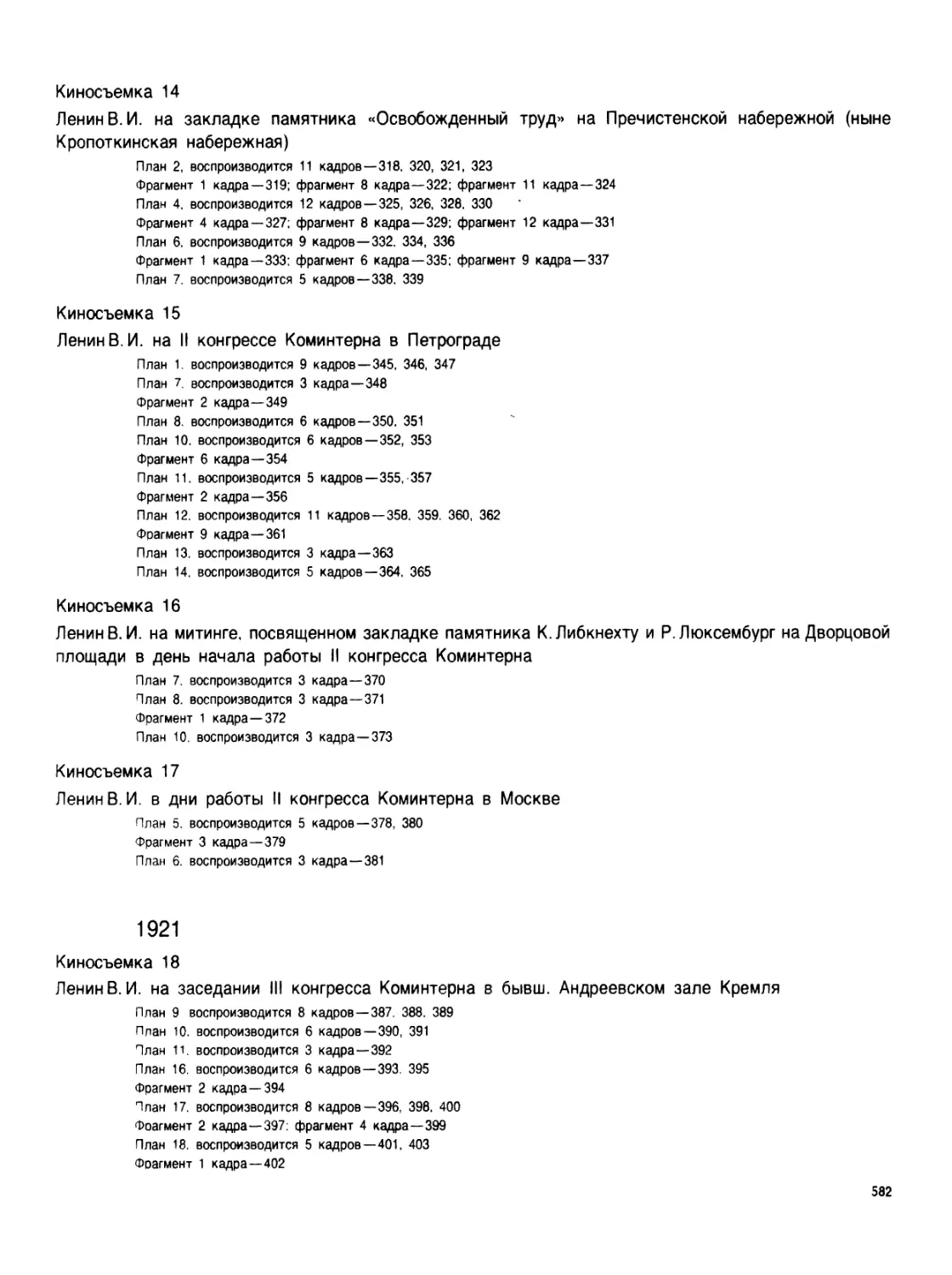
Для удобства пользования настоящим изданием в качестве каталога
принята двойная нумерация: в числителе дается порядковый номер
киносъемки, в знаменателе номер плана.
Расположение материала в томе строго хронологическое. Каждая
киносъемка сопровождается научно-справочными данными и коммента¬
риями. Они содержат сведения: дату и место киносъемки, фамилию
оператора, количество планов, их метраж, вид подлинника, а также
данные о первой демонстрации ленинских кинодокументов на экране.
Рассказывается о событиях и обстановке, во время которых был
запечатлен В. И. Ленин. Приводятся воспоминания авторов и участников
киносъемок. Тут нужно заметить, что в некоторых воспоминаниях—
A. А. Левицкого, Э. К. Тиссэ—встречаются неточности в описании дета¬
лей (например, расстояние до грузовика-трибуны, на которой находился
B. И. Ленин, или расстояние и место, с которого производилась кино¬
съемка). Составители посчитали возможным специально не оговаривать
в каждом отдельном случае эти неточности, ибо общая обстановка
событий авторами воспоминаний воссоздана верно.
13
При подготовке тома была тщательно проверена хронологическая
правильность расположения кинодокументов с учетом исследований и
уточнений, сделанных за последние годы. Так, например, кинокадры,
запечатлевшие В. И. Ленина во время его речи на митинге протеста
против убийства К. Либкнехта и Р. Люксембург, ранее относили к дру¬
гому событию. Уточнения получила киносъемка американского операто¬
ра В. Кьюбса, сделанная во время беседы В. И. Ленина с американ¬
ским журналистом Линкольном Эйром: отдельные планы этой киносъем¬
ки относились к разным по времени и месту событиям. Были внесены и
многие другие уточнения, а также установлена последовательность
события внутри каждой киносъемки.
Составители выражают большую признательность Центральному го¬
сударственному архиву кинофотодокументов СССР, отделу кинолетописи
Центральной студии документальных фильмов и всем историкам, архиви¬
стам и кинематографистам, которые занимались розыском и изучением
ленинских кинодокументов.
Велико историческое и художественное значение уникальных ленин¬
ских кинокадров, они помогут глубже понять и сохранить в наших
сердцах вечно живой и любимый образ Ленина.
Владимир Ильич Ленин так хорошо знал
историю прошлого, что мог и умел смотреть на
настоящее из будущего...
Он вообще, как никто до него, умел предвидеть
то, что должно быть. Он умел и мог делать
это — мне кажется — потому, что половиною вели¬
кой души своей жил в будущем; железная, но
гибкая логика его показывала ему отдаленное
будущее в формах совершенно конкретных, ре¬
альных.
М. Горький
СОБРАНИЕ
КИНОКАДРОВ
1918—1922
киносъемка
1
Ленин В. И. на Ходынском поле после окончания пер¬
вомайского парада частей Красной Армии.
1918 г., 1 мая. Москва.
Оператор:
Новицкий П. К.
Первый выход на экран:
Журнал «Кинонеделя», №1,1 июня 1918 года.
Обоснование даты:
1 мая 1918 года В. И. Ленин вместе с Н. К. Крупской и М. И. Ульяновой присутство¬
вал на параде воинских частей на Ходынском поле.—См.: В.И.Ленин, Полное
собрание сочинений*, т. 36, стр. 698.
Газета «Правда» сообщала о военном параде на Ходынском поле: «Недалеко от
авиационного павильона стройными рядами выстроены аппараты разных систем...
...На другом конце поля, недалеко от аэродрома, в необозримом каре выстро¬
ились прибывшие сюда воинские части. В середине этого каре, на зеленой
лужайке—Председатель Совета Народных Комиссаров В. И. Ленин, окруженный
толпой «любопытствующих», пробившихся сюда с пропусками и без пропу¬
сков...».—«Правда», № 86, 3 мая 1918 г., стр. 3.
Примечания.
Сохранилось 4,5 метра пленки—1 план. На всех кадрах плана—запечатлен В. И.Ленин.
Кадры этой киносъемки были включены в одиннадцатый сюжет фильма Дзиги Вертова «Киноправда»,
№ 19—«В. И.Ленин при жизни»,—вышедшего в мае 1924 года, а затем в фильм «Киноправда», №21 —
«Ленинская»,—вышедший на экраны к первой годовщине со дня смерти В. И. Ленина, в январе 1925 года.
* Далее указывается сокращенно—Полн. собр. соч.
20
В этот день на Ходынском поле работала
группа кинооператоров и фотографов, среди них
находился Петр Карлович Новицкий, которому
посчастливилось первым из московских кино-
операторов запечатлеть на кинопленке В. И. Ле-
ьмна.
П. К. Новицкий пишет в своих воспоминаниях:
«В моем распоряжении—грузовичок-полутонка,
на нем устроен киноаппарат «Гомон-Прессвич».
Он установлен так, что я могу снимать с ходу.
Внезапно, среди многотысячной толпы я уви¬
дел В. И. Ленина. Он ехал на легковой машине
с Надеждой Константиновной. Было холодно.
Свидетельство о том, что в этот день на
Ходынском поле происходили фото- и киносъем¬
ок, мы находим и в газете «Заря России»,
выходившей в 1918 году в Москве:
«В 5 часов 20 минут (вечера,— Сост.),—
сообщала газета,—приезжает глава Советского
Владимир Ильич одет по-зимнему—каракулевая
шапка и пальто с каракулевым воротником
шалью.
Зная, что Владимир Ильич неохотно снимает¬
ся, я, чтобы отвлечь его внимание, взял киноап¬
парат на руку, сошел с машины и подошел к
нему сзади. В это время его машина на минуту
задержалась. Я попросил у него разрешения
заснять его. Владимир Ильич знал меня по
работе в дни Октябрьской революции. Получив
разрешение, я снял несколько метров пленки и
затем начал менять оптику, чтобы снять Влади¬
мира Ильича крупным планом».
Журн. «Советское фото», 1937, № 5—6, стр. 22.
правительства Ленин... Глаза, запавшие под
большой лоб, весело смеются... Автомобиль Ле¬
нина останавливается около аппаратов и тут на
него наскакивают десятки фотографов и опера¬
торов. Щелкают кодаки, с шумом вставляются
кассетки, сверкают объективы».
Газ. «Заря России», М., № 13, 3 мая 1918 г., стр. 3.
21
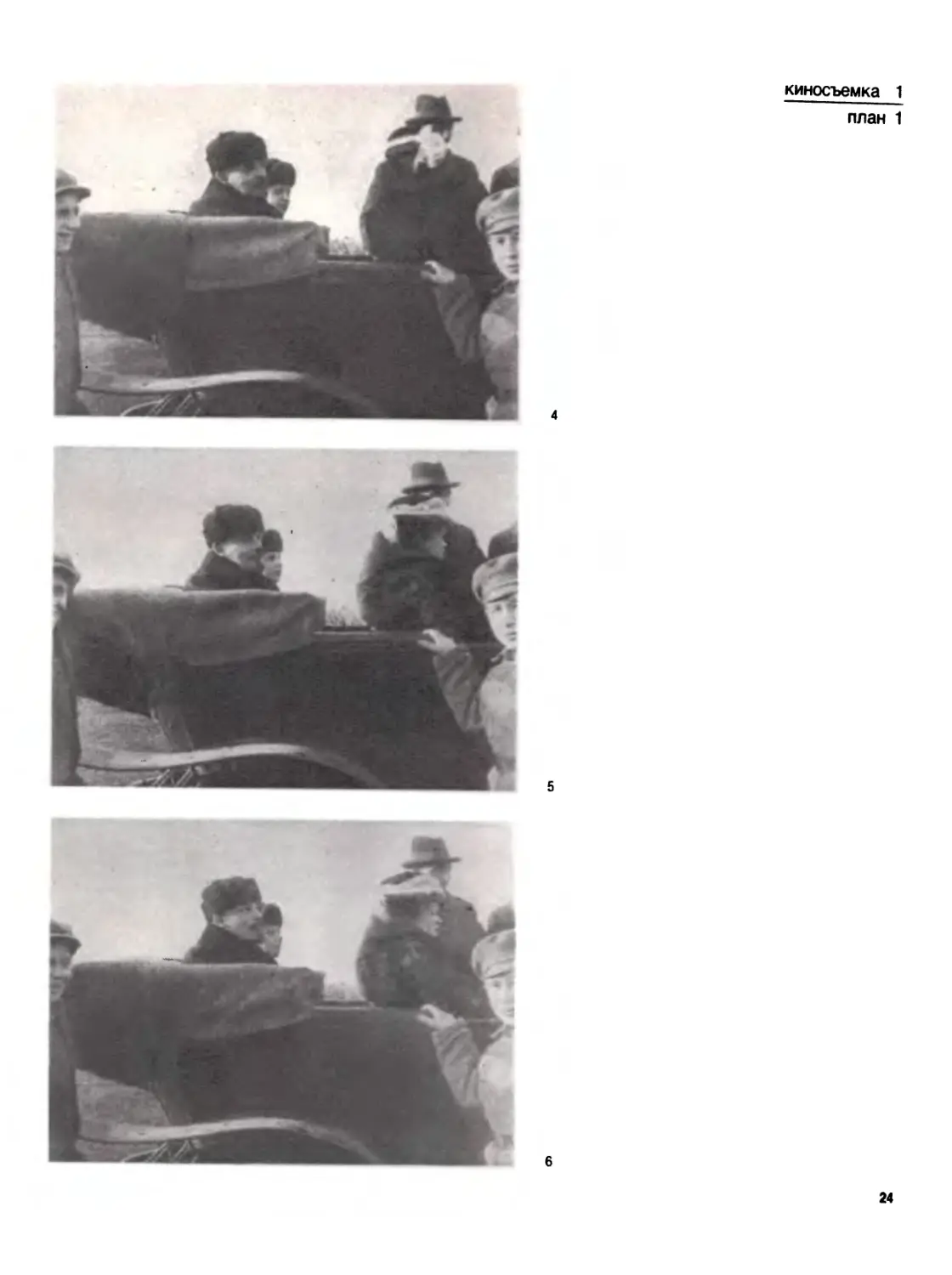
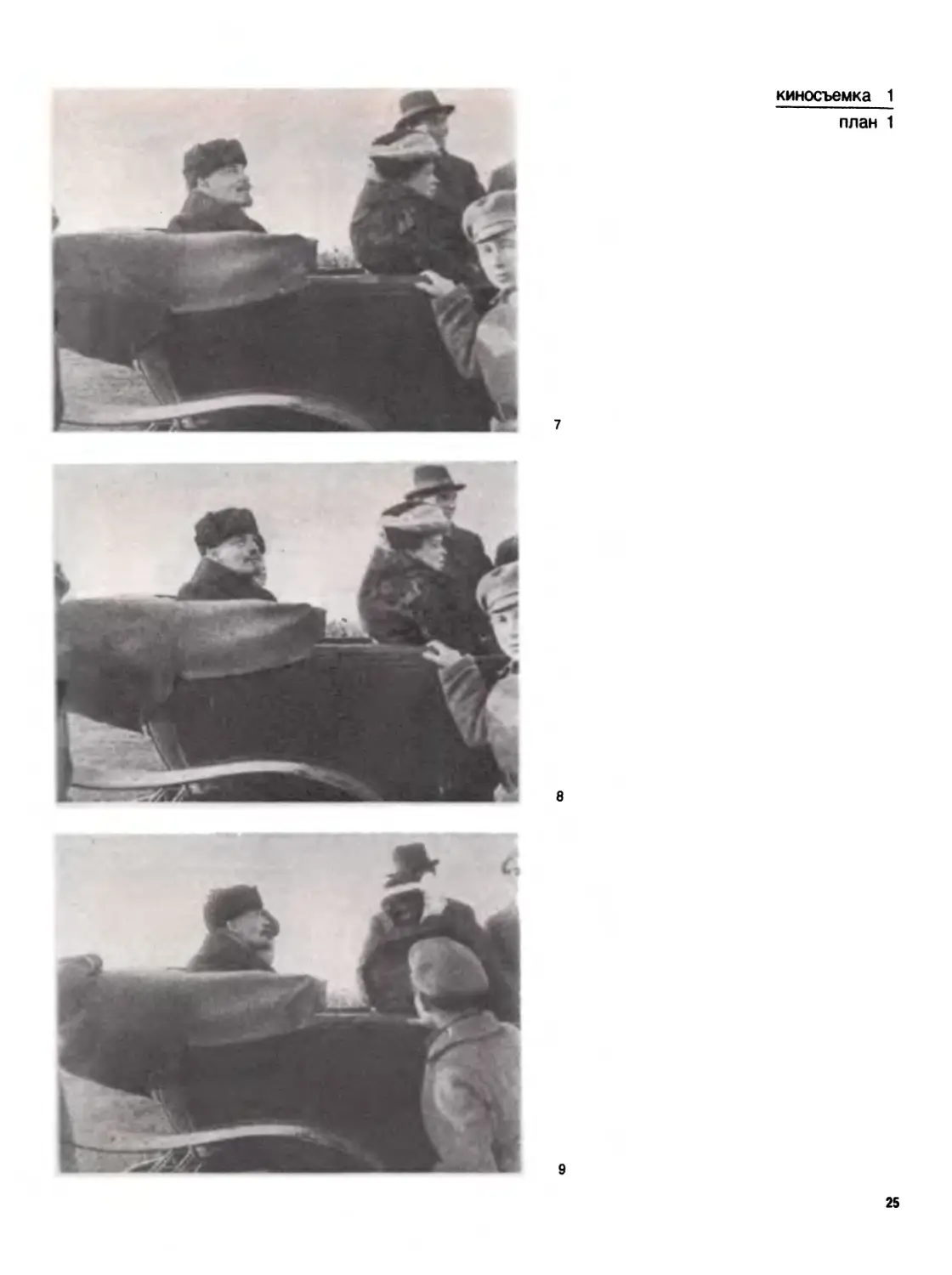
киносъемка 1
план 1
ЛенинВ.И., КрупскаяН.К. и УльяноваМ.И.
в автомобиле на Ходынском поле.
Позитив. Средний план. 4 м 22 к
В. И. Ленин запечатлен на всех кадрах
плана.
1
2*
22
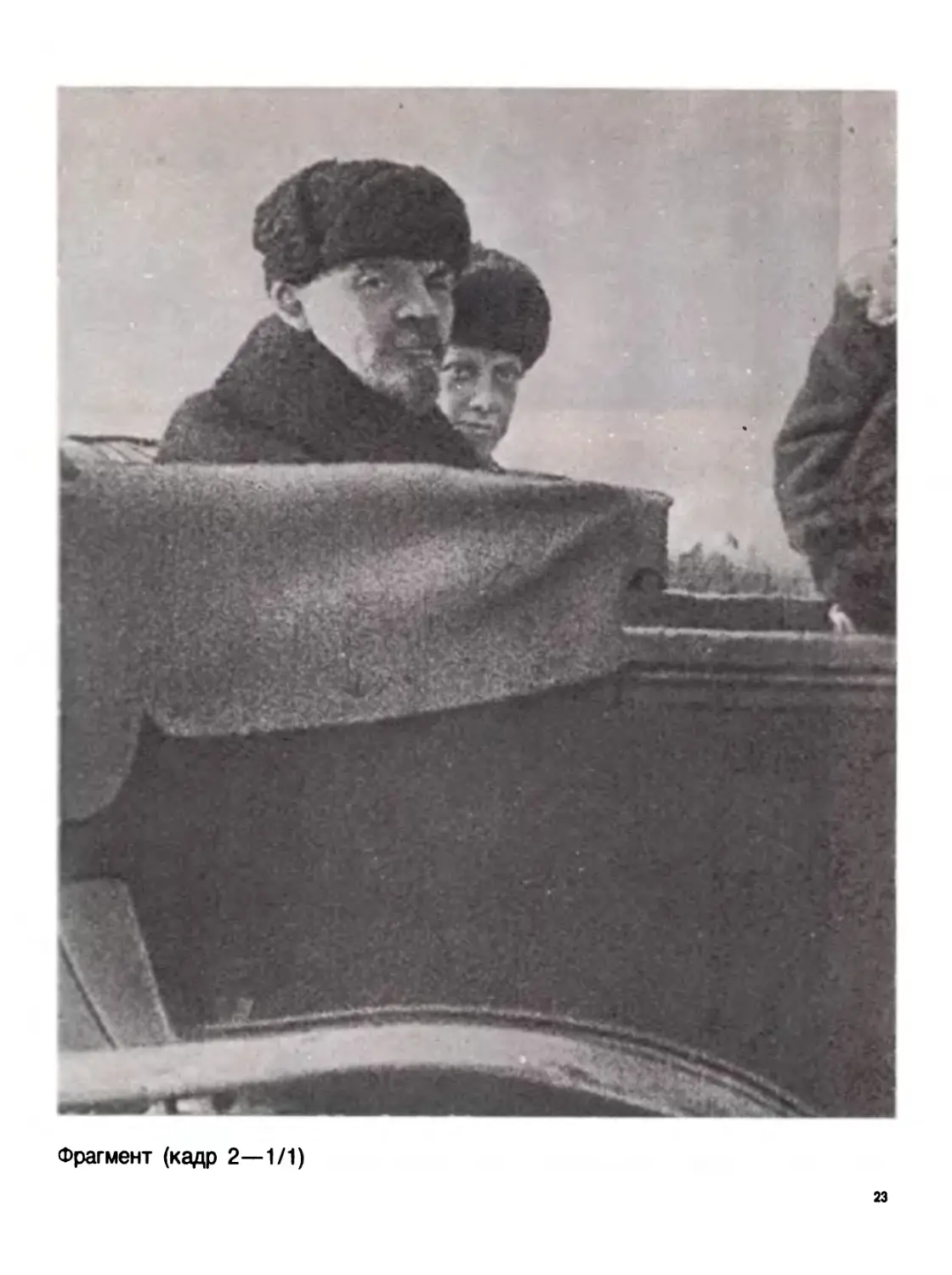
Фрагмент (кадр 2—1/1)
23
киносъемка 1
план 1
4
5
6
24
киносъемка 1
1 -тшШ
И5ДЙ
план 1
7
8
9
25
киносъемка
2
Ленин В. И. во дворе Кремля на прогулке по выздоров¬
лении после ранения.
1918 г., 16 октября. Москва.
Операторы:
Винклер А. Ф., Левицкий А. А.*
Первый выход на экран:
Хроника «Москва. Владимир Ильич Ленин—глава Советского правительства,
оправившийся от ран».—Первый сюжет** выпуска «Кинонедели», № 22. 29
октября 1918 года.
Обоснование даты:
16 октября 1918 года В. И. Ленин после продолжительной болезни в связи с
ранением совершил прогулку по Кремлю.
Дата съемки обоснована в брошюре В. С. Листова «Кинокадры незабываемых
дней». М., изд. Бюро пропаганды советского киноискусства, 1967, стр. 29—37***.
Примечания.
Сохранилось 92,1 метра пленки—14 планов. На всех планах—запечатлен В. И. Ленин.
Кинокадры этой съемки (план 14) были обнаружены на киевской студии кинохроники (ЦГАЛИ, ф. 2057, оп. 1,
ед. хр. 53, л. 5).
Кинокадры—В. И. Ленин беседует с В. Д. Бонч-Бруевичем—были использованы в фильме Дзиги Вертова
«Киноправда». № 21—«Ленинская».
В 1925 году на экраны страны вышел также документальный фильм «Памяти товарища Ленина», в который
были включены кадры съемок В. И. Ленина во время прогулки во дворе Кремля.
* Воспоминания Э.К.Тиссэ, которые приводятся ниже, дают основание считать, что в съемке принимал
участие и А. А. Левицкий.
" Сюжет в подлинном монтаже не сохранился.
*** До последнего времени данная съемка ошибочно датировалась 23 сентябрем 1918 года.
28
Управляющий делами Совнаркома В. Д. Бонч-
Бруевич, организовавший киносъемку В. И. Лени¬
на, писал, что когда В. И. Ленин «стал поправ¬
ляться после своего ранения 30 августа 1918 г. и
когда доктора разрешили ему выйти во двор,
мне показалось необходимым заснять Владими¬
ра Ильича и показать его на многочисленных
рабочих собраниях. Я сказал ему, что подготов¬
ляется съемка во время его прогулки по Кремлю
в первый хороший солнечный день. И действи¬
тельно, когда выдался прекрасный осенний лу¬
чистый день, кинооператор выехал в Кремль в
условленный час, и я попросил Владимира Иль¬
ича пойти пройтись по Кремлю...
— Ну что же, пойдемте...
Мы пошли по Кремлю. Аппарат защелкал,
запечатлевая эту первую прогулку Владимира
Ильича после его страшной болезни».
Журн. «Кинофронт», 1927, № 13—14, стр. 3—5.
В более поздних воспоминаниях В. Д. Бонч-
Бруевича, опубликованных посмертно, говорится
о том, что кино- и фотосъемки были подготовле¬
ны втайне от В. И. Ленина, что операторы, спря¬
тавшие свои киноаппараты за углами зданий,
должны были незаметно снимать Владимира
Ильича во время прогулки (см.: В.Д.Бонч-
Бруевич. Воспоминания о В. И. Ленине, М.,
«Наука», 1965, стр. 359).
С этим нельзя согласиться, ибо сами кадры
большой съемки говорят, что Ленина снимали
открыто и что Владимир Ильич, беседуя с
В. Д. Бонч-Бруевичем, смотрел прямо на аппарат
(см. планы съемки—1, 2, 3 и другие).
Имеющиеся крупные и средние планы не могли
быть сняты в то время с большого удаления без
соответствующей телеоптики, которой операто¬
ры не располагали.
Газета «Коммунар», выходившая в те годы в
Москве, писала об этом событии: «Вот он, наш
Ильич, идет по двору Кремля с В. Д. Бонч-
Бруевичем... Ильич останавливается около Царь-
пушки. Улыбается. Не любит он этих церемо¬
нии-фотографии да кинематографа. Но ничего
не поделаешь... Заставили...»
Газ. «Коммунар», № 11, 20 октября 1918 г.
Кинооператор Э.К.Тиссэ рассказывает об об¬
стоятельствах этой съемки:
«В кинокомитете в этот день дежурили
Винклер и Левицкий. День был теплый, солнеч¬
ный, и мы были очень довольны. Мы отдали
товарищам скромные запасы пленки, которые
хранились как неприкосновенный запас, и с
волнением стали ждать их возвращения...
...Владимир Ильич Ленин был снят на фоне
арсенала и Царь-пушки с улыбкой на лице,
беседующим с В. Д. Бонч-Бруевичем. Ленин в
одре держится совершенно непринужденно и
звободно, делает присущие ему резкие поворо¬
ты. На прогулку он вышел в своей неизменной
кепке и пиджачке, а Бонч-Бруевич—в пальто,
шляпе, с портфелем в руке.
Хорошо сняты средние планы, мы имеем воз¬
можность увидеть Владимира Ильича довольно
крупно...
По возвращении со съемки операторы благода¬
рили нас за то, что мы их снабдили нашей
резервной пленкой. Они спокойно снимали Вла¬
димира Ильича, не думая о метраже израсходо¬
ванного негатива. В этот день ими было снято
около 120 метров с изображением Владимира
Ильича Ленина».
Э.Тиссэ. Живой Ильич—на экране—Журн. «Не¬
ман», 1961. № 2, стр. 124—125.
29
киносъемка 2
план 1
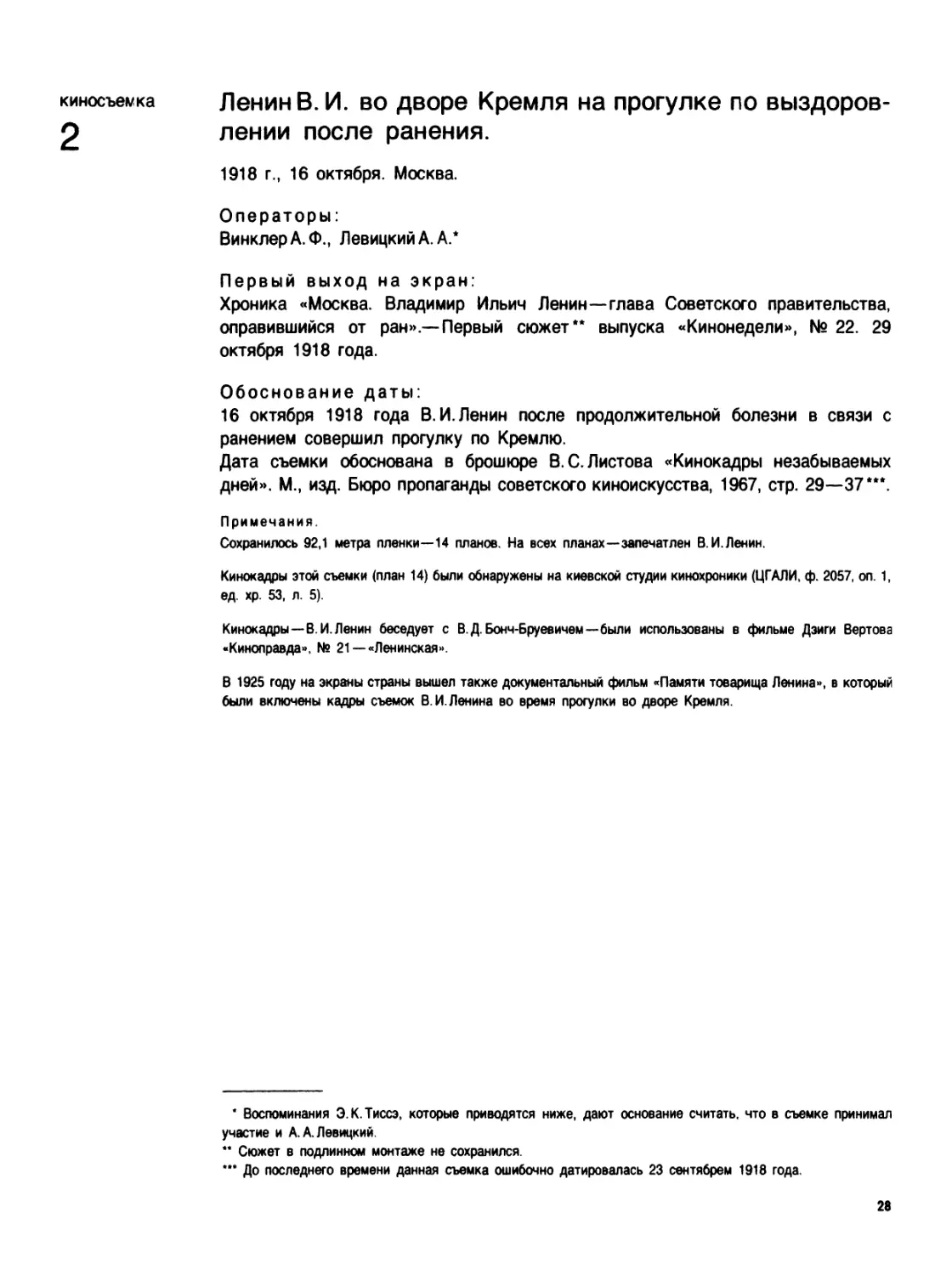
Ленин В. И. у подъезда здания Совнар¬
кома.
Негатив. Средний план. 1 м 35 к
В. И. Ленин запечатлен на всех кадрах
плана.
1
2
3
30
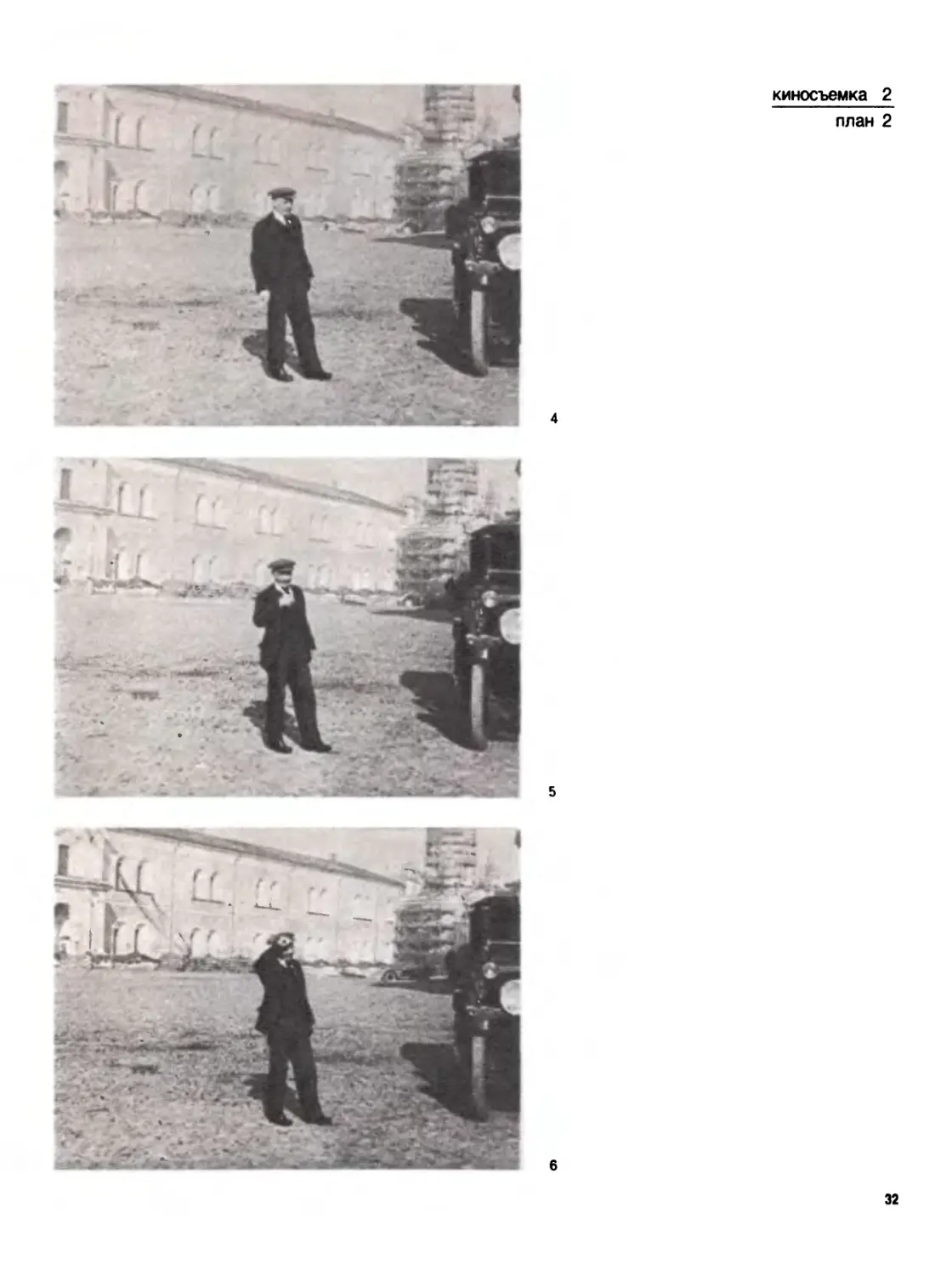
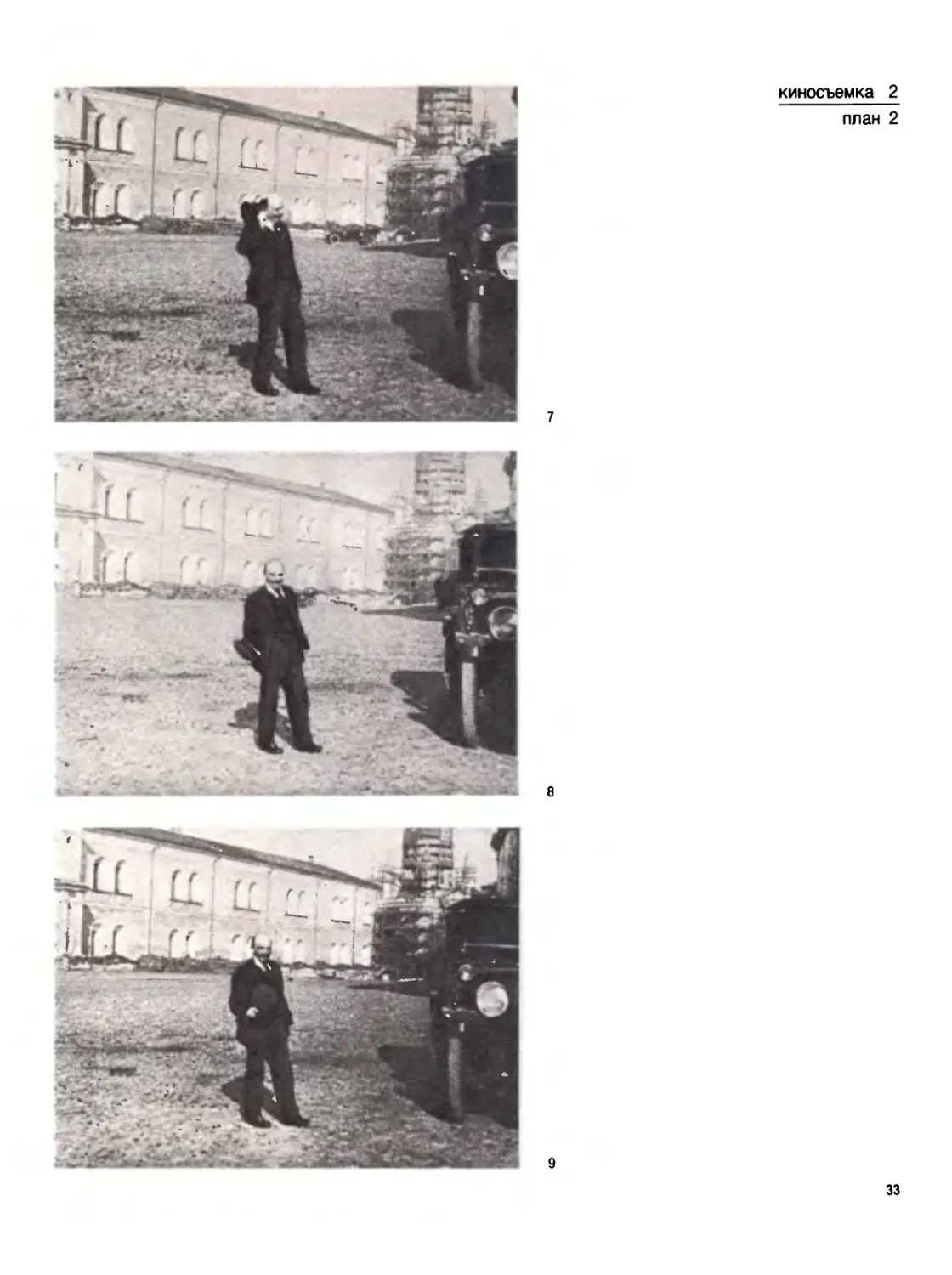
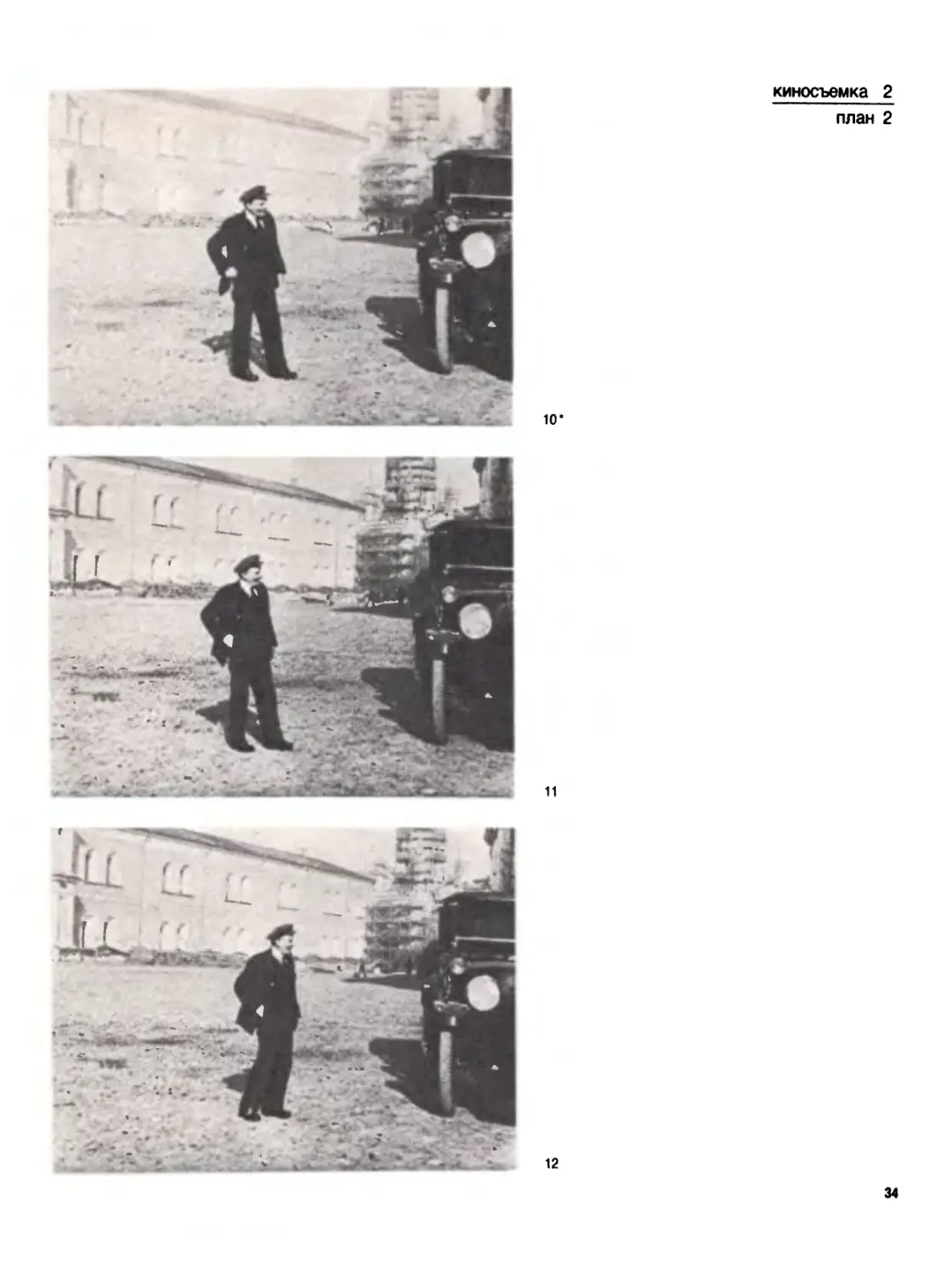
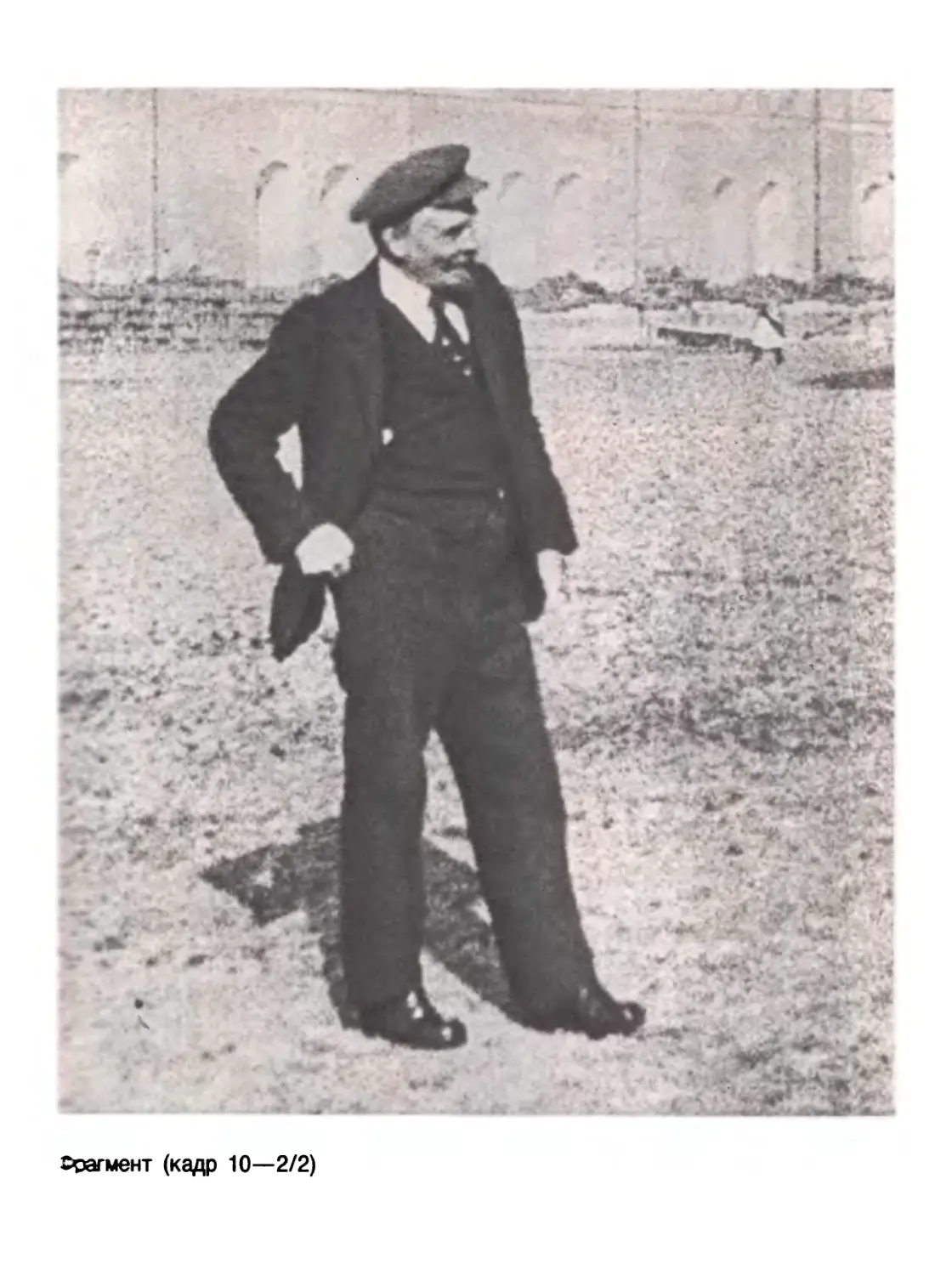
киносъемка 2
план 2
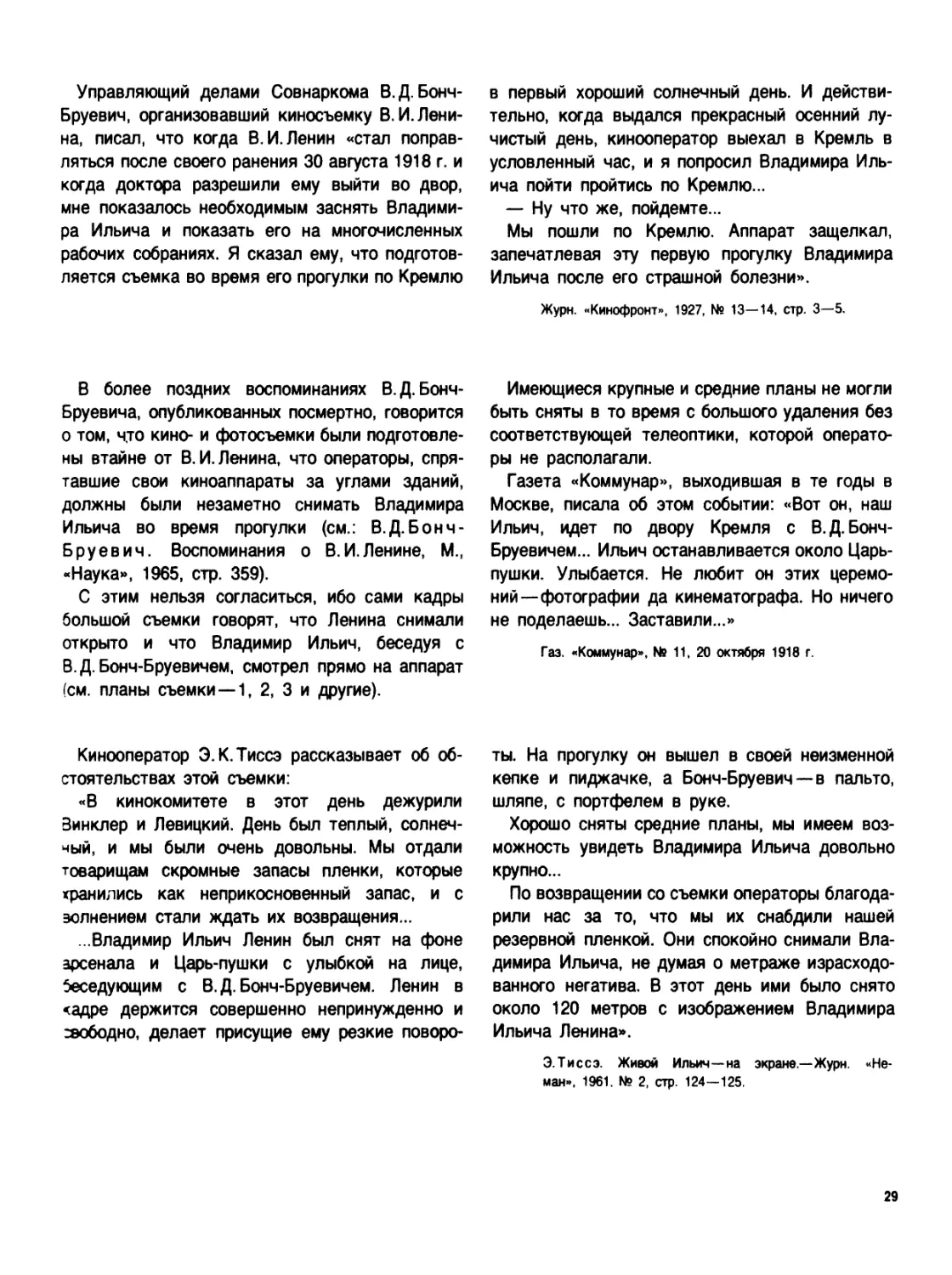
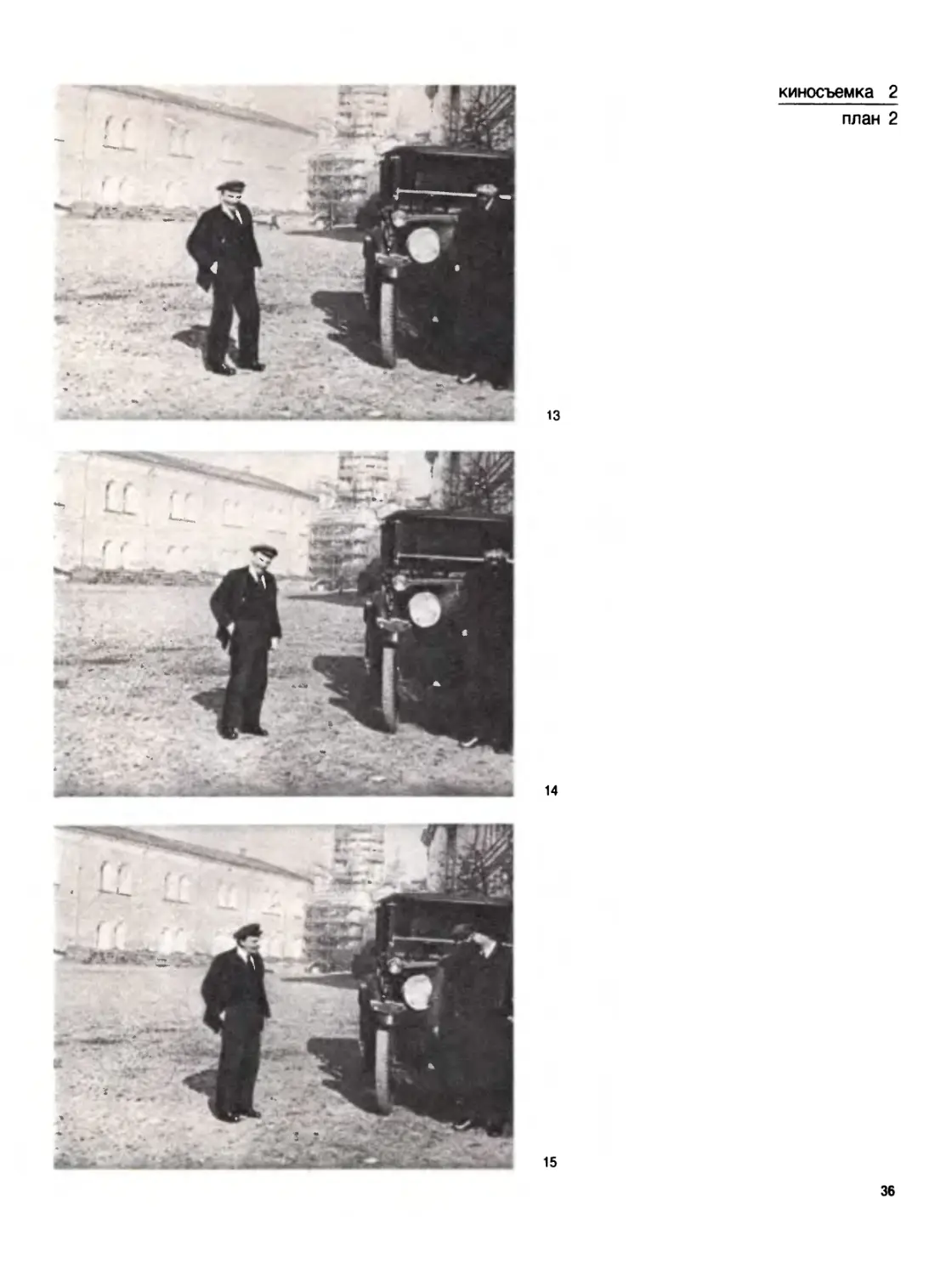
Ленин В. И. на Сенатской площади
Кремля.
Позитив. Общий план. 10 м 01 к
В.И.Ленин запечатлен на всех кадрах
плана.
1
2
3
31
32
киносъемка 2
план 2
7
8
9
33
киносъемка 2
план 2
ю*
11
12
34
mm
4P *
:*■
L> •- . t
l; v ' -'Ч/л^
Орагмент (кадр 10—2/2)
36
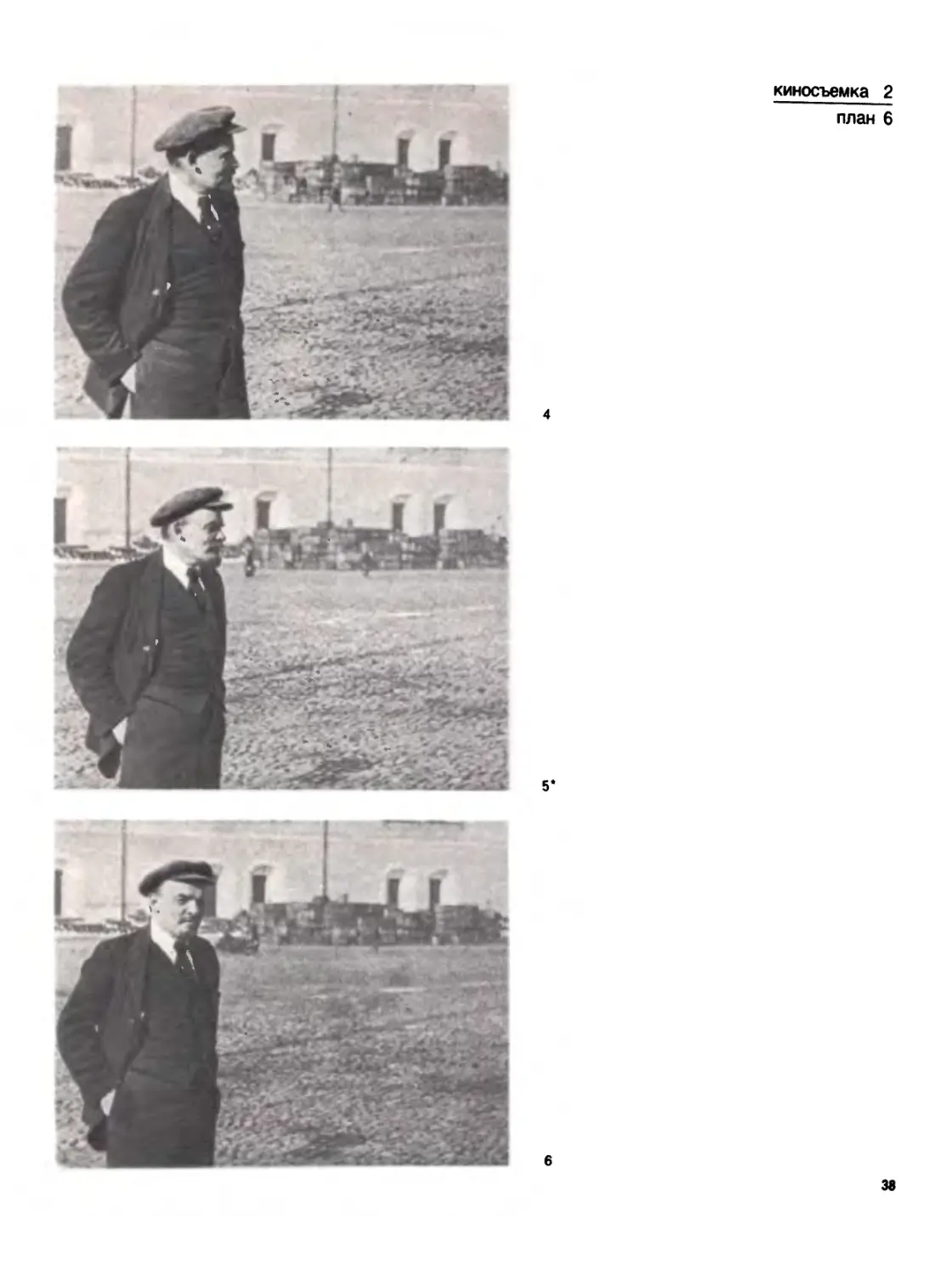
киносъемка 2
план 6
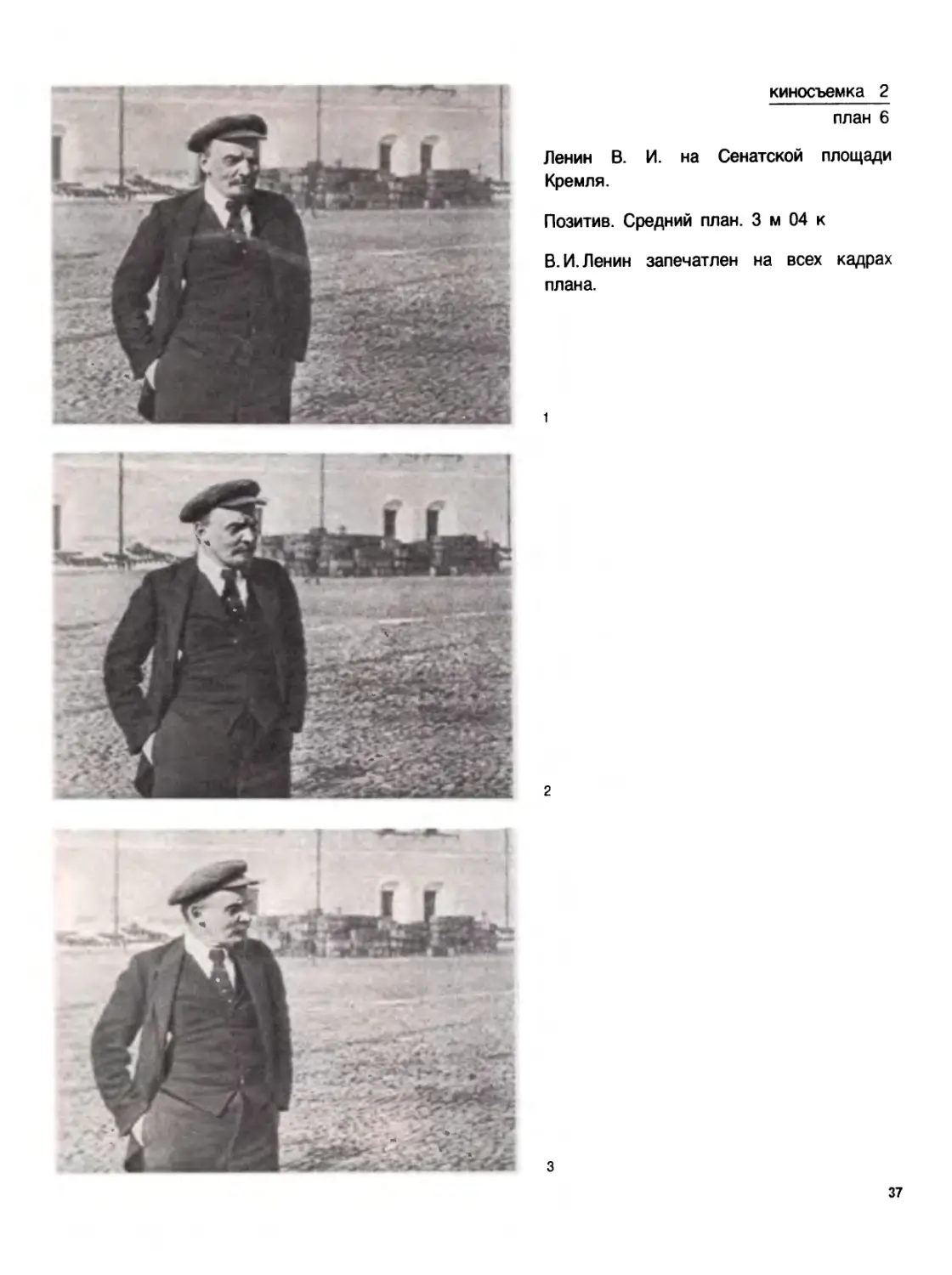
Ленин В. И. на Сенатской площади
Кремля.
Позитив. Средний план. 3 м 04 к
В.И.Ленин запечатлен на всех кадрах
плана.
1
з
37
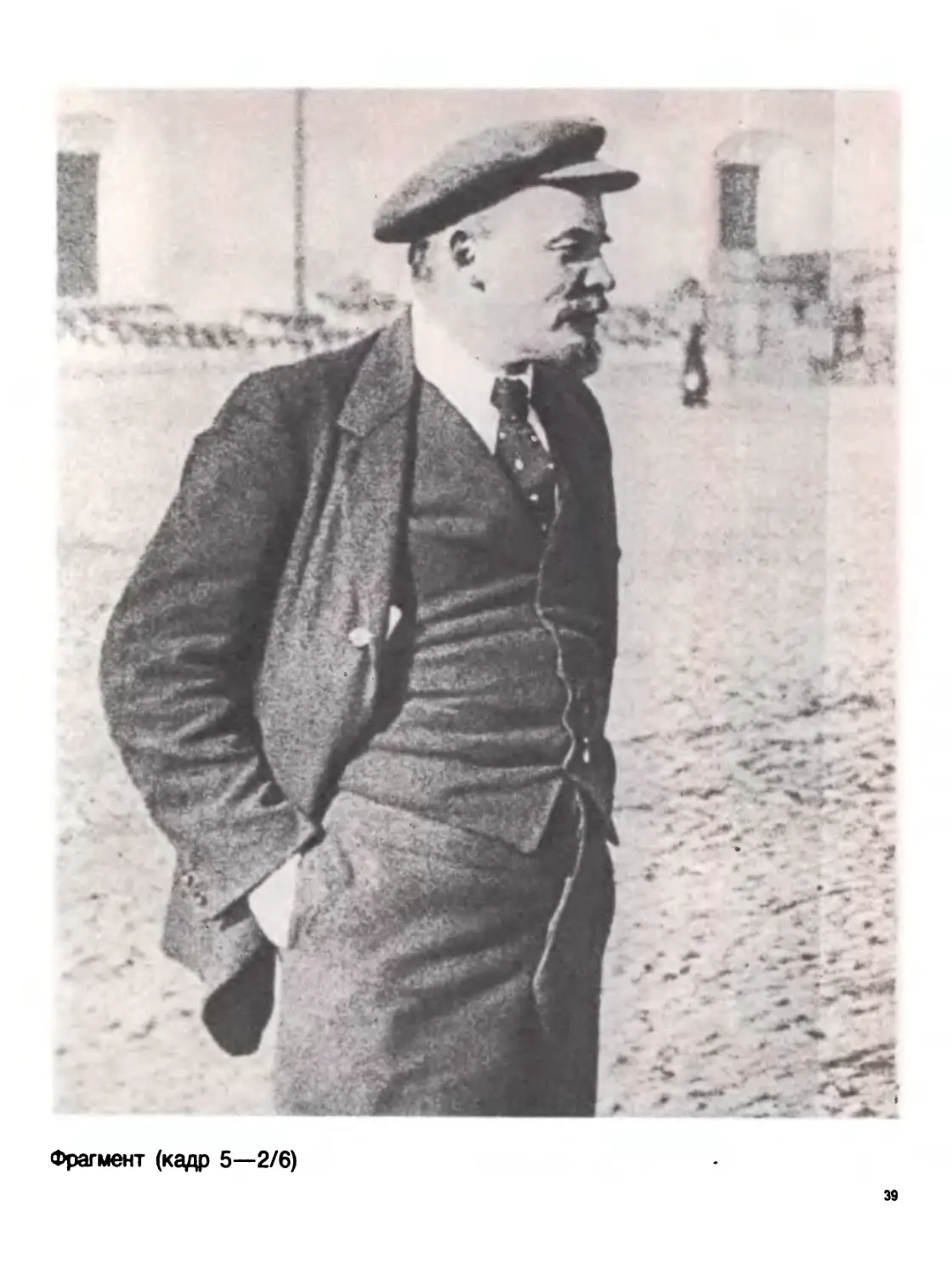
Фрагмент (кадр 5—2/6)
39
киносъемка 2
план 6
7*
8
9
40
Фрагмент (кадр 7—2/6)
41
киносъемка 2
план 6
ю*
11
12
42
Фрагмент (кадр 10—2/6)
43
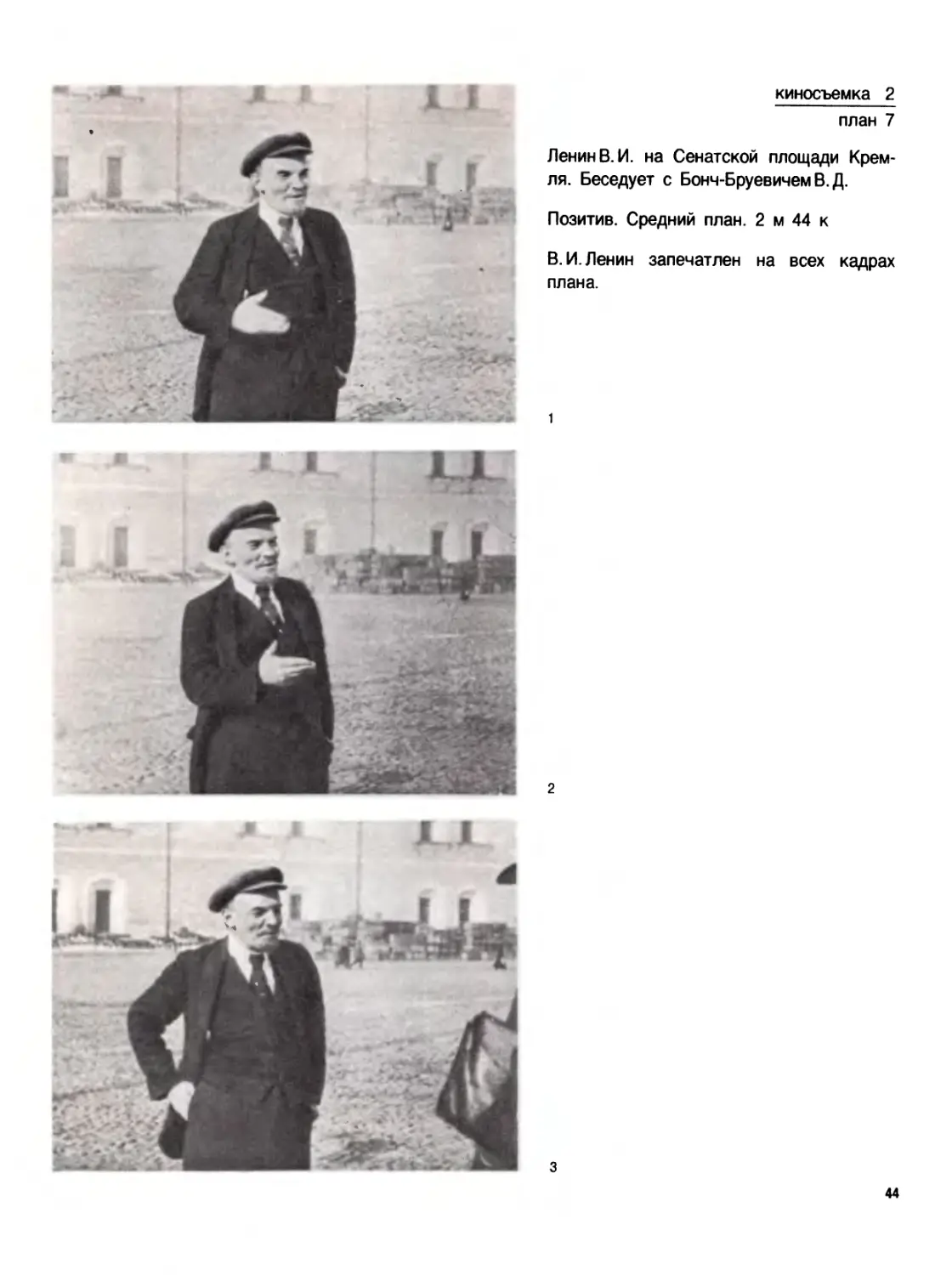
киносъемка 2
план 7
Ленин В. И. на Сенатской площади Крем¬
ля. Беседует с Бонч-Бруевичем В. Д.
Позитив. Средний план. 2 м 44 к
В. И. Ленин запечатлен на всех кадрах
плана.
1
2
3
44
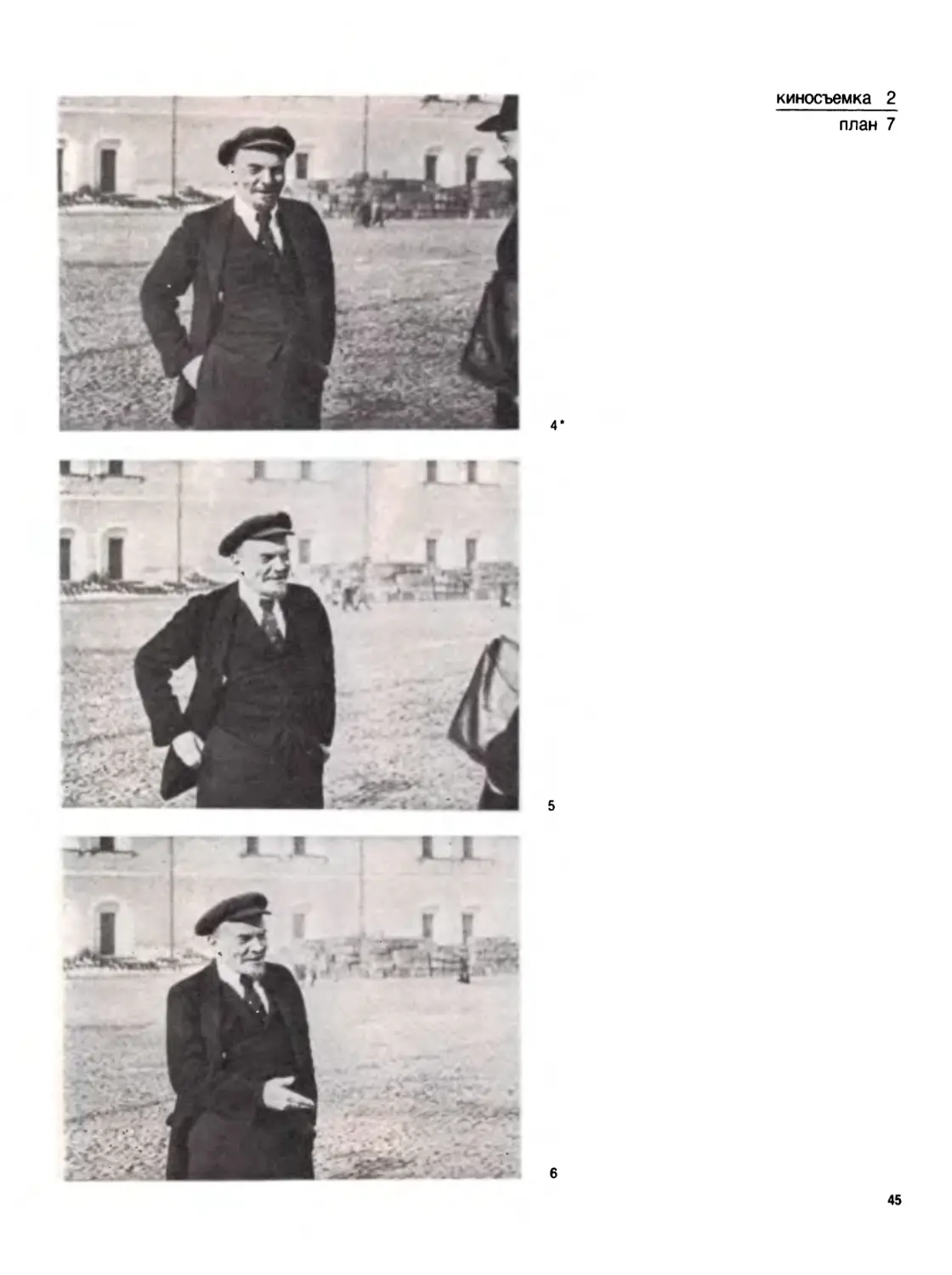
киносъемка 2
план 7
4*
5
6
45
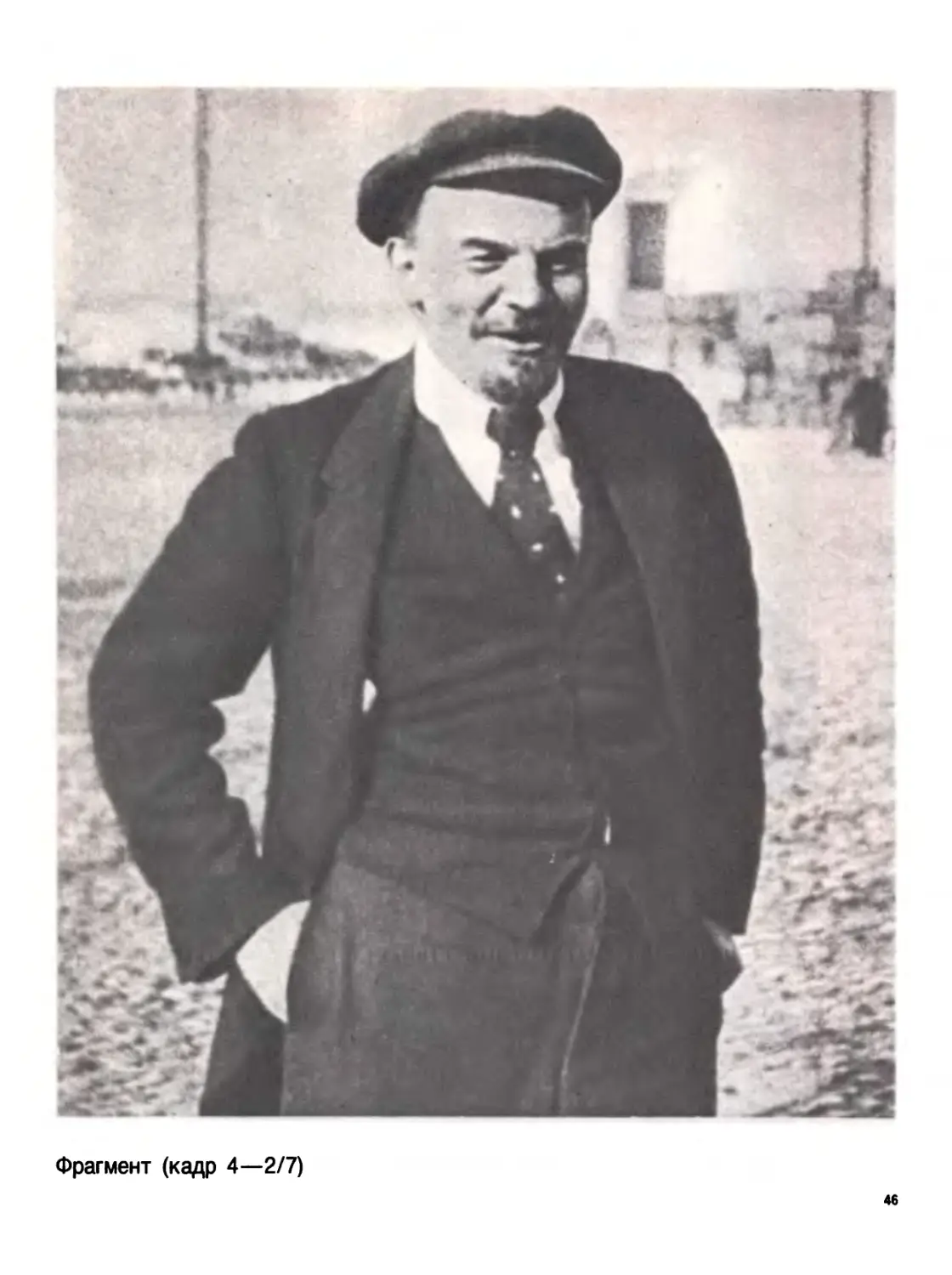
Фрагмент (кадр 4—2/7)
46
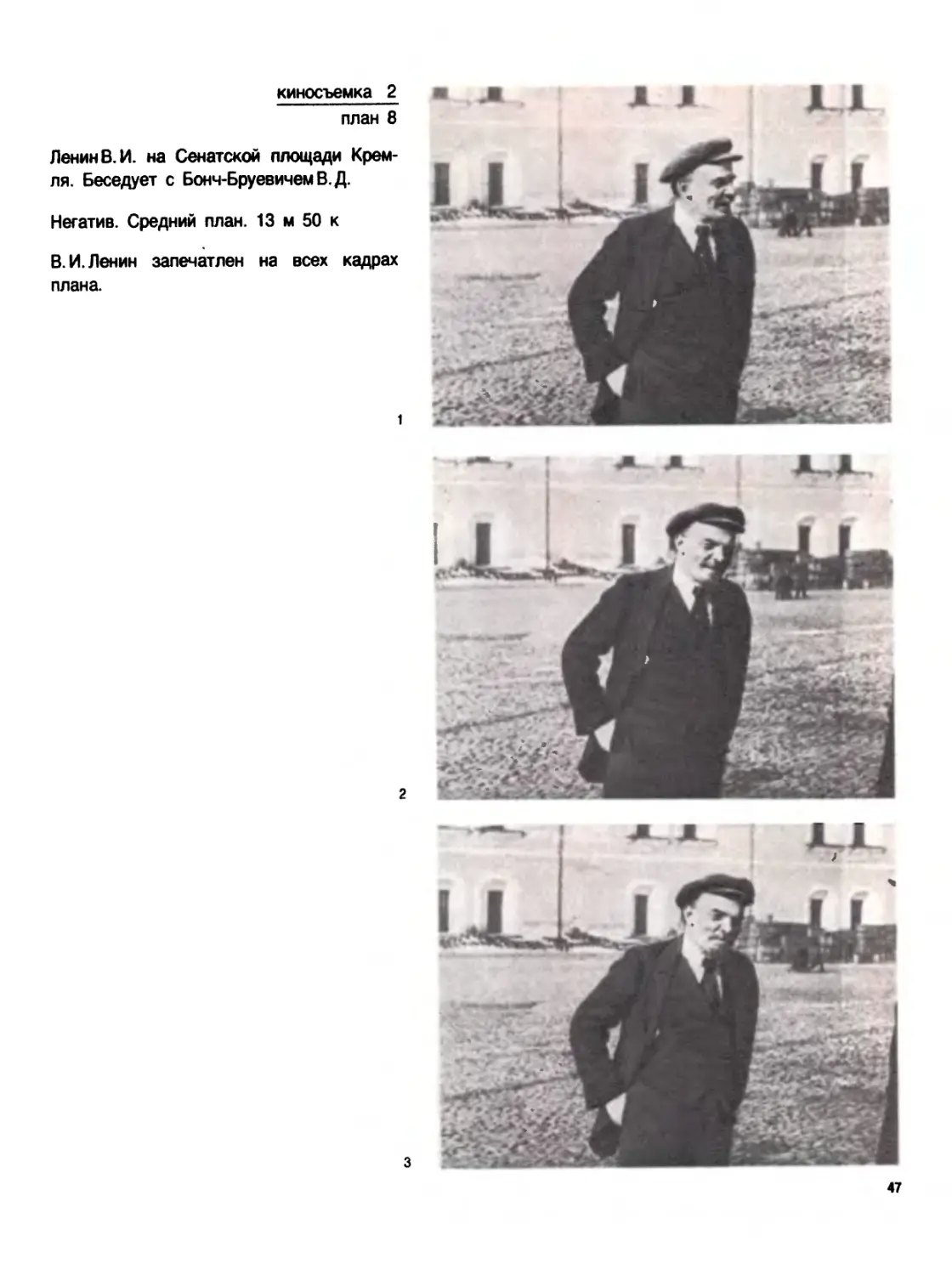
киносъемка 2
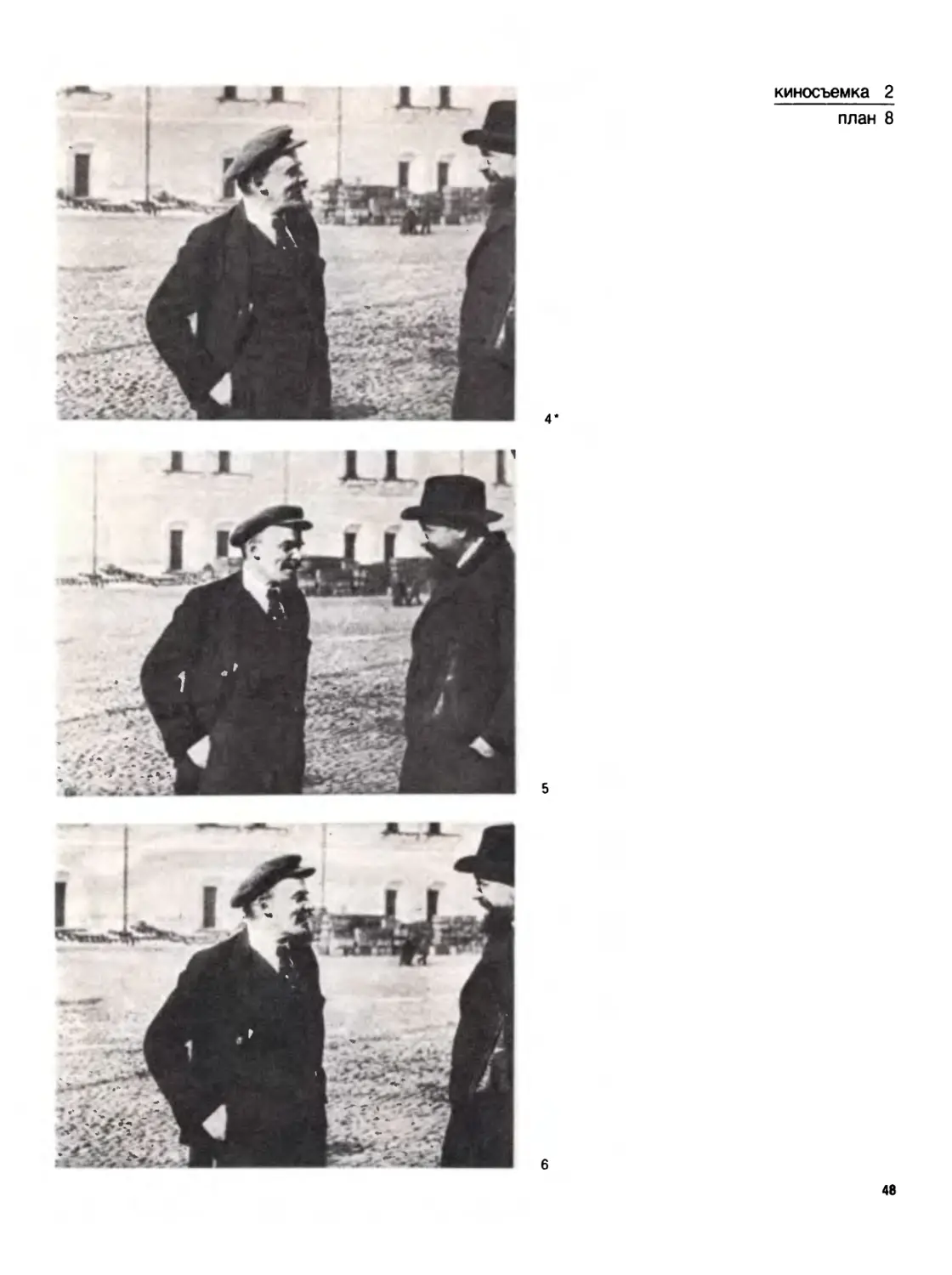
план 8
Ленин В. И. на Сенатской площади Крем¬
ля. Беседует с Бонч-Бруевичем В. Д.
Негатив. Средний план. 13 м 50 к
В. И. Ленин запечатлен на всех кадрах
плана.
1
47
киносъемка 2
план 8
4*
5
6
48
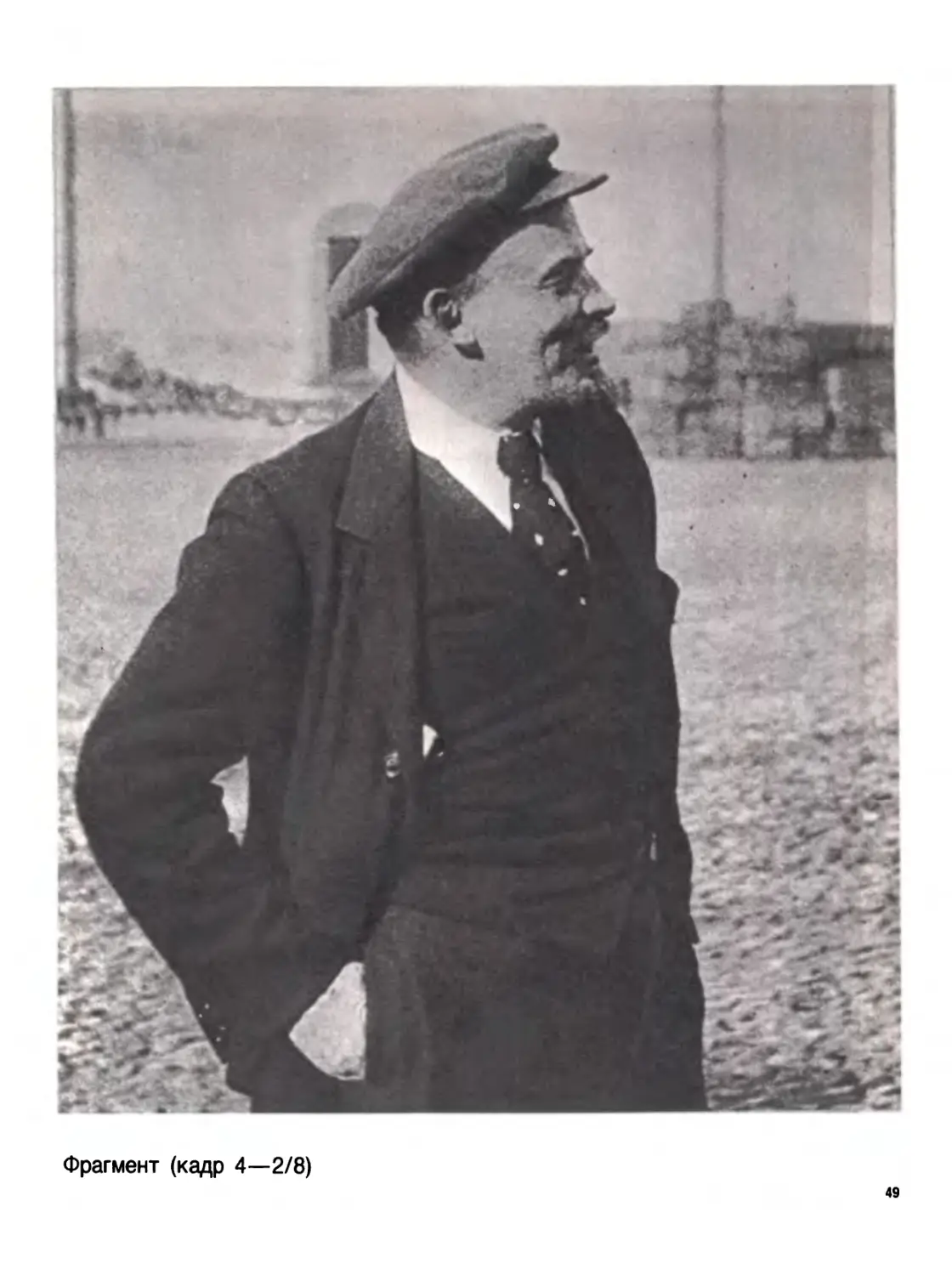
Фрагмент (кадр 4—2/8)
49
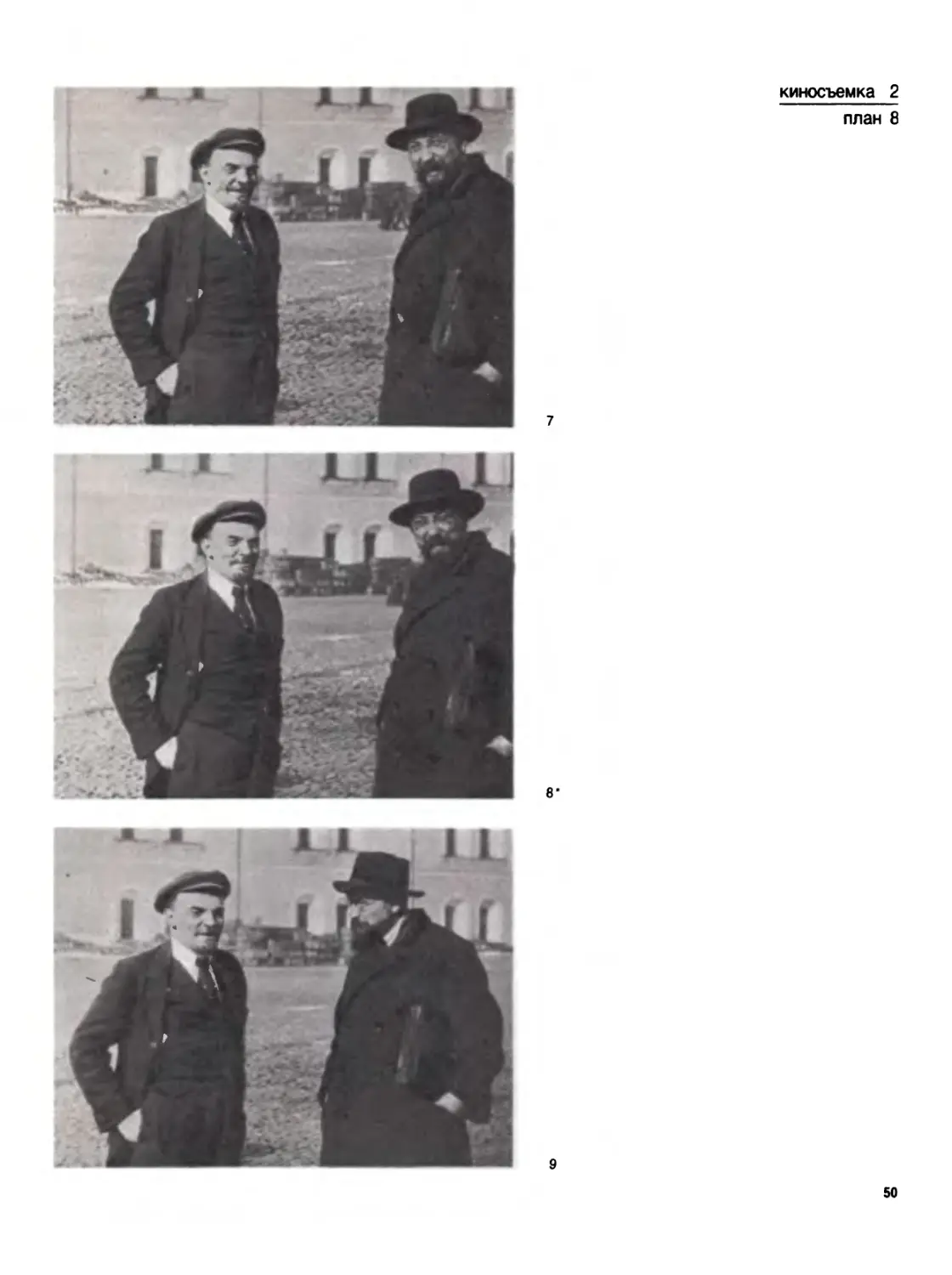
киносъемка 2
план 8
7
8*
9
50
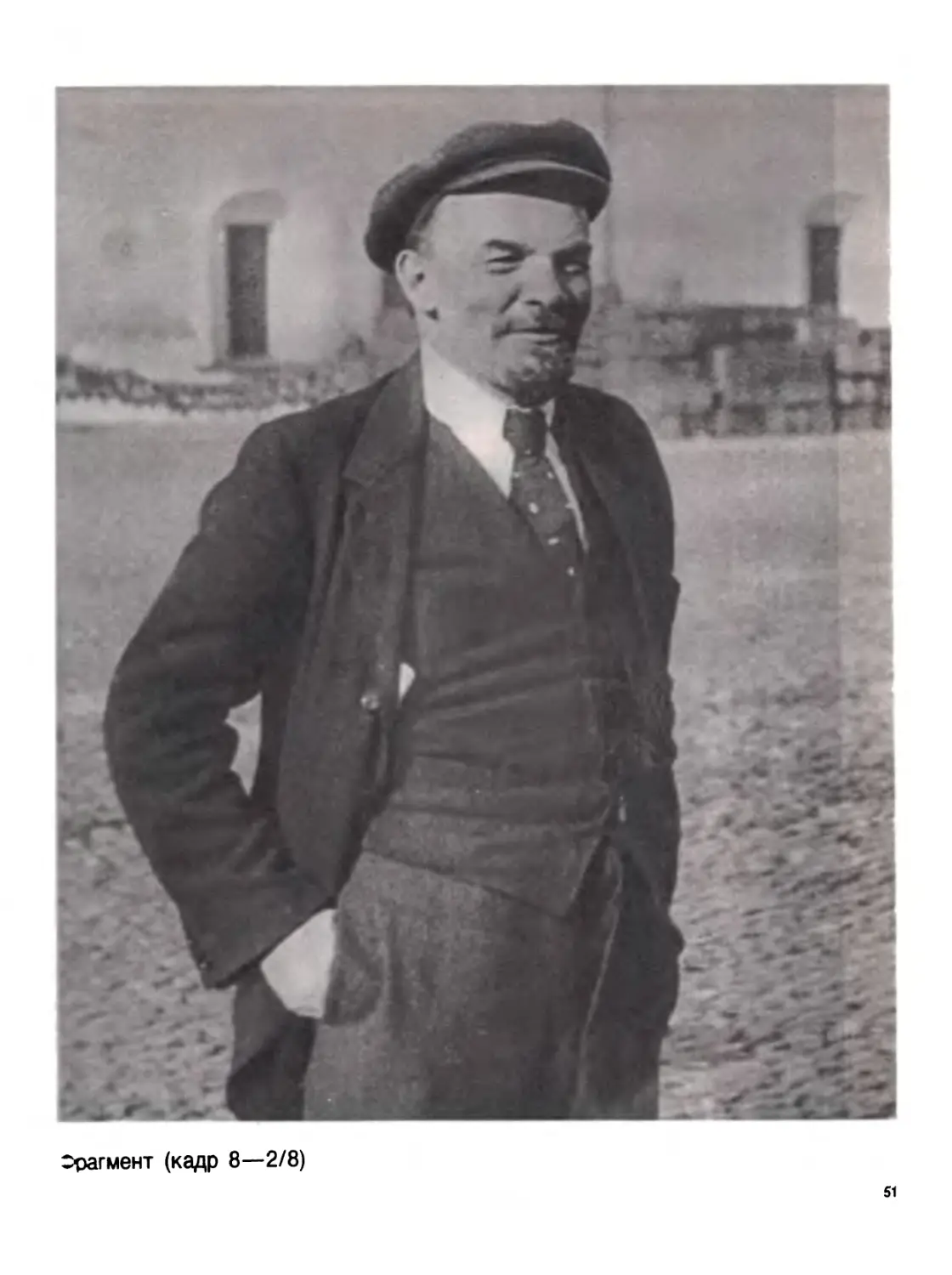
фрагмент (кадр 8—2/8)
51
киносъемка 2
план 8
ю
11
12
52
киносъемка 2
план 9
Ленин В. И. на Сенатской площади Крем¬
ля. Беседует с Бонч-Бруевичем В. Д.
Негатив. Средний план. 4 м 06 к
В. И. Ленин запечатлен на всех кадрах
плана.
1
2
3
53
54
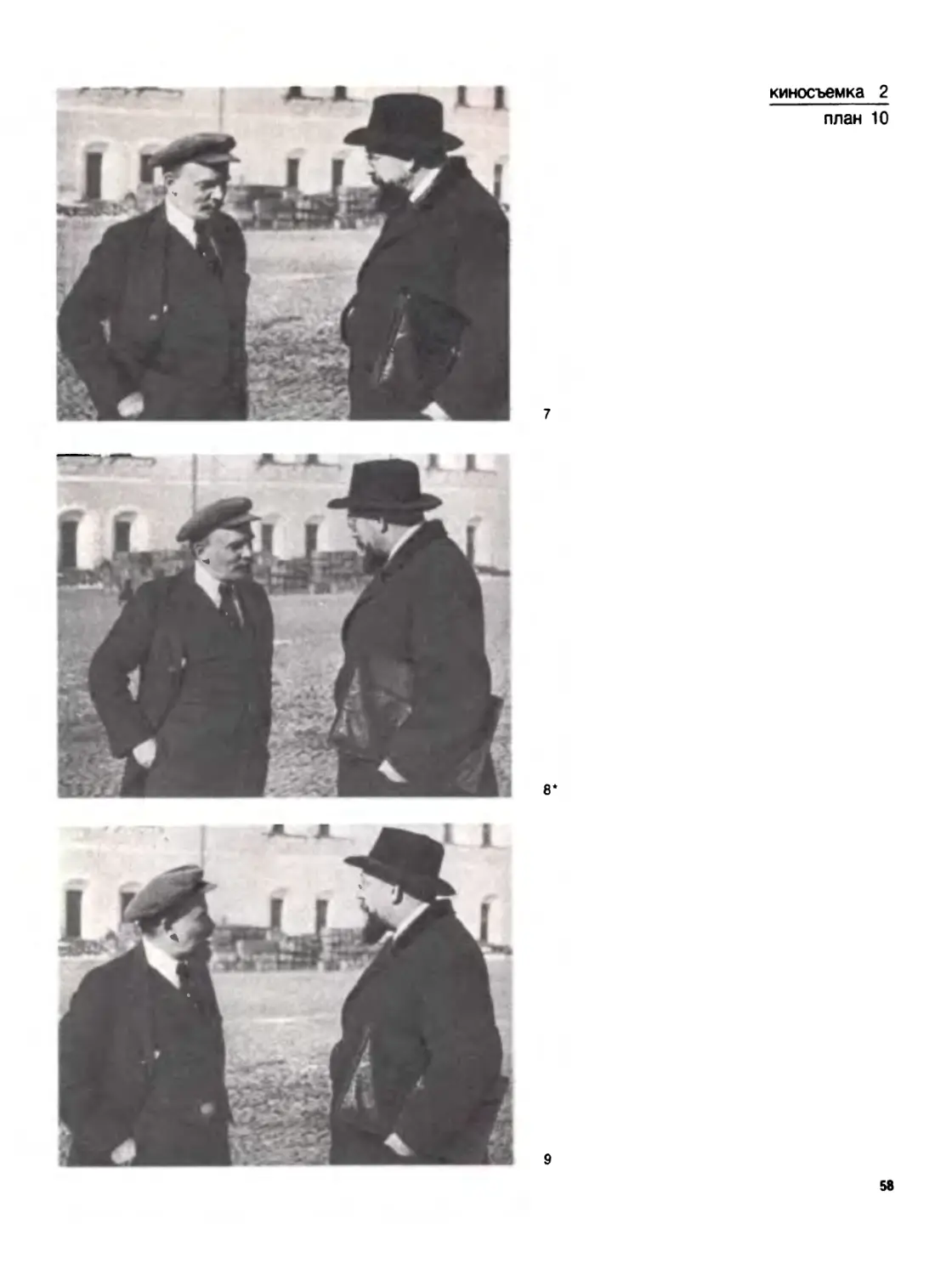
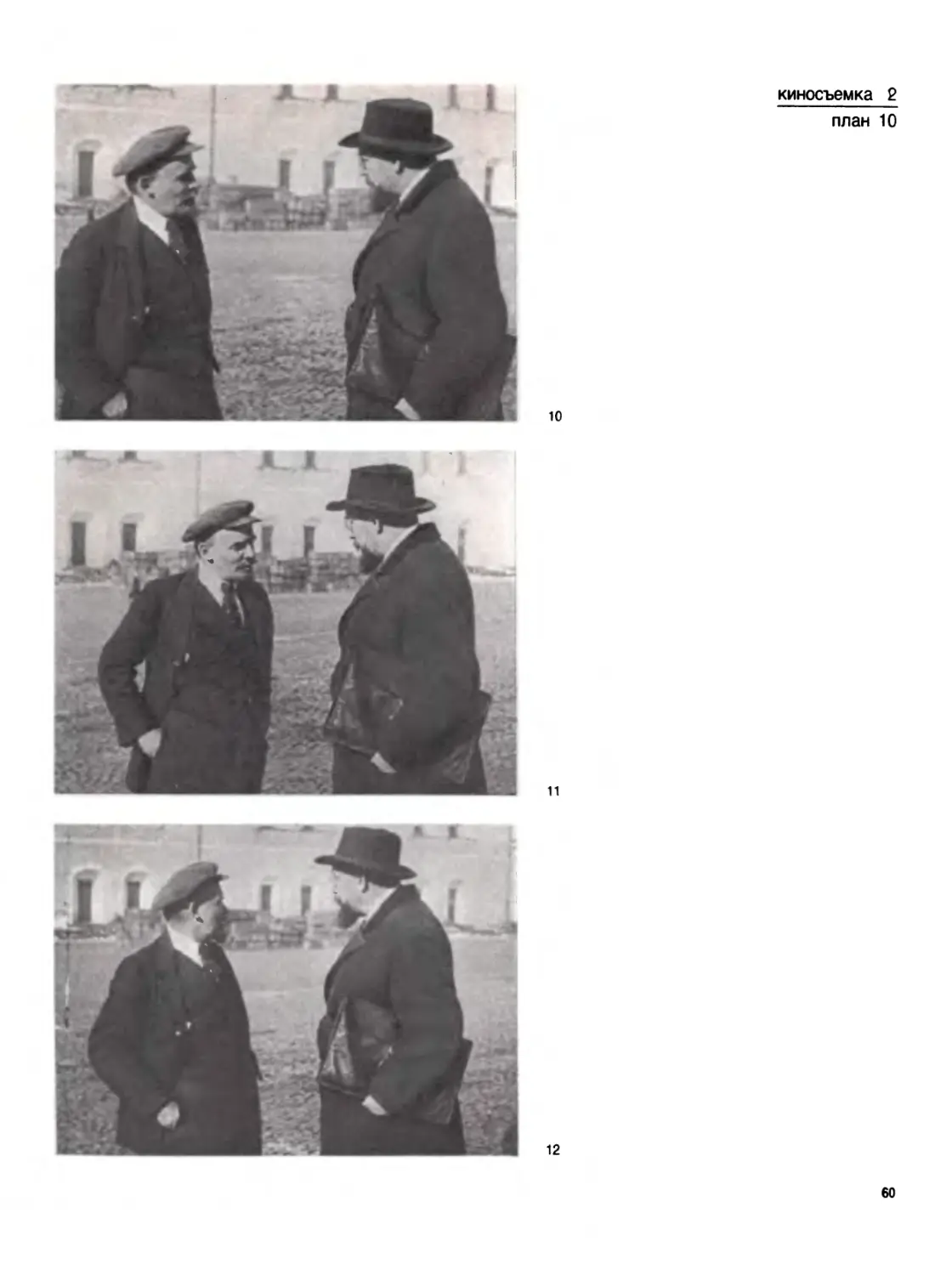
киносъемка 2
план 10
Ленин В. И. на Сенатской площади Крем¬
ля. Беседует с Бонч-Бруевичем В. Д.
Позитив. Средний план. 7 м 01 к
В. И. Ленин запечатлен на всех кадрах
плана.
1
55
56
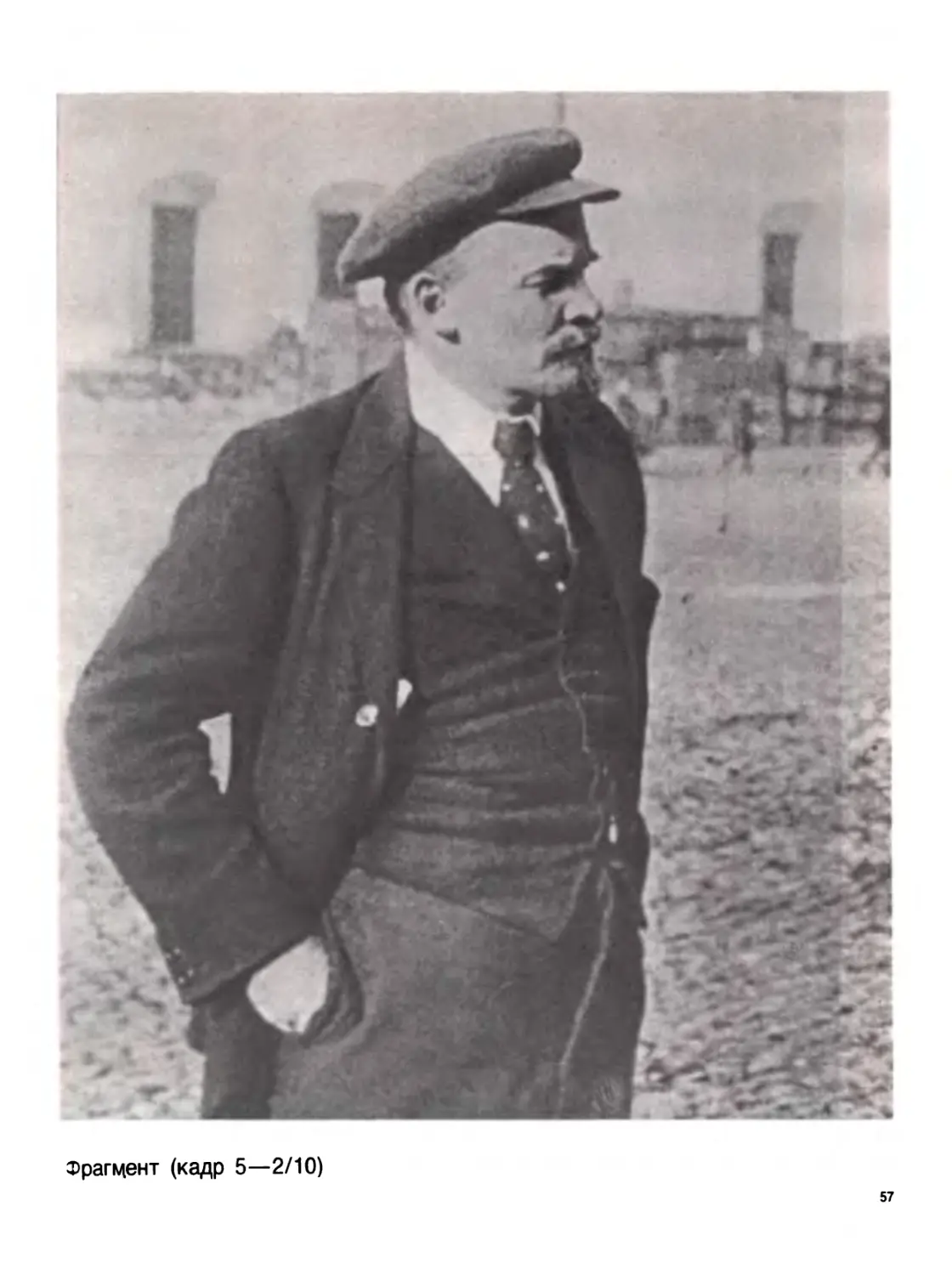
Фрагмент (кадр 5—2/10)
57
58
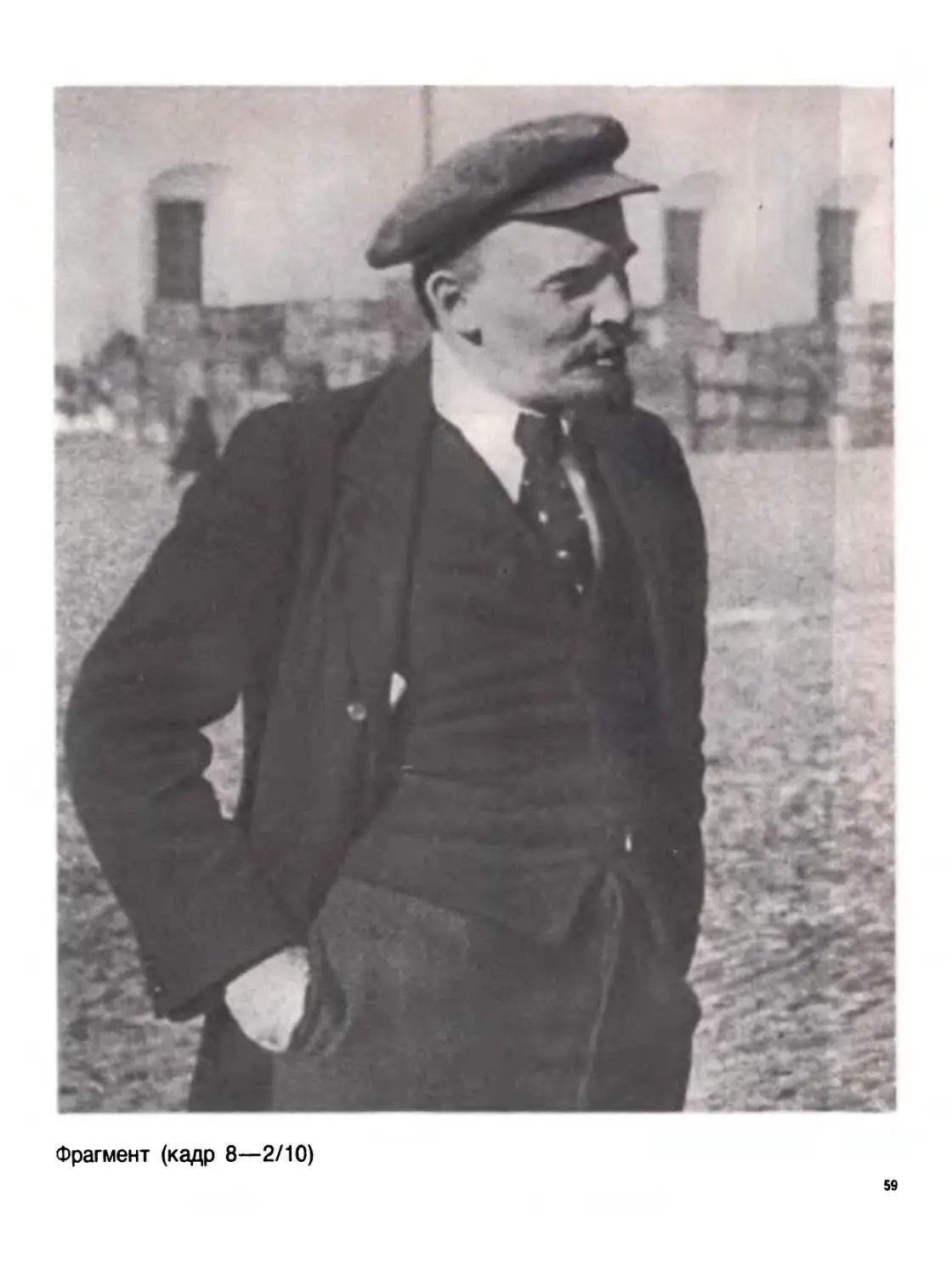
Фрагмент (кадр 8—2/10)
59
60
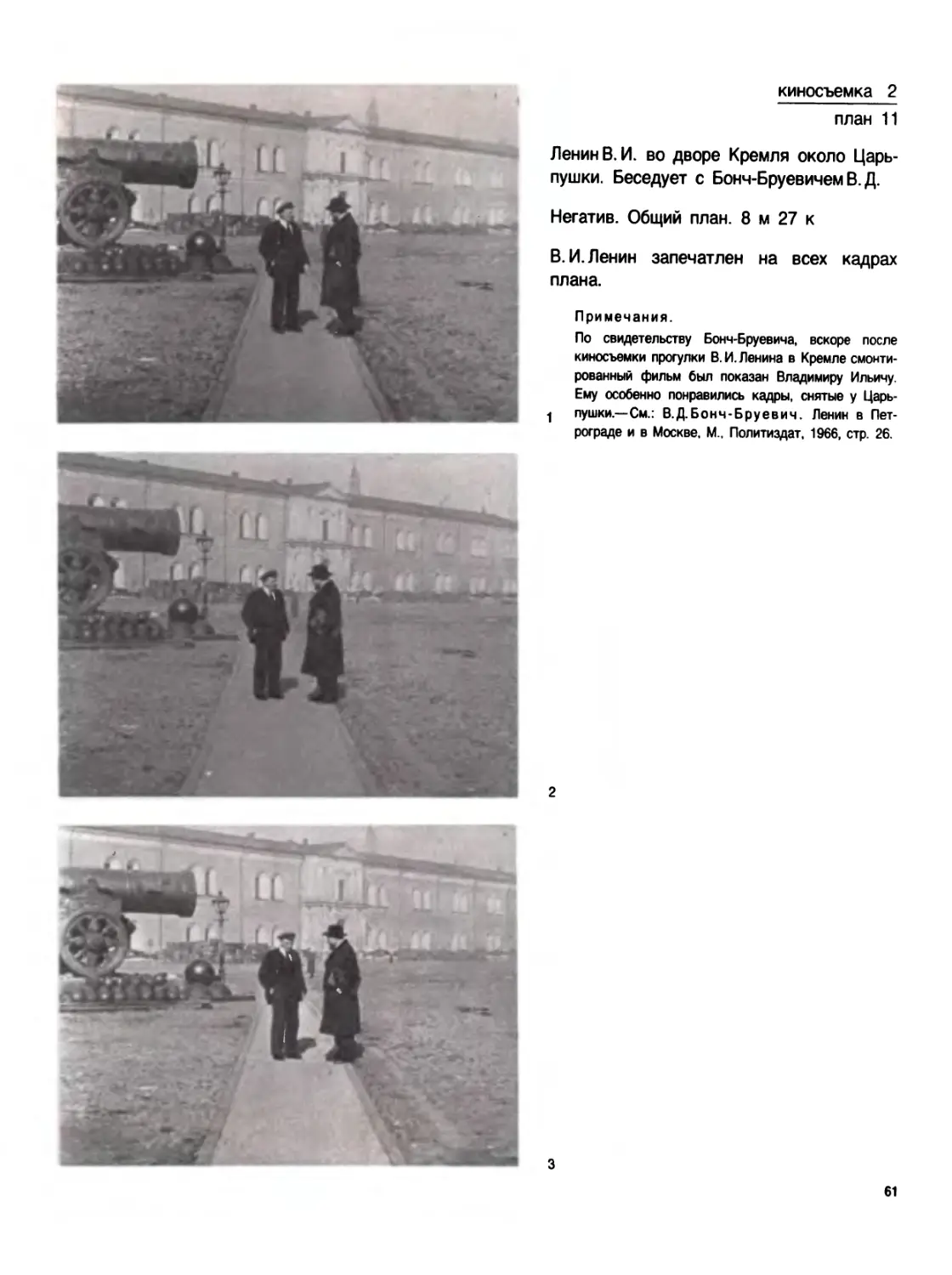
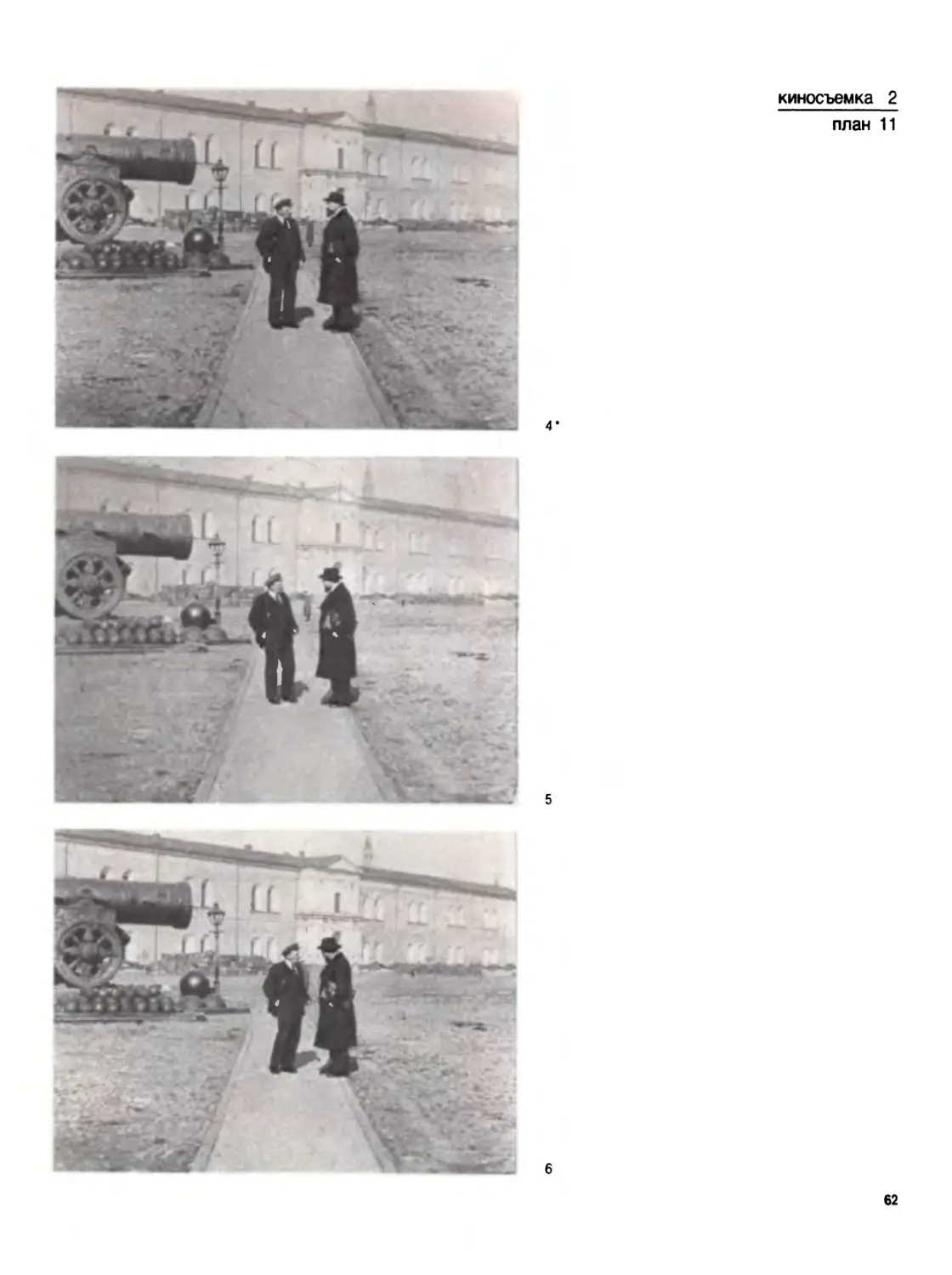
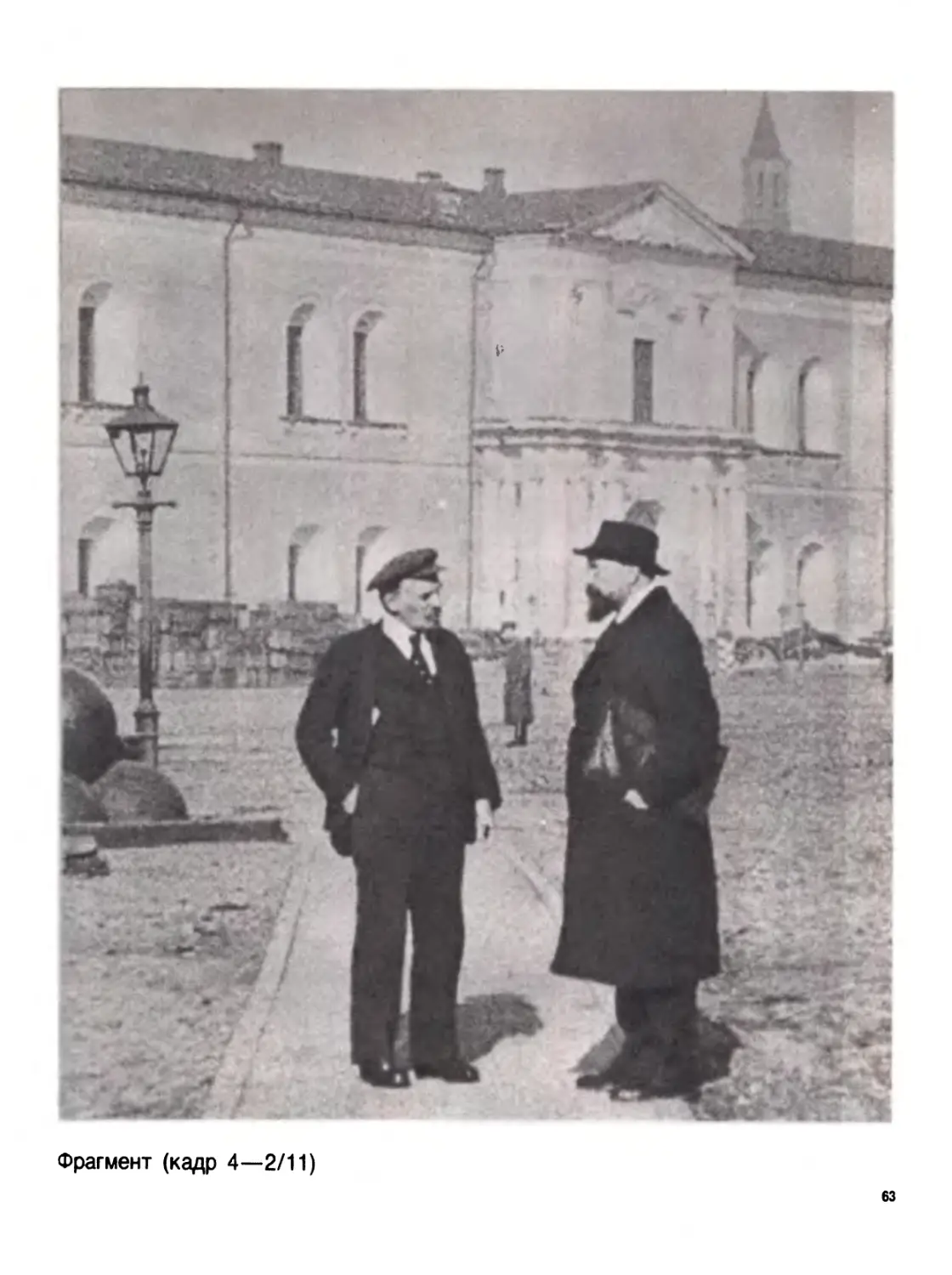
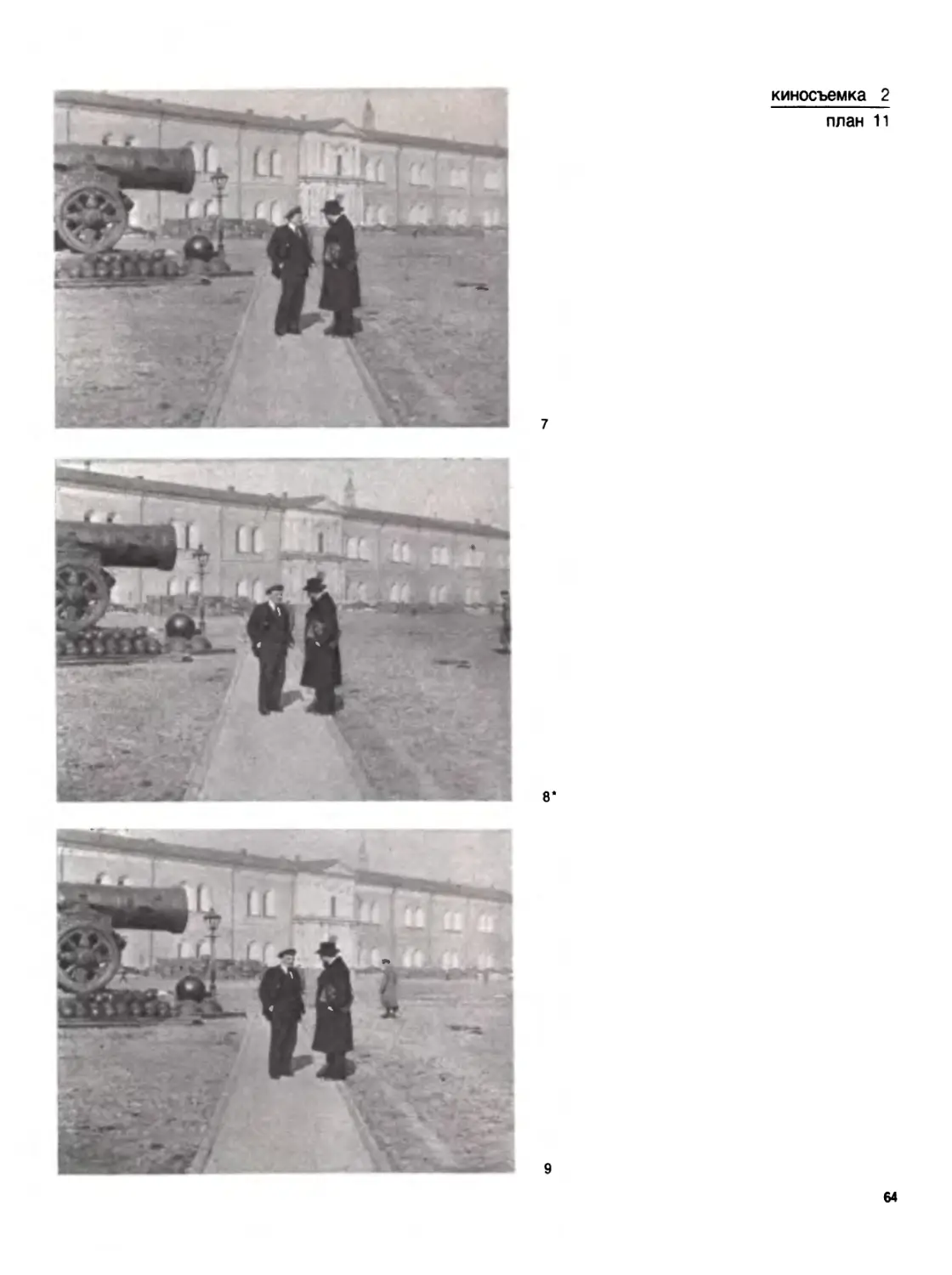
киносъемка 2
план 11
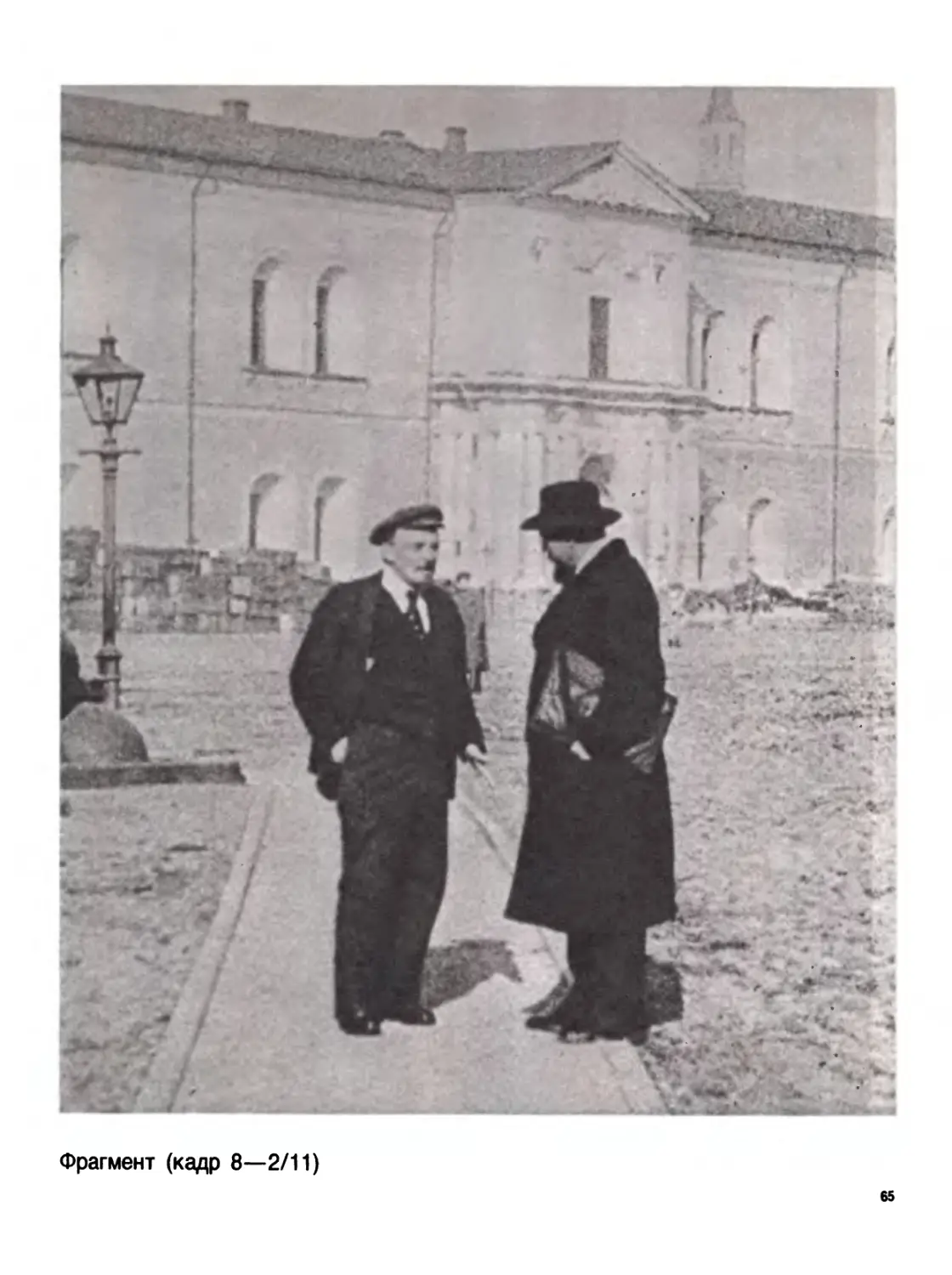
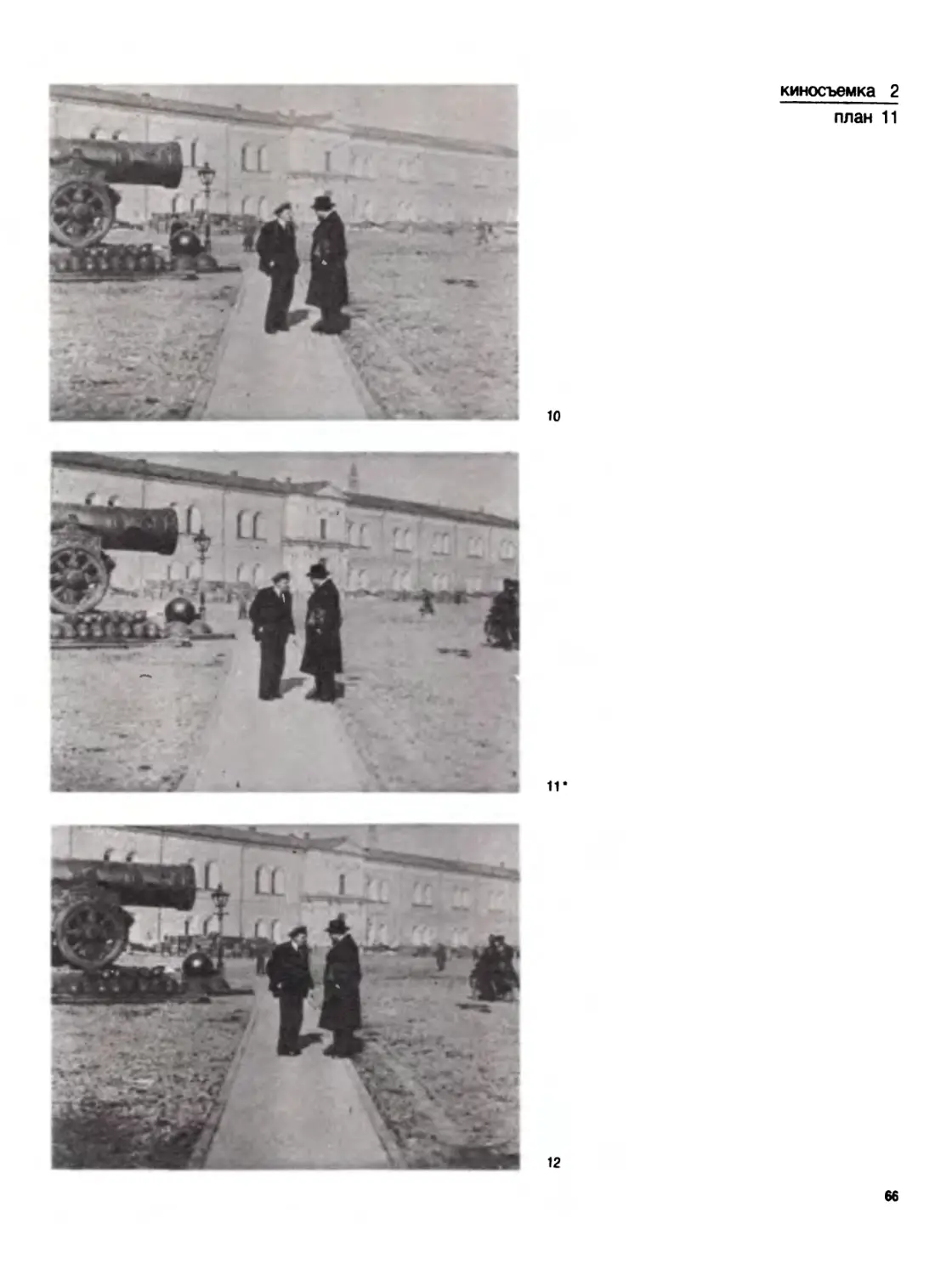
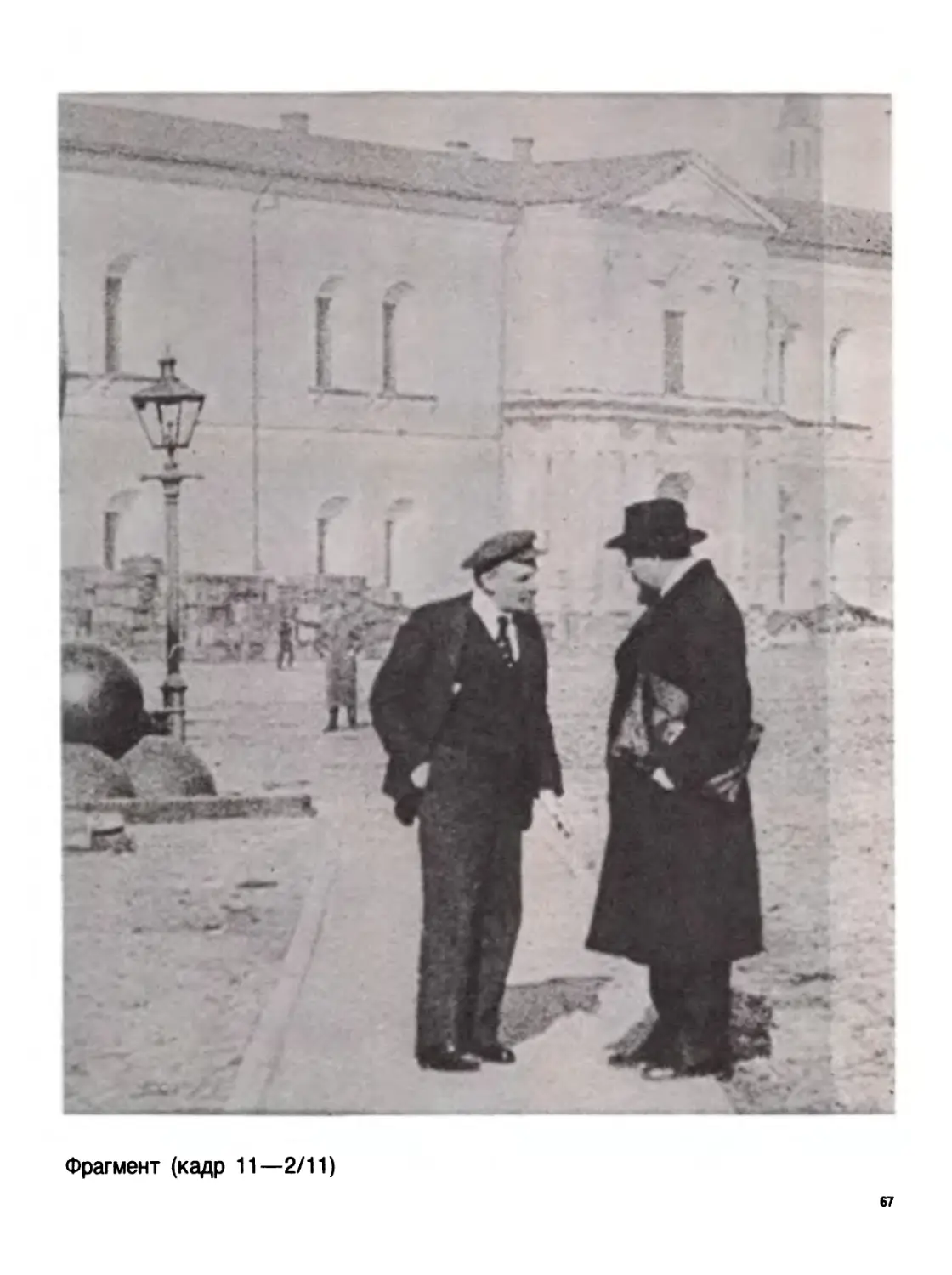
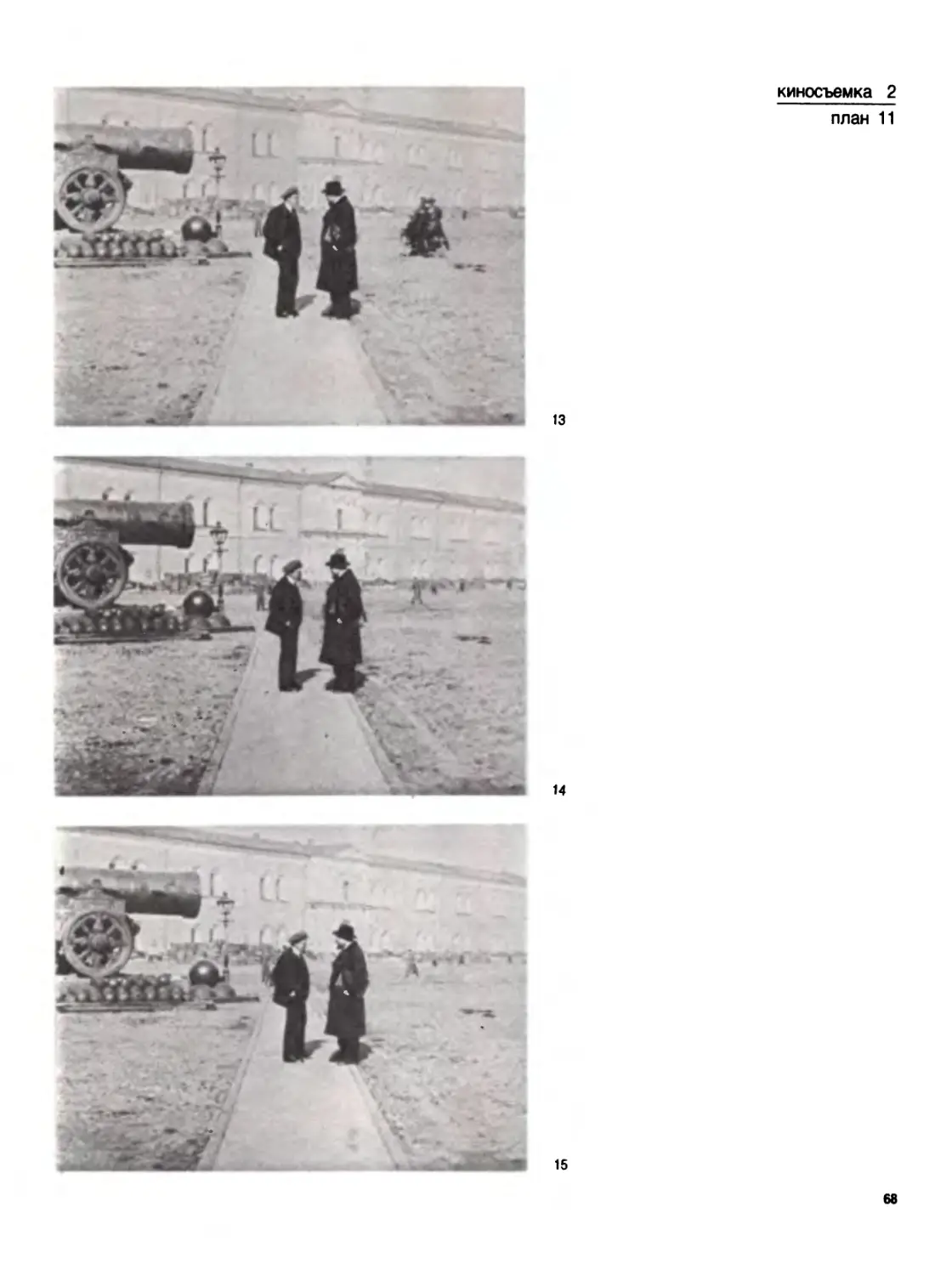
Ленин В. И. во дворе Кремля около Царь-
пушки. Беседует с Бонч-Бруевичем В. Д.
Негатив. Общий план. 8 м 27 к
В. И. Ленин запечатлен на всех кадрах
плана.
Примечания.
По свидетельству Бонч-Бруевича, вскоре после
киносъемки прогулки В. И. Ленина в Кремле смонти¬
рованный фильм был показан Владимиру Ильичу.
Ему особенно понравились кадры, снятые у Царь-
-I пушки.—См.: В.Д.Бонч-Бруевич. Ленин в Пет¬
рограде и в Москве, М., Политиздат, 1966, стр. 26.
2
3
61
62
64
Фрагмент (кадр 8—2/11)
65
киносъемка 2
план 11
ю
11*
12
66
Фрагмент (кадр 11—2/11)
67
киносъемка 2
план 11
68
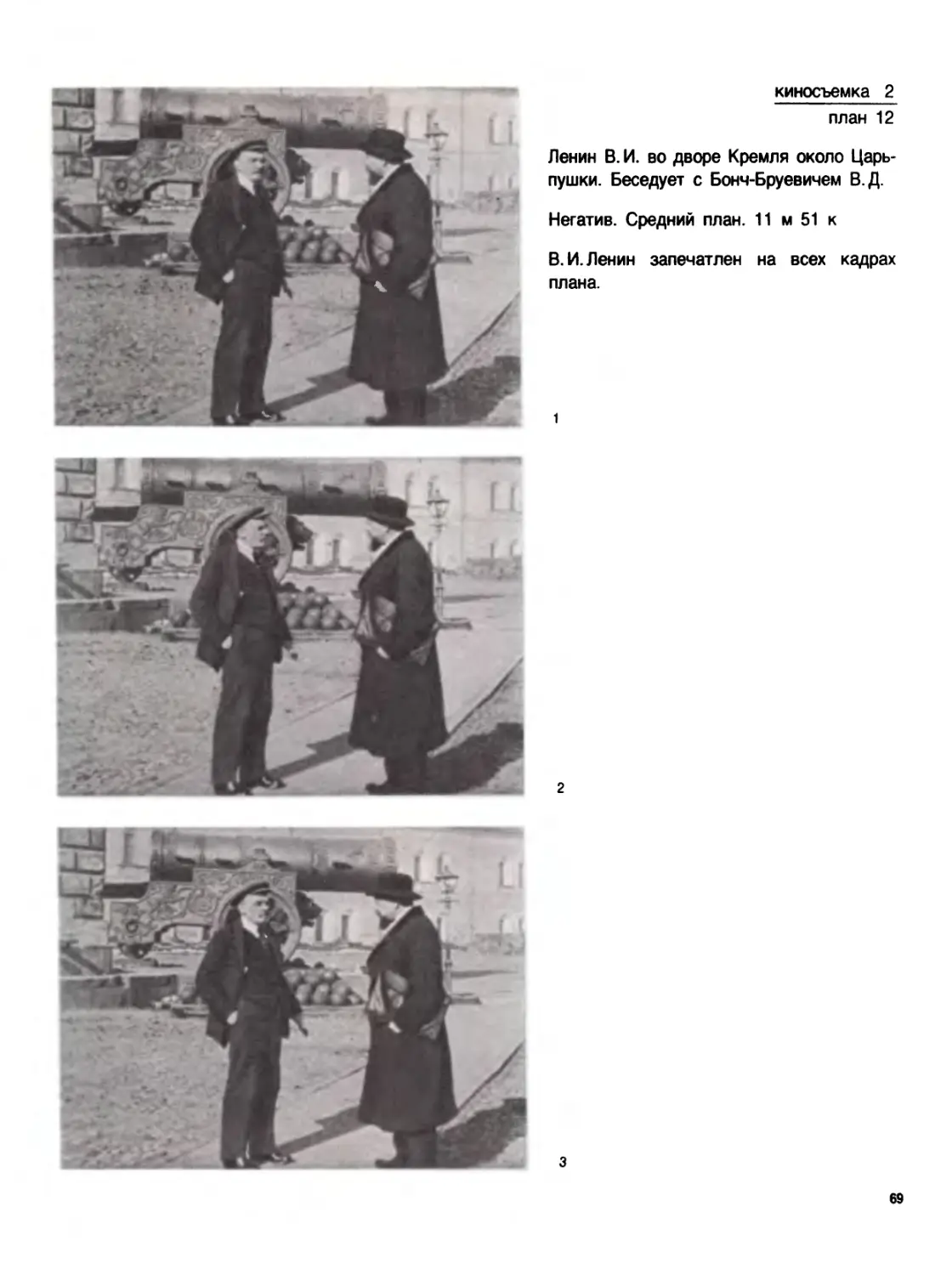
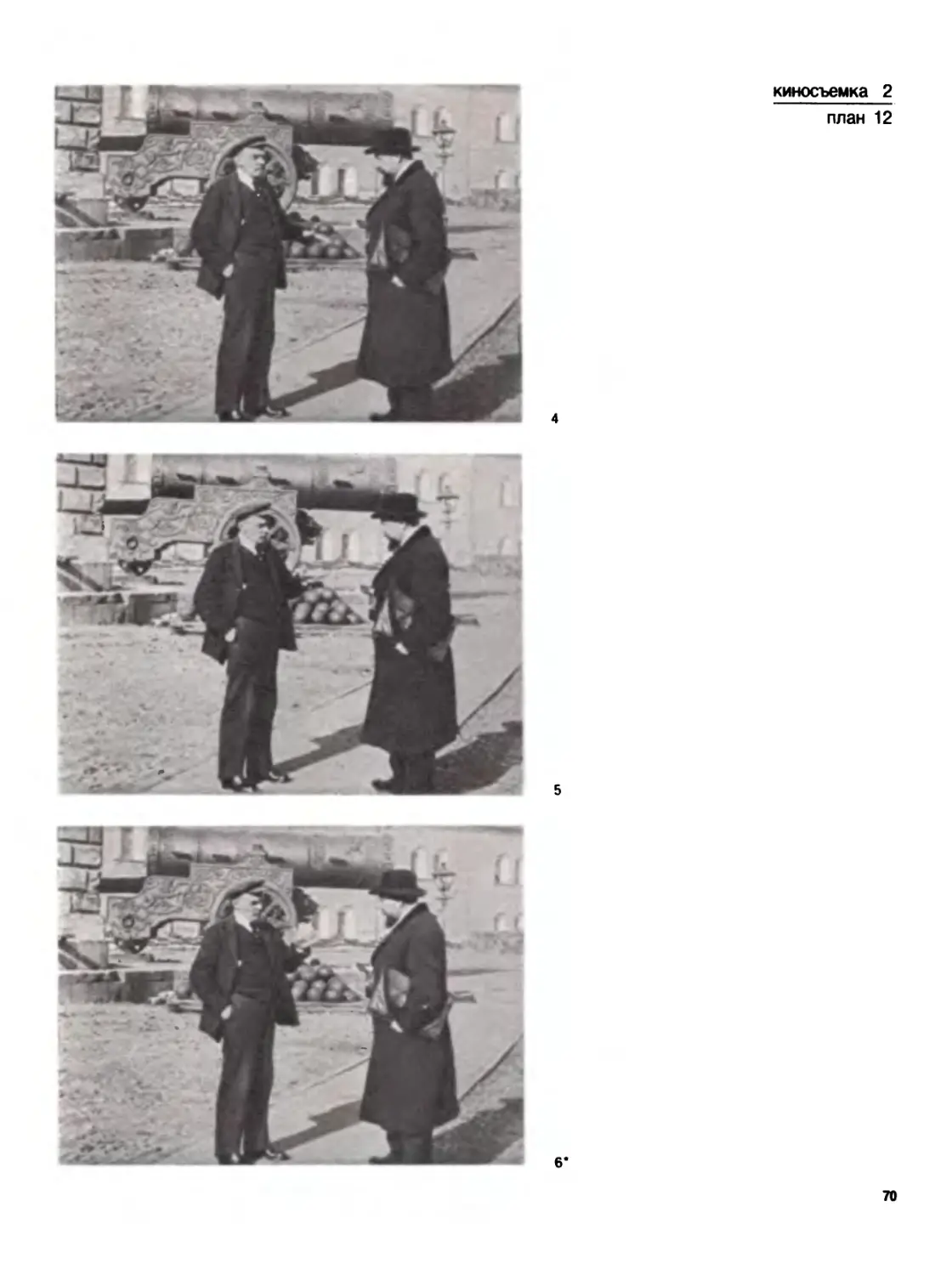
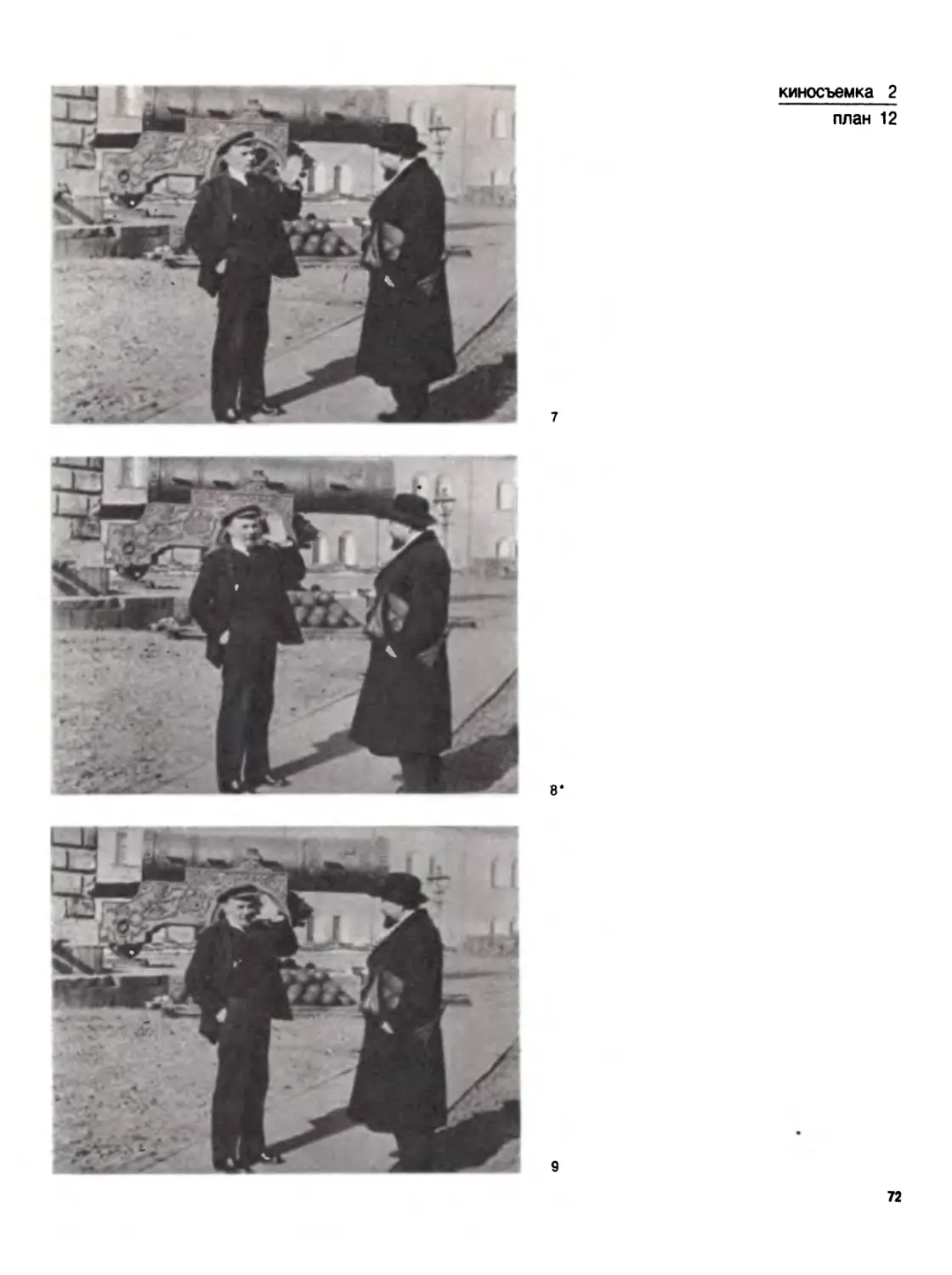
киносъемка 2
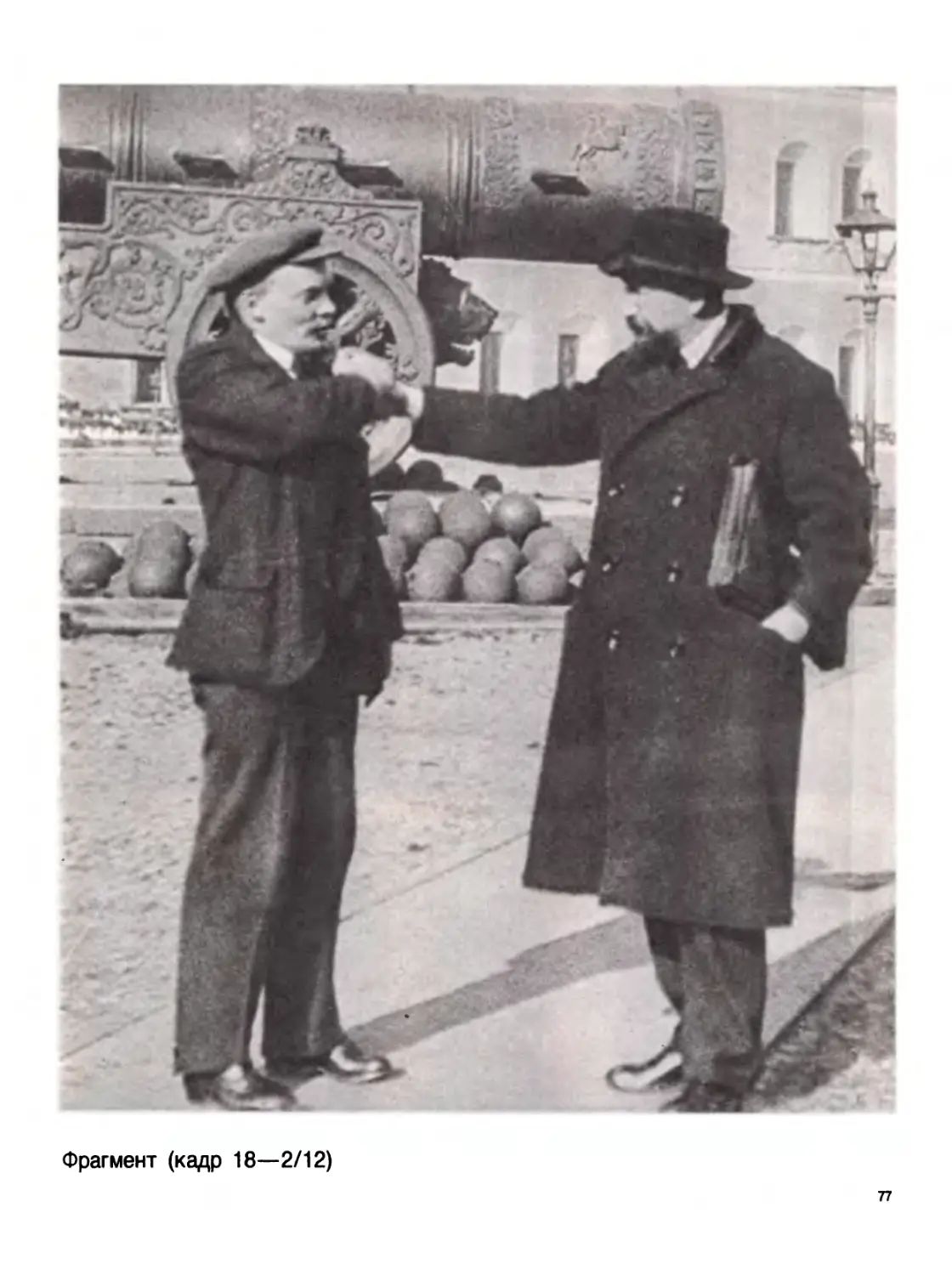
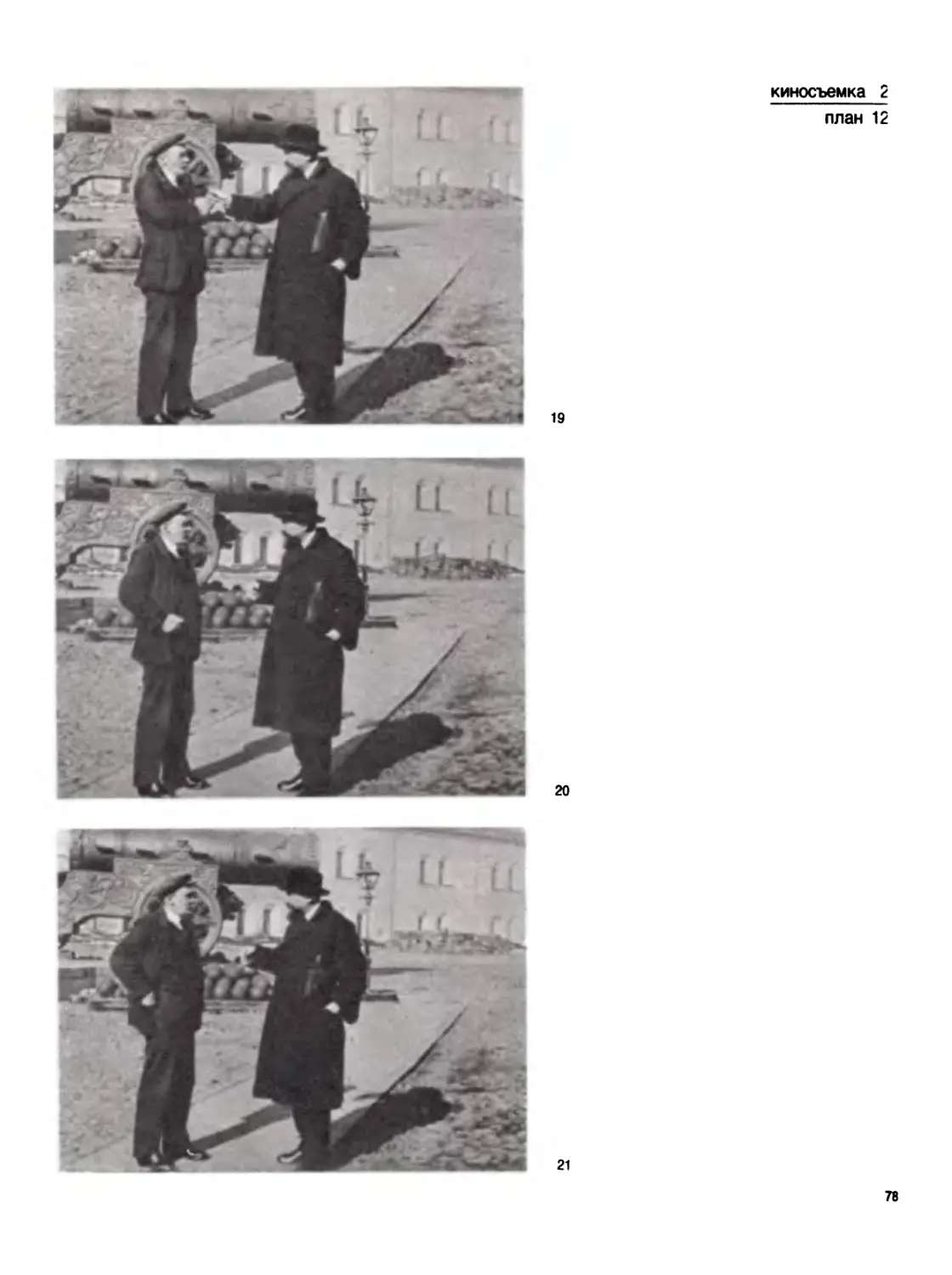
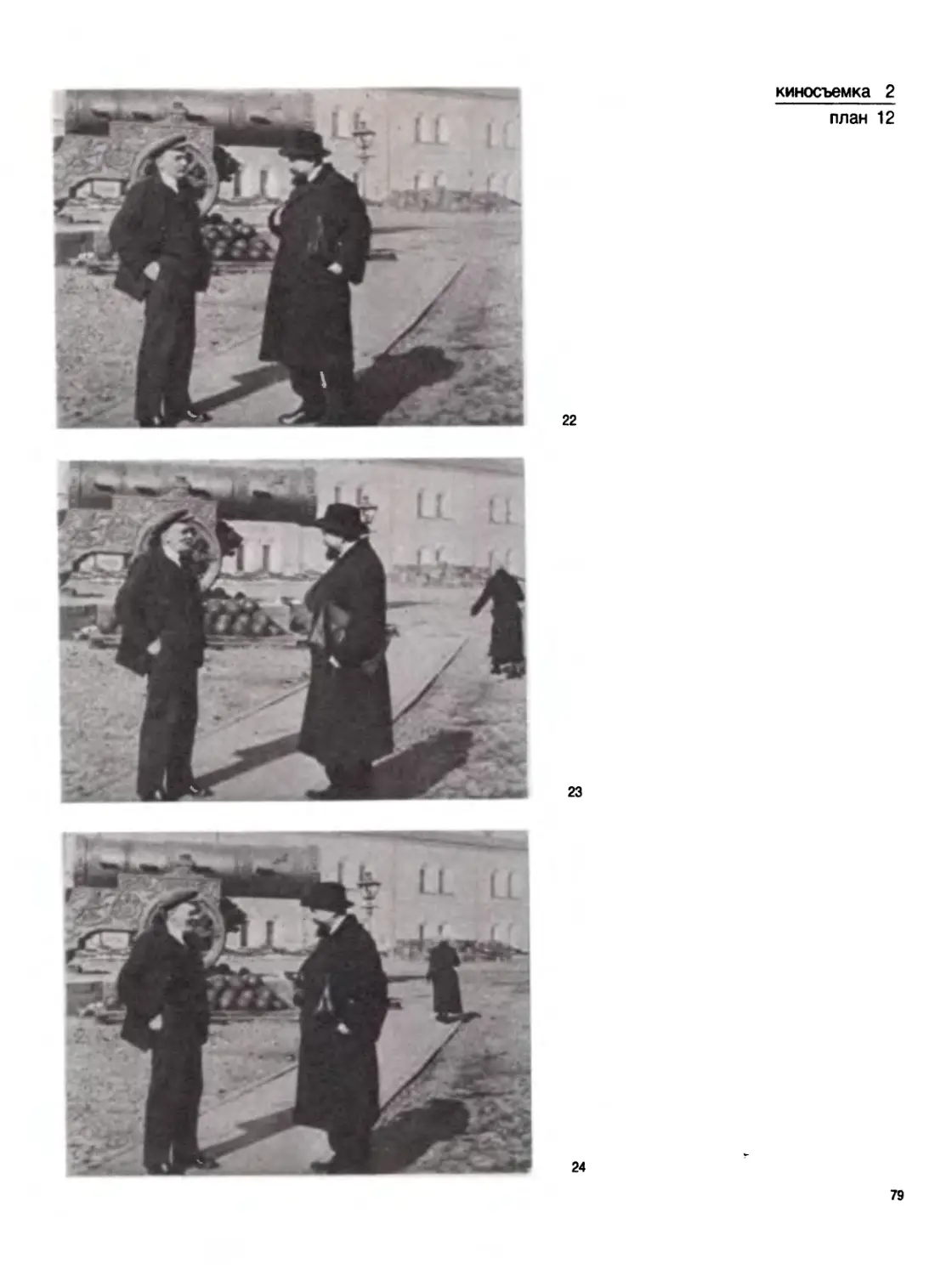
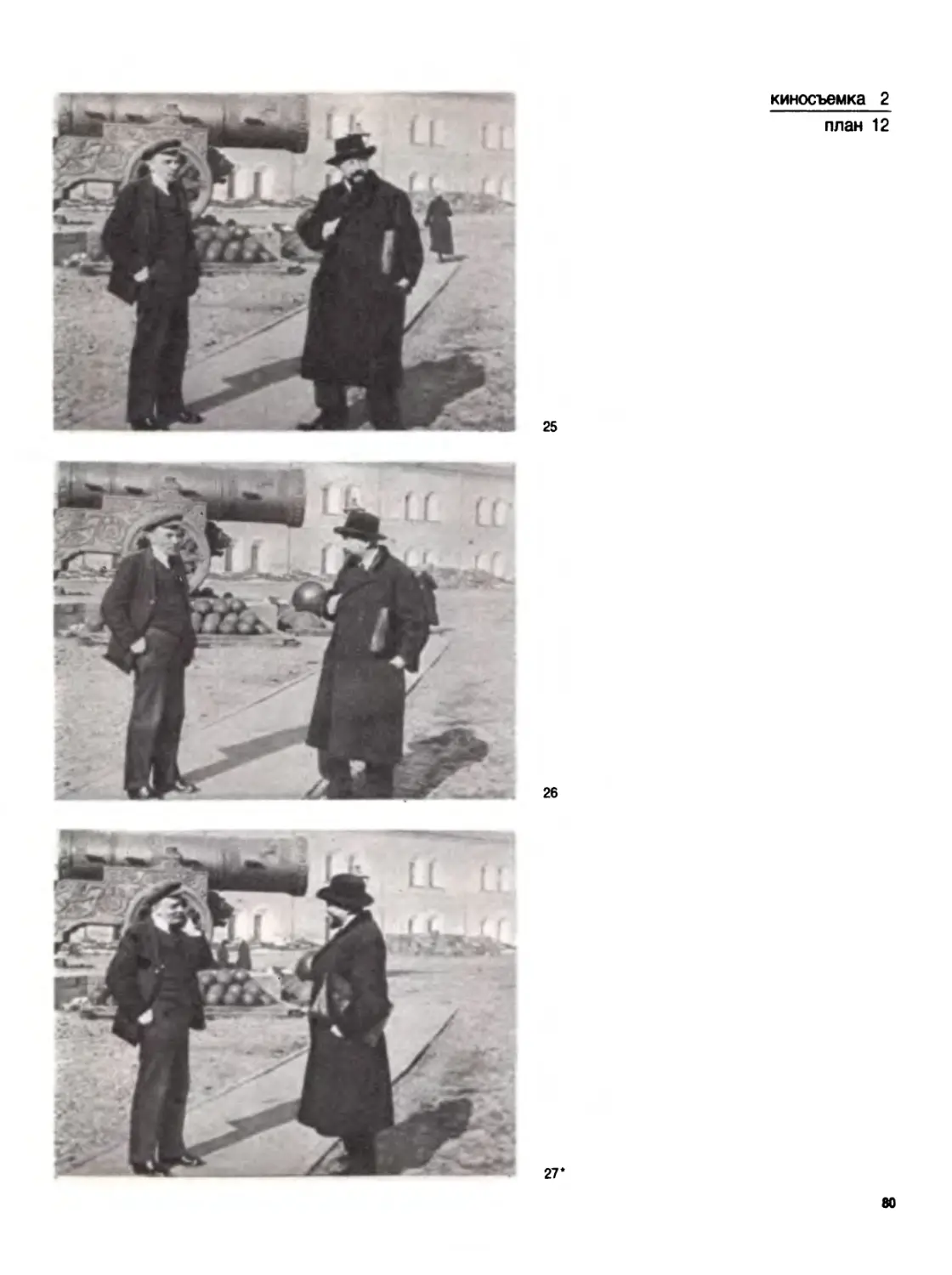
план 12
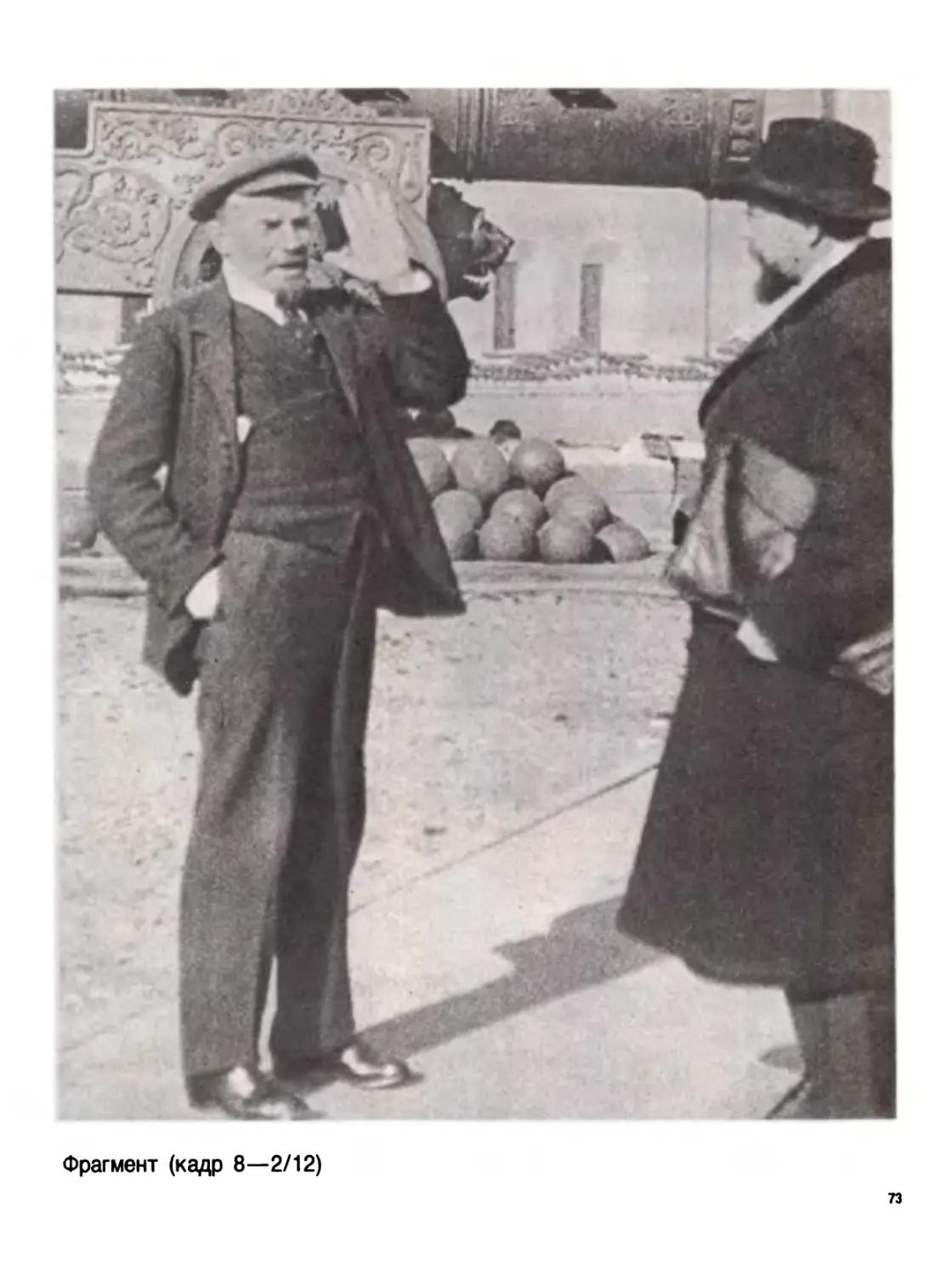
Ленин В. И. во дворе Кремля около Царь-
пушки. Беседует с Бонч-Бруевичем В. Д.
Негатив. Средний план. 11 м 51 к
В. И. Ленин запечатлен на всех кадрах
плана.
1
69
70
72
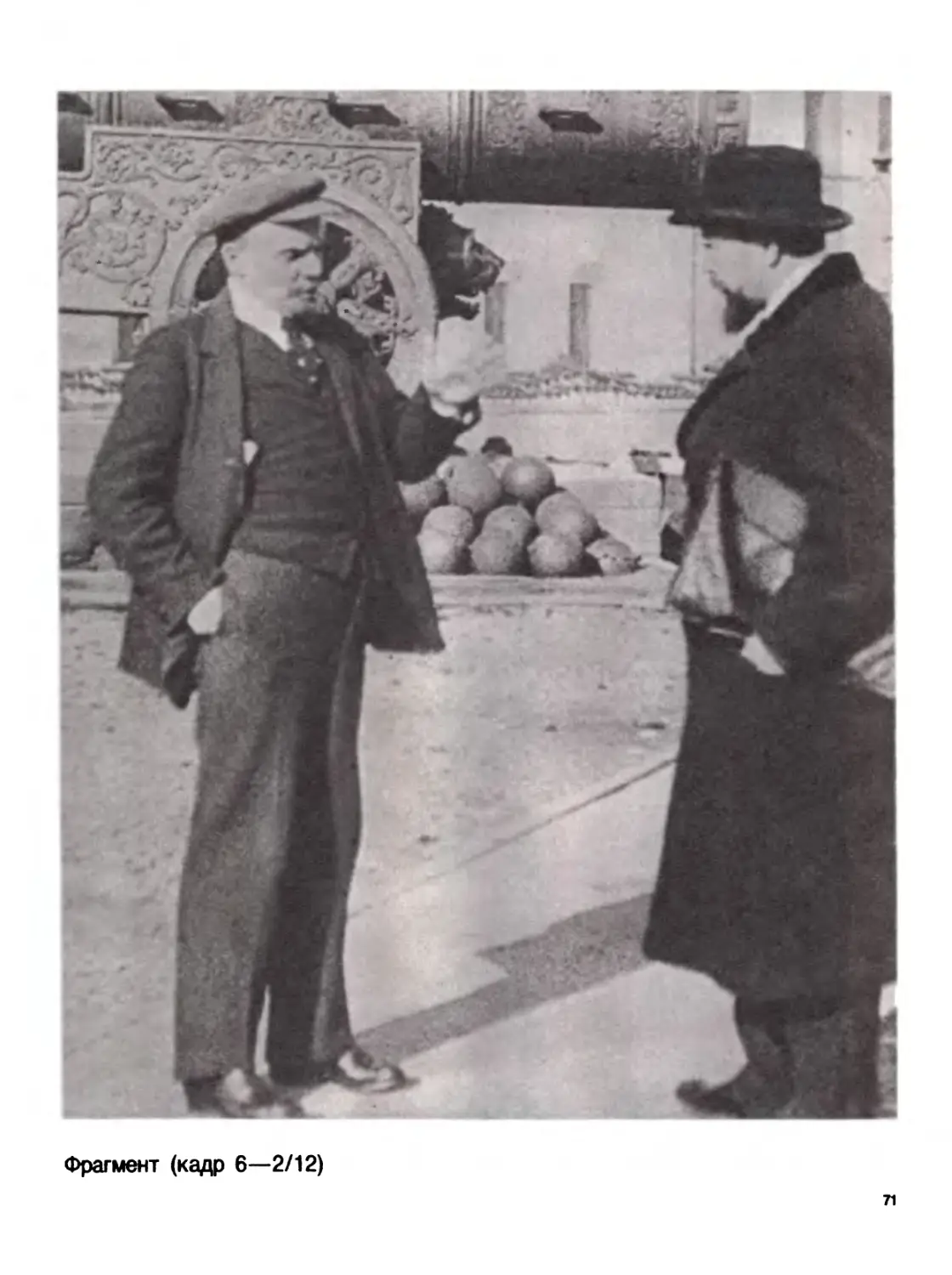
Фрагмент (кадр 8—2/12)
73
киносъемка 2
план 12
ю
11
12
74
75
киносъемка 2
план 12
16
17
18*
76
Фрагмент (кадр 18—2/12)
77
78
киносъемка 2
план 12
22
23
24
79
80
Фрагмент (кадр 27—2/12)
81
киносъемка 2
план 12
28
29
30
82
киносъемка 2
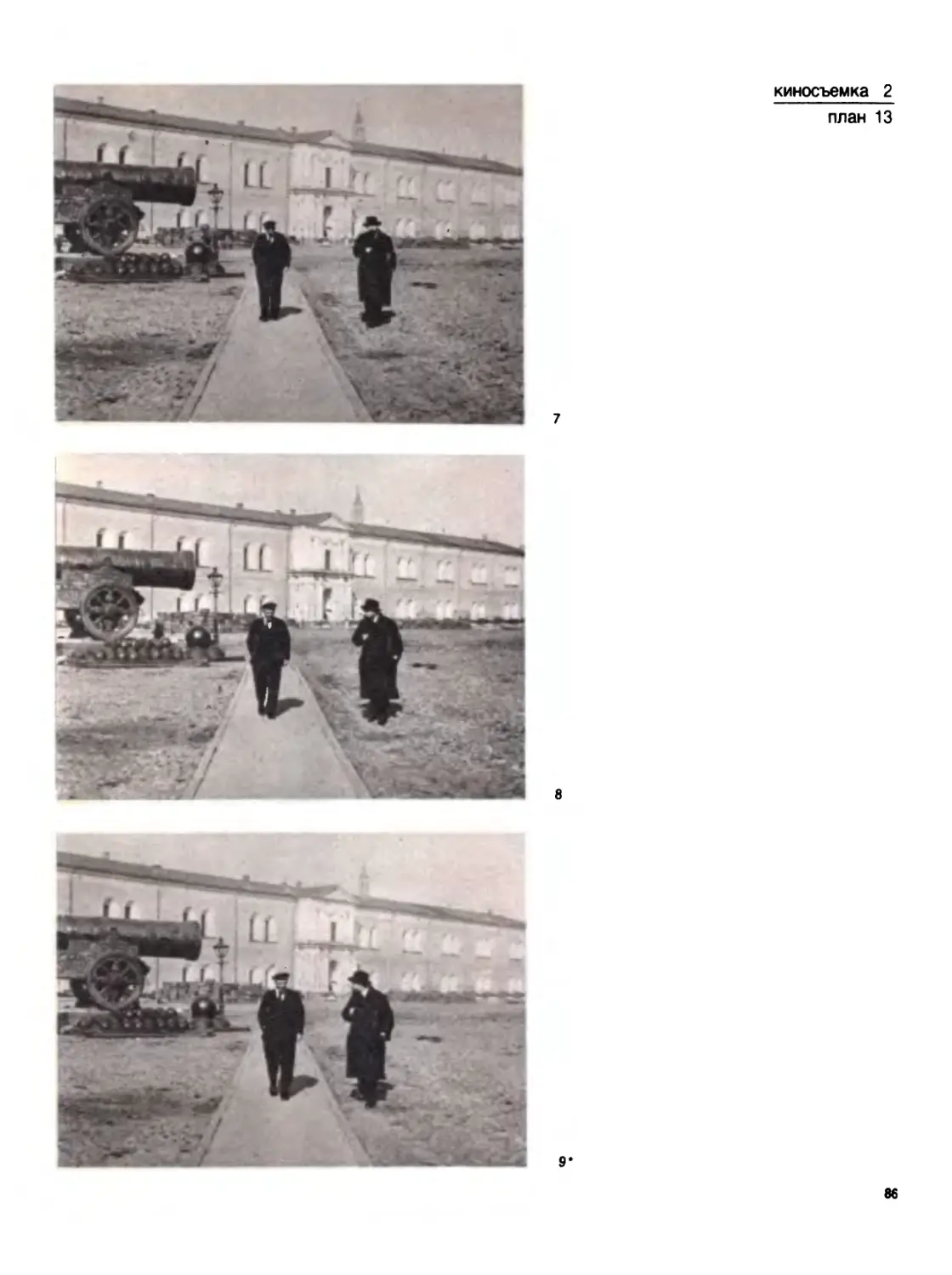
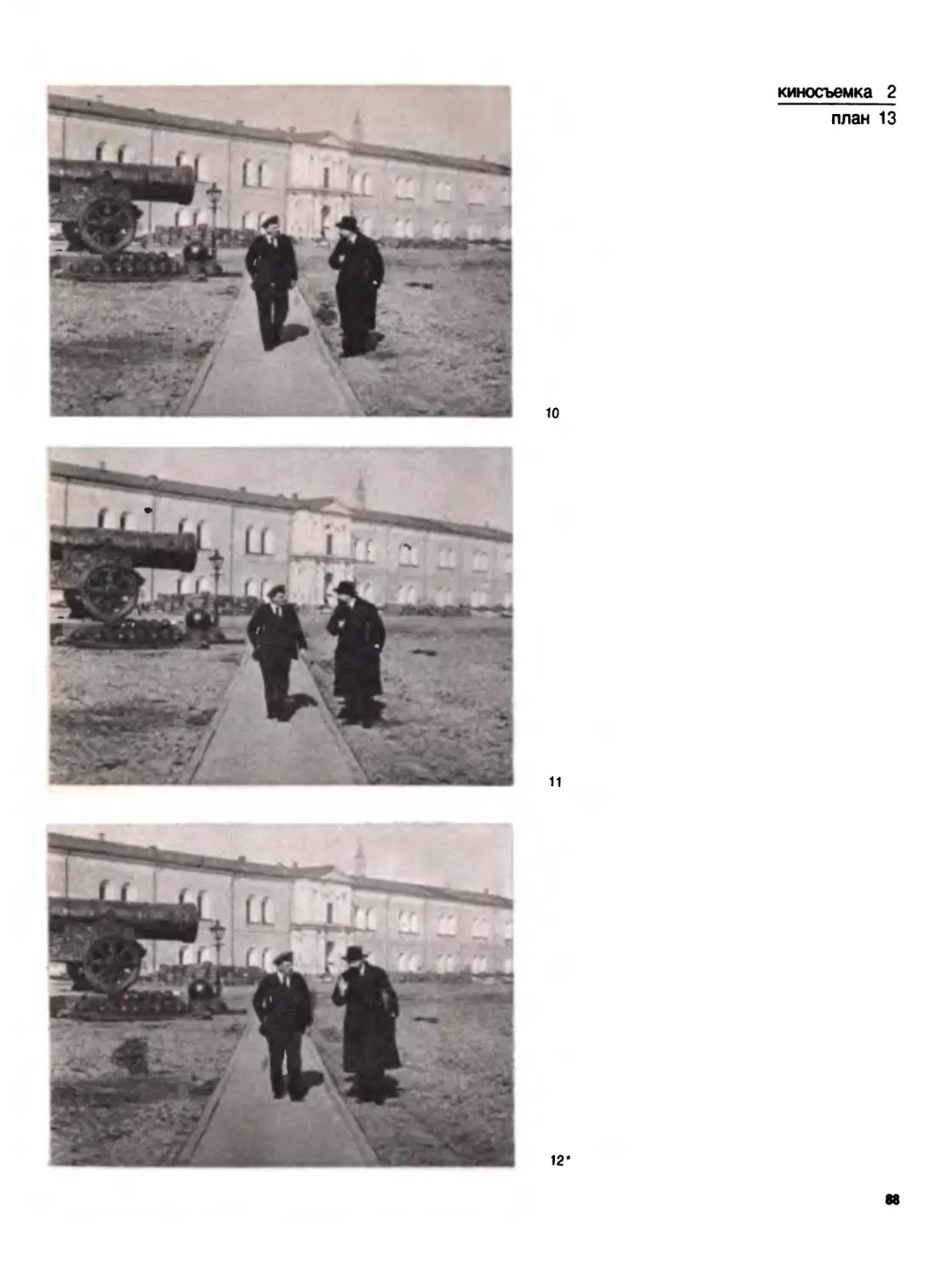
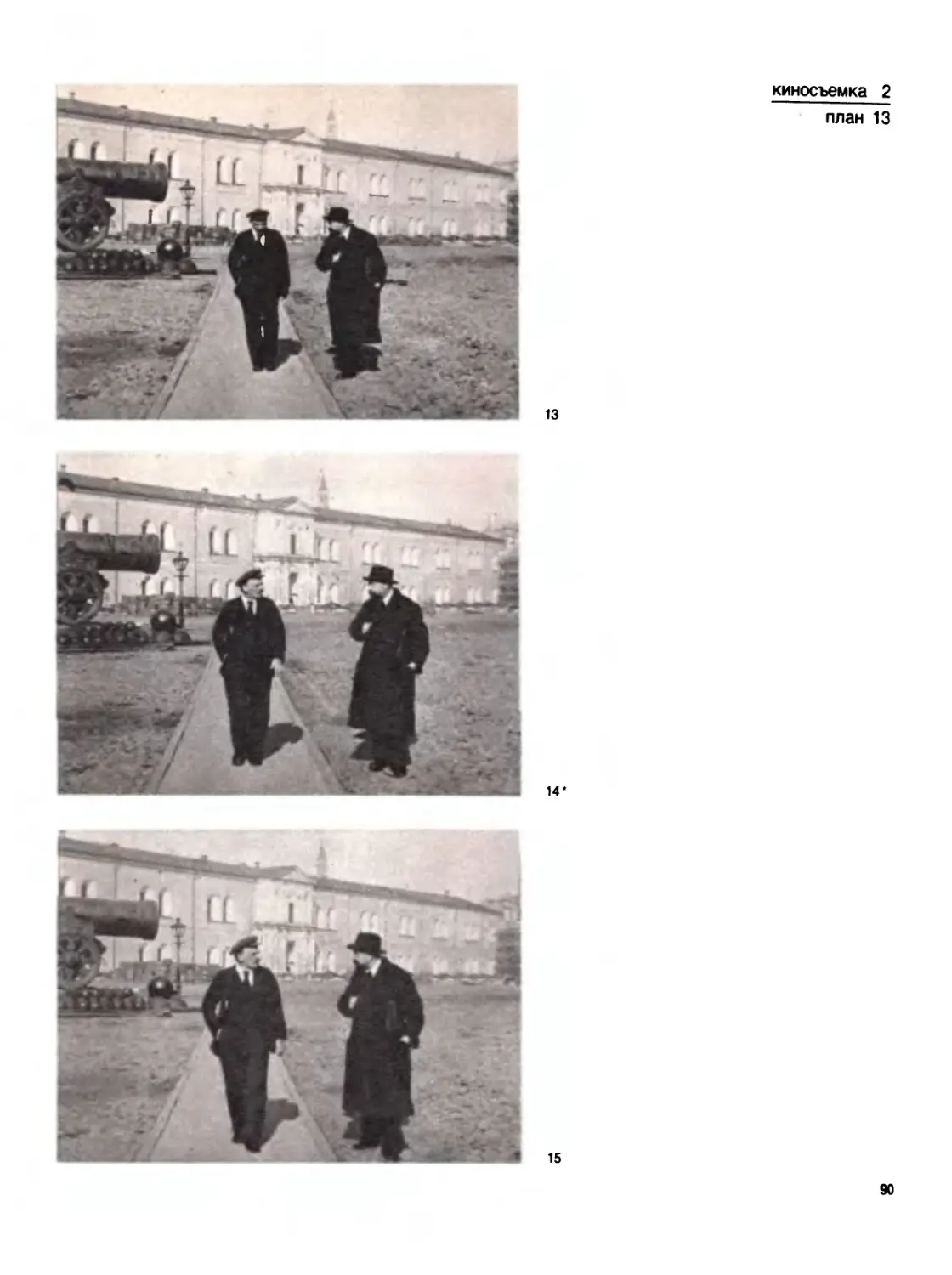
план 13
Ленин В. И. на Сенатской площади Крем¬
ля. Беседует с Бонч-Бруевичем В. Д.
Негатив. Общий план. 13 м 16 к
В.И.Ленин запечатлен на всех кадрах
плана.
1
2
3
83
84
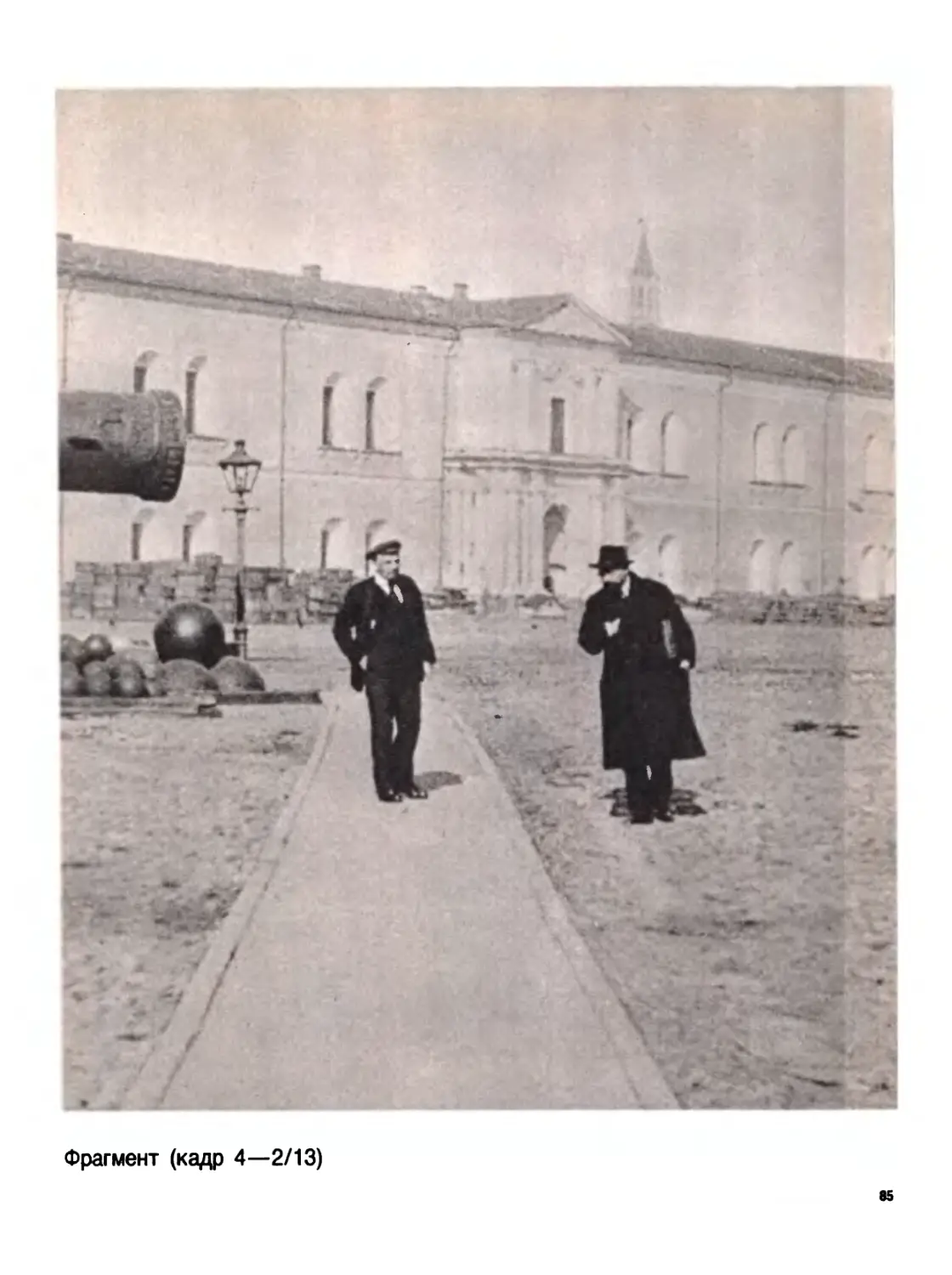
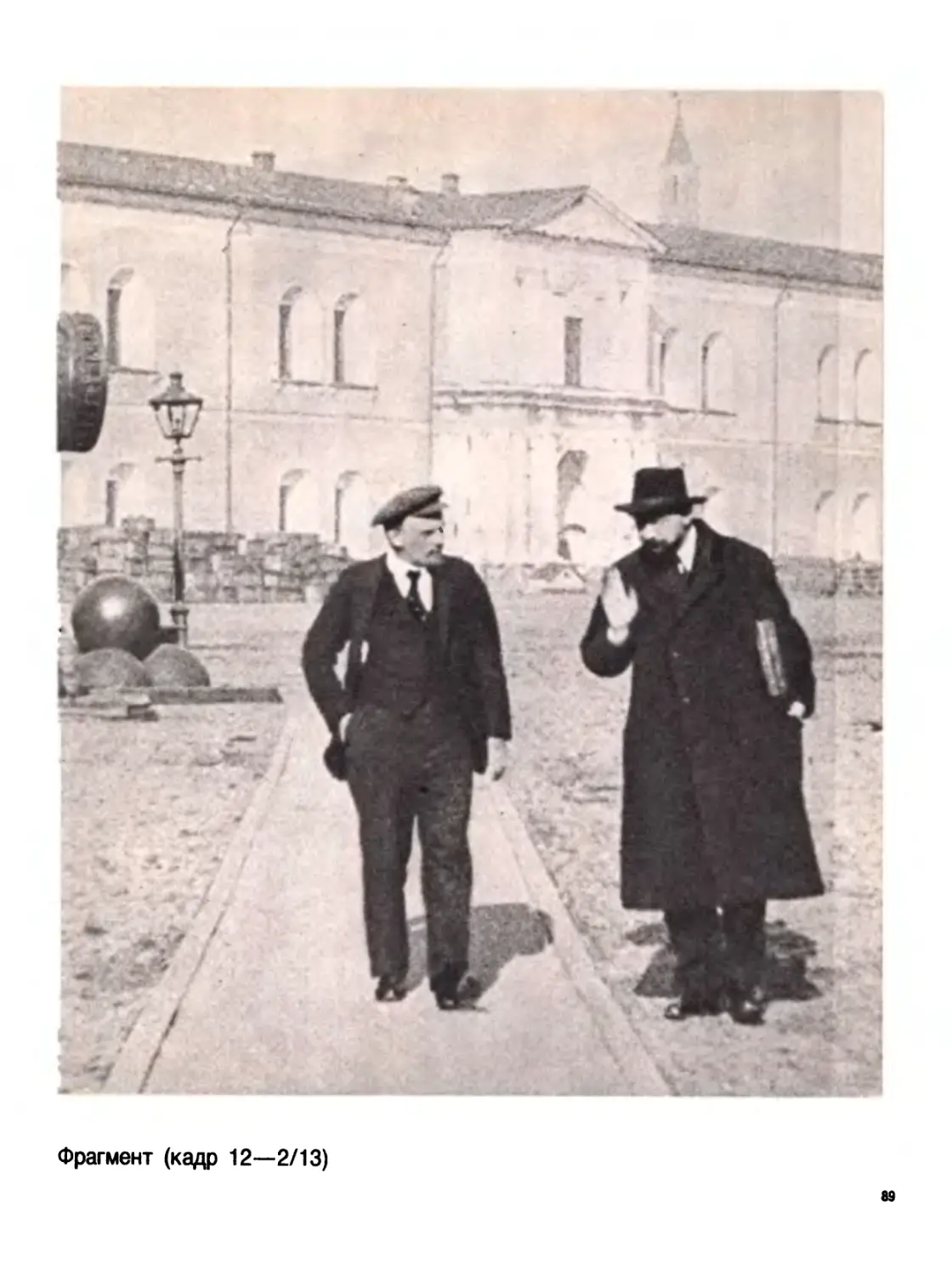
Фрагмент (кадр 4—2/13)
85
86
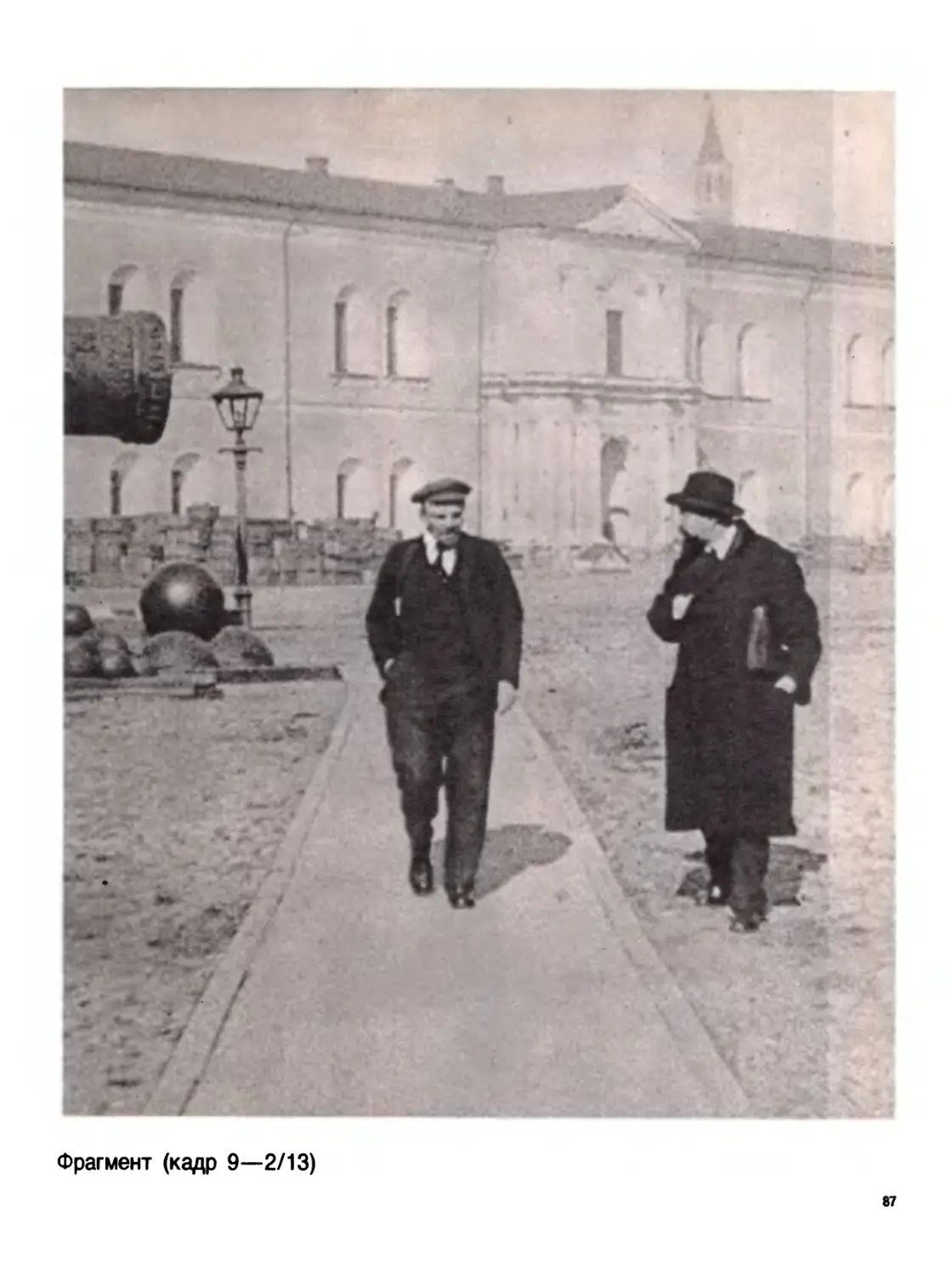
Фрагмент (кадр 9—2/13)
87
88
Фрагмент (кадр 12—2/13)
ю
киносъемка 2
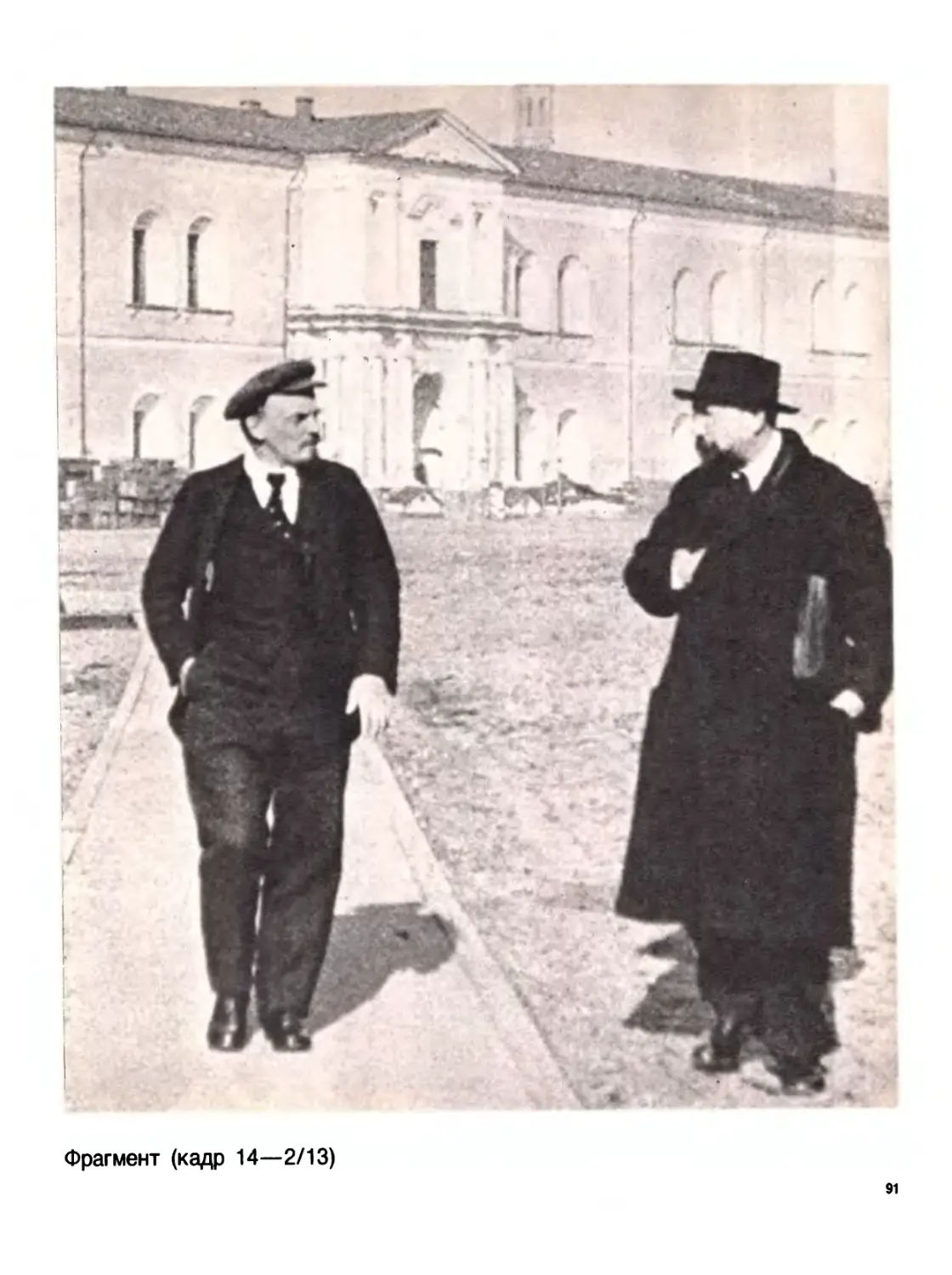
90
Фрагмент (кадр 14—2/13)
91
киносъемка 2
план 13
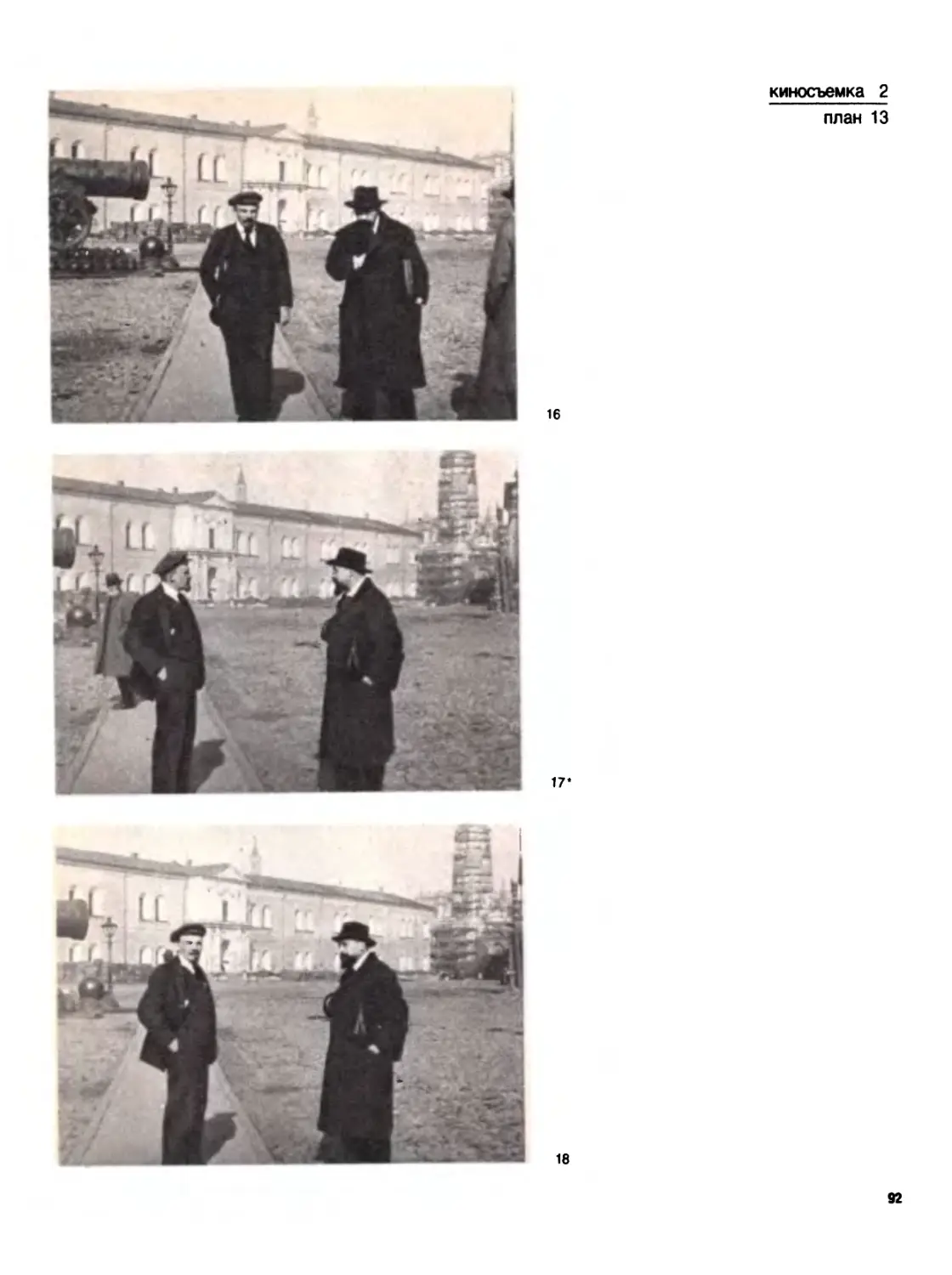
16
17*
18
92
Фрагмент (кадр 17—2/13)
93
киносъемка 2
план 13
19
20
21
94
киносъемка 2
план 13
22
23*
24
95
Фрагмент (кадр 23—2/13)
96
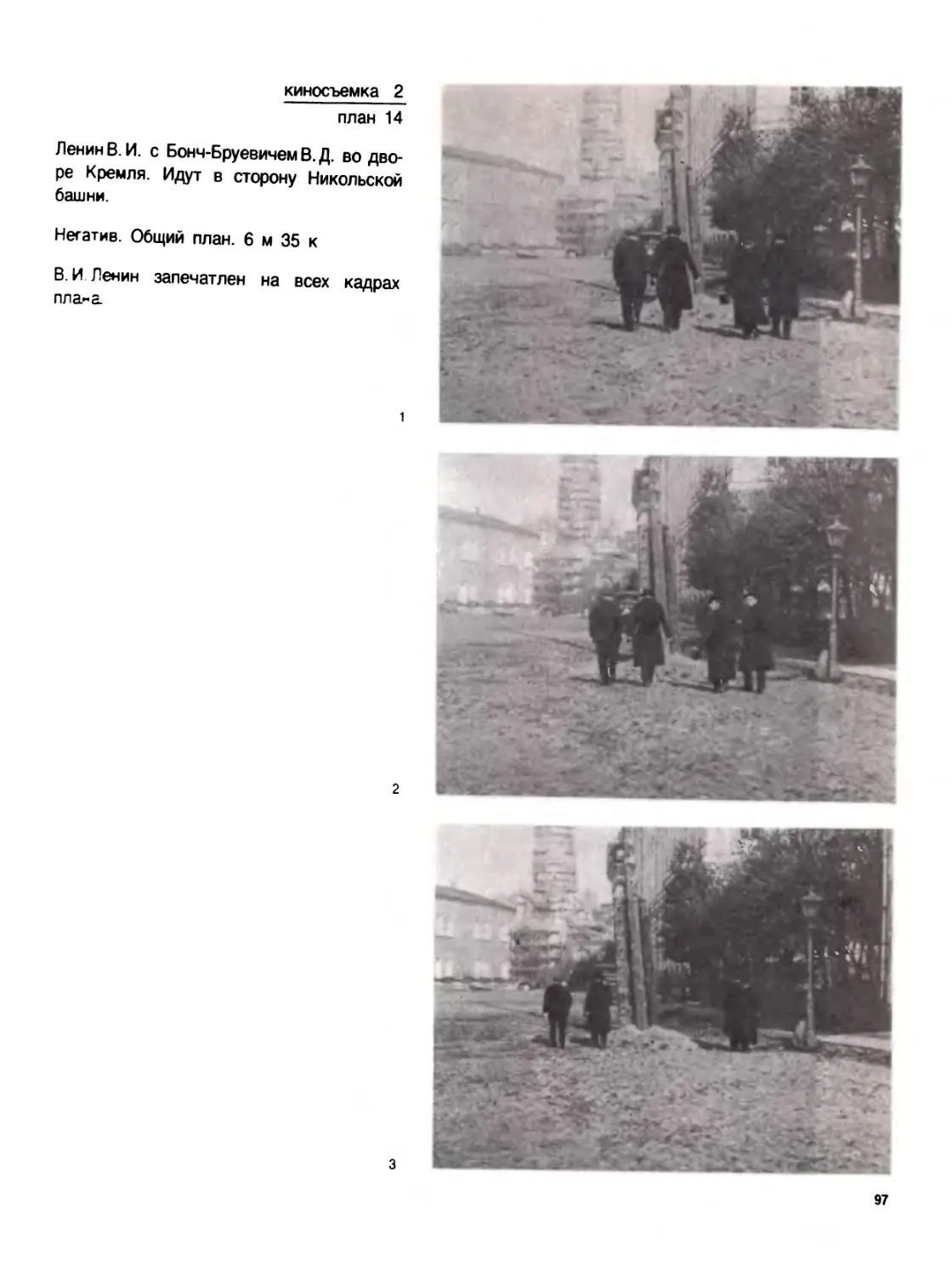
киносъемка 2
план 14
Ленин В. И. с Бонч-Бруевичем В. Д. во дво¬
ре Кремля. Идут в сторону Никольской
башни.
Негатив. Общий план. 6 м 35 к
В. И Ленин запечатлен на всех кадрах
пла^а.
1
2
з
97
- :
Ö"4fjkUK
киносъемка
3
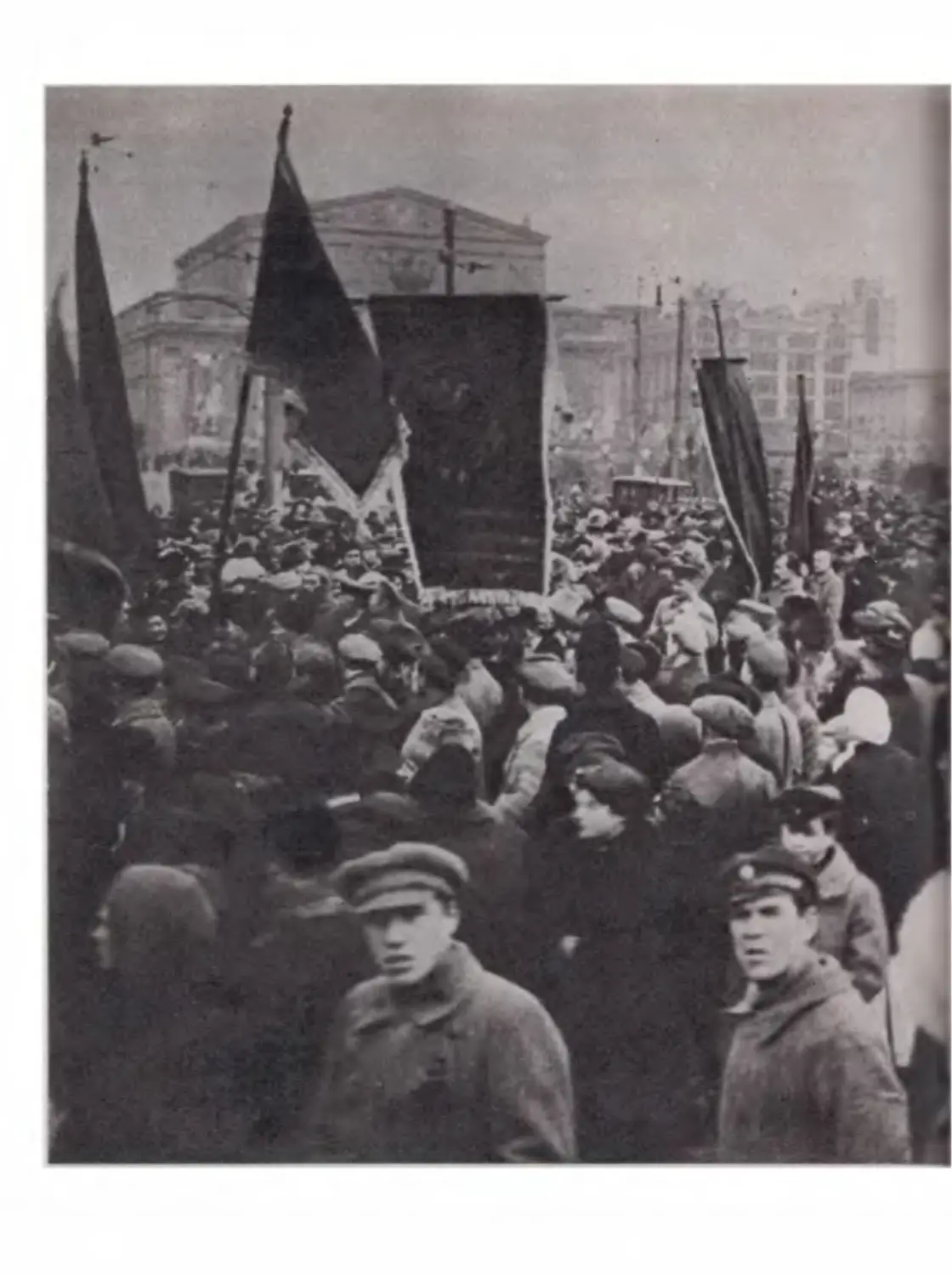
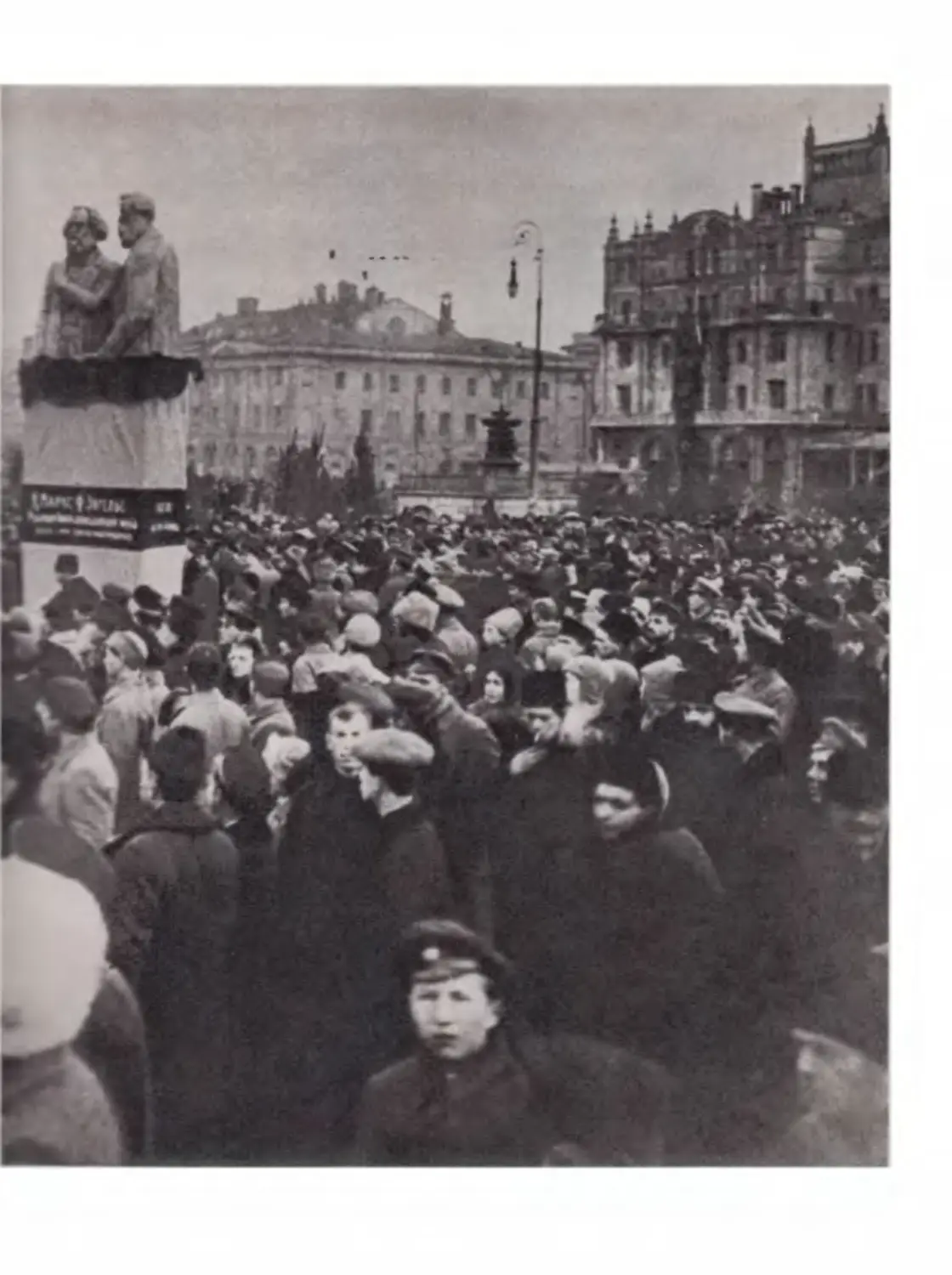
Ленин В.И. на открытии временного памятника
К. Марксу и Ф. Энгельсу в день празднования 1-й
годовщины Великой Октябрьской социалистической
революции. •
1918 г., 7 ноября. Москва.
Опероторы:
ГиберГ. В., Желябужский Ю. А.
Первый выход на экран:
Выпуск кинохроники «Торжество годовщины Октябрьской революции в Москве».
1918 год.
Обоснование даты:
Газета «Правда», освещая события 7 ноября 1918 года, писала: «К 10-ти часам
утра к памятнику подходят под звуки «Интернационала» колонны делегатов
Чрезвычайного съезда Советов с т. Лениным во главе. Открыв памятник.
Владимир Ильич произнес речь».—«Правда», № 242, 9 ноября 1918 г., стр. 2.
См. также: В.И.Ленин. Полн. собр. соч., т. 37, стр. 706.
Примечания.
Сохранилось 7,3 метра пленки—2 плана. На обоих планах—запечатлен В. И. Ленин.
100
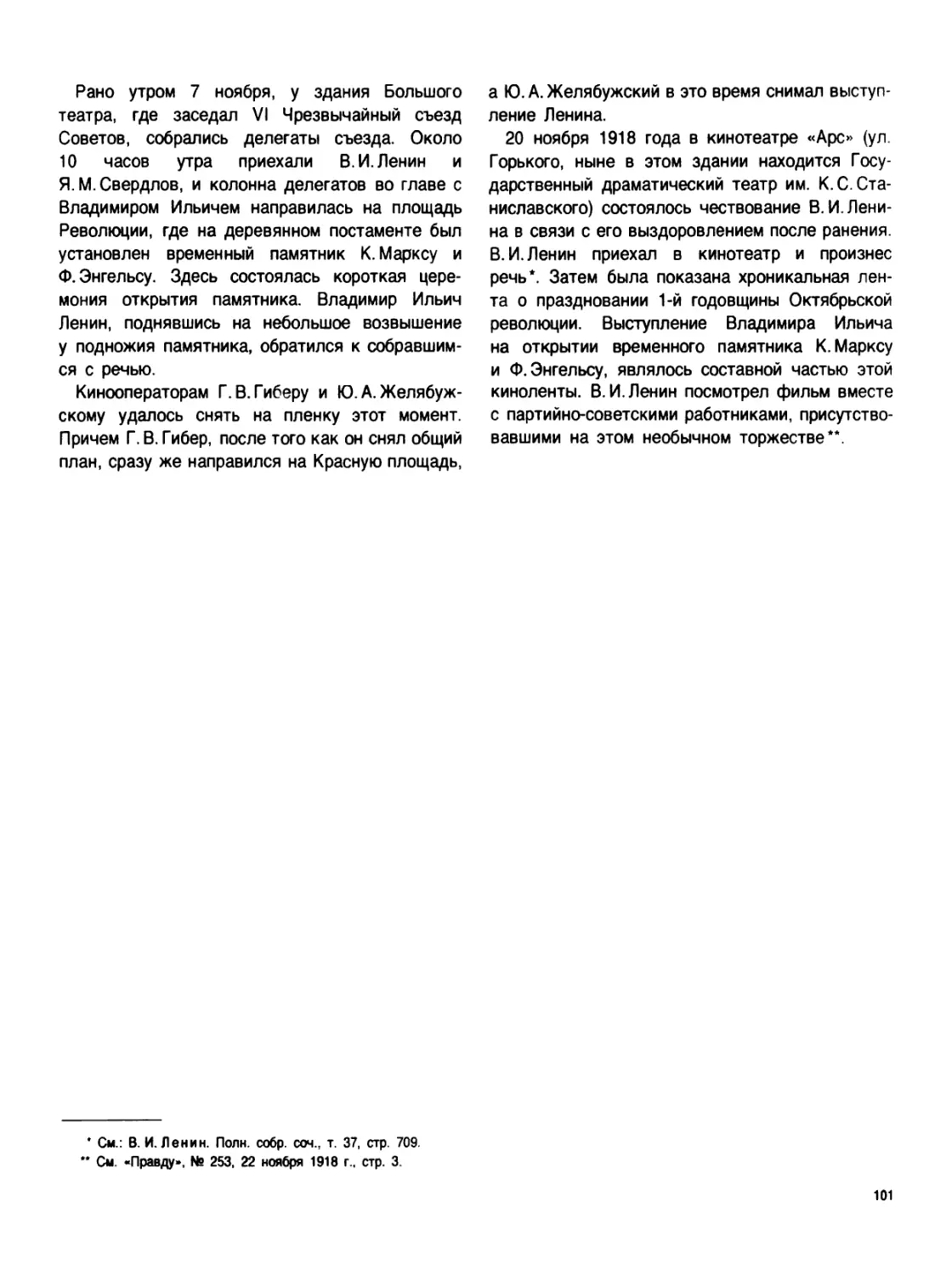
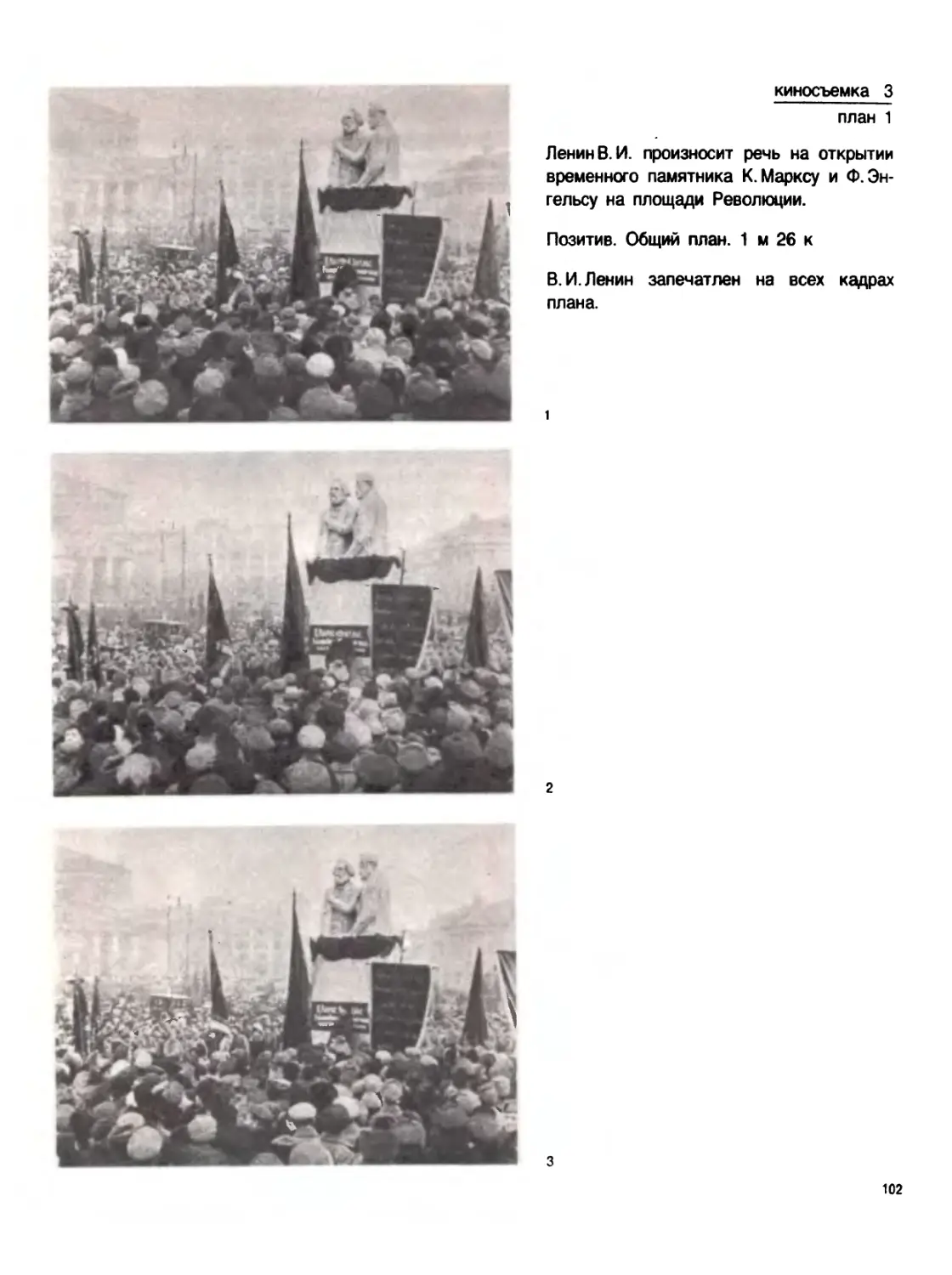
Рано утром 7 ноября, у здания Большого
театра, где заседал VI Чрезвычайный съезд
Советов, собрались делегаты съезда. Около
10 часов утра приехали В.И.Ленин и
Я. М. Свердлов, и колонна делегатов во главе с
Владимиром Ильичем направилась на площадь
Революции, где на деревянном постаменте был
установлен временный памятник К. Марксу и
Ф. Энгельсу. Здесь состоялась короткая цере¬
мония открытия памятника. Владимир Ильич
Ленин, поднявшись на небольшое возвышение
у подножия памятника, обратился к собравшим¬
ся с речью.
Кинооператорам Г.В.Гиберу и Ю. А. Желябуж¬
скому удалось снять на пленку этот момент.
Причем Г. В. Гибер, после того как он снял общий
план, сразу же направился на Красную площадь,
а Ю. А. Желябужский в это время снимал выступ¬
ление Ленина.
20 ноября 1918 года в кинотеатре «Арс» (ул.
Горького, ныне в этом здании находится Госу¬
дарственный драматический театр им. К. С. Ста¬
ниславского) состоялось чествование В. И. Лени¬
на в связи с его выздоровлением после ранения.
В. И. Ленин приехал в кинотеатр и произнес
речь*. Затем была показана хроникальная лен¬
та о праздновании 1-й годовщины Октябрьской
революции. Выступление Владимира Ильича
на открытии временного памятника К. Марксу
и Ф. Энгельсу, являлось составной частью этой
киноленты. В. И. Ленин посмотрел фильм вместе
с партийно-советскими работниками, присутство¬
вавшими на этом необычном торжестве**.
* См.: В. И. Ленин. Поли. собр. соч., т. 37, стр. 709.
** Су. «Правду*. № 253, 22 ноября 1918 г., стр. 3.
101
киносъемка 3
план 1
Ленин В. И. произносит речь на открытии
временного памятника К. Марксу и Ф. Эн¬
гельсу на площади Революции.
Позитив. Общий план. 1 м 26 к
В.И.Ленин запечатлен на всех кадрах
плана.
1
2
102
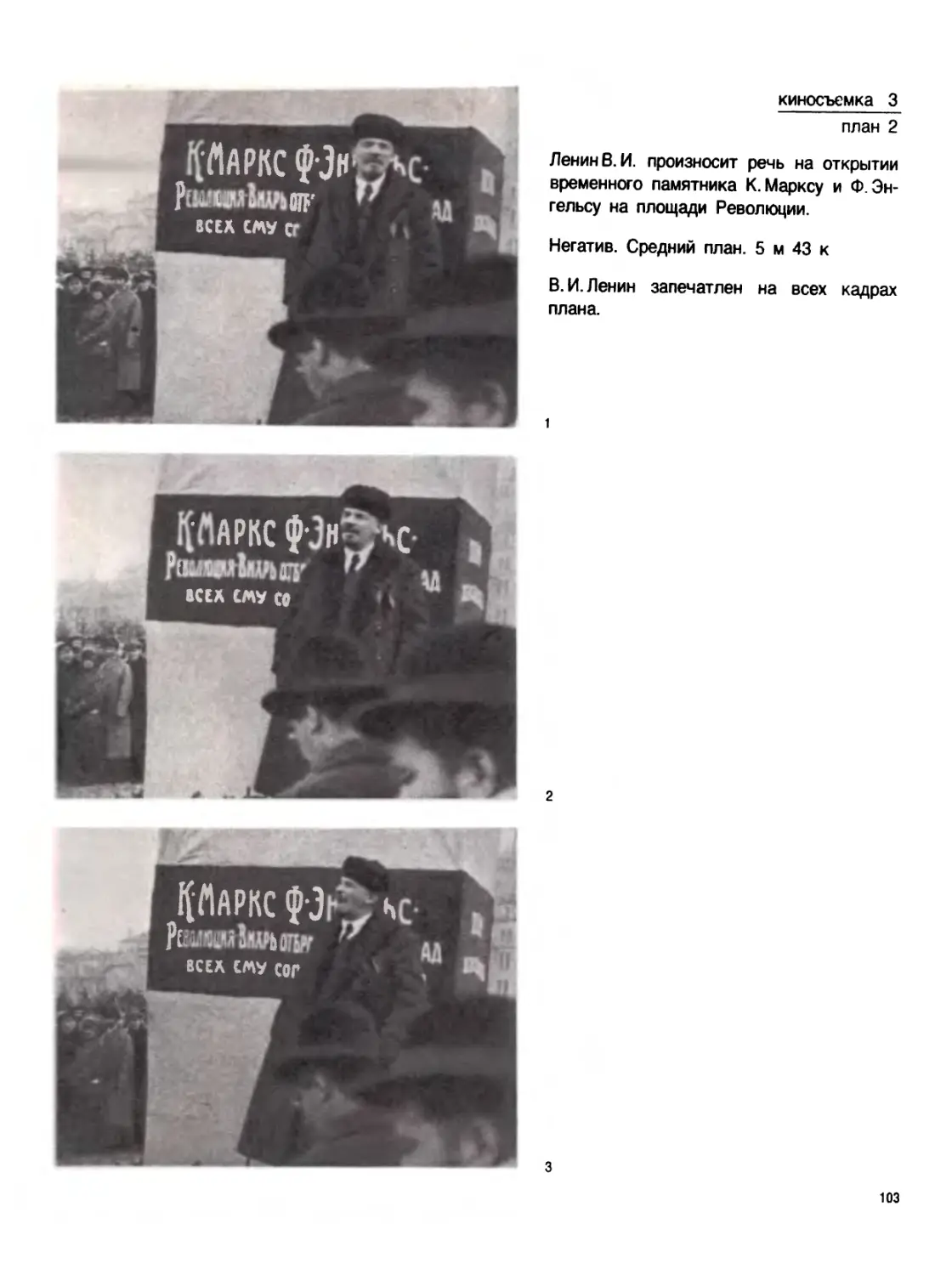
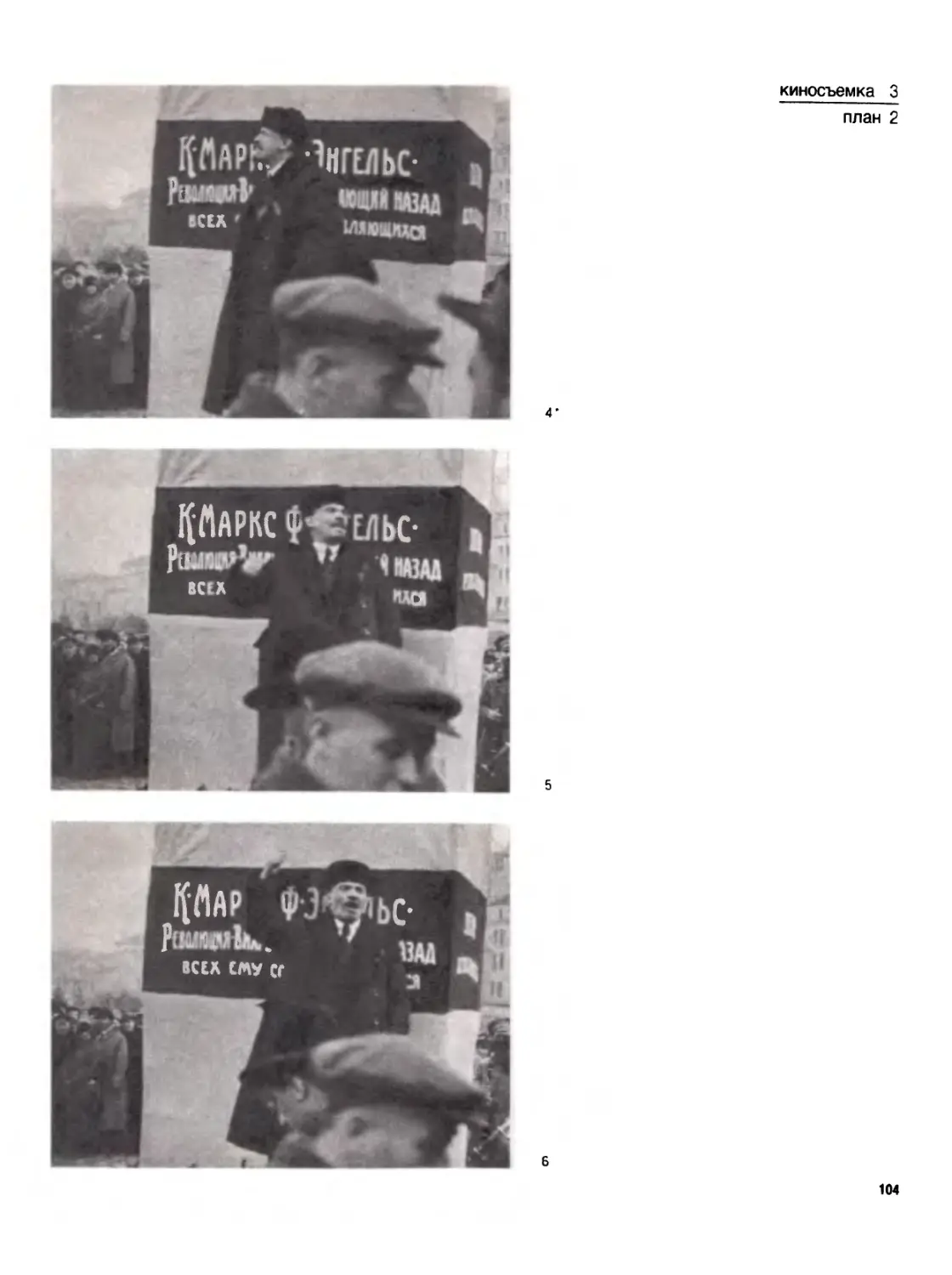
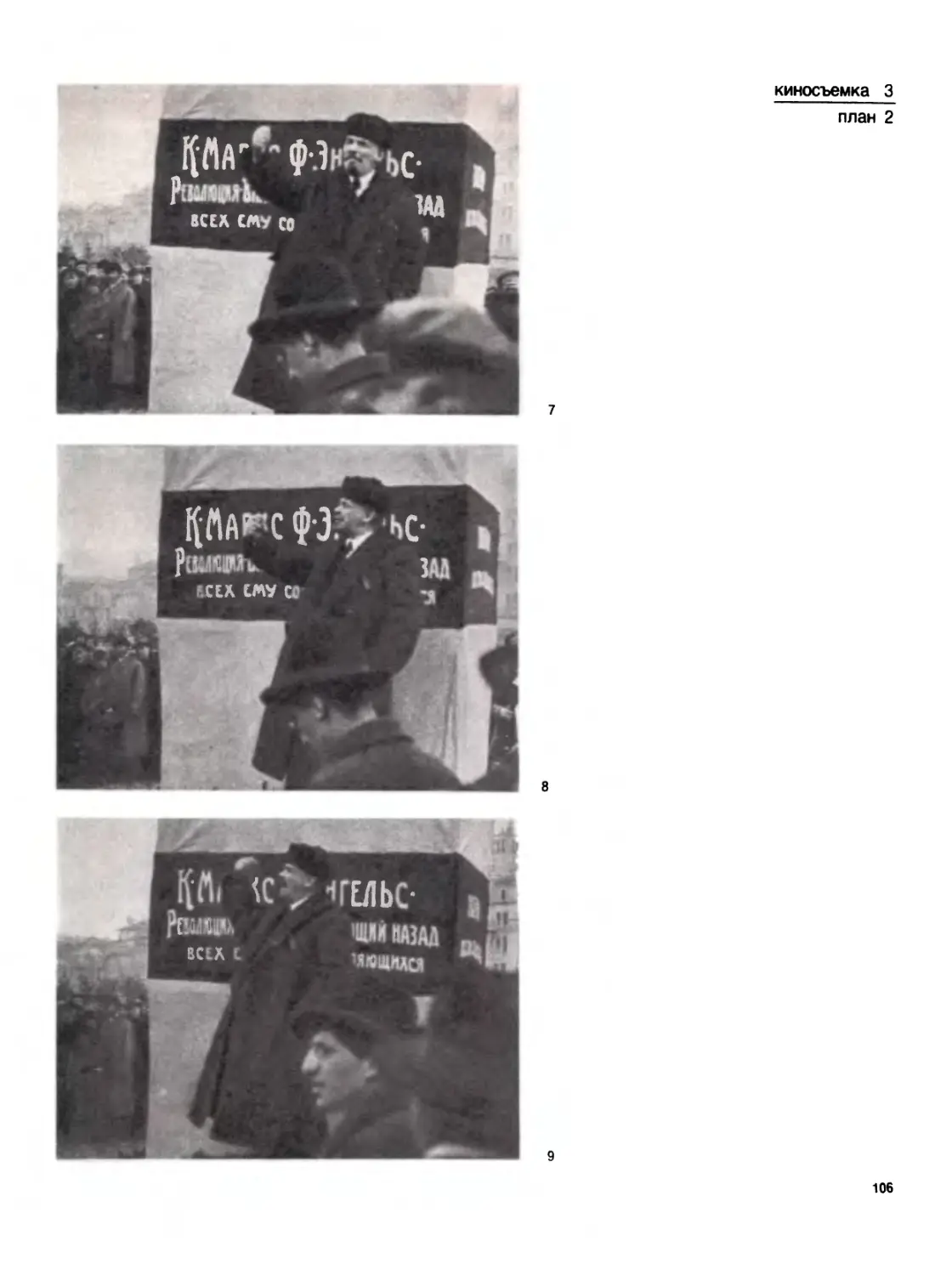
киносъемка 3
план 2
Ленин В. И. произносит речь на открытии
временного памятника К. Марксу и Ф. Эн¬
гельсу на площади Революции.
Негатив. Средний план. 5 м 43 к
В. И. Ленин запечатлен на всех кадрах
плана.
1
2
3
103
104
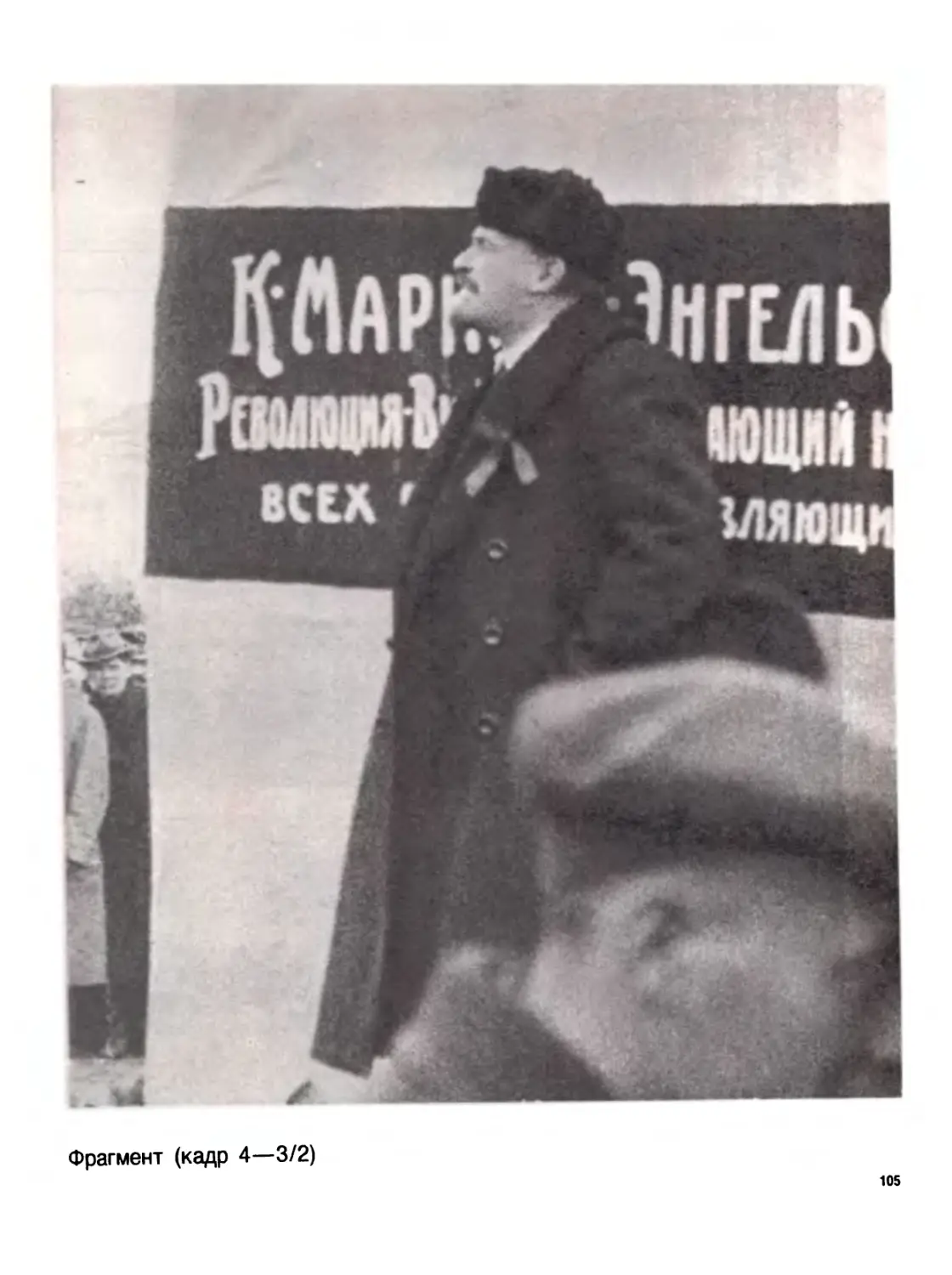
Фрагмент (кадр 4—3/2)
105
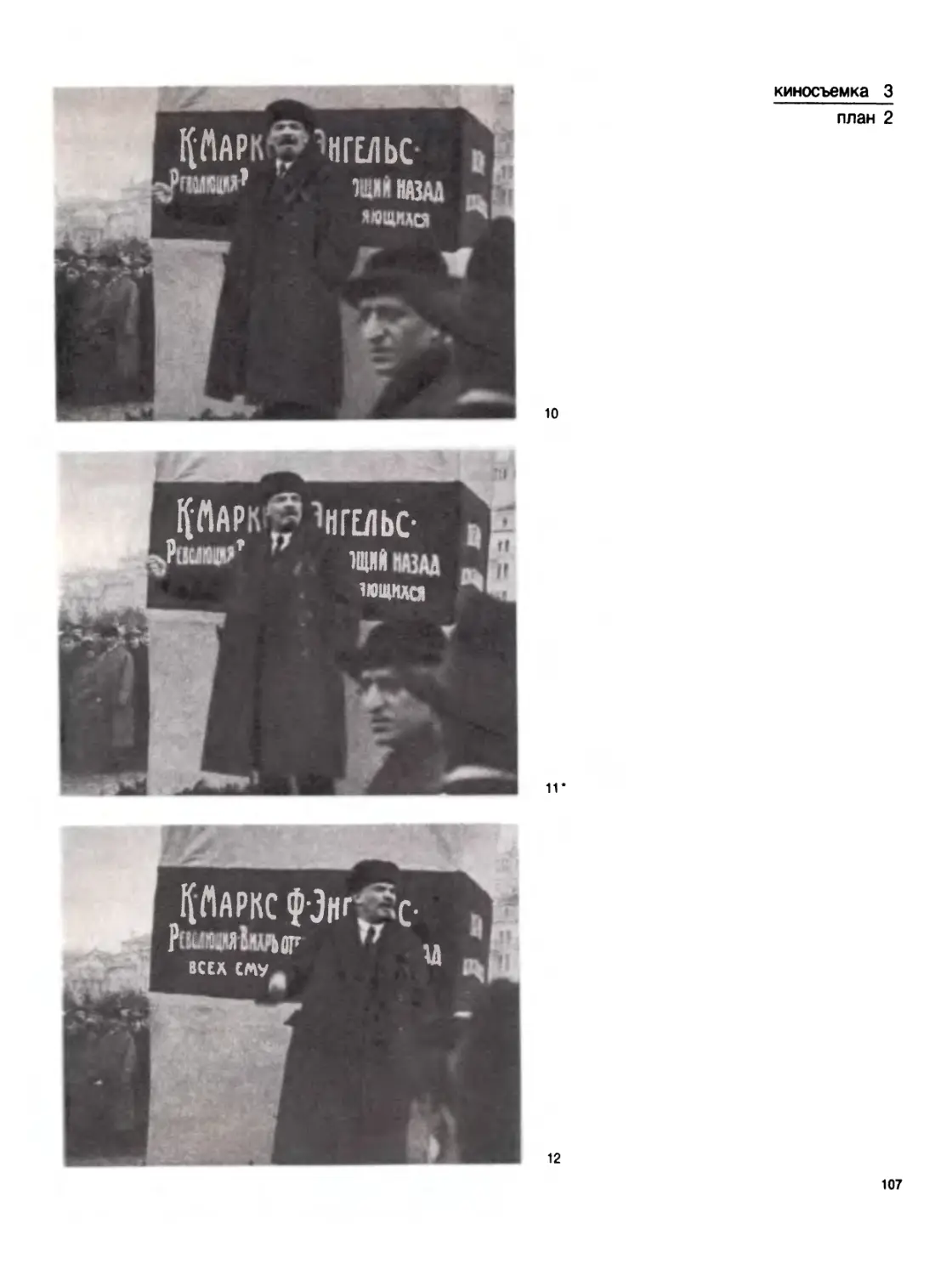
киносъемка 3
рАРК^НГЕЛЬС- 8
»fWIIII»1 ' ШИЛ НАЗАД
Я ЩИ АСЯ ^
план 2
ю
11*
12
107
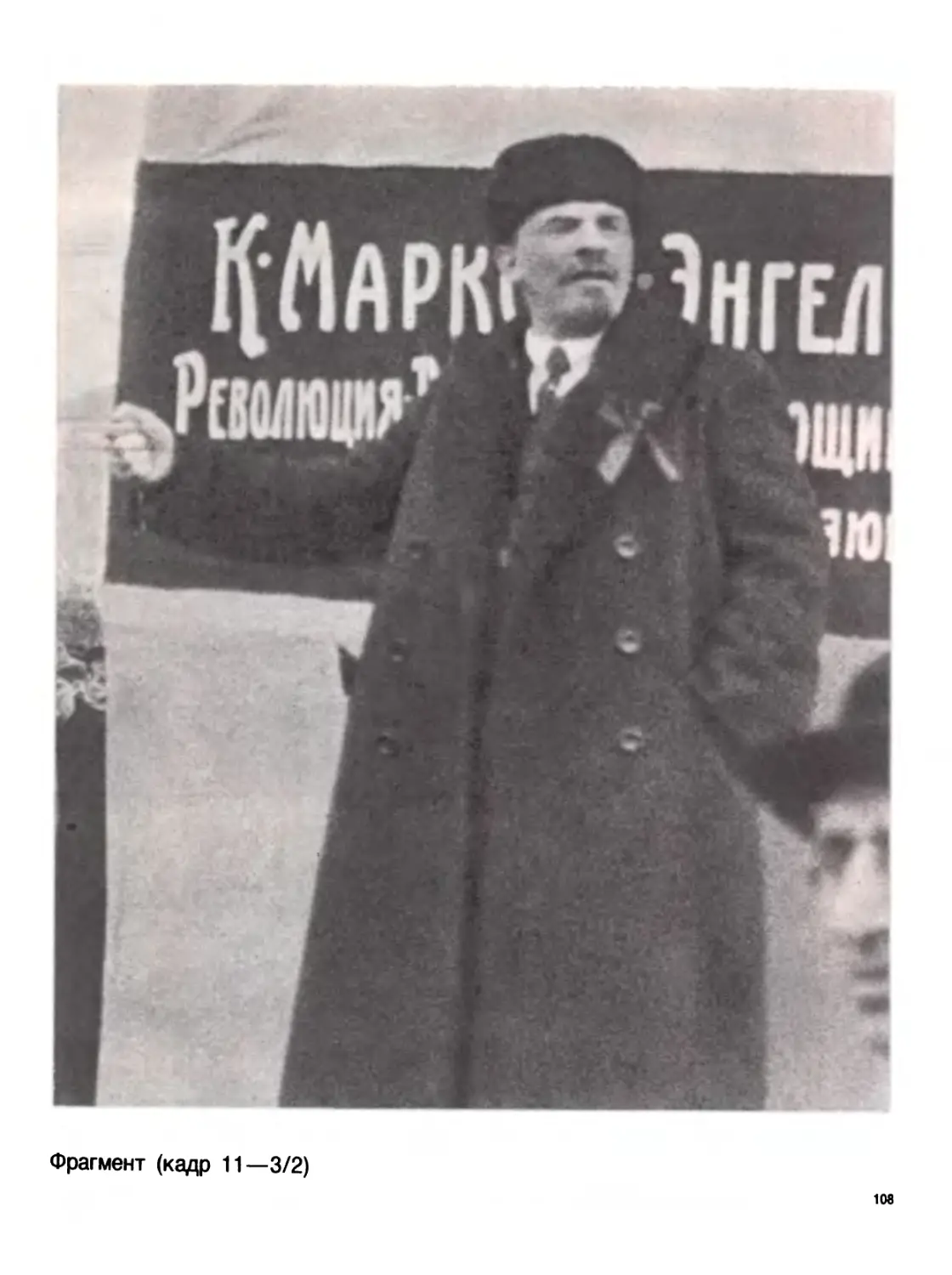
Фрагмент (кадр 11—3/2)
108
«щ
киносъемка 3
план 2
13
14 *
15
109
Фрагмент (кадр 14—3/2)
110
киносъемка 3
план 2
16
17
ЮЩИЙ НАЗАД
1ЯЮЩИДСЯ
111
киносъемка
4
Ленин В. И. на Красной площади в день празднования
1-й годовщины Великой Октябрьской социалистиче¬
ской революции.
1918 г., 7 ноября. Москва.
Операторы:
Винклер А. Ф.*, ГиберГ. В., Новицкий П. К.
Первый выход на экран:
Выпуск кинохроники «Торжество годовщины Октябрьской революции в Москве»,
1918 год.
Обоснование даты:
7 ноября 1918 года В. И. Ленин принимает участие в праздновании 1-й годовщины
Октябрьской революции. Он открывает мемориальную доску, установленную на
кремлевской стене в память павших за мир и братство народов и выступает с
речью—См.: В. И. Ленин. Полн. собр. соч., т. 37, стр. 706.
Примечания.
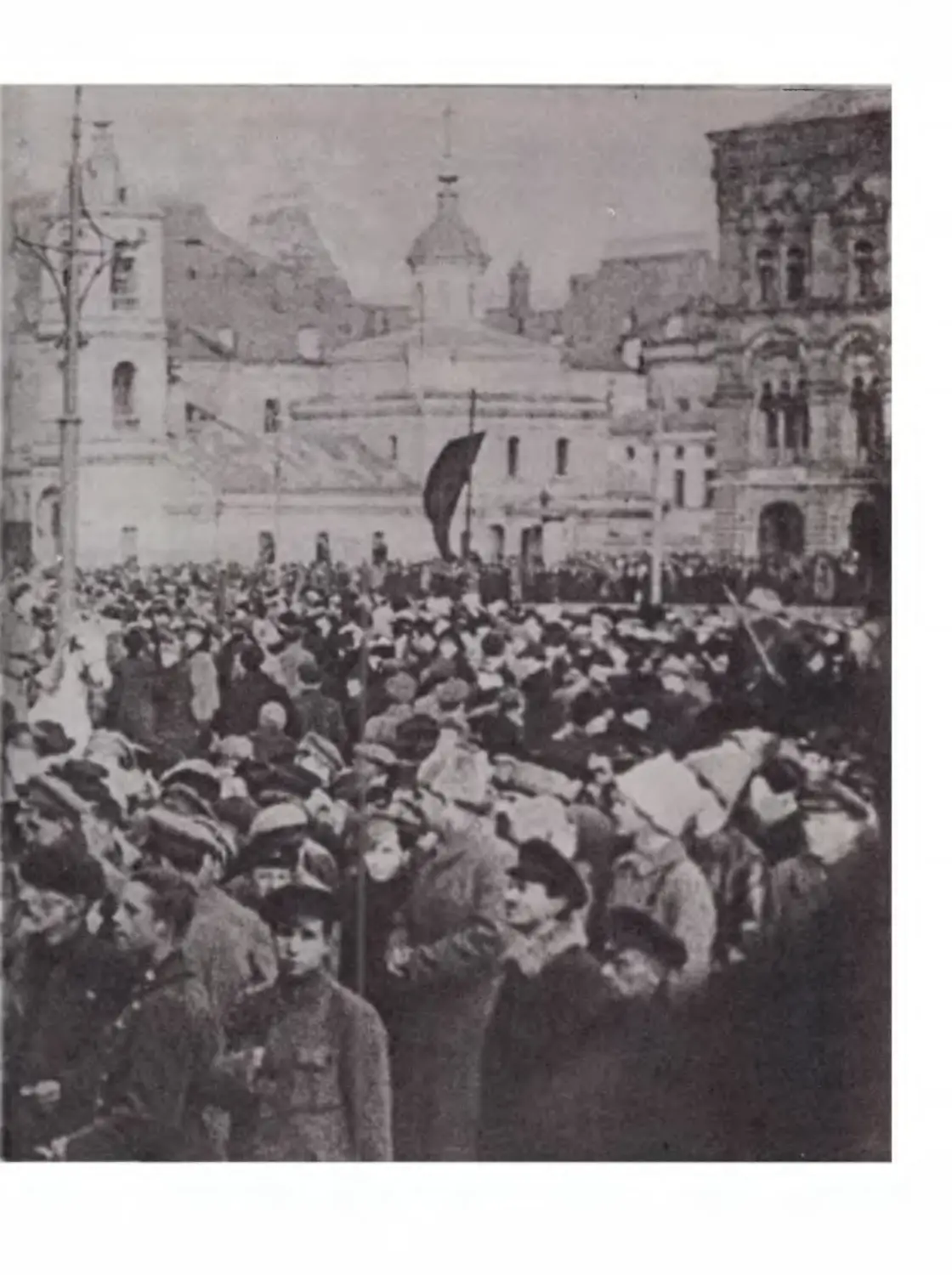
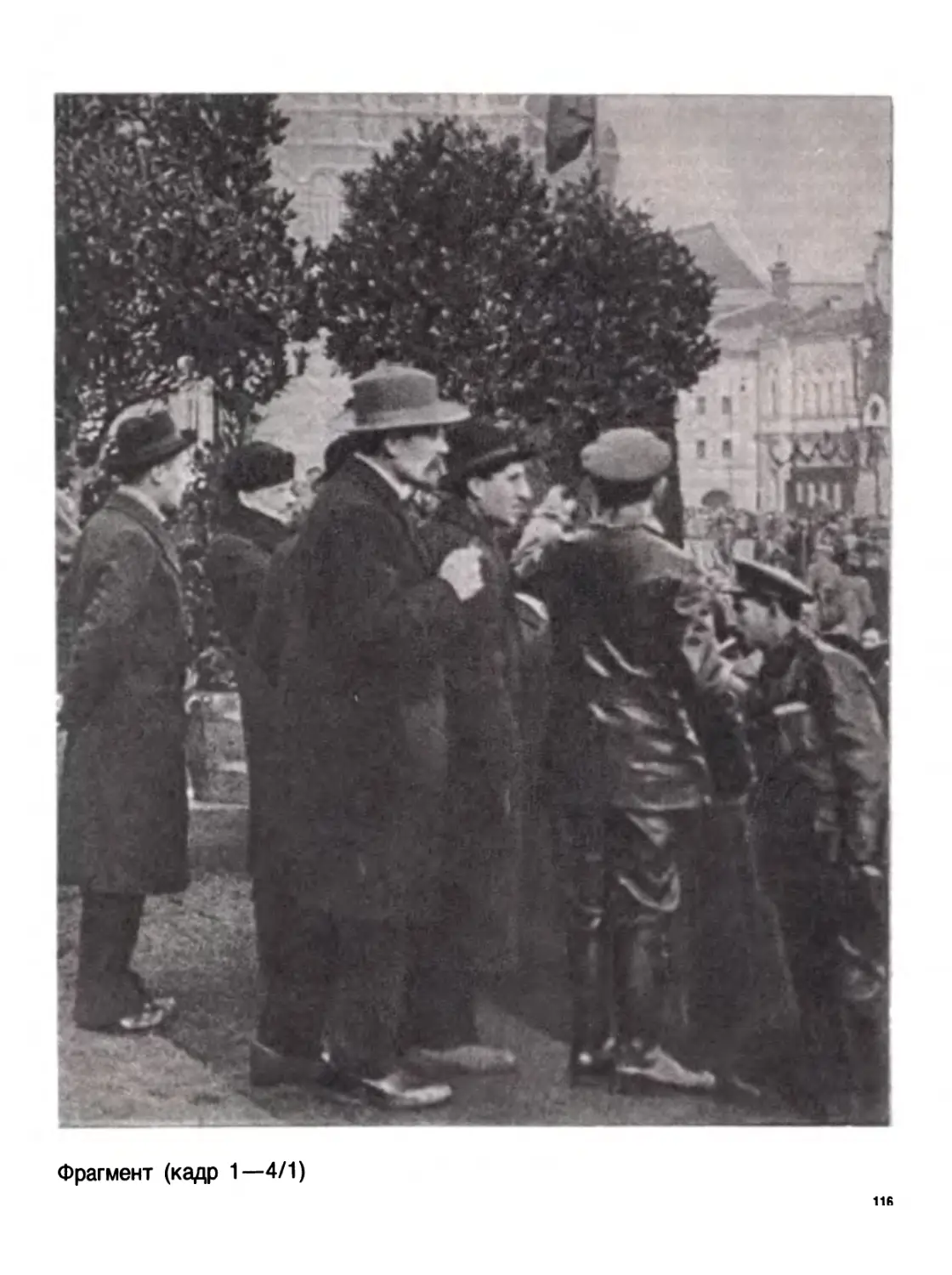
Сохранилось 3,55 детра пленки—1 план. Только на нескольких кадрах мы видим В. И. Ленина. Конечно, эти
кадры являются лишь небольшой частью съемки Владимира Ильича во время празднования 1-й годовщины
Великой Октябрьской Социалистической революции.
* Долгое время считалось, что съемку во время торжественного митинга на Красной площади проводили
операторы Г.В.Гибер и П. К. Новицкий, однако участие в этой съемке А. Ф. Винклера подтверждает
известный советский историк кино Г. М. Болтянский. Он пишет, что «оператор Винклер снимал В. И. Ленина
говорящего с первой (деревянной) трибуны на Красной площади, очень тесной и неудобной. После речи
В.И.Ленин заметил оператору: «Вероятно, у вас плохо вышло—очень неудобно».—Г. Болтянский. Ленин
и кино. М.—Л., Государственное издательство, 1925, стр. 39.
114
«С площади Революции могучая волна мани¬
фестантов направляется на Красную площадь.
Льются звуки революционного марша много¬
численных оркестров, сливаясь со стройным
пением «Марсельезы», «Интернационала» и по¬
хоронного марша. Движется море людей со
стягами-знаменами по сказочно декорированной
площади... По площади движется большая ко¬
лонна членов 6-го съезда Советов.
Депутаты проходят и выстраиваются против
мемориальной доски у ступеней подножия...».
Владимир Ильич Ленин, поддерживаемый това¬
рищами, поднялся на небольшое возвышение и
«срезал ножницами печать на задрапированной
доске, и покров падает к ногам. Глазам присут¬
ствующих представляется белокрылая фигура с
веткой мира в руке и надписью: «Павшим за мир
и братство народов...».
После речи Ленина начинается шествие...
Манифестанты идут тремя колоннами, запол¬
няя всю площадь морем голов и знамен. Здесь
сотни тысяч. Никогда еще Москва не видела
такой огромной манифестации, такого глубокого
единодушия демонстрирующих».
«Правда», № 242, 9 ноября 1918 г., стр. 2.
115
Фрагмент (кадр 1—4/1)
116
киносъемка 4
алан 1
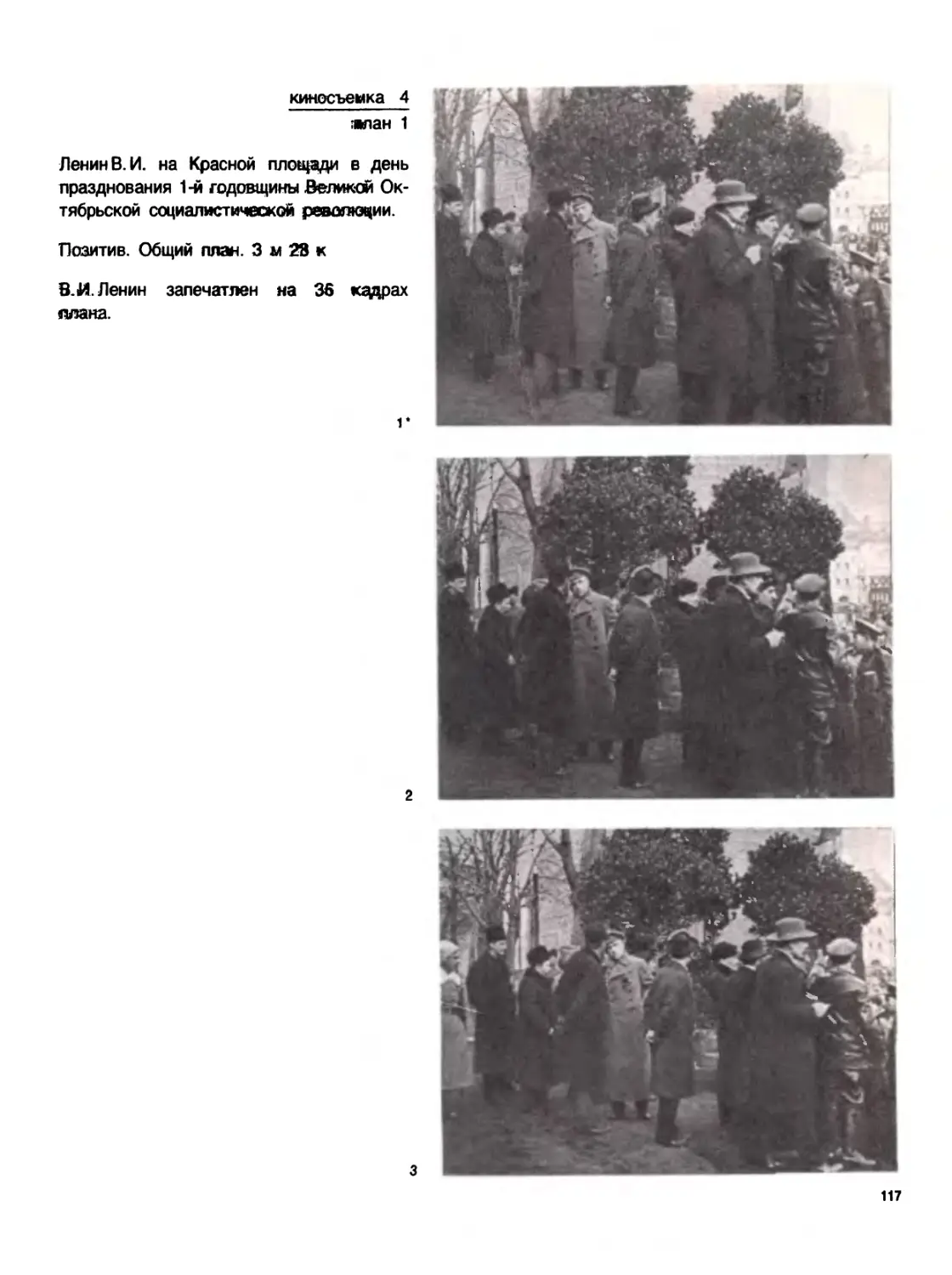
Ленин В. И. на Красной площади в день
празднования 1-й годовщины Великой Ок¬
тябрьской социалистической революции.
Позитив. Общий план. 3 м 28 к
В. (И. Ленин запечатлен на 36 кадрах
плана.
г
117
киносъемка
5
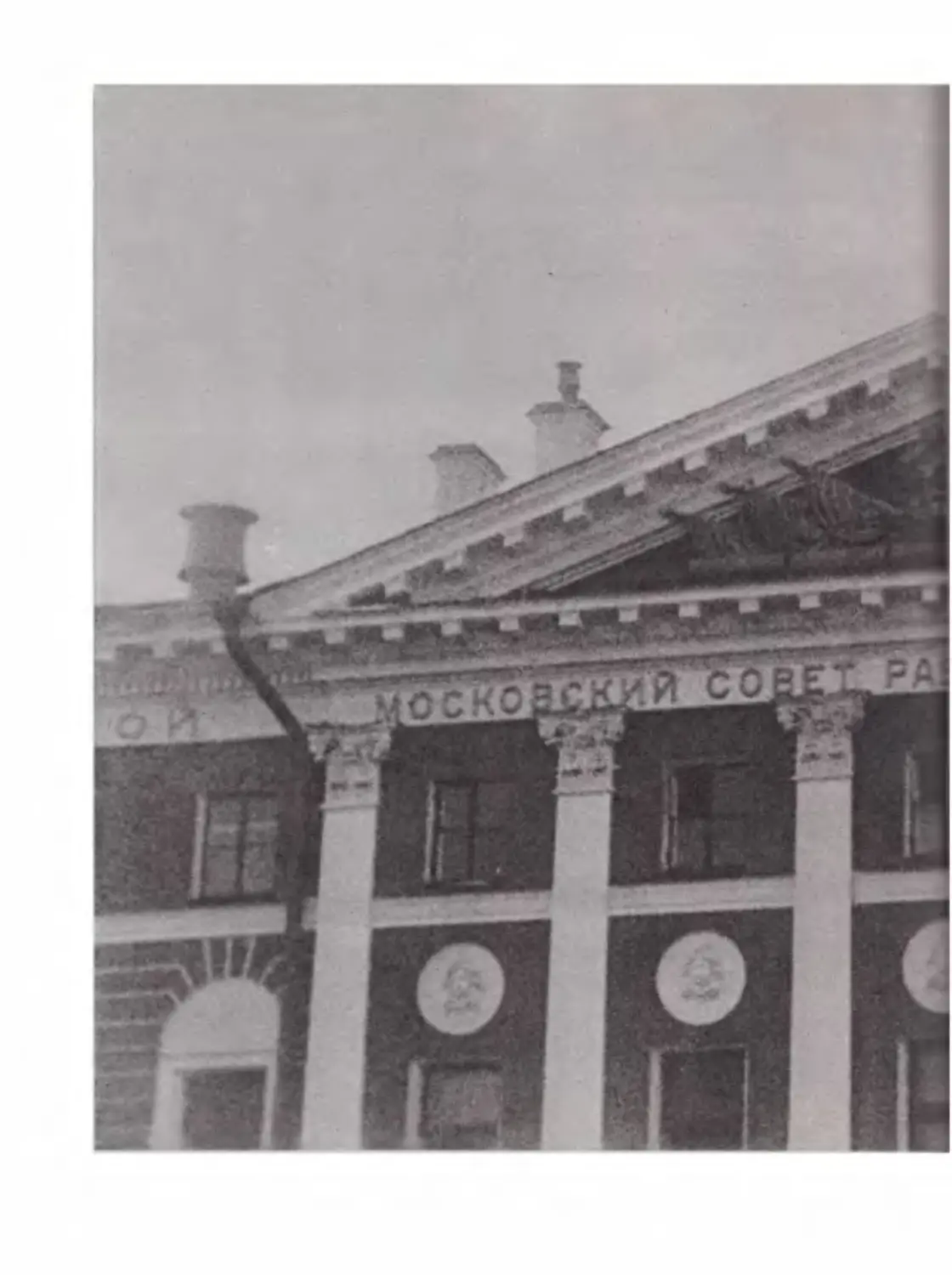
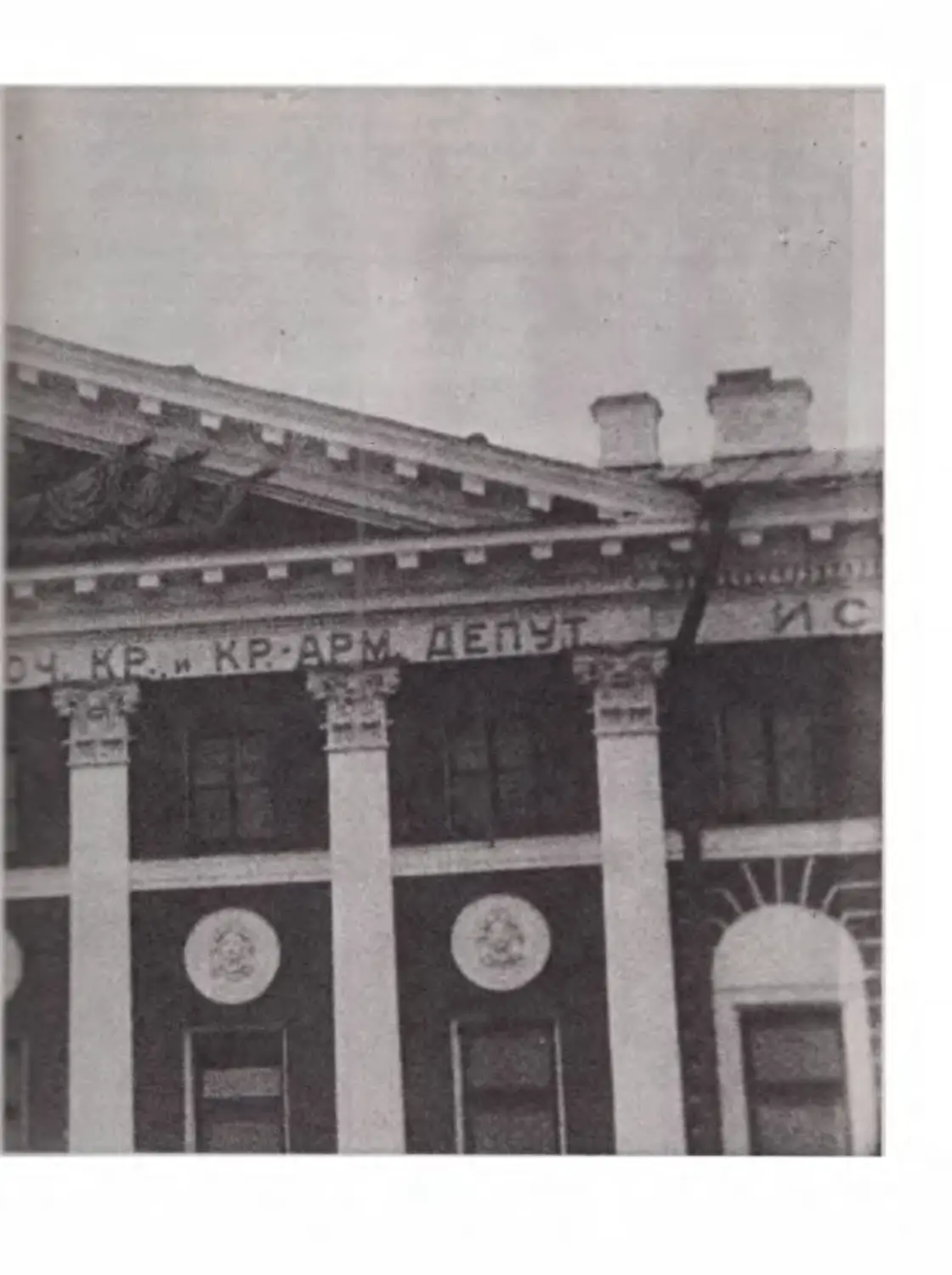
Ленин В. И. выступает с речью с балкона Моссовета на
митинге протеста против убийства вождей германско¬
го пролетариата Карла Либкнехта и Розы Люксембург.
1919 г., 19 января. Москва.
Операторы:
Документально не установлено.
Первый выход на экран:
Журнал «Кинонеделя» № 22, 24 января 1919 года.
Обоснование даты:
19 января 1919 года В.И.Ленин выступает с речью на митинге протеста против
убийства Розы Люксембург и Карла Либкнехта.—См.: В. И. Ленин. Полн. собр.
соч., т. 37, стр. 725.
«К 12 часам на Советскую площадь стягиваются колонны демонстрантов с
траурными знаменами и идут красноармейские части, ощетинившись стройными
рядами штыков... На балконе Моссовета появляется тов. Ленин, встречаемый
криками «ура» и шумными аплодисментами. Его небольшая, но сильная речь
встречается с энтузиазмом...».—Газ. «Вечерние известия Московского Совета
рабочих и красноармейских депутатов», № 150, 20 января 1919 г., стр. 3.
Примечания.
Сохранилось 6,32 метра пленки—9 коротких планов. На 8 планах—запечатлен В.И.Ленин.
Кадры, запечатлевшие В.И.Ленина во время его речи, были включены Дзигой Вертовым в фильм
«Киноправда», № 13, который вышел на экраны в ноябре 1922 года.
120
Долгое время считалось, что данная съемка
относится к выступлению В. И. Ленина 16 октяб¬
ря 1919 года перед коммунистами Ярославской и
Владимирской губерний, отправляющимися на
борьбу с Деникиным. И лишь совсем недавно
сотрудникам Центрального государственного ар¬
хива кинофотодокументов СССР удалось устано¬
вить точную дату. Они обратили внимание на
одну существенную деталь:
«...в кадрах, запечатлевших Владимира Иль¬
ича, ясно виден устойчивый снежный покров.
Снег толстым слоем лежит на карнизах и подо¬
конниках дома напротив...
В бюро гидрометеорологических расчетов и
справок Управления гидрометслужбы Централь¬
ных областей мы получили точный ответ. Нет,
снега в тот день не было. Лишь тремя днями
позже, 19 октября, в столице выпал первый снег.
А устойчивый снежный покров лег еще позже—
1 ноября.
Это означает, что данная съемка Ленина сде¬
лана не 16 октября 1919 года и, следовательно,
связана с какими-то другими событиями. Какими
же именно?
Интересующие нас кадры в подлинном, перво¬
начальном монтаже до наших дней не дошли. Но
у нас в архиве сохранилась съемка, имеющая
прямое отношение к исследуемому сюжету. В
ней заснят другой оратор, выступающий с балко¬
на Моссовета. Причем обстоятельства, запечат¬
ленные в этих кадрах, до мельчайших деталей
совпадают с теми, которые знакомы по съемке
В. И. Ленина. Те же два флага на втором плане,
те же снежные пятна на подоконниках дома
напротив; наконец, на балконе рядом с оратором
стоит человек, который запечатлен и рядом с
В. И. Лениным,—он снят в той же одежде.
Все совпадает!
Обе съемки сделаны в один день, и—нетруд¬
но сказать, какой это день. Дело в том, что
вторая до сих пор не привлекавшаяся к исследо¬
ванию съемка сохранилась вместе с подлинными
титрами 1919 года. Титры гласят, что это сюжет
первого советского экранного журнала «Киноне¬
деля»—митинг протеста против злодейского
убийства в Берлине вождей германского проле¬
тариата Карла Либкнехта и Розы Люксембург.
В архиве выдающегося советского режиссера-
документалиста Дзиги Вертова есть полное опи¬
сание этого номера «Кинонедели», составленное
в 1919 году. В описании этом названы кадры с
В. И. Лениным в момент его выступления на
митинге протеста с балкона Моссовета.
Митинг состоялся в Москве на Советской
площади 19 января 1919 года—это и есть новая,
несомненная дата известной ленинской съемки...
Таким образом, кинокадры, запечатлевшие
В. И. Ленина во время речи с балкона Моссове¬
та,—драгоценный памятник истории, относящий¬
ся к началу незабываемого 1919 года».
Г.Баженова. С балкона Моссовета.—Сб. «Лениниа-
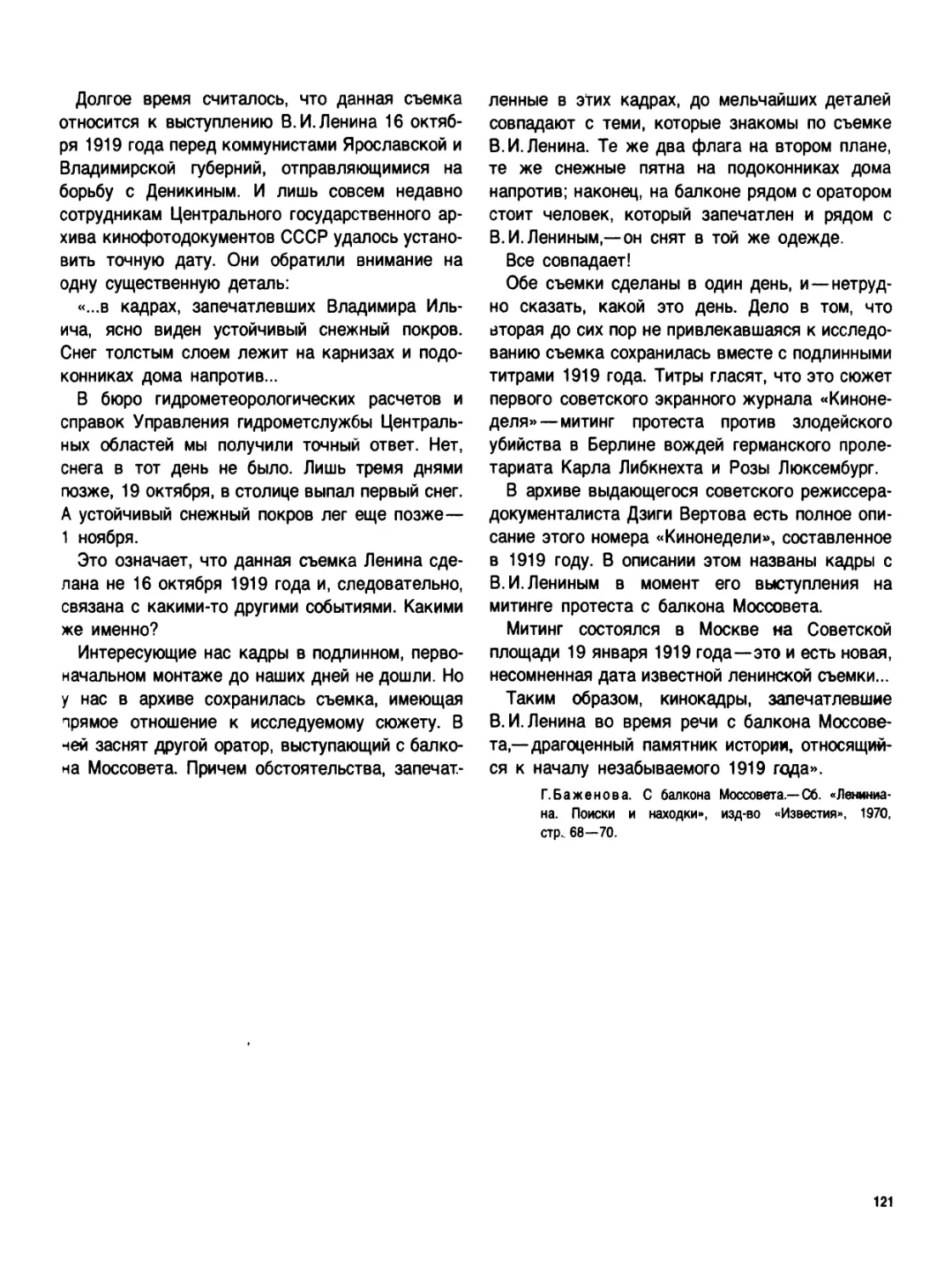
на. Поиски и находки*», изд-во «Известия», 1970,
стр.. 68—70.
121
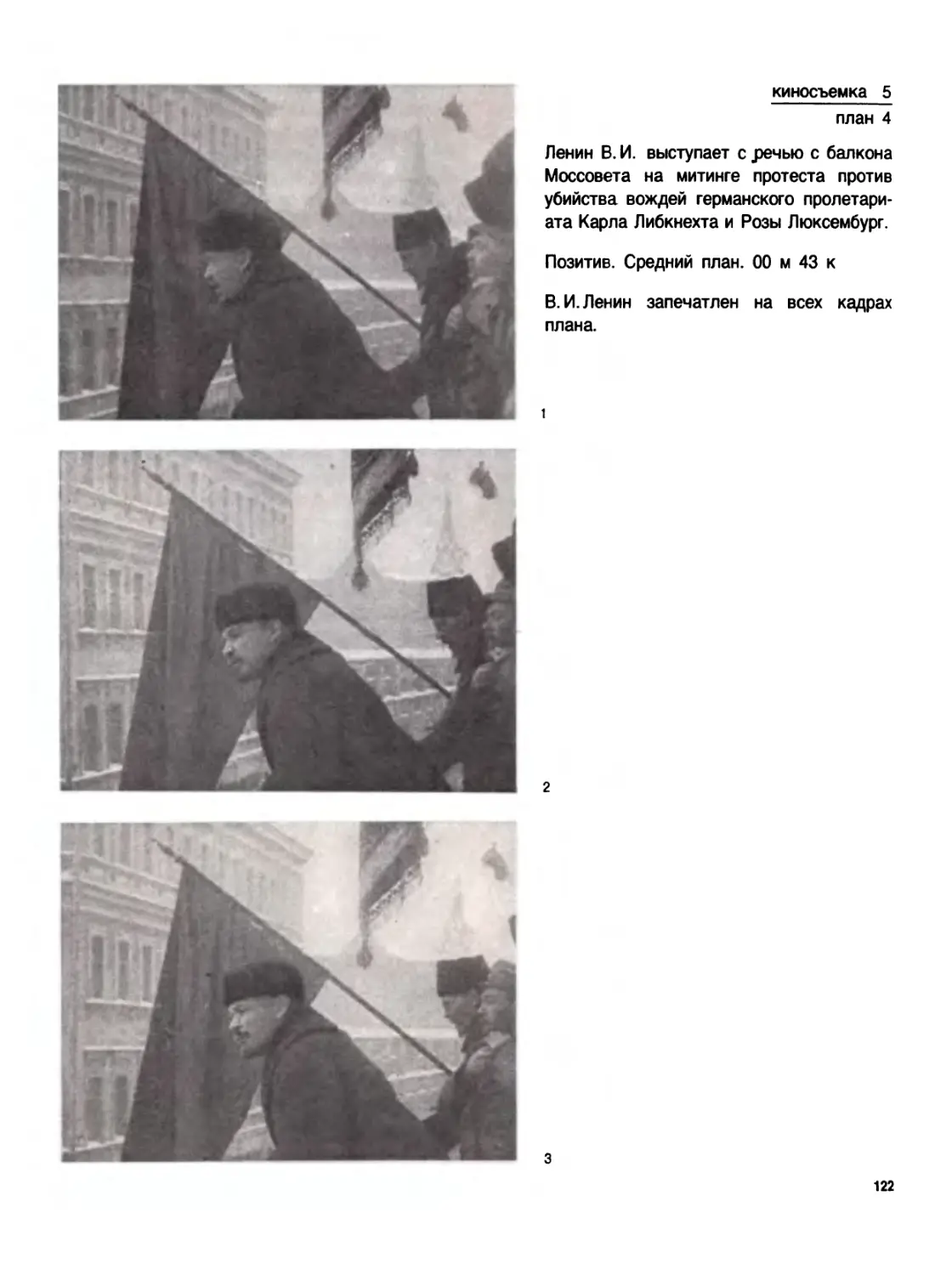
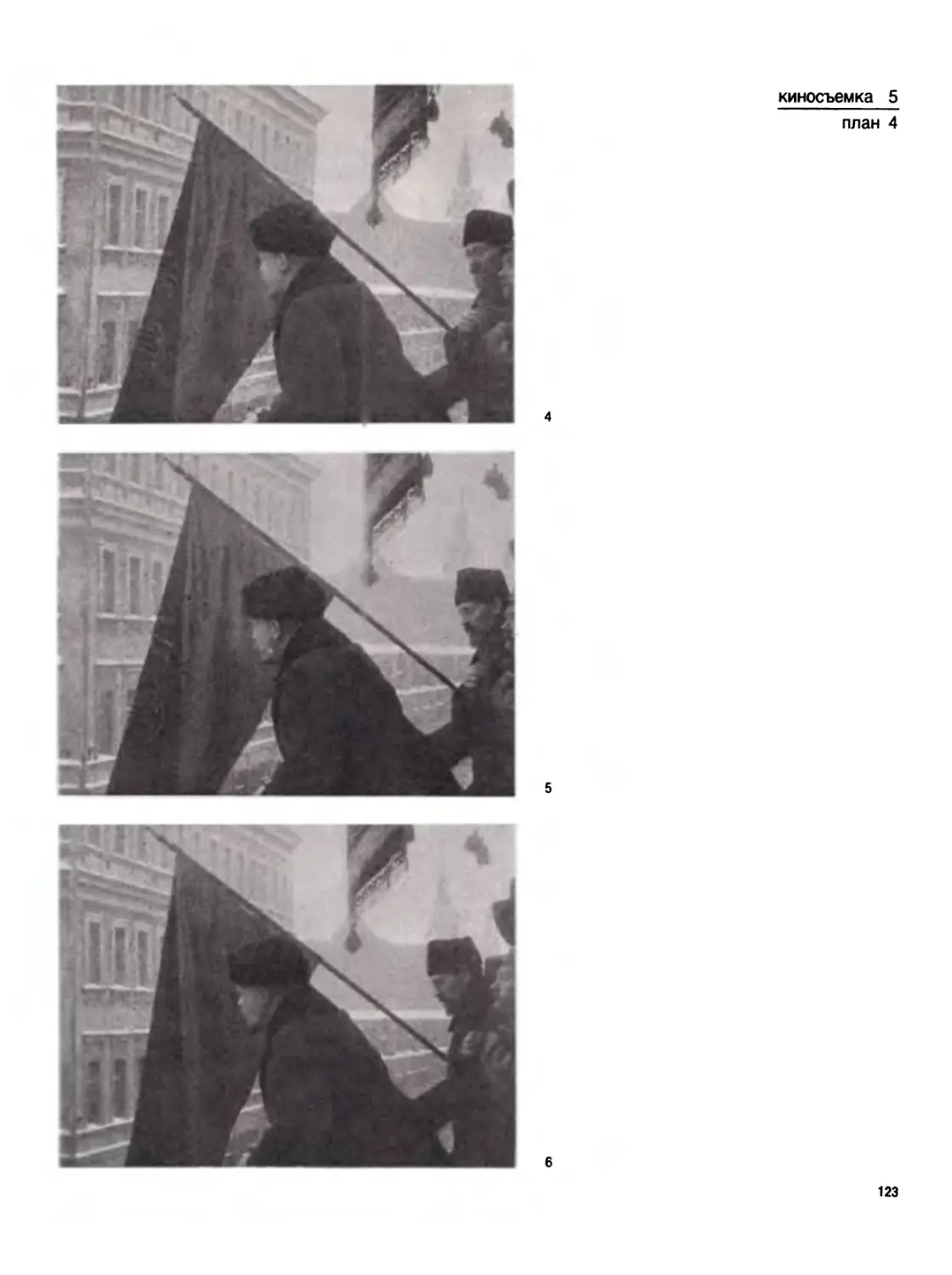
киносъемка 5
план 4
Ленин В. И. выступает с речью с балкона
Моссовета на митинге протеста против
убийства вождей германского пролетари¬
ата Карла Либкнехта и Розы Люксембург.
Позитив. Средний план. 00 м 43 к
В. И. Ленин запечатлен на всех кадрах
плана.
1
2
122
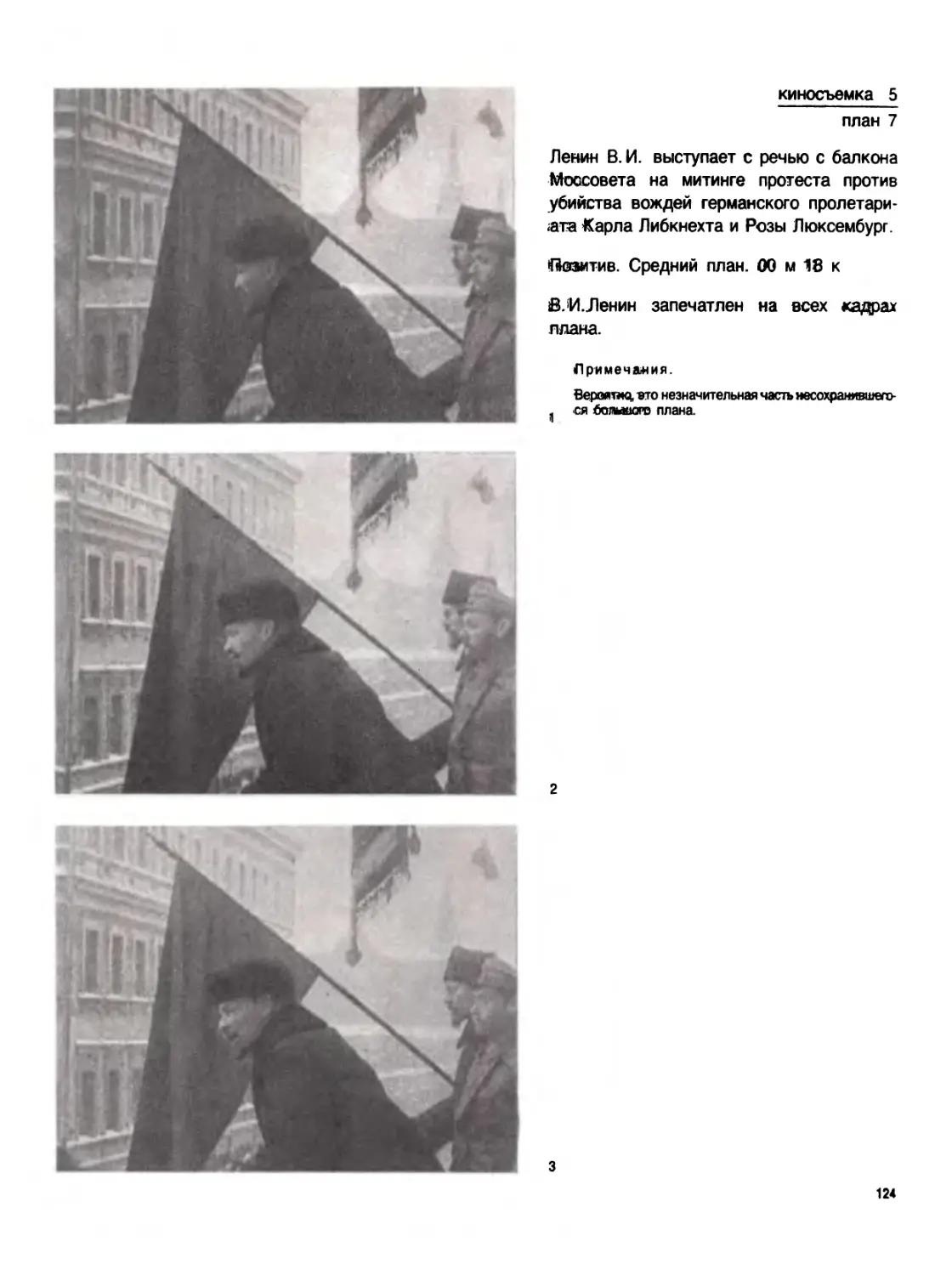
киносъемка 5
план 7
Ленин В. И. выступает с речью с балкона
Моссовета на митинге протеста против
убийства вождей германского пролетари¬
ата Карла Либкнехта и Розы Люксембург.
Шяитив. Средний план. 00 м 18 к
ВМ.Ленин запечатлен на всех кадрах
плана.
Примечания.
Вероятен*, это незначительная часть несохранившего-
„ <ся большого плана.
2
3
124
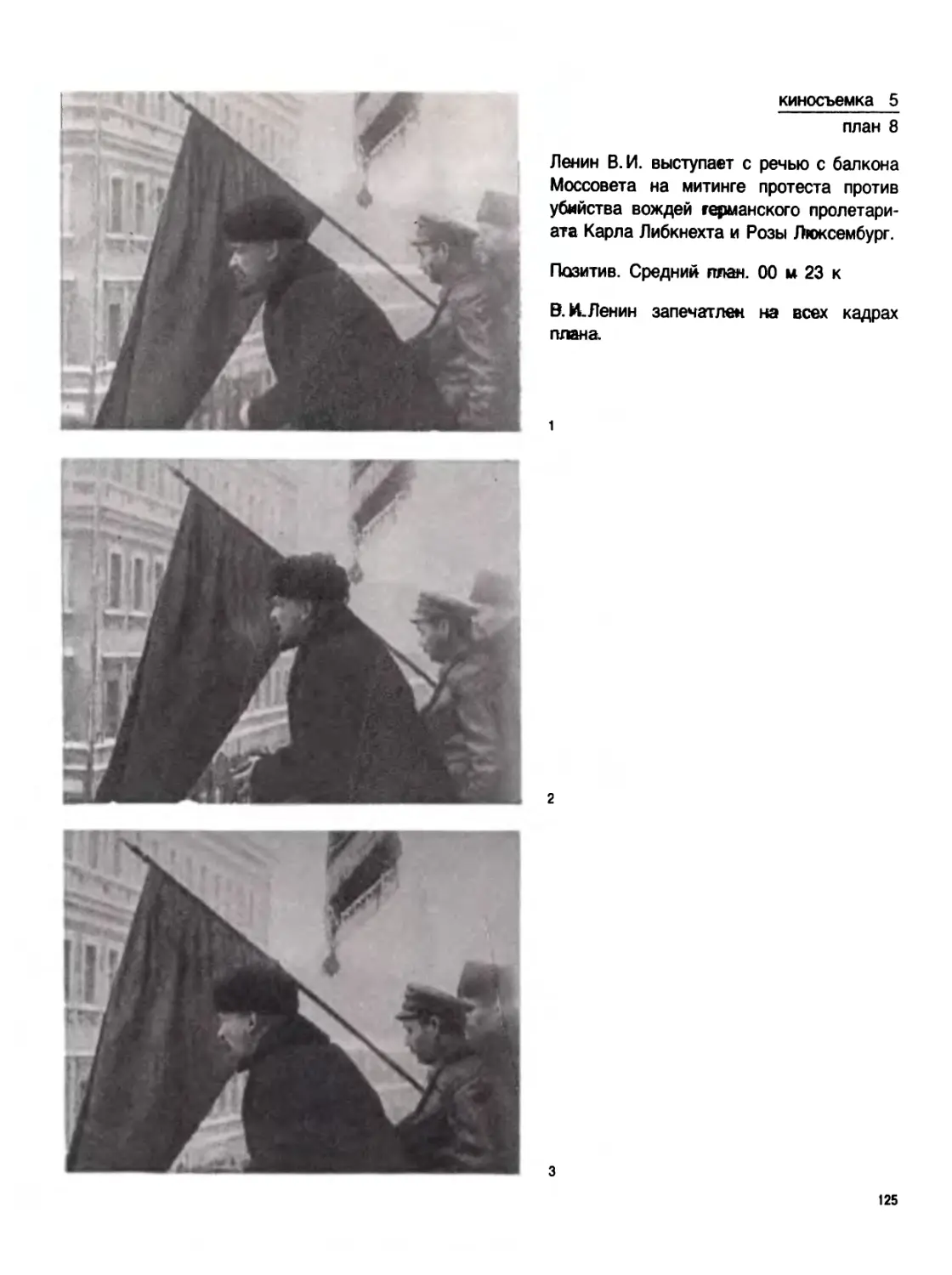
киносъемка 5
план 8
Ленин В. И. выступает с речью с балкона
Моссовета на митинге протеста против
убийства вождей; гвианского пролетари¬
ата Карла Либкнехта и Розы Люксембург.
Позитив. Средний план. 00 м 23 к
В. И.Ленин запечатлен ка всех кадрах
плана
1
2
3
125
киносъемка
6
Ленин В. И. на похоронах Елизарова М. Т.
1919 г., 13 марта. Петроград.
Оператор:
ГригорН.Ф.
Первый выход на экран:
Предположительно выпуск кинохроники «Похороны М.Т. Елизарова», март 1919
года*.
Обоснование даты:
«Вчера на Волковом кладбище состоялись похороны тов. Марка Тимофеевича
Елизарова—комиссара по делам страхования и члена коллегии Народного
Комиссариата Торговли и Промышленности.
На погребении присутствовали: т. Ленин, семья почившего...» —Газ. «Петроград¬
ская правда», № 58, 14 марта 1919 г., стр. 1.
См. также: В.И.Ленин. Полн собр. соч., т. 38, стр. 520.
Примечания.
Сохранилось 84,2 метра пленки—32 плана. На 15 планах—запечатлен В. И. Ленин.
Часть кинокадров этой съемки была обнаружена в 1948 году в Государственном кинофотоархиве СССР
кинорежиссером М. И. Роммом при просмотре и отборе материала для фильма «В. И. Ленин» /ЦГАЛИ, ф.2057
оп.1, ед.хр.62, л.388 /.
* Выпуск кинохроники не сохранился.
128
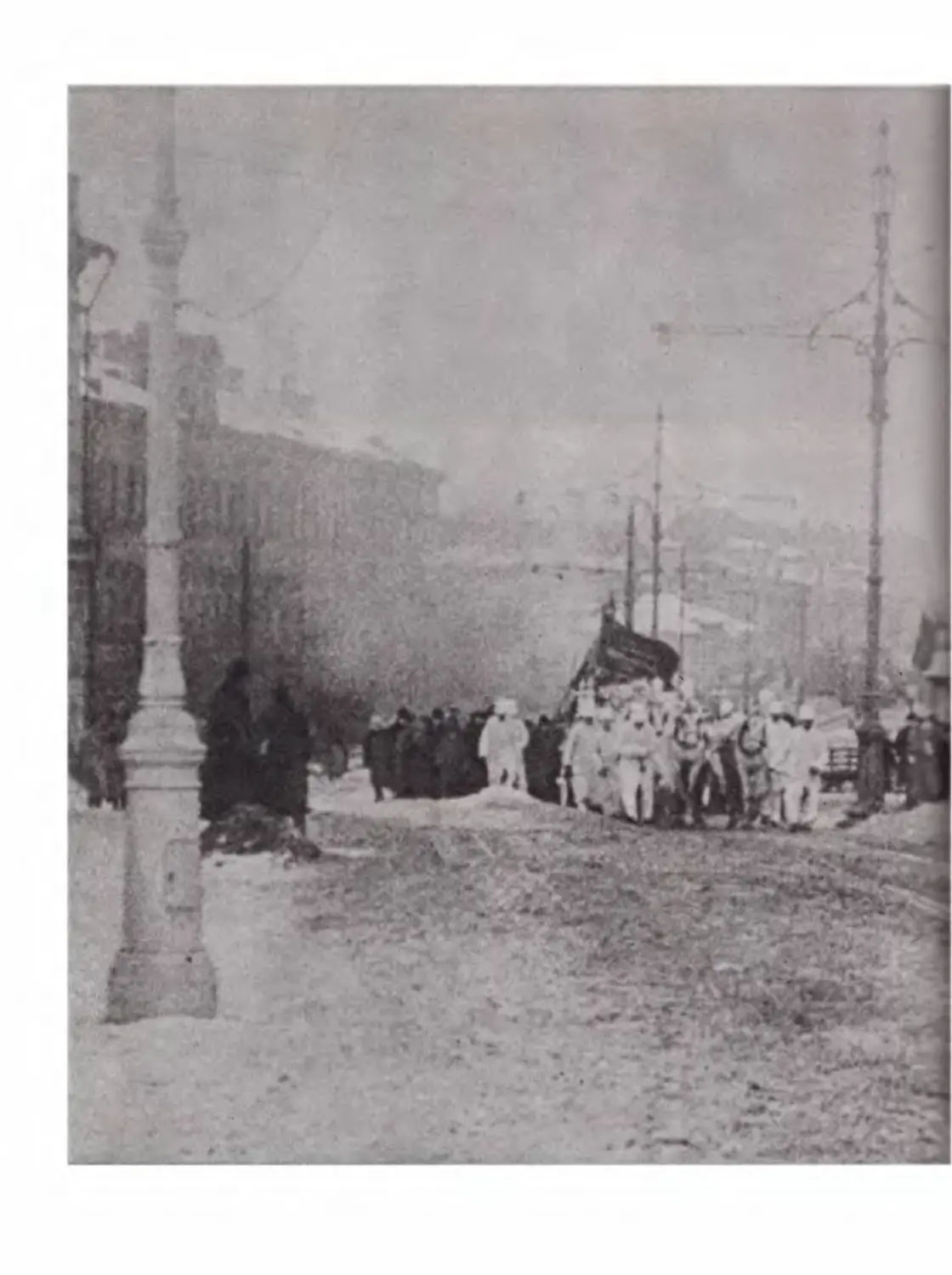
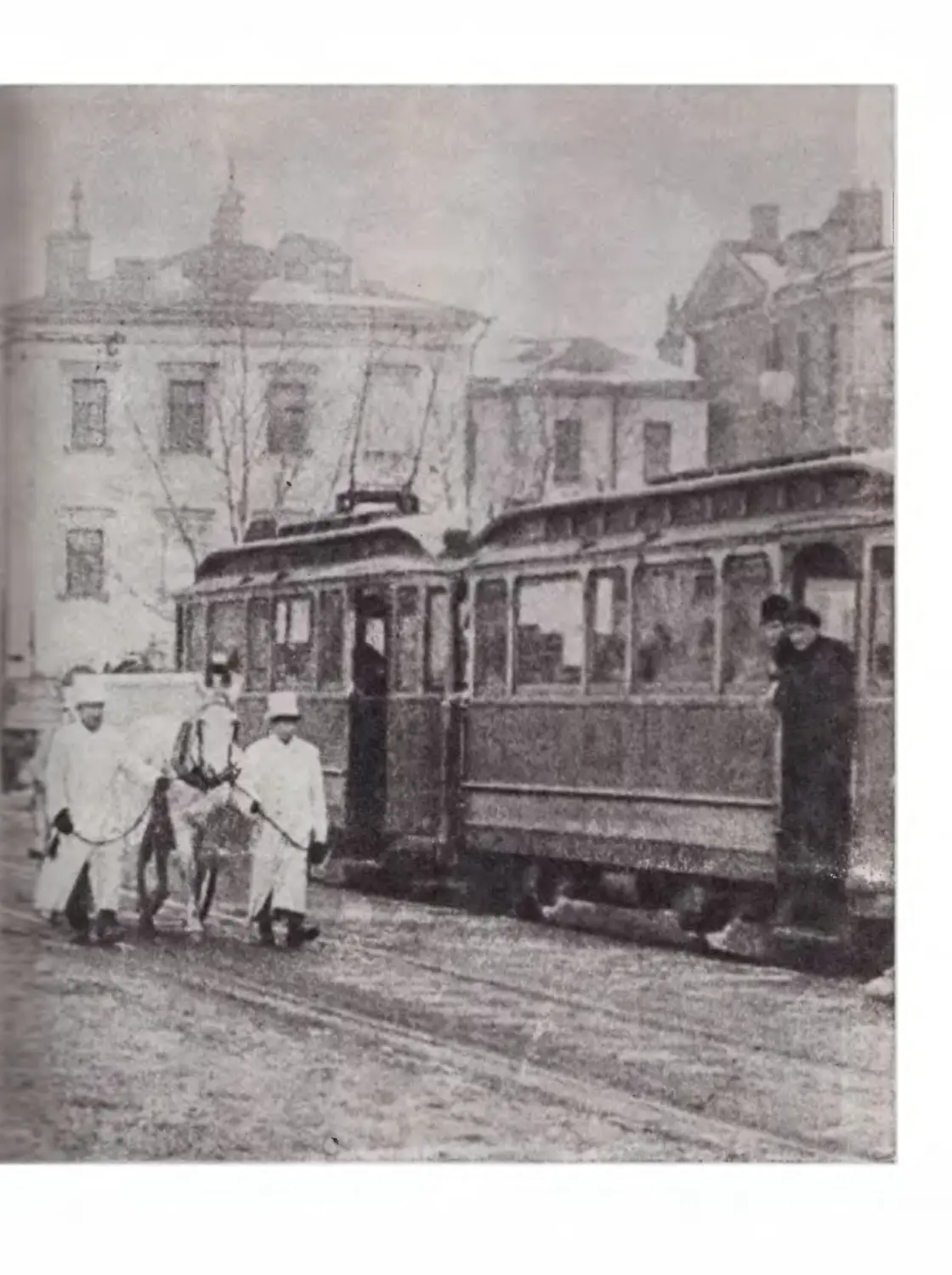
Г.Я.Лозгачев-Елизаров, присутствовавший на
похоронах М. Т. Елизарова, пишет в своих воспо¬
минаниях:
«Похоронная процессия медленно двигалась по
Расстанной улице, ведущей к воротам Волкова
кладбища. Следом за гробом шли, поддерживая
заплаканную и обессилевшую сестру, Владимир
Ильич и Мария Ильинична, двоюродные сестры,
близкие знакомые, друзья и сослуживцы покойно*
Г. М. Болтянский писал об этой съемке, что она
«была произведена в Петрограде 13 марта 1919
года. Это было на похоронах бывшего наркома
путей сообщений т. Елизарова. Съемки произво-
го. Я шел перед катафалком, неся большой венок
и не замечая кинооператоров, снимавших процес¬
сию.
...На кладбище, у открытой могилы, я не мог
стоять на месте, не знал, как себя держать.
Владимир Ильич, все время следивший за мной,
несколько раз нагибался ко мне и тихо увещевал,
чтобы я взял себя в руки».
Г.Лозгачев-Елизаров. Незабываемое, Саратов,
1966, стр. 189—190.
дились оператором Н.Ф.Григором. Это—только
эпизод. Ленин с опущенной головой идет в
процессии, сопровождающей гроб».
Г.М.Болтянский. Встречи. Из воспоминаний кинора¬
ботника.—Сб. «Ленин в зарисовках и воспоминаниях
художников», стр. 131.
129
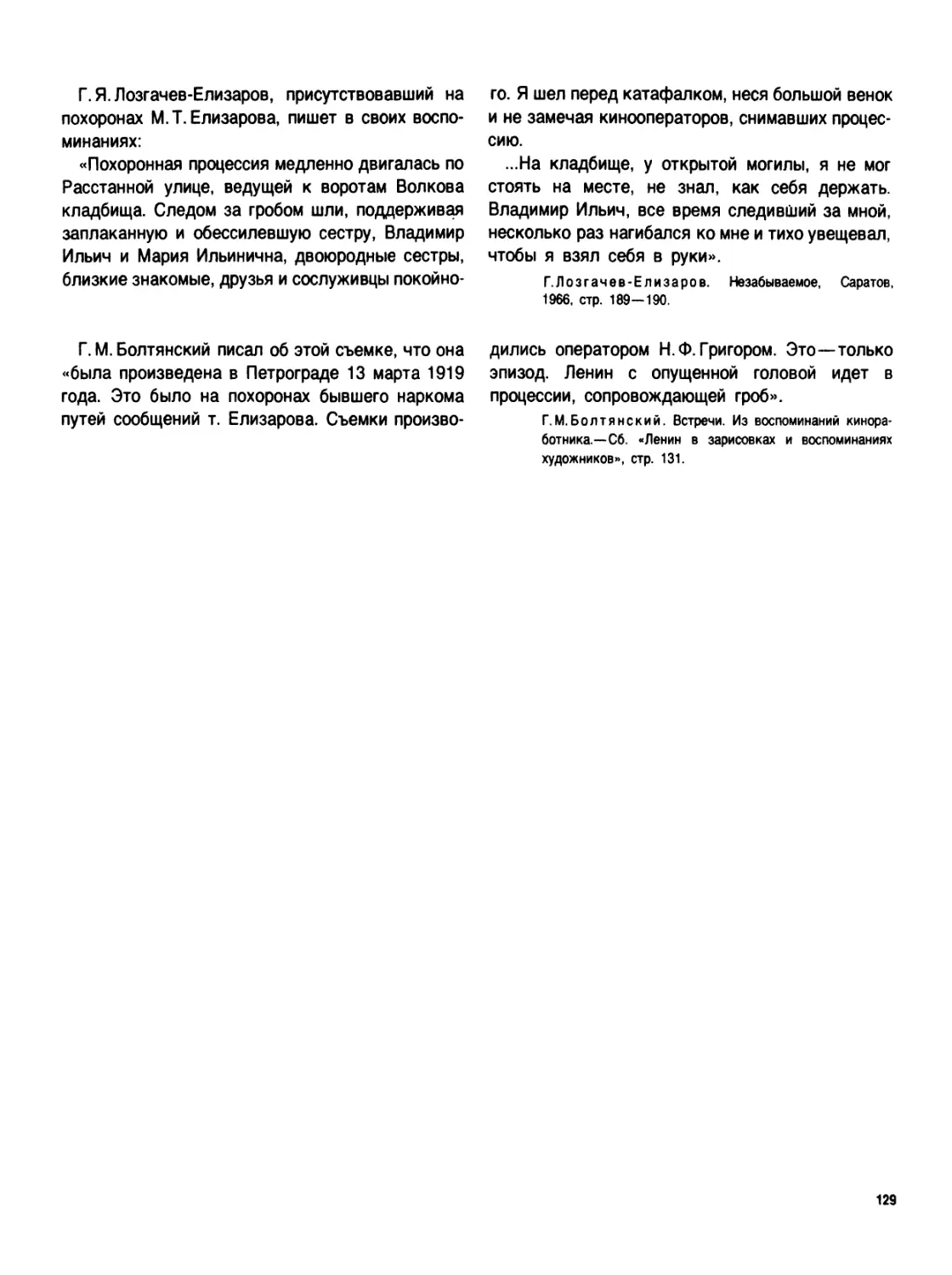
киносъемка 6
план 3
Ленин В. И. с товарищами несет гроб
с телом покойного Елизарова М. Т.
Негатив. Средний план. 2 м 12 к
В. И. Ленин запечатлен на 64 кадрах плана.
1
130
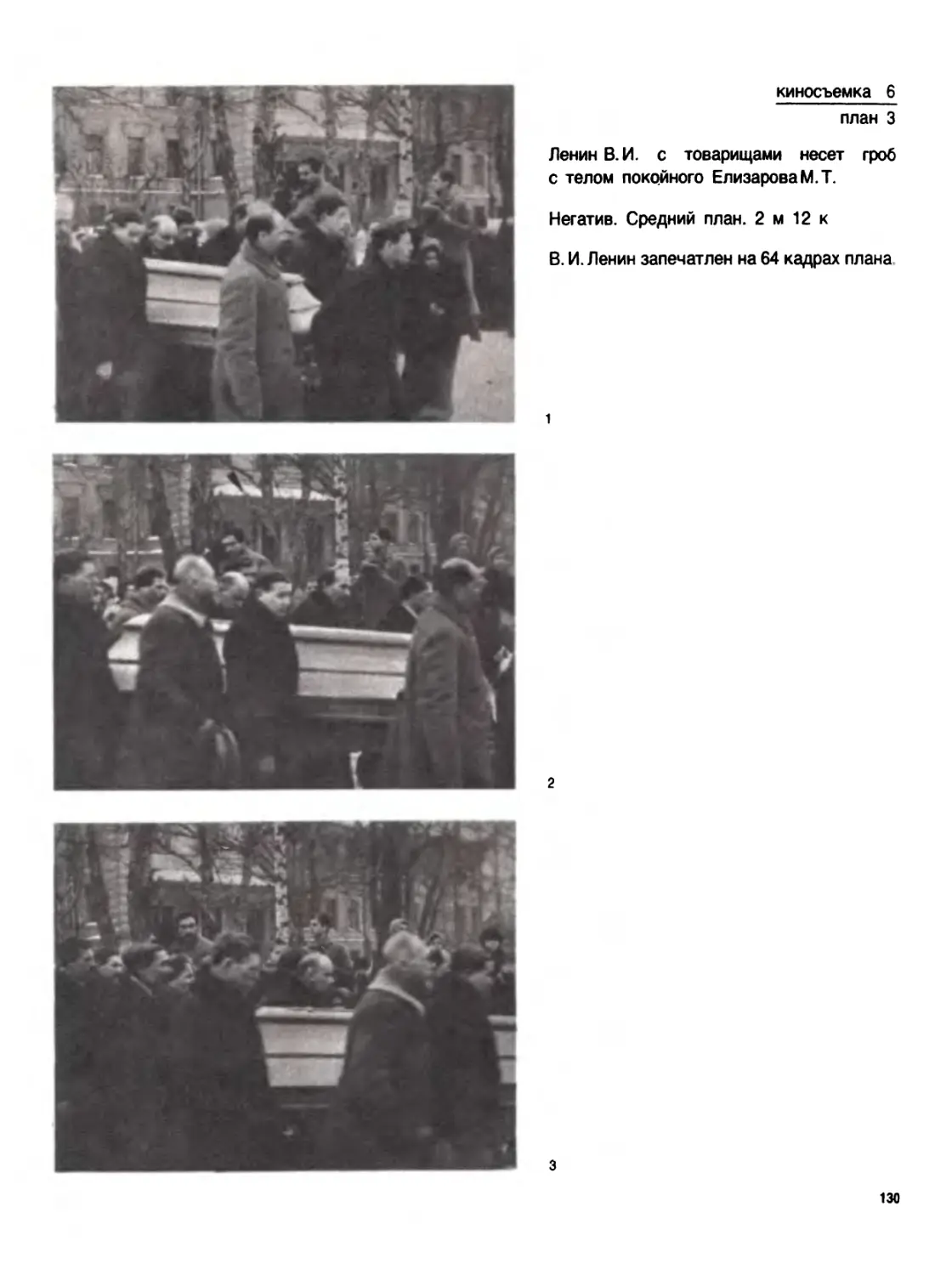
киносъемка 6
план 12
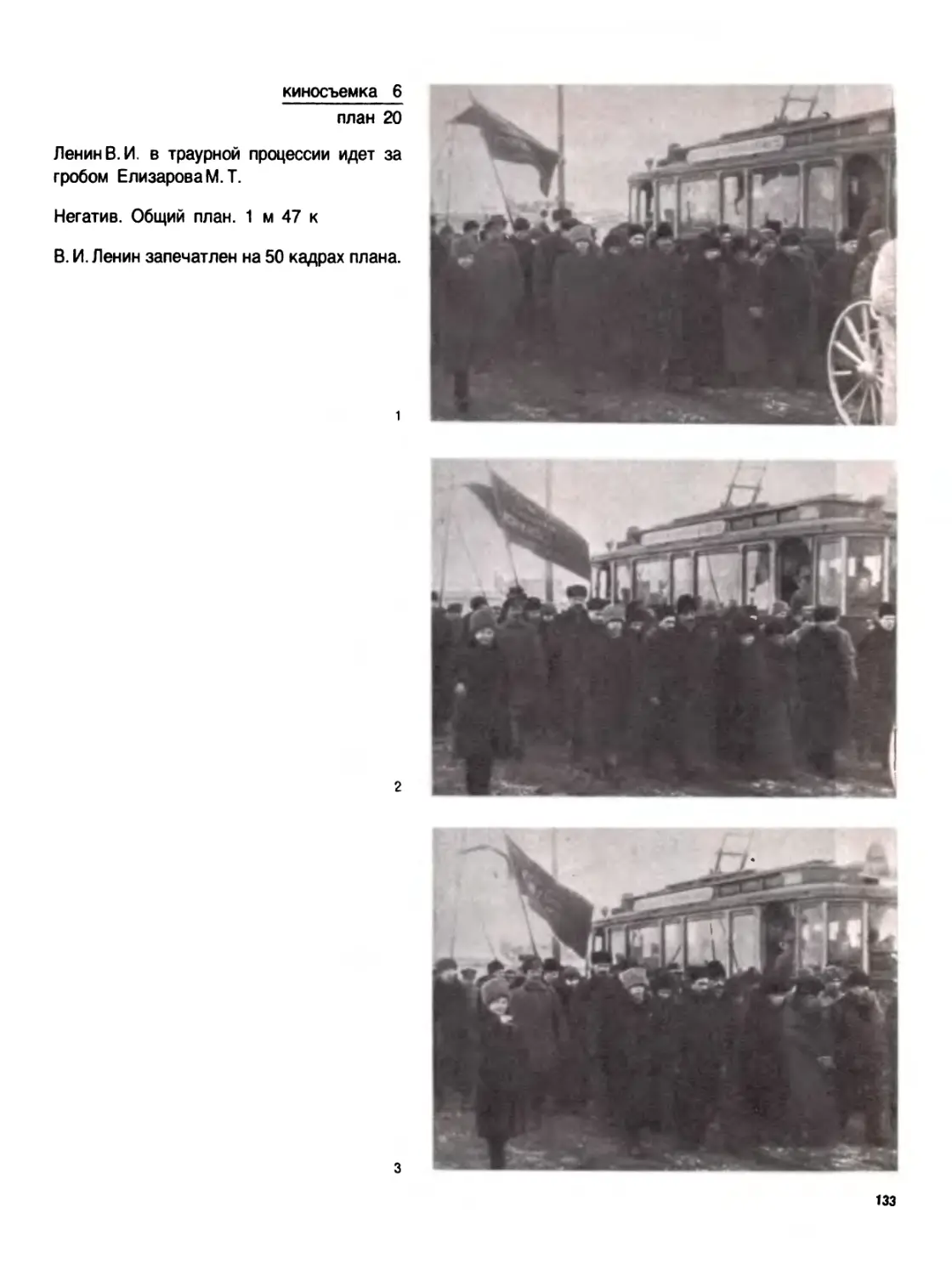
Ленин В. И. в траурной процессии идет за
гробом Елизарова М. Т.
Негатив. Средний план. 3 м 24 к
В. И. Ленин запечатлен на 97 кадрах плана.
г
131
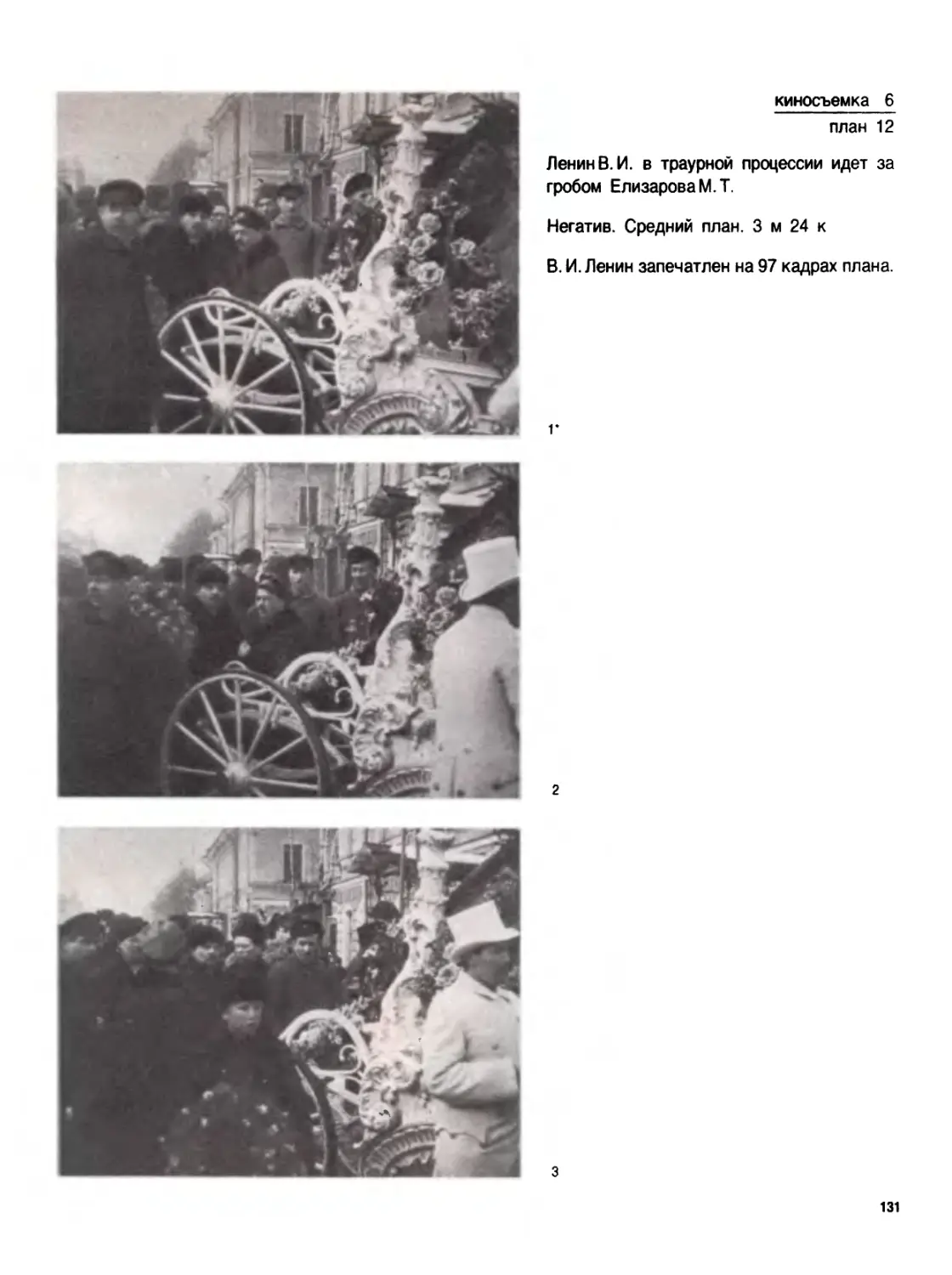
Фрагмент (кадр 1—6/12)
132
киносъемка 6
план 20
Ленин В. И. в траурной процессии идет за
гробом Елизарова М. Т.
Негатив. Общий план. 1 м 47 к
В. И. Ленин запечатлен на 50 кадрах плана.
1
2
133
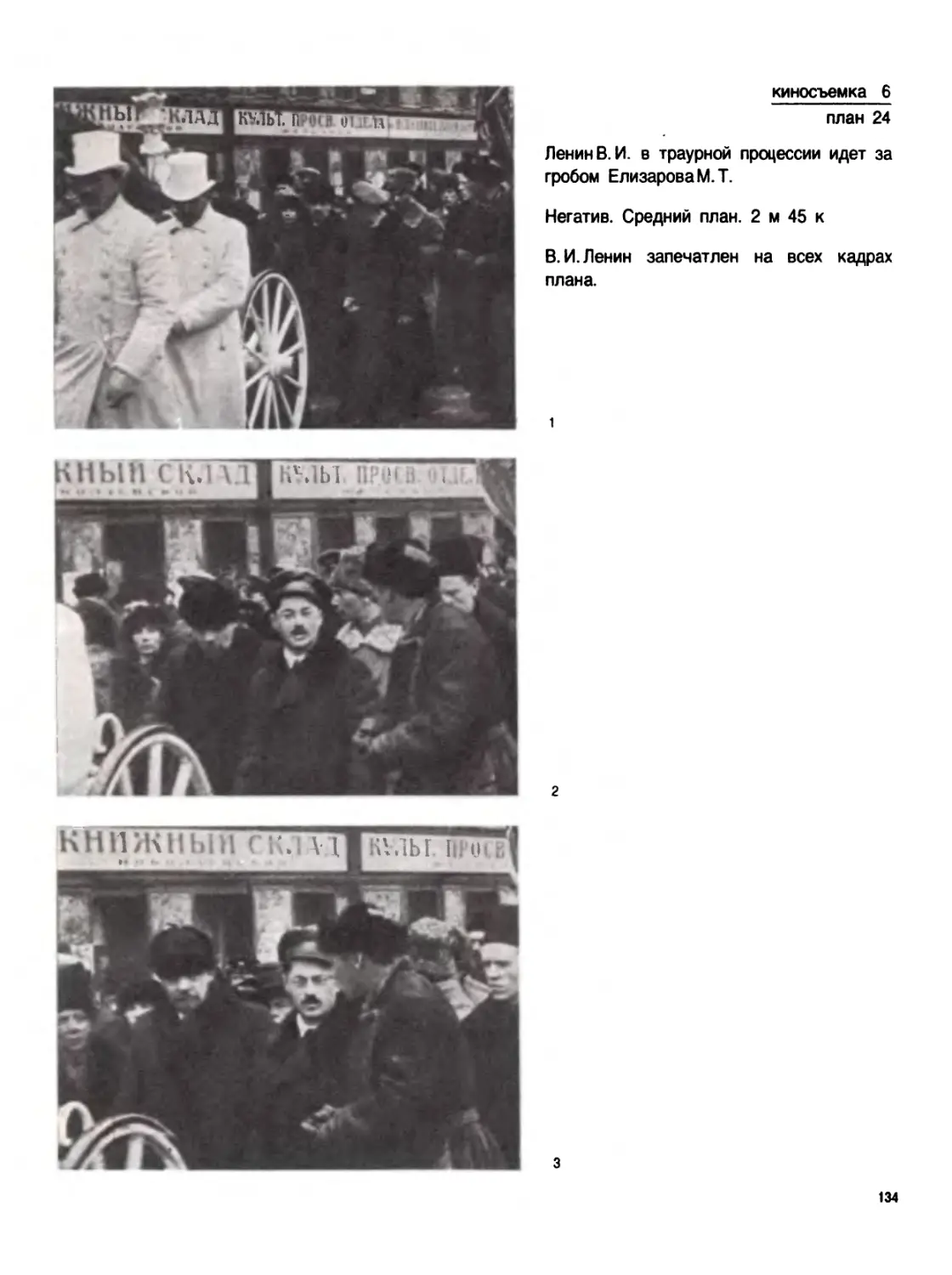
ДЛ1 НУЛЬТТПРОС^ШШ?
киносъемка 6
план 24
Ленин В. И. в траурной процессии идет за
гробом Елизарова М. Т.
Негатив. Средний план. 2 м 45 к
В. И. Ленин запечатлен на всех кадрах
плана.
1
2
3
кньш С
134
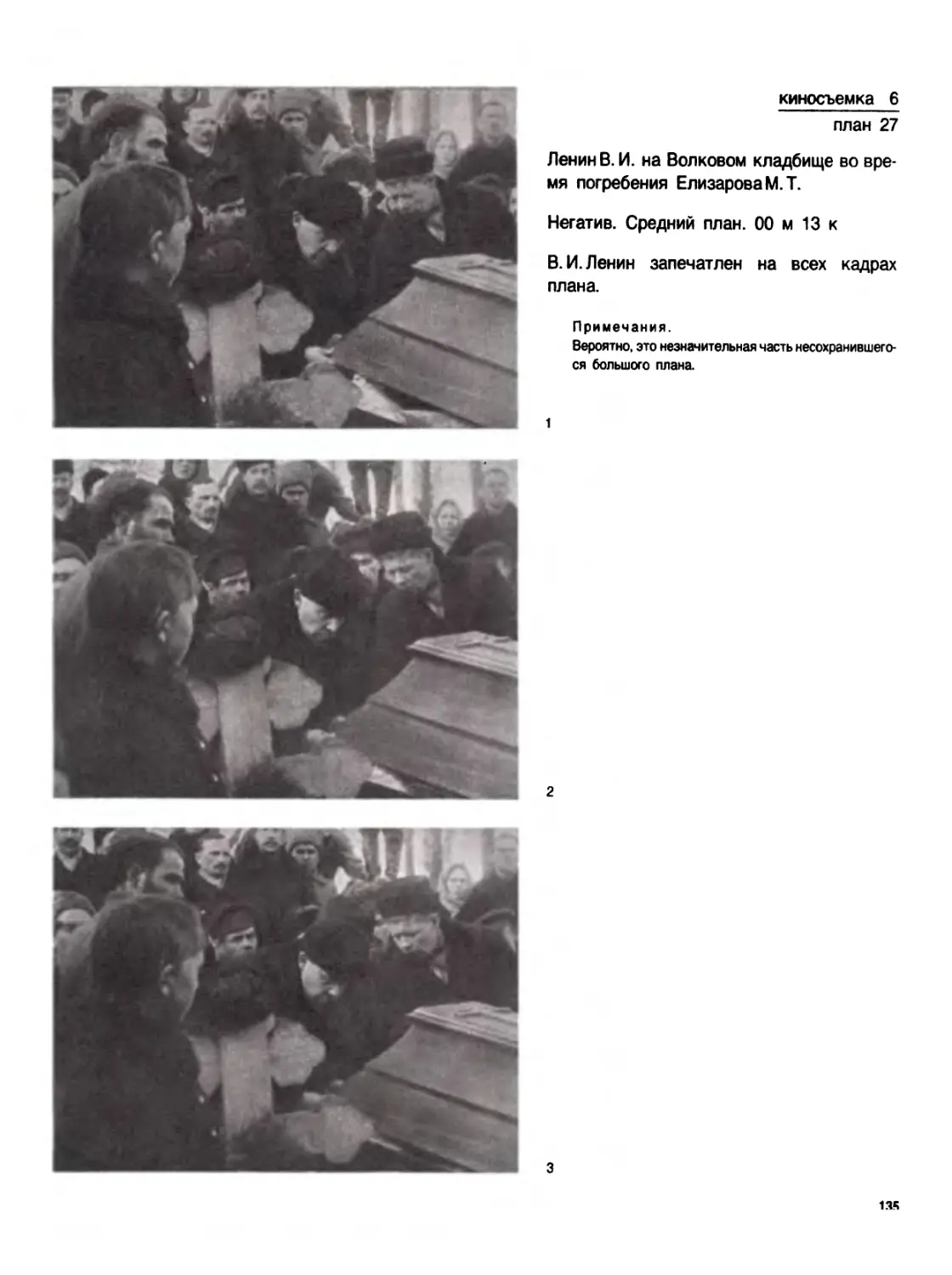
киносъемка 6
план 27
Ленин В. И. на Волковом кладбище во вре¬
мя погребения Елизарова М. Т.
Негатив. Средний план. 00 м 13 к
В. И. Ленин запечатлен на всех кадрах
плана.
Примечания.
Вероятно, это незначительная часть несохранившего-
ся большого плана.
1
2
3
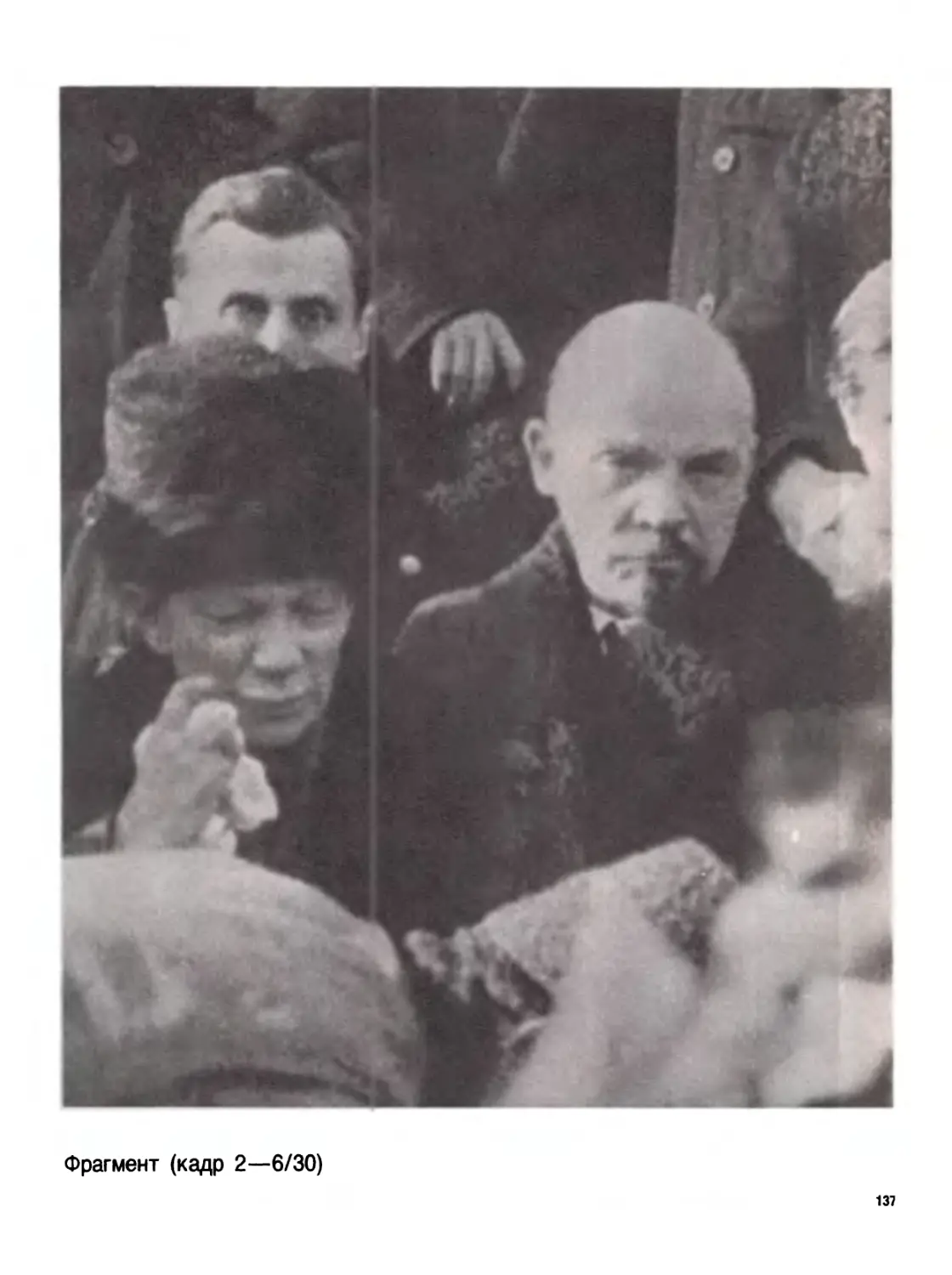
киносъемка 6
план 30
Ленин В. И. на Волковом кладбище во вре¬
мя погребения Елизарова М. Т.
Негатив. Средний план. 1 м 01 к
В. И. Ленин запечатлен на всех кадрах
плана.
1
2*
3
136
Фрагмент (кадр 2—6/30)
137
киносъемка 6
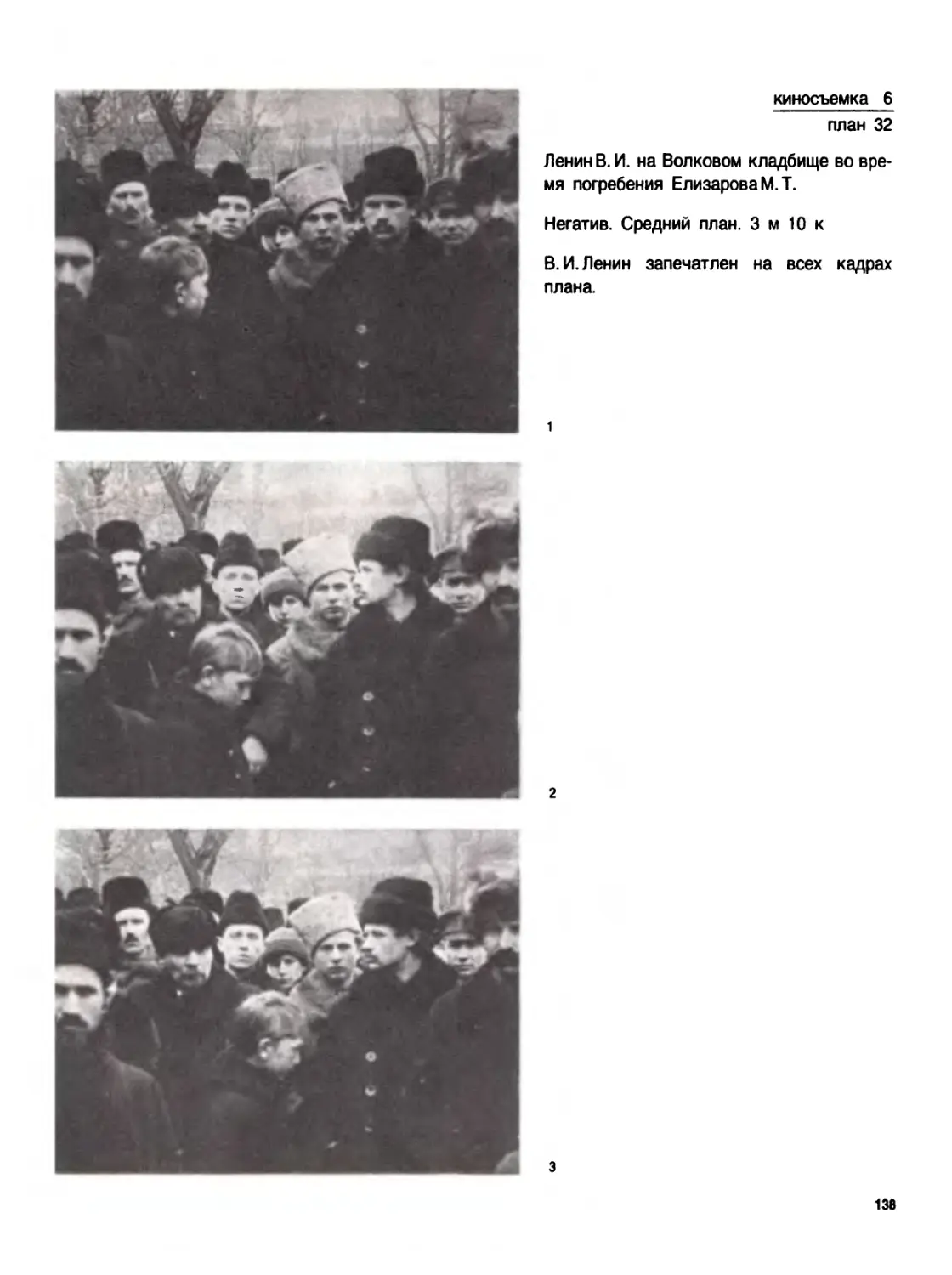
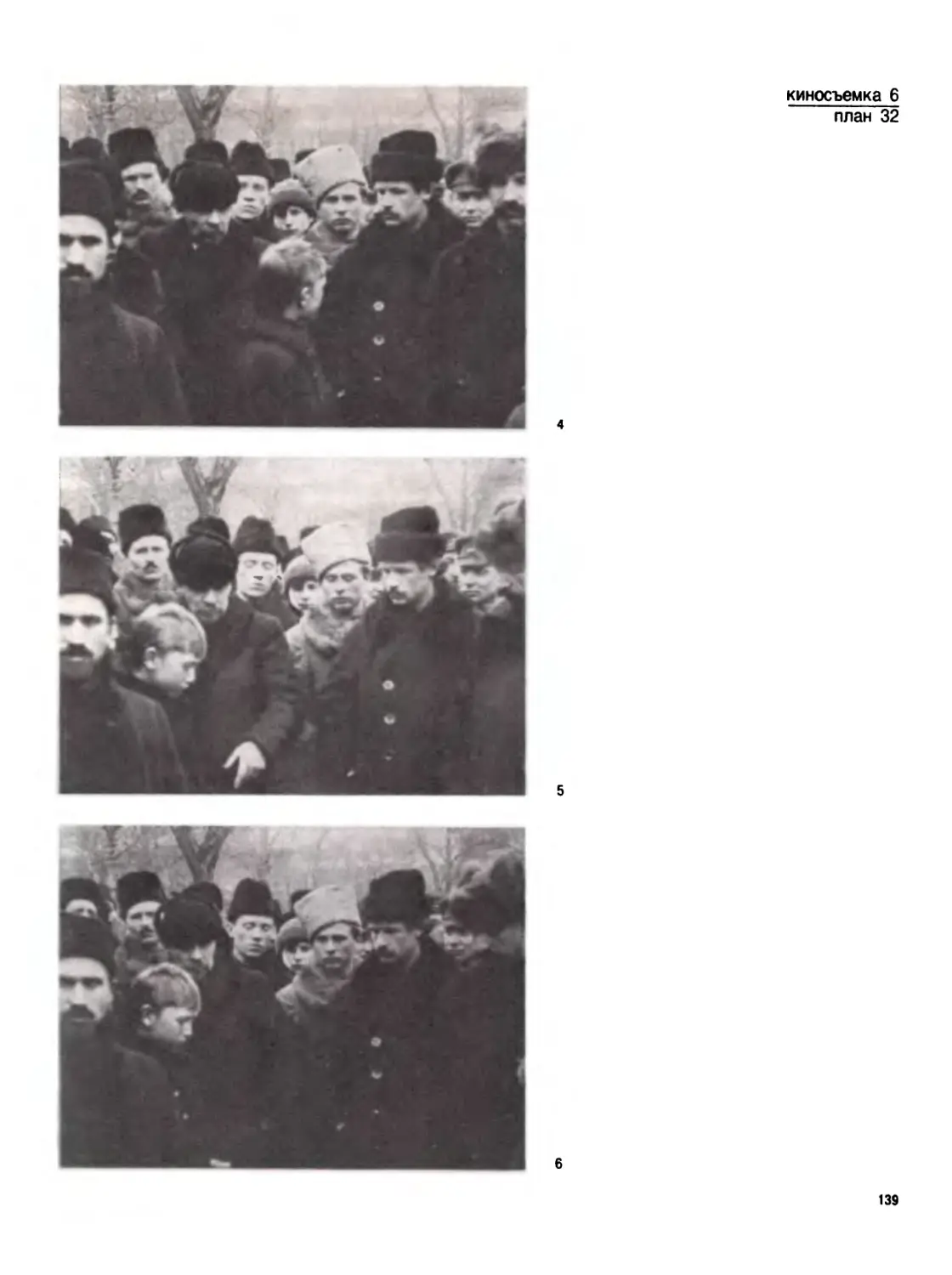
план 32
Ленин В. И. на Волковом кладбище во вре¬
мя погребения Елизарова М. Т.
Негатив. Средний план. 3 м 10 к
В. И. Ленин запечатлен на всех кадрах
плана.
138
киносъемка
7
Ленин В. И. на похоронах Свердлова Я. М. на Красной
площади.
1919 г., 18 марта. Москва.
Операторы:
ГиберГ. В., ЗабозлаевС.П., Левицкий А. А., Новицкий П. К., ТиссэЭ.К.*
Первый выход на экран:
Выпуск кинохроники «Похороны Свердлова», 1919 год.
Обоснование даты:
18 марта 1919 года В. И. Ленин выступает на заседании ВЦИК, посвященном памяти
Я. М. Свердлова. По окончании заседания вместе с членами ВЦИК направляется в
Колонный зал Дома Союзов, стоит в почетном карауле, а затем с похоронной
процессией следует на Красную площадь, где произносит роль над могилой
Я. М. Свердлова—См.: В. И. Ленин. Полн. собр. соч., т. 38г стр. 523.
«Один за другим выносят из зала Дома Союзов длинную вереницу венков. Члены
ВЦИК подходят к гробу. В числе несущих гроб—т. Ленин».—Газ. «Вечерние
известия Московского Совета рабочих и красноармейских депутатов», № 196, 19
марта 1919 г., стр. 3.
«Место могиле отведено у самой стены Кремля...
На возвышении появляется тов. Ленин, и его голос явственно раздается по всей
площади. Вождь революции призывает всех пришедших почтить память неутомимо¬
го и блестящего организатора, павшего на своем боевом посту, дать обещание
продолжить то трудное дело, которое начал Я. М. Свердлов».—«Правда», № 60,
20 марта 1919 г., стр. 4.
Примечания.
Сохранилось 99,8 метра пленки—39 планов. На 9 планах—запечатлен В. И. Ленин.
Часть кинокадров этой съемки была обнаружена в 1948 году в Государственном кинофотоархиве СССР
кинорежиссером М.И.Роммом, при просмотре и отборе материала для фильма «В.И.Ленин>* /ЦГАЛИ, ф. 2057,
on. I, ед. хр. 388/.
* Долгое время считалось, что авторами этой съемки были операторы П. К. Новицкий и Э.К.Тиссэ
Исследованиями советских историков уточнено, что съемка похорон Я. М. Свердлова осуществлялась ВФКО
под руководством В.Р.Гардина и что кроме П.К.Новицкого и Э.К.Тиссэ в тот день снимали операторы
Г.В. Гибер, С.П. Забозлаев и A.A. Левицкий.—См.: В. Листов. Строка кинолетописи.—«Известия», № 94.
20 апреля 1967 г., стр. 3.
142
«По-зимнему одетый Владимир Ильич нетороп¬
ливо вошел на возвышение и потом долго-долго
глядел на площадь, на которой царила непривыч¬
ная тишина. От края до края была она заполнена
людьми. Скорбное молчание. То и дело взбегав¬
ший ветер колыхал траурные стяги. Люди стояли,
словно прислушиваясь к тишине, в которой четко
и строго—на всю площадь—прозвучали произне¬
сенные Лениным первые слова ныне всем изве¬
стной речи «Памяти Якова Михайловича Сверд¬
лова»...
Оператор есть оператор. Вглядываясь во все и
прислушиваясь ко всему, я все-таки не имел права
забывать, что мне надо фиксировать на пленке
это событие. Сначала я снял ряд планов на самой
площади, потом стал пробираться ближе к возвы¬
шению, с которого произносил речь В. И. Ленин.
Удалось расположить аппарат довольно близко и
запечатлеть Ильича на ряде крупных планов на
фоне кремлевской стены и большой массы
народа».
Э.Тиссэ. Живой Ильич—на экране—Журн. «Неман».
1961. №2, стр. 125-126.
143
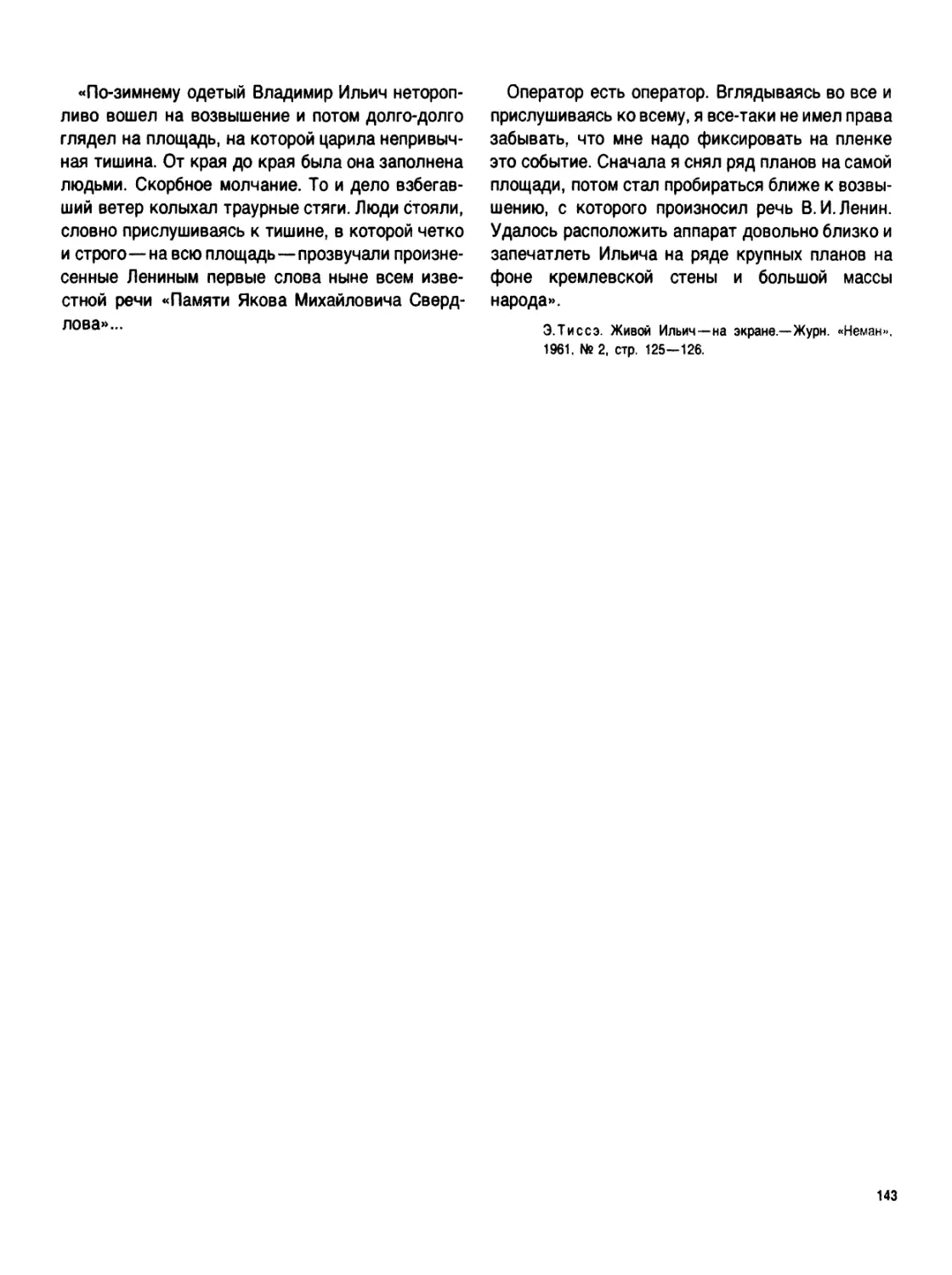
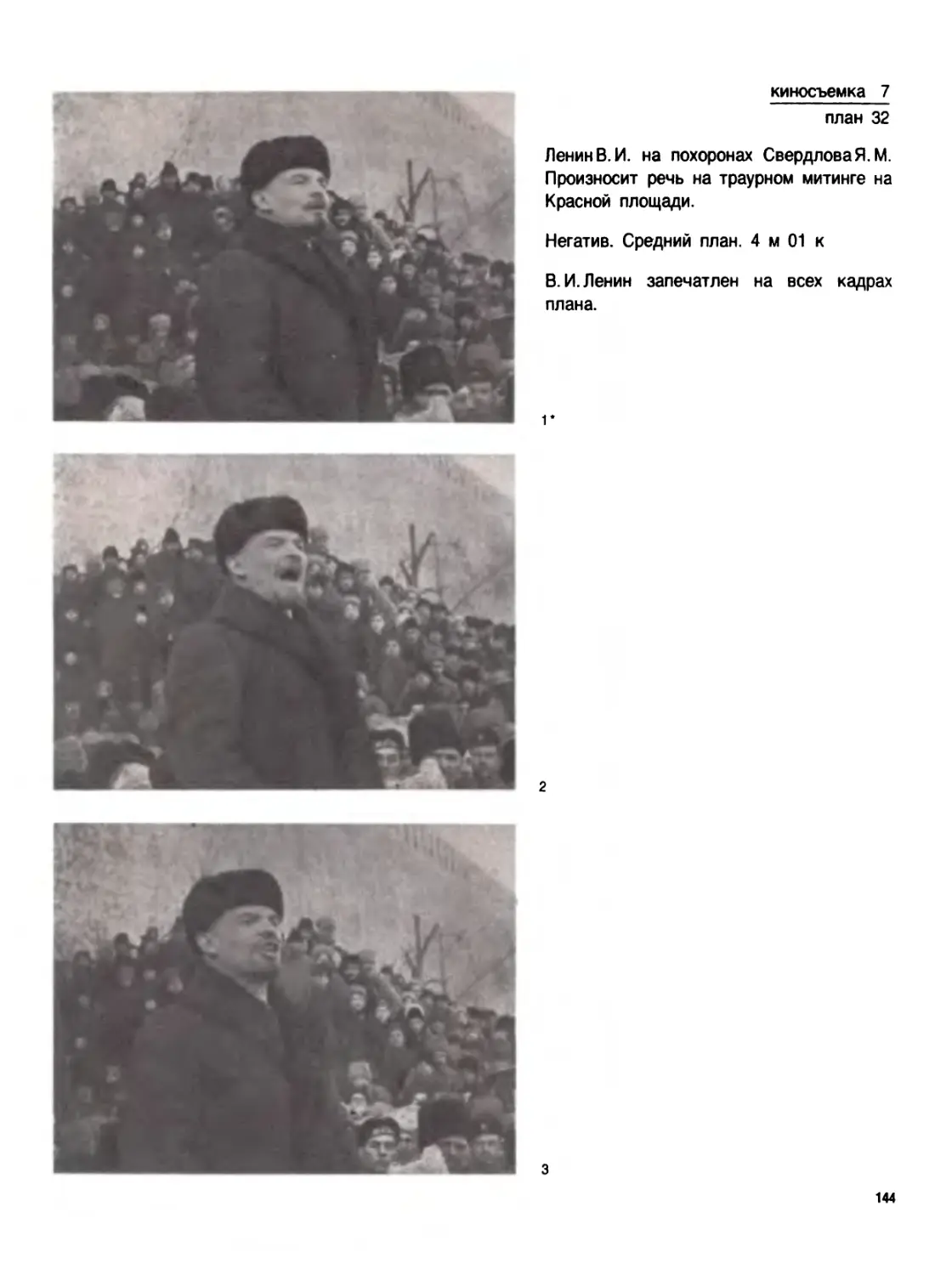
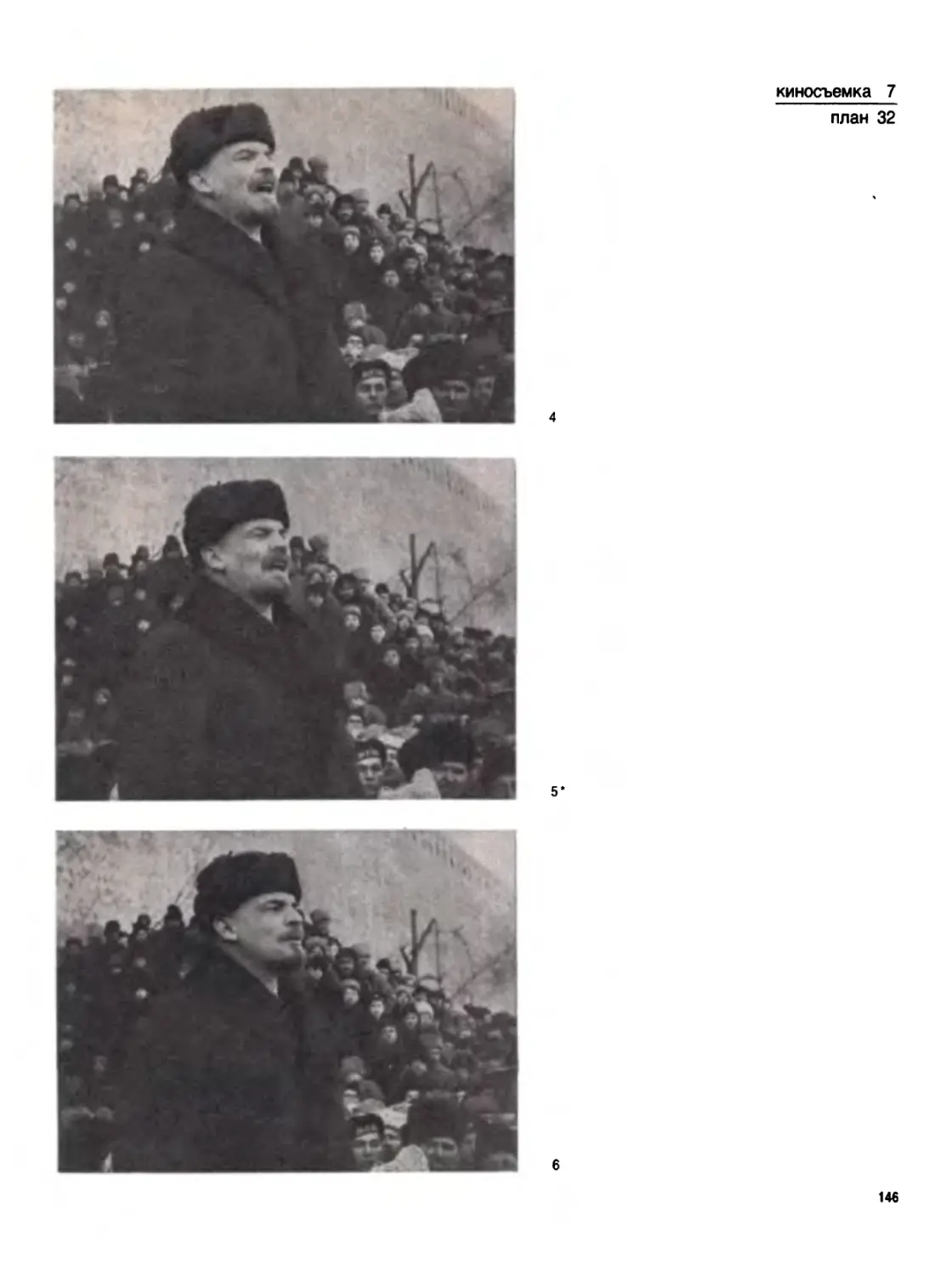
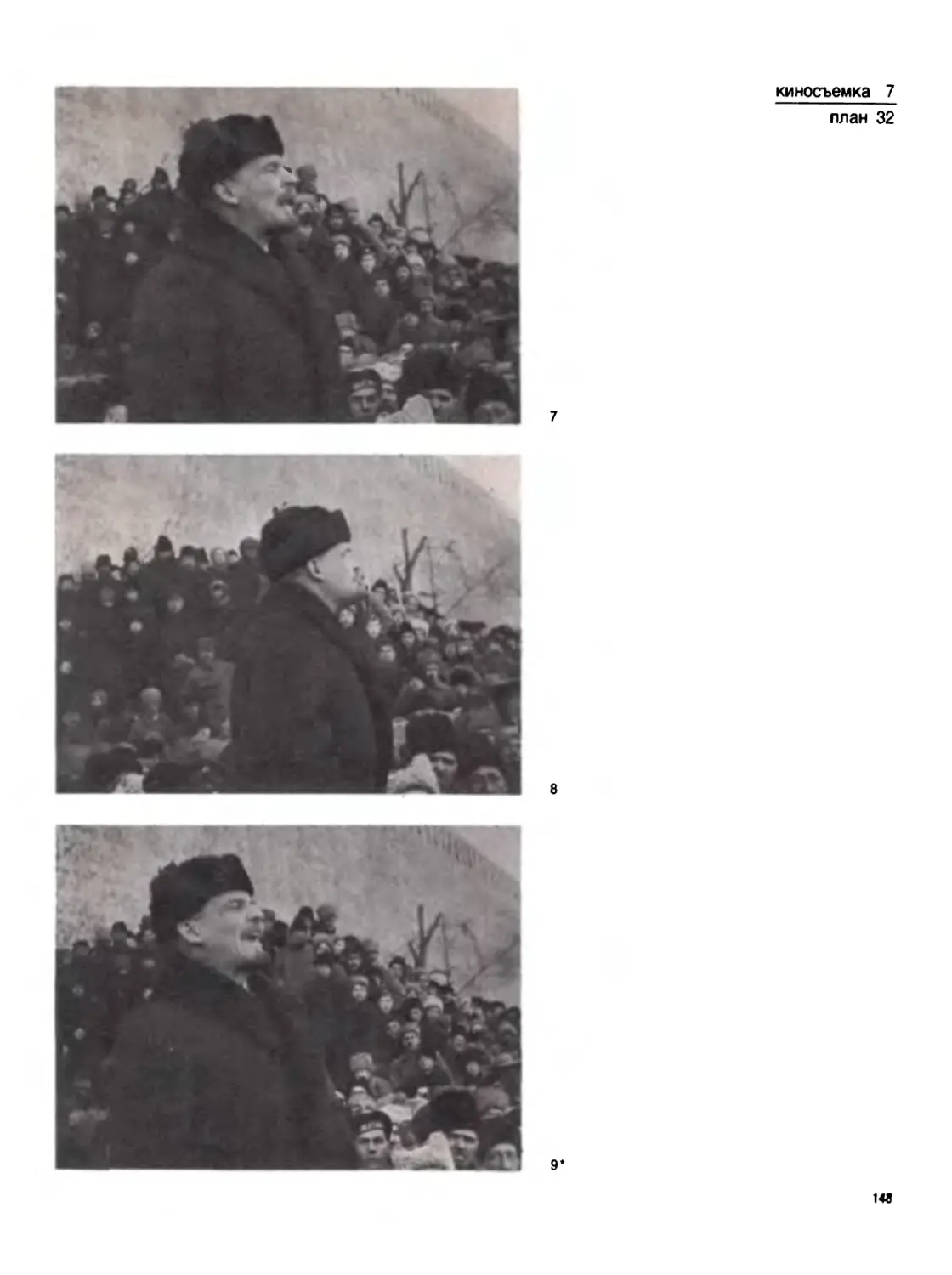
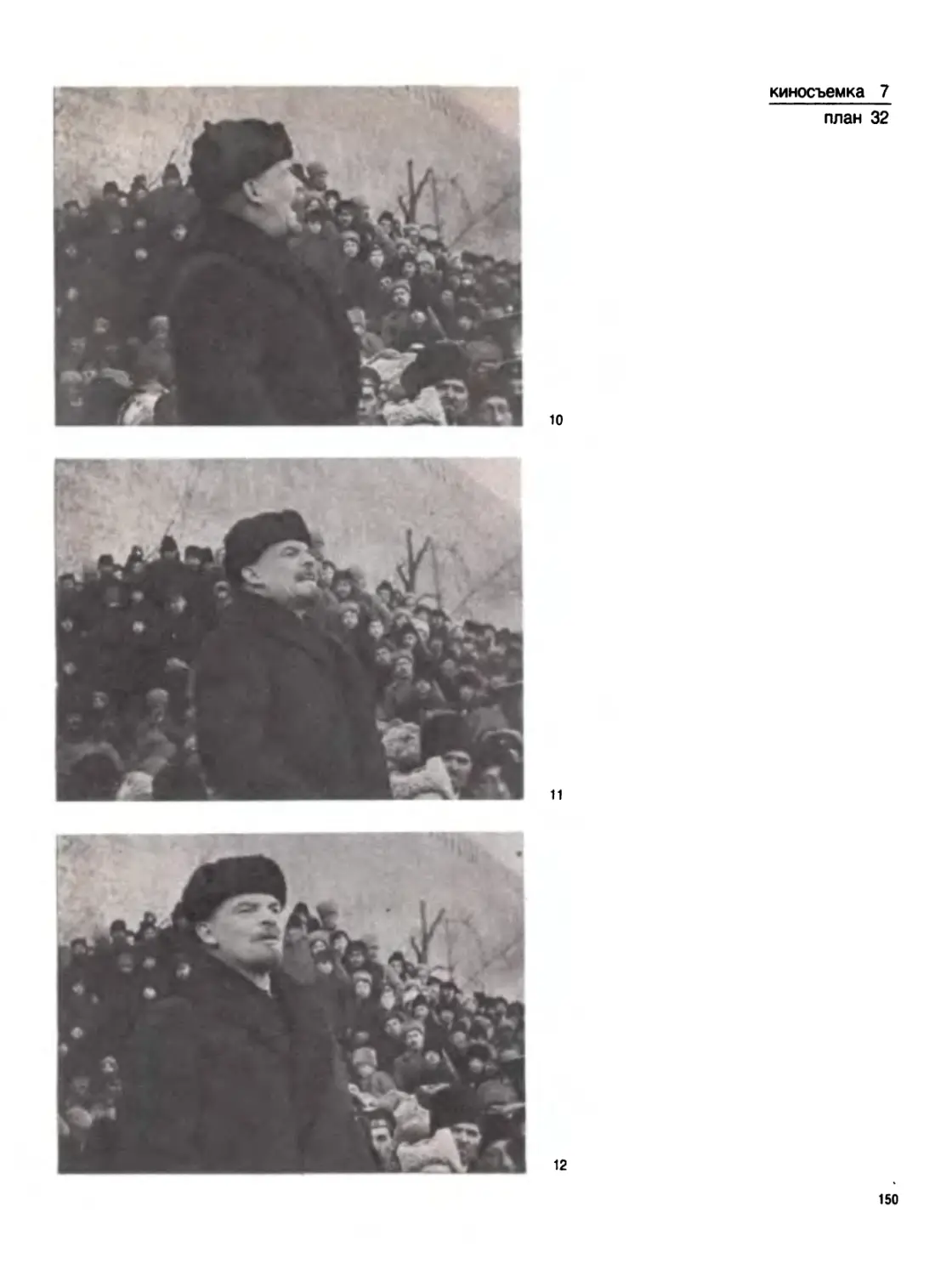
киносъемка 7
план 32
Ленин В. И. на похоронах СвердловаЯ.М.
Произносит речь на траурном митинге на
Красной площади.
Негатив. Средний план. 4 м 01 к
В. И. Ленин запечатлен на всех кадрах
плана.
г
2
144
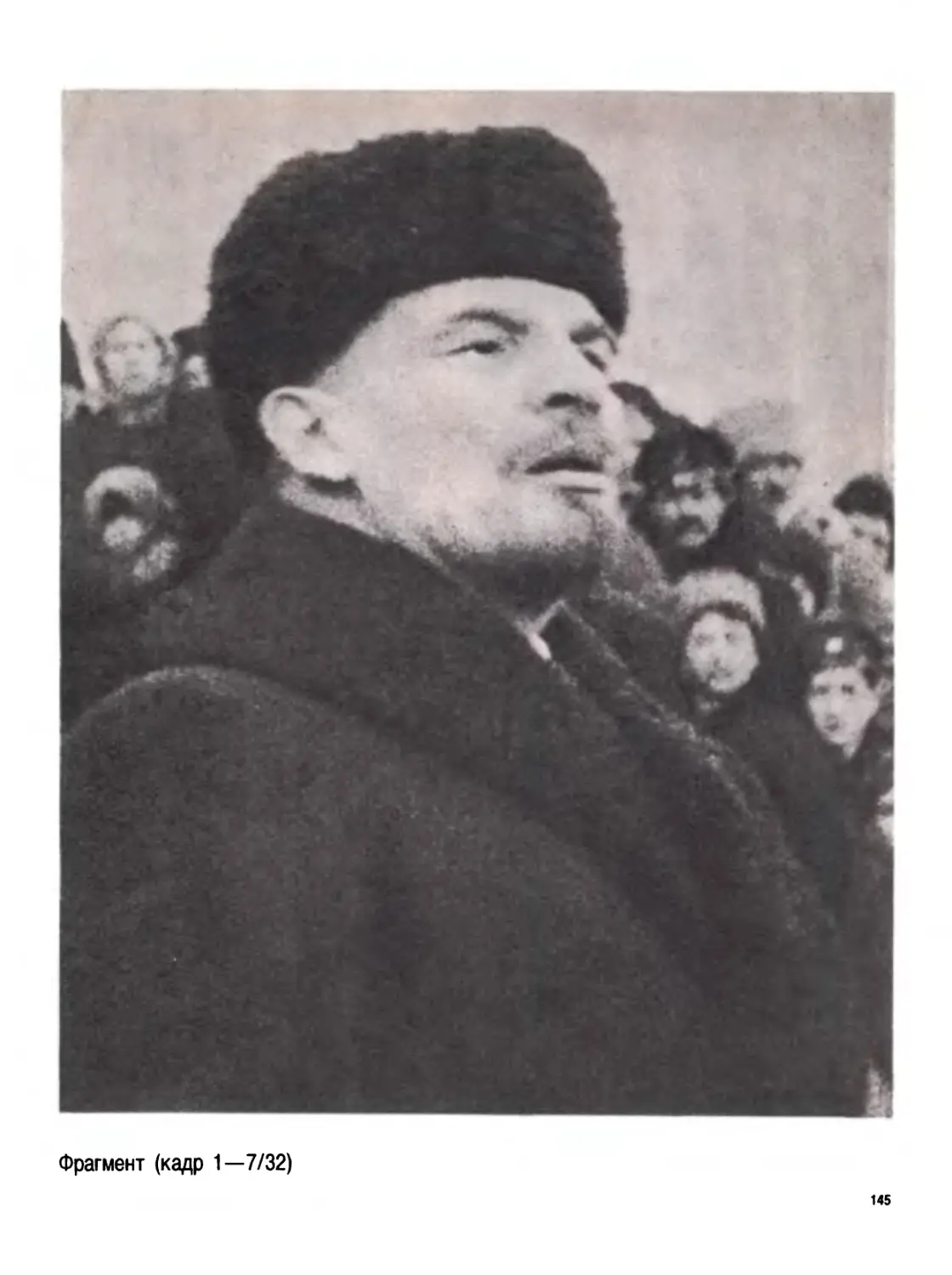
Фрагмент (кадр 1—7/32)
145
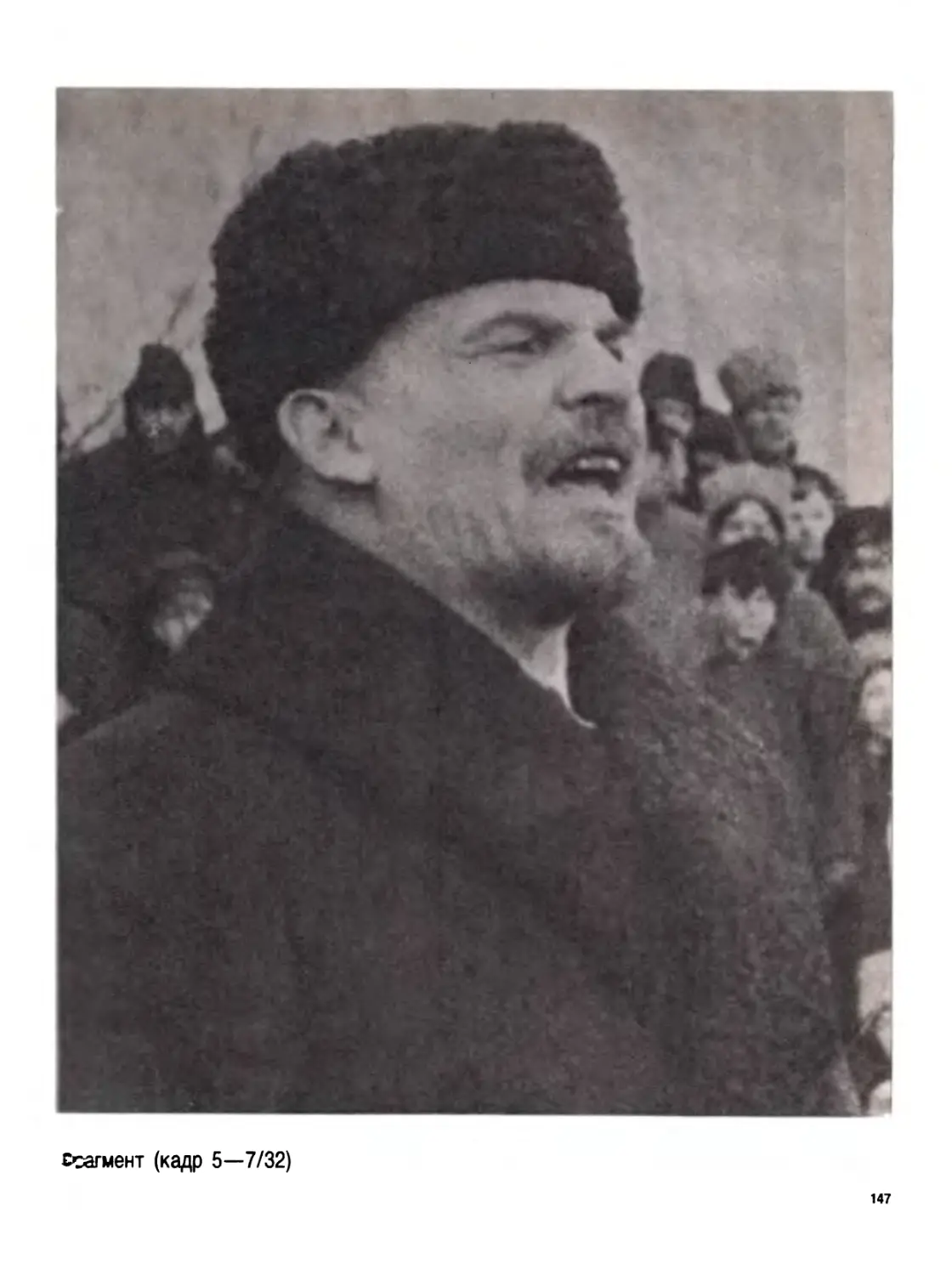
Ссагмент (кадр 5—7/32)
147
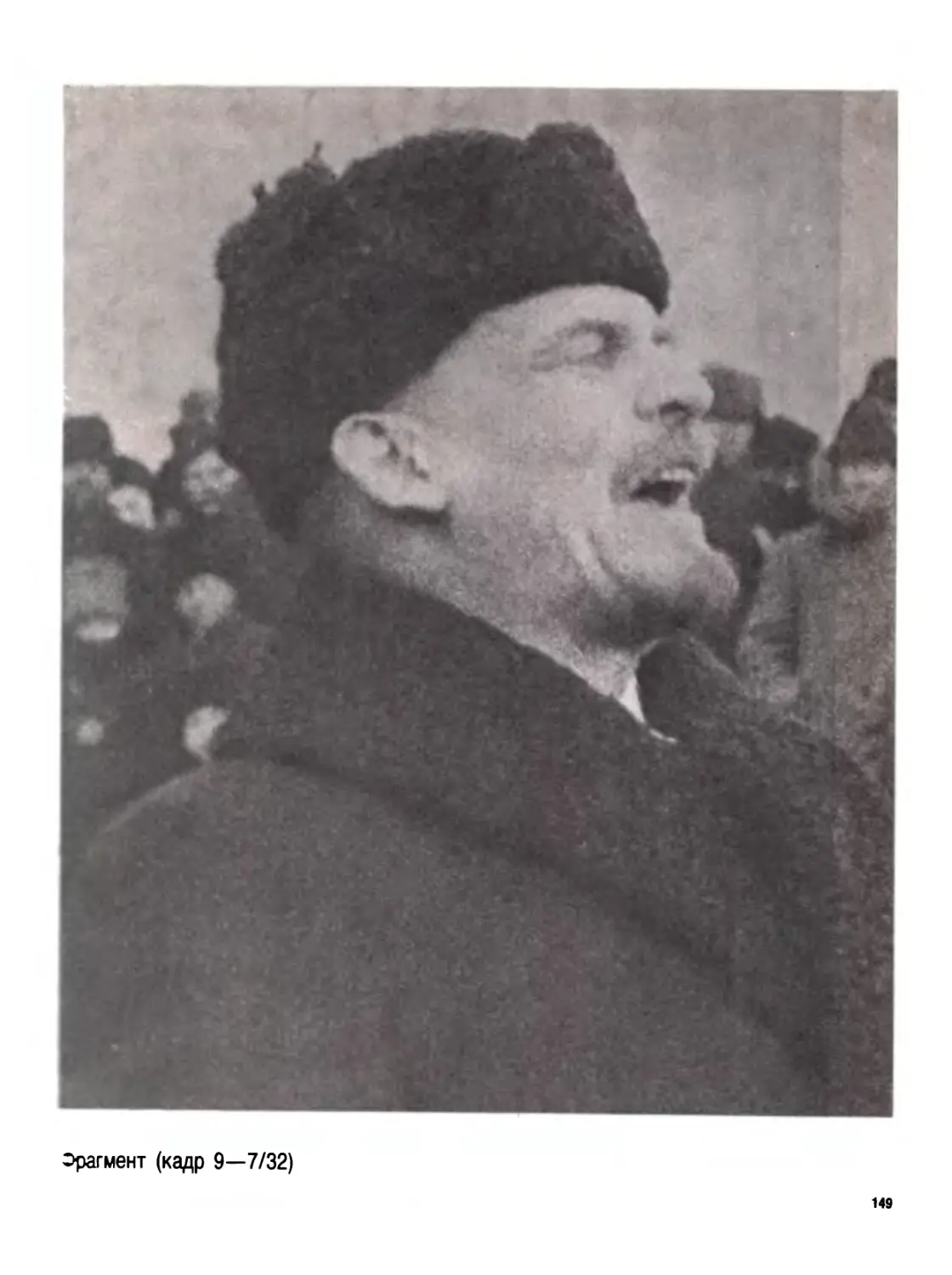
фрагмент (кадр 9—7/32)
149
киносъемка 7
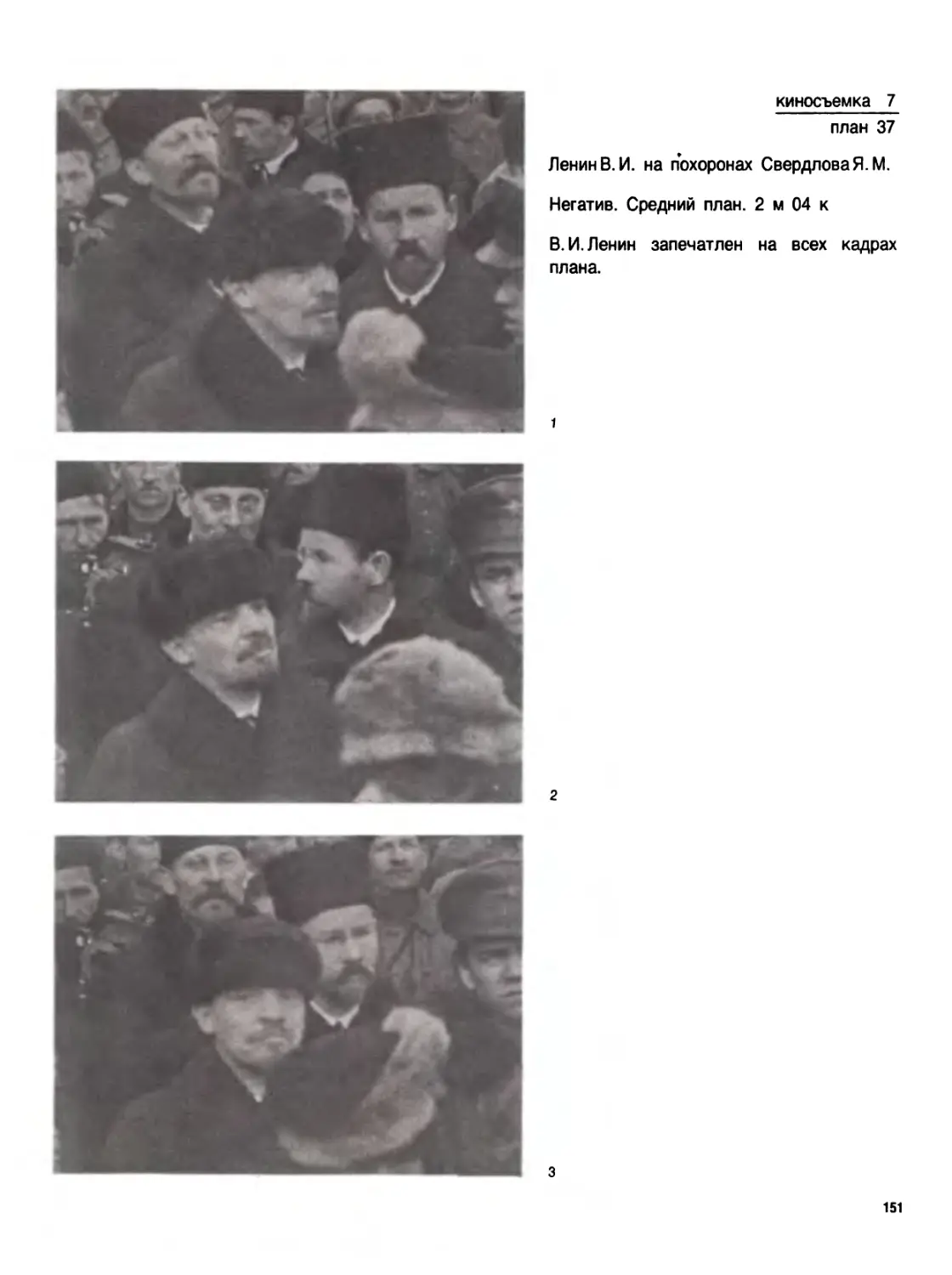
план 37
Ленин В. И. на похоронах Свердлова Я. М.
Негатив. Средний план. 2 м 04 к
В. И. Ленин запечатлен на всех кадрах
плана.
1
151
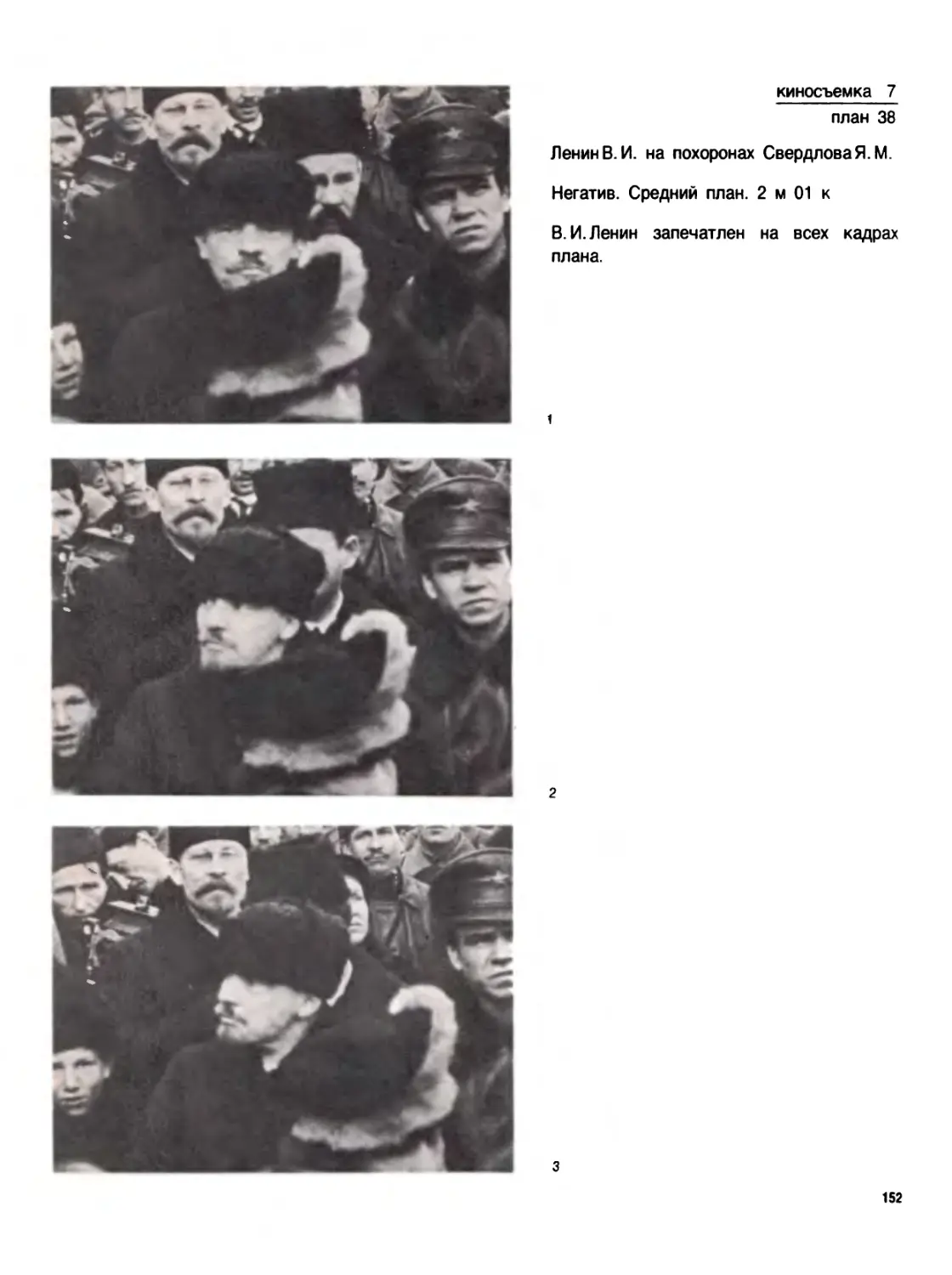
киносъемка 7
план 38
Ленин В. И. на похоронах СвердловаЯ.М.
Негатив. Средний план. 2 м 01 к
В. И. Ленин запечатлен на всех кадрах
плана.
1
2
152
153
киносъемка
8
Ленин В. И. на Красной площади в день Международно¬
го праздника 1 Мая.
1919 г., 1 мая. Москва.
Операторы:
ГиберГ. В., Левицкий А. А., ТиссэЭ. К.
Первый выход на экран:
Выпуск кинохроники «Первомайские торжества в Москве», 1919 год.
Обоснование даты:
1 мая 1919 года В. И. Ленин присутствует на первомайском параде и демонстрации
на Красной площади, трижды выступает перед демонстрантами: два раза с речами
о 1 Мая, а затем—с речью, посвященной открытию памятника Степану
Разину.—См.: В.И.Ленин. Полн. собр. соч., т. 38, стр. 545.
«Любимого вождя встречают восторженными приветствиями. Начинают громоз¬
диться фотографы и кинооператоры, работающие на историю.
Около часу дня на Красной площади начинаются митинги. Владимир Ильич,
сопровождаемый красными конными «гусарами», переходит с трибуны на трибуну.
Клики восторга, несмолкаемое «ура» сопровождают великого вождя. .
Приветливо улыбаясь, облитый народной любовью, т. Ленин поднимается на
каждую трибуну и произносит краткую речь, посвященную первомайскому
празднику...».—Газ. «Вечерние известия Московского Совета рабочих и красноар¬
мейских депутатов», № 230, 2 мая 1919 г., стр. 3.
Примечания.
Сохранилось 4,2 метра пленки—4 плана. На 3 планах—запечатлен В. И. Ленин.
Кадры, запечатлевшие В. И. Ленина в автомашине, были включены в одиннадцатый сюжет «Кинолравды»,
№ 19—«В. И. Ленин при жизни».
156
«...Красная площадь залита ярким весенним
солнцем. Толпы народа. Колесницы, наполненные
детьми рабочих районов в ярких костюмах весен¬
них цветов, ряды Красных войск, рабочие колон¬
ны сливаются в одно могучее пестрое море, над
которым колышутся гордые пролетарские
знамена.
Словно электрический ток пробегает по толпе...
«Мне посчастливилось стоять довольно близко
к трибуне. Снова я снял ряд средних планов, на
которых запечатлено выступление Ильича... В тот
день на Красной площади мы работали втроем —
Левицкий, Гибер и я. Александру Левицкому тоже
Долгое время ошибочно считалось, что кадры,
запечатлевшие В. И. Ленина в автомашине, сняты
во время поездки В.И.Ленина на Рублевскую
водокачку, к рублевским рабочим.
Изучение фотографий и документов позволило
установить, что кадры эти относятся к съемке
1 мая 1919 года на Красной площади (планы 3 и 4).
Особенно помог найденный недавно фотосни¬
мок (он хранится в Центральном партийном
архиве ИМЛ*), на котором В. И. Ленин сфотогра¬
фирован в этом же автомобиле. Правда, на
снимке лицо Владимира Ильича наполовину за¬
крывает украшающий автомобиль флажок. Но
Это на трибуне появляется т. Ленин, встреченный
гулом приветственных голосов. Все тянутся впе¬
ред, чтобы не пропустить ни одного слова своего
вождя. А он, приветствуя праздничный пролетари¬
ат, просто и ясно говорит о той светлой и завидной
жизни, к которой мы и наши дети придем через
путь пролетарской борьбы и тяжелых испыта¬
ний...».
Газ. «Беднота». (М.), № 321, 3 мая 1919 г., стр. 4.
удалось зафиксировать ряд выразительных кад¬
ров, на которых запечатлен Владимир Ильич. Все,
очевидно, помнят, как на экране виден Ленин в
группе своих товарищей: он идет, весело беседуя
с кем-то, непосредственный и открытый людям».
Э.Тиссэ. Живой Ильич—на экране.—Журн. «Неман»,
1961, № 2. стр. 126—127.
одежда Владимира Ильича и многие детали те же,
что и на кинокадрах. Этот фотоснимок сделан с
другой точки и на нем за автомобилем четко
видна зубчатая кремлевская стена. Пышная зе¬
лень на кинокадрах оказалась декоративными
деревьями, установленными по бокам трибуны.
Это без особого труда удалось установить по
другой фотографии общего плана Красной площа¬
ди. На ней хорошо видна трибуна и выступающий
В. И. Ленин. По бокам трибуны видны круглые
шапки пышной листвы, а правее и левее—голые
ветви деревьев, растущих вдоль кремлевской
стены.
* ЦПА ИМЛ, ф. 393, оп. 1, ед. хр. 381.
157
киносъемка 8
план 1
Ленин В. И. на Красной площади в день
Международного праздника 1 Мая. Произ¬
носит речь с трибуны у кремлевской стены.
Негатив. Средний план. 1 м 10 к
В. И. Ленин запечатлен на всех кадрах
плана.
1
2
3
158
киносъемка 8
план 1
4
5
6
159
киносъемка 8
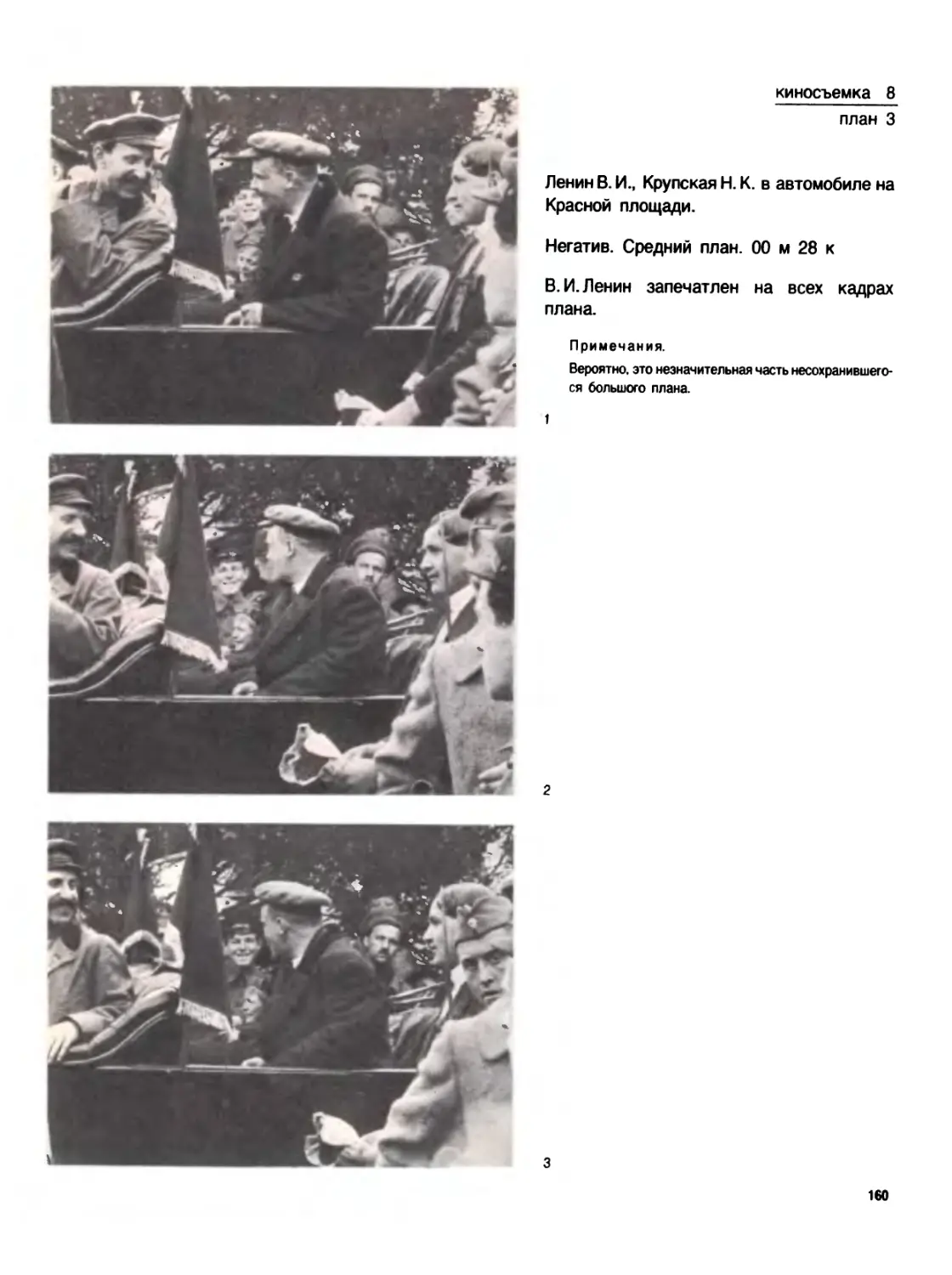
план 3
Ленин В. И., Крупская Н. К. в автомобиле на
Красной площади.
Негатив. Средний план. 00 м 28 к
В. И. Ленин запечатлен на всех кадрах
плана.
Примечания.
Вероятно, это незначительная часть несохранившего-
ся большого плана.
160
киносъемка 8
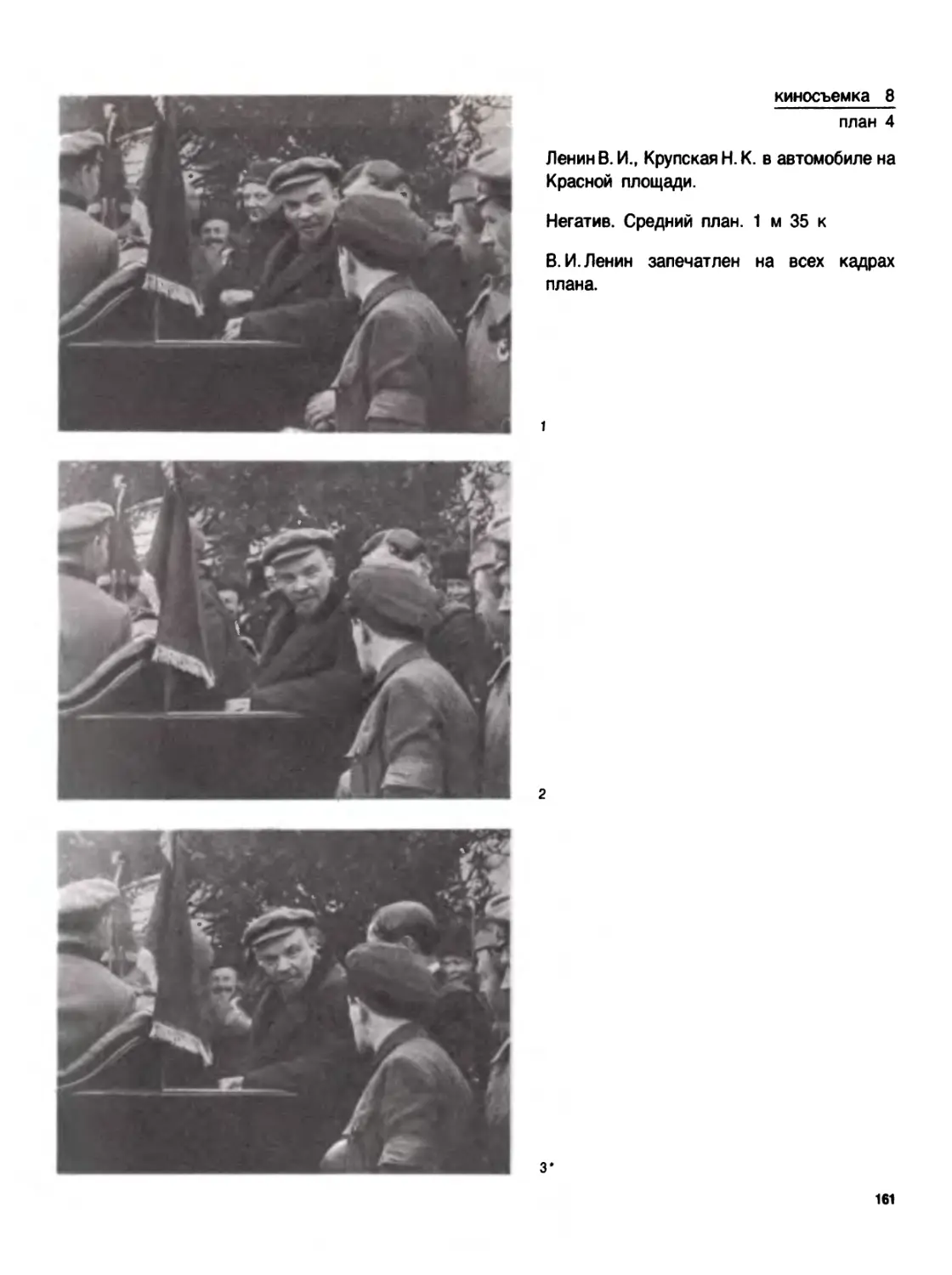
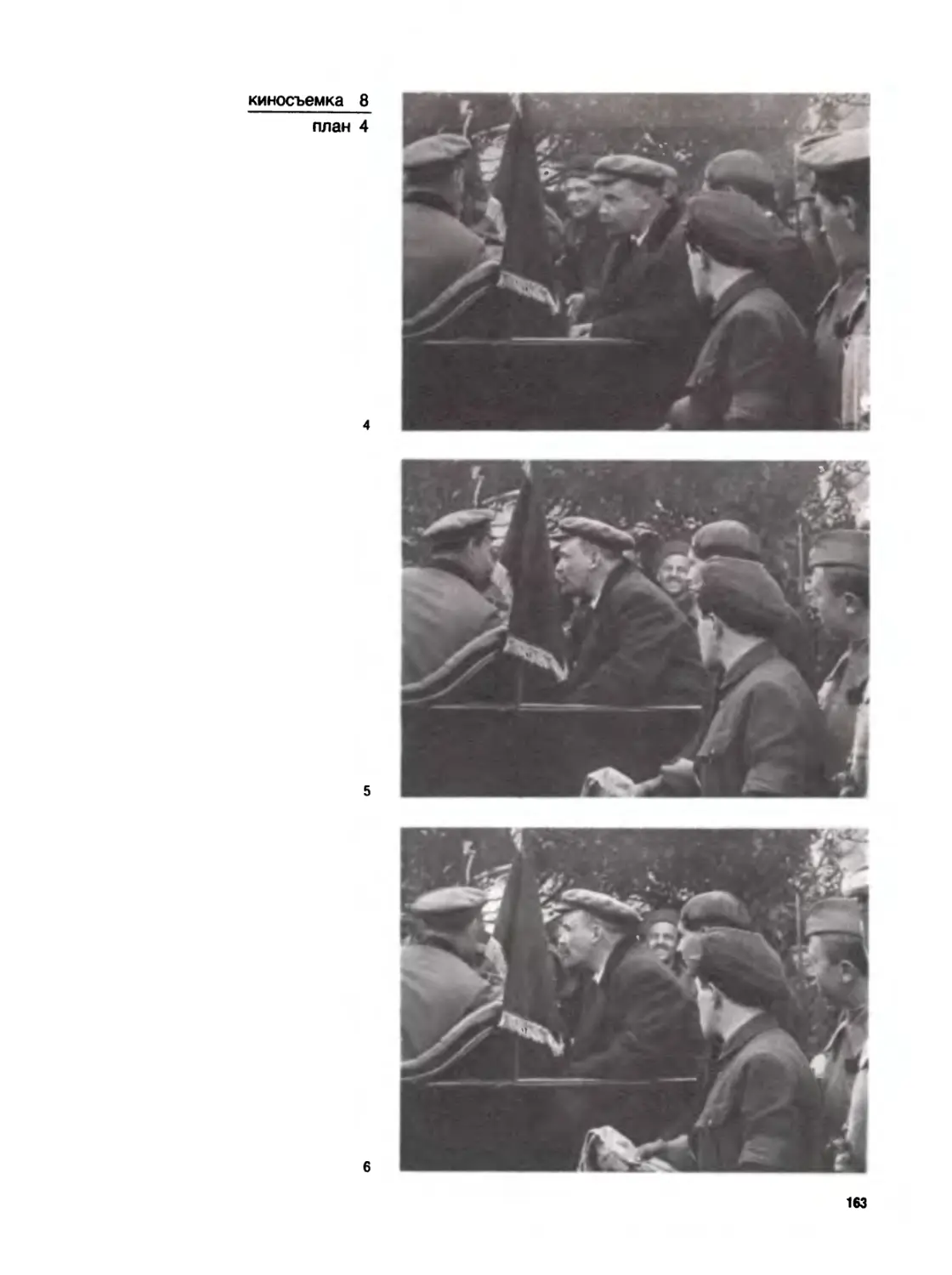
план 4
Ленин В. И., Крупская Н. К. в автомобиле на
Красной площади.
Негатив. Средний план. 1 м 35 к
В. И. Ленин запечатлен на всех кадрах
плана.
t
2
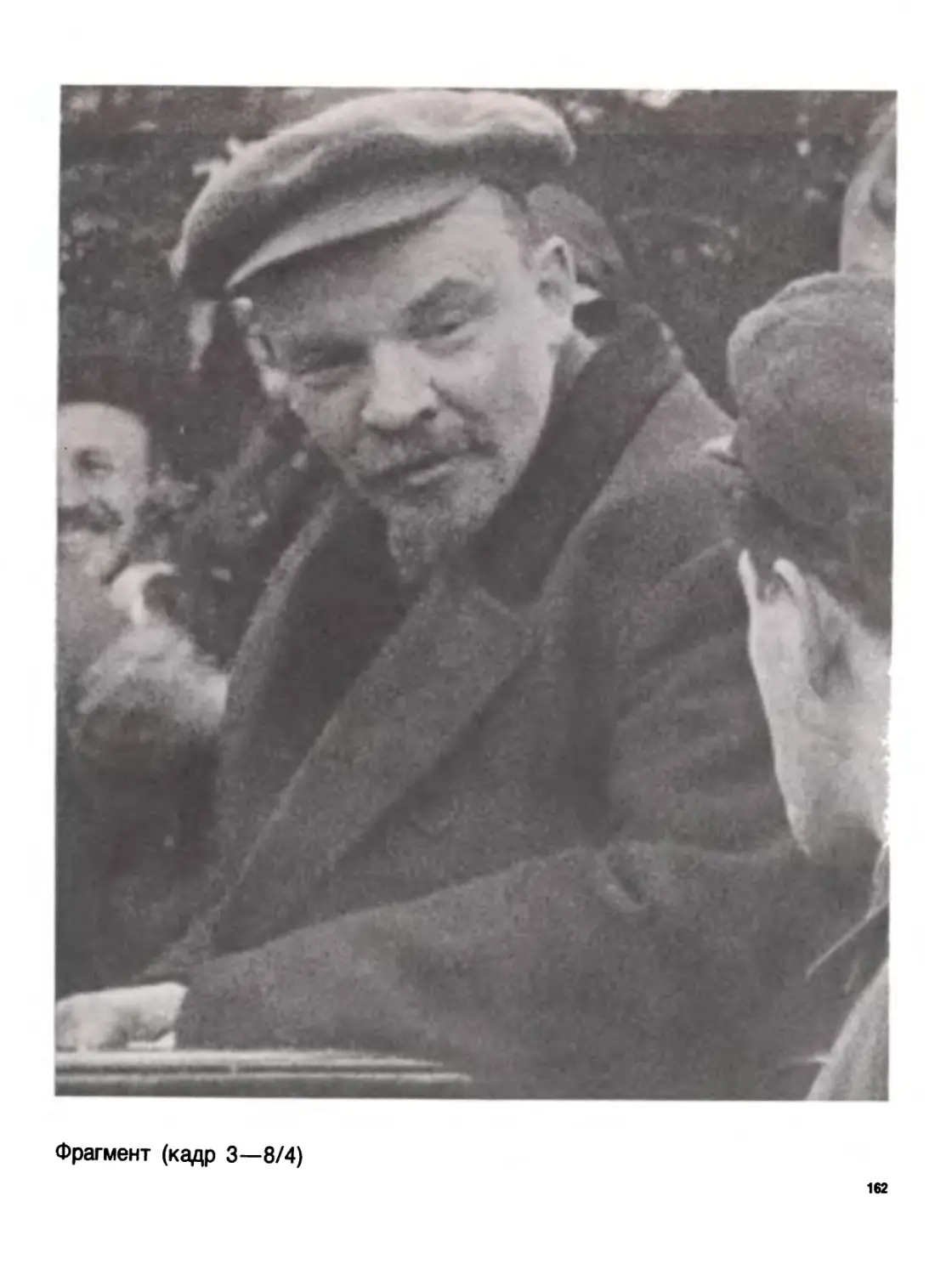
Фрагмент (кадр 3—8/4)
киносъемка
9
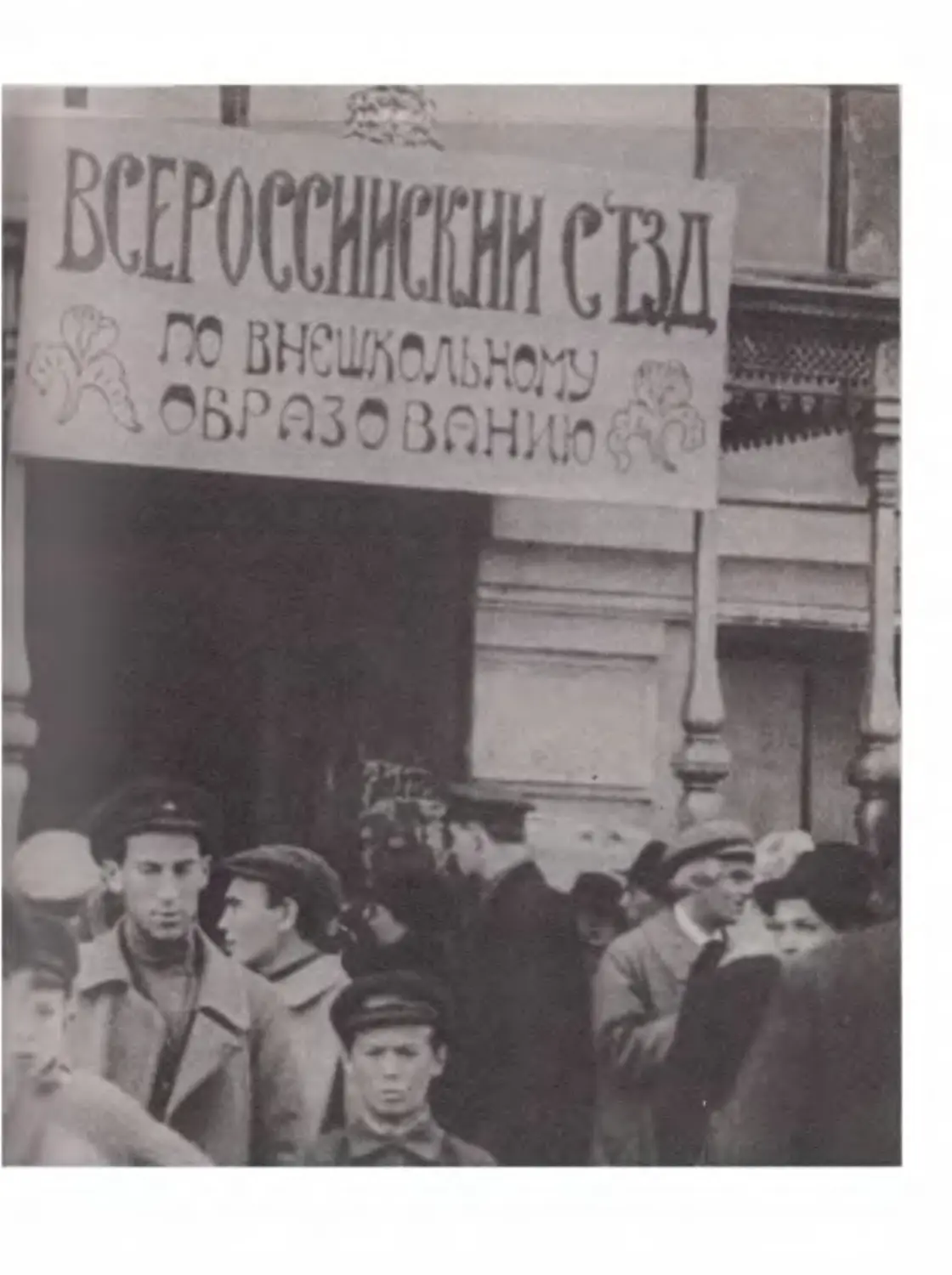
Ленин В. И. у Дома Союзов после окончания заседания
I Всероссийского съезда по внешкольному образова¬
нию.
1919 г., 6 мая. Москва.
Оператор:
Ермолов П. В.
Первый выход на экран:
Выпуск кинохроники «В. И. Ленин после I Всероссийского съезда по внешкольному
образованию», 1919 год.
Обоснование даты:
«6 мая в Колонном зале 1-го Дома Союзов состоялось открытие Первого
Всероссийского съезда работников по внешкольному образованию. На съезд
съехалось около тысячи делегатов.
В конце заседания на съезд прибыл единогласно избранный почетным председате¬
лем т. Ленин.
Съезд с глубоким вниманием выслушал речь т. Ленина, не раз прерываемую
аплодисментами».—«Известия», № 97, 8 мая 1919 г., стр. 2.
См. также: В.И.Ленин. Полн. собр. соч., т. 38, стр. 547.
Примечания:
Сохранилось 14,65 метра пленки—6 планов. На 3 планах—запечатлен В. И. Ленин.
Кинокадры, запечатлевшие В. И. Ленина у подъезда Дома Союзов, были включены Дзигой Вертовым в фильм
«Киноправда», № 21 —«Ленинская».
166
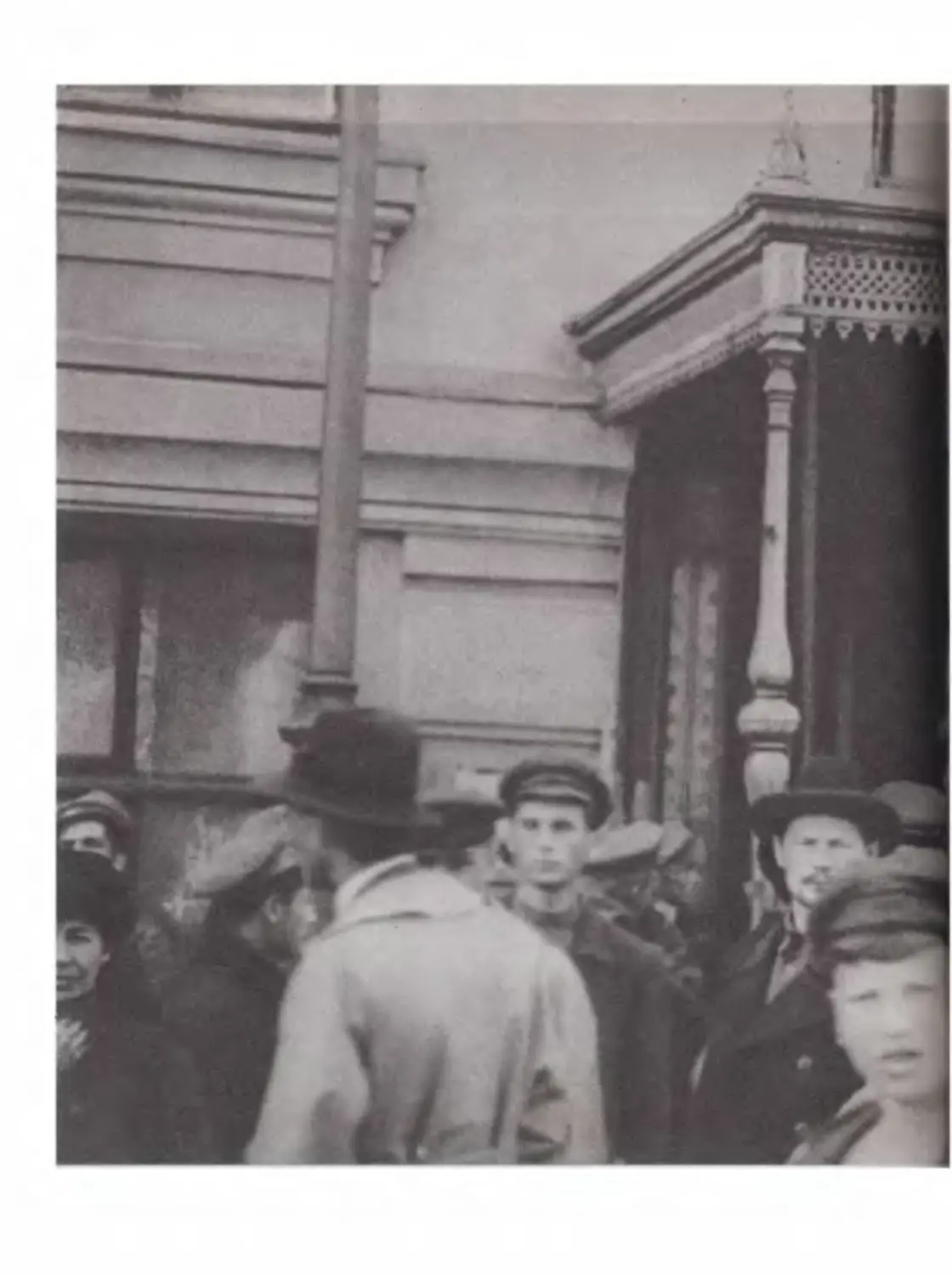
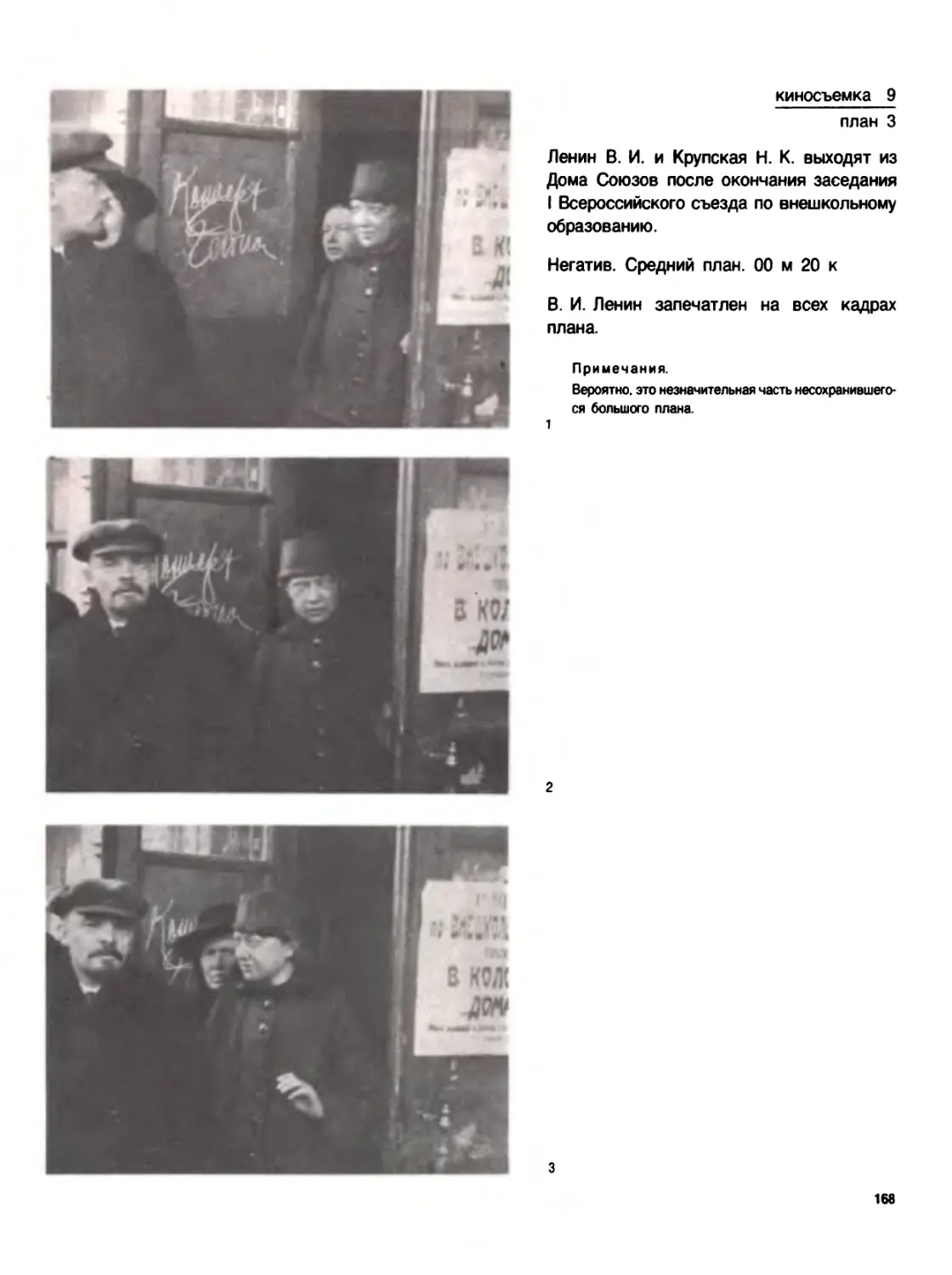
«Происходил съезд по внешкольному образо¬
ванию в Доме Союзов под председательст-
иом Н.К.Крупской. Зав. хроникой послал меня к
Дому Союзов попытаться заснять Владимира
Ильича.
Было уже 5 часов вечера, и подъезд Дома
Союзов был совершенно в тени. Мы не знали
точно, из какого подъезда выйдет Ленин. Пригото¬
вив аппарат, мы увидели быстро выходящих из
подъезда Надежду Константиновну и Владимира
Ильича, направляющихся к автомобилю... Органи¬
затор съемки, кажется, т. Кобозев, подбежал к
Ленину и попросил задержаться на несколько
минут для киносъемки. Владимир Ильич исполнил
просьбу. Не помню, о чем разговаривал с ним
Кобозев, я поспешил воспользоваться случаем,
подбежал на расстояние одного метра и заснял
Владимира Ильича крупным планом».
П.Ермолов. У Дома Союзов.—Газ. «Кино», № 4, 22
января 1933 г., стр. 1.
167
киносъемка 9
план 3
Ленин В. И. и Крупская Н. К. выходят из
Дома Союзов после окончания заседания
I Всероссийского съезда по внешкольному
образованию.
Негатив. Средний план. 00 м 20 к
В. И. Ленин запечатлен на всех кадрах
плана.
Примечания.
Вероятно, это незначительная часть несохранившего*
ся большого плана.
2
168
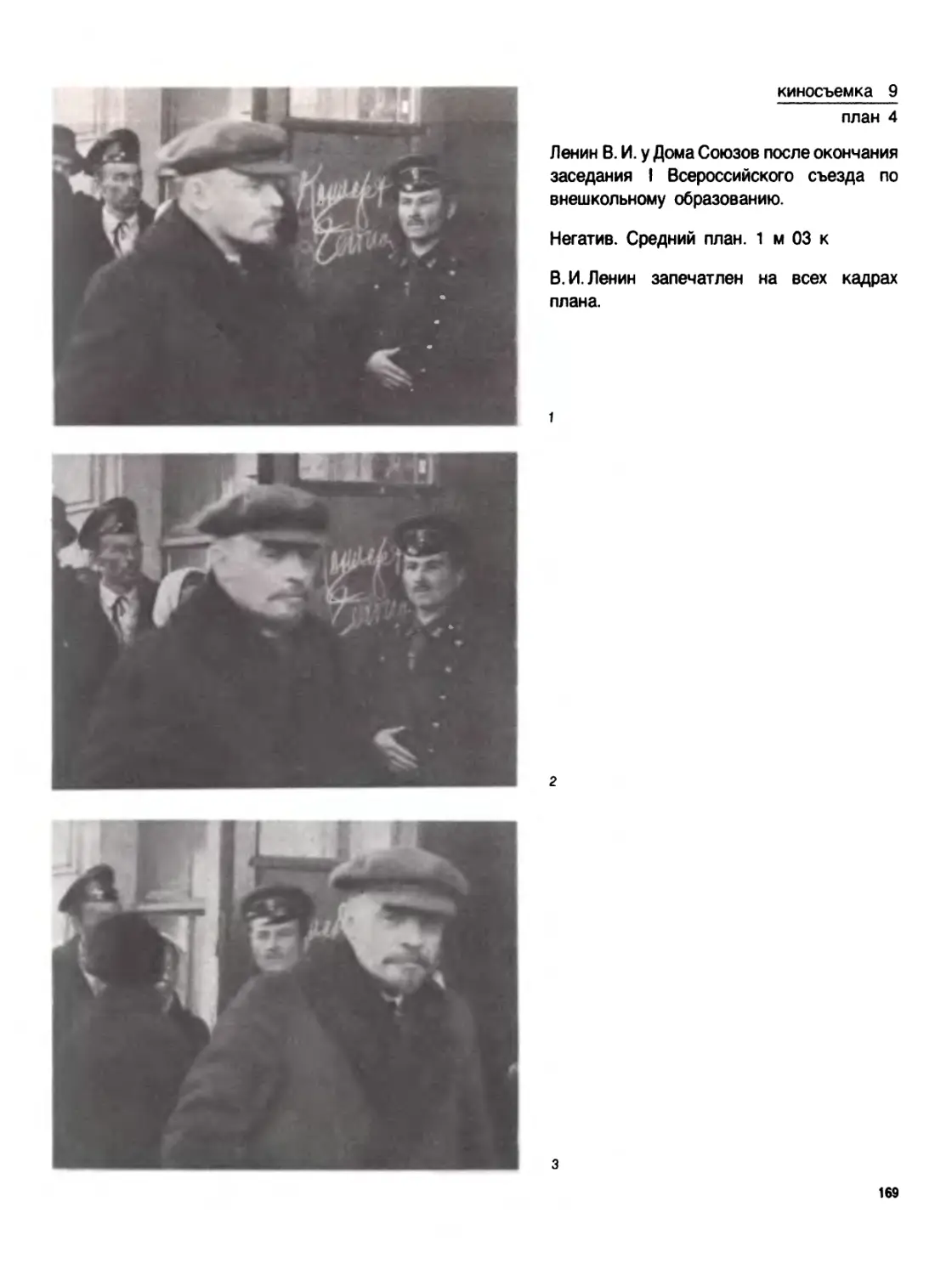
киносъемка 9
план 4
Ленин В. И. у Дома Союзов после окончания
заседания I Всероссийского съезда по
внешкольному образованию.
Негатив. Средний план. 1 м 03 к
В. И. Ленин запечатлен на всех кадрах
плана.
1
169
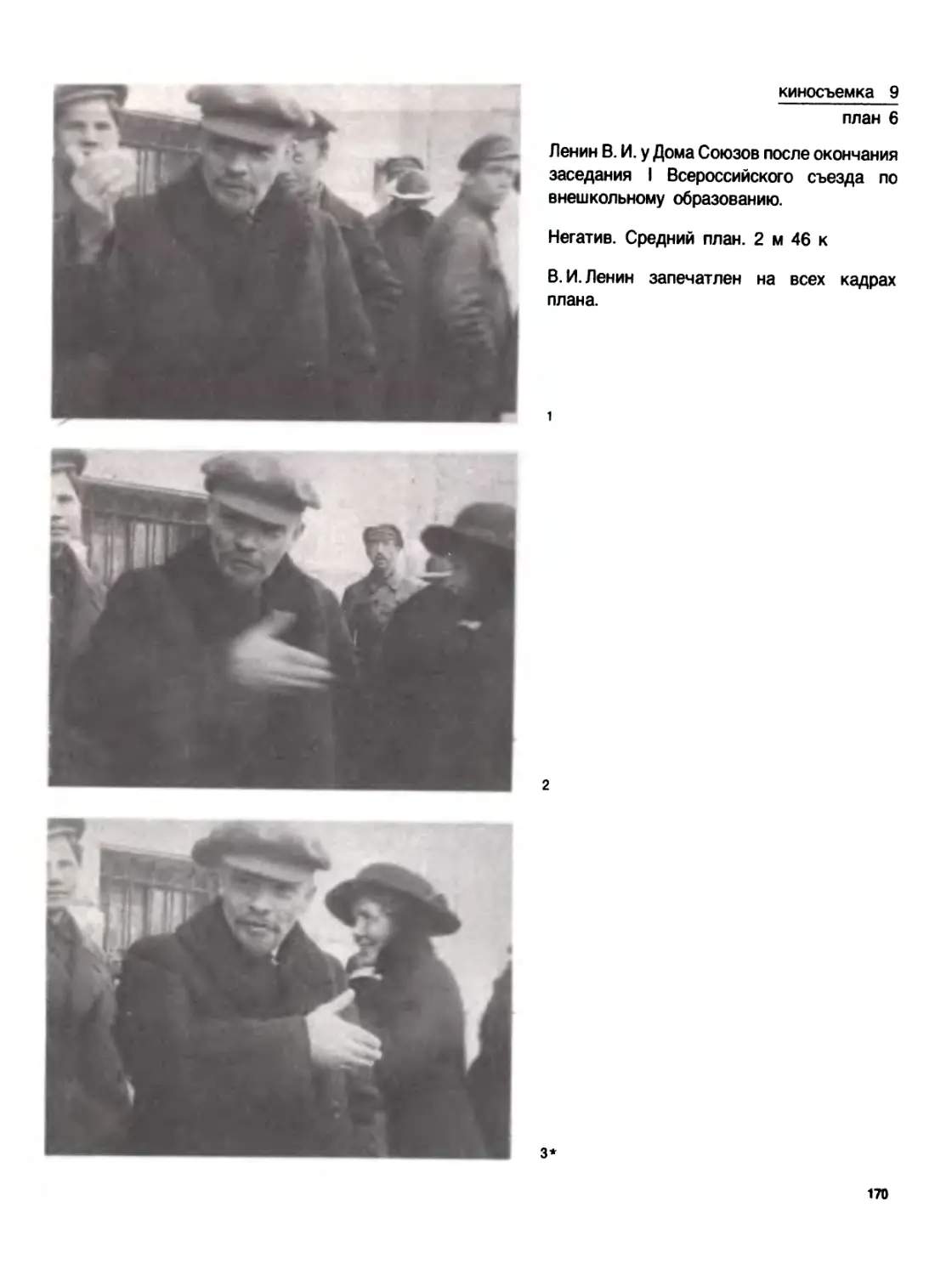
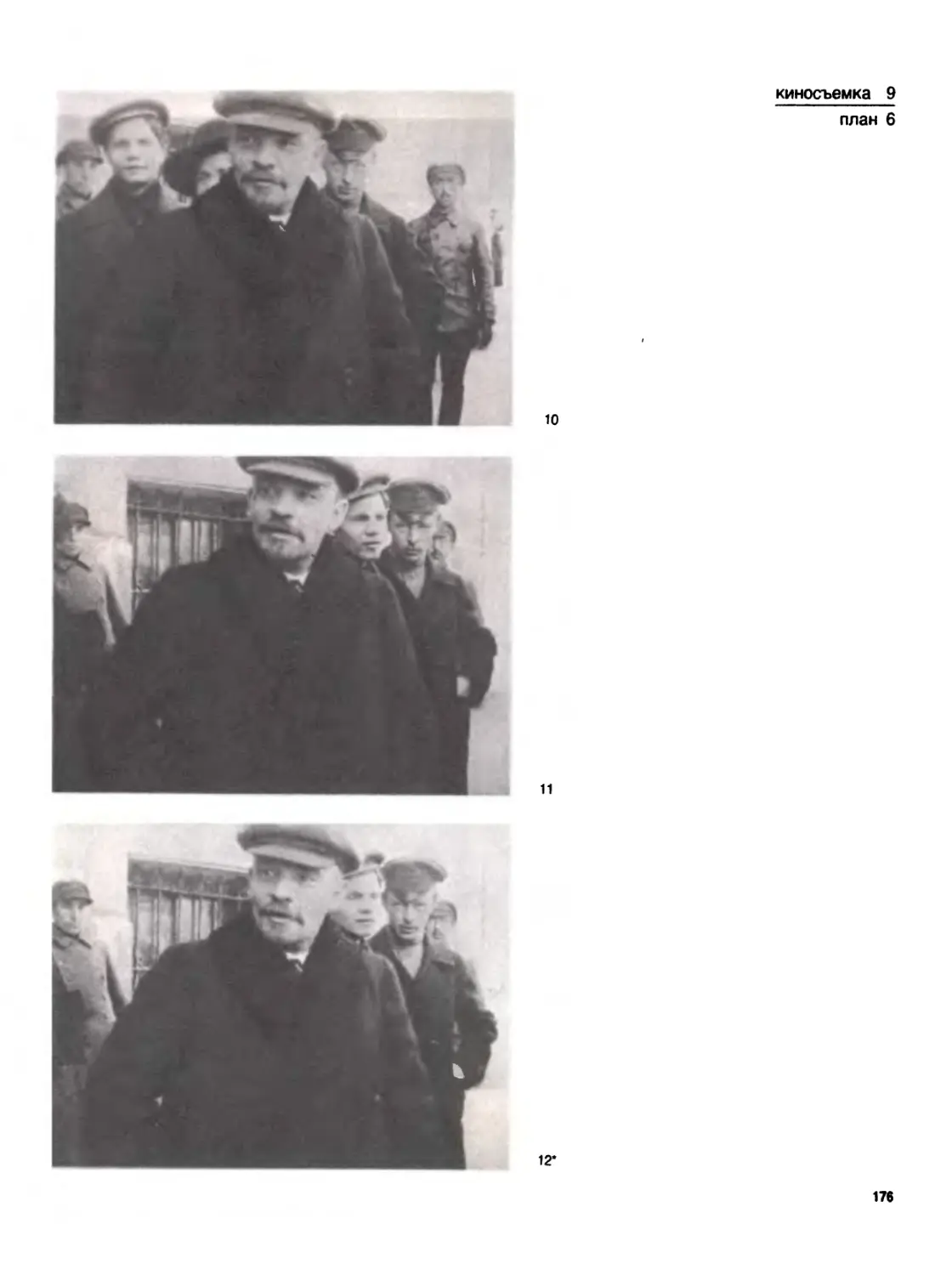
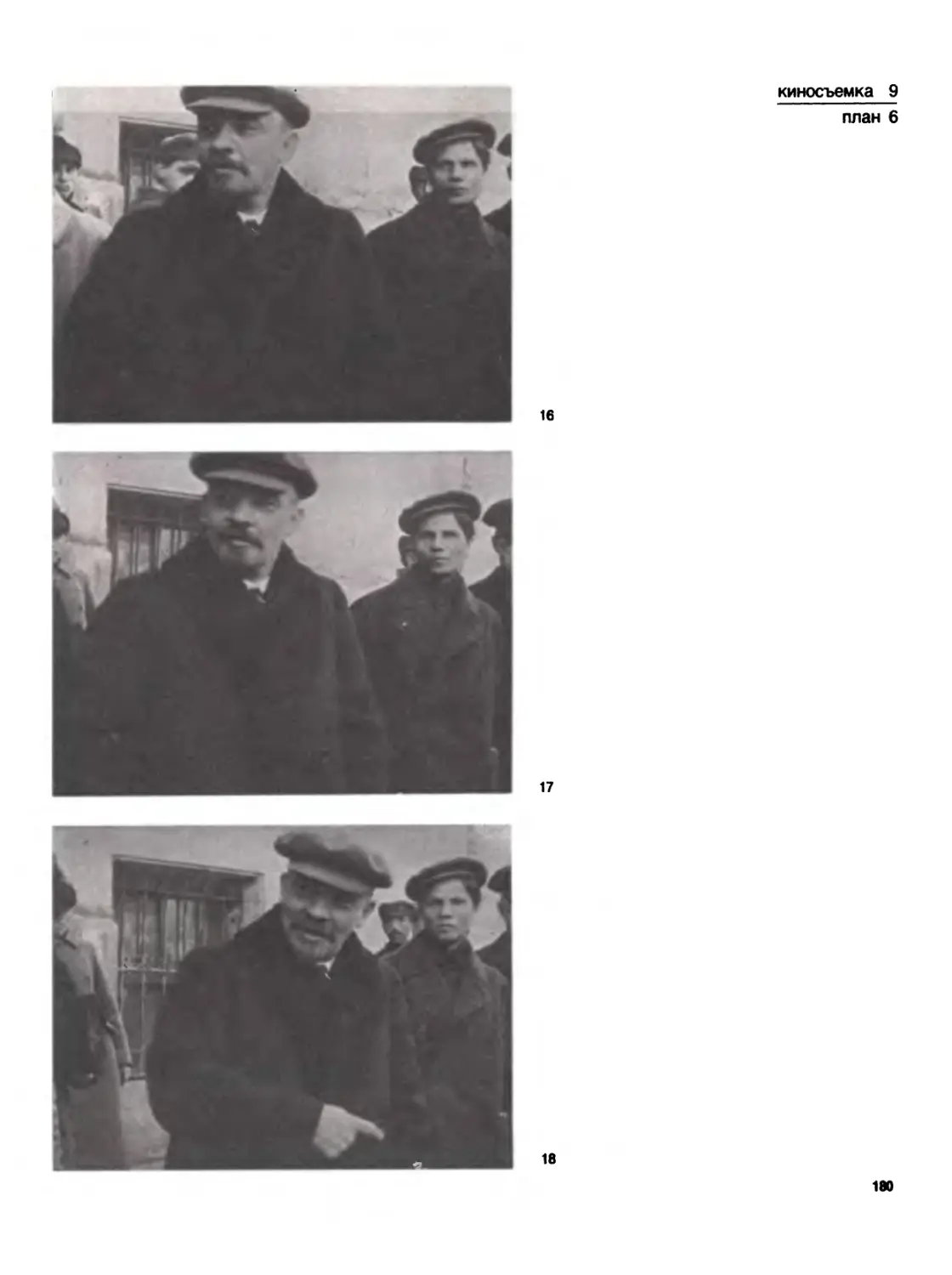
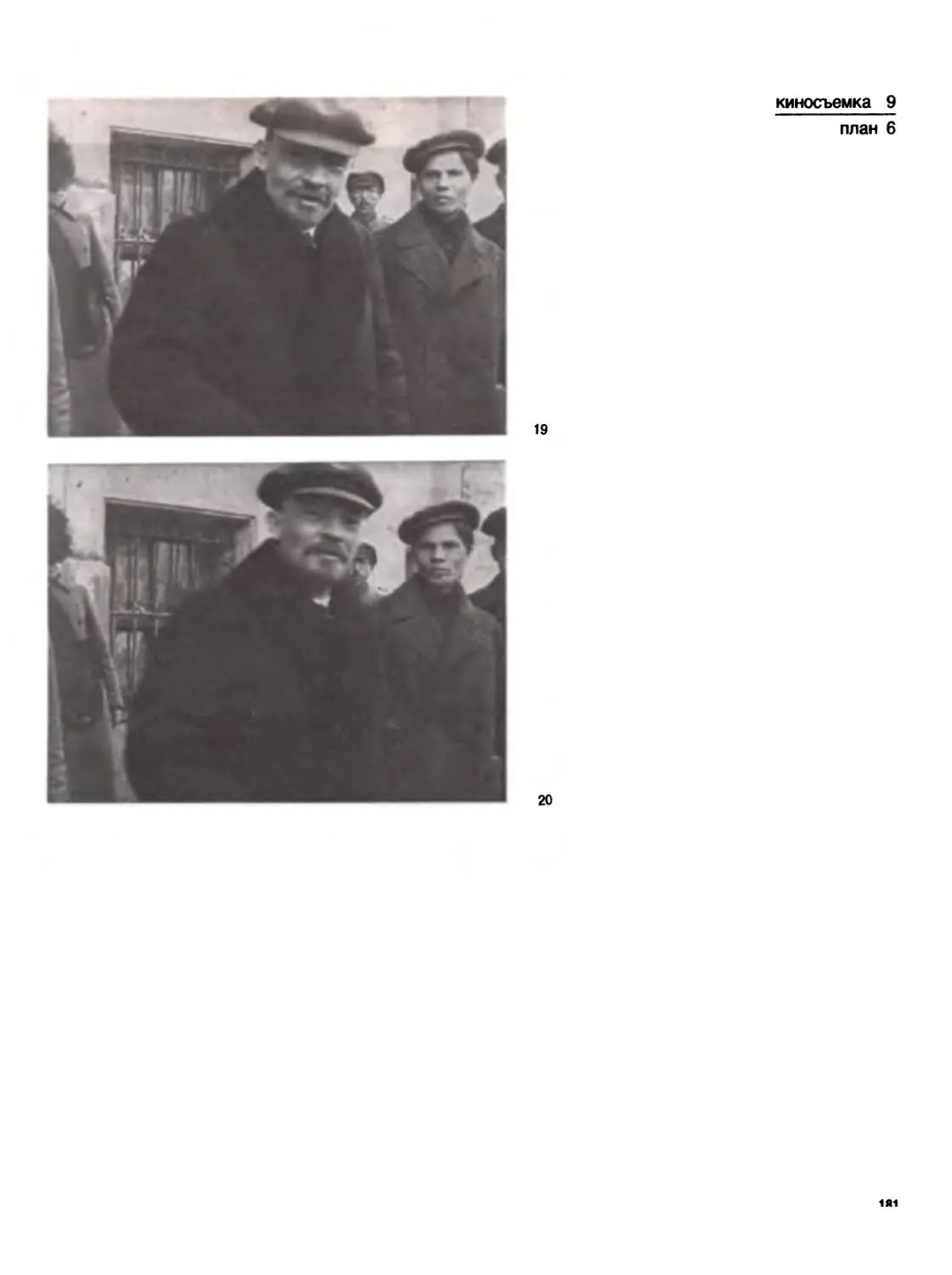
киносъемка 9
план 6
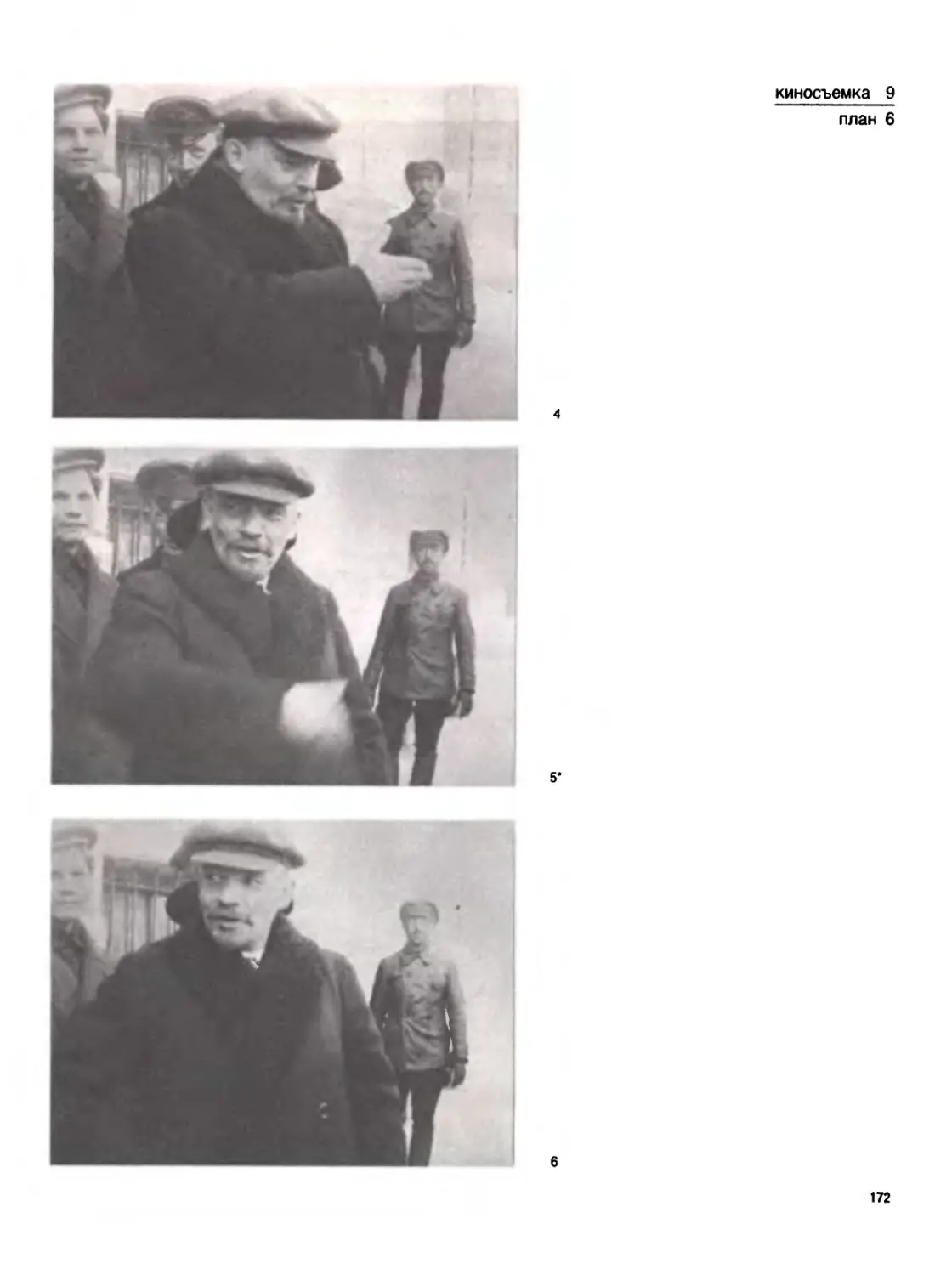
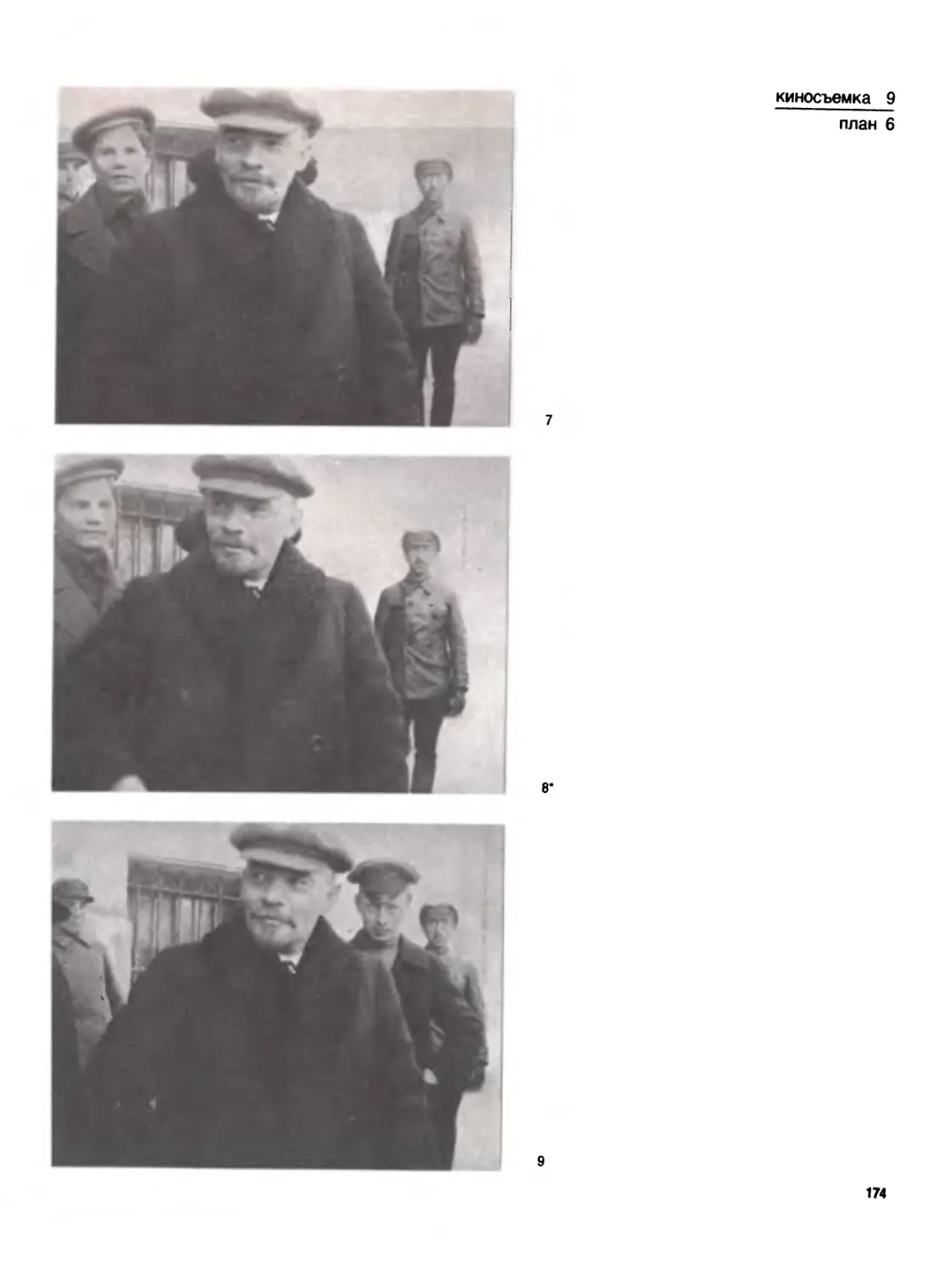
Ленин В. И. у Дома Союзов после окончания
заседания I Всероссийского съезда по
внешкольному образованию.
Негатив. Средний план. 2 м 46 к
В. И. Ленин запечатлен на всех кадрах
плана.
1
2
3*
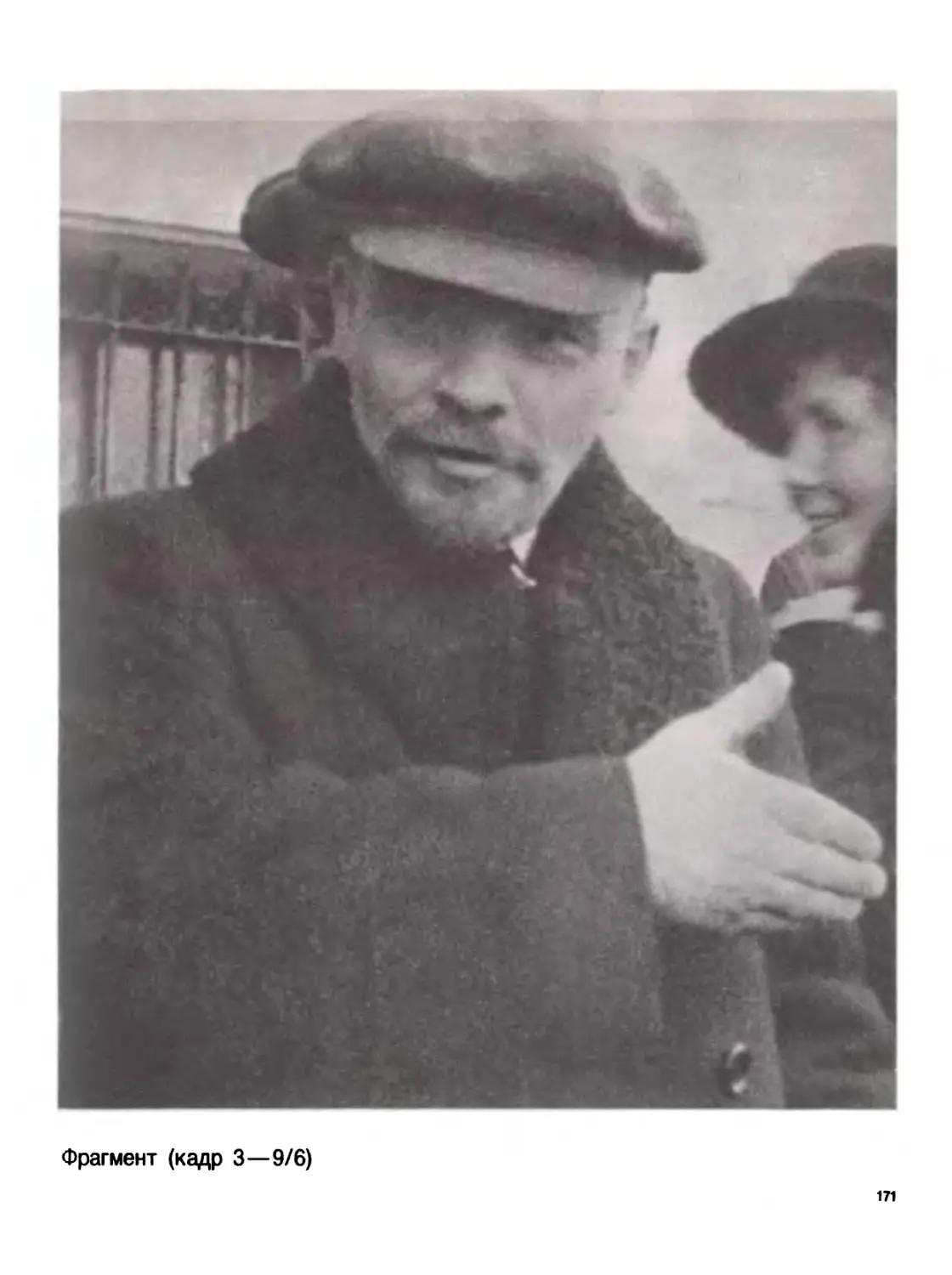
170
Фрагмент (кадр 3—9/6)
171
172
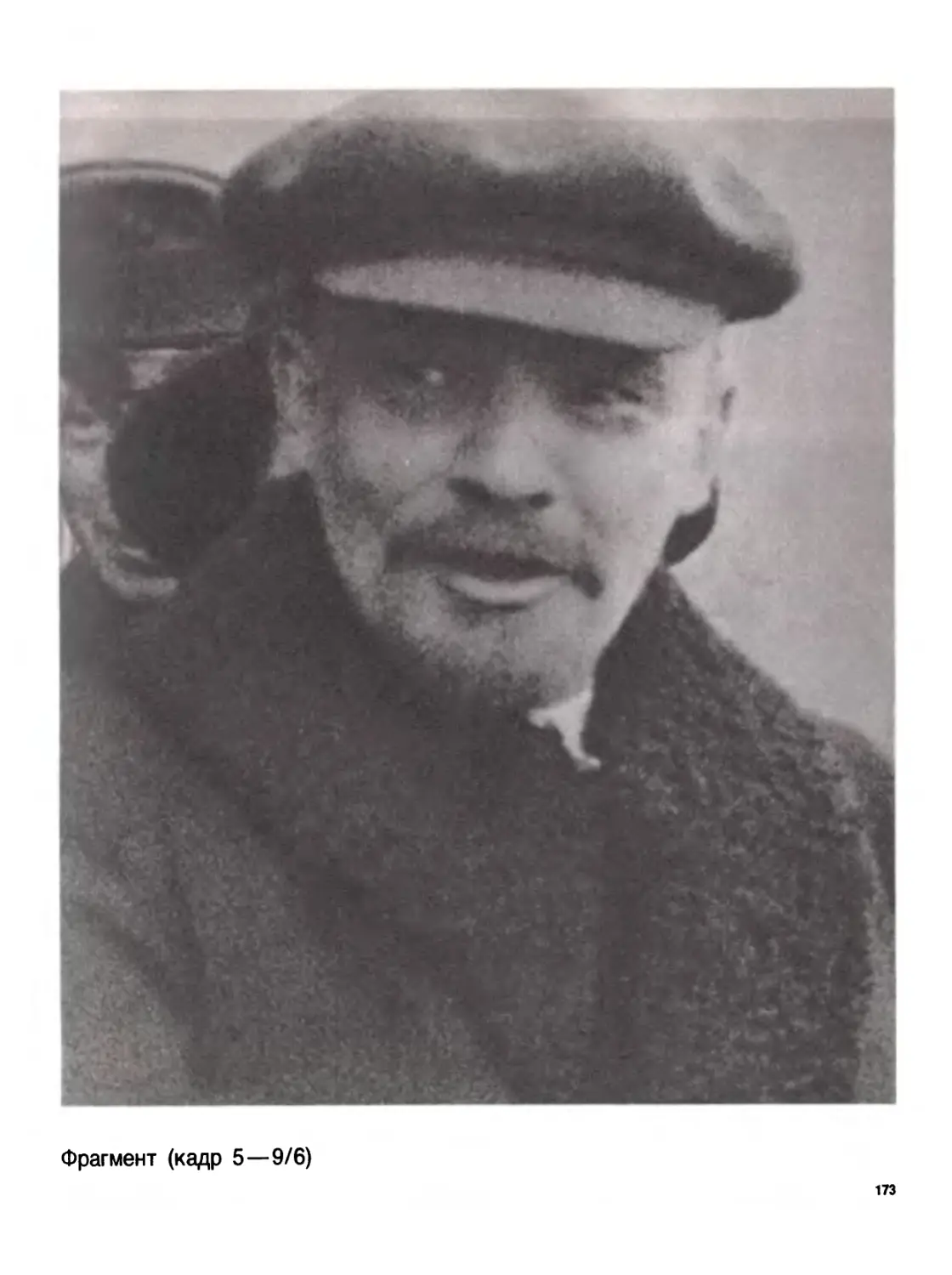
Фрагмент (кадр 5—9/6)
173
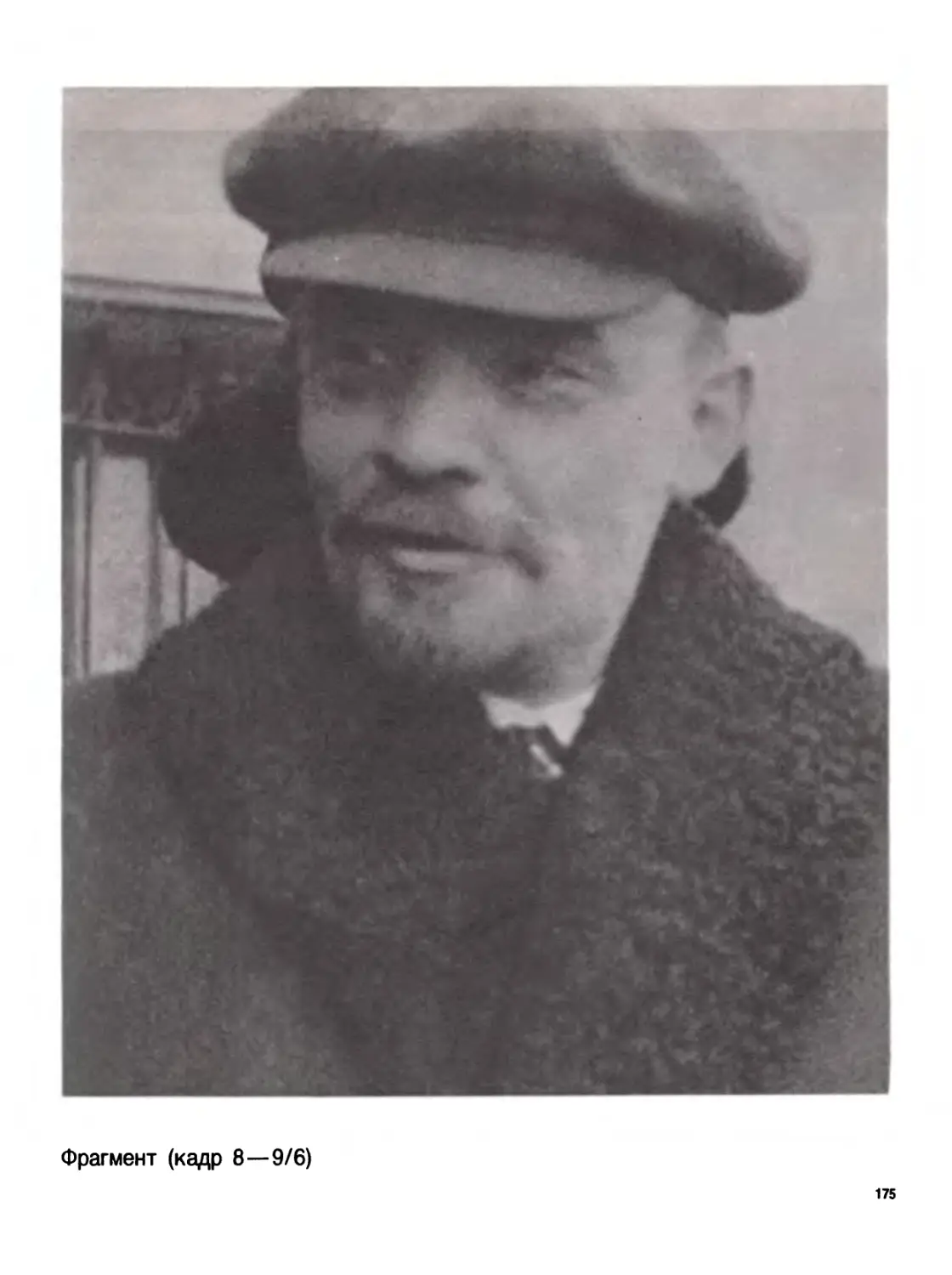
Фрагмент (кадр 8—9/6)
175
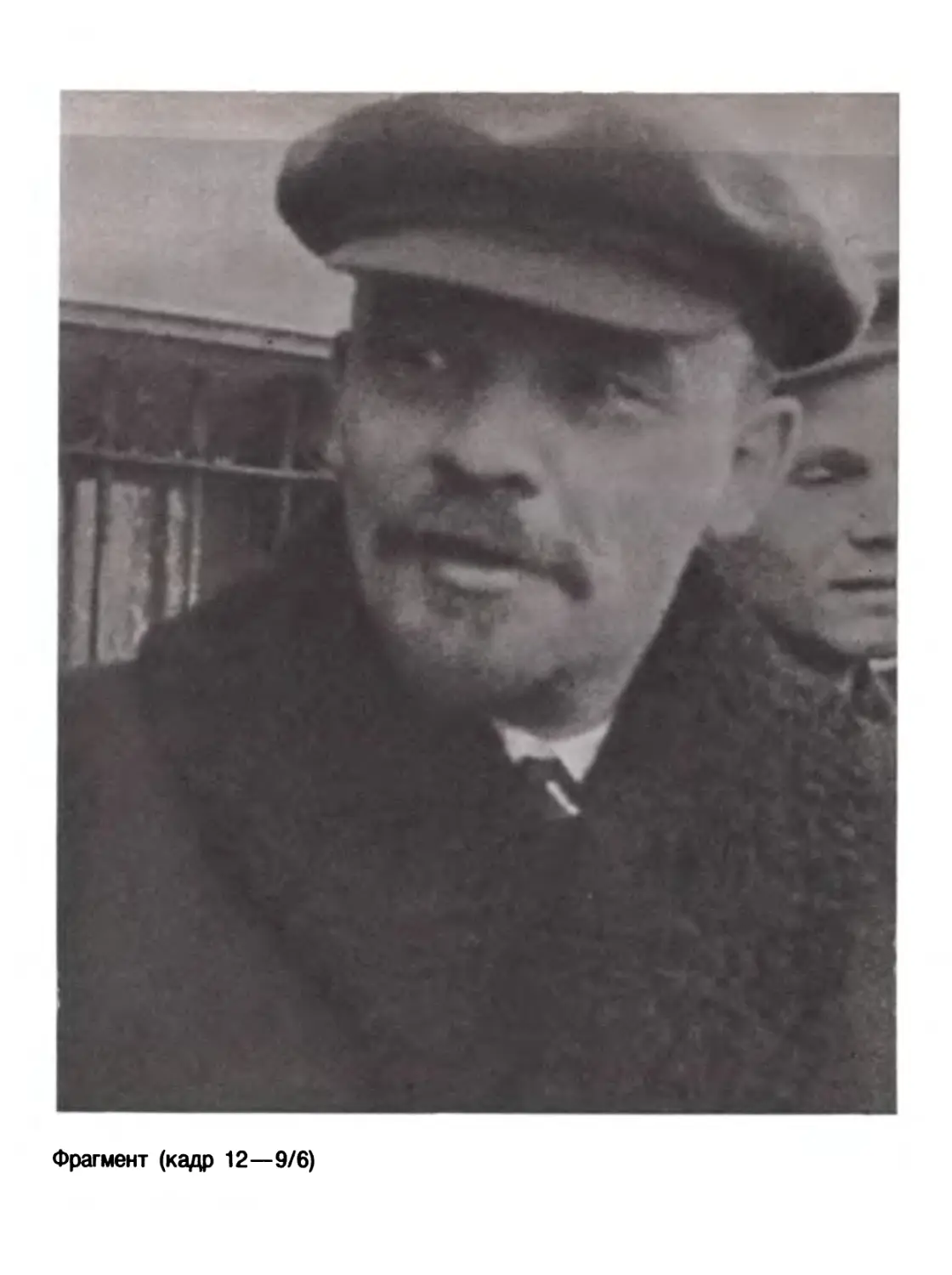
Фрагмент (кадр 12—9/6)
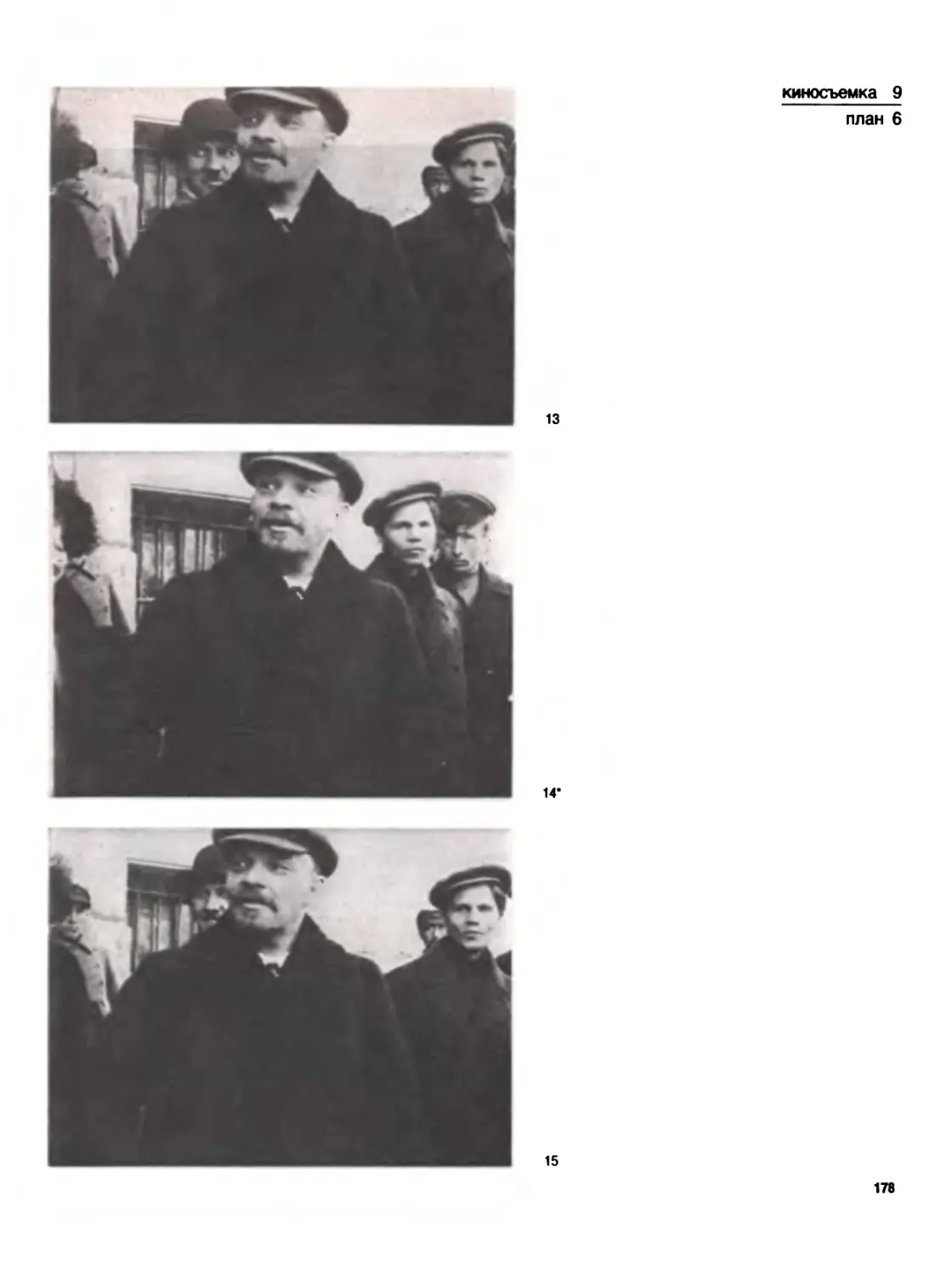
киносъемка 9
план 6
13
14*
15
178
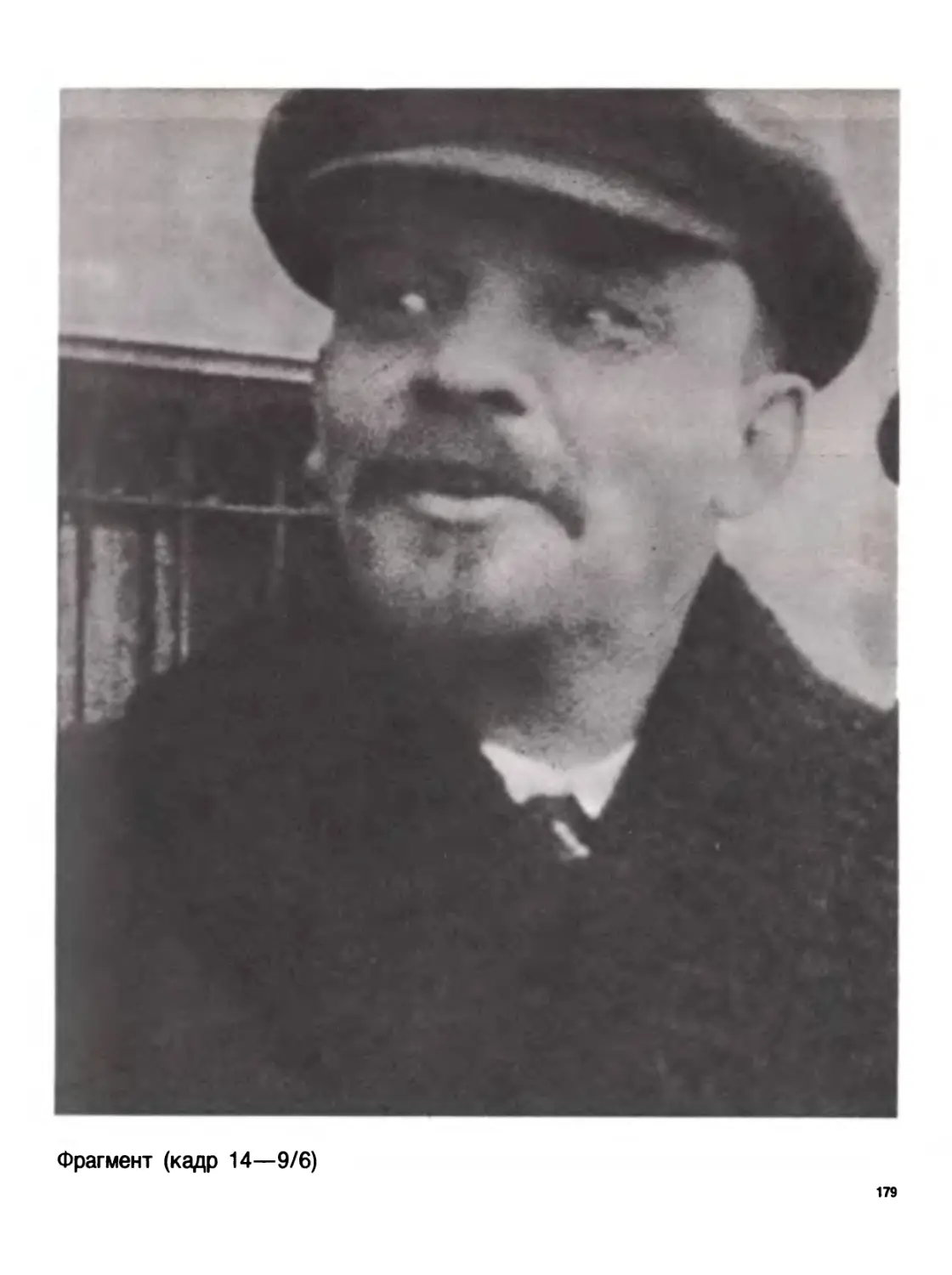
Фрагмент (кадр 14—9/6)
179
киносъемка
10
Ленин В. И. на Красной площади на параде частей
Всевобуча.
1919 г., 25 мая. Москва.
Операторы:
Гибер Г.В., Ермолов П.В., Левицкий A.A., Тиссэ Э.К.
Первый выход на экран:
Выпуск кинохроники «Праздник Всевобуча», 1919 год.
Обоснование даты:
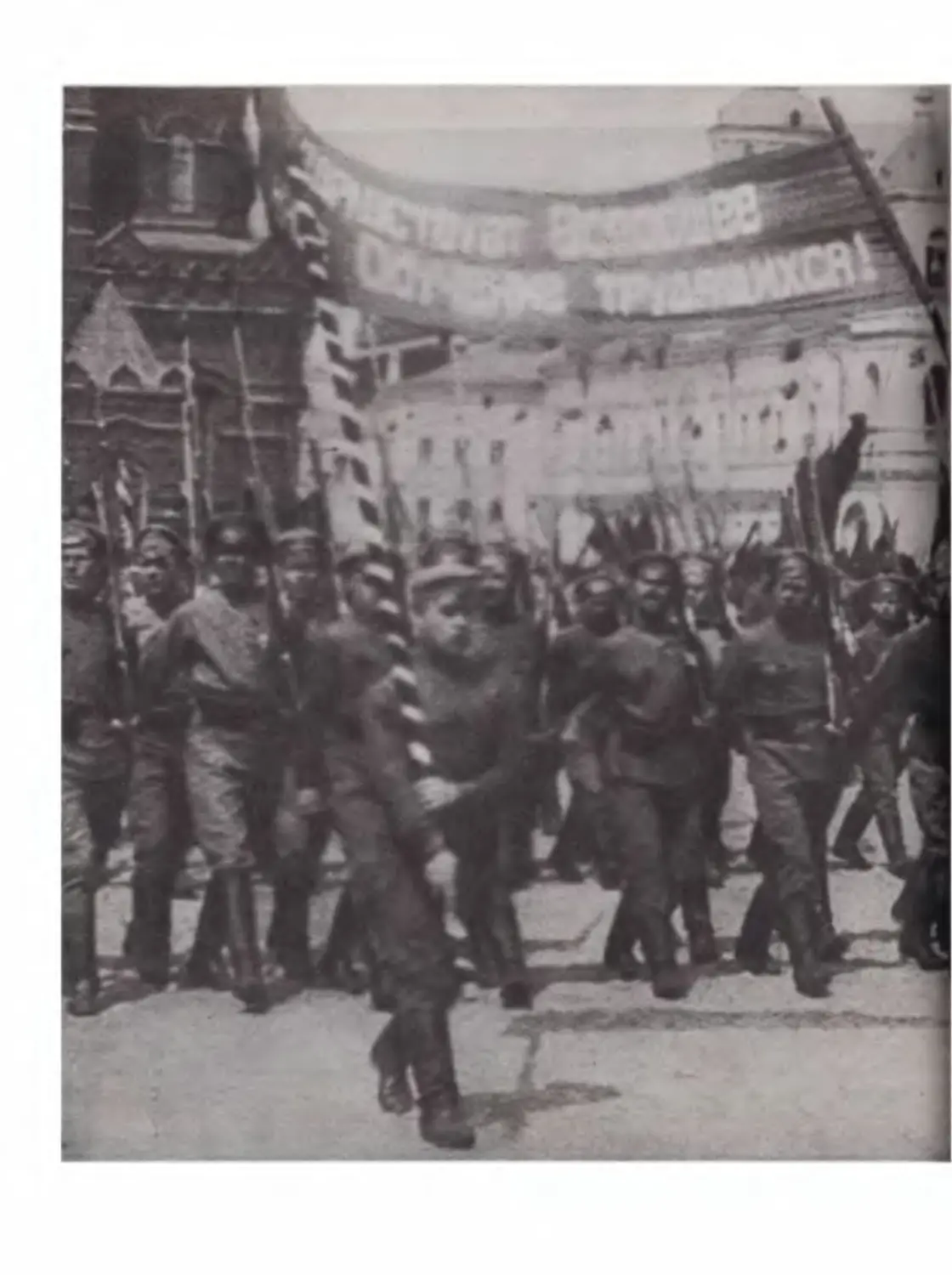
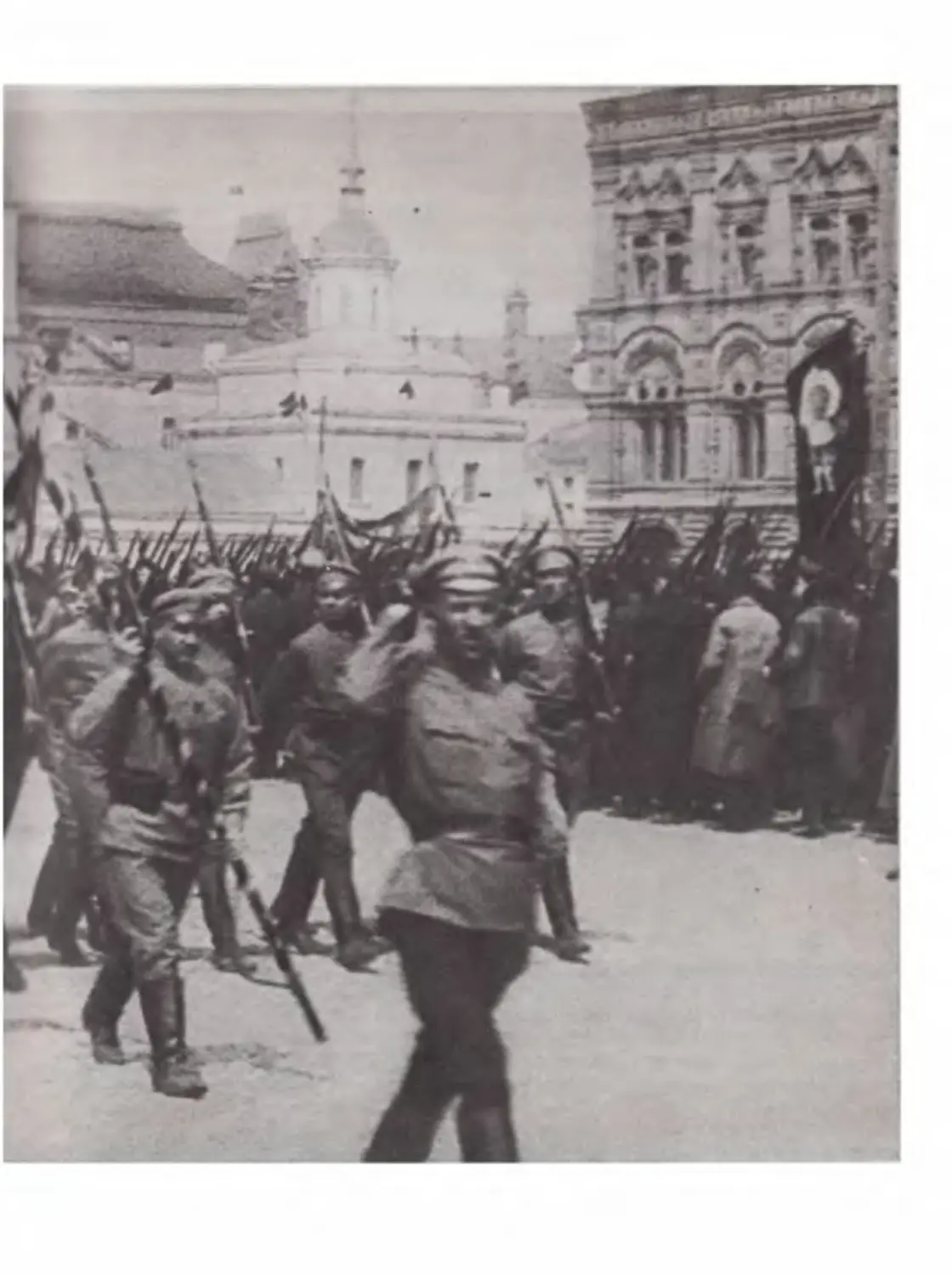
«Около полудня на Красной площади собрались все отряды Московского
Всевобуча. Здесь же в полном составе и его штаб. Прибытие тов. Ленина
встречается громкими приветственными кликами.
Обойдя фронт, тов. Ленин обращается с речью к рабочим батальонам... Затем
т. Ленин представляет рабочим тов. Тибора Самуэли, народного комиссара по
военным делам Красной Венгрии».—«Правда», № 113, 27 мая 1919 г., стр. 4.
«...B течение двух часов с лишком проходили отряд за отрядом мимо возвышения, с
которого приветствовали вооруженный народ представители Советской власти, во
главе с Лениным».—«Известия», № 113, 27 мая, 1919 г., стр. 2. См. также:
В.Й.Ленин. Полн. собр. соч., т. 38, стр. 557.
Примечания.
Сохранилось 112,55 метра пленки—33 плана На 16 планах—запечатлен В. И. Ленин.
Кинокадры, запечатлевшие В. И. Ленина на параде частей Всевобуча, были включены в первую часть фильма
Дэиги Вертова «Киноправда», Nb 21—«Ленинская».
184
Парад частей Всевобуча снимала для хроники
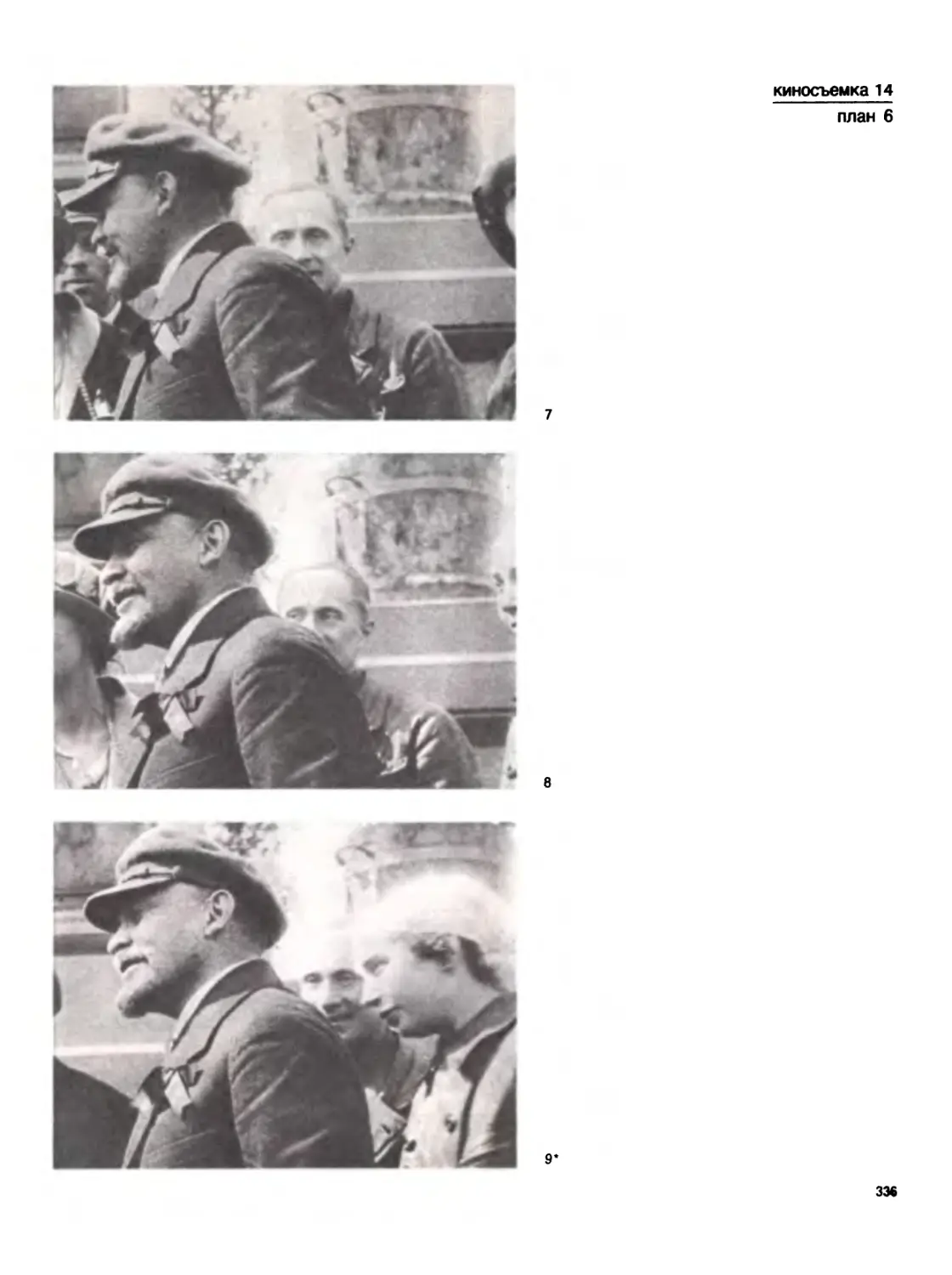
I руппа советских кинематографистов. Оператор
Э.К.Тиссэ вспоминал об этом дне:
«Сперва отряды накапливались на площади.
Было впечатление огромной толпы. И вдруг я
почувствовал толчок. Толпа сдвинулась с места,
взоры всех направились в одну сторону, и из уст в
уста пронеслось: «Ленин! Ленин! Ленин!..» Влади¬
мир Ильич неторопливо продвигался вперед. Он
останавливал свой взгляд на лицах рабочих,
задумывался, улыбался. В неизменной серенькой
кепке, он выглядел в окружении рабочих бойцов
таким же простым, тоже рабочим человеком. Вот
Ильич остановился, вынул маленький блокнот из
кармана... Что-то записал и поднялся на грузовую
автомашину...
Грузовик, на котором была оборудована трибу¬
на, попался старенький, обшарпанный.
Одновременно на Красной площади шла съемка
игрового фильма «96 часов», посвященного Всево¬
бучу, в котором, по сценарию, В. И. Ленин произно¬
сит речь на Красной площади.
«Неизгладим в памяти и день 25 мая
1919 г.,—вспоминает известный кинодокумента¬
лист Дзига Вертов,—когда мне пришлось подойти
к Владимиру Ильичу на Красной площади и
В воспоминании, опубликованном в 1928 году,
режиссер фильма В. Р. Гардин писал: «...ранним
утром, вместе с оператором А. А. Левицким и
актерским составом мы отправились на Красную
площадь... Подошел основной момент нашей
съемки, когда Владимир Ильич, сойдя с грузовика,
направился к мемориальной доске... Картина,
когда Морозов, загримированный, с винтовкой за
плечами, без шапки, с обнаженной грудью бежал
Ленин стоял у поднятого борта и произносил
памятные слова.
На этот раз я стоял у кремлевской стены.
Вышло так, что Ленин стоял спиной к киноаппара¬
ту. Я не знал, что делать: вот ведь какая
незадача! Думал, что в этот день мне так и не
удастся заснять Владимира Ильича. Однако он же
сам и пришел мне на помощь... В какое-то
мгновение он обернулся и заметил мое растерян¬
ное лицо. Улыбнулся сочувственно и встал так,
что я мог снимать его. Парад Всевобуча впервые
снимали операторы с разных точек: как на самой
площади, так и вне ее. Левицкому, Ермолову,
Губеру и мне хватало работы. Кинокомитет,
придавая большое агитационно-политическое зна¬
чение ленте об этой годовщине, выделил нам
максимум кинопленки. Предполагалось выпустить
специальный кинофильм. Это и было сделано».
Э. ТИССЭ. Живой Ильич—на экране—Журн. «Неман»,
1961, Ne 2, стр. 127—128.
обратиться к нему с деловой просьбой. Это было в
день праздника Всевобуча. Я с оператором
Левицким хотел снять товарища Ленина для
художественного фильма «96» (режиссер В. Гар¬
дин). Ленин с первых же слов рассеял нашу
робость и неуверенность. Съемка состоялась.
Улыбка Владимира Ильича запомнилась мне
навсегда».
Дзига Вертов. Воспоминания о съемках В. И. Ленина—
Сб. «Из истории кино. Материалы и документы», вып. 2.
М., Изд-во Академии наук СССР, 1959, стр. 32.
издали, чтобы приблизиться к Ленину,—не могла
не удивить Владимира Ильича. Артист Карин,
стоявший уже рядом, успел крикнуть: «Владимир
Ильич, нас снимают»—что сделало сразу всю эту
сцену понятной, а оператор Левицкий успел
уже- заснять на пленку Владимира Ильича
Ленина...
Кроме этого основного кадра т. Левицкому
удалось снять еще ряд прекрасных моментов,
185
которые также были введены в картину «96».
Припоминаю кадры Ленина, стоящего на грузови¬
ке и приветствующего манифестацию; кадр
сходящего с грузовика Ленина, снятого с затылка
и с профиля; момент слушания Лениным речи
венгерского коммуниста Тибора Самуэли...»
В.Р.Гардин. Ленин на съемке картины «96».—
Сб. «Ленин в зарисовках и воспоминаниях художников»,
стр. 140, 142—143.
186
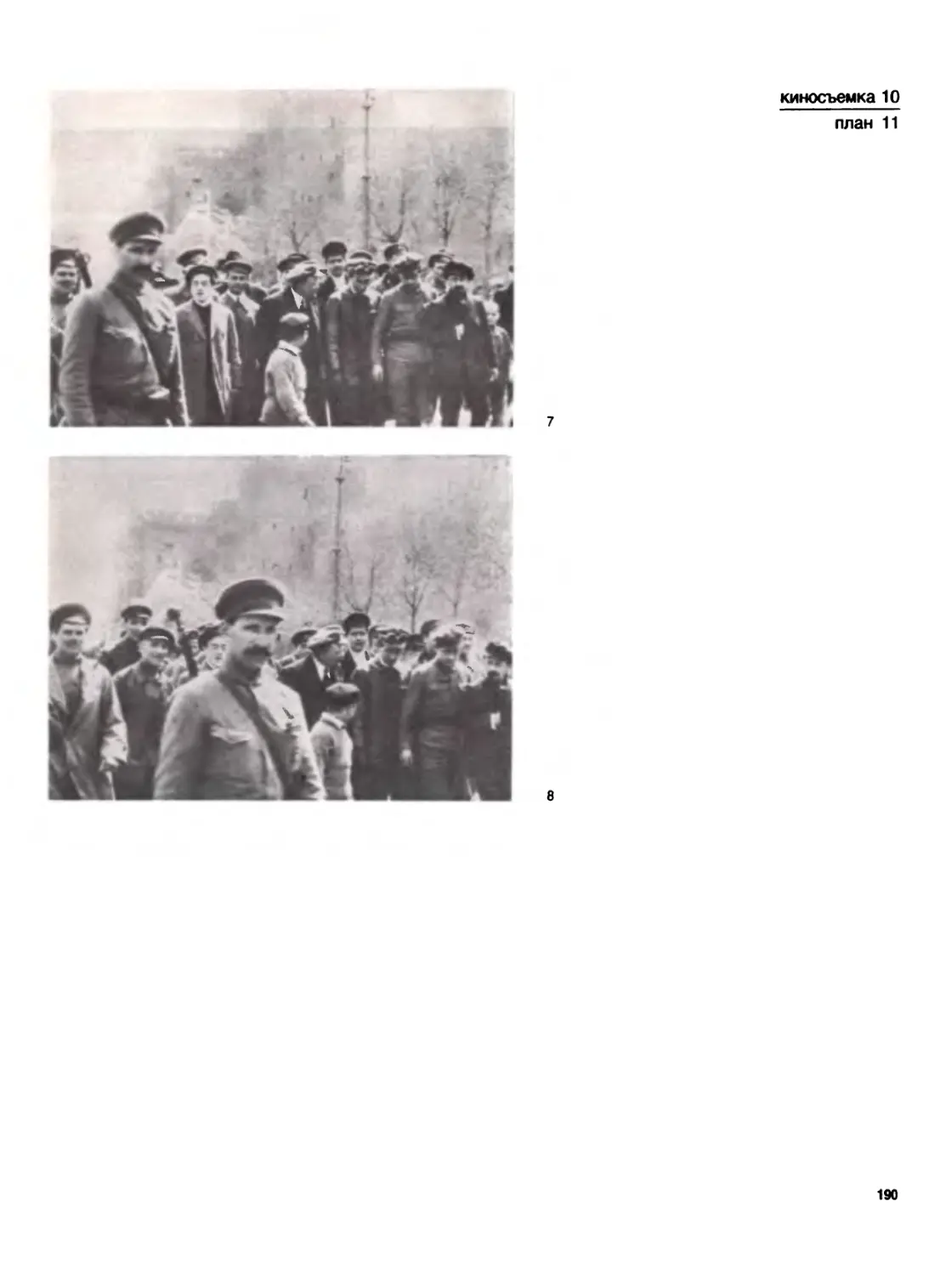
киносъемка 10
план 11
Ленин В. И. в фуппе штаба Всевобуча
направляется от Спасских ворот к центру
площади.
Негатив. Общий план. 3 м 49 к
В. И. Ленин запечатлен на всех кадрах
плана.
1
2
3
187
киносъемка 10
план 11
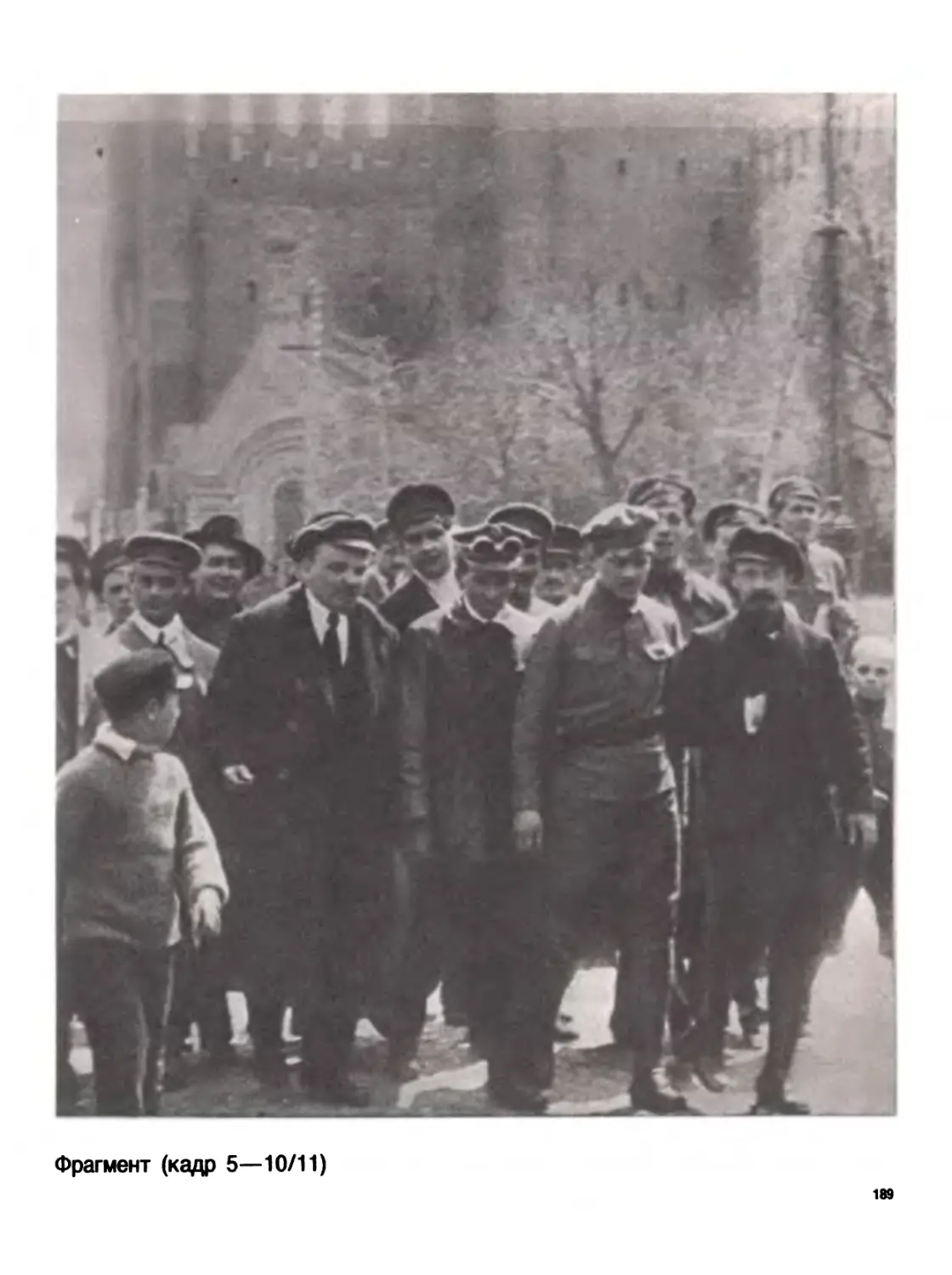
Фрагмент (кадр 5—10/11)
1Ю
киносъемка 10
план 11
киносъемка 10
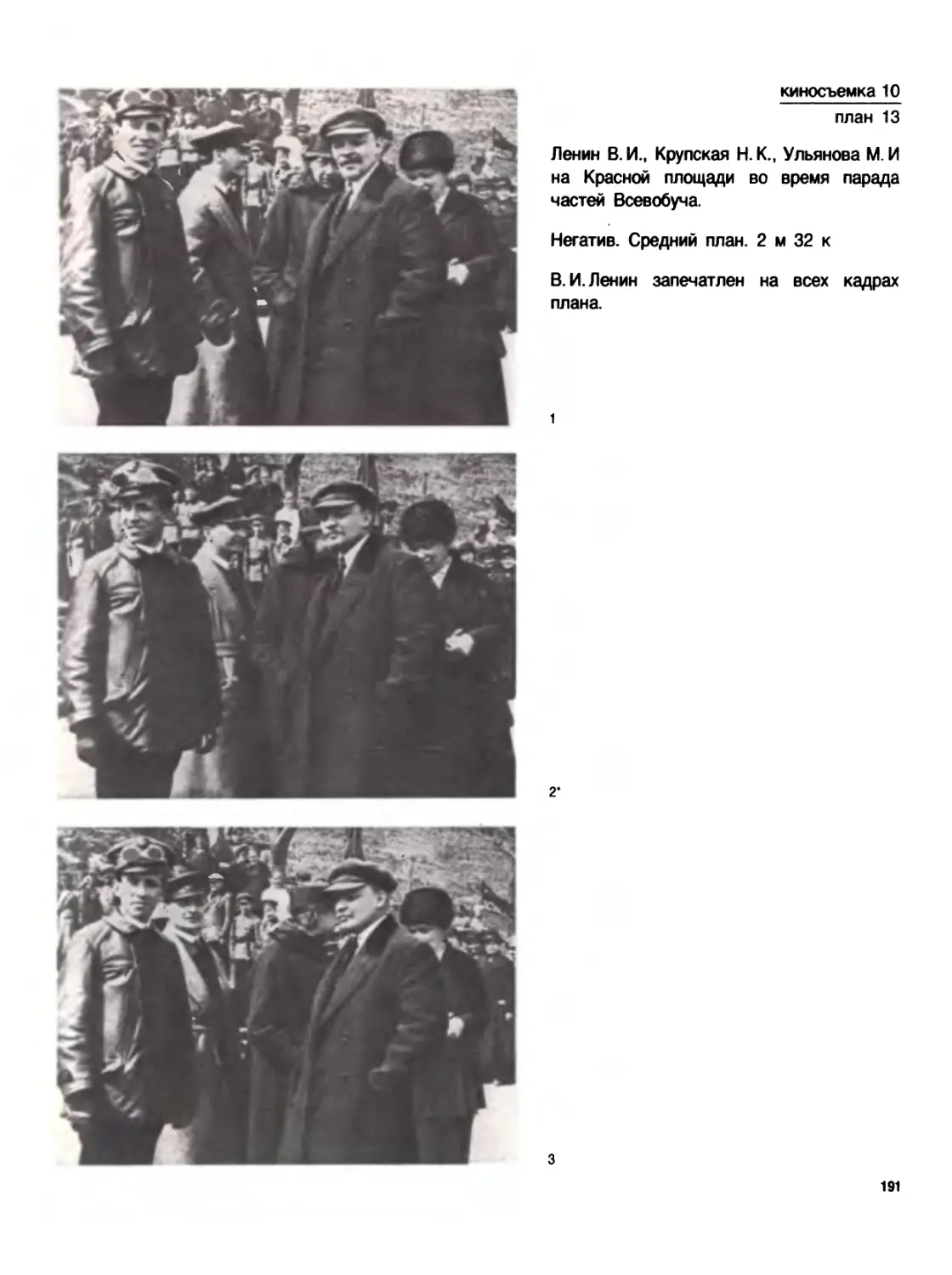
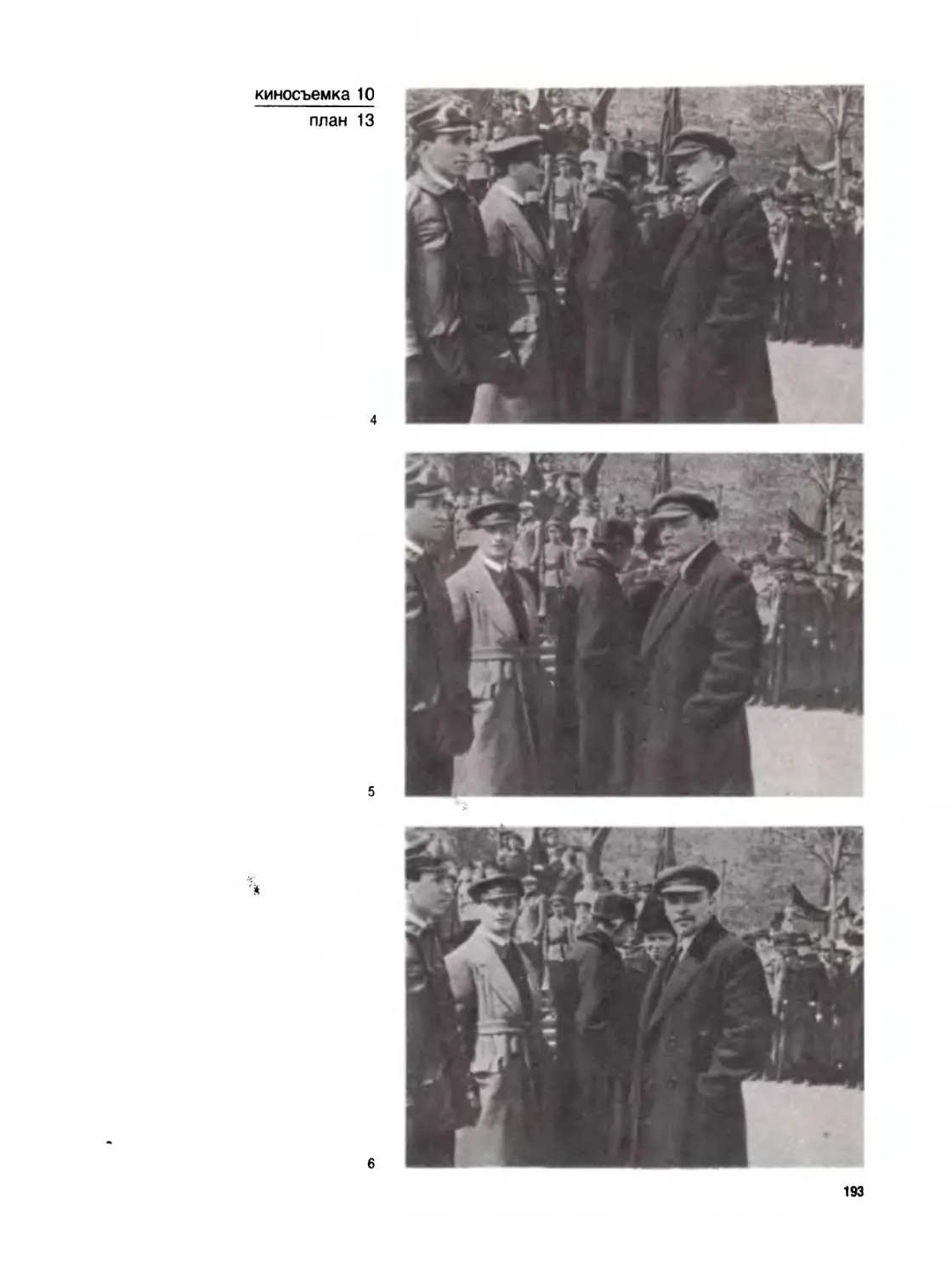
план 13
Ленин В. И., Крупская Н. К., Ульянова М. И
на Красной площади во время парада
частей Всевобуча.
Негатив. Средний план. 2 м 32 к
В. И. Ленин запечатлен на всех кадрах
плана.
1
2‘
3
191
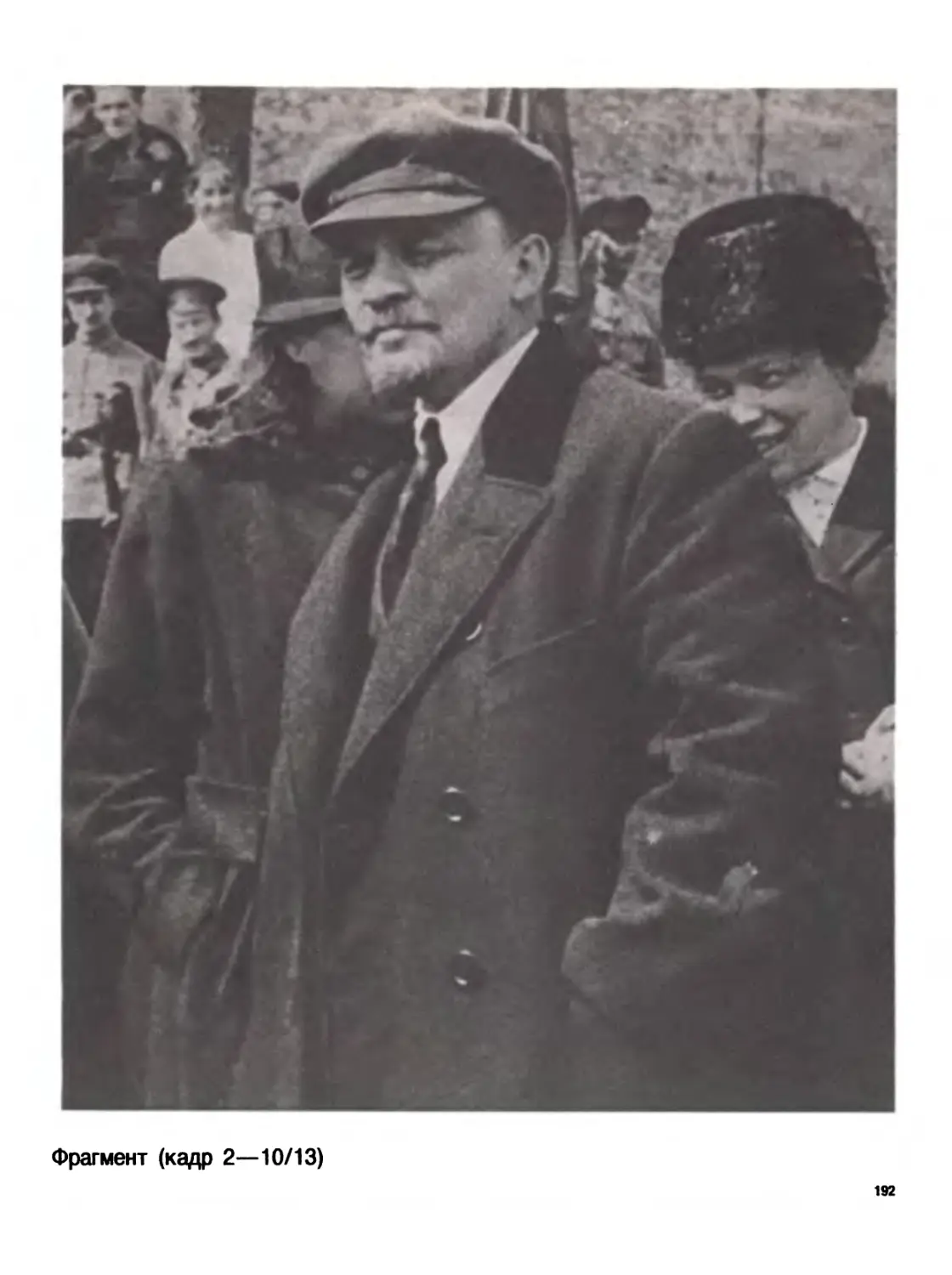
Фрагмент (кадр 2—10/13)
192
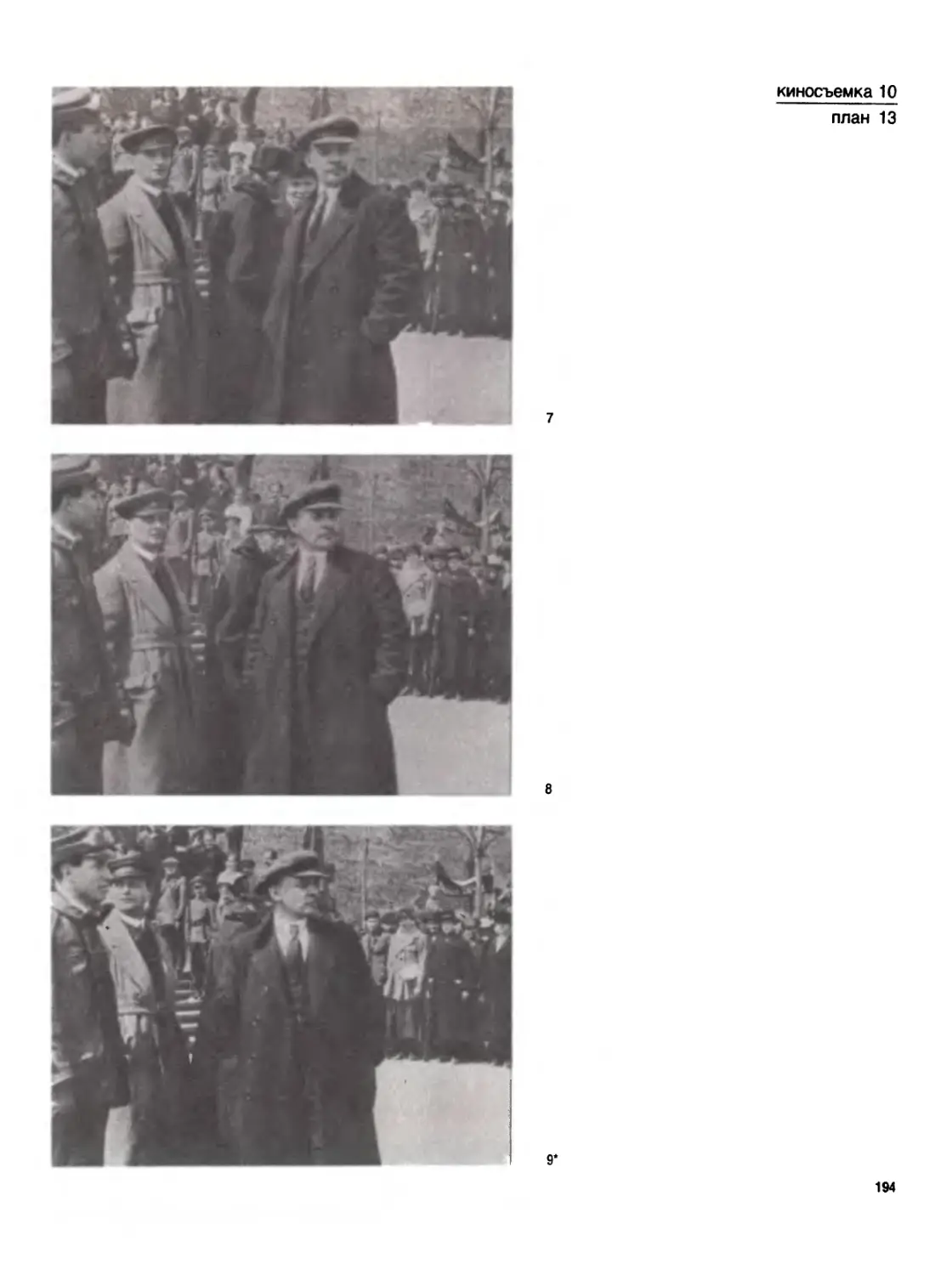
киносъемка 10
план 13
7
8
9*
194
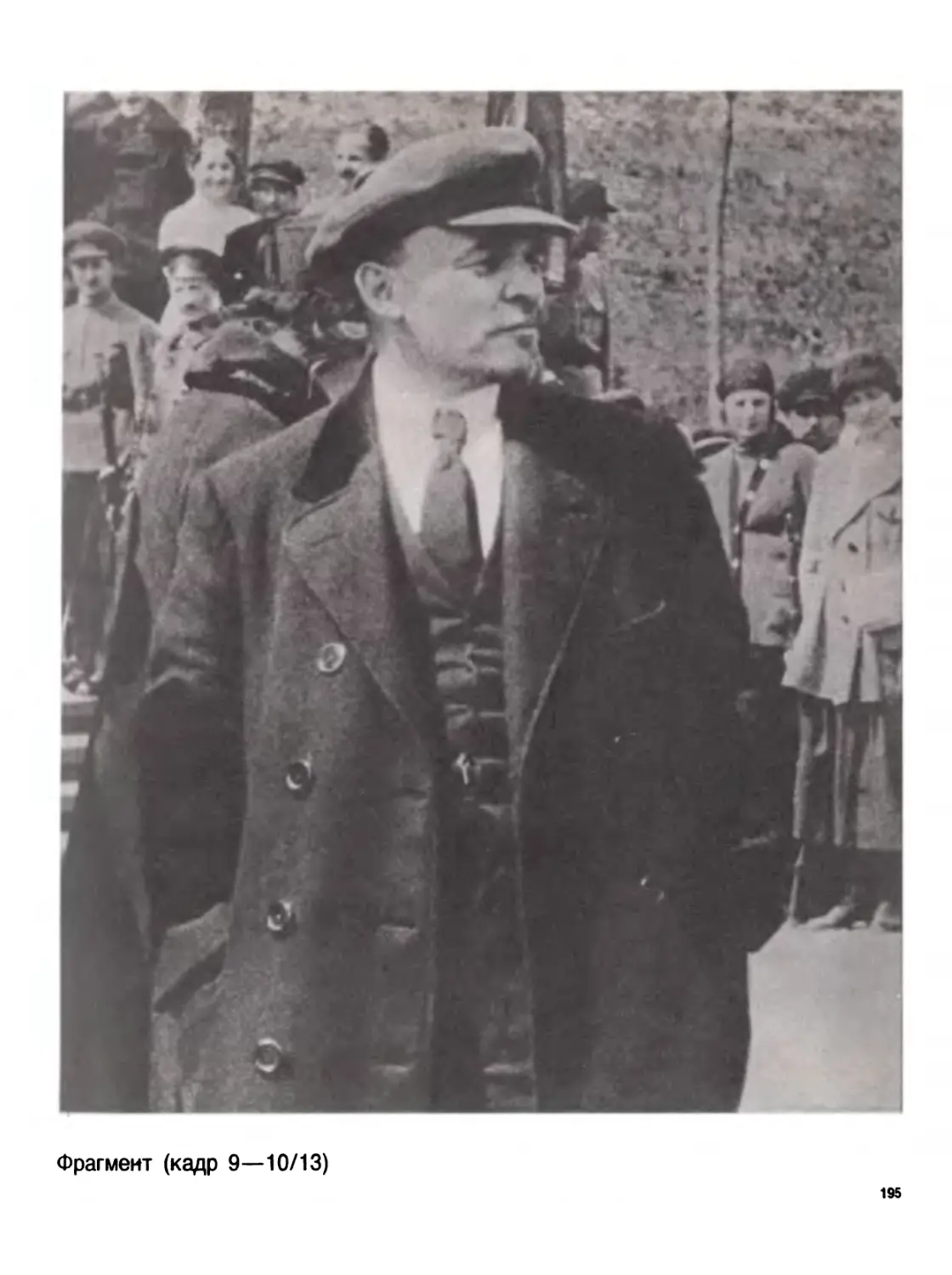
Фрагмент (кадр 9—10/13)
195
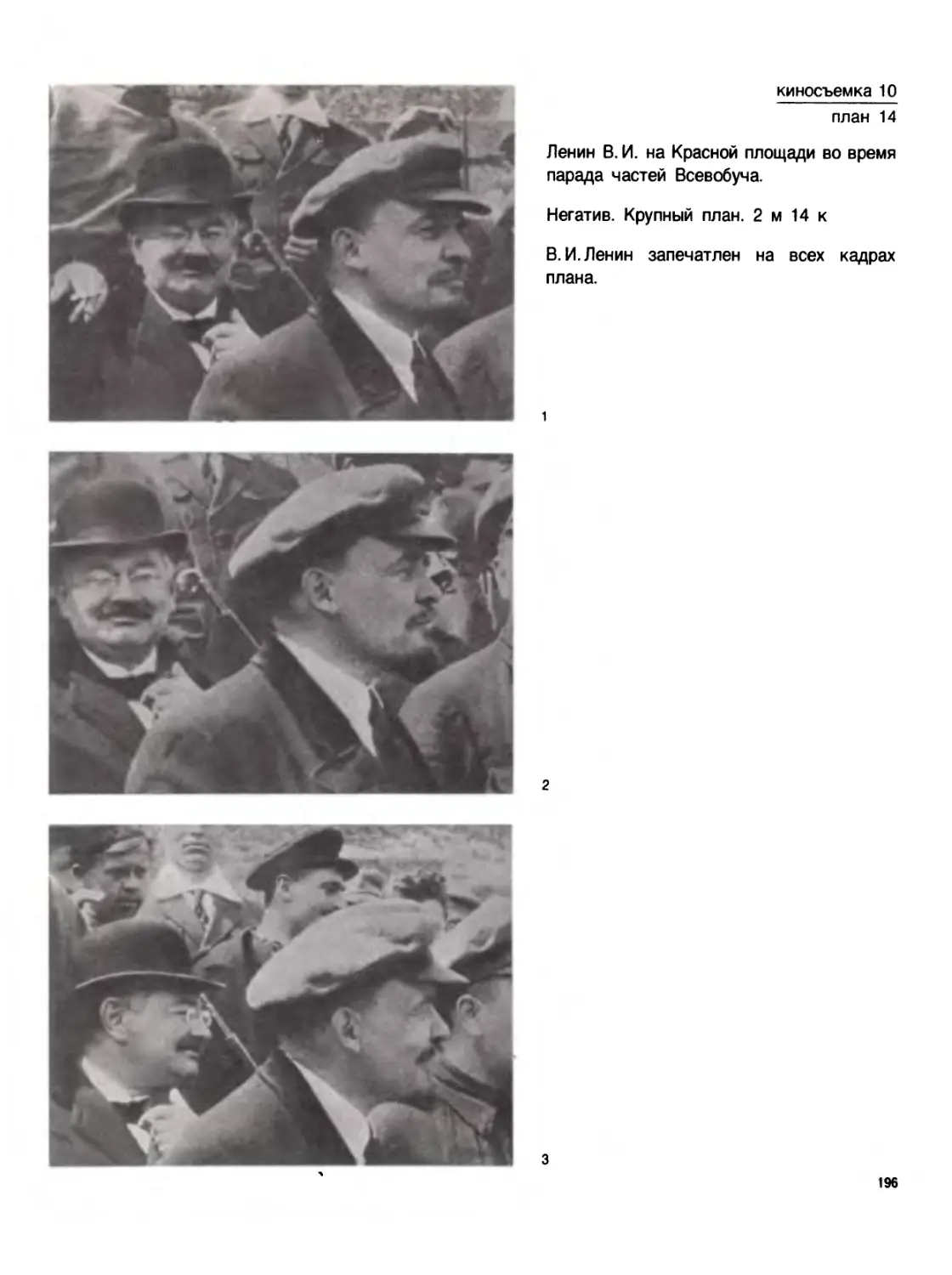
киносъемка 10
план 14
Ленин В. И. на Красной площади во время
парада частей Всевобуча.
Негатив. Крупный план. 2 м 14 к
В. И. Ленин запечатлен на всех кадрах
плана.
1
2
196
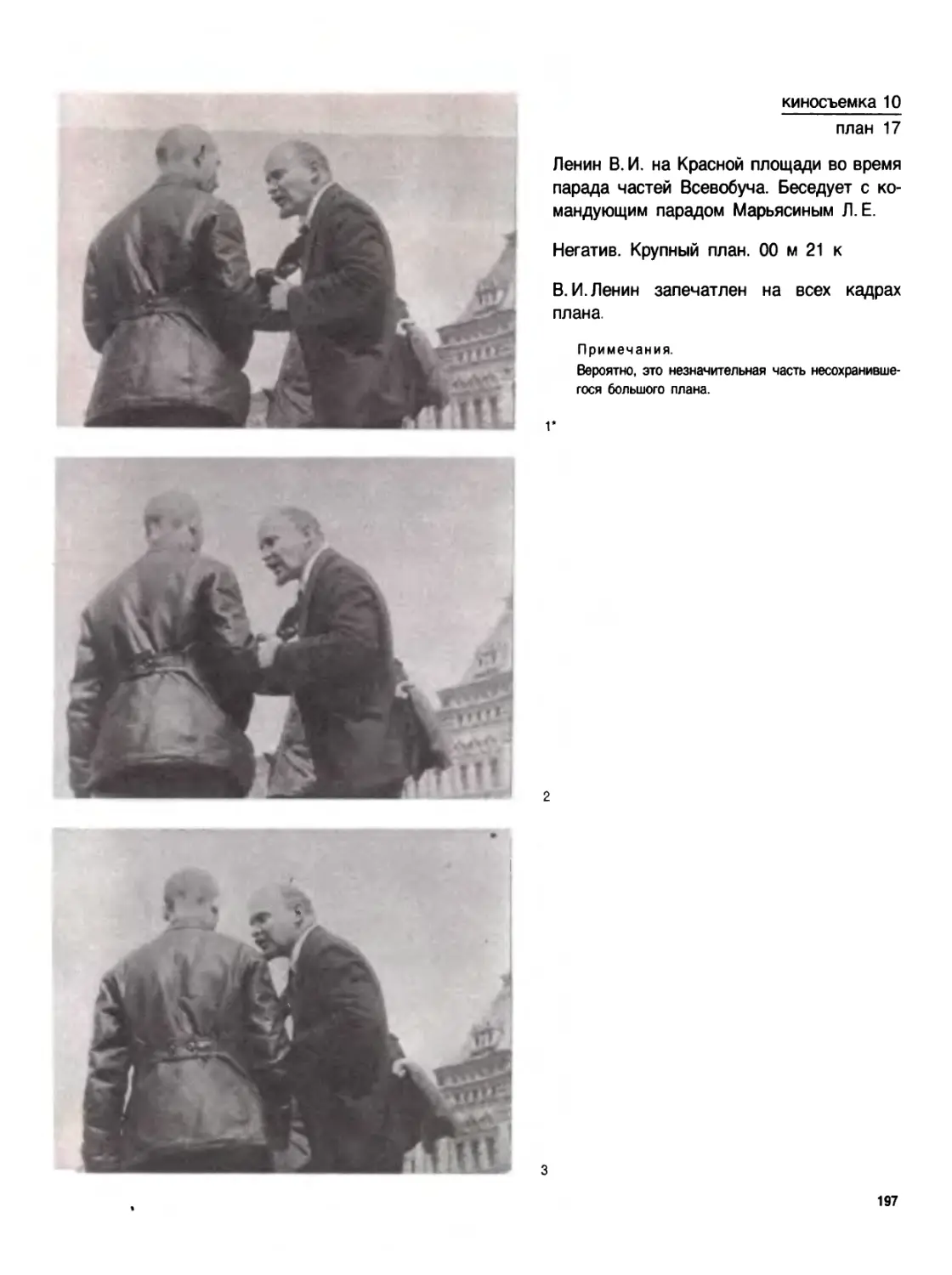
киносъемка 10
план 17
Ленин В. И. на Красной площади во время
парада частей Всевобуча. Беседует с ко¬
мандующим парадом Марьясиным Л. Е.
Негатив. Крупный план. 00 м 21 к
В. И. Ленин запечатлен на всех кадрах
плана.
Примечания.
Вероятно, это незначительная часть несохранивше-
гося большого плана.
2
3
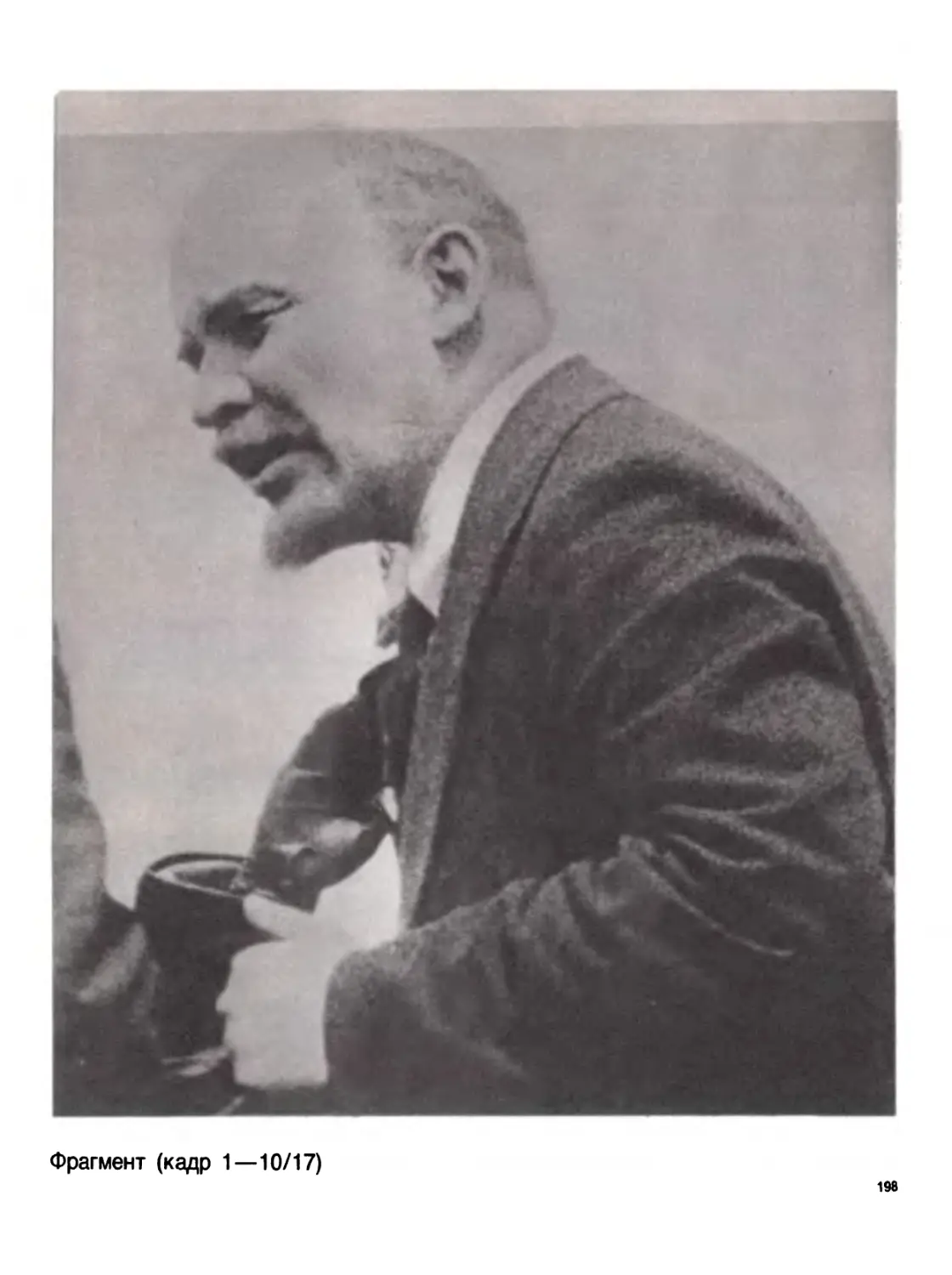
197
Фрагмент (кадр 1—10/17)
198
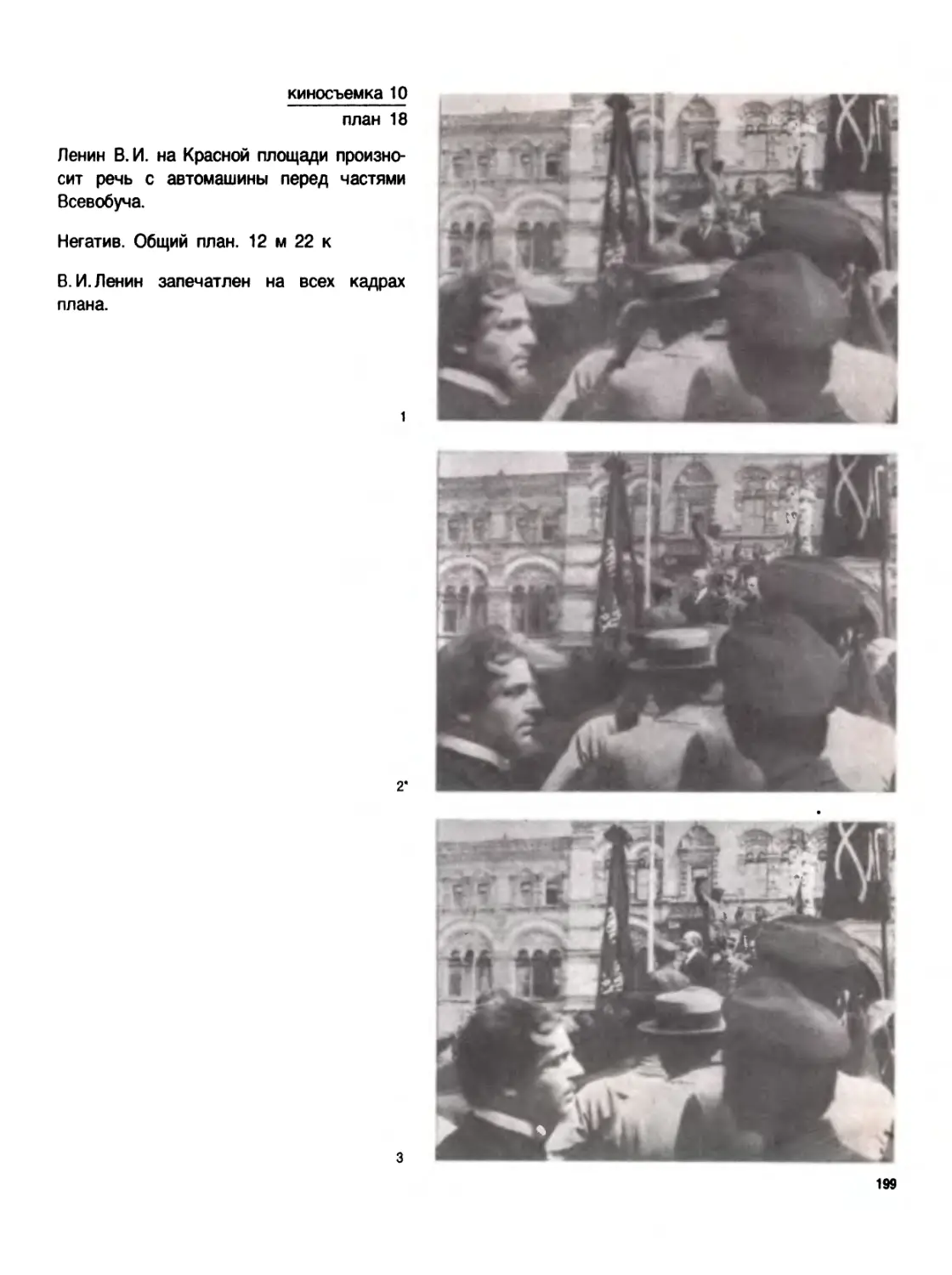
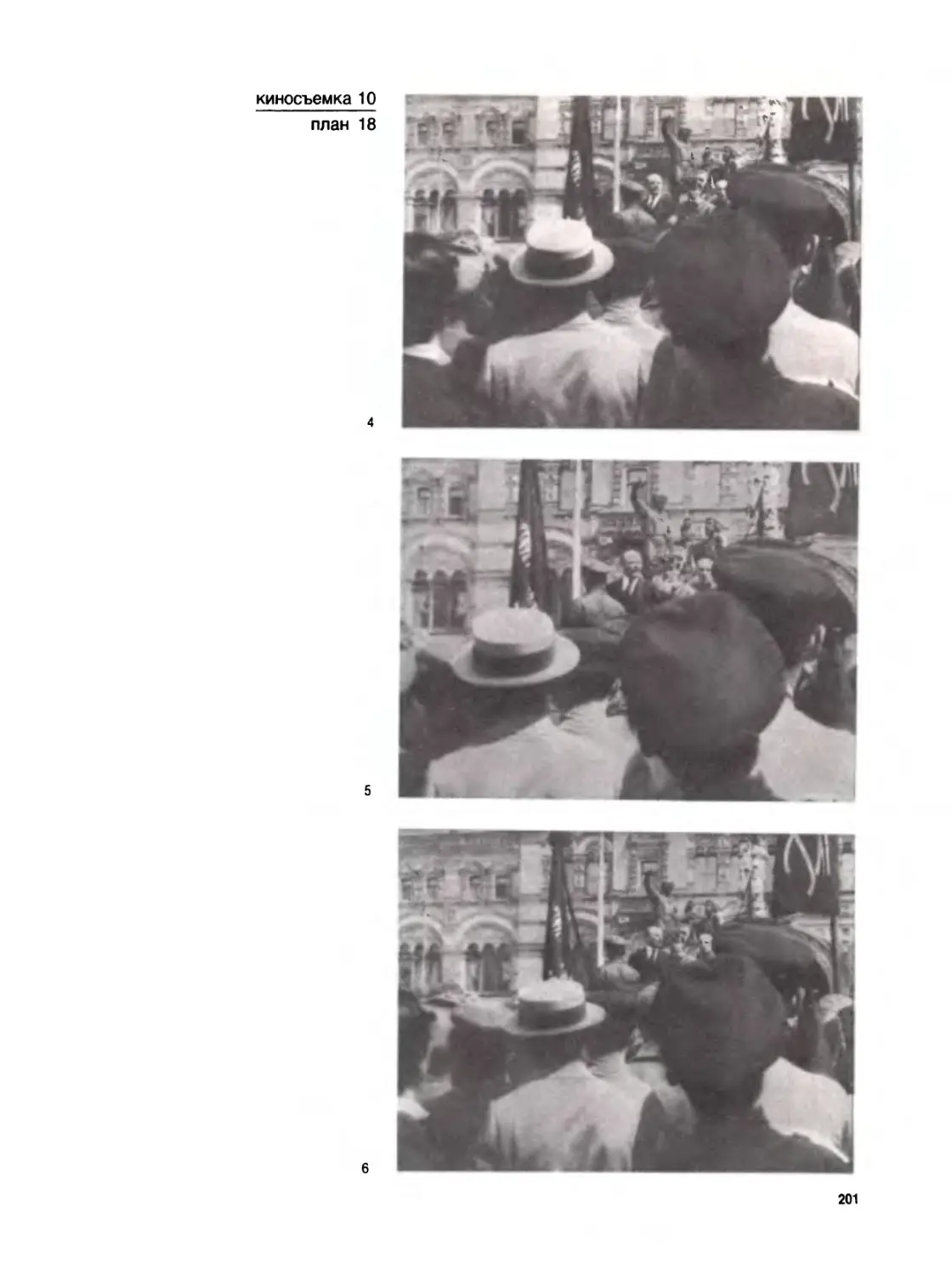
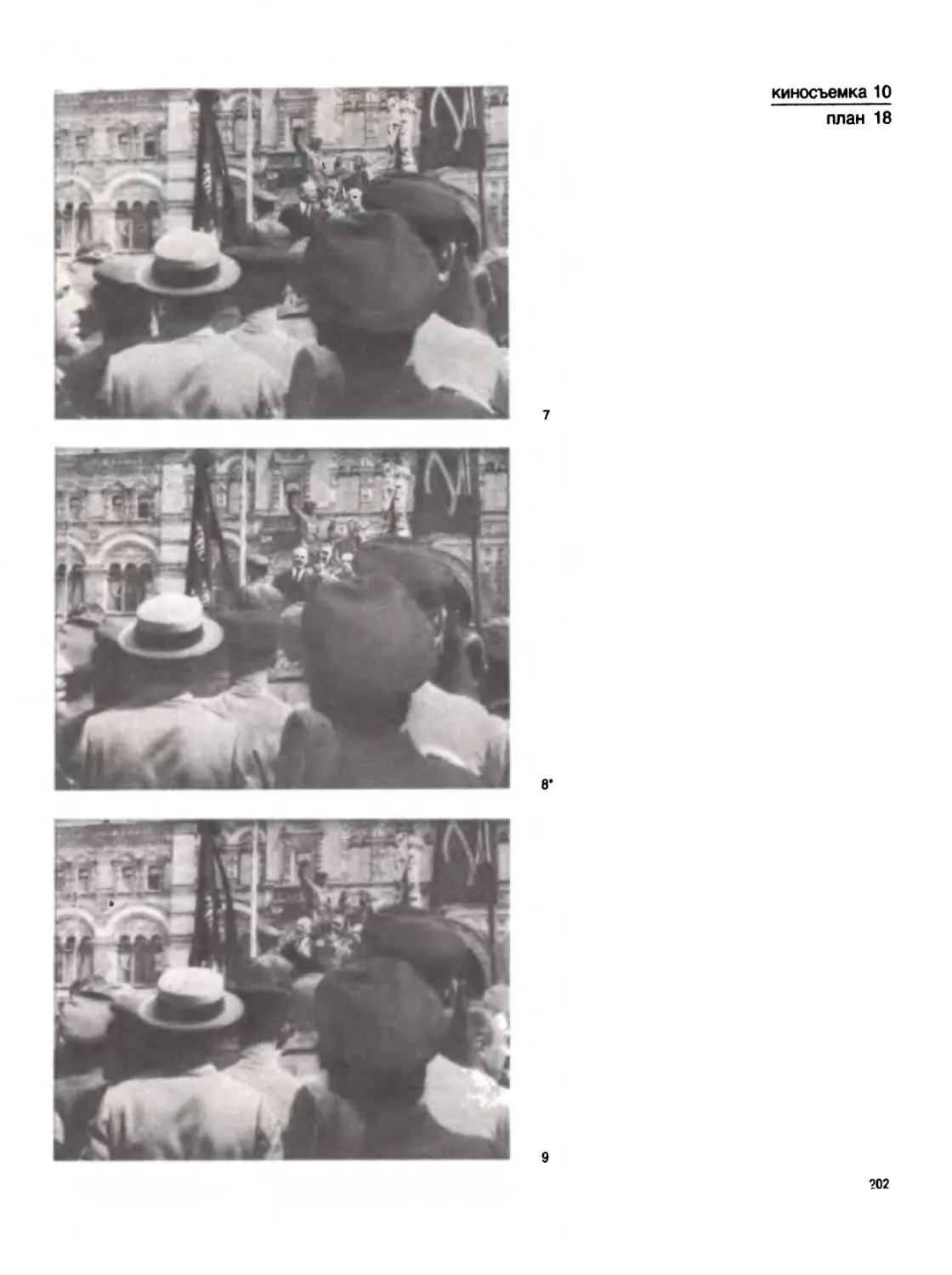
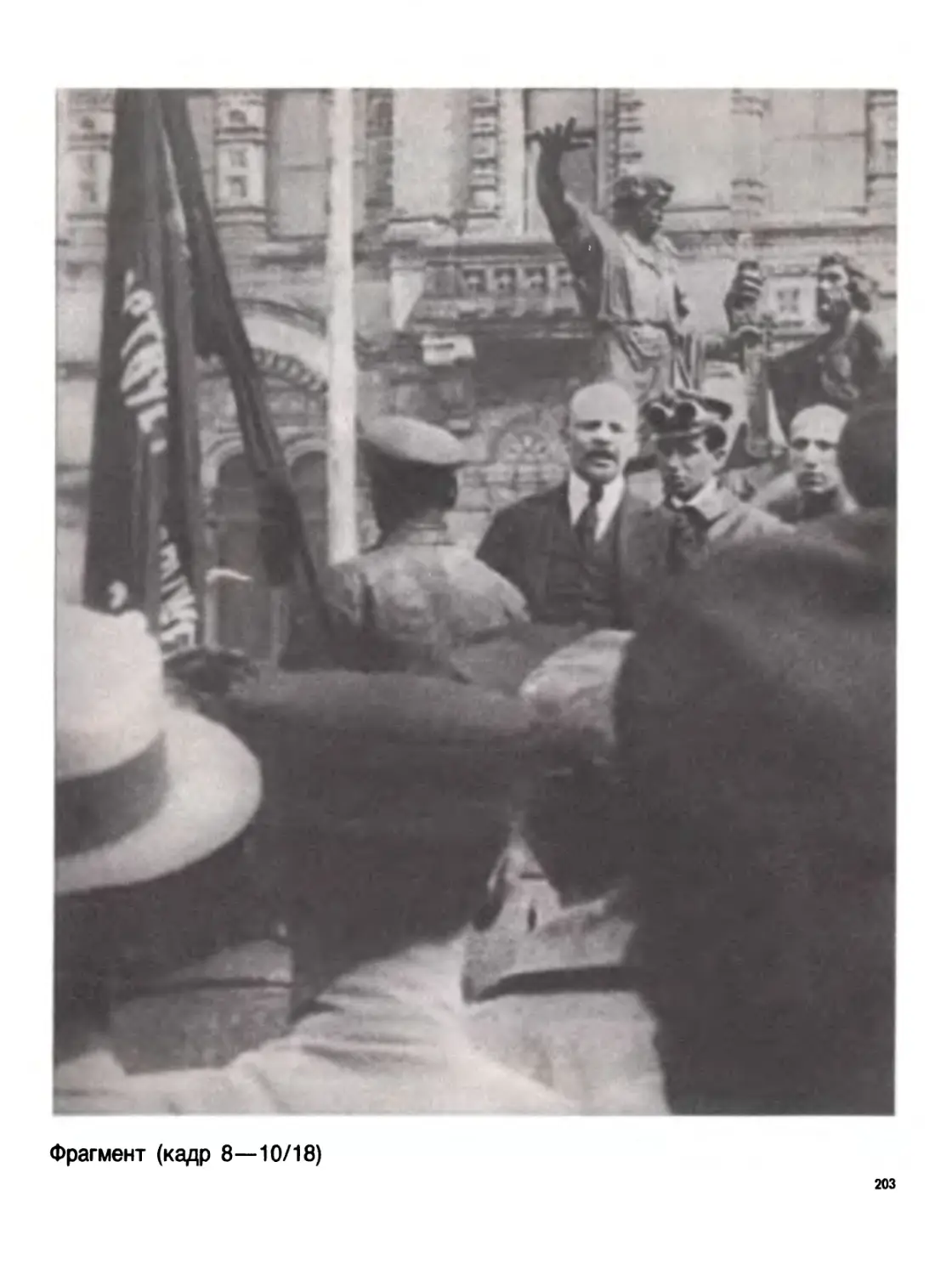
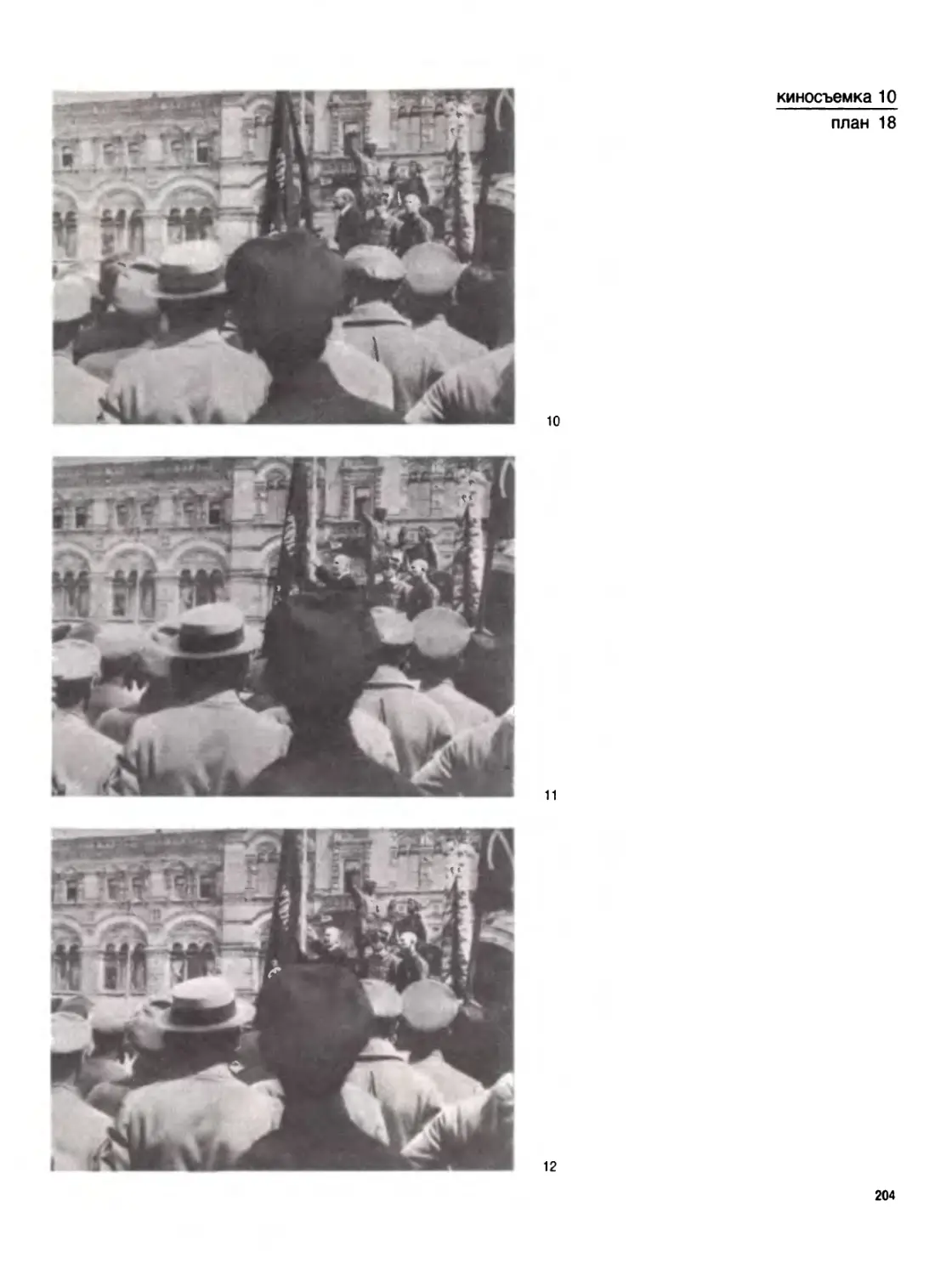
киносъемка 10
план 18
Ленин В. И. на Красной площади произно¬
сит речь с автомашины перед частями
Всевобуча.
Негатив. Общий план. 12 м 22 к
В. И. Ленин запечатлен на всех кадрах
плана.
1
2*
199
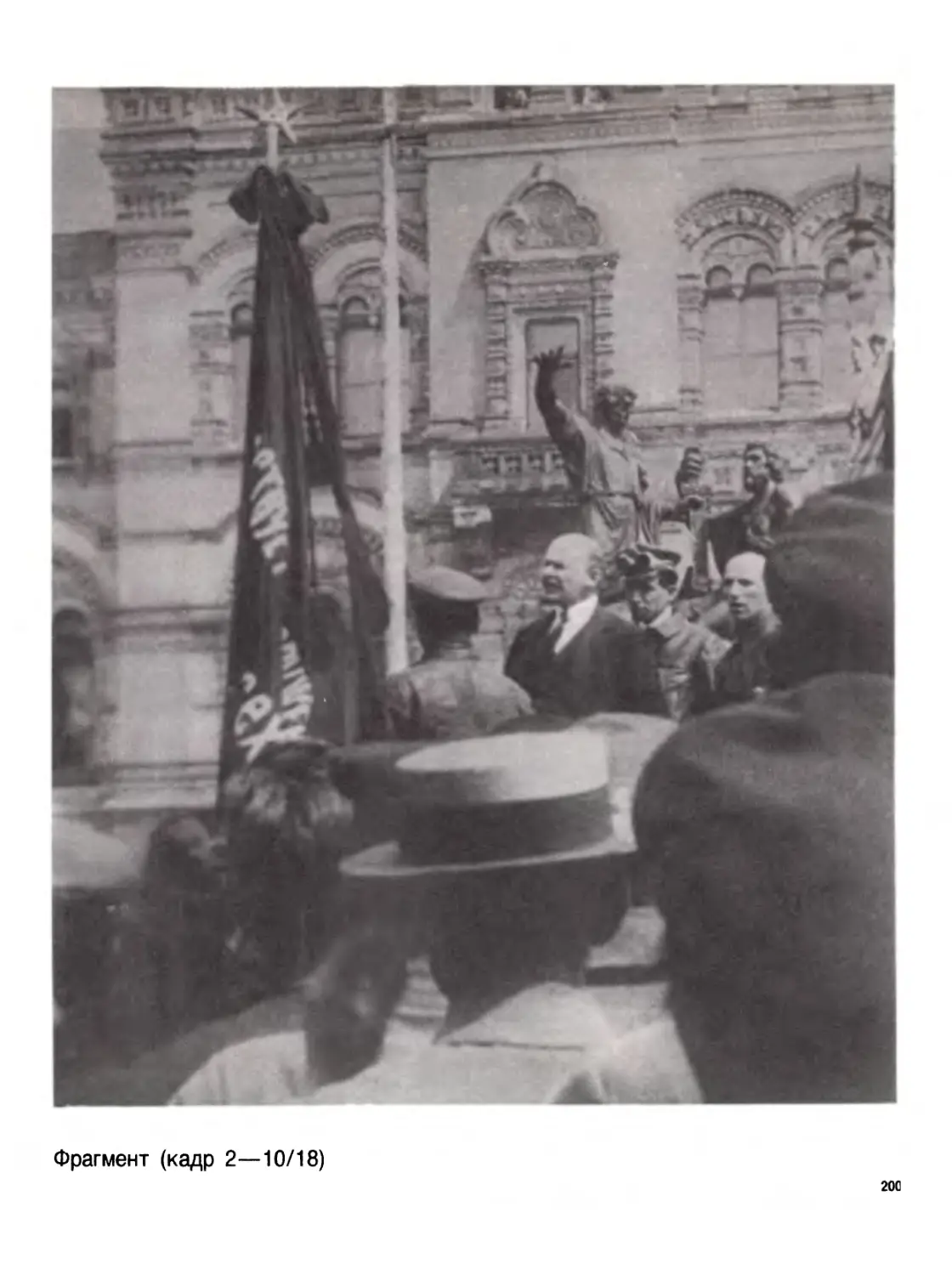
Фрагмент (кадр 2—10/18)
200
201
киносъемка 10
план 18
7
8*
9
202
Фрагмент (кадр 8—10/18)
203
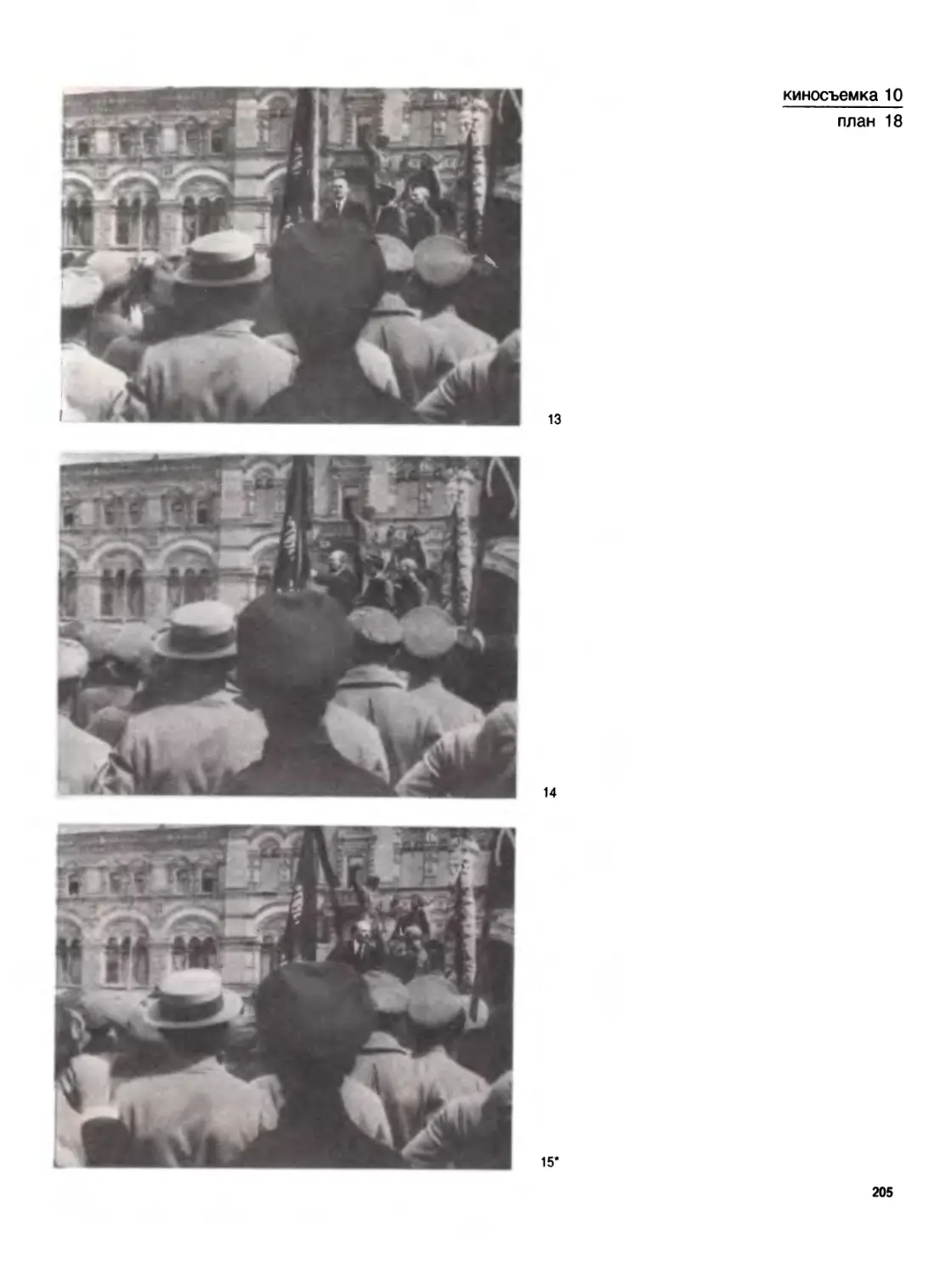
205
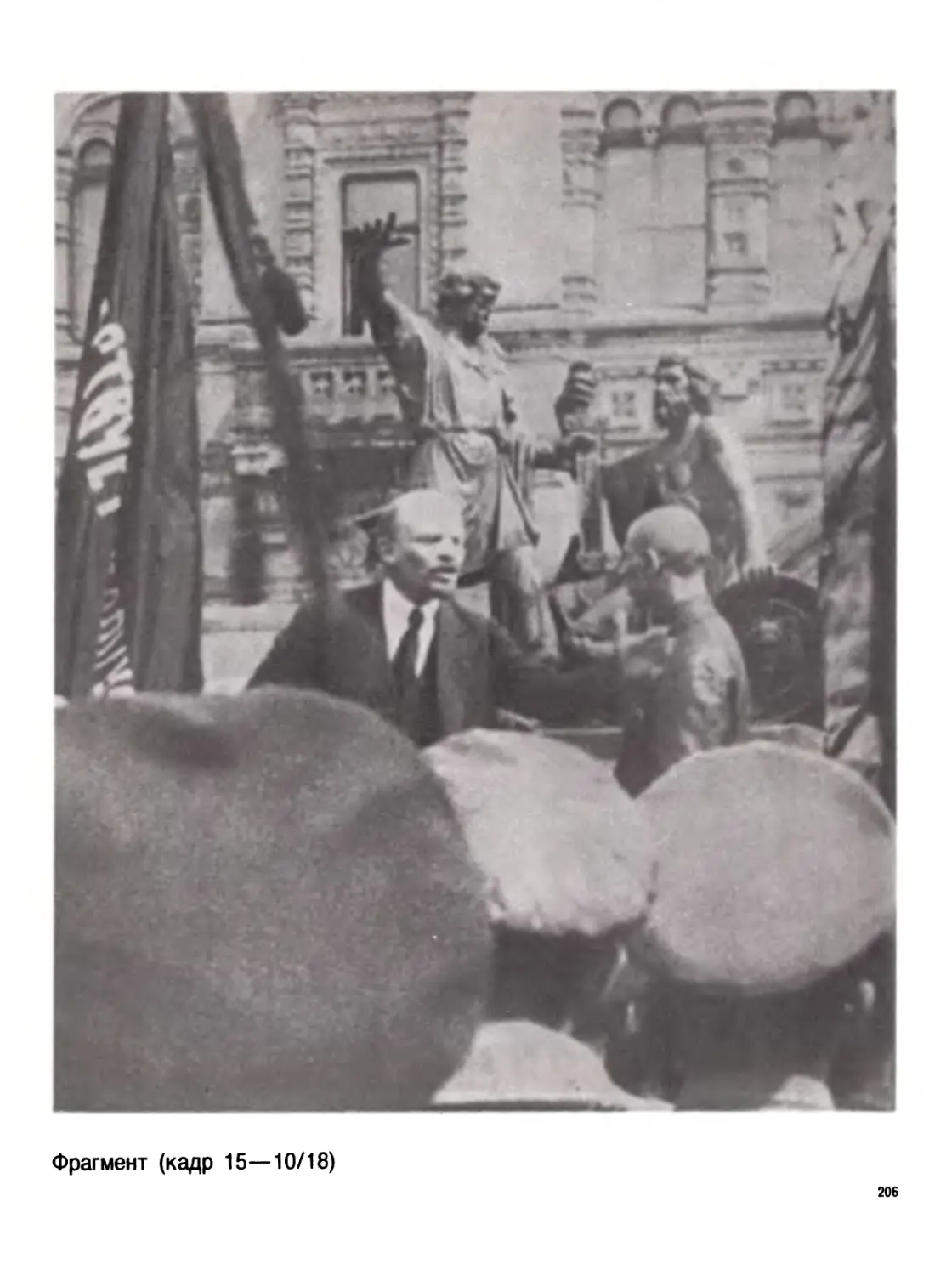
Фрагмент (кадр 15—10/18)
206
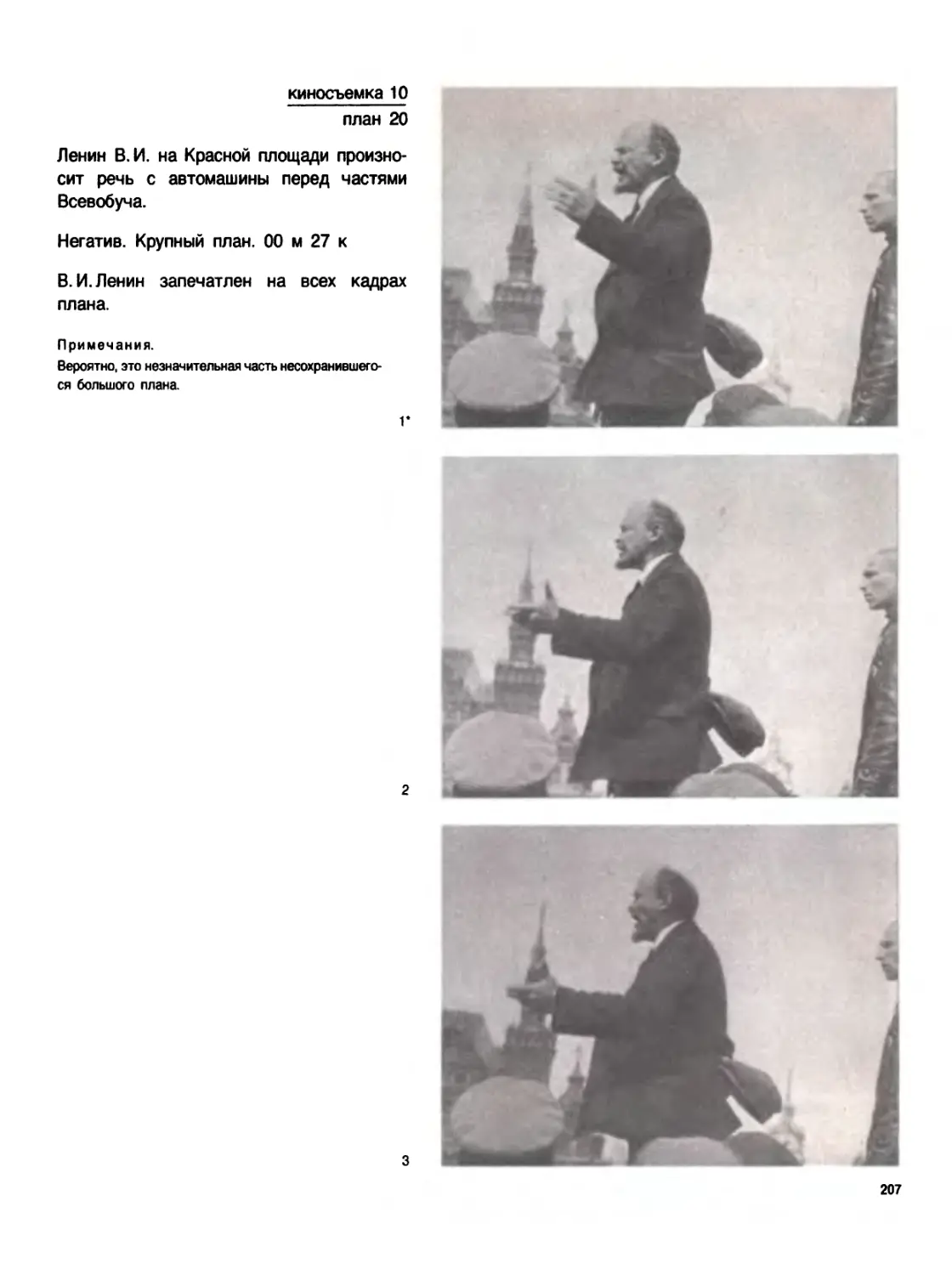
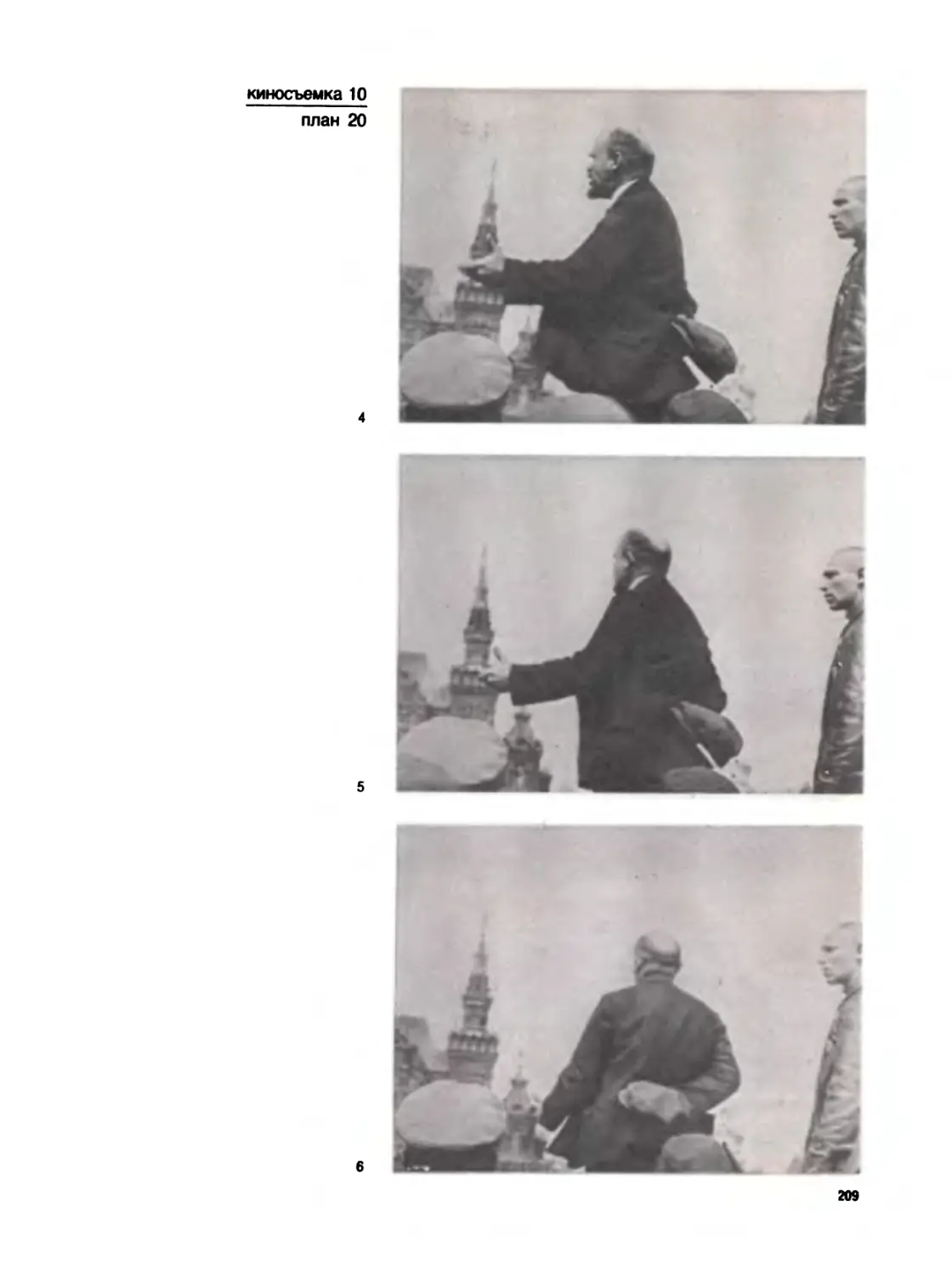
киносъемка 10
план 20
Ленин В. И. на Красной площади произно¬
сит речь с автомашины перед частями
Всевобуча.
Негатив. Крупный план. 00 м 27 к
В. И. Ленин запечатлен на всех кадрах
плана.
Примечания.
Вероятно, это незначительная часть несохранившего-
ся большого плана.
2
3
207
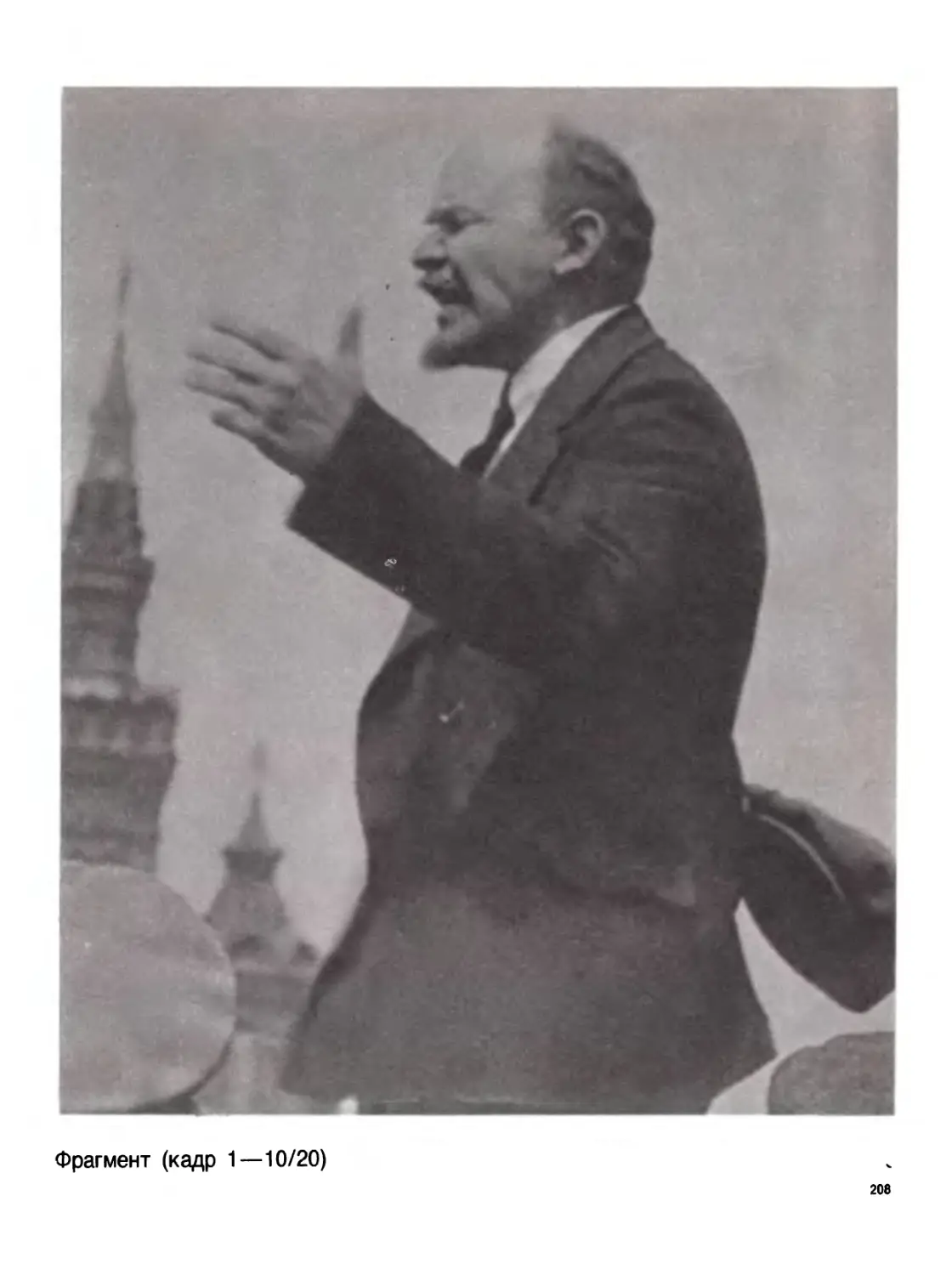
Фрагмент (кадр 1—10/20)
209
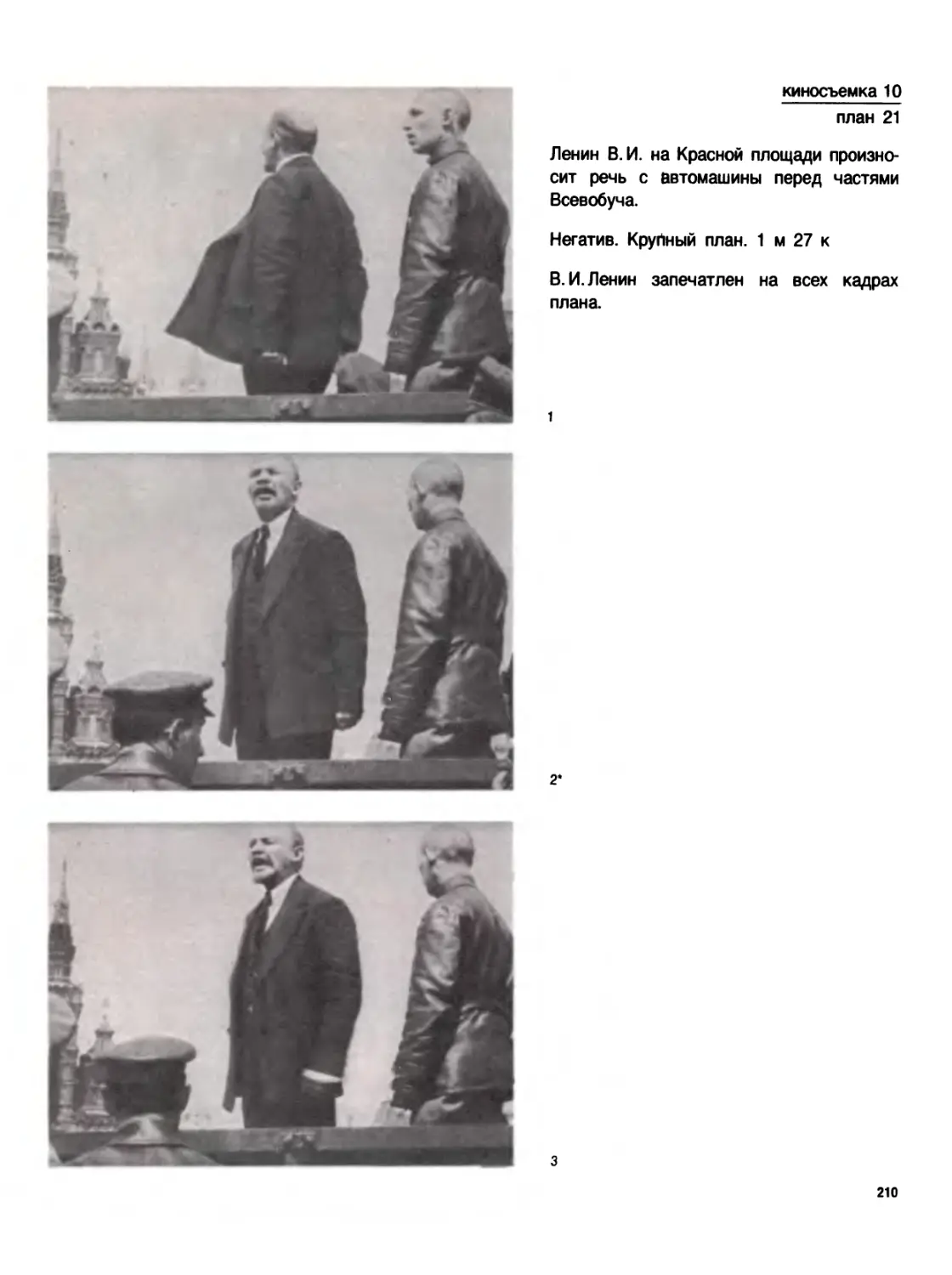
киносъемка 10
план 21
Ленин В. И. на Красной площади произно¬
сит речь с автомашины перед частями
Всевобуча.
Негатив. КруЬный план. 1 м 27 к
В. И. Ленин запечатлен на всех кадрах
плана.
1
210
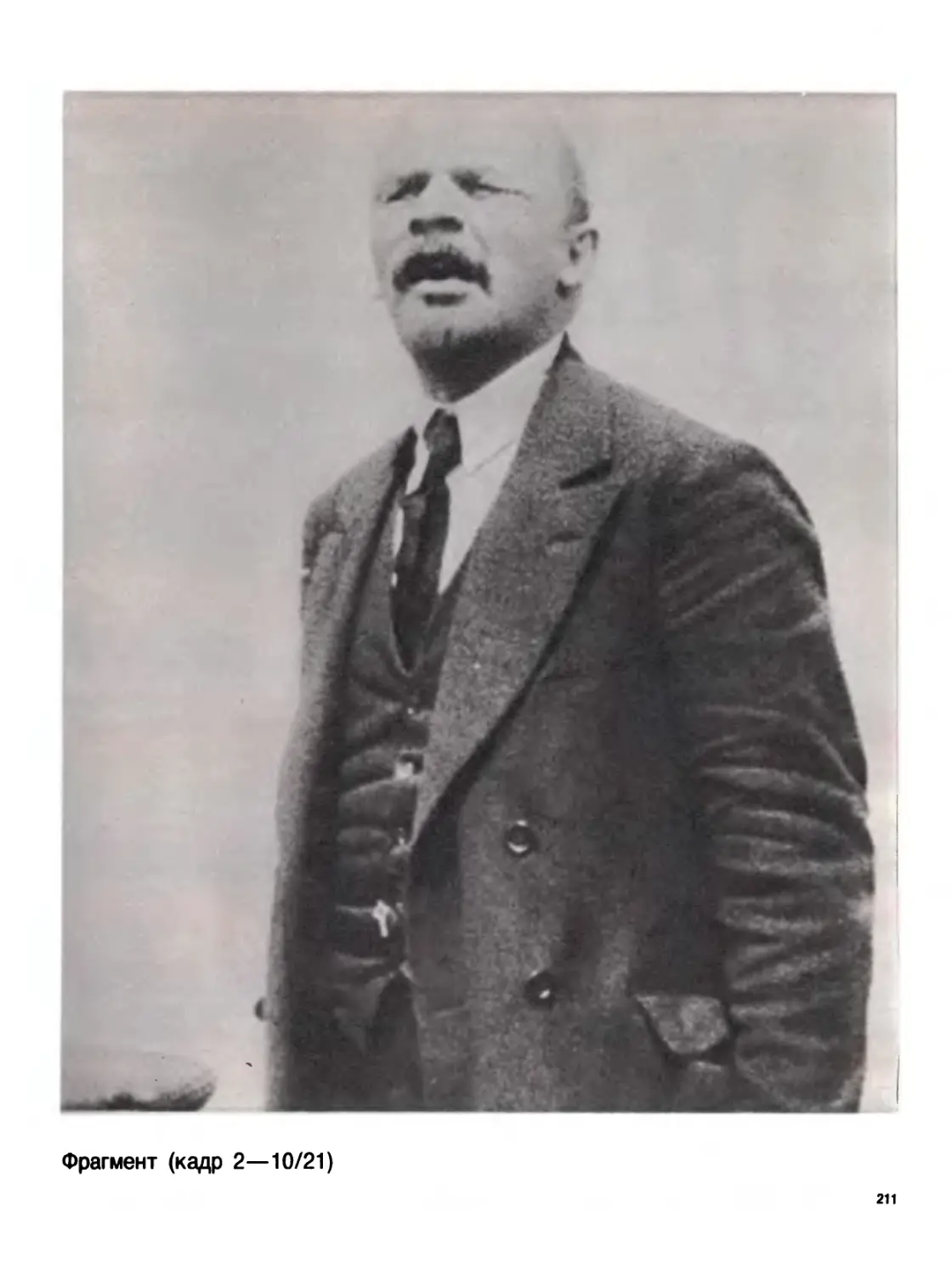
Фрагмент (кадр 2—10/21)
211
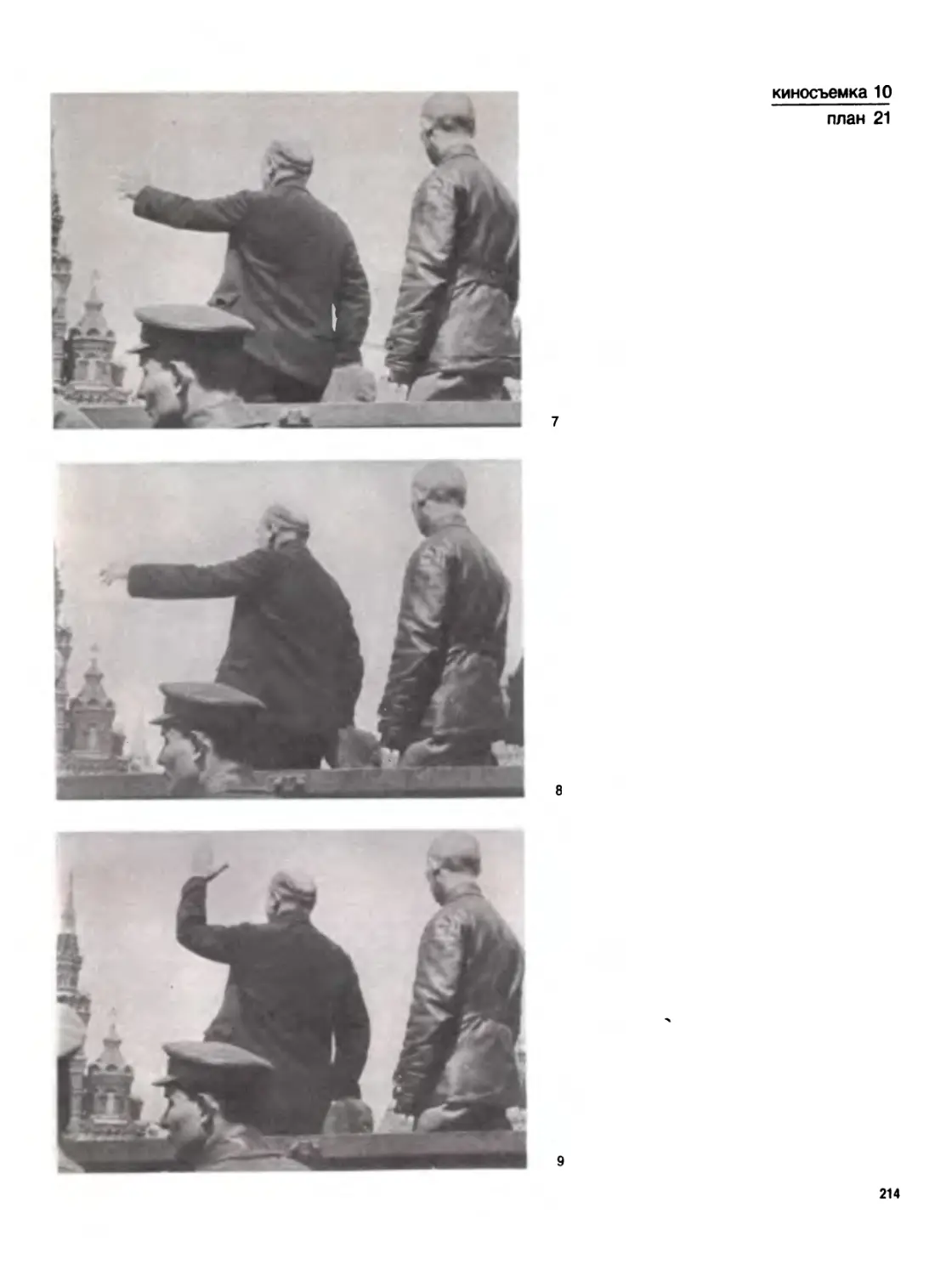
киносъемка 10
план 21
7
8
9
214
киносъемка 10
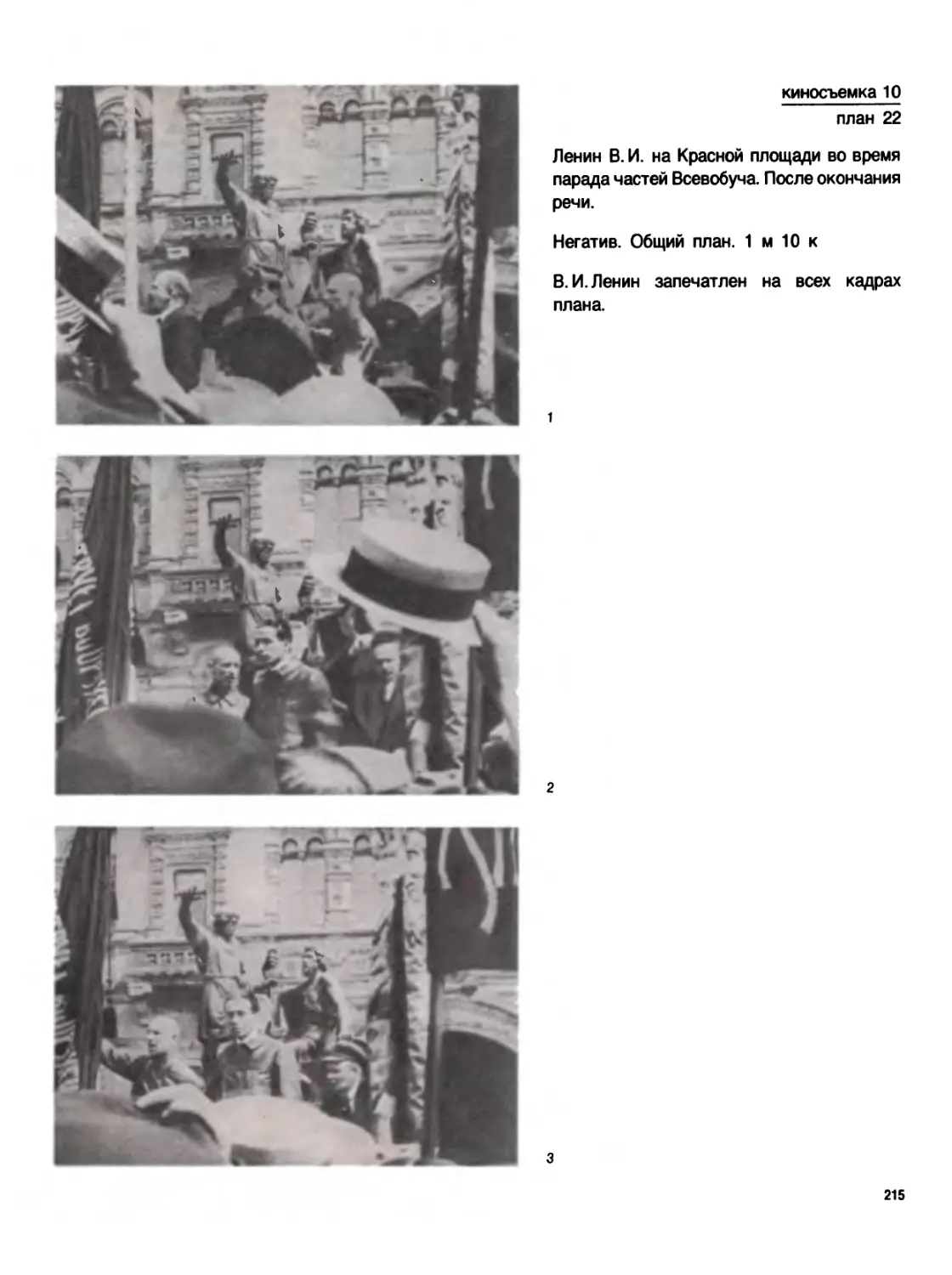
план 22
Ленин В. И. на Красной площади во время
парада частей Всевобуча. После окончания
речи.
Негатив. Общий план. 1 м 10 к
В. И. Ленин запечатлен на всех кадрах
плана.
1
2
3
215
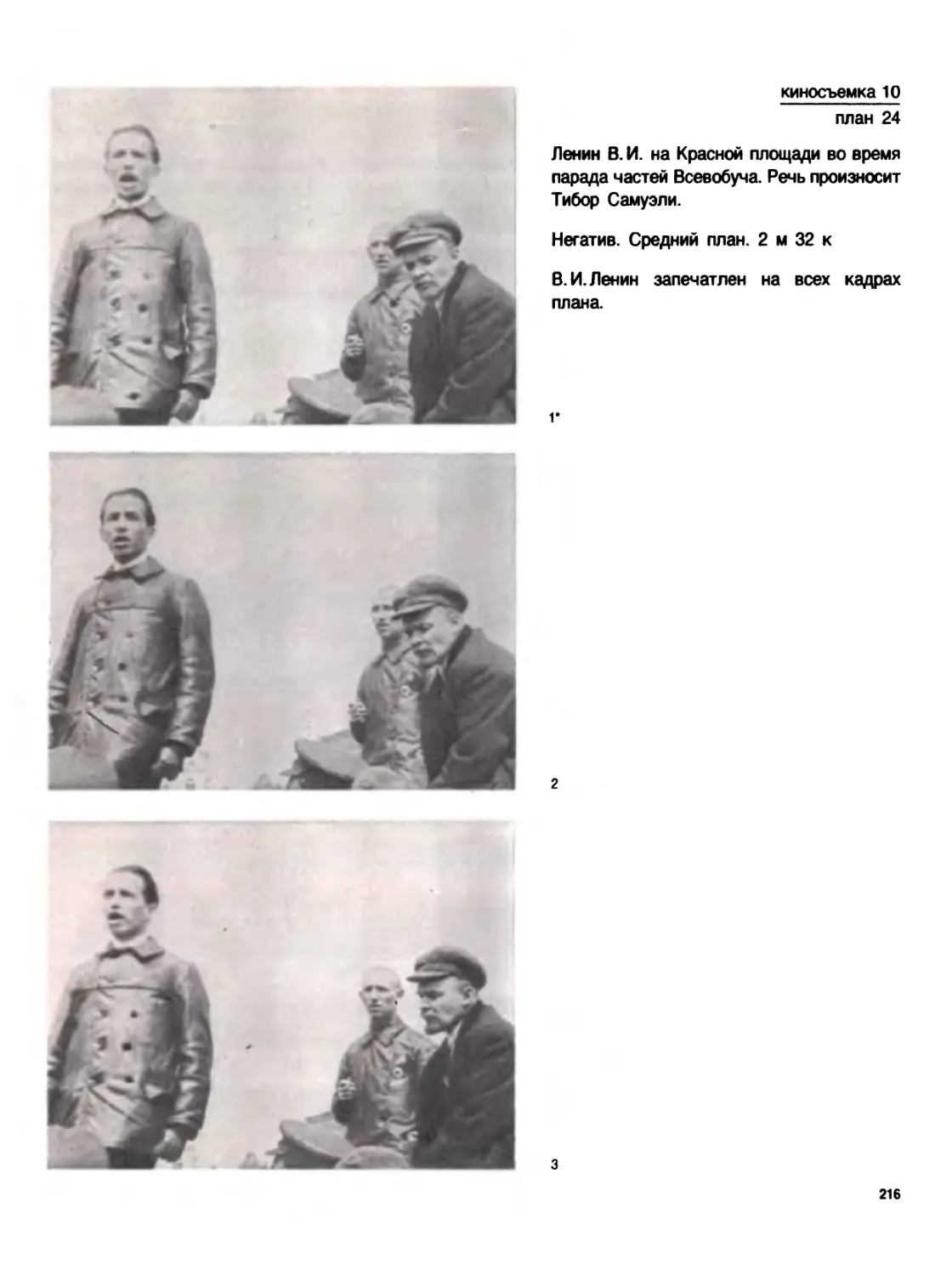
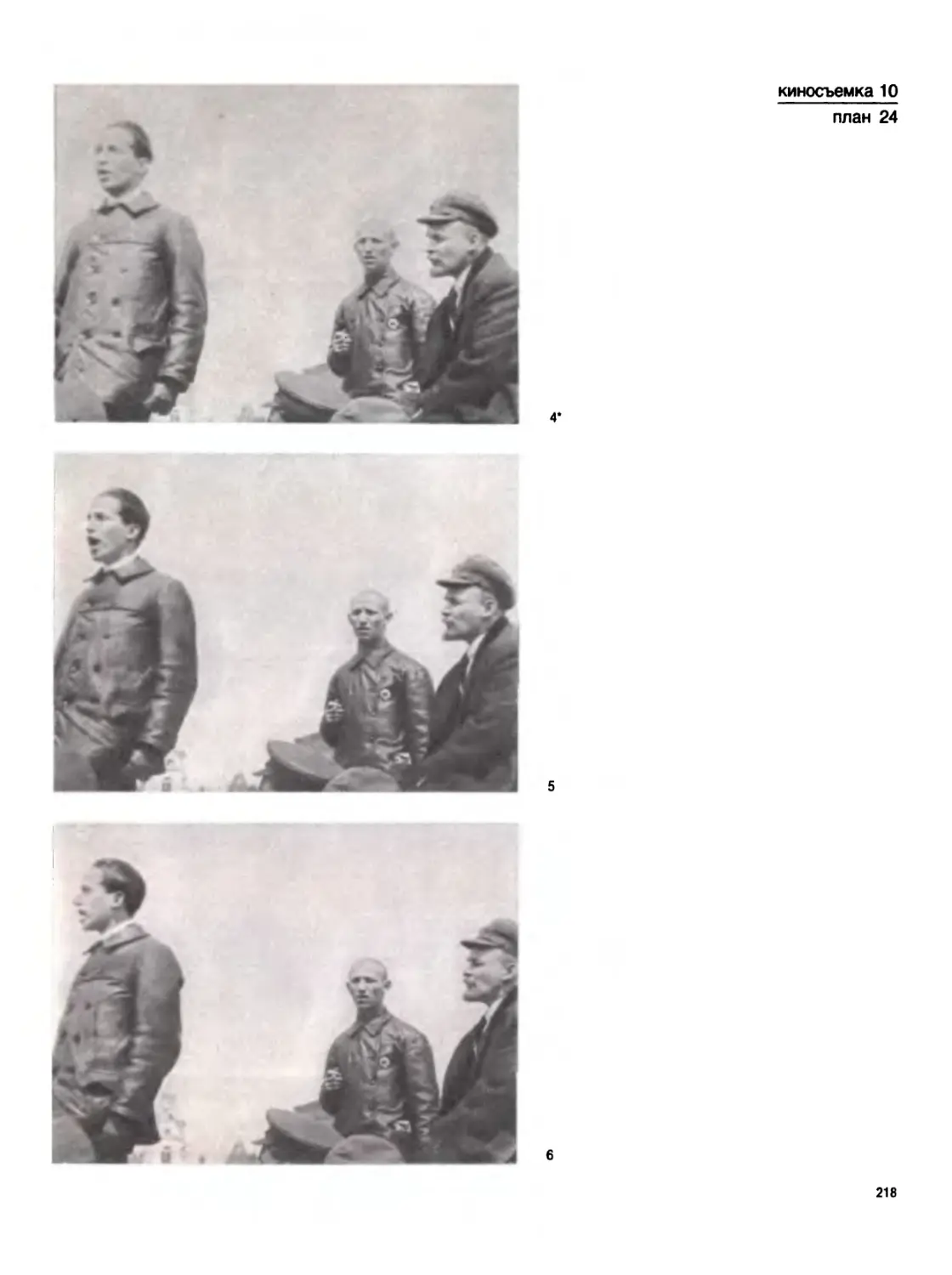
киносъемка 10
план 24
Ленин В. И. на Красной площади во время
парада частей Всевобуча. Речь произносит
Тибор Самуэли.
Негатив. Средний план. 2 м 32 к
В. И. Ленин запечатлен на всех кадрах
плана.
г
2
3
216
217
218
ШWÊÊÊÊÊÊ
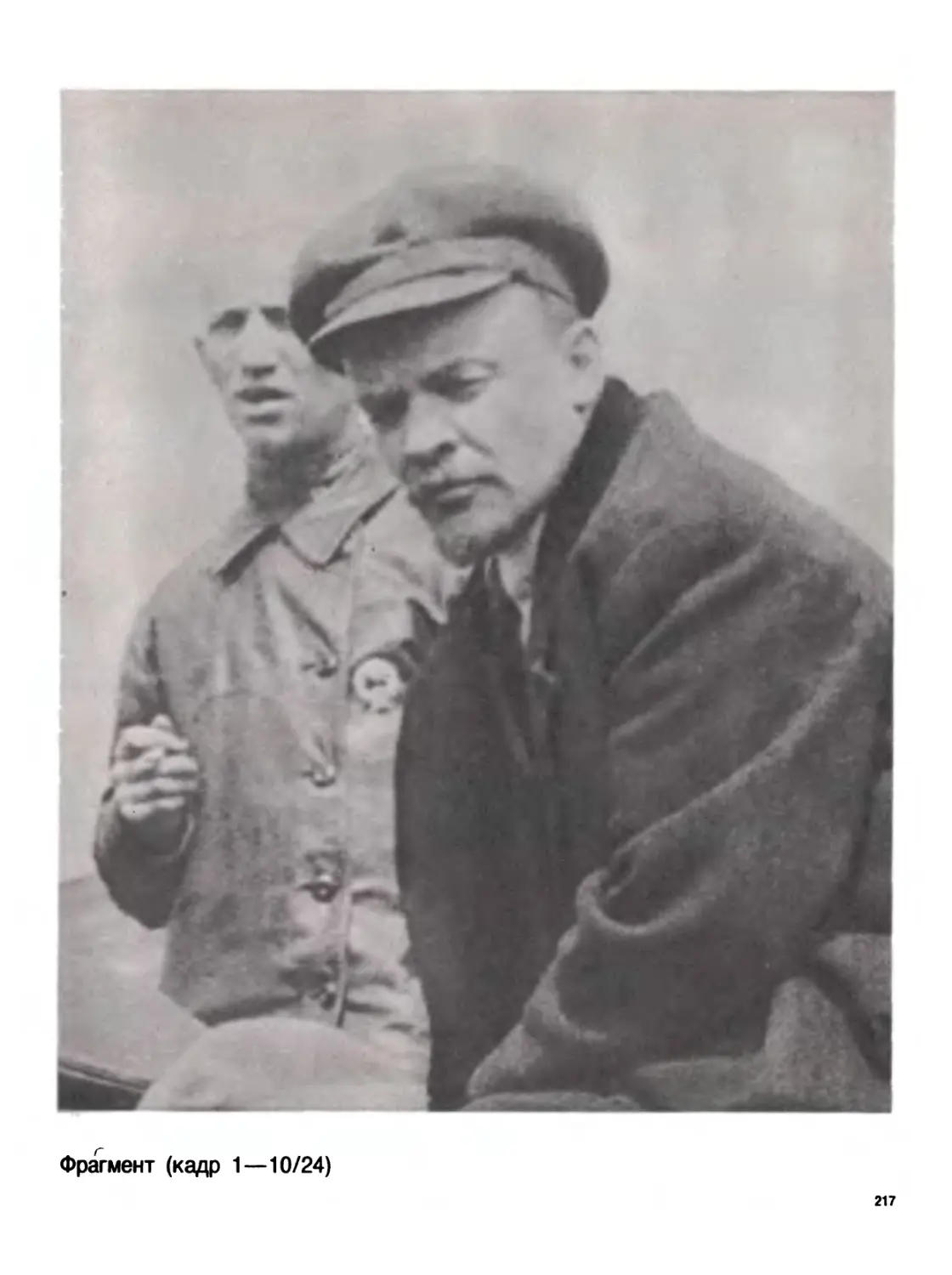
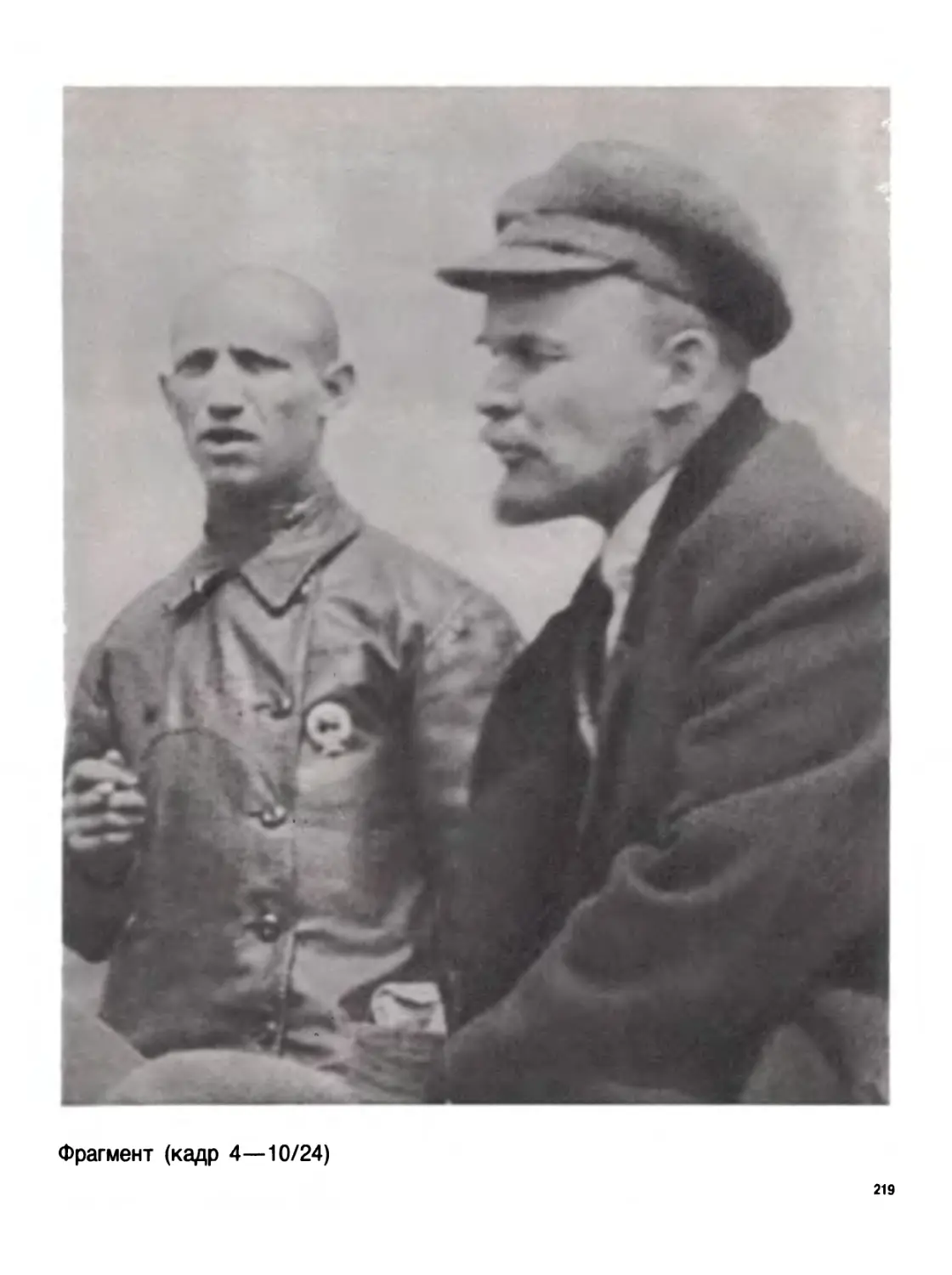
Фрагмент (кадр 4—10/24)
219
киносъемка 10
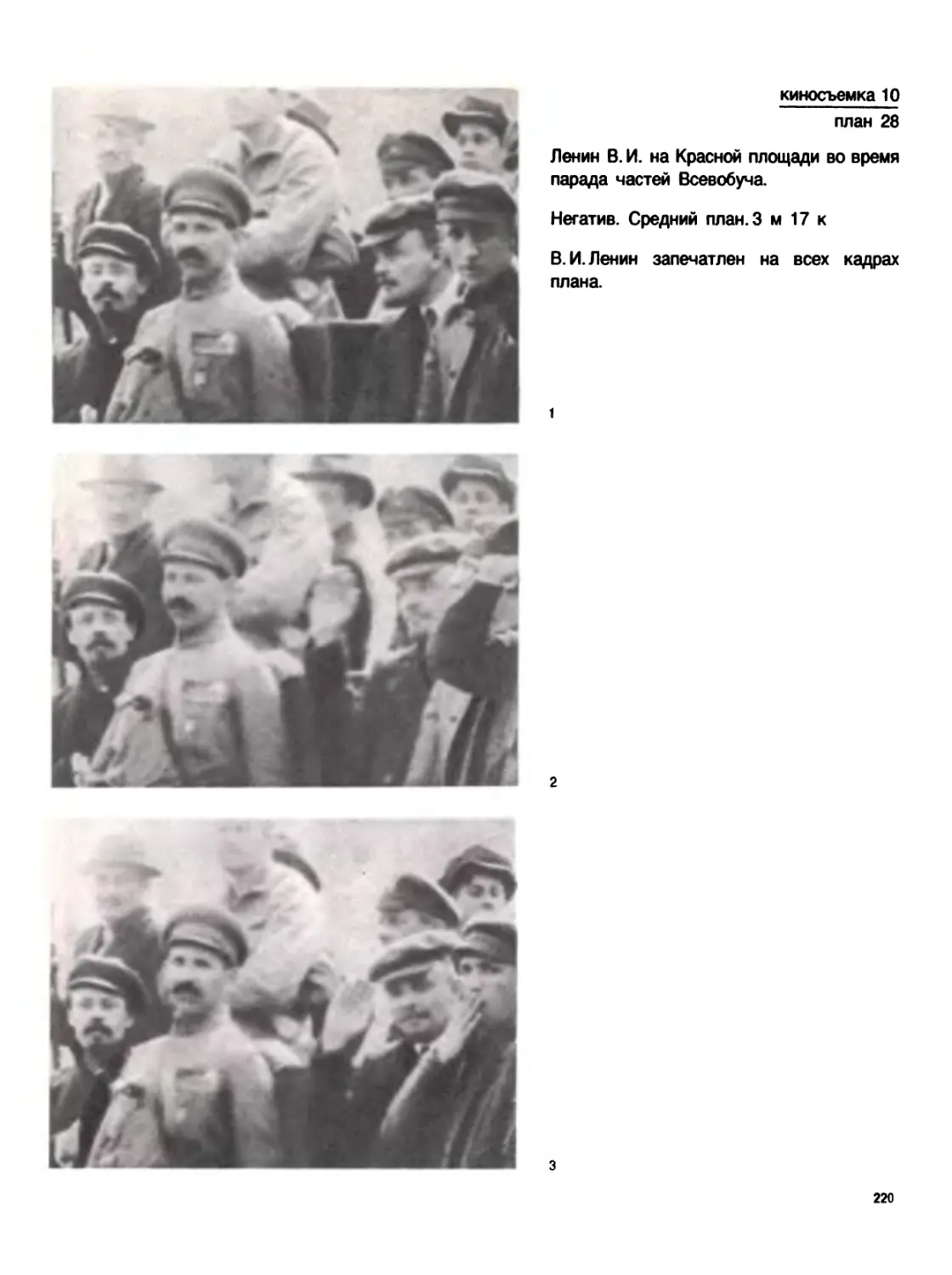
план 28
Ленин В. И. на Красной площади во время
парада частей Всевобуча.
Негатив. Средний план.З м 17 к
В. И. Ленин запечатлен на всех кадрах
плана.
1
2
3
220
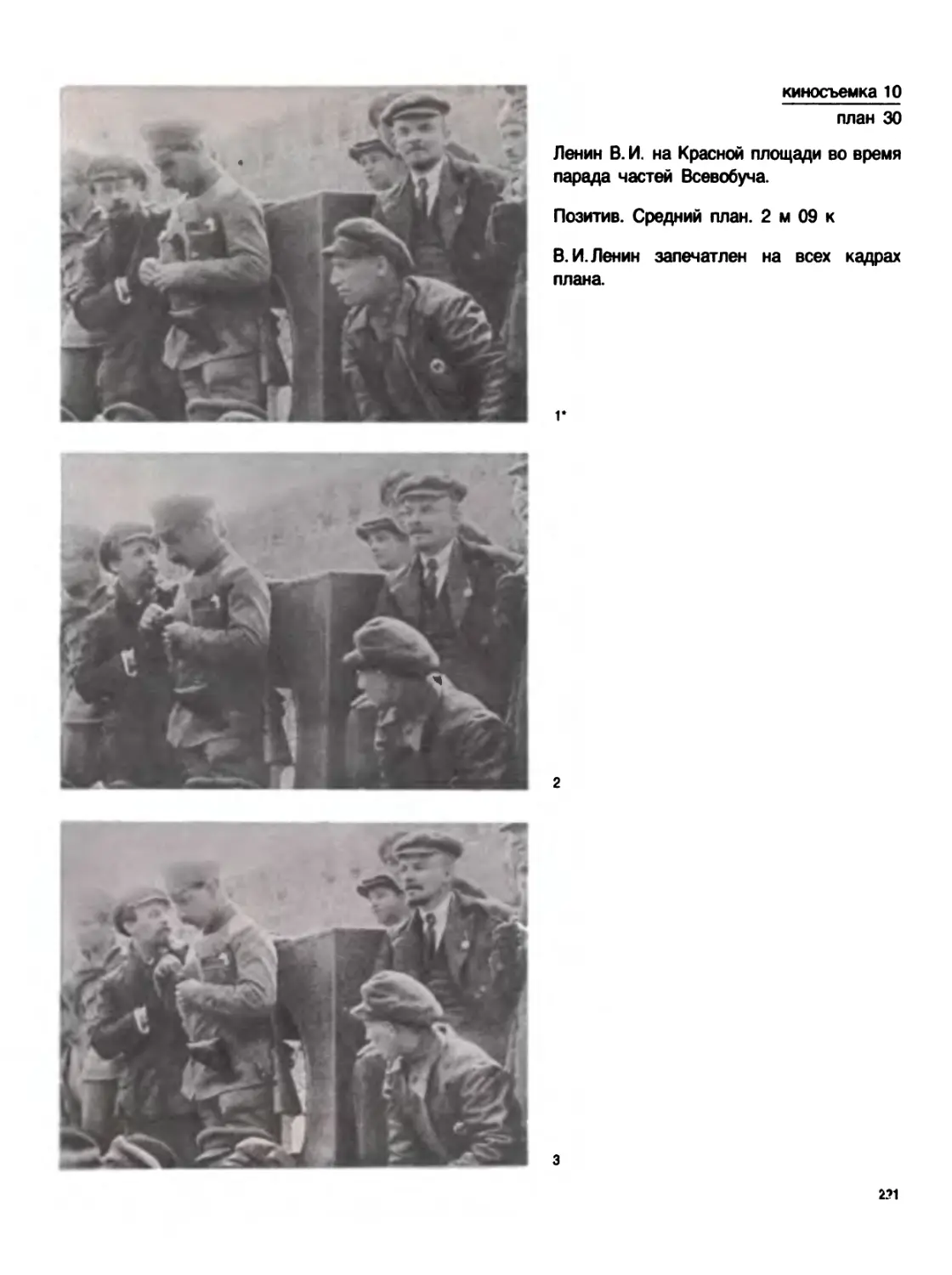
киносъемка 10
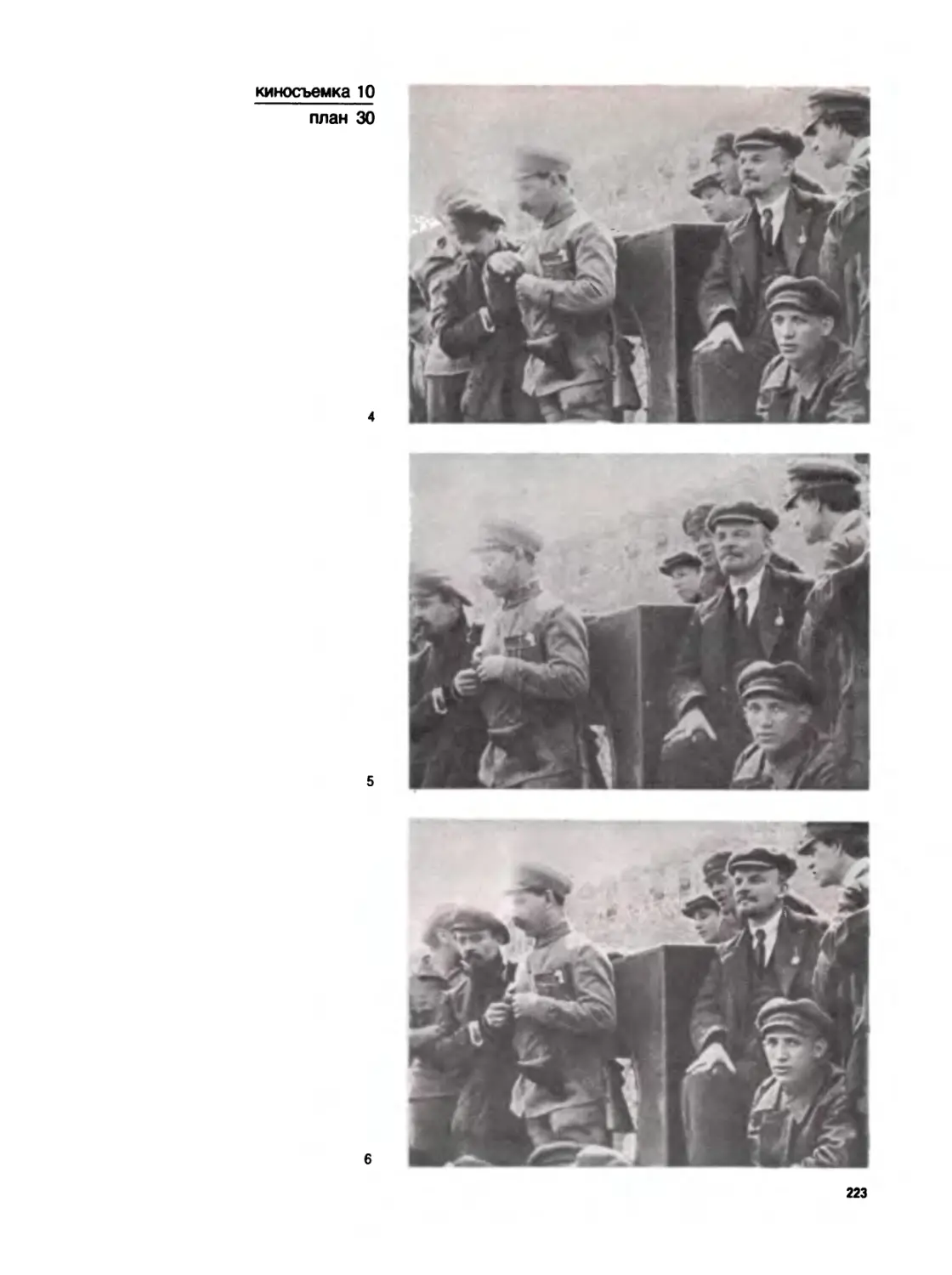
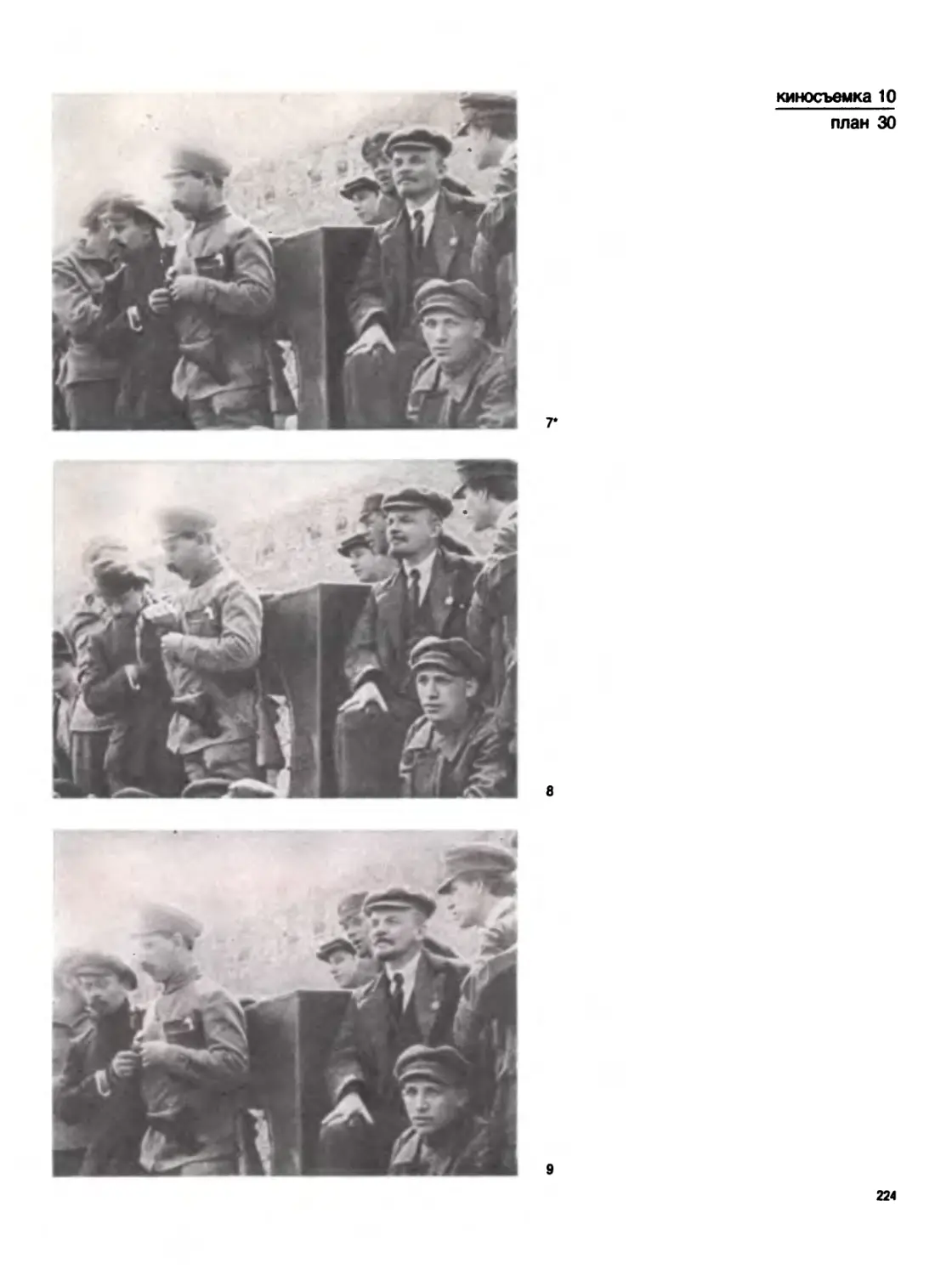
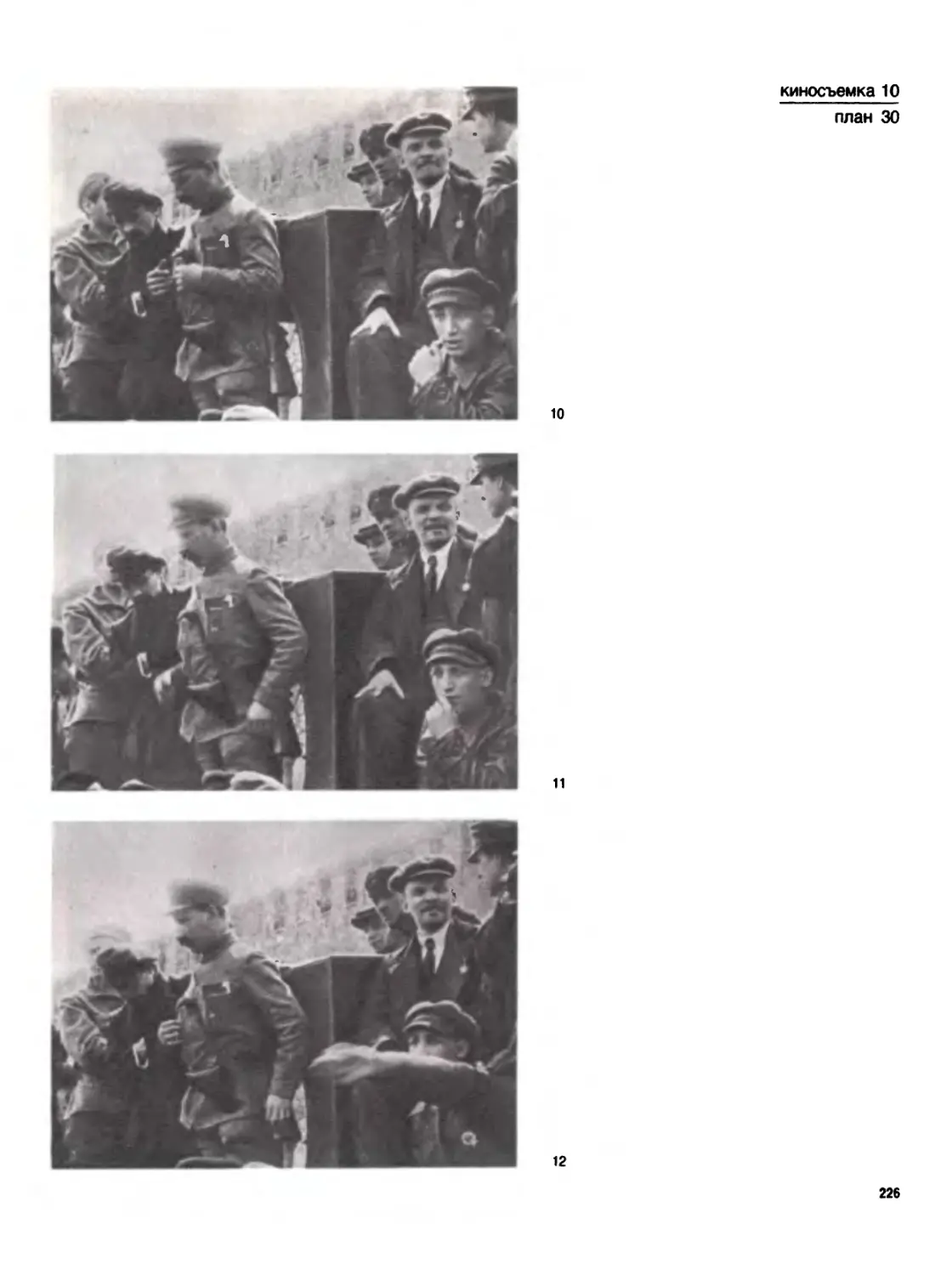
план 30
Ленин В. И. на Красной площади во время
парада частей Всевобуча.
Позитив. Средний план. 2 м 09 к
В. И. Ленин запечатлен на всех кадрах
плана.
г
з
2?1
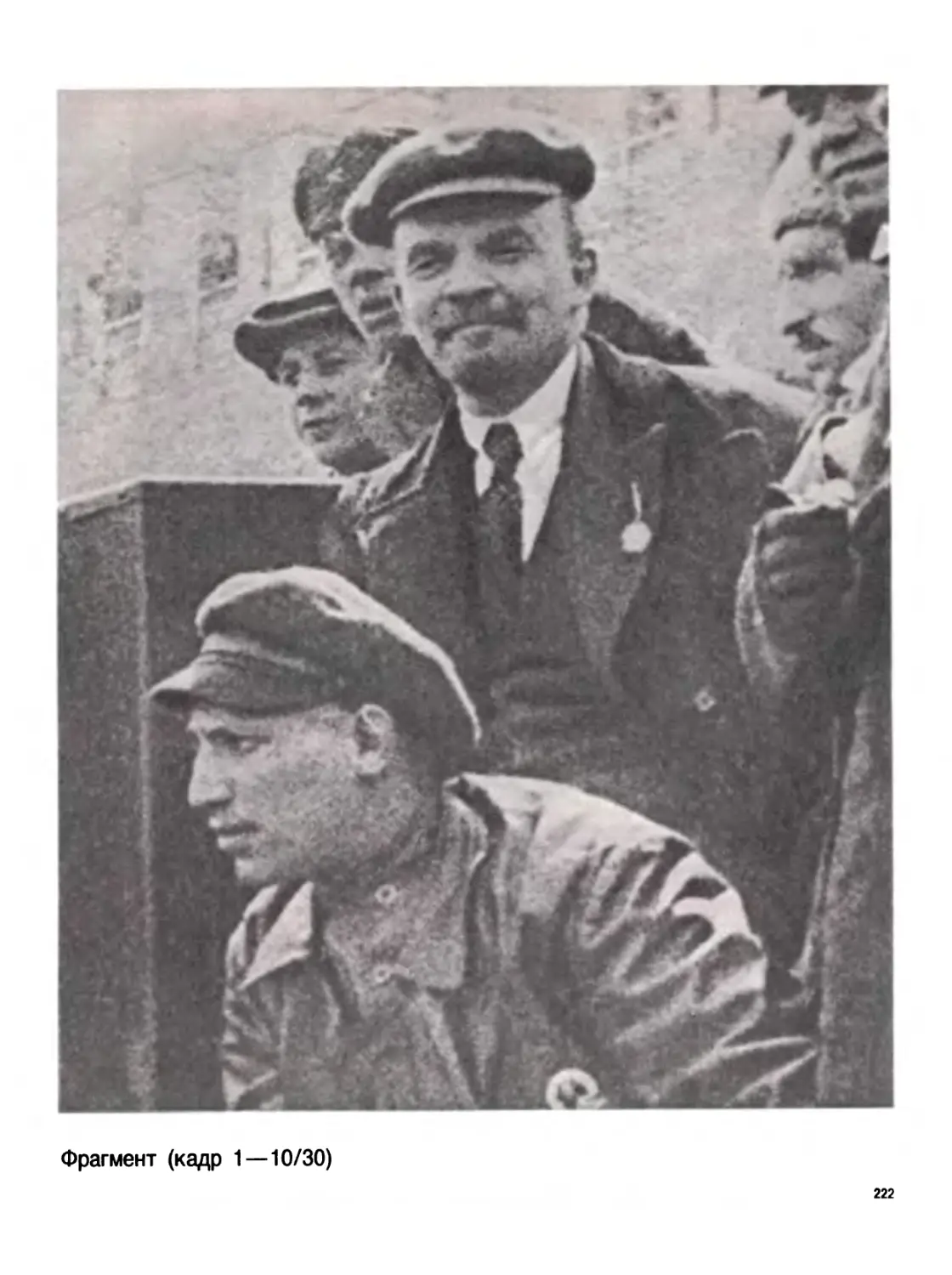
Фрагмент (кадр 1—10/30)
222
киносъемка 10
план 30
4
5
6
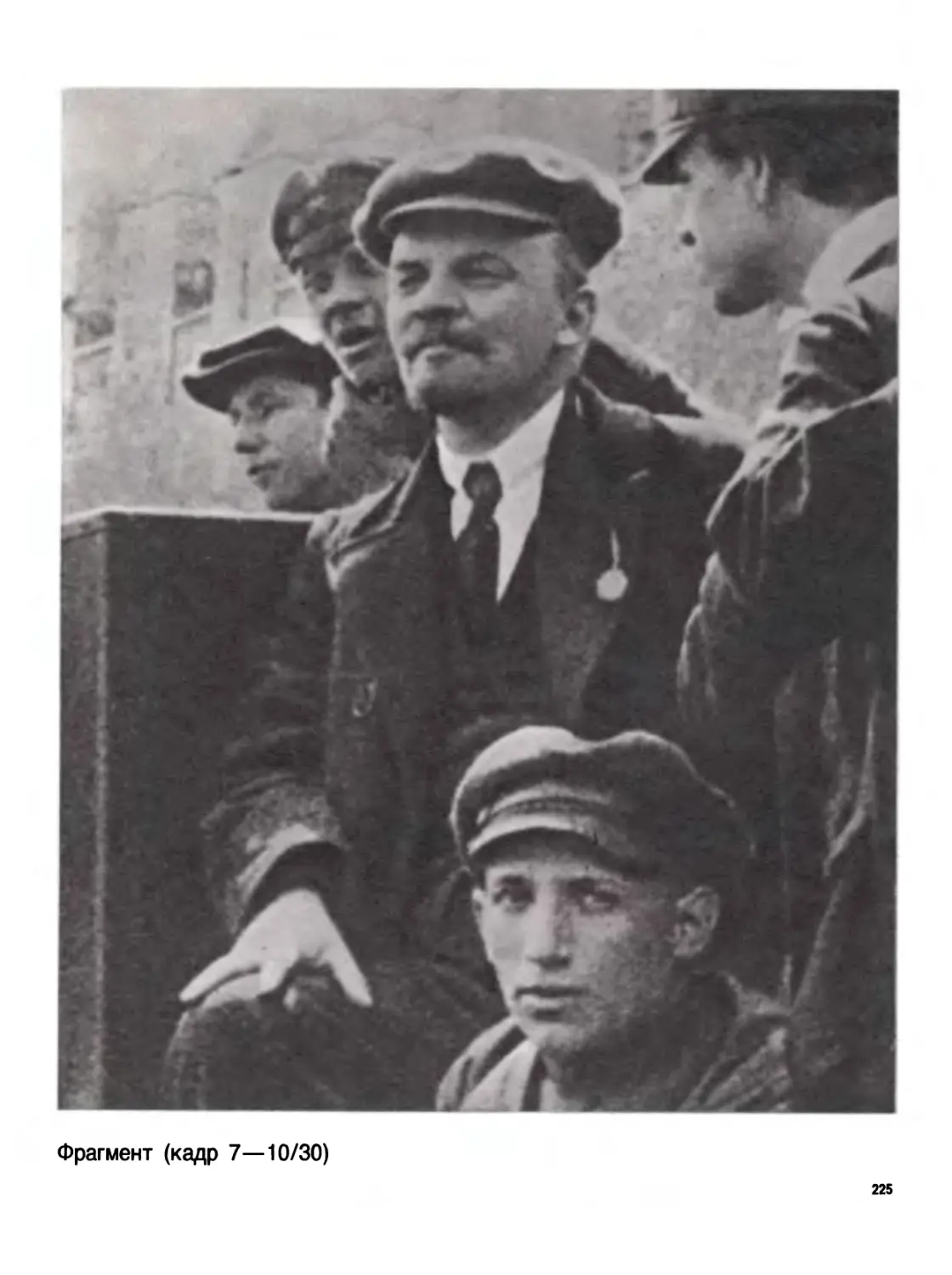
Фрагмент (кадр 7—10/30)
225
киносъемка 10
план 30
ю
11
12
226
киносъемка 10
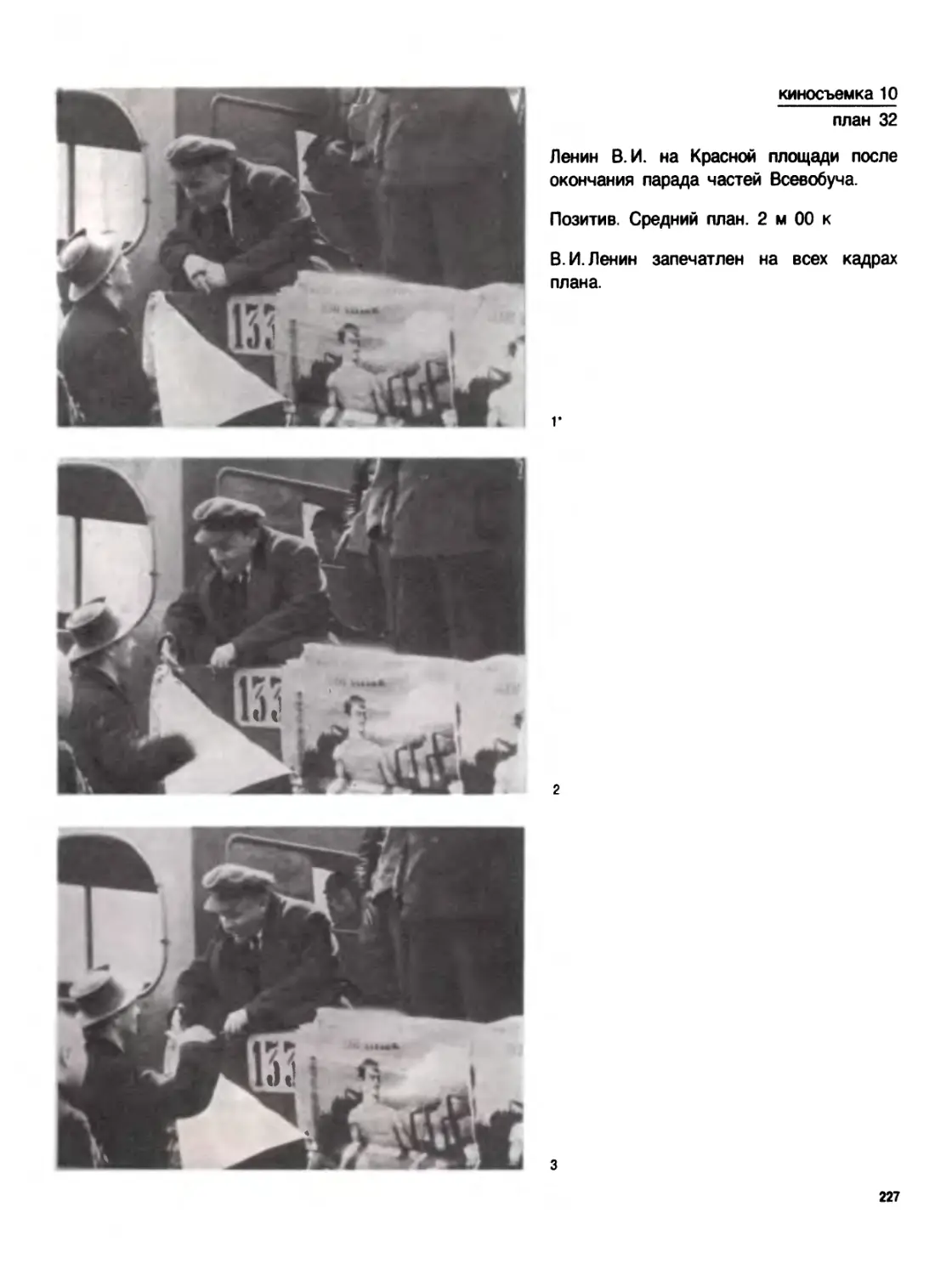
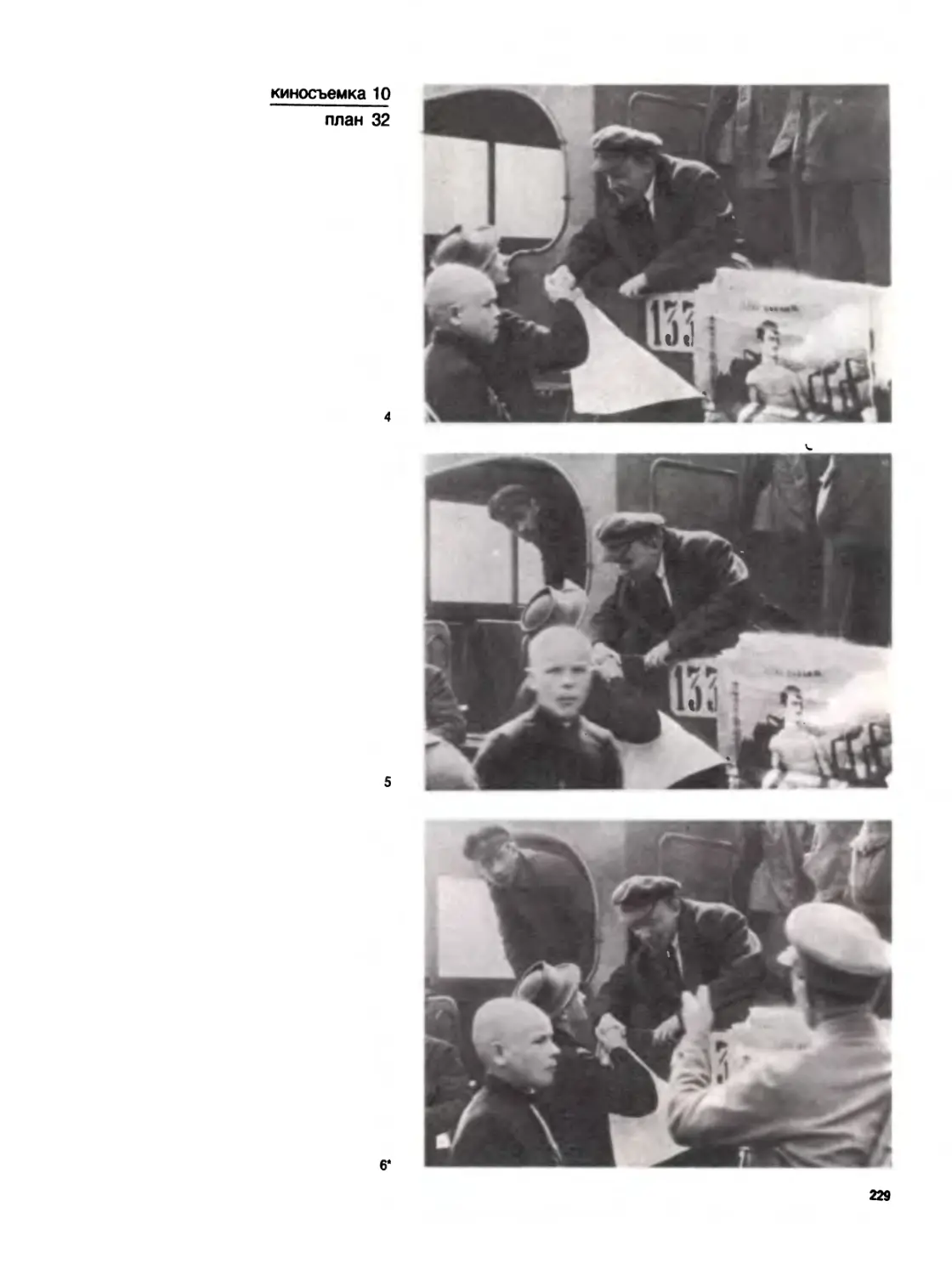
план 32
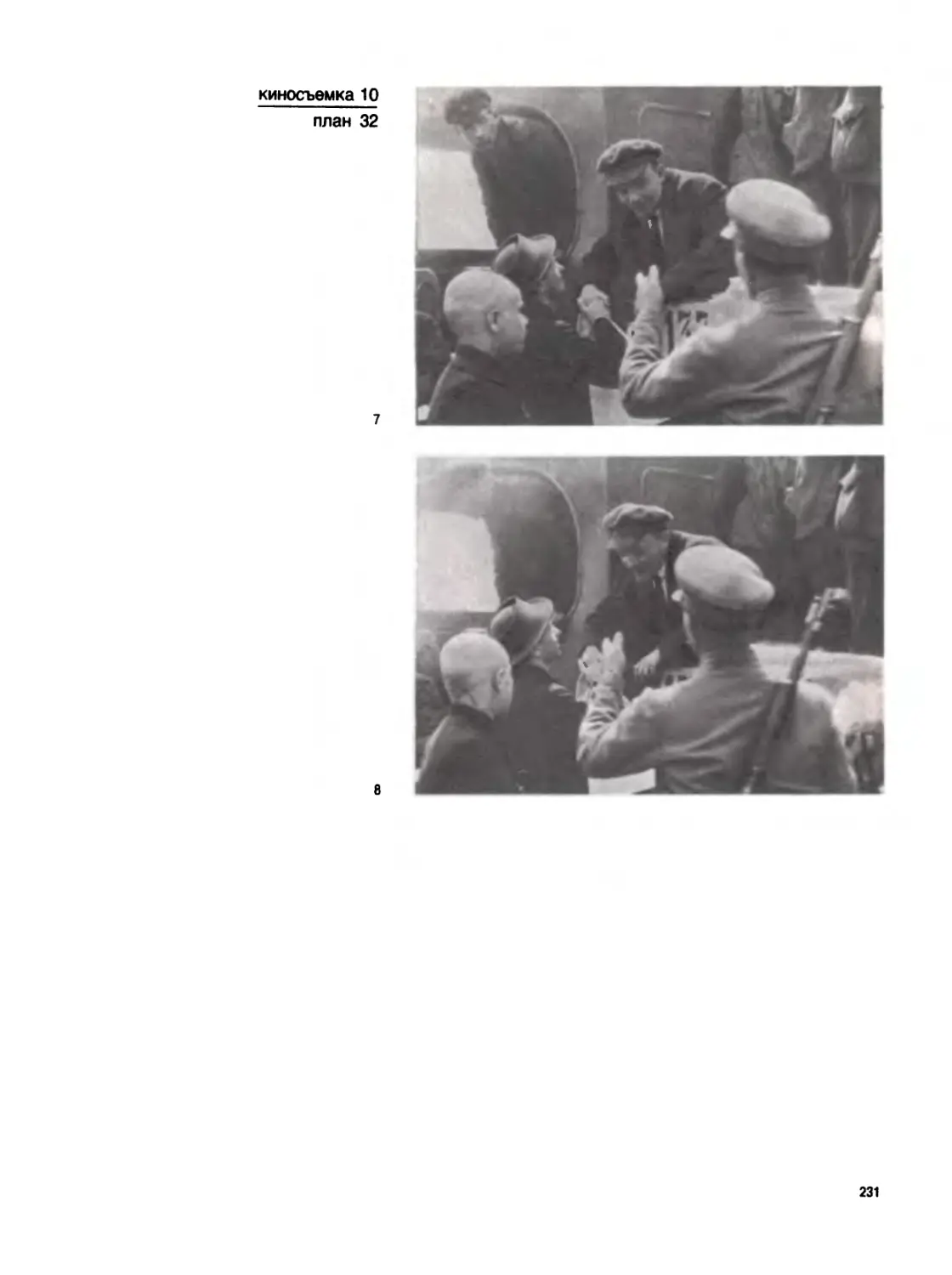
Ленин В. И. на Красной площади после
окончания парада частей Всевобуча.
Позитив. Средний план. 2 м 00 к
В. И. Ленин запечатлен на всех кадрах
плана.
г
2
227
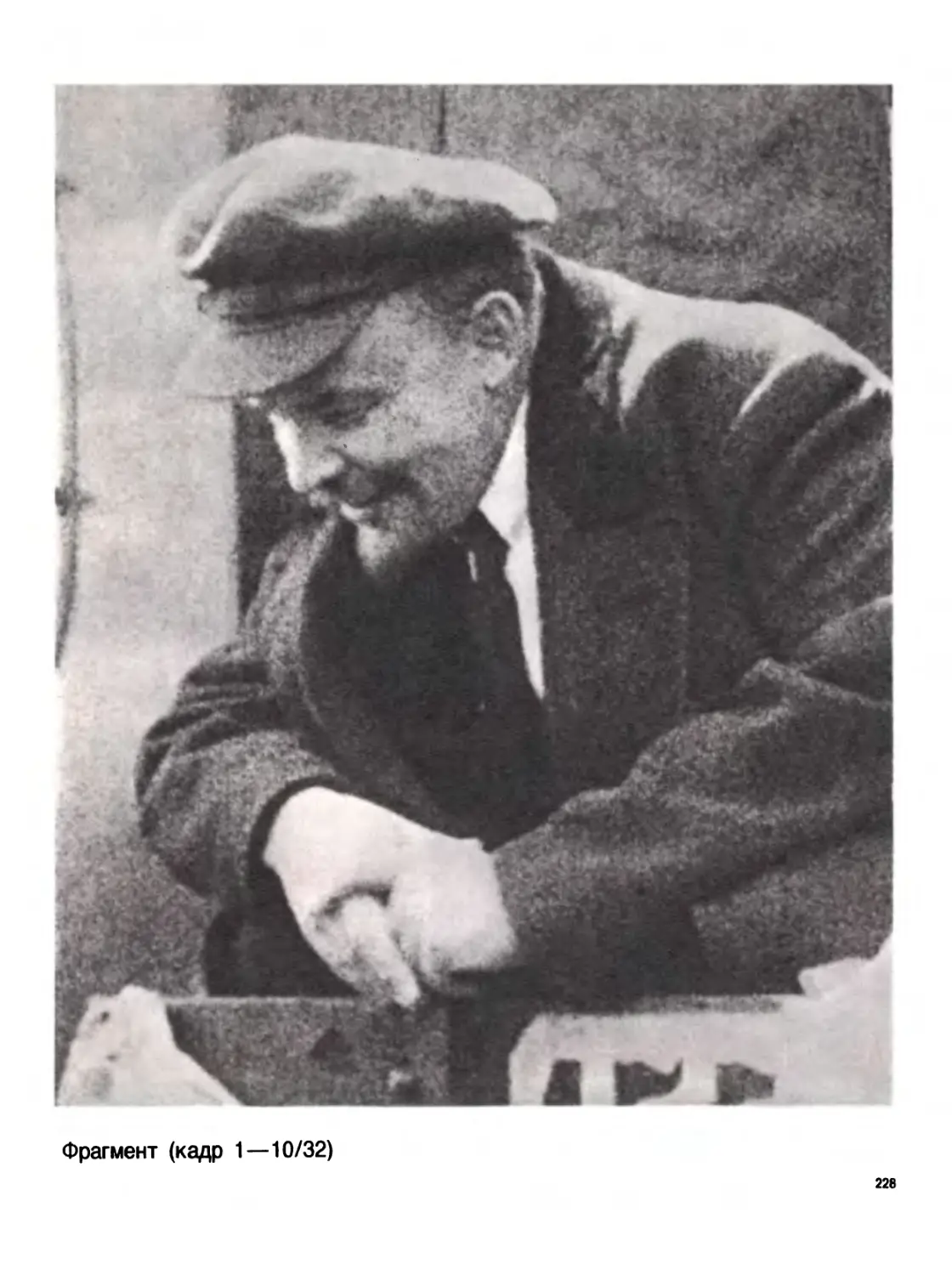
Фрагмент (кадр 1—10/32)
228
V.
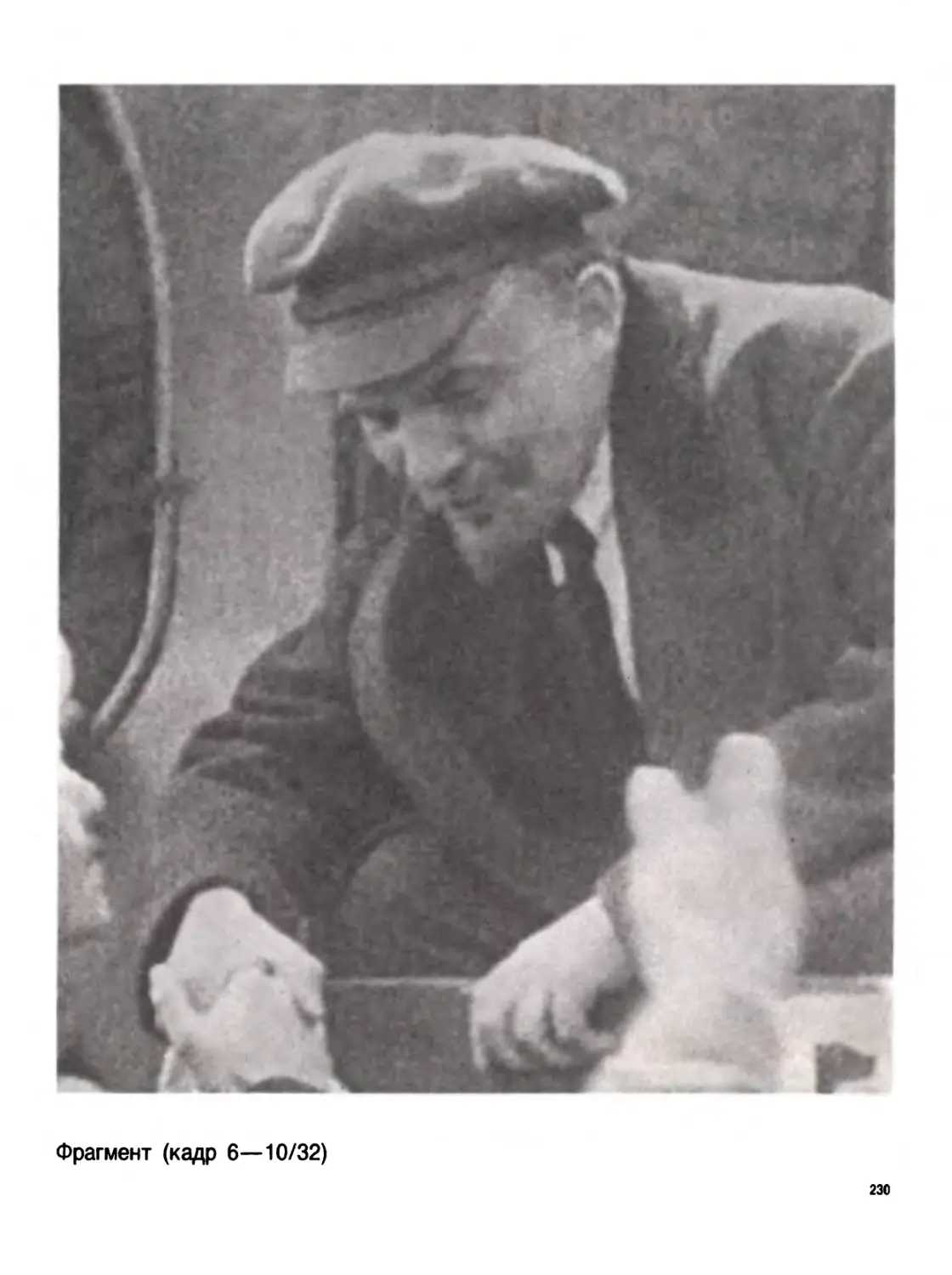
Фрагмент (кадр 6—10/32)
230
231
киносъемка
11
Ленин В. И. на Красной площади во время демонстрации
трудящихся, посвященной празднованию 2-й годовщины
Великой Октябрьской социалистической революции.
1919 г., 7 ноября. Москва.
Операторы:
Гибер Г. В., Лемберг А. Г.*
Первый выход на экран:
Выпуск кинохроники «Октябрьские торжества в Москве», 1919 год.
Обоснование даты:
Дата устанавливается по фото- и киносъемкам, хранящимся в Центральном
партийном архиве ИМЛ, на которых хорошо видно праздничное оформление
кремлевской стены и две даты: «25 октября 1917», «7 ноября 1919».
См. также: «Правда», № 251, 9 ноября 1919 г., стр. 3.
Примечания.
Сохранилось 83,93 метра пленки—24 плана. На 4 планах—запечатлен В. И. Ленин.
* В день празднования 2-й годовщины Октябрьской революции съемки производили и другие операторы,
но имена их установить пока не удалось
234
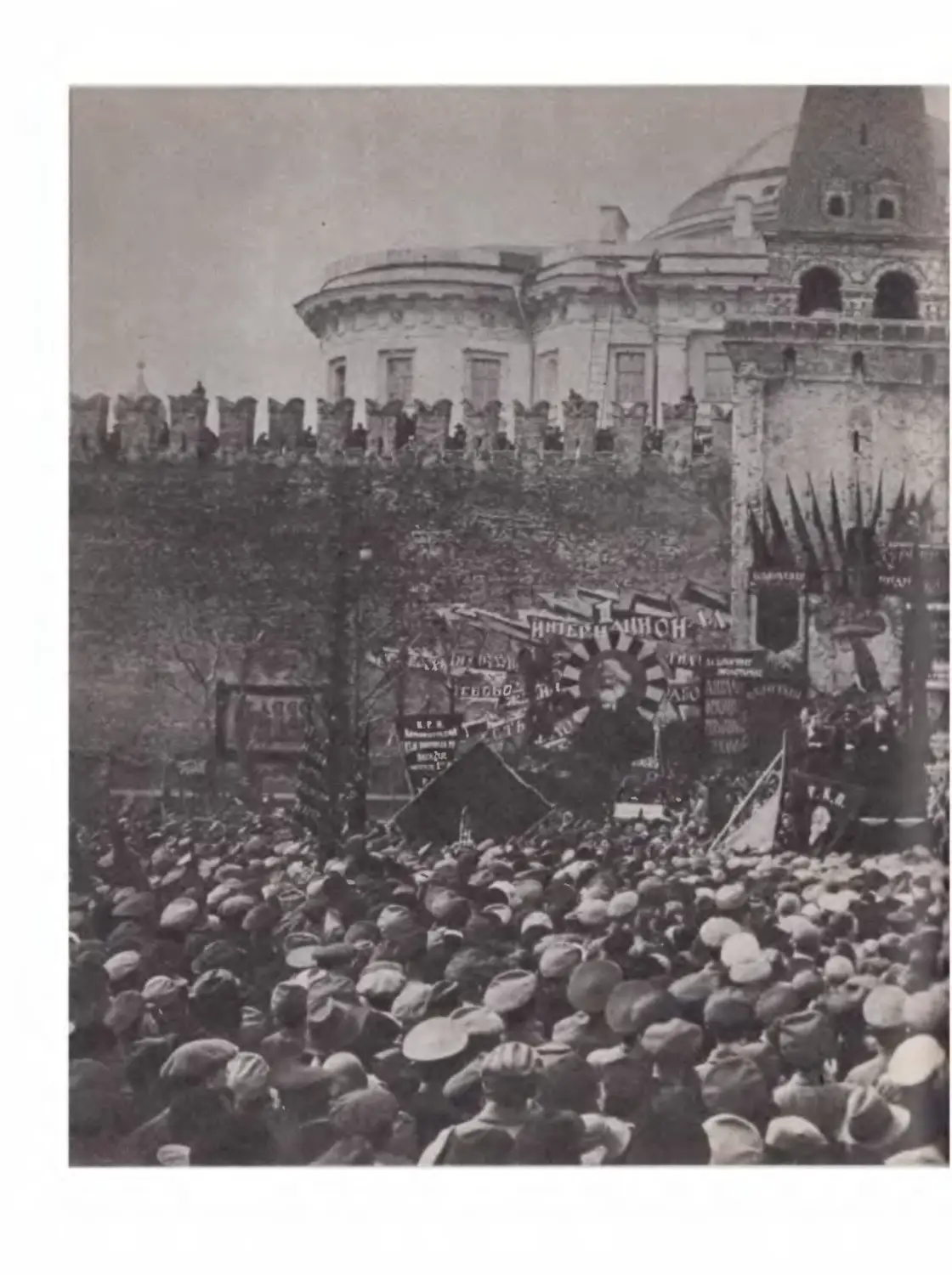
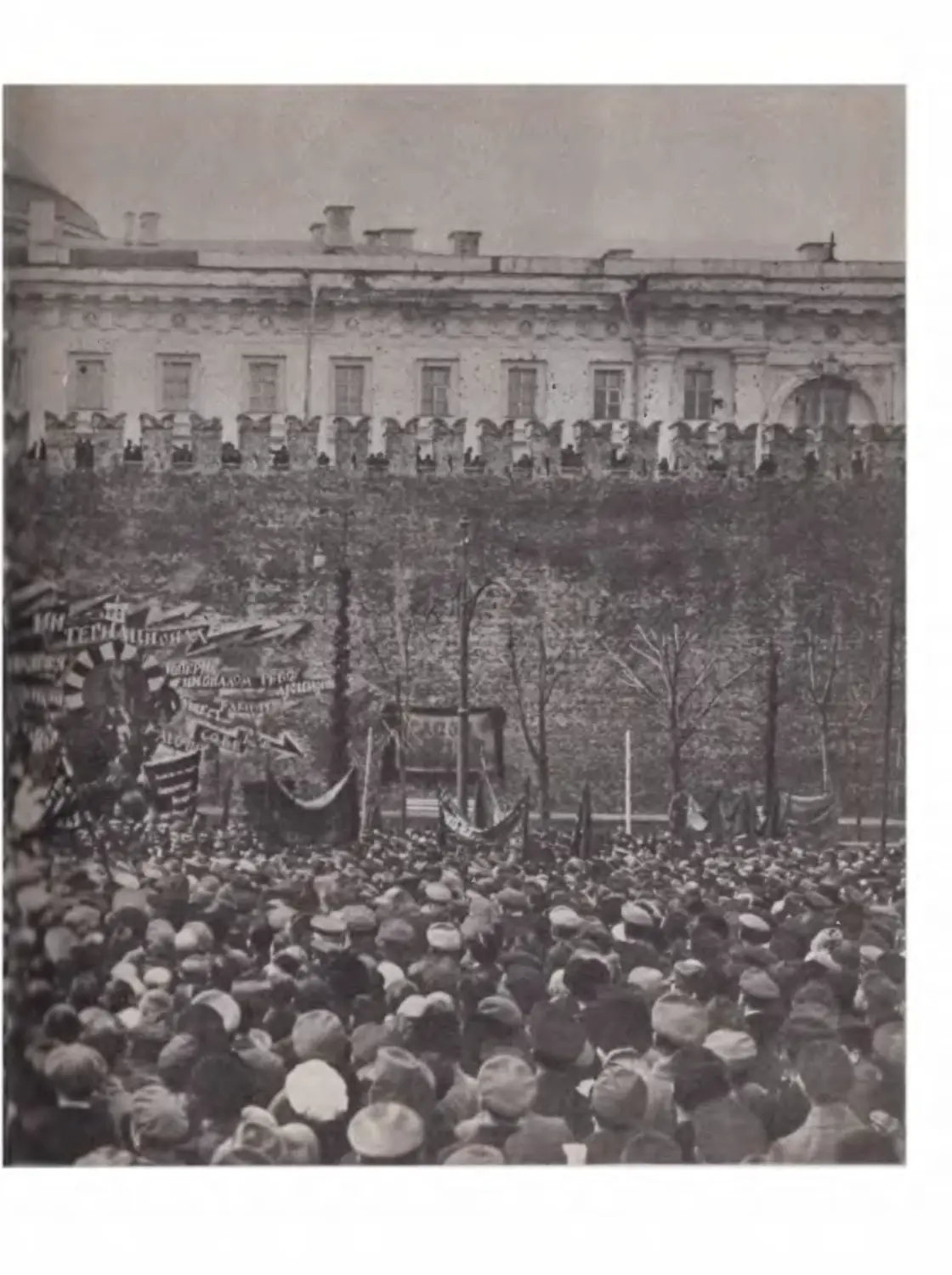
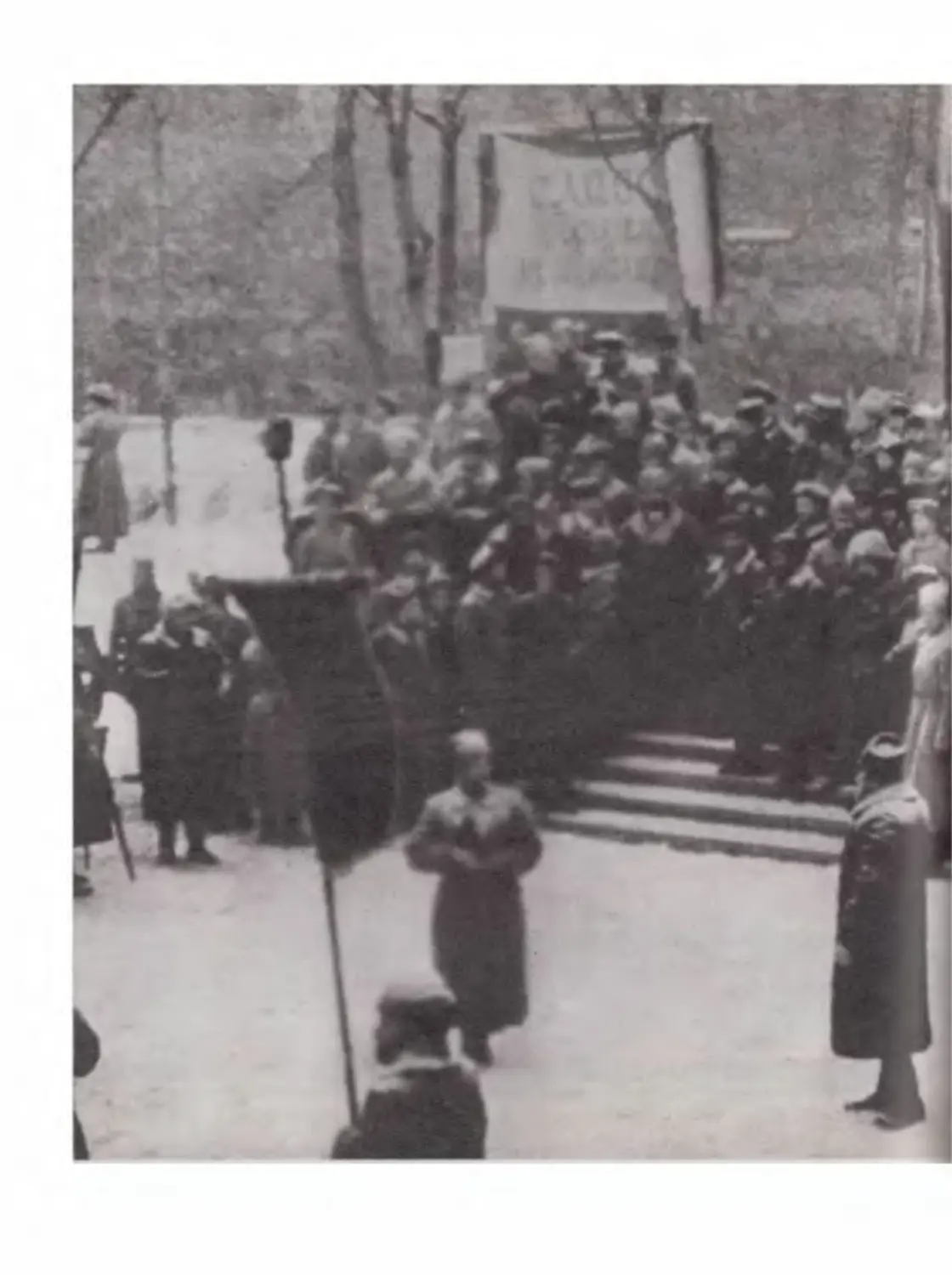
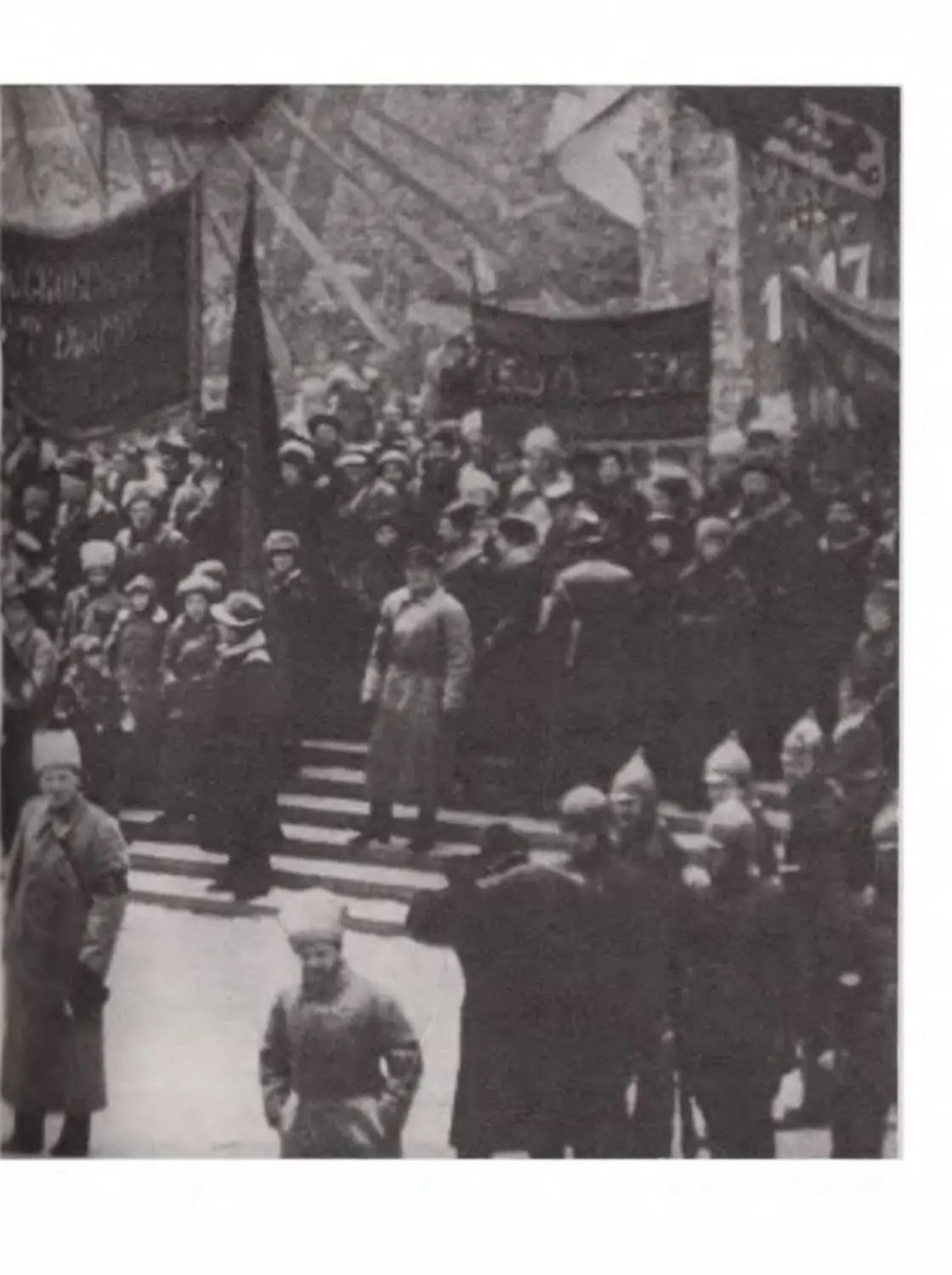
«Красная площадь, красиво убранная флагами,
выглядела особенно празднично. У кремлевской
стены были помещены громадные портреты
т. Ленина и Карла Маркса, окаймленные вечнозе¬
леной хвоей. На самой стене Кремля были
изображены даты: «25 октября 1917—7 ноября
1919» и лозунги «Коммунизм—наш факел побед¬
ный» и «Не сдадимся, выдержим, победим».
С 9-ти часов утра в различных направлениях
Москвы уже начали дефилировать колонны рабо¬
чих и красноармейских частей, вливаясь в общие
районные колонны, и затем уже направлялись со
своими оркестрами, знаменами и плакатами с
октябрьскими лозунгами по заранее намеченным
маршрутам на Красную площадь.
Вдоль кремлевской стены, по направлению к
Замоскворечью, начинается шествие манифе¬
стантов, обращающее внимание исключительным
многолюдством и организованностью.
Бесконечной лентой вначале в одну, а затем в
две и три шеренги маршируют колонны москов¬
ского пролетариата под звуки духового оркестра,
исполняющего революционные марши.
Демонстрация на Красной площади заканчива¬
ется в третьем часу, а в 6 часов вечера
начинаются митинги и концерты в районах».
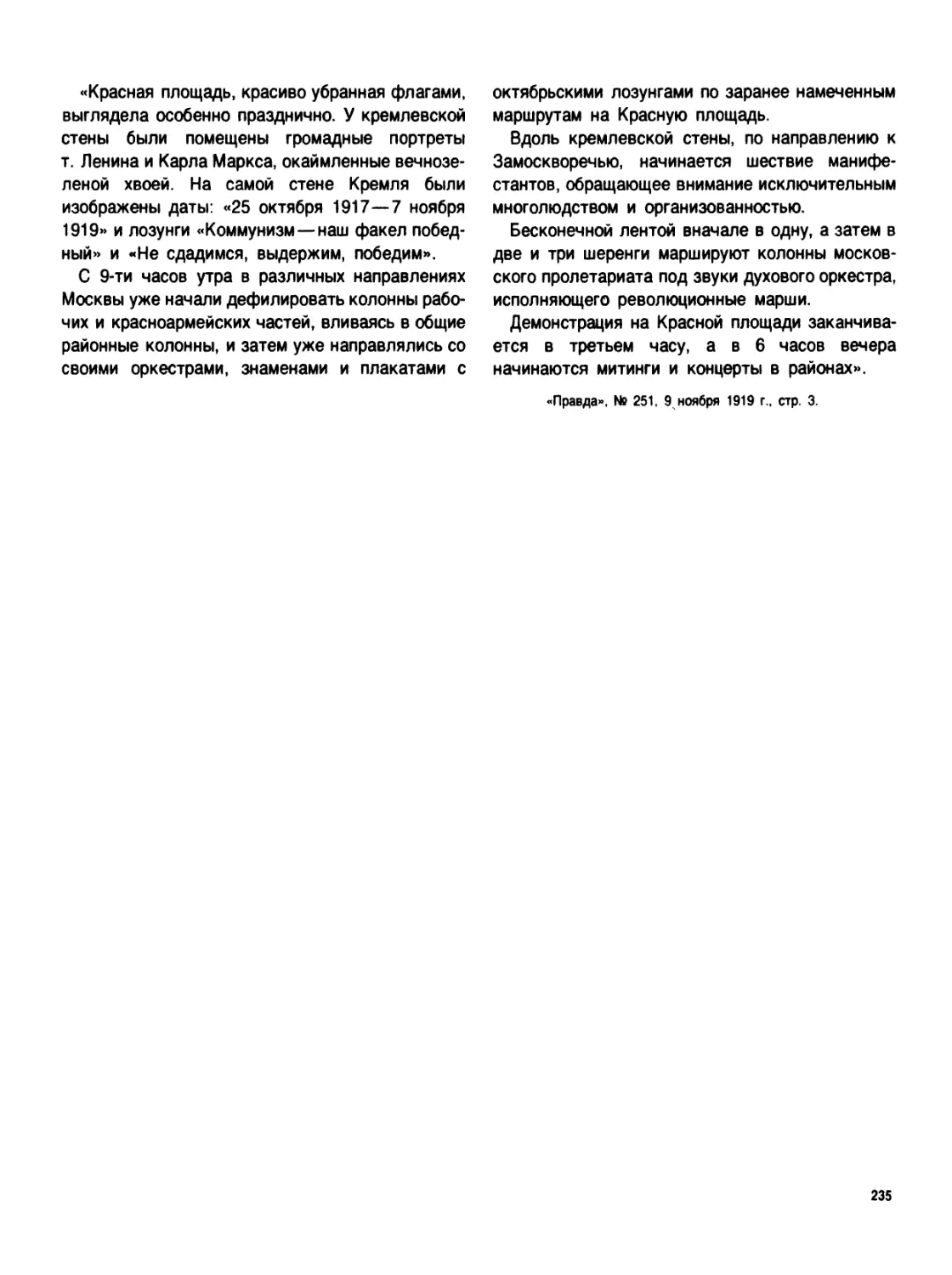
«Правда», № 251, 9 ноября 1919 г., стр. 3.
235
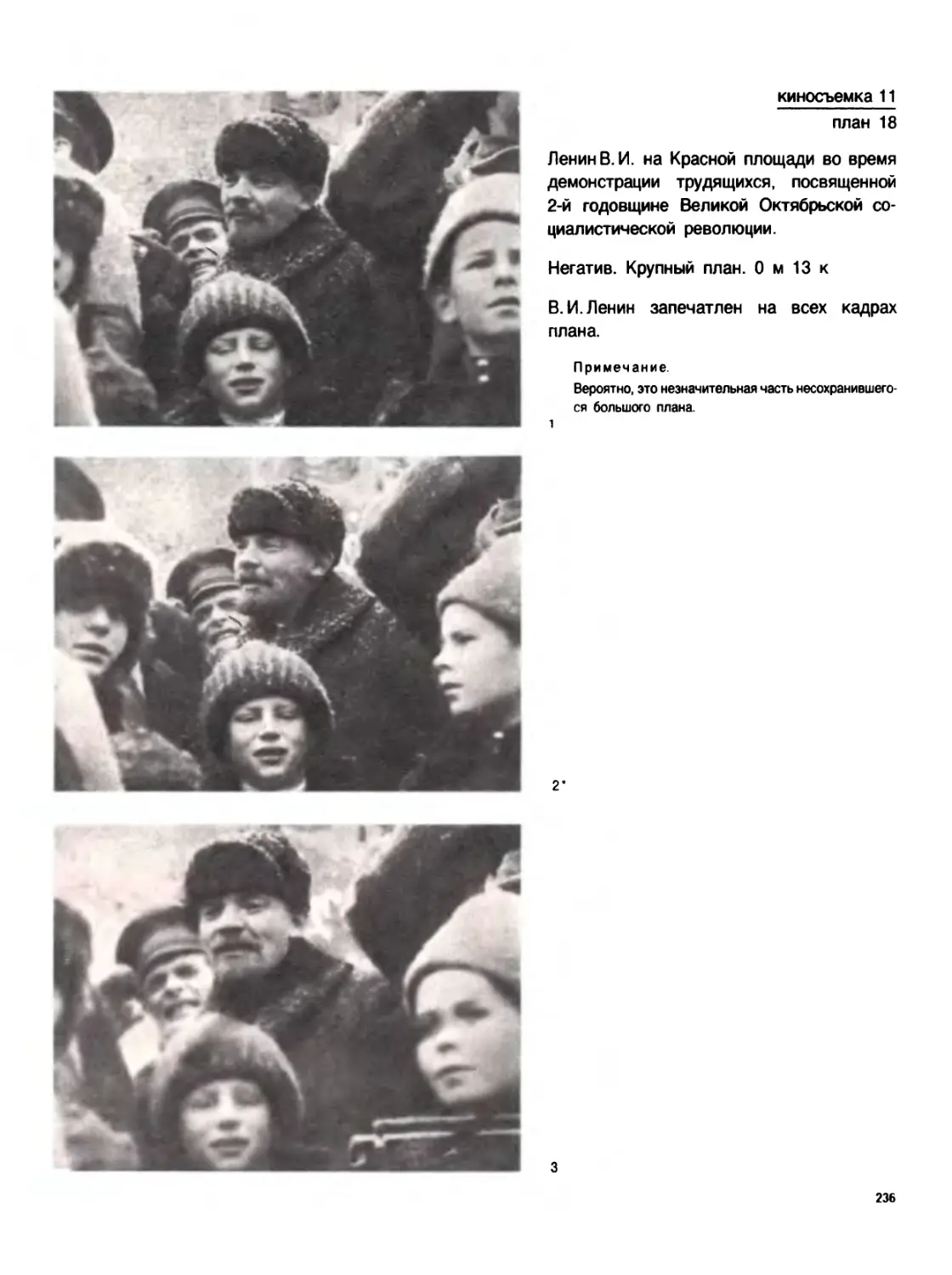
киносъемка 11
план 18
Ленин В. И. на Красной площади во время
демонстрации трудящихся, посвященной
2-й годовщине Великой Октябрьской со¬
циалистической революции.
Негатив. Крупный план. О м 13 к
В. И. Ленин запечатлен на всех кадрах
плана.
Примечание.
Вероятно, это незначительная часть несохранившего-
ся большого плана.
2*
236
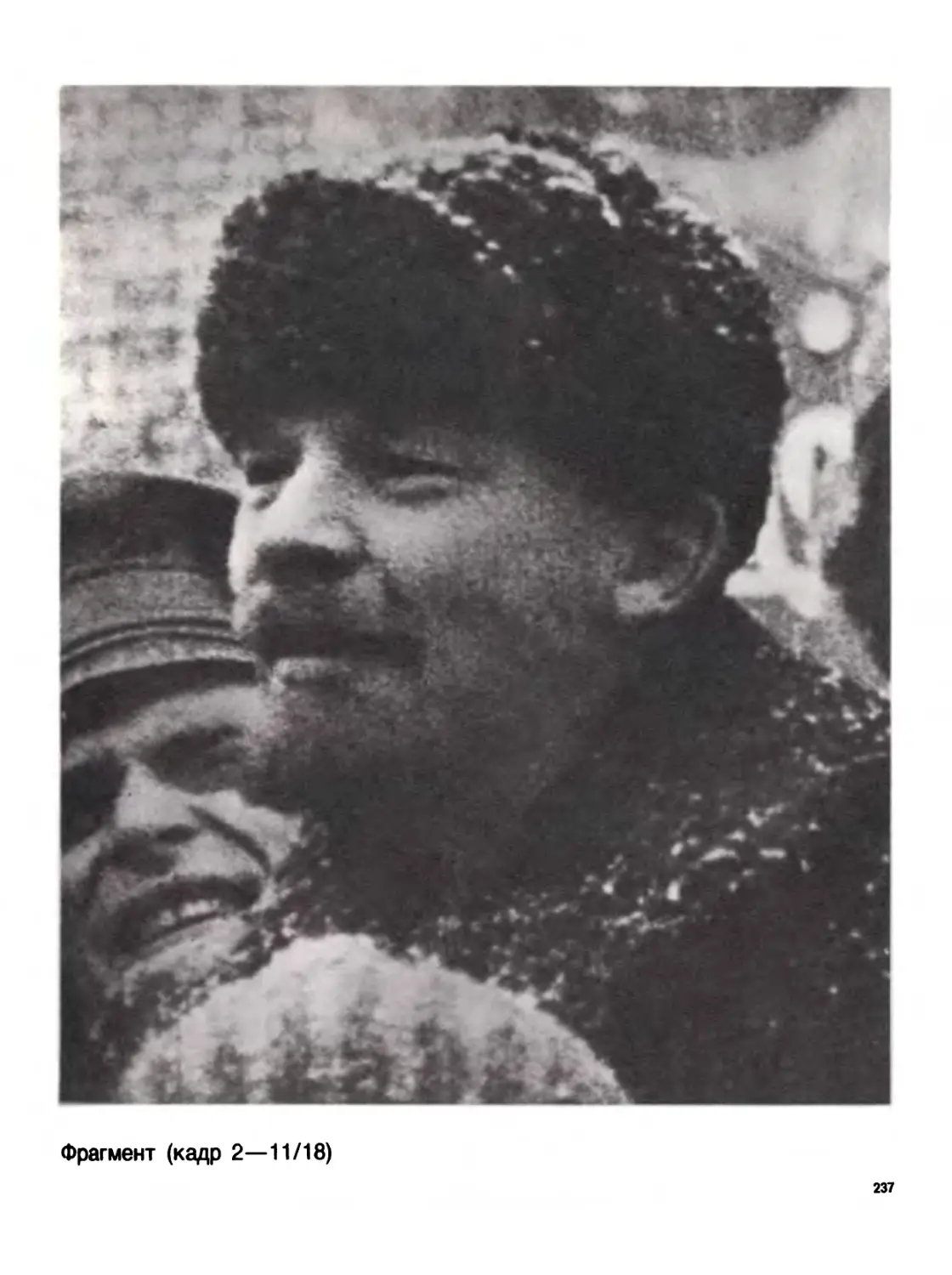
Фрагмент (кадр 2—11/18)
237
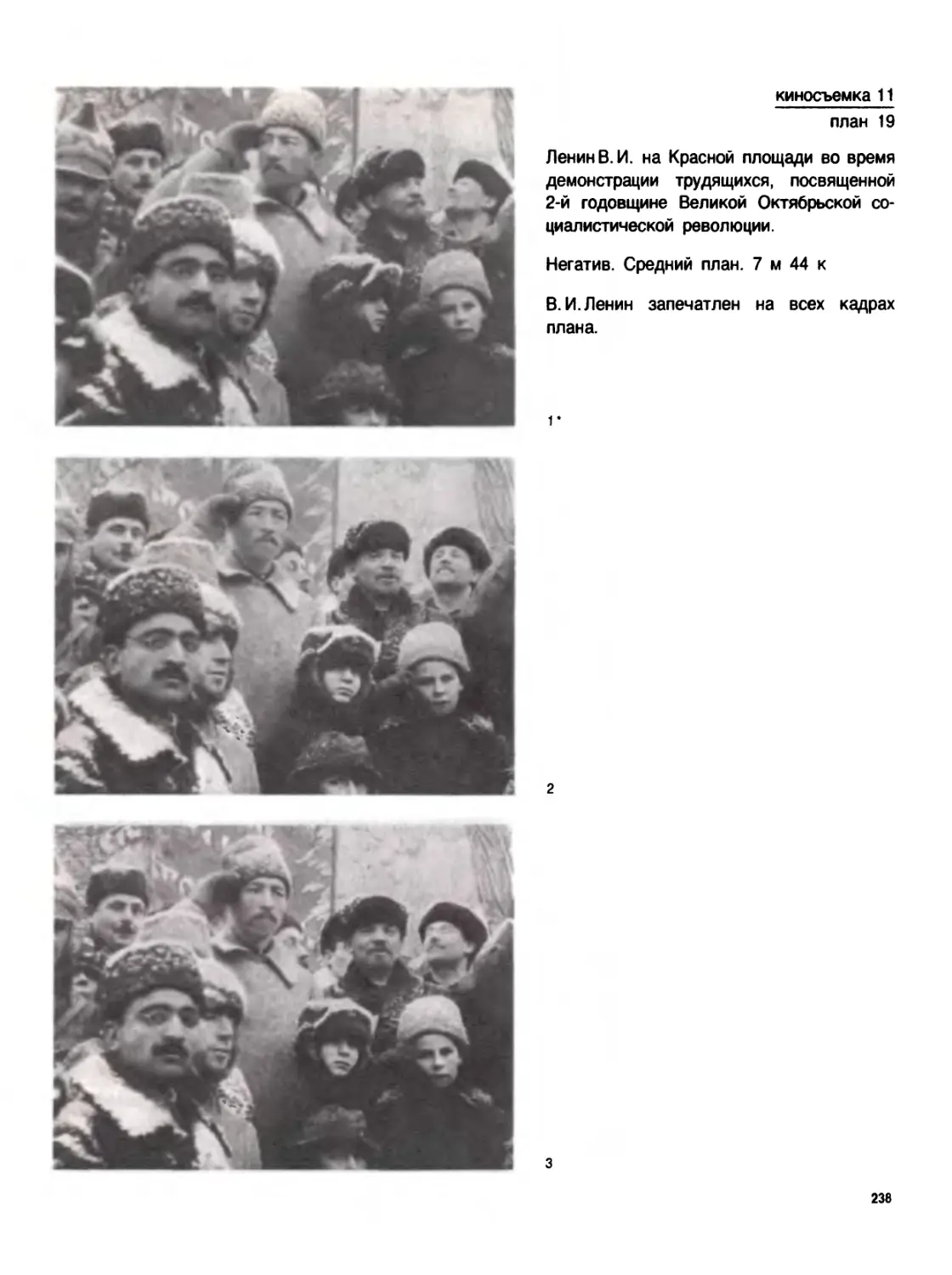
киносъемка 11
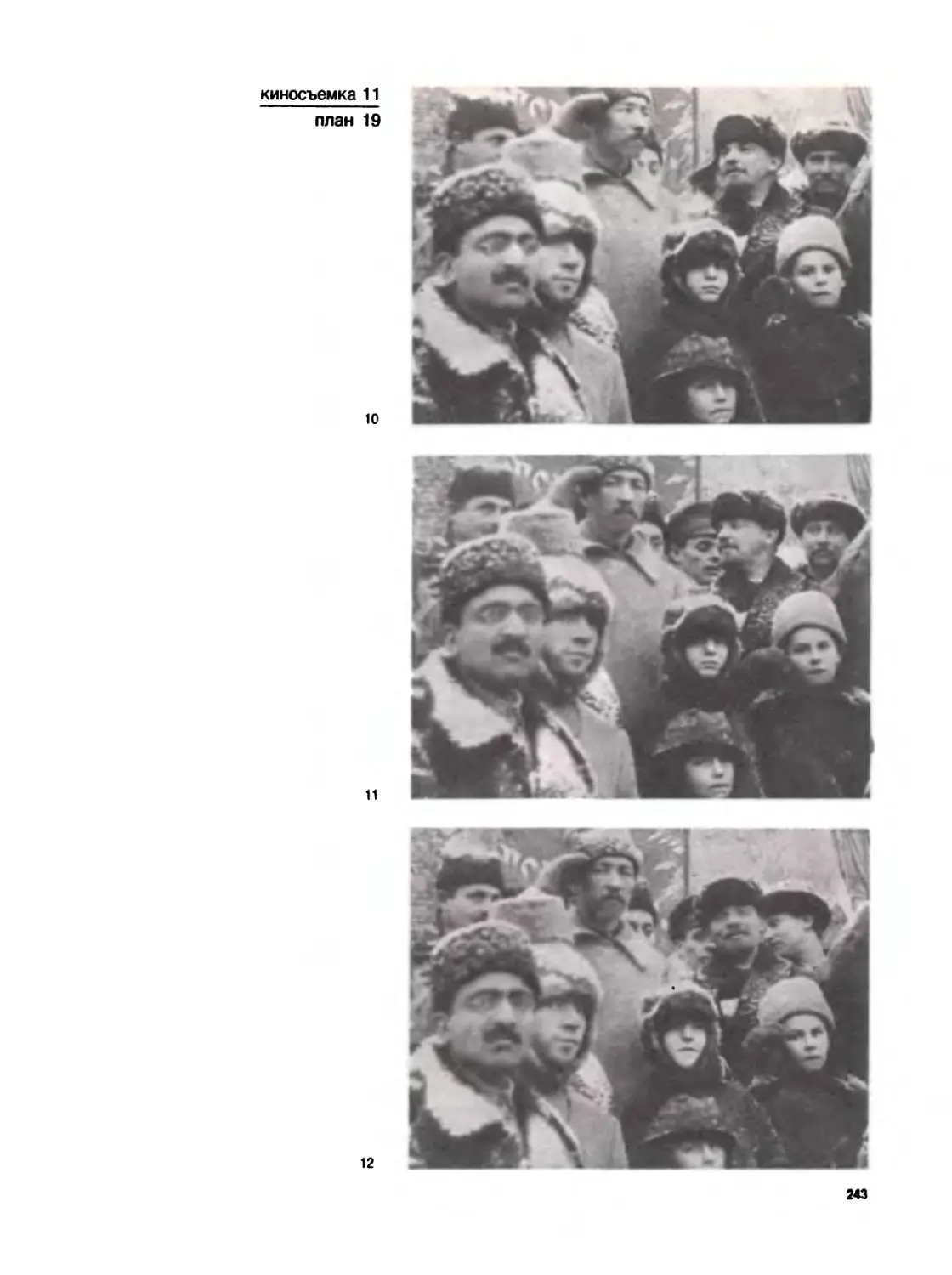
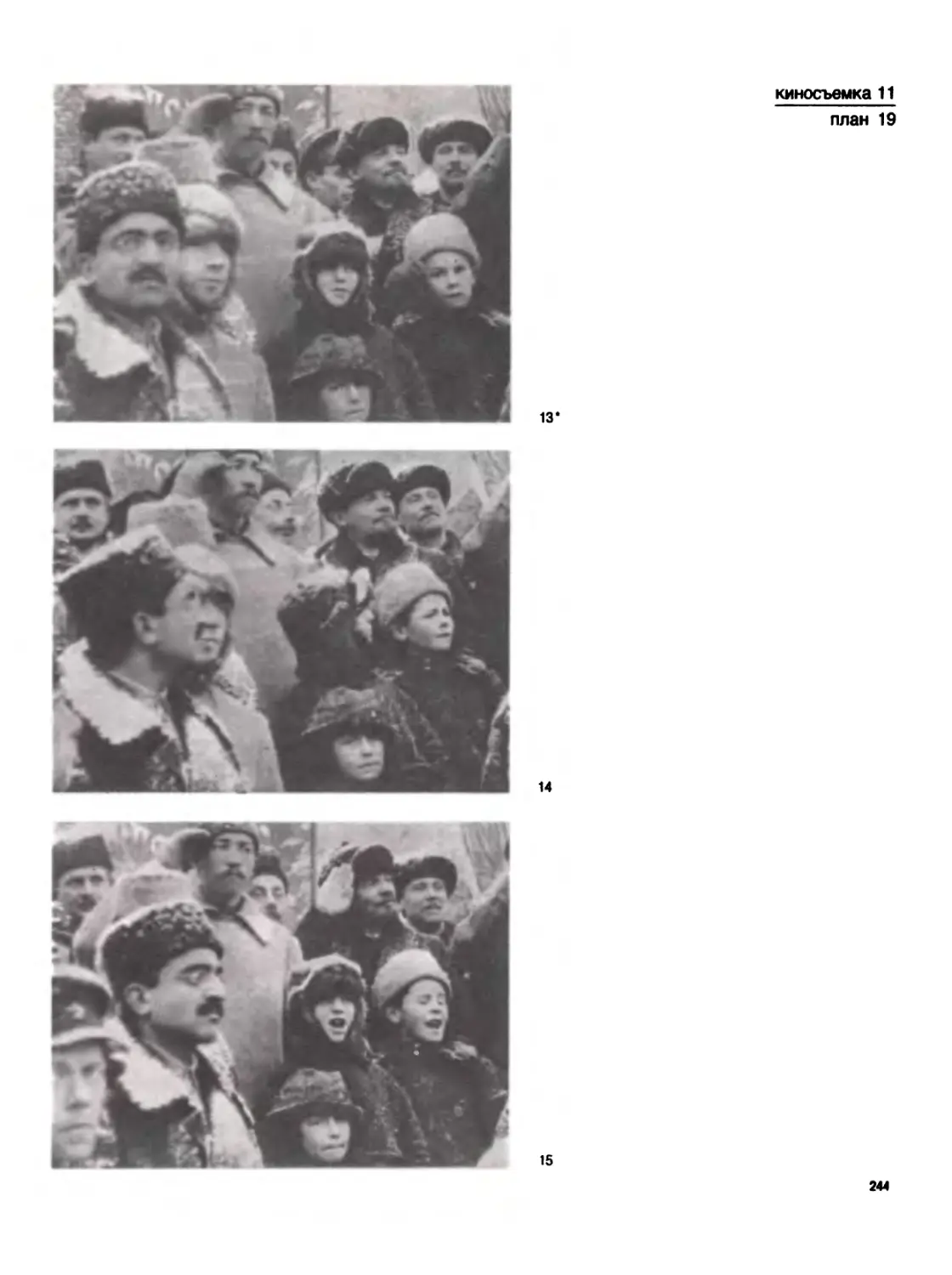
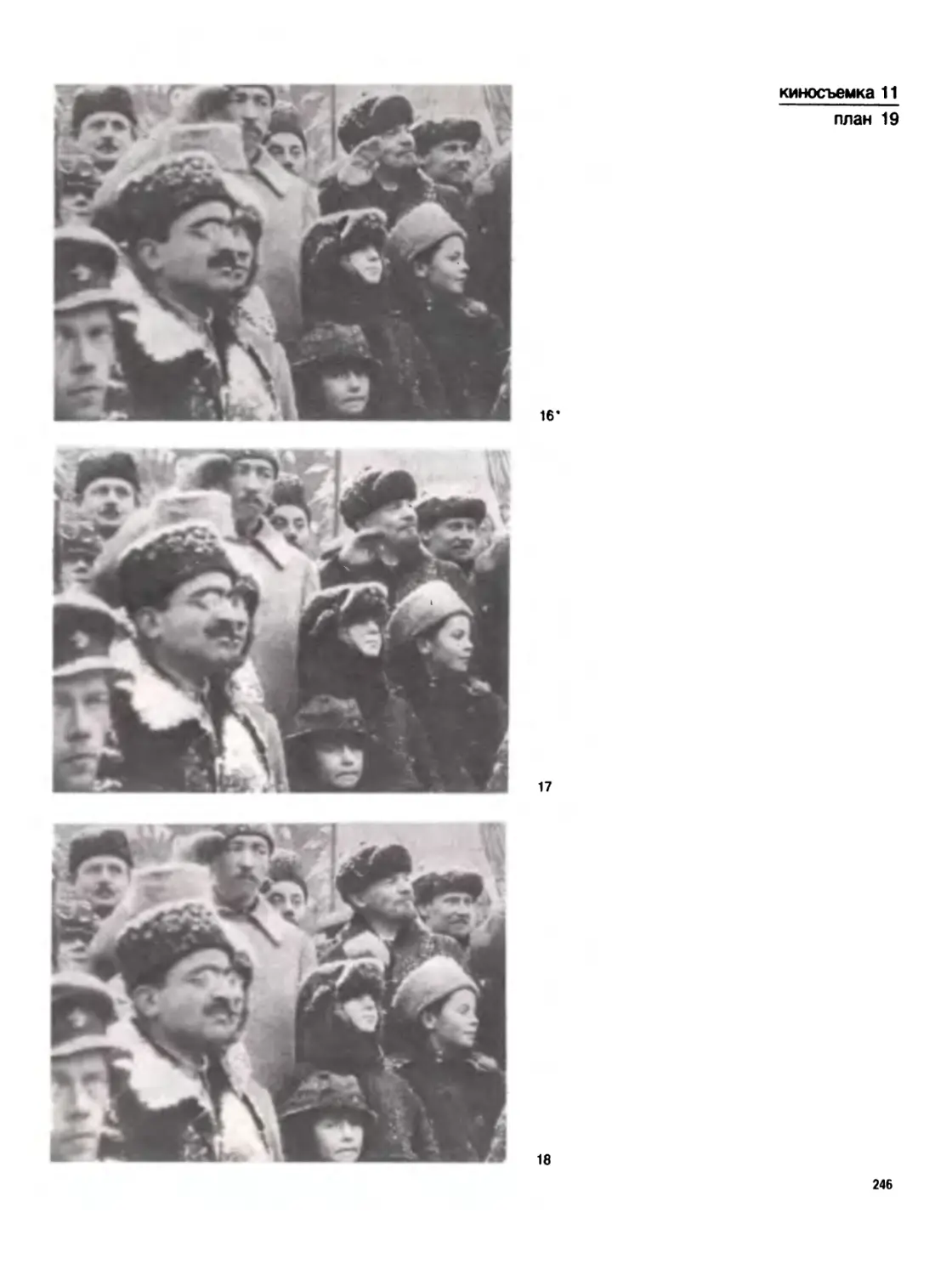
план 19
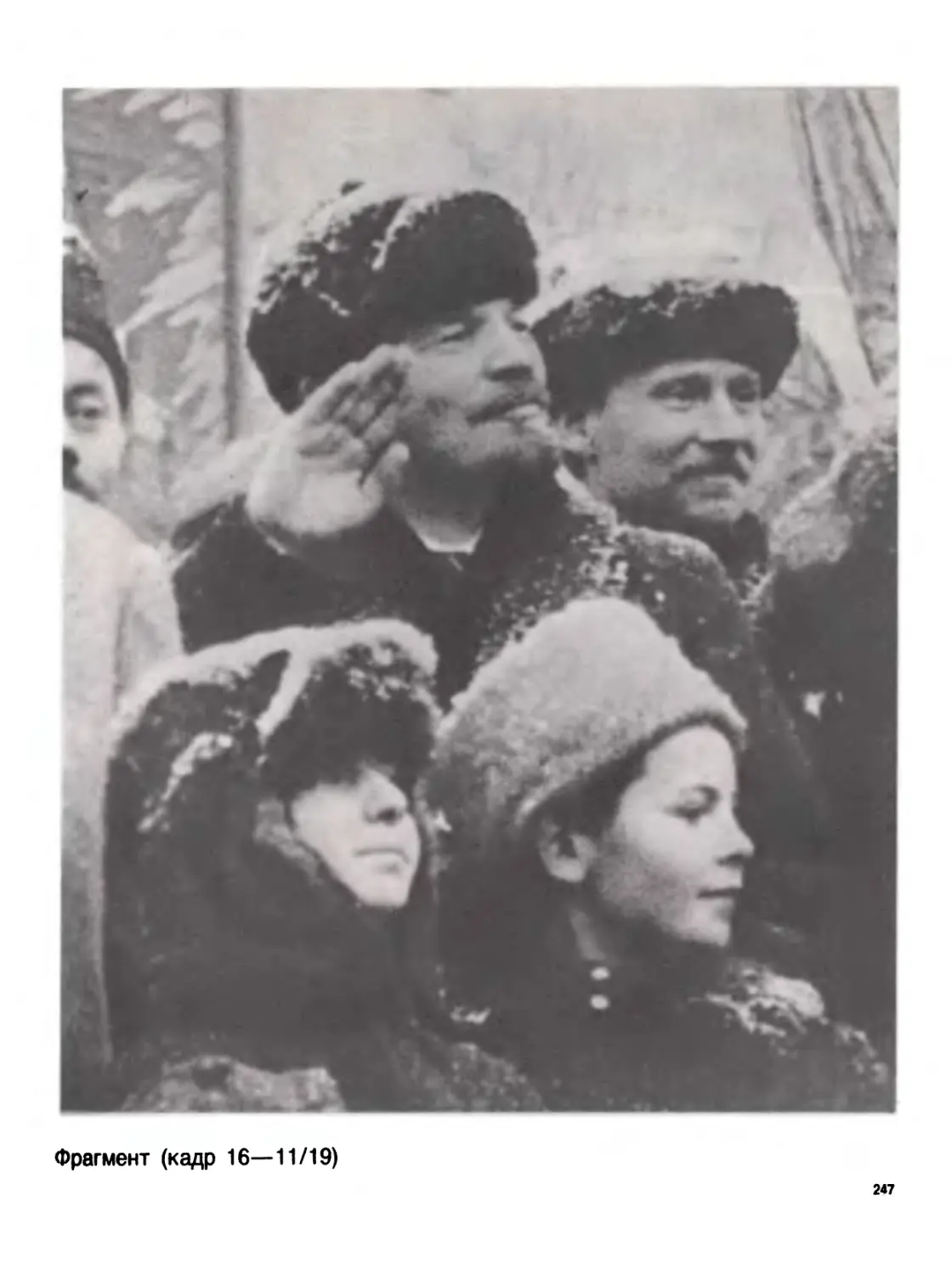
Ленин В. И. на Красной площади во время
демонстрации трудящихся, посвященной
2-й годовщине Великой Октябрьской со¬
циалистической революции.
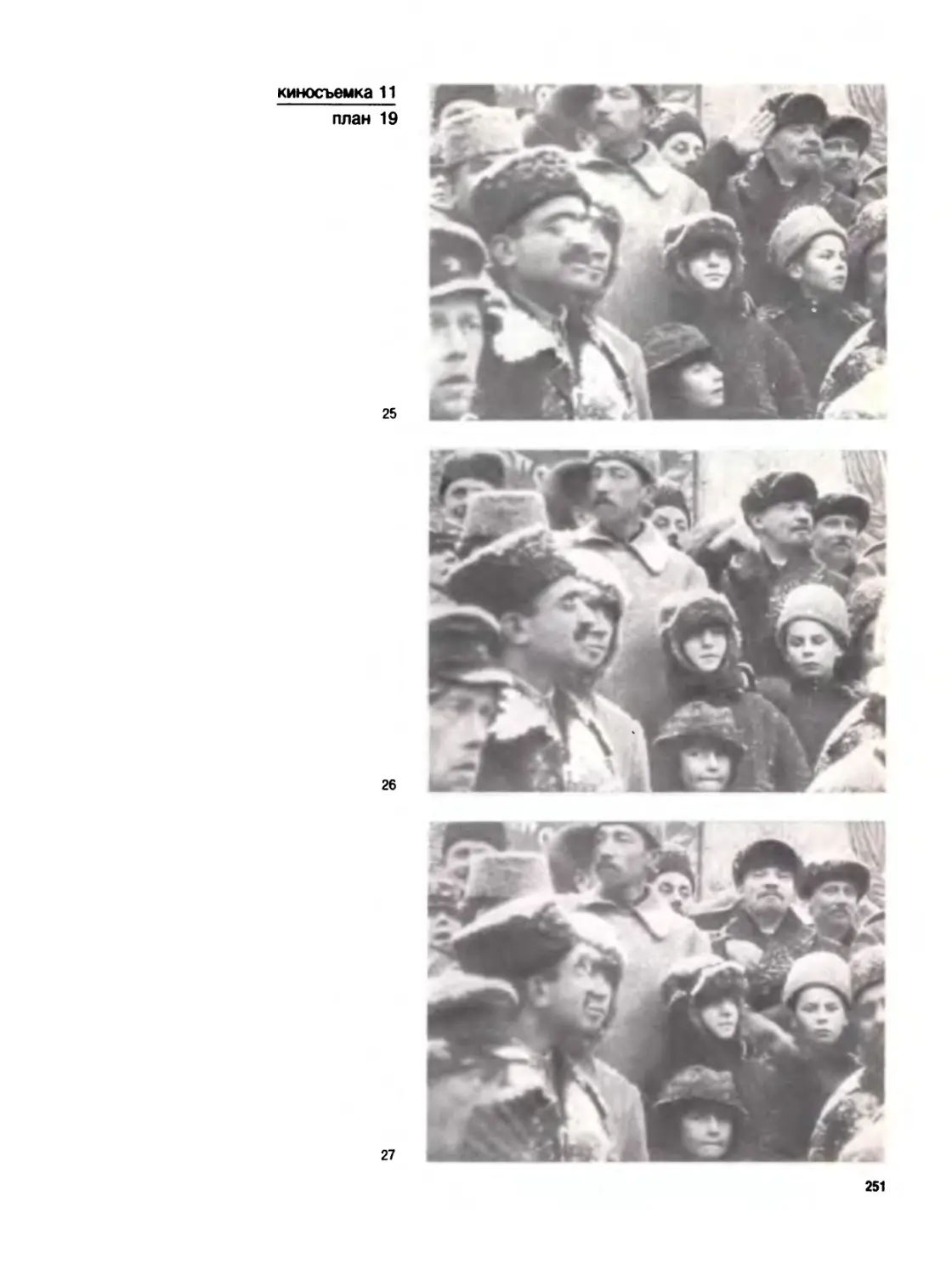
Негатив. Средний план. 7 м 44 к
В. И. Ленин запечатлен на всех кадрах
плана.
г
2
3
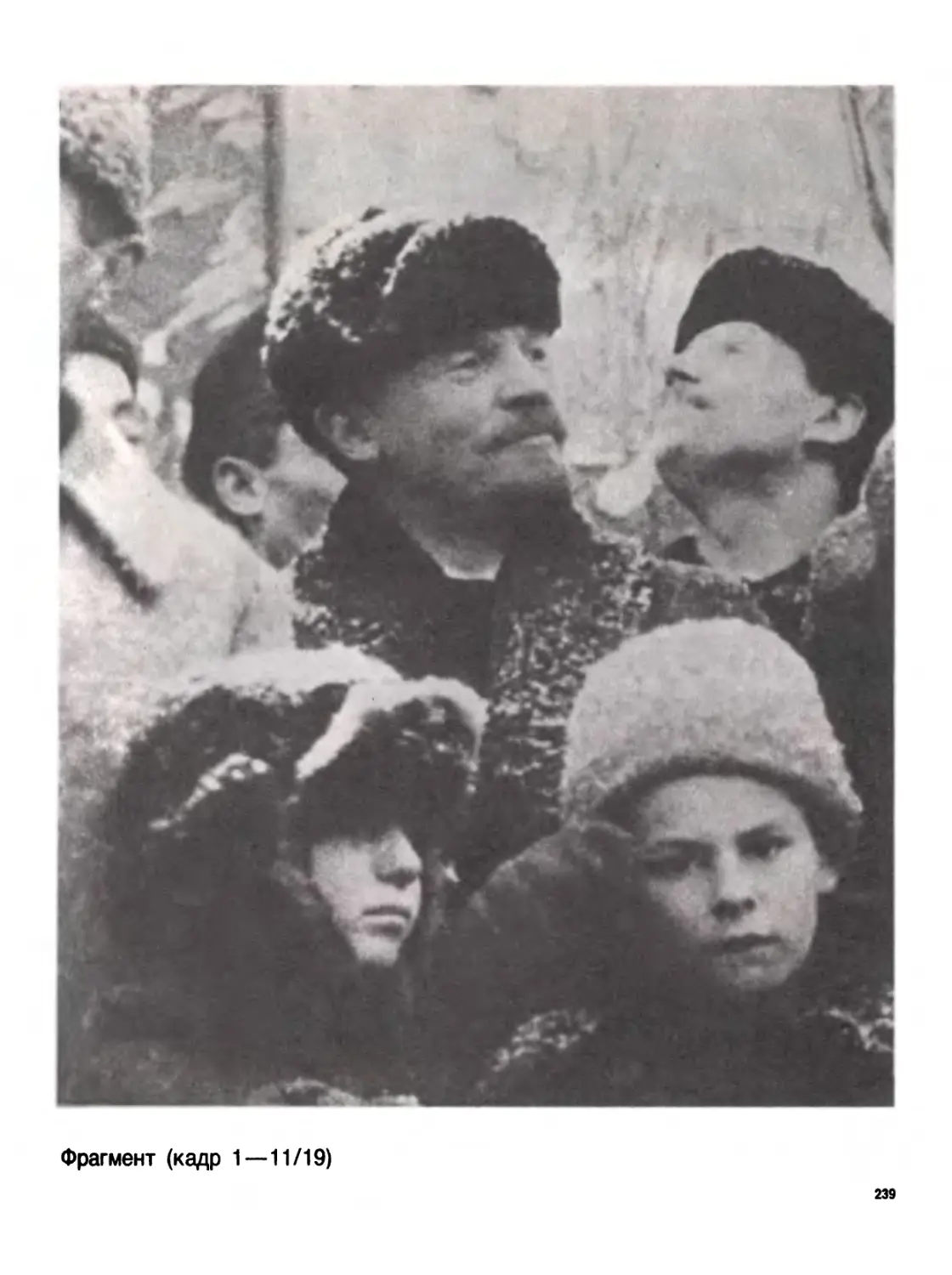
238
Фрагмент (кадр 1—11/19)
239
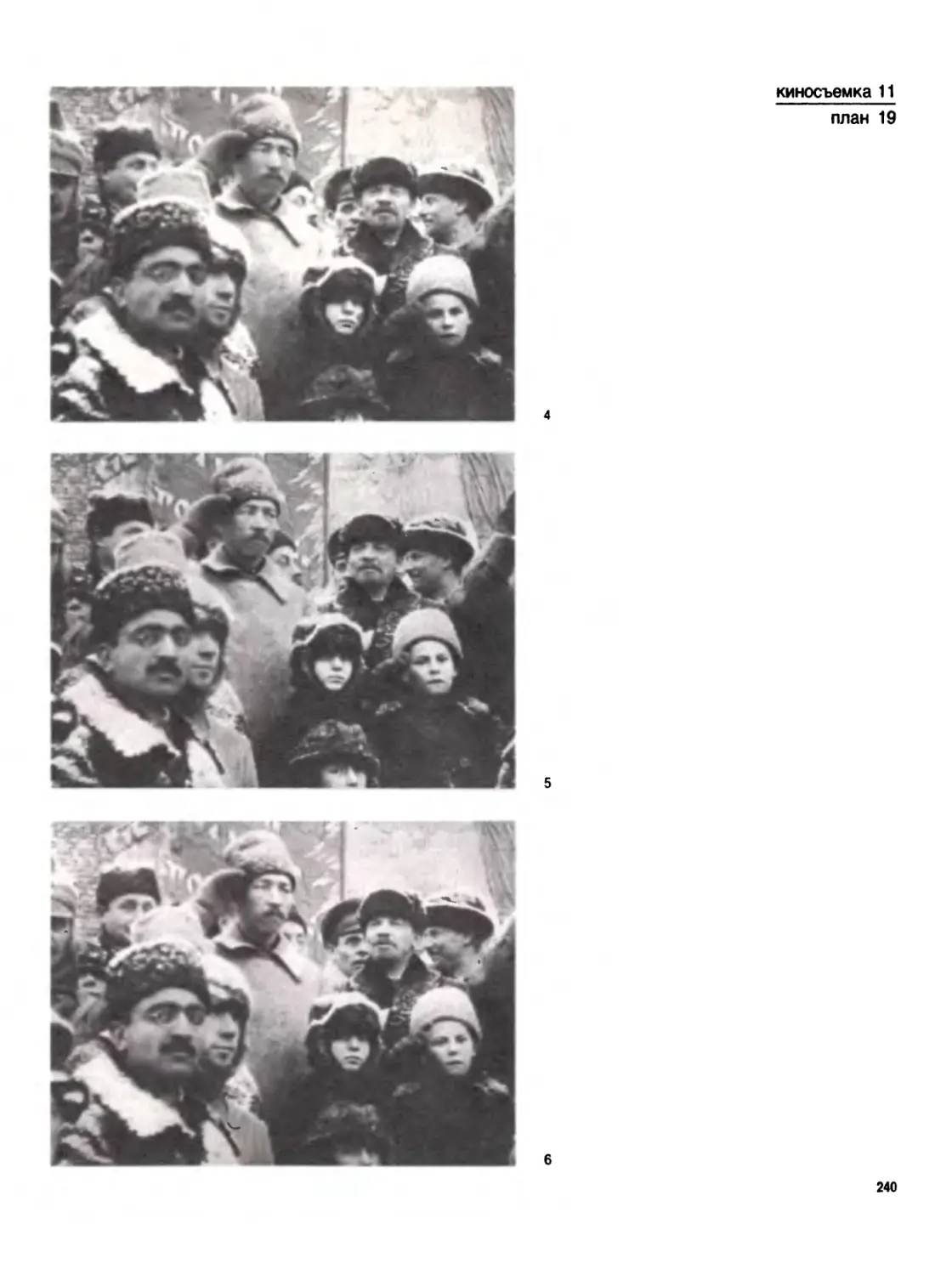
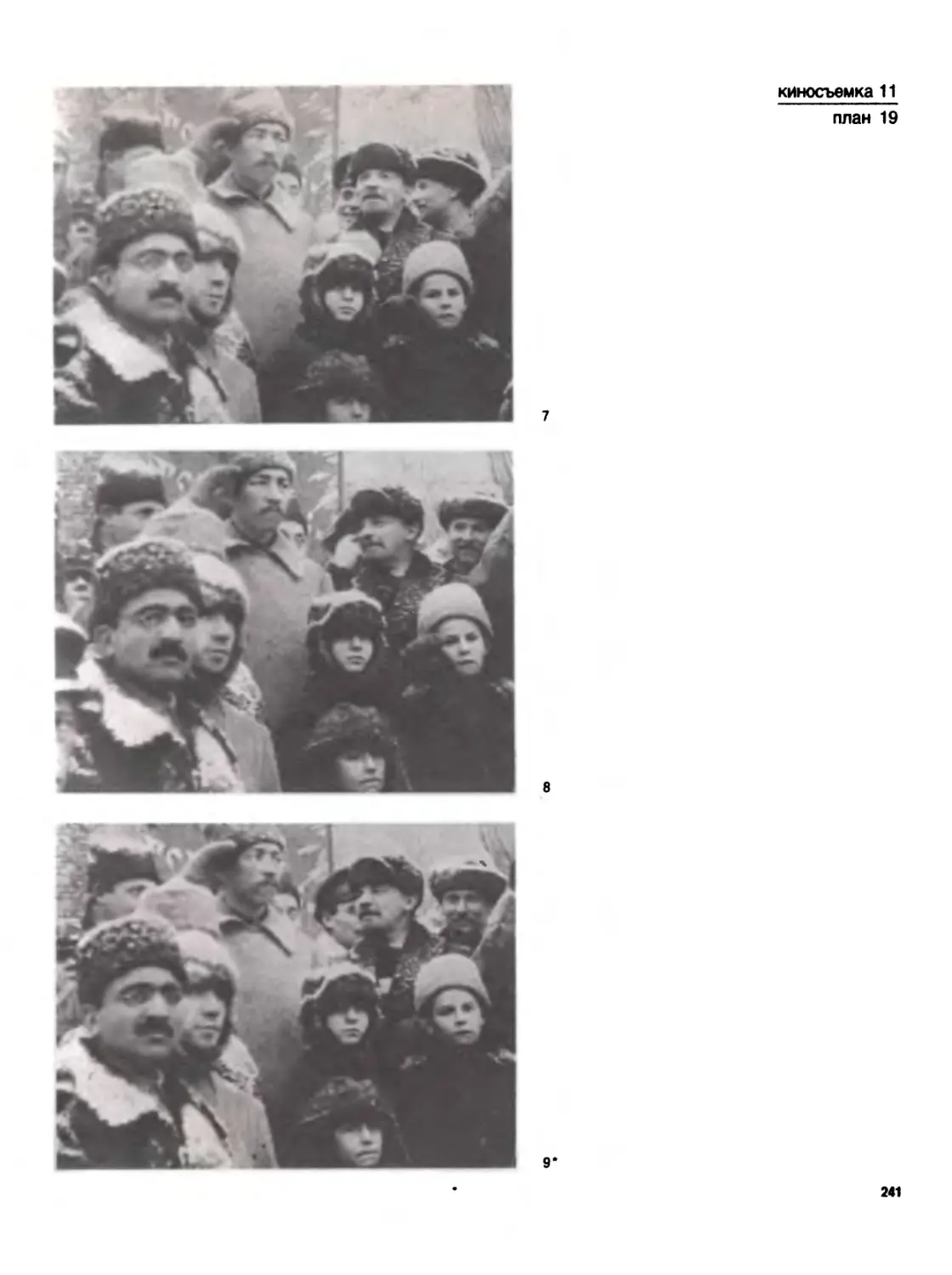
киносъемка 11
план 19
4
5
6
240
241
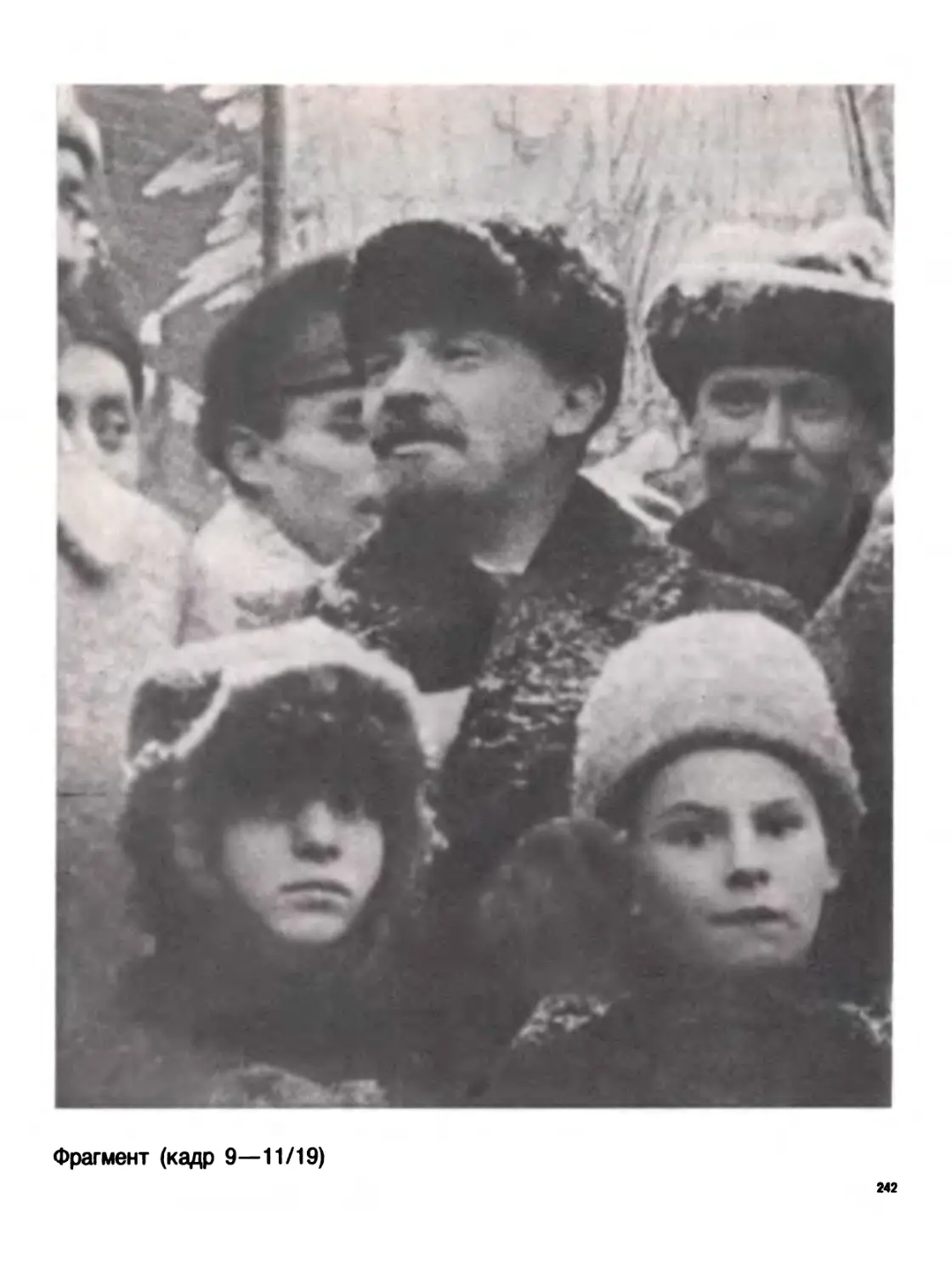
Фрагмент (кадр 9—11/19)
242
243
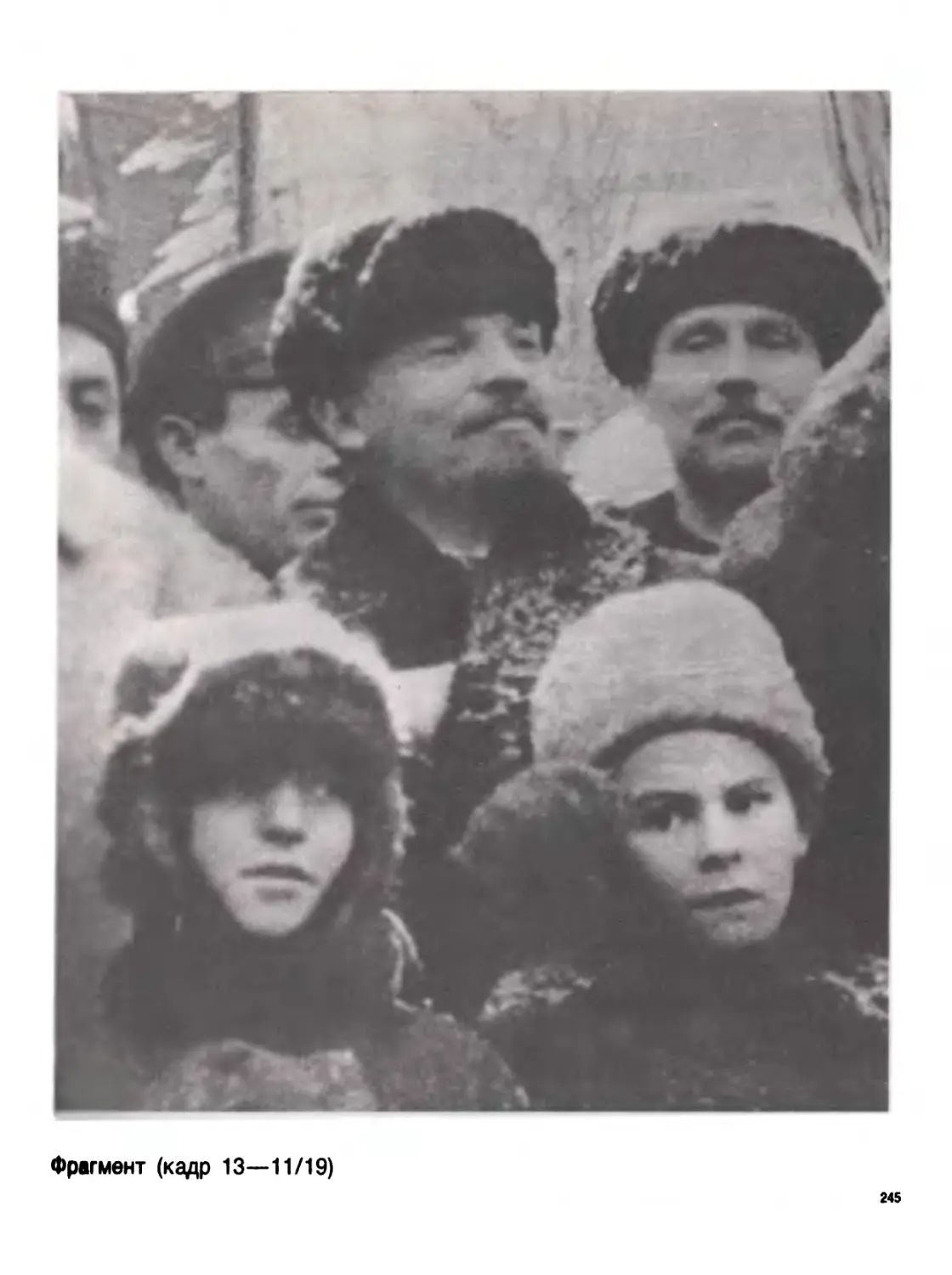
Фрагмент (кадр 13—11/19)
245
246
Л fl
Фрагмент (кадр 16—11/19)
247
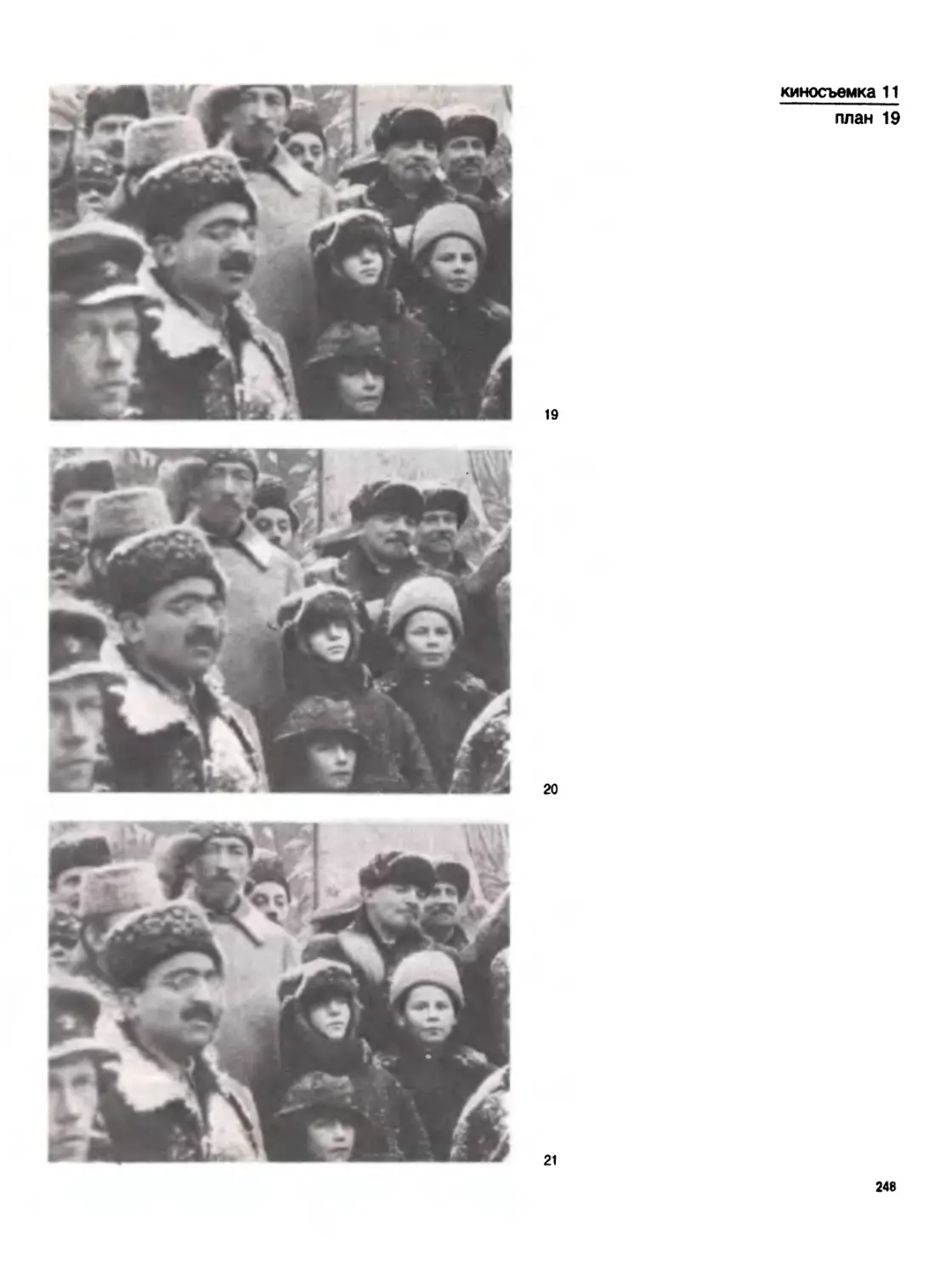
киносъемка 11
план 19
19
20
21
248
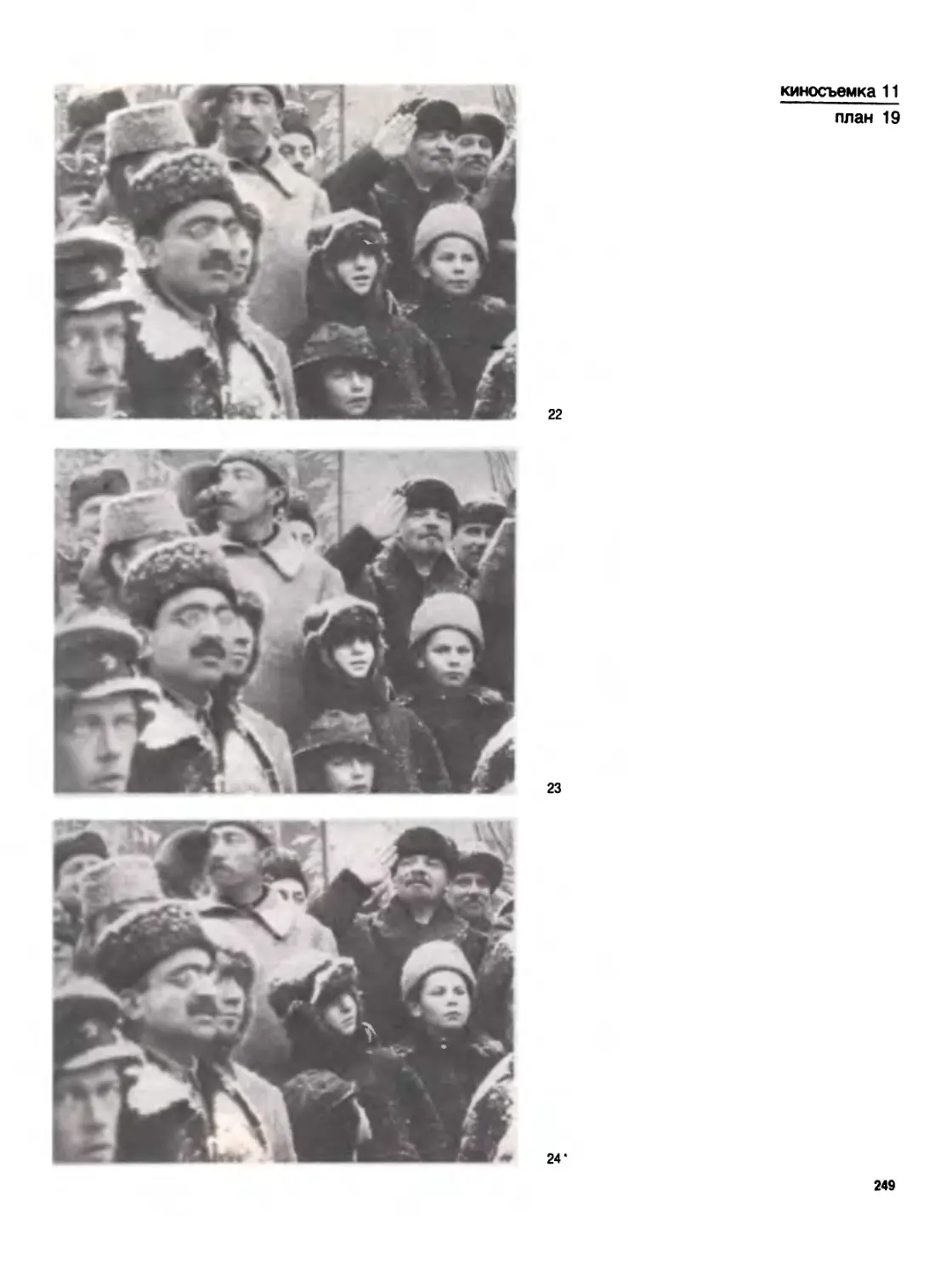
киносъемка 11
план 19
22
23
24*
249
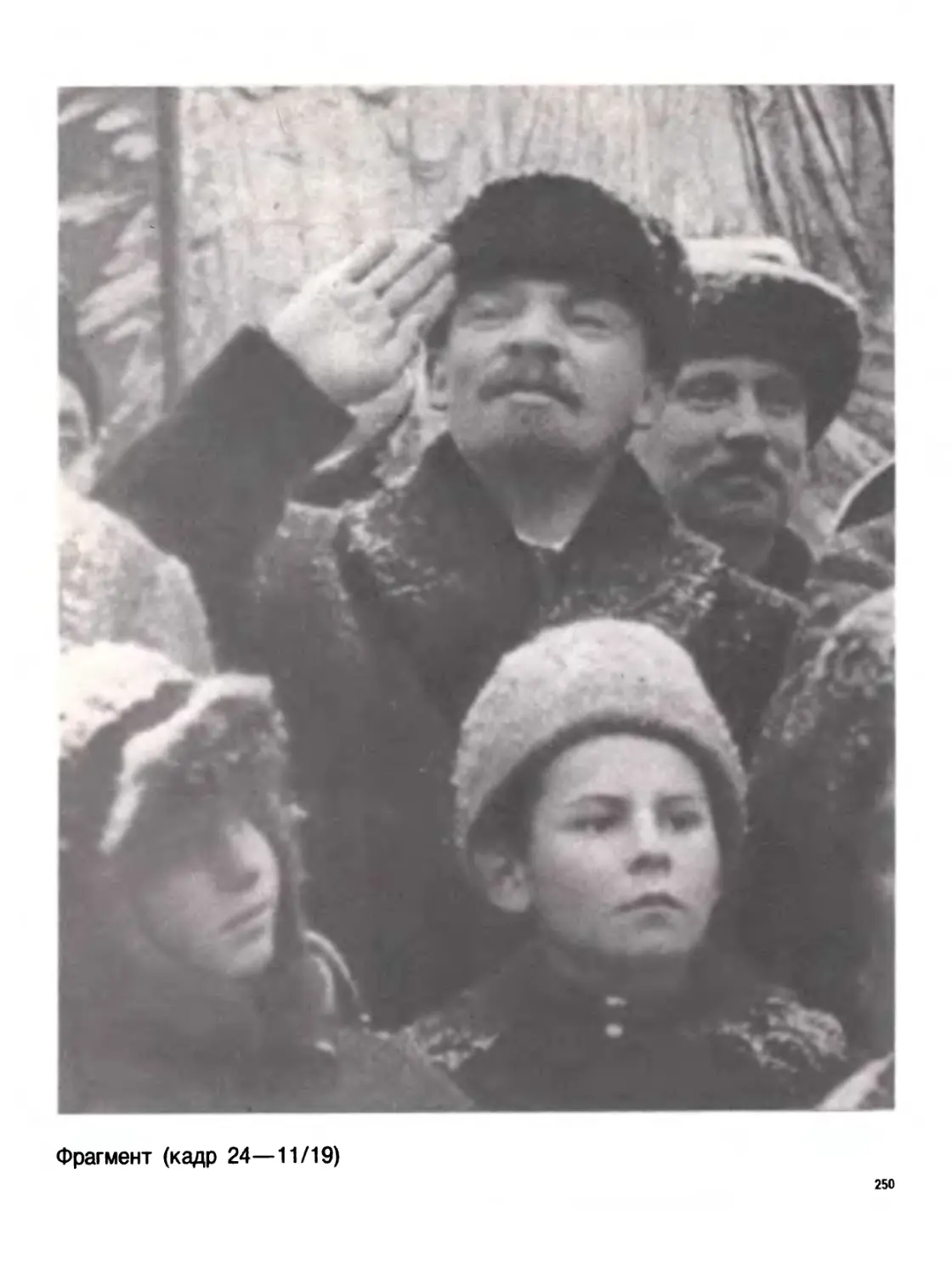
Фрагмент (кадр 24—11/19)
250
киносъемка
12
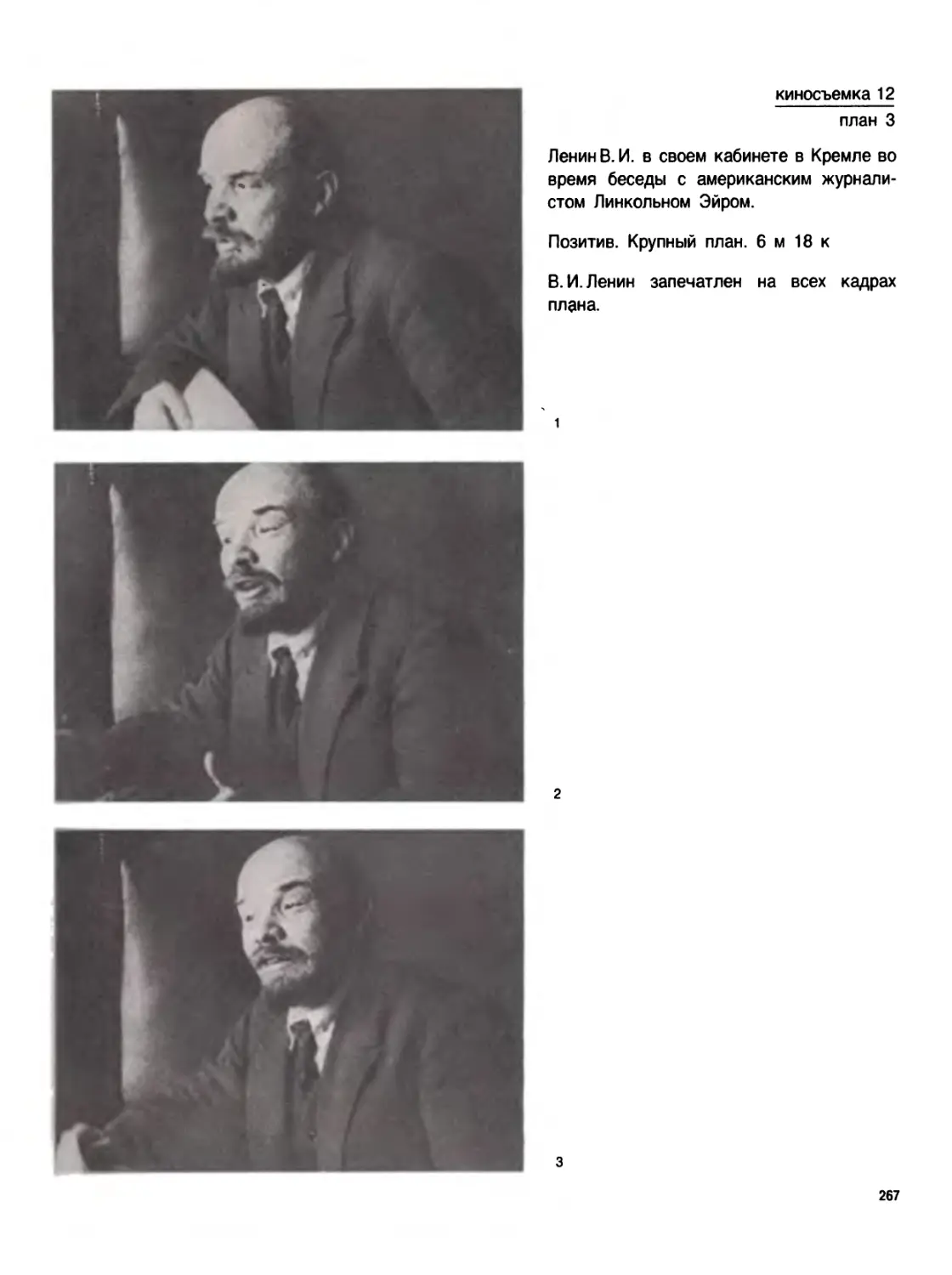
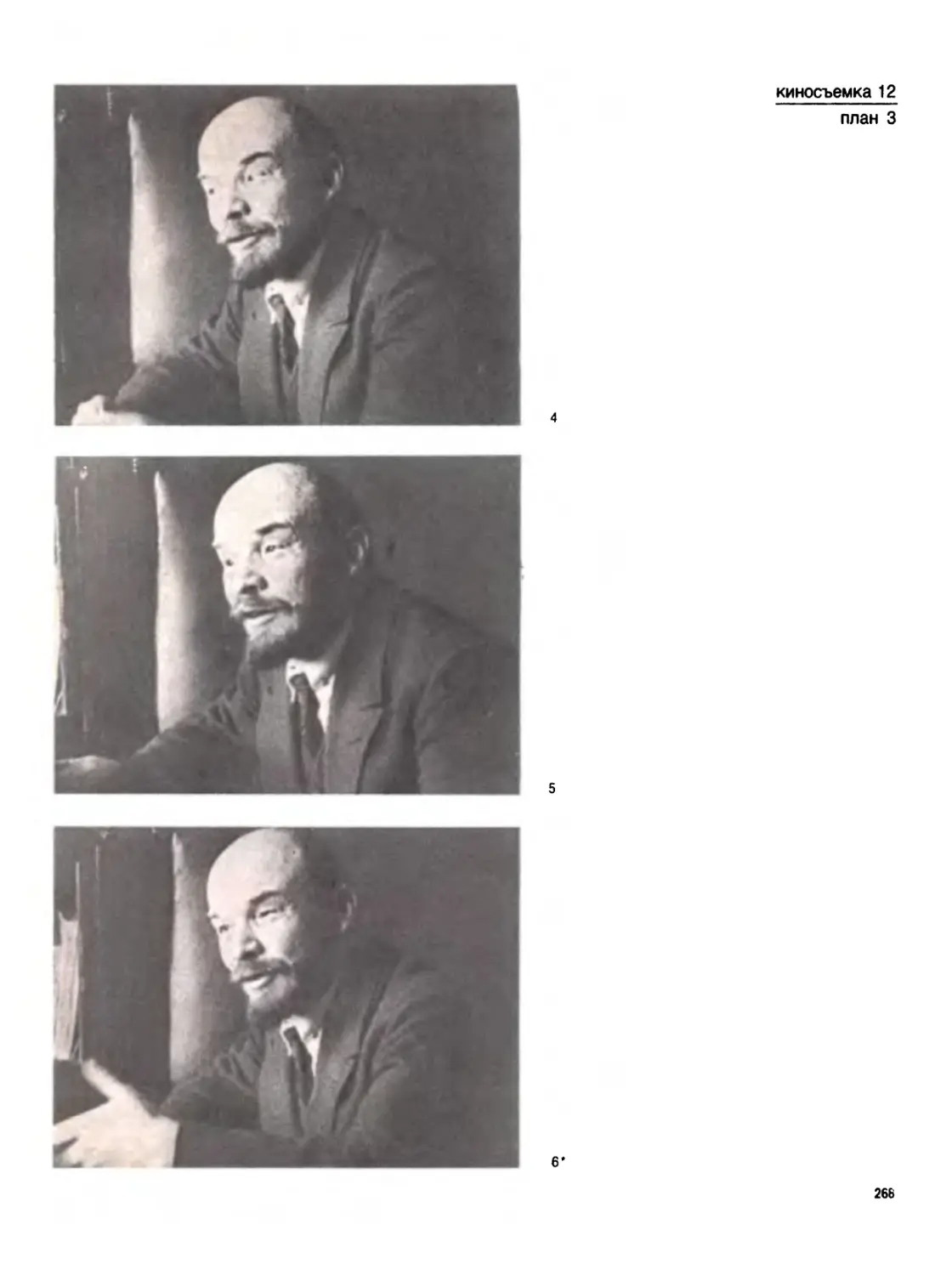
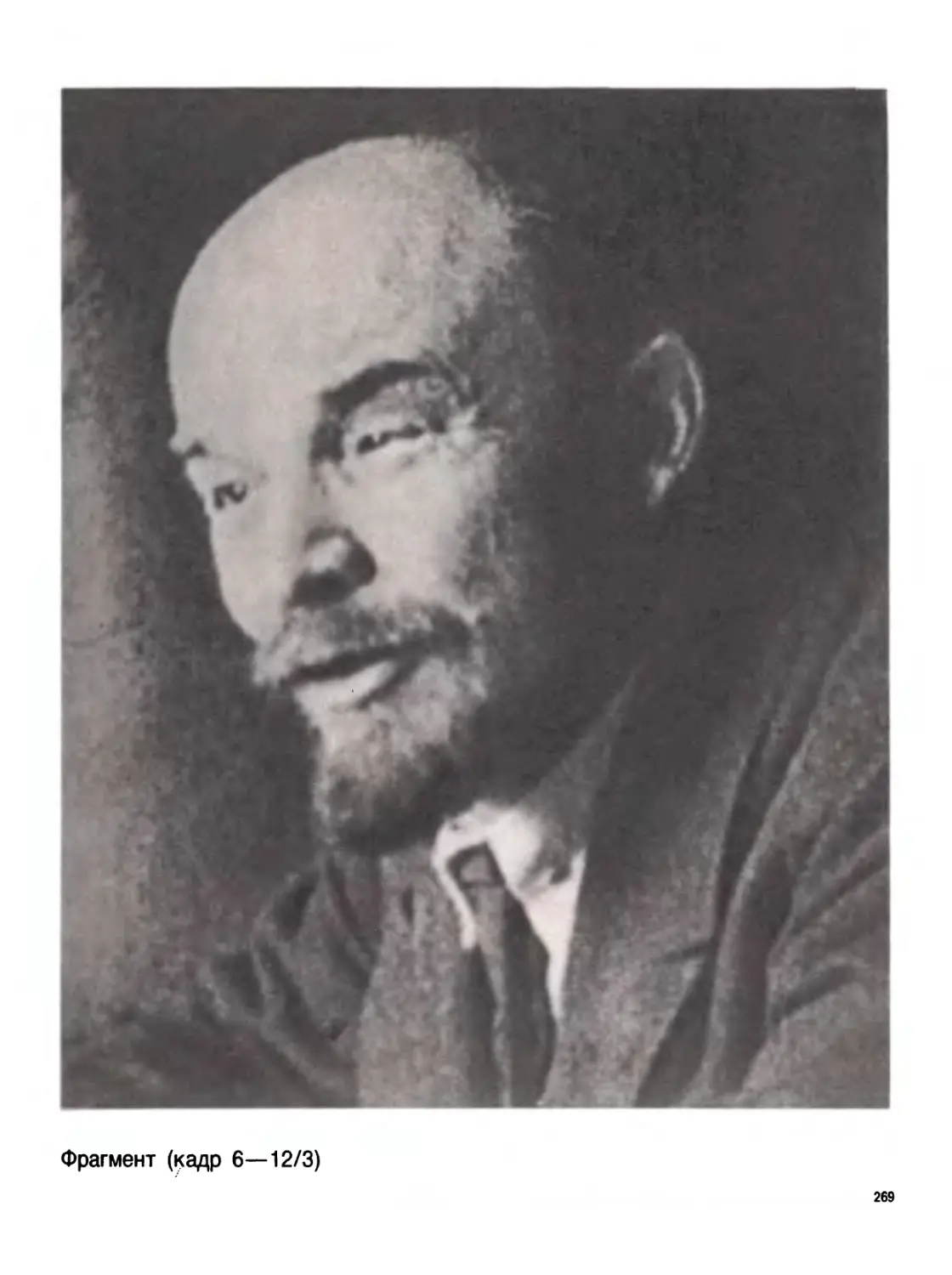
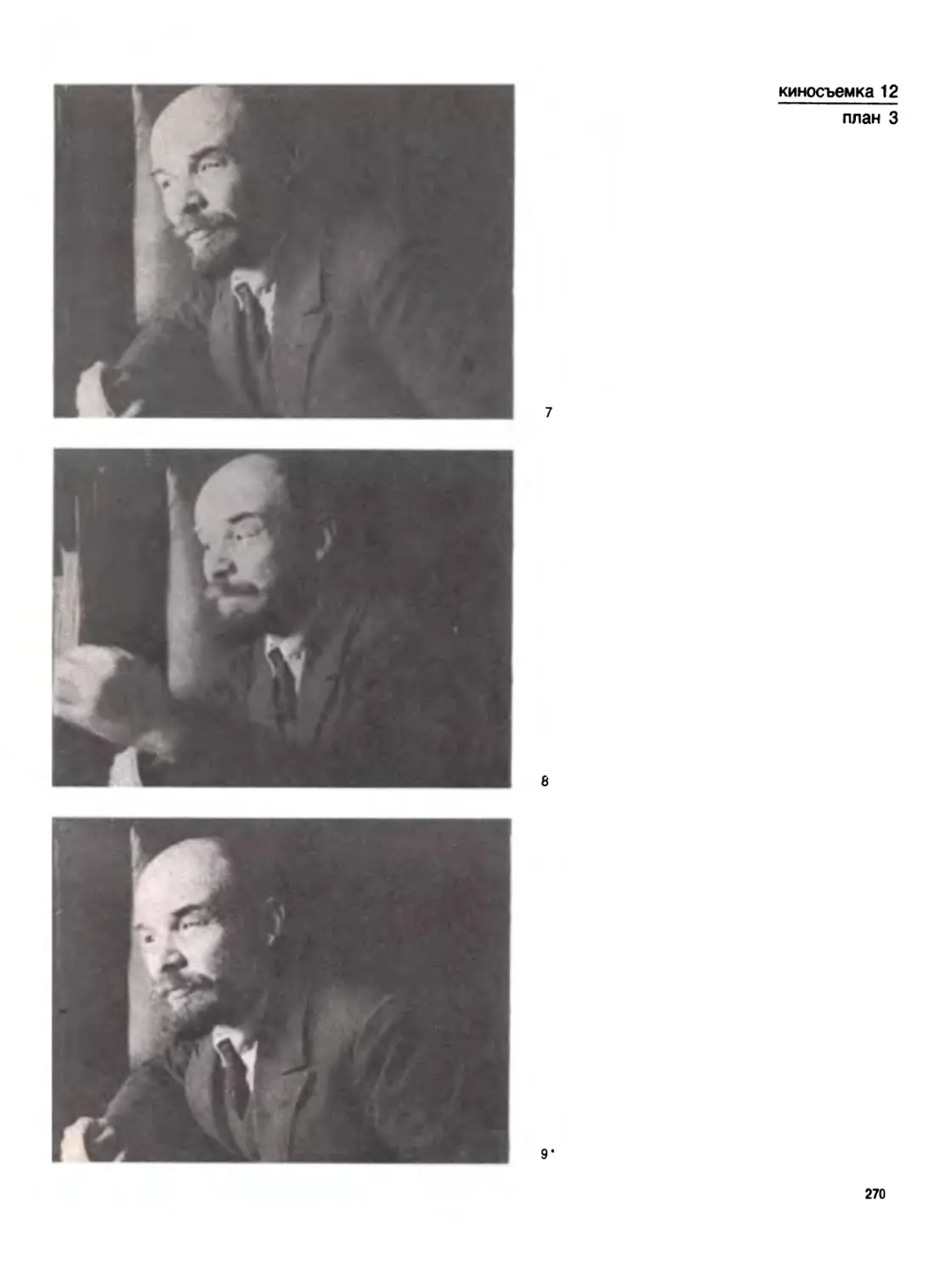
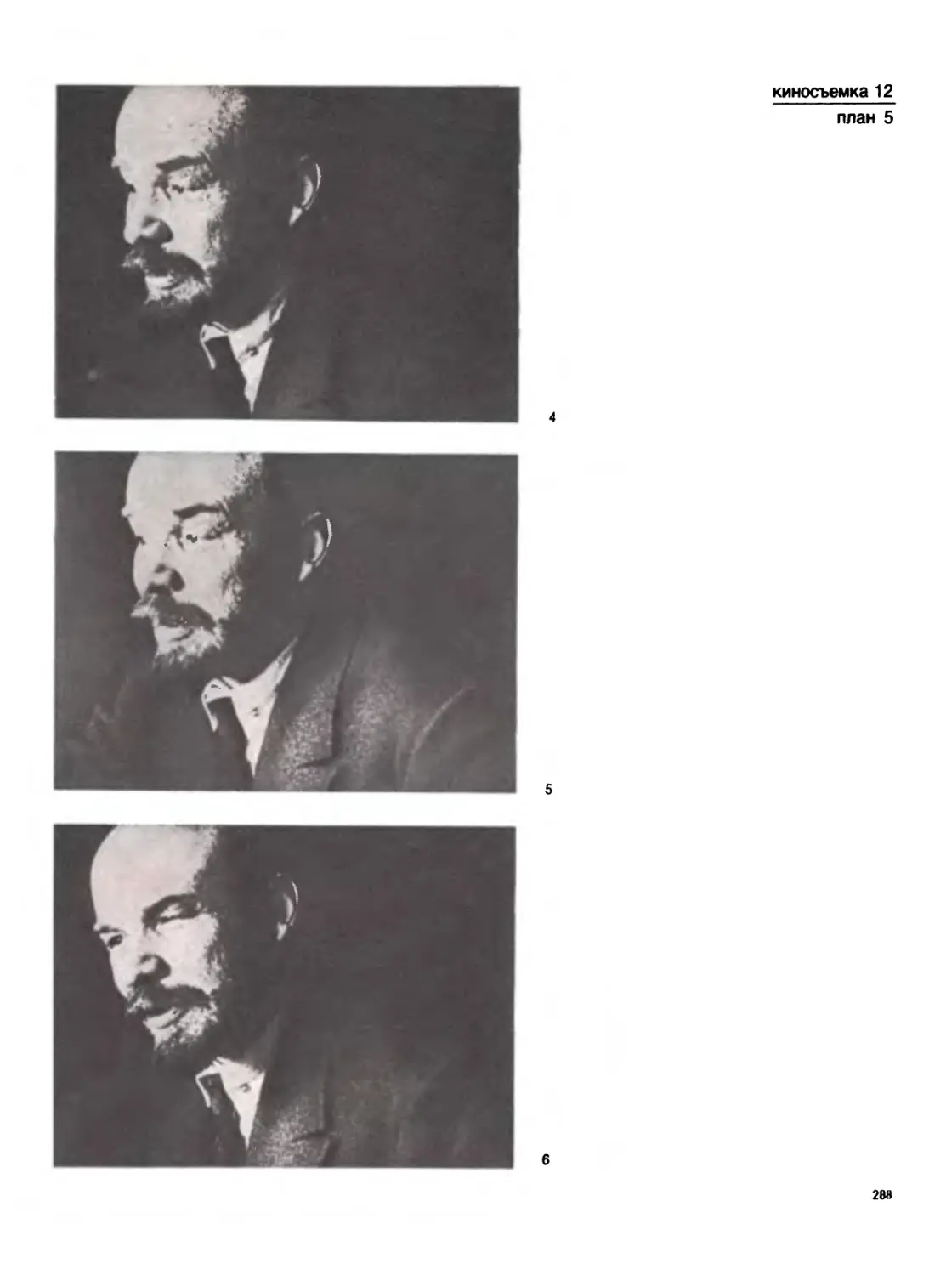
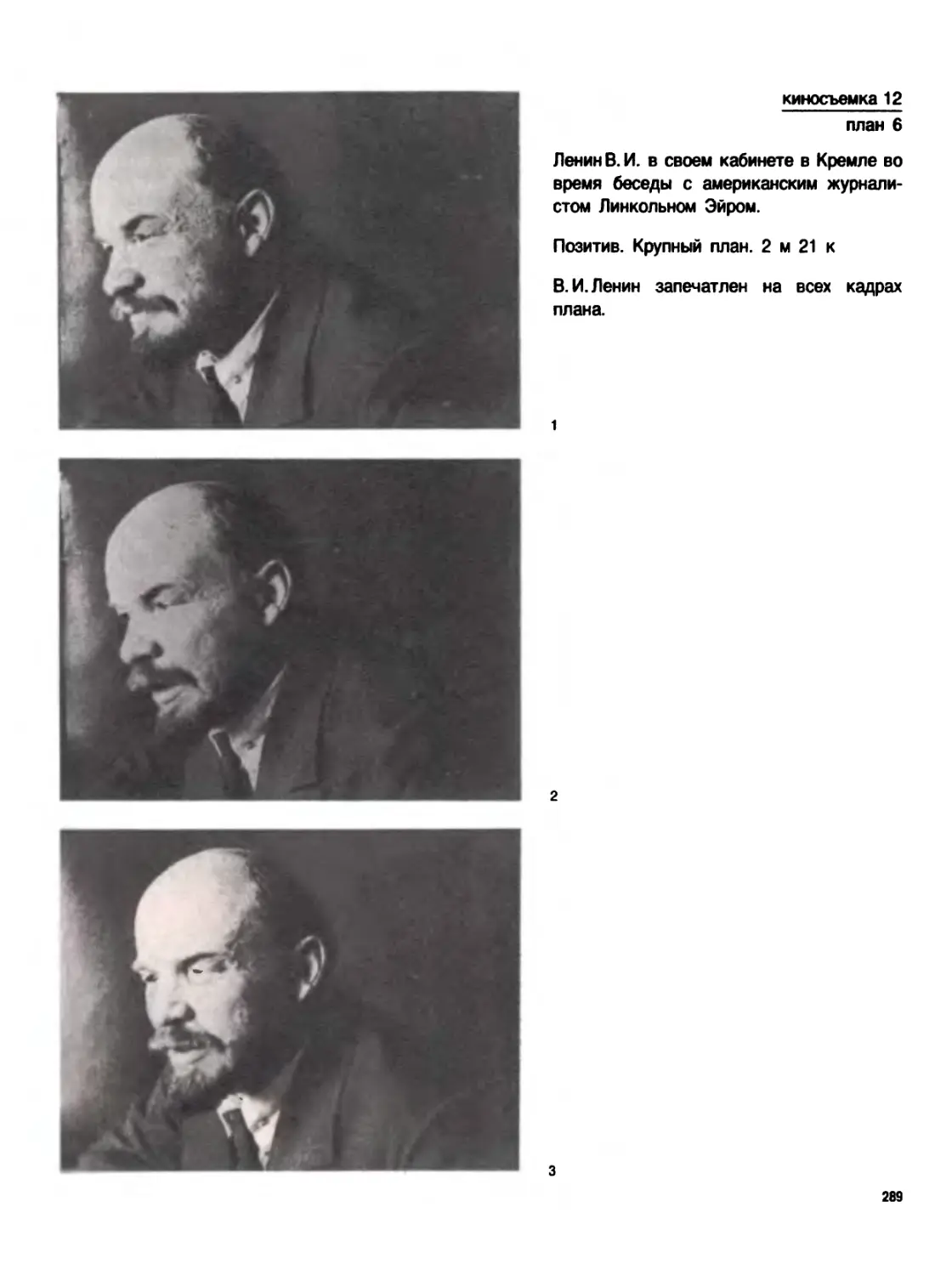
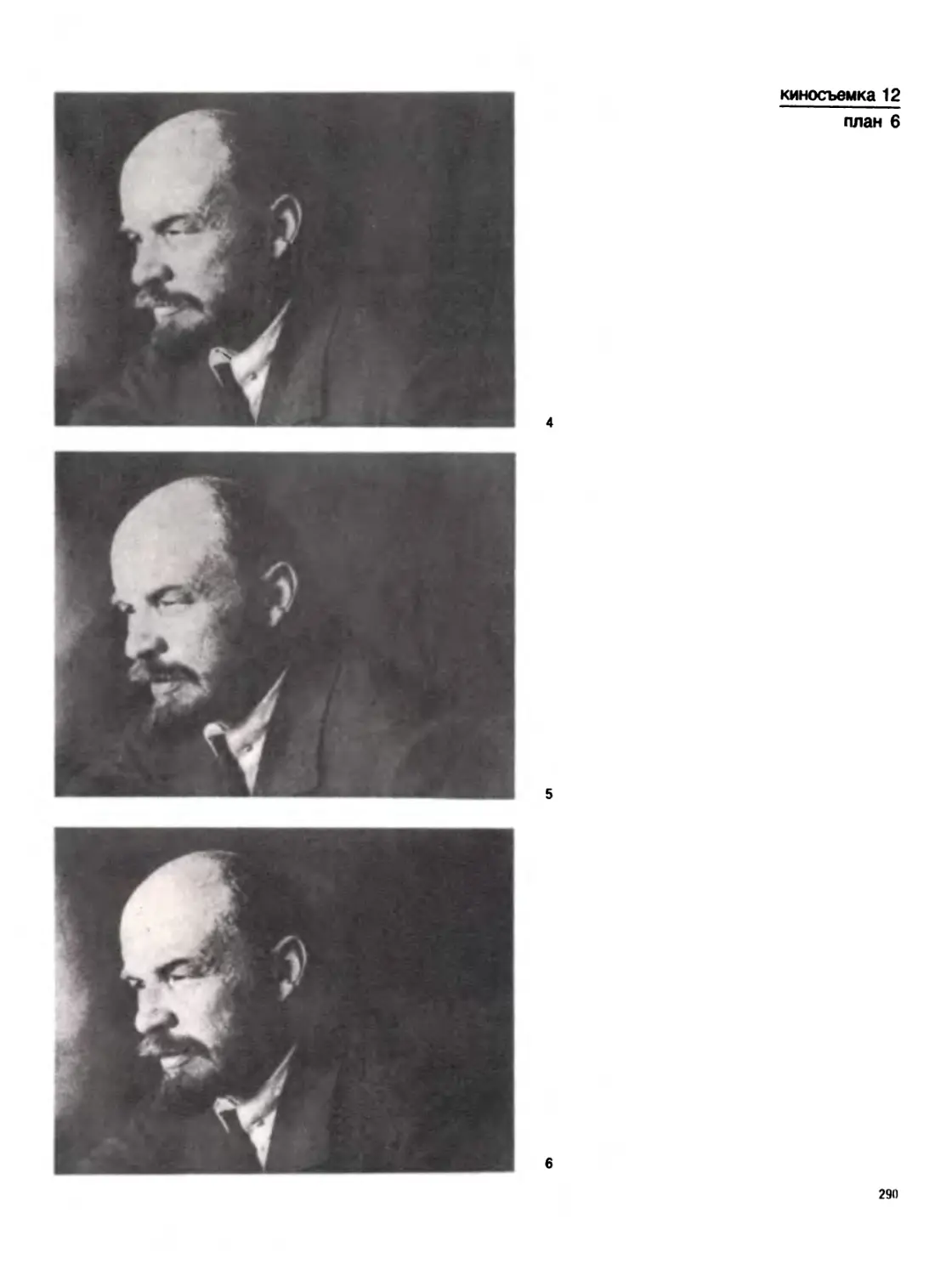
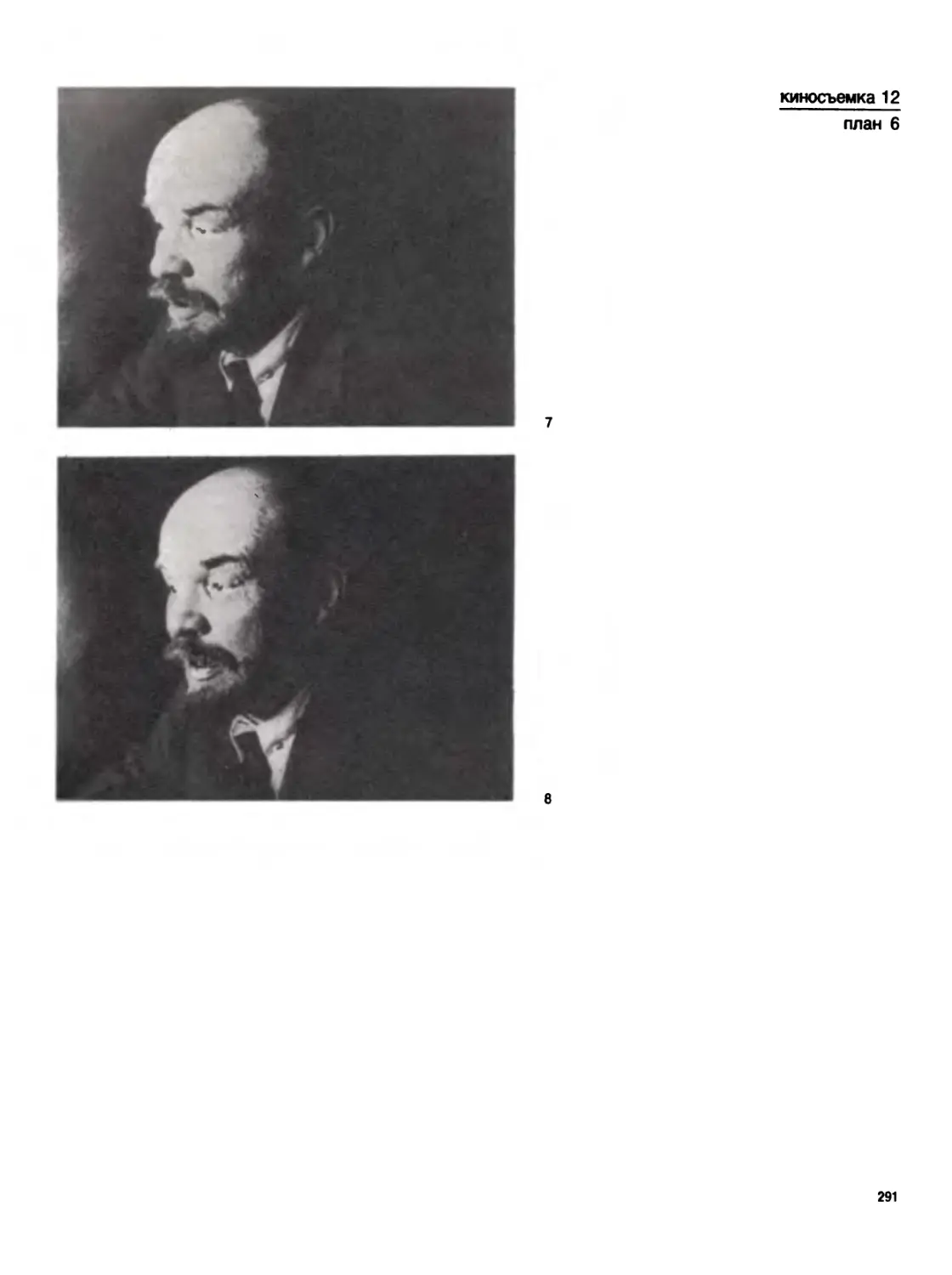
Ленин В. И. в Кремле во время беседы с американским
журналистом Линкольном Эйром.
1920 г., февраль, ранее 20. Москва.
Оператор:
КьюбсВ. (американский кинооператор).
Первый выход на экран:
Предположительно кинофильм «Великий путь», 1927 год.
Обоснование даты:
В феврале 1920 года В. И. Ленин принимает в Кремле корреспондента американ¬
ской газеты «World» («Мир») Линкольна Эйра.—См.: В. И. Ленин. Полн. собр. соч.,
т. 40, стр. 482.
См. также: журн. «Коммунист», 1957, № 15, стр. 10.
Примечания.
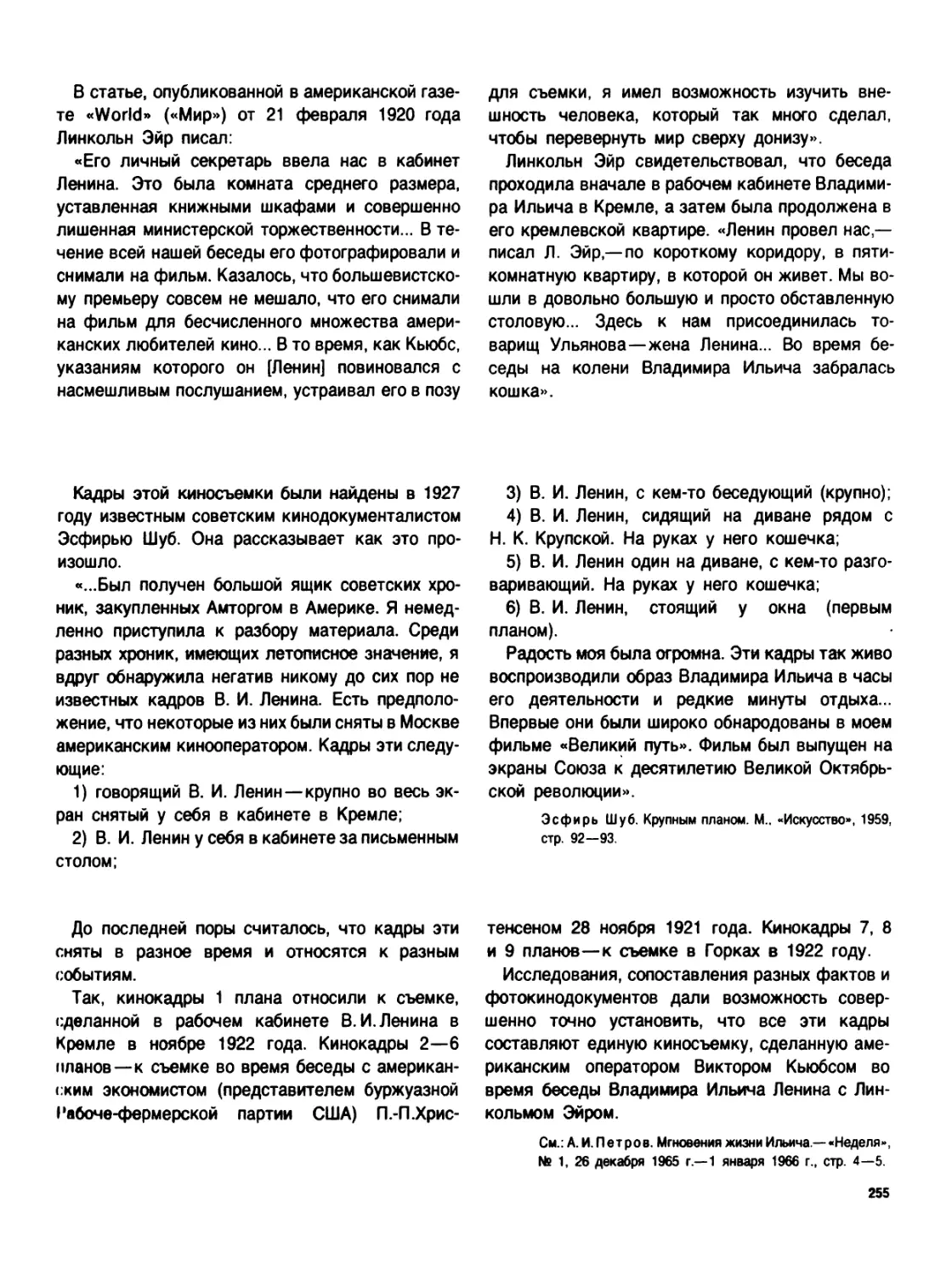
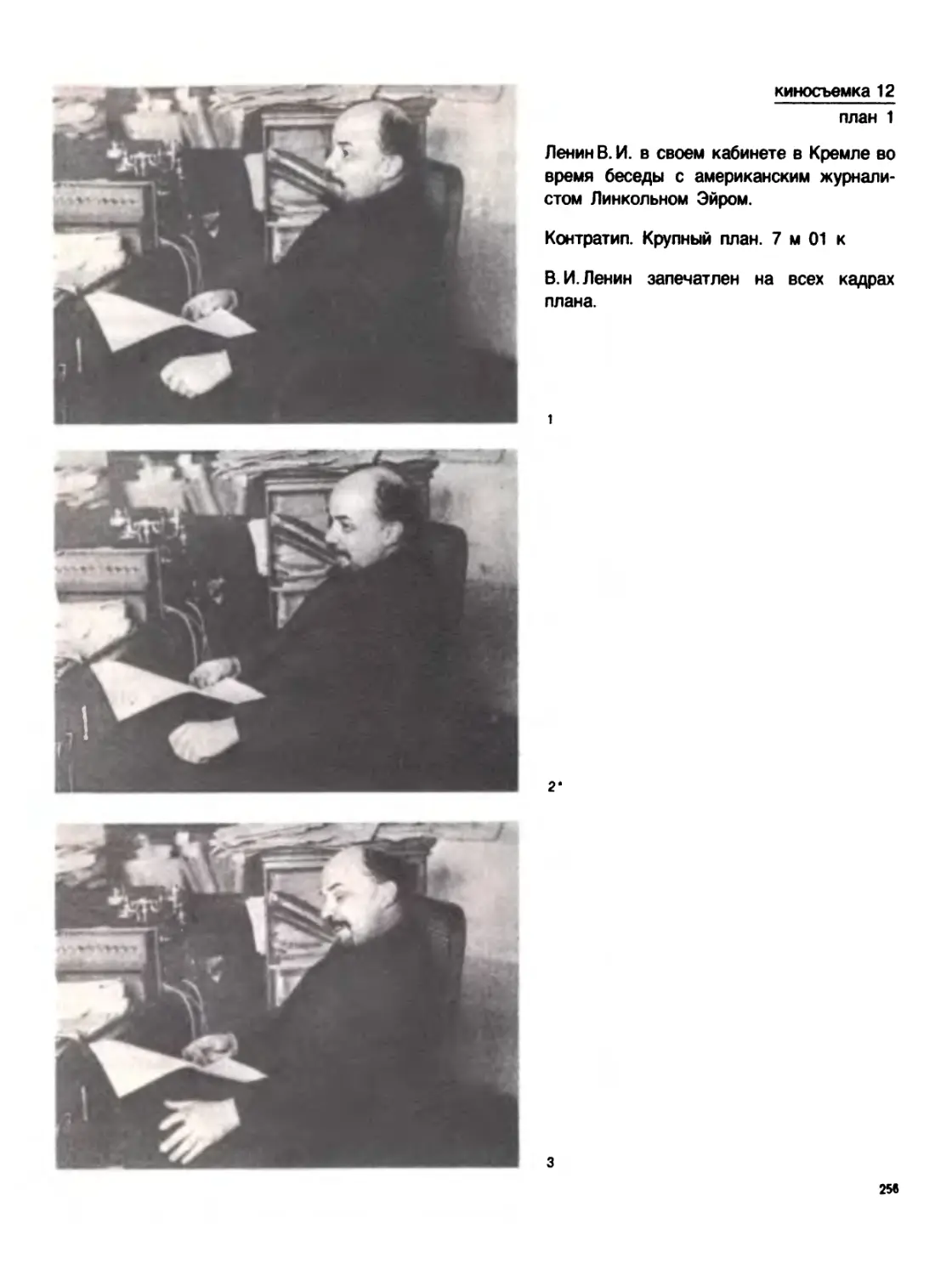
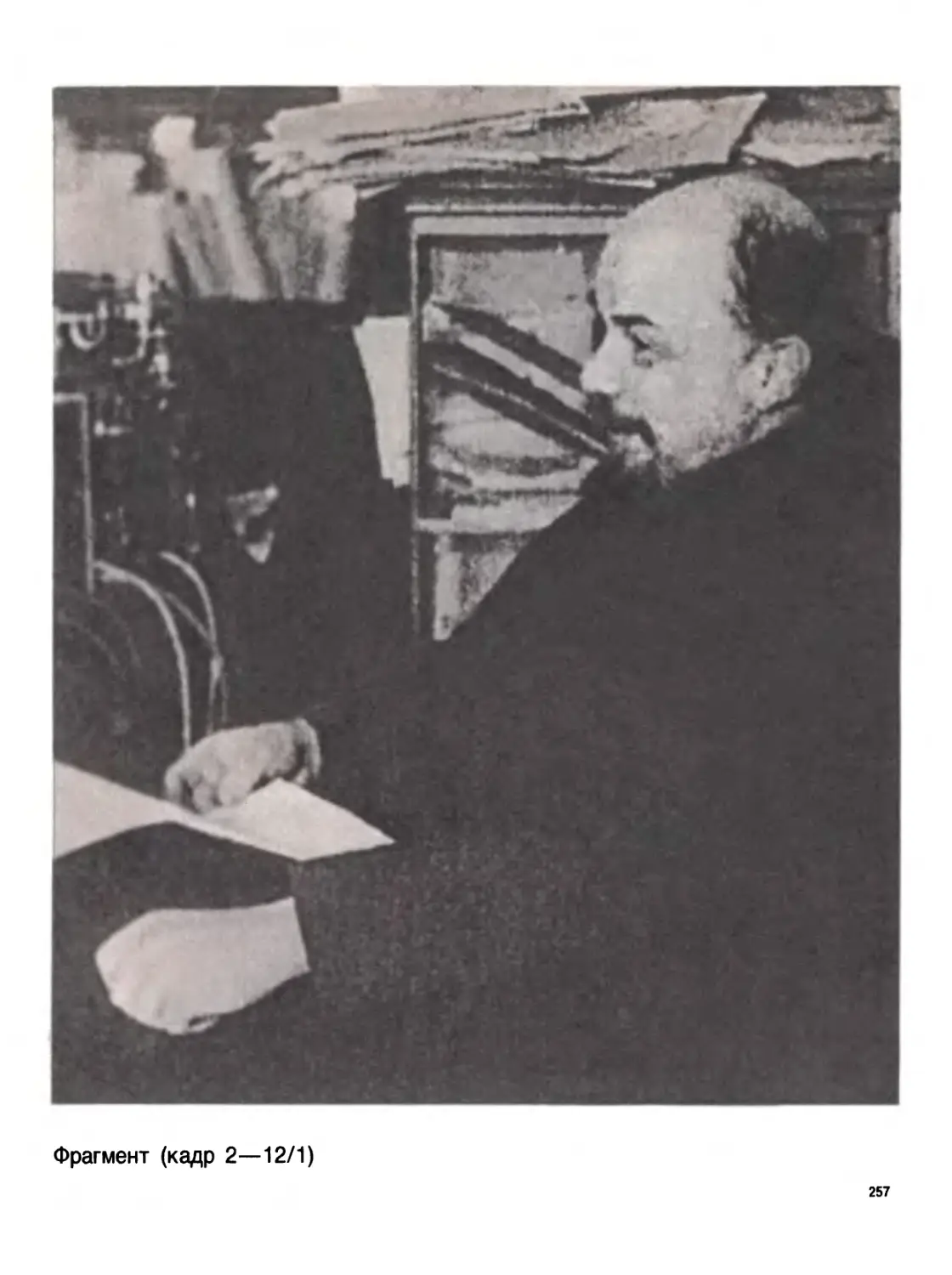
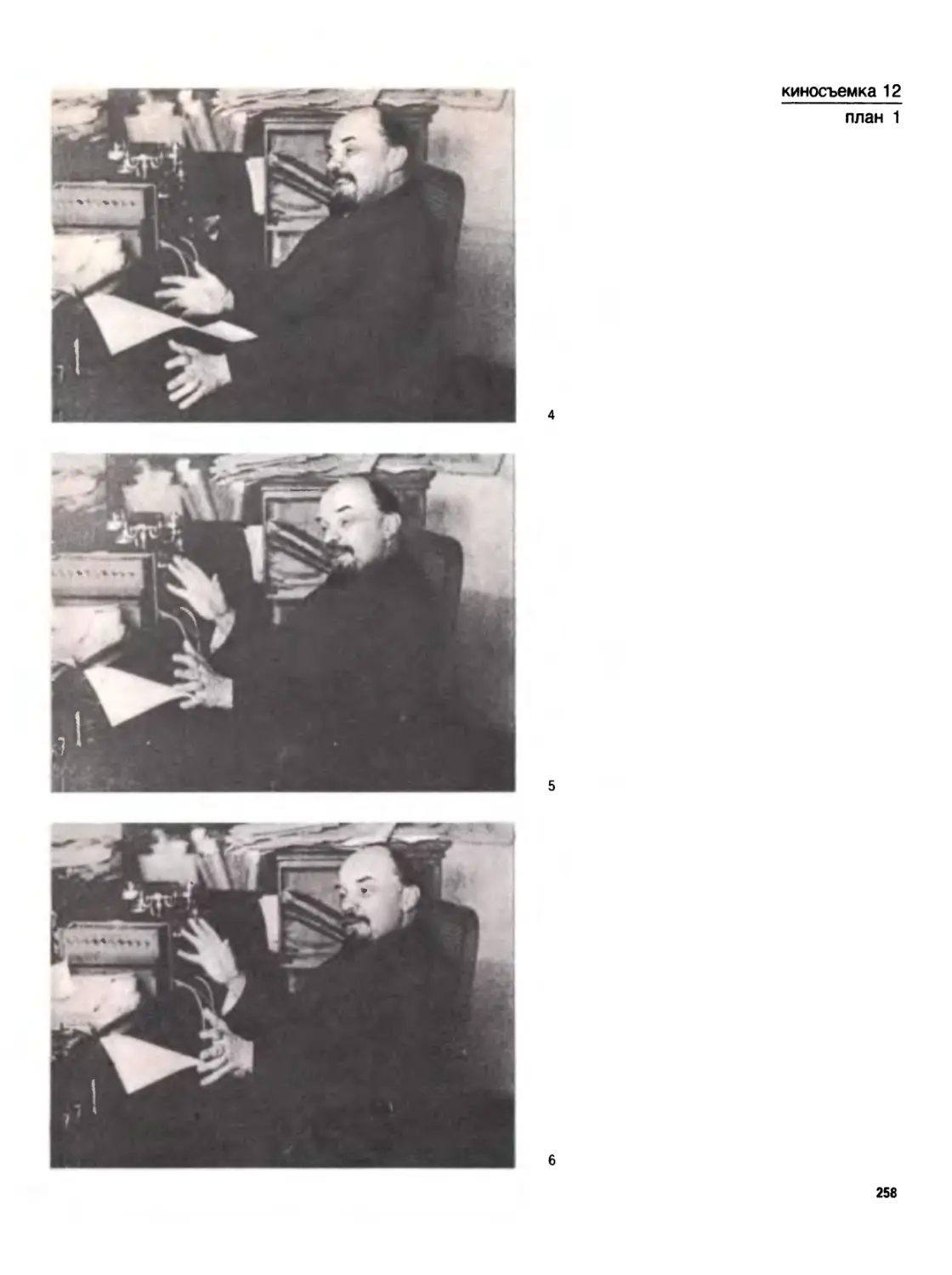
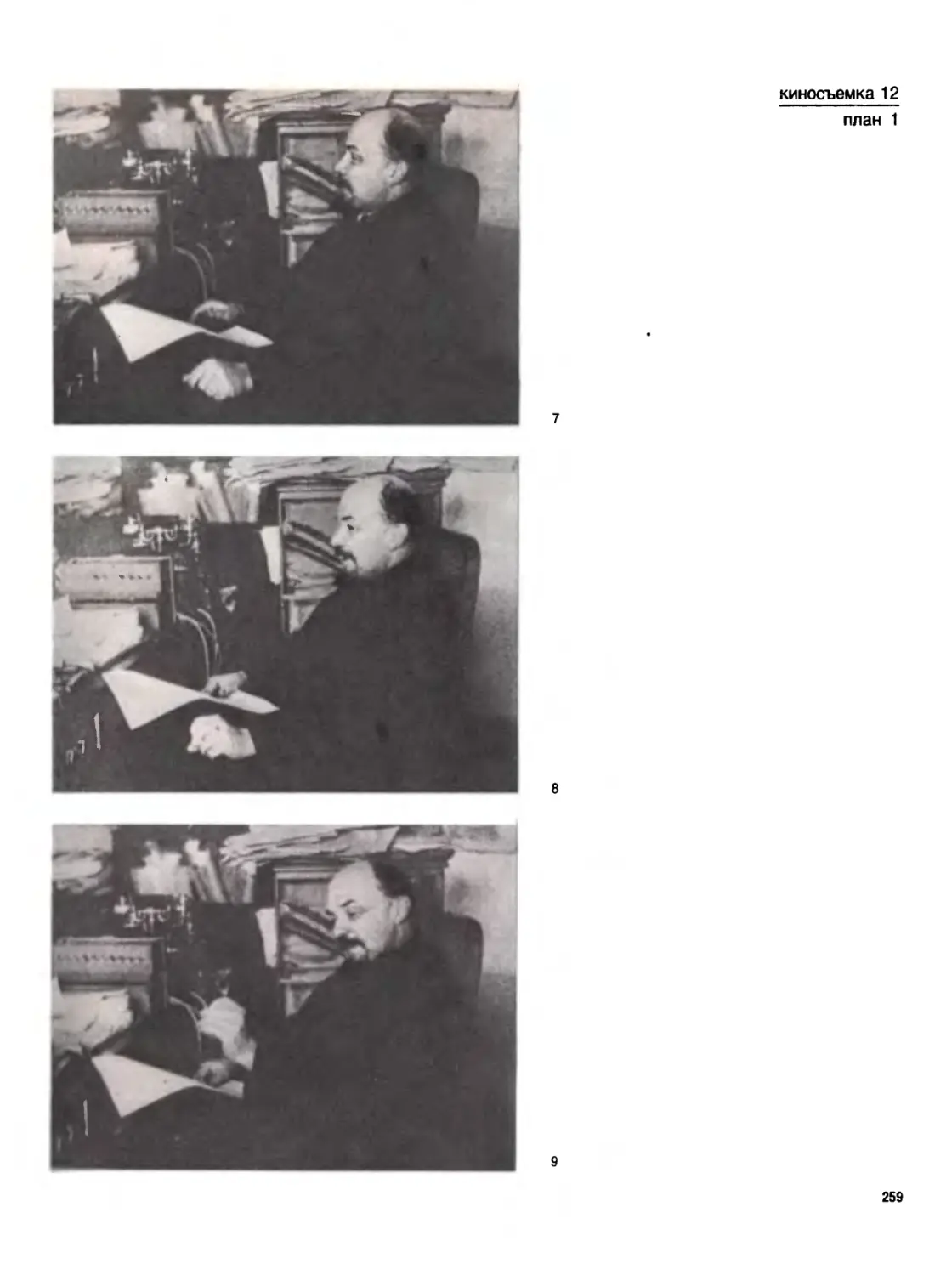
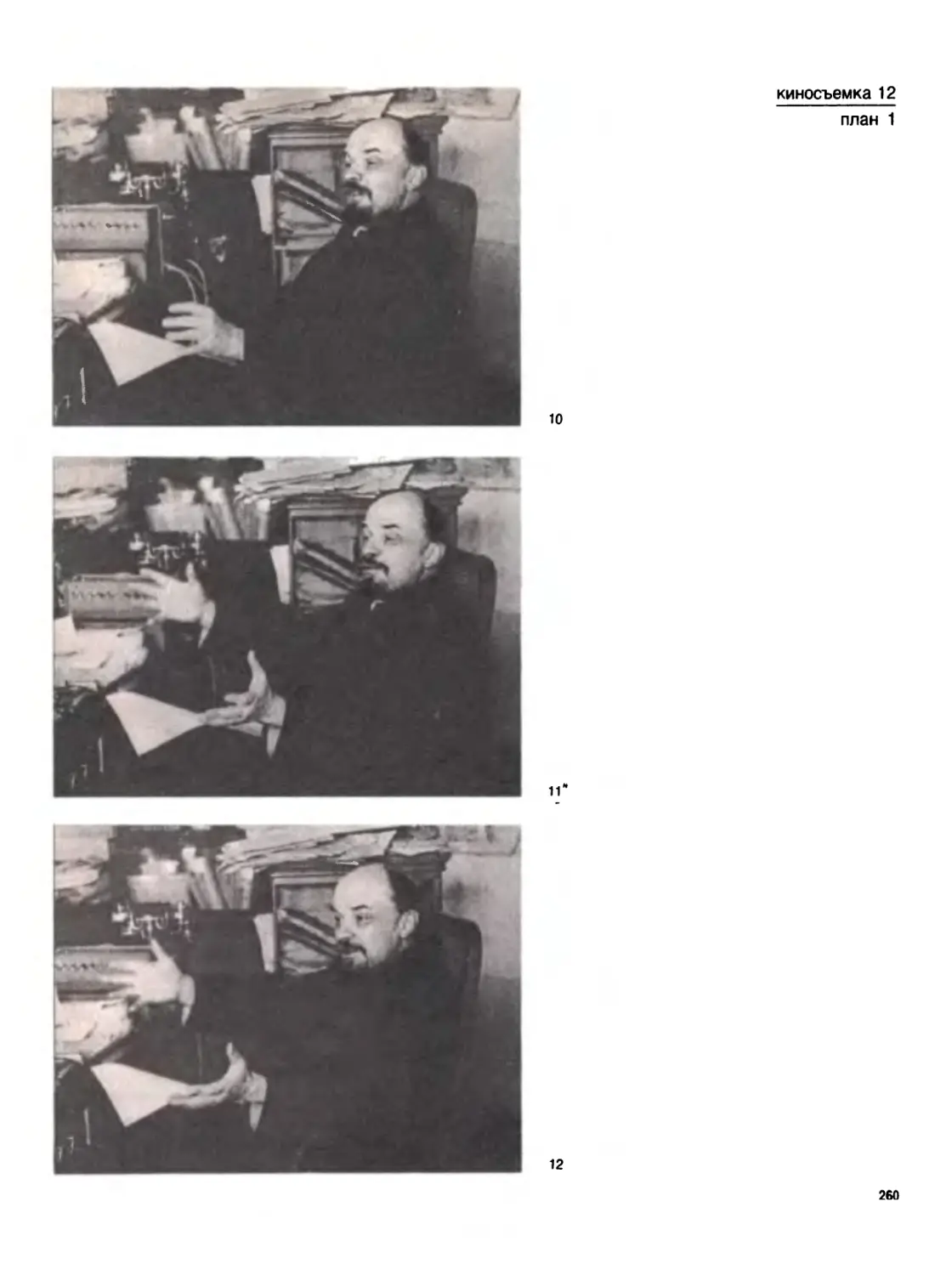
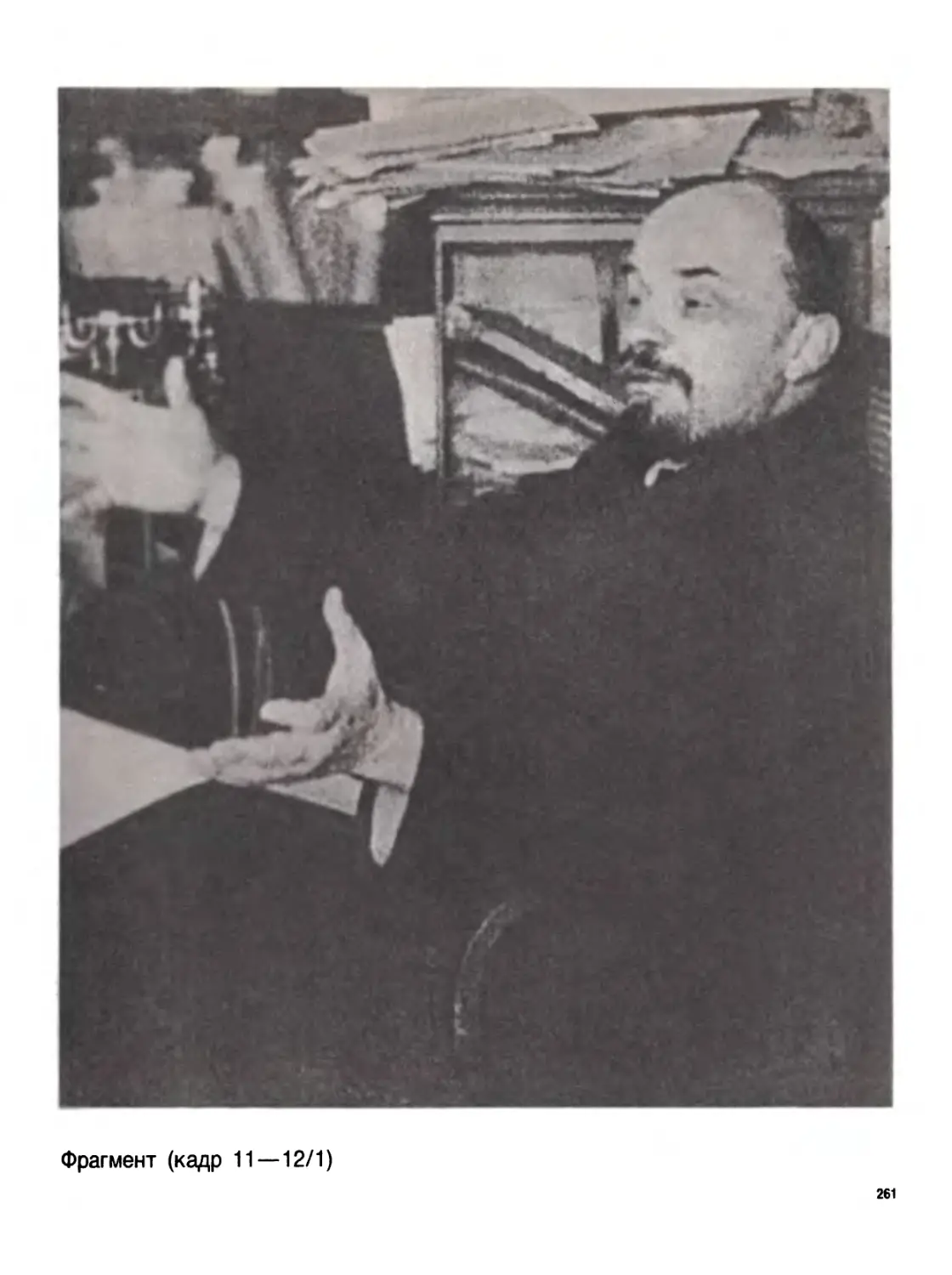
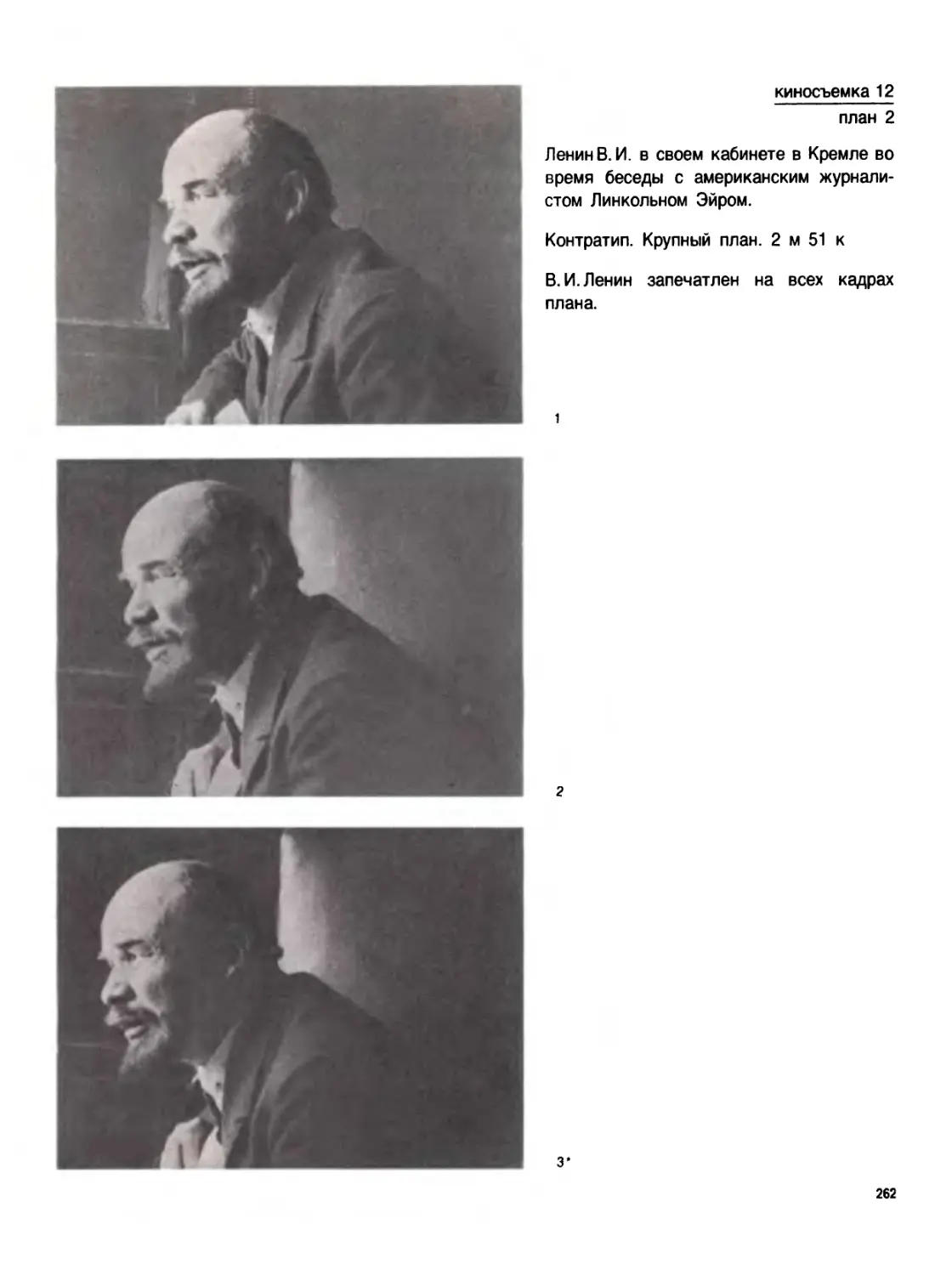
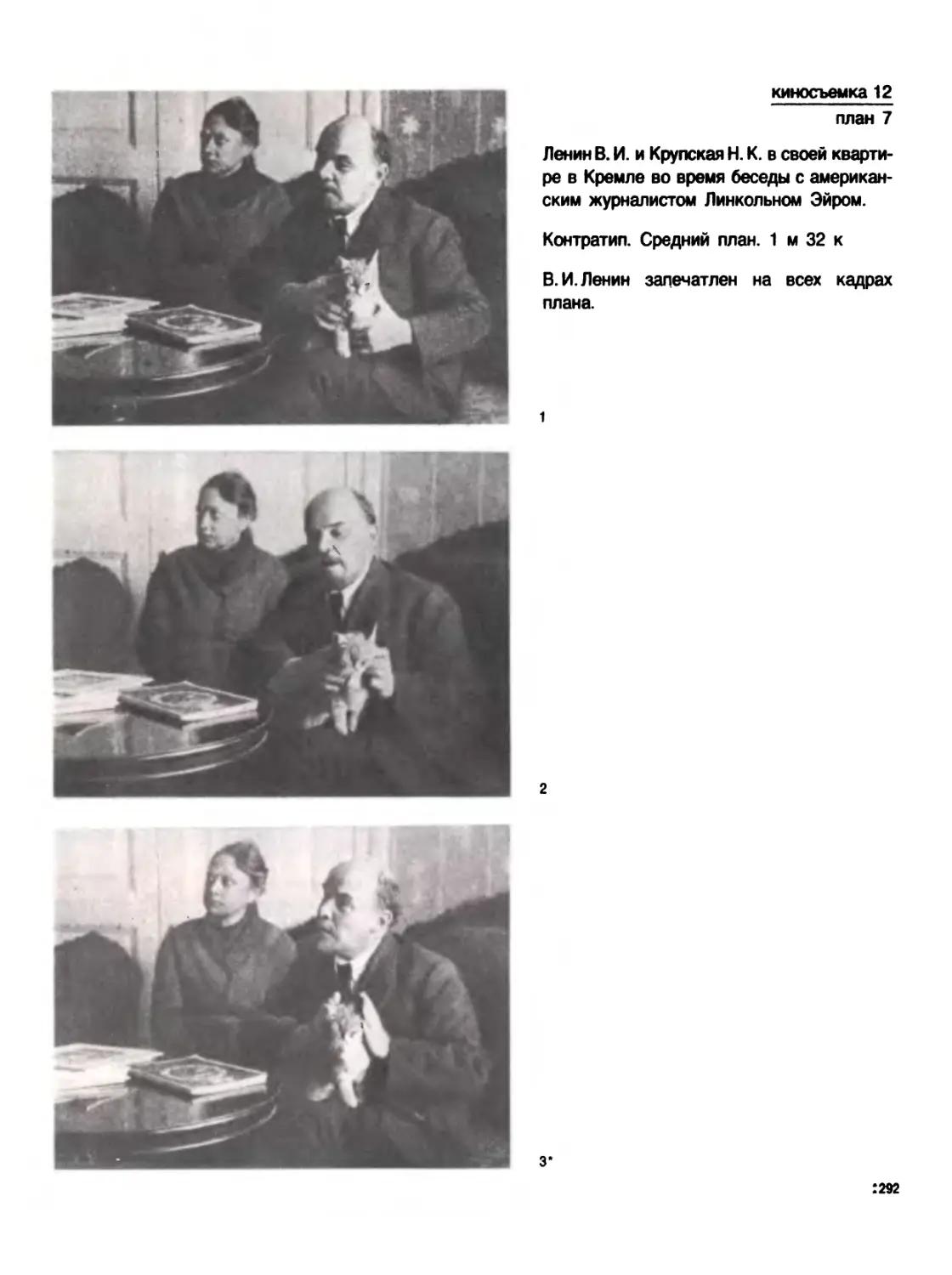
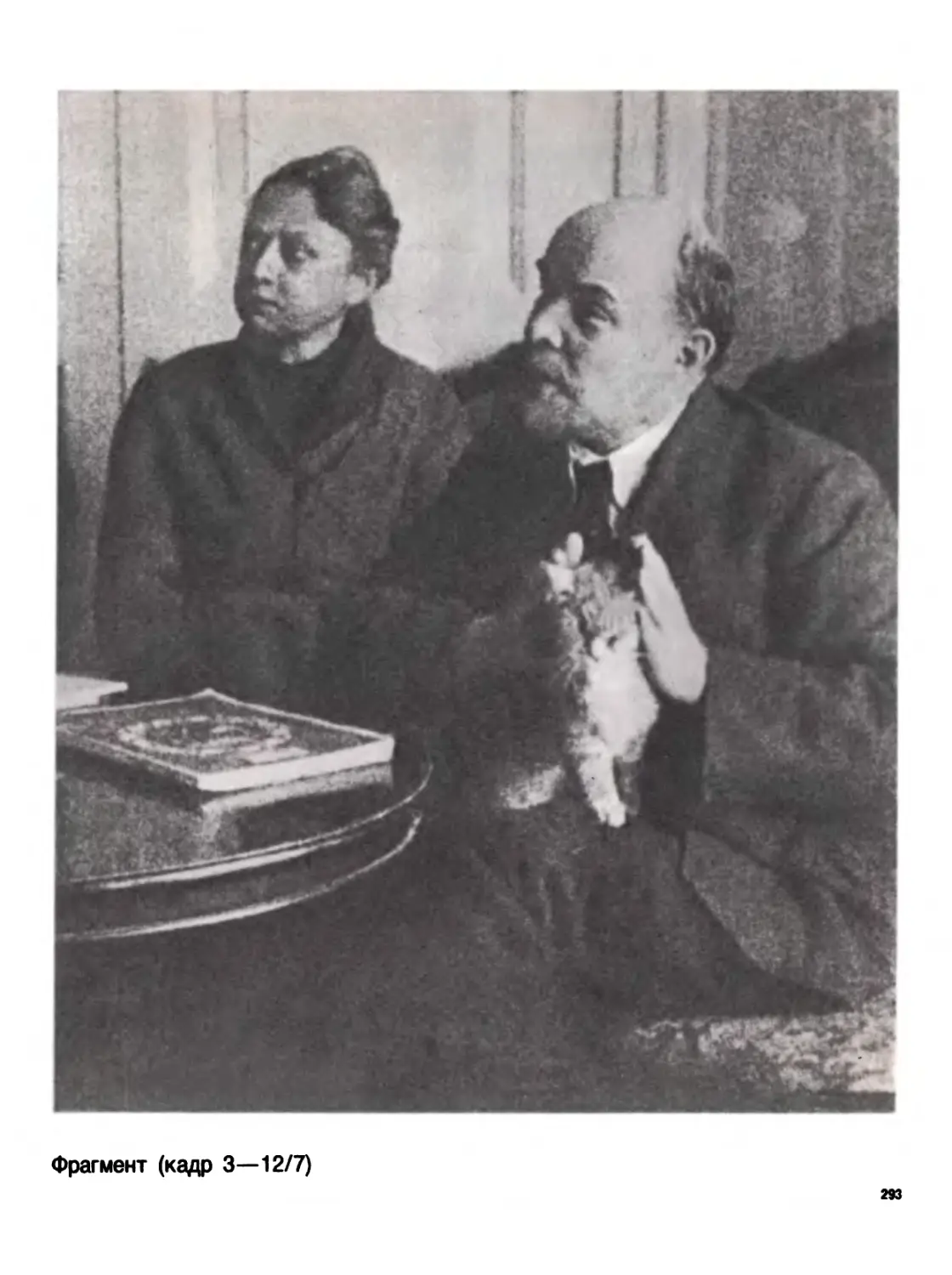
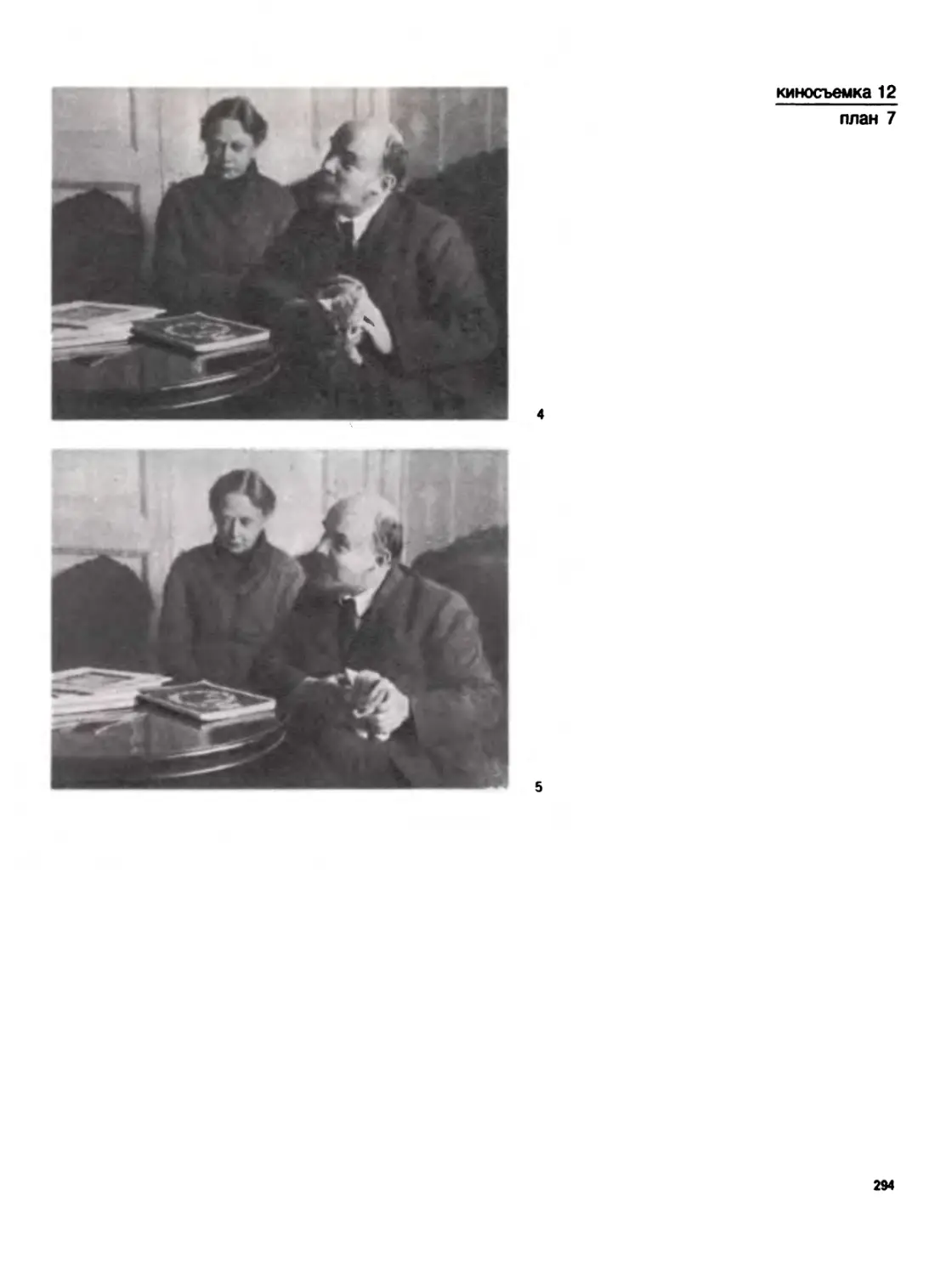
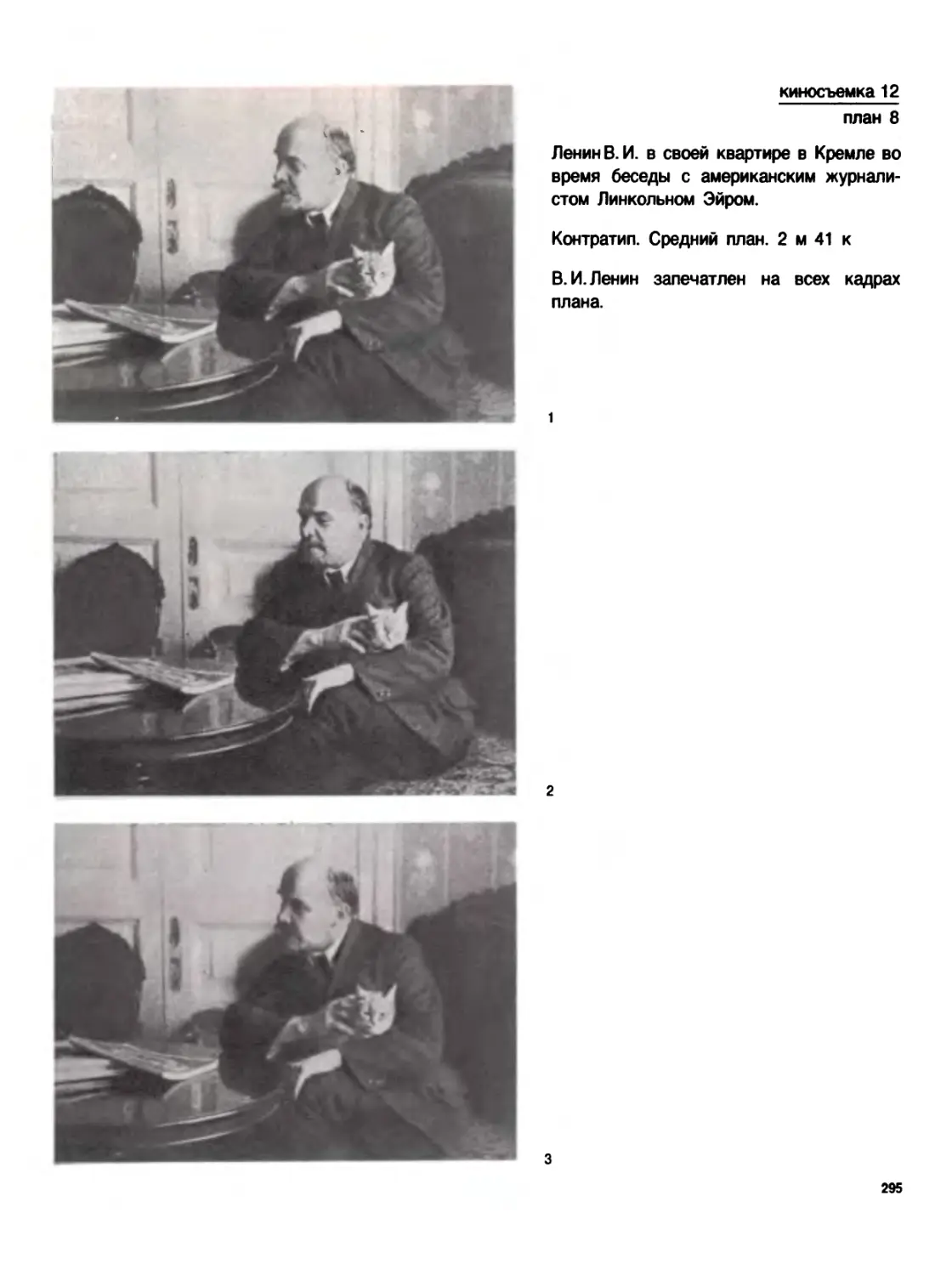
Сохранилось 42,8 метра пленки—11 планов. На всех планах—запечатлен В. И. Ленин.
254
В статье, опубликованной в американской газе¬
те «World» («Мир») от 21 февраля 1920 года
Линкольн Эйр писал:
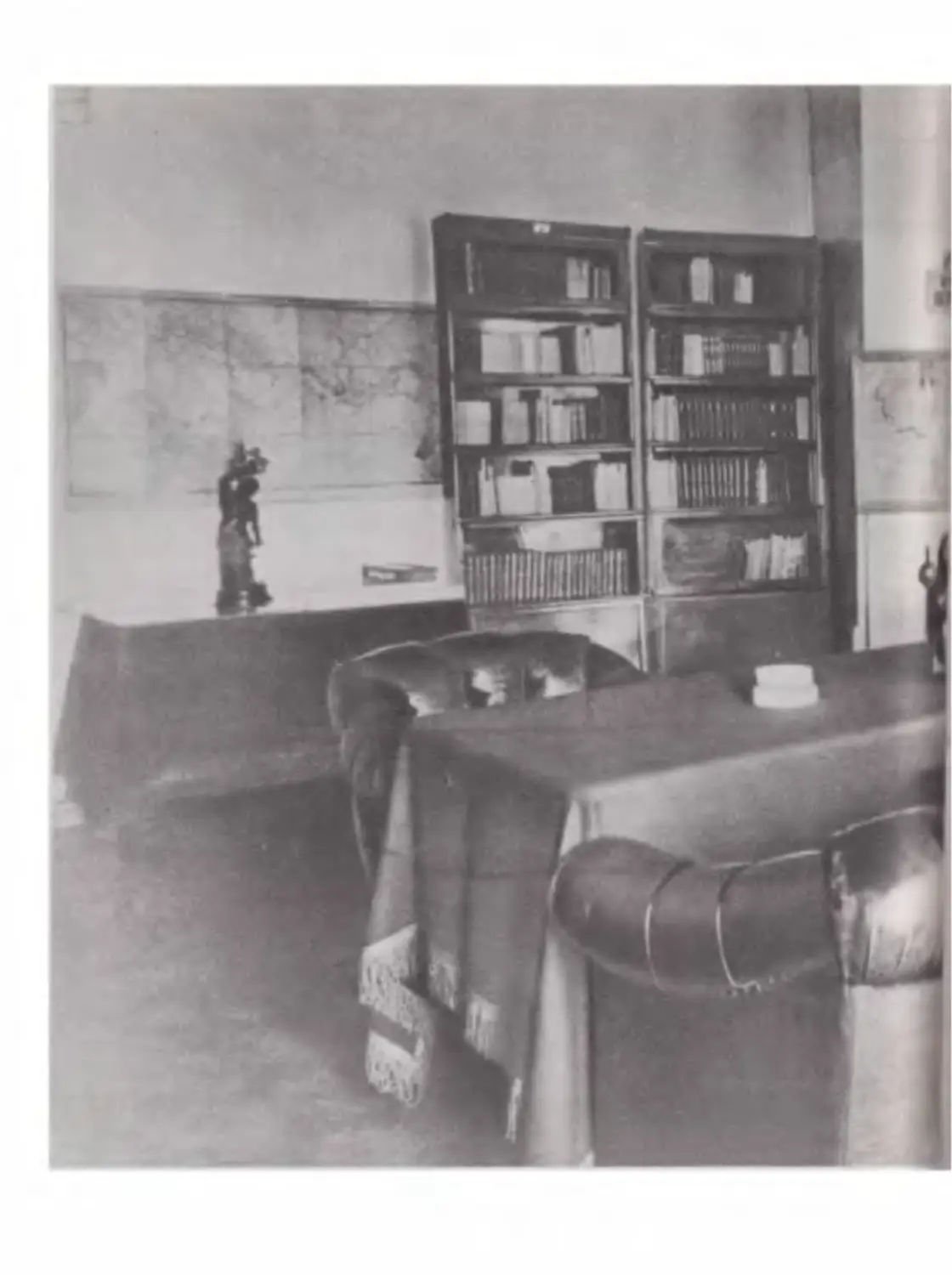
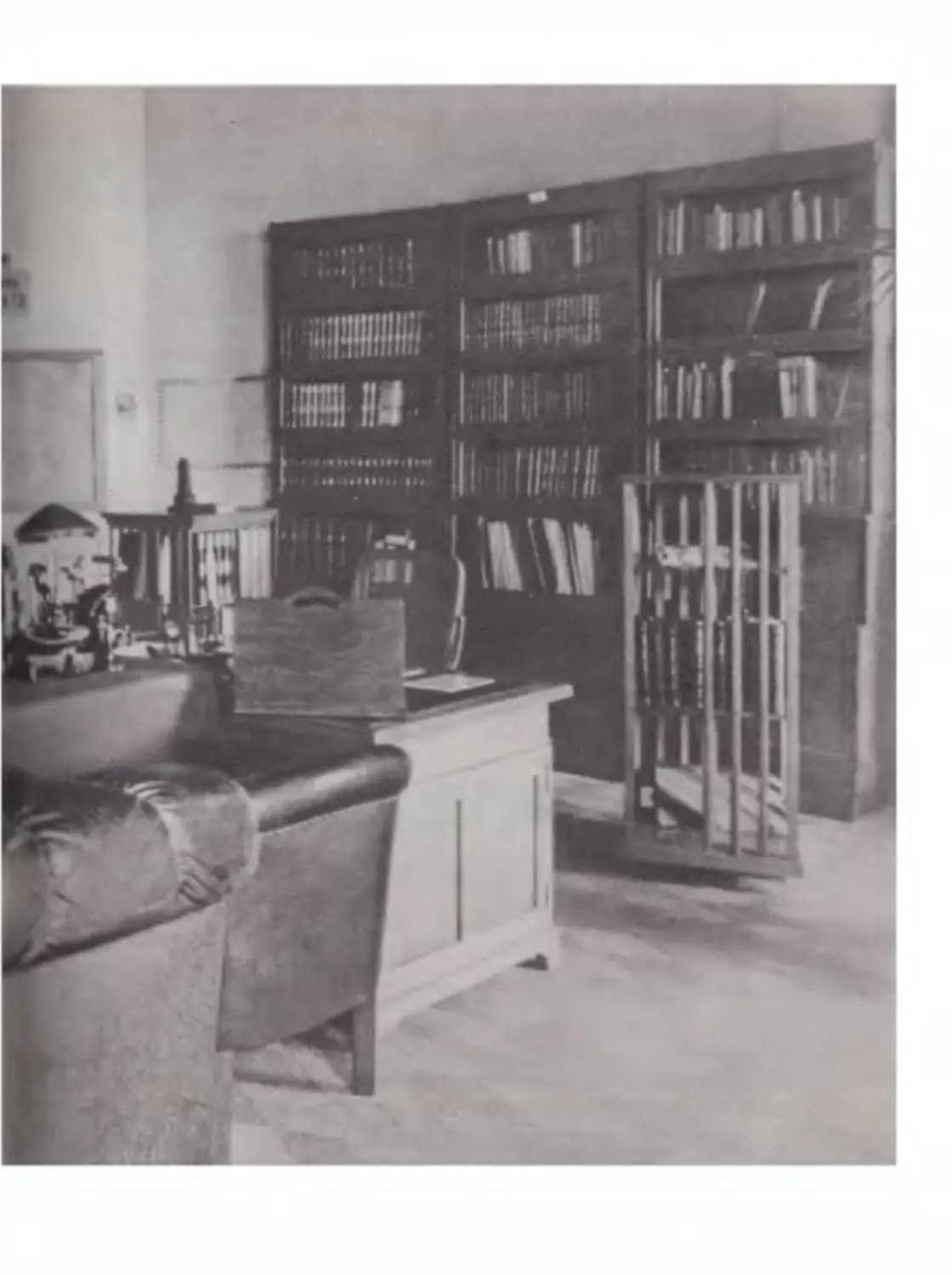
«Его личный секретарь ввела нас в кабинет
Ленина. Это была комната среднего размера,
уставленная книжными шкафами и совершенно
лишенная министерской торжественности... В те¬
чение всей нашей беседы его фотографировали и
снимали на фильм. Казалось, что большевистско¬
му премьеру совсем не мешало, что его снимали
на фильм для бесчисленного множества амери¬
канских любителей кино... В то время, как Кьюбс,
указаниям которого он [Ленин] повиновался с
насмешливым послушанием, устраивал его в позу
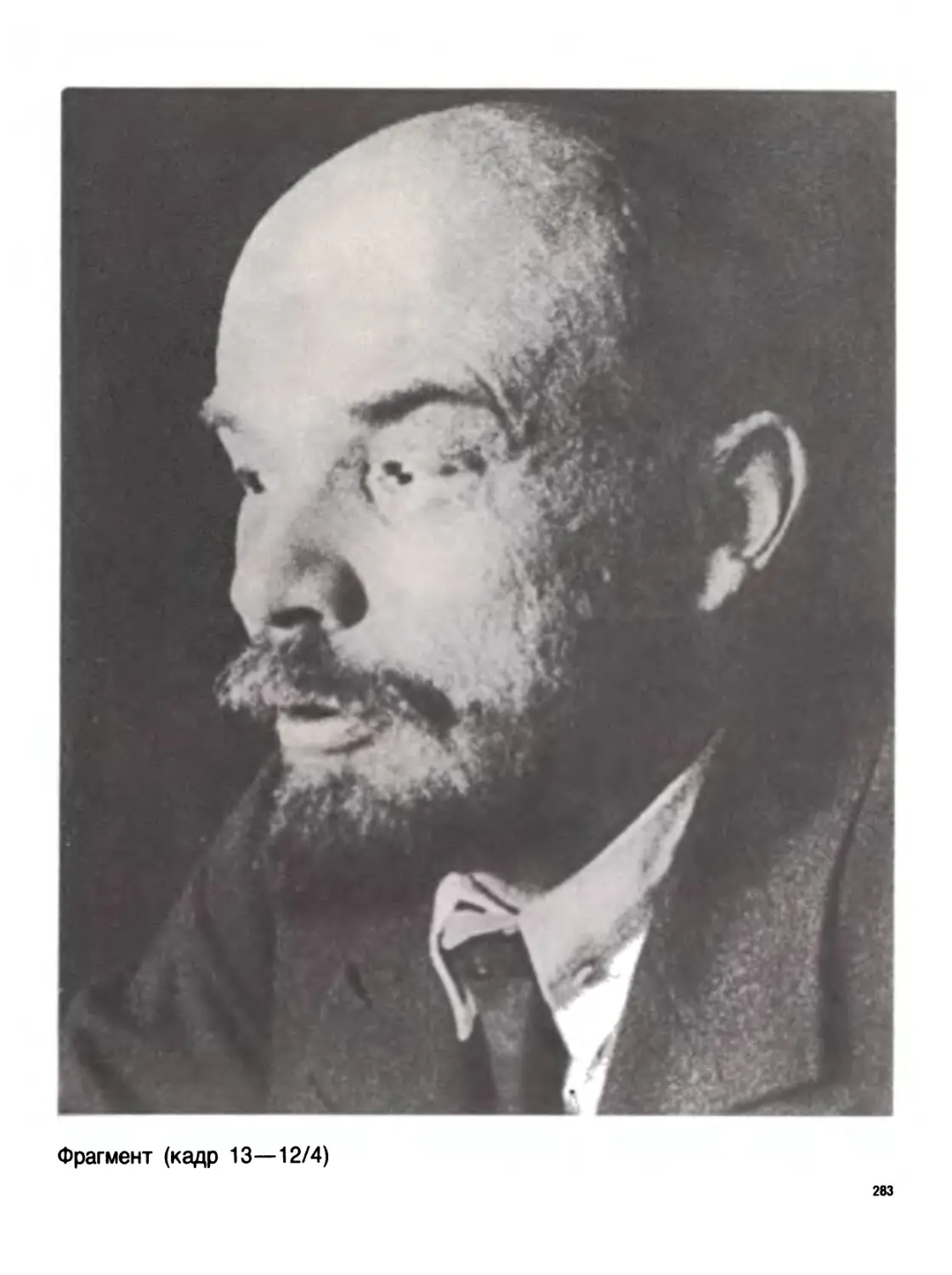
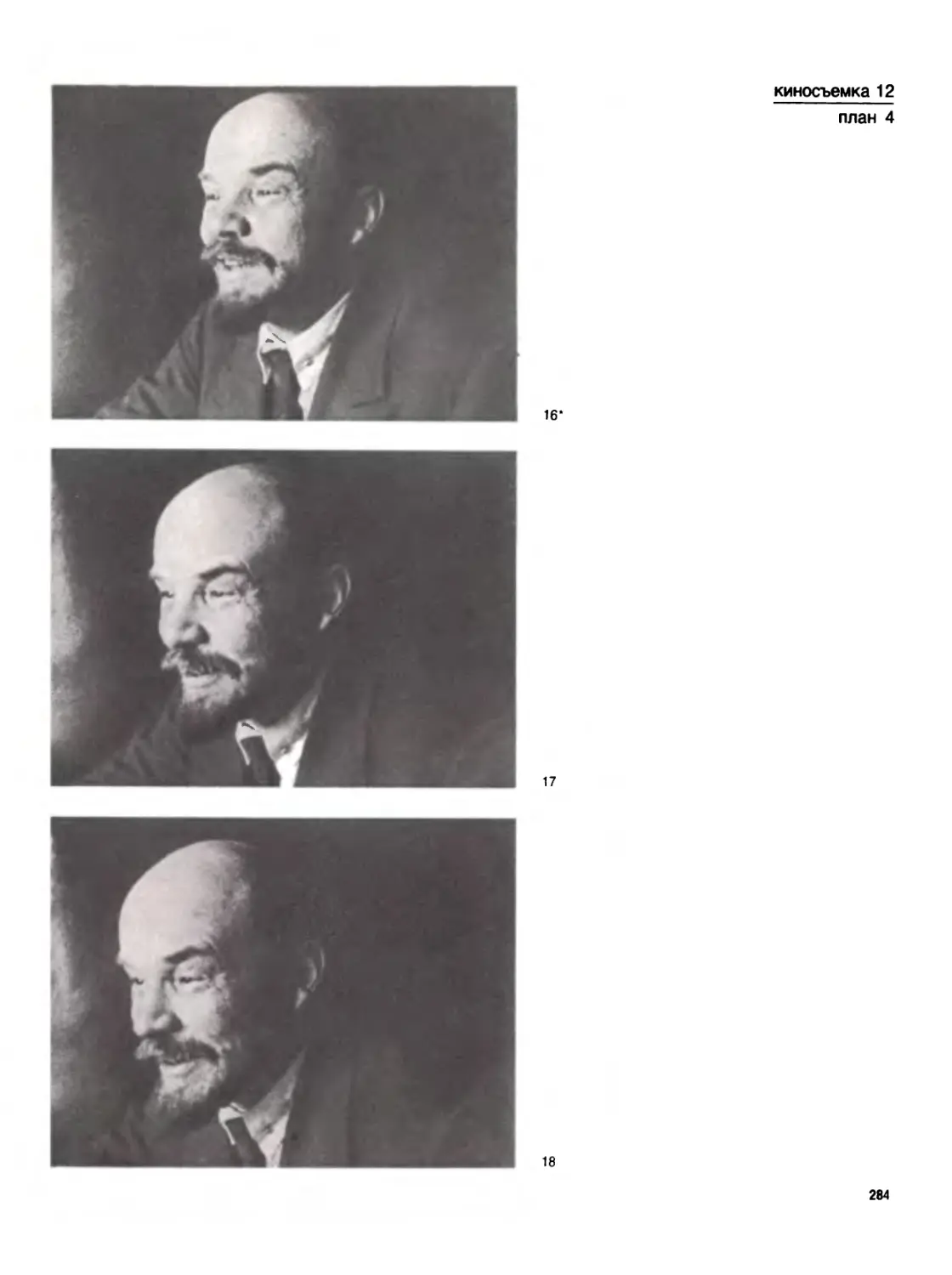
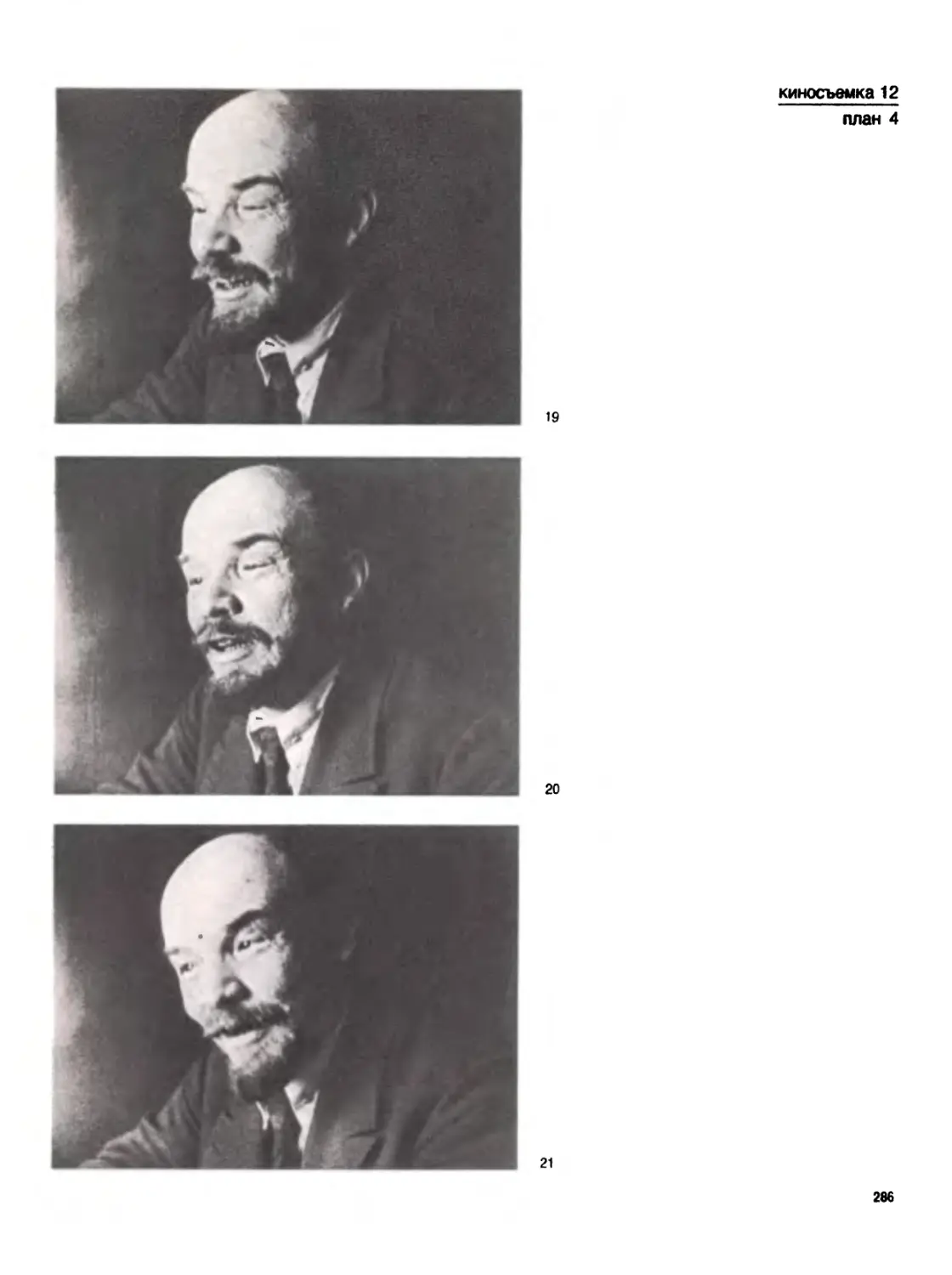
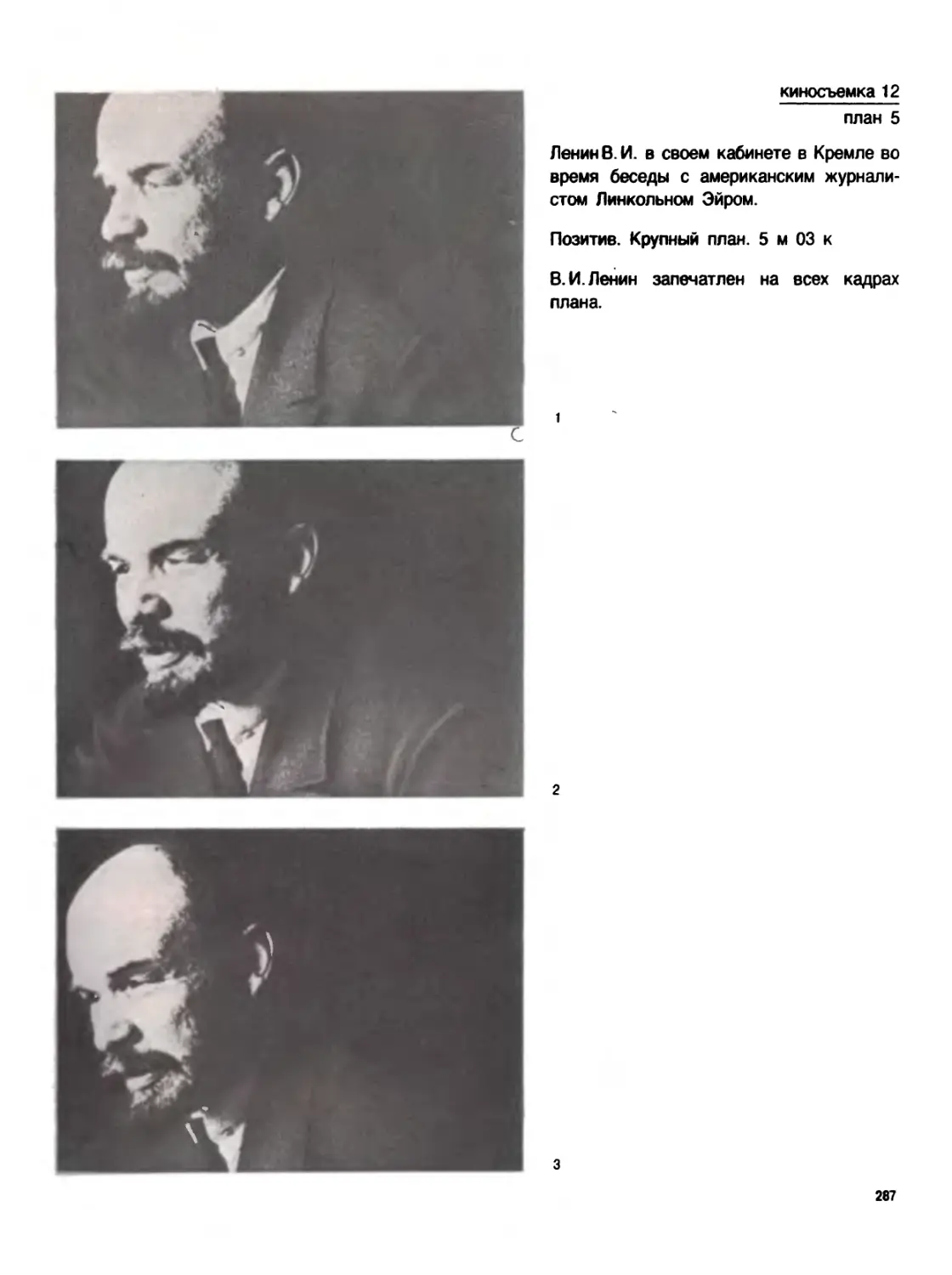
Кадры этой киносъемки были найдены в 1927
году известным советским кинодокументалистом
Эсфирью Шуб. Она рассказывает как это про¬
изошло.
«...Был получен большой ящик советских хро¬
ник, закупленных Амторгом в Америке. Я немед¬
ленно приступила к разбору материала. Среди
разных хроник, имеющих летописное значение, я
вдруг обнаружила негатив никому до сих пор не
известных кадров В. И. Ленина. Есть предполо¬
жение, что некоторые из них были сняты в Москве
американским кинооператором. Кадры эти следу¬
ющие:
1) говорящий В. И. Ленин—крупно во весь эк¬
ран снятый у себя в кабинете в Кремле;
2) В. И. Ленин у себя в кабинете за письменным
столом;
До последней поры считалось, что кадры эти
сняты в разное время и относятся к разным
событиям.
Так, кинокадры 1 плана относили к съемке,
сделанной в рабочем кабинете В. И.Ленина в
Кремле в ноябре 1922 года. Кинокадры 2—6
планов—к съемке во время беседы с американ¬
ским экономистом (представителем буржуазной
Габоче-фермерской партии США) П.-П.Хрис-
для съемки, я имел возможность изучить вне¬
шность человека, который так много сделал,
чтобы перевернуть мир сверху донизу».
Линкольн Эйр свидетельствовал, что беседа
проходила вначале в рабочем кабинете Владими¬
ра Ильича в Кремле, а затем была продолжена в
его кремлевской квартире. «Ленин провел нас —
писал Л. Эйр,—по короткому коридору, в пяти¬
комнатную квартиру, в которой он живет. Мы во¬
шли в довольно большую и просто обставленную
столовую... Здесь к нам присоединилась то¬
варищ Ульянова—жена Ленина... Во время бе¬
седы на колени Владимира Ильича забралась
кошка».
3) В. И. Ленин, с кем-то беседующий (крупно);
4) В. И. Ленин, сидящий на диване рядом с
Н. К. Крупской. На руках у него кошечка;
5) В. И. Ленин один на диване, с кем-то разго¬
варивающий. На руках у него кошечка;
6) В. И. Ленин, стоящий у окна (первым
планом).
Радость моя была огромна. Эти кадры так живо
воспроизводили образ Владимира Ильича в часы
его деятельности и редкие минуты отдыха...
Впервые они были широко обнародованы в моем
фильме «Великий путь». Фильм был выпущен на
экраны Союза к десятилетию Великой Октябрь¬
ской революции».
Эсфирь Шуб. Крупным планом. М.. «Искусство», 1959,
стр. 92—93.
тенсеном 28 ноября 1921 года. Кинокадры 7, 8
и 9 планов—к съемке в Горках в 1922 году.
Исследования, сопоставления разных фактов и
фотокинодокументов дали возможность совер¬
шенно точно установить, что все эти кадры
составляют единую киносъемку, сделанную аме¬
риканским оператором Виктором Кьюбсом во
время беседы Владимира Ильича Ленина с Лин-
кольмом Эйром.
См.: А. И. Петров. Мгновения жизни Ильича.—«Неделя»,
№ 1, 26 декабря 1965 г.—1 января 1966 г., стр. 4—5.
255
киносъемка 12
план 1
Ленин В. И. в своем кабинете в Кремле во
время беседы с американским журнали¬
стом Линкольном Эйром.
Контратип. Крупный план. 7 м 01 к
В. И. Ленин запечатлен на всех кадрах
плана.
1
2*
3
256
Фрагмент (кадр 2—12/1)
257
киносъемка 12
план 1
4
5
6
258
киносъемка 12
план 1
7
8
9
259
киносъемка 12
план 1
ю
1Г
12
260
Фрагмент (кадр 11—12/1)
261
киносъемка 12
план 2
Ленин В. И. в своем кабинете в Кремле во
время беседы с американским журнали¬
стом Линкольном Эйром.
Контратип. Крупный план. 2 м 51 к
В. И. Ленин запечатлен на всех кадрах
плана.
1
2
262
Фрагмент (кадр 3—12/2)
263
киносъемка 12
план 2
4
5*
6
264
Фрагмент (кадр 5—12/2)
265
киносъемка 12
план 3
Ленин В. И. в своем кабинете в Кремле во
время беседы с американским журнали¬
стом Линкольном Эйром.
Позитив. Крупный план. 6 м 18 к
В. И. Ленин запечатлен на всех кадрах
плана.
1
267
Фрагмент (^адр 6—12/3)
269
киносъемка 12
план 3
7
8
9 *
270
Фрагмент (кадр 9—12/3)
271
киносъемка 12
план 3
13
14
15
273
киносъемка 12
план 4
Ленин В. И. в своем кабинете в Кремле во
время беседы с американским журнали¬
стом Линкольном Эйром.
Позитив. Крупный план. 10 м 36 к
В. И. Ленин запечатлен на всех кадрах
плана.
1
2*
3
274
Фрагмент (кадр 2—12/4)
275
Фрагмент (кадр 6—12/4)
277
Фрагмент (кадр 9—12/4)
279
киносъемка 12
план 4
ю*
11
12
280
Фрагмент (кадр 10—12/4)
281
282
Фрагмент (кадр 13—12/4)
283
Фрагмент (кадр 16—12/4)
285
киносъемка 12
план 4
19
20
21
286
киносъемка 12
план 5
Ленин В. И. в своем кабинете в Кремле во
время беседы с американским журнали¬
стом Линкольном Эйром.
Позитив. Крупный план. 5 м 03 к
В. И. Ленин запечатлен на всех кадрах
плана.
1
2
3
287
киносъемка 12
план 6
Ленин В. И. в своем кабинете в Кремле во
время беседы с американским журнали¬
стом Линкольном Эйром.
Позитив. Крупный план. 2 м 21 к
В. И. Ленин запечатлен на всех кадрах
плана.
1
2
289
киносъемка 12
план 6
4
5
6
290
291
киносъемка 12
план 7
Ленин В. И. и Крупская Н. К. в своей кварти¬
ре в Кремле во время беседы с американ¬
ским журналистом Линкольном Эйром.
Контратип. Средний план. 1 м 32 к
В. И. Ленин запечатлен на всех кадрах
плана.
1
2
3*
1292
Фрагмент (кадр 3—12/7)
293
НИН
киносъемка 12
план 7
4
5
294
киносъемка 12
план 8
Ленин В. И. в своей квартире в Кремле во
время беседы с американским журнали¬
стом Линкольном Эйром.
Контратип. Средний план. 2 м 41 к
В. И. Ленин запечатлен на всех кадрах
плана.
1
2
295
Фрагмент (кадр 6—12/8)
297
киносъемка 12
план 9
Ленин В. И. в своей квартире в Кремле во
время беседы с американским журнали¬
стом Линкольном Эйром.
Контратип. Крупный план. 2 м 33 к
В. И. Ленин запечатлен на всех кадрах
плана.
299
киносъемка
13
Ленин В. И. на закладке памятника К. Марксу на площа¬
ди Свердлова.
1920 г., 1 мая. Москва.
Операторы:
Гибер Г. В., Тиссэ Э.К.
Первый выход на экран:
Выпуск кинохроники «Первомайские торжества в Москве», май 1920 года.
Обоснование даты:
«1-го мая на Театральной площади, в центре сквера, была совершена закладка
памятника Карлу Марксу... К двум часам дня на место закладки прибыли т. Ленин
и др. Появление на трибуне тов. Ленина было встречено дружными, долго не
смолкаемыми аплодисментами.
Тов. Ленин обратился к присутствующим с краткой речью».—«Правда», № 94,
4 мая 1920 г., стр. 2. См. также: В. И. Ленин. Полн. собр. соч., т. 41, стр. 618.
Примечания.
Сохранилось 20,15 метра пленки—13 планов. На 9 планах—запечатлен В. И. Ленин.
Кадры этого сюжета были включены Дзигой Вертовым в фильм «Киноправда», N9 21 —«Ленинская».
302
«1 мая 1920 года я увидел Владимира Ильича на
закладке памятника Карлу Марксу. Владимир
Ильич, очень оживленный и бодрый, был без
пальто, в темном костюме и темном кепи. В этот
день, как, впрочем, и всегда в те годы, я имел
очень мало пленки, и я берег ее для съемки
особенно интересных, динамических кадров. Мне
Есть свидетельство А. В. Луначарского о том,
что еще до закладки памятника В. И. Ленин
приехал вместе с ним на площадь Свердлова, где
была сооружена модель памятника, внимательно
осмотрел ее, поинтересовался высотой памятника
и обратился к Луначарскому с просьбой: «Анато-
Для закладки памятника был заготовлен крас¬
ный гранит с надписью: «Первый камень памятни¬
ка великому вождю и учителю пролетариата
Карлу Марксу».
удалось заснять беседу Ильича с окружающими
товарищами в момент, когда он расписывался на
металлической пластинке. Мне на всю жизнь
врезалась в память эта встреча. Владимир Ильич
узнал меня, ласково поздоровался и даже кому-тс
сказал: «Надо посторониться, человек работает,
не нужно ему мешать».
Э. К. Тиссэ. Заметки кинооператора — «Воспоминания
о Владимире Ильиче Ленине», ч. 2. М., Гослолитиадат,
1957, стр. 462.
лий Васильевич, особенно скажите художнику,
чтобы волосы вышли похожими, чтобы было тс
впечатление от Карла Маркса, какое получается
от хороших его портретов, а то как будто сходства
мало».
См.: А. Луначарский. Рассказы о Ленине. М., Политиз¬
дат, 1966, стр. 26.
В. И. Ленин, присутствовавший на торжестве,
расписался на металлическом закладном листе,
который был помещен в ларец и уложен в
углубление фундамента.
См.: H. Д. Виноградов. Воспоминания о монументаль¬
ной пропаганде в Москве—Журн. «Искусство», 1939,
№ 1, стр. 42—43.
303
киносъемка 13
план 1
Ленин В. И. на закладке памятника
К. Марксу на площади Свердлова Осмат¬
ривает закладную доску.
Негатив. Средний план. 1 м 23 к
В. И. Ленин запечатлен на всех кадрах
плана.
1
2*
3
304
Фрагмент (кадр 2—13/1)
305
киносъемка 13
план 1
5
6
306
киносъемка 13
план 1
7
в
9
307
киносъемка 13
план 2
Ленин В. И. на закладке памятника
К.Марксу на площади Свердлова. Подпи¬
сывает закладную доску.
Позитив. Крупный план. 1 м 40 к
В. И. Ленин запечатлен на всех кадрах
плана.
1
2
308
киносъемка 13
план 3
Ленин В. И. на закладке памятника
К. Марксу на площади Свердлова.
Позитив. Крупный план. 1 м 36 к
В. И. Ленин запечатлен на всех кадрах
плана.
1
2
3*
309
Фрагмент (кадр 3—13/3)
310
киносъемка 13
план 7
Ленин В. И. на закладке памятника
К. Марксу на площади Свердлова.
Негатив. Средний план. 00 м 24 к
В. И. Ленин запечатлен на всех кадрах
плана.
Примечания.
Вероятно, это незначительная часть сохранившего¬
ся большого плана.
3*
Фрагмент (кадр 3—13/7)
312
киносъемка 13
план 9
Ленин В. И. кладет первый камень в осно¬
вание памятника К. Марксу.
Негатив. Средний план. 3 м 22 к
В. И. Ленин запечатлен на всех кадрах
плана.
1
2
3
313
киносъемка
14
Ленин В. И. на закладке памятника «Освобожденный
труд» на Пречистенской набережной (ныне Кропоткин¬
ская набережная).
1920 г., 1 мая. Москва.
Операторы:
ГиберГ. В., Левицкий А. А., ТиссэЭ. К.
Первый выход на экран:
Выпуск кинохроники «Первомайское торжество в Москве», май 1920 года.
Обоснование даты:
«1-го мая в третьем часу дня, на набережной Москвы-реки, на месте бывшего
памятника Александру III, была совершена закладка памятника «Освобожденному
труду». При дружных аплодисментах всех присутствующих на трибуне появляется
тов. Ленин».—«Правда», № 94,4 мая 1920 г., стр. 2. См.также:В. И. Ленин. Полн.
собр. соч., т. 41, стр. 618.
Примечания.
Сохранилось 20,15 метра пленки—9 планов. На 7 планах—запечатлен В. И. Ленин.
Кадры, запечатлевшие В. И. Ленина на закладке памятника «Освобожденный труд», были включены Дзигой
Вертовым во 2-ю часть фильма «Киноправда», № 21 —«Ленинская».
Часть кадров этой съемки была включена в фильм «Памяти товарища Ленина», который вышел на экран
в 1925 году.
316
«В 2 часа состоялась закладка памятника
Карлу Марксу. Потом мы, операторы, направились
к храму, который назывался храмом Христа
Спасителя,—там предстояло снимать закладку
памятника «Освобожденный труд». Слова эти—
«Освобожденный труд»—были лозунгом Всерос-
0 том, как был насыщен у Владимира Ильича
поаздничный день 1 мая 1920 года, рассказывает
старый коммунист П. С. Заславский:
«Утром Ленин участвует в субботнике в Кремле,
затем в 2 часа дня выступает с речью на закладке
памятника К. Марксу на Театральной площади,
в 3 часа дня выступает с речью на закладке
памятника Освобожденному труду на набережной
Москвы-реки, а также осматривает в Музее
изящных искусств выставку эскизов будущего
памятника.
Вечером Владимир Ильич выступает с речами
на митингах в Замоскворецком и Бауманском
районах, на открытии рабочего дворца имени
Загорского в Благуше-Лефортовском районе и на
сийского субботника 1 Мая 1920 года. Нам удалось
снять выступавшего с речью Владимира Ильича
довольно крупно, с трех точек одновременно
(Левицкий, Гибер и я). ...Кинооператоры смогли
одновременно снимать тремя аппаратами Влади¬
мира Ильича».
Э. К. Тиссэ. Живой Ильич—на экране.—Журн. «Не¬
ман», 1961, № 2, стр. 130.
митинге рабочих бывшей Прохоровской мануфак¬
туры в Краснопресненском районе. Его живую,
ясную речь, посвященную международному про¬
летарскому празднику, слушали и рабочие «Трех¬
горки»,.и трудящиеся, приглашенные на открытие
клуба имени Загорского, и табачницы, и слесари
железнодорожных мастерских...
На мою долю выпало счастье встречаться
с Владимиром Ильичем на протяжении пяти лет,
но никогда я его не видел таким радостным, таким
праздничным, как в этот Первомай. Он излучал
столько душевной теплоты, сердечного обаяния,
что все окружающие чувствовали в себе прилив
особых сил».
П. Заславский. Мои встречи с Лениным. «Воспомина¬
ния о Владимире Ильиче Ленине», ч. 3, 1961, стр. 218.
317
киносъемка 14
план 2
Ленин В. И. произносит речь с трибуны
у постамента памятника «Освобожденный
труд» на Пречистенской набережной (ныне
Кропоткинская набережная).
Негатив. Средний план. 2 м 49 к
В. И. Ленин , запечатлен на всех кадрах
плана.
г
2
3
318
Фрагмент (кадр 1—14/2)
319
киносъемка 14
план 2
4
5
320
■жа<: /СимЯт/ruà
321
Фрагмент (кадр 8—14/2)
322
киносъемка 14
'< Кимлт/тЬ
' !< tüu>th fit!ru -
план 2
10
323
Фрагмент (кадр 11—14/2)
324
киносъемка 14
план 4
Ленин В. И. на закладке памятника «Осво¬
божденный труд» на Пречистенской набе¬
режной (ныне Кропоткинская набережная).
Позитив. Крупный план. 3 м 13 к
В. И. Ленин запечатлен на всех кадрах
плана.
1
2
3
325
326
Фрагмент (кадр 4—14/4)
327
Фрагмент (кадр 8—14/4)
329
киносъемка 14
план 4
ю
11
12*
330
Фрагмент (кадр 12—14/4)
331
киносъемка 14
план 6
Ленин В. И. на закладке памятника
«Освобожденный труд» на Пречистен¬
ской набережной (ныне Кропоткинская
набережная).
Негатив. Крупный план. 2 м 00 к
В.И.Ленин запечатлен на всех кадрах
плана.
г
3
332
Фрагмент (кадр 1—14/6)
333
334
Фрагмент (кадр 6—14/6)
335
киносъемка 14
план 6
7
8
9*
336
Фрагмент (кадр 9—14/6)
337
киносъемка 14
план 7
Ленин В. И. на закладке памятника «Осво¬
божденный труд » на Пречистенской набе¬
режной (ныне Кропоткинская набережная).
Негатив. Средний план. 1 м 22 к
В. И. Ленин запечатлен на всех кадрах
плана.
1
2
3
338
киносъемка
план 7
4
339
киносъемка
15
Ленин В. И. на II конгрессе Коминтерна в Петрограде.
1920 г., 19 июля. Петроград.
Операторы:
Вериго-Даровский Л., ГригорН.Ф., КозловскийН.Ф., ТиссэЭ.КЛ
Первый выход на экран:
Выпуск кинохроники «II конгресс Коминтерна», 1920 год**.
Обоснование даты:
19 июля 1920 года В.И.Лении приезжает в Петроград на открытие II конгресса
Коминтерна. На первом заседании II конгресса Коминтерна В. И. Ленин избирается в
состав президиума; выступает с докладом о международном положении и основных
задачах Коммунистического Интернационала—См.: В.И.Ленин. Полн. собр. соч.,
т. 41, стр. 646.
«Около 12 ч. ко дворцу Урицкого прибыли члены Исполнительного Комитета
III Коммунистического Интернационала тт. Ленин, Калинин и др., встреченные
бурными овациями...».—«Известия», № 158, 20 июля 1920 г., стр. 1.
Примечания.
Сохранилось 49,65 метра пленки—14 планов. На 11 планах—запечатлен В. И. Ленин.
3 августа 1920 года делегаты II конгресса Коминтерна смотрели в Свердловском зале Кремля документальный
фильм об открытии II конгресса Коминтерна в Петрограде 19 июля 1920 года.—См. «Искусство кино», 1969,
№ 6, стр. 17.
’ Долгое время считалось, что съемки II конгресса Коминтерна в Петрограде были сделаны московским
кинооператором Э.К.Тиссэ. Но не так давно исследователям удалось обнаружить материалы, подтвержда¬
ющие. что в этих съемках принимали участие и петроградские кинооператоры Л. Вериго-Даровский, H. Ф. Григор,
Н.Ф. Козловский—ЦГАЛИ, ф. 2057. ол. 1, ед. хр. 83, лл. 18—19.
** Было два выпуска кинохроники «II конгресс Коминтерна»: один выпуск Петроградского кинокомитета
(операторы Л.Вериго-Даровский. КФ.Григор, Н.Ф.Козловский), 1519 м, другой выпуск Всероссийского
фотокиноотдела (оператор Э.К.Тиссэ), 240м—ЦГАЛИ, ф. 2057, оп. 1, ед. хр. 83, лл. 18—19.
342
«Волнующий тембр восторженного шума вдруг
появился, когда на трибуну взошел Ленин. Лавина
понеслась безудержно...
Можно было просить, умолять, взывать к
благоразумию, показывая на часы, звоня в оне¬
мевший колокольчик: лавина должна была дока-
титься до естественной преграды, люди должны
были решить про себя, что убедили вождя в своей
любви к нему... Говорит Ленин.
Рядом со мной художник. Цепкими глазами
ощупывает он фигуру оратора, силясь перенести
ее на бумагу. Но ничего не выходит Ленин
весь—жест, весь—движение. Жидкий, расплав¬
ленный металл влит в податливую форму. Схва¬
тить ее—нужен точный, совершенный фотогра¬
фический аппарат. Нужна светопись.
И светопись старается. Со всех сторон наведе¬
ны на трибуну черноглазые объективы, мигают
молочные огни рефлекторов, крутятся ручки
кино: ловят неуловимого Ленина...».
Газ. «Петроградская правда», № 159, 21 июля 1920 г.,
стр. 2.
Э. К.Тиссэ, снимавший открытие II конгресса
Коминтерна, писал:
«Через несколько минут выступил Ленин. Я с
аппаратом взобрался на сцену, штатив развернул
у самого пульта.
В самые горячие моменты речи Ильич подавал¬
ся корпусом вперед, то на момент застывая, то в
динамическом движении вскидывая к залу пра¬
вую руку. Хотелось запечатлеть всю силу и
обаяние оратора. Волнуясь, я смотрел на метро-
метр, неуклонно отщелкивавший, к моему ужасу,
все больший и больший метраж. Снимать хотелось
без конца, а пленки было так мало! С сожалением
отошел от Ильича и пошел в зал снимать
делегатов. Очень хотелось снять общие планы с
говорящим на сцене Лениным, но света было мало,
знал, что ничего не получится.
Ленин с огромным подъемом произнес послед¬
ние слова своей речи. Они были покрыты аплодис¬
ментами. Такой овации мне никогда в жизни не
приходилось наблюдать, возникла стихийно пес¬
ня, ее слова произносились на десятках языков;
Ленин, стоя в президиуме, пел со всеми «Интерна¬
ционал».
Э. К.Ти ссэ. Заметки кинооператора.—Сб. «Самое важ¬
ное из bcçx искусств. Ленин о кино». М., «Искусство»,
1963, стр. 130.
«Я видел Ленина два раза. В первый раз—на
заседании I Всероссийского съезда Советов, в
июне 1917 года... Видел я его тогда издалека и
только, когда он проходил к выходу, я имел
возможность разглядеть его вблизи... Своеобраз¬
ный склад головы с сильно выступающим лбом,
крепкая и короткая шея и, особенно, глаза с
пыражением непоколебимой силы отчетливо
остались в памяти...
Второй раз мне удалось видеть Ленина на
норвом заседании Второго конгресса Коминтерна,
!9 июля 1920 года. На этот раз я видел его
сравнительно близко и в течение продолжитель¬
ного промежутка времени. Наружность Ленина,
его манера держаться или, лучше сказать, всякое
отсутствие какой бы то ни было манеры произво¬
дили впечатление необычайной простоты и гово¬
рили о колоссальной воле, действие которой
ощутительно чувствовалось в зале... Глаза Лени¬
на и на этот раз особенно сильно врезались в
память и остались для меня главной чертой,
которая прежде всего встает в моем воспомина¬
нии, когда я сужу о схожести того или иного
портрета Ленина.
Г.С.Верейский. Мои зарисовки Ленина—Сб. «Ленин
в зарисовках и воспоминаниях художников», стр. 60, 62.
343
«Ленин взошел на трибуну. Его встретили долго
не смолкавшей овацией. В первые минуты речи
Владимир Ильич держался очень спокойно, затем
постепенно оживился, в дальнейшем это оживле¬
ние перешло в энергичную жестикуляцию. Нужно
сказать, однако, что мимика и жестикуляция
Ленина не были резки или грубы, в них не было
также ничего показного, никакой «актерской»
подготовки не чувствовалось. Сравнивая его
манеру говорить с манерой выдающихся ораторов-
юристов, которых мне приходилось видеть, я
сознавал, что это явление совсем другого по¬
рядка. Вся жестикуляция Ленина была тесно свя¬
зана со смыслом произносимой им речи. Ни¬
чего не было в ней показного и напыщенного,
никаких заученных приемов. Жесты Владимира
Ильича были совершенно гармоничны и осмыс¬
ленны.
Внешность его производила впечатление огром¬
ной волевой сосредоточенности».
С.В.Чехонин. В первые годы революции—Сб. «Ленин
в зарисовках и воспоминаниях художников»», стр. 66.
344
киносъемка 15
план 1
Ленин В. И. с делегатами II Конгресса Ко¬
минтерна у дворца Урицкого (Таврический
дворец).
Позитив. Средний план. 2 м 50 к
В. И. Ленин запечатлен на всех кадрах
плана.
1
2
3
345
киносъемка 15
план 1
7
8
9
347
киносъемка 15
план 7
Ленин В. И. на трибуне в зале заседаний
II конгресса Коминтерна перед началом вы¬
ступления.
Негатив. Средний план. 2 м 18 к
В. И. Ленин запечатлен на 79 кадрах плана.
1
г
Фрагмент (кадр 2—15/7)
349
киносъемка 15
план 8
Ленин В. И. выступает с докладом на засе¬
дании II конгресса Коминтерна.
Позитив. Средний план. 5 м 34 к
В. И. Ленин запечатлен на 288 кадрах
плана.
1
2
3
3S0
киносъемка 15
план 8
4
5
6
351
киносъемка 15
план 10
Ленин В. И. выступает с докладом на засе¬
дании II конгресса Коминтерна.
Позитив. Общий план. 2 м 28 к
В. И. Ленин запечатлен на всех кадрах
плана.
1
2
3
35?
353
киносъемка 15
план 11
Ленин В. И. выступает с докладом на засе¬
дании II конгресса Коминтерна.
Позитив. Средний план. 4 м 03 к
В. И. Ленин запечатлен на всех кадрах
плана.
1
2*
3
355
Фрагмент (кадр 2—15/11)
356
357
киносъемка 15
план 12
Ленин В. И. выступает с докладом на засе¬
дании II конгресса Коминтерна.
Позитив. Общий план. 2 м 47 к
В. И. Ленин запечатлен на всех кадрах
плана.
1
2
359
361
киносъемка 15
план 12
ю
и
362
киносъемка 15
план 13
Ленин В. И. выступает с докладом на засе¬
дании II конгресса Коминтерна.
Позитив. Крупный план. 00 м 36 к
В. И. Ленин запечатлен на всех кадрах
плана.
Примечания.
Вероятно, это незначительная часть несохранивше-
гося большого плана.
2
3
363
киносъемка 15
план 14
Ленин В. И. выступает с докладом на засе¬
дании II конгресса Коминтерна.
Позитив. Средний план. 3 м 02 к
В. И. Ленин запечатлен на всех кадрах
плана.
1
2
3
364
365
киносъемка
16
Ленин В. И. на митинге, посвященном закладке памятни¬
ка К. Либкнехту и Р. Люксембург на Дворцовой площади
в день начала работы II конгресса Коминтерна.
1920 г., 19 июля. Петроград.
Операторы :
Вериго-ДаровскийЛ., ГригорН.Ф., КозловскийН.Ф., ТиссэЭ.К.
Первый выход на экран:
Выпуск кинохроники «II конгресс Коминтерна», 1920 год.
Обоснование даты:
«Манифестация, возглавляемая членами конгресса, прибыла на площадь Уриц¬
кого...
Митинг открывает председатель Петроградского Совета... который предоставляет
слово вождю всемирного пролетариата тов. Ленину...
19 июля в 8 час. вечера со скорым поездом тов. Ленин уехал обратно в
Москву».—Газ. «Петроградская правда», № 159, 21 июля 1920 г., стр. 2.
См. также: В.И.Ленин. Полн. собр. соч., т. 41, стр. 646.
Примечания.
Сохранилось 66 метров пленки—11 планов. На 5 планах—запечатлен В. И. Ленин.
Кинокадры, запечатлевшие выступление В. И. Ленина на митинге, были включены Дзигой Вертовым в фильм
«Киноправда», № 21— «Ленинская».
«На площади у Зимнего дворца состоялся
огромный митинг, где выступил Ленин. Я помню,
как вместе с делегатами во главе демонстрации
шагал с красным бантом и гвоздикой в петлице
Владимир Ильич, оживленный, веселый и, види-
Вспоминая об этой съемке, Э.К.Тиссэ писал:
«Красный Петроград устроил небывалую по
мощи манифестацию в честь конгресса. Народ
стекался к площади у Зимнего дворца. Я поджи¬
дал Владимира Ильича у входа в Зимний дворец.
Ленин спросил с усмешкой: «И сегодня опять
будете снимать?» —«Конечно, Владимир Иль¬
ич!»,—с жаром ответил я и, стараясь не отста-
мо, очень довольный тем, что, наконец, осуще¬
ствилась его мечта о создании нового, революци¬
онного международного объединения рабочего
класса. С ним рядом шел М. Горький».
А .А .Андреев. О Владимире Ильиче Ленине.—«Вос¬
поминания о Владимире Ильиче Ленине», ч. 2, стр. 33.
вать, пробрался за ним... Площадь внизу была
запружена народом, даже на крышах было полно
народу.
Владимир Ильич произнес большую, насыщен¬
ную речь. Стараясь не мешать Ильичу, я снимал
крупные планы и от крупного плана лица, в
левой стороне кадра,—общий вид волнующегося
внизу моря голов».
Э. К. Тиссэ. Заметки кинооператора.—«Воспоминания
о Владимире Ильиче Ленине», ч. 2, стр 462.
киносъемка 16
план 7
Ленин В. И. произносит речь на митинге,
посвященном закладке памятника К.Либ-
кнехту и Р. Люксембург на Дворцовой
площади.
Негатив. Общий план. 3 м 41 к
В. И. Ленин запечатлен на всех кадрах
плана.
1
2
3
370
киносъемка 16
план 8
Ленин В. И. произносит речь на митинге,
посвященном закладке памятника К.Либ-
кнехту и Р. Люксембург на Дворцовой
площади.
Позитив. Общий план. 4 м 25 к
В. И. Ленин запечатлен на всех кадрах
плана.
1*
2
3
371
Фрагмент (кадр 1—16/8)
372
киносъемка 16
план 10
Ленин В. И. произносит речь на митинге,
посвященном закладке памятника К.Либ-
кнехту и Р. Люксембург на Дворцовой
площади.
Позитив. Общий план. 3 м 48 к
В. И. Ленин запечатлен на всех кадрах
плана.
1
2
3
373
киносъемка
17
Ленин В. И. в дни работы II конгресса Коминтерна
в Москве.
1920 г., не ранее 23 июля, не позднее 6 августа. Москва.
Оператор:
Тиссэ З.К.
Первый выход на экран:
Выпуск кинохроники «II конгресс Коминтерна», 1920 год.
Обоснование даты:
С 23 июля 1920 года II конгресс Коминтерна продолжил свою работу в Москве.
Его заседания проходили по 6 августа. В. И. Ленин председательствовал и
принимал участие в работе конгресса на многих заседаниях и комиссиях и
выступал с докладами и речами—См.: В.И.Ленин. Полн. собр. соч., т. 41, стр.
647—653.
Примечания.
Сохранилось 22,5 метра пленки—6 планов. На 3 планах—запечатлен В. И. Ленин.
376
Первое заседание конгресса в Москве
Открытие заседания
«В Большом Кремлевском дворце вчера при¬
ступил к работе 2 конгресс III Коммунистического
Интернационала.
В Андреевском зале дворца, где происходит
заседание конгресса, блещет золото лепных
колонн и красиво задрапировано место, на кото¬
ром стояли царские троны. Делегации конгресса
расположились за столами по сторонам: на
возвышении стол президиума, по бокам места
для журналистов. В глубине зала расположились
гости.
За столом президиума тт. Ленин, Сератти,
Леви и др.
Заседание открывает в 81/2 час. веч. тов.
Ленин и дает слово тов. Сератти для доклада о
порядке дня».
«Правда», № 162, 24 июля 1920 г., стр. 2.
377
киносъемка 17
план 5
Ленин В. И. и Крупская Н. К. с группой деле¬
гатов II Конгресса Коминтерна.
Негатив. Общий план. 2 м 19 к
В.И.Ленин запечатлен на всех кадрах
плана.
Фрагмент (кадр 3—17/5)
379
киносъемка 17
план 5
4
5
380
киносъемка 17
план 6
Ленин В. И. и Крупская Н. К. с группой де¬
легатов II конгресса Коминтерна.
Негатив. Общий план. 4 м 03 к
В. И. Ленин запечатлен на всех кадрах
плана.
1
з
381
киносъемка
18
Ленин В. И. на заседании III конгресса Коминтерна
в бывш. Андреевском зале Кремля.
1921 г., 28 июня, 1 или 5 июля. Москва.
Операторы:
ГиберГ. В., Козловский Н. Ф., ТиссэЭ. К.
Первый выход на экран:
Выпуск кинохроники «III конгресс Коминтерна», 1921 год.
Обоснование даты:
«III конгресс Коминтерна. Огромный зал Большого театра к 6 часам вечера доверху
наполнен съехавшимися со всех концов мира делегатами конгресса, представителя¬
ми профессиональных, советских и партийных организаций красной Москвы».—
«Правда», № 134, 23 июня 1921 г. стр. 1.
См. также: В. И. Ленин. Полн. собр. соч., т. 44, стр. 524, 661, 662, 663.
Примечания.
Сохранилось 94,8 метра пленки—27 планов. На 20 планах—запечатлен В. И. Ленин.
Кинокадры этой съемки (план 17) были обнаружены в 1948 году в фильме «Три песни о Ленине», который
хранится в Госфильмофонде СССР. Тогда же они были переданы в Институт марксизма-ленинизма при ЦК
КПСС (ЦГАЛИ, ф.2057,оп.1, ед.хр.62, л.271).
384
Среди принимавших участие в этой съемке был
кинодокументалист Дзига Вертов. Он писал в
своем воспоминании: «Не забуду и наших съемок
на конгрессах Коминтерна, особенно на III конгрес¬
се, где нам не удалось (по независящим от нас
причинам) заснять Ленина говорящим. Мы засняли
его на ступеньках, ведущих к трибуне, в момент,
когда он записывал в блокнот свои мысли. Место,
где происходили съемки Владимира Ильича, бы¬
ло освещено плохо. Тем не менее этот кадр всег¬
да производил глубокое впечатление на зрите¬
лей. Осуществляли эту съемку операторы Г.Ги-
бер и Н.Козловский. На меня, как говорилось
в мандате, было возложено «наблюдение
за фото- и киноработой на III конгрессе Комин¬
терна».
Дзига Вертов. Из воспоминаний о съемках В.И.Лени¬
на—Сб. «Из истории кино. Материалы и документы»,
вып. 2, стр. 32.
Дзига Вертов допустил неточность. Неверно,
что операторам не удалось заснять Ленина гово¬
рящим. Операторы снимали Владимира Ильича во
время его выступления на заседании конгресса
Коминтерна. Сохранились кадры двух планов
съемки (10 и 11), на которых мы видим В. И. Лени¬
на, произносящего речь. Качество съемки этих
планов говорит о том, что она происходила без
специального освещения (юпитеров).
Об этой съемке есть свидетельство Г. М. Бол¬
тянского: «Следует особо упомянуть о съемке на
III конгрессе Коминтерна. Конгресс снимался
довольно полно нами совместно с Петроградским
кинокомитетом. Но во время речи Ленина нам
категорически было запрещено зажигать лампы
(юпитера)... Владимир Ильич... уселся на ступень¬
ках трибуны, вынул записную книжку и карандаш
и, держа карандаш около лица и играя им, то
поднимая, то опуская голову, слушает и записыва¬
ет... Не глядя на Ильича, почти без проверки
фокуса и направления, Гибер произвел таким
образом съемку Ленина на 9—10 метров... Драго¬
ценная пленка была проявлена, отпечатан пози¬
тив, и мы увидели, что съемка в общем удалась.
Несколько темно. Порывистые, не совсем нор¬
мальные движения Ильича, как обычно при
мультипликации. Но какой интересный, психологи¬
чески ценный для характеристики Ильича кинодо¬
кумент! Это была, в самом подлинном смысле
этого слова, съемка врасплох. Это—один из
самых выдающихся и важных киноснимков для
изучения вождя».
Г. М. Болтянский. Встречи. Из воспоминаний кинора¬
ботника— Сб. «Ленин в зарисовках и воспоминаниях
художников», стр. 132—134.
Владимир Ильич сидит на ступеньках возле
трибуны и внимательно слушает оратора. Об этом
рассказал Роберт Лейббранд, в то время молодой
немецкий коммунист:
«Летом 1921 года в качестве делегата немецко¬
го союза молодежи я приехал в Москву для
участия в III конгрессе Коминтерна. Здесь я
несколько раз видел и слышал Ленина, ловил
каждое его слово.
На одном из заседаний все слушали выступле¬
ние делегата, говорившего по-французски. Я ждал
перевода его доклада. В зале было жарко. Со
стула я пересел на ступеньки, ведущие к трибуне
президиума. Здесь, мне показалось, будет прох¬
ладнее. Через некоторое время я почувствовал,
как кто-то сел рядом, слегка прикоснувшись к
моей спине. Сначала я не обратил внимания на
соседа, но потом заметил, что в зале возникло
какое-то волнение и многие стали смотреть в
нашу сторону. Тогда я оглянулся и... вздрогнул:
рядом со мной сидит Ленин.
385
Он, наверное, только что вошел в зал и сел на
первое оказавшееся свободным место. Ему было
не совсем удобно сидеть, и поэтому находившиеся
рядом товарищи тотчас поспешили предложить
Ленину свои места. Но он решительным быстрым
жестом остановил их и с карандашом в руках
углубился в свой блокнот, бросая взгляд на
оратора. Ленин что-то быстро записывал, а через
несколько минут уже выступал на трибуне. Так я
оказался рядом с вождем и случайно попал в
объектив фотоаппарата*.
Журн. «Ровесник», 1967, № 4, стр. 1—2.
* В фонде фотодокументов В.ИЛенина есть фотография, на которой рядом с сидящим на ступеньке В.ИЛениным залечат
лен РЛейббранд.—См. «Ленин. Собрание фотографий и кинокадров», т. 1. М., 1970, стр. 339
386
киносъемка 18
план 9
Ленин В. И. во время заседания III конгрес¬
са Коминтерна в бывш. Андреевском зале
Кремля.
Позитив. Крупный план. 4 м 49 к
В. И. Ленин запечатлен на всех кадрах
плана.
1 ‘
387
389
киносъемка 18
план 10
Ленин В. И. произносит речь на заседании
III конгресса Коминтерна в бывш. Андре¬
евском зале Кремля.
Негатив. Крупный план. 3 м 23 к
В. И. Ленин запечатлен на всех кадрах
плана.
1
2
3
390
киносъемка 18
план 11
Ленин В. И. произносит речь на заседании
III конгресса Коминтерна в бывш. Андре¬
евском зале Кремля.
Контратип. Крупный план. 1 м 47 к
В. И. Ленин запечатлен на всех кадрах
плана.
1
39?
киносъемка i а
план 16
Ленин В. И. на ступеньках трибуны во вре¬
мя заседания III конгресса Коминтерна
в бывш. Андреевском зале Кремля.
Негатив. Средний план. 2 м 35 к
В. И. Ленин запечатлен на всех кадрах
плана.
2*
393
Фрагмент (кадр 2—18/16)
394
395
киносъемка" 1 {Г
план 17
Ленин В. И. на ступеньках трибуны во вре¬
мя заседания III конгресса Коминтерна
в бывш. Андреевском зале Кремля.
Негатив. Крупный план. 3 м 18 к
В. И. Ленин запечатлен на всех кадрах
плана.
1
2*
3
3%
Фрагмент (кадр 2—18/17)
397
киносъемка 18
план 18
Ленин В. И. на ступеньках трибуны во вре¬
мя заседания III конгресса Коминтерна
в бывш. Андреевском зале Кремля.
Негатив. Крупный план. 2 м 30 к
В. И. Ленин запечатлен на всех кадрах
плана.
г
з
401
403
киносъемка
19
Ленин В. И. во дворе Кремля беседует с представи¬
телем буржуазной Рабоче-фермерской партии США
П.-П. Христенсеном.
1921 г., 28 ноября. Москва.
Оператор:
Левицкий A.A.
Первый выход на экран:
Не установлено.
Обоснование даты:
28 ноября 1921 года В. И. Ленин принял в Кремле представителя буржуазной
Рабоче-фермерской партии США П.-П.Христенсена.—См.: В. И. Ленин. Полн.
собр. соч., т. 44, стр. 692.
Примечания.
Сохранилось 3,5 метра пленки—1 план. На всех кадрах плана—запечатлен В. И.Ленин.
«1921 г. «Товарищ Левицкий, сегодня возьмите
киноаппарат и фото—поедем в Кремль»,—
говорит мне т. Воеводин. «Но у меня всего только
20 метров пленки»,—отвечаю я. Необходимо
достать. Бегаю по отделу, перерываю все шкафы.
Пленки нет. Бегу в знакомую лабораторию и там
заимообразно достаю небольшой, метров в 50,
кусок старого Кодака. Сильный мороз. Зябко
кутаясь, нагруженные аппаратами, трогаемся мы в
Кремль...
«Проходите, товарищи, Владимир Ильич вас
ждет». Мы в кабинете у Владимира Ильича.
Простая, даже больше, чем простая, комната в
два окна. Стол, заваленный бумагами, за сто¬
лом—Владимир Ильич. Напротив, в кресле, пол¬
ная фигура иностранца Христенсена Ослепитель¬
ной белизны манишка, прямой пробор, двойной
подбородок и около ног в лакированных ботинках
блестящий цилиндр на полу...
Просто и хорошо здоровается с нами Владимир
Ильич. «Товарищи, устраивайтесь. Вы как хотите
меня снять?»—говорит мне Владимир Ильич. В
голове проносится мысль. Именно, как снять?
Просто в кабинете, как прост и сам Владимир
Ильич. Не идут обычные позы, слишком баналь¬
ные и напыщенные. «Владимир Ильич,—говорю
и,—вы продолжайте говорить, а я поставлю
аппарат, наведу на фокус и тогда попрошу вас на
несколько секунд остаться так, как вы будете в
ют момент».—«Значит, без приготовлений,—
юворит Владимир Ильич—вот это хорошо».
Иностранец просит Владимира Ильича, чтобы я
снял его с ним. «Товарищи, снимите нас с
мистером Христенсеном»,—говорит Владимир
Ильич. Отхожу с аппаратом к печке. С удоволь¬
ствием прижимаюсь к ней, но она немногим
теплее, чем вообще в комнате. Делаю новый
снимок. Спрашиваю Владимира Ильича, когда его
можно снять на кино.
«Здесь вам темно, надо выйти на улицу. Сейчас
закончу разговор, мне надо ехать, вот вы и
снимете».
Выхожу в приемную. Минут через пять вышел
Владимир Ильич. «Ну как с пленкой у вас в
комитете, все так же плохо?»—обращается он ко
мне. «Очень плохо, нет совсем». «Ну, вы не очень
много тратьте на меня, не стоит, надо беречь,
когда будет больше, тогда и снимемся. Одевай¬
тесь, я сейчас». Через несколько минут выходит в
шубе с барашковым воротником, в барашковой
шапке. Выходим вместе. Быстро ставлю аппарат.
Прошу выйти из двери и ближе подойти к
аппарату. Просыпается профессиональная черта.
«Ближе, еще ближе к аппарату, вот так хоро¬
шо»—командую я. Кончается 20 метров. Быстро
перезакладываю кассету. «Сколько метров за¬
снято,—интересуется Владимир Ильич,—
неужели весь ролик?» Стыдно сознаться, что это
не целый ролик 120 метров, а только жалкий
кусок в 20 метров. «А разве нельзя было
склеить?» Объясняю, что пленка разная. Одна—
Кодак, а другая—Патэ, и чувствительность у них
разная,
Снимаю, как Владимир Ильич садится в ав¬
томобиль, крупно, почти портретно*. «Я думаю,
товарищ, довольно, не стоит больше тратить
пленку, она понадобится на более серьезное,
складывайте ваш аппарат, я вас подвезу»
А. Левицкий. Мои воспоминанияГаз. «Кино»,
№ 4, 22 января 1933 г.
Эти кадры пока не найдены.
407
киносъемка 19
план 1
Ленин В. И. во дворе Кремля беседует с
представителем буржуазной Рабоче-фер-
мерской партии США ХристенсеномП.-П.
Позитив. Средний план. 3 м 30 к
В. И. Ленин запечатлен на всех кадрах
плана.
1
2
3
408
киносъемка
20
Ленин В. И. с группой делегатов в дни работы IV кон¬
гресса Коминтерна в Кремле.
1922 г., 13 ноября. Москва.
Оператор:
Козловский Н.Ф.
Первый выход на экран:
Не установлено.
Обоснование даты:
IV конгресс Коминтерна проходил с 5 ноября по 5 декабря 1922 года. Он открылся
в Петрограде, а затем продолжал свою работу в Москве. На первом заседании
конгресса было зачитано приветственное письмо В.И.Ленина конгрессу и Петро¬
градскому Совету.
13 ноября В.И.Ленин выступил на утреннем заседании конгресса с докладом:
«Пять лет российской революции и перспективы мировой революции».—См.:
В. И. Ленин. Полн. собр. соч., т. 45, стр. 278, 698, 699.
Примечания.
Сохранилось 5,85 метра пленки —1 план. На всех кадрах плана—запечатлен В. И. Ленин.
412
О кинооператорах, принимавших участие в
съемке работы IV конгресса Коминтерна, нам
известно из заметки «Киносъемка конгресса
Коминтерна», опубликованной в журнале «Кино»,
№ 2 за 1922 год. На обложке журнала указаны его
выходные данные: «Москва, 15 ноября 1922 г.».
Следовательно, журнал вышел на второй день
после выступления на конгрессе В. И. Ленина.
В заметке указано, что съемка конгресса
Коминтерна, как в Петрограде, так и в Москве,
была поручена петроградскому «Севзапкино». В
Петрограде работу конгресса снимали операторы
Н.Ф. Козловский и В.П.Лемке. В Москве, по
согласованию с ВФКО, съемку конгресса произво¬
дили операторы Г. В.Гибер, П. В. Ермолов и
К. А. Кузнецов. Кроме них в Москву из «Севзапки¬
но» были командированы оператор Н.Ф.Григор,
фотограф В. К. Булла и др.
«Последняя съемка Владимира Ильича при
жизни состоялась 13 ноября 1922 года на IV
конгрессе Коминтерна в Кремле. Там работали
операторы Н. Козловский и А. Левицкий.
— Перед этим Владимир Ильич долго болел,—
вспоминает оператор Н.Ф.Козловский —Гово¬
рили, что он может и не приехать на засе¬
дание конгресса. Неожиданно кто-то сообщил,
что Владимир Ильич сейчас придет. Я схва¬
тил аппарат и выбежал во двор Кремля, Вла¬
димир Ильич уже шел к подъезду своей быст¬
рой походкой. Я снял его идущим, а затем на
подъезде, где он приостановился и говорил с
руководителями фотокиноотдела».
П. Петров. Страницы кинолетописи.—Газ. «Кино»,№ 4,
21 января 1940 г.
413
киносъемка 20
план 1
Ленин В. И. с фуппой делегатов в дни
работы IV конгресса Коминтерна.
Поэитив. Общий план. 5 м 42 к
В. И. Ленин запечатлен на всех кадрах
плана.
1
2
414
FOREWORD
AND DESCRIPTION
OF FILMING
1 he second volume of the “Collection of Photographs and Cinema
Stills of Lenin” prepared by the Institute of Marxism-Leninism under
the Central Committee of the CPSU for the centenary of the birth of
Vladimir Ilyich Lenin includes more than 600 documentary cinema stills.
These are the sequences from the 20 preserved films showing Vladimir Ilyich
Lenin.
The documentary cinema stills of Lenin were made in 1918-1922.
Unfortunately, they are very few in number, but they vividly depict the living
Lenin and the environment in which this unequalled organizer of the
revolutionary masses and leader of the first socialist state in the world lived
and worked.
The brief episodes of documentary films are a precious chronicle of the
life of Lenin and the young Soviet Republic. They portray a number of the
most important events of those years. We see Lenin speaking at the unveiling
of a temporary monument to Marx and Engels, on the first anniversary of the
Great October Socialist Revolution, November 7,1918, and at the laying of
the cornerstone for the monument to “Liberated Labour” on May 1,1920. We
see Lenin at a military parade, public demonstrations and celebrations.
There are films showing him taking part in the work of the Congresses of the
Communist International, of which he was the organizer and leader. There
are shots of Lenin in the Presidium, and addressing the delegates of the
Second and Third Congresses. There are also other shots of Lenin sitting on
the steps of the platform deeply engrossed in reading a document.
These films of Lenin are priceless to us. They vividly show us Lenin in
action, his animated expression, those typical gestures of his, his manner of
walking and speaking. The documentary films of Lenin are of great historical
417
and artistic value. They will help people throughout the world to get a fuller
and more vivid conception of the unforgettable features of Lenin.
The Communist Party reverently preserves the Lenin heritage—his
immortal works and documents pertaining to his life and activities, as well as
photographs and film shots taken in his lifetime.
This volume is the first edition containing prints of the most impressive
cinema frames of Lenin.
Institute of Marxism-Leninism
under the Central Committee of the CPSU
418
FROM THE COMPILERS
Vladimir Ilyich Lenin is seen delivering a speech. He is standing in an
open car, which serves as a speaking stand. Lenin rhythmically turns to the
right and to the left to the people listening to him. He speaks with vigour,
leaning slightly forward.
He raises his right hand in an expressive gesture and throws it sharply
forward, raising it somewhat. His left hand is clenched behind his back,
holding his cap. Lenin sharply drops his right hand, then raises it again and
extends his left hand with his cap. Then, lowering both hands and leaning
still further forward, continues his speech, turning completely in one or the
other direction.
These are the widely known cinema frames taken by cameraman
A. Levitsky in Red Square during the parade of the Vseobuch troops on May
25, 1919.
There is another cinema portrait of Lenin talking to someone off the
screen. He is holding some papers, smiling and his screwed up eyes sparkle
with mischievous, merry laughter. Suddenly he becomes serious, and listens
attentively. Then he again says something, gesticulating with his right hand
in which some document is clenched. These shots were taken by an
American cameraman V. Kubes during Lenin’s interview given to the
journalist of the “World” newspaper L. Eyre in February 1920.
No photograph, even the best, can give such a full conception of a man’s
appearance. A photograph fixes one moment, while the cinema fixes
movements, gestures and changes of mood.
A. V. Lunacharsky correctly noted that Lenin resembles himself only in
419
cinematography. Paul Vaillant-Couturier said the same thing: “The real Lenin
can only be seen in the cinema. Not a single portrait resembles him.”*
The artist, В. M. Kustodiyev, wrote: “When one draws a portrait of Lenin
one feels a need to see him in cinematography. An ordinary photograph does
not show the structure of the head, his gesticulation and facial
expressions." **
The documentary film shots of Lenin that have come down to us have
preserved the image of the living Lenin, his characteristic gestures and facial
expressions. It was impossibly difficult for cameramen to shoot film in those
days. The cameras were heavy and bulky. There were no tele-lenses, so
necessary in reportage shots. There was not enough film, and the spot lights
were of low illuminating quality. All this made shooting difficult, and at times
even impossible.
Yet, despite all these difficulties, the energetic and industrious
film-makers in the first years of the Soviet Republic filmed events of great
historical importance. They filmed everything new that took place in the
young Soviet Land and, of course, did not miss the slightest opportunity of
filming Lenin.
The first film shots were made at the beginning of 1917, in Stockholm, and
then in Petrograd on Lenin’s return from emigration. One of the first films
shot in 1917 is mentioned by the Swedish newspaper “Politiken” (1917,
No. 85, p. 1) which reported that Lenin and a group of political emigrants had
travelled through Stockholm. “The group of Russians walked past the
clicking cameras of newspapermen and cameramen into the Hotel Regina
where we left them to have a snack and a rest after their trip.” However, these
shots were not preserved. Neither were those taken in May 1917, during
Lenin’s speech from the balcony of the Kshesinskaya Palace, in Mars Field,
during workers’ meetings at the Obukhov and Putilov factories, nor film shots
in subsequent years.
Great efforts have been made by many Soviet historians and cinemato¬
graphers to find and collect documentary shots of Lenin. Particularly
significant contributions have been made by Professor G. M. Boltyansky,
scholar of the arts, E. I. Svilova, documentary film director, and K. V. Aksyutin,
editor, film annals department, Central Documentary Film Studio, who
together with their colleagues unearthed new, formerly unknown film shots
* Collection: “Lenin in Sketches and Recollections of Artists”. Moscow-Leningrad, State
Publishing House, 1928, p. 22.
** Collection: “Lenin in Sketches and Recollections of Artists”. Moscow-Leningrad, State
Publishing House, 1928, p. 22.
420
of Lenin. They reviewed hundreds of thousands of metres of film in the
cine-archives and other organizations. They examined several hundred
documentary and popular science films, beginning with 1918, when the
production of such films was started.
Lenin films were also found abroad. In 1948 our French cinematographist
friends sent us a small strip of positive film showing V.l.Lenin,
P. I. Voyevodin and the American P.-P. Christiansen in the Kremlin grounds
on November 28, 1921 (the full film has been lost). The shots were taken by
cameraman A.A. Levitsky, after Lenin’s conversation with Christiansen that
same day. Director E. I.Svilova viewed films in the Tbilisi Film Archives,
where she discovered several metres of film with previously unknown shots
depicting Lenin. Finally, in 1927, E. Shub, documentary film director, looking
through various shots acquired in the United States through Amtorg, found
shots taken by the American cameraman V. Kubes in the Kremlin during
Lenin’s conversation with the journalist L. Eyre.
It is believed that 38 films of Lenin were shot. Only 20 have been found.
The following ones have not been discovered so far:
V. I. Lenin with a group of Russian political emigrants in Stockholm, April
13, 1917 (Swedish cameramen).
V.l.Lenin speaking from a lorry in Mars Field in Petrograd, Maÿ 1, 1917
(cameraman A. G. Lemberg).
V.l. Lenin making a speech from the balcony of Kshesinskaya Palace in
Petrograd in May 1917 (cameraman A.G.Lemberg).
V.l.Lenin at a meeting at Obukhov factory in Petrograd in May 1917
(cameraman P. S. Frolov).
V. I. Lenin addressing a meeting at the Putilov factory in Petrograd in May
1917 (cameraman P.S.Frolov).
V.l.Lenin in Red Square in 1918, during the May Day celebrations
(cameraman E.K. Tisse).
V.l.Lenin in Red Square on November 7, 1918, unveiling a memorial
plaque to the fallen fighters, and then making a speech (cameramen
G.V. Giber and P. K. Novitsky).
V.l.Lenin in Red Square in 1919, during the May Day celebrations
(cameraman G.V.Giber).
V.l.Lenin during a visit to workers of the Rublyovo Water Pumping
Station in May 1919 (cameraman G.V.Giber).
V. I. Lenin at a Communist Subbotnik of railwaymen at Alexandrov Station
(now Byelorussian Station) on May 17,1919. Lenin is making a speech and
talking with workers (cameramen unknown).
V.l.Lenin speaking from the balcony of the Moscow City Soviet to
421
Communists leaving for the front against Denikin, October 16, 1919
(cameramen G.V. Giber, P. K. Novitsky and N. F. Kozlovsky).
V.l.Lenin at a Subbotnik in the Kremlin grounds, December 1919
(cameramen G. V. Giber and A. G. Lemberg).
V I. Lenin at the first all-Russia Subbotnik in the Kremlin grounds, May 1,
1920 (cameraman A. A. Levitsky).
V. I. Lenin speaking with workers of the Prokhorov Mills (now Trekhgor-
naya Manufactura) on May 1, 1920 (cameraman G.V.Giber).
V.l.Lenin in Sverdlov Square, addressing troops leaving for the Polish
front, May 5, 1920 (cameramen G.V.Giber and E.K.Tisse).
V.l.Lenin and N.K.Krupskaya after the sitting of the all-Russia
Conference of Political Educational Workers, November 3,1920 (cameraman
P. V. Ermolov).
V. I. Lenin at the 10th Congress of the R.C.P.(B.) in the Kremlin, March 8,
1921 (cameraman G. V. Giber. Names of other cameramen shooting the film
are unknown).
V.l.Lenin at the testing of the first Soviet electric plough at the
experimental farm of the Timiryazev Agricultural Academy, October 22,1922
(cameraman E. I. Slavinsky).
There are shots, which have not been fully preserved; they consist only of
a few frames.
This includes the filming in Red Square during the celebration of the 1st
anniversary of the Great October Socialist Revolution on November 7,1918,
and the film of the May Day celebrations in 1919.
Beginning with 1918, shots of Lenin were included in the first Soviet
documentary films and newsreels. For instance, the shots taken of Lenin in
Khodynskoye Pole during the military parade on May 1,1918, were included
in the newsreel “Kinonedelya” No. 1. In October 1918 a special film was made
showing Lenin taking a walk in the Kremlin grounds, after recovering from
his wound. This film was shown in all cinemas of the capital as well as in
workers’ clubs and in Red Army units.
The documentary film “Anniversary of the Revolution” (1918), directed by
D. Vertov, films of the 2nd and 3rd Congresses of the Comintern (1920 and
1921), releases of ‘Kinonedelya” and "Kinopravda”, and subsequently of the
“Lenin State Cine-Calendar”, which were produced under the guidance of
director D. Vertov, included documentary shots of Lenin during various
events.
In the period from 1918 to 1927, inclusive, more than 60 films were
released containing documentary shots of Lenin.
Later, in 1947 when all the Lenin cinedocuments were collected and
422
systematized in the Central Party Archives of the Institute of Marxism-
Leninism, by a decision of the Central Committee of the CPSU,
the necessary restoration and processing was carried out, which improved
the technical quality of the films and brought them up to modern projection
speed (24 frames per second).
For the 25th anniversary of Lenin’s death, directors М. I. Romm,
V. N. Belyayev and М. E. Slavinskaya made a full length documentary
film —“V.l.Lenin”. A two-reel film — “Cinedocuments of V.l.Lenin Filmed
During His Life” was also releasedin 1949. The film was the work of directors
M. I. Romm and M. E. Slavinskaya. In 1958, director M. E. Slavinskaya made a
documentary film —“Living Lenin”, which included nearly all shots of Lenin.
For the Lenin centenary, directors M. I. Romm and M.E. Slavinskaya
prepared a new variant of the film —“Living Lenin”. The narrator’s script was
written by A. A. Surkov.
In recent years certain photographs and film shots have appeared in the
press and have been displayed in museums and exhibitions. Individual shots
were published in photo albums and other editions, along with photographs.
This volume is the first comprehensive publication of film shots of Lenin that
have been preserved.
Today the Lenin film archives have 20 films, including 259 shots—838.5
metres of film (52 frames to the metre). 144 shots depict Lenin and 115 show
events in which he took part.
The earliest film documents of Lenin which have been preserved are
those taken by cameraman, P. K. Novitsky, on May 1,1918, during the military
parade in Khodynskoye Pole. These are the shots with which the Lenin
cine-chronicle begins. The last shots were taken on November 13, 1922, in
the Kremlin during the Fourth Congress of the Communist International.
The films are grouped into years:
The second volume of “Lenin. A Collection of Photographs and Film
Frames” contains 637 frames; there are 88 shots in 20 strips:
1918—4
1919—7
1920—6
1921—2
1922—1
Contratypes, replacing originals
Original negatives
Positives, replacing originals
50 shots (171 m.)
32 shots (113 m.)
6 shots (18.95 m.)
423
In addition to the main shots there are enlargements of 96 of the most
expressive portraits of Lenin.
The varying and not always good types of film, the replacement of certain
original negatives by positives or contratypes (double negatives) bearing
scratches, blurred patches and other defects greatly affected the technical
quality of the shots preserved in the Central Party Archives. Many of these
shots cannot be reproduced polygraphically. Furthermore, in some shots
Lenin is in the background of the frame, and it is very difficult to discern him
in the mass of people.
There are also shots taken with insufficient lighting, underexposed film,
etc. Consequently the technically defective shots were not included, neither
were those which duplicate each other: 56 all in all.
Filming 2—shots 3, 4, 5
Filming 5—shots 2, 3, 5, 6, 9
Filming 6—shots 2, 6, 13, 17, 18, 23, 26, 29
Filming 7—shots 4, 5, 17, 20, 25, 28
Filming 10—shots 16, 19, 23
Filming 11—shots 14, 15
Filming 12—shots 10, 11
Filming 13—shots 4, 5, 6, 8
Filming 14—shots 3, 5, 8
Filming 15—shots 2, 4, 9
Filming 16—shots 1, 6
Filming 17—shot 1
Filming 18—shots 2, 3, 4, 5, 6, 8, 19, 20, 21, 22, 23, 24, 25, 26
All material in this volume is compiled strictly according to chronological
order. Every filming is accompanied by reference information and comment.
The following information is given: the date and place of shooting, the name
of the cameraman, the number of shots, number of metres of film, type of
original, and information about the first showing of the Lenin film documents
on the screen. There are also details about the events and situations in which
the shots of Lenin were taken. Recollections of authors and members of the
filming teams are also given.
When preparing this volume the correct chronological order of the film
documents was thoroughly checked. The research and corrections made in
recent years were taken into account. For instance, the shots showing Lenin
speaking at a meeting in protest against the murder of Karl Liebknecht and
Rosa Luxemburg had formerly been attributed to some other event. The
424
shots taken by the American cameraman V. Kubes during Lenin’s
conversation with the American journalist Lincoln Eyre were checked and
verified. Some of the shots belonged to different times and places. Many
other corrections were made and the continuity of events was established
within each filming.
The compilers are deeply grateful to the Central State Cine-Photo
Document Archives, the Cinema Annals Department of the Central
Documentary Film Studio and all historians, archive experts and cinematog¬
raphers who took part in seeking out and studying the Lenin film documents.
The unique films showing Lenin are of tremendous historical and artistic
value. They help us to attain a more profound understanding and make an
everlasting imprint in our hearts of the ever-living and beloved image of the
great Lenin.
425
filming V.l.Lenin after the May Day parade of the Red Army
■j units in Khodynskoye Pole.
May 1st, 1918. Moscow.
Cameraman: P. K. Novitsky.
The first showing on the screen: “Kinonedelya” No. 1, June 1st, 1918.
Confirmation of date: On May 1st, 1918, V. I. Lenin, together with N. K. Krupskaya and
M. I. Ulyanova, attended the military parade in Khodynskoye Pole. (See: V. I. Lenin, Collected Works,
Vol. 36. p. 698. Here and further on according to Russian edition.)
The newspaper “Pravda” noted in its report of the parade: “Cameras of various kinds were lined up not far
from the aviation pavilion... ‘...At the other end of the field, not far from the airdrome, the military units that
had arrived stood lined up in the square. In the centre, on a patch of green grass, was V. I. Lenin,
Chairman of the Council of People’s Commissars, surrounded by an 'inquisitive’ crowd that had come with
and without passes...’’ (“Pravda". No. 86, May 3rd, 1918, p. 3.)
Notes.
4.5 metres of film have been preserved. I shot. All frames show Lenin.
On that day a team of cameramen and photo¬
graphers worked in Khodynskoye Pole. Among
them was Pyotr Karlovich Novitsky, who was
fortunate to be one of the first Moscow cameramen
to film Lenin.
Novitsky writes in his memoirs: I had at my
disposal a 1/2 ton truck on which a Gomon-
Presswitch’ camera was set up so that I could shoot
on the move.
Suddenly in that crowd of several thousand
persons I spotted V. I. Lenin. He was riding in a car
with Nadezhda Konstantinovna. It was cold, and
Vladimir Ilyich was dressed in winter clothes. He
wore a karakul hat and a coat with a karakul
high-collar.
"Knowing that Vladimir Ilyich did not like to be
photographed and trying to distract his attention, I
took the camera in my hands, got off the truck and
walked up to him from behind. At that moment his
car stopped for a moment. I asked his permission to
take a picture. Vladimir Ilyich knew me from my
work in the days of the October Revolution. After
receiving his assent I shot several metres of film,
and then began to change the lens to take
close-ups of Lenin.!
• Sovietskoye Photo" Magazine, 1937. Nos. 5-6. p. 22.
We find confirmation that photo and film shots
were taken that day in Khodynskoye Pole in the
newspaper ‘Zarya Rossii”, published in 1918, in
Moscow.
At 5.20 (p.m.),,! the paper reported, “the Head of
the Soviet Government, Lenin, arrived... His eyes
were smiling merrily under his lofty brow... Lenin s
car stopped near the cameras and dozens of
photographers and cameramen besieged him.
Kodaks clicked, the magazines were noisily loaded
and the lenses sparkled.”
Zarya Rossii’’ Newspaper. Moscow, May 3rd. 1918
No. 13. p. 3.
426
Shot 1
V. I. Lenin. N. K. Krupskaya and М. I. Ulyanova in a car in Khodynskoye Pole.
Positive: Medium shot. 4 m. 22 frames
V.l.Lenin is seen on all frames of the shot.
9 frames are reproduced.
427
filming V. I. Lenin in the Kremlin grounds taking a walk after
о recovery from being wounded.
October 16th, 1918. Moscow.
Cameramen: A. F. Vinkler and A. A. Levitsky*).
The first showing on the screen: Newsreel “Moscow. Vladimir Ilyich Lenin—the Head of the Soviet
Government, Having Recovered from His Wounds”. The first sequence** of the special issue of
“Kinonedelya! No. 22, which was first shown on October 29th, 1918.
Confirmation of date: On October 16th, 1918, V. I. Lenin took a walk in the Kremlin for the first time
after a prolonged illness caused by his wound. The date is confirmed in a booklet by V. S. Listov: “Cinema
Shots of Unforgettable Days", Moscow. Bureau of Propaganda of Soviet Cinema Art. 1967, pp. 29-37.
Notes.
92.1 metres of film, 14 shots are preserved. All shots show Lenin.
The Manager of the Council of People's Commis¬
sars, V. D. Bonch-Bruyevich, who organized the
filming of Lenin wrote that “when V. I. Lenin began
to recover from his wound of August 30th, 1918,
and when the doctors permitted him to walk
outside I thought it necessary to film Lenin and
show him at numerous workers’ meetings. I told
him that preparations were being made to film him
during his walk through the Kremlin on the first
sunny day. Indeed, one fine sunny day in autumn
the cameraman arrived in the Kremlin at the
designated time, and I asked Vladimir Ilyich to take
a walk in the Kremlin..."
“‘Well, let’s go...'
“We walked through the Kremlin. The camera
clicked away filming Vladimir Ilyich’s first walk after
his terrible illness.’'
“Kinofront" Magazine, 1927. Nos. 13-14. pp. 3-5
In later reminiscences of V. D. Bonch-
Bruyevich, published after his death, it is said that
the photographing and filming were prepared so
that Lenin would not know, and the cameramen
who hid their cameras around the corners of the
building were to take pictures unnoticed during the
walk. (See: Bonch-Bruyevich, Reminiscences of
V. I. Lenin, Moscow, 1965, p. 359.)
We cannot agree with this, since the sequence
shows that Lenin was filmed openly... and that
Lenin, while talking to V. D. Bonch-Bruyevich,
looked straight at the camera. (See the shots—1,2,
3, etc.)
The close-ups and medium shots could not have
been made at a distance without appropriato
tele-lenses which the cameramen did not have al
that time.
The newspaper “Kommunar”, which appeared in
Moscow in those years described the event as
follows: “Our Lenin is walking through the Kremlin
grounds with V. D. Bonch-Bruyevich ... Ilyich stops
near the Tsar-Cannon. He smiles. He does not liko
these ceremonies—being photographed and
filmed. But there is nothing to be done... They mad«»
him consent to this...”
“Kommunar" Newspaper, No. 11. October 20th, 1918
* The reminiscences of E. K. Tisse, quoted below, give reason to believe that A. A. Levitsky also took part in making the film
** The sequence in its.original editing has not been preserved.
making the sharp turns typical of him. He went out
wearing his invariable cap and jacket. Bonch-
Bruyevich was wearing a coat and hat, and held a
portfolio in his hand.
“The medium shots were well made, and we see a
rather large size picture of Vladimir Ilyich...
“On returning from their assignment the camera¬
men thanked us for giving them our reserve of film.
They filmed Vladimir Ilyich calmly without worrying
about the footage of film used. On that day they
shot about 120 metres showing the image of
Vladimir Ilyich Lenin."
E. Tisse, “The Living Lenin on the Screen ”; “Neman"
Magazine, 1961, No. 2, pp. 124, 125
Shot 1
V I. Lenin. At the entrance to the building of the Council of People’s Commissars.
Negative. Medium shot. 1 m. 35 frames,
V. I. Lenin is seen on all frames of the shot,
3 frames are reproduced.
Shot 2
V. I. Lenin in the Senate Square of the Kremlin.
Positive. Long shot. 10 m. 01 frames.
V. I. Lenin is seen on all frames of the shot.
15 frames are reproduced.
Shot 6
V. I. Lenin in the Senate Square of the Kremlin.
Positive. Medium shot. 3 m. 04 frames.
V. I. Lenin is seen on all frames of the shot.
12 frames are reproduced.
Shot 7
V. I. Lenin talking with V. D. Bonch-Bruyevich in the Senate Square of the Kremlin.
Positive. Medium shot. 2 m. 44 frames.
V. I. Lenin is seen on all frames of the shot.
6 frames are reproduced.
Shot 8
V. I. Lenin talking with V. D. Bonch-Bruyevich in the Senate Square of the Kremlin.
Negative. Medium shot. 13 m. 50 frames.
V. I. Lenin is seen on all frames of the shot.
12 frames are reproduced.
Cameraman E. K. Tisse describes the filming as
follows:
“Vinkler and Levitsky were on duty in the Cinema
Committee that day. It was warm and sunny, and we
were highly pleased. We gave our comrades the
modest reserves of film which we kept for
emergencies. We were in a state of excitement
waiting for their return...
"...Vladimir Ilyich Lenin was filmed against the
background of the Armoury and the Tsar-Cannon.
He was smiling and talking to V. D. Bonch-
Bruyevich. Lenin holds himself casually and freely,
429
Shot 9
V. I. Lenin talking with V. D. Bonch-Bruyevich in the Senate Square of the Krefnlin.
Negative. Medium shot. 4 m. 06 frames.
V. I. Lenin is seen on all frames of the shot.
5 frames are reproduced
Shot 10
V. I. Lenin talking with V. D. Bonch-Bruyevich in the Senate Square of the Kremlin.
Positive. Medium shot. 7 m. 01 frames.
V. I. Lenin is seen on all frames of the shot
12 frames are reproduced.
Shot 11
V. I. Lenin talking with V. D. Bonch-Bruyevich in the Kremlin near the Tsar-Cannon.
Negative. Long shot. 8 m. 27 frames.
V. I. Lenin is seen on all frames of the shot.
15 frames are reproduced
Notes.
According to V. D. Bonch-Bruyevich, soon after the filming of V. I. Lenin s walk in the Kremlin, the cut and edited film was shown to him. He
especially liked the frames filmed at the Tsar-Cannon. (See: V. D. Bonch-Bruyevich, "Lenin in Petrograd and in Moscow". M„ Politizdai
1966. p. 26)
Shot 12
V I. Lenin talking with V. D. Bonch-Bruyevich in the Kremlin grounds near the Tsar-Cannon
Negative. Medium shot. 11 m. 51 frames.
V.l.Lenin is seen on all frames of the shot.
30 frames are reproduced.
Shot 13
V.l.Lenin with V.D.Bonch-Bruyevich in the Senate Square of the Kremlin.
Negative. Long shot. 13 m. 16 frames
V.l.Lenin is seen on all frames of the shot
24 frames are reproduced
Shot 14
V.l.Lenin with V.D.Bonch-Bruyevich in the Kremlin grounds. They are walking in the direction of thr
Nikolskaya Tower
Negative. Long shot. 6 m. 35 frames.
V.l.Lenin is seen on all frames of the shot
3 frames are reproduced.
filming V. I. Lenin at the opening of a temporary monument to
3 K. Marx and F. Engels on the celebration of the first
anniversary of the Great October Socialist Revolution.
November 7th. 1918. Moscow.
Cameramen: G.V.Giber, Y. A. Zhelyabuzhsky.
The first showing on the screen: Newsreel “Celebration of the Anniversary of the October
Revolution in Moscow’ , 1918.
Confirmation of date: The newspaper “Pravda” covering events on November 7th. 1918, wrote: “By
10 a.m. a column of delegates of the Extraordinary Congress of Soviets headed by Lenin approached the
monument to the strains of the Internationale .
“After unveiling the monument Lenin delivered a speech.
(“Pravda5'. No. 242, November 9th, 1918, p. 2. See also: V. I. Lenin. Complete Works. Vol. 37, p. 706.)
N otes.
7.3 metres of film are preserved. 2 shots—both show Lenin.
The Congress delegates gathered early in the
morning of November 7th, at the Bolshoi Theatre,
where the Extraordinary Congress of Soviets met.
At about 10 a.m. V.l.Lenin and Ya.M.Sverdlov
arrived, and the column of delegates headed by
Lenin proceeded to Revolution Square, where a
temporary monument to K. Marx and F. Engels was
set up on a wooden plinth. A short ceremony took
place during which the monument was unveiled.
Vladimir Ilyich Lenin rose on the small step at
the foot of the monument and addressed the gathe¬
ring.
Cameramen G.V.Giber and Y.A.Zhelyabuzhsky
succeeded in shooting this scene. G.V.Giber shot
the general scene and immediately proceeded to
Red Square, while Y. A.Zhelyabuzhsky took shots
of Lenin making his speech
On November 20th, 1918, Lenin was fêted as the
leader of the proletarian Revolution in connection
with his recovery from his wound. The ceremony
took place in the Ars Cinema in Gorky Street (now
the Stanislavsky State Drama Theatre). Lenin made
a speech there. After the speech a newsreel was
shown about the celebration of the first anniversary
of the October Revolution. Lenin s speech at the
unveiling of the temporary monument to K.Marx
and F. Engels was an integral part of this film.
V.l. Lenin watched the film together with the Party
functionaries and Government officials, who at¬
tended this unusual gathering
Shot 1
V.l.Lenin making a speech at the opening of a temporary monument to K.Marx and F.Engels
in Revolution Square.
Positive. Long shot. 1 m. 26 frames.
V.l.Lenin is seen on all frames of the shot.
3 frames are reproduced.
431
Shot 2
V.l.Lenin making a speech at the opening of a temporary monument to K.Marx and F.Engels
in Revolution Square.
Negative. Medium shot. 5 m. 43 frames.
V.l.Lenin is seen on all frames of the shot.
17 frames are reproduced.
432
filming V. I. Lenin in Red Square at the celebration of the first
4 anniversary of the Great October Socialist Revolution.
November 7th, 1918. Moscow.
Cameramen: A.F.Vinkler, G.V.Giber, P.K.Novitsky
The first showing on the screen: Newsreel “The Celebration of the Anniversary of the October
Revolution in Moscow”, 1918.
Confirmation of date: On November 7th, 1918, Lenin took part in the celebrations to mark the first
anniversary of the October Revolution. He unveiled a memorial plaque in the Kremlin wall in honour of
those who fell fighting for peace,and the brotherhood of nations, and made a speech. (See: V.I. Lenin,
Complete Works, Vol. 37, p. 706.)
Notes.
3.55 metres of film—1 shot—have been preserved. Lenin is shown only in a few frames. This is just asmall part of the filming of Lenin during
the celebrations of the first anniversary of the Great October Socialist Revolution.
“From Revolution Square the mighty wave of
marchers headed for Red Square.
“The strains of a revolutionary march could be
heard played by numerous orchestras. They
merged with the singing of the ‘Marseillaise’, the
‘Internationale’ and a funeral march. A sea of
people carrying banners moved across the fabul¬
ously decorated square... A large column of
members of the 6th Congress of Soviets marched
across the square.
“The deputies stopped at the memorial plaque at
the steps of the plinth... Vladimir Ilyich Lenin,
supported by his comrades, rose to a small tribune
Shot 1
V. I. Lenin in Red Square on the day of the celebration
Revolution.
Positive. Long shot. 3 m. 28 frames.
V.l.Lenin is seen on 36 frames of the shot.
3 frames are reproduced.
and cut with scissors the seal on the veiled plaque,
and the veil fell to the ground. It revealed to those
present a white-winged figure holding an olive
branch, and the inscription: ‘То those who fell for
peace and the brotherhood of nations...’
“After Lenin’s speech the procession began...
“The demonstrators marched in 3 columns. The
entire square was filled with a sea of heads and
banners. There were hundreds of thousands
present.
“Moscow had never before seen such a big
manifestation, such profound unanimity among the
demonstrators.”
“Pravda", No. 242, November 9th, 1918, p. 2.
of the first anniversary of the Great October Socialist
433
,ilmin9 V.l.Lenin making a speech from the balcony of the
5 Moscow Soviet at a meeting of protest against the
murder of Karl Liebknecht and Rosa Luxemburg, leaders
of the German proletariat.
January 19th, 1919. Moscow.
Cameramen: have not been documentarily established.
The first showing on the screen: “Kinonedelya” No. 22, January 24th, 1919.
Confirmation of date: On January 19th, 1919, V.l. Lenin addressed a meeting of protest against the
murder of Rosa Luxemburg and Karl Liebknecht. (See: V. I.Lenin, Complete Works, Vol. 37, p. 725.)
“By noon columns of demonstrators converged on Sovietskaya Square with flags of mourning. Red Army
units marched in regular rows with bayonets fixed.
“Comrade Lenin appeared on the balcony of the Moscow Soviet. He was met with shouts of ‘Hurrah’ and
tumultuous applause.
“His short but powerful speech received an enthusiastic welcome...”
(“Vecherniye Izvestia of the Moscow Soviet of Workers and Red Army Deputies”, No. 150, January 20th,
1919, p. 3).
Notes.
6.32 metres of film, 9 short shots, were retained. 8 shots show Lenin.
It was long thought that these shots were part of
Lenin’s speech on October 16th, 1919, to the
Communists of Yaroslavl and Vladimir provinces
leaving for the fight against Denikin. Only recently
the exact date of the shot was established.
The staff of the Central State Archive of Film and
Photo Documents of the USSR called attention to
an important detail: “".The frames of Vladimir
Lenin clearly show a thick layer of snow. The snow
lies on the cornices and window-ledges of the
house opposite...
“We received an exact reply from the hydro¬
meteorological information bureau of the Weather
Service of the Central regions—there was no snow
on that day. It only snowed for the first time in the
capital 3 days later, on October 19th. The
permanent snow mantle formed still later—on
November 1st.
“This meant that these particular shots of Lenin
were not made on October 16th, 1919. Consequent¬
ly, they were connected with some other events.
But with which, precisely?
“The shots that interested us did not last to our
day in their original editing. But there is in the
archives a film that has a direct bearing to the one
being studied. It shows another speaker on the
Moscow Soviet balcony. And the environment in
these shots coincide to the minutest detail with
those we saw in the shots of Lenin. The same two
flags in the background, the same patches of snow
on the window-ledges of the house opposite.
Finally, next to the speaker is a man who was
standing next to V.l.Lenin and wearing the same
clothes.
“Everything coincided!
“Both films were shot on the same day and it is
not difficult to say what day it was. That is because
the second film, that has not been studied up to
now, was preserved together with the titles of 1919.
The titles indicate that this was a sequence of the
first Soviet ‘Kinonedelya’ newsreel, and showed the
meeting held in protest against the heinous murder
in Berlin of the leaders of the German proletariat,
Karl Liebknecht and Rosa Luxemburg.
434
“The archives of the eminent Soviet newsreel kaya Square, on January 19th, 1919. This is
director, Dziga Vertov, contains a complete de- unquestionably the date of these shots of Lenin,
scription of this issue of the ‘Kinonedelya’ com- “The shots made of V.l. Lenin during his speech
piled in 1919. It mentions the shots taken of from the balcony of the Moscow Soviet are a
V.l.Lenin when addressing the protest meeting precious historical memorial of the beginning of
from the balcony of the Moscow Soviet. the unforgettable year of 1919.”
“The meeting took place in Moscow, in Soviets- G Bazhenova, “From the Balcony of Moscow Soviet".
collection of “Leniniana. Searches and Finds", “Izvestia1
Publishers, 1970. pp. 68-70.
Shot 4
V. I. Lenin making a speech from the balcony of the Moscow Soviet at a meeting of protest against the
murder of Karl Liebknecht and Rosa Luxemburg, leaders of German proletariat.
Positive. Medium shot. 00 m. 43 frames.
V.l.Lenin is seen on all frames of the shot.
6 frames are reproduced.
Shot 7
V.l.Lenin making a speech from the balcony of the Moscow Soviet at a meeting of protest against the
murder of Karl Liebknecht and Rosa Luxemburg, leaders of German proletariat.
Positive. Medium shot. 00 m. 18 frames.
V.l.Lenin is seen on all frames of the shot.
3 frames are reproduced.
Notes.
Possibly this is a part of a non-preserved big shot.
Shot 8
V. I. Lenin making a speech from the balcony of the Moscow Soviet at a meeting of protest against the
murder of Karl Liebknecht and Rosa Luxemburg, leaders of German proletariat.
Positive. Medium shot. 00 m. 23 frames.
V. I. Lenin is seen on all frames of the shot.
3 frames are reproduced.
435
filming V.l.Lenin at the funeral of M.T.Yelizarov.
6 March 13th, 1919. Petrograd.
Cameraman: N. F. Grigor.
The first showing on the screen: Presumably the newsreel “The Funeral of M.T.Yelizarov”,
March, 1919*.
Confirmation of date: “Yesterday the burial of Com. Mark Timofeyevich Yelizarov, Commissar for
Insurance and member of the Collegium of the People’s Commissariat of Trade and Industry, took place at
Volkovo Cemetery.
“Present at the funeral were: Com. Lenin, the family of the deceased...” (“Petrogradskaya Pravda”, No. 58,
March 14th, 1919, p. 1. See also V. I. Lenin, Complete Works, Vol. 38, p. 520).
Notes.
84.2 metres of film—32 shots preserved. 15 shots show Lenin.
G. Y. Lozgachov-Yelizarov, who came for the
funeral of M.T.Yelizarov, writes in his memoirs:
“The funeral procession moved slowly along
Rasstanaya Street which leads to the gates of the
Volkovo Cemetery. The coffin was followed by
Vladimir Ilyich and Maria Ilyinichna, who supported
the deceased’s bereaved sister, by the deceased’s
cousins, close friends and colleagues. I walked in
front of the catafalque holding a large wreath, and
paying no attention to the cameramen shooting the
procession.
“...At the cemetery by the open grave I could nol
stand still. I did not know how to contain myself.
Vladimir Ilyich, who was watching me all the time,
leaned over to me several times and quietly told me
to pull myself together.”
G. Lozgachov-Yelizarov "Unforgettable’’, Saratov
1966, pp. 189-190.
G.M. Boltyansky wrote the following about this
film:
“It was taken in Petrograd on March 13th, 1919,
at the funeral of the former People’s Commissar of
Railways, Com. Yelizarov. The shots were taken by
cameraman N.F. Grigor. This was only one
episode. Lenin, his head bowed, walked in the
procession behind the coffin.”
G. M. Boltyansky. "Meetings”. Reminiscences of a
cinema worker Collection: “Lenin in Drawings and
Reminiscences of Artists”, Moscow-Leningrad, State Pub¬
lishing House, 1928, p. 131.
Shot 3
V.l.Lenin with comrades are carrying the coffin containing the body of M.T.Yelizarov.
Negative. Medium shot. 2 m. 12 frames.
V.l.Lenin is seen on 64 frames of the shot.
3 frames are reproduced.
* The entire newsreel has not been preserved.
436
Shot 12
V.l.Lenin in the funeral procession walking behind M.T.Yelizarov's coffin.
Negative. Medium shot. 3 m. 24 frames.
V.l.Lenin is seen on 97 frames of the shot.
3 frames are reproduced.
Shot 20
V.l.Lenin in the funeral procession walking behind M.T.Yelizarov’s coffin.
Negative. Long shot. 1 m. 47 frames.
V.l.Lenin is seen on 50 frames of the shot.
3 frames are reproduced.
Shot 24
V.l.Lenin in the funeral procession walking behind M.T.Yelizarov’s coffin.
Negative. Medium shot. 2 m. 45 frames.
V.l.Lenin is seen on all frames of the shot.
3 frames are reproduced.
Shot 27
V.l.Lenin at the Volkovo Cemetery during the burial of M.T.Yelizarov’s coffin.
Negative. Medium shot. 00 m. 13 frames.
V.l.Lenin is seen on all frames of the shot.
3 frames are reproduced.
Notes.
Possibly this is a small part of unpreserved big shot.
Shot 30
V.l.Lenin at the Volkovo Cemetery during the burial of M.T.Yelizarov.
Negative. Medium shot. 1 m. 01 frames.
V.l.Lenin is seen on all frames of the shot.
3 frames are reproduced.
Shot 32
V.l.Lenin at the Volkovo Cemetery during the burial of M.T.Yelizarov.
Negative. Medium shot. 3 m. 10 frames.
V. I. Lenin is seen on all frames of the shot.
6 frames are reproduced.
437
fi,min9 V. I. Lenin at the funeral of Ya. M. Sverdlov in Red Square
7 March 18th, 1919. Moscow.
Cameramen: G.V.Giber, S.P.Zabozlayev, A.A.Levitsky, P.K.Novitsky and
E.K. Tisse.
The first showing on the screen: Newsreel “The Funeral of Sverdlov”, 1919.
Confirmation of date: On March 18th, 1919, V. I. Lenin addressed a session of the All-Russia
Central Executive Committee, in memory of Ya. M. Sverdlov. After the session he proceeded together with
members of the Committee to the Hall of Columns of the House of the Trade Unions, where he stood in the
guard of honour, and then marched to Red Square with the funeral procession, where he made a speech at
Sverdlov’s grave. (See: V.l.Lenin, Complete Works, Vol. 38, p. 523.)
“One after another the wreaths were carried out of the Hall of the House of the Trade Unions. Members of
the All-Russia Central Executive Committee approached the coffin. Com. Lenin was one of the
pall-bearers.”
(“Vecherniye Izvestia of the Moscow Soviet of Workers’ and Red Army Deputies”, No. 196, March 19th,
1919, p. 3.)
“The place of the grave is assigned at the Kremlin wall...” “Com. Lenin appeared on a rostrum. His voice
could be clearly heard all over the Square. The leader of the Revolution called on all present to pay
homage to the memory of the untiring and brilliant organizer who had fallen at his post in battle, and
to pledge to continue the difficult task that Ya.M.Sverdlov had started.” (“Pravda”, No. 60, March 20th,
1919, p. 4.)
Notes.
99.8 metres of film are preserved—39 shots, 9 of them showing Lenin.
“Vladimir Ilyich, dressed in winter clothes, un¬
hurriedly mounted the rostrum and for several long
moments viewed the Square, on which an unusual
silence has descended. It was filled with people to
capacity. It was a mournful silence. Every now and
then the wind rushed in and lashed the mourning
flags. People stood as though listening to the
silence in which Lenin’s first words rang out
staccato and clear. That was his speech in memory
of Yakov Mikhailovich Sverdlov, a speech now
known to all...
“A cameraman remains a cameraman. While I
looked and listened intently, I had no right to for¬
get that I had to shoot this event on film. At first I
made a number of shots in the Square and then
began moving closer to the rostrum from which
Lenin was making his speech. I succeeded in set¬
ting up my camera rather close and made a
number of close-ups of Lenin against the back¬
ground of the Kremlin wall and large masses of
people.”
E.Tisse, The Living Lenin on the Screen, “Neman'
Magazine, 1961. No. 2. pp. 125-126.
Shot 32
V.l.Lenin at the funeral of Ya.M.Sverdlov. Making a speech at the mourning meeting in Red Square.
Negative. Medium shot. 4 m. Ol frames.
V.l.Lenin is seen on all frames of the shot.
12 frames are reproduced.
438
Shot 37
V.l.Lenin at the funeral of Ya.M.Sverdlov.
Negative. Medium shot. 2 m. 04 frames.
V. I. Lenin is seen on all frames of the shot.
3 frames are reproduced.
Shot 38
V.l.Lenin. At the funeral of Ya.M.Sverdlov.
Negative. Medium shot. 2 m. 01 frames.
V.l.Lenin is seen on all frames of the shot.
5 frames are reproduced.
439
,ilmin9 V.l.Lenin in Red Square on May Day, the day of inter-
g national solidarity.
May 1st, 1919. Moscow.
Cameramen: G.V.Giber, A.A.Levitsky and E.K.Tisse.
The first showing on the screen: Newsreel “May Day Celebrations in Moscow", 1919.
Confirmation of date: May 1, 1919.
V. I. Lenin attended the May Day parade and demonstration in Red Square. He spoke to the demonstrators
on three occasions. Twice he made speeches on May Day, and one speech at the unveiling of a monument
to Stepan Razin. (See: V.I.Lenin, Complete Works, Vol. 38, p. 545.)
“The beloved leader was greeted with cheers of enthusiasm. Photographers and cameramen working for
the history began clustering around.
“At about one o’clock, the meetings in Red Square began. Vladimir Ilyich, accompanied by the Red
mounted ‘Hussars’, moved from tribune to tribune. Countless enthusiastic cheers accompanied the great
leader.
“Com. Lenin, smiling in greeting, and surrounded by the love of the people, mounted each tribune and
made a short speech devoted to the May Day celebration...” (“ Vecherniye Izvestia of the Moscow Soviet of
Workers’ and Red Army deputies”, No. 230, May 2nd, 1919, p. 3.)
Notes.
4.2 metres of film—4 shots were preserved. 3 show Lenin.
“...Red Square was lit up by the bright spring sun.
There were crowds of people. Chariots filled with
children from the workers’ districts, wearing bright
garments of all the colours of spring, and the ranks
of the Red Army, together with the columns of
workers, merged to form one huge multi-coloured
sea, over which the proletarian banners fluttered
proudly.
“Suddenly an electric current seemed to run
through the crowd. That was Com. Lenin appearing
on the tribune. He was met by a roar of greeting.
Everyone pushed forward so as not to lose a word
of what their leader was saying. He welcomed the
workers on their holiday and spoke, simply and
clearly, about the bright and enviable life which we
and our children will reach along the road of
proletarian struggle and severe trials..."
“Bednota" Newspaper, Moscow, No. 321, May 3rd, 1919,
p. 4.
“1 was fortunate in standing rather close to the
tribune. Again I made several middle-distance
shots of Lenin speaking... On that day there were 3
of us working in Red Square—Levitsky, Giber and
I. Alexander Levitsky also succeeded in getting
a number of expressive shots of Lenin.
“Everyone obviously remembers how Lenin can
be seen on the screen with a group of comrades.
He is walking along, speaking cheerfully to
someone, casual and open to the people.”
E.Tisse, The Living Lenin on the Screen, “Neman"
Magazine, 1961, No. 2, pp. 126-127.
440
For a long time it was incorrectly thought that the
shots of Lenin in the car were taken during Lenin’s
trip to the Rublyovo Pumping Station, to visit the
Rublyovo workers.
A study of the photographs and documents made
it possible to establish that these shots belonged to
the film made on May 1st, 1919, in Red Square
(shots 3 and 4).
Of particular assistance was the photograph
recently found (it is in custody of the Central Party
Archives of the Institute of Marxism-Leninism). It
shows Lenin in the same car. True, Lenin’s face is
partially covered by a flag ornamenting the car. But
his clothes and many details coincide with the film
shots. The photograph was taken from another
point, and it clearly shows the Kremlin wall behind
the car. The luxurious greenery in the film turned
out to be decorative trees put up on both sides
of the tribune. This was established without particu¬
lar difficulty by another photograph giving a ge¬
neral view of Red Square. It clearly shows the trib¬
une and Lenin speaking. On both sides of the tri¬
bune the round crowns of thick leaves can be
seen. But farther to the right and left the trees
growing along by the Kremlin wall are still bare of
leaves.
Shot 1
V. I. Lenin in Red Square at the May Day celebration, making a speech from the tribune at the Kremlin wall.
Negative. Medium shot. 1 m. 10 frames.
V.l.Lenin is seen on all frames of the shot.
6 frames are reproduced.
Shot 3
V.l.Lenin, N.K.Krupskaya and M.I.Ulyanova in a car in Red Square.
Negative. Medium shot. 00 m. 28 frames.
V.l.Lenin is seen on all frames of the shot.
3 frames are reproduced.
Notes.
Possibly it is a small part of the unpreserved shot.
Shot 4
V.l.Lenin, N.K.Krupskaya in a car in Red Square.
Negative. Medium shot. 1 m. 35 frames.
V.l.Lenin is seen on all frames of the shot.
6 frames are reproduced.
441
filmin9 V.l. Lenin at the House of the Trade Unions after the
g meeting of the First All-Russia Congress on Adult
Education.
May 6th, 1919. Moscow.
Cameraman: P.V.Yermolov.
The first showing on the screen: subject of the Newsreel “V.I.Lenin After the First
All-Russia Congress on Adult Education”, 1919.
Confirmation of date: “On May 6th the First All-Russia Congress on Adult Education opened in
the Hall of Columns of the House of the Trade Unions. Seme 1,000 delegates gathered for the Congress.
“Towards the end of the session Com Lenin, who was unanimously elected honorary chairman, arrived.
“The Congress listened to Lenin’s speech with rapt attention, and frequently interrupted with applause.”
(“Izvestia”, No. 97, May 8th, 1919, p. 2. See also: V.l.Lenin, Complete Works, Vol. 38, p. 547.)
Notes.
14.65 metres of film were preserved—6 shots. 3 show Lenin.
“The Congress on Adult Education took place
with N. Krupskaya in the chair. The newsreel chief
sent me to the House of the Trade Unions to try to
film Lenin.
“It was already 5 p.m. and the exits of the House
were absolutely in the dark. We did not know from
which exit Lenin would leave. We prepared our
cameras and saw Nadezhda Krupskaya and Vla¬
dimir Ilyich rapidly walking out of the exit to a
waiting car... The organizer of the film, Com.
Kobozev, it seems, ran up to Lenin and asked him
to wait a few minutes so we could take our shots.
Vladimir Ilyich complied. I do not remember what
Kobozev talked about with him. I hurried to take
advantage of the situation. I ran up and from a
distance of one metre took close-ups of Lenin.”
P.Yermolov, At the House of the Trade Unions, “Кто"
Newspaper, No. 4 (535), January 22nd, 1933, p. 1.
Shot 3
V. I. Lenin and N. K. Krupskaya coming out of the House of the Trade Unions after the meeting of the First
All-Russia Congress on Adult Education.
Negative. Medium shot. 00 m. 20 frames.
V.l.Lenin is seen on all frames of the shot.
3 frames are reproduced.
Notes.
Possibly, it is a small part of the unpreserved big shot.
Shot 4
V.l. Lenin at the House of the Trade Unions after the meeting of the First All-Russia Congress on Adult
Education.
Negative. Medium shot. 1 m. 03 frames.
V.l.Lenin is seen on all frames of the shot.
3 frames are reproduced.
442
Shot 6
V. I. Lenin at the House of the Trade Unions after the meeting of the First All-Russia Congress on Adult
Education.
Negative. Medium shot. 2 m 46 frames.
V. I. Lenin is seen on all frames of the shot.
20 frames are reproduçed.
443
f'|min9 V.l.Lenin at a parade of the Vseobuch units .in Red
10 Square.
May 25th, 1919. Moscow.
Cameramen: G.V.Giber, P. V.Yermolov, A.A.Levitsky and E.K.Tisse.
The-first showing on the screen: Newsreel “Vseobuch Celebration ", 1919.
Confirmation of date: “At about noon all units of the Moscow Vseobuch (Universal Military
Training) gathered in Red Square. The complete staff was also present. Com. Lenin’s arrival was met with
loud shouts of greeting.
“Lenin reviewed the troops and addressed the workers’ battalions... Then Com. Lenin introduced Com.
Tibor Szamueli, People’s Commissar for Military Affairs of Red Hungary, to the workers.” (“Pravda”,
No. 113, May 27th, 1919, p. 4.)
“...For more than two hours detachments followed detachments, and passed the dais from which the
armed people were greeted by the representatives of Soviet power, headed by Lenin.” (“Izvestia”, No. 113,
May 25th, 1919, p. 2. See also: V.I.Len in , Complete Works, Vol. 38, p. 557.)
Notes.
112.55 metres of film—33 shots—were preserved. 16 shots show Lenin.
The parade of the Vseobuch was shot for the film
chronicles by a group of Soviet cameramen.
Cameraman E.K.Tisse recalls the following:
“At first the units began to accumulate in the
Square. The impression was that there was a huge
crowd. Suddenly I felt a push. The crowd moved
and all eyes were fixed in one direction. The name
‘Lenin, Lenin, Lenin...’ was passed from mouth to
mouth. Lenin advanced unhurriedly. His glance fell
on the faces of the workers. He was thoughtful,
then smiled. Wearing his customary grey cap he
seemed, surrounded by workers, to be another
ordinary workingman. Lenin stopped, took a pad
from his pocket, jotted down a note and climbed on
to a lorry...
“The lorry, on which a tribune had been erected,
was an old one showing signs of wear. Lenin stood
at the raised side of the lorry and made his
memorable speech.
“This time I stood at the Kremlin wall. It so
happened that Lenin had his back turned to the
camera. I was at a loss: what a misfortune! I
thought that on this day I would not succeed in
filming Lenin. However, he himself came to my
aid. He turned around for a moment, and noti¬
cing my perplexed expression, he smiled sympa¬
thetically and stood so that I could take shots
of him.
“For the first time the parade was shot by
cameramen from different points both on and off
the Square. Levitsky, Yermolov, Giber and I had our
hands full. The Cinema Committee attached great
political and propaganda significance to this
anniversary and gave us the maximum film
possible. A special film was to be released. And it
appeared.”
E.Tisse, The Living Lenin on the Screen. “Neman”
Magazine, 1961. No. 2, pp. 127-128.
At the same time a feature film “96 hours” about
the Vseobuch was being shot on Red Square.
According to the scenario, Lenin was speaking in
Red Square.
Dziga Vertov, the well-known documentary film
expert, recalls: “May 25th, 1919, was an unforgetta¬
ble day. That was when I had to approach Lenin in
Red Square at the Vseobuch celebrations with a
444
request. Cameraman Levitsky and I wanted to take
shots of Lenin for a feature film—‘96 Hours’
(director V.Gardin). Lenin straight away dispelled
In his recollections, published in 1928, the
director of the film, V. R.Gardin, wrote: “Early in
the morning we headed for Red Square together
with cameraman A.A. Levitsky and the actors... The
main moment of our filming approached when
Lenin dismounted from the lorry and headed for
the memorial plaque... He was surprised at what he
saw—Morozov, all made up, with a rifle over his
shoulder, hatless and with a bared chest ran from
afar to approach Lenin. Actor Karin who was
already alongside managed to shout: ‘Vladimir
our shyness and uncertainty. The shots were made.
I shall always remember Lenin’s smile."
Dziga Vertov, Recollections of Shots of Lenin, from
"History of the Cinema. Materials and Documents”, 2nd
Edition, Moscow, USSR Academy of Sciences Publishing
House. 1959, p. 32.
Ilyich, they’re filming us!’ This made the entire
scene clear immediately and cameraman Levitsky
managed to take shots of Lenin...
“In addition to this main shot, Com. Levitsky
succeeded in filming some other fine moments
which were also incorporated in the film ‘96 Hours’.
I recall the shots of Lenin standing on a lorry and
greeting the demonstration, then the shots of Lenin
climbing off the lorry taken from behind and from
the side, and shots of Lenin listening to the speech
of the Hungarian Communist, Tibor Szamueli.”
V.R.G ard i n — Lenin in the film "96 Hours". Collection
“Lenin in the Sketches and Recollections of Artists",
pp. 142-143.
Shot 11
V. I. Lenin among a group of the staff of Vseobuch troops going from the Spassky Gate to the centre of the
Square.
Negative. Long shot. 3 m. 49 frames.
V.l.Lenin is seen on all frames of the shot.
8 frames are reproduced.
Shot 13
V.l.Lenin, N.K.Krupskaya, M.I.Ulyanova in Red Square during the parade of the Vseobuch units.
Negative. Medium shot. 2 m. 32 frames.
V. I. Lenin is seen on all frames of the shot.
9 frames are reproduced.
Shot 14
V.l.Lenin in Red Square during the parade of the Vseobuch units.
Negative. Long shot. 2 m. 14 frames.
V.l.Lenin is seen on all frames of the shot.
3 frames are reproduced.
445
Shot 17
V. I. Lenin in Red Square during the parade of the Vseobuch units. He is talking with the commander of the
parade, L. Maryasin.
Negative. Long shot. 00 m. 21 frames.
V.l.Lenin is seen on all frames of the shot.
3 frames are reproduced.
Notes.
Possibly, this is a small part of the unpreserved big shot.
Shot 18
V.l.Lenin in Red Square making a speech from a car before the Vseobuch units.
Negative. Long shot. 12 m. 22 frames.
V.l.Lenin is seen on all frames of the shot.
15 frames are reproduced.
Shot 20
V.l.Lenin in Red Square making a speech from a car.before the Vseobuch units.
Negative. Long shot. 00 m. 27 frames.
V.l.Lenin is seen on all frames of the shot.
6 frames are reproduced.
Notes.
Possibly, this is a small part of unpreserved big shot.
Shot 21
V.l.Lenin in Red Square making a speech from a car before the Vseobuch units.
Negative. Long shot. 1 m. 27 frames.
V. I. Lenin is seen on all frames of the shot.
9 frames are reproduced.
Shot 22
V.l.Lenin in Red Square during the parade of the Vseobuch units. After making a speech.
Negative. Long shot. 1 m. 10 frames.
V.l.Lenin is seen on all frames of the shot.
3 frames are reproduced.
Shot 24
V.l.Lenin in Red Square during the parade of the Vseobuch units. A speech is made by T.Szamueli.
Negative. Medium shot. 2 m. 32 frames.
V.l.Lenin is seen on all frames of the shot.
6 frames are reproduced.
Shot 28
V.l.Lenin in Red Square during the parade of the Vseobuch units.
Negative. Medium shot. 3 m. 17 frames.
V.l.Lenin is seen on all frames of the shot.
3 frames are reproduced.
446
Shot 30
V.l.Lenin in Red Square during the parade of the Vseobuch units.
Positive. Medium shot. 2 m. 09 frames.
V.l.Lenin is seen on all frames of the shot.
12 frames are reproduced.
Shot 32
V.l.Lenin in Red Square after the parade of the Vseobuch units.
Positive. Medium shot. 2 m. 00 frames.
V. I. Lenin is seen on all frames of the shot.
8 frames are reproduced.
447
filmin9 V.l.Lenin in Red Square during a demonstration of work-
"j "I ing people, devoted to the celebration of the second anni¬
versary of the Great October Socialist Revolution.
November 7th, 1919. Moscow.
Cameramen: G.V.Giber and A.G.Lemberg.
The first showing on the screen: Newsreel “October Celebrations in Moscow”, 1919.
Confirmation of date: The date was established by phdtographs and films at the Central Party
Archives of the Institute of Marxism-Leninism, clearly showing the festively ornamented Kremlin wall and
two dates—“October 25th, 1917”, and “November 7th, 1919”. (See also: "Pravda”, No. 251, November 9th,
1919, p. 3.)
Notes.
83.93 metres of film, 24 shots, have been preserved. 4 shots show Lenin.
“Red Square was beautifully ornamented with
flags, and looked particularly festive. At the Kremlin
wall there were huge portraits of Com. Lenin and
Karl Marx, bordered by evergreen branches. On the
wall the dates: “October 25th, 1917—November
7th, 1919”, and the slogans: “Communism is our
torch of victory!” and “We shall not give in, we shall
overcome and win!”
“Columns of workers and Red Army units began
moving from various parts of Moscow from 9
o’clock in the morning onwards. They merged into
general district columns and then headed with their
bands, banners and placards bearing anniversary
slogans along pre-arranged routes to Red Square.
“The procession began to march along the
Kremlin wall towards Zamoskvorechye. The huge
crowd and the organization were impressive.
“The columns of Moscow workers marched in
endless file first in one and then in two and three
columns to the strains of revolutionary marches
played by a band.
“The demonstration in Red Square ended some
time after 2 p.m., and at 6 p.m. meetings and
concerts began in the different districts.”
"Pravda" No. 251, November 9th, 1919, p. 3.
Shot 18
V. I. Lenin in Red Square during a demonstration of working people, devoted to the second anniversary of
the Great October Socialist Revolution.
Negative. Long shot. 0 m. 13 frames.
V.l.Lenin is seen on all frames of the shot.
3 frames are reproduced.
Notes.
Possibly, it is a small part of the unpreserved big shot.
Shot 19
V. I. Lenin in Red Square during a demonstration of working people, devoted to the second anniversary of
the Great October Socialist Revolution.
Negative. Medium shot. 7 m. 44 frames.
V. I. Lenin is seen on all frames of the shot.
27 frames are reproduced.
filming V.l. Lenin in the Kremlin during a conversation with
12 Lincoln Eyre-, an American journalist.
Not before Februarry 20th, 1920. Moscow.
Cameraman: V.IKubes (an American cameraman).
The first showing on the screen: presumably the film “The Great Road”, 1927.
Confirmation of date: In Februairy 1920 Lenin received Lincoln Eyre, the correspondent of the
American newspaper the “World", in th^ Kremlin. (See: V. I. Len i n, Complete Works, Vol. 40, p. 482. See
also: “Kommunist”, 1957, No. 15, p. 1*0.)
Notes.
42.8 metres of film—11 shots have been preserved. All of them show Lenin.
In an article that appeared in the “World” on
February 21st, 1920, Lincoln Eyre wrote:
“His confidential secretary ushered us into
Lenin’s office. It was a medium-sized room, lined
with bookcases and wholly lacking that ministerial
magnificence... He was being photographed and
filmed during the whole time we convers ed.... That
he was being pictured for the numberless host of
American movie fans did not seem to interfere with
the Bolshevik Premier’s conversational powers....
While Kubes, whose directions he (Lenin) obeyed
with smiling docility, was posing him for the
camera, I had a chance to study the physical
aspects of the man who has done more to turn the
world upside down.”
Lincoln Eyre indicates that the conversation
started in Lenin’s study in the Kremlin, and was
continued in his flat there. “Lenin led us down,”
wrote L. Eyre, “a short corridor, into the five-room
apartment in which he lives. We entered a fairly
large and simply furnished parlor... Here Comrade
Ulyanova, Lenin’s wife, joined us... During the
conversation a cat strolled in and perched on his
knee.”
The film was found in 1927 by Esrfir Shub,
prominent Soviet documentary film expert. She
describes how this happened:
“We received a big box of Soviet newsreels
bought by the Amtorg in America. I immediately
began sorting the films out. Among th<e various
newsreels of chronicle significance I suddenly
found a negative of shots of Lenin no one knew of
before. It is believed that some of them were taken
in Moscow by an American cameraman. The shots
were the following:
“1) V.l.Lenin speaking—close-up, whole
screen, taken in Lenin’s study in the Kremlin;
“2) V.l.Lenin at his desk in his study;
“3) V.l.Lenin speaking to someone (close-up);
“4) V.l.Lenin sitting on a divan alongside
N. K. Krupskaya. He is holding a cat;
“5) V.l.Lenin alone on the divan, talking to
someone. He holds a cat in his hands;
“6) V.l.Lenin standing at the window.
“I was overjoyed. These vivid shots showed Lenin
at work, and those rare moments of rest. They were
shown to the public for the first time in my film ‘The
Great Road'. This film was released in the Soviet
Union for the 10th anniversary of the Great October
Revolution.”
Esfir Shub, Close-up, Moscow, “Iskusstvo” Publishing
House, 1959, pp. 92-93.
449
“Up until recently it was thought that these shots tiansen, on November 28th, 1921. Shots 7, 8 and 9
were taken at different times and belong to were thought to have been made in Gorki in
different events. 1922.
“It was believed that the first shot belonged to a “Research and a comparison of the facts,
film made in Lenin’s study in the Kremlin in photographs and films made it possible to establish
November 1922. Shots 2-6 were filmed during a with every certainty that these are all shots of a
conversation with the American economist (a single film made by the American cameraman
representative of the bourgeois Workers’ and Victor Kubes during Lenin’s conversation with
Farmers’ Party of the United States) P.-P.Chris- Lincoln Eyre.”
(See: A.I.Petrov, Moments of Lenin’s life. "Nedelya”,
No. 1, December 26th, 1965—January 1st. 1966, pp. 4-5.)
Shot 1
V.l.Lenin in his study in the Kremlin during his talk with the American correspondent Lincoln Eyre.
Duplicated negative. Close-up. 7 m. Ol frame.
V.l.Lenin is seen on all frames of the shot.
12 frames are reproduced.
Shot 2
V.l.Lenin in his study in the Kremlin during his talk with the American correspondent Lincoln Eyre.
Duplicated negative. Close-up. 2 m. 51 frames.
V.l.Lenin is seen on all frames of the shot.
9 frames are reproduced.
Shot 3
V.l.Lenin in his study in the Kremlin during his talk with the American correspondent Lincoln Eyre.
Positive. Close-up. 6 m. 18 frames.
V.l.Lenin is seen on all frames of the shot.
15 frames are reproduced.
Shot 4
V.L Lenin in his study in the Kremlin during his talk with the American correspondent Lincoln Eyre.
Positive.XIose-up. 10 m. 36 frames.
V.l.Lenin is seen on all frames of the shot.
21 frames are reproduced.
Shot 5
V.l.Lenin in his study in the Kremlin during his talk with the American correspondent Lincoln Eyre.
Positive. Close-up. 5 m. 03 frames.
V.l.Lenin is seen on all frames of the shot.
6 frames are reproduced.
Shot 6
V.l.Lenin in his study in the Kremlin during his talk with the American correspondent Lincoln Eyre.
Positive. Close-up. 2 m. 21 frames.
V. I. Lenin is seen on all frames of the shot.
8 frames are reproduced.
450
Shot 7
V. I. Lenin and N. K. Krupskaya in their flat in the Kremlin during his talk with the American correspondent
Lincoln Eyre.
Duplicated negative. Medium shot. 1 m. 32 frames.
V.l.Lenin is seen on all frames of the shot.
5 frames are reproduced.
Shot 8
V.l.Lenin in his flat in the Kremlin during his talk with the American correspondent Lincoln Eyre.
Duplicated negative. Medium shot. 2 m. 41 frames.
V.l.Lenin is seen on all frames of the shot.
9 frames are reproduced.
Shot 9
V.l.Lenin in his flat in the Kremlin during his talk with the American correspondent Lincoln Eyre.
Duplicated negative. Close-up. 2 m. 33 frames.
V.l.Lenin is seen on all frames of the shot.
3 frames are reproduced.
451
filmin9 V.l.Lenin at the laying of the foundation stone for a mo-
13 nument to K.Marx in Sverdlov Square.
May 1st, 1920. Moscow.
Cameramen: G.V.Giber and E.K.Tisse.
The first showing on the screen: Newsreel “May Day Celebrations in Moscow”, May 1920.
Confirmation of date: “On May 1st, the foundation stone for a monument to Karl Marx was laid in the
centre of Teatralnaya Square... Around 2 p.m. Com. Lenin and others arrived on the scene. Lenin’s
appearance on the tribune was met with loud and long applause.
“Com. Lenin made a short speech to those present.” (“Pravda”, No. 94, May 4th, 1920, p. 2. See also:
V.l.Lenin, Complete Works, Vol. 41, p. 618.)
Notes.
20.15 metres of film—13 shots were preserved. 9 show Lenin.
“On May 1st, 1920,1 saw Lenin at the ceremony of
the laying of the foundation stone for a monument
to Karl Marx. Lenin, animated and cheerful, was
without a coat. He was wearing a dark suit and dark
cap. On that day, as in those years in general, I had
very little film and I saved it for particularly
interesting, dynamic shots. I managed to shoot
Lenin’s conversation with the comrades around
him at the moment he was signing his name on the
metal plate. I shall always remember that moment.
Lenin recognized me. He greeted me politely, and
even said to someone: ‘Move aside. This man is
working. Don’t hinder him.’”
E.K.Tisse—Notes of a Cameraman. “Reminiscences of
Lenin", Part 2, Moscow, State Political Literature Publish¬
ing House. 1957, p. 462.
A. V. Lunacharsky mentions that prior to the
ceremony, Lenin went together with him to
Sverdlov Square to the model of the monument,
carefully examined it, asked about the height of the
monument and then addressed him: “Anatoly
Vasilyevich, tell the artist especially that the hair
should resemble Marx’s, that the impression
should be the same that you get from a good
portrait of Marx. Otherwise there seems to be little
resemblance.”
See: A.Lunacharsky, “Stories about Lenin", Moscow,
State Political Literature Publishing House, 1966, p. 26.
“For the foundation stone laying ceremony a red
granite slab had been prepared with the inscrip¬
tion: First stone of the monument to Karl Marx,
great leader and teacher of the proletariat.’
“Lenin, who was at the ceremony, signed the
metal plate that was put in a casket and placed in
the foundation pit.”
See: N.D. Vinogradov, ‘ Recollections of Monumental
Propaganda in Moscow”, "Iskusstvo" Magazine, 1939.
No. 1, pp. 42-43.
452
Shot 1
V.l.Lenin at the laying of the foundation stone for a monument to K.Marx, in Sverdlov Square. He is
inspecting the laying plank.
Negative. Medium shot. 1 m. 23 frames.
V.l.Lenin is seen on all frames of the shot.
9 frames are reproduced.
Shot 2
V. I. Lenin at the laying of the foundation stone for a monument to K. Marx in Sverdlov Square. He is signing
the laying plank.
Positive. Close-up. 1 m. 40 frames.
V. I. Lenin is seen on all frames of the shot.
3 frames are reproduced.
Shot 3
V.l.Lenin at the laying of the foundation stone for a monument to K. Marx in Sverdlov Square.
Positive. Close-up. 1 m. 36 frames.
V. I. Lenin is seen on all frames of the shot.
3 frames are reproduced.
Shot 7
V.l.Lenin at the laying of the foundation stone for a monument to K.Marx in Sverdlov Square.
Negative. Medium shot. 00 no. 24 frames.
V.l.Lenin is seen on all frames of the shot.
3 frames are reproduced.
Notes.
Possibly, it is a small part of the unpreserved big shot.
Shot 9
V.l.Lenin laying the first stone in the foundation for a monument to K.Marx.
Negative. Medium shot. 3 m. 22 frames.
V.l.Lenin is seen an all frames of the shot.
3 frames are reproduced.
453
filming V.l.Lenin at the laying of the foundation stone for a mo-
14 nument to “Liberated Labour” on the Prechistenskaya
Embankment (now Kropotkinskaya Embankment).
May 1st, 1920. Moscow.
Cameramen: G.V.Giber, A.A.Levitsky and E.K.Tisse.
The first showing on the screen: Newsreel “May Day Celebrations in Moscow”. May 1920.
Confirmation of date: “On May 1st, on the Moskva River Embankment, on the site of the former
monument to Alexander III, the foundation stone for a monument to ‘Liberated Labour’ was laid. Lenin
appeared on the tribune, to the burst of applause of those present.” (“Pravda”, No. 94, May 4th, 1920, p. 2.
See also: V.l.Lenin, Complete Works, Vol. 41, p. 618.)
Notes.
20.15 metres of film, 9 shots have been preserved. 7 shots show Lenin.
‘At 2 p.m. the foundation stone was laid for the
Karl Marx monument. Then we cameramen headed
for the Church of Christ the Saviour, where we were
to shoot the unveiling of the monument to
Liberated Labour’. These words ‘Liberated Labour’
were the slogan of the All-Russia Subbotnik on
May 1st, 1920.
“Here too we succeeded in getting close-up
shots of Lenin speaking, taken from 3 points
simultaneously (Levitsky, Giber and I). The camera¬
men were able to get shots of Lenin with 3 cameras
simultaneously.”
E.Tisse, “The Living Lenin on the Screen", "Neman"
Magazine, 1961, No. 2, p. 130.
The old Communist P. S. Zaslavsky describes
how busy Lenin was on May Day, 1920.
In the morning Lenin took part in the Subbotnik
in the Kremlin, then at 2 p.m. he spoke at the laying
of the foundation stone for a monument to Karl
Marx in Teatralnaya Square. At 3 p.m. he spoke at
the laying of the foundation stone for the ‘Liberated
Labour’ monument on the Moskva River Embank¬
ment, and also viewed the designs for the future
monument at the Exhibition in the Fine Arts
Museum.
“In the evening Lenin spoke at meetings in the
Zamoskvorechye and Baumansky districts, at the
opening of the Zagorsky Workers’ Palace of
Blagusha-Lefortovo District and at a meeting of
workers of the former Prokhorov textile mills in the
Krasnaya Presnya District. His lively and brilliant
speech devoted to the international proletarian
holiday was heard by the workers of the ‘Trekh-
gorka’ Mills, by workers who had been invited to
the opening of the Zagorsky Club, and by women
tobacco workers, and fitters from the railway
yards...
“I was fortunate to have met Lenin over a period
of 5 years, but I never saw him so jubilant and
festive as on that May Day. He radiated so much
spiritual warmth and sincere charm that it inspired
all those around with new strength.”
Pyotr Zaslavsky, “My Meetings with Lenin”—
Recollections of V.l.Lenin”, part 3, 1961, p. 218.
454
Shot 2
V. I. Lenin making a speech from the rostrum at the pedestal of a monument to “Liberated Labour” on the
Prechistenskaya Embankment (now Kropotkinskaya Embankment).
Negative. Medium shot. 2 m. 49 frames.
V. I. Lenin is seen on all frames of the shot.
11 frames are reproduced.
Shot 4
V.l.Lenin at the laying of the foundation stone for a monument to “Liberated Labour” on the
Prechistenskaya Embankment (now Kropotkinskaya Embankment).
Positive. Close-up. 3 m. 13 frames.
V.l.Lenin is seen on all frames of the shot.
12 frames are reproduced.
Shot 6
V.l.Lenin at the laying of the foundation stone for a monument to “Liberated Labour” on the
Prechistenskaya Embankment (now Kropotkinskaya Embankment).
Negative. Close-up. 2 m. 00 frames.
V.l.Lenin is seen on all frames of the shot.
9 frames are reproduced.
Shot 7
V.l.Lenin at the laying of the foundation stone for a monument to “Liberated Labour” on the
Prechistenskaya Embankment (now Kropotkinskaya Embankment).
Negative. Medium shot. 1 m. 22 frames.
V. I. Lenin is seen on all frames of the shot.
5 frames are reproduced.
455
,i|min9 V.l.Lenin ai the Second Congress of the Communist
*J5 International in Petrograd.
July 19th, 1920. Petrograd.
Cameramen: L.Virigo-Darovsky, N.F.Grigor, N.F.Kozlovsky and E.K.Tisse.
The first showing on the screen : Newsreel “Second Congress of the Communist International”,
1920.
Confirmation of date: “On July 19th, 1920, V.l.Lenin arrived in Petrograd for the opening of the
Second Congress of the Communist International. At the first session of the Congress, Lenin was elected
to the Presidium. He made a report on the international situation and the fundamental tasks of the
Communist International.” (See: V.l.Lenin, Complete Works. Vol. 41, p. 646.) “At about noon Com.
Lenin, Kalinin and other members of the Executive Committee of the Third International arrived at the
Uritsky Palace. They were met with stormy applause...” (“Izvestia”, No. 158 (1005), July 20th, 1920, p. 1.)
Notes.
49.65 metres of film—14 shots were preserved. 11 show Lenin.
“The stirring note of enthusiastic animation was
suddenly discerned when Lenin mounted the
rostrum. The applause was unbounded...
“It was of no use asking, pleading, appealing to
discretion, pointing to the clock, ringing the
inaudible bell. The storm had to roll on to its natural
end. People would have to decide for themselves
that they had convinced the leader of their love for
him...
“Then Lenin spoke.
“An artist was sitting next to me. His sharp eyes
fixed themselves on the figure of the speaker. He
tried to transfer what he saw on paper. But nothing
came of it. Lenin was all gestures and movement.
Molten metal poured into a pliable mould. A
modern camera would be needed to grasp it all.
Photography was needed.
“Attempts were made. Black-eyed lenses were
trained on the rostrum from all points. The milky
light of the reflectors flashed on and off. Film
cameras were trying to capture the elusive Lenin...”
‘‘Petrogradskaya Pravda". No. 159, July 21st, 1920, p. 2.
E. K. Tisse, who filmed the opening of the
Second Congress of the Communist International,
wrote:
“Several minutes later Lenin spoke. I climbed on
the stage with my camera and set the tripod at the
very rostrum.
“At the most emphatic moments of his speech
Lenin leaned forward, motionless for a moment,
throwing his right hand to the hall in a dynamic
movement. I wanted to catch the speaker’s
forcefulness and personality. I was excited. I looked
at the metrometer which to my horror was ticking
the metres mercilessly away. I wanted to shoot
more and more, yet I had so little film! Regretfully,
I moved away from Lenin, and proceeded into the
hall to film the delegates. I greatly wanted io take a
panorama shot with Lenin speaking on the stage.
But there was not enough light, and I knew nothing
would come of it.
“Lenin pronounced the final words of his speech
456
with tremendous uplift. They were drowned in
applause. I had never in my life seen such an
ovation. A song sprung up spontaneously—it was
sung in dozens of languages. Lenin, standing in the
Presidium, sang the ‘Internationale’ with everyone
else.”
E.K.Tisse, “Notes of a Cameraman”. Collection: "The
Most Important Art. Lenin on the Cinema", Moscow,
Iskusstvo Publishing House, 1963, p. 130.
“! saw Lenin twice. The first time at the First
All-Russia Congress of Soviets in June, 1917... I saw
him from a distance, and only when he was moving
to the exit did I get a chance to view him from close
up... I clearly remembered the shape of his head
with a strongly prominent forehead, his strong,
short neck, and in particular his eyes with their
expression of indomitable force...
“I saw Lenin for the second time at the first ses¬
sion of the Second Congress of the Communist
International, on July 19th, 1920. This time I saw
him comparatively close to and for a long period.
Lenin’s features and his manner of conducting
himself, or rather—the absence of any manner,
created the impression of unusual simplicity and
spoke of colossal willpower, whose influence was
noticeably felt in the hall... This time, too, Lenin’s
eyes made a particularly strong impression on
my memory. They remained for me the main fea¬
ture which first of all arises in my memory when I
judge how a portrait of Lenin actually resembles
him.”
G.S.Vereisky. <:My Sketches of Lenin"—Coiiecîion:
“Lenin in Sketches and Recollections of Artists”, p.p.
60. 62.
“Lenin mounted the tribune. He was met by a
prolonged ovation. During the first few minutes of
his speech Lenin was very calm. Then he gradually
livened up. Later this animation turned into
energetic gesticulation. However, it must be said
that Lenin’s mime and gesticulation were neither
coarse nor sharp. There was nothing showy in
them, no trace of an ‘actor’s’ training. In comparing
his manner of speech with the manner of outstand¬
ing lawyers whom I had seen, I realized that this
was a phenomenon of an entirely different kind. All
Lenin’s gesticulation was closely connected with
the essence of what he was saying. There was
nothing assumed and bombastic. There were no
studied gestures. Lenin’s gestures were absolutely
harmonious and meaningful.
“His outer appearance created the impression of
a tremendous concentration of will."
S.V.Chekhonin, "In the First Years of the Revolution'.
Collection : "Lenin in Sketches and Recollections of Artists”.
p. 66.
Shot 1
V. I. Lenin with delegates of the Second Congress of the Communist International at the Uritsky Palace
(Tavrichesky Palace).
Positive: Medium shot. 2 m. 50 frames.
V I. Lenin is seen on all frames of the shot.
9 frames are reproduced.
457
Shot 7
V. I. Lenin on the rostrum in the hall of sessions of the Second Congress of the Communist International
before making his report.
Negative. Medium shot. 2 m. 18 frames.
V.l.Lenin is seen on 79 frames of the shot.
3 frames are reproduced.
Shot 8
V.l.Lenin making a report at the meeting of the Second Congress of the Communist International.
Positive. Medium shot. 5 m. 34 frames.
V.l.Lenin is seen on 288 frames of the shot.
6 frames are reproduced.
Shot 10
V.l.Lenin making a report at the meeting of the Second Congress of the Communist International.
Positive. Long shot. 2 m. 28 frames.
V.l.Lenin is seen on all frames of the shot.
6 frames are reproduced.
Shot 11
V.l.Lenin making a report at the meeting of the Second Congress of the Communist International.
Positive. Medium shot. 4 m. 03 frames.
V.l.Lenin is seen on all frames of the shot.
5 frames are reproduced.
Shot 12
V.l.Lenin making a report at the meeting of the Second Congress of the Communist International.
Positive. Long shot. 2 m. 47 frames.
V.l.Lenin is seen on all frames of the shot.
11 frames are reproduced.
Shot 13
V.l.Lenin making a report at the meeting of the Second Congress of the Communist International.
Positive. Close-up. 00 m. 36 frames.
V. I. Lenin is seen on ail frames of the shot.
3 frames are reproduced.
Notes.
Possibly, it is a small part of the unpreserved big shot.
Shot 14
V.l.Lenin making a report at the meeting of the Second Congress of the Communist International.
Positive. Medium shot. 3 m. 02 frames.
V.l.Lenin is seen on all frames of the shot.
5 frames are reproduced.
458
,ilmin9 V. I. Lenin at the meeting dedicated to the laying of the
“I ß foundation stone for a monument to K. Liebknecht and
R. Luxemburg in Dvortsovaya Square in Petrograd, on
the day of the opening of the Second Congress of the
Communist International.
July 19th, 1920. Petrograd.
Cameramen: L.Verigo-Darovsky, N.F.Grigor, N.F.Kozlovsky and E.K.Tisse.
The first showing on the sc reen : Newsreel “Second Congress of the Communist International”,
1920.
Confirmation of date: “The demonstration, headed by members of the Congress, arrived at Uritsky
Square... “The meeting was opened by the Chairman of the Petrograd Soviet... who gave the floor to the
leader of the world proletariat Com. Lenin...
“On July 19th. at 8 p.m. Com. Lenin returned to Moscow by express.” (“Petrogradskaya Pravda”
Newspaper, No. 159, July 21st, 1920, p. 2. See also: V.l.Lenin, Complete Works, Vol. 41, p. 646.)
Notes.
66 metres of film—11 shots have been preserved. 5 shots show Lenin.
“There was a huge meeting in the Square in front
of the Winter Palace. Lenin spoke there. I
remember how Lenin, wearing a red ribbon and
carnation in his button hole, walked with the
delegates at the head of the demonstration. He was
animated and cheerful, and obviously highly
pleased that his dream of setting up a new,
revolutionary world association of the working
class had finally come true. M. Gorky walked
alongside him.”
A.A.Andreyev/ “About Vladimir Ilyich Lenin".—
"Recollections of Lenin”. Part 2. p. 33.
Recalling this filming, E.K.Tisse wrote:
“Red Petrograd held an unprecedentedly large
demonstration in honour of the Congress. The
population moved towards the Square by the
Winter Palace. I waited for Lenin at the entrance to
the Winter Palace. He asked me with a laugh: Are
you going to shoot film again today?’
11 ‘Of course, Vladimir Ilyich,’ I replied enthusias¬
tically, and followed him up, trying hard not to lag
behind... The Square below was packed—there
were even crowds of people on the roofs.
“Vladimir Ilyich made a long and detailed speech.
Trying not to interfere with Lenin I shot several
close-ups. To the left of the frame there was a
general view of the sea of heads below. They could
be seen beyond the close-up of his face.”
E.K.Tisse, ‘Notes of a Cameraman". "Recollections
of Lenin". Part 2, p. 462.
Shot 7
V. I. Lenin making a speech at a meeting dedicated to the laying of the foundation stone for a monument to
K. Liebknecht and R. Luxemburg in Dvortsovaya Square.
Negative. Long shot. 3 m. 41 frames.
V. I. Lenin is seen on all frames of the shot.
3 frames are reproduced.
459
Shot 8
V. I. Lenin making a speech at a meeting dedicated to the laying of the foundation stone for a monument to
K. Liebknecht and R. Luxemburg in Dvortsovaya Square.
Positive. Long shot. 4 m. 25 frames.
V.l.Lenin is seen on all frames of the shot.
3 frames are reproduced.
Shot 10
V. I. Lenin making a speech at a meeting dedicated to the laying of the foundation stone for a monument to
K. Liebknecht and R. Luxemburg, in Dvortsovaya Square.
Positive. Long shot. 3 m. 48 frames.
V.l.Lenin is seen on all frames of the shot.
3 frames are reproduced.
■filming V. I. Lenin during the working days of the Second
17 Congress of the Communist International in Moscow.
Not before July 23rd, and not later than August 6th, 1920. Moscow.
Cameraman: E.K.Tisse.
The first showing onthe sc reen : Newsreel “Second Congress of the Communist International”,
1920.
Confirmation ofdate: The Second Congress continued its sessions in Moscow from July 23rd, 1920.
It continued to meet until August 6th. V. I. Lenin was in the chair, and took part in the work of the Congress
at many sessions and in many commissions, made speeches and reports. (See, V.l.Lenin, Complete
Works. Vol. 41, pp. 647-653.)
Notes.
22.5 metres of film—6 shots have been preserved. 3 show Lenin.
First session of the Congress in Moscow
Opening of the session
“The Second Congress of the Third Communist
International began its work in the Grand Kremlin
Palace yesterday.
“In the Andreyevsky Hall of the Palace, where the
Congress is meeting, the place, where the tsarist
thrones previously stood, glitters with the gold of
the moulded columns and the spot is beautifully
draped. The delegations at the Congress are seated
at tables on both sides. On a platform stands the
Presidium table and on the sides are seats for the
journalists. The guests sit deep in the hall.
“Seated at the Presidium table are Com. Lenin,
Seratti, Levi, and others.
“Com. Lenin opened the session at 8.30 p.m. and
gave the floor to Com. Seratti regarding the
agenda.”
"Pravda”, No. 162, July 24th, 1920, p. 2.
Shot 5
V.l.Lenin and N.K.Krupskaya with a group of delegates to the Second Congress of the Communist
International.
Negative. Long shot. 2 m. 19 frames.
V.l.Lenin is seen on all frames of the shot.
5 frames are reproduced.
Shot 6
V.l.Lenin and N.K.Krupskaya with a group of delegates to the Second Congress of the Communist
International.
Negative. Long shot. 4 m. 03 frames.
V.l.Lenin is seen on all frames of the shot.
3 frames are reproduced.
461
filming V. I. Lenin at the session of the Third Congress of the
18 Communist Internationa! in the Andreyevsky Hall of the
Kremlin.
June 28th, July 1st or 5th, 1921. Moscow.
Cameramen: G.V.Giber, N.F.Kozlovsky and E.K.Tjsse.
The first showing on the screen: Newsreel “Third Congress of the Communist International’’,
1921.
Confirmation of date: “The Third Congress of the Communist International. By 6 p.m. the huge
auditorium of the Bolshoi Theatre was packed by delegates to the Congress from all over the world, and by
representatives of the trade unions, Soviet and Party organizations of Red Moscow.” (“Pravda”, No. 134,
June 23rd, 1921, p. 1. See also: V.l. Lenin, Complete Works, Vol. 44, p. 524, 661, 662, 663.)
Notes.
94.8 metres of film—27 shots—have been preserved. 20 shots show Lenin.
Among those who took part in making this film
was Dziga Vertov, maker of documentary films. He
wrote in his reminiscences: "I shall never forget
also the shots we took at the Congresses of the
Communist International and in particular at the
Third Congress where we failed (for reasons
beyond our control) in getting shots of Lenin while
he spoke. We took shots of him on the steps
leading up to the rostrum, when he was jotting
down his thoughts on a pad. The spot, where the
shots of Vladimir Ilyich were made, was poorly
illuminated. Nevertheless, this shot always deeply
impressed audiences. It was made by cameramen
G. Giber and N. Kozlovsky. My job, as stipulated in
my mandate, was ‘to supervise photography and
filming at the Third Congress of the Communist
International’.”
D. Vertov, “From Reminiscences of Filming V.l.Lenin.
Collection". See-“From the History of the Cinema. Materials
and Documents”. 2nd Edition, p. 32.
Dziga Vertov is not quite accurate here. It is not
correct to say that the cameramen could not
succeed in filming Lenin speaking. They filmed
Vladimir Ilyich during his speech at the Communist
International Congress meeting. Frames of the two
shots (Nos. 10 and 11) have been preserved, on
which we see V.l.Lenin making a speech. The
quality of the filming of these shots shows that they
were made without special lighting (spotlights).
G.M. Boltyansky mentions this filming: “Special
note should be made of the shots made at the Third
Congress of the Communist International. The
Congress was shot by us in comparative detail, in
conjunction with the Petrograd Cinema Commit¬
tee. But during Lenin’s speech we were categori¬
cally forbidden to light the photoflash... Lenin... sat
on the steps of the tribune, took out a pad and
pencil, and was holding the pencil near his face
and playing with it. He would raise or lower his head
listening and writing... Giber, without looking at
Lenin, took shots of him from about 9-10 metres,
virtually without checking the focus and direction...
The precious film was developed, the positive
printed and we saw that the shots were successful
in general. The film was somewhat dark. Lenin’s
movements were abrupt, not quite normal, like in
462
animated cartoons. But what an interesting cinema shooting spontaneously. This is one of the most
document, psychologically precious for a portrayal outstanding and important cinema shots for
of Lenin. This was, in the full sense of the word, studying the leader.”
G.M.Boltyansky, “Meetings. From the Reminiscerîces
of a Cinema Worker".—Anthology “Lenin in Sketches and
Recollections of Artists”, pp. 132-134.
Lenin sat on the steps near the tribune and
attentively listened to the speaker. This was
described by Robert Leibbrand, then a young
German Communist.
“In the summer of 1921, I came to Moscow to
take part in the Third Congress of the Communist
International as a delegate of the German Youth
Union. I saw and heard Lenin there several times
and caught every one of his words.
“At one of the meetings we were all listening to a
delegate who spoke in French, and waiting for the
translation. It was hot in the hall. I left my seat and
moved to the steps leading to the tribune of the
Presidium. I thought it would be cooler there. Soon
I felt someone sitting down alongside lightly
touching my back. At first I paid no attention to my
neighbour, but then I noticed a stir in the hall and
many began to look in my direction. Then I turned
around and almost with surprise jumped—Lenin
was sitting next to me.
“He must have just entered the hall and sat in the
first vacant place. It was not altogether convenient
for him to sit there, and consequently the comrades
nearby hurried to offer Lenin their seats. But he
stopped them with a vigorous and rapid gesture,
and holding a pencil in his hand buried himself in
his pad, casting a glance at the speaker. Lenin
jotted down something rapidly and a few minutes
later mounted the tribune. That is how I happened
to be next to the leader and how the camera lens
singled me out by chance*.’’
Magazine “Rovesnik”. No. 4, April. 1967, pp. 1-2.
Shot 9
V.l.Lenin during a meeting of the Third Congress of the Communist International in the former
Andreyevsky Hall in the Kremlin.
Positive. Close-up. 4 m. 49 frames.
V.l.Lenin is seen on all frames of the shot.
8 frames are reproduced.
Shot 10
V.l.Lenin making a speech at a meeting of the Third Congress of the Communist International in the
former Andreyevsky Hall in the Kremlin.
Negative. Close-up. 3 m. 23 frames.
V. I. Lenin is seen on all frames of the shot.
6 frames are reproduced.
In the fund of photo-documents about Lenin there is a photograph of him sitting on the steps next to R. Leibbrand. (See: “Lenin.
Collection of Photographs and Film Shots". Vol. 1. Moscow, 1970. p. 339.)
463
Shot 11
V.l.Lenin making a speech at a meeting of the Third Congress of the Communist International in the
former Andreyevsky Hall in the Kremlin.
Duplicate negative. Close-up. 1 m. 47 frames.
V.l. Lenin is seen on all frames of the shot.
3 frames are reproduced.
Shot 16
V.l.Lenin on the steps of the rostrum during a meeting of the Third Congress of the Communist
International in the former Andreyevsky Hall in the Kremlin.
Negative. Medium shot. 2 m. 35 frames.
V.l.Lenin is seen on all frames of the shot.
6 frames are reproduced.
Shot 17
V.l.Lenin on the steps of the rostrum during a meeting of the Third Congress of the Communist
International in the former Andreyevsky Hall in the Kremlin.
Negative. Close-up. 3 m. 18 frames.
V.l.Lenin is seen on all frames of the shot.
8 frames are reproduced.
Shot 18
V.l.Lenin on the steps of the rostrum during a meeting of the Third Congress of the Communist
International in the former Andreyevsky Hall in the Kremlin.
Negative. Close-up. 2 m. 30 frames.
V.l.Lenin is seen on all frames of the shot.
5 frames are reproduced.
464
filming V.l.Lenin in the Kremlin grounds talking with a rep-
19 resentative of the bourgeois Workers’ and Farmers’ Party
of the United States, P.-P. Christiansen.
November 28th, 1921. Moscow.
Cameraman: A.A.Levitsky.
The first showing on the screen: not established.
Confirmation of date: On November 28th, 1921, V.l.Lenin received P.-P.Christiansen, a
representative of the bourgeois Workers’ and Farmers’ Party of the United States, in the Kremlin. (See:
V.l.Lenin, Complete Works, Vol. 44, p. 692.)
Notes.
3.5 metres of film —1 shot—have been preserved. All frames show Lenin.
“1921. ‘Comrade Levitsky,’ said Com. Voyevodin
to me, ‘take your cinema camera and your ordinary
one today. We’re going to the Kremlin.’
“ ‘But I have only 20 metres of film,’ I replied. ‘You
must get more.’ I ran through all our premises,
searched every drawer. There was none available. I
ran to a laboratory I knew and borrowed a small
strip, about 50 metres of old Kodak film. There was
a strong frost. We put on everything we had to keep
the cold out, loaded ourselves down with the
cameras and moved off to the Kremlin.
“ ‘Go right in, comrades, Vladimir Ilyich is waiting
for you.’
“We were in Lenin’s study. It was a simple, even
more than simple, room with two windows. A desk
loaded down with papers. Behind the desk sat
Lenin. Opposite him, in an armchair sat the stocky
figure of the foreigner Christiansen. His shirtfront
was blindingly white. His hair was parted straight
down the middle and he had a double chin. At his
feet, clad in patent leather shoes, was a dazzling
top hat...
“Lenin welcomed us simply and warmly. 'Com¬
rades, make yourselves comfortable. How would
you like to make your shots of me?’
“I was thinking. How was I to take the shots?
Ordinary poses wouldn’t do—that would be too
banal and bombastic.
“ ‘Vladimir Ilyich,’ I said, ‘go on talking. I’ll set up
the camera, focus it and then ask you to sit as you
are for a few seconds.’
‘“That means without preparation,’ said Lenin.
That’s good.’
“The foreigner asked Lenin to have me take the
two of them together.
“‘Comrades, take me with Mr. Christiansen,’
Lenin said.
“I walked back with my camera to the stove. I
leaned against it with pleasure, but it was not much
warmer than the room in general. I took another
picture and asked Lenin when I could take film
shots of him.
“‘There’s no place here, I’ll have to walk out.
I’ll finish the conversation in just a minute and then
I’ll have to leave. That’s when you can take your
shots.’
“I walked into the reception room. Five minutes
later Lenin came out.
“ 'What is the position with regard to film in your
committee?’ he asked. ‘Just as bad as before?’
“‘Very bad. There’s none at all.’
“ ‘Well, then, don’t waste too much on me. It isn’t
worth while. We’ve got to economize on film. When
there’s more then we’ll take more pictures. Get
your coat on, I’ll be out in a moment.’
“Several minutes later he walked out, wearing a
coat with a lambskin collar and a lambskin hat. We
left the building together. I quickly set up the
camera and asked him to walk out the door and
move up closer to the camera. The professional
trait in me awoke.
“‘Come up closer, still closer to the camera.
465
Fine!’ I commanded. The 20 metres ran out and I
quickly changed the roll.
“ ‘How many metres did you shoot?’ Lenin asked.
‘Would it have been a whole roll?’
“I was ashamed to admit that this was not a 120
metre reel, but a miserable 20 metre strip.
‘“Couldn’t you have glued it together?’
“I explained that they were different kinds of film.
Shot 1
V.l.Lenin in the Kremlin
Party of the United States, P.-P. Christiansen.
Positive. Medium shot. 3 m. 30 frames.
V.l.Lenin is seen on all frames of the shot.
6 frames are reproduced.
One was Kodak, the other Pathe, and their
sensitivity differed. I took close-ups of Lenin as
he got into the car. It was almost like a port¬
rait.*
“‘Comrade, I think that’s enough. There’s no
point in wasting film. It will be needed for more
serious things. Fold up your camera. I’ll give you a
lift.’”
A. Levitsky: "My Recollections".—Newspaper “Kino .
No. 4 (535). January 22nd, 1933.
of the bourgeois Workers’ and Farmers'
grounds talking with a representative
* These shots have not been found as yet.
466
fi,mm9 V.l. Lenin with a group of delegates during the work of
20 the Fourth Congress of the Communist International in
the Kremlin.
November 13th, 1922. Moscow.
Cameraman: N.F.Kozlovsky.
The first showing on the screen: not established.
Confirmation of date: The Fourth Congress of the Communist International was held from
November 5th to December 5th, 1922. It opened in Petrograd, and then moved to Moscow where it
continued its work. At the opening session Lenin’s letter of greetings to the Congress and the Petrograd
Soviet was read.
On November 13th, V. I. Lenin addressed the morning session of the Congress with a report: “Five Years of
the Russian Revolution and the Prospects of World
Vol. 45, pp. 278, 698 and 699.)
Notes:
5.85 metres of film—I shot—have been preserved. All frames show
“We know about the cameramen who took part in
shooting the Fourth Congress of the Communist
International from the notes ‘Shooting the Comin¬
tern Congress’ published in the magazine ‘Kino’,
No. 2, 1922. It is dated: ‘Moscow, November 15th,
1922.'
"Consequently, the magazine appeared on the
second day after Lenin’s report at the Cong¬
ress.
“The article says that the filming of the Fourth
Congress of the Communist International was
assigned to the Petrograd ‘Sevzapkino’. In Petrog¬
rad the work of the Congress was shot by
cameramen N. F. Kozlovsky and V. P. Lemke. In
Moscow, by agreement with the All-Russia Photo-
Cinema Department, the Congress was shot by
G.V. Giber, P.V. Ermolov and K. A. Kuznetsov. In
addition ‘Sevzapkino’ sent to Moscow camera-
Shot 1
V.l.Lenin with a group of delegates during the
International.
Positive. Long shot. 5 m. 42 frames.
V.l.Lenin is seen on all frames of the shot.
3 frames are reproduced.
Revolution . (See: V.l.Lenin, Complete Works,
Lenin.
man N.F.Grigor, photographer V.K.Bulla and
others.
“The last shots taken of Lenin during his lifetime
were on November 13th, 1922, at the Fourth
Congress of the Communist International in the
Kremlin. Cameramen N. Kozlovsky and A. Levitsky
worked there.
“‘Prior to this, Lenin was sick for a long time/
cameraman N. F. Kozlovsky recalls. Thèy said that
he might not come to the Congress. Suddenly
someone announced that Lenin would soon arrive.
I grabbed my camera ana ran out into the Kremlin
yard. Lenin was already approaching the entrance
with his usual rapid gait. I took shots of him
walking, and then of him at the entrance where he
stopped to talk with leading officials of the
Photo-Cinema Department.’”
P. Petrov. "Pages of a Cinema Chronicle” —“Kino”.
No. 4, Moscow, January 21st, 1940.
work of the Fourth Congress of the Communist
467
INTRODUCTION
ET LEGENDES
DES IMAGES
DOCUMENTAIRES
e deuxième volume de l’album « Lénine. Recueil de photographies et
d’images de films», réalisé par l’Institut du marxisme-léninisme près
le Comité central du P.C.U.S. à l’occasion du centenaire de Lénine,
contient plus de 600 images documentaires. Ce sont les images les plus
intéressantes extraites de vingt prises de vues et qui représentent Vladimir
Ilitch Lénine.
Malheureusement il y a peu de séquences représentant Lénine en
1918-1922, mais elles donnent une image vivante de Vladimir Ilitch et de la
situation dans laquelle a vécu et œuvré l’incomparable organisateur des
masses révolutionnaires et le chef du premier Etat socialiste au monde.
Les courts épisodes de prises de vues documentaires consacrées à
Lénine sont une précieuse chronique de la vie de Lénine et de la jeune
République soviétique. Elles relatent les événements les plus importants et
les accomplissements de ces années. Nous voyons Lénine prononçant un
discours à l’inauguration du monument provisoire à Marx et Engels, le jour
du Ier anniversaire de la Grande révolution socialiste d’Octobre (7 novembre
1918), à la pose de la première pierre du monument à la gloire du Travail
libéré, le Ier mai 1920. Nous voyons Vladimir Ilitch à la revue militaire, à des
manifestations populaires et des festivités. Nous le voyons participer aux
travaux du congrès de la IIIe Internationale Communiste, dont il fut
l’organisateur et le chef. Certaines images montrent Vladimir Ilitch au
présidium ou prononçant un discours devant les délégués des IIe et IIIe
Congrès. Sur d’autres images on voit Vladimir Ilitch assis sur les marches de
la tribune, absorbé par la lecture d’un document.
Toutes ces images représentant Lénine nous sont infiniment chères. Elles
nous montrent Lénine, comme s’il était vivant, avec son visage expressif, ses
471
gestes caractéristiques, ses mouvements et sa manière de parler. Ces images
documentaires ont une grande valeur historique et artistique. Elles
permettront aux hommes de notre planète de mieux se représenter les traits
inoubliables de Lénine.
Le parti communiste conserve précieusement le legs léniniste—ses
œuvres immortelles, les documents sur sa vie et son activité ainsi que les
photographies et les images prises du vivant de Vladimir Ilitch. Ce volume
représente la première édition qui contient les reproductions de toutes les
meilleures images de films où figure Lénine.
L’Institut du marxisme-léninisme
près le C.C. du P.C.U.S.
NOTE DES AUTEURS
Sur l’écran, Vladimir Ilitch Lénine, prononçant un discours. Debout sur le
camion servant de tribune, Vladimir Ilitch, dans un mouvement rythmique, se
tourne tantôt à droite, tantôt à gauche vers les personnes qui l’écoutent. Il
parle de façon énergique en se penchant légèrement en avant. Le voilà qui
lève la main en un geste expressif et brusquement tent le bras légèrement
vers le haut. Il tient sa main gauche, serrant sa casquette, derrière son dos.
Après avoir baissé la main droite d’un geste brusque, il la lève de nouveau,
puis il tend la main gauche tenant toujours la casquette. Ayant baissé les
deux mains et s'étant penché encore davantage en avant il continue son
discours, se tournant de tout le buste tantôt d’un côté, tantôt d’un autre...
Images bien connues prises par l’opérateur A. Lévitski sur la place Rouge
pendant la parade des unités du « Vsevoboutch », le 25 mai 1919.
Et voici un autre portrait cinématographique—Lénine parle à quelqu’un
qu’on ne voit pas sur l’écran ; il a des papiers en mains, il sourit et cligne
légèrement des yeux qui reflètent le même sourire malicieux. Puis ayant
repris son sérieux, Vladimir Ilitch écoute attentivement, ensuite il dit quelque
chose en gesticulant de la main droite tenant un papier. Ces images ont été
prises par l’opérateur américain V. Cubes pendant l’entretien de Lénine avec
le correspondant du journal «World» le journaliste L.Eir en février 1920.
Pas une photographie, même la meilleure, ne peut donner à l’égal du
cinéma, une représentation du personnage. La photographie fixe un geste
figé, tandis que la caméra fixe les mouvements, les gestes, la diversité des
sentiments.
Ce n’est pas sans raison que A. Lounatcharski nota que Lénine ne
ressemblait à lui-même que sur l’écran. Paul Vaillant-Couturier disait de
473
même : « Lénine n’est authentique que sur l’écran. Pas un de ses portraits ne
lui ressemble».*
« Lorsqu’on fait un portrait de Lénine, on éprouve la nécessité de le voir
sur l’écran. Une simple photographie ne reproduit pas la structure de la tête,
les gestes, la mimique»,** évoque le peintre B.Koustodiev.
Les images documentaires qui ont été conservées jusqu’à nos jours nous
donnent une représentation vivant de Lénine avec ses gestes caractéristi¬
ques et sa mimique. A cette époque l’opérateur travaillait dans des
conditions très difficiles. Appareillage lourd et encombrant, absence
d’appareil de téléoptique si nécessaire au reporter, insuffisance de pellicule
et installations d’éclairage médiocres (jupiters), tout cela rendait les prises
de vues difficiles et parfois même impossibles.
Et pourtant, malgré ces difficultés, les cinéastes des premières années der
la République soviétique, pleins d’ardeur et d’assiduité, enregistraient sur
pellicule des événements de grande importance. Ils tournaient ce qui se
passait de nouveau au jeune pays des Soviets et, bien entendu, ne perdaient
pas une occasion de prendre Vladimir Ilitch Lénine.
On sait que les premières prises de vues ont été faites dès le début de
1917 à Stockholm et ensuite à Pétrograd, après que Lénine fût revenu
d’émigration. Le journal suédois « Politiken » témoigne d’une des premières
prises de vues de 1917 en annonçant l’arrivée de Lénine avec un groupe
d’émigrés politiques russes de passage à Stockholm : « Un groupe de Russes
se dirigea, sous les déclics des appareils des journalistes et des opérateurs,
vers l’hôtel «Regine» où ils purent prendre une collation et se reposer de
leur voyage... » ***. Toutefois, ces images n’ont pas été conservées, ainsi que
les prises de vues faites en mai 1917 et représentant Lénine prononçant un
discours au balcon du palais de Kchessinskaïa, sur le champ de Mars, à des
meetings d’ouvriers aux usines Oboukhov et Poutilov et quelques prises de
vues postérieures.
Un grand travail de recherche et de collection des séquences
représentant Lénine a été accompli par de nombreux historiens et cinéastes
soviétiques, en particulier par le professeur G.Boltianski, critique d’art, le
régisseur spécialisé dans les documentaires E.Svilova et le rédacteur de la
section de chronique cinématographique des Studios centraux des
documentaires K. Aksutine, qui, avec d’autres collaborateurs, ont retrouvé de
nouvelles séquences représentant Lénine et ont examiné dans les archives
cinématographiques et dans d’autres organisations des centaines de milliers
‘ Recueil «Lénine vu à travers les dessins et les souvenirs de peintres», M.-L., Gossizdat, 1928, p. 22.
M Ibid.
« Politiken», 1917, № 85, p. 1.
474
de mètres de pellicule, plusieurs centaines de documentaires et de films de
vulgarisation scientifique parus depuis 1918, c'est-à-dire du commencement
de leur production.
Des trouvailles ont été faites également à i’étranger. En 1948 des
cinéastes français nous ont fait parvenir un bout de pellicule positive re¬
produisant Lénine, P. Voévodine et l’Américain P.-P. Christensen dans la cour
du Kremlin le 28 novembre 1921 (cette prise de vues n’a pas été conservée).
Eile a été faite par l’opérateur A. Lévitski après l’entretien de Lénine avec
Christensen qui eut lieu le même jour. Le regisseur E.Svilova, en examinant
des pellicules provenant des archives cinématographiques de Tbilissi, a
découvert plusieurs mètres de pellicule représentant des images de Lénine,
inconnues jusqu’alors. Et enfin, en 1927, le régisseur E. Choub, en triant des
documentaires qui nous étaient parvenus des Etats-Unis par l’intermédiai¬
re de !’«Amtorg», découvrit des images prises par l’opérateur améri¬
cain V.Cubes au Kremlin pendant un entretien de Lénine avec le journaliste
Eir.
38 prises de vues de Lénine sont supposées avoir été faites mais
seulement 20 d’entre elles ont été retrouvées.
Jusqu’ici on n’a pas retrouvé les prises de vues suivantes.
Lénine avec un groupe d’émigrés politiques russes à Stockholm le 13
avril 1917 (opérateurs suédois).
Lénine, debout sur un camion, prononçant un discours sur le champs de
Mars à Pétrograd le Ier mai 1917 (opérateur A.Lemberg).
Lénine prononçant un discours au balcon du palais de Kchessinskai'a à
Pétrograd en mai 1917 (opérateur A. Lemberg).
Lénine au meeting à l’usine Oboukhov à Pétrograd en mai 1917
(opérateur I. Frolov).
Lénine prononçant un discours au meeting à l’usine Poutilov à
Pétrograd en mai 1917 (opérateur I. Frolov).
Lénine sur la place Rouge en 1918 à la fête du Ier mai (opérateur
E. Tissé).
Lénine sur la place Rouge, le 7 novembre 1918, inaugurant la plaque
commémorative aux combattants de la Révolution d’Octobre, puis
prononçant un discours (opérateurs G.Guiber et P. Novitski).
Lénine sur la place Rouge en 1919 à la fête du Ier mai (opérateur
G.Guiber).
Lénine pendant son voyage au château d’eau de Roublevo en mai 1919
(opérateur G.Guiber).
Lénine au samedi communiste des cheminots de la gare Alexandre
(actuellement gare de Biélorussie), le 17 mai 1919. Vladimir Ilitch
475
prononce un discours et s’entretient avec les ouvriers (opérateurs
inconnus).
Lénine prononçant un discours au balcon du Soviet de Moscou devant
les combattants communistes se rendant au front à la lutte contre
Denikine le 16 octobre 1919 (opérateurs G.Guiber, P. Novitski et N.KozIo-
vski).
Lénine au samedi communiste dans la cour du Kremlin le Ier mai 1920
(opérateur A. Lévitski).
Lénine s’entretenant avec les ouvriers de la manufacture Prokhorov
(combinat «Triokhgornaïa manoufaktoura») le Ier mai 1920 (opérateur
G.Guiber).
Lénine sur la place Sverdlov prononçant un discours devant les
troupes partant pour le front polonais le 5 mai 1920 (opérateurs G.Guiber
et E. Tissé).
Lénine et N. Kroupskaïa après la séance de la Conférence de Russie
des services de l’enseignement politique le 3 novembre 1920 (opérateur
P. Ermolov).
Lénine au Xe Congrès du Parti communiste (bolchévik) de Russie au
Kremlin le 8 mars 1921 (opérateur G.Guiber; les noms des autres
opérateurs ayant participé à la prise de vues sont inconnus).
Lénine pendant l’essai de la première charrue électrique soviétique à
l’exploitation expérimentale de l’Ecole supérieure d’élevage de Moscou, le
22 octobre 1922 (opérateur E. Slavinski).
Il y a des prises de vues qui sont loin d’avoir été conservées
entièrement et ne comprennent que quelques images. On compte parmi
elles la prise de vues tournée sur la place Rouge le jour du 1er
anniversaire de la Grande Révolution socialiste d’Octobre (7 novembre
1918) et la prise de vues de la fête du 1er mai 1919.
A partir de 1918 les images représentant Lénine sont entrées dans la
composition de documentaires soviétiques et de bandes de chronique
cinématographique. C’est ainsi que les images représentant Lénine sur le
champ Khodynskoïé pendant le défilé de l'Armée Rouge du 1er mai 1918,
ont été incluses dans la bande portant le titre « Fête du prolétariat
à Moscou», consacrée à la fête du 1er mai. En octobre 1918 un film a
été conçu représentant Lénine se promenant dans la cour du Kremlin pen¬
dant sa convalescence. Ce film fit le tour de toutes les salles de projec¬
tion de la capitale, y compris les clubs d’ouvriers et d’unités de l’Armée
Rouge.
Le documentaire «Hommes de la Russie soviétique» (1919) du
régisseur D. Vertov, les films sur les IIe et IIIe Congrès de l’Internationale
476
(1920 et 1921), les bandes « Kinonédélia» et «Kinopravda», et par la suite
«Lèninski goskinokalendar» (Calendrier cinématographique d’Etat sur
Lénine), qui étaient réalisés sous la direction du régisseur D. Vertov,
comprenaient des images représentant Lénine au cours d’événements
divers.
Plus de 60 films d’actualités ont été projetés sur les écrans du pays de
1918 à 1927 comprenant des séquences documentaires sur Lénine.
Plus tard, en 1947, lorsque sur décision du C. C. du parti tous les
documents filmés sur Lénine furent rassemblés et classés aux Archives
centrales du parti près l’Institut du marxisme-léninisme on réussit à les
restaurer et à améliorer leur qualité technique et à mettre au point la
vitesse de projection répondant aux exigences actuelles (24 images à la
seconde).
A l’occasion du 25 anniversaire de la mort de Lénine, les régisseurs
M.Romm, V. Béliaev, et M.SIavinskaïa réalisèrent un long métrage
documentaire intitulé «V.Lénine». En cette même année (1949), parut un
film en deux parties «Documents cinématographiques sur V.Lénine, pris
de son vivant», réalisé par les régisseurs M.Romm et M.SIavinskaïa. En
1958, M.SIavinskaïa a créé le documentaire «Lénine vivant» qui compre¬
nait presque toutes les images existantes de Lénine.
A l’occasion du 100e anniversaire de la naissance de Lénine M.Romm
et M.SIavinskaïa ont réalisé une nouvelle version du film « Lénine vivant»,
dont le texte est dû à A.Sourkov.
Au cours des années passées, des reproductions photographiques de
séquences ont été publiées dans la presse et exposées dans les musées et
à des expositions. Certaines séquences étaient publiées dans des recueils
spéciaux et des éditions de photographies. Le présent volume est le
premier recueil important d’images de Lénine préparé pour une large
diffusion.
Aujourd’hui le fonds des documents cinématographiques représentant
Lénine possède 20 prises de vues constituant 259 plans, soit 838 mètres
de pellicule (un mètre—52 images). 144 plans représentent Vladimir Ilitch
Lénine, les 115 autres, des événements auxquels il a participé.
Les premiers documents cinématographiques sur Lénine conservés de
nos jours sont des séquences tournées par l’opérateur P. Novitski le Ier mai
1918 sur le champ Khodynskoïé pendant le défilé militaire. C’est par ces
images que commence le film consacré à Lénine. La dernière prise de
vues a été faite le 13 novembre 1922 dans la couc du Kremlin, lors
qu’avaient lieu les travaux du IVe congrès de l’Internationale Communiste.
Les prises de vues sont groupées par année:
477
1918—4
1919—7 ,
1920—6
1921—2
1922—1
Le second volume du livre «Lénine. Recueil de photographies et
d’images de films» contient 637 images, représentant 20 prises de vues en
88 plans qui existent sous la forme suivante :
Epreuves négatives originales 50 plans (171 m)
Epreuves positives remplaçant les
épreuves originales 32 plans (113 m)
Contre-types remplaçant les épreuves
originales 6 plans (18,95 m)
L’ensemble d’images est complété par des agrandissements de 96
portraits cinématographiques de Lénine les plus réussis.
La qualité inégale et quelquefois médiocre de la pellicule, la substitu¬
tion de certaines épreuves négatives originales par des épreuves positives
et des contretypes qui sont rayés, soit effacés ou portent d’autres
détériorations, tout ceci s’est sensiblement fait sentir sur la qualité des
images conservées aux Archives centrales du parti. Beaucoup d’entre elles
ne peuvent être reproduites au moyen de la polygraphie. De plus, sur
certains plans, Vladimir Ilitch se trouve au fond du cadre et est à peine
perceptible dans la masse de gens qui l’entourent. Il y en a d’autres qui
ont été faites avec un éclairage ou une pause insuffisants, etc. C’est
pourquoi le volume ne contient pas les plans défectueux, ainsi que ceux
qui doublent l’un l’autre, en tout 56 plans:
Prise de vues 2—3,4,5 plans
Prise de vues 5—2,3,5,6,9 plans
Prise de vues 6—2,6,13,17,18,23,26,29 plans
Prise de vues 7—4,5,17,20,25,28 plans
Prise de vues 10—16,19,23 plans
Prise de vues 11—14,15 plans
Prise de vues 12—10,11 plans
Prise de vues 13—4,5,6,8 plans
Prise de vues 14—3,5,8 plans
Prise de vues 15—2,4,9 plans
Prise de vues 16—1,6 plans
478
Prise de vues 17—1 plan
Prise de vues 18—2,3,4,5,6,8,19,20,21,22,23,24,25,26 plans
Le volume est composé selon un ordre strictement chronologique.
Chaque prise de vues est accompagnée d’une documentation exacte et de
commentaires, qui contiennent les données suivantes: la date et le lieu de
la prise de vues, le nom de l’opérateur, le nombre de plans, leur métrage,
la dénomination de l’original, ainsi que les données sur la première
projection. Des commentaires expliquent les événements et la situation
pendant lesquels étaient faites les prises de vues de Lénine. Les mémoires
des auteurs des prises de vues et des participants à ces prises de vues y
sont jointes.
Lors de la mise au point du livre, on vérifia minutieusement l’exactitude
chronologique de la disposition des documents cinématographiques en
tenant compte des recherches et des spécifications qui ont été faites ces
dernières années. Ainsi, par exemple, les images représentant Lénine
prononçant un discours au meeting de protestation contre l’assassinat de
K. Liebknecht et de R. Luxembourg étaient attribuées à un autre événe¬
ment. Il a été précisé que la prise de vues de l’opérateur américain
V. Cubes, qui a tourné un entretien de Lénine avec le journaliste américain
L. Eir, comportait différents plans se rapportant à des événements qui
s’étaient produits en un temps et en un lieu différents. D’autres précisions
encore ont été apportées, en particulier dans la succession des événe¬
ments représentés dans chaque prise de vues.
Les auteurs de l’ouvrage expriment leur profonde reconnaissance au
personnel des Archives centrales d’Etat de documents photographiques et
cinématographiques, à celui du secteur de la chronique cinématographi¬
que des Studios centraux de documentaires, ainsi qu’à tous les historiens,
archivistes et cinéastes qui ont participé aux recherches et à l’étude des
documents cinématographiques sur Lénine.
Les images représentant Lénine sont d’une très grande importance
historique et artistique, car elles permettent de mieux connaître et de
garder vivante dans nos cœurs l’image chère du grand Lénine.
prise de vues Lénine sur le champ Khodynskoïé après le défilé du Ier
■J mai d’unités de l’Armée Rouge
1918, le 1er mai, Moscou.
Opérateur: P. Novitski
Première projection: «Kinonédélia» (Semaine cinématographique), № 1, Ier juin 1919.
Faits confirmant la date: Le Ier mai 1918, Lénine en compagnie de N. Kroupskaïa et M. Oulianova
assista au défilé militaire sur le champ Khodynskoïé. (Voir: Lénine, Œuvres, t. 27, p. 639). La «Pravda»
écrivait au sujet du défilé militaire sur le champ Khodynskoïé: «Non loin du pavillon de l’aviation, des
appareils de tous systèmes étaient alignés...
...A l’autre bout du champ, à proximité de l’aérodrome, des unités militaires formaient un immense
carré. Au centre du carré au milieu d’une pelouse, Lénine, président du Conseil des commissaires du
peuple, entouré d’une foule de «badauds», munis de laissez-passer ou non...».
(«Pravda», № 86, 3 mai 1918, p. 3).
Remarques.
Il a été conservé 4,5 mètres de pellicule constituant I plan. Lénine est représenté sur toutes les images du plan.
Ce jour-là sur le champ Khodynskoïé se trou¬
vaient des opérateurs et des photographes et
parmi eux Piotr Novitski qui a été le premier
opérateur moscovite à filmer Lénine.
P. Novitski écrit dans ses mémoires: «J’avais à
ma disposition un camion sur lequel était installé
un appareil cinématographique «Gaumont-
Presswich». Il était disposé de manière à ce que
je puisse tourner en marche.
Tout à coup, au milieu d’une foule immense, je
vis Lénine. Il était dans une voiture avec Nadejda
Konstantinovna. Il faisait froid. Vladimir Ilitch
portait un manteau d’hiver à col châle de karakul
et un chapeau également en karakul.
Je savais que Vladimir Ilitch n’aimait pas se
faire photographier. Pour détourner son attention,
je descendis du camion, l’appareil en main, et me
plaçai derrière sa voiture. A ce moment, celle-ci
s’arrêta. Je lui demandai alors la permission de le
photographier. Vladimir Ilitch me connaissait
pour avoir fait des prises de vues pendant la
révolution d’Octobre. Ayant obtenu sa permission,
je tournai quelques mètres de pellicule puis je
changeai d’optique pour prendre Vladimir Ilitch
en gros plan».
Revue «Sovietskoïè Photo»
№ 5-6, p. 22.
(Photo soviétique), 1937,
Le fait que les photos et des prises de vues aient
été faites ce jour-là au champ Khodynskoïé fut
attesté également par le journal «Zaria Rossii»
(L’aube de la Russie) paraissant en 1918 à Mos¬
cou. «A 5 heures 20 minutes du soir, écrivait le
journal, arriva le chef du gouvernement soviéti¬
que Lénine. Les yeux, sous un front très haut,
sont rieurs...
La voiture stoppa près des appareils et des
dizaines de photographes et d’opérateurs se
ruèrent sur lui. Déclics des Kodak, bruit des châssis
qu'on rechange, reflets des objectifs».
«Zaria Rossii», M., № 13, 3 mai 1918, p. 3.
480
Plan I
Lénine, Nadejda Kroupskaïa et Maria Oulianova dans la voiture sur le champ Khodynskoïé.
Epreuve positive. Plan moyen. 4 m, 22 i.
Lénine est représenté sur toutes les images du plan.
9 images sont reproduites.
prise de vues Lénine se promenant dans la cour du Kremlin après la
2 guérison de sa blessure
1918, le 16 octobre, Moscou.
Opérateurs: A. Vinkler, A. Levitski*
Première projection. Chronique. «Moscou. Vladimir Ilitch Lénine, chef du gouvernement
soviétique, rétabli de sa blessure». Premier sujet** de l’édition spéciale de la «Kinonédélia», № 22, 29
octobre 1918.
Faits confirmant la date: Le 16 octobre 1918, Lénine fit sa première promenade dans l’enceinte
du Kremlin après s’ètre rétabli d’une longue maladie causée par une blessure. La date de la prise de
vues est confirmée dans la brochure de V. Listov «Séquences des journées inoubliables». M., Bureau
de propagande de l’art cinématographique soviétique, 1967, pp. 29-37.
Remarques.
92,1 mètres de pellicule soit 14 plans ont été conservés. Lénine est représenté sur tous les plans.
Le chef du service administratif du Conseil des
commissaires du peuple V. Bontch-Brouévitch,
qui a organisé la prise de vues de Lénine, écrivait
que lorsque Lénine «commença à se rétablir de
la blessure qui lui avait été faite le 30 août 1918
et lorsque les médecins lui permirent de sortir
dans la cour, j’ai pensé qu’il était indispensable
de photographier Vladimir Ilitch et de montrer
aux nombreuses réunions d’ouvriers. Je le pré¬
vins qu’on allait procéder à une prise de vues
pendant sa promenade dans la cour du Kremlin
dés le premier beau jour. Par une journée
d’automne ensoleillée, l’opérateur arriva au Krem¬
lin à l’heure dite et je priai Vladimir Ilitch de sortir
dans la cour du Kremlin...
— Bon, allons-y...
Nous nous mîmes à marcher dans la cour du
Kremlin. On entendait le ronronnement de l’appa¬
reil qui fixait sur pellicule cette première prome¬
nade que Vladimir Ilitch effectuait après sa
terrible maladie».
Revue «Kinofront», 1927, № 13-14, pp. 3-5.
Beaucoup plus tard V. Bontch-Brouévitch disait
que les photos et la prise de vues avaient été
faites sans que Lénine le sache, que les opérateurs
étaient obligés de le* filmer pendant sa promena¬
de sans qu’il s’en aperçoive. (Voir: Bontch-
Brouévitch. Souvenirs sur Lénine. M., 1965, p.
359.)
Ceci est contestable car les séquences princi¬
pales prouvent que Lénine avait été filmé ouverte¬
ment, pendant qu’il discutait avec V. Bontch-
Brouévitch, se tenant droit devant l’appareil (voir
les plans de la prise de vues 1, 2, 3 et autres).
Les gros plans et les plans moyens que nous
possédons n’avaient pu être pris à distance sans
équipement de téléoptique dont ne disposaient
pas nos opérateurs à l’époque.
Le journal «Kommounar», paraissant à l’épo¬
que à Moscou, écrivait à ce sujet: «Le voilà,
* Les souvenirs de E. Tissé, qui sont donnés ci-après, donnent lieu de supposer que A. Lévitski a également pris part à la prise dr
vues.
** Le sujet original n'a pas été conservé.
notre Lénine, se promenant dans la cour du guère qu’on le photographie ou qu’on le filme.
Kremlin avec V. Bontch-Brouévitch... Ilitch s’arrête Mais il n’y a rien à faire... il faut se soumettre...»
près du Roi-canon. Il sourit. Et pourtant il n'aime .Kommounar-, N* II. 29 octobre 1918
L’opérateur E.Tissé parle des circonstances de
cette prise de vues: «Ce jour-là, c’étaient Vinkler
et Lévitskî qui étaient de service au Comité du
cinéma. La journée était belle, ensoleillée et
nous en étions très contents. Nous remimes à
nos camarades le peu que nous possédions
de pellicule et que nous gardions comme
une réserve intouchable, puis nous nous mi¬
mes à attendre leur retour, rongés par l’impa¬
tience...
...Vladimir Ilitch Lénine avait été filmé sur le
fond de l’arsenal, souriant et discutant avec
Bontch-Brouévitch. Lénine était tout à fait décon¬
tracté et avait ces mouvements brusques qui lui
étaient propres. Il portait sa casquette et son
veston préférés, tandis que Bontch-Brouévitch
était en manteau et en chapeau, une serviette à la
main.
Les images de plan moyen sont bien réussies,
on peut voir Lénine de façon suffisamment
distincte...
A leur retour, les opérateurs nous remercièrent
de leur avoir fait don de notre réserve de
pellicule. Ils avaient pu ainsi photographier Léni¬
ne sans se soucier de la quantité de pellicule
employée. Ce jour-là, ils avaient utilisé 120 mètres
de pellicule, une bobine entière, qui toute repré¬
sentait Vladimir Ilitch Lénine».
E.Tissé, Ilitch sur l’écran.—Revue «Néman », 1961, Nc 2.
pp. 124, 125.
Plan I
Lénine à l’entrée du Conseil des commissaires du peuple.
Epreuve négative. Plan moyen. I m, 35 i.
Lénine est représenté sur toutes les images du plan.
3 images sont reproduites.
Plan 2
Lénine sur place du Sénat au Kremlin.
Epreuve positive. Plan général. 10 m, 1 i.
Lénine est représenté sur toutes les images du plan.
15 images sont reproduites.
Plan 6
Lénine sur la place du Sénat au Kremlin.
Epreuve positive. Plan moyen. 3 m, 4 i.
Lénine est représenté sur toutes les images du plan.
12 images sont reproduites.
Plan 7
Lénine en conversation avec V. Bontch-Brouévitch sur la place du Sénat au Kremlin.
Epreuve positive. Plan moyen. 2 m, 44 i.
Lénine est représenté sur toutes les images du plan.
6 images sont reproduites.
483
Plan 8
Lénine en conversation avec V. Bontch-Brouévitch sur la place du Sénat au Kremlin.
Epreuve négative. Plan moyen. 13 m, 50 i.
Lénine est représenté sur toutes les images du plan.
12 images sont reproduites.
Plan 9
Lénine en conversation avec V. Bontch-Brouévitch sur la place du Sénat au Kremlin.
Epreuve négative. Plan moyen 4 m, 6 i.
Lénine est représenté sur toutes les images du plan.
5 images sont reproduites.
Plan 10
Lénine s’entretient avec V. Bontch-Brouévitch sur la place du Sénat au Kremlin.
Epreuve positive. Plan moyen. 7 m, 1 i.
Lénine est représenté sur toutes les images du plan.
12 images sont reproduites.
Plan 11
Lénine s’entretient avec V. Bontch-Brouévitch dans la cour du Kremlin près du Roi-canon.
Epreuve négative. Plan général. 8 m, 27 i.
Lénine est représenté sur toutes les images du plan.
15 images sont reproduites.
Remarques.
D'après le témoignage de V. Bontch-Brouévitch, bientôt après avoir filmé la promenade de Lénine dans l’enceinte du Kremlin, on procéda
au montage d’un film qui fut montré à Lénine. Il a particulièrement aimé les images prises près du Roi-canon.
Voir: V. Bontch-Brouévitch. Lénine à Pètrograd et à Moscou. M., Politizdat, 1966, p. 26.
Plan 12
Lénine s’entretient avec V. Bontch-Brouévitch dans la cour du Kremlin près du Roi-canon.
Epreuve négative. Plan moyen. 11 m, 51 i.
Lénine est représenté sur toutes les images du plan.
30 images sont reproduites.
Plan 13
Lénine s’entretient avec V. Bontch-Brouévitch sur la place du Sénat au Kremlin.
Epreuve négative. Plan général. 13 m, 16 i.
Lénine est représenté sur toutes les images du plan.
24 images sont reproduites.
Plan 14
Lénine s’entretient avec V. Bontch-Brouévitch dans la cour du Kremlin. Ils se dirigent vers la tour
Nikolskaïa.
Epreuve négative. Plan général. 6 m, 35 i.
Lénine est représenté sur toutes les images du plan.
3 images sont reproduites.
484
prise de vues Lénine à l’inauguration du monument provisoire à Marx
3 et Engels le jour du 1er anniversaire de la Grande révo¬
lution d’Octobre
1918, le 7 novembre, Moscou
Opérateurs: G.Guiber, Y.Jéliaboujski.
Première projection: Actualités: «Fête de l’anniversaire de la Révolution d’Octobre à Moscou»,
1918.
Faits confirmant la date: Décrivant les événements du 7 novembre 1918, la «Pravda» écrivait:
«Vers 10 heures du matin, aux accents de «L’Internationale», les colonnes des délégués du Congrès
extraordinaire des Soviets, avec à leur tête le camarade Lénine, s’approchent du monument. Ayant
dévoilé le monument, Lénine prononça un discours». «Pravda», № 242, 9 novembre 1918, p. 2. Voir
également: Lénine: Œuvres, t. 28, p. 550.
Remarques.
Il a été conservé 7,3 mètres de pellicule représentant 2 plans. Lénine est représenté sur les deux plans.
Le 7 novembre, dès le matin, les délégués du
Congrès se rassemblèrent près du Bolchoi où le
Congrès extraordinaire des Soviets tenait séance.
Vers 10 heures du matin arrivèrent Lénine et
Sverdlov; une colonne de délégués, conduite par
Lénine, se dirigea vers la place de la Révolution
où sur un piédestal en bois était érigé un
monument à Marx et Engels. Une courte cérémo¬
nie d’inauguration du monument y eut lieu.
Lénine, ayant pris place à la tribune installée au
pied du monument, prononça un discours.
Les opérateurs Y.Jéliaboujski et G.Guiber réus¬
sirent à filmer cet instant. Ensuite Guiber, ayant
pris une vue d’ensemble, gagna aussitôt la place
Rouge, tandis que Jéliaboujski continuait à filmer
l’intervention de Lénine.
Le 20 novembre 1918, à la salle de cinéma
«Ars» de la rue Gorki (où se trouve actuellement
le théâtre dramatique Stanislavski) eut lieu une
cérémonie à l’occasion de la guérison de Lénine.
Lénine y assista et prononça un discours. Le
public assista à la projection d’un film documen¬
taire sur la célébration du premier anniversaire de
la Révolution d’Octobre. Le discours de Vladimir
Ilitch à l’inauguration du monument provisoire à
Marx et Engels en faisait partie. Lénine regarda
ce film avec les militants du Parti et des Soviets
qui assistaient à cette cérémonie.
Plan 1
Lénine prononçant un discours à l’inauguration du monument provisoire à Marx et Engels sur la place
de la Révolution.
Epreuve positive. Plan général. 1 m, 26 i.
Lénine est représenté sur toutes les images du plan.
3 images sont reproduites.
485
Plan 2
Lénine prononçant un discours à l’inauguration du monument provisoire à Marx et Engels sur la place
de la Révolution.
Epreuve négative. Plan moyen. 5 m, 43 i.
Lénine est représenté sur toutes les images du plan.
17 images sont reproduites.
486
prise de vues Lénine sur la place Rouge le jour de la célébration du
4 Ier anniversaire de la Grande révolution socialiste
d’Octobre
1918, le 7 novembre, Moscou.
Opérateurs: A.Vinkler, G.Guiber, P. Novitski.
Première projection: Actualités: «Fête de l’anniversaire de la Révolution d’Octobre à Moscou»,
1918.
Faits confirmant la date: Le 7 novembre 1918 Lénine prend part à la célébration du Ier
anniversaire de la Révolution d’Octobre. Il inaugure la plaque commémorative posée sur le mur du
Kremlin en souvenir de ceux qui ont donné leur vie pour la paix et la fraternité des peuples et
prononce un discours.—Voir : Lénine. Œuvres, t. 28, p. 550.
Remarques.
Il a été conservé 3,55 mètres de pellicule constituant I plan. Lénine ne figure que sur quelques images qui ne représentent qu’une petite
partie du film sur la célébration du Ier anniversaire de la Grande révolution socialiste d’Octobre.
«De la place de la Révolution une foule
immense de manifestants se dirige vers la place
Rouge.
On entend les aires de marches révolutionnai¬
res exécutées par plusieurs orchestres, «La Mar¬
seillaise», «L’Internationale» et des marches
funèbres. Une immense foule de gens portant des
étendards et des bannières déferle sur la place
Rouge magnifiquement décorée... Une colonne
importante de délégués au VIe Congrès des
Soviets défile également sur la place.
Après avoir défilé, les députés s’alignent en
face de la plaque commémorative, en bas des
marches...» Vladimir Ilitch, soutenu par des ca¬
marades, monta sur la tribune,«enleva avec des
ciseaux le sceau qui retenait la draperie voilant la
plaque. La draperie tomba à ses pieds. Les
assistants virent alors une silhouette aux ailes
blanches, la palme de la paix à la main, et
l’inscription suivante: «Au nom de ceux qui sont
tombés pour la paix et la fraternité des
peuples... »
Après le discours de Lénine le défilé
commença...
Les manifestants forment trois colonnes, em¬
plissent la place d’un océan humain et de
drapeau. Des centaines de milliers de gens.
Jamais encore Moscou n’avait vu une telle mani¬
festation et une telle unité d’esprit».
«Pravda». № 242. 9 novembre 1918, p. 2.
Plan 1
Lénine sur la place Rouge le jour de la célébration du Ier anniversaire de la Grande révolution
socialiste d’Octobre.
Epreuve positive. Plan général. 3 m, 28 i.
Lénine est représenté sur 36 images du plan.
3 images sont reproduites.
487
Lénine prononçant un discours du balcon du Soviet de
Moscou au meeting de protestation contre l’assassinat
des guides du prolétariat allemand Karl Liebknecht et
Rosa Luxembourg
1919, le 19 janvier, Moscou.
Opérateurs: documentalement non établi.
Première projection: «Kinonédélia», № 22, 24 janvier 1919.
Faits confirmant la date: Le 19 janvier 1919 Lénine prononce un discours au meeting de
protestation contre l’assassinat de Rosa Luxembourg et Karl Liebknecht.—Voir: Lénine: Œuvres, t.
28, p. 556.
«Vers 12 heures des colonnes de manifestants portant des drapeaux en berne, gagnent la place
Sovietskaïa. Des unités de l’Armée Rouge, baïonnettes au canon, y viennent également... Sur le balcon
du Soviet de Moscou apparaît Lénine accueilli par des «hourrahs» et de bruyants applaudissements.
Son allocution, brève mais expressive, rencontre une vive approbation...» «Izvestia du Soviet des
députés des travailleurs et des soldats de l’Armée Rouge de Moscou du soir», № 150, 20 janvier 1919,
P- 3.
Remarques.
Il a été conservé 6,32 mètres de pellicule constituant 9 plans courts. Lénine est représenté sur 8 plans.
prise de vues
5
Pendant longtemps on a cru que ce film se
rapportait à l’intervention de Lénine du 16 octo¬
bre 1919 devant les communistes des provinces
de Yaroslavl et de Vladimir qui s’en allaient
combattre Dénikine. Ce n’est que tout récemment
qu’on a pu déterminer la date exacte.
Les collaborateurs des Archives photographi¬
ques et cinématographiques centrales de
l’U.R.S.S. ont remarqué un détail important: «sur
les images représentant Vladimir Ilitch, on voit
nettement une couche de neige relativement
épaisse couvrant les corniches et les appuis des
fenêtres des maisons d’en face...
Du bureau des calculs et des informations
hydrométéorologiques du Service hydrométéoro¬
logique des provinces centrales nous reçûmes
une réponse précise. Non, ce jour-là il n’y avait
pas de neige. Ce n’est que trois jours plus tard, le
19 novembre, qu’il neigea dans la capitale. Une
épaisse couche de neige se forma encore plus
tard, le Ier novembre.
Cela voulait dire que la prise de vues en
question n’avait pas été faite le 16 octobre 1919
et que, par conséquent, elle concernait d’autres
événements. Lesquels?
Les images qui nous intéressent ne nous sont
pas parvenues sous leur aspect original. Mais il y
a dans nos archives une pellicule ayant un
rapport direct avec le sujet examiné. C’est un
autre orateur qui est photographié sur le balcon
de l’Hôtel de Ville. Par ailleurs, le cadre dans
lequel se déroule l’événement coïncide dans les
moindres détails avec celui de la pellicule ayant
rapport à Lénine. Les deux mêmes taches de
neige sur les rebords des fenêtres des maisons
d’en face; et enfin, sur le balcon, à côté de
l’orateur, le même homme qui se trouve égale¬
ment à côté de Lénine et porte exactement le
même habit.
Tout coïncide!
Les deux prises de vues ont été faites le même
jour et il n’est pas difficile de dire quel était ce
48Я
jour. Le fait est que la deuxième pellicule, qui
jusqu’à présent n’a pas été soumise à l’étude, a
été conservée avec les titres originaux datant de
1919. D’après ces titres, c’est le sujet de la
première revue filmée « Kinonédélia», le meeting
de protestation contre l’exécution à Berlin des
guides du prolétariat allemand Karl Liebknecht et
Rosa Luxembourg.
Dans les archives du réalisateur documentaliste
soviétique connu Dziga Vertov se trouve une
description complète de ce numéro de «Kinoné¬
délia» composé en 1919. Cette description men¬
tionne les images représentant Lénine sur le
balcon du Soviet de Moscou pendant son inter¬
vention au meeting de protestation.
Le meeting eut lieu à Moscou, le 19 janvier
1919, sur la place Sovietskaïa, ce qui correspond
à la date exacte de la prise de vues.
Ainsi, les images représentant Lénine au cours
de son intervention sur le balcon du Soviet de
Moscou sont un document historique des plus
précieux se rapportant au début de l’inoubliable
année 1919.
G.Bajénova. Du balcon du Soviet de Moscou.—
Recueil «Etudes sur Lénine. Recherches et trouvailles».
Editions «Izvestia», 1970, pp. 68-70.
Plan 4
Lénine prononçant son allocution du balcon du Soviet de Moscou au meeting de protestation contre
l’assassinat des guides du prolétariat allemand Karl Liebknecht et Rosa Luxembourg.
Epreuve positive. Plan moyen. 43 i.
Lénine est représenté sur toutes les images du plan.
6 images sont reproduites.
Plan 7
Lénine prononçant son allocution du balcon du Soviet de Moscou au meeting de protestation contre
l’assassinat des guides du prolétariat allemand Karl Liebknecht et Rosa Luxembourg.
Epreuve positive. Plan moyen. 18 i.
Lénine est représenté sur toutes les images du plan.
3 images sont reproduites.
Remarques.
Ce n’est probablement que la moindre partie d’un grand plan qui n'a pas été conservé.
Plan 8
Lénine prononçant son allocution du balcon du Soviet de Moscou au meeting de protestation contre
l’assassinat des guides du prolétariat allemand Karl Liebknecht et Rosa Luxembourg.
Epreuve positive. Plan moyen. 23 i.
Lénine est représenté sur toutes les images du plan.
3 images sont reproduites.
489
prise de vues Lénine aux obsèques de Mark Elizarov
6
1919, le 13 mars. Pétrograd
Opérateur: N.Grigor.
Première projection: projection probable de la bande d’actualités «Les obsèques de Mark
Elizarov» (mars 1919).
Faits confirmant la date: «Hier, au cimetière Volkovo, ont eu lieu les obsèques du camarade
Mark Timoféevitch Elizarov, commissaire à l’assurance sociale et membre du collège du Commissariat
du peuple du commerce et de l’industrie.
Etaient présents à l’enterrement: le camarade Lénine, la famille du défunt...» «Pétrogradskaïa
Pravda», № 58, 14 mars 1919.
Voir également : Lénine, Œuvres, t. 29, p. 597.
Remarques.
Il a été conservé 84,2 mètres de pellicule composant 32 plans. Lénine est représenté sur 15 plans.
G. Lozgatchev-Elizarov qui était présent aux
obsèques de Mark Elizarov écrit dans ses mé¬
moires :
«Le cortège funèbre passait lentement dans la
rue Rasstanaïa menant au cimetière Volkovo.
Derrière le cercueil Vladimir Ilitch et Maria lli-
nitchna, soutenant leur sœur en larmes, leurs
cousines, des amis, des collègues du défunt. Je
G.Boltianski écrivait au sujet de cette prise de
vues :
«La première prise de vues a été faite à
Pétrograd le 13 mars 1919. C’était aux obsèques
de l’ancien commissaire du peuple aux voies de
Plan 3
Lénine portant avec ses camarades le cercueil de
Epreuve négative. Plan moyen. 2 m, 12 i.
Lénine est représenté sur 64 images du plan.
3 images sont reproduites.
marchais devant le catafalque, portant une gran¬
de couronne et ne remarquant pas les opérateurs
qui filmaient la procession.
...Au cimetière, devant la tombe, je ne pouvais
rester en place, je ne savais quelle contenance
prendre. Vladimir Ilitch qui m’observait se pen¬
cha plusieurs fois vers moi en m’exhortant au
calme».
G.Lozgatchev-Elizarov: L’inoubliable passé, Sara¬
tov, 1966; pp. 189-190.
communication le camarade Elizarov. La prise de
vues a été réalisée par l’opérateur N.Grigor. Ce
n’en est qu’un épisode. Lénine, la tête baissée,
suit le cortège funèbre».
G.Boltianski: Rencontres. Souvenirs d’un cinéaste —
Recueil «Lénine vu à travers les dessins et les souvenirs
de peintres», p. 131.
Mark Elizarov.
490
Plan 12
Lénine suivant le cortège funèbre aux obsèques de Mark Elizarov.
Epreuve négative. Plan moyen. 3 m, 24 i.
Lénine est représenté sur 97 images du plan.
3 images sont reproduites.
Plan 20
Lénine suivant le cortège funèbre aux obsèques de Mark Elizarov.
Epreuve négative. Plan général. 1 m, 47 i.
Lénine est représenté sur 50 images du plan.
3 images sont reproduites.
Plan 24
Lénine suivant le cortège funèbre aux obsèques de Mark Elizarov.
Epreuve négative. Plan moyen. 2 m, 45 i.
Lénine est représenté sur tous les images du plan.
3 images sont reproduites.
Plan 27
Lénine au cimetière Volkovo à l’enterrement de Mark Elizarov.
Epreuve négative. Plan moyen. 00 m, 13 i.
Lénine est représenté sur toutes les images du plan.
3 images sont reproduites.
Remarques.
Ce n'est probablement que la moindre partie d’un grand plan qui n:a pas été conservé.
Plan 30
Lénine au cimetière Volkovo à l’enterrement de Mark Elizarov.
Epreuve négative. Plan moyen. 1 m, 1 i.
Lénine est représenté sur toutes les images du plan.
3 images sont reproduites.
Plan 32
Lénine au cimetière Volkovo à l’enterrement de Mark Elizarov.
Epreuve négative. Plan moyen. 3 m, 10 i.
Lénine est représenté sur toutes les images du plan.
3 images sont reproduites.
491
prise de vues Lénine aux obsèques de Yakov Sverdlov sur ia place
7 Rouge
1919, le 18 mars. Moscou
Opérateurs; G.Guiber, S.ZabozIaev, A.Lévitski, P.Novitski, E.Tissé.
Première projection: Bande d’actualités «Les obsèques de Sverdlov», 1919.
Faits confirmant la date: Le 18 mars 1919, Lénine prend la parole à la*séance du C.E.C.R.
(Comité exécutif central de Russie) consacrée à la mémoire de Yakov Sverdlov. A l’issue de la séance,
il se dirige avec les membres du C.E.C.R. vers la Salle des colonnes de la Maison des syndicats, prend
part à la garde d’honneur, suit ensuite le cortège funèbre se dirigeant vers la place Rouge et prononce
un discours devant la tombe de Y.Sverdlov.—Voir: Lénine, Œuvres, t. 29, p. 597.
« Un long défilé de personnes portant les couronnes sort de la Maison des syndicats. Les membres du
C.E.C.R. s’approchent du cercueil. Parmi ceux qui portent le cercueil, le camarade Lénine».—« Izvestia
du Soviet des députés des travailleurs et des soldats de l’Armée Rouge de Moscou du soir», № 196,
19 mars 1919, p. 3.
«L’emplacement de la tombe se trouve au pied même du mur du Kremlin...
Le camarade Lénine monte à la tribune et sa voix se fait distinctement entendre sur toute la place. Le
guide de la révolution appelle toutes les personnes présentes à vénérer la mémoire de Sverdlov,
brillant et inlassable organisateur, tombé à son poste de combat, et à promettre de poursuivre l’œuvre
ardue entamée par lui ».—« Pravda», № 60, 20 mars 1919.
Remarques.
Il a été conservé 99,8 mètres de pellicule, soit 39 plans. Lénine est représenté sur 9 de ces plans.
On n’est pas opérateur pour rien. Observant et
écoutant tout, je n’avais pourtant pas le droit
d’oublier mes fonctions. D’abord je fis une série
de photos de la place même, puis je m’appro¬
chais de la tribune où parlait Lénine. Je réussis à
disposer mon appareil suffisamment près, de
façon à prendre Lénine en plusieurs gros plans
sur le fond du mur du Kremlin et d'une grande
foule ».
E.Tissé. Ilitch sur l’écran—Revue «Néman». 1961, № 2,
pp. 125-126.
Plan 32
Lénine aux obsèques de Yakov Sverdlov prononçant un discours au meeting funèbre sur la place
Rouge.
Epreuve négative. Plan moyen. 4 m, 1 i.
Lénine est représenté sur toutes les images du plan.
12 images sont reproduites.
«Vladimir Ilitch, en vêtements d’hiver, monta
lentement sur la tribune et regarda longuement la
place où régnait un silence inusité. Elle était
pleine de monde. Tous gardaient un silence
affligé. Des coups de vent faisaient flotter par
instants les étendards en berne. Les gens,
semblant épier le silence, entendirent les premiè¬
res paroles de Lénine, distinctes et austères, qui
courirent la place entière, paroles d’un discours
désormais célèbre: «A la mémoire de Yakov
Mikhaïlovitch Sverdlov»...
Plan 37
Lénine aux obsèques de Yakov Sverdlov.
Epreuve négative. Plan moyen. 2 m, 4 i.
Lénine est représenté sur toutes les images du plan.
3 images sont reproduites.
Plan 38
Lénine aux obsèques de Yakov Sverdlov.
Epreuve négative. Plan moyen. 2 m, 1 i.
Lénine est représenté sur toutes les images du plan.
5 images sont reproduites.
493
prise de vues Lénine sur la place Rouge le jour de la fête internatio-
8 nale du Ier mai.
1919, le Ier mai. Moscou.
Opérateurs: G.Guiber, A.Lévitski, E.Tissé.
Première projection: Bande d’actualités «Solennités du Ier mai à Moscou», 1919.
Faits confirmant la date: Le Ier mai 1919, Lénine assiste à la parade du Ier mai et à la
manifestation sur la place Rouge, prononce trois discours devant les manifestants: deux discours à
l’occasion du Ier mai et un discours à l’occasion de l’inauguration du monument à Stépane
Razine.— Voir : Lénine, Œuvres, t. 29, p. 600.
«Le guide aimé est accueilli par des acclamations enthousiastes. Les photographes et les opérateurs,
qui doivent fixer cet instant historique, se pressent en foule.
Vers une heure le meeting commence sur la place Rouge. Vladimir Ilitch, accompagné de «hussards»
de la cavalerie rouge, passe d’une tribune à l’autre. Des cris, des «hourrahs» continus accompagnent
le grand guide.
Souriant amicalement à ces manifestations de l’affection populaire, le camarade Lénine monte à
chaque tribune et prononce un bref discours »« Izvestia du Soviets des députés des travailleurs et de
soldats de l’Armée Rouge de Moscou», № 230, 2 mai 1919, p. 3.
Remarques.
Il a été conservé 4,2 mètres de pellicule, soit 4 plans. Lénine est représenté sur 3 de ces plans.
«...La place Rouge est baignée de soleil. Il y a
foule. Charabans remplis d’enfants, ouvriers en
costumes multicolores, unités de l’Armée Rouge,
colonnes d’ouvriers, tout forme une mer humaine
multicolore, au-dessus de laquelle flottent les
fiers étendards du prolétariat.
Un courant électrique semble parcourir la
foule... Le camarade Lénine apparaît à la tribune,
accueilli par une immense clameur. Tous se
tendent en avant pour ne pas omettre une seule
de ses paroles. Lénine salue le prolétariat réuni
en ce jour de fête. Employant des paroles simples
et compréhensibles, il parle de cette vie lumineu¬
se et enviable que nous et nos enfants attein¬
drons en passant par de nombreuses luttes, en
défendant la cause du prolétariat et en surmon¬
tant de difficiles épreuves...»
Journal «Bednota» (Les paysans pauvres) (M.). № 321,
3 mai 1919, p. 4.
«J’ai eu la chance de me trouver tout près de
la tribune. J’ai pu de nouveau prendre une série
de plans moyens représentant l’intervention
d’Ilitch. Ce jour-là, nous étions trois opérateurs
sur la place Rouge—Lévitski, Guiber et moi.
Alexandre Lévitski a également réussi à prendre
plusieurs belles images représentant Vladimir
Ilitch. Tous se rappellent probablement le film
représentant Lénine au milieu de ses camarades :
l’air animé et gai, il discute avec quelqu’un, on le
sent spontané et franc».
E.Tissé: Ilitch sur l’écran—Revue «Nèman» 1961.
№ 2, pp. 126-127.
494
On a longtemps supposé que les images où
figurait Lénine dans la voiture avaient été prises
lorsque Lénine se rendait à la retenue d’eau de
Roublevo.
L’examen des photographies et des documents a
permis d’établir que ceux-ci concernaient la prise
de vues du Ier mai 1919 sur la place Rouge (plans
3 et 4).
Une photo retrouvée récemment (conservée
actuellement aux Archives centrales du parti, à
l’Institut du marxisme-léninisme) où Lénine est
photographié dans cette même voiture, est parti¬
culièrement précieuse. Il est vrai que le visage de
Vladimir Ilitch est à moitié dissimulé par le fanion
ornant la voiture. Mais les vêtements que portait
Vladimir Ilitch et les autres détails sont exacte¬
ment les mêmes que ceux des images cinémato¬
graphiques. Cette photo a été prise sous un angle
différent et, derrière la voiture, on voit distincte¬
ment le mur crénelé du Kremlin. La verdure qu on
voit sur les images cinématographiques est celle
d’arbres décoratifs placés des deux côtés de la
tribune. Cela a pu être déterminé sans difficulté
d’après une autre photographie représentant un
plan général de la place Rouge. On y voit
nettement la tribune avec Lénine. Des deux côtés
de la tribune, on distingue des arbres touffus,
tandis qu’un peu plus à droite et un peu plus à
gauche se dressent les branches dénudées des
arbres poussant au pied du mur du Kremlin.
Plan 1
Lénine sur la place Rouge le jour de la fête internationale du Ier mai, prononçant un discours sur une
tribune dressée au pied du mur du Kremlin.
Epreuve négative. Plan moyen. 1 m, 10 i.
Lénine est représenté sur toutes les images du plan.
6 images sont reproduites.
Plan 3
Lénine, N.Kroupskaïa et M.Oulianova, en voiture, sur la place Rouge.
Epreuve négative. Plan moyen. 28 i.
Lénine est représenté sur toutes les images du plan.
3 images sont reproduites.
Remarques.
Ce n’est probablement que la moindre partie d’un grand plan qui n'a pas été conservé.
Plan 4
Lénine, N.Kroupskaïa, en voiture, sur la place Rouge.
Epreuve négative. Plan moyen. 1 m, 35 i.
Lénine est représenté sur toutes les images du plan.
6 images sont reproduites.
495
Prise de vues Lénine près de la Maison des syndicats après la séance
Q du Ier Congrès de l’enseignement extra-scolaire de
У Russie
1919, le 6 mai. Moscou.
Opérateur: P. Ermolov.
Première projection: Actualités: «Lénine après le Ier Congrès de l’enseignement extra-scolaire
de Russie», 1919.
Faits confirmant la date: «Le 6 mai, dans la Salle des colonnes de la Maison des syndicats, aeu
lieu l’ouverture du Ier Congrès de l’enseignement extra-scolaire de Russie. Mille délégués environ
étaient présents.
Le camarade Lénine, que le congrès avait élu unanimement président d’honneur, est arrivé à la fin de
la séance.
Le congrès prêta une grande attention à son discours, l’interrompant maintes fois par des
applaudissements».—«Izvestia», № 97, 8 mai 1919.
Voir également: Lénine, Œuvres, t. 29, p. 601.
Remarques.
Il a été conservé 14,65 métrés de pellicule, soit 6 plans. Lénine est représenté sur 3 de ces plans.
«Un congrès sur l’enseignement extra-scolaire
avait lieu à la Maison des syndicats sous la
présidence de N. Kroupskaïa. Le chef du secteur
des actualités m’y envoya afin de filmer Vladimir
Ilitch.
Il était déjà 5 heures du soir et l’entrée de la
Maison des syndicats était plongée dans l'ombre.
Nous disposâmes notre appareil; nous vîmes
sortir d’un pas rapide Nadejda Konstantinovna et
Vladimir Ilitch qui se dirigèrent vers la voiture...
L’opérateur, le camarade Kobozev, je crois, cou¬
rut vers Lénine et le pria de s’attarder quelques
minutes pour une prise de vues. Vladimir Ilitch y
consentit. Je ne me rappelle plus de quoi
Kobozev s’entretenait avec lui, car je m’empressai
de filmer Vladimir Ilitch en gros plan d’une
distance d’un mètre».
P.Ermolov. Près de la Maison des syndicats. Journal
«Kino», № 4 (535), 22 janvier 1933, p. 1.
Plan 3
Lénine et N.Kroupskaïa sortant de la Maison des syndicats à l’issue de la séance du 1er Congrès de
l’enseignement extra-scolaire de Russie.
Epreuve négative. Plan moyen. 20 i.
Lénine est représenté sur toutes les images du plan.
3 images sont reproduites.
Remarques.
Ce n’est probablement que la moindre partie d’un grand plan qui n’a pas été conservé.
496
Plan 4
Lénine près de la Malson des syndicats à l’issue de la séance du 1er Congrès de l’enseignement
extra-scolaire de Russie.
Epreuve négative. Plan moyen. I m, 03 i.
Lénine est représenté sur toutes les images du plan.
3 images sont reproduites.
Plan 6
Lénine près de la Maison des syndicats à l’issue de la séance du 1er Congrès de l’enseignement
extra-scolaire de Russie.
Epreuve négative. Plan moyen. 2 m, 46 i.
Lénine est représenté sur toutes les images du plan.
20 images sont reproduites.
497
prise de vues Lénine sur la place Rouge au défilé d’unités du «Vse-
^ q voboutch » (préparation militaire générale)
1919, le 25 mai. Moscou.
Opérateurs: G.Guiber, P.Ermolov, A. Lévitski, E. Tissé.
Première projection: Bande d’actualités «La parade du «Vsevoboutch», 1919.
Faits confirmant la date: «Vers midi, tous les détachements du «Vsevoboutch» de Moscou se
groupèrent sur la place Rouge. Son état-major s’y trouvait au complet. L’arrivée du camarade Lénine est
accueilli par une ovation chaleureuse.
Passant le front en revue, le camarade Lénine adressé un discours aux bataillons ouvriers... Ensuite, il
présente le camarade Tibor Szamuely, commissaire du peuple aux affaires militaires de la Hongrie
révolutionnaire. » —«Pravda», № 113, 25 mai 1919, p. 4.
«... Pendant plus de deux heures les détachements défilèrent l’un après l’autre devant la tribune d’où les
représentants du pouvoir soviétique, Lénine en tête, saluaient le peuple armé».—« Izvestia », № 113,
27 mai 1919, p. 2. Voir également:
Lénine. Œuvres, t. 29, p. 601.
Remarques.
Il a été conservé 112,55 mètres de pellicule, soit 33 plans. Lénine est représenté sur 16 de ces plans.
Le défilé d’unité du «Vsevoboutch» était filmé
pour les actualités par un groupe de cinéastes
soviétiques. Voici quelques souvenirs de E. Tissé :
«Les détachements se groupèrent d’abord sur
la place. Ils donnaient l’impression d’une foule
immense. Tout à coup, je me sentis bousculé. La
foule se mettait en marche, tous les regards
étaient tournés vers un seul point et toutes les
lèvres prononçaient: «Lénine! Lénine! Léni¬
ne!...» Vladimir Ilitch se frayait lentement un
chemin. Il scrutait du regard les visages des
ouvriers, prenait une expression pensive, puis
souriait. Avec la casquette grise qu’il portait
toujours, il avait le même aspect modeste que les
soldats de l’armée ouvrière, il avait l’air égale¬
ment d’un ouvrier, Ilitch s’arrêta, retira de sa
poche un petit carnet... y porta quelques notes et
monta sur le camion...
Le camion sur lequel était disposée la tribune
était un vieux camion éraflé. Lénine se tenait
debout près de la ridelle et prononçait les paroles
qui s’inscrivirent dans la mémoire de tous ceux
qui l’écoutaient.
Cette fois-ci, je me trouvais au pied du mur du
Kremlin, par conséquent Lénine me tournait le
dos. Je ne savais que faire. Je pensait ne pas
pouvoir filmer Vladimir Ilitch ce jour-là. C’est
lui-même qui me vint en aide. S’étant retourné, il
remarqua mon expression déconfite. Il eut un
sourire compatissant et se tourna de manière à
ce que je puisse le prendre.
Le défilé du «Vsevoboutch» était filmé pour la
première fois sous des angles différents, aussi
bien sur la place même qu’au-delà. Nous avions
suffisamment à faire, Lévitski, Ermolov, Guiber et
moi. Le Comité du cinéma qui se rendait compte
de l’importance politique et de la force de
propagande de cet anniversaire, mit à notre
disposition le maximum de pellicule. Son inten¬
tion était de tourner un documentaire spécial. Ce
qui fut fait.»
E. Tissé. Ilitch sur Г écran— Revue «Nèman», 1961. № 2,
pp. 127-128.
498
La prise de vues du film «96 heures», conçu
d’avance et consacré au « Vsevoboutch » où
Lénine, d’après le scénario, prononçait un dis¬
cours, avait lieu sur la place Rouge.
«La journée du 25 mai 1919 est restée gravée
dans ma mémoire, écrit dans ses souvenirs le
cinéaste Dziga Vertov. Ce jour-là, je dus m’entre¬
tenir avec Vladimir Ilitch sur une question concer-
Dans ses souvenirs, publiés en 1928, le réalisa¬
teur du film V.Gardine, écrivait: «... de bon
matin, l’opérateur A. Lévitski, le groupe d’acteurs
et moi, nous gagnâmes la place Rouge... Le
moment le plus important de notre prise de vues
approcha: Vladimir Ilitch, après être descendu du
camion, se dirigea vers la plaque commémorati¬
ve... Vint la séquence où Morozov, grimé en
soldat, un fusil sur l’épaule, la tête et la poitrine
découvertes, se précipitait de loin vers Lénine.
Cette scène ne pouvait ne pas étonner Vladimir
Ilitch. L’artiste Korine, qui se trouvait près de lui,
eut le temps de lui crier: «Vladimir Ilitch, on
nant mon travail. C’était le jour de la fête du
«Vsevoboutch». L’opérateur Lévitski et moi, nous
étions chargés de filmer le camarade Lénine pour
le film «96» (régisseur V. Gardine). Dès les
premiers mots, Lénine nous encouragea et dis¬
sipa notre timidité. La prise de vues eut lieu. Je
me rappellerai toujours le sourire de Vladimir
Ilitch ».
Dziga Vertov. Souvenirs de prises de vues de Lénine —
« L’histoire du cinéma», deuxième volume. M., Editions de
l'Académie des sciences de l’U.R.S.S., 1959, p. 32.
tourne», ce qui lui fit comprendre cette scène,
tandis que l’opérateur Lévitski se hâtait de filmer
Lénine...
Outre cette séquence principale, le camarade
Lévitski réussit encore à prendre plusieurs ins¬
tants remarquables qui furent inclus dans le film
«96 heures». Je me souviens de l’image où
Lénine est debout sur le camion et salue les
manifestants; de l’image où il descend du camion
et où il est pris de dos et de profil ; du moment
où Lénine écoute le discours du communiste
hongrois Tibor Szamuely... »
V.Gardine. Lénine à la prise de vues du film «96».—
Recueil « Lénine vu à travers les dessins et les souvenirs de
peintre-, pp. 140, 142-143.
Plan 11
Lénine au milieu d’un groupe de membres de Г état-major du «Vsevoboutch» se dirigeant de la porte
Spasski vers le centre de la place.
Epreuve négative. Plan général, 3 m, 49 i.
Lénine est représenté sur toutes les images du plan.
8 images sont reproduites.
Plan 13
Lénine, N.Kroupskaia, M.Oulianova sur la place Rouge au défilé d’unités du «Vsevoboutch».
Epreuve négative. Plan moyen. 2 m, 32 i.
Lénine est représenté sur toutes les images du plan.
9 images sont reproduites.
Plan 14
Lénine sur la place Rouge pendant le défilé des unités du «Vsevoboutch».
Epreuve négative. Gros plan. 2 m, 14 i.
Lénine est représenté sur toutes les images du plan.
3 images sont reproduites.
499
Plan 17
Lénine sur la place Rouge pendant le défilé des unités du «Vsevoboutch » s’entretenant avec le
commandant du défilé L. Mariassine.
Epreuve négative. Gros plan. 21 i.
Lénine est représenté sur toutes les images du plan.
3 images sont reproduites.
Remarques.
Ce n'est probablement que la moindre partie d’un plan important qui n'a pas été conservé.
Plan 18
Lénine sur la place Rouge, dans une voiture, prononçant un discours devant les unités du
«Vsevoboutch ».
Epreuve négative. Plan général. 12 m, 22 i.
Lénine est représenté sur toutes les images du plan.
15 images sont reproduites.
Plan 20
Lénine sur la place Rouge, dans une voiture, prononçant un discours devant les unités du
«Vsevoboutch ».
Epreuve négative. Gros plan. 27 i.
Lénine représenté sur toutes les images du plan.
6 images sont reproduites.
Remarques.
Ce n’est probablement que la moindre partie d’un plan important qui n’a pas été conservé.
Plan 21
Lénine sur la place Rouge, dans une voiture, prononçant un discours devant les unités du
«Vsevoboutch».
Epreuve négative. Gros plan. 1 m, 27 i.
Lénine est représenté sur toutes les images du plan.
9 images sont reproduites.
Plan 22
Lénine sur la place Rouge pendant le défilé des unités du «Vsevoboutch». Après son discours.
Epreuve négative. Plan général. I m, 10 i.
Lénine est représenté sur toutes les images du plan.
3 images sont reproduites.
Plan 24
Lénine sur la place Rouge pendant le défilé des unités du «Vsevoboutch». Tibor Szamuely prononce
un discours.
Epreuve négative. Plan moyen. 2 m, 32 i.
Lénine est représenté sur toutes les images du plan.
6 images sont reproduites.
500
Plan 28
Lénine sur la place Rouge pendant le défilé des unités du « Vsevoboutch ».
Epreuve négative. Plan moyen. 3 m, 17 i.
Lénine est représenté sur toutes les images du plan.
3 images sont reproduites.
Plan 30
Lénine sur la place Rouge pendant le défilé des unités du «Vsevoboutch».
Epreuve négative. Plan moyen. 2 m, 9 i.
Lénine est représenté sur toutes les images du plan.
12 images sont reproduites.
Plan 32
Lénine sur la place Rouge après le défilé des unités du «Vsevoboutch» saluant en signe d’adieu les
participants au défilé.
Epreuve positive. Plan moyen. 2 m.
Lénine est représenté sur toutes les images du plan.
8 images sont reproduites.
501
prise de vues Lénine sur la place Rouge pendant la manifestation
-| -| des travailleurs à l’occasion du 2e anniversaire de la
Grande révolution socialiste d’Octobre
1919, le 7 novembre. Moscou.
Opérateurs: G.Guiber, A.Lemberg.
Première projection: Bande d’actualités «Les solennités d’Octobre à Moscou», 1919.
Faits confirmant la date: La date est déterminée d’après des photos et des prises de vues
conservées aux Archives centrales du parti de l’Institut du marxisme-léninisme sur lesquelles on voit
nettement les décorations qui ornaient les murs du Kremlin et deux dates: «25 octobre 1917» et «7
novembre 1919». Voir également: «Pravda», №251, 9 novembre, 1919, p. 3.
Remarques.
Il a été conservé 83,93 mètres de pellicule, soit 24 plans. Lénine est représenté sur 4 de ces plans.
«La place Rouge ornée de drapeaux avait un leurs étendards et des panneaux portant des
air de fête. Au pied du mur du Kremlin étaient mots d’ordre révolutionnaires,
disposés de grands portraits de Lénine et de Le long du mur du Kremlin, en direction de
Marx encadrés de branches de sapin. Sur le mur Zamoskvoretchié, commence le défilé des mani-
du Kremlin figuraient deux dates: «25 octobre testants qui se distingue par une grande affluen-
1917-9novembre 1919», ainsi que les devises «Le ce et une bonne organisation,
communisme est notre flambeau victorieux» et C’est d’abord sur un rang interminable, puis sur
«Nous n’abandonnerons pas, nous résisterons, deux et trois que les colonnes des représentants
nous vaincrons». du prolétariat moscovite défilent au son de
Dès 9 heures du matin, dans divers endroits de l’orchestre exécutant des marches rèvolution-
Moscou, commencèrent à défiler des colonnes de naires.
travailleurs et des unités de l’Armée Rouge, La manifestation sur la place Rouge se termine
s’unissant aux colonnes d’arrondissements, et se vers 3 heures et à 6 heures du soir commencent
dirigèrent vers la place Rouge, d’après des des meetings et des spectacles dans les arrondis-
itinéraires établis d’avance, avec leurs orchestres, sements. »
«Pravda». №251, 9 novembre 1919. p. 3.
Plan 18
Lénine sur la place Rouge pendant la manifestation des travailleurs consacrée au 2e anniversaire de la
Grande révolution socialiste d’Octobre.
Epreuve négative. Gros plan. 13 i.
Lénine est représenté sur toutes les images du plan.
3 images sont reproduites.
Remarques.
Ce n'est probablement que la moindre partie d’un grand plan qui n’a pas été conservé.
Plan 19
Lénine sur la place Rouge pendant la manifestation des travailleurs consacrée au 2e anniversaire de la
Grande révolution socialiste d’Octobre.
Epreuve négative. Plan moyen. 7 m, 44 i.
Lénine est représenté sur toutes les images du plan.
27 images sont reproduites.
502
prise de vues Lénine au Kremlin s’entretenant avec le journaliste
12 américain Lincoln Eir
Avant le 20 février 1920. Moscou.
Opérateur: V.Cubes (opérateur américain).
Première projection: probablement le film «La Grande Voie», 1927.
Faits confirmant la date: En février 1920, Lénine reçoit au Kremlin le correspondant du journal
américain «World» Lincoln Eir—Voir: Lénine: Œuvres, t. 40, p. 482 (édition russe). Voir également:
la revue «Communiste», № 15, 1957, p. 10.
Remarques.
Il a été conservé 42,8 mètres de pellicule, soit II plans. Lénine est
Dans l’article publié par le journal américain
«World» du 21 février 1920, Lincoln Eir écrivait:
« La secrétaire de Lénine nous introduisit dans
son cabinet. C’était une pièce de dimensions
moyennes meublée principalement de bibliothè¬
ques et exempte de toute solennité ministérielle...
Au cours de notre entretien, Lénine a été
constamment photographié et filmé. Il semblait
que le Premier bolchévik n’était pas gêné d’être
filmé pour les amateurs de cinéma américains...
Pendant que Cubes installait Lénine pour la prise
de vues—celui-ci suivant ses instructions avec
une docilité ironique—j’avais tout le loisir d’exa¬
miner le physique de l’homme qui avait tant fait
pour retourner le monde».
Lincoln Eir témoigne du fait que l’entretien eut
lieu d’abord dans le cabinet de Vladimir Ilitch et
qu’il s’est poursuivi ensuite dans son apparte¬
ment du Kremlin. «Lénine nous conduisit, écrivait
L’Eir, par un corridor et deux salles de réception
dans l’appartement de cinq pièces qu’il occupait.
Nous entrâmes dans une salle à manger assez
spacieuse, modestement meublée... Là nous fû¬
mes rejoints par la femme de Lénine... Pendant
que nous conversions, un chat s’était installé sur
les genoux de Vladimir Ilitch».
Les images de cette prise de vues ont été
trouvées en 1927 par la cinéaste connue Esfir
Choub. Elle raconte comment cela s’est passé.
« ...On venait de recevoir une grande caisse de
représenté sur tpus les plans.
documentaires soviétiques achetés par « Amtorg »
en Amérique. Je m’attaquai immédiatement à leur
examen. Parmi diverses bandes d’actualités ayant
une valeur documentaire, je découvris soudain
des épreuves négatives d’images de Lénine in¬
connues jusqu’alors. Nous pouvions supposer
que certaines d’entre elles avaient été prises à
Moscou par l’opérateur américain. Ces images
sont les suivantes:
1) Lénine parlant, photographié dans son cabi¬
net du Kremlin en gros plan occupant tout
l’écran ;
2) Lénine dans son cabinet à sa table de
travail ;
3) Lénine discutant avec quelqu’un (gros plan) ;
4) Lénine assis sur un divan à côté de
N.Kroupskaïa et tenant un chat;
5) Lénine seul sur un divan, parlant avec
quelqu’un et tenant un chat;
6) Lénine débout près de la fenêtre, au premier
plan.
Ma joie était immense. Ces images montraient
de manière si vivante Vladimir Ilitch pendant ses
heures de travail et ses rares minutes de repos...
Elles ont été portées à la connaissance du public
pour la première fois dans mon film « La Grande
Voie». Le film a été projeté en Union Soviétique à
Г occasion du 10e anniversaire de la Grande
Révolution d’Octobre».
Esfir Choub. En gros plan, M.. «Iskoustvo» (Art).
1959, pp. 92-93.
503
Jusqu’à une époque récente, on estimait que
ces images avaient été prises à des moments
différents et avaient trait à divers événements. On
pensait que les images du plan I concernaient
la prise de vues réalisée dans le cabinet de tra¬
vail de Lénine au Kremlin en novembre 1922 ; que
les images des plans 2-6 étaient celles de la pri¬
se de vues faite pendant l’entretien avec l’éco¬
nomiste américain (représentant du parti bour¬
geois des ouvriers et fermiers des Etats-Unis)
R-Р. Christensen, le 28 novembre 1921; que les
images des plans 7, 8 et 9 se rapportaient à la
prise de vues faite à Gorky en 1922.
L’examen et la confrontation de divers faits, et
de photos et documents cinématographiques ont
permis d’établir avec exactitude que toutes ces
images constituent une seule pellicule tournée
par l’opérateur américain Victor Cubes pendant
l’entretien de Lénine et Eir.
Voir: A. Petrov. Instants de la vie de Lénine. «Nédélia»
(La Semaine), № 1, 26 décembre 1965-1 * janvier 1966,
pp. 4-5.
Plan 1
Lénine dans son cabinet du Kremlin s’entretenant avec le journaliste américain Lincoln Eir.
Contretype. Gros plan. 7 m, 01 i.
Lénine est représenté sur toutes les images du plan.
12 images sont reproduites.
Plan 2
Lénine dans son cabinet du Kremlin s’entretenant avec le journaliste américain Lincoln Eir.
Contretype. Gros plan. 2 m, 51 i.
Lénine est représenté sur toutes les images du plan.
9 images sont reproduites.
Plan 3
Lénine dans son cabinet du Kremlin s’entretenant avec le journaliste américain Lincoln Eir.
Epreuve positive. Gros plan. 6 m, 18 i.
Lénine est représenté sur toutes les images du plan.
15 images sont reproduites.
Plan 4
Lénine dans son cabinet du Kremlin s’entretenant avec le journaliste américain Lincoln Eir.
Epreuve positive. Gros plan. 10 m, 36 i.
Lénine est représenté sur toutes les images du plan.
21 images sont reproduites.
Plan 5
Lénine dans son cabinet du Kremlin s’entretenant avec le journaliste américain Lincoln Eir.
Epreuve positive. Gros plan. 5 m, 3 i.
Lénine est représenté sur toutes les images du plan.
6 images sont reproduites.
504
Plan 6
Lénine dans son cabinet du Kremlin s’entretenant avec le journaliste américain Lincoln Eir.
Epreuve positive. Gros plan. 2 m, 21 i.
Lénine est représenté sur toutes les images du plan.
8 images sont reproduites.
Plan 7
Lénine et N.Kroupskaïa dans leur appartement du Kremlin s’entretenant avec le journaliste américain
Lincoln Eir.
Contretype. Plan moyen. 1 m, 32 i.
Lénine est représenté sur toutes les images du plan.
5 images sont reproduites.
Plan 8
Lénine dans son appartement du Kremlin s'entretenant avec le journaliste américain Lincoln Eir.
Contretype. Plan moyen. 2 m, 41 i.
Lénine est représenté sur toutes les images du plan.
9 images sont reproduites.
Plan 9
Lénine dans son appartement du Kremlin s’entretenant avec le journaliste américain Lincoln Eir.
Contretype. Gros plan. 2 m, 33 i.
Lénine est représenté sur toutes les images du plan.
3 images sont reproduites.
505
prise de vues Lénine à la pose de la première pierre du monument
13 à Marx sur la place Sverdlov
1920, le 1er mai. Moscou.
Opérateurs: G.Guiber, E.Tissé.
Première projection: Bande d’actualités «Les solennités du 1er mai à Moscou», mai 1920.
Faits confirmant la date: «Le1er mai, sur la place Téatralnaïa, au centre du square, fut posée la
première pierre du monument à Marx... Vers deux heures, le camarade Lénine et d’autres arrivèrent sur
les lieux. L’apparition du camarade Lénine à la tribune fut saluée par de vifs applaudissements.
Le camarade Lénine prononça une courte allocution».— «Pravda», № 94, 4 mai 1920, p. 2—Voir
également: Lénine, Œuvres, t. 31, p. 579.
Remarques.
Il a été conservé 20,15 m de pellicule, soit 13 plans. Lénine est représenté sur 9 de ces plans.
« Le 1er mai 1920, je vis Vladimir Ilitch à la pose
de la première pierre du monument à Marx.
Vladimir Ilitch, très animé et alerte, était sans
manteau, en costume et casquette foncés. Ce
jour-là, comme d’ailleurs toujours en ces années,
j’avais peu de pellicule et je la gardais pour les
prises de vues particulièrement intéressantes. J’ai
réussi à filmer Ilitch au moment où il s’entretenait
avec les camarades qui l’entouraient et où il
signait la plaque métallique. Je me souviendrai de
cette rencontre toute ma vie. Vladimir Ilitch me
reconnut, me salua amicalement et dit à
quelqu’un: «Faisons de la place, cet homme
travaille, il ne faut pas le gêner».
E. Tissé. Notes d’un opérateur de cinéma —«Souvenirs
sur Lénine», t. 2, M.. 1957, p. 462.
A Lounatcharski témoigne qu’avant la pose de
la première pierre Lénine l’accompagna sur la
place Sverdlov où était érigée une maquette du
monument: il l’examina attentivement, s’intéressa
à la hauteur du monument et lui adressa la prière
suivante: « Anatoli Vassiliévitch, dites surtout au
sculpteur qu’il fasse en sorte que les cheveux
soient ressemblants, afin que l’impression soit la
même que celle des portraits, autrement il n’y a
pas beaucoup de ressemblance».
Voir: A.Lounatcharski. Récits sur Lénine. M.f Poli-
tizdat (Editions politiques), 1966, p. 26.
La première pierre du monument était un bloc
de granit rouge avec l’inscription: «Première
pierre du monument au grand guide du proléta¬
riat Karl Marx».
Lénine, présent à la cérémonie, apposa sa
signature sur une feuille métallique qui fut dépo¬
sée dans un coffret et placée à l’intérieur des
fondements du futur monument.
Voir: N. Vinogradov. Souvenirs sur les monuments de
Moscou élevés à des fins de propagande—Revue
« Iskoustvo». 1939, N*1. pp. 42-43.
506
Plan 1
Lénine à la pose de la première pierre du monument à Marx sur la place Sverdlov, examinant la
plaque.
Epreuve négative. Plan moyen. 1 m, 23 i.
Lénine est représenté sur toutes les images du plan.
9 images sont reproduites.
Plan 2
Lénine à la pose de la première pierre du monument à Marx sur la place Sverdlov, signant la plaque.
Epreuve positive. Gros plan. 1 m, 40 i.
Lénine est représenté sur toutes les images du plan.
3 images sont reproduites.
Plan 3
Lénine à la pose de la première pierre du monument à Marx sur la place Sverdlov.
Epreuve positive. Gros plan. 1 m, 36 i.
Lénine est représenté sur toutes les images du plan.
3 images sont reproduites.
Plan 7
Lénine à la pose de la première pierre du monument à Marx, sur la place Sverdlov.
Epreuve négative. Plan moyen. 24 i.
Lénine est représenté sur toutes les images du plan.
3 images sont reproduites.
Remarques.
Ce n’est probablement que la moindre partie d’un grand plan qui n'a pas été conservé.
Plan 9
Lénine pose la première pierre des fondements du monument à Marx.
Epreuve négative. Plan moyen. 3 m, 22 i.
Lénine est représenté sur toutes les images du plan.
3 images sont reproduites.
507
prise de vues Lénine à la pose de la première pierre du monument à
14 la gloire du Travail libéré sur le quai Pretchistenskàïa
(actuellement quai Kropotkinskaïa)
1920, le Ier mai. Moscou.
Opérateurs: G.Guiber, M. Lévitski, E.Tissé.
Première projection: Bande d’actualités «Festivités du Ier mai à Moscou», mai 1920.
Faits confirmant la d at e :« Le Ier mai, vers trois heures de l’après-midi, la première pierre du
monument à la gloire du Travail libéré a été posée à l endroit où se trouvait autrefois le monument à
Alexandre III, sur le quai de la Moskova. Accueilli par des applaudissements chaleureux, le camarade
Lénine apparut à la tribune».— « Pravda», № 94, 4 mai 1920, p. 2— Voir également : Lénine, Œuvres,
t. 31, p. 579.
Remarques.
Il a été conservé 20.15 mètres de pellicule, soit 9 plans. Lénine est représenté sur 7 de ces plans.
«A 2 heures eut lieu la pose de la première
pierre du monument à Marx. Ensuite, nous nous
dirigeâmes vers la cathédrale du Christ Sauveur
où nous devions filmer l’inauguration du monu¬
ment à la gloire du Travail libéré. Ces mots
«Travail libéré» étaient la devise du samedi
communiste qui était pratiqué dans tout le pays le
1er mai 1920.
Là aussi nous réussîmes à photographier Vladi¬
mir Ilitch, prononçant un discours, en gros plan,
sous trois angles différents (Lévitski, Guiber et
moi). С était la première fois que des opérateurs
soviétiques filmaient Vladimir Ilitch simultané¬
ment avec trois appareils».
E. Tissé. Ilitch sur l'écran—Revue «Nèman», 1961.
№ 2, p. 130.
D’après le récit du vieux communiste Piotr
Zaslavski, nous savons à quel point la jour¬
née du 1er mai 1920 fut chargée pour Vladimir
Ilitch :
«Le matin, Lénine prend part au samedi
communiste au Kremlin, puis à 2 heures de
l’après-midi, il prononce un discours à l’occasion
de la pose de la première pierre du monument à
Marx sur la place Téatralnaïa, à 3 heures il
prononce un autre discours à l’occasion de la
pose de la première pierre du monument à la
gloire du Travail libéré sur le quai de la Moskova,
ensuite il visite au musée des Beaux-Arts l’exposi¬
tion des esquisses du futur monument.
Le soir, Vladimir Ilitch prononce un discours au
meeting des arrondissements de Zamoskvoretchié
et de Bauman, un autre discours à l’ouverture du
Palais Zagorski destiné aux ouvriers de l’arrondis¬
sement de Blagouchi-Léfortovo et un troisième au
meeting des ouvriers de l’ancienne manufacture
Prokhorov dans l’arrondissement Krasnopres-
nenski. Ses discours, pleins de vivacité et de
clarté, consacrés à la fête internationale du
prolétariat, furent écoutés par les ouvriers de la
«Trekhgorka», par les travailleurs invités à l’ou¬
verture du club Zagorski, par les travailleurs de
l’usine de tabac, par les ajusteurs des ateliers des
chemins de fer...
508
J’ai eu le bonheur de voir Vladimir Ilitch au
cours de cinq années, mais jamais je ne l’avais vu
aussi animé et aussi radieux qu'en cette fête du
Ier mai. Il émanait de lui tant de chaude sincérité,
tant de cordialité et de charme que tous ceux qui
l’entouraient sentaient à son contact affluer vers
eux des forces nouvelles».
Piotr Zaslavski. Mes rencontres avec Lénine —
«Souvenirs sur Lénine», volume 3. 1961, p. 218.
Plan 2
Lénine prononçant un discours à la tribune installée près du piédestal du monument à la gloire du
Travail libéré.
Epreuve négative. Plan moyen. 2 m, 49 i.
Lénine est représenté sur toutes les images du plan.
11 images sont reproduites.
Plan 4
Lénine posant la première pierre du monument à la gloire du Travail libéré sur le quai Pretchistenskaïa
(actuellement Kropotkinskaïa).
Epreuve positive. Gros plan. 3 m, 13 i.
Lénine est représenté sur toutes les images du plan.
12 images sont reproduites.
Plan 6
Lénine à la pose de la première pierre du monument à la gloire du Travail libéré sur le quai
Pretchistenskaïa (actuellement Kropotkinskaïa).
Epreuve négative. Gros plan. 2 m.
Lénine est représenté sur toutes les images du plan.
9 images sont reproduites.
Plan 7
Lénine à la pose de la première pierre du monument à la gloire du Travail libéré sur le quai
Pretchistenskaïa (actuellement Kropotkinskaïa).
Epreuve négative. Plan moyen. 1 m, 22 i.
Lénine est représenté sur toutes les images du plan.
5 images sont reproduites.
509
prise de vues Lénine au IIe Congrès de l’Internationale Communiste
15 à Pétrograd
1920, le 19 juillet. Pétrograd.
Opérateurs: L.Vérigo-Darovski, N.Grigor, N.KozIovski, E.Tissé.
Première projection: Bande d’actualités «Le IIe Congrès de l’Internationale Communiste»,
1920.
Faits confirmant la date: Le 19 juillet 1920, Lénine arrive à Pétrograd à l’ouverture du IIe
Congrès de l’Internationale Communiste. A la première séance, il est élu membre du bureau ; il
prononce un discours sur la situation internationale et les buts principaux de l’Internationale
Communiste.—Voir: Lénine, Œuvres, t. 31, p. 584.
«Vers midi, les membres du Comité exécutif de la IIIe Internationale Communiste, les camarades
Lénine, Kalinine et d’autres arrivèrent au palais Ouritski ; ils furent accueillis par de vifs
applaudissements...» —«Izvestia», № 158 (1005), 20 juillet 1920.
Remarques.
Il a été conservé 49,65 mètres de pellicule, soit 14 plans. Lénine est représenté sur 11 de ces plans.
«Une rumeur monta de la foule lorsque Lénine
apparut à la tribune et elle s’amplifia démesuré¬
ment...
Les prières, les exhortations, le fait de montrer
l’horloge et de sècouer frénétiquement la son¬
nette, tout était inutile: la vague d’enthousi¬
asme devait gagner son paroxysme, les gens
voulaient persuader le guide de leur amour
pour lui...
Lénine parle.
A côté de moi se trouve un artiste peintre. Il
palpe du regard la silhouette de l’orateur s'effor¬
çant de la transposer sur le papier. Mais Lénine
est tout geste, tout mouvement. Vif-argent dans
une forme malléable. Pour la saisir, il faut un
appareil photographique parfait.
De tous les coins de la salle sont braqués des
objectifs, les feux laiteux des reflecteurs cligno¬
tent, les manivelles des appareils tournent: on
tente de saisir ce qui est insaisissable, Lénine... »
Journal « Pétrogradskaïa Pravda», 1920, № 159. 21 juillet,
P. 2.
E.Tissé qui tourna l ouverture du IIe Congrès,
écrivait :
«Quelques minutes plus tard, Lénine prenait la
parole. Je montai sur la scène avec mon appareil
et l’installai tout contre le pupitre.
Aux passages les plus vigoureux de son dis¬
cours, Ilitch se penchait fortement avant, restait
un instant dans cette pose ou dans un mouve¬
ment dynamique projetait sa main droite devant
lui. J’aurais voulu fixer toute la vigueur et le
charme de l’orateur. Tout en émoi, je vérifiais le
mètromètre, à mon grand désespoir, faisant inlas¬
sablement le compte du métrage de la pellicule.
Et j’en avais si peu, que je m’éloignai d’Ilitch pour
filmer des délégués dans la salle. J’aurais voulu
prendre des plans d’ensemble avec Lénine
parlant sur la scène, mais l’éclairage était insuffi¬
sant.
510
C’est avec beaucoup de dynamisme que Lénine
prononça les dernières paroles de son discours.
Elles furent couvertes par des applaudissements.
Jamais je n’avais été témoin d’une telle ovation ;
et la chanson naquit, spontanément, chantée
dans des dizaines de langues ; Lénine, débout à
la tribune, chantait avec les autres « L’Internatio¬
nale».
E. Tissé. Notes d'un opérateur—Voir: «Le plus impor¬
tant de tous les arts. Lénine à propos du cinéma». M.,
Iskoustvo (Art). 1963, p. 130.
«Je vis Lénine deux fois. Une première fois à la
séance du Ier Congrès des Soviets de Russie, en
juin 1917... Je le vis d’abord de loin et lorsqu’il
s’approcha de la sortie, j’eus la possibilité de
l’examiner de plus près... Un port de tête très
particulier, un front proéminent, un cou solide et
court et surtout des yeux exprimant une assuran¬
ce inébranlable; tout ceci s’est fortement ancré
dans ma mémoire.
J’eus la chance de voir Lénine une deuxième
fois à la première séance du IIe Congrès de
l’Internationale Communiste, le 19 juillet 1920.
Cette fois, je le vis d'assez près et pendant assez
longtemps. Le physique de Lénine, la manière de
se tenir ou pour mieux dire l’absence de toute
manière donnaient l’impression d’une extrême
simplicité et d’une grande force de volonté dont
l’effet se faisait très bien sentir dans la salle...
Mais c’est surtout les yeux de Lénine que je me
rappelai particulièrement bien : c’est ce qui distin¬
gue le plus son visage, ce qui me permet d’établir
la ressemblance entre tel ou tel portrait de
Lénine».
G. Vereïski: Mes croquis de Lénine.—Recueil «Lénine
vu à travers les dessins et les souvenirs de peintres»,
pp. 60, 62.
«Lénine monta à la tribune. Il fut accueilli par
une longue ovation. Les premières minutes de
son discours, Vladimir Ilitch gardait une attitude
posée, puis il commença à s’animer et à gesticu¬
ler de façon de plus en plus énergique. Je dois
dire que sa mimique et ses gestes n’avaient rien
de brusque ni de grossier, on n’y sentait égale¬
ment aucune pose. En comparant sa manière de
parler à celle d’avocats de renom que j’avais eus
l’occasion de voir, je peux dire que c’était
quelque chose de très différent. Les gestes de
Lénine ponctuaient de façon précise sa pensée.
Ils n’avaient rien de factice et d’emphatique, ils
étaient naturels, harmonieux et dictés par ses
pensées. Tout son aspect physique reflétait une
très grande force de volonté».
S. Tchékhonine. Les premières années de la révolu¬
tion—Recueil «Lénine vu à travers les dessins et les
souvenirs de peintres**, p. 66.
Plan 1
Lénine avec les délégués au IIe Congrès de l’Internationale Communiste près du palais Ouritski (palais
de Tau ride).
Epreuve positive. Plan moyen. 2 m, 50 i.
Lénine est représenté sur toutes les images du plan.
9 images sont reproduites.
511
Plan 7
Lénine à la tribune du IIe Congrès de l’Internationale Communiste avant de prononcer son discours.
Epreuve négative. Plan moyen. 2 m, 18 i.
Lénine est représenté sur 79 images du plan.
3 images sont reproduites.
Plan 8
Lénine présentant son rapport à la séance du IIe Congrès de l’Internationale Communiste.
Epreuve positive. Plan moyen. 5 m, 34 i.
Lénine est représenté sur 288 images du plan.
6 images sont reproduites.
Plan 10
Lénine présentant son rapport à la séance du IIe Congrès de l’Internationale Communiste.
Epreuve positive. Plan général. 2m, 28 i.
Lénine est représenté sur toutes les images du plan.
6 images sont reproduites.
Plan 11
Lénine présentant son rapport à la séance du IIe Congrès de l’Internationale Communiste.
Epreuve positive. Plan moyen. 4 m, 3 i.
Lénine est représenté sur toutes les images du plan.
5 images sont reproduites.
Plan 12
Lénine présentant son rapport à la séance du IIe Congrès de l'Internationale Communiste.
Epreuve positive. Plan général. 2 m, 47 i.
Lénine est représenté sur toutes les images du plan.
11 images sont reproduites.
Plan 13
Lénine présentant son rapport à la séance du IIe Congrès de l’Internationale Communiste.
Epreuve positive. Gros plan. 36 i.
Lénine est représenté sur toutes les images du plan.
3 images sont reproduites.
Remarques.
Ce n est probablement que la moindre partie d'un grand plan qui n'a pas été conservé.
Plan 14
Lénine présentant son rapport à la séance du IIe Congrès de l’Internationale Communiste.
Epreuve positive. Plan moyen. 3 m, 02 i.
Lénine est représenté sur toutes les images du plan.
5 images sont reproduites.
512
prise de vues Lénine au meeting consacré à la pose de la première
■j g pierre du monument à Karl Liebknecht et Rosa
Luxembourg sur la place DvortsovaVa, le premier jour
des travaux du IIe Congrès de l’Internationale Commu¬
niste
1920, le 19 juillet. Pétrograd.
Opérateurs: L.Vérigo-Darovski, N.Grigor, N.Kozlovski, E.Tissé.
Première projection: Bande d’actualités «Le IIe Congrès de l’Internationale Communiste»,
1920. {
Faits confirmant la date: «La manifestation, conduite par les membres du congrès, arrive sur la
place Ouritski...
Le meeting est ouvert par le président du Soviet de Pétrograd... qui donne la parole au guide du
prolétariat mondial, le camarade Lénine...
Le 19 juillet, à 8 heures du soir, le camarade Lénine retourne à Moscou par le rapide».—-Journal
« Pétrogradskaïa Pravda», 21 juillet 1920, № 159, p. 2—Voir également: Lénine. Œuvres, t. 31,
p. 584.
Remarques.
Il a été conservé 66 métrés de pellicule, soit 11 plans. Lénine représenté sur 5 plans.
«Un grand meeting, où Lénine prit la parole,
eut lieu sur la place attenant au Palais d’hiver. Je
me rappelle Vladimir Ilitch, en tête de la manifes¬
tation avec les délégués, un ruban rouge et un
œillet à la boutonnière, très animé et visiblement
heureux de l’accomplissement de son rêve: la
création d’une nouvelle union révolutionnaire
internationale de la classe ouvrière. Gorki mar¬
chait à côté de lui».
«A. Andréev à propos de Vladimir Ilitch Lénine».—
«Souvenirs sur Lénine», volume 2. M., Gospolitizdat,
1957. p. 33.
Dans ses souvenirs se rapportant à cette prise de
vues, E.Tissé écrivait:
«Pétrograd, la ville rouge, a organisé une
manifestation d’une ampleur inusitée à l’occasion
du Congrès. Une foule immense emplissait la
place attendant au Palais d’hiver. J’attendais
Vladimir Ilitch à l’entrée du palais. Lénine me
demanda avec ironie: «Aujourd’hui aussi vous
allez tourner ?» — « Bien sûr, Vladimir Ilitch», lui
répondis-je avec ardeur, en faisant tout mon
possible pour le suivre jusqu’au balcon. La place
en bas était bondée, il y avait des gens jusque sur
les toits.
Vladimir Ilitch prononça un discours. Faisant
tout mon possible pour ne pas le gêner, je le
filmai en gros plan et, à gauche de son visage,
une vue d'ensemble de la place ressemblant à
une mer humaine».
E. Tissé. Notes d'un opérateur —«Souvenirs sur Léni¬
ne», volume 2. p. 462.
513
Plan 7
Lénine prononçant un discours à l’occasion de la pose de la première pierre du monument à Karl
Liebknecht et Rosa Luxembourg sur la place Dvortsovaïa.
Epreuve négative. Plan général. 3 m, 41 i.
Lénine est représenté sur toutes les images du plan.
3 images sont reproduites.
Plan 8
Lénine prononçant un discours au meeting consacré à la pose de la première pierre du monument à
Karl Liebknecht et Rosa Luxembourg sur la place Dvortsovaïa.
Epreuve positive. Plan général 4 m, 25 i.
Lénine est représenté sur toutes les images du plan.
3 images sont reproduites.
Plan 10
Lénine prononçant un discours au meeting consacré à la pose de la première pierre du monument à
Karl Liebknecht et Rosa Luxembourg sur la place Dvortsovaïa.
Epreuve positive. Plan général. 3 m. 48 i.
Lénine est représenté sur toutes les images du plan.
3 images sont reproduites.
514
prise de vues Lénine pendant les travaux du IIe Congrès de l’Interna-
17 tionale Communiste à Moscou
1920, entre le 23 juillet et le 6 août. Moscou.
Opérateur: E.Tissé.
Première projection : Bande d’actualités «Le IIe Congrès de l’Internationale Communiste», 1920.
Faits confirmant la date: A partir du 23 juillet 1920, le IIe Congrès de l’Internationale
Communiste continua ses travaux à Moscou. Ils se poursuivirent jusqu’au 6 août. Lénine était à la
présidence et prenait part aux travaux du congrès à de nombreuses séances et commissions— Voir :
Lénine. Œuvres, t. 31, p. 584.
Remarques
Il a été conservé 22.5 mètres de pellicule, soit 6 plans. Lénine est représente sur 3 de ces plans
Première séance du Congrès à Moscou
Ouverture de la séance
«Hier, dans le Grand palais du Kremlin, le IIe
Congrès de la IIIe Internationale Communiste
commença ses travaux.
Dans la salle Andréevski du palais où a lieu la
séance, les moulures dorées réluisent et les
draperies qui encadraient jadis le trône des tsars
sont belles à voir. Les délégués ont pris place à
des tables placées de chaque côté de la table
surélevée du bureau. Plus loin, se trouvent les
journalistes. Au fond de la salle, les invités.
A la table du bureau, les camarades Lénine,
Seratti, Lévi et d’autres.
La séance est ouverte à 8 heures et demie du
soir par le camarade Lénine qui donne ensuite la
parole au camarade Seratti lequel présente Tor¬
dre du jour».
«Pravda». Nc 162, 24 juillet 1920. p. 2
Plan 5
Lénine et N. Kroupskaïa avec un groupe de délégués au IIe Congrès de l’Internationale Communiste.
Epreuve négative. Plan général. 2 m, 19 i.
Lénine est représenté sur toutes les images du plan.
5 images sont reproduites.
Plan 6
Lénine et N.Kroupskaïa avec un groupe de délégués au IIe Congrès de l’Internationale Communiste.
Epreuve négative. Plan général. 4 m, 3 i.
Lénine est représenté sur toutes les images du plan.
3 images sont reproduites.
515
prise de vues Lénine à la séance du IIIe Congrès de l’Internationale
18 Communiste dans la salle Andréevski au Kremlin
1921, le 28 juin, le Ier ou le 5 juillet. Moscou.
Opérateurs: G.Guiber, N.Kozlovski, E.Tissé.
Première projection: Bande d’actualités «Le IIIe Congrès de l’Internationale Communiste»,
1921.
Faits confirmant la date: «Le IIIe Congrès de l’Internationale Communiste. A 6 heures du soir, la
salle du Bolchoi est pleine de délégués au Congrès venus de tous les coins du monde, de
représentants des syndicats, des Soviets et des organisations du parti de Moscou ».— « Pravda»,
№ 134, 23 juin 1921, p. 1—Voir également: Lénine. Œuvres, t. 32, p. 586.
Remarques.
Il a été conservé 94.8 mètres de pellicule, soit 27 plans. Lénine est représenté sur 20 de ces plans.
Parmi ceux qui ont travaillé à cette prise de
vues se trouvait le documentaliste Dziga Vertov.
Voici ce qu’il écrivait dans ses souvenirs: «Je
n’oublierais pas non plus notre prise de vues aux
Congrès de l’Internationale Communiste surtout
au IIIe Congrès où, pour des raisons ne dépen¬
dant pas de nous, il nous a été impossible de
filmer Lénine pendant son discours. Nous l’avons
filmé sur les marches de la tribune en train de
prendre des notes. L’endroit où se trouvait
Vladimir Ilitch était mal éclairé. Néanmoins cette
image produisait toujours une grande impression.
La prise de vues a été réalisée par G.Guiber et
N.Kozlovski. Quant à moi, comme il était dit dans
le mandat, il m’incombait de «suivre le cours des
travaux des photographes et des opérateurs au
IIIe Congrès de l’Internationale Communiste».
«Souvenirs de D.Vertov».—Voir: «Histoire du cinéma.
Matériaux et documents», volume 2, M., 1959. p. 32.
Dziga Vertov a toléré une inexactitude. Ce n’est
pas exact que les opérateurs n’ont pas réussi à
prendre Lénine en train de parler. Au contraire,
les opérateurs ont filmé Vladimir Ilitch pendant
son discours à la session du congrès de l’Interna¬
tionale. Des images constituant 2 plans d’une
prise de vues (10 et 11) ont été conservées; on y
voit Lénine prononçant un discours. La qualité de
la prise de vues de ces plans témoigne de ce
qu elle a été faite sans éclairage spécial (jupiters).
Voici le témoignage de G. Boltianski au sujet de
cette prise de vues: «Il faut particulièrement
noter la prise de vues au IIIe Congrès de
( Internationale Communiste. Nous avons pris
beaucoup de photos et tourné de films du
Congrès en collaboration avec les travailleurs du
comité du cinéma de Pétrograd. Mais pendant le
discours de Lénine, il nous avait été catégorique¬
ment interdit de nous servir des jupiters... Vladi¬
mir Ilitch assis sur les marches de la tribune, prit
un carnet et un crayon et, le portant de temps en
temps à son visage, il prenait des notes, baissant
ou relevant la tète... Sans regarder Ilitch et
presque sans vérifier la mise au point et la
direction, Guiber filma ainsi Lénine sur 9 à 10
mètres de pellicule. La précieuse pellicule fut
développée, les images reproduites et nous pû¬
mes constater que la prise de vues avait en
516
somme réussi. Peut-être un peu sombre. Les
mouvements d’Ilitch étaient quelque peu sacca¬
dés comme dans les films d’animation. Mais quel
document intéressant du point de vues du carac¬
tère de Lénine! C’est une prise de vues absolu¬
ment sans apprêts. C’est une des prises de vues
les plus précieuses pour étudier le guide».
G. Boltianski: Rencontres. Souvenirs d'un cinéaste-
Recueil «Lénine vu à travers les dessins et les souvenirs
de peintres», pp. 132-134.
Vladimir Ilitch est assis sur les marches près de
la tribune et écoute attentivement l’orateur. Voici
ce que raconte l’Allemand Robert Leibrandt, à
l’époque jeune communiste.
«En été 1921, je suis venu à Moscou pour
participer au IIIe Congrès de l’Internationale
Communiste en qualité de délégué de l’Union de
la jeunesse allemande. J:y vis plusieurs fois
Lénine et j essayais de retenir chacune de ses
paroles.
A l’une des séances, nous écoutions le rapport
d’un délégué parlant français. Tous en attendaient
la traduction. La salle était surchauffée. Je quittai
ma chaise pour m’asseoir sur les marches menant
au bureau. Il me semblait qu’il y faisait plus frais.
Un moment plus tard, quelqu’un s’assit près de
moi, me frôlant légèrement le dos. D’abord je ne
pris pas garde à mon voisin ; mais je remarquai
bientôt une certaine animation dans la foule et les
regards dirigés vers nous. Je tournai alors la tête
et... sursautai : à côté de moi était assis Lénine.
Il venait probablement d’entrer dans la salle et
s’était installé à une place libre. Il n’était pas très
confortablement assis, c’est pourquoi les camara¬
des se trouvant près de lui, lui proposèrent
aussitôt leur place. Mais il les arrêta d’un geste
résolu et le crayon en main, il se pencha sur son
carnet, jetant des regards vers l’orateur. Lénine
notait quelque chose d’une main rapide et quel¬
ques minutes plus tard il monta à la tribune. C’est
ainsi que je me trouvai par hasard tout à côté du
guide et que je fus également filmé».*
Revue «Rovesnik», № 4, avril 1967, pp. 1-2.
Plan 9
Lénine à la séance du IIIe Congrès de l’Internationale Communiste dans la salle Andréevski au Kremlin
Epreuve positive. Gros plan. 4 m, 49 i.
Lénine est représenté sur toutes les images du plan.
8 images sont reproduites.
Plan 10
Lénine prononçant un discours à la séance du IIIe Congrès de l’Internationale Communiste dans la
salle Andréevski au Kremlin.
Epreuve négative. Gros plan. 3 m, 23 i.
Lénine est représenté sur toutes les images du plan.
6 images sont reproduites.
Plan 11
Lénine prononçant un discours à la séance du IIIe Congrès de l’Internationale Communiste dans la
salle Andréevski au Kremlin.
Contretype. Gros plan. I m, 47 i.
Lénine est représenté sur toutes les images du plan.
3 images sont reproduites.
* Dans les fonds de documents photographiques sur Lénine se trouve une photo où figure Leibranat, assis sur une marche à côte de
Lénine—Voir : «Lénine. Recueil de photographies et d’images de films», t. 1, M., 1970. p. 339.
517
Plan 16
Lénine sur les marches de la tribune à la séance du IIIe Congrès de l’Internationale Communiste dans
la salle Andréevski au Kremlin.
Epreuve négative. Plan moyen. 2 m, 35 i.
Lénine est représenté sur toutes les images du plan.
6 images sont reproduites.
Plan 17
Lénine sur les marches de la tribune à la séance du IIIe Congrès de l’Internationale Communiste dans
la salle Andréevski au Kremlin.
Epreuve négative. Gros plan. 3 m, 18 i.
Lénine est représenté sur toutes les images du plan.
8 images sont reproduites.
Plan 18
Lénine sur les marches de la tribune à la séance du IIIe Congrès de l’Internationale Communiste dans
la salle Andréevski au Kremlin.
Epreuve négative. Gros plan. 2 m, 30 i.
Lénine est représenté sur toutes les images du plan.
5 images sont reproduites.
518
prise de vues Lénine dans la cour du Kremlin s’entretenant avec
19 P.-P. Christensen, représentant du parti bourgeois des
ouvriers et fermiers des Etats-Unis.
1921, le 28 novembre. Moscou.
Opérateu r : A. Lévitski
Première projection: non établi.
Faits confirmant la date: Le 28 novembre 1921, Lénine reçut au Kremlin Cristensen,
représentant du parti bourgeois des ouvriers et fermiers des Etats-Unis—Voir : Lénine. Œuvres, t. 44,
p. 692 (édition russe).
Remarques
Il a été conservé 3,5 mètres de pellicules, soit 1 plan. Lénine est représenté sur toutes les images du plan.
«1921—«Camarade Lévitski, prenez au¬
jourd’hui votre caméra et votre appareil photogra¬
phique, nous allons au Kremlin», me dit le
camarade Voévodine. «Mais je n’ai que 20 mètres
de pellicule», réponds-je. Je dois m’en procurer
encore coûte que coûte. Je fars tous les services,
je fouille toutes les armoires. Pas de pellicule. Je
cours au laboratoire et j’y emprunte 50 mètres de
pellicule pour vieux Kodak. Il fait un froid intense.
Emmitouflés, chargés d’appareils, nous gagnons
le Kremlin.
«Passez, camarades, Vladimir Ilitch vous at¬
tend». Nous sommes dans le bureau de Vladimir
Ilitch. Une pièce à deux fenêtres, très simple, plus
que simple. Une table encombrée de papiers et à
cette table, Vladimir Ilitch. En face, dans un
fauteuil, le corps obèse de Christensen : plastron
d’une éclatante blancheur, raie au milieu, double
menton et, aux pieds du visiteur chaussé de
souliers vernis, un cylindre reluisant posé à même
le parquet...
Vladimir Ilitch nous accueille avec simplicité et
cordialité. «Camarades, installez-vous. Comment
voulez-vous me photographier?» me demande
Vladimir Ilitch. Je me pose la même question
Tout simplement dans le cabinet, avec la même
simplicité qui caractérise Vladimir Ilitch lui-même.
Je rejette les poses habituelles, trop banales et
emphatiques. «Vladimir Ilitch, lui dis-je; continuez
à parler, et quand j’aurai disposé mon appareil, je
vous demanderai de garder quelques secondes la
même pose». «Par conséquent, dit Vladimir
Ilitch, sans apprêt s’est très bien ». L’hôte étran¬
ger prie Vladimir Ilitch de se faire photographier
avec lui. «Camarades, photographiez-nous avec
mister Christensen», dit Vladimir Ilitch. Je
m’éloigne avec l’appareil et me place près du
poêle. Je me serre contre lui avec satisfaction,
mais il n’est pas beaucoup plus chaud que la
température ambiante. Je prends encore une
photo et demande à Vladimir Ilitch quand je
pourrais le filmer.
«Nous sommes trop à l’étroit ici, il faudrait
sortir dans la rue. Je termine tout de suite mon
entretien, je dois m’en aller, vous en profiterez
pour me filmer».
Je sors dans la salle de réception. Cinq minutes
plus tard, Vladimir Ilitch sort également. «Com¬
ment vous en tirez-vous avec la pellicule au
comité, toujours aussi mal?» me demande-t-il.
«Très mal, nous n’en avons pas du tout». «Eh
bien, ne l’employez pas trop à me photographier,
cela n’en vaut pas la peine, économisez-la, vous
me photographierez quand vous en aurez davan¬
tage. Habillez-vous, j’arrive tout de suite». Il
revient quelques minutes plus tard vêtu d un
manteau d’hiver à col d'astrakan et d’un bonnet
d’astrakan également. Nous sortons ensemble.
J installe rapidement la caméra. Je le prie de
ressortir par la porte et d’approcher de l’appareil.
519
Me voilà pris par mon métier. «Plus près, encore
plus près, voilà qui est bien», lui indiquai-je. Les
vingt mètres de pellicule tirent à leur fin. Vite, un
magasin de rechange. «Combien de mètres,
demande Vladimir Ilitch, serait-ce une bobine
entière?» J’ai honte d’avouer que ce n’est pas
bobine pleine de 120 mètres, mais un pauvre
reste de 20 mètres. «Et n’ètait-il pas possible de
la coller?» J’explique que les pellicules sont
différentes, l’une de fabrication Kodak, l’autre de
fabrication Pathé et qu’elles ont une sensibilité
différente. Je filme Vladimir Ilitch prenant place
dans la voiture, en gros plan, presque comme
pour un portrait.* «Je pense, camarade, que cela
suffira, économisez votre pellicule, elle vous
servira dans une occasion plus intéressante,
rangez votre appareil et montez, je vous dépose¬
rai où vous voudrez».
A. Lévitski. Mes souvenirs.—Journal «Kino», №4
(535), 22 janvier 1933.
Plan 1
Lénine dans la cour du Kremlin s’entretenant avec Christensen, représentant du parti bourgeois des
ouvriers et fermiers des Etats-Unis.
Epreuve positive. Plan moyen. 3 m, 30 i.
Lénine est représenté sur toutes les images du plan.
6 images sont reproduites.
* Ces images n’ont pas été retrouvées à ce jour
520
prise de vues Lénine avec un groupe de délégués pendant les
20 travaux du IVe Congrès de l’Internationale Communiste
au Kremlin
1922, le 13 novembre. Moscou.
Opérateur: N.KozIovski.
Première projection: non établi.
Faits confirmant la date: Le IVe Congrès de l’Internationale Communiste s’est poursuivi du 5
novembre au 5 décembre 1922. I! s’est ouvert éTPétrograd, puis il a continué ses travaux à Moscou.
Une lettre de salutation de Lénine, adressée au Congrès et au Soviet de Pétrograd, a été lue à la
première séance du Congrès.
Le 13 novembre Lénine a présenté à la séance du matin le rapport : «Cinq ans de la révolution russe et
les perspectives de la révolution mondiale ».—Voir : Lénine. Œuvres, t. 33, p. 566.
Remarques.
Il a été conservée 5.85 mètres de pellicules, soit 1 plan. Lénine est représenté sur toutes les images du plan.
Nous savons quelque chose des opérateurs qui
ont participé au tournage des travaux du IVe
Congrès de l’Internationale Communiste grâce à
la note intitulée «Prise de vues au Congrès de
l’Internationale Communiste», publiée dans la
revue «Kino», № 2, 1922. La date de la parution
de la revue figure sur la couverture : «Moscou, 15
novembre 1922».
Par conséquent, la revue parut le lendemain de
l’intervention de Lénine au Congrès.
Il est indiqué dans la note que la prise de vues
du IVe Congrès, à Pétrograd comme à Moscou,
avait été confiée au «Sevzapkino ». A Pétrograd,
les travaux du Congrès ont été filmés par les
opérateurs N.KozIovski et V. Lemké. A Moscou,
en accord avec la Centrale pour la photo et le
cinéma de Russie, la prise de vues a été réalisée
par les opérateurs G.Guiber, P.Ermolov et
D.Kouznetsov. En outre, le «Sevzapkino» avait
délégué à Moscou l’opérateur N.Grigor, le photo¬
graphe V.Boulla et d’autres.
«La dernière prise de vues de Vladimir Ilitch
durant sa vie a été réalisée le 13 novembre 1922
au IVe Congrès de l’Internationale Communiste
au Kremlin, par les opérateurs N.KozIovski et
A. Lévitski.
Avant cette prise de vues; Vladimir Ilitch avait
été longtemps malade, écrit N.KozIovski dans ses
souvenirs. Le bruit courait qu’il pouvait ne pas
venir à la séance du Congrès. Tout à coup
quelqu’un annonça que Vladimir Ilitch allait venir.
J’attrapa mon appareil et sortis en courant dans
la cour du Kremlin. Vladimir Ilitch se dirigeait
déjà vers l’entrée de sa démarche rapide. Je le
filmai marchant, puis à rentrée où il s’arrêta pour
parler avec le chef de la section de photographie
et de cinéma» .
P. Petrov. Pages de la chronique cinématographique
«Kino». N" 4, Moscou. 21 janvier 1940
Plan I
Lénine avec un groupe de délégués pendant les travaux du IVe Congrès de l’Internationale
Communiste.
Epreuve positive. Plan général. 5 m, 42 i.
Lénine est représenté sur toutes les images du plan.
3 images sont reproduites.
521
EINFÜHRUNG
UND ANGABEN
ZU DEN SZENENBILDERN
eand II des Buches „Lenin. Sammlung von Fotos und Filmszenen“,
das am Institut für Marxismus-Leninismus beim ZK der KPdSU
zum 100. Geburtstag Wladimir lljitsch Lenins zusammengestellt
worden ist, enthält über 600 dokumentarische Filmbilder von den zwanzig
erhalten gebliebenen Aufnahmen, auf denen Lenin zu sehen ist.
Die dokumentarischen Filmbilder von Lenin stammen aus den Jahren
1918-1922. Leider sind es nur sehr wenige, aber sie haben für die
Nachwelt Lenin und die Umgebung verewigt, in der dieser unübertreffliche
Organisator der revolutionären Massen und Lenker des ersten sozialisti¬
schen Staates der Welt gelebt und gewirkt hat.
Die kurzen Dokumentaraufnahmen von Lenin bilden zusammen eine
kostbare Chronik von seinem Leben und von der jungen Sowjetrepublik.
Sie veranschaulichen wichtigste Ereignisse aus jenen Jahren. Wir sehen
Lenin, wie er bei der Enthüllung des provisorischen Marx-Engels-
Denkmals eine Ansprache hält; bei der Feier anläßlich des ersten
Jahrestags der Großen Sozialistischen Oktoberrevolution am 7. November
1918 und bei der Grundsteinlegung zum Denkmal der befreiten Arbeit am
1, Mai 1920; bei einer Militärparade, bei Volksdemonstrationen und
Feierlichkeiten. Filmaufnahmen zeigen Lenin auf Kongressen der III., der
Kommunistischen Internationale, deren Organisator und Leiter er war. Auf
manchen Szenenbildern ist er im Präsidium oder spricht zu den
Delegierten des II. und III. Kongresses. Auf anderen sehen wir ihn, in ein
Schriftstück vertieft, auf den Stufen zum Rednerpult sitzen.
Alle Dokumentaraufnahmen von Lenin sind uns unendlich teuer. Wir
sehen ihn darauf in Bewegung, sehen seine ausdrucksvollen typischen
Gesten und seine Art zu sprechen. Diese Dokumentaraufnahmen sind vom
Standpunkt sowohl der Geschichte als auch der Kunst sehr wertvoll. Sie
525
werden den Bewohnern unseres Planeten helfen, sich die unvergeßlichen
Züge Lenins noch deutlicher zu vergegenwärtigen.
Die Kommunistische Partei hütet Lenins Nachlaß wie ihren Augapfel:
seine unvergänglichen Werke, die Dokumente über sein Leben und Wirken
sowie die Fotos und Filmaufnahmen, die zu seinen Lebzeiten gemacht
wurden.
In diesem Band sind die ausdrucksvollsten Bilder der Filmaufnahmen
von W. I. Lenin erstmalig reproduziert.
Das Institut für Marxismus-Leninismus
beim ZK der KPdSU
VON DEN HERAUSGEBERN
Auf der Bildwand erscheint Wladimir lljitsch Lenin. Er hält eine
Ansprache. Als Rednertribüne dient ihm ein Kraftwagen. Rhythmisch
wendet er sich bald nach rechts, bald nach links, seinen Hörern zu. Er
spricht eindringlich, den Oberkörper etwas vorgeneigt. Nun hebt er in
einer ausdrucksvollen Geste den rechten Arm und läßt ihn vorwärts und
etwas nach oben schnellen. Die linke Hand mit der Schirmmütze hält er
auf dem Rücken. Nachdem er mit kraftvoller Bewegung den rechten Arm
gesenkt hat, hebt er ihn wieder und streckt dann die Linke mitsamt der
Mütze vor. Nun senkt er beide Arme, beugt sich noch weiter vor, spricht
weiter und wendet sich mit dem ganzen Oberkörper bald nach der einen,
bald nach der anderen Seite... Das ist eine sehr bekannte Filmaufnahme,
die A. Lewizki am 25. Mai 1919 auf dem Roten Platz kurbelte, während
dort eine Parade der Arbeiterregimenter im System der Allgemeinen
militärischen Ausbildung abgehalten wurde.
Und hier ein anderes Filmporträt W. I. Lenins: Er spricht mit jemandem,
der nicht mit ins Bild gekommen ist; er hat einen Bogen Papier in der
Hand, lächelt, aus den etwas zusammengekniffenen Augen sprüht ein
verschmitztes Lachen. Plötzlich wird er ernst, hört aufmerksam zu, sagt
dann selbst wieder etwas und gestikuliert dabei mit der Rechten, in der er
den Bogen hält. Diese Aufnahme hat der amerikanische Kameramann
V. Cubes im Februar 1920 während eines Gesprächs gemacht, das
W. I. Lenin mit L. Eire, einem Korrespondentert der „World“, führte.
Kein noch so gutes Foto kann einen derart vollständigen Begriff vom
Äußeren eines Menschen vermitteln wie der Film. Die Fotokamera hält
527
einen einzigen Augenblick fest, während die Filmkamera Bewegungen,
Gesten und den Wechsel der Stimmungen verewigt. Anatoli Lunatscharski
sagte nicht von ungefähr, daß Lenin nur im Film ähnlich ausfalle. Das
sagte auch Paul Vaillant-Couturier, nämlich: „Lenin ist nur im Film echt.
Kein einziges Fotoporträt ähnelt ihm“*.
,,Wenn man ein Porträt von Lenin malt, hat man das Bedürfnis, ihn im
Film zu sehen. Ein gewöhnliches Foto gibt die Struktur des Kopfes, die
Gestikulation und Mimik nicht wieder“**, schreibt der Maler В. M. Kusto-
dijew.
Die erhalten gebliebenen Dokumentaraufnahmen zeigen uns den
lebenden Lenin, seine charakteristische Gestik und Mimik. Die Kameraleu¬
te hatten es damals unglaublich schwer. Die Apparate waren unhandlich
und hatten ein ganz gehöriges Gewicht. Oft war ein für Filmreportagen
unentbehrliches Teleobjektiv nicht vorhanden. Es mangelte an Streifenma¬
terial. Die Beleuchtungskörper (Jupiterlampen) waren von schlechter
Qualität. Das alles erschwerte die Aufnahmen, ja machte sie zuweilen
sogar unmöglich.
Aber trotz aller dieser Schwierigkeiten brachten es die emsigen,
tatkräftigen Filmchronisten aus den ersten Jahren der Sowjetrepublik doch
fertig, Ereignisse von großer geschichtlicher Tragweite auf Streifen zu
bannen. Sie kurbelten das Neue, das sich in der jungen Sowjetrepublik
zutrug, und ließen sich selbstverständlich keine Gelegenheit entgehen,
Wladimir lljitsch Lenin aufzunehmen.
Bekanntlich wurden die ersten Filmaufnahmen schon Anfang 1917 in
Stockholm und dann in Petrograd, nach Lenins Rückkehr aus der
Emigration, gemacht. Von einer der ersten Filmaufnahmen im Jahre 1917
berichtete die schwedische Zeitung „Politiken“ (1917, Nr. 85, S. 1). Sie
schrieb, daß W. I. Lenin mit einer Gruppe russischer politischer Emigran¬
ten durch Stockholm gekommen sei: „Die Gruppe der Russen bewegte
sich an den knipsenden und kurbelnden Fotoreportern und Kameraleuten
vorbei ins Hotel ‘Regina’, wo wir sie zurückließen, damit sie sich stärken
und von der Reise ausruhen konnten.“ Die Aufnahmen sind aber nicht
erhalten geblieben, ebensowenig wie die vom Mai 1917, als Lenin vom
Balkon des Kschessinska-Palastes, auf dem Marsfeld sowie auf Arbeiter¬
kundgebungen in den Obuchow- und den Putilow-Werken sprach,
ebensowenig auch wie einige Filmaufnahmen der folgenden Jahre.
* Sammelband ,,Lenin in Skizzen und Erinnerungen bildender Künstler“, Moskau —
Leningrad, Gosisdat 1928, S. 22 (russ.).
** Ebenda, S. 22.
528
Viele sowjetische Historiker und Filmleute haben die Dokumentarauf¬
nahmen von Lenin mit großer Mühe ausfindig gemacht und zusammenge¬
tragen. Besonders viel getan haben der Kunsthistoriker Prof. G. M. Bolt-
janski, die Dokumentaristin J. I. Swilowa und K. W. Axjutin, Redakteur der
Abteilung Filmchronik beim Zentralstudio für Dokumentarfilme. Gemein¬
sam mit ihren Kollegen fanden sie unbekannte Filmaufnahmen von Lenin,
sahen sie in Filmarchiven und anderwärts Hunderttausende von Filmme¬
tern sowie einige hundert Dokumentär- und populärwissenschaftliche
Streifen durch, die seit 1918 herausgebracht worden sind.
Auch im Ausland fand sich so manches. 1948 sandten französische
Freunde —Filmleute—ein Stückchen Positivstreifen ein, auf dem Lenin,
P. I. Wojewodin und der Amerikaner P.-P. Christensen am 28. November
1921 auf dem Hof des Kremls aufgenommen worden waren (das Negativ
ist verlorengegangen). Gekurbelt hatte der Kameramann A. A. Lewizki
nach dem Gespräch, das Lenin an jenem Tag mit Christensen führte. Die
Regisseurin J. I. Swilowa, die im Filmarchiv von Tbilissi Streifen durchsah,
entdeckte dort einige Streifenmeter mit unbekannten Aufnahmen von
Lenin. Und schließlich fand die Dokumentaristin E. Schub im Jahre 1927
bei der Durchsicht von Wochenschauen, die über Amtorg in den USA
angekauft worden waren, Aufnahmen des amerikanischen Kameramannes
V. Cubes, die dieser im Kreml machte, während sich Lenin mit dem
Journalisten L. Eire unterhielt.
Lenin ist vermutich 38mal gefilmt worden, aber nur 20 Filmaufnahmen
konnten ausfindig gemacht werden.
Nicht gefunden sind bisher die folgenden:
W. I. Lenin mit einer Gruppe russischer politischer Emigranten in
Stockholm am 13. April 1917 (schwedische Kameraleute).
W. I. Lenin spricht am 1. Mai 1917 auf dem Marsfeld in Petrograd von
einem Lastkraftwagen aus (Kamera: A. G. Lemberg).
W. I. Lenin spricht im Mai 1917 in Petrograd vom Balkon des
Kschessinska-Palastes (Kamera: A. G. Lemberg).
W. I. Lenin im Mai 1917 auf einer Kundgebung in den Petrograder
Obuchow-Werken (Kamera: I. S. Frolow).
W. I. Lenin spricht im Mai 1917 auf einer Kundgebung in den
Petrograder Putilow-Werken (Kamera: I. S. Frolow).
W. I. Lenin am 1. Mai 1918 auf dem Roten Platz (Kamera: E. K. Tisse).
W. I. Lenin enthüllt am 7. November 1918 auf dem Roten Platz eine
Gedenktafel für die gefallenen Kämpfer und hält danach eine Ansprache
(Kamera: G. W. Giber und P. K. Nowizki).
W. I. Lenin am 1. Mai 1919 auf dem Roten Platz (Kamera: G. W. Giber).
529
W. I. Lenin im Mai 1919 auf der Fahrt zu den Arbeitern des Wasser¬
turms in Rubljowo (Kamera: G. W. Giber).
W. I. Lenin am kommunistischen Subbotnik (Aufbausonnabend) der
Eisenbahner des Alexander-Bahnhofs (jetzt Belorussischen Bahnhofs) am
17. Mai 1919. Er hält eine Ansprache und plaudert mit Arbeitern
(Kameraleute unbekannt).
W. I. Lenin spricht am 16. Oktober 1919 vom Balkon des Moskauer
Sowjets aus zu kommunistischen Soldaten, die an die Front abgehen
(Kamera G. W. Giber, P. K. Nowizki und N. F. Koslowski).
W. I. Lenin im Dezember 1919 beim Subbotnik auf dem Hof des Kremls
(Kamera: G. W. Giber und A. G. Lemberg).
W. I. Lenin am 1. Mai 1920 beim ersten gesamtrussischen Subbotnik
auf dem Hof des Kremls (Kamera: A. A. Lewizki).
W. I. Lenin unterhält sich am 1. Mai 1920 mit Arbeitern der Procho-
rowschen Manufaktur (Kombinat „Trjochgornaja Manufaktura“)—
(Kamera: G. W. Giber).
W. I. Lenin spricht am 5. Mai 1920 auf dem Swerdlow-Platz vor
Truppen, die an die polnische Front abgehen (Kamera: G. W. Giber und
E. K. Tisse).
W. I. Lenin und N. K. Krupskaja am 3. November 1920 nach einer
Sitzung der Gesamtrussischen Beratung für politische Aufklärung (Kame¬
ra: P. W. Jermolow).
W. I. Lenin am 8. März 1921 im Kreml, auf dem X. Parteitag der KPR(B)
(Kamera: G. W. Giber; die Namen der anderen Kameraleute, die dort
kurbelten, sind unbekannt).
W.l.Lenin am 22. Oktober 1922 in der Unterrichts- und Versuchswirt¬
schaft der Moskauer zootechnischen Hochschule, während dort der erste
sowjetische Elektropflug ausprobiert wird (Kamera: J. I. Slawinski).
Von manchen Aufnahmen sind nur einige Bilder erhalten geblieben.
So verhält es sich u. a. mit den Filmaufnahmen, die am ersten
Jahrestag der Großen Sozialistischen Oktoberrevolution, am 7. November
1918, und am 1. Mai 1919 auf dem Roten Platz gemacht wurden.
Ab 1918 wurden Filmaufnahmen von Lenin in die ersten sowjetischen
Dokumentarfilme und Wochenschauen eingebaut, so z. B. diejenigen, die
ihn bei der Militärparade vom 1. Mai 1918 auf dem Chodynka-Feld zeigen,
in die Wochenschau „Kinonedelja“, Ausgabe 1. Im Oktober 1918 wurde ein
spezieller Film darüber gedreht, wie Lenin, von seiner Verwundung
genesen, auf dem Hof des Kremls spazierengeht. Der Film lief in allen
Lichtspielhäusern der Landeshauptstadt, er wurde in den Arbeiterklubs
und bei den Truppenteilen der Roten Armee vorgeführt.
530
In dem Dokumentarfilm „Der Jahrestag der Revolution" (1918) von dem
Regisseur D. Wertow, in den Streifen über den II. und III. Kongreß der
Komintern (1920 und 1921), in den Wochenschauen „Kinonedelja“ und
„Kino-Prawda“ und später im „Leninschen staatlichen Filmkalender“, die
unter Wertows Leitung hergestellt wurden, sind Dokumentaraufnahmen
von Lenin bei verschiedenen Gelegenheiten zu sehen.
Von 1918 bis 1927 erschienen im Lande über 60 Wochenschauen, in
die Dokumentaraufnahmen von Lenin eingebaut waren.
Als später, 1947, auf einen Beschluß des ZK der Partei hin alle
Dokumentaraufnahmen von Lenin im Zentralen Parteiarchiv des Instituts
für Marxismus-Leninismus zusammengetragen und geordnet wurden,
gelang es, sie so zu restaurieren und zu bearbeiten, daß sie technisch
verbessert sind und mit der jetzt üblichen Bildfrequenz (24 Bilder/s)
vorgeführt werden können.
Zur 25. Wiederkehr des Todestags Lenins stellten die Regisseure
M. I. Romm, W. N. Belajew und M. J. Slawinskaja einen abendfüllenden
Dokumentarfilm mit dem Titel „Wladimir lljitsch Lenin“ her. Im selben Jahr
(1949) erschien der zweiteilige Streifen der Regisseure M. I. Romm und
M. J. Slawinskaja „Filmdokumente über Lenin, zu seinen Lebzeiten aufge¬
nommen“. 1958 fertigte die Regisseurin Slawinskaja den Dokumentarfilm
„Lenin lebt“ an, in den fast alle Filmaufnahmen von Lenin aufgenommen
wurden.
Zu Lenins 100. Geburtstag brachten die Regisseure Romm und
Slawinskaja diesen Film neubearbeitet heraus*.
In den letzten Jahren erschienen in der Presse, in Museen und auf
Ausstellungen wiederholt einige Fotoabzüge von Szenenbildern. Einzelne
Bilder aus Filmen erschienen in Fotoalben und anderen Publikationen
zusammen mit Fotos. Dieser Band ist die erste umfassende Sammlung
erhalten gebliebener Filmaufnahmen von Lenin.
Heute umfaßt der Fonds der Dokumentaraufnahmen von Lenin 20
Filmaufnahmen mit 259 Einstellungen, insgesamt 838,5 Streifenmeter
(1 m=52 Bilder). Auf 144 Einstellungen sieht man Lenin, 115 zeigen
Ereignisse, an denen er beteiligt war.
Die ersten erhalten gebliebenen Dokumentaraufnahmen von Lenin sind
diejenigen, die der Kameramann P. K. Nowizki am 1. Mai 1918 bei der
Militärparade auf dem Chodynka-Feld kurbelte. Mit ihnen beginnt die
Lenin-Filmfolge. Die letzte Filmaufnahme wurde am 13. November 1922
auf dem Hof des Kremls während des IV. Kominternkongresses gemacht
* Den Text dazu schrieb A. A. Surkow
S31
Nach Jahren gruppieren sich die Filmaufnahmen wie folgt:
1918—vier
1919—sieben
1920—sechs
1921 — zwei
1922—eine.
„Lenin. Sammlung von Fotos und Filmszenen“, Band II, enthält 637
Filmszenenbilder, u. zw. von den vorhandenen 20 Aufnahmen 88 Einstel¬
lungen, die in folgender Form vorliegen:
Außer den wichtigsten Bildern sind Vergrößerungen der 96 ausdrucks¬
vollsten Filmporträts von Lenin eingerückt.
Die Verschiedenheit und nicht durchweg gute Qualität des Streifenma¬
terials sowie der Umstand, daß anstelle einiger Originalnegative Positive
oder Reproduktionen (Negativdoubles) verwendet wurden, von denen
manche Kratzer, abgeriebene Stellen und andere Defekte aufweisen,
haben sich sehr auf die technische Qualität der im Zentralen Parteiarchiv
aufbewahrten Bilder ausgewirkt. Viele lassen sich drucktechnisch nicht
reproduzièren. Außerdem befindet sich Lenin bei einigen Einstellungen im
Hintergrund und ist in der Menschenmenge schwer zu erkennen.
Auch sind manche Aufnahmen bei ungenügender Beleuchtung ge¬
macht, stark unterbelichtet usw. Die technisch defekten Einstellungen und
solche, die nur andere wiederholen —insgesamt 56—sind nicht im Band
reproduziert, u. zw. folgende:
Aufnahme 2 —Einstellungen 3, 4 und 5
Aufnahme 5—Einstellungen 2, 3, 5, 6 und 9
Aufnahme 6—Einstellungen 2, 6, 13, 17, 18, 23, 26 und 29
Aufnahme 7—Einstellungen 4, 5, 17, 20, 25 und 28
Aufnahme 10—Einstellungen 16, 19 und 23
Aufnahme 11—Einstellungen 14 und 15
Aufnahme 12—Einstellungen 10 und 11
Aufnahme 13—Einstellungen 4, 5, 6 und 8
Aufnahme 14—Einstellungen 3, 5 und 8
Originafnegative
Die Originale ersetzenden Positive
Die Originale ersetzenden Reproduktionen
50 Einstellungen (171 m)
32 Einstellungen (113 m)
6 Einstellungen (18,95 m)
532
Aufnahme 15—Einstellungen 2, 4 und 9
Aufnahme 16—Einstellungen 1 und 6
Aufnahme 17—Einstellung 1
Aufnahme 18—Einstellungen 2, 3, 4, 5, 6, 8, 19, 20, 21, 22, 23,
24, 25 und 26.
Der Stoff ist im Band in strikter Zeitfolge angeordnet. Jede Filmaufnah¬
me begleiten wissenschaftliche Angaben und Kommentare. Sie geben
Aufschluß über Datum und Ort der Aufnahme, den Namen des Kamera¬
mannes, die Zahl der Einstellungen, ihre Meterzahl und die Art des
Originals, ferner über die Erstvorführung der Dokumentaraufnahmen von
Lenin. Auch wird über die Ereignisse und Situationen berichtet, bei denen
Lenin aufgenommen wurde. Weiter enthält der Band Erinnerungen von
Personen, die die Aufnahmen machten oder dabei anwesend waren.
Bei der Zusammenstellung des Bandes wurde die Zeitfolge der
Filmdokumente sorgfältig auf ihre Richtigkeit hin überprüft, und dabei
wurden die in den letzten Jahren angestellten Forschungen und vorge¬
nommenen Präzisionen berücksichtigt. So z. B. wurden Filmszenen, auf
denen Lenin bei einer Protestkundgebung gegen den Mord an Karl
Liebknecht und Rosa Luxemburg spricht, früher einer anderen Gelegen¬
heit zugeschrieben. Hinsichtlich der Filmaufnahme, die der amerikanische
Kameramann V.Cubes während Lenins Gespräch mit dem amerikanischen
Journalisten Lincoln Eire machte, ist klargestellt worden, daß die einzelnen
Einstellungen dieser Aufnahme bei zeitlich und örtlich verschiedenen
Gelegenheiten gekurbelt wurden. Auch viele andere Präzisionen wurden
vorgenommen, und die Reihenfolge der Geschehnisse bei jeder einzelnen
Filmaufnahme wurde festgestellt.
Die Herausgeber danken bestens dem Staatlichen Zentralarchiv für
Film- und Fotodokumente der UdSSR, der Abteilung Filmchronik beim
Zentralstudio für Dokumentarfilme und allen Historikern, Archivaren und
Filmleuten, die die Dokumentaraufnahmen von Lenin ausfindig gemacht
und überprüft haben.
Die einzigartigen Filmaufnahmen von Lenin sind von größtem ge¬
schichtlichem Wert, sie werden uns helfen, den großen Lenin, den wir innig
lieben, für alle Zeiten lebendig vor Augen zu behalten.
Aufnahme W.I.Lenin auf dem Chodynka-Feld nach der Parade von
*| Truppenteilen der Roten Armee anläßlich des 1. Mai.
1. Mai 1918, Moskau
Kamera: P. K. Nowizki
Erstaufführung: im Rahmen der Wochenschau .. К i nonedel ja“ (Filmwoche), Ausgabe 1 vom 1. Juni
1918.
Begründung des Datums: Am 1. Mai 1918 wohnte W. I. Lenin zusammen mit N. K. Krupskaja und
M.I.UIjanowa einer Militärparade auf dem Chodynka-Feld bei.—Siehe: W. I. Lenin, Werke, Bd. 27,
S. 609.
Die „Prawda*1 berichtete folgendes über die Militärparade auf dem Chodynka-Feld: „Nicht weit vom
Luftfahrtpavillon sind in geraden Reihen Apparate verschiedener Systeme aufgestellt...
...Am anderen Ende des Feldes haben unweit des Flughafens in einem enormen Karree die hier
eingetroffenen Truppenteile Aufstellung genommen. In der Mitte des Karrees befindet sich auf dem
grünen Rasen W. I. Lenin, der Vorsitzende des Rates der Volkskommissare, umringt von einer Menge
Neugieriger, die sich mit und ohne Passierscheine Einlaß verschafft haben.. ‘—„Prawda", Nr. 86 vom
3. Mai 1918. S. 3 (russ.).
Anmerkung.
Erhalten geblieben sind 4.50 m Streifen—eine Einstellung Auf allen Bildern der Einstellung ist W. I Lenin zu sehen.
An jenem Tag arbeiteten auf dem Chodynka-
Feld viele Kameraleute und Fotografen, unter
ihnen Pjotr Karlowitsch Nowizki, dem das Glück
zuteil wurde, als erster Moskauer Kameramann
W. I. Lenin auf den Filmstreifen zu bannen.
Nowizki schreibt in seinen Erinnerungen: „Mir
steht ein kleiner Halbtonnenlaster zur Verfügung,
und auf ihm ist eine Gaumond-Presswitsch-
Filmkamera aufgestellt. Sie steht so. daß ich im
Fahren kurbeln kann.
Plötzlich erblickte ich inmitten der vieltausend¬
köpfigen Menge W. I. Lenin. Er fuhr mit Nadeshda
Konstantinowna in einem Personenwagen. Es war
kalt. Wladimir Hjitsch war wmtertich gekleidet: in
Persianermütze und Mantel mit Persianerschal¬
kragen.
Ich wußte, daß sich Wladimir Hjitsch ungern
aufnehmen ließ, und um ihn abzulenken, nahm
ich die Kamera in die Hand, stieg vom Wagen und
trat von hinten an ihn heran. Da hielt sein Wagen
einen Augenblick. Ich bat ihn um die Erlaubnis,
ihn aufzunehmen. Wladimir Hjitsch kannte mich
aus den Tagen der Oktoberrevolution von der
Arbeit her. Nachdem ich die Erlaubnis bekommen
hatte, kurbelte ich einige Meter und fing an, die
Linse auszuwechseln, um Wladimir Hjitsch in
Großaufnahme zu filmen.“
Aus der Zeitschrift .Sowjetskoje foto". 1937. Heft 5/6. S.
22 (russ.).
Die Angabe, daß an jenem Tag auf dem
Chodynka-Feld Foto- und Rimaufnahmen gemacht
wurden, finden wir auch in der Zeitung „Sarja
Rossii" (Morgenröte Rußlands), die 1918 in Mos¬
kau erschien: „Um 5 Uhr 20“ (nachmittags), teilte
das Blatt mit, „kommt Lenin, der Chef der
534
Sowjetregierung... Die tief unter der hohen Stirn
sitzenden Augen lachen fröhlich... Lenins Auto¬
mobil hält bei den Apparaten, und sofort fallen
Dutzende von Fotografen und tKameraleuten‘
über ihn her. Kodaks knipsen, rasselnd werden
Kassetten eingeschoben, Linsen funkeln.“
Aus der .Sarja Rossii“. Moskau. Nr. 13 vom 3. Mai 1918.
S. 3 (russ.).
Einstellung 1
W. I. Lenin, N.K. Krupskaja und M I. Uljanowa im Automobil auf dem Chodynka-Feld.
Positiv. Halbtotale Einstellung. 4 m und 22 Bilder. W. I. Lenin ist auf allen Bildern dieser Einstellung zu
sehen. Reproduziert sind 9 Bilder
535
Aufnahme W. I. Lenin macht, von seiner Verwundung genesen, auf
2 dem Hof des Kremls einen Spaziergang.
16. Oktober 1918, Moskau
Kamera: A.F.Winkler und A.A. Lewizki*.
Erstaufführung: Wochenschau „Moskau. Wladimir lljitsch Lenin, der Chef der Sowjetregierung,
von seinen Wunden genesen4 —Erste Szene einer Sonderausgabe der „Kinonedelja“, Nr. 22 vom 29.
Oktober 1918**.
Begründung des Datums: Am 16. Oktober 1918 machte W.I.Lenin, erstmalig nach langer
Bettlägerigkeit wegen seiner Verwundung, auf dem Kremlgelände einen Spaziergang.
Für das Datum der Aufnahme findet sich ein Beleg in der Broschüre W. S. Listows „Filmaufnahmen aus
unvergeßlichen Tagen“, Moskau, Büro für Propagierung der sowjetischen Filmkunst, 1967, S. 29—37
(russ.).
Anmerkung.
Erhalten geblieben sind 92,10 m Streifen —14 Einstellungen. Auf allen diesen Einstellungen ist W.I. Lenin zu sehen.
W. D. Bontsch-Brujewitsch, der Geschäftsführer
des Rates der Volkskommissare, der die Aufnah¬
me W. I. Lenins auf Filmstreifen in die Wege
leitete, schrieb, als W. I. Lenin „sich von seiner
Verwundung vom 30. August 1918 zu erholen
begann und ihm die Ärzte erlaubten, sich auf dem
Hofe zu ergehen, hielt ich es für notwendig,
Wladimir lljitsch aufnehmen und die Aufnahme in
zahlreichen Arbeiterversammlungen vorführen zu
lassen. Ich sagte ihm, daß Vorbereitungen dazu
getroffen werden, ihn am ersten schönen, sonni-
In späteren Erinnerungen W.D. Bontsch-
Brujewitschs, die nach seinem Tod veröffentlicht
wurden, schrieb er, daß die Film- und die Fo¬
toaufnahmen von W. I. Lenin ohne dessen Wissen
vorbereitet worden seien, daß die Kameraleute
ihre Kameras hinter Gebäudeecken versteckt
gehabt hätten und Wladimir lljitsch während
seines Spazierganges unbemerkt aufnehmen soll¬
ten—Siehe: Bontsch-Brujewitsch, „Erinnerungen
gen Tag bei einem Spaziergang auf dem Kremlge¬
lände aufzunehmen. Tatsächlich kam der Kamera¬
mann an einem schönen, strahlenden Herbsttag
zur verabredeten Stunde in den Kreml gefahren,
und ich bat Wladimir lljitsch, einen Spaziergang
auf dem Kremlgelände zu machen.
,Nun gut, gehen wir!'
Wir gingen über das Kremlgelände. Die Kamera
surrte und hielt diesen ersten Spaziergang fest,
den Wladimir lljitsch nach seiner furchtbaren
Krankheit machte."
Aus der Zeitschrift „Kinofront“. Heft 13/14. 1927, S. 3—5
(russ.).
an W. I. Lenin“, Moskau, „Nauka“ 1965, S. 359
(russ.). Das kann nicht stimmen, denn die Bilder
der großen Aufnahme zeugen an sich schon
davon, daß Lenin offen aufgenommen wurde und
daß Wladimir lljitsch im Gespräch mit
“W. D. Bontsch-Brujewitsch direkt ins Objektiv
sah (s. Einstellung 1, 2, 3 u. a.).
Die vorhandenen Großaufnahmen und halbtota¬
len Einstellungen hätten damals aus weiter Ent-
‘ Die Erinnerungen von E.K.Tisse, die wir nachstehend bringen, geben Anlaß zu der Vermutung, daß an den Aufnahmen A.A. Lewizki
beteiligt war.
** Die Szene ist in ihrer ursprünglichen Montage nicht erhalten geblieben.
536
fernung nicht ohne entsprechende Teleobjektive
gemacht werden können, und solche hatten die
Kameraleute nicht.
Die Zeitung „Kommunar", die in jenen Jahren
in Moskau erschien, schrieb über dieses Ereignis:
„Da geht unser Lenin mit Bontsch-Brujewitson
über den Kremlhof... Iljitsch bleibt neben der
,Zar-Puschkal stehen. Er lächelt. Er mag diese
Zeremonien—diese Foto- und Filmaufnahmen —
nicht. Es ist aber nichts zu machen... Man hat ihn
dazu genötigt../'
Aus der Zeitung Kommunar / Nr. 11 vom 20. Oktober
1918 (russ.).
Der Kameramann E. K.Tisse erzählt über die
Begleitumstände dieser Aufnahme:
„Im Filmkomitee hatten an jenem Tag Winkler
und Lewizki Dienst. Der Tag war warm und
sonnig, und wir waren höchlichst zufrieden. Wir
gaben den Genossen die bescheidenen Streifen¬
vorräte mit, die als eiserner Bestand aufbewahrt
wurden, und harrten aufgeregt ihrer Rückkehr...
...Wladimir Iljitsch wurde mit dem Arsenal und
der ,Zar-Puschka‘ im Hintergrund, lächelnd, im
Gespräch mit W. D. Bontsch-Brujewitsch aufge¬
nommen. Lenin hält sich auf dem Bild ganz frei
und ungezwungen und führt die scharfen Wen¬
dungen aus, an die er gewöhnt ist. Er geht mit
der obligaten Schirmmütze und im Jackett spazie¬
ren, während Bontsch-Brujewitsch Mantel und
Hut an und eine Aktentasche in der Hand hat.
Gut sind die halbtotalen Einstellungen, Wladi¬
mir Iljitsch ist darauf ziemlich groß zu sehen...
Nach ihrer Rückkehr von der Aufnahme dank¬
ten uns die Kameraleute dafür, daß wir ihnen
unsere Streifen reserve überlassen hatten. Sie
hatten Wladimir Iljitsch in Ruhe gekurbelt, ohne
an die Meter des verwendeten Materials zu
denken. An jenem Tag kurbelten sie ungefähr 120
Meter mit Wladimir Iljitsch Lenin im Bilde."
E.Tisse. „Lenin lebend auf der Bildwand“.—Aus der
Zeitschrift ..Neman“. Heft 2/1961, S. 124/125 (russ.).
Einstellung 1
W. I. Lenin vor dem Portal des Gebäudes des Rats der Volkskommissare.
Negativ. Halbtotale Einstellung. 1 m und 35 Bilder.
W. I. Lenin ist auf allen Bildern dieser Einstellung zu sehen.
Reproduziert sind 3 Bilder.
Einstellung 2
W. I. Lenin auf dem Senatsplatz des Kremls.
Positiv. Totaleinstellung. 10 m und 1 Bild.
W. I. Lenin ist auf allen Bildern dieser Einstellung zu sehen.
Reproduziert sind 15 Bilder.
Einstellung 6
W. I. Lenin auf dem Senatsplatz des Kremls.
Positiv. Halbtotale Einstellung. 3 m und 4 Bilder
W. I. Lenin ist auf allen Bildern dieser Einstellung zu sehen.
Reproduziert sind 12 Bilder.
Einstellung 7
W. I. Lenin im Gespräch mit W. D. Bontsch-Brujewitsch auf dem Senatsplatz des Kremls.
Positiv. Halbtotale Einstellung. 2 m und 44 Bilder.
W. I. Lenin ist auf allen Bildern dieser Einstellung zu sehen.
Reproduziert sind 6 Bilder.
537
Einstellung 8
W. I. Lenin im Gespräch mit W. D. Bontsch-Brujewitsch auf dem Senatsplatz des Kremls.
Negativ. Halbtotale Einstellung. 13 m und 50 Bilder.
W. I. Lenin ist auf allen Bildern dieser Einstellung zu sehen.
Reproduziert sind 12 Bilder.
Einstellung 9
W. I. Lenin im Gespräch mit W. D. Bontsch-Brujewitsch auf dem Senatsplatz des Kremls.
Negativ. Halbtotale Einstellung. 4 m und 6 Bilder.
W. I. Lenin ist auf allen Bildern dieser Einstellung zu sehen.
Reproduziert sind 5 Bilder.
Einstellung 10
W. I. Lenin im Gespräch mit W. D. Bontsch-Brujewitsch auf dem Senatsplatz des Kremls.
Positiv. Halbtotale Einstellung. 7 m und 1 Bild.
W. I. Lenin ist auf allen Bildern dieser Einstellung zu sehen.
Reproduziert sind 12 Bilder
Einstellung 11
W. I. Lenin im Gespräch mit W. D. Bontsch-Brujewitsch auf dem Kremlhof bei der „Zar-Puschka“.
Negativ. Totaleinstellung. 8 m und 27 Bilder
W I. Lenin ist auf allen Bildern dieser Einstellung zu sehen.
Reproduziert sind 15 Bilder.
Anmerkung.
Wie W. D. Bontsch-Brujewitsch schreibt, wurde, kurz nachdem W. I. Lenins Spaziergang im Kreml aufgenommen worden war, Lenin der
montierte Film vorgeführt Besonders gefielen ihm die bei der ..Zar-Puschka“ gemachten Aufnahmen—Siehe: W. D. Bontsch-
Brujewitsch, ..Lenin in Petrograd und Moskau". Moskau. Politisdat 1966. S. 26 (russ.).
Einstellung 12
W. I. Lenin im Gespräch mit W. D. Bontsch-Brujewitsch auf dem Kremlhof bei der ,,Zar-Puschka“.
Negativ. Halbtotale Einstellung. 11 m und 51 Bilder.
W. I. Lenin ist auf allen Bildern dieser Einstellung zu sehen.
Reproduziert sind 30 Bilder
Einstellung 13
W. I. Lenin im Gespräch mit W. D. Bontsch-Brujewitsch auf dem Senatsplatz des Kremls.
Negativ. Totaleinstellung. 13 m und 16 Bilder.
W. I. Lenin ist auf allen Bildern dieser Einstellung zu sehen.
Reproduziert sind 24 Bilder.
Einstellung 14
W. I. Lenin mit W. D. Bontsch-Brujewitsch auf dem Kremlhof. Sie gehen in Richtung des Nikolskaja-
Turms.
Negativ. Totaleinstellung. 6 m und 35 Bilder.
W. I. Lenin ist auf allen Bildern dieser Einstellung zu sehen.
Reproduziert sind 3 Bilder
538
Aufnahme W. I. Lenin bei der Enthüllung des provisorischen Marx-
ß Engels-Denkmals am ersten Jahrestag der Großen
Sozialistischen Oktoberrevolution.
7. November 1918, Moskau.
Kamera: G.W. Gilber und J. A. Sheljabushski.
Erstaufführung: Wochenschau „Die Feier des Jahrestags der Oktoberrevolution in Moskau“,
1918.
Begründung des Datums: Die Zeitung „Prawda“ schrieb über die Ereignisse vom 7. November
1918: „Gegen 10 Uhr morgens nähern sich bei den Klängen der .Internationale* die Kolonnen der
Delegierten des Außerordentlichen Sowjetkongresses mit dem Gen. Lenin an der Spitze dem Denkmal.
Wladimir lljitsch hält, nachdem er das Denkmal enthüllt hat, eine Rede."—,,Prawda“, Nr. 242 vom 9.
November 1918, S. 2 (russ.); siehe ferner: W.I.Lenin, Werke, Bd. 28, S. 537.
Anmerkung.
Erhalten geblieben sind 7,30 m Streifen —zwei Einstellungen. Auf beiden ist W. I. Lenin zu sehen.
Am 7. November frühmorgens versammelten
sich vor dem Großen Theater, in dem der VI.
Außerordentliche Sowjetkongreß tagte, die Kon¬
greßdelegierten. Gegen 10 Uhr morgens kamen
W. I. Lenin und J. M. Swerdlow vorgefahren, und
die Kolonne bewegte sich mit W. I. Lenin an der
Spitze zum Revolutionsplatz, wo auf einem Holz¬
postament das provisorische Marx-Engels-
Denkmal aufgestellt war. Hier fand die kurze
Zeremonie der Denkmalsenthüllung statt. Wladi¬
mir lljitsch Lenin bestieg ein kleines Podium am
Fuße des Denkmals und sprach zu den Versam¬
melten.
Die Kameraleute G. W. Giber und J. A. Sheijabu-
shski konnten diesen Moment auf einem Streifen
festhalten, u. zw. tat es G. W. Giber in Totaleinstet-
lung und ging danach sofort auf den Roten Platz,
während J A. Sheljabushski inzwischen Lenin bei
der Rede aufnahm.
Am 20. November 1918 fand anläßlich der
Genesung Lenins nach seiner Verwundung im
Lichtspielhaus „Ars“ (Gorki-Straße, jetzt ist in
dem Gebäude das Staatliche Stanislawski-
Schauspielhaus untergebracht) seine Ehrung
statt. W. I. Lenin traf in dem Kino ein und hielt
eine Rede. Danach lief der Dokumentarfilm über
die Feier des I. Jahrestags der Oktoberrevolution.
Wladimir lljitschs Rede bei der Enthüllung des
provisorischen Marx-Engels-Denkmals war in den
Film eingebaut. W. I. Lenin sah ihn sich zusam¬
men mit den Partei- und Verwaltungsfunktionären
an, die dem ungewöhnlichen Festakt beiwohnten.
Einstellung 1
W.I.Lenin spricht auf dem Revolutionsplatz bei der Enthüllung des provisorischen Marx-Engels-
Denkmals.
Positiv. Totaleinstellung. 1 m und 26 Bilder.
W. I. Lenin ist auf allen Bildern dieser Einstellung zu sehen.
Reproduziert sind 3 Bilder.
539
Einstellung 2
W. I. Lenin spricht auf dem Revolutionsplatz bei der Enthüllung des provisorischen Marx-Engels-
Denkmals.
Negativ. Halbtotale Einstellung. 5 m und 43 Bilder.
W. I. Lenin ist auf allen Bildern dieser Einstellung zu sehen.
Reproduziert sind 17 Bilder.
540
Aufnahme W. I. Lenin auf dem Roten Platz am 1. Jahrestag der
4 Großen Sozialistischen Oktoberrevolution.
7. November 1918, Moskau.
Kamera: A. F. Winkler, G. W. Giber und P. K.Nowizki.
Erstaufführung: Wochenschau „Die Feier des Jahrestags der Oktoberrevolution in Moskau“,
1918.
Begründung des Datums:Am7. November 1918 beteiligt sich W.I.Lenin an der Feier anläßlich
des 1. Jahrestags der Oktoberrevolution. Er enthüllt eine an der Kremlmauer angebrachte Gedenktafel
für die für Frieden und Völkerverbrüderung Gefallenen und hält eine Rede. Siehe: W.I.Lenin, Werke,
Bd. 28, S. 537.
Anmerkung.
Erhalten geblieben sind 3,55 m Streifen -eine Einstellung. Nur auf einigen Bildern sehen wir Lenin. Sie stellen natürlich nur einen
kleinen Teil der Aufnahmen dar, die von Wladimir üjitsch während der Feierlichkeiten zum 1. Jahrestag der Großen Sozialistischen
Oktoberrevolution gemacht wurden.
,,Vom Revolutionsplatz aus flutet die mächtige
Woge der Demonstranten auf den Roten Platz.
Zahlreiche Kapellen spielen einen revolutionä¬
ren Marsch und klingen zusammen mit dem
brausenden Gesang der Marseillaise, der Interna¬
tionale und des Trauermarsches. Das Menschen¬
meer ergießt sich mit Wimpeln und Fahnen über
den zauberhaft dekorierten Platz... Über den Platz
marschiert eine große Kolonne von Teilnehmern
des VI. Sowjetkongresses.
Die Deputierten defilieren und nehmen der
Gedenktafel gegenüber vor den Stufen des Posta¬
ments Aufstellung..“ Von Genossen gestützt,
steigt Wladimir lljitsch Lenin auf das kleine Podium
und „schneidet mit einer Schere das Siegel von der
drapierten Tafel, so daß die Hülle zu Boden sinkt.
Den Augen der Anwesenden bietet sich eine
weißgeflügelte Gestalt mit dem Friedenszweig in
der Hand und der Aufschrift dar: ‘Den für Frieden
und Völkerverbrüderung Gefallenen’...
Nach der Rede Lenins beginnt der Marsch...
Die Demonstranten bilden drei Kolonnen, der
ganze Platz ist ein Meer von Köpfen und Fahnen.
Es sind Hunderttausende. Noch nie hat Moskau
eine so gewaltige Manifestation und eine so
große Einmütigkeit von Demonstranten erlebt.“
,,Prawda‘‘. Nr. 242 vom 9. November 1918. S. 2 (russ.)
Einstellung 1
W. I. Lenin am ersten Jahrestag der Großen Sozialistischen Oktoberrevolution auf dem Roten Platz.
Positiv. Totaleinstellung. 3 m und 28 Bilder
W. I. Lenin ist auf 36 Bildern dieser Einstellung zu sehen.
Reproduziert sind 3 Bilder.
541
Aufnahme W. I. Lenin spricht vom Balkon des Moskauer Sowjets
5 auf einer Protestkundgebung gegen die Ermordung der
Führer des deutschen Proletariats Karl Liebknecht und
Rosa Luxemburg
19. Januar* 1919. Moskau. *
Kameraleute dokumentarisch nicht festgestellt
Erstaufführung: Im Rahmen der „Kinonedelja". Ausgabe 22 vom 24. Januar 1919
Begründung des Datums: Am 19. Januar 1919 sprach W.I.Lenin auf einer Protestkundgebung
gegen die Ermordung von Rosa Luxemburg und Karl Liebknecht—Siehe: W. I. Len in, Werke, Bd. 28,
S. 543.
„Bis 12 Uhr strömen auf dem Sowjetplatz Demonstrantenkolonnen mit Trauerfahnen und Truppenteile
der Roten Armee zusammen. Die aufgepflantzten Bajonette bilden schnurgerade Reihen... Auf dem
Balkon des Moskauer Sowjets erscheint Genosse Lenin, empfangen von Hurrarufen und stürmischem
Beifall. Seine kurze, aber eindringliche Ansprache wird mit Enthusiasmus aufgenommen."—Aus der
Zeitung ,,Abendnachrichten des Moskauer Sowjets der Arbeiter- und Rotarmistendeputierten", Nr. 150
vom 20. Januar 1919, S. 3 (russ).
Anmerkung
Erhärten geblieben sind 6.32 m Streifen—9 kurze Einstellungen. Auf 8 Einstellungen ist W. I. Lenin zu sehen
Lange hieß es, daß diese Aufnahme während
W. I. Lenins Rede vom 16. Oktober 1919 vor
Kommunisten der Gouvernements Jaroslawl und
Wladimir, die gegen Denikin zogen, gemacht
worden sei. Erst ganz vor kurzem konnten Ange¬
stellte des Staatlichen Zentralarchivs für Film- und
Fotodokumente der UdSSR das genaue Datum
feststellen. Ihnen fiel ein wesentliches Detail ins
Auge:
„...Auf den Bildern, die Wladimir lljitsch darstel¬
len, ist deutlich eine dichte Schneedecke zu
erkennen. Der Schnee liegt dick auf den Dach- und
Fenstersimsen des Hauses gegenüber...
Im Berechnungs- und Auskunftsbüro des Was-
serstand- und Wetterdienstes für die Zentralgebiete
bekamen wir einen genauen Bescheid. Nein, an
jenem Tag lag kein Schnee. Erst drei Tage später,
am 19. Oktober, fiel in der Hauptstadt der erste.
Eine dichte Schneedecke bildete sich noch später,
bis zum 1. November.
Das bedeutet, daß die betreffende Aufnahme
W. I. Lenins nicht vom 16. Oktober 1919 stammt und
folglich mit einem anderen Ereignis zusammen¬
hängt. Mit welchem?
Die Bilder, die uns in diesem Falle interessieren
sind in ihrer authentischen, ursprünglichen Mon¬
tage nicht erhalten geblieben. Wir haben im Archiv
eine Aufnahme, die unmittelbar etwas mit dem
fraglichen Sujet zu tun hat. Auf ihr ist ein anderer
Redner abgebildet, der vom Balkon des Moskauer
Sowjets herab spricht. Oie auf diesen Bildern
festgehaltenen Begleiterscheinungen entsprechen
bis ins Detail denen, die von den Aufnahmen
W. I. Lenins bekannt sind. Dieselben beiden Fahnen
im Hintergrund, dieselben Schneekleckse auf den
Fenstersimsen des Hauses gegenüber, und
schließlich steht auf dem Balkon neben dem
Redner ein Mann, der auch neben W. I. Lenin
abgebildet ist—er ist in derselben Kleidung aufge¬
nommen.
Alles stimmt überein!
Beide Aufnahmen wurden an einem Tag ge¬
macht, und es fällt nicht schwer anzugeben, an
welchem. Die zweite Aufnahme, die bisher keiner
542
Untersuchung unterzogen wurde, ist zusammen
mit den Originaltiteln von 1919 erhalten geblieben.
Sie besagen, daß das eine Szene aus der ersten
sowjetischen Wochenschau ‘Kinonedelja’ ist: eine
Protestkundgebung gegen den Meuchelmord, der
in Berlin an den Führern des deutschen Prole¬
tariats Karl Liebknecht und Rosa Luxemburg verübt
wurde.
Das Archiv des hervorragenden sowjetischen'
Regisseurs und Dokumentaristen Dsiga Wertow
enthält eine vollständige Beschreibung dieser
Ausgabe der ‘Kinonedelja’, die 1919 zusammenge¬
stellt wurde. In der Beschreibung sind Bilder davon
erwähnt, wie W. I. Lenin auf der Protestkundge¬
bung vom Balkon des Moskauer Sowjets aus
sprach.
Die Kundgebung fand in Moskau auf dem
Sowjetplatz am 19. Januar 1919 statt. Das ist das
neue, unanfechtbare Datum der bekannten Auf¬
nahme von Lenin.
Die Filmaufnahmen, die W. I. Lenin während
seiner Rede auf dem Balkon des Moskauer Sowjets
darstellen, sind also historisch wertvoll, sie stam¬
men von Anfang des unvergeßlichen Jahres 1919.*
G.Bashenowa. „Vom Balkon des Moskauer So¬
wjets“.—„Lenin-Sammelband. Forschungen und Funde'
Verlag der „Iswestija“, 1970. S. 68-70 (russ.)
Einstellung 4
W. I. Lenin spricht vom Balkon des Moskauer Sowjets auf einer Protestkundgebung gegen die
Ermordung der Führer des deutschen Proletariats Karl Liebknecht und Rosa Luxemburg.
Positiv. Halbtotale Einstellung. О m. 43 Bilder.
W. I. Lenin ist auf allen Bildern dieser Einstellung zu sehen.
Reproduziert sind 6 Bilder
Einstellung 7
W. I. Lenin spricht vom Balkon des Moskauer Sowjets auf der Protestkundgebung gegen die
Ermordung der Führer des deutschen Proletariats Karl Liebknecht und Rosa Luxemburg
Positiv. Halbtotale Einstellung О m, 18 Bilder
W. I. Lenin ist auf allen Bildern dieser Einstellung zu sehen
Reproduziert sind 3 Bilder
An merk u ng
Wahrscheinlich ist das nur der Bruchteil einer nicht erhalten gebliebenen großen Einstellung
Einstellung 8
W. I. Lenin spricht vom Balkon des Moskauer Sowjets auf der Protestkundgebung gegen die
Ermordung der Führer des deutschen Proletariats Karl Liebknecht und Rosa Luxemburg.
Positiv. Halbtotale Einstellung. 0 m, 23 Bilder.
W. I. Lenin ist auf allen Bildern dieser Einstellung zu sehen.
Reproduziert sind 3 Bilder.
543
Aufnahme W. I. Lenin bei der Beisetzung M.T. Jelisarows.
6 13. März 1919, Petrograd.
Kamera: N.F.Grigor
Erstaufführung: Vermutlich eine Sonderausgabe der Wochenschau ,vDie Beisetzung M.T.Jelisa¬
rows“ (März 1919)*.
Begründung des Datums: „Gestern wurde Genosse Mark Timofejewitsch Jelisarow, Kommissar
für Versicherungsangelegenheiten und Kollegiumsmitglied des Volkskommissariats für Handel und
Industrie, auf dem Wolkow-Friedhof beigesetzt.
Der Beisetzung wohnten bei: Gen. Lenin, die Familie des Entschlafenen...“—Aus der Zeitung
MPetrogradskaja prawda“, Nr. 58 vom 14. März 1919, S. 1 (russ.). Siehe ferner: W. I. Lenin, Werke, Bd.
29, S. 585.
Anmerkung.
Erhalten geblieben sind 84,20 m Streifen—32 Einstellungen. Auf 15 Einstellungen ist W. I. Lenin zu sehen.
G. J. Losgatschew-Jelisarow, der der Beisetzung
M.T.Jelisarows beiwohnte, schreibt in seinen
Erinnerungen:
„Der Trauerzug bewegte sich langsam die
Rasstannaja-Straße entlang, die zum Tor des
Friedhofs führt. Hinter dem Sarg gingen Wladimir
Hjitsch und Maria lljinitschna und stützten die
tiefgebeugte Schwester; dann die Kusinen, nahen
Bekannten, Freunde und Kollegen des Entschlafe¬
nen. Ich schritt vor dem Leichenwagen mit einem
großen Kranz und bemerkte die Kameraleute
nicht, die den Trauerzug aufnahmen.
...Auf dem Friedhof, am offenen Grab, konnte
ich nicht stillstehen und wußte nicht, wie ich
mich verhalten sollte. Wladimir Hjitsch, der die
ganze Zeit auf mich geachtet hatte, beugte sich
mehrmals zu mir herunter und redete mir leise zu,
ich solle mich zusammennehmen.“
G. Losgatschew-Jelisarow. ..Unvergeßliches''. Sa¬
ratow 1966, S. 189/190 (russ.).
G. M. Boltjanski schrieb über diese Aufnahme,
daß ..sie in Petrograd am 13. März 1919 gemacht
wurde. Das geschah bei der Beisetzung des
ehemaligen Volkskommissars für das Verkehrswe¬
sen, des Genossen Jelisarow. Es kurbelte der
Kameramann N.F.Grigor. Das war nur eine Epi¬
sode. Lenin geht, den Kopf gesenkt, im Trauer¬
zug, der den Sarg begleitet."
G. M. Boltjanski. „Begegnungen. Aus den Erinnerun¬
gen eines Filmmannes“ —Sammelband „Lenin in Skizzen
und Erinnerungen bildender Künstler“, S. 131 (russ.).
Einstellung 3
W.I.Lenin trägt zusammen mit Genossen den Sarg M.T.Jelisarows.
Negativ. Halbtotale Einstellung. 2 m und 12 Bilder.
W. I. Lenin ist auf 64 Bildern dieser Einstellung zu sehen.
Reproduziert sind 3 Bilder.
* Die Wochenschauausgabe ist nicht erhalten geblieben.
544
I— 11 IOIÜIIU I ly I L.
W. I. Lenin im Trauerzug hinter dem Sarg M.T. Jelisarows.
Negativ. Halbtotale Einstellung. 3 m und 24 Bilder.
W. I. Lenin ist auf 97 Bildern dieser Einstellung zu sehen.
Reproduziert sind 3 Bilder.
Einstellung 20.
W.I.Lenin im Trauerzug hinter dem Sarg M.T.Jelisarows.
Negativ. Totaleinstellung. 1 m und 47 Bilder.
W. I. Lenin ist auf 50 Bildern dieser Einstellung zu sehen.
Reproduziert sind 3 Bilder.
Einstellung 24
W.I.Lenin im Trauerzug hinter dem Sarg M.T.Jelisarows.
Negativ. Halbtotale Einstellung. 2 m und 45 Bilder.
W. I. Lenin ist auf allen Bildern dieser Einstellung zu sehen.
Reproduziert sind 3 Bilder.
Einstellung 27
W. I. Lenin auf dem Wolkow-Friedhof während der Beisetzung im Trauerzug hinter dem Sarg
M.T. Jelisarows.
Negativ. Halbtotale Einstellung. О m, 13 Bilder.
W. I. Lenin ist auf allen Bildern dieser Einstellung zu sehen.
Reproduziert sind 3 Bilder.
Anmerkung.
Wahrscheinlich ist das nur der Bruchteil einer nicht erhalten gebliebenen großen Einstellung.
Einstellung 30
W.I.Lenin auf dem Wolkow-Friedhof während der Beisetzung M.T.Jelisarows.
Negativ. Halbtotale Einstellung. 1 m und 1 Bild.
W. I. Lenin ist auf allen Bildern dieser Einstellung zu sehen.
Reproduziert sind 3 Bilder.
Einstellung 32
W.I.Lenin auf dem Wolkow-Friedhof während der Beisetzung M.T.Jelisarows.
Negativ. Halbtotale Einstellung. 3 m und 10 Bilder.
W. I. Lenin ist auf allen Bildern dieser Einstellung zu sehen.
Reproduziert sind 6 Bilder.
545
Aufnahme W. I. Lenin bei der Beisetzung J. M. Swerdlows auf dem
7 Poten Platz.
18. März 1919, Moskau.
Kamera: G.W.Giber, S.P.Saboslajew, A.A.Lewizki und E.K.Tisse.
Erstaufführung: Sonderausgabe der Wochenschau „Die Beisetzung Swerdlows“, 1919.
Begründung des Datums: Am 18. März 1919 sprach W.l.Lenin in einer Sitzung des
Gesamtrussischen Zentralexekutivkomitees, die zum Gedenken an J.M.Swerdlow abgehalten wurde.
Nach der Sitzung ging er mit den Mitgliedern des Zentralexekutivkomitees in den Säulensaal des
Gewerkschaftshauses, hJelt Ehrenwache und begab sich dann mit dem Trauerzug auf den Roten Platz,
wo er am Grabe J. M. Swerdlows eine Rede hielt.—Siehe: W I. Lenin, Werke, Bd. 29, S. 585.
„Nacheinander werden in langer Reihe die Kränze aus dem Saal des Gewerkschaftshauses getragen.
Die Mitglieder des Zentralexekutivkomitees treten an den Sarg. Unter denen, die ihn tragen, ist Gen.
Lenin.“—Aus den „Abendnachrichten des Moskauer Sowjets der Arbeiter- und Rotarmistendeputier¬
ten“, Nr. 196 vom 19. März 1919, S. 3 (russ.).
„Das Grab befindet sich dicht an der Kremlmauer...
Auf einem Podium erscheint Gen. Lenin, und seine Stimme hallt deutlich über den ganzen Platz. Der
Führer der Revolution ruft alle Erschienenen auf, das Andenken an den rastlosen, glänzenden
Organisator, der auf seinem Kampfposten gefallen ist, in Ehren zu halten und zu geloben, das
schwierige Werk fortzusetzen, das J.M.Swerdlow begonnen hat.“— „Prawda“- Nr. 60 vom 20. März
1919, S. 4 (russ.).
Anmerkung.
Erhalten geblieben sind 99.80 m Streifen—39 Einstellungen. Auf 9 Einstellungen ist W.l.Lenin zu sehen.
„Winterlich gekleidet, stieg Wladimir lljitsch
ohne Hast auf das Podium und sah dann lange,
lange über den Platz, auf dem eine ungewohnte
Stille herrschte. Der Platz war vom einen bis zum
anderen Ende gedrängt voll. Es war eine traurige
Stille. Windstöße ließen die Trauerfahnen flattern.
Die Leute standen da, als lauschten sie in die
Stille hinein, durch die deutlich und streng, auf
dem ganzen Platz hörbar, die von Lenin gespro¬
chenen ersten Worte der jetzt allbekannten ‘Rede
anläßlich der Beisetzung Jakow Michailowitsch
Swerdlows’ hallten...
Ein Kameramann ist aber ein Kameramann.
Alles betrachtend und auf alles horchend, hatte
ich dennoch kein Recht zu vergessen, daß ich
das Ereignis auf den Streifen bringen mußte.
Zuerst kurbelte ich ein paar Einstellungen auf
dem Platz selbst, dann arbeitete ich mich näher
an das Podium heran, von dem aus W.l.Lenin
seine Rede hielt. Es gelang mir, die Kamera
ziemlich nahe aufzustellen und eine Reihe Gro߬
aufnahmen von lljitsch mit der Kremlmauer und
der Menschenmenge als Hintergrund zu
machen.“
E. Tisse. „Lenin lebend auf der Bildwand“.—Aus der
Zeitschrift „Neman“, Heft 2/1961. S. 125/126 (russ.).
546
Einstellung 32
W. I. Lenin bei der Beisetzung J. M.Swerdlows. Er hält bei der Trauerkundgebung auf dem Roten Platz
eine Rede.
Negativ. Halbtotale Einstellung. 4 m und 1 ^ild.
W. I. Lenin ist auf allen Bildern dieser Einstellung zu sehen.
Reproduziert sind 12 Bilder.
Einstellung 37
W. I. Lenin bei der Beisetzung J. M. Swerdlows.
Negativ. Halbtotale Einstellung. 2 m und 4 Bilder.
W. I. Lenin ist auf allen Bildern dieser Einstellung zu sehen.
Reproduziert sind 3 Bilder.
Einstellung 38
W. I. Lenin bei der Beisetzung J. M. Swerdlows.
Negativ. Halbtotale Einstellung. 2 m und 1 Bild.
W. I. Lenin ist auf allen Bildern dieser Einstellung zu sehen.
Reproduziert sind 5 Bilder.
547
Aufnahme W. I. Lenin am 1. Mai auf dem Roten Platz.
8 1. Mai 1919, Moskau.
Kamera: G.W.Giber, A.A.Lewizki, E.K.Tisse.
Erstaufführung: Wochenschau „Die Feierlichkeiten am 1. Mai in Moskau“, 1919.
Begründung des Datums: Am 1. Mai 1919 wohnte Lenin der Parade und der Demonstration auf
dem Roten Platz bei und sprach dreimal zu den Demonstranten: zweimal über den 1. Mai und dann
anläßlich der Enthüllung des Stepan-Rasin-Denkmals.— Siehe: W. I. Lenin, Werke, Bd. 29, S. 588.
„Der geliebte Führer wird mit begeisterten Hochrufen empfangen. Die Fotografen und Kameraleute, die
für die Geschichte arbeiten, beginnen, möglichst dicht Aufstellung zu nehmen.
Gegen 1 Uhr fängt auf dem Roten Platz die Kundgebung an. Wladimir lljitsch begibt sich, von
berittenen roten ‘Husaren’ begleitet, von einer Tribüne zur anderen. Begeisterte Rufe und ein nicht
enden wollendes ‘Hurra!’ begrüßen den großen Führer.
Freundlich lächelnd, von der Liebe des Volkes umgeben, steigt Gen. Lenin auf jede Tribüne und hält
eine kurze Rede über den Mai-Feiertag...“—Aus der Zeitung „Abendnachrichten des Moskauer Sowjets
der Arbeiter- und Rotarmistendeputierten VNr. 230 vom 2. Mai 1919, S. 3 (russ.).
Anmerkung. .
Erhalten geblieben sind 4,20 m Streifen—4 Einstellungen. Auf 3 Einstellungen ist W. I. Lenin zu sehen.
Der Rote Platz liegt in der hellen Frühlings¬
sonne da. Menschenmassen. Die Wagen mit
frühlingsbunt gekleideten Kindern aus den Arbei¬
tervierteln, die Reihen Roter Truppen und die
Arbeiterkolonnen fließen zu einem mächtigen,
vielfarbigen Meer zusammen, über dem stolz die
Proletarierfahnen wehen.
Wie ein elektrischer Impuls geht es durch die
Menge... Auf der Tribüne ist Gen. Lenin erschie¬
nen, empfangen vom Brausen grüßender Stim¬
men. Alle streben nach vorn, um sich kein Wort
ihres Führers entgehen zu lassen. Er begrüßt das
feiernde Proletariat und spricht einfach und klar
über das helle, erstrebenswerte Leben, das wir
und unsere Kinder erreichen werden, wenn wir
den Weg des proletarischen Kampfes und der
schweren Prüfungen hinter uns haben...“
Aus der Zeitung „Bednota“ (Armut). Moskau, Nr. 321 vom
3. Mai 1919, S. 4 (russ.).
„Ich hatte das Glück, ziemlich nahe bei einer
Tribüne zu stehen. Wieder kurbelte ich eine
Anzahl halbtotaler Einstellungen, auf denen Lenin
zu sehen ist, wie er eine Rede hält... An jenem
Tag arbeiteten wir zu dritt auf dem Roten Platz:
Lewizki, Giber und ich. Auch Alexander Lewizki
gelang es, eine Anzahl eindrucksvoller Bilder von
Wladimir lljitsch zu machen. Alle erinnern sich
wohl noch daran, wie Lenin in einer Gruppe von
Genossen auf der Bildwand zu sehen ist: Er geht
und plaudert heiter, impulsiv und aufge¬
schlossen.“
E. Tisse. ,,Lenin lebend auf der Bildwand“.—Aus der
Zeitschrift ,.Neman", Heft 2/1961, S. 126/127 (russ.).
548
Lange glaubte man fälschlich, daß die Bilder,
auf denen W. I. Lenin im Auto zu sehen ist, auf
seiner Fahrt zum Wasserturm von Rubljowo, zu
den dortigen Arbeitern, gemacht wurden.
Durch eine genaue Untersuchung von Fotogra¬
fien und Dokumenten konnte festgestellt werden,
daß diese Bilder am 1. Mai 1919 auf dem Roten
Platz (Einstellung 3 und 4) gemacht wurden.
Besonders hat zur Klärung eine vor kurzem
aufgefundene Fotografie beigetragen (sie wird im
Zentralen Parteiarchiv des Instituts für Marxis¬
mus-Leninismus aufbewahrt), die W. I. Lenin in
diesem Auto darstellt. Wladimir lljitschs Gesicht
ist zwar zur Hälfte von dem Wimpel verdeckt, der
den Wagen ziert, aber seine Kleidung und viele
Details sind dieselben wie auf den Filmaufnah¬
men. Das Foto ist von einer anderen Stelle aus
gemacht, darauf ist hinter dem Auto deutlich die
Kremlmauer mit ihren Zinnen erkennbar. Das
üppige Grün auf den Filmaufnahmen hat sich als
Bäume erwiesen, die an beiden Seiten der Tri¬
büne zu dekorativem Zweck aufgestellt worden
waren. Das konnte anhand eines anderen Fotos
mit einer Gesamtansicht vom Roten Platz ein¬
wandfrei festgestellt werden, auf dem die Tribüne
und der gerade sprechende Lenin gut zu sehen
sind. Zu beiden Seiten der Tribüne sind runde
Kuppen üppigen Laubes sichtbar, weiter rechts
und links aber die nackten Zweige der an der
Kremlmauer wachsenden Bäume.
Einstellung 1
W. I. Lenin am 1. Mai auf dem Roten Platz. Er spricht von der Tribüne an der Kremlmauer herab.
Negativ. Halbtotale Einstellung. 1 m und 10 Bilder.
W. I. Lenin ist auf allen Bildern dieser Einstellung zu sehen.
Reproduziert sind 6 Bilder.
Einstellung 3
W. I. Lenin, N.K. Krupskaja und M.I.UIjanowa im Auto auf dem Roten Platz.
Negativ. Halbtotale Einstellung. О m, 28 Bilder.
W. I. Lenin ist auf allen Bildern dieser Einstellung zu sehen.
Reproduziert sind 3 Bilder.
Anmerkung.
Wahrscheinlich ist das nur der Bruchteil einer nicht erhalten gebliebenen großen Einstellung.
Einstellung 4
W. I. Lenin und N. K. Krupskaja im Auto auf dem Roten Platz.
Negativ. Halbtotale Einstellung. 1 m und 35 Bilder.
W. I. Lenin ist auf allen Bildern dieser Einstellung zu sehen.
Reproduziert sind 6 Bilder.
549
Aufnahme W. I. Lenin nach einer Sitzung des 1. Gesamtrussischen
g Kongresses für außerschulische Bildung vor dem Ge¬
werkschaftshaus.
6. Mai 1919, Moskau
Kamera: P.W.Jermolow
Erstaufführung: Wochenschau „W.I.Lenin nach dem 1. Gesamtrussischen Kongreß für außerschu¬
lische Bildung“, 1919.
Begründung des Datums: Am 6. Mai ist im Säulensaal des ersten Gewerkschaftshauses der 1.
Gesamtrussische Kongreß für außerschulische Bildung eröffnet worden. Zum Kongreß sind rund
tausend Delegierte eingetroffen.
Bei Sitzungsschluß traf auf dem Kongreß der einstimmig zum Ehrenvorsitzenden gewählte Gen. Lenin
ein.
Mit größter Aufmerksamkeit hörte der Kongreß die Rede des Gen. Lenin an und unterbrach sie mehrmals mit
Beifall.“ —„Iswestija“. Nr. 97 vom 8. Mai 1919, S. 2 (russ.). Siehe ferner: W.l. Leni n, Werke, Bd. 29, S. 589.
An merku ng.
Erhalten geblieben sind 14,65 m Streifen—6 Einstellungen. Auf 3 Einstellungen ist W.l.Lenin zu sehen.
„Der Kongreß für außerschulische Bildung
tagte im Gewerkschaftshaus unter dem Vorsitz
von N. K. Krupskaja. Der Leiter der Woschenschau
schickte mich zum Gewerkschaftshaus, wo ich
versuchen sollte, Wladimir lljitsch aufzunehmen.
Es war schon 5 Uhr nachmittags, und das
Portal des Gewerkschaftshauses lag ganz im
Schatten. Wir wußten nicht genau, aus welchem
Portal Lenin treten würde. Nachdem wir die
Kamera vorbereitet hatten, sahen wir Nadeshda
Konstantinowna und Wladimir lljitsch schnell her¬
auskommen und auf das Auto zugehen... Der
Leiter der Aufnahme, ich glaube, es war Gen.Ko-
bosew, lief zu Lenin und bat um ein paar Minuten
für Filmaufnahmen. Wladimir lljitsch erfüllte uns
diese Bitte. Ich weiß nicht mehr, worüber Gen.Ko-
bosew mit ihm sprach, ich beeilte mich, die
Gelegenheit wahrzunehmen, lief bis auf einen
Meter Abstand heran und kurbeilte Wladimir
lljitsch in Großaufnahme.“
P. Jermolow. „Vor dem Gewerkschaftshaus“ aus der
Zeitung „Kino", Nr. 4 (535) vom 22. Januar 1933, S. 1
(russ.).
Einstellung 3
W.l. Lenin und N. K. Krupskaja treten nach einer Sitzung des 1. Gesamtrussischen Kongresses für
außerschulische Bildung aus dem Gewerkschaftshaus.
Negativ. Halbtotale Einstellung. О m, 20 Bilder.
W.l.Lenin ist auf allen Bildern dieser Einstellung zu sehen.
Reproduziert sind 3 Bilder.
Anmerkung.
Wahrscheinlich ist das nur der Bruchteil einer nicht erhalten geblieben großen Einstellung.
550
Einstellung 4
W. I. Lenin nach einer Sitzung des 1. Gesamtrussischen Kongresses für außerschulische Bildung vor
dem Gewerkschaftshaus.
Negativ. Halbtotale Einstellung. 1 m und 3 Bilder.
W. I. Lenin ist auf allen Bildern dieser Einstellung zu sehen.
Reproduziert sind 3 Bilder.
Einstellung 6
W. I. Lenin nach einer Sitzung des 1. Gesamtrussischen Kongresses für außerschulische Bildung vor
dem Gewerkschaftshaus.
Negativ. Halbtotale Einstellung. 2 m und 46 Bilder.
W. I. Lenin ist auf allen Bildern dieser Einstellung zu sehen.
Reproduziert sind 20 Bilder.
551
Aufnahme W. I. Lenin auf dem Roten Platz bei der Parade der
-j Q Arbeiterregimenter im System der Allgemeinen militä¬
rischen Ausbildung
25. Mai 1919, Moskau
Kamera: G.W.Giber, P.W.Jermolow, A.A.Lewizki und E.K.Tisse.
Erstaufführung: Wochenschau „Das Fest der Arbeiterregimenter“, 1919.
Begründung des Datums: Gegen Mittag waren auf dem Roten Platz alle Moskauer Arbeiterregi¬
menter im System der Allgemeinen militärischen Ausbildung versammelt. Auch der Stab war vollzählig
erschienen. Die Ankunft des Gen. Lenin wurde mit lauten Hochrufen begrüßt.
Gen. Lenin schritt die Front ab und sprach dann zu den Arbeiterregimentern... Darauf stellte Gen.
Lenin den Arbeitern den Gen. Tibor Szamueli, den Volkskommissar des Roten Ungarns für militärische
Angelegenheiten, vor.“—„Prawda“, Nr. 113 vom 27. Mai 1919, S. 4 (russ.).
In mehr als zwei Stunden marschierte eine Einheit nach der anderen an der Anhöhe vorbei, von der
aus Vertreter der Sowjetmacht mit Lenin an der Spitze das bewaffnete Volk begrüßten.“—„Iswestija“
Nr. 113 vom 27. Mai 1919, S. 2 (russ.). Siehe ferner: W.I. Lenin, Werke, Bd. 29, S. 590.
Anmerkung.
Erhalten geblieben sind 112,55 m Streifen—33 Einstellungen. Auf 16 Einstellungen ist W. I. Lenin zu sehen.
Die Parade der Arbeiterregimenter im System
der Allgemeinen militärischen Ausbildung kurbel¬
te eine Gruppe sowjetischer Kameraleute für die
Wochenschau. Der Kameramann E.Tisse schreibt
folgendes in seinen Erinnerungen an diesen Tag:
„Zuerst zogen sich die Regimenter auf dem
Platz zusammen. Man hatte den Eindruck von
einer riesigen Menge. Plötzlich verspürte ich
einen Stoß. Die Menge geriet in Bewegung, alle
Blicke wandten sich einer Stelle zu, und es ging
von Mund zu Mund: ‘Lenin, Lenin, Lenin!’ Ohne
Hast bewegte sich Wladimir lljitsch vorwärts. Er
ließ seinen Blick auf den Gesichtern von Arbei¬
tern verweilen, wurde nachdenklich, lächelte. Mit
seiner obligaten grauen Schirmmütze sah er
inmitten der Arbeiterkämpfer schlicht und auch
wie ein Arbeiter aus. Schließlich blieb lljitsch
stehen, zog einen kleinen Notizblock aus der
Tasche..., notierte sich etwas und stieg auf einen
Lastkraftwagen...
Der Lastkraftwagen, auf dem ein Rednerpult
stand, war alt und ramponiert. Lenin stand an der
hochgeklappten Seitenwand des Wagenkastens
und sprach denkwürdige Worte.
Dieses Mal hatte ich an der Kremlmauer Posto
gefaßt. Es kam so, daß Lenin mit dem Rücken zur
Kamera stand. Ich wußte nicht, was ich machen
sollte, ich hatte einfach Pech. Schon glaubte ich,
an diesem Tag würde es mir nicht gelingen,
Wladimir lljitsch aufzunehmen. Er kam mir aber
selbst zu Hilfe. Einen Augenblick sah er sich um
und bemerkte meine ratlose Miene. Er lächelte
mir mitfühlend zu und stellte sich so, daß ich ihn
aufnehmen konnte.
Die Parade der Arbeiterregimenter wurde von
Kameraleuten zum erstenmal von verschiedenen
Blickpunkten aus gekurbelt, sowohl auf dem Platz
selbst als auch anderwärts. Lewizki, Jermolow,
Giber und ich hatten genug zu tun. Das Filmkomi¬
tee, das einem Film über diesen Jahrestag große
552
agitatorische und politische Bedeutung beimaß,
hatte uns Streifen material, soviel es nur konnte,
zur Verfügung gestellt. Es sollte ein spezieller
Gleichzeitig wurde auf dem Roten Platz der
Spielfilm ,,96 Stunden“ über die Arbeiterregimen¬
ter gekurbelt, in dem W. I. Lenin laut Drehbuch
auf dem Roten Platz eine Ansprache hält.
„Unvergeßlich ist mir der 25. Mai 1919“, schrieb
der bekannte Dokumentarist Dsiga Wertow in
seinen Erinnerungen, „der Tag, an dem ich auf
dem Roten Platz an Wladimir Iljitsch herantrat
und ihm eine sachliche Bitte vortrug. Es war der
Film herausgebracht werden. Das geschah denn
auch.“
E. Tisse. „Lenin lebend auf der Bildwand'.—Aus der
Zeitschrift „Neman“, Heft 2/1961. S. 127/128 (russ.).
Festtag der Arbeiterregimenter im System der
Allgemeinen militärischen Ausbildung. Zusammen
mit dem Kameramann Lewizki wollte ich den
Genossen Lenin für den Spielfilm ‘96’ kurbeln —
die Regie führte W.Gardin. Schon bei den ersten
Worten machte Lenin unserer Schüchternheit und
Unsicherheit ein Ende. Die Aufnahme kam zu¬
stande. Wladimir lljitschs Lächeln wird mir immer
unvergeßlich bleiben.“
Dsiga Wertow. „Erinnerungen an Aufnahmen von
W. I. Lenin".—„Aus der Geschichte des Films. Materialien
und Dokumente“. Bd. 2. Moskau, Verlag der Akademie
der Wissenschaften der UdSSR, 1969, S. 32 (russ ).
In den 1928 veröffentlichten Erinnerungen des
Filmregisseurs W. R.Gardin schrieb dieser: „Am
25. Mai machte ich mich am frühen Morgen
zusammen mit dem Kameramann A.A. Lewizki
und Schauspielern zum Roten Platz auf... Der
große Augenblick unserer Aufnahme kam heran,
als sich Wladimir Iljitsch von einem Lastkraftwa¬
gen aus zur Gedenktafel begab... Über die Szene,
in der Morosow—zurechtgeschminkt, mit ge¬
schultertem Gewehr, ohne Mütze und mit offener
Brust — von weit her gelaufen kommt, um Lenin
möglichst nahe zu sein, mußte sich Wladimir
Iljitsch wundern. Der Schauspieler Karin, der
nicht weit ab stand, konnte gerade noch rufen:
‘Wladimir Iljitsch, wir werden gefilmt!1, damit
dieser sich in der Situation zurechtfand, und der
Kameramann Lewizki hatte ihn schon auf dem
Streifen verewigt.
Außer dieser Hauptszene gelang es Lewizki,
noch einige ausgezeichnete Momente im Bild
festzuhalten, die ebenfalls in den Film ‘96’ einge¬
baut worden sind. Ich denke da an Aufnahmen
von Lenin, wie er auf dem Lastkraftwagen steht
und die Demonstranten begrüßt; an die Szene
wie Lenin vom Lastkraftwagen herunterkommt, in
der er vom Rücken und im Profil aufgenommen
ist; an einen Augenblick, in dem Lenin der Rede
des ungarischen Kommunisten Tibor Szamueli
zuhört...“
W. R.Gardin. „Lenin bei Aufnahmen zu dem Film
‘96’"—Sammelband ,,Lenin in Skizzen und Erinnerungen
bildender Künstler“, S. 142/143 (russ.)
Einsteilung 11
W. I. Lenin begibt sich mit dem Stab der Arbeiterregimenter im System der Allgemeinen militärischen
Ausbildung vom Erlösortcr zur Platzmitte.
Negativ. Totaleinstellung. 3 m und 49 Bilder.
W. I. Lenin ist auf allen Bildern dieser Einstellung zu sehen.
Reproduziert sind 8 Bilder.
553
Einstellung 13
W. I. Lenin, N.K.Krupskaja und M.l. Uljanowa auf dem Roten Platz bei der Parade der Arbeiterregimen¬
ter im System der Allgemeinen militärischen Ausbildung.
Negativ. Halbtotale Einstellung. 2 m und 32 Bilder.
W.l.Lenin ist auf allen Bildern dieser Einstellung zu sehen.
Reproduziert sind 9 Bilder.
Einstellung 1A
W.l.Lenin auf dem Roten Platz bei der Parade der Arbeiterregimenter im System der Allgemeinen
militärischen Ausbildung.
Negativ. Großaufnahme. 2 m und 14 Bilder.
W.l.Lenin ist auf allen Bildern dieser Einstellung zu sehen.
Reproduziert sind 3 Bilder.
Einstellung 17
W.l.Lenin auf dem Roten Platz bei der Parade der Arbeiterregimenter im System der Allgemeinen
militärischen Ausbildung, im Gespräch mit L. Marjassin, der die Parade befehligt.
Negativ. Großaufnahme. 0 m, 21 Bilder.
W.l.Lenin ist auf allen Bildern dieser Einstellung zu sehen.
Reproduziert sind 3 Bilder.
Anmerkung.
Wahrscheinlich ist das der Bruchteil einer nicht erhalten gebliebenen großen Einstellung.
Einstellung 18
W.l.Lenin hält auf dem Roten Platz vor Arbeiterregimentern im System der Allgemeinen militärischen
Ausbildung von einem Kraftwagen aus eine Ansprache.
Negativ. Totaleinstellung. 12 m und 22 Bilder.
W.l.Lenin ist auf allen Bildern dieser Einstellung zu sehen.
Reproduziert sind 15 Bilder.
Einstellung 20
W.l.Lenin hält auf dem Roten Platz vor Arbeiterregimentern im System der Allgemeinen militärischen
Ausbildung von einem Kraftwagen aus eine Ansprache.
Negativ. Großaufnahme. 0 m und 27 Bilder.
W.l.Lenin ist auf allen Bildern dieser Einstellung zu sehen.
Reproduziert sind 6 Bilder.
Anmerkung.
Wahrscheinlich ist das der Bruchteil einer nicht erhalten gebliebenen großen Einstellung.
Einstellung 21
W.l.Lenin hält auf dem Roten Platz vor Arbeiterregimentern im System der Allgemeinen militärischen
Ausbildung von einem Kraftwagen aus eine Ansprache.
554
Negativ. Großaufnahme. 1 m und 27 Bilder.
W.l.Lenin ist auf allen Bildern dieser Einstellung zu sehen.
Reproduziert sind 9 Bilder.
Einstellung 22
W.l.Lenin auf dem Roten Platz bei der Parade der Arbeiterregimenter im System der Allgemeinen
militärischen Ausbildung. Nach seiner Ansprache.
Negativ. Totaleinstellung. 1 m und 10 Bilder.
W.l.Lenin ist auf allen Bildern dieser Einstellung zu sehen.
Reproduziert sind 3 Bilder.
Einstellung 24
W.l.Lenin auf dem Roten Platz bei der Parade der Arbeiterregimenter im System der Allgemeinen
militärischen Ausbildung. Es spricht Tibor Szamueli.
Negativ. Halbtotale Einstellung. 2 m und 32 Bilder.
W.l.Lenin ist auf allen Bildern dieser Einstellung zu sehen.
Reproduziert sind 6 Bilder.
Einstellung 28
W.l.Lenin auf dem Roten Platz bei der Parade der Arbeiterregimenter im System der Allgemeinen
militärischen Ausbildung.
Negativ. Halbtotale Einstellung. 3 m und 17 Bilder.
W.l.Lenin ist auf allen Bildern dieser Einstellung zu sehen.
Reproduziert sind 3 Bilder.
Einstellung 30
W.l.Lenin auf dem Roten Platz bei der Parade der Arbeiterregimenter im System der Allgemeinen
militärischen Ausbildung.
Positiv. Halbtotale Einstellung. 2 m und 9 Bilder.
W.l.Lenin ist auf allen Bildern dieser Einstellung zu sehen.
Reproduziert sind 12 Bilder.
Einstellung 32
W.l.Lenin auf dem Roten Platz nach der Parade der Arbeiterregimenter im System der Allgemeinen
militärischen Ausbildung. Er nimmt von den Teilnehmern der Parade Abschied.
Positiv. Halbtotale Einstellung. 2 m.
W.l.Lenin ist auf allen Bildern dieser Einstellung zu sehen.
Reproduziert sind 8 Bilder.
555
Aufnahme W. I. Lenin auf dem Roten Platz während der Demon¬
stration der Werktätigen anläßlich des zweiten Jahres-
11 tags der Großen Sozialistischen Oktoberrevolution
7. November 1919, Moskau.
Kamera: G.W.Giber und A.G.Lemberg.
Erstaufführung: Wochenschau „Die Oktoberfestlichkeiten in Moskau“, 1919.
Begründung des Datums: Es wurde nach den Foto- und Filmaufnahmen festgestellt, die im
Zentralen Parteiarchiv des Instituts für Marxismus-Leninismus aufbewahrt und auf denen die
Festdekoration an der Kremlmauer und zwei Daten gut zu sehen sind: ,,25. Oktober 1917“ und ,,7.
November 1919“; s. auch „Prawda“, Nr. 251 vom 9. November 1919, S. 3 (russ.).
Anmerkung.
Erhalten geblieben sind 83,93 m Streifen —24 Einstellungen. Auf 4 Einstellungen ist W.l.Lenin zu sehen.
„Mit Fahnen dekoriert, sah der Rote Platz
besonders festlich aus. An der Kremlmauer waren
riesige Porträts von Lenin und Marx angebracht
und von immergrünen Girlanden eingerahmt. An
der Kremlmauer selbst waren die Daten zu sehen:
‘25. Oktober 1917 — 7. November 1919‘ sowie die
Losungen ‘Der Kommunismus ist unser Siegesfa-
nal’ und ‘Wir ergeben uns nicht, wir halten durch,
wir werden siegen!’
Schon um 9 Uhr morgens begannen in Moskau
in verschiedenen Richtungen Arbeiterkolonnen
und Truppenteile der Roten Armee zu defilieren
und zu den Sezirkskolonnen zu stoßen, und dann
erst schlugen sie mit ihren Kapellen, Fahnen und
Tafeln, auf denen Oktoberlosungen standen, die
vorher festgelegten Routen zum Roten Platz ein.
Längs der Kremlmauer, in Richtung des Sa-
moskworetschje-Bezirks, beginnt der Aufmarsch
der Manifestanten, dessen besonders starke Be¬
teiligung und Organisiertheit ins Auge fallen.
Als endloses Band marschiert erst in einer,
dann in zwei und drei Kolonnen zugleich das
Moskauer Proletariat zu den Klängen einer Blas¬
kapelle, die revolutionäre Märsche spielt.
Die Demonstration auf dem Roten Platz geht
nach 2 Uhr zu Ende, und um 6 Uhr nachmittags
beginnen in den Stadtbezirken Kundgebungen
und Darbietungen.“
„Prawda“. Nr. 251 vom 9. November 1919, S. 3 (russ.).
Einstellung 18
W.l.Lenin auf dem Roten Platz während der Demonstration der Werktätigen anläßlich des zweiten
Jahrestags der Großen Sozialistischen Oktoberrevolution.
Negativ. Großaufnahme. 13 Bilder.
W.l. Lenin ist auf allen Bildern dieser Einstellung zu sehen.
Reproduziert sind 3 Bilder.
Anmerkung
Wahrscheinlich ist das nur der Bruchteil einer nicht erhalten gebliebenen großen Einstellung
556
Einstellung 19
W. I. Lenin auf dem Roten Platz während der Demonstration der Werktätigen anläßlich des zweiten
Jahrestags der Großen Sozialistischen Oktoberrevolution.
Negativ. Halbtotale Einstellung. 7 m und 44 Bilder.
W. I. Lenin ist auf allen Bildern dieser Einstellung zu sehen.
Reproduziert sind 27 Bilder.
557
Aufnahme W.I.Lenin im Kreml im Gespräch mit dem ameri-
^2 kanischen Journalisten Lincoln Eire.
Februar 1920, spätestens am 19., Moskau.
Kamera: V. Cubes (amerikanischer Kameramann).
Erstaufführung: Vermutlich im Rahmen des Films ,,Der große Weg“, 1927.
Begründung des Datums: Im Februar 1920 empfängt W.I. Lenin im Kreml Lincoln Eire, einen
Korrespondenten der amerikanischen Zeitung „World“.—Siehe: W. I. Len in, Werke, Bd. 40, S. 482
(russ.); s. ferner: die Zeitschrift „Kommunist“, Heft 15/1957, S. 10 (russ.).
Anmerkung.
Erhalten geblieben sind 42,80 m Streifen —11 Einstellungen. Auf allen Einstellungen ist W. I. Lenin zu sehen.
In einem Artikel, der in der amerikanischen
Zeitung „World“ am 21. Februar 1920 erschien,
schrieb Lincoln Eire:
„Seine Privatsekretärin führte uns in Lenins
Arbeitszimmer. Es war ein mittelgroßer Raum, mit
Bücherschränken eingerichtet und ohne jeden
ministeriellen Pomp... Während unseres ganzen
Gesprächs wurde er fotografiert und gefilmt. Es
schien den bolschewistischen Ministerpräsiden¬
ten nicht im geringsten zu stören, daß er für die
Unmenge amerikanischer Filmfans aufgenommen
wurde... Während ihm Cubes, dessen Weisungen
er (Lenin) mit spöttischem Gehorsam nachkam,
die Haltung für die Aufnahme angab, hatte ich
Bilder dieser Filmaufnahme wurden 1927 von
der bekannten sowjetischen Dokumentaristin Es-
fir Schub aufgefunden. Sie erzählte, wie das
geschah:
„... Eine große Kiste mit sowjetischen Wochen¬
schauen, die Amtorg in Amerika aufgekauft hatte,
kam an. Ich ging sofort ans Sortieren. Unter den
verschiedenen Wochenschauen, die für die Chro¬
nik Bedeutung haben, entdeckte ich plötzlich das
Negativ bisher niemandem bekannter Bilder von
W. I. Lenin. Vermutlich wurden manche in Moskau
von einem amerikanischen Kameramann aufge¬
nommen. Es sind die folgenden:
1. W. I. Lenin sprechend —Großaufnahme über
die ganze Bildwand, in seinem Arbeitszimmer im
Kreml gekurbelt;
2. W.I.Lenin am Schreibtisch in seinem Ar¬
beitszimmer;
Gelegenheit, genau das Äußere des Mannes zu
betrachten, der soviel getan hat, um die Welt von
unterst zuoberst zu kehren.“
Lincoln Eire gab an, daß das Gespräch anfangs
im Arbeitszimmer Wladimir lljitschs im Kreml
geführt und später in seiner Kremlwohnung fort¬
gesetzt wurde. Eire schrieb: „Lenin führte uns
durch einen kurzen Gang in die Fünfzimmerwoh¬
nung, die er bewohnt. Wir betraten ein ziemlich
großes, schlicht eingerichtetes Eßzimmer... Hier
setzte sich die Genossin Uljanowa, die Frau
Lenins, zu uns... Während wir uns unterhielten,
kletterte eine Katze Wladimir lljitsch auf den
Schoß.“
3. W. I. Lenin im Gespräch mit jemandem (groß);
4. W.I.Lenin auf dem Sofa neben N. K. Krups¬
kaja, eine Katze auf dem Arm;
5. W.I.Lenin allein auf dem Sofa, im Gespräch
mit jemandem. Auf dem Arm hat er die Katze;
6. W.I.Lenin, im Vordergrund am Fenster
stehend.
Meine Freude kannte keine Grenzen. Die Auf¬
nahmen stellten Wladimir lljitsch sehr lebendig in
Stunden seiner Tätigkeit und in seltenen Minuten
seiner Erholung dar...
Zum erstenmal kamen sie in meinem Film ‘Der
große Weg’ vor ein breites Publikum. Der Film
wurde in der Sowjetunion zum 10. Jahrestag der
Großen Oktoberrevolution herausgebracht.”
Esfir Schub. „In Großaufnahme“, Moskau, Verlag
„Iskusstwo“ 1959, S. 92/93 (russ.).
558
Bis unlängst meinte man, die Bilder seien zu USA), P.—P. Christensen vom 28. November 1921
verschiedenen Zeiten und bei verschiedenen Ge- und die der Einstellungen 7, 8 und 9 zu einer
legenheiten aufgenommen worden. Aufnahme in Gorki von 1922.
So zählte man die Bilder der ersten Einstellung Forschungen und Vergleiche von Fakten und
zu der Aufnahme, die im November 1922 in Foto- sowie Filmdokumenten ermöglichten die
Lenins Arbeitszimmer im Kreml gemacht wurde, genaue Feststellung, daß alle diese Bilder von
die der Einstellungen 2—6 zur Aufnahme wäh- einer einzigen Filmaufnahme des amerikanischen
rend des Gesprächs mit dem amerikanischen Kameramannes Victor Cubes stammen, die er
Wirtschaftsfachmann (einem Repräsentanten der beim Gespräch Lenins mit Eire machte,
bürgerlichen Arbeiter- und Farmerpartei aus den
Siehe: A.l. Petrow. „Augenblicke aus lljitschs Leben“.—
„Nedelja" (Woche), Ausgabe 1 vom 26. Dezember 1965—1.
Januar 1966, S. 4/5 (russ.).
Einstellung 1
W. I. Lenin in seinem Arbeitszimmer im Kreml im Gespräch mit dem amerikanischen Journalisten
Lincoln Eire.
Reproduktion. Großaufnahme. 7 m und 1 Bild. /
W.l.Lenin ist auf allen Bildern dieser Einstellung zu sehen.
Reproduziert sind 12 Bilder.
Einstellung 2
W.l.Lenin in seinem Arbeitszimmer im Kreml im Gespräch mit dem amerikanischen Journalisten
Lincoln Eire.
Reproduktion. Großaufnahme. 2 m und 51 Bilder.
W.l.Lenin ist auf allen Bildern dieser Einstellung zu sehen.
Reproduziert sind 9 Bilder.
Einstellung 3
W.l.Lenin in seinem Arbeitszimmer im Kreml im Gespräch mit dem amerikanischen Journalisten
Lincoln Eire.
Positiv. Großaufnahme. 6 m und 18 Bilder.
W.l.Lenin ist auf allen Bildern dieser Einstellung zu sehen.
Reproduziert sind 15 Bilder.
Einstellung 4
W.l.Lenin in seinem Arbeitszimmer im Kreml im Gespräch mit dem amerikanischen Journalisten
Lincoln Eire.
Positiv. Großaufnahme. 10 m und 36 Bilder.
W.l.Lenin ist auf allen Bildern dieser Einstellung zu sehen.
Reproduziert sind 21 Bilder.
Einstellung 5
W.l.Lenin in seinem Arbeitszimmer im Kreml im Gespräch mit dem amerikanischen Journalisten
Lincoln Eire.
559
Positiv. Großaufnahme. 5 m und 3 Bilder.
W.l.Lenin ist auf allen Bildern dieser Einstellung zu sehen.
Reproduziert sind 6 Bilder.
Einstellung 6
W.l.Lenin in seinem Arbeitszimmer im Kreml im Gespräch mit dem amerikanischen Journalisten
Lincoln Eire.
Positiv. Großaufnahme. 2 m und 21 Bilder.
W.l.Lenin ist auf allen Bildern dieser Einstellung zu sehen.
Reproduziert sind 8 Bilder.
Einstellung 7
W.l. Lenin und N. K. Krupskaja in ihrer Wohnung im Kreml im Gespräch mit dem amerikanischen
Journalisten Lincoln Eire.
Reproduktion. Halbtotale Einstellung. 1 m und 32 Bilder.
W.l.Lenin ist auf allen Bildern dieser Einstellung zu sehen.
Reproduziert sind 5 Bilder.
Einstellung 8
W.l.Lenin in seiner Wohnung im Kreml im Gespräch mit dem amerikanischen Journalisten Lincoln
Eire.
Reproduktion. Halbtotale Einstellung. 2 m und 41 Bilder.
W.l.Lenin ist auf allen Bildern dieser Einstellung zu sehen.
Reproduziert sind 9 Bilder.
Einstellung 9
W.l.Lenin in seiner Wohnung im Kreml im Gespräch mit dem amerikanischen Journalisten Lincoln
Eire.
Reproduktion. Großaufnahme. 2 m und 33 Bilder.
W.l.Lenin ist auf allen Bildern dieser Einstellung zu sehen.
Reproduziert sind 3 Bilder.
560
Aufnahme W.I.Lenin bei der Grundsteinlegung zum Marx-Denkmal
auf dem Swerdlow-Platz
^ ^ 1. Mai 1920, Moskau.
Kamera: G. W. Giber und E. K. Tisse.
Erstaufführung: Wochenschau „Die Feierlichkeiten am 1. Mai in Moskau“, Mai 1920.
Begründung des Datums: „Am 1. Mai wurde auf dem Theaterplatz, in der Mitte der Anlage, der
Grundstein zu einem Marx-Denkmal gelegt... Gegen zwei Uhr nachmittags trafen dort Gen. Lenin und
andere ein. Als Gen. Lenin auf der Rednertribüne erschien, wurde er mit stürmischem, lang
anhaltendem Beifall begrüßt. W.l.Lenin richtete eine kurze Ansprache an die Anwesenden.“ —
„Prawda“, Nr. 94 vom 4. Mai 1920, S. 2 (russ.); ferner: W.I.Lenin, Werke, Bd. 31, S. 557.
Anmerkung.
Erhalten geblieben sind 20,15 m Streifen —13 Einstellungen. Auf
„Am 1. Mai 1920 sah ich Wladimir lljitsch bei
der Gundsteinlegung zum Marx-Denkmal. Wladi¬
mir lljitsch war sehr lebhaft und frisch, er hatte
keinen Mantel an und trug einen dunklen Anzug
und eine dunkle Schirmmütze. An jenem Tag, wie
übrigens immer in jenen Jahren, hatte ich sehr
wenig Streifen material und hob es für besonders
interessante, dynamische Szenen auf. Es gelang
Es liegt eine Angabe von A. W. Lunatscharski
darüber vor, daß W.l.Lenin mit ihm noch vor der
Grundsteinlegung zum Denkmal auf den
Swerdlow-Platz fuhr, wo ein Modell des Denkmals
aufgestellt war, es eingehend besichtigte, sich
nach seiner Höhe erkundigte und ihn gebeten
habe:
Für den Grundstein zum Denkmal stand ein
roter Granitblock mit der Inschrift bereit: „Erster
Stein zum Denkmal des großen Führers und
Lehrers des Proletariats Karl Marx“. W.l. Lenin,
Einstellungen ist W.l.Lenin zu sehen.
mir, das Gespräch lljitschs mit den umstehenden
Genossen in dem Augenblick zu filmen, als er das
Metallplättchen signierte. Diese Begegnung ist
mir für mein ganzes Leben in Erinnerung geblie¬
ben. Wladimir lljitsch erkannte mich, grüßte mich
freundlich und sagte sogar zu irgendjemandem:
Man muß Platz machen, der Mann arbeitet, man
darf ihm nicht im Wege stehen.’"
E.K.Tisse. „Aufzeichnungen eines Kameramannes“.—
„Erinnerungen an W.I.Lenin“, Teil 2, Moskau, Gospolitisdat
1957, S. 462
„Anatoli Wassiljewitsch, sagen Sie dem
Künstler noch extra, daß das Haar ähnlich werden
muß, damit man von Karl Marx den Eindruck wie
von seinen guten Porträts bekommt, denn sehr
ähnlich scheint mir das hier nicht geworden zu
sein.“
Siehe A.Lunatscharski. „Erzählungen über Lenin“.
Moskau, Politisdat 1966, S. 26 (russ.).
der Feierlichkeit beiwohnte, setzte seinen Na¬
menszug auf ein Metallplättchen, dieses wurde in
ein Kästchen getan und das Kästchen wiederum
in eine Aushöhlung im Fundament gestellt.
Siehe: N.D.Winogradow. „Erinnerungen an die Monu¬
mentalpropaganda in Moskau“.—Aus der Zeitschrift „Is-
kusstwo“. Heft 1/1939, S. 42/43 (russ.).
561
Einstellung 1
W. I. Lenin bei der Grundsteinlegung zum Marx-Denkmal auf dem Swerdlow-Platz. Er
besichtigt das Grundsteinplättchen.
Negativ. Halbtotale Einstellung. 1 m und 23 Bilder.
W. I. Lenin ist auf allen Bildern dieser Einstellung zu sehen. Reproduziert sind 9
Bilder.
Einstellung 2
W. I. Lenin bei der Grundsteinlegung zum Marx-Denkmal auf dem Swerdlow-Platz. Er
setzt seinen Namenszug auf das G rundsteinplättchen.
Positiv. Großaufnahme. 1 m und 40 Bilder.
W. I. Lenin ist auf allen Bildern dieser Einstellung zu sehen. Reproduziert sind 3
Bilder.
Einstellung 3
W. I. Lenin bei der Grundsteinlegung zum Marx-Denkmal auf dem Swerdlow-Platz.
Positiv. Großaufnahme. 1 m und 36 Bilder.
W. I. Lenin ist auf allen Bildern dieser Einstellung zu sehen.
Reproduziert sind 3 Bilder.
Einstellung 7
W. I. Lenin bei der Grundsteinlegung zum Marx-Denkmal auf dem Swerdlow-Platz.
Negativ. Halbtotale Einstellung. 24 Bilder.
W. I. Lenin ist auf allen Bildern dieser Einstellung zu sehen.
Reproduziert sind 3 Bilder.
Anmerkung
Wahrscheinlich ist das nur der Bruchteil einer nicht erhalten gebliebenen großen Einstellung.
Einstellung 9
W. I. Lenin legt den Grundstein zum Marx-Denkmal.
Negativ. Halbtotale Einstellung. 3 m und 22 Bilder.
W. I. Lenin ist auf allen Bildern dieser Einstellung zu sehen.
Reproduziert sind 3 Bilder.
562
Aufnahme W. I. Lenin bei der Grundsteinlegung zum Denkmal der
14 befreiten Arbeit am Pretschistenskaja-Kai (jetzt Kropot-
kin-Kai).
1. Mai 1920. Moskau.
Kamera: G.W.Giber, A.A.Lewizki und E.K.Tisse.
Erstaufführung: Wochenschau „Die Feierlichkeiten am 1. Mai in Moskau“, Mai 1920.
Begründung des Datums: „Am 1. Mai nach 2 Uhr nachmittags wurde am Ufer des
Moskwa-Flusses dort, wo ein Denkmal Alexanders III. gestanden hatte, der Grundstein zu einem
Denkmal der befreiten Arbeit gelegt. Bei stürmischem Beifall aller Anwesenden erschien auf der
Rednertribüne Gen. Lenin.“ —„Prawda“, Nr. 94 vom 4. Mai 1920, S. 2 (russ.); siehe ferner W. I.
Lenin, Werke, Bd. 31. S. 557.
Anmerkung.
Erhalten geblieben sind 20.15 m Streifen—9 Einstellungen. Auf 7 Einstellungen ist W.l.Lenin zu sehen.
„Um 2 Uhr fand die Grundsteinlegung zum
Marx-Denkmal statt. Dann gingen wir Kamera¬
leute zu der Kirche, die die Erlöserkirche hieß—
dort sollte die Grundsteinlegung zum Denkmal
der befreiten Arbeit gekurbelt werden. Diese
Worte—‘Befreite Arbeit—waren die Losung
beim gesamtrussischen Subbotnik (Aufbausonn¬
abend) am 1. Mai 1920.
Hier gelang es uns (Lewizki, Giber und mir),
Wladimir Hjitsch, während er sprach, von drei
Blickpunkten aus gleichzeitig ziemlich groß auf¬
zunehmen... Die Kameraleute konnten Wladimir
Hjitsch gleichzeitig mit drei Kameras aufneh¬
men. “
E. Tisse. ‘Lenin lebend auf der Bildwand”—Aus der
Zeitschrift “Neman”, Heft 2/1961. S. 130 (russ ).
Wie ausgefüllt Wladimir lljitschs Festtag am 1.
Mai 1920 war, das berichtet P. S. Saslawski, ein
altes Mitglied der Kommunistischen Partei:
„Morgens beteiligte sich Lenin am Subbotnik
im Kreml, dann, um 2 Uhr nachmittags, hielt er
bei der Grundsteinlegung zum Marx-Denkmal auf
dem Theaterplatz eine Ansprache, um 3 Uhr
nachmittags sprach er bei der Grundsteinlegung
zum Denkmal der befreiten Arbeit am Moskwa-Kai
und besichtigte im Museum der Schönen Künste
die Ausstellung von Entwürfen für das Denkmal.
Abends sprach Wladimir Hjitsch auf Kundge¬
bungen im Samoskworetschje- und im Bauman-
Bezirk, bei der Eröffnung des Arbeiterpalastes
Sagorski' im Blagusche-Lefortowo-Bezirk und
auf einer Kundgebung der Arbeiter der ehemali¬
gen Prochorowschen Manufaktur im Bezirk Kras-
naja Presnja. Seine lebendige, klare Rede über
den Festtag des Weltproletariats hörten die Arbei¬
ter der Trjochgornaja Manufaktura1 und die zur
Eröffnung des Sagorski-Klubs eingeladenen
Werktätigen, die Tabakarbeiterinnen, die Schlos¬
ser der Eisenbahnwerkstätten..
Mir wurde das Glück zuteil, mit Wladimir Hjitsch
im Laufe von fünf Jahren zusammenzutreffen,
aber nie sah ich ihn so froh, so festlich gestimmt
wie an diesem 1. Mai. Er strahlte solche Herzens¬
wärme und einnehmende Güte aus, daß alle
ringsum sich besonders gehoben fühlten.“
Pjotr Saslawski. "Meine Begegnungen mit Lenin" —
“Erinnerungen an W. I. Lenin”. Teii 3.1961, S. 218 (russ.).
563
Einstellung 2
W. I. Lenin spricht auf der Rednertribüne beim Postament des Denkmals der befreiten Arbeit am
Pretschistenskaja-Kai (jetzt Kropotkin-Kai).
Negativ. Halbtotale Einstellung. 2 m und 49 Bilder.
W. I. Lenin ist auf allen Bildern dieser Einstellung zu- sehen.
Reproduziert sind 11 Bilder.
Einstellung 4
W.l.Lenin spricht bei der Grundsteinlegung zum Denkmal der befreiten Arbeit am Pretschistens¬
kaja-Kai (jetzt Kropotkin-Kai).
Positiv. Großaufnahme. 3 m und 13 Bilder.
W.l.Lenin ist auf allen Bildern dieser Einstellung zu sehen.
Reproduziert sind 12 Bilder.
Einstellung 6
W.l.Lenin bei der Grundsteinlegung zum Denkmal der befreiten Arbeit am Pretschistenskaja-Kai
(jetzt Kropotkin-Kai).
Negativ. Großaufnahme. 2 m.
W.l.Lenin ist auf allen Bildern dieser Einstellung zu sehen.
Reproduziert sind 9 Bilder
Einstellung 7
W.l.Lenin bei der Grundsteinlegung zum Denkmal der befreiten Arbeit auf dem Pretschistens¬
kaja-Kai (jetzt Kropotkin-Kai).
Negativ. Halbtotale Einstellung. 1 m und 22 Bilder.
W. I. Lenin ist auf allen Bildern dieser Einstellung zu sehen.
Reproduziert sind 5 Bilder.
564
Aufnahme W. I. Lenin auf dem II. Kominternkongreß in Petrograd.
15 19. Juli 1920, Petrograd.
Kamera: L. Werigo-Darowski, N.F.Grigor, N. F.Koslowski und E.K.Tisse
Erstaufführung: Wochenschau „Der II. Kongreß der Komintern“, 1920.
Begründung des Datums: Am 19. Juli 1920 traf W.I.Lenin zur Eröffnung des II. Kominternkong¬
resses in Petrograd ein. In der ersten Sitzung dieses Kongresses wurde er ins Präsidium gewählt; er
hielt ein Referat über die internationale Lage und die Hauptaufgaben der Kommunistischen
Internationale.—Siehe: W. I. Lenin, Werke, Bd. 31, S. 562.
„Gegen 12 Uhr treffen beim Urizki-Palais die Mitglieder des Exekutivkomitees der III., der
Kommunistischen Internationale, die Gen. Lenin, Kalinin u. a., ein, empfangen von stürmischem
Beifall...“ — „Iswestija“, Nr. 158 (1005) vom 20. Juli 1920, S. 1 (russ.)
Anmerkung.
Erhalten geblieben sind 49,65 m Streifen —14 Einstellungen. Auf 11
„Das begeisterte Brausen wurde plötzlich frene¬
tisch, als Lenin ans Rednerpult trat. Die Lawine
war nicht aufzuhalten...
Man mochte bitten, flehen, an die Vernunft
appellieren, indem man auf die Uhr zeigte,
mochte die schon heisere Glocke schwingen —
die Lawine mußte weiterroüen, bis sie auf ein
natürliches Hindernis stieß: die Leute mußten sich
selbst darüber klar werden, daß sie ihren Führer
von ihrer Liebe zu ihm schon überzeugt hatten...
Es spricht Lenin.
Neben mir ein Zeichner. Mit zupackenden
Augen betrachtet er die Gestalt des Redners und
E.K.Tisse, der die Eröffnung des II. Komintern¬
kongresses filmte, schrieb:
„Ein paar Minuten später sprach Lenin. Ich
kletterte mit der Kamera auf die Bühne und stellte
das Stativ ganz dicht vor dem Rednerpult auf.
In den leidenschaftlichsten Augenblicken seiner
Rede beugte Iljitsch den Oberkörper vor, bald für
einen Augenblick erstarrend, bald in dynamischer
Geste die Rechte in den Saal streckend. Ich hatte
den Wunsch, die ganze Stärke und den ganzen
persönlichen Charme des Redners festzuhalten.
Aufgeregt starrte ich auf den Bildzähler, der zu
meinem Entsetzen unerbittlich immer mehr Meter
abtickte. Ich hätte ohne Ende kurbeln mögen,
Einstellungen ist W. I. Lenin zu sehen.
bemüht sich, sie auf dem Papier wiederzugeben.
Es kommt aber nichts dabei heraus. Lenin ist
ganz Gestik, Bewegung. Geschmolzenes Metall,
in eine nachgiebige Form gegossen. Sie zu
erfassen, dazu braucht man einen präzisen, voll¬
kommenen fotografischen Apparat, eine Licht¬
schrift.
Und die Lichtschrift gibt sich Mühe. Von allen
Seiten sind die schwarzen Augen der Objektive
auf die Rednertribüne gerichtet, zwinkert das
milchweiße Licht der Reflektoren, kurbeln Filmka¬
meras: Sie versuchen, den unfaßbaren Lenin
einzufangen.
Aus der Zeitung „Petrogradskaja prawda“, Nr. 159 vom 21.
Juli 1920, S. 2 (russ.).
hatte aber nur herzlich wenig Streifen material.
Mit Bedauern entfernte ich mich von Iljitsch und
ging in den Saal, um die Delegierten aufzuneh¬
men. Allzugern hätte ich Totaleinstellungen ge¬
macht mit dem sprechenden Lenin auf der
Bühne, aber das Licht war zu schwach, ich
wußte, daß nichts dabei herauskommen würde.
Lenin sprach mit enormer Begeisterung die
letzten Worte seiner Rede. Sie gingen im Beifall
unter. Eine derartige Ovation hatte ich noch nie
miterlebt, spontan sprang ein Lied auf, es wurde
in vielen Sprachen gesungen; Lenin sang, im
Präsidium stehend, wie alle die Internationale 7
E.K.Tisse. „Aufzeichnungen eines Kameramannes —
Sammelband „Die wichtigste aller Künste. Lenin über den
Film“. Moskau, „Iskusstwo“. 1963, S. 130 (russ.)
565
..Ich habe Lenin zweimal gesehen. Das erstemal
in einer Sitzung des I. Gesamtrussischen Sowjet¬
kongresses im Juni 1917... Damals sah ich ihn
von weitem, und erst, als er sich auf den Ausgang
zubewegte, hatte ich Gelegenheit, ihn nahe zu
sehen... Die eigenartige Form des Kopfes mit der
stark hervortretenden Stirn, der kräftige, kurze
Hals und besonders die Augen mit dem Ausdruck
unerschütterlicher Stärke sind mir deutlich in
Erinnerung geblieben...
Das zweitemal hatte ich Gelegenheit, Lenin in
der ersten Sitzung des II. Kominterkongresses am
19. Juli 1920 zu sehen. Dieses Mal sah ich ihn
verhältnismäßig nahe und ziemlich lange. Sein
Äußeres, seine Art, sich zu halten oder vielmehr
das Fehlen jeder Pose hinterließen den Eindruck
außergewöhnlicher Schlichtheit und zeugten von
einer kolossalen Willensstärke, deren Wirkung auf
den Saal deutlich zu spüren war... Lenins Blick
brannte sich auch dieses Mal tief in mein Ge¬
dächtnis ein und ist der hervorstechendste Zug
geblieben, der vor allen anderen vor meinem
geistigen Auge ersteht, wenn ich die Ähnlichkeit
eines Leninbildes zu beurteilen habe.“
G.S.Werejski. „Meine Zeichnungen von W.I.Lenin“.—
Sammelband „Lenin in Skizzen und Erinnerungen bilden¬
der Künstler", S. 60, 62 (russ.).
„Lenin trat ans Rednerpult. Ihn empfing eine
lang anhaltende Ovation. In den ersten Minuten
seiner Rede hielt sich Wladimir lljitsch sehr ruhig,
dann wurde er allmählich lebhafter, später ging
die Lebhaftigkeit in ein energisches Gestikulieren
über. Es muß jedoch gesagt werden, daß Lenins
Gestik und Mimik nicht kraß oder überbetont,
nicht zur Schau getragen waren —keine Spur
eines schauspielerischen Eingeübtseins. Bei
einem Vergleich seiner Redeweise mit der von
Juristen, die für ihr Rednertalent berühmt sind
und die ich gesehen hatte, erkannte ich, daß dies
eine Erscheinung ganz anderer Art war. Lenins
Gestik hing fest mit dem Sinn seiner Rede
zusammen. Nichts daran war pathetisch, theatra¬
lisch, nichts war einstudiert. Wladimir lljitschs
Gesten waren völlig harmonisch und sinnvoll.
Sein Aussehen ließ auf eine enorme Zusam¬
menballung des Willens schließen.“
S. W. Tschechonin. „In den ersten Jahren der Revolu¬
tion".—Sammelband „Lenin in Skizzen und Erinnerungen
bildender Künstler “. S. 66 (russ.).
Einstellung 1
W.I.Lenin mit den Delegierten des II. Kominternkongresses vor dem Urizki-Palais (Taurischen Palais).
Positiv. Halbtotale Einstellung. 2 m und 50 Bilder.
W. I. Lenin ist auf allen Bildern dieser Einstellung zu sehen.
Reproduziert sind 9 Bilder.
Einstellung 7
W. I. Lenin auf der Rednertribüne im Sitzungssaal des II. Kominternkongresses vor Beginn seiner Rede.
Negativ. Halbtotale Einstellung. 2 m und 18 Bilder.
W.I.Lenin ist auf 79 Bildern dieser Einstellung zu sehen.
Reproduziert sind 3 Bilder.
566
Einstellung 8
W. I. Lenin hält in einer Sitzung des II. Kominternkongresses ein Referat.
Positiv. Halbtotale Einstellung. 5 m und 34 Bilder.
W. I. Lenin ist auf 288 Bildern dieser Einstellung zu sehen.
Reproduziert sind 6 Bilder.
Einstellung 10
W. I. Lenin hält in einer Sitzung des II. Kominternkongresses ein Referat.
Positiv. Totaleinstellung. 2 m und 28 Bilder.
W. I. Lenin ist auf ailen Bildern dieser Einstellung zu sehen.
Reproduziert sind 6 Bilder.
Einstellung 11
W. I. Lenin hält in einer Sitzung des II. Kominternkongresses ein Referat.
Positiv. Halbtotale Einstellung. 4 m und 3 Bilder.
W. I. Lenin ist auf allen Bildern dieser Einstellung zu sehen.
Reproduziert sind 5 Bilder.
Einstellung 12
W. I. Lenin hält in einer Sitzung des II. Kominternkongresses ein Referat.
Positiv. Totaleinstellung. 2 m und 47 Bilder.
W. I. Lenin ist auf allen Bildern dieser Einstellung zu sehen.
Reproduziert sind 11 Bilder.
Einstellung 13
W. I. Lenin hält in einer Sitzung des II. Kominternkongresses ein Referat.
Positiv. Großaufnahme. 36 Bilder.
W. I. Lenin ist auf allen Bildern dieser Einstellung zu sehen.
Reproduziert sind 3 Bilder.
Anmerkung.
Wahrscheinlich ist das nur der Bruchteil einer nicht erhalten gebliebenen großen Einstellung.
Einstellung 14
W. I. Lenin hält in einer Sitzung des II. Kominternkongresses ein Referat.
Positiv. Halbtotale Einstellung. 3 m und 2 Bilder.
W. I. Lenin ist auf allen Bildern dieser Einstellung zu sehen.
Reproduziert sind 5 Bilder.
567
Aufnahme W. I. Lenin auf einer Kundgebung anläßlich der Grund-
16 steinlegung zu einem Liebknecht-Luxemburg Denkmal
auf dem Schloßplatz am Eröffnungstag des II. Komin¬
ternkongresses.
19. Juli 1920. Petrograd.
Kamera: L. Werigo-Darowski, N.F.Grigor, N. F. Koslowski und E. K. Tisse.
Erstaufführung: Wochenschau „Der II. Kongreß der Komintern“ 1920.
Begründung des Datums: „...Eine Manifestation, an deren Spitze die Kongreßdelegierten
marschierten, traf auf dem Urizki-Platz ein...
Die Kundgebung eröffnete der Vorsitzende des Petrograder Sowjets..., er erteilte dem Gen. Lenin, dem
Führer des Weltproletariats, das Wort...
Am 19. Juli um 8 Uhr abends reiste Gen. Lenin mit dem Schnellzug nach Moskau zurück.“—Aus der
Zeitung „Petrogradskaja prawda“, Nr. 159 vom 21. Juli 1920, S. 2 (russ.). Siehe ferner: W.I.Len i n ,
Werke, Bd. 31, S. 563
Anmerkung.
Erhalten geblieben sind 66 m Streifen —11 Einstellungen. Auf 5 Einstellungen ist W.l.Lenin zu sehen.
„Auf dem Platz vor dem Winterpalais fand eine
Riesenkundgebung statt, auf der Lenin sprach.
Ich erinnere mich, wie zusammen mit den Dele¬
gierten Wladimir lljitsch an der Spitze der Demon¬
stration marschierte, die rote Schleife und Nelke
im Knopfloch, lebhaft, heiter und sichtlich höchst
zufrieden damit, daß endlich sein Traum in
Erfüllung gegangen ist, eine neue, revolutionäre
internationale Vereinigung der Arbeiterklasse ins
Leben zu rufen. Neben ihm ging M. Gorki.“
A. Andrejew, Über Wladimir lljitsch Lenin —
„Erinnerungen an W.l.Lenin“. Teil 2, S. 33 (russ).
Über diese Aufnahme schrieb E. K.Tisse:
„Das rote Petrograd veranstaltete zu Ehren des
Kongresses eine Manifestation von nie gesehener
Größe. Das Volk strömte zum Platz vor dem
Winterpalais. Ich wartete am Portal auf Wladimir
lljitsch. Lenin fragte spöttisch: .Werden Sie heute
wieder kurbeln? —.Natürlich, Wladimir lljitsch*,
antwortete ich eifrig und arbeitete mich nach ihm
vor, bemüht, nicht zurückzubleiben. Der Platz
unten war ein Menschenmeer, selbst die Dächer
waren voller Menschen.
Wladimir lljitsch hielt vom Balkon aus eine
große, gehaltvolle Rede. Bemüht, ihn nicht zu
stören, machte ich eine Großaufnahme und
ging von der Großaufnahme des Gesichts links
im Bild dazu über, eine Gesamtansicht von
dem unten wogenden Menschenmeer zu kur¬
beln.“
E. K. Tisse. „Aufzeichnungen eines Kameraman¬
nes“.—„Erinnerungen an W.l.Lenin“, Teil 2, S. 462
(russ.).
568
Einstellung 7
W.I.Lenin spricht auf der Kundgebung anläßlich der Grundsteinlegung zuro Liebknecht-Luxemburg-
Denkmal auf dem Schloßplatz.
Negativ. Totaleinstellung. 3 m und 41 Bilder.
W.I.Lenin ist auf allen Bildern der Einstellung zu sehen. Reproduziert sind 3 Bilder.
Einstellung 8
W.I.Lenin spricht auf einer Kundgebung anläßlich der Grundsteinlegung zum Liebknecht-Luxemburg-
Denkmal auf dem Schloßplatz.
Positiv. Totaleinstellung. 4 m und 25 Bilder.
W.I.Lenin ist auf allen Bildern dieser Einstellung zu sehen. Reproduziert sind 3 Bilder.
Einstellung 10
W.I.Lenin spricht auf einer Kundgebung anläßlich der Grundsteinlegung zum Liebknecht-Luxemburg-
Denkmal auf dem Schloßplatz.
Positiv. Totaleinstellung. 3 m und 48 Bilder.
W.I.Lenin ist auf allen Bildern dieser Einstellung zu sehen. Reproduziert sind 3 Bilder.
569
Aufnahme W. I. Lenin während des II. Kominternkongresses in
17 Moskau
Zwischen dem 23. Juli und dem 6. August 1920, Moskau.
Kamera: E. K. Tisse.
Erstaufführung: Wochenschau „Der II. Kongreß der Komintern“, 1920.
Begründung des Datums: Ab 23. Juli 1920 nahm der II. Kominternkongreß in Moskau seinen
Fortgang. Er dauerte bis zum 6. August. W. I. Lenin führte den Vorsitz und beteiligte sich an vielen
Korigreßsizungen und -ausschüssen.—Siehe: W. I. Lenin, Werke. Bd. 31, S. 563-565.
Anmerkung.
Erhalten geblieben sind 22,50 m Streifen—6 Einstellungen. Auf 3 Einstellungen ist W. I. Lenin zu sehen.
Die e r s t e. К о n g r e ß - S i t z u n g in Moskau.
Eröffnung
„Im Großen Kreml-Palast begann gestern der Auf einem Podium steht der Tisch des Präsidi-
II. Kongreß der III., der Kommunistischen Interna- ums, an den Seiten befinden sich die Plätze für
tionale. die Presse. In der Tiefe des Saals sind die Gäste
Im Andrejewski-Saal des Palastes, wo die Kon- untergebracht,
greßsitzung stattfindet, glitzert das Gold der mit Am Tisch des Präsidiums sitzen die Gen. Lenin,
Stuck verzierten Säulen und ist die Stelle, wo die Seratti, Levi u.a.
Zarenthrone standen, von schönen Drapierungen Die Sitzung wird um 8 Uhr 30 abends von Gen.
verdeckt. Die Kongreßdelegationen haben an den Lenin eröffnet. Er erteilt Gen. Seratti das Wort für
seitlich aufgestellten Tischen Platz genommen, den Bericht zur Tagesordnung.“
..Prawda“ Nr. 162 vom 24. Juli 1920, S. 2 (russ.).
Einstellung 5
W. I. Lenin und N. K. Krupskaja mit einer Gruppe von Delegierten des II. Kominternkongresses.
Negativ. Totaleinstellung. 2 m und 19 Bilder.
W. I. Lenin ist auf allen Bildern dieser Einstellung zu sehen. Reproduziert sind 5 Bilder.
Einstellung 6.
W. I. Lenin und N. K. Krupskaja mit einer Gruppe von Delegierten des II. Kominternkongresses.
Negativ. Totaleinstellung. 4 m und 3 Bilder.
W. I. Lenin ist auf allen Bildern dieser Einstellung zu sehen. Reproduziert sind 3 Bilder.
570
Aufnahme W. I. Lenin in einer Sitzung des III. Kominternkongres-
Л ö ses im ehemaligen Andrejewski-Saal des Kremls.
28 Juni, 1. Juli oder 5. Juli 1921, Moskau.
Kamera: G. W. Giber, N. F. Koslowski und E. K. Tisse.
Erstaufführung: Wochenschau „Der III. Kongreß der Komintern1921.
Begründung des Datums: „Der III. Kongreß der Komintern. Gegen 6 Uhr abends ist der
riesige Zuschauerraum des Großen Theaters überfüllt von den aus allen Teilen der Erde eingetroffenen
f^ongreßdelegierten sowie von den Vertretern der Gewerkschafts-, Verwaltungs- und Parteiorganisatio¬
nen des roten Moskaus.‘‘ — „Prawda“, Nr. 134
I. Lenin, Werke, Bd. 32, S. 565, 580, 581
д nmerkung.
Erhalten geblieben sind 94.80 m Streifen —27 Einstellungen. Auf
Unter den an dieser Aufnahme Beteiligten war
a*uch der Dokumentarist Dsiga Wertow. In seinen
Erinnerungen schreibt er: „Unvergeßlich sind mir
a^ich unsere Aufnahmen auf den Kongressen der
Komintern, besonders auf dem III. Kongreß, wo es
ufis (aus Gründen, die nicht von uns abhingen)
nfcht gelang, Lenin sprechend zu filmen. Wir
halben ihn auf den Stufen zur Rednertribüne
gekurbelt, als er seine Gedanken in einen Notiz-
Dsiga Wertow war in seinen Angaben nicht
g^nz genau. Es ist unrichtig, daß die Kameraleute
L^nin nicht filmen konnten, als er sprach. Sie
kurbelten ihn während seiner Rede auf dem
Kpngreß der Komintern. Bilder von zwei Einstel-
lungen (10 und 11) sind erhalten geblieben, auf
d^nen wir Lenin sprechen sehen. Die Qualität
dieser Einstellungen zeugt davon, daß sie ohne
spezielle Beleuchtung (ohne Jupiterlampen) ge¬
kurbelt worden sind.
Qjper diese Aufnahme schreibt auch G.M.Bolt-
jaf ski: „Besonders erwähnenswert sind die Auf¬
nahmen auf dem III. Kominternkongreß. Wir ha-
b^n ihn gemeinsam mit dem Petrograder Filmko-
m^tee ziemlich vollständig gekurbelt. Während
vom 23. Juni 1921, S. 1 (russ.). Siehe ferner
20 Einstellungen ist W.l.Lenin zu sehen.
block eintrug. Die Stelle, an der wir Wladimir
lljitsch aufnahmen, war schlecht beleuchtet. Den¬
noch hat dieses Bild bei allen, die es sahen,
tiefen Eindruck hinterlassen. Die Aufnahme
machten G. Giber und N. Koslowski. Ich hatte, wie
es im Mandat hieß, die Obliegenheit, ,die Foto-
und Filmarbeit auf dem III. Kominternkongreß zu
beaufsichtigen1.“
Dsiga Wertow. ..Aus den Erinnerungen an Aufnah¬
men von W. I. Lenin".—..Aus der Geschichte des Films.
Materialien und Dokumente. ’. 2. Auflage. 3. 32 (russ.).
Lenin sprach, war es uns jedoch streng untersagt,
die Beleuchtung (die Jupiterlampen) einzuschal¬
ten... Wladimir lljitsch... setzte sich auf die Stufen
zur Rednertribüne, nahm Notizbuch und Bleistift
heraus, hielt den Bleistift neben seinem Gesicht,
spielte mit ihm, hob und senkte mehrmals den
Kopf, hörte dem Redner zu und machte sich
Notizen... Ohne lljitsch anzusehen und fast ohne
Brennweite und Einstellung nachzuprüfen,. kur¬
belte Giber so 9—10 Meter... Der kostbare Strei¬
fen wurde entwickelt, ein Positiv wurde angefer¬
tigt, und wir sahen, daß die Aufnahme mehr oder
minder geglückt war. Sie ist etwas dunkel.
Iljitschs Bewegungen sind abrupt, nicht ganz wie
in Wirklichkeit, sondern wie gewöhnlich in Trick¬
571
filmen. Aber welch interessantes, für die Charak¬
teristik lljitschs psychologisch wertvolles Filmdo¬
kument das ist! Es ist im wahrsten Sinne des
Wortes ein Schnappschuß. Er ist für die Charakte¬
ristik unseres Führers eine der hervorragendsten
und wichtigsten Filmaufnahmen.“
G. M. В о 11 j a n s к i. „Begegnungen. Erinnerungen
eines Filmmannes* .—Sammelband „Lenin in Skizzen und
Erinnerungen bildender Künstler", S. 132—134 (russ.)
Wladimir lljitsch sitzt auf den Stufen zum
Rednerpult und hört aufmerksam dem Redner zu.
Davon erzählt Robert Leibrand, ein damaliger
deutscher Jungkommunist:
Im Sommer 1921 war er als Delegierter des
deutschen Jugendverbandes zum III. Komintern¬
kongreß in Moskau. Dort sah und hörte er
mehrmals Lenin und ließ sich kein Wort ent¬
gehen.
In einer Sitzung hörten alle einem französisch
sprechenden Delegierten zu. Leibrand wartete
darauf, daß der Diskussionsbeitrag verdolmetscht
wird. Im Saal war es schwül. Er stand vom Stuhl
auf und setzte sich auf die Stufen zum Podium
des Präsidiums, weil es ihm da kühler zu sein
schien. Nach einer Weile merkte er, daß sich
jemand neben ihn setzte und dabei leicht seinen
Rücken berührte. Anfangs beachtete er seinen
Sitznachbarn nicht, dann aber bemerkte er im
Saal eine Bewegung, viele Blicke richteten sich
auf die beiden. Da sah sich Leibrand um und fuhr
zusammen: Neben ihm saß Lenin.
Lenin war wohl gerade erst in den Saal
gekommen und hatte den ersten besten freien
Platz eingenommen. Lenin saß nicht sehr be¬
quem, und deshalb beeilten sich die in der Nähe
sitzenden Genossen, ihm ihre Plätze anzubieten.
Er lehnte aber mit einer entschiedenen, raschen
Geste ab und schrieb vertieft weiter mit dem
Bleistift in seinen Notizblock, wobei er hin und
wieder den Blick zum Redner hob. Lenin schrieb
schnell, und schon einige Minuten später ergriff
er selbst das Wort. So geschah es, daß Leibrand
neben dem Führer der Völker saß und zufällig auf
das Foto kam*.
Aus der Zeitschrift ..Rowesnik“ (Altersgefährte). Heft 4
von April 1967, S. 1/2 (russ ).
Einstellung 9
W.I.Lenin in einer Sitzung des III. Kominternkongresses in Andrejewski-Saal des Kremls.
Positiv. Großaufnahme. 4 m und 49 Bilder.
W.I.Lenin ist auf dtlen Bildern dieser Einstellung zu sehen. Reproduziert sind 8 Bilder.
Einstellung 10
W.I.Lenin spricht auf dem III. Kominternkongreß im ehemaligen Andrejewski-Saai des Kremls.
Negativ. Großaufnahme. 3 m und 23 Bilder.
W.I.Lenin ist auf allen Bildern dieser Einstellung zu sehen. Reproduziert sind 6 Bilder.
* Im Fonds der Fotodokumente über W.I.Lenin befindet sich eine Fotografie, auf der neben dem auf den Stufen sitzenden W.I.Lenin
auch R.Leibrand zu sehen ist—Siehe: „Lenin. Sammlung von Fotos und Filmszenen", Bd. 1. Moskau 1970. S. 339.
572
Einstellung 11
W.I.Lenin spricht auf dem III. Kominternkongreß im ehemaligen Andrejewski-Saal des Kremls.
Reproduktion. Großaufnahme. 1 m und 47 Bilder.
W.I.Lenin ist auf allen Bildern dieser Einstellung zu sehen. Reproduziert sind 3 Bilder.
Einstellung 16
W.I.Lenin auf den Stufen zur Tribüne in einer Sitzung des III. Kominternkongresses im ehemaligen
Andrejewski-Saal des Kremls.
Negativ. Halbtotale Einstellung. 2 m und 35 Bilder.
W.I.Lenin ist auf allen Bildern dieser Einstellung zu sehen. Reproduziert sind 6 Bilder.
Einstellung 17
W.I.Lenin auf den Stufen zur Tribüne in einer Sitzung des III. Kominternkongresses im ehemaligen
Andrejewski-Saal des Kremls.
Negativ. Großaufnahme. 3 m und 18 Bilder.
W.I.Lenin ist auf allen Bildern dieser Einstellung zu sehen. Reproduziert sind 8 Bilder.
Einstellung 18
W.I.Lenin auf den Stufen zur Tribüne in einer Sitzung des III. Kominternkongresses im ehemaligen
Andrejewski-Saal des Kremls.
Negativ. Großaufnahme. 2 m und 30 Bilder.
W.I.Lenin ist auf allen Bildern dieser Einstellung zu sehen. Reproduziert sind 5 Bilder.
573
Aufnahme W. I. Lenin auf dem Hof des Kremls im Gespräch mit
-j g dem Repräsentanten der bürgerlichen Arbeiter- und
Farmerpartei aus den USA P.-P. Christensen.
28. November 1921, Moskau.
Kamera: A.A. Lewizki.
Erstaufführung : nicht festgestellt.
Begründung des Datums: Am 28. November 1921 empfing W.l.Lenin’ im Kreml P.-P.
Christensen, einen Repräsentanten der bürgerlichen Arbeiter- und Farmerpartei aus den USA. Siehe:
W. I. L e n i n , Werke, Bd. 44, S. 692 (russ.).
Anmerkung.
Erhalten geblieben sind 3.50 m Streifen--ei ne Einstellung. Auf allen Bildern der Einstellung ist W.l. Lenin zu sehen
„1921. ,Genosse Lewizki, nehmen Sie heute die
Film- und Fotokamera mit, wir fahren in den
Kreml\ sagte Wojewodin zu mir. ,lch habe aber
nur 20 Meter Streifenmateriar, versetzte ich. Ich
muß welches beschaffen, laufe in der Abteilung
herum, wühle in allen Schränken—vergebens.
Ich renne in ein Laboratorium, wo man mich
kennt, und bekomme dort ein Stückchen alten
Kodak-Streifen, so etwa 50 Meter. Es friert Stein
und Bein. Fröstelnd hüllen wir uns—mit Appara¬
ten behängt—ein und fahren in den Kreml.
Treten Sie näher, Genossen, Wladimir Hjitsch
erwartet Sie.1 Wir befinden uns in Wladimir
lljitschs Arbeitszimmer. Ein einfaches, ja mehr als
einfaches Zimmer mit zwei Fenstern. Ein Tisch
voller Papiere. Am Tisch Wladimir Hjitsch. Gegen¬
über in einem Sessel die füllige Gestalt des
Ausländers Christensen mit blendend weißem
Schemisett. Ein gerader Scheitel, ein Doppelkinn
und neben den belackschuhten Füßen auf dem
Fußboden ein blanker Zylinder.
Schlicht und freundlich grüßt uns Wladimir
Hjitsch. ,Genossen, richten Sie sich ein. Wie
wollen Sie mich aufnehmen?‘ fragt Wladimir
Hjitsch mich. Da fällt mir ein: Ja, wie? Einfach im
Arbeitszimmer, so schlicht, w«e Wladimir Hjitsch
selbst ist. Die gewohnten Posen passen nicht, die
sind zu banal und anspruchsvoll. .Wladimir
Hjitsch*, sage ich, .unterhalten Sie sich weiter, und
ich werde inzwischen meinen Apparat bereitma¬
chen, die Brennweite einstellen und Sie dann
bitten, ein paar Sekunden so zu bleiben, wie Sie
gerade sitzen.4 —,Also ohne Regie1, sagte Wladi¬
mir Hjitsch. ,Das ist gut.‘ Der Ausländer bat
Wladimir Hjitsch, ich solle ihn zusammen mit ihm
aufnehmen. ,Genossen, nehmen Sie mich zusam¬
men mit Mr. Christensen auf1, sagte Wladimir
Hjitsch. ich trat mit der Kamera bis zum Ofen
zurück. Ich lehnte mich wohlig an, aber er war
kaum wärmer als das Zimmer selbst. Ich machte
eine neue Aufnahme und fragte Wladimir Hjitsch,
wann ich ihn filmen dürfe.
,Hier wird es zu dunkel dafür sein, wir müssen
ins Freie gehen. Gleich bin ich mit dem Gespräch
fertig, ich muß wegfahren, da können Sie mich
kurbeln.“
Ich gehe in den Empfangsraum. Etwa fünf
Minuten später tritt Wladimir Hjitsch heraus. ,N'a,
wie steht es bei ihnen im Komitee mit dem
Streifenmaterial, immer noch so schlecht?1 fragt
er mich. ,Sehr schlecht, wir haben überhaupt
keins.1 —.Verbrauchen Sie nicht gar soviel für
mich, es lohnt sich nicht, man muß sparsam
damit umgehen. Wenn es mehr geben wird, dann
können wir uns aufnehmen lassen. Ziehen Sie
sich an, ich komme gleich.* Ein paar Minuten
später kam er im Wintermantel mit Lammfellkra¬
gen und mit einer Lammfellmütze. Wir gingen
574
zusammen hinaus. Schnell stellte ich die Kamera
auf. Ich bat, aus der Tür zu treten und auf die
Kamera zuzugehen. Ich war plötzlich nur noch
Kameramann: ;Näher, noch näher zum Apparat,
so ist’s recht', kommandierte ich herum. Die 20
Meter gingen zu Ende. Schnell legte ich eine
neue Kassette ein. .Wieviel Meter haben Sie
gekurbelt?1 erkundigte sich Wladimir lljitsch.
.Wirklich schon die ganze Spule?“ Ich schäme
mich, gestehe aber doch, daß das keine ganze
Spule mit 120 Metern, sondern nur ein jämmerli¬
ches 20-Meter-Stückchen war. .Hätte man nicht
kleben können?* Ich gebe Auskunft, daß es
verschiedenes Streifenmaterial ist. Das eine Ko¬
dak, das andere Pathé, und ihre Empfindlichkeit
ist verschieden. Ich kurbele Wladimir lljitsch. ins
Auto steigend, in Großaufnahme, fast wie für ein
Porträt*. .Ich meine, Genosse, es reicht. Es lohnt
nicht, noch mehr Streifen zu verbrauchen, Sie
werden ihn für Wichtigeres nötig haben. Packen
Sie Ihre Kamera suzammen, ich setze Sie unter¬
wegs ab.“'
A. Lewizki. ..Meine Erinnerungen"—Aus der Zeitung
„Kino“. Nr. 4 (535) vom 22. Januar 1933 (russ.).
Einstellung 7
W.I.Lenin auf dem Hof des Kremls im Gespräch mit dem Repräsentanten der bürgerlichen
Arbeiter- und Farmerpertei aus den USA P.-P. Christensen.
Positiv. Halbtotale Einstellung. 3 m und 30 Bilder.
W.I.Lenin ist auf allen Bildern dieser Einstellung zu sehen. Reproduziert sind 6 Bilder.
* Diese Bilder sind noch nicht aufgefunden
575
Aufnahme W.I.Lenin mit Delegierten während des IV. Komintern-
2Q kongresses im Kreml.
13. November 1922, Moskau.
Kamera: N. F. Koslowski
Erstaufführung: nicht festgestellt.
Begründung des Datums: Der IV. Kominternkongreß tagte vom 5. November bis zum 5.
Dezember 1922. Er wurde in Petrograd eröffnet und später in Moskau fortgesetzt. In der ersten
Kongreßsitzung wurde ein Begrüßungsschreiben W.l.Lenins an den Kongreß und an den Petrograder
Sowjet verlesen.
Am 13. November hielt W.I.Lenin in der Vormittagssitzung des Kongresses das Referat „Fünf Jahre
russische Revolution und die Prspektiven der Weltrevolution“—Siehe: W. I. Lenin, Werke, Bd. 45,
S. 698/699 (russ.).
Anmerkung. ,
Erhalten geblieben sind 5,85 m Streifen—eine Einstellung. Auf allen Bildern dieser Einstellung ist W.I.Lenin zu sehen.
Welche Kameraleute auf dem IV. Komintern¬
kongreß kurbelten, das ist uns aus einer Notiz mit
dem Titel ,,Der Kominternkongreß wird gefilmt“
bekannt, die in der Zeitschrift „Kino“, Heft 2/1922
(russ.), erschien. Auf der Titelseite steht das
Erscheinungsdatum: „Moskau, den 15. November
1922“.
Also erschien das Heft einen Tag, nachdem
W.I.Lenin auf dem Kongreß gesprochen hatte.
In der Notiz heißt es, daß mit dem Filmen des
IV. Kominternkongresses in Petrograd wie auch in
Moskau das Petrograder „Sewsapkino“ beauf¬
tragt war. In Petrograd kurbelten auf dem Kon¬
greß die Kameraleute N.F.Koslowski und
W. P. Lemke, in Moskau laut Vereinbarung mit der
Gesamtrussischen Foto- und Kinoabteilung G. Gi¬
ber, P.W.Jermolow und K. A. Kusnezow. Außer¬
dem wurden von „Sewsapkino“ der Kameramann
N.F.Grigor, der Fotograf W.K.Bulla u.a. nach
Moskau geschickt.
„Zum letzten Mal im Leben wurde Wladimir
lljitsch am 13. November 1922 auf dem IV.
Kominternkongreß im Kreml gefilmt. Dort kurbel¬
ten die Kameraleute N. Koslowski und A. Lewizki.
,Vorher war Wladimir lljitsch lange krank1,
schreibt N. F. Koslowski in seinen Erinnerungen.
,Es hieß, vielleicht käme er nicht zur Kongreßsit¬
zung. Plötzlich gab jemand bekannt, daß Wladi¬
mir lljitsch gleich komme. Ich packte die Kamera
und lief auf den Hof des Kremls hinaus. Wladimir
lljitsch kam schon in seiner schnellen Gangart auf
das Portal zu. Ich kurbelte ihn im Gehen und
dann am Portal, wo er stehenblieb und mit dem
Leiter der Foto- und Kinoabteilung sprach.“*
P. P e t г о w . ..Kapitel der Filmchronik“.—Aus der Zei¬
tung „Kino“, Nr. 4 vom 21. Januar 1940 (russ.).
Einstellung 1
Positiv. Totaleinstellung. 5 m und 42 Bilder.
W. I. Lenin ist auf allen Bildern dieser Einstellung zu sehen. Reproduziert sind 3 Bilder.
576
СПИСОК КИНОСЪЕМОК
УКАЗАТЕЛЬ ИМЕН
БИБЛИОГРАФИЧЕСКИЙ
УКАЗАТЕЛЬ
СПИСОК КИНОСЪЕМОК
1918
Киносъемка 1
Ленин В. И. на Ходынском поле после окончания первомайского парада частей Красной Армии
План 1. воспроизводится 9 кадров—22, 24, 25
Фрагмент 2 кадра—23
Киносъемка 2
Ленин В. И. во дворе Кремля на прогулке по выздоровлении после ранения
План 1. воспроизводится 3 кадра—30
План 2, воспроизводится 15 кадров—31. 32, 33, 34, 36
Фрагмент 10 кадра—35
План 6, воспроизводится 12 кадров—37, 38, 40, 42
Фрагмент 5 кадра—39; фрагмент 7 кадра—41: фрагмент 10 кадра—43
План 7, воспроизводится 6 кадров—44, 45
Фрагмент 4 кадра—46
План 8, воспроизводится 12 кадров—47. 48, 50. 52
Фрагмент 4 кадра—49; фрагмент 8 кадра—51
План 9, воспроизводится 5 кадров—53, 54
План 10. воспроизводится 12 кадров—55. 56. 58. 60
Фрагмент 5 кадра—57: фрагмент 8 кадра—59
План 11. воспроизводится 15 кадров—61, 62. 64. 66. 68
Фрагмент 4 кадра—63. фрагмент 8 кадра—65; фрагмент 11 кадра—67
План 12. воспроизводится 30 кадров—69, 70, 72, 74. 75. 76, 78, 79, 80, 82
Фрагмент 6 кадра—71; фрагмент 8 кадра—73; фрагмент 18 кадра—77; фрагмент 27 кадра—81
План 13, воспроизводится 24 кадра—83, 84, 86, 88, 90, 92, 94, 95
Фрагмент 4 кадра—85; фрагмент 9 кадра—87; фрагмент 12 кадра—89; фрагмент 14 кадра—91;
фрагмент 17 кадра—93; фрагмент 23 кадра—96
План 14, воспроизводится 3 кадра—97
Киносъемка 3
Ленин В. И. на открытии временного памятника К. Марксу и Ф. Энгельсу в день празднования 1-й
годовщины Великой Октябрьской социалистической революции
План 1: воспроизводится 3 кадра—102
План 2, воспроизводится 17 кадров —103, 104. 106, 107. 109, 111
Фрагмент 4 кадра—105; фрагмент 11 кадра—108; фрагмент 14 кадра —110
Киносъемка 4
Ленин В. И. на Красной площади в день празднования 1-й годовщины Великой Октябрьской
социалистической революции
План 1, воспроизводится 3 кадра—117; фрагмент 1 кадра—116
579
1919
Киносъемка 5
Ленин В. И. выступает с речью с балкона Моссовета на митинге протеста против убийства вождей
германского пролетариата Карла Либкнехта и Розы Люксембург
План 4. воспроизводится 6 кадров —122, 123
План 7. воспроизводится 3 кадра—124
План 8, воспроизводится 3 кадра—125
Киносъемка 6
ЛенинВ.И. на похоронах ЕлизароваМ.Т.
План 3, воспроизводится 3 кадра—130
План 12. воспроизводится 3 кадра—131
Фрагмент 1 кадра—132
План 20. воспроизводится 3 кадра—133
План 24, воспроизводится 3 кадра—134
План 27. воспроизводится 3 кадра—135
План 30, воспроизводится 3 кадра—136
Фрагмент 2 кадра—137
План 32, воспроизводится 6 кадров—138, 139
Киносъемка 7
ЛенинВ. И. на похоронах Свердлова Я. М. на Красной площади
План 32, воспроизводится 12 кадров—144. 146, 148, 150
Фрагмент 1 кадра—145; фрагмент 5 кадра—147: фрагмент 9 кадра—149
План 37, воспроизводится 3 кадра—151
План 38. воспроизводится 5 кадров—152. 153
Киносъемка 8
ЛенинВ.И. на Красной площади в день Международного праздника 1 Мая
План 1. воспроизводится 6 кадров—158. 159
План 3, воспроизводится 3 кадра—160
План 4. воспроизводится 6 кадров—161. 163
Фрагмент 3 кадра—162
Киносъемка 9
ЛенинВ.И. у Дома Союзов после окончания заседания I Всероссийского съезда по внешкольному
образованию
План 3. воспроизводится 3 кадра—168
План 4, воспроизводится 3 кадра—169
План 6, воспроизводится 20 кадров—170, 172. 174, 176. 178, 180. 181
Фрагмент 3 кадра—171; фрагмент 5 кадра—173; фрагмент 8 кадра—175; фрагмент 12 кадра—177; фрагмент
14 кадра—179
Киносъемка 10
ЛенинВ.И. на Красной площади на параде частей Всевобуча
План 11, воспроизводится 8 кадров—187, 188. 190
Фрагмент 5 кадра—189
План 13. воспроизводится 9 кадров—191, 193, 194
Фрагмент 2 кадра—192; фрагмент 9 кадра—195
План 14. воспроизводится 3 кадра—196
План 17, воспроизводится 3 кадра—197
Фрагмент 1 кадра—198
План 18, воспроизводится 15 кадров—199, 201, 202, 204, 205
Фрагмент 2 кадра—200; фрагмент 8 кадра—203; фрагмент 15 кадра—206
580
План 20, воспроизводится 6 кадров—207. 209
Фрагмент 1 кадра—208
План 21, воспроизводится 9 кадров—210. 212, 214
Фрагмент 2 кадра—211; фрагмент 6 кадра—213
План 22, воспроизводится 3 кадра—215
План 24, воспроизводится 6 кадров—216, 218
Фрагмент 1 кадра—217; фрагмент 4 кадра —219
План 28, воспроизводится 3 кадра—220
План 30, воспроизводится 12 кадров—221, 223. 224, 226
Фрагмент 1 кадра—222; фрагмент 7 кадра—225
План 32, воспроизводится 8 кадров—227, 229, 231
Фрагмент 1 кадра—228; фрагмент 6 кадра—230
Киносъемка 11
Ленин В. И. на Красной площади во время демонстрации трудящихся, посвященной празднованию 2-й
годовщины Великой Октябрьской социалистической революции
План 18, воспроизводится 3 кадра—236
Фрагмент 2 кадра—237
План 19, воспроизводится 27 кадров—238. 240, 241, 243. 244, 246. 248, 249, 251
Фрагмент 1 кадра—239
Фрагмент 9 кадра—242
Фрагмент 13 кадра—245
Фрагмент 16 кадра—247
Фрагмент 24 кадра—250
1920
Киносъемка 12
Ленин В. И. в Кремле во время беседы с американским журналистом Линкольном Эйром
План 1. воспроизводится 12 кадров—256, 258, 259, 260
Фрагмент 2 кадра—257; фрагмент 11 кадра — 261
План 2. воспроизводится 9 кадров—262, 264. 266
Фрагмент 3 кадра—263; фрагмент 5 кадра—265
План 3. воспроизводится 15 кадров—267, 268, 270, 272. 273
Фрагмент 6 кадра—269; фрагмент 9 кадра—271
План 4, воспроизводится 21 кадр—274. 276. 278, 280. 282, 284. 286
Фрагмент 2 кадра—275; фрагмент 6 кадра —277; фрагмент 9 кадра—279: фрагмент 10 кадра —281; фрагмент
13 кадра—283; фрагмент 16 кадра —285
План 5, воспроизводится 6 кадров—287. 288
План 6. воспроизводится 8 кадров—289, 290. 291
План 7, воспроизводится 5 кадров—292. 294
Фрагмент 3 кадра—293
План 8, воспроизводится 9 кадров —295. 296. 298
Фрагмент 6 кадра—297
План 9, воспроизводится 3 кадра—299
Киносъемка 13
Ленин В. И. на закладке памятника К. Марксу на площади Свердлова
План 1, воспроизводится 9 кадров —304. 306. 307
Фрагмент 2 кадра —305
План 2, воспроизводится 3 кадра —308
План 3, воспроизводится 3 кадра—309
Фрагмент 3 кадра —310
План 7. воспроизводится 3 кадра —311
Фрагмент 3 кадра—312
План 9, воспроизводится 3 кадра —313
581
Киносъемка 14
Ленин В. И. на закладке памятника «Освобожденный труд» на Пречистенской набережной (ныне
Кропоткинская набережная)
План 2, воспроизводится 11 кадров—318. 320, 321, 323
Фрагмент 1 кадра—319; фрагмент 8 кадра—322; фрагмент 11 кадра—324
План 4. воспроизводится 12 кадров—325, 326, 328. 330
Фрагмент 4 кадра—327; фрагмент 8 кадра—329; фрагмент 12 кадра—331
План 6. воспроизводится 9 кадров—332. 334, 336
Фрагмент 1 кадра—333; фрагмент 6 кадра—335; фрагмент 9 кадра—337
План 7. воспроизводится 5 кадров—338. 339
Киносъемка 15
Ленин В. И. на II конгрессе Коминтерна в Петрограде
План 1. воспроизводится 9 кадров—345, 346, 347
План 1, воспроизводится 3 кадра—348
Фрагмент 2 кадра—349
План 8, воспроизводится 6 кадров—350. 351
План 10. воспроизводится 6 кадров—352, 353
Фрагмент 6 кадра—354
План 11. воспроизводится 5 кадров—355, 357
Фрагмент 2 кадра—356
План 12. воспроизводится 11 кадров —358. 359. 360, 362
Фрагмент 9 кадра—361
План 13, воспроизводится 3 кадра—363
План 14. воспроизводится 5 кадров—364, 365
Киносъемка 16
Ленин В. И. на митинге, посвященном закладке памятника К.Либкнехту и Р. Люксембург на Дворцовой
площади в день начала работы II конгресса Коминтерна
План 7; воспроизводится 3 кадра—370
План 8. воспроизводится 3 кадра—371
Фрагмент 1 кадра—372
План 10. воспроизводится 3 кадра—373
Киносъемка 17
Ленин В. И. в дни работы II конгресса Коминтерна в Москве
План 5. воспроизводится 5 кадров—378, 380
Фрагмент 3 кадра—379
План 6: воспроизводится 3 кадра —381
1921
Киносъемка 18
Ленин В. И. на заседании III конгресса Коминтерна в бывш. Андреевском зале Кремля
План 9. воспроизводится 8 кадров—387. 388, 389
План 10, воспроизводится 6 кадров—390, 391
План 11, воспроизводится 3 кадра—392
План 16. воспроизводится 6 кадров—393. 395
Фрагмент 2 кадра—394
План 17, воспроизводится 8 кадров—396, 398. 400
Фоагмент 2 кадра—397: фрагмент 4 кадра—399
План 18. воспроизводится 5 кадров—401, 403
Фрагмент 1 кадра—402
582
Киносъемка 19
Ленин В. И. во дворе Кремля беседует с представителем буржуазной Рабоче-фермерской партии США
П.-П. Христенсеном
План 1. воспроизводится 6 кадров—408, 409
1922
Киносъемка 20
Ленин В. И. с группой делегатов в дни работы IV конгресса Коминтерна в Кремле
План 1. воспроизводится 3 кадра—414
УКАЗАТЕЛЬ ИМЕН
Аксютин К. В.—8
Андреев А. А—369
Баженова Г.—121
Беляев В. H.—11
Болтянский Г. М.—8, 114, 129, 385
Бонч-Бруевич В. Д.—28, 29, 47, 53, 55, 61, 69, 83, 97
Булла В. К.—413
Вайян-Кутюрье Поль—7, 8
Верейский Г. С—343
Вериго-ДаровскийЛ.—342, 368
Вертов Д.—9, 11, 20, 28, 120, 121, 166, 184, 185, 302, 316, 368, 385
Винклер А. Ф.* — 28, 29, 114
Виноградов Н. Д.—303
Воеводин П. И—9, 407
Гардин В. Р.—142, 185, 186
ГиберГ.В.*—9, 10, 100, 101, 114, 142, 156, 157, 184, 185, 234, 302, 316, 317, 384, 385, 413
Горький А. М.—15, 369
ГригорН.Ф.*—128, 129, 342, 368, 413
Елизаров М. Т.—128, 129, 130, 131, 133, 134, 135, 136, 138
Ермолов П. В.* —10, 166, 167, 184, 185, 413
Желябужский Ю. А.* —100, 101
Звездочкой (*) отмечены фамилии кинооператоров, снимавших В. И. Ленина.
584
Забозлаев С. П.*—142
Загорский В. М.—317
Заславский П. С.—317
Калинин М. И.—342
Карин В—185
Козловский Н.Ф.*—10, 342, 368, 384, 385, 412, 413
Кобозев И. С.—167
Крупская Н. К.—10, 20, 21, 22, 160, 161, 167, 168, 191, 255, 292, 378, 381
Кузнецов К. А—413
Кустодиев Б. М.—8
Кшесинская М. Ф.—8, 9
Кьюбс Виктор*—7, 9, 14, 254, 255
Леви Пауль—377
Левицкий А. А.* —7, 9, 10, 13, 28, 29, 142, 156, 157, 184, 185, 316, 317, 406, 407, 413
Лемберг А. Г.*—9, 10, 234
Лейббранд Роберт—385, 386
ЛемкеВ. П.*—413
Либкнехт Карл —10, 13, 120, 121, 122, 124, 125, 368, 370, 371, 373
Листов В. С.—28, 142
Лозгачев-Елизаров Г. Я — 129
Луначарский А. В— 7, 303
Люксембург Роза—10, 13, 120, 121, 122, 124, 125, 368, 370, 371, 373
Маркс Карл—5, 10, 100, 101, 102, 103, 235, 302, 303, 304, 308, 309, 311, 313, 317
МарьясинЛ.Е —197
Морозов —185
Новицкий П. К.*—9, 10, 12, 20, 21, 114, 142
Петров А. И— 255
Петров П — 413
Разин Степан —156
Ромм М. И.—11, 128, 142
Самуэли Тибор—184, 186, 216
Свердлов Я. М.—101, 142, 143, 144, 151, 152, 302, 303, 304, 308, 309, 311
СвиловаЕ.И —8, 9
Серрати Джачинто Менотти—377
Славинская М. Е — 11
Славинский Е. И.*—10
Станиславский К. С.—101
Сурков А. А,— 11
ТиссэЭ. K.*—9, 10, 13, 28, 29, 142, 143, 156, 157, 184, 185, 302, 303, 316, 317, 342, 343, 368, 369, 376, 384
Ульянова М. И—20, 22, 129, 160, 191
Урицкий М. С.—342, 345, 368
Фролов И. С.*—9
Христенсен Парлей Паркер—9, 11, 255, 406, 407, 408
Чехонин С. В—344
Шуб Э. И.—9, 255
Эйр Линкольн—7, 9, 14, 254, 255, 256, 262, 267, 274, 287, 289, 292, 295, 299
Энгельс Фридрих—5, 10, 100, 101, 102, 103
БИБЛИОГРАФИЧЕСКИЙ УКАЗАТЕЛЬ
Андреев А. А. «О Владимире Ильиче Ленине».— «Воспоминания о В. И. Ленине», ч. 2. М., Госполитиздат,
1957—369.
Баженова Г. «С балкона Моссовета».—Сб. «Лениниана. Поиски и находки». М., изд-во «Известия»,
1970—121.
«Беднота» (М.), 1919, № 321, 3 мая —157.
Болтянский Г. М. «Встречи. Из воспоминаний киноработника»—Сб. «Ленин в зарисовках и воспомина¬
ниях художников*». М.—Л., Госиздат, 1928—129, 385.
Болтянский Г. М. «Ленин и кино». М.—Л., Госиздат, 1925—114.
Бонч-Бруевич В. Д. «Воспоминания о В. И. Ленине». М., «Наука», 1965—29.
Бонч-Бруевич В. Д. «Ленин в Петрограде и в Москве». М., Политиздат, 1966—61.
Верейский Г. С. «Мои зарисовки В. И. Ленина».—Сб. «Ленин в зарисовках и воспоминаниях художников».
М.—Л., Госиздат, 1928—343.
Вертов Д. «Воспоминания о съемках В. И. Ленина».—Сб. «Из истории кино. Материалы и документы»,
вып. 2. М., Изд-во Академии наук СССР, 1959—185, 385.
«Вечерние известия Московского Совета Рабочих и Красноармейских Депутатов»,
1919, № 150, 20 января —120;
№ 196. 19 марта—142;
№ 230, 2 мая —156.
Виноградов Н. Д. «Воспоминания о монументальной пропаганде в Москве»—Журн. «Искусство», 1939,
№ 1—303.
«World» («Мир»), 1920, 21 февраля —255
Гардин В. Р. «Ленин на съемке картины ,,96”».—Сб. «Ленин в зарисовках и воспоминаниях художников».
М.—Л., Госиздат, 1928—186.
Ермолов П. В. «У Дома Союзов».—Газ. «Кино», 1933, № 4 (535), 22 января —167.
«Заря России», М., 1918, № 13, 3 мая —21.
587
Заславский П. С. «Мои встречи с Лениным».—«Воспоминания о В. И. Ленине», ч. 3, Госполитиздат,
1961—317.
«Известия», Москва, 1919, № 97, 8 мая—166; № 113, 27 мая—184;
1920, № 158, (1005), 20 июля—342.
«Искусство кино», 1969, № 6—342.
«Кино», 1922, № 2—413.
«Кинофронт», 1927, № 13—14—29.
«Коммунар», 1918, № 11, 20 октября —29.
«Коммунист», 1957, № 15—254.
ЛевицкийА.А. «Мои воспоминания»—Газ. «Кино», 1933, № 4 (535), 22 января—407
Ленин В. И. Полное собрание сочинений,
т. 36—20;
т. 37—100, 101, 114, 120;
т. 38—128, 142, 156, 166, 184;
т. 40—254;
т. 41—302, 316, 342, 368, 376;
т. 44—384, 406;
т. 45—412.
«Ленин в зарисовках и воспоминаниях художников». М.—Л., Госиздат, 1928—8.
«Ленин. Собрание фотографий и кинокадров», т. 1. М., «Искусство», 1970—386.
Листов В. С. «Кинокадры незабываемых дней». М., изд. Бюро пропаганды советского киноискусства,
1967—28.
Листов В. С. «Строка кинолетописи».—«Известия», 1967, № 94, 20 апреля—142.
Лозгачев-ЕлизаровГ.Я. «Незабываемое», Саратов, 1966—129.
Луначарский А. В. «Рассказы о Ленине». М., Политиздат, 1966—303.
Петров А. И. «Мгновения жизни Ильича».— «Неделя», № 1, 26 декабря 1965 г.—1 января 1966 г.—255.
Петров П. «Страницы кинолетописи».—Газ. «Кино», 1940, № 4, 21 января—413.
«Петроградская правда», 1919, № 58, 14 марта—128:
1920, № 159, 21 июля —343, 368.
«Politiken» («Политикен»), Стокгольм, 1917, № 85, 14 апреля—8.
«Правда», 1918, № 86, 3 мая —20: № 242, 9 ноября —100, 115; № 253, 22 ноября —101.
1919, № 60, 20 марта —142; № 113, 27 мая —184; № 251, 9 ноября —234, 235.
1920, № 94, 4 мая —302, 316; № 162, 24 июля —377.
1921, № 134, 23 июня—384.
«Ровесник», 1967 № 4—386.
«Советское фото», 1937, № 5—6—21.
ТиссэЭ. К. «Живой Ильич—на экране».—Журн. «Неман», 1961, № 2—29, 143, 157, 185, 317.
588
ТиссэЭ.К, «Заметки кинооператора».—«Воспоминания о В.И.Ленине», ч. 2. М., Госполитиздат,
1957—303, 369.
ТиссэЭ.К. «Заметки кинооператора»—Сб. «Самое важное из всех искусств. Ленин о кино». М.,
«Искусство», 1963—343.
Чехонин С. В. «В первые годы революции»—Сб. «Ленин в зарисовках и воспоминаниях художников».
М.—Л., Госиздат, 1928—344.
ШубЭ. И. «Крупным планом». М., «Искусство», 1959—255.
ЦГАЛИ, ф. 2057, оп.. 1, ед. хр. 53, л. 5—28; ф. 2057, оп. 1, ед. хр. 62, л. 388—128,142; ф. 2057, оп. 1, ед.
хр. 83, лл. 18—19—342; ф. 2057, оп. 1, ед. хр. 62, л. 271—384
ЦПА ИМЛ, ф. 393, оп. 1, ед. хр. 381 — 157.
СОДЕРЖАНИЕ
ОТ ИНСТИТУТА МАРКСИЗМА-ЛЕНИНИЗМА 5
ОТ СОСТАВИТЕЛЕЙ (А. Петров) 7
СОБРАНИЕ КИНОКАДРОВ. 1918—1922 17
FOREWORD AND DESCRIPTION OF FILMING ... Translated by L. Chelnokova 415
INTRODUCTION ET LEGENDES DES IMAGES DOCUMENTAIRES. Traduit par
A. Sokolov 469
EINFÜHRUNG UND ANGABEN ZU DEN SZENENBILDERN Übersetzt von G. Lichten¬
stein 523
СПИСОК КИНОСЪЕМОК 579
УКАЗАТЕЛЬ ИМЕН 584
БИБЛИОГРАФИЧЕСКИЙ УКАЗАТЕЛЬ 587
ЛЕНИН. СОБРАНИЕ ФОТОГРАФИЙ
И КИНОКАДРОВ
в двух томах
Том второй
КИНОКАДРЫ
1918—1922
Редактор А. М. Сандлер
Оформление художника
С. Б. Телингатера
Макет художника И. С. Жихарева
Художественный редактор
Е. А. Белов
Технический редактор
А.Л. Резник
Корректоры:
А. А. Позина
(русский текст)
Р. А. Славуцкая
(английский текст)
Е. А. Чечет (французский текст)
М. С. Охмакевич (немецкий текст)
И.Б.№ 1052
Сдано в набор 17.07.79.
А04970. Подписано к печати 24.12.80.
Формат 70 x 90/16. Бумага тифдручная № 1.
Уел. печ. л. 43,29. Уч-изд. л. 35,105
Издательский № 15390. Тираж 25 000 экз.
Заказ 2751. Цена 3 р. 90 к.
Издательство «Искусство*, 103009 Москва,
Собиновский пер., 3.
Ордена Трудового Красного Знамени
Московская типография № 2
Союзлолиграфпрома
при Государственном комитете СССР
по делам издательств, полиграфии
и книжной торговли.
Москва, проспект Мира, 105.
Фотонабор сделан в 1-й
Образцовой типографии.